Everyday English Dialogues for Real-Life Situations
Chapter 1: Greetings and Introductions
1.1 Basic Greetings and Farewells
Greetings and farewells are the foundation of everyday communication. They set the tone for interactions and help establish rapport quickly. Using the right greeting or farewell can make conversations smoother and more comfortable.
Common Greetings
- Hello: The most universal greeting, suitable for almost any situation.
- Hi: A casual, friendly alternative to “Hello”.
- Good morning / Good afternoon / Good evening: Time-specific greetings that add a polite touch.
- Hey: Informal and often used among friends or peers.
- How are you? / How’s it going?: Often used after a greeting to show interest in the other person.
Common Farewells
- Goodbye: Standard and formal.
- Bye / Bye-bye: Casual and commonly used.
- See you later / See you soon: Implies you expect to meet again.
- Take care: Adds a caring tone.
- Have a good day / Have a nice evening: Polite and friendly.
Mind Map: Basic Greetings
Mind Map: Basic Farewells
Examples of Greetings in Context
-
Formal workplace greeting:
- A: “Good morning, Ms. Johnson. How are you today?”
- B: “Good morning. I’m well, thank you. And you?”
-
Casual meeting with a friend:
- A: “Hey! How’s it going?”
- B: “Hi! Pretty good, thanks. What about you?”
-
Meeting someone for the first time:
- A: “Hello, I’m David.”
- B: “Hi David, I’m Sarah. Nice to meet you.”
Examples of Farewells in Context
-
Formal office setting:
- A: “Goodbye, Mr. Lee. Have a great evening.”
- B: “Thank you. Goodbye.”
-
Informal parting with a colleague:
- A: “See you later!”
- B: “Bye! Take care.”
-
Ending a phone call with a friend:
- A: “Alright, I gotta go. Catch you later!”
- B: “Sure, bye!”
Best Practices for Using Greetings and Farewells
- Match the formality of your greeting or farewell to the situation and the person you’re speaking with.
- When in doubt, start more formally and adjust based on the other person’s style.
- Use follow-up questions like “How are you?” to show interest, but be prepared for brief or detailed answers.
- Pay attention to cultural differences; some greetings or farewells may carry different connotations.
- Smile and maintain eye contact when greeting or saying goodbye to enhance warmth and sincerity.
Mastering basic greetings and farewells helps build confidence in everyday conversations. These simple exchanges open the door to more meaningful communication and create a positive impression from the start.
1.2 Introducing Yourself and Others
Introducing yourself and others is a fundamental skill in everyday English communication. It sets the tone for conversations and helps build connections. This section breaks down common phrases, structures, and practical examples to make introductions clear and natural.
Mind Map: Introducing Yourself
Mind Map: Introducing Others
Key Phrases and Examples
Introducing Yourself:
- “Hi, I’m Sarah.”
- “Hello, my name is David.”
- “I’m Alex, and I work as a graphic designer.”
- “I’m from Chicago. What about you?”
Introducing Others:
- “This is my friend, Emily.”
- “I’d like you to meet John, my manager.”
- “Sarah, this is Mark; he’s new to our team.”
Practice Example 1: Simple Self-Introduction
A: Hi, I’m Tom.
B: Nice to meet you, Tom. I’m Lisa.
A: Where are you from, Lisa?
B: I’m from Boston. And you?
A: I’m from Seattle.
Practice Example 2: Introducing a Colleague
A: This is my colleague, Rachel.
B: Hi Rachel, nice to meet you.
A: Rachel works in marketing.
B: Great! I’m Mike, I work in sales.
Tips for Smooth Introductions
- Use the other person’s name soon after hearing it to show attention.
- When introducing others, mention how they relate to you or the situation.
- Keep introductions brief but informative enough to start a conversation.
- Smile and maintain eye contact to appear approachable.
Role-Play Exercise
Imagine you are at a networking event. Introduce yourself to someone new, then introduce a friend to that person. Use phrases from this section and add a detail or two about yourself and your friend.
This section provides a clear framework for introducing yourself and others in everyday situations. The mind maps organize essential phrases and concepts, while examples show how to put them into practice naturally.
1.3 Asking and Answering Personal Information
When you meet someone new, exchanging personal information is a natural step. This helps build rapport and lays the foundation for further conversation. The key is to ask questions politely and respond clearly, keeping the exchange comfortable and straightforward.
Common Personal Information Topics
- Name
- Age or Date of Birth
- Nationality or Origin
- Occupation
- Contact Information
- Interests or Hobbies
Mind Map: Asking Personal Information
Mind Map: Answering Personal Information
Best Practices for Asking Personal Information
- Use polite phrases: Start with “May I ask…” or “Would you mind telling me…” to sound courteous.
- Respect boundaries: Some questions, like age or salary, might be sensitive. Pay attention to the other person’s comfort.
- Be clear and concise: Avoid complicated questions. Simple, direct language works best.
- Listen actively: Show interest by nodding or responding briefly to answers.
- Reciprocate: After asking, offer your own information to keep the conversation balanced.
Examples of Asking and Answering Personal Information
Example 1: Basic Introduction
- A: “Hi, what’s your name?”
- B: “I’m Emma. And you?”
- A: “I’m David. Nice to meet you.”
Example 2: Asking About Occupation
- A: “What do you do for a living?”
- B: “I’m an engineer. How about you?”
- A: “I work in graphic design.”
Example 3: Asking About Hobbies
- A: “Do you have any hobbies?”
- B: “Yes, I like painting and cycling.”
- A: “That’s great! I enjoy hiking myself.”
Example 4: Asking for Contact Information
- A: “Can I have your phone number so we can keep in touch?”
- B: “Sure, it’s 123-456-7890.”
Role-Play Exercise
Practice this dialogue with a partner:
- Person 1: “Hello! May I ask your name?”
- Person 2: “Of course. I’m Lisa. What’s your name?”
- Person 1: “I’m Mark. Nice to meet you, Lisa. Where are you from?”
- Person 2: “I’m from Chicago. And you?”
- Person 1: “I live in Boston. What do you do?”
- Person 2: “I’m a nurse. How about you?”
- Person 1: “I’m a software developer.”
By practicing these questions and answers, you can become comfortable exchanging personal information naturally and politely in everyday conversations.
1.4 Polite Expressions and Small Talk
Politeness and small talk form the foundation of smooth, friendly conversations in English. They help create a comfortable atmosphere, especially when meeting someone new or interacting in casual settings. This section covers common polite expressions and introduces small talk topics, supported by clear examples and mind maps to organize ideas.
Polite Expressions
Polite expressions are phrases used to show respect, consideration, or kindness. They often soften requests, show gratitude, or acknowledge others’ feelings.
Common Polite Expressions:
- Please
- Thank you / Thanks
- You’re welcome
- Excuse me
- Sorry
- May I…?
- Could you…?
- Would you mind…?
Examples:
- “Could you please help me with this?”
- “Thank you for your time.”
- “Excuse me, do you know where the restroom is?”
- “I’m sorry for interrupting.”
These expressions are often combined with a friendly tone and a smile to enhance politeness.
Mind Map: Polite Expressions
Small Talk
Small talk is light, informal conversation about everyday topics. It helps break the ice and build rapport without diving into serious subjects.
Common Small Talk Topics:
- Weather
- Hobbies
- Work or school
- Weekend plans
- Current events (non-controversial)
Examples:
- “Nice weather today, isn’t it?”
- “What do you like to do in your free time?”
- “How was your weekend?”
Small talk often starts with a question or comment that invites the other person to share.
Mind Map: Small Talk Topics
Combining Polite Expressions and Small Talk
Polite expressions often open or close small talk exchanges. For example:
- “Excuse me, is this seat taken?”
- “Thanks, it’s a lovely day, isn’t it?”
- “Sorry to bother you, but do you know where the nearest coffee shop is?”
Using polite language makes small talk feel respectful and pleasant.
Practice Examples
Example 1: Meeting a Neighbor
- A: “Hi, I’m Sarah. I just moved in next door.”
- B: “Hello, Sarah. Nice to meet you! How are you settling in?”
- A: “Thanks, it’s been good so far. Excuse me, do you know a good place nearby to buy groceries?”
- B: “Sure, there’s a market two blocks down. I can show you sometime.”
Example 2: At a Coffee Shop
- A: “Excuse me, could I get a medium latte, please?”
- B: “Of course. How’s your day going so far?”
- A: “Pretty good, thanks. The weather’s great today, isn’t it?”
- B: “Yes, perfect for a walk after your coffee.”
Summary
Polite expressions and small talk are essential tools for everyday English communication. They ease interactions and help build connections. Practicing these phrases and topics with simple, clear examples prepares you for real-life conversations that feel natural and respectful.
1.5 Role-Play: Meeting Someone for the First Time
Meeting someone new is a common situation that requires a blend of politeness, clarity, and confidence. This section provides practical dialogue examples and mind maps to help you navigate first encounters smoothly.
Key Components of a First Meeting
Mind Map: Structure of a First Meeting Dialogue
Example Dialogue 1: Formal Setting
A: Good morning. My name is Sarah Thompson. I work in marketing here.
B: Good morning, Sarah. I’m James Lee, new to the sales team.
A: Nice to meet you, James. How are you finding your first week?
B: It’s going well, thanks. The team has been very welcoming.
A: That’s great to hear. If you need any help, feel free to ask.
B: I appreciate that. Maybe we can grab coffee sometime this week?
A: Absolutely. Let’s exchange emails.
Example Dialogue 2: Informal Setting
A: Hi! I’m Alex.
B: Hey Alex, I’m Mia. Nice to meet you.
A: Nice to meet you too! Are you from around here?
B: Actually, I just moved here last month.
A: Cool! What brought you to the city?
B: Work mostly. And you?
A: Same here. It’s a great place once you get to know it.
B: I’m looking forward to exploring.
A: Let me know if you want company sometime.
Practice Tips
- Keep it simple: Use clear, straightforward sentences.
- Listen actively: Show interest by asking follow-up questions.
- Use polite expressions: “Nice to meet you,” “Please,” and “Thank you” go a long way.
- Adapt formality: Match your tone to the situation.
- Practice role-play: Rehearse with a partner to build confidence.
Mind Map: Useful Phrases for First Meetings
By focusing on these elements, you can approach first meetings with a clear plan and natural flow. Practicing these dialogues and phrases will help you feel more comfortable and make a positive impression.
Chapter 2: Daily Conversations at Home
2.1 Talking About Your Family
When talking about your family in English, the goal is to share clear, relevant information while keeping the conversation natural. This includes naming family members, describing relationships, and mentioning basic details like occupations or interests. Below are key points organized in mind maps and examples to guide you.
Mind Map: Family Members and Relationships
Mind Map: Describing Family
Basic Phrases and Examples
-
Introducing family members:
- “I have two siblings: an older sister and a younger brother.”
- “My mother is a teacher, and my father works in finance.”
-
Describing relationships:
- “My grandparents live nearby, and I visit them every weekend.”
- “I’m very close to my cousin; we grew up together.”
-
Talking about family size:
- “There are five people in my family.”
- “I come from a big family with four brothers and three sisters.”
-
Mentioning hobbies or interests:
- “My sister enjoys painting, and my brother likes playing soccer.”
- “My dad loves gardening in his free time.”
-
Location and living situation:
- “My parents live in the countryside, but I live in the city for work.”
- “I live with my family in a small apartment.”
Sample Dialogue
A: Tell me about your family.
B: Sure! I have a small family. Just my parents and me. My mom is a nurse, and my dad is an engineer. I’m an only child, so I’m pretty close to both of them.
A: Do you have any extended family nearby?
B: Yes, my grandparents live in the same town. I visit them often, especially on weekends.
A: That sounds nice. What do you usually do together?
B: We like to cook and watch movies. My grandmother also teaches me some traditional recipes.
Role-Play Exercise
Practice this dialogue with a partner. Swap roles and try to add details about hobbies, jobs, or where family members live. This will help you get comfortable sharing personal information naturally.
Tips for Talking About Family
- Use simple, clear sentences.
- Include relevant details but avoid overwhelming with too much information.
- Listen carefully to the other person’s family description to ask follow-up questions.
- Use possessive pronouns correctly: my, your, his, her, their.
- Practice common verbs: have, live, work, like, visit.
By combining these elements, you can confidently talk about your family in everyday conversations.
2.2 Discussing Daily Routines
Talking about daily routines is a common way to share information about your life and understand others better. It involves describing regular activities, their timing, and sometimes the reasons behind them. This section provides practical examples and mind maps to help you organize and express daily routines clearly.
Key Vocabulary and Phrases
- Wake up / Get up
- Have breakfast / Lunch / Dinner
- Go to work / school
- Take a shower / bath
- Exercise / Work out
- Commute / Travel
- Start work / Finish work
- Relax / Watch TV / Read
- Go to bed / Sleep
Mind Map: Components of a Daily Routine
Example 1: Simple Daily Routine Dialogue
A: What time do you usually wake up?
B: I usually wake up at 7 a.m. Then I take a quick shower and have breakfast.
A: Do you exercise in the morning?
B: Sometimes. If I have time, I go for a short run before work.
Example 2: Describing Your Routine in Detail
“On weekdays, I get up at 6:30 a.m. I start by brushing my teeth and taking a shower. After that, I prepare breakfast, usually cereal or toast with coffee. I leave the house by 7:30 a.m. to catch the bus to work. My workday starts at 9 a.m. and ends at 5 p.m., with a lunch break around noon. In the evening, I like to relax by reading or watching a TV show before going to bed around 10:30 p.m.”
Mind Map: Talking About Frequency and Time
Example 3: Asking About Someone’s Routine
- “What do you usually do after work?”
- “How often do you exercise during the week?”
- “Do you have breakfast at home or outside?”
Example 4: Role-Play Exercise
Scenario: Two friends catching up on their daily habits.
Person A: “Tell me about your typical day.”
Person B: “Well, I wake up around 6:45 a.m., then I make coffee and read the news. I leave for work by 8 a.m. and usually get home by 6 p.m. In the evening, I cook dinner and sometimes watch a movie. How about you?”
Person A: “I have a similar schedule, but I prefer exercising in the morning before work.”
Tips for Discussing Daily Routines
- Use simple present tense for habitual actions (e.g., “I eat breakfast at 7 a.m.”).
- Include time expressions to add clarity.
- Vary your vocabulary to avoid repetition (e.g., use “go to bed” and “sleep” appropriately).
- Use frequency adverbs to describe how often activities occur.
- Practice with role-play to gain confidence in natural conversation.
This section equips you with the language and structure to talk about daily routines smoothly and clearly, making everyday conversations more engaging and informative.
2.3 Making Requests and Offers
Making requests and offers is a fundamental part of everyday communication, especially at home. Whether you need help with a chore or want to offer assistance, the way you phrase your sentences affects how your message is received. This section breaks down common structures, polite expressions, and practical examples to help you communicate clearly and courteously.
Mind Map: Making Requests
Mind Map: Making Offers
Key Points for Requests
- Use polite modal verbs: could, would, can.
- Add “please” to soften the tone.
- When appropriate, explain why you need help.
- Choose indirect forms for more politeness.
Key Points for Offers
- Use modal verbs and question forms.
- Match formality to the situation.
- Be clear and specific about what you offer.
- Respect the other person’s response.
Examples of Making Requests
- Simple and direct:
- “Can you close the window?”
- Polite and indirect:
- “Would you mind closing the window, please?”
- Adding a reason:
- “Could you help me carry these bags? They’re quite heavy.”
- Softening with time consideration:
- “If you have a moment, could you check the mail?”
- Requesting permission:
- “May I borrow your charger for a while?”
Examples of Making Offers
- Informal and friendly:
- “Want me to grab you a drink?”
- Polite and formal:
- “Would you like me to prepare some coffee?”
- Offering help with a task:
- “Can I help you with the laundry?”
- Suggesting assistance:
- “Shall I take care of the dishes tonight?”
- Offering something specific:
- “Do you want me to pick up some groceries on my way home?”
Role-Play Exercise
Scenario: You and a family member are preparing dinner. Practice making requests and offers.
- Person A: “Could you chop the vegetables while I set the table?”
- Person B: “Sure. Do you want me to wash them first?”
- Person A: “Yes, please. And if you finish early, could you help me with the sauce?”
- Person B: “No problem. Would you like me to start the rice as well?”
- Person A: “That would be great, thanks!”
Mastering requests and offers helps keep daily interactions smooth and respectful. Using polite language and clear phrasing reduces misunderstandings and builds positive relationships at home.
2.4 Expressing Preferences and Opinions
Expressing preferences and opinions is a key part of everyday conversation. It helps you share what you like or dislike, and it invites others to do the same. This section covers common phrases, sentence structures, and polite ways to express your views clearly and respectfully.
Mind Map: Expressing Preferences and Opinions
Common Phrases and Examples
Expressing Preferences:
- “I prefer tea to coffee in the morning.”
- “I like watching movies more than reading books.”
- “I would rather stay home tonight than go out.”
- “My favorite type of music is jazz.”
- “I enjoy hiking on weekends.”
Expressing Opinions:
- “I think that this restaurant has the best pasta in town.”
- “In my opinion, the new policy will improve work efficiency.”
- “I believe that exercise is essential for good health.”
- “From my point of view, the movie was a bit too long.”
- “It seems to me that we should start earlier to avoid traffic.”
Agreeing and Disagreeing:
- “I agree because the plan is well thought out.”
- “That’s true, but we should also consider the budget.”
- “I see your point, however, I think we need more data.”
- “I’m not sure I agree with that idea.”
- “On the other hand, we could try a different approach.”
Polite Softening:
- “Maybe we could try a different restaurant next time.”
- “Perhaps it would be better to wait until tomorrow.”
- “It might be better if we discuss this with the team first.”
- “What if we start the meeting earlier?”
- “I feel that this option suits our needs best.”
Example Dialogues
Dialogue 1: Choosing a Weekend Activity
A: “What do you want to do this weekend?”
B: “I prefer going to the park over staying indoors. What about you?”
A: “I enjoy hiking, so the park sounds great.”
B: “Perfect! I think the weather will be nice for it.”
A: “In my opinion, we should start early to avoid the heat.”
B: “Good idea. Maybe we can grab breakfast on the way.”
Dialogue 2: Discussing Dinner Options
A: “Do you want Italian or Chinese food tonight?”
B: “I like Italian more than Chinese, but I’m open to suggestions.”
A: “I believe Chinese food is a bit healthier.”
B: “That’s true, but I’m craving pasta.”
A: “Maybe we can order from both places and share.”
B: “Sounds good to me!”
Tips for Expressing Preferences and Opinions
- Be Clear and Direct: Use simple phrases like “I prefer” or “I think” to make your opinion clear.
- Be Polite: Use softening phrases to avoid sounding too strong or confrontational.
- Listen Actively: Show that you value others’ opinions by agreeing or gently disagreeing.
- Give Reasons: Explaining why you prefer something makes your opinion more convincing.
- Use Comparisons: Comparing options helps clarify your preference.
Mastering these expressions will help you participate confidently in conversations, share your views, and understand others better.
2.5 Role-Play: Planning a Family Activity
Planning a family activity involves clear communication, consideration of everyone’s preferences, and practical decision-making. This section provides a structured approach to practicing dialogues that help organize such events smoothly.
Mind Map: Key Elements in Planning a Family Activity
Example Dialogue 1: Deciding on the Activity and Time
Mom: “What should we do this weekend for our family day? Any ideas?”
Dad: “How about a picnic at the park? The weather is supposed to be nice.”
Child: “Can we bring the frisbee and play?”
Mom: “That sounds fun. Should we go Saturday afternoon or Sunday morning?”
Dad: “Saturday afternoon works better for me.”
Child: “Me too!”
Mom: “Great, picnic at the park on Saturday afternoon it is.”
Mind Map: Dialogue Focus Points
Example Dialogue 2: Discussing Supplies and Roles
Dad: “Who will bring the food?”
Mom: “I can prepare sandwiches and drinks.”
Child: “I’ll bring the frisbee and the blanket.”
Dad: “I’ll handle the cooler and some snacks.”
Mom: “Perfect. Let’s meet at the park entrance at 1 PM.”
Child: “Can we invite Grandma and Grandpa?”
Mom: “Good idea. I’ll call them now.”
Mind Map: Practical Communication Points
Tips for Role-Play Practice
- Use clear and simple language.
- Make sure to include polite expressions like “How about,” “Shall we,” and “Does that work for you?”
- Practice both asking questions and giving suggestions.
- Include moments to confirm understanding, such as “So, we’re meeting at 1 PM, right?”
- Encourage using vocabulary related to time, places, and activities.
Example Role-Play Script
Person A: “I was thinking we could have a family movie night. What do you think?”
Person B: “That sounds nice. Which day would be best?”
Person A: “Maybe Friday evening? We could start around 7 PM.”
Person B: “Friday works. Should we prepare some snacks?”
Person A: “Yes, I’ll make popcorn and drinks. Can you set up the living room?”
Person B: “Sure thing. Should we invite the cousins?”
Person A: “Good idea. I’ll send them a message now.”
Person B: “Perfect. Looking forward to it!”
This role-play encourages participants to practice everyday vocabulary and expressions while focusing on cooperation and clear communication. It also highlights the importance of confirming details to avoid misunderstandings. Using these dialogues and mind maps as a guide will help build confidence in organizing family activities through spoken English.
Chapter 3: Shopping and Transactions
3.1 Asking for Prices and Discounts
When shopping or negotiating in English, knowing how to ask about prices and discounts clearly and politely is essential. This section covers common phrases, question structures, and polite ways to inquire about costs and possible reductions. Examples and mind maps illustrate how to navigate these conversations smoothly.
Key Concepts Mind Map
Asking for Prices
Start with simple, direct questions when you want to know the cost of an item. Use phrases like:
- “How much is this?”
- “What’s the price of this jacket?”
If you want to be more polite or formal, use indirect questions:
- “Could you tell me the price of these shoes, please?”
- “Do you mind telling me how much this costs?”
These forms show respect and make the conversation smoother, especially with strangers or in formal settings.
Example 1:
Customer: How much is this backpack?
Shopkeeper: It’s $45.
Example 2:
Customer: Could you tell me the price of this watch?
Shopkeeper: Certainly, it’s $120.
Asking for Discounts
When you want to know if a price can be lowered, it’s important to ask politely. Common ways to inquire include:
- “Is there any discount available?”
- “Do you offer discounts for students?”
- “Are there any sales or promotions right now?”
If you want to negotiate, you can say:
- “Can you give me a better price?”
- “Is this the best price you can offer?”
Always keep your tone friendly and respectful, as this encourages positive responses.
Example 3:
Customer: Is there any discount on this jacket?
Shopkeeper: Yes, it’s 15% off today.
Example 4:
Customer: Can you give me a better price if I buy two?
Shopkeeper: I can offer you a 10% discount for two.
Polite Phrases and Softening Language
Using modal verbs and polite expressions helps make your questions sound less demanding:
- “Could you please tell me the price?”
- “Would it be possible to get a discount?”
- “May I ask if there’s a sale?”
Adding “please” and “thank you” also improves the tone.
Role-Play Example
Customer: Excuse me, how much is this coffee maker?
Shopkeeper: It’s $80.
Customer: Do you offer any discounts on this model?
Shopkeeper: Yes, there’s a 10% discount if you pay by cash.
Customer: Great, thank you! I’ll take it.
Summary
Asking about prices and discounts involves clear, polite questions. Use direct questions for straightforward inquiries and indirect questions to soften your approach. When requesting discounts, polite phrasing and respectful tone increase your chances of a positive response. Practice these structures with role-plays to build confidence in real-life situations.
3.2 Describing Products and Preferences
When describing products and expressing preferences, clarity and specificity help avoid misunderstandings and make conversations smoother. This section focuses on how to talk about products effectively and share your likes or dislikes in everyday English.
Key Vocabulary and Phrases
- Describing features: size, color, material, brand, quality, price, function
- Expressing preferences: I prefer, I like, I’m looking for, I don’t like, It’s perfect for, It suits my needs
- Comparisons: better than, similar to, different from, more expensive, less durable
Mind Map: Describing a Product
Mind Map: Expressing Preferences
Examples of Describing Products
Example 1: Describing a Jacket
“This jacket is made of waterproof material, which makes it great for rainy weather. It’s medium-sized and has a hood. The color is navy blue, and it has two front pockets. It’s quite lightweight but warm enough for autumn.”
Example 2: Describing a Smartphone
“The phone has a 6.5-inch screen, a high-resolution camera, and a battery that lasts up to 12 hours. It’s a well-known brand and comes in black or silver. The price is reasonable for the features it offers.”
Example 3: Describing a Coffee Maker
“This coffee maker is compact and easy to use. It has a stainless steel body and can brew up to 10 cups at once. It also has a timer function, which is very convenient.”
Examples of Expressing Preferences
Example 1: Choosing a Restaurant
“I prefer Italian food because I like pasta and pizza. I’m looking for a place that has vegetarian options too.”
Example 2: Selecting a Laptop
“I need a laptop that’s lightweight and has a long battery life. I don’t like models that are too bulky or heavy.”
Example 3: Buying Shoes
“I like shoes that are comfortable and durable. They should be suitable for walking long distances. I’m not a fan of very bright colors.”
Role-Play Exercise: Describing Products and Preferences
Scenario: You are at an electronics store. You want to buy a new pair of headphones. Talk to the salesperson about what you want and describe your preferences.
You: “Hi, I’m looking for headphones that are wireless and have good sound quality. They should be comfortable for long use.”
Salesperson: “We have several models. Do you prefer over-ear or in-ear headphones?”
You: “I prefer over-ear because they’re usually more comfortable. Also, I’d like them to have noise-cancelling features.”
Salesperson: “This model here is lightweight, has active noise cancellation, and a battery life of 20 hours. It comes in black and white.”
You: “That sounds good. Is it durable? I want something that will last a long time.”
Salesperson: “Yes, it’s made with high-quality materials and comes with a two-year warranty.”
You: “Great, I think I’ll try these.”
Tips for Describing Products and Preferences
- Use simple, concrete words to describe features.
- Be specific about what you want or don’t want.
- Use comparisons to clarify your preferences.
- Ask questions if you need more details.
- Practice role-plays to get comfortable with these conversations.
This approach helps you communicate clearly when shopping, negotiating, or just sharing your opinions about products.
3.3 Handling Payments and Receipts
Handling payments and receipts is a common part of everyday English conversations, especially in shops, restaurants, and service settings. This section covers typical phrases, vocabulary, and dialogue examples to help you communicate clearly and confidently when paying for goods or services.
Key Vocabulary and Phrases
- Payment methods: cash, credit card, debit card, mobile payment, contactless, cheque
- Common verbs: pay, charge, swipe, insert, tap, refund, return, exchange
- Receipt-related terms: receipt, bill, invoice, change, total, tax, discount
- Polite expressions: “Could I pay by card?”, “Do you accept cash?”, “Can I have the receipt, please?”, “Is service included?”
Mind Map: Payment Process
Mind Map: Receipt Components
Example Dialogue 1: Paying with Cash
Customer: How much is this altogether?
Cashier: That will be $23.50.
Customer: Here’s $30.
Cashier: Thank you. Here’s your change, $6.50. Would you like a receipt?
Customer: Yes, please.
Cashier: Here you go. Have a nice day!
Example Dialogue 2: Paying by Card
Customer: Can I pay by credit card?
Cashier: Certainly. Please insert your card.
Customer: Done.
Cashier: Please enter your PIN.
Customer: (enters PIN)
Cashier: Approved. Would you like the receipt printed or emailed?
Customer: Printed, please.
Cashier: Here’s your receipt. Thank you!
Example Dialogue 3: Asking About the Receipt
Customer: Excuse me, I think I lost my receipt. Can I get another one?
Shop Assistant: Sure, do you remember the date and time of your purchase?
Customer: It was yesterday around 3 pm.
Shop Assistant: Let me check. Yes, here it is. I’ll print a copy for you.
Customer: Thanks a lot.
Best Practices for Handling Payments and Receipts
- Always confirm the total amount before making a payment.
- When paying by card, wait for the transaction to be approved before removing your card.
- Politely ask for a receipt if you need one for returns or records.
- Keep receipts until you are sure you won’t need to return or exchange items.
- If there is a problem with payment, stay calm and explain the issue clearly.
- Use polite phrases such as “Could I pay by…”, “Would you mind…”, and “Thank you” to maintain good communication.
This section equips you with practical language and scenarios to handle payments smoothly. Practice these dialogues and mind maps to build confidence in real-life transactions.
3.4 Returning and Exchanging Items
Returning or exchanging items is a common situation in everyday shopping. Knowing how to communicate clearly and politely can make the process smoother for both the customer and the store employee. This section covers key phrases, typical dialogues, and role-play examples to help you handle returns and exchanges confidently.
Key Concepts Mind Map
Common Phrases and Expressions
- “I’d like to return this item, please.”
- “Can I exchange this for a different size?”
- “The product is defective; it doesn’t work as expected.”
- “I changed my mind and would like a refund.”
- “Do I need the receipt to return this?”
- “What is your return policy?”
- “Can I get store credit instead of a refund?”
- “Is the refund processed to the original payment method?”
Example Dialogue 1: Returning a Defective Item
Customer: Hi, I bought this blender last week, but it doesn’t turn on. I’d like to return it.
Store Clerk: I’m sorry to hear that. Do you have the receipt with you?
Customer: Yes, here it is.
Store Clerk: Thank you. Our policy allows returns within 30 days. Would you prefer a refund or an exchange?
Customer: An exchange would be great.
Store Clerk: Let me check if we have the same model in stock.
Customer: Thank you.
Example Dialogue 2: Exchanging an Item for a Different Size
Customer: Hello, I bought these shoes yesterday, but they’re too small. Can I exchange them for a larger size?
Store Clerk: Certainly. Do you have the receipt?
Customer: Yes, here it is.
Store Clerk: Great. Let me check if we have the size you need.
Customer: That would be perfect.
Store Clerk: We have your size in stock. I’ll process the exchange now.
Example Dialogue 3: Returning Without a Receipt
Customer: Hi, I’d like to return this jacket, but I don’t have the receipt.
Store Clerk: Returns without a receipt are subject to store policy. May I ask why you want to return it?
Customer: The zipper is broken.
Store Clerk: I see. We can offer you store credit for the current price of the item.
Customer: That works for me.
Store Clerk: I’ll process that for you now.
Role-Play Exercise
Scenario: You bought a sweater online, but when it arrived, the color was different from what you ordered. Practice calling customer service to request an exchange.
- Start by greeting the representative.
- Explain the issue clearly.
- Ask about the return process.
- Confirm how and when you will receive the correct item.
Tips for Effective Communication
- Always be polite and patient; the person helping you is more likely to assist effectively.
- Have your receipt or proof of purchase ready if possible.
- Be clear about what you want: refund, exchange, or store credit.
- Ask questions if the policy is unclear.
- Confirm any deadlines or conditions for the return.
This section equips you with practical language and scenarios to handle returns and exchanges without confusion or frustration. Practicing these dialogues will build your confidence and help you navigate these situations smoothly.
3.5 Role-Play: Shopping at a Clothing Store
Shopping for clothes involves a mix of asking questions, expressing preferences, and handling transactions. This section provides practical dialogue examples, common phrases, and mind maps to help navigate a typical shopping experience.
Key Communication Areas in a Clothing Store
Example Dialogue 1: Asking for Help and Describing Needs
Customer: Hello, could you help me find a jacket?
Salesperson: Of course! What kind of jacket are you looking for?
Customer: Something casual, maybe in navy blue, size medium.
Salesperson: We have a few options here. Are you looking for something lightweight or warmer?
Customer: A bit warmer, suitable for autumn.
Salesperson: Great, I’ll show you a couple of jackets that fit that description.
Example Dialogue 2: Inquiring About Price and Discounts
Customer: How much is this sweater?
Salesperson: It’s $45.
Customer: Are there any discounts available right now?
Salesperson: Yes, we have a 10% discount on all sweaters this week.
Customer: Perfect, I’ll take it.
Example Dialogue 3: Trying On Clothes and Requesting Different Sizes
Customer: Can I try this dress on?
Salesperson: Certainly, the fitting rooms are over there.
Customer: Could I get this in a size small as well?
Salesperson: I’ll bring it to you in a moment.
Example Dialogue 4: Completing the Purchase
Customer: I’d like to buy these pants.
Salesperson: Will that be cash or card?
Customer: Card, please.
Salesperson: Here’s your receipt. If you need to return or exchange, please do so within 30 days.
Customer: Thanks for your help!
Salesperson: You’re welcome. Have a great day!
Mind Map: Common Phrases for Clothing Store Conversations
Tips for Effective Communication in a Clothing Store
- Be clear about what you want but open to suggestions.
- Use polite questions to engage the salesperson.
- Don’t hesitate to ask for different sizes or colors.
- Confirm prices and return policies before paying.
- Thank the staff to end the interaction on a positive note.
This role-play section combines practical scripts with useful phrases and a structured approach to common shopping scenarios. Practicing these dialogues can build confidence and ease when communicating in real-life clothing store situations.
Chapter 4: Eating Out and Food Conversations
4.1 Ordering Food and Drinks
Ordering food and drinks is one of the most common real-life English interactions. It involves clear communication, polite expressions, and sometimes quick thinking. This section breaks down typical phrases, responses, and strategies to help you order confidently in restaurants, cafes, or bars.
Mind Map: Key Components of Ordering Food and Drinks
Getting the Waiter’s Attention
Start with a polite phrase to signal you are ready to order. Common expressions include:
- “Excuse me.”
- “Could we order, please?”
- “When you have a moment, we’d like to order.”
These phrases are simple and respectful, showing patience and courtesy.
Making Your Order
When ordering, clearly state what you want. Use simple sentence structures:
- “I would like the grilled chicken, please.”
- “Can I have a cappuccino?”
- “I’ll take the vegetable pasta.”
If you need information about the dish, ask:
- “Does this dish contain nuts?”
- “Is the soup spicy?”
To request changes, use:
- “Could I have the salad without onions?”
- “Can you make it less spicy?”
Confirming Your Order
Waiters often repeat the order to confirm. You can respond with:
- “Yes, that’s correct.”
- “Actually, could I change that to…”
This step avoids misunderstandings.
Polite Expressions
Using “please” and “thank you” makes the interaction smoother:
- “Could I have a glass of water, please?”
- “Thank you for your help.”
Handling Special Requests
If you have dietary restrictions or allergies, mention them clearly:
- “I’m allergic to shellfish. Does this dish contain any?”
- “I’m vegetarian. Do you have any meat-free options?”
This helps staff accommodate your needs.
Asking for the Bill
When finished, politely ask for the bill:
- “Could we have the check, please?”
- “May I pay now?”
Examples
Example 1: Ordering at a Cafe
Customer: “Excuse me, could I order a latte and a blueberry muffin, please?”
Waiter: “Certainly. Would you like that muffin warmed up?”
Customer: “Yes, please.”
Waiter: “Anything else?”
Customer: “No, that’s all. Thank you.”
Example 2: Asking About Ingredients
Customer: “Does the chicken sandwich come with mayonnaise?”
Waiter: “Yes, it does.”
Customer: “Could I have it without mayonnaise, please?”
Waiter: “Of course.”
Example 3: Special Dietary Request
Customer: “I’m gluten intolerant. Do you have gluten-free pasta?”
Waiter: “Yes, we do. Would you like to try our gluten-free penne?”
Customer: “That sounds good. I’ll have that, please.”
Example 4: Asking for the Bill
Customer: “Could we have the check, please?”
Waiter: “Certainly, I’ll bring it right over.”
Customer: “Thank you.”
Summary
Ordering food and drinks involves simple, polite phrases and clear communication. Remember to use “please” and “thank you,” ask questions when unsure, and confirm your order if needed. Practice these dialogues to build confidence and make your dining experiences smoother.
4.2 Asking About Menu Items and Ingredients
When dining out, understanding what’s on the menu is key to making a satisfying choice. Asking about menu items and ingredients helps avoid surprises, especially if you have dietary restrictions or preferences. This section covers practical phrases, common questions, and examples to help you communicate clearly and politely.
Mind Map: Key Areas When Asking About Menu Items
Common Questions to Ask
- “Could you tell me what this dish includes?”
- “Is this dish vegetarian/vegan/gluten-free?”
- “Does this contain nuts/dairy/seafood?”
- “How spicy is this?”
- “What sides come with this meal?”
- “Can I have this without [ingredient]?”
- “Is this dish served hot or cold?”
Example Dialogue 1: Clarifying Ingredients and Allergens
Customer: “Excuse me, could you tell me what’s in the seafood pasta?”
Waiter: “Sure, it has shrimp, mussels, garlic, tomatoes, and a white wine sauce.”
Customer: “Does it contain any nuts? I have a nut allergy.”
Waiter: “No nuts in that dish, but I’ll double-check with the kitchen to be safe.”
Customer: “Thank you. Also, is the sauce spicy?”
Waiter: “It’s mildly seasoned, not spicy.”
Example Dialogue 2: Asking About Vegetarian Options and Customizations
Customer: “Hi, is the vegetable curry vegan?”
Waiter: “Yes, it’s made without any animal products.”
Customer: “Great. Can I have it without the potatoes?”
Waiter: “We can do that. Would you like extra carrots instead?”
Customer: “Yes, please.”
Tips for Polite and Effective Questions
- Use “Could you” or “Would you mind” to sound polite.
- Specify any allergies or dietary needs clearly.
- Ask about preparation methods if you have preferences (e.g., fried, grilled, raw).
- Confirm any substitutions or removals before ordering.
- Listen carefully to the waiter’s explanations and ask follow-up questions if needed.
Mind Map: Phrases for Different Situations
Understanding menu items through clear questions helps avoid confusion and ensures a better dining experience. Practicing these dialogues and phrases will build confidence in real-life restaurant situations.
4.3 Making Complaints and Compliments
When communicating in a restaurant or food-related setting, knowing how to express dissatisfaction or praise politely and clearly is essential. Complaints and compliments shape the experience and can influence service quality and atmosphere.
Mind Map: Making Complaints
Mind Map: Making Compliments
Examples of Complaints
- Polite and Clear
“Excuse me, I’m sorry to bother you, but my soup is a bit cold. Would it be possible to have it heated up?”
- Describing the Issue Without Blame
“I ordered the grilled chicken, but this seems to be beef. Could you please check?”
- Requesting a Solution
“The salad has a dressing I’m allergic to. Could I get a fresh one without it?”
- Thanking After Resolution
“Thank you for fixing that so quickly. I appreciate your help.”
Examples of Compliments
- Specific Praise
“The pasta was cooked perfectly, and the sauce had great flavor. Compliments to the chef!”
- Acknowledging Service
“Our server was very attentive and made excellent recommendations. Thank you!”
- Expressing Enjoyment
“We really enjoyed the ambiance and the music. It made our dinner special.”
- Encouraging Future Visits
“We’ll definitely recommend this place to our friends and come back soon.”
Tips for Effective Complaints and Compliments
- Be Timely: Address issues or praise during the visit rather than after leaving.
- Stay Calm: Keep your tone friendly and composed to avoid misunderstandings.
- Be Specific: Vague comments are less helpful than clear descriptions.
- Balance: Compliments soften complaints and create a positive interaction.
- Body Language: Smile when giving compliments; maintain polite eye contact when complaining.
Role-Play Exercise
Scenario: You receive a dish that is not what you ordered.
- Start with a polite greeting.
- Explain the mistake clearly.
- Request a correction.
- Thank the staff for their assistance.
Example Dialogue:
Customer: “Excuse me, I believe I ordered the vegetarian pasta, but this has chicken in it. Could you please check?”
Server: “I’m sorry about that. I’ll bring you the correct dish right away.”
Customer: “Thank you very much. I appreciate your help.”
Mastering how to make complaints and compliments helps maintain good relationships and ensures your dining experience is as pleasant as possible.
4.4 Discussing Dietary Restrictions and Preferences
When talking about food, dietary restrictions and preferences are common topics. Whether you’re at a restaurant, a friend’s house, or a workplace event, clear communication about what you can or cannot eat helps avoid misunderstandings and ensures a comfortable experience for everyone.
Key Vocabulary and Phrases
- Dietary restrictions: limitations on what someone can eat, often for health or religious reasons.
- Allergies: adverse reactions to specific foods.
- Vegetarian / Vegan: diets excluding meat (vegetarian) or all animal products (vegan).
- Gluten-free, lactose-free: avoiding gluten or lactose due to intolerance or preference.
- Preferences: personal likes or dislikes.
Mind Map: Discussing Dietary Restrictions and Preferences
How to Express Dietary Restrictions
- State the restriction clearly: “I am allergic to peanuts.”
- Explain if necessary: “I get hives if I eat anything with peanuts.”
- Ask about ingredients: “Does this dish contain any dairy?”
- Make polite requests: “Could you please prepare this without onions?”
Examples
-
At a restaurant:
- Customer: “Excuse me, I have a gluten intolerance. Could you tell me which dishes are gluten-free?”
- Waiter: “Certainly. Our grilled chicken and salad are gluten-free.”
-
At a friend’s dinner:
- Guest: “Thanks for having me. I’m vegetarian, so I don’t eat meat or fish.”
- Host: “No problem. I’ll prepare some vegetable dishes for you.”
-
At work lunch:
- Colleague: “I’m lactose intolerant, so I avoid cheese and milk.”
- Organizer: “Got it. I’ll make sure there are dairy-free options.”
Polite Ways to Decline Food
Sometimes you may want to refuse food without offending the host or server. Here are some phrases:
- “Thank you, but I have a dietary restriction.”
- “I appreciate it, but I can’t eat this because of allergies.”
- “This looks great, but I’m avoiding gluten right now.”
Role-Play Exercise
Scenario: You are at a restaurant and need to explain your dietary restrictions.
- Customer: “Hi, I have a nut allergy. Can you tell me if any dishes contain nuts?”
- Waiter: “Yes, some desserts have nuts. Would you like me to recommend nut-free options?”
- Customer: “That would be great, thank you. Also, I’m lactose intolerant, so I need to avoid dairy.”
- Waiter: “Understood. I recommend the grilled salmon with steamed vegetables. It contains no nuts or dairy.”
Tips for Clear Communication
- Use simple, direct language.
- Avoid jargon or complicated terms.
- Confirm understanding by asking questions like “Is that clear?” or “Do you need me to explain more?”
- Be polite but firm about your needs.
By practicing these dialogues and phrases, you can confidently discuss dietary restrictions and preferences in everyday situations.
4.5 Role-Play: Dining at a Restaurant
Dining out involves several common interactions: greeting the host, ordering food and drinks, asking questions about the menu, handling special requests, and settling the bill. Practicing these dialogues helps build confidence and fluency in real situations.
Mind Map: Key Components of Restaurant Conversations
Example 1: Greeting and Seating
Customer: “Hello, I have a reservation under the name Smith.”
Host: “Welcome, Mr. Smith. Right this way. Would you prefer a booth or a table by the window?”
Customer: “A table by the window, please.”
This exchange shows how to confirm a reservation and express seating preferences clearly and politely.
Example 2: Ordering Food and Drinks
Waiter: “Are you ready to order, or would you like a few more minutes?”
Customer: “I’m ready. Could you tell me if the chicken salad contains any nuts?”
Waiter: “No, it doesn’t contain nuts, but it has cheese and croutons.”
Customer: “Great. I’ll have the chicken salad, but could you hold the cheese? Also, a glass of iced tea, please.”
This example demonstrates asking about ingredients and making a special request.
Example 3: Handling Requests and Complaints
Customer: “Excuse me, could I get some extra napkins?”
Waiter: “Of course, I’ll bring those right away.”
Customer: “Also, my soup is a bit cold. Would you mind warming it up?”
Waiter: “I’m sorry about that. I’ll take care of it immediately.”
Here, the customer makes polite requests and reports an issue without sounding demanding.
Example 4: Paying the Bill
Customer: “Could we have the check, please?”
Waiter: “Certainly. Will you be paying together or separately?”
Customer: “Together, please. Can I pay by credit card?”
Waiter: “Yes, we accept all major cards.”
Customer: “Thank you.”
This exchange covers asking for the bill and confirming payment options.
Role-Play Exercise
Pair up with a partner. One person plays the customer, the other the waiter or host. Use the following scenario:
- The customer arrives without a reservation.
- They ask about the menu specials.
- The customer has a dietary restriction and needs to ask about ingredients.
- The customer requests a change to their order.
- At the end, the customer asks for the bill and pays.
Switch roles and repeat.
Practicing these dialogues helps you anticipate common questions and respond naturally. Focus on clear pronunciation, polite phrasing, and listening carefully to responses. Over time, these interactions will feel less like scripted lines and more like everyday conversations.
Chapter 5: Travel and Transportation
5.1 Asking for Directions
When you find yourself in an unfamiliar place, asking for directions is a practical skill that can save time and reduce stress. This section covers useful phrases, common questions, and polite ways to request and understand directions.
Key Concepts Mind Map
Common Phrases and Examples
-
Polite Openers:
- “Excuse me, could you tell me how to get to the train station?”
- “Hello, I’m looking for the city library. Can you help me?”
-
Asking for Directions:
- “Is this the right way to the museum?”
- “Can you point me toward the nearest bus stop?”
-
Clarifying Details:
- “Do I need to take a bus or can I walk there?”
- “How long will it take on foot?”
-
Confirming Instructions:
- “So, I go straight for two blocks, then turn right?”
- “Just to confirm, the café is next to the bank?”
-
Polite Closings:
- “Thanks a lot for your help!”
- “I appreciate your time and assistance.”
Role-Play Example
Person A: “Excuse me, could you help me? I’m trying to find the post office.”
Person B: “Sure! Go straight down this street for about three blocks, then turn left at the traffic lights. The post office will be on your right, next to the pharmacy.”
Person A: “Got it. Straight for three blocks, then left at the lights, and it’s next to the pharmacy. Is it far from here?”
Person B: “No, it’s about a five-minute walk.”
Person A: “Thank you very much!”
Person B: “You’re welcome. Have a good day!”
Tips for Effective Communication
- Start with a polite phrase to engage the listener.
- Use clear and simple language when asking.
- Repeat or paraphrase directions to ensure understanding.
- Don’t hesitate to ask for clarification if something is unclear.
- Always thank the person for their help.
Additional Mind Map: Common Direction Terms
Mastering these phrases and strategies will make asking for directions smoother and more confident. Practice with role-play exercises to build comfort and fluency in real-life situations.
5.2 Buying Tickets and Booking Accommodations
When traveling, purchasing tickets and reserving accommodations are essential steps. Clear communication in these situations helps avoid misunderstandings and ensures a smooth experience. This section covers common phrases, questions, and responses you might use when buying tickets for transportation or booking a place to stay.
Mind Map: Buying Tickets
Mind Map: Booking Accommodations
Common Phrases and Examples for Buying Tickets
-
Asking about ticket options:
- “Do you have any round-trip tickets available for next Friday?”
- “What are the departure times for the train to Chicago?”
-
Inquiring about prices:
- “How much is a one-way ticket to New York?”
- “Are there any discounts for students or seniors?”
-
Confirming seat availability:
- “Is there a window seat available on the 10 a.m. flight?”
- “Can I reserve a seat next to the aisle?”
-
Making the purchase:
- “I’d like to buy two tickets for the 3 p.m. bus to Boston.”
- “Can I pay by credit card?”
-
Requesting special accommodations:
- “Is it possible to bring an extra piece of luggage?”
- “I need assistance boarding due to a mobility issue.”
Sample Dialogue: Buying a Train Ticket
Agent: “Good morning. How can I help you today?”
Traveler: “Hi, I’d like to buy a round-trip ticket to Seattle, leaving next Monday.”
Agent: “Certainly. What time would you prefer to depart?”
Traveler: “Is there a train around 9 a.m.?”
Agent: “Yes, there’s one at 9:15 a.m. The return trip is available anytime next Friday.”
Traveler: “Great. I’ll take the 9:15 a.m. departure and a return on Friday at 5 p.m.”
Agent: “That will be $120. How would you like to pay?”
Traveler: “Credit card, please.”
Agent: “All set. Here are your tickets. Have a pleasant trip!”
Common Phrases and Examples for Booking Accommodations
-
Inquiring about availability:
- “Do you have any rooms available from June 10th to June 15th?”
- “Is there a double room with a queen bed free for next weekend?”
-
Asking about amenities:
- “Does the hotel offer free Wi-Fi?”
- “Is breakfast included in the room rate?”
-
Clarifying policies:
- “What is your cancellation policy?”
- “Is there a deposit required to hold the reservation?”
-
Making special requests:
- “Can I request a non-smoking room?”
- “Is early check-in available?”
-
Confirming the booking:
- “I’d like to book a single room for three nights.”
- “Can you send me a confirmation email?”
Sample Dialogue: Booking a Hotel Room
Receptionist: “Hello, how may I assist you?”
Guest: “Hi, I want to book a room from July 1st to July 5th. Do you have any availability?”
Receptionist: “Yes, we have several options. Would you prefer a single or double room?”
Guest: “A double room, please.”
Receptionist: “Our double rooms come with either one queen bed or two twin beds. Which do you prefer?”
Guest: “A queen bed would be perfect.”
Receptionist: “The rate is $90 per night, including breakfast. Would you like to proceed with the booking?”
Guest: “Yes, please.”
Receptionist: “May I have your name and contact information?”
Guest: “Sure, it’s Alex Johnson, phone number 555-1234.”
Receptionist: “Thank you, Mr. Johnson. Your reservation is confirmed. We’ll send you an email shortly.”
Tips for Effective Communication
- Speak clearly and at a moderate pace.
- Use polite expressions like “please,” “thank you,” and “could you.”
- Confirm details by repeating important information.
- Ask for clarification if you don’t understand something.
- Keep your questions specific to get precise answers.
This approach helps you navigate buying tickets and booking accommodations with confidence and clarity.
5.3 Talking About Travel Plans and Schedules
When discussing travel plans and schedules, clarity and precision are key. Whether you are confirming departure times, explaining your itinerary, or coordinating with others, using straightforward language helps avoid confusion. This section provides practical phrases, examples, and mind maps to organize your thoughts and conversations effectively.
Key Vocabulary and Phrases
- Departure / Arrival
- Itinerary
- Layover / Stopover
- Connecting flight / Direct flight
- Check-in time
- Boarding gate
- Duration / Travel time
- Delayed / On time
- Reservation / Booking
- Confirm / Cancel
Mind Map: Components of Travel Plans
Mind Map: Discussing Schedules
Example Dialogues
Example 1: Confirming Flight Details
- A: “What time does your flight depart tomorrow?”
- B: “It leaves at 9:30 AM, and the boarding starts at 9:00.”
- A: “Is it a direct flight?”
- B: “No, there’s a layover in Amsterdam for about an hour.”
Example 2: Explaining a Travel Itinerary
- A: “Can you walk me through your travel plans?”
- B: “Sure. We fly out on Monday morning, arrive in Tokyo in the afternoon, then check into the hotel. On Tuesday, we have meetings from 10 AM to 3 PM, and the rest of the day is free.”
Example 3: Discussing Changes in Schedule
- A: “I heard your flight was delayed. How long?”
- B: “Yes, it’s been pushed back by two hours. We now leave at 11:30 instead of 9:30.”
- A: “That might affect your connecting flight.”
- B: “Exactly, so I’m calling the airline to reschedule.”
Practical Tips
- Use specific times and dates. Saying “the flight leaves at 7 PM on Friday” is clearer than “in the evening.”
- Confirm details when possible. Repeat important information to avoid misunderstandings.
- Ask questions if unsure. Phrases like “Could you confirm the arrival time?” or “Is the train direct?” help clarify.
- Mention any layovers or stops. This prepares listeners for breaks in the journey.
- Be ready to discuss changes. Delays and cancellations happen; knowing how to talk about them calmly is useful.
Role-Play Exercise
Imagine you are explaining your travel plans to a friend who will pick you up at the airport. Use the following points:
- Flight departure and arrival times
- Layovers or stops
- Transportation from the airport
- Any changes or delays
Example:
“My flight leaves at 6:45 AM and arrives at 10:15 AM. There’s a short layover in Chicago. I’ll get my luggage and then take a taxi to your place. If the flight is delayed, I’ll call you right away.”
Mastering how to talk about travel plans and schedules helps you communicate smoothly in airports, hotels, and with friends or colleagues. Clear, simple language combined with confirming details reduces stress and keeps everyone on the same page.
5.4 Handling Delays and Problems
When traveling, delays and unexpected problems are common. Knowing how to communicate clearly and calmly in these situations helps reduce stress and find solutions faster. This section covers useful phrases, strategies, and examples for handling delays and problems effectively.
Mind Map: Handling Delays and Problems
Identifying the Issue
Start by understanding exactly what the problem is. Ask clear questions to confirm details.
Examples:
- “Could you please tell me why the flight is delayed?”
- “Is the train cancellation due to technical issues or weather?”
This helps avoid misunderstandings and shows you are attentive.
Expressing Concerns
State the problem politely and clearly. Avoid blaming or sounding frustrated, which can make communication harder.
Examples:
- “I noticed the bus has been delayed for over 30 minutes. Could you provide an update?”
- “My connecting flight was canceled, and I’m unsure about the next steps.”
Use simple language to keep the conversation smooth.
Seeking Solutions
Once the problem is clear, ask about possible alternatives or assistance.
Examples:
- “Are there any other flights available today?”
- “Could you help me find a hotel nearby since the train won’t run tonight?”
Requesting help directly often speeds up the process.
Managing Emotions
Keeping calm and polite improves the chances of getting help. Use positive phrases to maintain a cooperative tone.
Examples:
- “I understand these things happen. Could you advise me on what to do next?”
- “Thank you for your help in this situation.”
This approach encourages staff or others to assist you willingly.
Follow-up Actions
Before ending the conversation, confirm what will happen next and express appreciation.
Examples:
- “So, I should check back at the counter in one hour?”
- “Thanks for your assistance. I appreciate it.”
Clear confirmation prevents confusion later.
Full Dialogue Example
Situation: Flight delay at the airport.
Passenger: “Excuse me, could you tell me why Flight 245 to Chicago is delayed?”
Agent: “Yes, the delay is due to a mechanical issue. We expect to depart in about two hours.”
Passenger: “I see. Are there any alternative flights to Chicago today?”
Agent: “There is a flight at 8 PM, but it is almost full. I can put you on the waiting list if you like.”
Passenger: “Please do. Also, will there be any assistance for passengers during the wait?”
Agent: “We have vouchers for snacks and drinks at the lounge. You can pick them up at the desk.”
Passenger: “Thank you for the information and your help. I’ll check back here in an hour.”
Agent: “You’re welcome. We appreciate your patience.”
Handling delays and problems is about clear communication, patience, and cooperation. Using straightforward language and polite requests helps you navigate these situations with confidence.
5.5 Role-Play: At the Airport Check-in Counter
Checking in at the airport is a common situation that requires clear communication. This section provides practical dialogues and mind maps to help you navigate the interaction smoothly. The goal is to build confidence in asking questions, providing information, and handling common issues.
Key Elements of Airport Check-in Dialogue
Mind Map: Typical Check-in Conversation Flow
Example Dialogue 1: Standard Check-in
Agent: Good afternoon! May I have your passport and ticket, please?
Passenger: Sure, here they are.
Agent: Thank you. Are you checking any bags today?
Passenger: Yes, I have one suitcase.
Agent: Your bag is within the weight limit. Would you like a window or aisle seat?
Passenger: A window seat, please.
Agent: Seat 14C is available. Here is your boarding pass. Your gate is C5, boarding at 3:45 PM.
Passenger: Thanks very much.
Agent: Have a great flight!
Example Dialogue 2: Extra Baggage and Special Request
Agent: Hello! Passport and ticket, please.
Passenger: Here you go.
Agent: I see you have two bags. The second bag will incur an extra fee of $50.
Passenger: Can I pay for that now?
Agent: Certainly. Also, do you have any seat preference?
Passenger: An aisle seat, if possible.
Agent: Seat 22D is available. Do you need any special assistance or meal options?
Passenger: No assistance, but I’d like a vegetarian meal.
Agent: Noted. Here is your boarding pass. Gate A10, boarding at 6:00 PM.
Passenger: Thank you.
Agent: Safe travels!
Practice Tips
- Always start with a polite greeting.
- Clearly state or ask for flight and baggage details.
- Use simple questions like “Would you prefer…?” or “Do you have…?”
- Confirm information before finalizing.
- Practice common phrases for paying fees or requesting assistance.
This role-play section combines practical scripts with structured mind maps to help you visualize the flow of conversation. The examples show how to handle typical situations with clarity and politeness, which are key to smooth communication at the airport check-in counter.
Chapter 6: Work and Professional Communication
6.1 Introducing Yourself at Work
Introducing yourself at work is often the first step toward building professional relationships. It sets the tone for how colleagues perceive you and can influence collaboration. This section covers key phrases, structure, and examples to help you present yourself clearly and confidently.
Key Elements of a Work Introduction
- Greeting: Start with a polite hello or good morning.
- Name: State your full name or the name you prefer to be called.
- Position/Role: Briefly describe your job title or main responsibilities.
- Department/Team: Mention where you fit within the organization.
- Background (optional): Share relevant experience or skills.
- Invitation to Connect: End with a friendly remark or question to encourage further conversation.
Mind Map: Structure of a Work Introduction
Common Phrases for Introducing Yourself
- “Hi, I’m [Name]. I just joined the [Department] as a [Position].”
- “Good morning, my name is [Name]. I work in [Team] focusing on [Key Responsibility].”
- “Hello, I’m [Name]. I’ve been with the company for [Time] and handle [Task].”
- “I’m [Name], and I specialize in [Skill/Area]. I’m looking forward to working with you.”
Example 1: New Employee Introduction
“Hi, I’m Sarah Lee. I just joined the marketing department as a content strategist. My role involves creating and managing content for our digital campaigns. I’m excited to collaborate with the team and learn from everyone.”
Example 2: Introducing Yourself in a Meeting
“Good afternoon, I’m Mark Johnson from the finance team. I handle budget analysis and forecasting. If you have any questions about financial reports, feel free to reach out.”
Example 3: Casual Introduction to a Colleague
“Hello, I’m Priya Patel. I work in customer support, mainly handling technical inquiries. It’s great to meet you!”
Tips for Effective Introductions
- Be concise: Keep your introduction brief but informative.
- Speak clearly: Pronounce your name and title distinctly.
- Use positive body language: Smile and maintain eye contact.
- Adapt to context: Formal introductions may require more detail; casual ones can be shorter.
- Practice: Rehearse your introduction to feel more confident.
Mind Map: Tips for Introducing Yourself
Role-Play Exercise
Scenario: You are starting a new job and meeting your team for the first time.
Script:
Person A: “Hi, I’m Alex Chen, the new project manager in the development team. I’m responsible for overseeing our current software projects. Looking forward to working with all of you.”
Person B: “Welcome, Alex! I’m Jamie, a developer here. Let me know if you need any help getting up to speed.”
Practice: Try introducing yourself using the structure and phrases above. Adjust your introduction based on the situation—whether it’s a formal meeting or a casual chat by the coffee machine.
Introducing yourself at work is a simple but important skill. Clear communication from the start helps build trust and opens doors to collaboration. Keep your introduction straightforward, friendly, and relevant to your role.
6.2 Scheduling meetings and appointments is a fundamental skill in professional communication. It involves clear, polite, and efficient exchanges to ensure all parties agree on a convenient time and place. This section breaks down common phrases, structures, and strategies to help you navigate these conversations smoothly.
Key Components of Scheduling Conversations
Scheduling typically covers these elements:
- Purpose of the meeting or appointment
- Proposed dates and times
- Duration
- Location or platform (in-person, phone, video call)
- Confirmation and follow-up
Mind Map: Scheduling Meetings and Appointments
Common Phrases for Scheduling
Initiating the Request:
- “Are you available to meet on [day] at [time]?”
- “Can we schedule a meeting to discuss [topic]?”
- “I’d like to set up an appointment regarding [subject].”
Proposing Alternatives:
- “Would [alternative day/time] work better for you?”
- “If that doesn’t suit you, how about [another option]?”
Confirming Details:
- “So, we’re meeting on [day] at [time] in [location/platform], correct?”
- “I’ll send a calendar invite to confirm.”
Rescheduling or Cancelling:
- “Something has come up; can we reschedule our meeting?”
- “I’m afraid I need to cancel our appointment on [date].”
Example Dialogues
Example 1: Scheduling a Meeting via Email
Subject: Meeting Request to Discuss Project Timeline
Hi Sarah,
I hope you’re well. I’d like to schedule a meeting to review the project timeline. Are you available on Wednesday at 2 PM? If not, please let me know a time that works better.
Best,
John
Example 2: Phone Conversation
A: Hello, this is Mark. I wanted to arrange a meeting to go over the quarterly report.
B: Hi Mark, sure. When are you thinking?
A: How about Thursday morning around 10?
B: Thursday at 10 works for me.
A: Great, I’ll send you a calendar invite.
Example 3: Negotiating Time
A: Can we meet on Friday at 3 PM?
B: I’m booked then. Would 4:30 PM work?
A: 4:30 PM is perfect. See you then.
Tips for Clear Scheduling
- Always confirm the agreed details to avoid confusion.
- Be flexible and offer alternatives when possible.
- Use polite language to maintain professionalism.
- When scheduling remotely, specify the platform (Zoom, Teams, etc.).
- Send calendar invites or reminders to reinforce the arrangement.
Mind Map: Polite Expressions for Scheduling
Role-Play Exercise
Practice scheduling a meeting with a colleague to discuss a project update. Use polite requests, propose at least two time options, confirm the details, and send a follow-up message summarizing the appointment.
This approach ensures you develop practical skills for real-life scheduling conversations, making your communication clear, courteous, and effective.
6.3 Giving and Receiving Instructions
Effective communication at work often involves giving clear instructions and understanding directions from others. This section focuses on practical language and strategies to make these exchanges smooth and precise.
Key Components of Giving Instructions
- Clarity: Use simple, direct language.
- Sequence: Present steps in logical order.
- Specificity: Include necessary details (who, what, when, where).
- Politeness: Soften commands when appropriate.
- Checking Understanding: Confirm the listener has understood.
Mind Map: Giving Instructions
Mind Map: Receiving Instructions
Examples of Giving Instructions
- Simple Directive:
“Please send the monthly report to the finance team by Friday afternoon.”
- Step-by-Step:
“First, open the client file. Then, review the last meeting notes. After that, update the project timeline and email it to me.”
- Polite Request:
“Could you please check the inventory levels and let me know if we need to reorder any items?”
- Including a Reason:
“Please double-check the data entries because accuracy is critical for the audit next week.”
- Checking Understanding:
“Let me know if you have any questions about the process before you start.”
Examples of Receiving Instructions
- Asking for Clarification:
“When you say update the timeline, do you mean just the dates or the tasks as well?”
- Confirming Understanding:
“So, I need to finish the report by Friday and send it to the finance team, correct?”
- Requesting Repetition:
“Could you please repeat the deadline? I want to make sure I got it right.”
- Summarizing Instructions:
“To confirm, I will review the client file, update the timeline, and email you by Thursday.”
- Taking Notes:
“I’ll write down the steps now to avoid missing anything.”
Tips for Clear Instruction Exchanges
- Use active verbs: “Send,” “Check,” “Review.”
- Avoid ambiguous terms like “soon” or “later.”
- Break complex tasks into smaller steps.
- Encourage questions to avoid misunderstandings.
- Use visual aids or written instructions when possible.
Role-Play Exercise
Scenario: You are a team leader assigning a new task.
- Give clear instructions for completing a project update.
- Include deadlines and responsible parties.
- Ask the team member to repeat the instructions.
Sample Dialogue:
Leader: “Please prepare the project update report by Wednesday. Start by gathering the latest data from the sales department, then summarize the key points in a presentation. Can you confirm you understand?”
Team Member: “Yes, I will get the sales data first, then create the presentation, and finish by Wednesday.”
Leader: “Great. Let me know if you need any help.”
Mastering giving and receiving instructions is essential for workplace efficiency. Clear communication reduces errors and builds confidence in daily interactions.
6.4 Discussing Projects and Deadlines
When discussing projects and deadlines in a professional setting, clarity and precision are key. Conversations often involve sharing progress updates, negotiating timelines, assigning responsibilities, and addressing potential obstacles. This section provides practical dialogue examples, vocabulary, and mind maps to help you navigate these discussions confidently.
Key Vocabulary and Phrases
- Deadline
- Milestone
- Deliverable
- Progress update
- On track / Behind schedule
- Extension / Postpone
- Prioritize
- Resource allocation
- Dependencies
- Risk management
Mind Map: Components of Project Discussion
Example 1: Giving a Progress Update
A: “How is the project coming along? Are we still on track for the deadline next Friday?”
B: “So far, we’ve completed the initial design phase and started development. We’re on schedule, but the testing phase might need more time depending on the bugs we find.”
A: “Good to hear the design is done. Let’s keep monitoring the testing closely and be ready to adjust if needed.”
Example 2: Negotiating a Deadline Extension
A: “We’ve encountered some unexpected delays due to supplier issues. Can we discuss extending the deadline by one week?”
B: “I understand the situation. How will this extension affect other project milestones?”
A: “It will push back the final delivery, but we can keep the internal reviews on schedule to minimize impact.”
B: “Alright, let’s document the new timeline and inform the team.”
Example 3: Assigning Responsibilities
A: “Who will be responsible for the client presentation next Wednesday?”
B: “I can prepare the slides, and Sarah will handle the Q&A session.”
A: “Perfect. Make sure to coordinate so the content is consistent.”
Mind Map: Handling Deadlines and Challenges
Example 4: Discussing Priorities
A: “We have two urgent tasks due this week. Which one should we prioritize?”
B: “The client report is more time-sensitive. Let’s focus on that first and then move to the software update.”
A: “Agreed. I’ll inform the team to adjust their schedules accordingly.”
Example 5: Addressing Potential Delays
A: “There might be a delay in receiving the data from the analytics team. How should we handle this?”
B: “We can start working on the sections that don’t require that data and keep in touch with analytics for updates. If the delay extends, we may need to request a deadline extension.”
A: “Good plan. Let’s monitor the situation closely.”
Role-Play Exercise Suggestion
Pair up and simulate a project meeting where one person is the project manager and the other is a team member. Discuss the current status, any challenges faced, and negotiate deadlines or resource needs. Use the vocabulary and structures above to keep the conversation clear and professional.
Mastering discussions about projects and deadlines involves balancing detail with brevity, being honest about progress, and proposing practical solutions when problems arise. These examples and mind maps offer a structured approach to help you communicate effectively in these common workplace scenarios.
6.5 Role-Play: Job Interview Dialogue
A job interview is a structured conversation where the interviewer assesses your suitability for a position, and you have the chance to present your skills and personality. Practicing typical interview dialogues helps build confidence and improves your ability to respond clearly and naturally.
Mind Map: Key Components of a Job Interview Dialogue
Example Dialogue
Interviewer: Good morning. Please have a seat.
Candidate: Good morning. Thank you. It’s a pleasure to be here.
Interviewer: Could you start by telling me a little about yourself?
Candidate: Certainly. I recently graduated with a degree in marketing, and I’ve completed internships where I developed skills in social media management and content creation. I enjoy working in teams and am eager to apply my skills in a professional setting.
Interviewer: Why are you interested in this position?
Candidate: I’m impressed by your company’s focus on innovative marketing strategies. This role aligns with my experience and my goal to grow in digital marketing.
Interviewer: What would you say is your greatest strength?
Candidate: I’m very organized and detail-oriented, which helps me manage multiple projects efficiently.
Interviewer: And a weakness?
Candidate: I sometimes take on too many tasks at once, but I’m learning to prioritize better.
Interviewer: Can you describe a challenge you faced and how you handled it?
Candidate: During my internship, we had a last-minute campaign change. I coordinated with the team to quickly adjust the content and meet the deadline.
Interviewer: Do you have any questions for me?
Candidate: Yes, could you tell me more about the team I would be working with?
Interviewer: Of course. You’d be part of a five-person team focused on digital campaigns.
Candidate: That sounds great. Thank you for the information.
Interviewer: Thank you for coming in today. We’ll be in touch soon.
Candidate: Thank you for your time. I look forward to hearing from you.
Best Practices Embedded in the Dialogue
- Politeness and Professional Tone: The candidate uses polite greetings and thanks the interviewer, setting a respectful tone.
- Clear and Concise Answers: Responses are straightforward, avoiding unnecessary details.
- Positive Framing: When discussing weaknesses, the candidate acknowledges them but shows a willingness to improve.
- Engagement: The candidate asks relevant questions, demonstrating interest.
- Closing Gracefully: The candidate ends with thanks and expresses anticipation, leaving a positive impression.
Additional Practice Examples
-
Introducing Yourself
- “I have five years of experience in customer service, specializing in conflict resolution and client satisfaction.”
- “My background is in software development, with a focus on front-end technologies.”
-
Answering “Why do you want this job?”
- “I admire your company’s commitment to sustainability, and I want to contribute to projects that make a difference.”
- “This position offers the chance to work with a talented team and develop my skills further.”
-
Describing a Challenge
- “When a key team member left unexpectedly, I stepped up to manage their responsibilities while we found a replacement.”
-
Asking Questions
- “What are the biggest challenges the team is currently facing?”
- “How do you measure success in this role?”
Role-Play Tips
- Practice both interviewer and candidate roles to understand both perspectives.
- Record your responses to evaluate clarity and tone.
- Focus on natural pacing rather than memorizing answers.
- Use simple, direct language to avoid confusion.
This section’s goal is to prepare you for typical interview scenarios by providing realistic dialogues and practical exercises. The examples show how to balance professionalism with a conversational tone, helping you communicate your qualifications effectively.
Chapter 7: Health and Medical Situations
7.1 Describing Symptoms to a Doctor
When you visit a doctor, clearly describing your symptoms is essential for accurate diagnosis and treatment. This section breaks down how to communicate your condition effectively, using simple language and structured descriptions.
Mind Map: Key Elements to Describe Symptoms
Explaining Symptoms Step-by-Step
-
Identify the Symptom Type
- Use simple words: pain, swelling, itchiness, dizziness, fatigue.
- Example: “I have a sharp pain in my stomach.”
-
Specify the Location
- Be as precise as possible.
- Example: “The pain is on the lower right side of my abdomen.”
-
Describe the Intensity
- Use common scales: mild, moderate, severe.
- Example: “The headache is mild but constant.”
-
Mention Duration and Frequency
- How long has it been happening?
- Is it continuous or does it come and go?
- Example: “The cough started three days ago and happens mostly at night.”
-
Explain Onset
- Did it start suddenly or gradually?
- Example: “The dizziness began suddenly after I stood up.”
-
Note Triggers or Relievers
- What makes it worse or better?
- Example: “The pain gets worse when I eat spicy food.”
-
Add Associated Symptoms
- Mention any other symptoms that come with the main one.
- Example: “Along with the fever, I feel very tired and have a sore throat.”
Mind Map: Example Symptom Description
Sample Dialogues
Example 1: Describing a cough
- Doctor: “What brings you in today?”
- Patient: “I’ve had a dry cough for about a week. It mostly gets worse at night and sometimes makes it hard to sleep.”
- Doctor: “Any other symptoms?”
- Patient: “A little bit of chest tightness, but no fever.”
Example 2: Reporting pain
- Doctor: “Can you describe your pain?”
- Patient: “It’s a sharp pain in my lower back. It started suddenly two days ago after I lifted a heavy box. The pain is moderate but gets worse when I bend over.”
Example 3: Describing dizziness
- Doctor: “When did the dizziness start?”
- Patient: “It began this morning, suddenly, when I stood up quickly. The feeling lasts a few seconds but makes me feel unsteady.”
Tips for Clear Communication
- Use simple, direct language.
- Avoid vague terms like “bad” or “weird” without explanation.
- If you’re unsure about a symptom, describe how it feels instead.
- Be honest about the severity and impact on daily life.
- Don’t hesitate to mention any recent changes in health or lifestyle.
By organizing your symptom descriptions around these points, you help your doctor understand your condition faster and more accurately. Practice these descriptions aloud or with a partner to build confidence before your appointment.
7.2 Asking for Medical Advice and Information
When you need medical advice, clear communication is essential. Knowing how to ask questions and describe your situation helps you get accurate information and appropriate care. This section provides practical examples and mind maps to guide you through common scenarios.
Key Areas When Asking for Medical Advice
Mind Map: Structuring Your Medical Questions
Example Dialogues
Example 1: Asking About Symptoms and Causes
- Patient: “I’ve had a persistent cough for about two weeks. What could be causing it?”
- Doctor: “It could be a viral infection, allergies, or something else. Do you have any other symptoms like fever or shortness of breath?”
- Patient: “No fever, but sometimes I feel tired.”
Example 2: Inquiring About Treatment Options
- Patient: “What are my options for treating this rash?”
- Nurse: “You can use a topical cream to reduce inflammation. If it doesn’t improve in a week, we might consider other treatments.”
- Patient: “Are there any side effects I should watch for?”
- Nurse: “Some people experience mild skin irritation. If that happens, stop using it and contact us.”
Example 3: Clarifying Medication Instructions
- Patient: “How often should I take this antibiotic?”
- Pharmacist: “Take one pill every eight hours with food.”
- Patient: “What if I miss a dose?”
- Pharmacist: “Take it as soon as you remember, but don’t double the next dose.”
Tips for Effective Communication
- Be specific about your symptoms: Instead of saying “I feel bad,” say “I have a sharp pain in my lower back that started three days ago.”
- Use simple language: Avoid medical jargon unless you are sure of the terms.
- Ask one question at a time: This helps the healthcare provider give clear answers.
- Repeat important information: Confirm your understanding by summarizing what you heard.
- Don’t hesitate to ask for examples or explanations if something is unclear.
Mind Map: Common Question Starters for Medical Advice
By combining clear symptom descriptions with focused questions, you make it easier for medical professionals to provide helpful advice. Practice these dialogues and question structures to build confidence in real-life medical conversations.
7.3 Making Appointments and Follow-ups
Making appointments and following up on them are essential skills in medical and everyday communication. Clear, polite, and precise language helps avoid misunderstandings and ensures timely care.
Key Components of Making Appointments
- Identifying the purpose: Be specific about the reason for the appointment.
- Suggesting or asking for available times: Offer options or inquire about the schedule.
- Confirming details: Date, time, location, and any preparation needed.
- Polite expressions: Use courteous language to maintain professionalism.
Mind Map: Making an Appointment
Mind Map: Following Up on an Appointment
Example 1: Making an Appointment by Phone
Patient: Hello, I’d like to make an appointment with Dr. Smith for a follow-up.
Receptionist: Certainly. What day works best for you?
Patient: Do you have any openings on Thursday morning?
Receptionist: Yes, we have 9:30 AM or 11:00 AM available.
Patient: 9:30 AM works. Could you please book me for that time?
Receptionist: Done. Please bring your previous test results.
Patient: Thank you. See you Thursday at 9:30.
Example 2: Following Up via Email
Subject: Follow-up on Appointment Scheduled for May 10
Dear Dr. Lee,
I am writing to confirm my appointment on May 10 at 2:00 PM. Please let me know if there is anything I should prepare beforehand.
Thank you,
Alex Johnson
Example 3: Rescheduling an Appointment
Patient: Good morning, I have an appointment with Dr. Patel tomorrow, but I need to reschedule.
Receptionist: No problem. When would you like to come instead?
Patient: Is there anything available next week, preferably in the afternoon?
Receptionist: We have Wednesday at 3:00 PM or Friday at 4:30 PM.
Patient: Wednesday at 3:00 PM, please.
Receptionist: Your appointment is rescheduled. Thank you for letting us know.
Tips for Effective Appointment Communication
- Use clear and simple language.
- Confirm all details before ending the conversation.
- Be polite and patient; schedules can be tight.
- When following up, reference previous communication or appointment details.
- If cancelling or rescheduling, give as much notice as possible.
This section equips you with practical phrases and structures to handle appointment-related conversations confidently. Practice these dialogues aloud or with a partner to build fluency and ease.
7.4 Understanding Prescriptions and Instructions
When you receive a prescription from a doctor or instructions from a pharmacist, clear understanding is essential. Misinterpreting dosage or timing can affect your health. This section breaks down common phrases, terms, and instructions you might encounter, with examples and mind maps to clarify.
Key Components of a Prescription
- Medication Name: The drug you need to take.
- Dosage: How much of the medication you should take each time.
- Frequency: How often you should take it.
- Duration: How long you should continue taking it.
- Special Instructions: Any additional advice like “take with food” or “avoid driving.”
Mind Map: Prescription Breakdown
Common Phrases in Prescriptions and What They Mean
Mind Map: Instructions and Warnings
Example Dialogue: Clarifying Prescription Instructions
Pharmacist: “This medicine is 250 mg capsules. Take one capsule three times a day after meals.”
Patient: “So I take it after breakfast, lunch, and dinner?”
Pharmacist: “Exactly. And make sure to finish the whole course, even if you feel better.”
Patient: “Got it. Any side effects I should watch for?”
Pharmacist: “You might feel a bit dizzy or nauseous. If it gets worse, call your doctor.”
Tips for Understanding and Following Instructions
- Ask questions: If anything is unclear, ask the doctor or pharmacist.
- Write it down: Keep a note of dosage and timing.
- Use reminders: Set alarms or use a pillbox.
- Check labels: Read all labels carefully, including expiration dates.
- Be aware of interactions: Inform your healthcare provider about other medications or supplements you take.
Role-Play Exercise
Scenario: You just received a prescription and want to confirm the instructions.
- Patient: “Can you explain how I should take this medicine?”
- Pharmacist: “Sure, take one tablet every 8 hours with water, and avoid alcohol while on this medication.”
- Patient: “Does it matter if I take it with food?”
- Pharmacist: “It’s best to take it with food to reduce stomach upset.”
Understanding prescriptions and instructions is about clear communication. Knowing the right questions to ask and recognizing common terms helps you take medications safely and effectively.
7.5 Role-Play: Visiting a Clinic
Visiting a clinic can be straightforward if you know the typical phrases and questions involved. This section provides practical dialogues and mind maps to help you prepare for common interactions during a clinic visit.
Mind Map: Key Steps When Visiting a Clinic
Example Dialogue 1: At the Reception
Receptionist: Good morning. How can I help you?
Patient: Hi, I have an appointment with Dr. Smith at 10:30.
Receptionist: Can I have your full name and date of birth, please?
Patient: Sure, it’s Anna Lee, born on March 12, 1985.
Receptionist: Thank you. Please have a seat; the doctor will call you shortly.
Example Dialogue 2: Explaining Symptoms to the Doctor
Doctor: Hello, Anna. What brings you in today?
Patient: I’ve been having a sore throat and a mild fever for the past two days.
Doctor: Do you have any other symptoms, like a cough or headache?
Patient: Yes, a slight cough but no headache.
Doctor: Have you taken any medication so far?
Patient: Just some over-the-counter pain relievers.
Mind Map: Describing Symptoms Clearly
Example Dialogue 3: Asking Questions During Consultation
Patient: Could you explain what the test results mean?
Doctor: Certainly. Your blood test shows a slight infection, which explains your symptoms.
Patient: Will I need antibiotics?
Doctor: Yes, I’ll prescribe a short course. Make sure to finish all the medication.
Example Dialogue 4: Scheduling Follow-Up
Receptionist: Do you need to schedule a follow-up appointment?
Patient: Yes, please. When would be the best time?
Receptionist: The doctor recommends a check-up in one week. How about next Tuesday at 9:00 AM?
Patient: That works for me. Thank you.
Tips for Role-Play Practice
- Practice both roles: patient and clinic staff.
- Focus on clear pronunciation of medical terms and dates.
- Use polite expressions like “Could you please…” and “Thank you.”
- Include questions to clarify information.
- Keep sentences simple and direct.
This role-play section equips you with realistic conversations and structured vocabulary to navigate a clinic visit confidently. Practicing these exchanges will help reduce uncertainty and improve your ability to communicate effectively in medical settings.
Chapter 8: Socializing and Making Friends
8.1 Inviting Someone Out
Inviting someone out is a common social interaction that requires clarity, politeness, and sometimes a bit of tact. Whether you’re inviting a friend, colleague, or acquaintance, the goal is to communicate your invitation clearly while making the other person feel comfortable to accept or decline.
Key Elements of an Invitation
- Purpose: What is the reason for the invitation? (e.g., coffee, dinner, movie)
- Time and Date: When will the event take place?
- Place: Where will you meet?
- Tone: Friendly, casual, formal, or playful depending on the relationship.
Mind Map: Components of Inviting Someone Out
Common Phrases for Inviting Someone Out
- “Would you like to grab a coffee sometime?”
- “How about dinner this Friday?”
- “Do you want to catch a movie this weekend?”
- “Are you free to join me for a walk in the park tomorrow?”
- “I’m going to a concert on Saturday; would you like to come?”
These phrases are simple and direct. They include the purpose and sometimes the time, which helps the invitee understand the plan clearly.
Mind Map: Invitation Phrases by Purpose
Best Practices When Inviting Someone Out
- Be Clear and Specific: Provide enough details so the person knows what to expect.
- Be Polite and Considerate: Use polite language and be mindful of their schedule.
- Offer Flexibility: If possible, suggest alternative times or dates.
- Use Appropriate Tone: Match your tone to your relationship with the person.
- Accept Their Response Gracefully: Whether they accept or decline, respond kindly.
Examples with Explanations
Example 1: Casual Invitation to a Friend
“Hey, do you want to grab a coffee after work tomorrow?”
- Clear purpose (coffee)
- Specific time (after work tomorrow)
- Casual tone (“Hey,” and “do you want to”)
Example 2: Formal Invitation to a Colleague
“Would you be interested in joining me for dinner this Friday?”
- Polite and formal phrasing (“Would you be interested”)
- Specific time (this Friday)
- Clear purpose (dinner)
Example 3: Flexible Invitation with Alternatives
“I’m planning to see a movie this weekend. Are you free Saturday or Sunday?”
- Purpose (movie)
- Flexible timing (Saturday or Sunday)
- Open-ended question to encourage response
Example 4: Playful Invitation to a Friend
“Fancy a walk in the park later? I promise I won’t make you jog!”
- Casual and playful tone
- Clear purpose (walk in the park)
- Adds humor to make invitation lighthearted
Role-Play Exercise
Scenario: You want to invite a colleague to a casual lunch.
- You: “Hi, I was wondering if you’d like to have lunch together tomorrow? There’s a new cafe nearby.”
- Colleague: “That sounds good. What time?”
- You: “How about 12:30?”
- Colleague: “Perfect, see you then.”
This exchange shows a polite, clear, and friendly invitation with a specific time and place.
Inviting someone out is about clear communication and respect for the other person’s time and preferences. Using simple, direct language with a friendly tone usually works best. Including details about the event and offering flexibility increases the chances of a positive response.
8.2 Accepting and Declining Invitations Politely
When someone invites you to an event or activity, your response sets the tone for future interactions. Accepting or declining invitations politely helps maintain good relationships and shows respect for the other person’s effort.
Key Elements of Accepting Invitations
- Express gratitude for the invitation.
- Clearly state your acceptance.
- Confirm details if necessary.
- Optionally, express enthusiasm or appreciation.
Key Elements of Declining Invitations
- Thank the inviter sincerely.
- Provide a brief, honest reason if appropriate.
- Decline clearly but kindly.
- Suggest an alternative if possible.
- Maintain a positive tone to keep the relationship warm.
Mind Map: Accepting Invitations Politely
Mind Map: Declining Invitations Politely
Examples of Accepting Invitations
Example 1:
- Invitation: “Would you like to join us for dinner on Friday?”
- Response: “Thanks for inviting me! I’d love to join you. What time should I be there?”
Example 2:
- Invitation: “We’re having a movie night this weekend. Can you come?”
- Response: “That sounds fun, thanks! I’ll be there. Looking forward to it.”
Example 3:
- Invitation: “Do you want to attend the conference with me next week?”
- Response: “Thank you for asking. Yes, I’d like to go. Let me know the details.”
Examples of Declining Invitations
Example 1:
- Invitation: “Can you come to my birthday party on Saturday?”
- Response: “Thanks so much for the invite. Unfortunately, I have another commitment that day, so I won’t be able to make it. Hope you have a great party!”
Example 2:
- Invitation: “Would you like to join our book club meeting tomorrow?”
- Response: “I appreciate the invitation, but I need to catch up on work. Maybe next time?”
Example 3:
- Invitation: “We’re going hiking this weekend. Want to come?”
- Response: “Thanks for thinking of me! I’m not much of a hiker, but I hope you all have a great time. Let’s get together soon for coffee.”
Tips for Polite Responses
- Keep your tone warm and respectful.
- Avoid vague answers like “Maybe” or “I’ll see,” which can cause confusion.
- When declining, honesty is best but keep explanations brief.
- Offering an alternative plan shows you value the relationship.
- Match your response to the formality of the invitation.
Role-Play Exercise
Scenario: Your colleague invites you to a team lunch.
- Practice accepting: “Thanks for inviting me! I’d love to join. What time are you planning to go?”
- Practice declining: “I appreciate the invite, but I have a deadline to meet. Maybe next time?”
This exercise helps build confidence in responding clearly and courteously.
Polite communication around invitations is a simple but important social skill. It helps keep connections positive and shows respect for others’ time and efforts.
8.3 Talking About Hobbies and Interests
Talking about hobbies and interests is a common way to build rapport and find common ground in conversations. It helps people share what they enjoy and learn about others in a relaxed, informal way. This section provides practical examples and mind maps to guide you through typical dialogues and vocabulary.
Mind Map: Talking About Hobbies and Interests
Example Dialogue 1: Introducing Your Hobby
A: What do you like to do in your free time?
B: I enjoy painting. It helps me relax after work.
A: That sounds interesting. How long have you been painting?
B: About three years now. I started taking classes at a local art center.
A: Do you prefer any particular style?
B: Mostly landscapes. I like capturing nature’s colors.
Example Dialogue 2: Asking About Someone’s Interests
A: Do you have any hobbies?
B: Yes, I’m really into hiking.
A: Nice! Where do you usually go hiking?
B: There’s a trail near my house that I visit every weekend.
A: Do you go alone or with friends?
B: Usually with a couple of friends. It’s more fun that way.
Vocabulary and Phrases
- “I’m really into…” (expressing strong interest)
- “I like to…” / “I enjoy…” (talking about hobbies)
- “I started…” (explaining how you began)
- “It helps me…” (explaining the benefit)
- “Have you ever tried…?” (inviting someone to share experience)
- “What do you like most about…?” (asking for details)
Practice Exercise: Role-Play
Imagine you meet someone new at a social event. Practice the following steps:
- Ask about their hobbies.
- Share your own hobby.
- Ask follow-up questions to learn more.
- Respond with your thoughts or experiences.
Use phrases like:
- “What do you like to do in your free time?”
- “How did you get started with that?”
- “That sounds fun!”
- “I’ve always wanted to try that.”
Mind Map: Questions and Responses
Talking about hobbies is a straightforward way to keep conversations flowing. By asking clear questions and sharing simple details, you create a comfortable exchange. Remember, the goal is to listen as much as you speak, showing genuine interest. This builds connection and makes communication more natural.
8.4 Giving Compliments and Responding
Giving compliments is a simple way to build rapport and create positive interactions. The key is to be sincere and specific. Generic compliments like “You look nice” are polite but less impactful than something more tailored, such as “That color really suits you.”
Mind Map: Giving Compliments
Examples of Giving Compliments
- Appearance: “I like your new haircut; it frames your face nicely.”
- Personality: “You have a great sense of humor; you always make meetings more enjoyable.”
- Skills: “Your presentation was very clear and well-organized.”
When responding to compliments, the goal is to acknowledge the praise gracefully without seeming arrogant or dismissive. Simple acceptance, deflection, or return of the compliment are common strategies.
Mind Map: Responding to Compliments
Examples of Responding
- Acceptance: “Thank you, I appreciate that.”
- Deflection: “Thanks, but I had a lot of help from the team.”
- Returning: “That’s kind of you to say. I really admire your attention to detail as well.”
Practical Tips
- Match the tone of the situation: formal compliments in professional settings should be responded to politely and succinctly.
- Avoid over-explaining or downplaying the compliment; a simple acknowledgment is often best.
- When returning a compliment, ensure it feels natural and relevant to avoid sounding forced.
Role-Play Example
Person A: “You handled that client call very professionally.”
Person B: “Thank you! I’ve been working on improving my communication skills. I really admire how you manage difficult conversations.”
This exchange shows acceptance followed by a genuine return of praise, which helps build mutual respect.
In summary, giving and responding to compliments is about sincerity and balance. Specific compliments feel more meaningful, and responses should acknowledge the kindness without exaggeration or dismissal. Practicing these interactions can make everyday conversations smoother and more positive.
8.5 Role-Play: Planning a Social Gathering
Planning a social gathering involves clear communication, negotiation, and attention to details. This section provides practical dialogue examples and mind maps to help you practice conversations around organizing events with friends or colleagues.
Mind Map: Key Elements of Planning a Social Gathering
Example Dialogue 1: Deciding the Date and Venue
Alex: Hey, I was thinking about having a small get-together next weekend. Does Saturday evening work for you?
Jamie: Saturday sounds good. Do you have a place in mind?
Alex: I thought we could meet at my place. It’s cozy and we can play some music.
Jamie: Perfect. Should we invite a few others?
Alex: Yes, I’ll make a list. Maybe 6 to 8 people. Does that sound okay?
Jamie: That works. Should we order food or make it a potluck?
Alex: Let’s do potluck. I’ll bring snacks and drinks.
Jamie: Great, I’ll bring a salad then.
Mind Map: Conversation Flow for Planning
Example Dialogue 2: Handling Invitations and Confirmations
Taylor: I’ve sent out the invitations for the party. Have you heard back from anyone?
Morgan: Yes, a few people confirmed. But Sam said they might be late.
Taylor: Okay, we can plan to start around 7 pm, so a late arrival won’t be a problem.
Morgan: Should we remind everyone to bring something to share?
Taylor: Good idea. I’ll send a quick message to make sure.
Morgan: Also, do we need to arrange extra seating?
Taylor: I think we have enough chairs, but I’ll check with the host.
Example Dialogue 3: Discussing Budget and Contributions
Riley: Since it’s a group event, how about we split the cost for drinks?
Casey: That’s fair. Should we set a budget per person?
Riley: Maybe $10 each? That should cover some snacks and drinks.
Casey: Sounds reasonable. I can collect the money beforehand.
Riley: Perfect. I’ll coordinate with the others.
Tips for Effective Role-Play Practice
- Use clear and polite language when making suggestions or requests.
- Practice confirming details to avoid misunderstandings.
- Include expressions for agreeing, disagreeing, and negotiating.
- Try switching roles to understand different perspectives.
- Incorporate common phrases like “Does that work for you?”, “What do you think about…?”, and “Let’s make sure everyone knows…”.
This role-play section encourages you to practice realistic conversations that cover all aspects of planning a social gathering. The mind maps help visualize the components involved, while the dialogues provide concrete examples to build confidence in everyday English communication.
Chapter 9: Education and Learning Environments
9.1 Asking About Courses and Schedules
When you want to inquire about courses and schedules, clarity and politeness are key. Whether you are a new student, a visitor, or someone looking to enroll, knowing how to ask the right questions helps you get the information you need efficiently.
Key Topics to Cover
- Course names and descriptions
- Class times and days
- Duration and frequency of classes
- Enrollment deadlines
- Location of classes
- Prerequisites or requirements
Mind Map: Asking About Courses and Schedules
Examples of Common Questions
1. Asking about course availability:
- “Could you tell me which courses are available this semester?”
- “Are there any beginner-level English courses starting soon?”
2. Inquiring about schedules:
- “What days and times are the classes held?”
- “Is the Monday afternoon slot still open for the math course?”
3. Asking about course details:
- “Can you give me a brief description of the business communication course?”
- “Are there any prerequisites for enrolling in the advanced writing class?”
4. Enrollment and deadlines:
- “When is the last day to register for the spring courses?”
- “What is the process to sign up for a course?”
5. Location and format:
- “Where will the history lectures take place?”
- “Is the computer science course offered online or on campus?”
Role-Play Example
Student: “Hello, I’m interested in taking some courses this semester. Could you tell me what options are available?”
Advisor: “Certainly. We have courses in English, math, computer science, and business. Are you looking for something specific?”
Student: “Yes, I’d like to know about the English courses, especially their schedules.”
Advisor: “We offer beginner, intermediate, and advanced English classes. The beginner class meets Mondays and Wednesdays from 10 to 11:30 a.m., the intermediate class is on Tuesdays and Thursdays from 2 to 3:30 p.m., and the advanced class is Fridays from 9 to 11 a.m.”
Student: “Great. Are there any prerequisites for the intermediate class?”
Advisor: “Yes, you need to have completed the beginner level or pass a placement test.”
Student: “Thanks. When is the deadline to register?”
Advisor: “Registration closes two weeks before the semester starts. You can register online or in person.”
Tips for Effective Communication
- Use polite phrases like “Could you tell me…” or “Would it be possible to…” to sound courteous.
- Be specific about what you want to know to avoid vague answers.
- Confirm details by repeating them back, e.g., “So the class is on Tuesdays and Thursdays at 2 p.m., correct?”
- If you don’t understand something, ask for clarification: “Could you explain what the prerequisite entails?”
- Take notes during the conversation to remember important details.
Sample Dialogue Starters
- “I’m interested in enrolling in…”
- “Can you provide information about…”
- “What are the class times for…”
- “Is there a limit on the number of students?”
- “How do I sign up for…”
This section equips you with practical phrases and questions to navigate course inquiries confidently. Understanding how to ask about courses and schedules ensures you get the right information to plan your studies effectively.
9.2 Participating in classroom discussions is an essential skill for effective communication and learning. It involves expressing your ideas clearly, listening to others, and responding appropriately. This section breaks down key strategies and provides examples to help you engage confidently.
Mind Map: Key Elements of Classroom Discussions
Classroom Discussions
├── Speaking Clearly
│   ├── Use simple sentences
│   ├── Speak at a moderate pace
│   └── Pronounce key words correctly
├── Listening Actively
│   ├── Focus on the speaker
│   ├── Take notes if needed
│   └── Avoid interrupting
├── Expressing Opinions
│   ├── Use phrases like "I think...", "In my opinion..."
│   ├── Support ideas with examples
│   └── Stay respectful
├── Asking Questions
│   ├── Clarify points
│   ├── Encourage further explanation
│   └── Use polite language
└── Responding
    ├── Agree or disagree politely
    ├── Add new ideas
    └── Summarize others' points
Speaking Clearly
When you speak, aim for clarity. Use straightforward sentences and avoid jargon unless everyone understands it. For example, instead of saying, “The ramifications of this hypothesis are multifaceted,” say, “This idea has many effects.”
Example:
- Student A: “I think renewable energy is important because it helps reduce pollution.”
- Student B: “I agree. For example, solar panels don’t produce harmful gases.”
Listening Actively
Listening is as important as speaking. Pay attention to what others say without planning your response while they talk. Taking brief notes can help you remember points to respond to.
Example:
- Teacher: “What are the advantages of online learning?”
- Student listens carefully and later says, “One advantage is flexibility, as students can study anytime.”
Expressing Opinions
Use polite phrases to share your views. This softens your statements and invites discussion.
Common phrases:
- “In my opinion…”
- “I believe that…”
- “From my perspective…”
Example:
- “In my opinion, group projects help students learn teamwork.”
Asking Questions
Questions show engagement and help clarify confusing points. Use polite forms to maintain a respectful tone.
Common question starters:
- “Could you explain… ?”
- “What do you mean by… ?”
- “Can you give an example of… ?”
Example:
- “Could you explain how photosynthesis works in more detail?”
Responding to Others
When responding, acknowledge the other person’s point before adding your own. This shows respect and keeps the conversation constructive.
Phrases for agreement:
- “I agree with you because…”
- “That’s a good point.”
Phrases for polite disagreement:
- “I see your point, but I think…”
- “I understand, however…”
Example:
- Student A: “Exercise improves mental health.”
- Student B: “I agree because when I exercise, I feel less stressed.”
Role-Play Example: Participating in a Discussion About Environmental Issues
Teacher: “What can individuals do to help the environment?”
Student A: “In my opinion, people should recycle more. It reduces waste in landfills.”
Student B: “I agree. Also, using public transportation can lower pollution.”
Student C: “Could you explain how public transportation helps?”
Student B: “Sure. It means fewer cars on the road, so less air pollution.”
Student A: “That’s a good point. I think schools could also teach students about environmental protection.”
Summary
Participating in classroom discussions means balancing speaking and listening. Use clear language, express your opinions politely, ask questions to deepen understanding, and respond respectfully. Practicing these skills will help you communicate more confidently and contribute meaningfully in any learning environment.
9.3 Asking for Help and Clarifications
When you are learning or participating in an educational setting, it’s normal to encounter moments where you need help or further explanation. Asking for help or clarification is a key communication skill that ensures you understand the material and stay engaged. This section provides practical expressions, examples, and mind maps to guide you in asking questions clearly and politely.
Key Reasons to Ask for Help or Clarification
- To understand instructions or concepts better
- To confirm details or facts
- To resolve confusion about vocabulary or grammar
- To request examples or further explanation
- To check if you have understood correctly
Common Phrases for Asking for Help
- “Could you please explain that again?”
- “I’m not sure I understand this part. Could you clarify?”
- “Can you give me an example?”
- “What does ___ mean in this context?”
- “Could you slow down a little, please?”
- “Am I correct in thinking that ___?”
- “Would you mind repeating that?”
Mind Map: Ways to Ask for Clarification
Mind Map: Responding When You Need Help
Examples of Asking for Help and Clarifications
-
In a Classroom Setting:
Student: “Excuse me, I didn’t quite catch the last part. Could you explain how the formula works again?”
Teacher: “Sure. The formula calculates the total by multiplying the rate by the quantity…”
-
During a Group Discussion:
Participant: “I’m not sure I understand your point about the timeline. Could you give an example?”
Speaker: “Of course. For instance, if the project starts in June, the first phase should finish by August…”
-
When Reading Instructions:
Learner: “What does ‘submit by end of day’ mean exactly? Is there a specific time?”
Instructor: “It means you should submit your work before 5 PM on the due date.”
-
Clarifying Vocabulary:
Student: “Could you explain what ‘abstract’ means in this context?”
Teacher: “Here, ‘abstract’ refers to a summary of the main points of your paper.”
Tips for Effective Help-Seeking
- Be specific about what you don’t understand.
- Use polite language to maintain a positive tone.
- Don’t hesitate to ask for examples or repetition.
- Confirm your understanding by paraphrasing.
- Practice these phrases regularly to build confidence.
Mastering the art of asking for help and clarifications will improve your learning experience and communication skills. It shows engagement and willingness to understand, which teachers and peers appreciate. Use the phrases and strategies here to navigate educational conversations smoothly.
9.4 Giving Presentations and Feedback
Giving presentations and providing feedback are key communication skills in educational and professional settings. This section breaks down how to organize your thoughts, speak clearly, and offer constructive feedback effectively.
Organizing Your Presentation
Start by structuring your presentation into three main parts: Introduction, Body, and Conclusion. This helps listeners follow your points easily.
Presentation Structure Mind Map
Example:
“Good morning, everyone. Today, I will talk about the benefits of learning English. First, I will discuss how it helps in travel. Then, I will explain its importance in work. Finally, I will cover social advantages. Let’s begin with travel.”
Speaking Clearly and Confidently
- Speak at a moderate pace.
- Use simple sentences.
- Make eye contact if possible.
- Use pauses to emphasize points.
Example:
“English is useful for travel. For example, when you visit a new country, you can ask for directions or order food easily.”
Using Visual Aids
Visual aids like slides or charts can support your message but should not overwhelm it.
- Keep slides simple.
- Use bullet points.
- Avoid reading slides word-for-word.
Giving Feedback
Feedback should be clear, specific, and balanced. Use the “Praise-Suggestion-Praise” method to keep it constructive.
Feedback Mind Map
Example:
“Your presentation was well organized, and you spoke clearly. One suggestion is to slow down a bit during complex points so the audience can follow better. Overall, you did a great job engaging the listeners.”
Role-Play Exercise Example
Scenario: You have just finished a presentation on environmental issues. Your classmate gives you feedback.
Dialogue:
- Presenter: “Thank you for listening. Do you have any feedback?”
- Listener: “Yes, I liked how you explained the causes of pollution clearly. However, I think adding some statistics would make your points stronger. Also, your conclusion was very effective.”
Summary Tips
- Plan your presentation carefully.
- Use clear language.
- Support your points with examples.
- Give feedback that is honest but encouraging.
- Practice regularly to build confidence.
This approach helps you communicate ideas clearly and respond to others thoughtfully.
9.5 Role-Play: Meeting a Teacher or Professor
Meeting a teacher or professor for the first time can be a bit intimidating, but having a clear idea of what to say and how to respond makes the interaction smoother. This section provides practical dialogue examples, common phrases, and mind maps to organize your thoughts and prepare you for typical conversations in educational settings.
Mind Map: Key Topics When Meeting a Teacher or Professor
Example Dialogue 1: First Meeting with a Professor
Student: Good morning, Professor Smith. My name is Anna Lee, and I’m in your Introduction to Psychology class.
Professor: Good morning, Anna. It’s nice to meet you. How can I help you today?
Student: I wanted to ask about the reading assignments. Are all the articles available online, or do we need to get the textbook?
Professor: Most articles are posted on the course website, but the textbook has additional material that will be useful.
Student: Thank you. Also, when are your office hours?
Professor: I’m available on Tuesdays and Thursdays from 2 to 4 pm.
Student: Great, I might drop by if I have questions. Thanks for your time.
Professor: You’re welcome, Anna. See you in class.
Example Dialogue 2: Discussing a Concern
Student: Hello, Professor Johnson. I’m Michael, from your Calculus II class.
Professor: Hi Michael. What can I do for you?
Student: I’m having trouble understanding the integration techniques we covered last week. Could you recommend any resources or advice?
Professor: Sure. I suggest reviewing the lecture notes and trying the practice problems on page 45. You can also attend the study group on Wednesdays.
Student: That sounds helpful. I’ll try that. Thank you.
Professor: No problem. Feel free to come to my office hours if you need more help.
Useful Phrases and Expressions
-
Greetings:
- “Good morning/afternoon, Professor [Last Name].”
- “Hello, I’m [Your Name], from your [Course Name] class.”
-
Introducing Yourself:
- “I’m a [year] student majoring in [subject].”
- “I’m enrolled in your [course name] this semester.”
-
Asking Questions:
- “Could you please clarify the assignment requirements?”
- “When is the deadline for the project?”
- “Are there any recommended resources for this topic?”
-
Expressing Difficulty or Concerns:
- “I’m finding some parts of the material challenging.”
- “I missed last week’s lecture due to illness. Could I get the notes?”
-
Closing the Conversation:
- “Thank you for your help.”
- “I appreciate your time.”
- “I’ll see you in class.”
Mind Map: Structuring Your Conversation
Practice Role-Play Scenario
Imagine you need to talk to your professor about missing a class due to illness and ask about how to catch up.
Student: Good afternoon, Professor Davis. I’m Emily from your Modern Literature course.
Professor: Hello, Emily. What’s on your mind?
Student: I was sick last week and missed the lecture. Could you tell me what topics were covered and if there’s any work I should focus on?
Professor: We discussed chapters 4 and 5, focusing on symbolism in poetry. I recommend reading those chapters and reviewing the lecture slides on the course site.
Student: Thank you. Is there a way to get notes from the class?
Professor: You can ask a classmate or attend the review session on Friday.
Student: I’ll do that. Thanks for your guidance.
Professor: You’re welcome, Emily. Let me know if you need further assistance.
This role-play and the supporting mind maps help you organize your conversation logically and use appropriate language. Practicing these dialogues builds confidence for real meetings with teachers or professors.
Chapter 10: Emergencies and Safety
10.1 Reporting an Emergency
When reporting an emergency, clarity and brevity are essential. The goal is to provide accurate information quickly so that help can arrive without delay. This section covers key phrases, vocabulary, and a structured approach to communicating emergencies effectively.
Mind Map: Key Elements in Reporting an Emergency
Step-by-Step Guide
-
Start with the emergency type: Clearly state the nature of the emergency. For example, “There is a fire in my building,” or “Someone has been injured.”
-
Give the exact location: Provide the full address or as much detail as possible. If indoors, mention the floor or room number. For example, “123 Main Street, third floor, apartment 305.”
-
Describe the situation: Briefly explain what is happening. Include the number of people involved and any immediate dangers. For example, “A car accident with two cars involved; one person is unconscious.”
-
Provide your contact information: Give your name and phone number in case responders need to call back.
-
Answer questions and follow instructions: Stay calm, listen carefully, and respond clearly.
Useful Phrases and Examples
-
Identifying the emergency:
- “I need to report a fire.”
- “There has been a car accident.”
- “Someone is having a heart attack.”
-
Giving location:
- “I am at 45 Elm Street, near the post office.”
- “The incident is at the corner of 5th Avenue and Pine Street.”
- “It’s inside the shopping mall, second floor, near the food court.”
-
Describing the situation:
- “There are three people injured, one is unconscious.”
- “The fire is spreading quickly in the kitchen area.”
- “A man is threatening people with a weapon.”
-
Providing your details:
- “My name is Sarah Lee, and my phone number is 555-1234.”
-
Responding to questions:
- “Yes, I can see the injured person.”
- “No, the fire has not reached the bedrooms yet.”
- “I am still at the scene.”
Example Dialogue
Operator: “Emergency services, what is your emergency?”
Caller: “There is a fire in my apartment building.”
Operator: “Can you give me the address?”
Caller: “Yes, 78 Maple Street, apartment 12B.”
Operator: “Is anyone injured?”
Caller: “I don’t think so, but the smoke is thick and spreading fast.”
Operator: “Are you in a safe place now?”
Caller: “I’m outside on the sidewalk.”
Operator: “Good. Stay there. Firefighters are on their way. Can I have your name and phone number?”
Caller: “I’m John Smith, 555-6789.”
Operator: “Thank you, John. Help is coming. Please stay calm and do not re-enter the building.”
Role-Play Exercise
Imagine you witness a car accident. Practice calling emergency services using the structure above:
- Identify the emergency
- Give the location
- Describe the situation
- Provide your contact details
- Respond to any questions
Try to keep your sentences clear and concise. Avoid unnecessary details that might confuse the operator.
By following these guidelines, you can report emergencies effectively, helping responders act quickly and appropriately.
10.2 Asking for Help and Giving Directions
When you find yourself lost or in need of assistance, knowing how to ask for help and give directions clearly is essential. This section covers practical phrases, common scenarios, and useful tips for effective communication.
Asking for Help
When you need help, being polite and specific makes it easier for the other person to understand and respond.
Key phrases to ask for help:
- “Excuse me, could you help me?”
- “Can you tell me how to get to [place]?”
- “I’m looking for [place]. Could you point me in the right direction?”
- “Is this the way to [place]?”
- “Could you please show me on the map?”
Example 1:
- You: “Excuse me, can you help me? I’m trying to find the post office.”
- Stranger: “Sure, go straight for two blocks, then turn left.”
Example 2:
- You: “Hi, is this the way to the train station?”
- Stranger: “No, you need to go back and take the second right.”
Giving Directions
When giving directions, clarity and simplicity are key. Use landmarks, street names, and clear instructions.
Common expressions for giving directions:
- “Go straight ahead.”
- “Turn left/right at the next corner.”
- “It’s next to/opposite/beside [landmark].”
- “Walk for about five minutes.”
- “You will see [landmark] on your left/right.”
Example 1:
- “Go straight down this street, then turn right at the traffic light. The library will be on your left.”
Example 2:
- “Walk past the supermarket, then take the first left. The café is right there.”
Mind Map: Asking for Help
Mind Map: Giving Directions
Tips for Effective Communication
- Speak clearly and at a moderate pace. This helps the listener understand your instructions.
- Use simple language. Avoid complicated terms or jargon.
- Confirm understanding. Ask, “Does that make sense?” or “Do you want me to repeat?”
- Use gestures if possible. Pointing or drawing a quick map can help.
- Be patient and polite. Not everyone may know the answer immediately.
Role-Play Example
Scenario: You are at a bus stop and want to get to the city museum.
- You: “Excuse me, could you tell me how to get to the city museum?”
- Stranger: “Sure. From here, walk straight for about three blocks until you reach the big park.”
- You: “Okay, straight for three blocks to the park.”
- Stranger: “Yes, then turn left and the museum will be right there, next to the library.”
- You: “Turn left at the park, museum next to the library. Got it, thank you!”
This exchange shows clear asking and giving directions with confirmation.
Summary
Asking for help and giving directions rely on clear, polite communication. Use straightforward phrases, include landmarks, and confirm understanding. Practicing these dialogues will build confidence and ease in real-life situations.
10.3 Describing Accidents and Injuries
When describing accidents and injuries in English, clarity and accuracy are essential. Whether you are speaking to a medical professional, reporting an incident, or explaining what happened to a friend, using the right vocabulary and structure helps avoid confusion.
Key Vocabulary and Phrases
- Types of injuries: cut, bruise, burn, fracture, sprain, concussion, dislocation, wound, scrape
- Describing severity: minor, serious, severe, slight, deep
- Actions related to accidents: slip, trip, fall, collide, bump, hit, knock over, crash
- Body parts: head, arm, leg, hand, foot, back, chest, ankle, wrist
- Pain description: sharp, dull, throbbing, constant, intermittent
Mind Map: Describing an Accident
Mind Map: Describing Injuries
Example Dialogues
Example 1: Reporting a Slip and Fall
- A: “Can you tell me what happened?”
- B: “I slipped on a wet floor in the hallway and fell. I think I bruised my elbow and hurt my wrist.”
- A: “Is the pain sharp or dull?”
- B: “It’s a dull ache, but it gets worse when I move my wrist.”
Example 2: Describing a Cut
- A: “Where did you get this cut?”
- B: “I accidentally cut my finger while chopping vegetables. It’s a shallow cut but it’s bleeding quite a bit.”
- A: “Did you clean it?”
- B: “Yes, I rinsed it with water and put a bandage on it.”
Example 3: Explaining a Fracture
- A: “How did you break your arm?”
- B: “I fell off my bike and landed on my arm. It’s swollen and very painful, especially when I try to move it.”
- A: “Did you go to the hospital?”
- B: “Yes, they took an X-ray and said it’s a clean fracture.”
Tips for Clear Communication
- Be specific about the injury: Instead of saying “I hurt myself,” say “I sprained my ankle” or “I have a deep cut on my hand.”
- Mention the cause: Explaining how the accident happened helps others understand the situation better.
- Describe the pain: Use simple adjectives like “sharp,” “dull,” or “throbbing” to describe how it feels.
- Include location and time: Saying where and when the accident occurred provides important context.
- Use simple sentences: Clear and straightforward language reduces misunderstandings.
Practice Role-Play Exercise
Imagine you are at a clinic and need to explain an injury to a nurse. Use the following prompts:
- Describe how the accident happened.
- Specify the injured body part(s).
- Explain the type and severity of the injury.
- Describe the pain and any other symptoms.
- Mention any first aid you have done.
Example:
“I fell down the stairs about an hour ago. I landed on my left arm and now it’s swollen and painful. The pain is sharp when I try to move it. I wrapped it with a cloth to stop the swelling.”
This approach ensures your description is clear and helpful for whoever you are speaking to.
10.4 Understanding safety instructions is essential in many real-life situations, from workplaces to public spaces. These instructions often come in written, verbal, or visual forms and aim to prevent accidents and ensure everyone’s well-being. Clear comprehension of these instructions helps you respond appropriately and maintain safety.
Key Elements of Safety Instructions
Safety instructions usually include the following components:
- Warnings: Indicate potential hazards.
- Precautions: Steps to avoid danger.
- Procedures: Actions to follow in normal or emergency situations.
- Prohibitions: Things you must not do.
- Emergency Information: Contact numbers, exits, and first aid details.
Mind Map: Components of Safety Instructions
Common Vocabulary in Safety Instructions
Understanding key words helps in following instructions accurately. Here are some examples:
- Caution: Be careful.
- Danger: Serious risk.
- Wear: Put on protective equipment.
- Do not: Prohibition.
- Evacuate: Leave the area immediately.
- Report: Inform authorities or supervisors.
Example 1: Fire Safety Sign
“In case of fire, use the stairs. Do not use the elevator.”
- This instruction warns against using elevators during fire emergencies because they can malfunction or trap people.
- It directs people to use stairs, which are safer evacuation routes.
Example 2: Laboratory Safety
“Wear safety goggles and gloves at all times when handling chemicals.”
- This instruction is a precaution to protect eyes and skin.
- The phrase “at all times” emphasizes continuous compliance.
Mind Map: Following Safety Instructions in Different Contexts
Role-Play Exercise: Understanding Safety Instructions
Scenario: You are at a construction site and hear the supervisor announce: “Please wear your hard hats and safety boots before entering the site. Follow marked walkways and report any spills immediately.”
Practice:
- Repeat the instructions to confirm understanding.
- Ask questions if any part is unclear, for example, “Where are the marked walkways?”
- Respond to a hypothetical spill by saying, “I will report the spill to the supervisor right away.”
Tips for Clear Communication of Safety Instructions
- Listen carefully and ask for clarification if needed.
- Pay attention to signs and symbols.
- Follow instructions exactly as given.
- Use polite but firm language when reminding others.
Example Dialogue
Person A: “I noticed the wet floor sign near the entrance. Should I avoid that area?”
Person B: “Yes, it’s slippery. Please use the other door until it’s cleaned.”
Person A: “Got it. Thanks for the heads-up.”
Summary
Understanding safety instructions involves recognizing key terms, following procedures, and responding appropriately to warnings and prohibitions. Using clear language and confirming comprehension helps maintain a safe environment for everyone.
10.5 Role-Play: Calling Emergency Services
When calling emergency services, clarity and calmness are your best tools. This section focuses on practical dialogues and mind maps to help you communicate effectively in urgent situations. The goal is to provide you with scripts and structures that feel natural and easy to remember.
Mind Map: Key Information to Provide When Calling Emergency Services
Example Dialogue 1: Medical Emergency
Operator: “Emergency services, what is your emergency?”
Caller: “Hello, my name is Sarah. I’m at 123 Maple Street, apartment 4B. My father has collapsed and isn’t responding.”
Operator: “Is he breathing?”
Caller: “I’m not sure. He’s not moving and not talking.”
Operator: “I’m sending an ambulance right now. Can you check if he is breathing?”
Caller: “Yes, I’ll check.”
Operator: “Please stay on the line. I will guide you through what to do.”
Example Dialogue 2: Fire Emergency
Operator: “Fire department, what is your emergency?”
Caller: “Hi, this is John. There’s a fire in my kitchen at 45 Oak Avenue. Smoke is coming from the stove.”
Operator: “Is everyone out of the house?”
Caller: “Yes, my family and I are outside now.”
Operator: “Stay at a safe distance and wait for the firefighters. Do not go back inside.”
Example Dialogue 3: Reporting a Crime
Operator: “Police emergency, what is your emergency?”
Caller: “This is Mike. I just witnessed a car break-in at the parking lot of 78 Pine Street. The suspect is running away now.”
Operator: “Can you describe the suspect?”
Caller: “Yes, a man wearing a black jacket and blue jeans, about 5’10” tall."
Operator: “Thank you. Police are on their way. Please stay safe.”
Tips for Effective Emergency Calls
- Speak slowly and clearly.
- Use simple sentences.
- Give exact locations whenever possible.
- Listen carefully and answer questions directly.
- Do not hang up until the operator tells you to.
Practice Role-Play Exercise
Pair up with a partner. One person acts as the caller, the other as the emergency operator. Use the mind map to guide the caller’s information. Switch roles after each scenario.
Try different emergencies: medical, fire, crime, or accident. Focus on delivering clear, concise information and following instructions.
This section equips you with realistic scripts and a mental checklist for emergencies. The structured approach reduces stress and improves communication during critical moments.
Chapter 11: Housing and Accommodation
11.1 Inquiring About Rental Properties
When you want to rent a place, clear communication is key. Asking the right questions helps you understand what you’re getting into and avoids surprises later. This section covers common phrases, questions, and examples to help you inquire about rental properties confidently.
Key Topics to Cover When Inquiring About Rentals
Example Questions for Rental Inquiries
- “Could you tell me the monthly rent and what utilities are included?”
- “Is the apartment furnished or unfurnished?”
- “How long is the lease term?”
- “Are pets allowed in the building?”
- “What documents do I need to apply?”
- “Is parking available and is it included in the rent?”
- “Who is responsible for maintenance and repairs?”
- “Can I schedule a viewing this weekend?”
Sample Dialogue
Renter: Hi, I’m interested in the two-bedroom apartment you have listed. Can you tell me the monthly rent and if utilities are included?
Agent: Hello! The rent is $1,200 per month. Water and trash are included, but electricity and internet are paid separately.
Renter: Thanks. Is the apartment furnished?
Agent: It’s unfurnished, so you’ll need to bring your own furniture.
Renter: Got it. How long is the lease term?
Agent: We usually offer one-year leases, but shorter terms might be possible.
Renter: Are pets allowed?
Agent: Yes, small pets are allowed with an additional deposit.
Renter: Great. What documents do I need to apply?
Agent: You’ll need proof of income, a photo ID, and references.
Renter: Perfect. Can I schedule a viewing for Saturday?
Agent: Saturday works. I’ll send you the details.
Tips for Effective Rental Inquiries
- Be polite and clear. Start with a greeting and state your interest.
- Prepare your questions in advance to cover all important points.
- Take notes during conversations to compare options later.
- Confirm details like lease length and deposit to avoid misunderstandings.
- Ask about any fees not mentioned in the listing.
- If you have specific needs (pets, parking, accessibility), mention them early.
Mind Map: Rental Inquiry Conversation Flow
This structure helps keep your inquiry organized and ensures you cover all necessary points.
Example Practice Exercise
Imagine you are calling a landlord about a studio apartment. Use the following prompts to create your questions:
- Ask about the rent and what is included.
- Inquire if the apartment is furnished.
- Find out the lease duration.
- Check if pets are allowed.
- Ask how to apply.
Try to write a short dialogue or practice speaking it aloud.
By mastering these questions and structures, you’ll approach rental inquiries with confidence and clarity.
11.2 Discussing Lease Terms and Conditions
When discussing lease terms and conditions, clarity and precision are essential. Both the tenant and landlord need to understand their rights and responsibilities to avoid misunderstandings. This section breaks down common lease components, provides example dialogues, and uses mind maps to organize key points.
Key Elements of Lease Terms
- Duration of Lease: How long the lease lasts (e.g., 6 months, 1 year).
- Rent Amount and Payment Schedule: Monthly rent, due dates, and acceptable payment methods.
- Security Deposit: Amount, conditions for return, and deductions.
- Maintenance and Repairs: Who is responsible for what.
- Utilities: Which utilities are included or paid separately.
- Rules and Restrictions: Pet policies, noise limits, subletting rules.
- Termination Conditions: Notice periods, penalties for early termination.
Mind Map: Lease Terms Overview
Example Dialogue 1: Clarifying Rent and Payment
Tenant: “Could you confirm the monthly rent and when it’s due?”
Landlord: “The rent is $1,200 per month, due on the first of each month. We accept checks, bank transfers, or cash.”
Tenant: “Is there a late fee if I pay after the due date?”
Landlord: “Yes, a $50 late fee applies if payment is more than five days late.”
Mind Map: Payment Details
Example Dialogue 2: Discussing Security Deposit
Tenant: “How much is the security deposit, and under what conditions is it refundable?”
Landlord: “The deposit is $1,200, equal to one month’s rent. It’s refundable after you move out, provided there’s no damage beyond normal wear and tear.”
Tenant: “What counts as normal wear and tear?”
Landlord: “Minor scuffs on walls or carpet wear are normal. But holes in walls or broken appliances would be deducted from the deposit.”
Mind Map: Security Deposit
Example Dialogue 3: Maintenance Responsibilities
Tenant: “Who should I contact if something breaks or needs repair?”
Landlord: “For urgent issues like plumbing or heating, call me immediately. For minor repairs, you can handle them or let me know if you want me to arrange it.”
Tenant: “Am I responsible for regular maintenance like changing light bulbs?”
Landlord: “Yes, small tasks like that are your responsibility.”
Mind Map: Maintenance
Example Dialogue 4: Lease Termination
Tenant: “What notice do I need to give if I want to end the lease early?”
Landlord: “You need to provide 30 days’ written notice. Early termination may incur a penalty equal to one month’s rent.”
Tenant: “Can I sublet the apartment if I leave early?”
Landlord: “Subletting is not allowed without prior written approval.”
Mind Map: Termination and Rules
Summary
Discussing lease terms requires clear questions and straightforward answers. Use specific language about amounts, dates, and responsibilities. Role-play these conversations to build confidence and ensure all parties understand the agreement. Mind maps help organize the details logically, making it easier to remember and address each point.
This approach helps tenants avoid surprises and landlords maintain clear communication, leading to smoother rental experiences.
11.3 Reporting Problems and Repairs
When living in a rented property, reporting problems promptly and clearly is essential. Whether it’s a leaking faucet, a broken heater, or a faulty electrical outlet, communicating the issue effectively helps ensure timely repairs and a comfortable living environment.
Key Points to Consider When Reporting Problems
- Be Specific: Describe the problem clearly, including where it is and what exactly is wrong.
- Mention Urgency: Indicate if the problem affects safety or basic living conditions.
- Provide Context: Explain when the problem started and any attempts you made to fix or manage it.
- Request Confirmation: Ask for acknowledgment and an estimated timeline for repair.
Mind Map: Reporting a Repair Issue
Common Phrases and Examples
-
Starting the Report:
- “Hello, I’d like to report a problem with the heating system in my apartment.”
- “There is a leak under the kitchen sink that started yesterday.”
-
Describing the Problem:
- “The faucet drips continuously, and the water is pooling on the cabinet floor.”
- “The heater doesn’t turn on, even when I set the thermostat to a higher temperature.”
-
Expressing Urgency:
- “This issue is urgent because the leak is causing water damage.”
- “It’s not an emergency, but I would appreciate it if someone could come within the next few days.”
-
Requesting Confirmation:
- “Could you please confirm when a technician will be available?”
- “I’d like to know if this can be fixed this week.”
Example Dialogue
Tenant: “Good morning, I’m calling to report a broken window latch in my bedroom. It won’t close properly, and I’m worried about security.”
Landlord/Manager: “Thank you for letting us know. When did you notice the problem?”
Tenant: “It started last night after a strong wind. The latch seems loose and won’t lock.”
Landlord/Manager: “I understand. I’ll arrange for a repair person to visit tomorrow afternoon. Does that work for you?”
Tenant: “Yes, that’s perfect. Please confirm the time once it’s scheduled.”
Landlord/Manager: “Will do. Thanks for reporting this promptly.”
Mind Map: Steps to Report a Repair
Tips for Clear Communication
- Use simple language and avoid technical jargon unless you know the terms.
- Take photos if possible and attach them to emails or messages.
- Keep a record of all communications for reference.
- Stay polite but firm about your needs.
Reporting problems and repairs is a straightforward process when you focus on clear, concise communication. Being organized and specific helps both you and the landlord resolve issues efficiently.
11.4 Talking to Neighbors and Landlords
When living in a rented property, effective communication with neighbors and landlords is essential. Conversations can range from casual greetings to addressing concerns or negotiating terms. This section covers common scenarios, useful phrases, and practical examples to help you navigate these interactions confidently.
Mind Map: Talking to Neighbors
Mind Map: Talking to Landlords
Talking to Neighbors
Greetings and Small Talk Starting with a simple greeting establishes goodwill. Phrases like “Hi, I’m [Name], I live next door” or “Good morning! Lovely day, isn’t it?” are straightforward and friendly. Small talk topics often include the weather, local happenings, or community news.
Example:
- “Hi, I’m Sarah from apartment 3B. I just wanted to introduce myself.”
- “Hello! Did you hear about the street fair this weekend?”
Asking for Help or Favors Neighbors can be a good resource for small favors. Polite requests such as “Could I borrow some sugar?” or “Would you mind collecting my mail while I’m away?” work well.
Example:
- “Hey, I’m heading out of town. Would you be able to keep an eye on my plants?”
Addressing Issues If there’s a problem, approach it calmly and respectfully. For noise complaints, say something like, “I wanted to mention that the music has been quite loud in the evenings. Would you mind lowering it a bit?”
Example:
- “I noticed the hallway lights have been flickering. Have you experienced that too?”
Invitations and Community Engagement Inviting neighbors to social events or meetings fosters a sense of community.
Example:
- “We’re having a small barbecue this Saturday. You’re welcome to join!”
Talking to Landlords
Reporting Problems Be clear and concise when reporting maintenance issues. Include details such as what the problem is, when it started, and any urgency.
Example:
- “The heating system stopped working yesterday evening. Could someone come to check it?”
Making Requests If you want to make changes or ask for repairs, state your request politely and explain why it’s necessary.
Example:
- “Would it be possible to fix the leaking faucet in the kitchen? It’s causing water to pool on the counter.”
Lease Discussions When discussing lease renewals or rent payments, use clear language and confirm details.
Example:
- “I’d like to confirm the rent amount for the next lease period and the payment due date.”
Scheduling Inspections Coordinate inspection times that work for both parties and prepare the property accordingly.
Example:
- “Is next Tuesday morning convenient for the annual inspection? I’ll make sure the apartment is tidy.”
Ending Lease and Deposit Returns Notify your landlord in writing about your intent to move out, adhering to notice periods. Discuss deposit return procedures.
Example:
- “I’m writing to inform you that I will be moving out on July 31st, as per the lease agreement. Please let me know the process for the deposit refund.”
Practical Dialogue Examples
Neighbor: Noise Complaint
- You: “Hi, I hope I’m not bothering you. I wanted to mention that the music has been quite loud in the evenings. Would you mind turning it down a bit?”
- Neighbor: “Oh, I’m sorry! I didn’t realize. I’ll keep it quieter.”
Landlord: Reporting a Leak
- You: “Hello, this is [Your Name] from apartment 5A. I noticed a leak under the bathroom sink that started yesterday. Could you arrange for a plumber?”
- Landlord: “Thank you for letting me know. I’ll send someone over tomorrow morning.”
Neighbor: Borrowing an Item
- You: “Hi, I’m making cookies and just realized I’m out of baking powder. Could I borrow some?”
- Neighbor: “Sure, I have some. I’ll bring it over in a minute.”
Landlord: Lease Renewal Inquiry
- You: “Good afternoon. I wanted to ask if the lease renewal terms remain the same for the upcoming year.”
- Landlord: “Yes, the rent will stay the same. I’ll send the renewal paperwork soon.”
Summary
Clear communication with neighbors and landlords helps maintain good relationships and resolve issues efficiently. Use polite and direct language, provide necessary details, and be open to dialogue. Practicing these conversations through role-play can build confidence and ease real-life interactions.
11.5 Role-Play: Renting an Apartment
Renting an apartment involves clear communication about needs, terms, and expectations. This section provides practical dialogue examples and mind maps to guide you through typical conversations with landlords or agents.
Mind Map: Key Topics When Renting an Apartment
Example Dialogue 1: Initial Inquiry
Tenant: Hello, I saw your listing for the two-bedroom apartment on Maple Street. Is it still available?
Agent: Yes, it is. Would you like to schedule a viewing?
Tenant: That would be great. Also, could you tell me the monthly rent and if utilities are included?
Agent: The rent is $1,200 per month. Water and trash are included, but electricity and internet are separate.
Tenant: Thanks. Is there a minimum lease term?
Agent: We require at least a one-year lease.
Tenant: Perfect. How about pets? I have a small dog.
Agent: Pets are allowed, but there is a $300 pet deposit.
Mind Map: Questions to Ask During Viewing
Example Dialogue 2: During the Apartment Viewing
Tenant: The kitchen looks nice. Are the appliances included?
Agent: Yes, the refrigerator, stove, and dishwasher come with the apartment.
Tenant: Great. Have there been any recent repairs or issues?
Agent: The heating system was serviced last month. No current problems.
Tenant: How about parking? Is there a spot included?
Agent: One parking space is included with the rent.
Tenant: And what about noise? Is the neighborhood generally quiet?
Agent: It’s mostly quiet, but there’s some traffic noise during rush hour.
Mind Map: Discussing Lease Terms
Example Dialogue 3: Finalizing Lease Terms
Tenant: Could you explain the deposit policy?
Agent: The deposit is one month’s rent, refundable if the apartment is in good condition when you move out.
Tenant: And when is rent due each month?
Agent: Rent is due on the first of every month. Late payments after the fifth incur a $50 fee.
Tenant: Are there any restrictions on smoking or guests?
Agent: Smoking is not allowed inside. Guests are fine as long as they don’t stay more than two weeks.
Tenant: If I need repairs, how do I report them?
Agent: You can call our maintenance line or email us. We aim to respond within 48 hours.
Practice Tips
- Use polite but direct language when asking questions.
- Clarify any unclear terms before signing.
- Repeat key points to confirm understanding.
- Practice common phrases such as “Is the rent negotiable?” or “What is included in the rent?”
This role-play prepares you to handle apartment rental conversations smoothly, ensuring you cover all necessary details with confidence.
Chapter 12: Technology and Digital Communication
12.1 Asking for Technical Support
When you need technical support, clear communication is key. Whether you’re speaking to a help desk agent, a technician, or a chatbot, the goal is to describe your problem accurately and understand the solutions offered. This section covers common phrases, question structures, and examples to help you navigate these conversations smoothly.
Mind Map: Key Elements When Asking for Technical Support
Describing the Problem
Start by identifying the device or software involved. Be specific: “My laptop,” “the printer,” or “the app on my phone.” Next, mention when the issue began. This helps the technician understand if recent changes might be relevant.
Example:
“I’m having trouble with my laptop. It started freezing yesterday after I installed an update.”
Include what exactly happens. Use simple, clear descriptions and mention any error messages verbatim if possible.
Example:
“When I try to open the program, it crashes and shows an error message saying ‘Application not responding.’”
Asking for Clarification
If the support person uses terms or instructions you don’t understand, ask politely for clarification.
Examples:
“Could you explain what you mean by ‘clear the cache’?”
“I’m not familiar with that term. Can you describe it in simpler words?”
Requesting Instructions
Once the problem is identified, ask for step-by-step guidance.
Examples:
“What should I do to fix this?”
“Can you walk me through the steps to reset the device?”
Confirming Understanding
Repeat the instructions in your own words to confirm you understood correctly.
Example:
“So, I need to restart the router and then check if the lights turn green, right?”
Follow-Up Questions
Don’t hesitate to ask about consequences or additional details.
Examples:
“Will resetting the device delete any of my files?”
“Is there a fee for this repair?”
Closing the Conversation
End politely and clarify next steps if the problem persists.
Examples:
“Thank you for your help. What should I do if the issue happens again?”
“I appreciate your time. Is there a number I can call if I need more assistance?”
Example Dialogue
Customer: Hi, I’m having trouble with my smartphone. It won’t connect to Wi-Fi.
Support: I’m sorry to hear that. When did this start happening?
Customer: Just this morning, after I updated the system.
Support: Okay. Are you seeing any error messages?
Customer: Yes, it says “Unable to connect to network.”
Support: Let’s try forgetting the Wi-Fi network and reconnecting. Can you go to your Wi-Fi settings and select the network, then tap “Forget”?
Customer: Sure, I did that.
Support: Now, try connecting again and enter the password.
Customer: It’s connected now! Thank you.
Support: Great! If it happens again, please restart your phone and try again. Anything else I can help with?
Customer: No, that’s all. Thanks for your help!
This approach to asking for technical support keeps the conversation clear and efficient. It helps you get the assistance you need without confusion or frustration.
12.2 Explaining Problems with Devices
When you need to explain a problem with a device, clarity and specificity are key. Whether you’re talking to a customer service representative, a technician, or a friend, describing the issue in simple, precise terms helps get to the solution faster. This section breaks down common ways to explain device problems, supported by mind maps and examples.
Mind Map: Explaining Device Problems
Describe the Symptom Clearly
Start by explaining exactly what the device is doing or not doing. Avoid vague statements like “It’s broken.” Instead, say what you observe.
Examples:
- “My laptop screen flickers intermittently when I open certain programs.”
- “The smartphone won’t charge even when plugged into different outlets.”
- “The printer makes a loud noise but doesn’t print anything.”
Include when the problem occurs and how often. This helps identify patterns.
Example:
- “The Wi-Fi disconnects every 10 minutes, especially when I’m streaming videos.”
Provide Device Details
Mention the model, make, and any relevant software versions. This information helps the person assisting you understand the context.
Example:
- “I have an HP Envy 13, running Windows 10, version 21H2.”
Share Troubleshooting Steps Already Taken
This prevents repeated advice and shows you’ve tried to solve the problem.
Examples:
- “I have restarted the router twice and reset the network settings.”
- “I updated the app to the latest version but the error persists.”
Explain the Impact
Describe how the problem affects your use of the device or your work.
Examples:
- “Because the microphone isn’t working, I can’t join video calls.”
- “The phone’s battery drains quickly, so I can’t use it for long periods.”
State Your Request Clearly
End by specifying what you want: repair, replacement, or advice.
Examples:
- “Could you help me troubleshoot this issue?”
- “Is it possible to get this device repaired under warranty?”
Mind Map: Sample Dialogue Structure
Example Dialogue 1: Laptop Screen Issue
Customer: “Hello, I’m having an issue with my laptop screen. It flickers randomly when I open graphic-intensive programs. It’s an Acer Aspire 5, running Windows 11. I’ve updated the graphics driver but the flickering continues. This makes it hard to work on design projects. Can you help me fix this?”
Support: “Thanks for the details. Let’s try adjusting the display settings next.”
Example Dialogue 2: Smartphone Charging Problem
Customer: “Hi, my phone won’t charge. It’s a Samsung Galaxy S21. I’ve tried different chargers and outlets, but nothing works. The battery level stays the same even after hours plugged in. I need to use it for work calls, so this is urgent. What can I do?”
Support: “I understand. Let’s check if the charging port is clean and undamaged first.”
Tips for Explaining Device Problems
- Use simple, direct language.
- Avoid technical jargon unless you’re sure of the terms.
- Be patient and ready to answer follow-up questions.
- Keep notes of what you’ve tried.
By following these steps, you’ll communicate device problems effectively, making it easier to get the help you need.
12.3 Discussing Social Media and Online Activities
Social media and online activities have become common topics in everyday conversations. Being able to talk about these subjects clearly and naturally helps in both casual and professional settings. This section provides practical dialogue examples, vocabulary, and mind maps to guide you through typical discussions about social media platforms, online habits, and digital interactions.
Key Vocabulary and Phrases
- Social media platforms: Facebook, Instagram, Twitter, TikTok, LinkedIn
- Posting, sharing, liking, commenting
- Following, followers, friends, connections
- Online privacy, settings, notifications
- Trending topics, hashtags
- Streaming, live videos, stories
- Digital footprint, online presence
Mind Map: Talking About Social Media Activities
Example Dialogue 1: Talking About Platforms and Usage
A: Do you use Instagram much?
B: Yeah, I check it a few times a day. I mostly follow travel bloggers and food accounts.
A: I prefer Twitter for news updates. It’s quick and I like the trending topics.
B: I’m on Facebook too, but mostly to keep in touch with family.
A: Do you post often?
B: Not really. I usually just like or comment on posts. How about you?
A: I post photos occasionally, especially when I travel.
Mind Map: Describing Online Habits
Example Dialogue 2: Discussing Privacy and Settings
A: I’m worried about my privacy on social media.
B: Have you checked your account settings? You can control who sees your posts.
A: I did, but I’m not sure how to block someone.
B: Usually, there’s an option on their profile to block or report.
A: Thanks, I’ll try that. Also, do you get a lot of notifications?
B: Sometimes. I mute some groups to reduce them.
Example Dialogue 3: Talking About Trends and Content
A: Have you seen the new hashtag challenge on TikTok?
B: Yes, it’s everywhere! I tried the dance, but I’m not very good.
A: Same here. It’s fun to watch though. What kind of videos do you like?
B: Mostly funny clips and cooking tutorials.
A: I enjoy live streams from musicians.
Role-Play Exercise
Scenario: Two friends meet and talk about their social media habits and preferences.
- Practice asking about favorite platforms.
- Discuss posting frequency and types of content shared.
- Talk about privacy concerns and how to manage settings.
- Share opinions about trending topics or viral challenges.
This section equips you with practical phrases and examples to discuss social media and online activities confidently. Use the mind maps to organize your thoughts and the dialogues to practice natural conversation flow.
12.4 Making Appointments for Tech Services
When you need help with a device or software, making an appointment with a tech service provider is often the first step. Clear communication ensures you get the right help at the right time. This section breaks down the key phrases, common questions, and polite ways to arrange these appointments.
Mind Map: Key Elements of Making a Tech Service Appointment
Initiating Contact
You can start by calling, sending an email, or using an online booking system. Each method requires slightly different language but the goal is the same: to get your problem noted and schedule a time.
Phone call example:
- “Hello, I’d like to schedule a repair appointment for my laptop.”
- “Is there an available slot this week for a smartphone screen replacement?”
Email example:
- “Dear Support Team, I am experiencing issues with my printer and would like to book a service appointment. Please let me know your available times.”
Online booking:
- Typically involves filling out a form with your contact info, device details, and preferred times.
Providing Information
Be ready to give clear details about your device and the problem. This helps the technician prepare and estimate the time needed.
Examples:
- “It’s a Dell XPS 13 laptop, and it won’t start up properly.”
- “My iPhone 12 screen is cracked and unresponsive.”
- “The printer is showing a paper jam error even though there’s no paper stuck.”
Include your preferred date and time, but be flexible if possible.
- “I’m available on Thursday afternoon or Friday morning. Do you have any openings then?”
Confirming Details
Once the appointment is set, confirm the time, place, and any costs involved.
Examples:
- “So, the appointment is scheduled for Friday at 10 a.m. at your downtown office?”
- “Will there be a diagnostic fee if I decide not to proceed with the repair?”
- “Is this an in-store service, or can a technician come to my home?”
Polite Language and Common Phrases
Using polite expressions makes the interaction smoother.
- Requests: “Could I please book an appointment for tomorrow?”
- Clarifications: “Just to confirm, do I need to bring any accessories with me?”
- Thanking: “Thank you for your help. I appreciate it.”
Sample Dialogue
Customer: “Hello, I’d like to make an appointment to have my tablet checked. It’s not charging properly.”
Service Agent: “Sure, can you tell me the model and when you’d like to come in?”
Customer: “It’s a Samsung Galaxy Tab S6. I’m free Wednesday afternoon or Thursday morning.”
Service Agent: “We have a slot on Thursday at 9:30 a.m. Does that work?”
Customer: “Yes, that’s perfect.”
Service Agent: “Great. Please bring your charger and any relevant accessories. There’s a $20 diagnostic fee, which will be waived if you proceed with the repair.”
Customer: “Understood. Thank you very much.”
Service Agent: “You’re welcome. We’ll see you Thursday at 9:30.”
Clear communication when making appointments for tech services saves time and avoids misunderstandings. Providing precise information and confirming details helps both you and the service provider prepare effectively.
12.5 Role-Play: Calling a Customer Service Center
When calling a customer service center, clear communication and patience are key. This section provides practical dialogue examples and mind maps to help you navigate common scenarios, such as reporting a problem, asking for information, or requesting a refund.
Mind Map: Structure of a Customer Service Call
Example 1: Reporting a Technical Issue
Customer: Hello, my name is Sarah Lee, and I’m calling about an issue with my internet connection.
Agent: Hi Sarah, I’m sorry to hear that. Can you describe the problem?
Customer: Sure. The connection keeps dropping every 10 minutes, and it’s been happening since yesterday.
Agent: Thank you for the details. May I have your account number to check your service status?
Customer: Yes, it’s 123456789.
Agent: I see there’s a maintenance alert in your area. That might be causing the interruptions. It should be resolved within 4 hours.
Customer: Okay, thank you. Is there anything I should do in the meantime?
Agent: Just restart your router if the connection drops. If the problem continues after 4 hours, please call us back.
Customer: Will do. Thanks for your help.
Agent: You’re welcome. Have a good day!
Example 2: Asking About a Billing Question
Customer: Good afternoon, I’m John Miller. I noticed an unexpected charge on my bill and wanted to get some clarification.
Agent: Hello John, I can help with that. Could you tell me the date and amount of the charge?
Customer: It’s a $25 charge dated March 10th.
Agent: Let me check your account. It appears to be a late fee for the February payment.
Customer: I see. I thought I paid on time.
Agent: According to our records, the payment was received two days after the due date. Would you like me to review any payment receipts you have?
Customer: Yes, I’ll email you the receipt.
Agent: Great. Once we receive it, we can reassess the charge.
Customer: Thanks for your assistance.
Agent: Happy to help. Have a nice day!
Mind Map: Useful Phrases for Customer Service Calls
Role-Play Exercise
Pair up with a partner. One person acts as the customer, the other as the service agent. Use the following scenario:
- The customer received a faulty product and wants a replacement.
- The agent needs to gather details and explain the return process.
Switch roles after completing the dialogue.
This role-play encourages you to practice clear explanations, polite requests, and active listening. Remember to stay calm and patient, even if the issue is frustrating. Effective communication helps resolve problems faster and leaves both parties satisfied.
Chapter 13: Cultural and Community Events
13.1 Asking About Local Events and Festivals
When you want to inquire about local events or festivals, your goal is to gather clear information while sounding natural and polite. This section covers common question forms, vocabulary, and example dialogues to help you navigate these conversations confidently.
Key Question Types and Vocabulary
- Basic inquiries: What, When, Where
- Event details: Type of event, Duration, Cost
- Participation: How to join, Registration, Age limits
- Additional info: Parking, Accessibility, Food options
Mind Map: Core Questions to Ask About Events
Common Phrases and Sentence Structures
- “Could you tell me what events are happening this weekend?”
- “Is there a festival in town during the summer?”
- “Where can I find information about local concerts?”
- “Do I need to buy tickets in advance for the art exhibition?”
- “Are there any family-friendly events coming up?”
- “What time does the market usually start?”
Example Dialogue 1: Asking About a Festival
A: Hi, I’m new here. Are there any festivals happening soon?
B: Yes, the annual food festival starts next Friday at the city park.
A: That sounds great. Do I need to buy tickets?
B: It’s free entry, but some cooking classes require registration.
A: Thanks! Where can I sign up for those?
B: You can register online or at the information booth during the festival.
Example Dialogue 2: Inquiring About a Local Event
A: Excuse me, do you know if there’s a farmers’ market this weekend?
B: Yes, it’s every Saturday morning at the town square.
A: What time does it open?
B: From 8 a.m. to 1 p.m.
A: Are pets allowed?
B: Dogs on leashes are welcome.
Role-Play Practice Suggestions
- Practice asking about different types of events: concerts, exhibitions, sports games.
- Use polite question forms and follow-up questions.
- Include questions about accessibility, costs, and participation.
By focusing on clear, direct questions and listening for specific details, you can easily find out about local happenings and join in community activities. This approach helps you sound natural and engaged while gathering the information you need.
13.2 Expressing Interest and Opinions
When you want to share your thoughts about a cultural or community event, it helps to be clear and polite. Expressing interest shows you are engaged, while sharing opinions invites conversation. Both require simple phrases and a respectful tone.
Mind Map: Expressing Interest
Mind Map: Expressing Opinions
Examples of Expressing Interest
- “I’m curious about the food stalls at the festival. What kind of dishes do they offer?”
- “That art exhibit sounds fascinating. Who is the featured artist?”
- “I’d love to hear more about the history behind this event.”
Examples of Expressing Opinions
- “I found the parade very colorful and lively. It really captured the spirit of the community.”
- “In my opinion, the event could be improved by adding more activities for children.”
- “I think the timing of the festival is perfect because it coincides with the holiday season.”
Role-Play Tips
- Use open-ended questions to show interest and encourage others to share.
- When giving opinions, start with a neutral phrase like “I think” or “In my view” to soften your statement.
- Listen carefully to others’ opinions and respond with phrases like “That’s interesting” or “I hadn’t thought about it that way.”
By combining curiosity with clear opinions, you can participate confidently in conversations about cultural and community events. This approach helps build connections and keeps discussions engaging.
13.3 Making Plans to Attend Together
When you want to attend a cultural or community event with someone, the conversation typically involves suggesting the event, checking availability, discussing preferences, and confirming details. This section breaks down the key elements of making plans and provides examples and mind maps to clarify the process.
Key Components of Making Plans
- Initiating the Invitation: Proposing the event and gauging interest.
- Checking Availability: Finding a suitable date and time.
- Discussing Preferences: Agreeing on aspects like transportation, meeting place, or activities.
- Confirming Details: Finalizing the plan and ensuring both parties understand the arrangement.
Mind Map: Steps to Make Plans
Example Dialogue 1: Casual Invitation
A: “Hey, there’s a food festival downtown this Saturday. Would you like to go together?”
B: “Sounds fun! What time were you thinking?”
A: “Maybe around noon? We could meet at the entrance.”
B: “Noon works for me. Should we take the bus or drive?”
A: “Bus is easier with parking being tight. I can pick you up if you want.”
B: “That’d be great, thanks! Let’s exchange numbers to coordinate.”
Mind Map: Casual Invitation Dialogue Flow
Example Dialogue 2: Planning with Preferences
A: “There’s an art exhibit opening next Friday evening. Interested in going?”
B: “I’d love to. What time does it start?”
A: “At 6 pm. We could grab dinner afterward if you want.”
B: “Dinner sounds good. I prefer somewhere nearby.”
A: “How about that Italian place on Main Street? It’s close to the gallery.”
B: “Perfect. Should we meet at the gallery or the restaurant?”
A: “Let’s meet at the gallery entrance at 5:45 pm.”
B: “Got it. I’ll see you then.”
Mind Map: Planning with Preferences
Tips for Making Plans
- Be clear and specific about the event details.
- Ask open questions to understand the other person’s availability and preferences.
- Offer options when possible to make the plan flexible.
- Confirm the meeting point and time explicitly.
- Exchange contact information to handle any last-minute changes.
Practice Role-Play Exercise
Imagine you want to invite a colleague to a local music concert. Use the structure below:
- Introduce the event and invite.
- Ask about their schedule.
- Discuss how to get there.
- Confirm meeting details.
Try to include polite expressions and check for understanding throughout the conversation.
This section equips you with practical language and strategies to make plans smoothly and confidently. The examples and mind maps illustrate natural ways to organize conversations around attending events together.
13.4 Sharing experiences and feedback is a key part of social conversations, especially after attending events or participating in activities. It helps build connections, exchange useful information, and express personal views in a constructive way. This section focuses on practical language and strategies to share your experiences clearly and give feedback that is balanced and respectful.
Mind Map: Components of Sharing Experiences and Feedback
Describing Your Experience
When sharing your experience, start with basic facts to set the scene. For example:
“I went to the city festival last Saturday. It was held downtown and included live music, food stalls, and craft vendors.”
Adding details helps your listener picture the event:
“The weather was perfect, sunny but not too hot. I especially enjoyed the jazz band that played in the afternoon.”
Expressing your feelings makes your account more engaging:
“I was surprised by how many people showed up. It felt lively and welcoming.”
Giving Feedback
Feedback can be positive or constructive. Positive feedback reinforces good experiences:
“The organization was excellent. The volunteers were friendly and helpful.”
Constructive feedback points out areas that could improve, but it should be phrased carefully to avoid sounding harsh:
“One thing I noticed was that the signage could have been clearer. Some stalls were hard to find.”
Using softening phrases helps keep the tone polite:
“Maybe next time, they could consider adding more signs or maps around the venue.”
Examples of Sharing Experiences and Feedback
Example 1: Positive Experience
“I attended the local art fair last weekend. The variety of artwork was impressive, and the artists were very approachable. I particularly liked the pottery section. The event was well-organized, and the staff were friendly. It was a great way to spend the afternoon.”
Example 2: Balanced Feedback
“I went to the community theater performance on Friday. The actors did a fantastic job, and the set design was creative. However, the sound system had some issues, which made it hard to hear at times. Hopefully, they can fix that for future shows.”
Responding to Feedback
When someone shares their experience or feedback with you, it’s important to respond appropriately. Acknowledge their points:
“That sounds like a fun event. I’m glad you enjoyed the music.”
If you need clarification, ask:
“What kind of sound problems did you notice?”
If you disagree, do so politely:
“I thought the signage was quite clear, but I can see how it might be confusing for first-timers.”
Mind Map: Language for Sharing Experiences and Feedback
By practicing these structures and phrases, you can share your experiences and feedback clearly and thoughtfully. Role-playing these conversations helps build confidence and makes real-life communication smoother.
13.5 Role-Play: Talking About a Cultural Festival
This section focuses on practical dialogue skills for discussing cultural festivals. It includes vocabulary, common expressions, and a structured role-play scenario to practice confident and natural conversation.
Mind Map: Key Topics When Talking About a Cultural Festival
Useful Phrases and Expressions
- “Have you ever been to [festival name]?”
- “It usually takes place in [month/season].”
- “One of the highlights is definitely the [activity, e.g., traditional dance].”
- “People often wear [traditional clothing] during the festival.”
- “The festival celebrates [historical event or cultural aspect].”
- “I went with my friends/family, and we really enjoyed [specific activity].”
- “If you like [type of music/food], you should definitely check it out.”
- “The atmosphere is very lively and welcoming.”
Example Dialogue
A: Have you ever been to the Lantern Festival in our city?
B: No, I haven’t. When does it usually happen?
A: It’s held every February, around the time of the Lunar New Year. It lasts for about a week.
B: Sounds interesting. What can you do there?
A: There are lots of activities. You can see beautiful lantern displays, traditional dances, and try special foods like rice cakes.
B: Do people dress up for it?
A: Yes, many wear traditional clothes, which adds to the festive feel. It’s a great way to experience the culture.
B: I’d love to go. Do you recommend it?
A: Absolutely. I went last year with some friends, and we had a great time. You should come this year!
Role-Play Scenario
Context: Two colleagues discuss an upcoming cultural festival at work during a coffee break.
Person 1: Has your family ever celebrated the Harvest Festival?
Person 2: Not really. I know it’s a big event here, but I haven’t attended.
Person 1: It’s quite fun. There’s traditional music, food stalls, and even a craft market.
Person 2: That sounds nice. When is it this year?
Person 1: It starts next Saturday and goes on for three days.
Person 2: Maybe I should check it out. What’s your favorite part?
Person 1: I enjoy the folk dances the most. They’re colorful and energetic.
Person 2: I’m interested in the food. Any special dishes?
Person 1: Definitely. You can try pumpkin pies, roasted corn, and some local sweets.
Person 2: Thanks for the info. Would you like to go together?
Person 1: Sure, that would be great!
This role-play encourages learners to use specific vocabulary and expressions naturally. It also models polite invitations and sharing personal experiences, which are common in conversations about cultural events.
Chapter 14: Banking and Financial Services
14.1 Opening and Managing Bank Accounts
Opening and managing a bank account is a common real-life situation that requires clear communication. This section provides practical dialogues, vocabulary, and mind maps to help you navigate conversations at the bank confidently.
Key Vocabulary and Phrases
- Account types: savings, checking/current, joint account
- Identification documents: passport, driver’s license, ID card
- Personal information: full name, date of birth, address, phone number
- Services: debit card, online banking, direct deposit, overdraft
- Questions: “What documents do I need?”, “Are there any fees?”, “How do I access online banking?”
Mind Map: Steps to Open a Bank Account
Example Dialogue: Opening a Checking Account
Bank Teller: Good morning! How can I assist you today?
Customer: Hi, I’d like to open a checking account.
Bank Teller: Certainly. Do you have a form of identification with you?
Customer: Yes, here’s my passport and a recent utility bill for my address.
Bank Teller: Great. I’ll need you to fill out this application form. Are you planning to use online banking?
Customer: Yes, that would be helpful.
Bank Teller: Perfect. There’s a small initial deposit required. Would you like to make it now?
Customer: Yes, I have $100.
Bank Teller: All set. Your account number is 123456789. Your debit card will arrive in 5 to 7 business days. You’ll receive instructions for online banking by email.
Customer: Thank you very much.
Mind Map: Managing Your Bank Account
Example Dialogue: Asking About Account Fees and Services
Customer: Hello, I wanted to check if there are any monthly fees for my savings account.
Bank Representative: Hello! Your savings account has no monthly maintenance fees if you maintain a minimum balance of $500.
Customer: What happens if my balance drops below that?
Bank Representative: A fee of $10 will be charged for that month.
Customer: I see. Also, can I set up automatic transfers from my checking to savings?
Bank Representative: Yes, you can set that up through online banking or I can assist you with it now.
Customer: I’d like to do it online, please.
Bank Representative: I’ll send you a step-by-step guide via email.
Tips for Effective Communication at the Bank
- Always have your identification and proof of address ready.
- Speak clearly and ask for clarification if you don’t understand terms.
- Confirm details like fees, minimum balances, and access methods.
- Take notes during the conversation or ask for written confirmation.
- Use polite expressions such as “Could you please explain…” or “I’d like to confirm…”
This section equips you with the language and structure to handle bank account-related conversations smoothly. Practice the dialogues and refer to the mind maps to organize your thoughts before visiting the bank.
14.2 Discussing Loans and Credit Cards
When discussing loans and credit cards, clear communication is essential. These topics often involve numbers, terms, and conditions that can be confusing. This section provides practical dialogues, vocabulary, and mind maps to help you navigate these conversations confidently.
Key Concepts Mind Map
Vocabulary and Phrases
- Principal: The original amount borrowed.
- Interest rate: The percentage charged on the principal.
- APR (Annual Percentage Rate): The yearly cost of borrowing.
- Credit limit: Maximum amount you can charge on a credit card.
- Grace period: Time before interest is charged on new purchases.
- Minimum payment: The smallest amount you must pay each month.
- Collateral: An asset pledged to secure a loan.
Example Dialogues
Dialogue 1: Asking About a Personal Loan
Customer: Hi, I’m interested in applying for a personal loan. Could you tell me about the interest rates?
Bank Officer: Certainly. Our personal loans have an interest rate starting at 7% per annum, depending on your credit score.
Customer: What’s the maximum amount I can borrow?
Bank Officer: It varies, but typically up to $50,000. The repayment term can be between 1 to 5 years.
Dialogue 2: Discussing Credit Card Features
Customer: Can you explain the rewards program on this credit card?
Bank Officer: Sure. You earn 1 point for every dollar spent. Points can be redeemed for travel, merchandise, or statement credits.
Customer: What’s the interest rate if I don’t pay my balance in full?
Bank Officer: The APR is 18%. However, if you pay your full balance each month within the grace period, no interest is charged.
Dialogue 3: Clarifying Loan Terms
Customer: What happens if I miss a monthly payment?
Bank Officer: There’s usually a late fee, and it could affect your credit score. It’s best to contact us immediately if you anticipate any issues.
Role-Play Exercise
Scenario: You want to apply for a loan to buy a car. Practice asking about loan amounts, interest rates, repayment terms, and any fees.
- Start by greeting the bank officer.
- Ask about eligibility requirements.
- Inquire about interest rates and monthly payments.
- Clarify any fees or penalties.
- Summarize the information before ending the conversation.
Tips for Clear Communication
- Use simple numbers and repeat them if necessary.
- Confirm understanding by paraphrasing key points.
- Ask for examples or scenarios to clarify terms.
- Don’t hesitate to ask about fees or penalties.
- Keep notes during the conversation for reference.
This approach helps you handle discussions about loans and credit cards with confidence and clarity.
14.3 Reporting Lost or Stolen Cards
When you lose a bank card or suspect it has been stolen, quick and clear communication with your bank is essential. This section guides you through typical dialogues, key phrases, and practical role-play scenarios to help you report lost or stolen cards confidently.
Key Points to Cover When Reporting
- Identify yourself clearly.
- Specify the type of card lost (debit, credit, ATM).
- Provide details about when and where you last had the card.
- Mention any suspicious activity if noticed.
- Request immediate blocking of the card.
- Ask about the process for getting a replacement.
Mind Map: Reporting a Lost or Stolen Card
Common Phrases and Vocabulary
- “I would like to report my card as lost/stolen.”
- “My card number is XXXX-XXXX-XXXX-1234.”
- “I last used the card at [location] on [date/time].”
- “I noticed unauthorized transactions on my account.”
- “Please block the card immediately to prevent further use.”
- “Could you please send me a replacement card?”
- “What is the expected time frame for receiving the new card?”
- “Can you confirm that I will not be held responsible for fraudulent charges?”
Example Dialogue 1: Reporting a Lost Debit Card
Customer: Hello, I need to report my debit card lost.
Bank Agent: I’m sorry to hear that. Can you please provide your full name and account number?
Customer: Sure, my name is Sarah Johnson, and my account number is 123456789.
Bank Agent: Thank you, Sarah. When did you last have your card?
Customer: I used it yesterday at the grocery store.
Bank Agent: Have you noticed any unauthorized transactions?
Customer: No, not yet.
Bank Agent: I will block your card immediately. We will send a replacement card to your registered address within 5 to 7 business days.
Customer: Thank you. Will I be responsible for any charges made after I report this?
Bank Agent: No, once the card is blocked, you won’t be liable for any unauthorized transactions.
Customer: Great, thanks for your help.
Example Dialogue 2: Reporting a Stolen Credit Card with Suspicious Activity
Customer: Hi, I think my credit card was stolen, and I see some charges I don’t recognize.
Bank Agent: I’m here to help. Can you provide your card number and full name?
Customer: Yes, it’s Mark Lee, card number ending in 9876.
Bank Agent: When did you last have your card?
Customer: I had it with me this morning, but I noticed suspicious charges from a store I haven’t visited.
Bank Agent: I will block your card right away. We will investigate the transactions and issue a new card.
Customer: How long will it take to get the new card?
Bank Agent: Usually 5 business days. We will also send you a confirmation email.
Customer: Thanks. What should I do if I see more suspicious activity?
Bank Agent: Contact us immediately. We have 24/7 support for such cases.
Role-Play Exercise
Scenario: You have just realized your ATM card is missing after shopping. Call your bank to report it.
Roles: Customer and Bank Agent
Customer Tasks:
- Provide personal and card details.
- Describe when and where you last used the card.
- Request card blocking and replacement.
- Ask about the process and time frame.
Bank Agent Tasks:
- Verify customer identity.
- Confirm details.
- Explain blocking and replacement procedures.
- Provide reassurance about liability.
Tips for Clear Communication
- Speak slowly and clearly.
- Have your account information ready before calling.
- Take notes during the call, especially confirmation numbers.
- Confirm the spelling of your name and address.
- Ask questions if any instructions are unclear.
This section equips you with practical language and structure to handle a stressful situation calmly and effectively. The examples and mind maps break down the process into manageable parts, making your communication straightforward and efficient.
14.4 Understanding Fees and Charges
When you visit a bank or use its services, you will often encounter various fees and charges. Understanding these terms helps you avoid surprises and manage your finances better. This section breaks down common fees, explains their purpose, and provides practical dialogue examples.
Common Types of Bank Fees
- Monthly Maintenance Fee: A regular charge for keeping your account open.
- ATM Fees: Charges for using ATMs outside your bank’s network.
- Overdraft Fee: A penalty when you spend more than your account balance.
- Transaction Fee: Fees for specific transactions, such as wire transfers.
- Foreign Transaction Fee: Charges for purchases made in a different currency.
- Late Payment Fee: Penalties for missing payment deadlines, often on loans or credit cards.
Mind Map: Bank Fees Overview

How to Ask About Fees
When speaking with a bank representative, clarity is key. Here are some examples:
Example 1: Asking about monthly fees
Customer: “Could you explain if there’s a monthly fee for this account?”
Teller: “Yes, there is a $10 monthly maintenance fee, but it’s waived if you keep a minimum balance of $500.”
Example 2: Clarifying ATM charges
Customer: “Will I be charged if I use an ATM outside your network?”
Teller: “Yes, there’s a $3 fee per withdrawal at non-network ATMs, plus any fee the ATM owner may charge.”
Mind Map: Asking About Fees

Explaining Fees in Simple Terms
Sometimes bank terms can sound complicated. Here’s how to explain them clearly:
- Monthly Maintenance Fee: “This is a small charge every month just for keeping your account open.”
- Overdraft Fee: “If you spend more money than you have, the bank covers it but charges a fee.”
- Foreign Transaction Fee: “When you buy something in another country or currency, the bank charges a small percentage.”
Role-Play Example: Understanding Charges on a Statement
Scenario: A customer calls the bank to ask about unexpected fees on their statement.
Customer: “I noticed a $25 fee on my statement labeled ‘overdraft.’ Can you tell me why I was charged?”
Representative: “Certainly. It looks like you made a purchase that exceeded your available balance, so the bank covered it and charged the overdraft fee.”
Customer: “Is there a way to avoid this fee in the future?”
Representative: “Yes. You can set up overdraft protection linked to a savings account or monitor your balance closely through our app.”
Tips for Managing Fees
- Always read the fee schedule when opening an account.
- Ask if fees can be waived under certain conditions.
- Use your bank’s ATMs to avoid extra charges.
- Keep track of your balance to prevent overdrafts.
- Review statements monthly to spot unexpected fees early.
Mind Map: Managing Bank Fees
Understanding fees and charges is a practical skill that helps you control your money and avoid unnecessary expenses. Clear communication with bank staff and careful account management go a long way toward confident financial interactions.
14.5 Role-Play: Visiting a Bank Teller
Visiting a bank teller is a common situation that requires clear communication and understanding of banking terms. This section provides practical dialogues, examples, and mind maps to help you navigate typical interactions confidently.
Key Objectives When Visiting a Bank Teller
- State your purpose clearly
- Provide necessary identification or documents
- Understand and respond to teller’s questions
- Confirm transaction details
- Ask for clarification if needed
Common Reasons to Visit a Bank Teller
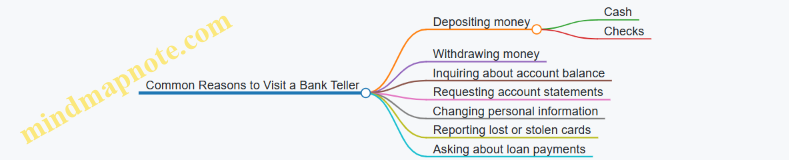
Mind Map: Typical Bank Teller Interaction
Example Dialogue 1: Depositing a Check
Customer: Good morning. I’d like to deposit this check into my savings account, please.
Teller: Good morning! May I see your ID and your account number?
Customer: Sure, here is my driver’s license and my account card.
Teller: Thank you. How much is the check for?
Customer: It’s for $500.
Teller: Got it. Do you want a receipt for this transaction?
Customer: Yes, please.
Teller: All done. Your deposit will be available within one business day.
Customer: Thanks very much.
Example Dialogue 2: Withdrawing Cash
Customer: Hi, I’d like to withdraw $200 from my checking account.
Teller: Certainly. Can I have your account number and ID, please?
Customer: Here you go.
Teller: Do you want the cash in bills or coins?
Customer: Bills, please.
Teller: Here is $200. Would you like a receipt?
Customer: No, thank you.
Teller: Have a nice day!
Customer: You too.
Example Dialogue 3: Reporting a Lost Card
Customer: Hello, I need to report my debit card as lost.
Teller: I’m sorry to hear that. Can you provide your account number and some identification?
Customer: Yes, here is my ID and account details.
Teller: Thank you. We will block your card immediately. Would you like to request a replacement card today?
Customer: Yes, please.
Teller: The new card will be ready in 5 to 7 business days. Is your mailing address still the same?
Customer: Yes, it is.
Teller: All set. Is there anything else I can assist you with?
Customer: No, that’s all. Thanks.
Tips for Effective Communication at the Bank Teller Window
- Speak clearly and at a moderate pace.
- Have your documents ready to avoid delays.
- Listen carefully to the teller’s questions.
- Repeat important details to confirm understanding.
- Don’t hesitate to ask for clarification if you don’t understand.
- Use polite expressions such as “please,” “thank you,” and “excuse me.”
Practice Role-Play Exercise
Pair up with a partner. One person acts as the bank teller, the other as the customer. Choose one of the following scenarios:
- Depositing cash and asking about account balance.
- Withdrawing money and requesting a receipt.
- Reporting a lost card and ordering a replacement.
Switch roles after completing the dialogue. Focus on using clear language and polite expressions.
This section equips you with practical language and interaction patterns for common bank visits. The examples and mind maps help visualize the flow of conversation and prepare you to handle these situations with ease.
Chapter 15: Weather and Environment
15.1 Talking About Weather Conditions
Discussing the weather is one of the most common and natural topics in everyday English conversations. It serves as a simple icebreaker or a way to connect with others. This section covers vocabulary, common phrases, and examples to help you talk about weather conditions clearly and confidently.
Mind Map: Weather Vocabulary
Common Phrases for Talking About Weather
-
Describing the weather:
- “It’s a beautiful sunny day.”
- “It’s quite chilly this morning.”
- “Looks like it might rain later.”
- “The wind is picking up.”
- “It’s been raining all day.”
-
Asking about the weather:
- “How’s the weather today?”
- “Is it cold outside?”
- “Did it snow last night?”
- “Is it supposed to clear up soon?”
-
Expressing opinions or feelings about the weather:
- “I love warm, sunny days.”
- “I’m not a fan of humid weather.”
- “This fog makes it hard to see.”
- “The heat is a bit much for me.”
Example Dialogues
Example 1: Casual Weather Chat
Alice: “Hi, John! How’s the weather today?”
John: “Hey, Alice. It’s pretty warm and sunny. Perfect for a walk.”
Alice: “Great! I was thinking about going to the park later.”
John: “Sounds like a plan. Just watch out for the breeze; it’s a bit strong near the river.”
Example 2: Checking Weather Before Plans
Maria: “Do you think it will rain this afternoon?”
Tom: “The forecast says there might be some drizzle around 4 pm.”
Maria: “Okay, I’ll bring an umbrella just in case.”
Example 3: Talking About Unusual Weather
Sam: “It’s been unusually cold for this time of year, hasn’t it?”
Lisa: “Yes, I had to wear my winter coat yesterday. Usually, it’s warmer in April.”
Sam: “I hope it warms up soon.”
Tips for Natural Weather Conversations
- Use simple adjectives to describe the weather; avoid overly technical terms unless necessary.
- Match your tone to the situation: casual for small talk, more precise when discussing plans.
- Combine weather talk with related topics, like activities or clothing, to keep the conversation flowing.
- Practice common questions and responses to feel more comfortable initiating weather-related chats.
Role-Play Exercise
Imagine you meet a colleague in the morning. Start a conversation about the weather using at least three different phrases from this section. Try to include a question, a description, and an opinion.
Example:
“Good morning! It’s a bit chilly today, isn’t it? I prefer this cool weather over the summer heat. Do you think it will stay like this all day?”
Mastering weather conversations helps you engage in everyday English naturally. The vocabulary and phrases here provide a solid foundation for discussing weather conditions in various situations.
15.2 Discussing Seasonal Activities
Seasonal activities are a common topic in everyday conversations. They provide a natural way to connect with others by sharing experiences or plans related to the time of year. This section offers practical dialogues, vocabulary, and mind maps to help you discuss seasonal activities clearly and confidently.
Mind Map: Seasonal Activities Overview
Common Phrases and Vocabulary
- “In spring, I usually…”
- “During the summer, we like to…”
- “Autumn is perfect for…”
- “Winter activities include…”
- “Do you enjoy [activity]?”
- “What do you usually do when it’s [season]?”
- “I prefer [activity] because…”
Example Dialogue 1: Talking About Spring Activities
A: What do you like to do in spring?
B: I enjoy gardening and going for hikes. The weather is just right—not too hot or cold.
A: That sounds nice. I usually go on picnics with my family.
B: Picnics are great this time of year. The flowers are blooming, and the parks look beautiful.
Mind Map: Spring Activities Detail
Example Dialogue 2: Discussing Summer Plans
A: Do you have any plans for the summer?
B: Yes, I’m planning to go swimming and have a few barbecues with friends.
A: I love beach trips during summer. The water is refreshing.
B: Me too. It’s a good way to cool off and relax.
Mind Map: Summer Activities Detail
Example Dialogue 3: Autumn and Its Activities
A: What do you usually do in autumn?
B: I like going to harvest festivals and apple picking.
A: That sounds fun. I enjoy leaf peeping—watching the leaves change color.
B: Yes, the colors are amazing. It’s a perfect season for outdoor walks.
Mind Map: Autumn Activities Detail
Example Dialogue 4: Winter Activities Conversation
A: What do you do in winter to stay active?
B: I go skiing and ice skating when I can.
A: I prefer visiting holiday markets and drinking hot chocolate.
B: That’s a nice way to enjoy the season indoors.
Mind Map: Winter Activities Detail
Tips for Discussing Seasonal Activities
- Use the present simple tense for habitual actions: “I usually go hiking in spring.”
- Ask open-ended questions to encourage conversation: “What do you like to do in winter?”
- Share reasons for preferences to add depth: “I prefer autumn because I enjoy the cooler weather.”
- Include sensory details when appropriate: “The smell of fresh pine at the holiday market is wonderful.”
- Practice role-playing these dialogues to build confidence.
This approach to discussing seasonal activities combines clear examples, relevant vocabulary, and visual organization through mind maps. It helps learners engage naturally in conversations about the time of year and the activities that come with it.
15.3 Expressing Concerns About the Environment
When talking about environmental issues in everyday English, clarity and simplicity are key. You want to express your concerns without sounding alarmist or vague. This section offers practical phrases, vocabulary, and examples to help you communicate effectively in conversations about the environment.
Key Vocabulary and Phrases
- Pollution (air, water, noise)
- Climate change
- Recycling
- Conservation
- Waste management
- Renewable energy
- Deforestation
- Carbon footprint
- Sustainable practices
- Endangered species
Mind Map: Expressing Environmental Concerns
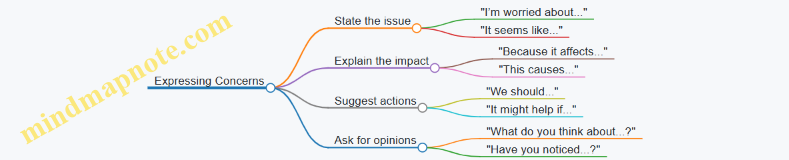
Mind Map: Types of Environmental Issues
Sample Dialogues and Examples
Example 1: Talking about air pollution
- A: “I’m worried about the air quality in our city lately.”
- B: “Yes, it seems like the pollution has increased a lot.”
- A: “It’s probably because of all the traffic and factories. It affects people’s health, especially kids and the elderly.”
- B: “I agree. Maybe we should support more green spaces or public transport options.”
Example 2: Discussing recycling habits
- A: “Do you recycle at home?”
- B: “I try to. But sometimes it’s confusing what can be recycled.”
- A: “Same here. I think if more people understood the rules, recycling rates would improve.”
- B: “Definitely. It might help if the community organized workshops or provided clearer guidelines.”
Example 3: Expressing concern about deforestation
- A: “I read that deforestation is causing a loss of wildlife habitats.”
- B: “That’s true. It also contributes to climate change since trees absorb carbon dioxide.”
- A: “We should support organizations that promote sustainable forestry.”
- B: “Good idea. Small actions can add up.”
Tips for Effective Communication
- Use “I” statements to express your views without sounding accusatory.
- Provide reasons to explain why you care about the issue.
- Suggest practical solutions or ask for ideas to keep the conversation constructive.
- Listen actively and acknowledge others’ opinions.
Practice Role-Play Exercise
Scenario: You and a friend are discussing local environmental problems.
- Person A: Express concern about littering in the neighborhood.
- Person B: Share observations and suggest possible community actions.
Sample script:
- A: “I’ve noticed a lot of trash around the park lately. It’s really disappointing.”
- B: “Yeah, it makes the place less enjoyable. Maybe we could organize a cleanup day.”
- A: “That sounds great. Also, putting up more bins might help.”
- B: “Agreed. I’ll check if the local council can support us.”
This approach helps learners practice expressing concerns clearly and proposing solutions, making conversations about the environment more engaging and productive.
15.4 Giving Weather Forecasts
Giving weather forecasts in English involves clear, concise descriptions of current or upcoming weather conditions. It’s a practical skill useful in everyday conversations, travel, and media contexts. This section provides structured guidance, examples, and mind maps to help you communicate weather information effectively.
Key Vocabulary and Phrases
- Weather conditions: sunny, cloudy, rainy, snowy, windy, foggy, stormy, humid, dry
- Temperature expressions: hot, warm, cool, cold, freezing
- Time references: today, tomorrow, this morning, this afternoon, this evening, next week
- Probability terms: chance of rain, likely, unlikely, expected, forecasted
- Intensity and duration: light rain, heavy snow, scattered showers, brief, continuous
Mind Map: Weather Forecast Components
Structuring a Weather Forecast
- Start with a general overview: “Today will be mostly sunny with mild temperatures.”
- Specify temperature ranges: “Highs will reach around 22°C, with lows near 12°C tonight.”
- Describe precipitation chances: “There is a 30% chance of light rain in the afternoon.”
- Mention wind and other factors: “Winds will be moderate, coming from the northwest at 15 km/h.”
- Conclude with advice or notable points: “It’s a good day for outdoor activities, but carry an umbrella just in case.”
Mind Map: Example Forecast Structure
Example Dialogues
Example 1: Simple Forecast
- A: “What’s the weather like today?”
- B: “It’s sunny and warm. The high will be about 25 degrees Celsius, and there’s no rain expected.”
Example 2: Detailed Forecast
- A: “Can you give me the weather forecast for tomorrow?”
- B: “Sure. Tomorrow will start off cloudy in the morning, but it should clear up by afternoon. The temperature will range from 14°C in the morning to 20°C by late afternoon. There’s a 40% chance of showers around noon, so you might want to bring a raincoat. Winds will be light, coming from the east.”
Example 3: Forecast with Warnings
- A: “Is it safe to go hiking this weekend?”
- B: “The forecast shows heavy rain on Saturday with possible thunderstorms. Temperatures will be cooler, around 16°C. Sunday looks better, mostly sunny with highs near 22°C. I’d recommend postponing your hike to Sunday.”
Role-Play Exercise
Scenario: You are a local weather reporter giving a short forecast on a radio show.
- Start with a greeting.
- Give a brief overview of today’s weather.
- Include temperature highs and lows.
- Mention any rain or wind.
- End with a simple recommendation.
Example script:
“Good morning! Today’s weather will be mostly sunny with a high of 23 degrees Celsius and a low of 13 tonight. There’s a slight chance of light showers late in the afternoon, so keep an umbrella handy if you’re out. Winds will be gentle, coming from the southwest. Enjoy your day!”
Tips for Clear Communication
- Use simple and common weather terms.
- Avoid jargon unless you explain it.
- Speak at a moderate pace to ensure clarity.
- Use numbers for temperatures and percentages for chances of rain.
- When unsure, use phrases like “likely,” “possible,” or “chance of” to indicate uncertainty.
Mastering weather forecasts in conversation helps you sound informed and confident. Practice by describing the weather you see or hear about, using the structures and vocabulary above.
15.5 Role-Play: Planning an Outdoor Event
Planning an outdoor event requires clear communication, coordination, and attention to detail. This role-play exercise helps you practice the kind of dialogue you might have when organizing a picnic, a community gathering, or a small outdoor party. The conversation typically covers the event’s purpose, date and time, location, necessary supplies, and contingency plans.
Mind Map: Key Topics for Planning an Outdoor Event
Example Dialogue
Alex: Hi Jamie, I wanted to talk about the picnic we’re planning for next weekend.
Jamie: Sure, Alex. Have you thought about the date and time yet?
Alex: I was thinking Saturday afternoon, around 2 pm. Does that work for you?
Jamie: That sounds good. What about the location? Should we reserve a spot at the city park?
Alex: Yes, the park is ideal. I checked, and the picnic area is available. We should probably book it to be safe.
Jamie: Agreed. What supplies do we need to bring?
Alex: We’ll need food and drinks, some folding chairs, and maybe a couple of umbrellas in case it gets sunny. Also, a Bluetooth speaker for music.
Jamie: Good idea. Should we ask everyone to bring something?
Alex: Yes, I can create a list and send it out. Also, we should plan for trash bags to keep the area clean.
Jamie: What if it rains?
Alex: I thought about that. We could move to my place if the weather turns bad. I’ll let everyone know the backup plan.
Jamie: Sounds like a plan. Who will handle the invitations?
Alex: I can do that. And maybe you can coordinate the food?
Jamie: Perfect. Let’s meet again on Wednesday to finalize everything.
Alex: Great. Thanks, Jamie.
Practice Points
- Use clear and polite language when suggesting ideas or asking for opinions.
- Confirm details like date, time, and location explicitly.
- Discuss responsibilities to avoid confusion.
- Mention contingency plans to show preparedness.
- Use simple phrases for invitations and offers (e.g., “Should we ask everyone to bring something?”, “I can handle the invitations.”)
Additional Example Phrases
- “What time do you think is best for the event?”
- “Do we need to get a permit for the park?”
- “Can you check the weather forecast closer to the date?”
- “Let’s make a checklist of what to bring.”
- “Who will be responsible for setting up the tables?”
- “Should we send a reminder a day before?”
This role-play encourages practical use of everyday English in a common real-life situation. It integrates planning vocabulary, polite requests, and collaborative problem-solving, all of which build confidence in speaking and organizing events.