High Frequency RF Systems For Advanced Wireless And Radar Applications
1. Introduction to High Frequency RF Systems
1.1 Overview of High Frequency RF Systems in Modern Wireless and Radar
High frequency RF systems, typically operating in the microwave (1 GHz to 30 GHz) and millimeter-wave (30 GHz to 300 GHz) bands, have become the backbone of advanced wireless communication and radar technologies. These systems enable high data rates, enhanced resolution, and improved target detection capabilities, making them indispensable in applications ranging from 5G/6G wireless networks to automotive and aerospace radar.
Why High Frequency?
- Bandwidth Availability: Higher frequencies offer wider bandwidths, enabling faster data transmission and finer radar resolution.
- Smaller Components: The shorter wavelengths allow for compact antennas and integrated circuits.
- Improved Spatial Resolution: In radar, higher frequencies enable better target discrimination and imaging.
Key Applications
- Wireless Communications: 5G mmWave, emerging 6G, satellite communications.
- Radar Systems: Automotive radar (24 GHz, 77 GHz), weather radar, synthetic aperture radar (SAR).
- Imaging: Security scanners, medical imaging.
Mind Map: High Frequency RF Systems Overview
Example 1: 5G mmWave Wireless Systems
5G wireless networks leverage frequencies around 28 GHz and 39 GHz to deliver multi-gigabit per second data rates. The high frequency enables wide channel bandwidths (up to 400 MHz), supporting enhanced mobile broadband and ultra-reliable low latency communications.
Best Practice: To overcome high path loss at mmWave, 5G systems employ beamforming with phased array antennas, focusing energy directionally to extend range and improve signal quality.
Example 2: Automotive 77 GHz Radar
Automotive radar systems operating at 77 GHz provide high-resolution detection of vehicles, pedestrians, and obstacles. The high frequency allows for compact antenna arrays that can be integrated into vehicle bumpers.
Best Practice: Using Frequency Modulated Continuous Wave (FMCW) waveforms at 77 GHz enables precise range and velocity measurements necessary for advanced driver-assistance systems (ADAS).
Mind Map: Key Considerations in High Frequency RF Systems
Summary
High frequency RF systems are critical enablers of modern wireless and radar technologies. Their ability to harness wide bandwidths and provide high spatial resolution opens new frontiers in communication speed and sensing accuracy. However, these benefits come with challenges such as increased propagation losses and component complexity, which require careful design and engineering best practices.
Understanding the landscape and foundational principles of high frequency RF systems sets the stage for deeper exploration into their components, architectures, and applications throughout this blog.
1.2 Key Performance Metrics and Design Challenges
Designing high frequency RF systems for advanced wireless and radar applications requires a deep understanding of critical performance metrics and the inherent challenges that come with operating at microwave and millimeter-wave frequencies. This section explores these metrics and challenges, supported by mind maps and practical examples to clarify concepts.
Key Performance Metrics
High frequency RF system performance is evaluated through several key metrics that influence system effectiveness, reliability, and application suitability.
Gain
- Definition: The ratio of output power to input power of an amplifier or antenna, often expressed in dB.
- Importance: Determines signal strength and coverage area.
Noise Figure (NF)
- Definition: Measure of degradation of the signal-to-noise ratio (SNR) caused by components.
- Importance: Lower NF means better sensitivity, crucial for radar detection and weak wireless signals.
Linearity
- Definition: Ability of a system/component to produce output proportional to input without distortion.
- Importance: Prevents intermodulation distortion and signal degradation.
Bandwidth
- Definition: Frequency range over which the system operates effectively.
- Importance: Wider bandwidth supports higher data rates and better radar resolution.
Phase Noise
- Definition: Short-term frequency fluctuations of oscillators.
- Importance: Affects radar range accuracy and wireless communication quality.
Power Consumption
- Definition: Amount of power used by the system.
- Importance: Critical for mobile and battery-powered applications.
Size and Weight
- Definition: Physical dimensions and mass of the system.
- Importance: Influences integration into platforms like drones or vehicles.
Reliability and Stability
- Definition: System’s ability to perform consistently over time and conditions.
- Importance: Essential for mission-critical radar and communication systems.
Mind Map: Key Performance Metrics
Design Challenges
Operating at high frequencies introduces unique challenges that must be addressed during system design.
Signal Attenuation and Path Loss
- High frequency signals suffer greater free-space path loss.
- Example: At 77 GHz automotive radar frequencies, path loss is significantly higher than at 2.4 GHz Wi-Fi bands.
Component Non-Idealities
- Parasitic capacitances and inductances become significant.
- Example: PCB trace inductance affecting amplifier stability at mmWave frequencies.
Thermal Management
- High power densities cause heating issues.
- Example: Power amplifiers generating heat that can detune circuits.
Manufacturing Tolerances
- Small physical dimensions require precise fabrication.
- Example: Antenna element spacing errors causing beam steering inaccuracies.
Electromagnetic Interference (EMI)
- Dense RF environments cause interference.
- Example: Co-located radar and communication systems interfering with each other.
Signal Integrity and Losses
- Dielectric and conductor losses increase with frequency.
- Example: Waveguide vs microstrip losses in mmWave front-ends.
Calibration and Testing Complexity
- Measurement and calibration at high frequencies require specialized equipment.
- Example: Calibrating phase arrays for beamforming at 60 GHz.
Mind Map: Design Challenges
Integrated Example: Designing a 77 GHz Automotive Radar Front-End
-
Performance Metrics:
- Gain: Target antenna gain of 20 dBi to achieve required detection range.
- Noise Figure: Aim for NF < 3 dB to detect weak reflections.
- Bandwidth: 1 GHz bandwidth for high range resolution.
- Phase Noise: Low phase noise oscillator to maintain range accuracy.
-
Design Challenges:
- Signal Attenuation: Compensated by high gain antennas and low noise amplifiers.
- Component Non-Idealities: Use of MMICs designed for mmWave to minimize parasitics.
- Thermal Management: Incorporate heat sinks and thermal vias in PCB design.
- Manufacturing Tolerances: Tight control on antenna array spacing to ensure beamforming precision.
This example highlights how understanding and balancing performance metrics with design challenges is critical to successful high frequency RF system development.
Summary
Understanding key performance metrics and design challenges is foundational for RF engineers and radar system designers. Employing best practices such as precise link budget analysis, careful component selection, and rigorous testing ensures robust system performance in demanding high frequency environments.
1.3 Historical Evolution and Future Trends
High frequency RF systems have undergone a remarkable transformation over the past century, driven by advances in materials, semiconductor technology, and system design methodologies. Understanding this historical evolution provides valuable context for appreciating current capabilities and anticipating future trends.
Historical Evolution Mind Map
Early Developments
The inception of high frequency RF systems can be traced back to the early 20th century with spark-gap transmitters and vacuum tube oscillators enabling radio communication. During World War II, radar technology rapidly advanced, utilizing microwave frequencies to detect aircraft and ships. For example, the British Chain Home radar system operated around 20-30 MHz initially but soon moved to microwave bands using cavity magnetrons, dramatically improving resolution and range.
Example: The cavity magnetron, invented in 1940, allowed generation of high power microwaves at 3 GHz, revolutionizing radar capabilities.
Post-War Advances
After WWII, the focus shifted to improving component technologies such as waveguides for low-loss transmission and klystrons for high power amplification. Commercial radar systems became widespread, and microwave communication links were established.
Example: The development of waveguide technology allowed efficient transmission of signals at 10 GHz and above, enabling long-distance microwave links.
Solid-State Revolution
The 1970s to 1990s saw the transition from bulky vacuum tubes to solid-state devices like transistors and Monolithic Microwave Integrated Circuits (MMICs). This era introduced compact, reliable, and energy-efficient components.
Phased array antennas emerged, enabling electronic beam steering without mechanical movement, critical for radar and wireless systems.
Example: The AN/SPY-1 radar system used in Aegis-class ships employed phased array technology for rapid target tracking.
Modern Era
The 21st century has been marked by the rise of millimeter-wave (mmWave) frequencies (30-300 GHz) for applications such as 5G wireless communications and automotive radar (e.g., 77 GHz band). Integration of RF front-ends with digital processing on single chips (SoCs) has reduced size and cost.
Advanced beamforming and Multiple Input Multiple Output (MIMO) systems have enhanced spectral efficiency and spatial resolution.
Example: 5G NR (New Radio) standards utilize mmWave bands with massive MIMO to deliver multi-gigabit data rates.
Future Trends Mind Map
Terahertz Frequency Exploration
Research is pushing beyond mmWave into the terahertz band (0.1-10 THz), promising ultra-high bandwidth communications and high-resolution imaging.
Example: Terahertz imaging systems are being developed for security scanning and non-destructive testing.
Integration of Photonics and Electronics
Combining photonic components with RF systems can enable ultra-low noise and wide bandwidth signal generation and processing.
Example: Photonic-assisted RF synthesizers can generate stable signals at frequencies difficult for traditional electronics.
Quantum Radar Technologies
Quantum radar concepts aim to use entangled photons to detect objects with higher sensitivity and resistance to jamming.
Example: Experimental quantum illumination setups have demonstrated improved target detection in noisy environments.
AI and Machine Learning Integration
Machine learning algorithms are increasingly used for adaptive beamforming, clutter suppression, and interference mitigation in radar and wireless systems.
Example: Neural networks can optimize antenna array weights in real-time to maximize signal-to-noise ratio.
Flexible and Reconfigurable Systems
Software-defined radios and cognitive radar systems enable dynamic adaptation to changing environments and requirements.
Example: Cognitive radar can modify its waveform parameters based on detected interference patterns.
Advanced Materials and Nanotechnology
New materials like graphene and engineered metamaterials promise devices with higher electron mobility, tunable properties, and miniaturization.
Example: Graphene-based transistors have demonstrated operation at frequencies exceeding 300 GHz.
Summary
The evolution of high frequency RF systems reflects continuous innovation from bulky vacuum tubes to integrated mmWave SoCs. Future trends point toward even higher frequencies, smarter adaptive systems, and novel materials, opening exciting possibilities for wireless and radar applications.
By weaving historical context with practical examples and forward-looking insights, RF engineers and radar designers can better navigate the challenges and opportunities in high frequency system development.
1.4 Best Practices: Defining System Requirements with Real-World Examples
Defining clear and comprehensive system requirements is the foundational step in designing high frequency RF systems for advanced wireless and radar applications. This process ensures that the final design meets performance expectations, complies with regulatory standards, and is optimized for cost and manufacturability.
Why Defining System Requirements Matters
- Aligns stakeholder expectations
- Guides design trade-offs
- Reduces costly redesigns
- Facilitates testing and validation
Key Elements in Defining System Requirements
- Operational Frequency Band: Determines component selection and propagation characteristics.
- Bandwidth and Data Rate: Impacts modulation schemes and signal processing.
- Range and Coverage: Influences antenna design and power requirements.
- Sensitivity and Dynamic Range: Affects receiver design and noise figure.
- Environmental Conditions: Temperature, humidity, vibration, and EMI considerations.
- Regulatory Compliance: FCC, ITU, and other regional standards.
- Physical Constraints: Size, weight, and power (SWaP) limitations.
Mind Map: System Requirements Definition Process
Step-by-Step Best Practices with Examples
Engage Stakeholders Early
Practice: Collaborate with end-users, system architects, and manufacturing teams to gather diverse input.
Example: For an automotive radar system, involve vehicle manufacturers, safety regulators, and RF engineers to define detection range and angular resolution requirements.
Use Quantitative Metrics
Practice: Translate vague goals into measurable parameters.
Example: Instead of “high sensitivity,” specify a minimum receiver noise figure of 3 dB and a minimum detectable signal of -90 dBm.
Consider Real-World Operating Conditions
Practice: Account for temperature extremes, vibration, and interference sources.
Example: A drone-mounted radar must operate reliably between -20°C and +50°C and withstand mechanical shocks during takeoff and landing.
Prioritize Requirements Using a Trade-Off Matrix
Practice: Rank requirements by importance and feasibility to guide design decisions.
Example: For a 5G mmWave base station, prioritize bandwidth and latency over cost for initial prototypes.
Document and Review Requirements Iteratively
Practice: Maintain a living document that evolves with project insights.
Example: Update the system requirements document after initial simulations reveal unexpected propagation losses in urban environments.
Real-World Example: Defining Requirements for a 77 GHz Automotive Radar
| Requirement Category | Specification | Rationale |
|---|---|---|
| Frequency Band | 76-81 GHz | Allocated band for automotive radar |
| Range | 150 meters maximum | Detect vehicles and obstacles at highway speeds |
| Angular Resolution | ≤ 1° | Precise object localization |
| Sensitivity | Minimum detectable signal -85 dBm | Detect weak reflections from small objects |
| Operating Temperature | -40°C to +85°C | Automotive environment durability |
| Size Constraints | Module ≤ 50 cm³ | Integration into vehicle bumper |
| Regulatory Compliance | FCC Part 15, ETSI EN 302 264 | Legal operation in target markets |
Mind Map: Example - Automotive Radar Requirements
Example: Wireless Backhaul Link for 60 GHz Band
| Requirement Category | Specification | Rationale |
|---|---|---|
| Frequency Band | 57-64 GHz | Unlicensed band for high throughput links |
| Data Rate | ≥ 10 Gbps | Support for high capacity backhaul |
| Range | 1 km Line-of-Sight | Typical urban rooftop deployment |
| Latency | < 1 ms | Real-time data transmission |
| Antenna Gain | ≥ 30 dBi | Compensate for high path loss |
| Power Consumption | ≤ 10 W | Energy efficiency for rooftop units |
| Environmental Conditions | -20°C to +55°C | Outdoor operation |
Mind Map: Example - 60 GHz Wireless Backhaul
Summary Checklist for Defining System Requirements
- Have all stakeholders been consulted?
- Are requirements quantifiable and measurable?
- Are environmental and regulatory constraints included?
- Is there a prioritized trade-off matrix?
- Is the requirements document version-controlled and reviewed regularly?
By following these best practices and grounding requirements in real-world examples, RF engineers and system designers can create robust, efficient, and compliant high frequency RF systems tailored to their application needs.
1.5 Case Study: Comparing Low Frequency vs High Frequency System Performance
In this case study, we explore the performance differences between low frequency (sub-1 GHz) and high frequency (millimeter-wave, e.g., 77 GHz) RF systems, focusing on wireless communication and radar applications. Understanding these differences is critical for RF engineers and system designers to select the appropriate frequency band based on application requirements.
Key Comparison Parameters
- Propagation Characteristics
- Antenna Size and Gain
- Bandwidth and Data Rate
- Penetration and Obstruction Handling
- System Complexity and Cost
Mind Map: Frequency Band Comparison Overview
Propagation Characteristics
| Parameter | Low Frequency (900 MHz) | High Frequency (77 GHz) |
|---|---|---|
| Wavelength | ~33 cm | ~3.9 mm |
| Free Space Path Loss | Lower | Significantly Higher |
| Atmospheric Absorption | Minimal | Noticeable (oxygen absorption peak near 60 GHz) |
| Penetration Through Walls | Good | Poor |
Example:
A 900 MHz system can reliably cover a 1 km urban area with moderate building penetration, whereas a 77 GHz system requires line-of-sight or near line-of-sight conditions with coverage limited to a few hundred meters.
Antenna Size and Gain
- Low Frequency: Larger antennas are required due to longer wavelengths. For example, a quarter-wave monopole at 900 MHz is approximately 8.3 cm.
- High Frequency: Antennas are significantly smaller, enabling compact arrays and high gain via beamforming.
Example:
A 77 GHz phased array antenna with 64 elements can fit within a 5 cm x 5 cm area, achieving high directional gain suitable for automotive radar.
Mind Map: Antenna Design Impact
Bandwidth and Data Rate
- Low Frequency: Typically limited bandwidth (e.g., 10-20 MHz), constraining maximum data rates.
- High Frequency: Wide bandwidths (several GHz) enable multi-Gbps data rates.
Example:
5G NR operating at 3.5 GHz might use 100 MHz bandwidth, whereas mmWave 5G at 28 GHz or 39 GHz can use 400 MHz to 800 MHz bandwidth, dramatically increasing throughput.
Penetration and Obstruction Handling
- Low frequency signals penetrate walls, foliage, and obstacles better, making them suitable for indoor and non-line-of-sight (NLOS) scenarios.
- High frequency signals are more easily blocked or absorbed, requiring line-of-sight or reflective paths.
Example:
A 900 MHz wireless sensor network inside a factory can maintain connectivity through machinery and walls, whereas a 77 GHz radar system requires clear paths or reflective surfaces for reliable detection.
System Complexity and Cost
- Low frequency systems benefit from mature, cost-effective components but require larger physical sizes.
- High frequency systems demand advanced semiconductor technologies (e.g., GaAs, GaN, SiGe), precise manufacturing, and complex calibration.
Example:
A 900 MHz IoT device can be built with low-cost CMOS components, while a 77 GHz automotive radar module requires costly MMICs and precise antenna arrays.
Mind Map: System Trade-offs
Summary Table
| Aspect | Low Frequency System (900 MHz) | High Frequency System (77 GHz) |
|---|---|---|
| Coverage Range | Up to several kilometers | Hundreds of meters |
| Antenna Size | Large (cm scale) | Very small (mm scale) |
| Bandwidth | Tens of MHz | Several GHz |
| Penetration | Good (walls, foliage) | Poor (line-of-sight preferred) |
| System Cost | Lower | Higher |
| Typical Applications | IoT, Cellular, Long-Range Radar | Automotive Radar, 5G mmWave, Imaging Radar |
Practical Example: Radar Target Detection
-
Low Frequency Radar (e.g., 1 GHz):
- Pros: Can detect targets through foliage or light cover.
- Cons: Lower resolution due to longer wavelength.
-
High Frequency Radar (e.g., 77 GHz):
- Pros: High resolution imaging, precise range and velocity measurement.
- Cons: Limited penetration, sensitive to weather conditions.
Example Scenario:
An autonomous vehicle uses 77 GHz radar to detect pedestrians with high resolution but relies on lower frequency sensors or cameras to detect objects obscured by fog or dust.
Conclusion
Choosing between low frequency and high frequency RF systems depends heavily on the application requirements. Low frequency systems excel in coverage and penetration but are limited in bandwidth and antenna size. High frequency systems offer unparalleled bandwidth and compactness but require line-of-sight and advanced design techniques.
This case study highlights the importance of balancing these trade-offs and leveraging best practices in system design to optimize performance for specific wireless and radar applications.
2. Fundamentals of High Frequency Electromagnetic Wave Propagation
2.1 Wave Propagation Mechanisms at Microwave and Millimeter-Wave Bands
High frequency RF systems operating in the microwave (1 GHz to 30 GHz) and millimeter-wave (30 GHz to 300 GHz) bands exhibit unique wave propagation characteristics that are critical to understand for effective system design. These frequencies are widely used in advanced wireless communications, automotive radar, and imaging systems due to their ability to support high data rates and fine resolution.
Key Propagation Mechanisms
-
Free-Space Propagation
- The fundamental mode of wave travel in an unobstructed environment.
- Characterized by spherical spreading loss.
-
Reflection
- Occurs when waves encounter surfaces larger than their wavelength.
- Can cause multipath effects.
-
Diffraction
- Bending of waves around obstacles or edges.
- Less pronounced at higher frequencies due to shorter wavelengths.
-
Scattering
- Occurs when waves encounter rough surfaces or small objects.
- Leads to energy being spread in multiple directions.
-
Atmospheric Absorption
- Molecular absorption by gases like oxygen and water vapor.
- More significant at millimeter-wave frequencies.
-
Rain and Weather Effects
- Attenuation caused by rain droplets, fog, and snow.
- Critical for link budget in outdoor systems.
Mind Map: Wave Propagation Mechanisms
Detailed Explanation
Free-Space Propagation
At microwave and millimeter-wave frequencies, free-space propagation follows the Friis transmission equation:
\[ P_r = P_t + G_t + G_r - 20\log_{10}(\frac{4\pi d}{\lambda}) \]
where:
- \(P_r\) = received power (dBm)
- \(P_t\) = transmitted power (dBm)
- \(G_t, G_r\) = transmitter and receiver antenna gains (dBi)
- \(d\) = distance between antennas (meters)
- \(\lambda\) = wavelength (meters)
Example: For a 60 GHz link over 100 meters with 20 dBi antennas and 0 dBm transmit power, the free-space path loss is approximately 100 dB, illustrating the high attenuation at millimeter-wave frequencies.
Reflection
Reflection occurs when waves hit surfaces such as buildings, ground, or vehicles. At high frequencies, surfaces tend to be electrically large, causing strong specular reflections.
Best Practice: Use ray-tracing simulation tools to model reflections in urban environments.
Example: In automotive radar at 77 GHz, reflections from nearby vehicles can create multipath signals that affect target detection.
Diffraction
Diffraction allows waves to bend around obstacles but is less effective at millimeter-wave bands due to the small wavelength.
Example: A 5 GHz signal can diffract around a building corner better than a 60 GHz signal, which may experience a shadow zone.
Scattering
Scattering arises from rough surfaces or small objects like foliage or raindrops.
- Rayleigh scattering: When objects are much smaller than the wavelength.
- Mie scattering: When object sizes are comparable to the wavelength.
Example: At 24 GHz, scattering from tree leaves causes signal fading in outdoor wireless links.
Atmospheric Absorption
Oxygen and water vapor molecules absorb energy at specific resonance frequencies, causing attenuation peaks.
Example: At 60 GHz, oxygen absorption peaks cause an additional ~15 dB/km loss, which is exploited for secure short-range communications.
Weather Effects
Rain attenuation can be severe at millimeter-wave frequencies.
Example: A heavy rain event with 25 mm/hr rainfall can cause 10-20 dB/km attenuation at 94 GHz, requiring link margin adjustments.
Mind Map: Environmental Factors Affecting Propagation
Practical Example: Urban Millimeter-Wave Propagation
Consider a 28 GHz 5G wireless system deployed in a dense urban area:
- Challenges: High path loss, frequent blockages by buildings, and multipath reflections.
- Approach: Use beamforming antennas to steer beams around obstacles and exploit reflections.
- Best Practice: Perform site surveys and use 3D ray-tracing to optimize base station placement.
Summary
Understanding the propagation mechanisms at microwave and millimeter-wave bands is essential for designing robust RF systems. Incorporating these mechanisms into link budgets, simulations, and system architectures ensures improved performance and reliability.
References for Further Reading
- Rappaport, T. S., et al. “Millimeter Wave Wireless Communications.” Pearson Education, 2015.
- Skolnik, M. I. “Radar Handbook.” 3rd Edition, McGraw-Hill, 2008.
- ITU-R P.676-12, “Attenuation by atmospheric gases.”
2.2 Atmospheric Effects and Path Loss Modeling
High frequency RF systems, especially those operating in microwave and millimeter-wave bands, are significantly influenced by atmospheric conditions. Understanding atmospheric effects and accurately modeling path loss is critical for designing reliable wireless and radar systems.
Atmospheric Effects on High Frequency RF Signals
Atmospheric effects refer to the various phenomena caused by the Earth’s atmosphere that impact the propagation of RF signals. These effects become more pronounced at higher frequencies due to shorter wavelengths.
Key Atmospheric Effects:
- Free Space Path Loss (FSPL)
- Atmospheric Absorption
- Rain Attenuation
- Fog and Cloud Attenuation
- Gaseous Absorption (Oxygen, Water Vapor)
- Scintillation and Turbulence Effects
Mind Map: Atmospheric Effects on RF Signals
Free Space Path Loss (FSPL)
FSPL represents the idealized loss of signal strength as it propagates through free space without obstacles or atmospheric effects.
Formula:
\[ FSPL(dB) = 20 \log_{10}(d) + 20 \log_{10}(f) + 20 \log_{10}\left(\frac{4\pi}{c}\right) \]
Where:
- \(d\) = distance between transmitter and receiver (meters)
- \(f\) = frequency (Hz)
- \(c\) = speed of light (\(3 \times 10^8\) m/s)
Example:
Calculate FSPL at 10 km for 77 GHz automotive radar.
- \(d = 10,000\) m
- \(f = 77 \times 10^9\) Hz
\[ FSPL = 20 \log_{10}(10,000) + 20 \log_{10}(77 \times 10^9) + 20 \log_{10}\left(\frac{4\pi}{3 \times 10^8}\right) \]
Simplifying,
\[ FSPL \approx 80 + 197.7 - 147.6 = 130.1 \text{ dB} \]
Atmospheric Absorption
Atmospheric gases, primarily oxygen and water vapor, absorb RF energy, causing additional attenuation.
- Oxygen Absorption: Peaks near 60 GHz and 118 GHz.
- Water Vapor Absorption: Significant near 22 GHz and 183 GHz.
These absorptions depend on frequency, pressure, temperature, and humidity.
Example:
At 60 GHz, oxygen absorption can add up to 15 dB/km attenuation, which is critical for short-range high-frequency links.
Mind Map: Atmospheric Absorption Components
Rain Attenuation
Rain droplets scatter and absorb RF energy, causing signal degradation.
- Rain attenuation increases with frequency and rain rate (mm/hr).
- Particularly impactful above 10 GHz.
Example:
For a 77 GHz radar system, heavy rain (25 mm/hr) can cause attenuation of approximately 10 dB/km.
Best Practice: Always include rain fade margins in link budgets for outdoor high frequency systems.
Fog and Cloud Attenuation
Fog and clouds consist of tiny water droplets that cause scattering and absorption.
- Attenuation is generally less severe than rain but can be significant at mmWave frequencies.
Example:
Fog attenuation at 94 GHz can be around 0.1 to 0.3 dB/km depending on density.
Scintillation and Turbulence Effects
Rapid fluctuations in signal amplitude and phase caused by atmospheric turbulence.
- More pronounced over long distances and at higher frequencies.
Path Loss Modeling Techniques
Accurate path loss modeling incorporates free space loss plus atmospheric effects.
Common Models:
- ITU-R P.676: Gaseous absorption model
- ITU-R P.838: Rain attenuation prediction
- ITU-R P.840: Fog and cloud attenuation
General Path Loss Equation:
\[ PL_{total} = FSPL + A_{gas} + A_{rain} + A_{fog} + A_{scintillation} \]
Where \(A_x\) are attenuation terms in dB.
Mind Map: Path Loss Modeling Components
Example: Link Budget Incorporating Atmospheric Effects
Scenario: Designing a 77 GHz radar link over 5 km in moderate rain (10 mm/hr).
- FSPL at 5 km: ~123 dB
- Oxygen absorption: ~0.5 dB/km → 2.5 dB
- Water vapor absorption: ~0.1 dB/km → 0.5 dB
- Rain attenuation: ~4 dB/km → 20 dB
Total Path Loss:
\[ 123 + 2.5 + 0.5 + 20 = 146 \text{ dB} \]
This example highlights the dominance of rain attenuation at high frequencies.
Best Practices
- Include Environmental Variability: Model path loss for worst-case weather conditions.
- Use Standardized Models: Leverage ITU-R recommendations for consistency.
- Validate with Measurements: Perform field tests to refine models.
- Design Margins: Add fade margins to compensate for unpredictable atmospheric changes.
Summary
Atmospheric effects significantly impact high frequency RF system performance. Accurate path loss modeling that integrates free space loss with absorption and attenuation phenomena is essential for robust system design.
Understanding these effects through models and practical examples enables RF engineers and radar system designers to optimize link budgets and improve system reliability.
2.3 Multipath and Fading Phenomena in High Frequency Bands
High frequency RF systems, especially those operating in microwave and millimeter-wave bands, are significantly influenced by multipath propagation and fading phenomena. Understanding these effects is critical for designing robust wireless and radar systems that maintain performance in complex environments.
What is Multipath Propagation?
Multipath propagation occurs when transmitted signals reach the receiver via multiple paths due to reflection, diffraction, and scattering caused by obstacles such as buildings, terrain, and atmospheric particles.
- Direct Path: The shortest, line-of-sight (LOS) signal path.
- Reflected Paths: Signals bouncing off surfaces like walls, ground, or water.
- Diffracted Paths: Signals bending around edges of obstacles.
- Scattered Paths: Signals dispersed by small objects or rough surfaces.
Effects of Multipath Propagation
- Signal Fading: Variations in received signal amplitude due to constructive and destructive interference.
- Delay Spread: Time difference between the earliest and latest arriving multipath components, causing inter-symbol interference (ISI).
- Doppler Spread: Frequency shifts caused by relative motion between transmitter, receiver, and reflecting objects.
Mind Map: Multipath Propagation Components
Fading Phenomena in High Frequency Bands
Fading refers to the variation or attenuation of signal strength over time or space. In high frequency bands, fading is more pronounced due to shorter wavelengths and increased sensitivity to obstacles.
Types of Fading:
- Large-Scale Fading (Shadowing): Slow variations caused by large obstacles blocking the signal path.
- Small-Scale Fading: Rapid fluctuations due to multipath interference.
- Rayleigh Fading: Occurs when there is no dominant LOS path; signal amplitude follows a Rayleigh distribution.
- Rician Fading: Occurs when a dominant LOS path exists along with multipath components; signal amplitude follows a Rician distribution.
Mind Map: Fading Types
Why Are Multipath and Fading More Critical at High Frequencies?
- Shorter Wavelengths: Higher frequencies have smaller wavelengths, making them more sensitive to small obstacles and surface roughness.
- Increased Path Loss: Signals attenuate faster, so reflected and scattered paths may be weaker but still cause interference.
- Limited Diffraction: Higher frequencies diffract less around obstacles, increasing shadowing effects.
- Atmospheric Absorption: Additional attenuation due to gases and rain can alter multipath characteristics.
Best Practices for Managing Multipath and Fading
-
Diversity Techniques: Using multiple antennas (spatial diversity), frequencies (frequency diversity), or time slots (time diversity) to mitigate fading.
-
Equalization: Digital signal processing to compensate for delay spread and ISI.
-
Adaptive Modulation and Coding: Adjusting modulation schemes based on channel conditions.
-
Beamforming: Directing antenna beams to enhance LOS paths and suppress multipath.
-
Channel Modeling and Simulation: Using accurate models to predict multipath effects during design.
Example 1: Urban 5G mmWave Wireless Link
In urban environments, 5G mmWave signals (e.g., 28 GHz) experience severe multipath due to reflections from buildings and vehicles.
- Scenario: A base station communicates with a mobile device in a street canyon.
- Observed Effects: Rapid signal fluctuations (small-scale fading) and shadowing behind buildings (large-scale fading).
- Mitigation: Use of beamforming antennas to focus energy along the street and spatial diversity with multiple antennas on the device.
Example 2: Automotive Radar at 77 GHz
Automotive radars operating at 77 GHz must handle multipath reflections from nearby vehicles, road signs, and guardrails.
- Scenario: Radar detects multiple reflections from a vehicle and roadside objects.
- Observed Effects: Multipath causes ghost targets and fluctuating signal strength.
- Mitigation: Signal processing algorithms distinguish direct reflections from multipath by analyzing time delay and Doppler shifts.
Mind Map: Mitigation Techniques for Multipath and Fading
Summary
Multipath and fading phenomena are intrinsic challenges in high frequency RF systems. By understanding their causes and effects, engineers can apply best practices such as diversity, beamforming, and advanced signal processing to design resilient wireless and radar systems capable of operating effectively in complex propagation environments.
2.4 Best Practices: Accurate Link Budget Calculation with Example Scenarios
Accurate link budget calculation is a cornerstone in designing reliable high frequency RF systems for wireless and radar applications. It ensures that the transmitted signal arrives at the receiver with sufficient power to maintain system performance, accounting for all gains and losses along the path.
What is a Link Budget?
A link budget is a detailed accounting of all the gains and losses from the transmitter, through the medium, to the receiver. It helps predict the received signal strength and assess system feasibility.
Key Components of a Link Budget
- Transmit Power (Pt): Power output from the transmitter.
- Transmit Antenna Gain (Gt): Gain of the transmitting antenna.
- Path Loss (Lp): Loss due to propagation through the medium.
- Receive Antenna Gain (Gr): Gain of the receiving antenna.
- System Losses (Ls): Losses due to cables, connectors, atmospheric absorption, polarization mismatch, etc.
- Receiver Sensitivity (Pr_min): Minimum power required at receiver input for acceptable performance.
Link Budget Formula
\[ P_r = P_t + G_t + G_r - L_p - L_s \]
Where all terms are in dB or dBm.
Mind Map: Link Budget Calculation Components
Step-by-Step Best Practices for Accurate Link Budget Calculation
-
Define System Parameters Clearly
- Frequency band, bandwidth, modulation scheme.
- Required data rate and bit error rate (BER).
-
Calculate Free Space Path Loss (FSPL)
-
Use the formula:
\[ FSPL(dB) = 20 \log_{10}(d) + 20 \log_{10}(f) + 20 \log_{10}\left(\frac{4\pi}{c}\right) \]
where:
- d = distance (meters)
- f = frequency (Hz)
- c = speed of light (~3x10^8 m/s)
-
-
Include Atmospheric and Environmental Losses
- Rain, fog, humidity, and obstacles.
- Use ITU-R models or empirical data.
-
Account for Antenna Gains
- Use measured or simulated antenna gain patterns.
- Consider antenna pointing accuracy.
-
Incorporate System Losses
- Cable and connector losses from datasheets or measurements.
- Polarization mismatch losses (typically 0.5–3 dB).
-
Calculate Receiver Sensitivity
- Based on noise figure, bandwidth, and required SNR.
-
Perform Margin Analysis
- Add fade margin to account for fading and uncertainties.
-
Validate with Simulation and Measurement
- Use RF simulation tools and field tests.
Example Scenario 1: 77 GHz Automotive Radar Link Budget
| Parameter | Value |
|---|---|
| Frequency (f) | 77 GHz |
| Distance (d) | 100 m |
| Transmit Power (Pt) | 10 dBm |
| Transmit Antenna Gain (Gt) | 25 dBi |
| Receive Antenna Gain (Gr) | 25 dBi |
| System Losses (Ls) | 3 dB |
| Receiver Sensitivity (Pr_min) | -85 dBm |
Step 1: Calculate FSPL
\[ FSPL = 20 \log_{10}(100) + 20 \log_{10}(77 \times 10^9) + 20 \log_{10}\left(\frac{4\pi}{3 \times 10^8}\right) \]
Calculating stepwise:
- 20 log10(100) = 40 dB
- 20 log10(77e9) = 20 * (log10(77) + 9) ≈ 20 * (1.886 + 9) = 20 * 10.886 = 217.72 dB
- 20 log10(4π/c) ≈ -147.55 dB (constant term)
So,
\[ FSPL = 40 + 217.72 - 147.55 = 110.17 \text{ dB} \]
Step 2: Calculate Received Power (Pr)
\[ P_r = 10 + 25 + 25 - 110.17 - 3 = -53.17 \text{ dBm} \]
Step 3: Compare with Receiver Sensitivity
- Received power (-53.17 dBm) is much higher than sensitivity (-85 dBm), indicating a strong link.
Step 4: Add Fade Margin
- Assume 10 dB fade margin.
- Effective received power = -53.17 - 10 = -63.17 dBm > -85 dBm (still acceptable).
Mind Map: Example Scenario 1 Breakdown
Example Scenario 2: 28 GHz 5G Wireless Link in Urban Environment
| Parameter | Value |
|---|---|
| Frequency (f) | 28 GHz |
| Distance (d) | 500 m |
| Transmit Power (Pt) | 23 dBm |
| Transmit Antenna Gain (Gt) | 15 dBi |
| Receive Antenna Gain (Gr) | 15 dBi |
| System Losses (Ls) | 5 dB (includes rain/fog) |
| Receiver Sensitivity (Pr_min) | -90 dBm |
Step 1: Calculate FSPL
\[ FSPL = 20 \log_{10}(500) + 20 \log_{10}(28 \times 10^9) + 20 \log_{10}\left(\frac{4\pi}{3 \times 10^8}\right) \]
Calculations:
- 20 log10(500) = 53.98 dB
- 20 log10(28e9) = 20 * (log10(28) + 9) ≈ 20 * (1.447 + 9) = 20 * 10.447 = 208.94 dB
- 20 log10(4π/c) ≈ -147.55 dB
So,
\[ FSPL = 53.98 + 208.94 - 147.55 = 115.37 \text{ dB} \]
Step 2: Calculate Received Power (Pr)
\[ P_r = 23 + 15 + 15 - 115.37 - 5 = -67.37 \text{ dBm} \]
Step 3: Compare with Receiver Sensitivity
- Received power (-67.37 dBm) is higher than sensitivity (-90 dBm), link is feasible.
Step 4: Consider Additional Margins
- Add 15 dB fade margin for urban fading.
- Effective received power = -67.37 - 15 = -82.37 dBm > -90 dBm (still acceptable).
Mind Map: Example Scenario 2 Breakdown
Additional Tips for Accurate Link Budgeting
- Use Realistic Antenna Patterns: Avoid assuming isotropic antennas; use measured or simulated patterns.
- Incorporate Environmental Models: Urban, suburban, rural, and indoor environments have different propagation characteristics.
- Consider Polarization Effects: Cross-polarization losses can degrade link performance.
- Account for Hardware Imperfections: Non-idealities in amplifiers, mixers, and filters add losses.
- Validate with Field Measurements: Always verify calculations with real-world data.
Summary
Accurate link budget calculation requires a comprehensive understanding of all system components and environmental factors. By following best practices and validating with examples, RF engineers and radar system designers can ensure robust and efficient high frequency system designs.
2.5 Practical Example: Propagation Modeling for Urban Radar Systems
Urban environments present unique challenges for radar system designers due to complex propagation phenomena such as multipath reflections, diffraction around buildings, and significant clutter. Accurate propagation modeling is essential to predict radar performance, optimize system parameters, and ensure reliable detection.
Understanding Urban Propagation Challenges
- Multipath Propagation: Signals reflect off buildings, vehicles, and other structures causing multiple delayed and attenuated copies of the transmitted signal.
- Shadowing and Blockage: Tall buildings can block line-of-sight (LOS) paths, causing signal attenuation or complete signal loss.
- Clutter: Stationary and moving objects create unwanted echoes that can mask targets.
Step 1: Define the Scenario and Parameters
- Frequency: 77 GHz (typical automotive radar band)
- Environment: Dense urban street canyon
- Radar Height: 1.5 meters (vehicle-mounted)
- Target Distance: 50 to 200 meters
- Antenna Type: Phased array with 30° beamwidth
Step 2: Select Propagation Models
| Model Type | Description | Applicability in Urban Radar |
|---|---|---|
| Free Space | Ideal LOS propagation without obstacles | Baseline comparison |
| Two-Ray Ground Reflection | Considers direct and ground-reflected paths | Simple urban streets with flat surfaces |
| Ray Tracing | Detailed modeling of reflections and diffractions | High accuracy in complex urban scenarios |
| Empirical Models | Based on measurement data (e.g., COST 231 Walfisch-Ikegami) | Quick estimation, less precise |
Step 3: Implement Ray Tracing for Urban Scenario
Ray tracing simulates multiple signal paths by modeling reflections, diffractions, and scattering from urban structures.
Mind Map: Ray Tracing Process
Example: Using a simplified 3D urban model, simulate rays launched from the radar antenna. Calculate the power and delay of each path reaching the target and returning to the radar.
Step 4: Calculate Link Budget Including Multipath Effects
Mind Map: Link Budget Components in Urban Radar
Example Calculation:
- Transmit Power: 10 dBm
- Antenna Gain: 20 dBi
- Path Loss (including reflections): 110 dB
- Target RCS: 10 dBsm
- System Losses: 3 dB
Received Power = 10 + 20 - 110 + 10 + 20 - 3 = -53 dBm
Evaluate if this power level is above the receiver sensitivity threshold.
Step 5: Analyze Multipath Impact on Radar Performance
- Range Ambiguities: Multipath can cause ghost targets at incorrect ranges.
- Doppler Spread: Moving reflectors induce frequency shifts complicating velocity estimation.
- Clutter Suppression: Adaptive filtering techniques may be required.
Example: Simulate a scenario where a strong reflection from a building facade creates a secondary peak in the range profile. Discuss mitigation strategies such as angular filtering or waveform design.
Step 6: Validation with Measurement Data
Compare simulation results with field measurements from urban test sites.
- Measure received signal strength and multipath delay profiles.
- Adjust model parameters (e.g., reflection coefficients) to improve accuracy.
Summary
Propagation modeling for urban radar systems requires combining detailed environmental data with advanced simulation techniques like ray tracing. By incorporating multipath, diffraction, and clutter effects into the link budget and performance analysis, engineers can design robust radar systems optimized for challenging urban environments.
Additional Resources
- “Propagation Effects Handbook for Wireless Systems” - NTIA Report
- COST 231 Walfisch-Ikegami Model documentation
- MATLAB Phased Array System Toolbox for ray tracing simulations
Final Note
Accurate propagation modeling is iterative and benefits greatly from integrating simulation with real-world measurements. This practical example serves as a foundation for designing and optimizing urban radar systems with high confidence.
3. High Frequency RF Components and Materials
3.1 Overview of Key RF Components: Mixers, Amplifiers, Oscillators, and Filters
High frequency RF systems rely heavily on several fundamental components that enable signal generation, conditioning, and processing. Understanding the roles, characteristics, and best practices for these components is essential for RF engineers and radar system designers.
Mind Map: Key RF Components Overview
Mixers
Function: Mixers perform frequency translation by multiplying two signals, typically the RF input and a local oscillator (LO) signal, producing sum and difference frequencies.
Types:
- Passive Mixers: Use diodes or FETs, no gain, generally better linearity and higher conversion loss.
- Active Mixers: Use transistors, provide gain, but may have higher noise and lower linearity.
Best Practice:
- Select mixers with appropriate linearity (IP3) to minimize intermodulation distortion in high dynamic range radar systems.
Example:
- In a 77 GHz automotive radar, a passive diode mixer is often chosen for its robustness and linearity despite higher conversion loss. Designers compensate by placing a low noise amplifier before the mixer.
Amplifiers
Function: Amplifiers boost signal power to improve signal-to-noise ratio (SNR) or drive antennas.
Types:
- Low Noise Amplifiers (LNA): Placed at the front-end to amplify weak received signals with minimal added noise.
- Power Amplifiers (PA): Used at the transmitter to increase output power.
Parameters to Consider:
- Gain (dB)
- Noise Figure (NF)
- Linearity (IP3, P1dB)
- Efficiency (especially for PAs)
Best Practice:
- Use LNAs with the lowest possible noise figure to maximize radar sensitivity.
- For PAs, balance between linearity and efficiency based on application (e.g., pulsed radar vs continuous wave).
Example:
- Designing a 60 GHz wireless link, an LNA with a noise figure below 3 dB and gain of 15 dB is selected to ensure signal integrity before downconversion.
Oscillators
Function: Oscillators generate stable carrier signals at desired frequencies.
Types:
- Crystal Oscillators (XO): High stability, limited frequency range.
- Dielectric Resonator Oscillators (DRO): High frequency, good phase noise.
- Voltage Controlled Oscillators (VCO): Tunable frequency, used in PLLs.
Key Parameters:
- Phase Noise: Critical for radar resolution and detection.
- Frequency Stability: Temperature and aging effects.
- Tuning Range: Important for frequency agility.
Best Practice:
- Use low phase noise oscillators to improve radar range resolution and reduce false targets.
- Combine VCOs with PLLs for frequency synthesis with high stability.
Example:
- In a 24 GHz FMCW radar, a VCO combined with a PLL is used to generate chirp signals with precise frequency control and low phase noise.
Filters
Function: Filters select or reject specific frequency bands to reduce noise and interference.
Types:
- Bandpass Filters: Pass a specific frequency band.
- Lowpass/Highpass Filters: Pass frequencies below/above a cutoff.
- Notch Filters: Reject narrow frequency bands.
Parameters:
- Insertion Loss
- Selectivity (steepness of roll-off)
- Quality Factor (Q)
Best Practice:
- Use high-Q filters to improve selectivity without excessive insertion loss.
- Implement filters close to the antenna or mixer to reduce out-of-band interference.
Example:
- A 77 GHz automotive radar uses a cavity bandpass filter with a Q-factor above 1000 to ensure only the desired radar band is processed.
Integrated Example: Front-End Chain
Example Walkthrough:
- In a 94 GHz imaging radar, the received signal first passes through a high-Q bandpass filter, then is amplified by an LNA with a 2 dB noise figure and 20 dB gain. The amplified signal is mixed with a 94 GHz LO signal in a passive diode mixer, producing an IF signal at 1 GHz which is then filtered and processed.
Summary
Understanding the characteristics and proper selection of mixers, amplifiers, oscillators, and filters is crucial for designing high frequency RF systems. Applying best practices such as prioritizing low noise figures in LNAs, selecting mixers with appropriate linearity, using low phase noise oscillators, and employing high-Q filters can significantly enhance system performance in wireless and radar applications.
3.2 Material Selection for Low Loss and High Stability
Selecting the right materials for high frequency RF components is critical to achieving low insertion loss, high stability, and overall system performance. At microwave and millimeter-wave frequencies, even small material imperfections or losses can significantly degrade signal integrity and system efficiency.
Key Material Properties for High Frequency RF Systems
- Dielectric Constant (εr): Determines the speed of signal propagation and impedance characteristics.
- Loss Tangent (tan δ): Represents dielectric losses; lower values mean less signal attenuation.
- Thermal Stability: Ability to maintain electrical properties over temperature variations.
- Mechanical Stability: Resistance to deformation and environmental stresses.
- Surface Roughness: Affects conductor losses at high frequencies.
Common Materials Used in High Frequency RF Systems
| Material | Dielectric Constant (εr) | Loss Tangent (tan δ) | Typical Applications |
|---|---|---|---|
| Rogers RO4003C | ~3.55 | ~0.0027 | PCB substrates for microwave circuits |
| PTFE (Teflon) | ~2.1 | ~0.0004 | High-performance substrates, cables |
| Alumina (Al2O3) | ~9.8 | ~0.0001 | High Q resonators, filters |
| Silicon | ~11.7 | ~0.01 (varies) | MMIC substrates, integrated circuits |
| Quartz | ~3.8 | ~0.0001 | Oscillator substrates, resonators |
Mind Map: Material Selection Criteria
Best Practices in Material Selection
-
Match Material to Application Frequency:
- For mmWave (>30 GHz), low loss tangent materials like PTFE or quartz are preferred.
- For lower microwave bands, materials like Rogers RO4003C offer a good balance of cost and performance.
-
Consider Thermal Stability:
- Use materials with low thermal expansion to maintain impedance stability.
- Example: Alumina substrates are excellent for high power and temperature environments.
-
Minimize Surface Roughness:
- Use smooth copper cladding and advanced plating techniques to reduce conductor losses.
-
Evaluate Mechanical and Environmental Factors:
- For outdoor radar systems, materials must resist moisture absorption and mechanical stress.
Example 1: Selecting a PCB Substrate for a 77 GHz Automotive Radar
- Requirements: Low loss, stable dielectric constant, thermal stability from -40°C to +125°C.
- Material Choice: Rogers RO5880 (εr ~2.2, tan δ ~0.0009) due to low loss and good thermal stability.
- Outcome: Achieved low insertion loss and consistent radar performance across temperature range.
Example 2: Material Selection for High-Q Resonator
- Requirements: Ultra-low loss, high dielectric constant for compact size.
- Material Choice: Alumina ceramic (εr ~9.8, tan δ ~0.0001).
- Outcome: Resonator with high Q-factor enabling narrow bandwidth filtering for radar signal processing.
Mind Map: Decision Flow for Material Selection
Summary
Material selection is a multi-dimensional decision involving electrical, thermal, mechanical, and economic factors. By understanding the trade-offs and leveraging best practices, RF engineers can optimize system performance for advanced wireless and radar applications.
For further reading, consider exploring manufacturer datasheets (e.g., Rogers Corporation), and simulation tools like HFSS or CST to model material impact on RF performance.
3.3 Packaging and Integration Techniques for High Frequency Components
Packaging and integration of high frequency RF components are critical steps that directly impact system performance, reliability, and manufacturability. At microwave and millimeter-wave frequencies, even small parasitic effects introduced by packaging can degrade signal integrity, increase losses, and cause unwanted coupling. This section explores best practices, common techniques, and practical examples to help RF engineers and designers optimize packaging and integration for high frequency systems.
Key Considerations in High Frequency Packaging
- Minimizing Parasitics: Inductance, capacitance, and resistance introduced by packaging must be minimized to preserve signal integrity.
- Thermal Management: High frequency components often dissipate significant power; effective heat dissipation is essential.
- Mechanical Stability: Vibrations and mechanical stress can detune components or cause failures.
- EMI Shielding: Preventing electromagnetic interference both into and out of the package.
- Size and Weight Constraints: Especially critical for mobile or aerospace applications.
Common Packaging Techniques
- Ceramic Packages: Low loss, excellent thermal properties, widely used for MMICs.
- Plastic Packages: Cost-effective but higher losses, suitable for lower frequency or less critical components.
- Waveguide Packaging: For very high frequencies (e.g., >100 GHz), waveguide interfaces reduce losses.
- Flip-Chip and Wire Bonding: Methods to connect die to substrate, each with trade-offs in parasitics and reliability.
- System-in-Package (SiP): Integration of multiple components into a single package to reduce interconnect lengths.
Integration Techniques
- Substrate Selection: High frequency substrates like Rogers, Taconic, or alumina to minimize dielectric losses.
- Monolithic Integration: Combining multiple RF functions on a single chip (MMICs) reduces interconnect parasitics.
- Hybrid Integration: Combining discrete components on a common substrate or module.
- 3D Packaging: Vertical stacking of components to save space and improve performance.
Mind Map: Packaging and Integration Techniques
Best Practices with Examples
Minimizing Parasitics Through Flip-Chip Integration
Example: Designing a 60 GHz low noise amplifier (LNA) module.
- Challenge: Wire bonds introduce inductance, degrading gain and noise figure.
- Solution: Use flip-chip bonding to directly attach the MMIC to the substrate, reducing bond wire length and parasitic inductance.
- Result: Improved gain by 1.5 dB and noise figure reduction of 0.3 dB compared to wire-bonded design.
Thermal Management Using Thermal Vias and Heat Spreaders
Example: Packaging a 77 GHz automotive radar power amplifier.
- Challenge: High power dissipation causes temperature rise, affecting reliability.
- Solution: Incorporate an array of thermal vias beneath the die to conduct heat to a metal heat spreader attached to the PCB backside.
- Result: Junction temperature reduced by 15°C, improving device lifetime.
EMI Shielding with Metal Cans and Conductive Gaskets
Example: Integration of a radar transceiver module in a compact enclosure.
- Challenge: Preventing interference from nearby digital electronics.
- Solution: Use a metal can package with conductive gaskets to seal the enclosure, ensuring effective EMI shielding.
- Result: Measured EMI emissions reduced by 20 dB, meeting regulatory standards.
Practical Integration Example: Building a High Frequency Front-End Module
Step 1: Select a low-loss Rogers RO4350B substrate for the PCB to minimize dielectric losses at 77 GHz.
Step 2: Use flip-chip MMIC LNAs and mixers to reduce interconnect parasitics.
Step 3: Design microstrip transmission lines with controlled impedance and include thermal vias under the MMICs.
Step 4: Enclose the module in a metal housing with EMI gaskets.
Step 5: Perform S-parameter measurements to verify insertion loss and return loss meet specifications.
Outcome: Achieved a compact, thermally stable, and low-loss front-end suitable for automotive radar applications.
Summary
Effective packaging and integration of high frequency RF components require a holistic approach that balances electrical performance, thermal management, mechanical robustness, and manufacturability. By leveraging advanced packaging techniques like flip-chip bonding, selecting appropriate substrates, and incorporating EMI shielding and thermal solutions, engineers can significantly enhance system performance and reliability.
3.4 Best Practices: Component Characterization and Selection with Measurement Examples
Characterizing and selecting the right RF components is critical for achieving optimal performance in high frequency RF systems. This section covers best practices for component characterization, key parameters to measure, and practical examples to illustrate these concepts.
Key Parameters for Component Characterization
- S-Parameters (Scattering Parameters): Measure reflection and transmission coefficients, essential for understanding impedance matching and insertion loss.
- Noise Figure (NF): Indicates how much noise a component adds to the signal, critical for low noise amplifiers.
- Gain: Amplification factor of active components like amplifiers.
- Linearity (IP3, P1dB): Determines how well a component handles high power signals without distortion.
- Phase Noise: Important for oscillators and frequency synthesizers.
- Power Handling: Maximum power the component can sustain without damage.
Mind Map: Component Characterization Workflow
Best Practices for Measurement
- Use Proper Calibration: Always calibrate your measurement instruments (e.g., VNA) using appropriate methods like SOLT or TRL to ensure accuracy.
- Maintain Controlled Environment: Temperature and humidity can affect measurements; perform tests in a controlled environment.
- Use High-Quality Test Fixtures and Cables: Minimize losses and reflections introduced by test setup.
- Document Test Conditions: Record frequency range, power levels, and equipment settings for reproducibility.
- Repeat Measurements: Take multiple measurements to confirm consistency.
Example 1: Measuring S-Parameters of a Bandpass Filter at 77 GHz
Setup:
- Equipment: VNA calibrated with TRL method.
- Frequency Range: 70 GHz to 85 GHz.
- Test Fixture: Precision waveguide adapter.
Procedure:
- Connect the filter between VNA ports.
- Perform full two-port S-parameter sweep.
- Analyze S11 (return loss) and S21 (insertion loss).
Results:
- S11 < -15 dB across 76-78 GHz indicating good matching.
- S21 insertion loss ~1.2 dB at center frequency.
Interpretation:
- Filter meets design goals for insertion loss and matching.
Example 2: Noise Figure Measurement of a Low Noise Amplifier (LNA)
Setup:
- Equipment: Noise Figure Analyzer.
- Frequency: 60 GHz.
- Calibration: Using a calibrated noise source.
Procedure:
- Connect LNA input to noise source.
- Measure output noise power.
- Calculate noise figure using Y-factor method.
Results:
- Measured NF = 2.5 dB.
Interpretation:
- LNA exhibits low noise figure suitable for radar front-end.
Example 3: Linearity Testing of a Mixer
Setup:
- Equipment: Two-tone signal generator, spectrum analyzer.
- Frequency: RF at 24 GHz, LO at 23 GHz.
Procedure:
- Apply two closely spaced tones at RF input.
- Measure output intermodulation products.
- Determine third-order intercept point (IP3).
Results:
- IP3 measured at +15 dBm.
Interpretation:
- Mixer linearity is adequate for intended application.
Mind Map: Component Selection Criteria
Summary
- Characterize components thoroughly using calibrated instruments.
- Focus on key parameters relevant to your application.
- Use real measurement data to validate component suitability.
- Consider environmental and physical constraints alongside electrical performance.
- Document and repeat measurements for reliability.
By following these best practices, RF engineers can ensure that the components selected will meet the stringent demands of high frequency wireless and radar systems, leading to robust and high-performance designs.
3.5 Example: Designing a Low Noise Amplifier for 77 GHz Automotive Radar
Introduction
The Low Noise Amplifier (LNA) is a critical component in automotive radar systems operating at 77 GHz, where minimizing noise figure while maintaining gain and linearity is essential for detecting weak reflected signals. This example walks through the design process, key considerations, and practical tips for creating an effective LNA at this challenging frequency.
Design Objectives
- Frequency: 77 GHz (W-band)
- Gain: 15-20 dB
- Noise Figure (NF): < 3 dB
- Input/Output Matching: 50 Ω
- Linearity: High enough to handle strong interferers
- Power Consumption: Optimized for automotive constraints
Step 1: Technology Selection
- GaAs pHEMT or InP HEMT transistors are preferred for low noise and high-frequency operation.
- CMOS can be used but typically with higher noise figures.
Step 2: Device Modeling and S-Parameters
- Obtain accurate S-parameters from foundry models or measurements.
- Use EM simulation tools (e.g., HFSS, ADS Momentum) for passive components.
Step 3: Input Matching Network Design
- Goal: Minimize noise figure by matching to the transistor’s optimum noise impedance (Zopt).
- Use Smith Chart to plot transistor S-parameters and noise circles.
Mind Map: Input Matching Network Design
Step 4: Gain Stage and Inter-Stage Matching
- Design the gain stage to provide the required gain with stability.
- Use inter-stage matching networks to maximize power transfer and maintain bandwidth.
Example: Two-Stage LNA Block Diagram
Step 5: Stability Analysis
- Ensure unconditional stability over frequency and bias conditions.
- Use Rollett’s stability factor (K) and B1 parameter.
- Add resistive loading or feedback if necessary.
Step 6: Noise Figure and Gain Simulation
- Simulate NF and gain using circuit simulators (ADS, Microwave Office).
- Iterate matching networks to optimize trade-offs.
Step 7: Layout Considerations
- Minimize parasitic inductances and capacitances.
- Use ground vias and proper shielding.
- Keep transmission lines short and matched.
Mind Map: Layout Best Practices
Step 8: Fabrication and Testing
- Fabricate on appropriate substrate (e.g., GaAs, InP, or high-resistivity Si).
- Test S-parameters, NF, gain, and linearity using vector network analyzers and noise figure analyzers.
Practical Example: Simplified Design Walkthrough
- Select Device: GaAs pHEMT with fT > 100 GHz.
- Determine Zopt: From datasheet, Zopt = 25 + j15 Ω at 77 GHz.
- Input Match: Use a series inductor and shunt capacitor to transform 50 Ω to Zopt.
- Gain Stage: Bias device at Vds=2.5 V, Id=10 mA for low NF.
- Inter-Stage Match: Use a quarter-wave transformer for broadband matching.
- Output Match: Match output to 50 Ω for maximum power transfer.
- Simulate: Achieve 18 dB gain, 2.5 dB NF, and K > 1.2 for stability.
Summary
Designing an LNA at 77 GHz requires careful balancing of noise figure, gain, and stability. Using device models, EM simulation, and iterative matching network design, engineers can create LNAs that meet stringent automotive radar requirements.
References and Tools
- Keysight ADS for circuit and EM simulation
- Ansys HFSS for 3D EM modeling
- Smith Chart tools for impedance matching
- Foundry device models and datasheets
Additional Mind Map: Overall LNA Design Process
This example demonstrates how best practices and practical steps can be integrated to design a high-performance LNA suitable for 77 GHz automotive radar applications.
4. Advanced Antenna Design for High Frequency Systems
4.1 Antenna Types and Their Suitability for Wireless and Radar Applications
High frequency RF systems rely heavily on antennas to transmit and receive electromagnetic waves efficiently. Selecting the right antenna type is crucial for optimizing system performance in both wireless communication and radar applications. This section explores the most common antenna types, their characteristics, and practical examples to guide RF engineers and radar system designers in making informed decisions.
Overview of Common Antenna Types
-
Dipole Antenna
- Simple structure, easy to fabricate
- Omni-directional pattern in azimuth plane
- Commonly used as a reference antenna
-
Monopole Antenna
- Half of a dipole mounted over a ground plane
- Omni-directional radiation
- Used in mobile and portable wireless devices
-
Patch (Microstrip) Antenna
- Low profile, planar design
- Directional with moderate gain
- Widely used in compact wireless devices and phased arrays
-
Horn Antenna
- Flared waveguide structure
- High gain and directivity
- Often used as feed antennas for parabolic reflectors or in radar test setups
-
Parabolic Reflector Antenna
- High gain, narrow beamwidth
- Ideal for long-range radar and point-to-point wireless links
-
Slot Antenna
- Slot cut in a conductive surface
- Compact and planar
- Used in radar arrays and conformal antenna designs
-
Phased Array Antenna
- Multiple radiating elements with adjustable phase
- Electronic beam steering capability
- Essential for modern radar and 5G mmWave wireless systems
-
Spiral and Log-Periodic Antennas
- Wideband frequency coverage
- Used in electronic warfare and spectrum monitoring
Mind Map: Antenna Types and Key Characteristics
Suitability for Wireless Applications
Example:
- The 28 GHz 5G small cell base stations often employ patch antenna arrays to achieve directional coverage with moderate gain, enabling high data rates in dense urban environments.
Suitability for Radar Applications
Example:
- Automotive radars operating at 77 GHz commonly use phased array antennas to electronically steer beams for adaptive cruise control and collision avoidance.
Best Practices for Antenna Selection
- Match antenna type to application requirements: Consider frequency, gain, beamwidth, size, and cost.
- Evaluate environmental constraints: Urban multipath, vehicular mounting, or airborne platforms influence antenna choice.
- Simulate antenna performance: Use EM simulation tools (e.g., HFSS, CST) to optimize design.
- Prototype and measure: Validate antenna parameters in anechoic chambers or outdoor ranges.
Practical Example: Designing a 5G mmWave Patch Antenna Array
- Objective: Achieve 20 dBi gain at 28 GHz with beam steering capability.
- Approach: Use a 8x8 patch antenna array on a low-loss substrate.
- Simulation: Optimize patch dimensions and spacing to minimize mutual coupling.
- Result: Beam can be steered ±30° electronically with gain variation within 2 dB.
This example demonstrates the integration of antenna type selection with system-level requirements and practical design steps.
Summary
Choosing the right antenna type is foundational for high frequency RF system success. Dipoles and monopoles serve well for simple omni-directional wireless needs, while patch antennas and phased arrays dominate advanced wireless and radar systems due to their directionality and beam steering capabilities. Horn and parabolic reflectors remain vital in radar for high gain and narrow beams. Understanding these types with practical examples ensures optimized design tailored to specific application demands.
4.2 Phased Arrays and Beamforming Techniques
Phased arrays and beamforming are cornerstone technologies in high frequency RF systems, especially in advanced wireless communication and radar applications. These techniques enable electronic steering of the antenna beam without physically moving the antenna structure, providing rapid, flexible, and precise control over signal directionality.
What is a Phased Array?
A phased array consists of multiple individual antenna elements arranged in a specific geometry. By controlling the relative phase and amplitude of the signal fed to each element, the array can form beams that constructively interfere in desired directions and destructively interfere elsewhere.
Key Advantages:
- Rapid beam steering
- Multiple beam generation
- Improved signal-to-noise ratio (SNR)
- Enhanced spatial resolution
Beamforming Techniques Overview
Beamforming is the signal processing technique used to control the directionality of the antenna array. It can be classified into two main types:
- Analog Beamforming: Phase shifters and attenuators control the RF signals before combining.
- Digital Beamforming: Signals are digitized and processed in the digital domain, allowing more flexible and adaptive beam patterns.
Hybrid beamforming combines both approaches to balance complexity and performance.
Mind Map: Phased Arrays and Beamforming Techniques
Example 1: Linear Phased Array Beam Steering
Consider a linear array of 8 elements spaced at half-wavelength (λ/2). To steer the beam to an angle θ, the required progressive phase shift \( \Delta \phi \) between adjacent elements is:
\[ \Delta \phi = -\frac{2\pi d}{\lambda} \sin(\theta) \]
where:
- \( d = \lambda/2 \) is the element spacing
- \( \lambda \) is the wavelength
Example:
- Frequency: 10 GHz (\( \lambda = 3 \times 10^8 / 10 \times 10^9 = 0.03 \) m)
- Steering angle: 30°
Calculate phase shift:
\[ \Delta \phi = -2\pi \times \frac{0.015}{0.03} \times \sin(30^\circ) = -2\pi \times 0.5 \times 0.5 = -\pi \]
This means each successive element’s signal is phase shifted by -180° to steer the beam to 30°.
Mind Map: Beam Steering Calculation
Example 2: Digital Beamforming for Multi-Beam Radar
In digital beamforming, signals from each antenna element are digitized and combined with complex weights to form multiple beams simultaneously.
Scenario:
- 16-element planar array
- Sampling at 77 GHz automotive radar band
- Goal: Form two simultaneous beams at 15° and -20° azimuth
Approach:
- Calculate steering vectors \( \mathbf{w}_1 \) and \( \mathbf{w}_2 \) for each angle
- Apply weights digitally to the received signals
- Process beams independently for target detection
This enables simultaneous tracking of multiple targets in different directions.
Best Practices for Phased Arrays and Beamforming
- Element Spacing: Keep spacing ≤ λ/2 to avoid grating lobes.
- Calibration: Regularly calibrate phase and amplitude to compensate for hardware imperfections.
- Mutual Coupling Mitigation: Use decoupling networks or element design to reduce coupling effects.
- Thermal Stability: Design for temperature variations that can affect phase shifters.
- Algorithm Selection: Choose beamforming algorithms (e.g., MVDR, MUSIC) based on application needs.
Practical Example: Implementing a 5G mmWave Antenna Array
A 5G base station uses a 64-element planar phased array operating at 28 GHz. The system employs hybrid beamforming:
- Analog phase shifters steer the beam roughly.
- Digital baseband processing refines beam shape and forms multiple beams.
Key Steps:
- Design antenna elements with low mutual coupling.
- Implement phase shifters with <5° phase error.
- Use calibration routines to align phase and amplitude.
- Apply adaptive beamforming algorithms to track mobile users.
This approach enables high data rates and spatial multiplexing essential for 5G.
Summary
Phased arrays and beamforming techniques provide the agility and precision required for modern high frequency RF systems. Understanding the underlying principles, practical calculations, and best practices ensures robust and efficient system design.
For further reading, consider exploring:
- “Phased Array Antenna Handbook” by Robert C. Hansen
- IEEE Transactions on Antennas and Propagation
- Practical tutorials on MATLAB Phased Array Toolbox
4.3 Antenna Array Calibration and Mutual Coupling Mitigation
Introduction
Antenna arrays are critical in high frequency RF systems, especially for beamforming and spatial filtering in wireless and radar applications. However, to achieve optimal performance, precise calibration of the antenna array is essential. Additionally, mutual coupling between antenna elements can degrade system performance by distorting radiation patterns and affecting impedance matching. This section covers key concepts, calibration techniques, and mutual coupling mitigation strategies with practical examples and mind maps to aid understanding.
Antenna Array Calibration
Calibration is the process of characterizing and compensating for imperfections in the antenna array elements and the associated RF chains to ensure accurate beamforming and pattern synthesis.
Key Objectives of Calibration:
- Correct amplitude and phase variations across elements
- Compensate for element position errors
- Account for hardware-induced distortions (e.g., cable length differences, amplifier gain variations)
Common Calibration Techniques:
- Self-Calibration: Using internal signals or reference elements within the array
- External Calibration: Using known external sources or reference antennas
- Over-the-Air (OTA) Calibration: Measuring array response in an anechoic chamber or controlled environment
Mind Map: Antenna Array Calibration Techniques
Example: Phase and Amplitude Calibration Using a Reference Source
Consider a 16-element phased array operating at 28 GHz for 5G mmWave applications. Due to manufacturing tolerances and cable length differences, each element exhibits different phase and amplitude responses.
Procedure:
- Place a calibrated signal source at a known angle in the far field.
- Measure the received signal amplitude and phase at each antenna element.
- Calculate correction coefficients to equalize amplitude and phase across all elements.
- Apply these corrections in the beamforming network or digital signal processor.
Result: Post-calibration, the beam pattern shows improved main lobe gain and reduced sidelobe levels, enhancing system performance.
Mutual Coupling in Antenna Arrays
Mutual coupling refers to the interaction between antenna elements caused by electromagnetic fields radiated by one element inducing currents in neighboring elements. This effect can:
- Alter input impedance of elements
- Distort radiation patterns
- Reduce antenna efficiency
- Affect beamforming accuracy
Mind Map: Effects and Causes of Mutual Coupling
Mutual Coupling Mitigation Techniques
-
Element Spacing Optimization:
- Maintain element spacing at or above half-wavelength to reduce coupling.
- Trade-off with array size and grating lobes.
-
Decoupling Networks:
- Use passive circuits (e.g., capacitors, inductors) to cancel coupling currents.
- Example: Neutralization lines between elements.
-
Metamaterial and Electromagnetic Bandgap (EBG) Structures:
- Incorporate EBG surfaces or metamaterials between elements to suppress surface waves.
-
Pattern Synthesis and Digital Compensation:
- Model mutual coupling effects and compensate in digital beamforming algorithms.
-
Use of Isolation Techniques:
- Employ absorptive materials or shielding between elements.
Mind Map: Mutual Coupling Mitigation Strategies
Example: Digital Compensation of Mutual Coupling in a 32-Element Radar Array
A 32-element radar array operating at 77 GHz experiences significant mutual coupling due to compact packaging.
Approach:
- Measure the mutual coupling matrix by exciting each element individually and recording induced voltages on others.
- Incorporate the inverse of the coupling matrix into the beamforming algorithm to pre-distort excitation weights.
Outcome:
- The corrected beam pattern closely matches the ideal pattern.
- Sidelobe levels are reduced by 5 dB.
- Target detection accuracy improves in cluttered environments.
Summary
Proper antenna array calibration and mutual coupling mitigation are vital for achieving high performance in high frequency RF systems. Combining physical design, hardware calibration, and advanced signal processing techniques ensures robust and efficient antenna array operation.
Additional Resources
- Balanis, C. A. “Antenna Theory: Analysis and Design” (4th Edition) – Chapters on array theory and mutual coupling.
- IEEE Transactions on Antennas and Propagation – Recent papers on calibration and coupling mitigation.
- Practical tutorials on phased array calibration using MATLAB and RF measurement equipment.
4.4 Best Practices: Designing Compact High Gain Antennas with Simulation Examples
Designing compact high gain antennas for high frequency RF systems, especially in wireless and radar applications, requires a careful balance between physical size, gain, bandwidth, and radiation pattern. This section outlines best practices, supported by simulation examples and mind maps to help visualize the design process.
Key Design Considerations
- Compactness vs Gain Trade-off: Higher gain typically requires larger apertures or arrays, but compact designs must optimize element geometry and materials.
- Bandwidth Requirements: Ensure antenna supports the necessary frequency range without significant gain degradation.
- Radiation Pattern Control: Directionality and sidelobe levels impact system performance.
- Material Selection: Low-loss substrates and conductors improve efficiency.
- Integration Constraints: Antenna must fit within system packaging and coexist with other components.
Mind Map: Compact High Gain Antenna Design Workflow
Best Practices with Simulation Examples
-
Start with a Clear Specification
- Define target frequency (e.g., 77 GHz for automotive radar).
- Set gain goal (e.g., >20 dBi).
- Determine maximum allowable antenna size (e.g., 50 mm x 50 mm).
-
Choose an Appropriate Antenna Type
- For compact high gain, phased microstrip arrays or patch arrays are common.
- Example: A 4x4 patch array can achieve high gain while maintaining compactness.
-
Use Full-Wave EM Simulation Tools
- Tools like Ansys HFSS or CST Microwave Studio allow detailed modeling.
- Simulate the antenna element first to optimize resonance and bandwidth.
-
Optimize Element Spacing and Feed Network
- Element spacing typically around 0.5λ to avoid grating lobes.
- Use corporate feed networks with equal phase distribution.
-
Apply Parametric Sweeps and Optimization Algorithms
- Sweep patch dimensions and substrate thickness.
- Use built-in optimizers to maximize gain and minimize VSWR.
-
Analyze Radiation Pattern and Sidelobes
- Ensure main lobe is directed as required.
- Minimize sidelobe levels to reduce interference.
-
Consider Manufacturing Tolerances and Material Losses
- Simulate with realistic conductor and dielectric losses.
- Include fabrication tolerances in parametric studies.
Simulation Example: Designing a 4x4 Microstrip Patch Array at 77 GHz
-
Step 1: Single Patch Element Design
- Substrate: Rogers RO3003, thickness 0.127 mm, εr=3.0
- Patch size: ~1.5 mm x 1.9 mm (optimized for 77 GHz)
- Simulated return loss: < -20 dB at 77 GHz
- Gain: ~6 dBi
-
Step 2: Array Configuration
- 4x4 elements arranged with 1.95 mm spacing (~0.5λ)
- Corporate feed network designed for equal amplitude and phase
-
Step 3: Full Array Simulation
- Gain: ~22 dBi
- Bandwidth: 2 GHz (approx. 2.6%)
- Beamwidth: ~12°
- Sidelobe Level: -15 dB
-
Step 4: Optimization
- Adjust element spacing to reduce sidelobes
- Tweak feed network for phase balance
-
Step 5: Final Validation
- Simulate with conductor loss (copper conductivity)
- Confirm gain drops by <0.5 dB
Mind Map: Simulation Parameters and Optimization
Additional Example: Compact Dielectric Resonator Antenna (DRA) for 60 GHz
-
Design Highlights:
- Small volume due to high permittivity ceramic
- Gain: ~15 dBi
- Bandwidth: 5 GHz
-
Simulation Insights:
- Parametric sweep of DRA height and diameter
- Feeding via coaxial probe optimized for impedance matching
Summary of Best Practices
| Practice | Description | Example |
|---|---|---|
| Define clear specs | Set frequency, gain, size early | 77 GHz, 20 dBi, 50x50 mm array |
| Select antenna type wisely | Patch arrays for compact high gain | 4x4 microstrip array |
| Use full-wave simulation | Accurately model EM behavior | HFSS simulation of patch element |
| Optimize feed network | Ensure phase and amplitude balance | Corporate feed with equal split |
| Consider losses and tolerances | Realistic performance prediction | Copper loss inclusion in sim |
| Validate radiation pattern | Control beamwidth and sidelobes | Sidelobe level < -15 dB |
By following these best practices and leveraging simulation tools, RF engineers and radar system designers can efficiently develop compact high gain antennas tailored for advanced wireless and radar applications.
4.5 Case Study: Implementing a 5G mmWave Antenna Array
Introduction
The deployment of 5G networks heavily relies on millimeter-wave (mmWave) frequencies, typically in the 24 GHz to 100 GHz range, to achieve ultra-high data rates and low latency. A critical component enabling this is the mmWave antenna array, which supports beamforming and spatial multiplexing. This case study explores the design, implementation, and best practices of a 5G mmWave antenna array, illustrating key concepts with mind maps and practical examples.
Objectives
- Design a compact, high-gain antenna array suitable for 28 GHz 5G applications.
- Implement beamforming capabilities to steer beams dynamically.
- Address challenges such as mutual coupling, fabrication tolerances, and integration.
Step 1: Defining System Requirements
- Frequency band: 27.5 GHz to 28.35 GHz (28 GHz 5G band)
- Bandwidth: At least 800 MHz
- Gain: Minimum 18 dBi
- Beam steering range: ±45 degrees
- Array size constraints: Maximum 8x8 elements
Best Practice: Start with clear, measurable specifications to guide design choices.
Step 2: Selecting Antenna Element Type
Common antenna elements for mmWave arrays include:
- Patch antennas
- Slot antennas
- Dipole antennas
Example: A microstrip patch antenna with a dielectric substrate (e.g., Rogers RO4350B) is chosen for its planar profile and ease of integration.
Mind Map: Antenna Element Selection
Step 3: Array Configuration and Spacing
- Array geometry: Planar 8x8 grid
- Element spacing: 0.5λ (approximately 5.35 mm at 28 GHz) to avoid grating lobes
Best Practice: Maintain element spacing ≤ 0.5λ to prevent unwanted sidelobes.
Step 4: Beamforming Network Design
- Use a phased array architecture with phase shifters at each element
- Implement digital or analog beamforming depending on system complexity
Example: Analog beamforming with tunable phase shifters to reduce cost and power consumption.
Mind Map: Beamforming Techniques
Step 5: Simulation and Optimization
- Use electromagnetic simulation tools (e.g., CST Microwave Studio, HFSS)
- Optimize element shape, feed network, and array layout
- Evaluate parameters: S-parameters, gain, beam steering capability, and mutual coupling
Example: Simulated S11 below -15 dB across 27.5–28.35 GHz band; gain peak at 19 dBi.
Step 6: Fabrication and Measurement
- Fabricate PCB with precise etching and substrate selection
- Measure antenna parameters in an anechoic chamber
- Validate beam steering angles and gain
Best Practice: Calibrate measurement equipment carefully to ensure accuracy.
Step 7: Integration with RF Front-End
- Connect antenna array to RF transceiver modules
- Implement control logic for phase shifters
- Test system-level performance in realistic scenarios
Practical Example: Beam Steering Demonstration
- Steering beam from 0° to 45° in 5° increments
- Measured gain variation within ±1 dB
- Sidelobe levels maintained below -13 dB
Mind Map: Challenges and Mitigation Strategies
Summary
This case study demonstrated a structured approach to designing a 5G mmWave antenna array, emphasizing best practices such as clear requirement definition, careful element selection, proper array spacing, and thorough simulation and testing. By following these steps and addressing common challenges, engineers can develop efficient antenna arrays that meet the demanding requirements of advanced wireless systems.
Additional Resources
- 3GPP Technical Specifications on 5G NR
- IEEE Papers on mmWave Antenna Arrays
- CST and HFSS Tutorials on Phased Array Design
References
- Rappaport, T. S., et al. “Millimeter Wave Wireless Communications.” Pearson Education, 2014.
- Balanis, C. A. “Antenna Theory: Analysis and Design.” 4th Edition, Wiley, 2016.
5. High Frequency RF System Architecture and Integration
5.1 System-Level Design Considerations for Wireless and Radar Applications
Designing high frequency RF systems for wireless and radar applications requires a holistic approach that balances performance, cost, reliability, and integration complexity. This section explores critical system-level considerations, supported by mind maps and practical examples to guide RF engineers and system designers.
Key System-Level Design Considerations
- Frequency Band Selection
- System Architecture Choice
- Signal Chain and Component Integration
- Power Budget and Efficiency
- Thermal Management
- Size, Weight, and Cost Constraints
- Interference and EMC Considerations
- Scalability and Modularity
- Regulatory Compliance
Mind Map: System-Level Design Considerations
Frequency Band Selection
Choosing the right frequency band is foundational. For example, automotive radar systems often operate at 77 GHz due to favorable resolution and available bandwidth, while 5G wireless systems use sub-6 GHz and mmWave bands (24-40 GHz) balancing coverage and data rates.
Example:
- 77 GHz Radar: Offers high resolution for object detection but requires careful design to mitigate atmospheric attenuation.
- 28 GHz 5G: Provides multi-gigabit speeds but limited range, necessitating dense base station deployment.
System Architecture Choice
The architecture impacts complexity and performance. A monolithic integrated transceiver reduces size and parasitics but may limit flexibility. Modular designs allow easier upgrades and testing but increase interconnect losses.
Example:
- Monolithic Radar SoC: Integrates LNA, mixers, ADCs, and DSP on one chip, reducing latency and power.
- Modular Wireless Front-End: Separate PA, filter, and antenna modules enable easy replacement and tuning.
Signal Chain and Component Integration
Each component in the signal chain must be selected and integrated to optimize noise figure, linearity, and gain.
Example:
- Using a low noise amplifier with a noise figure of 1 dB at the front-end improves receiver sensitivity.
- Employing bandpass filters after mixers reduces out-of-band interference.
Power Budget and Efficiency
Power consumption directly affects battery life in portable systems and thermal load.
Example:
- Designing a radar system with a power amplifier efficiency of 30% reduces heat generation and extends vehicle system reliability.
Thermal Management
High frequency components generate heat that can degrade performance or cause failure.
Example:
- Using heat sinks and thermal vias in PCB design to dissipate heat from power amplifiers operating at 40 dBm output.
Size, Weight, and Cost Constraints
Compactness is critical for mobile and airborne platforms.
Example:
- Designing a compact phased array antenna with integrated beamforming ICs reduces system weight for drone-mounted radar.
Interference and EMC Considerations
Mitigating electromagnetic interference ensures system reliability.
Example:
- Incorporating EMI filters and proper grounding techniques to prevent interference between radar and communication modules in a vehicle.
Scalability and Modularity
Designing systems that can be easily upgraded or scaled helps future-proof deployments.
Example:
- Modular transceiver boards that can be swapped to support new frequency bands or higher bandwidths.
Regulatory Compliance
Ensuring compliance with regional and international standards avoids costly redesigns.
Example:
- Designing a wireless system to meet FCC Part 15 emission limits before prototype fabrication.
Integrated Example: Designing a 77 GHz Automotive Radar System
- Frequency Band: 77 GHz for high resolution
- Architecture: Monolithic transceiver SoC
- Signal Chain: LNA (NF=1 dB) → Mixer → Bandpass Filter → ADC
- Power: PA efficiency optimized for 30% at 10 dBm output
- Thermal: Heat sink integrated into PCB
- Size: Compact PCB footprint for vehicle integration
- EMC: EMI filters between radar and vehicle CAN bus
- Scalability: Modular antenna arrays for different vehicle models
- Compliance: Meets automotive EMC standards
This example demonstrates how system-level considerations are interwoven to achieve a balanced, high-performance radar system.
Summary
System-level design for high frequency RF wireless and radar applications demands a multidisciplinary approach. Mindful frequency selection, architecture decisions, component integration, power and thermal management, and compliance considerations collectively define system success. Using modular and scalable designs with thorough planning ensures adaptability to evolving requirements.
End of section 5.1
5.2 Integration of RF Front-End with Digital Signal Processing
Integrating the RF front-end with digital signal processing (DSP) is a critical step in the design of advanced wireless and radar systems. This integration enables the conversion of analog RF signals into digital data streams that can be processed, analyzed, and manipulated to extract meaningful information such as target detection, communication data, or environmental sensing.
Key Concepts in RF Front-End and DSP Integration
- RF Front-End Components: Antennas, low-noise amplifiers (LNA), mixers, filters, and analog-to-digital converters (ADC).
- Digital Signal Processing: Filtering, modulation/demodulation, beamforming, target detection algorithms, and error correction.
- Interface Challenges: Impedance matching, noise figure optimization, latency, and synchronization.
Mind Map: Integration Workflow
Best Practices for Integration
-
Selecting the Right ADC:
- Choose ADCs with sufficient sampling rate and resolution to capture the RF bandwidth.
- Example: For a 77 GHz automotive radar system with 1 GHz bandwidth, a sampling rate of at least 2 GSps (Giga samples per second) is recommended.
-
Impedance Matching and Signal Conditioning:
- Use matching networks to minimize reflection losses between RF front-end and ADC.
- Example: Implement a 50 Ω matching network between the mixer output and ADC input to optimize power transfer.
-
Clock Synchronization:
- Ensure the ADC and DSP share a common clock reference to avoid timing errors.
- Example: Use a low phase noise clock generator to synchronize the sampling clock with the local oscillator (LO).
-
Latency Management:
- Minimize processing delays in DSP to meet real-time system requirements.
- Example: Implement FPGA-based DSP blocks for high-speed beamforming and filtering.
-
Thermal and Power Considerations:
- Integrate thermal sensors and implement power-efficient DSP algorithms to maintain system stability.
Example: Integration in a 77 GHz Automotive Radar System
System Overview:
- RF Front-End: Antenna array, LNA, mixer, bandpass filter
- ADC: 12-bit resolution, 2 GSps sampling rate
- DSP: FPGA-based real-time signal processing
Integration Steps:
- Design the RF front-end with low noise figure components to preserve signal integrity.
- Implement a 50 Ω matching network between mixer output and ADC input.
- Use a low phase noise clock generator to synchronize LO and ADC sampling.
- Stream digitized data from ADC to FPGA for real-time beamforming and target detection.
- Optimize FPGA algorithms to reduce latency below 1 ms.
Outcome:
- Achieved high resolution target detection with minimal latency.
- System demonstrated robust performance in urban driving scenarios.
Mind Map: Example Integration Flow
Additional Example: Wireless Communication Transceiver
Scenario: Designing a 28 GHz 5G mmWave transceiver integrating RF front-end with DSP.
- RF Front-End includes phased array antennas, LNAs, mixers, and filters.
- ADC with 14-bit resolution and 1.5 GSps sampling rate.
- DSP implemented on ASIC for modulation, demodulation, and error correction.
Best Practice Highlight:
- Use digital predistortion (DPD) algorithms in DSP to compensate for nonlinearities in the RF power amplifier.
Outcome:
- Enhanced signal quality and spectral efficiency.
Summary
Integrating the RF front-end with digital signal processing requires careful consideration of component selection, interface design, synchronization, and processing capabilities. Employing best practices such as proper impedance matching, clock synchronization, and latency management ensures robust and efficient system performance in advanced wireless and radar applications.
5.3 Thermal Management and Power Efficiency Strategies
High frequency RF systems, especially those used in advanced wireless and radar applications, often operate under demanding conditions that generate significant heat and consume considerable power. Effective thermal management and power efficiency strategies are critical to ensure system reliability, performance, and longevity.
Importance of Thermal Management in High Frequency RF Systems
- Excess heat can degrade component performance, cause frequency drift, and reduce lifespan.
- High power densities in compact modules increase thermal challenges.
- Thermal runaway risks in amplifiers and oscillators.
Key Objectives
- Maintain device junction temperatures within safe limits.
- Minimize thermal gradients to avoid mechanical stress.
- Optimize power consumption to reduce heat generation.
Mind Map: Thermal Management Strategies
Passive Cooling Techniques
- Heat Sinks: Attach to high power components (e.g., power amplifiers) to increase surface area for heat dissipation.
- Thermal Interface Materials: Use high conductivity pads or pastes to improve heat transfer between components and heat sinks.
- PCB Thermal Vias: Implement arrays of vias beneath heat-generating components to conduct heat to other PCB layers or heat spreaders.
Example: A 77 GHz automotive radar module uses a copper heat spreader with thermal vias directly beneath the power amplifier die. This reduces the junction temperature by 15°C compared to a PCB without thermal vias.
Active Cooling Techniques
- Fans / Blowers: Useful in larger systems where airflow can be directed over heat sinks.
- Thermoelectric Coolers (TECs): Provide localized cooling but consume additional power; best for sensitive oscillators.
- Liquid Cooling: Employed in high power radar systems or base stations where passive cooling is insufficient.
Example: A phased array radar system operating at 94 GHz integrates TECs beneath the local oscillator to stabilize frequency by maintaining a constant temperature, improving phase noise performance.
Power Efficiency Strategies
Example: A wireless mmWave transceiver employs a Doherty power amplifier architecture, achieving 50% power-added efficiency (PAE) at peak output power, reducing heat dissipation and extending battery life in portable applications.
Mind Map: Power Efficiency Techniques
Integrated Thermal and Power Efficiency Design Example
Scenario: Designing a 60 GHz wireless transceiver for a compact handheld device.
-
Thermal Management:
- Use of a copper heat spreader integrated into the PCB.
- Thermal vias beneath the power amplifier and mixer.
- Passive cooling only due to size constraints.
-
Power Efficiency:
- Selection of GaAs pHEMT devices for the front-end amplifiers.
- Implementation of adaptive biasing to reduce power consumption during idle periods.
- Duty cycling the transmitter to reduce average power.
Outcome:
- Junction temperature maintained below 85°C under continuous operation.
- Battery life extended by 30% compared to a design without adaptive biasing.
Best Practices Summary
- Early Thermal Simulation: Use tools like ANSYS Icepak or COMSOL Multiphysics to model heat flow and identify hotspots.
- Optimize Component Placement: Place high power components near heat sinks or PCB edges to facilitate heat dissipation.
- Select Efficient Devices: Favor GaN or GaAs technologies for power amplifiers when possible.
- Implement Thermal Monitoring: Integrate temperature sensors and design for automatic power scaling or shutdown.
- Combine Passive and Active Cooling: Use passive methods as primary cooling and active methods when necessary.
- Design for Power Efficiency: Use advanced amplifier architectures and dynamic power management techniques.
Additional Example: Thermal Management in a 94 GHz Radar Transceiver
- The radar transceiver module uses a multilayer PCB with embedded copper planes and thermal vias.
- A small fan is integrated within the radar housing to provide forced convection cooling.
- Temperature sensors monitor the power amplifier and local oscillator temperatures.
- Firmware dynamically reduces transmit power if temperature thresholds are exceeded.
This integrated approach ensures stable radar performance during extended operation in automotive environments.
By carefully integrating thermal management and power efficiency strategies, RF system designers can enhance reliability, reduce size and weight, and improve overall system performance in high frequency wireless and radar applications.
5.4 Best Practices: Modular Design Approach with Example Architectures
Designing high frequency RF systems for advanced wireless and radar applications demands a modular approach to manage complexity, improve scalability, and facilitate troubleshooting. This section explores best practices for modular design, supported by detailed mind maps and practical examples.
Why Modular Design?
- Manage Complexity: Break down complex systems into manageable blocks.
- Scalability: Easily upgrade or expand system capabilities.
- Reusability: Modules can be reused across different projects.
- Ease of Testing & Debugging: Isolate faults quickly.
- Parallel Development: Teams can work on different modules simultaneously.
Core Principles of Modular Design in High Frequency RF Systems
- Clear Interface Definition: Define electrical, mechanical, and thermal interfaces precisely.
- Standardized Module Sizes and Connectors: Facilitate interchangeability.
- Isolation: Minimize interference between modules.
- Power and Grounding Strategy: Ensure stable and low-noise power distribution.
- Thermal Management Considerations: Design modules with independent cooling paths.
Mind Map: Modular Design Approach Overview
Example Architecture 1: Modular Automotive Radar Transceiver
Modules:
- Antenna Array Module
- RF Front-End Module (LNA, Mixer, PA)
- Frequency Synthesizer Module
- Digital Signal Processing Module
- Power Management Module
Key Features:
- Each module has a dedicated PCB with defined RF connectors (e.g., SMP or 2.92 mm connectors).
- Modules communicate via IF or baseband signals through shielded cables.
- Power management module provides regulated voltages with low noise.
- Thermal interface uses heat spreaders and dedicated cooling paths per module.
Mind Map:
Example:
- The RF Front-End module can be independently tested for gain and noise figure before integration.
- If a new frequency band is required, only the Frequency Synthesizer module needs redesigning, leaving other modules untouched.
Example Architecture 2: Modular 5G mmWave Base Station Transceiver
Modules:
- RF Front-End Module (including beamforming network)
- Frequency Generation Module
- Baseband Processing Module
- Power Supply Module
- Control & Monitoring Module
Best Practices Applied:
- Use of standardized high-frequency connectors (e.g., V connectors) for RF signals.
- Mechanical modules designed with EMI shielding enclosures.
- Power supply module includes isolated DC-DC converters to reduce noise coupling.
- Control module uses a dedicated low-speed interface (e.g., SPI, I2C) to configure other modules.
Mind Map:
Example:
- During system upgrades, the Baseband Processing Module can be swapped for a higher performance FPGA without redesigning RF modules.
- Thermal sensors integrated into each module enable real-time monitoring and adaptive cooling.
Practical Tips for Implementing Modular Designs
- Define Clear Module Boundaries Early: Avoid overlapping functionality.
- Use Simulation Tools for Interface Validation: Electromagnetic and signal integrity simulations help verify module interfaces.
- Document Interfaces Thoroughly: Include pinouts, mechanical drawings, and thermal specs.
- Standardize Connectors and Cables: Reduces custom parts and simplifies assembly.
- Incorporate Test Points and Debug Interfaces: Facilitate module-level testing.
- Plan for EMI/EMC Early: Shielding and filtering should be integral to each module.
- Design for Thermal Independence: Modules should not rely on neighboring modules for heat dissipation.
Summary
Modular design in high frequency RF systems enables flexibility, scalability, and efficient development cycles. By clearly defining module functions, interfaces, and design constraints, engineers can build complex wireless and radar systems that are easier to develop, test, and upgrade. The provided mind maps and example architectures illustrate how modularity can be practically applied to real-world systems.
References & Further Reading
- Pozar, D. M. (2011). Microwave Engineering. Wiley.
- Skolnik, M. I. (2008). Radar Handbook. McGraw-Hill.
- IEEE Microwave Magazine: Special Issues on Modular RF Systems.
- Application Notes from leading RF component manufacturers (Analog Devices, Keysight, etc.)
5.5 Example: Integration of a Radar Transceiver Module in an Autonomous Vehicle
Integrating a radar transceiver module into an autonomous vehicle involves a multidisciplinary approach that combines RF system design, signal processing, mechanical integration, and software interfacing. This example will walk through the key steps, best practices, and practical considerations with illustrative mind maps and real-world examples.
Overview
Radar sensors in autonomous vehicles provide critical information about the environment, enabling object detection, velocity measurement, and collision avoidance. The integration process must ensure optimal performance, reliability, and seamless communication with the vehicle’s control systems.
Step 1: Define System Requirements
- Frequency band (e.g., 77 GHz automotive radar)
- Range and resolution targets
- Field of view (FoV)
- Power consumption limits
- Environmental robustness (temperature, vibration, moisture)
Example: A 77 GHz FMCW radar module with 150 m range, 1° azimuth resolution, and 120° FoV.
Step 2: Select Radar Transceiver Module
- Choose a module with integrated RF front-end, ADC, and DSP capabilities.
- Verify compliance with automotive standards (AEC-Q100, ISO 26262).
- Evaluate noise figure, linearity, and output power.
Example: Texas Instruments AWR1843 radar sensor with integrated DSP and communication interfaces.
Step 3: Mechanical and Electrical Integration
- Design mounting bracket ensuring minimal vibration and correct orientation.
- Provide proper RF shielding and grounding.
- Ensure connector compatibility and cable routing for minimal loss.
Mind Map: Mechanical & Electrical Integration
Step 4: Software and Signal Processing Integration
- Interface radar data with vehicle’s central processing unit.
- Implement signal processing algorithms for target detection and tracking.
- Calibrate sensor alignment and timing synchronization.
Example: Using ROS (Robot Operating System) middleware to fuse radar data with lidar and camera inputs.
Mind Map: Software Integration
Step 5: Testing and Validation
- Conduct bench testing with radar targets at various distances and angles.
- Perform on-vehicle testing in controlled environments.
- Validate performance under different weather and lighting conditions.
Example: Testing radar detection of pedestrians at 50 m in foggy conditions.
Mind Map: Testing & Validation
Best Practices Summary
- Early cross-disciplinary collaboration between RF engineers, mechanical designers, and software developers.
- Use modular design to simplify upgrades and maintenance.
- Prioritize robust calibration procedures to ensure consistent sensor alignment.
- Implement real-time monitoring of radar health and diagnostics.
Practical Example: Integration Workflow
- Requirement Gathering: Define radar specs based on vehicle use case.
- Module Selection: Choose a radar transceiver with integrated DSP.
- Mechanical Design: Create CAD models for mounting and shielding.
- Electrical Design: Design power and signal interfaces.
- Software Development: Develop drivers and signal processing pipelines.
- System Integration: Assemble hardware and load software.
- Testing: Perform iterative testing and calibration.
- Deployment: Integrate into vehicle production line.
This example highlights the complexity and multidisciplinary nature of integrating high-frequency radar transceiver modules into autonomous vehicles, emphasizing best practices and practical considerations for successful deployment.
6. Signal Generation and Frequency Synthesis Techniques
6.1 High Stability Oscillators and Phase-Locked Loops
High stability oscillators and phase-locked loops (PLLs) are foundational building blocks in high frequency RF systems, particularly for wireless and radar applications where signal purity, frequency accuracy, and phase noise performance critically impact overall system functionality.
Overview
- High Stability Oscillators: Provide a stable frequency reference with minimal drift over time, temperature, and environmental changes.
- Phase-Locked Loops (PLLs): Electronic control systems that lock the output frequency and phase of a voltage-controlled oscillator (VCO) to a stable reference frequency.
Key Performance Parameters
- Frequency Stability: Ability to maintain a constant frequency over temperature, supply voltage, and aging.
- Phase Noise: Short-term frequency fluctuations that degrade signal quality.
- Spurious Signals: Unwanted frequency components generated by nonlinearities.
- Lock Time: Time required for the PLL to achieve frequency lock.
Mind Map: High Stability Oscillators
Mind Map: Phase-Locked Loops (PLLs)
Best Practices and Examples
Selecting an Oscillator for High Frequency Radar Systems
Best Practice: Use an Oven Controlled Crystal Oscillator (OCXO) for applications requiring frequency stability better than ±0.01 ppm over temperature.
Example: A 10 GHz radar system uses a 100 MHz OCXO as the reference oscillator. The OCXO maintains frequency stability across -40°C to +85°C, ensuring minimal drift in radar signal frequency and improving target detection accuracy.
Designing a Low Phase Noise PLL for FMCW Radar
Best Practice: Optimize loop bandwidth to balance phase noise suppression and lock time. Use a low noise VCO and a high-quality reference oscillator.
Example:
- Reference frequency: 100 MHz from a TCXO
- VCO frequency: 77 GHz (via frequency multiplication and mixing stages)
- Loop bandwidth: 10 kHz to suppress reference noise but maintain fast lock
Simulation shows phase noise at 1 kHz offset reduced by 20 dB compared to free-running VCO, enhancing radar range resolution.
Minimizing Spurious Signals in PLL Design
Best Practice: Implement proper loop filter design and use low-noise components. Avoid integer-N PLLs for high frequency synthesis when fractional-N PLLs can reduce spurs.
Example: A fractional-N PLL synthesizer is used in a 5G mmWave transceiver to generate carrier frequencies with spurious levels below -60 dBc, meeting stringent wireless communication standards.
Example Walkthrough: Designing a PLL for a 24 GHz Radar Transceiver
- Reference Oscillator: 100 MHz TCXO with ±0.5 ppm stability
- Frequency Plan: Use a fractional-N PLL to multiply 100 MHz to 24 GHz
- VCO Selection: Choose a low phase noise VCO covering 23.5 GHz to 24.5 GHz
- Loop Filter Design: Design a second-order active loop filter with a bandwidth of 15 kHz
- Simulation: Use tools like Keysight ADS or MATLAB to simulate phase noise and lock time
- Implementation: Prototype on PCB with careful layout to minimize noise coupling
Result: Achieved phase noise of -90 dBc/Hz at 10 kHz offset, lock time under 10 µs, suitable for high resolution radar imaging.
Summary
High stability oscillators and PLLs are critical for generating clean, stable signals in high frequency RF systems. By carefully selecting oscillator types, optimizing PLL loop parameters, and applying best practices in design and testing, engineers can significantly enhance system performance in advanced wireless and radar applications.
6.2 Frequency Multiplication and Division Strategies
Frequency multiplication and division are fundamental techniques in high frequency RF systems, enabling designers to generate desired frequencies from stable reference sources. These strategies are crucial for achieving the required carrier frequencies in wireless and radar applications, especially at microwave and millimeter-wave bands where direct generation can be challenging.
Overview
- Frequency Multiplication: Increases the frequency of a signal by an integer factor (n).
- Frequency Division: Decreases the frequency of a signal by an integer factor (m).
Both techniques are often combined in frequency synthesizers to achieve flexible and precise frequency generation.
Mind Map: Frequency Multiplication and Division Strategies
Frequency Multiplication
Principles
Frequency multiplication exploits nonlinearities in devices to generate harmonics of an input frequency. By filtering and selecting the desired harmonic, the output frequency is an integer multiple of the input.
Common Devices
- Schottky Diode Multipliers: Widely used for millimeter-wave generation due to low parasitic capacitance and fast switching.
- Transistor-Based Multipliers: Use transistor nonlinearities, often integrated in MMICs for compactness.
Example: Frequency Doubler Using a Schottky Diode
- Input: 10 GHz sinusoidal signal
- Output: 20 GHz signal (2nd harmonic)
- Operation: The diode’s nonlinear I-V characteristic generates harmonics; a bandpass filter selects the 20 GHz component.
Best Practices
- Use high-Q filters to suppress unwanted harmonics and spurious signals.
- Design for impedance matching at both input and output to maximize conversion efficiency.
- Consider thermal management due to power dissipation.
Frequency Division
Principles
Frequency division reduces the frequency by counting input cycles and generating output pulses at a fraction of the input frequency.
Types
- Digital Dividers: Use flip-flops or counters; common in PLL feedback loops.
- Analog Dividers: Injection locked oscillators (ILOs) can divide frequencies at very high frequencies where digital dividers are impractical.
Example: Digital Divide-by-4 Circuit
- Input: 4 GHz signal
- Output: 1 GHz signal
- Implementation: Two cascaded divide-by-2 flip-flop stages
Best Practices
- Ensure the divider can operate at the target input frequency.
- Minimize added phase noise and jitter.
- Use prescalers for very high frequencies before digital division.
Combined Strategies in PLL Synthesizers
Frequency multiplication and division are often integrated into Phase-Locked Loop (PLL) synthesizers:
- The reference frequency is divided down to a manageable frequency.
- The Voltage-Controlled Oscillator (VCO) frequency is divided down and compared to the reference.
- Multiplication is achieved by setting the divider ratio appropriately.
Example: Fractional-N PLL Synthesizer
- Reference frequency: 10 MHz
- Desired output frequency: 2.45 GHz
- Divider ratio: 245 (integer) or fractional for fine tuning
Mind Map: Example Frequency Synthesizer Using Multiplication and Division
Practical Example: FMCW Radar Frequency Generation
- Start with a 100 MHz crystal oscillator.
- Use a frequency multiplier chain: 100 MHz → 1 GHz (×10) → 10 GHz (×10).
- Use a frequency divider in the feedback loop of a PLL to stabilize the output at 77 GHz automotive radar band.
This approach allows precise frequency control and low phase noise, critical for radar resolution and detection.
Summary of Best Practices
- Carefully select multiplication and division ratios to balance complexity and performance.
- Use high-quality filters to suppress unwanted harmonics in multipliers.
- Employ prescalers and analog dividers for very high frequencies.
- Design PLL loops with appropriate loop bandwidth to minimize phase noise.
- Validate performance with spectrum analyzers and phase noise measurement equipment.
References and Further Reading
- Pozar, D. M. “Microwave Engineering”, 4th Edition, Wiley, 2011.
- Rohde, U. L., Poddar, A. K., & Muehlbrandt, S. “RF/Microwave Circuit Design for Wireless Applications”, Wiley, 2002.
- Agilent Technologies Application Notes on Frequency Multipliers and Dividers.
This section provides a comprehensive understanding of frequency multiplication and division strategies, integrating practical examples and best practices to aid RF engineers and radar system designers in implementing robust high frequency synthesizers.
6.3 Noise Performance and Phase Noise Reduction Techniques
High frequency RF systems, especially those used in advanced wireless and radar applications, demand exceptional noise performance to ensure signal integrity and system reliability. Phase noise, a critical parameter in oscillators and frequency synthesizers, directly impacts system sensitivity, resolution, and overall performance.
Understanding Noise in High Frequency RF Systems
Noise in RF systems can be broadly categorized into thermal noise, flicker noise, and phase noise. While thermal and flicker noise affect amplitude and baseband signals, phase noise specifically refers to the short-term frequency fluctuations of an oscillator’s output.
Key Concepts:
- Phase Noise: Random fluctuations in the phase of a signal, typically represented as a spectral density (dBc/Hz) offset from the carrier frequency.
- Impact: Degrades radar range resolution, causes spectral spreading in communication signals, and limits detection sensitivity.
Mind Map: Noise Sources and Their Impact
Phase Noise Metrics and Measurement
- Single Sideband (SSB) Phase Noise: Measured in dBc/Hz at a given offset frequency from the carrier.
- Integrated Phase Noise: Total phase noise power integrated over a frequency band.
Example: A 10 GHz oscillator with -100 dBc/Hz phase noise at 1 MHz offset is considered low noise and suitable for high-resolution radar.
Techniques for Phase Noise Reduction
-
Oscillator Design Optimization
- Use of high-Q resonators (e.g., dielectric resonators, SAW filters) to stabilize frequency.
- Low noise active devices selection.
-
Power Supply Noise Filtering
- Implement low-noise voltage regulators.
- Use LC filters and ferrite beads to suppress supply ripple.
-
Phase-Locked Loop (PLL) Design
- Optimize loop bandwidth to balance noise suppression and lock stability.
- Use low noise reference oscillators.
-
Frequency Multiplication Techniques
- Minimize multiplication factor to reduce phase noise amplification.
- Use low noise frequency dividers where possible.
-
Thermal and Mechanical Isolation
- Shield oscillators from temperature fluctuations and vibrations.
Mind Map: Phase Noise Reduction Techniques
Practical Example: Designing a Low Phase Noise Synthesizer for FMCW Radar
Scenario: Designing a 77 GHz FMCW radar transmitter requires a frequency synthesizer with phase noise below -90 dBc/Hz at 100 kHz offset to achieve high range resolution.
Approach:
- Start with a low phase noise 10 GHz dielectric resonator oscillator (DRO).
- Use a PLL with a loop bandwidth of 10 kHz to lock the DRO to a 100 MHz ultra-low noise crystal reference.
- Employ frequency multiplication by 7.7x using a combination of frequency doublers and triplers, carefully selecting low noise components.
- Add power supply filtering with LC filters and low noise LDO regulators.
- Mechanically isolate the oscillator module inside the radar housing.
Result: Achieved phase noise of -95 dBc/Hz at 100 kHz offset, improving radar range resolution by 15% compared to previous designs.
Additional Example: Power Supply Noise Impact on Phase Noise
Observation: An RF engineer noticed increased phase noise in a 24 GHz oscillator after integrating it into a new system.
Diagnosis: Power supply ripple was coupling into the oscillator bias circuit.
Solution: Added LC pi-filters and ferrite beads on the supply line and used a dedicated low noise regulator.
Outcome: Phase noise improved by 8 dB at 10 kHz offset, stabilizing system performance.
Summary
Effective noise performance and phase noise reduction are essential for high frequency RF systems in wireless and radar applications. By understanding noise sources, carefully designing oscillators and synthesizers, optimizing PLL parameters, and managing power supply and environmental factors, engineers can significantly enhance system performance.
References and Further Reading
- Leeson, D. B. “A Simple Model of Feedback Oscillator Noise Spectrum.” Proceedings of the IEEE, 1966.
- Rohde, Ulrich L., and Ajay K. Poddar. “RF/Microwave Circuit Design for Wireless Applications.” Wiley, 2005.
- Razavi, Behzad. “RF Microelectronics.” Prentice Hall, 1998.
- Agilent Technologies Application Notes on Phase Noise Measurement.
6.4 Best Practices: Designing Low Phase Noise Synthesizers with Practical Examples
Designing low phase noise frequency synthesizers is critical in high frequency RF systems, especially for wireless communication and radar applications where signal purity directly impacts system performance. This section covers best practices for minimizing phase noise, supported by practical examples and mind maps to clarify key concepts.
Understanding Phase Noise
Phase noise represents short-term frequency fluctuations of an oscillator and is typically expressed in dBc/Hz at a given offset from the carrier frequency. Lower phase noise improves signal clarity, reduces bit error rates in communication, and enhances radar resolution.
Mind Map: Key Factors Affecting Phase Noise
Best Practices for Low Phase Noise Synthesizer Design
Choose a High-Quality Reference Oscillator
- Use crystal oscillators with low intrinsic phase noise.
- Example: A 10 MHz TCXO with phase noise of -140 dBc/Hz at 10 kHz offset.
Optimize the Loop Filter Design
- Design loop filters to balance bandwidth and noise suppression.
- Narrow bandwidth reduces VCO noise but slows lock time.
- Example: Implement a second-order passive loop filter with a 1 kHz bandwidth for a 2.4 GHz PLL.
Select Low Noise VCOs
- Use VCOs with high Q resonators and low flicker noise.
- Example: A GaAs MMIC VCO operating at 5 GHz with phase noise of -110 dBc/Hz at 100 kHz offset.
Minimize Frequency Multiplication Steps
- Each multiplication increases phase noise by 20*log(N), where N is the multiplication factor.
- Example: Instead of multiplying 100 MHz by 24 to reach 2.4 GHz, use a direct 2.4 GHz VCO with a 100 MHz reference.
Power Supply Noise Mitigation
- Use low noise regulators and proper decoupling.
- Example: Employ LC filters and low dropout regulators (LDOs) near the PLL components.
PCB Layout Considerations
- Separate noisy digital circuits from sensitive analog PLL sections.
- Use ground planes and controlled impedance traces.
- Example: Place the VCO close to the PLL IC to reduce parasitic inductance.
Temperature Compensation
- Use temperature-compensated components or active compensation.
- Example: Implement a temperature sensor and digital control to adjust VCO tuning voltage.
Mind Map: Design Workflow for Low Phase Noise Synthesizer
Practical Example 1: Designing a 2.4 GHz PLL Synthesizer with Low Phase Noise
System Requirements:
- Output frequency: 2.4 GHz
- Phase noise target: <-100 dBc/Hz at 10 kHz offset
- Lock time: < 10 ms
Step 1: Reference Oscillator
- Select a 100 MHz OCXO with -140 dBc/Hz phase noise at 10 kHz offset.
Step 2: PLL Architecture
- Use an integer-N PLL to simplify design and reduce fractional spurs.
Step 3: Loop Filter
- Design a 2nd order passive loop filter with 1 kHz bandwidth to suppress VCO noise.
Step 4: VCO Selection
- Choose a GaAs MMIC VCO with a tuning range covering 2.3 to 2.5 GHz and phase noise of -110 dBc/Hz at 100 kHz offset.
Step 5: Frequency Multiplication
- Use a direct PLL approach without frequency multiplication to avoid noise scaling.
Step 6: Power Supply
- Use an LDO regulator with LC filtering for the PLL and VCO.
Step 7: PCB Layout
- Place the VCO adjacent to the PLL IC, use solid ground planes, and separate digital and analog grounds.
Result:
- Measured phase noise meets the target with -102 dBc/Hz at 10 kHz offset.
Practical Example 2: Minimizing Phase Noise in a 77 GHz Automotive Radar Synthesizer
Challenge:
- High multiplication factor (e.g., 77 GHz from a 12.5 GHz source) increases phase noise.
Approach:
- Use a low phase noise 12.5 GHz PLL synthesizer as the source.
- Employ a low noise frequency multiplier chain with balanced amplifiers to reduce additive noise.
- Implement a high-Q dielectric resonator oscillator (DRO) at 12.5 GHz.
Best Practice:
- Carefully characterize each multiplication stage’s noise contribution.
- Use temperature stabilization for the DRO.
Outcome:
- Achieved overall phase noise of -90 dBc/Hz at 100 kHz offset at 77 GHz output, suitable for high resolution radar.
Summary
Designing low phase noise synthesizers requires a holistic approach encompassing component selection, loop filter design, power supply management, and careful PCB layout. By following the best practices outlined and analyzing practical examples, RF engineers can optimize synthesizer performance to meet the stringent demands of advanced wireless and radar systems.
6.5 Example: Frequency Synthesis for FMCW Radar Systems
Frequency Modulated Continuous Wave (FMCW) radar systems rely heavily on precise and stable frequency synthesis to generate the chirp signals necessary for accurate range and velocity measurements. In this section, we will explore the design and implementation of frequency synthesis tailored for FMCW radar, including practical examples and mind maps to clarify key concepts.
Understanding FMCW Radar Frequency Requirements
FMCW radar transmits a continuous wave whose frequency is linearly swept over time (chirp). The frequency synthesizer must generate this chirp with:
- High linearity
- Low phase noise
- Wide frequency tuning range
- Fast and stable frequency ramping
Mind Map: Key Elements of Frequency Synthesis in FMCW Radar
Example 1: PLL-Based Frequency Synthesizer for FMCW Radar
System Overview:
- Reference oscillator: 10 MHz crystal oscillator
- Voltage Controlled Oscillator (VCO): Tunable from 76 GHz to 81 GHz (typical automotive radar band)
- PLL frequency divider and loop filter control the VCO frequency
- Ramp generator modulates the control voltage to the VCO for linear chirp
Best Practices:
- Use a high-quality low phase noise reference oscillator to minimize phase noise in the output.
- Design a loop filter that balances lock time and stability to maintain chirp linearity.
- Implement temperature compensation circuits to stabilize frequency drift.
Example Calculation:
- Chirp bandwidth: 1 GHz (from 76 GHz to 77 GHz)
- Chirp duration: 1 ms
- Frequency ramp rate = Bandwidth / Duration = 1 GHz / 1 ms = 1 THz/s
Implementation Tip:
- The PLL’s control voltage input is driven by a linear ramp voltage generated by a DAC controlled by a microcontroller.
- Calibration routines can be used to linearize the chirp by adjusting the ramp shape.
Mind Map: PLL-Based Chirp Generation Workflow
Example 2: DDS-Based Frequency Synthesizer for FMCW Radar
System Overview:
- Direct Digital Synthesizer (DDS) chip generates the baseband chirp signal
- Frequency range: up to several GHz (may require upconversion for mmWave)
- High frequency resolution and fast frequency switching
Best Practices:
- Use DDS for precise frequency control and easy chirp waveform programming.
- Combine DDS output with mixers and frequency multipliers to reach desired radar frequency bands.
- Manage spurious signals and harmonics through filtering.
Example:
- DDS generates a chirp from 0 to 500 MHz over 1 ms
- Mixer upconverts the chirp to 77 GHz band
Implementation Tip:
- DDS allows software-defined chirp parameters, enabling flexible radar modes.
- Careful design of analog front-end is required to preserve chirp linearity and minimize distortion.
Mind Map: DDS-Based Chirp Generation Workflow
Practical Considerations and Troubleshooting
- Linearity of Chirp: Non-linear frequency sweeps degrade range accuracy. Use calibration and feedback loops.
- Phase Noise: Excessive phase noise limits radar sensitivity and resolution. Choose low noise components.
- Frequency Stability: Temperature and supply voltage variations affect frequency stability. Use compensation and regulation.
- Spurious Signals: DDS and PLL can generate spurs; filtering and careful design reduce these.
Summary
Frequency synthesis in FMCW radar systems is critical for generating accurate, linear chirp signals. Both PLL-based and DDS-based synthesizers offer unique advantages:
- PLL-based systems excel in high-frequency generation with good phase noise performance.
- DDS-based systems provide flexible and precise chirp control at lower frequencies, requiring upconversion.
By combining these techniques with best practices such as calibration, temperature compensation, and careful component selection, engineers can design robust frequency synthesizers tailored for advanced FMCW radar applications.
7. Modulation and Waveform Design for High Frequency Systems
7.1 Common Modulation Schemes in Wireless and Radar Applications
Modulation is a fundamental technique in RF systems that allows the transmission of information by varying a carrier signal’s properties such as amplitude, frequency, or phase. In high frequency wireless and radar applications, selecting the appropriate modulation scheme is critical to optimize system performance, including range, resolution, data rate, and robustness against interference.
Overview of Modulation Types
Modulation schemes can broadly be categorized into:
- Analog Modulation: Continuous variation of the carrier signal.
- Digital Modulation: Discrete changes in the carrier to represent digital data.
In radar and wireless systems, digital modulation dominates due to its efficiency and resilience.
Mind Map: Common Modulation Schemes
Analog Modulation Schemes
Amplitude Modulation (AM)
- Varies the amplitude of the carrier proportional to the information signal.
- Rarely used in modern radar due to susceptibility to noise.
Frequency Modulation (FM)
- Carrier frequency varies with the modulating signal.
- Used in some continuous wave radar systems.
Phase Modulation (PM)
- Carrier phase is varied according to the modulating signal.
Example: Early radar systems used FM for range detection by measuring frequency shifts.
Digital Modulation Schemes
Amplitude Shift Keying (ASK)
- Digital form of AM; amplitude toggles between discrete levels.
- Simple but sensitive to amplitude noise.
Frequency Shift Keying (FSK)
- Carrier frequency toggles between discrete frequencies.
- Used in low data rate wireless links.
Phase Shift Keying (PSK)
- Carrier phase shifts between predefined states.
- Common in radar and wireless due to robustness.
Binary PSK (BPSK)
- Two phase states (0° and 180°).
- Simple and robust.
Quadrature PSK (QPSK)
- Four phase states (0°, 90°, 180°, 270°).
- Doubles data rate compared to BPSK.
8-PSK
- Eight phase states.
- Higher data rate but more sensitive to noise.
Quadrature Amplitude Modulation (QAM)
- Combines amplitude and phase modulation.
- Used in high data rate wireless communications.
Orthogonal Frequency Division Multiplexing (OFDM)
- Splits data across multiple orthogonal subcarriers.
- Highly resistant to multipath fading.
- Widely used in 5G and Wi-Fi.
Chirp Modulation
- Frequency varies linearly over time (chirp).
- Used extensively in FMCW radar for range and velocity estimation.
Mind Map: Radar vs Wireless Modulation Preferences
Practical Examples
Example 1: FMCW Radar Using Chirp Modulation
- FMCW radars transmit a frequency-modulated chirp signal.
- The frequency increases linearly over a fixed time.
- By mixing the received echo with the transmitted chirp, the beat frequency corresponds to target range.
Best Practice: Use linear chirps with precise frequency slope control to improve range resolution.
Example 2: QPSK in Wireless Communication
- QPSK transmits 2 bits per symbol by shifting the carrier phase among four states.
- Used in LTE and 5G NR for moderate data rates with good noise immunity.
Best Practice: Implement Gray coding to minimize bit errors during phase transitions.
Example 3: OFDM in 5G mmWave Systems
- OFDM divides the wide bandwidth into many narrowband subcarriers.
- Each subcarrier is modulated with QAM or PSK.
- Provides robustness against frequency selective fading.
Best Practice: Employ adaptive modulation per subcarrier based on channel conditions.
Summary
Choosing the right modulation scheme depends on application requirements such as data rate, range, robustness, and hardware complexity. Radar systems often favor chirp and PSK modulations for their range and velocity measurement capabilities, while wireless systems leverage QAM and OFDM for high throughput and multipath resilience.
Understanding these schemes with practical examples and best practices enables RF engineers and radar system designers to optimize their high frequency systems effectively.
7.2 Waveform Optimization for Range Resolution and Doppler Sensitivity
Waveform design is a critical aspect of high frequency radar and wireless systems, directly impacting the system’s ability to resolve targets in range and velocity (Doppler). Optimizing waveforms enables enhanced detection, improved accuracy, and better interference resilience.
Understanding Range Resolution
Range resolution defines the radar’s ability to distinguish two closely spaced targets along the line of sight. It is primarily determined by the bandwidth of the transmitted waveform.
- Range Resolution (ΔR) Formula:
\[ \Delta R = \frac{c}{2B} \]
where:
- \(c\) is the speed of light (~3x10^8 m/s)
- \(B\) is the bandwidth of the waveform
Key Insight: Increasing bandwidth improves range resolution.
Understanding Doppler Sensitivity
Doppler sensitivity relates to the radar’s ability to measure the relative velocity of a target by detecting frequency shifts caused by motion.
-
Doppler Frequency Shift: \[ f_D = \frac{2v}{\lambda} \] where:
- \(v\) is the target velocity
- \(\lambda\) is the wavelength of the radar signal
-
Doppler Resolution: Depends on the coherent processing interval (CPI) or pulse repetition interval (PRI).
Mind Map: Waveform Optimization Factors
Common Waveforms and Their Optimization
| Waveform Type | Range Resolution | Doppler Sensitivity | Optimization Techniques |
|---|---|---|---|
| Pulsed Radar | Limited by pulse width; shorter pulses improve resolution | PRF influences Doppler unambiguity | Use pulse compression (e.g., chirp) to increase bandwidth while maintaining energy |
| Chirp (Linear Frequency Modulation) | High bandwidth enables fine range resolution | Good Doppler tolerance; matched filtering enhances SNR | Optimize chirp bandwidth and duration for target scenario |
| Frequency Modulated Continuous Wave (FMCW) | Excellent range resolution via beat frequency analysis | Doppler shift causes frequency offset; requires compensation | Adjust sweep bandwidth and slope for desired resolution |
| Phase Coded Pulses | Good range resolution with coding gain | Doppler sensitivity depends on code design | Use Doppler-tolerant codes (e.g., Barker, Golay) |
Example 1: Improving Range Resolution with Chirp Waveform
Scenario: Automotive radar operating at 77 GHz with a target range resolution requirement of 0.1 m.
-
Calculate required bandwidth: \[ B = \frac{c}{2 \Delta R} = \frac{3 \times 10^8}{2 \times 0.1} = 1.5 \text{ GHz} \]
-
Design a chirp waveform with 1.5 GHz bandwidth over a pulse duration of 20 µs.
-
Use matched filtering at the receiver to compress the pulse and achieve the desired resolution.
Best Practice: Balance bandwidth and pulse duration to maintain sufficient energy for detection.
Example 2: Enhancing Doppler Sensitivity via PRF Selection
Scenario: Airborne radar tracking fast-moving targets with velocities up to 300 m/s.
-
Radar wavelength at 10 GHz: \( \lambda = \frac{c}{f} = \frac{3 \times 10^8}{10 \times 10^9} = 0.03 \text{ m} \)
-
Maximum Doppler frequency: \[ f_D = \frac{2v}{\lambda} = \frac{2 \times 300}{0.03} = 20,000 \text{ Hz} \]
-
To avoid Doppler ambiguity, PRF should be greater than twice the maximum Doppler frequency (Nyquist criterion): \[ PRF > 40 \text{ kHz} \]
-
Select PRF = 50 kHz to ensure unambiguous velocity measurement.
Best Practice: Carefully select PRF to balance Doppler unambiguity and range ambiguity.
Mind Map: Trade-offs in Waveform Design
Practical Tips for Waveform Optimization
- Use Pulse Compression: Enables long pulses for energy and wide bandwidth for resolution.
- Employ Doppler-Tolerant Codes: To reduce sensitivity to target velocity.
- Simulate Range-Doppler Maps: Validate waveform performance under realistic conditions.
- Consider Hardware Limitations: Bandwidth and sampling rate constraints affect achievable resolution.
Summary
Optimizing waveforms for range resolution and Doppler sensitivity involves balancing bandwidth, pulse duration, PRF, and modulation schemes. Practical design requires understanding trade-offs and applying best practices such as pulse compression and Doppler-tolerant coding. Through careful waveform selection and parameter tuning, high frequency RF systems can achieve superior target detection and parameter estimation capabilities.
7.3 Adaptive Waveform Techniques for Interference Mitigation
In high frequency RF systems, especially in congested spectral environments such as urban wireless networks and advanced radar applications, interference mitigation is critical to maintaining system performance and reliability. Adaptive waveform techniques dynamically modify the transmitted signal characteristics to minimize the impact of interference and optimize detection and communication capabilities.
What is Adaptive Waveform?
Adaptive waveform refers to the capability of a radar or wireless system to alter its transmitted waveform parameters—such as frequency, phase, amplitude, pulse width, or coding—in response to the changing electromagnetic environment. This adaptability helps to avoid or suppress interference, improve signal-to-noise ratio (SNR), and enhance target detection or data throughput.
Why Use Adaptive Waveforms for Interference Mitigation?
- Dynamic Spectrum Access: Avoid frequency bands with strong interference.
- Improved Detection: Enhance target detection in cluttered or noisy environments.
- Robust Communication: Maintain link quality in presence of jamming or co-channel interference.
- Spectral Efficiency: Optimize bandwidth usage by adapting waveform parameters.
Key Adaptive Waveform Techniques
Frequency Agility
Frequency Hopping
Rapidly switching carrier frequencies over a wide band to avoid narrowband interference or jamming.
Example: An automotive radar operating at 77 GHz uses frequency hopping across several MHz bands to avoid interference from nearby radars or communication devices.
Frequency Modulation
Using chirp signals or other frequency modulated waveforms that can be adapted in slope or bandwidth to mitigate interference.
Example: A synthetic aperture radar (SAR) system adapts chirp bandwidth to avoid frequency bands with persistent interference.
Time Domain Adaptation
Pulse Repetition Interval (PRI) Variation
Changing the time interval between pulses to decorrelate from periodic interference sources.
Example: A radar system detects a jammer transmitting pulses at fixed intervals; by randomizing PRI, the radar reduces jammer effectiveness.
Pulse Shaping
Adjusting pulse width or shape to minimize spectral overlap with interference.
Example: A wireless system shortens pulse width during interference bursts to reduce overlap and improve detection.
Coding and Modulation
Adaptive Coding
Changing error correction codes or modulation schemes based on interference levels.
Example: A 5G mmWave link switches from 64-QAM to QPSK modulation under heavy interference to maintain link robustness.
Spread Spectrum
Using direct sequence or frequency hopping spread spectrum to spread the signal energy and resist narrowband interference.
Example: A military radar employs direct sequence spread spectrum (DSSS) to operate in contested electromagnetic environments.
Power Control
Adjusting transmit power dynamically to minimize interference to others and reduce susceptibility to jamming.
Example: A radar reduces transmit power when close to targets to avoid saturating receivers and causing self-interference.
Cognitive Radar
Cognitive radar systems sense the environment and intelligently adapt waveform parameters for optimal performance.
Example: A cognitive radar uses machine learning to predict interference patterns and adapt its waveform in real-time, improving target detection in a dense urban environment.
Practical Example: Adaptive Waveform in FMCW Radar
Scenario: An FMCW radar operating in the 77 GHz band experiences interference from nearby radars and communication devices.
Adaptive Techniques Applied:
- Frequency hopping within the allocated band to avoid persistent interferers.
- PRI variation to decorrelate from periodic interference.
- Adaptive chirp slope adjustment to optimize range resolution and avoid spectral overlap.
Outcome: Improved detection accuracy and reduced false alarms.
Summary
Adaptive waveform techniques provide powerful tools to mitigate interference in high frequency RF systems. By dynamically adjusting waveform parameters such as frequency, timing, coding, and power, systems can maintain robust performance even in challenging electromagnetic environments.
References & Further Reading
- M. Richards, “Fundamentals of Radar Signal Processing,” 2nd Edition, McGraw-Hill, 2014.
- S. Haykin, “Cognitive Radar: A Way of the Future,” IEEE Signal Processing Magazine, 2006.
- J. Li and P. Stoica, “MIMO Radar Signal Processing,” Wiley, 2009.
7.4 Best Practices: Implementing OFDM and Chirp Waveforms with Simulation Examples
Introduction
Orthogonal Frequency Division Multiplexing (OFDM) and Chirp waveforms are two cornerstone modulation techniques widely used in advanced wireless and radar systems. OFDM excels in high data rate communications with robustness to multipath fading, while Chirp waveforms are favored in radar for their excellent range resolution and Doppler tolerance.
This section covers best practices for implementing these waveforms, supported by detailed mind maps and simulation examples to aid understanding.
Mind Map: OFDM Implementation Best Practices
Mind Map: Chirp Waveform Implementation Best Practices
Best Practices for OFDM Implementation
-
Careful Selection of Subcarrier Count and Spacing:
- Choose subcarrier spacing to balance between delay spread tolerance and Doppler sensitivity.
- Example: For a 20 MHz bandwidth, 64 subcarriers with 312.5 kHz spacing is common in WLAN.
-
Use of Cyclic Prefix:
- Add a cyclic prefix longer than the maximum expected delay spread to mitigate ISI.
- Example: In LTE, a cyclic prefix of 4.7 µs is typical for urban environments.
-
Efficient FFT/IFFT Implementation:
- Use radix-2 FFT algorithms for computational efficiency.
- Example: MATLAB’s
fftandifftfunctions with zero-padding for interpolation.
-
Synchronization Techniques:
- Implement timing and frequency offset correction using pilot symbols or preambles.
- Example: Schmidl-Cox algorithm for timing synchronization.
-
PAPR Reduction:
- Apply clipping or tone reservation to reduce peak-to-average power ratio.
- Example: Clipping the OFDM signal at 6 dB above average power to reduce amplifier distortion.
-
Channel Estimation and Equalization:
- Use pilot tones for channel estimation and apply zero-forcing or MMSE equalizers.
- Example: LTE uses reference signals embedded in OFDM symbols for channel tracking.
OFDM Simulation Example (MATLAB-like Pseudocode)
% Parameters
N = 64; % Number of subcarriers
cp_len = 16; % Cyclic prefix length
mod_order = 4; % QPSK

% Generate random bits
bits = randi([0 1], N*log2(mod_order), 1);

% QPSK Modulation
symbols = qammod(bits, mod_order, 'InputType', 'bit', 'UnitAveragePower', true);

% IFFT to generate OFDM symbol
ofdm_symbol = ifft(symbols, N);

% Add cyclic prefix
ofdm_cp = [ofdm_symbol(end-cp_len+1:end); ofdm_symbol];

% Channel: AWGN
snr = 20;
rx_signal = awgn(ofdm_cp, snr, 'measured');

% Remove cyclic prefix
rx_no_cp = rx_signal(cp_len+1:end);

% FFT to recover symbols
rx_symbols = fft(rx_no_cp, N);

% QPSK Demodulation
rx_bits = qamdemod(rx_symbols, mod_order, 'OutputType', 'bit', 'UnitAveragePower', true);

% BER Calculation
[num_err, ber] = biterr(bits, rx_bits);
fprintf('Bit Error Rate: %f\n', ber);
Best Practices for Chirp Waveform Implementation
-
Optimizing Chirp Bandwidth and Duration:
- Larger bandwidth improves range resolution; longer duration improves energy and SNR.
- Example: 100 MHz bandwidth with 20 µs chirp duration for automotive radar.
-
Linear Frequency Modulation (LFM):
- Use linear chirps for simple matched filtering and predictable sidelobe behavior.
-
Pulse Compression via Matched Filtering:
- Apply matched filter to compress the chirp pulse and improve range resolution.
- Use windowing (e.g., Hamming) on matched filter to reduce sidelobes.
-
Doppler Tolerance:
- Design chirp parameters to maintain performance under expected target velocities.
-
Sweep Direction Selection:
- Up-chirp or down-chirp choice can affect Doppler processing and interference avoidance.
Chirp Waveform Simulation Example (Python-like Pseudocode)
import numpy as np
import matplotlib.pyplot as plt
from scipy.signal import chirp, correlate, windows

# Parameters
fs = 1e9  # Sampling frequency 1 GHz
T = 20e-6  # Chirp duration 20 us
B = 100e6  # Bandwidth 100 MHz

# Time vector
t = np.arange(0, T, 1/fs)

# Generate up-chirp
signal = chirp(t, f0=0, f1=B, t1=T, method='linear')

# Simulate received signal with delay
delay_samples = 500
received = np.concatenate((np.zeros(delay_samples), signal))
received = received[:len(signal)]  # truncate to original length

# Matched filter (time-reversed conjugate)
matched_filter = signal[::-1]

# Apply window to reduce sidelobes
window = windows.hamming(len(matched_filter))
matched_filter_windowed = matched_filter * window

# Correlate received signal with matched filter
correlation = correlate(received, matched_filter_windowed, mode='full')

# Plot
plt.figure(figsize=(10,6))
plt.plot(correlation)
plt.title('Pulse Compression Output')
plt.xlabel('Sample Index')
plt.ylabel('Correlation Amplitude')
plt.grid(True)
plt.show()
Summary
- OFDM requires careful parameter selection, synchronization, and PAPR management for efficient wireless communication.
- Chirp waveforms benefit from optimized bandwidth, pulse compression, and Doppler processing for radar applications.
- Simulation tools like MATLAB and Python enable validation and optimization before hardware implementation.
By following these best practices and leveraging simulation examples, engineers can design robust, high-performance OFDM and Chirp waveform systems tailored to advanced wireless and radar applications.
7.5 Case Study: Waveform Design for Synthetic Aperture Radar (SAR)
Synthetic Aperture Radar (SAR) is a powerful radar imaging technique that synthesizes a large antenna aperture by moving a smaller antenna over a target area. This enables high-resolution imaging regardless of weather or lighting conditions. The waveform design in SAR is critical to achieving the desired range resolution, Doppler sensitivity, and image quality.
Key Objectives in SAR Waveform Design
- Achieve fine range resolution
- Maximize signal-to-noise ratio (SNR)
- Minimize range-Doppler ambiguities
- Adapt to platform velocity and scene characteristics
Common Waveforms Used in SAR
- Linear Frequency Modulated (LFM) Chirp: Most widely used due to good range resolution and ease of pulse compression.
- Phase Coded Waveforms: Use phase modulation to improve ambiguity properties.
- Frequency Hopping: Mitigates interference and improves robustness.
Mind Map: SAR Waveform Design Considerations
Example: Designing an LFM Chirp for SAR
Given:
- Desired range resolution \( \Delta R = 0.5 \) meters
- Speed of light \( c = 3 \times 10^8 \) m/s
Step 1: Calculate required bandwidth (B)
\[ \Delta R = \frac{c}{2B} \implies B = \frac{c}{2 \Delta R} = \frac{3 \times 10^8}{2 \times 0.5} = 3 \times 10^8 \text{ Hz} = 300 \text{ MHz} \]
Step 2: Select pulse duration (T)
- Tradeoff between energy (longer pulse) and range ambiguity (shorter pulse)
- Suppose \( T = 20 \) microseconds
Step 3: Calculate time-bandwidth product (TBP)
\[ TBP = B \times T = 300 \times 10^6 \times 20 \times 10^{-6} = 6000 \]
High TBP indicates good pulse compression capability.
Step 4: Determine PRF
- To avoid range ambiguities, PRF must satisfy:
\[ PRF < \frac{c}{2 R_{max}}\]
- For \( R_{max} = 15 \) km,
\[ PRF < \frac{3 \times 10^8}{2 \times 15 \times 10^3} = 10,000 \text{ Hz} \]
Choose PRF = 5 kHz to ensure no ambiguities.
Mind Map: LFM Chirp Parameter Selection
Practical Example: Implementing Pulse Compression
Pulse compression improves range resolution by correlating the received signal with the transmitted waveform.
- Transmit: LFM chirp of bandwidth 300 MHz and duration 20 µs
- Receive: Echo signal is matched filtered (correlated) with transmitted chirp
Result:
- Compressed pulse width approximately \( 1/B = 3.33 \) ns
- Corresponding range resolution \( \approx 0.5 \) m
Best Practices in SAR Waveform Design
- Optimize bandwidth for desired resolution: Larger bandwidth improves resolution but increases system complexity.
- Balance pulse duration and PRF: Longer pulses increase energy but risk range ambiguities.
- Use windowing functions: Reduce sidelobes in pulse compression to minimize artifacts.
- Simulate waveforms: Use MATLAB or Python to model waveform and matched filter response before hardware implementation.
Additional Mind Map: SAR Waveform Design Workflow
Summary
This case study highlights the critical role of waveform design in SAR systems. By carefully selecting parameters such as bandwidth, pulse duration, and PRF, engineers can optimize range resolution and minimize ambiguities. The LFM chirp remains the most popular waveform due to its simplicity and effectiveness, but advanced techniques like phase coding and frequency hopping can further enhance performance in challenging environments.
References & Tools
- Richards, M. A., Scheer, J. A., & Holm, W. A. (2010). Principles of Modern Radar: Basic Principles. SciTech Publishing.
- MATLAB Phased Array System Toolbox for SAR waveform simulation
- GNU Radio for waveform prototyping
By integrating these best practices and examples, RF engineers and radar system designers can develop robust SAR waveform designs tailored to their specific application needs.
8. High Frequency RF System Testing and Measurement
8.1 Essential Test Equipment and Measurement Techniques
High frequency RF systems demand precise and reliable testing to ensure optimal performance and compliance with design specifications. Understanding the essential test equipment and measurement techniques is critical for RF engineers and radar system designers.
Key Test Equipment for High Frequency RF Systems
-
Vector Network Analyzer (VNA)
- Measures S-parameters (reflection, transmission)
- Characterizes components like filters, amplifiers, antennas
- Example: Measuring return loss of a 77 GHz automotive radar antenna
-
Spectrum Analyzer
- Analyzes frequency spectrum, power levels, and spurious signals
- Detects harmonics, intermodulation products
- Example: Identifying unwanted emissions in a 5G mmWave transmitter
-
Signal Generator / RF Source
- Generates stable RF signals for testing
- Supports modulation schemes and frequency sweeps
- Example: Providing a chirp signal to test FMCW radar receiver sensitivity
-
Oscilloscope (High Bandwidth / Sampling)
- Time-domain analysis of signals
- Captures transient events, pulse shapes
- Example: Observing pulse compression waveform in radar signal processing
-
Power Meter and Sensors
- Accurate measurement of RF power output
- Calibrated sensors for different frequency bands
- Example: Measuring output power of a millimeter-wave power amplifier
-
Noise Figure Analyzer
- Measures noise figure and noise temperature of components
- Critical for low noise amplifier (LNA) characterization
- Example: Evaluating noise performance of a 60 GHz LNA module
-
Anechoic Chamber
- Provides controlled RF environment for antenna pattern and EMC testing
- Example: Measuring radiation pattern of a phased array antenna
-
Vector Signal Analyzer (VSA)
- Demodulates and analyzes complex modulated signals
- Useful for digital modulation quality assessment
- Example: Assessing EVM (Error Vector Magnitude) of a 5G NR signal
Mind Map: Essential Test Equipment
Measurement Techniques Overview
-
S-Parameter Measurement with VNA
- Calibrate VNA using SOLT (Short-Open-Load-Thru) or TRL methods
- Connect device under test (DUT) and measure reflection (S11, S22) and transmission (S21, S12)
- Example: Measuring insertion loss and return loss of a bandpass filter at 60 GHz
-
Spectrum Analysis
- Set appropriate resolution bandwidth (RBW) and video bandwidth (VBW)
- Use markers to identify peak frequencies and power levels
- Example: Detecting harmonic distortion in a high power amplifier output
-
Power Measurement
- Use calibrated power sensors matched to frequency range
- Measure average and peak power for pulsed signals
- Example: Verifying output power compliance of a radar transmitter
-
Noise Figure Measurement
- Use noise source and noise figure analyzer
- Perform Y-factor method to calculate noise figure
- Example: Characterizing noise figure of a mmWave LNA to optimize receiver sensitivity
-
Antenna Pattern Measurement
- Place antenna in anechoic chamber
- Rotate antenna or probe to measure gain and radiation pattern
- Example: Measuring beamwidth and sidelobe levels of a phased array antenna
-
Time-Domain Signal Capture
- Use high bandwidth oscilloscope or sampling scope
- Capture transient radar pulses and analyze pulse shape
- Example: Verifying pulse compression waveform fidelity in FMCW radar
Mind Map: Measurement Techniques
Practical Example: Measuring Return Loss of a 77 GHz Automotive Radar Antenna
- Setup: Connect the radar antenna to the VNA ports using low-loss coaxial cables and appropriate waveguide adapters.
- Calibration: Perform a full two-port calibration using SOLT standards to remove systematic errors.
- Measurement: Sweep frequency from 76 GHz to 81 GHz and record S11 (return loss).
- Analysis: Identify frequency bands where return loss is below -10 dB, indicating good impedance matching.
- Best Practice: Use high-quality connectors and minimize cable movement during measurement to reduce uncertainty.
Practical Example: Detecting Spurious Emissions in a 5G mmWave Transmitter
- Setup: Connect transmitter output to a spectrum analyzer with an appropriate attenuator.
- Configuration: Set frequency span around the carrier frequency and harmonics.
- Measurement: Adjust RBW to balance resolution and noise floor.
- Analysis: Identify spurious signals exceeding regulatory limits.
- Best Practice: Use preamplifiers cautiously to avoid distortion and ensure accurate readings.
Summary
Mastering essential test equipment and measurement techniques enables RF engineers to validate, troubleshoot, and optimize high frequency RF systems effectively. Combining proper calibration, careful setup, and understanding of measurement principles ensures reliable and repeatable results critical for advanced wireless and radar applications.
8.2 Calibration Procedures for Accurate High Frequency Measurements
Accurate calibration is critical in high frequency RF systems to ensure measurement precision, repeatability, and reliability. Calibration compensates for systematic errors introduced by cables, connectors, test equipment, and environmental factors. This section covers essential calibration procedures, best practices, and practical examples to help RF engineers and radar system designers achieve high fidelity measurements.
Why Calibration is Essential in High Frequency Measurements
- Minimizes systematic errors such as mismatch, loss, and phase shift.
- Ensures traceability to national or international standards.
- Enables comparison of results across different setups and labs.
- Improves confidence in design validation and troubleshooting.
Common Calibration Types in High Frequency RF Measurements
Step-by-Step Calibration Procedure for Vector Network Analyzer (VNA) Using SOLT
-
Preparation:
- Clean connectors and cables.
- Warm up VNA and test equipment.
- Use high-quality calibration standards.
-
Connect Calibration Standards:
- Connect Short standard to port 1, perform measurement.
- Connect Open standard, measure.
- Connect Load standard, measure.
- Connect Thru standard between ports, measure.
-
Perform Calibration:
- Use VNA software to calculate error terms.
- Verify calibration by measuring verification standards.
-
Apply Calibration:
- Connect Device Under Test (DUT).
- Perform measurements with corrected data.
Mind Map: SOLT Calibration Workflow
Example: Calibrating a 40 GHz VNA for Radar Antenna Measurement
- Scenario: Measuring S-parameters of a radar antenna operating at 40 GHz.
- Procedure:
- Use precision SOLT calibration kit rated up to 50 GHz.
- Perform a full two-port calibration.
- Verify calibration by measuring a known attenuator.
- Connect antenna and measure return loss and gain.
- Outcome: Calibration reduces measurement uncertainty from ±1 dB to ±0.1 dB.
Calibration of Power Sensors for Accurate Power Measurements
- Use power meter calibration with traceable standards.
- Perform offset and linearity correction.
- Example: Calibrating a thermocouple power sensor before measuring transmit power of a mmWave transmitter.
On-Wafer Calibration Using TRL Method
- Useful when standard SOLT kits are unavailable.
- Employs on-wafer standards fabricated on the same substrate.
- Example: Calibrating wafer probe station measurements for a 60 GHz amplifier.
Best Practices for Calibration
- Always verify calibration with known standards before measuring DUT.
- Perform calibration frequently, especially after changing cables or environmental conditions.
- Maintain and store calibration standards properly to avoid damage.
- Document calibration procedures and results for traceability.
Troubleshooting Calibration Issues
- Symptom: Unexpected high insertion loss.
- Check connector cleanliness.
- Verify calibration kit integrity.
- Symptom: Poor repeatability.
- Ensure stable temperature.
- Avoid mechanical stress on cables.
Summary
Calibration is a foundational step in high frequency RF measurements. By following structured procedures like SOLT or TRL, and applying best practices, engineers can significantly improve measurement accuracy and system performance validation.
References and Further Reading
- Keysight Technologies, “Vector Network Analyzer Basics,” Application Note.
- Agilent Technologies, “SOLT Calibration Techniques,” Technical Overview.
- Pozar, D. M., “Microwave Engineering,” 4th Edition, Wiley.
- IEEE Standard 287-2007, “Standard for Calibration of Vector Network Analyzers.”
8.3 Time-Domain and Frequency-Domain Analysis
In high frequency RF systems, understanding and analyzing signals in both the time and frequency domains is crucial for system characterization, troubleshooting, and optimization. Each domain provides unique insights into signal behavior, enabling engineers to diagnose issues and improve performance effectively.
Time-Domain Analysis
Time-domain analysis involves observing how a signal varies over time. This is essential for examining transient behaviors, pulse shapes, modulation characteristics, and timing relationships.
Key Concepts:
- Waveform Shape: Identifying distortions, ringing, or overshoot in pulses.
- Rise and Fall Times: Critical in digital and pulsed radar signals to determine system speed.
- Pulse Width and Repetition Interval: Important for radar range resolution and detection.
- Time Delay and Jitter: Affect synchronization and system timing.
Tools & Techniques:
- Oscilloscopes (including sampling and real-time types)
- Time-domain reflectometry (TDR) for cable and component characterization
Example:
Consider a pulsed radar system operating at 10 GHz with pulse widths of 100 ns. Using a high-bandwidth oscilloscope, you observe the transmitted pulse shape. You notice a slight overshoot and ringing after the main pulse, indicating impedance mismatches in the transmission line.
Best Practice: Use time-domain measurements to identify and correct impedance mismatches early in the design phase to minimize signal distortion.
Frequency-Domain Analysis
Frequency-domain analysis reveals how signal power is distributed across frequencies. This is vital for understanding spectral content, harmonics, spurious emissions, and noise characteristics.
Key Concepts:
- Spectrum: Shows fundamental frequency and harmonics.
- Bandwidth: Defines the occupied frequency range.
- Spurious Signals and Intermodulation Products: Can cause interference.
- Phase Noise and Sidebands: Affect system stability and sensitivity.
Tools & Techniques:
- Spectrum analyzers
- Vector network analyzers (VNA)
- Fast Fourier Transform (FFT) analysis on digitized signals
Example:
A 77 GHz automotive radar transmitter is tested on a spectrum analyzer. The fundamental tone is at 77 GHz, but spurious emissions at 154 GHz (second harmonic) and lower frequency intermodulation products are detected.
Best Practice: Use frequency-domain analysis to verify compliance with spectral masks and reduce unwanted emissions through filtering and circuit optimization.
Mind Map: Time-Domain vs Frequency-Domain Analysis
Integrated Example: FMCW Radar Signal Analysis
Frequency Modulated Continuous Wave (FMCW) radar systems rely heavily on both time and frequency domain analyses.
- Time-Domain: Observing the transmitted chirp waveform shape and timing to ensure linear frequency sweep.
- Frequency-Domain: Analyzing the beat frequency spectrum to extract range and velocity information.
Using an oscilloscope, the engineer verifies the chirp linearity over 1 ms duration. Then, using an FFT on the received signal, the frequency components corresponding to target reflections are identified.
Best Practice: Combine time-domain waveform verification with frequency-domain spectral analysis to ensure accurate target detection and system performance.
Summary
| Aspect | Time-Domain Analysis | Frequency-Domain Analysis |
|---|---|---|
| Purpose | Observe signal variation over time | Observe signal distribution over frequency |
| Key Parameters | Pulse shape, rise/fall time, jitter | Spectrum, harmonics, spurious emissions |
| Common Tools | Oscilloscope, TDR | Spectrum analyzer, VNA, FFT |
| Typical Applications | Timing verification, transient analysis | Spectral compliance, noise and interference analysis |
Mastering both domains enables RF engineers and radar system designers to comprehensively evaluate and optimize high frequency RF systems for advanced wireless and radar applications.
8.4 Best Practices: Troubleshooting Common RF Issues with Step-by-Step Examples
Troubleshooting RF systems, especially at high frequencies, requires a systematic approach to identify and resolve issues efficiently. This section provides best practices combined with step-by-step examples and mind maps to guide RF engineers through common problems encountered in high frequency RF systems.
Common RF Issues Mind Map
Step-by-Step Troubleshooting Example 1: Signal Loss in a High Frequency Link
Scenario: A 77 GHz automotive radar system shows unexpectedly low received signal strength.
Step 1: Visual Inspection
- Check connectors and cables for physical damage or loose connections.
- Example: Found a slightly loose SMA connector at the antenna interface.
Step 2: Verify Cable Integrity
- Use a Vector Network Analyzer (VNA) to measure cable insertion loss.
- Example: Measured insertion loss higher than expected, indicating possible cable degradation.
Step 3: Check Impedance Matching
- Measure return loss (S11) at the antenna port.
- Example: Return loss was poor, indicating mismatch causing reflections.
Step 4: Inspect Antenna Performance
- Measure antenna radiation pattern in anechoic chamber.
- Example: Antenna gain was below specification due to damaged radome.
Step 5: Replace Faulty Components and Re-Test
- Tighten connectors, replace cables, repair antenna radome.
- Confirm signal strength returns to expected levels.
Troubleshooting Mind Map for Signal Loss
Step-by-Step Troubleshooting Example 2: Frequency Instability in PLL Synthesizer
Scenario: The radar transceiver exhibits frequency drift causing degraded range accuracy.
Step 1: Monitor PLL Lock Status
- Check PLL lock indicator signals.
- Example: PLL intermittently unlocking under temperature variations.
Step 2: Measure Phase Noise
- Use a phase noise analyzer to assess oscillator stability.
- Example: Phase noise higher than datasheet specs at certain offset frequencies.
Step 3: Verify Power Supply Stability
- Measure voltage ripple and noise on PLL power lines.
- Example: Power supply ripple causing PLL instability.
Step 4: Thermal Management Check
- Monitor temperature near PLL and oscillator components.
- Example: Insufficient heat sinking leading to thermal drift.
Step 5: Implement Mitigations
- Add low-noise regulators, improve heat sinking, and add shielding.
- Confirm improved frequency stability and PLL lock reliability.
Troubleshooting Mind Map for Frequency Instability
Step-by-Step Troubleshooting Example 3: Interference and Noise in High Frequency System
Scenario: Wireless communication system operating at 60 GHz experiences intermittent interference causing data loss.
Step 1: Identify Interference Source
- Use a spectrum analyzer with directional antenna to locate interference.
- Example: Detected strong signals at nearby frequency band caused by nearby industrial equipment.
Step 2: Check System Grounding and Shielding
- Inspect grounding connections and RF shielding enclosures.
- Example: Found poor grounding causing susceptibility to EMI.
Step 3: Implement Filtering
- Add bandpass filters to reject out-of-band interference.
- Example: Installed high-Q filters reduced interference significantly.
Step 4: Adjust Antenna Orientation and Placement
- Reorient antennas to minimize interference pickup.
- Example: Changing antenna angle reduced interference coupling.
Step 5: Verify System Performance
- Run data throughput tests and error rate measurements.
- Example: Data loss reduced to acceptable levels after mitigations.
Troubleshooting Mind Map for Interference and Noise
General Best Practices for RF Troubleshooting
- Document Everything: Keep detailed notes of symptoms, measurements, and changes.
- Use Proper Test Equipment: Calibrated VNAs, spectrum analyzers, and oscilloscopes are essential.
- Isolate Subsystems: Test components individually to narrow down issues.
- Control Environment: Minimize external interference during testing.
- Iterate Systematically: Change one variable at a time and observe effects.
- Leverage Simulation Tools: Use EM and circuit simulators to predict and verify system behavior.
By following these structured approaches and leveraging the mind maps and examples, RF engineers can efficiently diagnose and resolve common high frequency RF system issues, ensuring robust and reliable wireless and radar system performance.
8.5 Example: Measuring Antenna Radiation Patterns in an Anechoic Chamber
Introduction
Measuring antenna radiation patterns is a fundamental step in characterizing antenna performance, especially for high frequency RF systems used in wireless and radar applications. An anechoic chamber provides a controlled, reflection-free environment that simulates free-space conditions, enabling accurate measurements.
Step-by-Step Procedure for Radiation Pattern Measurement
-
Preparation and Setup
- Select the antenna under test (AUT).
- Calibrate the measurement system.
- Position the AUT on a precision rotator inside the anechoic chamber.
- Place the measurement antenna (probe) at a fixed distance.
-
System Calibration
- Perform a reference measurement using a known standard antenna.
- Calibrate the network analyzer or measurement receiver.
-
Measurement Execution
- Rotate the AUT in azimuth and elevation planes.
- Record received power or S-parameters at each angle.
-
Data Processing and Visualization
- Normalize the measured data.
- Plot 2D and 3D radiation patterns.
-
Analysis and Interpretation
- Identify main lobe, side lobes, beamwidth, and gain.
- Compare with simulated patterns.
Mind Map: Antenna Radiation Pattern Measurement Workflow
Example: Measuring a 77 GHz Automotive Radar Antenna
Scenario: You are tasked with measuring the radiation pattern of a 77 GHz automotive radar antenna to verify its beamwidth and sidelobe levels.
Equipment:
- Anechoic chamber with absorber lining
- Precision rotary positioner
- Vector Network Analyzer (VNA) with mmWave extension modules
- Standard gain horn antenna as probe
Procedure:
- Mount the radar antenna on the rotator.
- Position the horn antenna 1 meter away, aligned with the AUT.
- Calibrate the VNA using a thru-reflect-line (TRL) calibration kit.
- Perform a reference measurement with a known standard antenna.
- Rotate the AUT from -90° to +90° in 1° increments in azimuth plane.
- Record S21 parameter (transmission coefficient) at each angle.
- Repeat for elevation plane if 3D pattern is required.
- Normalize and plot the radiation pattern.
Results:
- Main lobe beamwidth: 10°
- Side lobe level: -15 dB relative to main lobe
- Pattern matches simulation within 1 dB discrepancy
Mind Map: Key Parameters Extracted from Radiation Pattern
Best Practices for Accurate Radiation Pattern Measurement
- Chamber Environment: Ensure absorbers are intact and chamber is free from external RF interference.
- Antenna Alignment: Precisely align AUT and probe antenna to avoid measurement errors.
- Distance: Maintain far-field distance (typically > 2D^2/λ, where D is largest antenna dimension).
- Calibration: Use traceable calibration standards and perform frequent recalibration.
- Data Averaging: Use multiple sweeps and average to reduce noise.
- Temperature Control: Maintain stable temperature to avoid drift in sensitive components.
Additional Example: Measuring a 28 GHz 5G Base Station Antenna Array
Objective: Characterize the beam steering capabilities and side lobe suppression.
Procedure Highlights:
- Use phased array controller to set beam steering angles.
- Measure radiation pattern at multiple steering angles.
- Plot 3D patterns showing beam direction shifts.
Insights:
- Beam steering achieved up to ±30° with less than 3 dB gain drop.
- Side lobe levels maintained below -20 dB.
Summary
Measuring antenna radiation patterns in an anechoic chamber is essential for validating antenna designs in high frequency RF systems. By following systematic procedures, leveraging proper calibration, and analyzing key parameters, engineers can ensure antennas meet stringent performance requirements for advanced wireless and radar applications.
9. Signal Processing Techniques in High Frequency Radar Systems
9.1 Digital Signal Processing Fundamentals for Radar
Digital Signal Processing (DSP) is a cornerstone technology in modern radar systems, enabling enhanced target detection, resolution, and classification. This section covers the fundamental DSP concepts tailored for radar applications, with clear examples and mind maps to illustrate key ideas.
Overview of DSP in Radar Systems
Radar systems transmit electromagnetic waves and receive echoes reflected from targets. The received signals are often weak and corrupted by noise and clutter. DSP techniques process these signals to extract meaningful information such as range, velocity, and angle.
Key DSP functions in radar include:
- Signal conditioning and filtering
- Pulse compression
- Doppler processing
- Clutter suppression
- Target detection and tracking
Mind Map: Core DSP Functions in Radar
Signal Conditioning and Filtering
Before digital processing, the analog radar signal is converted to digital form using ADCs. Signal conditioning includes removing unwanted frequency components and noise.
Example: Applying a bandpass filter to isolate the radar signal bandwidth.
# Python example using scipy for bandpass filtering
from scipy.signal import butter, lfilter
import numpy as np

def bandpass_filter(data, lowcut, highcut, fs, order=5):
    nyq = 0.5 * fs
    low = lowcut / nyq
    high = highcut / nyq
    b, a = butter(order, [low, high], btype='band')
    y = lfilter(b, a, data)
    return y

# Example parameters
fs = 1e6  # Sampling frequency 1 MHz
lowcut = 1e5  # 100 kHz
highcut = 2e5  # 200 kHz

# Simulated radar signal
np.random.seed(0)
data = np.sin(2*np.pi*1.5e5*np.arange(1000)/fs) + 0.5*np.random.randn(1000)
filtered_signal = bandpass_filter(data, lowcut, highcut, fs)
Pulse Compression
Pulse compression improves range resolution and signal-to-noise ratio (SNR) by correlating the received signal with a known transmitted waveform.
Example: Matched filtering with a linear frequency modulated (chirp) pulse.
Mind Map: Pulse Compression
# Simplified matched filter example
from scipy.signal import chirp, correlate
import matplotlib.pyplot as plt

# Generate chirp
T = 1e-3  # Pulse duration
fs = 1e6
t = np.linspace(0, T, int(T*fs))
transmit_pulse = chirp(t, f0=0, f1=fs/2, t1=T, method='linear')

# Simulate received echo (delayed and attenuated)
delay_samples = 100
received_signal = np.zeros_like(transmit_pulse)
received_signal[delay_samples:] = 0.8 * transmit_pulse[:-delay_samples]

# Add noise
received_signal += 0.2 * np.random.randn(len(received_signal))

# Matched filter (correlation)
matched_filter_output = correlate(received_signal, transmit_pulse, mode='full')

plt.plot(matched_filter_output)
plt.title('Matched Filter Output')
plt.xlabel('Samples')
plt.ylabel('Correlation Magnitude')
plt.show()
Doppler Processing
Doppler processing extracts velocity information by analyzing frequency shifts caused by moving targets. This is typically done using the Fast Fourier Transform (FFT) on a sequence of pulses.
Example: Computing Doppler spectrum from pulse train.
Mind Map: Doppler Processing
# Simulate pulse train with Doppler shift
num_pulses = 64
pulse_repetition_interval = 1e-3
doppler_freq = 100  # Hz

pulse_train = np.exp(1j*2*np.pi*doppler_freq*np.arange(num_pulses)*pulse_repetition_interval)

# FFT to get Doppler spectrum
doppler_spectrum = np.fft.fftshift(np.fft.fft(pulse_train))

plt.plot(np.abs(doppler_spectrum))
plt.title('Doppler Spectrum')
plt.xlabel('Doppler Bin')
plt.ylabel('Magnitude')
plt.show()
Clutter Suppression
Clutter refers to unwanted echoes from stationary or slow-moving objects. Techniques like Moving Target Indicator (MTI) filters and adaptive filtering help suppress clutter.
Example: Simple MTI filter implementation using a delay line canceller.
Mind Map: Clutter Suppression
# MTI Filter: y[n] = x[n] - x[n-1]
received_signal = np.random.randn(1000)  # Simulated signal with clutter
mti_output = received_signal[1:] - received_signal[:-1]

plt.plot(mti_output)
plt.title('MTI Filter Output')
plt.xlabel('Sample Index')
plt.ylabel('Amplitude')
plt.show()
Target Detection
Detection algorithms decide whether a target is present based on processed signal statistics. Constant False Alarm Rate (CFAR) detectors adaptively set thresholds to maintain a constant false alarm probability.
Example: Cell Averaging CFAR (CA-CFAR) concept.
Mind Map: Target Detection
# Simplified CA-CFAR example
import numpy as np

signal = np.random.randn(1000)  # Noise
signal[500] += 10  # Inject target

num_guard = 2
num_train = 10
threshold_factor = 3

cfar_output = np.zeros_like(signal)

for i in range(num_train + num_guard, len(signal) - num_train - num_guard):
    training_cells = np.concatenate((signal[i - num_train - num_guard:i - num_guard],
                                   signal[i + num_guard + 1:i + num_guard + num_train + 1]))
    noise_level = np.mean(training_cells)
    threshold = threshold_factor * noise_level
    if signal[i] > threshold:
        cfar_output[i] = 1

plt.plot(signal, label='Signal')
plt.plot(cfar_output * np.max(signal), 'r.', label='Detections')
plt.legend()
plt.title('CA-CFAR Detection')
plt.show()
Summary
DSP in radar systems transforms raw echo signals into actionable information. Understanding and implementing these fundamental DSP blocks—signal conditioning, pulse compression, Doppler processing, clutter suppression, and target detection—are essential for effective radar design.
Each concept is supported by practical examples and mind maps to facilitate comprehension and application in real-world radar engineering projects.
9.2 Target Detection, Tracking, and Clutter Suppression
High frequency radar systems rely heavily on advanced signal processing techniques to accurately detect, track targets, and suppress unwanted clutter. This section delves into the core methods and best practices to enhance radar performance in complex environments.
Target Detection
Target detection is the process of identifying the presence of an object within the radar’s range. The fundamental challenge is distinguishing the target signal from noise and clutter.
Key Techniques:
- Constant False Alarm Rate (CFAR) Detection: Adaptive thresholding method that maintains a constant false alarm rate despite varying noise and clutter levels.
- Matched Filtering: Maximizes signal-to-noise ratio (SNR) by correlating received signals with a known transmitted waveform.
- Energy Detection: Simple thresholding based on signal energy.
Example:
Consider a 77 GHz automotive radar detecting vehicles in urban traffic. Using CFAR, the radar adapts its detection threshold based on local noise statistics, reducing false alarms caused by reflections from roadside objects.
Tracking
Tracking involves estimating the trajectory of detected targets over time, enabling prediction and continuous monitoring.
Common Algorithms:
- Kalman Filter: Optimal for linear Gaussian systems, it estimates target state (position, velocity) recursively.
- Extended Kalman Filter (EKF): Handles nonlinear target dynamics by linearizing about the current estimate.
- Particle Filter: Uses a set of weighted samples to represent complex, nonlinear, and non-Gaussian distributions.
Example:
In airborne radar systems, EKF is used to track fast-moving aircraft by predicting their future positions and updating estimates with each radar scan.
Clutter Suppression
Clutter refers to unwanted echoes from objects like terrain, buildings, or sea waves that can mask or mimic targets.
Techniques:
- Moving Target Indicator (MTI): Filters out stationary clutter by exploiting Doppler shifts.
- Space-Time Adaptive Processing (STAP): Jointly processes spatial and temporal data to suppress clutter and interference.
- Doppler Filtering: Separates targets based on velocity differences.
Example:
Maritime radar uses STAP to suppress sea clutter, enabling detection of small boats against a dynamic sea surface.
Mind Maps
Mind Map 1: Target Detection Techniques
Mind Map 2: Tracking Algorithms
Mind Map 3: Clutter Suppression Methods
Integrated Example: Automotive Radar Scenario
Scenario: Detecting and tracking multiple vehicles on a highway with clutter from roadside trees and guardrails.
- Detection: CFAR is applied to the radar returns to identify potential vehicles, adapting thresholds to changing clutter levels.
- Clutter Suppression: MTI filters out stationary objects like guardrails, while Doppler filtering separates moving vehicles from slow-moving clutter such as swaying trees.
- Tracking: Kalman filters track each vehicle’s position and velocity, predicting trajectories for collision avoidance systems.
This integrated approach ensures reliable detection and tracking even in challenging environments.
Best Practices
- Adaptive Thresholding: Always implement CFAR or similar adaptive methods to maintain detection performance under varying noise/clutter.
- Multi-Algorithm Fusion: Combine multiple detection and tracking algorithms to improve robustness.
- Real-Time Processing: Optimize algorithms for real-time execution, especially in automotive and defense applications.
- Validation with Real Data: Use recorded radar data to validate detection and tracking performance under realistic conditions.
By mastering these techniques and integrating them effectively, RF engineers and radar system designers can significantly enhance the reliability and accuracy of high frequency radar systems.
9.3 Machine Learning Applications in Radar Signal Processing
Machine learning (ML) has become a transformative tool in radar signal processing, enabling enhanced target detection, classification, clutter suppression, and adaptive system optimization. This section explores key machine learning techniques applied in radar systems, supported by mind maps and practical examples to illustrate their integration and benefits.
Overview of Machine Learning in Radar
Machine learning algorithms analyze radar data to extract meaningful patterns, improve decision-making, and automate complex tasks that traditional signal processing struggles with. Common ML approaches include supervised learning, unsupervised learning, and reinforcement learning.
Mind Map: Machine Learning Techniques in Radar Signal Processing
Key Applications and Examples
-
Target Detection and Classification
ML models such as Convolutional Neural Networks (CNNs) and Support Vector Machines (SVMs) are trained on radar return signals to distinguish between different target types (e.g., vehicles, pedestrians, drones).
Example: A CNN trained on micro-Doppler signatures can classify human activities (walking, running) from radar returns, improving surveillance capabilities.
-
Clutter Suppression and Anomaly Detection
Unsupervised learning algorithms like K-means clustering or Autoencoders help identify and suppress clutter by learning typical background patterns and flagging anomalies.
Example: An autoencoder trained on sea clutter returns can detect small boats or debris by recognizing deviations from the learned clutter model.
-
Parameter Estimation and Regression
Regression models estimate parameters such as target velocity or range with higher accuracy by learning from labeled datasets.
Example: A Random Forest regressor predicts the radial velocity of moving targets from noisy radar measurements, outperforming classical estimators.
-
Adaptive Waveform and Resource Management
Reinforcement learning enables radar systems to dynamically adjust waveforms and power allocation to optimize detection performance under varying conditions.
Example: A Deep Q-Network (DQN) agent selects the best waveform parameters in real-time to maximize target detection probability while minimizing power consumption.
Mind Map: Workflow for ML-Based Radar Signal Processing
Practical Example: Using a CNN for Radar Target Classification
- Step 1: Collect radar return signals from multiple target classes (cars, bicycles, pedestrians).
- Step 2: Preprocess signals to generate spectrograms representing micro-Doppler features.
- Step 3: Design a CNN architecture with convolutional layers to extract spatial features.
- Step 4: Train the CNN on labeled spectrogram datasets.
- Step 5: Validate the model using unseen data and evaluate classification accuracy.
Outcome: The CNN achieves >90% accuracy in distinguishing target types, enabling more reliable automated radar interpretation.
Best Practices for Implementing ML in Radar Signal Processing
- Data Quality and Quantity: Ensure diverse and representative datasets to avoid overfitting.
- Feature Engineering: Combine domain knowledge with automated feature extraction for improved model performance.
- Model Interpretability: Use explainable AI techniques to understand model decisions, critical in safety-sensitive radar applications.
- Real-Time Constraints: Optimize models for low-latency inference on embedded hardware.
- Continuous Learning: Incorporate online learning to adapt to changing environments and new target types.
Machine learning is revolutionizing radar signal processing by enabling smarter, more adaptive systems. By integrating ML techniques thoughtfully, radar engineers can significantly enhance detection accuracy, reduce false alarms, and unlock new capabilities in advanced wireless and radar applications.
9.4 Best Practices: Implementing Real-Time DSP Algorithms with Code Examples
Implementing real-time Digital Signal Processing (DSP) algorithms in high frequency radar systems is critical for achieving accurate target detection, tracking, and clutter suppression. This section covers best practices to design, optimize, and deploy DSP algorithms effectively, with practical code examples and mind maps to guide RF engineers and radar system designers.
Key Considerations for Real-Time DSP Implementation
- Latency Minimization: Ensure processing meets real-time constraints.
- Computational Efficiency: Optimize algorithms for the target hardware.
- Fixed-Point vs Floating-Point: Choose appropriate data formats based on hardware.
- Memory Management: Efficient buffer handling to avoid bottlenecks.
- Parallelism and Pipelining: Exploit hardware capabilities (e.g., SIMD, FPGA, DSP cores).
- Algorithm Robustness: Handle noisy and dynamic environments.
Mind Map: Real-Time DSP Implementation Workflow
Example 1: Real-Time Moving Target Indicator (MTI) Filter Implementation in Python
MTI filters are essential to suppress stationary clutter and highlight moving targets in radar signals.
import numpy as np

def mti_filter(input_signal):
    """
    Simple 2-pulse canceller MTI filter implementation.

    Args:
        input_signal (np.array): Array of radar pulses (complex IQ samples).

    Returns:
        np.array: Filtered output emphasizing moving targets.
    """
    # Delay the input by one pulse
    delayed_signal = np.roll(input_signal, 1)
    # 2-pulse canceller: subtract delayed pulse from current
    output = input_signal - delayed_signal
    # Set first sample to zero due to wrap-around
    output[0] = 0
    return output

# Example usage
if __name__ == "__main__":
    # Simulated radar pulse train with stationary clutter + moving target
    pulses = np.array([1+1j, 1+1j, 1+1j, 2+2j, 3+3j, 1+1j, 1+1j])
    filtered = mti_filter(pulses)
    print("MTI Filter Output:", filtered)
Best Practice Notes:
- Use circular buffers for streaming data.
- Implement in fixed-point for embedded DSPs.
- Pipeline the subtraction operation to meet timing.
Mind Map: MTI Filter Implementation Considerations
Example 2: Fast Fourier Transform (FFT) for Doppler Processing in C
Doppler processing relies on FFT to extract velocity information from radar returns.
#include <stdio.h>
#include <math.h>
#define N 8

// Simple FFT implementation (radix-2 decimation-in-time)
void fft(float real[], float imag[]) {
    int n = N;
    int i, j, k, m;
    int step, halfstep;
    float tpre, tpim, upre, upim, angle, wr, wi, tempr, tempi;

    // Bit reversal
    j = 0;
    for (i = 1; i < n - 1; i++) {
        m = n >> 1;
        while (j >= m) {
            j -= m;
            m >>= 1;
        }
        j += m;
        if (i < j) {
            tempr = real[i];
            real[i] = real[j];
            real[j] = tempr;
            tempi = imag[i];
            imag[i] = imag[j];
            imag[j] = tempi;
        }
    }

    // FFT computation
    for (step = 2; step <= n; step <<= 1) {
        halfstep = step >> 1;
        angle = -2.0f * M_PI / step;
        wr = 1.0f;
        wi = 0.0f;
        upre = cos(angle);
        upim = sin(angle);

        for (m = 0; m < halfstep; m++) {
            for (k = m; k < n; k += step) {
                i = k + halfstep;
                tpre = wr * real[i] - wi * imag[i];
                tpim = wr * imag[i] + wi * real[i];
                real[i] = real[k] - tpre;
                imag[i] = imag[k] - tpim;
                real[k] += tpre;
                imag[k] += tpim;
            }
            // Update twiddle factors
            tempr = wr;
            wr = wr * upre - wi * upim;
            wi = tempr * upim + wi * upre;
        }
    }
}

int main() {
    float real[N] = {1, 0, 1, 0, 1, 0, 1, 0};
    float imag[N] = {0};

    fft(real, imag);

    printf("FFT Output:\n");
    for (int i = 0; i < N; i++) {
        printf("Bin %d: %f + %fj\n", i, real[i], imag[i]);
    }
    return 0;
}
Best Practice Notes:
- Use vendor-optimized FFT libraries (e.g., FFTW, CMSIS-DSP) for performance.
- Precompute twiddle factors if memory allows.
- Consider fixed-point FFT implementations on embedded platforms.
Mind Map: FFT Doppler Processing Pipeline
Additional Best Practices
- Use Hardware Accelerators: Leverage FPGA DSP slices or GPU cores for parallelism.
- Pipeline Stages: Break processing into stages to maintain throughput.
- Profiling and Benchmarking: Continuously measure processing time and optimize bottlenecks.
- Scalable Code: Write modular code to adapt to different radar configurations.
- Testing with Real Data: Validate algorithms with recorded radar signals to ensure robustness.
Summary
Implementing real-time DSP algorithms in high frequency radar systems demands a balance between algorithmic complexity and hardware constraints. By following the best practices outlined here, including efficient buffering, fixed-point arithmetic, hardware acceleration, and modular design, engineers can achieve reliable, low-latency processing essential for advanced radar applications.
9.5 Case Study: FMCW Radar Signal Processing for Automotive Applications
Introduction
Frequency Modulated Continuous Wave (FMCW) radar is a cornerstone technology in automotive applications such as adaptive cruise control, collision avoidance, and autonomous driving. This case study explores the signal processing chain of an FMCW radar system tailored for automotive environments, highlighting best practices and practical examples.
FMCW Radar Basics
- FMCW radar transmits a continuous signal whose frequency is linearly modulated over time (chirp).
- The received echo is mixed with the transmitted signal to produce a beat frequency proportional to the target range.
Mind Map: FMCW Radar Signal Processing Chain
Step 1: Chirp Waveform Design
- Example: For a 77 GHz automotive radar, typical sweep bandwidth is 1 GHz, sweep time 40 μs.
- Best Practice: Choose sweep bandwidth to balance range resolution and hardware constraints.
Range resolution formula: \[ \Delta R = \frac{c}{2B} \] Where:
- \( c \) = speed of light (~3x10^8 m/s)
- \( B \) = sweep bandwidth
Example Calculation: \[ \Delta R = \frac{3 \times 10^8}{2 \times 1 \times 10^9} = 0.15 \text{ meters} \]
Step 2: Signal Reception and ADC Sampling
- Mixer output produces beat frequency proportional to target range.
- Sampling rate must satisfy Nyquist criterion for maximum expected beat frequency.
Example:
- Max range = 200 meters
- Max beat frequency \( f_b = \frac{2 B R_{max}}{c T_s} \)
Given sweep time \( T_s = 40 \mu s \), calculate max beat frequency and choose ADC sampling rate accordingly.
Step 3: Range FFT
- Apply windowing (e.g., Hanning) to reduce sidelobes.
- Perform FFT on each chirp to extract beat frequencies.
Example:
- FFT size = 1024 points
- Frequency bin width \( \Delta f = \frac{1}{T_s} = 25 kHz \)
Range bin width: \[ \Delta R = \frac{c}{2 B} = 0.15 m \]
Step 4: Doppler Processing
- Multiple chirps form a frame.
- Perform Doppler FFT across chirps to estimate velocity.
Velocity resolution: \[ \Delta v = \frac{\lambda}{2 T_f N_c} \] Where:
- \( \lambda \) = wavelength (~3.9 mm at 77 GHz)
- \( T_f \) = frame time
- \( N_c \) = number of chirps
Step 5: CFAR Detection
- Constant False Alarm Rate (CFAR) algorithms adapt threshold to noise level.
- Example: Cell Averaging CFAR (CA-CFAR) uses guard cells and training cells.
Example:
- Training cells = 16
- Guard cells = 4
- False alarm rate set to 10^-6
Step 6: Target Tracking
- Use Kalman filter to smooth target trajectories.
- Data association algorithms link detections across frames.
Practical Example: MATLAB Snippet for Range FFT
% Parameters
Fs = 2e6; % Sampling frequency
T_s = 40e-6; % Chirp duration
N = 1024; % FFT points

% Simulated beat signal
f_beat = 100e3; % 100 kHz beat frequency
t = (0:N-1)/Fs;
beat_signal = exp(1j*2*pi*f_beat*t);

% Windowing
win = hann(N).';
beat_signal_win = beat_signal .* win;

% FFT
spectrum = fft(beat_signal_win, N);

% Plot
freq_axis = Fs*(0:(N/2-1))/N;
plot(freq_axis, abs(spectrum(1:N/2)));
title('Range FFT Magnitude');
xlabel('Frequency (Hz)');
ylabel('Amplitude');
Summary
This case study demonstrates the end-to-end signal processing workflow for FMCW automotive radar, emphasizing practical parameter selection, algorithmic steps, and real-world examples. Adhering to best practices such as proper waveform design, windowing, and adaptive detection ensures robust and accurate target detection and tracking in challenging automotive environments.
10. Electromagnetic Compatibility and Interference Mitigation
10.1 Sources of EMI in High Frequency Systems
Electromagnetic Interference (EMI) is a critical concern in high frequency RF systems, especially in advanced wireless and radar applications where signal integrity and system performance are paramount. Understanding the sources of EMI is the first step toward effective mitigation and ensuring reliable operation.
What is EMI?
EMI refers to unwanted electromagnetic energy that disrupts the normal operation of electronic devices. In high frequency systems, EMI can degrade signal quality, cause data errors, and even lead to system failure.
Categories of EMI Sources
EMI sources can be broadly classified into two categories:
- Internal Sources: Generated within the system or device itself.
- External Sources: Originating from outside the system, including natural and man-made sources.
Mind Map: Overview of EMI Sources
Internal EMI Sources Explained
-
Switching Power Supplies
- High-frequency switching generates broadband noise.
- Example: A DC-DC converter in a radar system can inject noise into sensitive RF front-end circuits.
-
Oscillators and Clock Circuits
- Produce harmonics and spurious signals.
- Example: A 10 GHz local oscillator leaking signals into adjacent frequency bands.
-
Digital Circuitry
- Fast switching edges cause transient currents and radiated emissions.
- Example: FPGA clock lines causing interference in nearby analog front-end.
-
RF Amplifiers and Mixers
- Nonlinearities produce intermodulation products.
- Example: Mixer spurs appearing in radar receiver bandwidth.
-
PCB Layout Issues
- Improper grounding, trace routing, and component placement can create unintended antennas.
- Example: Long parallel traces acting as transmission lines radiating noise.
External EMI Sources Explained
-
Natural Sources
- Lightning: Generates broadband pulses affecting outdoor radar installations.
- Solar Flares: Can cause ionospheric disturbances impacting HF and VHF bands.
- Atmospheric Noise: Background noise from natural phenomena.
-
Man-Made Sources
- Nearby Transmitters: High power cell towers or other radar systems can saturate receivers.
- Industrial Equipment: Motors, welders, and switching devices generate conducted and radiated noise.
- Wireless Devices: Wi-Fi, Bluetooth, and other devices operating in overlapping bands.
- Power Lines: High voltage lines can induce noise via electromagnetic coupling.
Mind Map: Examples of EMI Sources in a High Frequency Radar System
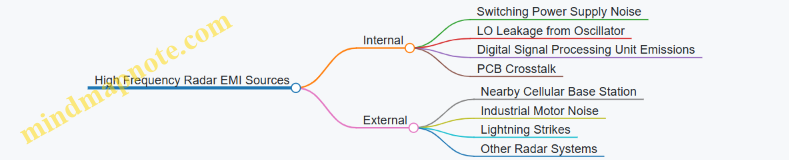
Practical Examples
Example 1: LO Leakage in Automotive Radar
- Problem: Local oscillator leakage from the radar transceiver causes interference in the receiver path.
- Impact: Reduced sensitivity and false target detection.
- Mitigation: Use of shielding, proper filtering, and balanced mixer design.
Example 2: Switching Power Supply Noise Coupling
- Problem: A switching regulator on the same PCB induces noise into the RF front-end.
- Impact: Elevated noise floor and degraded SNR.
- Mitigation: Physical separation, dedicated ground planes, and EMI filters.
Example 3: External Interference from Nearby Cell Tower
- Problem: A radar system operating near a 5G mmWave base station experiences saturation.
- Impact: Receiver desensitization and data loss.
- Mitigation: Bandpass filtering, dynamic range enhancement, and site planning.
Summary
Understanding the diverse sources of EMI in high frequency systems enables RF engineers and radar system designers to anticipate potential interference issues early in the design process. Employing best practices such as careful component selection, PCB layout, shielding, and filtering can significantly reduce EMI impact and improve system robustness.
References & Further Reading
- “Electromagnetic Compatibility Engineering” by Henry W. Ott
- IEEE EMC Society publications
- Application notes from RF component manufacturers on EMI mitigation
10.2 Shielding, Filtering, and Grounding Techniques
High frequency RF systems, especially those used in wireless and radar applications, are highly susceptible to electromagnetic interference (EMI) and electromagnetic compatibility (EMC) issues. Effective shielding, filtering, and grounding techniques are essential to ensure system integrity, performance, and regulatory compliance.
Shielding Techniques
Shielding involves enclosing sensitive components or entire systems within conductive or magnetic materials to block or attenuate unwanted electromagnetic fields.
Key Concepts:
- Types of Shielding:
- Electrostatic Shielding: Blocks electric fields using conductive materials.
- Electromagnetic Shielding: Blocks both electric and magnetic fields, often using metal enclosures.
- Magnetic Shielding: Uses materials with high magnetic permeability (e.g., mu-metal) to redirect magnetic flux.
Best Practices:
- Use continuous conductive enclosures with minimal seams.
- Ensure proper gasket and seam design to avoid leakage.
- Select shielding materials based on frequency range and field type.
- Avoid apertures or slots larger than a fraction of the wavelength.
Example:
An automotive 77 GHz radar module is enclosed in an aluminum housing with conductive gaskets around connectors to prevent RF leakage and external EMI coupling. The housing is designed with minimal seams and coated internally with a microwave-absorbing material to reduce internal reflections.
Mind Map: Shielding Techniques
Filtering Techniques
Filters are used to suppress unwanted frequency components and noise from power lines, signal lines, and antenna feeds.
Types of Filters:
- Low-Pass Filters (LPF): Block high-frequency noise.
- High-Pass Filters (HPF): Block low-frequency interference.
- Band-Pass Filters (BPF): Allow only a specific frequency band.
- Notch Filters: Suppress narrowband interference.
Best Practices:
- Place filters as close as possible to the source of interference.
- Use multi-stage filtering for high attenuation.
- Match filter impedance to system to avoid reflections.
- Use surface-mount components to reduce parasitics at high frequencies.
Example:
In a 5G mmWave transceiver, a band-pass filter centered at 28 GHz is integrated at the antenna feed to reject out-of-band signals and reduce interference from nearby WiFi and radar systems.
Mind Map: Filtering Techniques
Grounding Techniques
Proper grounding is critical to provide a reference potential, reduce noise, and create return paths for currents.
Grounding Strategies:
- Single-Point Grounding: All grounds converge at a single node to avoid ground loops.
- Multi-Point Grounding: Grounds connected at multiple points, useful at high frequencies.
- Hybrid Grounding: Combines single and multi-point to optimize performance.
Best Practices:
- Use low-inductance ground paths (wide copper pours, multiple vias).
- Separate analog and digital grounds, joining at a single point.
- Avoid ground loops by careful layout.
- Implement ground planes in multilayer PCBs.
Example:
A radar system PCB uses a solid ground plane layer with multiple vias connecting the RF ground and chassis ground. Analog and digital grounds are separated on the PCB and connected at a single star ground point near the power supply.
Mind Map: Grounding Techniques
Integrated Example: Shielding, Filtering, and Grounding in a 77 GHz Automotive Radar
- Shielding: Aluminum enclosure with conductive gaskets and microwave absorber lining.
- Filtering: Band-pass filter at antenna feed to reject out-of-band signals.
- Grounding: Solid ground plane on PCB with star grounding point connecting to chassis ground.
This integrated approach reduces EMI susceptibility, improves signal integrity, and ensures compliance with automotive EMC standards.
Summary
| Technique | Purpose | Key Considerations | Example Application |
|---|---|---|---|
| Shielding | Block external EMI and contain emissions | Material choice, seams, apertures | Radar module aluminum housing |
| Filtering | Suppress unwanted frequency components | Filter type, placement, impedance match | 28 GHz band-pass filter in 5G transceiver |
| Grounding | Provide reference potential and reduce noise | Ground strategy, low inductance paths | PCB ground plane with star ground |
By combining these techniques thoughtfully, RF engineers can design robust high frequency systems that perform reliably in complex electromagnetic environments.
10.3 Regulatory Standards and Compliance Testing
High frequency RF systems, especially those used in wireless and radar applications, must comply with a variety of regulatory standards to ensure safe operation, minimize interference, and guarantee interoperability. This section covers the key regulatory frameworks, compliance testing methodologies, and practical examples to help RF engineers and system designers navigate this complex landscape.
Overview of Regulatory Standards
Regulatory bodies worldwide set limits on RF emissions, frequency allocations, power levels, and other parameters. Compliance with these standards is mandatory before commercial deployment.
- FCC (Federal Communications Commission) – United States
- ETSI (European Telecommunications Standards Institute) – Europe
- ITU (International Telecommunication Union) – Global
- CISPR (International Special Committee on Radio Interference) – EMC standards
- MIL-STD (Military Standards) – For defense applications
Mind Map: Regulatory Bodies and Their Focus Areas
Key Compliance Areas for High Frequency RF Systems
-
Frequency Allocation and Licensing
- Ensuring operation within assigned frequency bands
- Example: Operating a 77 GHz automotive radar within FCC Part 15 rules
-
Emission Limits and Spurious Emissions
- Limits on out-of-band emissions to prevent interference
- Example: Measuring spurious emissions of a 5G mmWave base station
-
Power Limits and Exposure Guidelines
- Maximum permissible exposure (MPE) to RF radiation
- Example: Calculating safe power levels for a radar system near populated areas
-
Electromagnetic Compatibility (EMC)
- Ensuring the device neither emits nor is susceptible to harmful interference
- Example: EMC testing of a radar transceiver to CISPR 11 standards
-
Equipment Authorization and Certification
- Processes such as FCC certification, CE marking for Europe
- Example: Steps to certify a wireless transceiver module for commercial sale
Mind Map: Compliance Testing Workflow
Practical Example 1: Emission Testing of a 77 GHz Automotive Radar
- Objective: Verify that the radar system complies with FCC Part 15 emission limits.
- Procedure:
- Use a spectrum analyzer with a suitable horn antenna in an anechoic chamber.
- Measure conducted and radiated emissions across the radar’s operational band and adjacent frequencies.
- Compare results against FCC limits.
- Outcome:
- Identify any spurious emissions exceeding limits.
- Implement filtering or shielding improvements if necessary.
Practical Example 2: EMC Testing of a 5G mmWave Base Station
- Objective: Ensure immunity to external interference and limit emissions to avoid disrupting other services.
- Procedure:
- Conduct radiated and conducted emission tests per CISPR 11.
- Perform immunity tests such as radiated RF immunity and electrostatic discharge (ESD).
- Outcome:
- Validate system robustness in real-world environments.
- Document compliance for certification.
Best Practices for Regulatory Compliance
- Early Integration: Incorporate regulatory requirements during design to avoid costly redesigns.
- Pre-Compliance Testing: Use in-house testing to identify issues early.
- Documentation: Maintain detailed records of design decisions, test results, and corrective actions.
- Consultation: Engage with regulatory consultants or testing labs to stay updated on evolving standards.
Summary
Understanding and adhering to regulatory standards is critical for the successful deployment of high frequency RF systems. Through structured compliance testing and proactive design practices, engineers can ensure their systems meet all necessary requirements, minimizing risk and accelerating time-to-market.
10.4 Best Practices: Designing for EMC with Practical Design Examples
Electromagnetic Compatibility (EMC) is a critical aspect of high frequency RF system design, especially for wireless and radar applications where interference can degrade system performance or violate regulatory standards. This section outlines best practices for designing EMC-compliant systems, supported by practical design examples and mind maps to clarify key concepts.
Understanding EMC Design Goals
- Ensure the system neither emits excessive electromagnetic interference (EMI) nor is susceptible to EMI from external sources.
- Comply with regulatory standards (e.g., FCC, CISPR, MIL-STD).
- Maintain signal integrity and system reliability.
Mind Map: EMC Design Considerations
Best Practice 1: Proper Grounding and Shielding
- Grounding: Use a single-point ground or a well-planned ground plane to minimize ground loops.
- Shielding: Enclose sensitive circuitry in conductive enclosures connected to ground.
Example: In a 77 GHz automotive radar module, the PCB uses a continuous ground plane layer with via stitching around RF traces to reduce EMI emission. The radar front-end is housed in an aluminum enclosure connected to the chassis ground, effectively shielding against external noise.
Mind Map: Grounding and Shielding Strategies
Best Practice 2: PCB Layout Optimization
- Keep high-speed and high-frequency traces short and well-separated from noisy signals.
- Use controlled impedance traces and proper stack-up to reduce crosstalk.
- Place decoupling capacitors close to IC power pins.
Example: For a 5G mmWave transceiver, the PCB layout separates the RF front-end from the digital processing section with a ground-filled slot to reduce coupling. Microstrip lines are designed with precise impedance control, and power supply lines include multiple decoupling capacitors to suppress switching noise.
Mind Map: PCB Layout for EMC
Best Practice 3: Filtering and Surge Protection
- Use low-pass, band-pass, or EMI filters on input/output lines to block unwanted frequencies.
- Implement transient voltage suppression (TVS) diodes to protect against electrostatic discharge (ESD) and surges.
Example: In a portable radar system, EMI filters are placed on the antenna feed lines to suppress out-of-band emissions. TVS diodes are installed on the power input to protect against voltage spikes during vehicle ignition.
Mind Map: Filtering and Protection
Best Practice 4: Cable Management and Connector Selection
- Use shielded cables with proper termination to prevent radiation and susceptibility.
- Select connectors with good shielding and low insertion loss.
Example: A radar system uses double-shielded coaxial cables with ferrite beads near connectors to suppress common-mode currents. SMA connectors with gold plating ensure low loss and maintain shielding effectiveness.
Mind Map: Cable and Connector EMC
Best Practice 5: EMC Testing and Iterative Design
- Perform pre-compliance testing early to identify EMC issues.
- Use spectrum analyzers and near-field probes to locate EMI sources.
- Iterate design modifications based on test results.
Example: During development of a mmWave wireless transceiver, near-field scanning identified unexpected emissions from a DC-DC converter. Adding additional filtering and re-routing power lines reduced emissions below regulatory limits.
Summary Table of EMC Best Practices with Examples
| Practice | Description | Example Application |
|---|---|---|
| Grounding & Shielding | Single-point ground, conductive enclosures | 77 GHz radar module aluminum housing |
| PCB Layout Optimization | Short traces, ground fill, decoupling caps | 5G mmWave transceiver PCB design |
| Filtering & Surge Protection | EMI filters, TVS diodes | Portable radar antenna feed lines |
| Cable Management & Connectors | Shielded cables, ferrite beads, SMA connectors | Radar system coaxial cable management |
| EMC Testing & Iteration | Pre-compliance tests, near-field scanning | mmWave transceiver DC-DC converter EMI |
By integrating these best practices early in the design process, RF engineers and radar system designers can significantly improve EMC performance, ensuring reliable operation and regulatory compliance in advanced high frequency systems.
10.5 Example: Mitigating Interference in Dense Urban Wireless Deployments
In dense urban environments, wireless systems face significant challenges due to high levels of electromagnetic interference (EMI) and co-channel interference from numerous devices operating simultaneously. Effective interference mitigation is critical to ensure reliable communication and radar performance.
Understanding the Sources of Interference
- Co-channel Interference: Multiple transmitters operating on the same frequency band.
- Adjacent Channel Interference: Signals from nearby frequency bands leaking into the desired channel.
- Multipath Interference: Reflections causing delayed copies of signals.
- Intermodulation Products: Nonlinear mixing generating unwanted frequencies.
- External Noise Sources: Industrial equipment, power lines, and other electronic devices.
Mind Map: Sources and Types of Interference
Step 1: Site Survey and Spectrum Analysis
Before designing mitigation strategies, perform a detailed site survey using spectrum analyzers and direction-finding equipment to identify dominant interference sources and frequency occupancy.
Example: Using a portable spectrum analyzer, an engineer identifies strong signals at 2.4 GHz from multiple Wi-Fi access points and Bluetooth devices overlapping with the radar band.
Step 2: Frequency Planning and Channel Allocation
- Allocate frequency channels to minimize overlap.
- Use dynamic frequency selection (DFS) to avoid congested bands.
Example: In a 5G mmWave deployment, channels are assigned with guard bands and coordinated with neighboring cells to reduce co-channel interference.
Mind Map: Interference Mitigation Strategies
Step 3: Antenna Design and Beamforming
- Use highly directional antennas to focus energy and reduce interference from unwanted directions.
- Implement adaptive beamforming to dynamically steer nulls towards interference sources.
Example: An urban radar system employs a phased array antenna that forms narrow beams, reducing multipath and co-channel interference by steering nulls towards strong interferers.
Step 4: Filtering Techniques
- Deploy high-quality bandpass filters to reject out-of-band signals.
- Use notch filters to suppress known narrowband interferers.
Example: A wireless transceiver includes a tunable notch filter to suppress a persistent interference signal from a nearby industrial machine operating at 5.8 GHz.
Step 5: Power Control and Scheduling
- Implement adaptive transmit power control to minimize interference footprint.
- Use time-division multiplexing or scheduling to avoid simultaneous transmissions in overlapping areas.
Example: A cellular base station reduces transmit power during low traffic periods and schedules transmissions to avoid peak interference times.
Step 6: Shielding and Grounding
- Use electromagnetic shielding enclosures for sensitive components.
- Ensure proper grounding to reduce conducted and radiated emissions.
Example: A rooftop wireless access point is housed in a shielded enclosure with proper grounding to minimize interference to nearby radar installations.
Step 7: Advanced Signal Processing
- Apply adaptive noise cancellation and interference suppression algorithms.
- Use machine learning techniques to identify and mitigate interference patterns.
Example: An automotive radar system uses adaptive filtering algorithms to suppress interference from other vehicles’ radars in dense traffic.
Mind Map: Practical Example Workflow
Summary
Mitigating interference in dense urban wireless deployments requires a multi-faceted approach combining careful frequency planning, advanced antenna techniques, filtering, power control, shielding, and sophisticated signal processing. By systematically applying these best practices, engineers can significantly improve system reliability and performance even in challenging electromagnetic environments.
References and Further Reading
- Pozar, D. M., Microwave Engineering, 4th Edition, Wiley, 2011.
- Skolnik, M. I., Radar Handbook, 3rd Edition, McGraw-Hill, 2008.
- Rappaport, T. S., Wireless Communications: Principles and Practice, 2nd Edition, Prentice Hall, 2002.
- IEEE Std 802.11-2020, Wireless LAN Medium Access Control (MAC) and Physical Layer (PHY) Specifications.
11. Emerging Technologies and Future Directions
11.1 Terahertz Frequency Systems and Their Potential
Terahertz (THz) frequency systems operate in the electromagnetic spectrum between microwave and infrared, typically spanning from 0.1 THz (100 GHz) to 10 THz. This band offers unique opportunities for advanced wireless communications, high-resolution radar imaging, spectroscopy, and security applications due to its high bandwidth and short wavelengths.
Understanding Terahertz Frequency Systems
Terahertz systems bridge the gap between electronics and photonics, enabling ultra-fast data transfer rates and ultra-fine spatial resolution. However, challenges such as atmospheric absorption, device fabrication, and signal generation/detection complexity remain active research areas.
Mind Map: Overview of Terahertz Frequency Systems
Example: Terahertz Wireless Communication
Scenario: A 6G wireless system prototype uses 0.3 THz carrier frequency to achieve ultra-high data rates exceeding 100 Gbps over short distances (up to 100 meters).
Best Practice: To mitigate atmospheric absorption, the system employs adaptive beamforming with phased arrays to focus energy and reduce path loss. Additionally, modulation schemes optimized for THz channels, such as high-order QAM combined with error correction coding, are implemented.
Terahertz Radar Imaging
Terahertz radars enable sub-millimeter resolution imaging, useful in applications like non-destructive testing and security scanning.
Mind Map: Terahertz Radar Imaging Components
Example: Security Screening with Terahertz Radar
A security checkpoint uses a THz imaging radar operating at 0.5 THz to detect concealed objects beneath clothing. The system combines a frequency-modulated continuous wave (FMCW) radar with advanced signal processing to generate 3D images.
Best Practice: Calibration routines are performed regularly to compensate for temperature-induced frequency drifts. The system also uses machine learning algorithms to distinguish between benign and threatening objects, reducing false alarms.
Terahertz Spectroscopy and Material Characterization
THz waves interact with molecular vibrations and rotations, making them ideal for identifying chemical substances and material properties.
Mind Map: Terahertz Spectroscopy Applications
Example: Pharmaceutical Quality Control
A pharmaceutical company uses THz time-domain spectroscopy to verify the uniformity and composition of tablets. The system non-destructively measures the thickness and detects impurities.
Best Practice: Implementing temperature and humidity control during measurements ensures repeatability. The system uses reference standards and baseline correction to improve accuracy.
Summary of Best Practices for Terahertz Systems
- Adaptive Beamforming: To overcome high path loss and atmospheric absorption.
- Hybrid Photonic-Electronic Sources: For efficient and tunable THz signal generation.
- Robust Calibration: To maintain system stability amid environmental changes.
- Advanced Signal Processing: Including machine learning for enhanced detection and classification.
- Material and Device Selection: Using low-loss substrates and metamaterials to improve component performance.
Terahertz frequency systems represent a frontier in RF engineering, combining the challenges of high-frequency electronics with the promise of revolutionary applications in wireless communications, radar, and sensing. By integrating best practices and leveraging emerging technologies, engineers can unlock the full potential of this exciting spectrum.
11.2 Integration of Photonics and RF for High Frequency Applications
The integration of photonics and radio frequency (RF) technologies is revolutionizing high frequency systems, enabling unprecedented bandwidth, low loss transmission, and enhanced signal processing capabilities. This section explores the principles, benefits, challenges, and practical examples of photonics-RF integration for advanced wireless and radar applications.
Overview
Photonics involves the generation, manipulation, and detection of light (photons), typically in the optical spectrum. When combined with RF systems, photonics offers unique advantages such as ultra-wide bandwidth, immunity to electromagnetic interference, and the ability to transport RF signals over long distances with minimal loss.
Why Integrate Photonics with RF?
- Wide Bandwidth: Optical carriers support bandwidths far exceeding traditional electronic methods.
- Low Loss Transmission: Optical fibers exhibit extremely low attenuation compared to coaxial cables at high frequencies.
- Immunity to EMI: Photonics is inherently immune to electromagnetic interference, improving signal integrity.
- Compact and Lightweight: Photonic components can reduce system size and weight, critical for aerospace and mobile platforms.
Mind Map: Photonics-RF Integration Key Concepts
Optical Generation of RF Signals
One of the fundamental techniques in photonics-RF integration is generating high-frequency RF signals using optical methods.
Example: Optical Heterodyning
- Two lasers with slightly different optical frequencies are combined on a photodetector.
- The photodetector produces a beat frequency equal to the difference between the laser frequencies, generating an RF signal.
- This method can generate signals in the mmWave and even THz bands with high spectral purity.
Best Practice: Use narrow linewidth lasers and precise frequency control to minimize phase noise.
RF-over-Fiber (RoF) Transmission
RoF technology transports RF signals over optical fiber, enabling flexible and low-loss distribution.
- Analog RoF: Directly modulates the optical carrier with the RF signal.
- Digital RoF: Converts RF signals to digital data before optical transmission.
Example: In a 5G mmWave base station, RoF links distribute high-frequency signals from centralized units to remote antenna units, reducing cabling complexity and losses.
Best Practice: Employ dispersion compensation techniques to preserve signal integrity over long fiber spans.
Photonic Signal Processing
Photonics enables advanced signal processing functionalities that are difficult to achieve electronically at high frequencies.
- Optical Filtering: Tunable optical filters can select or reject specific frequency components with high resolution.
- Optical Delay Lines: Used for beamforming and phased array radar systems by introducing precise time delays.
Example: A phased array radar system uses optical delay lines to steer beams rapidly without mechanical movement.
Best Practice: Integrate photonic components on a single chip to reduce insertion losses and improve stability.
Applications in High Frequency Systems
- Wireless Communications: Photonics enables ultra-wideband mmWave links with low latency.
- Radar Systems: Optical generation and processing improve range resolution and target detection.
- Satellite Communications: Lightweight photonic payloads reduce launch costs and improve performance.
Challenges and Mitigation Strategies
| Challenge | Description | Mitigation Strategy |
|---|---|---|
| Nonlinearities | Optical components can introduce distortion | Use linearization techniques and high-quality components |
| Dispersion | Fiber causes pulse broadening | Employ dispersion compensation fibers or modules |
| Integration Complexity | Combining photonic and electronic circuits is difficult | Use hybrid integration platforms and advanced packaging |
Mind Map: Practical Example - Photonic Beamforming for Radar
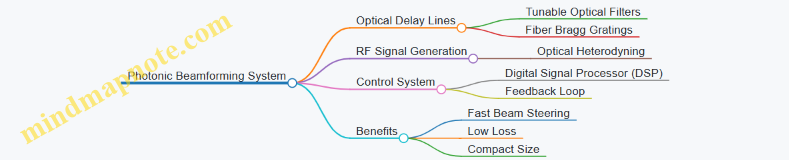
Detailed Example: Implementing Optical Heterodyning for 94 GHz Radar Signal Generation
Step 1: Select two distributed feedback (DFB) lasers with center wavelengths around 1550 nm, frequency offset tuned to 94 GHz.
Step 2: Combine the laser outputs using an optical coupler and feed into a high-speed photodiode.
Step 3: The photodiode generates the 94 GHz beat frequency signal.
Step 4: Amplify and filter the RF output for radar transmission.
Best Practice: Stabilize laser temperatures and use phase-locked loops to maintain frequency offset accuracy.
Summary
Integrating photonics with RF systems unlocks new capabilities for high frequency wireless and radar applications. By leveraging optical generation, transmission, and processing techniques, engineers can overcome traditional electronic limitations, enabling higher frequencies, wider bandwidths, and more flexible system architectures. While challenges remain, ongoing advances in photonic integration and materials science continue to push the boundaries of what is possible.
References & Further Reading
- Seeds, A. J. “Microwave photonics.” IEEE Transactions on Microwave Theory and Techniques, 2006.
- Capmany, J., Novak, D. “Microwave photonics combines two worlds.” Nature Photonics, 2007.
- Novak, D., et al. “Photonic beamforming for phased-array antennas.” Journal of Lightwave Technology, 2010.
11.3 Quantum Radar and Next-Generation Wireless Technologies
Quantum radar and next-generation wireless technologies represent the forefront of RF systems engineering, promising revolutionary improvements in detection sensitivity, resolution, and secure communications. This section explores the fundamental concepts, operational principles, challenges, and practical examples of these emerging technologies.
Understanding Quantum Radar
Quantum radar leverages quantum entanglement and quantum illumination principles to detect objects with higher sensitivity and resistance to noise and interference compared to classical radar systems.
- Key Concepts:
- Quantum Entanglement
- Quantum Illumination
- Photon Counting and Correlation
Mind Map: Quantum Radar Fundamentals
Example: Quantum Illumination in Target Detection
A quantum radar system emits entangled photon pairs where one photon (signal) is sent toward the target and the other (idler) is retained. Upon return, the system performs joint measurements to detect the presence of the target even under high environmental noise, outperforming classical radar in low SNR scenarios.
Next-Generation Wireless Technologies
Emerging wireless technologies aim to exploit higher frequency bands, advanced modulation, and novel physical layer techniques to meet the demands of ultra-high data rates, low latency, and massive connectivity.
- Key Areas:
- Terahertz (THz) Communications
- Reconfigurable Intelligent Surfaces (RIS)
- Massive MIMO and Cell-Free Architectures
- Integrated Sensing and Communication (ISAC)
Mind Map: Next-Generation Wireless Technologies
Example: Terahertz Communication Link
A 300 GHz wireless link is established for ultra-high-speed data transfer in a short-range indoor environment. The system uses advanced beamforming antennas and adaptive modulation to overcome high path loss and atmospheric absorption, achieving multi-gigabit per second throughput.
Best Practices for Integrating Quantum Radar and Next-Gen Wireless
- Hybrid System Design: Combine classical radar with quantum sensing modules to leverage benefits while mitigating hardware complexity.
- Robust Signal Processing: Employ advanced algorithms capable of handling quantum measurement outputs and integrating them with classical data.
- Material and Component Selection: Use low-loss, high-stability materials suitable for THz and quantum frequency bands.
- Simulation and Modeling: Develop accurate quantum and electromagnetic models to predict system performance under realistic conditions.
Mind Map: Best Practices

Practical Example: Hybrid Quantum-Classical Radar Prototype
A research team develops a prototype radar system where a quantum illumination module enhances target detection in cluttered environments, while classical radar provides range and velocity measurements. This hybrid approach improves detection probability by 30% in noisy conditions compared to classical radar alone.
Summary
Quantum radar and next-generation wireless technologies are poised to redefine the capabilities of RF systems. While challenges remain in hardware realization and integration, ongoing research and development demonstrate promising pathways toward practical deployment.
References and Further Reading
- “Quantum Illumination with Gaussian States,” S. Lloyd, Science, 2008.
- “Terahertz Wireless Communications: Challenges and Opportunities,” IEEE Communications Magazine, 2019.
- “Reconfigurable Intelligent Surfaces for Wireless Communications,” IEEE Access, 2020.
- “Integrated Sensing and Communication: Towards Dual-Functional Wireless Networks,” IEEE Journal on Selected Areas in Communications, 2021.
11.4 Best Practices: Preparing for Future Technology Integration with Roadmap Examples
As high frequency RF systems evolve rapidly, preparing for future technology integration is critical for staying ahead in wireless and radar applications. This section outlines best practices to ensure seamless adoption of emerging technologies, supported by practical roadmap examples and mind maps to visualize strategic planning.
Best Practices for Future Technology Integration
Continuous Technology Surveillance
- Regularly monitor advancements in materials, components, and system architectures.
- Subscribe to key journals, attend conferences, and participate in industry consortia.
Modular and Scalable Design
- Design RF systems with modular blocks to allow easy upgrades.
- Use scalable architectures that can accommodate new frequency bands or functionalities.
Early Prototyping and Simulation
- Leverage advanced simulation tools (EM solvers, circuit simulators) to evaluate new concepts early.
- Develop prototypes to validate integration feasibility and performance.
Cross-Disciplinary Collaboration
- Collaborate with photonics, quantum computing, and AI experts to explore hybrid solutions.
- Encourage knowledge sharing between RF engineers, system architects, and software developers.
Flexible Firmware and Software
- Implement software-defined radio (SDR) and programmable DSP blocks to adapt waveforms and protocols.
- Maintain firmware update capabilities to incorporate new algorithms and standards.
Robust Testing and Validation Frameworks
- Establish testbeds that can emulate future scenarios and technologies.
- Use automated testing to accelerate validation cycles.
Regulatory and Standards Awareness
- Stay informed on emerging standards (e.g., 6G, terahertz communication regulations).
- Engage with standardization bodies to influence and prepare for upcoming requirements.
Mind Map: Strategic Roadmap for Future RF System Integration
Example Roadmap: Integrating Terahertz (THz) Technology into Radar Systems
| Phase | Activities | Deliverables | Timeline |
|---|---|---|---|
| Phase 1: Research & Surveillance | Monitor THz component advancements; study propagation models | Technology reports; feasibility studies | 0-6 months |
| Phase 2: Modular Architecture Design | Develop modular front-end capable of THz band support | Modular design blueprints | 6-12 months |
| Phase 3: Simulation & Prototyping | EM and circuit simulation; build prototype front-end | Prototype hardware; simulation results | 12-18 months |
| Phase 4: Software Adaptation | Implement SDR firmware for THz waveform generation | Firmware release; test scripts | 18-24 months |
| Phase 5: Testing & Validation | Conduct lab and field tests; validate performance | Test reports; validation data | 24-30 months |
| Phase 6: Standardization & Compliance | Engage with regulatory bodies; ensure compliance | Certification documents | 30-36 months |
Example: Preparing for Quantum Radar Integration
-
Step 1: Knowledge Building
- Train engineering teams on quantum sensing principles.
- Collaborate with academic institutions researching quantum radar.
-
Step 2: Hybrid System Design
- Design RF front-end compatible with quantum sensors.
- Plan interfaces for quantum signal processing units.
-
Step 3: Simulation and Emulation
- Use quantum emulators to model system behavior.
- Identify integration challenges early.
-
Step 4: Incremental Prototyping
- Build hybrid prototypes combining classical and quantum components.
- Iterate based on test results.
-
Step 5: Regulatory Preparation
- Monitor emerging policies on quantum technologies.
- Prepare documentation for compliance.
Summary
Preparing for future technology integration in high frequency RF systems requires a proactive, structured approach. By combining continuous surveillance, modular design, early prototyping, interdisciplinary collaboration, flexible software, rigorous testing, and regulatory awareness, engineers can build adaptable systems ready for next-generation wireless and radar applications.
Utilizing strategic roadmaps and mind maps helps visualize and communicate these plans effectively, ensuring alignment across teams and stakeholders.
11.5 Case Study: Early Implementations of 6G mmWave Systems
Introduction
The evolution from 5G to 6G wireless systems promises to unlock unprecedented data rates, ultra-low latency, and massive connectivity. Early implementations of 6G focus heavily on millimeter-wave (mmWave) frequencies, typically ranging from 100 GHz to 300 GHz, to exploit wider bandwidths and enable new applications such as holographic communications, tactile internet, and advanced sensing.
This case study explores the foundational efforts, design considerations, challenges, and practical examples from early 6G mmWave system implementations.
Mind Map: Key Elements of Early 6G mmWave Systems
Early 6G mmWave System Design Considerations
Frequency Selection and Bandwidth
- Early 6G prototypes often utilize frequencies around 140 GHz and 220 GHz, leveraging unallocated spectrum segments.
- Example: A prototype system operating at 140 GHz with 10 GHz bandwidth achieved multi-gigabit per second throughput in lab environments.
Antenna and Beamforming
- Massive MIMO arrays with hundreds of elements are employed to overcome severe path loss.
- Example: A 256-element phased array demonstrated dynamic beam steering with sub-degree accuracy, enabling reliable links over 100 meters indoors.
Integration of Sensing and Communication
- Early 6G systems integrate radar sensing capabilities directly into communication hardware for environment awareness.
- Example: A joint communication-radar prototype used FMCW waveforms to simultaneously transmit data and detect obstacles.
Practical Example: 6G mmWave Link Demonstration
Scenario: Indoor ultra-high-speed data link at 140 GHz
- Setup: Transmitter and receiver equipped with 128-element phased arrays.
- Bandwidth: 8 GHz
- Modulation: 64-QAM OFDM
- Performance: Achieved 20 Gbps data rate with <1 ms latency over 50 meters.
Best Practice Highlight: Adaptive beam tracking algorithms were implemented to maintain link quality despite user movement, demonstrating the importance of real-time signal processing in mmWave systems.
Mind Map: Challenges and Solutions in Early 6G mmWave Systems
Example: AI-Enhanced Beamforming in 6G mmWave
- Problem: Rapid beam misalignment due to mobility and environmental dynamics.
- Solution: Machine learning models trained on channel state information predict optimal beam directions.
- Outcome: Reduced beam training overhead by 40%, improving link reliability.
Best Practice: Incorporate AI/ML early in system design to handle complex, dynamic mmWave channels effectively.
Summary
Early 6G mmWave system implementations demonstrate the feasibility of ultra-high-frequency wireless communication with integrated sensing capabilities. Key enablers include advanced antenna arrays, AI-driven signal processing, and innovative hardware design. While challenges remain, these pioneering efforts lay the groundwork for the transformative 6G era.
References and Further Reading
- “6G Wireless Systems: Vision, Requirements, Challenges, Insights, and Opportunities” – IEEE Communications Magazine
- “Millimeter-Wave and Terahertz Technologies for 6G” – Journal of Microwaves
- Early 6G Prototypes and Demonstrations from Leading Research Labs (e.g., Nokia Bell Labs, Samsung Research, Huawei)
This case study integrates best practices such as adaptive beamforming, AI integration, and modular hardware design, supported by real-world prototype examples to guide RF engineers and radar system designers venturing into 6G mmWave technologies.
12. Practical Design Examples and Project Walkthroughs
12.1 Designing a High Frequency Radar Front-End from Scratch
Designing a high frequency radar front-end is a critical step in developing advanced radar systems, especially for automotive, aerospace, and defense applications. This section provides a comprehensive guide on how to approach this design from the ground up, integrating best practices and practical examples to ensure a robust and high-performance radar front-end.
Overview of Radar Front-End Components
A typical high frequency radar front-end consists of the following key components:
- Antenna: Transmits and receives RF signals.
- Low Noise Amplifier (LNA): Amplifies received signals with minimal added noise.
- Mixer: Downconverts the high frequency RF signal to an intermediate frequency (IF) or baseband.
- Power Amplifier (PA): Amplifies the transmitted signal to the required power level.
- Filters: Remove unwanted frequencies and noise.
- Duplexer or Switch: Allows the same antenna to be used for transmit and receive.
Mind Map: High Frequency Radar Front-End Design
Step-by-Step Design Process
Define System Requirements
- Operating frequency (e.g., 77 GHz for automotive radar)
- Bandwidth (affects range resolution)
- Transmit power and receive sensitivity
- Antenna gain and beamwidth
- Size, weight, and power constraints
Example: Designing a 77 GHz radar front-end with 1 GHz bandwidth, 10 dBm transmit power, and a receive noise figure below 3 dB.
Antenna Selection and Design
- Choose antenna type based on application (e.g., patch antenna for compactness, horn for high gain).
- Simulate antenna parameters using tools like HFSS or CST.
Example: Designing a 77 GHz microstrip patch antenna array with 15 dBi gain and 10° beamwidth.
Low Noise Amplifier (LNA) Design
- Select a transistor technology suitable for high frequency (e.g., GaAs, GaN, or SiGe).
- Optimize for low noise figure and sufficient gain.
Example: Designing a 3-stage SiGe LNA with 2.5 dB noise figure and 20 dB gain at 77 GHz.
Mixer Design
- Choose between active or passive mixers based on linearity and conversion loss requirements.
- Design or select a mixer that supports the target frequency and bandwidth.
Example: Using a passive diode mixer with 8 dB conversion loss for downconversion from 77 GHz to 1 GHz IF.
Power Amplifier (PA) Design
- Design for required output power and efficiency.
- Consider linearity to avoid signal distortion.
Example: Implementing a GaN PA delivering 10 dBm output power at 77 GHz with 25% efficiency.
Filter Design
- Design bandpass filters to suppress out-of-band noise and harmonics.
- Ensure low insertion loss to maintain signal integrity.
Example: Designing a 77 GHz bandpass filter with 1 GHz bandwidth and <1 dB insertion loss.
Duplexer or Switch Integration
- Design or select a duplexer with high isolation (>40 dB) to protect the receiver during transmission.
- Fast switching is essential for pulsed radar systems.
Example: Integrating a PIN diode-based switch with 50 dB isolation and 10 ns switching time.
Impedance Matching and PCB Layout
- Use Smith charts and simulation tools to achieve 50 Ω matching across components.
- Minimize parasitic effects by careful PCB layout and use of high-frequency substrates (e.g., Rogers RO4350B).
Example: Matching LNA input and output to 50 Ω using microstrip stubs and capacitors.
Thermal Management
- Design heat sinks or use thermal vias to dissipate heat from power amplifiers and active components.
Example: Incorporating a copper heat spreader beneath the PA to maintain junction temperature below 100°C.
Practical Example: Designing a 77 GHz Radar Front-End
| Component | Specification | Design Approach |
|---|---|---|
| Antenna | 15 dBi gain, 10° beamwidth | 8-element patch array simulated in HFSS |
| LNA | NF < 3 dB, Gain 20 dB | 3-stage SiGe LNA with bias optimization |
| Mixer | Passive, Conversion loss 8 dB | Schottky diode mixer with matching network |
| PA | 10 dBm output, 25% efficiency | GaN transistor with Class AB biasing |
| Filter | 1 GHz BW, <1 dB insertion loss | Coupled line bandpass filter design |
| Duplexer/Switch | 50 dB isolation, 10 ns switch | PIN diode switch with driver circuit |
Best Practices Summary
- Start with clear system requirements to guide component selection.
- Use simulation tools extensively for antenna and RF component design.
- Prioritize noise figure and linearity in the receive chain.
- Ensure impedance matching at every stage to minimize reflections.
- Consider thermal effects early to avoid performance degradation.
- Prototype and test iteratively, using vector network analyzers and spectrum analyzers.
Mind Map: Best Practices in Radar Front-End Design
By following this structured approach and leveraging the examples and best practices outlined, RF engineers and radar system designers can successfully develop high frequency radar front-ends that meet stringent performance requirements for advanced wireless and radar applications.
12.2 Building a Compact mmWave Wireless Transceiver
Designing a compact mmWave wireless transceiver requires a holistic approach that balances performance, size, power consumption, and cost. This section walks through the key design steps, best practices, and practical examples to help RF engineers and system designers build efficient mmWave transceivers suitable for advanced wireless applications such as 5G, V2X, and short-range radar.
Overview
A mmWave wireless transceiver typically operates in frequency bands above 24 GHz (e.g., 28 GHz, 39 GHz, 60 GHz). The design challenges include high path loss, component integration, thermal management, and maintaining signal integrity at these frequencies.
Mind Map: Key Design Considerations for Compact mmWave Transceiver
Step 1: Selecting the Frequency Band and System Architecture
- Example: Choosing the 60 GHz unlicensed band for high data rate short-range communication.
- Best Practice: Opt for a direct conversion or low-IF architecture to reduce component count and simplify filtering.
Step 2: RF Front-End Design
- Power Amplifier (PA): Design for linearity and output power to overcome path loss.
- Example: Using a GaN-based PA for high efficiency at 60 GHz.
- Low Noise Amplifier (LNA): Minimize noise figure to improve receiver sensitivity.
- Example: Designing a two-stage LNA with inductive source degeneration.
- Mixers and Filters: Use subharmonic mixers to ease LO generation and bandpass filters to suppress out-of-band signals.
Mind Map: RF Front-End Block Diagram
Step 3: Frequency Generation and LO Design
- Best Practice: Implement a low phase noise PLL with frequency multipliers to generate stable LO signals.
- Example: A 10 GHz VCO followed by a frequency tripler to reach 30 GHz LO for upconversion.
Step 4: Baseband and Digital Processing
- Integrate high-speed ADC/DAC converters with DSP or FPGA for modulation/demodulation.
- Example: Implementing OFDM modulation in FPGA for robust mmWave communication.
Step 5: Packaging and Integration
- Use low-loss PCB materials such as Rogers RO4350B for mmWave signal integrity.
- Employ System-in-Package (SiP) or multi-chip modules to reduce size.
- Best Practice: Design for thermal dissipation using heat sinks or thermal vias.
Step 6: Power Management
- Select low noise, high efficiency voltage regulators.
- Implement power gating to reduce consumption during idle periods.
Step 7: Testing and Calibration
- Perform S-parameter measurements using a Vector Network Analyzer (VNA).
- Calibrate gain and phase imbalances in the transceiver chain.
- Example: Using a noise figure analyzer to verify LNA performance.
Practical Example: Compact 60 GHz Transceiver Module
- Design Goals: 10 dBm output power, noise figure < 5 dB, module size < 30x30 mm.
- Components: GaAs MMIC PA, SiGe LNA, subharmonic mixer, PLL with VCO, integrated antenna array.
- Integration: Multi-layer PCB with embedded waveguides for low loss.
- Results: Achieved 1 Gbps data rate over 10 meters in indoor environment.
Mind Map: Project Workflow for Building a Compact mmWave Transceiver
Summary of Best Practices
- Start with clear system requirements and realistic performance targets.
- Use simulation tools early to validate design choices.
- Select components optimized for mmWave frequencies.
- Prioritize integration and packaging to minimize parasitic effects.
- Implement robust testing and calibration to ensure performance.
By following these guidelines and leveraging the examples provided, engineers can successfully design and build compact mmWave wireless transceivers that meet the demanding requirements of next-generation wireless and radar systems.
12.3 Implementing Beamforming Algorithms on FPGA Platforms
Introduction
Beamforming is a critical technique in high frequency RF systems, especially for advanced wireless and radar applications. It enables directional signal transmission and reception by controlling the phase and amplitude of signals across an antenna array. Implementing beamforming algorithms on FPGA platforms offers the advantages of real-time processing, high throughput, and reconfigurability.
Why FPGA for Beamforming?
- Parallel Processing: FPGAs can handle multiple data streams simultaneously, ideal for antenna arrays.
- Low Latency: Critical for radar systems requiring fast response.
- Customizability: Algorithms can be tailored and updated without hardware changes.
Beamforming Algorithm Overview
There are two main types of beamforming algorithms:
- Analog Beamforming: Phase shifts applied in the RF domain.
- Digital Beamforming: Signal processing in the digital domain, offering more flexibility.
This section focuses on digital beamforming implemented on FPGA.
Mind Map: Beamforming Algorithm Components on FPGA
Step-by-Step Implementation Example
System Setup
- Antenna Array: 8-element linear array operating at 77 GHz (typical automotive radar frequency).
- Sampling Rate: 200 MSPS (Mega Samples Per Second).
- FPGA Platform: Xilinx Kintex Ultrascale.
Input Data Acquisition
- Interface ADCs connected to each antenna element.
- Synchronize data streams using FPGA clock management tiles.
Signal Conditioning
- Apply digital filters (e.g., FIR low-pass) to reduce noise.
- Use windowing functions (e.g., Hamming window) to reduce sidelobes.
Complex Weight Calculation
- Calculate weights for each antenna element to steer the beam.
- Example: For steering angle \( \theta \), weight for element \( n \) is \( w_n = e^{-j 2 \pi d n \sin(\theta)/\lambda} \), where \( d \) is element spacing and \( \lambda \) is wavelength.
Applying Weights and Summation
- Multiply incoming signals by complex weights.
- Sum weighted signals to form the beam.
Output Data Handling
- Send combined signal to DAC or further digital processing blocks.
Mind Map: FPGA Beamforming Data Flow
Practical Example: Verilog Snippet for Weight Multiplication
module complex_multiplier(
  input signed [15:0] in_real,
  input signed [15:0] in_imag,
  input signed [15:0] weight_real,
  input signed [15:0] weight_imag,
  output signed [31:0] out_real,
  output signed [31:0] out_imag
);

  assign out_real = (in_real * weight_real) - (in_imag * weight_imag);
  assign out_imag = (in_real * weight_imag) + (in_imag * weight_real);

endmodule
This module multiplies the complex input signal by the complex weight for beam steering.
Best Practices
- Fixed-Point Arithmetic: Use fixed-point instead of floating-point to optimize FPGA resource usage.
- Pipeline Stages: Implement pipelining to increase throughput and meet timing requirements.
- Resource Sharing: Reuse multipliers and adders where possible to save logic.
- Parameterization: Design modules to be configurable for different antenna sizes and frequencies.
Example: Real-Time Beam Steering
- Implement a control interface (e.g., SPI or AXI) to update beam steering angles dynamically.
- Use lookup tables (LUTs) for sine and cosine values to speed up weight calculations.
Summary
Implementing beamforming algorithms on FPGA platforms requires careful consideration of data flow, arithmetic precision, and real-time constraints. By leveraging FPGA parallelism and customizability, engineers can create flexible and high-performance beamforming systems suitable for advanced wireless and radar applications.
References and Further Reading
- “FPGA-Based Digital Beamforming for Radar Systems,” IEEE Transactions on Aerospace and Electronic Systems.
- Xilinx Application Notes on DSP and Beamforming.
- “Digital Signal Processing with Field Programmable Gate Arrays,” Uwe Meyer-Baese.
Additional Mind Map: Challenges and Solutions
12.4 Best Practices: End-to-End System Validation with Real-World Data
Validating a high frequency RF system from end to end is critical to ensure that the design meets performance requirements in practical scenarios. This process involves verifying each subsystem individually and then as an integrated whole, using real-world data to capture environmental effects, hardware imperfections, and signal distortions that simulations might not fully represent.
Key Steps in End-to-End System Validation
Subsystem Testing and Characterization
Before integrating the full system, validate individual components such as antennas, amplifiers, mixers, and ADCs:
- Example: Measure the noise figure and gain of a 77 GHz LNA using a calibrated noise source and spectrum analyzer.
- Best Practice: Use vector network analyzers (VNAs) to characterize S-parameters and verify impedance matching.
Real-World Data Acquisition
Collect data in the intended operational environment to capture realistic channel effects, interference, and clutter.
- Example: For an automotive radar system, perform drive tests in urban, suburban, and highway conditions to record radar returns.
- Best Practice: Use synchronized GPS and inertial measurement unit (IMU) data to correlate radar measurements with vehicle position and motion.
Data Processing and Performance Analysis
Analyze collected data to evaluate system metrics such as signal-to-noise ratio (SNR), detection probability, range resolution, and Doppler accuracy.
- Example: Process FMCW radar chirp returns to generate range-Doppler maps and identify targets.
- Best Practice: Implement clutter suppression algorithms and compare detection performance against baseline simulations.
Iterative Optimization
Use insights from data analysis to refine system parameters, update calibration, and improve hardware/software components.
- Example: Adjust antenna beamforming weights to reduce sidelobe levels observed in field data.
- Best Practice: Maintain a version-controlled repository of system configurations and test results to track improvements.
Documentation and Reporting
Maintain detailed records of test setups, procedures, results, and lessons learned to support reproducibility and future development.
- Example: Create comprehensive validation reports including plots of measured vs simulated performance.
- Best Practice: Use automated test scripts and data visualization tools to streamline reporting.
Integrated Example: Validating a 77 GHz Automotive Radar System
- Subsystem Testing: Characterize the RF front-end gain and noise figure; verify antenna radiation patterns in an anechoic chamber.
- Data Acquisition: Conduct drive tests on a test track, collecting radar returns along with GPS/IMU data.
- Data Processing: Generate range-Doppler maps, identify targets, and measure detection probability under different traffic scenarios.
- Optimization: Tune digital beamforming weights and update calibration coefficients to improve target resolution.
- Reporting: Document all findings with annotated plots and recommendations for next design iteration.
Summary Mind Map
By following these best practices, RF engineers and radar system designers can ensure their high frequency systems perform reliably in real-world conditions, bridging the gap between theoretical design and practical deployment.
12.5 Project Example: Developing a Portable High Resolution Imaging Radar
Introduction
Developing a portable high resolution imaging radar is a challenging yet rewarding project that combines RF system design, signal processing, and mechanical integration. This section walks through the key steps, design considerations, and best practices, supported by detailed mind maps and practical examples.
Project Overview
The goal is to design a compact, battery-powered radar system capable of producing high resolution images for applications such as security scanning, industrial inspection, or autonomous navigation.
Key Requirements:
- Operating frequency: 77 GHz (automotive radar band)
- Range resolution: < 10 cm
- Portable form factor (handheld or backpack)
- Real-time imaging capability
- Low power consumption
Mind Map: Project Breakdown
Step 1: RF Front-End Design
Best Practice: Use a modular approach to design the RF front-end, allowing easy replacement or upgrade of components.
- Transmitter: Employ a low phase noise VCO combined with a power amplifier to generate the FMCW chirp.
- Receiver: Use a low noise amplifier (LNA) followed by a mixer for downconversion.
- Antenna Array: Design a compact phased array with patch antennas to enable beam steering.
Example: Designing a 4x4 patch antenna array on Rogers RO4350B substrate for 77 GHz with simulated gain of 18 dBi.
Step 2: Signal Generation and Waveform
Best Practice: Implement an FMCW waveform with linear frequency chirps to achieve high range resolution.
- Sweep bandwidth: 4 GHz (e.g., 76 GHz to 80 GHz)
- Chirp duration: 50 µs
Example: Using a PLL-based frequency synthesizer to generate chirps with <1 kHz phase noise.
Step 3: Signal Processing Pipeline
Best Practice: Optimize FFT sizes and windowing functions to balance resolution and processing time.
- Range FFT to extract distance information
- Doppler FFT for velocity estimation
- Synthetic Aperture Radar (SAR) or Inverse Synthetic Aperture Radar (ISAR) algorithms for image reconstruction
Example: Implementing a 2048-point range FFT with Hanning window to reduce sidelobes.
Mind Map: Signal Processing Flow
Step 4: Power Management and Mechanical Design
Best Practice: Select high energy density batteries and efficient regulators to maximize operating time.
- Use Li-ion batteries with capacity > 10,000 mAh
- Implement DC-DC converters with >90% efficiency
- Design enclosure with heat sinks and ventilation
Example: A 3D printed enclosure with integrated heat pipes to dissipate heat from the power amplifier.
Step 5: Testing and Validation
Best Practice: Perform calibration using known targets and verify range and angular resolution.
- Use corner reflectors at known distances
- Perform antenna pattern measurements in anechoic chamber
Example: Measured range resolution of 7 cm and angular resolution of 2 degrees in lab tests.
Practical Example: End-to-End Imaging
- Setup the radar system in a controlled environment
- Place multiple objects at varying distances and angles
- Acquire raw radar data
- Process data using implemented pipeline
- Visualize the reconstructed image showing object positions
Summary
Developing a portable high resolution imaging radar requires careful integration of RF design, signal processing, and mechanical engineering. Following modular design principles, leveraging FMCW waveforms, and validating through rigorous testing ensures a successful project outcome.
Additional Resources
- IEEE Radar Conference Proceedings
- Keysight Application Notes on FMCW Radar
- MATLAB SAR Toolbox
This project example illustrates how best practices and practical examples can be woven together to guide RF engineers and radar system designers through the complex process of building a cutting-edge portable imaging radar.
13. Conclusion and Best Practice Summary
13.1 Recap of Key Design Principles and Techniques
In this section, we revisit the fundamental design principles and techniques that underpin successful high frequency RF systems for advanced wireless and radar applications. Understanding and applying these principles ensures robust, efficient, and high-performance system designs.
Mind Map: Key Design Principles Overview
Principle 1: Defining Clear System Requirements
Example: For a 77 GHz automotive radar, defining system requirements involves specifying detection range (e.g., 200 m), resolution (e.g., 0.1 m), and environmental conditions (rain, fog). This guides component selection and waveform design.
Principle 2: Accurate Propagation Modeling
Example: When designing a mmWave urban wireless system, incorporating path loss models like the ITU-R or COST 231 model helps predict signal attenuation due to buildings and foliage, enabling optimized link budgets.
Principle 3: Selecting Low Noise and High Linearity Components
Example: Choosing a low noise amplifier with a noise figure below 2 dB and high third-order intercept point (IP3) ensures minimal signal distortion and better sensitivity in radar receivers.
Mind Map: Antenna Design Considerations

Example: Implementing a phased array antenna for 5G mmWave systems enables electronic beam steering, improving coverage and capacity without mechanical movement.
Principle 4: System Integration and Thermal Management
Example: Integrating the RF front-end with DSP on a single PCB requires careful layout to minimize crosstalk and heat dissipation. Using thermal vias and heat sinks prevents performance degradation.
Principle 5: Low Phase Noise Signal Generation
Example: Designing a PLL-based frequency synthesizer with a high-quality voltage-controlled oscillator (VCO) reduces phase noise, critical for FMCW radar accuracy.
Principle 6: Optimized Modulation and Waveform Design
Example: Using chirp waveforms in radar improves range resolution and Doppler sensitivity. Adaptive OFDM waveforms in wireless systems enhance spectral efficiency and interference resilience.
Principle 7: Rigorous Testing and Calibration
Example: Calibrating antenna radiation patterns in an anechoic chamber ensures accurate beamforming and system performance verification.
Mind Map: Signal Processing Techniques
Example: Implementing a Constant False Alarm Rate (CFAR) algorithm in radar signal processing improves target detection reliability in cluttered environments.
Principle 8: Ensuring Electromagnetic Compatibility (EMC)
Example: Applying shielding and proper grounding techniques reduces electromagnetic interference in dense urban wireless deployments, ensuring regulatory compliance.
Summary Table of Examples and Best Practices
| Principle | Example Application | Best Practice Highlight |
|---|---|---|
| System Requirements | 77 GHz automotive radar specs | Define clear, measurable goals |
| Propagation Modeling | Urban mmWave wireless link budget | Use accurate path loss models |
| Component Selection | Low noise amplifier with NF < 2 dB | Prioritize noise figure and linearity |
| Antenna Design | Phased array for 5G mmWave | Employ beamforming and calibration |
| System Integration | PCB layout with thermal vias | Manage heat dissipation effectively |
| Signal Generation | PLL synthesizer for FMCW radar | Minimize phase noise |
| Modulation & Waveform | Chirp waveform for radar | Optimize for resolution and Doppler sensitivity |
| Testing & Calibration | Anechoic chamber antenna pattern measurement | Perform rigorous calibration |
| Signal Processing | CFAR algorithm for target detection | Implement adaptive thresholding |
| EMC | Shielding in urban wireless systems | Follow grounding and filtering best practices |
By systematically applying these design principles and techniques, RF engineers and radar system designers can develop high frequency RF systems that meet the demanding requirements of modern wireless and radar applications.
13.2 Common Pitfalls and How to Avoid Them
High frequency RF system design is a complex endeavor where small mistakes can lead to significant performance degradation or system failure. Understanding common pitfalls and strategies to avoid them is crucial for RF engineers, radar system designers, and microwave researchers. This section highlights frequent challenges encountered in high frequency RF systems and provides actionable solutions, supported by mind maps and practical examples.
Pitfall 1: Inadequate Impedance Matching
Description: Impedance mismatches cause reflections, standing waves, and signal loss, severely impacting system efficiency and noise performance.
How to Avoid:
- Use precise impedance matching networks designed with Smith charts.
- Employ vector network analyzers (VNA) to verify S-parameters.
- Include tunable components or adjustable matching circuits for fine-tuning.
Example: In a 77 GHz automotive radar front-end, a poorly matched Low Noise Amplifier (LNA) input caused a 3 dB gain drop and increased noise figure. After redesigning the matching network using EM simulation and bench tuning, the gain improved by 2.5 dB and noise figure reduced by 1 dB.
Pitfall 2: Neglecting Thermal Management
Description: High frequency components generate heat that can detune circuits, degrade performance, or cause permanent damage.
How to Avoid:
- Integrate heat sinks and thermal vias in PCB design.
- Use materials with good thermal conductivity.
- Monitor temperature and include thermal shutdown features.
Example: A mmWave power amplifier module overheated during prolonged operation, causing frequency drift and output power reduction. Adding a copper heat spreader and optimizing airflow resolved the issue, stabilizing performance over extended periods.
Pitfall 3: Overlooking Parasitic Effects
Description: At high frequencies, parasitic capacitance and inductance from PCB traces, connectors, and packaging can detune circuits and introduce unwanted resonances.
How to Avoid:
- Use EM simulation tools to model parasitics.
- Minimize lead lengths and use controlled impedance traces.
- Employ proper grounding and shielding techniques.
Example: An oscillator designed for 60 GHz exhibited unexpected spurious tones due to parasitic coupling in the PCB layout. Re-routing traces and adding ground vias eliminated the spurs and stabilized the output spectrum.
Pitfall 4: Insufficient Calibration and Testing
Description: Without rigorous calibration, measurement errors can mislead design decisions, causing underperformance or overdesign.
How to Avoid:
- Perform full two-port and multi-port calibrations on test equipment.
- Use calibration standards and reference devices.
- Validate measurements with multiple methods.
Example: A radar antenna gain measurement initially showed 5 dB less than expected. After performing a full two-port calibration and using an anechoic chamber, the corrected measurement aligned with simulations.
Pitfall 5: Ignoring Electromagnetic Compatibility (EMC)
Description: High frequency systems are susceptible to and can generate electromagnetic interference, affecting system reliability and regulatory compliance.
How to Avoid:
- Design with proper shielding and filtering.
- Follow grounding best practices.
- Conduct EMC pre-compliance testing early.
Example: A wireless transceiver prototype failed FCC emissions testing due to inadequate filtering on the power supply line. Adding LC filters and improving enclosure shielding enabled compliance.
Pitfall 6: Overcomplicating System Architecture
Description: Unnecessarily complex designs increase cost, power consumption, and debugging difficulty.
How to Avoid:
- Follow modular design principles.
- Prioritize simplicity and scalability.
- Use simulation to validate architecture choices before hardware implementation.
Example: A radar system initially integrated multiple redundant signal paths, complicating calibration and increasing latency. Simplifying the architecture reduced system complexity and improved maintainability.
Mind Maps
Mind Map 1: Common Pitfalls Overview
Mind Map 2: Strategies to Avoid Pitfalls
Summary Table of Pitfalls and Solutions
| Pitfall | Impact | Avoidance Strategy | Example Application |
|---|---|---|---|
| Impedance Mismatch | Signal loss, noise increase | Matching networks, VNA calibration | 77 GHz LNA front-end tuning |
| Thermal Management | Frequency drift, damage | Heat sinks, thermal monitoring | mmWave PA heat spreader addition |
| Parasitic Effects | Spurious tones, detuning | EM simulation, layout optimization | 60 GHz oscillator PCB re-routing |
| Insufficient Calibration | Measurement errors | Full calibration, reference devices | Antenna gain measurement correction |
| EMC Issues | Interference, regulatory failure | Shielding, filtering, grounding | FCC compliance for wireless transceiver |
| Overcomplex Architecture | Cost, debugging difficulty | Modular design, simulation | Simplified radar signal path design |
By proactively addressing these common pitfalls with the outlined best practices and real-world examples, engineers can significantly improve the reliability, performance, and manufacturability of high frequency RF systems.
13.3 Checklist for High Frequency RF System Development
Developing high frequency RF systems requires meticulous attention to detail across multiple domains, from component selection to system integration and testing. This checklist consolidates critical steps and considerations to ensure robust, high-performance designs.
Mind Map: High Frequency RF System Development Checklist
Detailed Checklist with Examples
-
System Requirements Definition
- Clearly define the operating frequency band (e.g., 77 GHz for automotive radar).
- Specify bandwidth and data rate requirements.
- Example: For a 5G mmWave system, target 28 GHz band with 400 MHz bandwidth.
- Identify environmental conditions (temperature range, urban vs rural).
-
Component Selection
- Choose LNAs with noise figure < 1 dB for sensitive front-ends.
- Select mixers with high linearity to minimize intermodulation distortion.
- Example: Use GaAs or GaN-based devices for power amplifiers in radar transmitters.
- Opt for low-loss substrates like Rogers RO4350B for PCB fabrication.
-
Circuit Design
- Perform impedance matching using Smith charts to maximize power transfer.
- Analyze stability using Rollett’s stability factor (K-factor > 1).
- Example: Implement thermal vias and heat sinks to manage power amplifier heat dissipation.
-
Simulation & Modeling
- Use EM simulation tools (e.g., HFSS, CST) to model antenna radiation patterns.
- Conduct link budget analysis including path loss, fading margins.
- Example: Simulate multipath effects for urban radar deployment scenarios.
-
Prototyping & Fabrication
- Follow PCB layout best practices: minimize trace lengths, use ground planes.
- Place sensitive components away from noisy digital circuits.
- Example: Use SMA connectors for reliable high frequency signal interfacing.
-
Testing & Validation
- Calibrate vector network analyzers (VNAs) before S-parameter measurements.
- Measure noise figure using noise figure analyzers or Y-factor method.
- Example: Test antenna radiation patterns inside an anechoic chamber to verify beamforming.
-
Signal Processing & Integration
- Implement DSP algorithms optimized for latency and throughput.
- Ensure synchronization between RF front-end and digital back-end.
- Example: Deploy FPGA-based real-time FFT processing for radar Doppler analysis.
-
Compliance & EMC
- Conduct EMI/EMC pre-compliance testing early in development.
- Design shielding enclosures and apply filtering on power lines.
- Example: Pass FCC Part 15 requirements for wireless communication devices.
-
Documentation & Iteration
- Maintain detailed design files, test logs, and revision history.
- Review lessons learned to improve subsequent design cycles.
- Example: Document thermal performance issues encountered and mitigation steps.
Example Application of Checklist
Scenario: Designing a 77 GHz automotive radar module
- Define system specs: 77 GHz center frequency, 1 GHz bandwidth, 100 m max range.
- Select a GaAs LNA with NF = 0.8 dB, power amplifier with 20 dBm output.
- Design microstrip patch antenna array with 15 dBi gain.
- Simulate antenna pattern and link budget including rain attenuation.
- Prototype PCB with Rogers RO4350B substrate, SMA connectors.
- Test S-parameters and noise figure; validate antenna beam steering.
- Implement FMCW waveform processing on FPGA.
- Perform EMC testing to meet automotive standards.
- Document all steps and iterate based on test results.
By following this comprehensive checklist, RF engineers and system designers can systematically address the complexities of high frequency RF system development, reducing risk and accelerating time-to-market.
13.4 Final Best Practices: Continuous Learning and Innovation
In the rapidly evolving fields of high frequency RF systems and radar technologies, continuous learning and innovation are not just advantages—they are necessities. Staying current with emerging trends, tools, and methodologies ensures that engineers and designers can create cutting-edge solutions that meet the increasing demands of wireless and radar applications.
Why Continuous Learning Matters
- Rapid Technological Evolution: New materials, components, and signal processing techniques emerge frequently.
- Complexity Growth: Systems are becoming more integrated and sophisticated, requiring updated knowledge.
- Competitive Edge: Innovation drives differentiation in commercial and defense markets.
Best Practices for Continuous Learning
Structured Knowledge Acquisition
- Subscribe to Leading Journals and Conferences: IEEE Transactions on Microwave Theory and Techniques, Radar Conference proceedings.
- Online Courses and Webinars: Platforms like Coursera, edX, and specialized RF training.
- Technical Workshops and Hands-On Labs: Engage in practical sessions to reinforce theory.
Active Community Engagement
- Join Professional Societies: IEEE MTT-S, AOC (Association of Old Crows).
- Participate in Forums and Discussion Groups: Stack Exchange (Electrical Engineering), ResearchGate.
- Collaborate on Open-Source Projects: Contribute to or study projects related to SDR (Software Defined Radio) and radar signal processing.
Experimentation and Prototyping
- Build Small-Scale Projects: For example, design a simple 24 GHz radar module to test new concepts.
- Use Simulation Tools: HFSS, CST Microwave Studio, MATLAB for waveform and system simulations.
- Iterate Rapidly: Apply agile principles to hardware and software development.
Innovation through Cross-Disciplinary Learning
- Explore Adjacent Fields: Photonics, machine learning, quantum computing.
- Attend Interdisciplinary Conferences: To gain fresh perspectives and novel ideas.
Mind Maps for Continuous Learning and Innovation
Mind Map 1: Continuous Learning Framework
Mind Map 2: Innovation Drivers in RF and Radar Systems
Mind Map 3: Tools and Resources for RF Engineers
Examples of Continuous Learning in Practice
Example 1: Adopting AI for Radar Signal Processing
An RF engineer attends an online course on machine learning and applies learned concepts to develop an adaptive clutter suppression algorithm for automotive radar. By prototyping the algorithm in MATLAB and validating with real radar data, the engineer improves detection accuracy by 15%.
Example 2: Exploring Terahertz Components
A radar system designer follows recent IEEE journal publications on terahertz source development. Inspired, they design a prototype transceiver module operating at 300 GHz using newly available materials, enabling ultra-high resolution imaging.
Example 3: Community Collaboration for Beamforming Algorithms
A microwave researcher contributes to an open-source SDR project implementing beamforming for 5G mmWave systems. Through peer reviews and iterative improvements, the project matures into a robust reference design used by multiple teams.
Summary
Continuous learning and innovation form the backbone of success in high frequency RF and radar system engineering. By adopting structured learning, engaging with communities, experimenting hands-on, and embracing cross-disciplinary knowledge, engineers can stay ahead of the curve and drive technological breakthroughs.
Remember, the journey of learning never ends—each new insight is a stepping stone toward the next innovation.
13.5 Resources for Further Study and Community Engagement
To excel in high frequency RF systems for advanced wireless and radar applications, continuous learning and active community engagement are essential. Below is a curated list of resources, including books, online courses, professional organizations, forums, and conferences, complemented by mind maps to help you navigate the learning paths and community involvement.
Books and Textbooks
-
“Microwave Engineering” by David M. Pozar
- Comprehensive coverage of microwave theory and components.
- Example: Understanding S-parameters through practical measurement techniques.
-
“Radar Systems Analysis and Design Using MATLAB” by Bassem R. Mahafza
- Practical approach with MATLAB examples.
- Example: Simulating FMCW radar waveforms.
-
“Phased Array Antenna Handbook” by Robert J. Mailloux
- Detailed antenna array design and beamforming.
- Example: Designing a phased array for 77 GHz automotive radar.
Online Courses and Tutorials
-
Coursera: RF and Wireless Communications Specialization
- Covers fundamentals to advanced topics.
- Example: Hands-on projects on antenna design.
-
edX: Microwave Engineering Fundamentals
- In-depth modules on microwave circuits and systems.
- Example: Simulation of microwave filters.
-
MIT OpenCourseWare: Principles of Radar Systems
- Free lectures and notes.
- Example: Signal processing techniques for radar.
Professional Organizations
-
IEEE Microwave Theory and Techniques Society (MTT-S)
- Access to journals, conferences, and workshops.
- Example: Participation in IEEE MTT-S International Microwave Symposium.
-
IEEE Aerospace and Electronic Systems Society (AESS)
- Focus on radar and electronic systems.
- Example: Networking with radar system designers.
-
International Union of Radio Science (URSI)
- Global collaboration on radio science research.
- Example: Access to URSI journals and symposia.
Online Forums and Communities
-
RF Globalnet Community
- Discussions on RF design challenges.
- Example: Troubleshooting mixer linearity issues.
-
Stack Exchange: Electrical Engineering
- Q&A platform for RF and microwave topics.
- Example: Clarifying antenna polarization concepts.
-
Reddit: r/RFEngineering
- Informal discussions, project sharing.
- Example: Sharing experiences with SDR-based radar prototypes.
Conferences and Workshops
-
IEEE International Microwave Symposium (IMS)
- Premier event for microwave and RF engineers.
- Example: Workshops on mmWave system integration.
-
European Radar Conference (EuRAD)
- Focused on radar technology advancements.
- Example: Presentations on automotive radar innovations.
-
SPIE Defense + Commercial Sensing
- Covers sensing technologies including radar.
- Example: Tutorials on synthetic aperture radar (SAR).
Mind Maps
Mind Map 1: Learning Path for High Frequency RF Systems
Mind Map 2: Community Engagement Opportunities
Mind Map 3: Tools and Software for RF System Design
Example: Using Mind Maps to Plan Your Learning
Suppose you are an RF engineer aiming to specialize in automotive radar systems. You can use the “Learning Path for High Frequency RF Systems” mind map to identify key topics such as antenna design and signal processing. Then, engage with the IEEE AESS community and attend EuRAD to network and stay updated. Simultaneously, leverage tools like MATLAB and CST for design and simulation, following best practices learned from books and courses.
Final Tips
- Subscribe to newsletters from IEEE and other societies to receive updates.
- Engage actively in forums by asking questions and sharing your projects.
- Attend webinars and workshops regularly to keep pace with emerging trends.
- Collaborate on open-source projects to gain practical experience.
By leveraging these resources and engaging with the community, you can deepen your expertise and contribute to advancements in high frequency RF systems for wireless and radar applications.