Incongruity Theory and Cognitive Humor Processing Explained
1. Foundations: What Humor Is and How Incongruity Theory Explains It
1.1 Defining Humor, Laughter, and Amusement: Core Concepts and Boundaries
Humor is a mental event: a person interprets something as funny. Laughter is the outward behavior that often follows that interpretation, but it is not the definition of humor. Amusement is the internal feeling that accompanies the interpretation, usually with a mild positive tone and a sense that the moment has “resolved” in a satisfying way.
A useful boundary is to separate three layers. First, there is the stimulus layer: a joke, a scene, a remark, or even a visual mismatch. Second, there is the cognitive layer: expectations are formed, violated, and then made sense of. Third, there is the affective and behavioral layer: amusement is felt and laughter may occur. When people say “that was funny,” they usually mean the cognitive layer produced amusement, and laughter is optional.
Humor Versus Laughter
Laughter can happen without humor. People laugh when they are nervous, when they want to signal friendliness, or when they mirror others. Those laughs can be socially useful even if the speaker never intended a joke. Humor can also occur without laughter. Someone might silently recognize the punchline, feel a quick lift of amusement, and move on.
A practical way to test this distinction is to watch for timing. If laughter is driven by social cues, it may start before the listener has fully interpreted the content. If humor is driven by interpretation, amusement should track comprehension: the “funny” moment arrives when the mind finds a coherent meaning.
Amusement as an Appraisal
Amusement is not just “feeling good.” It is an appraisal that the violated expectation is manageable and not threatening. That appraisal depends on context: the same incongruity can feel playful in one setting and hostile in another. Amusement tends to be brief because it is tied to a specific interpretation cycle.
Consider two reactions to a clumsy mistake. If a coworker drops a stack of papers and laughs at themselves, the audience often feels amusement because the situation signals low risk and shared normality. If the same clumsiness happens during a serious event with visible harm, the audience may feel concern instead.
What Counts as Humor
Humor typically involves at least one of these ingredients:
- An expectation baseline: the mind predicts what should happen.
- A mismatch: something deviates from that prediction.
- A resolution: the mind reframes the mismatch into a coherent interpretation.
This does not mean every funny moment is a clean “setup and punchline.” Some humor is subtle, where the mismatch is small and the resolution is quick. Other humor is extended, where the audience gradually updates expectations across multiple beats.
Boundaries and Failure Modes
Not everything that surprises is humor. Surprise can be neutral or alarming. Humor requires that the mind can interpret the mismatch without paying a high cost in threat, embarrassment, or moral violation.
Common failure modes include:
- Unresolvable ambiguity: the listener cannot find a stable interpretation, so amusement never forms.
- Excessive cost: the mismatch implies danger, cruelty, or humiliation that the audience cannot reframe as harmless.
- Context mismatch: the audience’s baseline expectations differ from the speaker’s intent, so the resolution path leads to confusion.
Concrete Examples
Example 1: Wordplay with a clear resolution
- Setup: “I used to hate facial hair.”
- Punchline: “Now I’m growing on it.” The baseline expects a complaint about grooming. The mismatch appears when “growing on it” shifts from literal growth to emotional acceptance. The resolution is immediate, so amusement is likely.
Example 2: Surprise without humor
- A loud alarm goes off in a building. The baseline expects normal operations. The mismatch is real and urgent. Even if the sound is unexpected, the mind treats it as threat-relevant, so amusement is unlikely.
Example 3: Humor without laughter
- Someone tells a dry joke in a quiet meeting. You may understand it, feel a small internal “click,” and still not laugh because the social setting discourages it. Humor can still occur because the cognitive layer completed.
Mind Map: Humor, Laughter, and Amusement
Practical Takeaway
When analyzing a funny moment, ask what the audience likely predicted, what deviated, and what interpretation made the deviation feel harmless and coherent. Laughter is a clue, not a definition. Amusement is the internal marker that the cognitive cycle completed successfully.
1.2 Why Incongruity Matters: The Central Claim of Expectation Violation
Incongruity theory starts with a simple claim: humor depends on an expectation being violated. Not just any surprise counts. The mind forms a prediction from context, then detects that the incoming information does not fit. Humor happens when the mismatch is noticeable enough to matter, but not so disruptive that the mind treats it as meaningless or threatening.
Expectation violation matters because it explains why jokes feel structured. A joke is not random noise; it is a controlled disruption. The setup gives the audience a workable model of what should follow. The punchline then changes the model’s predictions. The listener’s job is to reconcile the new information with the old expectations, often by reinterpreting what was just heard.
What “Expectation” Means in Practice
Expectations are not only about what words will appear next. They include assumptions about roles, causes, norms, and typical outcomes. If you hear “The doctor said…” you expect a medical context and a plausible explanation. If the next phrase is “…so I brought a sandwich,” the violation is not merely semantic; it clashes with the expected causal chain and the expected setting.
A useful way to think about it is in layers:
- Form expectations: how sentences usually end, what grammatical patterns are likely.
- Meaning expectations: what categories the words point to.
- Causal expectations: what actions lead to what results.
- Social expectations: what is appropriate for the situation and who is “in charge.”
A punchline can violate one layer or several at once. The more layers it disrupts, the more work the mind must do to restore coherence.
Why Incongruity Is Central Rather Than Optional
If humor were only about being surprising, then any unexpected event would be funny. But many surprises are simply confusing. Incongruity theory adds a key constraint: the mind must be able to locate the mismatch and then find a resolution that makes the violated expectation interpretable.
That is why jokes often include signals that guide the resolution. A speaker might use a familiar framing (“I tried to be productive…”) that tells you to expect a normal narrative arc. The punchline then breaks the arc, but it still points to a coherent alternative interpretation.
The Resolution Requirement
Expectation violation creates the “problem.” Resolution turns it into “meaning.” Resolution can look like:
- Reframing: switching from one interpretation frame to another.
- Constraint relaxation: allowing a broader rule than the one you assumed.
- Reassignment of roles: realizing who is acting, who is being described, or what counts as the relevant category.
Consider a short example:
- Setup: “I told my computer I needed a break.”
- Punchline: “Now it won’t stop sending me Kit-Kats.”
The expectation violation is causal and role-based: you expect a human-like “break” response, not a literal snack delivery. The resolution is that “break” is interpreted as a snack break, not a rest period. The mind can reconcile the mismatch without abandoning the sentence as nonsense.
Mind Map: Expectation Violation as the Core Mechanism
A Systematic Walkthrough of the Mechanism
- Prediction: You hear cues that narrow the plausible next steps.
- Mismatch: The punchline contradicts one of those predictions.
- Detection: Your mind notices the contradiction rather than ignoring it.
- Reinterpretation: You search for an interpretation that makes the new information fit.
- Coherence restoration: The mismatch is explained, often by changing the assumed rule.
- Appraisal: The result feels like a purposeful violation, not a random failure.
This sequence is why incongruity matters. Humor is not merely the presence of a mismatch; it is the mind’s structured path from prediction to resolution.
Example: Same Surprise, Different Humor
Imagine two statements:
- “The meeting started on time, which is suspicious.”
- “The meeting started on time, and then the lights went out.”
Both contain unexpected elements. The first invites a resolution: “suspicious” is a playful exaggeration that reframes punctuality as abnormal. The second can be funny only if the lights-out event is integrated into a coherent joke logic. Without that integration, the mind may treat it as an external interruption rather than a meaningful violation.
In short, incongruity matters because it explains humor as a cognitive event: expectation violation creates the mismatch, and resolution turns that mismatch into an intelligible, shareable meaning.
1.3 Cognitive Processing of Humor: From Perception to Interpretation
Humor comprehension is not a single “aha” moment. It is a sequence of mental operations that start with raw input and end with an interpretation that makes the violation feel coherent enough to be amusing. The steps below describe a typical path from perception to interpretation, with practical examples at each stage.
Perception and Attention: Getting the Stimulus into Working Memory
The process begins when the audience detects cues in sound, text, or visuals. Attention selects what seems relevant, and working memory holds a short window of information long enough to compare expectations.
Example: In a joke, the setup might say, “I tried to cook with my new phone.” Your attention locks onto “cook” and “phone,” because they suggest a normal activity (cooking) paired with an unusual object (phone). If the audience misses either cue, the later mismatch may not be detected.
Linguistic and Visual Parsing: Building a First Pass Structure
Next, the mind parses the stimulus into a structure it can reason about. For language, this includes identifying words, grammatical roles, and likely referents. For visuals, it includes object recognition and spatial relations.
Example: “I tried to cook with my new phone” is parsed into an agent (“I”), an action (“tried to cook”), and an instrument or means (“with my new phone”). Even before the punchline, the mind forms a preliminary scene: someone cooks using a phone as a tool.
Expectation Generation: Predicting What Should Follow
Once a structure exists, the mind generates expectations about what is likely next. These expectations come from everyday routines, genre conventions, and typical cause-effect patterns.
Example: A normal expectation is that the phone helps indirectly: it might show a recipe, set a timer, or play music. The mind predicts a resolution that keeps “cooking” and “phone use” compatible.
Incongruity Detection: Locating the Mismatch
Incongruity detection happens when incoming information conflicts with the current expectation. The mind flags where the mismatch occurs, not just that something feels odd.
Example: Suppose the punchline is, “It kept asking me to ‘swipe to season.’” The phrase “swipe to season” conflicts with the expectation that cooking instructions are physical or recipe-like. The mismatch is specific: the joke replaces a cooking action with a gesture-based command.
Candidate Interpretations: Trying Multiple Frames
After detecting a mismatch, the mind does not immediately settle on one meaning. It generates candidate interpretations, each corresponding to a different frame for what the speaker is doing.
Example: The audience considers at least two frames:
- Literal frame: the phone is controlling cooking through an app.
- Metaphor frame: the speaker is joking that modern interfaces have invaded everything.
Both frames can explain the mismatch, so the mind keeps them active briefly.
Resolution and Reframing: Restoring Coherence
Resolution is the process of selecting an interpretation that makes the violation fit into a coherent story. In incongruity theory terms, the mind relaxes or revises constraints so the mismatch becomes understandable.
Example: If the audience chooses the metaphor frame, “swipe to season” becomes a commentary on how touch gestures replace real-world actions. The joke is no longer “nonsense”; it is a compressed social observation.
Appraisal: Deciding It’s Funny Enough
Even with a coherent interpretation, humor depends on appraisal. The audience evaluates whether the resolution is appropriate, not too costly in effort, and not threatening to social norms.
Example: If the joke is clear and the metaphor is easy to track, appraisal tends to be positive. If the punchline were too obscure—e.g., requiring specialized knowledge about a specific app—resolution would fail or feel effortful, reducing amusement.
Timing and Processing Load: Why Some Jokes Land Faster
The mind prefers resolutions that can be reached with minimal additional computation. Short setups and punchlines often work because the expectation baseline is easy to form and the mismatch is easy to locate.
Example: A one-liner like “My therapist says I have a fear of commitment. I told her I’m not ready.” creates a quick expectation (therapy advice leads to growth) and then resolves it through a social role reversal.
A Mind Map of the Processing Pipeline
Putting It Together: One Full Walkthrough
Consider: “I bought shoes from a website that only sells in riddles. They said, ‘Step one: breathe.’”
Perception highlights “shoes” and “website.” Parsing yields a shopping scenario. Expectation generation predicts product instructions or delivery details. Incongruity detection flags that “breathe” is not a shoe-related step. Candidate interpretations include literal absurdity (shoes require breathing) and metaphor (the site turns normal guidance into riddles). Resolution selects the metaphor frame: the joke targets how online instructions can feel cryptic. Appraisal then decides it’s funny because the metaphor is reachable without extra knowledge.
This pipeline explains why humor often feels like a brief correction to the mind’s own predictions: the audience notices a mismatch, tests interpretations, and lands on a resolution that restores coherence with just enough surprise.
1.4 Humor as Meaning-Making: Mapping Incongruity to Understanding
Humor is not just a broken expectation; it is a process that turns a mismatch into a usable interpretation. In incongruity theory, the mind first notices that the incoming information does not fit the current mental model. The “funny” part typically arrives when the mind can repair that mismatch in a way that preserves coherence. That repair is meaning-making: the audience ends with an interpretation that explains both the setup and the punchline, even if the explanation required a mental pivot.
From Mismatch to Meaning
Start with two layers of understanding. The first layer is literal comprehension: parsing words, identifying referents, and tracking who did what. The second layer is model comprehension: deciding what kind of situation this is, what rules apply, and what outcomes are expected.
Incongruity appears when layer two fails. For example, a sentence may be grammatically clear but still violate the model of what normally happens. The mind then runs a repair routine. It can reinterpret key elements, adjust the assumed rules, or shift the frame from “serious description” to “playful exaggeration.” The result is not merely “I was surprised,” but “I now know what this was doing.”
A useful way to map this is to treat humor as a loop:
- Prediction: the mind generates an expected continuation based on a model.
- Violation: the stimulus conflicts with that model.
- Candidate Frames: the mind tests alternative models that could make the stimulus fit.
- Resolution: one frame yields coherent meaning.
- Appraisal: the resolved interpretation feels satisfying because it was efficient and appropriately surprising.
What “Coherence” Means Here
Coherence does not require truth. It requires internal consistency relative to a chosen frame. If the frame is “a joke about office life,” then a punchline that would be nonsensical in “realistic reporting” can still be coherent. The mind effectively says: the world of this joke has different rules.
This is why the same incongruity can land differently across audiences. If an audience shares the relevant frame, the resolution is quick. If they do not, the mind may keep multiple candidates active, producing confusion rather than laughter.
Mind Map: Mapping Incongruity to Understanding
Example: A One-Step Reframe
Consider: “I told my computer I needed a break. Now it won’t stop sending me Kit-Kats.”
The setup invites a model where the computer responds like a helpful tool. The punchline violates that model by assigning the computer a preference and a behavior pattern that resembles a vending machine. The mind resolves the incongruity by switching frames: the computer is treated as a character that “interprets” requests through its programmed associations.
Notice what the audience gains. They do not just register a mismatch; they obtain a coherent story under the new frame. The humor comes from the efficiency of that shift: the punchline immediately supplies the missing rule (“the computer treats breaks as snack prompts”).
Example: Two-Step Meaning Construction
Now consider: “My therapist says I have a fear of commitment. I told her I’m not ready to decide.”
The first incongruity is pragmatic. The audience expects a direct response to the diagnosis, but the speaker delays. The mind then searches for a second frame: the speaker is performing avoidance as a continuation of the “fear” pattern. Resolution requires linking the punchline to the earlier claim, not just to the immediate wording. When the audience completes that link, the meaning becomes stable: the speaker’s behavior is the evidence.
Practical Mapping Rules
When you explain a joke using this framework, map each stage explicitly.
- Identify the baseline model: what the audience expects to be true.
- Locate the violation: which assumption breaks.
- Name the resolution frame: what new rules make the punchline fit.
- Show the coherence gain: what understanding the audience ends with.
If you do this, you can predict why a joke feels “thin” when the resolution frame is unclear. Without a clear coherence gain, the mind cannot complete the loop, and the mismatch stays unresolved.
Humor, then, is meaning-making with a twist: the mind uses incongruity to force a frame change, and laughter often follows when that change produces a coherent interpretation that explains the whole exchange.
1.5 Practical Example Walkthrough: A Simple Incongruity Joke from Setup to Resolution
A good first example should show the full cognitive path: prediction, violation, surprise, and a resolution that restores coherence. Consider this short joke:
Joke: “I told my computer I needed a break. Now it won’t stop sending me KitKat ads.”
Step 1: Establish the Expectation Baseline
The setup cues a familiar scenario: a person talks to a computer as if it were a helpful assistant. From that, the audience predicts a straightforward outcome: the computer will “take a break” with the user, or at least respond politely.
To make that prediction easy, the sentence uses everyday language (“I told my computer”) and a causal expectation (“needed a break” should lead to a break). The mental model here is simple: communication → appropriate response.
Practice tip: When you write the setup, aim for a prediction that feels reasonable without extra explanation. If the audience must work too hard to build the baseline, the later violation has less impact.
Step 2: Locate the Incongruity
The punchline changes the causal target. Instead of the computer granting a break, it interprets the request as a marketing opportunity. The incongruity is not just “something unexpected happened”; it is a mismatch between two mental models:
- Model A (human-like assistant): “Ask for a break” means stop work.
- Model B (ad-driven system): “Break” is a keyword that triggers ads.
This is a pragmatic incongruity: the audience’s assumption about intent and goal (helping the user) conflicts with the system’s likely goal (promoting products). The violation is also semantically anchored by the word “break,” which is common enough to carry multiple interpretations.
Practice tip: Choose a violation that is tightly linked to a specific cue in the setup. Here, “break” is the bridge, so the audience can see why the punchline is connected rather than random.
Step 3: Explain Surprise as a Processing Signal
Surprise happens because the audience’s prediction is violated at the moment the punchline arrives. The brain initially tries to keep Model A running—maybe the computer is “taking a break” by sending fewer tasks. Then the phrase “KitKat ads” forces a re-evaluation.
The surprise is efficient: the punchline provides enough information to identify the new interpretation quickly. If the punchline were vague (“Now it won’t stop sending me stuff”), the audience might feel confusion without a clear resolution.
Practice tip: Make the resolution legible. The audience should be able to say, “Ah, it meant this,” within a second or two.
Step 4: Provide Resolution Through Reframing
Resolution is the moment coherence returns. The audience reframes the computer as an entity that treats the request as input for ad targeting. That reframing turns the violation into a logical consequence:
- “Needed a break” → system hears “break” → system serves “break” themed ads.
Now the joke makes sense under Model B. Importantly, the humor does not require the audience to believe the computer is malicious; it only requires that the audience recognizes the mismatch between human expectations and system behavior.
Practice tip: A strong resolution often preserves the original cue while changing the interpretation frame. The cue stays (“break”), the frame changes (assistant vs. ad engine).
Step 5: Map the Cognitive Moves in a Mind Map
Mind Map: Setup to Resolution
Step 6: A Micro-Checklist You Can Reuse
- What prediction does the setup make effortless?
- Which cue in the setup the punchline reuses?
- What mental model changes at the punchline?
- Does the punchline supply enough detail to resolve quickly?
- Is the resolution coherent without requiring extra backstory?
This walkthrough shows how a single word (“break”) can carry two frames. The joke works because the audience can track the shift from expectation to violation to a clear, coherent reinterpretation.
2. Expectation Formation: How Minds Build Predictions Before a Punchline
2.1 Sources of Expectations: Language, Context, Genre, and Social Norms
Expectations are the mental “starting guesses” people bring to a stimulus. In humor, those guesses are often precise enough to be violated, but flexible enough to be repaired. Where do the guesses come from? From language, context, genre, and social norms—four inputs that work together rather than in isolation.
Language
Language shapes expectations through word meaning, grammar, and typical phrasing. A single noun can activate a category (dog, tool, job), while a verb can suggest an action pattern (borrow implies return; check implies verification). Grammar also matters: passive voice can delay the agent, and tense can imply whether an event is finished or still unfolding.
Example: “I tried to fix the printer with a hammer.” The verb phrase “tried to fix” primes a goal-directed attempt. The noun “hammer” primes a tool category that usually belongs to physical construction, not electronics. The mismatch is already present before the punchline.
Practical practice: When you write a setup, choose words that make one interpretation easy to predict. Then, in the punchline, swap one element that language strongly constrains—like the expected tool, the expected role, or the expected cause.
Context
Context is everything that frames the stimulus: who is speaking, where the interaction happens, what has already been said, and what constraints are visible. Context provides the “local rules” that override general knowledge.
Example: In a kitchen, “That’s not a knife” is likely a correction. In a courtroom, the same line sounds like an argument about evidence. The words are identical, but the expected function of the sentence changes.
Context also includes timing. If a joke arrives after a long explanation, the audience expects a summary or a conclusion. If it arrives immediately after a question, the audience expects an answer.
Practical practice: Add one concrete contextual cue in the setup—location, prior topic, or speaker relationship—so the audience’s baseline is specific. Then violate that baseline in a way that still fits what the cue allowed.
Genre
Genre is the audience’s contract about what kind of meaning is coming. Stand-up, riddles, workplace banter, children’s stories, and sitcom dialogue each carry different expectations about structure and payoff.
Example: A riddle often uses a question-like surface (“What has keys but can’t open locks?”). The audience expects a category-based solution, not a narrative twist. A sitcom line often expects a social reaction, not a literal answer.
Genre also governs how much ambiguity is acceptable. In puns, multiple meanings are expected. In irony, the literal meaning is expected to be wrong on purpose.
Practical practice: Match the violation to the genre’s resolution method. If the genre is a riddle, make the violation solvable by category reasoning. If the genre is irony, make the violation interpretable through attitude or intent.
Social Norms
Social norms set expectations about politeness, roles, and what is safe to say. Humor frequently relies on norms because norms are shared and therefore predictable.
Example: “I’m not saying you’re wrong, but your plan has the confidence of a toddler with a map.” The speaker signals a polite buffer (“I’m not saying”), which primes a non-confrontational stance. The comparison then violates the expected level of respect.
Norms also include conversational roles. People expect a manager to give instructions, a friend to empathize, and a host to guide the group. When a joke flips roles, the audience notices the violation because it breaks a stable social pattern.
Practical practice: Decide which norm you will bend—politeness, role behavior, or conversational turn-taking. Keep the violation targeted so the audience can still infer the intended stance.
How the Four Sources Combine
Expectations become strong when multiple sources point in the same direction. The more aligned they are, the more noticeable the violation feels.
Example: “Welcome to the team. Please ignore the sign that says ‘Do not press.’” Language suggests instruction. Context (new employee onboarding) suggests safety and compliance. Genre (workplace directive) suggests seriousness. Social norms (respecting posted warnings) reinforce the same baseline. The violation lands because it contradicts several expectation sources at once.
Mind Map: Expectation Sources
Quick Diagnostic
If a joke feels flat, check which expectation source failed to form a clear baseline. If the language is vague, the audience can’t predict. If context is missing, the audience can’t choose the right frame. If genre is unclear, the audience can’t anticipate the resolution style. If social norms are mismatched, the audience may interpret the line as rude rather than humorous.
2.2 Mental Models as Prediction Engines: What They Contain and How They Update
Mental models are the working explanations people use to predict what will happen next. In humor processing, they act like prediction engines: they generate expectations from partial information, then they get revised when the punchline forces a new interpretation. The key is that a mental model is not just a belief; it is a bundle of assumptions that supports fast inference.
A mental model typically contains four kinds of content. First are entities and roles: who is involved, what category they belong to, and what role they play (customer, teacher, robot, friend). Second are relations and constraints: what tends to connect to what, and what is usually allowed (a doctor diagnoses, a robot follows instructions, a joke should have a coherent payoff). Third are causal and procedural expectations: what steps should occur and in what order (setup leads to expectation, then violation, then resolution). Fourth are evaluation rules: what counts as sensible, polite, safe, or relevant in that context.
To see how these pieces work together, consider a simple joke:
Setup: “I tried to catch fog yesterday.”
A listener builds a model with entities (the speaker, fog), roles (speaker as an agent who can act), and constraints (fog is hard to catch). The evaluation rules also matter: the listener expects either a literal attempt (which seems odd) or a figurative twist (which is common in humor). Even before the punchline arrives, the model is already generating candidate continuations.
What the Model Predicts
A prediction engine needs outputs. Mental models produce predictions in three layers. Perceptual predictions guess what the next words will refer to (“catch” likely means grasping). Interpretive predictions guess what kind of meaning the speaker intends (“catch fog” may be metaphorical). Appraisal predictions guess how the audience should evaluate the result (“this is likely to be funny because it sets up a mismatch”).
These layers interact. If the listener’s interpretive prediction says “metaphor,” then “catch fog” becomes less impossible and more like a setup for a playful contradiction.
How Models Update
When the punchline arrives, the mind compares the incoming information to the current model. Update happens through one of three mechanisms.
-
Reinterpretation changes the meaning of an element while keeping most of the model intact. For example, “catch fog” is reinterpreted as “deal with something elusive.” The model’s structure stays, but the mapping from words to meaning shifts.
-
Constraint relaxation loosens a rule that was previously treated as strict. If a listener initially treats “fog” as uncapturable, the punchline may relax that constraint by making the speaker’s action metaphorical, not physical.
-
Model replacement swaps to a different explanation frame. This is common when the joke changes genre or role assumptions. A listener might start with a literal frame and then replace it with a “wordplay” frame when the punchline hinges on a second meaning.
Update is not random. The mind prefers the smallest change that yields coherence. If reinterpretation can explain the punchline, the listener usually does not jump all the way to model replacement.
A Systematic Example Walkthrough
Setup: “My phone has a great memory.”
The listener builds a model: the phone is an entity with a role (device), and “memory” is likely literal or metaphorical for storing data. The evaluation rule expects a normal compliment.
Punchline: “It never forgets to remind me that I’m out of storage.”
The punchline forces an update. Reinterpretation occurs: “great memory” shifts from storing memories to repeatedly issuing reminders. Constraint relaxation also happens: the “memory” compliment is no longer about capacity; it is about persistence. The appraisal rule flips from “compliment” to “mild complaint,” which is part of why the joke lands.
Mind Map: Mental Models as Prediction Engines
Advanced Detail Without the Guesswork
Mental models update differently depending on how much evidence the listener has. With a short joke, the model must commit quickly, so the mind uses strong priors like genre expectations and common conversational patterns. With longer setups, the model has more time to refine roles and constraints, which makes later violations feel more precise rather than merely surprising.
This is why two people can hear the same punchline and update in different ways. If one person’s model treats the speaker as sincere and the other treats the speaker as ironic, the update mechanism differs: one may reinterpret a phrase, while the other replaces the entire appraisal frame. Humor processing is therefore not only about detecting a mismatch; it is about choosing the update path that makes the mismatch coherent.
2.3 Temporal and Causal Expectations: Timing, Sequencing, and Plausibility
Humor often depends on when information arrives and how it connects to what came before. In incongruity theory terms, the mind builds a prediction about the next step, then the text or action violates that prediction. Temporal and causal expectations are the two main levers that make the violation feel crisp rather than random.
Temporal Expectations: What Comes Next and When
Temporal expectations are about sequencing: what the audience thinks will happen after the setup, and how quickly the punchline should arrive. People track rhythm in everyday life—turn-taking in conversation, cause-and-effect in routines, and the typical length of a story beat. When a joke respects the expected rhythm for a moment, attention stays engaged. When it breaks rhythm at the right time, the audience notices.
A simple example is the “slow reveal” pattern. If the setup promises a straightforward outcome, the mind keeps waiting for the expected next event. The punchline lands harder when it arrives after the audience has already committed to a timeline.
Example:
- Setup: “I tried to fix the printer by turning it off and on again.”
- Expected: It works.
- Punchline: “It printed my apology letter to myself.”
The humor comes partly from timing: the audience expects the story beat to complete quickly with a functional result. Instead, the next beat shifts to a different kind of outcome.
Causal Expectations: What Causes What
Causal expectations are about mechanism. The audience predicts which cause will produce which effect based on common knowledge: pressing a button leads to a response, following instructions leads to progress, and so on. In jokes, the violation often happens when the punchline swaps the causal link.
Causal incongruity can be local or global. Local means the immediate cause-effect pair is wrong. Global means the entire chain of reasoning is replaced.
Example (local):
- Setup: “I asked the barista for oat milk.”
- Expected: They give oat milk.
- Punchline: “They gave me a plant-based lecture.”
The audience’s causal model says “request → ingredient.” The punchline keeps the request but changes the effect, so the model fails at the exact point where it should succeed.
Example (global):
- Setup: “I joined a gym for discipline.”
- Expected: Training improves fitness.
- Punchline: “Now I’m disciplined enough to avoid the gym.”
Here the joke replaces the whole causal chain: discipline is redefined as avoidance.
Plausibility: How Much the Mind Can Suspend Judgment
Plausibility is the degree to which the mind can keep a prediction alive long enough for the violation to matter. If the setup is too implausible, the audience never forms a stable expectation, and the punchline loses contrast. If the punchline is too implausible, the audience may treat it as nonsense rather than a meaningful reframe.
A useful way to think about plausibility is “constraint strength.” Strong constraints make predictions specific; weak constraints make predictions vague. Humor usually works best when constraints are strong during the setup and then loosen at the punchline.
Example:
- Setup: “The instructions said to press the button twice.”
- Expected: Two presses produce a result.
- Punchline: “I pressed it twice and the device asked me to stop.”
The setup is plausibly procedural. The punchline loosens the constraint that devices respond passively.
Mind Map: Temporal and Causal Expectations
Integrated Practice: Build, Hold, Then Break
A systematic way to craft or analyze this section is to treat the joke as a controlled prediction experiment.
- Build a timeline: decide how many beats the audience expects before the outcome.
- Build a mechanism: decide the cause-effect link the audience will assume.
- Keep constraints strong: make the setup feel like it belongs to a familiar routine.
- Break at the right moment: change either the next event (temporal) or the mechanism (causal), or both.
- Ensure legibility: the audience should be able to point to the exact place where the model stops fitting.
Example walkthrough:
- Setup: “I followed the recipe exactly.”
- Temporal expectation: the next beat is edible success.
- Causal expectation: exact steps → correct result.
- Punchline: “The cake turned out fine, but it kept asking me to rate the chef.”
The joke breaks causal expectations by turning “baking” into “service interaction.” It also shifts the temporal expectation by making the next beat about ongoing behavior rather than the final product.
When timing, sequencing, and plausibility are aligned, the audience doesn’t just notice a surprise; they experience a clean transition from a held model to a revised one. That transition is where the humor becomes understandable rather than merely odd.
2.4 Statistical and Structural Learning in Humor Comprehension: Patterns People Rely On
Humor comprehension is not just about spotting a single mismatch. People also rely on patterns learned from language and experience: which words tend to appear together, which sentence shapes usually mean what, and which narrative moves typically lead to a punchline. In practice, statistical learning supplies expectations about likelihood, while structural learning supplies expectations about form.
Statistical Learning as Likelihood Tracking
Statistical learning means the mind tracks how probable an interpretation is given the input. When you hear “The doctor said I needed more sleep,” your brain quickly estimates plausible continuations based on what has happened before in similar contexts. Humor often works by making the most likely continuation feel correct for a moment, then steering you toward a less likely one.
A simple example: “I told my computer I needed a break, and it said, ‘No problem—I’ll go to sleep.’” The setup primes a common pattern: computers do not literally sleep like humans. The punchline exploits the fact that “sleep” is statistically associated with humans, but the sentence structure treats the computer as if it shares that category. The surprise is not random; it is a controlled drop in probability.
A useful way to think about this is as a competition between candidate continuations. The mind keeps several options active, weighted by how often they have appeared in comparable situations. The punchline wins by forcing a reweighting: the interpretation that was initially less likely becomes the best fit once the final words arrive.
Structural Learning as Form Prediction
Structural learning is about the expected architecture of language and stories. People learn that certain syntactic frames correlate with certain meanings. They also learn common “move sequences” in jokes: setup, escalation, and resolution.
Consider: “Why did the scarecrow win an award? Because he was outstanding in his field.” The structure predicts a causal explanation after the question. The punchline then uses a familiar noun phrase pattern (“outstanding in his field”) that normally describes a person’s performance. The humor comes from mapping that structure onto a scarecrow, where the literal reading is odd.
Structural learning also includes discourse expectations. If a speaker uses “because,” listeners expect a reason that makes the previous claim coherent. Humor can violate this by making the “reason” true in a different sense than expected.
How the Two Work Together
Statistical and structural learning interact. Structure narrows the search space, and statistics decide which option is most plausible within that space.
Example: “I used to hate facial hair. Then it grew on me.” The structure “Then it grew on me” is statistically associated with idioms like “it grew on me” meaning “I began to like it.” At the same time, the earlier sentence primes a literal topic shift from dislike to change. The punchline resolves the structural expectation of a transformation (“then”) while flipping the meaning of “grew” from physical growth to gradual preference.
If you remove either ingredient, the effect weakens. If the sentence lacked the idiomatic structure, the listener might not quickly find the intended meaning. If the idiom were replaced with a purely literal phrase, the mismatch would be less efficient.
Pattern Reliance in Different Joke Types
Different humor styles lean on different learned patterns.
- Wordplay leans heavily on statistical co-occurrence and structural ambiguity. The mind expects one meaning of a word based on nearby words, then the punchline reassigns the meaning.
- Irony leans on pragmatic structure: people learn that certain tones and constructions often signal disagreement with the literal content.
- Absurdity leans on structural constraints of the world model. The mind expects physical or causal regularities; the joke breaks them while keeping the sentence structure fluent.
Practical Checklist for Writers and Analysts
When analyzing a joke, you can ask three concrete questions.
- What continuation was most likely? Identify the interpretation the listener would predict from frequency and context.
- What structure made that prediction feel stable? Point to the sentence frame, discourse marker, or narrative move.
- What final detail forces a reweighting? Specify the exact word or phrase that changes which interpretation fits best.
When writing, you can use the same checklist in reverse: choose a structure that guides attention, then introduce a violation that is unlikely under the initial reading but becomes coherent under the final one.
Mind Map: Patterns People Rely On
Mini Example Walkthrough
Take: “I tried to catch fog yesterday. Mist.”
The setup suggests a literal action with a plausible object. The structural expectation is that the second sentence will explain the failure with a reason. Statistically, “mist” is a noun that names the phenomenon, but the punchline uses it as a complete, abrupt outcome label. The listener’s mind reweights from “catch fog” as an achievable task to “fog is mist” as the real point, and the short structure makes that shift feel immediate rather than debated.
2.5 Practical Example Walkthrough: Expectation Setup in Three Common Joke Types
Expectation setup is where humor starts doing its quiet work. Before the punchline, the audience builds a prediction using a mental model: what kind of situation this is, what roles people have, and what outcomes are normal. The joke then violates that prediction in a controlled way, so the audience can update their model quickly.
The Three Joke Types and Their Prediction Engines
- Wordplay (Puns): The audience predicts a single meaning for a word or phrase.
- Irony (Sarcasm): The audience predicts sincerity based on tone and context.
- Absurdity (Nonsense Logic): The audience predicts ordinary rules of cause and effect.
Each type relies on a different expectation baseline, so the setup must feed the right model.
Mind Map: Expectation Setup Across Joke Types
Example 1: Wordplay Pun Setup That Chooses One Meaning
Joke: “I used to be addicted to soap, but I’m clean now.”
Expectation baseline: The audience predicts a literal story about hygiene or quitting a habit. The word “soap” is expected to refer to cleaning products, and “clean now” is expected to mean healthier behavior.
Setup mechanics:
- The first clause (“used to be addicted”) signals a past habit.
- “Soap” is introduced without ambiguity, so the mental model selects the common meaning.
- “But” marks a contrast, preparing the audience for a change.
Punchline violation: The phrase “I’m clean now” can be read as both “not addicted anymore” and “physically clean.” The humor comes from the audience noticing that the earlier “addicted” can be reinterpreted through the literal cleanliness frame.
Why it works: The setup makes the single-meaning interpretation easy, so the later double-meaning feels like a clean switch rather than a random twist.
Example 2: Irony Sarcasm Setup That Promises Sincerity
Joke: “Great job. You totally fixed it.”
Expectation baseline: The audience predicts praise. “Great job” is a standard positive evaluation phrase, and the sentence structure suggests the speaker is reporting success.
Setup mechanics:
- The first part uses conventional politeness language.
- The second part (“You totally fixed it”) uses a verb that normally confirms improvement.
- The context is doing heavy lifting: if the situation is visibly wrong, the audience’s prediction is primed to be contradicted.
Punchline violation: The phrase “fixed it” conflicts with what the audience can see or infer. The speaker’s intent is not praise; it’s a negative judgment disguised as compliments.
Resolution: The audience updates the mental model from “sincere evaluation” to “ironic evaluation.” The surprise is not the words themselves, but the mismatch between stated attitude and actual intent.
Easy practice: When writing irony, make the first clause strongly conventional, then ensure the second clause can be read as either genuine or sarcastic depending on context.
Example 3: Absurdity Nonsense Logic Setup That Invites Ordinary Causality
Joke: “I tried to catch fog yesterday. Turns out it’s not into commitment.”
Expectation baseline: The audience expects a physical attempt to catch something, following normal cause-and-effect rules.
Setup mechanics:
- “I tried to catch” frames a realistic action.
- “Fog yesterday” anchors the scene in an everyday phenomenon.
- The timeline (“yesterday”) adds concreteness, which makes the later rule change feel sharper.
Punchline violation: “Not into commitment” applies a relationship norm to a weather condition. The mechanism of the joke is category shift: fog is treated like a social agent.
Resolution: The audience temporarily accepts a new mental model where fog behaves like a person. The humor lands because the setup made the ordinary model feel ready, and the punchline replaces it with a playful one.
A Practical Checklist for Setup That Doesn’t Leak
- Choose one baseline: Decide what the audience is most likely to predict before the punchline.
- Use cues that narrow interpretation: Clear grammar, conventional phrases, and concrete settings reduce ambiguity.
- Place the violation where the model can update: The punchline should force a single, satisfying reinterpretation rather than multiple competing ones.
- Keep the setup coherent: If the setup already contains the violation, the audience never gets the “wait, what?” moment.
These three walkthroughs show the same principle in different clothing: setup builds a prediction engine, and the punchline changes the rules just enough for the mind to reassemble meaning.
3. Incongruity Types: When and How Expectations Are Violated
3.1 Semantic Incongruity: Meaning Mismatch and Category Errors
Semantic incongruity happens when the words, phrases, or implied meanings point to different interpretations than the listener expects. In incongruity theory terms, the mind builds a prediction about what the message means, then the text forces a mismatch between that predicted meaning and the meaning that actually fits. The result is often a brief moment of confusion followed by a resolution: the listener reclassifies what is going on.
A useful starting point is to separate two closely related mechanisms: meaning mismatch and category errors. Meaning mismatch occurs when the sentence’s intended sense conflicts with the sense the audience naturally assigns. Category errors occur when an element is treated as if it belongs to one category, while the context requires a different category.
Meaning Mismatch: When the Sense Slips
Listeners do not interpret language word-by-word; they map it onto likely meanings using context, common usage, and prior experience. Semantic mismatch appears when the same surface form supports a different sense than expected.
Consider a simple example:
- “I used to be indecisive. Now I’m not sure.”
The first clause primes a meaning of improvement: indecision is reduced. The second clause forces a different sense of “not sure,” which reclassifies the situation as ongoing uncertainty. The humor comes from the listener’s prediction about the direction of change being reversed by the actual meaning.
A more “semantic” mismatch example uses a familiar word in an unexpected sense:
- “The chef’s jokes were so bad they were served cold.”
“Served cold” normally describes food temperature, not the delivery of jokes. The listener initially predicts a literal culinary scene, then resolves the phrase as a metaphorical description of joke quality.
Category Errors: When Things Get Sorted Wrong
Category errors are a special case of semantic incongruity where the mind assigns an item to the wrong type. The listener expects a category that supports certain properties, but the text assigns a different category that breaks those properties.
Example:
- “My calendar is always late.”
A calendar is expected to be a passive organizer, not an agent that can be late. The sentence treats “calendar” as if it were a person with timing habits. The listener resolves the mismatch by mapping “late” onto the calendar’s updates or reminders.
Another example:
- “The instructions were so clear they confused me.”
“Clear” primes the category of effective instructions. “Confused” primes the category of ineffective instructions. The resolution is that “clear” is being used ironically or as a different dimension of clarity (for instance, clarity of wording rather than clarity of outcome).
How Semantic Incongruity Produces Surprise
Semantic incongruity tends to be noticeable because it breaks the listener’s meaning model early. The mind predicts a coherent interpretation frame, then encounters a phrase that cannot be integrated without changing the frame. This is why semantic incongruity often feels like “the sentence took a turn.”
Resolution usually involves one of three moves:
- Reinterpretation: The listener shifts from literal to figurative meaning.
- Reclassification: The listener changes the category of an entity or event.
- Constraint relaxation: The listener loosens a strict expectation (for example, “clear” no longer guarantees “understandable”).
Mind Map: Semantic Incongruity Mechanics
Practical Example Walkthrough: From Setup to Resolution
Take this two-sentence joke:
- “I tried to catch fog yesterday. I missed.”
First, “catch” primes a category of physical capture. “Fog” primes a substance that is hard to grasp but still physical. The second sentence “I missed” is the key semantic incongruity: “missed” belongs to aiming at targets with a clear boundary. Fog does not behave like a discrete target, so the listener must reclassify the action. The resolution is that “catch fog” is being treated as a playful metaphor for trying to pin down something elusive.
Quick Self-Check for Writers
When you suspect semantic incongruity, ask two questions:
- What meaning did the audience likely assign at first pass?
- What category or sense does the text force instead, and how does the listener reconcile it?
If the reconciliation is clear and quick, the mismatch can feel like a satisfying correction. If the mismatch cannot be reclassified into a coherent frame, the listener may stop at confusion rather than humor.
3.2 Syntactic and Structural Incongruity: Form Violations and Misparsing Risks
Humor often depends on what your mind expects the sentence structure to do. Syntactic and structural incongruity happens when the form of the utterance nudges the listener toward one parse, then forces a different parse later. The result can be funny when the listener can recover quickly and when the recovered structure supports a coherent punchline.
The Core Mechanism
A typical comprehension pipeline treats language as a set of constraints. Word order, grammatical roles, punctuation, and common constructions narrow down which interpretation is most likely. When the text violates those constraints, the parser may:
- Choose a wrong structure early, then revise it.
- Stall because multiple structures remain plausible.
- Commit to a structure that later contradicts the remaining words.
Incongruity is strongest when the violation is local enough to be noticed, but not so severe that recovery becomes impossible.
Form Violations That Trigger Misparsing
Category Mismatch
Your parser expects a word to belong to a grammatical category. If it later behaves like a different category, the structure has to change.
Example:
- “The committee decided to quietly.”
At first, “decided” suggests a verb phrase that should continue with an object or an infinitive complement. Ending the sentence with an adverb (“quietly”) forces a reparse. The humor comes from the mismatch between expected sentence completion and what appears.
Best practice: Keep the violation short. A single misplaced category is easier to recover than a long stretch of malformed syntax.
Attachment Ambiguity
Many sentences contain decisions about which phrase attaches to which head. Humor can exploit that by steering attachment one way, then reversing it.
Example:
- “I saw the man with the telescope on Tuesday.”
Most listeners initially attach “with the telescope” to “the man.” If the intended meaning is that the speaker used the telescope on Tuesday, the structure still works, but the ambiguity can be made sharper:
- “I saw the man on Tuesday with the telescope.”
Now the listener has to reconsider where the time phrase belongs and how the instrument phrase scopes over the event. If the punchline later clarifies the intended attachment, the revision feels like the joke “clicking.”
Best practice: Use ambiguity as a setup, then resolve it explicitly in the punchline.
Broken Subordination and Missing Complements
Some constructions require a complement. Humor can omit it or replace it with something that forces a different construction.
Example:
- “She promised that she would, but she didn’t know what.”
The listener expects a complement after “know what.” The sentence shifts toward a different expectation: either “know what to do” or “know what.” The humor is mild but real because the structure invites a completion that never arrives.
Best practice: If you remove a complement, make the absence meaningful. A random omission reads like an error, not a joke.
Structural Incongruity Beyond Single Sentences
Genre Form Mismatch
Listeners bring templates: question-answer patterns, instruction formats, or narrative sequences. Structural incongruity occurs when the text follows a template until it suddenly stops.
Example:
- “Step one: Open the door. Step two: The door opens.”
The second step violates the expected instruction form. The listener reinterprets the structure as a description rather than a procedure. The humor comes from the mismatch between “how-to” syntax and what is actually happening.
Best practice: Keep the template recognizable for at least one beat, then flip it.
Punctuation and Prosody as Structural Signals
Commas, dashes, and line breaks can change parsing. Humor can exploit that by placing punctuation where it suggests one structure, then continuing in a way that contradicts it.
Example:
- “Let’s eat, Grandave.”
- “Let’s eat Grandave.”
The first version signals an address (“Grandave”) and changes the parse of “eat.” The second version removes the cue and shifts the structure. A joke can use this kind of cue-switching to force a reparse.
Best practice: Use punctuation to guide the initial parse, then let the punchline justify the reparse.
Syntactic and Structural Incongruity Mind Map
Misparsing Risks and How to Reduce Them
Misparsing becomes a problem when the listener cannot settle on any stable structure. That usually happens when the violation is too long, too dense, or too underconstrained. To reduce risk, aim for a single dominant violation with a clear resolution path.
Example of a risky version:
- “She promised that the plan, after which, would happen, but.”
The listener faces multiple missing complements and competing attachments. There is no clean recovery, so the result reads as confusion rather than humor.
Example of a safer version:
- “She promised she would help. She did not specify how.”
Here the structure is intact, but the expectation about specificity is violated. The listener can process it without fighting the grammar.
A Practical Micro-Checklist
Before using syntactic or structural incongruity, check:
- Is the violation concentrated in one spot?
- Does the sentence remain grammatical enough to be parsed?
- Does the punchline resolve the parse choice?
- Would a careful reader still reach the intended structure?
When these conditions hold, the listener’s reparse feels like a step toward meaning, not a dead end.
3.3 Pragmatic Incongruity: Broken Assumptions About Intent and Context
Pragmatic incongruity happens when the joke breaks not the literal meaning of words, but the listener’s assumptions about what the speaker is trying to do. People constantly infer intent: whether a statement is meant as advice, a complaint, a joke, a threat, or a request. They also infer context: what is appropriate here, what constraints apply, and what background knowledge is shared. Humor appears when the speaker’s surface behavior forces a new intent model that contradicts the one you started with.
A useful way to think about this section is as a two-layer prediction system. First, you predict the communicative goal (the “why” behind the utterance). Second, you predict the relevant context constraints (the “where and how” that make that goal plausible). Pragmatic incongruity breaks one or both layers, so your interpretation flips from “this is normal” to “this is not what I thought you were doing.”
Intent Assumptions That Get Used Automatically
Intent assumptions include politeness norms, conversational roles, and genre expectations. For example, when someone says, “Could you send that file?” you typically treat it as a request, not a test of your loyalty. When a friend says, “Nice job,” you assume they are evaluating your performance, not running a hidden experiment.
A pragmatic violation often looks harmless at the sentence level. The words can be grammatical and even semantically consistent. The incongruity is in the mismatch between the inferred goal and the actual goal.
Example:
- “I’m not mad. I’m just disappointed.”
If you assume the speaker is trying to calm things down, the second clause reframes the intent as judgment rather than reassurance. The humor comes from the abrupt shift in appraisal stance.
Context Assumptions That Make Intent Plausible
Context assumptions include shared setting, timing, and what counts as relevant information. If you believe you’re in a workplace meeting, you expect certain forms of directness and certain topics. If you believe you’re in a casual chat, you expect different norms.
Pragmatic incongruity often uses a “context switch” where the speaker behaves as if a different setting is active.
Example:
- In a group chat: “Reminder: everyone please hydrate. Failure to comply will be logged.”
The first sentence fits a friendly reminder. The second sentence borrows the tone of formal enforcement. Your mind tries to keep the friendly context, then has to replace it with a compliance-and-records context.
The Mechanism: Reframing the Communicative Goal
Resolution usually requires a reinterpretation of intent that restores coherence. The listener updates from an initial model like “the speaker is being helpful” to a revised model like “the speaker is performing mock seriousness.” This is not just “understanding the punchline.” It’s the mental act of selecting a new goal that makes the utterance’s style and consequences fit.
A practical diagnostic is to ask: “What did I think the speaker was doing?” Then: “What did they actually do?” The gap between those answers is the pragmatic incongruity.
Mind Map: Pragmatic Incongruity Flow
Systematic Examples with Intent Models
1) Advice vs. Threat
- “You should really stop doing that.”
In many contexts, this reads as advice. If the speaker then adds, “—or I’ll have to start charging you rent for the noise,” the intent model shifts from guidance to enforcement. The humor is the sudden discovery that the speaker’s “helpful” framing was a cover for a different goal.
2) Compliment vs. Evaluation Trap
- “That was the best mistake you’ve made all week.”
The first clause invites a compliment. The second clause forces a different intent: the speaker is not praising skill; they are ranking errors. Your mind resolves by treating the statement as a playful evaluation style rather than straightforward approval.
3) Joke vs. Serious Procedure
- “Please state your name for the record.”
If you’re in a casual setting, you expect a joke. If the speaker continues with “and your reason for being late,” you get a procedural tone. The incongruity resolves when you adopt a “mock-legal” intent model.
Common Failure Modes and How to Spot Them
Not every intent mismatch becomes funny. If the listener cannot form a stable revised goal, the mind keeps searching and never lands on a coherent reinterpretation. That produces confusion rather than amusement.
A second failure mode is when the context mismatch is too costly. If the speaker’s behavior implies real harm, coercion, or disrespect, the listener may refuse the playful intent model. In those cases, the pragmatic violation stops being a harmless model switch and becomes an appraisal problem.
Practical Takeaway for Writing and Analysis
When analyzing a joke, track two questions in order: (1) What communicative goal did the audience assume? (2) What new goal makes the utterance coherent? Pragmatic incongruity is the moment those answers diverge, and the punchline is the moment the revised intent model becomes the best fit.
3.4 Agentive and Causal Incongruity: Unexpected Actions and Mechanisms
Agentive incongruity happens when the mind expects an agent to act in a certain way, but the agent does something else. Causal incongruity happens when the mind expects a mechanism to produce an outcome, but the mechanism is different, missing, or reversed. Together, they create a specific kind of surprise: not just “the meaning is odd,” but “the story’s engine is behaving differently than predicted.”
Core Idea: Predictable Agents and Predictable Causes
People track two things while processing a scenario. First, they infer an agent’s goals, abilities, and constraints. Second, they infer causal links: which action leads to which result, and why. Humor often violates one link while keeping the rest coherent enough that the audience can still build a resolution.
A useful way to think about it is as a mismatch between a planned script and the observed script. The setup invites a familiar script, such as “the assistant helps,” “the doctor diagnoses,” or “the driver follows traffic rules.” The punchline swaps the agent’s role, the agent’s capability, or the causal mechanism.
Agentive Incongruity: When the Actor Breaks Character
Agentive violations come in several systematic forms.
- Role reversal: The person who should be competent behaves incompetently, or the person who should be passive takes control.
Example: “I asked the barista for oat milk. He said, ‘Sure,’ and then handed me a receipt for a dentist appointment.”
The expectation is that the barista’s job is to fulfill drink requests. The violation is that the barista’s “mechanism” for fulfilling requests is unrelated to the customer’s goal.
- Goal substitution: The agent pursues a different goal than the one implied by the context.
Example: “My roommate said he’d be quiet tonight. At 2 a.m. he whispered, ‘I’m being quiet,’ and turned on a leaf blower.”
The audience expects “quiet” to be an action constraint. The agent instead treats “quiet” as a statement to be defended, not a behavior to be achieved.
- Constraint mismatch: The agent acts as if constraints do not apply.
Example: “The sign said ‘No parking.’ He parked anyway, then added a second sign: ‘Now it’s allowed.’”
The setup implies legal or physical constraints. The punchline treats the constraint as something that can be overwritten by a superficial action.
Causal Incongruity: When the Mechanism Produces the Wrong Outcome
Causal incongruity is about the chain of explanation. The mind tries to answer: “If X happens, then Y should follow because Z.” Humor breaks that chain.
- Wrong cause: The outcome is attributed to a cause that cannot plausibly produce it.
Example: “I started meditating to reduce stress. Now I’m calm because I forgot what stress is.”
The audience expects meditation to change stress directly. The resolution is that the mechanism is memory loss, not stress reduction.
- Missing link: The expected intermediate step never occurs.
Example: “I tried to fix the app by restarting my phone. It worked—because it stopped being an app.”
The setup implies a standard troubleshooting mechanism. The punchline removes the intermediate assumption that the app remains an app after restart.
- Reversed causality: The story implies that the effect causes the cause.
Example: “The diet worked so well I gained weight. That’s how I know it was healthy.”
The audience expects “diet → weight.” The punchline flips it into “weight → proof of diet quality.”
How Resolution Works: Reframing the Agent or the Mechanism
Resolution usually comes from one of two moves.
-
Reframe the agent: The audience updates the agent’s identity or priorities. The barista isn’t fulfilling drinks; he’s fulfilling something else. The roommate isn’t optimizing silence; he’s optimizing compliance with his own definition.
-
Reframe the mechanism: The audience updates the causal model. The “fix” isn’t a fix; it’s a disappearance. The “healthy” claim isn’t evidence; it’s a logic trick.
The key is that the audience must still be able to construct a coherent alternative model quickly. If the violation is too arbitrary, the mind cannot settle on a resolution and the humor stalls.
Mind Map: Agentive and Causal Incongruity
Practical Example: One Setup, Two Violations
Consider: “I told my smart speaker to play rain sounds. It played a recording of me asking for rain sounds.”
- Agentive angle: the speaker acts like a mirror of the user’s request rather than a sound generator.
- Causal angle: the mechanism “command → audio output” is replaced with “command → self-referential playback.”
The audience resolves by updating both models: the device is not optimizing for the requested content, and the causal chain is not the one the setup implied.
Best Practices for Writing This Type of Incongruity
- State the expected script clearly: Use a familiar action (“ask,” “request,” “fix,” “diagnose”) so the audience can predict the causal chain.
Example: “I asked for directions.”
- Keep the violation local: Break one engine component at a time—agent role, agent goal, or causal link—so the resolution has a clean target.
Example: The directions are given, but the “map” is a grocery list.
- Make the alternative model usable: The punchline should imply a consistent new mechanism, even if it’s absurd.
Example: “He didn’t get lost; he followed the list’s route.”
- Use concrete actions: Humor lands better when the unexpected action is observable, not just described.
Example: “He stamped the ticket ‘Approved’ and walked away.”
Agentive and causal incongruity works because it gives the mind a job: revise the story’s engine. When the revision is coherent and quick, the surprise turns into laughter rather than confusion.
3.5 Practical Example Walkthrough: Classifying Incongruity in a Set of Short Jokes
This walkthrough uses a small set of short jokes to practice classification. The goal is not to “rate” them, but to identify where the expectation breaks, what kind of mismatch it is, and how the listener typically resolves it.
A Simple Classification Lens
Use three questions for each joke:
- What expectation is set up? Identify the baseline the audience predicts.
- What breaks it? Locate the violation and name its type.
- How is it resolved? Describe the reframe that makes the punchline coherent.
Incongruity types from this book map cleanly onto common failure points:
- Semantic Incongruity: category or meaning mismatch.
- Syntactic and Structural Incongruity: form breaks parsing or expected structure.
- Pragmatic Incongruity: wrong assumption about intent, politeness, or situation.
- Agentive and Causal Incongruity: unexpected actions or mechanisms.
Mind Map: Incongruity Classification Workflow
Joke Set with Step-by-Step Classification
Joke 1: “I told my computer I needed a break, and it said: ‘No problem—taking one for you.’”
- Expectation set up: A “break” is a pause requested by the user.
- Violation type: Agentive and Causal Incongruity. The computer behaves as if it can take the break on the user’s behalf.
- Where it breaks: The punchline assigns agency and a causal role that the setup did not establish.
- Resolution: The listener reframes the computer as a cooperative agent, turning a literal request into a playful reversal of who is “taking” the break.
Joke 2: “The sign said ‘Fine for parking here.’ I parked fine.”
- Expectation set up: “Fine” refers to a penalty for parking.
- Violation type: Semantic Incongruity. The word “fine” shifts from noun (penalty) to adjective (well done).
- Where it breaks: The punchline exploits a meaning change that the setup makes plausible only through the shared form.
- Resolution: The listener reinterprets the sign’s wording as a pun: the speaker treats “fine” as quality rather than consequence.
Joke 3: “I used to hate facial hair. Then it grew on me.”
- Expectation set up: The speaker dislikes facial hair as a preference.
- Violation type: Semantic Incongruity with Agentive flavor. The phrase “grew on me” is treated as both emotional change and literal growth.
- Where it breaks: The punchline fuses an idiom with a physical process.
- Resolution: The listener maps the idiom to the literal image, so the emotional “change” becomes a causal story.
Joke 4: “Why do programmers confuse Halloween with Christmas? Because Oct 31 equals Dec 25.”
- Expectation set up: The explanation should match calendar meaning.
- Violation type: Pragmatic Incongruity plus Semantic Incongruity. The joke assumes a context where “equals” is computed via a system that makes the dates comparable.
- Where it breaks: The punchline changes the interpretive frame from real-world dates to a numeric or encoding comparison.
- Resolution: The listener reframes “Halloween vs Christmas” as a numeric puzzle, where the “because” clause becomes a rule-based justification.
Joke 5: “I asked the librarian if the book was available. She said, ‘It is now.’”
- Expectation set up: Availability is a stable property: yes or no.
- Violation type: Pragmatic Incongruity. The librarian’s response treats availability as time-dependent in a way that sounds like a magic update.
- Where it breaks: The punchline shifts from informational status to a performative, moment-to-moment change.
- Resolution: The listener interprets the phrasing as a playful literalization of “now,” turning a normal service response into a timing gag.
Mind Map: Mapping Each Joke to Incongruity Type
A Quick Consistency Check
After labeling, verify that your classification explains both of these:
- Why the audience initially mispredicts. (Setup creates a baseline.)
- Why the punchline becomes coherent. (Resolution supplies a new frame.)
If either part feels missing, the label is probably too broad. For example, “growing on me” is not just “semantic”; it specifically depends on idiom literalization, which is why the resolution is a mapping between emotional change and physical growth.
4. Surprise and Resolution: The Cognitive Work Behind “Getting It”
4.1 Surprise as a Signal: Why Violations Feel Notable
Surprise is the mind’s way of saying, “Something here doesn’t fit the model I was using.” In humor, that mismatch is usually intentional: the setup builds a prediction, the punchline violates it, and the listener notices the gap. The key point is that surprise is not just confusion. It is a measurable cognitive event: the system detects that expected structure is missing or replaced.
What Surprise Signals in Real Time
A listener continuously predicts what comes next. Predictions include word meanings, likely grammatical continuations, causal links, and social expectations about what a speaker would normally do. When the incoming input strongly conflicts with those predictions, the mind flags it as notable. That flag matters because it triggers extra processing.
Consider a simple expectation chain: “At the restaurant, you order food.” If someone says, “At the restaurant, you order a parking ticket,” the violation is immediate. The listener’s model still tries to interpret “order” and “restaurant” in familiar ways, but the new phrase forces a conflict. Surprise rises because the mind cannot smoothly map the input onto the current frame.
Why Violations Feel Notable Even Before Resolution
Resolution often comes after the violation, but surprise appears first. That ordering happens because the mind checks coherence as it goes. If the input breaks coherence early—before a new frame is available—the listener experiences a jolt.
This is why many jokes feel like they “click” at the punchline rather than at the setup. The setup can be processed fluently, so it doesn’t demand attention. The punchline introduces a mismatch that cannot be ignored, so it recruits attention and primes the listener to search for an alternative interpretation.
The Surprise Budget and Processing Load
Surprise is stronger when the violation is both unexpected and informative. If the mind can predict the punchline with high confidence, there is little surprise. If the punchline is too arbitrary, the listener may not find a stable alternative frame, and the joke may fail.
A useful way to think about this is a “surprise budget.” The mind can tolerate some mismatch, but it needs enough structure to rebuild meaning. Humor typically provides that structure: the violation is surprising, yet it still points toward a coherent reframe.
Example: “I told my computer I needed a break, and it said, ‘No problem—I’ll go to sleep.’” The listener expects a human-like response. The computer’s “sleep” is a category shift, but it is still grounded in the literal meaning of sleep in computing. Surprise is high, and resolution is feasible.
Surprise Depends on How Tight the Setup Is
A violation feels notable when the setup narrows the listener’s options. Tight setups reduce the space of plausible continuations, so the punchline has more power to contradict.
Example: “The doctor said I should stop drinking. So I switched to water.” The listener expects a moral or health-related resolution. The punchline is not a wild contradiction; it is a clean reframe of “stop drinking” into “stop alcohol.” Surprise is moderate because the new interpretation is still compatible with the setup.
Now compare: “The doctor said I should stop drinking. So I switched to water, and then the ceiling started singing.” The second version may be surprising, but it often lacks the structural link that would let the listener rebuild coherence. Surprise becomes noise rather than a signal.
Surprise as a Trigger for Reframing
Once surprise is detected, the mind searches for a model that restores coherence. That search is guided by constraints already present in the text and context.
A practical diagnostic: ask what the listener must do to make the punchline make sense.
- If the listener can reinterpret a key term (“order,” “sleep,” “drinking”) while keeping the rest stable, surprise is likely to lead to a satisfying resolution.
- If the listener must discard too many constraints at once, surprise may remain unresolved, reducing humor.
Mind Map: Surprise as a Signal
A Short Example Walkthrough
Setup: “I tried to catch fog yesterday.”
- The listener predicts a physical action with a plausible object.
- The phrase “catch fog” violates typical category expectations.
- Surprise rises because the mind cannot map “catch” onto a stable physical interaction with fog.
- The listener then searches for a reframe: fog as something you “catch” in a metaphorical sense, or fog as a phenomenon with a different interaction rule.
Punchline: “I mist.”
The punchline resolves the violation by shifting “mist” into a literal noun that matches the action. Surprise was the signal that the original model was wrong; resolution supplies the corrected model.
In short, surprise is notable because it marks the moment the mind’s prediction system stops working smoothly. Humor works best when that signal is strong enough to demand attention, yet structured enough to allow a coherent reframe.
4.2 Resolution Mechanisms: Reframing, Reinterpretation, and Constraint Relaxation
Resolution is the mental step that turns “this doesn’t fit” into “now it fits.” In incongruity theory terms, the mind has detected a mismatch between an expectation and the incoming stimulus. Resolution mechanisms are the strategies the mind uses to restore coherence without pretending the mismatch never happened.
Reframing: Switching the Frame That Explains the Same Facts
Reframing changes the interpretation frame while keeping the surface details. The audience first commits to a default frame, then the punchline signals a different one. The key is that the new frame must make earlier details look intentional rather than accidental.
Example:
- Setup: “My phone battery died at 2%.”
- Punchline: “So I took it as a personal challenge.”
At first, the expectation is that the speaker will report a problem. The reframed frame treats the low battery as a motivational event. The same “2%” observation now supports a different meaning: not malfunction, but a “challenge” narrative.
Best practice for writers: Plant one or two cues that are compatible with both frames, then use the punchline to tip the balance. If the cues only support the default frame, the audience feels tricked rather than guided.
Reinterpretation: Reassigning Meaning to the Violating Element
Reinterpretation keeps the overall frame but changes what a specific element means. This is common when a word, phrase, or action has multiple plausible senses. The mind initially selects a meaning that supports the expectation, then the punchline forces a different sense that resolves the mismatch.
Example:
- Setup: “I tried to catch fog yesterday.”
- Punchline: “Mist.”
The expectation is that “catch fog” describes a physical act. The reinterpretation treats “fog” as something that can be “mist” in a wordplay sense, converting a literal violation into a linguistic one.
Best practice for writers: Make the reinterpretation feel like the same sentence, not a different story. The audience should be able to say, “Oh—of course that word can mean that,” and then quickly re-parse the line.
Constraint Relaxation: Loosening Rules So the Situation Becomes Possible
Constraint relaxation changes the rule set the mind is using. Instead of switching frames or word meanings, the audience relaxes assumptions about what must be true. This can involve logic, causality, physical possibility, or social norms.
Example:
- Setup: “I asked the barista for a latte art heart.”
- Punchline: “They said, ‘Sure,’ then handed me a receipt shaped like one.”
The expectation is that “latte art” implies a drink-based visual. The punchline relaxes the constraint that the “art” must be on the surface of the latte. Once that constraint is loosened, the receipt becomes a valid carrier of the “heart” idea.
Constraint relaxation often works best when the relaxed rule is still close enough to the original. If you relax too far, the audience loses the bridge and the joke becomes random.
How the Three Mechanisms Work Together
Resolution is rarely a single switch. A line can reframe the situation and also reinterpret a key word, with constraint relaxation handling the remaining mismatch.
Example:
- Setup: “I told my computer I needed a break.”
- Punchline: “Now it won’t stop sending me ‘updates.’”
Reframing: the “break” request becomes a negotiation with a system. Reinterpretation: “updates” shifts from helpful maintenance to an unwanted continuation. Constraint relaxation: the expectation that a “break” request will halt activity is loosened, because the system’s rules don’t match human pause behavior.
Mind Map: Resolution Mechanisms
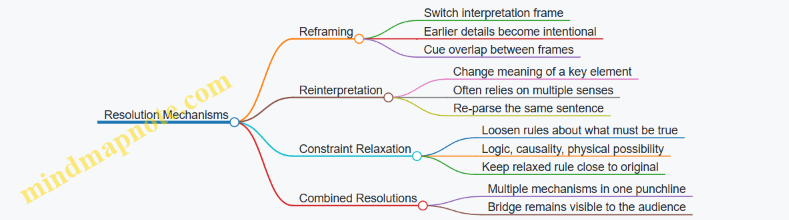
A Systematic Checklist for Resolution
- Identify the violating element: What exactly breaks the expectation—an action, a word, a causal link, or a rule?
- Choose the resolution route:
- If the meaning changes, use reinterpretation.
- If the situation type changes, use reframing.
- If the rules change, use constraint relaxation.
- Ensure the bridge is recoverable: The audience should be able to reconstruct the path from setup to punchline in a few mental steps.
- Control the cost of coherence: The resolution should restore meaning quickly; if it requires too many leaps, the mismatch stays unresolved.
Resolution is the moment the mind stops treating the mismatch as an error and starts treating it as a clue. Reframing, reinterpretation, and constraint relaxation are three ways to make that clue usable.
4.3 Timing and Processing Load: Why Some Incongruities Land Faster Than Others
Incongruity doesn’t just depend on what is violated; it also depends on how quickly the mind can do the work of noticing, interpreting, and resolving. Timing controls when the audience has enough information to form a strong expectation baseline, and processing load controls how many competing interpretations must be evaluated before resolution becomes likely.
The Two Clocks: Information Arrival and Interpretation Effort
One clock is about when the audience receives cues. The other clock is about how much mental effort is required to process those cues. A punchline lands faster when the second clock runs short: the audience can generate a small set of plausible interpretations, and the violation points clearly to the correct one.
When cues arrive early and clearly, expectations form quickly. When cues arrive late or ambiguously, the audience keeps revising the baseline, so the violation is detected later and resolution takes longer.
Expectation Strength and Latency
Expectation strength is the confidence that a particular interpretation is the default. Strong expectations reduce latency because the mind can commit to a frame sooner. Weak expectations increase latency because the mind keeps multiple frames active.
Example:
- Setup: “I tried to fix my phone with a screwdriver.”
- Punchline: “Now it’s in airplane mode… permanently.”
The setup strongly suggests a repair attempt. The punchline violates the expectation that the repair will succeed, and the resolution is immediate because the causal link is simple: screwdriver + permanence implies damage.
Now compare a slower version:
- Setup: “I tried to fix my phone with something.”
- Punchline: “Now it’s in airplane mode… permanently.”
The vague setup weakens the baseline. The audience must wait for “screwdriver” to narrow the cause, so the violation is detected later.
Processing Load: Competing Frames and Constraint Tightness
Processing load rises when multiple interpretations remain viable after the punchline arrives. Resolution becomes slower when the audience must relax constraints or reconcile contradictions across several dimensions.
A useful way to think about load is constraint tightness:
- Tight constraints mean the story leaves little room for alternatives.
- Loose constraints mean the story allows many ways to be “not wrong,” so the mind must test more options.
Example with lower load:
- Setup: “The museum guard said the painting was priceless.”
- Punchline: “So I tried to steal it… for free.”
The punchline uses a direct reframe: “priceless” is treated as “no cost.” The audience doesn’t need to model complex motives; the constraint set is small.
Example with higher load:
- Setup: “The museum guard said the painting was priceless.”
- Punchline: “So I tried to steal it… because I thought ‘priceless’ meant ‘uninsured.’”
Now the audience must evaluate an extra causal assumption about insurance. That extra step increases load and delays the moment when the resolution feels coherent.
Timing Techniques That Reduce Load
-
Front-load the frame, not the explanation. Give the audience the category and role early so they can predict what “normal” looks like.
- Fast: “At the office, the new intern handles the calendar.”
- Slower: “At the office, something about scheduling changed.”
-
Place the violation where it can be mapped immediately. The punchline should connect to a specific earlier cue.
- Fast: “I told my laptop a joke. It crashed… because it didn’t get the punchline.”
- Slower: “I told my laptop a joke. It crashed… which was weird.”
-
Avoid stacking multiple violations at once. If two different expectation breaks occur, the audience may need two resolution passes.
- Lower load: one violation with a clear target.
- Higher load: violation A changes the meaning of the setup, and violation B changes the meaning of the target.
Timing Techniques That Increase Load (and Why They Still Work)
Sometimes slower landing is intentional. Incongruity can be used to create a brief “search” before resolution.
-
Delayed specificity: keep the audience uncertain until a later cue narrows the frame.
- “I borrowed my neighbor’s ladder. It wasn’t for climbing.”
- The audience must wait to learn the purpose.
-
Reframing that requires a second look: the punchline forces a reinterpretation of an earlier phrase, not just a single missing detail.
- “I asked for a refund. They said the product was ‘returning to nature.’”
- The audience must reinterpret what “refund” implies.
This works when the story still provides enough anchors that the audience can eventually converge on one resolution.
A Micro-Checklist for Predicting Landing Speed
Before writing or analyzing a joke, check three items:
- Baseline clarity: Can the audience form a single dominant expectation from the setup?
- Violation targeting: Does the punchline point to one specific cue or relation?
- Resolution economy: After the punchline, do most interpretations collapse quickly into one coherent model?
If all three are favorable, the incongruity tends to land fast. If baseline clarity is low or resolution economy is high-cost, the audience will feel the humor later—or may miss it entirely.
Mind Map: Timing and Processing Load
A final note: “faster” doesn’t mean “better.” It means the audience reaches resolution with fewer intermediate steps. When those steps are too many, the mind still can get there, but the humor arrives later and with more effort.
4.4 The Role of Coherence: How Resolutions Restore Meaning
Coherence is the mental “fit” between what you just processed and the interpretation you end up with. In incongruity-based humor, the punchline creates a mismatch first, then a resolution that makes the mismatch feel explainable. That second step is not just a new fact; it is a reorganization of meaning so the whole moment hangs together.
Coherence as a Constraint System
Your mind continuously builds a working model of the situation: who is involved, what counts as normal, and what outcomes are likely. Coherence works like a set of constraints on that model. When the punchline arrives, it either:
- Violates a constraint so strongly that you pause, or
- Seems to violate one constraint but also relaxes another, allowing a consistent interpretation.
A good resolution doesn’t erase the earlier mismatch. It reframes it so the earlier processing now looks like a partial, reasonable step toward the final meaning.
What “Restoring Meaning” Actually Means
Restoring meaning usually involves three moves.
- Reassigning roles. The same words can refer to different roles depending on the frame. “The boss” might be a manager in one frame and a literal boss in another.
- Reinterpreting relationships. The punchline can change which cause connects to which effect. A surprising action may become predictable once you identify the hidden goal.
- Re-satisfying expectations. Even if the outcome is odd, the path to it becomes internally consistent. The mind stops searching for contradictions and settles.
When these moves succeed, the listener experiences a quick shift from “something is off” to “oh, that’s what’s going on.” That shift is coherence restoration.
Coherence and the Timing of Resolution
Coherence is also about when the mind can stop working. If the resolution arrives early enough, you never fully commit to the wrong model. If it arrives late, you may have already built a strong expectation that must be revised. Humor can still work in the late case, but the listener must pay more cognitive cost to rebuild coherence.
A practical rule: the more the punchline depends on a specific reinterpretation, the more the setup must keep the listener’s attention available for that reinterpretation.
Mind Map: Coherence Restoration Path
Example: A Resolution That Reassigns Roles
Consider: “I told my computer I needed a break. Now it won’t stop sending me Kit-Kats.”
At first, you expect a normal response: the computer pauses or follows the request. The punchline introduces a different role for “break.” In the new frame, “break” is not rest time; it is a snack break. Once that role shift is accepted, the earlier mismatch becomes coherent: the computer is “responding” to the literal meaning it can act on.
Notice what coherence does here. The joke is not only that the computer is silly. The joke is that the listener can map the punchline onto a consistent interpretation of the request.
Example: A Resolution That Reinterprets Relationships
Consider: “Why don’t scientists trust atoms? Because they make up everything.”
The setup nudges you toward a relationship where scientists distrust something unreliable. The punchline changes the relationship between “make up” and “everything.” Instead of fabricating stories in general, “make up” becomes composition: atoms are literally what everything is made of. After the reinterpretation, the distrust relationship becomes coherent: the “reason” is now a specific mechanism.
Example: A Resolution That Re-satisfies Expectations
Consider: “I used to hate facial hair. Then it grew on me.”
The mismatch is mild but real: “grew on me” sounds like a metaphor, yet the punchline treats it as literal growth. The resolution doesn’t require a complex new frame. It mainly re-satisfies the expectation that the phrase will be completed in a way that matches its surface meaning. Coherence is restored because the listener can integrate the metaphor into a literal interpretation without needing extra background.
When Coherence Fails
Coherence fails when the listener cannot find a stable mapping that explains both the setup and the punchline. Sometimes the punchline is too under-specified, leaving multiple frames equally plausible. Other times the resolution depends on a detail the listener never had reason to encode. In those cases, the mind keeps searching for contradictions, and the moment stays stuck in “almost.”
Coherence is the difference between a joke that lands and one that merely surprises. Surprise grabs attention; coherence tells the mind what to do with that attention.
4.5 Practical Example Walkthrough: From Confusion to Resolution in a Multi-Beat Joke
A multi-beat joke is built like a small reasoning puzzle. Beat one creates a prediction. Beat two changes the evidence so the first prediction no longer fits. Beat three offers a resolution that makes the earlier confusion feel productive rather than pointless.
The Joke
“Doctor, my brother keeps speaking in riddles.”
“Tell him to stop.”
“I did. Now he’s just doing it in silence.”
Step 1: Establish the First Expectation Baseline
The first line (“speaking in riddles”) primes a mental model: the brother is producing unclear language, and the doctor’s job is to reduce that behavior. The expectation is straightforward: the doctor will recommend a direct intervention, and the brother will then stop.
Easy-to-spot cues:
- The word “Doctor” signals an authority role with practical advice.
- “Keeps speaking” implies a repeating behavior.
- “Tell him to stop” is a clear instruction, so the audience expects a clear behavioral change.
Step 2: Detect the Violation at Beat Two
The second beat (“I did. Now he’s just doing it in silence.”) breaks the prediction in a specific way. The audience expects “stop” to mean “no longer speak riddles.” Instead, the brother’s riddling behavior persists, but the channel changes from sound to silence.
This is not random ambiguity. It’s an incongruity that targets the mental model’s assumption about how “stop” maps to behavior.
What feels confusing:
- “Riddles” usually require spoken content.
- “Silence” suggests the opposite of communication.
So the audience’s interpretation system has to choose: either the instruction failed, or the meaning of “riddles” is being reinterpreted.
Step 3: Track the Model Conflict
At this point, two candidate frames compete:
- Behavioral Frame: The brother is speaking riddles; “stop” should remove the speaking.
- Semantic Frame: “Riddles” might refer to something broader than audible speech, such as unclear intent or puzzling actions.
The joke keeps the conflict alive just long enough for the audience to notice the mismatch.
Mind Map: Multi-Beat Incongruity Flow
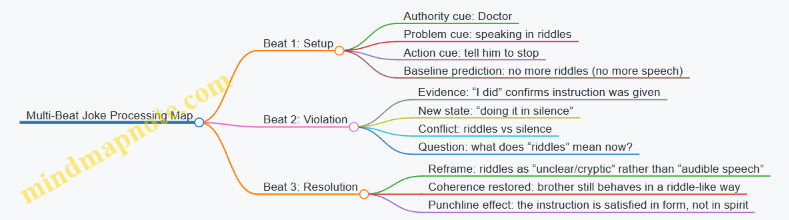
Step 4: Resolve Through Reframing and Constraint Relaxation
The resolution comes from relaxing a constraint the audience didn’t realize it was using: riddles require sound. Once that constraint loosens, “doing it in silence” becomes coherent.
A practical way to describe the resolution:
- The doctor’s instruction targets the behavior “speaking,” not the underlying “riddle-like quality.”
- The brother complies literally: he stops speaking, but he continues the riddle behavior in a nonverbal way.
This is why the punchline lands. The audience can now map every earlier element to a consistent interpretation.
Step 5: Explain Surprise Without Hand-Waving
Surprise comes from two tightly linked expectation breaks:
- Instruction mapping: “stop” is expected to remove the problematic output.
- Channel assumption: riddles are expected to be delivered through speech.
The joke doesn’t merely say something unexpected. It makes the earlier expectation look reasonable, then shows exactly where it was too narrow.
Step 6: A Micro-Checklist for Writing Similar Multi-Beat Jokes
Use this sequence when you want confusion to turn into resolution:
- Beat 1: State a problem with a clear cause-and-fix relationship.
- Beat 2: Keep the fix “successful” in a literal sense, but shift the evidence so the original prediction fails.
- Beat 3: Reframe the key term so the new evidence fits without contradicting the setup.
Example: Same Structure, Different Content
“Coach, my team only scores in metaphors.”
“Tell them to stop.”
“I did. Now they just score in silence.”
The humor works for the same cognitive reason: the audience expects “stop” to eliminate the metaphorical scoring, but the punchline reinterprets the target as the delivery mode rather than the underlying pattern.
5. Mental Models in Humor: Building, Breaking, and Rebuilding Interpretations
5.1 What Mental Models Are: Components, Assumptions, and Inference Paths
A mental model is the working structure your mind uses to interpret what it sees and to predict what should happen next. In humor processing, mental models matter because incongruity is rarely random; it is a mismatch between what a model expects and what the stimulus actually provides.
Components of a Mental Model
A mental model usually includes four parts.
- Entities: the things you think are in play. In a joke, entities might be “a waiter,” “a dog,” or “a contract.”
- Relations: how entities connect. For example, “waiter serves food,” or “contracts bind parties.”
- Rules: constraints that govern what is allowed. Rules can be physical (gravity), social (politeness), or logical (if A then B).
- Goals and perspectives: what matters to the interpreter. A listener might adopt the speaker’s goal (“be helpful”) or their own (“stay safe”).
When a model is active, it doesn’t just describe the world; it generates expectations. Those expectations become the baseline that later gets violated.
Assumptions as Default Fillers
Assumptions are the model’s shortcuts. They let you interpret incomplete information without waiting for perfect evidence. Assumptions can be explicit (“the phrase ‘on the house’ usually means free”) or implicit (“a dog can’t sign paperwork”).
A useful way to think about assumptions is that they are versioned: you can hold a default assumption, then revise it when the stimulus provides a reason. Humor often works by forcing a revision at the last moment, so the listener experiences a quick “wait, that can’t be right” moment before a new interpretation becomes coherent.
Inference Paths as the Model’s Reasoning Route
An inference path is the chain of reasoning your mind uses to move from input to interpretation. It typically includes:
- Parsing: identifying words, roles, and likely structure.
- Model selection: choosing which model best fits the cues.
- Prediction: generating what should follow.
- Constraint checking: testing whether the stimulus violates key rules.
- Resolution: if violated, searching for a revised model that restores coherence.
Different inference paths can coexist. A listener might simultaneously consider a literal model and a figurative model, then commit to one when the punchline clarifies the intended route.
A Concrete Example of Components, Assumptions, and Inference
Consider this joke:
“I told my computer I needed a break. Now it won’t stop sending me KitKat ads.”
Entities: “computer,” “me,” “ads.”
Relations: “computer responds to my request,” “ads are targeted.”
Rules: “a request for a break should reduce work,” “ads are persuasive messages.”
Goals and perspective: the listener adopts the speaker’s goal of taking a break.
The key assumptions are that the computer understands “break” as rest, not as a brand association. The inference path starts with a straightforward interpretation: request → system action → relief. Then the punchline supplies evidence that “break” is being interpreted through a different rule set: marketing targeting based on keyword associations. The listener resolves the incongruity by switching models from “helpful system” to “ad-targeting system.”
Mind Map: Mental Model Structure
Practical Practice: Spotting the Model in One Sentence
Try this micro-exercise with any short line. First, identify the entities and relations. Next, write down one rule you think is being assumed. Finally, state the inference path in one step: “Given X, I expect Y, but the text gives Z.”
For example, with “The meeting could have been an email,” the model includes entities (meeting, email), relations (meetings communicate information), and a rule (meetings are for complex coordination). The assumption is that the meeting’s purpose requires more than an email. The inference path predicts a justification for the meeting; the punchline denies it by reframing the meeting as unnecessary.
Mental models are not mysterious. They are the mind’s organized guess about how the world works, including what it assumes by default and how it reasons when the guess fails.
5.2 Model Selection: Choosing the Interpretation Frame That Fits the Evidence
Model selection is the step where your mind decides which “story” to run. The same words can fit multiple stories, but only one story matches the evidence well enough to keep processing smooth. When the chosen model predicts the next bit correctly, the joke feels coherent until the punchline forces a switch. When the model is a poor fit, you get confusion that never resolves into a single satisfying interpretation.
The Core Idea: Competing Frames
A mental model is a structured set of assumptions about what is happening, who is involved, what counts as normal, and what kinds of outcomes are likely. Model selection happens fast because the brain prefers frames that:
- Explain the current input with minimal strain.
- Predict upcoming content better than alternatives.
- Stay consistent with context cues like setting, relationship, and genre.
A useful way to think about it is as a competition. Each candidate frame generates expectations. The frame that best reduces prediction error becomes the working model.
Evidence Types That Guide Selection
You rarely select a model from raw text alone. You use multiple evidence channels, each with different reliability.
- Linguistic evidence: word choice, tense, grammar, and ambiguity. Example: “I used to be indecisive. Now I’m not sure.” The second sentence uses a contrast pattern that nudges you toward a self-referential frame.
- Context evidence: who is speaking, where it happens, and what the audience already knows. Example: In a workplace meeting, “Let’s circle back” strongly suggests a business frame, not a literal one.
- Genre evidence: jokes, sarcasm, riddles, and puns follow different conventions. Example: A riddle primes you to search for an answer, not for a literal event.
- Pragmatic evidence: intent signals like politeness, exaggeration, or mismatch between literal meaning and social function. Example: “Great job” said after a mistake often triggers a critical-evaluation frame.
Model selection is strongest when these evidence types point in the same direction.
A Systematic Selection Procedure
Use this sequence to analyze how a reader chooses a frame.
- List plausible frames: Start with 2–4 candidates that could explain the setup.
- Score fit to evidence: For each frame, ask what it predicts about the next phrase.
- Track where predictions succeed: If the text keeps matching one frame, that frame gains momentum.
- Watch for the violation point: In incongruity theory, the punchline often breaks the working model’s predictions.
- Check the resolution path: The best frame switch is one that makes the punchline interpretable without rewriting everything.
This procedure mirrors how people naturally recover from a surprise: they don’t start over from scratch; they revise the most economical parts.
Mind Map: Frame Selection Signals
Example: Two Frames, One Punchline
Consider: “My therapist told me to stop living in the past. I told her I can’t. It’s too expensive.”
- Early evidence: “therapist told me” primes a self-improvement frame where the speaker follows advice.
- Working model: emotional-literal frame about mental habits.
- Punchline violation: “too expensive” breaks the emotional frame because it introduces a cost structure.
- Resolution: a figurative-to-literal frame switch. “Past” becomes a place you can live in, making the joke coherent.
Notice what makes this work: the resolution frame doesn’t require ignoring the therapist setup. It reinterprets the key noun (“past”) while keeping the rest stable.
Example: When Model Selection Fails
Now compare: “I tried to be spontaneous today. It didn’t work.”
The setup lacks strong evidence about genre or target. A reader can choose many frames—self-help, complaint, literal failure, or irony—but none is clearly favored. Without a clear working model, the punchline has less to break, so there’s no clean switch. The result is a flat feeling: the mind can’t tell which interpretation path to commit to.
Advanced Detail: Choosing the Smallest Revision
A high-quality joke often uses a “nearby” frame rather than a totally unrelated one. The smallest revision principle helps explain why some punchlines feel instantly right.
- If the working model is too far from the resolution frame, the reader must rebuild too much.
- If the working model is too close (no meaningful violation), the punchline won’t feel surprising.
Good incongruity sits in the middle: enough mismatch to trigger a switch, but not so much that the switch becomes a rewrite.
Practical Takeaway
When you’re analyzing or crafting a joke, treat model selection as an evidence-driven choice. Make sure the setup strongly favors one frame, then design the punchline so the evidence supports a different frame with minimal reconstruction. That balance is what turns “I didn’t expect that” into “Now it makes sense.”
5.3 Model Conflict: When Two Frames Compete and How Humor Resolves the Conflict
When you hear a joke, your mind doesn’t wait passively for a punchline. It runs multiple interpretation frames—small “models” of what’s going on—then tries to make the incoming details fit. Model conflict happens when two frames both seem plausible early on, but only one can fully explain the final information. Humor often comes from forcing that competition to peak, then steering the listener toward a resolution that reassigns meaning.
The Two-Frame Setup
A frame is a bundle of expectations: roles (who does what), goals (what someone is trying to achieve), norms (what counts as normal), and causal assumptions (what leads to what). In many jokes, the setup gives cues that support Frame A. The punchline then introduces a detail that also supports Frame B, but Frame B clashes with Frame A’s earlier assumptions.
A simple way to see the conflict is to track what each frame would predict. Frame A predicts a certain continuation; Frame B predicts a different one. The listener’s comprehension system keeps both alive until the punchline makes one of them untenable.
How Conflict Feels in Real Time
Model conflict is not just “confusion.” It’s a specific kind of cognitive tension: the mind can’t settle on a single coherent story. You may notice this as a brief pause, a reread, or a “wait, what?” moment.
In incongruity terms, the punchline supplies a violation that is locally interpretable under Frame B. The trick is that Frame A would require the violation to mean something else, or would treat it as an error. The listener’s system prefers the frame that yields the simplest overall coherence.
Resolution Mechanisms
Humor resolves model conflict by changing which frame is treated as primary. Three common mechanisms do this.
- Reframing the violated detail: The punchline makes the “wrong” detail suddenly fit Frame B, while Frame A would require extra, awkward assumptions.
- Constraint relaxation: The punchline loosens a strict expectation from Frame A (for example, changing a literal rule into a figurative one).
- Role reassignment: The punchline swaps who the relevant agent is, or what role the speaker plays, so the same words now describe a different situation.
The listener’s final appraisal often includes a quick sense of “oh, that’s what this was about,” which is the cognitive system committing to the winning frame.
Example: A Clean Frame Competition
Consider: “I told my computer I needed a break. Now it won’t stop sending me KitKat ads.”
- Frame A (human-like help): The speaker asks for a break; the computer responds like a considerate assistant.
- Frame B (marketing automation): The computer follows its programmed advertising pipeline.
The setup supports Frame A because “I needed a break” sounds like a request that should change behavior. The punchline introduces a detail—ads—that is more naturally explained by Frame B. Frame A could still be forced to fit, but it would require extra assumptions like “the computer interpreted the break as a marketing opportunity.” Frame B wins because it explains the punchline without stretching.
The humor lands when the listener’s mind stops trying to keep Frame A alive and reassigns the situation to Frame B. The same phrase “sending me” becomes funny because it now has a different causal story.
Example: Role Reassignment Without Changing the Words
Try: “The therapist said I should stop living in the past. I told her I can’t. It keeps asking me to update.”
- Frame A (therapy advice): The therapist gives a general mental-health guideline.
- Frame B (software versioning): “The past” is literally an outdated system that demands updates.
The punchline doesn’t merely add a new fact; it changes what the earlier phrase refers to. The listener resolves conflict by switching the role of “past” from a metaphor to a technical object. Once that switch happens, the therapist’s advice becomes a setup for a literal contradiction.
Practical Diagnostic: Where the Conflict Peaks
To analyze a joke, identify the moment when two frames are both locally plausible. That’s usually right before the punchline’s key detail. Then ask what would have to be true for Frame A to remain viable. If the required add-ons feel forced, the joke is likely designed to push the listener toward Frame B.
A good rule of thumb: the punchline should not just be surprising; it should be the specific piece of information that makes the winning frame feel inevitable and the losing frame feel overworked.
5.4 Updating Strategies: Replacing, Integrating, or Hierarchically Reorganizing Assumptions
When a joke lands, the mind usually performs an update rather than a simple “aha.” The update has to reconcile the violated expectation with a coherent interpretation. Three common strategies explain how that reconciliation happens: replacing assumptions, integrating new information, or hierarchically reorganizing the model.
Replacing Assumptions
Replacing is the cleanest update: the mind discards an earlier assumption and swaps in a new one that fits the punchline.
A practical rule: replacement works best when the setup strongly commits you to one interpretation frame, and the punchline makes that frame untenable.
Example: “I told my computer I needed a break. Now it won’t stop sending me KitKat ads.”
- Setup assumption: the computer will understand “break” as rest.
- Violation: the system treats “break” as a product category.
- Replacement: the mind switches from a human-like intent model to a keyword-to-content model.
How to spot replacement in analysis: ask what single earlier belief becomes false in the punchline’s world. If one belief collapses and everything else can stay the same, you’re likely looking at replacement.
Best practice for writers: make the setup commitment specific enough that the audience forms a stable assumption, then ensure the punchline directly contradicts it.
Integrating New Information
Integration keeps the old assumptions but adds a new constraint or sub-meaning. The mind expands the model so both the setup and punchline can be true.
A practical rule: integration works best when the punchline doesn’t fully negate the setup; it refines it.
Example: “My therapist says I have a fear of commitment. I told her I’m not ready for that kind of relationship.”
- Setup assumption: the therapist’s diagnosis is about the speaker’s emotional readiness.
- Violation: the speaker reframes “commitment” as a specific type of relationship step.
- Integration: the mind keeps the fear-of-commitment idea but adds a nuance about what counts as “commitment” for this person.
How to spot integration: look for a shared core interpretation that survives the punchline, with only the boundaries or definitions shifting.
Best practice for writers: use the punchline to add a precise qualifier, not to erase the setup’s core.
Hierarchically Reorganizing Assumptions
Hierarchical reorganization changes the structure of the model, not just its contents. The mind moves from one level of explanation to another, such as from “what is happening” to “what kind of system is doing it.”
A practical rule: hierarchical reorganization appears when the punchline reframes the entire explanatory level.
Example: “The sign said ‘Bridge Out.’ So I took the scenic route… through the bridge.”
- Setup assumption: “Bridge Out” is a literal warning about a broken bridge.
- Violation: the speaker treats “bridge” as a metaphorical or linguistic object.
- Hierarchical reorganization: the mind shifts from a physical-world model to a language-as-structure model, where “bridge” can be navigated in a different sense.
This strategy often produces a stronger “surprise” because it changes what counts as relevant evidence. The audience doesn’t just update a belief; it changes the category of reasoning.
Best practice for writers: ensure the punchline provides enough cues that the audience can justify the new level of explanation, even if it takes a beat.
Mind Map: Updating Strategies in Humor Processing
A Systematic Diagnostic Workflow
- Identify the setup’s main assumption(s) that guide prediction.
- Locate the punchline’s conflict: what exactly becomes incompatible.
- Choose the update type by checking which parts of the model remain usable.
- If one assumption becomes false while the rest stays stable, it’s replacement.
- If the core meaning remains true but gains a qualifier, it’s integration.
- If the reasoning level changes, it’s hierarchical reorganization.
- Confirm by tracing resolution: the audience should be able to explain the punchline without redoing every earlier step.
Quick Comparative Example Set
- Replacement: “I asked the librarian for a book on paranoia. She whispered, ‘They’re watching you.’”
- The mind swaps from normal library help to a conspiratorial framing.
- Integration: “I’m great at multitasking. I can waste time and be productive at the same time.”
- The mind keeps “multitasking” but integrates a redefinition of productivity.
- Hierarchical Reorganization: “I tried to catch fog yesterday. Mist.”
- The mind shifts from physical catching to wordplay about “mist.”
These strategies are not mutually exclusive in a single joke, but one usually dominates. Naming the dominant update makes analysis more precise and helps you predict why a punchline feels coherent after the initial jolt.
5.5 Practical Example Walkthrough: Analyzing a Joke by Tracing Model Changes Step by Step
We’ll analyze a short joke by tracking how a listener’s mental models change as new information arrives.
Joke: “I told my computer I needed a break. Now it won’t stop sending me KitKat ads.”
Step 1: Establish the Initial Mental Model
Start with what the audience expects from the setup. Most listeners build a model like this:
- The speaker asks for a break.
- The computer responds helpfully or at least stops working.
- The humor will likely come from a mismatch between “break” as rest and “break” as something else.
At this stage, the listener’s model predicts a resolution where the computer either misunderstands the request in a harmless way or performs an unexpected but coherent action.
Step 2: Detect the First Violation
The punchline begins with “Now it won’t stop sending me KitKat ads.” That directly violates the predicted outcome. The listener updates the model because the computer’s “response” is not a pause; it’s marketing.
This is not just a surprise event. It forces a new inference: the computer is not acting like a person who grants breaks; it’s acting like an ad-targeting system.
Step 3: Reframe the Meaning of “Break”
The listener now searches for a resolution that makes the violation coherent. The key is the double meaning of “break.”
- In the initial model, “break” means rest.
- In the revised model, “break” also points to “KitKat,” a brand name that contains “KitKat” and is associated with “break” as in taking a break.
The joke becomes coherent when the listener maps the request (“I needed a break”) onto a marketing association (“KitKat ads” as the system’s interpretation of the phrase).
Step 4: Track Model Changes as a Sequence
To make the process systematic, treat the listener’s understanding as a chain of model states.
- State A: The computer is a conversational agent.
- State B: The computer is an ad-targeting system.
- State C: “Break” is interpreted as a cue for KitKat-related content.
- State D: The computer’s “refusal” to stop is reinterpreted as relentless targeting, not refusal to rest.
Each state change reduces uncertainty. The laughter often arrives when the final state feels like the simplest explanation that fits all details.
Step 5: Explain Surprise and Why It Lands
The surprise comes from the listener’s initial assumption about agency. People expect a computer to respond to a request in a way that matches the request’s goal. Instead, the system responds in a way that matches its own objective function: showing ads.
The resolution is satisfying because it doesn’t require extra facts. The listener can generate a coherent interpretation using only the phrase “a break” and the brand cue “KitKat.”
Step 6: Apply the Same Method to a Variant
Variant: “I told my phone I needed a break. It immediately started playing break-dance videos.”
- Initial model: the phone grants rest.
- Violation: it plays content.
- Reframe: “break” as “break-dance.”
- Resolution: the phone interprets the word literally in a different domain.
This variant shows the same model-tracing pattern with a different resolution mapping.
By tracing model changes, you can explain the joke without hand-waving: the humor comes from a specific expectation, a specific violation, and a specific reinterpretation that restores coherence.
6. Cognitive Stages of Humor Processing: From Input to Laughter
6.1 Perceptual and Linguistic Processing: Parsing the Stimulus
Before a joke can violate expectations, the mind has to read it. Perceptual and linguistic processing turns raw input—sound waves, letters, gestures—into structured representations. Those representations determine what expectations are even possible, which is why parsing quality strongly affects whether incongruity is detected.
From Signal to Units
The first job is segmentation: the brain breaks continuous input into manageable units. In speech, this means finding word boundaries despite slurring and variable speed. In text, it means recognizing characters, then grouping them into words and phrases. Segmentation is not perfect; it relies on context. For example, the sentence “I saw the man with the telescope” can be segmented so that “with the telescope” attaches to “man” or to “saw.” The later ambiguity is not a failure of parsing; it is a consequence of how the system chooses likely attachments.
A practical implication for humor is simple: if the audience cannot reliably segment the setup, the punchline has less to work with. A joke that depends on a specific grammatical attachment should keep the setup unambiguous until the intended moment.
Lexical Access and Meaning Candidates
Once units are identified, the mind retrieves word meanings. Many words have multiple senses, and the system often activates more than one candidate early. The phrase “bank account” pushes toward financial senses, while “river bank” pushes toward geography. Humor can exploit this by steering the audience toward one sense, then switching at the punchline.
Example: “I used to be afraid of elevators, but I’m fine now. I just take it one floor at a time.” The word “floor” is initially tied to rooms or levels, but the joke’s rhythm encourages a more literal, step-by-step interpretation that fits the emotional framing.
Syntactic Parsing and Structure Building
Parsing also builds structure: who did what to whom, and how phrases relate. The mind uses grammar-like expectations to predict upcoming structure. Consider: “The chef served the guests with a smile.” The prepositional phrase “with a smile” can be interpreted as an instrument or accompaniment. If the punchline later makes that phrase literal in an unexpected way, the humor lands because the audience already built a structure that the punchline can subvert.
A useful best practice is to choose a structure that is easy to compute quickly. Complex nesting can cause the audience to spend processing time on form rather than on meaning, leaving less capacity for incongruity detection.
Pragmatic Interpretation and Speaker Intent
Linguistic parsing does not stop at grammar. The mind also infers intent: whether the speaker is stating, requesting, joking, or being ironic. This inference uses cues like tone, politeness markers, and typical conversational goals.
Example: “Nice job breaking the vase.” The words “nice job” are positive, but the context of “breaking the vase” makes a literal compliment implausible. The audience’s pragmatic system flags mismatch and treats the utterance as evaluative sarcasm. Incongruity here is not only semantic; it is about the mismatch between surface positivity and intended meaning.
For humor design, this suggests a control knob: you can delay the pragmatic cue until the punchline, or you can provide it early so the audience knows to search for a non-literal resolution.
Timing: When Parsing Meets Prediction
As the audience parses, it also predicts what comes next. Prediction is tightly coupled to parsing because the brain uses partial structure to anticipate upcoming words. This is why punchlines often work best when they arrive right after a stable parse has been formed.
Example: “I told my computer I needed a break, and it said: ‘No problem—I’ll go to sleep.’” The audience predicts a human-like response to “break.” The punchline forces a re-parse of “sleep” as a literal computer action rather than a metaphor for rest.
If the setup is too long or syntactically unstable, the audience may not commit to a single parse, and the punchline becomes merely surprising rather than meaningfully incongruous.
Mind Map: Parsing the Stimulus
A Worked Micro-Example
Take: “He promised he would be on time. He was… on time.”
First, “on time” is parsed as an adverbial phrase meaning punctuality. The repetition at the end encourages a different parse: “on time” as a literal location or state, not just a schedule property. The humor depends on the audience having already built a grammatical expectation for “be on time,” then encountering a punchline that invites a second, more literal structure.
In short, parsing is the foundation layer that creates the candidate meanings and structures the joke can later contradict. When parsing is stable, incongruity becomes precise; when parsing is shaky, the audience may notice oddness but miss the intended resolution.
6.2 Comprehension and Prediction: Generating Candidate Interpretations
When people read or hear a joke, they do not wait for the punchline to decide what it means. They generate candidate interpretations as the input arrives, using expectations built from language patterns, context, and prior experience. In incongruity terms, comprehension is the stage where the mind tries to make the incoming information fit one of several plausible models. The punchline works when the best-fitting model changes, stalls, or gets replaced.
Prediction as a Running Set of Hypotheses
Start with a simple idea: the mind prefers interpretations that explain the most recent input with the least extra work. Early words narrow the field. For example, hearing “I told my phone…” strongly biases you toward a story about communication, not a physics lecture. As more words arrive, the mind updates the set of hypotheses rather than committing to a single answer too early.
A useful way to think about this is “multiple drafts.” At any moment, several interpretations can be active, each with a different level of fit. The mind keeps the top candidates because they are cheap to maintain and likely to pay off. When a new phrase arrives that contradicts the current best candidate, the mind either revises that candidate or shifts attention to the next one.
How Candidate Interpretations Are Generated
Candidate generation uses three main inputs.
- Lexical cues: word meanings and typical collocations. “Bank” can mean a financial institution or a river edge, so the next word matters.
- Syntactic cues: how words are arranged. “The chicken is ready to eat” invites a different parse than “The chicken is ready; to eat…”
- Context cues: who is speaking, where the scene is set, and what topic the conversation has established.
A practical example shows the mechanics. Consider: “I tried to catch fog yesterday.” The phrase “catch fog” is odd, but it is not yet a punchline. Your mind tries candidates: (a) a literal attempt at capturing fog, (b) a metaphor for trying to grasp something elusive, (c) a setup for a wordplay twist. The next sentence decides which candidate survives.
Ranking Interpretations by Fit
Not all candidates are treated equally. The mind ranks them by coherence with what has already been processed.
- Local coherence: does the interpretation make sense for the current clause?
- Global coherence: does it fit the emerging story across sentences?
- Constraint satisfaction: does it avoid contradictions with basic knowledge?
This is why some jokes feel “obvious” only after the punchline. Before the punchline, the correct interpretation may be present but ranked lower because it violates a constraint that later gets relaxed.
From Candidates to Comprehension
Comprehension happens when the mind settles on an interpretation that can be used to predict what comes next. This is not a final decision; it is a working model that guides attention.
For instance, in a classic setup like “Why don’t scientists trust atoms?” you likely predict a punchline about atoms being unreliable or small. That prediction shapes how you interpret the next words. When the punchline arrives—“Because they make up everything”—the mind performs a reinterpretation: “make up” shifts from “compose” to “fabricate,” and the model changes.
Mind Map: Candidate Interpretation Generation
Example Walkthrough with Stepwise Candidate Shifts
Take: “The librarian told me to have a good day.”
- Early stage: You predict a polite closing. Candidate A: the librarian is being friendly.
- Next cue: “So I checked out a book on how to have a good day.” Candidate A still works, but it now predicts a normal follow-up.
- Later cue: “It was due yesterday.” Candidate B emerges: the phrase “have a good day” is being treated as a literal task with a deadline. The mind shifts from social politeness to a procedural interpretation.
Notice what changed. The joke does not merely add surprise. It forces a new working model that explains the earlier words differently.
Practical Checks for Writers and Analysts
When you analyze a joke, ask what candidates were most likely active at each point. Then ask which candidate becomes untenable and why.
- If the punchline requires a new meaning for a familiar phrase, the earlier candidate was probably ranked high due to everyday usage.
- If the punchline depends on a different parse, the earlier candidate was probably ranked high due to grammatical expectations.
- If the punchline depends on context, the earlier candidate was probably ranked high because the scene suggested a certain role for the speaker.
This is the core of comprehension in incongruity theory: prediction generates candidates, ranking chooses a working model, and the punchline changes the model by making the previous fit collapse or by relaxing the constraints that kept the correct interpretation out of the top spot.
6.3 Incongruity Detection: Identifying Where the Expectation Breaks
Incongruity detection is the moment your mind notices that “what should happen” and “what did happen” don’t match. In incongruity theory terms, you are not just seeing a mismatch; you are locating it in the incoming signal relative to the expectation baseline you built earlier. This section explains how that location is found, how to describe it precisely, and how to avoid common analysis mistakes.
The Expectation Baseline You Compare Against
Your mind forms a baseline from cues like genre, prior sentences, typical roles, and likely meanings. Detection begins when the stimulus forces a prediction update. The key is that the baseline is not a single guess; it is a set of constraints. For example, in a “knock-knock” setup, you expect a call-and-response structure. If the speaker skips the response, the break is structural, not just semantic.
A practical way to track the baseline is to name three things before the punchline: the expected category (what kind of thing this is), the expected role (who does what), and the expected consequence (what follows if the role behaves normally). Detection then asks: which of these three constraints fails first?
Where the Break Can Live
Expectation breaks tend to cluster in a few locations. Detecting the location matters because each location suggests a different resolution strategy.
- Meaning break: a word or phrase is interpreted in a way that conflicts with the intended category.
- Structure break: the grammar, sequence, or framing violates the pattern you were using.
- Role break: the speaker, listener, or object behaves unlike the role you assigned.
- Causal break: the story implies a mechanism, but the outcome follows an incompatible mechanism.
- Pragmatic break: the utterance’s intent conflicts with what the context supports.
A common mistake is to label everything as “meaning.” If the joke’s punchline works by changing who is responsible, then the role break is the real starting point.
A Systematic Detection Procedure
Use a short, repeatable checklist.
Step 1: Mark the first cue that commits you. Identify the earliest sentence or phrase that forces a baseline. In many jokes, the setup contains a “commitment line” that narrows interpretation.
Step 2: Predict the next move using the baseline. Write a plain-language prediction: “After this, the speaker will likely…” Keep it concrete.
Step 3: Identify the earliest mismatch. Scan forward for the first element that makes your prediction fail. The punchline may be late; the break may happen earlier.
Step 4: Classify the break by constraint type. Choose one primary type from the list above. If multiple constraints fail at once, pick the one that creates the strongest processing pause.
Step 5: Note the evidence that would have prevented the break. This is how you confirm you located the right spot. If a small change to the setup would remove the mismatch, you likely found the true trigger.
Mind Map: Incongruity Detection Workflow
Example: Detecting the Break Before the Punchline
Consider: “I told my computer I needed a break, and it said, ‘No problem—I’ll go to sleep.’”
- Commitment cue: “I told my computer I needed a break.” This commits you to a human-like conversation where the computer responds helpfully.
- Prediction: “It will acknowledge the request and pause my work.”
- Earliest mismatch: “it said, ‘No problem’” is fine, but the mismatch arrives at “I’ll go to sleep.” Your baseline expects a break for you, not for the computer.
- Break type: role and consequence. The role of “who takes the break” flips.
- Validation: If the setup had said “I needed a break from the computer,” the mismatch would weaken, confirming the trigger.
Notice that the punchline is also the mismatch point. In many jokes, though, the break happens earlier and the punchline merely reveals it.
Example: Structural Break in a Short Exchange
“I asked for a map. The clerk handed me a compass and said, ‘Good luck.’”
- Commitment cue: “asked for a map” commits to a specific artifact.
- Prediction: “I will receive a map.”
- Earliest mismatch: “handed me a compass.” That is a category mismatch.
- Break type: meaning break with a pragmatic layer. “Good luck” signals refusal or indifference rather than service.
- Why it matters: If you only call it “meaning,” you miss that the clerk’s intent is part of the detection.
Advanced Detail: Handling Multiple Breaks
When more than one constraint fails, detection should still pick an order. Ask which failure forces the largest reinterpretation cost. If the first mismatch is small but the later one forces a full frame change, the later one is the primary break even if the earlier one is technically incorrect.
A useful test is to try two reconstructions: one that keeps the original baseline and one that updates it. The break location is where the “keep baseline” reconstruction stops being coherent.
By the end of detection, you should be able to point to a specific phrase or beat, name the constraint type that fails there, and explain what prediction was active right before that failure. That precision sets up the next step: resolution, where the mind repairs coherence by choosing a new interpretation.
6.4 Resolution and Appraisal: Evaluating the Reframed Meaning
Resolution is the moment the mind stops treating the stimulus as a puzzle with no exit. Appraisal is the evaluation step that decides whether the reframed meaning is coherent enough to accept and whether it is pleasant enough to count as funny rather than merely confusing.
From Incongruity to Reframe
A reframed meaning is not just a new interpretation; it is an interpretation that explains the earlier mismatch without breaking too many other expectations. The mind typically does this by relaxing constraints that were too strict.
Consider a simple setup: “I told my computer I needed more space, and it said…” The audience expects a direct technical response. If the punchline is “it needed more space too,” the mind can relax the expectation that “space” must be only storage. The reframed meaning treats “space” as both physical memory and conversational room.
What “Coherent Enough” Means
Coherence is the practical test: does the new frame connect the setup and punchline with minimal extra assumptions? Coherence is not perfection; it is a cost-benefit judgment.
A useful way to think about it is as three checks:
- Coverage: Does the frame explain the key words and actions?
- Consistency: Does it avoid contradicting the most salient parts of the stimulus?
- Economy: Does it require fewer new assumptions than the competing frames?
If a punchline forces you to reinterpret the setup in a way that makes the setup feel arbitrary, coherence drops. The audience may still “get it,” but the appraisal may land closer to annoyance than amusement.
Appraisal: Why Some Resolutions Feel Funny
Once a reframed meaning is coherent, appraisal asks whether the resolution is safe and satisfying.
1. Positive appraisal signals
- The reframed meaning restores predictability: after the punchline, the earlier mismatch looks like a deliberate setup for a different category.
- The resolution feels earned: the punchline uses information already present, not hidden context.
- The emotional tone stays compatible with the social situation. A joke that violates politeness norms can reduce amusement even when the cognitive resolution works.
2. Negative appraisal signals
- The resolution is too late or too costly. If you need to work hard to justify the punchline, the mind may label it as “not worth it.”
- The reframed meaning makes the speaker look incompetent or cruel in a way that the audience cannot comfortably ignore.
- The stimulus remains ambiguous after the punchline. If multiple frames fit equally well, the mind may keep searching, delaying appraisal.
A Systematic Evaluation Procedure
Use this step-by-step method to evaluate any joke’s resolution.
- Identify the candidate frames the audience could adopt at the punchline.
- Test coverage: underline the elements the frame must explain.
- Test consistency: note the parts that would become contradictions.
- Compare economy: count how many extra assumptions the frame requires.
- Check appraisal constraints: consider social tone, emotional safety, and whether the resolution feels satisfying rather than merely technical.
This procedure mirrors how people often explain jokes to each other: they don’t just say “it means X,” they justify why X is the best fit.
Mind Map: Resolution and Appraisal
Example: Two Resolutions, Different Appraisals
Take two punchlines for the same setup: “I tried to catch fog yesterday.”
-
Punchline A: “I mist.”
- Resolution: “mist” shifts from weather to a verb meaning to fail.
- Coverage: explains “catch” and “fog.”
- Economy: relies on a common wordplay mapping.
- Appraisal: the reframed meaning is quick and socially harmless, so it tends to feel funny.
-
Punchline B: “It was a complicated physics problem.”
- Resolution: tries to replace the joke’s wordplay frame with an explanatory frame.
- Coverage: only partially connects to “catch fog.”
- Economy: adds assumptions about the audience’s tolerance for technical detours.
- Appraisal: even if the audience can rationalize it, the resolution feels like a mismatch in genre, so amusement often drops.
Example: When Resolution Works but Appraisal Fails
A joke can be cognitively resolved yet not funny if the appraisal constraints fail. For instance, if the reframed meaning depends on humiliating a target in a way the audience cannot comfortably endorse, the mind may still compute the interpretation but appraise it as mean. In that case, resolution succeeds and appraisal rejects.
Resolution and appraisal are therefore coupled but not identical. Resolution supplies the “how it fits,” while appraisal supplies the “so what.”
6.5 Practical Example Walkthrough: A Stage-by-Stage Breakdown of a Classic One-Liner
Consider the classic one-liner:
“I told my wife she was drawing her eyebrows too high. She looked surprised.”
This joke is short, but it still runs through the same stages as longer humor: perception, prediction, incongruity detection, resolution, and appraisal. The key is that the punchline doesn’t merely add a new fact; it changes which mental model best explains the same observed information.
Stage 1: Perception and Linguistic Parsing
The listener hears a first-person narrator, a target (“my wife”), and an action (“told”). The phrase “she was drawing her eyebrows too high” sets up a visual domain: eyebrows, height, and a corrective judgment. Parsing is straightforward because the grammar is conventional and the nouns are concrete.
Practice: When you write a one-liner, keep the first clause syntactically ordinary. If the listener must fight the sentence structure, they spend cognitive effort on parsing instead of humor.
Stage 2: Initial Prediction and Mental Model Selection
Before the punchline, the listener predicts a resolution path consistent with the setup. A common expectation is:
- The narrator gives feedback.
- The wife responds verbally or emotionally to the criticism.
- The joke will likely involve embarrassment, disagreement, or a misunderstanding.
Mental model A (the “conversation model”) treats the story as a social exchange.
Practice: Use a setup that strongly cues a single model. Here, “I told my wife” primes the conversation model more than any other.
Stage 3: Incongruity Detection
The punchline arrives: “She looked surprised.” The word “surprised” is compatible with the conversation model, but the listener also notices a mismatch in the causal chain. If the wife is drawing her eyebrows too high, why would she look surprised rather than adjust them or comment?
At this moment, the listener’s system flags a small tension: the emotional outcome is plausible, but the mechanism is unclear.
Practice: Incongruity doesn’t have to be huge. A one-liner often uses a mild violation: the expected cause is missing or replaced.
Stage 4: Resolution Through Reframing
Now the listener revises the mental model. The eyebrows are not just a topic; they are a visible cue that can create the expression “surprised.” The wife’s “surprise” is inferred from her facial appearance, not from a reaction to being criticized.
Mental model B (the “visual expression model”) explains the same words differently:
- “Drawing her eyebrows too high” changes her facial expression.
- That expression looks like surprise.
- Therefore, “she looked surprised” is a description of appearance.
Resolution happens because the listener can map “too high eyebrows” to a recognizable expression pattern.
Practice: Aim for a resolution that reuses earlier information rather than discarding it. The joke works because the setup’s eyebrow detail becomes the punchline’s explanation.
Stage 5: Appraisal and Coherence Restoration
The listener evaluates coherence: the story now fits together without extra assumptions. The narrator’s “told” still matters, but it shifts from being the cause of an emotional response to being the trigger for a visual state.
Appraisal also includes effort cost. The listener doesn’t need to imagine complex events; they only need to reinterpret “looked surprised” as an appearance-based inference.
Practice: Keep the resolution within the same scene. If the punchline requires a new location, new characters, or a long backstory, the coherence restoration becomes expensive.
Stage 6: Timing and Processing Load
Even in a single sentence, timing matters. The phrase “She looked surprised” arrives after the eyebrow detail, so the listener can immediately test the visual-expression interpretation. If the punchline were delayed or replaced with an unrelated action, the reinterpretation would lose traction.
Practice: Place the punchline so the listener’s attention naturally returns to the most recent concrete detail.
Mind Map: Stage-by-Stage Humor Processing for the One-Liner
A Quick Diagnostic Checklist You Can Apply
- Does the setup strongly cue one mental model?
- Does the punchline force a reinterpretation of an earlier detail?
- Is the resolution based on the same scene, not a new one?
- Can a listener explain the punchline in one sentence after the fact?
If you can answer “yes” to these, you’ve built a one-liner that processes cleanly through the same stages—setup to prediction, violation to detection, and resolution to coherence.
7. Measuring Incongruity and Humor Processing: Operational Definitions and Methods
7.1 Operationalizing Incongruity: What Can Be Measured and How
Operationalizing incongruity means turning an abstract idea—“expectation violation”—into observable signals. The goal is not to measure “funny” directly, but to measure the ingredients that typically produce humor: prediction, mismatch, and the path to resolution.
What Incongruity Looks Like in Data
Incongruity is usually treated as a mismatch between what a person expects and what they encounter. To measure it, you first define the expectation baseline and then define the violation relative to that baseline.
A practical baseline can be built from:
- Linguistic norms: typical word meanings, grammar patterns, and collocations.
- Contextual norms: what the setting and prior lines suggest.
- Genre conventions: what a joke format typically promises.
- Task-specific expectations: what participants are told to look for.
Then the violation can be defined as one of these measurable events:
- Interpretation shift: the participant initially commits to one meaning and later revises it.
- Prediction error: the stimulus is harder to process than expected (slower reading, more errors).
- Resolution requirement: participants can only make sense after a reframing step.
Core Measurement Targets
You can operationalize incongruity using three main targets that map cleanly onto cognitive processing.
-
Mismatch detection
- Observable via reaction time spikes, increased reading time, or higher error rates at the violating segment.
- Example: In a sentence like “He mailed the letter to the moon,” readers often slow at “moon” because it breaks the expected destination pattern.
-
Resolution success
- Observable via comprehension accuracy, reduced confusion ratings after the punchline, or improved coherence judgments.
- Example: If the next line clarifies that “moon” is a nickname for a coworker, participants’ coherence ratings rise after the clarification.
-
Incongruity magnitude
- Observable via graded difficulty: stronger violations typically produce larger processing costs or larger shifts in interpretation.
- Example: “He mailed the letter to the moon” is a mild category error; “He mailed the letter to the color of the moon” tends to be harder because it adds an extra layer of abstraction.
A Simple Operational Framework
Use a three-part coding scheme: Baseline, Violation, Resolution. Each part should have explicit criteria so different coders agree.
- Baseline: what interpretation the audience would likely generate.
- Violation: what element breaks that interpretation (semantic, syntactic, pragmatic, causal).
- Resolution: what reinterpretation restores coherence.
Example coding for a short joke:
- Baseline: “A doctor treats patients.”
- Violation: “The doctor treated the appointment.”
- Resolution: “The appointment is metaphorically treated as if it were a patient (rescheduling, fixing, or ‘healing’ it).”
Mind Map: Measurement Components
Behavioral Measures That Work Well
Reaction time and reading-time measures are often the most direct way to capture mismatch detection. The key is to align the measurement window with the violating element.
- Segmented timing: define the “violation region” (e.g., the word or phrase that breaks expectations).
- Compare against matched controls: use non-violating versions that keep length and structure similar.
- Track regressions: extra rereading suggests the mind is searching for a workable interpretation.
Example design logic:
- Condition A (violation): “She filed the report under yesterday.”
- Condition B (control): “She filed the report under today.”
- If A produces longer reading times at “yesterday,” that supports the idea that the violation creates processing cost.
Self-Report Measures with Clear Interpretation
Self-report can complement behavior, but it needs careful wording.
- Surprise/confusion ratings should be collected immediately after the violating segment.
- Clarity/coherence ratings should be collected after the resolution.
Example prompts:
- After the violation: “How unexpected was that line?”
- After the resolution: “How well did the story make sense by the end?”
Reliability and Validity Checks
Operationalization fails when definitions are vague. Use a rubric and test it.
- Inter-rater agreement: coders should consistently identify baseline, violation, and resolution.
- Manipulation checks: confirm participants actually experienced the intended mismatch.
- Control for confounds: keep word frequency, sentence length, and grammatical complexity as similar as possible.
Putting It Together: A Measurable Incongruity Score
A straightforward derived metric is the difference between processing cost at the violation and improvement after resolution.
- Incongruity cost: RT increase or confusion rating increase at the violating segment.
- Resolution benefit: accuracy or coherence improvement after the punchline.
When both move in the expected directions, you have evidence that the measured effect reflects incongruity processing rather than unrelated difficulty.
7.2 Experimental Approaches: Controlled Stimuli, Timing, and Task Design
Incongruity theory predicts that humor comprehension depends on how expectations are formed, violated, and resolved. Experiments test those steps by controlling the stimulus and the participant’s processing opportunities, then measuring behavior and timing. The goal is not to “catch laughter,” but to separate comprehension stages: detection of mismatch, generation of candidate interpretations, and selection of a coherent resolution.
Controlled Stimuli
Controlled stimuli start with a baseline condition that is easy to interpret and a violation condition that changes exactly one factor. A good baseline is not “no joke”; it is a version where the same words and structure lead to a stable interpretation.
A practical approach is to use minimal pairs. Keep the setup identical and change only the critical element that creates the incongruity. For example, if the target manipulation is semantic category error, then all other cues—sentence length, syntactic form, and plausibility of the setup—should remain constant.
To avoid accidental confounds, pretest the materials for comprehension and perceived similarity. If participants already disagree about what the setup means, the later effects might reflect misunderstanding rather than humor processing.
Example:
- Baseline: “The chef served the soup in a bowl.”
- Incongruity: “The chef served the soup in a calendar.”
Both sentences are grammatical and vivid, but only the second violates the expected container category. If you also changed the verb or added extra context, you would blur whether the effect comes from category mismatch or from something else.
Timing and Presentation Control
Timing manipulations test whether the mind resolves incongruity immediately or after additional evidence. Two common strategies are self-paced reading and fixed-timing presentation.
In fixed-timing designs, you can present the setup, then pause before the punchline. The pause length matters because it changes whether participants commit to an interpretation before the violation arrives. In self-paced reading, you can examine where processing difficulty spikes, such as at the word that first signals the mismatch.
A simple timing logic is to align the measurement window with the cognitive event you care about. If you want to measure detection, focus on the earliest point where the mismatch becomes identifiable. If you want to measure resolution, measure after the punchline or after a short continuation that supplies the reframe.
Example:
- Condition A: punchline appears immediately after setup.
- Condition B: a brief delay occurs, then punchline appears.
If resolution requires additional integration, Condition B may show different reaction-time patterns or different comprehension accuracy.
Task Design
Task choice determines what participants do with the stimulus. Humor tasks that only ask for “funny or not” often mix multiple processes: detection, interpretation, and social appraisal. Better tasks map onto specific stages.
A stage-aligned set of tasks might include:
- Comprehension verification to ensure participants build a coherent interpretation.
- Interpretation selection where participants choose among candidate meanings, including the intended resolution.
- Mismatch localization where participants indicate where the expectation broke.
- Speeded judgments that capture processing time without requiring full explanation.
These tasks can be combined, but you should avoid overloading participants with too many demands. If the task requires explanation, it can slow responses and change what “resolution” means.
Example: Participants read a short story with a single incongruity. Then they answer:
- “Where did the story become strange?” (setup, critical word, or punchline)
- “What best explains the ending?” (three options)
- “How coherent does the ending feel?” (1–7 scale)
The first question targets detection, the second targets resolution selection, and the third targets coherence appraisal.
Mind Map: Experimental Design Levers
A Cohesive Example Workflow
Start with a set of joke-like sentences that share the same setup structure. Create baseline and incongruity versions using minimal pairs. Pretest to confirm that the baseline is consistently understood and that the incongruity is noticed at the intended location.
Next, run two timing conditions: immediate punchline versus delayed punchline. Use a task that separates detection from resolution: first ask where the mismatch occurs, then ask which interpretation best explains the ending, and finally collect a coherence rating. If the delayed condition increases mismatch localization accuracy but reduces resolution selection speed, that pattern suggests participants detect the violation but need more time to commit to the reframe.
This workflow keeps the stimulus controlled, the timing informative, and the task aligned with the cognitive steps implied by incongruity theory.
7.3 Behavioral Measures: Ratings, Reaction Times, and Comprehension Accuracy
Behavioral measures translate “how the mind processes humor” into observable signals. In incongruity theory terms, you want evidence for three things: (1) people notice a mismatch, (2) they spend time resolving it, and (3) they end up with a coherent interpretation.
Ratings: What People Think They Saw
Ratings capture subjective appraisal, which is useful when you care about amusement, perceived surprise, or perceived coherence. A practical approach is to collect multiple ratings rather than one global score.
Common rating dimensions include:
- Amusement: “How funny was that?”
- Surprise: “How unexpected was the punchline?”
- Comprehension: “How easy was it to understand?”
- Coherence: “How well did the ending make sense?”
Easy-to-understand example: show two short jokes.
- Joke A: clear setup, mild violation, quick resolution.
- Joke B: setup is similar, but the punchline forces a reframe that takes effort. If Joke B produces higher surprise ratings but lower comprehension ratings, you likely have a stronger violation that is not yet fully resolved.
Best practice: anchor ratings with brief definitions and use consistent scales (for example, 1–7). Also collect comprehension confidence, because a person can rate “funny” while still being unsure why.
Reaction Times: How Long Resolution Takes
Reaction times (RTs) are especially informative because they reflect processing effort. In humor tasks, RTs can be measured at multiple points.
Two common RT designs:
- Self-paced reading or listening: measure time to read the punchline or the final clause.
- Response RT: measure how quickly participants answer a question after the punchline.
Easy-to-understand example: after each joke, ask “Which interpretation best fits?” with multiple choices. If participants take longer on the items where the incongruity requires a model switch, RTs should increase for those items.
Interpreting RTs systematically:
- Faster RTs often indicate the audience can map the punchline to an existing mental model.
- Slower RTs often indicate extra steps: detecting the mismatch, inhibiting the first interpretation, and selecting a resolution.
Best practice: separate “detection” from “resolution” when possible. If you only measure RT to the punchline, you may miss cases where the violation is noticed immediately but resolution happens later.
Comprehension Accuracy: Whether the Resolution Landed
Comprehension accuracy tests whether participants actually reached the intended interpretation. This is the behavioral counterpart to “constraint relaxation” in cognitive terms: did the mind settle on a coherent story?
A simple accuracy method is a forced-choice question that targets the resolution.
Easy-to-understand example:
- Joke: “I told my computer I needed a break. Now it won’t stop sending me Kit-Kats.”
- After the punchline, ask: “What is the joke’s resolution?”
- Option 1: The computer is literally eating candy.
- Option 2: The computer is interpreting “break” as a request for a specific kind of snack.
- Option 3: The speaker is joking about workplace policies.
If accuracy is high for Option 2, you have evidence that participants used the intended reframe.
Best practice: design distractors that correspond to plausible but wrong mental models. If distractors are obviously wrong, accuracy becomes a test of guessing rather than processing.
Mind Map: Behavioral Measures for Humor Processing
Putting Measures Together: A Coherent Reading of Results
A single measure can mislead. Ratings might reflect social expectations (“I’m supposed to laugh”), RTs might reflect confusion unrelated to the intended resolution, and accuracy might reflect test-taking skill.
Integrated interpretation example:
- Condition 1 (easy resolution): higher comprehension accuracy, moderate RTs, high coherence ratings.
- Condition 2 (hard resolution): higher surprise ratings, longer RTs, lower accuracy, and lower coherence ratings. This pattern supports the idea that the incongruity is stronger and that resolution requires more cognitive work.
Best practice: report all three measures together and analyze them at the item level. Humor is variable across stimuli, so averaging can hide the jokes that truly drive the effect.
7.4 Physiological and Neural Measures: What They Indicate About Processing Stages
Physiological and neural measures help test the “stage” idea behind incongruity processing: first the brain builds expectations, then it detects a mismatch, and finally it resolves the mismatch into a coherent interpretation. The key is to treat each measure as a timing clue, not a direct readout of “humor” as a single thing.
What Counts as a Stage Signal
Neural and physiological signals are usually interpreted in terms of when they rise relative to stimulus events. A stage-relevant signal should (1) appear at a consistent time window across trials, (2) change systematically with expectation violation or resolution difficulty, and (3) align with behavioral outcomes like comprehension accuracy or reaction time.
A practical way to organize evidence is to map measures onto the processing pipeline:
- Early sensory and parsing: how quickly the stimulus is encoded and segmented.
- Prediction and mismatch detection: how strongly the system flags an expectation violation.
- Resolution and reappraisal: how effortful it is to reframe the meaning.
- Appraisal and response readiness: how interpretation supports the decision to laugh, rate, or judge.
EEG and ERP Measures for Timing
Event-related potentials (ERPs) are especially useful because they provide millisecond-level timing. Different components are often linked to different operations, though exact interpretations depend on task design.
- N1 and P2 windows often track early perceptual processing and attention allocation. If a joke’s setup is visually or linguistically harder, these components can shift even before incongruity is encountered.
- Mismatch-related responses are commonly examined in windows where the brain reacts to violations. In humor tasks, stronger mismatch signatures are expected when the punchline violates a well-established expectation.
- Late positivity and related late components are frequently associated with integration and reanalysis. These should increase when resolution requires more reinterpretation, such as when the punchline forces a new mental model rather than a simple rewording.
Example: Present two versions of a one-liner. In the first, the punchline flips a single word meaning (“bank” as money vs. river edge). In the second, it changes the implied role structure (“the doctor” is actually a mechanic). The second version typically produces longer integration demands, so late ERP effects should be larger and behavioral comprehension may lag.
fMRI for Spatial Localization
Functional MRI measures blood-oxygen changes, which are slower than EEG but useful for identifying brain regions involved in interpretation and control. In incongruity research, you often see involvement of:
- Language and semantic networks for meaning construction.
- Control and integration regions when the system must resolve conflict between competing interpretations.
- Valuation and appraisal-related areas when the task requires an explicit judgment of “funny” or when laughter is measured.
Example: If you compare jokes that resolve quickly versus jokes that remain ambiguous, the “harder to resolve” condition often shows greater engagement of regions tied to selection among interpretations and maintaining multiple possibilities.
Pupillometry and Heart-Rate Measures for Effort
Pupil dilation and heart-rate variability provide indirect but practical measures of cognitive effort and arousal. They are not specific to humor, but they can track how much work resolution requires.
- Pupil dilation tends to increase with processing load. A punchline that forces a new model should produce larger dilation than one that merely completes an already prepared frame.
- Heart-rate changes can reflect arousal and task engagement. If a violation is surprising but quickly resolved, arousal may spike briefly and then settle.
Example: In a joke where the setup strongly predicts a literal outcome, the punchline that forces a pragmatic reinterpretation (e.g., “I’m on a diet” said while eating something clearly not a diet food) should elicit more effort signals than a punchline that stays within the same pragmatic frame.
A Mind Map of Measure-to-Stage Links
Mind Map: Physiological and Neural Measures in Humor Processing
Designing Evidence That Actually Separates Stages
To avoid confusing “heavier processing” with “humor,” tasks should separate the moment of violation from the moment of resolution. A clean design uses time-locked events:
- Setup presentation: measure baseline prediction building.
- Punchline onset: measure mismatch detection.
- Resolution window: measure integration and reframe selection.
- Response window: measure appraisal and decision.
Example: Use self-paced reading or controlled timing so the punchline appears at a known time. Then compare jokes where the punchline contains the violation but resolution is delayed by an additional clause. If late ERP and pupil effects increase mainly during the delayed resolution clause, that supports the stage separation rather than attributing everything to early surprise.
Interpreting Results Without Overclaiming
A single measure rarely proves a specific cognitive operation. Strong conclusions come from converging patterns: EEG timing that tracks mismatch and integration, fMRI that localizes semantic and control demands, and physiological effort measures that scale with resolution difficulty. When these signals move together in the expected order—early parsing, then mismatch, then integration—you get a coherent picture of how expectation violations become humorous experiences.
7.5 Practical Example Walkthrough: Designing a Simple Study to Test Incongruity Resolution
A good study tests whether people can move from “I’m confused” to “Oh, that makes sense,” and whether that move depends on the kind of incongruity you used. The simplest design uses short stimuli, a comprehension task, and a resolution measure.
Core Idea and Testable Claims
Start with two claims you can actually measure:
- Resolution improves comprehension. When the punchline provides a clear reframe, participants should answer comprehension questions more accurately.
- Resolution depends on the violation type and placement. If you move the same violation earlier or change the violation so it can’t be coherently resolved, accuracy and/or resolution ratings should drop.
To keep the study small, use one joke family and vary only one factor at a time.
Materials: Stimuli Set and Conditions
Create 12–24 items total. Each item is a two-part stimulus: setup followed by punchline. Use three conditions:
- Resolved Incongruity: The punchline supplies the reframe.
- Unresolved Incongruity: The punchline keeps the mismatch but removes the coherence cue.
- Control Coherence: The story stays consistent and never creates a strong expectation violation.
Example item (same setup, different punchlines):
- Setup: “I tried to fix my printer by talking to it politely.”
- Resolved Incongruity punchline: “It worked—after I apologized for the paper jam’s ‘feelings.’”
- Unresolved Incongruity punchline: “It worked—after I apologized for the paper jam’s ‘feelings,’ but nothing changed.”
- Control Coherence punchline: “It worked—after I apologized and reloaded the paper correctly.”
The resolved version gives a coherent reframe (personification as a playful explanation). The unresolved version blocks coherence by adding a contradiction that prevents the reframe from restoring meaning.
Participants and Procedure
Recruit a modest sample (for example, 60–120 participants) and assign items across conditions so each person sees a mix. A clean procedure:
- Read setup.
- Rate expected outcome on a 1–7 scale.
- Read punchline.
- Rate surprise on a 1–7 scale.
- Answer a comprehension question (multiple choice) that requires the resolution.
- Rate resolution clarity on a 1–7 scale: “How clearly did the punchline explain what was going on?”
Keep the comprehension question tightly tied to the reframe. For the printer example, the correct option might be “The joke treats the jam as if it has feelings, as a playful explanation.”
Measures and Analysis Plan
Use three dependent variables:
- Comprehension accuracy (correct vs incorrect).
- Resolution clarity (1–7).
- Surprise (1–7), treated as a check that incongruity is actually present.
A simple analysis:
- Compare Resolved vs Unresolved on accuracy and resolution clarity.
- Compare Control vs both to confirm that coherence reduces the need for resolution.
- Check whether surprise is higher in both incongruity conditions than in control; if not, your stimuli may not be creating the intended expectation violation.
If you want one extra step, include a short open response: “In one sentence, explain the punchline.” Then code whether participants mention the reframe (personification, category shift, causal reinterpretation, etc.).
Mind Map: Study Logic
Example Walkthrough: One Item Through the Whole Study
Take the printer item.
- Expectation rating: Many participants will predict a practical fix (reloading paper, cleaning heads).
- Surprise rating: The resolved punchline should feel surprising because it shifts from mechanics to playful personification.
- Comprehension question: The correct answer should require recognizing the reframe: the apology is a humorous “fix” because the jam is treated as having feelings.
- Resolution clarity: Participants should rate the resolved version higher because the punchline provides a coherent interpretation path.
Now compare the unresolved punchline. It still contains personification, so surprise may remain high, but the added contradiction (“nothing changed”) blocks the reframe from restoring meaning. That should lower resolution clarity and comprehension accuracy.
Practical Best Practices Embedded in the Design
- Use the same setup across conditions to isolate the effect of resolution cues.
- Make comprehension questions reframe-dependent, not surface-dependent. If the question only asks what word appeared, you measure recall, not resolution.
- Avoid multiple violations per item. One strong mismatch is easier to interpret than several competing ones.
- Pilot with a small group. If many participants report “I don’t get it” for the resolved condition, your punchline may not actually provide a usable reframe.
This design gives you a direct test of whether incongruity becomes funny (or at least understandable) when the mind can rebuild coherence from the violation.
8. Context, Culture, and Shared Knowledge: Why Some Incongruities Work Better
8.1 Contextual Constraints: Setting, Relationships, and Shared Background
Incongruity theory treats humor as a mismatch between what a listener expects and what actually happens. Context determines what “expected” means in the first place. Without context, the same violation can feel random; with context, it feels targeted, interpretable, and therefore funny.
Setting as the Expectation Baseline
Setting includes the physical scene, the activity type, and the immediate conversational goal. These cues tell the audience which mental model to activate.
A simple example: imagine two lines.
- “Nice job, Captain.”
- “Nice job, Captain… on the wrong ship.”
In a nautical setting, “Captain” primes a role-based model with clear authority and competence. The second line violates that model by shifting the competence domain. In a school setting, “Captain” might prime a sports team model instead, and the same punchline can land as a different kind of mismatch.
Good practice is to make the setting cues do real work early. A joke that begins with “At the airport…” or “During the team meeting…” gives the audience a stable baseline so the later violation has something specific to break.
Relationships as the Social Model
Relationships shape expectations about politeness, power, and shared tolerance for bluntness. Humor often depends on how far the speaker can bend those norms without triggering rejection.
Consider this contrast:
- A close friend says, “You’re late again. I’m starting to think you’re allergic to time.”
- A stranger says the same line to you in a queue.
The words are similar, but the relationship changes the appraisal. With a friend, the audience predicts playful teasing and interprets the violation as affectionate. With a stranger, the audience predicts social risk and interprets the violation as disrespect. Incongruity may still occur, but resolution fails because the social model cannot be safely repaired.
A practical rule: match the “violation style” to the relationship. If the joke relies on mild disrespect, it needs a relationship where mild disrespect is already licensed.
Shared Background as the Common Ground Budget
Shared background is the set of facts, experiences, and conventions that the audience can reasonably assume. It includes language norms, local references, and everyday routines.
Shared background works like a budget. The more the joke depends on niche knowledge, the more the audience must spend to resolve the incongruity. If the budget runs out, the audience may still notice the mismatch but cannot build a coherent resolution.
Example: a joke about “paperwork” can be universal if it uses everyday bureaucracy cues. A joke about a specific internal form name can be funny only for people who share that reference. The second version can still be written well, but it must provide enough context to reconstruct the missing model.
A best practice is to choose references that are either widely shared or quickly made legible through the setup. If you use a specialized detail, the setup should signal what it is doing in the mental model.
How Context Controls Resolution Paths
Context doesn’t just create expectations; it also constrains which resolutions are plausible. When the audience hears a violation, they search for a reframe that restores coherence. Setting, relationships, and shared background determine which reframes the audience will consider.
For instance, a line like “I followed the instructions exactly” can resolve as:
- Competent compliance in a workplace context.
- Absurd literalism in a fantasy context.
- Suspicious excuse-making in a conflict context.
The audience’s search space changes because the context changes the likely intent model. That’s why the same punchline can be funny in one room and flat in another.
Mind Map: Contextual Constraints for Humor Processing
Integrated Example: One Joke, Three Contexts
Take a punchline: “I brought the wrong thing, but I brought it confidently.”
- In a cooking class, “wrong thing” can resolve as harmless mistake plus competence theater.
- In a medical appointment, the same line can resolve as negligence, which is harder to appraise as safe humor.
- With a friend helping you move, it resolves as friendly incompetence, because the relationship already supports playful framing.
The joke’s structure stays the same, but context changes the audience’s mental model, the appraisal of intent, and the ease of resolution.
Practical Takeaway
When you want incongruity to land, treat context as part of the mechanism. Setting provides the baseline, relationships regulate the social risk, and shared background supplies the materials needed to rebuild coherence after the violation.
8.2 Cultural and Linguistic Conventions: How They Shape Expectation Baselines
Humor depends on a baseline: what an audience expects to be normal, relevant, and interpretable. Cultural and linguistic conventions supply much of that baseline, often without anyone noticing. When a joke violates an expectation that the audience never formed, the violation can feel random rather than funny. When it violates an expectation that the audience strongly holds, the surprise becomes legible.
Conventions as Default Assumptions
Conventions include shared norms about politeness, roles, taboo topics, and what counts as a reasonable explanation. They also include linguistic habits such as typical word order, common idioms, and how speakers signal intent. In incongruity terms, conventions determine which interpretation path is initially selected.
A simple example is the difference between direct and indirect requests. In many English-speaking contexts, “Can you pass the salt?” is usually interpreted as a request, not a literal question about ability. A joke that treats it literally—“I can, but I’m not sure I should”—creates incongruity because the audience’s convention-driven expectation is that the speaker is being indirect.
Language Structure and Parsing Expectations
Linguistic conventions shape how people parse sentences. Word order and grammatical markers influence which meaning is computed first. If a joke relies on a specific parsing route, it can fail when the language nudges parsing differently.
Consider ambiguity in pronouns. In English, “He told her she was late” can be read as either the speaker judging her lateness or someone else judging it, depending on context. Languages with clearer marking for perspective or evidentiality reduce that ambiguity. The same surface sentence can therefore produce different expectation baselines across languages.
Idioms and Fixed Expressions
Idioms are expectation engines. People store them as chunks with predictable meanings. When a joke breaks an idiom by treating it compositionally, the audience experiences a controlled mismatch.
Example: “I’m on cloud nine” is normally understood as “I’m very happy.” A joke that responds, “Which cloud? I can’t find the Wi‑Fi,” uses the convention that “cloud nine” is figurative. The humor comes from the audience briefly trying to keep the idiom’s figurative frame, then being forced into a literal frame.
Idioms also carry cultural baggage. Some idioms are tied to specific technologies, histories, or social institutions. A literal-minded twist that works for one audience may land as confusing for another because the idiom’s figurative meaning is not shared.
Politeness Norms and Social Intent
Politeness conventions affect how people infer intent, which is central to pragmatic incongruity. Many cultures treat certain forms of disagreement as face-saving, while others treat them as straightforward.
Example: A character says, “That’s an interesting idea,” after a proposal. In some contexts, this signals mild approval; in others, it signals skepticism. A joke can exploit that by having the listener respond as if approval were intended, then revealing the mismatch.
If the audience’s convention interprets the phrase as criticism, the “reveal” becomes unnecessary. The joke’s resolution depends on the audience initially selecting the wrong intent model.
Taboo, Register, and Acceptable Targets
Cultural conventions also govern which topics are safe to violate. Humor often uses incongruity to test boundaries, but the baseline includes what the audience expects will be off-limits.
Example: A workplace joke that mocks a manager’s “leadership style” may be acceptable in one setting and risky in another. The same structural violation—turning a compliment into a critique—can shift from playful to uncomfortable depending on shared norms about hierarchy and respect.
This matters for cognitive processing: if the audience appraises the situation as socially threatening, resolution may not feel rewarding. The expectation violation still occurs, but the appraisal system may block laughter.
Mind Map: How Conventions Shape Baselines
Integrated Example: One Joke, Two Baselines
Imagine a line: “Nice work. You really nailed it.” The humor could come from a convention where “nice work” is sincere praise. The punchline might show the “nailing” was literal—someone pinned a document to a wall instead of submitting it.
In a culture or group where “nice work” is commonly used sarcastically, the baseline already assumes irony. The audience may jump straight to the sarcastic frame, reducing the surprise. The joke still contains incongruity, but the resolution path is no longer delayed, so the comedic effect weakens.
The key takeaway is systematic: conventions determine which meanings are pre-activated, which interpretations are considered plausible, and which appraisals keep the violation in the “safe to laugh” zone.
8.3 Common Ground and Audience Design: Tailoring Humor to What Is Known
Common ground is the shared set of assumptions that lets an audience predict what comes next. In incongruity terms, it sets the expectation baseline; in cognitive terms, it reduces the cost of building and revising mental models. When you tailor humor to what is known, you’re not just choosing topics—you’re choosing which inferences the audience can safely make without extra explanation.
Start with a simple principle: the audience should be able to locate the violation quickly. If the setup requires unfamiliar background, the mind spends its effort on comprehension rather than on noticing the mismatch. A good test is to ask what the audience can infer after hearing only the first sentence. If the answer is “not much,” the punchline will likely arrive before the audience has a stable model to break.
Common ground comes in layers. First is linguistic common ground: shared meanings of words, idioms, and grammar patterns. Second is situational common ground: what typically happens in a setting, like a workplace meeting or a restaurant order. Third is social common ground: norms about politeness, status, and intent. Fourth is experiential common ground: what people have personally encountered, such as waiting on hold or learning a new device.
A practical way to design audience fit is to map the setup to the audience’s likely model. Consider three audiences and the same joke premise.
Example: “I told my phone to stop autocorrecting. Now it just ignores me.”
- For most smartphone users, the situational and experiential common ground is strong: autocorrect exists, it changes words, and “ignores me” is a person-like consequence.
- For someone who has never used autocorrect, the violation becomes harder to resolve because the baseline expectation—what autocorrect does—has gaps.
Next, decide how much ambiguity you can afford. Humor often works by letting the audience generate candidate interpretations, then selecting the one that restores coherence. If common ground is thin, multiple interpretations compete and resolution slows. That’s when jokes feel confusing rather than funny.
Example: “The meeting was so productive. We all agreed on the agenda.”
- In a typical office context, the audience expects meetings to be chaotic or at least time-consuming. The punchline violates that expectation by treating agreement on the agenda as an accomplishment.
- If the audience comes from a culture or role where meetings are routinely structured and agreement is normal, the violation loses contrast and the resolution feels flat.
Design also depends on audience goals. Some audiences want quick recognition; others tolerate slower reasoning. You can tune this by controlling how early the setup signals the relevant frame. A frame signal is a cue that narrows the mental model search space.
Example: “I’m not saying the printer is haunted, but it only works when nobody’s watching.”
- The “printer” cue anchors the situational model.
- The “works when nobody’s watching” cue points toward a familiar pattern: superstition-like behavior applied to a mundane device.
- If you remove the printer cue and start with “It only works when nobody’s watching,” the audience must invent the object, increasing processing load.
Mind maps help you check whether your setup provides enough common ground to make the violation legible.
Mind Map: Common Ground Layers and Audience Design Checks
Use the mind map as a checklist while drafting. For each layer, ask: what does the audience already know, and what will they assume by default? Then decide where the joke will violate expectations. The violation should be in the part the audience can predict, not in the part they must first learn.
Finally, remember that common ground is not only about knowledge; it’s also about comfort with the kind of mismatch being presented. Social common ground includes what feels acceptable to mock and what feels like a personal attack. If the audience shares the baseline but not the norm, the resolution may restore meaning yet still fail appraisal.
Example: A joke that relies on workplace hierarchy might land well with peers who share the norm of teasing status differences, but it can feel hostile to someone who expects strict professional boundaries.
Tailoring humor to what is known is therefore a balancing act: provide enough shared structure for the audience to build a stable model, then place the incongruity where that model can be broken cleanly and resolved quickly.
8.4 Misalignment and Failure Modes: When Incongruity Cannot Be Resolved
Incongruity theory assumes that a violation can be reinterpreted so the mind regains coherence. Sometimes that recovery fails. The audience may still notice the mismatch, but the system cannot find a stable resolution that fits the evidence. The result is not “no humor,” but a different outcome: confusion, irritation, or indifference.
What “Unresolved” Looks Like
A failure mode typically shows up as one of three experiences. First, the audience cannot generate a plausible alternative frame, so the mind keeps searching and never settles. Second, multiple frames remain possible, but none explains enough details to win. Third, a candidate resolution exists, yet it conflicts with constraints the audience treats as non-negotiable, such as grammar, physical causality, or social norms.
Failure Mode 1: No Viable Resolution Frame
This happens when the violation is too far from the audience’s expectation space. The mind can detect “something is off,” but it cannot map the stimulus to any coherent interpretation.
Example: Setup: “I set my alarm for 7 a.m., so I woke up at exactly 7.” Punchline: “Because the alarm clock is a time machine.”
The first sentence invites a straightforward causal model: alarm triggers wakefulness. The punchline introduces a new mechanism (time travel) without any bridging cues. If the audience treats time travel as outside the joke’s world, there is no resolution that preserves the initial causal model.
Practice for writers: Keep the violation within the same “world rules” you establish. If you want absurd mechanisms, seed them early with signals that the world is flexible.
Failure Mode 2: Persistent Ambiguity Without Payoff
Sometimes the mind can form several candidate frames, but the text never commits to one. The audience keeps oscillating, and the cognitive cost rises.
Example: Setup: “He said he’d be there in five minutes.” Punchline: “He meant five minutes ago.”
This can work, but it can also fail if the setup lacks a temporal anchor. If “five minutes” could refer to multiple reference points (now, then, or a previous promise), the audience may not know which frame the joke intends. The resolution becomes a guessing game rather than a satisfying reinterpretation.
Practice for writers: Add one cue that narrows the reference frame, such as a clear “from now” marker or a concrete timeline in the setup.
Failure Mode 3: Constraint Conflict
A resolution may be available in principle, but it breaks constraints the audience expects to hold. Constraints can be linguistic (syntax), logical (basic inference), physical (causality), or social (politeness, roles, intent).
Example: Setup: “The doctor said the medicine would help in an hour.” Punchline: “So I took it and waited for the medicine to arrive.”
The punchline can be read as wordplay, but it conflicts with the physical constraint that medicine is already in hand. If the audience cannot reinterpret “took it” as something else, the resolution fails.
Practice for writers: When you violate a constraint, make the violated constraint the target of the joke. Otherwise, the audience experiences the mismatch as an error rather than a deliberate shift.
Failure Mode 4: Intent Misread and Negative Appraisal
Even if the mind finds a resolution, it may appraise the violation as threatening, disrespectful, or unfair. Incongruity then lands on the wrong evaluation axis.
Example: A joke that relies on mocking someone’s disability can be “resolved” as sarcasm, but the appraisal may remain negative because the audience treats the target as deserving protection.
Practice for writers: Choose targets that the audience can safely treat as non-protected, or shift the joke toward self-incongruity (the speaker’s mistake) rather than other-directed blame.
Mind Map: Resolution Failure Pathways
A Systematic Diagnostic Checklist
When a joke fails, treat it like a debugging problem. Ask four questions in order.
- Can the audience generate any coherent frame? If not, the violation is too distant.
- Does the text narrow the frame choice? If not, ambiguity persists.
- Does the best resolution violate a constraint the audience treats as fixed? If yes, the mind rejects it.
- Does the resolution change appraisal in the wrong direction? If yes, the audience may not want the joke to “work.”
These questions prevent the common mistake of blaming “taste” alone. Many failures are structural: the mind either cannot find a stable reinterpretation or finds one that the audience refuses to accept.
8.5 Practical Example Walkthrough: Comparing the Same Joke with Different Context Cues
Take this single joke text:
“I told my computer I needed a break. Now it won’t stop sending me ‘coffee’ ads.”
The punchline is stable: the computer interprets “break” as a cue for “coffee.” What changes is the audience’s expectation baseline before the punchline. Context cues steer which mental model gets selected, so the same words can feel either coherent and funny or confusing and flat.
Step 1: Establish the Baseline Without Context
Start with the bare text. Many readers initially predict a literal interpretation: “break” means rest, so the computer should pause or stop working. That baseline makes the punchline surprising, because the computer does not grant rest; it redirects to marketing.
A quick way to see the baseline is to ask: “What action would I expect after the request?” Here, the expected action is a pause or a scheduling change. The joke violates that expectation by choosing a different meaning for “break.”
Step 2: Add Context Cue a and Track Model Selection
Context cue A: the speaker is a non-technical person who recently installed a “productivity” app.
Expected baseline shifts: the audience now predicts that the computer will interpret requests through app-driven automation and ad targeting. The violation still happens, but it is less like “the computer is irrational” and more like “the system is optimizing for engagement.”
Resulting resolution: the audience reframes “break” as a trigger for a marketing category, not a rest command. Incongruity becomes semantic and pragmatic at once: the word “break” is ambiguous, and the system’s goal is not the one the speaker assumes.
Step 3: Add Context Cue B and Track the Same Violation Differently
Context cue B: the speaker is a data scientist who knows the system uses keyword extraction and ad personalization.
Now the baseline includes a specific mechanism. The audience expects the computer to map “break” to related consumer categories. The surprise moves from “why would it do that?” to “why did the speaker phrase it that way?”
Resolution tightens: the joke lands as a critique of how language cues get repurposed by pipelines. The incongruity is still present, but it is more controlled, because the audience already has the right model ingredients.
Step 4: Add Context Cue C and Watch Resolution Struggle
Context cue C: the speaker is in a workplace where “break” is a formal term for a scheduled outage, and the computer is an internal system with no ad features.
Baseline now predicts a technical, domain-specific meaning. The punchline conflicts with that model: “coffee ads” should not exist in this environment. The audience may try to resolve it by assuming the system is compromised or that the speaker is exaggerating, but those resolutions cost extra effort.
This is the key difference: when context supports a plausible resolution path, the audience can restore coherence quickly. When context blocks the mechanism, the audience spends time searching for an explanation that the joke does not provide.
Step 5: Compare the Three Outcomes Systematically
- Cue A (non-technical, app context): fast resolution via pragmatic reframing of “break.”
- Cue B (technical, mechanism known): fast resolution via semantic ambiguity plus system goals.
- Cue C (domain mismatch): resolution becomes expensive, so the incongruity may feel like a mistake rather than a joke.
Mind Map: Context Cues Steering Incongruity Resolution
Step 6: Practical Rewrite Examples That Preserve the Same Core Joke
To make the comparison concrete, here are three short setup variants that keep the punchline unchanged.
Example Setup A (Non-technical App Context): “I asked my new productivity app for a break. Now it keeps serving me ‘coffee’ ads.”
Example Setup B (Technical Mechanism Context): “I told the keyword system I needed a break. Now it won’t stop sending me ‘coffee’ ads.”
Example Setup C (Domain Mismatch Context): “I told the outage scheduler I needed a break. Now it won’t stop sending me ‘coffee’ ads.”
Notice how the punchline stays the same, but the audience’s mental model selection changes. In A and B, the violation is interpretable as a reasonable consequence of the system’s goals. In C, the violation clashes with the environment, so the audience must invent an extra bridge.
That is the practical lesson: context cues don’t change the joke’s words; they change which interpretation path the audience can take with minimal effort.
9. Humor Forms and Incongruity: Mapping Joke Structures to Cognitive Mechanisms
9.1 Puns and Wordplay: Incongruity Through Multiple Meanings
Puns work when a single word or phrase supports more than one meaning, but the listener initially commits to the “wrong” one. In incongruity terms, the setup triggers an expectation about which meaning will be used, and the punchline forces a switch to an alternative interpretation. The humor comes from the mental cost of revising that commitment, followed by the satisfaction of coherence: the new meaning fits the sentence after the fact.
A useful way to think about puns is as a controlled ambiguity. The text provides enough cues to make one interpretation feel likely, yet it leaves a second interpretation available. If the second meaning is too obscure, the audience never reaches the resolution. If it is too obvious, the switch feels like a trick rather than a meaningful reframe.
Core Mechanism: Expectation, Ambiguity, Resolution
- Expectation formation: The audience predicts a meaning based on syntax, common usage, and context. For example, “I used to be a banker” primes a literal identity reading.
- Incongruity trigger: The punchline introduces a wordplay-compatible meaning that conflicts with the initial prediction. In “I used to be a banker, but I lost interest,” “interest” shifts from finance to emotion.
- Resolution: The listener reinterprets the earlier part so the whole utterance becomes consistent. The sentence stops being a mismatch and becomes a compact two-meaning structure.
This process is systematic: puns are not just “funny because they sound similar.” They are funny because the listener’s prediction is temporarily wrong, and the language provides a clean route to correct it.
Types of Multiple Meanings
Homonym puns use identical forms with unrelated meanings. “Bark” can be a dog’s sound or a tree’s outer layer. The setup makes one domain salient; the punchline flips domains.
Polysemy puns use related senses of the same word. “Light” can mean illumination or not heavy. Because the meanings are connected, polysemy puns often feel smoother and require less cognitive re-mapping.
Morphological puns rely on how word parts change meaning. “Unclear” and “in clear” can be treated as different segmentations, especially in written wordplay.
Syntactic puns exploit how grammar changes interpretation. A phrase can be parsed as a noun phrase or a verb phrase, leading to different roles for the same words.
Each type creates a different kind of expectation baseline. Homonyms often create a sharper category shift; polysemy often creates a subtler shift in sense.
Mind Map: How Puns Create Incongruity
Practical Example Walkthroughs
Example 1: Homonym with a clean domain flip
- Setup: “I’m reading a book about anti-gravity.”
- Punchline: “It’s impossible to put down.”
Expectation: “anti-gravity” implies physical impossibility. Incongruity: “put down” is reinterpreted from literal placement to metaphorical stopping. Resolution: the sentence becomes consistent once “put down” is treated as an idiom.
Example 2: Polysemy with emotional vs financial sense
- Setup: “I used to be a banker.”
- Punchline: “But I lost interest.”
Expectation: “interest” points to finance. Incongruity: “lost interest” is a common emotional phrase. Resolution: the banker identity makes the financial sense plausible, while the punchline supplies the emotional sense.
Example 3: Syntactic ambiguity
- Setup: “Time flies like an arrow.”
- Punchline: “Fruit flies like a banana.”
Expectation: “flies” is read as a verb describing time. Incongruity: “fruit flies” becomes a noun phrase, changing who “flies.” Resolution: the second sentence reassigns grammatical roles and makes the parallel structure meaningful.
Advanced Details: Controlling the Cost of Reinterpretation
A pun succeeds when the listener can reach the alternative meaning without guessing wildly. That means the text should provide at least one strong cue for the initial interpretation and at least one cue that keeps the alternative meaning within reach.
Consider two failure modes. First, if the setup is too vague, the audience may never form a stable expectation, so there is no meaningful “wrongness” to correct. Second, if the alternative meaning is too far, the listener may not find a coherent reparse, so the resolution never arrives.
A practical drafting habit is to test whether the punchline can be understood in two steps: first as a normal reading, then as a wordplay reading. If the second step requires extra background knowledge or multiple leaps, the incongruity becomes noise rather than a structured surprise.
Puns are therefore a disciplined form of incongruity: they engineer a temporary mismatch between predicted meaning and realized meaning, then guide the audience to a single coherent interpretation that explains the whole sentence.
9.2 Irony and Sarcasm: Incongruity Through Pragmatic Reversal
Irony and sarcasm create humor by flipping what the speaker’s words pragmatically mean. The audience first builds an expectation about intent—what the speaker is likely trying to accomplish. Then the punchline forces a pragmatic reversal: the literal meaning is not the intended meaning. The incongruity is not just “wrong words,” but a mismatch between (1) the audience’s model of the speaker’s communicative goal and (2) the model implied by the final interpretation.
The Core Mechanism of Pragmatic Reversal
Start with a simple prediction loop. When someone says something, you infer a goal such as informing, requesting, praising, warning, or joking. Irony and sarcasm keep the surface form consistent with one goal while steering the listener toward another goal at the end.
A useful way to think about it is as a two-layer message:
- Literal layer: what the sentence would mean if taken at face value.
- Pragmatic layer: what the speaker is actually doing with the sentence.
Humor appears when the audience initially commits to the literal layer as the pragmatic layer, and then the context cues force a switch.
Expectation Setup: How the Audience Picks a Model
Pragmatic reversal works best when the setup gives enough cues for a stable initial model. Those cues can be tone, prior events, shared norms, or the speaker’s history in the conversation.
Example: “Great job cleaning the kitchen.”
If the kitchen is still messy, the audience’s first model might be “the speaker is genuinely praising.” That model is plausible because the phrase “great job” is a common praise template. The reversal happens when the context makes praise pragmatically impossible.
The Violation: When Literal Meaning Fails as Intent
The violation is the moment the audience realizes the literal meaning cannot be the intended communicative act. This is where incongruity becomes cognitive work.
Common reversal patterns include:
- Praise for failure: the words imply approval, but the situation implies the opposite.
- Agreement with the wrong conclusion: the speaker appears to endorse something, but the context shows they are undermining it.
- Overly formal or overly enthusiastic wording: the style suggests sincerity, while the situation signals contempt or mockery.
Example: “Sure, I love waiting in traffic for an hour.”
The literal layer suggests enjoyment. The pragmatic layer, given the obvious inconvenience, is “I’m annoyed.” The humor comes from the audience’s quick model switch.
Resolution: Reframing the Speaker’s Goal
Resolution is not just “figuring out the opposite.” It is selecting a pragmatic goal that makes the whole utterance coherent.
A listener typically resolves irony/sarcasm by adopting one of these pragmatic goals:
- Mocking: the speaker uses the literal form to highlight the mismatch.
- Critiquing: the speaker communicates disapproval while avoiding direct confrontation.
- Signaling shared stance: the speaker invites the audience to join the evaluation.
Example: “Wow, you’re really on time.”
If the person arrived late, the coherent pragmatic goal is likely critique or teasing. The audience’s final interpretation restores coherence by aligning the utterance with the speaker’s stance.
Mind Map: Pragmatic Reversal for Irony and Sarcasm
Systematic Example Walkthrough
Consider: “That was a brilliant plan.”
- Setup: The speaker says this right after a plan goes badly.
- Initial model: “brilliant plan” is praise, so the audience predicts approval.
- Violation: the outcome contradicts praise. The audience updates: praise cannot be the pragmatic goal.
- Resolution: the audience selects a pragmatic goal such as critique or mockery.
- Result: the audience experiences incongruity as a quick flip from sincerity to stance.
If the plan failed due to an unforeseeable external factor, the reversal may weaken. The audience might then keep a more charitable model, making the sarcasm less sharp.
Practical Best Practices for Writers and Speakers
- Make the initial model easy to form: use familiar templates like “great job,” “nice work,” or “what a genius idea.”
- Example: “Nice driving” works better when the audience can immediately see the near-miss.
- Ensure the mismatch is visible, not hidden: irony depends on the audience noticing the conflict between words and reality.
- Example: If the audience cannot see the mess, “Great job cleaning” becomes confusing rather than funny.
- Control the reinterpretation cost: the audience should not need a long chain of inference.
- Example: “Sure, I’ll totally remember that” is clearer when the forgetfulness is already established.
- Avoid over-ambiguity: if multiple pragmatic goals fit equally well, the resolution stalls.
- Example: “Interesting choice” after a mistake can be either mild sarcasm or genuine curiosity unless context narrows it.
A Quick Contrast with Straight Compliment
Straight praise aligns literal and pragmatic layers. Irony and sarcasm deliberately separate them. The humor is the moment the audience realizes the speaker is not describing reality; they are judging it.
That is why pragmatic reversal is a cognitive event: it turns interpretation into a small, satisfying correction rather than a passive reception of meaning.
9.3 Absurdity and Nonsense: Incongruity Through Broken Physical or Logical Constraints
Absurdity and nonsense jokes work by breaking the rules that normally keep the world predictable. In incongruity terms, your mind starts with a baseline model of how things should behave—physics, logic, causality, or everyday conventions. The punchline then violates that baseline in a way that is too “wrong” to be merely surprising; it forces a different interpretation of what kind of world you’re in.
The key is not random weirdness. The violation must be specific enough that the audience can locate the broken constraint, and stable enough that a resolution can be formed. Often the resolution is not “this is true,” but “this is the kind of statement where truth-conditions are suspended.”
Foundational Constraint Types
- Physical constraint breaks: The joke contradicts how bodies, motion, or cause-and-effect typically work.
- Example: “I tried to catch fog yesterday. I missed.”
- Why it lands: The mind expects a catchable substance with a clear target. Fog behaves like an atmosphere, not an object. The violation is concrete, so the audience quickly tags the mismatch.
- Logical constraint breaks: The joke violates inference rules like transitivity, identity, or basic “if-then” reasoning.
- Example: “My therapist says I have issues with commitment. I told her I’m already committed to not committing.”
- Why it lands: The audience tries to apply standard logic to “commitment,” then hits a self-contradictory loop. The resolution becomes: the terms are being used as word-objects rather than consistent concepts.
- Causal constraint breaks: The joke scrambles the expected chain from action to outcome.
- Example: “I followed the recipe exactly. Now I’m out of ingredients.”
- Why it lands: The baseline model expects consumption to be the result of cooking, not the result of following instructions. The punchline reframes “exactly” as “use everything.”
- Category and convention breaks: The joke treats a thing as belonging to the wrong system of rules.
- Example: “This meeting could have been an email. Unfortunately, it was a meeting.”
- Why it lands: The audience expects a practical convention (meetings are sometimes unnecessary). The punchline treats the label “meeting” as if it determines necessity.
How Resolution Works When Rules Are Broken
Resolution in absurdity often comes in one of three forms:
- Constraint suspension: The audience decides the joke operates in a “nonstandard physics” or “nonstandard logic” world. Once that frame is adopted, the details stop fighting each other.
- Reframing the target: The audience shifts from literal meaning to a meta-level meaning, such as “this is about language,” “this is about bureaucracy,” or “this is about how we reason.”
- Accepting a new mapping: The audience maps familiar words to unfamiliar roles. For instance, “exactly” might mean “consume all resources,” not “follow steps precisely.”
A practical way to test whether the joke will resolve is to ask: after the punchline, can the audience state what rule was replaced? If the answer is “no,” the joke may feel like noise rather than controlled nonsense.
Mind Map: Absurdity Mechanics
Systematic Construction Practices
- Start with a normal model that is easy to activate. Everyday physics and everyday logic are reliable baselines. If the setup is already too abstract, the audience never forms a strong expectation to break.
- Example setup: “I tried to measure the room.”
- Baseline: measuring yields a number that corresponds to space.
- Break one constraint clearly, not five at once. Multiple violations can overwhelm the audience’s ability to find a single resolution frame.
- Example: “I measured the room and it got smaller.”
- Single focus: measurement should not alter the room.
- Make the violation stable enough to interpret. The punchline should behave consistently with the new “rules of the joke.”
- Example: “I measured the room and it got smaller. That’s how I know the ruler was honest.”
- Resolution: the ruler is treated as an agent with a strange rule.
- Use language that signals the model switch. Small cues like “that’s how I know” or “unfortunately” can help the audience adopt the absurd frame.
- Example: “I asked the calculator for advice. It said I should round up my problems.”
- The phrasing invites a new mapping: calculators as counselors.
Example: From Broken Constraint to Coherent Resolution
Setup: “I bought a calendar to stay organized.”
Punchline: “It kept reminding me about events that hadn’t happened yet.”
Step-by-step reasoning: the baseline expects calendars to record past and planned events, not generate future reminders as if they were already known. The violation is causal and logical: reminders imply a timeline certainty the calendar shouldn’t have. The resolution is constraint suspension: the calendar is treated as a predictive device. Once that frame is adopted, the joke becomes coherent rather than random.
Absurdity works best when the audience can point to the broken rule and then quickly adopt a new interpretive frame. The humor is the moment the mind stops insisting on the original constraints and starts using the joke’s replacement rules.
9.4 Self-Deprecation and Role Humor: Incongruity Through Identity and Norms
Self-deprecating humor works by creating a mismatch between what a listener expects a “competent self” to claim and what the speaker actually claims. The speaker’s words violate a norm about identity presentation, then the listener resolves the violation by reinterpreting the role: the speaker is not performing incompetence as a literal report, but using it as a social signal. In incongruity terms, the expectation baseline is “people protect their image,” while the punchline supplies “people can safely undercut their image.”
Start with the identity baseline. Most audiences carry a default model of roles: the speaker is a person with agency, and the conversation has an implicit contract about status. Even when everyone knows the speaker is imperfect, the norm is that the speaker will manage that imperfection. Self-deprecation flips the management strategy. The violation is not merely “the speaker says something negative,” but “the speaker chooses a negative identity move in a context where positive management is expected.”
Next, specify the norm being violated. Common norms include competence signaling (don’t claim you’re bad at basic things), social reciprocity (don’t make others carry the emotional weight), and face-saving (don’t force the audience to decide whether to comfort you). A joke lands when the audience can treat the violation as low risk. That risk assessment is part of resolution: the listener’s mind checks whether the speaker’s statement is a playful role performance or a genuine self-attack that would require serious support.
Then explain the resolution mechanism. Resolution often comes from three cues working together.
First, exaggeration boundaries. The speaker typically uses a degree of overstatement that signals “this is a bit.” For example, “I’m so bad at directions I once asked my GPS for a refund” is unlikely to be a literal account, so the listener can reinterpret the identity claim as comic framing.
Second, audience alignment. The speaker may include a detail that invites shared recognition: “I tried to assemble the chair without reading the instructions. It turns out the instructions were the only part that survived.” The listener resolves the incongruity by mapping the speaker to a familiar role: the relatable person who makes ordinary mistakes.
Third, relational intent. Self-deprecation often functions as a social lubricant. “I’m not saying I’m late because I got distracted. I’m saying I’m late because my brain thinks ‘five minutes’ is a suggestion” signals that the speaker is cooperating with the group’s norms rather than rejecting them.
A useful way to analyze these jokes is to track three layers of meaning: the literal content (I’m incompetent), the role content (I’m performing a harmless identity move), and the relational content (We can laugh together because the risk is low). Incongruity appears at the boundary between layers. The listener’s job is to decide which layer should dominate.
Mind Map: Identity and Norm Incongruity in Self-Deprecation
Example: Competence Norm Reversal with Low Risk
Setup: “I tried to cook dinner.”
Punchline: “I made a sauce so thick it needed a forklift.”
The expectation baseline is that cooking attempts are at least plausibly competent. The violation is the extreme claim of failure. Resolution is easy because the imagery is clearly exaggerated and the audience can treat it as a playful identity move rather than a request for sympathy.
Example: Role Humor Through Shared Miscalibration
Setup: “I’m great at planning.”
Punchline: “I planned to start early. Then I started planning to start early.”
Here the norm is that planning should produce action. The incongruity is that the speaker’s identity as a planner collapses into a loop. The resolution comes from recognizability: many listeners have experienced similar mental procrastination, so the identity violation becomes a shared cognitive pattern.
Example: Norm Violation That Becomes Too Costly
Setup: “I can’t do anything right.”
Punchline: “I’m basically a lost cause.”
This often fails because the statement removes the exaggeration boundary and increases perceived threat. The listener may struggle to resolve the violation into a harmless role performance. When the audience model shifts toward “this needs care,” laughter becomes socially risky, and the incongruity stops being funny.
Self-deprecation therefore is not just “being negative.” It is a controlled identity mismatch where the speaker borrows the audience’s norm about image management, breaks it in a bounded way, and then supplies enough cues for the listener to restore coherence. When that restoration is quick and low-cost, the humor feels like an agreement: the speaker and audience share the same reality, even if the speaker’s self-description is intentionally off by a few degrees.
9.5 Practical Example Walkthrough: Matching Joke Types to Specific Incongruity Patterns
A useful way to analyze humor is to treat each joke as a controlled experiment: the setup builds expectations, the punchline violates one of them, and the resolution restores coherence. This section walks through that mapping for several common joke types, showing which incongruity pattern is doing the work.
Step 1: Identify the Joke Type by Its Surface Signals
Joke types are recognizable by their “surface mechanics.” Wordplay tends to advertise itself through ambiguous terms. Irony often uses praise that clearly conflicts with the speaker’s intent. Absurdity relies on physical or logical impossibility. Role humor depends on who is speaking and what that role usually permits.
Step 2: Match the Joke Type to the Incongruity Pattern
Below is a mind map that links joke types to the most typical expectation violations.
Mind Map: Joke Types to Incongruity Patterns
Step 3: Walk Through Examples with Explicit Expectation Tracking
Example 1: Pun That Switches Meanings
Joke: “I told my computer I needed a break. Now it won’t stop sending me Kit-Kats.”
- Expectation baseline: “A break” is rest for the user, and the computer follows the instruction literally.
- Violation: “Break” is interpreted as a snack brand cue, not a rest cue.
- Incongruity pattern: Semantic ambiguity.
- Resolution: The mind selects the alternate meaning of “break,” making the punchline coherent.
Practice tip: If a pun feels flat, the audience may not share the same dominant meaning for the ambiguous word. Adjust the setup so the intended meaning is the most accessible one.
Example 2: Irony That Reverses Intent
Joke: “Great. The meeting is canceled—right after I printed forty pages.”
- Expectation baseline: The speaker will treat the cancellation as good news.
- Violation: The speaker’s emotional stance signals the opposite.
- Incongruity pattern: Pragmatic reversal.
- Resolution: The listener infers that “great” is not literal approval but a cue for frustration.
Practice tip: Irony needs a reliable signal that the speaker’s intent differs from the literal wording. Without that signal, the listener may interpret it as genuine praise.
Example 3: Absurdity That Breaks Causal Constraints
Joke: “I tried to catch fog yesterday. I missed—then it followed me home.”
- Expectation baseline: Fog is a passive atmosphere; catching it should be impossible but not behavior-like.
- Violation: Fog is treated as an agent that can pursue.
- Incongruity pattern: Causal or structural impossibility.
- Resolution: The mind temporarily adopts a “world where fog behaves like an animal” model.
Practice tip: Absurdity lands better when the setup is ordinary enough that the audience commits to the normal model first. The punchline then has a clear job: replace the model.
Example 4: Role Humor That Violates Norms
Joke: “I asked the barista for ‘something strong.’ They handed me a glass of water and said, ‘That’s our strongest flavor: honesty.’”
- Expectation baseline: A barista will interpret “strong” as intensity (taste or alcohol-free strength cues).
- Violation: The barista reframes “strong” as truthfulness.
- Incongruity pattern: Agentive or norm violation with a pragmatic reframe.
- Resolution: The listener treats the barista’s response as role-play: the job is not just serving drinks but delivering a witty social correction.
Practice tip: Role humor depends on audience comfort with the persona. If the role is too rigid, the norm violation may feel random rather than playfully intentional.
Step 4: Diagnose Which Incongruity Is Actually Present
Sometimes a joke contains multiple violations. Use a quick checklist:
- If the punchline hinges on a word having two meanings, it’s usually semantic ambiguity.
- If the punchline hinges on “what the speaker really means,” it’s usually pragmatic reversal.
- If the punchline hinges on impossible cause-and-effect, it’s usually causal or structural impossibility.
- If the punchline hinges on who is acting and what that person is “supposed” to do, it’s usually agentive or norm violation.
Step 5: Convert the Mapping Into a Rewriting Rule
When revising, keep the joke type constant and swap only the incongruity mechanism. For instance, if you want to keep it ironic, don’t replace the pragmatic reversal with a pure pun; the resolution path will change, and the audience may feel the joke “switch gears.”
10. Boundary Conditions: When Incongruity Stops Being Funny
10.1 Excessive Incongruity: When Resolution Becomes Too Costly
Incongruity is funny when the mind can repair the broken expectation without spending too much effort. “Too costly” happens when the resolution requires heavy reinterpretation, too many missing assumptions, or a payoff that arrives late or never. The result is not just confusion; it’s a feeling that the joke asks for work the audience didn’t agree to do.
The Cost Model of Humor Resolution
Start with a simple idea: the audience runs a prediction, detects a mismatch, and then tries to restore coherence. Each repair step has a cost.
- Cognitive cost: how many new inferences must be made to reach a stable interpretation.
- Memory cost: whether earlier details must be held and recombined in a precise way.
- Time cost: whether the audience needs extra seconds to find the right frame.
- Social cost: whether the audience feels excluded by jargon, insider knowledge, or unclear intent.
A joke becomes “too costly” when the repair steps exceed what the audience can reasonably complete before the moment passes.
Failure Mode 1: Resolution Requires Too Many Assumptions
Some punchlines are funny because they add one clean twist. They are not funny when they require a chain of hidden premises.
Example:
- Setup: “I tried to be productive today.”
- Punchline: “So I scheduled my procrastination to optimize the entropy of my calendar.”
The mismatch is present, but the resolution demands specialized framing (entropy, optimization) and a precise mapping between “procrastination” and “calendar entropy.” Many audiences can’t complete that mapping quickly, so the joke lands as “overly technical,” not humorous.
Best practice: If you want a technical flavor, keep the resolution to one or two assumptions. For instance, replace the punchline with something that points to a concrete, everyday mechanism: “I scheduled my procrastination—now it’s on my calendar like an appointment.”
Failure Mode 2: Ambiguity Without a Clear Payoff
Incongruity often works by offering multiple candidate interpretations, then selecting one at the punchline. It fails when candidates remain equally plausible and no single resolution becomes dominant.
Example:
- Setup: “The meeting was going great until the chair started…”
- Punchline: “…thinking about its options.”
The audience may imagine many directions: literal thinking, metaphor, or a setup for a specific punchline that never arrives. The mind keeps searching, but the joke doesn’t provide the constraint needed to stop the search.
Best practice: Ensure the punchline commits to one resolution frame. Even if the frame is absurd, it should be internally consistent with the setup.
Failure Mode 3: Late Resolution That Arrives After Interest Drops
Timing matters because attention is limited. If the audience must wait too long for the “aha,” the repair process may be abandoned.
Example:
- Setup: “I told my phone a joke.”
- Middle beats: “It didn’t laugh. It just…”
- Punchline: “…updated its terms of service.”
The final twist can be funny, but if the middle beats are too vague, the audience spends effort guessing what kind of resolution is coming. By the time the terms-of-service angle appears, the audience may feel the search cost exceeded the payoff.
Best practice: Put the key constraint earlier. For example: “I told my phone a joke. It didn’t laugh; it asked me to accept new terms.”
Failure Mode 4: Resolution Conflicts with the Audience’s Social Model
Sometimes the mind can resolve the incongruity, but the resolution feels socially inappropriate or unfair. The cost becomes emotional rather than cognitive.
Example:
- Setup: “I love giving advice.”
- Punchline: “Especially when I’m wrong—then I can be confidently incorrect.”
The audience may understand the wordplay, but the resolution can read as dismissive of real mistakes. The mind stops laughing because the social appraisal turns negative.
Best practice: Align the target of the joke with the audience’s comfort. If the humor is about the speaker’s flaw, keep it self-contained rather than turning it into a judgment of others.
Mind Map: Excessive Incongruity and Cost
A Practical Diagnostic Checklist
When a joke doesn’t land, ask four questions in order.
- Can a typical listener reach a single resolution within a few seconds? If not, reduce assumptions or add a constraint.
- Does the punchline clearly select one frame? If not, tighten the commitment.
- Does the setup contain enough information to justify the resolution? If not, adjust the setup so the audience’s predictions are reasonable.
- Does the resolution feel socially safe for the audience? If not, revise the target or tone.
Excessive incongruity isn’t about being “too weird.” It’s about asking the audience to pay more than the joke returns. When the repair is cheap and the payoff is clear, incongruity becomes laughter instead of labor.
10.2 Ambiguity Without Payoff: When Multiple Interpretations Persist
Ambiguity without payoff happens when a joke creates more than one plausible interpretation, but none of them becomes clearly better once the punchline arrives. In incongruity terms, the mind detects a mismatch, then tries to restore coherence. If the resolution step fails to pick a single frame, processing stalls: the audience keeps juggling candidates instead of landing on one.
The Core Mechanism
Start with expectation formation. The setup nudges the audience toward a baseline mental model: who is speaking, what kind of statement this is, and what counts as a normal outcome. The punchline then violates that baseline. A healthy joke offers a resolution path that makes one interpretation dominate.
In ambiguity without payoff, the violation is real, but the evidence is underdetermined. Two or more frames remain equally consistent with the text, so the audience cannot justify a confident reframe. The result is not “confusion” in the sense of not understanding words; it is confusion about which meaning is intended.
Why Multiple Interpretations Persist
Several conditions encourage persistence.
- The punchline is compatible with multiple categories. If the key word can be read literally or metaphorically, both readings may survive.
- The punchline lacks a disambiguating constraint. A resolution usually adds a detail that rules out alternatives. Without it, the mind keeps searching.
- The setup supports competing frames. If earlier lines already allow two plausible contexts, the punchline may simply shift emphasis without closing the loop.
- The joke depends on shared assumptions the audience might not share. When common ground is missing, the audience cannot choose the intended frame.
A Concrete Example: The Missing Constraint
Consider this joke-like exchange:
Setup: “I tried to be spontaneous today.”
Punchline: “Now everyone thinks I’m planning something.”
The violation is that “spontaneous” should imply unpredictability, yet “planning” suggests intention. But the punchline can be read in at least two ways.
- Frame 1: Personality inference. People know the speaker’s habits, so they assume any action is strategic.
- Frame 2: Social interpretation. In that environment, spontaneity is rare, so any deviation is treated as a scheme.
Both frames fit. If the audience cannot decide which one the speaker means, the joke becomes a statement about “how people are,” not a specific incongruity with a clear resolution. The mind keeps trying to locate the intended target.
A payoff would add a constraint that selects one frame, such as a detail about the speaker’s reputation (“I’m the guy who always has a calendar invite”) or about the setting (“in this office, every surprise is a meeting”). Without that, the punchline feels like it gestures at a truth rather than resolving the mismatch.
Another Example: Wordplay That Doesn’t Close
Wordplay often risks ambiguity without payoff when the pun is technically possible in multiple directions.
Setup: “I asked the librarian for something inspirational.”
Punchline: “She said, ‘We have plenty—just not the kind you can quote.’”
This can resolve as:
- Frame A: Copyright or citation rules. The librarian enforces quoting limits.
- Frame B: Genre mismatch. Inspirational works exist, but not in quote-friendly form.
If the text never signals which frame is intended, the audience may understand the words but not the joke’s point. The incongruity is present, yet the resolution is not anchored.
How to Diagnose the Problem Quickly
Ask two questions.
- After the punchline, can you state the intended meaning in one sentence? If you need two competing sentences, ambiguity is winning.
- Does the punchline rule out at least one candidate frame? If it doesn’t, the audience has no reason to stop searching.
Fixing Without Over-Explaining
The goal is not to add a lecture. It is to add one small constraint that makes a single interpretation clearly superior.
- Add a detail that ties the violation to one domain (workplace, family, bureaucracy, romance).
- Replace a general noun with a specific one that narrows category membership.
- Ensure the setup does not accidentally license a second context that the punchline cannot eliminate.
When ambiguity persists without payoff, the audience’s mental model never fully updates. A good punchline forces a choice; a weak one leaves the choice open.
10.3 Negative Appraisal: When Violations Trigger Threat or Discomfort
Incongruity becomes funny when the mind can reframe the violation into something coherent. Negative appraisal happens when that reframing feels unsafe, unfair, or too costly. The key shift is from “I can solve this” to “I might be harmed, judged, or stuck.”
The Appraisal Switch from Play to Threat
Humor processing relies on a temporary permission structure: the audience treats the situation as non-literal and manageable. When cues suggest the violation is real, malicious, or socially risky, the permission structure collapses. The mind then allocates attention to protection rather than interpretation.
Three common triggers:
- Perceived personal targeting: The violation seems aimed at someone’s status, competence, or identity.
- Unresolved danger cues: The scenario resembles a genuine threat (physical harm, coercion, humiliation).
- Norm violation without repair: The joke offers no plausible resolution that restores coherence.
A simple way to test this is to ask: “If the punchline were removed, would the setup still feel benign?” If the answer is no, negative appraisal is likely.
How Mental Models Turn Violations Into Discomfort
Mental models include not only facts but also expectations about intentions. When a joke violates expectations, the mind tries to infer intent. Negative appraisal occurs when intent inference flips from “misdirection” to “attack.”
Example: Someone says, “Nice job, you really nailed it,” while the context shows repeated mistakes and visible frustration. The words are incongruent with the evidence. If the audience infers the speaker is mocking rather than encouraging, the violation is appraised as social threat.
Another example: A joke about a coworker’s accent can be incongruent in wording, but the appraisal depends on whether the audience believes the speaker is challenging the person’s dignity. If the mental model becomes “the speaker is reducing them,” laughter competes with discomfort.
When Resolution Fails to Restore Coherence
Resolution is not just “finding the punchline meaning.” It also includes restoring a sense that the interaction is safe and fair. Some incongruities are hard to resolve because they require the audience to ignore too many constraints.
Consider a joke that depends on a stereotype and offers no alternative frame. Even if the wordplay is clear, the audience may not find a resolution that preserves respect. The mind then treats the violation as persistent rather than temporary.
A practical diagnostic: if the audience must supply a generous interpretation to make the joke work, many will not. Humor that relies on “you must assume good intent” is more vulnerable to negative appraisal.
The Role of Ambiguity and Timing
Ambiguity increases processing load. When the mind cannot quickly determine whether the violation is playful, it may default to caution. Timing matters because early cues guide appraisal.
Example: A sarcastic remark delivered with a flat tone and no contextual markers can read as criticism. If the speaker instead signals playfulness early—through shared context, prior banter, or a clearly non-literal framing—the same words are more likely to be reinterpreted as humor.
Incongruity that arrives abruptly can also feel threatening because the audience has less time to switch from literal to playful mode.
Concrete Examples with Appraisal Outcomes
- Benign violation: “I told my computer I needed more space. Now it keeps sending me reminders.” The violation is about a harmless system behavior, and resolution is straightforward.
- Discomfort risk: “You’re so good at that… for someone who struggles.” The structure implies a negative baseline. Even if the speaker intends encouragement, many audiences infer condescension.
- Threat-like framing: “Relax, it’s fine—I’ll just do it the unsafe way.” If the setup resembles real risk, the audience may appraise it as endorsing harm rather than joking.
Mind Map: Negative Appraisal Pathways
Practical Guidelines for Keeping Violations Safe
- Signal the frame early: Use context that makes the non-literal mode plausible.
- Choose violations that are reversible: Prefer incongruity that can be resolved without requiring the audience to ignore harm.
- Avoid “no-win” targets: If the joke depends on someone being diminished, negative appraisal is likely.
- Ensure a real resolution: The punchline should restore coherence and fairness, not just wordplay.
A final check: if a reasonable listener could interpret the setup as criticism or threat before the punchline arrives, the joke is fighting negative appraisal rather than riding it.
10.4 Social and Ethical Constraints When Humor Fails Due to Contextual Mismatch
Incongruity theory explains why a violation can feel funny, but it does not guarantee that the violation is acceptable. Humor also depends on social expectations: who is speaking, who is being targeted, what norms are active in the moment, and what kinds of harm the audience can reasonably infer. When contextual cues and ethical boundaries do not align, the mind still detects an incongruity, yet the resolution path is blocked by appraisal.
Contextual Mismatch as a Constraint on Resolution
A joke typically offers a resolution that restores coherence. Social and ethical constraints add extra “gates” before that resolution can be accepted. The audience may still find the punchline clever, but they may refuse the intended frame because it conflicts with norms such as fairness, respect, safety, and role-appropriate behavior.
Consider three common mismatch patterns:
- Targeting mismatch: The setup implies a harmless target (a situation, a shared habit), but the punchline shifts the target to a person or group.
- Role mismatch: The speaker’s role (teacher, manager, friend) implies certain boundaries, but the joke violates them.
- Intent mismatch: The wording invites a benign interpretation, yet the punchline signals contempt, coercion, or exclusion.
Each pattern can break the resolution because the audience’s mental model updates from “this is playful” to “this is harmful or disrespectful,” and that update changes the appraisal stage.
A Practical Mind Map of Failure Points
Mind Map: Social and Ethical Constraints in Humor Failure
Examples That Show Where the Gate Closes
Example 1: Targeting mismatch
- Setup: “I tried to be productive today, but my calendar keeps scheduling meetings with my future self.”
- Punchline: “Turns out my future self is the kind of person who never shows up.”
The first beat invites a light, self-referential frame. The punchline shifts from a situation (calendar behavior) to a judgment about a “person,” which can feel like a personal attack. If the audience reads “future self” as a stand-in for someone present, the ethical gate closes because the joke now depends on demeaning.
Example 2: Role mismatch
- Setup in a workplace meeting: “Let’s keep it simple—if the report had a personality, it would be… honest.”
- Punchline: “Because it would admit it’s missing half the data.”
This can be funny when peers are joking. It can fail when a manager uses it to pressure an employee. The incongruity is still there, but the audience’s mental model includes power dynamics. The resolution “this is just humor” becomes less plausible, because the role implies consequences.
Example 3: Intent mismatch through stereotyping
- Setup: “Some people are just bad at directions.”
- Punchline: “You can tell by how they act—like they’re from a different place.”
Even if the speaker intends it as general clumsiness, the punchline recruits group identity as the explanation. The audience’s appraisal shifts from “a quirky trait” to “a stereotype.” The ethical gate blocks the resolution because the joke asks the audience to accept an unfair causal story.
How to Design Context So the Resolution Stays Available
A useful best practice is to make the target and role legible early. You do not need to add disclaimers; you need to align cues.
- Keep the target stable: If the setup points to a situation, avoid a punchline that reassigns the blame to a person.
- Match the speaker’s role to the tone: In authority contexts, prefer jokes that critique systems or behaviors rather than individuals.
- Use ambiguity carefully: Pronouns like “they” can accidentally widen the target from a specific person to a group.
- Choose violations that do not require harm: Incongruity can come from logic, timing, or perspective without implying disrespect.
A Quick Diagnostic for Contextual Mismatch
If a joke fails, ask what the audience likely inferred at the appraisal stage:
- Did they infer a target that was not signaled?
- Did they infer a power imbalance that changes the meaning of teasing?
- Did they infer an intent that conflicts with respect or inclusion?
When the answer is yes, the problem is not only “the joke was surprising.” The problem is that the audience cannot accept the resolution frame without violating social and ethical expectations.
10.5 Practical Example Walkthrough: Diagnosing Why a Joke Falls Flat and How to Fix It
A joke falls flat when the audience cannot complete the expected path from setup to resolution. In incongruity terms, either the violation is too weak to notice, the resolution is too expensive to compute, or the context makes the wrong mental model feel “most likely.” The quickest diagnosis is to treat the joke like a small system: baseline prediction, violation location, resolution mechanism, and appraisal.
Step 1: Pick a Single Test Joke and Write Its Intended Path
Start with one short joke you want to work on. Then write four one-sentence notes:
- Baseline: What does the audience predict after the setup?
- Violation: What expectation is broken, and where?
- Resolution: What reinterpretation makes the broken expectation coherent?
- Appraisal: What emotional evaluation should follow (amused, impressed, relieved)?
Example draft:
“Why did the programmer quit his job? He didn’t get arrays.”
Baseline: The reason will be a job-related complaint.
Violation: “Arrays” is treated as a literal thing you can “get.”
Resolution: The audience realizes “arrays” sounds like “a raise.”
Appraisal: Light wordplay amusement.
If your notes don’t fit cleanly, the joke is already telling you where it’s failing.
Step 2: Diagnose the Failure Mode Using a Mind Map
Mind Map: Diagnosing a Flat Joke
Step 3: Apply the Diagnosis to a Concrete Example
Consider a revised version that often fails:
“Why did the programmer quit his job? He didn’t get arrays. That’s why.”
What goes wrong?
- Baseline: Still job-related.
- Violation: The audience may notice “arrays,” but the punchline’s sound-alike “a raise” is not forced.
- Resolution: “That’s why” adds a generic closure without supplying the missing link.
- Appraisal: The audience may feel they’re being asked to do extra guessing.
You can test this by asking: if someone reads only the punchline, can they infer the intended resolution? If not, the bridge is missing.
Step 4: Fix by Editing One Variable at a Time
Try three targeted fixes.
Fix A: Tighten the baseline cue “Why did the programmer quit his job? He didn’t get a raise.” This removes the need to compute the pun, so it’s less incongruous but more reliably funny for audiences who dislike wordplay.
Fix B: Increase salience of the violation “Why did the programmer quit his job? He didn’t get arrays—at least, that’s what HR said.” Now the audience has a reason to treat “arrays” as something said aloud, making the sound-alike more noticeable.
Fix C: Add a bridge that preserves surprise “Why did the programmer quit his job? He didn’t get arrays—he got ‘a raise,’ apparently.” The bridge line explicitly connects the reinterpretation while keeping the initial violation.
Each fix changes a different part of the system. If you change everything at once, you won’t know what solved the problem.
Step 5: Use a Quick Checklist Before You Finalize
- Does the setup narrow the audience to one dominant baseline frame?
- Is the violation located early enough to be noticed before the audience gives up?
- Does the resolution provide a clear reinterpretation path, not just a conclusion?
- Does the joke reward the audience for the effort it demands?
- Does the appraisal match the target (light, not hostile)?
Step 6: A Second Example with a Different Failure Mode
Draft:
“I told my friend I don’t trust stairs. They’re always up to something.”
Common failure: Some readers miss the wordplay because “stairs” and “up to something” are not linked quickly.
Fix:
“I don’t trust stairs. They’re always up to something—literally.”
The added “literally” signals the intended reinterpretation, reducing resolution cost while keeping the incongruity.
By diagnosing baseline clarity, violation salience, resolution bridge, and appraisal fit, you can turn “no laugh” into “late laugh” and then into “right on time,” without guessing blindly.
11. Practical Analysis Toolkit: How to Explain a Joke Using Incongruity Theory
11.1 Step 1—Identify the Expectation Baseline: What the Audience Predicts
Expectation baseline is the audience’s best guess about what will happen next, built from what they already know and what the text or scene has signaled so far. In incongruity theory terms, you’re not hunting for the punchline yet; you’re mapping the “normal” interpretation that makes the later violation feel like a violation rather than random noise.
Start with a simple rule: the baseline is whatever the audience would predict if they had to bet on the next moment. That prediction can be about meaning (what a phrase refers to), structure (what kind of sentence comes next), causality (what causes what), or social norms (what people in this situation typically do).
What Counts as Baseline Signals
Baseline signals come from multiple channels, and you can usually find at least three in a short joke.
- Linguistic cues: word choice, tense, and familiar constructions. If you say “I tried to be productive,” many listeners expect a self-improvement story.
- Genre cues: the form itself. A riddle primes “answer expected.” A dialogue primes “two speakers with roles.”
- Context cues: setting, relationship, and stakes. “At the airport” primes time pressure and rules.
- Cultural and social cues: politeness norms, taboo boundaries, and common scripts. “Asking for a raise” primes negotiation dynamics.
A baseline is strongest when the signals converge. If the cues point in different directions, the audience’s predictions become unstable, and the later violation may land as confusion.
A Systematic Method to Build the Baseline
Use this sequence every time, even when the joke seems obvious.
- Freeze the moment before the punchline: stop reading at the last “setup” word.
- List the audience’s likely interpretations: write 2–4 candidate predictions, not just one.
- Rank them by plausibility: which interpretation is most likely given the cues so far?
- Name the mental model: what “world” is being assumed? For example, “workplace rules,” “family roles,” or “physics as usual.”
- Identify the expected next action or meaning: what should happen next if the model stays intact?
This method prevents a common mistake: describing the baseline as “what the audience thinks is funny.” Humor is not the baseline; the baseline is the expected meaning or action.
Mind Map: Expectation Baseline Construction
Example: Baseline from a Short Setup
Consider the setup: “I told my computer I needed a break, and it said, ‘No problem—taking one now.’”
Before the punchline, the baseline prediction is that the computer will respond in a literal, human-like way: it will “pause” or “restart” something, or it will acknowledge the request. The mental model is “a computer follows commands and communicates status.” The expected next meaning is a benign, operational response.
Now imagine the later violation: it “takes a break” by shutting down the system. That violation works because the baseline already made “break” mean “pause my work,” not “stop everything.”
Example: Baseline from Structure
Setup: “Why did the scarecrow win an award? Because he was outstanding in his field.”
Here the baseline is structural. The audience expects a causal explanation pattern: “Because…” followed by a reason that matches the question’s framing. The mental model is “wordplay will reinterpret a literal phrase.” The prediction isn’t just the answer; it’s the kind of answer that fits the question’s grammar.
Common Failure Modes to Watch
- Baseline too vague: if the setup provides no stable model, the audience can’t tell what was expected.
- Baseline too many: if multiple models are equally plausible, the later violation may not feel like a single, targeted break.
- Baseline mismatch with audience: if the cues rely on knowledge the audience lacks, the baseline never forms.
Step 1 is complete when you can state, in one or two sentences, what the audience expects next and which mental model supports that expectation. Only then does it make sense to locate the violation in Step 2.
11.2 Step 2—Locate the Violation: Pinpoint the Incongruity Type and Location
Step 2 answers two questions: what kind of expectation breaks, and where in the joke the break becomes visible. If you can name the violation type and point to the exact phrase or beat that triggers it, you can explain the humor without guessing.
Identify the Incongruity Type
Use a quick classification pass. Read the joke once for meaning, then a second time for mismatch.
-
Semantic Incongruity: the words point to one meaning or category, but the punchline forces another. The violation is about what things are.
- Example: “I told my computer I needed a break. Now it won’t stop sending me Kit-Kats.” The expectation is that “break” means rest; the punchline treats it as a snack.
-
Syntactic or Structural Incongruity: the sentence structure or expected grammar pattern doesn’t behave normally, causing a misparse or a reassembly.
- Example: “The chef served the soup cold, but the customer was the one who was hot.” The structure sets up a temperature contrast, then swaps which entity is “hot,” forcing a structural reinterpretation.
-
Pragmatic Incongruity: the speaker’s intent or conversational norms don’t match what the audience assumes. The violation is about what the speaker is doing.
- Example: “Nice job on the report—especially the parts you didn’t write.” The surface praise conflicts with the pragmatic intent of criticism.
-
Agentive or Causal Incongruity: actions or causes happen in a way that violates the expected mechanism. The violation is about how events connect.
- Example: “I tried to meditate, but my thoughts filed a complaint and demanded a manager.” The expected mechanism of meditation (quieting thoughts) is replaced by a new causal chain.
A practical rule: if the mismatch is primarily about word meaning, choose semantic; if it’s about sentence form, choose structural; if it’s about speaker intent, choose pragmatic; if it’s about cause and agency, choose agentive/causal.
Pinpoint the Violation Location
Location is the smallest unit where the audience’s prediction stops working. That unit can be a single word, a clause boundary, or a timing beat.
Follow this method:
- Mark the expectation boundary: identify the last moment before the audience feels confident about what comes next.
- Mark the first mismatch token: find the earliest word or phrase that makes the prior prediction fail.
- Mark the resolution pressure: note what the punchline forces you to reinterpret, even if you don’t fully understand it yet.
Mini Example Walkthrough
Joke: “I used to hate facial hair. Then it grew on me.”
- Expectation boundary: “I used to hate facial hair.” The audience predicts a complaint or a preference change.
- First mismatch token: “Then it grew on me.” The phrase “grew on me” is expected to mean “became acceptable,” but it also reads literally as hair growth.
- Resolution pressure: you reinterpret “grew on me” as a double meaning, restoring coherence.
Here, the violation type is semantic (double meaning), and the location is the phrase “grew on me.”
Mind Map: Violation Type and Location
A Systematic Output Template
When you finish Step 2, write a compact statement that includes three parts: type, location, and mismatch.
- Type: semantic / structural / pragmatic / agentive-causal
- Location: quote the exact phrase or beat
- Mismatch: one sentence describing what prediction fails
Example output: “Semantic violation at ‘grew on me’: the phrase shifts from literal growth to an idiom for acceptance, forcing a new meaning assignment.”
This is the bridge to Step 3, because the resolution you describe later should directly address the mismatch you just located.
11.3 Step 3—Describe the Resolution: Specify the Reframe and Coherence Restoration
A joke’s resolution is the moment the mind stops treating the stimulus as “wrong” and starts treating it as “meaningful.” In incongruity theory terms, you explain how the audience replaces the initial expectation with a new interpretation that fits the evidence. This step is where you make the mechanism explicit: what gets reframed, what constraints are restored, and why the new frame feels coherent.
The Reframe: What Changes in the Audience’s Model
Start by naming the original frame the audience used. Then state the reframe in plain language: the new assumption that makes the punchline compatible with the setup.
- Reframe as category shift: the audience realizes the target is not the category they first assumed.
- Reframe as role shift: the audience realizes who is responsible for the action or who holds the relevant knowledge.
- Reframe as rule shift: the audience realizes the “rules” governing the situation are different than expected.
- Reframe as perspective shift: the audience realizes the statement is from a different viewpoint (literal vs figurative, speaker vs observer).
Example:
- Setup: “I told my computer I needed a break.”
- Punchline: “It said: ‘No problem. I’ll go to sleep.’”
Original frame: the computer is a tool that follows human instructions. Reframe: the computer follows its own operational logic; “break” maps to a system state.
Once you specify the reframe, you can describe the coherence restoration: the audience’s mental model now predicts the punchline rather than contradicting it.
Coherence Restoration: How Meaning Gets Put Back Together
Coherence restoration is the process of reducing conflict between the audience’s expectations and the incoming details. You can describe it as constraint satisfaction: the new frame must explain the punchline without forcing the audience to ignore key information.
Use three checks:
- Coverage: Does the new frame account for the setup details, not just the punchline?
- Consistency: Do the parts of the joke agree with each other under the new frame?
- Economy: Is the reframe simple enough that the audience can adopt it quickly?
Example:
- Setup: “My friend is great at telling jokes.”
- Punchline: “He’s so good that I don’t even hear the punchline.”
Reframe: the “joke” is not primarily the spoken content; it’s the social effect of attention and timing. Coherence restoration: the audience can treat the missing punchline as a consequence of the friend’s delivery control, not as a random omission.
Mind Map: Resolution Mechanics
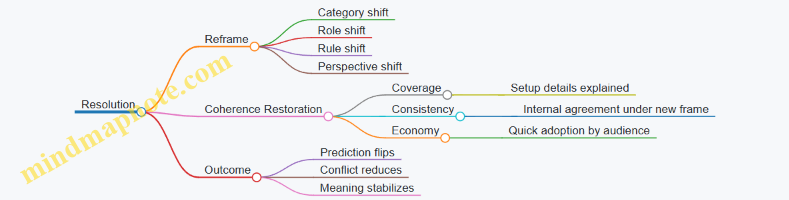
A Systematic Template You Can Apply to Any Joke
Use this sequence to keep your explanation tight and complete.
- Name the initial expectation: what the audience predicts.
- State the reframe: the new assumption that changes the interpretation.
- Show the mapping: how the punchline’s elements fit the new assumption.
- Confirm coherence: which constraints are restored (coverage, consistency, economy).
- Mention the prediction flip: the audience now expects the punchline to follow.
Example:
- Setup: “I tried to catch fog yesterday.”
- Punchline: “Mist.”
Initial expectation: catching fog should involve a physical action with a tangible result. Reframe: “catch” is treated as a wordplay target; the outcome is a pun on “mist.” Mapping: fog → mist; catch → the sound-alike resolution. Coherence restoration: coverage is satisfied because the setup’s fog term is directly reused; consistency holds because the joke’s “result” is linguistic, not physical; economy holds because the audience can adopt the wordplay frame immediately.
Common Failure Modes to Avoid
A resolution description is incomplete if it only says “the mind changes its mind.” Make it concrete.
- Vague reframe: “They interpret it differently.” Instead, specify category, role, rule, or perspective.
- No mapping: the punchline must be shown to fit the new frame.
- No coherence check: if coverage or consistency is missing, the explanation doesn’t justify why the audience would accept the resolution.
When you do Step 3 this way, you’re not just labeling the punchline as funny. You’re explaining the exact mental move that turns contradiction into understanding.
11.4 Step 4—Account for Surprise: Explain Why the Violation Feels Notable
Surprise is the feeling that something important has changed. In incongruity-based humor, that feeling is not random; it comes from a mismatch between what the mind expects and what it actually receives. Step 4 asks you to explain why the mismatch is noticeable enough to be processed as a “violation,” rather than just a minor oddity.
Start with the Expectation Baseline
Before you can justify surprise, you need to state what the audience was predicting. Expectations come from prior language patterns, typical roles, causal stories, and social norms. When the setup is clear, the baseline becomes stable, and the punchline has something to break.
Example: “I told my computer I needed more space, and it said…”
- Baseline: computers respond with storage-related actions.
- Surprise target: the response will not be storage-related in the usual way.
Explain the Prediction Error Signal
The mind treats the incoming information as evidence. If the evidence strongly contradicts the baseline, the system registers a prediction error. Surprise rises when the contradiction is both strong and immediate.
Example: “…it said, ‘Windows.’”
- The word “Windows” is a category shift: from storage to an interface feature.
- The shift is fast because the listener already committed to a storage frame.
A useful way to describe this in plain terms is: the punchline forces a re-evaluation at the exact moment you thought the story would continue normally.
Tie Surprise to Salience and Timing
Not all violations feel equally surprising. Two factors matter most.
- Salience: the violated element is prominent in the listener’s attention. If the punchline changes a key noun or verb, the mismatch is harder to ignore.
- Timing: the violation arrives at a point where the listener expects resolution or continuation. If the punchline appears right after a complete setup, the listener has already formed a strong prediction.
Example: “My friend said he’s great at math. I asked him to help me with my budget—he said he only works in decimals.”
- Salience: “works in decimals” reframes the skill.
- Timing: the request for budgeting makes the listener expect practical help.
Distinguish Surprise from Confusion
Surprise is about a sharp mismatch; confusion is about insufficient information. Humor needs surprise that can be resolved. If the audience cannot find a coherent reframe, the mismatch stays unresolved and becomes irritation.
Example of low humor: “I tried to bake a joke, but the oven refused.”
- Surprise exists, but the listener lacks a clear resolution path.
Example of higher humor: “I tried to bake a joke, but the oven refused to preheat—apparently it only runs on punchlines.”
- The listener can map “preheat” to “setup” and “punchlines” to “heat,” restoring coherence.
Show How Resolution Makes Surprise Pay Off
Step 4 should connect surprise to the later resolution described in Step 3. Surprise feels “worth it” when the reframe explains why the violation occurred.
Example: “He said he’d be on time. Then he showed up yesterday.”
- Surprise: “on time” conflicts with “yesterday.”
- Resolution: the phrase “on time” is interpreted as “at the correct time in the story,” not in real time.
The explanation should make clear that the punchline is not merely different; it is different in a way that supports a new interpretation.
Use a Mind Map to Keep the Logic Tight
Mind Map: Why the Violation Feels Notable
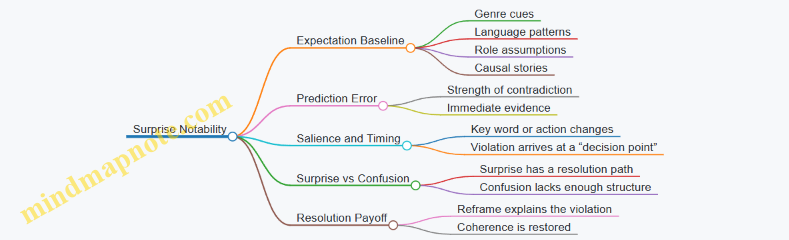
A Compact Example Walkthrough
Consider: “I asked the librarian if they had books on paranoia. She said, ‘They’re right where you left them.’”
- Baseline: paranoia books will be categorized and retrieved normally.
- Violation: “right where you left them” implies the listener’s mental state controls the location.
- Surprise: the punchline shifts from physical retrieval to a psychological interpretation at the moment the listener expects a straightforward answer.
- Resolution: the listener reframes the librarian’s statement as a joke about the mind’s tendency to assume patterns and blame oneself for “misplacing” certainty.
In Step 4, your goal is to state these links explicitly: what was expected, what contradicted it, why the contradiction was noticeable, and why the later reframe makes that notice feel like humor rather than noise.
11.5 Practical Example Walkthrough: Applying the Toolkit to a Short Set of Jokes
Below is a systematic walkthrough using the toolkit from this chapter. The goal is not to “rate” jokes, but to explain how a listener’s expectations are built, where they break, and how resolution restores coherence.
Toolkit Recap in One Pass
- Identify the expectation baseline: what the audience predicts will happen next.
- Locate the violation: the exact place where the prediction fails.
- Describe the resolution: the reframe that makes the new meaning coherent.
- Account for surprise: why the violation stands out given the baseline.
Short Set of Jokes
Joke A: “I told my computer I needed a break, and it said: ‘No problem—I’ll go to sleep.’”
Step 1: Expectation Baseline
You expect a human-like response that either refuses your request or jokes back without changing the “system.” The baseline includes a mental model: computers don’t “choose” to rest.
Step 2: Locate the Violation
The violation is agentive and pragmatic: the computer behaves like a cooperative agent with intent (“I’ll go to sleep”).
Step 3: Describe the Resolution
Resolution comes from a dual-model shift. One model treats the computer as an inanimate tool; the other treats it as a character speaking in metaphor. The punchline reframes “sleep” as a literal system state, not a personal decision.
Step 4: Account for Surprise
Surprise is moderate because the language cue (“it said”) already invites personification. The novelty is that the personification is grounded in a real computer action, so the reframe feels stable rather than random.
Joke B: “Why don’t scientists trust atoms? Because they make up everything.”
Step 1: Expectation Baseline
You predict a straightforward reason involving reliability, measurement error, or scientific skepticism. The baseline includes a mental model of atoms as physical units.
Step 2: Locate the Violation
The violation is semantic and category-based: “make up” shifts from “compose” (physical composition) to “invent” (fabricate).
Step 3: Describe the Resolution
Resolution is a word-meaning switch that preserves coherence. Once “make up” is interpreted as “fabricate,” the joke’s causal logic works: scientists distrust what “makes up everything.”
Step 4: Account for Surprise
Surprise comes from constraint relaxation on the phrase “make up.” The listener briefly commits to one meaning, then revises when the second meaning fits the punchline’s structure.
Joke C: “I used to hate facial hair. Then it grew on me.”
Step 1: Expectation Baseline
You expect a conventional emotional change explanation: “I changed my mind” or “I learned to like it.”
Step 2: Locate the Violation
The violation is causal and semantic: the phrase “grew on me” is treated as both figurative and literal. The mind model shifts from psychology to biology.
Step 3: Describe the Resolution
Resolution occurs when the listener maps the emotional idiom onto a physical process. The new interpretation makes the causal chain coherent: the hair literally grows, and the preference metaphorically “grows” too.
Step 4: Account for Surprise
Surprise is low-to-medium because the idiom “grew on me” is familiar. The punchline’s work is to tighten the metaphor into a literal reading without adding extra steps.
Mind Map: Toolkit Trace Across the Set
Integrated Takeaway: What Makes These Examples Work
Across the set, each punchline performs a specific kind of model repair. Joke A repairs the “agency” assumption by grounding personification in a real system behavior. Joke B repairs a “meaning” assumption by switching the phrase’s sense while keeping the causal structure intact. Joke C repairs a “figurative vs literal” assumption by aligning the idiom with a plausible physical event.
If you want to apply the toolkit quickly to any new joke, start by naming the baseline model in one sentence, then point to the smallest unit that breaks it (a word, a role, a causal link). Finally, state the resolution as a single reframe that would let the listener say, “Oh, that’s what it meant.”
12. Applied Practice: Building and Revising Humor with Cognitive Constraints
12.1 Designing Setups Establishing Clear Predictive Cues Without Over-Explaining
A setup’s job is to give the audience enough structure to predict what comes next. In incongruity terms, you want a stable expectation baseline so the punchline can violate it cleanly. The trick is to supply cues that are specific enough to constrain interpretation, but not so detailed that the audience can pre-solve the joke.
Predictive Cues as Constraints, Not Explanations
Start by deciding what kind of prediction you want the audience to form: a category prediction (what thing is this?), a role prediction (who is doing what?), or a causal prediction (what outcome follows?). Then embed cues that make those predictions feel natural.
For example, if you want a category prediction, you can name the category early. “The doctor handed me a prescription” primes “medical context.” If you want a causal prediction, you can show a cause-like action. “I pressed the elevator button” primes “elevator will respond.” In both cases, you’re not teaching; you’re constraining.
Over-explaining happens when you add cues that remove uncertainty too early. If you say, “The elevator is broken, but I didn’t know that yet,” you’ve already done the work the audience would otherwise do. The setup becomes a summary, not a prediction.
The Three-Layer Setup Pattern
Use three layers that can be mixed and matched.
- Surface layer: concrete, immediate details the audience can parse quickly.
- Role layer: who is acting, what their typical job is, and what the audience should assume about their goals.
- Rule layer: one simple rule about how this situation usually behaves.
A good setup often contains all three, but the rule layer should be implicit. “The barista handed me a cup” gives surface and role. The usual rule—“a cup contains coffee”—is left for the audience to infer.
Cue Selection: Specificity with Breathing Room
Choose cues that are diagnostic. Diagnostic cues are those that strongly narrow the space of interpretations.
- High-diagnostic cues: named roles (“barista,” “judge,” “lifeguard”), clear objects (“receipt,” “lifeboat”), and standard actions (“sign the form,” “check the temperature”).
- Low-diagnostic cues: vague descriptors (“a guy,” “some stuff,” “weird situation”) that don’t constrain much.
Breathing room means you allow at least one plausible alternative interpretation to survive until the punchline. If every detail points to a single outcome, the violation won’t feel like a violation; it will feel like a twist with no cognitive payoff.
Timing: When the Audience Gets to Predict
A setup should arrive in a rhythm that gives the audience time to form a prediction before the violation. If the punchline comes too fast, the audience hasn’t built the baseline. If it comes too late, the audience may revise their expectations repeatedly and the final violation loses impact.
A practical rule: keep the setup to one or two sentences that establish the baseline, then let the punchline arrive as the first moment where the baseline fails.
Mind Map: Setup Design for Predictive Cues
Example: Category Incongruity Without Over-Explaining
Setup: “The lifeguard blew the whistle and pointed at my towel.”
Baseline prediction: “Someone is in danger; the lifeguard is enforcing pool rules.”
Punchline (violation): “Turns out it wasn’t a rescue. It was a parking ticket.”
Why the setup works: “lifeguard,” “whistle,” and “pointed” are diagnostic cues. They constrain the audience to safety enforcement. The punchline then violates the rule layer by switching domains from water safety to parking enforcement.
If you over-explain, it might become: “The lifeguard was actually ticketing towels because the pool had a strict parking policy.” That removes the audience’s prediction work, so the violation feels less surprising.
Example: Causal Incongruity with a Single Implicit Rule
Setup: “I followed the instructions on the box exactly.”
Baseline prediction: “Following instructions causes the intended result.”
Punchline (violation): “Now the box is empty, and the instructions are gone.”
The setup is minimal, but it still establishes a rule layer: instructions lead to a stable outcome. The punchline violates that causal expectation with a concrete, observable consequence.
To keep breathing room, the setup avoids specifying what the product is. If you name it and explain the mechanism, the audience can predict the exact failure mode.
A Quick Checklist for Revision
When revising a setup, ask:
- What prediction does the audience form after the first sentence?
- Which cues are doing the constraining work?
- What would happen if you removed one extra detail—does the baseline still hold?
- Does the punchline arrive at the first clear failure of the baseline?
Good setups don’t explain the joke; they set up the audience’s mind so the punchline can do the explaining by contradiction.
12.2 Crafting Punchlines: Choosing the Right Violation for the Intended Resolution
A punchline is not just a surprise. In incongruity theory terms, it is a controlled expectation violation that points to a specific resolution path. Your job is to pick the violation type that can be resolved with the mental model you want the audience to adopt.
Start with the Resolution You Want
Before writing the last line, decide what “getting it” should mean. Do you want the audience to reframe the situation as a misunderstanding, as a rule-breaking exception, as a category shift, or as a reversal of intent? Each resolution style prefers certain violation types.
- Reframe as misunderstanding tends to work with semantic or pragmatic incongruity.
- Reframe as rule exception often uses structural or causal incongruity.
- Reframe as category shift usually benefits from semantic category errors.
- Reframe as intent reversal commonly uses pragmatic incongruity.
A practical way to lock this in is to write a one-sentence “resolution statement” in plain language, like: “The speaker isn’t lying; they’re using a different definition of the term.” Then craft the punchline so the violation forces that exact statement.
Match Violation Type to Mental Model Switching
Mental models are the audience’s working assumptions about what is happening and what counts as normal. A punchline should break one assumption while leaving enough structure intact for the audience to switch models quickly.
Use this mapping as a checklist:
-
Semantic Incongruity: Break meaning by swapping definitions, categories, or roles.
- Example: “I told my computer I needed a break. Now it won’t stop sending me vacation notifications.”
- Intended resolution: The “break” is interpreted literally by the system.
-
Syntactic and Structural Incongruity: Break form so the audience misparses, then corrects.
- Example: “Time flies like an arrow. Fruit flies like a banana.”
- Intended resolution: “flies” changes from a verb about motion to a noun about insects.
-
Pragmatic Incongruity: Break assumptions about intent, politeness, or conversational goals.
- Example: “Nice job explaining that. I’m still confused, but at least it’s confident.”
- Intended resolution: The compliment is reinterpreted as criticism.
-
Agentive and Causal Incongruity: Break expectations about who causes what.
- Example: “I asked the barista for oat milk. They gave me a plant-based apology.”
- Intended resolution: The cause-effect chain is treated as metaphorical rather than literal.
The key is restraint: choose one dominant violation. If you stack multiple violations, the audience may not know which resolution statement to aim for.
Control the “Distance” Between Setup and Violation
Not all violations are equally reachable. A punchline can be surprising because it is far from the setup, but it can also be frustrating if the audience cannot connect it to any plausible resolution.
A simple test: after you draft the punchline, ask what the audience would think the punchline “means” in the first second. If that first interpretation cannot be corrected into your intended resolution without extra explanation, the violation is too distant.
-
Good distance: The punchline forces a quick reinterpretation.
- Example: “I’m reading a book on anti-gravity. It’s impossible to put down.”
- Resolution: “Put down” is reinterpreted under the anti-gravity premise.
-
Too far: The punchline introduces a new domain that the setup never invited.
- Example: A joke about office life ending with a sudden space-biology lecture, with no bridging cue.
Use Constraint Relaxation to Make Resolution Feel Earned
Even when the violation is strong, you can help the audience land the resolution by relaxing constraints in a controlled way. The setup provides constraints; the punchline relaxes one of them.
- If the setup implies literal interpretation, the punchline can relax it into metaphor.
- If the setup implies a strict rule, the punchline can relax it into a loophole.
- If the setup implies a stable category, the punchline can relax it into a different classification.
Example: “My therapist says I should stop living in the past. So I moved my memories into a storage unit.”
- Resolution: The “stop living” advice is treated as an actionable physical instruction.
Mind Map: Violation Choice for Intended Resolution
A Compact Revision Workflow
- Write the resolution statement in one sentence.
- Identify the mental model assumption that must break to reach it.
- Pick the violation type that breaks that assumption most directly.
- Ensure the punchline relaxes one constraint, not several.
- Predict the audience’s first interpretation and confirm it can be corrected to your resolution without extra explanation.
This approach keeps punchlines from becoming random surprises. The violation is chosen to force a specific, coherent reinterpretation, so the laughter comes from understanding rather than guessing.
12.3 Controlling Timing and Information: Managing Processing Load and Clarity
A good punchline is not just a clever violation; it is a violation that arrives when the audience is ready to process it. Timing controls when the mind commits to an interpretation. Information control controls how many competing interpretations the mind must juggle before the punchline arrives. Together, they manage processing load and clarity.
The Core Idea: Prediction Budget
When people read or listen, they continuously predict what comes next. Each new word or beat either confirms the current prediction or forces a revision. If revisions happen too often, the audience spends effort on comprehension rather than on the “aha” moment. If revisions happen too late, the punchline feels like a non sequitur.
A practical way to think about this is a prediction budget: the audience can handle a limited number of expectation updates before the joke’s resolution arrives. Your job is to spend that budget wisely.
Timing as Beat Placement
Most jokes unfold in beats: setup information, a narrowing cue, and the punchline. Timing is about spacing those beats so the audience’s prediction stabilizes.
- Early clarity, late surprise: Give enough structure early that the audience forms a strong expectation. Then violate it at the last beat.
- Late clarity, early surprise: If the violation appears before the audience has enough structure, they may not know what expectation was violated.
- Overstuffed setup: If you add too many details before the punchline, the audience may form multiple plausible expectations, reducing the impact of the final one.
Example: “I tried to catch fog yesterday. Mist.”
The setup is minimal, but the phrase “catch fog” is already a clear, category-bending expectation. The punchline arrives immediately, so the mind does not need to revise repeatedly.
Information Control as Constraint Design
Information is not just quantity; it is constraint. Constraints reduce the number of interpretations the audience must consider.
Use three constraint types:
- Category constraints: Tell the audience what kind of thing is being discussed.
- Role constraints: Tell the audience who is acting and what roles are available.
- Causal constraints: Tell the audience what kinds of cause-effect relationships are plausible.
When constraints are strong, the audience can commit to a model. When the punchline violates one constraint, the resolution can be crisp.
Example: “My therapist says I have a fear of commitment. I told her I’m not ready to decide.”
The joke relies on role and causal constraints: therapy implies discussion, and “not ready” implies delay. The punchline reframes “commitment” from emotional partnership to decision-making, restoring coherence.
Managing Processing Load with a Simple Checklist
Before finalizing a joke, run this checklist in order:
- Can the audience predict a direction before the punchline? If not, add a narrowing cue.
- Does the setup force one dominant model? If multiple models fit, remove or simplify details.
- Does the punchline require heavy re-parsing? If yes, clarify grammar or reduce ambiguity.
- Is the violation located at the last beat? If the violation happens earlier, the audience may feel confused rather than surprised.
- Does the resolution explain the violation without introducing new puzzles? If the resolution adds extra unknowns, the audience’s budget is spent.
Mind Map: Timing and Information Controls
Worked Example: Two Versions of the Same Idea
Version A (clear timing):
“I told my computer I needed a break. It said, ‘No problem—I’ll go to sleep.’”
The setup establishes a conversation with a computer. The punchline uses a role constraint (computer responds) and a causal constraint (sleep as a break). The audience can predict a playful response, then the exact mechanism lands as the surprise.
Version B (heavy load):
“I told my computer I needed a break. It said it understood, but then it started talking about power management, and I realized it was going to sleep.”
This version adds extra beats and details before the punchline. The audience must track more steps and may stop treating the moment as a single expectation violation. The resolution becomes explanatory rather than revelatory.
Practical Rule of Thumb
Aim for a setup that is specific enough to guide prediction, but lean enough that the punchline can be processed as a single reframe. If you feel the audience needs to “work” to understand the setup, you have already spent the budget that should be reserved for the resolution.
12.4 Testing for Comprehension: Using Audience Feedback to Verify Resolution Paths
A joke’s resolution path is the route from “what I expected” to “what I now believe.” Testing for comprehension means checking whether your audience travels that route without getting stuck, detouring into the wrong interpretation, or giving up. The goal is not to make everyone laugh on demand; it’s to verify that the cognitive steps you designed are actually available to real listeners.
Start with a Clear Resolution Claim
Before you test, write a one-sentence claim of what the audience should conclude after the punchline. Example: “The character isn’t incompetent; the narrator is using a misleading definition.” This claim becomes your scoring key. If feedback contradicts it, you know the issue is in the resolution mechanism, not in delivery.
Choose a Testing Format That Reveals Interpretation
Use short, controlled exposures so you can compare responses across versions.
- Single-pass comprehension check: Ask listeners what they think the punchline means.
- Two-choice interpretation: Provide two plausible meanings and ask which fits.
- Confidence rating: Ask how sure they are, then ask why.
These formats expose whether the audience reached your intended reframe or settled for a partial one.
Collect Feedback That Maps to Cognitive Stages
Feedback is useful when it points to a stage.
- Expectation stage: “What did you think would happen?”
- Violation stage: “Where did it stop matching your expectation?”
- Resolution stage: “What changed in your mind?”
- Coherence stage: “What detail made it click?”
If someone says, “I didn’t know what to expect,” your setup cues were too weak. If they say, “I saw the mismatch, but I couldn’t find the new frame,” your resolution cues were under-specified.
Use a Simple Feedback Coding Sheet
After each test, code responses into categories. This turns anecdotes into patterns.
| Response Signal | Likely Problem | Fix Direction |
|---|---|---|
| “I expected X, but got Y” | Setup baseline mismatch | Adjust cues or framing |
| “I didn’t get the violation” | Incongruity not salient | Make the break clearer |
| “I got it, but not the point” | Wrong resolution frame | Re-anchor the reframe |
| “It was funny, but confusing” | Resolution too slow or costly | Reduce competing interpretations |
| “I never found a meaning” | No coherent payoff | Add a constraint that guides interpretation |
Mind Map: Feedback to Resolution Path Verification
Example: Two Versions of the Same Joke
Version A: “I told my friend I was reading a book about anti-gravity. He said, ‘So you’re going to be a little above it all?’”
Version B: “I told my friend I was reading a book about anti-gravity. He said, ‘So you’re going to be above the rules now?’”
Test with a two-choice question:
- Meaning 1: “The friend jokes about being ‘above’ something figuratively.”
- Meaning 2: “The friend jokes about literal physics.”
If many listeners pick Meaning 2, your resolution path is drifting toward literal interpretation. The fix is to strengthen the figurative anchor in the punchline or setup. If listeners pick Meaning 1 but report low confidence, you likely need one more cue that signals the intended metaphor.
Example: Diagnosing a “Funny but Confusing” Outcome
Suppose feedback says, “I laughed, but I couldn’t explain it.” That often means the audience found a partial mismatch but couldn’t complete the resolution. Ask the coherence trigger question: “Which detail made it click?”
If they cite a detail that isn’t in your intended reframe, you may have accidentally created an alternative resolution path. Remove or soften the competing cue, or reposition the punchline so the intended reframe becomes the most coherent option.
Iterate with Controlled Changes
Change one variable at a time.
- If the issue is expectation baseline, revise setup wording.
- If the issue is violation salience, revise the punchline’s clarity or specificity.
- If the issue is resolution frame, add a small anchor that links the violation to the new interpretation.
After each iteration, repeat the same questions so you can attribute improvement to the change rather than to chance.
Close the Loop with a Resolution Checklist
When a version passes, confirm it meets these checks:
- Listeners can state the intended meaning.
- They can identify where the mismatch occurred.
- They can name the detail that restored coherence.
- Their confidence is reasonably consistent across listeners.
When these conditions hold, you’ve verified that your audience can follow the resolution path you designed, not just that the joke produced a momentary reaction.
12.5 Practical Example Walkthrough: Iteratively Rewriting a Joke to Improve Incongruity Resolution
Start with a simple goal: the audience should predict something reasonable, then hit a violation that is surprising but still resolvable. Iteration is how you control that balance.
Step 0: Choose a Baseline Joke and Mark Its Failure
Draft A:
“Why did the spreadsheet cross the road? To get to the other sheet.”
This one is already clean, so we’ll make it worse on purpose to see what to fix.
Draft B:
“Why did the spreadsheet cross the road? To get to the other sheet, probably.”
What breaks: the added “probably” weakens the resolution. The audience still gets the pun, but the extra hedging reduces certainty, which makes the punchline feel less like a completed interpretation.
Step 1: Identify the Expectation Baseline
Baseline expectation: a classic question-answer joke with a crisp punchline. The audience expects the second sentence to complete the first.
Practice: underline the “completion slot.” In Draft B, the completion slot is the pun itself. “Probably” inserts an extra layer that doesn’t contribute to the pun’s coherence.
Rewrite Draft C:
“Why did the spreadsheet cross the road? To get to the other sheet.”
Result: resolution becomes immediate because the punchline is the only job the second sentence needs to do.
Step 2: Locate the Incongruity and Its Resolution Path
Incongruity type: semantic. “Sheet” has two meanings: a physical sheet and a spreadsheet worksheet.
Resolution path: audience maps “other sheet” to “other worksheet.”
Practice: ensure the punchline contains the exact lexical trigger that supports the mapping. If the trigger is missing or diluted, the mind has to guess.
Try Draft D:
“Why did the spreadsheet cross the road? For the other one.”
Now the trigger is gone. “Other one” forces the audience to infer “sheet,” which increases processing load and delays resolution.
Rewrite Draft E:
“Why did the spreadsheet cross the road? For the other sheet.”
Result: the trigger returns, and the resolution path shortens.
Step 3: Control Surprise Without Adding Noise
Surprise should come from the violation, not from uncertainty about the violation.
Draft F:
“Why did the spreadsheet cross the road? To reach the other sheet, assuming it’s allowed.”
Problem: “assuming it’s allowed” introduces a new expectation about rules and permission. That creates a second incongruity that the joke doesn’t resolve.
Rewrite Draft G:
“Why did the spreadsheet cross the road? To reach the other sheet.”
Result: the only violation is the pun, and the only resolution is the worksheet mapping.
Step 4: Add a Second Beat Only if It Still Resolves
Sometimes you want a more cognitive “click,” where the audience reinterprets the setup. Add a beat that strengthens the baseline rather than complicating it.
Draft H:
“Why did the spreadsheet cross the road? It wanted to visit the other sheet—same format, different tab.”
This adds clarity: “tab” points to the worksheet concept. The resolution becomes more explicit, and the audience doesn’t have to do as much inference.
Trade-off: too much explanation can reduce surprise. Here, the explanation is tightly coupled to the pun.
Step 5: Use a Mind Map to Keep Iterations Coherent
Step 6: Finalize the Best Version and Justify It
Best candidate from the sequence:
“Why did the spreadsheet cross the road? To reach the other sheet.”
Why it works: the setup primes a completion, the punchline contains the exact lexical trigger, and the resolution path is short. Every removed word in Draft C/G/F either reduced certainty or introduced a competing interpretation that the joke didn’t pay off.
If you want a slightly richer version without losing resolution speed, use Draft H:
“Why did the spreadsheet cross the road? It wanted to visit the other sheet—same format, different tab.”
The extra phrase doesn’t create a new incongruity; it strengthens the same mapping, so the audience still lands on the intended resolution.