Low Carbon Building Materials and Circular Construction Supply Chains
1. Introduction to Low Carbon Building Materials
1.1 Understanding Carbon Footprint in Construction Materials
The carbon footprint of construction materials refers to the total amount of greenhouse gas (GHG) emissions, primarily carbon dioxide (CO2), associated with the extraction, processing, manufacturing, transportation, installation, maintenance, and disposal of these materials throughout their life cycle. Understanding this footprint is essential for product developers and industry strategists aiming to reduce environmental impacts and promote sustainable construction practices.
What Contributes to the Carbon Footprint?
Each stage contributes differently depending on the material type and supply chain efficiency.
Key Terms to Know
- Embodied Carbon: Total GHG emissions from all processes associated with a material’s life cycle, excluding operational energy.
- Operational Carbon: Emissions related to the use phase of a building (heating, cooling, lighting).
- Life Cycle Assessment (LCA): A method to evaluate environmental impacts across the entire life cycle of a product.
Examples of Carbon Footprint in Common Materials
| Material | Typical Embodied Carbon (kg CO2e per ton) | Notes |
|---|---|---|
| Portland Cement | 800 - 1000 | High due to calcination and energy use |
| Steel | 1500 - 2000 | Energy-intensive production and mining |
| Timber | 10 - 50 | Can be carbon negative if sustainably sourced |
| Recycled Concrete | 100 - 300 | Lower footprint due to reuse of aggregates |
Example:
- A cubic meter of traditional concrete can emit approximately 300-400 kg CO2e, whereas using geopolymer concrete can reduce this by up to 70%.
Why Understanding Carbon Footprint Matters
- Informed Material Selection: Choosing materials with lower embodied carbon reduces overall building emissions.
- Regulatory Compliance: Many regions require carbon reporting and reduction targets.
- Market Differentiation: Low carbon materials appeal to environmentally conscious clients.
Mind Map: Benefits of Reducing Carbon Footprint in Materials
Practical Example: Comparing Two Wall Systems
-
Wall A: Traditional concrete block wall
- Embodied Carbon: ~250 kg CO2e/m2
- Source: Conventional cement and aggregates
-
Wall B: Hempcrete wall
- Embodied Carbon: ~50 kg CO2e/m2
- Source: Bio-based, carbon-sequestering material
Outcome: Choosing Wall B reduces embodied carbon by 80%, demonstrating the impact of material choice.
Summary
Understanding the carbon footprint of construction materials is a foundational step toward sustainable building. By mapping emissions across the supply chain and comparing material options, product developers and strategists can make impactful decisions that align with circular construction principles and low carbon goals.
1.2 Overview of Low Carbon Materials: Definitions and Classifications
What Are Low Carbon Building Materials?
Low carbon building materials are those that have a significantly reduced carbon footprint compared to conventional materials. This reduction is measured primarily by the embodied carbon — the total greenhouse gas emissions associated with the extraction, processing, manufacturing, transportation, and installation of materials.
Key aspects include:
- Use of renewable or recycled content
- Reduced energy consumption in production
- Longer lifespan and recyclability
Classification of Low Carbon Materials
Low carbon materials can be broadly classified based on their origin, processing, and environmental impact:
Natural and Bio-Based Materials
These materials are sourced from renewable biological resources and typically require less energy to produce.
- Hempcrete: A mixture of hemp hurds and lime, offering excellent insulation and carbon sequestration.
- Bamboo: Fast-growing grass with high strength-to-weight ratio, used structurally and decoratively.
- Straw Bale: Agricultural byproduct used for insulation and wall construction.
- Rammed Earth: Compacted soil walls with low embodied carbon and thermal mass benefits.
Example: The Hemp House in France uses hempcrete walls that absorb CO2 during curing, reducing overall carbon footprint.
Recycled and Reclaimed Materials
Utilizing waste or byproducts reduces the need for virgin material extraction and lowers emissions.
- Recycled Steel: Steel scrap melted and reformed, saving up to 75% of energy compared to new steel.
- Reclaimed Wood: Salvaged timber reused in flooring, framing, or finishes.
- Recycled Concrete Aggregate: Crushed concrete reused as aggregate in new concrete mixes.
Example: The Bullitt Center in Seattle incorporates reclaimed wood and recycled steel, significantly cutting embodied carbon.
Innovative Low Carbon Alternatives
These materials leverage new technologies or biological processes to reduce carbon emissions.
- Geopolymer Concrete: Uses industrial byproducts like fly ash or slag, reducing cement content by up to 80%.
- Mycelium-based Composites: Grown fungal materials used as insulation or packaging, fully biodegradable.
- CarbonCure Concrete: Injects captured CO2 into concrete during mixing, permanently storing it.
Example: CarbonCure technology is used in multiple commercial projects to reduce concrete carbon footprint without compromising strength.
Low Carbon Cement and Concrete Technologies
Cement production is a major source of CO2 emissions; alternatives focus on reducing clinker content or using novel chemistries.
- Blended Cements: Incorporate supplementary cementitious materials (SCMs) like fly ash or slag.
- Alkali-activated Materials: Cement-free binders activated by alkaline solutions.
- Limestone Calcined Clay Cement (LC3): Combines limestone and calcined clay to reduce clinker by up to 50%.
Example: The LC3 project in India demonstrates up to 30% reduction in embodied carbon with comparable performance.
Summary Mind Map
Why Classify?
Understanding these classifications helps product developers and strategists:
- Identify suitable materials for specific applications
- Evaluate environmental impacts effectively
- Innovate with emerging materials and technologies
By integrating these materials thoughtfully, the construction industry can make significant strides toward decarbonization and circularity.
1.3 Importance of Material Selection in Sustainable Construction
Material selection is a cornerstone of sustainable construction, influencing the environmental, economic, and social impacts of a building throughout its lifecycle. Choosing the right materials not only reduces the carbon footprint but also enhances durability, occupant health, and resource efficiency.
Why Material Selection Matters
- Embodied Carbon Reduction: Materials contribute significantly to a building’s embodied carbon — the total greenhouse gas emissions from extraction, processing, transportation, and installation.
- Resource Efficiency: Selecting renewable, recycled, or locally sourced materials reduces depletion of virgin resources and minimizes transportation emissions.
- Waste Minimization: Durable and reusable materials help reduce construction and demolition waste.
- Indoor Environmental Quality: Non-toxic, breathable materials improve occupant health and comfort.
- Economic Benefits: Long-lasting materials reduce maintenance costs and increase building value.
Mind Map: Key Factors in Material Selection for Sustainable Construction
Best Practice Example: Using Hempcrete for Wall Construction
Hempcrete is a bio-based material made from hemp hurds and lime. It offers low embodied carbon, excellent thermal insulation, and is breathable, reducing moisture buildup.
- Environmental Impact: Hemp absorbs CO2 as it grows, offsetting emissions.
- Performance: Provides natural insulation and humidity regulation.
- Economic: Lightweight, reducing structural costs.
This example illustrates how selecting a low carbon, bio-based material can improve sustainability without compromising performance.
Mind Map: Benefits of Bio-Based Materials
Example: Recycled Steel in Structural Frames
Steel is highly recyclable, and using recycled steel significantly reduces embodied carbon compared to virgin steel.
- Environmental: Recycling steel saves up to 75% of energy compared to new production.
- Economic: Often cost-competitive due to lower energy input.
- Supply Chain: Widely available, supporting circular economy.
This demonstrates how material selection aligned with circular principles can reduce environmental impact and support sustainable supply chains.
Mind Map: Circular Principles in Material Selection
Summary
Material selection is a strategic decision that shapes the sustainability profile of construction projects. By integrating environmental, performance, health, and economic factors — and leveraging circular economy principles — product developers and industry strategists can drive meaningful reductions in carbon emissions and resource use.
Additional Example: Locally Sourced Rammed Earth
Rammed earth uses compacted soil to form walls, offering thermal mass and low embodied carbon when sourced locally.
- Environmental: Minimal processing and transportation emissions.
- Performance: Excellent thermal regulation.
- Economic: Low material cost and reduced transportation.
This example highlights the importance of considering local availability in material selection to maximize sustainability benefits.
1.4 Case Study: Embodied Carbon Reduction in Residential Buildings
Introduction
Embodied carbon refers to the total greenhouse gas emissions generated throughout the lifecycle of building materials—from extraction, manufacturing, transportation, construction, maintenance, to disposal or recycling. Residential buildings, being a significant portion of the built environment, offer a substantial opportunity to reduce embodied carbon through thoughtful material selection and construction practices.
This case study explores practical strategies and real-world examples of embodied carbon reduction in residential buildings, highlighting best practices and measurable outcomes.
Mind Map: Key Strategies for Embodied Carbon Reduction in Residential Buildings
Example 1: Timber-Frame Residential Development in British Columbia, Canada
Project Overview:
- Location: Vancouver
- Building Type: Multi-family residential
- Size: 50 units
Embodied Carbon Reduction Strategies:
- Primary structure built using Cross-Laminated Timber (CLT), reducing embodied carbon by approximately 40% compared to traditional concrete and steel.
- Use of FSC-certified local timber to minimize transportation emissions.
- Incorporation of recycled steel for connectors and fasteners.
- Bio-based insulation materials such as cellulose and hempcrete used for thermal performance.
Outcomes:
- Embodied carbon reduced by 35-45% compared to conventional builds.
- Faster construction time due to prefabricated CLT panels, reducing on-site emissions.
- Positive community reception and increased market value due to sustainable features.
Mind Map: Embodied Carbon Reduction Through Material Selection
Example 2: Low Carbon Concrete in a Residential Retrofit, Netherlands
Project Overview:
- Location: Amsterdam
- Building Type: Residential retrofit
- Size: Single-family home
Embodied Carbon Reduction Strategies:
- Replacement of traditional Portland cement concrete with geopolymer concrete containing industrial by-products (fly ash and slag), reducing cement-related emissions by up to 70%.
- Use of recycled aggregates from demolition waste.
- Design modifications to reduce concrete volume without compromising structural integrity.
Outcomes:
- Embodied carbon footprint of concrete reduced by approximately 60%.
- Extended building lifespan through retrofit, avoiding new construction emissions.
- Demonstrated feasibility of low carbon concrete in small-scale residential projects.
Mind Map: Design and Construction Practices for Embodied Carbon Reduction
Example 3: Modular Prefabricated Housing in Sweden
Project Overview:
- Location: Stockholm
- Building Type: Modular residential units
- Size: 30 units
Embodied Carbon Reduction Strategies:
- Use of prefabricated timber modules manufactured in controlled factory environments, minimizing waste and improving precision.
- Design for disassembly enabling reuse of modules and materials at end-of-life.
- Integration of recycled steel and low carbon insulation materials.
Outcomes:
- Embodied carbon reduced by 30-50% compared to traditional on-site construction.
- Significant reduction in construction waste (up to 90%).
- Reduced construction time and disruption in urban areas.
Best Practice Highlight: Early Integration of Life Cycle Assessment (LCA)
- Conduct LCA during the design phase to identify high-impact materials and processes.
- Use LCA tools such as Tally, One Click LCA, or Athena Impact Estimator.
- Iterate design choices based on LCA feedback to optimize embodied carbon reduction.
Summary
Reducing embodied carbon in residential buildings requires a holistic approach combining low carbon material selection, innovative design, efficient construction practices, and supply chain collaboration. The examples above demonstrate that significant reductions are achievable through:
- Using renewable and recycled materials,
- Prefabrication and modular construction,
- Design for disassembly and reuse,
- Early and continuous application of LCA.
These strategies not only reduce environmental impact but can also improve project economics and occupant satisfaction, making them essential considerations for product developers and industry strategists aiming to lead in sustainable construction.
1.5 Best Practice: Life Cycle Assessment (LCA) for Material Evaluation
Life Cycle Assessment (LCA) is a systematic method used to evaluate the environmental impacts associated with all stages of a product’s life, from raw material extraction through processing, manufacturing, distribution, use, repair and maintenance, and disposal or recycling. In the context of low carbon building materials, LCA helps product developers and industry strategists make informed decisions that minimize carbon footprints and promote sustainability.
What is LCA?
- Goal and Scope Definition: Define the purpose, system boundaries, and functional unit.
- Inventory Analysis: Collect data on energy, material inputs, and emissions.
- Impact Assessment: Evaluate potential environmental impacts (e.g., global warming potential).
- Interpretation: Analyze results to support decision-making.
Mind Map: Life Cycle Assessment Process
Why Use LCA for Building Materials?
- Quantifies embodied carbon and other environmental impacts.
- Identifies hotspots in the supply chain for improvement.
- Supports certification and compliance with green building standards.
- Enables comparison between traditional and innovative materials.
Example 1: Comparing Concrete Types Using LCA
A product developer compares traditional Portland cement concrete with geopolymer concrete:
- Functional Unit: 1 cubic meter of concrete.
- Findings: Geopolymer concrete reduces embodied carbon by up to 60% due to lower clinker content.
- Outcome: Decision to develop and promote geopolymer-based products for sustainable construction.
Mind Map: LCA Example - Concrete Comparison
Example 2: Evaluating Recycled Steel vs. Virgin Steel
- Scope: Steel beams used in commercial buildings.
- LCA Results: Recycled steel reduces energy use and carbon emissions by approximately 50% compared to virgin steel.
- Best Practice: Prioritize recycled content in procurement specifications.
Integrating LCA into Product Development
- Use LCA software tools (e.g., SimaPro, GaBi, OpenLCA) early in design.
- Collaborate with suppliers to obtain accurate inventory data.
- Incorporate LCA findings into marketing and certification documentation.
Mind Map: Integrating LCA into Product Development
Tips for Effective LCA Implementation
- Define clear and consistent system boundaries.
- Use region-specific data to improve accuracy.
- Consider both embodied and operational impacts.
- Update assessments as new data or materials become available.
Summary
Life Cycle Assessment is an essential best practice for evaluating and selecting low carbon building materials. By understanding the full environmental impact of materials, product developers and industry strategists can drive innovation, reduce carbon footprints, and support circular construction supply chains effectively.
2. Types of Low Carbon Building Materials
2.1 Natural and Bio-Based Materials: Hempcrete, Straw Bale, and Bamboo
Natural and bio-based materials are gaining significant attention in sustainable construction due to their low embodied carbon, renewability, and ability to sequester carbon during growth. This section explores three prominent materials: hempcrete, straw bale, and bamboo, highlighting their properties, applications, benefits, and real-world examples.
Hempcrete
Overview: Hempcrete is a bio-composite material made from the woody core of the hemp plant (called hurds) mixed with a lime-based binder. It is lightweight, breathable, and provides excellent thermal insulation.
Key Benefits:
- Carbon sequestration: Hemp absorbs CO2 during growth.
- Thermal insulation reduces energy demand.
- Mold-resistant and breathable, improving indoor air quality.
- Lightweight, reducing structural load.
Applications: Wall infill, insulation panels, and non-load-bearing walls.
Example: The University of Bath in the UK constructed a hempcrete house demonstrating energy efficiency and carbon-negative potential.
Best Practice: Use locally sourced hemp to minimize transport emissions and optimize binder ratios for durability.
Straw Bale
Overview: Straw bale construction uses compacted straw bales as structural or infill components. Straw is an agricultural byproduct, making it a low-cost, renewable resource.
Key Benefits:
- Excellent insulation properties (R-values up to 30+).
- Low embodied energy and carbon footprint.
- Fire-resistant when properly plastered.
- Utilizes agricultural waste, reducing landfill.
Applications: Load-bearing walls or infill within timber frames.
Example: The Nebraska Straw Bale House project showcases straw bale’s viability in cold climates with proper design.
Best Practice: Protect straw from moisture using breathable plaster and raised foundations to prevent rot.
Bamboo
Overview: Bamboo is a fast-growing grass with a high strength-to-weight ratio, making it ideal for structural and decorative uses.
Key Benefits:
- Rapid renewability (some species grow up to 1 meter per day).
- High tensile strength comparable to steel.
- Sequesters carbon during growth.
- Versatile: used in framing, flooring, and finishes.
Applications: Structural frames, scaffolding, flooring, and paneling.
Example: The Green School in Bali uses bamboo extensively for its classrooms and pavilions, demonstrating durability and aesthetic appeal.
Best Practice: Treat bamboo to prevent insect attack and moisture damage; design connections to accommodate natural material movement.
Mind Maps
Mind Map 1: Natural and Bio-Based Materials Overview
Mind Map 2: Benefits and Challenges
Mind Map 3: Best Practices for Use
Integrated Example: Eco-Friendly Community Center
A community center in Oregon utilized hempcrete for wall insulation, straw bale for non-load-bearing walls, and bamboo for interior finishes and furniture. This combination leveraged the strengths of each material: hempcrete’s insulation and carbon sequestration, straw bale’s cost-effectiveness and thermal performance, and bamboo’s aesthetic and structural versatility. The project reduced embodied carbon by 40% compared to conventional materials and achieved LEED Gold certification.
Summary
Natural and bio-based materials like hempcrete, straw bale, and bamboo offer practical, low carbon alternatives for sustainable construction. Their successful application depends on understanding their properties, addressing challenges through best practices, and integrating them thoughtfully into design and supply chains. These materials not only reduce environmental impact but also promote healthier indoor environments and support circular economy principles.
2.2 Recycled and Reclaimed Materials: Concrete, Steel, and Wood
Recycled and reclaimed materials play a pivotal role in reducing the carbon footprint of construction projects by minimizing the need for virgin resources and diverting waste from landfills. This section explores the use of recycled and reclaimed concrete, steel, and wood, highlighting best practices and real-world examples to demonstrate their practical applications.
Recycled Concrete
Recycled concrete is produced by crushing demolished concrete structures and reusing the aggregate in new concrete mixes or as base material for roads and foundations. This practice significantly reduces the demand for natural aggregates and lowers embodied carbon.
Best Practices:
- Use recycled concrete aggregate (RCA) in non-structural applications such as road bases and landscaping.
- Incorporate RCA in structural concrete with proper quality control to ensure strength and durability.
- Employ advanced sorting and crushing technologies to improve the quality of recycled aggregates.
Example:
- The Bullitt Center in Seattle incorporated recycled concrete aggregates in its foundation, reducing virgin material use by 40%.
Mind Map: Recycled Concrete Applications
Recycled Steel
Steel is one of the most recycled materials globally, with recycled steel requiring up to 75% less energy to produce than virgin steel. In construction, recycled steel can be used in structural frameworks, reinforcements, and fixtures.
Best Practices:
- Specify recycled content in steel procurement to encourage circular supply chains.
- Use steel scrap from demolition sites to produce new steel components.
- Implement tracking systems to verify recycled content and maintain quality.
Example:
- The Salesforce Tower in San Francisco used steel with over 90% recycled content, contributing to its LEED Platinum certification.
Mind Map: Recycled Steel in Construction
Reclaimed Wood
Reclaimed wood involves salvaging timber from old buildings, bridges, and other structures for reuse in new construction. This practice preserves the embodied carbon of the wood and often provides unique aesthetic qualities.
Best Practices:
- Inspect and treat reclaimed wood to ensure structural integrity and pest control.
- Use reclaimed wood for flooring, paneling, beams, and furniture.
- Combine reclaimed wood with modern engineered wood products for enhanced performance.
Example:
- The Green School in Bali extensively uses reclaimed wood from local demolition sites, reducing deforestation and adding cultural value.
Mind Map: Reclaimed Wood Utilization
Integrated Example: Circular Use of Recycled and Reclaimed Materials
A mixed-use development in Copenhagen incorporated recycled concrete aggregates in its foundations, structural steel with certified recycled content in its framework, and reclaimed wood for interior finishes. This holistic approach reduced the project’s embodied carbon by 35% compared to conventional materials.
Mind Map: Integrated Circular Material Use
Summary
Utilizing recycled and reclaimed concrete, steel, and wood is a powerful strategy to advance low carbon construction. By adopting best practices such as quality control, sourcing transparency, and innovative processing technologies, product developers and industry strategists can drive sustainable material use that benefits both the environment and the bottom line.
2.3 Innovative Low Carbon Alternatives: Geopolymer Concrete and Mycelium
In the quest to reduce the carbon footprint of construction materials, innovative alternatives such as geopolymer concrete and mycelium-based materials are gaining significant attention. These materials offer promising low carbon solutions by either drastically reducing CO2 emissions during production or by utilizing natural, renewable resources.
Geopolymer Concrete
Geopolymer concrete is an emerging alternative to traditional Portland cement concrete. It is made by activating aluminosilicate materials (such as fly ash, slag, or metakaolin) with alkaline solutions, resulting in a binder that hardens similarly to cement but with a much lower carbon footprint.
Key Benefits:
- Up to 80% reduction in CO2 emissions compared to traditional cement
- Utilizes industrial by-products, reducing waste
- High durability and chemical resistance
- Lower energy consumption during production
Mind Map: Geopolymer Concrete Overview
Example: The University of Queensland’s Geopolymer Concrete Pavement
The University of Queensland in Australia constructed a full-scale geopolymer concrete pavement demonstrating comparable strength and durability to traditional concrete, while reducing embodied carbon by 70%. This project highlights the feasibility of geopolymer concrete in real-world infrastructure.
Mycelium-Based Building Materials
Mycelium is the root structure of fungi and can be grown into lightweight, biodegradable, and fire-resistant building materials by binding agricultural waste or other organic substrates.
Key Benefits:
- Carbon-negative material: absorbs CO2 during growth
- Fully biodegradable and compostable
- Lightweight and excellent thermal insulation properties
- Low energy input for production
Mind Map: Mycelium Building Materials
Example: Ecovative Design’s Mycelium Insulation Panels
Ecovative Design, a pioneer in mycelium materials, produces insulation panels for buildings that are lightweight, fire-resistant, and fully compostable. Their products have been successfully integrated into sustainable construction projects, showcasing mycelium’s potential as a circular, low carbon material.
Integrating Both Materials in Sustainable Construction
Both geopolymer concrete and mycelium-based materials illustrate how innovative approaches can reduce the environmental impact of building materials. While geopolymer concrete is suited for structural applications, mycelium excels in insulation and non-structural components, making them complementary in a holistic low carbon building strategy.
Mind Map: Combining Geopolymer Concrete and Mycelium
Best Practice Example: The Hy-Fi Tower, New York
The Hy-Fi Tower, designed by The Living (a design studio), is a temporary pavilion constructed using mycelium bricks for insulation and lightweight partition walls, combined with recycled steel. This project demonstrates how mycelium can be integrated into innovative architectural designs, emphasizing biodegradability and low carbon footprint.
Summary
Innovative low carbon alternatives like geopolymer concrete and mycelium-based materials are reshaping sustainable construction by offering:
- Significant carbon emission reductions
- Utilization of waste and renewable resources
- New design possibilities for circular construction
For product developers and industry strategists, investing in these materials and understanding their applications can unlock new market opportunities while advancing environmental goals.
2.4 Low Carbon Cement and Concrete Technologies
Introduction
Cement and concrete production is one of the largest contributors to global CO2 emissions, accounting for approximately 8% of total emissions worldwide. Innovations in low carbon cement and concrete technologies are crucial to reducing the environmental footprint of construction projects. This section explores key technologies, their benefits, and real-world examples to help product developers and industry strategists make informed decisions.
Key Low Carbon Cement and Concrete Technologies
Alternative Cementitious Materials
Fly Ash and Slag Cement: These industrial byproducts replace a portion of Portland cement, reducing CO2 emissions significantly. For example, using 30-50% slag cement can reduce embodied carbon by up to 40%.
Example: The Bullitt Center in Seattle uses fly ash blended concrete to achieve a lower carbon footprint while maintaining strength.
Natural Pozzolans: Volcanic ash and calcined clays act as supplementary cementitious materials, reducing reliance on clinker.
Novel Cement Types
Geopolymer Cement: Made from aluminosilicate materials activated by alkaline solutions, geopolymers can reduce CO2 emissions by up to 80% compared to traditional Portland cement.
Example: The University of Queensland’s Advanced Concrete 3D Printing Facility uses geopolymer concrete for sustainable prototyping.
Magnesium-Based Cement: These cements absorb CO2 during curing, potentially making them carbon negative.
Limestone Calcined Clay Cement (LC3): A blend of limestone and calcined clay that reduces clinker content by up to 50%, lowering emissions and costs.
Carbon Capture and Utilization (CCU)
CO2 Curing: Injecting CO2 into curing concrete accelerates strength gain and permanently sequesters CO2.
Example: CarbonCure Technologies injects captured CO2 into concrete during mixing, used in projects like the Amazon HQ in Seattle.
Mineralization: CO2 reacts with concrete waste or byproducts to form stable carbonates, locking away carbon.
Optimized Mix Designs
Reducing Portland cement content by optimizing mix proportions and incorporating SCMs can significantly lower carbon emissions without compromising performance.
Example: LafargeHolcim’s ECOPact concrete offers up to 70% lower carbon emissions through optimized mix designs.
Recycled Aggregates and Materials
Using recycled concrete aggregates and industrial byproducts reduces raw material extraction and landfill waste.
Example: The Edge building in Amsterdam incorporates recycled aggregates in its concrete, contributing to its BREEAM Outstanding rating.
Innovative Production Techniques
Energy-efficient kiln technologies and alternative fuels (e.g., biomass, waste-derived fuels) reduce emissions during cement production.
Example: HeidelbergCement operates plants using alternative fuels, reducing fossil fuel dependency.
Digital and AI-Driven Optimization
Advanced software tools optimize mix designs for performance and carbon footprint, while predictive modeling helps anticipate long-term durability.
Example: CarbonCure’s AI platform helps concrete producers optimize CO2 injection rates for maximum carbon reduction.
Summary Mind Map
Conclusion
Adopting low carbon cement and concrete technologies is essential for reducing the environmental impact of construction. By integrating alternative materials, novel cements, carbon capture methods, and digital tools, product developers and industry strategists can drive innovation and sustainability in their projects. Real-world examples demonstrate that these technologies are not only viable but increasingly mainstream, paving the way for a circular and low carbon construction future.
2.5 Best Practice: Selecting Materials Based on Local Availability and Carbon Impact
Selecting building materials by considering local availability alongside their carbon impact is a cornerstone of sustainable construction. This approach reduces transportation emissions, supports local economies, and ensures materials are well-suited to the local climate and conditions.
Why Prioritize Local Availability?
- Reduced Transportation Emissions: Transporting materials over long distances significantly increases embodied carbon.
- Support for Local Economy: Using locally sourced materials boosts regional businesses and labor markets.
- Adaptation to Local Climate: Local materials are often naturally adapted to withstand local weather, improving durability.
Why Consider Carbon Impact?
- Lower Embodied Carbon: Materials with lower carbon footprints reduce overall building emissions.
- Lifecycle Benefits: Materials with low carbon impact often have longer lifespans or better recyclability.
Mind Map: Factors in Selecting Materials Based on Local Availability and Carbon Impact
Practical Examples
Example 1: Using Rammed Earth in Southwestern USA
- Local Availability: Abundant clay and soil deposits in the region.
- Carbon Impact: Rammed earth requires minimal processing and no cement, drastically reducing embodied carbon.
- Outcome: A community center built with rammed earth reduced carbon emissions by 40% compared to conventional concrete walls.
Example 2: Bamboo in Southeast Asia
- Local Availability: Bamboo grows rapidly and is widely available locally.
- Carbon Impact: Bamboo sequesters carbon during growth and requires low energy for processing.
- Outcome: A modular housing project used locally harvested bamboo, cutting material transportation emissions and promoting sustainable forestry.
Example 3: Reclaimed Timber in Urban Europe
- Local Availability: Old buildings and warehouses provide a source of high-quality reclaimed timber.
- Carbon Impact: Reusing timber avoids emissions associated with new logging and processing.
- Outcome: An office renovation project sourced reclaimed timber locally, reducing embodied carbon by 60% and preserving historical character.
Mind Map: Decision Process for Material Selection
Tools and Resources
- EC3 Tool (Embodied Carbon in Construction Calculator): Helps quantify and compare embodied carbon of materials.
- Local Material Databases: Many regions maintain databases of locally available sustainable materials.
- Life Cycle Assessment (LCA) Software: Tools like SimaPro or GaBi assist in detailed carbon impact analysis.
Summary
By integrating local availability with carbon impact considerations, product developers and industry strategists can make material choices that are environmentally responsible, economically viable, and contextually appropriate. This best practice not only reduces the carbon footprint but also fosters resilient and sustainable construction ecosystems.
Call to Action
- Conduct a regional material audit before project initiation.
- Collaborate with local suppliers and communities.
- Utilize carbon assessment tools early in the design phase.
- Share successful case studies to promote adoption of this practice.
3. Circular Economy Principles in Construction Supply Chains
3.1 Introduction to Circular Economy Concepts in Construction
The circular economy is a transformative approach that redefines how we design, build, use, and reuse materials in the construction industry. Unlike the traditional linear model — take, make, dispose — the circular economy emphasizes keeping materials in use for as long as possible, extracting maximum value, and then recovering and regenerating products and materials at the end of their service life.
What is Circular Economy in Construction?
In construction, circular economy principles aim to minimize waste, reduce resource consumption, and lower carbon emissions by promoting reuse, recycling, and sustainable design. This approach not only supports environmental sustainability but also creates economic opportunities and resilience in supply chains.
Mind Map: Core Principles of Circular Economy in Construction
Key Concepts Explained with Examples
-
Design for Longevity and Flexibility
- Buildings designed to last longer reduce the need for frequent rebuilds.
- Example: The Bullitt Center in Seattle uses durable materials and flexible floor plans to extend building life and adapt to changing needs.
-
Design for Disassembly
- Structures are designed so components can be easily separated and reused.
- Example: The Circular Building in London uses modular steel frames and bolted connections enabling easy dismantling and reuse.
-
Resource Efficiency and Waste Minimization
- Optimizing material use during construction to reduce offcuts and waste.
- Example: Prefabrication techniques in the construction of the Edge building in Amsterdam significantly reduced on-site waste.
-
Material Recovery and Recycling
- Recovering materials at end-of-life for reuse or recycling into new products.
- Example: Crushed concrete from demolition is reused as aggregate in new concrete mixes, reducing virgin material demand.
-
Use of Renewable and Bio-Based Materials
- Incorporating materials like bamboo, hempcrete, or recycled timber that have lower embodied carbon.
- Example: The T3 Minneapolis building uses mass timber, a renewable material, reducing carbon footprint compared to steel and concrete.
-
Collaboration Across the Supply Chain
- Engaging architects, engineers, contractors, suppliers, and clients to ensure circular principles are embedded throughout.
- Example: The Ellen MacArthur Foundation’s CE100 network facilitates collaboration among construction companies to share circular economy innovations.
Mind Map: Benefits of Circular Economy in Construction
Real-World Example: Circular Economy in Action
The Circular Building, London
- A pioneering project designed to demonstrate circular economy principles.
- Uses modular steel frames with bolted connections for easy disassembly.
- Incorporates recycled materials such as reclaimed timber and recycled steel.
- Designed to be fully recyclable at end-of-life.
- Resulted in a 90% reduction in construction waste compared to traditional methods.
Summary
Understanding circular economy concepts in construction is critical for transforming the industry towards sustainability. By designing for longevity, disassembly, and resource efficiency, and by fostering collaboration, the construction sector can significantly reduce its environmental footprint while unlocking economic and social benefits.
This foundational knowledge sets the stage for exploring how circular supply chains operate and how product developers and industry strategists can implement these principles effectively.
3.2 Designing for Disassembly and Material Reuse
Designing for disassembly (DfD) is a strategic approach in sustainable construction that enables buildings and their components to be easily taken apart at the end of their life cycle, facilitating material reuse, recycling, and reducing waste. This approach is fundamental to circular construction supply chains, as it preserves material value and minimizes environmental impact.
Key Principles of Designing for Disassembly
- Modularity: Designing components as separate, standardized modules that can be independently removed or replaced.
- Reversible Connections: Using mechanical fasteners (e.g., bolts, screws) instead of permanent adhesives or welding.
- Material Identification: Clear labeling and documentation of materials to aid sorting and reuse.
- Accessibility: Ensuring components are accessible for removal without damaging adjacent elements.
- Durability and Compatibility: Selecting materials and components that maintain performance after multiple disassembly cycles.
Mind Map: Designing for Disassembly Principles
Benefits of Designing for Disassembly
- Waste Reduction: Minimizes construction and demolition waste by enabling reuse.
- Cost Savings: Reduces material procurement and disposal costs over time.
- Resource Efficiency: Conserves raw materials and energy embedded in building components.
- Flexibility: Allows buildings to be adapted or upgraded easily.
Practical Examples
-
Modular Office Buildings:
- Example: A modular office building in the Netherlands designed with prefabricated panels connected by bolts. At end-of-life, panels were disassembled and reused in new projects, reducing waste and embodied carbon.
-
Steel Frame Structures:
- Example: Steel frames bolted together rather than welded, allowing for easy dismantling and reuse of steel beams in other construction projects.
-
Raised Access Flooring Systems:
- Example: Raised flooring panels that can be lifted and reused in new office layouts without damage.
-
Timber Construction:
- Example: Cross-laminated timber (CLT) panels connected with screws and brackets, enabling panels to be removed and reused or repurposed.
Mind Map: Examples of Designing for Disassembly
Best Practices for Implementing Designing for Disassembly
- Early Integration: Incorporate DfD principles during the design phase to avoid costly retrofits.
- Material Mapping: Maintain detailed records of materials and connection types.
- Stakeholder Collaboration: Engage architects, engineers, contractors, and facility managers to align on disassembly goals.
- Training and Education: Equip construction teams with knowledge about reversible connections and material handling.
- Pilot Projects: Test DfD strategies on smaller projects to refine techniques and demonstrate benefits.
Case Study: The Circular Building, London
The Circular Building in London was designed specifically for disassembly and material reuse. It features:
- Modular steel frame with bolted connections.
- Cladding panels made from recycled materials.
- Interior partitions designed for easy removal and reuse.
- Comprehensive documentation of materials and connections.
This approach allowed the building components to be reused in future projects, significantly reducing embodied carbon and waste.
Designing for disassembly is a powerful enabler of circular construction supply chains. By embedding these principles into building design, product developers and industry strategists can unlock new value streams, reduce environmental impact, and foster a regenerative construction industry.
3.3 Material Recovery and Recycling Processes
Material recovery and recycling are critical components of circular construction supply chains, aiming to minimize waste and maximize the reuse of valuable resources. This section explores the processes involved, key techniques, and real-world examples to illustrate best practices.
Understanding Material Recovery
Material recovery involves extracting usable materials from construction and demolition (C&D) waste streams to reintroduce them into the supply chain. Effective recovery reduces landfill use, lowers demand for virgin materials, and cuts embodied carbon.
Key Steps in Material Recovery:
- Collection and Sorting
- Decontamination
- Processing and Refinement
- Redistribution for Reuse or Recycling
Mind Map: Material Recovery Process
Recycling Techniques in Construction
-
Concrete Recycling:
- Crushed concrete is reused as aggregate in new concrete or as base material for roads.
- Example: The City of Vancouver recycles over 90% of its concrete waste, using it in local infrastructure projects.
-
Steel Recycling:
- Steel is 100% recyclable without loss of quality.
- Example: A commercial building in Germany used recycled steel beams, reducing embodied carbon by 40%.
-
Wood Recycling:
- Salvaged wood can be reused as structural elements or processed into engineered wood products.
- Example: A UK housing project repurposed wood from demolished buildings to create flooring and paneling.
-
Brick and Masonry Recycling:
- Bricks can be cleaned and reused or crushed for aggregate.
- Example: In the Netherlands, reclaimed bricks are popular in restoration projects, preserving heritage and reducing waste.
Mind Map: Recycling Techniques and Examples
Best Practice: On-Site Material Segregation
Segregating materials on-site during demolition or renovation improves recovery rates and reduces contamination.
Example:
- A construction company in Sweden implemented color-coded bins for different materials, increasing recycling rates by 30% and reducing disposal costs.
Circular Supply Chain Integration
Material recovery must be integrated with supply chain logistics to ensure recovered materials are efficiently processed and reintroduced.
Example:
- A modular construction firm in Japan partners with local recycling facilities to source recycled steel and concrete, ensuring steady supply and quality control.
Mind Map: Integrating Recovery into Circular Supply Chains
Challenges and Solutions
-
Contamination: Improper sorting reduces material quality.
- Solution: Training workers and using automated sorting technologies.
-
Market Demand: Limited demand for recycled materials can hinder recovery.
- Solution: Creating procurement policies favoring recycled content.
-
Technical Limitations: Some materials degrade after recycling.
- Solution: Combining recycling with reuse and innovative material design.
Summary
Material recovery and recycling processes are foundational to reducing the environmental impact of construction. By adopting best practices such as on-site segregation, partnering with recycling facilities, and leveraging innovative technologies, industry players can create circular supply chains that conserve resources and reduce carbon emissions.
3.4 Case Study: Circular Supply Chain in Modular Construction
Modular construction has emerged as a powerful approach to integrate circular economy principles within the building industry. This case study explores how a modular construction project successfully implemented a circular supply chain, reducing waste, optimizing resource use, and enhancing material reuse.
Overview of the Project
The project involved the construction of a mid-sized commercial office building using prefabricated modular units. The developer partnered with material suppliers, manufacturers, and waste management firms to establish a circular supply chain focused on low carbon and reusable materials.
Key Components of the Circular Supply Chain
Detailed Practices and Examples
-
Material Sourcing with Circularity in Mind
- The project prioritized sourcing recycled steel, which reduced embodied carbon by approximately 40% compared to virgin steel.
- Insulation used was cellulose-based, derived from recycled paper, offering both thermal performance and biodegradability.
-
Design for Disassembly (DfD)
- Modular units were designed with mechanical fasteners instead of adhesives, enabling easy separation of components.
- Example: Wall panels could be detached and reused in future projects without damage.
-
Factory Precision and Waste Reduction
- Manufacturing in a controlled environment allowed for precise cutting and assembly, reducing offcuts and scrap by 30%.
- Offcuts were collected and sent back to suppliers to be reprocessed into new raw materials.
-
Optimized Logistics
- Modules were sized to maximize truck load efficiency, reducing the number of trips.
- Use of electric vehicles for last-mile delivery further reduced emissions.
-
End-of-Life Strategy
- A take-back agreement was established with the manufacturer to reclaim modules at the end of their lifecycle.
- Materials were sorted on-site and either refurbished for reuse or recycled into raw materials.
Mind Map: Circular Supply Chain Workflow in Modular Construction
Benefits Realized
- Carbon Emission Reduction: The project achieved a 35% reduction in embodied carbon compared to traditional construction.
- Waste Reduction: Construction waste was reduced by 50%, with over 90% of materials either reused or recycled.
- Cost Savings: Reduced material waste and efficient logistics lowered overall project costs by 12%.
- Scalability: The modular approach with circular supply chain principles demonstrated replicability for future projects.
Lessons Learned and Best Practices
- Early collaboration between designers, manufacturers, and suppliers is critical to embed circularity.
- Designing modules for easy disassembly significantly enhances material recovery potential.
- Establishing take-back and refurbishment agreements ensures materials remain in the value chain.
- Digital tracking of materials supports transparency and efficient end-of-life management.
This case study exemplifies how modular construction, when combined with circular supply chain strategies, can drive sustainable building practices that are economically viable and environmentally responsible.
3.5 Best Practice: Collaboration Across Stakeholders for Circularity
Effective collaboration across stakeholders is a cornerstone for successfully implementing circular construction supply chains. Circularity requires a systemic approach where material flows, design, procurement, construction, and end-of-life processes are integrated seamlessly. This section explores how collaboration can be fostered, the roles of different stakeholders, and practical examples demonstrating successful partnerships.
Why Collaboration Matters in Circular Construction
- Circular construction involves multiple phases: design, sourcing, construction, operation, and deconstruction.
- Each stakeholder holds unique knowledge and influence over material choices, waste management, and reuse opportunities.
- Fragmented communication can lead to lost opportunities for material recovery and increased carbon footprint.
Key Stakeholders in Circular Construction Supply Chains
Best Practices for Collaboration
-
Early Engagement of All Stakeholders
- Involve suppliers, contractors, and waste managers during the design phase.
- Example: A commercial office project in Amsterdam engaged recycled material suppliers early, enabling design adjustments to optimize reclaimed steel use.
-
Shared Goals and Metrics
- Establish common circularity targets (e.g., % of reused materials, waste diversion rates).
- Example: The Ellen MacArthur Foundation’s Circular Economy 100 program encourages companies to set aligned KPIs.
-
Transparent Communication Platforms
- Use digital tools like Building Information Modeling (BIM) integrated with material databases.
- Example: A UK-based modular housing project used BIM to track material provenance and reuse potential, improving coordination between designers and suppliers.
-
Collaborative Contracts and Incentives
- Adopt contract models that reward circular outcomes, such as shared savings from waste reduction.
- Example: A public infrastructure project in Sweden implemented gain-share contracts encouraging contractors to minimize material waste.
-
Knowledge Sharing and Capacity Building
- Organize workshops and training sessions on circular design and material reuse.
- Example: The Circular Construction Challenge in Germany hosts multi-stakeholder workshops to disseminate best practices.
Mind Map: Collaboration Workflow for Circular Construction
Real-World Example: The Circular Building Project, London
- Stakeholders Involved: Architects, recycled material suppliers, contractors, local authorities, waste management firms.
- Collaboration Approach: Early workshops aligned design goals with material availability; BIM was used to track material lifecycle.
- Outcome: Achieved 90% material reuse rate, reduced embodied carbon by 45%, and created a replicable supply chain model.
Tips for Product Developers and Industry Strategists
- Build partnerships with innovative material suppliers and recycling companies early.
- Advocate for integrated project delivery models that emphasize collaboration.
- Invest in digital tools that enable transparency and traceability.
- Promote circularity as a shared value proposition to clients and investors.
By fostering collaboration across the entire construction ecosystem, stakeholders can unlock the full potential of circular supply chains, reduce carbon emissions, and create resilient, sustainable buildings.
4. Strategies for Implementing Circular Construction Supply Chains
4.1 Mapping Material Flows and Waste Streams
Mapping material flows and waste streams is a foundational step in establishing circular construction supply chains. It involves understanding how materials enter, move through, and exit the construction process, enabling identification of opportunities to reduce waste, reuse materials, and close resource loops.
Why Map Material Flows and Waste Streams?
- Visibility: Gain clear insight into the types and quantities of materials used.
- Waste Reduction: Identify where waste is generated and how to minimize it.
- Resource Efficiency: Optimize material use and promote reuse or recycling.
- Circularity Opportunities: Pinpoint stages where circular practices can be integrated.
Key Components of Material Flow Mapping
- Inputs: Raw materials, recycled materials, and components entering the supply chain.
- Processes: Manufacturing, transportation, construction, and assembly activities.
- Outputs: Finished products, construction waste, demolition debris, and emissions.
- Feedback Loops: Material recovery, reuse, recycling, and reintroduction into the supply chain.
Mind Map: Material Flow Mapping in Construction
Mind Map: Waste Streams in Construction
Practical Example: Mapping Material Flows on a Commercial Building Project
Scenario: A commercial office building project aiming to implement circular supply chain principles.
-
Inputs:
- Primary materials: Concrete, steel, glass, insulation.
- Secondary materials: Recycled steel beams, fly ash in concrete mix.
-
Processes:
- Concrete batching plant uses fly ash to reduce cement content.
- Prefabricated steel components delivered to site.
-
Outputs:
- Construction waste: Concrete offcuts, steel scraps, packaging materials.
- Demolition waste planned for future reuse.
-
Feedback Loops:
- Steel scraps collected and sent to recycling facility.
- Packaging materials returned to suppliers for reuse.
Outcome: By mapping these flows, the project team identified that 15% of steel could be sourced from recycled content and that 90% of packaging waste could be diverted from landfill.
Best Practice: Tools for Mapping Material Flows
- Material Flow Analysis (MFA): Quantitative method to track material quantities and flows.
- Digital Twins: Virtual models simulating material flows and waste generation.
- Building Information Modeling (BIM): Integrates material data to visualize and optimize flows.
Additional Example: Circular Supply Chain in Modular Construction
In modular construction, components are fabricated off-site and assembled on-site, which simplifies material flow tracking.
- Inputs: Standardized modules made from low carbon materials.
- Processes: Controlled factory environment reduces waste.
- Outputs: Minimal on-site waste; modules can be disassembled and reused.
Mapping these flows helps optimize logistics, reduce surplus materials, and plan for end-of-life reuse.
Summary
Mapping material flows and waste streams provides a clear roadmap to identify inefficiencies and opportunities for circularity in construction. By combining quantitative tools with practical examples, product developers and industry strategists can design supply chains that minimize environmental impact and maximize resource value.
For further reading, consider exploring guides on Material Flow Analysis and BIM integration for sustainable construction.
4.2 Digital Tools for Supply Chain Transparency and Traceability
In the evolving landscape of sustainable construction, digital tools have become indispensable for enhancing supply chain transparency and traceability. These technologies enable stakeholders to track materials from source to site, verify sustainability claims, reduce waste, and optimize resource use — all critical for circular construction supply chains.
Why Transparency and Traceability Matter
- Accountability: Ensures all parties meet environmental and ethical standards.
- Material Verification: Confirms low carbon credentials and circularity.
- Waste Reduction: Identifies inefficiencies and opportunities for reuse.
- Risk Management: Detects supply chain disruptions early.
Key Digital Tools and Technologies
Blockchain Technology
- Description: A decentralized ledger that records transactions securely and transparently.
- Use Case: Tracking provenance of recycled steel or reclaimed wood, ensuring authenticity.
- Example:
- Provenance platform uses blockchain to verify sustainable sourcing of timber.
Internet of Things (IoT) Sensors
- Description: Devices embedded in materials or transport vehicles to monitor location, condition, and usage.
- Use Case: Monitoring moisture levels in timber to prevent degradation during transport.
- Example:
- SmartTag sensors track concrete curing conditions in real-time.
Digital Material Passports (DMPs)
- Description: Digital records containing detailed information about a material’s composition, origin, and reuse potential.
- Use Case: Facilitates reuse of components by providing clear data on material properties.
- Example:
- The ECO-Binder project integrates DMPs to support circular concrete use.
Building Information Modeling (BIM)
- Description: A 3D digital representation of a building’s physical and functional characteristics.
- Use Case: Embeds material data and lifecycle information to support circular design.
- Example:
- BAM Construct UK uses BIM to map material flows and plan for disassembly.
Supply Chain Management (SCM) Software with Sustainability Modules
- Description: Platforms that integrate procurement, logistics, and sustainability data.
- Use Case: Enables procurement teams to select low carbon materials and track supplier certifications.
- Example:
- SAP Ariba offers modules for sustainable supplier management.
Mind Map: Digital Tools for Supply Chain Transparency and Traceability
Example: Blockchain in Timber Supply Chain
A timber supplier integrates blockchain to record every step from forest harvesting to delivery. Each batch of timber is tagged with a QR code linked to the blockchain ledger. When a construction company receives the timber, they scan the code to verify:
- Origin (certified sustainable forest)
- Harvest date
- Transportation route
- Processing details
This transparency builds trust and supports certification claims, reducing risks of illegal logging and promoting circular reuse.
Example: BIM for Circular Construction
During the design phase of a commercial building, the project team uses BIM to embed detailed material data, including:
- Carbon footprint of each component
- Recyclability and reuse potential
- Disassembly instructions
This digital model enables contractors to plan for future deconstruction and material recovery, aligning with circular economy principles.
Best Practices for Implementing Digital Tools
- Start Small: Pilot digital tracking on a specific material or project phase.
- Stakeholder Training: Ensure all users understand tool capabilities.
- Data Integration: Connect digital tools with existing ERP and SCM systems.
- Transparency Culture: Encourage open sharing of data to build trust.
- Continuous Monitoring: Use data insights to improve supply chain decisions.
Summary
Digital tools like blockchain, IoT, DMPs, BIM, and SCM software are revolutionizing how the construction industry manages supply chains. By adopting these technologies, product developers and industry strategists can enhance transparency, verify sustainability claims, and enable circular material flows — ultimately driving the transition to low carbon, circular construction.
4.3 Procurement Policies Favoring Circular and Low Carbon Materials
Procurement policies are a powerful lever for driving the adoption of circular and low carbon materials in construction projects. By embedding sustainability criteria into purchasing decisions, organizations can influence supply chains, promote innovation, and reduce environmental impact. This section explores key elements of effective procurement policies, practical implementation strategies, and real-world examples.
Key Elements of Sustainable Procurement Policies
- Sustainability Criteria Definition: Clear guidelines on carbon footprint limits, recycled content, and material reusability.
- Supplier Engagement: Encouraging suppliers to disclose environmental data and adopt circular practices.
- Lifecycle Costing: Considering not just upfront costs but long-term environmental and economic benefits.
- Transparency and Traceability: Using digital tools to verify material origins and circularity claims.
- Compliance and Monitoring: Setting measurable targets and auditing supplier performance.
Mind Map: Core Components of Circular and Low Carbon Procurement Policies
Strategies for Implementing Procurement Policies
- Set Clear and Measurable Goals: Define specific targets such as minimum recycled content percentages or maximum embodied carbon thresholds.
- Incorporate Circularity in Tender Documents: Require bidders to demonstrate how their products or services contribute to circularity.
- Use Environmental Product Declarations (EPDs): Request EPDs to assess and compare carbon footprints transparently.
- Prioritize Local and Recycled Materials: Reduce transportation emissions and support circular supply chains.
- Train Procurement Teams: Equip staff with knowledge on sustainable materials and circular economy principles.
- Collaborate with Suppliers: Foster partnerships to innovate and improve material circularity.
Mind Map: Implementation Strategies for Sustainable Procurement
Examples of Procurement Policies in Practice
-
City of Vancouver, Canada: Their Green Building Policy mandates procurement of materials with verified low embodied carbon and encourages reuse of salvaged materials. The policy includes a scoring system that awards points for circularity and carbon reduction.
-
The Netherlands’ Rijkswaterstaat: This government agency integrates circular economy criteria into public construction tenders, requiring contractors to present circular material plans and lifecycle assessments.
-
Skanska’s Sustainable Procurement Framework: Skanska, a global construction firm, requires suppliers to provide Environmental Product Declarations and prioritizes materials with recycled content and low carbon footprints. They also engage suppliers in continuous improvement programs.
Case Study: Circular Procurement in Modular Construction
A modular construction company implemented a procurement policy requiring all modules to use at least 30% recycled steel and bio-based insulation materials. Suppliers had to submit detailed lifecycle assessments and demonstrate product disassembly potential. This policy led to a 25% reduction in embodied carbon per module and created a closed-loop supply chain where steel scraps were returned and recycled.
Best Practices Summary
- Embed clear sustainability and circularity criteria into procurement documents.
- Use standardized tools like EPDs to ensure transparency.
- Engage and collaborate with suppliers to foster innovation.
- Train procurement teams on sustainability and circular economy principles.
- Monitor and audit supplier compliance regularly.
By adopting robust procurement policies that favor circular and low carbon materials, product developers and industry strategists can significantly influence the construction sector’s transition towards sustainability and circularity.
4.4 Case Study: Closed-Loop Supply Chain in Commercial Building Projects
Overview
Closed-loop supply chains in commercial building projects focus on creating a system where materials are continuously reused, recycled, or repurposed, minimizing waste and reducing carbon emissions. This case study explores how a leading commercial building project successfully implemented a closed-loop supply chain, highlighting strategies, challenges, and outcomes.
Project Background
- Location: Amsterdam, Netherlands
- Project Type: Office complex redevelopment
- Size: 25,000 square meters
- Objective: Achieve zero waste to landfill and reduce embodied carbon by 40%
Key Strategies Implemented
- Material Mapping and Inventory: Detailed audit of existing building materials to identify reusable components.
- Design for Disassembly: Structural and architectural design allowed easy dismantling and reuse.
- Supplier Collaboration: Partnered with local suppliers specializing in recycled and reclaimed materials.
- Digital Tracking: Used blockchain technology to track material provenance and lifecycle.
- On-site Material Processing: Established a temporary processing facility to sort and prepare materials for reuse.
Mind Map: Closed-Loop Supply Chain Components
Practical Examples from the Project
-
Reclaimed Steel Beams:
- Removed from the original structure, inspected, and reused in new framing.
- Resulted in 30% reduction in steel procurement and embodied carbon.
-
Recycled Concrete Aggregate:
- Concrete from demolition crushed and used as aggregate for new concrete slabs.
- Reduced virgin aggregate use by 50%, lowering carbon footprint.
-
Modular Interior Panels:
- Designed for easy removal and reuse in future fit-outs.
- Enabled flexibility and minimized waste during tenant changes.
-
Digital Material Passport:
- Each material batch tagged with QR codes linked to blockchain records.
- Allowed real-time tracking of material origin, quality, and reuse potential.
Mind Map: Benefits Achieved
Lessons Learned & Best Practices
- Early engagement of all stakeholders is critical to align goals and processes.
- Investing in digital tools like blockchain enhances transparency and trust.
- On-site material processing facilities can significantly improve material recovery rates.
- Designing for disassembly must be integrated from the project inception.
- Local sourcing reduces transportation emissions and supports circular economy.
Conclusion
This commercial building project demonstrates that closed-loop supply chains are feasible and beneficial in large-scale construction. By combining innovative design, stakeholder collaboration, and digital technologies, the project achieved significant carbon reductions and waste minimization, setting a benchmark for sustainable commercial construction.
Additional Resources
- Ellen MacArthur Foundation: Circular Economy in Construction
- World Green Building Council: Advancing Net Zero Embodied Carbon
- Case Studies on Digital Material Passports
4.5 Best Practice: Integrating Circularity Metrics into Project KPIs
Integrating circularity metrics into project Key Performance Indicators (KPIs) is essential for embedding circular economy principles into construction projects. This practice ensures that sustainability goals are measurable, actionable, and aligned with broader environmental and economic objectives. By tracking circularity, project teams can optimize resource use, reduce waste, and promote material reuse and recycling throughout the supply chain.
Why Integrate Circularity Metrics into KPIs?
- Accountability: Clear metrics hold teams responsible for circularity goals.
- Transparency: Enables stakeholders to understand progress and challenges.
- Continuous Improvement: Data-driven insights foster iterative enhancements.
- Competitive Advantage: Demonstrates leadership in sustainable construction.
Key Circularity Metrics to Consider
Circularity Metrics Mind Map
Steps to Integrate Circularity Metrics into Project KPIs
Integration Process Mind Map
Practical Example: Circularity KPIs in a Commercial Office Building Project
- Objective: Achieve 50% reduction in construction waste sent to landfill.
- Selected Metrics: Waste Diversion Rate, Reuse and Recycling Rate, Embodied Carbon Reduction.
- Baseline: 40% waste diversion in previous projects.
- Targets:
- Waste Diversion Rate: 70% by project completion.
- Reuse and Recycling Rate: 60% of materials reused or recycled.
- Embodied Carbon Reduction: 25% reduction through low carbon materials.
- Implementation:
- Weekly waste audits and reporting.
- Supplier agreements prioritizing recycled materials.
- Use of digital tracking tools for material flows.
- Outcome:
- Waste Diversion Rate achieved 75%.
- Reuse and Recycling Rate reached 62%.
- Embodied Carbon Reduction measured at 28%.
Additional Example: Modular Housing Development
- Circularity KPI: Design for Disassembly Score.
- Approach: Modular units designed with standardized connections for easy dismantling.
- Measurement: Post-occupancy assessment showed 90% of components reusable.
- Benefit: Reduced demolition waste and enabled rapid refurbishment.
Tips for Effective KPI Integration
- Use SMART criteria (Specific, Measurable, Achievable, Relevant, Time-bound).
- Combine quantitative metrics with qualitative assessments.
- Leverage technology such as BIM and IoT for data collection.
- Foster cross-functional collaboration to align circularity goals.
- Communicate progress regularly to all stakeholders.
By embedding circularity metrics into KPIs, product developers and industry strategists can drive meaningful progress towards sustainable, low carbon construction practices while creating transparent frameworks for success and continuous improvement.
5. Design and Engineering Approaches to Support Low Carbon and Circularity
5.1 Designing for Material Efficiency and Minimal Waste
Designing for material efficiency and minimal waste is a cornerstone of sustainable construction. It involves strategic planning and innovative design approaches that reduce the quantity of materials used, optimize their utilization, and minimize waste generation throughout the building lifecycle. This not only lowers environmental impact but also reduces costs and supports circular economy principles.
Key Principles of Material Efficiency
- Right-sizing: Designing components and structures to use only the necessary amount of material without compromising safety or performance.
- Standardization: Using standardized dimensions and modular components to reduce offcuts and simplify assembly.
- Design for Manufacture and Assembly (DfMA): Creating designs that facilitate easy fabrication, transportation, and on-site assembly.
- Material Optimization: Selecting materials with high strength-to-weight ratios and durability to reduce volume and replacement frequency.
- Waste Reduction: Planning construction processes to minimize scrap and enable reuse or recycling of leftover materials.
Mind Map: Designing for Material Efficiency and Minimal Waste
Practical Examples
Example 1: Structural Optimization in Timber Frame Construction
A residential project used advanced structural analysis software to optimize timber beam sizes and spacing. By accurately calculating load requirements, the design reduced timber volume by 20% compared to traditional designs, minimizing waste and cost.
Example 2: Modular Panel Systems in Commercial Buildings
A commercial office building employed modular wall and floor panels manufactured off-site in standardized sizes. This approach reduced on-site cutting and waste by 30%, accelerated construction time, and allowed leftover panels to be reused in future projects.
Example 3: Prefabricated Concrete Elements with Minimal Formwork Waste
Using prefabricated concrete slabs and columns designed for easy assembly, a project minimized formwork waste and on-site material loss. The controlled factory environment ensured precise material use and recycling of concrete offcuts.
Mind Map: Waste Reduction Strategies in Construction
Best Practice: Integrating Material Efficiency in Early Design Stages
Incorporating material efficiency considerations early in the design phase ensures that decisions about form, structure, and materials align with waste minimization goals. Collaborative design workshops involving architects, engineers, and contractors can identify opportunities for optimization and circularity.
Example: A mixed-use development project held early-stage design charrettes focused on material efficiency. This resulted in a 15% reduction in material use by adopting a grid-based layout that matched standard material sizes, reducing offcuts and simplifying procurement.
Summary
Designing for material efficiency and minimal waste is a multifaceted approach that combines technical optimization, standardized design, and proactive waste management. By applying these principles, product developers and industry strategists can drive sustainable construction practices that reduce environmental impact, lower costs, and support circular supply chains.
5.2 Modular and Prefabricated Construction Techniques
Modular and prefabricated construction techniques are revolutionizing the sustainable construction industry by enabling faster, more efficient building processes that significantly reduce waste and carbon emissions. These methods involve manufacturing building components off-site in controlled factory environments, then transporting and assembling them on-site. This approach supports the use of low carbon materials and aligns closely with circular construction principles by facilitating disassembly, reuse, and recycling.
Key Advantages of Modular and Prefabricated Construction
- Reduced Material Waste: Factory precision minimizes offcuts and errors.
- Lower Carbon Footprint: Less on-site machinery use and reduced transportation emissions.
- Improved Quality Control: Controlled environments ensure consistent quality.
- Faster Construction Times: Parallel manufacturing and site preparation.
- Enhanced Circularity: Components designed for disassembly and reuse.
Mind Map: Benefits of Modular and Prefabricated Construction
Types of Modular and Prefabricated Techniques
- Volumetric Modular Construction: Complete 3D modules (rooms or sections) built off-site and assembled on-site.
- Panelized Systems: Flat panels (walls, floors, roofs) prefabricated and assembled on-site.
- Hybrid Systems: Combination of volumetric and panelized methods.
- Component Prefabrication: Specific elements like staircases, facades, or MEP (mechanical, electrical, plumbing) systems prefabricated.
Mind Map: Types of Prefabrication Techniques
Best Practices for Low Carbon Modular Construction
- Material Selection: Use low carbon materials such as cross-laminated timber (CLT), recycled steel, and bio-based insulation.
- Design for Disassembly: Ensure modules can be easily separated and reused or recycled at end-of-life.
- Optimize Transportation: Design modules to maximize transport efficiency and minimize trips.
- Integrate Circular Supply Chains: Source materials from suppliers committed to circular economy principles.
- Energy-Efficient Manufacturing: Utilize renewable energy and waste reduction strategies in factories.
Example 1: Cross-Laminated Timber (CLT) Modular Buildings
CLT is a sustainable engineered wood product made by layering timber boards crosswise and bonding them. It offers high strength, low carbon footprint, and excellent thermal performance.
- Project: Brock Commons Tallwood House, Vancouver, Canada
- Details: An 18-story student residence built using CLT modules prefabricated off-site.
- Impact: Reduced construction time by 70%, embodied carbon reduced by 50% compared to concrete.
- Circularity: Modules designed for potential disassembly and reuse.
Example 2: Volumetric Modular Bathroom Pods
Bathroom pods are fully fitted bathroom units manufactured off-site and installed as complete modules.
- Project: The Collective Old Oak, London, UK
- Details: Used volumetric bathroom pods to speed up construction of a co-living development.
- Impact: Reduced on-site labor and waste, improved quality control.
- Circularity: Pods designed for easy removal and refurbishment.
Mind Map: Steps to Implement Modular Construction for Low Carbon Projects
Challenges and Solutions
-
Challenge: Transportation size limits can restrict module dimensions.
- Solution: Design modules to standard transport sizes or use panelized systems.
-
Challenge: Initial capital investment for factories and tooling.
- Solution: Partner with experienced modular manufacturers or use shared facilities.
-
Challenge: Coordination between design, manufacturing, and site teams.
- Solution: Use Building Information Modeling (BIM) and integrated project delivery methods.
Summary
Modular and prefabricated construction techniques offer a powerful pathway to reduce embodied carbon and support circular construction supply chains. By combining innovative low carbon materials with efficient off-site manufacturing and thoughtful design for reuse, product developers and industry strategists can drive significant sustainability gains while improving project timelines and quality.
Further Reading and Resources
- Modular Building Institute: https://www.modular.org
- Cross-Laminated Timber Handbook
- Case Studies on Prefabrication and Circular Economy in Construction
- BIM for Modular Construction Guides
5.3 Adaptive Reuse and Retrofitting Existing Structures
Adaptive reuse and retrofitting are powerful strategies in sustainable construction that extend the life of existing buildings, reduce material consumption, and lower carbon emissions. By repurposing or upgrading existing structures, developers and strategists can avoid the high embodied carbon associated with new construction while preserving cultural heritage and urban fabric.
What is Adaptive Reuse?
Adaptive reuse involves transforming an existing building for a new purpose different from its original use. This approach maximizes the value of the existing structure and materials.
What is Retrofitting?
Retrofitting refers to upgrading an existing building’s systems, envelope, or structure to improve performance, energy efficiency, or functionality without changing its primary use.
Benefits of Adaptive Reuse and Retrofitting
- Carbon Reduction: Avoids demolition waste and reduces demand for new materials.
- Cost Savings: Often more economical than new construction.
- Preservation: Maintains architectural heritage and community identity.
- Resource Efficiency: Utilizes existing materials and infrastructure.
Mind Map: Key Components of Adaptive Reuse and Retrofitting
Practical Examples
Example 1: The Tate Modern, London
- Original Use: Bankside Power Station
- Reuse Strategy: Converted into a contemporary art museum
- Sustainability Highlights: Retained the main structure and brick façade, minimizing new material use; incorporated energy-efficient systems.
Example 2: Bullitt Center, Seattle
- Original Use: Office building retrofit
- Retrofitting Measures: Upgraded insulation, installed solar panels, water recycling systems
- Outcome: Achieved net-zero energy performance with significant carbon footprint reduction.
Example 3: The High Line, New York City
- Original Use: Abandoned elevated railway
- Adaptive Reuse: Transformed into an urban park
- Sustainability Impact: Preserved existing steel structure, reduced demolition waste, enhanced urban green space.
Best Practices for Adaptive Reuse and Retrofitting
- Conduct Thorough Structural and Environmental Assessments: Understand the condition and potential of the existing building.
- Prioritize Material Salvage and Reuse: Identify reusable components early in the design phase.
- Integrate Energy Efficiency Upgrades Thoughtfully: Balance preservation with modern performance standards.
- Engage Stakeholders Early: Collaborate with architects, engineers, preservationists, and community members.
- Leverage Digital Tools: Use BIM and 3D scanning to map existing conditions and plan interventions.
Mind Map: Step-by-Step Adaptive Reuse Process
Summary
Adaptive reuse and retrofitting are essential strategies for reducing the carbon footprint of the built environment. By creatively repurposing existing structures and upgrading their performance, the construction industry can achieve significant environmental, economic, and social benefits. Product developers and industry strategists should integrate these approaches into their project planning to foster circularity and sustainability.
Further Reading and Resources
- The Greenest Building Is… One That Is Already Built – Preservation Green Lab
- Retrofitting Existing Buildings for Energy Efficiency – International Energy Agency
- Adaptive Reuse: Extending the Lives of Buildings – National Trust for Historic Preservation
5.4 Case Study: Adaptive Reuse of Industrial Buildings with Low Carbon Materials
Adaptive reuse is a powerful strategy in sustainable construction, allowing existing industrial buildings to be transformed into modern, functional spaces while significantly reducing carbon emissions compared to new builds. This case study explores how low carbon materials were integrated into the adaptive reuse of an old industrial warehouse, highlighting best practices, challenges, and outcomes.
Project Overview
- Location: Manchester, UK
- Original Use: Textile manufacturing warehouse (built 1920s)
- New Use: Mixed-use development (office spaces, retail, and community areas)
- Project Goal: Minimize embodied carbon through material reuse and low carbon material integration
Key Strategies Employed
-
Material Salvage and Reuse:
- Structural steel beams cleaned and refurbished
- Original brickwork retained and repaired
- Timber flooring reclaimed and treated
-
Low Carbon Material Integration:
- Use of hempcrete for interior insulation
- Recycled aggregate concrete for flooring repairs
- Low VOC paints and finishes
-
Design for Disassembly:
- Modular interior partitions designed for future reuse
- Mechanical and electrical systems installed with reversible fixings
Mind Map: Adaptive Reuse Approach
Detailed Examples
-
Structural Steel Reuse:
- Over 80% of the original steel framework was retained, cleaned using eco-friendly methods, and reinforced where necessary. This avoided the carbon emissions associated with producing new steel.
-
Brickwork Preservation:
- Instead of demolishing, the original brick façade was carefully restored. This preserved the embodied carbon and maintained the building’s historic character.
-
Hempcrete Insulation:
- Hempcrete, a bio-based material with excellent thermal and moisture regulation properties, was applied to interior walls. It sequesters carbon during growth and has a low embodied carbon footprint.
-
Recycled Aggregate Concrete:
- For flooring repairs and leveling, recycled concrete aggregates were used, reducing demand for virgin materials and lowering associated emissions.
-
Modular Interior Design:
- Interior partitions were constructed using prefabricated panels fixed with reversible connectors, enabling easy future reconfiguration or reuse, supporting circularity.
Environmental and Economic Outcomes
- Embodied Carbon Reduction: Estimated 40% reduction compared to a comparable new build.
- Waste Diversion: Over 90% of demolition waste was diverted from landfill through reuse and recycling.
- Cost Savings: Material reuse and efficient design contributed to a 15% reduction in material costs.
- Enhanced Building Performance: Improved thermal comfort and indoor air quality through use of natural materials.
Lessons Learned and Best Practices
- Early-stage assessment of existing materials is critical to identify reuse potential.
- Collaboration between architects, engineers, and material specialists ensures optimal integration of low carbon materials.
- Design for disassembly enhances long-term circularity and adaptability.
- Combining traditional craftsmanship with modern sustainable materials can preserve heritage while meeting environmental goals.
Additional Mind Map: Benefits of Adaptive Reuse with Low Carbon Materials
This case study exemplifies how adaptive reuse combined with low carbon materials can deliver sustainable, economically viable, and culturally sensitive construction projects. Product developers and industry strategists can draw inspiration from this integrated approach to advance circular construction supply chains and reduce the carbon footprint of the built environment.
5.5 Best Practice: Cross-Disciplinary Collaboration in Design Phase
Cross-disciplinary collaboration during the design phase is a cornerstone for achieving low carbon and circular construction goals. By integrating diverse expertise early, teams can optimize material choices, design for disassembly, and ensure that circular supply chain principles are embedded from the outset.
Why Cross-Disciplinary Collaboration Matters
- Holistic Problem Solving: Architects, engineers, material scientists, product developers, and sustainability experts bring unique perspectives that collectively address carbon footprint, structural integrity, and circularity.
- Early Identification of Opportunities: Collaboration uncovers reuse potential, modular design options, and innovative material applications before costly construction begins.
- Risk Mitigation: Aligning goals reduces conflicts, rework, and waste, ensuring smoother project delivery.
Key Stakeholders in the Collaborative Design Team
- Architects
- Structural and Civil Engineers
- Material Scientists and Product Developers
- Sustainability Consultants
- Supply Chain and Procurement Specialists
- Construction Managers
- Facility Managers
Mind Map: Cross-Disciplinary Collaboration Framework
Practical Examples of Cross-Disciplinary Collaboration
-
Example: Modular Office Building in Amsterdam
- Collaboration: Architects, engineers, and material developers worked together using BIM to design prefabricated modules made from recycled steel and low carbon concrete.
- Outcome: Modules were designed for easy disassembly and reuse, reducing waste by 40% and embodied carbon by 30% compared to traditional construction.
-
Example: Adaptive Reuse of a Historic Warehouse in Melbourne
- Collaboration: Structural engineers, sustainability consultants, and supply chain managers collaborated to integrate reclaimed timber and circular supply chain sourcing.
- Outcome: The project extended the building’s life by 50 years, minimized new material demand, and showcased circular procurement practices.
-
Example: University Campus Expansion in California
- Collaboration: Cross-functional team including product developers and facility managers used digital twin technology to simulate material flows and optimize design for future disassembly.
- Outcome: Achieved a 25% reduction in embodied carbon and created a roadmap for circular supply chain integration in future projects.
Mind Map: Tools and Techniques Supporting Collaboration
Best Practice Recommendations
- Initiate Collaboration Early: Engage all relevant disciplines at project inception to embed circularity and low carbon goals.
- Use Digital Tools: Leverage BIM and LCA software to create a shared understanding and transparent decision-making.
- Facilitate Open Communication: Regular workshops and integrated project delivery models foster trust and innovation.
- Document and Share Learnings: Maintain records of material choices, design decisions, and supply chain strategies to inform future projects.
- Pilot Collaborative Projects: Start with smaller projects to refine processes before scaling.
Cross-disciplinary collaboration is not just a best practice but a necessity for advancing sustainable construction. By weaving together expertise and leveraging technology, product developers and industry strategists can drive impactful, low carbon, and circular construction outcomes.
6. Policy, Standards, and Certification for Low Carbon and Circular Construction
6.1 Overview of Global and Regional Policies Supporting Low Carbon Materials
The global push towards sustainability in construction has led to a variety of policies aimed at promoting the use of low carbon building materials. These policies vary by region but share common goals: reducing embodied carbon, encouraging circularity, and fostering innovation in material technologies. Understanding these policies is crucial for product developers and industry strategists to align their strategies and capitalize on emerging opportunities.
Global Policies and Frameworks
-
Paris Agreement (2015)
- Sets binding commitments for countries to reduce greenhouse gas emissions.
- Encourages sectors, including construction, to adopt low carbon technologies.
-
United Nations Sustainable Development Goals (SDGs)
- SDG 11: Sustainable Cities and Communities promotes sustainable building practices.
- SDG 12: Responsible Consumption and Production supports circular material use.
-
World Green Building Council (WGBC)
- Advocates for net zero carbon buildings by 2050.
- Provides frameworks and tools for embodied carbon measurement.
Regional Policies
European Union (EU)
-
European Green Deal
- Aims for climate neutrality by 2050.
- Includes the Circular Economy Action Plan targeting sustainable product design and material reuse.
-
Level(s) Framework
- A voluntary reporting framework for sustainable buildings focusing on life cycle assessment.
-
EU Taxonomy for Sustainable Activities
- Defines criteria for environmentally sustainable economic activities, including construction materials.
United States
-
LEED Certification (Leadership in Energy and Environmental Design)
- Provides credits for using low carbon and recycled materials.
-
California’s Buy Clean California Act
- Requires state agencies to consider embodied carbon in procurement of steel, concrete, and glass.
-
Federal Sustainable Buildings Executive Order
- Mandates reduction of embodied carbon in federal building projects.
Asia-Pacific
-
Japan’s Green Building Certification System
- Encourages use of recycled and low carbon materials.
-
Singapore’s Green Mark Scheme
- Awards points for sustainable material sourcing and circular construction practices.
-
Australia’s National Carbon Offset Standard
- Supports carbon-neutral building materials and practices.
Mind Map: Global and Regional Policies Supporting Low Carbon Materials
Examples of Policy Impact
-
The Netherlands Circular Construction Program
- Government initiative supporting circular material use in public projects.
- Resulted in increased use of recycled concrete and steel in infrastructure.
-
California Buy Clean Act
- Encouraged manufacturers to innovate low carbon steel and concrete.
- Led to partnerships between suppliers and contractors to meet embodied carbon limits.
-
EU Level(s) Pilot Projects
- Several European cities piloting Level(s) framework to benchmark building sustainability.
- Enabled better material selection and transparency in supply chains.
Best Practice: Navigating Policy Landscapes
- Stay informed about relevant policies in target markets.
- Engage with policy makers and industry groups to influence standards.
- Align product development with certification requirements to enhance marketability.
- Leverage incentives and grants linked to sustainable material adoption.
By understanding and integrating these global and regional policies, product developers and industry strategists can position themselves at the forefront of sustainable construction innovation, ensuring compliance and competitive advantage.
6.2 Building Codes and Standards Encouraging Circular Supply Chains
Building codes and standards are critical levers in driving the adoption of circular supply chains within the construction industry. By embedding circularity principles into regulatory frameworks, these codes ensure that materials are reused, recycled, and managed efficiently throughout a building’s lifecycle.
Understanding the Role of Building Codes and Standards
- Regulatory Backbone: Codes set minimum requirements for safety, performance, and environmental impact.
- Market Signal: Standards encourage innovation by defining benchmarks for circularity.
- Facilitation of Material Reuse: Codes can mandate or incentivize the use of reclaimed or recycled materials.
Key Building Codes and Standards Supporting Circular Supply Chains
| Code/Standard | Region | Circularity Focus | Example Application |
|---|---|---|---|
| International Green Construction Code (IgCC) | Global | Waste reduction, material reuse | Requires waste diversion plans and encourages recycled content |
| European Union Construction Products Regulation (CPR) | EU | Material traceability, recyclability | Mandates CE marking and environmental product declarations (EPDs) |
| WELL Building Standard | Global | Health and sustainability, material transparency | Encourages use of materials with verified circular attributes |
| BREEAM | UK and International | Resource efficiency, lifecycle impact | Awards credits for use of recycled materials and design for deconstruction |
| LEED v4 | Global | Material transparency, lifecycle assessment | Incentivizes use of products with Environmental Product Declarations and recycled content |
Mind Map: Building Codes and Standards Encouraging Circular Supply Chains
Examples of Circular Supply Chain Encouragement in Codes
International Green Construction Code (IgCC)
- Practice: Requires construction projects to develop waste management plans that divert at least 50% of construction and demolition waste from landfills.
- Example: A municipal government building in California implemented an IgCC-compliant waste diversion plan, resulting in 70% of materials being recycled or reused onsite.
European Union Construction Products Regulation (CPR)
- Practice: Enforces CE marking on construction products, ensuring transparency about material composition and recyclability.
- Example: A commercial office building in Germany sourced steel and concrete products with CE marking, allowing easy tracking and future reuse or recycling.
WELL Building Standard
- Practice: Encourages use of materials with verified health and environmental profiles, promoting circularity through material transparency.
- Example: A healthcare facility in Canada prioritized WELL-certified materials with recycled content, reducing embodied carbon and improving indoor environmental quality.
BREEAM
- Practice: Awards credits for designing buildings for deconstruction and using recycled materials.
- Example: A university campus in the UK achieved BREEAM Excellent by incorporating modular components designed for easy disassembly and reuse.
LEED v4
- Practice: Incentivizes use of products with Environmental Product Declarations (EPDs) and recycled content.
- Example: A mixed-use development in New York City utilized concrete with 30% recycled content and documented EPDs, contributing to LEED certification points.
How Codes and Standards Drive Circular Supply Chains
- Material Traceability: Standards require documentation of material origins and recyclability, enabling circular loops.
- Design for Deconstruction: Codes encourage designs that facilitate easy disassembly and material recovery.
- Waste Management: Mandated waste diversion plans reduce landfill dependency and promote reuse.
- Performance Benchmarks: Standards set thresholds for recycled content and lifecycle impacts, pushing manufacturers to innovate.
Best Practice: Integrating Codes Early in Project Planning
- Engage with code requirements during design to maximize circularity benefits.
- Collaborate with suppliers to source certified materials compliant with standards.
- Use digital tools to track compliance and material flows aligned with codes.
Summary
Building codes and standards are powerful tools to embed circular supply chain principles into construction projects. By mandating transparency, waste reduction, and material reuse, they create a framework that encourages sustainable practices industry-wide. Product developers and industry strategists should closely monitor evolving codes and proactively align their processes to leverage these regulatory drivers for competitive advantage and environmental impact reduction.
6.3 Certification Programs: LEED, BREEAM, and Cradle to Cradle
Certification programs play a pivotal role in driving the adoption of low carbon building materials and circular construction supply chains by providing standardized frameworks, measurable criteria, and market recognition. This section explores three of the most influential certification systems: LEED, BREEAM, and Cradle to Cradle, highlighting their approaches, benefits, and real-world examples.
LEED (Leadership in Energy and Environmental Design)
LEED is a globally recognized green building certification system developed by the U.S. Green Building Council (USGBC). It emphasizes sustainable site development, water savings, energy efficiency, materials selection, and indoor environmental quality.
- Focus on Materials: LEED awards points for using materials with recycled content, regional sourcing, rapidly renewable materials, and certified wood.
- Embodied Carbon: Recent LEED versions integrate embodied carbon considerations, encouraging low carbon material use.
Example: The Bullitt Center in Seattle, often called the greenest commercial building, achieved LEED Platinum by extensively using FSC-certified wood, recycled steel, and locally sourced concrete with supplementary cementitious materials to reduce embodied carbon.
Mind Map: LEED Certification Focus Areas
BREEAM (Building Research Establishment Environmental Assessment Method)
BREEAM, originating in the UK, is one of the oldest environmental assessment methods for buildings. It evaluates a building’s environmental, social, and economic sustainability performance.
- Materials Category: BREEAM assesses the environmental impact of materials through life cycle assessments, encourages use of responsibly sourced materials, and promotes reuse and recycling.
- Circularity: BREEAM encourages design for adaptability, disassembly, and use of reclaimed materials.
Example: The Edge in Amsterdam, a BREEAM Outstanding rated office building, incorporated recycled steel and concrete, alongside a design enabling easy disassembly and material recovery at end-of-life.
Mind Map: BREEAM Materials and Circularity
Cradle to Cradle Certified™
Cradle to Cradle Certified™ is a product certification focusing on material health, reutilization, renewable energy, water stewardship, and social fairness. Unlike building certifications, it evaluates products and materials themselves.
- Material Health: Ensures materials are safe for humans and the environment.
- Material Reutilization: Promotes design for recycling or composting.
- Renewable Energy & Carbon Management: Encourages low carbon manufacturing processes.
Example: Interface, a global carpet tile manufacturer, has Cradle to Cradle Certified™ products that use recycled and bio-based materials, designed for easy disassembly and recycling, supporting circular supply chains.
Mind Map: Cradle to Cradle Certification Principles
Integrated Best Practices
- Combine Certifications: Projects can pursue multiple certifications to cover both building-level sustainability (LEED, BREEAM) and product-level circularity (Cradle to Cradle).
- Material Transparency: Use product declarations (EPDs, HPDs) aligned with certification requirements to verify material impacts.
- Design for Circularity: Incorporate design strategies that facilitate material recovery, reuse, and recycling, supported by certification credits.
Summary Table: Certification Focus Comparison
| Certification | Scope | Key Material Focus | Circularity Emphasis | Example Project |
|---|---|---|---|---|
| LEED | Building | Recycled content, regional materials | Emerging embodied carbon credits | Bullitt Center, Seattle |
| BREEAM | Building | Life cycle impact, responsible sourcing | Design for disassembly, reuse | The Edge, Amsterdam |
| Cradle to Cradle™ | Products/Materials | Material health, reutilization | Product design for recycling/compost | Interface Carpet Tiles |
By understanding and leveraging these certification programs, product developers and industry strategists can effectively align their materials and supply chains with recognized sustainability standards, accelerating market acceptance and environmental impact reduction.
6.4 Case Study: Policy-Driven Adoption of Circular Practices in Public Projects
Introduction
Public projects often serve as catalysts for sustainable innovation due to their scale, visibility, and regulatory oversight. This case study explores how policy frameworks have successfully driven the adoption of circular construction practices in public infrastructure projects, highlighting best practices, challenges, and measurable outcomes.
Background
Governments worldwide are increasingly embedding circular economy principles into their construction policies to reduce environmental impact and promote resource efficiency. Public projects, such as schools, hospitals, and transportation hubs, are prime candidates for demonstrating these principles in action.
Policy Frameworks Enabling Circular Construction
- Mandatory Circularity Targets: Some regions have introduced policies requiring a minimum percentage of recycled or reused materials in public construction.
- Green Public Procurement (GPP): Policies that prioritize suppliers and contractors who demonstrate circular supply chain capabilities.
- Incentives and Grants: Financial support for projects that incorporate circular design and low carbon materials.
- Reporting and Transparency Requirements: Obligations to disclose material flows, waste reduction, and carbon footprint.
Mind Map: Key Policy Drivers for Circular Construction in Public Projects
Example 1: The Netherlands - Circular Public Building Program
The Dutch government launched a program mandating circularity in all new public buildings by 2030. Key features include:
- Material Passport System: Detailed documentation of materials used to facilitate future reuse.
- Design for Disassembly: Buildings designed to allow easy deconstruction and material recovery.
- Contractor Requirements: Bidders must demonstrate circular supply chain management.
Outcome:
- A new public school built with 30% recycled materials.
- 40% reduction in embodied carbon compared to traditional construction.
Mind Map: Circular Construction Practices Enabled by Policy
Example 2: Scotland - Circular Economy in Public Infrastructure
Scotland’s Zero Waste Plan includes specific mandates for public sector projects:
- Mandatory Waste Audits: Projects must track and report waste generation and diversion.
- Use of Secondary Aggregates: Minimum 20% use in road construction.
- Circular Procurement Guidelines: Encouraging contracts that prioritize circularity.
Outcome:
- A public hospital renovation project reused 50% of existing structural materials.
- Significant cost savings through reduced material procurement and waste disposal.
Best Practices for Policy-Driven Circular Adoption
- Clear and Measurable Targets: Policies should define specific circularity goals.
- Capacity Building: Training for public officials and contractors on circular methods.
- Stakeholder Engagement: Early involvement of designers, suppliers, and waste managers.
- Monitoring and Feedback: Continuous data collection to refine policies and practices.
Challenges and Solutions
| Challenge | Solution |
|---|---|
| Resistance to Change | Education and demonstration projects |
| Supply Chain Fragmentation | Collaborative platforms and partnerships |
| Lack of Standardized Metrics | Adoption of common circularity indicators |
| Higher Initial Costs | Long-term cost-benefit communication |
Conclusion
Policy-driven initiatives in public projects have proven effective in accelerating the adoption of circular construction practices. By combining regulatory mandates, financial incentives, and transparent reporting, governments can create an enabling environment that encourages innovation and sustainability in the construction sector.
Additional Resources
- Ellen MacArthur Foundation: Circular Economy in Construction
- European Commission: Green Public Procurement Criteria
- World Green Building Council: Advancing Net Zero Embodied Carbon
This case study demonstrates how strategic policy frameworks can transform public construction projects into exemplars of circular economy principles, providing replicable models for industry strategists and product developers.
6.5 Best Practice: Leveraging Incentives and Grants for Sustainable Material Use
Incorporating low carbon building materials and circular construction practices often requires upfront investment, which can be a barrier for many developers and industry strategists. However, numerous incentives and grants are available globally to support sustainable material use, helping to offset costs and accelerate adoption. Leveraging these financial and policy tools effectively can significantly enhance project feasibility and impact.
Understanding Incentives and Grants
- Incentives are financial benefits such as tax credits, rebates, or reduced fees offered by governments or organizations to encourage sustainable practices.
- Grants are funds provided, usually by governments, NGOs, or private foundations, that do not require repayment and are aimed at supporting innovation and sustainability.
Mind Map: Types of Incentives and Grants for Sustainable Material Use
How to Identify and Access Incentives and Grants
- Research Local, Regional, and National Programs: Many governments have dedicated sustainability or green building initiatives.
- Engage with Industry Associations: They often provide information and access to exclusive funding opportunities.
- Leverage Digital Platforms: Websites like the Database of State Incentives for Renewables & Efficiency (DSIRE) or international equivalents provide searchable databases.
- Collaborate with Academic and Research Institutions: Partnering can open doors to innovation grants.
Mind Map: Steps to Leverage Incentives and Grants
Examples of Incentives and Grants in Practice
-
Example 1: U.S. Federal Tax Credit for Energy-Efficient Buildings
- Developers using certified low carbon materials and achieving energy efficiency targets can claim tax credits, reducing overall tax liability.
- Impact: A commercial building project reduced embodied carbon by 30%, qualifying for a 10% tax credit, improving project ROI.
-
Example 2: European Union Horizon Europe Grants
- Funding for R&D projects focusing on circular construction materials and supply chain innovations.
- Impact: A startup developing recycled aggregate concrete secured a €1 million grant to scale production.
-
Example 3: Singapore Green Building Masterplan Incentives
- Rebates on development charges for projects using sustainable materials and circular design.
- Impact: A residential development incorporated bamboo and reclaimed wood, receiving significant rebates that offset material costs.
Best Practice Tips
- Align Project Goals with Incentive Criteria: Tailor material selection and circular strategies to meet specific program requirements.
- Document Environmental and Social Benefits: Quantify carbon savings, waste reduction, and community impact to strengthen applications.
- Build Partnerships: Collaborate with suppliers, contractors, and local authorities to enhance credibility.
- Stay Updated: Incentive programs evolve; continuous monitoring ensures no opportunities are missed.
Mind Map: Benefits of Leveraging Incentives and Grants
By strategically leveraging incentives and grants, product developers and industry strategists can not only reduce the financial barriers associated with sustainable material use but also accelerate the transition towards low carbon, circular construction supply chains. This approach fosters innovation, enhances competitiveness, and contributes meaningfully to global climate goals.
7. Economic and Environmental Benefits of Low Carbon and Circular Construction
7.1 Cost-Benefit Analysis of Low Carbon Materials
Cost-benefit analysis (CBA) is a critical tool for product developers and industry strategists aiming to evaluate the financial viability and environmental impact of adopting low carbon building materials. This section delves into the economic considerations, direct and indirect benefits, and practical examples to help stakeholders make informed decisions.
Understanding Cost Components
When analyzing low carbon materials, it’s important to consider both upfront and lifecycle costs:
- Initial Material Costs: Price per unit compared to conventional materials.
- Transportation and Logistics: Costs influenced by local sourcing or supply chain complexity.
- Installation and Labor: Potential differences in handling or specialized skills required.
- Maintenance and Durability: Long-term upkeep expenses.
- End-of-Life Management: Costs or savings from reuse, recycling, or disposal.
Benefits Beyond Cost Savings
Low carbon materials often provide benefits that extend beyond direct financial savings:
- Reduced Embodied Carbon: Lower greenhouse gas emissions contribute to sustainability goals.
- Energy Efficiency: Some materials improve thermal performance, reducing operational costs.
- Market Differentiation: Enhances brand reputation and meets growing green building demand.
- Regulatory Incentives: Access to tax credits, grants, or expedited permitting.
- Resilience and Health: Improved indoor air quality and durability.
Mind Map: Cost-Benefit Analysis Framework
Example 1: Hempcrete vs. Conventional Concrete
- Initial Cost: Hempcrete can be 10-20% more expensive upfront.
- Benefits: Hempcrete offers superior insulation, reducing heating/cooling costs by up to 30%.
- Lifecycle Savings: Over 30 years, energy savings offset the initial premium.
- Environmental Impact: Hempcrete sequesters CO2 during growth, resulting in negative embodied carbon.
This example shows how higher upfront costs can be balanced by operational savings and environmental benefits.
Mind Map: Hempcrete Cost-Benefit Example
Example 2: Recycled Steel vs. Virgin Steel
- Initial Cost: Recycled steel can be 5-15% cheaper due to lower energy requirements in production.
- Benefits: Significant reduction in embodied carbon (up to 58% less).
- Market Impact: Increasing demand for recycled content steel in LEED and BREEAM projects.
This example highlights both cost savings and compliance advantages.
Mind Map: Recycled Steel Cost-Benefit Example
Practical Tips for Conducting Cost-Benefit Analysis
- Use Life Cycle Costing (LCC): Incorporate all costs from production to disposal.
- Quantify Environmental Benefits: Use carbon pricing or social cost of carbon to monetize impact.
- Consider Local Context: Material availability and labor costs vary regionally.
- Engage Stakeholders Early: Align on priorities and risk tolerance.
- Leverage Digital Tools: Software like Tally or One Click LCA can streamline analysis.
Summary
Performing a thorough cost-benefit analysis helps balance financial and environmental objectives. While some low carbon materials may have higher initial costs, their long-term benefits—energy savings, carbon reduction, and market advantages—often justify the investment. By integrating best practices and real-world examples, industry leaders can confidently adopt sustainable materials that drive both profitability and positive climate impact.
7.2 Environmental Impact Reduction and Carbon Savings
Reducing environmental impact and achieving significant carbon savings are central goals in adopting low carbon building materials and circular construction supply chains. This section explores how these strategies contribute to sustainability, supported by practical examples and visual mind maps to clarify key concepts.
Understanding Environmental Impact in Construction
Construction activities contribute substantially to global greenhouse gas emissions, primarily through material extraction, production, transportation, and waste generation. Key environmental impacts include:
- Embodied Carbon: Total greenhouse gas emissions associated with materials throughout their lifecycle.
- Resource Depletion: Consumption of non-renewable resources like minerals and fossil fuels.
- Waste Generation: Construction and demolition waste contributing to landfill and pollution.
Mind Map: Environmental Impact Factors in Construction
How Low Carbon Materials Reduce Environmental Impact
Low carbon materials reduce embodied carbon by:
- Using renewable or recycled content (e.g., recycled steel, reclaimed wood).
- Employing alternative binders with lower emissions (e.g., geopolymer cement).
- Enhancing material efficiency and durability to extend lifecycle.
Example:
Hempcrete is a bio-based material made from hemp fibers and lime. It sequesters CO2 during hemp growth and requires less energy in production compared to traditional concrete, resulting in a net carbon-negative footprint.
Mind Map: Low Carbon Material Benefits
Circular Construction Supply Chains and Carbon Savings
Circular supply chains minimize waste and emissions by:
- Designing for disassembly and reuse.
- Recycling materials at end-of-life.
- Reducing transportation through localized sourcing.
Example:
A modular office building project in the Netherlands implemented a circular supply chain by using prefabricated components made from recycled steel and wood. Components were designed for easy disassembly, enabling reuse in future projects and reducing embodied carbon by 40% compared to conventional construction.
Mind Map: Circular Supply Chain Carbon Savings
Quantifying Carbon Savings: Metrics and Tools
- Life Cycle Assessment (LCA): Evaluates environmental impacts from cradle to grave.
- Embodied Carbon Calculators: Tools like EC3 (Embodied Carbon in Construction Calculator) help compare materials.
- Carbon Footprint Labels: Certifications that communicate carbon impact transparently.
Example:
Using LCA, a commercial building project demonstrated that substituting traditional concrete with geopolymer concrete reduced embodied carbon by 50%, saving approximately 200 tons of CO2 equivalent.
Mind Map: Carbon Savings Quantification
Summary
By integrating low carbon materials and circular supply chain strategies, the construction industry can achieve substantial environmental impact reductions and carbon savings. Practical implementation supported by robust measurement tools and collaborative design approaches ensures these benefits are realized effectively.
Additional Examples
- Cross Laminated Timber (CLT): Using sustainably harvested wood reduces embodied carbon compared to steel or concrete.
- Recycled Aggregates in Concrete: Incorporating crushed concrete waste lowers demand for virgin aggregates and reduces emissions.
- On-site Material Sorting: Enables higher recycling rates and less landfill waste.
These examples demonstrate how everyday decisions in material selection and supply chain design contribute to a more sustainable built environment.
7.3 Long-Term Value Creation through Circular Supply Chains
Circular supply chains in construction are designed to maximize resource efficiency, reduce waste, and create enduring economic, environmental, and social value. By closing the loop on materials and processes, stakeholders can unlock multiple layers of long-term benefits that go beyond immediate cost savings.
Key Dimensions of Long-Term Value Creation
Economic Value: Examples and Insights
-
Cost Savings: A commercial developer in the Netherlands implemented a circular supply chain by sourcing reclaimed steel and concrete for a new office building. This reduced raw material costs by 20% and cut waste disposal fees by 30%, leading to significant savings over the building lifecycle.
-
Revenue Opportunities: Some companies have developed business models around leasing building components (e.g., facade panels) with take-back agreements, creating recurring revenue streams while ensuring materials remain in circulation.
-
Risk Mitigation: During global supply chain disruptions, firms with circular supply chains relying on local reclaimed materials maintained steady project timelines and avoided price spikes, demonstrating enhanced resilience.
Environmental Value: Examples and Insights
-
Carbon Footprint Reduction: The Bullitt Center in Seattle, known as the greenest commercial building, used reused timber and salvaged materials extensively, achieving a 50% reduction in embodied carbon compared to conventional construction.
-
Resource Conservation: A residential project in Sweden prioritized bio-based insulation materials and recycled aggregates, significantly reducing the demand for virgin resources and minimizing environmental degradation.
-
Waste Minimization: A modular construction company in Japan designed components for disassembly and reuse, reducing construction waste by over 70% and diverting materials from landfills.
Social Value: Examples and Insights
-
Job Creation: Circular construction initiatives in Germany have fostered new skilled jobs in material recovery and refurbishment sectors, supporting local economies.
-
Community Engagement: Projects that source reclaimed materials locally often engage communities, promoting awareness and participation in sustainability efforts.
-
Health & Safety: By reducing hazardous waste through circular practices, construction sites have reported fewer incidents related to toxic exposure.
Innovation & Competitiveness: Examples and Insights
-
Technology Adoption: Digital material passports used in the Rotterdam Circular Hub enable tracking of material origin, composition, and reuse potential, facilitating efficient circular supply chain management.
-
Market Differentiation: Companies adopting circular supply chains often achieve certifications such as Cradle to Cradle or WELL, enhancing their brand reputation and attracting eco-conscious clients.
-
Collaboration: Cross-sector partnerships, such as between manufacturers, contractors, and waste managers, have led to innovative circular solutions like urban mining of demolition sites.
Integrated Mind Map: Long-Term Value Creation in Circular Supply Chains
Summary
Long-term value creation through circular supply chains is multifaceted, delivering economic savings, environmental stewardship, social benefits, and competitive advantages. Product developers and industry strategists should prioritize circularity not only as a sustainability goal but as a strategic business imperative that drives innovation, resilience, and lasting impact.
Further Reading & Resources
- Ellen MacArthur Foundation: Circular Economy in Construction
- World Green Building Council: Advancing Net Zero Embodied Carbon
- International Living Future Institute: Material Red List and Circularity
7.4 Case Study: Financial Performance of Green Building Projects
Green building projects have increasingly demonstrated strong financial performance, proving that sustainability and profitability can go hand in hand. This case study explores multiple examples where investments in low carbon materials and circular construction supply chains have led to significant economic benefits.
Overview
Green buildings typically incorporate energy-efficient designs, low carbon materials, and circular supply chain practices. These elements contribute to reduced operational costs, improved asset value, and enhanced marketability.
Mind Map: Financial Benefits of Green Building Projects
Example 1: The Bullitt Center, Seattle, USA
- Project Description: Known as the “greenest commercial building in the world,” the Bullitt Center uses sustainably sourced timber, rainwater harvesting, and net-zero energy systems.
- Financial Outcomes:
- 50% lower operating costs compared to conventional office buildings.
- Higher lease rates due to tenant demand for sustainable spaces.
- Payback period of approximately 10 years on green investments.
Example 2: One Angel Square, Manchester, UK
- Project Description: A flagship green building utilizing recycled steel, low carbon concrete, and advanced energy management.
- Financial Outcomes:
- 70% reduction in energy costs.
- Achieved BREEAM Outstanding certification, increasing market value.
- Attracted premium tenants, reducing vacancy rates.
Mind Map: Circular Supply Chain Impact on Financial Performance
Example 3: Circular Construction in Amsterdam
- Project Description: A residential project emphasizing modular construction and material reuse.
- Financial Outcomes:
- 20% reduction in material procurement costs.
- Faster construction timelines, reducing financing costs.
- Enhanced investor interest due to sustainability credentials.
Key Takeaways
- Investing upfront in low carbon and circular materials can lead to significant operational savings.
- Green certifications often translate into higher property valuations and rental premiums.
- Circular supply chains reduce material costs and improve supply chain stability.
- Market demand for sustainable buildings is growing, improving occupancy and tenant retention.
Best Practice
Integrate Financial Metrics Early: Incorporate life cycle cost analysis and circularity metrics during project planning to quantify financial benefits and attract investors.
Summary Mind Map: Linking Sustainability to Financial Performance
This case study clearly illustrates that green building projects are not just environmentally responsible but also financially sound investments, offering a compelling value proposition for product developers and industry strategists.
7.5 Best Practice: Communicating Value to Stakeholders and Investors
Effectively communicating the value of low carbon building materials and circular construction supply chains is crucial for securing stakeholder buy-in and attracting investment. Clear, compelling communication helps demonstrate the tangible benefits—financial, environmental, and social—of sustainable construction practices. This section explores strategies and examples to help product developers and industry strategists articulate this value.
Key Elements to Communicate
- Environmental Impact Reduction: Highlight carbon footprint reduction, waste minimization, and resource efficiency.
- Economic Benefits: Showcase cost savings, long-term ROI, and risk mitigation.
- Regulatory Compliance and Incentives: Emphasize alignment with policies and access to grants or tax benefits.
- Market Differentiation: Position products or projects as innovative and future-proof.
- Social Responsibility: Demonstrate commitment to community well-being and sustainable development.
Mind Map: Communicating Value to Stakeholders and Investors
Strategies for Effective Communication
-
Use Quantifiable Data and Metrics
- Present Life Cycle Assessment (LCA) results showing embodied carbon reductions.
- Share cost-benefit analyses comparing traditional vs. low carbon materials.
-
Tell Compelling Stories and Case Studies
- Use real-world examples to illustrate success and impact.
- Highlight testimonials from satisfied clients or partners.
-
Visualize Impact with Infographics and Dashboards
- Create easy-to-understand visuals summarizing key benefits.
- Use interactive dashboards for ongoing project updates.
-
Tailor Messaging to Audience Interests
- For investors: focus on financial returns and risk reduction.
- For community stakeholders: emphasize environmental and social benefits.
-
Leverage Certifications and Third-Party Endorsements
- Reference LEED, BREEAM, or Cradle to Cradle certifications.
- Highlight awards or recognitions received.
Mind Map: Communication Strategies
Examples
Example 1: Embodied Carbon Dashboard for Investors A product developer created an interactive embodied carbon dashboard comparing traditional concrete with geopolymer concrete. Investors could see real-time carbon savings, projected cost impacts, and potential regulatory incentives. This transparency helped secure a $5M investment for scaling production.
Example 2: Storytelling in Public Project Proposals An industry strategist preparing a proposal for a municipal building retrofit included a case study of a similar project that reduced waste by 60% and saved 30% on material costs. Testimonials from city officials and community members were incorporated, strengthening stakeholder support.
Example 3: Infographics for Client Presentations A construction firm developed infographics illustrating the circular supply chain process and its benefits, simplifying complex data into digestible visuals. This approach improved client understanding and accelerated decision-making.
Practical Tips
- Always back claims with credible data.
- Use simple language avoiding technical jargon when addressing non-expert stakeholders.
- Regularly update stakeholders with progress reports and impact assessments.
- Encourage two-way communication to address concerns and gather feedback.
By integrating these communication best practices, product developers and industry strategists can effectively convey the multifaceted value of low carbon materials and circular construction, fostering stronger partnerships and driving sustainable growth.
8. Challenges and Solutions in Adopting Low Carbon Materials and Circular Supply Chains
8.1 Common Barriers: Technical, Economic, and Cultural
Adopting low carbon building materials and circular construction supply chains presents a transformative opportunity for the construction industry. However, several barriers—technical, economic, and cultural—often impede widespread implementation. Understanding these challenges is crucial for product developers and industry strategists to design effective solutions.
Technical Barriers
- Material Performance Uncertainty: New low carbon materials may lack long-term performance data, causing hesitation among engineers and architects.
- Compatibility Issues: Integrating recycled or bio-based materials with traditional construction systems can lead to unforeseen technical challenges.
- Lack of Standardization: Absence of universally accepted standards and testing protocols for emerging materials slows adoption.
- Supply Chain Complexity: Circular supply chains require sophisticated logistics and tracking systems that are often underdeveloped.
Example: A modular construction company attempted to use hempcrete panels but faced challenges with moisture resistance and structural integration, delaying project timelines.
Economic Barriers
- Higher Upfront Costs: Low carbon materials and circular processes sometimes have higher initial costs compared to conventional options.
- Market Uncertainty: Limited demand and immature markets for recycled materials reduce economies of scale.
- Investment Risks: Financial institutions may view innovative materials and circular models as risky investments.
- Cost of Certification and Compliance: Obtaining green certifications or meeting circular economy standards can be expensive.
Example: A developer hesitated to specify recycled steel due to a 10-15% premium and concerns about price volatility, despite long-term environmental benefits.
Cultural Barriers
- Resistance to Change: Traditional mindsets in construction favor familiar materials and methods.
- Lack of Awareness and Education: Stakeholders may not fully understand benefits or application methods of low carbon materials.
- Perceived Risk and Liability: Fear of project delays or failures due to unfamiliar materials discourages adoption.
- Fragmented Industry Structure: Multiple disconnected actors make collaboration for circular supply chains difficult.
Example: An architect’s proposal to use reclaimed timber was rejected by the client due to concerns about aesthetics and durability, reflecting cultural biases.
Mind Maps
Mind Map 1: Technical Barriers
Mind Map 2: Economic Barriers
Mind Map 3: Cultural Barriers

Integrated Example: Overcoming Barriers in Practice
A mid-sized construction firm in Germany faced all three barrier categories when attempting to implement a circular supply chain using recycled concrete and bio-based insulation:
- Technical: They partnered with a research institute to test material performance and developed new integration techniques.
- Economic: The firm secured government grants to offset higher upfront costs and negotiated bulk purchase agreements to reduce price volatility.
- Cultural: They conducted workshops with clients and subcontractors to raise awareness and build trust in new materials.
This holistic approach led to successful project delivery with a 30% reduction in embodied carbon.
By recognizing and strategically addressing these technical, economic, and cultural barriers, industry leaders can accelerate the transition toward low carbon materials and circular construction supply chains.
8.2 Overcoming Supply Chain Fragmentation
Supply chain fragmentation is a significant barrier in adopting low carbon building materials and circular construction practices. It occurs when different stakeholders, processes, and information systems operate in silos, leading to inefficiencies, miscommunication, and lost opportunities for material reuse and carbon reduction.
Understanding Supply Chain Fragmentation
Supply chain fragmentation can be visualized as disconnected nodes in the construction ecosystem, where each participant focuses on their immediate task without a holistic view of the entire material lifecycle.
Mind Map: Causes of Supply Chain Fragmentation
Why Overcoming Fragmentation Matters
- Enables circular material flows
- Reduces waste and carbon emissions
- Improves cost efficiency and project timelines
- Enhances transparency and traceability
Strategies to Overcome Supply Chain Fragmentation
-
Integrated Digital Platforms
- Use Building Information Modeling (BIM) combined with supply chain management software to create a single source of truth.
- Example: The use of BIM in the Bullitt Center (Seattle) enabled coordination among architects, contractors, and suppliers to optimize material reuse and reduce embodied carbon.
-
Collaborative Contracting Models
- Adopt Integrated Project Delivery (IPD) or alliancing contracts that align incentives across stakeholders.
- Example: The Circular Construction Alliance in the Netherlands uses collaborative frameworks to promote circular supply chains among manufacturers, contractors, and clients.
-
Standardization and Interoperability
- Develop and adopt common data standards for material specifications, certifications, and carbon footprint reporting.
- Example: The Material Passports initiative in Europe standardizes material data, enabling easier reuse and recycling.
-
Localizing Supply Chains
- Source materials locally to reduce transportation emissions and foster closer collaboration.
- Example: The Vauban district in Freiburg, Germany, prioritizes local timber and recycled materials, reducing fragmentation by shortening supply chains.
-
Stakeholder Engagement and Training
- Conduct workshops and training sessions to build a shared understanding of circular principles and supply chain roles.
- Example: The Ellen MacArthur Foundation’s Circular Economy 101 workshops help construction firms align their supply chain strategies.
-
Use of Traceability Technologies
- Implement blockchain or RFID tagging to track materials throughout their lifecycle.
- Example: A pilot project in Sweden uses blockchain to trace recycled concrete aggregates, ensuring quality and facilitating reuse.
Mind Map: Solutions to Supply Chain Fragmentation
Example in Practice: The Circular Supply Chain of the Edge Building (Amsterdam)
The Edge, a highly sustainable office building in Amsterdam, demonstrates overcoming supply chain fragmentation by:
- Integrating digital tools (BIM and IoT) to monitor material flows.
- Engaging suppliers early to specify low carbon and reusable materials.
- Using modular construction to facilitate disassembly and reuse.
- Collaborating with local suppliers to reduce transportation emissions.
This approach led to a 30% reduction in embodied carbon compared to conventional office buildings.
Summary
Overcoming supply chain fragmentation requires a systemic approach combining technology, collaboration, and standardization. By fostering transparency, aligning incentives, and leveraging digital tools, stakeholders can create circular supply chains that support low carbon construction goals.
8.3 Addressing Quality and Performance Concerns
In the transition to low carbon building materials and circular construction supply chains, one of the most common concerns among product developers and industry strategists is ensuring that these sustainable alternatives meet or exceed the quality and performance standards of traditional materials. Addressing these concerns is critical for wider adoption and long-term success.
Key Quality and Performance Concerns
- Durability: Will the material withstand environmental stresses over time?
- Structural Integrity: Can the material support required loads safely?
- Consistency: Is the material quality uniform across batches or sources?
- Compatibility: Does the material integrate well with existing construction systems?
- Regulatory Compliance: Does it meet building codes and standards?
- Aesthetic Appeal: Does it meet design and finish expectations?
Mind Map: Quality and Performance Concerns in Low Carbon Materials
Strategies to Address Quality and Performance Concerns
-
Rigorous Testing and Certification
- Conduct standardized mechanical and environmental tests (e.g., ASTM, ISO).
- Obtain certifications from recognized bodies (e.g., LEED, BREEAM, Cradle to Cradle).
- Example: A hempcrete manufacturer partnered with a testing lab to validate compressive strength and fire resistance, enabling code approval in multiple regions.
-
Material Standardization and Quality Control
- Develop clear material specifications and quality benchmarks.
- Implement quality control protocols during production.
- Example: A recycled steel supplier established a traceability system ensuring consistent chemical composition and mechanical properties.
-
Pilot Projects and Real-World Demonstrations
- Use pilot buildings to monitor long-term performance.
- Collect data on durability, maintenance needs, and occupant feedback.
- Example: A modular building project used geopolymer concrete panels and monitored their performance over 5 years, confirming durability and thermal comfort.
-
Compatibility Testing and Hybrid Solutions
- Test how new materials interact with conventional ones.
- Develop hybrid systems combining low carbon and traditional materials to balance performance and sustainability.
- Example: Combining bamboo reinforcement with traditional concrete to enhance tensile strength while reducing carbon footprint.
-
Training and Education for Builders and Contractors
- Provide hands-on training on handling and installing new materials.
- Develop detailed installation guides and best practice manuals.
- Example: A manufacturer of recycled wood panels conducted workshops for contractors, reducing installation errors and improving finish quality.
Mind Map: Strategies to Ensure Quality & Performance
Example: Addressing Quality Concerns in Recycled Concrete Aggregate (RCA)
Challenge: RCA often has variable quality due to mixed source materials, raising concerns about strength and durability.
Approach:
- Implemented rigorous sorting and cleaning processes to remove contaminants.
- Conducted compressive strength and freeze-thaw cycle testing.
- Developed mix designs blending RCA with virgin aggregates to optimize performance.
- Trained contractors on proper handling to avoid segregation.
Outcome:
- Achieved comparable structural performance to conventional concrete.
- Reduced embodied carbon by up to 40%.
- Gained acceptance in municipal infrastructure projects.
Example: Ensuring Performance of Mycelium-Based Insulation
Challenge: Mycelium insulation is innovative but relatively new, with questions about fire resistance and moisture sensitivity.
Approach:
- Partnered with fire safety labs to certify fire retardancy.
- Applied hydrophobic coatings to improve moisture resistance.
- Installed in pilot homes with continuous monitoring.
Outcome:
- Passed fire safety standards for residential use.
- Demonstrated effective thermal insulation comparable to fiberglass.
- Positive occupant feedback on indoor air quality.
Summary
Addressing quality and performance concerns requires a multi-faceted approach combining rigorous testing, standardization, real-world validation, compatibility assessment, and education. By integrating these best practices, product developers and industry strategists can confidently promote low carbon materials and circular supply chains without compromising on safety, durability, or aesthetics.
8.4 Case Study: Overcoming Challenges in Urban Construction Projects
Urban construction projects often face unique challenges when integrating low carbon building materials and circular construction supply chains due to dense environments, regulatory complexities, and stakeholder diversity. This case study explores how a mid-sized urban redevelopment project successfully navigated these obstacles to deliver a sustainable, low carbon building.
Project Overview
- Location: Downtown metropolitan area
- Project Type: Mixed-use residential and commercial building
- Size: 15,000 square meters
- Objective: Achieve at least 30% embodied carbon reduction and implement circular supply chain principles
Key Challenges Faced
Strategies and Solutions Implemented
-
Regulatory Navigation and Early Engagement
- Early collaboration with city planning and environmental agencies to clarify low carbon material approvals.
- Leveraged existing green building incentives to offset costs.
-
Optimizing Supply Chain for Circularity
- Partnered with local reclaimed material suppliers to source recycled steel and reclaimed timber.
- Implemented a digital supply chain platform to track material provenance and reuse potential.
-
Site Logistics and Waste Minimization
- Adopted just-in-time delivery to minimize onsite storage needs.
- Established onsite sorting stations to separate recyclable and reusable waste.
-
Stakeholder Collaboration and Communication
- Regular coordination meetings among architects, contractors, suppliers, and community representatives.
- Transparent reporting on sustainability goals and progress.
-
Technical Innovations
- Used prefabricated modular components made from low carbon concrete alternatives to reduce onsite waste.
- Applied advanced life cycle assessment (LCA) tools to continuously monitor embodied carbon.
Mind Map: Solutions to Overcome Challenges
Examples of Best Practices in Action
-
Reclaimed Timber Use: Approximately 20% of the building’s structural wood was sourced from deconstructed urban buildings, reducing demand for virgin timber and diverting waste from landfills.
-
Modular Prefabrication: Bathroom pods and facade panels were prefabricated offsite using geopolymer concrete, reducing onsite construction time by 25% and minimizing material waste.
-
Digital Supply Chain Platform: Enabled real-time tracking of material carbon footprints and facilitated circular reuse by identifying materials suitable for future disassembly and repurposing.
-
Community Engagement: Open workshops informed local residents about the project’s sustainability goals, addressing concerns related to noise and pollution, which helped maintain positive community relations.
Outcomes and Lessons Learned
-
Embodied Carbon Reduction: Achieved a 32% reduction compared to conventional construction benchmarks.
-
Waste Diversion: Over 85% of construction waste was recycled or reused onsite.
-
Improved Supply Chain Resilience: Local sourcing and digital tools reduced delays and improved material quality transparency.
-
Enhanced Stakeholder Alignment: Continuous communication fostered trust and smoother project execution.
Summary
This urban construction project demonstrates that despite inherent challenges, integrating low carbon materials and circular supply chains is achievable through strategic planning, stakeholder collaboration, and innovative solutions. The use of reclaimed materials, prefabrication, and digital tools were pivotal in overcoming supply chain fragmentation and site constraints. Early regulatory engagement and community involvement further ensured project success.
For product developers and industry strategists, this case underscores the importance of holistic approaches that combine technical innovation with proactive stakeholder management to drive sustainable urban construction forward.
8.5 Best Practice: Continuous Improvement and Feedback Loops
Continuous improvement and feedback loops are essential for successfully adopting low carbon materials and circular construction supply chains. These practices enable organizations to refine processes, reduce waste, enhance material performance, and foster innovation over time. By systematically collecting, analyzing, and acting on feedback, product developers and industry strategists can ensure their projects remain sustainable, cost-effective, and aligned with evolving environmental goals.
Why Continuous Improvement Matters in Low Carbon and Circular Construction
- Construction projects are complex and involve multiple stakeholders.
- Material technologies and supply chain dynamics evolve rapidly.
- Continuous improvement helps identify inefficiencies and opportunities for innovation.
- Feedback loops enable adaptation to regulatory changes and market demands.
Key Components of Continuous Improvement and Feedback Loops
Mind Map: Continuous Improvement in Low Carbon and Circular Construction
Practical Examples of Continuous Improvement and Feedback Loops
Example 1: Modular Building Manufacturer
- Collected data on material waste during prefabrication.
- Feedback from assembly teams highlighted inefficiencies in panel sizing.
- Adjusted design specifications to optimize material use, reducing waste by 15%.
- Implemented quarterly review meetings to monitor ongoing improvements.
Example 2: Urban Redevelopment Project
- Used digital tracking tools to monitor reclaimed material quality.
- End-user feedback revealed issues with acoustic performance of recycled insulation.
- Collaborated with suppliers to improve material processing.
- Updated procurement criteria to include acoustic performance metrics.
Example 3: Cement Supplier Transitioning to Low Carbon Alternatives
- Monitored carbon emissions data from production.
- Customer feedback indicated concerns about curing times.
- Invested in R&D to improve product formulation.
- Shared performance improvements transparently with clients.
Implementing Feedback Loops: Step-by-Step Guide
Mind Map: Implementing Feedback Loops
Tools and Technologies Supporting Continuous Improvement
- Building Information Modeling (BIM) for real-time material tracking.
- Environmental Product Declarations (EPDs) to monitor embodied carbon.
- Digital supply chain platforms for transparency and collaboration.
- Mobile apps for on-site feedback collection.
Summary
Continuous improvement and feedback loops are vital best practices that empower the construction industry to progressively lower carbon footprints and close material loops. By embedding these practices into project workflows, organizations can drive innovation, reduce risks, and enhance sustainability outcomes.
Further Reading and Resources
- “The Lean Construction Guide” – Principles for waste reduction and continuous improvement.
- “Circular Economy in Construction” – Case studies and frameworks.
- Software tools: Autodesk BIM 360, One Click LCA, and SupplyShift.
9. Future Trends and Innovations in Low Carbon Materials and Circular Construction
9.1 Emerging Materials: Carbon-Negative and Smart Materials
The construction industry is undergoing a transformative shift with the development of emerging materials that not only reduce carbon emissions but actively capture and store carbon, termed carbon-negative materials. Alongside these, smart materials are being integrated to enhance building performance, durability, and sustainability. This section explores these cutting-edge materials, their applications, and real-world examples.
What Are Carbon-Negative Materials?
Carbon-negative materials are those that sequester more carbon dioxide during their lifecycle than is emitted during their production and use. They play a crucial role in achieving net-zero and net-negative carbon goals in construction.
What Are Smart Materials?
Smart materials respond dynamically to environmental stimuli such as temperature, moisture, or stress, improving building efficiency, durability, and occupant comfort.
Mind Map: Emerging Materials in Sustainable Construction
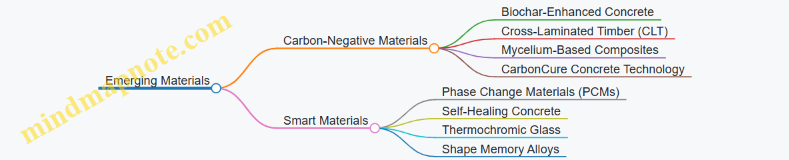
Carbon-Negative Materials
Biochar-Enhanced Concrete
Biochar is a carbon-rich product derived from biomass pyrolysis. When incorporated into concrete, biochar not only improves mechanical properties but also locks carbon within the material.
Example:
- University of Colorado Boulder developed biochar concrete that reduces embodied carbon by up to 30% and improves insulation.
Cross-Laminated Timber (CLT)
CLT is engineered wood made by layering timber boards crosswise. Trees absorb CO2 during growth, and when used in CLT, this carbon remains stored for the building’s lifespan.
Example:
- Brock Commons Tallwood House in Canada, an 18-story student residence, showcases CLT’s potential for large-scale, low-carbon construction.
Mycelium-Based Composites
Mycelium, the root structure of fungi, can be grown into lightweight, biodegradable building blocks that sequester carbon and replace traditional insulation or panels.
Example:
- Ecovative Design produces mycelium insulation panels used in experimental green buildings.
CarbonCure Concrete Technology
CarbonCure injects captured CO2 into concrete during mixing, where it mineralizes and becomes permanently embedded, reducing the carbon footprint.
Example:
- Several commercial projects in North America have adopted CarbonCure, including Walmart distribution centers, achieving measurable carbon reductions.
Smart Materials
Phase Change Materials (PCMs)
PCMs absorb and release thermal energy during phase transitions (e.g., solid to liquid), helping regulate indoor temperatures and reduce HVAC loads.
Example:
- The Edge building in Amsterdam integrates PCMs in ceiling panels, reducing energy consumption by stabilizing indoor climates.
Self-Healing Concrete
This concrete contains bacteria or chemical agents that activate upon cracking, precipitating minerals to seal cracks autonomously, extending lifespan and reducing maintenance.
Example:
- TU Delft developed bacterial self-healing concrete used in pedestrian bridges to reduce repair costs and carbon emissions.
Thermochromic Glass
Glass that changes its tint based on temperature, reducing solar heat gain and glare without mechanical shading devices.
Example:
- The Sage Gateshead concert hall in the UK uses thermochromic glass to optimize natural lighting and thermal comfort.
Shape Memory Alloys
Metals that return to a predetermined shape when heated, used in adaptive facades or structural elements to respond to environmental changes.
Example:
- Experimental façade systems in Japan use shape memory alloys to adjust shading dynamically.
Integrated Best Practice Example: Combining Carbon-Negative and Smart Materials
Project: The Bullitt Center, Seattle
- Uses CLT for structural elements (carbon-negative).
- Incorporates PCMs in interior walls for thermal regulation.
- Employs self-healing concrete in foundation slabs.
This integration demonstrates how emerging materials can work synergistically to create ultra-sustainable buildings.
Summary
Emerging carbon-negative and smart materials represent a frontier in sustainable construction, offering pathways to drastically reduce embodied carbon and enhance building performance. Product developers and industry strategists should monitor these innovations, pilot their applications, and foster cross-sector collaboration to accelerate adoption.
Additional Mind Map: Benefits and Challenges

9.2 Digitalization and AI in Circular Supply Chain Management
The integration of digital technologies and Artificial Intelligence (AI) is revolutionizing circular supply chain management in the construction industry. These tools enable enhanced transparency, efficiency, and decision-making, which are critical for managing complex material flows and promoting circularity.
Key Areas Where Digitalization and AI Impact Circular Supply Chains
Data Collection & Monitoring
Example: IoT sensors embedded in construction materials track usage, condition, and location in real-time. For instance, RFID tags on steel beams allow contractors to monitor inventory and facilitate reuse at end-of-life.
Best Practice: Implement IoT-enabled tracking early in the supply chain to enable accurate material flow mapping and reduce waste.
Supply Chain Transparency
Example: Blockchain technology is used by companies like Provenance to create immutable records of material origin, processing, and ownership, ensuring authenticity and enabling circular reuse.
Digital Twins create virtual replicas of physical assets and supply chains, allowing stakeholders to simulate circular scenarios and optimize resource use.
Best Practice: Adopt cloud-based platforms that integrate blockchain and digital twin technologies to provide a single source of truth accessible by all supply chain partners.
Predictive Analytics
AI algorithms analyze historical and real-time data to forecast material demand, predict maintenance needs, and identify waste generation points.
Example: A construction firm uses AI-driven demand forecasting to order only the necessary quantities of low carbon materials, minimizing excess inventory and reducing carbon footprint.
Best Practice: Leverage machine learning models to continuously improve predictions and adapt to changing project conditions.
Automated Sorting & Recycling
AI-powered robotics equipped with computer vision can identify and sort construction waste materials with high accuracy, facilitating efficient recycling and reuse.
Example: The startup AMP Robotics uses AI-driven robots to sort mixed construction debris, significantly increasing recycling rates and material recovery.
Best Practice: Integrate AI sorting systems at demolition sites or material recovery facilities to maximize circularity.
Decision Support Systems
AI-based decision support tools help product developers and strategists evaluate multiple circular scenarios by integrating lifecycle assessment data and supply chain constraints.
Example: A software platform that simulates different material sourcing and reuse options to identify the lowest carbon footprint solution for a building project.
Best Practice: Use these tools during the design and procurement phases to embed circularity and low carbon principles from the outset.
Integrated Example: Circular Construction Project Using Digitalization & AI
Project: The Circular Building Initiative in Amsterdam employs a combination of IoT sensors, blockchain, and AI analytics to manage materials throughout the building lifecycle.
- Materials are tagged with RFID for tracking.
- Blockchain records ensure provenance and reuse eligibility.
- AI predicts material lifespan and schedules maintenance.
- Automated sorting robots recover materials during renovation.
This integrated approach has resulted in a 40% reduction in embodied carbon and a 30% increase in material reuse rates.
Summary
Digitalization and AI are essential enablers for circular supply chain management in sustainable construction. By combining real-time data collection, transparent tracking, predictive analytics, automated recycling, and intelligent decision-making, industry stakeholders can significantly reduce carbon emissions and waste.
Embracing these technologies with best practices such as early IoT integration, blockchain adoption, and AI-driven scenario planning will position product developers and industry strategists at the forefront of the green construction revolution.
9.3 Integration of Renewable Energy with Material Production
The integration of renewable energy sources into the production of low carbon building materials is a critical step toward reducing the overall carbon footprint of the construction industry. By powering manufacturing processes with clean energy, companies can significantly cut greenhouse gas emissions, improve energy efficiency, and promote circular economy principles.
Why Integrate Renewable Energy in Material Production?
- Reduce Carbon Emissions: Traditional material production often relies on fossil fuels, contributing heavily to CO2 emissions.
- Enhance Sustainability: Renewable energy aligns with sustainable construction goals by minimizing environmental impact.
- Cost Savings: Over time, renewable energy can reduce operational costs through lower energy bills and incentives.
- Energy Security: Using renewables reduces dependence on volatile fossil fuel markets.
Common Renewable Energy Sources for Material Production
Mind Map: Integration of Renewable Energy in Material Production
Examples of Renewable Energy Integration in Material Production
-
Solar-Powered Cement Manufacturing
- Example: A cement plant in India installed a 10 MW solar photovoltaic system on-site, supplying up to 20% of its electricity needs.
- Impact: Reduced reliance on coal-fired power, cutting CO2 emissions by thousands of tons annually.
- Best Practice: Combining solar power with energy efficiency upgrades in kiln operations.
-
Wind Energy in Steel Production
- Example: A steel manufacturer in Sweden purchases 100% wind-generated electricity through power purchase agreements (PPAs).
- Impact: Achieved near-zero carbon emissions from electricity use, contributing to the company’s climate targets.
- Best Practice: Aligning production schedules with wind availability to maximize renewable usage.
-
Biomass Heat for Timber Processing
- Example: A sawmill in Canada uses wood waste biomass to generate heat for drying lumber.
- Impact: Reduced fossil fuel consumption and waste sent to landfill.
- Best Practice: Integrating biomass boilers with existing heating systems for flexibility.
-
Geothermal Energy for Bio-Based Material Production
- Example: A manufacturer of mycelium-based insulation materials in Iceland uses geothermal heat for controlled growth environments.
- Impact: Stable, renewable heat supply with minimal emissions.
- Best Practice: Leveraging local renewable resources to optimize production conditions.
Mind Map: Case Study - Solar-Powered Cement Plant
Best Practices for Successful Integration
- Conduct Energy Audits: Identify high-energy processes to prioritize renewable integration.
- Leverage Local Renewable Resources: Use the most abundant and cost-effective renewable sources available regionally.
- Hybrid Energy Systems: Combine renewables with grid or storage to ensure reliability.
- Collaborate with Energy Providers: Establish PPAs or joint ventures to secure renewable energy supply.
- Invest in Energy Storage: Batteries or thermal storage can mitigate intermittency issues.
- Monitor and Optimize: Use digital tools to track energy consumption and renewable generation in real-time.
Conclusion
Integrating renewable energy into the production of low carbon building materials is a transformative approach that aligns material manufacturing with broader sustainability goals. Through practical examples like solar-powered cement plants and biomass-heated timber kilns, industry players can see tangible benefits in emissions reduction, cost savings, and enhanced resilience. Embracing these strategies will be essential for product developers and industry strategists aiming to lead the green construction revolution.
9.4 Case Study: Pilot Projects Using Advanced Low Carbon Technologies
In recent years, pilot projects have become critical platforms for testing and demonstrating the viability of advanced low carbon technologies in construction. These projects showcase innovative materials, construction methods, and circular supply chain approaches that significantly reduce carbon footprints while maintaining or enhancing building performance.
Project 1: CarbonCure Concrete in Commercial Building
Overview: CarbonCure Technologies injects captured CO₂ into concrete during mixing, permanently mineralizing the gas and reducing the carbon footprint of concrete production.
Key Features:
- Utilizes industrial CO₂ waste streams
- Improves concrete compressive strength
- Reduces cement content needed
Example: A commercial office building in Toronto integrated CarbonCure concrete in its foundation and structural elements, achieving a 15% reduction in embodied carbon compared to traditional concrete.
Mind Map:
Project 2: Mycelium-Based Insulation in Affordable Housing
Overview: Mycelium, the root structure of fungi, is cultivated into dense, lightweight panels used as insulation material, offering a biodegradable and low carbon alternative to traditional foam insulation.
Key Features:
- Grown from agricultural waste
- Fully compostable at end-of-life
- Excellent thermal and acoustic properties
Example: A pilot affordable housing project in the Netherlands used mycelium insulation panels in the walls and roofs, reducing reliance on petrochemical-based materials.
Mind Map:
Project 3: Modular Timber Construction with Cross-Laminated Timber (CLT)
Overview: CLT panels are prefabricated wood elements engineered for strength and dimensional stability, enabling rapid assembly and reduced waste.
Key Features:
- Sequesters carbon during tree growth
- Prefabrication minimizes onsite waste
- Enables design for disassembly
Example: A mid-rise residential building in Sweden utilized CLT modules, achieving a 40% reduction in embodied carbon compared to concrete and steel alternatives.
Mind Map:
Project 4: Geopolymer Concrete for Infrastructure
Overview: Geopolymer concrete replaces traditional Portland cement with industrial byproducts like fly ash or slag, significantly lowering carbon emissions.
Key Features:
- Utilizes waste materials
- High durability and chemical resistance
- Lower curing temperatures reduce energy use
Example: A pilot bridge project in Australia employed geopolymer concrete for its deck slabs, reducing carbon emissions by up to 60% compared to conventional concrete.
Mind Map:
Summary Mind Map: Advanced Low Carbon Technologies in Pilot Projects
These pilot projects demonstrate how integrating advanced low carbon materials and circular supply chain principles can transform construction practices. They provide replicable examples for product developers and industry strategists aiming to innovate sustainably while meeting performance and economic goals.
9.5 Best Practice: Staying Ahead with Research and Development Partnerships
In the rapidly evolving fields of low carbon building materials and circular construction supply chains, maintaining a competitive edge requires continuous innovation. One of the most effective strategies is to foster strong Research and Development (R&D) partnerships. These collaborations enable product developers and industry strategists to access cutting-edge technologies, share knowledge, and accelerate the commercialization of sustainable solutions.
Why R&D Partnerships Matter
- Access to Expertise: Collaborating with universities, research institutions, and technology startups provides access to specialized knowledge and novel approaches.
- Resource Sharing: Pooling resources reduces costs and risks associated with developing new materials or processes.
- Faster Innovation Cycles: Joint efforts can shorten the time from concept to market-ready product.
- Market Validation: Partnerships with industry leaders help validate innovations and enhance credibility.
Key Components of Successful R&D Partnerships
Practical Examples of R&D Partnerships
-
The CarbonCure and University Collaboration
- Context: CarbonCure Technologies partnered with several universities to develop and optimize their CO2 injection technology for concrete.
- Outcome: Enhanced CO2 utilization efficiency and validated environmental benefits through peer-reviewed research.
-
Bamboo Construction Consortium
- Context: A consortium of manufacturers, researchers, and NGOs working together to develop standardized bamboo-based building materials.
- Outcome: Creation of new product standards and increased market acceptance for bamboo as a low carbon alternative.
-
Circular Supply Chain Pilot with Digital Twin Technology
- Context: A collaboration between a construction firm, a software company, and a research lab to implement digital twins for tracking material flows.
- Outcome: Improved supply chain transparency and material reuse rates, reducing waste and embodied carbon.
Steps to Establish Effective R&D Partnerships
Tips for Maximizing the Impact of R&D Partnerships
- Align Goals: Ensure all partners share a common vision and measurable objectives.
- Leverage Multidisciplinary Teams: Combine expertise from materials science, engineering, environmental science, and business.
- Promote Open Innovation: Encourage knowledge sharing while protecting intellectual property.
- Engage Early with End Users: Incorporate feedback from builders, architects, and clients to guide development.
- Document and Share Results: Publish findings and case studies to build industry-wide momentum.
Summary
Staying ahead in low carbon building materials and circular construction requires proactive engagement in R&D partnerships. By collaborating strategically, industry players can accelerate innovation, reduce risks, and drive the adoption of sustainable practices at scale. Embracing these partnerships not only benefits individual organizations but also contributes to the broader transformation of the construction sector towards a low carbon, circular future.
10. Practical Guide for Product Developers and Industry Strategists
10.1 Identifying Market Opportunities in Low Carbon Materials
Identifying market opportunities in low carbon building materials is essential for product developers and industry strategists aiming to innovate and lead in sustainable construction. This section explores key approaches, market drivers, and actionable strategies, supported by practical examples and mind maps to visualize the opportunity landscape.
Understanding Market Drivers
Market opportunities often stem from evolving regulations, consumer demand, technological advancements, and environmental imperatives. Key drivers include:
- Regulatory Pressure: Governments worldwide are imposing stricter carbon emission limits and incentivizing green building certifications.
- Corporate Sustainability Goals: Companies are committing to net-zero targets, increasing demand for low carbon materials.
- Consumer Awareness: End-users increasingly prefer sustainable buildings, influencing developers’ material choices.
- Cost Savings: Lifecycle cost reductions through energy efficiency and waste minimization.
Mind Map: Market Drivers for Low Carbon Materials
Identifying Market Segments
To pinpoint opportunities, segment the market based on:
- Building Type: Residential, commercial, industrial, infrastructure
- Geography: Urban vs rural, regions with strong green policies
- Material Type: Bio-based, recycled, innovative composites
- Project Scale: New builds, retrofits, modular construction
Example: The residential sector in Europe shows high demand for hempcrete and recycled timber due to strong carbon regulations and consumer preferences.
Mind Map: Market Segmentation for Low Carbon Materials
Evaluating Competitive Landscape
Understanding competitors’ offerings and gaps helps uncover niches. For example:
- Many suppliers focus on recycled concrete but fewer offer certified low carbon cement alternatives.
- Modular construction companies increasingly seek prefabricated low carbon panels.
Example: A startup developing mycelium-based insulation identified a gap in affordable, biodegradable insulation materials for commercial buildings.
Mind Map: Competitive Landscape Analysis
Leveraging Technology and Innovation
Technological advances open new opportunities:
- Digital material passports enhance transparency and circularity.
- AI-driven design tools optimize material use and carbon footprint.
- Advanced manufacturing enables scalable production of novel materials.
Example: A company using AI to design optimized bamboo composite panels reduced material waste by 30%, appealing to eco-conscious developers.
Practical Steps to Identify Opportunities
- Conduct Market Research: Analyze trends, regulations, and customer needs.
- Engage Stakeholders: Collaborate with architects, contractors, and end-users.
- Pilot Projects: Test materials in real-world conditions to gather data.
- Monitor Policy Changes: Stay updated on incentives and standards.
- Analyze Supply Chains: Identify bottlenecks and circular integration points.
Example: Identifying Opportunity in Circular Timber Supply
A product developer noticed rising demand for reclaimed timber in urban renovations. By partnering with demolition companies and local mills, they created a circular supply chain offering certified reclaimed wood panels, reducing embodied carbon by 40% compared to new timber.
Summary
Identifying market opportunities in low carbon materials requires a multi-dimensional approach combining market intelligence, stakeholder engagement, and innovation awareness. Visualizing drivers, segments, and competitors through mind maps helps clarify complex landscapes and focus efforts on high-impact niches.
For product developers and strategists, continuously scanning the market and aligning innovations with sustainability trends will unlock growth and leadership in the green construction sector.
10.2 Building Strategic Partnerships for Circular Supply Chains
Building strategic partnerships is a cornerstone for successfully implementing circular supply chains in the construction industry. These partnerships enable stakeholders to collaborate, share resources, innovate, and create value while minimizing waste and carbon emissions.
Why Strategic Partnerships Matter
- Complexity of Circular Supply Chains: Circular supply chains involve multiple stages, from material sourcing, manufacturing, construction, to end-of-life recovery. No single entity can manage all aspects alone.
- Resource Sharing: Partners can pool materials, knowledge, and infrastructure to optimize resource use.
- Innovation Acceleration: Collaboration fosters innovation in materials, processes, and business models.
- Risk Mitigation: Sharing risks and investments makes new circular initiatives more feasible.
Key Stakeholders in Circular Supply Chain Partnerships
- Material Suppliers: Providers of recycled, reclaimed, or low carbon materials.
- Manufacturers and Fabricators: Entities that process materials into building components.
- Designers and Architects: Professionals designing for disassembly and reuse.
- Construction Companies: Implementers of circular construction practices.
- Waste Management & Recycling Firms: Responsible for material recovery and processing.
- Regulatory Bodies & Certification Agencies: Ensure compliance and promote standards.
- Technology Providers: Offer digital tools for traceability and supply chain management.
Mind Map: Stakeholders and Their Roles
Best Practices for Building Effective Partnerships
Establish Shared Goals and Vision
- Align on sustainability objectives, carbon reduction targets, and circularity principles.
- Example: A consortium of suppliers and builders agreeing to reduce embodied carbon by 30% within 5 years.
Define Clear Roles and Responsibilities
- Clarify each partner’s contribution, decision-making authority, and accountability.
- Example: A manufacturer commits to using 50% recycled content, while waste managers guarantee 90% material recovery.
Foster Open Communication and Transparency
- Use regular meetings, shared platforms, and transparent data exchange.
- Example: A digital dashboard shared among partners tracks material flows and carbon footprints in real-time.
Leverage Technology for Traceability
- Implement blockchain or IoT to track materials from source to reuse.
- Example: A project using blockchain to certify recycled steel provenance, ensuring authenticity and quality.
Develop Joint Innovation Initiatives
- Collaborate on R&D for new materials, processes, or circular business models.
- Example: A partnership between a university, material supplier, and builder to develop mycelium-based insulation.
Create Incentives and Shared Value Models
- Design contracts and financial models that reward circularity and carbon savings.
- Example: Profit-sharing agreements based on waste reduction achievements.
Example 1: The Circular Construction Consortium (CCC)
A coalition of manufacturers, architects, and waste managers formed to create a closed-loop supply chain for modular buildings.
- Approach: Shared digital platform for material tracking.
- Outcome: Reduced material waste by 40%, lowered embodied carbon by 25%.
- Key Partnership Element: Joint investment in a recycling facility dedicated to construction materials.
Example 2: Localized Partnership for Urban Redevelopment
A city government partners with local reclaimed material suppliers, design firms, and contractors to promote circular construction in urban renewal projects.
- Approach: Policy incentives combined with collaborative procurement.
- Outcome: Increased use of reclaimed bricks and timber by 60%.
- Key Partnership Element: Regular stakeholder workshops to align goals and share best practices.
Mind Map: Steps to Build Strategic Partnerships
Tips for Product Developers and Industry Strategists
- Engage Early: Involve partners from the design phase to embed circularity.
- Build Trust: Transparency and shared benefits build long-term relationships.
- Be Flexible: Adapt partnership models to evolving technologies and market conditions.
- Educate and Advocate: Promote circular supply chain benefits internally and externally.
Strategic partnerships are not just beneficial but essential for scaling circular supply chains in construction. By fostering collaboration, transparency, and innovation, industry players can collectively reduce carbon footprints and drive sustainable transformation.
10.3 Developing Scalable and Replicable Business Models
Developing scalable and replicable business models is crucial for product developers and industry strategists aiming to drive widespread adoption of low carbon building materials and circular construction supply chains. A successful business model not only ensures profitability but also promotes sustainability, resilience, and adaptability across different markets and project types.
Key Components of Scalable and Replicable Business Models
- Value Proposition: Clearly define the environmental and economic benefits of your product or service.
- Customer Segments: Identify target markets that prioritize sustainability, such as green building developers, government projects, or eco-conscious consumers.
- Channels: Determine efficient ways to reach customers, including digital platforms, partnerships, and direct sales.
- Revenue Streams: Explore diverse income sources such as product sales, leasing, consulting, or licensing.
- Key Resources: Secure access to sustainable raw materials, technology, and skilled workforce.
- Key Activities: Focus on R&D, supply chain management, marketing, and customer support.
- Key Partnerships: Collaborate with suppliers, recyclers, certification bodies, and construction firms.
- Cost Structure: Optimize costs related to material sourcing, production, logistics, and compliance.
Mind Map: Business Model Components for Low Carbon Circular Construction
Strategies for Scalability
-
Standardization: Develop standardized product designs and processes that can be easily adapted to different projects and regions.
-
Modularization: Use modular construction techniques to simplify assembly, reduce waste, and enable reuse.
-
Digital Platforms: Leverage digital tools for supply chain transparency, customer engagement, and performance tracking.
-
Flexible Supply Chains: Build relationships with multiple suppliers and recyclers to ensure material availability and adaptability.
-
Pilot Projects: Start with pilot projects to refine the model, demonstrate value, and gather feedback.
Mind Map: Strategies for Scalability
Strategies for Replicability
-
Documentation: Maintain detailed documentation of processes, lessons learned, and performance metrics.
-
Training Programs: Develop training modules for partners and clients to ensure consistent implementation.
-
Partnership Networks: Establish networks with local stakeholders to adapt models to regional contexts.
-
Certification and Compliance: Align with recognized sustainability certifications to build trust and facilitate market entry.
-
Continuous Improvement: Use data and feedback to refine and adapt the business model over time.
Mind Map: Strategies for Replicability
Example 1: Modular Hempcrete Panels
A startup develops modular hempcrete panels that are low carbon and fully recyclable. They standardized panel sizes and connection methods to fit multiple building types. By partnering with local hemp farmers and recycling facilities, they ensure a circular supply chain. Their business model includes direct sales and leasing options for developers. Pilot projects in different climates helped refine installation techniques. Training workshops for contractors ensure replicability across regions.
Example 2: Circular Concrete Supply Chain
An industry consortium creates a closed-loop supply chain for recycled concrete aggregates. They implemented a digital platform to track material flows and certify recycled content. The business model incorporates revenue from material sales and consulting on circular design. Standardized quality protocols and certification help replicate the model in new markets. Collaboration with municipal waste management ensures steady supply of raw materials.
Summary
Developing scalable and replicable business models in low carbon and circular construction requires a holistic approach that integrates value creation, operational efficiency, stakeholder collaboration, and continuous learning. By leveraging standardization, modular design, digital tools, and strong partnerships, product developers and strategists can accelerate the transition to sustainable construction practices while ensuring economic viability and market growth.
10.4 Case Study: Successful Product Launches in Sustainable Construction
Launching a product in the sustainable construction sector requires a strategic approach that integrates innovation, market understanding, and collaboration. This case study explores several successful product launches that have made significant impacts by leveraging low carbon materials and circular supply chain principles.
Case Study 1: Cross-Laminated Timber (CLT) Panels by Stora Enso
Overview: Stora Enso, a global renewable materials company, launched CLT panels as a sustainable alternative to concrete and steel in mid-rise and high-rise buildings.
Key Success Factors:
- Utilization of fast-growing, sustainably harvested wood reducing embodied carbon.
- Modular design enabling faster construction and less waste.
- Strong partnerships with architects and builders to demonstrate feasibility.
Impact:
- Reduced carbon footprint by up to 70% compared to traditional materials.
- Enabled circularity through reuse and recycling of wood components.
Mind Map:
Case Study 2: CarbonCure Technologies – CO2-Infused Concrete
Overview: CarbonCure developed a technology that injects captured CO2 into concrete during mixing, permanently trapping the carbon and improving material strength.
Key Success Factors:
- Integration with existing concrete production processes.
- Demonstrated cost-neutral or cost-saving benefits.
- Strong focus on quantifiable carbon reduction metrics.
Impact:
- Reduced carbon emissions by up to 5-7% per cubic meter of concrete.
- Enhanced concrete durability, extending building lifespan.
Mind Map:
Case Study 3: Interface’s ReEntry Program – Carpet Tile Recycling
Overview: Interface, a global carpet tile manufacturer, launched the ReEntry program to collect and recycle used carpet tiles, closing the loop in their supply chain.
Key Success Factors:
- Designing products for easy disassembly and recycling.
- Establishing collection logistics with customers.
- Transparent reporting on recycled content and carbon savings.
Impact:
- Diverted thousands of tons of carpet waste from landfills.
- Reduced virgin material use and associated emissions.
Mind Map:
Case Study 4: LafargeHolcim’s ECOPact Low Carbon Concrete
Overview: LafargeHolcim introduced ECOPact, a range of low carbon concrete products tailored for different construction needs.
Key Success Factors:
- Customizable solutions balancing performance and carbon reduction.
- Certification and third-party verification for credibility.
- Training and support for customers on sustainable construction.
Impact:
- Enabled clients to meet ambitious carbon reduction targets.
- Accelerated market shift towards greener concrete solutions.
Mind Map:
Integrated Best Practices from Case Studies
- Collaborative Development: Engage architects, engineers, and contractors early to ensure product fit and acceptance.
- Transparency: Use clear carbon accounting and certifications to build trust.
- Design for Circularity: Ensure products can be reused, recycled, or safely biodegraded.
- Market Education: Provide training and resources to accelerate adoption.
- Pilot Projects: Demonstrate real-world performance and benefits.
Summary Mind Map: Successful Product Launch Elements
By studying these examples, product developers and industry strategists can glean actionable insights to guide their own sustainable construction product launches, ensuring alignment with low carbon goals and circular economy principles.
10.5 Best Practice: Continuous Education and Industry Engagement
Continuous education and active industry engagement are critical for product developers and industry strategists aiming to lead in low carbon building materials and circular construction supply chains. The construction industry is rapidly evolving, with new materials, technologies, regulations, and market demands emerging frequently. Staying informed and connected ensures that professionals can innovate effectively, adapt to changes, and foster collaborations that drive sustainability.
Why Continuous Education Matters
- Keeps knowledge current: Advances in material science, circular economy practices, and digital tools require ongoing learning.
- Enhances decision-making: Well-informed professionals can better evaluate low carbon materials and circular supply chain strategies.
- Boosts innovation: Exposure to new ideas and case studies sparks creative solutions.
- Supports compliance: Understanding evolving policies and certifications helps maintain regulatory alignment.
Importance of Industry Engagement
- Networking: Builds relationships with suppliers, clients, researchers, and policymakers.
- Collaboration: Enables joint ventures, pilot projects, and knowledge sharing.
- Market insights: Provides early awareness of trends, challenges, and opportunities.
- Advocacy: Strengthens the voice of sustainable construction in policy and standards development.
Mind Map: Continuous Education for Sustainable Construction Professionals
Mind Map: Industry Engagement Strategies
Examples of Continuous Education and Engagement in Practice
Example 1: Online Certification Programs
A product development team at a sustainable materials company enrolled in the LEED Green Associate certification and a specialized course on circular economy principles offered by a leading university. This education enabled them to redesign their product line to meet green building standards and better communicate benefits to clients.
Example 2: Industry Conferences and Workshops
An industry strategist regularly attends the annual Greenbuild International Conference and participates in workshops on low carbon concrete innovations. These events provide insights into emerging technologies and facilitate partnerships with innovative startups.
Example 3: Collaborative Pilot Projects
A construction firm partnered with a local university and material suppliers to pilot a modular building system using recycled steel and bio-based insulation. This hands-on project served as a learning platform for the entire team and demonstrated circular supply chain feasibility.
Example 4: Internal Knowledge Sharing
A company established monthly ‘Sustainability Lunch & Learn’ sessions where employees present recent research, project outcomes, or new regulations. This practice fosters a culture of continuous learning and keeps everyone aligned with sustainability goals.
Example 5: Participation in Standards Development
An industry strategist joined a national committee developing standards for recycled content in construction materials. Their involvement helped ensure practical considerations were included, and they gained early access to upcoming regulatory changes.
Practical Tips for Implementing Continuous Education and Engagement
- Allocate dedicated time and budget for training and events.
- Encourage cross-functional teams to learn together for broader perspectives.
- Leverage digital platforms for flexible and accessible learning.
- Build relationships with academic and research institutions.
- Actively participate in industry groups and policy consultations.
- Share knowledge internally to multiply impact.
By embedding continuous education and industry engagement into organizational culture and personal professional development, product developers and industry strategists can stay at the forefront of sustainable construction innovation, drive meaningful change, and capitalize on emerging opportunities in low carbon materials and circular supply chains.
11. Conclusion and Call to Action
11.1 Summary of Key Insights and Best Practices
Low carbon building materials and circular construction supply chains represent a transformative approach to sustainable construction. This section synthesizes the essential insights and best practices covered throughout the blog, providing a clear framework for product developers and industry strategists to implement and scale these innovations.
Key Insights
- Material Selection is Critical: Choosing low carbon materials such as hempcrete, recycled steel, or geopolymer concrete significantly reduces embodied carbon.
- Circular Economy Principles Drive Sustainability: Designing for disassembly, reuse, and recycling minimizes waste and maximizes resource efficiency.
- Collaboration Across the Supply Chain: Engaging all stakeholders—from material producers to contractors—ensures transparency and circularity.
- Digital Tools Enhance Traceability: Leveraging BIM, blockchain, and digital twins improves supply chain visibility and material tracking.
- Policy and Certification Support Adoption: Regulations and green certifications incentivize the use of sustainable materials and circular practices.
- Economic Benefits are Tangible: Low carbon and circular approaches can reduce costs over the lifecycle and improve market competitiveness.
- Innovation is Ongoing: Emerging materials and technologies continue to expand possibilities for sustainable construction.
Best Practices with Examples
Life Cycle Assessment (LCA) for Material Evaluation
- Practice: Conduct comprehensive LCAs to quantify carbon footprints and environmental impacts.
- Example: A residential project in the UK used LCA to compare traditional concrete with geopolymer concrete, achieving a 40% reduction in embodied carbon.
Designing for Disassembly
- Practice: Create buildings that can be easily deconstructed to recover materials.
- Example: A modular office building in the Netherlands was designed with bolted connections, enabling 90% of materials to be reused after deconstruction.
Procurement Policies Favoring Circular Materials
- Practice: Prioritize purchasing recycled, reclaimed, or bio-based materials.
- Example: A public infrastructure project in Sweden mandated at least 30% recycled content in all concrete used.
Digital Supply Chain Transparency
- Practice: Implement blockchain to track material provenance and carbon data.
- Example: A commercial development in Singapore used blockchain to verify the recycled content of steel beams, enhancing client trust.
Cross-Disciplinary Collaboration
- Practice: Engage architects, engineers, suppliers, and contractors early to optimize material use.
- Example: An adaptive reuse project in Germany brought together all stakeholders in workshops, resulting in a 25% material savings.
Leveraging Certifications
- Practice: Pursue LEED, BREEAM, or Cradle to Cradle certifications to validate sustainability claims.
- Example: A university campus retrofit in Canada achieved LEED Platinum by integrating low carbon materials and circular design.
Continuous Improvement and Feedback Loops
- Practice: Monitor project outcomes and refine processes for future projects.
- Example: A construction firm in Australia established a feedback system that reduced material waste by 15% over three years.
Mind Maps
Mind Map 1: Low Carbon Building Materials
Mind Map 2: Circular Construction Supply Chains

Mind Map 3: Best Practices Integration
By internalizing these insights and adopting the outlined best practices, product developers and industry strategists can lead the transition towards a low carbon, circular construction industry that delivers environmental, economic, and social value.
11.2 Roadmap for Implementation in Industry
Implementing low carbon building materials and circular construction supply chains requires a structured and strategic approach. This roadmap outlines key steps, best practices, and actionable strategies to guide product developers and industry strategists through successful adoption and scaling.
Step 1: Assess Current Practices and Baseline Carbon Footprint
- Conduct a comprehensive Life Cycle Assessment (LCA) of existing materials and processes.
- Identify high carbon impact materials and waste streams.
- Evaluate supply chain transparency and circularity levels.
Example: A mid-sized construction firm performed an LCA on their standard concrete mix and discovered that cement production contributed over 70% of embodied carbon, prompting a shift to low carbon geopolymer alternatives.
Step 2: Set Clear Sustainability and Circularity Goals
- Define measurable targets for carbon reduction and material circularity.
- Align goals with international standards such as the Paris Agreement or local regulations.
- Integrate goals into corporate strategy and project KPIs.
Example: A product developer committed to reducing embodied carbon by 40% within five years by prioritizing bio-based materials and recycled content.
Step 3: Engage Stakeholders Across the Supply Chain
- Collaborate with material suppliers, manufacturers, designers, contractors, and clients.
- Establish communication channels for feedback and innovation.
- Promote shared responsibility for circularity.
Example: A commercial developer partnered with a steel supplier to create a closed-loop system where steel scraps from demolition were recycled back into new structural components.
Step 4: Innovate Material Selection and Design Approaches
- Prioritize locally sourced, low carbon, and recyclable materials.
- Implement design for disassembly and modular construction.
- Use digital tools for material tracking and optimization.
Example: An architectural firm adopted modular bamboo panels that could be easily dismantled and reused, reducing waste and transportation emissions.
Step 5: Develop Circular Supply Chain Infrastructure
- Invest in material recovery facilities and recycling technologies.
- Implement digital platforms for supply chain transparency (e.g., blockchain).
- Create logistics systems that support reverse flows of materials.
Example: A city government funded a pilot program to collect and process reclaimed concrete for use in public infrastructure projects.
Step 6: Monitor, Report, and Continuously Improve
- Track progress against sustainability KPIs.
- Use data analytics to identify bottlenecks and opportunities.
- Share successes and lessons learned to foster industry-wide adoption.
Example: A construction company published annual sustainability reports highlighting carbon savings and circularity achievements, inspiring competitors to follow suit.
Mind Map: Roadmap for Implementation in Industry
Additional Examples of Roadmap Implementation
-
Example 1: Prefabricated Timber Housing Project
- A developer mapped material flows and partnered with local sawmills to source sustainably harvested timber.
- Modular design allowed for easy assembly and disassembly, enabling material reuse.
- Digital tracking ensured transparency in timber origin and carbon footprint.
-
Example 2: Urban Renovation with Circular Supply Chain
- An urban renewal project prioritized reclaimed bricks and steel from nearby demolition sites.
- Collaboration between demolition contractors and material recyclers created a closed-loop supply chain.
- The project reduced embodied carbon by 35% compared to traditional renovation.
Summary
Implementing low carbon materials and circular supply chains is a multi-step process that requires assessment, goal setting, stakeholder collaboration, innovation, infrastructure development, and continuous improvement. By following this roadmap, industry players can systematically reduce carbon footprints, minimize waste, and create resilient, sustainable construction ecosystems.
11.3 Encouraging Innovation and Collaboration
Innovation and collaboration are the twin engines driving the transition toward low carbon building materials and circular construction supply chains. By fostering a culture of creativity and partnership, industry stakeholders can accelerate sustainable practices, reduce environmental impact, and unlock new market opportunities.
The Importance of Innovation in Sustainable Construction
Innovation in this field involves developing new materials, processes, and business models that minimize carbon emissions and promote circularity. It can range from creating bio-based composites to implementing digital tools that optimize material flows.
Example: The development of mycelium-based insulation materials showcases how biological innovation can replace traditional, carbon-intensive products.
Collaboration as a Catalyst for Change
Collaboration across the supply chain—including manufacturers, designers, contractors, policymakers, and end-users—is essential to overcome fragmentation and align goals.
Example: The Ellen MacArthur Foundation’s CE100 network brings together companies to share knowledge and co-develop circular economy solutions in construction.
Mind Map 1: Drivers of Innovation in Low Carbon and Circular Construction
Mind Map 2: Collaboration Models in Circular Construction Supply Chains
Best Practices to Encourage Innovation and Collaboration
-
Establish Innovation Hubs and Labs
- Create dedicated spaces where stakeholders can experiment with new materials and processes.
- Example: The Construction Innovation Hub in the UK accelerates development of sustainable construction technologies.
-
Promote Cross-Sector Partnerships
- Encourage partnerships between academia, industry, and government to leverage diverse expertise.
- Example: The Bio-Based Industries Consortium supports collaboration to commercialize bio-based materials.
-
Implement Digital Collaboration Tools
- Use platforms like Building Information Modeling (BIM) and supply chain management software to enhance transparency and coordination.
- Example: BIM-enabled projects have demonstrated improved material optimization and waste reduction.
-
Host Innovation Challenges and Competitions
- Stimulate creative problem-solving by inviting startups and researchers to propose solutions.
- Example: The Circular Construction Challenge by the World Economic Forum gathers global innovators.
-
Share Data and Best Practices Openly
- Create databases and forums for sharing lessons learned and performance data.
- Example: The Material Circularity Indicator (MCI) database helps companies benchmark circularity.
Mind Map 3: Steps to Foster a Collaborative Innovation Ecosystem
Real-World Example: The Amsterdam Circular Buiksloterham Project
This urban development project integrates circular construction principles by bringing together local government, developers, architects, and material suppliers. They co-create solutions such as modular building components made from recycled materials, supported by digital tracking systems to ensure material reuse.
Key Takeaways:
- Early stakeholder engagement
- Transparent communication channels
- Shared innovation goals
Conclusion
Encouraging innovation and collaboration requires intentional strategies that align incentives, foster trust, and leverage diverse expertise. By doing so, product developers and industry strategists can lead the way in creating resilient, low carbon, and circular construction ecosystems that benefit both the environment and the economy.
11.4 Final Case Study: Transformative Impact of Low Carbon Circular Construction
Overview
This final case study highlights a transformative project that exemplifies the integration of low carbon building materials and circular construction supply chains. The project, named EcoLoop Tower, is a mixed-use development located in a major urban center, designed to demonstrate how sustainable construction practices can significantly reduce environmental impact while delivering economic and social benefits.
Project Highlights
- Location: Urban city center
- Building Type: Mixed-use (residential, commercial, community spaces)
- Size: 50,000 square meters
- Completion Year: 2023
- Key Goals: Minimize embodied carbon, maximize material reuse, implement circular supply chains
Mind Map: Core Components of EcoLoop Tower
Low Carbon Materials in Action
- Recycled Steel: Used for structural framing, sourced from deconstructed industrial buildings within 100 km radius, reducing mining and processing emissions.
- Hempcrete Walls: Provided excellent insulation with low embodied carbon, sourced from regional hemp farms, enhancing local economy.
- Reclaimed Timber Flooring: Salvaged from old warehouses, refurbished and installed in residential units, preserving historic character.
- Geopolymer Concrete: Used in foundations and common areas, reducing cement-related CO2 emissions by 60% compared to traditional concrete.
Circular Supply Chain Practices
- Material Sourcing: Prioritized local suppliers and reclaimed materials to reduce transportation emissions and support circularity.
- Design for Disassembly: Structural elements and interior components designed for easy removal and reuse at end-of-life.
- Digital Material Tracking: Implemented blockchain-based system to track materials’ origin, usage, and lifecycle, enabling transparency and accountability.
- On-site Material Recycling: Construction waste was sorted and processed on-site, with crushed concrete reused as aggregate.
Mind Map: Circular Supply Chain Workflow
Design and Engineering Innovations
- Modular Construction: Enabled rapid assembly and disassembly, reducing waste and allowing flexible space usage.
- Adaptive Reuse: Existing building foundations and some structural elements were retained, minimizing new material demand.
- Prefabricated Components: Reduced on-site waste and improved quality control.
Environmental and Economic Outcomes
- Embodied Carbon Reduction: Achieved a 40% reduction compared to conventional construction through material choices and circular practices.
- Waste Diversion: 90% of construction waste was diverted from landfill through reuse and recycling.
- Cost Savings: Material reuse and efficient supply chain management reduced overall construction costs by 15%.
- Job Creation: New jobs generated in material recovery, processing, and circular supply chain management.
Community and Industry Impact
- Community Engagement: Workshops and tours educated local residents and industry professionals on circular construction benefits.
- Industry Influence: The project set new benchmarks for sustainable construction, inspiring policy updates and new certification criteria.
Summary
The EcoLoop Tower project demonstrates how integrating low carbon materials with circular construction supply chains can transform the building industry. By combining innovative materials, strategic design, and collaborative supply chain management, the project achieved substantial environmental, economic, and social benefits.
This case study serves as a blueprint for product developers and industry strategists aiming to lead the transition toward sustainable, circular construction practices.
11.5 Resources and Further Reading
To deepen your understanding and support your journey in low carbon building materials and circular construction supply chains, the following resources, tools, and references are invaluable. These include industry reports, academic papers, digital platforms, certification bodies, and practical guides.
Mind Map: Key Resource Categories
Industry Reports and Publications
- World Green Building Council (WGBC): Their report “Bringing Embodied Carbon Upfront” provides comprehensive insights into embodied carbon measurement and reduction strategies.
- Ellen MacArthur Foundation: Offers extensive research on circular economy principles applied to construction, including supply chain transformation.
- International Energy Agency (IEA): Reports on energy efficiency and material innovation in the building sector.
Standards and Certification Bodies
- LEED (Leadership in Energy and Environmental Design): A globally recognized green building certification system emphasizing sustainable materials and circularity.
- BREEAM (Building Research Establishment Environmental Assessment Method): Focuses on environmental performance including material lifecycle impacts.
- Cradle to Cradle Certified™: Certification for products designed with circularity and health in mind.
Digital Tools and Platforms
- Tally: A Life Cycle Assessment (LCA) software integrated with Revit, enabling product developers to quantify embodied carbon in building materials.
- Circularity Indicators: Tools developed by the Ellen MacArthur Foundation to measure circularity performance.
- Building Information Modeling (BIM): When integrated with circular economy principles, BIM helps track material flows and supports design for disassembly.
Academic Journals and Articles
- Journal of Cleaner Production: Publishes research on sustainable construction materials and circular supply chains.
- Construction and Building Materials: Focuses on innovative materials and environmental impacts.
Case Studies and Practical Examples
- Modular Construction Projects: Explore projects like the Broad Group in China, which drastically reduce waste and embodied carbon through prefabrication.
- Adaptive Reuse Examples: The Tate Modern in London is a prime example of retrofitting an industrial building using reclaimed materials.
Online Communities and Networks
- Global Green Building Councils: Regional chapters provide localized resources and networking opportunities.
- Circular Construction Forums: Platforms such as the Circular Construction Challenge facilitate knowledge exchange.
Mind Map: Example Case Study Resources
Additional Recommended Books
- “Sustainable Construction: Green Building Design and Delivery” by Charles J. Kibert
- “Circular Economy in the Construction Industry” by Walter R. Stahel
How to Use These Resources Effectively
- Start with Industry Reports to understand the big picture and current trends.
- Leverage Digital Tools like Tally and BIM early in the design process for impact assessment.
- Engage with Communities to stay updated on innovations and network with peers.
- Apply Learnings from Case Studies to your projects by analyzing practical challenges and solutions.
By integrating these resources into your workflow, product development, and strategic planning, you can accelerate the adoption of low carbon materials and circular supply chains in your construction projects.