Practical Guide to Home Composting
1. Home Composting Basics That Actually Work
1.1 What composting does and why it reduces household waste
Composting is a controlled way to let microorganisms break down organic materials—mostly food scraps and yard waste—into a stable, soil-like material called compost. Instead of sending those scraps to a landfill, where they sit with little oxygen, you help them decompose in a way that keeps the process moving and the end product useful.
What happens when you compost
In a landfill, organic waste is typically buried and starved of oxygen. That environment encourages slower decomposition and can produce landfill gas. Composting changes the conditions: you provide oxygen, moisture, and a mix of materials so microbes can do their job efficiently.
Composting relies on three practical inputs:
- Microbes: Bacteria and fungi that naturally occur in soil and on plant material.
- Oxygen: Air spaces in the pile help microbes breathe.
- Moisture: Microbes need damp conditions, not puddles.
When these are balanced, the material breaks down and becomes less recognizable over time. The compost you end up with is not “magic dirt”; it’s the result of many small organisms consuming and transforming organic matter.
Why composting reduces household waste
Household waste reduction happens in two ways: you divert material from the trash, and you reduce the volume and weight of what remains.
1) Diversion: fewer scraps in the bin
Most composting systems are built around a simple habit: collect food scraps and yard trimmings instead of throwing them away. Even a small change—like keeping a countertop container for veggie peels and coffee grounds—can noticeably reduce the amount of “regular trash” that leaves your home.
Example: If you regularly toss banana peels, apple cores, and coffee grounds, those items are mostly water and plant matter. Composting turns that plant matter into compost rather than landfill waste.
2) Volume reduction: less bulk over time
Compost doesn’t just “sit there.” As it decomposes, it shrinks. A pile that starts as a mix of scraps and browns becomes a smaller, darker material. That means less space is needed for storage and less material is ultimately disposed of.
Example: A bucket of mixed kitchen scraps and shredded paper will look bulky at the start. After decomposition, the remaining compost is denser and easier to handle.
What composting does to common household materials
Different materials decompose at different speeds, which is why composting works best when you mix them intentionally.
- Greens (nitrogen-rich scraps) break down faster and help microbes grow.
- Browns (carbon-rich materials like dry leaves or shredded cardboard) provide structure and absorb excess moisture.
Example: Lettuce leaves and fruit scraps are “greener” and can become slimy if piled alone. Dry leaves or shredded cardboard help keep the mix airy and less smelly.
The waste-reduction “mechanics” in one mind map
A simple “before and after” comparison
Before composting:
- Food scraps go to the trash.
- They’re buried or compacted.
- Decomposition is slow and oxygen-poor.
After composting:
- Food scraps go to a compost bin.
- They’re mixed with browns.
- Oxygen and moisture are managed.
- Microbes transform the material into compost.
Example: Imagine two identical bags of vegetable scraps. One ends up in a landfill; the other is added to a compost pile with shredded cardboard and occasional turning. The compost pile is designed to keep microbes active, so the material breaks down into something you can use in soil.
What composting does not do
Composting is not a way to make everything disappear instantly. It’s also not a substitute for keeping non-compostable items out of your waste stream.
- It doesn’t eliminate the need for sorting. If you toss in plastic packaging, it won’t turn into compost.
- It doesn’t fix an imbalanced pile automatically. If the mix is too wet or too dense, it can smell and slow down.
- It doesn’t produce compost from everything. Many systems avoid meat, dairy, and oily foods because they can attract pests or create odor problems.
Example: If you compost only wet scraps without enough browns, you’ll likely end up with a soggy mass that takes longer to break down. Adding dry, carbon-rich material helps the process stay on track.
The practical takeaway
Composting reduces household waste because it changes the destination and conditions of organic scraps. You divert them from trash, manage oxygen and moisture so microbes can break them down, and end up with compost that can return nutrients to soil. The process is straightforward: collect scraps, add browns, keep it damp and airy, and let time do the work.
1.2 What you can compost at home and what you should not
Home composting is mostly about feeding microbes the right ingredients. The “right” part isn’t a mystery list—it’s a set of practical rules based on how materials behave in a pile: whether they break down, whether they attract pests, and whether they introduce pathogens or persistent contaminants.
Mind map: Compostable vs. not compostable
What you can compost (with examples)
1) Fruit and vegetable scraps Peels, cores, and chopped leftovers are the backbone of most home compost. Chop larger pieces so they don’t sit around for months. For example, apple cores break down faster when you cut them into quarters rather than tossing in a whole core.
2) Coffee grounds and tea leaves Coffee grounds are usually a good “greens” source because they’re nitrogen-rich and moist. If you brew tea with a paper bag, you can compost the bag if it’s plain and uncoated. A practical approach: mix a handful of grounds into a larger amount of dry browns so the pile stays aerated.
3) Eggshells Rinsed and crushed eggshells are safe and useful. They don’t “fix” acidity by themselves, but they do add mineral content. Crushed shells also behave like small browns, helping prevent a wet, slimy layer.
4) Yard trimmings Leaves, shredded paper-like plant matter, and small twigs are excellent browns. Grass clippings can compost, but they’re dense and can mat. Example: if you mow and have a bucket of grass, spread it thinly and mix it into the pile with dry leaves rather than dumping it in one thick layer.
5) Plain paper and cardboard Uncoated cardboard and plain paper work well as browns. Tear or shred them so they absorb moisture instead of forming a water-resistant sheet. Example: a clean paper towel roll tube can be shredded into small pieces and mixed into the pile.
What you should not compost (and why)
1) Meat and fish These introduce strong odors and attract pests. They also break down differently than plant matter, often leaving persistent residues. If you want a simple rule: if it used to be an animal, keep it out of a typical backyard compost pile.
2) Dairy and oily foods Cheese, yogurt, butter, and cooking oils can cause odor issues and can slow down decomposition because fats don’t behave like typical plant fibers. Even small amounts can create greasy pockets. Example: a spoonful of salad dressing can be manageable in a system designed for it, but in a standard compost bin it’s more likely to cause smell and pests.
3) Pet waste and human waste Dog and cat feces can contain pathogens that aren’t reliably destroyed in home composting conditions. Human waste has similar concerns. Use a dedicated waste system instead of a general compost pile.
4) Diseased plants If a plant shows disease symptoms—especially fungal spots, blights, or severe wilting—composting may not eliminate the problem. The risk is that you spread the disease when you apply finished compost. Example: if your tomato plants had blight, keep those leaves out of the compost.
5) Weeds with seeds Weeds are compostable only when you’re confident they won’t sprout later. Many weed seeds survive typical home composting. Example: pull dandelions before they go to seed; if you already have a “seed head,” bag and trash it instead.
6) Plastics and plastic-lined materials Anything plastic—bags, wraps, utensils, and “compostable” packaging that isn’t truly compostable in your system—should not go in. Plastics don’t break down the way you want and can end up in your finished compost.
7) Glossy or coated paper Some paper products are coated with substances that don’t belong in soil. Avoid glossy flyers, magazine pages, and paper with heavy coatings. If you’re unsure, treat it like non-compostable.
8) Treated wood and chemically treated materials Pressure-treated lumber, stained wood, and many construction scraps can contain chemicals that persist. Composting is for organic matter; treated materials are not.
9) Large amounts of cooked food Cooked leftovers are often a mix of fats, salts, and sometimes meat or dairy. Even when they’re mostly vegetables, the cooking process changes how they behave. In a typical home bin, cooked food is more likely to become a smelly, pest-friendly layer.
Use with care: items that are “possible,” but need restraint
Some materials aren’t automatically forbidden, but they’re easy to mishandle.
- Greasy scraps (small amounts only): A tiny bit of cooking residue mixed into browns is less likely to cause problems than a steady stream of oily food.
- Citrus peels: Citrus can compost, but it can slow down breakdown if you add lots at once. Chop and mix into the pile rather than piling it on.
- Grass clippings (small, mixed): Grass is fine when you keep it thin and mixed with dry leaves. Thick layers turn into a wet mat.
Quick decision rules (the “if-then” version)
- If it’s plant-based and not diseased, it’s usually compostable.
- If it’s animal-based, oily, or cooked with lots of fat, keep it out.
- If it’s from a sick plant or has seeds, don’t risk it.
- If it’s coated, plastic, or treated, assume it belongs in the trash or recycling stream.
Practical examples: what goes in your bin today
- Yes: chopped carrot ends, coffee grounds, shredded leaves, plain cardboard.
- No: chicken bones, cheese rinds, used cooking oil, dog waste, glossy paper.
- Maybe (with care): a small amount of citrus peel chopped small, a thin mix of grass clippings with dry browns.
When you follow these rules, you’re not just avoiding problems—you’re also making it easier for the pile to stay balanced. A compost bin that gets the right mix of plant matter and dry structure tends to smell less, attract fewer visitors, and finish more consistently.
1.3 How compost breaks down in real life: oxygen, moisture, and time
Compost is less like magic and more like a controlled neighborhood for microbes. They eat organic matter, multiply, and leave behind a darker, crumbly material. The big three they need are oxygen, moisture, and time—plus a steady supply of food in the form of greens and browns.
The oxygen story: why “air” matters
Microbes need oxygen to break down most materials efficiently. In a well-aerated pile, you typically get a steady, earthy smell. When oxygen runs low, the pile shifts toward slower, less desirable pathways that can produce sour or rotten odors.
A practical way to picture it: oxygen is the “permission slip” for faster decomposition. Without it, microbes still work, but the process drags and the pile can turn anaerobic.
What oxygen looks like in your bin:
- If the compost is fluffy and you can see air spaces, oxygen is getting in.
- If it’s packed tight, slimy, or smells strongly unpleasant, oxygen is likely limited.
Easy example:
- You add a bucket of wet food scraps on top of dry browns and don’t mix. The top may look fine, but the center can become dense and oxygen-poor. Turning or mixing redistributes moisture and creates air pockets.
The moisture story: the “damp sponge” target
Moisture controls whether microbes can move, digest, and reproduce. Too dry and they slow down. Too wet and air spaces collapse, which reduces oxygen even if you never changed anything else.
A good target is “damp sponge” moisture: when you squeeze a handful, a few drops should come out, not a stream.
What moisture looks like in your bin:
- Too dry: crumbly, light, and not warming.
- Too wet: heavy, clumpy, and often smelly.
Easy example:
- Your compost gets soggy after a rainy week. Even if you added browns earlier, the pile can stay wet. Adding dry browns (shredded paper, dry leaves) and mixing helps restore both moisture balance and airflow.
The time story: decomposition is a sequence, not a switch
Composting doesn’t happen all at once. Different organisms take turns, and the pile changes as materials become easier to digest.
A useful mental model is a timeline:
- Early stage: microbes start working on readily available sugars and softer plant matter.
- Middle stage: breakdown accelerates as the pile warms and more complex materials begin to break down.
- Later stage: tougher fibers and remaining bits decompose more slowly, and the material becomes more uniform.
Time also depends on particle size. Chopped scraps and shredded browns have more surface area, so microbes can access them faster.
Easy example:
- Whole apple chunks take longer than chopped apple scraps. If you’re composting kitchen scraps, cutting or tearing them reduces the “waiting room” time.
How the three factors interact (the real reason problems happen)
Oxygen and moisture are linked. Wet compost tends to compact, which reduces oxygen. Dry compost can also slow decomposition even if oxygen is plentiful.
So when something goes wrong, it’s often a combination:
- Wet + compact + low oxygen → sour smells and slow breakdown.
- Dry + airy → little smell, but also little progress.
Mind map: the compost breakdown system
What “good breakdown” looks like in practice
A healthy compost process usually shows a few consistent signs:
- Smell: earthy, not putrid.
- Texture: gradually less recognizable scraps.
- Temperature behavior: many piles warm up at some point, then cool as materials become harder to break down.
Even if your compost doesn’t heat much, it can still work. The key is that the pile isn’t stuck in a consistently bad condition (like persistently wet and smelly).
Easy example:
- You start a new bin and add scraps daily. After a week, you notice the top layer dries out while the center stays wet. Mixing once or twice a week redistributes moisture and oxygen so the whole pile stays in a workable range.
Quick “if this, then that” reasoning
Use these cause-and-effect checks rather than guessing.
- If it smells sour and looks wet: oxygen is probably low. Add dry browns and mix to open air spaces.
- If it’s dry and not changing: moisture is probably low. Add water in small amounts and mix so moisture reaches the center.
- If you see recognizable chunks for a long time: particle size is likely too large. Chop or shred future inputs, and mix to expose more surface area.
A simple real-life scenario
Imagine a household compost bin that receives:
- Greens: fruit scraps and coffee grounds
- Browns: shredded paper and dry leaves
On day 1, you add a mix and cover it with browns. Oxygen is present because the browns create structure. Moisture is moderate because the browns absorb some liquid from the scraps. Over the next several days, microbes start breaking down the easiest materials.
By day 7, you’ve added more scraps. If you keep adding without mixing, the newest layer can become wetter and denser. That’s when oxygen drops in the center. A turn restores airflow, and the pile resumes a more balanced breakdown.
Time passes, and the pile becomes less recognizable. The process doesn’t stop because you did one perfect step; it keeps moving because conditions stay within a workable range.
In short: oxygen keeps the process efficient, moisture keeps microbes active, and time lets the sequence of breakdown happen. When you adjust one factor, you often improve another—so the best troubleshooting is usually about restoring balance, not chasing a single “magic fix.”
1.4 Choosing the right composting method for your home and schedule
The “best” composting method is the one you’ll actually maintain. Different systems trade off speed, smell risk, space needs, and how often you have to do something. Start by matching your household’s input pattern (how much and how often you generate scraps) with your available time and tolerance for mess.
Step 1: Identify your household composting pattern
Ask three practical questions:
- How often do you produce scraps? If you’re mostly generating small amounts daily, a system that handles frequent inputs with minimal attention is easier. If you generate a big batch once or twice a week, you can use methods that tolerate short “holding” periods.
- How much space do you have for a bin? A countertop setup works for small volumes. Outdoor bins handle larger volumes and can stay active longer.
- How sensitive is your household to odor and pests? If you live in an apartment or near shared walls, odor control and pest prevention become top priorities.
A quick rule of thumb: more frequent, smaller inputs favor indoor or sealed systems; larger, less frequent inputs favor outdoor piles or tumblers.
Step 2: Compare common methods by what you’ll do week to week
Below is a practical comparison that focuses on routine tasks.
| Method | Best for | Main weekly effort | Typical smell/pest risk | Speed (typical) |
|---|---|---|---|---|
| Backyard pile | Space + steady yard waste | Occasional turning; moisture checks | Low if balanced; can attract pests if fed poorly | Medium to fast |
| Backyard bin (stationary) | Moderate space; less turning | Add inputs; manage moisture; optional turning | Low to medium depending on cover | Medium |
| Tumbler | Want faster breakdown with less mess | Regular turning (often weekly) | Low if balanced and covered | Fast |
| Worm composting (vermicompost) | Small indoor/outdoor volumes | Feed in small amounts; harvest as needed | Low odor if fed correctly | Medium (steady) |
| Bokashi | Indoor countertop use; frequent scraps | Drain daily at first; bury/finish later | Very low odor during fermentation | Medium (finish step needed) |
| Countertop compost (sealed) | Apartments; minimal handling | Empty to outdoor/finish system; manage liners | Low if sealed and emptied promptly | Depends on finishing |
“Speed” isn’t just about biology; it’s also about how often you intervene. Turning and aeration help aerobic microbes work efficiently, while sealed fermentation methods trade speed for low smell and indoor convenience.
Step 3: Match method to your schedule (with examples)
Example A: Busy weekdays, scraps every day
You cook daily, produce lots of fruit/veg scraps, and you’re not home to manage a pile.
- Good fit: Worm composting or bokashi.
- Why: Both handle frequent small inputs without requiring you to turn a pile. Worms prefer steady feeding, and bokashi fermentation tolerates daily additions.
- What to watch:
- Worms: feed in small portions and keep bedding damp (not wet).
- Bokashi: drain liquid regularly and bury/finish the fermented material afterward.
Example B: Weekend gardener with yard waste
You have leaves, grass clippings, and prunings, and you can spend time on Saturdays.
- Good fit: Backyard pile or stationary bin.
- Why: Yard waste supplies “browns,” which helps balance food scraps and reduces odor.
- What to watch: If you add lots of food scraps without enough browns, the pile can go anaerobic. A simple habit is to add a layer of browns after each food addition.
Example C: Small yard, want faster results without constant fuss
You have limited space and want the compost to break down sooner.
- Good fit: Tumbler.
- Why: Tumblers make aeration easy because turning is built into the routine.
- What to watch: Tumblers still need balance. If the mix is too wet or too “green,” turning won’t fix the chemistry.
Example D: Apartment living, odor and pests are deal-breakers
You can’t keep an outdoor bin and you don’t want smells in the kitchen.
- Good fit: Bokashi or a sealed countertop system that you empty to a finishing setup.
- Why: Sealed fermentation and prompt emptying reduce odor and pest attraction.
- What to watch: Even low-odor systems need consistent handling. If you let fermented material sit too long without draining or finishing, you’ll lose the benefit.
Step 4: Use a mind map to decide quickly
Step 5: A simple decision checklist you can run in 5 minutes
Answer these with a quick “yes/no”:
- Can I add browns (dry leaves/paper/cardboard) easily? If yes, outdoor methods become more forgiving.
- Will I turn/aerate at least weekly? If no, avoid methods that rely on frequent turning for speed.
- Do I need indoor odor control? If yes, prioritize sealed or fermentation-based options.
- Can I feed small amounts consistently? If yes, worms and bokashi work well.
- Do I have a place to finish compost after fermentation? If no, choose a method that doesn’t require a separate finishing step.
Step 6: Pick one method first, then adjust your workflow
It’s normal to start with a method that fits your schedule, then refine your inputs. For instance, if you choose a tumbler but your household produces mostly wet scraps, you can improve results by:
- adding more browns at the same time as food scraps,
- chopping scraps smaller,
- and keeping the mix consistently “wrung-out sponge” damp.
If you choose bokashi but forget to drain, you’ll notice it in the smell and mess. The fix isn’t a new system; it’s a routine: drain promptly and keep the container sealed between uses.
Step 7: Know the trade-offs before you commit
- Outdoor piles and bins are flexible and often low-cost, but they reward good balancing and occasional attention.
- Tumblers reduce mess and make aeration easier, but they require regular turning.
- Worm composting is steady and usually low odor, but it depends on consistent feeding and bedding moisture.
- Bokashi is excellent for indoor handling and frequent scraps, but it includes a finishing step to turn fermented material into usable compost.
Choose the method that matches your real constraints: time, space, and how quickly you can handle scraps. When those align, composting stops being a project and becomes a routine—like taking out recycling, except it turns into soil.
2. Set Up for Success: Tools, Bins, and Location
2.1 Selecting a compost bin type: countertop, tumbler, or backyard pile
Choosing a compost bin is mostly about matching your inputs (what you throw in) with your tolerance for maintenance (what you’re willing to do). The “best” option is the one you’ll actually use consistently, because composting is a slow process that runs on routine.
Quick decision guide
- Countertop: Best when you want to capture scraps indoors and you’re okay with transferring them to another system (or using a small indoor method). Ideal for apartments or kitchens where you’d rather not manage a pile.
- Tumbler: Best when you want a contained system that’s easier to turn and less messy than an open pile. Ideal for households that can commit to periodic turning.
- Backyard pile: Best when you want the simplest setup and the most flexibility with volume. Ideal for yards where you can manage moisture and aeration with occasional attention.
Mind map: bin types and what they optimize
Countertop bins: small, convenient, and usually a “starter”
A countertop bin is a practical way to keep food scraps from sitting in the kitchen trash. The main job is collection and odor control, not finishing compost in place.
What it does well
- Reduces kitchen smell by keeping scraps contained until you transfer them.
- Makes daily habits easier because you can add scraps right away.
- Helps you avoid contamination (like forgetting scraps and then finding them later in the fridge).
What to watch
- Volume limits: most countertop bins fill quickly, so you’ll need a transfer schedule.
- Moisture buildup: if you add very wet scraps without enough browns, you can end up with a soggy mess.
Concrete example You cook dinner and have vegetable peels and coffee grounds. You add them to a countertop bin and sprinkle in a small amount of dry browns (like torn paper or dry leaves) each time. Once the bin is about half full, you empty it into a backyard pile or tumbler. This keeps your kitchen routine simple while still letting the outdoor system do the heavy breakdown.
Best fit scenarios
- You live in a place where outdoor composting is possible but you don’t want scraps exposed indoors.
- You want a low-friction way to collect scraps consistently.
Tumblers: contained compost with a built-in turning habit
A tumbler is a closed or semi-closed container with a rotating drum. It’s designed to make aeration easier because turning is part of the routine.
What it does well
- Improves air flow with less effort than turning an open pile.
- Keeps things tidier: fewer loose scraps, less wind-blown mess.
- Can reduce pest access compared to an open pile, especially if the lid seals well.
What to watch
- Balance still matters: a tumbler can’t fix an overly wet mix. If you add lots of watery greens without enough browns, it will turn into a smelly, slow batch.
- Turning frequency: if you never turn it, you lose the main advantage.
Concrete example You have a tumbler in a shaded yard corner. Each time you add scraps, you also add browns in roughly the same handful volume (not exact science, just a consistent approach). After adding a batch, you turn the tumbler a few times over the next couple of days, then settle into a routine like turning once every few days. If the mix smells sour or feels like a wrung-out sponge, you adjust by adding more dry browns.
Best fit scenarios
- You want a contained system and prefer turning over digging.
- You have moderate yard space and want predictable maintenance.
Backyard piles: flexible, low-cost, and hands-on
A backyard pile is the simplest structure: a heap (sometimes with a frame) that you manage by adding materials, controlling moisture, and aerating.
What it does well
- Handles larger volumes without feeling like you’re constantly filling a small container.
- Costs less and can be scaled up or down.
- Works with whatever you have: leaves, yard trimmings, paper, and kitchen scraps.
What to watch
- Moisture and air are your responsibility. Without occasional aeration and moisture checks, piles can become compacted or too wet.
- Pest management depends on how you build and cover the pile. Exposed food scraps invite trouble.
Concrete example You start a pile with a base layer of dry browns (dry leaves or shredded cardboard). Each time you add kitchen scraps, you bury them under a layer of browns rather than leaving them on top. When the pile looks flattened or smells unpleasant, you fork it to reintroduce air and adjust moisture by adding dry browns if it’s wet or adding a little water if it’s dry.
Best fit scenarios
- You have yard space and don’t mind occasional turning with a pitchfork.
- You want the most flexibility for seasonal yard waste.
Side-by-side comparison (practical, not theoretical)
| Bin type | Best for | Main advantage | Main maintenance task | Common failure mode |
|---|---|---|---|---|
| Countertop | Indoor collection | Easy daily use | Transfer schedule + moisture control | Soggy scraps or overflow |
| Tumbler | Contained outdoor compost | Turning is built in | Regular turning + balance | Wet mix that turns slowly |
| Backyard pile | High volume | Simple and scalable | Aeration + moisture checks | Compaction or exposed scraps |
A simple selection checklist
Use this to pick without overthinking:
- Where will scraps sit between collection and composting? If it’s indoors, a countertop bin helps. If it’s outdoors, a tumbler or pile may be enough.
- How often can you turn or aerate? If you can’t commit to turning, an open pile still works, but you’ll need to aerate with a fork. If you can commit, a tumbler makes it easier.
- How much yard waste do you have? More browns from leaves and trimmings makes any system easier to balance.
- How sensitive is your household to smell and mess? Containment (tumbler or well-managed pile) matters more than people expect.
One last practical tip: match the bin to your workflow
If your routine is “cook daily, empty scraps when convenient,” a countertop bin plus an outdoor system often fits best. If your routine is “I can check on it a few times a week,” a tumbler is a good match. If your routine is “I can manage a pile occasionally and I have yard waste,” a backyard pile is usually the simplest.
Pick the bin that aligns with your actual schedule, then focus on balance and air. Those two factors do more for compost quality than the container shape ever will.
2.2 Picking the best spot: sun, shade, drainage, and access
Choosing a compost location is mostly about preventing two problems: soggy compost and compost you never get around to tending. The “best” spot is the one that matches your climate, your yard layout, and your willingness to do a few minutes of maintenance.
Start with a quick reality check
Before you move anything, look at your space for four things: sun exposure, shade, drainage, and access. Then decide what you can control.
- Sun helps warm the pile, which speeds breakdown. Too much sun can dry it out.
- Shade helps keep moisture steady and reduces drying, but can slow heating.
- Drainage prevents waterlogging and odor. Standing water is a compost system’s worst day.
- Access determines whether you’ll actually add browns, turn when needed, and remove finished compost.
A good rule: aim for a location that stays workable most of the year, not just perfect on a sunny afternoon.
Sun vs. shade: what you’re optimizing
Compost microbes work faster when the pile warms and stays moist. Sun affects both.
Practical targets
- If you have cool or cloudy weather, partial sun is helpful. A spot that gets morning sun and afternoon shade often balances warmth and moisture.
- If you have hot summers, prioritize shade or use a bin design that retains moisture. Full sun can turn “slightly damp” into “dusty” faster than you can fix.
Example scenarios
- Small backyard, lots of sun: Place the bin where it gets sun for a few hours, then shade later. If the only sunny spot is also the only flat spot, you can still succeed—just plan to check moisture more often.
- North-facing yard, mostly shade: Choose a location with the best available light and compensate by chopping inputs smaller and keeping the pile properly balanced. You may turn a bit more frequently to maintain airflow.
Drainage: the difference between compost and soup
Drainage is non-negotiable. Compost should be damp like a wrung-out sponge, not wet like a mop.
How to test drainage in minutes
- Pick the candidate spot.
- Pour a bucket of water there.
- Watch what happens over the next hour.
If water pools or takes a long time to soak in, the area is likely to stay too wet during rainy periods. In that case, consider:
- moving the bin to a slightly higher spot,
- placing it on a base that improves airflow (like coarse gravel under a ventilated bin), or
- using a method designed for better containment and moisture control.
Avoid low points Even if a low area seems convenient, it collects runoff. That runoff brings extra water and can wash nutrients out of the pile.
Example scenario
- Compost near a downspout: It’s tempting because it’s close to the house. But downspouts can dump heavy water during storms. If you notice puddles after rain, relocate the bin or redirect runoff away from it.
Access: make the “small tasks” easy
Composting is a routine, not a one-time project. Your location should reduce friction for the tasks you’ll repeat.
Think in terms of routes
- Can you carry scraps from the kitchen to the bin without crossing the yard like you’re hauling groceries through a maze?
- Is there a clear path for adding browns (leaves, shredded paper, cardboard) and for turning the pile?
- Can you reach the bin without stepping on the same patch of soil every time?
Practical access checklist
- Door-to-bin distance: shorter is better.
- Ground surface: grass can be fine, but mud is not.
- Turning space: if you’ll use a pitchfork, you need room to work without hitting walls, fences, or plants.
- Removal access: when compost is ready, you’ll want to scoop or screen it without contortions.
Example scenario
- Bin tucked behind a shed: It might be out of sight, but if you have to step over a hose, open a gate, and walk through tall weeds, you’ll likely skip turning or forget to add browns. A slightly more visible spot that’s easy to reach often produces better compost.
Wind and neighbors: manage comfort, not perfection
You can’t control everything, but you can reduce the chance of odors drifting.
- Place the bin so airflow carries odors away from doors, patios, and windows.
- If you’re in a windy area, consider a more enclosed bin or position it where a fence or wall provides partial wind buffering.
This isn’t about hiding compost; it’s about keeping your home life comfortable.
A simple decision mind map
Use this to choose a spot quickly.
Mind map: Choosing a compost location
Match the spot to your compost method
Different setups tolerate different conditions.
- Backyard piles: Need airflow and drainage. Choose a site that won’t flood and that has room for turning.
- Tumbler bins: Still need drainage, but they’re more forgiving about access because turning is built in.
- Worm bins: Prefer stable moisture and protection from extreme heat. Shade and consistent conditions matter more than maximum sun.
- Bokashi-style systems: Often work well indoors or in sheltered areas, so “access” and “odor control” dominate the decision.
Example scenario
- If your yard is mostly flat and prone to puddles, a method that handles moisture more tightly may be easier than forcing a pile to behave.
Two example “spot choices” that work
Example 1: Sunny but not too sunny
- Morning sun, afternoon shade
- Slightly elevated ground
- Path from kitchen is direct
Why it works: warmth supports microbial activity, shade reduces drying, and elevation prevents waterlogging. Access stays easy, so you’ll actually maintain the balance.
Example 2: Mostly shade with good drainage
- North-facing yard, limited sun
- No puddling after rain
- Bin placed near a walkway for easy access
Why it works: shade slows drying, and good drainage keeps it from becoming wet. You’ll likely turn a bit more and chop inputs smaller to keep breakdown moving.
Final placement checklist (use before you commit)
- The spot doesn’t pool water after rain.
- You can reach it easily for adding browns and turning.
- It gets either partial sun or shade depending on your climate.
- It’s positioned so airflow doesn’t blow odors toward doors and windows.
Pick the location that makes maintenance simple, not the one that looks best on day one. Compost rewards consistency, and your spot should help you keep that promise.
2.3 Essential tools and optional upgrades that save effort
Home composting works best when you reduce the number of “decisions per day.” The right tools handle the small frictions—where to put scraps, how to keep moisture right, and how to avoid turning the process into a weekly scavenger hunt.
Essential tools (the ones that earn their keep)
1) A dedicated scrap container (indoor)
A countertop or under-sink caddy keeps scraps contained until you’re ready to add them. Look for a lid and a design that’s easy to rinse.
Example: If you collect banana peels and coffee grounds in a bowl, you’ll eventually forget the bowl. A lidded caddy lets you empty it on compost day without dealing with smell or drips.
What to check:
- Lid that seals well enough to prevent odor.
- Smooth interior for quick cleaning.
- A way to drain excess liquid if your kitchen scraps are very wet.
2) A “browns” container (dry storage)
Browns are your moisture and odor controls. Store them where they stay dry: a bin for shredded paper, a bag for dry leaves, or a box of coir/peat-free fiber if you use it.
Example: If you keep browns in a damp corner of the garage, they become clumpy and harder to mix. Dry browns crumble and spread, which makes balancing much easier.
3) A compost thermometer (optional in theory, useful in practice)
Temperature isn’t required, but it helps you understand what’s happening. If your compost is supposed to heat and it doesn’t, you can adjust inputs instead of guessing.
Example: After adding a lot of greens, you might expect heat. A thermometer tells you whether the pile is actually active or just staying cool.
Tip: If you don’t want to buy one, you can still use the “hand test” (carefully) but it’s less precise.
4) A compost aeration tool (fork or aerator)
Aeration prevents anaerobic pockets that cause sour smells. A sturdy garden fork works for most backyard systems.
Example: If your compost smells like wet hay or sour fruit, it often needs more air. Turning with a fork is a direct fix.
5) A moisture gauge method (simple, not fancy)
You need a reliable way to judge moisture. The classic squeeze test is effective: grab a handful of compost material and squeeze.
- If it streams water: too wet.
- If it crumbles without moisture: too dry.
- If it feels like a wrung-out sponge: about right.
Example: When you add fresh greens, your pile may tip toward “too wet.” A quick squeeze test tells you whether to add browns before the next odor problem starts.
6) A small scoop or trowel
A scoop speeds up transferring scraps and browns, especially when your bin opening is narrow.
Example: If you’re adding scraps from a caddy, a small scoop prevents you from scraping the bottom of the caddy into the compost—less mess, less frustration.
Optional upgrades (small purchases that reduce effort)
1) A bin with a removable base or easy access
If you have to dig through the pile to reach finished compost, you’ll delay using it. A bin with a hatch or removable bottom makes “harvest time” less work.
Example: With a removable base, you can take finished compost from the bottom while leaving the top to continue breaking down.
2) A compost starter mat or insulating cover
Covers help stabilize moisture and reduce heat loss. In cold climates, insulation can help the pile maintain activity.
Example: In winter, a simple cover reduces how often you need to add water or browns because the pile dries more slowly.
3) A shredder or dedicated cutting method for browns
Chopping browns increases surface area, which speeds breakdown. You don’t need a machine, but a dedicated approach helps.
Low-effort options:
- Tear paper into strips.
- Chop dry leaves with a mower bag or garden shears.
- Break cardboard into small pieces.
Example: If you add whole cardboard sheets, they can remain intact for a long time. Smaller pieces integrate faster.
4) A urine-safe “odor buffer” layer (for indoor or countertop systems)
For indoor setups, odor control matters more. A layer of dry browns at the bottom and a habit of covering fresh scraps reduces smell.
Example: If you add food scraps without covering them, you’ll notice odor sooner. Covering each addition with a thin layer of browns keeps the system calmer.
5) A compost bin liner or breathable bag (use carefully)
Some people use liners to keep bins cleaner. The key is breathability; trapped moisture can slow breakdown.
Example: A breathable liner can make cleanup easier, but if it stays too wet, it can create a damp layer that takes longer to process.
6) A screen for finished compost
Screening separates larger bits from finished material. It’s not required, but it improves consistency.
Example: If you’re using compost in containers, screening helps prevent chunky pieces that don’t break down quickly in small pots.
Mind maps (tooling logic you can reuse)
Mind map: “Tools by job”
Mind map: “Effort saved by preventing problems”
Practical examples: matching tools to real routines
Example A: Small kitchen, backyard bin
- Indoor caddy with lid for scraps.
- Dry browns container in a closet or garage bin.
- Garden fork for turning.
- Optional thermometer for troubleshooting “why isn’t it heating?”
Why it saves effort: You reduce daily mess, and you can correct moisture and air before odors start.
Example B: Busy household, wants low maintenance
- Indoor caddy plus a weekly “browns top-up” habit.
- Aeration tool used on a schedule (for example, every time you add a batch).
- Optional cover to reduce drying and re-watering.
Why it saves effort: You’re not relying on memory; the system stays stable between visits.
Example C: Indoor composting (countertop or small system)
- Lidded caddy and a reliable browns supply.
- Moisture check method you can do quickly.
- Optional odor buffer approach: cover fresh scraps every time.
Why it saves effort: Indoor systems punish neglect faster, so the tools focus on containment and balance.
Quick checklist: what to buy first
If you want the shortest path to a working setup, start with:
- Lidded indoor scrap container
- Dry browns storage
- Scoop/trowel
- Aeration tool (fork)
- Moisture check method
Then add upgrades only when you feel the friction: thermometer for performance questions, cover for weather swings, and easy-access or screening for harvest convenience.
2.4 Building a simple starter system with clear roles for each bin
A “starter system” works best when each bin has a job. When every container is trying to do everything, you end up with a pile that’s either too wet, too dry, or too slow. With roles, you can keep inputs steady and fix problems without starting over.
The three-bin starter system (simple, flexible, and forgiving)
Use three bins with different purposes:
-
Bin A: Active bin (where scraps go now)
- Goal: break down food scraps at a steady pace.
- Typical size: whatever fits your space and routine.
-
Bin B: Browning bin (where dry bulking material lives)
- Goal: keep browns dry and ready so you can correct moisture quickly.
- Typical contents: shredded cardboard, dry leaves, paper egg cartons, untreated wood shavings (if you use them).
-
Bin C: Curing/finishing bin (where finished material rests)
- Goal: let compost stabilize so it’s easier to spread and less likely to smell.
- Typical contents: compost moved out of Bin A once it looks mostly dark and crumbly.
This setup is small enough to manage, but it separates the tasks that usually get mixed together.
Mind map: roles and daily workflow
Choose bin types that match your space
You don’t need matching brands. You need matching functions.
- Bin A (active): a lidded bin with airflow. A tumbler works if you turn it regularly; a simple lidded bin works if you mix occasionally.
- Bin B (browns): a dry container with a lid or a covered bin. The key is keeping it dry so it can absorb excess moisture.
- Bin C (curing): a bin or section of a pile where you can let compost rest. If you can screen later, great; if not, you can still use it with a bit of patience.
Set up Bin A: the “active” job
What goes in
Bin A receives:
- Food scraps (chopped if possible)
- Browning material from Bin B
How to add scraps without creating a swamp
A practical rule: add scraps, then cover with browns.
Example: If you add a bowl of vegetable scraps after dinner, sprinkle shredded cardboard or dry leaves over the top until the surface looks less wet and less smelly. This reduces odor and keeps flies from treating your bin like a buffet.
How to mix
You don’t need constant turning. Aim for a light mix when you notice the top layer is drying out or when you add a larger batch.
Example: If you add scraps three times a week, do a quick stir on the day you add the most. That’s enough to move fresh material into the active zone.
Moisture target (simple test)
Squeeze a handful of compost from Bin A (wear gloves if you prefer). It should feel like a wrung-out sponge: damp, not dripping.
- Too wet? Add more browns from Bin B.
- Too dry? Add a small amount of water or add wetter scraps (like fruit peels) mixed with browns.
Set up Bin B: the “browns” job
Bin B is where many systems fail, because browns are often stored in a way that makes them unusable when you need them.
Keep browns dry and ready
Use a container that prevents rain and kitchen steam from getting in. Shredded cardboard is ideal because it’s easy to break down and it absorbs moisture.
Example: Keep a small bin under your sink or in a closet for paper scraps, then transfer them to Bin B once they’re shredded and dry.
Make browns easy to grab
If browns are tangled, you’ll delay adding them. Fluff shredded material so it scoops easily.
Example: After shredding cardboard, break it into small handful-sized pieces. When you’re busy, you can grab one handful and cover the fresh scraps immediately.
What to store in Bin B
- Shredded cardboard (no glossy coatings)
- Dry leaves
- Paper egg cartons (untreated)
- Plain paper scraps (torn, not glossy)
Avoid storing anything that’s likely to be contaminated with oils, chemicals, or plastic.
Set up Bin C: the “curing” job
Bin C is where compost becomes more stable and pleasant to handle.
When to move material from Bin A to Bin C
Move compost when Bin A looks like:
- Mostly dark and crumbly
- Fewer recognizable food bits
- Less strong odor
Example: If you started Bin A with a small batch and it’s been a few weeks (timing varies), you might see that some material is ready while newer scraps are still breaking down. Scoop the ready portion into Bin C and leave the fresher stuff in Bin A.
How to finish without extra work
Curing doesn’t require constant turning. If Bin C stays slightly moist and covered, it will finish on its own.
Example: Once a week, you can stir Bin C lightly or just let it sit. If it dries out, add a bit of moisture and a small handful of browns to keep the texture balanced.
A clear workflow that matches real life
Here’s a straightforward routine you can repeat.
Weekly rhythm
- Collect scraps in a small container in the kitchen.
- Add to Bin A when you have enough scraps to make it worth covering.
- Cover with browns from Bin B every time.
- Check moisture once a week.
- Move to Bin C when Bin A looks mostly finished.
Mind map: the weekly loop
Example: what happens when your household is inconsistent
Let’s say you sometimes have lots of veggie scraps and sometimes you have almost none.
- On high-scrap weeks: add scraps to Bin A, cover thoroughly with browns, and do a light mix once.
- On low-scrap weeks: Bin A may dry slightly. Add a small amount of moisture (or wetter scraps) plus browns if it’s too wet.
Because Bin B is always ready, you can correct moisture without waiting for a “perfect” day.
Example: a starter setup in numbers (so it feels doable)
A practical starting point for many households:
- Bin A: enough volume for your typical weekly scraps plus browns
- Bin B: at least one container that can supply browns for a couple of additions
- Bin C: a place to hold the output from Bin A for a while
If you’re unsure, start smaller. You can always add volume later, but you can’t easily fix a system that’s overloaded from day one.
Quick checklist for each bin
| Bin | Purpose | What “good” looks like |
|---|---|---|
| A (Active) | Break down scraps | Damp, earthy smell, fewer recognizable bits |
| B (Browns) | Absorb and balance | Dry, fluffy, easy to grab |
| C (Curing) | Stabilize compost | Dark, crumbly, minimal odor |
Common mistakes this system prevents
- No browns on hand: Bin B fixes that.
- All material mixed together forever: Bin C gives you a place for finished compost.
- Turning too much or too little: Bin A’s role makes mixing decisions based on what’s happening, not on guilt.
When each bin has a job, composting becomes less like managing a single fragile pile and more like running a small, steady process. That’s the kind of system you can keep using after the novelty wears off.
3. The Compost Recipe: Greens, Browns, and Ratios
3.1 Greens vs browns: examples from everyday household waste
Composting works best when you feed microbes a balanced diet. In compost terms, greens are nitrogen-rich materials (they help microbes build proteins), and browns are carbon-rich materials (they provide energy and structure). If you’ve ever smelled a compost bin that’s gone sour, it’s usually because there’s too much green and not enough brown to keep airflow and moisture in a healthy range.
What counts as “greens” (with real household examples)
Greens are typically fresh, moist, and food-like. They break down faster, which is why they’re useful—but also why they can overwhelm a pile if you add them without enough browns.
Common greens you’ll find around the house:
- Fruit and vegetable scraps: apple cores, carrot peels, cucumber ends.
- Coffee grounds: from a morning pot, espresso, or cold brew.
- Tea leaves: loose leaves or tea bags (only if the bag is compostable and you don’t see a plastic window).
- Fresh plant trimmings: weeds you pull (as long as they’re not seeding), fresh-cut herbs.
- Green kitchen waste: spoiled produce that you’d otherwise throw away.
A practical example: If you toss in a bowl of banana peels and melon rinds, you’ve added a lot of moisture and nitrogen. That’s fine, but it’s the moment to also add browns so the mix doesn’t turn into a wet mat.
What counts as “browns” (with real household examples)
Browns are typically dry, fibrous, and paper-like. They slow things down just enough to prevent odor and help create air pockets.
Common browns you’ll find around the house:
- Dry leaves: from a yard, balcony planters, or collected leaf litter.
- Cardboard: plain brown boxes, torn into small pieces.
- Paper: uncoated paper towels, plain paper scraps.
- Dry shredded paper: office paper that isn’t glossy or heavily inked.
- Wood chips or sawdust: only if they’re untreated and used sparingly.
- Straw or dry plant stalks: from gardening supplies.
A practical example: If you’ve got a steady stream of coffee grounds, you can keep a small container of dry shredded paper or torn cardboard nearby. When you add grounds, you add browns right after, so the pile stays airy.
The “feel test” that connects greens and browns
You don’t need a lab. You need a quick check that tells you whether the mix is likely to behave.
- Too wet / too green: smells sour or “stewy,” looks dark and clumpy, and you can see liquid pooling.
- Too dry / too brown: looks pale, falls apart without warming, and scraps don’t seem to break down.
- About right: earthy smell, crumbly texture with some moisture, and materials that still look like they’re in the process of changing.
If your compost is too wet, add browns (more structure). If it’s too dry, add greens (more moisture) or a small splash of water.
Mind map: Greens vs browns in everyday waste
Greens vs Browns Mind Map
Examples: common household scenarios and what to add
These examples show how greens and browns work together, not as separate chores.
Scenario A: “I just made dinner”
You scrape a plate: onion ends, carrot peels, and a few wilted salad leaves.
- Greens you added: vegetable scraps + fresh plant matter.
- What to add immediately: torn cardboard or dry leaves.
- Why it matters: dinner scraps are wet and break down quickly, so browns prevent a soggy layer.
Scenario B: “Coffee is my main compost input”
You empty the grounds from a week of mornings.
- Greens you added: coffee grounds (moist and nitrogen-rich).
- What to add immediately: shredded uncoated paper or dry leaves.
- Why it matters: grounds can compact; browns keep gaps for oxygen.
Scenario C: “I’m cleaning the fridge”
You find a couple of soft tomatoes and a bruised banana.
- Greens you added: fruit scraps with high moisture.
- What to add immediately: dry cardboard pieces and a bit of dry leaf litter.
- Why it matters: fruit scraps can create a wet, fast-decaying layer that attracts attention if left uncovered.
Scenario D: “I have lots of dry leaves but few kitchen scraps”
It’s a dry week, and your kitchen output is lighter.
- Browns you have: dry leaves, paper, and cardboard.
- What to add: small amounts of greens when they appear, plus a light mist of water if the pile is clearly dry.
- Why it matters: carbon without enough nitrogen and moisture slows microbial activity.
A simple rule that prevents most problems
When you add greens, add browns right after. Think of it as pairing: greens bring the “food,” browns bring the “packaging” that keeps the pile workable.
If you want a concrete starting point, aim for a mix that looks like damp mulch rather than wet sludge or dry dust. That visual target naturally leads you to use more browns when you’re adding lots of kitchen scraps, and more greens (or moisture) when you’re mostly adding dry materials.
Quick cheat sheet: classify without overthinking
- If it’s wet and food-like, it’s usually a green.
- If it’s dry and fibrous, it’s usually a brown.
- If you’re unsure, ask: “Will this compact and smell if I add it alone?” If yes, it needs browns.
Once you get the hang of it, greens and browns stop being categories you memorize and start being a workflow you can run without thinking too hard.
3.2 Getting the balance right: practical ratio targets
A compost pile is mostly water, air, and microbes. Your job is to keep those three in a workable range by balancing greens (nitrogen-rich, “wet” materials) and browns (carbon-rich, “dry” materials). The goal isn’t perfection; it’s a pile that stays crumbly-moist, smells earthy, and doesn’t turn into a soggy, slow mess.
A practical ratio you can actually use
Instead of chasing a single magic number, use a simple target that works across most home setups:
- By volume: start around 2–3 parts browns to 1 part greens.
- By feel (more reliable than measuring): aim for a pile that’s like a wrung-out sponge.
If you’re using a tumbler or a small bin, the same ratio applies, but you’ll notice problems sooner. Small systems swing from “too wet” to “too dry” faster, so the feel test matters.
Why the ratio matters (in plain terms)
- Greens feed microbes quickly, which raises heat and speed.
- Browns provide structure and carbon, which helps keep airflow and prevents the pile from turning into a wet sludge.
- Too many greens often leads to sour smells and a pile that compacts.
- Too many browns can slow decomposition because microbes run out of readily available nitrogen.
A good ratio is the one that keeps the pile from needing constant rescue.
Mind map: the balance system
Concrete examples: what “2–3 parts browns to 1 part greens” looks like
Example 1: Typical kitchen week (backyard bin)
- Greens: about 2 cups of fruit/veg scraps and 1 cup of coffee grounds.
- Browns: add 6–8 cups of shredded dry leaves or torn cardboard.
- Result target: a pile that holds shape when squeezed lightly, with no liquid pooling.
Example 2: You have lots of greens (garden day) You mow or trim and end up with a bucket of fresh clippings.
- Start with 1 part clippings.
- Add 2–3 parts browns immediately (dry leaves, shredded paper, or cardboard).
- If the clippings are very wet, spread them thin and mix in browns before they mat together.
Example 3: You have lots of browns (leaf season) You collect bags of dry leaves but your kitchen scraps are modest.
- Use 2–3 parts leaves as the base.
- Add 1 part greens by volume (kitchen scraps, coffee grounds, or a small amount of fresh plant material).
- If your pile is still too dry, lightly moisten browns as you add them rather than waiting for greens to “catch up.”
The moisture check: the ratio’s best friend
Even with a correct ratio, moisture can sabotage you. Use this quick test:
- Grab a handful from the middle of the pile.
- Squeeze it firmly.
- You want a few drops at most, and the material should clump without dripping.
If it drips, it’s too wet. If it falls apart like dry mulch, it’s too dry.
- Too wet: add browns (shredded cardboard or dry leaves) and turn to reintroduce air.
- Too dry: add greens (or a small amount of water) and mix so moisture reaches the center.
Turning the ratio into a simple “add-on” routine
A reliable routine is to add materials in small batches rather than dumping everything at once.
- Each time you add greens, follow with a layer of browns.
- Keep browns on top to reduce odor and flies.
- If your greens are unusually wet (like watermelon rinds or very juicy scraps), increase browns slightly for that batch.
This approach keeps the pile from swinging between extremes.
Troubleshooting by symptom (and what ratio change fixes it)
1) Sour smell, slimy texture, pile compacts
- Likely cause: too many greens and/or too much moisture.
- Fix: add extra browns (aim for another 1 part browns relative to the greens you just added) and turn.
2) No smell, but decomposition is slow and the pile looks dry
- Likely cause: too many browns or insufficient moisture.
- Fix: add more greens (increase greens toward 1.5 parts for the next addition) and mix. If needed, add water in small amounts.
3) Dry on the outside, wet in the middle
- Likely cause: uneven mixing.
- Fix: turn to redistribute moisture, then keep additions smaller and more layered.
A quick guide for common materials
Use these as practical “conversion” rules when you’re not measuring.
- Coffee grounds: treat as greens; they’re concentrated, so don’t dump a thick layer without browns.
- Shredded cardboard: treat as browns; it also helps prevent compaction.
- Fresh grass clippings: treat as greens, but they mat fast—mix with browns immediately.
- Dry leaves: treat as browns; they’re great for structure.
Ratio targets by composting method (still the same idea)
- Backyard pile: you can usually maintain the target with layered additions; turning helps correct drift.
- Tumbler: keep the pile slightly more structured (a bit more browns) because airflow is limited by the drum.
- Worm bin: the “ratio” is gentler; too much brown can slow feeding, too much green can create wet pockets. Use the same feel test and keep bedding consistently moist.
- Bokashi: the greens/browns balance is less about airflow and more about fermentation inputs; still, you’ll get better results when you don’t overload with watery scraps.
A simple target you can write on a sticky note
- Start: 2–3 browns : 1 greens by volume.
- Moisture: wrung-out sponge.
- Adjust:
- Smells sour or turns slimy → add browns + turn.
- Looks dry or slow → add greens (or water) + mix.
Once you get the feel right, the ratio becomes less of a calculation and more of a steady habit.
3.3 Particle size and why chopping improves results
Compost is mostly a teamwork project between microbes and the scraps you feed them. Particle size matters because it controls how much surface area microbes can work on and how quickly air and moisture can move through the pile. Smaller pieces usually compost faster, but “smaller” is not the same as “finely ground.” The goal is to make scraps easier to break down without turning your kitchen into a shredding factory.
The surface-area effect (why chopping speeds things up)
Microbes don’t digest food from the inside out. They work at the surface, releasing enzymes that break down material before it can be absorbed. When you chop scraps, you increase the total surface area exposed to microbes.
A simple way to picture it: imagine one large carrot chunk versus the same carrot cut into several smaller pieces. The smaller pieces present more edges and faces, so microbes can start working on more locations at once. That typically leads to faster breakdown and a more even compost texture.
Air and moisture movement (why chopping helps beyond speed)
Particle size also affects airflow and moisture distribution.
- Large pieces can create pockets where air struggles to reach, especially in a pile that’s already on the wet side.
- Tiny pieces can pack tightly, reducing airflow if you also add lots of wet greens.
Chopping into medium sizes helps strike a balance: enough surface area for microbes, but not so much that the material mats together.
What “medium size” looks like in practice
Use this rule of thumb: aim for pieces that are about 1–5 cm (½–2 in) for most kitchen scraps.
- Onion skins, citrus peels, and apple cores: chop or tear into smaller bits.
- Leafy greens: chop roughly; they already have a lot of surface area.
- Starchy scraps (like cooked rice or pasta): keep them small and bury them well, since they can get slimy if left in larger clumps.
You don’t need to measure. If you can still recognize the scrap after a few days, it’s probably too large.
Mind map: Particle size → compost outcomes
Fibrous vs watery scraps: different chopping needs
Not all scraps behave the same.
Fibrous scraps (like celery ends, kale stems, and thick herb stalks) resist breakdown because the structure is tougher. Chopping these into short lengths helps microbes access the interior.
Watery scraps (like melon rinds and cucumber ends) break down quickly even when not chopped much, but they can clump and go anaerobic if piled thickly. For these, chopping a little and mixing with browns right away is often enough.
Leafy greens already have lots of surface area. If you chop them very finely, you may increase matting risk. A rough chop or tearing by hand is usually the sweet spot.
Examples you can copy
Example 1: Celery-heavy week (backyard bin)
- You notice celery stalks are still recognizable after a week.
- Fix: chop stalks into 2–3 cm pieces before adding.
- Add browns immediately (dry leaves or shredded paper) to prevent the chopped celery from forming a wet layer.
- Result you’re aiming for: fewer large recognizable pieces and a pile that smells earthy rather than sour.
Example 2: Lots of kitchen peels (tumbler)
- Citrus peels and banana skins can be tough and slow.
- Fix: tear peels into smaller segments and bury them under a layer of browns.
- If your tumbler is small, keep pieces closer to 1–2 cm so they rotate through the system.
- Result you’re aiming for: more consistent breakdown between batches.
Example 3: Leafy greens from meal prep (indoor bin)
- Leafy scraps are abundant and you’re tempted to chop everything tiny.
- Fix: chop leafy greens roughly, then mix with dry browns (like shredded cardboard) until the mix looks evenly speckled rather than wet and uniform.
- Result you’re aiming for: less odor and fewer slimy clumps.
How to adjust chopping based on your composting method
Backyard pile: You can tolerate slightly larger pieces because the pile has more volume and airflow pathways. Still, fibrous items benefit from chopping.
Tumbler: Rotation helps, but large pieces can still “ride along” without breaking down quickly. Smaller pieces generally improve tumbling efficiency.
Worm bin: Worms do a lot of work, but they still benefit from manageable sizes. Chop fibrous scraps and keep pieces small enough that worms can process them without leaving big chunks.
Bokashi (fermentation): Particle size affects how thoroughly material gets fermented, but the main driver is the fermentation process. Chopping still helps with even coverage, especially for thick peels.
A quick decision guide: chop, tear, or leave
- Chop if the item is thick, fibrous, or likely to form large chunks (celery stalks, corn husks, thick stems).
- Tear if it’s leafy or flexible (lettuce, herb leaves, soft greens).
- Leave mostly intact if it’s already small and soft (most fruit scraps), but still bury and mix with browns.
If you’re unsure, err on the side of chopping fibrous items first. That’s where the biggest payoff usually shows up.
Common mistakes (and what to do instead)
-
Chopping everything into dust
- Problem: fine material can pack down, reducing airflow.
- Fix: keep pieces in the 1–5 cm range for most scraps.
-
Chopping but not mixing with browns
- Problem: chopped greens can still mat if they’re added in a wet layer.
- Fix: add browns immediately after adding wet scraps, aiming for a mix that looks damp but not dripping.
-
Ignoring thick scraps
- Problem: fibrous items remain recognizable and slow the overall batch.
- Fix: prioritize chopping for stems, husks, and thick peels.
Practical takeaway
Chopping improves composting by increasing surface area and supporting better airflow and moisture distribution. Aim for medium-sized pieces (about 1–5 cm) and adjust based on whether the scrap is fibrous, leafy, or watery. Your compost should become less recognizable over time, with fewer odor issues and a more consistent texture.
3.4 Moisture control: how to test and adjust without guesswork
Moisture is the compost “traffic control.” Too wet slows oxygen flow and invites odors; too dry stops microbial activity. The good news: you can measure moisture with your hands and a simple squeeze test, then adjust with predictable inputs.
The moisture target (what “right” looks like)
Aim for a consistency like a wrung-out sponge. In practice, that means:
- The compost feels cool and damp, not dripping.
- When you squeeze a handful, you get a few drops at most.
- The material holds together briefly, then crumbles when you open your hand.
If you’re using a tumbler or indoor bin, the same target applies, just with smaller batches and more frequent checks.
Mind map: moisture control workflow
Step 1: Test moisture the same way every time
Use the same method so your results are comparable.
- Grab from the middle, not the top. The top often dries faster (sun, airflow) and can mislead you.
- Squeeze firmly in your fist for 2–3 seconds.
- Open your hand and observe:
- Does it stay in a clump?
- Does it drip?
- Does it crumble?
Quick interpretation guide
- Too wet: drips water, feels slimy, or smells sour/fermenty.
- Too dry: won’t clump, feels dusty, or looks pale and dry.
- Just right: clumps slightly, no dripping, earthy smell.
Step 2: Use visual cues to confirm your hand test
Your eyes can catch patterns your hands miss.
- Surface crust or dry edges: often means the top is drying while the middle stays wetter. Mix or turn to equalize.
- Dark, heavy mat: suggests excess moisture and limited air pockets.
- Light, fluffy, and dry-looking: suggests browns are dominating without enough moisture.
Step 3: Adjust with inputs that match the problem
Moisture fixes work best when you address the cause, not just the symptom.
If it’s too wet
Primary goal: remove excess water and restore airflow.
What to do now (practical sequence):
- Turn or stir to reintroduce oxygen. Wet compost compacts; aeration creates channels for air.
- Add browns with structure, not just dry paper. Good choices include shredded cardboard, dry leaves, or chopped woody yard trimmings.
- Stop adding watery inputs for a few days (especially very wet fruit/vegetable scraps).
Example: You add a week of melon rinds and leafy greens. After a few days, the pile smells sour and the squeeze test drips. You turn the pile, then add a layer of shredded cardboard and dry leaves. After one more day, you test again from the middle. If it still drips, add more browns and turn once more.
Rule of thumb: Add browns gradually. It’s easier to correct dryness later than to overcorrect into a dry pile.
If it’s too dry
Primary goal: rehydrate evenly and help microbes get moving.
What to do now:
- Break up the dry mass so water can penetrate. Dry compost often forms pockets that water can’t reach.
- Mist, don’t pour. Use a watering can with a fine rose or a spray bottle. Add water in small amounts while mixing.
- Add slightly damp browns if you have them. For example, dry leaves that have been lightly dampened work better than bone-dry material.
Example: Your compost looks light and crumbly, and the squeeze test produces no clump. You sprinkle water directly on top and it runs off—classic sign that the surface is wet but the middle is still dry. You turn the pile, then mist while mixing until the material clumps slightly and no longer feels dusty.
Rule of thumb: Add water in increments. After mixing, wait a short period (even 30–60 minutes in small bins) before retesting, because moisture redistributes.
If it’s just right
Primary goal: maintain stability.
- Keep adding inputs in a steady rhythm.
- Cover fresh scraps with browns to prevent localized wet spots.
- Check moisture at the same cadence you check temperature (if you do) or about once or twice per week.
Step 4: Adjust by method (backyard vs tumbler vs indoor)
Moisture behavior changes with airflow and container shape.
Backyard pile
- Rain can oversaturate the top. Use a cover that sheds water but doesn’t seal the pile airtight.
- If the pile is wet, turning is especially effective because it breaks up compacted layers.
Tumbler
- Tumblers can trap moisture if you add lots of wet scraps at once.
- If it’s too wet, add browns and rotate more frequently for a few days to improve mixing.
Indoor bin
- Odor is often a moisture issue plus poor airflow.
- Use smaller additions and cover each batch with browns. If it’s too wet, add browns first before adding any water.
Mind map: what to add for each moisture state
A simple “decision checklist” you can use on the spot
Use this in under two minutes.
- Squeeze from the middle: clump? drip?
- Smell: earthy vs sour/fermenty.
- Feel: slimy/heavy vs dusty/light.
- Act:
- Drips or slimy → turn + browns.
- Dusty/no clump → break up + mist while mixing.
- Clumps, no drip → keep going, cover fresh scraps.
Common moisture mistakes (and the fix)
- Only checking the top: fix by testing from the middle.
- Adding water to a wet pile: fix by adding browns and aerating instead.
- Adding only “dry” paper: fix by adding browns with bulk and structure (shredded cardboard, dry leaves).
- Waiting too long to adjust: fix by testing weekly (or after big input days) so small imbalances don’t become big problems.
Moisture control becomes easy when you treat it like a feedback loop: test the middle, interpret the result, adjust with the right material, then retest after mixing. Your compost will start behaving like a system instead of a mystery.
3.5 Using dry bulking materials when you run short on browns
Browns do two jobs in compost: they add carbon (food for microbes) and they keep the pile from turning into a wet, smelly sludge. When you run short, you can still compost greens safely—you just need a reliable way to add dry structure.
What “dry bulking” actually means
Dry bulking materials are carbon-rich, low-moisture materials that absorb excess liquid and create air pockets. Think of them as the compost pile’s “packing peanuts,” except you’re not supposed to eat them.
Good dry bulking options should be:
- Dry (or at least mostly dry)
- Not treated with chemicals (avoid anything that’s been sprayed or coated)
- Free of plastic (no glossy bits, no tape)
- Reasonably fibrous (so they don’t mat into a wet layer)
Quick mind map: choosing and using dry bulking
Best dry bulking materials (with practical examples)
1) Shredded paper and plain cardboard
Use when: you have lots of packaging or office paper but not enough yard browns.
- Works well: plain brown cardboard, paper grocery bags, uncoated paper.
- Prep: shred into strips (bigger pieces mat; smaller pieces mix).
- Example: After adding a bowl of watermelon rinds, sprinkle a handful of shredded brown paper over the top, then cover with a thin layer of existing compost or dry leaves.
Avoid: glossy inserts, heavily inked flyers, and anything that looks coated. If you’re unsure, treat it as “not compost material” and use it for another purpose (like trash or recycling, depending on local rules).
2) Dry leaves (even a small stash)
Use when: you want a low-effort, high-structure brown.
- Prep: break up clumps; if leaves are very dry, they may float—mix them in.
- Example: Keep a bucket of dry leaves near your compost bin. Each time you add kitchen scraps, add a small handful of leaves and mix lightly.
If you only have wet leaves, they’re not ideal as bulking. Let them dry first, or use them as part of the green/brown mix rather than as your main dry fix.
3) Straw or hay (weed-free if possible)
Use when: you need a lot of dry volume.
- Prep: break straw into shorter lengths so it doesn’t form long, air-blocking mats.
- Example: If you compost in a backyard bin and you’ve got a steady stream of greens, add a thin layer of straw after each “scrap session.”
If your straw/hay contains lots of seeds, it can introduce weeds. If you’re composting for edible beds, be extra cautious.
4) Untreated wood shavings or sawdust
Use when: you have access to clean wood waste.
- Prep: use untreated material only. If it’s very fine sawdust, mix it thoroughly to avoid compacting.
- Example: Add a small scoop of shavings after adding coffee grounds and veggie scraps. Then turn the pile once to distribute the carbon.
Avoid: anything from construction lumber that may have glue, paint, or chemical treatments.
5) Coconut coir (only if you already have it)
Use when: you need extra structure and you’re not relying on it as your only carbon source.
- Prep: it’s often pre-moistened; squeeze out excess water so it doesn’t add more wetness than it absorbs.
- Example: Use a thin layer of coir as a top cover, then follow with a little dry paper or leaves.
How much dry bulking to add (a simple rule)
Instead of chasing exact ratios, use a moisture-and-odor check.
Start with this practical approach:
- After adding greens, add enough dry bulking to cover the wet layer and leave the surface looking “evenly dull,” not shiny.
- If the pile smells sour or feels soggy, add another layer and turn or mix.
A helpful target is the damp sponge feel: when you squeeze a handful, you should get a little moisture, not a drip.
Step-by-step: using dry bulking during a “brown shortage” week
- Collect your greens as usual. Don’t pause composting just because you’re low on browns.
- Shred or break up your bulking material first. Dry paper strips and chopped straw mix faster and reduce clumping.
- Add greens, then immediately cover. This prevents odors and fruit flies.
- Mix lightly if your system allows it. In a tumbler, you’ll mix by turning. In a pile, a quick fork-through helps distribute carbon.
- Check moisture after 24–48 hours. If it’s still wet, add more dry bulking; if it’s dry and slow, add a small amount of greens or a splash of water.
Example scenario:
- You compost daily kitchen scraps.
- Yard leaves are gone.
- You have shredded paper and a bag of dry straw.
Each day: add scraps → cover with shredded paper → top with a thin straw layer. After a couple of days, turn once to keep airflow moving. If the pile cools and looks dry, reduce the paper layer and add more greens (or a bit of water) to bring moisture back to sponge level.
Troubleshooting: what dry bulking can and can’t fix
If it’s too wet
Dry bulking helps, but you may also need airflow.
- Add more dry bulking.
- Turn or mix to break up wet layers.
- Bury fresh scraps deeper so the surface stays drier.
If it’s too dry
Dry bulking doesn’t add moisture.
- Reduce dry bulking temporarily.
- Add more greens (especially watery ones like cucumber peels) in small amounts.
- If needed, sprinkle water lightly while mixing.
If you’re getting odors
Odor usually means the pile is short on oxygen or carbon.
- Increase dry bulking on top.
- Mix/turn sooner rather than later.
- Avoid adding more wet greens until the smell improves.
Storage tip that saves you later
Keep a small, dry “bulking stash” in a sealed container or bin: shredded paper, dry leaves, or straw. When browns run low, you want something ready to grab, not a scavenger hunt.
A compost pile is forgiving, but it’s not psychic. Dry bulking is your straightforward way to keep the balance when your usual browns are missing.
4. What to Compost: A Household Item Guide
4.1 Fruit and vegetable scraps: best practices and common mistakes
Fruit and vegetable scraps are the easiest inputs to start with, because they’re already “greens” in compost terms. The trick is turning that convenience into a steady, odor-free breakdown. Think of your compost like a small kitchen: it needs the right mix of wet and dry, plus airflow.
What counts as fruit and vegetable scraps (and why it matters)
Most produce scraps are high in moisture and relatively fast to break down. That’s helpful for speed, but it also means they can go sour if they’re piled too thickly or left uncovered.
Good examples
- Apple cores and peels (remove stickers if possible)
- Banana peels and bruised fruit
- Carrot tops and celery ends
- Cucumber and zucchini scraps
- Onion skins and garlic skins (use in moderation)
- Lettuce leaves and herb stems
Why “fast” can be a problem When scraps are concentrated in one spot, microbes use up oxygen quickly. The result is anaerobic conditions, which often show up as a wet, unpleasant smell.
Best practices: how to compost produce scraps reliably
1) Chop or tear large pieces
Smaller pieces increase surface area, so breakdown starts sooner.
- Example: Instead of tossing in a whole banana peel, tear it into 2–3 chunks.
- Example: Cut melon rinds into strips so they don’t form a thick, waterlogged layer.
2) Use a “cover” habit to prevent odors
After adding scraps, cover them with browns (dry leaves, shredded cardboard, or paper). This reduces smell and helps keep pests from finding the pile.
- Example: Add a handful of vegetable scraps, then top with a thin layer of shredded paper.
- Example: If you’re using a bin with a lid, still add a brown “blanket” before closing.
3) Balance moisture with browns
Produce scraps are wet. If your browns are too scarce, the pile becomes soggy.
- Quick test: Grab a handful of compost mix. It should feel like a wrung-out sponge—damp, not dripping.
- Example: If your scraps are watery (tomatoes, cucumbers), add extra dry browns that day.
4) Spread scraps out instead of stacking
A thin layer across the top breaks down more evenly than a mound.
- Example: Add scraps to the whole surface, then mix lightly or cover.
- Example: If you’re adding a lot at once (meal prep day), distribute it over several areas.
5) Keep “greens” fresh and manageable
If scraps sit in a container for days, they can start decomposing in a way that creates odor before they even reach the compost.
- Example: Use a small countertop container with a lid and empty it daily or every other day.
- Example: If you can’t compost immediately, store scraps in the freezer to reduce smell and keep them from turning into a slimy paste.
6) Manage onion and garlic skins thoughtfully
Onion and garlic are fine in compost, but they can be strong-smelling and slow to break down if left in thick layers.
- Example: Chop onion skins and mix them into the pile rather than dumping a concentrated layer.
Common mistakes (and what to do instead)
Mistake 1: Dumping a thick layer of scraps
What happens: The pile turns wet and compact, oxygen drops, and odors appear. Fix: Add scraps in smaller batches and cover with browns immediately.
Mistake 2: Skipping browns when you have “lots of greens”
What happens: The compost becomes a soggy mat that breaks down slowly. Fix: Keep a supply of dry bulking material ready—shredded cardboard, dry leaves, or paper.
Mistake 3: Composting glossy or coated paper with scraps
What happens: Some paper types don’t break down cleanly and can contaminate the compost. Fix: Use plain, uncoated paper or shredded cardboard.
Mistake 4: Letting scraps become a single wet mass
What happens: Large pieces trap moisture and create pockets that stay anaerobic. Fix: Chop larger scraps and mix lightly when you add new material.
Mistake 5: Ignoring the “smell check”
What happens: Odors are often a moisture/airflow signal, not a mystery. Fix: If it smells sour or rotten, add browns and aerate (turn or stir) if your system allows.
Mistake 6: Overthinking “perfect” composting
What happens: People wait for the ideal ratio and end up adding nothing, which slows the whole process. Fix: Aim for steady input and quick coverage. Composting is forgiving when you’re consistent.
Mind map: fruit and vegetable scraps workflow
Practical examples you can copy
Example A: After a salad night (lettuce, cucumber, tomato)
- Chop any large pieces.
- Add a thin layer of scraps.
- Cover with shredded cardboard or dry leaves.
- If the pile feels wet, add more browns before closing.
Example B: Apple peels and cores from meal prep
- Break cores into smaller chunks.
- Add to the top layer.
- Cover with browns even if you think it’s “not that much.”
Example C: Onion skins from cooking
- Add a small handful at a time.
- Chop skins if they’re long and papery.
- Mix into the pile and cover.
Quick reference: do’s and don’ts for produce scraps
| Do | Don’t |
|---|---|
| Cover scraps with browns right away | Leave a thick, uncovered layer |
| Chop large pieces | Toss in big chunks that stay intact for weeks |
| Spread additions across the surface | Stack scraps in one spot |
| Add extra browns for watery produce | Assume “more scraps” automatically means faster compost |
| Check moisture by feel | Wait for a smell to appear before adjusting |
Bottom line
Fruit and vegetable scraps work best when they’re treated as “wet, fast inputs” that need browns and coverage. If you keep that pattern—prep, spread, cover, and adjust moisture—you’ll get compost that breaks down steadily instead of turning into a smelly, soggy pile.
4.2 Coffee grounds, tea leaves, and filters: safe handling and limits
Coffee grounds and tea leaves are some of the easiest “greens” to add to a home compost system. They’re also among the easiest to overdo, because they’re wet, fine-textured, and can mat together. The goal is simple: add them in manageable amounts, mix them into browns, and keep airflow and moisture in the right range.
Why they work (and why they can cause trouble)
Coffee grounds and tea leaves contain nitrogen-rich compounds that microbes use to build new organic matter. They also tend to be damp and small-particle, which means they can compact. Compaction reduces oxygen flow, and low oxygen is where odors and slow breakdown show up.
A practical way to think about it: treat coffee and tea as “high-energy greens” that need browns for structure. If your compost already feels fluffy and aerated, you can add a bit more. If it feels like a damp sponge or looks like a dark layer, add more browns before the next addition.
Safe handling rules (the ones you’ll actually use)
- Use them fresh or drained. If you’re composting used grounds from a machine, let them cool and drain briefly. For tea, remove the tea bag and empty loose leaves. Excess liquid is what pushes the pile toward sogginess.
- Mix with browns, don’t dump on top. Add a thin layer of grounds or leaves, then cover with dry browns (shredded cardboard, dry leaves, or paper). This reduces matting and helps odors stay quiet.
- Keep particle size in mind. Fine grounds break down quickly, but they also pack tightly. Chopping or spreading them out helps, but the bigger fix is mixing with browns.
- Watch smell as a signal, not a mystery. A sour, rotten smell usually means too wet and too little air. A neutral “coffee-ish” smell is normal.
Limits: how much is too much?
There isn’t one universal number, because compost method and bin size matter. But you can use a simple household limit that prevents most problems:
- Start with small additions: about 1–2 cups of grounds or tea leaves per week for a typical backyard pile or tumbler.
- Increase only if the pile stays fluffy: if you’re turning/maintaining airflow and the mix looks like a damp sponge (not a wet paste), you can add more.
- If you notice compaction or odor, reduce the next batch and add browns.
If your household produces a lot of coffee, consider splitting inputs across multiple days or using a “grounds container” in the kitchen so you can add them gradually rather than all at once.
Coffee grounds: practical examples
Example A: Daily coffee, backyard bin
- Collect grounds in a container.
- Once or twice a week, add a thin layer (not a thick dump).
- Cover with shredded cardboard or dry leaves.
- If the pile is already wet, add extra browns first.
Example B: Espresso-heavy household Espresso grounds are still grounds, but the volume can be high. If you’re adding a lot, you’ll likely need more browns than you expect. A good routine is to keep a dedicated “browns stash” (dry shredded paper/cardboard) so you can cover grounds immediately.
Tea leaves: practical examples
Example C: Loose-leaf tea
- Empty leaves into the compost.
- Add browns right away.
- If the leaves came from a very steeped pot, drain them briefly so you’re not adding extra liquid.
Example D: Tea bags Tea bags are the part that varies most by material. The safe approach is:
- If the tea bag is clearly labeled as compostable and you can confirm it’s suitable for home compost, you can compost it.
- If it’s not clearly compostable, treat it as non-compostable and discard it in the trash or recycling stream your area supports.
Even when a tea bag is compostable, it still helps to cut open or empty the bag if you can, because whole bags can slow breakdown.
Filters: paper vs. plastic and the “don’t guess” rule
Coffee filters are usually paper, but not always. The safe handling depends on what the filter is made of.
- Paper filters (uncoated): compost them. Tear into smaller pieces if they’re thick or layered.
- Metal filters: rinse and reuse; composting metal isn’t the goal.
- Plastic filters or filters with plastic components: do not compost.
If you’re unsure, check the packaging or the filter itself. Composting is easier when you don’t have to play detective mid-batch.
Mind map: coffee, tea, and filters in compost
Mind Map: Coffee grounds, tea leaves, and filters
Troubleshooting with concrete fixes
Problem: Compost looks like a dark, dense layer
- Add dry browns immediately (shredded cardboard, dry leaves).
- Turn/aerate if your system allows.
- Reduce grounds/tea additions for the next cycle.
Problem: Strong unpleasant odor
- Stop adding grounds/tea for a short period.
- Add browns and aerate.
- If you’re using a tumbler, rotate more frequently until the smell improves.
Problem: Compost is breaking down slowly
- Grounds and tea can still be fine, but if the mix is too dry or too compacted, microbes can’t work efficiently.
- Add browns for structure and a small amount of water only if the mix is dry and crumbly.
Quick “do this, not that” checklist
- Do: drain, add thin layers, cover with browns, and keep airflow.
- Do: treat tea bags as compostable only when clearly suitable for home compost.
- Do: tear thick paper filters into smaller pieces.
- Don’t: dump a large amount of grounds or tea leaves all at once.
- Don’t: compost filters you can’t confirm are paper (or are coated/plastic).
When you handle coffee grounds, tea leaves, and filters this way, they become predictable ingredients in your compost recipe instead of surprise problem-makers. Your pile stays aerated, odors stay mild, and the breakdown process keeps moving.
4.3 Eggshells, nuts, and yard trimmings: how to prepare them
Composting works best when you treat “inputs” like ingredients: a little prep helps them break down faster, reduces mess, and keeps the pile from going sour. Eggshells, nuts, and yard trimmings are all compostable, but they behave differently—so they deserve different handling.
Eggshells: clean, crush, and don’t overdo it
What eggshells contribute: mostly calcium carbonate, plus a small amount of organic residue. They don’t “fix” acidic compost by themselves, but they can help buffer pH over time when used consistently.
How to prepare:
- Rinse briefly if the shell has lots of egg white stuck to it. A quick rinse prevents lingering odors and discourages pests.
- Dry the shells on a plate or tray for a day or two. Dry shells are easier to crush and won’t clump as badly.
- Crush thoroughly. Powdered or small pieces break down faster than large chunks.
Easy example: After breakfast, save shells in a container. When you have a full container, rinse, dry, then crush with a rolling pin. Add a thin layer of crushed shells between browns (like shredded paper or dry leaves) so they distribute evenly.
How much to add: a handful at a time is plenty. If you add shells in big batches, you can end up with a pile that takes longer to homogenize. Think “seasoning,” not “main ingredient.”
Common mistake: tossing in whole shells. They can persist for a long time, showing up later as crunchy bits in finished compost.
Nuts: shell pieces are slow; nut meats are manageable
Nuts come in two parts: shells and edible kernels. Composting each part is different.
Nut shells
What to expect: many nut shells are tough and break down slowly. They’re still useful, but they need help.
How to prepare:
- Crack shells into smaller pieces. Even splitting them into halves helps.
- Avoid thick layers of shells. Too many slow-breakdown pieces can make the pile feel “stuck.”
- Mix into browns. Combine with shredded cardboard, dry leaves, or straw so they’re surrounded by material that decomposes more readily.
Easy example: If you eat walnuts, crack the shells and add them in a small handful mixed with dry shredded leaves. If you’re using a tumbler, smaller pieces matter even more because turning is your main mixing tool.
Nut meats (and nut-based foods)
What to expect: nut kernels are rich in fats and proteins. In small amounts, they compost fine; in large amounts, they can attract pests or slow breakdown.
How to prepare:
- Chop or crumble any leftover nut pieces.
- Bury them under browns. Surface exposure increases the chance of odor or critters.
- Keep portions modest. If you’re composting a lot of nut butter or oily leftovers, consider using a different disposal method rather than feeding the pile repeatedly.
Easy example: A few spoonfuls of chopped roasted nuts from a snack can go in, but mix them into a “sandwich” of browns: a layer of browns, then nuts, then more browns.
Common mistake: adding a whole handful of nut shells or a pile of nut-rich leftovers at once. Compost likes steady inputs, not sudden heavy additions.
Yard trimmings: treat them like a balance problem
Yard waste is often the easiest source of browns and greens, but it can also be the fastest way to create a smelly, slimy pile if it’s layered incorrectly.
Leaves and dry plant matter (usually browns)
How to prepare:
- Shred leaves if you can. Whole leaves mat together and slow airflow.
- Store dry leaves in a dry bin so you always have browns ready.
Easy example: When you rake, run leaves through a shredder or mow them with a bag attachment. Add the shredded leaves as your default browns whenever you have kitchen scraps.
Grass clippings (often greens)
How to prepare:
- Use in thin layers. Thick clumps can compact and go anaerobic.
- Let clippings dry slightly if they’re very wet. Even a short dry-out helps.
- Mix with browns immediately. Grass clippings should not sit on top of the pile.
Easy example: After mowing, add a small layer of clippings, then cover with shredded cardboard or dry leaves. Turn or mix after a couple of days if your system allows it.
Stems, weeds, and prunings
How to prepare:
- Chop woody stems. Small pieces break down faster.
- Remove seeds from weeds if possible. Seed heads can survive composting if conditions aren’t hot enough.
- Avoid diseased plant material unless you’re confident your compost reaches and maintains high temperatures.
Easy example: For hedge trimmings, chop into short lengths and mix into browns. For weeds with visible seed heads, bag and dispose of them separately rather than gambling.
Common mistake: dumping a big bag of mixed yard waste all at once. Yard waste is bulky; it needs mixing and moisture management to decompose evenly.
Quick prep checklist (use this while you’re working)
- Eggshells: rinse (optional), dry, crush.
- Nut shells: crack smaller, mix with browns.
- Nut kernels/leftovers: chop, bury under browns, keep amounts modest.
- Leaves: shred if possible.
- Grass clippings: thin layers, mix immediately with browns.
- Prunings/stems: chop; remove seed heads when feasible.
Mind map: Eggshells, nuts, and yard trimmings
Practical examples you can copy
Example 1: “Breakfast to compost” workflow
- Save eggshells in a container.
- When you have enough, rinse briefly and let them dry.
- Crush and add a thin layer between browns.
Result: shells disappear into the pile instead of turning into crunchy leftovers.
Example 2: “Snack leftovers” without inviting trouble
- Chop any nut pieces.
- Add them buried under shredded cardboard or dry leaves.
- Cover with more browns so nothing oily sits on the surface.
Result: you get the organic value without turning the pile into a snack buffet.
Example 3: “Mowing day” balancing act
- Add grass clippings only in thin layers.
- Immediately cover with browns.
- If your system allows, mix/turn soon after to prevent compaction.
Result: less smell, better airflow, and faster breakdown.
One simple rule to remember
If a material is tough or slow (whole shells, woody bits), chop/crush and mix. If a material is wet or compacting (grass clumps), thin it out and cover it. That’s the whole game—prep plus balance.
4.4 Paper and cardboard: what is compostable and how to prep it
Paper and cardboard are often the easiest “browns” to add to a compost bin, especially when your kitchen scraps are heavy on greens. The key is to compost the right kinds and prep them so they break down without turning into a slow, mat-like mess.
What counts as compostable paper
Usually compostable (with prep):
- Plain paper (printer paper, office paper, envelopes without plastic windows)
- Cardboard (shipping boxes, brown corrugated cardboard)
- Paper towels and napkins (if they’re not soaked with grease)
- Paper egg cartons (paper-based, not plastic)
Compostable if clean and uncoated:
- Paper grocery bags
- Paper wrapping that’s not glossy or heavily inked
Why “plain” matters: compost microbes can work through cellulose fibers, but they struggle with coatings, laminations, and heavy contamination. If you can peel off a shiny layer or see a plastic-like surface, treat it as non-compostable.
What to avoid (or keep out)
Skip these because they either don’t break down well or can contaminate the compost:
- Glossy paper (magazines, some flyers, coated brochures)
- Foil-lined or waxy cardboard (often used for food packaging)
- Plastic windows on envelopes
- Treated or laminated materials (some “waterproof” cardboard)
- Greasy paper (pizza boxes with heavy oil, oily paper towels)
- Sawdust from pressure-treated wood (not paper, but a common confusion)
A practical rule: if the paper looks like it’s meant to resist water or shine, it’s probably not a good compost input.
Ink, color, and “is it safe?”
Most household inks and dyes on plain paper are fine in small amounts. The bigger issue is coatings and contaminants, not the color. If you’re unsure, look for signs of coating: a slick feel, a shiny surface, or a layer that rubs off.
For compost quality, it helps to avoid repeatedly adding highly printed glossy materials. Mix in plain paper and cardboard so the pile stays balanced.
How to prep paper and cardboard for faster breakdown
Paper and cardboard need two things: surface area and moisture contact.
-
Tear or shred
- Shredded paper breaks down much faster than whole sheets.
- Cardboard should be torn into pieces or cut into strips.
- If you’re using a box, remove tape and cut it so it lies flat.
-
Soak if it’s thick or dry
- Dry cardboard can float or form dry clumps.
- A quick soak in a bucket for 10–30 minutes helps it absorb water.
-
Mix into the pile, don’t dump a layer on top
- Large sheets can mat and block airflow.
- Blend paper into existing material, or bury it under greens and browns.
-
Keep it “brown enough,” not “paper-only”
- Paper is carbon-rich, but it still needs nitrogen (greens) and moisture.
- If you add a lot of paper, also add food scraps or other greens to keep the pile active.
Simple prep examples by item
Shipping box (brown corrugated):
- Remove tape and any plastic labels.
- Cut into 2–5 cm pieces.
- Add a handful of food scraps or other greens with each addition.
- If it’s very dry, soak briefly before adding.
Paper towel (lightly used):
- Compost only if it’s not greasy.
- Tear into small pieces.
- Add with kitchen scraps so it doesn’t dry out.
Egg carton (paper):
- Tear into sections.
- Break up any thick ridges.
- Add alongside greens; it’s a good “starter brown” when you’re short on dry material.
Glossy flyer:
- Don’t compost it.
- If you’re trying to reduce waste, keep it out of the compost bin and dispose of it through your usual waste stream.
A quick “compostability” checklist
Use this when you’re standing at the counter with a stack of packaging:
- Is it plain paper or brown cardboard? If yes, proceed.
- Is it shiny, slick, or coated? If yes, skip.
- Is it greasy or wet with oil? If yes, skip.
- Any plastic tape, windows, or labels? Remove them.
- Can you tear it easily? If yes, prep by shredding/tearing.
Mind map: paper and cardboard for compost
Mind map: Paper & cardboard for compost
How much to add (and what it looks like in practice)
Paper and cardboard work best when they’re a portion of the browns, not the whole pile. If your compost smells sour or looks slimy, you likely need more browns—shredded paper is a good fix. If your compost looks dry and slow, add more greens and water, then mix in the paper so it can start breaking down.
A simple workflow for many households:
- Collect paper/cardboard scraps in a small container.
- Once or twice a week, shred or tear them.
- Add them in small batches mixed with kitchen scraps, then cover with a thin layer of browns.
Common mistakes (and the easy fixes)
- Mistake: adding whole sheets.
- Fix: tear or shred so air and moisture can reach the fibers.
- Mistake: composting greasy pizza boxes.
- Fix: only compost the clean, ungreased parts; keep the oily sections out.
- Mistake: forgetting to remove tape.
- Fix: pull off tape and plastic labels before adding.
- Mistake: paper-only additions.
- Fix: pair paper with greens so the pile stays active.
Paper and cardboard can turn into useful compost without fuss when you treat them like “carbon building blocks” that need size reduction, moisture contact, and a balanced mix. When in doubt, choose the plain, dry, uncoated materials and prep them before they hit the bin.
4.5 Food-soiled items and packaging: how to decide quickly
When you’re sorting scraps, the goal is speed without turning your compost into a mystery novel. Most “food-soiled” decisions come down to two questions: Is it mostly organic? and Is it coated or contaminated in a way that won’t break down? If you can answer those quickly, you can compost confidently.
The 10-second decision rule
Use this mental checklist as you toss items into the “compost” or “trash/recycle” pile.
- Is it food or plant-based? (scraps, peels, cores, leaves)
- Is it paper/cardboard without plastic lining?
- Is it greasy/oily? If yes, treat it as “maybe” and use small amounts.
- Is it plastic, foil, or a coated material? If yes, keep it out.
- Does it have a strong non-food residue? (cleaners, chemicals, pet products)
If you’re unsure, pause for one extra check: touch and look. Compostable paper should feel like paper and look like paper. Coated items often look shiny, feel slick, or have a “laminated” edge.
Food-soiled paper and cardboard
Food residue on paper is usually fine. The compost microbes handle it as long as the paper is actually paper.
Compostable examples (usually):
- A pizza box with only light grease on the surface.
- Paper towels used to wipe small amounts of food.
- Plain brown paper bags.
- Cardboard egg cartons (no plastic coating).
Not compostable examples (usually):
- Pizza boxes with heavy, soaked-through grease.
- Paper with plastic lining (common in some frozen-food packaging).
- Glossy paper inserts or shiny flyers.
Quick reasoning: grease slows breakdown and can attract pests. A little residue is manageable; a thick layer is not.
Practical tip: “grease test”
If the paper is stiff and dry, it’s more likely to compost normally. If it’s soft, translucent, or smells strongly of oil, keep it out or tear off the clean parts and compost only those.
Greasy and oily food scraps
Grease is the compost system’s weak point because it can create anaerobic pockets and slow microbial work. You don’t need to avoid all oily items, but you do need to manage them.
Compostable examples (small amounts):
- A few spoonfuls of cooking oil on food scraps.
- Greasy bits from sautéed vegetables.
- Small amounts of salad dressing residue on plant scraps.
Avoid or limit heavily:
- Large amounts of oil poured into the bin.
- Used fryer oil.
- Greasy takeout containers (often plastic-lined or coated).
How to handle oily scraps:
- Chop or spread thinly so they don’t form a slick layer.
- Cover with browns right away (shredded cardboard, dry leaves, or untreated paper).
- Don’t dump a whole greasy batch at once. Add in smaller portions.
Composting “food-soiled” packaging: what to watch for
Packaging is where composting gets tricky because the outside can be food-soiled while the material itself isn’t compost-friendly.
Common packaging types and quick calls
- Paperboard cartons (milk/juice): Often have a plastic coating. If you can’t confirm it’s uncoated, treat it as not compostable.
- Waxed paper or “butter paper”: Usually coated. Keep it out.
- Foil-lined pouches: Keep it out.
- Plastic tubs and lids: Keep it out, even if they held food.
- Paper bags with a clear plastic window: Compost only the plain paper portion.
Quick reasoning: composting needs materials that break down into fibers and nutrients. Coatings and laminations act like insulation.
The “rinse or not” guideline
You generally don’t need to rinse food scraps, but you should avoid composting items that are coated with non-food substances.
Rinse when:
- The item has cleaner residue (for example, a container washed with strong chemicals).
- It has pet waste contamination.
Don’t rinse when:
- It’s just normal food residue.
- Rinsing would turn a small item into a soggy mess that adds extra water to the pile.
If you rinse, drain well and add browns to keep moisture balanced.
A fast mind map for sorting
Mind map: Decide quickly (food-soiled items)
Examples you can copy at home
Example 1: Pizza box
- Situation: You have a pizza box with a few greasy spots.
- Decision: Tear off the clean sections and compost the rest if the grease is light. If the cardboard is soaked through, compost only the clean parts.
Example 2: Paper towel after wiping a pan
- Situation: One paper towel wiped oil off a vegetable pan.
- Decision: Compost it if it’s mostly paper and not dripping. If it’s saturated, use it as a “browns helper” only if your bin is already dry; otherwise, discard.
Example 3: Takeout container
- Situation: A food container is greasy on the outside.
- Decision: Don’t compost it. Many takeout containers are plastic or coated paperboard. Food residue doesn’t change the material.
Example 4: Brown bag with sauce
- Situation: A brown paper bag held pasta sauce and is stained.
- Decision: Compost it. Sauce stains are typically organic residue; just avoid bags that are heavily soaked and falling apart into a wet paste.
Example 5: Egg carton
- Situation: An egg carton has a little egg residue.
- Decision: Compost it. Egg residue is organic. If it’s truly wet and smelly, add browns and mix in smaller amounts.
Quick workflow for busy days
- Set up two small bins: “compost” and “maybe.”
- Toss obvious food scraps into compost immediately.
- Send packaging to “maybe” until you can check material type (paper vs coated vs plastic).
- When “maybe” piles up, sort it once using the decision rule above.
This keeps you from overthinking at the counter while still preventing contamination.
Bottom line
Food-soiled items are compostable when the material is compostable and the residue is manageable. Paper and cardboard usually work well; coated, laminated, and plastic-lined packaging usually doesn’t. Grease is the main “how much” variable—small amounts can be absorbed by browns, but soaked-through packaging and large oil volumes should stay out.
5. What Not to Compost: Safety and Quality Rules
5.1 Meat, dairy, and oily foods: why they cause problems
Home composting is basically controlled decomposition. The goal is to keep conditions friendly for microbes that break down plant material, while discouraging the ones that cause odor, pests, or slow breakdown. Meat, dairy, and oily foods tend to push the system in the wrong direction.
What goes wrong (and why)
1) They attract pests
Meat and oily foods smell like calories. Even if you bury them, the scent and the nutrient density can draw in animals and insects. Many compost setups are not sealed like a food waste digester, so pests can access the pile through gaps, bin openings, or the lid not fully closing.
Example: If you compost leftover bacon grease or a greasy pizza slice, you’re not just adding fat—you’re adding a strong odor signal plus an easy energy source. That combination is exactly what scavengers look for.
2) They can create persistent odors
Oily foods and dairy contain fats and proteins that break down differently than most kitchen scraps. When oxygen is limited (common in dense, wet material), decomposition can shift toward anaerobic processes. Anaerobic breakdown often smells like sour, rancid, or “sewer-like” odors.
Example: A small amount of spoiled milk mixed into a pile that’s already damp can tip the balance. Instead of a neutral earthy smell, you may notice a sharp sour odor that lingers until the material is diluted, aerated, and properly balanced.
3) They slow the composting process
Plant scraps are mostly cellulose and other carbohydrates that microbes can process steadily. Meat and dairy add fats and proteins that can be harder to break down quickly, especially in a typical backyard pile where temperatures and oxygen levels fluctuate.
Oils and fats can coat particles, reducing contact between microbes and the material. That can lead to greasy clumps that remain recognizable longer than you’d expect.
Example: If you add a spoonful of cooking oil and don’t mix it well into dry browns, you may find oily streaks or sticky bits when you later screen the compost.
4) They increase the risk of contamination
Compost is used on soil, and soil is used by plants and people. Meat and dairy can introduce pathogens that may not be reliably destroyed in small home systems, especially if the pile doesn’t reach and maintain high temperatures throughout.
Even when a pile heats up, uneven heating is common. Pieces buried deeper or packed too tightly may stay cooler than the surface.
Example: A thick layer of meat scraps placed at the bottom of a bin can create cooler pockets. If the pile never fully heats through, pathogens may survive.
5) They make “cleanup” harder
Grease and dairy residues can leave a pile messy. They can stick to tools, attract insects, and create wet zones that are difficult to correct without removing or redistributing material.
Example: If you compost a container of yogurt and it leaks, you may end up with a sticky mess that’s hard to aerate. You’ll likely need to add more browns and turn more often than you would for fruit and vegetable scraps.
Mind map: why these items cause problems
Practical examples: what to do instead
-
Grease (oil, bacon drippings): Don’t compost. Let it cool, then wipe it out with a paper towel and dispose of the towel in your trash or follow your local waste guidance. If you want to compost, focus on dry browns and non-greasy scraps.
-
Meat scraps (bones, cooked leftovers, scraps with sauce): Keep them out of home compost. If you have a separate system that accepts animal products, use that system instead. For typical backyard compost, use plant-based scraps only.
-
Dairy (milk, yogurt, cheese): Avoid adding it. Dairy is both protein- and fat-rich, which increases odor risk and pest attraction.
-
Eggs (often asked about): While eggshells are usually fine because they’re mostly mineral, the egg itself (yolk/white) is not. If you’re composting eggshells, rinse and dry them first and crush them to speed breakdown.
Quick “decision rule” for your kitchen
If the item is mostly plant-based and not greasy, it usually belongs in compost. If it’s animal-based or oily, it usually belongs in a different waste stream.
Example: Apple cores are compost-friendly. A chicken bone is not. A salad with dressing that’s mostly oil is not ideal; the dressing makes it oily, and the oil is the part that causes trouble.
Summary you can use at the counter
Meat, dairy, and oily foods tend to cause problems because they attract pests, increase odor risk, slow decomposition, and can introduce contamination that small piles may not reliably neutralize. Keeping these items out makes the rest of your composting workflow simpler: fewer turns to fix wet zones, fewer smells to manage, and a steadier path to finished compost.
5.2 Pet waste and human waste: safe alternatives for composting
Home composting is great for plant-based scraps, but pet waste and human waste are a different category. The main issue isn’t “composting” as a concept—it’s safety. Many pathogens in feces can survive typical backyard compost conditions, especially if the pile doesn’t reach and maintain the temperatures needed for reliable pathogen reduction.
Why feces is different from food scraps
Food scraps are mostly plant material and break down into relatively predictable compost. Pet and human waste contain microorganisms that can be harmful to people and animals. Even when the material visibly decomposes, pathogens may persist. That’s why safe composting of feces requires controlled systems and conditions that most home setups can’t guarantee.
A practical rule: if it came from an animal’s or person’s digestive system, treat it as “not for your compost pile.”
Pet waste: what to do instead
Pet waste includes dog and cat feces, plus litter that has been in contact with feces. The safest approach is to keep it out of your compost entirely.
Best alternatives (choose based on your local rules and your household):
- Bag and trash (or landfill): Scoop promptly, double-bag if needed, and tie securely. This is the most straightforward option for most homes.
- Bag and municipal organics only if explicitly allowed: Some programs accept pet waste in specific ways, but many do not. If your local program doesn’t clearly state acceptance, assume it’s not allowed.
- Dedicated disposal system: If you have a small outdoor bin for pet waste, keep it sealed and separate from yard compost. Empty it according to your local guidance.
What about using it in the garden? Avoid applying pet waste directly to soil. Even if it seems to “disappear,” pathogens can remain and can spread through runoff or contact with edible plants. If you want to fertilize, use compost made from plant materials and follow the application guidance for that compost.
Cat litter and “compostable” claims
Cat litter is a common trap. Even if a litter brand says “compostable,” it may still contain feces and urine, and composting those safely is not the same as composting clean plant matter.
- Clay-based or clumping litters: Generally not appropriate for composting.
- Paper-based litter: Still not a safe substitute for feces composting unless the entire process is designed for pathogen reduction.
- Biodegradable bags for scooping: These are about the bag material, not about making feces safe for compost.
If you’re trying to reduce waste, focus on reducing the amount of litter and waste you generate (for example, choosing a litter that tracks well so less ends up on paws and floors), rather than trying to compost the litter.
Human waste: the clear boundary
Human waste includes toilet waste and anything that has been in contact with it. For typical home composting, this is a hard no.
- Standard backyard compost: Not designed for human pathogens.
- Countertop or tumbler compost: Not designed for human waste.
- “Composting toilets”: These are specialized systems with specific operating requirements. If you have one, follow its instructions exactly and do not mix its output into your regular compost.
If you’re aiming for zero waste, the most reliable approach is to keep human waste within the sanitation system designed to handle it.
A simple decision flow you can use daily
Use this quick filter when you’re standing at the bin with a bag in your hand.
    flowchart TD
A[Item to dispose of] --> B{Is it from a person or pet?}
B -->|Yes| C[Do not compost]
C --> D{Is it toilet waste or litter/poop?}
D -->|Toilet waste| E[Use sanitation system]
D -->|Pet waste/litter| F[Bag and trash or approved program]
B -->|No| G{Is it plant-based food/yard material?}
G -->|Yes| H[Compost it]
G -->|No| I[Check compostability; avoid plastics/treated items]
Mind map: safe alternatives and boundaries
Mind map: Pet waste & human waste (safe alternatives)
Concrete examples that match real life
Example 1: Dog walk cleanup You scoop two small bags of dog waste during the week. Instead of adding it to your compost, you store the bags in a sealed container and dispose of them with trash. Your compost stays odor-controlled and safe, and your garden still gets nutrients from plant-based compost.
Example 2: Cat litter box “compostable” experiment You try to compost a small amount of paper litter. It quickly becomes a safety and contamination problem because it contains feces and urine. The practical fix is to keep litter in the disposal stream and compost only clean plant scraps.
Example 3: “It’s already decomposed” You find a spot in the yard where a pet waste bag leaked and the material looks broken down. Decomposition isn’t the same as pathogen elimination. The safe move is to avoid using that area for edible crops and to keep future waste contained.
Example 4: Family with a compost bin and a baby You’re tempted to compost biodegradable wipes or waste from diaper changes. Even if some materials are biodegradable, they’re not plant-based food or yard waste and may contain human waste. Keep those items out of compost and follow your sanitation system.
What to compost instead (so you still make progress)
If pet waste and human waste are off the table, you can still compost a lot:
- Fruit and vegetable scraps
- Coffee grounds and plain paper filters
- Eggshells (rinsed and crushed)
- Leaves and untreated cardboard
That means your zero-waste effort doesn’t stall; it just stays within the safety boundary.
Quick checklist
- Pet feces: bag and dispose; do not compost
- Cat litter: do not compost (even if labeled compostable)
- Human waste: use sanitation system; do not compost in a home bin
- Garden beds: use compost made from plant materials only
Keeping this boundary clear makes composting simpler. You get the benefits of turning plant scraps into soil without adding a safety variable that your home system can’t reliably manage.
5.3 Diseased plants and invasive weeds: containment and disposal rules
Home composting is great for turning kitchen scraps into soil amendments, but it’s not a universal “plant parts go in” system. The goal here is simple: keep pathogens and invasive propagules out of your compost so they don’t spread when you use the finished material.
Why some plant material is a no-go
Plant diseases can spread through spores, fragments, or contaminated soil clinging to roots and stems. Invasive weeds can spread through seeds, rhizomes, or pieces that regrow even after being chopped. Composting can reduce risk, but only if conditions are right; many home systems don’t reliably reach or maintain the temperatures and residence time needed to neutralize every problem.
A practical rule: if you can’t confidently identify the material and you can’t control the compost conditions, treat it as “out of the compost.”
Containment first: keep problem material separate
Containment is about workflow, not perfection. Set up a small “problem bucket” near the compost area for diseased plants and invasive weeds. When you pull plants, shake off loose soil into the garden bed (not into the compost), then place the plant material into the problem bucket.
If you’re dealing with a lot of material, bag it immediately. Bagging prevents seeds from dropping and keeps soil from spreading across your yard and tools.
Example: You notice powdery mildew on squash leaves. Instead of tossing the leaves into the compost, collect them in a bag. Wipe your gloves and tools afterward so you don’t carry spores to healthy plants.
Disposal options that match the risk
Use the disposal method that fits the situation and your local rules.
- Bag and trash (or municipal green waste if accepted): Best for clearly diseased plants when you can’t ensure compost heat and time.
- Municipal yard waste drop-off: Sometimes accepts certain plant material, but acceptance rules vary. If your local program doesn’t specify diseased/invasive handling, use bag-and-trash.
- Hot composting only for controlled cases: If you run a system designed for high heat and you can maintain it, you may compost some plant material that’s not obviously invasive or heavily diseased. For anything uncertain, skip compost.
Example: You pull bindweed (a notorious invasive with tough roots). Bag it and dispose of it rather than composting. Even small root pieces can regrow.
What to treat as diseased (and compost-free)
When in doubt, avoid composting plant material showing signs of disease. Common categories include:
- Fungal leaf spots and blights: Spots, blotches, or rapidly spreading browning.
- Mildews: Powdery or downy growth on leaves.
- Wilts and root rots: Plants that collapse, rot at the base, or show mushy roots.
- Virus-like symptoms: Distorted leaves, mottling, or stunting (often spread by insects).
You don’t need a lab diagnosis to make a safe call. If the plant looks sick and you can’t confirm it’s harmless, treat it as compost-free.
Example: Tomato plants with leaf curl and mottling are removed. Bag them and dispose of them. Composting won’t reliably stop virus spread, and the risk is not worth it.
What to treat as invasive (and compost-free)
Invasives are a different problem: even if the plant material breaks down, seeds or regrowth structures can survive.
Common invasive propagules to watch for:
- Seed heads: Anything with mature seeds or seed pods.
- Rhizomes and tubers: Underground stems that can sprout.
- Vines that root at nodes: Pieces can take hold if they touch soil.
Example: You pull Japanese knotweed shoots. Even small fragments can regrow. Bag and dispose of it; do not compost.
A simple decision checklist (fast, not fancy)
Use this quick logic while you’re standing in the garden.
- Is it clearly diseased or obviously infested? If yes, compost-free.
- Does it have seeds, pods, or obvious regrowth parts (roots/rhizomes)? If yes, compost-free.
- Is the disease/invasive ID uncertain and the compost system not reliably hot? If yes, compost-free.
- Only if you’re confident it’s safe and you can maintain hot compost conditions: then compost may be appropriate.
If you answer “compost-free” even once, that’s a valid choice. Composting is about consistency, not heroics.
Mind map: containment and disposal rules
Mind Map: Diseased plants & invasive weeds
Practical examples you can copy
Example A: Powdery mildew leaves
- Action: bag leaves; dispose of them.
- Reasoning: mildew spores can persist, and home compost heat may not be uniform.
- Extra step: avoid brushing diseased leaves onto healthy plants.
Example B: Weeds with seed heads (even if you pulled them today)
- Action: bag and dispose.
- Reasoning: seeds can mature after cutting, and composting may not neutralize them.
- Extra step: don’t compost “just the stems” if seeds are present.
Example C: Dandelions
- Action: compost-free if they have gone to seed.
- Reasoning: seed viability is the main risk.
- If no seed heads: you can compost small, healthy plant material as normal.
Example D: Bindweed
- Action: bag and dispose.
- Reasoning: root fragments can regrow.
- Extra step: keep pulled material out of any compost pile, including “finished” compost areas.
Tool and soil hygiene (small effort, big payoff)
After handling diseased plants or invasive weeds, clean tools and wash gloves. Soil stuck to tools can carry spores and weed seeds. If you used a shovel or pruners, wipe them before returning to healthy beds.
Example: You cut down an invasive vine, then immediately prune a rose. Without cleaning, you can transfer seeds or fragments. Wipe first, prune second.
Bottom line
For diseased plants and invasive weeds, the safest home composting approach is containment and compost-free disposal unless you’re confident about both identification and compost conditions. When you treat risk signals—visible disease symptoms, seeds, and regrowth structures—as “no compost,” you protect your soil and keep your compost system doing what it does best.
5.4 Plastics, glossy paper, and treated materials: contamination prevention
Compost works best when the input list is boring. Contamination prevention is mostly about avoiding materials that either won’t break down or break down into the wrong kind of mess. The goal is simple: keep plastics, glossy coatings, and treated materials out of the pile so your finished compost stays usable.
Why these materials are a problem
Plastics don’t biodegrade in a compost pile. Even small fragments can survive screening and end up in soil where they’re hard to remove later.
Glossy paper is often coated or laminated. Those coatings can include substances that don’t compost cleanly, and the paper may also shed tiny bits that are difficult to separate from finished compost.
Treated materials (like pressure-treated wood or chemically treated plant waste) can carry residues that you don’t want to concentrate in garden soil.
A practical rule: if you wouldn’t want it in your soil long-term, don’t put it in your compost.
Mind map: contamination prevention workflow
Plastics: what to keep out (and what to do instead)
Plastics are the most common contamination because they’re everywhere in kitchens. The trick is to treat any plastic that touched food as “packaging,” not “compost food.”
Common plastic offenders
- Plastic bags and liners (including “compostable” bags that are not accepted by your system). If it’s a bag, it’s usually not meant for your pile.
- Plastic film from produce, bread, or snack packaging.
- Cling wrap and stretch wrap.
- Plastic utensils and takeout containers.
Easy example:
- You finish a sandwich wrapped in plastic. The bread is compostable, but the plastic wrapper is not. Tear the sandwich apart, compost only the bread and any plain paper napkin (if it’s uncoated), and discard the wrapper.
Practical prevention step:
- Keep a small bin for “scraps only” and empty it directly into the compost. If you use a liner, use one that is clearly compostable in your setup; otherwise, skip liners and rinse the caddy.
Glossy paper: how to spot it quickly
Not all paper is equal. Plain brown paper and many uncoated cardboard pieces are fine, but glossy paper often has coatings that don’t belong in compost.
Glossy paper signs
- Shiny or slick surface
- Color that looks “printed on top” rather than absorbed
- Magazine pages and many promotional flyers
- Paper that feels waxy or plastic-like
Easy example:
- A coupon flyer looks like paper, but it’s glossy. Compost the food scraps, but trash the flyer. If you’re unsure, treat it as non-compostable.
What about cardboard?
- Cardboard is usually safe when it’s plain and uncoated. Avoid cardboard that’s clearly laminated, heavily printed with glossy ink, or used to hold greasy food.
- Grease is a separate issue: even if the paper is technically compostable, heavy oil can slow breakdown and create messy residue.
Practical prevention step:
- Use a “browns” container that you control: dry leaves, shredded plain paper, and uncoated cardboard. That reduces the chance of accidentally adding glossy junk.
Treated materials: keep them out of the soil loop
Treated materials are about chemistry and long-term residue. Composting is not a purification process; it’s decomposition. If a material contains additives, those additives can persist.
Common treated items to avoid
- Pressure-treated wood (often used for raised beds, fences, and some outdoor structures)
- Painted or stained wood
- Wood with sealants or unknown coatings
- Chemically treated landscaping debris (for example, clippings from areas treated with persistent chemicals)
Easy example:
- You trim a branch from a backyard structure and it’s clearly from painted wood. Don’t compost it. Put it in the trash or follow your local disposal rules.
What about untreated yard waste?
- Leaves, grass clippings (in moderation), and prunings from healthy, untreated plants are generally fine. The key is the material, not the plant type.
A simple “contamination check” before adding
Use a quick scan at the moment you add scraps. This prevents the “oops, it’s already in the bin” problem.
Check steps
- Is it plastic or film? If yes, remove it.
- Is it shiny or coated paper? If yes, remove it.
- Is it wood or plant material with unknown treatment? If yes, don’t compost it.
- Is it food-soiled? Compost the food part; remove packaging.
Concrete example:
- A takeout meal comes in a cardboard box with a plastic window and a glossy insert. Compost the leftover food. Discard the plastic window and glossy insert. If the cardboard is plain and uncoated, you can compost it after removing any plastic parts.
Handling residue when prevention isn’t perfect
Even with good habits, some non-compostable bits can slip in. The fix is to manage quality at the end.
Screening
- When compost is finished, screen it to remove small plastic fragments or paper bits. This is especially helpful if you compost in a busy household where “scraps” sometimes get mixed with packaging.
Early removal
- If you notice contamination while the pile is still active, pull it out right away. Removing a few items early prevents them from breaking into harder-to-remove pieces.
Mind map: item-by-item decision rules
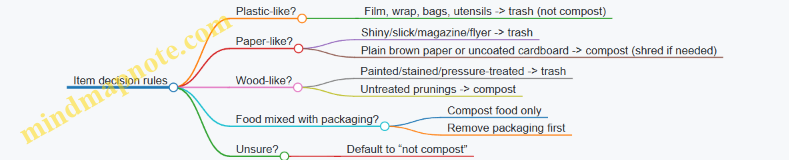
Quick examples you can copy into your routine
- Coffee filter: If it’s paper and uncoated, it can go in. If it’s plastic-lined or part of a packaged system with plastic parts, remove the plastic.
- Egg carton: Plain paper egg cartons are usually fine; glossy or foam inserts are not.
- Greasy pizza box: If it’s heavily greasy, it’s better to keep it out or compost only the clean portions. Grease can cause slow breakdown and messy residue.
- Receipt paper: Many receipts are coated for thermal printing. Treat them as non-compostable.
Bottom line
Contamination prevention is less about perfect knowledge and more about consistent handling: compost only clean, clearly compostable materials; keep packaging and coated items out; and screen finished compost to catch what slips through. When the input list stays simple, the output stays reliable.
5.5 Chemicals and non-food organics: when to keep them out
Home composting is mostly a controlled breakdown of food scraps and plant matter. The “controlled” part matters: compost microbes do best with predictable inputs. When you add chemicals or the wrong non-food organics, you can slow decomposition, create odors, or end up with compost that’s not pleasant to use.
The quick rule: compost is for food and plants
If it was grown (or processed from something grown) and it’s not coated in harmful substances, it usually belongs. If it’s a chemical, a treated material, or a non-food item that isn’t clearly plant-based, keep it out.
Chemicals: why they don’t belong
Chemicals can interfere with microbial activity or leave residues. Even small amounts can matter because compost is a living system, not a trash can.
Common “keep out” chemicals
- Cleaning products (including dish soap, degreasers, disinfectants): they can disrupt microbial communities and add salts.
- Pesticides and herbicides: they’re designed to kill or inhibit living organisms, which includes the helpful ones in your pile.
- Paints, solvents, varnishes, thinners: these are not biodegradable in compost conditions.
- Fuels and oils (gasoline, kerosene, motor oil): they can create persistent contamination and strong odors.
- Pool chemicals (chlorine products): they can be highly reactive and not suitable for compost.
Concrete examples
- You scrape a pan with a sponge that still has dish soap foam. Composting the sponge is a bad idea because soap residues and surfactants can slow breakdown.
- You compost weeds you sprayed last week. Even if the plants look fine, pesticide residues may remain.
- You add a handful of sawdust from a workshop project where the wood was sealed or painted. Treated wood can contain compounds that don’t belong in soil.
Non-food organics: “organic” doesn’t always mean “compost-safe”
Some items are made from natural materials but still cause problems in compost.
1) Treated or coated wood and plant fibers
- Pressure-treated lumber: contains preservatives meant to resist decay.
- Painted or varnished wood: coatings can include chemicals that persist.
- Laminated or composite wood (particleboard, MDF): often includes resins and binders.
Example: You clean up after a home project and toss the sanding dust into the bin. If the surface was painted or sealed, that dust can carry residues.
2) Oily or greasy non-food materials
Food compost can handle some fats in small amounts, but heavy oil contamination is different.
- Oily rags (especially from engines or cooking with lots of oil): can create anaerobic conditions and odors.
- Grease-soaked cardboard: sometimes compostable in small, food-related amounts, but if it’s saturated with cooking oil or other oils, it’s better to keep it out.
Example: A pizza box with a thin, food-soiled layer is usually fine. A box that’s soaked through with grease from repeated frying is not.
3) Pet waste and litter (even “natural” litter)
This topic overlaps with safety rules, but it also fits here because many litters include additives.
- Cat litter: often contains clay, fragrances, or chemicals; it’s not a plant-based input.
- Dog waste: can contain pathogens.
Example: “Compostable” paper litter still may include additives or be contaminated with waste. If you’re not using a system specifically designed for it, keep it out.
What to do instead: practical disposal and workflow
When something doesn’t belong, the goal is to prevent contamination while keeping your compost routine steady.
- Set up a “not for compost” container next to your kitchen bin. It reduces the chance of accidental mixing.
- Rinse only when needed for food scraps. Don’t rinse with chemical cleaners.
- If you’re unsure about a material, treat it like “not for compost” and compost only clearly plant-based scraps.
Example workflow: Keep a small caddy for food scraps, a separate bag for non-compostable items (like soapy wipes or treated wood bits), and a third spot for browns (dry leaves, shredded paper without coatings). Your pile stays consistent, and you don’t have to “fix” contamination later.
Mind map: chemicals and non-food organics decision tree
Mind map: When to keep items out of compost
Quick checklist you can use while sorting
- Was it sprayed with chemicals? If yes, keep it out.
- Is it coated, painted, sealed, or treated? If yes, keep it out.
- Does it contain oils/grease beyond normal food residue? If yes, keep it out.
- Is it a cleaning product, solvent, fuel, or pesticide container content? If yes, keep it out.
- Is it clearly plant-based and uncoated? If yes, it’s a good candidate.
A balanced approach: small mistakes vs consistent contamination
One accidental item is less important than repeated contamination. Composting is forgiving when inputs are mostly correct. The problem is when chemicals or treated materials become a regular habit, because they can accumulate in the compost and keep the pile from working smoothly.
Example: If you occasionally toss in a tiny bit of paper towel with a little cooking residue, your pile likely won’t notice. If you routinely add wipes used with disinfectant, you’ll often see slower breakdown and a stronger odor profile.
Bottom line
Keep chemicals out because they interfere with microbes and can leave residues. Keep non-food organics out when they’re treated, coated, heavily contaminated with oils, or not truly plant-based. When in doubt, compost the scraps you’re confident about and route the rest to the trash or recycling stream that matches your local rules.
6. Step by Step: Starting Your First Batch
6.1 Planning your first week of inputs to avoid overloading
Your first week is mostly about pacing. Composting is a living process, but it’s not a race. Overloading usually happens when too many “greens” arrive at once, or when browns are missing to absorb moisture and keep airflow moving. A simple plan for seven days prevents most early problems like sour smells, slow breakdown, and piles that feel swampy.
Start with a quick inventory (10 minutes)
For the first week, list what you typically throw away from food prep and yard scraps. You don’t need exact weights—just categories.
- Greens (wet, nitrogen-rich): fruit/veg scraps, coffee grounds, fresh plant trimmings.
- Browns (dry, carbon-rich): dry leaves, shredded cardboard, paper towels (plain), untreated wood shavings.
- “In-between” items: eggshells (mostly mineral), tea bags (if paper and unbleached), small amounts of cooked grains (only if your method tolerates them).
Then estimate your daily output in rough terms:
- Low: a few handfuls of scraps total.
- Medium: a bowl or two of scraps plus coffee grounds.
- High: frequent cooking scraps, lots of coffee grounds, and regular yard trimmings.
This estimate determines your input schedule.
Use the “small batch” rule for week one
Instead of feeding the whole bin every day, aim for steady, modest additions. A practical target is to add inputs so that the pile stays in the “damp sponge” zone: wet enough to feel alive, not wet enough to drip.
A simple weekly approach:
- Day 1: start with a base of browns.
- Days 2–6: add greens in small portions, each time covering with browns.
- Day 7: do a check and adjust moisture and airflow.
If you’re using a tumbler or indoor bin, the same logic applies; you’re just working with smaller volumes.
Mind map: week-one planning
A concrete schedule you can follow
Below are two example plans. Pick the one that matches your household pace.
Example A: Medium scraps, backyard pile or outdoor bin
Assumptions: You produce about 1–2 cups of scraps most days, plus coffee grounds.
- Day 1 (setup):
- Add 2–3 inches of browns (dry leaves or shredded cardboard).
- Add a thin layer of greens (about a small handful), then cover with browns.
- Day 2:
- Add greens from cooking (small handfuls), cover with browns.
- If you used a lot of wet scraps (like melon rinds), add extra browns.
- Day 3:
- Add coffee grounds (a small container’s worth is fine), but always cover with browns.
- If the pile feels heavy and wet, add more dry leaves before closing it up.
- Day 4:
- Add yard trimmings only if they’re not slimy. If they’re very juicy, mix them with dry leaves first.
- Day 5:
- Keep it light: cover any new greens with a thicker brown layer than usual.
- Day 6:
- Add a small amount of greens, then check moisture.
- Day 7 (weekly check):
- Lift the top layer. If it smells sour or looks like it’s clumping into wet mats, mix in more browns and fluff the top for airflow.
Example B: High scraps, tumbler or indoor system
Assumptions: You generate more greens and want to avoid sudden moisture spikes.
- Day 1 (setup):
- Add browns to create a dry “buffer” layer.
- Add a small amount of greens, then cover thoroughly.
- Day 2:
- Add greens only if you can cover them immediately with browns.
- If you have a lot of coffee grounds, spread them out over the week rather than dumping them all at once.
- Day 3:
- Add browns even if you’re not adding many greens. This keeps the system stable.
- Day 4:
- If the tumbler is getting heavy or the contents look wet, pause greens and add browns until the texture improves.
- Day 5:
- Add a small portion of greens, cover, and rotate/turn as your method recommends.
- Day 6:
- Add browns and lightly mix to prevent pockets of wet material.
- Day 7 (weekly check):
- Confirm the contents don’t smell sour. A mild earthy smell is normal; a strong “wet basement” smell usually means too much moisture and not enough browns.
Mind map: what “overloading” looks like
How to avoid overloading with a simple daily rule
Use this rule for week one: every time you add greens, add browns too—even if it’s not a full “ratio.” The cover layer matters because it reduces odors, discourages pests, and helps maintain airflow.
A practical way to measure without scales:
- If your greens fill a container halfway, cover with browns until the top looks mostly dry.
- If you can see wet scraps on top, you’re probably short on browns.
Chop, tear, and store inputs to smooth out spikes
Overloading often comes from timing, not just quantity. If you dump all scraps from a busy day into the bin, the pile gets a sudden moisture and nitrogen jump.
Two easy habits help:
- Chop or tear larger scraps so they break down faster and don’t form stubborn wet pockets.
- Store greens in a small container (with a lid) until you can add them with browns. Even a short delay prevents the “all at once” problem.
Week-one check: the squeeze test and the “damp sponge” target
When you mix or lift the top layer on Day 7, do a quick squeeze test:
- Good: it feels like a damp sponge; a few drops may appear, but it shouldn’t pour.
- Too wet: it drips or feels like a wrung-out rag. Add browns and mix.
- Too dry: it crumbles and looks dusty. Add a small splash of water (or mix in slightly wetter browns) and add greens in smaller portions.
A final note on expectations
During the first week, you’re not trying to “finish” compost. You’re building a stable mix that can handle the next week’s inputs. If you keep additions modest, cover greens consistently, and correct moisture early, most compost systems behave well from the start.
6.2 Layering strategy for odor control and faster breakdown
Layering is the part of composting that feels almost too simple—until you notice how often odor and slow breakdown trace back to the same causes: too much wet material, too little airflow, and piles that never get evenly mixed. A good layering strategy fixes those issues before they become problems.
The goal of layering
Layering aims to create three conditions throughout the pile:
- Air pockets for oxygen (microbes need it).
- Moisture distribution so greens don’t sit in a wet clump.
- Contact between greens and browns so decomposition can start quickly.
If you’ve ever opened a bin and found a dark, slimy layer on top, that’s usually “greens-only layering” or “browns added too late.” The fix is to build layers that mix gradually as the pile settles.
A practical layering template (works for most home systems)
Use this pattern as a default. Adjust only the thickness based on what you’re adding.
- Start layer (browns): 1–2 inches of dry browns to absorb initial moisture.
- Greens layer: 1–2 inches of chopped food scraps.
- Browns cover: 1 inch of browns to seal in odors and prevent a wet surface.
- Repeat until the bin is full enough to manage.
For a small batch, you can do fewer repeats. For example, in a tumbler you might do one greens layer and one browns cover, then rotate consistently.
Thickness rule of thumb
- If your scraps are watery (melon rinds, cooked leftovers), keep greens thin and browns thicker.
- If your scraps are dry-ish (most vegetable scraps, coffee grounds), greens can be slightly thicker.
What to layer (with easy examples)
Browns that do the job
Pick browns that are dry and absorbent. Good options:
- Shredded cardboard (remove glossy plastic-like coatings if you’re unsure).
- Dry leaves (especially if they’re not damp).
- Paper egg cartons (torn into pieces).
- Untreated paper you’ve shredded.
Example: If you’re composting a week of kitchen scraps, keep a “browns jar” in the kitchen—paper towel rolls, shredded paper, or a small bag of dry leaves—so you can cover scraps immediately.
Greens that break down faster
Greens are anything that was once living or recently wet and nitrogen-rich:
- Fruit and vegetable scraps
- Coffee grounds and tea leaves
- Fresh plant trimmings
Example: Chop or tear greens before adding. A whole banana peel takes longer to break down than a peel cut into strips, because smaller pieces have more surface area for microbes.
Layering for odor control: the “cover and buffer” method
Odors usually come from two situations: wet anaerobic pockets and food exposed at the surface. Layering prevents both.
Cover immediately
Every time you add new scraps, finish with a browns cover.
- Good: scraps → browns cover → close lid
- Not great: scraps → lid → “I’ll add browns later”
Example: If you add scraps after dinner, add a handful of shredded cardboard right away. You’ll often notice the smell difference within a day.
Use a buffer layer when you’re adding a lot at once
If you’re doing a “scrap dump” (big cooking day), add a thicker browns buffer at the top and sides.
Example: After making a big salad, add scraps in a thin layer, then cover with a 2-inch layer of dry leaves or shredded cardboard. This absorbs the extra moisture and reduces the chance of a sour smell.
Layering for faster breakdown: encourage mixing without turning
Layering alone can work, but you’ll get faster results when layers are designed to blend as the pile settles.
Chop and distribute
- Chop greens into smaller pieces.
- Spread them rather than stacking one thick mound.
Example: Instead of adding all scraps in the center, distribute them around the bin. The browns cover can then reach more surface area, and the pile breaks down more evenly.
Alternate texture
Alternate fine browns (shredded paper/cardboard) with coarser browns (dry leaves). Fine browns help absorb moisture; coarser browns create airflow.
Example: A layer of shredded cardboard under a layer of dry leaves can reduce both wetness and compaction.
How to adjust layering based on moisture
Layering is not a one-size plan. Use moisture as your feedback signal.
If it’s too wet
Signs: strong sour smell, dark mushy layers, liquid pooling.
Layering adjustment:
- Add more browns than usual.
- Make greens thinner.
- Add a dry top cap (2 inches of dry leaves or shredded cardboard).
Example: If your bin smells like a wet basement, don’t add more greens “to balance it.” Add browns until the surface looks evenly damp, not wet.
If it’s too dry
Signs: no smell, slow breakdown, material looks dry and crumbly.
Layering adjustment:
- Add greens in slightly thicker layers.
- Mist dry browns lightly before layering (a spray bottle works).
Example: If your browns are bone-dry shredded paper, lightly dampen them before covering fresh scraps. This helps microbes start working instead of waiting for moisture to arrive.
A simple layering workflow for busy households
Use this routine so layering doesn’t become a chore.
- Add scraps (chopped) in a thin layer.
- Cover with browns immediately.
- Check moisture by feel: damp like a wrung-out sponge.
- If you’re adding a lot, repeat the cycle once more.
Example: On weekdays, you might do one greens layer and one browns cover. On weekends, you might do two cycles because you have more material.
Mind maps
Mind map: Layering for odor control

Mind map: Layering for faster breakdown

Quick examples you can copy
Example 1: Daily kitchen scraps (small amounts)
- Add chopped scraps in a thin layer.
- Cover with shredded cardboard (about 1 inch).
- Repeat once if you added a lot.
Why it works: the surface never stays exposed, and moisture gets absorbed right away.
Example 2: Weekend cooking day (more volume)
- Add greens thinly.
- Cover with dry leaves (2 inches).
- Add another thin greens layer.
- Finish with a browns cover and close the lid.
Why it works: the thicker buffer handles the extra moisture load.
Example 3: Coffee-heavy week
Coffee grounds are often wet and dense.
- Add coffee grounds in a thin layer.
- Cover with extra browns (shredded paper/cardboard).
- Mix in a few dry leaves for airflow.
Why it works: you prevent a compact, wet layer that can turn sour.
Common layering mistakes (and the fix)
- Mistake: leaving scraps uncovered “until later.”
- Fix: cover immediately; odors start at the surface.
- Mistake: thick greens layers.
- Fix: keep greens thin; add browns in proportion.
- Mistake: only fine browns.
- Fix: include some coarse, dry leaves for airflow.
Layering is basically composting’s version of good housekeeping: small, consistent actions that keep the pile balanced. When you cover and buffer every addition, you usually don’t need heroic troubleshooting—just steady inputs and a pile that stays evenly damp and aerated.
6.3 Starting with a small batch vs building to a full pile
When you compost, you’re basically running a controlled breakdown process. The main difference between starting small and building a full pile is how quickly you can correct course. A small batch gives you feedback sooner; a full pile gives you momentum but leaves less room for early mistakes.
The core decision: feedback speed vs throughput
A small batch is usually a few buckets or a partial bin. You add inputs, watch how it behaves, and adjust the recipe (greens/browns, moisture, and aeration) before you commit to a larger volume.
A full pile is closer to your target size from the start. It’s efficient when you already know your household input pattern and you’re confident you can keep the balance steady.
A practical way to think about it:
- If you’re learning your household’s compost “rhythm,” start small.
- If you already have a consistent stream of browns and you know your moisture level, building to a full pile can work well.
Mind map: choosing your starting size
Mind map: Small batch vs full pile
Option A: Start with a small batch (a “test run”)
Why it works: Early on, compost can swing between too wet and too dry because you’re still calibrating. A small batch makes those swings easier to fix.
How to do it (simple workflow):
- Choose a container size you can manage comfortably.
- Add a base of browns (dry leaves, shredded cardboard, or paper egg cartons).
- Add a modest amount of greens (scraps, coffee grounds, tea leaves).
- Cover greens with browns every time you add.
- Wait long enough to observe, then adjust.
Concrete example (week 1):
- Day 1: You add about two handfuls of vegetable scraps and cover with shredded cardboard.
- Day 3: The pile smells “earthy” but feels damp. You add more browns (dry leaves or extra shredded paper) and mix lightly.
- Day 5: Scraps look less recognizable, but the center is not breaking down quickly. You chop larger pieces next time and turn once to reintroduce oxygen.
What to watch for:
- Odor: Sour or ammonia-like smells usually mean too many greens or not enough airflow.
- Texture: If it feels like a wrung-out sponge, you’re close. If it drips, it’s too wet.
- Speed: If nothing changes after several days, the mix may be too dry, too compact, or too low in browns structure.
A small-batch rule of thumb: If you’re unsure about your browns supply, start small enough that you can correct within a week without wasting a lot of material.
Option B: Build to a full pile (a “commit early” approach)
Why it works: Once you have the right structure, a larger mass holds moisture and heat more steadily. That can reduce the number of times you need to intervene.
How to do it (layering and structure):
- Build a base layer of browns for airflow.
- Add greens in thinner layers rather than dumping everything at once.
- Cover each greens layer with browns so the surface doesn’t stay wet.
- Keep the pile loose enough to allow air pockets.
- Plan at least one early check (and turn if needed).
Concrete example (backyard pile to target size):
- You’re aiming for a full pile volume.
- You start with a thick base of dry leaves.
- Each time you add kitchen scraps, you add a matching amount of browns to keep the mix from turning into a wet mat.
- After the pile reaches near target size, you check moisture and aeration. If it’s compacted, you turn once to restore airflow.
What to watch for:
- Early anaerobic conditions: A full pile can go wrong quickly if the first layers are too wet or too dense.
- Surface behavior: If the top stays slimy or smells unpleasant, it’s usually a coverage and airflow issue, not a “bad luck” issue.
- Heat consistency: If it never warms up and stays cold, the mix may be too dry or too low in active greens.
A practical hybrid: “small start, then scale up”
You don’t have to choose one extreme. A common approach is to start with a small batch until you see stable behavior, then add more material to reach your preferred size.
Example hybrid plan:
- Week 1: Keep a smaller working pile.
- After you confirm the moisture and odor are stable, begin adding more inputs to increase volume.
- If you notice the pile shifting toward wet or smelly, pause scaling and add browns until it returns to balance.
This hybrid approach is especially useful when your browns are seasonal. Leaves and shredded cardboard might come in waves, while kitchen scraps arrive daily.
Quick comparison checklist
| Factor | Small batch | Full pile |
|---|---|---|
| Learning speed | Fast | Slower |
| Risk of major imbalance | Lower | Higher early on |
| Effort to manage | More frequent checks | Fewer interventions once stable |
| Best for | Indoor setups, new composters, uncertain browns | Backyard systems with reliable browns and regular access |
| Common failure mode | Overcorrecting (adding too many browns) | Overloading (too wet/compact at the start) |
Common mistakes and how to avoid them
-
Mistake: starting small but treating it like a finished pile. Small batches still need browns coverage and occasional aeration. If you never adjust, you just get a small, consistently imbalanced pile.
-
Mistake: building to full size with heavy greens right away. If you add a lot of scraps before you’ve established structure, you can create a wet layer that slows everything down.
-
Mistake: using only one kind of brown. Shredded cardboard adds structure, but leaves add bulk and airflow. Mixing browns types helps prevent the pile from becoming either too fine (compacts) or too dry (slows breakdown).
Bottom line
Start small when you want faster feedback and easier corrections. Build to a full pile when you already know your balance and can maintain airflow. If you’re unsure, use the hybrid method: run a small batch long enough to confirm moisture and odor, then scale up without changing your core compost “recipe.”
6.4 Keeping a simple log of inputs and adjustments
A compost log is not a diary of your scraps. It’s a practical tool for noticing patterns: which inputs lead to good breakdown, which ones cause odors, and how your moisture level changes with weather. When you keep a log, you stop guessing and start adjusting with intent.
What to log (and what to ignore)
You only need a few fields. Too many details turn the log into homework.
Log these three things every time you add material:
- Greens added (type + rough amount): e.g., “kitchen scraps, ~2 cups.”
- Browns added (type + rough amount): e.g., “shredded cardboard, ~1 cup.”
- Moisture check: “dry / right / wet,” based on a quick squeeze test (see below).
Log these two things when you adjust:
- Action taken: e.g., “added browns,” “turned pile,” “covered more tightly.”
- Reason: e.g., “smelled sour,” “too wet,” “not breaking down.”
Everything else is optional. You can skip exact weights, temperatures, and dates at first. Consistency beats precision.
The moisture check you can repeat
Use the same test each time so your notes mean something.
- Grab a handful of compost mix.
- Squeeze it firmly.
- Dry: no moisture and crumbly.
- Right: a few drops or dampness, but not dripping.
- Wet: water runs out or it feels like a wrung sponge.
Write “dry / right / wet” in your log. That single word helps you connect outcomes to moisture.
A simple log template
Use paper, a spreadsheet, or notes in your phone. The format matters less than the habit.
| Date | Greens added | Browns added | Moisture (dry/right/wet) | What you noticed | Adjustment made |
|---|---|---|---|---|---|
| 3/12 | veggie scraps (~2 cups) | shredded cardboard (~1 cup) | right | mild earthy smell | none |
| 3/14 | coffee grounds (~1 cup) | dry leaves (~2 cups) | wet | sour smell | added browns + turned |
If you want even fewer fields, keep only: date, greens, browns, moisture, adjustment.
Mind map: what your log should help you decide
How to keep the log without slowing down
The trick is to log at the same moment you’re already doing something.
Choose one “log moment” per day:
- After you add scraps, write the greens/browns and moisture.
- After you turn the pile, write what changed and why.
- After you notice an odor, write the symptom and the fix.
If you only log once a week, that’s still useful. Just make sure the entries include the last few additions and any adjustments you made.
Examples: turning notes into better compost
Example 1: The “coffee grounds made it wet” pattern
Log entry:
- Greens: coffee grounds (~1 cup)
- Browns: none (you planned to add later)
- Moisture: wet
- Noticed: sour smell after two days
- Adjustment: added shredded cardboard (~2 cups) + turned
What this teaches you: coffee grounds are concentrated and can tip the mix toward wet and dense. Next time, you can pre-plan browns.
Next entry (improved):
- Greens: coffee grounds (~1 cup)
- Browns: shredded cardboard (~1–2 cups) added immediately
- Moisture: right
- Noticed: earthy smell
- Adjustment: none
Example 2: “Dry pile, slow breakdown”
Log entry:
- Greens: veggie scraps (~2 cups)
- Browns: dry leaves (~3 cups)
- Moisture: dry
- Noticed: pile looks fluffy but stays chunky
- Adjustment: misted with water + added a small amount of greens
What this teaches you: dry browns can absorb moisture faster than you expect. If your pile is dry, adding more browns usually makes it worse.
Next entry (improved):
- Greens: veggie scraps (~2 cups)
- Browns: shredded cardboard (~1 cup)
- Moisture: right
- Noticed: fewer chunky bits after a week
Example 3: “Too many greens, not enough structure”
Log entry:
- Greens: watermelon rinds + salad trimmings (~4 cups)
- Browns: shredded paper (~1 cup)
- Moisture: wet
- Noticed: slimy clumps
- Adjustment: added dry leaves + turned thoroughly
What this teaches you: watery greens need more structure (browns that stay airy) and more aeration. Turning helps distribute moisture and oxygen.
Next entry (improved):
- Greens: watery scraps (~2 cups)
- Browns: dry leaves (~2 cups) + cardboard (~1 cup)
- Moisture: right
- Noticed: less clumping
A quick way to review your log (no spreadsheets required)
Once you have a handful of entries, scan for three questions:
- When did moisture say “wet”? What adjustments followed?
- Which browns showed up right before good outcomes? (e.g., cardboard vs dry leaves)
- What symptom appeared first? Sour smell often shows up before you see obvious texture changes.
Write one short note at the bottom of the page after a week, such as:
- “Wet happened after coffee without browns. Add browns immediately.”
- “Dry happened after lots of dry leaves. Mist and add greens.”
That one sentence is the whole point.
Common mistakes (and how your log prevents them)
- Logging only when something goes wrong. You’ll miss the conditions that led to success.
- Changing multiple variables at once. If you add browns, turn, and change the bin all in one day, your notes won’t tell you what fixed the issue.
- Using vague entries. “Added browns” is better than nothing, but “added shredded cardboard” is more actionable.
A good log is short, specific, and consistent. Over time, it becomes a map of cause and effect for your exact kitchen and your exact compost setup.
7. Managing the Pile: Aeration, Turning, and Odor Control
7.1 When to turn and when to leave it alone
Turning is the compost equivalent of stirring soup: it helps heat and speed, but you don’t need to do it every minute. The goal is steady decomposition with minimal odor and minimal extra work.
The quick rule: turn for speed, leave it for stability
- Turn when you need more oxygen or more heat. If the pile is sluggish or smells sour, turning usually helps.
- Leave it alone when it’s already behaving. If it’s warm, not wet, and not smelly, frequent turning can slow things down by cooling the pile.
What “behaving” looks like (practical checks)
Use these checks instead of guessing.
-
Temperature (if you have a thermometer):
- Warm and rising: you can wait.
- Cool and flat: consider turning.
-
Moisture (hand squeeze test):
- Like a wrung-out sponge: leave it.
- Dripping wet or muddy: turn once only after adding browns.
- Dusty and dry: add moisture and avoid repeated turning until balanced.
-
Smell:
- Earthy/forest floor: leave it.
- Sour, ammonia-like, or “stinky wet trash”: turn and adjust.
-
Texture and visible scraps:
- Still chunky and fresh: turning may help, especially early.
- Mostly uniform and darkening: you can let it finish without frequent disturbance.
Mind map: turning vs leaving it alone
How often should you turn? (by compost stage)
Different methods vary, but the logic is the same: you turn when conditions drift away from “healthy.”
Early stage (first 1–3 weeks for many backyard piles)
- Typical approach: turn once after the initial build if you want faster start-up, then reassess.
- Why: early on, the pile is still finding its balance. A single turn can distribute moisture and oxygen.
- Example: You start with a mix of kitchen scraps and shredded paper. After a few days it smells fine but stays cool. Turning once, then keeping moisture at wrung-out sponge level, often kickstarts activity.
Active stage (middle of the process)
- Typical approach: turn every 1–2 weeks if you’re chasing speed, or only when checks suggest trouble.
- Why: repeated turning can cool the pile and disrupt the microbial work. If it’s already warm and earthy, you’re paying labor for little benefit.
- Example: Your pile is warm for several days and smells like soil. You’re tempted to turn “just to be sure.” Instead, leave it, add browns only if it looks wet, and check again in a few days.
Late stage / curing (when it’s darkening and less “scrap-like”)
- Typical approach: turn rarely or not at all.
- Why: at this point, the material is breaking down more slowly. Disturbing it doesn’t usually speed things up much, and it can reintroduce uneven moisture.
- Example: You notice fewer recognizable food scraps and a more uniform texture. The smell is earthy. You can stop turning and focus on keeping moisture steady.
Turning technique: what matters more than frequency
Turning isn’t just “move it around.” It’s about correcting the pile’s internal conditions.
When you turn, do these three things
- Re-mix layers: bring outer material to the center and center material outward.
- Check moisture during the turn: add browns if it’s wet, add water if it’s dry.
- Avoid over-chopping: if you already shredded browns and chopped scraps, you don’t need to pulverize everything further.
When you should avoid turning
- If the pile is already evenly moist and earthy: turning can cool it and create a temporary “reset.”
- If you’re dealing with a very small batch: frequent turning can keep it from building heat.
Method-specific guidance (still based on the same logic)
Backyard pile
- Turning is usually manual, so you’ll likely turn less often.
- Use the checks: if it’s cool or sour, turn; if it’s warm and earthy, wait.
Tumbler
- Tumblers often rely on regular agitation to maintain airflow.
- Still, you don’t need to spin constantly. If the contents are already warm and not smelly, reduce frequency.
- Example: You spin daily for a week, but the pile never warms. That suggests moisture imbalance or too many greens. Adjust the recipe, then spin less often.
Worm bin
- Worm composting is different: you’re not trying to create a hot pile.
- “Turning” isn’t the same action. Instead, you manage bedding moisture and add food gradually.
- If the bin smells bad, the fix is usually more bedding (browns) and better moisture—not aggressive mixing.
Concrete scenarios: decide in under a minute
-
Sour smell + wet clumps
- Action: turn once, then add dry browns until the mix feels like a wrung-out sponge.
- Reason: sour odors often come from too little oxygen and too much moisture.
-
Cool pile + lots of dry, shredded paper
- Action: add water gradually, then leave it.
- Reason: dryness slows microbial activity; turning won’t help if there’s not enough moisture.
-
Warm pile + earthy smell
- Action: leave it alone.
- Reason: you’re already getting oxygen and moisture balance; extra turning mainly cools it.
-
Recognizable scraps still visible after a while
- Action: turn once and chop or shred inputs next time.
- Reason: particle size affects how quickly microbes can work.
A simple decision checklist
Use this each time you consider turning.
- Is it warm (or trending warmer)?
- Does it smell earthy?
- Is moisture wrung-out sponge?
- Are there compact layers or obvious dry pockets?
If you answer “yes” to the first three and “no” to the last, leaving it alone is usually the right move.
Mind map: the “turn now” triggers
Turning is a tool, not a requirement. When you turn, turn with a purpose: correct moisture, restore airflow, and redistribute material. When the pile is already doing its job, let it do that job without interruption.
7.2 How to aerate effectively without making a mess
Aeration is the oxygen part of composting. It helps microbes work efficiently and reduces the odds of sour, swampy smells. The trick is to add air without scattering scraps across your yard, kitchen, or shoes.
What “effective aeration” actually means
Good aeration does three things:
- Replaces stale air inside the pile with fresh air.
- Prevents compaction so air can move through the material.
- Keeps moisture in the right range so microbes can breathe and break down food.
If your compost is too wet, turning can spread liquid and odor. If it’s too dry, turning creates dust and slows breakdown. Aeration works best when moisture is “damp sponge,” not dripping and not dusty.
Quick readiness check (30 seconds)
Before you turn, do this:
- Grab a handful from the middle.
- Squeeze it.
- Look and listen.
Use this rule of thumb:
- Drips water: too wet.
- No moisture at all: too dry.
- A few drops, earthy smell: you’re in the zone.
If it’s too wet, add browns first (shredded cardboard, dry leaves). If too dry, mist lightly and mix browns in before turning.
Choose the right aeration tool for the job
Different bins need different approaches.
- Backyard pile (open or bin with access): pitchfork or compost aerator tool.
- Tumbler: turning the drum is aeration; you’re not “digging,” you’re rotating.
- Stationary bin with a lid: a pitchfork plus a careful “poke and lift” method.
- Worm bin: aeration is mostly about moisture and gentle fluffing; heavy turning is not the goal.
For messy-free aeration, the best tool is the one that lets you move material in place rather than fling it.
The mess-minimizing turning method (for open piles and bins)
Aim for air channels, not a full demolition.
Step-by-step: “Poke, lift, and tuck”
- Clear a small working path around the bin so you’re not stepping on compost.
- Start at the edges and work inward.
- Use a pitchfork to push straight down into the pile.
- Lift slightly to break up compaction, then tuck material back where it came from.
- Repeat in a grid pattern.
A simple grid: imagine 6–10 holes across the top surface. You’re creating pathways for air without turning everything over.
Why this works: you disturb less material, so fewer scraps end up on the ground. You also reduce the chance of dragging wet food into the outer layer.
How often to aerate
Aeration frequency depends on how fast your compost is moving.
Use these practical cues:
- If it smells sour or looks slimy: aerate sooner and add browns.
- If it’s dry and not breaking down: aerate less aggressively and focus on moisture.
- If it’s actively heating and smells earthy: aerate on a schedule.
For many home setups, a reasonable rhythm is every 1–2 weeks for open piles, and as needed for bins where you can’t easily turn. Tumbler systems often get aerated by regular rotation.
Layering to reduce mess during turning
Mess often comes from the top layer being the most food-heavy. If the top is mostly scraps, turning tends to fling them.
Use a “containment layer”:
- After adding kitchen scraps, cover them immediately with a thick layer of browns.
- Keep browns dry and fluffy so they absorb moisture and stay put.
Example: If you add a bowl of chopped veggie scraps, follow with a layer of shredded cardboard or dry leaves thick enough that you can’t see the scraps. When you later aerate, you’re mostly moving browns and partially mixed material, not raw food.
Moisture management during aeration
Turning can redistribute water. To avoid turning your compost into a wet mess:
- Turn when the pile is stable, not after heavy rain unless you’ve covered the pile well.
- If the pile is wet, don’t “mix harder.” Add browns first, then aerate gently.
- If the pile is dry, don’t “spray and churn.” Mist lightly, mix once, then leave it.
A useful target: after aeration, the pile should look slightly darker inside than on top, with no puddling.
Odor control through aeration strategy
Odor is often a sign of low oxygen and excess moisture.
If you smell ammonia or sourness:
- Aerate using the poke-and-tuck method.
- Add browns in a band around the smelly area.
- Avoid turning the entire pile at once; focus on the problem zone.
If you smell “rotten” rather than earthy:
- Treat it like a moisture issue first.
- Add dry browns and let the pile recover before further turning.
Common mistakes that create mess (and how to prevent them)
-
Overturning the whole pile
- Fix: use the grid poke method and tuck material back.
-
Turning when the top is uncovered food
- Fix: cover scraps immediately with browns.
-
Using a tool that drags
- Fix: push straight down and lift minimally; avoid scraping across the surface.
-
Ignoring moisture
- Fix: do the squeeze check first, then decide whether to aerate or adjust browns.
Mind map: Aerating without making a mess
Concrete examples you can copy
Example 1: Open bin, weekly kitchen scraps
- Every time you add scraps: cover with a 2–3 inch layer of shredded cardboard.
- Every 10–14 days: poke-and-tuck in a grid across the top.
- If the top looks wet: add dry leaves on top, then poke only the top third.
Example 2: Compost tumbler with a messy lid area
- Keep the lid closed between rotations to prevent odor escape.
- Rotate fully but avoid overfilling; excess material rises and spills.
- If you notice food on the sides: add browns before the next rotation and rotate more gently.
Example 3: Stationary bin, limited access
- Use a pitchfork to create holes from the top.
- Don’t dig out the center; lift just enough to break compaction.
- Add browns to the top layer after aeration so future scraps stay contained.
A simple “aeration checklist”
- Scraps are covered with browns.
- Moisture is damp sponge (not dripping, not dusty).
- Tool pushes straight down and lifts minimally.
- You use a grid of poke-and-tuck moves.
- You adjust browns if odor or moisture is off.
Aeration doesn’t have to be a big production. When you create air channels, manage moisture first, and keep fresh scraps covered, you get oxygen where it matters—without turning your compost into a ground-level snack parade.
7.3 Troubleshooting odors: wet, sour, and ammonia smells
Odors are compost’s way of telling you what’s off balance. The trick is to match the smell to the likely cause, then fix the inputs and airflow—not just “air it out” and hope.
Quick odor-to-fix guide
- Wet / swampy smell → too much moisture and not enough air.
- Fix: add browns (dry leaves, shredded cardboard), mix/turn if possible, and improve drainage.
- Sour / vinegar-like smell → fermentation is running faster than decomposition, usually from excess greens or very fine, packed material.
- Fix: add browns, break up clumps, and increase aeration.
- Ammonia / sharp “cleaning product” smell → too many nitrogen-rich inputs (greens) relative to carbon, often with limited oxygen.
- Fix: add browns generously, turn to reintroduce oxygen, and slow down future green additions.
Mind map: odor diagnosis and actions
Wet / swampy smell
What it sounds like (smell-wise): Think “marsh” or “stagnant water.” Compost that’s consistently wet often turns into a slimy, oxygen-poor mass.
Most common causes in home bins:
- You’ve been adding lots of food scraps without enough dry bulking material.
- The pile is staying too wet from rain, a leaky lid, or a bin sitting in a low spot.
- The material is layered too tightly, especially if you add scraps in a thick layer and don’t mix them in.
Concrete fix (do this in order):
- Add browns right away. Use dry leaves, shredded cardboard, or paper egg cartons. Aim for a layer thick enough to visibly dry the surface.
- Mix or turn if your system allows it. In a backyard pile, turn the top layer into the center. In a tumbler, rotate and then add browns through the next feed.
- Check moisture by feel. Grab a handful from the middle (not the top crust). It should feel like a wrung-out sponge. If it drips, you need more browns and more airflow.
- Adjust the setup. If water pools around the bin, raise it slightly, improve drainage, or move the bin to a better spot.
Example: You start composting kitchen scraps daily, but you only add a small handful of shredded paper each time. After a week, the bin smells swampy. The fix isn’t “stop adding everything.” Add a thick layer of dry leaves, mix, and then switch to a routine where every scraps addition is paired with a comparable amount of browns.
Sour / vinegar-like smell
What it means: Sour smells usually indicate fermentation. Your pile has plenty of “food,” but it’s not getting enough oxygen and structure to break down smoothly.
Common causes:
- Too many greens at once. A big batch of fruit scraps or fresh vegetable trimmings can overwhelm the carbon.
- Very fine, packed material. If scraps are chopped extremely small and added in a dense layer, air can’t move through.
- Not enough mixing between layers. Even a balanced recipe can smell sour if layers stay unmixed.
Concrete fix:
- Break up the layer. Use a fork to loosen the top 6–12 inches (or whatever depth you can reach). Clumps trap moisture and reduce airflow.
- Add browns in a “cover and mix” approach. Cover the sour layer with browns, then mix it in rather than leaving it as a dry blanket.
- Aerate more frequently for a few days. If you normally turn weekly, turn every few days until the smell changes.
- Slow down greens temporarily. For the next few additions, use smaller scrap portions and increase browns.
Example: After a weekend of cooking, you dump a bag of chopped vegetable scraps into the bin. The next day it smells like vinegar. You add browns on top only. The smell lingers because the problem is inside the packed layer. Loosen the layer, mix in browns, and then resume feeding with smaller portions spread out over the week.
Ammonia smell
What it indicates: Ammonia is a sign that nitrogen-rich material is breaking down in an oxygen-limited environment. It’s often the compost equivalent of “too much of a good thing.”
Common causes:
- A high proportion of greens (fresh scraps, coffee grounds, manure if used) without enough carbon.
- Limited airflow, especially in sealed or poorly ventilated bins.
- A pile that’s wet and dense, which prevents oxygen from reaching the microbes doing the work.
Concrete fix (aim for quick improvement):
- Add carbon-rich browns generously. Shredded cardboard, dry leaves, and paper-based bedding (uncoated) are good choices. Don’t be shy—ammonia usually needs more browns than you’d use for a mild imbalance.
- Turn immediately. Aeration is the fastest way to reduce ammonia odor because it changes the conditions microbes experience.
- Pause greens for a short window. For about a week, feed mostly browns with only small amounts of scraps mixed in.
- Check ventilation. Ensure vents aren’t blocked and that the bin isn’t sitting in a way that traps moisture.
Example: Your bin smells sharp and unpleasant, like ammonia. You realize you’ve been adding coffee grounds daily and lots of fresh scraps, but you rarely add dry leaves. You turn the pile, add a thick layer of shredded cardboard, and then switch to a “browns-first” routine for several days. The smell fades as the pile regains structure and oxygen.
How to prevent odor recurrence (without overthinking)
- Use a consistent feed rhythm. Small, frequent additions compost more predictably than big dumps.
- Match scraps with browns every time. If you add a bowl of scraps, add a comparable volume of dry browns (adjust based on how wet your kitchen scraps are).
- Keep the pile structured. Avoid packing scraps tightly; mix them into existing material.
- Don’t ignore the middle. The top can look fine while the interior is wet and oxygen-starved.
Mini checklist after you fix it
After turning and adding browns, odors should improve within a short time window (often days, not weeks). If the smell returns quickly, the issue is usually ongoing moisture or repeated nitrogen-heavy additions without enough carbon.
When you can, take one handful from the middle and compare it to the wrung-out sponge test. Then adjust only one variable at a time—browns, moisture, or aeration—so you know what actually worked.
7.4 Troubleshooting pests: prevention steps and practical responses
Home compost pests usually show up for one reason: the compost is offering an easy meal or a comfortable home. Your job is to remove the “welcome mat” without turning composting into a full-time job.
First, identify the likely pest (and what it’s telling you)
Use this quick logic to avoid chasing the wrong problem.
- Fruit flies (tiny, hovering around the bin): usually triggered by exposed food scraps, wet surface, or frequent opening.
- Gnats (similar to fruit flies but often more persistent): often linked to consistently wet compost or standing liquid.
- Ants: commonly attracted to accessible food or a dry, crumbly surface that’s easy to navigate.
- Raccoons, rats, or mice (larger visitors, disturbed bin, missing scraps): usually means the bin isn’t secure or food is being added too openly.
- Slugs/snails (outdoor piles): typically a moisture issue plus low aeration near the surface.
If you can, note when you see them: right after adding scraps, after watering, or after a rainy stretch. Timing is a clue.
Prevention steps that work across most pests
1) Keep food covered every time you add scraps. Add scraps, then bury them under a layer of browns (dry leaves, shredded cardboard, or paper). A 2–3 cm (about 1 inch) cover is usually enough to stop many insects from laying eggs on the surface.
Example: If you toss in banana peels and walk away, you’ll often get fruit flies. If you add the peels and immediately cover with shredded cardboard, the flies usually lose interest.
2) Balance moisture so the surface isn’t wet. Most flying pests prefer damp, exposed material. Aim for a compost texture that feels like a wrung-out sponge. If the top looks glossy or smells sour, it’s too wet.
Example: After a humid week, your bin smells “vinegary” and you see gnats. Add browns and mix the top layer to restore airflow and reduce surface moisture.
3) Chop or shred inputs to reduce “easy meals.” Smaller pieces break down faster, which reduces the time pests can exploit them.
Example: Whole apple cores attract attention longer than chopped cores. Chopping also helps you maintain a steadier ratio.
4) Use the right browns as pest control, not just “carbon.” Dry, absorbent browns act like a lid. Shredded cardboard and dry leaves are especially useful when you’re seeing insects.
Example: If you’re running low on browns, crumpled paper (not glossy) can help cover fresh scraps until you restock.
5) Don’t add oily or sugary scraps to open systems. Oils and sugary foods are pest magnets. If you compost them, bury them well and consider a method that reduces exposure (like a sealed indoor caddy that transfers to a larger pile).
Example: A small amount of coffee grounds is usually fine, but a large pour of sweet tea residue can bring flies.
6) Improve airflow at the surface. Many pests thrive where oxygen is low and the surface stays damp. A quick stir or turning of the top layer can fix the conditions.
Example: If you haven’t turned in a while and the surface is compacted, turning reintroduces oxygen and dries the top.
Practical responses by pest type
Fruit flies and gnats
- Cover immediately: add browns right after feeding.
- Dry the top layer: mix in dry leaves or shredded cardboard; avoid adding water.
- Reduce “open time”: keep the lid closed as much as possible.
- Check for leaks: if you’re collecting liquid or using a bin with drainage, ensure no puddles form.
Example response: You add veggie scraps at 6 pm, and by 9 pm you see fruit flies. Next feeding, cover the scraps, then add a thicker browns layer than usual. If the surface stays dry for a few days, the flies typically fade.
Ants
- Cover food and keep it buried.
- Avoid overly dry, dusty surfaces: ants like easy-to-walk-on crumbs.
- Turn or mix the top layer to disrupt their routes.
- Check for gaps in the bin: loose lids or cracks can create access points.
Example response: Ants are marching to a specific corner of the bin. That corner likely has exposed scraps or a consistently dry patch. Mix that area and add browns to even out moisture.
Raccoons, rats, and mice (outdoor security issues)
- Secure the bin: use a lid that latches and hardware cloth where needed.
- Bury scraps deeper: add fresh material under existing compost rather than on top.
- Stop “top-feeding” for a week: let the pile heat and stabilize.
- Avoid adding high-attractant foods: meat, dairy, and oily foods are not just “smelly”; they’re also high-risk for pests.
Example response: You notice disturbed compost and missing scraps at night. The simplest fix is to stop adding on the surface and bury new inputs under several inches of material, then ensure the bin is fully closed and secured.
Slugs and snails (outdoor piles)
- Reduce surface moisture: add browns and improve aeration.
- Avoid leaving fresh, wet scraps on top.
- Turn the surface layer so they don’t get a calm, damp hiding spot.
Example response: After rain, you see slugs near the top. Add dry leaves, mix the top layer, and keep fresh scraps covered. They usually decline once the surface is less hospitable.
Mind map: pest prevention and response
A simple “pest-proofing” routine (10 minutes)
- Day of feeding: cover scraps with browns immediately.
- Next day: check the surface. If it looks wet or smells sour, add browns and mix the top.
- Once a week: do a quick surface stir (especially for outdoor piles) to prevent compaction.
- After heavy rain or heat: reassess moisture. Compost that swings between wet and dry tends to attract pests.
Example: You compost in a backyard bin. After a rainy weekend, you notice more slugs. You add dry leaves and turn the top layer. Within a few days, the surface dries out and the slugs move on.
When to adjust your composting method
If pests keep returning despite good coverage and moisture control, the system may not match your household inputs. For example, frequent indoor scraps with lots of fruit waste can overwhelm an open container, while an outdoor pile that’s always fed on top can invite larger animals. The fix is usually operational: change how you add scraps, not just what you add.
Example: If you’re seeing fruit flies indoors, switch to a workflow where scraps are collected in a sealed caddy and transferred to the main compost in batches, with browns covering the transfer area.
Pests are information, not failure. When you correct the conditions they’re exploiting—surface exposure, moisture, airflow, and access—the compost usually settles down quickly.
7.5 Maintaining steady moisture during hot, cold, and rainy periods
Moisture is the “reaction medium” for compost. Too dry, microbes slow down and you get crunchy, slow-to-break scraps. Too wet, air gets pushed out and the pile shifts toward sour smells and sluggish breakdown. The goal is steady dampness: like a wrung-out sponge.
Quick moisture targets (use these as your baseline)
- Feel test: Grab a handful from the middle of the pile. It should feel cool and damp, and you should be able to squeeze out at most a few drops.
- Texture check: Finished-looking compost should be crumbly, not muddy. During active composting, it should not clump like wet soil.
- Smell clue: A mild earthy smell is normal. A strong sour or ammonia smell often points to excess moisture and/or too many greens.
Mind map: moisture management by season
Hot weather: prevent drying without creating a swamp
Heat speeds evaporation, especially on the top and sides. The middle can stay moist longer, but the outer layers dry first, which slows breakdown and can make turning messy.
What to do
- Check moisture from the middle, not the surface. Surface dryness is common and not always a problem.
- Water in small doses. Instead of pouring a lot at once, use a watering can with a fine rose or a spray bottle. Add enough to moisten the handful you test after mixing.
- Use browns strategically. If you’re adding greens frequently (kitchen scraps), keep a steady supply of dry browns like shredded cardboard or dry leaves. Browns act like a sponge and help even out moisture.
- Cover for shade and rain protection. A breathable cover (like a tarp that doesn’t seal airtight) reduces sun and wind drying. Leave airflow pathways so you don’t trap excess humidity.
Example (hot week, backyard pile):
- Day 1: You notice dry edges and a pile that smells neutral but isn’t warming.
- Action: Add a layer of dry shredded cardboard (about 1–2 inches) and lightly mist the top until the next handful test shows dampness with only a few drops.
- Day 3: Turn once to mix the moisture through, then stop watering unless the middle test says it’s drying again.
Common mistake: watering the top repeatedly without mixing. That can create a wet crust that blocks airflow while the middle stays dry.
Cold weather: keep moisture steady when activity slows
Cold slows microbial activity, so the pile may not heat up much. That doesn’t mean it’s failing; it often means you should manage moisture more conservatively.
What to do
- Aim for wrung-out dampness, not dripping. Overwatering in cold conditions can lead to persistent wet pockets that never get enough oxygen.
- Insulate without sealing. Use a breathable cover or a layer of dry leaves around the pile. The goal is to reduce temperature swings, not to trap moisture like a lid.
- Avoid watering during hard freezes. If the pile is frozen through, adding water won’t distribute well and can worsen compaction when it thaws.
- Chop and mix inputs. Smaller pieces break down more evenly, reducing the chance of dry pockets that stay intact for a long time.
Example (winter compost, indoor bin or covered outdoor bin):
- You add kitchen scraps on a cold day.
- Instead of adding a thick wet layer, mix scraps with dry browns first, then add a thin top layer of dry material.
- Check moisture after a few days by pulling material from the middle. If it’s still wrung-out damp, you wait; if it’s dry, add a small amount of water and mix.
Common mistake: assuming “cold means dry.” Cold piles can still be wet, especially if they’re covered poorly or sit on damp ground.
Rainy weather: stop waterlogging before it starts
Rain is the easiest way to overshoot moisture. Water can run into the pile, compact it, and push out air. Once oxygen is limited, you’ll often see sour smells and slow breakdown.
What to do
- Cover to shed rain, not to trap it. Use a cover that keeps direct rainfall off while still allowing some airflow.
- Improve drainage. If your bin sits on soil, consider a base layer of coarse browns (like dry leaves or small twigs) to help water move away. For tumblers, ensure the system isn’t sealed at the bottom.
- Add dry browns quickly. When rain is heavy, add extra dry browns to absorb excess water. This is faster than trying to “dry out” a saturated pile.
- Turn if it’s saturated. If the pile feels heavy and compacted, turning reintroduces oxygen and redistributes moisture.
Example (rainstorm weekend):
- Saturday: After several inches of rain, the pile feels like a damp sponge that’s starting to drip when squeezed.
- Action: Add a generous layer of dry shredded cardboard and dry leaves, then mix the top 6–12 inches.
- Sunday: Re-test from the middle. If it still squeezes out more than a few drops, turn again and add more dry browns.
Common mistake: covering with an airtight plastic sheet. That can trap moisture and reduce airflow, making odor problems more likely.
A simple moisture routine you can follow
Use a consistent check so you’re not reacting randomly.
- Weekly middle test: Grab a handful from the middle area.
- Adjust with one lever at a time:
- If too dry: add water + mix, or add browns that hold moisture.
- If too wet: add dry browns + mix, or improve drainage/cover.
- Wait for the pile to respond: After adjustments, check again in a few days. Compost doesn’t change instantly, especially in cold weather.
Moisture decision guide (fast troubleshooting)
| What you notice | Likely moisture issue | What to do right now |
|---|---|---|
| Dry edges, neutral smell, slow breakdown | Too dry (often surface) | Mist lightly and mix; add dry browns to hold moisture |
| Squeezes out many drops, heavy mass | Too wet | Add dry browns and turn to reintroduce oxygen |
| Sour smell, compacted feel | Too wet and low oxygen | Turn, add browns, and improve cover/drainage |
| Frozen or very cold pile, uneven feel | Uneven moisture distribution | Mix inputs with browns; avoid watering during hard freezes |
Final practical rule
Treat moisture like a dial, not a switch. Small adjustments—made after a middle test—keep compost stable across hot, cold, and rainy stretches, and they prevent the two classic failures: drying out into slow compost, or waterlogging into smelly, oxygen-starved compost.
8. Composting Methods for Different Homes
8.1 Backyard compost piles: setup, maintenance, and typical timelines
A backyard compost pile is a simple system: you feed it, keep the conditions right, and let microbes do the work. The main difference between “it’s working” and “why does this smell like regret?” is usually moisture and airflow.
Setup: build a pile that can breathe
Pick a location first. Choose a spot with easy access for adding scraps and turning. Aim for good drainage so rain doesn’t turn the pile into a swamp. If you can, place it on bare ground or coarse gravel so excess moisture can escape.
Start with a base layer. A base of coarse browns (dry leaves, small twigs, shredded cardboard) improves airflow from day one. Think of it as the pile’s “floor vents.”
Choose a pile size. For most home yards, a pile around 3 ft (1 m) wide and 3–5 ft (1–1.5 m) long is a practical target. Too small cools down quickly; too large can be harder to turn evenly.
Use a simple layering rhythm. Add scraps in thin layers, then cover with browns. Thin layers reduce odor and pests because microbes can process the material before it turns into a sticky mess.
Optional: use a bin or frame. A wire bin or wooden frame helps contain material and keeps the pile tidy. It doesn’t replace good maintenance, but it does make turning easier.
Maintenance: keep three variables in balance
Backyard piles usually succeed when you manage air, moisture, and particle size.
1) Moisture: aim for “wrung-out sponge”
If you squeeze a handful, it should feel damp but not drip. If it’s dry and dusty, add water while turning. If it’s soggy and smells sour, add browns and turn to reintroduce oxygen.
Example: You add a week of kitchen scraps and the pile starts to smell like a damp basement. Turn the pile, mix in shredded cardboard and dry leaves, and stop adding wet scraps for a day or two. After a couple of turns, the smell should fade.
2) Airflow: turn when needed, not on a calendar
Turning speeds things up by mixing fresh material into the hotter core. A common approach is every 1–2 weeks for active piles. If you don’t want to turn often, you can still compost, but timelines will be longer.
Example: Your pile is heating up and smells earthy. You don’t need to rush to turn it. If the center cools and the outer layer looks unchanged, that’s a good sign it’s time to mix.
3) Particle size: chop to shorten the job
Smaller pieces break down faster. Chop large scraps (like melon rinds or thick stems) and shred browns when possible.
Example: Apple cores and banana peels compost quickly even without chopping. Corn cobs and thick stalks take longer; cutting them into smaller chunks helps the pile stay productive.
Feeding strategy: avoid overload
A pile can handle a steady stream of scraps, but it struggles when you dump a big batch all at once.
Use a “thin layer + cover” routine. Add scraps, cover with browns, and keep the top covered. If you’re adding a lot on one day, spread it across the pile and cover thoroughly.
Example: On trash day you’re tempted to empty the whole kitchen bin into the pile. Instead, add half now, cover, then add the rest later or the next day. This reduces the chance of a wet, smelly top layer.
Odor and pests: practical fixes
Odor checklist (most common causes):
- Sour smell: usually too wet or too many greens.
- Ammonia smell: often excess nitrogen without enough browns.
- Rotting smell: scraps not covered or pile too compact.
Fixes you can do immediately:
- Turn the pile to add oxygen.
- Add dry browns (shredded cardboard, dry leaves) and mix.
- Cover new scraps with browns every time.
Pests: A well-managed pile is usually pest-resistant. Covering scraps and maintaining airflow reduces the “easy food” effect.
Example: You notice fruit flies around the top. Cover the fresh scraps with a thicker layer of browns and avoid leaving exposed wet material overnight.
Typical timelines: what to expect
Timelines vary with temperature, moisture, and how often you turn. Here’s a realistic range for backyard piles.
- Week 1–2: Material settles and starts breaking down. You may see steam on warm days if the pile is active.
- Week 2–6: Most active breakdown happens if the pile is kept moist and aerated. Turning during this window often improves consistency.
- Week 6–12: The pile becomes less hot and more uniform. You’ll still find recognizable bits, especially larger plant material.
- 3–6 months: Many piles reach a usable, dark, crumbly state, especially with regular turning and good browns.
Example timeline (active pile): You build the pile with a base of dry leaves, then turn every 10–14 days. By about 8–12 weeks, you can often use the compost for top dressing, though some pieces may need more time.
Example timeline (low-turn pile): You add scraps and cover them, but you turn only once a month. You may still get compost, but it often takes closer to 4–6 months to look fully finished.
Mind map: backyard pile workflow
A practical starter plan (first month)
Day 1: Build the base with dry leaves or small twigs. Add a first layer of scraps, then cover with browns.
Days 2–7: Add scraps in thin layers and cover. Check moisture once or twice. If it looks dry, add a little water while mixing the top.
Week 2: Turn the pile if it’s not clearly active or if the outer layer looks unchanged. Mix thoroughly so fresh material reaches the center.
Week 3–4: Continue thin layers and coverage. Turn again if the pile cools or smells off.
Example: If you’re composting mostly vegetable scraps, you’ll likely need to add more browns than you think. Dry leaves and shredded cardboard become your “buffer,” preventing wet greens from piling up.
Quick reference: what “good” looks like
- Texture: darkening material with fewer recognizable scraps over time.
- Smell: earthy, not sour.
- Heat: active piles may feel warm in the center.
- Moisture: damp, not dripping.
A backyard pile rewards steady habits: cover scraps, keep moisture in range, and turn when the pile needs mixing. Once those basics are consistent, the timeline becomes predictable enough to plan around.
8.2 Tumblers: how to use them for consistent results
A tumbler is basically a compost drum with a built-in way to mix. That mixing is the whole point: it helps you keep oxygen moving through the pile, which usually means fewer odor problems and more predictable breakdown.
What “consistent results” means in tumbler terms
Consistency is not “it always finishes in the same number of days.” It’s that you can get repeatable outcomes by controlling a few variables:
- Moisture stays in a workable range.
- Air gets introduced regularly through turning.
- Particle size is similar from batch to batch.
- Greens-to-browns balance doesn’t swing wildly.
If you keep those steady, your tumbler will behave like a system instead of a mystery.
Choose the right tumbler setup
Before you start feeding, decide how you’ll manage inputs.
1) Location
- Put the tumbler where you can reach it easily every few days.
- Avoid areas where rainwater will constantly blast the drum. A little natural shelter is helpful.
- If your climate is very hot, partial shade reduces the chance of drying out too fast.
2) Drainage and airflow
- Ensure the tumbler sits on a stable surface with airflow underneath.
- If your model has vents, don’t block them with mulch piles or stacked items.
The tumbler “recipe”: balance and prep
Tumblers work best when the material inside is uniform enough to mix well.
Greens and browns
Use the same basic rule as other composting: greens add nitrogen and moisture; browns add carbon and structure.
A practical target for many households is roughly:
- 1 part greens (food scraps, coffee grounds)
- 2–3 parts browns (dry leaves, shredded paper/cardboard)
You don’t need a kitchen scale. You do need a repeatable habit.
Example (one week of typical inputs):
- Greens: 2–3 cups of vegetable scraps and coffee grounds over several days.
- Browns: 6–9 cups of shredded dry leaves or paper.
- If you notice the mix is slimy or smells sour, you need more browns.
- If it looks dusty and doesn’t break down, you need more moisture and a bit more greens.
Chop and shred for faster mixing
Turning helps, but it can’t fully compensate for big chunks.
- Chop fruit/veg scraps into smaller pieces.
- Shred cardboard and paper into strips.
- Break up dry leaves if they’re very large.
Example: If you toss in whole apple cores, they’ll often remain recognizable longer than you’d like. If you cut them into quarters and mix them with shredded browns, they disappear much more reliably.
Moisture: the “wring test” for tumblers
Moisture is the most common reason tumblers underperform.
Aim for a consistency like a wrung-out sponge.
- If you squeeze a handful, it should feel damp but not drip.
- If it drips, add dry browns.
- If it crumbles and feels dry, add water and/or wetter greens.
Example troubleshooting:
- Too wet: The drum smells unpleasant after turning. Add shredded cardboard and dry leaves, then turn more frequently for a few days to distribute the dry material.
- Too dry: The drum contents look light and don’t mix thoroughly. Add a small amount of water (not a flood) and include wetter greens like fruit scraps.
Turning schedule: how often to rotate
Turning frequency depends on temperature, moisture, and how much material you add.
A solid baseline for many tumblers:
- Start-up phase (first 1–2 weeks): turn every 1–3 days.
- Steady feeding (ongoing): turn about 2–4 times per week.
If you add a lot of fresh scraps at once, you may need extra turning for a few days to prevent pockets of wet material.
Example: If you dump a full week of scraps into the tumbler on Saturday, turn it Sunday and Tuesday, then return to your normal schedule.
Loading strategy: avoid “wet pockets”
Tumblers can develop uneven zones if you add scraps in the same spot repeatedly.
Use one of these simple approaches:
- Layering: add a thin layer of greens, then cover with browns.
- Mixing before closure: if your tumbler allows it, add scraps gradually and turn after each addition.
- Covering rule: whenever you add fresh scraps, immediately add a layer of browns on top.
Example: After adding coffee grounds, cover them with shredded paper. Coffee grounds alone can compact and create a wet, smelly layer.
Odor control without guesswork
Odors usually point to one of two issues: too wet or not enough browns.
If you smell sour/rotten:
- Add dry browns (shredded paper/cardboard or dry leaves).
- Turn more frequently for a few days.
- Pause adding greens for a short period if the drum is already wet.
If you smell “earthy” but nothing else:
- That’s normal. Keep your schedule and focus on balance.
Example: A tumbler that smells like a damp basement after turning often has a moisture imbalance. Adding browns and turning twice in the next three days usually fixes it.
Temperature and “heat” expectations
Some tumblers heat up strongly; others stay moderate depending on climate and how full they are.
Instead of chasing a specific temperature number, use these practical indicators:
- Active breakdown: material softens and shrinks noticeably over time.
- No lingering recognizable scraps: fruit/veg pieces become unidentifiable.
- Consistent smell: not sour, not stagnant.
If your tumbler isn’t breaking down much, check:
- Are you adding enough browns?
- Is moisture in range?
- Are you turning often enough?
- Are your inputs chopped/shredded?
Batch vs continuous feeding
Tumblers can be run either way.
Batch method (often easier for beginners):
- Fill the tumbler to a workable level.
- Turn on a schedule.
- Let it finish, then start a new batch.
Continuous method (often easier for busy households):
- Add scraps as they come.
- Keep a steady supply of browns ready.
- Turn regularly to prevent compaction.
Example (continuous feeding):
- Each day you add scraps, you also add a matching handful of shredded browns.
- You turn every other day.
- After a few weeks, you notice the drum contents become darker and more uniform.
When the drum is “full” but not finished
A common frustration is reaching a point where the tumbler seems packed, but the material still looks chunky.
Try these fixes:
- Turn more often for a short period to improve mixing.
- Add browns if the mix is wet and clumping.
- Add moisture if it’s dry and not breaking down.
- Chop inputs smaller going forward.
Example: If you see long strips of cardboard still intact, it usually means the cardboard wasn’t shredded enough or wasn’t mixed thoroughly. Shred finer next time and ensure you cover fresh additions with browns.
Mind map: tumbler workflow and decision points
Mind map: Tumblers for consistent compost
A simple “first tumbler” example plan (two weeks)
Day 1 (start):
- Add a mix of chopped scraps and shredded browns.
- Turn immediately after loading.
- Confirm moisture with the wring test.
Days 2–7:
- Add small amounts of scraps daily.
- Cover each addition with browns.
- Turn every 1–2 days.
Days 8–14:
- Keep feeding smaller amounts if the drum is already wet.
- Turn every 2–3 days.
- If you see recognizable pieces, chop smaller next time and add more browns to improve structure.
By the end of two weeks, you should see the contents look darker and more uniform, even if it’s not fully finished.
Mind map: quick troubleshooting
Mind map: Troubleshooting tumbler symptoms
Final practical rules to keep results steady
- Cover fresh scraps with browns every time.
- Turn on a schedule, not on vibes.
- Keep moisture in the wrung-out range.
- Chop and shred so mixing can do its job.
If you follow those four rules, your tumbler will usually deliver a steady stream of usable compost rather than a one-off success story.
8.3 Worm composting basics: what to feed and how to keep it balanced
Worm composting (vermicomposting) turns kitchen scraps into castings using red wigglers or similar composting worms. The goal is simple: give them food they can process quickly, keep conditions comfortable, and avoid inputs that cause odor or pests. Balance is the whole game—too much food without enough bedding leads to sour smells, while too little food slows everything down.
The worm “kitchen”: what to feed
Worms eat mostly decomposing plant material. In practice, that means you should feed them:
- Fruit and vegetable scraps: apple cores (no seeds), carrot ends, cucumber peels, lettuce trimmings.
- Coffee grounds and tea leaves: use them in moderation and mix into bedding.
- Crushed eggshells: fine powder is easiest for worms and helps buffer acidity.
- Plain paper/cardboard: shredded, uncoated, and moistened.
A helpful rule: if it was once a plant, it’s usually a good candidate. If it’s greasy, salty, or animal-based, it’s usually a bad fit.
Easy examples for daily feeding
- One-person household: add a small handful of chopped scraps 2–3 times per week.
- Family with lots of produce: feed in smaller portions more often, rather than dumping a big pile once.
- Coffee drinker: mix used grounds into bedding so they don’t clump.
What to avoid (and why)
Avoid these because they either attract pests, create odors, or don’t break down well in a worm bin:
- Meat, fish, dairy: they can go rancid and smell.
- Oily foods: oils coat bedding and slow airflow.
- Large amounts of citrus and onions: small amounts are fine, but heavy input can upset the balance.
- Salty foods: salt stresses worms.
- Cooked leftovers: they’re often greasy and can contain salts.
- Plastic, glossy paper, treated wood products: contamination is the problem.
If you’re unsure, think about how the item would behave in a damp, enclosed container. If it would smell bad in a kitchen trash bin, it will likely cause trouble in a worm bin.
Portion size: feeding without overwhelming the bin
Worm bins work best when food is added gradually. A practical approach is to feed based on what the worms can handle in about a week.
- Start with small amounts and observe.
- If scraps are still recognizable after several days, you’re feeding too much.
- If the bin looks dry or bedding is shrinking, you may be underfeeding or under-watering.
A simple “check-in” method: lift the top layer. If the bedding is moist and the food is being worked through, you’re on track. If you see a wet, smelly layer, pause feeding and adjust.
Chopping and moisture: two details that matter
Worms don’t have teeth, so particle size affects speed. Chopping scraps into smaller pieces increases surface area and reduces the time food sits around.
Moisture is equally important. Bedding should feel like a wrung-out sponge:
- Too wet: smells, slow breakdown, and fewer worms near the surface.
- Too dry: worms retreat deeper and feeding slows.
If your bin is too wet, add dry shredded paper/cardboard and stop adding watery scraps for a few days. If it’s too dry, lightly mist bedding with water.
Keeping it balanced: the “inputs and conditions” model
Balance comes from matching food input with bedding, moisture, and airflow.
- Food provides energy.
- Bedding provides structure and habitat.
- Moisture supports microbial activity and worm comfort.
- Airflow prevents anaerobic conditions.
When one factor is off, you’ll see symptoms quickly.
Mind map: feeding and balance
A practical feeding routine (with examples)
Use a routine that matches your household output.
Example routine for a typical week
- Day 1 (feed): add a small portion of chopped vegetable scraps to one side of the bin.
- Day 3 (check): lift the top layer. If bedding is still moist and food is shrinking, continue.
- Day 5–7 (feed again): add another small portion, again to a different area.
This “side-to-side” approach prevents food from piling in one spot and helps you distribute moisture.
Example: what to do with lots of produce
If you’re coming home with a bag of mixed scraps, don’t dump it all at once. Chop it, then split it into smaller portions. Add one portion, wait a few days, and add the next. Worm bins like steady input, not feast-and-famine.
How to add food so it stays odor-friendly
Odor usually comes from anaerobic pockets—areas with too little oxygen and too much wet material. You can reduce that risk by:
- Burying food in bedding rather than leaving it on top.
- Mixing new scraps with bedding so they don’t form a wet layer.
- Using dry bedding as a buffer when adding watery scraps.
A good habit: after adding food, cover it with a thin layer of shredded paper/cardboard. This keeps the surface cleaner and helps manage moisture.
Troubleshooting balance using feeding cues
- Smell is sour or rotten: stop feeding for a few days, add dry shredded paper/cardboard, and gently loosen compacted bedding.
- Scraps remain recognizable: reduce portion size and chop smaller next time.
- Bedding looks dry and worms cluster at the top: mist lightly and feed smaller amounts until moisture stabilizes.
- Fruit flies show up: bury scraps deeper and cover with bedding; also check for exposed, wet food.
These fixes are about restoring the same balance: moisture, oxygen, and manageable food input.
Quick checklist before you feed
- Is the bedding wrung-sponge moist?
- Are you adding chopped scraps?
- Are you feeding small portions that can be processed within about a week?
- Did you bury and cover the food with bedding?
If you can answer “yes” to all four, you’re already doing the hard part. The rest is observation and small adjustments—worms are patient, but they do respond to conditions.
8.4 Bokashi fermentation: how to use it correctly and what to do next
Bokashi fermentation is a controlled way to pre-treat food scraps so they break down quickly once buried in soil. The key idea is simple: you’re not “making compost” in the bucket; you’re fermenting scraps so they become easier for soil microbes to finish the job.
What you need (and what matters most)
- A sealed bokashi bucket with a tight lid.
- Bokashi bran (the inoculated mix). Use the amount the label suggests; more isn’t better.
- A collection container for the liquid (often called “bokashi tea”).
The most important feature is the seal. If air gets in, fermentation slows and odors can shift from “pickly/fermented” to “not great.”
Step-by-step: using the bucket correctly
-
Start with a base layer
- Add a thin layer of bokashi bran to the bottom.
- Example: If your bucket holds about 2–3 gallons, start with roughly a tablespoon or two, then adjust to the label’s guidance.
-
Add scraps in small batches
- Chop larger scraps so they pack down and ferment evenly.
- Example: Banana peels and melon rinds should be cut into smaller pieces; whole chunks ferment unevenly.
-
Sprinkle bran between layers
- After each layer of scraps, sprinkle bran until the surface looks evenly dusted.
- Don’t leave bare wet patches.
- Example: For a layer of chopped salad scraps, sprinkle until you can’t see shiny wet surfaces.
-
Press down firmly
- Use the tamper or a clean utensil to pack the scraps.
- Packing reduces trapped air and helps the bucket stay odor-controlled.
- Example: After adding a handful, press until the level drops slightly and the bran spreads into the top layer.
-
Drain the liquid regularly
- Open the spigot or remove the tray as needed.
- Example: If your bucket produces liquid every few days, empty it on a schedule so the collection container doesn’t overflow.
-
Keep the lid sealed between additions
- Add scraps consistently rather than letting the bucket sit open.
- Example: If you’re away for a weekend, store scraps in the freezer bagged, then add them when you return.
-
Ferment until the bucket is full
- Typical fermentation time is often around 2–4 weeks, but the practical rule is “when it’s full and sealed.”
- You should see a uniform, fermented look and smell more like sour fermentation than rotting.
Mind map: Bokashi workflow and decision points
Bokashi fermentation mind map
What to do next: burying and finishing
Once the bucket is full, the fermentation step is done. The next step is soil finishing, which is where the material becomes more like usable compost.
-
Choose a finishing spot
- In-ground: dig a trench or hole.
- In a container: bury in a large pot or grow bed.
- Example: For a small yard, dig a 6–10 inch deep trench and bury in sections so you can rotate locations.
-
Bury the contents promptly
- Don’t leave the bucket sitting sealed for long periods after it’s full.
- Example: If you fill the bucket on a Saturday, aim to bury within a few days.
-
Cover thoroughly
- Add soil or finished compost on top so scraps are not exposed.
- Example: If you bury in a trench, cover with at least a couple inches of soil.
-
Wait for breakdown
- Finishing time varies with temperature and soil activity.
- Practical approach: treat it as “not ready for top-dressing immediately,” but suitable for mixing into soil later.
-
Use the finished material appropriately
- When it’s no longer recognizable as original scraps, it can be mixed into beds.
- Example: Chop or mix into the top few inches of soil before planting, rather than spreading thick layers on the surface.
Examples: what “correct” looks like
-
Example A: Salad scraps and coffee
- Add chopped salad scraps, sprinkle bran, press down.
- Coffee grounds are fine; they’re wet, so ensure they’re well covered with bran.
- Result: a consistent fermented smell and a steady rise in bucket level.
-
Example B: Watery fruit peels
- Cut into smaller pieces and press firmly.
- Sprinkle bran more evenly to avoid wet pockets.
- Result: less pooling at the top and fewer odor complaints.
-
Example C: Dry paper towels (only if they’re truly food-soiled)
- If you use them, keep them small and well bran-covered.
- Result: they help absorb moisture, but they won’t replace bran or proper layering.
Troubleshooting without guesswork
-
Problem: strong rotten smell
- Likely causes: poor seal, not enough bran coverage, or not pressing down.
- Fix: add bran to the top, press down, drain liquid, and bury sooner.
-
Problem: very wet slurry
- Likely causes: watery scraps with insufficient bran, or infrequent draining.
- Fix: drain the liquid, add bran to the next layers, and press more firmly.
-
Problem: moldy surface growth
- Small surface growth can happen, especially if the lid was opened frequently.
- Fix: remove only the affected surface if it’s limited, then press and cover with bran; bury promptly.
Quick checklist for the next time you feed the bucket
- Chop large scraps.
- Layer scraps + evenly sprinkle bran.
- Press down.
- Keep the lid sealed.
- Drain liquid when it collects.
- Bury the full bucket promptly and cover well.
If you follow those steps, bokashi becomes a reliable bridge between “kitchen scraps” and “soil-ready material,” with fewer surprises than traditional open composting.
8.5 Indoor countertop composting: managing smell and overflow
Indoor composting can be clean and quiet if you treat it like a small kitchen workflow: capture scraps, control moisture, and keep airflow moving. The two common failure modes are odor (usually too wet or not enough air) and overflow (usually too much volume for the container size).
What causes smell (and what to do about it)
Smell is mostly a moisture and oxygen issue. When scraps sit wet and packed, they shift toward anaerobic breakdown, which tends to smell sour or “stewy.” When scraps are drier, chopped smaller, and mixed with dry browns, the smell drops because microbes have the conditions they need to process material more evenly.
Quick smell diagnosis
- Sour, fermented, or “garbage bag” smell: add dry browns immediately and stir/turn the contents.
- Rotten, meaty, or strongly putrid smell: you likely included something you shouldn’t (or it’s been sitting too long). Remove the offending item(s) if you can, then restart with correct inputs.
- No smell but lots of liquid at the bottom: you’re overloading moisture. Drain any liquid (if your container allows), then add more browns.
Choose a container that matches your habits
For a countertop setup, you want a container that can be emptied easily and that doesn’t trap liquid. A typical setup is:
- A small inner bin (where scraps collect)
- A lid (to reduce fruit flies and odors)
- A way to add browns (either sprinkled in or kept in a separate container)
If your container has a narrow opening, you’ll be tempted to “just toss it in.” That increases compaction and slows airflow. A wider opening makes it easier to add browns and stir without making a mess.
The “capture” routine: keep scraps dry and manageable
A simple routine prevents most problems:
- Collect scraps in a small container with a lid.
- Add browns every time you add scraps.
- Chop or tear wet items (like melon rinds or leafy greens) into smaller pieces.
- Stir once daily (or whenever you notice the mix settling).
Concrete example:
- You peel an orange. Instead of dropping the whole peel in, tear it into 2–3 pieces and sprinkle a handful of dry shredded paper or cardboard bits on top. Close the lid. The next day, stir. You’ll usually avoid the “wet pile” smell.
Browning strategy: what to use and how much
Browns are your odor and overflow insurance. They absorb moisture and add structure so scraps don’t become a sludge.
Good countertop browns
- Shredded plain paper (no glossy coating)
- Cardboard egg cartons or small torn pieces
- Dry leaves (if you have them)
How much? A practical rule is to aim for a mix where scraps look “coated,” not swimming. If you see liquid pooling or the mix looks glossy and wet, add more browns.
Concrete example:
- You make a salad and add a lot of leafy greens. Leaves are watery. Add browns right away, then stir. If you skip browns, the next day you’ll likely smell sourness and see dampness at the bottom.
Overflow control: volume planning for small bins
Overflow happens when the bin size doesn’t match your daily scraps. Indoor bins are small by design, so you need a predictable emptying schedule.
Set a realistic emptying cadence
- If you compost daily, you can use a smaller bin.
- If you empty every 3–4 days, use a larger bin or reduce inputs.
Concrete example:
- A household that cooks dinner every night might generate enough scraps to fill a 1–2 gallon countertop bin in a few days. If you only empty on weekends, the bin will overflow or turn into a wet mat. Switching to a 3–4 day emptying schedule (or using a larger inner container) solves it.
Prevent fruit flies without turning it into a science project
Fruit flies show up when lids are left open, scraps are exposed, or browns are missing.
Practical steps
- Keep the lid closed.
- Add browns immediately after adding scraps.
- Wipe the rim of the container if it gets sticky.
Concrete example:
- You add banana peels and forget browns for one day. The next morning you may see flies. Add browns now, stir, and empty sooner. The problem usually improves quickly once the mix is drier and covered.
When to stir (and when not to)
Stirring helps distribute moisture and browns, and it introduces oxygen. You don’t need constant mixing, but you do need enough to prevent the bottom from becoming a wet layer.
Good default: stir once per day.
If you notice a wet bottom: stir more often for a couple of days and add browns.
A simple mind map for odor + overflow management
Mind map: Indoor countertop composting (smell & overflow)
Troubleshooting scenarios you can fix quickly
Scenario 1: The bin smells sour after two days.
- Add a generous layer of dry browns.
- Stir thoroughly to break up compacted scraps.
- Empty sooner than planned.
Scenario 2: Liquid collects at the bottom.
- Reduce watery inputs for a day (e.g., hold off on very wet scraps).
- Add browns until the mix looks crumbly rather than glossy.
- If your container allows, drain any liquid and wipe the bottom.
Scenario 3: The bin is full but doesn’t smell.
- Overflow is still a problem because it increases compaction.
- Empty now, then restart with a slightly larger bin or a shorter emptying interval.
Scenario 4: You see fruit flies.
- Add browns immediately and stir.
- Check for exposed scraps around the rim.
- Empty sooner and keep the lid closed between additions.
A practical daily checklist (takes about 2 minutes)
- Add scraps.
- Add browns on top.
- Close lid.
- Stir once daily.
- Empty on schedule (don’t “wait until it’s bad”).
Concrete example: If you empty every Sunday and Wednesday, you’ll usually avoid both overflow and odor. If you miss Wednesday, either empty Thursday or add extra browns and stir more frequently until you can empty.
How to transition from countertop to the next step
Countertop composting is a holding phase. When you empty the inner bin, do it in a way that keeps the mix from turning into a wet clump.
Concrete example:
- Empty the contents into your outdoor pile or larger system and spread it out rather than dumping it as one compressed mass. If you have dry browns available, add a small amount on top to help it settle into the right balance.
Indoor composting works best when you treat smell and overflow as signals. Sour smell usually means “too wet or too packed,” and overflow usually means “too much volume for the schedule.” Adjust those two variables and the system stays steady.
9. Troubleshooting by Symptom: Fixes You Can Do Today
9.1 Compost is too wet: immediate actions and future prevention
Wet compost usually smells sour, looks dark and clumpy, and may stop breaking down at the pace you expect. The good news: “too wet” is one of the easiest compost problems to fix because the fix is mostly physical—air and dry material.
Immediate actions (do these today)
-
Stop adding fresh wet inputs for a moment If you keep feeding it while it’s already waterlogged, you’ll keep pushing the system further into anaerobic conditions. Pause for 24–48 hours and focus on correcting moisture.
-
Add browns in a targeted way Browns absorb excess moisture and restore structure. Good choices include shredded dry leaves, dry cardboard (torn into small pieces), untreated paper, and straw.
- Example: If you just dumped a bag of melon rinds and the pile is now a soggy mass, sprinkle in a thick layer of shredded dry leaves, then mix it in.
-
Turn or aerate to reintroduce oxygen Wet compost often becomes compacted, which blocks airflow. Turning breaks up clumps and lets trapped moisture redistribute.
- Example: For a backyard pile, turn the top layer into the center and bring drier material from the edges inward.
-
Use a “drying sandwich” if it’s extremely wet If it’s dripping or feels like a wrung sponge, you may need a short-term structure to soak up water.
- Add a layer of dry browns.
- Mix lightly so the browns contact the wet material.
- Add another thin brown layer on top.
- Leave it for a day, then check again.
-
Check drainage and airflow at the base If your bin sits in a puddle or the bottom is sealed, water can’t escape. If possible, ensure the pile is on soil or a breathable base and that the bin isn’t trapping runoff.
- Example: If you compost on a concrete patio, place the bin on a pallet or use a system with drainage holes so excess water can move away.
-
If you’re using a tumbler, adjust your workflow Tumblers can hold moisture because they’re enclosed. When it’s too wet, open the unit, add browns, and mix thoroughly before closing again.
- Example: After turning, let the tumbler sit open for a short time (just long enough to reduce surface moisture) before reloading.
How to tell you’ve fixed it
Moisture is “right” when the compost feels like a wrung-out sponge: damp, not dripping. A practical test is to grab a handful and squeeze.
- If water runs out, it’s too wet.
- If it clumps and stays damp without dripping, you’re close.
- If it crumbles and feels dry, you’ve gone too far the other direction.
Future prevention (so it doesn’t keep happening)
-
Match inputs to the moisture level you already have Wet ingredients (cucumber scraps, watermelon rinds, cooked leftovers—if you compost them in a system designed for them) add water. Dry ingredients (dry leaves, shredded paper) remove water.
- Example: On a week with lots of fresh produce, plan extra browns in advance rather than reacting after the pile turns into soup.
-
Use a simple ratio target, then adjust by feel A common starting point is roughly 2–3 parts browns to 1 part greens by volume, but your local conditions matter. Heat, airflow, and particle size change how quickly moisture moves.
- Example: If your pile is in a shaded, humid spot, lean toward more browns than you would in a dry, breezy location.
-
Chop and spread wet scraps instead of dumping them in one spot Large wet chunks create pockets that stay saturated. Smaller pieces mix more evenly and dry out faster.
- Example: Instead of adding a whole handful of banana peels to one corner, chop and distribute them across the pile.
-
Cover fresh additions with browns every time A consistent top layer of browns reduces surface wetness and helps prevent odors.
- Example: After adding kitchen scraps, immediately bury them under a few inches of dry shredded leaves or torn cardboard.
-
Avoid compacting the pile Compaction traps water and reduces airflow. Turning helps, but you can also prevent compaction by not overpacking a small bin.
- Example: If your bin is small and you keep adding until it’s full, you’ll get wet pockets. Add in smaller batches.
-
Adjust for weather and season Rainy periods add water from above. Cold weather can slow decomposition, which means moisture lingers longer.
- Example: During rainy weeks, keep the pile covered with breathable material (not sealed plastic) so water doesn’t pour in.
Mind map: Wet compost diagnosis and fixes
Quick “if this, then that” examples
- If the pile smells sour and feels like a wet towel: turn it, add shredded dry leaves or dry cardboard, and mix until the clumps break apart.
- If it’s wet only on the top layer: scrape off the top layer into the center after adding browns, then cover fresh scraps immediately.
- If the bottom is always wet: improve drainage (raise the bin, ensure airflow under it, and avoid sitting in runoff).
- If you keep adding browns but it still stays wet: you may be adding too many wet inputs at once, or the system lacks airflow; reduce input volume and increase turning frequency.
A practical mini-plan for the next 48 hours
- Now: Turn/aerate once, then mix in a generous layer of browns.
- Tomorrow: Do the wrung-sponge test and add more browns only if it drips.
- After 48 hours: Resume normal feeding, but keep a consistent browns cover on every addition.
Wet compost is fixable because it’s mostly about restoring the balance between water and air. Once you can consistently hit the wrung-sponge feel, the pile usually returns to steady, predictable breakdown.
9.2 Compost is too dry: how to rehydrate safely
Dry compost usually means the microbes are still alive, but they’re working with less water than they need. The result is slow breakdown, dusty texture, and scraps that look like they’re waiting for a better day.
How to confirm it’s “too dry” (quick checks)
- Squeeze test: Grab a handful of compost (or the driest section). If it feels like dry potting soil and crumbles without clumping, it’s too dry.
- Look at the structure: Browns (dry leaves, shredded paper) may look intact and separated rather than slightly matted.
- Smell check: Dry piles often smell neutral to faintly earthy. If it smells sour or ammonia-like, that’s usually a different issue (often too wet or too nitrogen-rich), so rehydrating alone may not fix it.
The safe rehydration rule: add water gradually
Compost doesn’t need to be soaked. It needs moisture distributed throughout the mix.
Target feel: Like a wrung-out sponge—damp, not dripping.
Step-by-step rehydration (works for backyard piles and tumblers)
- Turn or loosen the material first. Dry compost can form pockets that water can’t penetrate. Use a pitchfork or compost tool to break up clumps.
- Add water in small amounts. Use a watering can with a rose head or a hose on a gentle setting. Pour slowly while turning so water spreads.
- Mix thoroughly. After adding, turn again. This prevents a “wet layer” on top with dry material underneath.
- Wait 10–30 minutes, then re-check. Moisture can take time to absorb, especially with dry browns.
- Repeat if needed. Add a little more only if the squeeze test still fails.
How much water is “a little”?
There’s no universal number because bins vary in size and dryness level. A practical approach is to add about 1–2 cups (250–500 mL) per turn for small batches, then reassess. For larger piles, you might add a few liters spread across the surface while turning.
If you’re unsure, err on the side of less water. Overwatering is easier to correct by adding dry browns than it is to fix once everything turns anaerobic.
Best ways to rehydrate without creating puddles
- Watering can + turning: The most reliable method. Water goes in while the pile is being mixed.
- Soak browns before mixing (especially paper): If your pile is mostly dry paper/cardboard, pre-wet those materials in a bucket until they’re evenly damp, then mix them in.
- Use a “moisture sandwich”: Add a thin damp layer of browns (or pre-wet shredded leaves) in the middle, then cover with dry browns. This helps water move inward.
- Avoid direct blasting: High-pressure hoses can compact the pile and create channels where water runs off.
What to do if the pile is dry and slow
Dryness can slow everything down, but sometimes the pile is also low on nitrogen (greens). Rehydrating alone may not restore speed.
A safe, simple adjustment:
- Rehydrate first until the pile passes the wrung-out sponge test.
- Then add a small amount of greens (like fresh fruit/veg scraps) and mix.
- Keep the greens modest so you don’t swing from dry to wet.
Common causes of dryness (so you can prevent repeat problems)
- Too many dry browns: Leaves, shredded cardboard, and paper can outnumber greens.
- Long gaps between additions: If you stop adding food scraps for a week or more, the pile can dry out.
- Hot, windy, or sunny location: Heat increases evaporation.
- Lack of mixing: Water added to the surface may not reach the center.
Prevention habits that don’t add extra work
- Cover fresh scraps with browns that are slightly damp. Dry browns can “lock in” dryness.
- Keep a small bucket of pre-wet browns nearby. When you add new scraps, you can mix in damp material immediately.
- Use a lid or tarp correctly: Covering helps reduce evaporation, but keep airflow. If you seal it airtight, you can trade dryness for other issues.
Mind map: Rehydrating dry compost safely
Mind map: Compost is too dry
Concrete examples you can copy
Example 1: Small indoor bin that feels dry
You notice the compost looks like dry flakes and doesn’t smell much.
- Turn the contents to break up dry pockets.
- Add a few tablespoons of water at a time while mixing.
- If it’s mostly paper, pre-wet a handful of shredded cardboard until it clumps, then mix it in.
- Re-check after 15 minutes.
Example 2: Backyard pile with lots of leaves
The pile is mostly dry leaves and food scraps are breaking down slowly.
- Loosen the pile with a fork.
- Sprinkle water across the surface while turning so it reaches the center.
- Add a thin layer of slightly damp browns in the middle, then cover.
- After it absorbs, do a squeeze test and add only if needed.
Example 3: Tumbler that seems “stuck”
The tumbler turns, but the contents feel dry and crumbly.
- Open it and mix thoroughly.
- Add water slowly through the opening while rotating.
- Let it sit briefly, then rotate again to redistribute moisture.
- If it’s still dry, repeat once rather than adding a large amount at once.
Quick troubleshooting: when rehydrating isn’t the whole answer
- If it smells sour after you add water: You may have overshot moisture or added too many greens at once. Add dry browns and mix to restore balance.
- If it’s dry but also full of recognizable scraps: Particle size may be too large. Chop or shred future inputs, and rehydrate gradually so the smaller pieces get evenly damp.
Rehydrating is mostly about distribution and patience: loosen the dry material, add water in small increments, mix thoroughly, and confirm with a squeeze test. Once moisture is right, the compost usually resumes its normal pace without needing any dramatic changes.
9.3 Compost is not heating: diagnosing the cause and adjusting inputs
When compost doesn’t heat up, it’s usually not “broken”—it’s just missing one of the ingredients for fast microbial work: enough food, enough moisture, enough airflow, and the right mix of particle sizes. The goal is to identify which lever is stuck, then adjust it with the smallest change that fixes the problem.
Quick check: what “not heating” means
Before troubleshooting, confirm you’re measuring the right thing. A pile that’s actively breaking down often warms noticeably within a few days. If you don’t have a thermometer, you can still look for clues:
- No steam, no earthy warmth, no faster breakdown after 1–2 weeks.
- Materials look recognizable (whole veggie scraps, large chunks of leaves).
- Smell is neutral or flat, not sour (sour often points to too-wet conditions).
If the pile is cold and smells sour, treat moisture first. If it’s cold and smells fine, focus on balance and airflow.
Mind map: cold pile diagnosis
Step 1: Identify the pile’s “personality” (smell + texture)
Use smell and texture to narrow the cause quickly.
A) Cold + sour smell
This points to too much water and not enough oxygen. Even if you have plenty of food, microbes can’t do aerobic work.
- What you’ll see: wet clumps, a dense layer, or liquid pooling.
- Why it stays cold: anaerobic conditions slow the heat-producing pathway.
B) Cold + neutral smell + dry, crumbly material
This points to too dry or too much carbon.
- What you’ll see: browns that look like they’re waiting for rain, not decomposing.
- Why it stays cold: microbes need water to move and enzymes need a watery environment.
C) Cold + neutral smell + wet but not clumpy
This often means balance or structure issues: not enough greens, too-large pieces, or insufficient airflow.
- What you’ll see: mixed inputs but still recognizable.
- Why it stays cold: the pile may have food, but not enough nitrogen or surface area for rapid activity.
Step 2: Diagnose the most common causes
1) Not enough greens (low nitrogen)
If your household output is mostly “browns” (paper, cardboard, dry leaves) and you’re adding fewer food scraps, the pile may not heat.
- Example: You start a bin with shredded cardboard and fall leaves, then only add a small handful of veggie scraps each week.
- Fix: Add a measured amount of greens. A practical approach is to add a thicker layer of food scraps for the next few additions, then keep browns consistent.
Easy test: If you can’t remember adding greens recently, assume you need more. Compost likes a steady rhythm, not a once-in-a-while feast.
2) Too much browns (high carbon)
Even with some greens, an overly carbon-heavy pile can stall.
- Example: You empty a “paper-only” week into the bin, then wait days before adding food scraps.
- Fix: Reduce the carbon load by mixing browns more sparingly and ensuring each addition has a greens component.
A useful mental model: browns are the “packing material” that controls moisture and airflow, but they don’t feed the microbes on their own.
3) Too dry
Dry compost can look like it’s doing nothing because it is. Microbes can’t work efficiently without moisture.
- Example: You add food scraps, but they’re quickly surrounded by dry leaves and shredded paper.
- Fix: Rehydrate gradually. Add water while turning so moisture spreads evenly.
Moisture check: Squeeze a handful. It should feel like a wrung-out sponge: damp, not dripping.
4) Too wet / compacted (oxygen shortage)
A pile that’s soggy or tightly packed often stays cold.
- Example: You add wet food scraps and don’t add enough dry bulking material, then the pile becomes a wet mat.
- Fix: Turn the pile to introduce air and mix in dry browns.
If it’s very wet, don’t just “add browns and hope.” Turn first so the browns can actually separate wet layers.
5) Not enough airflow (poor structure)
Even with correct moisture, a dense pile can’t breathe.
- Example: You dump scraps directly into the center of a small bin without mixing, creating a compact core.
- Fix: Break up dense sections during turning. If your bin design allows it, keep the pile loosely packed rather than compressed.
6) Too small a pile (heat can’t build)
Heat is easier to maintain when there’s enough mass.
- Example: A countertop bin is fine for odor control, but a tiny outdoor pile may never reach noticeable warmth.
- Fix: Combine smaller batches into one pile or keep adding until you reach a workable size.
7) Particle size too large
Large pieces slow decomposition because microbes have less surface area.
- Example: Whole apple halves, big stems, or unshredded cardboard.
- Fix: Chop scraps smaller and shred or tear cardboard and leaves.
Step 3: Adjust inputs with a simple, targeted plan
Use the pile’s “personality” to choose one primary adjustment, then do a recheck.
If it’s cold + sour
- Turn immediately to restore oxygen.
- Add dry browns (shredded paper, dry leaves) in a mixed layer.
- Pause heavy additions for a day so the pile can stabilize.
Example workflow: Turn, then add a thin layer of dry leaves over the mixed pile. Next day, add greens only in a moderate amount and cover with browns.
If it’s cold + dry
- Add water during turning until it reaches wrung-out sponge moisture.
- Add greens to increase nitrogen.
- Chop inputs smaller to speed up surface area.
Example workflow: Turn the pile, mist and mix, then add a layer of chopped veggie scraps. Cover with a moderate layer of shredded cardboard.
If it’s cold + neutral smell but still not breaking down
- Check balance: add more greens for the next few additions.
- Improve structure: turn and mix thoroughly.
- Reduce particle size: chop stems and tear cardboard.
Example workflow: Turn once, then for the next week add greens more consistently and cover with browns that are shredded, not large sheets.
Step 4: Recheck and avoid overcorrecting
After you make one main adjustment, give the pile time. A common mistake is changing everything at once—adding greens, then adding browns, then adding water—until the pile becomes unpredictable.
A good recheck window is 2–5 days after turning and rebalancing. If warmth starts, keep the new routine steady. If it stays cold, repeat the diagnosis and choose the next most likely limiting factor.
Mini troubleshooting scenarios (with clear fixes)
- Scenario: You compost mostly paper and leaves, and veggie scraps are occasional.
- Likely cause: low nitrogen.
- Fix: add more greens consistently and keep browns as a covering layer.
- Scenario: The pile smells sour and feels like a wet sponge.
- Likely cause: too wet and low oxygen.
- Fix: turn, add dry browns, and stop adding wet scraps until it stabilizes.
- Scenario: It’s cold and neutral, but you still see big chunks.
- Likely cause: particle size and/or airflow.
- Fix: chop smaller, turn to mix, and ensure browns aren’t forming a dense blanket.
Bottom line
A cold compost pile is usually missing one of the basics: nitrogen, moisture, oxygen, or surface area. Diagnose using smell and texture, then apply one targeted adjustment and recheck after a few days. When the limiting factor is fixed, heat tends to return without needing complicated steps.
9.4 Compost is too slow: improving particle size and balance
If your compost seems to sit there, mostly unchanged, the issue is usually one of two things: the material is too chunky to break down quickly, or the mix is out of balance so microbes can’t do their job efficiently. The good news is that both problems are fixable with simple, observable adjustments.
Start with a quick diagnosis (so you fix the right thing)
Before you change anything, check these three clues:
- Texture clue: Are your scraps still recognizable after a couple of weeks? If yes, particle size is the bottleneck.
- Smell clue: Does it smell earthy and mild, or does it smell sour/ammonia-like? Sour or ammonia hints at imbalance (often too many greens or too little airflow).
- Moisture clue: Is it damp like a wrung-out sponge, or is it dry and dusty? Dry slows everything down; wet can also slow things by limiting oxygen.
You’ll improve speed fastest by addressing the dominant clue.
Improve particle size: make scraps easier to chew
Microbes don’t have teeth, but they do have enzymes. Smaller pieces have more surface area, so microbes can work faster.
What to do (practical steps):
-
Chop or shred “big” items
- Examples:
- Cut banana peels into 1–2 cm pieces.
- Shred cardboard strips instead of tossing in whole sheets.
- Break egg cartons into smaller bits.
- Examples:
-
Use a “grind where it matters” approach
- You don’t need to pulverize everything.
- Focus on items that tend to stay intact: thick stems, citrus rinds, corn cobs, and large cardboard pieces.
-
Match particle size to your method
- Backyard pile: Larger pieces can be okay, but mixing in smaller chunks helps the whole pile move.
- Tumbler: Smaller pieces keep the drum from turning into a slow-motion museum.
- Worm bin: Worms handle smaller inputs well; chop food scraps so they’re easier to process.
Simple rule of thumb: if you can easily pick out a piece with your fingers, it’s probably too large for fast composting.
Improve balance: feed microbes the right mix
Even finely chopped material can stall if the carbon-to-nitrogen balance is off or if airflow is insufficient.
Greens and browns in plain terms:
- Greens (nitrogen-rich): fruit/veg scraps, coffee grounds, fresh plant trimmings.
- Browns (carbon-rich): dry leaves, shredded paper, cardboard, straw.
When compost is slow, the mix is often too green (not enough browns and airflow) or too brown (not enough nitrogen and moisture).
A practical balance target
Aim for a mix that looks and feels like damp shredded paper with occasional wetter bits.
- If it looks wet and clumpy, add browns and mix.
- If it looks dry and fluffy, add greens (or a small amount of water) and mix.
Examples of “balance fixes”
-
Too green (sour smell or slimy clumps):
- Add shredded cardboard or dry leaves.
- Mix thoroughly so the browns contact the wet material.
- Example: If you’ve been adding lots of kitchen scraps, pause for a day and add a thicker layer of dry, shredded browns.
-
Too brown (dry, slow, no visible breakdown):
- Add a small amount of greens (like chopped vegetable scraps or coffee grounds).
- Moisten as you mix.
- Example: If you only added dry leaves for a week, sprinkle water while turning and add a handful of greens to restart microbial activity.
Add airflow without making it a chore
Slow compost can also mean oxygen is limited. Microbes that break down compost need air.
What to do:
- Turn more often when you’re trying to speed things up.
- Mix in dry, shredded browns to create structure.
Example workflow:
- Turn once, then add a layer of shredded browns.
- Turn again after a few days if the pile is still cool and chunky.
Use a “layering + mixing” approach for consistent speed
Layering helps distribute materials, but mixing is what actually brings them into contact.
A simple method that works in most homes:
- Add a thin layer of greens.
- Add a thicker layer of shredded browns.
- Add a small amount of water if the mix is dry.
- Mix or turn so the layers blend.
This prevents the classic problem where browns sit on top like a blanket and the greens underneath keep waiting.
Mind map: what to change when compost is slow
Mind map: Slow compost causes and fixes
A concrete “fix it today” plan
If you want a straightforward action list, use this sequence:
- Turn the pile (or stir thoroughly in a tumbler).
- Remove and re-chop the biggest pieces you can easily spot.
- Adjust browns or greens based on what you see:
- Wet/clumpy? Add shredded browns.
- Dry/crumbly? Add greens and a little water.
- Mix again so the adjustment isn’t just sitting on top.
- Check in a few days by looking for reduced chunkiness and a more earthy smell.
What “faster” looks like in practice
You’re not aiming for instant results. But you should notice progress:
- Scraps become less recognizable.
- The pile smells more earthy and less sour.
- The mix holds together better after turning (structure improves).
If you make particle size smaller and correct the balance, compost typically starts moving from “stalled” to “working,” and the rest becomes maintenance rather than troubleshooting.
9.5 Compost is full of recognizable scraps: how to finish and screen
Seeing bits of carrot, onion skins, or herb stems in your compost is common—especially when you stop turning, add larger pieces, or start with a pile that never gets fully hot. The goal now is simple: finish the breakdown and separate what’s still not ready.
Why recognizable scraps happen
Most “still recognizable” material falls into a few buckets:
- Too large or too woody: corn cobs, thick stems, and avocado pits (if they made it in) take longer because microbes need access to more surface area.
- Not enough time at the right conditions: if the pile stays cool or too dry, decomposition slows and scraps persist.
- Imbalanced recipe: too many greens can make the pile wet and slow; too many browns can make it dry and slow.
- Uneven pile conditions: the outside may be cooler than the center, so scraps can survive in the outer layers.
A quick check helps you choose the right fix: if the compost smells earthy and looks dark but has a few obvious pieces, you likely need finishing. If it smells sour, stays wet, or has lots of intact scraps, you likely need finishing plus recipe correction.
Mind map: finishing vs screening
Step 1: Do a fast “read” of the compost
Use these observations to decide what to do next:
-
Smell
- Earthy/forest floor: you’re close; finishing should be straightforward.
- Sour/ammonia: the pile is likely too wet or too nitrogen-heavy; finishing needs aeration and browns.
- Musty but dry: it’s likely too dry; finishing needs moisture and mixing.
-
Texture
- Mostly dark and crumbly with a few pieces: screen and finish the rejects.
- Mostly chunky or wet: mix and finish the whole batch.
-
Scrap type
- Leafy bits usually break down faster; if they’re intact, conditions were off.
- Stems and husks often need more time or smaller input.
- Seeds and pits are the slowest; if they’re intact, they’ll keep showing up unless you manage particle size and heat.
Step 2: Screen what’s ready
Screening separates “finished” compost from “not yet” material. It’s also a practical way to avoid fighting with scraps every time you apply compost.
How to screen (simple method):
- Let the compost sit for a day if it’s very wet. Wet compost clogs screens.
- Use a screen with openings appropriate to your goal. Smaller holes produce finer compost but more rejects.
- Work in batches: load a manageable amount, shake gently, and collect the fine fraction.
- Return the rejects to a finishing bin or back into the next active pile.
Example: If you’re seeing recognizable onion skins and herb stems, screen the batch. Use the fine fraction for top dressing. Put the rejects back with fresh browns and a bit of water, then mix.
Step 3: Finish the rejects (and make them easier next time)
Rejects are not “bad compost.” They’re just not done. Finishing is about restoring the conditions that microbes need.
Finishing checklist:
- Moisture: Aim for damp like a wrung-out sponge. If rejects feel dry and light, add water in small amounts while mixing.
- Browns: If the rejects are slimy or smell sour, add dry browns (shredded cardboard, dry leaves, or straw) to absorb excess moisture and improve structure.
- Aeration: Mix or turn the rejects so oxygen reaches the material. If you’re using a tumbler, rotate consistently; if it’s a pile, turn enough to break up clumps.
- Particle size: Chop or shred large pieces before re-adding. If you can’t chop it, at least break it up by hand when reasonable.
Example: You screen and find corn husks and thick stems. Chop the stems smaller, shred the husks if possible, add shredded cardboard, then mix with a splash of water. After a few weeks (depending on temperature and how often you mix), those pieces should be less recognizable.
Step 4: Decide whether to reprocess the whole batch
Sometimes screening alone isn’t enough. Reprocess everything when:
- The compost is mostly intact scraps rather than a few holdouts.
- The pile smells sour or stays wet.
- You suspect the batch never reached a stable breakdown stage.
Example: If you open the bin and find mostly recognizable vegetable chunks with a wet, unpleasant smell, don’t just screen and use the fine fraction. Mix the whole batch with browns and aerate, then let it finish.
Step 5: Use the finished fraction correctly
Finished compost is useful, but the “finished” fraction from screening is often finer than the rejects. Use it where you want even texture.
- Top dressing lawns and beds: the fine fraction works well.
- Seed-starting mixes: use only well-finished compost with minimal recognizable bits.
- Mulch layer: you can use slightly coarser compost, but avoid large chunks that look like they’re still food.
Example: If your compost is mostly dark but still has visible stems, screen it. Spread the fine fraction around plants. Leave the coarser rejects for finishing.
Troubleshooting quick fixes
- Recognizable scraps + compost is dry: add water, mix, and keep the pile covered to reduce evaporation.
- Recognizable scraps + compost is wet/slimy: add browns, aerate, and avoid adding more greens until it stabilizes.
- Recognizable scraps + compost is cool: increase aeration and consider smaller inputs next time so the pile heats more evenly.
- Recognizable woody pieces: accept that some materials need more time. Screen, then finish rejects rather than trying to force everything into one use.
A practical workflow you can repeat
- Screen the batch.
- Use the fine compost immediately.
- Put rejects into a finishing bin.
- Add browns and water as needed, then mix.
- Repeat screening when the rejects look darker and less recognizable.
This approach turns “unfinished compost” into a manageable loop: you don’t waste the batch, and you don’t have to pretend every scrap should disappear on schedule.
10. Knowing When It Is Done and How to Finish It
10.1 Signs of finished compost: texture, smell, and appearance
Finished compost is what you get when the “busy work” of decomposition is mostly done. It should look like dark, crumbly soil rather than recognizable food scraps. You’re not aiming for a sterile product; you’re aiming for stable material that won’t keep breaking down in your garden beds.
Texture: the “crumbly, not chunky” test
The most reliable indicator is texture. Finished compost should be mostly uniform and break apart easily.
- Crumbly and granular: When you rub a handful between your fingers, it should crumble into smaller pieces instead of smearing into a paste.
- Few recognizable bits: You might still see tiny flecks of things like onion skin or small bits of paper, but large chunks of carrot, corn cobs, or leafy stems usually mean it’s not finished.
- No spongy, wet clumps: If it feels like a wet sponge or forms sticky clumps, it’s often still too active or too wet. Let it sit uncovered for a short period to dry slightly.
Example: After about 3–6 weeks in a well-managed tumbler (or longer in a pile), a handful should feel like moist potting mix. If you can pick out half a banana peel with tweezers, you’re not there yet.
Smell: earthy and mild beats sharp and sour
Smell is your quick “status check.” Finished compost should smell like soil after rain or like a forest floor. It should not smell like a kitchen trash can.
- Earthy, neutral, “forest floor”: This is the target. It’s normal for compost to have a mild organic smell.
- Low intensity: Finished compost shouldn’t punch your nose from across the yard.
- Avoid these smells:
- Sour or vinegar-like: Often indicates excess moisture and limited oxygen.
- Ammonia-like: Usually points to too many greens (nitrogen-rich inputs) or an imbalance that needs more browns and aeration.
- Rotten or putrid: Typically means anaerobic conditions, often from wet, compacted material or inappropriate inputs.
Example: If your compost smells like a damp basement, spread it out and mix in dry browns (shredded cardboard, dry leaves) before deciding it’s finished.
Appearance: dark, consistent, and “integrated”
Appearance should match the texture and smell. Finished compost looks blended rather than layered.
- Color: Expect dark brown to near-black. Very light material usually means it hasn’t broken down fully.
- Uniformity: Finished compost should look relatively consistent. If you see distinct layers—bright green strips, pale shredded paper, or thick woody pieces—those parts likely need more time.
- Surface changes on inputs: Many items lose their original identity. For example, shredded leaves should become dark and soft rather than crisp.
Example: In a backyard pile, you might find a pocket of bright green material near the outside. That area often cooled faster and decomposed slower, so it may need to be mixed back in and given time.
A simple “finish checklist” you can use today
Use all three categories together. Compost can look dark but still smell sour, or smell earthy but contain large unfinished bits.
- Texture: Crumbly, not sticky or spongy.
- Smell: Earthy/neutral, not sour, ammonia, or rotten.
- Appearance: Dark and blended, with few recognizable chunks.
If two out of three are strong, you’re close. If only one is strong, treat it as “not finished yet” and adjust.
Mind map: what “finished” looks like
Why these signs work (and when they can mislead)
These indicators reflect the same underlying process: decomposition has slowed because most easily broken-down material is gone.
- Texture correlates with breakdown: As organic matter becomes smaller and more stable, it stops clumping and starts behaving like soil.
- Smell correlates with oxygen and moisture: Sour or ammonia smells often mean active breakdown under less-than-ideal conditions.
- Appearance correlates with identity loss: When scraps are no longer recognizable, you’re usually past the stage where fresh inputs dominate.
Common “almost finished” scenario: Compost that smells earthy but still contains recognizable stems. The stems may be tougher (woody or fibrous), so the batch can be usable after screening, even if it’s not perfectly uniform.
Practical examples by composting method
- Backyard pile: Finished compost often appears first in the center. The outer edges may remain lighter and more recognizable. Screen or remove the finished portion, then return the rest to the pile.
- Tumbler: Because tumblers are easier to aerate, smell tends to be more consistent. If the compost looks dark but still has chunks, it may be a particle-size issue—mixing and time help.
- Worm composting: “Finished” worm castings are typically darker and smoother than typical hot-compost. If you still see lots of bedding material that looks unchanged, give it more time for worms to process it.
What to do if it’s not finished yet
If you’re seeing unfinished signs, don’t treat it as failure—treat it as a workflow step.
- If it’s too wet (sticky or sour): Spread it out briefly and mix in dry browns.
- If it smells like ammonia (too many greens): Add browns and aerate.
- If it’s dark but chunky: Screen it. Use the fine portion now, and return the larger bits to the next batch.
Finished compost should feel like a stable product you can handle without thinking too much about it. When texture, smell, and appearance line up, you can stop troubleshooting and start using it.
10.2 Curing vs using immediately: what changes and why it matters
When people say “compost is ready,” they often mean two different things: it has finished breaking down, and it has matured enough to be gentle on plants. Using compost immediately after it looks done can work, but curing is what turns “mostly decomposed” into “reliable soil amendment.”
What changes during curing
1) The compost cools and stabilizes
Fresh compost can still be biologically active. Microbes keep working, which generates heat and uses up available oxygen and nutrients. After curing, the pile cools and the activity slows. That matters because plants prefer a calmer environment around their roots.
Example: You spread compost that still smells faintly like “warm mulch” and feels slightly springy. A week later, seedlings may look stressed or uneven. If you cure that same batch for a couple more weeks, it tends to spread more evenly and behave more predictably.
2) The material becomes less “sharp”
Early compost can contain partially decomposed bits that are still breaking down in your garden bed. As those bits finish decomposing, they can temporarily tie up nitrogen. Cured compost has already completed most of that work inside the pile, so it’s less likely to steal nutrients from new plant growth.
Example: You top-dress a bed with compost that’s only a little darker than the original scraps. The plants may grow, but the first flush can be slower than expected. With cured compost, the same top-dressing usually supports growth without the initial slowdown.
3) Odor and texture become more consistent
Curing helps the compost dry slightly and even out. It also reduces the chance of strong, sour, or “fermenty” smells that can come from uneven moisture or incomplete breakdown.
Example: If your compost smells earthy and looks crumbly, it’s closer to cured. If it smells sour or you can still spot recognizable fragments, curing helps those issues settle.
4) You reduce the risk of unfinished scraps
Even when a batch is “usable,” curing gives time for remaining fragments to soften and break down further. This is especially helpful when you’re using compost in places where you want a fine, uniform texture.
Example: You’re mulching around young herbs. If the compost still contains larger, woody pieces, those can create pockets that dry out faster. Curing and then screening (if you choose) improves uniformity.
How long to cure (practical ranges)
Curing time depends on how you define “finished” and how active your pile still is.
- Short cure (1–2 weeks): Good for compost that already looks dark, smells earthy, and feels like soil. Useful for lawns and established plants.
- Typical cure (2–6 weeks): A solid default when you want dependable results for beds, containers, and seedlings.
- Longer cure (6+ weeks): Helpful when the batch was started with lots of fresh scraps, had uneven moisture, or includes more woody material.
Rule of thumb: If you can still detect heat, strong odors, or lots of recognizable scraps, curing is doing real work.
When “using immediately” is fine
Immediate use can be reasonable when your compost is already stable in the pile.
Use it right away if most of these are true:
- It smells like soil, not sour or ammonia-like.
- It’s cool to the touch.
- It crumbles easily and doesn’t feel slimy.
- You don’t see many intact food scraps.
Example: You’re refreshing a perennial bed after the growing season. The plants are established, and you’re applying compost as a top layer. If the compost is stable, immediate use is usually fine.
When curing matters most
Curing matters most when plants are sensitive or when you’re applying compost close to roots.
Prioritize curing if:
- You’re feeding seedlings or starting new transplants.
- You’re filling containers, where conditions change faster.
- You plan to use compost as a larger fraction of potting mix.
- Your compost batch was wetter than ideal, or you had trouble keeping the pile balanced.
Example: You mix compost into a container that holds only a small volume of soil. If the compost is still active, it can change moisture and nutrient availability quickly. Curing reduces that variability.
A simple decision checklist
Use this quick checklist before you spread.
- Smell: earthy = good; sour/ammonia = cure longer.
- Temperature: cool = good; warm = cure longer.
- Texture: crumbly = good; slimy or clumpy = cure longer.
- Scraps: mostly unrecognizable = good; lots of recognizable bits = cure longer.
If you’re unsure, give it a little more time. Curing is low-effort and high-return.
Mind map: curing vs immediate use
Mind Map: Curing vs Using Immediately
Example scenarios (what to do)
Scenario A: “It looks done, but I’m not sure”
You spread a small test patch in a bed and watch for a week. If plants look normal, you can use the rest. If growth seems uneven, cure the remaining compost for a few more weeks.
Scenario B: “I need compost for containers this weekend”
If the compost is cool and crumbly with an earthy smell, you can use it. If it’s still warm or smells sour, cure it first, or use it only as a small top layer rather than a major mix component.
Scenario C: “My compost smells sour”
Don’t rush it into the garden. Sour smells usually mean ongoing imbalance. Cure longer while you address the cause in future batches (moisture and aeration), then re-check smell and texture before use.
Bottom line
Using compost immediately can be fine when the batch is already stable. Curing is what makes compost more predictable: it cools, slows down active decomposition, reduces nutrient tie-up risk, and improves texture. If you’re applying compost where plants are most sensitive—seedlings and containers—curing is the difference between “it might work” and “it usually works.”
10.3 Screening and reprocessing: how to handle unfinished bits
Finished compost is usually dark, crumbly, and earthy-smelling. But “finished” doesn’t mean every particle has vanished. If you screen your compost, you’ll separate the usable fraction from the bits that need more time. The key is to treat the unfinished material as a resource, not a failure.
When to screen
Screening works best when the compost is stable enough that it won’t keep actively heating. A practical sign: you can’t see obvious recognizable food pieces, and the pile smells like soil rather than like a fresh bin of scraps. If it still smells sour or steamy, give it a little more curing time before screening.
What you’ll find in the “not yet” pile
Unfinished bits usually fall into a few categories:
- Large, intact pieces: corn cobs, avocado pits, thick stems, egg shells in big fragments.
- Partially broken material: fibrous greens, shredded paper that didn’t fully soften, woody yard trimmings.
- Moisture pockets: clumps that stayed too wet or too compacted.
Each category needs a slightly different approach.
Screening setup (simple and effective)
Use a screen that matches your goal. A coarse screen catches big pieces; a finer screen produces a smoother compost for top dressing.
Example: If you’re feeding seedlings in containers, screen finer so you don’t end up with chunky bits that take longer to break down. If you’re mulching around established plants, a coarser screen is fine.
A common workflow:
- Spread compost on the screen.
- Shake gently so smaller material falls through.
- Collect what remains.
- Decide whether it goes back to the active bin, the curing bin, or gets reprocessed with extra browns and moisture.
How to handle the screened-out fraction
Think of reprocessing as choosing the right “next step” for the material you pulled out.
Option A: Return to the active bin (fastest turnaround)
Use this when the unfinished bits are mostly organic and not too wet.
- Mix the screened-out material back into your active pile.
- Add browns if it looks too wet or too green.
- Add water only if it’s dry enough to resist clumping.
Example: You screen a batch and find lots of shredded kale stems and paper strips. Those are good candidates for the active bin. Add a layer of dry leaves or shredded cardboard, then mix lightly so air can reach the center.
Option B: Reprocess in a “finishing” bin (steady and low effort)
Use this when you want a calmer process or you’re busy.
- Put the screened-out material into a separate container or section.
- Keep it slightly moist and well aerated.
- Let it sit until it looks more uniform.
Example: You screen and find a few larger chunks of woody trimmings. Instead of forcing them into the active pile, move them into a finishing bin. They’ll break down more slowly, but you won’t disrupt your main batch.
Option C: Chop or shred and then reprocess (best for stubborn pieces)
Some items are slow because they’re physically tough. Screening reveals them clearly.
- Corn cobs and thick stems: chop smaller.
- Avocado pits: remove and break if possible; otherwise, keep them out of the compost stream or plan for long timelines.
- Eggshells: crush before composting next time; big shells can remain visible.
Example: You screen and see half-inch egg shell fragments. If you’re using compost for potting mixes, those fragments will look odd. Crush them and return them to reprocessing, or keep them for later use where texture matters less.
Option D: Use as mulch or soil cover (when “unfinished” is still useful)
If the material is mostly organic but not fully broken down, you can still use it.
- Apply as a surface layer where it will continue breaking down.
- Avoid placing it directly against plant stems if it’s still coarse.
Example: You screen out fibrous bits that smell fine and aren’t slimy. Spread them as a thin mulch layer on paths or around established plants. They’ll finish breaking down on the surface.
Moisture and aeration rules for reprocessing
Unfinished bits often fail because they’re either too wet or too dry.
- Too wet: clumps, sour smell, slow breakdown. Add browns (dry leaves, shredded cardboard) and mix so air can move.
- Too dry: dry, crumbly pieces that don’t knit together. Mist with water and mix until you get a damp, wrung-sponge feel.
Quick check: Grab a handful of reprocessing material. If water drips, it’s too wet. If it won’t clump at all, it’s too dry.
Mind maps
Mind map: Screening & reprocessing decisions
Mind map: Troubleshooting unfinished bits
Concrete examples you can copy
Example 1: Container compost that keeps showing chunks You screen a batch for potting mixes and still see fibrous bits. Instead of discarding them:
- Screen again after reprocessing.
- Return the screened-out fraction to a finishing bin.
- Add shredded cardboard as browns and keep it slightly damp. After a few weeks, the fraction should look more uniform, and the next screen will produce a smoother output.
Example 2: You find recognizable corn cobs and thick stems Corn cobs are notorious for staying intact. For the screened-out pieces:
- Chop cobs into smaller segments next time.
- For now, move them to finishing or mulch use. If you keep them in the active bin, they can slow down the overall progress because they don’t break down quickly.
Example 3: The reprocessed pile smells sour You return screened-out material to the active bin and it smells sour within days.
- Stop adding greens for a moment.
- Add a thick layer of dry browns.
- Mix to restore airflow.
- Check moisture with the wrung-sponge test. Once the smell normalizes, you can resume normal input.
A simple reprocessing workflow (repeatable)
- Screen your cured compost.
- Separate into two piles: usable and unfinished.
- For unfinished material, choose:
- Active bin if it’s mostly organic and not too wet.
- Finishing bin if it’s mostly woody or you want low effort.
- Chop/shred if it’s physically large.
- Adjust moisture and browns before mixing.
- Re-screen after the reprocessed fraction looks more uniform.
Screening is where you turn “not perfect yet” into “useful again.” With a consistent workflow, you’ll spend less time guessing and more time getting compost that matches the job you’re doing—whether that’s top dressing, container planting, or building soil one crumb at a time.
10.4 Storing compost to prevent moisture loss and nutrient leaching
Finished compost is like a pantry item: it’s best when kept stable. The two main enemies during storage are drying out (which slows microbial activity and makes compost harder to spread) and leaching (nutrients washing away when water moves through a pile). The goal is simple: keep it slightly moist, protected from heavy rain, and aerated enough to avoid sour conditions.
What “good storage” looks like
A practical target is compost that feels like a wrung-out sponge: damp, not dripping, and not dusty. If it’s too dry, you’ll often see lighter, less uniform material and you may need to rehydrate before use. If it’s too wet, you risk odors and nutrient loss, especially if it sits in a sealed container.
Moisture loss: why it happens and how to stop it
Compost dries fastest when it’s exposed to wind and sun. Even if the pile looks “fine,” the outer layer can become dry while the inside stays wetter, leading to uneven application.
Best practices
- Cover the compost immediately after screening or bagging. Use a breathable cover (like burlap) or a tarp that doesn’t trap standing water.
- Store in a shaded spot. A north-facing wall or under a deck works well.
- Avoid thin layers in open air. A shallow spread dries quickly; thicker storage holds moisture longer.
Example (small batch): You screen a wheelbarrow of compost and bag it the same day. If you leave the bags outside in sun, the compost can dry noticeably within a week. Instead, move the bags to a shaded corner and keep them loosely covered so air can circulate.
Nutrient leaching: how water steals value
Leaching occurs when water percolates through compost and carries soluble nutrients away. This is most likely when compost is stored in direct contact with soil, in low spots where water collects, or under a tarp that allows water to pool and run through.
Best practices
- Elevate storage. Put compost on pallets, boards, or a rack so water can’t wick up from the ground.
- Use a cover that sheds rain. A tarp should slope so water runs off the edges, not through the compost.
- Don’t store in places that flood or puddle. If water can reach it, nutrients can leave it.
Example (backyard pile): You store compost in a corner of the yard. After a heavy rain, you notice a darker, wet patch at the bottom and a musty smell. That’s a sign water moved through the pile. Next time, elevate it and use a sloped cover.
Aeration: keep it stable, not anaerobic
Compost doesn’t need to be turned while stored, but it does need to avoid becoming a sealed, wet lump. Oxygen helps prevent sour conditions and reduces the chance of unpleasant odors.
Best practices by container
- Bags: Use breathable bags when possible. If you use plastic, keep it loosely closed and don’t store for long periods.
- Bins or tubs: Leave small gaps for airflow, or store in a way that doesn’t trap condensation.
- Piles: Cover the top, but don’t wrap tightly.
Example (worm-free, finished compost): If you store finished compost in a tightly sealed bucket, you may find it smells “off” after a few weeks. Loosen the lid or switch to a breathable cover to let moisture equilibrate.
Storage methods that work in real homes
1) Short-term storage (days to a couple weeks)
Use this when you’re applying soon.
- How: Keep compost covered and slightly damp.
- Where: Near the garden beds for convenience.
- Why: Less time means less chance for drying or leaching.
Example: You plan to top-dress beds this weekend. Store screened compost in a covered wheelbarrow or a lidded bin with airflow until application.
2) Medium-term storage (a month or two)
Use this when you’re accumulating compost batches.
- How: Store in a raised, covered pile or breathable bags.
- Moisture check: Every couple of weeks, feel the compost. If it’s dry, mist lightly and mix the top layer.
Example: You have compost ready in late summer but won’t apply heavily until fall. Store it under shade with a sloped cover so rain can’t soak through.
3) Longer storage (when you’re not ready to use it)
Long storage is still possible, but you should expect some nutrient loss over time.
- How: Keep it protected from rain and sun, and maintain slight moisture.
- Application plan: Use it first in the next season rather than saving indefinitely.
Example: You produce compost in winter but can’t work the soil. Store it covered and elevated, and plan to apply as soon as beds are workable.
A simple moisture-and-leach checklist
Use this quick routine after screening and again after major weather.
- Moisture: Does it feel like a wrung sponge? If dusty, add a light mist. If soggy, spread briefly to air-dry.
- Cover: Is the top protected from rain and sun?
- Elevation: Is it off the ground?
- Odor: Any sour or rotten smell suggests too-wet storage; improve airflow and reduce pooling.
Mind maps
Mind map: Preventing moisture loss
Mind map: Preventing nutrient leaching
Mind map: Aeration and stability
Practical examples you can copy
Example A: Bag-and-store system (small household)
- Screen compost.
- Bag in breathable sacks or loosely filled bags.
- Store in shade on a pallet.
- Cover with a tarp that slopes away from the bags.
- Check moisture every two weeks; mist lightly if dry.
Example B: Raised pile (steady backyard output)
- Build a small raised platform (boards/pallets).
- Add compost in a thicker layer so it holds moisture.
- Cover the top with a sloped tarp.
- Keep the sides exposed enough for airflow.
- After rain, inspect for wet spots and adjust cover tension.
Bottom line
Store compost like you’d store food you want to stay usable: protect from sun and wind, keep it slightly moist, keep water from running through it, and don’t trap it in a sealed wet environment. When you do, compost stays ready for spreading without turning into either dust or a soggy science project.
11. Using Compost in Your Home and Garden
11.1 How to apply compost for lawns, beds, and containers
Compost works best when you treat it like soil food, not like a mulch replacement. The goal is to place it where roots can contact it, then give it a little time and moisture to do its job.
Mind map: where compost goes and why
Quick rules that prevent most problems
- Use thin layers. A thick blanket can block oxygen and slow breakdown.
- Keep compost off plant crowns and stems. If you pile it against a plant, you invite rot.
- Match the method to the planting stage. Seedlings and established plants need different placement.
- Water after applying. Compost needs moisture to settle and start interacting with soil.
Lawns: top-dressing for soil structure and gentle feeding
Best use: improving soil texture and supporting grass without smothering it.
How to apply (simple approach):
- Mow first so the layer stays thin.
- Spread compost evenly using a shovel-and-rake method or a broadcast spreader.
- Aim for a light top-dress—think “barely visible” rather than “cover the grass.”
- Water in until the compost settles into the turf.
Example: If your lawn has compacted patches, top-dress those areas first. Apply a thin layer, then water thoroughly. After a couple weeks, you should see improved grass vigor where roots can access the compost.
When overseeding:
- After spreading seed, apply a very light compost layer over the seed. The compost should help hold moisture and protect seed from drying out, but it should not bury it deeply.
- Water gently so the compost doesn’t wash seed away.
Common mistake: dumping compost like mulch. Grass needs air at the surface; thick compost layers can lead to uneven growth and patchiness.
Beds: mix-in for planting, top-dress for established plants
Beds are where compost shines because you can control placement.
A) For new plantings: mix compost into the top layer
Best use: giving transplants and new seedlings a friendly root zone.
How to apply:
- Loosen the top 6–12 inches (15–30 cm) where you’ll plant.
- Mix compost into that loosened soil rather than leaving it as a separate layer.
- Plant at the correct depth for the specific plant.
Example: When planting tomatoes, work compost into the soil where the roots will grow. Keep compost out of the planting hole walls if you’re using a deep planting method; you want roots to spread through a blended zone, not sit in a compost pocket.
B) For established perennials and shrubs: top-dress carefully
Best use: adding organic matter without disturbing roots.
How to apply:
- Spread a thin layer around plants.
- Leave a gap around crowns and stems.
- Lightly rake it into the top surface or let it settle with watering.
Example: For a bed of lavender, apply compost in a ring around the plant base, not directly against the crown. Lavender dislikes staying wet at the stem base, so keeping compost off the crown matters.
Common mistake: burying stems. If you cover the crown with compost, you can trap moisture and reduce airflow.
Containers: refresh the mix, don’t turn pots into compost buckets
Containers have limited volume, so compost must be used with restraint. Too much compost can reduce drainage and make pots stay wet.
A) Refreshing an existing container
How to apply:
- Remove the top 1–2 inches (2.5–5 cm) of potting mix.
- Replace it with compost.
- For heavy feeders (like leafy greens), you can mix compost into the top portion of the remaining soil, but keep the overall mix airy.
Example: In a container herb pot, scrape off the top layer, add compost, and water. You’ll often see improved leaf color and steadier growth because the compost adds organic matter without changing the whole pot’s structure.
B) Starting a new container
How to apply:
- Blend compost into potting mix rather than using compost as the main ingredient.
- Keep the mix similar in texture to what the plant already likes.
Common mistake: using compost alone. Pure compost can compact in pots and hold water longer than many container plants tolerate.
How much compost to use (practical guidance)
Because compost varies in texture and how “finished” it is, it’s better to think in application thickness than exact weight.
- Lawns: thin top-dress, just enough to cover the surface lightly.
- Beds (top-dress): a light layer that you can still see through in places.
- Beds (mix-in): blend into the top soil layer you’re working.
- Containers: replace only the top portion or blend modestly.
If you’re unsure, start with less. You can always apply again later rather than trying to remove compost from a bed or pot.
Timing and frequency: keep it consistent
- Spring: apply before active growth so plants can use nutrients as they start moving.
- Fall: apply to support soil structure and prepare beds for the next season.
Example: If you top-dress a perennial bed in spring, you can do a lighter repeat in fall. That approach builds soil gradually and avoids piling on too much at once.
Application workflow that stays tidy
- Check moisture. Compost spreads more evenly when it’s not bone-dry.
- Spread evenly. Uneven compost creates uneven growth.
- Rake lightly to level it in beds and lawns.
- Water thoroughly to settle compost into the soil surface.
- Observe for a week or two. If plants look stressed or grass thins, reduce thickness next time.
Mini checklist by area
- Lawns: mow → spread thin → rake level → water in.
- Beds (new plants): loosen topsoil → mix compost → plant correctly → water.
- Beds (established): spread thin → keep off crowns → rake lightly → water.
- Containers: remove top mix → replace with compost → water → watch drainage.
Applied this way, compost becomes a steady improvement to soil texture and root conditions rather than a one-time event. That’s the difference between “I used compost” and “my plants actually benefited.”
11.2 Top dressing vs mixing into soil: when each method works best
Compost can be used in two main ways: top dressing (adding compost to the surface) or mixing into soil (blending compost into the planting zone). Both can improve soil structure and feed microbes, but they differ in how quickly nutrients become available and how much you disturb the soil.
Quick decision guide
- Choose top dressing when you want minimal disturbance, steady improvement over time, and you’re working around established plants.
- Choose mixing into soil when you’re preparing a bed for planting, want faster incorporation, or you’re correcting soil structure in the root zone.
If you’re unsure, think in terms of timing (how soon you need results) and disturbance (how much you can safely move soil without stressing plants).
Mind map: choosing the right approach
Top dressing: what it is and why it works
Top dressing means spreading a thin layer of finished compost on top of soil or over existing mulch, then leaving it to work its way down through watering, earthworms, and time.
Why it’s useful:
- It improves soil without major disruption, which matters for plants with established root systems.
- It reduces the chance of bringing weed seeds to the surface, since you’re not digging.
- It’s a good fit for routine maintenance, like seasonal refreshes.
How to do it well (practical details):
- Use finished compost with a crumbly texture. If it still looks like recognizable scraps, it’s more likely to cause uneven settling or attract pests.
- Apply a thin layer. A common target is about 0.5–1 inch (1–2.5 cm) for beds and 0.25–0.5 inch (0.5–1.25 cm) for lawns. Thicker layers can smother soil and slow down water penetration.
- Keep compost off plant crowns and stems. For example, with strawberries or young perennials, leave a small gap so moisture doesn’t sit against the crown.
Example: perennial bed maintenance
You have a perennial bed with established plants and you want to improve soil for the next growing season. In early spring, you spread about 1/2 inch (1.25 cm) of finished compost over the bed, then water thoroughly. Over the next weeks, rain and irrigation pull nutrients downward while the plants keep their root stability.
Example: lawn top dressing
For a lawn, top dressing works best when you’re improving soil texture and supporting grass growth rather than trying to “feed” instantly. Spread a light layer of fine compost, then water. If you apply too much, you’ll create a spongy surface that can interfere with mowing and water movement.
Mixing into soil: what it is and why it works
Mixing into soil means incorporating compost into the planting zone—typically by loosening soil and blending compost into the top several inches.
Why it’s useful:
- Roots contact compost sooner, which can help when you’re starting new plantings.
- It’s effective for improving structure in the root zone, especially in compacted or sandy soils.
- It creates a more uniform growing medium for vegetables and containers.
How to do it well (practical details):
- Mix compost into the top 6–10 inches (15–25 cm) for most beds. For containers, blend into the existing potting mix rather than digging down into unknown layers.
- Use a moderate proportion. A common approach is about 25–30% compost by volume in amended soil. If you go much higher, you can end up with overly rich, water-holding soil that may not match the plant’s needs.
- Avoid mixing compost that isn’t finished. Unfinished compost can continue breaking down and temporarily tie up nitrogen or create heat that stresses seedlings.
Example: vegetable bed preparation
You’re planting tomatoes in a new bed. You loosen the soil, then blend finished compost into the top 8 inches (20 cm). After that, you plant and water in. This method gives roots a direct path to improved soil structure and nutrients from day one.
Example: container refresh
In a container, you can’t rely on time and worms to move compost downward. If your potting mix has become tired, mix a portion of finished compost into the top half of the container’s soil, then top with a thin surface layer. This reduces the risk of uneven moisture pockets.
When top dressing beats mixing
Top dressing is usually the better choice when:
- Plants are already established. Digging can damage roots and slow growth.
- You want low-effort maintenance. A seasonal surface layer is easy to repeat.
- You’re trying to avoid weed disturbance. No digging means fewer weed seeds get a chance to germinate.
A simple rule: if you can spread compost without stepping on or disturbing roots, top dressing is often the cleaner option.
When mixing beats top dressing
Mixing into soil is usually the better choice when:
- You’re preparing a planting area. Roots need contact with improved soil immediately.
- Soil is compacted or structurally poor. Incorporation helps loosen and distribute organic matter.
- You’re working with containers or raised beds where compost can’t “travel” downward on its own.
A simple rule: if you’re starting something new (new bed, new row, new pot), mixing tends to be more effective.
A hybrid approach that often works
Many gardeners use both methods in one cycle:
- Mix compost when you’re preparing the bed or pot.
- Top dress later as a maintenance step during the season.
Example: spring planting, mid-season refresh
You mix compost into a vegetable bed before planting. Then, once plants are established, you top dress lightly around them with a thin layer of finished compost. This keeps the soil improving without repeated digging.
Common mistakes (and how to avoid them)
- Using thick layers. Compost is not mulch replacement. Too much can block water movement.
- Covering crowns. Keep compost away from stems and crown areas to reduce rot risk.
- Mixing unfinished compost. If it smells strongly sour or still has visible scraps, wait until it’s finished.
- Overdoing the compost percentage. More compost isn’t automatically better; it can change drainage and nutrient balance.
Bottom line
Top dressing is best for established plants and gentle, ongoing soil improvement. Mixing into soil is best for new plantings and direct root-zone amendment. If you match the method to your situation—timing, disturbance level, and plant stage—you’ll get compost benefits without creating new problems.
11.3 Compost tea and liquid extracts: safe, practical use cases
Compost tea and liquid extracts are both “liquid ways” to use compost, but they’re not the same thing. Compost tea is typically made by mixing compost (or compost material) with water and then using the liquid soon after. Liquid extracts are usually made by steeping compost in water and then using the strained liquid. Either way, the goal is to apply dissolved and suspended compounds from compost to soil or plants—without turning your watering can into a science experiment.
What they can (and can’t) do
- They can: add organic matter and microbes to the root zone, improve soil moisture retention indirectly, and provide a gentle nutrient boost.
- They can’t: replace compost as a soil builder, fix severely depleted soil on their own, or guarantee disease control.
A useful mental model: compost tea is like a short-term delivery system for what’s already in your compost. Compost itself is the long-term storage system.
Mind map: choosing the right liquid
Safety basics that prevent most problems
- Start with finished compost. If your compost isn’t mature, the liquid can carry more odor and fewer stable benefits.
- Use clean, non-chlorinated water when possible. Chlorine can reduce microbial activity. If your water is chlorinated, let it sit uncovered for a few hours.
- Keep it fresh. Don’t store brewed tea for days. Use it the same day or within 24 hours.
- Avoid “strong” recipes. More compost in the bucket doesn’t automatically mean better results. Over-concentrated tea can stress plants and clog sprayers.
- Be careful with foliar use. Liquid on leaves can spread pathogens if your compost source is contaminated. For most home gardeners, soil application is the safer default.
Practical use cases (with examples)
1) Soil drench for established beds
Use compost tea as a soil drench when you want a light boost after planting or during active growth.
Example: You’ve planted a row of tomatoes in a bed that already has compost mixed in. Two weeks later, you notice the soil looks dry and the plants are just getting going. You apply a diluted compost tea around the base of each plant, then water normally. This gives a small microbial and organic input right where roots are working.
How to think about timing: apply when the soil is not bone-dry and not waterlogged. Roots need oxygen, not a swamp.
2) Container plants when you can’t add more compost
Containers lose nutrients faster than garden beds. Liquid applications can help without disturbing potting mix.
Example: Your basil in a pot is growing steadily but the leaves are pale. Instead of repotting, you water with a very diluted compost extract. You do this once, then watch for improvement over the next week. If the plant perks up, you’ve found a workable rhythm.
Key detail: containers are easy to overdo. If you’re unsure, dilute more than you think you need.
3) Seedlings and transplants (diluted only)
Young plants are sensitive. If you use compost tea here, keep it gentle.
Example: After transplanting lettuce into a prepared bed, you want to reduce transplant shock. You water the area with a diluted compost tea, then keep the soil evenly moist for a few days. The goal is not to “feed hard,” but to support a stable root environment.
4) After top-dressing with compost
If you top-dress with compost, you can follow with a light liquid application to help it settle and reduce dry pockets.
Example: You spread a thin layer of finished compost on a flower bed. After watering in, you apply a small amount of compost tea to the same area. This can help the top layer stay biologically active while it integrates into the soil.
Foliar spraying: when it makes sense and when it doesn’t
Foliar spraying is common in some gardening circles, but it’s also where safety and consistency matter most.
Use it only if:
- You’re using very clean compost and clean equipment.
- You’re applying lightly and not right before harvest.
- You’re okay with the fact that results can be subtle.
Avoid it if:
- You’re growing leafy greens you’ll harvest soon.
- You have a history of leaf diseases in that area.
- You can’t guarantee cleanliness.
If you do foliar application, treat it like a spot tool, not a routine cure-all.
How to make and apply (simple, non-messy approach)
Below are two home-friendly methods. The exact “best” recipe varies, but the principles stay the same: finished compost, clean water, gentle concentration, and prompt use.
Method A: Steep-and-strain extract (simple)
- Fill a bucket with water.
- Add finished compost (use a modest amount).
- Stir occasionally for a short period.
- Strain through a fine mesh.
- Apply to soil with a watering can.
Method B: Tea bag approach (cleaner handling)
- Put finished compost into a breathable bag (like a dedicated mesh bag).
- Submerge in water and agitate gently.
- Strain by removing the bag.
- Use promptly.
Application guidance:
- Apply to soil around plants, not directly onto stems.
- Water in after application if the soil is dry.
- Clean sprayers promptly to prevent clogging.
Mind map: troubleshooting without guessing
A practical “starter routine” you can actually keep
- Brew a small batch.
- Apply once to soil around established plants.
- Observe leaf color, growth rate, and soil moisture behavior over the next week.
- If it helps, repeat at a consistent interval (not daily).
This keeps compost tea in its proper role: a supportive tool that complements compost, mulch, and good watering.
Quick safety checklist
- Finished compost only
- Clean water
- Fresh use (same day/within 24 hours)
- Dilute for seedlings and containers
- Soil application first; foliar only with extra care
- Clean equipment after use
When compost tea is treated as a gentle, short-term supplement rather than a miracle product, it becomes a straightforward part of a zero-waste home composting workflow.
11.4 Mulching and soil building: avoiding common application errors
Mulch and compost both improve soil, but they do it in different ways. Compost feeds soil life and improves structure; mulch mainly protects the surface from drying, temperature swings, and weeds. Using them together is great—using them incorrectly is where most problems start.
What you’re aiming for (and what “wrong” looks like)
A good application has three visible outcomes: (1) the soil surface stays evenly covered, (2) water can soak in rather than run off, and (3) plant stems aren’t smothered. Common errors are easy to spot: a thick mat that stays soggy, mulch piled against stems, or compost spread so deeply that it behaves like a blanket instead of a soil amendment.
Mulch vs compost: quick mental model
- Mulch: a protective layer on top. It should look like a cap, not a wall.
- Compost: an ingredient you mix in or top-dress lightly so it can contact soil.
If you remember one rule, make it this: mulch stays on top; compost either mixes in or is thin enough to blend into the surface.
Mind map: application decisions
Common application errors (with concrete fixes)
1) Piling mulch against plant crowns
When mulch touches stems or crowns, it can trap moisture and reduce airflow. That’s a recipe for rot in humid weather and for bark damage when mulch stays wet.
Example: You mulch around tomatoes with a 3–4 inch layer of wood chips. After a few weeks, the lower stems look darker and slightly soft.
Fix: Pull mulch back 2–4 inches from the stem base. If the area is already wet, scrape back the top layer and let it dry for a day before reapplying.
2) Using “more is better” thickness
Thick mulch blocks oxygen at the surface and can slow water infiltration. Compost applied too thickly can also form a crust.
Example: A bed gets a 4-inch compost layer because it “should help.” Water starts running off the top instead of soaking in.
Fix: Reduce to a thin, functional layer. For compost top-dressing, aim for about 1/4 to 1/2 inch. For mulch, typical ranges are 2–3 inches for many materials; adjust downward if you’re in a consistently wet climate.
3) Choosing the wrong mulch material for the job
Different mulches behave differently.
- Grass clippings break down fast and can mat if applied thickly.
- Wood chips last longer but can be slow to break down and may tie up nitrogen if you bury them deeply.
- Leaves are excellent for surface protection but need to be managed so they don’t mat into a waterproof sheet.
Example: You spread a thick layer of fresh grass clippings around seedlings. The layer turns into a dense, sour-smelling mat.
Fix: Remove the mat and reapply thin layers (think “a light blanket”), ideally mixed with dry browns like shredded leaves or paper/cardboard that’s been torn into small pieces.
4) Blocking water with a crusty surface
Water infiltration problems usually come from compaction, too-thick layers, or fine material applied without structure.
Example: After compost top-dressing, the surface looks smooth and slightly shiny. When you water, it pools.
Fix: Lightly fork or scratch the top 1 inch to break the crust, then reapply a thinner compost layer. If you’re using compost that’s very fine, mix it with a bit of coarser material (like leaf mold) before spreading.
5) Smothering weeds by burying them too deeply (instead of managing them)
Mulch suppresses weeds, but if you lay it over actively growing weeds without preparation, they can push through.
Example: You cover a weedy patch with cardboard and mulch, but the weeds are already tall and flowering.
Fix: Cut weeds down first. If they’re already seeding, remove them rather than covering. Then lay cardboard (or a weed barrier) flat and overlap edges so light can’t sneak through.
6) Mixing compost and mulch in a way that defeats the purpose
Compost needs contact with soil to integrate. Mulch needs to stay on top to protect.
Example: You spread a thick compost layer and then cover it with a heavy mulch blanket that prevents moisture from reaching the compost-soil interface.
Fix: Either top-dress compost lightly and leave it exposed to rain/irrigation, or incorporate it shallowly before adding mulch. If you want both, keep compost thin and mulch as the outer layer.
Soil building: practical application patterns
Pattern A: Top-dress beds (low effort, reliable results)
- Weed and water the bed lightly.
- Spread compost 1/4–1/2 inch thick.
- Leave it mostly on the surface; rain and worms do the mixing.
- Add mulch on top if the bed dries quickly or weeds are persistent.
Example: A perennial bed gets compost in early spring, then a 2-inch leaf mulch layer. The soil stays cooler and you see fewer weed seedlings.
Pattern B: Shallow incorporation before planting (for heavy feeders)
- Work compost into the top 2–3 inches.
- Plant promptly.
- Use mulch after seedlings establish to avoid burying tender growth.
Example: For tomatoes, you mix compost into the planting area, then mulch around the plants once stems are established.
Pattern C: Mulch-only for established plants (when soil is already healthy)
If your soil already has good structure and you’re mainly protecting from drying, mulch can be the primary step.
Example: Under established shrubs, you apply 2–3 inches of shredded leaves and keep it pulled back from stems. You reduce watering frequency without changing soil chemistry much.
Quick “application checklist”
- Distance from stems/crowns: leave a gap.
- Thickness: compost thin; mulch moderate.
- Water behavior: soil should soak in, not repel.
- Material choice: match the mulch to your climate and plant stage.
- Weeds: manage before covering tall, seeding growth.
When you get these five things right, mulching and soil building become predictable. The goal isn’t to cover everything; it’s to create a surface that helps soil do its job.
11.5 Using compost for zero waste goals: tracking diversion at home
Zero waste goals get easier when you can see what’s happening. Composting is a big lever because it turns “trash” into a soil amendment, but tracking diversion keeps you honest about what you’re actually diverting and what still ends up in the bin.
What to track (and what to ignore)
Start with a simple goal: measure how much of your household waste stream is diverted to compost. You don’t need lab-grade precision; you need consistent categories.
Track these three numbers for a set period (for example, one week):
- Compost inputs (by weight or volume): food scraps and approved compostables you add.
- Residual waste (by weight or volume): what you throw away that could have been composted but wasn’t.
- Finished compost output (by weight or volume): what you remove from the bin when it’s ready.
You can ignore the exact nutrient content. Composting is about diversion and soil building, not balancing a spreadsheet of nitrogen.
Two practical tracking methods
Choose one method and stick with it for the tracking period.
Method A: Weighing (best for accuracy)
- Use a kitchen scale for scraps.
- Weigh a container (like a small bowl) before adding scraps, then weigh again after adding.
- Record the net weight each time you add scraps, or once per day.
Method B: Volume logging (good enough for most homes)
- Use a consistent container size (for example, a 1-liter pail).
- Record how many container-fulls you add per day.
- Convert later if you want: for many households, you can estimate that 1 liter of mixed scraps is roughly 0.5–0.8 kg, but keep it as an estimate.
A simple diversion formula
If you track weights, you can calculate a diversion rate for the “compostable portion” of your waste.
Let:
- \(I\) = total compost inputs (kg)
- \(R\) = total residual waste that is compostable but landfilled/incinerated (kg)
Then: \[ \text{Diversion rate} = \frac{I}{I + R} \]
This focuses on the compostable portion you control. It doesn’t pretend to measure every item in your trash can.
Mind map: tracking compost diversion at home
Compost diversion tracking (mind map)
What counts as a “missed opportunity”
A missed opportunity is any item that you later realize was compostable but ended up in residual waste. Log it once you notice, not while you’re mid-mess.
Examples:
- You tossed a banana peel because the bin was full.
- You threw away a paper towel with a small amount of food because it looked “too gross.”
- You bagged yard trimmings because you didn’t want to deal with the bin that day.
For each missed opportunity, add a short reason code. Keep it boring and useful:
- Access: bin not convenient / full
- Sorting: unsure if it was compostable
- Prep: didn’t chop or didn’t have browns
- Time: no time to manage it
After one week, you’ll usually see one or two dominant reasons. That’s where improvement is easiest.
Example: a week of tracking with real numbers
Imagine a household tracks for 7 days using a scale.
- Compost inputs \(I\): 18.0 kg
- Compostable items in residual waste \(R\): 2.5 kg
Diversion rate: \[ \frac{18.0}{18.0 + 2.5} = \frac{18.0}{20.5} \approx 0.878 \] So the diversion rate is about 88% for the compostable portion they could have composted.
Now look at the “why.” If most missed opportunities were access (bin full), the fix is operational, not educational: empty the bin more often, add a second container, or keep a small indoor caddy so scraps don’t wait.
Example: volume tracking when you don’t want to weigh
Another household uses a 1-liter pail and logs daily.
- Compost inputs: 20 pail-fulls in a week
- Missed compostables in residual: 3 pail-fulls
If you treat pail-fulls as the same unit, the diversion rate becomes: \[ \frac{20}{20 + 3} = \frac{20}{23} \approx 0.87 \] They can report about 87% diversion for that week without converting to kilograms.
Tracking output without getting stuck
Finished compost output will be less than inputs because composting is a transformation, not a magic recycling machine. Water evaporates, and some mass leaves as gases during breakdown.
So, don’t use output weight to judge success. Use it to check workflow:
- Are you removing finished compost on time?
- Are you letting the pile mature long enough to reduce “unfinished bits”?
- Are you seeing contamination that needs sorting changes?
A feedback checklist tied to tracking
When your logs show a pattern, respond with one change at a time.
- If missed opportunities are “sorting”: create a short yes/no rule list for your household and stick to it.
- If missed opportunities are “access”: keep a small indoor collection container and schedule bin emptying.
- If missed opportunities are “prep”: keep browns ready (shredded paper/cardboard, dry leaves) so you can balance greens immediately.
- If missed opportunities are “time”: reduce decision-making by using a consistent routine (same time each day to add scraps and cover with browns).
Simple logging template
Week of: ____________
Tracking method: ( ) Weighing  ( ) Volume

Daily compost inputs:
- Mon: ____
- Tue: ____
- Wed: ____
- Thu: ____
- Fri: ____
- Sat: ____
- Sun: ____

Missed opportunities (compostable items in residual):
- Date: ____ Item: ____ Reason: Access / Sorting / Prep / Time
- Date: ____ Item: ____ Reason: Access / Sorting / Prep / Time

Totals:
- Inputs (I): ____
- Missed compostables in residual (R): ____
- Diversion rate = I / (I + R): ____

Notes on finished compost removed:
- Amount: ____
- Any contamination removed: Yes / No (details: ____)
How to use the numbers without turning it into a chore
After your tracking period, summarize in one sentence:
- “We diverted about __% of compostable waste, and most missed items were due to __.”
Then pick one operational fix and run the same tracking again later. Composting improves when the system matches real life: where you store scraps, how often you manage the pile, and how quickly you can balance inputs.
Tracking diversion isn’t about perfection. It’s about finding the few friction points that keep compost from doing its job.
12. Maintenance, Cleanup, and Long Term Habits
12.1 Seasonal maintenance checklists for year-round composting
Year-round composting is mostly about keeping three things steady: inputs, moisture, and air. Seasons change how fast your pile works and how often you need to adjust. Use the checklists below as a practical rhythm rather than a strict schedule.
Mind map: seasonal maintenance at a glance
Before you start: a quick baseline you can reuse
Use this mini-check any time you notice a change.
- Moisture test: Squeeze a handful. It should feel like a wrung-out sponge—wet enough to clump, not dripping.
- Air check: If you can’t remember the last time you added bulky material or loosened the pile, do it now.
- Smell check: Sour or ammonia-like smells usually mean too many greens or too little air. Musty is often too dry or too compact.
Winter checklist (slow and steady)
Winter composting often turns into “maintenance mode.” Microbes still work, just slower.
Weekly (or when you add scraps):
- Keep a lid on it. Cover exposed food scraps to reduce odors and deter pests.
- Add browns as you go. If you’re adding kitchen scraps, follow with a handful of dry leaves, shredded paper, or cardboard.
- Avoid heavy turning. If the pile is frozen or very cold, turning can be more effort than benefit. Loosen only the top layer if needed.
Monthly:
- Check moisture from the top. If the surface looks dry and pale, add a small amount of water and mix in nearby browns.
- Look for compaction. If the pile feels like a tight mass, add a few handfuls of coarse browns (like shredded cardboard) to create channels.
Example (winter workflow): You collect vegetable scraps for a week. Instead of dumping them all at once, you add them in small portions to the top, then cover each addition with shredded cardboard. Once a month, you lift the top layer, mix in a bit of dry leaf material, and re-cover.
Spring checklist (restart without flooding)
Spring brings more yard waste and rising temperatures. Your pile can heat up quickly, so balance matters.
Every time you add yard waste:
- Shred or chop leaves and stems. Smaller pieces break down faster and reduce the chance of matting.
- Balance wet greens with dry browns. Fresh plant trimmings can be watery. Add dry leaves or paper to keep the mix from turning into a soggy layer.
Every 2–3 weeks:
- Check for airflow. If you haven’t turned in a while, do a gentle mix at the edges where air can enter.
- Watch for odor changes. Spring can cause a “too wet” phase if you’re adding lots of soft greens.
Example (spring adjustment): You add a bucket of lawn clippings. The next day the pile smells a bit sour. You don’t need to panic—add dry shredded paper and a layer of coarse browns, then mix the top 6–10 inches to restore airflow.
Summer checklist (heat, drying, and airflow)
Summer is when compost can move fast—and dry out fast. Your job is to keep it from becoming a dry, slow pile.
Weekly:
- Moisture check before adding scraps. If the pile feels dry, add water slowly. Wetting the outside only can leave the center dry.
- Add browns to prevent “green overload.” Even if you’re careful, summer scraps (fruit and veggie peels) add moisture and nitrogen.
- Turn or mix when it’s actively cooking. If you notice a strong heat and a dry surface, turning helps distribute moisture and oxygen.
After heavy rain:
- Assess drainage. If water pools around the bin, reduce how much wet material you add until the pile rebounds.
- Add dry bulking material. Shredded cardboard and dry leaves help absorb excess moisture.
Example (summer routine): On hot days, you keep a small container of dry browns near your compost bin. When you add kitchen scraps, you immediately cover them with browns. Once a week, you mix the top layer and check moisture again.
Fall checklist (leaf season and preparation)
Fall is a balancing act: leaves are plentiful, often dry, and sometimes bulky. You can use them to build structure for winter.
When collecting leaves:
- Shred or mow over leaves. Whole leaves can form a mat that slows airflow.
- Store extra leaves for later. Keep a dry stash so you can balance wet scraps in winter.
Every 2–3 weeks:
- Balance “leaf-heavy” piles. If you’ve added mostly leaves, add kitchen greens to keep the microbes fed.
- Prevent compaction. If the pile looks layered and flat, mix and add coarse browns to reopen channels.
Pre-winter step (late fall):
- Cover the pile well. Use a thick layer of dry browns on top. This reduces moisture swings and keeps scraps from sitting exposed.
Example (leaf-heavy batch): You dump a large bag of shredded leaves into the bin. After a week, the pile is dry and slow. You add a steady stream of kitchen scraps plus a small amount of water during mixing. The next time you check, the pile smells earthy instead of dry and inactive.
A simple seasonal “maintenance scorecard”
Use this quick checklist to decide what to do next.
| Check | What you notice | Likely cause | What to do |
|---|---|---|---|
| Moisture | Soggy or dripping | Too many wet greens | Add dry browns, mix top layer |
| Moisture | Dry, crumbly | Not enough water | Mist and mix, add browns to hold moisture |
| Air | Sour smell | Low oxygen | Turn/mix, add coarse browns |
| Air | Musty, compact | Too dense | Loosen edges, add bulky material |
| Inputs | Pile stalls | Too few greens | Add small amounts of kitchen scraps |
| Inputs | Pile is too hot then slows | Imbalance | Rebalance with browns and gentle mixing |
Mind map: what to do when something changes
Practical tips that stay true in every season
- Cover scraps immediately. Even a small layer of browns prevents odors and reduces pest interest.
- Keep browns dry. A dry stash of shredded paper or leaves makes adjustments easier when weather changes.
- Don’t chase perfection. Composting is forgiving. Small corrections—moisture, airflow, and balance—usually fix the problem faster than starting over.
Use the seasonal checklists as a baseline, then let your pile’s moisture and smell guide the next adjustment. That’s the whole system: observe, correct, and keep going.
12.2 Cleaning bins and managing residue without breaking the system
A compost bin is a living process, not a museum. Cleaning matters, but the goal isn’t to sterilize anything—it’s to remove the stuff that blocks airflow, attracts pests, or turns into a stubborn plug of “almost compost.” The trick is to clean the bin while keeping the working microbes and the right moisture balance.
What “residue” usually means in a compost bin
Residue is the material that doesn’t finish cleanly in the main batch. It tends to fall into a few categories:
- Unfinished chunks: recognizable bits of peel, stems, or paper that didn’t break down.
- Sticky film or sludge: usually from too much moisture or too many fine greens.
- Dry crust: a layer that blocks oxygen, often from a top that stayed too dry or got compacted.
- Mineral buildup: pale deposits from hard water or repeated wetting.
- Biofilm on surfaces: a normal thin layer that can be cleaned lightly without scrubbing the bin raw.
Treat residue as “information.” If you consistently see the same type, you can adjust inputs and moisture before the next batch.
A simple cleaning mindset: clean surfaces, not the pile’s chemistry
When you clean, focus on:
- Airflow paths (vents, holes, bottom grates)
- Drainage (any leachate collection or outlet)
- Obvious gunk (matted sludge, stuck scraps)
- Loose crust that prevents oxygen from reaching the pile
Avoid:
- Over-washing the bin so thoroughly that you remove all microbial life.
- Chopping and mixing residue back in blindly when it’s clearly wet, sour, or pest-attracting.
- Scrubbing with harsh chemicals, which can linger and disrupt the process.
When to clean: three practical triggers
You don’t need a cleaning schedule that fights your calendar. Use triggers:
- After screening: when you separate finished compost from unfinished bits.
- After odor or pest issues: clean the bin to remove attractants and reset airflow.
- Seasonal maintenance: once or twice a year, especially if you compost outdoors.
If none of these happen, you can do “maintenance cleaning” instead of a full clean.
Maintenance cleaning (quick, low-impact)
Maintenance cleaning is for routine upkeep and usually takes 10–20 minutes.
Steps
- Remove loose debris from the top and around vents.
- Lift and inspect the bottom: if there’s a mat of wet scraps, remove it.
- Break up crusts with a hand tool. Stop once you’ve restored airflow.
- Wipe surfaces with a damp cloth or a soft brush. You’re removing buildup, not disinfecting.
Example: Your tumbler has a top that feels like a dry lid. You open it, scrape off the crust layer, and loosen the top 2–3 inches. You don’t need to wash the whole bin; you just restored oxygen access.
Full cleaning (reset without overdoing it)
Full cleaning is for when residue is persistent or the bin needs a reset.
Steps
- Move active material first: transfer the working pile to a temporary container or to a second bin.
- Remove residue in layers:
- Pull out wet sludge or stuck scraps.
- Remove dry crust.
- Collect unfinished chunks for reprocessing.
- Rinse lightly only if needed: if there’s sticky residue, use a bucket of warm water and a brush. Avoid blasting water into vents.
- Dry briefly: let the bin air out for a short period so you don’t trap moisture.
- Rebuild with a fresh base: add a small amount of browns (dry leaves, shredded cardboard) before returning the active material.
Example: After a rainy stretch, your outdoor bin smells sour and the bottom is slimy. You move the active material to a dry spot, remove the slimy layer, add dry browns to the bottom, then return the material and adjust future moisture.
Managing residue: what to do with each type
Residue management is where you prevent “cleaning from becoming a chore.”
1) Unfinished chunks
Unfinished chunks are normal. The question is whether they’re worth reprocessing.
- If they’re dry and not smelly: mix them back into the next batch.
- If they’re wet and compacted: reprocess separately with extra browns and more frequent turning.
Example: You screen out recognizable corn husk pieces. They’re dry and not odorous, so you add them to the next batch as browns-in-waiting.
2) Sticky sludge
Sludge usually means too much moisture and too many fine greens.
- Remove the worst sludge from the bottom.
- Add a thick layer of dry browns to the area you cleaned.
- For the next week, chop greens smaller but add browns more consistently.
Example: Your compost looks like it’s clumping into a wet mass. You remove the bottom mat, add shredded cardboard and dry leaves, and stop adding wet scraps for a few days while you balance.
3) Dry crust
Crust blocks oxygen and slows breakdown.
- Break it up and mix the top layer.
- If the bin is very dry, add moisture gradually: sprinkle water while mixing, then stop.
Example: The top of your pile is dry enough to crumble. You loosen it, then add a small amount of water mixed with browns so it doesn’t turn into a wet layer.
4) Mineral buildup
Mineral deposits aren’t harmful, but they can indicate repeated wetting.
- Scrape off loose deposits.
- Wipe with a damp cloth.
- Adjust how you add water (aim for “damp sponge,” not “soaked”).
Example: Pale crust forms around the bottom outlet. You scrape it off, then switch to adding moisture through mixing rather than pouring.
5) Biofilm on surfaces
A thin biofilm is common. You can clean it lightly.
- Wipe with a damp cloth.
- If it’s thick, use a soft brush.
- Don’t chase every film layer; focus on airflow and drainage.
Mind map: cleaning and residue workflow
A practical “bin cleaning checklist” you can reuse
- Before you start: identify whether you’re doing maintenance or full cleaning.
- During: keep active material separate so you don’t lose the working mix.
- After: add browns to the cleaned area before returning material.
- Next inputs: adjust based on the residue type you removed.
Example: You clean after screening and find mostly dry unfinished bits. You return them to the next batch and keep your moisture steady. Two weeks later, you screen again and notice fewer recognizable chunks, which confirms your adjustments.
Cleaning doesn’t have to be a big event. When you treat residue as a diagnostic and focus on airflow and moisture, the bin stays productive—and you spend less time scraping and more time composting.
12.3 Scaling up or down: adding bins, splitting batches, and workflow
Scaling composting is mostly about matching your inputs to your system’s ability to break them down. When you add bins or split batches, you’re not just increasing capacity—you’re also changing how often you turn, how you manage moisture, and how quickly you can correct problems.
When to scale up (and when not to)
Scale up when you consistently have more “greens” than your current setup can handle without getting wet or smelly. A common sign: you add scraps and the pile stays cold, sour, or noticeably wet within a few days. Another sign is workflow friction—scraps pile up on the counter or in a small indoor container because you can’t process them fast enough.
Scale down when you’re consistently short on inputs, or when you find yourself turning too often for the amount you’re adding. If your bin is always dry and slow, reducing the pile size can make it easier to keep the right moisture and temperature.
Mind map: scaling decisions
Adding bins: simple ways to increase capacity
Adding bins works best when you can keep each bin’s job clear. Think in terms of “staging” rather than “everything everywhere.”
Option A: One active bin + one curing bin
- Active bin receives new scraps.
- Curing bin holds finished compost (or near-finished material) while the active bin keeps working.
This reduces the temptation to keep adding to a bin that’s already close to done. It also makes it easier to keep moisture and aeration consistent in the active bin.
Option B: Two active bins with rotation
- Bin 1 is active for a set period (for example, 2–4 weeks).
- Bin 2 is active while Bin 1 finishes and cures.
Rotation helps if you want a predictable routine. It also makes turning and moisture checks less chaotic because you’re not constantly adjusting the same pile.
Option C: Separate “pre-processing” for scraps If you have a lot of wet scraps (salad-heavy weeks, lots of fruit), you can add a small bin or container for pre-processing. For example:
- Collect scraps in a lidded container.
- Mix with dry browns (shredded paper, dry leaves) before transferring to the main bin.
This prevents the main bin from getting a sudden wet dump.
Splitting batches: when one pile is too much
Splitting batches is useful when your pile becomes hard to manage: too large to turn easily, too slow to heat, or too uneven in moisture. A split also helps you correct problems without ruining everything.
How to split without starting over
- Wait for a stable moment. Split when the pile has settled and you’ve added enough material to see a pattern (for example, after 1–2 weeks of consistent additions).
- Separate by “age.” Move the newest material to one bin and older material to another. Newer material tends to be wetter and more active.
- Rebalance each half. Add browns to the wetter side and add dry material to the drier side. The goal is not identical recipes; it’s getting both bins back into the right moisture range.
- Turn the active side first. The bin that’s more likely to heat should get aeration sooner.
Example: a pile that’s getting sour
- You started with a backyard pile and added scraps daily.
- After two weeks, it smells sour and stays wet.
- You split the pile into two bins.
- The “newer” half gets extra shredded cardboard and dry leaves, then a thorough mix.
- The “older” half gets less browns and a lighter turn.
Within a few days, the browner half usually stops smelling and begins to look more crumbly rather than slimy.
Workflow: matching your schedule to your compost
A good workflow is one you can repeat. Scaling up or down should reduce decision fatigue, not increase it.
A practical cadence for most households
- Daily (2–5 minutes): collect scraps, add browns to the scrap container, and empty it into the active bin when ready.
- Weekly (10–20 minutes): check moisture, add browns if needed, and turn or aerate if your method calls for it.
- Every 2–6 weeks: rotate bins or split batches if the active bin is struggling.
If you can’t do weekly checks, consider scaling down or using a method that tolerates less frequent attention (for example, a bin that’s easier to keep aerated).
Mind map: workflow options
Concrete scaling scenarios
Scenario 1: You’re traveling and inputs drop
- Your household scraps slow down.
- Instead of adding to an active bin, you can pause additions and let the current material finish.
- If you have two active bins, keep one as a curing bin and only add to the other when you return.
Scenario 2: Summer garden weeks increase yard trimmings
- Yard waste can be bulky and dry, which is great for browns.
- Add yard trimmings in smaller batches so they don’t mat.
- If your bin is already full, start a second bin rather than forcing everything into one pile.
Scenario 3: A kitchen remodel or heavy cooking season increases scraps
- Your scraps volume spikes.
- Add a second active bin and rotate weekly.
- Keep the recipe consistent by measuring browns by volume (for example, “one handful of shredded paper per handful of wet scraps,” adjusted for how wet the scraps are).
Keeping quality consistent during scaling
Scaling often fails because people change the system but forget the recipe fundamentals.
- Moisture stays in charge. A larger pile doesn’t automatically mean better compost; it can trap excess moisture. If you scale up, check moisture more often at first.
- Aeration needs a plan. Turning a small pile is easy; turning a large one is work. If you add bins, you can turn more effectively because each bin stays manageable.
- Finish what you start. When you split or rotate, label bins by role (active vs curing). This prevents “just one more addition” from turning a finishing batch back into an active one.
A simple decision checklist
Use this quick checklist when you’re deciding between adding bins, splitting, or changing workflow:
- Do you have a backlog of scraps? Add bins or pre-process scraps.
- Is the pile wet or smelly? Split and rebalance moisture; consider pre-mixing with browns.
- Is it dry and slow? Scale down or reduce the rate of additions; add browns less aggressively and ensure moisture is adequate.
- Is turning too hard? Add bins or split so each bin stays turnable.
Scaling composting is less about big changes and more about keeping each bin’s job clear. Once you treat bins like roles in a small system—active, curing, and optional pre-processing—your composting becomes easier to manage even when your household inputs change.
12.4 Keeping composting consistent with busy schedules
Consistency is mostly about reducing decision-making. When you’re busy, you want a routine that tells you what to do, how long it takes, and what to do when you miss a day. The goal isn’t perfection; it’s steady inputs, steady moisture, and fewer surprises.
A simple “minimum viable compost” routine
Aim for a routine you can do even on a hectic week. Here’s a baseline that works for most home setups (backyard pile, tumbler, or indoor bin).
- Daily (1–3 minutes): Add scraps to the collection container, then cover with a small amount of browns (shredded paper, dry leaves, or cardboard strips). If you can’t add browns daily, do it at least every time you empty the kitchen container.
- 2–3 times per week (5–10 minutes): Transfer from the kitchen container to the main bin and do a quick moisture check (squeeze test) and light mixing/turning if your method requires it.
- As needed (30 seconds to 2 minutes): If it smells sour or looks wet, add browns. If it looks dry and slow, add a splash of water and mix.
This routine keeps the compost from swinging between “too wet” and “too dry,” which is where most odor and slowdown problems begin.
Mind map: your composting workflow under pressure
Set a cadence you can actually keep
Pick a schedule based on your real life, not your best intentions.
- If you’re home most evenings: Empty the kitchen container every 2–3 days.
- If you’re away a lot: Empty it once a week, but keep scraps contained and covered with browns so you don’t create a wet, smelly situation.
- If you travel frequently: Use a smaller kitchen container and empty it right before you leave, then store the main bin inputs dry (browns) so you can balance when you return.
A good rule: choose the cadence that you can maintain even when you’re tired. Composting should not require a burst of energy.
Use “decision rules” instead of constant monitoring
When you’re busy, you don’t want to interpret compost like it’s a science fair project. Use a few reliable cues.
- Odor decision rule:
- Sour, ammonia-like smell → add browns and mix.
- Earthy smell → you’re on track.
- Moisture decision rule (squeeze test):
- Squeeze a handful: it should feel like a wrung-out sponge.
- Too wet (drips) → add browns and aerate.
- Too dry (crumbles) → add water in small amounts and mix.
- Speed decision rule:
- If it’s not breaking down, check particle size and balance.
- Smaller pieces and consistent greens/browns usually fix it.
These rules let you respond quickly without overthinking.
Make the kitchen container part of your routine
Most inconsistency starts in the kitchen. If scraps sit uncovered, they create odor and mess, which then makes you avoid composting.
Concrete habits that help:
- Keep a dedicated container in one place (counter, under-sink caddy, or freezer bin). If it’s hard to find, it won’t get used.
- Add browns immediately when you can. Even a handful of shredded paper or a few torn cardboard pieces reduces wetness and smell.
- Use a “cover layer”: when you’re done for the day, top the scraps with browns so the next person (including future-you) doesn’t have to start from a wet mess.
Example: If you cook pasta and have a lot of vegetable scraps, you can toss them in the container, then add a small handful of dry shredded paper right away. When you empty the container two days later, the transfer is cleaner and less smelly.
Batch work: turn composting into a short task
Instead of doing tiny actions all week, you can do a short “batch session” that covers multiple steps.
A 15–20 minute batch session might include:
- Empty kitchen container into the main bin.
- Add browns to balance.
- Mix or turn lightly (especially for tumblers).
- Check moisture and add a small amount of water if needed.
Then you do nothing else until the next session. This works well for people who prefer fewer interruptions.
Keep browns ready so you don’t stall
Busy schedules often fail because browns run out. If you have to hunt for dry leaves or tear cardboard at the last minute, composting becomes a chore.
Practical setup:
- Store browns in a dry, lidded container near where you compost.
- Keep a small “emergency browns” stash (torn paper or dry leaves) for days when you forget to add browns earlier.
Example: If you realize at 7 p.m. that you’re out of browns, you can still cover scraps with a handful of dry paper from the emergency stash and postpone the full transfer until your next scheduled day.
Mind map: what to do when you miss a day
Examples of “busy but consistent” schedules
Example 1: Weeknights are packed (tumbler or backyard bin)
- Monday/Wednesday/Friday: empty kitchen container, add browns, quick mix.
- Saturday: 15-minute batch session (transfer + moisture check).
- Sunday: do nothing except cover scraps with browns if the container is full.
Example 2: One busy day per week (backyard pile)
- Before the busy day: empty kitchen container and add browns.
- After the busy day: transfer once, then mix and adjust moisture.
- If the pile looks wet: add browns immediately during the next transfer.
Example 3: Indoor composting with limited time
- Daily: add scraps to the indoor unit and top with browns.
- Every 3–5 days: empty and refresh browns.
- If smell increases: add browns and stir rather than adding more scraps.
A quick “consistency checklist” for the next 10 minutes
Use this when you’re setting up your routine or resetting after a gap.
- Kitchen container has a lid and browns are nearby.
- You chose a transfer cadence you can keep.
- You know your three response actions: add browns, add water, mix/aerate.
- You have a plan for missed days: keep scraps covered, buffer with browns, adjust at the next session.
Consistency isn’t about doing more. It’s about making the next correct step easy to take, even when your calendar is doing its best impression of chaos.
12.5 Record keeping and quality checks: simple metrics that prevent problems
Keeping records for home composting sounds fussy until you’ve had the same problem twice. A few simple notes help you spot patterns: too wet in rainy weeks, too much “green” during busy cooking days, or a bin that never quite dries out. The goal isn’t perfection; it’s faster diagnosis with less guesswork.
What to track (the short list)
Track only what changes your compost’s behavior. A small log beats a detailed diary.
- Input totals (by volume, not weight)
- Greens: fruit/veg scraps, coffee grounds, fresh plant trimmings.
- Browns: dry leaves, shredded cardboard, paper, straw.
- Bulking additions: sawdust, coir, or other dry materials you use.
Example: “This week: ~2 cups greens/day, ~1 bucket browns total.”
- Moisture check Use a consistent test each time. Squeeze a handful (wear gloves if needed).
- Dry: crumbles, no clumps.
- Right: forms a loose clump, a few drops at most.
- Wet: squeezes out water or feels soggy.
Example: “Moisture: right on Tue, wet on Thu.”
- Aeration/turning Note whether you turned, mixed, or simply stirred the top.
- Backyard pile: turning frequency.
- Tumbler: number of rotations.
- Worm bin: aeration is usually “don’t disturb,” so note feeding and whether bedding is still fluffy.
Example: “Turned Sun; no turning midweek.”
- Odor and appearance Pick one or two descriptors you can repeat.
- Smell: earthy, sour, ammonia-like, “nothing noticeable.”
- Texture: fluffy, compacted, slimy.
Example: “Sour smell after adding lots of greens.”
- Temperature (optional but useful) If you have a compost thermometer, record it once or twice per week.
- Backyard piles benefit most.
- Tumblers and small bins may not heat as reliably.
Example: “Mon 52°C, Thu 40°C.”
A simple weekly log template
Use a single page per week. Keep it consistent so you can compare weeks.
| Week of | Greens added | Browns added | Moisture (test) | Aeration | Smell | Notes/adjustments |
|---|---|---|---|---|---|---|
| Mar 4 | 10 cups | 1 bucket | right | turned 1x | earthy | added extra shredded cardboard |
| Mar 11 | 14 cups | 0.5 bucket | wet | turned 1x | sour | next time add browns before greens |
If you prefer not to measure, use ranges: “low/medium/high” for greens and “small/medium/large” for browns. The key is consistency, not precision.
Quality checks that prevent problems
Quality checks are about catching issues early, before they become a full cleanup job.
1) The “balance check” (greens-to-browns behavior)
Instead of aiming for a perfect ratio every day, watch how the pile responds.
- If moisture stays right after adding greens, your browns are likely keeping up.
- If moisture trends wet after greens, you’re short on browns or adding too much at once.
Example: You add kitchen scraps daily. If the bin becomes wet by day three, switch to “greens in smaller portions + browns immediately after.”
2) The “odor check” (what smell usually means)
- Earthy: normal microbial activity.
- Sour/fermenty: often too wet or too many greens without enough air.
- Ammonia-like: usually excess nitrogen (greens) and not enough browns/air.
Example: After a week of heavy cooking, your compost smells sour. Fix it by mixing in dry shredded cardboard and turning to reintroduce oxygen. Then record what you changed so you can repeat it next time.
3) The “structure check” (are you getting airflow?)
Compacted compost slows down decomposition.
- If the pile feels dense and doesn’t spring back when you poke it, it likely needs more browns for structure or more aeration.
Example: A tumbler that always feels packed may need larger browns pieces (shredded, not dust) and more frequent rotations.
4) The “contamination check” (what you’re accidentally adding)
A quick visual scan prevents recurring issues.
- Look for plastic bits, glossy packaging, or non-compostable liners.
- In worm bins, check for anything that doesn’t break down or that attracts pests.
Example: If you find the same type of packaging residue repeatedly, change your kitchen workflow (rinse and remove non-compostable parts before they reach the bin).
Metrics that are simple but powerful
Metrics turn your log into a diagnostic tool.
Metric A: Moisture trend score
Each day (or each log entry), assign:
- Dry = 0
- Right = 1
- Wet = 2
Then compute a weekly average. A rising average means the system is getting wetter.
LaTeX: \[ \text{Moisture Trend} = \frac{0\cdot n_{dry} + 1\cdot n_{right} + 2\cdot n_{wet}}{n_{entries}} \]
Example: If last week’s average was 0.9 and this week’s is 1.6, you know to add browns earlier or reduce the daily greens portion.
Metric B: “Fixes per week”
Count how many times you had to intervene for odor or moisture.
- 0–1: stable.
- 2–3: you’re close but inconsistent.
- 4+: you’re likely overloading or under-browning.
Example: If you had to add browns and turn twice in one week, adjust your input schedule rather than only reacting.
Metric C: Time-to-stability (when it stops changing)
For a new batch, note when it stops getting wetter or smellier.
- Record the day the compost returns to “right moisture” and stays there for at least two entries.
Example: If stability takes 10 days, you may be starting too wet. If it takes 3 days, your balance is probably good.
Mind maps: your compost “decision tree”
Use these to guide what you do next based on what you observe.
Mind map 1: Moisture and smell
Mind map 2: Quality and contamination

Examples of records that actually help
Example 1: The “rainy week” pattern
- Mon: moisture right, earthy.
- Wed: moisture wet, sour smell.
- Thu: turned + added shredded cardboard.
- Fri: moisture right, smell earthy.
What you learn: Your system can handle your usual inputs, but weather pushes moisture up. Next rainy week, add browns earlier and consider covering the pile or improving drainage.
Example 2: The “big cooking day” overload
- Sat: added a large batch of greens from meal prep.
- Sun: moisture wet, ammonia smell.
- Sun: turned + added browns.
- Mon: moisture right.
What you learn: The issue isn’t greens in general; it’s the timing and volume. Next time, add greens in smaller portions and always follow with browns.
Example 3: The “slow but steady” bin
- Two weeks of logs show moisture right and earthy smell.
- Temperature rises slightly, but texture changes slowly.
What you learn: Your compost is stable but may need better particle size or more consistent aeration. Chop scraps smaller and ensure browns aren’t too dusty.
How to use the log without becoming a spreadsheet person
Review your notes once a week and ask three questions:
- Did moisture drift up or down?
- Did odor match the moisture (wet → sour/ammonia)?
- What single change fixed the problem last time?
Then update your routine for the next week. That’s it. Records are only useful if they lead to one concrete adjustment—and your compost will happily cooperate once you stop guessing.