Principles Of Additive Manufacturing And Industrial 3D Printing
1. Introduction to Additive Manufacturing and Industrial 3D Printing
1.1 Definition and Evolution of Additive Manufacturing
Definition: Additive Manufacturing (AM), commonly known as 3D printing, is a process of creating three-dimensional objects by successively adding material layer by layer based on a digital model. Unlike traditional subtractive manufacturing methods that remove material, AM builds parts from the ground up, enabling complex geometries and customization.
Mind Map: Definition of Additive Manufacturing
Evolution of Additive Manufacturing:
The journey of additive manufacturing began in the early 1980s and has evolved through several key milestones:
- 1981: Hideo Kodama developed the first rapid prototyping system using photopolymer curing.
- 1984: Charles Hull invented stereolithography (SLA), the first commercial 3D printing technology, enabling the creation of parts from liquid resin cured by UV laser.
- 1990s: Introduction of Selective Laser Sintering (SLS) and Fused Deposition Modeling (FDM), expanding material choices and industrial applications.
- 2000s: Growth in metal additive manufacturing technologies such as Direct Metal Laser Sintering (DMLS) and Electron Beam Melting (EBM).
- 2010s: Industrial adoption accelerates with improvements in speed, precision, and material diversity; integration with CAD and simulation tools.
- Today: AM is a critical part of manufacturing ecosystems, supporting rapid prototyping, tooling, and end-use production.
Mind Map: Evolution Timeline of Additive Manufacturing
Example 1: Early Prototyping with SLA
In the mid-1980s, a product designer needed to validate a complex housing design for an electronic device. Using SLA, the designer created a transparent resin prototype within hours, allowing for ergonomic testing and design iteration without the cost and delay of traditional tooling.
Example 2: Metal AM in Aerospace
In the 2000s, aerospace companies began using DMLS to produce lightweight, complex metal parts such as fuel nozzles. These parts were previously impossible to manufacture conventionally. The additive process reduced weight by 25% and consolidated multiple components into one, improving reliability.
Mind Map: Benefits Driving Evolution
Summary: Additive Manufacturing has transformed from a niche prototyping tool into a versatile industrial manufacturing method. Its evolution is marked by technological breakthroughs, expanding material capabilities, and growing adoption across industries. Understanding this history helps manufacturing students, product designers, and rapid prototyping engineers appreciate the principles and potential of AM technologies today.
1.2 Overview of Industrial 3D Printing Technologies
Industrial 3D printing, also known as additive manufacturing (AM), encompasses a variety of technologies designed to build parts layer-by-layer from digital models. These technologies differ primarily in the materials they use and the methods by which layers are deposited or fused. Understanding these technologies is essential for manufacturing students, product designers, and rapid prototyping engineers to select the right process for their specific applications.
Major Industrial 3D Printing Technologies
Below is a mind map summarizing the main industrial 3D printing technologies:
Fused Deposition Modeling (FDM)
Principle: FDM works by extruding thermoplastic filament through a heated nozzle, depositing material layer-by-layer to build the part.
Materials: Commonly used materials include ABS, PLA, Nylon, and high-performance polymers like PEEK.
Industrial Application Example:
- Rapid prototyping of functional parts in automotive design.
- Tooling aids such as jigs and fixtures.
Best Practice Example: Optimizing part orientation to reduce support structures can save material and post-processing time. For instance, printing a bracket with the flat side down minimizes supports.
Vat Photopolymerization (SLA & DLP)
Principle: These technologies use a light source (laser for SLA, projector for DLP) to cure liquid photopolymer resin layer-by-layer.
Materials: Photopolymer resins with varying mechanical properties, including flexible, tough, and castable resins.
Industrial Application Example:
- High-detail prototypes for consumer electronics.
- Dental models and surgical guides.
Best Practice Example: Using orientation to optimize surface finish on visible faces, such as orienting a dental crown to minimize layer lines on the occlusal surface.
Powder Bed Fusion (SLS, SLM, EBM)
Principle: A laser or electron beam selectively fuses powdered material in a bed, layer-by-layer, to form solid parts.
- SLS: Typically used with polymers like Nylon.
- SLM & EBM: Used for metals such as titanium, aluminum, and stainless steel.
Industrial Application Example:
- Aerospace components requiring complex geometries and high strength.
- Customized medical implants.
Best Practice Example: Controlling powder particle size and layer thickness improves surface finish and mechanical properties. For example, fine powder and thin layers produce smoother surfaces on aerospace brackets.
Binder Jetting
Principle: A liquid binding agent is selectively deposited onto a powder bed, bonding the particles layer-by-layer.
Materials: Metals, ceramics, and sand.
Industrial Application Example:
- Sand casting molds for automotive parts.
- Full-color prototypes and complex ceramic parts.
Best Practice Example: Post-processing with sintering is critical to achieve mechanical strength. For example, metal parts printed via binder jetting require sintering to fuse particles fully.
Material Jetting
Principle: Droplets of build material are jetted onto a build platform and cured, similar to inkjet printing but in 3D.
Materials: Photopolymers and waxes.
Industrial Application Example:
- Multi-material and multi-color prototypes.
- High-resolution models for consumer product design.
Best Practice Example: Combining rigid and flexible materials in a single print to simulate real-world product behavior, such as a phone case with a hard shell and soft grip.
Directed Energy Deposition (DED)
Principle: Focused thermal energy melts material as it is deposited, often used for metal parts and repair.
Materials: Metals including titanium, stainless steel, and Inconel.
Industrial Application Example:
- Repairing aerospace components.
- Adding features to existing parts.
Best Practice Example: Using DED for adding customized features to standard parts, reducing lead time and cost compared to full part replacement.
Summary Mind Map of Industrial 3D Printing Technologies with Examples
By understanding these technologies, manufacturing students and engineers can better select the appropriate 3D printing process tailored to their product requirements, material needs, and production goals.
1.3 Key Differences Between Traditional Manufacturing and Additive Manufacturing
Additive Manufacturing (AM) and Traditional Manufacturing (TM) represent two fundamentally different approaches to creating parts and products. Understanding their key differences is essential for manufacturing students, product designers, and rapid prototyping engineers to choose the right method for their specific applications.
Manufacturing Process
- Traditional Manufacturing: Subtractive or formative processes such as machining, casting, forging, and molding remove or shape material from a bulk source.
- Additive Manufacturing: Builds parts layer-by-layer by adding material only where needed, based on digital 3D models.
Example:
- TM: CNC milling a metal block to create a complex part.
- AM: 3D printing the same part by depositing metal powder and fusing it layer by layer.
Material Utilization and Waste
- Traditional Manufacturing: Often results in significant material waste due to cutting away excess material.
- Additive Manufacturing: Highly efficient material usage, producing minimal waste as material is added precisely.
Example:
- TM: Machining a titanium aerospace bracket wastes up to 70% of the raw material.
- AM: Printing the bracket directly uses only the material needed, reducing waste drastically.
Design Flexibility
- Traditional Manufacturing: Limited by tooling and process constraints; complex geometries can be difficult or impossible.
- Additive Manufacturing: Enables complex, organic shapes, internal channels, and lattice structures without additional cost.
Example:
- TM: Creating internal cooling channels in injection molds is challenging.
- AM: Printing molds with conformal cooling channels improves efficiency and product quality.
Production Volume and Speed
- Traditional Manufacturing: Economical for high-volume production due to economies of scale.
- Additive Manufacturing: Ideal for low to medium volumes, rapid prototyping, and custom parts; slower per part but faster overall for small batches.
Example:
- TM: Injection molding thousands of identical plastic parts.
- AM: Producing customized medical implants tailored to individual patients.
Tooling Requirements
- Traditional Manufacturing: Requires dedicated tooling, molds, or dies which can be expensive and time-consuming to produce.
- Additive Manufacturing: Tool-less process; parts are made directly from digital files.
Example:
- TM: Designing and manufacturing a mold for a new product can take weeks.
- AM: Printing a prototype part can be done within hours without tooling.
Cost Structure
- Traditional Manufacturing: High upfront tooling costs but low unit cost at scale.
- Additive Manufacturing: Lower upfront costs but higher unit costs, especially for large volumes.
Example:
- TM: High initial investment in stamping dies justified by mass production.
- AM: Cost-effective for producing a few custom aerospace brackets without tooling.
Mind Map: Key Differences Between Traditional and Additive Manufacturing
Integrated Best Practice: Choosing the Right Manufacturing Method
When deciding between TM and AM, consider the following:
- Part Complexity: Use AM for complex geometries and internal features.
- Production Volume: TM is preferred for mass production; AM suits prototyping and customization.
- Material Waste: AM reduces waste, beneficial for expensive materials.
- Lead Time: AM accelerates prototyping and small batch production.
Example: A rapid prototyping engineer designing a new automotive component might use AM to quickly iterate designs, then switch to TM for mass production once the design is finalized.
Summary Table: Traditional vs Additive Manufacturing
| Aspect | Traditional Manufacturing | Additive Manufacturing |
|---|---|---|
| Process Type | Subtractive/Formative | Layer-by-layer additive |
| Material Waste | High | Low |
| Design Complexity | Limited | High |
| Production Volume | Efficient at high volumes | Best for low to medium volumes |
| Tooling | Required and costly | Tool-less |
| Cost Structure | High upfront, low per unit | Low upfront, higher per unit |
| Lead Time | Longer for tooling and setup | Faster prototyping and small batch |
This understanding equips manufacturing students, product designers, and rapid prototyping engineers to leverage the strengths of each method effectively, optimizing product development and manufacturing workflows.
1.4 Importance and Applications in Modern Industry
Additive Manufacturing (AM) and Industrial 3D Printing have revolutionized the manufacturing landscape by enabling unprecedented design freedom, rapid prototyping, and customized production. Their importance in modern industry stems from their ability to reduce time-to-market, lower costs, and enhance product performance.
Why Additive Manufacturing Matters Today
- Design Freedom: Complex geometries and internal structures impossible with traditional methods.
- Rapid Prototyping: Quick iteration cycles accelerate product development.
- Customization: Tailored products for individual needs without expensive tooling.
- Material Efficiency: Reduced waste compared to subtractive manufacturing.
- Supply Chain Simplification: On-demand production reduces inventory and logistics costs.
Mind Map: Importance of Additive Manufacturing
Industrial Applications with Examples
-
Aerospace
- Example: GE Aviation uses metal 3D printing to produce fuel nozzles with complex internal channels, reducing weight by 25% and improving performance.
- Benefit: Lightweight parts improve fuel efficiency and reduce emissions.
-
Automotive
- Example: Ford employs additive manufacturing for rapid prototyping and producing custom tooling, shortening development cycles.
- Benefit: Faster design validation and cost-effective small batch production.
-
Medical and Dental
- Example: Custom 3D printed titanium implants tailored to patient anatomy improve surgical outcomes.
- Benefit: Enhanced patient-specific solutions and reduced surgery times.
-
Consumer Goods
- Example: Adidas uses 3D printing to create midsoles with complex lattice structures for improved cushioning.
- Benefit: Personalized comfort and innovative product designs.
-
Industrial Tooling
- Example: Siemens produces custom jigs and fixtures via 3D printing, reducing lead times from weeks to days.
- Benefit: Increased manufacturing flexibility and reduced downtime.
Mind Map: Applications of Additive Manufacturing in Industry
Best Practice Example: Integrating AM into Product Development
A rapid prototyping engineer at an automotive company used industrial 3D printing to create multiple iterations of a brake caliper design. By printing functional prototypes in metal, the team tested mechanical performance early, identified design flaws, and optimized the part geometry before committing to expensive tooling. This practice reduced development time by 40% and saved significant costs.
In summary, the importance of additive manufacturing in modern industry lies in its ability to transform traditional manufacturing paradigms, enabling innovation, efficiency, and customization across diverse sectors.
1.5 Best Practice: Selecting the Right 3D Printing Technology for Your Application with Case Examples
Selecting the appropriate 3D printing technology is a critical step in ensuring the success of any additive manufacturing project. The choice depends on various factors including material requirements, part complexity, mechanical properties, surface finish, production volume, and cost constraints. This section provides a structured approach to technology selection, supported by mind maps and practical examples.
Key Factors to Consider When Selecting 3D Printing Technology
3D Printing Technology Selection Mind Map
Overview of Common Industrial 3D Printing Technologies
Industrial 3D Printing Technologies Mind Map
Step-by-Step Approach to Selecting the Right Technology
- Define the Application Purpose:
- Is the part a functional prototype, end-use component, or a visual model?
- Identify Material Requirements:
- Does the part require metal, polymer, or composite materials?
- Determine Mechanical and Thermal Properties:
- Will the part be subjected to load, heat, or wear?
- Consider Surface Finish and Detail Level:
- Is a smooth finish or fine detail critical?
- Evaluate Production Volume and Cost Constraints:
- How many parts are needed and what is the budget?
- Assess Lead Time:
- How quickly is the part needed?
Practical Examples
Example 1: Rapid Prototyping of a Consumer Product Casing
- Requirements: Visual model with high detail, low mechanical stress.
- Material: Photopolymer resin for smooth finish.
- Technology Chosen: SLA.
- Reason: SLA provides excellent surface finish and detail, ideal for concept models.
Example 2: Functional Automotive Bracket
- Requirements: Durable, heat resistant, moderate complexity.
- Material: Nylon or reinforced polymer.
- Technology Chosen: SLS.
- Reason: SLS produces strong, functional parts without support structures.
Example 3: Aerospace Titanium Component
- Requirements: High strength, complex geometry, lightweight.
- Material: Titanium alloy.
- Technology Chosen: SLM.
- Reason: SLM enables production of complex metal parts with excellent mechanical properties.
Example 4: Large Sand Casting Mold
- Requirements: Large size, moderate detail.
- Material: Sand.
- Technology Chosen: Binder Jetting.
- Reason: Binder jetting can produce large molds quickly and cost-effectively.
Summary Mind Map: Matching Application to Technology
Application to Technology Matching Mind Map
By following this structured approach and leveraging the mind maps, manufacturing students, product designers, and rapid prototyping engineers can confidently select the most suitable 3D printing technology for their specific applications, optimizing performance, cost, and time-to-market.
2. Fundamental Principles of Additive Manufacturing
2.1 Layer-by-Layer Fabrication Explained
Additive Manufacturing (AM), commonly known as 3D printing, is fundamentally based on the principle of layer-by-layer fabrication. Unlike traditional subtractive manufacturing methods that remove material to create parts, AM builds objects by adding material one layer at a time. This approach allows for unprecedented design freedom, complex geometries, and efficient material usage.
What is Layer-by-Layer Fabrication?
Layer-by-layer fabrication refers to the process where a 3D model is sliced into thin horizontal layers, and each layer is sequentially created and bonded to the previous one until the final part is complete.
- The 3D CAD model is digitally sliced into layers.
- Each layer’s cross-sectional geometry guides the printer.
- Material is deposited, fused, or solidified layer after layer.
- Layers bond together to form a solid object.
Mind Map: Core Concepts of Layer-by-Layer Fabrication
Why Layer Thickness Matters
- Definition: The height of each individual layer deposited.
- Impact:
- Thinner layers yield higher resolution and smoother surfaces.
- Thicker layers reduce print time but may compromise detail.
Example:
- Printing a prototype smartphone case with 0.1 mm layers results in a smooth finish suitable for ergonomic testing.
- Using 0.3 mm layers for a rough concept model speeds up production but with visible layer lines.
Example: Fused Deposition Modeling (FDM) Layer-by-Layer Process
- The printer nozzle heats and extrudes thermoplastic filament.
- The print bed moves to create the first layer according to the sliced design.
- Once the first layer solidifies, the print head moves up by one layer thickness.
- The next layer is deposited and fused with the previous one.
- This continues until the entire part is built.
Practical Insight:
- Proper adhesion between layers is critical to mechanical strength.
- Cooling rates and extrusion temperature must be optimized.
Mind Map: Layer-by-Layer Fabrication in FDM
Example: Selective Laser Sintering (SLS) Layer-by-Layer Process
- A thin layer of powdered material is spread across the build platform.
- A laser selectively sinters (fuses) powder particles in the layer according to the sliced design.
- The build platform lowers by one layer thickness.
- A new powder layer is spread, and the process repeats.
Practical Insight:
- Layer uniformity and powder quality affect part density and surface finish.
- No support structures are typically needed because unsintered powder supports the part.
Mind Map: Layer-by-Layer Fabrication in SLS
Benefits of Layer-by-Layer Fabrication
- Enables complex internal geometries and lattice structures.
- Reduces material waste compared to subtractive methods.
- Facilitates rapid prototyping and customization.
Best Practice Example: Optimizing Layer Thickness for Functional Prototypes
- For a functional mechanical part requiring strength and smooth surfaces, use a layer thickness between 0.1 mm and 0.2 mm.
- For quick concept models where speed is critical, layer thickness can be increased to 0.3 mm or more.
Summary
Layer-by-layer fabrication is the backbone of additive manufacturing. Understanding how layers are generated, deposited, and bonded is essential for manufacturing students, product designers, and rapid prototyping engineers to optimize print quality, speed, and material efficiency.
By mastering this principle and applying best practices such as selecting appropriate layer thickness and understanding bonding mechanisms, professionals can fully leverage the potential of industrial 3D printing technologies.
2.2 Material Deposition and Fusion Techniques
Additive manufacturing (AM) builds parts layer by layer, and the way materials are deposited and fused is fundamental to the process. This section explores the core techniques used to deposit and fuse materials in industrial 3D printing, highlighting best practices and practical examples to help manufacturing students, product designers, and rapid prototyping engineers understand and apply these principles effectively.
Overview of Material Deposition and Fusion
Material deposition refers to how raw materials are laid down during the printing process, while fusion techniques describe how these materials are bonded together to form a solid object. Different AM technologies use distinct deposition and fusion methods depending on the material type and desired properties.
Common Material Deposition Techniques
- Extrusion-Based Deposition: Material is pushed through a nozzle and deposited in a controlled manner (e.g., Fused Deposition Modeling - FDM).
- Powder Bed Deposition: Fine powder is spread in thin layers, selectively fused by energy sources (e.g., Selective Laser Sintering - SLS).
- Vat Polymerization: Liquid photopolymer resin is selectively cured layer by layer (e.g., Stereolithography - SLA).
- Binder Jetting: A liquid binder is selectively deposited onto a powder bed to glue particles together.
Fusion Techniques
- Thermal Fusion: Using heat sources like lasers, electron beams, or heated nozzles to melt or sinter material particles.
- Photopolymerization: Using UV light to cure liquid resins into solid polymers.
- Chemical Binding: Using binders to glue powder particles without melting.
Mind Map: Material Deposition and Fusion Techniques
Detailed Explanation of Key Techniques
Extrusion-Based Deposition
How it works: Thermoplastic filament or composite material is heated to a semi-liquid state and extruded through a nozzle, depositing material layer by layer.
Example: FDM printers use ABS or PLA plastics to create rapid prototypes.
Best Practice: Maintain consistent nozzle temperature and extrusion speed to avoid defects like stringing or under-extrusion.
Example in Practice: A product designer creating a functional prototype of a consumer gadget uses FDM with ABS, adjusting extrusion temperature to 230°C for optimal layer adhesion and strength.
Powder Bed Fusion (SLS, SLM, EBM)
How it works: A thin layer of powder is spread across the build platform. A laser or electron beam selectively fuses particles by melting or sintering.
Example: SLS uses a CO2 laser to sinter nylon powder for durable parts.
Best Practice: Control laser power and scan speed to balance part density and surface finish.
Example in Practice: Rapid prototyping engineers produce lightweight aerospace brackets using SLM with titanium powder, optimizing laser parameters to achieve full density without warping.
Vat Polymerization (SLA, DLP)
How it works: A vat of liquid photopolymer resin is selectively cured by UV light layer by layer.
Example: SLA printers cure resin to produce highly detailed dental models.
Best Practice: Use supports strategically to prevent deformation and ensure accurate curing.
Example in Practice: Manufacturing students create dental aligner molds with SLA, using minimal supports to reduce post-processing time.
Binder Jetting
How it works: A liquid binder is selectively jetted onto a powder bed, bonding particles without melting.
Example: Producing sand casting molds or metal parts after sintering.
Best Practice: Optimize binder saturation to avoid weak parts or excessive binder usage.
Example in Practice: Rapid prototyping engineers create complex sand molds for metal casting using binder jetting, balancing binder volume for strength and detail.
Integrated Example: Choosing Deposition and Fusion Techniques
A product designer tasked with creating a lightweight drone frame might choose SLM (Selective Laser Melting) to fuse aluminum powder, ensuring strong, lightweight parts with complex geometries. They optimize laser power and scan speed to prevent warping and achieve high density, following best practices for thermal management.
Meanwhile, a rapid prototyping engineer developing a consumer product prototype might use FDM with PLA filament for quick iteration, adjusting extrusion temperature and print speed to balance surface finish and build time.
Summary of Best Practices
- Understand Material Properties: Match deposition and fusion techniques to material behavior.
- Optimize Energy Input: Avoid overheating or underheating to ensure proper fusion.
- Control Deposition Rate: Consistent deposition prevents defects.
- Minimize Thermal Distortion: Use appropriate cooling and support strategies.
- Ensure Layer Adhesion: Critical for mechanical strength.
By mastering material deposition and fusion techniques, manufacturing students, product designers, and rapid prototyping engineers can significantly improve print quality, reduce defects, and accelerate product development cycles.
2.3 Design for Additive Manufacturing (DfAM) Principles
Design for Additive Manufacturing (DfAM) is a critical approach that enables designers and engineers to fully leverage the unique capabilities of additive manufacturing (AM) technologies. Unlike traditional manufacturing methods, AM allows for complex geometries, internal structures, and customization that were previously impossible or cost-prohibitive.
Key Principles of DfAM
Below is a mind map summarizing the core principles of DfAM:
Geometry Optimization
AM allows for the creation of complex geometries that are impossible with subtractive or formative manufacturing. Designers can incorporate internal channels, organic shapes, and intricate lattice structures.
Example:
- Internal Cooling Channels in Injection Molds: Traditional molds require straight drilled channels, but AM enables conformal cooling channels that follow the mold shape, improving cooling efficiency and reducing cycle times.
Material Efficiency
Using lattice or cellular structures reduces material usage and part weight without compromising strength.
Example:
- Lightweight Aerospace Brackets: By replacing solid metal brackets with lattice-filled designs, weight can be reduced by up to 60%, improving fuel efficiency.
Support Minimization
Supports increase material use, print time, and post-processing effort. Designing parts with self-supporting angles (usually >45°) and orienting parts strategically can minimize supports.
Example:
- Optimizing Part Orientation: A turbine blade designed with a slight angle reduces the need for supports on overhangs, cutting post-processing time by 30%.
Functional Integration
AM enables combining multiple components into a single part, reducing assembly complexity and potential failure points.
Example:
- Integrated Hydraulic Manifold: Instead of assembling multiple parts with seals and fasteners, a single 3D printed manifold with embedded channels reduces leak points and assembly time.
Tolerance and Surface Finish
AM parts often have layer-based surface textures and dimensional tolerances that differ from traditional methods. Designers should account for these in mating parts or critical dimensions.
Example:
- Designing Snap Fits: Adjusting snap-fit dimensions to accommodate surface roughness ensures reliable assembly without excessive force.
Thermal and Mechanical Considerations
Residual stresses and anisotropic mechanical properties are common in AM parts. Designs should consider stress relief features and load directions.
Example:
- Adding Fillets and Radii: Sharp corners can concentrate stresses; adding fillets reduces stress risers and improves fatigue life.
Customization and Modularity
AM facilitates mass customization and modular design, enabling tailored solutions and easier maintenance.
Example:
- Personalized Medical Implants: Implants designed to match patient anatomy improve fit and comfort.
Integrated Example: Designing a Drone Frame Using DfAM Principles
Drone Frame Design Mind Map
Explanation:
By applying DfAM principles, the drone frame is lightweight yet strong, reduces assembly time by integrating mounts, and allows easy maintenance through modular arms. The design minimizes supports during printing, reducing post-processing.
Summary
Design for Additive Manufacturing is about rethinking traditional design constraints to harness the full potential of 3D printing. By focusing on geometry, material use, support reduction, functional integration, and mechanical considerations, designers can create innovative, efficient, and high-performance parts.
Additional Resources
- Autodesk DfAM Guide
- nTopology: Design for Additive Manufacturing
- MIT Additive Manufacturing Lab
2.4 Best Practice: Optimizing Part Orientation to Minimize Support Structures with Practical Examples
Optimizing part orientation is a critical step in additive manufacturing that directly impacts print quality, material usage, print time, and post-processing effort. Proper orientation can minimize the need for support structures, which are often necessary for overhangs and complex geometries but add to material waste and finishing work.
Why Optimize Part Orientation?
- Reduce Support Material: Less support means less material consumption and lower costs.
- Improve Surface Finish: Surfaces in contact with supports often require additional finishing.
- Decrease Print Time: Supports increase print time due to extra layers and complexity.
- Enhance Mechanical Properties: Orientation affects layer adhesion and strength directions.
Key Factors Influencing Orientation
- Overhang angles
- Surface area in contact with the build plate
- Critical feature positioning
- Stress direction in functional parts
Mind Map: Factors to Consider When Optimizing Part Orientation
Practical Examples
Example 1: Printing a Bracket with Overhangs
- Problem: A bracket with a 60° overhang when printed flat requires extensive supports underneath.
- Solution: Rotate the bracket 45° so the overhang angle reduces below 45°, minimizing supports.
- Result: Support material reduced by 60%, print time decreased by 25%, and surface finish improved on visible faces.
Example 2: Complex Lattice Structure
- Problem: Printing the lattice structure vertically leads to many small supports inside the lattice, difficult to remove.
- Solution: Orient the lattice at a 30° angle to the build plate, allowing natural self-supporting angles.
- Result: Supports eliminated inside the lattice, easier post-processing, and better mechanical performance.
Example 3: Functional Gear
- Problem: Printing the gear flat causes supports on the teeth, affecting precision.
- Solution: Print the gear standing on its side, so teeth are printed layer-by-layer without supports.
- Result: No supports needed on teeth, higher dimensional accuracy, and reduced finishing time.
Mind Map: Step-by-Step Orientation Optimization Process
Tips for Students, Designers, and Engineers
- Use slicing software preview tools to visualize supports before printing.
- Experiment with multiple orientations to find the best compromise.
- Consider the functional load direction when choosing orientation.
- Remember that reducing height reduces print time but may increase supports.
- Document orientation decisions for repeatability and knowledge sharing.
Optimizing part orientation is a blend of art and science, requiring understanding of geometry, material behavior, and printer capabilities. Applying these best practices will lead to more efficient, cost-effective, and higher-quality additive manufacturing outcomes.
2.5 Case Study: Reducing Material Waste Through Effective Layer Management
Introduction
Material waste is a significant concern in additive manufacturing, especially in industrial 3D printing where materials such as metal powders and high-performance polymers can be costly. Effective layer management is a key strategy to minimize waste, improve print efficiency, and reduce overall production costs.
What is Layer Management?
Layer management refers to the optimization of how each layer in a 3D print is constructed, including layer thickness, orientation, and support structures, to reduce excess material usage without compromising part quality.
Mind Map: Key Factors in Layer Management
Example 1: Optimizing Layer Thickness for a Functional Prototype
A rapid prototyping engineer was tasked with printing a complex bracket with both detailed features and large flat surfaces. Initially, the print used a uniform layer thickness of 0.1 mm, resulting in long print times and significant support material.
Approach:
- Applied adaptive layering: 0.1 mm layers for detailed areas, 0.3 mm layers for flat surfaces.
- Reoriented the part to minimize overhangs and reduce support structures.
Result:
- Material waste reduced by 25%.
- Print time decreased by 30%.
- Surface quality maintained in critical areas.
Example 2: Reducing Support Material Through Part Orientation
A product designer needed to print a complex ergonomic handle with multiple overhangs. The initial orientation required extensive supports, increasing material consumption and post-processing time.
Approach:
- Rotated the handle to position the longest flat surface on the build plate.
- Adjusted supports to only critical overhangs.
Result:
- Support material usage dropped by 40%.
- Easier support removal, reducing waste from breakage.
Mind Map: Workflow for Effective Layer Management
Best Practice Tips
- Leverage slicing software features: Many slicers offer adaptive layering and support optimization tools.
- Iterate with small test prints: Validate layer thickness and orientation choices before full production.
- Consider material recyclability: Some materials allow reuse of support waste, further reducing net waste.
- Collaborate with design teams: Early design adjustments can minimize complex geometries that require excessive supports.
Summary
Effective layer management combines thoughtful part orientation, adaptive layer thickness, and strategic support design to significantly reduce material waste in industrial 3D printing. By applying these principles, engineers and designers can achieve cost savings, faster production times, and higher-quality parts.
References and Tools
- Slicing software with adaptive layering (e.g., Ultimaker Cura, PrusaSlicer)
- Topology optimization software for design refinement
- Case studies from industry leaders like GE Additive and EOS
This case study highlights how integrating best practices in layer management can lead to sustainable and efficient additive manufacturing workflows.
3. Materials Used in Industrial 3D Printing
3.1 Polymers: Types and Industrial Applications
Additive manufacturing (AM) using polymers has revolutionized prototyping and production across many industries due to its versatility, cost-effectiveness, and ease of use. Understanding the types of polymers available and their industrial applications is essential for manufacturing students, product designers, and rapid prototyping engineers to select the right material for their projects.
Types of Polymers Used in Industrial 3D Printing
Polymers used in industrial 3D printing can be broadly categorized based on their properties, processing methods, and applications. Below is a mind map summarizing the main polymer types:
Thermoplastics
Thermoplastics are the most commonly used polymers in industrial 3D printing, especially in Fused Deposition Modeling (FDM) and Selective Laser Sintering (SLS).
-
ABS: Known for toughness and impact resistance, ABS is widely used for functional prototypes and end-use parts. Example: Automotive interior components like dashboard mounts.
-
PLA: Biodegradable and easy to print, PLA is popular for concept models and educational purposes. Example: Architectural scale models.
-
Nylon (Polyamide): Offers excellent strength, flexibility, and chemical resistance. Used in SLS for functional parts. Example: Gears and mechanical components in industrial machinery.
-
PETG: Combines strength and flexibility with ease of printing, suitable for protective parts and housings. Example: Custom enclosures for electronics.
-
PEEK: A high-performance polymer with outstanding mechanical and thermal properties, used in aerospace and medical implants. Example: Lightweight structural brackets in aircraft.
Thermosets
Thermoset polymers cure into a rigid form and are primarily used in SLA and DLP technologies.
-
Epoxy Resins: Provide high strength and chemical resistance. Example: Precision tooling and molds.
-
Polyurethane: Flexible and durable, used for elastomeric parts. Example: Seals and gaskets.
-
Photopolymer Resins: Used in SLA/DLP for high-detail parts with smooth finishes. Example: Dental models and jewelry prototypes.
Elastomers
Elastomeric polymers offer flexibility and elasticity.
-
TPU: Combines rubber-like elasticity with the ease of thermoplastic processing. Example: Flexible phone cases and wearable devices.
-
TPE: Similar to TPU but with varying hardness levels. Example: Soft-touch grips on tools.
Mind Map: Industrial Applications of Polymer 3D Printing
Best Practice Example: Selecting Nylon for Functional Prototyping in Automotive
A rapid prototyping engineer needs to create a durable gear prototype for an automotive transmission system. Nylon is selected due to its high strength, wear resistance, and flexibility. Using SLS technology, the gear is printed with optimized layer thickness and orientation to maximize mechanical properties and minimize post-processing. This approach reduces lead time and cost compared to traditional machining.
Best Practice Example: Using Photopolymer Resins for Dental Models
Dental technicians require highly accurate and smooth models for patient-specific treatments. SLA printing with biocompatible photopolymer resins enables the production of detailed dental molds with minimal post-processing. This practice improves patient outcomes and accelerates treatment planning.
Summary
Polymers in industrial 3D printing offer a broad spectrum of properties suitable for diverse applications. Understanding the types—thermoplastics, thermosets, and elastomers—and their respective industrial uses enables professionals to make informed material choices, optimize designs, and achieve superior functional and aesthetic results.
3.2 Metals: Common Alloys and Their Properties
Additive manufacturing (AM) with metals has revolutionized industrial production by enabling complex geometries, lightweight structures, and rapid prototyping with high-performance materials. Understanding common metal alloys and their properties is essential for selecting the right material for your 3D printing project.
Common Metal Alloys Used in Industrial 3D Printing
| Alloy Type | Typical Applications | Key Properties | Example Use Case |
|---|---|---|---|
| Titanium Alloys | Aerospace, Medical Implants | High strength-to-weight ratio, corrosion resistance, biocompatibility | Aerospace turbine blades, orthopedic implants |
| Stainless Steels | Tooling, Automotive, Medical | Corrosion resistance, good mechanical properties, heat resistance | Surgical instruments, automotive parts |
| Aluminum Alloys | Automotive, Aerospace, Consumer | Lightweight, good thermal conductivity, moderate strength | Lightweight drone parts, heat exchangers |
| Nickel Alloys | Aerospace, Energy, Chemical | High temperature resistance, corrosion resistance | Jet engine components, chemical reactors |
| Cobalt-Chrome | Medical, Dental | High wear resistance, biocompatibility | Dental crowns, orthopedic implants |
Mind Map: Metal Alloys in Industrial 3D Printing
Detailed Overview of Key Metal Alloys
1. Titanium Alloys (e.g., Ti-6Al-4V)
- Properties: Exceptional strength-to-weight ratio, excellent corrosion resistance, and biocompatibility.
- Printing Considerations: Requires inert atmosphere (argon) to prevent oxidation; powder quality critical.
- Example: Aerospace companies use Ti-6Al-4V for lightweight structural components like turbine blades and airframe parts.
2. Stainless Steels (e.g., 316L, 17-4 PH)
- Properties: Good corrosion resistance, toughness, and moderate strength.
- Printing Considerations: 316L is widely used due to its weldability and corrosion resistance; 17-4 PH offers higher strength with heat treatment.
- Example: 316L stainless steel is used for producing custom surgical instruments and automotive parts that require durability and corrosion resistance.
3. Aluminum Alloys (e.g., AlSi10Mg, AlSi12)
- Properties: Lightweight with good thermal and electrical conductivity.
- Printing Considerations: Prone to oxidation; requires controlled atmosphere; good for parts requiring heat dissipation.
- Example: AlSi10Mg is popular for manufacturing lightweight drone components and heat exchangers.
4. Nickel Alloys (e.g., Inconel 718, Inconel 625)
- Properties: Outstanding high-temperature strength and corrosion resistance.
- Printing Considerations: Challenging to print due to high melting points; requires precise thermal control.
- Example: Used in jet engine parts and chemical processing equipment where extreme heat resistance is necessary.
5. Cobalt-Chrome Alloys (e.g., CoCrMo)
- Properties: High wear resistance, hardness, and biocompatibility.
- Printing Considerations: Often used in medical and dental applications; requires post-processing heat treatment.
- Example: Dental crowns and orthopedic implants benefit from CoCr’s durability and compatibility with the human body.
Best Practice: Selecting Metal Alloys Based on Application Needs
- Example 1: For aerospace structural parts requiring lightweight and strength, Ti-6Al-4V is preferred due to its superior strength-to-weight ratio.
- Example 2: For medical implants where biocompatibility and wear resistance are critical, CoCrMo alloys are ideal.
- Example 3: For tooling and automotive parts needing corrosion resistance and toughness, 316L stainless steel is commonly selected.
Mind Map: Properties vs. Applications
Summary
Understanding the properties of metal alloys is crucial for successful industrial 3D printing. Each alloy offers unique advantages tailored to specific applications. By combining knowledge of material properties with printing technology capabilities, engineers and designers can optimize part performance, reduce costs, and accelerate product development.
Additional Example: Aerospace Bracket Printed in Ti-6Al-4V
- Challenge: Need for a lightweight, strong bracket with complex internal channels for weight reduction.
- Solution: Using Ti-6Al-4V powder in selective laser melting (SLM) to produce a part with internal lattice structures.
- Outcome: Achieved 30% weight reduction while maintaining mechanical strength, demonstrating the power of metal AM with titanium alloys.
This section equips manufacturing students, product designers, and rapid prototyping engineers with foundational knowledge and practical insights into metal alloys used in industrial 3D printing.
3.3 Ceramics and Composite Materials in Additive Manufacturing
Additive manufacturing (AM) of ceramics and composite materials is an exciting and rapidly evolving area that expands the boundaries of what can be achieved in industrial 3D printing. Ceramics offer exceptional properties such as high hardness, thermal stability, chemical resistance, and electrical insulation, making them ideal for applications in aerospace, medical implants, electronics, and tooling. Composite materials, which combine two or more distinct materials, bring together the advantages of each constituent to achieve enhanced mechanical, thermal, or functional performance.
Understanding Ceramics in Additive Manufacturing
Ceramics are inorganic, non-metallic materials typically made from oxides, carbides, nitrides, or silicates. Traditional ceramic manufacturing involves powder processing, pressing, and sintering, but AM enables complex geometries and internal structures that are difficult or impossible to achieve otherwise.
Common Ceramic Materials Used in AM:
- Alumina (Al2O3)
- Zirconia (ZrO2)
- Silicon Carbide (SiC)
- Silicon Nitride (Si3N4)
- Hydroxyapatite (for biomedical applications)
AM Techniques for Ceramics:
- Binder Jetting followed by sintering
- Stereolithography (SLA) with ceramic-filled resins
- Selective Laser Sintering (SLS) adapted for ceramics
- Direct Ink Writing (DIW) with ceramic pastes
Mind Map: Ceramics in Additive Manufacturing
Composite Materials in Additive Manufacturing
Composite materials combine two or more materials to create a product with superior properties. In AM, composites often consist of a polymer matrix reinforced with fibers (carbon, glass, Kevlar) or ceramic particles.
Types of Composites in AM:
- Polymer Matrix Composites (PMCs) with continuous or short fibers
- Ceramic Matrix Composites (CMCs)
- Metal Matrix Composites (MMCs)
AM Techniques for Composites:
- Fused Filament Fabrication (FFF) with fiber-reinforced filaments
- Continuous Fiber Reinforcement (CFR) systems integrated with FFF
- Binder Jetting with composite powders
- Directed Energy Deposition (DED) for metal composites
Mind Map: Composite Materials in AM
Best Practice: Selecting and Processing Ceramics and Composites
-
Material Selection: Choose ceramics or composites based on required mechanical, thermal, and chemical properties. For example, zirconia is preferred for dental implants due to its biocompatibility and toughness.
-
Process Compatibility: Match the material with a suitable AM process. For instance, binder jetting followed by sintering is effective for alumina ceramics.
-
Design for AM: Incorporate design features that accommodate shrinkage during sintering or anisotropic properties in fiber composites.
-
Post-Processing: Plan for necessary post-processing steps such as debinding, sintering, or heat treatment to achieve final material properties.
Example 1: Ceramic Hip Implant Using SLA
A medical device company used stereolithography with a zirconia-filled resin to produce complex-shaped hip implants. The printed green parts were carefully debinded and sintered to achieve high density and mechanical strength. This approach allowed customization to patient anatomy and reduced lead time compared to traditional machining.
Example 2: Carbon Fiber Reinforced Composite for Automotive Bracket
An automotive manufacturer employed continuous carbon fiber reinforcement integrated with FFF printing to produce a lightweight, high-strength bracket. The composite part demonstrated a 40% weight reduction compared to metal counterparts while maintaining structural integrity, enabling fuel efficiency improvements.
Summary
Ceramics and composite materials in additive manufacturing unlock new possibilities for high-performance, complex parts across industries. Understanding material properties, compatible AM technologies, and best practices for design and processing is essential for manufacturing students, product designers, and rapid prototyping engineers aiming to leverage these advanced materials effectively.
3.4 Best Practice: Material Selection Based on Mechanical and Thermal Requirements with Real-World Examples
Selecting the right material for industrial 3D printing is crucial to ensure that the final part meets the required mechanical strength, thermal stability, and functional performance. This section explores how to approach material selection systematically, focusing on mechanical and thermal properties, supported by practical examples and mind maps to simplify decision-making.
Understanding Key Mechanical Properties
- Tensile Strength: Resistance to being pulled apart.
- Yield Strength: Stress at which a material begins to deform plastically.
- Impact Resistance: Ability to absorb energy during sudden impacts.
- Hardness: Resistance to surface indentation or scratching.
- Fatigue Strength: Endurance under cyclic loading.
Understanding Key Thermal Properties
- Melting Point: Temperature at which material changes from solid to liquid.
- Thermal Conductivity: Ability to conduct heat.
- Thermal Expansion: Degree material expands when heated.
- Heat Deflection Temperature (HDT): Temperature at which material deforms under load.
Mind Map: Material Selection Process
Step-by-Step Material Selection Guide
-
Define Application Requirements:
- Identify mechanical loads and thermal environment.
- Example: An aerospace bracket must withstand cyclic loads and high temperatures.
-
Match Mechanical Properties:
- Select materials with tensile and yield strength above expected loads.
- Example: Titanium alloys (Ti-6Al-4V) offer high strength and fatigue resistance.
-
Match Thermal Properties:
- Ensure material’s melting point and HDT exceed operating temperatures.
- Example: PEEK polymer has a high HDT (~250°C), suitable for engine components.
-
Consider Manufacturing Constraints:
- Confirm material compatibility with available 3D printing technology.
- Example: Metal powders for SLM or polymers for FDM.
-
Evaluate Cost and Post-Processing:
- Balance performance with budget and finishing requirements.
Real-World Examples
Example 1: Aerospace Component - Titanium Alloy (Ti-6Al-4V)
- Requirements: High strength-to-weight ratio, fatigue resistance, thermal stability up to 400°C.
- Material Choice: Ti-6Al-4V powder for Selective Laser Melting (SLM).
- Outcome: Lightweight bracket with excellent mechanical performance and corrosion resistance.
Example 2: Automotive Under-the-Hood Part - PEEK Polymer
- Requirements: High thermal resistance, chemical resistance, mechanical strength.
- Material Choice: PEEK filament for Fused Deposition Modeling (FDM).
- Outcome: Durable part that withstands engine heat and exposure to oils.
Example 3: Medical Implant - Stainless Steel 316L
- Requirements: Biocompatibility, corrosion resistance, moderate mechanical strength.
- Material Choice: 316L stainless steel powder via Direct Metal Laser Sintering (DMLS).
- Outcome: Customized implant with reliable strength and biocompatibility.
Mind Map: Material Examples by Application
Summary
Material selection in additive manufacturing is a multi-faceted decision that must balance mechanical and thermal requirements with manufacturing capabilities and cost. Using structured approaches like mind maps and real-world examples helps engineers and designers make informed choices that optimize part performance and reliability.
3.5 Case Study: Using Metal Powders for Aerospace Component Production
Additive manufacturing (AM) with metal powders has revolutionized aerospace component production by enabling complex geometries, weight reduction, and rapid prototyping. This case study explores how metal powder-based AM technologies, particularly Selective Laser Melting (SLM) and Electron Beam Melting (EBM), are applied in aerospace manufacturing.
Overview of Metal Powder Use in Aerospace
- Materials Commonly Used: Titanium alloys (Ti-6Al-4V), Inconel (nickel-based superalloys), aluminum alloys, cobalt-chrome.
- Key Benefits: High strength-to-weight ratio, corrosion resistance, ability to produce complex internal channels (e.g., cooling channels).
- Typical Components: Turbine blades, fuel nozzles, structural brackets, heat exchangers.
Mind Map: Metal Powder Selection Criteria for Aerospace Components
Example: Titanium Alloy (Ti-6Al-4V) for Structural Aerospace Parts
- Why Ti-6Al-4V?
- Excellent strength-to-weight ratio
- High corrosion resistance
- Biocompatibility (also used in medical implants)
- Application: Structural brackets and mounts
- AM Process: SLM with optimized laser parameters to ensure full densification and minimal porosity
Mind Map: SLM Process Parameters Impacting Aerospace Part Quality
Best Practice Example: Optimizing Process Parameters for Fuel Nozzle Production
- Challenge: Achieve complex internal channels with minimal defects
- Solution: Fine-tune laser power and scan speed to prevent keyhole porosity
- Result: Improved fatigue life and reduced post-processing
Post-Processing and Quality Assurance
- Heat treatment to relieve residual stresses and improve microstructure
- Hot Isostatic Pressing (HIP) to close internal pores
- Non-destructive testing (NDT) such as X-ray CT scanning for internal defect detection
Mind Map: Post-Processing Workflow for Aerospace Metal AM Parts
Real-World Example: GE Aviation’s LEAP Engine Fuel Nozzle
- Background: GE Aviation uses metal powder AM to produce fuel nozzles with 20 parts consolidated into one.
- Material: Nickel-based superalloy powder
- Technology: Laser Powder Bed Fusion (LPBF)
- Benefits: Reduced weight by 25%, improved durability, and simplified assembly
Summary
Metal powder-based additive manufacturing enables aerospace manufacturers to produce lightweight, complex, and high-performance components efficiently. By carefully selecting materials, optimizing process parameters, and implementing rigorous post-processing, aerospace parts meet stringent quality and safety standards.
This case study highlights the integration of best practices and real-world examples that manufacturing students, product designers, and rapid prototyping engineers can apply to their projects.
4. Industrial 3D Printing Technologies and Their Working Principles
4.1 Fused Deposition Modeling (FDM) in Industry
Fused Deposition Modeling (FDM) is one of the most widely used additive manufacturing technologies in industrial settings due to its accessibility, cost-effectiveness, and versatility. It works by extruding thermoplastic filament through a heated nozzle, depositing material layer-by-layer to build a part.
How FDM Works
- Material Feeding: Thermoplastic filament is fed into a heated extruder.
- Melting & Extrusion: The filament melts and is extruded through a fine nozzle.
- Layer Deposition: The nozzle moves in X-Y plane to deposit material following the cross-section of the part.
- Layer-by-Layer Building: The build platform lowers incrementally to allow the next layer to be deposited.
Mind Map: FDM Process Overview
Industrial Applications of FDM
- Rapid Prototyping: Quickly producing concept models for design validation.
- Functional Testing: Creating parts with mechanical properties suitable for testing.
- Tooling: Manufacturing jigs, fixtures, and molds for assembly lines.
- Low-Volume Production: Producing custom or small batch parts economically.
Best Practices in Industrial FDM
- Material Selection: Choose filament based on mechanical, thermal, and chemical requirements.
- Example: Use ABS for durable parts requiring heat resistance.
- Part Orientation: Optimize orientation to reduce support material and improve strength.
- Example: Orient a cantilever beam horizontally to minimize supports.
- Layer Height and Resolution: Balance between print speed and surface finish.
- Example: Use 0.1 mm layer height for detailed prototypes; 0.3 mm for faster, rougher parts.
- Infill Patterns and Density: Adjust infill to meet strength and weight targets.
- Example: Use honeycomb infill at 50% density for lightweight yet strong parts.
- Post-Processing: Employ sanding, vapor smoothing, or painting to improve aesthetics and performance.
Mind Map: Best Practices for FDM in Industry
Example 1: Automotive Rapid Prototyping
A product design team used FDM to produce a prototype dashboard component in ABS. By orienting the part to minimize supports and using a 0.2 mm layer height, they achieved a balance of surface quality and print time. The prototype was tested for fit and ergonomics, enabling faster design iterations.
Example 2: Custom Tooling in Electronics Assembly
An electronics manufacturer created custom jigs using Nylon filament on an industrial FDM machine. The jigs were heat resistant and durable, reducing assembly errors and improving throughput. The ability to quickly redesign and print new jigs saved weeks compared to traditional machining.
Example 3: Low-Volume Production of End-Use Parts
A medical device company produced custom orthotic components using polycarbonate filament. FDM allowed them to manufacture patient-specific parts with sufficient strength and biocompatibility, avoiding expensive tooling costs.
Summary
FDM remains a cornerstone technology in industrial additive manufacturing due to its flexibility, cost efficiency, and material options. Understanding its principles and best practices enables manufacturing students, product designers, and rapid prototyping engineers to leverage FDM effectively for prototyping, tooling, and low-volume production.
4.2 Stereolithography (SLA) and Digital Light Processing (DLP)
Stereolithography (SLA) and Digital Light Processing (DLP) are two of the most widely used vat photopolymerization technologies in industrial 3D printing. Both methods use light to cure liquid resin layer-by-layer, producing highly detailed and precise parts.
What is Stereolithography (SLA)?
SLA uses a UV laser to selectively cure photopolymer resin in a vat. The laser traces each layer’s cross-section on the surface of the liquid resin, solidifying it. After each layer is cured, the build platform moves, allowing the next layer to be formed.
Key Features:
- High resolution and surface finish
- Suitable for complex geometries
- Commonly used for prototypes, dental models, and jewelry
Example: A product designer creating a highly detailed prototype of a consumer electronics casing uses SLA to capture fine features and smooth surfaces, reducing the need for post-processing.
What is Digital Light Processing (DLP)?
DLP uses a digital projector screen to flash an entire layer of the resin at once, curing it simultaneously. This results in faster print times compared to SLA, especially for parts with large cross-sectional areas.
Key Features:
- Faster than SLA for many parts
- Excellent surface quality
- Ideal for small to medium-sized parts with intricate details
Example: A rapid prototyping engineer producing multiple dental aligner molds uses DLP to accelerate production while maintaining high accuracy.
Mind Map: SLA vs DLP Overview
Process Workflow Comparison
| Step | SLA | DLP |
|---|---|---|
| Resin Curing Method | UV laser traces each layer | Digital projector flashes whole layer |
| Layer Formation Time | Longer (laser scans layer) | Shorter (whole layer at once) |
| Surface Finish | Very smooth | Smooth, slightly less than SLA |
| Typical Applications | Prototyping, dental, jewelry | Dental molds, small batch production |
Best Practices for SLA and DLP
- Resin Selection: Choose resins based on mechanical properties and application (e.g., flexible, rigid, biocompatible).
- Orientation: Orient parts to minimize supports on visible surfaces and reduce print time.
- Support Structures: Design supports carefully to avoid damage during removal and reduce post-processing.
- Post-Processing: Proper washing and UV curing are essential to achieve final mechanical properties and surface finish.
Example: A rapid prototyping engineer printing a functional hinge uses a tough resin and orients the part to minimize supports on the hinge area, ensuring smooth movement post-print.
Mind Map: Best Practices for SLA/DLP
Industrial Examples
-
Dental Industry:
- SLA and DLP are heavily used to produce accurate dental models, surgical guides, and aligners.
- Example: A dental lab uses DLP printers to produce hundreds of patient-specific aligner molds daily, reducing turnaround time from weeks to days.
-
Jewelry:
- SLA is used to create master patterns for investment casting.
- Example: A jewelry designer prints intricate wax-like resin models via SLA, which are then cast into precious metals.
-
Consumer Electronics Prototyping:
- SLA helps create detailed prototypes for fit and form testing.
- Example: A product designer prints an SLA prototype of a smartphone case to evaluate ergonomics and aesthetics before mass production.
Summary
SLA and DLP are essential industrial 3D printing technologies offering high precision and excellent surface finishes. SLA excels in detail and smoothness, while DLP offers faster build times. Understanding their principles, best practices, and applications enables manufacturing students, product designers, and rapid prototyping engineers to select and optimize these technologies effectively.
4.3 Selective Laser Sintering (SLS) and Selective Laser Melting (SLM)
Selective Laser Sintering (SLS) and Selective Laser Melting (SLM) are two pivotal industrial additive manufacturing technologies widely used for producing complex, high-performance parts. Both processes use a laser as a heat source to fuse powdered material, but they differ fundamentally in how the material is fused and the resulting part properties.
What is Selective Laser Sintering (SLS)?
SLS uses a high-powered laser to sinter powdered material — typically polymers or composite powders — by heating the particles just below their melting point so they fuse together. This process creates a solid structure layer by layer without fully melting the powder.
Key Characteristics of SLS:
- Works primarily with thermoplastic powders like Nylon (PA12), TPU, and composites.
- No need for support structures because the surrounding powder acts as a natural support.
- Produces parts with good mechanical properties and complex geometries.
Example: A rapid prototyping engineer designing a custom drone casing uses SLS with Nylon powder to produce a lightweight, durable part with intricate internal channels for wiring. The absence of support structures reduces post-processing time.
What is Selective Laser Melting (SLM)?
SLM fully melts metal powder particles using a high-energy laser, creating a dense, fully fused metal part. This process is often referred to as Direct Metal Laser Sintering (DMLS), though technically SLM involves full melting.
Key Characteristics of SLM:
- Works with metal powders such as stainless steel, titanium alloys, aluminum, and cobalt-chrome.
- Produces parts with mechanical properties comparable to wrought metals.
- Requires support structures to anchor parts and dissipate heat.
Example: An aerospace product designer uses SLM to manufacture a titanium bracket with complex internal lattice structures, reducing weight while maintaining strength and heat resistance.
Mind Map: SLS vs SLM Overview
Process Workflow Comparison
| Step | SLS | SLM |
|---|---|---|
| Powder Bed Prep | Spread thin layer of polymer powder | Spread thin layer of metal powder |
| Laser Action | Laser sinters powder below melting point | Laser fully melts powder |
| Layer Fusion | Partially fused particles | Fully fused particles |
| Support Structures | Not required (powder acts as support) | Required to anchor parts and manage heat |
| Cooling | Gradual cooling in powder bed | Controlled cooling to reduce residual stress |
| Post-Processing | Powder removal, minimal finishing | Support removal, heat treatment, surface finishing |
Best Practice: Choosing Between SLS and SLM
- Material Requirements: Use SLS for polymer parts and SLM for metal components.
- Mechanical Properties: For high-strength metal parts, SLM is preferred.
- Complexity and Geometry: Both can handle complex designs, but SLS offers easier post-processing due to no supports.
- Production Volume: SLS is often faster and more cost-effective for polymer prototypes; SLM suits functional metal parts with demanding specs.
Example: A rapid prototyping engineer selects SLS to quickly produce a flexible, impact-resistant prototype enclosure, while a product designer chooses SLM to manufacture a load-bearing titanium implant.
Case Study: Automotive Bracket Production
An automotive company needed a lightweight, high-strength bracket with internal cooling channels. Using SLM, engineers designed the bracket with complex internal lattice structures impossible to machine traditionally. The fully melted titanium alloy part passed rigorous mechanical testing and was integrated into the vehicle, reducing weight by 30% compared to conventional parts.
Mind Map: Advantages and Challenges
Summary
Selective Laser Sintering (SLS) and Selective Laser Melting (SLM) are cornerstone technologies in industrial additive manufacturing. Understanding their principles, material compatibilities, and best use cases allows manufacturing students, product designers, and rapid prototyping engineers to select the optimal process for their applications. By leveraging the strengths of each, industries can innovate faster, reduce waste, and produce parts with unprecedented complexity and performance.
4.4 Electron Beam Melting (EBM) and Directed Energy Deposition (DED)
Electron Beam Melting (EBM) and Directed Energy Deposition (DED) are two advanced industrial 3D printing technologies widely used for manufacturing complex metal parts with high precision and mechanical strength. Both methods utilize focused energy sources to fuse metal powders or wires layer by layer, but they differ significantly in their energy source, process environment, and typical applications.
Electron Beam Melting (EBM)
Principle: EBM uses a high-energy electron beam as the heat source to selectively melt metal powder in a vacuum environment. The electron beam is generated and controlled by electromagnetic coils, allowing precise control over the melting process.
Process Steps:
- A thin layer of metal powder is spread across the build platform.
- The electron beam scans the powder bed, melting and fusing the powder according to the cross-section of the 3D model.
- The build platform lowers, and a new powder layer is applied.
- Steps 2 and 3 repeat until the part is fully built.
Advantages:
- Vacuum environment reduces oxidation and contamination.
- High build temperatures reduce residual stresses.
- Suitable for high-performance alloys like titanium and cobalt-chrome.
Limitations:
- Requires vacuum chamber, increasing equipment complexity and cost.
- Surface finish may require post-processing.
Example: Aerospace companies use EBM to manufacture lightweight, high-strength titanium turbine blades with intricate internal cooling channels that are impossible to produce using traditional methods.
Directed Energy Deposition (DED)
Principle: DED deposits metal material by feeding powder or wire into a focused energy source (laser, electron beam, or plasma arc) that melts the material as it is deposited. Unlike powder bed fusion, DED builds parts by adding material directly onto a substrate or existing part.
Process Steps:
- The energy source creates a molten pool on the substrate.
- Metal powder or wire is fed into the molten pool, where it melts and solidifies.
- The deposition head moves along a programmed path to build the part layer by layer.
Advantages:
- Can repair or add features to existing parts.
- Larger build volumes compared to powder bed fusion.
- Faster deposition rates.
Limitations:
- Lower resolution and surface finish compared to powder bed methods.
- Requires precise control to avoid defects.
Example: DED is used in the oil and gas industry to repair worn turbine shafts by adding material only where needed, extending the part’s service life and reducing costs.
Mind Map: Electron Beam Melting (EBM)
Mind Map: Directed Energy Deposition (DED)
Best Practice: Choosing Between EBM and DED
- Part Complexity: EBM excels at intricate internal geometries due to powder bed fusion precision.
- Part Size: DED is better suited for large parts or repairs.
- Material Requirements: EBM requires vacuum-compatible materials; DED is more flexible.
- Surface Finish Needs: EBM parts generally have better as-built surface quality.
Integrated Example: Manufacturing a Titanium Aerospace Bracket
- Step 1: Use EBM to print the complex bracket with internal lattice structures to reduce weight.
- Step 2: Inspect the part for any defects.
- Step 3: Use DED to add a wear-resistant coating on high-stress areas of the bracket.
- Step 4: Perform heat treatment and final machining for tolerance and surface finish.
This hybrid approach leverages the precision of EBM and the material versatility of DED to produce a high-performance aerospace component efficiently.
Summary
Electron Beam Melting (EBM) and Directed Energy Deposition (DED) represent two powerful industrial 3D printing technologies with complementary strengths. Understanding their principles, advantages, and limitations allows manufacturing students, product designers, and rapid prototyping engineers to select and apply these methods effectively in diverse industrial scenarios.
4.5 Best Practice: Matching Technology to Application Needs with Comparative Examples
Selecting the right additive manufacturing technology is crucial to achieving optimal results in industrial 3D printing. The choice depends on various factors such as material requirements, part complexity, mechanical properties, surface finish, production volume, and cost constraints. This section provides a detailed guide on how to match technology to specific application needs, supported by comparative examples and mind maps to aid understanding.
Key Factors to Consider When Choosing 3D Printing Technology
- Material Compatibility: Different technologies support different materials (polymers, metals, ceramics).
- Part Complexity: Ability to produce intricate geometries and internal features.
- Mechanical Properties: Strength, durability, and thermal resistance requirements.
- Surface Finish: Level of detail and smoothness needed.
- Production Volume: Prototype, small batch, or mass production.
- Cost and Speed: Budget constraints and time-to-market considerations.
Mind Map: Factors Influencing Technology Selection
Comparative Overview of Popular Industrial 3D Printing Technologies
| Technology | Materials Supported | Strength & Durability | Surface Finish | Typical Applications | Cost & Speed |
|---|---|---|---|---|---|
| Fused Deposition Modeling (FDM) | Thermoplastics (ABS, PLA, Nylon) | Moderate strength; anisotropic | Moderate; visible layer lines | Functional prototypes, tooling, jigs | Low cost; moderate speed |
| Stereolithography (SLA) | Photopolymer resins | Moderate strength; brittle | High detail; smooth finish | Highly detailed prototypes, dental models | Moderate cost; slower |
| Selective Laser Sintering (SLS) | Nylon, Polymers, some composites | Good strength; isotropic | Moderate finish; grainy | Functional parts, complex geometries | Higher cost; moderate speed |
| Selective Laser Melting (SLM) | Metals (Aluminum, Titanium, Stainless Steel) | Very high strength; dense parts | Moderate finish; requires post-processing | Aerospace, automotive metal parts | High cost; slower |
| Electron Beam Melting (EBM) | Metals (Titanium alloys) | Very high strength; good density | Rougher surface; post-processing needed | Aerospace, medical implants | Very high cost; slower |
| Digital Light Processing (DLP) | Photopolymers | Moderate strength; brittle | Very high detail; smooth | Jewelry, dental, small detailed parts | Moderate cost; fast |
Mind Map: Technology vs Application Needs
Example 1: Automotive Rapid Prototyping
Scenario: A rapid prototyping engineer needs to produce a functional prototype of a complex automotive bracket that requires moderate strength and some flexibility.
Technology Match: FDM is ideal due to its low cost, ability to print thermoplastics like Nylon or ABS, and moderate mechanical properties.
Outcome: The prototype is produced quickly and cost-effectively, allowing for iterative testing and design improvements.
Example 2: Aerospace Lightweight Metal Part
Scenario: A product designer is tasked with creating a lightweight titanium bracket with complex internal lattice structures for aerospace applications.
Technology Match: Selective Laser Melting (SLM) is suitable due to its ability to produce dense metal parts with complex geometries and excellent mechanical properties.
Outcome: The final part meets stringent strength and weight requirements, though post-processing is needed to improve surface finish.
Example 3: Dental Custom Implants
Scenario: Manufacturing students are exploring the production of custom dental implants requiring high detail and biocompatible materials.
Technology Match: Electron Beam Melting (EBM) is preferred for titanium implants, or SLA/DLP for resin-based models.
Outcome: High precision implants are produced with excellent mechanical properties and surface finish suitable for medical use.
Summary Best Practice Steps
- Assess Application Requirements: Define mechanical, material, and geometric needs.
- Match Material Needs: Check which technologies support the required materials.
- Evaluate Part Complexity: Choose technology capable of producing needed geometries.
- Consider Production Volume and Cost: Balance speed, cost, and batch size.
- Review Post-Processing Needs: Factor in finishing and inspection requirements.
- Pilot Test: Run small test prints to validate technology choice.
By following these steps and leveraging the comparative insights above, manufacturing students, product designers, and rapid prototyping engineers can confidently select the most appropriate additive manufacturing technology for their specific industrial applications.
4.6 Case Study: Using SLS for Rapid Prototyping in Automotive Design
Selective Laser Sintering (SLS) has become a transformative technology in the automotive industry, especially for rapid prototyping. This case study explores how an automotive design team leveraged SLS to accelerate prototype development, optimize design iterations, and reduce costs.
Overview of SLS in Automotive Prototyping
- Technology: Uses a laser to sinter powdered material, typically nylon or other polymers, layer by layer.
- Advantages: High strength prototypes, complex geometries without support structures, good surface finish, and functional testing capability.
Project Background
- Objective: Develop a prototype for a new dashboard component with complex internal channels for wiring and ventilation.
- Challenges: Traditional prototyping methods were slow and costly, with limited ability to test functional performance early.
Workflow and Implementation
Best Practices Applied
-
Design for Additive Manufacturing (DfAM):
- Incorporated complex internal channels impossible with injection molding.
- Optimized part orientation to minimize powder usage and improve surface quality.
-
Material Selection:
- Chose Nylon 12 for its durability, flexibility, and heat resistance.
-
Parameter Optimization:
- Adjusted laser power and scan speed to balance detail resolution and build time.
-
Post-Processing:
- Used bead blasting to improve surface finish without compromising dimensional accuracy.
-
Iterative Testing:
- Rapidly produced multiple design iterations within days rather than weeks.
Example: Prototype Iterations
| Iteration | Change Implemented | Outcome |
|---|---|---|
| 1 | Initial design with standard wall thickness | Good fit, but internal channels partially blocked |
| 2 | Increased channel diameter by 10% | Improved airflow, maintained structural integrity |
| 3 | Added mounting clips integrated into design | Simplified assembly, reduced parts count |
Mind Map: Iterative Design Process
Results and Impact
- Time Savings: Prototype turnaround reduced from 4 weeks to 5 days.
- Cost Reduction: Material and labor costs cut by approximately 40% compared to traditional methods.
- Design Improvements: Enabled incorporation of complex features enhancing product functionality.
- Cross-Functional Collaboration: Designers, engineers, and testers worked closely with rapid feedback loops.
Summary
Using SLS for rapid prototyping in automotive design not only accelerates development cycles but also empowers designers to explore innovative geometries and functional features. This case study exemplifies how best practices in SLS application — from DfAM to iterative testing — can lead to superior prototypes that bridge the gap between concept and production.
Additional Resources
- SLS Technology Overview
- Design for Additive Manufacturing Guidelines
- Automotive Prototyping Case Studies
5. Design Considerations and Best Practices in Additive Manufacturing
5.1 Designing for Strength and Weight Optimization
Designing for strength and weight optimization is a critical principle in additive manufacturing, especially in industrial 3D printing where material efficiency and mechanical performance directly impact cost, functionality, and sustainability. This section explores key strategies, considerations, and examples to help manufacturing students, product designers, and rapid prototyping engineers create parts that are both strong and lightweight.
Key Concepts in Strength and Weight Optimization
- Material Distribution: Placing material only where it is structurally necessary.
- Topology Optimization: Using algorithms to remove unnecessary material while maintaining strength.
- Lattice Structures: Incorporating internal geometries to reduce weight without compromising integrity.
- Load Path Analysis: Understanding how forces travel through a part to reinforce critical areas.
Mind Map: Designing for Strength and Weight Optimization
Material Distribution and Load Path Analysis
Understanding where the loads act on a part allows designers to concentrate material in those regions while removing excess material elsewhere. For example, a drone arm must be strong at the motor mount and along the arm but can be thinner in less stressed areas.
Example:
- A robotic gripper finger designed with thicker cross-sections near the joints and thinner sections at the tips reduces weight while maintaining grip strength.
Topology Optimization
Topology optimization software uses mathematical models to iteratively remove material from a design space based on load conditions and constraints.
Example:
- An automotive bracket redesigned using topology optimization reduced weight by 40% while maintaining required stiffness. The optimized shape featured organic curves and voids that are manufacturable via 3D printing.
Best Practice: Always validate topology-optimized designs with physical testing or simulation to ensure real-world performance.
Lattice Structures for Weight Reduction
Lattices are internal repetitive geometries that provide strength and rigidity with minimal material.
Common Lattice Types:
- Gyroid: Smooth, continuous surfaces ideal for impact absorption.
- Octet Truss: Strong, triangulated structure for high stiffness.
Example:
- Aerospace seat brackets with internal gyroid lattice reduced weight by 30% and improved energy absorption during impact.
Mind Map: Lattice Structures
Balancing Strength and Manufacturability
While complex geometries and lattices offer weight savings, they may increase print time or require advanced post-processing.
Example:
- A bicycle component designed with lattice infill was optimized for strength and weight but required careful orientation and support minimization to reduce print failures.
Best Practice: Collaborate with manufacturing engineers early to ensure designs are feasible and cost-effective.
Summary Checklist for Designing Strong and Lightweight Parts
- Identify critical load paths and stress points.
- Use FEA to simulate stresses and deformations.
- Apply topology optimization to remove unnecessary material.
- Incorporate lattice structures where appropriate.
- Consider print orientation and support requirements.
- Prototype and test to validate design assumptions.
By integrating these principles and best practices, designers can leverage the unique capabilities of additive manufacturing to produce parts that meet stringent strength requirements while minimizing weight and material usage.
5.2 Incorporating Complex Geometries and Internal Structures
Additive manufacturing (AM) uniquely enables the fabrication of complex geometries and intricate internal structures that are often impossible or highly costly to produce with traditional manufacturing methods. This capability opens new frontiers in design innovation, performance optimization, and material efficiency.
Why Complex Geometries and Internal Structures Matter
- Weight Reduction: Internal lattice structures reduce weight while maintaining strength.
- Functional Integration: Embedding channels for cooling, fluid flow, or wiring.
- Improved Mechanical Properties: Tailored stiffness, flexibility, or energy absorption.
- Customization: Patient-specific implants or bespoke product features.
Key Considerations When Designing Complex Geometries
- Printability: Ensuring the design can be printed without excessive supports or defects.
- Material Behavior: Understanding how materials behave with thin walls or intricate features.
- Post-Processing: Accessibility for cleaning, support removal, or finishing.
- Software Tools: Using advanced CAD and simulation tools for design validation.
Mind Map: Designing Complex Geometries in Additive Manufacturing
Mind Map: Internal Structures and Their Applications
Best Practices for Incorporating Complex Geometries
-
Leverage Topology Optimization: Use software tools to generate organic shapes that optimize material placement for strength and weight.
- Example: An aerospace bracket redesigned with topology optimization reduced weight by 30% while maintaining load capacity.
-
Utilize Lattice Structures: Replace solid volumes with lattice infills to reduce material usage and improve mechanical performance.
- Example: A medical implant with a gyroid lattice structure enhanced bone in-growth and reduced implant weight.
-
Design Internal Channels for Cooling or Fluid Flow: Integrate conformal cooling channels in injection molds to improve thermal management.
- Example: A conformal cooling mold reduced cycle time by 25% compared to traditional straight-drilled channels.
-
Consider Print Orientation and Support Minimization: Orient parts to minimize supports inside internal cavities, facilitating easier post-processing.
- Example: Rotating a heat exchanger design reduced internal support structures, saving post-processing time.
-
Validate with Simulation: Use finite element analysis (FEA) and flow simulations to ensure internal structures meet performance requirements.
- Example: Simulation predicted stress distribution in a lattice-structured drone frame, guiding design adjustments before printing.
Practical Examples
-
Example 1: Aerospace Bracket with Organic Geometry
- Challenge: Traditional bracket was heavy and required multiple machining steps.
- Solution: Redesigned using topology optimization and printed with selective laser melting (SLM).
- Outcome: 30% weight reduction, fewer assembly steps, and improved fatigue resistance.
-
Example 2: Customized Orthopedic Implant with Porous Internal Structure
- Challenge: Need for implant promoting bone integration and reducing stress shielding.
- Solution: Designed with a porous lattice internal structure mimicking cancellous bone.
- Outcome: Improved patient outcomes with faster healing and implant stability.
-
Example 3: Injection Mold with Conformal Cooling Channels
- Challenge: Long cooling times reducing production efficiency.
- Solution: Designed internal cooling channels following mold contours using AM.
- Outcome: Cycle time reduced by 25%, improving throughput and part quality.
Summary
Incorporating complex geometries and internal structures is a transformative advantage of additive manufacturing. By thoughtfully designing these features with consideration for printability, material behavior, and post-processing, engineers and designers can unlock new levels of product performance, customization, and efficiency. Utilizing advanced design tools and validating through simulation ensures these innovative designs translate successfully from concept to functional parts.
5.3 Minimizing Supports and Post-Processing Efforts
In additive manufacturing, support structures are often necessary to ensure the stability of overhanging features and complex geometries during printing. However, excessive supports can increase material usage, print time, and post-processing efforts. Minimizing supports not only reduces costs but also improves surface quality and accelerates production workflows.
Why Minimize Supports?
- Material Savings: Less support means less wasted material.
- Reduced Print Time: Supports add layers and complexity, increasing total print duration.
- Easier Post-Processing: Removing supports can be labor-intensive and may damage parts.
- Improved Surface Finish: Surfaces in contact with supports often require additional finishing.
Strategies to Minimize Supports
Mind Map: Strategies to Minimize Supports
Optimize Part Orientation
Orienting the part strategically on the build platform can drastically reduce the need for supports.
Example: A turbine blade with complex overhangs can be rotated so the longest flat surface rests on the build plate, reducing downward-facing overhangs and supports.
Mind Map: Part Orientation Considerations
Design Modifications
Designing parts with additive manufacturing in mind (DfAM) allows for self-supporting geometries.
- Self-Supporting Angles: Overhangs less than 45° generally print without supports.
- Fillets and Chamfers: Smooth transitions reduce sharp overhangs.
- Internal Lattices: Reduce weight and material without compromising strength.
Example: A bracket redesigned with fillets and angled supports eliminated the need for additional support structures, reducing post-processing by 30%.
Mind Map: Design Modifications to Reduce Supports
Use Advanced Software Tools
Modern slicing software offers optimized support generation algorithms that minimize support volume and contact points.
- Customizable Support Density: Adjust support density where needed.
- Tree Supports: Branch-like supports that use less material.
- Support Blockers: Disable supports in certain areas.
Example: Using software with tree support generation for a figurine model reduced support material by 40% and simplified removal.
Mind Map: Software Tools for Support Optimization
Select Appropriate Printing Technology
Some technologies inherently require fewer supports.
- Selective Laser Sintering (SLS): Uses powder bed to support parts.
- Binder Jetting: Powder supports parts during printing.
- Material Jetting: Can print complex geometries with soluble supports.
Example: An automotive prototype initially printed with FDM required extensive supports; switching to SLS eliminated supports, saving time and improving surface finish.
Mind Map: Technology Selection Impact on Supports
Post-Processing Efforts and Best Practices
- Support Removal Techniques: Use tools like pliers, cutters, or chemical baths for soluble supports.
- Surface Finishing: Sanding, polishing, or bead blasting to smooth support contact areas.
- Heat Treatment: Relieves stresses introduced during support removal.
Example: A dental implant printed with SLA using soluble supports required minimal manual removal and polishing, reducing post-processing time by 50%.
Mind Map: Post-Processing Best Practices
Summary
Minimizing supports and post-processing efforts is a multidisciplinary approach involving smart design, optimal orientation, software tools, and technology choice. Applying these best practices leads to cost savings, better part quality, and faster production cycles.
Quick Example Recap:
- Part Orientation: Rotating a complex bracket to reduce overhangs.
- Design Change: Adding fillets to sharp edges.
- Software: Using tree supports in slicing software.
- Technology: Choosing SLS over FDM for powder support.
- Post-Processing: Employing chemical baths for soluble supports.
By integrating these strategies, rapid prototyping engineers and product designers can streamline their additive manufacturing workflows effectively.
5.4 Best Practice: Utilizing Topology Optimization Tools with Step-by-Step Examples
Topology optimization is a powerful design approach that leverages computational algorithms to optimize material layout within a given design space, for a set of loads, boundary conditions, and constraints, with the goal of maximizing performance while minimizing weight and material usage. In additive manufacturing, this practice unlocks the ability to create complex, lightweight, and highly efficient structures that traditional manufacturing methods cannot easily produce.
What is Topology Optimization?
- It is a mathematical method that iteratively removes inefficient material from a design space.
- The output is an optimized geometry that meets performance criteria such as stiffness, strength, or thermal conductivity.
- Particularly suited for additive manufacturing due to the freedom of complex shapes.
Benefits of Topology Optimization in Additive Manufacturing
- Material Efficiency: Reduces weight and material cost.
- Performance Improvement: Enhances mechanical properties by optimizing load paths.
- Design Innovation: Enables organic, complex geometries.
- Sustainability: Less waste and energy consumption.
Step-by-Step Guide to Utilizing Topology Optimization Tools
Step 1: Define Design Space and Constraints
- Identify the volume where the part can exist.
- Specify fixed points, load conditions, and areas that must remain unchanged.
Step 2: Set Objectives and Parameters
- Common objectives: minimize weight, maximize stiffness.
- Define constraints such as maximum displacement or stress limits.
Step 3: Choose Material Properties
- Input accurate material data (Young’s modulus, Poisson’s ratio, density).
- Select materials compatible with your additive manufacturing process.
Step 4: Run the Optimization Algorithm
- Use software tools (e.g., Autodesk Fusion 360, ANSYS, Altair Inspire).
- The algorithm iteratively removes inefficient material.
Step 5: Interpret and Refine Results
- Analyze the optimized shape.
- Smooth or adjust geometry for manufacturability.
Step 6: Prepare for Additive Manufacturing
- Convert optimized design to printable CAD model.
- Consider support structures, orientation, and post-processing.
Mind Map: Topology Optimization Workflow
Practical Example: Optimizing a Bracket for Weight Reduction
Scenario: A mounting bracket must support a fixed load of 500 N with minimal deflection. The design space is a rectangular block, and the goal is to reduce weight by at least 30% without compromising strength.
Step 1: Define the design space as a 100 mm x 50 mm x 20 mm block.
Step 2: Fix one end of the block (mounting holes) and apply a 500 N load on the opposite end.
Step 3: Set the objective to minimize volume while keeping maximum displacement under 1 mm.
Step 4: Input material properties for Aluminum 6061 (E = 69 GPa, density = 2.7 g/cm³).
Step 5: Run topology optimization using Autodesk Fusion 360.
Step 6: Review the output, which shows a lattice-like structure with material removed from low-stress areas.
Step 7: Refine the shape by smoothing edges and adding fillets for stress concentration reduction.
Step 8: Export the final model for 3D printing using Selective Laser Melting (SLM).
Result: The optimized bracket weighs 35% less than the original solid design, meets strength requirements, and is ready for additive manufacturing.
Mind Map: Bracket Optimization Example
Additional Tips and Best Practices
- Iterate Often: Run multiple optimization cycles with varying constraints to explore design alternatives.
- Combine with Simulation: Validate optimized designs with Finite Element Analysis (FEA) to ensure performance.
- Consider Manufacturing Constraints: Some topology outputs may be difficult to print; adjust for minimum feature sizes and support requirements.
- Use Hybrid Approaches: Combine topology optimization with generative design for enhanced creativity.
- Document Parameters: Keep detailed records of inputs and results for reproducibility.
Summary
Utilizing topology optimization tools effectively enables engineers and designers to create lightweight, high-performance parts tailored for additive manufacturing. By following a structured workflow and leveraging software capabilities, you can unlock innovative designs that reduce material usage and improve product functionality.
For further exploration, consider experimenting with open-source tools like ToPy or commercial platforms such as Altair Inspire and Siemens NX, which offer integrated topology optimization modules tailored for industrial 3D printing.
5.5 Case Study: Lightweight Lattice Structures in Aerospace Components
Introduction
In aerospace engineering, reducing weight without compromising strength and durability is paramount. Lightweight lattice structures, enabled by additive manufacturing (AM), have revolutionized component design by allowing complex geometries that optimize material usage and mechanical performance.
Overview of Lattice Structures
Lattice structures are periodic, repeating networks of interconnected struts or surfaces. They provide high strength-to-weight ratios and excellent energy absorption.
Types of Lattice Structures:
- Octet Truss
- Gyroid
- Diamond
- Kelvin Cell
- Voronoi
Why Use Lattice Structures in Aerospace?
- Weight Reduction: Significantly lowers the mass of components, improving fuel efficiency.
- Mechanical Performance: Maintains or enhances stiffness and strength.
- Thermal Management: Some lattices improve heat dissipation.
- Customization: Tailored properties for specific load conditions.
Additive Manufacturing Enables Complex Lattices
Traditional manufacturing methods cannot economically produce intricate lattice geometries. AM technologies like Selective Laser Melting (SLM) and Electron Beam Melting (EBM) allow fabrication of these complex internal structures.
Best Practices in Designing Lattice Structures for Aerospace
- Topology Optimization: Use simulation tools to identify stress distribution and optimize lattice placement.
- Material Selection: Typically titanium alloys (e.g., Ti-6Al-4V) for aerospace due to strength and corrosion resistance.
- Print Orientation: Align lattices to minimize support structures and improve surface finish.
- Parameter Tuning: Adjust laser power, scan speed, and layer thickness for optimal density and mechanical properties.
Example: Lightweight Bracket with Octet Truss Lattice
Design Goal: Reduce bracket weight by 40% while maintaining load-bearing capacity.
Process:
- Initial solid CAD model created.
- Topology optimization applied to identify non-critical regions.
- Octet truss lattice inserted in low-stress areas.
- Printed using SLM with Ti-6Al-4V powder.
- Post-processed with stress relief heat treatment.
Results:
- Weight reduced by 42%.
- Tensile testing showed no significant loss in strength.
- Vibration damping improved due to lattice structure.
Mind Map: Designing Lightweight Lattice Structures
Example: Gyroid Lattice for Heat Exchanger Component
Context: Heat exchangers in aircraft engines require efficient thermal transfer with minimal weight.
Design Approach:
- Gyroid lattice selected for continuous surface and high surface area.
- Printed using EBM with Inconel 718 alloy.
- Integrated into a heat exchanger prototype.
Outcome:
- Enhanced heat dissipation by 25% compared to solid counterpart.
- Weight reduced by 35%.
- Demonstrated durability under cyclic thermal loads.
Mind Map: AM Process for Aerospace Lattice Components
Lessons Learned and Recommendations
- Early integration of lattice design in product development accelerates innovation.
- Collaboration between design engineers and AM specialists is critical.
- Simulation-driven design reduces trial-and-error and material waste.
- Continuous monitoring during printing improves yield and quality.
Conclusion
Lightweight lattice structures fabricated via additive manufacturing represent a transformative approach in aerospace component design. By leveraging best practices in design, material selection, and process optimization, engineers can achieve significant weight savings while maintaining or enhancing performance.
This case study underscores the potential of AM to meet the stringent demands of aerospace applications through innovative lattice architectures.
6. Process Parameters and Their Impact on Print Quality
6.1 Layer Thickness and Resolution Settings
Layer thickness and resolution are fundamental parameters in additive manufacturing that directly influence the quality, mechanical properties, and production time of 3D printed parts. Understanding how to optimize these settings is crucial for manufacturing students, product designers, and rapid prototyping engineers aiming to achieve the best balance between precision and efficiency.
What is Layer Thickness?
Layer thickness refers to the height of each individual layer deposited during the 3D printing process. It determines how many layers are stacked to build the final part.
- Thinner layers = higher resolution, smoother surface finish, longer print times.
- Thicker layers = faster prints, rougher surface finish, potentially lower mechanical accuracy.
What is Resolution?
Resolution in 3D printing typically refers to the smallest feature size that can be accurately produced. It includes:
- XY resolution: The smallest detail in the horizontal plane.
- Z resolution: Determined by layer thickness (vertical resolution).
Mind Map: Factors Influencing Layer Thickness and Resolution
Best Practice: Selecting Layer Thickness Based on Application
| Application Type | Recommended Layer Thickness | Explanation & Example |
|---|---|---|
| Rapid Prototyping | 0.2 - 0.3 mm | Faster prints with acceptable detail. Example: Early-stage automotive prototype to validate form and fit quickly. |
| Functional Parts | 0.1 - 0.15 mm | Balance between strength and surface finish. Example: Custom tooling insert requiring durability. |
| High-Detail Models | 0.025 - 0.1 mm | Fine features and smooth surfaces. Example: Jewelry design prototype with intricate details. |
Example: Impact of Layer Thickness on Surface Finish
Consider printing a small mechanical bracket using FDM technology:
- At 0.3 mm layer thickness, the surface shows visible layer lines, but the print completes in 2 hours.
- At 0.1 mm layer thickness, the surface is much smoother with finer details, but print time increases to 6 hours.
This trade-off must be evaluated based on project priorities.
Mind Map: Effects of Layer Thickness on Mechanical Properties
Resolution Settings Across Different Technologies
| Technology | Typical XY Resolution | Typical Z Resolution (Layer Thickness) | Notes |
|---|---|---|---|
| FDM | 100 - 300 microns | 50 - 300 microns | Layer thickness adjustable, affects surface finish. |
| SLA / DLP | 25 - 100 microns | 25 - 100 microns | High resolution, excellent surface quality. |
| SLS / SLM | 80 - 150 microns | 30 - 150 microns | Good for functional parts, rougher surfaces. |
Example: Resolution Impact in SLA vs FDM
- An SLA-printed dental model with 50 micron layer thickness shows smooth surfaces and fine details suitable for patient-specific applications.
- The same model printed with FDM at 200 micron layer thickness shows visible layer lines and less detail but is more cost-effective for early concept validation.
Tips for Optimizing Layer Thickness and Resolution
- Start with manufacturer recommendations for your specific printer and material.
- Use thinner layers for parts requiring fine details or smooth finishes.
- Increase layer thickness for rapid prototyping or large parts where speed is essential.
- Consider mechanical requirements: thinner layers often improve strength due to better interlayer bonding.
- Test print small sections to evaluate surface finish and strength before committing to full builds.
Summary
Optimizing layer thickness and resolution settings is a balancing act between print quality, mechanical performance, and production time. By understanding the interplay of these factors and applying best practices with real-world examples, engineers and designers can tailor their additive manufacturing processes to meet specific project goals efficiently.
6.2 Print Speed and Temperature Control
In industrial 3D printing, controlling print speed and temperature is crucial for achieving high-quality parts with optimal mechanical properties and surface finish. Both parameters directly influence layer adhesion, dimensional accuracy, and the overall reliability of the printed component.
Understanding Print Speed
Print speed refers to how fast the print head or laser moves during the fabrication process. It varies depending on the technology (FDM, SLS, SLA, etc.) and the material used.
- High print speed can reduce production time but may cause defects such as poor layer bonding, warping, or surface roughness.
- Low print speed improves detail and adhesion but increases manufacturing time and cost.
Mind Map: Factors Influencing Print Speed
Example:
In FDM printing of ABS plastic, a print speed of 60 mm/s is common. Increasing speed to 100 mm/s may cause poor layer adhesion and warping, especially on large flat surfaces. Slowing down to 40 mm/s can improve surface finish and strength but doubles print time.
Temperature Control
Temperature control includes managing the nozzle/extruder temperature, build platform temperature, and ambient chamber temperature. Proper temperature settings ensure correct material melting, bonding, and reduce residual stresses.
- Nozzle Temperature: Must be optimized for material melting point.
- Build Plate Temperature: Helps with adhesion and reduces warping.
- Chamber Temperature: Important for materials sensitive to cooling rates (e.g., metals).
Mind Map: Temperature Control Parameters
Example:
For Nylon 12 in SLS printing, the powder bed is typically heated to around 170°C (just below melting point) to reduce thermal gradients. If the temperature is too low, parts may warp or delaminate; too high, and powder sintering can cause defects.
Best Practices for Balancing Print Speed and Temperature
-
Material-Specific Settings: Always refer to manufacturer guidelines for temperature ranges and adjust speed accordingly.
-
Incremental Testing: Start with conservative speed and temperature settings, then gradually increase speed while monitoring print quality.
-
Environmental Control: Maintain consistent ambient temperature and humidity to avoid unexpected cooling or warping.
-
Use of Sensors and Feedback Loops: Advanced industrial printers use real-time monitoring to adjust temperature and speed dynamically.
-
Calibration Prints: Regularly perform calibration prints to fine-tune parameters for specific materials and geometries.
Practical Example: Optimizing Print Speed and Temperature for Metal SLM
- Material: Titanium Ti6Al4V
- Initial Settings: Laser scan speed 1200 mm/s, powder bed temperature 200°C, laser power 200 W
Observation: At 1200 mm/s, parts showed porosity and weak layer bonding.
Adjustment: Reduced scan speed to 900 mm/s and increased laser power to 230 W.
Result: Improved density and mechanical strength with minimal increase in build time.
Summary Mind Map
By carefully balancing print speed and temperature, engineers and designers can optimize additive manufacturing processes to produce high-quality, reliable industrial parts efficiently.
6.3 Build Orientation and Support Generation
Build orientation and support generation are critical factors in additive manufacturing that directly impact print quality, mechanical properties, surface finish, print time, and material usage. Understanding how to optimize these aspects can significantly improve the efficiency and outcome of your 3D printing projects.
What is Build Orientation?
Build orientation refers to the positioning of the part on the build platform during printing. It determines the direction in which layers are deposited.
Key considerations:
- Mechanical strength along different axes
- Surface finish quality
- Support material requirements
- Print time and cost
What is Support Generation?
Support structures are temporary scaffolds printed to uphold overhangs, bridges, or complex geometries that cannot be printed in mid-air.
Key considerations:
- Minimizing support to reduce material and post-processing
- Ensuring supports provide adequate stability
- Ease of removal without damaging the part
Mind Map: Factors Influencing Build Orientation
Mind Map: Support Generation Considerations
Best Practices for Build Orientation
-
Align Critical Load Paths with Layer Direction:
- Example: For a cantilever beam, orient the part so that layers run along the length to maximize tensile strength.
-
Minimize Overhangs to Reduce Supports:
- Example: Tilting a complex bracket at 45° can reduce large flat overhangs, decreasing support volume.
-
Optimize Surface Finish on Visible Faces:
- Example: Orient aesthetic surfaces upwards or perpendicular to the build plate to minimize layer lines.
-
Balance Print Time and Material Use:
- Example: A vertical orientation might reduce footprint but increase layers and print time; a horizontal orientation might use more supports but print faster.
Best Practices for Support Generation
-
Use Support Structures Only Where Necessary:
- Example: For a model with small overhangs under 45°, supports may be unnecessary.
-
Choose Support Type Based on Material and Geometry:
- Example: Tree supports are ideal for delicate parts in resin printing, minimizing contact points.
-
Plan for Easy Support Removal:
- Example: Orient supports to contact non-critical surfaces to avoid damaging visible areas.
-
Leverage Software Tools for Custom Support Placement:
- Example: Use slicer software to manually add supports in hard-to-reach areas.
Practical Examples
Example 1: Printing a Complex Aerospace Bracket
- Problem: Large overhangs and thin walls.
- Solution: Orient the bracket at 30° to the build plate to reduce overhang angle.
- Support: Use tree supports to minimize contact and ease removal.
- Outcome: Reduced material usage by 20%, improved surface finish on critical mounting points.
Example 2: Functional Prototype of a Handle
- Problem: Ergonomic surface requires smooth finish.
- Solution: Orient handle horizontally so ergonomic grip faces upwards.
- Support: Minimal supports under the handle base.
- Outcome: Excellent surface finish on grip area, supports easily removed.
Example 3: Metal Part with Internal Channels
- Problem: Internal cavities require support but are inaccessible.
- Solution: Orient part to minimize internal overhangs; use soluble supports.
- Support: Water-soluble supports inside channels.
- Outcome: Clean internal channels after post-processing, no damage to part.
Summary
Optimizing build orientation and support generation is a balancing act involving mechanical requirements, surface quality, print efficiency, and post-processing effort. By carefully analyzing the part geometry, load conditions, and aesthetic needs, manufacturers can select the best orientation and support strategy to achieve superior results.
For further reading and interactive tools, consider exploring slicer software tutorials such as Ultimaker Cura, PrusaSlicer, or Materialise Magics, which provide advanced orientation and support optimization features.
6.4 Best Practice: Fine-Tuning Parameters for Different Materials with Practical Examples
Fine-tuning process parameters is critical to achieving optimal print quality, mechanical properties, and dimensional accuracy in industrial 3D printing. Different materials respond uniquely to printing settings such as temperature, speed, layer thickness, and cooling rates. This section explores best practices for adjusting these parameters with practical examples and mind maps to guide rapid prototyping engineers, product designers, and manufacturing students.
Key Parameters to Adjust by Material Type
Mind Map: Parameter Adjustment by Material
Polymers: Fine-Tuning for FDM and SLA
- Nozzle Temperature: Adjust according to polymer melting point. For example, PLA prints best around 200°C, while ABS requires 230-250°C.
- Bed Temperature: Prevents warping; ABS benefits from 90-110°C heated bed, PLA from 50-60°C.
- Print Speed: Slower speeds (30-50 mm/s) improve layer adhesion for flexible filaments.
- Cooling Fan Speed: High fan speed for PLA to solidify quickly; low or off for ABS to reduce cracking.
Example: Printing a flexible TPU phone case requires lowering print speed to 25 mm/s and reducing nozzle temperature to 220°C to avoid stringing and ensure flexibility.
Mind Map: Polymer Parameter Tuning Example (TPU)
Metals: Optimizing Parameters for SLM and EBM
- Laser Power: Higher power increases melt pool size but risks overheating.
- Scan Speed: Faster speeds reduce build time but may cause incomplete fusion.
- Layer Thickness: Thinner layers (20-40 microns) improve detail but increase print time.
- Hatch Spacing: Controls overlap between laser passes; optimized to avoid porosity.
Example: For printing a titanium aerospace bracket, increasing laser power to 300 W and reducing scan speed to 700 mm/s improved density and mechanical strength.
Mind Map: Metal Parameter Tuning Example (Titanium)
Ceramics & Composites: Adjusting for Binder Jetting and SLA
- Binder Saturation: Controls how much binder is deposited; too much causes bleeding.
- Drying Time: Longer drying reduces deformation.
- Layer Thickness: Typically 50-100 microns for fine detail.
Example: In ceramic dental crowns, reducing binder saturation by 10% and increasing drying time by 15 minutes minimized warping and improved surface finish.
Mind Map: Ceramic Parameter Tuning Example (Dental Crowns)
General Tips for Parameter Fine-Tuning
- Start with Manufacturer Recommendations: Use baseline settings as a starting point.
- Iterative Testing: Adjust one parameter at a time and document results.
- Use Calibration Prints: Simple shapes like cubes or tensile bars help evaluate changes.
- Monitor Environmental Conditions: Humidity and temperature can affect print quality.
Practical Example: Fine-Tuning ABS for Automotive Prototype
- Initial print showed warping and layer separation.
- Increased bed temperature from 90°C to 105°C to improve adhesion.
- Reduced print speed from 60 mm/s to 45 mm/s to enhance layer bonding.
- Disabled cooling fan to prevent rapid cooling and cracking.
- Result: Improved dimensional accuracy and mechanical strength.
Mind Map: ABS Fine-Tuning for Automotive Prototype
Summary
Fine-tuning parameters tailored to each material type is essential for achieving high-quality industrial 3D prints. Using mind maps to visualize parameter relationships and iterative testing with practical examples ensures rapid prototyping engineers and designers can optimize their prints effectively.
6.5 Case Study: Enhancing Surface Finish in Metal 3D Printing
Metal 3D printing, particularly techniques like Selective Laser Melting (SLM) and Direct Metal Laser Sintering (DMLS), often face challenges related to surface finish quality. Rough surfaces can impact mechanical properties, aesthetics, and post-processing requirements. This case study explores practical strategies and best practices to enhance surface finish in metal 3D printed parts, supported by examples and mind maps.
Background
A manufacturing company specializing in aerospace components used SLM to produce titanium alloy parts. Initial prints showed rough surfaces with visible layer lines and partially sintered particles, causing increased post-processing time and inconsistent mechanical performance.
Objective
Improve the surface finish of metal 3D printed parts to reduce post-processing effort while maintaining dimensional accuracy and mechanical integrity.
Approach and Best Practices
-
Optimizing Process Parameters
- Laser power and scan speed adjustment to ensure full melting and reduce balling.
- Layer thickness reduction to create smoother layers.
-
Build Orientation and Support Design
- Orient parts to minimize downward facing surfaces, which tend to have poorer surface quality.
- Design supports to reduce contact points and ease removal.
-
Powder Quality and Handling
- Use high-quality, spherical metal powders with narrow particle size distribution.
- Implement controlled powder recycling to maintain consistency.
-
In-situ Monitoring and Feedback
- Use real-time melt pool monitoring to detect defects early.
-
Post-Processing Techniques
- Mechanical polishing and abrasive flow machining for surface smoothing.
- Chemical etching to remove partially sintered particles.
- Heat treatment to relieve residual stresses without degrading surface.
Mind Map: Enhancing Surface Finish in Metal 3D Printing
Example 1: Parameter Optimization
- Initial laser power: 200 W, scan speed: 1000 mm/s, layer thickness: 50 µm.
- Adjusted laser power to 180 W and scan speed to 900 mm/s, layer thickness to 30 µm.
- Result: Reduced surface roughness (Ra) from 15 µm to 7 µm, fewer balling defects.
Example 2: Build Orientation
- Original orientation had large downward-facing surfaces.
- Reoriented part by 45° to reduce downward-facing areas.
- Result: Improved surface quality on critical functional surfaces, reduced support contact.
Example 3: Post-Processing
- Mechanical polishing reduced surface roughness by 60%.
- Chemical etching removed adhered particles without dimensional distortion.
Summary
By integrating parameter optimization, strategic build orientation, high-quality powder management, and effective post-processing, the company improved surface finish significantly. This reduced manual finishing time by 40%, improved part consistency, and enhanced mechanical performance.
This case study highlights the importance of a holistic approach combining process control and post-processing to achieve superior surface finishes in metal additive manufacturing.
7. Post-Processing Techniques and Quality Assurance
7.1 Support Removal and Surface Finishing Methods
Support removal and surface finishing are critical post-processing steps in additive manufacturing that directly impact the final quality, functionality, and aesthetics of 3D printed parts. Proper techniques ensure dimensional accuracy, improve mechanical properties, and prepare parts for their intended application.
Support Removal Methods
Supports are temporary structures printed to uphold overhangs, bridges, or complex geometries during the build process. Removing these supports efficiently and without damaging the part is essential.
Common Support Removal Techniques:
- Manual Removal: Using pliers, cutters, or knives to break away supports.
- Example: For FDM printed ABS parts, manual snapping of supports is common.
- Mechanical Removal: Sanding, grinding, or abrasive blasting to remove residual support material.
- Example: SLS nylon parts often require bead blasting to clean off powder and supports.
- Chemical Dissolution: Using solvents or chemical baths to dissolve soluble supports.
- Example: PVA supports in dual-extrusion FDM printers can be dissolved in water.
- Thermal Removal: Heating parts to weaken or burn away supports.
- Example: Some wax supports in metal printing can be melted off.
Mind Map: Support Removal Techniques
Example: A rapid prototyping engineer working with FDM prints using dual extrusion often prints complex parts with PVA supports. After printing, the part is submerged in a warm water bath for several hours, dissolving the PVA supports completely without damaging the primary material, resulting in a clean surface and reduced manual labor.
Surface Finishing Methods
Surface finishing improves the texture, appearance, and sometimes the mechanical properties of 3D printed parts. Different technologies and materials require tailored finishing approaches.
Common Surface Finishing Techniques:
- Sanding and Polishing: Manual or automated abrasion to smooth surfaces.
- Example: Polishing SLA resin parts to achieve optical clarity.
- Bead Blasting: Using fine abrasive media to clean and smooth surfaces.
- Example: Nylon SLS parts are often bead blasted to remove powder residues.
- Chemical Smoothing: Applying solvents to slightly melt and smooth the surface.
- Example: Acetone vapor smoothing for ABS FDM prints.
- Painting and Coating: Applying primers, paints, or protective coatings.
- Example: Automotive prototypes painted for realistic appearance.
- Heat Treatment: Annealing or sintering to relieve stresses and improve surface hardness.
- Example: Metal printed parts undergoing heat treatment post-printing.
Mind Map: Surface Finishing Techniques
Example: A product designer creates a prototype using SLA printing. To achieve a smooth, glossy finish suitable for client presentations, the part undergoes fine sanding followed by polishing with a buffing wheel. This process removes layer lines and enhances visual appeal.
Integrated Best Practices for Support Removal and Surface Finishing
- Plan for Support Removal During Design: Use minimal supports by optimizing part orientation and design features.
- Choose Compatible Support Materials: Use soluble supports when possible to reduce manual labor.
- Use Appropriate Tools: Select tools and techniques based on material and geometry to avoid damaging parts.
- Combine Techniques: Often, a combination of mechanical and chemical methods yields the best results.
- Test and Iterate: Prototype post-processing steps on sample parts to refine the process.
Example: A rapid prototyping engineer working on a complex metal part uses wax supports that are melted away in a controlled furnace process, followed by bead blasting to achieve a smooth surface. This combination reduces manual intervention and improves part quality.
Summary
Support removal and surface finishing are vital to achieving functional and aesthetically pleasing 3D printed parts. Understanding the material and technology-specific methods, combined with best practices, enables manufacturing students, product designers, and rapid prototyping engineers to optimize their workflows effectively.
7.2 Heat Treatment and Stress Relief Processes
Additive manufacturing (AM), especially metal 3D printing, often introduces residual stresses and microstructural inconsistencies due to rapid heating and cooling cycles during the build process. Heat treatment and stress relief processes are essential post-processing steps to improve mechanical properties, dimensional stability, and overall performance of printed parts.
Why Heat Treatment and Stress Relief are Important
- Residual Stresses: Caused by thermal gradients during printing, can lead to warping, cracking, or dimensional inaccuracies.
- Microstructure Optimization: AM parts often have unique microstructures that can be refined or homogenized through heat treatment.
- Mechanical Property Enhancement: Heat treatment can increase strength, ductility, and fatigue resistance.
Common Heat Treatment Processes in Industrial 3D Printing
- Stress Relief Annealing: Low-temperature heating to reduce residual stresses without significant microstructural changes.
- Solution Annealing: Heating to dissolve precipitates and homogenize microstructure, followed by rapid cooling.
- Aging (Precipitation Hardening): Controlled reheating to precipitate strengthening phases.
- Hot Isostatic Pressing (HIP): High temperature and pressure treatment to close internal porosity and improve density.
Mind Map: Heat Treatment and Stress Relief Processes
Best Practice: Selecting the Right Heat Treatment
- Understand Material Requirements: Different alloys require specific heat treatment cycles.
- Consider Part Geometry: Complex geometries may require tailored heating/cooling rates.
- Use Controlled Atmospheres: Prevent oxidation or contamination during heat treatment.
- Validate Through Testing: Mechanical testing and microstructural analysis post-treatment.
Practical Examples
Example 1: Stress Relief Annealing of 316L Stainless Steel
- Problem: Residual stresses causing slight warping.
- Process: Heat to 650°C for 2 hours in an inert atmosphere.
- Result: Reduced distortion and improved dimensional accuracy.
Example 2: HIP Treatment of Inconel 718 Turbine Blade
- Problem: Internal porosity affecting fatigue life.
- Process: HIP at 1150°C and 150 MPa for 3 hours.
- Result: Fully dense part with improved fatigue resistance.
Example 3: Aging of Ti-6Al-4V Medical Implant
- Problem: Need to increase strength without compromising ductility.
- Process: Heat at 200°C for 8 hours.
- Result: Enhanced tensile strength and fatigue performance.
Summary
Heat treatment and stress relief processes are vital to unlocking the full potential of industrial 3D printed parts. By carefully selecting and applying these treatments, manufacturers can ensure parts meet stringent mechanical and dimensional requirements, enabling their use in critical applications such as aerospace, medical, and automotive industries.
7.3 Non-Destructive Testing and Inspection Techniques
Non-Destructive Testing (NDT) and inspection techniques are critical in additive manufacturing (AM) and industrial 3D printing to ensure part integrity, quality, and performance without damaging the component. These methods help detect internal and surface defects, dimensional accuracy, and material properties, which are essential for safety-critical and high-performance applications.
Key NDT Techniques in Additive Manufacturing
Mind Map: Non-Destructive Testing Techniques in Additive Manufacturing
Visual Inspection
Description: The simplest and most immediate form of inspection. It involves examining the surface for visible defects such as cracks, warping, or incomplete fusion.
Best Practice: Use automated optical inspection systems combined with manual checks to improve detection accuracy.
Example: In a rapid prototyping environment, a product designer visually inspects a 3D printed polymer prototype for layer delamination before proceeding to functional testing.
Ultrasonic Testing (UT)
Description: Uses high-frequency sound waves to detect internal flaws by analyzing wave reflections.
Best Practice: Select appropriate frequency and probe type based on material and part geometry.
Example: A rapid prototyping engineer inspects a metal aerospace bracket printed via Selective Laser Melting (SLM) to detect internal porosity that could compromise strength.
X-Ray Computed Tomography (CT)
Description: Provides detailed 3D imaging of internal structures, allowing detection of voids, cracks, and inclusions.
Best Practice: Use CT scanning for complex geometries where internal inspection is critical.
Example: An industrial 3D printing facility uses CT scanning to verify the internal lattice structure of a lightweight titanium medical implant, ensuring no hidden defects.
Dye Penetrant Inspection (DPI)
Description: A liquid dye is applied to the surface, seeps into cracks, and is then made visible under UV light or developer.
Best Practice: Ideal for detecting surface-breaking defects on non-porous materials.
Example: After printing a polymer housing, a quality engineer applies DPI to check for micro-cracks that might affect sealing.
Eddy Current Testing
Description: Uses electromagnetic induction to detect surface and near-surface flaws in conductive materials.
Best Practice: Effective for detecting cracks and corrosion without requiring direct contact.
Example: A rapid prototyping engineer inspects a 3D printed aluminum automotive part for surface cracks after thermal cycling.
Thermography
Description: Infrared cameras detect temperature variations on the surface, which can indicate subsurface defects.
Best Practice: Use active thermography by applying heat or cooling to enhance defect visibility.
Example: A product designer uses thermography to inspect a polymer prototype for internal delamination after mechanical stress testing.
Acoustic Emission Testing
Description: Monitors transient elastic waves generated by crack growth or deformation during loading.
Best Practice: Useful for real-time monitoring during mechanical testing or in-service inspection.
Example: An engineer monitors a 3D printed metal tool during fatigue testing to detect early crack formation.
Integrated Example: Inspection Workflow for a Metal Aerospace Component
Mind Map: Inspection Workflow for Metal Aerospace Component
This workflow ensures comprehensive quality assurance from surface to internal structures, minimizing the risk of failure in critical aerospace parts.
Summary
Non-destructive testing and inspection techniques are indispensable in industrial 3D printing to maintain high-quality standards. Combining multiple NDT methods tailored to the material and application ensures reliable detection of defects early in the manufacturing process, reducing costs and improving safety.
For manufacturing students, product designers, and rapid prototyping engineers, mastering these techniques and understanding their practical applications is key to successful additive manufacturing projects.
7.4 Best Practice: Implementing Quality Control Protocols with Real-World Examples
Quality control (QC) is a critical step in additive manufacturing (AM) and industrial 3D printing to ensure that parts meet design specifications, functional requirements, and safety standards. Implementing robust QC protocols minimizes defects, reduces waste, and improves overall reliability.
Key Components of Quality Control Protocols in Additive Manufacturing
Mind Map: Quality Control Workflow in Industrial 3D Printing
Real-World Example 1: Aerospace Component Manufacturing
Context: Aerospace parts require extremely high precision and reliability. A leading aerospace manufacturer implemented a multi-stage QC protocol for their selective laser melting (SLM) printed titanium parts.
QC Protocol Highlights:
- Material Verification: Incoming titanium powder batches were tested for particle size distribution and chemical composition.
- Machine Calibration: Daily laser calibration and recoater blade checks ensured consistent layer deposition.
- In-Process Monitoring: High-resolution cameras and thermal sensors detected anomalies such as balling or incomplete fusion.
- Post-Production: Parts underwent CT scanning for internal porosity detection and coordinate measuring machine (CMM) inspection for dimensional accuracy.
- Documentation: Each part was assigned a unique serial number linked to all process data.
Outcome: The implementation reduced part rejection rates by 30% and improved first-pass yield, saving costs and time.
Real-World Example 2: Medical Implant Production
Context: Customized 3D printed implants require rigorous QC to ensure biocompatibility and fit.
QC Protocol Highlights:
- Material Traceability: Medical-grade polymer batches were tracked from supplier to final product.
- In-Process Monitoring: Layer adhesion and surface finish were monitored using inline optical sensors.
- Post-Production: Mechanical testing simulated physiological loads; surface roughness was measured to ensure cell adhesion compatibility.
- Sterilization Validation: Post-processing sterilization was validated with biological indicators.
Outcome: The QC protocol ensured implants met FDA standards and patient-specific requirements, leading to successful clinical outcomes.
Real-World Example 3: Automotive Rapid Prototyping
Context: Rapid prototyping for automotive parts requires quick turnaround with reliable quality.
QC Protocol Highlights:
- Pre-Production: Material moisture content was checked to prevent print defects.
- In-Process: Print jobs were monitored via software dashboards with alerts for anomalies.
- Post-Production: Dimensional checks used handheld 3D scanners for fast verification.
- Feedback Loop: Prototype testing feedback was integrated into design adjustments and process parameters.
Outcome: The QC process enabled faster iterations with fewer failed prints, accelerating design validation.
Summary: Best Practices for Implementing QC Protocols
- Establish clear checkpoints before, during, and after printing.
- Use a combination of manual inspection and automated monitoring tools.
- Maintain thorough documentation for traceability and compliance.
- Customize QC protocols based on industry standards and part requirements.
- Incorporate continuous feedback and data-driven improvements.
By integrating these quality control protocols, manufacturers, designers, and engineers can ensure that additive manufacturing delivers parts that are not only innovative but also reliable and consistent in performance.
7.5 Case Study: Improving Mechanical Properties Through Post-Processing in Industrial Parts
Post-processing is a critical phase in additive manufacturing that significantly influences the mechanical properties and overall performance of industrial parts. This case study explores how targeted post-processing techniques can enhance strength, durability, and reliability of 3D printed components, using real-world examples and mind maps to illustrate key concepts.
Overview
Additive manufacturing often produces parts with inherent residual stresses, surface roughness, and microstructural inconsistencies that can compromise mechanical properties. Post-processing addresses these issues through methods such as heat treatment, surface finishing, and stress relief.
Mind Map: Post-Processing Techniques and Their Mechanical Benefits
Example 1: Heat Treatment to Enhance Titanium Alloy Parts
Context: Aerospace components printed using Selective Laser Melting (SLM) with Ti-6Al-4V alloy often exhibit anisotropic mechanical properties and residual stresses.
Post-Processing Applied: Solution treatment at 950°C followed by aging at 550°C.
Outcome:
- Homogenized microstructure
- Increased tensile strength by 15%
- Improved fatigue life by 30%
Best Practice: Carefully control heat treatment parameters to avoid grain coarsening, which can weaken parts.
Example 2: Hot Isostatic Pressing (HIP) for Porosity Reduction
Context: Metal 3D printed parts, such as stainless steel pump housings, often contain internal porosity affecting strength.
Post-Processing Applied: HIP at 1200°C under 100 MPa pressure.
Outcome:
- Near-complete elimination of internal pores
- Yield strength improved by 20%
- Enhanced ductility and toughness
Best Practice: Combine HIP with subsequent surface finishing to maximize mechanical performance.
Example 3: Shot Peening to Improve Fatigue Resistance
Context: Automotive suspension components printed via Direct Energy Deposition (DED) show surface roughness leading to crack initiation.
Post-Processing Applied: Shot peening to induce compressive surface stresses.
Outcome:
- Surface roughness reduced by 40%
- Fatigue life extended by 50%
Best Practice: Optimize shot size and intensity to balance surface finish and induced stresses.
Mind Map: Workflow for Mechanical Property Enhancement via Post-Processing
Summary
This case study highlights that post-processing is not a one-size-fits-all solution but a tailored approach depending on the material, printing technology, and intended application. Combining multiple post-processing methods often yields the best mechanical improvements.
Key Takeaways:
- Understand the specific mechanical challenges of your printed part.
- Choose post-processing techniques that target those challenges.
- Validate improvements through rigorous testing.
By integrating these best practices, manufacturing students, product designers, and rapid prototyping engineers can significantly enhance the performance and reliability of industrial 3D printed parts.
8. Rapid Prototyping and Functional Testing
8.1 Role of Additive Manufacturing in Product Development Cycles
Additive Manufacturing (AM), commonly known as 3D printing, has revolutionized the product development cycle by introducing unprecedented flexibility, speed, and cost-efficiency. Its integration into various stages of product development—from concept to production—enables teams to innovate faster and reduce time-to-market.
Key Roles of Additive Manufacturing in Product Development:
- Rapid Prototyping: Quickly create physical models to validate design concepts.
- Iterative Design: Easily modify and reprint prototypes to refine functionality and aesthetics.
- Functional Testing: Produce parts that simulate end-use conditions for performance evaluation.
- Tooling and Manufacturing Aids: Fabricate jigs, fixtures, and molds to support traditional manufacturing.
- Low-Volume Production: Manufacture small batches or customized products without expensive tooling.
Mind Map: Additive Manufacturing in Product Development Cycle
Example 1: Rapid Prototyping in Consumer Electronics
A product design team developing a new smartwatch used additive manufacturing to print multiple iterations of the watch casing within days. This allowed them to test ergonomics, button placement, and aesthetics rapidly without waiting weeks for traditional tooling. The quick feedback loop reduced design cycles by 50%, enabling faster market entry.
Example 2: Functional Testing in Automotive Development
An automotive company leveraged metal 3D printing to produce prototype engine brackets. These parts underwent real-world stress testing, validating the design’s strength and durability before committing to expensive tooling. This approach saved thousands in tooling costs and prevented costly design errors.
Mind Map: Benefits of Additive Manufacturing in Product Development
Best Practice: Integrating AM Early in the Development Cycle
Incorporate additive manufacturing at the earliest stages of product design to maximize its benefits. Early prototyping helps identify design issues, assess ergonomics, and gather stakeholder feedback. For example, a rapid prototyping engineer should collaborate closely with product designers to translate CAD models into physical parts quickly, enabling iterative improvements.
Summary
Additive manufacturing plays a pivotal role in accelerating product development cycles by enabling rapid prototyping, iterative design, functional testing, and low-volume production. Its flexibility and speed empower manufacturing students, product designers, and rapid prototyping engineers to innovate efficiently and bring products to market faster.
8.2 Creating Functional Prototypes for Performance Testing
Creating functional prototypes is a critical step in product development, allowing engineers and designers to validate form, fit, and function before committing to full-scale production. Additive manufacturing enables rapid iteration and testing of these prototypes, significantly reducing development time and cost.
Why Functional Prototypes Matter
- Validate mechanical performance under real-world conditions
- Identify design flaws early
- Test assembly and integration with other components
- Evaluate ergonomics and user interaction
Key Considerations When Creating Functional Prototypes
- Material Selection: Choose materials that mimic the mechanical properties of the final product as closely as possible.
- Printing Technology: Select a 3D printing process that offers the required resolution, strength, and surface finish.
- Design Adjustments: Incorporate necessary design modifications for prototyping, such as adding test points or simplifying complex features.
- Post-Processing: Apply finishing techniques to improve durability and performance, like annealing or surface smoothing.
Mind Map: Steps to Create Functional Prototypes for Performance Testing
Example 1: Functional Prototype of a Gear Assembly
Scenario: A rapid prototyping engineer needs to test the mechanical performance of a gear assembly designed for a small robotic arm.
Approach:
- Material: Nylon (via SLS) chosen for its strength and wear resistance.
- Printing: Selective Laser Sintering (SLS) used to produce complex interlocking gears without supports.
- Post-Processing: Minimal finishing to preserve dimensional accuracy.
- Testing: The prototype is subjected to torque and rotational speed tests to evaluate durability.
Outcome: The prototype successfully withstands operational loads, validating the design before metal tooling.
Mind Map: Gear Assembly Prototyping Workflow
Example 2: Ergonomic Handle for Power Tool
Scenario: A product designer wants to evaluate the ergonomics and grip comfort of a new power tool handle.
Approach:
- Material: Flexible TPU (via FDM) to simulate rubberized grip.
- Printing: Fused Deposition Modeling (FDM) with fine layer height for surface smoothness.
- Post-Processing: Light sanding and coating for enhanced feel.
- Testing: User trials conducted to gather feedback on comfort and usability.
Outcome: Feedback leads to iterative design improvements, optimizing handle shape and texture.
Mind Map: Ergonomic Handle Prototype Process
Best Practices for Creating Functional Prototypes
- Align Material Properties: Use prototype materials that closely replicate the mechanical and thermal properties of final production materials.
- Optimize Print Settings: Adjust layer height, infill density, and print orientation to balance strength and print time.
- Incorporate Test Features: Add features such as strain gauges or mounting points to facilitate performance testing.
- Iterate Rapidly: Use the speed of additive manufacturing to test multiple design variations quickly.
- Document Results: Keep detailed records of prototype performance to inform design decisions.
Summary
Creating functional prototypes using industrial 3D printing empowers manufacturing students, product designers, and rapid prototyping engineers to validate and refine their designs efficiently. By carefully selecting materials, printing technologies, and post-processing methods, prototypes can closely mimic final products, enabling accurate performance testing and accelerating product development cycles.
8.3 Iterative Design and Feedback Integration
Iterative design and feedback integration are fundamental to leveraging additive manufacturing (AM) for rapid prototyping and product development. This process involves repeatedly refining a design based on testing, user feedback, and performance data to achieve an optimized final product.
What is Iterative Design?
Iterative design is a cyclical method of designing where a product is created, tested, analyzed, and refined repeatedly. In the context of AM, this approach is highly effective because 3D printing enables fast production of prototypes at relatively low cost.
Why is Feedback Integration Important?
Feedback integration ensures that insights from stakeholders, engineers, and end-users are incorporated into the design early and often. This reduces costly late-stage changes and improves product usability and performance.
Mind Map: Iterative Design Process in Additive Manufacturing
Step-by-Step Example: Iterative Design of a Customized Ergonomic Handle
-
Initial Design:
- A product designer creates a CAD model of a handle intended for a power tool.
- The design focuses on general ergonomics and grip comfort.
-
3D Printing Prototype:
- The handle is printed using FDM with a flexible polymer to simulate grip feel.
-
Testing & Feedback:
- Rapid prototyping engineers and potential users test the handle.
- Feedback highlights that the grip is too bulky for smaller hands.
-
Design Refinement:
- The designer adjusts the CAD model to reduce thickness and add finger grooves.
-
Second Prototype:
- The updated handle is printed and tested again.
- Users report improved comfort but note that the grooves cause pressure points.
-
Further Iteration:
- Grooves are smoothed and slightly widened.
-
Final Prototype and Validation:
- The final version is printed and undergoes functional testing.
- Positive feedback confirms the ergonomic improvements.
Mind Map: Feedback Integration Sources
Best Practices for Iterative Design and Feedback Integration
- Rapid Prototyping: Use fast printing technologies (e.g., FDM or SLA) for early iterations to save time and cost.
- Cross-Functional Collaboration: Involve designers, engineers, and end-users early to gather diverse feedback.
- Document Changes: Maintain detailed records of design changes and feedback to track progress.
- Use Simulation Tools: Complement physical prototypes with simulation to predict performance and reduce iterations.
- Set Clear Objectives: Define goals for each iteration to focus improvements effectively.
Additional Example: Iterative Development of a Drone Propeller
- Initial CAD design created for aerodynamic efficiency.
- 3D printed prototype tested for balance and vibration.
- Feedback from engineers indicates imbalance causing noise.
- Design adjusted to redistribute mass and improve blade shape.
- Multiple iterations performed until noise and vibration are minimized.
This iterative approach enabled the team to optimize the propeller quickly without expensive tooling.
In summary, iterative design combined with effective feedback integration accelerates product development in additive manufacturing by enabling continuous improvement and reducing risks associated with final product performance.
8.4 Best Practice: Accelerating Time-to-Market with Agile Prototyping Examples
Agile prototyping using additive manufacturing is a powerful approach to drastically reduce the time-to-market for new products. By leveraging rapid iteration cycles, designers and engineers can quickly validate concepts, identify design flaws, and refine products based on real-world feedback. This section explores best practices for implementing agile prototyping in industrial 3D printing, supported by practical examples and mind maps to clarify the process.
What is Agile Prototyping in Additive Manufacturing?
Agile prototyping involves iterative design, rapid fabrication, testing, and refinement of prototypes in short cycles. Unlike traditional prototyping, which can take weeks or months per iteration, additive manufacturing enables the production of functional prototypes within hours or days.
Benefits of Agile Prototyping
- Faster Design Validation: Quickly test form, fit, and function.
- Cost Efficiency: Reduce expensive tooling and material waste.
- Improved Collaboration: Cross-functional teams can review physical models early.
- Risk Mitigation: Early detection of design flaws reduces costly late-stage changes.
Mind Map: Agile Prototyping Workflow in Industrial 3D Printing
Practical Example 1: Consumer Electronics Enclosure
Scenario: A product design team is developing a new wireless speaker enclosure.
- Initial Prototype: Using FDM printing with ABS plastic, the team produces the first enclosure to evaluate ergonomics and button placement.
- Feedback: Users find the grip uncomfortable and buttons hard to reach.
- Iteration: Designers update the CAD model to improve grip texture and reposition buttons.
- Second Prototype: Printed in SLA resin for higher detail and surface finish.
- Outcome: The refined prototype passes ergonomic tests, accelerating the move to tooling.
Time-to-Market Impact: The entire prototyping cycle took 10 days compared to 6 weeks with traditional methods.
Practical Example 2: Automotive Rapid Functional Prototype
Scenario: An automotive supplier is developing a new bracket for engine mounting.
- Initial Prototype: Printed using SLS nylon to test mechanical fit and thermal resistance.
- Testing: The prototype undergoes vibration and heat tests.
- Feedback: Minor dimensional adjustments needed to improve fit.
- Iteration: CAD model updated and reprinted within 48 hours.
- Outcome: Final prototype validated and ready for pilot production.
Time-to-Market Impact: Reduced prototype iteration from months to days, enabling faster supplier approval.
Mind Map: Key Strategies to Accelerate Time-to-Market
Tips for Implementing Agile Prototyping
- Start with Simplified Models: Use basic geometry to validate concepts quickly before detailed designs.
- Leverage Multiple Technologies: Combine FDM for quick form checks and SLA or SLS for functional testing.
- Optimize Print Parameters: Tailor layer height, infill, and support to balance speed and quality.
- Use Modular Design: Design parts in sections to allow parallel prototyping and faster assembly.
- Document Each Iteration: Maintain clear records of changes and test results to streamline decision-making.
By adopting these best practices, manufacturing students, product designers, and rapid prototyping engineers can harness the full potential of industrial 3D printing to accelerate product development cycles and gain a competitive edge in their industries.
8.5 Case Study: Using 3D Printed Prototypes to Validate Ergonomic Designs
Introduction
Ergonomic design focuses on creating products that provide comfort, efficiency, and safety to users. Validating ergonomic concepts early in the design process is crucial to avoid costly redesigns and ensure user satisfaction. Additive manufacturing, particularly industrial 3D printing, offers a powerful tool for rapid prototyping of ergonomic designs, enabling iterative testing and refinement.
Case Study Overview
A product design team was tasked with developing a new handheld power tool intended for extended use by professionals. The key ergonomic goals were to minimize user fatigue, optimize grip comfort, and ensure intuitive control placement. Traditional prototyping methods were time-consuming and expensive, so the team leveraged industrial 3D printing to create functional prototypes for ergonomic validation.
Step 1: Initial Design and 3D Printing
- The design team created a CAD model incorporating ergonomic principles such as contoured grips and balanced weight distribution.
- Using Fused Deposition Modeling (FDM) with a durable ABS material, the first prototype was printed.
- The prototype included modular components to test different grip shapes and button placements.
Step 2: User Testing and Feedback
- A group of target users performed typical tasks with the prototype.
- Feedback was collected on comfort, ease of use, and fatigue after extended handling.
Step 3: Iterative Refinement
- Based on feedback, the design was adjusted to:
- Increase grip diameter for larger hands.
- Reposition control buttons for easier thumb access.
- Add textured surfaces to improve grip.
- A new prototype was printed using Selective Laser Sintering (SLS) with nylon material for better surface finish and durability.
Step 4: Final Validation
- The refined prototype underwent another round of user testing.
- Results showed a significant improvement in user comfort and reduced fatigue.
- The validated design moved forward to production tooling.
Mind Maps
Mind Map 1: Ergonomic Prototype Development Workflow
Mind Map 2: Benefits of 3D Printed Prototypes in Ergonomics
Additional Examples
Example 1: Ergonomic Computer Mouse
- Designers used 3D printing to prototype various shapes and sizes.
- Printed models allowed users to physically hold and test grip comfort.
- Iterations led to a shape that reduced wrist strain and improved precision.
Example 2: Custom Bicycle Handlebar Grips
- Cyclists tested 3D printed grips with different textures and contours.
- Feedback guided adjustments to reduce hand numbness during long rides.
- Final grips were produced using flexible TPU materials.
Example 3: Medical Device Handles
- Surgeons evaluated 3D printed prototypes for surgical tool handles.
- Prototypes helped optimize weight distribution and finger placement.
- Resulted in improved control and reduced hand fatigue during procedures.
Summary
This case study demonstrates how industrial 3D printing accelerates ergonomic design validation by enabling rapid, cost-effective prototyping and real-world user testing. Integrating additive manufacturing into the design process empowers product designers and engineers to create user-centric products with enhanced comfort and functionality.
9. Industrial Applications and Case Studies
9.1 Aerospace Industry: Lightweight Components and Tooling
Additive manufacturing (AM) has revolutionized the aerospace industry by enabling the production of lightweight components and custom tooling that were previously impossible or cost-prohibitive using traditional manufacturing methods. This section explores the principles, best practices, and real-world examples of how industrial 3D printing is transforming aerospace design and production.
Why Lightweight Components Matter in Aerospace
- Fuel Efficiency: Reducing weight directly decreases fuel consumption, lowering operational costs and environmental impact.
- Performance: Lighter aircraft can achieve higher speeds, greater payloads, and improved maneuverability.
- Compliance: Meeting stringent aerospace regulations often requires innovative materials and designs.
Mind Map: Benefits of Lightweight Aerospace Components
Best Practices for Designing Lightweight Aerospace Parts
- Utilize Topology Optimization: Use software tools to remove unnecessary material while maintaining structural integrity.
- Incorporate Lattice Structures: Replace solid volumes with engineered lattices to reduce weight without compromising strength.
- Select Appropriate Materials: Use high-strength, lightweight alloys such as titanium or aluminum alloys compatible with AM.
- Optimize Build Orientation: Position parts to minimize supports and improve mechanical properties.
Example: GE Aviation’s LEAP Engine Fuel Nozzle
- Challenge: Traditional manufacturing of fuel nozzles involved assembling 20 separate parts.
- Solution: Using metal additive manufacturing, GE produced the nozzle as a single, integrated component.
- Outcome: The new design is 25% lighter, five times more durable, and reduces assembly complexity.
Mind Map: GE Aviation Fuel Nozzle Case Study
Tooling Applications in Aerospace Using AM
- Rapid Tooling: 3D printing enables quick production of jigs, fixtures, and molds tailored to specific aerospace components.
- Custom Fit and Complex Geometry: Tooling can be designed to fit complex shapes, improving accuracy and reducing setup time.
- Cost Efficiency: Reduces lead times and tooling costs, especially for low-volume or prototype runs.
Example: Airbus Rapid Tooling for Wing Assembly
- Airbus used additive manufacturing to create custom tooling for wing assembly processes.
- The tooling was lighter and easier to handle compared to traditional metal tools.
- This resulted in faster assembly times and improved ergonomics for workers.
Mind Map: Tooling Benefits in Aerospace

Summary
Additive manufacturing in aerospace enables the production of lightweight, high-performance components and custom tooling that enhance efficiency, reduce costs, and accelerate development cycles. By leveraging design optimization, advanced materials, and innovative AM technologies, aerospace manufacturers are pushing the boundaries of what is possible.
Additional Example: NASA’s 3D Printed Rocket Engine Components
- NASA has successfully 3D printed combustion chambers and injectors for rocket engines.
- These parts feature complex cooling channels and reduced weight compared to traditionally manufactured counterparts.
- The technology accelerates development and testing of new propulsion systems.
This integrated approach combining design innovation, material science, and additive manufacturing best practices is critical for aerospace professionals aiming to harness the full potential of industrial 3D printing.
9.2 Automotive Sector: Custom Parts and Rapid Tooling
Additive manufacturing (AM) has revolutionized the automotive sector by enabling the production of custom parts and rapid tooling solutions that significantly reduce lead times, costs, and enhance design flexibility. This section explores how industrial 3D printing is applied in automotive manufacturing, focusing on custom parts and rapid tooling, supported by practical examples and mind maps to clarify concepts.
Custom Parts in Automotive Manufacturing
Custom parts are essential for prototyping, limited-run vehicles, restoration projects, and performance upgrades. Additive manufacturing allows automotive engineers and designers to create highly customized components without the constraints of traditional manufacturing.
Key Advantages:
- Design freedom for complex geometries
- Reduced tooling costs
- Faster iteration and production
- Lightweighting opportunities
Example: A motorsport company used 3D printing to produce custom intake manifolds tailored to specific engine configurations, resulting in improved airflow and performance. The ability to rapidly prototype and test different designs shortened development cycles.
Mind Map: Custom Parts in Automotive Sector
Rapid Tooling for Automotive Production
Rapid tooling refers to the use of additive manufacturing to create molds, jigs, fixtures, and other manufacturing aids quickly and cost-effectively. This approach supports traditional manufacturing by accelerating the tooling phase and enabling more flexible production setups.
Benefits:
- Shorter lead times for tooling
- Lower costs for small batch tooling
- Ability to produce complex tool geometries
- Improved customization and adaptability
Example: An automotive supplier used 3D printed injection molds for a limited production run of interior trim parts. The molds were produced in a fraction of the time and cost compared to conventional steel molds, enabling faster market entry.
Mind Map: Rapid Tooling in Automotive Sector
Integrated Example: Custom Part & Rapid Tooling Workflow
- Design Phase: Engineers design a custom suspension component with complex internal channels for weight reduction.
- Prototyping: The part is 3D printed using metal additive manufacturing for functional testing.
- Tooling: Simultaneously, rapid tooling is developed using 3D printed molds for producing polymer-based versions.
- Testing & Iteration: Both the prototype and molded parts undergo testing; design adjustments are made rapidly.
- Production: After validation, tooling is finalized for low-volume production runs.
This integrated approach reduces time-to-market and allows for greater design optimization.
Best Practices for Automotive Custom Parts and Rapid Tooling
- Material Selection: Choose materials that meet mechanical, thermal, and chemical requirements of the automotive environment.
- Design for AM: Optimize designs to leverage AM capabilities, such as lattice structures for weight reduction.
- Collaboration: Engage cross-functional teams early to align design, tooling, and production goals.
- Quality Control: Implement rigorous inspection protocols, especially for safety-critical parts.
- Iterative Testing: Use rapid prototyping to validate designs before committing to tooling.
Summary
Additive manufacturing empowers the automotive sector with unprecedented flexibility in producing custom parts and rapid tooling. By integrating these technologies, manufacturers can accelerate development cycles, reduce costs, and deliver innovative products that meet evolving market demands.
9.3 Medical and Dental Applications: Customized Implants and Devices
Additive manufacturing (AM) has revolutionized the medical and dental fields by enabling the production of highly customized implants and devices tailored to individual patient anatomy. This customization improves patient outcomes, reduces surgery times, and enhances the overall effectiveness of treatments.
Key Advantages of AM in Medical and Dental Applications
- Personalization: Tailoring implants and devices to patient-specific anatomy using 3D imaging data.
- Complex Geometries: Manufacturing intricate internal structures that mimic natural bone porosity.
- Rapid Production: Faster turnaround times compared to traditional manufacturing.
- Material Versatility: Use of biocompatible materials such as titanium alloys, ceramics, and resorbable polymers.
Mind Map: Customized Medical and Dental Implants
Examples of Customized Implants and Devices
-
Patient-Specific Cranial Implants:
- Using CT scan data, a 3D model of a patient’s skull defect is created.
- A titanium cranial plate is designed to perfectly fit the defect.
- Manufactured via Electron Beam Melting (EBM) for strength and biocompatibility.
- Result: Reduced operation time and improved cosmetic outcomes.
-
Dental Crowns and Bridges:
- Intraoral scanners capture precise dental anatomy.
- CAD software designs crowns tailored to bite and aesthetics.
- Printed using high-resolution SLA with biocompatible resins.
- Result: Faster production and better patient comfort.
-
Orthopedic Implants with Porous Structures:
- Hip implants designed with porous lattice structures to promote bone in-growth.
- Manufactured using Selective Laser Melting (SLM) with titanium alloy.
- Result: Enhanced implant stability and longevity.
-
Custom Orthodontic Aligners:
- 3D scans of teeth are used to design a series of aligners.
- Printed using flexible, biocompatible polymers.
- Result: Personalized treatment plans with improved patient compliance.
Best Practices for Designing Customized Medical and Dental Devices
- Accurate Patient Data Acquisition: Use high-resolution imaging (CT, MRI, intraoral scans) to capture precise anatomical details.
- Collaborative Design Process: Engage clinicians, engineers, and designers to ensure functional and clinical requirements are met.
- Material Selection: Choose materials certified for biocompatibility and mechanical performance suitable for the application.
- Simulation and Validation: Perform finite element analysis (FEA) to predict implant behavior under physiological loads.
- Post-Processing and Sterilization: Implement surface finishing to improve biocompatibility and ensure sterilization protocols are followed.
Mind Map: Best Practices in Customized Medical Device Manufacturing
Case Study: Customized Titanium Spinal Implant
A patient with a complex spinal deformity required a custom implant to restore spinal alignment. Using CT imaging, a 3D model of the spine was generated. Engineers designed a titanium implant with a lattice structure to reduce weight while maintaining strength. The implant was produced using Selective Laser Melting (SLM), followed by surface polishing and sterilization. The customized implant fit perfectly, reducing surgery time by 30% and improving recovery outcomes.
Summary
Additive manufacturing enables the creation of customized medical and dental implants and devices that improve patient care through personalization, complex design capabilities, and rapid production. By following best practices in data acquisition, design, material selection, and post-processing, manufacturers can deliver high-quality, biocompatible implants that meet the rigorous demands of healthcare applications.
9.4 Consumer Goods: Personalization and Small Batch Production
Additive manufacturing has revolutionized the consumer goods industry by enabling unprecedented levels of personalization and efficient small batch production. This section explores how industrial 3D printing empowers brands and designers to meet unique customer demands, reduce inventory costs, and accelerate time-to-market.
The Rise of Personalization in Consumer Goods
Personalization refers to tailoring products to individual preferences, needs, or specifications. Traditional manufacturing methods often struggle with personalization due to high tooling costs and inflexible production lines. Additive manufacturing overcomes these barriers by allowing cost-effective customization without the need for retooling.
Examples:
- Customized footwear with 3D printed midsoles tailored to the wearer’s foot shape.
- Personalized phone cases with intricate designs or names embedded.
- Bespoke eyewear frames designed to fit facial contours precisely.
Small Batch Production: Flexibility and Efficiency
Small batch production benefits from additive manufacturing’s ability to produce limited quantities economically. This flexibility supports niche markets, seasonal products, and rapid design iterations.
Examples:
- Limited edition jewelry pieces with complex geometries.
- Seasonal home décor items produced in small quantities to test market response.
- Customized kitchen tools tailored for specific cooking styles.
Mind Map: Personalization and Small Batch Production in Consumer Goods
Case Study: Customized Footwear Midsoles
A leading sportswear company uses industrial 3D printing to produce midsoles tailored to individual athletes’ biomechanics. By scanning the foot and gait, the company designs midsoles that optimize support and comfort. Using Selective Laser Sintering (SLS) with flexible nylon powders, they produce small batches of personalized midsoles without the need for molds.
Best Practice Highlight: Early integration of 3D scanning data with CAD models enables seamless customization and reduces design iteration time.
Best Practices for Implementing Personalization and Small Batch Production
-
Leverage Digital Design Tools: Use parametric and generative design software to quickly adapt models for individual customization.
-
Engage Customers Early: Incorporate customer feedback and preferences into the design process to enhance satisfaction.
-
Optimize Build Layouts: Arrange multiple customized parts efficiently on the build platform to maximize printer utilization.
-
Select Appropriate Materials and Technologies: Match material properties and printing technology to product requirements, balancing cost and quality.
-
Streamline Post-Processing: Develop standardized post-processing workflows to handle diverse customized parts efficiently.
Mind Map: Best Practices for Consumer Goods Personalization
Example: Personalized Phone Cases
A startup offers customers the ability to design their own phone cases online by selecting patterns, colors, and text. Using SLA printing, they produce high-detail cases in small batches. This approach eliminates inventory risk and allows rapid introduction of new designs based on trends.
Outcome: Increased customer engagement and reduced waste through on-demand production.
Summary
Industrial 3D printing enables consumer goods manufacturers to embrace personalization and small batch production, unlocking new business models and customer experiences. By integrating best practices such as digital design optimization, customer collaboration, and efficient production workflows, companies can thrive in a market increasingly driven by unique and customized products.
9.5 Best Practice: Cross-Industry Lessons and Adaptations with Examples
Additive manufacturing (AM) has transformed multiple industries by enabling innovative design, rapid prototyping, and customized production. However, the true power of AM lies in the ability to adapt lessons learned from one sector to another, fostering cross-industry innovation and efficiency.
Mind Map: Cross-Industry Lessons in Additive Manufacturing
Key Cross-Industry Lessons and Adaptations
-
Design for Additive Manufacturing (DfAM) Principles
- Lesson: Across industries, optimizing designs to leverage AM’s strengths (like complex internal lattices and topology optimization) reduces weight and material usage.
- Example: Aerospace uses topology-optimized brackets to reduce weight without compromising strength; automotive companies adapt similar designs for lightweight engine mounts.
-
Material Selection and Qualification
- Lesson: Material properties critical in aerospace (e.g., high-temperature alloys) inform medical implant material choices for durability and biocompatibility.
- Example: Titanium alloys used in aerospace structural parts are adapted for custom orthopedic implants due to their strength and biocompatibility.
-
Post-Processing and Surface Finishing
- Lesson: Techniques developed for aerospace parts to improve fatigue resistance (like heat treatments and surface polishing) are applied in automotive and medical sectors to enhance part longevity.
- Example: Electron beam melting (EBM) parts in aerospace undergo stress relief heat treatments; similar processes improve dental implant durability.
-
Quality Assurance and Certification Protocols
- Lesson: Aerospace’s rigorous certification standards push advancements in non-destructive testing (NDT), which automotive and medical industries adopt to ensure safety and reliability.
- Example: Computed tomography (CT) scanning used to inspect aerospace turbine blades is now used for quality control of 3D printed medical devices.
-
Rapid Prototyping and Agile Development
- Lesson: Automotive’s fast iteration cycles for prototyping influence consumer goods companies to accelerate product development and customization.
- Example: Car manufacturers use SLS printing for functional prototypes; similarly, consumer electronics firms print custom casings for rapid market testing.
-
Sustainability and Waste Reduction
- Lesson: Industries like automotive focus on reducing material waste and energy consumption, inspiring aerospace and medical sectors to adopt greener AM practices.
- Example: Recyclable polymer powders in automotive SLS processes are being trialed for medical device manufacturing to reduce environmental impact.
Mind Map: Shared Best Practices Across Industries
Examples of Cross-Industry Adaptations
-
Example 1: Aerospace-Inspired Lightweight Automotive Components
- Automotive manufacturers have adopted lattice structures originally designed for aerospace parts to reduce vehicle weight and improve fuel efficiency without compromising safety.
-
Example 2: Medical Implant Customization Using Automotive Rapid Prototyping Techniques
- Techniques for rapid tooling and prototyping in automotive have been adapted to produce patient-specific surgical guides and implants, reducing lead times and improving surgical outcomes.
-
Example 3: Consumer Goods Personalization Leveraging Aerospace Quality Standards
- High-quality standards and traceability protocols from aerospace AM have been integrated into consumer goods production to ensure reliability in customized products like eyewear and footwear.
-
Example 4: Automotive Post-Processing Methods Applied to Medical Devices
- Surface finishing and heat treatment processes developed for automotive metal parts are now used to improve the biocompatibility and mechanical properties of 3D printed medical implants.
Summary
Cross-industry learning accelerates additive manufacturing adoption and innovation. By embracing shared best practices—from design and materials to quality assurance and sustainability—industries can overcome challenges more effectively and unlock new opportunities. Understanding and adapting these lessons with practical examples empower manufacturing students, product designers, and rapid prototyping engineers to push the boundaries of what AM can achieve.
9.6 Case Study: Mass Customization in Medical Prosthetics
Mass customization in medical prosthetics represents a transformative application of additive manufacturing, enabling tailored solutions that meet individual patient needs while maintaining scalable production. This case study explores how industrial 3D printing facilitates personalized prosthetic design, production, and delivery, improving patient outcomes and reducing costs.
Overview
Traditional prosthetic manufacturing often involves lengthy processes, high costs, and limited customization options. Additive manufacturing (AM) disrupts this by allowing rapid, cost-effective production of prosthetics customized to the exact anatomical and functional requirements of each patient.
Key Components of Mass Customization in Prosthetics
Mind Map: Mass Customization in Medical Prosthetics
Example 1: Customized Below-Knee Prosthetic Socket
Challenge: Traditional sockets are often uncomfortable due to poor fit, causing skin irritation and reduced mobility.
Solution: Using 3D scanning, the residual limb is captured in high detail. Parametric CAD software generates a socket design tailored to the patient’s anatomy. The socket is printed using a flexible, biocompatible polymer via SLA, allowing for precise fit and comfort.
Outcome: Reduced fitting time from weeks to days, improved patient comfort, and enhanced mobility.
Example 2: Lightweight Titanium Prosthetic Components
Challenge: Prosthetic limbs must be strong yet lightweight to reduce user fatigue.
Solution: Selective Laser Melting (SLM) is used to print titanium alloy components with optimized lattice structures designed through topology optimization.
Outcome: Components are 30% lighter than traditional machined parts without compromising strength, improving user endurance.
Best Practices Demonstrated
-
Data-Driven Design: Leveraging precise patient data ensures prosthetics fit perfectly, reducing trial-and-error.
-
Iterative Prototyping: Rapid prototyping allows quick adjustments based on patient feedback.
-
Material Optimization: Selecting appropriate materials balances comfort, durability, and weight.
-
Integrated Workflow: Combining scanning, design, printing, and fitting into a seamless process accelerates delivery.
Mind Map: Workflow for Mass Customization in Medical Prosthetics
Impact and Future Directions
Mass customization through additive manufacturing is revolutionizing prosthetics by making personalized healthcare accessible and affordable. Future trends include integration of smart sensors for real-time monitoring, use of bioresorbable materials, and AI-driven design automation to further enhance customization and functionality.
This case study highlights how additive manufacturing not only improves prosthetic performance but also empowers patients by providing devices tailored uniquely to their needs, marking a significant advancement in medical device manufacturing.
10. Challenges and Future Trends in Additive Manufacturing
10.1 Current Limitations: Speed, Cost, and Material Constraints
Additive Manufacturing (AM) and Industrial 3D Printing have revolutionized manufacturing processes, but several limitations still impact their widespread adoption and efficiency. Understanding these constraints is crucial for manufacturing students, product designers, and rapid prototyping engineers to make informed decisions and optimize their workflows.
Speed Limitations
One of the most significant challenges in AM is the relatively slow production speed compared to traditional manufacturing methods like injection molding or CNC machining.
- Layer-by-Layer Process: AM builds parts layer by layer, which inherently takes more time, especially for large or complex geometries.
- Print Resolution vs. Speed Trade-off: Higher resolution prints require thinner layers and slower print speeds, increasing build time.
- Machine Downtime: Calibration, material loading, and maintenance add to overall production time.
Example:
- Printing a complex aerospace bracket using Selective Laser Melting (SLM) might take 12 hours, whereas CNC machining the same part could take 2-3 hours once the setup is complete.
Mind Map: Speed Limitations in Additive Manufacturing
Cost Constraints
While AM reduces tooling costs and enables customization, the overall cost per part can be high due to several factors:
- Material Costs: Specialized powders, filaments, or resins are often more expensive than bulk raw materials.
- Equipment Investment: Industrial 3D printers, especially metal printers, require significant capital investment.
- Energy Consumption: Some processes like laser sintering consume high energy.
- Post-Processing: Additional steps such as heat treatment, machining, or surface finishing add to labor and equipment costs.
Example:
- Producing a titanium medical implant via Electron Beam Melting (EBM) can cost thousands of dollars per part, factoring in expensive powder and post-processing, compared to traditional forging methods that are cheaper in mass production but lack customization.
Mind Map: Cost Constraints in Additive Manufacturing
Material Constraints
Material availability and properties limit the scope of AM in certain industrial applications.
- Limited Material Range: Not all materials are compatible with AM processes; for example, some metals or composites are difficult to print reliably.
- Material Properties: Printed parts may have anisotropic mechanical properties due to layer orientation.
- Powder Quality and Recycling: Metal powders degrade over time and recycling can affect print quality.
- Certification and Standards: Many industries require certified materials and processes, which are still evolving for AM.
Example:
- Carbon fiber reinforced polymers offer excellent strength-to-weight ratios but are challenging to print with consistent quality, limiting their use in load-bearing aerospace parts.
Mind Map: Material Constraints in Additive Manufacturing

Summary
| Limitation | Description | Example |
|---|---|---|
| Speed | Slow layer-by-layer build, resolution-speed trade-offs | Aerospace bracket: 12 hrs (SLM) vs. 3 hrs (CNC) |
| Cost | High material, equipment, energy, and post-processing costs | Titanium implant via EBM costly vs. forging |
| Material | Limited materials, anisotropic properties, powder issues | Carbon fiber composites challenging to print |
Understanding these limitations helps professionals in additive manufacturing to select appropriate technologies, optimize designs, and anticipate challenges in industrial 3D printing projects.
10.2 Emerging Technologies and Hybrid Manufacturing Approaches
Additive manufacturing (AM) continues to evolve rapidly, with emerging technologies and hybrid manufacturing approaches pushing the boundaries of what is possible in industrial 3D printing. These innovations aim to overcome current limitations such as speed, material diversity, mechanical properties, and cost-effectiveness. This section explores some of the most promising emerging technologies and hybrid manufacturing methods, illustrating their principles, benefits, and practical examples.
Emerging Technologies in Additive Manufacturing
Multi-Material 3D Printing
Multi-material 3D printing enables the fabrication of parts composed of different materials in a single build process. This capability allows for functional gradation, combining properties like flexibility, strength, and conductivity.
- Example: A wearable medical device printed with a rigid polymer frame and soft elastomeric interfaces for comfort.
High-Speed Sintering (HSS)
HSS uses an inkjet array to selectively apply an energy-absorbing agent onto a powder bed, which is then fused by infrared lamps. This method offers faster build speeds compared to traditional powder bed fusion.
- Example: Rapid production of polymer parts for automotive interior components with reduced cycle times.
Continuous Liquid Interface Production (CLIP)
CLIP is a photopolymerization process that uses an oxygen-permeable window to create a ‘dead zone’ where polymerization is inhibited, allowing continuous curing and faster print speeds with smooth surface finishes.
- Example: Manufacturing of dental aligners with high accuracy and smooth surfaces.
Binder Jetting with Post-Sintering
Binder jetting deposits a liquid binding agent onto a powder bed, followed by post-process sintering to fuse particles. This technology enables full-color printing and large-scale metal parts at lower costs.
- Example: Production of complex metal tooling inserts for injection molding.
4D Printing
4D printing involves printing objects that can change shape or properties over time in response to external stimuli such as heat, moisture, or light.
- Example: Self-assembling aerospace components that fold into shape after printing.
Hybrid Manufacturing Approaches
Hybrid manufacturing combines additive and subtractive processes to leverage the advantages of both. This integration enhances precision, surface finish, and mechanical properties.
Mind Map: Hybrid Manufacturing Approaches
Additive Manufacturing + CNC Machining
Parts are first 3D printed to near-net shape, then precision machined to achieve tight tolerances and smooth surfaces.
- Example: Printing a titanium aerospace bracket followed by CNC machining of mounting holes and critical surfaces.
Laser Cladding + Machining
Laser cladding deposits metal layers onto a substrate for repair or surface enhancement, followed by machining to restore dimensions.
- Example: Repairing worn turbine blades by adding material and machining back to original specifications.
Directed Energy Deposition (DED) + Grinding
DED builds metal parts by melting feedstock material with a focused energy source, then grinding is used to achieve final surface finish.
- Example: Manufacturing large aerospace components with internal cooling channels, finished by grinding critical surfaces.
Practical Example: Hybrid Manufacturing Workflow
- Design Phase: Engineer designs a complex aerospace bracket with internal channels.
- Additive Phase: Use DED to build the bracket’s rough shape including internal features.
- Subtractive Phase: CNC milling machines critical mounting surfaces and holes.
- Post-Processing: Heat treatment and surface finishing.
- Inspection: Non-destructive testing ensures part quality.
This workflow reduces material waste, shortens lead times, and achieves high precision.
Summary Mind Map: Emerging Technologies & Hybrid Manufacturing
Best Practice: Integrating Emerging and Hybrid Technologies
- Evaluate application requirements: Identify if speed, material properties, or precision is the priority.
- Select appropriate technology: Match emerging or hybrid methods to project needs.
- Prototype and iterate: Use rapid prototyping to validate designs before full production.
- Invest in training: Ensure teams understand combined workflows and equipment.
By embracing these advanced approaches, manufacturing students, product designers, and rapid prototyping engineers can unlock new possibilities in industrial 3D printing, driving innovation and competitiveness.
10.3 Sustainability and Environmental Impact Considerations
Additive Manufacturing (AM) and Industrial 3D Printing are often hailed for their potential to reduce waste and enable more sustainable production methods. However, understanding the full environmental impact requires a nuanced look at materials, energy consumption, waste management, and lifecycle considerations.
Key Sustainability Factors in Additive Manufacturing
Material Efficiency and Waste Reduction
One of the most significant sustainability advantages of AM is its near-net shape manufacturing capability, which drastically reduces material waste compared to subtractive methods.
Example:
-
Traditional machining of aerospace brackets can waste up to 90% of the raw metal, whereas 3D printing these parts using Selective Laser Melting (SLM) can reduce waste to less than 10%.
-
Best Practice: Optimize part orientation and nesting in the build chamber to maximize powder reuse and minimize support structures. For instance, orienting a complex geometry to reduce supports can save both material and post-processing energy.
Energy Consumption Considerations
While AM reduces material waste, some processes, especially metal-based ones like SLM or Electron Beam Melting (EBM), can be energy-intensive.
Example:
-
Studies show that SLM machines consume between 3-10 kWh per kilogram of printed metal, which is higher than some traditional manufacturing processes.
-
Best Practice: Implement energy monitoring and scheduling to run machines during off-peak hours or when renewable energy is available. Additionally, using hybrid manufacturing approaches (combining AM with subtractive methods) can optimize energy use.
Waste Management and Recycling
Support structures, failed prints, and leftover powders represent waste streams that need careful management.
Example:
-
In powder bed fusion, unused powder can often be recycled multiple times, but contamination can degrade quality over time.
-
Best Practice: Establish protocols for powder sieving, quality assessment, and controlled reuse cycles. For polymers, consider using biodegradable filaments or recycling failed prints into new feedstock.
Lifecycle Impact and Circular Economy
Designing parts for longevity, reparability, and recyclability enhances sustainability.
Example:
-
A company producing customized medical implants uses AM to create modular components that can be replaced individually, extending the implant’s overall life and reducing waste.
-
Best Practice: Incorporate Design for Disassembly (DfD) principles and select materials compatible with existing recycling streams.
Mind Map: Sustainable Design Practices in Additive Manufacturing
Social and Economic Sustainability
Localized AM production can reduce transportation emissions and support local economies.
Example:
-
A rapid prototyping hub in a developing region reduces the need for importing parts, cutting down shipping emissions and fostering local skills development.
-
Best Practice: Evaluate the full supply chain carbon footprint and consider on-demand manufacturing to reduce inventory and obsolescence.
Summary
Sustainability in additive manufacturing is multi-faceted, involving material efficiency, energy use, waste management, and lifecycle thinking. By integrating best practices such as optimized design, energy-conscious operation, and responsible material handling, industries can leverage AM technologies to create more environmentally friendly manufacturing processes.
Additional Example: Biodegradable Polymer Use in Consumer Goods
A company producing custom phone cases uses PLA (Polylactic Acid), a biodegradable polymer derived from renewable resources. By designing cases with minimal material thickness and using AM, they reduce plastic waste and energy consumption compared to injection molding.
This approach demonstrates how material choice combined with AM design flexibility can contribute to sustainability goals.
10.4 Best Practice: Preparing for Industry 4.0 Integration with Practical Roadmaps
Industry 4.0 represents the next phase in industrial evolution, characterized by the integration of cyber-physical systems, IoT, cloud computing, and smart automation into manufacturing processes. For additive manufacturing (AM) and industrial 3D printing, embracing Industry 4.0 principles can dramatically enhance efficiency, flexibility, and product quality.
Understanding Industry 4.0 in Additive Manufacturing
Industry 4.0 integration involves connecting machines, data, and people seamlessly to enable real-time decision-making, predictive maintenance, and adaptive manufacturing workflows. For AM, this means leveraging smart sensors, digital twins, AI-driven analytics, and interconnected production lines.
Practical Roadmap to Industry 4.0 Integration in Additive Manufacturing
Below is a step-by-step roadmap to prepare and implement Industry 4.0 principles effectively in your AM operations.
Mind Map: Industry 4.0 Integration in Additive Manufacturing
Example 1: Smart Factory Implementation in a Metal 3D Printing Facility
A leading aerospace manufacturer integrated IoT sensors on their selective laser melting (SLM) machines to monitor temperature, humidity, and laser power in real-time. Data was streamed to a cloud platform where AI algorithms predicted potential machine failures before they occurred, reducing downtime by 30%. Digital twins of the printers allowed engineers to simulate print jobs and optimize parameters, improving part quality and reducing material waste.
Example 2: AI-Driven Quality Control in Polymer 3D Printing
A rapid prototyping company implemented computer vision systems combined with machine learning models to inspect fused deposition modeling (FDM) prints layer-by-layer. This automated defect detection enabled immediate print adjustments, reducing failed prints by 25% and accelerating prototype delivery times.
Key Takeaways
- Begin with a thorough assessment and clear strategic goals.
- Invest in IoT and cloud infrastructure to enable data-driven manufacturing.
- Leverage digital twins and AI to optimize processes and predict maintenance needs.
- Train your workforce to embrace new technologies and workflows.
- Continuously monitor performance and iterate for improvement.
By following this roadmap and embracing Industry 4.0 principles, additive manufacturing operations can achieve higher efficiency, better product quality, and greater agility in responding to market demands.
10.5 Case Study: Implementing AI-Driven Process Optimization in Industrial 3D Printing
Additive manufacturing (AM) has revolutionized industrial production by enabling complex geometries and rapid prototyping. However, challenges such as process variability, quality control, and material waste remain. Artificial Intelligence (AI) offers powerful tools to optimize these processes, improving efficiency, consistency, and product quality.
Overview
This case study explores how a leading aerospace manufacturer integrated AI-driven process optimization into their Selective Laser Melting (SLM) 3D printing workflow to enhance part quality, reduce defects, and accelerate production cycles.
Challenges Faced
- Inconsistent print quality: Variability in layer fusion caused microstructural defects.
- Long trial-and-error cycles: Manual parameter tuning was time-consuming.
- High material waste: Failed prints and supports increased costs.
- Complex parameter interdependencies: Difficult to predict outcomes based on single parameter changes.
AI-Driven Solution Approach
- Data Collection: Sensors embedded in the 3D printer collected real-time data on temperature, laser power, scan speed, and layer quality.
- Machine Learning Model Development: Historical print data and sensor inputs were used to train models predicting defect likelihood and mechanical properties.
- Process Parameter Optimization: AI algorithms suggested optimal parameter sets to minimize defects and maximize mechanical strength.
- Closed-Loop Control: Real-time adjustments were made during printing based on AI feedback.
Mind Map: AI-Driven Process Optimization Workflow
Example: Parameter Optimization for a Turbine Blade
- Initial Parameters: Laser power at 200W, scan speed 1200 mm/s, layer thickness 30 microns.
- AI Recommendation: Reduce laser power to 180W, increase scan speed to 1400 mm/s, maintain layer thickness.
- Result: Reduced porosity by 25%, improved tensile strength by 15%, and decreased build time by 10%.
Mind Map: Benefits of AI Integration in Industrial 3D Printing
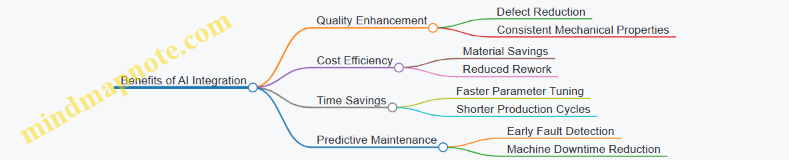
Practical Implementation Tips
- Start Small: Pilot AI integration on a single machine or product line.
- Data Quality: Ensure high-quality, labeled data for effective model training.
- Cross-Functional Team: Collaborate between data scientists, engineers, and operators.
- Iterative Improvement: Continuously update models with new data.
- User-Friendly Interface: Develop dashboards for operators to interpret AI suggestions easily.
Additional Example: Real-Time Defect Detection
Using computer vision and AI, a manufacturer implemented cameras inside the build chamber to detect anomalies such as balling or layer delamination. When detected, the system automatically adjusted laser parameters or paused the build for inspection, reducing scrap rates by 30%.
Conclusion
Integrating AI-driven process optimization in industrial 3D printing enables manufacturers to overcome traditional limitations by leveraging data and intelligent algorithms. This leads to improved product quality, reduced costs, and accelerated innovation cycles, making AI a critical enabler for the future of additive manufacturing.
References & Further Reading
- “Artificial Intelligence in Additive Manufacturing: A Review,” Journal of Manufacturing Science and Engineering.
- Case studies from leading 3D printer manufacturers on AI integration.
- Online courses on machine learning applications in manufacturing.
11. Summary and Practical Recommendations
11.1 Recap of Core Principles and Techniques
Additive Manufacturing (AM) and Industrial 3D Printing have revolutionized the manufacturing landscape by enabling complex geometries, rapid prototyping, and customized production. This section revisits the core principles and techniques covered throughout the blog, reinforced with mind maps and practical examples to solidify understanding.
Core Principles of Additive Manufacturing
Example:
Consider a metal aerospace bracket designed using DfAM principles. By optimizing the part orientation and incorporating lattice structures, the bracket’s weight was reduced by 30% without compromising strength, demonstrating the power of layer-by-layer fabrication combined with smart design.
Key Industrial 3D Printing Techniques
Example:
An automotive company used SLS to rapidly prototype a complex air intake manifold. The powder bed fusion process allowed for intricate internal channels that would be impossible with traditional methods, speeding up design validation.
Best Practices Recap
Example:
A medical device manufacturer applied heat treatment post-processing to 3D printed titanium implants, significantly improving fatigue resistance and ensuring patient safety.
Summary Table of Core Techniques and Applications
| Principle/Technique | Description | Example Application |
|---|---|---|
| Layer-by-Layer Fabrication | Building parts layer upon layer | Aerospace brackets with lattice structures |
| Material Selection | Choosing appropriate polymers, metals, etc. | Titanium alloys for lightweight aerospace parts |
| Design for AM (DfAM) | Optimizing orientation and geometry | Minimizing supports in automotive prototypes |
| FDM | Extrusion of thermoplastics | Rapid prototyping of functional parts |
| SLS/SLM | Powder bed fusion of metals or polymers | Complex air intake manifolds in automotive |
| Post-Processing | Support removal, heat treatment, finishing | Medical implants with improved fatigue life |
| Quality Assurance | Inspection and testing protocols | X-ray CT for internal defect detection |
By revisiting these core principles and techniques with practical examples and mind maps, manufacturing students, product designers, and rapid prototyping engineers can better internalize the foundational knowledge necessary to excel in additive manufacturing and industrial 3D printing projects.
11.2 Checklist for Successful Additive Manufacturing Projects
Successfully executing an additive manufacturing (AM) project requires careful planning, attention to detail, and adherence to best practices throughout the process. Below is a comprehensive checklist designed to guide manufacturing students, product designers, and rapid prototyping engineers through the critical stages of an AM project. This checklist is supplemented with mind maps and practical examples to facilitate understanding and application.
Define Project Objectives and Requirements
- Clearly identify the purpose of the AM project (prototype, functional part, tooling, etc.)
- Determine mechanical, thermal, and chemical property requirements
- Establish dimensional tolerances and surface finish expectations
- Identify production volume and cost constraints
Example: Designing a lightweight drone arm requires high strength-to-weight ratio and tight dimensional tolerances for assembly.
Select Appropriate Additive Manufacturing Technology
- Evaluate available AM technologies (FDM, SLA, SLS, SLM, EBM, DED)
- Match technology capabilities with material and design requirements
- Consider build size, resolution, and surface finish
Example: For a metal aerospace bracket requiring high strength and fine detail, Selective Laser Melting (SLM) is preferred over FDM.
Material Selection and Procurement
- Choose material based on mechanical properties, biocompatibility, or thermal resistance
- Verify material certification and batch quality
- Source from reliable suppliers
Example: For a dental implant prototype, biocompatible titanium alloy powder certified for medical use is selected.
Design for Additive Manufacturing (DfAM)
- Optimize geometry for AM capabilities (e.g., reduce overhangs, incorporate lattice structures)
- Orient parts to minimize supports and improve surface quality
- Apply topology optimization for weight reduction
- Validate design with simulation tools
Example: A lightweight automotive bracket is designed with internal lattice structures to reduce weight without compromising strength.
Prepare and Validate Digital Files
- Generate accurate 3D CAD models
- Export in suitable file formats (STL, OBJ, AMF)
- Check for mesh errors and repair if necessary
- Slice model with appropriate settings
Example: Before printing a prototype, the STL file is checked and repaired using Meshmixer to fix non-manifold edges.
Set Process Parameters and Conduct Test Prints
- Define layer thickness, print speed, temperature, and support structures
- Run small-scale test prints to verify settings
- Adjust parameters based on test results
Example: A test print of a small bracket is performed to optimize layer height and reduce warping.
Monitor Production and Quality Control
- Use in-process monitoring tools (thermal cameras, sensors)
- Inspect parts for dimensional accuracy and defects
- Perform non-destructive testing if applicable
Example: During metal printing, real-time melt pool monitoring ensures consistent fusion and detects anomalies.
Post-Processing and Finishing
- Remove supports carefully
- Apply heat treatments or stress relief processes
- Perform surface finishing (polishing, sandblasting)
- Conduct final inspections
Example: After printing a titanium aerospace part, stress relief annealing is applied to improve mechanical properties.
Documentation and Feedback
- Record all parameters, materials, and observations
- Document lessons learned and improvements
- Gather feedback from stakeholders
Example: A rapid prototyping engineer documents print parameters and feedback to refine future iterations.
Summary Mind Map
By following this checklist, AM practitioners can systematically approach projects to maximize success, reduce errors, and optimize outcomes. Integrating these best practices with real-world examples helps bridge theory with practical application, empowering students and engineers to excel in additive manufacturing.
11.3 Best Practice: Continuous Learning and Skill Development with Resource Examples
In the rapidly evolving field of additive manufacturing and industrial 3D printing, continuous learning and skill development are essential to stay competitive and innovative. This section outlines best practices for ongoing education, skill enhancement, and resource utilization, supported by practical examples and mind maps to visualize learning pathways.
Why Continuous Learning Matters
- Technology Evolution: New materials, machines, and software tools emerge frequently.
- Process Optimization: Understanding advanced techniques improves quality and efficiency.
- Cross-Disciplinary Skills: Combining design, engineering, and manufacturing knowledge enhances problem-solving.
Key Areas for Skill Development
Mind Map: Core Skill Areas in Additive Manufacturing
Recommended Learning Resources
| Resource Type | Examples & Details | How to Use Effectively |
|---|---|---|
| Online Courses | - Coursera: “Additive Manufacturing” by University of Illinois - LinkedIn Learning: “3D Printing Foundations” | Follow structured paths; combine theory with hands-on projects |
| Books | - “Additive Manufacturing Technologies” by Gibson et al. - “Design for Additive Manufacturing” by T. Wohlers | Read for deep understanding; apply concepts in design practice |
| Webinars & Workshops | - SME webinars on metal AM - Industry conferences like RAPID + TCT | Engage live; ask questions; network with experts |
| Software Tutorials | - Autodesk Fusion 360 tutorials - Materialise Magics training videos | Practice with real projects; explore advanced features |
| Communities & Forums | - Reddit r/3Dprinting - AMUG (Additive Manufacturing Users Group) forums | Share experiences; seek advice; stay updated on trends |
| Certifications | - SME Additive Manufacturing Certification - ASTM International AM certifications | Validate skills; improve credibility |
Example Learning Path for a Rapid Prototyping Engineer
Mind Map: Learning Path for Rapid Prototyping Engineer
Practical Example: Applying Continuous Learning
Scenario: A product designer wants to improve the strength and surface finish of 3D printed prototypes.
Steps Taken:
- Enrolls in an online course focused on metal additive manufacturing to understand material behavior.
- Practices topology optimization using CAD software tutorials.
- Attends a webinar on post-processing techniques like heat treatment and surface polishing.
- Applies new knowledge by redesigning a prototype with optimized supports and improved print orientation.
- Shares results in an online forum to get feedback and learn from peers.
Outcome: Improved prototype durability and surface quality, faster iteration cycles, and enhanced collaboration.
Tips for Effective Continuous Learning
- Set clear learning goals aligned with your role and projects.
- Dedicate regular time slots for study and practice.
- Combine theoretical learning with hands-on experimentation.
- Document lessons learned and update your personal knowledge base.
- Network with professionals to exchange insights and opportunities.
By embracing continuous learning and leveraging diverse resources, manufacturing students, product designers, and rapid prototyping engineers can master additive manufacturing principles and drive innovation in industrial 3D printing.
11.4 Final Case Study: End-to-End Industrial 3D Printing Workflow Demonstration
In this final case study, we will walk through a comprehensive example of an industrial 3D printing project from concept to finished product. This demonstration will integrate best practices, design considerations, material selection, printing parameters, post-processing, and quality assurance to provide a holistic understanding of the additive manufacturing workflow.
Project Overview
Objective: Design and manufacture a lightweight, functional bracket for an automotive assembly line robot arm using metal additive manufacturing.
Key Requirements:
- High strength-to-weight ratio
- Complex geometry to fit constrained spaces
- Minimal post-processing
- Rapid turnaround time
Step 1: Conceptual Design & Requirements Gathering
- Understand functional requirements and constraints
- Define mechanical properties needed
- Sketch initial design ideas
Mind Map: Conceptual Design
Example: The bracket must support a 150 kg load and fit within a 200x150x100 mm volume.
Step 2: CAD Modeling & Design for Additive Manufacturing (DfAM)
- Create 3D CAD model using software (e.g., SolidWorks, Fusion 360)
- Apply DfAM principles:
- Optimize geometry for weight reduction (e.g., lattice structures)
- Minimize support structures by orienting the part appropriately
- Incorporate features that leverage additive manufacturing capabilities
Mind Map: DfAM Considerations
Example: Using topology optimization tools, the bracket design is modified to include internal lattice patterns reducing weight by 30% without compromising strength.
Step 3: Material Selection
- Choose a suitable metal alloy compatible with Selective Laser Melting (SLM)
- Consider mechanical properties, thermal behavior, and cost
Mind Map: Material Selection
Example: Inconel 718 is selected for its excellent strength and corrosion resistance in industrial environments.
Step 4: Printing Preparation & Parameter Optimization
- Slice the CAD model using specialized software
- Set layer thickness, laser power, scan speed, and hatch spacing
- Orient the part to balance print time and support needs
Mind Map: Printing Parameters
Example: A 30-micron layer thickness is chosen for high resolution; part oriented at 45° to reduce supports.
Step 5: Printing Execution
- Load metal powder and initiate SLM process
- Monitor build for anomalies
Example: The print completes in 12 hours with no detected defects during layer-by-layer monitoring.
Step 6: Post-Processing
- Remove support structures carefully
- Heat treatment for stress relief
- Surface finishing (e.g., bead blasting, machining critical surfaces)
Mind Map: Post-Processing Steps
Example: Heat treatment at 980°C for 1 hour improves mechanical properties; critical mounting holes are machined to tolerance.
Step 7: Quality Assurance & Testing
- Perform dimensional inspection using CMM
- Conduct non-destructive testing (e.g., X-ray CT scan)
- Functional load testing
Mind Map: Quality Assurance
Example: The bracket passes all dimensional checks within ±0.1 mm and withstands a 200 kg load test without deformation.
Step 8: Deployment & Feedback
- Install bracket on robot arm
- Monitor performance during operation
- Collect feedback for future design improvements
Example: The bracket reduces robot arm weight by 25%, improving cycle speed and energy efficiency.
Summary Mind Map: End-to-End Workflow

Final Thoughts
This case study illustrates how integrating best practices at every stage—from design to deployment—ensures a successful industrial 3D printing project. By leveraging topology optimization, careful material selection, parameter tuning, and rigorous quality control, manufacturers can produce high-performance, lightweight components that meet stringent industrial requirements.
This workflow is adaptable across industries and serves as a practical guide for manufacturing students, product designers, and rapid prototyping engineers aiming to master additive manufacturing.