Modern Additive Manufacturing Processes For Metals Polymers And Industrial Prototyping
1. Introduction to Additive Manufacturing in Modern Industry
1.1 Overview of Additive Manufacturing Technologies
Additive Manufacturing (AM), commonly known as 3D printing, refers to a suite of processes that create parts layer-by-layer directly from digital models. Unlike traditional subtractive manufacturing, AM builds components by adding material, enabling complex geometries, reduced waste, and rapid prototyping.
Key Categories of Additive Manufacturing Technologies
Below is a mind map illustrating the primary AM technologies categorized by material type and process principle:
Detailed Descriptions and Examples
1. Powder Bed Fusion (PBF)
- Process: A laser or electron beam selectively fuses powdered material layer-by-layer.
- Materials: Metals (e.g., titanium, stainless steel), polymers (e.g., nylon).
- Example: Aerospace companies use SLM to produce lightweight, complex titanium brackets that are impossible to machine traditionally.
2. Directed Energy Deposition (DED)
- Process: Focused energy melts material as it is deposited, allowing for part repair or adding features.
- Materials: Metals such as Inconel and tool steels.
- Example: Repairing turbine blades by depositing metal only on worn areas, saving costs and time.
3. Binder Jetting
- Process: A liquid binder selectively glues powder particles which are then sintered.
- Materials: Metals and polymers.
- Example: Production of complex metal parts like heat exchangers with internal channels.
4. Material Extrusion (FDM for Polymers, Metal Filaments for Metals)
- Process: Material is extruded through a heated nozzle and deposited layer-by-layer.
- Materials: Thermoplastics, metal-polymer composite filaments.
- Example: Rapid prototyping of polymer housings for consumer electronics.
5. Vat Photopolymerization (SLA/DLP)
- Process: UV light cures liquid resin selectively.
- Materials: Photopolymers.
- Example: High-resolution dental models and surgical guides.
6. Material Jetting
- Process: Droplets of material are jetted and cured layer-by-layer.
- Materials: Polymers, multi-material composites.
- Example: Multi-color prototypes for product design validation.
Mind Map: Advantages and Typical Applications
Integrated Best Practice Example
When selecting an AM technology for a metal aerospace bracket prototype, engineers often start with Powder Bed Fusion due to its precision and material properties. However, if the part requires repair or feature addition, Directed Energy Deposition can be used to add material precisely. For polymer prototypes of the same bracket housing, FDM offers a cost-effective and fast solution for initial form and fit testing, while SLA can be used for high-detail visual models.
This layered understanding of AM technologies allows manufacturing engineers and prototyping specialists to choose the best process aligned with their material, precision, and functional requirements.
1.2 Historical Evolution and Industry Adoption
Additive Manufacturing (AM), commonly known as 3D printing, has undergone a remarkable journey from its inception in the 1980s to becoming a cornerstone of modern industrial production. Understanding this historical evolution helps manufacturing engineers, production engineers, and prototyping specialists appreciate the technology’s capabilities and its transformative impact across industries.
Early Beginnings: 1980s to 1990s
- 1981: Hideo Kodama of Nagoya Municipal Industrial Research Institute first published a rapid prototyping system using photopolymer curing.
- 1984: Chuck Hull invented stereolithography (SLA), the first commercially successful AM technology, enabling layer-by-layer curing of photopolymers.
- Late 1980s: Selective Laser Sintering (SLS) and Fused Deposition Modeling (FDM) were developed, expanding the range of materials and applications.
Example: Early SLA machines were primarily used for creating visual prototypes in automotive design, drastically reducing the time from concept to model.
Expansion and Diversification: 2000s
- Introduction of metal AM technologies such as Direct Metal Laser Sintering (DMLS) and Electron Beam Melting (EBM).
- Growth of polymer-based AM for functional parts, not just prototypes.
- Emergence of open-source and desktop 3D printers democratized access.
Example: Aerospace companies began adopting metal AM to produce lightweight, complex parts that were impossible to manufacture conventionally, such as GE Aviation’s fuel nozzles.
Industrial Adoption and Maturity: 2010s to Present
- Integration of AM into production lines for end-use parts.
- Development of Design for Additive Manufacturing (DfAM) principles.
- Advances in multi-material printing and hybrid manufacturing.
- Increased focus on quality control, repeatability, and certification standards.
Example: Medical device manufacturers use AM for patient-specific implants and surgical guides, improving outcomes and reducing lead times.
Mind Map: Historical Evolution of Additive Manufacturing
Industry Adoption Drivers
- Customization: Ability to produce complex, customized parts without tooling.
- Speed: Rapid prototyping accelerates product development cycles.
- Cost Efficiency: Reduced waste and tooling costs for low to medium volume production.
- Design Freedom: Enables innovative geometries and lightweight structures.
Example: In the automotive sector, companies like BMW use AM to produce custom tooling and fixtures, reducing lead times by up to 70%.
Mind Map: Industry Adoption Factors
Best Practice Example: Selecting AM for Prototyping vs. Production
- Prototyping: Use polymer-based FDM or SLA for quick, cost-effective visual and functional prototypes.
- Production: Employ metal PBF or DED for durable, high-performance end-use parts.
Case: A prototyping specialist at an aerospace firm used SLA to iterate on a turbine blade design rapidly, then transitioned to DMLS for final production, balancing speed and mechanical performance.
Summary
The historical evolution of additive manufacturing reflects a trajectory from niche prototyping tools to versatile, industrial-grade production technologies. Industry adoption has been driven by the unique advantages AM offers in customization, speed, cost, and design freedom. By understanding this history, engineers can better leverage AM technologies to optimize manufacturing workflows and innovate product development.
1.3 Key Benefits and Challenges in Metals and Polymers
Additive Manufacturing (AM) has revolutionized how industries approach production, especially in metals and polymers. Understanding the key benefits and challenges specific to these materials helps manufacturing engineers, production engineers, and prototyping specialists optimize their workflows and outcomes.
Benefits of Additive Manufacturing in Metals and Polymers
-
Design Freedom and Complexity
- AM enables the creation of geometries impossible or very costly with traditional manufacturing.
- Example: Aerospace companies use lattice structures in metal parts to reduce weight without sacrificing strength.
-
Material Efficiency and Waste Reduction
- AM builds parts layer-by-layer, minimizing excess material usage.
- Example: In metal powder bed fusion, unused powder can often be recycled, reducing raw material costs.
-
Rapid Prototyping and Iteration
- Faster turnaround times allow for quick design validation and functional testing.
- Example: Consumer electronics firms rapidly prototype polymer housings using FDM or SLA to test ergonomics.
-
Customization and Low-Volume Production
- AM excels in producing customized parts without expensive tooling.
- Example: Medical implants tailored to patient anatomy using metal AM.
-
Reduced Assembly and Part Consolidation
- Complex assemblies can be consolidated into single printed parts, reducing assembly time and potential failure points.
- Example: Automotive brackets printed as one piece instead of multiple welded components.
-
Supply Chain Simplification
- On-demand production reduces inventory and logistics complexity.
Challenges in Additive Manufacturing for Metals and Polymers
-
Material Properties and Anisotropy
- AM parts may exhibit anisotropic mechanical properties due to layer-wise build.
- Example: Metal parts printed via PBF can have different tensile strengths along build vs. transverse directions.
-
Surface Finish and Post-Processing Needs
- AM parts often require machining, polishing, or heat treatments to meet final specifications.
- Example: SLA polymer prototypes need UV curing and sanding for smooth surfaces.
-
Process Repeatability and Quality Control
- Variability in powder quality, machine calibration, and environmental factors can affect consistency.
- Example: Batch-to-batch variation in metal powder can cause density fluctuations.
-
Material Limitations and Costs
- Not all alloys or polymers are AM-compatible; some materials are expensive or difficult to process.
- Example: High-performance polymers like PEEK require specialized printers and controlled environments.
-
Build Size and Speed Constraints
- Large metal parts can take many hours or days to print, limiting throughput.
-
Design Constraints and Support Structures
- Overhangs and complex features may require supports, increasing material use and post-processing.
Mind Map: Benefits of AM in Metals and Polymers
Mind Map: Challenges of AM in Metals and Polymers
Integrated Example: Aerospace Metal Part
An aerospace manufacturer uses Powder Bed Fusion (PBF) to produce a titanium bracket with internal lattice structures. The benefits realized include significant weight reduction (design freedom), material savings (powder recycling), and part consolidation (replacing multiple welded components). However, challenges such as anisotropic mechanical properties required extensive testing and heat treatment to ensure safety standards. Post-processing included surface polishing to meet aerodynamic requirements. This example highlights how understanding both benefits and challenges leads to successful AM adoption.
Integrated Example: Polymer Prototyping in Consumer Electronics
A consumer electronics company leverages SLA printing to rapidly prototype smartphone cases. Benefits include high-resolution surface finish and quick iteration cycles, enabling ergonomic testing and design tweaks. Challenges encountered were the brittleness of some photopolymer resins and the need for UV curing and sanding to achieve final aesthetics. By selecting appropriate materials and optimizing print settings, the company balanced speed and quality effectively.
In summary, while additive manufacturing offers transformative benefits in metals and polymers, awareness and mitigation of its challenges are essential for successful industrial application and prototyping.
1.4 Role of Additive Manufacturing in Industrial Prototyping
Additive Manufacturing (AM) has revolutionized industrial prototyping by enabling faster, cost-effective, and highly flexible production of prototype parts. Unlike traditional subtractive methods, AM builds parts layer-by-layer, allowing complex geometries and functional features to be realized with minimal tooling and setup.
Key Roles of AM in Industrial Prototyping
- Rapid Iteration and Design Validation: AM allows engineers to quickly produce physical models from CAD data, enabling rapid testing and refinement of designs.
- Complex Geometry Realization: Parts with intricate internal channels, lattice structures, or organic shapes can be prototyped without additional manufacturing complexity.
- Functional Prototypes: Using appropriate materials, prototypes can mimic mechanical, thermal, or chemical properties of final products.
- Cost and Time Efficiency: Eliminates the need for expensive tooling and reduces lead times from weeks or months to days.
- Customization and Low-Volume Production: Ideal for bespoke prototypes or small batch testing before mass production.
Mind Map: Role of AM in Industrial Prototyping
Best Practice: Integrating AM Early in the Prototyping Process
- Start with Design for Additive Manufacturing (DfAM): Consider AM capabilities and limitations during initial design to maximize benefits.
- Use Iterative Prototyping: Produce multiple versions quickly to refine form, fit, and function.
- Select Appropriate Materials: Match prototype material properties to intended testing requirements.
- Leverage Hybrid Approaches: Combine AM with traditional processes for assemblies or multi-material prototypes.
Example 1: Consumer Electronics Housing Prototype
A prototyping specialist at a consumer electronics company used SLA (Stereolithography) to produce a series of smartphone housing prototypes. The high-resolution prints allowed the team to evaluate ergonomics, button placement, and assembly fit within days rather than weeks. Iterations incorporated feedback from industrial designers and engineers rapidly, reducing time to final design by 50%.
Example 2: Aerospace Bracket Functional Testing
An aerospace manufacturer employed metal Powder Bed Fusion (PBF) to prototype a lightweight bracket with internal cooling channels. The AM process allowed the creation of complex internal features impossible with traditional machining. The prototype underwent mechanical load testing and thermal cycling, validating the design before committing to expensive tooling.
Mind Map: Best Practices and Examples in Industrial Prototyping with AM
Summary
Additive Manufacturing plays a pivotal role in industrial prototyping by accelerating development cycles, enabling complex designs, and reducing costs. By adopting best practices such as DfAM, iterative testing, and appropriate material selection, manufacturing engineers and prototyping specialists can leverage AM to bring innovative products to market faster and with higher confidence.
1.5 Best Practices: Selecting the Right AM Process for Your Application with Case Examples
Selecting the appropriate additive manufacturing (AM) process is a critical decision that influences the quality, cost, and functionality of the final part. This section provides a structured approach to making this decision, supported by practical examples and mind maps to guide manufacturing and prototyping specialists.
Key Factors to Consider When Selecting an AM Process
- Material Compatibility: Metals, polymers, composites
- Part Complexity and Geometry: Overhangs, internal channels, lattice structures
- Mechanical Properties Required: Strength, flexibility, thermal resistance
- Surface Finish and Resolution: Fine details vs. rough prototypes
- Production Volume: One-off prototypes vs. small batch production
- Cost Constraints: Equipment, materials, post-processing
- Lead Time: Speed of production and iteration
Mind Map: Decision Factors for AM Process Selection
Step-by-Step Best Practice Approach
- Define Application Requirements: Clearly outline the functional and aesthetic requirements of the part.
- Identify Suitable Materials: Choose materials that meet mechanical and environmental needs.
- Match AM Technologies to Materials: For example, Powder Bed Fusion (PBF) for metals, FDM or SLA for polymers.
- Evaluate Geometrical Constraints: Consider if the process can handle complex geometries or fine features.
- Assess Post-Processing Needs: Some processes require extensive finishing.
- Consider Production Volume and Cost: Balance between speed, cost, and quality.
- Prototype and Iterate: Use rapid prototyping to validate process choice.
Case Example 1: Aerospace Bracket Fabrication
- Application: Lightweight, high-strength metal bracket with complex internal channels.
- Requirements: High mechanical strength, corrosion resistance, intricate geometry.
- Selected Process: Laser Powder Bed Fusion (LPBF).
- Rationale: LPBF supports complex geometries with excellent mechanical properties and fine resolution.
- Outcome: Reduced weight by 30% compared to traditional casting, with superior strength.
Case Example 2: Consumer Electronics Prototype
- Application: Polymer casing prototype requiring high surface finish and fine details.
- Requirements: Smooth surface, accurate dimensions, quick turnaround.
- Selected Process: Stereolithography (SLA).
- Rationale: SLA provides high resolution and smooth finishes suitable for visual and functional prototypes.
- Outcome: Prototype delivered within 48 hours, enabling rapid design iterations.
Case Example 3: Automotive Functional Polymer Part
- Application: Functional polymer part exposed to moderate mechanical stress.
- Requirements: Durable, heat resistant, moderate complexity.
- Selected Process: Selective Laser Sintering (SLS).
- Rationale: SLS offers strong, functional parts with no need for support structures, suitable for moderate complexity.
- Outcome: Functional prototype validated for fit and performance, reducing development time by 25%.
Mind Map: Matching AM Processes to Applications
Summary
Selecting the right AM process requires a holistic understanding of the part requirements, material properties, and production constraints. By following a structured decision-making approach and leveraging real-world examples, manufacturing engineers and prototyping specialists can optimize their additive manufacturing workflows for efficiency, quality, and cost-effectiveness.
2. Additive Manufacturing Processes for Metals
2.1 Powder Bed Fusion (PBF): Principles and Applications
Introduction to Powder Bed Fusion (PBF)
Powder Bed Fusion (PBF) is one of the most widely used additive manufacturing (AM) processes for metals and polymers. It involves selectively melting or sintering powdered material layer-by-layer to build complex 3D parts directly from digital models. PBF offers high precision, excellent mechanical properties, and the ability to produce intricate geometries that are difficult or impossible with traditional manufacturing.
Principles of Powder Bed Fusion
- Powder Distribution: A thin layer of powder is evenly spread across the build platform.
- Energy Source: A laser or electron beam selectively fuses the powder according to the cross-section of the part.
- Layer-by-Layer Build: After each layer is fused, the build platform lowers, and a new powder layer is spread.
- Solidification: The melted powder solidifies rapidly, forming a dense and strong structure.
Mind Map: Core Components of PBF Process
Types of Powder Bed Fusion Technologies
| Technology | Energy Source | Typical Materials | Key Features |
|---|---|---|---|
| Selective Laser Melting (SLM) | Laser | Metals (Titanium, Stainless Steel, Aluminum) | High precision, dense parts |
| Electron Beam Melting (EBM) | Electron Beam | Metals (Titanium alloys, Cobalt Chrome) | High build speed, vacuum environment |
| Selective Laser Sintering (SLS) | Laser | Polymers (Nylon, PA12) | No support structures needed, good mechanical properties |
Applications of Powder Bed Fusion
- Aerospace: Production of lightweight, complex components such as turbine blades and fuel nozzles.
- Medical: Custom implants and prosthetics with patient-specific geometries.
- Automotive: Functional prototypes and low-volume production of performance parts.
- Tooling: Manufacturing conformal cooling channels in injection molds.
Best Practices in PBF
-
Powder Quality Management: Use high-quality, spherical powders with controlled particle size distribution to ensure consistent layer spreading and melting.
-
Optimizing Process Parameters: Adjust laser power, scan speed, hatch spacing, and layer thickness to balance build speed, density, and mechanical properties.
-
Build Orientation: Design parts with optimal orientation to minimize support structures and residual stresses.
-
In-situ Monitoring: Implement real-time monitoring systems to detect defects during the build process.
-
Post-Processing: Employ stress relief heat treatments and surface finishing to improve part performance.
Mind Map: Best Practices for PBF
Example 1: Aerospace Fuel Nozzle Fabrication Using SLM
Context: A leading aerospace manufacturer needed to produce a lightweight, complex fuel nozzle with internal cooling channels.
Approach: Using Selective Laser Melting (SLM), the nozzle was built from Inconel 718 powder. Process parameters were optimized to achieve full density and fine feature resolution.
Outcome: The final part was 25% lighter than conventionally manufactured nozzles, with improved thermal performance due to the integrated cooling channels. Post-processing included heat treatment and surface polishing.
Example 2: Custom Titanium Hip Implant via EBM
Context: A medical device company required patient-specific hip implants with porous structures to promote bone ingrowth.
Approach: Electron Beam Melting (EBM) was used to fabricate the implant from Ti-6Al-4V powder. The vacuum environment and high build temperature reduced residual stresses.
Outcome: The implant exhibited excellent mechanical strength and biocompatibility. The porous lattice structure was precisely controlled to match bone stiffness.
Summary
Powder Bed Fusion is a versatile and powerful additive manufacturing process enabling the production of high-performance metal and polymer parts with complex geometries. By understanding its principles, carefully selecting materials, and applying best practices, manufacturing engineers and prototyping specialists can leverage PBF to accelerate product development and enhance industrial applications.
2.2 Directed Energy Deposition (DED): Techniques and Use Cases
Directed Energy Deposition (DED) is a versatile additive manufacturing process primarily used for metals, where focused thermal energy is used to melt materials as they are being deposited. This technique enables the creation of complex geometries, repair of existing parts, and addition of features onto pre-existing components.
What is Directed Energy Deposition?
DED involves feeding metal powder or wire into a melt pool created by a focused energy source, such as a laser, electron beam, or plasma arc. The material solidifies rapidly, building the part layer by layer.
Key Techniques in DED
- Laser Metal Deposition (LMD): Uses a laser as the energy source and metal powder as feedstock. Highly precise and suitable for complex geometries.
- Electron Beam Additive Manufacturing (EBAM): Uses an electron beam in a vacuum environment to melt wire feedstock. Ideal for large-scale metal parts.
- Plasma Transferred Arc (PTA): Employs a plasma arc to melt powder or wire feedstock. Often used for cladding and repair.
Mind Map: Directed Energy Deposition Techniques
Use Cases of Directed Energy Deposition
Repair and Refurbishment
DED is widely used for repairing high-value components such as aerospace turbine blades, molds, and dies. Instead of replacing expensive parts, DED enables adding material only where needed.
Example:
- A gas turbine blade with erosion damage is repaired by depositing nickel-based superalloy powder precisely on the worn areas using laser metal deposition, restoring the blade’s original dimensions and properties.
Hybrid Manufacturing
DED can be integrated with subtractive processes (like CNC machining) to produce near-net-shape parts, reducing material waste and machining time.
Example:
- An automotive suspension component is built using EBAM to create the rough shape, followed by CNC machining for tight tolerances and surface finish.
Multi-Material Fabrication
DED allows the deposition of different materials in a single build, enabling functionally graded materials or components with tailored properties.
Example:
- A cutting tool is fabricated with a tough steel core and a wear-resistant carbide outer layer deposited via plasma transferred arc.
Best Practices for DED
- Process Parameter Optimization: Adjust laser power, feed rate, and powder flow to balance deposition rate with part quality.
- Substrate Preparation: Clean and preheat substrates to improve adhesion and reduce residual stresses.
- Real-Time Monitoring: Use sensors and cameras to monitor melt pool size and temperature for consistent builds.
- Post-Processing: Employ heat treatment and machining to achieve desired mechanical properties and surface finish.
Mind Map: Best Practices in DED
Summary
Directed Energy Deposition is a powerful AM process for metal fabrication, repair, and multi-material applications. Its ability to deposit material precisely and at high rates makes it invaluable in aerospace, automotive, and tooling industries. By following best practices and leveraging real-world examples, manufacturing engineers and prototyping specialists can harness DED to improve production efficiency and part performance.
2.3 Binder Jetting for Metals: Workflow and Advantages
Binder Jetting is an additive manufacturing process that uses a liquid binding agent to selectively join metal powder particles layer by layer. Unlike laser-based methods, it does not involve melting the metal powder during printing, which offers unique advantages in terms of speed, cost, and material flexibility.
Workflow of Binder Jetting for Metals
Example: A production engineer working on aerospace brackets selects stainless steel powder with a particle size of 20-45 microns. After spreading a 50-micron layer, the binder is jetted selectively to form the part geometry. Post-printing, the part undergoes curing, powder removal, debinding, and sintering to achieve full density and mechanical properties.
Advantages of Binder Jetting for Metals
Example: A prototyping specialist uses binder jetting to produce complex lattice structures in tool steel that would be difficult or expensive with traditional laser-based AM. The process allows multiple parts to be printed simultaneously, reducing lead time and cost.
Best Practices in Binder Jetting for Metals
- Powder Quality Control: Use powders with consistent particle size and morphology to ensure uniform layering and binder infiltration.
- Binder Selection: Choose binders compatible with the metal powder and post-processing steps to avoid defects.
- Layer Thickness Optimization: Balance between resolution and build speed by adjusting layer thickness based on powder characteristics.
- Post-Processing Parameters: Carefully control debinding and sintering temperatures to prevent warping or cracking.
- Powder Recycling: Implement powder sieving and conditioning protocols to maintain powder quality across multiple uses.
Example: A production engineer implements a powder recycling protocol that sieves and blends used powder with fresh powder at a 30:70 ratio, maintaining mechanical properties while reducing material costs.
Summary
Binder Jetting for metals offers a versatile, cost-effective, and scalable AM solution especially suited for complex geometries and large batch production. Its unique workflow, centered around powder deposition and binder application, requires careful attention to powder and binder quality as well as post-processing steps to achieve optimal part performance.
For further reading, explore case studies on aerospace brackets, tooling inserts, and customized medical implants produced via binder jetting to see these principles in action.
2.4 Metal Material Extrusion: Emerging Trends and Practical Examples
Metal Material Extrusion (MME) is an additive manufacturing process that adapts the principles of polymer extrusion, such as Fused Deposition Modeling (FDM), to metals. This technique involves extruding a metal-filled filament or feedstock through a heated nozzle to build parts layer by layer. Post-processing steps like debinding and sintering transform the green part into a dense metal component.
Overview of Metal Material Extrusion
- Uses metal-polymer composite filaments or pellets.
- Extrusion-based deposition similar to FDM.
- Requires debinding and sintering to achieve final metal properties.
- Suitable for complex geometries and small to medium batch production.
Emerging Trends in Metal Material Extrusion
- Advanced Filament Development: New filaments with higher metal loading and improved flow characteristics enhance mechanical properties and printability.
- Hybrid Extrusion Systems: Integration of multi-material extrusion heads allowing combination of metals with polymers or ceramics.
- Automation in Post-Processing: Improved debinding and sintering ovens with precise temperature control reduce cycle times and improve part quality.
- Large-Format Metal Extrusion: Scaling extrusion systems for bigger parts and industrial applications.
- In-situ Monitoring: Sensors embedded to monitor extrusion quality and detect defects during printing.
Mind Map: Metal Material Extrusion Process and Trends
Practical Examples
Example 1: Stainless Steel Bracket for Automotive Applications
A manufacturer used metal material extrusion to produce stainless steel brackets with complex internal channels for fluid routing. The process involved printing the green part with a stainless steel filament, followed by solvent debinding and sintering. This approach reduced lead time by 40% compared to traditional machining and allowed design freedom for weight reduction.
Example 2: Customized Surgical Tools
A medical device company leveraged MME to produce customized surgical tools in titanium. By using titanium-filled filaments and optimized sintering cycles, they achieved biocompatible parts with mechanical properties suitable for surgical use. This enabled rapid prototyping and small batch production tailored to patient needs.
Example 3: Tooling Inserts with Complex Geometry
An industrial tooling supplier adopted metal extrusion to fabricate inserts with conformal cooling channels. The extrusion process allowed the creation of intricate internal features that were impossible with conventional methods. Post-processing ensured high density and durability, improving mold cycle times by 15%.
Best Practices for Metal Material Extrusion
- Material Selection: Choose filaments with high metal loading and consistent particle distribution for better sintering outcomes.
- Print Parameter Optimization: Calibrate extrusion temperature, speed, and layer height to minimize defects and ensure dimensional accuracy.
- Debinding Control: Use appropriate debinding methods (solvent or thermal) to avoid cracking or distortion.
- Sintering Profile: Develop tailored sintering cycles based on material and part geometry to achieve optimal density.
- Design for MME: Incorporate features that consider shrinkage during sintering and support removal.
Mind Map: Best Practices in Metal Material Extrusion
Summary
Metal Material Extrusion is rapidly evolving as a cost-effective and versatile metal AM process. Its ability to produce complex geometries with relatively low equipment costs makes it attractive for prototyping and small batch production. By adopting emerging trends and best practices, manufacturing engineers and prototyping specialists can harness MME to accelerate product development and innovate in metal part fabrication.
2.5 Post-Processing Techniques for Metal AM Parts
Additive manufacturing (AM) of metal parts often produces components that require post-processing to achieve the desired mechanical properties, surface finish, dimensional accuracy, and performance. Post-processing is a critical step to transform the raw printed part into a functional, high-quality product suitable for industrial applications.
Key Objectives of Post-Processing Metal AM Parts
- Remove residual stresses
- Improve surface finish
- Enhance mechanical properties
- Achieve dimensional tolerance
- Prepare for assembly or coating
Common Post-Processing Techniques
Heat Treatment
- Purpose: Relieve residual stresses, improve microstructure, and enhance mechanical properties such as strength and ductility.
- Example: Stress relieving of Inconel 718 parts printed by Powder Bed Fusion (PBF) to reduce distortion and cracking.
Support Removal
- Purpose: Remove support structures used during printing to stabilize overhangs or complex geometries.
- Methods: Mechanical cutting, grinding, or wire EDM.
- Example: Titanium aerospace brackets printed with Directed Energy Deposition (DED) often require careful support removal to avoid damaging thin walls.
Surface Finishing
-
Techniques:
- Machining: Milling or turning to achieve tight tolerances and smooth surfaces.
- Grinding: For flat surfaces or edges.
- Polishing: To improve surface roughness and aesthetics.
- Shot Peening: Enhances fatigue life by inducing compressive stresses.
- Electropolishing: Electrochemical process to smooth and brighten surfaces.
-
Example: Stainless steel medical implants printed by PBF are electropolished to achieve biocompatible smooth surfaces.
Hot Isostatic Pressing (HIP)
- Purpose: Apply high temperature and pressure to eliminate internal porosity and improve density.
- Example: Aerospace turbine blades printed with PBF undergo HIP to ensure full density and fatigue resistance.
Chemical Treatments
- Processes: Acid etching or passivation to remove surface contaminants and improve corrosion resistance.
- Example: Passivation of stainless steel parts to enhance corrosion resistance in harsh environments.
Coating and Plating
- Purpose: Add functional or protective layers such as thermal barriers, wear-resistant coatings, or corrosion protection.
- Example: Nickel coating on metal AM parts used in automotive applications for wear resistance.
Mind Map: Post-Processing Techniques for Metal AM Parts
Best Practice Examples
Example 1: Heat Treatment and HIP for Aerospace Components
- A titanium alloy bracket printed by PBF initially shows residual stresses causing distortion.
- Applying a stress-relief heat treatment at 650°C for 4 hours reduces distortion.
- Subsequent HIP at 920°C and 100 MPa for 2 hours eliminates internal porosity, improving fatigue life.
Example 2: Support Removal and Surface Finishing for Medical Implants
- A stainless steel spinal implant printed with DED has complex support structures.
- Supports are removed using wire EDM to avoid mechanical damage.
- Electropolishing is performed to achieve a smooth, biocompatible surface.
Example 3: Shot Peening to Enhance Fatigue Resistance
- A metal AM automotive suspension component printed by PBF exhibits surface roughness.
- Shot peening induces compressive residual stresses on the surface, significantly improving fatigue resistance.
Summary
Post-processing metal AM parts is essential to unlock their full potential in industrial applications. Selecting the appropriate combination of heat treatment, support removal, surface finishing, HIP, chemical treatments, and coatings depends on the material, printing process, and end-use requirements. Integrating these best practices ensures parts meet stringent quality and performance standards.
2.6 Best Practices: Optimizing Metal AM Parameters with Real-World Examples
Optimizing metal additive manufacturing (AM) parameters is crucial to achieving high-quality, reliable, and repeatable parts. The process involves fine-tuning variables such as laser power, scan speed, layer thickness, hatch spacing, and build orientation. This section explores best practices for parameter optimization, supported by real-world examples and mind maps to visualize the decision-making process.
Key Parameters in Metal AM Optimization
- Laser Power: Controls the energy input; too high can cause keyholing, too low leads to lack of fusion.
- Scan Speed: Affects melt pool stability and part density.
- Layer Thickness: Influences surface finish and build time.
- Hatch Spacing: Distance between adjacent scan lines; affects overlap and porosity.
- Build Orientation: Impacts mechanical properties and support requirements.
Mind Map: Metal AM Parameter Optimization
Best Practice 1: Systematic Parameter Screening
Start with a Design of Experiments (DoE) approach to systematically vary parameters and evaluate their effects on part quality. For example, a production engineer at an aerospace company used a fractional factorial DoE to optimize laser power and scan speed for Inconel 718, achieving a 99.8% density with minimal defects.
Example:
- Material: Inconel 718
- Parameters Tested: Laser power (200-400 W), scan speed (600-1200 mm/s)
- Outcome: Optimal combination at 350 W and 900 mm/s yielded superior mechanical properties.
Best Practice 2: Use of Real-Time Process Monitoring
Incorporate sensors such as melt pool cameras and pyrometers to monitor the build in real-time. This allows immediate detection of anomalies and parameter adjustments.
Example:
- A prototyping specialist at a medical device manufacturer integrated melt pool monitoring during titanium alloy builds. By adjusting scan speed dynamically, they reduced porosity by 30% and improved surface finish.
Mind Map: Real-Time Monitoring Feedback Loop
Best Practice 3: Build Orientation Optimization
Choosing the right build orientation can minimize support structures, reduce residual stresses, and improve mechanical performance.
Example:
- A manufacturing engineer optimized the orientation of a complex stainless steel bracket to reduce supports by 40%, cutting post-processing time significantly.
Best Practice 4: Layer Thickness and Hatch Spacing Balance
Thinner layers improve surface finish but increase build time. Hatch spacing must ensure adequate overlap without overheating.
Example:
- A prototyping specialist working with aluminum alloy used 30 µm layer thickness and 0.1 mm hatch spacing to balance speed and quality for functional prototypes.
Best Practice 5: Post-Processing Integration
Heat treatments and hot isostatic pressing (HIP) can relieve residual stresses and close internal pores.
Example:
- An aerospace manufacturer combined optimized AM parameters with HIP, resulting in parts with tensile strength exceeding wrought counterparts.
Summary Table: Parameter Optimization Examples
| Parameter | Material | Optimized Value(s) | Outcome |
|---|---|---|---|
| Laser Power | Inconel 718 | 350 W | 99.8% density, minimal defects |
| Scan Speed | Titanium Alloy | Dynamic adjustment ~900 mm/s | 30% porosity reduction |
| Layer Thickness | Aluminum Alloy | 30 µm | Balanced speed and surface finish |
| Hatch Spacing | Aluminum Alloy | 0.1 mm | Optimal overlap, no overheating |
| Build Orientation | Stainless Steel | Orientation reducing supports by 40% | Reduced post-processing time |
Final Mind Map: Integrated Metal AM Parameter Optimization Workflow
By following these best practices, manufacturing and prototyping specialists can systematically optimize metal AM parameters to produce high-quality parts efficiently. Real-world examples demonstrate how iterative testing, monitoring, and integration of post-processing lead to superior outcomes in industrial metal additive manufacturing.
2.7 Case Study: Aerospace Component Fabrication Using Powder Bed Fusion (PBF)
Introduction
Powder Bed Fusion (PBF) has become a cornerstone technology in aerospace manufacturing due to its ability to produce complex, high-performance metal components with reduced lead times and material waste. This case study explores the fabrication of a critical aerospace bracket using PBF, highlighting best practices, challenges, and lessons learned.
Component Overview
- Component: Structural aerospace bracket
- Material: Inconel 718 (a nickel-based superalloy)
- Function: Supports engine components under high thermal and mechanical stress
- Requirements: High strength-to-weight ratio, excellent fatigue resistance, and precise dimensional tolerances
Process Workflow
Best Practices and Examples
Design for Additive Manufacturing (DfAM)
- Example: Using topology optimization software, the bracket’s internal lattice structure was optimized to reduce weight by 30% without compromising strength.
- Best Practice: Incorporate support structures only where necessary to minimize material usage and post-processing effort.
Material Handling and Preparation
- Example: High-quality Inconel 718 powder with controlled particle size distribution ensured consistent layer deposition and minimized defects.
- Best Practice: Regular powder recycling and sieving maintain powder integrity and reduce contamination.
Printing Parameters Optimization
- Example: A layer thickness of 30 microns combined with optimized laser power and scan speed minimized porosity and improved surface finish.
- Best Practice: Conduct parameter studies on test coupons before full-scale production to tune process variables.
Post-Processing
- Example: Hot Isostatic Pressing (HIP) was applied to eliminate internal porosity and enhance mechanical properties.
- Best Practice: Stress relief heat treatments reduce residual stresses that can cause warping or cracking.
Quality Control
- Example: Computed Tomography (CT) scanning was used for non-destructive internal inspection, detecting any subsurface defects.
- Best Practice: Implement in-situ monitoring during printing to detect anomalies early.
Challenges and Solutions
| Challenge | Description | Solution |
|---|---|---|
| Residual Stresses | Thermal gradients cause deformation and cracks | Optimize scan strategy; apply stress relief heat treatment |
| Porosity | Gas entrapment leads to weak points | Use high-quality powder; optimize laser parameters |
| Support Removal | Complex supports increase post-processing time | Design minimal supports; use soluble or breakaway supports |
Results and Impact
- Weight Reduction: Achieved 30% weight savings compared to traditionally machined parts.
- Lead Time: Reduced production time from weeks to days.
- Performance: Mechanical testing confirmed that the AM bracket met or exceeded aerospace standards for strength and fatigue.
Summary
This case study demonstrates how PBF enables the production of complex, high-performance aerospace components with significant improvements in weight, lead time, and material efficiency. By integrating best practices in design, material handling, process optimization, and quality control, aerospace manufacturers can leverage additive manufacturing to meet stringent industry demands.
Additional Mind Map: Key Takeaways
3. Additive Manufacturing Processes for Polymers
3.1 Fused Deposition Modeling (FDM): Fundamentals and Industrial Uses
Fused Deposition Modeling (FDM) is one of the most widely adopted additive manufacturing technologies, especially in the realm of polymer 3D printing. It operates by extruding thermoplastic material layer-by-layer to create a three-dimensional object. Its accessibility, cost-effectiveness, and versatility make it a staple in industrial prototyping and low-volume production.
Fundamentals of FDM
-
Process Overview:
- A thermoplastic filament is heated to a semi-liquid state.
- The molten material is extruded through a nozzle.
- The nozzle deposits material layer-by-layer on a build platform following a digital 3D model.
- Layers fuse as they cool, building the final part.
-
Common Materials:
- ABS (Acrylonitrile Butadiene Styrene)
- PLA (Polylactic Acid)
- Nylon
- PETG (Polyethylene Terephthalate Glycol)
- TPU (Thermoplastic Polyurethane)
-
Key Components:
- Extruder and hot end
- Heated build platform
- Motion system (X, Y, Z axes)
- Cooling fans
-
Typical Layer Resolution: 50-300 microns depending on machine and settings
Mind Map: FDM Process Fundamentals
Industrial Uses of FDM
FDM is extensively used in industrial environments for:
- Rapid Prototyping: Quickly producing design iterations for form, fit, and function testing.
- Functional Prototyping: Creating parts with mechanical properties suitable for testing under real-world conditions.
- Tooling and Fixtures: Manufacturing jigs, fixtures, and custom tools to aid production lines.
- End-Use Parts: Low-volume production of durable components, especially when customization is needed.
Best Practices with Examples
-
Material Selection Based on Application:
- Example: Using ABS for impact-resistant prototypes in automotive design.
- Example: TPU for flexible parts such as gaskets or wearable devices.
-
Optimizing Print Settings:
- Adjusting layer height and infill density to balance strength and print time.
- Example: Increasing infill to 50% for functional prototypes requiring higher durability.
-
Design Considerations:
- Incorporate support structures for overhangs.
- Orient parts to minimize support and improve surface finish.
- Example: Rotating a bracket to reduce supports and improve strength along load paths.
-
Post-Processing:
- Techniques such as sanding, vapor smoothing (for ABS), and painting to improve aesthetics and performance.
- Example: Vapor smoothing an ABS prototype to achieve a smooth aerodynamic surface for wind tunnel testing.
Mind Map: Industrial Applications and Best Practices
Example: Automotive Prototype Using FDM
A production engineer at an automotive company needed to prototype a custom dashboard bracket. Using FDM with ABS filament, they:
- Designed the bracket with minimal overhangs to reduce supports.
- Printed at 0.2 mm layer height with 40% infill for strength.
- Post-processed the part with vapor smoothing to improve surface finish.
- Tested the bracket in a vehicle mockup to validate fit and function before tooling.
This approach reduced prototype turnaround from weeks to days and lowered costs significantly compared to traditional machining.
Summary
FDM remains a cornerstone technology in additive manufacturing for polymers due to its balance of cost, speed, and material versatility. By understanding its fundamentals and applying best practices in material selection, print optimization, and design, manufacturing and prototyping specialists can leverage FDM to accelerate product development and produce functional industrial components efficiently.
3.2 Stereolithography (SLA) and Digital Light Processing (DLP): High-Resolution Polymer Printing
Stereolithography (SLA) and Digital Light Processing (DLP) are two prominent vat photopolymerization additive manufacturing processes widely used for producing high-resolution polymer parts. Both technologies rely on curing liquid photopolymer resins using light sources but differ in their light projection methods, resulting in distinct advantages and applications.
Overview of SLA and DLP
- Stereolithography (SLA): Utilizes a focused ultraviolet (UV) laser beam to trace and cure the resin layer-by-layer.
- Digital Light Processing (DLP): Employs a digital projector to flash an entire layer of resin simultaneously, curing it in one go.
| Feature | SLA | DLP |
|---|---|---|
| Light Source | UV Laser | Digital Projector |
| Layer Curing | Point-by-point scanning | Entire layer at once |
| Typical Resolution | 25-100 microns | 25-50 microns |
| Build Speed | Slower (due to scanning) | Faster (layer cure in seconds) |
| Surface Finish | Smooth, high detail | Smooth, high detail |
Mind Map: SLA vs DLP Key Characteristics
Process Workflow
- Design Preparation: 3D CAD model is prepared and sliced into thin layers.
- Resin Vat Filling: The vat is filled with liquid photopolymer resin.
- Layer Curing:
- SLA: UV laser scans each layer path.
- DLP: Projector flashes the entire layer.
- Build Platform Movement: The platform moves to allow resin to flow and prepare for the next layer.
- Post-Processing: Includes washing off uncured resin and UV post-curing to enhance mechanical properties.
Best Practices with Examples
- Resin Selection: Choose resins based on application needs.
- Example: For dental aligners, biocompatible resins ensure patient safety.
- Layer Thickness Optimization: Thinner layers improve surface finish but increase print time.
- Example: Jewelry prototypes printed at 25 microns reveal intricate details.
- Orientation and Supports: Proper part orientation minimizes supports and improves surface quality.
- Example: A complex polymer gear oriented to reduce support contact points reduces post-processing effort.
- Post-Curing: Essential for achieving full mechanical strength.
- Example: Functional prototypes for consumer electronics undergo UV post-curing for durability.
Example 1: Dental Surgical Guide Fabrication Using SLA
- Challenge: Create a precise, biocompatible surgical guide.
- Solution: SLA printing with biocompatible resin at 50-micron layer thickness.
- Outcome: High accuracy and smooth surface finish enabled better surgical outcomes.
Example 2: Rapid Prototyping of Consumer Electronics Enclosure with DLP
- Challenge: Produce a detailed prototype quickly for ergonomic testing.
- Solution: Use DLP printing with engineering-grade resin.
- Outcome: Entire prototype printed in under 3 hours with excellent detail and surface finish, accelerating design iterations.
Mind Map: SLA/DLP Best Practices
Summary
SLA and DLP are indispensable for high-resolution polymer printing, especially in industries requiring fine detail and smooth surface finishes such as dental, jewelry, and consumer electronics prototyping. Understanding their differences, selecting appropriate resins, and following best practices ensures optimal part quality and efficient production cycles.
3.3 Selective Laser Sintering (SLS) for Polymers: Process and Applications
Selective Laser Sintering (SLS) is a widely adopted additive manufacturing technology primarily used for producing polymer parts with excellent mechanical properties and complex geometries. It operates by using a high-powered laser to selectively fuse powdered polymer material layer by layer, building parts directly from 3D CAD data.
Process Overview
- Powder Preparation: Polymer powder (commonly Nylon 12, Nylon 11, or TPU) is evenly spread across the build platform.
- Laser Scanning: A CO2 laser selectively sinters the powder according to the cross-section of the part.
- Layering: After each layer is fused, the build platform lowers, and a new layer of powder is spread.
- Cooling: Once the build is complete, the entire powder bed cools gradually to prevent warping.
- Post-Processing: Excess powder is removed, and parts may undergo additional finishing such as bead blasting or dyeing.
Mind Map: SLS Process Workflow
Key Advantages of SLS for Polymers
- No need for support structures due to powder bed support
- Ability to produce complex, interlocking geometries
- Strong, functional parts suitable for end-use applications
- Good mechanical properties and durability
- High build volume utilization
Common Polymer Materials Used in SLS
| Material | Properties | Typical Applications |
|---|---|---|
| Nylon 12 (PA12) | Tough, flexible, chemical resistant | Functional prototypes, end-use parts |
| Nylon 11 (PA11) | More flexible, bio-based | Automotive, medical devices |
| TPU | Elastomeric, flexible | Wearables, seals, gaskets |
Mind Map: Polymer Materials for SLS
Industrial Applications of SLS Polymer Parts
- Automotive: Custom fixtures, functional prototypes, ducting, and under-the-hood components.
- Aerospace: Lightweight brackets, interior components, and tooling aids.
- Medical: Orthopedic devices, surgical guides, and prosthetic components.
- Consumer Products: Customized footwear, eyewear frames, and durable housings.
Best Practices in SLS for Polymers
- Powder Handling: Store powders in controlled humidity to avoid clumping.
- Build Orientation: Optimize part orientation to minimize warping and improve surface finish.
- Laser Parameters: Adjust laser power and scan speed based on material and part geometry.
- Cooling Rate: Implement gradual cooling to reduce internal stresses.
- Post-Processing: Use bead blasting to remove residual powder and improve surface texture.
Example: Functional Prototype for Automotive Duct
A production engineer needed a durable, heat-resistant duct prototype for an automotive HVAC system. Using Nylon 12 powder in an SLS process, the duct was printed with internal channels and complex curves without support structures. Post-processing included bead blasting and dyeing to improve surface finish and visibility. The prototype was tested under thermal cycling and mechanical stress, validating the design before tooling investment.
Mind Map: Best Practices and Example Workflow
In summary, SLS for polymers is a versatile and robust AM process ideal for producing functional prototypes and end-use parts with complex geometries and excellent mechanical properties. By following best practices in powder handling, process parameter optimization, and post-processing, manufacturing and prototyping specialists can maximize part quality and performance across various industrial applications.
3.4 Material Jetting and Multi-Material Printing Techniques
Material Jetting (MJ) is a highly precise additive manufacturing process that deposits droplets of photopolymer or other materials layer-by-layer to build parts. Unlike extrusion or powder-based methods, MJ works similarly to inkjet printing but with functional materials, enabling exceptional surface finish and fine feature resolution.
Key Principles of Material Jetting
- Droplets of build material are jetted from nozzles onto a build platform.
- Each droplet is immediately cured by UV light, solidifying the layer.
- Multiple print heads can jet different materials simultaneously, enabling multi-material and multi-color parts.
Advantages of Material Jetting
- High resolution and smooth surface finish, often requiring minimal post-processing.
- Ability to print multiple materials in a single build, including rigid, flexible, transparent, and opaque polymers.
- Excellent for producing complex geometries and fine details.
Multi-Material Printing Techniques
Material Jetting is uniquely suited for multi-material printing, allowing the combination of different polymers or colors within one part. This capability enables:
- Functionally graded materials: Gradual transition between materials with different mechanical properties.
- Embedded features: Printing soft elastomeric regions within rigid structures for integrated seals or hinges.
- Color and texture variation: Realistic prototypes with multiple colors and translucencies.
Mind Map: Material Jetting Overview
Mind Map: Multi-Material Printing Benefits
Best Practices for Material Jetting and Multi-Material Printing
-
Material Compatibility Assessment:
- Verify chemical and thermal compatibility between materials to avoid delamination.
- Example: Combining a rigid photopolymer with a flexible elastomer for a wearable device prototype.
-
Print Head Calibration and Maintenance:
- Regularly calibrate nozzles to ensure accurate droplet placement and avoid cross-contamination.
- Example: In a multi-color print, misaligned nozzles can cause color bleeding, degrading prototype quality.
-
Design for Multi-Material Printing:
- Use CAD software capable of assigning different materials to specific regions.
- Example: Designing a smartphone case prototype with hard outer shell and soft grip zones.
-
Post-Processing Considerations:
- Some materials may require support removal or UV post-curing.
- Example: Transparent parts may need additional polishing to enhance clarity.
-
Testing and Validation:
- Perform mechanical and visual tests to ensure multi-material interfaces meet functional requirements.
- Example: Testing flexibility and adhesion between rigid and soft zones in a prosthetic prototype.
Examples of Material Jetting and Multi-Material Printing in Industry
-
Medical Models: Multi-material printing enables realistic anatomical models combining rigid bone structures with soft tissue analogs, improving surgical planning.
-
Consumer Electronics Prototyping: Producing phone cases with integrated soft-touch buttons and rigid frames in one print cycle.
-
Automotive Components: Printing seals and gaskets embedded within plastic housings to reduce assembly steps.
-
Fashion and Jewelry: Creating multi-color, multi-material prototypes that mimic final product aesthetics and textures.
Mind Map: Industrial Examples
Material Jetting and multi-material printing techniques are revolutionizing prototyping by enabling complex, functional, and aesthetically rich parts in a single build. Mastery of these processes and adherence to best practices allow manufacturing engineers and prototyping specialists to push the boundaries of design and functionality.
3.5 Post-Processing and Finishing Techniques for Polymer Parts
Post-processing and finishing are critical steps in additive manufacturing (AM) of polymer parts to enhance their mechanical properties, surface quality, aesthetics, and functionality. Proper post-processing can transform a raw printed part into a fully functional prototype or end-use component.
Overview of Post-Processing Objectives
- Improve surface finish and dimensional accuracy
- Remove support structures and residual materials
- Enhance mechanical strength and durability
- Apply coatings or treatments for specific properties
Common Post-Processing Techniques for Polymer AM Parts
Support Removal
- Manual Removal: Using pliers, cutters, or knives to carefully detach supports.
- Chemical Dissolution: For soluble supports (e.g., PVA in FDM), parts are soaked in water or solvents.
Surface Smoothing and Finishing
- Sanding: Manual or automated sanding to remove layer lines and roughness.
- Polishing: Using polishing compounds or tumbling to achieve a glossy finish.
- Chemical Smoothing: Vapor smoothing (e.g., acetone vapor for ABS) to melt and smooth surfaces.
Heat Treatment
- Annealing: Controlled heating to relieve internal stresses and improve mechanical properties.
Coating and Painting
- Applying primers, paints, or protective coatings to improve appearance and durability.
Infiltration
- Soaking porous parts in resins or waxes to increase strength and reduce porosity.
Dyeing and Coloring
- Immersing parts in dye baths to add color uniformly.
Mind Map: Post-Processing Techniques for Polymer Parts
Best Practices with Examples
Support Removal
- Example: In FDM printing of a complex drone frame using PVA supports, soaking the part in warm water for 12 hours completely dissolves supports without damaging the PLA structure.
- Tip: Always verify compatibility of support material with the primary polymer to avoid damage.
Surface Smoothing
- Example: SLA-printed dental models are often sanded with fine-grit sandpaper followed by isopropyl alcohol wash to achieve a smooth, patient-safe surface.
- Tip: Use progressively finer abrasives and avoid aggressive sanding to prevent dimensional inaccuracies.
Chemical Smoothing
- Example: ABS automotive prototype parts are vapor-smoothed with acetone to reduce surface roughness from 20 microns to under 5 microns, improving aerodynamic testing accuracy.
- Tip: Perform smoothing in a controlled environment to ensure safety and consistency.
Annealing
- Example: Nylon PA12 parts printed by SLS are annealed at 80°C for 4 hours to improve tensile strength by 15%, suitable for functional prototypes.
- Tip: Follow material-specific temperature profiles to prevent warping.
Coating and Painting
- Example: Consumer electronics housings printed via PolyJet are primed and painted with UV-resistant coatings to enhance durability and aesthetics.
- Tip: Use adhesion promoters to improve coating bond strength.
Infiltration
- Example: Sandstone-like binder jet polymer parts are infiltrated with cyanoacrylate resin to increase strength for architectural models.
- Tip: Ensure complete drying before infiltration to avoid defects.
Mind Map: Best Practices for Polymer Post-Processing
Summary
Post-processing of polymer AM parts is essential to unlock their full potential in industrial prototyping and production. By combining mechanical, chemical, and thermal finishing techniques, engineers can tailor surface quality, mechanical performance, and aesthetics to meet demanding application requirements. Integrating best practices with real-world examples ensures repeatable, high-quality outcomes.
3.6 Best Practices: Material Selection and Print Settings for Durable Polymer Prototypes
Creating durable polymer prototypes requires a strategic approach to both material selection and print settings. This ensures that the final part not only meets mechanical and functional requirements but also withstands the rigors of testing and use.
Material Selection: Key Considerations
- Mechanical Properties: Tensile strength, impact resistance, flexibility.
- Thermal Properties: Heat deflection temperature, thermal expansion.
- Chemical Resistance: Exposure to solvents, oils, or other chemicals.
- Surface Finish Requirements: Smoothness, detail resolution.
- Cost and Availability: Budget constraints and material accessibility.
Mind Map: Material Selection Criteria for Durable Polymer Prototypes
Common Durable Polymers and Their Applications
Mind Map: Durable Polymer Types and Their Attributes
Print Settings: Optimizing for Durability
- Layer Height: Lower layer heights (e.g., 0.1-0.15 mm) improve layer adhesion and surface finish but increase print time.
- Infill Density and Pattern: Higher infill densities (50% or more) and strong patterns (e.g., grid, gyroid) enhance strength.
- Print Orientation: Align layers to minimize stress concentration; orient parts to optimize strength along load paths.
- Extrusion Temperature: Follow material manufacturer guidelines; slightly higher temps can improve layer bonding.
- Print Speed: Moderate speeds improve print quality and bonding.
- Cooling Settings: Controlled cooling prevents warping and improves layer adhesion.
Mind Map: Print Settings for Durable Polymer Prototypes
Example 1: Creating a Durable Nylon Gear Prototype
- Material: Nylon (PA12)
- Printer: SLS (Selective Laser Sintering)
- Settings:
- Layer Thickness: 0.1 mm
- Infill: 100% (SLS parts are typically fully dense)
- Orientation: Teeth aligned perpendicular to build layers to maximize strength
- Outcome: The prototype exhibited high wear resistance and mechanical strength suitable for functional testing in a robotic arm.
Example 2: ABS Enclosure for Handheld Device
- Material: ABS
- Printer: FDM
- Settings:
- Layer Height: 0.12 mm
- Infill: 60%, grid pattern
- Print Orientation: Upright to maximize strength on walls
- Extrusion Temp: 240°C
- Cooling: Fan off for first few layers, then 30%
- Outcome: The enclosure prototype demonstrated excellent toughness and impact resistance, suitable for drop testing.
Example 3: Flexible TPU Hinge Prototype
- Material: TPU (Shore hardness 95A)
- Printer: FDM
- Settings:
- Layer Height: 0.15 mm
- Infill: 40%, gyroid pattern for flexibility
- Print Orientation: Hinge axis aligned with layer lines for flexibility
- Extrusion Temp: 230°C
- Print Speed: 20 mm/s
- Outcome: The hinge prototype showed excellent flexibility and durability over multiple bending cycles.
Summary
Selecting the right polymer material combined with optimized print settings is critical for producing durable prototypes that can withstand functional testing and iterative design cycles. Understanding the interplay between material properties and printing parameters allows manufacturing and prototyping specialists to tailor their approach for each unique application.
3.7 Case Study: Functional Polymer Prototyping for Consumer Electronics
Introduction
Functional prototyping in consumer electronics demands rapid iteration, precision, and material properties that closely mimic final production parts. Additive manufacturing (AM) of polymers offers a flexible and cost-effective solution to meet these requirements, enabling engineers to test ergonomics, fit, and functionality early in the design cycle.
Project Overview
A leading consumer electronics company aimed to develop a new wireless earbud casing with integrated buttons and charging contacts. The goal was to prototype functional parts that could withstand daily handling, provide tactile feedback, and allow for quick design iterations.
Selected Additive Manufacturing Process
- Process: Stereolithography (SLA)
- Material: Durable photopolymer resin with high impact resistance and flexibility
- Reason: SLA offers high resolution and smooth surface finish, critical for the ergonomic design and button integration.
Key Challenges and Solutions
| Challenge | Solution | Example |
|---|---|---|
| Achieving tactile button feedback | Use flexible resin for buttons and rigid resin for casing via multi-material printing or assembly | Printed button caps with flexible resin that mimic the click feel of injection molded parts |
| Surface finish for aesthetics | Post-process sanding and UV curing to enhance smoothness and durability | Final prototypes exhibited a glossy finish similar to production parts |
| Dimensional accuracy | Calibrated printer settings and design compensation for shrinkage | Adjusted CAD model dimensions by 0.1 mm to ensure snap-fit assembly accuracy |
Mind Map: Functional Polymer Prototyping Workflow
Best Practices Illustrated
- Material Matching: Selecting photopolymers with mechanical properties close to final injection molded plastics ensures meaningful functional testing.
- Multi-Material Prototyping: Combining flexible and rigid materials in a single prototype allows simulation of complex assemblies like buttons and housings.
- Design Compensation: Accounting for resin shrinkage and printer tolerances in CAD models improves dimensional accuracy and assembly fit.
- Iterative Testing: Rapid prototyping cycles enable quick validation of ergonomics and functionality, reducing time to market.
Example: Iterative Prototyping Cycle
- Initial Print: Rigid casing with solid buttons printed in one material.
- Feedback: Buttons lacked tactile feedback; redesign initiated.
- Second Print: Buttons printed separately in flexible resin and assembled.
- Testing: Improved tactile response confirmed.
- Final Print: Integrated multi-material print with optimized tolerances.
Outcome
The AM-enabled prototyping process reduced development time by 40%, lowered costs by 30% compared to traditional tooling-based prototypes, and provided a functional model that closely replicated the final product’s look and feel. This accelerated the decision-making process and improved collaboration between design and engineering teams.
Summary
This case study demonstrates how functional polymer prototyping using SLA and advanced materials can effectively support consumer electronics development. By integrating best practices such as material selection, design compensation, and iterative testing, manufacturing engineers and prototyping specialists can leverage AM to create high-fidelity prototypes that drive innovation and efficiency.
4. Industrial Prototyping with Additive Manufacturing
4.1 Rapid Prototyping vs. Functional Prototyping: Definitions and Differences
Introduction
Additive manufacturing (AM) has revolutionized prototyping by enabling faster, more flexible, and cost-effective development cycles. Within industrial prototyping, two primary categories often arise: Rapid Prototyping and Functional Prototyping. Understanding their definitions, purposes, and differences is critical for manufacturing engineers, production engineers, and prototyping specialists to select the right approach for their projects.
Definitions
-
Rapid Prototyping (RP): Rapid prototyping refers to the quick fabrication of a physical model or part using additive manufacturing technologies, primarily to visualize, verify, or communicate design concepts early in the development process. The focus is on speed and form rather than full functionality.
-
Functional Prototyping (FP): Functional prototyping involves creating prototypes that not only represent the form but also replicate the mechanical, thermal, or electrical functions of the final product. These prototypes are used for testing, validation, and performance evaluation under real-world conditions.
Key Differences
| Aspect | Rapid Prototyping | Functional Prototyping |
|---|---|---|
| Purpose | Visualize design, fit, and ergonomics | Test functionality, durability, and performance |
| Material Selection | Often uses low-cost or easy-to-print materials | Uses end-use or closely matching materials |
| Accuracy & Tolerance | Moderate, focused on shape and size | High, focused on mechanical and functional accuracy |
| Post-Processing | Minimal, mainly for aesthetics | Extensive, including finishing and assembly |
| Typical Technologies | FDM, SLA, basic SLS | PBF (metal), advanced SLS, DED, multi-material printing |
| Cost & Time | Lower cost, faster turnaround | Higher cost, longer production time |
Mind Map: Overview of Rapid vs Functional Prototyping
Examples
Example 1: Rapid Prototyping in Consumer Electronics
A prototyping specialist uses Fused Deposition Modeling (FDM) to quickly produce a smartphone casing prototype. The goal is to check the ergonomic fit and button placement. The prototype is printed in PLA plastic within hours, allowing the design team to gather user feedback rapidly before moving to functional testing.
Example 2: Functional Prototyping in Aerospace Component Development
A manufacturing engineer develops a turbine blade prototype using Powder Bed Fusion (PBF) with a nickel-based superalloy. The prototype undergoes thermal and mechanical testing to validate performance under extreme conditions, closely simulating the final part’s behavior.
Best Practices for Choosing Between Rapid and Functional Prototyping
- Define the Prototype’s Purpose: Early-stage design reviews favor rapid prototyping, while performance validation requires functional prototypes.
- Material Considerations: Use materials that best simulate end-use conditions for functional prototypes.
- Budget and Time Constraints: Rapid prototyping is ideal for tight deadlines and lower budgets.
- Iterative Development: Start with rapid prototypes for concept validation, then progress to functional prototypes for testing.
Summary
Understanding the distinctions between rapid and functional prototyping enables efficient resource allocation and accelerates product development. By strategically leveraging both approaches, engineers can optimize design workflows, reduce time to market, and improve product quality.
4.2 Design for Additive Manufacturing (DfAM) Principles in Prototyping
Design for Additive Manufacturing (DfAM) is a critical approach that enables engineers and prototyping specialists to fully leverage the unique capabilities of additive manufacturing (AM) technologies. Unlike traditional subtractive or formative manufacturing, AM allows for complex geometries, internal structures, and consolidated assemblies that were previously impossible or cost-prohibitive.
Key DfAM Principles
Embrace Complexity Without Cost Penalty
- AM processes build parts layer-by-layer, so complexity does not significantly increase production cost.
- This enables designs with intricate internal channels, lattice structures, and organic shapes.
Design for Functionality and Lightweighting
- Use topology optimization and lattice infills to reduce weight while maintaining strength.
- Internal voids and graded density structures can be incorporated to tailor mechanical properties.
Minimize Assembly Through Part Consolidation
- Combine multiple components into a single printed part to reduce assembly time and potential failure points.
Consider Support Structures and Orientation
- Design parts to minimize the need for support structures, which add post-processing time and material waste.
- Orient parts in the build chamber to optimize surface finish and mechanical properties.
Account for Material and Process Constraints
- Understand the material properties and process limitations such as minimum feature size, layer thickness, and thermal stresses.
Facilitate Post-Processing
- Design features that ease removal of supports, machining, or surface finishing.
Mind Map: Core DfAM Principles
Examples Illustrating DfAM Principles
Example 1: Lightweight Aerospace Bracket
- Traditional design: Solid metal bracket requiring multiple machining steps and assembly with fasteners.
- DfAM approach: Use topology optimization to remove unnecessary material, incorporate lattice infill for strength, and consolidate fasteners into the design.
- Result: 40% weight reduction, fewer parts, and reduced lead time.
Example 2: Medical Prototype with Internal Channels
- Traditional manufacturing cannot create complex internal cooling channels.
- Using AM, a polymer prototype with conformal cooling channels is printed to validate thermal performance.
- This enables faster iteration and functional testing without tooling.
Mind Map: Example 1 - Aerospace Bracket Design Flow
Best Practices for Applying DfAM in Prototyping
- Collaborate early between design, engineering, and AM specialists to align on capabilities and constraints.
- Use simulation and topology optimization tools to explore design alternatives.
- Prototype iteratively, incorporating feedback to refine designs.
- Document lessons learned to build organizational knowledge.
Summary
Design for Additive Manufacturing transforms prototyping by enabling innovative, lightweight, and functional designs that reduce assembly and accelerate development cycles. By understanding and applying DfAM principles, manufacturing and prototyping engineers can unlock the full potential of AM technologies, leading to superior products and competitive advantage.
4.3 Integrating AM with Traditional Manufacturing for Prototyping
Additive Manufacturing (AM) and traditional manufacturing methods each have unique strengths and limitations. Integrating these approaches in prototyping allows engineers to leverage the rapid iteration and complex geometries of AM alongside the precision, surface finish, and material properties of conventional processes. This hybrid strategy accelerates product development, reduces costs, and enhances prototype functionality.
Why Integrate AM with Traditional Manufacturing?
- Speed and Flexibility: AM enables quick design changes and rapid production of complex parts.
- Material and Mechanical Properties: Traditional methods like CNC machining or injection molding offer superior surface finish and mechanical strength.
- Cost Efficiency: Using AM for complex or low-volume features and traditional methods for bulk or standard components optimizes cost.
- Functional Prototypes: Combining both allows creation of prototypes that closely mimic final products in form and function.
Common Integration Approaches
Examples of Integration in Prototyping
-
Hybrid Component Fabrication
- Example: An automotive prototype bracket where the base is CNC machined aluminum for strength and surface finish, while complex mounting features are 3D printed in metal using Powder Bed Fusion (PBF).
- Best Practice: Design interfaces carefully to ensure mechanical fit and consider thermal expansion differences.
-
Assembly of AM and Traditionally Manufactured Parts
- Example: A consumer electronics prototype where the outer casing is injection molded plastic, and internal complex cooling channels are 3D printed using SLA polymer.
- Best Practice: Use standardized fastening methods and design for ease of assembly.
-
Post-Processing AM Parts with Traditional Techniques
- Example: Metal AM parts subjected to CNC machining to achieve tight tolerances on critical surfaces.
- Best Practice: Plan for machining allowances during AM design to avoid material removal issues.
-
AM for Tooling and Mold Inserts
- Example: Rapid production of conformal cooling channels in injection mold inserts via AM, improving prototype mold performance.
- Best Practice: Select materials compatible with molding conditions and validate thermal performance.
Mind Map: Hybrid Prototyping Workflow
Best Practices for Effective Integration
- Collaborative Design: Engage both AM and traditional manufacturing engineers early to optimize part design for both processes.
- Material Compatibility: Ensure materials used in AM and traditional parts are compatible in terms of thermal expansion, bonding, and mechanical properties.
- Tolerance Management: Clearly define tolerances and design interfaces to accommodate manufacturing variations.
- Process Planning: Sequence manufacturing steps to minimize handling and potential damage.
- Documentation: Maintain detailed records of hybrid manufacturing steps to support quality control and reproducibility.
Summary
Integrating additive manufacturing with traditional manufacturing methods in prototyping unlocks new possibilities for producing functional, cost-effective, and high-quality prototypes. By strategically combining the strengths of both approaches, manufacturing engineers and prototyping specialists can accelerate development cycles and create prototypes that better represent final production parts.
4.4 Best Practices: Iterative Prototyping Cycles and Feedback Integration
Iterative prototyping is a cornerstone of successful industrial product development using additive manufacturing (AM). This approach involves repeatedly designing, producing, testing, and refining prototypes to progressively improve product performance, manufacturability, and user experience. Integrating feedback effectively at each cycle accelerates innovation and reduces costly errors in later production stages.
Key Principles of Iterative Prototyping
- Rapid Cycle Time: Minimize the time between prototype iterations to maintain momentum and quickly validate design changes.
- Clear Objectives: Define specific goals for each prototype iteration (e.g., fit, function, aesthetics).
- Multidisciplinary Feedback: Involve stakeholders from design, engineering, manufacturing, and end-users to gather diverse insights.
- Documentation: Maintain detailed records of changes, test results, and feedback to inform subsequent iterations.
Mind Map: Iterative Prototyping Cycle
Example 1: Consumer Electronics Enclosure Development
A prototyping specialist working on a new smartphone case used FDM printing to produce initial prototypes. The first iteration focused on ergonomic fit and button placement:
- Iteration 1: Printed in PLA for quick turnaround; user testing revealed discomfort around volume buttons.
- Feedback Integration: Adjusted button recess depth and contour in CAD.
- Iteration 2: Printed with TPU for flexibility; improved comfort but reduced structural rigidity.
- Feedback Integration: Modified wall thickness and added internal ribs.
- Iteration 3: Final prototype balanced comfort and durability, ready for tooling.
This iterative cycle took less than two weeks, demonstrating how rapid prototyping accelerates design validation.
Mind Map: Feedback Integration Strategies
Example 2: Aerospace Bracket Functional Prototyping
In aerospace, functional prototypes must meet strict mechanical requirements. A production engineer used metal PBF to develop a lightweight bracket:
- Iteration 1: Initial design printed; testing showed stress concentrations causing failure.
- Feedback Integration: Applied topology optimization and smoothed stress risers.
- Iteration 2: Revised bracket printed; passed static load tests but had surface roughness issues.
- Feedback Integration: Adjusted print orientation and post-processing steps.
- Iteration 3: Final prototype met mechanical specs and surface finish requirements.
This iterative approach ensured the bracket was both lightweight and reliable before full-scale production.
Tips for Effective Iterative Prototyping
- Use modular designs to isolate and test individual features.
- Leverage simulation tools to predict performance before printing.
- Maintain open communication channels among all stakeholders.
- Balance speed and quality; sometimes slower iterations with better data are more valuable.
- Employ version control systems for CAD files and documentation.
By embracing iterative prototyping cycles and systematically integrating feedback, manufacturing engineers and prototyping specialists can harness the full potential of additive manufacturing to deliver optimized, functional, and manufacturable industrial products.
4.5 Case Study: Automotive Prototype Development Using Hybrid AM Processes
In the automotive industry, prototyping plays a critical role in accelerating product development cycles, reducing costs, and enabling innovative design exploration. This case study explores how a leading automotive manufacturer leveraged hybrid additive manufacturing (AM) processes—combining metal powder bed fusion with polymer fused deposition modeling (FDM)—to develop a complex prototype for a next-generation vehicle suspension component.
Project Overview
- Objective: Develop a lightweight, functional prototype of a suspension arm with integrated sensor housings.
- Materials: Titanium alloy (Ti-6Al-4V) for structural parts; high-strength polymer (PEEK) for sensor housings.
- Processes: Metal Powder Bed Fusion (PBF) for the titanium arm; FDM for polymer housings; assembly and post-processing.
Why Hybrid AM?
- Metal AM provides strength and durability for load-bearing parts.
- Polymer AM allows rapid iteration of sensor housings with complex geometries.
- Hybrid approach reduces lead time and cost compared to traditional machining and assembly.
Mind Map: Hybrid AM Workflow for Automotive Prototype
Step-by-Step Example
-
Design Phase:
- Engineers created a unified CAD model separating metal and polymer components.
- DfAM guidelines were applied to reduce weight by incorporating lattice structures in non-critical areas of the titanium arm.
- Snap-fit features were designed for easy assembly of sensor housings.
-
Metal AM Production:
- The titanium arm was printed using PBF with optimized laser power and scan speed to ensure density and mechanical properties.
- Supports were minimized by orienting the arm at a 30° angle to the build plate.
- Post-build heat treatment improved material toughness.
-
Polymer AM Production:
- Sensor housings were printed using FDM with PEEK filament, chosen for its high strength and temperature resistance.
- Printing parameters such as nozzle temperature (400°C) and layer height (0.1 mm) were fine-tuned for surface quality.
- Supports were manually removed and housings were polished for sensor fit.
-
Assembly and Testing:
- Polymer housings were attached to the titanium arm using mechanical clips and industrial adhesive.
- The assembled prototype underwent vibration and load testing simulating real-world suspension stresses.
- Sensor functionality was verified under dynamic conditions.
Best Practices Highlighted
- Design for Assembly: Integrating snap-fit features reduced assembly time and eliminated the need for additional fasteners.
- Material Selection: Using PEEK for polymer parts ensured durability in harsh automotive environments.
- Process Optimization: Adjusting build orientation and laser parameters improved metal part quality and reduced support removal effort.
- Iterative Testing: Rapid prototyping enabled multiple design iterations within weeks, accelerating development.
Additional Mind Map: Benefits of Hybrid AM in Automotive Prototyping
Summary
This case study demonstrates how hybrid additive manufacturing processes enable automotive engineers to develop complex, functional prototypes that combine the strength of metals with the versatility of polymers. By applying best practices such as DfAM, process parameter optimization, and integrated testing, the project achieved a lightweight, durable suspension arm prototype with embedded sensor housings in a fraction of the time and cost compared to traditional methods.
Such hybrid approaches are increasingly vital in industrial prototyping, driving innovation and efficiency in advanced manufacturing.
4.6 Cost and Time Efficiency Strategies in Industrial Prototyping
Industrial prototyping is a critical phase in product development, where speed and cost-effectiveness can significantly influence the overall project success. Leveraging additive manufacturing (AM) technologies effectively can reduce lead times and expenses while maintaining prototype quality. This section explores practical strategies to optimize cost and time in industrial prototyping, supported by detailed mind maps and real-world examples.
Key Strategies for Cost and Time Efficiency
Example 1: Design Optimization to Reduce Print Time and Cost
A prototyping team at an automotive supplier redesigned a complex bracket for additive manufacturing by reducing overhangs and eliminating unnecessary internal cavities. By applying DfAM principles, they decreased the need for support structures by 40%, which reduced print time from 12 hours to 7 hours and cut material usage by 25%. This translated into a 30% cost reduction per prototype.
Example 2: Material Selection Impact on Cost
A consumer electronics company needed multiple functional prototypes for testing. Instead of using expensive SLA resins, they opted for FDM with ABS filament, which was significantly cheaper and faster to print. Although the surface finish was rougher, the prototypes met functional requirements, enabling faster iteration cycles and reducing prototyping costs by 50%.
Example 3: Batching and Nesting for Time Efficiency
A medical device manufacturer used powder bed fusion to produce multiple surgical tool prototypes simultaneously. By nesting parts efficiently on the build plate, they printed 10 parts in a single 24-hour build instead of running 10 separate prints. This approach saved over 150 hours of machine time and reduced energy consumption.
Mind Map: Workflow Automation to Enhance Efficiency
Example 4: Iterative Prototyping with Virtual Simulation
A prototyping team integrated finite element analysis (FEA) early in the design phase to predict mechanical performance. This reduced the number of physical prototypes needed from five to two, saving approximately 60% in prototyping time and materials. The virtual simulation allowed faster design validation and more informed decision-making.
Summary
Implementing cost and time efficiency strategies in industrial prototyping requires a holistic approach encompassing design, materials, process selection, and workflow management. By combining best practices such as design optimization, smart material choices, batching, automation, and virtual simulation, manufacturing engineers and prototyping specialists can accelerate development cycles and reduce expenses without compromising prototype quality.
These strategies, supported by real-world examples, demonstrate how additive manufacturing can be leveraged to its fullest potential in industrial prototyping environments.
5. Material Considerations and Innovations
5.1 Metal Alloys Commonly Used in AM: Properties and Selection Criteria
Additive Manufacturing (AM) of metals has revolutionized the production of complex, high-performance parts across industries such as aerospace, automotive, and medical devices. Selecting the right metal alloy is critical to ensure the final part meets mechanical, thermal, and environmental requirements.
Key Metal Alloys in Additive Manufacturing
- Titanium Alloys (e.g., Ti-6Al-4V)
- Stainless Steels (e.g., 316L, 17-4 PH)
- Nickel-Based Superalloys (e.g., Inconel 718, Inconel 625)
- Aluminum Alloys (e.g., AlSi10Mg, AlSi12)
- Cobalt-Chrome Alloys
Mind Map: Metal Alloys in AM and Their Properties
Selection Criteria for Metal Alloys in AM
- Mechanical Properties: Tensile strength, yield strength, elongation, fatigue resistance.
- Thermal Properties: Melting point, thermal conductivity, thermal expansion.
- Corrosion Resistance: Important for harsh environments or biomedical applications.
- Printability: Powder flowability, laser absorption, susceptibility to cracking or warping.
- Post-Processing Compatibility: Heat treatment, machining, surface finishing.
- Cost and Availability: Material cost and powder availability.
Mind Map: Selection Criteria for Metal Alloys in AM
Examples of Alloy Selection in Practice
-
Example 1: Aerospace Bracket Using Ti-6Al-4V
- Requirement: Lightweight, high strength, corrosion resistance.
- Selection: Ti-6Al-4V chosen for excellent strength-to-weight ratio and fatigue resistance.
- Best Practice: Optimize powder particle size distribution for improved flowability and layer uniformity.
-
Example 2: Functional Prototype with 316L Stainless Steel
- Requirement: Cost-effective, corrosion resistant, moderate strength.
- Selection: 316L stainless steel for easy printing and post-processing.
- Best Practice: Use controlled atmosphere printing to minimize oxidation and improve surface finish.
-
Example 3: Turbine Blade with Inconel 718
- Requirement: High temperature and creep resistance.
- Selection: Inconel 718 for superior high-temperature mechanical properties.
- Best Practice: Employ hot isostatic pressing (HIP) post-processing to reduce porosity and improve mechanical performance.
Best Practices Summary
- Conduct thorough material characterization before selection.
- Match alloy properties closely with part functional requirements.
- Consider powder quality and AM machine compatibility.
- Plan for necessary post-processing steps early in the design phase.
- Use case studies and prior experience to guide alloy choice.
By understanding the properties and selection criteria of metal alloys, manufacturing engineers and prototyping specialists can make informed decisions that optimize performance, cost, and manufacturability in additive manufacturing projects.
5.2 Polymer Materials: Thermoplastics, Thermosets, and Composites
Additive manufacturing (AM) with polymers is a cornerstone of modern prototyping and production, offering versatility, cost-effectiveness, and rapid turnaround. Understanding the types of polymer materials—thermoplastics, thermosets, and composites—is essential for manufacturing engineers and prototyping specialists to select the right material for their applications.
Thermoplastics
Thermoplastics are polymers that become soft and moldable upon heating and solidify upon cooling. This reversible process allows for easy reshaping and recycling.
Common Thermoplastics in AM:
- ABS (Acrylonitrile Butadiene Styrene): Durable, impact-resistant, widely used in FDM printing.
- PLA (Polylactic Acid): Biodegradable, easy to print, ideal for prototypes.
- Nylon (Polyamide): Strong, flexible, abrasion-resistant, used in SLS.
- PETG (Polyethylene Terephthalate Glycol): Tough, chemical resistant, good layer adhesion.
Best Practices Example: When printing functional prototypes that require mechanical strength and flexibility, Nylon is often preferred. For instance, a prototyping specialist creating a wearable device housing might choose Nylon for its durability and skin comfort.
Mind Map: Thermoplastics in Additive Manufacturing
Thermosets
Thermosets are polymers that irreversibly cure through heat or chemical reactions, forming strong, cross-linked molecular structures. They do not melt upon reheating.
Common Thermosets in AM:
- Epoxy Resins: High strength and chemical resistance, used in SLA and DLP.
- Polyurethane: Flexible and tough, used for elastomeric parts.
- Acrylics: High detail and surface finish, common in dental and jewelry prototyping.
Best Practices Example: For high-resolution prototypes requiring fine details and smooth surfaces, such as dental aligners or jewelry molds, SLA printing with epoxy-based resins is ideal. A prototyping specialist might use clear epoxy resin to create transparent parts for optical applications.
Mind Map: Thermosets in Additive Manufacturing
Polymer Composites
Composites combine polymers with reinforcing materials such as fibers or particles to enhance mechanical, thermal, or electrical properties.
Types of Polymer Composites in AM:
- Carbon Fiber Reinforced Polymers (CFRP): Lightweight and very strong, used in FDM and material extrusion.
- Glass Fiber Reinforced Polymers (GFRP): Improved stiffness and impact resistance.
- Metal-Filled Polymers: Polymers infused with metal powders for conductivity or aesthetic effects.
Best Practices Example: A production engineer developing drone parts might select carbon fiber reinforced Nylon to achieve a lightweight yet strong frame. Using composite filaments in FDM printers allows for rapid iteration and functional testing.
Mind Map: Polymer Composites in Additive Manufacturing
Summary Table of Polymer Materials
| Material Type | Key Characteristics | Common AM Processes | Typical Applications | Example |
|---|---|---|---|---|
| Thermoplastics | Re-meltable, recyclable, flexible | FDM, SLS | Functional prototypes, end-use parts | Nylon gears for robotics |
| Thermosets | Irreversibly cured, high detail, strong | SLA, DLP | Dental models, jewelry, aerospace parts | Epoxy resin aerospace brackets |
| Composites | Enhanced mechanical properties | FDM with composite filaments | Lightweight structural parts | Carbon fiber drone frames |
Additional Practical Example
Example: A prototyping specialist is tasked with producing a functional prototype of a handheld power tool casing. The casing requires impact resistance, heat resistance, and a smooth finish.
- Material Choice: PETG for chemical resistance and toughness.
- Process: FDM printing with optimized layer height and print speed.
- Post-Processing: Vapor smoothing to improve surface finish.
This approach ensures the prototype withstands handling during testing and closely resembles the final product.
By understanding the properties and best-use scenarios of thermoplastics, thermosets, and composites, manufacturing and prototyping engineers can make informed decisions that optimize performance, cost, and production speed in additive manufacturing workflows.
5.3 Emerging Materials: High-Performance Polymers and Metal Matrix Composites
Additive manufacturing (AM) continues to evolve rapidly, driven not only by advances in printing technologies but also by the development of new materials that expand the capabilities and applications of AM. Among these, high-performance polymers and metal matrix composites (MMCs) stand out as transformative materials enabling stronger, lighter, and more durable parts for industrial prototyping and production.
High-Performance Polymers (HPPs)
High-performance polymers are engineered to withstand extreme mechanical, thermal, and chemical environments where conventional polymers fall short. These materials are increasingly used in aerospace, automotive, medical, and electronics industries for functional prototyping and end-use parts.
Key Characteristics:
- High thermal stability (often >250°C)
- Excellent chemical resistance
- Superior mechanical strength and toughness
- Good dimensional stability
Common High-Performance Polymers in AM:
- PEEK (Polyether Ether Ketone): High strength, biocompatible, used in aerospace and medical implants.
- PEI (Polyetherimide, e.g., ULTEM): Flame retardant, high heat resistance, ideal for electrical components.
- PPS (Polyphenylene Sulfide): Chemical resistant, used in automotive and industrial parts.
Example: Printing a Functional Aerospace Bracket with PEEK
A manufacturing engineer at an aerospace company used PEEK filament in a fused filament fabrication (FFF) printer to produce a lightweight bracket capable of withstanding high temperatures and mechanical loads. The bracket replaced a traditionally machined aluminum part, reducing weight by 30% while maintaining strength.
Best Practices for Printing HPPs:
- Use heated build chambers to reduce warping.
- Optimize print speed and layer height for mechanical performance.
- Ensure proper drying of filament to avoid defects.
Metal Matrix Composites (MMCs)
Metal matrix composites combine metal alloys with reinforcing materials such as ceramics or carbon fibers to create materials that exhibit enhanced mechanical properties, wear resistance, and thermal conductivity.
Key Characteristics:
- Increased stiffness and strength compared to base metals.
- Improved wear and corrosion resistance.
- Tailored thermal expansion properties.
Common MMC Systems in AM:
- Aluminum reinforced with silicon carbide (Al/SiC)
- Titanium matrix composites with ceramic particles
- Copper matrix composites for enhanced conductivity
Example: Lightweight Automotive Brake Caliper Using Al/SiC MMC
A prototyping specialist developed a brake caliper using binder jetting AM with an aluminum-silicon carbide composite powder. The resulting part demonstrated superior wear resistance and reduced weight compared to traditional cast calipers, enabling improved vehicle performance.
Best Practices for MMC AM:
- Carefully control powder mixing ratios to ensure uniform reinforcement distribution.
- Optimize sintering/post-processing to achieve full densification without degrading reinforcements.
- Use simulation tools to predict thermal stresses during printing.
Mind Maps
Mind Map 1: High-Performance Polymers in AM
Mind Map 2: Metal Matrix Composites in AM
Summary
Emerging materials like high-performance polymers and metal matrix composites are pushing the boundaries of what additive manufacturing can achieve. By understanding their unique properties and following best practices—such as controlling environmental conditions for polymers or optimizing powder blends for MMCs—manufacturing and prototyping specialists can create parts that meet demanding industrial requirements. Real-world examples from aerospace and automotive sectors illustrate how these materials enable lighter, stronger, and more functional components, accelerating innovation and reducing time-to-market.
5.4 Best Practices: Material Testing and Qualification for Industrial Use
Material testing and qualification are critical steps to ensure that additive manufacturing (AM) parts meet the stringent requirements of industrial applications. This section covers comprehensive best practices, supported by mind maps and real-world examples, to guide manufacturing engineers, production engineers, and prototyping specialists in establishing robust material qualification protocols.
Key Objectives of Material Testing and Qualification
- Verify material properties meet design specifications
- Ensure repeatability and consistency across production batches
- Identify and mitigate potential failure modes
- Comply with industry standards and certifications
Mind Map: Material Testing and Qualification Workflow
Mechanical Testing Best Practices
-
Tensile Testing: Use standardized test specimens printed in the same orientation and parameters as production parts to accurately measure tensile strength and elongation. For metals, ASTM E8/E8M is commonly referenced.
-
Hardness Testing: Employ microhardness or macrohardness tests depending on part size and material. For polymers, Shore hardness tests provide valuable insights.
-
Fatigue Testing: Critical for parts subjected to cyclic loading. Establish fatigue life curves to predict service life.
Example: In aerospace, a titanium alloy bracket produced via Powder Bed Fusion underwent tensile and fatigue testing to validate its suitability for structural applications. Iterative adjustments to laser power and scan speed improved mechanical properties, demonstrating the importance of coupling testing with process optimization.
Thermal Testing Best Practices
- Conduct thermal conductivity and expansion tests to ensure dimensional stability under operating temperatures.
- Use Differential Scanning Calorimetry (DSC) for polymers to determine glass transition and melting points.
Example: A polymer housing for an automotive sensor was qualified by testing heat deflection temperature and thermal cycling. Adjusting the polymer blend improved thermal resistance, enabling reliable performance in engine compartments.
Chemical and Microstructural Analysis
- Use spectroscopy methods (e.g., XRF, ICP-MS) to verify alloy composition and detect impurities.
- Perform metallography and scanning electron microscopy (SEM) to analyze grain structure and identify porosity or cracks.
Example: A stainless steel medical implant was subjected to microstructural analysis revealing micro-porosity. Process parameters were refined, and post-processing heat treatments were introduced to eliminate defects, ensuring biocompatibility and strength.
Environmental Testing
- Simulate exposure to corrosive environments, UV light, and humidity to assess long-term durability.
Example: Polymer parts for outdoor equipment were tested for UV degradation and moisture absorption. Material selection shifted to UV-stabilized polymers after testing revealed premature brittleness.
Process Validation and Repeatability
- Perform multiple builds under identical conditions to assess batch-to-batch consistency.
- Use statistical process control (SPC) to monitor key material properties.
Example: A manufacturer producing metal tooling inserts implemented SPC on hardness and tensile strength data across batches, reducing variability by 15% and improving overall quality.
Standards and Certification Compliance
- Align testing protocols with relevant standards such as ASTM F42 for AM, ISO/ASTM 52900, and industry-specific requirements (e.g., aerospace AMS, medical ASTM F3001).
Example: A medical device company qualified their cobalt-chrome alloy AM parts following ASTM F75 standards, enabling FDA approval for implantable devices.
Summary Mind Map: Integrated Best Practices for Material Qualification
By systematically applying these best practices, manufacturing professionals can ensure that additive manufacturing materials and parts consistently meet industrial performance and safety requirements, reducing risk and accelerating time-to-market.
5.5 Case Study: Using Composite Materials for Lightweight Industrial Parts
Introduction
In this case study, we explore the application of composite materials in additive manufacturing (AM) to produce lightweight industrial parts. Composite materials, combining polymers with reinforcing fibers or particles, offer an excellent strength-to-weight ratio, making them ideal for industries such as aerospace, automotive, and robotics.
Background
A leading automotive supplier sought to reduce the weight of a structural bracket used in electric vehicles without compromising mechanical strength or durability. Traditional metal parts were heavy and expensive to manufacture in low volumes. The company decided to explore AM using composite materials to achieve lightweight, cost-effective production.
Composite Material Selection
- Matrix: High-performance thermoplastic polymer (PEEK) for heat resistance and chemical stability.
- Reinforcement: Continuous carbon fiber for superior tensile strength and stiffness.
Best Practice: Selecting a matrix and reinforcement combination tailored to the operating environment and mechanical requirements ensures optimal performance.
Manufacturing Process
- Technology Used: Continuous Fiber Reinforcement (CFR) via material extrusion AM.
- Process Steps:
- Design optimized for AM and composite layup.
- Printing polymer matrix layers interspersed with continuous carbon fiber paths.
- Post-processing including annealing to relieve stresses.
Example: The bracket was printed with fiber orientations aligned along principal stress directions, maximizing strength where needed.
Design Optimization
- Utilized Design for Additive Manufacturing (DfAM) principles to reduce material usage.
- Employed topology optimization to remove unnecessary material while maintaining structural integrity.
Mind Map: Design Optimization for Composite AM Parts
Testing and Validation
- Mechanical testing showed a 40% weight reduction compared to the metal counterpart.
- Tensile strength and fatigue resistance met or exceeded specifications.
- Environmental testing confirmed thermal stability under operating conditions.
Example: The composite bracket passed rigorous vibration and impact tests simulating real-world automotive stresses.
Benefits Achieved
- Significant weight savings led to improved vehicle efficiency.
- Reduced manufacturing lead time and cost due to AM flexibility.
- Enhanced part performance through tailored fiber reinforcement.
Mind Map: Benefits of Composite AM Parts
Lessons Learned and Best Practices
- Early collaboration between design engineers and material scientists is critical.
- Accurate simulation of fiber orientation effects improves design confidence.
- Post-processing steps like annealing significantly impact final part properties.
- Continuous monitoring of print parameters ensures consistent quality.
Example: Implementing in-situ monitoring helped detect fiber placement deviations, preventing defective parts.
Conclusion
This case study demonstrates how composite materials combined with advanced AM processes enable the production of lightweight, high-performance industrial parts. By integrating material selection, design optimization, and rigorous testing, manufacturers can leverage composites to meet demanding application requirements while benefiting from AM’s flexibility.
Additional Mind Map: Workflow for Composite AM Lightweight Parts
This integrated approach ensures industrial prototyping specialists and manufacturing engineers can confidently adopt composite AM technologies for next-generation lightweight parts.
6. Quality Control and Assurance in Additive Manufacturing
6.1 Inspection Techniques for Metal and Polymer AM Parts
Inspection of additive manufacturing (AM) parts is critical to ensure quality, reliability, and performance, especially in industrial applications where safety and precision are paramount. Both metal and polymer AM parts require tailored inspection techniques due to their differing material properties and manufacturing processes.
Overview of Inspection Techniques
Inspection techniques for AM parts can be broadly categorized into:
- Visual Inspection
- Dimensional Inspection
- Surface Roughness Measurement
- Non-Destructive Testing (NDT)
- Destructive Testing (for validation)
Each technique plays a role in identifying defects such as porosity, cracks, dimensional inaccuracies, surface finish issues, and internal structural anomalies.
Mind Map: Inspection Techniques for AM Parts
Visual Inspection
Description: The simplest and most immediate form of inspection, visual checks identify obvious surface defects such as cracks, warping, or incomplete fusion.
Best Practices:
- Use high-intensity lighting and magnification tools.
- Employ automated machine vision systems for repeatability and speed.
Example: A production engineer inspecting metal turbine blades printed via Powder Bed Fusion (PBF) uses a high-resolution camera system to detect surface porosity and incomplete melting before proceeding to more detailed inspections.
Dimensional Inspection
Description: Ensures the part meets geometric tolerances and design specifications.
Techniques:
- Coordinate Measuring Machines (CMM): Probe-based measurement for precise dimensional verification.
- Laser Scanning: Creates a 3D point cloud to compare the printed part against the CAD model.
- Optical Comparators: Project magnified silhouettes of parts for 2D dimensional checks.
Best Practices:
- Calibrate equipment regularly.
- Use fixtures to hold parts consistently.
Example: A prototyping specialist uses a laser scanner to verify the complex geometry of a polymer housing produced by Stereolithography (SLA), ensuring all mounting holes align perfectly with mating components.
Surface Roughness Measurement
Description: Surface finish affects mechanical performance and aesthetics.
Techniques:
- Contact Profilometers: Stylus moves over the surface to measure roughness.
- Non-contact Profilometers: Use light or lasers to measure surface texture without touching the part.
Best Practices:
- Select appropriate measurement length scales based on part function.
- Combine with visual inspection for comprehensive surface quality assessment.
Example: A production engineer measures the surface roughness of a metal bracket printed via Directed Energy Deposition (DED) to determine if post-processing polishing is required.
Non-Destructive Testing (NDT)
Description: Critical for detecting internal defects without damaging the part.
Techniques:
- X-ray Computed Tomography (CT): Provides 3D imaging of internal structures, revealing porosity, cracks, and inclusions.
- Ultrasonic Testing: Uses high-frequency sound waves to detect internal flaws.
- Dye Penetrant Inspection: Surface cracks are revealed by dye seepage.
- Magnetic Particle Inspection: Detects surface and near-surface defects in ferromagnetic metals.
Best Practices:
- Choose NDT methods based on material and defect types.
- Combine multiple NDT methods for comprehensive inspection.
Example: An aerospace manufacturing engineer uses X-ray CT scanning to inspect a metal fuel injector printed by PBF, detecting internal porosity that could compromise performance.
Destructive Testing
Description: Used primarily for process validation and material qualification.
Techniques:
- Tensile Testing
- Hardness Testing
- Metallographic Analysis (microstructure examination)
Best Practices:
- Test representative samples.
- Use results to refine AM process parameters.
Example: A prototyping specialist performs tensile testing on polymer samples printed by FDM to validate mechanical properties before final production.
Mind Map: Inspection Workflow for AM Parts
Summary
Effective inspection of metal and polymer AM parts requires a combination of techniques tailored to the material and application. Integrating these inspection methods into the manufacturing workflow ensures high-quality, reliable parts suitable for demanding industrial applications.
By following best practices and leveraging examples such as turbine blade inspection, polymer housing verification, and aerospace component CT scanning, manufacturing engineers and prototyping specialists can optimize their quality assurance processes and reduce costly defects.
6.2 Non-Destructive Testing (NDT) Methods in Additive Manufacturing (AM)
Non-Destructive Testing (NDT) plays a critical role in ensuring the quality, reliability, and safety of parts produced via additive manufacturing (AM). Unlike destructive testing, NDT methods allow inspection and evaluation of AM components without causing damage, enabling parts to be used directly in production or prototyping.
Importance of NDT in AM
- Detect internal and surface defects such as porosity, cracks, delamination, and inclusions.
- Verify dimensional accuracy and structural integrity.
- Ensure compliance with industry standards and certification requirements.
- Reduce scrap rates and improve process control.
Common NDT Methods Used in AM
Mind Map: NDT Methods in Additive Manufacturing
Visual Inspection
Description: The simplest and most immediate form of NDT, visual inspection involves examining the surface of AM parts for visible defects such as cracks, surface roughness, or incomplete fusion.
Best Practices:
- Use high-resolution cameras or automated optical systems for repeatability.
- Combine with magnification tools or microscopes for detailed surface analysis.
Example: In polymer AM parts produced by SLA, visual inspection can quickly identify layer delamination or surface anomalies before further testing.
Ultrasonic Testing (UT)
Description: UT uses high-frequency sound waves to detect internal defects. The sound waves reflect off discontinuities, allowing detection of porosity, cracks, or inclusions inside metal AM parts.
Types:
- Pulse-Echo: A single transducer sends and receives waves.
- Phased Array: Multiple elements create a focused beam, enabling detailed imaging.
Best Practices:
- Calibrate equipment for the specific AM material and geometry.
- Use coupling gels or immersion techniques to improve wave transmission.
Example: Aerospace-grade titanium parts made via Powder Bed Fusion are commonly inspected with phased array UT to detect subsurface porosity.
X-Ray Computed Tomography (CT)
Description: CT scanning provides 3D imaging of internal structures by compiling multiple X-ray images taken at different angles.
Advantages:
- Detects internal voids, cracks, and dimensional deviations with high resolution.
- Non-contact and suitable for complex geometries.
Best Practices:
- Optimize scan resolution based on part size and feature criticality.
- Use CT data to compare against CAD models for dimensional verification.
Example: In metal AM, CT scanning is used to inspect complex lattice structures in medical implants, ensuring no internal defects compromise strength.
Eddy Current Testing (ECT)
Description: ECT uses electromagnetic induction to detect surface and near-surface defects in conductive materials.
Best Practices:
- Effective for detecting cracks or inclusions on metal AM parts.
- Requires calibration for material conductivity and geometry.
Example: Inspection of metal AM heat exchanger components to detect surface cracks without disassembling assemblies.
Thermography
Description: Thermography detects defects by monitoring thermal patterns on the part surface, either passively or by applying heat (active thermography).
Best Practices:
- Use active thermography to reveal subsurface defects by observing heat flow disruptions.
- Combine with high-resolution infrared cameras.
Example: Detecting delamination in polymer AM parts used in automotive prototyping.
Dye Penetrant Inspection (DPI)
Description: DPI involves applying a visible or fluorescent dye to the surface to reveal cracks or porosity after excess dye removal.
Best Practices:
- Suitable for detecting surface-breaking defects.
- Requires clean, non-porous surfaces for accurate results.
Example: Surface crack detection on metal AM tooling inserts before final machining.
Acoustic Emission Testing
Description: Monitors transient elastic waves produced by crack growth or other defect activity during mechanical loading.
Best Practices:
- Useful for in-situ monitoring during stress testing.
- Requires specialized sensors and signal analysis.
Example: Monitoring fatigue crack initiation in metal AM aerospace brackets under cyclic loading.
Integrated Best Practices for NDT in AM
Mind Map: Best Practices for NDT in AM
Real-World Example: Aerospace Component Inspection
A titanium aerospace bracket produced via Powder Bed Fusion was subjected to a multi-stage NDT protocol:
- Visual Inspection: Identified surface roughness and minor defects.
- Phased Array Ultrasonic Testing: Detected internal porosity clusters.
- CT Scanning: Provided 3D visualization of defect distribution.
Using these results, the manufacturing team adjusted laser power and scan speed to reduce porosity in subsequent builds, improving part reliability.
Summary
Non-Destructive Testing methods are indispensable in additive manufacturing for metals and polymers, ensuring parts meet stringent quality standards without compromising usability. By selecting appropriate NDT techniques and integrating them into the AM workflow, manufacturers can detect defects early, optimize processes, and deliver reliable industrial prototypes and production parts.
6.3 Process Monitoring and In-Situ Quality Control
Process monitoring and in-situ quality control are critical components in ensuring the reliability, repeatability, and performance of additive manufacturing (AM) parts, especially in metals and polymers where defects can compromise structural integrity or functionality. This section explores the technologies, methodologies, and best practices for real-time monitoring and quality assurance during the AM build process.
Key Objectives of Process Monitoring and In-Situ Quality Control
- Detect defects early (e.g., porosity, cracks, delamination)
- Ensure dimensional accuracy
- Maintain consistent material properties
- Reduce post-processing inspection costs
- Enable closed-loop feedback for process adjustments
Mind Map: Core Components of Process Monitoring in AM
Sensor Technologies and Their Applications
-
Optical Cameras
- Capture visible light images of the build area.
- Example: Monitoring melt pool size and shape in Laser Powder Bed Fusion (LPBF).
- Best Practice: Use high-speed cameras to detect spatter and anomalies during laser scanning.
-
Thermal Cameras / Infrared Sensors
- Measure temperature distribution and thermal gradients.
- Example: Detecting overheating or insufficient melting zones in metal AM.
- Best Practice: Calibrate sensors to account for emissivity variations of different materials.
-
Acoustic Emission Sensors
- Detect sound waves generated by crack formation or delamination.
- Example: Early detection of cracking in polymer extrusion AM.
- Best Practice: Combine acoustic data with other sensor inputs for robust defect identification.
-
Laser Scanners
- Perform in-situ surface scanning to check layer geometry.
- Example: Verifying layer thickness and flatness in Binder Jetting processes.
- Best Practice: Integrate scanner data with CAD models for deviation analysis.
-
Pyrometers
- Measure precise temperature of the melt pool or extrusion nozzle.
- Example: Controlling melt pool temperature in Directed Energy Deposition (DED).
- Best Practice: Use pyrometers with fast response times for real-time control.
Mind Map: Data Acquisition and Analysis Workflow
Examples of In-Situ Quality Control Implementations
-
Example 1: Melt Pool Monitoring in Metal LPBF
- Using high-speed optical and thermal cameras to monitor melt pool geometry.
- Detected anomalies trigger immediate laser power adjustment to prevent porosity.
- Result: Reduction of internal defects by 30% and improved mechanical properties.
-
Example 2: Acoustic Emission for Polymer FDM
- Sensors detect unusual acoustic signals indicating nozzle clogging or layer delamination.
- Automated pause of the print job allows operator intervention.
- Result: Minimized failed prints and material waste.
-
Example 3: Laser Scanning in Binder Jetting
- After each layer, a laser scanner verifies powder layer uniformity.
- Deviations beyond tolerance prompt re-coating or layer reapplication.
- Result: Enhanced dimensional accuracy and surface finish.
Best Practices for Effective Process Monitoring
- Multi-Sensor Fusion: Combine data from optical, thermal, and acoustic sensors to improve defect detection accuracy.
- Calibration and Validation: Regularly calibrate sensors and validate monitoring systems against destructive testing.
- Real-Time Data Processing: Implement edge computing to analyze data on-the-fly and enable immediate corrective actions.
- Closed-Loop Control: Integrate monitoring systems with AM machine controls to adjust parameters dynamically.
- Data Logging and Traceability: Maintain comprehensive records for quality audits and continuous improvement.
Summary
Process monitoring and in-situ quality control are indispensable for advancing additive manufacturing from prototyping to reliable industrial production. By leveraging a combination of sensor technologies, real-time data analysis, and feedback control, manufacturers can detect and mitigate defects early, ensuring high-quality metal and polymer parts. Implementing these strategies not only improves product performance but also reduces costs associated with rework and scrap.
6.4 Best Practices: Implementing Statistical Process Control in AM Production
Statistical Process Control (SPC) is a powerful methodology to monitor, control, and improve manufacturing processes by using statistical tools. In Additive Manufacturing (AM), SPC helps ensure consistent quality, reduce defects, and optimize production parameters for both metals and polymers.
Why SPC is Critical in AM Production
- AM processes are sensitive to variations in parameters such as temperature, powder quality, layer thickness, and laser power.
- Real-time monitoring and control prevent costly defects and rework.
- SPC enables data-driven decision-making to improve yield and part reliability.
Key Steps to Implement SPC in AM Production
Data Collection and Measurement
Collecting accurate and relevant data is the foundation of SPC. In AM, this includes:
- Process Parameters: Laser power, scan speed, layer thickness, powder feed rate.
- Environmental Conditions: Temperature, humidity, powder humidity.
- Machine Status: Calibration data, maintenance logs, sensor readings.
Example: In a powder bed fusion metal AM process, capturing the laser power and layer thickness for every build helps identify trends that may lead to porosity defects.
Control Charts for Monitoring
Control charts visualize process stability and detect variations beyond acceptable limits.
- X-bar and R Charts: Used when data is collected in subgroups (e.g., measurements of multiple parts per batch).
- Individual and Moving Range Charts: Useful when data is collected one piece at a time.
- Attribute Charts: For pass/fail or defect count data.
Example: Monitoring the density of polymer parts produced by SLS using X-bar charts can highlight shifts in powder quality or laser calibration.
Process Capability Analysis
Assessing how well the AM process meets specification limits is essential.
- Calculate Cp (process capability) and Cpk (process capability index) to understand process performance.
- Conduct capability studies regularly to track improvements or degradations.
Example: A metal AM process producing aerospace brackets may require a minimum Cpk of 1.33 for critical dimensions to ensure safety and compliance.
Continuous Improvement Through SPC
SPC is not just about monitoring but also about driving improvements.
- Use Root Cause Analysis (e.g., Fishbone diagrams, 5 Whys) when control limits are exceeded.
- Implement corrective actions such as recalibrating machines, adjusting process parameters, or improving powder handling.
- Establish feedback loops to update process controls and training.
Example: If an increase in surface roughness is detected via SPC charts, root cause analysis might reveal inconsistent powder particle size distribution, prompting a supplier review.
Practical Example: Implementing SPC in Metal AM Production
Scenario: A production line fabricates titanium medical implants using Laser Powder Bed Fusion (LPBF).
- Data Collection: Laser power, scan speed, layer thickness, and part density measured for each build.
- Control Charts: X-bar and R charts track part density across batches.
- Findings: A trend of decreasing density detected, triggering root cause analysis.
- Root Cause: Powder moisture content increased due to improper storage.
- Corrective Action: Improved powder storage environment and added moisture sensors.
- Result: Density returned within control limits, reducing scrap rate by 15%.
Summary of Best Practices
By integrating SPC into AM production workflows, manufacturing engineers and prototyping specialists can significantly enhance process stability, product quality, and operational efficiency.
6.5 Case Study: Ensuring Consistency in Batch Production of AM Components
Introduction
Ensuring consistency in batch production of additive manufacturing (AM) components is critical for industrial applications where reliability, repeatability, and quality assurance are paramount. This case study explores a real-world example from the aerospace sector, where a manufacturer scaled up production of metal AM parts using Powder Bed Fusion (PBF) technology. We will examine the challenges faced, the quality control strategies implemented, and the best practices that ensured consistent output across batches.
Background
The aerospace company needed to produce 500 identical titanium alloy brackets for engine assemblies. These brackets required tight dimensional tolerances and mechanical properties to meet safety standards. Initial prototype runs showed variability in surface finish and mechanical strength, prompting a comprehensive quality control and process standardization initiative.
Challenges in Batch Production
- Powder Variability: Differences in powder particle size distribution and morphology affected layer deposition.
- Machine Calibration: Slight deviations in laser power and scanning speed caused inconsistent melting.
- Thermal Distortion: Residual stresses led to warping and dimensional inaccuracies.
- Post-Processing Variability: Inconsistent heat treatment and surface finishing impacted mechanical properties.
Quality Control Strategies Implemented
Standardized Powder Management
- Implemented strict powder lot qualification and storage protocols.
- Used sieving and recycling limits to maintain powder quality.
Machine Parameter Optimization and Monitoring
- Calibrated laser power and scanning speed before each batch.
- Integrated in-situ monitoring systems to detect anomalies during builds.
Process Monitoring and Data Logging
- Collected real-time data on temperature, laser activity, and build environment.
- Applied Statistical Process Control (SPC) charts to track process stability.
Post-Processing Consistency
- Standardized heat treatment cycles with precise temperature control.
- Automated surface finishing processes to minimize operator variability.
Inspection and Testing
- Employed non-destructive testing (NDT) methods such as X-ray computed tomography (CT) for internal defect detection.
- Conducted mechanical testing (tensile, fatigue) on sample parts from each batch.
Mind Map: Ensuring Consistency in Batch Production of AM Components
Example: Statistical Process Control (SPC) Implementation
The manufacturer used SPC charts to monitor layer thickness and melt pool temperature. For instance, control charts tracked melt pool temperature with upper and lower control limits set at ±5°C from the target. When temperature readings approached control limits, operators adjusted laser power or scanning speed to maintain optimal melting conditions. This proactive approach reduced defect rates by 30% over six months.
Example: In-Situ Monitoring System
A high-resolution optical camera and pyrometer were integrated into the PBF machine to capture melt pool size and thermal signatures during printing. Anomalies such as inconsistent melt pool size triggered alerts, allowing immediate intervention or build abortion to avoid producing defective parts. This system improved first-pass yield from 85% to 95%.
Lessons Learned and Best Practices
- Comprehensive Data Collection: Continuous monitoring and logging enable early detection of process deviations.
- Cross-Functional Collaboration: Engineers, operators, and quality teams must collaborate closely to interpret data and implement corrective actions.
- Robust Powder Handling: Maintaining consistent powder quality is foundational to repeatable builds.
- Automation in Post-Processing: Reduces human error and variability.
- Regular Equipment Maintenance: Ensures machine parameters remain within specification.
Conclusion
This case study highlights that achieving consistency in batch production of AM components requires a holistic approach encompassing material control, machine calibration, process monitoring, standardized post-processing, and rigorous inspection. By adopting these best practices, manufacturers can reliably produce high-quality AM parts at scale, meeting stringent industrial standards.
Additional Mind Map: Workflow for Consistent Batch Production
This integrated approach ensures that every batch of AM components meets the required specifications, enabling confidence in additive manufacturing as a reliable production technology.
7. Design Optimization and Simulation for AM
7.1 Topology Optimization for Weight and Strength
Topology optimization is a computational design approach that helps engineers create structures that are both lightweight and strong by optimizing material layout within a given design space, subject to loads, boundary conditions, and constraints. This technique is particularly valuable in additive manufacturing (AM), where complex geometries that are difficult or impossible to produce with traditional manufacturing can be realized.
What is Topology Optimization?
- It is a mathematical method that iteratively removes inefficient material from a design domain.
- The goal is to maximize performance metrics such as stiffness or strength while minimizing weight or material usage.
- Commonly used in aerospace, automotive, and industrial prototyping to reduce mass without compromising structural integrity.
Key Benefits in Additive Manufacturing
- Enables creation of organic, lattice, and complex internal structures.
- Reduces material waste and production costs.
- Improves part performance by tailoring material distribution.
- Facilitates lightweight design critical for energy efficiency.
Mind Map: Core Concepts of Topology Optimization
Workflow for Topology Optimization in AM
- Define Design Space: Establish the boundaries and volume where material can exist.
- Set Loads and Boundary Conditions: Apply forces, moments, and fixed supports.
- Specify Objectives and Constraints: For example, minimize mass while maintaining a minimum stiffness.
- Run Optimization Algorithm: Software iteratively removes or redistributes material.
- Interpret Results: Analyze optimized geometry and validate performance.
- Refine and Prepare for AM: Adjust design for manufacturability and generate final CAD model.
Best Practices with Examples
-
Incorporate Manufacturing Constraints Early: For example, consider minimum feature size and overhang angles to ensure printability.
- Example: When optimizing a metal bracket, include a minimum thickness constraint of 1 mm to avoid fragile sections.
-
Use Multi-Physics Optimization: Combine structural and thermal considerations for parts exposed to heat.
- Example: Optimizing a polymer heat exchanger prototype to balance strength and thermal conductivity.
-
Validate with Simulation and Testing: Always verify optimized designs with finite element analysis (FEA) and physical testing.
- Example: An automotive suspension component optimized for weight was 3D printed and tested to confirm fatigue life.
-
Iterate Design Based on Feedback: Use prototype testing results to refine constraints and objectives.
Mind Map: Best Practices in Topology Optimization
Example 1: Aerospace Bracket Optimization
- Challenge: Reduce weight of a load-bearing bracket without compromising strength.
- Approach: Defined load cases and fixed supports, set weight minimization as objective.
- Result: Achieved 40% weight reduction with topology optimized lattice structures.
- AM Advantage: Complex internal lattice structures produced via metal powder bed fusion.
Example 2: Polymer Housing for Consumer Electronics
- Challenge: Design a lightweight yet impact-resistant housing.
- Approach: Topology optimization with impact load constraints.
- Result: Organic shape with reinforced ribs and hollow sections.
- AM Advantage: SLA printing allowed high-resolution complex geometry.
Tools and Software Commonly Used
- ANSYS Topology Optimization
- Altair OptiStruct
- Autodesk Fusion 360 Generative Design
- Siemens NX Topology Optimization
- nTopology
Summary
Topology optimization is a powerful tool that leverages the design freedom of additive manufacturing to produce parts that are lighter and stronger. By integrating best practices such as considering manufacturing constraints early, validating designs thoroughly, and iterating based on feedback, manufacturing and prototyping engineers can unlock significant performance improvements and cost savings.
For further reading, explore case studies on topology optimization in aerospace and automotive sectors to see how these principles are applied in real-world industrial prototyping.
7.2 Simulation Tools for Predicting AM Process Outcomes
Additive Manufacturing (AM) processes involve complex physical phenomena such as melting, solidification, thermal gradients, residual stresses, and microstructural evolution. Simulation tools play a crucial role in predicting these outcomes to optimize print quality, reduce trial-and-error, and accelerate time-to-market.
Why Use Simulation in AM?
- Predict distortions and residual stresses before printing
- Optimize process parameters (laser power, scan speed, layer thickness)
- Reduce material waste and post-processing time
- Improve mechanical properties and dimensional accuracy
Categories of Simulation Tools for AM
Popular Simulation Software for AM
Mind Map: Simulation Workflow in AM
Example 1: Predicting Distortion in a Metal Bracket
A manufacturing engineer uses Simufact Additive to simulate the build of a stainless steel bracket via Laser Powder Bed Fusion (LPBF). The simulation predicts a 1.2 mm distortion at a critical mounting hole due to residual stresses.
Best Practice: The engineer modifies the support structure design and adjusts laser scan strategy in the simulation to reduce distortion to 0.3 mm before printing, saving costly rework.
Example 2: Optimizing Print Parameters for Polymer Part
A prototyping specialist uses Autodesk Netfabb to simulate the thermal profile of an SLA-printed polymer part. The simulation reveals uneven curing leading to warping.
Best Practice: By adjusting laser exposure time and layer thickness in the simulation, the specialist achieves uniform curing and dimensional accuracy, reducing failed prints.
Mind Map: Benefits of AM Simulation
Integration of Simulation with Design for Additive Manufacturing (DfAM)
Simulation tools are increasingly integrated with DfAM software to enable concurrent design and process optimization. This integration allows engineers to:
- Use topology optimization results directly in simulation
- Validate manufacturability and performance simultaneously
- Automate parameter tuning based on simulation feedback
Summary
Simulation tools are indispensable for predicting AM process outcomes. By leveraging thermal, mechanical, microstructural, and fluid dynamics simulations, manufacturing engineers and prototyping specialists can optimize builds, reduce defects, and accelerate product development. Incorporating simulation early in the design and process planning stages leads to more reliable and cost-effective additive manufacturing workflows.
7.3 Thermal and Mechanical Behavior Modeling
Understanding and predicting the thermal and mechanical behavior of additive manufacturing (AM) parts is critical for ensuring part quality, structural integrity, and performance. Modeling these behaviors helps engineers anticipate defects, optimize process parameters, and design parts that meet stringent industrial requirements.
Thermal Behavior Modeling in AM
Thermal modeling focuses on how heat is generated, transferred, and dissipated during the AM process. This is particularly important for metal AM processes like Powder Bed Fusion (PBF) and Directed Energy Deposition (DED), where rapid heating and cooling cycles occur.
Key Objectives:
- Predict temperature distribution during printing
- Understand cooling rates and thermal gradients
- Identify residual stresses and distortion risks
Common Techniques:
- Finite Element Analysis (FEA) thermal simulations
- Computational Fluid Dynamics (CFD) for melt pool dynamics
- Analytical and empirical thermal models
Mind Map: Thermal Behavior Modeling
Example: A manufacturing engineer simulates the thermal profile of a titanium alloy part printed via PBF. By adjusting laser power and scan speed in the model, they identify optimal parameters that minimize thermal gradients, reducing the risk of warping.
Mechanical Behavior Modeling in AM
Mechanical modeling predicts how the printed part will respond to mechanical loads, considering the unique microstructures and anisotropies introduced by the AM process.
Key Objectives:
- Predict residual stresses and distortions
- Evaluate mechanical properties like strength, stiffness, and fatigue life
- Assess anisotropy due to build orientation
Common Techniques:
- Structural Finite Element Analysis (FEA)
- Multi-scale modeling linking microstructure to macroscopic properties
- Coupled thermo-mechanical simulations
Mind Map: Mechanical Behavior Modeling
Example: A production engineer uses coupled thermo-mechanical FEA to predict distortion in a stainless steel bracket printed by DED. The model helps redesign support structures and adjust scan strategies, resulting in improved dimensional accuracy and reduced post-processing.
Integrated Thermal-Mechanical Modeling
Because thermal cycles directly influence mechanical stresses and distortions, integrated modeling approaches are essential.
Best Practice:
- Use coupled thermal-mechanical simulations to capture the interdependence of heat flow and mechanical response.
- Validate models with experimental data such as thermocouple readings and strain gauges.
Example: In prototyping a complex aerospace component, engineers apply integrated modeling to predict residual stress hotspots. This enables targeted heat treatments post-build, improving fatigue life without extensive trial-and-error.
Practical Tips and Best Practices
- Start Simple: Begin with 2D or simplified 3D models to understand basic thermal and mechanical trends before moving to full-scale simulations.
- Material Data: Use accurate, temperature-dependent material properties for simulations to improve prediction accuracy.
- Mesh Quality: Ensure fine mesh in critical areas like melt pools and thin walls to capture gradients effectively.
- Iterative Validation: Regularly compare simulation results with physical measurements to refine models.
- Software Selection: Choose simulation tools that support coupled analyses and have AM-specific modules.
Summary
Thermal and mechanical behavior modeling is a cornerstone of modern additive manufacturing engineering. By leveraging advanced simulation techniques, engineers can optimize process parameters, reduce defects, and design parts with predictable performance—ultimately accelerating development cycles and improving product quality.
7.4 Best Practices: Integrating Simulation into the Design Workflow
Integrating simulation into the additive manufacturing (AM) design workflow is essential for optimizing part performance, reducing costly iterations, and ensuring manufacturability. Simulation tools help predict potential issues such as thermal distortion, residual stresses, and mechanical performance before physical printing, saving time and resources.
Why Integrate Simulation Early?
- Early detection of design flaws
- Optimization of geometry for AM constraints
- Prediction of mechanical and thermal behavior
- Reduction of trial-and-error prototyping
Key Steps to Integrate Simulation into the Workflow
-
Define Objectives and Constraints
- Identify performance goals (strength, weight, flexibility)
- Understand AM process limitations (minimum feature size, support requirements)
-
Select Appropriate Simulation Tools
- Thermal simulations (e.g., ANSYS, Simufact Additive)
- Structural simulations (FEA tools like Abaqus, SolidWorks Simulation)
- Process-specific software (Materialise, Autodesk Netfabb)
-
Create a Digital Twin of the Part and Process
- Model the geometry with AM-specific parameters
- Include build orientation, support structures, and layer thickness
-
Run Multi-Physics Simulations
- Thermal gradients and cooling rates
- Residual stress and distortion prediction
- Mechanical load testing under expected service conditions
-
Analyze Results and Iterate Design
- Identify hotspots for distortion or stress
- Modify geometry or process parameters accordingly
-
Validate Simulation with Physical Testing
- Print prototypes and compare with simulation data
- Refine simulation models based on empirical results
Mind Map: Integrating Simulation into AM Design Workflow
Practical Examples
Example 1: Minimizing Distortion in a Metal Bracket
A manufacturing engineer designing a titanium bracket for aerospace used thermal and structural simulations to predict warping during the powder bed fusion process. By simulating different build orientations and support placements, they identified an orientation that minimized residual stress and reduced the need for post-processing. This approach saved two weeks of trial builds and reworks.
Example 2: Optimizing Polymer Prototype for Mechanical Load
A prototyping specialist working on a consumer electronics casing used finite element analysis (FEA) integrated with AM process simulation to test impact resistance. The simulation revealed stress concentration areas that were reinforced by adding ribs without increasing weight. The final printed prototype passed drop tests on the first attempt, accelerating the product development cycle.
Example 3: Iterative Design for Heat Dissipation in Metal Heat Sink
Using simulation software, a production engineer modeled heat flow and thermal stresses in a complex lattice heat sink printed via directed energy deposition. Iterative simulation allowed optimization of lattice density and orientation to maximize heat dissipation while maintaining structural integrity, resulting in a high-performance part with reduced material usage.
Tips for Effective Simulation Integration
- Collaborate closely between design, engineering, and AM process teams.
- Keep simulation models updated with latest material properties and machine parameters.
- Use cloud-based simulation platforms to speed up iterations.
- Document simulation assumptions and results for traceability.
- Combine simulation data with in-situ monitoring for continuous improvement.
By embedding simulation early and iteratively in the AM design workflow, engineers and prototyping specialists can drastically improve part quality, reduce costs, and accelerate time-to-market.
7.5 Case Study: Optimizing a Metal Bracket for Additive Manufacturing
Introduction
In this case study, we explore the process of optimizing a metal bracket designed for use in an industrial machine assembly. The goal was to leverage additive manufacturing (AM) to reduce weight, improve strength, and minimize material waste while maintaining functional integrity.
Step 1: Initial Design and Challenges
- The original bracket was designed for traditional subtractive manufacturing.
- Heavy due to solid internal structures.
- Complex geometry with undercuts and internal cavities difficult to machine.
- Material: Stainless steel 316L.
Challenges:
- Excessive weight impacting machine efficiency.
- High production cost due to machining complexity.
- Limited ability to customize or iterate quickly.
Step 2: Applying Design for Additive Manufacturing (DfAM) Principles
Mind Map: DfAM Principles Applied to Metal Bracket Optimization
Example:
- Using topology optimization software (e.g., Altair Inspire) to remove non-load bearing material.
- Introducing lattice infill in low-stress regions to reduce weight by 35%.
- Orienting the bracket at a 45-degree angle to minimize support structures during printing.
Step 3: Simulation and Validation
Mind Map: Simulation Workflow
Example:
- Finite Element Analysis (FEA) confirmed that the optimized bracket maintained 120% of the original design’s strength.
- Thermal distortion simulations guided support placement to prevent warping.
Step 4: Additive Manufacturing Process Selection
- Selected Powder Bed Fusion (PBF) due to high resolution and material compatibility.
- Stainless steel 316L powder with particle size distribution optimized for flowability.
Best Practice:
- Calibrated laser power and scan speed to balance density and minimize porosity.
Step 5: Post-Processing and Quality Assurance
- Stress relief heat treatment to reduce residual stresses.
- CNC machining of critical interfaces for tight tolerances.
- Non-destructive testing (NDT) using X-ray CT scanning to detect internal defects.
Example:
- Achieved dimensional accuracy within ±0.1 mm.
Results and Benefits
| Metric | Original Design | Optimized AM Design | Improvement |
|---|---|---|---|
| Weight (grams) | 250 | 162 | 35% reduction |
| Production Time (hours) | 12 (machining) | 8 (AM + post-proc.) | 33% faster |
| Material Waste (%) | 60 | 5 | Significant savings |
| Strength (MPa) | 350 | 420 | 20% increase |
Lessons Learned and Best Practices
- Early integration of DfAM principles yields the best results.
- Simulation tools are critical to validate design changes before printing.
- Orientation and support strategies significantly impact print quality and post-processing effort.
- Combining AM with selective machining can achieve optimal tolerances.
Summary
This case study demonstrates how a metal bracket was successfully optimized for additive manufacturing, resulting in a lighter, stronger, and more cost-effective component. By applying topology optimization, simulation, and best AM practices, manufacturing engineers can unlock new design freedoms and performance improvements in metal parts.
Additional Resources
- Altair Inspire for Topology Optimization
- Materialise Magics for Support Generation
- Ansys Additive Suite for Simulation
8. Sustainability and Environmental Impact of Additive Manufacturing
8.1 Comparing Additive Manufacturing to Traditional Manufacturing in Resource Use
Additive Manufacturing (AM) and traditional manufacturing methods differ significantly in how they consume resources such as raw materials, energy, time, and labor. Understanding these differences is crucial for manufacturing engineers and production specialists aiming to optimize resource efficiency and sustainability.
Key Resource Use Factors: AM vs. Traditional Manufacturing
Resource Use Comparison Mind Map
Raw Material Utilization
Traditional subtractive manufacturing (e.g., CNC machining) starts with a block of material and removes excess to achieve the final shape, resulting in significant material waste. In contrast, AM builds parts layer-by-layer, using only the material necessary, which drastically reduces scrap.
Example:
- Machining a titanium aerospace bracket from a solid billet may waste up to 70% of the raw material.
- Using Laser Powder Bed Fusion (LPBF) to produce the same bracket uses only the powder required, with unused powder recycled for future builds.
Raw Material Utilization Mind Map
Energy Consumption
AM processes, especially laser or electron beam-based methods, can be energy-intensive due to high-power sources and long build times. However, for complex geometries and low-volume production, AM often consumes less total energy by eliminating multiple machining steps and tooling.
Example:
- Producing a complex metal mold insert traditionally requires multiple machining and heat treatment steps, consuming significant energy.
- AM can produce the insert in a single build, reducing cumulative energy consumption despite higher per-hour machine power.
Energy Consumption Mind Map
Time Efficiency
For prototyping and low-volume production, AM reduces lead times by eliminating tooling and enabling direct digital manufacturing. Traditional methods require tooling design and setup, increasing time to market.
Example:
- A production engineer needs a functional prototype of a polymer housing.
- Using Fused Deposition Modeling (FDM), the prototype is ready within hours.
- Traditional injection molding would require weeks to fabricate molds.
Time Efficiency Mind Map
Waste Generation and Environmental Impact
AM generates minimal waste, often limited to support structures and unused powder, which can frequently be recycled. Traditional subtractive methods generate chips and scrap that may be difficult or costly to recycle.
Example:
- Machining aluminum parts produces metal chips requiring collection and recycling.
- Selective Laser Sintering (SLS) uses excess polymer powder that can be sieved and reused multiple times.
Waste Generation Mind Map
Integrated Example: Manufacturing a Custom Metal Bracket
| Aspect | Traditional CNC Machining | Additive Manufacturing (LPBF) |
|---|---|---|
| Raw Material Usage | Starts with solid block; ~60% material wasted | Uses powder only where needed; ~90% powder reused |
| Energy Consumption | Energy for machining, tooling, and finishing | High machine energy but fewer steps overall |
| Time to Produce | Several days including setup and machining | 1-2 days direct build |
| Waste Generated | Metal chips, coolant waste | Minimal powder waste, recyclable |
Summary
Additive Manufacturing offers significant resource use advantages over traditional manufacturing, especially for complex, low-volume, or customized parts. By minimizing raw material waste, reducing lead times, and enabling recycling, AM supports more sustainable production practices. However, energy consumption and machine costs remain considerations, making process selection critical based on application requirements.
Manufacturing engineers and prototyping specialists should evaluate these factors carefully to optimize resource efficiency and sustainability in their production workflows.
8.2 Recycling and Reuse of Metal and Polymer Powders
Additive manufacturing (AM) processes, especially powder bed fusion and binder jetting, rely heavily on metal and polymer powders as raw materials. Efficient recycling and reuse of these powders are critical for reducing material costs, minimizing waste, and promoting sustainable manufacturing practices. This section explores best practices, challenges, and real-world examples related to recycling and reusing metal and polymer powders in industrial AM.
Importance of Powder Recycling in AM
- Cost Efficiency: Metal powders, such as titanium or nickel alloys, can be expensive. Recycling reduces the need for fresh powder purchases.
- Environmental Impact: Minimizes landfill waste and reduces the carbon footprint associated with powder production.
- Material Consistency: Proper recycling maintains powder quality, ensuring consistent part performance.
Metal Powder Recycling Workflow
Example: In aerospace manufacturing, titanium alloy powders used in powder bed fusion are sieved after each build to remove oversized particles and contaminants. The recycled powder is then mixed with 20% virgin powder to maintain mechanical properties before reuse.
Polymer Powder Recycling Workflow
Example: Selective Laser Sintering (SLS) with Nylon 12 powder often recycles up to 70% of unfused powder. To counteract polymer degradation, manufacturers blend recycled powder with 30% virgin powder and add stabilizers to maintain tensile strength.
Best Practices for Effective Powder Recycling
- Regular Quality Monitoring: Frequent testing of recycled powder properties to detect degradation early.
- Controlled Mixing Ratios: Establishing optimal virgin-to-recycled powder ratios based on material and application.
- Proper Storage Conditions: Prevent moisture uptake and oxidation by storing powders in inert atmospheres or sealed containers.
- Documentation and Traceability: Maintain batch records to track powder lifecycle and ensure compliance.
- Process Parameter Adjustments: Modify printing parameters to compensate for slight changes in powder behavior.
Challenges in Powder Recycling
- Particle Morphology Changes: Recycled powders may become more irregular, affecting flowability.
- Contamination Risks: Cross-contamination can degrade part quality.
- Material Degradation: Polymers can experience chain scission; metals may oxidize.
- Limited Reuse Cycles: Powders can only be recycled a finite number of times before replacement is necessary.
Case Study: Recycling Metal Powders in Aerospace AM
An aerospace manufacturer producing engine components via laser powder bed fusion implemented a closed-loop powder recycling system. They:
- Collected used titanium alloy powder after each build.
- Performed sieving and chemical analysis.
- Mixed recycled powder with 25% virgin powder.
- Adjusted laser power settings to accommodate minor powder property changes.
This approach reduced powder costs by 30% and maintained part certification standards.
Case Study: Polymer Powder Reuse in Consumer Product Prototyping
A prototyping specialist using SLS technology for consumer electronics cases recycled Nylon 11 powder. They:
- Recovered 60% of unfused powder post-build.
- Added 40% virgin powder and thermal stabilizers.
- Conducted tensile and elongation tests on printed samples.
- Optimized print speed and temperature to maintain surface finish.
This practice enabled faster prototyping cycles with reduced material waste.
Summary
Recycling and reuse of metal and polymer powders in additive manufacturing are essential for sustainable and cost-effective production. By implementing rigorous quality control, proper storage, and process adjustments, manufacturers can extend powder usability while ensuring part quality. Real-world examples from aerospace and consumer prototyping demonstrate the practical benefits and challenges of powder recycling.
8.3 Energy Consumption and Carbon Footprint Considerations
Additive Manufacturing (AM) offers significant advantages in design freedom and material efficiency, but understanding its energy consumption and carbon footprint is critical for sustainable industrial adoption. This section explores the factors influencing energy use in AM processes, compares AM with traditional manufacturing methods, and highlights best practices to minimize environmental impact.
Energy Consumption in Additive Manufacturing
Energy consumption in AM varies widely depending on the technology, material, part complexity, and machine efficiency. Key contributors include:
- Machine Operation: Power used by lasers, electron beams, or extrusion heads.
- Pre-processing: Powder production, material preparation, and machine calibration.
- Post-processing: Heat treatments, support removal, surface finishing.
Mind Map: Energy Consumption Factors in AM
Example:
A Powder Bed Fusion (PBF) process for a titanium aerospace bracket consumes approximately 15 kWh per build hour. For a 10-hour build, energy use is about 150 kWh, which is higher than some traditional subtractive methods but offset by reduced material waste.
Carbon Footprint Considerations
The carbon footprint of AM includes direct energy use and indirect emissions from material production and logistics.
- Material Production: Metal powders and polymer filaments often require energy-intensive manufacturing.
- Machine Energy Source: The carbon intensity depends on the electricity grid mix (renewables vs. fossil fuels).
- Waste Reduction: AM typically generates less scrap, reducing embodied carbon compared to subtractive methods.
Mind Map: Carbon Footprint Components in AM
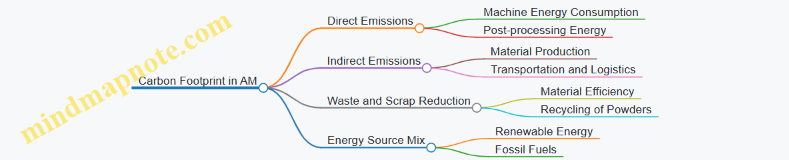
Example:
A study comparing Selective Laser Melting (SLM) of stainless steel parts to CNC machining found that despite higher energy consumption during printing, the overall carbon footprint was 30% lower due to reduced material waste and fewer machining steps.
Best Practices to Reduce Energy Use and Carbon Footprint
- Optimize Build Orientation and Nesting: Minimizes support structures and build time.
- Use Energy-Efficient Machines: Select AM systems with improved laser efficiency and thermal management.
- Integrate Renewable Energy Sources: Power AM facilities with solar or wind energy.
- Recycle and Reuse Materials: Implement powder recycling protocols and reuse polymer feedstocks.
- Implement Process Monitoring: Use sensors and AI to reduce failed builds and rework.
- Design for AM (DfAM): Create lightweight, topology-optimized parts that require less material and energy.
Mind Map: Best Practices for Sustainable AM
Example:
An automotive manufacturer reduced energy consumption by 20% in their polymer AM prototyping by optimizing part orientation and switching to a machine powered by a solar energy contract.
Summary
Understanding and managing energy consumption and carbon footprint in additive manufacturing is essential for sustainable industrial growth. By combining technological improvements, smart design, and renewable energy integration, manufacturers can significantly reduce the environmental impact of AM processes while benefiting from their inherent efficiencies.
8.4 Best Practices: Implementing Sustainable AM Processes in Industry
Additive Manufacturing (AM) offers unique opportunities to enhance sustainability in industrial production by reducing waste, optimizing material usage, and enabling localized manufacturing. However, to fully realize these benefits, manufacturers must adopt best practices tailored to sustainable AM implementation.
Key Best Practices for Sustainable AM
Sustainable AM Implementation Mind Map
Material Efficiency
Powder Recycling:
- Implement closed-loop powder recycling systems to reuse unused metal or polymer powders.
- Example: An aerospace manufacturer uses sieving and conditioning to recycle 85% of metal powder from PBF processes, reducing raw material consumption and cost.
Support Structure Minimization:
- Design parts with minimal or no support structures to reduce material waste.
- Example: Using advanced build orientation and topology optimization software, a tooling company reduced support material by 40%, cutting post-processing waste.
Optimized Build Orientation:
- Orient parts to maximize packing density and minimize support needs.
- Example: A medical device firm arranged multiple implants in a single build chamber with optimized orientation, increasing throughput and reducing energy per part.
Energy Management
Machine Energy Monitoring:
- Track energy consumption per build to identify inefficiencies.
- Example: A production engineer implemented real-time energy dashboards, enabling adjustments that lowered energy use by 15%.
Process Parameter Optimization:
- Fine-tune laser power, scan speed, and layer thickness to balance quality and energy use.
- Example: Adjusting laser parameters in DED reduced build time and energy consumption without compromising mechanical properties.
Use of Renewable Energy Sources:
- Power AM facilities with solar or wind energy.
- Example: A polymer AM prototyping lab installed rooftop solar panels covering 60% of its energy needs, significantly reducing carbon footprint.
Waste Reduction
Closed-Loop Material Systems:
- Integrate systems that collect, recycle, and reuse waste powders and polymers.
- Example: An automotive supplier implemented a powder recovery system that reduced scrap by 30%.
Reuse of Failed Prints:
- Develop protocols to recycle or repurpose failed or prototype parts.
- Example: Failed polymer prints were shredded and blended into new filament feedstock, reducing virgin material usage.
Minimizing Post-Processing Waste:
- Use chemical polishing or minimal machining to reduce material removal.
- Example: A tooling company switched from mechanical grinding to chemical polishing, cutting waste by 25%.
Design for Sustainability
Lightweighting via Topology Optimization:
- Reduce material use while maintaining strength.
- Example: A drone manufacturer used topology optimization to cut metal part weight by 35%, reducing material and energy use.
Multi-Functional Parts:
- Combine multiple components into single prints to reduce assembly and material.
- Example: A robotics firm consolidated 5 parts into 1 AM print, reducing material by 20% and assembly time.
Modular Design for Repairability:
- Design parts for easy replacement or upgrade.
- Example: Industrial equipment parts designed as modular AM components extended product life and reduced waste.
Supply Chain Optimization
Localized Production:
- Manufacture parts near point-of-use to cut transportation emissions.
- Example: A medical device company set up regional AM hubs, reducing shipping distances by 70%.
On-Demand Manufacturing:
- Produce parts only when needed to avoid inventory waste.
- Example: A tooling supplier shifted to on-demand AM production, lowering excess inventory and obsolescence.
Reduced Transportation Emissions:
- Combine AM with digital inventory to minimize physical shipments.
- Example: Digital part files sent globally and printed locally reduced carbon emissions associated with logistics.
Lifecycle Assessment
Material Life Cycle Analysis:
- Evaluate environmental impact from raw material to end-of-life.
- Example: An industrial manufacturer conducted LCA comparing AM and traditional casting, identifying AM’s lower water usage.
End-of-Life Recycling Strategies:
- Plan for part recycling or remanufacturing.
- Example: Metal AM parts designed for disassembly and recycling at end-of-life improved circularity.
Environmental Impact Tracking:
- Use software tools to monitor sustainability metrics.
- Example: A production engineer integrated sustainability KPIs into manufacturing execution systems for continuous monitoring.
Workforce Training & Awareness
Sustainability-Focused Training:
- Educate staff on sustainable AM practices and benefits.
- Example: A company launched workshops on powder handling and energy conservation, improving compliance and reducing waste.
Cross-Functional Collaboration:
- Engage design, production, and sustainability teams for holistic improvements.
- Example: Regular cross-departmental meetings led to innovative solutions reducing material use by 10%.
Continuous Improvement Culture:
- Encourage feedback and iterative process enhancements.
- Example: Suggestion programs led to incremental energy savings and waste reduction initiatives.
Summary
Implementing sustainable AM processes requires a comprehensive approach addressing materials, energy, design, supply chain, and people. By adopting these best practices, manufacturers can significantly reduce environmental impact while maintaining productivity and quality.
Additional Mind Map: Sustainable AM Workflow
Example: Implementing Sustainable AM at an Industrial Prototyping Facility
Scenario: A prototyping specialist at an automotive supplier implemented sustainable AM practices.
- Introduced powder recycling protocols, recovering 80% of unused metal powder.
- Optimized build orientation and support structures, reducing material waste by 35%.
- Installed energy monitoring systems, identifying peak consumption periods and shifting non-critical builds to off-peak hours, reducing energy costs by 12%.
- Adopted topology optimization for prototype parts, cutting material use and print time.
- Trained the workforce on sustainable handling and waste reduction techniques.
Outcome: The facility reduced material waste by 30%, lowered energy consumption by 15%, and improved overall sustainability metrics without compromising prototype quality or delivery times.
By integrating these best practices, manufacturing engineers, production engineers, and prototyping specialists can lead the transition toward greener, more efficient additive manufacturing operations.
8.5 Case Study: Circular Economy Approaches in AM Production
Introduction
The circular economy model emphasizes minimizing waste and making the most of resources. In additive manufacturing (AM), especially for metals and polymers, adopting circular economy principles can significantly reduce environmental impact while improving cost efficiency and material utilization.
Circular Economy Principles Applied to AM
- Design for Reusability and Recycling
- Material Recovery and Reprocessing
- Energy Efficiency in Production
- Waste Minimization
- Product Life Extension through Repair and Refurbishment
Mind Map: Circular Economy in Additive Manufacturing
Example 1: Metal Powder Reuse in Aerospace Component Production
Context: Aerospace manufacturers produce complex metal parts using Powder Bed Fusion (PBF) with titanium alloys.
Approach:
- After each build, unused powder is sieved and recycled.
- Powder quality is monitored via particle size distribution and chemical composition.
- Up to 70% of powder can be reused without compromising part quality.
Outcome:
- Reduced raw material costs by 30%.
- Lowered waste generation significantly.
- Maintained certification standards through rigorous quality control.
Mind Map: Metal Powder Reuse Workflow
Example 2: Polymer Support Material Recycling in Consumer Electronics Prototyping
Context: A prototyping facility uses Stereolithography (SLA) for polymer parts with support structures.
Approach:
- Support materials are designed to be easily removable and recyclable.
- Chemical recycling processes break down supports into reusable resin.
- Waste resin is minimized by optimizing support design.
Outcome:
- 40% reduction in resin waste.
- Lower environmental footprint.
- Cost savings on raw materials.
Mind Map: Polymer Support Material Recycling
Best Practices Highlighted in Case Study
- Implement rigorous material quality monitoring to ensure recycled materials meet production standards.
- Design parts and supports with recyclability in mind to facilitate material recovery.
- Optimize build parameters to reduce scrap and improve powder or resin reuse.
- Establish closed-loop material flows within production facilities.
- Collaborate with suppliers and recyclers to create efficient take-back and recycling programs.
Conclusion
This case study demonstrates that circular economy approaches in additive manufacturing are not only environmentally responsible but also economically beneficial. By integrating material reuse, waste reduction, and design optimization, manufacturers can create sustainable AM production systems that align with industry demands and regulatory expectations.
References & Further Reading
- “Circular Economy in Additive Manufacturing: Challenges and Opportunities,” Journal of Cleaner Production, 2023.
- ASTM F42 Committee on Additive Manufacturing Technologies – Guidelines on Powder Reuse.
- Case studies from leading aerospace and consumer electronics companies implementing AM sustainability programs.
9. Future Trends and Emerging Technologies in Additive Manufacturing
9.1 Multi-Material and Functionally Graded AM Parts
Additive manufacturing (AM) has revolutionized the way complex parts are designed and fabricated. Among the most exciting advancements is the ability to create multi-material and functionally graded materials (FGMs) within a single build. These technologies enable engineers to tailor material properties spatially, optimizing performance, reducing weight, and enabling new functionalities that are impossible with traditional manufacturing.
What Are Multi-Material and Functionally Graded AM Parts?
-
Multi-Material AM involves printing two or more distinct materials simultaneously or sequentially in a single part. These materials can differ in mechanical, thermal, electrical, or chemical properties.
-
Functionally Graded Materials (FGMs) are a subset where the composition or microstructure gradually changes over the volume of the part, creating a smooth transition between materials or properties.
Benefits of Multi-Material and Functionally Graded AM
- Tailored performance: Combine hardness with toughness, flexibility with rigidity, or conductive with insulating regions.
- Reduced assembly: Integrate multiple components into one, reducing assembly time and potential failure points.
- Weight optimization: Use lightweight materials where possible and stronger materials only where needed.
- Enhanced durability: Gradual transitions reduce stress concentrations and improve fatigue life.
Technologies Enabling Multi-Material and FGMs
- Material Jetting: Allows deposition of multiple photopolymers with different properties in a single build.
- Directed Energy Deposition (DED): Enables feeding different metal powders during the build to create graded metal parts.
- Binder Jetting: Can be used with different powders and binders to create composite or graded parts.
- Fused Filament Fabrication (FFF) with Multi-Extruders: Enables printing polymers with different properties side-by-side or in gradients.
Mind Map: Multi-Material and Functionally Graded AM Concepts
Practical Examples
Example 1: Aerospace Bracket with Metal-Ceramic Gradient
- Objective: Create a bracket that has a tough metal base for load-bearing and a ceramic outer layer for thermal resistance.
- Process: Using Directed Energy Deposition, metal powder is deposited initially, then ceramic powder is gradually introduced to form a graded transition.
- Outcome: The bracket withstands high mechanical loads and elevated temperatures without delamination.
Example 2: Multi-Material Polymer Prosthetic Socket
- Objective: Fabricate a prosthetic socket combining rigid support areas with soft cushioning zones.
- Process: Material Jetting deposits rigid photopolymer for structural regions and soft elastomeric polymer for comfort zones in one build.
- Outcome: Patient experiences improved comfort and durability, reducing the need for multiple parts.
Example 3: Electronic Device with Embedded Conductive Paths
- Objective: Integrate conductive traces within an insulating polymer housing.
- Process: Multi-extruder FFF prints insulating polymer and conductive filament in a single print, creating embedded circuitry.
- Outcome: Reduced assembly steps and enhanced device compactness.
Best Practices for Designing Multi-Material and FGMs
- Understand Material Compatibility: Ensure materials bond well and have compatible thermal expansion coefficients to avoid cracking.
- Design Smooth Transitions: Avoid abrupt changes in material properties to reduce stress concentrations.
- Leverage Simulation Tools: Use finite element analysis (FEA) and process simulation to predict behavior.
- Optimize Process Parameters: Tailor print speed, temperature, and feed rates for each material.
- Plan Post-Processing: Consider heat treatments or surface finishing that accommodate all materials.
Mind Map: Best Practices for Multi-Material and FGMs
Summary
Multi-material and functionally graded additive manufacturing parts unlock unprecedented design freedom and performance optimization. By integrating best practices and leveraging advanced AM technologies, manufacturing engineers and prototyping specialists can develop innovative solutions tailored to demanding industrial applications. Real-world examples from aerospace, medical, and electronics industries demonstrate the transformative potential of these approaches.
9.2 Hybrid Manufacturing: Combining AM with CNC and Other Techniques
Hybrid manufacturing integrates additive manufacturing (AM) with subtractive and other traditional manufacturing processes, such as CNC machining, forging, or casting, to leverage the strengths of each method. This approach enables the production of complex, high-precision parts with improved mechanical properties and reduced lead times.
What is Hybrid Manufacturing?
Hybrid manufacturing combines the layer-by-layer material addition of AM with precision subtractive processes like CNC machining. This synergy allows manufacturers to produce near-net-shape parts with intricate geometries and then achieve tight tolerances and superior surface finishes through machining.
Benefits of Hybrid Manufacturing
- Complex Geometry with High Precision: AM creates complex internal features and lightweight lattice structures, while CNC machining refines critical surfaces.
- Material Efficiency: Reduces waste by adding material only where needed and machining only for finishing.
- Reduced Lead Time: Minimizes the need for multiple setups and separate manufacturing steps.
- Enhanced Mechanical Properties: Enables the use of forged or cast substrates with AM features added, improving strength.
Mind Map: Hybrid Manufacturing Overview
Common Hybrid Manufacturing Approaches
AM + CNC Machining
- Process: Build a near-net-shape part using AM, then machine critical surfaces or holes to tight tolerances.
- Example: Aerospace turbine blades with complex cooling channels printed by Directed Energy Deposition (DED), followed by CNC machining of blade edges.
AM on Forged or Cast Substrates
- Process: Start with a forged or cast base for strength, then add complex features via AM.
- Example: Automotive engine components where the base is forged, and cooling channels or mounting features are added by AM.
Multi-Process AM Machines
- Machines that combine AM and CNC in one setup, reducing handling and alignment errors.
- Example: Hybrid machines from manufacturers like DMG Mori or Mazak that integrate laser cladding and milling.
Mind Map: Hybrid Manufacturing Process Flow
Best Practices in Hybrid Manufacturing
- Design for Hybrid Manufacturing: Incorporate features that benefit from AM and identify surfaces requiring machining.
- Material Compatibility: Ensure substrate and AM materials are compatible to avoid defects.
- Process Planning: Optimize build orientation and machining sequences to minimize setups.
- In-Situ Monitoring: Use sensors during AM to detect defects early.
- Post-Process Stress Relief: Apply heat treatments to reduce residual stresses.
Example 1: Aerospace Bracket Fabrication
An aerospace company used hybrid manufacturing to produce a lightweight bracket:
- Step 1: Forged titanium base provided strength.
- Step 2: Complex lattice structures were added using Powder Bed Fusion.
- Step 3: CNC machining finished mounting holes and critical surfaces.
- Outcome: Weight reduced by 30%, lead time cut by 25%, and mechanical performance improved.
Example 2: Medical Implant Production
- Process: A hip implant was first CNC machined from a titanium block.
- AM Step: Porous surface structures were added via Directed Energy Deposition to promote bone ingrowth.
- Benefit: Enhanced osseointegration and reduced implant weight.
Mind Map: Hybrid Manufacturing Applications

Challenges and Considerations
- Thermal Stresses: Managing residual stresses from AM and machining.
- Alignment Accuracy: Ensuring precise registration between AM and CNC steps.
- Surface Finish: Balancing AM roughness with machining capabilities.
- Cost: Hybrid machines and processes can require significant investment.
Conclusion
Hybrid manufacturing represents a powerful approach to combine the design freedom of additive manufacturing with the precision and finish of subtractive methods. By carefully planning process sequences, material selection, and design, manufacturers can achieve optimized parts that meet demanding industrial requirements.
For manufacturing engineers and prototyping specialists, embracing hybrid manufacturing can unlock new possibilities in part complexity, performance, and production efficiency.
9.3 AI and Machine Learning Applications in AM Process Optimization
Additive Manufacturing (AM) is rapidly evolving with the integration of Artificial Intelligence (AI) and Machine Learning (ML) techniques, which are revolutionizing process optimization, quality control, and design innovation. This section explores how AI/ML are applied in AM to enhance efficiency, reduce defects, and accelerate development cycles.
Overview of AI and ML in AM
- AI refers to computer systems able to perform tasks normally requiring human intelligence.
- ML is a subset of AI focused on algorithms that improve automatically through experience.
In AM, these technologies analyze vast amounts of process data, predict outcomes, and optimize parameters without exhaustive manual experimentation.
Key Application Areas
Mind Map: AI and ML Applications in AM Process Optimization
Detailed Examples and Best Practices
Process Parameter Optimization
Example: A production engineer uses ML algorithms to analyze historical build data from a Powder Bed Fusion (PBF) machine. By correlating laser power, scan speed, and layer thickness with part density and surface roughness, the system suggests optimal parameters that reduce porosity by 15%.
Best Practice: Continuously feed real-time sensor data into ML models to dynamically adjust parameters during builds, enabling adaptive control rather than static settings.
Defect Detection and Prediction
Example: Using convolutional neural networks (CNNs) trained on thousands of in-situ thermal images, a prototyping specialist can detect early signs of cracking or delamination in metal AM parts, allowing immediate process intervention.
Best Practice: Combine multiple data sources (thermal, acoustic, optical) to improve prediction accuracy and reduce false positives.
Predictive Maintenance
Example: Machine learning models analyze vibration and temperature data from AM equipment to predict when a laser source or recoater blade will fail, scheduling maintenance before downtime occurs.
Best Practice: Implement IoT-enabled sensors for continuous machine health monitoring integrated with ML platforms.
Design Optimization
Example: AI-driven topology optimization tools generate lightweight lattice structures tailored for AM constraints, improving strength-to-weight ratios in aerospace brackets.
Best Practice: Use simulation data to train ML models that can rapidly propose multiple design iterations, accelerating the design-for-AM (DfAM) process.
Mind Map: Workflow of AI/ML Integration in AM Process Optimization
Challenges and Considerations
- Data Quality: Garbage in, garbage out — high-quality, labeled datasets are essential.
- Computational Resources: Training complex models requires significant computing power.
- Integration Complexity: Seamless integration with existing AM hardware and software can be challenging.
- Interpretability: Understanding AI decisions is critical for trust and regulatory compliance.
Summary
AI and ML are transforming additive manufacturing by enabling smarter, faster, and more reliable process optimization. By leveraging data-driven insights, manufacturing engineers and prototyping specialists can achieve higher quality parts, reduce waste, and accelerate innovation.
For further reading, explore case studies on AI-driven AM optimization in aerospace and medical device manufacturing, where these technologies have demonstrated significant performance improvements.
9.4 Best Practices: Preparing for Industry 4.0 Integration
Industry 4.0 represents the next revolution in manufacturing, characterized by the integration of cyber-physical systems, IoT, cloud computing, and artificial intelligence to create smart factories. For additive manufacturing (AM) to fully benefit from Industry 4.0, manufacturers must adopt best practices that enable seamless digital integration, real-time data utilization, and enhanced automation.
Key Best Practices for Industry 4.0 Integration in Additive Manufacturing
Establish a Robust Digital Infrastructure
- Implement IoT-enabled AM machines for real-time monitoring.
- Use cloud platforms for data storage, sharing, and analytics.
- Ensure cybersecurity protocols to protect sensitive manufacturing data.
Embrace Data-Driven Decision Making
- Collect process parameters and quality metrics continuously.
- Use AI and machine learning algorithms to predict failures and optimize print parameters.
- Integrate digital twins to simulate and improve AM workflows.
Foster Interoperability and Standardization
- Adopt open communication protocols (e.g., OPC UA) for machine-to-machine communication.
- Use standardized file formats like AMF and 3MF for design and process data.
- Ensure compatibility between AM equipment, software, and enterprise systems (ERP, MES).
Automate Post-Processing and Quality Control
- Integrate robotic handling and automated inspection systems.
- Use in-situ monitoring tools to detect defects during printing.
- Implement closed-loop feedback systems for adaptive process control.
Develop Skilled Workforce and Cross-Functional Teams
- Train engineers and operators on digital tools and AM technologies.
- Encourage collaboration between IT, manufacturing, and design teams.
- Promote continuous learning to keep pace with evolving Industry 4.0 technologies.
Mind Map: Industry 4.0 Integration Best Practices in Additive Manufacturing
Example 1: Real-Time Process Optimization Using AI
A leading aerospace manufacturer integrated IoT sensors on their metal powder bed fusion machines to collect temperature, laser power, and layer quality data. Using machine learning models, they predicted potential defects before they occurred and adjusted laser parameters in real-time, reducing scrap rates by 30% and improving part consistency.
Example 2: Digital Twin for AM Workflow Simulation
An automotive prototyping facility developed a digital twin of their selective laser sintering (SLS) process. This virtual model simulated thermal stresses and material behavior, allowing engineers to optimize build orientation and support structures before printing. The approach reduced prototype iteration cycles by 25%, accelerating time-to-market.
Example 3: Automated Post-Processing Integration
A medical device manufacturer implemented robotic arms to unload printed polymer parts from FDM machines and transfer them to washing and curing stations. Coupled with automated optical inspection systems, this integration minimized manual handling errors and improved throughput by 40%.
Summary
Preparing for Industry 4.0 integration in additive manufacturing requires a holistic approach combining technology adoption, process optimization, and workforce development. By establishing a connected digital ecosystem, leveraging data analytics, and automating workflows, manufacturers can unlock the full potential of AM within smart factories, driving efficiency, quality, and innovation.
9.5 Case Study: Smart Manufacturing Facilities Utilizing Advanced AM Technologies
Introduction
Smart manufacturing facilities represent the cutting edge of industrial production, integrating advanced additive manufacturing (AM) technologies with digitalization, automation, and data analytics. This case study explores how a leading aerospace manufacturer transformed its production line by implementing advanced metal AM processes combined with Industry 4.0 principles, resulting in improved efficiency, reduced lead times, and enhanced product quality.
Facility Overview
- Location: Midwest, USA
- Industry: Aerospace Components
- AM Technologies Used: Powder Bed Fusion (PBF), Directed Energy Deposition (DED), and In-situ Process Monitoring
- Digital Infrastructure: IoT sensors, AI-driven process control, cloud-based data analytics
Objectives
- Integrate AM into existing manufacturing workflows for complex metal parts
- Achieve real-time quality control and predictive maintenance
- Reduce material waste and energy consumption
- Enable rapid prototyping and small-batch production with high repeatability
Implementation Strategy
Integration of Advanced AM Machines
- Installed multiple PBF machines capable of processing titanium and Inconel alloys
- Added DED systems for repair and hybrid manufacturing
IoT and Sensor Deployment
- Embedded thermal and optical sensors inside AM machines
- Real-time monitoring of melt pool size, temperature gradients, and powder flow
AI and Machine Learning Analytics
- Developed predictive models to detect defects before build completion
- Automated parameter adjustments to optimize build quality
Digital Twin Creation
- Created digital replicas of AM machines and parts for simulation and process optimization
Workforce Training
- Conducted workshops on AM process parameters, data interpretation, and maintenance
Mind Map: Smart Manufacturing Facility Components
Best Practices Demonstrated
Real-Time Quality Control
- Example: Using melt pool monitoring data, the system automatically detected an anomaly in laser power, triggering a pause and parameter recalibration, preventing a costly build failure.
Predictive Maintenance
- Example: Vibration sensors on recoater arms predicted bearing wear, scheduling maintenance before breakdown, reducing downtime by 30%.
Hybrid Manufacturing Approach
- Example: Complex aerospace brackets were partially built using PBF and finished with DED for added features and repair, reducing lead time by 25%.
Data-Driven Process Optimization
- Example: Analysis of build data over 100+ parts led to optimized scan strategies, improving surface finish and mechanical properties.
Results and Impact
| Metric | Before Implementation | After Implementation | Improvement |
|---|---|---|---|
| Lead Time (weeks) | 12 | 7 | 42% Reduction |
| Material Waste (%) | 18 | 7 | 61% Reduction |
| Part Failure Rate (%) | 8 | 2 | 75% Reduction |
| Machine Downtime (%) | 15 | 6 | 60% Reduction |
Lessons Learned
- Early investment in sensor technology and data infrastructure is critical.
- Cross-disciplinary collaboration between engineers, data scientists, and operators enhances problem-solving.
- Continuous workforce training ensures smooth adoption of new technologies.
- Digital twins enable proactive process improvements and risk mitigation.
Conclusion
This smart manufacturing facility exemplifies how advanced additive manufacturing technologies, when combined with digitalization and AI, can revolutionize industrial production. The integration of real-time monitoring, predictive analytics, and hybrid AM processes not only improved efficiency and quality but also paved the way for scalable, flexible manufacturing suited for the demands of modern aerospace components.
Additional Mind Map: Benefits of Smart AM Facilities
Final Example: Smart AM in Action
A titanium turbine blade was produced using PBF with integrated thermal sensors. During the build, the system detected a localized overheating event. The AI algorithm adjusted laser power and scan speed in real-time, preventing distortion. Post-build inspection confirmed dimensional accuracy within 0.05 mm tolerance, demonstrating the power of smart manufacturing in delivering high-precision components.
10. Practical Implementation and Scaling of AM in Industrial Settings
10.1 Assessing Readiness for AM Adoption in Manufacturing Lines
Adopting Additive Manufacturing (AM) into existing manufacturing lines is a strategic decision that requires careful evaluation of multiple factors to ensure successful integration and return on investment. This section guides manufacturing engineers, production engineers, and prototyping specialists through a comprehensive readiness assessment, supported by practical examples and mind maps to visualize key considerations.
Key Dimensions to Assess for AM Readiness
AM Adoption Readiness Mind Map
Technical Capability
Evaluate whether your current manufacturing environment supports AM technology:
- Existing Equipment Compatibility: Does your facility have space and utilities (power, ventilation) to accommodate AM machines?
- Material Availability: Are the required metal or polymer powders/materials readily available and compatible with your AM systems?
- Process Maturity: Are the AM processes you plan to adopt well-established for your target applications?
- Post-Processing Infrastructure: Do you have access to finishing, heat treatment, or machining equipment necessary for AM parts?
Example: A mid-sized aerospace component manufacturer assessed their readiness and found their powder handling and safety protocols were insufficient for metal AM powders. They invested in dedicated powder management systems before proceeding.
Workforce Expertise
Assess the skills of your team:
- AM Design Skills: Are your engineers trained in Design for Additive Manufacturing (DfAM)?
- Machine Operation Training: Do operators understand AM machine setup, calibration, and troubleshooting?
- Maintenance Knowledge: Is there expertise in maintaining AM equipment to minimize downtime?
Example: A production engineering team at a medical device company partnered with an AM training provider to upskill their staff in polymer AM technologies, which accelerated their prototyping cycles.
Financial Considerations
Analyze costs and expected benefits:
- Capital Investment: What is the upfront cost for AM machines and related infrastructure?
- Operating Costs: Consider materials, energy, labor, and maintenance.
- ROI Timeline: How soon will AM adoption reduce costs or increase revenue?
Example: An automotive supplier conducted a cost-benefit analysis showing that AM could reduce tooling costs by 40%, achieving ROI within 18 months.
Production Requirements
Understand your production needs:
- Volume and Throughput: Is AM suitable for your production volumes? (Typically better for low to medium volumes)
- Part Complexity: Are your parts complex or customized, benefiting from AM’s design freedom?
- Quality Standards: Can AM meet your required tolerances and certifications?
Example: A consumer electronics manufacturer used AM for complex, low-volume internal components that were previously expensive to machine.
Supply Chain Impact
Consider how AM affects your supply chain:
- Material Sourcing: Can you secure a reliable supply of AM materials?
- Inventory Management: Will AM reduce inventory by enabling on-demand production?
- Lead Time Reduction: Can AM shorten your product development cycles?
Example: A tooling company integrated AM to produce jigs on-demand, reducing lead times from weeks to days.
Regulatory and Certification
Ensure compliance:
- Industry Standards Compliance: Are there AM-specific standards applicable to your parts?
- Quality Assurance Protocols: Can you implement inspection and traceability for AM parts?
Example: A defense contractor established in-situ monitoring and documentation protocols to meet strict aerospace certification requirements.
IT and Data Infrastructure
Evaluate digital readiness:
- Software Integration: Does your CAD/CAM software support AM workflows?
- Data Security: Are your AM design and process data protected?
- Process Monitoring: Can you implement real-time monitoring and analytics?
Example: A factory upgraded its network to support cloud-based AM process monitoring, enabling remote quality control.
Sustainability Goals
Align AM adoption with environmental objectives:
- Waste Reduction: AM typically generates less waste than subtractive methods.
- Energy Consumption: Assess energy use of AM machines compared to traditional processes.
- Recycling Capabilities: Can you recycle unused powders or scrap parts?
Example: An industrial prototyping firm implemented powder recycling systems, reducing material costs and environmental impact.
Summary Mind Map: Comprehensive Readiness Assessment

Final Thoughts
Assessing readiness for AM adoption is a multi-faceted process that requires collaboration across engineering, production, finance, and quality teams. By systematically evaluating each dimension and learning from real-world examples, manufacturing lines can successfully integrate AM technologies to enhance flexibility, reduce costs, and accelerate innovation.
10.2 Workforce Training and Skill Development for AM Technologies
Additive Manufacturing (AM) technologies are rapidly evolving, requiring a workforce that is not only skilled in traditional manufacturing but also proficient in digital design, materials science, and machine operation specific to AM processes. Effective workforce training and skill development are critical for successful AM adoption and scaling in industrial environments.
Key Areas for Workforce Training in AM
- Understanding AM Technologies: Familiarity with different AM processes (e.g., Powder Bed Fusion, FDM, SLA) and their applications.
- Design for Additive Manufacturing (DfAM): Training on design principles that leverage AM capabilities, including topology optimization and support structure minimization.
- Materials Knowledge: Insight into metal and polymer materials used in AM, including handling, storage, and post-processing requirements.
- Machine Operation and Maintenance: Hands-on skills for operating AM equipment, troubleshooting, and routine maintenance.
- Quality Control and Inspection: Training on in-process monitoring, non-destructive testing, and final part inspection.
- Software and Simulation Tools: Proficiency in CAD, slicing software, and simulation platforms for predicting AM outcomes.
Mind Map: Workforce Training Components for AM
Best Practices for Workforce Training
-
Blended Learning Approach: Combine classroom instruction, e-learning modules, and hands-on workshops to cater to different learning styles.
-
Certification Programs: Encourage participation in industry-recognized AM certifications to standardize skill levels.
-
Cross-Functional Training: Train employees across departments (design, production, quality) to foster collaboration and holistic understanding.
-
Use of Simulators and Virtual Reality (VR): Implement VR-based training tools to simulate AM machine operation and troubleshooting without risking equipment.
-
Continuous Skill Upgradation: Establish ongoing training programs to keep pace with technological advancements and process updates.
-
Mentorship and Knowledge Sharing: Pair experienced AM professionals with newcomers to accelerate learning and problem-solving.
Example: Training Program for a Metal AM Production Facility
Objective: Upskill production engineers to operate Powder Bed Fusion (PBF) machines efficiently.
Program Structure:
- Week 1: Theoretical training on PBF technology, metal powders, and safety protocols.
- Week 2: Hands-on machine setup, calibration, and print job execution.
- Week 3: Post-processing techniques including heat treatment and surface finishing.
- Week 4: Quality control methods and defect analysis.
- Week 5: Simulation software training for build preparation and support design.
Outcome: Production engineers reduced machine downtime by 20% and improved first-pass yield by 15% within three months post-training.
Mind Map: Example Training Program Timeline
Example: Cross-Functional Training for Prototyping Specialists
Scenario: Prototyping specialists trained in both polymer AM processes (FDM, SLA) and design optimization.
Training Focus:
- Understanding material properties and limitations.
- Applying DfAM principles to reduce print time and material waste.
- Using slicing software to optimize print parameters.
- Post-processing techniques to achieve functional prototypes.
Result: Prototyping cycle time reduced by 30%, enabling faster design iterations and improved product development timelines.
Mind Map: Cross-Functional Training Focus Areas
Conclusion
Investing in comprehensive workforce training and skill development tailored to additive manufacturing technologies is essential to unlock the full potential of AM in industrial settings. By combining theoretical knowledge, practical skills, and continuous learning, manufacturing engineers, production engineers, and prototyping specialists can drive innovation, improve quality, and enhance productivity in their organizations.
10.3 Supply Chain and Inventory Management with Additive Manufacturing
Additive Manufacturing (AM) is revolutionizing supply chain and inventory management by enabling on-demand production, reducing lead times, and minimizing inventory costs. This section explores how AM integrates into modern supply chains, the benefits it offers, and best practices for managing inventory effectively.
Key Benefits of AM in Supply Chain Management
- On-Demand Production: Manufacture parts as needed, reducing overstock and obsolescence.
- Decentralized Manufacturing: Produce parts closer to the point of use, lowering transportation costs and lead times.
- Customization and Flexibility: Easily adapt production to specific customer requirements without retooling.
- Reduced Supplier Dependencies: Internalize production of critical components, mitigating risks from supplier disruptions.
Mind Map: AM Impact on Supply Chain
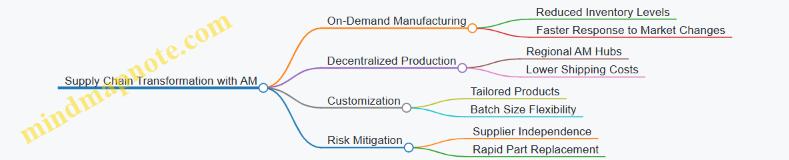
Inventory Management Strategies Enabled by AM
-
Digital Inventory (Virtual Warehousing):
- Store digital files instead of physical parts.
- Produce parts on demand, reducing physical storage needs.
-
Buffer Stock Reduction:
- Minimize safety stock by leveraging rapid AM production.
-
Spare Parts Management:
- Manufacture spare parts locally as needed, especially for obsolete or low-demand items.
-
Supply Chain Resilience:
- Use AM to quickly respond to supply disruptions or sudden demand spikes.
Mind Map: Inventory Management with AM
Example 1: Aerospace Spare Parts Virtual Inventory
An aerospace manufacturer implemented a digital inventory system for critical spare parts using AM. Instead of maintaining large physical stocks of rarely used components, they stored certified 3D CAD models in a secure cloud repository. When a part was needed, it was printed locally at the maintenance facility, reducing inventory costs by 40% and cutting lead times from weeks to days.
Example 2: Automotive Decentralized Production Network
A global automotive supplier established regional AM hubs near key assembly plants. This decentralized approach allowed them to produce tooling inserts and customized fixtures on demand, reducing shipping costs and lead times. The hubs also served as emergency backup production centers during supply chain disruptions.
Best Practices for Supply Chain and Inventory Management with AM
- Standardize Digital File Management: Ensure all AM parts have validated, version-controlled digital files accessible to relevant stakeholders.
- Integrate AM Data with ERP Systems: Link AM production data and digital inventories with enterprise resource planning for seamless supply chain visibility.
- Develop Qualification Protocols: Establish clear quality and certification standards for AM-produced parts to ensure reliability.
- Plan for Hybrid Inventory Models: Combine traditional inventory with AM-enabled virtual inventory to balance cost and responsiveness.
- Train Supply Chain Teams: Educate procurement and logistics teams on AM capabilities and limitations to optimize planning.
Mind Map: Best Practices for AM Supply Chain Integration
Example 3: Medical Device Manufacturer’s Hybrid Inventory Approach
A medical device company combined traditional inventory with AM virtual inventory for low-demand, high-complexity parts. They maintained critical components physically for immediate needs but stored digital files for less frequently used parts. This hybrid model improved service levels while reducing inventory carrying costs by 25%.
Summary
Additive Manufacturing empowers supply chain and inventory management by enabling flexible, on-demand production and reducing dependency on large physical inventories. By adopting best practices such as digital inventory management, ERP integration, and workforce training, manufacturing engineers and production specialists can leverage AM to build resilient, cost-effective supply chains tailored for modern industrial demands.
10.4 Best Practices: Scaling from Prototyping to Production
Scaling additive manufacturing (AM) from prototyping to full production is a critical step for manufacturing engineers, production engineers, and prototyping specialists aiming to leverage AM’s benefits at industrial scale. This transition requires careful planning, process optimization, and integration with existing manufacturing workflows. Below is a comprehensive guide with best practices, mind maps, and practical examples to facilitate this scaling process.
Key Considerations When Scaling AM
- Process Repeatability & Reliability
- Material Consistency & Supply Chain
- Quality Control & Inspection
- Design for Manufacturability (DfM) Adjustments
- Production Throughput & Lead Time
- Cost Management & ROI Analysis
- Workforce Training & Skill Development
- Regulatory Compliance & Certification
Mind Map: Scaling from Prototyping to Production
Best Practices with Examples
Process Optimization and Standardization
Practice: Develop and document standardized machine parameters and environmental conditions to ensure repeatability.
Example: A medical device manufacturer scaled metal AM production by establishing a controlled atmosphere in build chambers and standardizing laser power and scan speed parameters. This reduced variability and improved part consistency across batches.
Material Management and Quality
Practice: Secure reliable bulk material suppliers and implement rigorous incoming material testing.
Example: An aerospace company partnered with certified powder suppliers and introduced powder characterization protocols (particle size distribution, flowability) to maintain material quality for large-scale production.
Quality Assurance and In-Process Monitoring
Practice: Integrate real-time monitoring systems such as melt pool sensors and layer-wise imaging to detect defects early.
Example: A tooling manufacturer implemented optical monitoring during PBF builds, enabling immediate detection of porosity and reducing scrap rates by 30%.
Design Adaptation for Manufacturability
Practice: Refine prototype designs to minimize supports, improve build orientation, and optimize for faster printing without compromising function.
Example: A consumer electronics firm redesigned polymer housings using DfAM principles, reducing support structures by 40%, which shortened print times and post-processing efforts.
Production Planning and Workflow Integration
Practice: Develop production schedules that balance machine utilization and maintenance, integrating AM with downstream processes.
Example: An automotive supplier synchronized AM build cycles with CNC machining and finishing operations, reducing total lead time by 25%.
Workforce Training and Development
Practice: Invest in operator training programs focusing on AM machine operation, troubleshooting, and quality inspection.
Example: A defense contractor established a certification program for AM technicians, improving first-pass yield and reducing rework.
Cost Management and ROI Analysis
Practice: Use detailed cost models including machine time, material usage, labor, and overhead to evaluate production scalability.
Example: A medical implant producer used cost modeling to justify investment in multiple AM machines, achieving economies of scale and reducing per-part cost by 15%.
Regulatory Compliance and Documentation
Practice: Implement traceability systems for materials, process parameters, and inspection data to meet industry standards.
Example: A pharmaceutical equipment manufacturer integrated digital batch records and process logs, facilitating FDA audits and certification.
Additional Mind Map: Workflow Integration for Scaled AM Production
Summary
Scaling additive manufacturing from prototyping to production is a multifaceted challenge that demands a holistic approach. By standardizing processes, securing material quality, adapting designs, integrating workflows, and investing in workforce training, manufacturers can successfully transition to high-volume AM production. Real-world examples demonstrate how these best practices lead to improved quality, reduced costs, and faster time-to-market.
This section equips manufacturing and production engineers with actionable insights and frameworks to confidently scale AM operations while maintaining product excellence and operational efficiency.
10.5 Case Study: Scaling Metal AM for Mass Customization in Medical Devices
Introduction
Mass customization in the medical device industry has become a critical driver for improving patient outcomes and operational efficiency. Metal Additive Manufacturing (AM) offers unparalleled flexibility to produce complex, patient-specific implants and surgical tools at scale. This case study explores how a leading medical device manufacturer successfully scaled metal AM processes to meet mass customization demands.
Background
The company specialized in orthopedic implants, such as hip and knee replacements, which require precise customization to fit individual patient anatomies. Traditional manufacturing methods involved long lead times and high costs for custom parts. By adopting metal AM, they aimed to reduce production time, improve implant performance, and enable on-demand manufacturing.
Process Overview
The core metal AM technology used was Powder Bed Fusion (PBF), specifically Selective Laser Melting (SLM), chosen for its high resolution and material properties suitable for titanium alloys commonly used in implants.
Mind Map: Scaling Metal AM for Medical Devices
Best Practices Implemented
Patient-Specific Design Integration
- Example: Using patient CT scans, engineers created 3D CAD models tailored to each patient’s bone geometry. This ensured implants matched anatomical requirements precisely.
- Practice: Employ Design for Additive Manufacturing (DfAM) principles to optimize implant geometry for strength and manufacturability.
Simulation and Validation
- Example: Finite Element Analysis (FEA) simulated mechanical stresses on implants before printing, reducing trial-and-error iterations.
- Practice: Integrate simulation early in the design cycle to predict performance and identify potential print defects.
Production Scheduling and Machine Utilization
- Example: The company implemented software tools to nest multiple implants in a single build chamber, maximizing throughput.
- Practice: Optimize build layouts and schedule batches to minimize machine idle time and energy consumption.
Automated Post-Processing
- Example: Automated support removal and surface finishing stations reduced manual labor and improved consistency.
- Practice: Invest in robotic or semi-automated post-processing to scale production without compromising quality.
Quality Control and Regulatory Compliance
- Example: In-situ melt pool monitoring detected defects during printing; parts underwent CT scanning for internal porosity verification.
- Practice: Establish robust quality assurance protocols aligned with FDA and ISO standards for medical devices.
Example Workflow: From Patient Scan to Finished Implant
- Patient Imaging
- Acquire CT/MRI data
- CAD Modeling
- Create custom implant design
- Apply DfAM optimizations
- Simulation
- Perform FEA for stress analysis
- Additive Manufacturing
- Prepare build file
- Print using SLM
- Post-Processing
- Support removal
- Heat treatment
- Surface finishing
- Quality Inspection
- Non-destructive testing
- Dimensional verification
- Sterilization & Packaging
- Delivery to Surgical Team
Results and Impact
- Lead Time Reduction: From 8 weeks to 2 weeks per custom implant.
- Cost Savings: 30% reduction in manufacturing costs due to reduced material waste and labor.
- Patient Outcomes: Improved implant fit led to faster recovery times and fewer revision surgeries.
- Scalability: Production capacity increased by 4x within 12 months without additional factory footprint.
Lessons Learned
- Early investment in digital workflow integration is critical.
- Cross-disciplinary collaboration between engineers, clinicians, and quality teams ensures success.
- Continuous monitoring and data analytics help maintain consistent quality at scale.
Conclusion
This case study demonstrates that scaling metal AM for mass customization in medical devices is achievable through strategic technology selection, process optimization, and rigorous quality control. The integration of best practices and advanced workflows enables manufacturers to deliver superior, patient-specific implants efficiently and reliably.