Advanced Additive Manufacturing (Metal AM) for Production
1. Introduction to Metal Additive Manufacturing
1.1 Overview of Metal AM Technologies
Metal Additive Manufacturing (Metal AM) encompasses a variety of technologies that enable the layer-by-layer fabrication of metal parts directly from digital designs. These technologies differ primarily in the way metal powder or wire is melted and fused, the heat source used, and the environment in which the build occurs. Understanding these core technologies is essential for manufacturing engineers, AM operators, and product designers to select the best process for their production needs.
Major Metal AM Technologies
-
Powder Bed Fusion (PBF)
- Uses a laser or electron beam to selectively melt metal powder in a bed.
- Common subtypes:
- Direct Metal Laser Sintering (DMLS) / Selective Laser Melting (SLM)
- Electron Beam Melting (EBM)
-
Directed Energy Deposition (DED)
- Metal powder or wire is fed through a nozzle and melted by a laser or electron beam as it deposits.
- Suitable for repair, cladding, and large parts.
-
Binder Jetting
- A liquid binder selectively binds metal powder layers, followed by sintering.
- Offers high build speed but requires post-processing.
-
Material Extrusion (Metal FFF / FDM)
- Metal-filled filament is extruded and later sintered.
- Lower resolution but cost-effective for prototyping.
-
Sheet Lamination
- Metal sheets are cut and bonded layer-by-layer.
- Less common for metal AM but used in some niche applications.
Mind Map: Metal AM Technologies Overview
Detailed Examples and Use Cases
1. Direct Metal Laser Sintering (DMLS) / Selective Laser Melting (SLM)
- Uses a high-powered laser to fully melt metal powder.
- Common materials: Titanium alloys, stainless steel, Inconel.
- Example: Aerospace companies use SLM to produce lightweight, complex fuel nozzles with internal channels that are impossible to machine traditionally.
2. Electron Beam Melting (EBM)
- Uses an electron beam in a vacuum to melt powder layers.
- Typically used with titanium alloys.
- Example: Medical implant manufacturers produce patient-specific hip implants with EBM, benefiting from reduced residual stresses due to the high build temperature.
3. Directed Energy Deposition (DED)
- Metal powder or wire is fed and melted simultaneously.
- Suitable for large parts or repair work.
- Example: Repairing turbine blades by depositing new material precisely where wear has occurred, extending component life.
4. Binder Jetting
- Powder is bound by a liquid agent and then sintered.
- Enables faster builds and larger parts but requires extensive post-processing.
- Example: Automotive companies use binder jetting to produce sand casting molds or cores rapidly.
5. Material Extrusion (Metal FFF / FDM)
- Metal powder bound in a polymer filament is extruded layer-by-layer.
- Post-processing includes debinding and sintering.
- Example: Rapid prototyping of metal parts for form and fit testing before committing to more expensive processes.
Mind Map: Example Applications by Metal AM Technology
Best Practice Highlight
When selecting a metal AM technology, consider:
- Part complexity: PBF excels at intricate geometries.
- Build volume: DED supports larger parts.
- Material requirements: EBM is ideal for titanium alloys.
- Production speed: Binder jetting offers faster throughput but needs more post-processing.
- Surface finish and tolerances: PBF generally offers finer resolution.
By matching technology capabilities to production goals, manufacturers can optimize cost, quality, and lead time.
This foundational understanding of metal AM technologies sets the stage for deeper exploration into design, materials, and process optimization in subsequent sections.
1.2 Historical Evolution and Industry Adoption
Metal Additive Manufacturing (Metal AM) has undergone a remarkable transformation since its inception, evolving from a niche prototyping tool to a critical production technology across multiple industries. Understanding this historical evolution provides valuable context for manufacturing engineers, AM operators, and product designers aiming to leverage Metal AM effectively.
Early Beginnings: 1980s - 1990s
- The roots of Metal AM trace back to the 1980s with the development of Selective Laser Sintering (SLS) and Direct Metal Laser Sintering (DMLS).
- Early systems were primarily used for rapid prototyping due to limited material options, slower build speeds, and high costs.
Example: In 1995, aerospace companies began experimenting with DMLS to create complex prototype parts that were impossible to machine traditionally.
Growth and Diversification: 2000s
- Introduction of Electron Beam Melting (EBM) and improvements in laser-based systems expanded material capabilities.
- Metal AM started to move beyond prototyping into functional part production, especially in aerospace and medical sectors.
- Industry standards and certification efforts began to take shape.
Example: By the mid-2000s, medical device manufacturers used Metal AM to produce patient-specific implants with complex internal geometries.
Production Adoption and Industrialization: 2010s
- Advances in machine reliability, process control, and material science enabled Metal AM for small-batch and series production.
- Major aerospace players like GE Aviation adopted Metal AM for turbine blades, achieving weight reduction and performance improvements.
- Automotive and tooling industries started integrating Metal AM for customized and conformal cooling tooling.
Example: GE Aviation’s LEAP engine turbine blades, produced via Metal AM, demonstrated up to 20% weight reduction and improved fuel efficiency.
Current State and Industry Expansion: 2020s and Beyond
- Metal AM is now a core part of production workflows in aerospace, automotive, medical, and industrial tooling.
- Integration with digital manufacturing, AI-driven process monitoring, and hybrid manufacturing techniques are accelerating adoption.
- Sustainability and recycling efforts are gaining traction to reduce environmental impact.
Example: Automotive companies are increasingly using Metal AM to produce performance parts and tooling with rapid turnaround times, enabling faster product iterations.
Mind Map: Historical Evolution of Metal AM
Mind Map: Industry Adoption by Sector
Best Practice Example: Early Adoption in Aerospace
Context: Aerospace manufacturers faced challenges in producing lightweight, complex parts with traditional subtractive methods.
Practice: Early adoption of DMLS allowed for the production of intricate turbine blades with internal cooling channels that were impossible to machine conventionally.
Outcome: This led to significant weight savings and improved engine efficiency, setting a precedent for Metal AM’s role in production.
Summary
The historical evolution of Metal AM highlights a trajectory from experimental prototyping to mainstream production technology. Industry adoption has been driven by continuous improvements in technology, materials, and process control, supported by real-world examples that demonstrate tangible benefits. For manufacturing engineers, AM operators, and product designers, understanding this evolution is key to making informed decisions about integrating Metal AM into production workflows.
1.3 Key Benefits and Challenges in Production Environments
Metal Additive Manufacturing (AM) has rapidly evolved from a prototyping tool to a viable production technology. Understanding its key benefits and challenges in production environments is essential for manufacturing engineers, AM operators, and product designers to fully leverage its potential.
Key Benefits of Metal AM in Production
-
Design Freedom and Complexity
- Enables production of geometries impossible or too costly with traditional manufacturing.
- Example: Aerospace companies producing lightweight, topology-optimized brackets with internal lattice structures that reduce weight by up to 40% without sacrificing strength.
-
Part Consolidation
- Multiple components can be combined into a single part, reducing assembly time and potential failure points.
- Example: Automotive fuel injector assemblies consolidated from 10 parts to 1, improving reliability and reducing assembly costs.
-
Customization and Low-Volume Production
- Ideal for producing customized or patient-specific parts without expensive tooling.
- Example: Medical implants tailored to individual patient anatomy, produced on-demand.
-
Reduced Lead Times
- Eliminates tooling lead times and enables rapid iteration.
- Example: Rapid production of aerospace replacement parts, reducing downtime.
-
Material Efficiency
- Near-net-shape manufacturing reduces material waste compared to subtractive methods.
- Example: Titanium powder reuse strategies in aerospace reducing raw material costs.
-
Supply Chain Simplification
- On-demand manufacturing reduces inventory and warehousing needs.
- Example: Spare parts produced locally at service centers, reducing logistics complexity.
Mind Map: Key Benefits of Metal AM
Challenges in Metal AM Production Environments
-
Process Repeatability and Consistency
- Variability in powder quality, machine calibration, and environmental conditions can affect part quality.
- Example: Variations in layer adhesion leading to inconsistent mechanical properties in batch production.
-
Surface Finish and Post-Processing Requirements
- Parts often require extensive post-processing such as support removal, heat treatment, and surface finishing.
- Example: Aerospace turbine blades requiring precise surface roughness for aerodynamic efficiency.
-
Build Size and Throughput Limitations
- Current metal AM machines have size constraints and relatively slow build speeds compared to traditional methods.
- Example: Large structural components still challenging to produce economically at scale.
-
Material and Process Qualification
- Certification for critical industries (aerospace, medical) requires extensive testing and documentation.
- Example: Qualification of new titanium alloys for flight-critical parts can take months or years.
-
Cost Considerations
- High initial investment in machines, materials, and skilled labor.
- Example: Cost per part can be higher than traditional methods for high-volume, simple geometries.
-
Design and Engineering Expertise
- Requires specialized knowledge in Design for Additive Manufacturing (DfAM) to fully exploit benefits.
- Example: Designers unfamiliar with AM may produce parts that are costly or impossible to print.
-
Powder Handling and Safety
- Metal powders are hazardous and require strict handling protocols.
- Example: Titanium powder’s flammability risk necessitates controlled environments.
Mind Map: Challenges in Metal AM Production
Integrated Example: Aerospace Production Scenario
A leading aerospace manufacturer adopted metal AM to produce a complex titanium bracket. The design team leveraged DfAM principles to consolidate five parts into one, reducing assembly time by 60%. However, during initial production runs, variability in powder batch quality led to inconsistent tensile strength. By implementing strict powder qualification protocols and in-situ process monitoring, the manufacturer improved repeatability. Post-processing included heat treatment tailored to achieve required mechanical properties and precision machining for critical surfaces. Despite higher upfront costs, the overall lead time was reduced by 50%, and the part weight was cut by 35%, resulting in fuel savings during operation.
In conclusion, metal AM offers transformative benefits for production environments but requires careful management of challenges through best practices, robust process controls, and skilled teams to realize its full potential.
1.4 Best Practice: Selecting the Right Metal AM Process for Your Application (Example: Comparing DMLS vs. EBM for Aerospace Components)
Selecting the appropriate metal additive manufacturing (AM) process is critical to achieving optimal performance, cost-efficiency, and quality in production. This decision depends on multiple factors including material compatibility, part complexity, surface finish requirements, mechanical properties, build speed, and post-processing needs.
In aerospace applications, where components must meet stringent safety and performance standards, choosing between Direct Metal Laser Sintering (DMLS) and Electron Beam Melting (EBM) is a common challenge. Both processes offer unique advantages and limitations.
Overview of DMLS and EBM
| Feature | DMLS (Direct Metal Laser Sintering) | EBM (Electron Beam Melting) |
|---|---|---|
| Energy Source | High-power laser | Electron beam |
| Atmosphere | Inert gas (usually argon) | Vacuum |
| Typical Materials | Titanium alloys, stainless steel, Inconel, cobalt chrome | Titanium alloys, cobalt chrome |
| Layer Thickness | 20-40 microns | 40-100 microns |
| Build Speed | Moderate to fast | Generally faster for large parts |
| Surface Finish | Finer surface finish, less post-processing | Rougher surface finish, more post-processing |
| Residual Stress | Higher, requires stress relief | Lower due to elevated build temperatures |
| Part Size Limitations | Smaller build envelopes | Larger build envelopes |
Mind Map: Factors Influencing Metal AM Process Selection
Example: Comparing DMLS vs. EBM for Aerospace Bracket Production
Scenario: Manufacturing a lightweight titanium aerospace bracket requiring high fatigue strength, fine features, and a smooth surface finish.
| Criteria | DMLS | EBM |
|---|---|---|
| Material | Ti-6Al-4V powder | Ti-6Al-4V powder |
| Part Complexity | Excellent for fine features | Good, but limited resolution |
| Surface Finish | Better (Ra ~ 5-10 µm) | Rougher (Ra ~ 20-30 µm) |
| Residual Stress | Higher, requires stress relief | Lower due to elevated build temp |
| Build Time | Longer for large parts | Faster for large parts |
| Post-Processing | Moderate (support removal, heat treat) | More intensive (support removal, machining) |
| Cost | Higher per part for large builds | More cost-effective for large builds |
Decision: For small to medium-sized brackets with intricate features and tight tolerances, DMLS is preferred due to its finer resolution and surface finish. For larger brackets where build speed and lower residual stress are priorities, EBM may be more suitable.
Best Practice Recommendations
-
Assess Material Requirements: Confirm the alloy compatibility with the AM process. For example, DMLS supports a broader range of alloys including stainless steel and Inconel, while EBM is typically limited to titanium and cobalt chrome.
-
Evaluate Part Geometry: Use DMLS for parts requiring fine details and thin walls; EBM is better for larger, less intricate parts.
-
Consider Surface Finish Needs: If minimal post-processing is desired, DMLS generally provides a smoother as-built surface.
-
Analyze Build Volume and Speed: For large batch production of bigger parts, EBM’s faster build rates and larger build envelopes can reduce lead times.
-
Plan for Residual Stress Management: EBM’s elevated build temperatures reduce residual stress, potentially minimizing distortion.
-
Factor in Cost and Production Volume: Balance machine and powder costs against production scale to optimize economics.
-
Prototype and Test: Whenever possible, produce test parts using both processes to validate performance and manufacturability.
Mind Map: Decision Workflow for Metal AM Process Selection
By integrating these best practices and leveraging real-world examples, manufacturing engineers, AM operators, and product designers can make informed decisions that align metal AM process capabilities with their production goals, ensuring high-quality aerospace components that meet rigorous standards.
2. Design for Metal Additive Manufacturing (DfAM)
2.1 Principles of Design Optimization for Metal AM
Design optimization for Metal Additive Manufacturing (AM) is a critical step to fully leverage the unique capabilities of metal AM technologies. Unlike traditional subtractive manufacturing, metal AM allows for complex geometries, internal features, and material savings that were previously impossible or cost-prohibitive. However, to maximize these benefits, engineers and designers must understand and apply specific principles tailored to the metal AM process.
Key Principles of Design Optimization for Metal AM
- Leverage Geometric Freedom: Metal AM enables complex shapes, internal channels, and lattice structures.
- Minimize Supports: Reducing support structures decreases material use, build time, and post-processing.
- Consider Build Orientation: Orientation affects surface finish, mechanical properties, and support needs.
- Optimize for Material Properties: Understand anisotropy and residual stresses inherent in metal AM.
- Integrate Functional Features: Combine multiple parts or add conformal cooling channels.
- Design for Post-Processing: Facilitate support removal, heat treatment, and inspection.
Mind Map: Principles of Design Optimization for Metal AM
Example 1: Lightweight Aerospace Bracket
Scenario: An aerospace engineer needs to redesign a traditional machined bracket to reduce weight without compromising strength.
Optimization Approach:
- Use topology optimization software to remove unnecessary material.
- Incorporate lattice structures in low-stress regions to reduce weight.
- Orient the part to minimize supports on critical load-bearing surfaces.
- Design self-supporting angles to reduce support structures.
Result: The redesigned bracket achieved a 40% weight reduction, maintained required mechanical properties, and reduced build time by 15% due to fewer supports.
Mind Map: Lightweight Aerospace Bracket Optimization
Example 2: Custom Medical Implant
Scenario: A product designer is tasked with creating a patient-specific titanium implant with complex internal channels for bone ingrowth.
Optimization Approach:
- Utilize the geometric freedom of metal AM to design porous internal structures.
- Orient the implant to minimize supports inside critical channels.
- Design channels with self-supporting angles to avoid excessive supports.
- Consider post-processing access for cleaning and inspection.
Result: The implant exhibited improved osseointegration due to optimized porosity, reduced post-processing time, and enhanced patient outcomes.
Mind Map: Custom Medical Implant Design Optimization
Summary
Design optimization for metal AM requires a holistic approach that balances geometric complexity, build constraints, material behavior, and downstream processing. By applying these principles, manufacturing engineers, AM operators, and product designers can unlock the full potential of metal AM for production, resulting in lighter, stronger, and more functional parts.
Additional Tips
- Collaborate early with AM operators to understand machine-specific constraints.
- Use simulation tools to predict residual stresses and distortions.
- Iterate designs based on feedback from test builds and inspections.
- Document design decisions to support quality control and certification.
2.2 Topology Optimization and Lattice Structures
Introduction
Topology optimization and lattice structures are transformative design strategies in metal additive manufacturing (AM) that enable engineers and designers to create lightweight, high-performance components that are often impossible to manufacture using traditional methods. These techniques leverage the unique capabilities of metal AM to reduce material usage, improve mechanical properties, and integrate multifunctionality.
What is Topology Optimization?
Topology optimization is a computational design method that iteratively removes unnecessary material within a defined design space while meeting performance constraints such as stiffness, strength, or thermal conductivity. The goal is to find the most efficient material distribution for a given load case.
Key Concepts:
- Design Space: The volume within which the part can be shaped.
- Load Conditions: Forces, pressures, or thermal loads applied.
- Constraints: Manufacturing, displacement, or stress limits.
- Objective Function: Usually minimizing weight or maximizing stiffness.
Mind Map: Topology Optimization Overview
What are Lattice Structures?
Lattice structures are periodic or stochastic networks of interconnected struts or cells that fill a volume with a lightweight, yet mechanically robust architecture. They can be customized in terms of cell size, shape, and density to tailor mechanical, thermal, or acoustic properties.
Common Lattice Types:
- Octet Truss
- Gyroid
- Diamond
- Kelvin Cell
- Voronoi
Mind Map: Lattice Structures
Integrating Topology Optimization with Lattice Structures
Topology optimization often results in organic, complex shapes with internal voids. Filling these voids with lattice structures can further reduce weight while maintaining or enhancing mechanical performance.
Workflow Example:
- Define the design space and load cases.
- Run topology optimization to identify load paths and material distribution.
- Identify regions suitable for lattice infill.
- Select appropriate lattice type and parameters.
- Combine solid and lattice regions into a manufacturable CAD model.
Mind Map: Integration Workflow
Best Practice Example: Designing a Lightweight Automotive Suspension Bracket
Scenario: An automotive company wants to reduce the weight of a suspension bracket without compromising strength.
Approach:
- Use topology optimization to remove unnecessary material while ensuring the bracket withstands dynamic loads.
- Fill large internal voids with an octet truss lattice to maintain stiffness and absorb vibrations.
- Optimize lattice parameters (cell size, strut thickness) for manufacturability and performance.
Result:
- Weight reduction of 35% compared to the original solid design.
- Improved vibration damping due to lattice structure.
- Successful production using metal AM with minimal supports.
Mind Map: Automotive Bracket Design Example
Additional Examples
Medical Implant: Customized Hip Stem
- Topology optimization used to tailor stiffness to match bone properties, reducing stress shielding.
- Gyroid lattice incorporated internally to promote bone in-growth and reduce implant weight.
- Resulted in improved patient outcomes and implant longevity.
Aerospace Bracket
- Diamond lattice infill used in low-stress regions identified by topology optimization.
- Achieved 40% weight savings and maintained fatigue life.
- Reduced material cost and build time.
Summary
Topology optimization and lattice structures are powerful tools that unlock the full potential of metal additive manufacturing for production. By combining computational design with AM’s geometric freedom, manufacturing engineers and product designers can create components that are lighter, stronger, and more functional.
Key Takeaways:
- Use topology optimization to define efficient material layouts.
- Employ lattice structures to fill voids and enhance performance.
- Tailor lattice parameters to balance weight, strength, and manufacturability.
- Validate designs with simulation and testing before production.
References & Tools
- Software: Altair Inspire, nTopology, ANSYS Additive Suite
- Research: “Topology Optimization for Additive Manufacturing: Status and Challenges” (Journal of Manufacturing Science and Engineering)
- Case Studies: GE Aviation, BMW, Stryker Medical
2.3 Integrating Functionality and Weight Reduction
In metal additive manufacturing (AM), one of the most transformative advantages is the ability to integrate multiple functionalities into a single, lightweight part. This capability not only reduces the overall weight of components but also enhances performance, reduces assembly complexity, and opens new design possibilities that are impossible or cost-prohibitive with traditional manufacturing.
Why Integrate Functionality and Reduce Weight?
- Performance Improvement: Lighter parts improve fuel efficiency in aerospace and automotive sectors.
- Cost Efficiency: Reducing material usage lowers raw material costs.
- Assembly Simplification: Combining multiple parts into one reduces assembly time and potential failure points.
- Design Freedom: Complex internal features like cooling channels or lattice structures can be embedded.
Key Strategies for Integration and Weight Reduction
- Topology Optimization: Uses algorithms to remove unnecessary material while maintaining strength.
- Lattice Structures: Replace solid volumes with engineered porous structures that maintain stiffness.
- Multi-Functional Features: Embedding cooling channels, electrical pathways, or vibration dampers.
- Consolidation of Parts: Combining multiple components into a single AM build.
Mind Map: Integrating Functionality and Weight Reduction
Example 1: Aerospace Bracket with Topology Optimization
A traditional aerospace bracket weighing 1.2 kg was redesigned using topology optimization software to remove non-load-bearing material. The optimized design incorporated lattice infill in low-stress regions and solid walls where strength was critical. The result was a 40% weight reduction to 0.72 kg without compromising structural integrity.
Best Practice: Use finite element analysis (FEA) in conjunction with topology optimization to validate load paths and ensure safety margins.
Example 2: Drone Frame Using Lattice Structures
A drone manufacturer replaced solid aluminum frames with titanium lattice structures designed to absorb impact energy while reducing weight by 50%. The lattice type chosen was an octet truss, providing excellent stiffness-to-weight ratio.
Best Practice: Select lattice types based on mechanical requirements and manufacturing constraints. Use simulation tools to predict mechanical behavior.
Example 3: Turbine Blade with Conformal Cooling Channels
Metal AM enabled the integration of conformal cooling channels inside a turbine blade, which were impossible to machine conventionally. This integration improved cooling efficiency, extended blade life, and reduced weight by eliminating the need for external cooling components.
Best Practice: Collaborate closely with thermal engineers during design to optimize channel geometry and placement.
Example 4: Hydraulic Manifold Part Consolidation
A hydraulic manifold traditionally assembled from 10 separate parts was redesigned as a single AM part with internal fluid channels. This consolidation reduced assembly time, leak points, and overall weight by 30%.
Best Practice: Map out all fluid and mechanical interfaces early in the design phase to ensure seamless integration.
Summary
Integrating functionality and reducing weight in metal AM production requires a holistic approach combining advanced design tools, material science, and manufacturing know-how. By leveraging topology optimization, lattice structures, multi-functional features, and part consolidation, manufacturers can unlock unprecedented performance and efficiency gains.
For manufacturing engineers, AM operators, and product designers, embracing these strategies will be key to maximizing the value of metal additive manufacturing in production environments.
2.4 Best Practice: Designing a Lightweight Bracket with Internal Lattice (Example: Automotive Suspension Component)
Introduction
Designing lightweight components is a critical goal in automotive manufacturing to improve fuel efficiency, reduce emissions, and enhance vehicle performance. Metal Additive Manufacturing (AM) enables the creation of complex internal lattice structures that significantly reduce weight while maintaining or even improving mechanical strength.
In this section, we explore best practices for designing a lightweight automotive suspension bracket incorporating internal lattice structures, demonstrating how to leverage Design for Additive Manufacturing (DfAM) principles.
Why Use Internal Lattice Structures?
- Weight Reduction: Lattices replace solid volumes with a network of struts, drastically cutting material usage.
- Mechanical Performance: Properly designed lattices can maintain stiffness and strength by distributing loads efficiently.
- Thermal Management: Lattices can improve heat dissipation in some applications.
Step-by-Step Best Practice Workflow
Define Functional Requirements
- Load conditions (static and dynamic)
- Attachment points and interfaces
- Safety factors
- Environmental conditions (temperature, corrosion)
Select Appropriate Lattice Type
- Octet Truss: High stiffness-to-weight ratio, isotropic properties.
- Gyroid: Good for uniform stress distribution and fluid flow.
- Diamond: High energy absorption, good for impact resistance.
Use Topology Optimization
- Input load cases and constraints.
- Optimize shape to remove unnecessary material.
- Identify areas for lattice infill.
Integrate Lattice into Solid Model
- Replace internal solid volumes with lattice structures.
- Ensure lattice connectivity to load-bearing surfaces.
Validate Design with Simulation
- Finite Element Analysis (FEA) for stress, strain, and deformation.
- Modal analysis for vibration characteristics.
Prepare for Manufacturing
- Check minimum feature sizes compatible with AM process.
- Design for support removal and powder drainage.
Example: Automotive Suspension Bracket
Context: A front suspension bracket must support dynamic loads while minimizing weight.
Traditional Design: Solid aluminum alloy bracket weighing 2.5 kg.
AM-Optimized Design: Incorporates internal octet truss lattice, reducing weight by 40% to 1.5 kg without compromising strength.
Key Design Features:
- Solid outer shell for mounting interfaces.
- Internal lattice filling non-critical volume.
- Rounded transitions to reduce stress concentrations.
Simulation Results:
- Maximum stress well below material yield.
- Comparable stiffness to traditional design.
Manufacturing Notes:
- Lattice strut diameter: 1.2 mm (minimum feature size for chosen AM process).
- Orientation optimized to minimize supports on critical surfaces.
Mind Maps
Mind Map 1: Designing Lightweight Bracket with Internal Lattice
Mind Map 2: Benefits and Challenges
Mind Map 3: Automotive Suspension Bracket Case Study
Additional Examples
-
Example 1: Aerospace Bracket
- Use of gyroid lattice to reduce weight by 50%.
- Improved fatigue life due to stress distribution.
-
Example 2: Medical Implant
- Diamond lattice for bone-mimicking stiffness.
- Enhanced osseointegration due to porous structure.
Summary
Designing lightweight brackets with internal lattice structures in metal AM requires a systematic approach combining functional requirements, lattice selection, topology optimization, and thorough simulation. By following these best practices, manufacturing engineers and product designers can unlock significant weight savings and performance improvements, as demonstrated in the automotive suspension component example.
2.5 Avoiding Common Design Pitfalls in Metal AM
Metal Additive Manufacturing (AM) offers unprecedented design freedom, but this freedom can also lead to common pitfalls that negatively impact part performance, manufacturability, and cost. Understanding and avoiding these pitfalls is essential for manufacturing engineers, AM operators, and product designers to fully leverage Metal AM’s potential.
Common Design Pitfalls in Metal AM
Mind Map: Avoiding Design Pitfalls in Metal AM
Example 1: Overly Thin Walls in Aerospace Bracket
A design for a titanium aerospace bracket initially included walls as thin as 0.3 mm to save weight. During printing, these walls warped and partially melted due to insufficient heat dissipation and powder support. By increasing the minimum wall thickness to 0.6 mm and adding internal lattice support, the bracket printed successfully with improved mechanical strength.
Example 2: Poor Part Orientation in Medical Implant
A custom hip implant was oriented flat on the build plate, resulting in large support structures on critical surfaces and a rough finish where the implant interfaces with bone. Reorienting the implant at a 45-degree angle reduced supports by 40%, improved surface finish on functional areas, and decreased post-processing time.
Example 3: Ignoring Thermal Stresses in Tooling Component
A conformal cooling channel tool was designed without considering thermal gradients. The part cracked during the build due to uneven cooling. Incorporating fillets in sharp corners and redesigning channels for smoother transitions reduced stress concentrations and eliminated cracking.
Best Practices Summary
- Follow Material-Specific Design Guidelines: Consult supplier datasheets for minimum wall thickness, overhang angles, and support recommendations.
- Use Simulation Tools: Employ thermal and structural simulations to predict distortions and optimize design before printing.
- Iterate with Prototypes: Build test coupons or small sections to validate design choices.
- Collaborate Across Teams: Engage design, process, and post-processing experts early to identify pitfalls.
By proactively addressing these common pitfalls, manufacturers can reduce scrap rates, improve part quality, and fully exploit the advantages of Metal AM in production.
2.6 Best Practice: Minimizing Support Structures to Reduce Post-Processing (Example: Custom Medical Implants)
Introduction
Support structures are essential in metal additive manufacturing (AM) to anchor parts during the build, dissipate heat, and prevent deformation. However, excessive or poorly designed supports can significantly increase post-processing time, cost, and risk of part damage. Minimizing support structures is therefore a critical best practice, especially for complex, high-value parts such as custom medical implants.
Why Minimize Support Structures?
- Reduce Post-Processing Effort: Less support means less manual removal, grinding, or chemical treatment.
- Improve Surface Quality: Surfaces in contact with supports often require additional finishing.
- Lower Material Waste: Supports consume powder and increase build time.
- Decrease Risk of Part Damage: Removing supports can cause deformation or surface defects.
Key Strategies to Minimize Support Structures
Mind Map: Strategies to Minimize Support Structures
Design Optimization for Custom Medical Implants
Medical implants often have complex organic shapes tailored to patient anatomy, making support minimization challenging but crucial.
-
Orienting the Implant: Position the implant to minimize downward-facing overhangs. For example, orient a cranial implant so the flattest surface rests on the build plate.
-
Self-Supporting Angles: Design features with angles greater than 45° relative to the build plate to avoid supports.
-
Internal Features: Use lattice structures inside the implant to reduce weight without adding supports.
-
Smooth Transitions: Avoid sharp overhangs or abrupt geometry changes that require supports.
Example: Custom Hip Implant
| Aspect | Description |
|---|---|
| Initial Design | Complex geometry with multiple overhangs and thin walls requiring extensive supports |
| Optimization Approach | Reorient implant, increase self-supporting angles, add fillets to sharp edges |
| Result | Support volume reduced by 60%, post-processing time cut by 40%, improved surface finish |
Support Design Innovations
- Tree-Like Supports: Branching supports that use minimal contact points, reducing removal effort.
- Lattice Supports: Lightweight, easy to remove, and reduce heat accumulation.
- Soluble Supports: Materials that dissolve after printing, ideal for intricate implants.
Mind Map: Support Design Innovations
Software Tools for Support Minimization
Modern AM software offers advanced support generation algorithms:
- Automatic Support Optimization: Algorithms that generate minimal supports based on geometry and orientation.
- Simulation Tools: Predict thermal distortion and optimize support placement accordingly.
- Custom Support Editing: Manual adjustment to remove unnecessary supports.
Practical Tips for AM Operators and Designers
- Collaborate early between designers and AM operators to choose optimal orientations.
- Use iterative design and simulation to balance support needs and build stability.
- Validate support removal methods on test coupons before production.
Summary
Minimizing support structures in metal AM for custom medical implants leads to significant benefits in production efficiency, cost, and part quality. By combining thoughtful design, innovative support structures, and advanced software tools, manufacturers can optimize builds to reduce post-processing and deliver superior implants.
References and Further Reading
- Gibson, I., Rosen, D., & Stucker, B. (2015). Additive Manufacturing Technologies: 3D Printing, Rapid Prototyping, and Direct Digital Manufacturing.
- ASTM F2792-12a - Standard Terminology for Additive Manufacturing Technologies.
- Materialise Magics Software Documentation - Support Generation and Optimization.
3. Material Selection and Qualification
3.1 Overview of Common Metal Powders Used in AM
Metal powders are the fundamental raw materials in metal additive manufacturing (AM). Their selection directly impacts the mechanical properties, surface finish, and overall quality of the final part. Understanding the types, characteristics, and applications of common metal powders is essential for manufacturing engineers, AM operators, and product designers aiming to optimize production.
Types of Metal Powders Commonly Used in AM
- Titanium Alloys
- Stainless Steels
- Nickel-Based Superalloys
- Aluminum Alloys
- Cobalt-Chrome Alloys
- Tool Steels
Mind Map: Common Metal Powders in AM
Detailed Examples and Best Practices
Titanium Alloys (Ti-6Al-4V)
- Example: Aerospace structural brackets produced with Ti-6Al-4V powder demonstrate excellent strength-to-weight ratio, enabling weight savings critical for fuel efficiency.
- Best Practice: Use gas-atomized, spherical powders with tight particle size distribution (typically 15-45 microns) to ensure good flowability and packing density, which improves layer uniformity during powder bed fusion.
Stainless Steel 316L
- Example: Custom surgical instruments manufactured with 316L stainless steel powder benefit from corrosion resistance and biocompatibility.
- Best Practice: Store powder in controlled humidity environments to prevent oxidation, which can degrade powder quality and final part performance.
Nickel-Based Superalloys (Inconel 718)
- Example: Turbine blades produced via AM using Inconel 718 exhibit superior high-temperature strength and creep resistance.
- Best Practice: Implement strict powder recycling protocols to maintain chemical composition and particle morphology, as superalloys are sensitive to contamination.
Aluminum Alloys (AlSi10Mg)
- Example: Lightweight automotive parts such as brackets and housings leverage AlSi10Mg for its balance of strength and weight.
- Best Practice: Use inert gas environments (argon or nitrogen) during printing to prevent oxidation, as aluminum powders are highly reactive.
Cobalt-Chrome Alloys (CoCrMo)
- Example: Dental crowns and orthopedic implants produced with CoCrMo powders provide excellent wear resistance and biocompatibility.
- Best Practice: Optimize particle size distribution to balance flowability and packing density, improving surface finish and dimensional accuracy.
Tool Steels (H13)
- Example: Injection molding tools created with H13 tool steel powder benefit from high hardness and thermal fatigue resistance.
- Best Practice: Control powder moisture content to prevent defects such as porosity and cracking during the build.
Mind Map: Key Powder Characteristics Impacting AM Performance
Summary
Selecting the appropriate metal powder requires balancing material properties, powder characteristics, and application requirements. Employing best practices such as using high-quality spherical powders, controlling storage conditions, and maintaining strict recycling protocols ensures consistent production quality and part performance in metal AM.
This foundational knowledge empowers manufacturing engineers, AM operators, and product designers to make informed decisions that optimize metal additive manufacturing processes for production.
3.2 Material Properties and Their Impact on Performance
Understanding material properties is crucial for optimizing metal additive manufacturing (AM) processes and ensuring that the final parts meet the required performance standards. Different metal powders exhibit unique mechanical, thermal, and chemical characteristics that directly influence the part’s durability, strength, and functionality.
Key Material Properties in Metal AM
- Mechanical Properties
- Tensile Strength
- Yield Strength
- Ductility
- Hardness
- Fatigue Resistance
- Thermal Properties
- Thermal Conductivity
- Coefficient of Thermal Expansion (CTE)
- Melting Point
- Chemical Properties
- Corrosion Resistance
- Oxidation Behavior
- Powder Characteristics
- Particle Size Distribution
- Flowability
- Morphology
Mind Map: Material Properties Overview
Mechanical Properties and Their Impact
- Tensile and Yield Strength: Critical for load-bearing applications. Higher strength materials like Inconel 718 are preferred for aerospace turbine blades.
- Ductility: Important for parts that undergo deformation; titanium alloys offer a good balance of strength and ductility.
- Fatigue Resistance: Essential for cyclic loading; stainless steel 316L is often selected for medical implants due to its fatigue performance.
Example: A titanium alloy bracket designed for aerospace must balance tensile strength and ductility to withstand dynamic stresses without brittle failure.
Mind Map: Mechanical Properties Impact
Thermal Properties and Their Impact
- Thermal Conductivity: Influences heat dissipation during build and in-service conditions. Metals like copper have high thermal conductivity but are challenging to process in AM.
- Coefficient of Thermal Expansion (CTE): Affects dimensional stability and residual stress formation. Matching CTE with mating parts reduces distortion.
- Melting Point: Determines process parameters such as laser power and scan speed.
Example: Inconel 718’s high melting point and moderate thermal conductivity require precise laser parameter tuning to avoid defects.
Mind Map: Thermal Properties Impact
Chemical Properties and Their Impact
- Corrosion Resistance: Critical for parts exposed to harsh environments, e.g., marine or biomedical implants.
- Oxidation Behavior: Influences powder handling and build atmosphere requirements.
Example: Stainless steel 316L’s corrosion resistance makes it ideal for surgical tools and implants.
Powder Characteristics and Their Impact
- Particle Size Distribution: Affects layer thickness, surface finish, and packing density.
- Flowability: Influences powder spreading uniformity and build consistency.
- Morphology: Spherical particles improve flowability and packing.
Example: Consistent particle size and spherical morphology in titanium powders enable high-quality aerospace part production with minimal defects.
Mind Map: Powder Characteristics Impact
Integrated Example: Material Properties Impact on Aerospace Component
Consider the production of a titanium alloy aerospace bracket:
- Mechanical: High tensile strength and fatigue resistance ensure structural reliability under cyclic loads.
- Thermal: Moderate thermal conductivity and CTE reduce residual stresses and distortion during printing.
- Chemical: Excellent corrosion resistance extends service life in harsh environments.
- Powder: Optimized particle size and morphology allow for smooth layering and minimal defects.
By understanding and controlling these properties, manufacturing engineers and AM operators can optimize process parameters and design choices to produce high-performance, reliable parts.
Summary
Material properties are foundational to metal AM success. Their impact spans from process parameter selection to final part performance. Integrating knowledge of mechanical, thermal, chemical, and powder characteristics enables production of parts that meet stringent industry requirements with consistency and efficiency.
3.3 Powder Handling and Storage Best Practices
Proper handling and storage of metal powders are critical to maintaining material quality, ensuring consistent part performance, and safeguarding operator safety. Metal powders used in additive manufacturing are often reactive, sensitive to moisture, and prone to contamination, which can degrade their properties and lead to defects in final parts.
Key Objectives in Powder Handling and Storage
- Preserve powder morphology and flowability
- Prevent contamination and oxidation
- Ensure operator safety
- Maintain traceability and batch integrity
Best Practices Overview
Powder Handling and Storage Mind Map
Handling Environment and Equipment
- Controlled Atmosphere: Maintain low humidity (<30%) and stable temperature to prevent powder oxidation and moisture absorption.
- Dedicated Tools: Use non-contaminating scoops, brushes, and containers dedicated to specific powder types to avoid cross-contamination.
- Closed Transfer Systems: Whenever possible, use sealed transfer systems or glove boxes filled with inert gas (e.g., argon) to limit powder exposure.
Example: In a titanium powder AM facility, operators use argon-purged glove boxes to transfer powder from storage containers to the build chamber, minimizing oxygen exposure and preserving powder quality.
Storage Best Practices
- Sealed Containers: Store powders in airtight containers with desiccants or under inert gas to prevent moisture uptake.
- Labeling: Clearly label containers with batch number, material type, date received, and usage history.
- Inventory Management: Implement FIFO to use older powder first and avoid prolonged storage that can degrade powder.
- Regular Quality Checks: Periodically test powder for particle size distribution, flowability, and chemical composition to detect degradation.
Example: An aerospace manufacturer maintains a temperature- and humidity-controlled powder storage room with automated sensors and alarms. Powders are stored in sealed containers with inert gas blankets and undergo monthly flowability tests to ensure production readiness.
Powder Recycling and Reuse
- Establish protocols for sieving and blending recycled powder with virgin powder to maintain consistent properties.
- Limit the number of reuse cycles based on material-specific degradation data.
- Monitor recycled powder for contamination and particle morphology changes.
Example: A medical device producer blends recycled stainless steel 316L powder with 30% virgin powder after each build cycle, following strict sieving and quality control steps to ensure biocompatibility and mechanical integrity.
Safety Considerations
- Ground all equipment and containers to prevent static discharge.
- Use explosion-proof ventilation and dust extraction systems.
- Train personnel on powder hazards, safe handling, and emergency procedures.
Example: A metal AM facility installs spark-proof tools and explosion venting panels in powder handling areas, combined with regular safety drills to mitigate fire and explosion risks.
Summary Mind Map
By implementing these powder handling and storage best practices, manufacturers can significantly improve the reliability and repeatability of metal additive manufacturing processes, reduce scrap rates, and ensure compliance with stringent industry standards.
3.4 Best Practice: Ensuring Powder Consistency for High-Volume Production (Example: Titanium Alloy Powder Management in Aerospace)
Maintaining powder consistency is a cornerstone for achieving reliable, repeatable, and high-quality results in metal additive manufacturing (AM), especially when scaling to high-volume production. This is particularly critical in aerospace applications where titanium alloys such as Ti-6Al-4V are widely used due to their excellent strength-to-weight ratio and corrosion resistance.
Why Powder Consistency Matters
- Mechanical Properties: Variations in powder characteristics can lead to fluctuations in density, porosity, and ultimately mechanical performance.
- Process Stability: Consistent powder flow and packing density ensure stable melt pool behavior and layer deposition.
- Quality Assurance: Aerospace components demand stringent certification; inconsistent powder can cause defects leading to costly rework or scrapping.
Key Factors Affecting Powder Consistency
Best Practices for Titanium Alloy Powder Management in Aerospace
-
Strict Particle Size Control
- Use sieving and classification to maintain a narrow particle size distribution (typically 15-45 µm for Ti-6Al-4V).
- Example: Implement automated sieving stations post-production to remove oversized or undersized particles, ensuring uniform layer deposition.
-
Powder Morphology Monitoring
- Regularly analyze powder morphology using scanning electron microscopy (SEM) to detect changes such as agglomeration or irregular shapes.
- Example: A titanium powder batch showed increased satellite particles; the batch was quarantined and reprocessed to avoid defects.
-
Chemical Composition Verification
- Conduct periodic chemical assays to confirm alloy composition and detect contamination (e.g., oxygen, nitrogen, carbon levels).
- Example: Aerospace suppliers perform oxygen content testing to ensure it remains below 0.2% to maintain ductility.
-
Controlled Storage Environment
- Store powder in inert atmosphere or sealed containers with desiccants to prevent oxidation and moisture uptake.
- Example: Powder is stored in nitrogen-purged glove boxes with humidity sensors to maintain RH below 10%.
-
Recycling and Reuse Protocols
- Limit the number of reuse cycles (commonly 3-5) and blend recycled powder with virgin powder to maintain quality.
- Example: Aerospace AM operators track powder reuse history via batch IDs and mix 30% fresh powder with 70% recycled powder to ensure consistency.
-
Regular Sampling and Testing
- Implement sampling plans for each powder batch and reuse cycle, including flowability tests, apparent density, and moisture content.
- Example: Flow rate tests using Hall flowmeter ensure powder flows consistently through the recoater system.
Example Workflow: Titanium Alloy Powder Management in an Aerospace AM Facility
Real-World Example: Aerospace Supplier Implementation
An aerospace supplier producing Ti-6Al-4V fuel nozzle components implemented a powder management system that included:
- Automated sieving after each build to remove agglomerates.
- Nitrogen-purged storage containers with continuous humidity monitoring.
- A powder reuse policy limiting reuse to 4 cycles with mandatory chemical and morphology testing after each cycle.
- Digital tracking of powder batches linked to part serial numbers for full traceability.
This system led to a 15% reduction in build failures due to powder-related defects and improved certification pass rates.
Summary
Ensuring powder consistency in high-volume metal AM production requires a comprehensive approach encompassing particle characterization, controlled storage, rigorous testing, and disciplined recycling protocols. For titanium alloys in aerospace, these best practices are essential to meet the demanding quality and safety standards of the industry.
By integrating these practices into your powder management strategy, manufacturing engineers and AM operators can significantly enhance process reliability and part performance.
3.5 Material Certification and Traceability in Production
In metal additive manufacturing (AM) production environments, material certification and traceability are critical components to ensure part quality, regulatory compliance, and process repeatability. These practices provide confidence that the raw materials used meet required standards and that every part can be traced back through its entire production history.
Why Material Certification and Traceability Matter
- Regulatory Compliance: Aerospace, medical, and automotive industries often require strict adherence to standards such as ASTM, ISO, and AS9100.
- Quality Assurance: Certified materials reduce variability and defects, ensuring consistent mechanical properties.
- Failure Analysis: Traceability allows root cause analysis if a part fails in service.
- Customer Confidence: Demonstrates commitment to quality and transparency.
Key Elements of Material Certification
- Material Test Reports (MTRs): Documents from suppliers detailing chemical composition, mechanical properties, and heat treatment history.
- Powder Batch Identification: Unique batch numbers assigned to each powder lot.
- Supplier Qualification: Verification that powder suppliers meet quality standards.
- Certification Documentation: Compliance certificates confirming adherence to industry standards.
Traceability Workflow in Metal AM Production
Best Practice Example: Implementing Material Traceability for Aerospace Titanium Alloy Production
Scenario: A manufacturer producing Ti-6Al-4V aerospace brackets needs to ensure full traceability from powder to finished part.
- Supplier Certification: The powder supplier provides MTRs and batch certificates compliant with AMS 7001.
- Batch Number Tracking: Each powder batch is assigned a unique barcode scanned into the inventory system.
- Powder Sampling: Incoming powder undergoes particle size distribution and contamination analysis.
- Storage Controls: Powder is stored in humidity-controlled, sealed containers with batch segregation.
- Build Documentation: Each build job logs powder batch, machine parameters, operator, and build date.
- Post-Processing Records: Heat treatment cycles and support removal steps are recorded.
- Quality Inspection: Parts undergo CT scanning and mechanical testing; results linked to part serial numbers.
- Digital Traceability: All data is stored in a centralized database accessible for audits and customer queries.
This approach ensures that if any issue arises, the manufacturer can trace the affected parts back to specific powder batches and process parameters, facilitating rapid corrective actions.
Additional Mind Map: Certification Standards Relevant to Metal AM
Summary
Material certification and traceability in metal AM production are foundational to delivering reliable, high-quality parts. By establishing rigorous documentation, batch tracking, and compliance with industry standards, manufacturers can mitigate risks, streamline audits, and build customer trust. Integrating digital traceability systems further enhances transparency and operational efficiency.
For manufacturing engineers, AM operators, and product designers, embedding these best practices into your workflow ensures that your metal AM production not only meets but exceeds industry expectations.
3.6 Best Practice: Implementing a Material Qualification Protocol (Example: Stainless Steel 316L for Medical Devices)
Material qualification is a critical step in ensuring that metal powders used in additive manufacturing (AM) meet stringent requirements for mechanical properties, chemical composition, and biocompatibility—especially in regulated industries such as medical device manufacturing. Stainless Steel 316L is a widely used alloy in medical applications due to its corrosion resistance, strength, and biocompatibility.
Why Material Qualification Matters
- Ensures consistent part performance and reliability
- Complies with regulatory standards (e.g., FDA, ISO 13485)
- Reduces risk of part failure and costly recalls
- Enables traceability and quality assurance throughout production
Key Steps in Implementing a Material Qualification Protocol
Material Qualification Protocol Mind Map
Example: Stainless Steel 316L Qualification for Medical Devices
-
Material Specification Definition
- Confirm chemical composition per ASTM F138 standard for 316L stainless steel.
- Define mechanical property targets: tensile strength ≥ 485 MPa, elongation ≥ 40%, hardness ≤ 95 HRB.
- Verify biocompatibility per ISO 10993 standards.
-
Powder Characterization
- Use laser diffraction to measure particle size distribution (e.g., 15-45 µm).
- SEM imaging to confirm spherical morphology and absence of satellites.
- Conduct ICP-MS testing to detect trace contaminants (e.g., Ni, Mo levels).
-
Process Validation Builds
- Produce test coupons using the intended AM machine and parameters.
- Perform tensile testing in multiple build orientations to assess anisotropy.
- Conduct microstructure analysis via optical microscopy and SEM to check for porosity and grain structure.
-
Documentation & Traceability
- Assign unique lot numbers to each powder batch.
- Maintain detailed records of powder origin, storage conditions, and usage history.
- Archive mechanical test results and inspection reports.
-
Ongoing Monitoring
- Limit powder reuse cycles (e.g., max 5 cycles) to maintain quality.
- Implement in-process monitoring such as melt pool monitoring to detect anomalies.
- Schedule periodic requalification every 6 months or after major process changes.
Additional Examples of Qualification Practices
-
Example 1: Chemical Composition Verification
- Regularly sample powder batches and perform X-ray fluorescence (XRF) analysis to ensure alloy consistency.
-
Example 2: Mechanical Property Correlation
- Correlate powder characteristics with final part tensile strength to detect deviations early.
-
Example 3: Biocompatibility Testing
- Conduct cytotoxicity and sensitization tests on printed parts to confirm medical safety.
Summary
Implementing a robust material qualification protocol for Stainless Steel 316L in medical AM production ensures parts meet critical safety and performance standards. By systematically defining specifications, characterizing powders, validating processes, and maintaining traceability, manufacturers can confidently produce high-quality medical devices that comply with regulatory requirements.
References & Further Reading
- ASTM F138 - Standard Specification for Wrought 18Chromium-14Nickel-2.5Molybdenum Stainless Steel Bar and Wire for Surgical Implants
- ISO 10993 - Biological evaluation of medical devices
- EOS Material Data Sheet: Stainless Steel 316L
- ASTM F3049 - Standard Guide for Characterizing Properties of Metal Powders Used for Additive Manufacturing
4. Process Parameters and Machine Setup
4.1 Critical Process Parameters in Metal AM
Metal Additive Manufacturing (AM) relies heavily on precise control of process parameters to ensure part quality, mechanical properties, and repeatability. Understanding and optimizing these parameters is essential for manufacturing engineers, AM operators, and product designers aiming for production-grade components.
Key Process Parameters Overview
- Laser Power: Determines the energy input to melt the metal powder.
- Scan Speed: The speed at which the laser moves across the powder bed.
- Layer Thickness: The height of each powder layer spread before melting.
- Hatch Spacing: Distance between adjacent laser scan lines.
- Build Plate Temperature: Preheating temperature of the build platform.
- Scan Strategy: Pattern and sequence of laser scanning.
- Gas Flow and Atmosphere: Inert gas type and flow rate to prevent oxidation.
Mind Map: Critical Process Parameters in Metal AM
Detailed Explanation and Examples
Laser Power
Laser power controls the amount of energy delivered to melt the powder. Too low power results in incomplete melting causing porosity; too high power can cause keyholing and evaporation.
Example: In producing aerospace-grade Inconel 718 turbine blades, a laser power of 300W with a scan speed of 800 mm/s was optimized to achieve full density without defects.
Scan Speed
Scan speed affects the interaction time between the laser and powder. Faster speeds reduce heat input, potentially causing lack of fusion.
Example: For stainless steel 316L medical implants, reducing scan speed from 1200 mm/s to 900 mm/s improved surface finish and mechanical strength by ensuring better melting.
Layer Thickness
Thinner layers improve resolution and surface finish but increase build time.
Example: A titanium bracket designed for aerospace was built with a 30-micron layer thickness balancing detail and production speed.
Hatch Spacing
Defines the overlap between adjacent laser passes. Incorrect hatch spacing can lead to weak bonding or excessive heat buildup.
Example: An automotive suspension component used a hatch spacing of 0.1 mm to ensure uniform melting and mechanical integrity.
Build Plate Temperature
Preheating the build plate reduces thermal gradients and residual stresses.
Example: Inconel 718 parts were built with a 200°C build plate temperature to minimize cracking during cooling.
Scan Strategy
Patterns such as stripes, chessboard, or contour scans influence residual stress and distortion.
Example: A chessboard scan strategy was employed for a complex lattice structure to evenly distribute heat and reduce warping.
Gas Flow and Atmosphere
Inert gases like argon or nitrogen prevent oxidation. Gas flow rate affects spatter removal and powder bed stability.
Example: Using argon with a flow rate of 10 L/min improved surface quality in titanium alloy parts by reducing oxidation defects.
Mind Map: Effects of Parameter Variation
Best Practice Recommendations
- Conduct Design of Experiments (DoE) to identify optimal parameter windows.
- Use in-situ monitoring to detect deviations in melt pool behavior.
- Maintain consistent powder quality to reduce parameter variability.
- Document parameter sets for repeatability and certification.
By mastering these critical process parameters, manufacturing engineers and AM operators can significantly improve part quality, reduce defects, and scale metal AM production effectively.
4.2 Machine Calibration and Maintenance Routines
Proper machine calibration and regular maintenance are critical to ensuring consistent quality, minimizing downtime, and extending the life of metal additive manufacturing (AM) equipment. In production environments, where repeatability and reliability are paramount, establishing robust calibration and maintenance protocols is a best practice that directly impacts part performance and operational efficiency.
Importance of Machine Calibration
Machine calibration aligns the AM system’s hardware and software parameters to ensure the process operates within specified tolerances. Calibration affects laser power accuracy, powder layer thickness, scanning speed, and build platform positioning.
Key calibration goals:
- Accurate laser alignment and focus
- Precise recoater blade positioning
- Correct powder layer thickness
- Build plate leveling and positioning
Example: In a Direct Metal Laser Sintering (DMLS) system, improper laser calibration can lead to inconsistent melt pools, causing porosity or incomplete fusion in parts. Regular calibration ensures the laser spot size and power output match the process parameters, resulting in uniform part density.
Typical Machine Calibration Procedures
Mind Map: Machine Calibration Procedures
Example: A maintenance engineer performs laser power calibration monthly using a calibrated power meter to verify the laser output matches the setpoint within ±2%. If deviations are detected, the laser optics are realigned and cleaned.
Maintenance Routines for Metal AM Machines
Regular maintenance prevents unexpected failures and maintains process stability. Maintenance schedules typically include daily, weekly, monthly, and quarterly tasks.
Mind Map: Maintenance Routines
Example: An AM operator cleans the build chamber and inspects the recoater blade daily to prevent powder contamination and mechanical damage. Monthly, the laser calibration and gas flow rates are checked to maintain process consistency.
Best Practice: Implementing a Calibration and Maintenance Log
Maintaining detailed logs of calibration and maintenance activities helps track machine health, identify recurring issues, and support traceability for quality audits.
Example: A production facility uses a digital log accessible via tablets on the shop floor. Each calibration event records date, technician, measured values, adjustments made, and machine status. This practice reduced unexpected downtime by 15% over six months.
Example Scenario: Calibration Impact on Part Quality
A manufacturer producing aerospace brackets noticed increased porosity in parts after a machine upgrade. Investigation revealed the laser focus was misaligned due to missing calibration after the upgrade. After performing a full laser calibration and build platform leveling, part porosity returned to acceptable levels, demonstrating the critical role of calibration.
Summary
- Machine calibration ensures process parameters are accurate and repeatable.
- Regular maintenance prevents equipment failure and maintains build quality.
- Structured routines and detailed logs support continuous improvement.
- Practical examples highlight the direct impact of calibration and maintenance on part quality and production efficiency.
By integrating these best practices into daily operations, manufacturing engineers and AM operators can optimize machine performance and deliver consistent, high-quality metal AM production.
4.3 Best Practice: Establishing Standard Operating Procedures for Parameter Optimization (Example: Laser Power and Scan Speed Tuning)
Optimizing process parameters such as laser power and scan speed is critical to achieving consistent, high-quality metal additive manufacturing (AM) builds. Establishing Standard Operating Procedures (SOPs) for parameter optimization ensures repeatability, reduces trial-and-error, and accelerates production readiness.
Why Parameter Optimization Matters
- Material Density & Porosity: Incorrect laser power or scan speed can lead to incomplete melting, resulting in porosity or weak parts.
- Surface Finish: Parameters influence surface roughness and dimensional accuracy.
- Mechanical Properties: Optimized parameters ensure desired tensile strength, fatigue resistance, and hardness.
- Build Time & Cost: Efficient parameters reduce build time and energy consumption.
Step-by-Step SOP for Parameter Optimization
Mind Map: Parameter Optimization Workflow
Example: Laser Power and Scan Speed Tuning for Inconel 718
- Objective: Achieve >99.9% density and tensile strength >1100 MPa
- Parameter Range:
- Laser Power: 180W to 300W
- Scan Speed: 600 mm/s to 1200 mm/s
- DoE: 3x3 factorial design (9 test coupons)
| Test Coupon | Laser Power (W) | Scan Speed (mm/s) | Density (%) | Tensile Strength (MPa) | Surface Roughness (µm) |
|---|---|---|---|---|---|
| 1 | 180 | 600 | 99.2 | 1050 | 12 |
| 2 | 180 | 900 | 98.5 | 1020 | 15 |
| 3 | 180 | 1200 | 97.8 | 980 | 18 |
| 4 | 240 | 600 | 99.8 | 1120 | 10 |
| 5 | 240 | 900 | 99.6 | 1105 | 11 |
| 6 | 240 | 1200 | 99.0 | 1080 | 13 |
| 7 | 300 | 600 | 99.9 | 1135 | 9 |
| 8 | 300 | 900 | 99.7 | 1110 | 10 |
| 9 | 300 | 1200 | 99.1 | 1090 | 12 |
- Analysis: Coupons 4, 5, 7, and 8 meet density and strength targets.
- Trade-offs: Higher laser power with moderate scan speed (e.g., 300W/900 mm/s) balances build time and quality.
Tips for Effective Parameter Optimization
- Maintain consistent powder batch and machine calibration during tests.
- Use automated data collection and analysis tools to reduce human error.
- Incorporate in-situ monitoring data to correlate process anomalies with parameter settings.
- Periodically revalidate parameters after machine maintenance or powder changes.
By following a structured SOP for laser power and scan speed tuning, manufacturing engineers and AM operators can systematically optimize their metal AM processes, ensuring reliable, repeatable production with high-quality parts.
4.4 Monitoring and Controlling Build Environment
In metal additive manufacturing (AM), the build environment plays a critical role in ensuring part quality, consistency, and repeatability. Variations in temperature, atmosphere composition, humidity, and contamination can lead to defects such as porosity, oxidation, or residual stresses. Effective monitoring and control of the build environment help mitigate these risks and optimize production outcomes.
Key Parameters to Monitor
Build Environment Monitoring Mind Map
Atmosphere Control
Maintaining an inert atmosphere with low oxygen content is essential to prevent oxidation and ensure metallurgical integrity.
Best Practice Example:
- In a Direct Metal Laser Sintering (DMLS) system producing aerospace-grade titanium parts, oxygen levels are continuously monitored and maintained below 100 ppm using argon gas purging. Real-time oxygen sensors trigger gas flow adjustments to quickly respond to any spikes, preventing oxidation-related defects.
Temperature Management
Temperature uniformity inside the build chamber affects residual stresses and microstructure.
Example:
- Electron Beam Melting (EBM) systems preheat the powder bed to around 700-1000°C to reduce thermal gradients. Continuous monitoring of chamber temperature ensures consistent preheat, reducing part distortion and cracking.
Temperature Control Mind Map
Contamination Control
Contaminants such as moisture or foreign particles can degrade powder quality and final part properties.
Example:
- A medical implant manufacturer implements humidity sensors and air filtration inside the build chamber and powder storage areas. When humidity exceeds a threshold, the system alerts operators to take corrective action, preserving powder integrity.
Pressure and Gas Flow Stability
Stable chamber pressure and controlled gas flow ensure consistent powder spreading and melt pool behavior.
Example:
- In a production line for stainless steel 316L parts, pressure sensors monitor chamber pressure fluctuations. Automated gas flow controllers adjust argon input to maintain stable pressure, improving layer uniformity and reducing defects.
Equipment Status and Predictive Maintenance
Monitoring gas flow rates, filter conditions, and sensor health helps prevent unexpected downtime.
Example:
- A manufacturer uses IoT-enabled sensors to track filter clogging and gas flow anomalies. Predictive alerts allow maintenance before failures occur, ensuring continuous production.
Integrated Monitoring System Example
Summary
Monitoring and controlling the build environment in metal AM is a multi-faceted process involving atmosphere composition, temperature, contamination, pressure, and equipment health. Implementing real-time sensor networks combined with automated control systems and predictive maintenance protocols leads to improved part quality, reduced scrap rates, and enhanced production reliability.
By adopting these best practices, manufacturing engineers and AM operators can ensure consistent, high-quality metal AM production tailored to demanding industrial applications.
4.5 Best Practice: Using In-situ Monitoring to Detect Defects Early (Example: Melt Pool Monitoring in DMLS)
In-situ monitoring has become an essential best practice in metal additive manufacturing (AM), especially in Direct Metal Laser Sintering (DMLS). It enables real-time detection of defects during the build process, allowing for immediate corrective actions, minimizing scrap, and improving overall part quality.
What is In-situ Monitoring?
In-situ monitoring refers to the continuous observation and data collection of the AM process as it happens. In DMLS, this often involves tracking the melt pool characteristics, layer quality, and thermal behavior using sensors integrated into the machine.
Why Monitor the Melt Pool?
The melt pool is the localized molten metal created by the laser as it fuses powder particles. Its size, shape, temperature, and stability directly influence the microstructure and mechanical properties of the final part.
- Defect Detection: Variations in melt pool size or temperature can indicate porosity, lack of fusion, or balling defects.
- Process Stability: Consistent melt pool behavior ensures repeatability and reliability.
- Quality Assurance: Early detection reduces the need for costly post-build inspections.
Key Parameters Monitored in Melt Pool Monitoring
- Melt pool size and geometry
- Thermal emission intensity
- Cooling rates
- Spatter and plume formation
Mind Map: Components of Melt Pool Monitoring in DMLS
Example: Implementing Melt Pool Monitoring in an Aerospace Component Build
Scenario: A company producing titanium aerospace brackets using DMLS integrates an optical melt pool monitoring system.
- Setup: High-speed cameras capture melt pool images layer-by-layer.
- Data Analysis: Software analyzes melt pool size and thermal signatures.
- Outcome: When the system detects a sudden decrease in melt pool size indicating potential lack of fusion, it triggers an alert.
- Action: The build is paused, parameters are adjusted (laser power increased), and the build resumes, preventing defective parts.
Mind Map: Benefits of Melt Pool Monitoring
Best Practices for Effective Melt Pool Monitoring
- Sensor Calibration: Regularly calibrate sensors to ensure accurate data capture.
- Data Integration: Combine melt pool data with other sensor inputs (e.g., layer height, powder bed temperature) for comprehensive monitoring.
- Algorithm Development: Use machine learning models to improve defect prediction accuracy.
- Feedback Mechanisms: Implement closed-loop controls to automatically adjust process parameters in response to detected anomalies.
- Operator Training: Train AM operators to interpret monitoring data and respond appropriately.
Additional Example: Melt Pool Monitoring in Medical Implant Production
A medical device manufacturer producing custom stainless steel implants uses infrared sensors to monitor melt pool temperature.
- The system detects overheating in certain build areas causing balling defects.
- Operators adjust scan speed and laser power based on real-time feedback.
- Resulting implants exhibit improved surface finish and mechanical strength, reducing post-processing time.
Summary
Using in-situ melt pool monitoring in DMLS is a powerful best practice that enhances defect detection, process control, and part quality. By integrating advanced sensors, data analytics, and feedback loops, manufacturers can achieve higher production yields, reduce costs, and accelerate time-to-market.
For manufacturing engineers, AM operators, and product designers, embracing melt pool monitoring is a critical step toward robust and scalable metal AM production.
4.6 Scaling from Prototype to Production Runs
Scaling metal additive manufacturing (AM) from prototype to full production runs is a critical step for manufacturing engineers, AM operators, and product designers aiming to leverage the benefits of AM in high-volume environments. This transition requires careful planning, process optimization, and integration of best practices to ensure consistent quality, efficiency, and cost-effectiveness.
Key Considerations When Scaling Metal AM
- Process Repeatability and Stability: Ensuring the AM process produces consistent parts across multiple builds.
- Throughput Optimization: Increasing build volume and reducing cycle times.
- Quality Assurance: Maintaining strict quality control to meet production standards.
- Supply Chain Management: Securing reliable sources of metal powders and post-processing resources.
- Workforce Training: Equipping operators with the skills to manage larger production volumes.
Mind Map: Scaling from Prototype to Production Runs
Best Practice: Parameter Standardization for Repeatability
When moving from prototype to production, one of the most important steps is to standardize process parameters such as laser power, scan speed, hatch spacing, and layer thickness. This ensures that each build produces parts with consistent mechanical properties and dimensional accuracy.
Example: An aerospace manufacturer producing titanium brackets standardized their DMLS parameters after extensive testing. This reduced variability in tensile strength and minimized scrap rates from 15% in prototyping to under 3% in production.
Mind Map: Parameter Standardization Workflow
Throughput Optimization: Part Nesting and Multi-Part Builds
Maximizing the number of parts per build is essential to improve throughput and reduce cost per part. Efficient nesting strategies and orientation optimization reduce build time and powder usage.
Example: A medical device company producing surgical instruments increased their build capacity by 40% by nesting multiple small parts in a single build and orienting them to minimize support structures, reducing post-processing time.
Mind Map: Throughput Optimization Strategies
Quality Assurance at Scale
Scaling production requires robust quality assurance systems to detect defects early and maintain compliance with industry standards.
Example: An automotive supplier implemented in-line CT scanning for batch inspection of metal AM parts, reducing defect escape rate by 50% and improving customer satisfaction.
Mind Map: Quality Assurance in Production
Supply Chain and Workforce Considerations
Reliable supply of metal powders and trained personnel are vital for uninterrupted production.
Example: A company producing stainless steel 316L parts established a just-in-time powder delivery system and cross-trained operators to handle machine setup and post-processing, reducing downtime by 30%.
Summary
Scaling metal AM from prototype to production involves a holistic approach that integrates process optimization, throughput enhancement, quality assurance, supply chain management, and workforce development. By applying these best practices and leveraging advanced tools, manufacturers can unlock the full potential of metal AM for high-volume, reliable production.
5. Build Preparation and Job Setup
5.1 Part Orientation and Nesting Strategies
Part orientation and nesting are critical steps in metal additive manufacturing (AM) that directly impact build quality, mechanical properties, build time, and material usage. Optimizing these factors can lead to significant improvements in production efficiency and part performance.
Importance of Part Orientation
- Surface Quality: Orientation affects surface roughness; surfaces facing downward or at steep angles often require more support and post-processing.
- Support Structures: Proper orientation minimizes support volume, reducing material waste and post-processing time.
- Mechanical Properties: Build direction influences anisotropy in mechanical strength due to layer-by-layer deposition.
- Thermal Distortion: Orientation can reduce residual stresses and warping by managing heat flow.
Key Considerations for Part Orientation
- Align critical load-bearing directions with the build direction to maximize strength.
- Orient flat surfaces upward or at angles to reduce support needs.
- Minimize overhangs greater than 45 degrees to avoid excessive supports.
- Consider heat dissipation paths to reduce distortion.
Mind Map: Factors Influencing Part Orientation
Nesting Strategies
Nesting refers to arranging multiple parts within the build volume to maximize machine utilization and throughput.
- Maximize Build Volume Usage: Efficiently pack parts to reduce build cycles.
- Thermal Management: Avoid clustering parts too closely to prevent overheating.
- Accessibility for Support Removal: Ensure parts are spaced to allow post-processing.
- Orientation Consistency: Group parts with similar orientation needs to simplify setup.
Mind Map: Nesting Strategy Considerations
Best Practice Example: Nesting Multiple Small Medical Instruments
A medical device manufacturer needed to produce hundreds of small surgical tools using metal AM. By orienting each instrument to minimize supports (e.g., aligning long shafts vertically) and nesting them with adequate spacing, they achieved:
- 30% reduction in build time per batch.
- 40% less support material used.
- Easier post-processing due to accessible support removal.
This approach improved throughput and lowered costs while maintaining part quality.
Step-by-Step Orientation and Nesting Workflow
- Analyze Part Geometry: Identify critical surfaces, overhangs, and load directions.
- Determine Optimal Orientation: Use simulation tools to evaluate distortion and mechanical properties.
- Minimize Supports: Adjust orientation to reduce support volume.
- Arrange Parts for Nesting: Use software to pack parts efficiently while considering thermal and post-processing constraints.
- Simulate Build: Predict thermal effects and potential collisions.
- Finalize Setup: Confirm orientations and nesting layout before production.
Example: Automotive Suspension Component
- Orientation: The component was oriented so that the main load path aligned with the build direction, enhancing tensile strength.
- Nesting: Multiple components were nested with 5 mm spacing to allow heat dissipation and support removal.
- Result: Improved mechanical performance and a 25% increase in build volume utilization.
Summary
Optimizing part orientation and nesting strategies is essential for efficient and high-quality metal AM production. By balancing surface quality, mechanical properties, support minimization, and thermal management, manufacturers can maximize throughput and reduce costs.
5.2 Support Structure Design and Removal Considerations
Support structures are critical in metal additive manufacturing (AM) to ensure part stability, minimize distortion, and enable successful builds. However, their design and removal require careful planning to balance print quality, post-processing effort, and material usage.
Importance of Support Structures
- Prevent warping and distortion during printing
- Anchor parts to the build plate
- Facilitate heat dissipation
- Enable overhangs and complex geometries
Key Considerations in Support Structure Design
- Minimize Contact Area: Reduce the interface between support and part to ease removal and reduce surface damage.
- Optimize Support Geometry: Use lattice or tree-like supports to save material and reduce print time.
- Thermal Management: Design supports to dissipate heat effectively, preventing residual stresses.
- Accessibility: Ensure supports are accessible for removal without damaging the part.
- Material Efficiency: Balance support volume to reduce powder consumption and post-processing.
Mind Map: Support Structure Design Considerations
Types of Support Structures
| Support Type | Description | Best Use Case | Removal Complexity |
|---|---|---|---|
| Block Supports | Solid supports under large overhangs | Heavy parts with large bases | Moderate, may require machining |
| Lattice Supports | Mesh-like, lightweight | Complex geometries needing heat dissipation | Easier, less surface damage |
| Tree Supports | Branching supports that minimize contact points | Delicate parts with fine features | Easy removal, minimal damage |
Best Practice Example: Designing Supports for a Custom Medical Implant
Scenario: A titanium cranial implant with intricate overhangs and thin walls.
- Use tree supports to minimize contact points and reduce damage risk.
- Orient the part to reduce support volume.
- Design supports with breakaway points for easier removal.
- Apply simulation software to predict thermal distortion and optimize support placement.
Support Removal Techniques
- Mechanical Removal: Using pliers, cutters, or machining tools.
- Chemical Removal: Acid baths or specialized solvents for dissolvable supports.
- Thermal Removal: Heat treatment to weaken supports.
- Abrasive Methods: Sandblasting or bead blasting for surface finishing post-removal.
Mind Map: Support Removal Methods
Best Practice Example: Efficient Support Removal for Aerospace Brackets
Scenario: Inconel brackets with dense support structures.
- Use mechanical removal for bulk support removal.
- Follow with abrasive blasting to smooth surfaces.
- Employ heat treatment to relieve residual stresses post-removal.
- Inspect parts with NDT to ensure no damage.
Tips to Reduce Support Requirements
- Optimize part orientation to minimize overhangs.
- Use self-supporting angles (typically >45°).
- Design features with gradual slopes.
- Incorporate internal channels or lattices that do not require supports.
Summary
Effective support structure design and removal are essential for high-quality metal AM production. By minimizing support volume, optimizing geometry, and selecting appropriate removal methods, manufacturers can reduce costs, improve surface finish, and shorten lead times.
For manufacturing engineers, AM operators, and product designers, integrating these best practices into the workflow enhances production efficiency and part performance.
5.3 Best Practice: Optimizing Build Layout to Maximize Throughput (Example: Nesting Multiple Small Parts for Medical Instruments)
Optimizing the build layout in metal additive manufacturing (AM) is a critical step to maximize machine utilization, reduce build time, and minimize costs. This is especially important when producing multiple small parts, such as medical instruments, where efficient nesting can significantly increase throughput and reduce material waste.
Why Optimize Build Layout?
- Maximize Build Volume Utilization: Efficiently use the available build chamber space to fit as many parts as possible.
- Reduce Build Time: Proper orientation and spacing can minimize the number of layers and reduce recoating time.
- Minimize Support Structures: Strategic placement reduces the need for supports, lowering post-processing time.
- Improve Part Quality: Avoid thermal distortion and ensure consistent heat distribution.
Key Considerations for Nesting Small Medical Instruments
- Part Orientation: Align parts to minimize supports and optimize surface finish on critical faces.
- Spacing Between Parts: Maintain minimum distances to avoid thermal interference and ensure powder flow.
- Build Plate Coverage: Balance between packing density and accessibility for post-processing.
- Heat Management: Distribute parts evenly to prevent localized overheating.
Mind Map: Optimizing Build Layout for Medical Instruments
Practical Example: Nesting Surgical Scissors and Forceps
Scenario: A medical device manufacturer needs to produce 50 small surgical scissors and 50 forceps in a single build using Direct Metal Laser Sintering (DMLS).
Steps Taken:
- Analyze Part Geometry: Identify flat surfaces and critical features to determine optimal orientation.
- Orientation Optimization: Position scissors and forceps to minimize support structures, orienting blades and tips upward to avoid supports on cutting edges.
- Nesting Strategy: Use build preparation software to arrange parts in a grid pattern, alternating scissors and forceps to maximize space.
- Spacing: Maintain a minimum of 5 mm between parts to ensure proper powder flow and heat dissipation.
- Heat Distribution: Distribute parts evenly across the build plate to prevent thermal hotspots.
- Simulation: Run thermal and structural simulations to verify no part overheating or distortion.
Outcome:
- Achieved 95% build volume utilization.
- Reduced average build time by 15% compared to previous layouts.
- Minimized support structures, reducing post-processing labor by 20%.
Mind Map: Nesting Workflow Example
Additional Tips for Optimizing Build Layout
- Leverage Automated Nesting Software: Tools like Materialise Magics, Autodesk Netfabb, and 3DXpert offer automated nesting features that consider part orientation, support minimization, and heat management.
- Group Similar Parts: Nest parts with similar geometries or orientations together to streamline support removal and post-processing.
- Consider Build Plate Accessibility: Arrange parts so that critical features are easily accessible for inspection and finishing.
- Iterate and Simulate: Use iterative simulations to refine layouts and predict potential issues before printing.
Summary
Optimizing build layout through effective nesting of multiple small parts, such as medical instruments, is a best practice that directly impacts throughput, cost, and quality in metal AM production. By carefully considering part orientation, spacing, heat distribution, and leveraging advanced software tools, manufacturers can maximize build efficiency and produce high-quality parts consistently.
5.4 Software Tools for Build Preparation
In metal additive manufacturing (AM), software tools for build preparation play a critical role in ensuring efficient, high-quality production. These tools help manufacturing engineers, AM operators, and product designers optimize part orientation, nesting, support generation, and simulate build outcomes before printing begins. Leveraging the right software can reduce build time, minimize material waste, and improve part quality.
Key Functions of Build Preparation Software
- Part Orientation Optimization: Determines the best angle to print parts to reduce supports, improve surface finish, and minimize build time.
- Nesting and Layout: Arranges multiple parts on the build plate to maximize build volume utilization and throughput.
- Support Structure Generation: Automatically or manually creates support structures that stabilize parts during printing and facilitate heat dissipation.
- Build Simulation: Predicts potential defects, thermal stresses, and distortions to enable proactive adjustments.
- Slicing: Converts 3D models into machine-readable layers with precise control over layer thickness and scan strategies.
Popular Software Tools and Their Capabilities
| Software | Key Features | Example Use Case |
|---|---|---|
| Materialise Magics | Advanced nesting, support generation, repair | Nesting multiple small medical instruments for a single build to maximize throughput |
| Autodesk Netfabb | Part orientation, build simulation, slicing | Simulating thermal distortion on aerospace brackets to adjust orientation and supports |
| Siemens NX AM | Integrated CAD/AM workflow, topology optimization | Designing and preparing complex lattice structures for automotive lightweight parts |
| 3DXpert | Automated support generation, build preparation | Automating support design for custom dental implants to reduce manual effort |
Best Practice: Automating Job Setup to Reduce Human Error
Automation in build preparation software reduces manual input, which lowers the risk of errors and improves repeatability. For example, using Autodesk Netfabb’s automated nesting and support generation can save hours of manual layout and ensure consistent build quality.
Mind Map: Software Tools for Build Preparation
Example: Nesting Multiple Small Parts for Medical Instruments
A medical device manufacturer needs to produce hundreds of small surgical tools using metal AM. Using Materialise Magics, the AM operator imports all tool models and applies automated nesting. The software arranges the parts efficiently on the build plate, minimizing unused space and reducing the number of builds required. This optimization reduces build time and powder consumption, accelerating delivery to customers.
Example: Using AM Build Simulation Software
An aerospace company uses Autodesk Netfabb to simulate the build of a complex bracket. The simulation identifies areas prone to thermal distortion. The product designer adjusts the part orientation and adds custom supports within the software. This proactive approach prevents costly part failures and reduces the need for rework after printing.
Summary
Software tools for build preparation are indispensable in metal AM production workflows. They enable efficient use of machine capacity, improve part quality, and reduce manual workload. By integrating these tools early in the process, manufacturers can achieve more predictable and scalable production outcomes.
5.5 Best Practice: Automating Job Setup to Reduce Human Error (Example: Using AM Build Simulation Software)
In metal additive manufacturing (AM), job setup is a critical step that directly impacts build quality, production efficiency, and overall cost. Manual job setup can be time-consuming and prone to human error, leading to suboptimal part orientation, inefficient nesting, incorrect support structures, or overlooked process parameters. Automating job setup using advanced AM build simulation software significantly reduces these risks by providing data-driven insights and optimized build plans.
Why Automate Job Setup?
- Consistency: Automation ensures repeatable and standardized build setups across different operators and shifts.
- Error Reduction: Minimizes manual input errors such as incorrect part orientation or support placement.
- Efficiency: Optimizes build plate utilization and reduces build time.
- Predictive Analysis: Simulates potential defects or thermal issues before printing.
Key Features of AM Build Simulation Software
- Automatic Part Orientation Optimization: Determines the best orientation to minimize supports and improve surface finish.
- Nesting and Packing Algorithms: Efficiently arranges multiple parts on the build plate to maximize throughput.
- Support Structure Generation: Automatically creates supports tailored to the geometry and process parameters.
- Thermal and Distortion Simulation: Predicts warping, residual stresses, and potential defects.
- Process Parameter Recommendations: Suggests laser power, scan speed, and layer thickness based on material and geometry.
Example Workflow: Using AM Build Simulation Software
- Import CAD Models: Load the 3D part files into the software.
- Automatic Orientation: The software analyzes geometry and suggests optimal build orientations.
- Nesting Multiple Parts: For batch production, the software nests parts to maximize build plate usage.
- Support Generation: Supports are automatically generated with options to customize density and contact points.
- Thermal Simulation: Run simulations to identify potential distortion or overheating zones.
- Process Parameter Setup: Software recommends parameters or allows manual adjustments.
- Build Plan Export: Export the optimized build file directly to the AM machine.
Mind Map: Automating Job Setup with AM Build Simulation Software
Real-World Example: Aerospace Bracket Production
A manufacturer producing lightweight aerospace brackets implemented an AM build simulation software to automate their job setup. Previously, operators manually oriented parts and generated supports, leading to inconsistent builds and excessive support removal time.
Outcomes:
- Build Time Reduction: Automated orientation and nesting reduced build time by 15% by minimizing unnecessary supports and optimizing part placement.
- Material Savings: Support material usage dropped by 20%, lowering costs and post-processing effort.
- Improved Quality: Thermal distortion simulation allowed preemptive adjustments, reducing part warping and scrap rates.
- Operator Efficiency: Setup time per build decreased by 30%, enabling faster production cycles.
Tips for Successful Automation
- Integrate with Existing Workflow: Ensure the simulation software is compatible with your CAD and AM machine software.
- Train Operators: Provide training on interpreting simulation results and customizing parameters.
- Validate Simulations: Regularly compare simulation predictions with actual build outcomes to refine models.
- Iterate and Improve: Use feedback loops to continuously optimize build setups.
Automating job setup through AM build simulation software is a transformative best practice that empowers manufacturing engineers, AM operators, and product designers to achieve higher production quality, efficiency, and repeatability while reducing human error and waste.
6. Post-Processing Techniques
6.1 Overview of Post-Processing Steps in Metal AM
Metal Additive Manufacturing (AM) produces parts layer-by-layer, often resulting in components that require several post-processing steps to achieve the desired mechanical properties, surface finish, and dimensional accuracy. Post-processing is critical to unlock the full potential of metal AM parts for production use.
Key Post-Processing Steps in Metal AM
Support Removal
Supports are often necessary during the build to stabilize overhangs and complex geometries. Removing these supports carefully is essential to avoid damaging the part.
Example:
- For aerospace brackets built with Direct Metal Laser Sintering (DMLS), supports are removed mechanically using wire EDM or manual cutting, followed by surface finishing to smooth the contact points.
Surface Finishing
Metal AM parts typically have a rough surface finish due to the layer-wise build process and powder particle size.
Common finishing methods include:
- Machining: Precision milling or turning to achieve tight tolerances.
- Polishing: Manual or automated polishing to improve aesthetics and reduce friction.
- Shot Peening: Enhances fatigue strength by inducing compressive stresses.
Example:
- Medical implants made from Titanium 6Al-4V undergo polishing and passivation to ensure biocompatibility and smooth surfaces.
Heat Treatment
Heat treatment improves mechanical properties, relieves residual stresses, and can homogenize microstructure.
Typical heat treatments include:
- Stress Relief: Low-temperature annealing to reduce residual stresses.
- Annealing: Softens the material for improved ductility.
- Hot Isostatic Pressing (HIP): Applies high pressure and temperature to close internal porosity and improve density.
Example:
- Inconel 718 turbine blades are HIP-treated post-build to eliminate internal voids and enhance creep resistance.
Inspection & Quality Assurance
Ensuring part integrity and dimensional accuracy is vital for production parts.
Techniques include:
- Dimensional Inspection: Coordinate Measuring Machines (CMM) or laser scanning.
- Non-Destructive Testing (NDT): X-ray CT scanning to detect internal defects, ultrasonic testing for cracks.
Example:
- Aerospace structural parts undergo CT scanning to verify internal lattice structures and detect any build defects.
Powder Removal & Cleaning
Residual powder trapped inside complex geometries must be removed to avoid contamination or performance issues.
Methods:
- Blasting: Using air or bead blasting to clean surfaces.
- Chemical Cleaning: Acid baths or ultrasonic cleaning for delicate parts.
Example:
- Conformal cooling channels in injection molds are cleaned with chemical baths to ensure no powder remains inside.
Secondary Operations
Additional machining or surface treatments may be required to meet final specifications.
Examples include:
- Thread tapping for fastener holes.
- Coating or plating for corrosion resistance.
- Assembly of multi-part components.
Example:
- Automotive performance parts receive anodizing after machining to improve wear resistance.
Summary
Post-processing in metal AM is a multi-step, integrated workflow that transforms raw printed parts into production-ready components. Each step—from support removal to inspection—must be carefully planned and executed to maintain part quality and performance.
By understanding and optimizing these post-processing steps, manufacturing engineers, AM operators, and product designers can ensure reliable and repeatable production outcomes.
Mindmap Recap:
6.2 Heat Treatment and Stress Relief
Heat treatment and stress relief are critical post-processing steps in metal additive manufacturing (AM) that significantly influence the mechanical properties, dimensional stability, and overall performance of the final parts. Due to the unique thermal cycles and rapid solidification inherent in metal AM processes, residual stresses and microstructural heterogeneities often develop, necessitating carefully controlled heat treatment protocols.
Why Heat Treatment and Stress Relief Matter in Metal AM
- Residual Stresses: Rapid melting and solidification create thermal gradients, causing internal stresses that can lead to warping, cracking, or distortion.
- Microstructure Optimization: AM parts often have fine microstructures with anisotropy; heat treatment can homogenize and improve mechanical properties.
- Dimensional Stability: Stress relief reduces deformation during machining or service.
- Improved Mechanical Performance: Tailored heat treatments enhance strength, ductility, and fatigue resistance.
Common Heat Treatment Processes in Metal AM
Stress Relief Annealing
- Purpose: Reduce residual stresses without significantly altering microstructure.
- Typical Parameters: 450°C to 650°C for 1-4 hours depending on alloy.
- Example: For Ti-6Al-4V parts produced by DMLS, stress relief at 600°C for 2 hours in vacuum reduces residual stress and prevents cracking during machining.
Hot Isostatic Pressing (HIP)
- Purpose: Eliminate internal porosity and improve density.
- Process: High temperature (900°C - 1200°C) and high pressure (100-200 MPa) applied simultaneously.
- Example: Inconel 718 turbine blades undergo HIP at 1180°C and 100 MPa for 4 hours to achieve near 100% density and improved fatigue life.
Solution Annealing and Aging
- Purpose: Dissolve precipitates and then re-precipitate to optimize strength.
- Example: Stainless steel 316L parts are solution annealed at 1040°C followed by aging at 700°C to enhance corrosion resistance and hardness.
Mind Map: Heat Treatment Workflow for Metal AM Parts
Best Practice Example: Tailoring Heat Treatment Cycles for Inconel 718 Turbine Blades
- Challenge: Inconel 718 parts produced by AM often contain residual stresses and microstructural inhomogeneities.
- Approach: Implement a two-step heat treatment:
- Solution annealing at 980°C for 1 hour to dissolve unwanted phases.
- Aging at 720°C for 8 hours to precipitate strengthening phases.
- Outcome: Enhanced tensile strength and fatigue resistance, reduced cracking during service.
Tips for Effective Heat Treatment and Stress Relief
- Always perform a thorough residual stress analysis before selecting heat treatment parameters.
- Use inert or vacuum atmospheres to prevent oxidation during heat treatment.
- Consider the part geometry and size; thicker sections may require longer soak times.
- Combine HIP with stress relief for parts where porosity and stress are both concerns.
- Validate heat treatment effects through mechanical testing and microstructural characterization.
Summary
Heat treatment and stress relief are indispensable for ensuring the reliability and performance of metal AM production parts. By carefully selecting and optimizing heat treatment protocols, manufacturers can mitigate residual stresses, enhance mechanical properties, and achieve dimensional accuracy, ultimately enabling metal AM to meet stringent production standards.
6.3 Best Practice: Tailoring Heat Treatment Cycles for Mechanical Properties (Example: Heat Treating Inconel 718 for Turbine Blades)
Heat treatment is a critical post-processing step in metal additive manufacturing (AM) that directly influences the mechanical properties, microstructure, and performance of the final part. For high-performance alloys like Inconel 718, commonly used in turbine blades, tailoring the heat treatment cycle is essential to achieve the desired strength, ductility, and creep resistance.
Understanding the Role of Heat Treatment in Metal AM
- Stress Relief: Reduces residual stresses induced during the rapid melting and solidification in AM.
- Microstructure Modification: Promotes phase transformations to optimize grain size and precipitate distribution.
- Mechanical Property Enhancement: Improves tensile strength, fatigue resistance, and hardness.
Typical Heat Treatment Steps for Inconel 718
Mind Map: Heat Treatment Cycle for Inconel 718
Best Practice Steps for Tailoring Heat Treatment in Metal AM Production
-
Characterize As-Built Microstructure and Residual Stresses
- Use microscopy and X-ray diffraction to understand initial state.
- Example: Detect columnar grains and residual tensile stresses in AM Inconel 718.
-
Develop Customized Heat Treatment Protocols
- Adjust solution annealing temperature/time based on part size and geometry.
- Modify aging times to optimize precipitate size and distribution.
-
Perform Mechanical Testing to Validate Properties
- Tensile, hardness, fatigue, and creep tests.
- Example: Achieving tensile strength > 1100 MPa and elongation > 15%.
-
Iterate and Optimize
- Use feedback from testing to refine heat treatment parameters.
-
Implement Consistent Process Controls
- Monitor furnace temperature uniformity.
- Use calibrated thermocouples and data logging.
Example: Heat Treating AM Inconel 718 Turbine Blades
- Challenge: AM parts often exhibit anisotropic microstructures and residual stresses that differ from wrought materials.
- Approach: Tailored heat treatment cycle with extended solution annealing to fully dissolve Laves phases and homogenize microstructure.
- Result: Enhanced mechanical properties meeting or exceeding aerospace standards.
Mind Map: Tailoring Heat Treatment for AM Inconel 718 Turbine Blades
Additional Tips and Considerations
- Part Geometry Impact: Complex geometries may require modified heat treatment cycles to ensure uniform temperature distribution.
- Batch Size: Larger batches may need longer soak times for uniform treatment.
- Atmosphere Control: Use inert or vacuum atmospheres to prevent oxidation.
- Integration with AM Workflow: Coordinate heat treatment timing to optimize production throughput.
Summary
Tailoring heat treatment cycles for metal AM parts like Inconel 718 turbine blades is a best practice that ensures the final product meets stringent mechanical and performance requirements. By understanding the unique microstructure of AM parts and carefully designing solution annealing and aging steps, manufacturers can unlock the full potential of metal additive manufacturing for high-value production components.
6.4 Support Removal and Surface Finishing
Support removal and surface finishing are critical post-processing steps in metal additive manufacturing (AM) that directly impact the final part quality, dimensional accuracy, and mechanical performance. Proper techniques ensure minimal damage to the part while achieving the desired surface texture and functional requirements.
Support Removal
Supports are essential during the build to stabilize overhangs, reduce warping, and ensure part integrity. However, removing these supports efficiently and safely is vital to maintain part quality.
Common Support Removal Methods:
- Mechanical Removal: Using hand tools, grinders, or cutting tools to physically detach supports.
- Thermal Removal: Applying localized heat to weaken or burn off supports (less common in metal AM).
- Chemical Removal: Using acids or solvents to dissolve supports (applicable for some support materials).
- Electrochemical Machining: Precision removal using electrical currents (advanced and less common).
Best Practice: Combine mechanical removal with precision finishing to avoid surface damage.
Example:
- Chemical vs. Mechanical Removal for Titanium Alloy Supports in Aerospace Components
- Mechanical removal is often preferred for titanium due to its toughness, but it risks surface scratches.
- Chemical etching can smooth support remnants but requires careful handling of hazardous chemicals.
- A hybrid approach: mechanical bulk removal followed by mild chemical polishing improves surface quality while minimizing damage.
Surface Finishing
Surface finishing improves aesthetics, reduces surface roughness, and enhances mechanical properties such as fatigue resistance.
Common Surface Finishing Techniques:
- Shot Peening: Bombarding the surface with small spherical media to induce compressive stresses and improve fatigue life.
- Bead Blasting: Using fine abrasive beads to uniformly clean and texture surfaces.
- Machining: CNC milling or grinding to achieve tight tolerances and smooth surfaces.
- Electropolishing: Electrochemical process that removes a thin layer to produce a smooth, shiny finish.
- Vibratory Finishing: Using abrasive media in a vibrating container to polish multiple parts simultaneously.
Best Practice: Select finishing methods based on part geometry, material, and functional requirements.
Example:
- Heat Exchanger Component Finishing
- Complex internal channels prevent machining.
- Electropolishing combined with bead blasting achieves smooth surfaces inside and out, enhancing fluid flow and corrosion resistance.
Mind Map: Support Removal Techniques
Mind Map: Surface Finishing Methods
Integrated Example Workflow: Medical Implant Post-Processing
- Support Removal: Mechanical removal of supports from a titanium spinal implant using precision cutting tools.
- Surface Cleaning: Ultrasonic cleaning to remove debris.
- Surface Finishing: Electropolishing to achieve a smooth, biocompatible surface.
- Inspection: Visual and microscopic inspection to verify surface integrity.
This workflow ensures the implant meets stringent medical standards for safety and performance.
Key Takeaways
- Early consideration of support design can simplify removal and reduce finishing effort.
- Combining multiple removal and finishing techniques often yields the best results.
- Safety and environmental considerations are critical, especially when using chemicals.
- Documenting post-processing parameters helps maintain consistency in production.
By mastering support removal and surface finishing, manufacturing engineers and AM operators can significantly enhance part quality, reduce lead times, and improve overall production efficiency.
6.5 Best Practice: Efficient Support Removal Methods to Minimize Part Damage (Example: Chemical vs. Mechanical Removal)
Support structures are essential in metal additive manufacturing (AM) to anchor parts, dissipate heat, and prevent deformation during the build process. However, their removal is a critical post-processing step that can impact part quality, surface finish, and overall production efficiency. Efficient support removal methods are vital to minimize part damage, reduce labor, and maintain tight tolerances.
Overview of Support Removal Methods
Support removal methods generally fall into two broad categories:
- Mechanical Removal: Physical detachment using tools or machinery
- Chemical Removal: Dissolution or weakening of supports using chemical agents
Each method has advantages and limitations depending on the part geometry, material, and production volume.
Mechanical Support Removal
Mechanical removal involves manually or automatically breaking, cutting, grinding, or machining the support structures off the part.
Advantages:
- Immediate and straightforward
- No chemical waste or hazards
- Suitable for robust parts and simple supports
Disadvantages:
- Risk of damaging delicate features
- Labor-intensive and time-consuming
- Surface finish may require additional polishing
Common Mechanical Techniques:
- Hand tools (pliers, cutters, files)
- CNC machining or milling
- Abrasive blasting (e.g., bead blasting)
- Ultrasonic vibration-assisted removal
Example: An automotive suspension bracket with robust support structures was processed using pneumatic cutters and fine grinding tools. Careful operator training minimized damage to thin walls and preserved dimensional accuracy.
Chemical Support Removal
Chemical removal uses solvents or acids to selectively dissolve or weaken support materials, especially when supports are made from different materials or specially designed soluble supports.
Advantages:
- Minimizes mechanical stress on the part
- Can reach complex internal geometries
- Improves surface finish by reducing mechanical abrasion
Disadvantages:
- Requires handling and disposal of chemicals
- Longer processing times
- Limited to compatible materials and support types
Common Chemical Techniques:
- Acid baths (e.g., nitric acid for stainless steel supports)
- Alkaline solutions
- Specialized solvent baths for soluble support materials
Example: A medical implant with intricate internal channels used a soluble support material that was chemically dissolved in a heated alkaline bath. This preserved delicate features and eliminated mechanical damage risks.
Mind Map: Support Removal Methods
Hybrid Support Removal Approaches
Often, combining chemical and mechanical methods yields the best results:
- Step 1: Chemical soak to weaken or partially dissolve supports
- Step 2: Mechanical removal of remaining support remnants
This approach reduces mechanical stress and operator effort while ensuring complete support removal.
Example: Inconel 718 turbine blades were first soaked in a mild acid bath to soften supports, followed by precision grinding to remove residuals without damaging aerodynamic surfaces.
Best Practice Recommendations
- Assess Part Geometry and Material: Choose removal methods compatible with part complexity and metal type.
- Use Soluble Supports When Possible: For complex internal features, soluble supports simplify removal.
- Implement Hybrid Techniques: Combine chemical and mechanical methods to optimize efficiency and quality.
- Train Operators: Skilled personnel reduce risk of damage during mechanical removal.
- Monitor Environmental and Safety Protocols: Proper handling and disposal of chemicals protect workers and environment.
- Leverage Automation: Robotic or automated systems can standardize mechanical removal and reduce variability.
Additional Mind Map: Best Practices for Support Removal
Summary
Efficient support removal is a critical step in metal AM production that directly influences part quality and throughput. Mechanical removal offers simplicity but risks damage, while chemical removal preserves delicate features but requires careful handling. Hybrid methods often provide the best balance. By understanding the advantages and limitations of each approach and applying best practices—including operator training, environmental safety, and automation—manufacturers can minimize part damage and optimize production workflows.
6.6 Inspection and Quality Assurance
Inspection and quality assurance (QA) are critical steps in metal additive manufacturing (AM) production to ensure that parts meet stringent performance, safety, and reliability standards. Due to the complex geometries and unique microstructures of AM parts, traditional inspection methods often need to be complemented with advanced techniques tailored for metal AM.
Key Objectives of Inspection and QA in Metal AM
- Verify dimensional accuracy and geometric tolerances
- Detect internal and surface defects (porosity, cracks, inclusions)
- Confirm material properties and microstructure consistency
- Ensure repeatability and process stability
- Comply with industry standards and certification requirements
Mind Map: Inspection and Quality Assurance Workflow
Dimensional Inspection
Dimensional inspection ensures the manufactured part matches the CAD model within specified tolerances. Techniques include:
- Coordinate Measuring Machines (CMM): Highly accurate probing systems that measure key dimensions.
- Optical and Laser Scanning: Capture full 3D surface geometry quickly, ideal for complex shapes.
Example: For a turbine blade produced via DMLS, optical scanning is used to verify blade curvature and cooling channel dimensions, ensuring aerodynamic performance.
Non-Destructive Testing (NDT)
NDT methods are essential to detect internal defects that could compromise part integrity without damaging the part.
- X-ray Computed Tomography (CT): Provides 3D visualization of internal features and porosity.
- Ultrasonic Testing: Detects subsurface cracks and inclusions.
- Dye Penetrant Inspection: Highlights surface cracks.
- Eddy Current Testing: Effective for surface and near-surface defect detection in conductive metals.
Example: Aerospace structural brackets printed in titanium are CT scanned to identify any internal voids exceeding acceptable limits before assembly.
Material Testing
Material testing validates that the mechanical properties and microstructure meet design requirements.
- Mechanical Testing: Tensile, fatigue, and hardness tests confirm strength and durability.
- Microstructure Analysis: Metallographic examination reveals grain structure and porosity.
- Chemical Composition: Spectroscopy ensures alloy composition consistency.
Example: Inconel 718 parts undergo tensile testing post-build and heat treatment to verify they meet aerospace-grade strength standards.
Process Monitoring Data Review
In-situ monitoring systems collect data during the build process to detect anomalies early.
- Melt pool monitoring detects irregularities in laser energy absorption.
- Layer-wise imaging tracks build consistency.
- Statistical Process Control (SPC) analyzes trends to prevent defects.
Example: A manufacturer uses melt pool monitoring data to adjust laser parameters in real-time, reducing porosity in stainless steel parts.
Documentation and Traceability
Maintaining comprehensive records is vital for quality assurance and regulatory compliance.
- Digital records of build parameters, inspection results, and material batch information.
- Certification reports aligned with standards such as ISO 9001 or AS9100.
- Audit trails for traceability from powder batch to finished part.
Example: A medical implant producer uses blockchain technology to securely track every step from powder sourcing to final inspection, ensuring full traceability.
Summary
Effective inspection and quality assurance in metal AM combine multiple complementary techniques to ensure parts are defect-free, dimensionally accurate, and meet mechanical property requirements. Integrating advanced NDT, in-situ monitoring, and rigorous documentation supports robust production workflows and certification compliance.
Additional Mind Map: Examples of Inspection Techniques by Application
6.7 Best Practice: Implementing Non-Destructive Testing (NDT) for Production Parts (Example: CT Scanning of Complex Geometries)
Non-Destructive Testing (NDT) is a critical step in ensuring the quality, reliability, and safety of metal additive manufacturing (AM) production parts. Unlike destructive testing, NDT allows for thorough inspection without damaging the part, making it ideal for high-value, complex components.
Why NDT is Essential in Metal AM Production
- Complex Internal Geometries: Metal AM enables intricate designs such as internal channels and lattice structures that are impossible to inspect visually or with traditional methods.
- Defect Detection: Identifies porosity, cracks, inclusions, and delamination that can compromise mechanical integrity.
- Process Validation: Confirms that the build process consistently produces parts within specification.
- Certification Compliance: Meets industry standards and regulatory requirements, especially in aerospace, medical, and automotive sectors.
Common NDT Methods in Metal AM
- Visual Inspection: Initial check for surface defects.
- Ultrasonic Testing (UT): Uses sound waves to detect internal flaws.
- X-Ray Radiography: 2D imaging for internal defects.
- Computed Tomography (CT) Scanning: 3D imaging providing detailed internal and external part geometry.
- Eddy Current Testing: Detects surface and near-surface defects.
Focus on CT Scanning for Complex Geometries
CT scanning is particularly suited for metal AM parts due to its ability to capture high-resolution 3D images of complex internal and external structures.
Benefits of CT Scanning:
- Full 3D Visualization: Enables inspection of internal channels, lattice structures, and hidden features.
- Quantitative Analysis: Measures porosity volume, crack length, and dimensional accuracy.
- Comparative Analysis: Compares scanned data against CAD models for deviation assessment.
- Non-Destructive: Preserves the part for further use or testing.
Example: CT Scanning of a Turbine Blade with Internal Cooling Channels
- Challenge: Internal cooling channels are critical for performance but inaccessible for traditional inspection.
- Solution: CT scanning reveals channel integrity, detects blockages or defects.
- Outcome: Ensures part meets aerodynamic and thermal performance requirements before assembly.
Best Practices for Implementing NDT with CT Scanning
Mind Map: Implementing CT Scanning for Metal AM Parts
Example Workflow: CT Scanning for Medical Implant Production
- Part Preparation: Clean and mount the implant securely.
- Scan Setup: Choose high resolution to capture fine lattice structures.
- Scanning: Perform full 360-degree scan.
- Reconstruction: Generate 3D volumetric data.
- Defect Analysis: Identify micro-porosity and verify lattice integrity.
- Dimensional Check: Overlay scan data with CAD to verify tolerances.
- Reporting: Document findings for regulatory submission.
Challenges and Solutions
| Challenge | Solution |
|---|---|
| High-density metal attenuation | Optimize X-ray energy and filters |
| Large part size limitations | Segment scan or use higher capacity CT scanners |
| Data processing time | Use advanced reconstruction algorithms and HPC |
| Interpretation of complex data | Employ trained NDT specialists and AI tools |
Summary
Implementing CT scanning as an NDT method in metal AM production enables manufacturers to confidently verify complex geometries and internal features without damaging parts. This practice enhances quality assurance, reduces risk of failure, and supports compliance with stringent industry standards.
By integrating CT scanning into the production workflow, manufacturing engineers, AM operators, and product designers can ensure that their advanced metal AM parts consistently meet performance and safety requirements.
7. Quality Control and Certification
7.1 Defining Quality Metrics for Metal AM Production
In metal additive manufacturing (AM) production, defining clear and measurable quality metrics is essential to ensure consistent part performance, reliability, and compliance with industry standards. Quality metrics provide a framework for monitoring, controlling, and improving the manufacturing process from powder to finished part.
Key Quality Metrics in Metal AM Production
- Dimensional Accuracy: Measures how closely the manufactured part matches the CAD model dimensions.
- Surface Finish: Quantifies the roughness and texture of the part surface.
- Mechanical Properties: Includes tensile strength, yield strength, elongation, hardness, and fatigue resistance.
- Porosity and Density: Evaluates internal defects such as pores or voids that affect structural integrity.
- Microstructure Consistency: Assesses grain size, phase distribution, and other metallurgical features.
- Residual Stress Levels: Measures internal stresses that can cause distortion or cracking.
- Repeatability and Reproducibility: Ensures consistent results across builds and machines.
- Powder Quality: Particle size distribution, morphology, and contamination levels.
Mind Map: Quality Metrics Overview
Example: Dimensional Accuracy in Aerospace Bracket Production
An aerospace manufacturer producing titanium brackets via Direct Metal Laser Sintering (DMLS) sets a dimensional tolerance of ±0.1 mm for critical mounting holes. Using coordinate measuring machines (CMM), they monitor deviations across multiple builds. When deviations exceed tolerance, process parameters such as laser power and scan speed are adjusted. This metric ensures parts fit precisely during assembly, reducing rework and scrap.
Mind Map: Dimensional Accuracy Monitoring
Example: Porosity Control in Medical Implants
A medical device company producing stainless steel 316L implants uses X-ray computed tomography (CT) scanning to measure internal porosity. They set a maximum allowable porosity of 0.5% by volume to ensure implant strength and biocompatibility. If porosity exceeds this threshold, powder quality and machine calibration are reviewed. This metric is critical to patient safety and regulatory compliance.
Mind Map: Porosity and Density Assessment
Integrating Quality Metrics into Production
- Establish baseline metrics during process qualification.
- Use Statistical Process Control (SPC) charts to monitor key metrics.
- Implement real-time monitoring tools to detect deviations early.
- Regularly calibrate measurement instruments.
- Train operators on quality standards and measurement techniques.
Summary
Defining and rigorously monitoring quality metrics such as dimensional accuracy, mechanical properties, porosity, and powder quality are foundational to successful metal AM production. Using clear examples and structured mind maps helps manufacturing engineers, AM operators, and product designers understand and implement these metrics effectively, ensuring high-quality, reliable parts for demanding applications.
7.2 Statistical Process Control (SPC) in Additive Manufacturing (AM)
Statistical Process Control (SPC) is a powerful methodology used to monitor, control, and improve manufacturing processes through statistical analysis. In Metal Additive Manufacturing (AM), SPC plays a crucial role in ensuring consistent quality and repeatability, especially in production environments where variability can impact mechanical properties, dimensional accuracy, and overall part integrity.
What is SPC?
SPC involves collecting data from the manufacturing process and using control charts and statistical tools to detect trends, shifts, or any unusual variation that might indicate a problem. The goal is to keep the process within defined control limits to produce parts that meet specifications consistently.
Why SPC is Important in Metal AM
- Process Variability: Metal AM processes such as Laser Powder Bed Fusion (LPBF) or Electron Beam Melting (EBM) have many parameters (laser power, scan speed, powder quality) that can vary and affect outcomes.
- Complex Geometries: The intricate designs possible with AM require tight control to avoid defects like porosity or warping.
- High Cost of Failure: Metal AM parts are often used in critical applications (aerospace, medical), where failure is costly and dangerous.
Key SPC Tools for Metal AM
- Control Charts: X-bar and R charts to monitor dimensional measurements or mechanical properties.
- Process Capability Analysis: Cp, Cpk indices to assess if the process can consistently produce within specification.
- Pareto Analysis: Identifying the most common defects or causes of variation.
- Histograms: Visualizing distribution of measured data.
Mind Map: SPC Implementation in Metal AM
Example 1: Using SPC to Monitor Part Dimensions
A manufacturer producing aerospace brackets via LPBF collects dimensional data (length, width, thickness) from each build batch. Using X-bar and R control charts, they track the mean and range of measurements over time.
- Observation: After several builds, the X-bar chart shows a gradual drift in thickness measurements approaching the upper control limit.
- Action: Investigation reveals slight laser power degradation.
- Result: Laser recalibration restores process control, preventing out-of-spec parts.
Mind Map: Dimensional Control Using SPC
Example 2: Monitoring Mechanical Properties via SPC
In producing Inconel 718 turbine blades, tensile strength and elongation are critical. Samples from each batch undergo mechanical testing, and results are plotted on control charts.
- Observation: A sudden drop in tensile strength is detected.
- Action: Root cause analysis identifies powder contamination.
- Result: Powder handling procedures are revised, contamination eliminated, restoring process stability.
Best Practices for SPC in Metal AM
- Automate Data Collection: Use sensors and in-situ monitoring to gather real-time process data.
- Define Clear Control Limits: Based on historical data and engineering tolerances.
- Train Operators and Engineers: Ensure understanding of SPC tools and interpretation.
- Integrate SPC with Quality Management Systems: For traceability and compliance.
- Use SPC for Continuous Improvement: Regularly review data to identify opportunities.
Mind Map: Best Practices for SPC in Metal AM
Summary
Implementing SPC in Metal AM production enables manufacturers to maintain tight control over complex processes, detect issues early, and reduce scrap and rework. By combining statistical tools with domain knowledge and best practices, production teams can ensure high-quality, repeatable metal AM parts suitable for demanding applications.
7.3 Best Practice: Establishing a Quality Management System for AM (Example: ISO 9001 and AS9100 Compliance)
In advanced metal additive manufacturing (AM) production, establishing a robust Quality Management System (QMS) is essential to ensure consistent product quality, regulatory compliance, and customer satisfaction. Two of the most recognized standards in manufacturing quality are ISO 9001 and AS9100, the latter being aerospace-specific and incorporating ISO 9001 requirements with additional aerospace industry criteria.
Why a QMS is Critical for Metal AM Production
- Consistency: Metal AM involves complex processes with many variables. A QMS helps standardize procedures to reduce variability.
- Traceability: Enables tracking of materials, processes, and inspections, which is crucial for certification and audits.
- Risk Management: Identifies and mitigates risks inherent to AM processes, such as powder contamination or machine calibration drift.
- Customer Confidence: Demonstrates commitment to quality and compliance, fostering trust in highly regulated industries like aerospace and medical.
Core Components of a QMS for Metal AM
Steps to Establish a QMS Aligned with ISO 9001 and AS9100
-
Gap Analysis: Assess current processes against ISO 9001/AS9100 requirements.
-
Define Quality Policy and Objectives: Create clear quality goals aligned with organizational strategy.
-
Document Processes: Develop and maintain detailed process documentation, including AM-specific procedures such as powder handling and build parameter control.
-
Implement Training Programs: Ensure all personnel, including AM operators and engineers, are trained on QMS requirements and AM best practices.
-
Establish Traceability Systems: Use digital tools to track powder batches, machine usage, and build histories.
-
Conduct Internal Audits: Regularly review compliance and effectiveness of the QMS.
-
Continuous Improvement: Use audit findings and production data to drive process improvements.
Example: Implementing QMS for an Aerospace AM Facility
A leading aerospace manufacturer implemented AS9100-compliant QMS for their metal AM production line. Key actions included:
- Material Control: Introduced barcode scanning for powder lot tracking, ensuring full traceability from supplier to final part.
- Process Validation: Established standardized build parameters for titanium alloy parts, validated through extensive testing.
- Operator Training: Certified all AM operators on both machine operation and quality procedures.
- In-Process Monitoring: Integrated melt pool monitoring systems to detect defects in real-time.
- Documentation: Created a centralized digital repository for all quality records, accessible to quality engineers and auditors.
This approach resulted in a 30% reduction in non-conformance reports and accelerated certification approval timelines.
Mind Map: QMS Implementation Workflow
Tips for Successful QMS Adoption in Metal AM
- Engage Cross-Functional Teams: Include design engineers, AM operators, quality engineers, and supply chain personnel.
- Leverage Digital Tools: Use Manufacturing Execution Systems (MES) and Quality Management Software tailored for AM.
- Focus on Risk-Based Thinking: Proactively identify potential failure modes unique to AM.
- Maintain Flexibility: Adapt QMS documents as AM technology and standards evolve.
By embedding a comprehensive QMS aligned with ISO 9001 and AS9100 standards, metal AM production facilities can ensure high-quality output, regulatory compliance, and continuous improvement, ultimately enabling scalable and reliable production of critical components.
7.4 Traceability and Documentation
Traceability and documentation are critical components in metal additive manufacturing (AM) production, ensuring that every part can be tracked throughout its lifecycle—from raw material to finished product. This not only supports quality assurance and regulatory compliance but also enables root cause analysis in case of defects and facilitates continuous process improvement.
Why Traceability Matters in Metal AM Production
- Quality Assurance: Enables verification that parts meet required specifications and standards.
- Regulatory Compliance: Meets industry-specific standards such as aerospace (AS9100), medical (FDA), and automotive (IATF 16949).
- Defect Investigation: Facilitates identification of issues by tracing back to specific batches of powder, machine settings, or operators.
- Customer Confidence: Provides transparency and documentation that parts are produced under controlled conditions.
Key Elements of Traceability in Metal AM
- Material Traceability: Tracking powder batch numbers, supplier certifications, and storage conditions.
- Machine and Process Data: Recording machine ID, build parameters, calibration data, and environmental conditions.
- Operator and Workflow Logs: Documenting who operated the machine, performed post-processing, and inspections.
- Part Identification: Unique part IDs, serial numbers, or QR codes linked to digital records.
- Inspection and Testing Records: Non-destructive testing (NDT) results, mechanical testing data, and visual inspections.
Mind Map: Components of Traceability in Metal AM
Best Practice Example: Using Digital Twins and Blockchain for Part Traceability (Aerospace Component Certification)
Scenario: An aerospace manufacturer produces critical turbine components using metal AM. To meet stringent certification requirements, they implement a digital twin system combined with blockchain technology.
- Each powder batch is assigned a unique QR code linked to supplier certificates and storage logs.
- Machine sensors automatically record build parameters and environmental data, uploading them in real-time to the digital twin.
- Operators scan parts post-build and during inspection, updating the digital record.
- Blockchain ensures immutable storage of all data, preventing tampering and enabling audit trails.
Outcome: The manufacturer can provide customers and regulators with a comprehensive, tamper-proof history of each part, accelerating certification and enhancing trust.
Documentation Strategies
- Automated Data Capture: Use integrated software to automatically log machine parameters and environmental conditions.
- Standardized Forms and Checklists: For manual inputs such as operator logs and inspection results.
- Centralized Database: Store all traceability data in a secure, searchable system accessible to relevant stakeholders.
- Linking Physical and Digital Records: Use barcodes, QR codes, or RFID tags on parts to connect physical items to their digital documentation.
Mind Map: Documentation Workflow in Metal AM Production
Example: Implementing Traceability in a Medical Implant Production Line
A medical device manufacturer producing patient-specific titanium implants integrates traceability by:
- Assigning a unique serial number to each implant linked to the patient’s case file.
- Recording powder batch and machine build parameters automatically.
- Documenting post-processing steps including heat treatment and sterilization.
- Storing inspection results including CT scans and mechanical tests.
- Providing surgeons with a traceability report ensuring implant authenticity and compliance.
This comprehensive documentation supports regulatory audits and enhances patient safety.
Summary
Traceability and documentation in metal AM production are foundational to ensuring product quality, regulatory compliance, and operational transparency. By leveraging digital tools such as digital twins, blockchain, and automated data capture, manufacturers can build robust traceability systems that integrate seamlessly into production workflows, ultimately driving confidence and efficiency in metal AM production.
7.5 Best Practice: Using Digital Twins and Blockchain for Part Traceability (Example: Aerospace Component Certification)
In advanced metal additive manufacturing (AM) production, traceability is critical, especially in highly regulated industries such as aerospace. Ensuring every manufactured part can be tracked throughout its lifecycle—from raw material to final installation—is essential for quality assurance, certification, and compliance.
What is Part Traceability?
Part traceability refers to the ability to track and document the history, application, and location of a part throughout its lifecycle. This includes material provenance, manufacturing parameters, inspection results, and maintenance records.
Leveraging Digital Twins for Traceability
A Digital Twin is a virtual replica of a physical asset, process, or system that is continuously updated with real-time data. In metal AM, digital twins enable manufacturers to simulate, monitor, and analyze parts during and after production.
Key Benefits:
- Real-time monitoring of build parameters
- Predictive analytics for part performance
- Centralized data repository for certification
Mind Map: Digital Twin Components for Metal AM Traceability
Example: An aerospace manufacturer creates a digital twin of a turbine blade during production. The twin collects data on powder batch, laser settings, and layer-by-layer build quality. If a defect is detected, the digital twin helps isolate the cause and supports re-certification without scrapping the part.
Integrating Blockchain for Immutable Traceability
Blockchain technology provides a decentralized, tamper-proof ledger to record transactions and data entries. In metal AM production, blockchain can be used to securely log every step of the part’s lifecycle.
Key Benefits:
- Immutable audit trail
- Enhanced security and trust
- Simplified compliance and certification
Mind Map: Blockchain Implementation in Metal AM Traceability
Example: A supplier uploads certified powder batch data to the blockchain before production. During build, machine parameters and inspection results are logged in real-time. When the aerospace customer receives the part, they can verify the entire history on the blockchain, streamlining certification and reducing paperwork.
Combined Approach: Digital Twin + Blockchain
By combining digital twins and blockchain, manufacturers achieve a comprehensive, transparent, and secure traceability system.
Mind Map: Combined Digital Twin and Blockchain Workflow
Example: An aerospace company uses a digital twin to monitor the build of a critical structural component. All data streams are simultaneously recorded on a blockchain ledger. This dual system ensures that any deviations are immediately flagged and that the part’s entire history is verifiable by regulators and customers.
Implementation Best Practices
- Standardize Data Formats: Ensure all data inputs to digital twins and blockchain are standardized for interoperability.
- Automate Data Capture: Use sensors and software to minimize manual data entry and reduce errors.
- Collaborate Across the Supply Chain: Involve material suppliers, machine operators, and certification bodies in the traceability ecosystem.
- Ensure Cybersecurity: Protect data integrity and privacy through encryption and access controls.
- Pilot and Scale: Start with pilot projects on critical parts before scaling across production.
Summary
Using digital twins and blockchain together provides a powerful, transparent, and secure method for part traceability in metal AM production. This approach is especially valuable in aerospace, where certification demands are stringent and traceability is non-negotiable. By adopting these technologies, manufacturers can enhance quality assurance, reduce certification time, and build trust with customers and regulators.
7.6 Handling Non-Conformance and Rework Strategies
In metal additive manufacturing (AM) production, non-conformance refers to parts or processes that do not meet the predefined quality standards or specifications. Effective handling of non-conformance is critical to maintaining product integrity, reducing waste, and optimizing production costs. This section explores best practices for identifying, managing, and correcting non-conformances, alongside practical rework strategies.
Understanding Non-Conformance in Metal AM
Non-conformance can arise from various sources such as material defects, process deviations, machine malfunctions, or human error. Common examples include:
- Porosity or internal voids
- Dimensional inaccuracies
- Surface defects like cracks or roughness
- Incomplete fusion or delamination
- Incorrect mechanical properties
Mind Map: Causes and Types of Non-Conformance
Best Practices for Handling Non-Conformance
-
Early Detection and Documentation
- Implement in-situ monitoring systems (e.g., melt pool monitoring, layer-wise imaging) to detect anomalies during the build.
- Maintain detailed inspection records and non-conformance reports.
-
Root Cause Analysis (RCA)
- Use structured problem-solving techniques such as 5 Whys or Fishbone Diagrams to identify underlying causes.
-
Segregation and Quarantine
- Isolate non-conforming parts immediately to prevent accidental use.
-
Decision-Making Framework
- Evaluate whether the part can be reworked, scrapped, or used with concessions.
-
Rework Planning and Execution
- Define clear rework procedures tailored to defect types.
- Ensure rework does not compromise part integrity or certification.
-
Continuous Improvement
- Feed lessons learned back into design, process parameters, and training.
Mind Map: Non-Conformance Handling Workflow
Rework Strategies in Metal AM
Rework in metal AM is often challenging due to the complex geometries and material properties involved. Common rework strategies include:
-
Surface Remediation: Machining, grinding, or polishing to remove surface defects or improve finish.
- Example: Removing partially fused particles on a turbine blade surface to meet aerodynamic requirements.
-
Heat Treatment Adjustments: Applying additional stress relief or annealing cycles to mitigate residual stresses or microstructural anomalies.
- Example: Re-annealing Inconel 718 parts exhibiting unexpected hardness variations.
-
Local Repair via Directed Energy Deposition (DED): Using a secondary AM process to add material and repair cracks or voids.
- Example: Repairing worn or damaged areas on a metal mold insert by adding material with laser cladding.
-
Rebuilding or Remanufacturing: In cases where defects are extensive, the part may be partially or fully remanufactured.
Example: Handling Porosity in Aerospace Bracket Production
Scenario: During quality inspection, a batch of titanium aerospace brackets shows internal porosity exceeding acceptable limits.
Steps Taken:
- Detection: CT scanning identifies porosity clusters.
- Root Cause Analysis: Investigation reveals inconsistent laser power settings and powder contamination.
- Containment: Affected parts are quarantined.
- Decision: Parts with minor porosity undergo local repair using DED; severely affected parts are scrapped.
- Rework: DED repair followed by heat treatment and re-inspection.
- Feedback: Process parameters are standardized, and powder handling protocols are enhanced.
Mind Map: Rework Decision Tree
Summary
Handling non-conformance effectively in metal AM production requires a systematic approach encompassing early detection, thorough analysis, clear decision-making, and well-defined rework strategies. Integrating these practices ensures high-quality production, reduces waste, and supports continuous process improvement.
For manufacturing engineers, AM operators, and product designers, mastering non-conformance management is essential to unlocking the full potential of metal additive manufacturing in production environments.
8. Production Scaling and Workflow Integration
8.1 Transitioning from Prototype to Mass Production
Transitioning from prototype to mass production in metal additive manufacturing (AM) is a critical phase that requires careful planning, process optimization, and scalability considerations. This section explores the key factors and best practices to ensure a smooth and efficient scale-up.
Key Considerations in Transitioning
- Process Repeatability & Consistency: Ensuring that each build meets the required specifications with minimal variation.
- Material Supply & Quality Control: Securing a reliable source of metal powders with consistent properties.
- Machine Capacity & Utilization: Optimizing build volume and machine uptime.
- Post-Processing Scalability: Streamlining heat treatment, support removal, and finishing processes.
- Quality Assurance & Certification: Implementing robust inspection and traceability protocols.
- Cost Management: Balancing production speed, material costs, and labor.
Mind Map: Transitioning from Prototype to Mass Production
Best Practice: Standardizing Process Parameters
When moving to mass production, it is essential to lock down and document process parameters such as laser power, scan speed, layer thickness, and hatch spacing. This reduces variability and ensures consistent part quality.
Example: An aerospace manufacturer producing titanium brackets standardized their DMLS parameters after extensive testing, reducing build failures from 15% in prototyping to under 2% in production.
Mind Map: Process Parameter Standardization
Material Supply Chain and Quality
Securing a consistent supply of high-quality metal powders is vital. Implementing strict powder handling protocols and regular quality checks helps maintain material integrity.
Example: A medical device company implemented a powder reuse tracking system and performed regular particle size distribution analysis to ensure consistent 316L stainless steel powder quality across production batches.
Scaling Post-Processing Operations
Post-processing often becomes a bottleneck when scaling production. Automation and parallel processing can significantly improve throughput.
Example: An automotive parts producer integrated robotic support removal stations and automated heat treatment ovens, doubling their post-processing capacity without increasing labor costs.
Mind Map: Scaling Post-Processing
Quality Assurance and Traceability
Implementing Statistical Process Control (SPC) and digital traceability systems ensures production quality and regulatory compliance.
Example: An aerospace supplier used digital twins and blockchain technology to track every part’s build parameters, powder batch, and inspection results, facilitating rapid certification and recall management.
Workforce and Workflow Adaptation
Training operators and engineers on scaled production workflows, new automation tools, and quality protocols is essential for successful transition.
Example: A company introduced a cross-training program for AM operators, enabling flexible staffing and reducing downtime during shift changes.
Summary
Transitioning from prototype to mass production in metal AM requires a holistic approach encompassing process standardization, material management, equipment optimization, post-processing scalability, quality assurance, and workforce development. Leveraging best practices and real-world examples helps manufacturing engineers, AM operators, and product designers navigate this complex phase effectively.
8.2 Automation in Metal AM Production Lines
Automation is rapidly transforming metal additive manufacturing (AM) from a primarily manual, prototype-focused process into a streamlined, high-throughput production technology. By integrating automation throughout the production line, manufacturers can improve repeatability, reduce labor costs, and increase overall productivity.
Key Areas of Automation in Metal AM Production
Example 1: Automated Powder Handling System in Aerospace Production
A leading aerospace manufacturer implemented an automated powder handling system that includes robotic powder dispensing, sieving, and recycling. This system reduces human exposure to fine metal powders, ensures consistent powder quality, and minimizes waste. By automating powder management, the company achieved a 30% reduction in material costs and improved batch-to-batch consistency.
Example 2: Robotic Support Removal for Medical Implants
In a medical device production facility, robotic arms equipped with precision cutting and grinding tools automate the removal of support structures from complex titanium implants. This automation reduces manual labor time by 50%, improves operator safety, and ensures consistent surface quality, which is critical for patient-specific implants.
Mind Map: Benefits of Automation in Metal AM
Example 3: In-situ Monitoring and AI-Driven Predictive Maintenance
A metal AM production line integrated in-situ melt pool monitoring combined with AI algorithms to predict machine maintenance needs before failures occur. This approach reduced unexpected downtime by 40%, increased machine availability, and improved overall production reliability.
Mind Map: Challenges in Automating Metal AM Production
Best Practice: Gradual Automation Implementation
Start by automating discrete, repetitive tasks such as powder handling or support removal before integrating full production line automation. Pilot automation on a small batch to validate ROI and process stability. For example, a manufacturer first automated powder sieving and recycling, then expanded to robotic part removal and in-situ monitoring.
Automation in metal AM production lines is a critical enabler for scaling additive manufacturing from prototyping to full-scale production. By leveraging robotic systems, AI-driven monitoring, and integrated workflows, manufacturers can achieve higher throughput, better quality, and lower costs while maintaining flexibility for complex part designs.
8.3 Best Practice: Integrating Robotic Post-Processing for Increased Throughput (Example: Automated Support Removal Stations)
Metal Additive Manufacturing (AM) has revolutionized production capabilities, but post-processing remains a critical bottleneck, especially in high-volume environments. Integrating robotic post-processing systems, such as automated support removal stations, can dramatically increase throughput, reduce labor costs, and improve consistency.
Why Robotic Post-Processing?
- Consistency & Precision: Robots perform repetitive tasks with high accuracy, reducing variability.
- Scalability: Automated systems can handle increased production volumes without proportional increases in labor.
- Safety: Reduces human exposure to hazardous materials and repetitive strain injuries.
- Cost Efficiency: Long-term savings through reduced labor and faster turnaround.
Automated Support Removal Stations: Overview
Support structures are essential in metal AM to anchor parts and dissipate heat, but their removal is time-consuming and labor-intensive. Automated stations use robotics combined with mechanical, chemical, or thermal methods to remove supports efficiently.
Mind Map: Components of an Automated Support Removal Station
Example Workflow: Automated Mechanical Support Removal for Aerospace Brackets
- Loading: Robotic arm picks up the build plate from the AM machine.
- Positioning: The part is oriented precisely for optimal access.
- Support Detection: Vision system scans to identify support locations.
- Removal: End effector equipped with a cutting tool removes supports.
- Debris Collection: Vacuum or brush systems collect removed material.
- Inspection: Automated cameras verify complete support removal.
- Unloading: Finished parts are placed on a conveyor for next post-processing step.
Mind Map: Benefits of Robotic Support Removal
Real-World Example: GE Additive’s Robotic Support Removal
GE Additive implemented robotic stations in their production lines for turbine blade supports. By automating the removal process, they achieved:
- 40% reduction in post-processing time
- Consistent surface finish quality
- Improved operator safety by minimizing manual cutting
Best Practices for Implementation
- Assess Part Complexity: Not all parts require robotic removal; evaluate support geometry.
- Customize End Effectors: Tailor tools to specific support types and materials.
- Integrate Vision Systems: Use machine vision for precise detection and adaptive control.
- Plan for Maintenance: Regular calibration and cleaning of robotic tools ensure reliability.
- Train Workforce: Upskill operators to manage and troubleshoot robotic systems.
Mind Map: Steps to Integrate Robotic Post-Processing
Summary
Integrating robotic post-processing, particularly automated support removal stations, is a transformative best practice for metal AM production. It enhances throughput, quality, and safety while reducing costs. By carefully selecting technology, customizing tools, and training personnel, manufacturers can unlock the full potential of metal AM at scale.
8.4 Supply Chain Considerations for Metal AM
Metal Additive Manufacturing (AM) introduces unique supply chain dynamics that differ significantly from traditional manufacturing. Understanding and optimizing these considerations is critical for ensuring efficient production, cost control, and quality assurance.
Key Supply Chain Factors in Metal AM
- Material Sourcing and Quality
- Inventory Management
- Supplier Relationships and Certification
- Logistics and Lead Times
- Regulatory Compliance and Traceability
- Risk Management and Contingency Planning
Mind Map: Metal AM Supply Chain Components
Material Sourcing and Quality
Metal AM relies heavily on high-quality metal powders. Variability in powder characteristics can directly impact part quality and machine performance.
Best Practice Example:
Aerospace manufacturer AeroFab implemented a dual-supplier strategy for titanium alloy powders, requiring both suppliers to meet stringent ASTM standards and provide full batch traceability. This approach reduced supply risks and ensured consistent powder quality, enabling uninterrupted production of critical structural components.
Inventory Management
Managing powder and part inventory is crucial to balance cost and availability.
- Powder Storage: Proper environmental controls (humidity, temperature) prevent powder degradation.
- Just-In-Time (JIT) Delivery: Minimizes inventory holding costs but requires reliable suppliers.
Example:
MedTech Solutions adopted a JIT powder delivery system synchronized with their build schedules. This reduced powder inventory by 40%, lowered storage costs, and minimized powder aging, improving implant quality.
Supplier Relationships and Certification
Establishing strong partnerships with certified suppliers ensures material quality and supply reliability.
Example:
An automotive AM supplier, AutoParts Inc., worked closely with powder manufacturers to co-develop a custom stainless steel powder optimized for their production needs. This collaboration accelerated qualification and improved part performance.
Logistics and Lead Times
Metal AM production often requires rapid turnaround times. Efficient logistics are essential to meet delivery commitments.
Mind Map: Logistics and Lead Time Optimization
Example:
Aerospace supplier SkyParts reduced lead times by partnering with a local powder supplier within 100 miles of their facility. This enabled next-day deliveries and rapid response to urgent build jobs.
Regulatory Compliance and Traceability
Traceability is critical in regulated industries like aerospace and medical.
- Maintaining digital records of powder batches, machine parameters, and post-processing steps.
- Ensuring all materials have proper certifications.
Example:
BioImplants Inc. implemented blockchain technology to create immutable records of powder provenance and build data, simplifying audits and improving customer trust.
Risk Management and Contingency Planning
Supply chain disruptions can halt production. Planning mitigates these risks.
- Diversifying suppliers
- Maintaining contingency stock
- Developing disaster recovery plans
Example:
During a global powder shortage, EnergyTech AM maintained a 3-month safety stock and had agreements with secondary suppliers, allowing uninterrupted production of energy sector components.
Summary
Optimizing the metal AM supply chain requires a holistic approach encompassing material quality, inventory strategies, supplier collaboration, logistics efficiency, regulatory compliance, and risk management. By integrating these elements thoughtfully, manufacturers can achieve reliable, scalable, and cost-effective metal AM production.
Additional Mind Map: Integrated Metal AM Supply Chain Strategy
8.5 Best Practice: Managing Inventory and Lead Times for Powder and Parts (Example: Just-In-Time Powder Delivery)
Effective inventory and lead time management is critical in metal additive manufacturing (AM) production to ensure smooth operations, reduce costs, and maintain high-quality output. This section explores best practices for managing metal powder and finished parts inventory, with a focus on Just-In-Time (JIT) powder delivery as a practical example.
Why Inventory and Lead Time Management Matters in Metal AM
- Powder Sensitivity: Metal powders can degrade over time due to oxidation, moisture absorption, or contamination, impacting part quality.
- Cost Considerations: Metal powders, especially specialty alloys like titanium or Inconel, are expensive. Overstocking ties up capital and increases storage costs.
- Production Flow: Delays in powder supply or part availability can halt production lines, causing costly downtime.
Key Challenges
- Balancing powder availability with shelf-life constraints.
- Coordinating powder delivery schedules with production demands.
- Managing variability in build times and order volumes.
- Ensuring traceability and quality control across inventory.
Best Practice: Just-In-Time (JIT) Powder Delivery
JIT powder delivery is a lean inventory strategy where metal powder is supplied exactly when needed, minimizing storage time and reducing waste.
Benefits of JIT Powder Delivery
- Reduced Inventory Holding Costs: Less powder stored onsite reduces capital tied up and storage space requirements.
- Improved Powder Quality: Fresher powder reduces risks of degradation and contamination.
- Enhanced Production Flexibility: Powder deliveries can be adjusted dynamically based on production schedules.
Implementing JIT Powder Delivery
- Demand Forecasting: Use historical data and production schedules to predict powder needs accurately.
- Supplier Collaboration: Establish strong communication channels with powder suppliers for timely deliveries.
- Inventory Buffering: Maintain a minimal safety stock to buffer against supply chain disruptions.
- Real-Time Inventory Tracking: Use digital inventory management systems to monitor powder usage and stock levels.
- Quality Assurance: Implement incoming powder inspection protocols to ensure delivered powder meets specifications.
Mind Map: Managing Powder Inventory with JIT Delivery
Example: Just-In-Time Powder Delivery in Aerospace Component Production
An aerospace manufacturer producing titanium alloy structural components implemented JIT powder delivery to optimize their metal AM production line.
- Initial Situation: The company held large quantities of titanium powder onsite, leading to powder aging and increased storage costs.
- Action Taken: They partnered with a local powder supplier to receive scheduled deliveries aligned with build plans.
- Inventory System: Integrated an inventory management platform that tracked powder usage in real-time and automatically triggered orders.
- Outcome: Reduced powder inventory by 40%, decreased powder-related defects by 15%, and improved overall production responsiveness.
Managing Finished Parts Inventory and Lead Times
While powder management is crucial, managing finished parts inventory and lead times is equally important.
- Lean Inventory: Avoid overproduction by aligning build schedules closely with customer demand.
- Flexible Build Queues: Use scheduling software to prioritize urgent orders and optimize machine utilization.
- Post-Processing Coordination: Synchronize post-processing capacity with build output to prevent bottlenecks.
Mind Map: Managing Finished Parts Inventory and Lead Times
Additional Examples
- Automotive AM Supplier: Implemented barcode scanning and RFID tagging for powder and parts to improve traceability and reduce lead times.
- Medical Device Manufacturer: Uses predictive analytics to forecast powder consumption and schedule deliveries, minimizing stockouts.
Summary
Managing inventory and lead times effectively in metal AM production requires a combination of strategic planning, technology adoption, and supplier collaboration. Just-In-Time powder delivery exemplifies how lean principles can be applied to reduce costs, maintain powder quality, and enhance production agility. Coupled with efficient finished parts inventory management, these practices enable manufacturers to scale metal AM production while maintaining high quality and responsiveness.
8.6 Workforce Training and Skill Development
In advanced metal additive manufacturing (AM) production environments, the workforce plays a pivotal role in ensuring process reliability, quality, and efficiency. As metal AM technologies evolve rapidly, continuous training and skill development are essential to keep engineers, operators, and designers up-to-date with the latest tools, best practices, and safety standards.
Importance of Workforce Training in Metal AM Production
- Complexity of Metal AM Processes: Unlike traditional manufacturing, metal AM involves intricate machine setups, powder handling, and post-processing steps that require specialized knowledge.
- Quality Assurance: Skilled operators can detect and troubleshoot defects early, reducing scrap and rework costs.
- Safety: Proper training minimizes risks associated with handling metal powders and operating high-energy equipment.
- Adaptability: Trained personnel can quickly adopt new materials, software, and process improvements.
Key Training Areas
Best Practices for Workforce Training
-
Structured Onboarding Programs:
- Example: A new AM operator undergoes a 4-week training covering machine basics, safety protocols, and hands-on build preparation under supervision.
-
Hands-On Workshops and Simulations:
- Example: Using virtual reality (VR) simulations to train engineers on machine maintenance without risking downtime.
-
Cross-Functional Training:
- Encouraging AM operators to learn design principles (DfAM) and product designers to understand machine constraints.
- Example: Product designers participate in build preparation sessions to better understand orientation and support implications.
-
Certification and Continuous Education:
- Partnering with industry organizations to offer certifications such as AMPP (Additive Manufacturing Professional Program).
- Example: A manufacturing engineer completes an AMPP course focused on metal powder handling and process control.
-
Knowledge Sharing and Feedback Loops:
- Regular team meetings to discuss production challenges and share lessons learned.
- Example: Weekly AM production review meetings where operators report on build successes and failures.
-
Safety Drills and Compliance Training:
- Regular refreshers on powder handling safety, fire prevention, and emergency response.
Example Training Program Outline for Metal AM Operators
| Week | Focus Area | Activities & Objectives |
|---|---|---|
| 1 | Introduction & Safety | Overview of metal AM, PPE training, powder handling safety |
| 2 | Machine Operation Basics | Machine components, calibration, build setup |
| 3 | Process Parameters & Monitoring | Parameter tuning, in-situ monitoring tools |
| 4 | Post-Processing & Quality Control | Support removal, heat treatment, inspection techniques |
Mind Map: Training Program Components
Real-World Example: Upskilling at an Aerospace AM Facility
At a leading aerospace manufacturer, a comprehensive upskilling initiative was launched to address the rapid adoption of metal AM for structural components. The program included:
- Role-Based Training: Tailored sessions for AM operators, manufacturing engineers, and quality inspectors.
- Mentorship: Pairing new hires with experienced AM specialists.
- Digital Learning: Interactive e-learning modules on DfAM and powder management.
- Outcome: Reduced build failures by 30% within six months and improved cross-team collaboration.
Summary
Investing in workforce training and skill development is critical for scaling metal AM production successfully. By combining structured programs, hands-on experience, and continuous learning, organizations can build a knowledgeable and agile team capable of driving innovation and maintaining high-quality standards in advanced manufacturing environments.
9. Case Studies of Metal AM in Production
9.1 Aerospace: Lightweight Structural Components
Metal Additive Manufacturing (AM) has revolutionized the aerospace industry by enabling the production of lightweight structural components that maintain or even improve mechanical performance while reducing overall weight. This weight reduction directly contributes to fuel efficiency, increased payload capacity, and lower emissions.
Key Advantages of Metal AM in Aerospace Structural Components
- Complex Geometries: Ability to produce intricate lattice structures and topology-optimized parts that are impossible or cost-prohibitive with traditional manufacturing.
- Material Efficiency: Reduced material waste compared to subtractive methods.
- Part Consolidation: Combining multiple parts into a single AM component reduces assembly time and potential failure points.
Mind Map: Benefits and Design Strategies for Lightweight Aerospace Components
Best Practice: Topology Optimization for a Lightweight Bracket
Example: An aerospace company redesigned a traditional machined titanium bracket using topology optimization software integrated with metal AM capabilities. The optimized design removed unnecessary material while maintaining strength and stiffness requirements.
-
Process:
- Define load cases and constraints.
- Run topology optimization to identify low-stress regions.
- Incorporate lattice infills in low-load areas.
- Adjust design for manufacturability and support minimization.
-
Outcome:
- Weight reduced by 40% compared to the original design.
- Part consolidated from 3 components into 1, reducing assembly complexity.
- Achieved comparable mechanical performance in fatigue and static tests.
Mind Map: Topology Optimization Workflow
Example: Lattice Structures in Engine Components
Lattice structures are used extensively in aerospace for heat exchangers, engine mounts, and structural supports. For instance, a jet engine manufacturer implemented a conformal lattice structure inside a cooling duct produced by Electron Beam Melting (EBM). This design improved heat dissipation while reducing weight by 30%.
- Benefits:
- Enhanced thermal management.
- Reduced component mass.
- Maintained structural integrity under thermal cycling.
Best Practice: Part Consolidation to Reduce Assembly
Example: A fuel nozzle assembly traditionally consisted of 20 parts welded or brazed together. Using metal AM, the entire assembly was redesigned as a single, consolidated component with internal channels and optimized flow paths.
- Results:
- Assembly time reduced by 70%.
- Leak points eliminated.
- Weight reduced by 25%.
- Improved reliability and maintainability.
Mind Map: Part Consolidation Benefits
Summary
Metal AM enables aerospace manufacturers to push the boundaries of lightweight structural components through advanced design techniques like topology optimization, lattice structures, and part consolidation. These best practices not only reduce weight but also improve performance, reduce lead times, and simplify supply chains, making metal AM a critical technology for next-generation aerospace production.
9.2 Automotive: Customized Performance Parts
Metal Additive Manufacturing (AM) has revolutionized the automotive industry by enabling the production of highly customized performance parts that were previously impossible or cost-prohibitive to manufacture using traditional methods. This section explores how Metal AM is applied to automotive performance parts, best practices for design and production, and real-world examples demonstrating the technology’s transformative impact.
Why Metal AM for Automotive Performance Parts?
- Complex Geometries: AM allows intricate internal channels, lattice structures, and optimized shapes that improve performance and reduce weight.
- Customization: Tailor parts to specific vehicle models, driver preferences, or performance requirements without expensive tooling changes.
- Rapid Iteration: Accelerate development cycles with quick prototyping and testing.
- Material Efficiency: Reduce waste compared to subtractive manufacturing.
Mind Map: Key Considerations for Automotive Metal AM Performance Parts
Best Practices for Designing Customized Automotive Performance Parts
Utilize Topology Optimization
- Use simulation-driven topology optimization to remove unnecessary material while maintaining strength.
- Example: Designing a lightweight suspension arm with internal lattice structures to reduce weight by 30% without compromising durability.
Select Appropriate Materials
- Aluminum alloys (e.g., AlSi10Mg) for lightweight, corrosion-resistant parts.
- Titanium alloys (e.g., Ti6Al4V) for high strength-to-weight ratio and heat resistance.
- Stainless steel for wear-resistant components.
Example: Using Ti6Al4V for a high-performance exhaust manifold that withstands extreme temperatures and reduces weight.
Optimize Build Orientation and Support Structures
- Orient parts to minimize supports, reducing post-processing time and potential surface damage.
- Example: Positioning a custom bracket to reduce support contact points, enabling easier removal and better surface finish.
Implement Rigorous Post-Processing
- Heat treatments to relieve residual stresses and improve mechanical properties.
- Surface finishing (e.g., shot peening, machining) to meet aerodynamic or aesthetic requirements.
Example: Heat treating an AM-fabricated turbocharger housing to enhance fatigue resistance.
Real-World Examples
Example 1: Customized Lightweight Suspension Arm
- Challenge: Reduce weight while maintaining strength and stiffness.
- Solution: Using Metal AM with topology optimization and lattice infill.
- Outcome: Achieved 30% weight reduction, improved performance, and reduced assembly complexity by integrating multiple parts into one.
Example 2: High-Performance Exhaust Manifold
- Challenge: Complex internal channels for optimized gas flow and heat resistance.
- Solution: AM with titanium alloy and optimized internal geometry.
- Outcome: Improved engine efficiency, reduced weight by 25%, and enhanced thermal management.
Example 3: Custom Engine Brackets
- Challenge: Low-volume, highly customized brackets for motorsport applications.
- Solution: Metal AM enabled rapid iteration and customization without tooling costs.
- Outcome: Faster development cycles and tailored performance parts meeting exact specifications.
Mind Map: Workflow for Producing Customized Automotive Performance Parts with Metal AM
Summary
Metal AM empowers automotive engineers and designers to create customized performance parts that deliver superior strength, reduced weight, and enhanced functionality. By following best practices in design optimization, material selection, process control, and post-processing, manufacturers can produce high-quality parts tailored to specific automotive applications. Real-world examples from suspension components to exhaust systems highlight the tangible benefits and growing adoption of Metal AM in the automotive sector.
9.3 Medical: Patient-Specific Implants and Instruments
Metal Additive Manufacturing (AM) has revolutionized the medical industry by enabling the production of patient-specific implants and surgical instruments tailored to individual anatomical requirements. This customization enhances patient outcomes, reduces surgery times, and improves implant integration.
Key Advantages of Metal AM in Medical Applications
- Customization: Ability to create implants that perfectly fit patient anatomy.
- Complex Geometries: Production of porous structures that promote osseointegration.
- Reduced Lead Times: Faster turnaround from design to implant.
- Lightweight Designs: Optimized implants with reduced weight without compromising strength.
Mind Map: Patient-Specific Implants Workflow
Best Practice: Designing a Patient-Specific Cranial Implant
Example: A patient suffers from a cranial defect after trauma. Traditional implants may not fit perfectly, risking complications. Using metal AM, a titanium cranial implant is designed based on the patient’s CT scan.
- Step 1: Data Acquisition — High-resolution CT scans capture the defect geometry.
- Step 2: CAD Modeling — Engineers create a 3D model of the implant that matches the defect precisely, incorporating lattice structures to reduce weight and promote bone integration.
- Step 3: Simulation — Finite Element Analysis (FEA) ensures mechanical strength and stress distribution.
- Step 4: AM Production — The implant is printed using DMLS with Ti6Al4V powder.
- Step 5: Post-Processing — Heat treatment relieves residual stresses; surface finishing ensures smooth edges.
- Step 6: Quality Control — Dimensional accuracy and biocompatibility tests are performed.
- Step 7: Surgical Use — The implant fits perfectly, reducing surgery time and improving recovery.
Mind Map: Custom Surgical Instruments via Metal AM
Example: Patient-Specific Cutting Guides for Knee Replacement
In total knee arthroplasty, precise bone cuts are critical. Custom cutting guides produced by metal AM ensure exact alignment:
- Surgeons provide MRI data.
- Engineers design guides that fit the patient’s bone geometry.
- Guides are printed in stainless steel for strength and sterilizability.
- Use of these guides reduces surgical errors and improves implant longevity.
Challenges and Solutions
| Challenge | Solution / Best Practice | Example |
|---|---|---|
| Ensuring Biocompatibility | Use certified medical-grade powders and validated processes | Ti6Al4V alloy for implants |
| Surface Roughness | Controlled post-processing (polishing, blasting) | Smooth cranial implant surfaces |
| Regulatory Compliance | Documented quality management and traceability | ISO 13485 certification |
| Complex Geometry Verification | Use CT scanning and 3D metrology | Inspection of lattice structures |
| Lead Time Management | Streamlined digital workflow and automation | Rapid turnaround for trauma implants |
Summary
Metal AM enables highly customized medical implants and instruments that improve patient care. By integrating best practices from design, material selection, manufacturing, and quality assurance, manufacturers can deliver reliable, high-performance medical solutions tailored to individual patients. This capability is transforming surgical procedures and patient outcomes across orthopedics, craniofacial reconstruction, dental implants, and beyond.
9.4 Industrial Tooling: Conformal Cooling and Complex Geometries
Industrial tooling has been revolutionized by metal additive manufacturing (AM), particularly through the implementation of conformal cooling channels and the ability to fabricate complex geometries that were previously impossible or prohibitively expensive with traditional manufacturing methods. This section explores how Metal AM enables these advancements, best practices for design and production, and real-world examples showcasing the benefits.
What is Conformal Cooling?
Conformal cooling refers to cooling channels within tooling that closely follow the contours of the mold or tool surface, providing uniform and efficient heat removal during processes such as injection molding or die casting. Traditional straight-drilled cooling channels often leave hot spots and uneven cooling, leading to longer cycle times and part defects.
Advantages of Conformal Cooling via Metal AM
- Improved Thermal Efficiency: Cooling channels can be designed to maintain consistent distance from the mold surface, reducing cycle times.
- Enhanced Part Quality: More uniform cooling reduces warpage, shrinkage, and residual stresses.
- Design Freedom: Complex, curved channels that conform to the mold shape are possible only with AM.
- Reduced Tooling Costs: Although AM tooling may have higher upfront costs, improved cycle times and quality reduce overall production costs.
Mind Map: Benefits of Conformal Cooling in Industrial Tooling
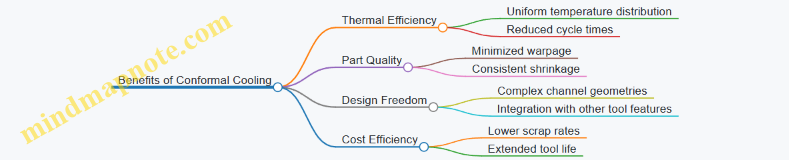
Designing Complex Geometries for Industrial Tooling
Metal AM allows for the creation of tooling components with intricate internal features, such as lattice structures for weight reduction, integrated sensors, or multi-functional channels.
Best Practice: Use topology optimization and lattice structures to reduce weight without compromising strength.
Example: A die casting mold insert designed with internal lattice structures to reduce mass and improve thermal conductivity, resulting in faster cooling and reduced energy consumption.
Mind Map: Designing Complex Geometries in Tooling
Real-World Example 1: Injection Mold with Conformal Cooling Channels
Context: A manufacturer of automotive plastic components faced long cycle times and inconsistent part quality due to traditional drilled cooling channels.
Solution: Using metal AM, the mold insert was redesigned with conformal cooling channels that followed the complex geometry of the cavity.
Outcome: Cycle time was reduced by 25%, part warpage decreased significantly, and tool life improved due to more uniform thermal stresses.
Real-World Example 2: Die Casting Tool with Complex Internal Features
Context: A die casting company needed tooling capable of rapid heat dissipation and reduced weight for easier handling.
Solution: Metal AM was used to produce tooling inserts featuring integrated conformal cooling channels and internal lattice structures.
Outcome: Cooling efficiency improved by 30%, tool weight was reduced by 15%, and maintenance intervals were extended.
Best Practices for Implementing Conformal Cooling and Complex Geometries
- Early Collaboration: Engage design engineers, AM specialists, and toolmakers early to optimize designs for AM capabilities.
- Simulation-Driven Design: Use thermal and flow simulations to validate cooling channel designs before production.
- Material Selection: Choose metal powders with proven thermal conductivity and mechanical properties suitable for tooling applications.
- Quality Control: Implement in-situ monitoring and post-build inspections to ensure channel integrity and dimensional accuracy.
- Post-Processing: Plan for support removal and surface finishing techniques that preserve delicate internal features.
Mind Map: Best Practices for Metal AM Tooling
Summary
Metal additive manufacturing empowers industrial tooling with conformal cooling and complex geometries that enhance performance, reduce cycle times, and improve part quality. By leveraging design optimization, simulation, and best practices in production, manufacturers can unlock significant competitive advantages in tooling applications.
For manufacturing engineers, AM operators, and product designers, embracing these innovations in industrial tooling is key to driving efficiency and quality in high-volume production environments.
9.5 Best Practice: Cross-Industry Lessons Learned (Example: Reducing Lead Time in Aerospace and Medical Applications)
Reducing lead time is a critical goal in both aerospace and medical additive manufacturing (AM) production environments. These industries demand high precision, certification compliance, and often customized parts, making efficient workflows essential. By analyzing successful strategies from both sectors, manufacturing engineers, AM operators, and product designers can adopt best practices that streamline production without compromising quality.
Key Challenges in Aerospace and Medical AM Lead Time Reduction
- Complex Certification Requirements: Both industries require rigorous testing and documentation.
- Customization and Low Volume Production: Patient-specific implants or aerospace parts often have unique designs.
- Material Handling and Qualification: Strict control over powder quality and traceability.
- Post-Processing Intensity: Extensive heat treatments, support removal, and inspection.
Cross-Industry Mind Map: Lead Time Reduction Strategies
Best Practice 1: Standardizing Process Parameters Across Part Families
Example: An aerospace manufacturer producing multiple variants of turbine blades standardized laser power, scan speed, and hatch spacing for similar titanium alloys. This reduced the need for repeated parameter tuning, cutting setup time by 30%.
Implementation Tips:
- Develop a parameter library for common materials and geometries.
- Use Design of Experiments (DoE) to find robust parameter sets.
- Train operators on standardized procedures to minimize variability.
Best Practice 2: Design for AM to Minimize Supports and Post-Processing
Example: A medical device company redesigned patient-specific implants using lattice structures and optimized orientation, reducing support structures by 40%. This led to faster build times and simplified support removal.
Implementation Tips:
- Employ topology optimization tools to reduce unnecessary mass.
- Orient parts to minimize overhangs requiring supports.
- Use modular designs to separate complex features.
Best Practice 3: Implementing Automated Post-Processing Stations
Example: An aerospace supplier integrated robotic support removal and surface finishing stations. Automation reduced manual labor and cycle time by 25%, enabling faster throughput.
Implementation Tips:
- Invest in robotic deburring and chemical support removal systems.
- Integrate post-processing with build scheduling software.
- Monitor post-processing quality with inline inspection tools.
Best Practice 4: Leveraging Digital Twins and In-situ Monitoring
Example: A medical implant manufacturer used digital twins to simulate builds and predict defects. Coupled with melt pool monitoring, this approach reduced build failures and reworks, shortening lead times.
Implementation Tips:
- Develop digital models replicating machine and material behavior.
- Use real-time sensors to detect anomalies during builds.
- Integrate data analytics for predictive maintenance and quality control.
Best Practice 5: Cross-Department Collaboration and Agile Workflow
Example: An aerospace firm established a cross-functional AM task force including design, production, quality, and supply chain teams. This improved communication and accelerated decision-making, reducing lead time by 15%.
Implementation Tips:
- Hold regular interdisciplinary meetings focused on lead time bottlenecks.
- Use collaborative software platforms for real-time updates.
- Encourage feedback loops between design and production to refine processes.
Summary Table: Lead Time Reduction Examples
| Best Practice | Industry | Impact on Lead Time | Example Detail |
|---|---|---|---|
| Parameter Standardization | Aerospace | -30% | Titanium turbine blades standardized parameters |
| Design for AM Minimizing Supports | Medical | -40% supports | Patient-specific implants with lattice structures |
| Automated Post-Processing | Aerospace | -25% cycle time | Robotic support removal and surface finishing |
| Digital Twins & In-situ Monitoring | Medical | Reduced reworks | Melt pool monitoring and predictive build control |
| Cross-Department Collaboration | Aerospace | -15% overall | Agile task force for faster decision-making |
By adopting these cross-industry lessons, manufacturing teams can significantly reduce lead times while maintaining the stringent quality standards required in aerospace and medical metal AM production. The integration of design optimization, automation, digital tools, and collaborative workflows forms the backbone of a modern, efficient AM production environment.
10. Future Trends and Innovations in Metal AM Production
10.1 Emerging Materials and Hybrid Manufacturing
Introduction
The landscape of metal additive manufacturing (AM) is rapidly evolving with the introduction of emerging materials and hybrid manufacturing techniques. These advancements are opening new frontiers for production capabilities, enabling engineers and designers to push the boundaries of performance, cost-efficiency, and customization.
Emerging Materials in Metal AM
Metal AM traditionally relies on well-established alloys such as titanium alloys, stainless steels, and nickel-based superalloys. However, recent developments have introduced novel materials that enhance functionality and broaden application scopes.
Categories of Emerging Materials:
Best Practice Example:
Using High-Entropy Alloys for Wear-Resistant Aerospace Components
Aerospace manufacturers have begun experimenting with CoCrFeMnNi HEAs produced via laser powder bed fusion (LPBF). The material’s exceptional wear resistance and toughness reduce maintenance frequency and extend component life. By optimizing process parameters to accommodate the unique melting behavior of HEAs, production engineers achieved consistent microstructures and mechanical properties.
Hybrid Manufacturing: Combining Additive and Subtractive Processes
Hybrid manufacturing integrates additive manufacturing with traditional subtractive methods (e.g., CNC machining) within a single workflow or machine. This approach leverages the design freedom of AM and the precision of machining to produce high-quality, complex metal parts efficiently.
Key Benefits:
Hybrid Manufacturing Workflow Mind Map:
Best Practice Example:
Producing Aerospace Turbine Blades with Hybrid Manufacturing
A manufacturer used directed energy deposition (DED) to add material for repairing worn turbine blades, followed by in-situ 5-axis CNC machining to restore precise aerodynamic surfaces. This hybrid approach reduced turnaround time from weeks to days and improved blade lifespan.
Emerging Hybrid Techniques
- Additive + Heat Treatment + Machining: Sequential processes to optimize microstructure and dimensional accuracy.
- Multi-Material Printing: Combining different metals or metal-ceramic composites in a single build.
- In-situ Monitoring and Adaptive Control: Using sensors to adjust additive and subtractive steps dynamically.
Mind Map: Emerging Materials and Hybrid Manufacturing Overview
Conclusion
The integration of emerging materials and hybrid manufacturing techniques is transforming metal AM from a prototyping tool into a robust production technology. Manufacturing engineers, AM operators, and product designers should stay abreast of material innovations and hybrid workflows to fully leverage the potential of metal AM in production environments.
By adopting best practices such as thorough material qualification, process optimization, and seamless workflow integration, organizations can unlock new performance levels and cost efficiencies.
Additional Resources
- Research papers on High-Entropy Alloys in AM
- Case studies on hybrid manufacturing systems
- Software tools for hybrid process simulation
10.2 Advances in In-situ Process Monitoring and AI Integration
In-situ process monitoring and artificial intelligence (AI) integration are revolutionizing metal additive manufacturing (AM) by enabling real-time quality control, defect detection, and process optimization. These technologies help manufacturing engineers, AM operators, and product designers ensure consistent production quality while reducing scrap rates and post-processing efforts.
What is In-situ Process Monitoring?
In-situ process monitoring refers to the real-time observation and measurement of critical parameters during the metal AM build process. This includes monitoring melt pool dynamics, layer deposition, temperature, and powder behavior.
Key Benefits:
- Early detection of defects such as porosity, cracks, or lack of fusion
- Process parameter optimization on the fly
- Data collection for traceability and quality assurance
AI Integration in Metal AM
Artificial intelligence, particularly machine learning (ML), analyzes the vast amounts of data generated by in-situ sensors to predict defects, optimize parameters, and automate decision-making.
Applications of AI:
- Predictive maintenance of AM machines
- Automated defect classification and rejection
- Adaptive process control to adjust laser power or scan speed dynamically
Mind Map: Components of In-situ Monitoring and AI Integration
Example 1: Melt Pool Monitoring with AI Defect Detection
A leading aerospace manufacturer implemented an optical melt pool monitoring system combined with a convolutional neural network (CNN) to analyze melt pool images in real-time. The AI model was trained to detect anomalies such as keyhole formation or balling defects.
Outcome:
- Defect detection accuracy improved by 30%
- Reduced scrap rate by 15%
- Enabled immediate process parameter adjustments during builds
Mind Map: AI-Driven Melt Pool Monitoring Workflow
Example 2: Acoustic Emission Sensors for Layer Defect Detection
An automotive supplier integrated acoustic emission sensors to capture sound waves generated during powder melting. Machine learning algorithms analyzed the acoustic signatures to identify defects such as incomplete fusion or powder contamination.
Outcome:
- Enabled detection of subtle defects invisible to optical sensors
- Reduced post-build inspection time by 40%
- Improved confidence in part integrity for safety-critical components
Mind Map: Acoustic Emission Monitoring and AI Analysis
Best Practice: Integrating Multi-Sensor Data with AI for Robust Monitoring
Combining multiple sensor modalities (optical, thermal, acoustic) with AI models enhances defect detection reliability and process understanding.
Example: A medical device manufacturer implemented a multi-sensor monitoring system where infrared cameras tracked temperature gradients, optical sensors monitored melt pool geometry, and acoustic sensors detected anomalies. A fusion AI model integrated these data streams to provide a comprehensive quality assessment.
Benefits:
- Higher defect detection sensitivity
- Reduced false positives
- Improved adaptive control capabilities
Challenges and Considerations
- Data Volume: High-frequency sensors generate large datasets requiring robust data management and processing infrastructure.
- Model Training: Requires extensive labeled datasets representing various defect types and normal conditions.
- Integration Complexity: Seamless integration with AM machines and control systems is essential for real-time feedback.
Future Outlook
- Increased use of reinforcement learning for autonomous parameter optimization.
- Development of standardized datasets and benchmarks for AI in metal AM.
- Enhanced digital twin models combining sensor data and AI predictions for predictive maintenance and quality assurance.
Summary
In-situ process monitoring combined with AI integration is transforming metal AM production by enabling smarter, faster, and more reliable manufacturing. By leveraging multi-sensor data and advanced machine learning algorithms, manufacturers can detect defects early, optimize processes dynamically, and ensure consistent part quality, ultimately driving higher production efficiency and reduced costs.
10.3 Best Practice: Leveraging Machine Learning for Predictive Maintenance (Example: Reducing Downtime in Metal AM Machines)
Predictive maintenance powered by machine learning (ML) is revolutionizing how metal additive manufacturing (AM) facilities manage their equipment. By anticipating failures before they occur, manufacturers can minimize unplanned downtime, optimize maintenance schedules, and extend machine lifespans — all critical factors for high-volume production.
What is Predictive Maintenance in Metal AM?
Predictive maintenance uses data-driven algorithms to analyze machine sensor data, operational logs, and environmental conditions to predict when a machine or component is likely to fail. Unlike traditional reactive or scheduled maintenance, predictive maintenance enables proactive interventions, reducing costly downtime.
Why is Predictive Maintenance Important for Metal AM?
- High Equipment Costs: Metal AM machines, such as DMLS or EBM systems, represent significant capital investments.
- Complex Processes: The precision and complexity of metal AM require machines to operate within tight tolerances.
- Production Continuity: Unplanned downtime disrupts production schedules and delays delivery.
Key Components of ML-Driven Predictive Maintenance
Mind Map: Components of ML-Driven Predictive Maintenance
Example: Reducing Downtime in a DMLS Machine Using ML
Scenario: A production facility operating multiple Direct Metal Laser Sintering (DMLS) machines experiences intermittent failures related to laser misalignment and recoater blade wear, causing unexpected downtime.
Implementation Steps:
-
Data Collection: Sensors installed on the laser module and recoater blade collect vibration, temperature, and position data. Machine logs record error codes and build interruptions.
-
Feature Engineering: Extract features such as vibration frequency patterns, temperature spikes, and error frequency.
-
Model Development: Train a supervised ML model (e.g., Random Forest classifier) on historical data labeled with failure events.
-
Real-Time Monitoring: Deploy the model to analyze live data streams and predict the likelihood of component failure.
-
Maintenance Scheduling: When the model predicts a high failure probability, maintenance is scheduled proactively, avoiding unplanned downtime.
-
Outcome: Over six months, the facility reduced unexpected machine stoppages by 40%, improved production throughput, and lowered maintenance costs.
Mind Map: Workflow of ML-Based Predictive Maintenance in Metal AM
Best Practices for Implementing ML Predictive Maintenance in Metal AM
- Start Small: Pilot predictive maintenance on critical machines or components before scaling.
- Ensure Data Quality: Reliable sensor data and accurate labeling of failure events are essential.
- Cross-Functional Collaboration: Engage machine operators, maintenance teams, and data scientists.
- Iterative Model Improvement: Continuously refine models with new data and feedback.
- Integrate with Existing Systems: Connect predictive maintenance outputs with enterprise maintenance management software.
Additional Examples
-
Example 1: An aerospace AM facility uses ML to monitor powder bed temperature fluctuations, predicting potential recoater jams before they occur.
-
Example 2: A medical device manufacturer applies anomaly detection algorithms on laser power stability data to schedule preventive calibration, reducing scrap rates.
Summary
Leveraging machine learning for predictive maintenance in metal additive manufacturing transforms maintenance from a reactive chore into a strategic advantage. By harnessing real-time data and intelligent algorithms, manufacturers can reduce downtime, improve machine reliability, and ultimately increase production efficiency.
For manufacturing engineers, AM operators, and product designers, embracing ML-driven predictive maintenance is a critical step toward achieving scalable, reliable metal AM production.
10.4 Sustainability and Recycling in Metal AM Production
Sustainability is becoming a critical focus in advanced manufacturing, especially in metal additive manufacturing (AM), where material costs and environmental impact are significant considerations. Implementing sustainable practices not only reduces waste and energy consumption but also enhances cost efficiency and aligns with corporate social responsibility goals.
Key Sustainability Challenges in Metal AM
- Powder Waste: Unused or degraded metal powders can accumulate, leading to material loss.
- Energy Consumption: Metal AM processes, such as laser melting, are energy-intensive.
- Post-Processing Waste: Support removal and surface finishing generate scrap and chemical waste.
- Material Sourcing: Mining and refining metals have environmental footprints.
Mind Map: Sustainability Challenges and Solutions in Metal AM
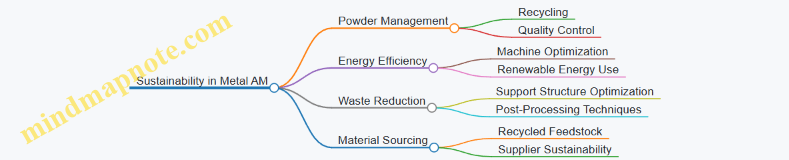
Powder Recycling: Best Practices and Examples
Powder recycling is one of the most impactful sustainability strategies in metal AM. Properly managing powder reuse can significantly reduce raw material consumption and waste.
-
Best Practice: Implement a closed-loop powder recycling system where used powder is sieved, blended with virgin powder, and requalified before reuse.
-
Example:
- Titanium Alloy Production in Aerospace: A leading aerospace manufacturer uses a powder recycling protocol that blends 30% virgin powder with 70% recycled powder. This approach maintains mechanical properties while reducing powder waste by 40% annually.
-
Quality Control: Regular testing of particle size distribution, morphology, and chemical composition ensures recycled powder meets production standards.
Mind Map: Powder Recycling Workflow
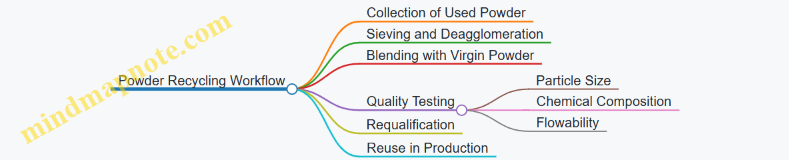
Energy Efficiency Strategies
Reducing energy consumption in metal AM can be achieved through machine optimization and adopting renewable energy sources.
-
Best Practice: Optimize laser parameters and build strategies to minimize energy per part without compromising quality.
-
Example:
- Automotive Performance Parts Manufacturer reduced energy consumption by 15% by optimizing scan strategies and using energy-efficient lasers.
-
Renewable Energy: Some facilities integrate solar or wind power to offset energy usage, reducing carbon footprint.
Waste Reduction in Post-Processing
Support structures and finishing processes can generate significant waste.
-
Best Practice: Design parts with minimal support requirements and use chemical support removal methods that allow recovery of support material.
-
Example:
- Medical Implant Production employs soluble support materials that dissolve in biocompatible solvents, allowing recovery and reuse of support powder.
Mind Map: Waste Reduction Techniques

Sustainable Material Sourcing
Using recycled feedstock and partnering with suppliers committed to sustainability can further reduce environmental impact.
-
Best Practice: Source powders from suppliers who provide recycled or responsibly mined materials and maintain transparent supply chains.
-
Example:
- Industrial Tooling Manufacturer switched to a powder supplier that uses recycled stainless steel feedstock, reducing embodied carbon by 25%.
Summary
Sustainability in metal AM production is achievable through a combination of powder recycling, energy efficiency, waste reduction, and responsible material sourcing. Integrating these best practices not only supports environmental goals but also enhances production efficiency and cost-effectiveness.
Additional Resources
- ASTM F42 Committee on Additive Manufacturing Technologies
- ISO/ASTM 52901:2022 — Additive manufacturing — General principles — Requirements for purchased AM parts
- Case studies from leading aerospace and medical AM producers on sustainability initiatives
By embedding sustainability into metal AM workflows, manufacturers can lead the way toward greener, more responsible production.
10.5 Best Practice: Implementing Closed-Loop Powder Recycling Systems (Example: Reducing Waste in Titanium AM Production)
Metal additive manufacturing (AM), especially with titanium powders, often faces challenges related to powder waste, cost, and material consistency. Implementing a closed-loop powder recycling system is a best practice that helps manufacturers reduce waste, improve sustainability, and maintain consistent material properties throughout production.
What is a Closed-Loop Powder Recycling System?
A closed-loop powder recycling system is an integrated process where used or leftover metal powder from AM builds is collected, processed, and reused in subsequent builds with minimal degradation in quality. This system aims to minimize powder discard and reduce raw material costs.
Benefits of Closed-Loop Powder Recycling in Titanium AM
- Cost Reduction: Titanium powders are expensive; reusing powder reduces material costs significantly.
- Waste Minimization: Limits environmental impact by reducing powder disposal.
- Consistent Quality: Controlled recycling maintains powder morphology and chemical composition.
- Sustainability: Supports green manufacturing initiatives.
Key Components of a Closed-Loop Powder Recycling System
Step-by-Step Implementation Example: Titanium AM Production
-
Collection: After each build, leftover titanium powder is carefully collected from the build chamber and sieved to remove large agglomerates or contaminants.
-
Inspection: The collected powder undergoes particle size distribution (PSD) analysis and scanning electron microscopy (SEM) to check morphology. Chemical composition is verified using spectroscopy to detect oxidation or contamination.
-
Conditioning: Powder is dried under inert atmosphere to remove moisture. It is then blended with a controlled percentage of virgin powder (e.g., 20%) to restore properties.
-
Storage: Conditioned powder is stored in sealed containers with inert gas to prevent oxidation, following FIFO principles to ensure older powder is used first.
-
Reuse: The recycled powder batch is loaded into the AM machine for the next build. In-situ monitoring ensures build quality remains consistent.
Example: Reducing Waste in Titanium Aerospace Component Production
A leading aerospace manufacturer implemented a closed-loop recycling system for Ti-6Al-4V powder in their selective laser melting (SLM) process. By:
- Collecting and sieving powder after each build,
- Conducting rigorous quality checks,
- Blending 25% virgin powder with recycled powder,
- Storing powder under argon atmosphere,
They achieved:
- 40% reduction in powder consumption,
- Consistent mechanical properties across builds,
- Significant cost savings,
- Reduction in powder waste sent to landfill.
Mind Map: Challenges and Solutions in Powder Recycling
Best Practices Summary
- Regular Testing: Implement routine PSD, morphology, and chemistry tests to ensure powder quality.
- Controlled Environment: Handle and store powder in inert atmospheres to prevent oxidation.
- Blend Strategically: Use a defined ratio of virgin to recycled powder to maintain consistent properties.
- Documentation: Maintain detailed records of powder batches, recycling cycles, and quality results.
- Automation: Employ automated sieving and powder handling to reduce contamination risks.
By adopting a closed-loop powder recycling system, manufacturers in titanium metal AM production can achieve a sustainable, cost-effective, and high-quality production process that aligns with both economic and environmental goals.
10.6 Preparing for Industry 4.0 in Metal AM
Industry 4.0 represents the next industrial revolution, characterized by the integration of cyber-physical systems, IoT (Internet of Things), cloud computing, and AI-driven analytics into manufacturing processes. For Metal Additive Manufacturing (Metal AM), embracing Industry 4.0 principles is essential to optimize production efficiency, improve quality, and enable smart factory environments.
Key Components of Industry 4.0 in Metal AM
Industry 4.0 in Metal AM Mind Map
Implementing Industry 4.0 in Metal AM: Step-by-Step
-
Integrate Smart Sensors and IoT Devices
- Equip metal AM machines with sensors to monitor temperature, humidity, laser power, powder flow, and build environment.
- Example: A production facility installs IoT-enabled sensors on DMLS machines to continuously track melt pool temperature and oxygen levels, enabling immediate alerts if parameters deviate.
-
Develop a Digital Twin of the AM Process
- Create a virtual model of the build process that mirrors real-time machine data.
- Example: A manufacturer uses a digital twin to simulate the build of a complex aerospace bracket, predicting potential defects before actual printing.
-
Leverage Cloud Computing for Data Analytics
- Centralize data from multiple machines to perform big data analytics and generate actionable insights.
- Example: Cloud-based analytics identify correlations between powder reuse cycles and part porosity, informing powder management strategies.
-
Apply AI and Machine Learning for Predictive Maintenance and Quality Control
- Use machine learning algorithms to predict machine failures or quality issues before they occur.
- Example: AI models analyze sensor data to forecast when a laser source will require maintenance, reducing unexpected downtime.
-
Automate Material Handling and Post-Processing
- Integrate robotics for powder handling, part removal, and finishing operations.
- Example: An AM production line employs robotic arms to unload builds and transfer parts to heat treatment ovens, minimizing manual labor and contamination risks.
-
Ensure Cybersecurity and Data Integrity
- Protect sensitive design files, machine data, and production records with secure communication protocols and access controls.
- Example: A medical device manufacturer implements blockchain-based traceability to secure patient-specific implant data.
Mind Map: Digital Twin in Metal AM
Digital Twin Mind Map
Example: Smart Factory Implementation in Metal AM
A leading aerospace manufacturer transformed their metal AM production line by implementing Industry 4.0 technologies:
- Sensors & IoT: Installed over 100 sensors across 10 DMLS machines to monitor environmental and process parameters.
- Digital Twin: Developed a digital twin platform that simulated builds and predicted defects, reducing scrap rates by 15%.
- AI Analytics: Deployed machine learning models to optimize laser parameters dynamically based on real-time data.
- Automation: Integrated robotic arms for automated powder recycling and part handling, increasing throughput by 20%.
- Cybersecurity: Adopted blockchain for end-to-end traceability of parts, ensuring compliance with aerospace standards.
This holistic approach enabled the factory to achieve higher production reliability, improved part quality, and reduced operational costs.
Preparing Your Team and Infrastructure
- Workforce Training: Upskill engineers and operators on Industry 4.0 tools, data analytics, and cybersecurity.
- IT Infrastructure: Invest in robust network architecture, cloud services, and data storage solutions.
- Collaboration: Foster cross-functional teams combining manufacturing, IT, and data science expertise.
Summary
Preparing for Industry 4.0 in Metal AM is a strategic journey involving technology integration, process digitization, and workforce development. By adopting smart sensors, digital twins, AI-driven analytics, and automation, manufacturers can unlock the full potential of metal additive manufacturing for scalable, efficient, and high-quality production.