Private Market Investing and Secondary Liquidity Strategies in Global Capital Markets
1. Introduction to Private Market Investing
1.1 Overview of Private Markets: Definition and Scope
Private markets refer to investment opportunities that are not listed on public exchanges. These markets encompass a wide range of asset classes where transactions occur directly between investors and companies or assets, often involving longer investment horizons and less liquidity compared to public markets.
Definition of Private Markets
- Private Equity: Investments in private companies or buyouts of public companies resulting in delisting.
- Venture Capital: Early-stage investments in startups with high growth potential.
- Private Debt: Loans or credit extended to private companies.
- Real Assets: Investments in physical assets like real estate, infrastructure, and natural resources.
- Other Alternatives: Includes hedge funds, private credit, and special situations.
Scope of Private Markets
- Geographic Reach: Global, including developed and emerging markets.
- Investor Types: Institutional investors (pension funds, endowments), family offices, high-net-worth individuals.
- Investment Structures: Direct investments, funds, co-investments, secondary transactions.
Mind Map: Components of Private Markets
Mind Map: Key Characteristics of Private Markets
Example 1: Venture Capital Investment in a Startup
A venture capital firm invests $10 million in a Series B funding round of a tech startup focused on AI-driven healthcare solutions. The investment is private, with no public trading of shares. The VC firm takes an active role in guiding the company’s growth and expects a liquidity event via IPO or acquisition in 5-7 years.
Example 2: Private Equity Buyout
A private equity firm acquires a family-owned manufacturing company valued at $500 million. The firm restructures operations to improve efficiency and plans to exit via sale to a strategic buyer or IPO within 4-6 years.
Example 3: Private Debt Lending
A private credit fund provides a $50 million senior secured loan to a mid-sized company expanding its operations. The loan is not publicly traded and offers a fixed interest return over a 5-year term.
Best Practice: Understanding the Scope to Build Investment Strategies
For Private Equity Associates and Venture Capital Analysts, it is crucial to understand the breadth of private markets to tailor investment theses effectively. For instance, recognizing that venture capital focuses on early-stage innovation while private equity often targets mature companies helps in sourcing deals and managing portfolios.
By grasping the definition and scope of private markets, investors can better navigate the complexities and identify opportunities aligned with their risk-return profiles and liquidity needs.
1.2 Key Players in Private Market Ecosystem
Understanding the private market ecosystem is crucial for Private Equity Associates and Venture Capital Analysts as it helps navigate the complex network of participants who influence deal flow, capital allocation, and investment outcomes. This section breaks down the key players, their roles, and how they interact, supported by mind maps and practical examples.
Overview of Key Players
Private markets consist of a diverse set of participants, each playing a distinct role in the investment lifecycle. The main categories include:
- Limited Partners (LPs)
- General Partners (GPs)
- Portfolio Companies
- Secondary Market Participants
- Advisors and Intermediaries
- Regulators and Service Providers
Mind Map: Key Players in Private Market Ecosystem
Detailed Roles and Examples
Limited Partners (LPs)
LPs are the capital providers in private markets. They commit capital to funds managed by GPs but do not take part in day-to-day management.
- Example: CalPERS, one of the largest public pension funds globally, allocates billions annually to private equity funds, seeking long-term growth.
- Best Practice: LPs conduct rigorous due diligence on GPs, focusing on track record, strategy, and alignment of interests. For instance, a family office might prioritize venture capital funds with a strong ESG focus.
General Partners (GPs)
GPs manage private equity funds and are responsible for sourcing deals, managing portfolio companies, and ultimately generating returns.
- Example: Sequoia Capital, a renowned venture capital firm, is known for early investments in companies like Apple and Google.
- Best Practice: GPs build deep sector expertise and maintain strong operational capabilities to add value post-investment. For example, a buyout firm specializing in healthcare might have a dedicated team of industry experts.
Portfolio Companies
These are the businesses that receive capital from private equity or venture capital funds.
- Example: Airbnb was a portfolio company of multiple venture capital firms before going public.
- Best Practice: GPs work closely with portfolio companies to implement growth strategies, improve governance, and prepare for exit events.
Secondary Market Participants
Secondary markets provide liquidity options for LPs and GPs, enabling the buying and selling of existing private market interests.
- Example: Lexington Partners is a leading secondary buyer, acquiring LP stakes from institutional investors seeking liquidity.
- Best Practice: Secondary buyers perform detailed due diligence to assess NAV discounts and portfolio quality before acquisition.
Advisors and Intermediaries
These players facilitate transactions, fundraising, and advisory services.
- Example: Placement agents help GPs raise capital by connecting them with potential LPs.
- Best Practice: Using reputable intermediaries can enhance deal sourcing and improve fundraising efficiency.
Regulators and Service Providers
They ensure compliance, transparency, and operational integrity.
- Example: Fund administrators handle NAV calculations and investor reporting.
- Best Practice: Engaging experienced legal counsel early helps navigate complex regulatory environments, especially in cross-border deals.
Mind Map: Interaction Among Key Players
Integrated Example: How These Players Collaborate
Consider a venture capital fund raising capital:
- LPs like university endowments commit capital after evaluating the GP’s track record.
- The GP sources promising startups (portfolio companies) and invests.
- As startups mature, the GP may seek partial liquidity for LPs through a secondary sale facilitated by a placement agent.
- Throughout, fund administrators and legal counsel ensure compliance and accurate reporting.
This ecosystem collaboration ensures efficient capital deployment and risk management.
Summary
Understanding the roles and interplay of these key players enables private market professionals to better assess opportunities, manage relationships, and optimize investment outcomes. Incorporating best practices such as thorough due diligence, leveraging intermediaries, and maintaining regulatory compliance is essential for success in this complex ecosystem.
1.3 Differences Between Public and Private Market Investing
Investing in public and private markets involves fundamentally different approaches, risk profiles, liquidity considerations, and valuation methods. Understanding these differences is crucial for Private Equity Associates and Venture Capital Analysts to effectively navigate investment decisions and portfolio management.
Key Differences Overview
| Aspect | Public Market Investing | Private Market Investing |
|---|---|---|
| Liquidity | High liquidity; shares traded daily on exchanges | Low liquidity; investments are typically locked up for years |
| Transparency | High; extensive regulatory disclosures and reporting | Limited; less frequent reporting and less regulatory oversight |
| Valuation | Market-driven, real-time pricing | Valuation based on periodic appraisals and models |
| Access | Open to all investors | Typically limited to accredited or institutional investors |
| Investment Horizon | Short to medium term | Long term (5-10+ years) |
| Control & Influence | Minority ownership, limited control | Often significant control or influence over portfolio companies |
Mind Map: Public vs Private Market Investing
Detailed Differences with Examples
-
Liquidity
- Public Markets: Shares of companies like Apple or Tesla can be bought or sold instantly on stock exchanges, allowing investors to react quickly to market changes.
- Private Markets: A venture capital fund investing in a startup like a Series B round typically requires a 7-10 year commitment before liquidity events such as IPO or acquisition.
-
Transparency
- Public Markets: Public companies file quarterly (10-Q) and annual (10-K) reports with detailed financials and disclosures.
- Private Markets: Private companies provide limited financial information, often only to investors, and valuations are updated quarterly or semi-annually.
-
Valuation
- Public Markets: Market capitalization is determined by share price multiplied by outstanding shares, reflecting real-time investor sentiment.
- Private Markets: Valuations rely on net asset value (NAV) calculations, discounted cash flow models, or comparable transactions, often leading to valuation uncertainty.
-
Access
- Public Markets: Anyone with a brokerage account can invest in public equities.
- Private Markets: Investments are usually restricted to accredited investors or institutions due to regulatory requirements and higher risk.
-
Investment Horizon
- Public Markets: Investors can hold stocks for days, months, or years, with the ability to liquidate quickly.
- Private Markets: Capital is typically locked for long periods, requiring patience and a focus on long-term value creation.
-
Control & Influence
- Public Markets: Minority shareholders have limited influence on company decisions.
- Private Markets: Investors often negotiate board seats, governance rights, and strategic influence, especially in buyouts or growth equity.
Example Scenario: Comparing Investment Approaches
-
Public Market Investment: An analyst buys 1,000 shares of a publicly traded tech company. The shares can be sold anytime, and the analyst monitors daily price movements and quarterly earnings.
-
Private Market Investment: An associate participates in a $50 million growth equity round for a private SaaS company. The investment is illiquid for 7 years, with quarterly updates on company performance and eventual exit via IPO or sale.
Best Practice: Bridging the Gap
For professionals transitioning between public and private markets, it is essential to:
- Develop patience and a long-term mindset for private investments.
- Understand valuation nuances and the importance of due diligence.
- Build relationships to gain access to private deals.
- Monitor portfolio companies actively to influence value creation.
Understanding these differences empowers Private Equity Associates and Venture Capital Analysts to tailor their investment strategies, manage expectations, and optimize portfolio outcomes in the diverse landscape of global capital markets.
1.4 Importance of Private Markets in Global Capital Allocation
Private markets have become an increasingly vital component of global capital allocation, shaping the way capital flows across industries, geographies, and stages of business development. Their importance can be understood through several key dimensions:
Capital Formation Beyond Public Markets
Private markets provide companies—especially startups, growth-stage firms, and those undergoing restructuring—with access to capital that is not readily available through public markets. This access fuels innovation, expansion, and economic growth.
Example: A biotech startup raising Series B funding from venture capital firms to develop a new drug, which might not yet be eligible for public listing.
Diversification and Risk Mitigation for Investors
Allocating capital to private markets allows institutional and sophisticated investors to diversify their portfolios beyond traditional stocks and bonds, potentially reducing overall portfolio volatility.
Example: A pension fund allocating 15% of its portfolio to private equity and infrastructure assets to achieve uncorrelated returns relative to public equities.
Long-Term Investment Horizon and Value Creation
Private market investments typically have longer holding periods, enabling active management and operational improvements that can create substantial value over time.
Example: A private equity firm acquiring a manufacturing company and implementing efficiency improvements over 5 years before exiting at a higher valuation.
Access to Emerging and Frontier Markets
Private markets often provide capital to regions and sectors underserved by public markets, supporting economic development and capturing growth opportunities.
Example: A venture capital fund investing in fintech startups in Southeast Asia, tapping into rapidly growing digital economies.
Innovation and Entrepreneurship Support
Private capital fuels entrepreneurship by providing risk capital to early-stage companies, driving technological advancement and job creation.
Example: Seed funding rounds enabling tech entrepreneurs to develop AI-driven platforms that disrupt traditional industries.
Mind Map: Importance of Private Markets in Global Capital Allocation
Integrated Best Practice: Evaluating Private Market Allocation
When considering private market investments, firms should assess the strategic fit within their overall portfolio, balancing liquidity constraints with return objectives. For example, a global asset manager might use scenario analysis to understand how a 10-20% allocation to private equity impacts portfolio volatility and expected returns over a 10-year horizon.
Example: A sovereign wealth fund conducting stress tests on private infrastructure investments to evaluate resilience against economic downturns.
Summary
Private markets play a crucial role in global capital allocation by enabling capital formation, enhancing diversification, supporting long-term value creation, providing access to emerging markets, and fostering innovation. Understanding these dimensions helps investors and market participants make informed decisions aligned with their strategic goals.
1.5 Best Practice: Building a Robust Private Market Investment Thesis with Real-World Examples
Building a strong investment thesis is foundational for success in private market investing. It guides decision-making, risk management, and portfolio construction. This section breaks down the process into actionable steps, supported by mind maps and real-world examples to illustrate each concept.
Step 1: Define the Investment Objective and Scope
- Clarify the target return profile (e.g., IRR, multiple on invested capital).
- Determine the investment horizon and liquidity preferences.
- Identify the sectors, geographies, and stages of companies to focus on.
Example: A venture capital fund targeting early-stage fintech startups in Southeast Asia with a 7-10 year horizon and a 3x MOIC.
Step 2: Analyze Market Dynamics and Trends
- Study macroeconomic factors affecting the sector/geography.
- Identify growth drivers and potential disruptors.
- Assess competitive landscape and barriers to entry.
Example: For a private equity buyout in renewable energy, analyzing government incentives, rising energy demand, and emerging technologies like battery storage.
Step 3: Evaluate Target Company Characteristics
- Financial health: revenue growth, margins, cash flow stability.
- Management quality and track record.
- Competitive advantages: patents, brand, network effects.
- ESG factors and sustainability.
Example: A growth equity investment in a SaaS company with 30% YoY revenue growth, a seasoned founding team, and strong customer retention.
Step 4: Identify Risks and Mitigation Strategies
- Market risk: economic downturns, regulatory changes.
- Operational risk: execution failures, talent gaps.
- Liquidity risk: exit timing and options.
- Currency and geopolitical risks (for global investments).
Example: Investing in a Latin American infrastructure project with currency hedging strategies and partnerships with local operators to mitigate geopolitical risk.
Step 5: Define Value Creation and Exit Strategy
- Operational improvements, bolt-on acquisitions, or scaling initiatives.
- Timing and method of exit: IPO, trade sale, secondary market.
- Expected returns and scenario analysis.
Example: A buyout fund acquiring a healthcare services company, planning to expand into new regions and improve margins before exiting via a strategic sale within 5 years.
Integrated Real-World Example: Building a Thesis for a Secondary Market Investment
Context: A secondary fund is considering purchasing LP interests in a mature private equity fund focused on European mid-market industrials.
- Objective: Acquire at a 15-20% discount to NAV, targeting 12-15% IRR over 4 years.
- Market Analysis: European industrials are benefiting from reshoring trends and automation.
- Target Evaluation: The underlying fund has stable cash flows, strong management, and a diversified portfolio.
- Risk Assessment: Potential risks include macroeconomic slowdown and exit timing delays; mitigated by diversified portfolio and conservative pricing.
- Value Creation & Exit: Value is created through timing the exit at fund maturity or via secondary sales; exit expected through trade sales or IPOs of portfolio companies.
This thesis guides the secondary fund’s bid price, due diligence focus, and portfolio monitoring.
Summary
Building a robust private market investment thesis involves a structured approach:
- Clearly define objectives and scope.
- Conduct thorough market and company analysis.
- Assess risks with mitigation plans.
- Plan value creation and exit strategies.
Using mind maps helps visualize and organize these components, while real-world examples ground the theory in practice. This approach equips Private Equity Associates and Venture Capital Analysts to make informed, strategic investment decisions.
2. Understanding Private Equity and Alternative Investments
2.1 Private Equity Fundamentals: Buyouts, Growth Equity, and Venture Capital
Private equity (PE) is a broad asset class that involves investing directly in private companies or conducting buyouts of public companies that result in their delisting. Within private equity, there are several core investment strategies, each with distinct characteristics, risk-return profiles, and operational involvement. The three primary strategies are Buyouts, Growth Equity, and Venture Capital.
Overview Mind Map
Buyouts
Definition: Buyouts involve acquiring a controlling interest in a mature company, often using a combination of equity and significant debt (leveraged buyouts or LBOs). The goal is to improve operational efficiency, drive growth, and eventually exit at a higher valuation.
Characteristics:
- Target companies are typically established with stable cash flows.
- Use of leverage to enhance returns.
- Active management involvement to optimize operations.
- Investment horizon usually 4-7 years.
Example:
- Blackstone’s acquisition of Hilton Worldwide (2007): Blackstone acquired Hilton in a leveraged buyout valued at $26 billion. They improved operations, expanded globally, and took the company public again in 2013, generating substantial returns.
Mind Map:
Growth Equity
Definition: Growth equity investments target established companies that are past the startup phase but need capital to accelerate growth, enter new markets, or finance acquisitions. Unlike buyouts, growth equity investors usually take minority stakes and do not rely heavily on leverage.
Characteristics:
- Invest in companies with proven business models.
- Minority ownership with influence but not control.
- Focus on scaling operations, product expansion, or market entry.
- Lower risk than venture capital but higher growth potential than buyouts.
Example:
- TA Associates investment in Freshworks (2017): TA Associates invested growth capital in Freshworks, a SaaS company, to help expand its product offerings and global footprint before its IPO in 2021.
Mind Map:
Venture Capital (VC)
Definition: Venture capital focuses on early-stage companies with high growth potential, often in technology or innovative sectors. VC investors provide capital in exchange for equity, accepting higher risk for the possibility of outsized returns.
Characteristics:
- Invest in startups or early-stage companies.
- High risk, high reward profile.
- Active involvement in strategic guidance and governance.
- Multiple funding rounds (Seed, Series A, B, etc.).
Example:
- Sequoia Capital’s investment in Airbnb (2009): Sequoia provided early-stage funding that helped Airbnb scale its platform, eventually leading to a successful IPO in 2020.
Mind Map:
Integrated Example: Comparing the Three Strategies
| Aspect | Buyouts | Growth Equity | Venture Capital |
|---|---|---|---|
| Stage | Mature companies | Established, scaling companies | Early-stage startups |
| Ownership | Controlling stake | Minority stake | Minority stake |
| Use of Leverage | High | Low to none | None |
| Risk Profile | Moderate | Moderate to high | High |
| Investor Role | Active operational involvement | Strategic partner | Strategic and governance support |
| Typical Exit | IPO, sale, recapitalization | IPO, sale | IPO, acquisition |
Best Practice: Selecting the Right Strategy Based on Investment Objectives
Example Scenario:
- A PE associate evaluating a $100 million fund allocation must decide between a buyout fund, a growth equity fund, and a venture capital fund.
- If the goal is stable cash flow with moderate risk, the buyout fund is preferred.
- For higher growth exposure with moderate risk, growth equity fits best.
- For aggressive growth and innovation exposure with high risk, venture capital is ideal.
Mind Map:
Summary
Understanding the fundamentals of buyouts, growth equity, and venture capital allows private equity associates and venture capital analysts to tailor investment strategies to specific company stages, risk appetites, and return expectations. Integrating best practices such as analyzing company maturity, ownership preferences, and capital structure needs ensures more informed and effective investment decisions.
2.2 Alternative Investments Beyond Private Equity: Real Assets, Hedge Funds, and Infrastructure
Alternative investments extend well beyond traditional private equity, offering investors diversified exposure to asset classes that often have low correlation with public markets. This section explores three major categories: Real Assets, Hedge Funds, and Infrastructure, highlighting their characteristics, benefits, risks, and practical examples.
Real Assets
Real assets are tangible or physical assets that have intrinsic value due to their substance and properties. They typically include real estate, commodities, natural resources, and farmland.
Key Characteristics:
- Inflation Hedge: Real assets often appreciate with inflation, preserving purchasing power.
- Income Generation: Many real assets generate steady cash flows (e.g., rental income).
- Diversification: Low correlation with traditional equities and bonds.
Examples & Best Practice:
- Example: Investing in a diversified real estate fund that owns commercial office buildings, residential apartments, and industrial warehouses across multiple geographies.
- Best Practice: Conduct thorough location and tenant quality due diligence to mitigate vacancy and market risk.
Mind Map: Real Assets
Hedge Funds
Hedge funds are pooled investment vehicles that employ diverse strategies to generate alpha, often using leverage, derivatives, and short selling.
Key Characteristics:
- Strategy Diversity: Includes long/short equity, event-driven, global macro, and quantitative strategies.
- Risk Management: Use of hedging techniques to manage market exposure.
- Liquidity: Varies widely; some funds offer monthly liquidity, others quarterly or longer lock-ups.
Examples & Best Practice:
- Example: A global macro hedge fund that takes positions based on macroeconomic trends, such as currency movements and interest rate changes.
- Best Practice: Evaluate the fund manager’s track record and risk controls, and understand the fee structure (management and performance fees).
Mind Map: Hedge Funds
Infrastructure
Infrastructure investments focus on physical systems and facilities essential for economic activity, such as transportation, utilities, and communication networks.
Key Characteristics:
- Stable Cash Flows: Often backed by long-term contracts or regulated returns.
- Inflation Protection: Revenues often linked to inflation indices.
- Low Correlation: Provides portfolio diversification.
Examples & Best Practice:
- Example: Investing in a toll road concession that collects fees from users over a 30-year period.
- Best Practice: Assess regulatory environment and contract terms carefully to understand revenue stability and risk.
Mind Map: Infrastructure
Integrated Example: Diversifying a Portfolio with Alternative Investments
Consider a private equity associate constructing a diversified alternative investment portfolio:
- 40% Real Assets: A mix of commercial real estate and farmland to hedge inflation and generate income.
- 30% Hedge Funds: Allocation to a long/short equity fund and a global macro fund to capture alpha and manage risk.
- 30% Infrastructure: Investment in regulated utilities and transportation assets for stable, long-term cash flows.
This diversified approach helps balance risk, enhance returns, and improve liquidity profiles.
Summary
Alternative investments beyond private equity provide valuable diversification and unique risk-return profiles. Understanding the nuances of real assets, hedge funds, and infrastructure enables investors to build resilient portfolios aligned with their objectives.
By applying best practices such as rigorous due diligence, understanding liquidity constraints, and evaluating manager expertise, private equity associates and venture capital analysts can effectively incorporate these asset classes into their investment strategies.
2.3 Risk and Return Profiles in Private Market Investments
Private market investments, encompassing private equity, venture capital, real assets, and other alternative assets, present unique risk and return characteristics compared to public markets. Understanding these profiles is critical for Private Equity Associates and Venture Capital Analysts to make informed investment decisions and manage portfolios effectively.
Key Risk Factors in Private Market Investments
- Illiquidity Risk: Private investments are typically long-term and cannot be easily sold or traded.
- Valuation Risk: Lack of transparent market pricing can lead to valuation uncertainty.
- Operational Risk: Risks arising from the management and operations of portfolio companies.
- Market Risk: Economic downturns or sector-specific shocks impacting investment value.
- Regulatory Risk: Changes in laws or regulations affecting investment viability.
- Exit Risk: Difficulty in realizing returns through IPOs, trade sales, or secondary sales.
Return Characteristics
- Higher Expected Returns: Due to illiquidity and complexity, private markets often command a premium.
- J-Curve Effect: Early negative returns due to fees and initial investments, followed by value creation and positive returns.
- Diversification Benefits: Low correlation with public markets can reduce overall portfolio volatility.
Mind Map: Risk Factors in Private Market Investments
Mind Map: Return Drivers in Private Market Investments
Example 1: Venture Capital Risk and Return Profile
A venture capital fund invests in early-stage technology startups. These investments carry high operational risk due to unproven business models and management teams. The illiquidity period typically spans 7-10 years. Returns are highly skewed: a few successful startups generate outsized returns, while many fail.
- Risk: High failure rate, valuation uncertainty, regulatory risks in emerging tech sectors.
- Return: Potential for 3x-10x returns on successful investments, driven by innovation and market disruption.
Best Practice: Conduct rigorous due diligence on founding teams and market potential to mitigate operational and market risks.
Example 2: Private Equity Buyout Fund Risk and Return Profile
A buyout fund acquires mature companies aiming to improve operations and profitability. The investment horizon is typically 5-7 years.
- Risk: Market cyclicality affecting exit opportunities, leverage-related financial risk, operational execution risk.
- Return: Stable cash flows, dividend recaps, and multiple expansion through strategic initiatives.
Best Practice: Use detailed operational KPIs and scenario analysis to monitor portfolio company performance and adjust strategies proactively.
Summary Table: Risk vs Return Characteristics
| Investment Type | Typical Horizon | Key Risks | Expected Return Range | Liquidity Profile |
|---|---|---|---|---|
| Venture Capital | 7-10 years | High operational & valuation | Very high (3x-10x) | Very illiquid |
| Buyout Private Equity | 5-7 years | Leverage & market risk | Moderate to high (1.5x-3x) | Illiquid |
| Real Assets | 7-15 years | Market & regulatory risk | Stable, income + appreciation | Illiquid |
Understanding these risk and return profiles enables investors to tailor portfolios aligned with their risk tolerance, liquidity needs, and return expectations. Integrating qualitative insights with quantitative analysis is essential for successful private market investing.
2.4 Best Practice: Diversification Strategies in Alternative Investments Illustrated Through Case Studies
Diversification is a cornerstone principle in portfolio management, especially within alternative investments where risk profiles and return drivers can be highly varied. This section explores effective diversification strategies tailored for alternative investments, supported by real-world case studies and visualized through mind maps to enhance understanding.
Why Diversification Matters in Alternative Investments
Alternative investments—such as private equity, hedge funds, real assets, and infrastructure—often have unique risk-return characteristics compared to traditional equities and bonds. Diversification helps to:
- Reduce idiosyncratic risk
- Smooth portfolio volatility
- Enhance risk-adjusted returns
- Provide exposure to uncorrelated asset classes
Core Diversification Strategies
Below is a mind map summarizing key diversification strategies in alternative investments:
Case Study 1: Multi-Asset Alternative Portfolio at a Sovereign Wealth Fund
Background: A sovereign wealth fund aimed to build a $5 billion alternative investment portfolio to complement its traditional equity and fixed income holdings.
Diversification Approach:
- Allocated 40% to private equity (split between buyouts and growth equity)
- 25% to real assets (infrastructure and real estate)
- 15% to hedge funds (long/short equity and event-driven strategies)
- 10% to venture capital (early and growth stage)
- 10% to credit strategies (distressed debt and direct lending)
Outcome:
- The portfolio achieved a 12% IRR over 7 years with a volatility 30% lower than a pure private equity portfolio.
- Geographic diversification into emerging markets (20% of total portfolio) provided additional alpha and reduced correlation with developed markets.
Mind Map:
Case Study 2: Venture Capital Fund-of-Funds Diversification
Background: A venture capital analyst at a fund-of-funds sought to mitigate risk by diversifying across stages, sectors, and geographies.
Diversification Tactics:
- Invested across 15 VC funds with varying focus areas: 40% early-stage tech, 30% growth-stage healthcare, 20% fintech, and 10% consumer internet.
- Geographic diversification included 60% US-based funds, 25% European, and 15% Asia-Pacific.
- Vintage year diversification by committing to funds launched over a 5-year span to smooth capital deployment and risk.
Outcome:
- The diversified approach reduced portfolio volatility and captured multiple innovation cycles.
- The fund-of-funds outperformed a concentrated VC portfolio benchmark by 3% IRR over 6 years.
Mind Map:
Practical Tips for Implementing Diversification
- Understand Correlations: Use historical data to identify low or negatively correlated asset classes.
- Balance Illiquidity: Combine highly illiquid assets with semi-liquid alternatives to manage cash flow needs.
- Stagger Commitments: Avoid over-concentration in any vintage year to reduce capital call risk.
- Manager Selection: Diversify across managers with different investment styles and track records.
- Regular Portfolio Review: Rebalance periodically to maintain target diversification levels.
Summary
Diversification in alternative investments is multi-dimensional, spanning asset classes, geographies, sectors, stages, and managers. The case studies demonstrate how thoughtful diversification can reduce risk and enhance returns. By applying these best practices, private equity associates and venture capital analysts can build resilient portfolios that thrive in varied market conditions.
2.5 Regulatory and Compliance Considerations in Private Market Investing
Private market investing operates within a complex regulatory environment that varies significantly across jurisdictions. Understanding these regulations and compliance requirements is critical for private equity associates and venture capital analysts to mitigate legal risks, ensure fund integrity, and maintain investor confidence.
Key Regulatory Frameworks in Private Market Investing
- Securities Laws: Govern the issuance and trading of securities, including private placements.
- Anti-Money Laundering (AML) and Know Your Customer (KYC): Ensure investor identity verification and prevent illicit activities.
- Accredited Investor Rules: Define eligibility criteria for investors participating in private offerings.
- Tax Regulations: Impact fund structuring, distributions, and investor returns.
- Data Privacy Laws: Protect sensitive investor and portfolio company information.
Mind Map: Regulatory Landscape in Private Market Investing
Best Practice: Implementing Robust Compliance Programs
Example: A mid-sized private equity fund established a dedicated compliance team to oversee regulatory adherence. They implemented automated KYC/AML screening tools that reduced onboarding time by 30% while ensuring full compliance with global standards. This proactive approach helped avoid regulatory fines and enhanced investor trust.
Jurisdictional Variations and Cross-Border Challenges
Private market funds often operate across multiple jurisdictions, each with distinct regulatory regimes.
- Example: A US-based venture capital fund raising capital from European investors had to comply with both the US Securities Act and the EU’s Alternative Investment Fund Managers Directive (AIFMD). They engaged local legal counsel to navigate registration requirements and reporting obligations, successfully avoiding penalties.
Mind Map: Cross-Border Compliance Challenges
Fund Structuring and Regulatory Considerations
Choosing the right fund structure (e.g., limited partnership, LLC, trust) affects regulatory compliance and tax efficiency.
- Example: A private equity fund structured as a Delaware limited partnership leveraged favorable US tax treatment and flexible governance rules, attracting US and international investors while maintaining compliance with SEC regulations.
Reporting and Transparency Obligations
Increasing regulatory focus on transparency requires funds to provide detailed disclosures to regulators and investors.
- Example: Under the EU’s AIFMD, funds must submit annual reports detailing portfolio composition, risk profiles, and leverage. A European growth equity fund implemented quarterly internal reporting processes to ensure timely and accurate submissions.
Mind Map: Compliance Best Practices
Practical Tips for Associates and Analysts
- Stay updated on regulatory changes relevant to your fund’s jurisdictions.
- Collaborate closely with legal and compliance teams during deal sourcing and execution.
- Ensure all investor documentation meets regulatory standards.
- Document all compliance-related decisions and processes meticulously.
Summary
Regulatory and compliance considerations are foundational to successful private market investing. By understanding the regulatory landscape, implementing robust compliance programs, and proactively managing cross-border challenges, private equity associates and venture capital analysts can safeguard their funds and enhance investor confidence.
For further reading, consider reviewing the SEC’s guidelines on private placements, the AIFMD regulatory framework, and recent AML regulatory updates in your operating regions.
3. Global Capital Markets Landscape and Its Impact on Private Investing
3.1 Overview of Global Capital Markets and Their Interconnectivity
Global capital markets represent the vast network of financial marketplaces where capital is raised, traded, and allocated across countries and asset classes. These markets encompass equity, debt, derivatives, foreign exchange, and alternative investments, including private markets. Understanding their structure and interconnectivity is crucial for private equity associates and venture capital analysts aiming to navigate cross-border investments and optimize portfolio diversification.
Key Components of Global Capital Markets
- Equity Markets: Public stock exchanges (e.g., NYSE, LSE, HKEX) where shares of companies are bought and sold.
- Debt Markets: Bond markets where governments and corporations issue debt instruments.
- Derivatives Markets: Platforms for trading contracts based on underlying assets (e.g., futures, options).
- Foreign Exchange (FX) Markets: The largest and most liquid market, facilitating currency conversions.
- Private Markets: Includes private equity, venture capital, private debt, and real assets, often less liquid but critical for long-term capital formation.
Mind Map: Components of Global Capital Markets
Interconnectivity Drivers
- Cross-Border Capital Flows: Investors and institutions allocate capital internationally seeking diversification and higher returns.
- Currency Exchange: FX markets enable conversion and hedging of currency risk, critical for global investments.
- Regulatory Harmonization: Agreements such as Basel III and MiFID II influence market operations and investor protections globally.
- Technological Advances: Electronic trading platforms and data analytics facilitate real-time information sharing and execution.
- Global Economic Linkages: Economic events in one region (e.g., US Federal Reserve policy changes) ripple through markets worldwide.
Mind Map: Drivers of Market Interconnectivity
Example: Impact of US Federal Reserve Policy on Global Markets
When the US Federal Reserve adjusts interest rates, it influences global capital flows. For instance, a rate hike may strengthen the US dollar, prompting emerging market investors to withdraw funds due to currency depreciation risks. This can lead to volatility in emerging market equities and bonds, impacting private equity valuations and exit opportunities in those regions.
Best Practice: Mapping Interconnectivity for Investment Decisions
Private equity associates should develop a framework to assess how global market movements affect portfolio companies. For example, when evaluating an investment in a European tech startup, consider:
- Currency risks between EUR and USD
- Impact of European Central Bank policies
- Cross-border investor sentiment
- Supply chain dependencies influenced by global trade dynamics
This holistic view aids in risk mitigation and identifying value creation opportunities.
Mind Map: Assessing Global Market Impact on Private Investments
Summary
The global capital markets form an intricate, interconnected ecosystem where movements in one market can swiftly influence others. For private market investors, understanding these linkages is essential to managing risk, timing investments, and capitalizing on cross-border opportunities. Integrating this knowledge into investment theses and portfolio management enhances decision-making and long-term performance.
3.2 Emerging Markets vs Developed Markets: Opportunities and Challenges
Private market investing in global capital markets requires a nuanced understanding of the distinctions between emerging and developed markets. Each presents unique opportunities and challenges that investors, especially Private Equity Associates and Venture Capital Analysts, must navigate to optimize returns and manage risks effectively.
Opportunities in Emerging Markets
- High Growth Potential: Emerging markets often exhibit faster GDP growth rates compared to developed economies, driven by industrialization, urbanization, and a growing middle class.
- Underserved Sectors: Many sectors such as technology, healthcare, and consumer goods remain underpenetrated, offering fertile ground for venture and growth equity investments.
- Valuation Arbitrage: Assets in emerging markets may trade at lower multiples, providing attractive entry points.
- Demographic Dividend: Younger populations can drive demand and innovation.
Challenges in Emerging Markets
- Political and Regulatory Risk: Instability, sudden policy changes, and weaker legal frameworks can impact investment security.
- Currency Volatility: Exchange rate fluctuations can erode returns.
- Market Infrastructure: Less mature financial markets may lack transparency and liquidity.
- Operational Complexity: Cultural differences, governance standards, and local business practices require careful navigation.
Opportunities in Developed Markets
- Market Stability: Strong legal systems, regulatory frameworks, and political stability reduce investment risk.
- Sophisticated Financial Markets: Greater liquidity and transparency facilitate deal execution and exit strategies.
- Established Ecosystems: Mature industries and infrastructure support scaling businesses.
- Access to Capital: Easier fundraising and co-investment opportunities.
Challenges in Developed Markets
- Lower Growth Rates: Slower GDP growth can limit upside potential.
- Higher Valuations: Competitive markets often lead to premium pricing.
- Market Saturation: Many sectors are mature, requiring innovation or disruption for outsized returns.
Mind Map: Comparing Emerging and Developed Markets
Best Practice: Leveraging Local Partnerships for Market Entry
Example: A U.S.-based private equity firm targeting Southeast Asia partnered with a local investment company to navigate regulatory complexities and cultural nuances. This collaboration enabled the firm to source proprietary deals in the technology sector, mitigating operational risks and accelerating due diligence.
Case Example: Venture Capital in Emerging vs Developed Markets
-
Emerging Market Example: In India, a venture capital firm invested early in a fintech startup addressing financial inclusion. The company leveraged mobile technology to reach underserved populations, resulting in rapid user growth and a successful exit within five years.
-
Developed Market Example: In the U.S., a venture capital fund invested in a SaaS company targeting enterprise clients. Despite slower market growth, the company benefited from a mature customer base and predictable revenue streams, leading to steady returns.
Managing Currency and Political Risks
- Hedging Strategies: Use of currency forwards, options, or swaps to mitigate exchange rate risk.
- Political Risk Insurance: Coverage against expropriation, political violence, or currency inconvertibility.
- Diversification: Spreading investments across multiple countries and sectors to reduce concentration risk.
Mind Map: Risk Management in Emerging Markets
Summary
Investing in emerging markets offers compelling growth opportunities but requires careful risk management and local expertise. Developed markets provide stability and liquidity but often at the cost of lower growth and higher valuations. Successful private market investors balance these factors by tailoring strategies to each market’s characteristics, leveraging partnerships, and employing robust due diligence and risk mitigation techniques.
3.3 Currency Risk and Political Risk Management in Global Private Investments
Investing in global private markets offers significant opportunities but also exposes investors to unique risks, notably currency risk and political risk. Effective management of these risks is crucial to preserving capital and optimizing returns.
Understanding Currency Risk
Currency risk, also known as exchange rate risk, arises when investments are denominated in a foreign currency. Fluctuations in exchange rates can impact the value of returns when converted back to the investor’s base currency.
Key Sources of Currency Risk:
- Transaction Risk: Risk from currency fluctuations between the time a transaction is agreed and settled.
- Translation Risk: Impact on financial statements when consolidating foreign subsidiaries.
- Economic Risk: Long-term effect of currency movements on a company’s market value.
Mind Map: Currency Risk Components
Example:
A US-based private equity fund invests €100 million in a European growth equity fund. If the euro depreciates against the dollar by 10% before exit, the dollar value of the investment decreases even if the euro-denominated asset value remains stable.
Managing Currency Risk
-
Natural Hedging: Matching currency inflows and outflows to offset exposures.
-
Financial Hedging: Using derivatives such as forwards, futures, options, and swaps to lock in exchange rates.
-
Currency Diversification: Spreading investments across multiple currencies to reduce concentration risk.
-
Currency Clauses in Contracts: Negotiating terms that share or mitigate currency fluctuations.
Mind Map: Currency Risk Management Strategies
Example:
A venture capital analyst working with a fund investing in Latin America recommends entering into forward contracts to hedge the Brazilian real exposure, protecting the fund from depreciation during the investment horizon.
Understanding Political Risk
Political risk refers to the potential for losses due to political changes or instability in a country where investments are made. This includes risks like expropriation, changes in tax laws, regulatory shifts, civil unrest, or government instability.
Common Political Risks:
- Expropriation or Nationalization
- Currency Controls
- Political Violence or Civil Unrest
- Regulatory and Tax Changes
- Breach of Contract or Legal Uncertainty
Mind Map: Political Risk Types
Example:
An infrastructure fund invested in a power plant in a country undergoing a sudden government change faces new regulations that increase tariffs and reduce profitability.
Managing Political Risk
-
Country Risk Assessment: Conduct thorough due diligence on political stability, governance, and legal frameworks.
-
Political Risk Insurance: Obtain coverage from agencies like MIGA (Multilateral Investment Guarantee Agency) or private insurers.
-
Local Partnerships: Collaborate with local firms or stakeholders to navigate political landscapes.
-
Contractual Protections: Include stabilization clauses and arbitration agreements in contracts.
-
Diversification: Avoid overconcentration in high-risk jurisdictions.
Mind Map: Political Risk Management Strategies
Example:
A private equity associate working on an investment in Sub-Saharan Africa recommends securing political risk insurance through MIGA to protect against expropriation and currency inconvertibility risks.
Integrated Approach to Currency and Political Risk
Since currency and political risks often intertwine, especially in emerging markets, an integrated risk management approach is essential.
Best Practice Example:
A global private equity fund investing in Southeast Asia combines currency hedging strategies with political risk insurance and partners with reputable local firms. This approach helped the fund mitigate losses during a period of political unrest and currency volatility in the region.
Mind Map: Integrated Risk Management
Summary
- Currency risk can materially affect investment returns and requires proactive hedging and diversification.
- Political risk can disrupt investment operations and value; insurance and local engagement are key mitigants.
- Combining currency and political risk management strategies enhances resilience in global private investments.
Additional Resources
- Case Study: Currency Hedging in a European Buyout Fund
- Whitepaper: Political Risk Insurance in Emerging Markets
- Toolkits for Country Risk Assessment
By understanding and actively managing currency and political risks, private equity associates and venture capital analysts can better safeguard investments and contribute to more stable, long-term value creation in global capital markets.
3.4 Best Practice: Leveraging Local Partnerships for Market Entry – Example from Asia-Pacific Region
Entering new private markets, especially in diverse and complex regions like Asia-Pacific (APAC), requires more than just capital—it demands deep local knowledge, cultural understanding, and trusted relationships. Leveraging local partnerships is a proven best practice to navigate regulatory landscapes, identify quality deals, and create sustainable value.
Why Local Partnerships Matter in APAC
- Regulatory Navigation: APAC countries have varied and evolving regulatory frameworks. Local partners help interpret and comply with these rules.
- Deal Sourcing: Local firms have established networks to access proprietary deal flow.
- Cultural Insight: Understanding business etiquette and negotiation styles is critical.
- Operational Support: Local partners assist in due diligence, portfolio management, and exit strategies.
Mind Map: Benefits of Local Partnerships in APAC Market Entry
Steps to Build Effective Local Partnerships
- Identify Reputable Local Firms: Look for partners with strong track records, aligned investment philosophies, and complementary expertise.
- Conduct Mutual Due Diligence: Assess each other’s capabilities, reputation, and strategic fit.
- Establish Clear Governance: Define roles, responsibilities, and decision-making processes.
- Align Incentives: Structure partnership terms to ensure mutual benefit.
- Foster Open Communication: Regular updates and transparency build trust.
Mind Map: Building Effective Local Partnerships
Example: Global Private Equity Firm Entering Southeast Asia via Local Partnership
Background: A leading US-based private equity firm aimed to expand its footprint into Southeast Asia, targeting growth-stage technology companies.
Approach:
- Partnered with a well-established Singapore-based investment firm with deep regional expertise.
- Leveraged the partner’s network to source deals in Indonesia, Vietnam, and Malaysia.
- Collaborated on due diligence, combining global best practices with local market insights.
- Structured co-investment vehicles to align interests.
Outcome:
- Successfully closed 5 deals within 18 months, exceeding initial investment targets.
- Achieved superior portfolio company operational improvements through combined expertise.
- Navigated regulatory challenges efficiently, avoiding costly delays.
Mind Map: Case Study – Southeast Asia Market Entry
Additional Examples
- Australia: A European venture capital firm partnered with a local fund manager to access early-stage biotech startups, leveraging the partner’s scientific networks.
- Japan: A Middle Eastern sovereign wealth fund collaborated with a Japanese private equity firm to enter the consumer goods sector, benefiting from the partner’s cultural fluency and government relations.
Key Takeaways
- Local partnerships reduce entry barriers and accelerate market penetration.
- Aligning incentives and maintaining transparent communication are critical for partnership success.
- Combining global resources with local expertise creates a competitive advantage.
- Real-world examples from APAC demonstrate tangible benefits in deal flow, risk mitigation, and portfolio value creation.
By embedding local partnerships into your global private market strategy, especially in the nuanced Asia-Pacific region, investors can unlock opportunities that would otherwise remain inaccessible or too risky to pursue alone.
3.5 Impact of Macroeconomic Trends on Private Market Valuations
Private market valuations are deeply influenced by macroeconomic trends, which shape investor sentiment, capital flows, and risk perceptions. Understanding these impacts is crucial for Private Equity Associates and Venture Capital Analysts to make informed investment decisions and valuation assessments.
Key Macroeconomic Factors Affecting Private Market Valuations
- Interest Rates
- Inflation
- Economic Growth (GDP)
- Currency Fluctuations
- Geopolitical Risks
- Monetary and Fiscal Policies
Mind Map: Macroeconomic Factors and Their Impact
Interest Rates
Rising interest rates increase the cost of debt financing, which can reduce leveraged buyout (LBO) returns and compress valuations. Conversely, low interest rates tend to inflate valuations by lowering discount rates.
Example:
During the 2021-2022 period, the US Federal Reserve’s rate hikes led to increased borrowing costs, forcing some private equity firms to reassess deal pricing and leverage assumptions. A buyout firm targeting a 6x EBITDA multiple in 2021 had to adjust downward to 5.5x in 2022 due to higher debt costs.
Inflation
Inflation impacts input costs and pricing power. Companies with strong pricing power can pass increased costs to customers, preserving margins and valuations. Those without may see margin compression.
Example:
A consumer goods portfolio company in Europe faced rising raw material costs in 2023. Because of strong brand loyalty, it increased prices by 8%, maintaining EBITDA margins and supporting stable valuations despite inflation.
Economic Growth (GDP)
Higher GDP growth generally supports revenue growth and market expansion, boosting valuations. Economic slowdowns can reduce exit opportunities and compress multiples.
Example:
In emerging markets like India, 2023 GDP growth of 6.5% supported venture capital valuations in tech startups, as expanding middle-class demand increased revenue projections.
Currency Fluctuations
Currency volatility affects cross-border investments and can impact reported returns. Hedging strategies are often employed to mitigate FX risk.
Example:
A US-based PE fund investing in a European portfolio saw valuation swings due to EUR/USD fluctuations in 2022. By employing currency hedges, the fund stabilized returns and valuation metrics.
Geopolitical Risks
Political instability or regulatory changes can increase uncertainty, leading to valuation discounts or deal delays.
Example:
The 2022 Russia-Ukraine conflict caused many funds to write down valuations of affected portfolio companies or pause investments in Eastern Europe due to heightened risk.
Monetary and Fiscal Policies
Stimulus measures can inject liquidity, driving up asset prices, while tax changes can affect after-tax returns and valuations.
Example:
The US government’s infrastructure spending plan in 2021 boosted valuations for infrastructure-focused private equity funds by improving growth outlooks.
Integrated Best Practice: Incorporating Macroeconomic Analysis into Valuation Models
- Regularly update discount rates to reflect current interest rates.
- Stress test portfolio companies under inflation scenarios.
- Adjust revenue growth assumptions based on GDP forecasts.
- Factor in currency risk and consider hedging costs.
- Monitor geopolitical developments and adjust risk premiums.
- Evaluate policy changes for potential impacts on cash flows.
Example:
A venture capital analyst building a financial model for a Southeast Asian startup incorporated a 3% inflation adjustment, a 5% currency depreciation scenario, and a conservative GDP growth estimate to stress test valuation outcomes, enabling a more resilient investment thesis.
Summary Mind Map: Applying Macroeconomic Insights
By weaving macroeconomic trend analysis into private market valuation processes, investors can better anticipate risks and opportunities, leading to more robust investment decisions and optimized portfolio performance.
4. Secondary Market Liquidity: Concepts and Mechanisms
4.1 Definition and Importance of Secondary Liquidity in Private Markets
Definition of Secondary Liquidity
Secondary liquidity in private markets refers to the ability to buy or sell existing interests in private market investments, such as private equity funds, venture capital funds, or direct private company stakes, after the initial investment has been made. Unlike public markets where securities are traded daily on exchanges, private market investments are typically illiquid and locked up for long periods, often 7-12 years or more.
Secondary liquidity mechanisms enable investors to access capital before the natural end of the fund life or exit event, providing flexibility and risk management options.
Why Secondary Liquidity Matters
- Enhanced Flexibility: Investors can adjust their portfolios in response to changing market conditions, risk tolerance, or liquidity needs.
- Risk Management: Ability to reduce exposure to underperforming assets or sectors.
- Price Discovery: Secondary transactions provide market-based valuations, improving transparency.
- Capital Recycling: Investors can free up capital to deploy into new opportunities without waiting for fund maturity.
- Market Efficiency: Secondary markets help balance supply and demand for private assets, contributing to overall market health.
Mind Map: Secondary Liquidity Overview
Examples Illustrating Secondary Liquidity
-
LP Interest Sale Example: An institutional investor holds a $50 million commitment in a private equity fund but needs liquidity to rebalance its portfolio. Through a secondary market transaction, the investor sells its LP interest to a secondary fund at an 8% discount to NAV. This allows the investor to access capital immediately rather than waiting for the fund’s exit events.
-
Direct Secondary Example: A secondary buyer acquires a portfolio of late-stage venture capital-backed companies directly from an early investor looking to exit before an IPO. This direct secondary transaction provides liquidity to the seller and access to high-growth assets for the buyer.
-
Fund Restructuring Example: A private equity fund nearing the end of its term faces remaining portfolio companies that require longer hold periods. The GP initiates a continuation vehicle, allowing existing LPs to sell their stakes to new investors, thus providing liquidity options while enabling the GP to manage assets longer-term.
Mind Map: Benefits of Secondary Liquidity
Summary
Secondary liquidity is a critical feature that enhances the attractiveness and functionality of private market investing. By enabling the transfer of private market interests, secondary liquidity provides investors with flexibility, risk mitigation, and improved capital efficiency. Understanding its definition and importance lays the foundation for exploring the various mechanisms and strategies that drive this dynamic segment of global capital markets.
4.2 Types of Secondary Transactions: LP Interests, Direct Secondaries, and Fund Restructurings
Secondary transactions in private markets provide liquidity options for investors and enable portfolio rebalancing and risk management. Understanding the types of secondary transactions is critical for private equity associates and venture capital analysts to navigate and structure deals effectively. This section explores the three primary types of secondary transactions: LP Interests, Direct Secondaries, and Fund Restructurings, with detailed explanations, mind maps, and real-world examples.
LP Interests (Limited Partner Interests)
LP interests refer to the sale or transfer of an investor’s stake in a private equity fund or alternative investment fund. This is the most common form of secondary transaction.
Key Characteristics:
- Transfer of ownership of fund interests from one LP to another.
- Typically involves mature funds with partially realized portfolios.
- Pricing often at a discount or premium to the fund’s NAV (Net Asset Value).
Mind Map: LP Interests Secondary Transaction
Example:
A pension fund holding a $50 million commitment in a buyout fund decides to sell its LP interest to a secondary buyer at a 10% discount to NAV due to a need for liquidity. The secondary buyer gains exposure to a diversified portfolio of mature companies with near-term exit potential.
Direct Secondaries (Direct Asset Sales)
Direct secondaries involve the sale of individual portfolio companies or assets directly from one investor to another, bypassing the fund structure.
Key Characteristics:
- Sale of one or more specific portfolio companies.
- Often occurs when an LP or GP wants to exit particular assets.
- Can be structured as asset sales or share purchases.
Mind Map: Direct Secondaries
Example:
A venture capital fund decides to sell its stake in a high-growth SaaS company directly to a secondary investor specializing in technology assets. The transaction allows the fund to realize gains early and the buyer to acquire a promising asset outside the fund structure.
Fund Restructurings
Fund restructurings involve reorganizing the terms, life, or structure of an existing fund to provide liquidity or extend the investment horizon.
Key Characteristics:
- May include continuation funds, fund extensions, or recapitalizations.
- Often initiated by GPs to manage legacy assets.
- Provides liquidity options for LPs who want to exit or roll over.
Mind Map: Fund Restructurings
Example:
A buyout fund with several high-potential but unrealized portfolio companies creates a continuation vehicle to hold these assets beyond the original fund term. Some LPs sell their interests to secondary buyers, while others roll over into the new vehicle, allowing the GP to focus on value creation without pressure to exit prematurely.
Summary Table of Secondary Transaction Types
| Type | Seller | Buyer | Key Features | Example Use Case |
|---|---|---|---|---|
| LP Interests | Existing LPs | Secondary Investors | Transfer of fund interests, NAV-based pricing | Pension fund selling LP stake at discount |
| Direct Secondaries | LP or GP | Secondary or Strategic | Sale of individual portfolio companies | VC fund selling stake in SaaS company directly |
| Fund Restructurings | GP and LPs | Existing and New LPs | Continuation vehicles, fund extensions | Buyout fund creating continuation vehicle |
Best Practice Tips for Analysts and Associates
- Thorough Due Diligence: Understand the underlying assets, fund terms, and transfer restrictions.
- Valuation Discipline: Use multiple valuation methods and consider market conditions.
- Stakeholder Communication: Coordinate with GPs, LPs, and legal teams early.
- Deal Structuring Flexibility: Tailor transaction structures to meet liquidity needs and risk profiles.
By mastering these secondary transaction types and their nuances, private equity associates and venture capital analysts can better advise clients, identify opportunities, and execute transactions that enhance portfolio liquidity and value.
4.3 Pricing and Valuation Techniques in Secondary Markets
Pricing and valuation in secondary private market transactions are critical to ensuring fair deals for both buyers and sellers. Unlike public markets, where prices are transparent and continuously updated, secondary markets for private equity and alternative investments require a nuanced approach to valuation due to illiquidity, lack of standardized pricing, and complex underlying assets.
Key Pricing and Valuation Techniques
-
Net Asset Value (NAV) Based Pricing
- NAV represents the fair value of the underlying assets minus liabilities.
- Secondary transactions often use NAV as a starting point, applying discounts or premiums based on market conditions, asset quality, and liquidity.
-
Discount to NAV (DTNAV)
- Reflects the illiquidity and risk premium in secondary transactions.
- Typical discounts range from 5% to 30%, depending on fund vintage, asset quality, and market demand.
-
Market Multiples Approach
- Uses comparable public company or transaction multiples (e.g., EV/EBITDA, P/E ratios) to value portfolio companies.
- Useful for direct secondaries where underlying assets are identifiable.
-
Cash Flow and Yield Analysis
- Projects expected distributions and residual values.
- Discounted Cash Flow (DCF) models are applied with appropriate risk-adjusted discount rates.
-
Scenario and Sensitivity Analysis
- Evaluates valuation under different market and operational scenarios.
- Helps understand valuation volatility and downside risks.
Mind Map: Pricing and Valuation Techniques in Secondary Markets
Example 1: Applying Discount to NAV in an LP Interest Sale
A Limited Partner (LP) wants to sell their interest in a buyout fund with a reported NAV of $10 million. Due to the fund’s vintage (7 years old) and current market illiquidity, the buyer applies a 15% discount to NAV.
- Calculation:
- Price = NAV x (1 - Discount)
- Price = $10 million x (1 - 0.15) = $8.5 million
This discount reflects the expected time to exit, potential asset underperformance, and market risk.
Example 2: Market Multiples in Direct Secondary Acquisition
A secondary buyer evaluates a venture capital portfolio containing a startup with recent revenue of $50 million. Comparable public companies trade at an EV/Revenue multiple of 5x.
- Valuation:
- Enterprise Value (EV) = Revenue x Multiple = $50 million x 5 = $250 million
- The buyer adjusts for startup risk and illiquidity, applying a 20% discount.
- Adjusted EV = $250 million x (1 - 0.20) = $200 million
This valuation helps price the secondary stake in the portfolio.
Mind Map: Factors Influencing Discounts and Premiums
Best Practice: Combining Multiple Valuation Techniques
To arrive at a robust valuation, secondary market investors often triangulate between NAV-based pricing, market multiples, and cash flow analysis. For example, starting with NAV, they apply discounts informed by scenario analysis and validate assumptions with comparable multiples.
Example:
- NAV: $50 million
- Applied Discount: 10% → $45 million
- Market Multiples suggest valuation range: $43-$48 million
- DCF analysis yields $46 million
Final negotiated price might settle around $45-$46 million, reflecting a balanced view.
Summary
Pricing and valuation in secondary private markets require a blend of quantitative methods and qualitative judgment. Understanding NAV, applying appropriate discounts, leveraging market multiples, and conducting scenario analyses are essential tools. Integrating these approaches with real-world market intelligence ensures fair pricing and successful secondary transactions.
4.4 Best Practice: Structuring Secondary Deals to Maximize Value – Case Study of a Successful LP Stake Sale
Secondary market transactions, particularly LP (Limited Partner) stake sales, require careful structuring to optimize value for both sellers and buyers. This section explores best practices in deal structuring through a detailed case study and accompanying mind maps to visualize critical components.
Key Objectives in Structuring Secondary Deals
- Maximize Sale Price: Achieve a fair or premium price relative to NAV (Net Asset Value).
- Mitigate Risks: Address legal, operational, and valuation risks upfront.
- Ensure Liquidity: Provide timely and efficient transaction closure.
- Maintain Confidentiality: Protect sensitive information during the sale process.
Mind Map: Core Elements of Structuring a Secondary LP Stake Sale
Case Study: Successful LP Stake Sale in a Mature Buyout Fund
Background: A mid-sized institutional investor sought liquidity by selling a $50 million LP interest in a mature buyout fund nearing the end of its investment period. The fund had a strong track record, with several portfolio companies approaching exit.
Step 1: Preparation & Valuation
- Conducted a detailed NAV assessment incorporating recent portfolio company valuations and exit pipeline.
- Engaged an independent valuation advisor to validate NAV and provide a market-based discount range (5-10%).
- Identified seller’s minimum acceptable price and timeline.
Step 2: Deal Marketing & Buyer Targeting
- Created a comprehensive Confidential Information Memorandum (CIM) highlighting fund performance, portfolio composition, and exit outlook.
- Targeted a mix of secondary funds, family offices, and institutional investors known for LP stake acquisitions.
- Executed NDAs to safeguard sensitive information.
Step 3: Pricing & Negotiation
- Initial bids clustered around an 8% discount to NAV.
- Seller leveraged competitive tension to negotiate a final price at a 5% discount.
- Included terms for deferred payment structure to align buyer and seller interests.
Step 4: Transaction Execution
- Facilitated buyer due diligence with access to fund documentation and management meetings.
- Coordinated legal counsel to manage transfer restrictions and GP consents.
- Closed transaction within 90 days, faster than typical secondary deals.
Step 5: Post-Transaction
- Ensured smooth transfer of LP interests and updated reporting channels.
- Maintained confidentiality and minimized market disruption.
Mind Map: Deal Structuring Timeline and Activities
Additional Best Practices Highlighted by the Case Study
-
Early Engagement with GPs: Proactively communicating with the General Partner to understand transfer restrictions and obtain consent early reduces delays.
-
Use of Independent Valuation: Third-party valuation builds buyer confidence and supports pricing negotiations.
-
Competitive Bidding Process: Inviting multiple buyers creates leverage to improve pricing and terms.
-
Flexible Deal Terms: Incorporating deferred payments or earn-outs can bridge valuation gaps and align incentives.
-
Efficient Due Diligence: Preparing a data room and anticipating buyer questions accelerates deal closure.
Example: Simplified Pricing Calculation
| Metric | Value |
|---|---|
| NAV of LP Stake | $50,000,000 |
| Market Discount Applied | 5% |
| Final Sale Price | $47,500,000 |
This example illustrates how a 5% discount to NAV results in a $2.5 million reduction but may be justified by liquidity and risk considerations.
Summary
Structuring secondary LP stake sales to maximize value involves a holistic approach encompassing valuation rigor, strategic marketing, competitive negotiation, and efficient execution. The case study underscores the importance of transparency, timing, and flexibility in deal terms to achieve successful outcomes in private market secondary transactions.
4.5 Legal and Operational Considerations in Secondary Transactions
Secondary transactions in private markets involve the transfer of existing investor interests in private equity funds, venture capital funds, or other alternative investment vehicles. These transactions require careful attention to legal and operational details to ensure compliance, smooth execution, and value preservation.
Key Legal Considerations
-
Transfer Restrictions and Consent Requirements
- Many private fund agreements include transfer restrictions requiring the General Partner (GP) or fund manager’s consent before an interest can be sold.
- Consent processes can be time-consuming and may involve detailed disclosures.
- Example: A Limited Partner (LP) seeking to sell their stake in a buyout fund must submit a transfer request to the GP, who evaluates the buyer’s suitability and may impose conditions or reject the transfer.
-
Right of First Refusal (ROFR)
- GPs or other LPs often have ROFR rights allowing them to match the terms of a proposed secondary sale.
- This can affect deal timing and pricing.
- Example: In a venture capital fund secondary sale, the GP exercises ROFR to maintain control over the investor base, leading the seller to renegotiate terms or seek alternative buyers.
-
Representations and Warranties
- Secondary buyers typically require sellers to provide representations about the ownership, authority to sell, and absence of encumbrances.
- These clauses protect buyers but can complicate negotiations.
-
Regulatory Compliance
- Secondary transactions must comply with securities laws, anti-money laundering (AML) regulations, and tax reporting requirements.
- Cross-border deals add complexity due to differing jurisdictional rules.
-
Confidentiality and Data Protection
- Due diligence involves sharing sensitive information; confidentiality agreements are essential.
- Data privacy laws (e.g., GDPR) must be respected, especially in global transactions.
Operational Considerations
-
Due Diligence Process
- Verifying fund documents, ownership records, and financial statements.
- Assessing the operational capabilities of the fund manager.
- Example: A secondary buyer conducts operational due diligence to confirm that the fund’s reporting systems are robust and that there are no outstanding compliance issues.
-
Transfer Mechanics and Documentation
- Execution of transfer agreements, novation of interests, and updating fund registers.
- Coordination with fund administrators to reflect ownership changes.
- Example: In a direct secondary purchase, the buyer and seller execute a Purchase and Sale Agreement, followed by an Assignment Agreement submitted to the fund administrator.
-
Timing and Closing Logistics
- Aligning transfer timing with fund reporting cycles and capital calls.
- Managing cash flows and escrow arrangements.
-
Tax Implications
- Understanding capital gains treatment, withholding taxes, and potential tax liabilities for both parties.
- Example: An LP selling interests in a European fund must consider local withholding taxes and may structure the transaction through a tax-efficient vehicle.
Mind Map: Legal and Operational Considerations in Secondary Transactions
Example Scenario: Secondary Sale of LP Interest in a Global Buyout Fund
Context: An institutional LP decides to sell a $50 million interest in a global buyout fund to reallocate capital.
Legal Steps:
- The LP submits a transfer request to the GP.
- The GP reviews the buyer’s credentials and exercises ROFR but declines to match the offer.
- Transfer restrictions require the LP to provide representations regarding ownership and no encumbrances.
- Confidentiality agreements are signed before due diligence.
Operational Steps:
- The buyer conducts due diligence, reviewing fund performance and operational reports.
- Legal teams draft and execute the Purchase and Sale Agreement and Assignment Agreement.
- The fund administrator updates the register to reflect the new LP.
- Tax advisors structure the transaction to minimize withholding taxes.
Outcome: The transaction closes smoothly within 60 days, preserving value for both parties.
Best Practice Tips
- Engage Legal Counsel Early: To navigate complex transfer restrictions and regulatory requirements.
- Coordinate with Fund Managers: Early communication can streamline consent and ROFR processes.
- Thorough Due Diligence: Operational and legal diligence reduces post-transaction risks.
- Plan for Tax Efficiency: Work with tax experts to optimize transaction structure.
- Maintain Confidentiality: Use robust NDAs and data protection protocols throughout the process.
By integrating these legal and operational considerations thoughtfully, secondary market participants can enhance transaction efficiency, reduce risks, and unlock liquidity effectively in private market investments.
5. Strategies for Enhancing Liquidity in Private Market Investments
5.1 Designing Funds with Liquidity in Mind: Interval Funds and Tender Offer Structures
Private market investments are traditionally characterized by illiquidity, often locking investors’ capital for long periods. However, evolving investor demands and market dynamics have led to innovative fund structures designed to enhance liquidity without compromising the benefits of private market exposure. Two prominent structures that address liquidity concerns are Interval Funds and Tender Offer Structures.
What Are Interval Funds?
Interval funds are closed-end funds that periodically offer to repurchase a portion of their shares from investors, typically quarterly or semi-annually. This structure provides a controlled liquidity mechanism while maintaining the fund’s ability to invest in illiquid assets.
Key Features of Interval Funds:
- Limited Redemption Windows: Investors can redeem shares only during specified intervals.
- Partial Liquidity: Typically, only a percentage (e.g., 5-25%) of the fund’s NAV is available for redemption at each interval.
- NAV-Based Pricing: Shares are redeemed at the fund’s net asset value.
- Regulatory Compliance: Registered under the Investment Company Act of 1940 in the U.S., providing transparency and investor protections.
Mind Map: Interval Funds Structure
Example: Calamos Global Dynamic Income Fund
Calamos Global Dynamic Income Fund (CGO) is an interval fund offering investors quarterly repurchase offers at NAV. It invests in a diversified portfolio of global income-producing assets, including private credit and real assets. By structuring as an interval fund, CGO balances illiquid income-generating investments with periodic liquidity for shareholders.
What Are Tender Offer Structures?
Tender offer structures allow funds to periodically offer to buy back shares from investors at NAV or a negotiated price. Unlike interval funds, tender offers are often used by private equity funds or secondary funds to provide liquidity to limited partners (LPs) without fully liquidating the fund.
Key Features of Tender Offer Structures:
- Periodic Liquidity Events: Typically annual or semi-annual tender offers.
- Negotiated Pricing: Can be at NAV or with a discount/premium depending on market conditions.
- Selective Participation: Investors may choose to tender all, part, or none of their holdings.
- Fund Manager Control: Managers can limit the total amount repurchased to maintain portfolio stability.
Mind Map: Tender Offer Structure
Example: HarbourVest Secondary Fund Tender Offers
HarbourVest, a leading secondary private equity firm, periodically conducts tender offers to provide liquidity to its LPs. These tender offers allow investors to exit part of their positions at NAV or negotiated prices, offering a structured liquidity solution in an otherwise illiquid asset class.
Best Practices for Designing Liquidity-Focused Funds
- Set Clear Redemption Policies: Define redemption frequency, limits, and pricing methodologies upfront to manage investor expectations.
- Maintain Adequate Cash Reserves: Ensure sufficient liquidity to meet redemption requests without forced asset sales.
- Communicate Transparently: Regularly update investors on portfolio liquidity, valuation, and redemption outcomes.
- Stress Test Liquidity Scenarios: Model different market conditions to assess the fund’s ability to meet redemption demands.
- Leverage Technology: Use platforms for efficient tender offer management and investor communications.
Mind Map: Best Practices for Liquidity-Focused Fund Design
Integrated Example: Designing a Private Equity Interval Fund
Imagine a private equity fund targeting mid-market buyouts with a 10-year investment horizon. To address investor liquidity concerns, the fund adopts an interval fund structure with quarterly redemption offers capped at 10% of NAV.
- Implementation: The fund maintains a 15% cash buffer to meet redemptions.
- Communication: Quarterly NAV reports and redemption notices are sent to investors.
- Outcome: Investors appreciate the ability to access liquidity periodically, while the fund avoids forced asset sales, preserving long-term value.
This example illustrates how combining fund design with operational discipline and investor communication creates a successful liquidity solution.
Summary
Designing funds with liquidity in mind is critical to meeting modern investor demands in private markets. Interval funds and tender offer structures provide practical frameworks to offer periodic liquidity while maintaining exposure to illiquid assets. By applying best practices and learning from real-world examples, fund managers can strike an optimal balance between liquidity and long-term investment performance.
5.2 Use of Synthetic Secondary Markets and Structured Products
Synthetic secondary markets and structured products have emerged as innovative solutions to enhance liquidity in private market investments, especially where traditional secondary transactions may be limited by regulatory, operational, or market constraints. This section explores their mechanisms, advantages, and practical applications with illustrative examples.
What Are Synthetic Secondary Markets?
Synthetic secondary markets refer to financial arrangements that replicate the economic exposure and cash flow characteristics of direct secondary interests in private equity or alternative investment funds without transferring the actual ownership of the underlying assets.
-
Instead of selling the fund interest outright, investors enter into derivative contracts or structured agreements that provide liquidity or risk transfer.
-
Common instruments include total return swaps, credit-linked notes, and other bespoke derivatives.
Mind Map: Synthetic Secondary Markets Overview
Structured Products in Private Market Liquidity
Structured products are pre-packaged investment strategies based on derivatives and underlying assets designed to meet specific investor needs such as capital protection, enhanced yield, or liquidity.
In private markets, structured products can be tailored to provide liquidity or synthetic exposure to private equity portfolios, often through notes or certificates linked to the performance of a basket of private equity funds or assets.
Mind Map: Structured Products for Private Market Liquidity
Best Practices for Using Synthetic Secondaries and Structured Products
-
Thorough Counterparty Due Diligence: Given the reliance on derivatives and counterparties, assessing creditworthiness and operational capacity is critical.
-
Clear Valuation Framework: Establish transparent and consistent valuation methodologies to avoid pricing disputes.
-
Regulatory Compliance: Understand jurisdictional regulations governing derivatives and structured products to ensure compliance.
-
Alignment of Interests: Structure deals to align incentives between original investors, counterparties, and end investors.
-
Risk Management: Implement robust risk monitoring for counterparty, market, and liquidity risks.
Example 1: Total Return Swap on a Private Equity Fund Interest
A private equity LP seeking liquidity enters into a total return swap with a financial institution. The LP retains ownership of the fund interest but receives cash flows equivalent to selling the interest minus fees. The institution assumes the economic risk and reward of the fund interest for the swap duration.
- Benefit: LP gains liquidity without triggering transfer restrictions.
- Consideration: Counterparty risk and swap pricing must be carefully managed.
Example 2: Private Equity-Linked Note Offering
An asset manager issues a structured note linked to the performance of a diversified portfolio of private equity funds. Investors in the note receive periodic coupons and potential upside linked to NAV appreciation, with partial capital protection.
- Benefit: Provides retail or institutional investors access to private equity exposure with enhanced liquidity.
- Consideration: Complexity and transparency of underlying assets require clear disclosure.
Summary
Synthetic secondary markets and structured products offer flexible, innovative pathways to unlock liquidity and manage risk in private market investments. While they introduce complexity and counterparty considerations, when structured and managed well, they can complement traditional secondary market transactions and expand investor access.
For private equity associates and venture capital analysts, understanding these instruments is essential to advising on liquidity solutions and structuring deals that meet evolving investor needs.
5.3 Role of Technology and Platforms in Facilitating Secondary Liquidity
In recent years, technology has become a pivotal enabler in unlocking liquidity in private markets, particularly in secondary transactions. The traditionally opaque and illiquid nature of private equity and alternative investments is being transformed by digital platforms, data analytics, and automation tools that streamline deal sourcing, valuation, and execution.
Key Functions of Technology in Secondary Liquidity
Deal Sourcing and Marketplaces
Online secondary marketplaces have emerged as centralized hubs where buyers and sellers of private market interests connect efficiently. These platforms use AI and big data to match sellers’ portfolios with potential buyers based on investment criteria, risk appetite, and sector preferences.
Example:
- Forge Global operates a digital marketplace facilitating secondary transactions in private company shares, offering increased access and liquidity to investors.
- EquityZen provides a platform for employees and early investors to sell pre-IPO shares, enhancing liquidity options.
Valuation and Pricing Tools
Technology enables more accurate and dynamic valuation by integrating multiple data sources, including market comparables, fund performance metrics, and macroeconomic indicators.
Example:
- Carta offers real-time portfolio valuation tools that help secondary buyers assess fair value quickly.
- Machine learning models can predict NAV discounts based on historical secondary market trends, improving pricing transparency.
Transaction Execution and Automation
Digital platforms streamline the traditionally paper-heavy and time-consuming process of secondary transactions through:
- Electronic signatures and secure document storage
- Automated compliance workflows ensuring KYC/AML adherence
- Smart contracts on blockchain that trigger payments and ownership transfers automatically
Example:
- iCapital Network integrates automated workflows that reduce deal closing times by up to 30%.
Transparency and Reporting
Investor portals and dashboards provide real-time updates on portfolio holdings, transaction status, and performance metrics, fostering trust and informed decision-making.
Example:
- Moonfare offers investors transparent access to fund data and secondary market opportunities via an intuitive app.
Blockchain technology is also being piloted to create immutable transaction records, enhancing auditability.
Risk Management and Compliance
Advanced analytics platforms monitor portfolio risks, detect anomalies, and ensure regulatory compliance through automated alerts and reporting.
Example:
- AI-powered tools can flag suspicious transactions or unusual pricing patterns, reducing fraud risk.
Integrated Example: How Technology Facilitates a Secondary LP Interest Sale
This integrated approach reduces friction, accelerates deal timelines, and expands the pool of potential buyers and sellers globally.
Best Practices for Leveraging Technology in Secondary Liquidity
- Adopt platforms with robust security and compliance features to protect sensitive investor data.
- Utilize AI-driven analytics to enhance pricing accuracy and identify optimal transaction timing.
- Integrate investor-facing dashboards to improve transparency and engagement.
- Leverage blockchain pilots for immutable record-keeping and smart contract automation.
- Continuously update technology stacks to stay ahead of evolving regulatory requirements and market dynamics.
Conclusion
Technology and digital platforms are reshaping the secondary private markets by enabling greater liquidity, transparency, and efficiency. For private equity associates and venture capital analysts, understanding and leveraging these tools is essential to executing successful secondary transactions and managing portfolios in a rapidly evolving global capital market landscape.
5.4 Best Practice: Implementing a Liquidity Management Framework – Example from a Leading Private Equity Firm
Effective liquidity management is critical for private equity firms aiming to balance investor expectations, operational needs, and market opportunities. This section explores how a leading private equity firm designed and implemented a comprehensive liquidity management framework to optimize secondary liquidity and enhance portfolio flexibility.
Overview of the Liquidity Management Framework
The firm’s framework is built around three core pillars:
- Liquidity Assessment & Forecasting
- Secondary Market Engagement
- Investor Communication & Reporting
Each pillar integrates best practices, supported by technology and governance protocols.
Mind Map: Liquidity Management Framework Components
Liquidity Assessment & Forecasting
The firm employs dynamic cash flow models that incorporate capital calls, distributions, and expected exit timelines. Stress testing under different market conditions helps anticipate liquidity shortfalls.
Example:
- The firm simulated a sudden market downturn scenario, revealing potential liquidity gaps within 12 months.
- This insight triggered proactive secondary sales of select LP interests to maintain operational flexibility.
Secondary Market Engagement
The firm maintains an active pipeline of secondary market opportunities, leveraging relationships with secondary buyers and platforms.
Example:
- When liquidity needs arose, the firm structured a direct secondary sale of a portion of its venture capital portfolio.
- The deal was priced using a NAV discount informed by recent comparable transactions, ensuring fair value.
Mind Map: Secondary Market Engagement Process
Investor Communication & Reporting
Transparency is prioritized through regular liquidity reports, detailing portfolio liquidity status, secondary market activities, and anticipated capital flows.
Example:
- Quarterly investor webinars were introduced to discuss liquidity strategies and answer questions.
- This improved investor confidence and reduced redemption pressures.
Integrated Example: How the Framework Worked in Practice
During a period of heightened market volatility, the firm’s liquidity forecasting identified a potential shortfall. Leveraging its secondary market engagement process, it executed a partial sale of LP interests in a mature buyout fund at a modest NAV discount. Concurrently, the firm communicated proactively with investors, explaining the rationale and expected benefits. This multi-pronged approach preserved capital flexibility and maintained strong investor relations.
Key Takeaways
- Proactive Forecasting: Dynamic cash flow models and stress tests enable anticipation of liquidity needs.
- Market-Driven Secondary Sales: Timely engagement with secondary markets can unlock liquidity without sacrificing value.
- Transparent Communication: Keeping investors informed fosters trust and supports smoother liquidity management.
Additional Mind Map: Best Practices Summary
By adopting such a structured liquidity management framework, private equity firms can better navigate the complexities of secondary liquidity, align with investor expectations, and enhance portfolio resilience in global capital markets.
5.5 Challenges and Risks Associated with Secondary Liquidity Strategies
Secondary liquidity strategies have become increasingly popular as investors seek flexibility and access to capital in private markets. However, these strategies come with inherent challenges and risks that must be carefully managed to preserve value and ensure successful outcomes. This section explores the key challenges and risks, supported by illustrative examples and mind maps to clarify complex relationships.
Key Challenges and Risks
Valuation Uncertainty
- Private market assets lack daily pricing, making valuation subjective.
- Secondary transactions often involve discounts to NAV (Net Asset Value) due to illiquidity and information asymmetry.
- Example: An LP interest in a late-stage venture capital fund was priced at a 20% discount due to uncertainty about the fund’s remaining portfolio companies’ exit timelines.
Information Asymmetry
- Buyers may have limited access to underlying asset details or fund performance.
- Sellers may withhold unfavorable information to achieve better pricing.
- Example: A secondary buyer discovered post-transaction that a portfolio company had significant legal issues, impacting the asset’s value.
Liquidity Constraints
- Secondary markets are less liquid than public markets; transactions can take months.
- Limited pool of buyers and sellers can delay deal execution.
- Example: A seller seeking quick liquidity had to accept a steep discount due to lack of immediate buyers.
Regulatory and Legal Risks
- Complex transfer restrictions in fund documents can impede secondary sales.
- Compliance with securities laws varies by jurisdiction.
- Example: A secondary transaction was delayed for months due to regulatory approval requirements in multiple countries.
Market Cyclicality and Timing Risk
- Secondary market pricing is sensitive to broader economic and market cycles.
- Timing a sale poorly can result in significant value erosion.
- Example: Secondary prices dropped sharply during a market downturn, forcing sellers to accept lower valuations.
Operational and Execution Risks
- Complex deal structures and documentation increase operational risk.
- Coordination among multiple parties (GPs, LPs, legal teams) can be challenging.
- Example: A fund restructuring secondary deal collapsed due to disagreements on governance terms.
Mind Maps
Mind Map 1: Challenges in Secondary Liquidity Strategies
Mind Map 2: Risk Mitigation Approaches
Integrated Example: Managing Risks in a Secondary LP Interest Sale
A private equity firm sought to sell a $50 million LP interest in a mature buyout fund. To address valuation uncertainty, the buyer and seller agreed on an independent third-party valuation firm to assess the portfolio companies, resulting in a 15% discount to NAV. To mitigate information asymmetry, the seller provided comprehensive data rooms and facilitated management calls with underlying companies.
The deal structure included an escrow account holding 10% of the purchase price to cover potential undisclosed liabilities, addressing operational and legal risks. Regulatory counsel ensured compliance with cross-border transfer restrictions, and the transaction timeline was extended to accommodate approvals, mitigating execution risk. Despite a volatile market environment, the parties staggered the sale in tranches, reducing timing risk.
This example illustrates how proactive risk management and structured approaches can overcome challenges inherent in secondary liquidity strategies.
Summary
Secondary liquidity strategies offer valuable flexibility but come with multifaceted challenges including valuation uncertainty, information asymmetry, liquidity constraints, regulatory hurdles, market timing risks, and operational complexities. Employing comprehensive due diligence, transparent communication, structured deal terms, and regulatory expertise are best practices to mitigate these risks and enhance transaction success.
6. Due Diligence and Valuation Best Practices in Secondary Transactions
6.1 Conducting Thorough Due Diligence on Underlying Assets and Funds
Due diligence is a critical step in secondary market transactions, ensuring that investors fully understand the risks, opportunities, and value drivers of the underlying assets and funds. This process helps mitigate potential pitfalls and supports informed decision-making.
Key Components of Due Diligence on Underlying Assets and Funds
- Asset Quality Assessment
- Fund Manager Evaluation
- Financial Performance Analysis
- Legal and Compliance Review
- Market and Industry Analysis
- Operational Due Diligence
Mind Map: Due Diligence Framework
Asset Quality Assessment
Understanding the quality and characteristics of the underlying assets is fundamental. For example, in a secondary purchase of a venture capital fund stake, assessing the maturity of portfolio companies, their growth trajectories, and exit potential is crucial.
Example: An investor evaluating a secondary interest in a late-stage VC fund reviews the portfolio companies’ latest funding rounds, revenue growth, and market positioning to gauge potential upside and downside risks.
Fund Manager Evaluation
The fund manager’s expertise, consistency, and alignment with investor interests significantly impact fund performance.
Example: Before acquiring LP interests in a buyout fund, the secondary investor conducts interviews with the GP, reviews past fund performance, and checks references from other LPs to confirm the manager’s reliability and strategic approach.
Financial Performance Analysis
Analyzing key financial metrics such as Net Asset Value (NAV), Internal Rate of Return (IRR), and Multiple on Invested Capital (MOIC) helps investors understand historical returns and future expectations.
Example: A secondary buyer examines the NAV progression over time and compares it against industry benchmarks to determine if the fund is fairly valued or if a discount is warranted.
Legal and Compliance Review
Reviewing fund documents, partnership agreements, and compliance records is essential to uncover any legal risks or restrictions that may affect the transaction.
Example: During due diligence, the investor discovers a change-of-control clause in the fund agreement that requires GP approval for secondary transfers, influencing deal structuring.
Market and Industry Analysis
Evaluating the sectors and geographies in which the fund invests provides context on growth prospects and risk exposure.
Example: An investor considering a secondary stake in an infrastructure fund analyzes regulatory changes in renewable energy markets that could impact asset valuations.
Operational Due Diligence
Assessing the fund’s operational processes, reporting accuracy, and valuation methodologies ensures transparency and reliability.
Example: The secondary investor reviews quarterly reports and valuation memos to verify consistency and adherence to industry standards.
Integrated Example: Secondary Purchase of a Buyout Fund LP Interest
- Step 1: Review the fund’s portfolio companies, focusing on their revenue growth and exit timelines.
- Step 2: Interview the GP to understand investment strategy shifts and team changes.
- Step 3: Analyze NAV trends and compare IRR against similar funds.
- Step 4: Examine fund legal documents for transfer restrictions.
- Step 5: Assess macroeconomic factors affecting the fund’s sectors.
- Step 6: Verify operational reporting quality and valuation consistency.
This comprehensive approach enables the investor to price the secondary interest appropriately and negotiate terms that reflect the underlying risks and opportunities.
Summary
Conducting thorough due diligence on underlying assets and funds is a multi-dimensional process that integrates financial, operational, legal, and market analyses. Employing a structured framework supported by real-world examples helps private equity associates and venture capital analysts navigate secondary transactions with confidence and precision.
6.2 Assessing Fund Performance and Manager Track Record
Assessing fund performance and the track record of the fund manager is a critical step in secondary market transactions. This evaluation helps investors understand the quality of the underlying assets, the effectiveness of the management team, and the potential risks and returns of the investment.
Key Components of Fund Performance Assessment
- Historical Returns: Analyze Internal Rate of Return (IRR), Multiple on Invested Capital (MOIC), and Distributed to Paid-In (DPI) ratios.
- Consistency of Performance: Look for stable returns across different market cycles.
- Vintage Year Comparison: Compare fund performance relative to peers from the same vintage year.
- Exit Track Record: Evaluate the success rate and timing of exits.
- Value Creation Drivers: Understand how the manager adds value (operational improvements, financial engineering, market timing).
Evaluating Manager Track Record
- Experience and Tenure: Number of years managing funds and consistency in team composition.
- Sector and Geographic Expertise: Alignment with the fund’s investment focus.
- Reputation and References: Feedback from LPs, co-investors, and portfolio companies.
- Alignment of Interests: Manager’s personal capital invested in the fund.
- Fundraising History: Ability to raise successive funds and maintain investor confidence.
Mind Map: Fund Performance Assessment
Mind Map: Manager Track Record Evaluation
Example 1: Assessing a Buyout Fund Manager
Background: A secondary investor is evaluating a mid-sized buyout fund with a vintage year of 2015.
- Historical Returns: The fund reports a 20% IRR and a 2.0x MOIC to date.
- Consistency: Returns have been stable, with no significant drop during the 2020 market downturn.
- Vintage Comparison: The fund ranks in the top quartile among peers.
- Exit Track Record: 8 exits completed with an average exit multiple of 2.5x.
- Manager Experience: The lead partner has 15 years of experience with a stable team.
- Alignment: The manager has invested 5% of their net worth in the fund.
Conclusion: The fund demonstrates strong performance and a credible management team, making it an attractive secondary investment.
Example 2: Evaluating a Venture Capital Manager
Background: A venture capital secondary fund is considering acquiring LP interests in a 2018 vintage early-stage tech fund.
- Historical Returns: Early IRR is 15%, but MOIC is only 1.3x due to the fund’s early stage.
- Consistency: Performance is volatile, typical for venture capital.
- Vintage Comparison: The fund is performing slightly above median for its vintage.
- Exit Track Record: Few exits so far, but several promising portfolio companies have raised follow-on rounds at higher valuations.
- Manager Experience: The team has a strong track record in technology investing and a history of successful exits in prior funds.
- Alignment: The team has significant personal capital invested.
Conclusion: While early returns are modest, the manager’s strong track record and pipeline suggest potential for upside, warranting a detailed qualitative review.
Best Practice Tips
- Use multiple performance metrics together rather than relying on a single number.
- Always benchmark against peers and vintage year cohorts.
- Consider qualitative factors such as team stability and reputation alongside quantitative data.
- Conduct reference checks with existing LPs and portfolio companies.
- Evaluate the alignment of interests to ensure managers have skin in the game.
By integrating these quantitative and qualitative assessments, investors can form a comprehensive view of fund performance and manager quality, which is essential for making informed secondary market investment decisions.
6.3 Valuation Methodologies: NAV Discounts, Market Multiples, and Scenario Analysis
Valuation is a cornerstone of secondary market transactions in private equity and alternative investments. Unlike public markets, where prices are transparent and continuously updated, private market valuations require nuanced methodologies to estimate fair value. This section explores three primary valuation approaches: Net Asset Value (NAV) discounts, Market Multiples, and Scenario Analysis, each complemented with practical examples and mind maps to facilitate understanding.
NAV Discounts
Definition: NAV represents the fair value of a fund’s underlying assets minus its liabilities. In secondary transactions, buyers often apply a discount to NAV to reflect illiquidity, market risk, and other uncertainties.
Why Discounts Are Applied:
- Illiquidity of underlying assets
- Uncertainty about future cash flows
- Manager and fund-specific risks
- Market conditions and sentiment
Typical Discount Range: 5% to 30%, depending on asset quality and market environment.
Example: A secondary buyer is evaluating an LP interest in a private equity fund with a reported NAV of $100 million. Due to the fund’s vintage year, remaining duration, and market volatility, the buyer applies a 15% discount, valuing the interest at $85 million.
Mind Map: NAV Discount Approach
Market Multiples
Definition: Market multiples involve valuing assets based on comparable company or transaction multiples, such as EV/EBITDA or Price/Book ratios, adjusted for private market specifics.
Application:
- Used primarily for underlying portfolio companies within a fund.
- Multiples are derived from recent comparable public company transactions or industry benchmarks.
Example: A portfolio company in a fund has EBITDA of $10 million. Comparable public companies trade at an EV/EBITDA multiple of 8x. The estimated enterprise value is $80 million. Adjustments for control premiums or discounts for lack of marketability may be applied.
Mind Map: Market Multiples Valuation
Scenario Analysis
Definition: Scenario analysis involves modeling multiple future outcomes to capture the range of possible valuations, incorporating uncertainties such as exit timing, market conditions, and operational performance.
Steps:
- Define scenarios (e.g., base case, optimistic, pessimistic)
- Assign probabilities to each scenario
- Calculate expected value as a weighted average
Example: A secondary investor models three exit scenarios for a fund’s portfolio:
- Base Case: 20% probability, IRR 15%, valuation $120M
- Optimistic: 50% probability, IRR 25%, valuation $150M
- Pessimistic: 30% probability, IRR 5%, valuation $90M
Expected valuation = (0.2 * 120) + (0.5 * 150) + (0.3 * 90) = $126 million
Mind Map: Scenario Analysis Valuation
Integrated Example: Applying All Three Methodologies
Imagine a secondary buyer evaluating an LP interest in a $200 million NAV fund with a portfolio of five companies.
- NAV Discount: Apply a 10% discount due to fund age and illiquidity → $180 million
- Market Multiples: For the largest portfolio company, market comps suggest a 12% higher valuation than reported NAV portion → adjust NAV upwards by $5 million
- Scenario Analysis: Considering macro uncertainty, model three scenarios with expected valuation of $185 million
The buyer reconciles these approaches to arrive at a fair value around $185 million, balancing NAV discounting, market multiples, and scenario outcomes.
Summary
| Methodology | Key Feature | Strengths | Limitations |
|---|---|---|---|
| NAV Discounts | Adjusts reported NAV for risk | Simple, widely used | Subjective discount rate selection |
| Market Multiples | Uses comparable company data | Reflects market sentiment | Requires good comparables |
| Scenario Analysis | Models multiple future outcomes | Captures uncertainty comprehensively | Complex, requires assumptions |
By combining these methodologies, secondary market investors can derive robust valuations that reflect both quantitative data and qualitative insights, enabling informed investment decisions.
6.4 Best Practice: Integrating Quantitative and Qualitative Data for Accurate Valuations – Illustrated Example
Accurate valuation in secondary market transactions is critical to ensure fair pricing, risk management, and successful deal execution. Integrating both quantitative and qualitative data provides a holistic view of the asset’s worth and future potential. This section explores best practices for combining these data types, supported by an illustrative example.
Why Integration Matters
- Quantitative Data offers measurable, numerical insights such as financial metrics, performance data, and market multiples.
- Qualitative Data provides context, including management quality, market positioning, competitive landscape, and regulatory environment.
Relying solely on one type risks overlooking crucial factors that affect valuation.
Mind Map: Components of Quantitative and Qualitative Data in Valuation
Step-by-Step Best Practice Approach
-
Gather Quantitative Data:
- Collect NAV reports, fund performance metrics, and historical cash flows.
- Analyze comparable secondary transactions and apply relevant market multiples.
-
Collect Qualitative Insights:
- Conduct interviews with fund managers and portfolio company executives.
- Evaluate industry reports and regulatory updates.
- Assess management team track records and operational capabilities.
-
Synthesize Data:
- Adjust quantitative models based on qualitative insights (e.g., increase discount rate if regulatory risk is high).
- Use scenario analysis to reflect different qualitative outcomes.
-
Validate Valuation:
- Cross-check with third-party appraisals or independent valuation firms.
- Review with internal investment committees incorporating diverse expertise.
Illustrated Example: Secondary Purchase of a Venture Capital Fund Stake
Background: A secondary buyer is evaluating a 15% limited partner (LP) stake in a venture capital fund that focuses on early-stage technology startups.
Quantitative Data Collected:
- NAV of the LP stake: $50 million
- Fund IRR: 18% since inception
- Recent secondary transactions in similar funds traded at a 10% discount to NAV
Qualitative Data Collected:
- Fund manager has a strong track record with multiple successful exits
- Portfolio companies are in emerging AI and cybersecurity sectors with high growth potential
- Regulatory environment is stable but with some uncertainty around data privacy laws
Integration Process:
- The buyer applies a 10% discount to NAV based on market comparables.
- However, qualitative insights about the strong management team and high-growth sectors suggest a lower discount might be appropriate.
- Conversely, regulatory uncertainty introduces risk, justifying a moderate discount.
Final Valuation:
- The buyer settles on a 7% discount to NAV, balancing quantitative market data and qualitative risk factors.
- Scenario analysis is performed:
- Scenario 1: Regulatory risk materializes -> 12% discount
- Scenario 2: Portfolio companies achieve accelerated growth -> 3% premium
- Scenario 3: Status quo -> 7% discount (base case)
Mind Map: Valuation Scenario Analysis
Key Takeaways
- Combining quantitative and qualitative data leads to more nuanced and accurate valuations.
- Scenario analysis helps prepare for uncertainties and supports better negotiation.
- Continuous dialogue with fund managers and market participants enriches qualitative insights.
- Transparent documentation of assumptions and methodologies builds confidence among stakeholders.
By following this integrated approach, private equity associates and venture capital analysts can enhance their valuation accuracy, ultimately driving better investment decisions in secondary market transactions.
6.5 Managing Conflicts of Interest and Ensuring Transparency
In private market investing and secondary transactions, managing conflicts of interest and ensuring transparency are critical to maintaining trust, protecting investor interests, and complying with regulatory standards. Conflicts can arise at multiple levels — from fund managers, intermediaries, to investors themselves. This section explores best practices, frameworks, and real-world examples to effectively identify, mitigate, and disclose conflicts while fostering transparency.
Understanding Conflicts of Interest in Secondary Markets
Conflicts of interest occur when a party’s personal or financial interests potentially interfere with their duty to act in the best interests of investors or other stakeholders. Common scenarios include:
- Fund managers facilitating secondary sales that may benefit them or affiliated parties disproportionately.
- Intermediaries receiving fees from both buyers and sellers, potentially biasing deal terms.
- Investors with stakes in both primary and secondary funds influencing pricing or deal flow.
Mind Map: Types of Conflicts of Interest in Secondary Transactions
Best Practices for Managing Conflicts
-
Robust Disclosure Policies:
- Clearly disclose all potential conflicts to investors upfront.
- Example: A private equity fund manager providing a detailed conflict of interest statement during secondary deal marketing, outlining relationships with buyers or affiliates.
-
Independent Valuation and Pricing:
- Engage third-party valuation firms to provide unbiased NAV assessments.
- Example: A secondary buyer commissioning an independent appraisal to validate the discount applied to LP interests.
-
Segregation of Duties:
- Separate teams for primary fund management and secondary transactions to reduce bias.
- Example: A firm establishing a dedicated secondary market desk independent from the primary investment team.
-
Fair and Transparent Fee Structures:
- Avoid dual fees or contingent commissions that incentivize conflicted behavior.
- Example: An intermediary charging a flat fee to the seller only, eliminating buyer-side incentives.
-
Investor Consent and Approval:
- Obtain LP or investor committee approval for secondary transactions involving affiliated parties.
- Example: A fund requiring LP advisory committee sign-off before approving continuation vehicle restructurings.
-
Regular Reporting and Communication:
- Provide investors with detailed updates on secondary transactions, pricing rationale, and conflict mitigation steps.
- Example: Quarterly reports including summaries of secondary sales and associated conflicts addressed.
Mind Map: Conflict Management Framework
Example: Managing Conflict in a Secondary LP Stake Sale
A private equity fund manager sought to sell a large LP stake in a mature buyout fund to a secondary buyer affiliated with the manager’s parent company. To manage conflicts:
- The manager disclosed the affiliation to all LPs and obtained consent from the LP advisory committee.
- An independent valuation firm was engaged to assess the fair market value of the LP interest.
- The secondary transaction was executed by a separate team with no direct ties to the primary fund management.
- Fees were structured to avoid dual incentives, with the intermediary compensated solely by the seller.
- Post-transaction, detailed reporting was provided to all LPs outlining the process and conflict mitigation measures.
This approach ensured transparency, maintained investor trust, and complied with fiduciary duties.
Ensuring Transparency Beyond Conflict Management
Transparency extends beyond conflict disclosure to encompass clear communication about investment strategies, risks, fees, and performance metrics. Key elements include:
- Comprehensive Reporting: Detailed NAV updates, portfolio composition, and secondary market activity.
- Open Access to Information: Allowing investors to review transaction documents and valuation reports.
- Clear Fee Disclosure: Itemizing all fees related to secondary transactions.
- Stakeholder Engagement: Regular investor calls and Q&A sessions.
Mind Map: Transparency Best Practices
Final Thoughts
Effectively managing conflicts of interest and ensuring transparency are foundational to sustainable private market investing and secondary liquidity strategies. By adopting structured frameworks, leveraging independent expertise, and fostering open communication, market participants can align interests, enhance credibility, and ultimately drive better outcomes for all stakeholders.
7. Case Studies: Successful Secondary Market Transactions
7.1 Large-Scale LP Interest Sale in a Mature Buyout Fund
Overview
A large-scale Limited Partner (LP) interest sale in a mature buyout fund is a common secondary market transaction where an LP decides to sell its stake in a private equity fund that is well into its lifecycle, often in the later years of the fund’s term. These transactions provide liquidity to LPs who may need to rebalance portfolios, manage cash flows, or exit due to strategic reasons.
Key Characteristics of Mature Buyout Fund LP Interest Sales
- Fund Age: Typically 7-10 years into a 10-12 year fund life.
- Portfolio Visibility: High, with most investments made and performance track record established.
- Valuation: More predictable NAV (Net Asset Value) and potential distributions.
- Buyer Profile: Secondary funds, institutional investors, and sometimes direct strategic buyers.
Mind Map: Components of a Large-Scale LP Interest Sale
Best Practice: Structuring the Sale to Maximize Value
Example: A large pension fund holding a $100 million LP interest in a mature buyout fund decided to sell 80% of its stake to a specialized secondary fund. The pension fund needed liquidity to meet upcoming obligations but wanted to minimize discount impact.
-
Step 1: Comprehensive Valuation
- Engaged third-party valuation experts to assess NAV and projected cash flows.
- Identified that the fund’s portfolio companies had strong earnings growth, supporting a narrower discount.
-
Step 2: Competitive Bidding Process
- Invited multiple secondary buyers to submit bids.
- Created a competitive environment, driving better pricing.
-
Step 3: Deal Structuring
- Negotiated terms including transfer restrictions, management consents, and timing.
- Included earn-out provisions tied to future distributions to align interests.
-
Step 4: Legal and Operational Diligence
- Coordinated with fund managers for transfer approvals.
- Ensured smooth transition of LP rights and reporting.
Outcome: The pension fund achieved a sale price at a 5% discount to NAV, better than the typical 10-15% discount in secondary markets for similar assets.
Mind Map: Buyer’s Due Diligence Focus Areas
Example: Secondary Market Transaction Workflow
- Initial Contact: LP expresses intent to sell large stake.
- Information Memorandum: Seller provides fund documents, NAV statements, and performance data.
- Buyer Screening: Secondary funds review and shortlist opportunities.
- Indicative Offers: Buyers submit non-binding price indications.
- Due Diligence: Selected buyers conduct detailed analysis.
- Final Bids & Negotiation: Price and terms finalized.
- Legal Documentation: Purchase agreement and transfer consents executed.
- Closing: Funds transferred and LP interest ownership updated.
Lessons Learned and Tips
- Early Engagement with Fund Managers: Facilitates smoother transfer approvals.
- Transparency: Providing detailed and accurate information builds buyer confidence.
- Competitive Process: Drives better pricing and terms.
- Consider Timing: Selling too early or too late in fund life affects pricing.
- Understand Buyer Motivations: Some buyers seek control or strategic exposure, influencing deal structure.
This section illustrates how large-scale LP interest sales in mature buyout funds can be effectively executed by combining thorough due diligence, strategic deal structuring, and competitive bidding to maximize value and liquidity for sellers, while offering attractive opportunities for buyers in the secondary market.
7.2 Direct Secondary Acquisition of Venture Capital Portfolio
Introduction
Direct secondary acquisition of a venture capital (VC) portfolio involves purchasing stakes in VC-backed companies or funds directly from existing investors, typically limited partners (LPs) or founders, rather than through a fund or intermediary. This strategy provides liquidity to sellers and access to high-growth assets for buyers, often at a discount to primary valuations.
Key Components of Direct Secondary Acquisition
Step-by-Step Process
-
Identifying Opportunities
- Engage with LPs or founders seeking liquidity.
- Use secondary market platforms or networks.
- Example: A VC fund LP looking to exit early due to portfolio rebalancing.
-
Due Diligence
- Analyze the underlying portfolio companies’ performance.
- Review financial statements, growth indicators, and market trends.
- Example: Assessing a SaaS startup’s ARR growth and churn rate.
-
Valuation and Pricing
- Apply NAV discounts reflecting illiquidity and risk.
- Benchmark against recent secondary transactions.
- Example: Offering a 15% discount on NAV due to early-stage risk.
-
Negotiation and Deal Structuring
- Address transfer restrictions and GP consents.
- Structure earn-outs or milestone-based payments.
- Example: Including a clause for additional payment if portfolio companies hit revenue targets.
-
Closing and Post-Transaction Management
- Finalize legal documentation.
- Establish communication channels with GPs and portfolio companies.
- Example: Setting up quarterly reporting with fund managers.
Example Case Study: Acquisition of a VC Portfolio from an LP
Background: An institutional LP holding a $50 million interest in a venture capital fund seeks liquidity due to strategic reallocation.
Approach: A secondary buyer conducts thorough due diligence, focusing on the fund’s top 5 portfolio companies, which represent 70% of NAV.
Valuation: After analysis, the buyer offers a 12% discount to NAV, citing early-stage risk and illiquidity.
Deal Structure: The buyer negotiates GP consent and structures the deal with a 10% upfront payment and 90% upon fund liquidation.
Outcome: The LP achieves liquidity, and the buyer gains exposure to high-growth startups at a favorable price.
Best Practices in Direct Secondary Acquisition
Challenges and How to Overcome Them
-
Information Asymmetry: Often, buyers have less information than original investors.
- Solution: Engage third-party advisors and request detailed reporting.
-
Transfer Restrictions: Many VC funds require GP consent for transfers.
- Solution: Early engagement with GPs to secure approvals.
-
Illiquidity Risk: Secondary stakes may remain illiquid for years.
- Solution: Incorporate liquidity premiums and diversify acquisitions.
Summary
Direct secondary acquisition of VC portfolios offers a compelling way to access promising startups while providing liquidity solutions for existing investors. Success hinges on rigorous due diligence, disciplined valuation, strategic deal structuring, and strong relationship management.
Further Reading & Resources
- “Secondary Market Investing in Venture Capital” – Industry Whitepaper
- Case studies from leading secondary market platforms
- Regulatory guidelines on private equity transfers
7.3 Fund Restructuring and Continuation Vehicle Implementation
Fund restructuring and continuation vehicles have become increasingly important tools in the private equity secondary market, enabling investors and fund managers to extend the life of assets, provide liquidity to limited partners (LPs), and optimize portfolio management. This section explores the key concepts, best practices, and illustrative examples to help private equity associates and venture capital analysts understand how these mechanisms work in practice.
What is Fund Restructuring?
Fund restructuring involves modifying the terms, structure, or duration of an existing private equity fund to better align with current market conditions, investor preferences, or asset maturity. This can include extending the fund’s life, changing governance, or creating new vehicles to hold specific assets.
What is a Continuation Vehicle?
A continuation vehicle (CV) is a newly formed investment vehicle created to acquire one or more assets from an existing fund, allowing the fund to realize liquidity for some investors while enabling others to maintain exposure to the assets for a longer period.
Mind Map: Fund Restructuring and Continuation Vehicle Implementation
Step-by-Step Process of Fund Restructuring with Continuation Vehicle
- Asset Identification: Select mature or high-potential assets suitable for continuation.
- Valuation: Conduct an independent and transparent valuation to determine fair market value.
- Investor Communication: Present restructuring proposal to LPs, explaining benefits and risks.
- LP Consent: Obtain necessary approvals, often requiring a supermajority.
- Formation of Continuation Vehicle: Establish a new fund or vehicle to acquire the assets.
- Capital Raise: Existing LPs can roll over their interests; new investors may be invited.
- Asset Transfer: Transfer assets from the original fund to the continuation vehicle.
- Governance Setup: Define management fees, governance rights, and exit strategies.
Best Practice: Transparent Valuation Process
- Engage independent valuation firms to mitigate conflicts of interest.
- Use multiple valuation methodologies (e.g., discounted cash flow, comparable company analysis).
- Provide detailed valuation reports to LPs.
Example: In a 2021 continuation vehicle deal by a leading buyout firm, an independent valuation firm was appointed to assess a portfolio company’s worth, resulting in a valuation accepted by 95% of LPs, facilitating a smooth transaction.
Example Case Study: Large-Cap Buyout Fund Continuation
Background: A mature buyout fund holding a high-performing industrial company faced a choice between exiting or extending the holding period.
Action: The GP proposed a continuation vehicle to allow LPs seeking liquidity to exit, while others could maintain exposure.
Outcome:
- The continuation vehicle raised $500 million from existing and new investors.
- LPs opting out received liquidity at a fair price.
- The GP retained management control and aligned incentives through rollover equity.
Key Takeaway: This structure balanced liquidity needs with long-term value creation.
Example Case Study: Venture Capital Portfolio Carve-Out
Background: A venture capital fund held a portfolio of late-stage startups with promising exit potential but longer timelines.
Action: The fund restructured by creating a continuation vehicle to hold these startups, allowing early-exit LPs to cash out.
Outcome:
- The continuation vehicle attracted new institutional investors focused on growth-stage tech.
- The original fund shortened its life and returned capital to LPs.
- The GP maintained upside potential and aligned interests.
Key Takeaway: Continuation vehicles can be tailored to venture portfolios to manage liquidity and growth.
Mind Map: Challenges and Mitigation Strategies
Summary
Fund restructuring and continuation vehicles offer flexible solutions to manage liquidity and extend investment horizons in private equity. By following best practices such as transparent valuation, clear communication, and alignment of interests, fund managers can successfully implement these strategies to benefit both GPs and LPs.
For private equity associates and venture capital analysts, understanding these mechanisms is critical to advising on secondary market transactions and portfolio management.
7.4 Best Practice: Negotiation Tactics and Deal Structuring Insights from Real Deals
Negotiation and deal structuring are critical skills in secondary market transactions. Successful secondary deals often hinge on the ability to align interests, manage information asymmetry, and creatively structure terms that satisfy both buyers and sellers. Below, we explore key negotiation tactics and deal structuring insights, supported by real-world examples and mind maps to visualize complex concepts.
Key Negotiation Tactics in Secondary Market Deals
- Preparation and Due Diligence: Understanding the underlying assets, fund performance, and seller motivations.
- Building Trust and Transparency: Open communication to reduce information asymmetry.
- Flexibility in Deal Terms: Willingness to negotiate pricing, payment terms, and representations.
- Leveraging Competitive Tension: Using multiple bidders to improve deal economics.
- Addressing Legal and Operational Risks: Proactively managing indemnities, warranties, and transfer restrictions.
Mind Map: Negotiation Tactics Overview
Deal Structuring Insights
-
Pricing Mechanisms
- Use of NAV discounts or premiums based on liquidity, fund vintage, and market conditions.
- Example: A secondary buyer negotiated a 15% NAV discount on a late-stage venture fund portfolio due to limited liquidity and longer expected hold period.
-
Payment Terms
- Staggered payments or escrow arrangements to mitigate risk.
- Example: In a direct secondary deal, the buyer agreed to an initial upfront payment with a holdback contingent on fund performance milestones.
-
Representations and Warranties
- Tailoring reps to address fund-specific risks.
- Example: Including specific reps about no pending litigation or fund manager conflicts.
-
Transfer Restrictions and Approvals
- Structuring deals to comply with GP consents and fund governing documents.
- Example: Use of side letters to facilitate smoother transfer approvals.
-
Use of Continuation Vehicles
- Creating new vehicles to hold assets for longer-term investors.
- Example: A continuation fund was structured to allow LPs seeking liquidity to sell interests while retaining assets for long-term value realization.
Mind Map: Deal Structuring Components
Real-World Example: Negotiation and Structuring in a Large LP Interest Sale
Context: A secondary buyer targeted a $100 million LP stake in a mature buyout fund with strong underlying assets but limited liquidity.
Negotiation Highlights:
- The buyer conducted extensive diligence to understand fund performance and seller urgency.
- They proposed a 10% NAV discount reflecting liquidity risk.
- To address seller concerns, the buyer offered a two-tranche payment: 70% upfront and 30% contingent on fund exit outcomes.
- The buyer negotiated specific reps about no outstanding capital calls and no litigation.
- GP consent was secured through early engagement and side letter agreements.
Outcome: The deal closed successfully with aligned incentives, demonstrating the power of flexible structuring and transparent negotiation.
Summary
Mastering negotiation tactics and deal structuring is essential for secondary market success. By preparing thoroughly, communicating transparently, and creatively structuring deals, investors can unlock value and mitigate risks. Leveraging real-world examples and visual frameworks like mind maps helps internalize these best practices for practical application.
7.5 Lessons Learned and Pitfalls to Avoid in Secondary Market Deals
Secondary market transactions in private equity and alternative investments offer unique opportunities but also come with distinct challenges. Understanding lessons learned from past deals and recognizing common pitfalls can significantly improve outcomes for investors and intermediaries alike.
Key Lessons Learned
Importance of Thorough Due Diligence
- Example: In a 2019 secondary LP interest acquisition, a buyer failed to identify undisclosed fund-level fees, resulting in lower-than-expected returns.
- Lesson: Always conduct deep due diligence on fund terms, underlying portfolio companies, and any off-balance-sheet liabilities.
Valuation Discipline is Critical
- Example: Overpaying for a venture capital portfolio during a market peak led to prolonged mark-downs when the tech bubble cooled.
- Lesson: Use conservative valuation models and incorporate scenario analysis to avoid overpaying.
Aligning Incentives Between Buyers and Sellers
- Example: A seller eager to exit quickly accepted a steep discount, which led to buyer-seller tension and deal delays.
- Lesson: Structure deals with clear incentive alignment, such as earn-outs or deferred payments, to balance interests.
Legal and Operational Complexity Can Cause Delays
- Example: A secondary deal involving multiple jurisdictions was delayed by six months due to regulatory approvals and transfer restrictions.
- Lesson: Engage legal and compliance experts early to navigate cross-border and fund-specific restrictions.
Market Timing Matters
- Example: Secondary market liquidity dried up during the 2020 COVID-19 crisis, forcing sellers to accept steep discounts.
- Lesson: Monitor macroeconomic and market conditions closely to time secondary transactions effectively.
Common Pitfalls to Avoid
Pitfall 1: Incomplete or Superficial Due Diligence
- Failing to uncover hidden liabilities or fund-level conflicts can lead to unexpected losses.
- Example: A buyer overlooked a key side letter agreement that limited transfer rights, resulting in deal cancellation.
Pitfall 2: Overpaying Due to Market Euphoria
- Secondary prices can be inflated during bull markets; buyers must remain disciplined.
Pitfall 3: Ignoring Transfer and Consent Restrictions
- Many funds require GP consent or have lock-up provisions that can delay or block secondary sales.
Pitfall 4: Poor Communication and Misaligned Expectations
- Lack of transparency between buyer and seller can cause mistrust and renegotiations.
Pitfall 5: Underestimating Operational and Legal Complexity
- Cross-border deals often involve multiple regulatory frameworks, increasing cost and time.
Mind Map: Best Practices to Mitigate Pitfalls
Integrated Example: Successful Navigation of Pitfalls
A secondary buyer targeting a $100M LP interest in a European buyout fund engaged third-party consultants to conduct exhaustive due diligence, including legal review of transfer restrictions and side letters. They applied a conservative NAV discount and structured the deal with a partial earn-out to align incentives with the seller. The buyer also planned for potential regulatory delays by initiating early GP consents. Despite a volatile market environment, the transaction closed smoothly within four months, preserving value and minimizing risk.
Summary
Avoiding common pitfalls in secondary market deals requires a disciplined approach encompassing thorough due diligence, valuation rigor, legal foresight, aligned incentives, and market awareness. By learning from past experiences and applying best practices, private equity associates and venture capital analysts can better navigate the complexities of secondary transactions and drive successful outcomes.
8. Emerging Trends and Innovations in Private Market Liquidity
8.1 Tokenization and Blockchain Applications in Private Equity
Introduction
Tokenization and blockchain technology are revolutionizing private equity by introducing new levels of transparency, liquidity, and efficiency. Tokenization refers to the process of converting ownership rights in an asset into a digital token on a blockchain, enabling fractional ownership and easier transferability.
What is Tokenization?
- Definition: Digitally representing ownership of an asset via blockchain tokens.
- Purpose: Increase liquidity, lower barriers to entry, and streamline transactions.
How Blockchain Supports Private Equity
- Immutable Ledger: Secure and transparent record of ownership.
- Smart Contracts: Automate compliance, distributions, and transfers.
- Decentralization: Reduces reliance on intermediaries.
Mind Map: Tokenization in Private Equity
Real-World Example: Tokenized Private Equity Fund
Example: A private equity firm launches a $100M fund and tokenizes fund shares into 1 million tokens valued at $100 each.
- Investors can buy fractional tokens, lowering minimum investment from $1M to $100.
- Tokens are traded on a regulated secondary platform, providing liquidity.
- Smart contracts automate dividend distributions based on token holdings.
This approach democratizes access and enhances liquidity compared to traditional private equity funds.
Mind Map: Blockchain Applications in Private Equity
Benefits of Tokenization in Private Equity
- Liquidity Enhancement: Enables secondary trading of traditionally illiquid assets.
- Lower Investment Thresholds: Opens private equity to a broader investor base.
- Faster Settlement: Blockchain reduces settlement times from days to minutes.
- Transparency: Investors can track holdings and transactions in real-time.
- Cost Efficiency: Reduces administrative and intermediary fees.
Example: Blockchain-Based Secondary Market Platform
A secondary market platform uses blockchain to facilitate the trading of private equity tokens:
- Investors list tokens for sale.
- Smart contracts verify compliance (KYC/AML) automatically.
- Transactions settle instantly on-chain.
This model contrasts with traditional secondary sales, which often involve lengthy negotiations and manual processes.
Challenges and Considerations
- Regulatory Uncertainty: Jurisdictional differences in securities laws.
- Technology Maturity: Need for robust, scalable blockchain infrastructure.
- Market Adoption: Educating investors and fund managers on benefits and risks.
- Cybersecurity Risks: Protecting digital wallets and smart contracts.
Best Practice: Pilot Tokenization Projects
Private equity firms should start with pilot projects to tokenize a portion of their assets or funds, allowing them to:
- Test technology and operational workflows.
- Engage with regulators early.
- Gather investor feedback.
Example: A mid-sized PE firm tokenizes a single portfolio company stake to evaluate investor interest and secondary trading dynamics before scaling.
Summary
Tokenization and blockchain applications hold transformative potential for private equity by enhancing liquidity, transparency, and operational efficiency. While challenges remain, early adopters who implement best practices and pilot projects can gain a competitive edge in the evolving global capital markets.
Additional Resources
- Harvard Business Review: How Blockchain Could Transform Private Equity
- World Economic Forum: Tokenization of Assets
- Consensys: Blockchain Use Cases in Private Equity
8.2 Growth of Retail Access and Fractional Ownership Models
Introduction
Retail access to private markets has historically been limited due to high minimum investment thresholds, illiquidity, and regulatory constraints. However, recent innovations in fractional ownership models and regulatory shifts have democratized access, enabling individual investors to participate in private equity, real estate, and other alternative investments previously reserved for institutional players.
What is Fractional Ownership?
Fractional ownership refers to the division of an asset into smaller shares, allowing multiple investors to own a portion of the asset without needing to purchase it outright. This model lowers the capital barrier and increases liquidity options.
Mind Map: Fractional Ownership Models
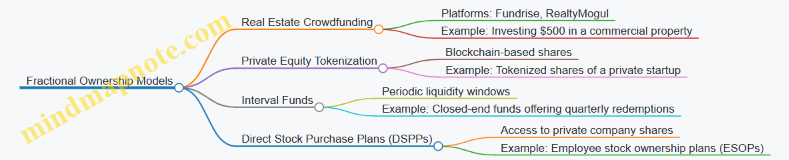
Drivers Behind Growth
- Technological Advancements: Blockchain and digital platforms enable secure, transparent fractional ownership.
- Regulatory Changes: JOBS Act and similar regulations have eased restrictions on retail participation.
- Investor Demand: Growing interest from millennials and retail investors seeking diversification beyond public markets.
Examples of Retail Access Platforms
-
Fundrise (Real Estate Crowdfunding)
- Minimum investment as low as $500.
- Offers diversified real estate portfolios.
- Example: A retail investor can own a fraction of a commercial property generating rental income.
-
EquityZen (Private Equity Secondary Market)
- Enables buying shares of pre-IPO companies.
- Lowers entry barriers for retail investors.
- Example: Purchasing fractional shares in a unicorn startup before IPO.
-
Masterworks (Art Investment Platform)
- Tokenizes ownership in high-value art pieces.
- Investors buy shares representing a fraction of the artwork.
- Example: Owning 0.01% of a Picasso painting.
Mind Map: Benefits and Risks of Fractional Ownership for Retail Investors
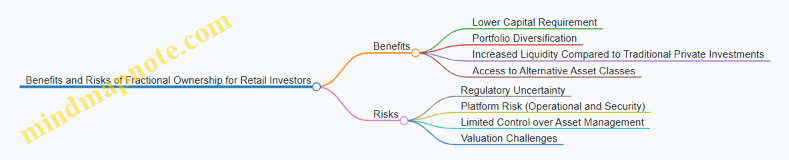
Best Practice: Due Diligence for Retail Investors
- Platform Credibility: Verify regulatory compliance and track record.
- Transparency: Understand fees, underlying assets, and liquidity terms.
- Investment Horizon: Align fractional ownership investments with personal liquidity needs.
Case Study: Retail Investor Participating in a Tokenized Private Equity Fund
Scenario: Jane, a retail investor, invests $1,000 via a blockchain-based platform offering fractional shares in a private equity fund.
- Process: Jane purchases tokens representing her ownership.
- Benefits: She gains exposure to a diversified private equity portfolio with quarterly liquidity windows.
- Outcome: After 18 months, Jane sells a portion of her tokens on the platform’s secondary market, realizing partial liquidity.
This example illustrates how fractional ownership combined with secondary market platforms can enhance retail investor participation and liquidity.
Conclusion
The growth of retail access and fractional ownership models is reshaping private market investing by lowering barriers and enhancing liquidity. For private equity associates and venture capital analysts, understanding these trends is critical to advising clients, structuring innovative products, and navigating evolving regulatory landscapes.
Further Reading
- “The JOBS Act and Its Impact on Retail Private Market Investing”
- “Blockchain Tokenization: Unlocking Liquidity in Alternative Assets”
- “Case Studies in Real Estate Crowdfunding Success”
8.3 AI and Data Analytics for Secondary Market Pricing and Risk Assessment
In recent years, artificial intelligence (AI) and data analytics have revolutionized many facets of finance, and secondary market pricing and risk assessment in private markets are no exceptions. The complexity and opacity of private assets, combined with limited transaction frequency, make traditional valuation and risk models challenging. AI and advanced analytics offer powerful tools to enhance accuracy, speed, and insight.
The Role of AI in Secondary Market Pricing
AI algorithms can analyze vast datasets, including historical transaction prices, fund performance metrics, macroeconomic indicators, and alternative data sources (e.g., news sentiment, social media trends). Machine learning models identify patterns and correlations that human analysts might miss, enabling more precise pricing of illiquid assets.
Example: A secondary market platform uses a supervised machine learning model trained on thousands of past LP interest transactions to predict the fair value discount for a new LP stake sale. The model incorporates variables such as fund vintage year, sector exposure, geographic focus, and recent NAV adjustments.
Data Analytics for Risk Assessment
Risk assessment in private markets involves evaluating market, credit, liquidity, and operational risks. AI-powered analytics can simulate multiple scenarios, stress test portfolios, and detect early warning signals.
Example: An AI-driven risk engine continuously monitors portfolio companies’ financial health by analyzing quarterly reports, news feeds, and industry trends. It flags potential risks such as covenant breaches or market downturn exposures, allowing secondary buyers to price in risk premiums appropriately.
Mind Map: AI and Data Analytics in Secondary Market Pricing and Risk Assessment
Integrating AI into the Secondary Market Workflow
-
Data Collection & Cleaning: Aggregating structured and unstructured data from fund reports, transaction databases, market data providers, and alternative sources.
-
Feature Engineering: Creating relevant variables such as NAV growth rates, discount spreads, and macroeconomic factors.
-
Model Training & Validation: Using historical secondary transactions to train models and validate their predictive accuracy.
-
Pricing & Risk Output: Generating pricing recommendations and risk scores to support investment decisions.
-
Continuous Learning: Updating models with new data to adapt to market changes.
Example: A secondary buyer integrates an AI pricing tool into their deal pipeline, which automatically generates a risk-adjusted price range for each potential acquisition, reducing due diligence time by 30% and improving bid competitiveness.
Challenges and Considerations
-
Data Quality & Availability: Private market data is often sparse and inconsistent, requiring robust cleaning and imputation techniques.
-
Model Interpretability: Complex AI models can be black boxes; ensuring transparency is crucial for investor confidence.
-
Regulatory Compliance: AI tools must comply with data privacy laws and financial regulations.
-
Human Oversight: AI should augment, not replace, expert judgment.
Summary
AI and data analytics are transforming secondary market pricing and risk assessment by providing deeper insights, faster analysis, and enhanced predictive power. By combining traditional expertise with cutting-edge technology, private market investors can better navigate the complexities of illiquid assets and optimize their secondary market strategies.
8.4 Best Practice: Adopting New Technologies to Enhance Transparency and Efficiency – Example from a Tech-Driven Secondary Platform
In the evolving landscape of private market investing, technology has become a pivotal enabler for enhancing transparency and operational efficiency, especially within secondary market transactions. This section explores how tech-driven secondary platforms are revolutionizing liquidity, valuation, and deal execution processes, supported by practical examples and mind maps.
Why Technology Matters in Secondary Markets
- Complexity Reduction: Secondary transactions often involve multiple parties, opaque asset valuations, and lengthy negotiations. Technology streamlines these complexities.
- Transparency Enhancement: Real-time data sharing and standardized reporting improve trust among buyers, sellers, and intermediaries.
- Efficiency Gains: Automated workflows and AI-driven analytics reduce time-to-close and operational costs.
Core Technological Innovations in Secondary Platforms
Case Example: LiquiTrade – A Leading Tech-Driven Secondary Platform
Overview: LiquiTrade is a secondary market platform that leverages blockchain and AI to facilitate private equity LP interest sales with enhanced transparency and efficiency.
Key Features:
- Blockchain-Enabled Ledger: Ensures immutable transaction records and real-time visibility for all stakeholders.
- AI-Powered Valuation Engine: Uses machine learning algorithms to analyze fund performance, market conditions, and comparable transactions to provide dynamic pricing guidance.
- Automated Compliance: Smart contracts enforce regulatory requirements and streamline KYC/AML processes.
- User-Friendly Interface: Provides investors with dashboards to track portfolio liquidity, transaction status, and historical performance.
Example Transaction:
- An LP seeking liquidity listed a $10 million stake in a growth equity fund.
- LiquiTrade’s AI engine suggested a pricing range based on recent secondary market trends and fund NAV.
- Multiple buyers accessed the listing simultaneously, with transparent bidding enabled by the platform.
- Smart contracts automatically executed the transfer upon deal closure, reducing settlement time from weeks to days.
Mind Map: Workflow on a Tech-Driven Secondary Platform
Additional Examples of Technology Adoption
- CartaX: Utilizes a digital marketplace for private company shares, improving liquidity and price discovery.
- Forge Global: Employs data analytics and secure digital platforms to connect buyers and sellers of private securities.
- Palico: Combines AI and big data to match secondary buyers with suitable fund interests efficiently.
Best Practice Recommendations
- Integrate AI and Machine Learning: Use AI to enhance pricing accuracy and risk assessment.
- Leverage Blockchain for Transparency: Adopt blockchain to create immutable transaction records and streamline settlements.
- Automate Compliance: Implement smart contracts to enforce regulatory requirements and reduce manual errors.
- Enhance User Experience: Build intuitive platforms that facilitate seamless communication and document exchange.
- Foster Data Standardization: Encourage industry-wide data standards to improve interoperability and comparability.
Summary
Adopting new technologies in secondary market platforms is no longer optional but essential for market participants aiming to improve transparency, reduce friction, and accelerate deal execution. Platforms like LiquiTrade exemplify how blockchain, AI, and automation can transform secondary liquidity, offering replicable models for private equity associates and venture capital analysts to understand and leverage in their investment processes.
8.5 Regulatory Evolution and Its Impact on Future Liquidity Solutions
The regulatory landscape surrounding private market investing and secondary liquidity solutions is rapidly evolving worldwide. These changes significantly influence how liquidity is structured, accessed, and managed in private markets. Understanding these regulatory shifts is critical for private equity associates and venture capital analysts aiming to navigate and capitalize on future liquidity opportunities.
Key Regulatory Trends Shaping Liquidity Solutions
-
Increased Transparency Requirements
- Regulators are demanding greater disclosure around fund valuations, fees, and transaction terms.
- Example: The EU’s AIFMD (Alternative Investment Fund Managers Directive) mandates detailed reporting and transparency for alternative funds.
-
Enhanced Investor Protection Measures
- Stricter rules on marketing, suitability, and risk disclosures to protect retail and institutional investors.
- Example: The SEC’s Regulation Best Interest (Reg BI) in the US raises standards for broker-dealers advising on private market products.
-
Facilitation of Secondary Market Transactions
- Regulatory frameworks are adapting to legitimize and streamline secondary trading platforms.
- Example: Singapore’s MAS (Monetary Authority of Singapore) has introduced sandbox initiatives allowing fintech platforms to pilot private equity secondary trading.
-
Cross-Border Regulatory Coordination
- Harmonization efforts to reduce friction in global secondary transactions.
- Example: IOSCO (International Organization of Securities Commissions) guidelines promoting consistent standards for alternative investment fund liquidity management.
-
Focus on Anti-Money Laundering (AML) and Know Your Customer (KYC)
- Heightened due diligence requirements to prevent illicit activities in secondary market trades.
Mind Map: Regulatory Evolution Impacting Liquidity Solutions
Examples of Regulatory Impact on Liquidity Solutions
-
Tokenization and Securities Laws
- Tokenized private equity shares offer fractional ownership and improved liquidity.
- Regulatory bodies like the SEC scrutinize these tokens under securities laws, requiring compliance with registration or exemption rules.
- Example: A US-based secondary platform launched a tokenized fund share offering but had to register the tokens as securities, impacting the speed and cost of issuance.
-
Interval Funds and Regulatory Approval
- Interval funds provide periodic liquidity to investors in illiquid assets.
- The SEC’s regulatory framework for interval funds sets limits on redemption frequency and disclosure.
- Example: A private equity firm structured an interval fund to offer quarterly liquidity windows, balancing investor demand and regulatory constraints.
-
Secondary Market Platforms in Asia
- Singapore’s MAS regulatory sandbox enabled a fintech platform to pilot a secondary marketplace for private equity interests.
- This regulatory support accelerated innovation and investor participation.
Best Practices for Navigating Regulatory Changes
-
Proactive Compliance Monitoring
- Stay updated on evolving regulations across jurisdictions.
- Example: A global PE firm established a regulatory watch team to anticipate changes impacting secondary transactions.
-
Engage with Regulators Early
- Participate in consultations and sandbox programs to shape favorable rules.
- Example: A secondary platform collaborated with the FCA in the UK to pilot a compliant trading system.
-
Integrate Compliance into Product Design
- Build liquidity solutions that inherently meet regulatory requirements.
- Example: Designing tokenized offerings with built-in KYC/AML controls to facilitate smoother approvals.
-
Educate Investors and Stakeholders
- Transparent communication about regulatory impacts and compliance enhances trust.
- Example: Hosting webinars explaining how new rules affect liquidity options.
Conclusion
The regulatory evolution is both a challenge and an opportunity for private market liquidity solutions. While increased compliance demands may raise operational costs, they also foster greater market integrity, investor confidence, and innovation. Private equity associates and venture capital analysts who understand and anticipate these regulatory dynamics will be better positioned to develop and recommend liquidity strategies that are sustainable, compliant, and competitive in the global capital markets.
9. Building a Career in Private Equity and Secondary Markets
9.1 Key Skills and Competencies for Associates and Analysts
Private Equity Associates and Venture Capital Analysts play a critical role in deal sourcing, due diligence, portfolio management, and secondary market transactions. Developing a strong skill set is essential for success and career progression in these competitive fields.
Core Skill Areas
Financial Analysis
Associates and Analysts must be proficient in building detailed financial models to evaluate investment opportunities and secondary transactions. This includes discounted cash flow (DCF) models, leveraged buyout (LBO) models, and scenario analysis.
Example:
- Constructing a three-statement financial model for a target company to assess its valuation and potential exit multiples.
- Applying NAV discounting techniques to price a secondary fund interest accurately.
Due Diligence
Thorough due diligence is critical for mitigating risks and validating investment theses. Analysts should be adept at conducting market research, analyzing competitive landscapes, and reviewing legal and regulatory frameworks.
Example:
- Performing a competitive analysis for a venture capital investment in a fintech startup, identifying key differentiators and market risks.
- Reviewing fund documentation and side letters during a secondary LP stake acquisition.
Deal Execution
Associates and Analysts support deal execution by assisting in negotiation, structuring transactions, and managing documentation.
Example:
- Assisting in negotiating terms for a secondary sale of LP interests, ensuring alignment with fund governance.
- Preparing term sheets and coordinating with legal teams during fund restructurings.
Communication
Clear and concise communication is vital for presenting investment ideas, writing reports, and engaging with stakeholders.
Example:
- Preparing investment memos summarizing key findings from due diligence for investment committees.
- Delivering presentations on secondary market trends to internal teams or clients.
Technology & Tools
Proficiency in technology enhances efficiency and accuracy in analysis and deal management.
Example:
- Using Excel VBA macros to automate repetitive financial modeling tasks.
- Leveraging data analytics platforms to track portfolio company performance.
Soft Skills
Soft skills such as critical thinking, time management, and teamwork are essential for navigating complex transactions and collaborating effectively.
Example:
- Prioritizing multiple due diligence requests under tight deadlines.
- Collaborating with cross-functional teams across geographies to close a secondary transaction.
Summary
For Private Equity Associates and Venture Capital Analysts, mastering a blend of technical, analytical, communication, and interpersonal skills is crucial. Practical application through real-world examples and continuous learning will accelerate career growth and effectiveness in private market investing and secondary liquidity strategies.
9.2 Navigating Career Paths in Primary vs Secondary Private Market Roles
Private market investing offers diverse career opportunities, particularly split between primary and secondary market roles. Understanding the nuances, skill sets, and growth trajectories in each area is essential for Private Equity Associates and Venture Capital Analysts aiming to tailor their career paths effectively.
Overview: Primary vs Secondary Private Market Roles
| Aspect | Primary Market Roles | Secondary Market Roles |
|---|---|---|
| Focus | Investing directly in new funds or companies | Buying/selling existing stakes in private funds |
| Deal Cycle | Longer, from fundraise to exit | Shorter, focused on portfolio analysis and transactions |
| Skill Emphasis | Due diligence, sourcing, portfolio management | Valuation, negotiation, structuring secondary deals |
| Stakeholder Interaction | Fund managers, entrepreneurs | LPs, GPs, secondary buyers/sellers |
Mind Map: Career Path Decision Factors
Primary Market Roles: Key Characteristics and Examples
-
Deal Sourcing and Origination: Associates often focus on identifying promising startups or buyout targets. For example, a Venture Capital Analyst might attend industry conferences to meet early-stage tech founders.
-
Due Diligence: Evaluating business models, market potential, and financials. A Private Equity Associate might lead a deep dive into a manufacturing company’s supply chain to assess risks.
-
Portfolio Management: Monitoring and supporting portfolio companies post-investment, such as helping a growth equity firm’s portfolio company expand into new geographies.
-
Exit Strategy Planning: Preparing companies for IPOs or sales, exemplified by a buyout fund associate coordinating with investment bankers for a strategic sale.
Example:
Jane, a Private Equity Associate, spends her day analyzing a potential buyout target’s financial statements, meeting with management, and coordinating with legal teams to structure the deal. Over time, she develops expertise in operational improvements and exit planning.
Secondary Market Roles: Key Characteristics and Examples
-
Valuation and Pricing: Analysts focus on assessing the fair value of existing fund stakes. For instance, a Secondary Market Analyst might use NAV discounting techniques to price a fund interest.
-
Transaction Structuring: Crafting deal terms that balance risk and return for buyers and sellers. A Secondary Associate might negotiate transfer restrictions or preferred return hurdles.
-
Due Diligence on Existing Assets: Reviewing fund performance, underlying portfolio companies, and legal documents.
-
Market and Trend Analysis: Tracking supply/demand dynamics in secondary markets globally.
Example:
Mark, a Secondary Market Analyst, evaluates a block sale of LP interests in a venture capital fund. He models different exit scenarios and negotiates terms to optimize liquidity for the seller while ensuring attractive returns for his firm.
Mind Map: Skill Sets Required
Integrated Example: Career Transition from Primary to Secondary
Scenario:
Emily started as a Venture Capital Analyst focusing on sourcing early-stage deals and conducting due diligence. Over time, she developed a strong interest in valuation and deal structuring, prompting her to transition into a Secondary Market Associate role. In her new role, she leveraged her deep understanding of startup dynamics to better assess the value of secondary stakes in venture portfolios.
Best Practice:
- Build foundational skills in financial analysis and relationship management.
- Seek exposure to both primary and secondary transactions through rotational programs or cross-team projects.
- Network actively with professionals in both domains to understand evolving market demands.
Summary
Navigating career paths in private markets requires clarity on personal interests, skill development, and market understanding. Primary market roles emphasize long-term value creation and operational involvement, while secondary market roles focus on liquidity solutions, valuation, and transactional expertise. By leveraging mind maps and real-world examples, professionals can strategically plan their career trajectories to maximize growth and impact.
9.3 Networking and Relationship Building in Global Capital Markets
In the fast-paced and interconnected world of global capital markets, networking and relationship building are critical skills for Private Equity Associates and Venture Capital Analysts. These relationships not only open doors to deal flow and partnership opportunities but also provide invaluable market insights and career advancement.
Why Networking Matters in Global Capital Markets
- Access to Proprietary Deals: Many private market opportunities arise through relationships rather than public auctions.
- Market Intelligence: Trusted contacts provide early signals on market trends and emerging sectors.
- Career Growth: Strong networks can lead to mentorship, referrals, and new roles.
- Collaborative Opportunities: Co-investments, syndications, and secondary transactions often rely on established trust.
Key Networking Strategies
-
Attend Industry Conferences and Events
- Examples: SuperReturn, AVCJ Private Equity & Venture Forum, and local investor summits.
- Best Practice: Prepare targeted questions and follow-up plans to deepen connections.
-
Leverage Alumni and Professional Groups
- Example: Joining university alumni investment clubs or CFA societies.
- Best Practice: Engage actively by sharing insights and volunteering for panels.
-
Utilize Digital Platforms
- LinkedIn: Connect with dealmakers, fund managers, and analysts.
- Specialized platforms: eVestment, PitchBook communities.
- Best Practice: Personalize connection requests with clear value propositions.
-
Build Cross-Border Relationships
- Example: Partnering with local funds in emerging markets to gain regional expertise.
- Best Practice: Respect cultural nuances and maintain consistent communication.
-
Maintain and Nurture Relationships
- Regular check-ins via emails or calls.
- Sharing relevant articles or market updates.
- Celebrating milestones (e.g., fund closes, promotions).
Mind Map: Networking in Global Capital Markets
Example 1: Leveraging Conferences for Deal Flow
A Venture Capital Analyst attending the AVCJ forum in Hong Kong prepared by researching attending firms and identifying key speakers. By asking insightful questions during panel discussions and following up with personalized LinkedIn messages, the analyst secured meetings with two emerging fund managers. This led to a co-investment opportunity in a Southeast Asian fintech startup.
Example 2: Alumni Network as a Career Accelerator
A Private Equity Associate joined their university’s global alumni investment group. By volunteering to organize webinars on emerging markets, the associate built credibility and connected with senior investors. This network later provided referrals to a boutique secondary market firm expanding into Europe.
Mind Map: Maintaining and Nurturing Relationships

Best Practice: Personalized Follow-Up
After meeting a fund manager at a conference, a Private Equity Associate sent a follow-up email referencing a specific point from their conversation and shared a recent market report relevant to the manager’s focus. This personalized approach helped establish trust and led to an invitation to participate in a secondary transaction.
Cultural Sensitivity in Global Networking
Understanding cultural norms is essential when building international relationships. For example, in Japan, exchanging business cards with both hands and a bow is customary, while in the Middle East, personal rapport often precedes business discussions.
Summary
Networking and relationship building in global capital markets require a strategic, consistent, and culturally aware approach. By attending targeted events, leveraging professional groups, utilizing digital tools, and nurturing connections thoughtfully, Private Equity Associates and Venture Capital Analysts can unlock significant value for their firms and careers.
9.4 Best Practice: Leveraging Case Study Analysis and Deal Experience to Accelerate Career Growth
In the competitive landscape of private equity and secondary markets, associates and analysts who actively leverage case study analysis and real deal experience position themselves for accelerated career growth. This section explores how to systematically use these tools to deepen industry knowledge, enhance analytical skills, and build a compelling professional profile.
Why Case Study Analysis and Deal Experience Matter
- Practical Learning: Case studies simulate real-world challenges, allowing you to apply theoretical knowledge.
- Critical Thinking: Analyzing deals hones your ability to evaluate complex scenarios and make informed decisions.
- Communication Skills: Presenting case findings improves your ability to articulate investment theses and negotiate terms.
- Network Building: Working on deals often involves collaboration with senior professionals and external parties, expanding your network.
How to Leverage Case Study Analysis Effectively
Step 1: Select Diverse and Relevant Case Studies
- Choose cases spanning various sectors, deal types (buyouts, venture, secondaries), and geographies.
- Example: Analyze a secondary LP interest sale in a mature buyout fund and contrast it with a direct secondary acquisition in a VC portfolio.
Step 2: Break Down the Deal Components
- Investment thesis
- Valuation methods
- Due diligence findings
- Deal structuring and negotiation
- Exit strategies
Step 3: Identify Key Learnings and Best Practices
- What worked well?
- What were the challenges?
- How were risks mitigated?
Step 4: Document and Present Findings
- Create concise reports or presentations.
- Use visual aids like charts and mind maps to clarify complex points.
Mind Map: Framework for Case Study Analysis
How to Maximize Deal Experience
- Seek Active Involvement: Volunteer for responsibilities such as financial modeling, due diligence coordination, or drafting investment memos.
- Request Feedback: Regularly ask for constructive feedback from senior team members to refine your approach.
- Reflect and Iterate: Post-deal, review what you learned and how you can improve.
Example: Accelerating Growth Through a Secondary Market Deal
Scenario: As an associate, you participated in a secondary purchase of LP interests in a technology-focused venture capital fund.
- Your Role: Led valuation analysis using NAV discounts and scenario modeling.
- Learning Outcome: Gained deep understanding of secondary pricing dynamics and negotiation levers.
- Career Impact: Presented insights to the investment committee, earning recognition and a promotion opportunity.
Mind Map: Leveraging Deal Experience for Career Growth
Additional Tips
- Create a Deal Diary: Maintain a personal log summarizing each deal’s key points and your contributions.
- Engage in Peer Learning: Discuss case studies and deals with colleagues to gain diverse perspectives.
- Leverage Technology: Use tools like Excel, PowerPoint, and deal management platforms to enhance your efficiency and output quality.
Summary
By systematically analyzing case studies and actively engaging in deal execution, private equity associates and venture capital analysts can accelerate their professional development. This approach not only builds technical expertise but also fosters strategic thinking, communication skills, and professional visibility—key ingredients for a successful career in private markets.
9.5 Continuing Education and Certification Opportunities
In the fast-evolving landscape of private equity and secondary markets, continuous learning is essential for Associates and Analysts aiming to stay competitive and deepen their expertise. This section explores key continuing education paths, certifications, and practical examples to help professionals advance their careers.
Why Continuing Education Matters
- Keeps professionals updated on regulatory changes, market trends, and new investment strategies.
- Enhances analytical and valuation skills critical for deal sourcing and execution.
- Builds credibility with employers, investors, and industry peers.
Popular Certifications and Their Benefits
| Certification | Focus Area | Ideal For | Example Use Case |
|---|---|---|---|
| CFA (Chartered Financial Analyst) | Broad investment management, ethics, financial analysis | Private Equity Analysts, Associates | An analyst uses CFA-acquired valuation techniques to assess a complex secondary market portfolio. |
| CAIA (Chartered Alternative Investment Analyst) | Alternative investments including private equity, hedge funds, real assets | Professionals focused on alternative assets | An associate applies CAIA frameworks to evaluate infrastructure fund secondaries. |
| CISI Diploma in Private Equity | Private equity fundamentals, deal structuring, secondary markets | Private equity professionals seeking specialized knowledge | A venture capital analyst leverages CISI insights to structure a secondary stake acquisition. |
| FMVA (Financial Modeling & Valuation Analyst) | Financial modeling, valuation, Excel skills | Analysts needing advanced modeling capabilities | An associate builds a detailed LBO model for a secondary transaction using FMVA techniques. |
| Private Equity Professional Certificate (PEPC) | Practical private equity skills, deal execution | New entrants and mid-level professionals | A professional applies PEPC learnings to streamline due diligence in a secondary deal. |
Educational Programs and Workshops
- University Executive Programs: Institutions like Harvard, Wharton, and London Business School offer short courses on private equity and alternative investments.
- Industry Conferences: Events such as SuperReturn, Private Equity International (PEI) conferences, and Secondary Market Forums provide workshops and networking.
- Online Platforms: Coursera, edX, and Udemy offer flexible courses on private equity fundamentals, financial modeling, and secondary market strategies.
Mind Map: Continuing Education Pathways for Private Equity Professionals
Example: Leveraging Certifications in Career Growth
Case Study: Jane, a Private Equity Associate, pursued the CAIA designation while working full-time. She applied her learnings to lead a secondary market transaction involving a distressed fund interest. Her enhanced understanding of alternative asset classes and risk management impressed senior partners, resulting in a promotion and expanded deal responsibilities.
Tips for Maximizing Continuing Education
- Align certifications with career goals and firm focus areas.
- Balance theoretical learning with practical application through case studies and deal involvement.
- Network with peers and instructors to gain insights and mentorship.
- Stay updated on emerging trends like tokenization and AI in private markets.
Summary
Continuing education and certification are critical pillars for Private Equity Associates and Venture Capital Analysts seeking to excel in private market investing and secondary liquidity strategies. By strategically selecting programs and integrating learnings into daily work, professionals can accelerate their career trajectory and contribute meaningfully to their firms’ success.
10. Conclusion and Future Outlook
10.1 Summary of Key Takeaways on Private Market Investing and Secondary Liquidity
Private market investing and secondary liquidity strategies are critical components of modern global capital markets. This section distills the essential insights covered throughout the blog, reinforced with mind maps and practical examples to solidify understanding.
Mind Map: Core Concepts of Private Market Investing
Mind Map: Secondary Liquidity Strategies
Key Takeaways
-
Private Market Investing Offers Unique Opportunities and Challenges
- Private markets provide access to high-growth companies and alternative assets not available in public markets.
- Example: A venture capital fund investing early in a fintech startup that later becomes a unicorn illustrates the return potential.
-
Diversification Across Strategies and Geographies Is Essential
- Balancing buyouts, growth equity, and venture capital across developed and emerging markets mitigates risks.
- Example: A portfolio combining U.S. buyouts with Southeast Asian growth equity reduces concentration risk.
-
Secondary Markets Provide Vital Liquidity and Portfolio Management Tools
- Secondary transactions enable investors to manage cash flows, rebalance portfolios, and access mature assets.
- Example: An LP selling a stake in a mature buyout fund to reallocate capital to newer funds.
-
Valuation and Due Diligence Are Critical in Secondary Deals
- Accurate NAV assessments and understanding underlying asset quality drive successful secondary transactions.
- Example: Using scenario analysis to price a secondary interest in a fund facing market headwinds.
-
Innovations Like Tokenization Are Shaping the Future of Liquidity
- Blockchain-based platforms are increasing transparency and enabling fractional ownership.
- Example: A secondary platform tokenizing private equity stakes to allow smaller investors access and easier trading.
-
Regulatory and Operational Considerations Must Be Navigated Carefully
- Compliance with local and international regulations ensures smooth transactions and investor protection.
- Example: Structuring a secondary deal in Asia-Pacific with local legal counsel to address jurisdictional nuances.
-
Career Growth in Private Markets Requires Technical Skills and Relationship Building
- Associates and analysts benefit from mastering deal structuring, valuation, and networking.
- Example: Leveraging experience from a secondary market transaction to lead future deals and build a professional network.
Integrated Example: Applying Key Takeaways
Consider a private equity associate evaluating a secondary purchase of LP interests in a European buyout fund:
- They apply due diligence to assess fund performance and manager track record.
- Use valuation techniques such as NAV discounts and scenario analysis to price the deal.
- Factor in macroeconomic risks like Brexit-related uncertainty.
- Structure the transaction to optimize liquidity and comply with regulatory requirements.
- Leverage technology platforms to streamline the process.
This holistic approach embodies the best practices and insights summarized above.
By internalizing these key takeaways, private equity associates and venture capital analysts can better navigate the complexities of private market investing and secondary liquidity, ultimately driving superior investment outcomes and career success.
10.2 Predictions for the Evolution of Global Private Markets
The global private markets are poised for significant transformation over the next decade, driven by technological innovation, regulatory shifts, evolving investor preferences, and macroeconomic dynamics. Understanding these trends is critical for private equity associates and venture capital analysts aiming to stay ahead in this competitive landscape.
Key Predictions for Global Private Markets Evolution
Technological Integration
Blockchain & Tokenization: Tokenization of private equity assets will enable fractional ownership and enhanced liquidity. For example, platforms like tZERO and Securitize are pioneering tokenized fund interests, allowing investors to trade private equity stakes more seamlessly.
AI & Data Analytics: AI-driven predictive analytics will improve deal sourcing, due diligence, and portfolio monitoring. Firms such as Palantir and Preqin are leveraging big data to provide real-time insights, reducing information asymmetry.
Digital Platforms & Marketplaces: Secondary market platforms like Forge Global and EquityZen are democratizing access and improving price discovery, making private markets more efficient.
Liquidity & Access
Expansion of Secondary Markets: Secondary transactions will grow in volume and sophistication, with more continuation funds and tender offer structures emerging. For example, Blackstone’s Strategic Partners has expanded its secondary fund offerings to meet rising demand.
Retail & Fractional Ownership: Retail investors will gain increased access through fractional ownership models and interval funds, exemplified by platforms such as iCapital Network.
New Fund Structures: Innovative fund structures designed to balance liquidity and return, like perpetual capital vehicles, will become more common.
Geographic & Sectoral Shifts
Emerging Markets Growth: Private markets in Asia, Latin America, and Africa will attract more capital due to higher growth potential. For instance, Sequoia Capital’s increased investments in Southeast Asia highlight this trend.
Sector Focus: Technology, healthcare, and ESG-focused investments will dominate deal flow. The rise of climate tech funds and healthtech startups exemplifies this shift.
Regulatory Environment
Increased Transparency: Regulators will push for greater disclosure around valuations and fees, enhancing investor confidence.
Cross-Border Harmonization: Efforts to harmonize regulations will facilitate cross-border private market investments, easing capital flow.
ESG & Sustainability Mandates: Regulatory frameworks will increasingly mandate ESG integration, influencing fund strategies and reporting.
Investor Behavior
Demand for Customization: Investors will seek tailored solutions, including separately managed accounts and co-investments.
Focus on Impact Investing: Growth in impact and socially responsible investing will reshape capital allocation priorities.
Risk Management Sophistication: Enhanced risk analytics and scenario planning will become standard practice.
Integrated Example: How These Trends Converge
Consider a hypothetical private equity fund launching in 2026:
- It uses blockchain technology to tokenize fund interests, enabling secondary trading on digital platforms.
- The fund targets growth-stage tech companies in Southeast Asia, leveraging local partnerships.
- It offers retail investors fractional access via an interval fund structure.
- ESG criteria are embedded throughout investment decisions, complying with new regulatory mandates.
- AI tools are employed for ongoing portfolio risk assessment and performance forecasting.
This integrated approach exemplifies the future-ready private market investment strategy.
Summary
The evolution of global private markets will be characterized by enhanced liquidity, broader access, technological innovation, geographic diversification, and heightened regulatory oversight. Private equity associates and venture capital analysts should proactively adapt by developing expertise in these areas, embracing new tools, and anticipating investor needs to capitalize on emerging opportunities.
10.3 Strategic Recommendations for Investors and Market Participants
In the evolving landscape of private market investing and secondary liquidity, strategic foresight and adaptability are crucial for success. Below are comprehensive recommendations designed to help investors and market participants optimize their approach, manage risks, and capitalize on emerging opportunities.
Prioritize Diversification Across Strategies and Geographies
Diversification remains a cornerstone of risk management. Investors should seek exposure across various private market strategies—buyouts, growth equity, venture capital, real assets—and across developed and emerging markets to balance risk and return.
Example: A global private equity fund allocates 40% to North American buyouts, 30% to European growth equity, and 30% to Asia-Pacific venture capital, reducing concentration risk while capturing diverse growth opportunities.
Develop Robust Secondary Market Capabilities
Secondary liquidity is increasingly important for portfolio flexibility. Investors should build internal expertise or partner with specialized secondary market platforms to access liquidity, optimize pricing, and manage fund lifecycle risks.
Example: A pension fund establishes a dedicated secondary investment team that negotiates LP stake acquisitions at NAV discounts, enhancing portfolio liquidity and generating attractive returns.
Leverage Technology and Data Analytics
Adopting advanced analytics, AI-driven valuation models, and blockchain for transaction transparency can improve decision-making and operational efficiency.
Example: A private equity firm uses AI-powered tools to analyze secondary market pricing trends, enabling more accurate NAV discount assessments and better timing of secondary sales.
Foster Strategic Partnerships and Local Expertise
Entering new markets or sectors benefits from collaboration with local partners who understand regulatory, cultural, and operational nuances.
Example: A venture capital fund partners with a regional firm in Southeast Asia to source deals and navigate local compliance, accelerating market penetration.
Implement Dynamic Liquidity Management Frameworks
Designing funds with flexible liquidity options—such as interval funds or tender offer mechanisms—helps balance investor needs with asset illiquidity.
Example: An interval fund offers quarterly redemption windows, providing investors with periodic liquidity while maintaining long-term investment strategies.
Maintain Rigorous Due Diligence and Valuation Discipline
Thorough due diligence and conservative valuation approaches mitigate risks, especially in secondary transactions where information asymmetry can be significant.
Example: Before acquiring a secondary LP interest, an analyst performs deep dives into underlying portfolio companies, fund manager track records, and applies scenario analysis to stress-test valuations.
Stay Informed on Regulatory Changes and Compliance
Regulatory landscapes evolve rapidly, impacting fund structures, reporting, and investor eligibility. Proactive compliance ensures smooth operations and reduces legal risks.
Example: A fund manager adjusts fund documentation and investor onboarding processes in response to new cross-border tax regulations, avoiding penalties and preserving investor confidence.
Mind Maps
Mind Map 1: Strategic Diversification Framework
Mind Map 2: Secondary Market Capabilities
Mind Map 3: Technology Adoption in Private Markets

Mind Map 4: Liquidity Management Framework
Summary
By integrating these strategic recommendations, investors and market participants can better navigate the complexities of private market investing and secondary liquidity. Emphasizing diversification, building secondary market expertise, leveraging technology, fostering partnerships, managing liquidity dynamically, maintaining due diligence rigor, and staying compliant will collectively enhance portfolio resilience and growth potential.
10.4 Best Practice: Continuous Adaptation and Learning in a Dynamic Market Environment
In the fast-evolving landscape of private market investing and secondary liquidity strategies, continuous adaptation and learning are not just beneficial—they are essential for sustained success. Market dynamics, regulatory frameworks, technological innovations, and investor expectations are in constant flux. To thrive, professionals must cultivate a mindset of agility, curiosity, and proactive knowledge acquisition.
Why Continuous Adaptation Matters
- Market Volatility: Economic cycles, geopolitical events, and global crises (e.g., pandemics) can rapidly alter investment landscapes.
- Regulatory Changes: New compliance requirements and cross-border regulations demand ongoing awareness.
- Technological Disruption: Innovations like blockchain, AI, and digital platforms reshape how liquidity and valuations are managed.
- Competitive Advantage: Staying ahead of trends enables better deal sourcing, pricing, and risk management.
Core Components of Continuous Adaptation and Learning
Practical Steps to Foster Adaptation and Learning
-
Establish a Structured Learning Routine
- Dedicate weekly time slots for reading industry reports, whitepapers, and market news.
- Example: A Private Equity Associate sets aside 2 hours every Friday afternoon to review latest secondary market trends and regulatory updates.
-
Leverage Technology for Real-Time Insights
- Use platforms like PitchBook, Preqin, or specialized secondary market analytics tools to monitor deal flow and pricing trends.
- Example: A Venture Capital Analyst integrates AI-driven data analytics tools to identify emerging sectors with increasing secondary liquidity demand.
-
Engage in Cross-Functional Collaboration
- Participate in deal teams with diverse expertise to gain holistic perspectives.
- Example: Collaborating with legal and compliance teams during secondary transactions to understand evolving regulatory nuances.
-
Attend Industry Events and Webinars
- Regularly join conferences, workshops, and webinars focused on private markets and secondary strategies.
- Example: An associate attends the annual SuperReturn conference to network and learn about cutting-edge liquidity solutions.
-
Implement Reflective Practices Post-Transaction
- Conduct debrief sessions to analyze what worked and what didn’t.
- Example: After closing a secondary LP interest sale, the team documents lessons learned regarding negotiation tactics and pricing assumptions.
Example: Adapting to Regulatory Changes in Secondary Markets
In 2023, new regulations around fund transparency and investor disclosures were introduced in the EU, impacting secondary transactions. A leading private equity firm responded by:
- Quickly updating their due diligence checklists to incorporate new disclosure requirements.
- Training their deal teams on compliance implications.
- Utilizing technology platforms that automated regulatory reporting.
This proactive adaptation minimized deal delays and enhanced investor confidence.
Mind Map: Learning Cycle for Private Market Professionals
Final Thoughts
Continuous adaptation and learning transform challenges into opportunities. By embedding these practices into daily workflows, private equity associates and venture capital analysts can enhance decision-making, improve deal outcomes, and future-proof their careers in the dynamic global capital markets.
Remember: The journey of learning is ongoing—embrace change, stay curious, and lead with agility.
10.5 Final Thoughts: Balancing Risk, Return, and Liquidity in Private Market Portfolios
In private market investing, the triad of risk, return, and liquidity forms the cornerstone of portfolio construction and management. Unlike public markets, where liquidity is often abundant and pricing transparent, private markets demand a nuanced approach to balance these elements effectively. This section synthesizes key insights and practical frameworks to help investors, associates, and analysts navigate this complexity.
Understanding the Triad
- Risk: Private investments carry illiquidity risk, valuation uncertainty, and operational risks tied to portfolio companies or assets.
- Return: Typically, private markets offer higher expected returns as compensation for illiquidity and complexity.
- Liquidity: Limited secondary market activity and lock-up periods constrain the ability to exit investments quickly.
Mind Map: Balancing Risk, Return, and Liquidity
Best Practices with Examples
-
Diversification Across Vintage Years and Strategies
- Example: A private equity fund-of-funds invests across multiple vintage years and sectors to smooth cash flows and mitigate concentration risk.
- Practice: This reduces exposure to market cycles and allows for more predictable liquidity events.
-
Utilizing Secondary Markets to Enhance Liquidity
- Example: An LP facing capital calls sells a portion of their fund interest on a secondary platform, unlocking liquidity without waiting for fund maturity.
- Practice: Secondary transactions can rebalance portfolios and manage liquidity needs proactively.
-
Implementing Interval Funds or Tender Offer Structures
- Example: A private credit fund offers quarterly tender offers, providing periodic liquidity windows to investors.
- Practice: These structures offer a middle ground between traditional closed-end funds and liquid public markets.
-
Active Monitoring and Valuation Discipline
- Example: A venture capital analyst regularly updates portfolio company valuations using scenario analysis and market comparables to reflect true risk-adjusted returns.
- Practice: Transparent and frequent valuation updates improve decision-making and investor confidence.
-
Staggered Investment and Exit Timing
- Example: A private equity associate structures capital deployment across multiple deals and exit timelines to avoid liquidity crunches.
- Practice: Timing diversification helps manage cash flow and reduces forced sales under distressed conditions.
Mind Map: Practical Steps to Achieve Balance
Final Example: Balancing in Action
Consider a global private equity portfolio managed by a seasoned associate:
- The portfolio is diversified across buyout, growth equity, and venture capital funds spanning North America, Europe, and Asia.
- The associate leverages secondary market platforms to sell LP stakes selectively, ensuring liquidity to meet upcoming capital calls.
- Regular valuation reviews incorporate macroeconomic trends and sector-specific developments, adjusting expected returns and risk assessments.
- The fund manager structures investments with staggered exit horizons, balancing near-term cash flows with long-term growth.
This integrated approach exemplifies how balancing risk, return, and liquidity is not a static formula but a dynamic process requiring continuous attention and adaptation.
Key Takeaway
Balancing risk, return, and liquidity in private market portfolios demands a strategic blend of diversification, active management, innovative liquidity solutions, and rigorous valuation discipline. By embedding these best practices into investment processes, private equity associates and venture capital analysts can better navigate the complexities of global capital markets and deliver sustainable value to investors.