Practical Quantum Networking and the Future Quantum Internet
1. Introduction to Quantum Networking
1.1 Overview of Quantum Networking Concepts
Quantum networking is an emerging field that leverages the principles of quantum mechanics to enable fundamentally new ways of communication and information processing. Unlike classical networks, which transmit bits as 0s and 1s, quantum networks transmit quantum bits or qubits, which can exist in superposition states and be entangled with other qubits. This enables powerful capabilities such as unconditionally secure communication, distributed quantum computing, and enhanced sensing.
Key Concepts in Quantum Networking
Below is a mind map illustrating the foundational concepts:
Explanation of Core Concepts
-
Qubits: The fundamental unit of quantum information. Unlike classical bits, qubits can be in a superposition of 0 and 1 simultaneously. For example, a photon’s polarization can represent a qubit.
-
Entanglement: A unique quantum phenomenon where two or more qubits become linked such that the state of one instantly influences the state of the other, regardless of distance.
-
Quantum Communication: Uses qubits to transmit information. Key protocols include:
- Quantum Key Distribution (QKD): Enables two parties to share encryption keys securely by detecting any eavesdropping.
- Quantum Teleportation: Transfers the state of a qubit from one location to another using entanglement and classical communication.
-
Quantum Repeaters: Devices that extend the range of quantum communication by overcoming loss and decoherence, enabling long-distance quantum networks.
-
Quantum Memories: Components that store qubits temporarily to synchronize quantum operations across the network.
Practical Example: Understanding Qubits with Photon Polarization
Imagine encoding a qubit using the polarization of a photon:
- Horizontal polarization (|0⟩)
- Vertical polarization (|1⟩)
- Any superposition, e.g., 45° polarization, represents a combination of |0⟩ and |1⟩.
This physical representation allows quantum information to be transmitted over fiber optic cables or free space.
Mind Map: Quantum Communication Protocols
Example: BB84 Protocol Simplified
- Alice sends qubits encoded randomly in one of two bases (rectilinear or diagonal).
- Bob measures each qubit randomly in one of the two bases.
- They publicly compare bases (not measurement results) to keep only the bits where their bases matched.
- Any eavesdropping introduces detectable errors, ensuring security.
Summary
Quantum networking builds on the unique properties of qubits and entanglement to create communication systems that are secure and capable of tasks beyond classical networks. Understanding these core concepts and protocols is essential for network engineers, quantum researchers, and systems architects aiming to design and implement the future quantum internet.
1.2 Key Differences Between Classical and Quantum Networks
Quantum networks represent a paradigm shift from classical networks, leveraging the principles of quantum mechanics to enable fundamentally new capabilities. Understanding the key differences is essential for network engineers, quantum researchers, and systems architects to design and implement effective quantum communication systems.
Mind Map: Core Differences Between Classical and Quantum Networks
Detailed Explanation with Examples
Information Encoding and Transmission
Classical Networks: Use bits represented by voltage levels or light pulses to encode data. For example, a fiber optic cable transmits light pulses representing 0s and 1s.
Quantum Networks: Use qubits, which can exist in superposition states, allowing them to represent both 0 and 1 simultaneously until measured. For instance, a photon’s polarization can be horizontal (|0⟩), vertical (|1⟩), or any superposition.
Example: In a classical network, sending the bit sequence 1010 involves sending four distinct pulses. In a quantum network, a qubit can be prepared in a superposition state like (|0⟩ + |1⟩)/√2, enabling protocols like quantum teleportation.
Security Paradigms
Classical Security: Relies on mathematical complexity (e.g., RSA encryption). Vulnerable to quantum computers that can break these algorithms.
Quantum Security: Uses principles like the no-cloning theorem and measurement disturbance. Quantum Key Distribution (QKD) protocols such as BB84 allow two parties to detect eavesdropping inherently.
Example: In BB84, if an eavesdropper tries to intercept the quantum key, the measurement changes the quantum state, alerting the communicating parties.
Network Components and Repeaters
Classical Repeaters: Amplify and regenerate signals to extend distance.
Quantum Repeaters: Use entanglement swapping and quantum memories to extend communication distance without measuring qubits directly (which would collapse their state).
Example: A classical repeater boosts a weak electrical signal; a quantum repeater creates entanglement between distant nodes to maintain qubit coherence over long distances.
Mind Map: Practical Implications for Network Engineers
Integrated Example: Comparing Data Transmission
Scenario: Transmitting a secure message from Alice to Bob.
-
Classical Network: Alice encrypts the message using RSA and sends it over the internet. If a quantum computer intercepts, it can decrypt the message.
-
Quantum Network: Alice and Bob use QKD to generate a shared secret key via quantum states. Any eavesdropping attempt alters the quantum states, alerting them. They then use this key to encrypt the message classically.
This example highlights how quantum networks enhance security beyond classical capabilities.
Summary
| Aspect | Classical Networks | Quantum Networks |
|---|---|---|
| Information Unit | Bit (0 or 1) | Qubit (superposition of 0 and 1) |
| Security Basis | Computational complexity | Quantum physics principles (no-cloning, entanglement) |
| Repeaters | Signal amplification | Entanglement swapping and quantum memories |
| Error Correction | Classical codes (e.g., CRC) | Quantum error correction codes |
| Network Maturity | Highly mature and standardized | Emerging, experimental |
Understanding these differences is foundational for designing and deploying practical quantum networks that will form the backbone of the future Quantum Internet.
1.3 Importance of Quantum Networking in Modern Communication
Quantum networking represents a paradigm shift in how information is transmitted, processed, and secured. Unlike classical networks that rely on bits (0s and 1s), quantum networks leverage qubits, which can exist in superposition and be entangled across distances. This fundamental difference enables capabilities that are impossible or impractical with classical communication systems.
Why Quantum Networking Matters Today
- Unprecedented Security: Quantum Key Distribution (QKD) offers theoretically unbreakable encryption by detecting eavesdropping attempts through the laws of quantum mechanics.
- Enhanced Computational Power: Quantum networks enable distributed quantum computing, allowing multiple quantum processors to work together, exponentially increasing computational capabilities.
- New Communication Protocols: Quantum teleportation and entanglement swapping introduce novel ways to transmit information instantaneously and securely.
- Future-Proofing Infrastructure: As quantum computers develop, classical cryptographic methods become vulnerable. Quantum networking prepares communication infrastructure for this transition.
Mind Map: Core Benefits of Quantum Networking
Practical Example: Securing Financial Transactions with QKD
Imagine a bank that needs to secure its communication channels against future quantum attacks. By deploying a QKD system over its fiber optic network, the bank can generate encryption keys that are provably secure. If an attacker tries to intercept the key exchange, the quantum states collapse, alerting the bank to the intrusion.
- Step 1: The bank and its branch offices establish a quantum channel using single photons.
- Step 2: They perform the BB84 protocol to generate a shared secret key.
- Step 3: The key is used to encrypt classical communication, ensuring confidentiality.
- Step 4: Any eavesdropping attempts are detected immediately, allowing the bank to discard compromised keys.
This practical deployment illustrates how quantum networking can enhance security in critical real-world applications.
Mind Map: Quantum Networking Use Case - Financial Sector
Broader Impact on Communication Ecosystems
Quantum networking is not just about security; it also impacts how networks are architected and operated:
- Latency Reduction: Quantum entanglement can enable instantaneous state correlations, potentially reducing communication latency.
- Network Resilience: Quantum error correction and entanglement swapping can improve network robustness against failures.
- New Services: Quantum internet will enable new applications such as distributed quantum sensing and ultra-precise time synchronization.
Mind Map: Future Communication Ecosystem with Quantum Networking
Summary
Quantum networking is a cornerstone technology for the future of communication. Its importance lies in enabling secure, efficient, and novel communication methods that classical networks cannot provide. By understanding and adopting quantum networking principles today, network engineers, researchers, and system architects can build resilient infrastructures ready for the quantum era.
1.4 Practical Example: Setting Up a Basic Quantum Link Using QKD
Quantum Key Distribution (QKD) is one of the most mature and practical applications of quantum networking. It enables two parties to share a secret cryptographic key with security guaranteed by the laws of quantum mechanics. In this section, we will walk through setting up a basic quantum link using the BB84 QKD protocol, illustrating the process with mind maps and concrete examples.
Overview Mind Map: Setting Up a Basic QKD Link
Step 1: Understanding the BB84 Protocol
The BB84 protocol uses the polarization states of photons to encode bits. Alice randomly chooses one of two bases (rectilinear or diagonal) and sends photons polarized accordingly. Bob randomly chooses a measurement basis for each photon. After transmission, they communicate over a classical channel to discard bits where their bases did not match.
Example:
- Alice wants to send a 4-bit key:
1010 - She encodes each bit in a randomly chosen basis:
- Bit 1 (1): diagonal basis, |\∗> (45° polarization)
- Bit 2 (0): rectilinear basis, |0> (horizontal polarization)
- Bit 3 (1): rectilinear basis, |1> (vertical polarization)
- Bit 4 (0): diagonal basis, |/>
Bob measures each photon in a randomly chosen basis. After the transmission, they share which bases they used and keep only the bits where bases matched.
Step 2: Hardware Components
- Photon Source
- Single-photon emitters
- Attenuated lasers
- Quantum Channel
- Optical fiber (e.g., telecom fiber)
- Free-space optics
- Photon Detectors
- Avalanche photodiodes
- Superconducting nanowire detectors
- Classical Channel
- Authenticated classical communication for basis reconciliation
Example Setup:
- Alice uses an attenuated laser to generate weak coherent pulses.
- The quantum channel is a 10 km optical fiber.
- Bob uses avalanche photodiodes to detect photons.
- A secure classical channel (e.g., TLS-encrypted TCP/IP) is used for basis reconciliation.
Step 3: Key Exchange Process
- Photon Preparation and Transmission: Alice encodes bits into photon polarization states and sends them over the quantum channel.
- Measurement: Bob measures each incoming photon in a randomly chosen basis.
- Basis Reconciliation: Over the classical channel, Alice and Bob share their basis choices and discard bits where they differ.
- Error Estimation: They publicly compare a subset of bits to estimate the quantum bit error rate (QBER).
- Privacy Amplification: If QBER is below threshold, they apply algorithms to reduce Eve’s possible knowledge.
Example:
- Alice sends 1000 photons.
- After basis reconciliation, 500 bits remain.
- They compare 50 bits publicly and find a QBER of 2%.
- Since 2% < 11% (typical threshold), they proceed with privacy amplification.
Step 4: Key Verification and Usage
After privacy amplification, Alice and Bob share a secure symmetric key.
Example Use:
- Use the key for AES encryption of sensitive data.
- The key can be refreshed periodically by repeating the QKD process.
Mind Map: QKD Key Exchange Workflow
Additional Practical Tips and Best Practices
- Ensure authenticated classical channels: Prevent man-in-the-middle attacks during basis reconciliation.
- Monitor QBER continuously: High error rates may indicate eavesdropping or hardware issues.
- Use decoy states: To detect photon number splitting attacks when using weak coherent pulses.
- Calibrate hardware regularly: Maintain detector efficiency and minimize dark counts.
This example demonstrates how a basic quantum link using QKD can be set up with current technology, providing a foundation for secure quantum communication. As you scale and integrate with larger networks, these principles and practices remain essential for robust and secure quantum networking.
1.5 Best Practices: Ensuring Robustness in Early Quantum Network Deployments
Building early quantum networks involves navigating unique challenges due to the fragile nature of quantum states and the nascent stage of quantum hardware. Ensuring robustness in these deployments is critical to achieving reliable and scalable quantum communication. Below, we explore best practices with practical examples and mind maps to help network engineers, quantum researchers, and systems architects design resilient quantum networks.
Key Areas to Focus on for Robustness
Hardware Stability
Best Practice: Maintain rigorous calibration schedules and environmental controls to minimize hardware-induced errors.
Example: In a deployed QKD link between two labs, engineers schedule weekly calibration of single-photon detectors and maintain temperature-controlled enclosures to reduce dark counts and timing jitter. They also implement redundant photon sources to switch automatically if one fails, ensuring continuous operation.
Hardware Stability Mind Map
Error Management
Best Practice: Implement quantum error correction codes where feasible and continuously monitor noise levels to adapt system parameters.
Example: A research team uses the Surface Code for error correction on their quantum memory nodes. They also deploy real-time noise monitoring sensors that feed data into an adaptive control system, which adjusts photon emission rates and timing to optimize fidelity.
Error Management Mind Map
Network Architecture
Best Practice: Employ modular and hybrid architectures that allow incremental upgrades and integration with classical networks.
Example: A small-scale quantum network is designed with modular quantum nodes connected via classical control channels. This allows the team to upgrade quantum repeaters independently without disrupting the entire network.
Network Architecture Mind Map
Security
Best Practice: Combine quantum-secure protocols with classical security measures to protect the entire communication stack.
Example: In a QKD deployment, engineers implement continuous integrity checks on the quantum channel and use classical encryption with frequent key refreshes to secure classical communication paths.
Security Mind Map
Protocol Optimization
Best Practice: Use simulations and field tests to fine-tune protocol parameters such as photon emission rates, basis selection probabilities, and error thresholds.
Example: Before deployment, a team simulates the BB84 protocol under varying noise conditions to identify optimal photon pulse intensities and basis choice ratios, then validates these parameters in a controlled testbed.
Protocol Optimization Mind Map
Operational Procedures
Best Practice: Develop automated fault detection and recovery mechanisms, comprehensive documentation, and training programs.
Example: An early quantum network deployment includes automated scripts that detect photon source failures and switch to backups. Operators receive alerts with diagnostic data, and detailed runbooks guide troubleshooting.
Operational Procedures Mind Map
Summary Table of Best Practices with Examples
| Best Practice Area | Description | Practical Example |
|---|---|---|
| Hardware Stability | Regular calibration and environmental control | Weekly detector calibration and temperature control |
| Error Management | Implement error correction and noise monitoring | Surface code error correction with adaptive noise control |
| Network Architecture | Modular and hybrid design for flexibility | Modular quantum nodes with classical control channels |
| Security | Combine quantum and classical security layers | Continuous QKD integrity checks and encrypted control |
| Protocol Optimization | Simulate and tune protocol parameters | BB84 protocol parameter tuning via simulation and testbed |
| Operational Procedures | Automated fault detection and detailed documentation | Automated failover scripts and operator runbooks |
By following these integrated best practices, early quantum network deployments can achieve greater robustness, reliability, and scalability — laying a solid foundation for the future quantum internet.
2. Fundamentals of Quantum Communication Protocols
2.1 Quantum Key Distribution (QKD) Protocols Explained
Quantum Key Distribution (QKD) is a cornerstone technology in quantum networking, enabling two parties to generate a shared, secret cryptographic key with security guaranteed by the laws of quantum mechanics. Unlike classical key distribution methods, QKD leverages quantum properties such as superposition and entanglement to detect eavesdropping and ensure confidentiality.
What is QKD?
QKD allows two distant parties, commonly called Alice and Bob, to establish a secure key over an insecure channel. The security arises because any attempt by an eavesdropper (Eve) to intercept the quantum states disturbs them in a detectable way.
Mind Map: Core Concepts of QKD
Major QKD Protocols
-
BB84 Protocol (Prepare-and-Measure)
- Developed by Bennett and Brassard in 1984.
- Alice sends qubits encoded in one of two bases (e.g., rectilinear or diagonal).
- Bob measures each qubit randomly in one of the two bases.
- After transmission, they publicly compare bases (not results) to keep only the bits where bases matched.
- They perform error checking and privacy amplification to finalize the secure key.
-
E91 Protocol (Entanglement-Based)
- Proposed by Ekert in 1991.
- Uses entangled photon pairs shared between Alice and Bob.
- Measurement results are correlated and used to generate the key.
- Security is verified via Bell inequality tests.
-
Other Protocols
- SARG04, B92, Continuous Variable QKD, Measurement-Device-Independent QKD (MDI-QKD).
Mind Map: BB84 Protocol Workflow
Practical Example: Implementing BB84 in a Simulated Environment
Imagine Alice wants to send a secure key to Bob using BB84:
- Alice generates a random bit string:
1011001 - For each bit, she randomly chooses a basis:
- Bit 1 (1): Diagonal basis
- Bit 2 (0): Rectilinear basis
- … and so on.
- Alice encodes each bit as a photon polarized accordingly and sends it to Bob.
- Bob randomly chooses measurement bases and records results.
- After transmission, Alice and Bob publicly share their basis choices.
- They discard bits where bases differ, e.g., if Bob measured bit 2 in diagonal basis, discard.
- They compare a subset of remaining bits to estimate error rate.
- If error rate is below threshold, they apply privacy amplification to finalize the key.
This process can be simulated using quantum computing frameworks like Qiskit or QuTiP to visualize qubit states and measurement outcomes.
Best Practices for QKD Protocol Implementation
- Randomness Quality: Use high-quality quantum or hardware random number generators for basis and bit selection.
- Error Rate Monitoring: Continuously monitor quantum bit error rate (QBER) to detect eavesdropping or hardware issues.
- Privacy Amplification: Implement robust privacy amplification algorithms to reduce Eve’s information.
- Authentication: Use classical authentication methods on the public channel to prevent man-in-the-middle attacks.
- Hardware Calibration: Regularly calibrate photon sources and detectors to minimize errors.
Summary
QKD protocols like BB84 and E91 provide fundamentally secure methods for key distribution by exploiting quantum mechanics. Understanding their workflows, security assumptions, and practical considerations is essential for network engineers and researchers aiming to build or integrate quantum-secure communication systems.
Additional Mind Map: Security Features in QKD
2.2 Quantum Teleportation: Principles and Practical Implementations
Quantum teleportation is a fundamental protocol in quantum communication that allows the transfer of a quantum state from one location to another without physically sending the particle itself. This process leverages the unique properties of quantum entanglement and classical communication.
Principles of Quantum Teleportation
Quantum teleportation involves three main components:
- Entangled Pair Creation: Two parties, commonly called Alice and Bob, share a pair of entangled qubits.
- Bell-State Measurement: Alice performs a joint measurement on the qubit she wants to teleport and her half of the entangled pair.
- Classical Communication and Reconstruction: Alice sends the measurement results to Bob via a classical channel. Using this information, Bob applies a corresponding quantum operation to his half of the entangled pair, recreating the original quantum state.
Mind Map: Core Concepts of Quantum Teleportation
Step-by-Step Example: Teleporting a Qubit State
Consider Alice wants to teleport a qubit in state \(|\psi\rangle = \alpha|0\rangle + \beta|1\rangle\) to Bob.
-
Entangled Pair Preparation:
- Alice and Bob share an entangled pair in the Bell state \(|\Phi^{+}\rangle = \frac{1}{\sqrt{2}}(|00\rangle + |11\rangle)\).
-
Bell-State Measurement:
- Alice performs a Bell-state measurement on her qubit \(|\psi\rangle\) and her half of the entangled pair.
-
Classical Communication:
- Alice sends the two classical bits of measurement outcome to Bob.
-
Unitary Operation:
- Based on the received bits, Bob applies one of the four unitary operations \(I, X, Z, XZ\) to his qubit.
-
Result:
- Bob’s qubit now holds the original state \(|\psi\rangle\).
Mind Map: Teleportation Process Flow
Practical Implementations
Quantum teleportation has been experimentally demonstrated using various physical systems such as photons, trapped ions, and superconducting qubits. Here are some practical considerations and examples:
Example 1: Photonic Quantum Teleportation
- Setup: Using polarization-entangled photon pairs generated via spontaneous parametric down-conversion.
- Process: Alice encodes the quantum state on a photon, performs a Bell-state measurement using beam splitters and detectors, and sends the classical measurement results to Bob.
- Outcome: Bob applies polarization rotations to his photon, recreating the original quantum state.
Example 2: Teleportation in Quantum Networks
- Scenario: Teleporting qubits between nodes in a quantum network using quantum repeaters.
- Implementation: Entanglement swapping is used to extend entanglement over long distances, enabling teleportation across network segments.
Best Practices for Practical Implementations
- High-Fidelity Entanglement Generation: Use sources with low noise and high entanglement visibility.
- Efficient Bell-State Measurement: Optimize measurement apparatus to distinguish Bell states reliably.
- Low-Latency Classical Communication: Minimize delay in transmitting measurement results to reduce decoherence.
- Error Mitigation: Employ quantum error correction or purification techniques to maintain state integrity.
Example Walkthrough: Simulating Quantum Teleportation Using Qiskit
from qiskit import QuantumCircuit, execute, Aer

# Create a Quantum Circuit with 3 qubits and 2 classical bits
qc = QuantumCircuit(3, 2)

# Prepare the state to teleport on qubit 0
qc.h(0)  # Example: create superposition
qc.t(0)  # Add phase

# Create entanglement between qubit 1 and 2
qc.h(1)
qc.cx(1, 2)

# Bell measurement on qubit 0 and 1
qc.cx(0, 1)
qc.h(0)
qc.measure([0,1], [0,1])

# Conditional operations on qubit 2 based on measurement
qc.x(2).c_if(qc.cregs[0], 1)
qc.z(2).c_if(qc.cregs[0], 2)

# Measure qubit 2
qc.measure(2, 0)

# Execute the circuit
simulator = Aer.get_backend('qasm_simulator')
result = execute(qc, backend=simulator, shots=1024).result()
counts = result.get_counts()
print(counts)
This example demonstrates the teleportation of a quantum state using a quantum simulator, highlighting the core steps of the protocol.
Summary
Quantum teleportation is a cornerstone protocol enabling the transfer of quantum information across distances without moving the physical qubit. Understanding its principles and practical implementations is essential for advancing quantum networking and the future quantum internet.
2.3 Entanglement Swapping and Its Role in Quantum Repeaters
Introduction
Entanglement swapping is a fundamental quantum communication technique that enables the extension of entanglement over long distances without the need for direct quantum channels spanning the entire length. This process is crucial for the operation of quantum repeaters, which are devices designed to overcome the distance limitations imposed by photon loss and decoherence in quantum networks.
What is Entanglement Swapping?
Entanglement swapping allows two particles that have never interacted to become entangled by performing a joint measurement on their respective entangled partners. This effectively “swaps” the entanglement to the distant particles, creating a new entangled pair.
Mind Map: Entanglement Swapping Basics
Step-by-Step Example
-
Prepare two entangled pairs:
- Pair 1: Qubits A and B are entangled.
- Pair 2: Qubits C and D are entangled.
-
Bring qubits B and C together:
- Perform a Bell State Measurement (BSM) on qubits B and C.
-
Outcome of BSM:
- The measurement projects qubits A and D into an entangled state, even though they have never interacted.
-
Classical communication:
- The result of the BSM is sent via classical channels to the nodes holding qubits A and D.
-
Conditional operations:
- Depending on the BSM outcome, local operations (Pauli corrections) may be applied to qubit A or D to finalize the entanglement.
Practical Example: Entanglement Swapping with Photons
Imagine two labs, Lab 1 and Lab 2, each generating entangled photon pairs:
- Lab 1 creates entangled photons A and B.
- Lab 2 creates entangled photons C and D.
Photons B and C are sent to a central station where a Bell State Measurement is performed. After the measurement and classical communication of results, photons A and D, which remain at their respective labs, become entangled. This enables secure quantum communication between Lab 1 and Lab 2 over a distance longer than what a single entangled pair could span.
Role of Entanglement Swapping in Quantum Repeaters
Quantum repeaters use entanglement swapping to extend entanglement across multiple segments, effectively creating a long-distance entangled link.
Mind Map: Quantum Repeater Operation
Example: Building a Long-Distance Entangled Link
Suppose we want to entangle two distant nodes, Alice and Charlie, separated by 1000 km. Direct entanglement is impractical due to photon loss. Using quantum repeaters:
- Divide the 1000 km link into shorter segments (e.g., 250 km each).
- Generate entangled pairs between adjacent nodes: Alice-Bob, Bob-Dave, Dave-Charlie.
- At nodes Bob and Dave, perform entanglement swapping via Bell State Measurements.
- After swapping, Alice and Charlie share an entangled pair.
- Use classical communication to confirm and correct the entanglement.
This process can be repeated recursively to extend entanglement over even longer distances.
Best Practices for Implementing Entanglement Swapping
- High-fidelity Bell State Measurements: Ensure the BSM devices have low error rates to maintain entanglement quality.
- Quantum Memory Integration: Use quantum memories to store entangled states while waiting for successful swapping operations.
- Synchronization: Precisely synchronize operations across nodes to coordinate measurements and classical communication.
- Error Correction and Purification: Implement error correction protocols to mitigate decoherence and operational errors.
Summary
Entanglement swapping is a cornerstone technique enabling quantum repeaters to extend entanglement over long distances, which is essential for the future quantum internet. By performing joint measurements on intermediate entangled pairs, distant nodes can share entanglement without direct interaction, overcoming physical limitations of quantum channels.
Additional Resources
- Nielsen, M. A., & Chuang, I. L. (2010). Quantum Computation and Quantum Information.
- Sangouard, N., Simon, C., de Riedmatten, H., & Gisin, N. (2011). Quantum repeaters based on atomic ensembles and linear optics. Reviews of Modern Physics, 83(1), 33.
- Quantum Internet Alliance: https://quantum-internet.team/
2.4 Practical Example: Implementing BB84 Protocol in a Simulated Environment
Introduction
The BB84 protocol is the foundational Quantum Key Distribution (QKD) scheme, enabling two parties—commonly called Alice and Bob—to securely share a cryptographic key using quantum states. This section walks through implementing BB84 in a simulated environment, illustrating the core concepts with examples and mind maps to enhance understanding.
Mind Map: Overview of BB84 Protocol Implementation
Step 1: Setup the Simulation Environment
For this example, we use Python with the qiskit library, which supports quantum circuit simulation.
from qiskit import QuantumCircuit, execute, Aer
import random

# Simulator backend
simulator = Aer.get_backend('qasm_simulator')
Step 2: Alice’s Bit and Basis Generation
Alice generates a random bit string and a random basis string.
num_bits = 10
alice_bits = [random.randint(0,1) for _ in range(num_bits)]
alice_bases = [random.choice(['Z', 'X']) for _ in range(num_bits)]  # Z: rectilinear, X: diagonal

print(f"Alice bits: {alice_bits}")
print(f"Alice bases: {alice_bases}")
Step 3: Encoding Qubits
Alice encodes each bit into a qubit according to her basis choice.
def encode_bit(bit, basis):
    qc = QuantumCircuit(1,1)
    if bit == 1:
        qc.x(0)  # Apply X gate to flip |0> to |1>
    if basis == 'X':
        qc.h(0)  # Apply Hadamard for diagonal basis
    qc.barrier()
    return qc

alice_qubits = [encode_bit(bit, basis) for bit, basis in zip(alice_bits, alice_bases)]
Step 4: Bob’s Measurement
Bob randomly chooses measurement bases and measures the qubits.
bob_bases = [random.choice(['Z', 'X']) for _ in range(num_bits)]
print(f"Bob bases: {bob_bases}")

bob_results = []
for i in range(num_bits):
    qc = alice_qubits[i]
    # Add measurement in Bob's basis
    if bob_bases[i] == 'X':
        qc.h(0)
    qc.measure(0,0)
    job = execute(qc, simulator, shots=1, memory=True)
    result = job.result()
    measured_bit = int(result.get_memory()[0])
    bob_results.append(measured_bit)

print(f"Bob measurement results: {bob_results}")
Step 5: Sifting Key
Alice and Bob publicly share their basis choices and keep only bits where bases match.
sifted_key_alice = []
sifted_key_bob = []
for i in range(num_bits):
    if alice_bases[i] == bob_bases[i]:
        sifted_key_alice.append(alice_bits[i])
        sifted_key_bob.append(bob_results[i])

print(f"Sifted key Alice: {sifted_key_alice}")
print(f"Sifted key Bob: {sifted_key_bob}")
Step 6: Error Estimation
Alice and Bob compare a subset of the sifted key to estimate the error rate.
sample_size = max(1, len(sifted_key_alice) // 2)
sample_indices = random.sample(range(len(sifted_key_alice)), sample_size)

errors = 0
for idx in sample_indices:
    if sifted_key_alice[idx] != sifted_key_bob[idx]:
        errors += 1

error_rate = errors / sample_size
print(f"Estimated error rate: {error_rate*100:.2f}%")
If the error rate is below a threshold (e.g., 15%), the remaining bits form the secret key.
Mind Map: BB84 Protocol Simulation Workflow
Best Practices Highlighted
- Randomness: Use high-quality randomness sources for bit and basis selection.
- Basis Choice: Ensure uniform random selection between bases to maximize security.
- Error Rate Threshold: Set realistic thresholds based on channel noise and hardware imperfections.
- Simulation Validation: Cross-check simulation results with theoretical expectations.
Summary
This practical example demonstrated a step-by-step BB84 protocol simulation, integrating quantum circuit creation, measurement, and classical post-processing. Such simulations are critical for understanding quantum communication principles before deploying real hardware.
Additional Resources
- Qiskit Textbook: https://qiskit.org/textbook/ch-algorithms/quantum-key-distribution.html
- BB84 Protocol Wikipedia: https://en.wikipedia.org/wiki/BB84
- Quantum Cryptography Tutorials: https://quantum.country/qcvc
2.5 Best Practices: Optimizing Protocol Parameters for Real-World Conditions
Optimizing quantum communication protocols for real-world conditions is critical to ensure reliable, efficient, and secure quantum networking. Unlike idealized laboratory settings, practical deployments face environmental noise, hardware imperfections, and fluctuating channel conditions. This section explores key best practices for tuning protocol parameters, supported by illustrative mind maps and examples.
Key Areas for Parameter Optimization
Adjusting Basis Choice Probabilities
In protocols like BB84, the choice of measurement bases affects the key generation rate and error rate. While equal probability (50%-50%) is standard, skewing basis choices can improve efficiency under certain noise profiles.
Example:
-
In a fiber optic link with asymmetric noise favoring one basis, increasing the probability of choosing the less noisy basis from 50% to 70% can reduce the quantum bit error rate (QBER).
-
This adjustment increases the sifted key rate without compromising security, as long as the eavesdropping detection remains robust.
Setting Error Thresholds Dynamically
Error thresholds determine when to abort key generation or trigger error correction. Static thresholds may be too conservative or too lenient.
Best Practice: Implement adaptive thresholds based on real-time monitoring of QBER and channel conditions.
Example:
-
If QBER spikes due to temporary environmental noise, temporarily raising the threshold avoids unnecessary aborts.
-
Conversely, lowering thresholds during stable periods enhances security by detecting subtle eavesdropping attempts.
Optimizing Key Sifting and Reconciliation Rates
Balancing the speed of key sifting and error reconciliation affects throughput and latency.
Example:
-
In a metropolitan quantum network, increasing sifting frequency during low traffic periods maximizes key generation.
-
During peak network congestion, slowing down sifting reduces resource contention and error propagation.
Compensating for Hardware Imperfections
Detector efficiencies and timing jitter introduce errors and losses.
Best Practice: Calibrate hardware regularly and incorporate compensation algorithms in protocol layers.
Example:
-
Use real-time calibration pulses to estimate detector efficiency and adjust photon emission rates accordingly.
-
Apply timing window adjustments to reduce false detections caused by jitter.
Environmental Adaptation
Environmental factors like temperature and vibration can degrade quantum channel quality.
Example:
-
Deploy temperature sensors along fiber routes and adjust protocol parameters such as photon intensity or repetition rate to maintain stable QBER.
-
Use vibration isolation mounts for free-space quantum links and dynamically adjust alignment protocols.
Integrated Mind Map: Workflow for Protocol Parameter Optimization
Practical Example: Optimizing BB84 Parameters on a Noisy Fiber Link
Scenario: A quantum network engineer notices fluctuating QBER on a 20 km fiber link due to temperature variations and connector imperfections.
Steps Taken:
-
Monitoring: Continuous QBER logging reveals periodic spikes correlated with daytime temperature increases.
-
Adjustment: Basis choice probability is shifted from 50%-50% to 65%-35% favoring the less noisy basis.
-
Error Thresholds: Adaptive error thresholds are implemented, raising the threshold during spikes to avoid aborts.
-
Sifting Rate: Key sifting frequency is increased during stable nighttime periods to maximize throughput.
-
Hardware Calibration: Detector timing windows are narrowed to reduce jitter-induced errors.
Outcome: The QBER stabilizes below the security threshold, and the key generation rate improves by 20%.
Summary of Best Practices
- Continuously monitor channel and hardware conditions.
- Use adaptive parameter tuning rather than static settings.
- Skew basis choice probabilities to match noise profiles.
- Implement dynamic error thresholds based on real-time data.
- Calibrate hardware regularly and compensate for imperfections.
- Account for environmental factors with sensor feedback.
- Employ iterative workflows with validation and feedback loops.
By applying these best practices, quantum communication protocols can be optimized to perform robustly in the unpredictable and noisy conditions of real-world quantum networks.
3. Quantum Hardware Components and Their Integration
3.1 Quantum Sources: Single-Photon and Entangled Photon Generators
Quantum sources form the foundational hardware components in quantum networking. They generate the quantum states—typically photons—that carry quantum information across the network. Understanding the types, working principles, and practical deployment of these sources is critical for network engineers, quantum researchers, and systems architects aiming to build robust quantum communication systems.
Types of Quantum Photon Sources
- Single-Photon Sources (SPS): Emit one photon at a time, crucial for protocols like Quantum Key Distribution (QKD).
- Entangled Photon Sources (EPS): Generate pairs (or groups) of photons in entangled quantum states, enabling advanced quantum communication protocols such as quantum teleportation and entanglement swapping.
Mind Map: Overview of Quantum Photon Sources
Single-Photon Sources Explained
- Heralded Single-Photon Sources: Use nonlinear crystals to produce photon pairs; detection of one photon heralds the presence of the other.
- Quantum Dot Sources: Semiconductor nanostructures that can emit single photons on demand when optically or electrically excited.
- Nitrogen-Vacancy (NV) Centers: Defects in diamond crystals that can emit single photons at room temperature.
Example:
A network engineer sets up a QKD link using a heralded single-photon source based on SPDC. When one photon of the pair is detected (heralding), the other is sent through the fiber to the receiver. This ensures that only one photon is transmitted per time slot, minimizing multi-photon emission risks that could compromise security.
Mind Map: Single-Photon Source Technologies
Entangled Photon Sources Explained
- Spontaneous Parametric Down-Conversion (SPDC): A nonlinear optical process where a high-energy photon splits into two lower-energy entangled photons inside a nonlinear crystal.
- Spontaneous Four-Wave Mixing (SFWM): A process in optical fibers or waveguides where two photons interact to produce two new entangled photons.
- Quantum Dots: Engineered to emit entangled photon pairs through cascaded emission processes.
Example:
A quantum researcher designs an entangled photon source using SPDC in a beta-barium borate (BBO) crystal. The entangled photon pairs are distributed to two distant nodes to perform quantum teleportation experiments, demonstrating the feasibility of entanglement distribution over metropolitan-scale fiber networks.
Mind Map: Entangled Photon Source Technologies
Practical Considerations and Best Practices
- Source Brightness vs. Purity: Balancing photon generation rate with the quality (indistinguishability and purity) of photons.
- Wavelength Compatibility: Matching photon wavelengths to fiber transmission windows (e.g., telecom C-band) to minimize loss.
- Stability and Integration: Ensuring sources are stable over time and can be integrated with existing classical network infrastructure.
- Temperature and Environmental Control: Many sources require cryogenic or temperature-controlled environments.
Example:
A systems architect selects a quantum dot single-photon source operating at telecom wavelengths with electrical excitation to integrate into an existing fiber network. The source is housed in a temperature-stabilized module to ensure consistent photon emission, facilitating seamless integration with classical network components.
Summary
Quantum sources—both single-photon and entangled photon generators—are indispensable for practical quantum networking. Their selection and deployment must consider the specific application requirements, environmental constraints, and integration challenges. By leveraging appropriate technologies and adhering to best practices, quantum networks can achieve reliable and secure quantum communication.
Additional Example: Step-by-Step Setup of a Heralded Single-Photon Source
- Pump a nonlinear crystal (e.g., PPKTP) with a laser at a specific wavelength.
- The crystal produces photon pairs via SPDC.
- Detect one photon (herald) with a single-photon detector.
- Conditioned on the herald detection, route the other photon through the quantum channel.
- Use timing synchronization to ensure accurate photon arrival.
This setup is widely used in QKD demonstrations to guarantee single-photon transmission.
This section equips network engineers, quantum researchers, and systems architects with a foundational understanding of quantum photon sources, enabling informed decisions in designing and deploying quantum networking hardware.
3.2 Quantum Memories: Types and Practical Usage Scenarios
Quantum memories are essential components in quantum networking, acting as storage units that temporarily hold quantum states without destroying their delicate quantum properties. They enable synchronization between quantum operations, facilitate entanglement distribution over long distances, and are critical for building scalable quantum repeaters and quantum internet architectures.
Types of Quantum Memories
Quantum memories can be broadly categorized based on the physical systems they utilize and their operational principles. Below is a mind map illustrating the main types:
Atomic Ensemble Memories
- Warm Atomic Vapors: Utilize thermal atoms in vapor cells. They are relatively easy to implement and operate at room temperature but have shorter coherence times.
- Cold Atomic Clouds: Use laser cooling to trap atoms at microkelvin temperatures, resulting in longer coherence times and higher fidelity.
- Rare-Earth Doped Crystals: Solid-state systems doped with rare-earth ions that provide long storage times and good optical properties.
Solid-State Memories
- Nitrogen-Vacancy (NV) Centers in Diamond: Defects in diamond lattice that can store quantum information with long coherence times at room temperature.
- Quantum Dots: Semiconductor nanostructures that can trap electrons or holes to store quantum states.
- Superconducting Circuits: Use Josephson junctions and microwave photons for quantum state storage, often integrated with superconducting qubits.
Photonic Memories
- Optical Delay Lines: Use fiber loops or waveguides to delay photons, acting as short-term buffers.
- Cavity-Based Memories: Use optical cavities to trap photons temporarily.
Hybrid Memories
- Combine different physical systems to leverage the advantages of each, e.g., coupling atomic ensembles with solid-state qubits for improved performance.
Practical Usage Scenarios
Quantum memories serve various critical roles in quantum networks. Below is a mind map summarizing key scenarios:
Example 1: Quantum Repeaters and Entanglement Distribution
Scenario: To extend quantum communication beyond the direct transmission limit (due to photon loss), quantum repeaters use quantum memories to store entangled states while waiting for successful entanglement swapping.
Example: Consider a quantum network with nodes A, B, and C. Node B acts as a repeater. It generates entanglement with nodes A and C separately and stores the entangled states in its quantum memory. Once both links are entangled, node B performs entanglement swapping, extending entanglement between A and C.
Best Practice: Use atomic ensemble memories with long coherence times at the repeater node to maximize the success probability of entanglement swapping.
Example 2: Enhancing Quantum Key Distribution (QKD)
Scenario: In QKD protocols like BB84, quantum memories can buffer qubits to synchronize key generation between distant parties.
Example: Alice sends qubits to Bob, who stores them temporarily in a quantum memory until classical information is exchanged to perform basis reconciliation.
Best Practice: Employ photonic memories with low loss and high retrieval efficiency to maintain key generation rates.
Example 3: Distributed Quantum Computing
Scenario: Quantum memories allow qubits to be stored at different nodes while distributed quantum algorithms execute multi-qubit gates across the network.
Example: In a distributed Shor’s algorithm, intermediate quantum states are stored in memories at different nodes, enabling asynchronous operations.
Best Practice: Use solid-state memories like NV centers for integration with superconducting qubits to facilitate hybrid quantum processors.
Summary
Quantum memories are pivotal for the practical realization of quantum networks and the future quantum internet. Selecting the appropriate type depends on the use case, required coherence time, operational environment, and integration capabilities. Understanding their practical applications helps network engineers and quantum researchers design robust, scalable quantum communication systems.
Additional Resources
- Review Article on Quantum Memories
- Quantum Repeater Protocols
- Open-Source Quantum Network Simulators Supporting Quantum Memories
3.3 Quantum Repeaters: Architecture and Deployment Challenges
Quantum repeaters are essential components for extending the range of quantum communication beyond the limits imposed by photon loss and decoherence in optical fibers or free-space channels. Unlike classical repeaters that amplify signals, quantum repeaters enable the faithful transmission of quantum states by leveraging entanglement swapping, purification, and quantum memory.
Quantum Repeater Architecture
A typical quantum repeater architecture consists of the following key components:
- Entangled Photon Sources: Generate pairs of entangled photons used to establish entanglement between nodes.
- Quantum Memories: Store quantum states temporarily to synchronize entanglement distribution.
- Bell State Measurement (BSM) Modules: Perform entanglement swapping by projecting two photons onto a Bell state.
- Classical Communication Channels: Coordinate operations and share measurement results between nodes.
Mind Map: Quantum Repeater Architecture
Deployment Challenges
-
Photon Loss and Decoherence: Optical fibers attenuate photons exponentially with distance, causing loss and decoherence that degrade entanglement fidelity.
-
Quantum Memory Efficiency and Lifetime: Quantum memories must have high storage efficiency and long coherence times to buffer quantum states during entanglement swapping.
-
Synchronization: Precise timing is required between distant nodes to perform entanglement swapping and purification successfully.
-
Error Correction and Purification: Imperfect operations necessitate purification protocols to improve entanglement fidelity, which increases complexity and resource requirements.
-
Scalability and Integration: Integrating quantum repeaters into existing infrastructure and scaling to large networks remains a significant engineering challenge.
Mind Map: Deployment Challenges of Quantum Repeaters
Practical Example: Deploying a Quantum Repeater Node in a Metropolitan Network
Consider a metropolitan quantum network aiming to connect two labs 50 km apart, beyond the direct transmission limit (~20 km) for high-fidelity quantum key distribution (QKD).
-
Step 1: Entangled Photon Source Setup
- Use a spontaneous parametric down-conversion (SPDC) source to generate entangled photon pairs.
-
Step 2: Quantum Memory Integration
- Employ atomic ensemble-based quantum memories at the repeater node to store incoming photons.
-
Step 3: Bell State Measurement Implementation
- Set up linear optics and single-photon detectors to perform BSM for entanglement swapping.
-
Step 4: Synchronization via Classical Channel
- Use GPS-disciplined clocks and classical communication to coordinate timing and measurement results.
-
Step 5: Entanglement Purification
- Implement purification protocols to improve entanglement fidelity before key generation.
This setup effectively doubles the communication distance while maintaining secure key rates.
Best Practices for Quantum Repeater Deployment
-
Optimize Quantum Memory Parameters: Prioritize memories with long coherence times and high retrieval efficiency to reduce loss.
-
Implement Robust Synchronization Protocols: Use precise timing references and error-tolerant synchronization methods.
-
Modular and Scalable Design: Design repeater nodes to be modular, allowing incremental upgrades and easier maintenance.
-
Hybrid Integration: Combine quantum repeaters with classical network infrastructure for control and monitoring.
-
Continuous Testing and Calibration: Regularly test components and calibrate to maintain performance under varying environmental conditions.
Mind Map: Best Practices for Quantum Repeater Deployment
By understanding the architecture and deployment challenges of quantum repeaters, network engineers and quantum researchers can design more resilient and scalable quantum networks, paving the way toward a practical and widespread quantum internet.
3.4 Practical Example: Integrating Quantum Hardware with Classical Network Infrastructure
Integrating quantum hardware components into existing classical network infrastructure is a critical step toward realizing practical quantum networks. This section walks through a detailed example of how to bridge quantum devices—such as quantum key distribution (QKD) modules and quantum repeaters—with classical network elements like routers, switches, and management systems.
Overview
The goal is to create a hybrid network where quantum and classical channels coexist, enabling secure communication and quantum-enhanced services without disrupting existing infrastructure.
Step 1: Understanding the Components
- Quantum Hardware: Includes single-photon sources, detectors, quantum memories, and quantum repeaters.
- Classical Network Devices: Routers, switches, firewalls, and network management systems.
- Interface Layer: Middleware or control software that translates quantum signals and metadata into classical network management protocols.
Mind Map: Integration Components and Workflow
Step 2: Physical Layer Integration
- Fiber Optic Infrastructure: Use dedicated or multiplexed fiber channels to carry quantum signals alongside classical data.
- Wavelength Division Multiplexing (WDM): Allows quantum and classical signals to share the same fiber by assigning different wavelengths.
Example: In a metropolitan area network, a single fiber cable carries classical internet traffic at 1550 nm wavelength and quantum signals at 1310 nm, separated by WDM filters.
Step 3: Control and Synchronization
- Quantum devices require precise timing synchronization with classical network elements.
- Use classical control channels to exchange synchronization signals and status information.
Example: A QKD system sends classical synchronization pulses over Ethernet to coordinate photon emission and detection timing.
Mind Map: Control and Synchronization Workflow
Step 4: Network Management Integration
- Extend existing network management systems (NMS) to monitor quantum hardware status.
- Implement APIs or software agents that translate quantum device metrics into classical network monitoring protocols (e.g., SNMP).
Example: A network operator uses a dashboard that displays both classical link utilization and quantum bit error rates (QBER) in real time.
Step 5: Security and Data Handling
- Quantum keys generated by QKD devices are transferred securely to classical encryption systems.
- Ensure secure key management and integration with classical cryptographic protocols.
Example: Keys generated by a QKD module are fed into a classical VPN gateway to encrypt user traffic with quantum-safe keys.
Mind Map: Security Integration
Full Example Scenario: Deploying a Hybrid Quantum-Classical Network Link
- Setup: A telecom operator wants to add a QKD link between two data centers.
- Physical Layer: They deploy WDM-enabled fiber connecting the QKD devices alongside classical data links.
- Synchronization: Classical Ethernet channels carry synchronization signals and control commands.
- Network Management: The operator extends their NMS to include QKD device metrics.
- Security: Quantum-generated keys are integrated into the classical encryption appliances securing data center traffic.
Best Practices
- Modular Design: Keep quantum and classical components loosely coupled via well-defined interfaces.
- Redundancy: Implement fallback classical key exchange methods in case of quantum hardware failure.
- Monitoring: Continuously monitor quantum device health and error rates to maintain link quality.
- Standardization: Adopt emerging standards for quantum-classical interface protocols to ensure interoperability.
Summary
Integrating quantum hardware with classical network infrastructure requires careful consideration of physical media, timing synchronization, management systems, and security protocols. By following modular design principles and leveraging existing classical network tools, network engineers and quantum researchers can build hybrid networks that pave the way for the future quantum internet.
3.5 Best Practices: Maintaining Hardware Stability and Calibration
Maintaining hardware stability and precise calibration is critical in quantum networking to ensure reliable quantum state generation, transmission, and measurement. Quantum hardware components such as photon sources, quantum memories, and detectors are highly sensitive to environmental fluctuations and device imperfections. This section outlines best practices to maintain hardware stability and calibration, supported by practical examples and mind maps to visualize key concepts.
Key Areas for Hardware Stability and Calibration
Hardware Stability and Calibration Mind Map
Environmental Control
Quantum devices are extremely sensitive to environmental factors. Maintaining a controlled environment is foundational for hardware stability.
-
Temperature Stabilization: Use temperature-controlled enclosures or cryostats to minimize thermal fluctuations that can affect photon sources and detectors.
-
Vibration Isolation: Employ vibration damping tables or mounts to prevent mechanical disturbances that degrade optical alignments.
-
Electromagnetic Shielding: Shield sensitive electronics and optical components from external electromagnetic interference.
Example: In a quantum key distribution (QKD) setup, a temperature-controlled enclosure maintained within ±0.01°C ensured consistent photon polarization states, reducing error rates by 15% over uncontrolled environments.
Calibration Procedures
Regular calibration ensures that quantum devices operate within their specified parameters.
-
Source Calibration: Measure and adjust photon emission rates and polarization states.
-
Detector Calibration: Characterize detector efficiency and dark count rates to optimize signal-to-noise ratio.
-
Quantum Memory Calibration: Evaluate storage time and fidelity to ensure reliable quantum state preservation.
Calibration Procedure Mind Map
Example: A research team calibrated their single-photon detectors weekly by measuring dark counts and adjusting bias voltages, resulting in a 20% reduction in false detections during experiments.
Monitoring and Feedback
Implementing real-time monitoring and automated feedback loops helps maintain hardware performance dynamically.
-
Real-time Performance Monitoring: Use sensors and diagnostic tools to track key parameters such as photon count rates, temperature, and alignment.
-
Automated Feedback Loops: Integrate control systems that automatically adjust hardware settings in response to monitored data.
Example: In a deployed quantum repeater node, an automated feedback system adjusted polarization controllers every 10 minutes based on real-time error rate measurements, maintaining stable entanglement distribution over 24 hours.
Maintenance Schedule
Establishing a routine maintenance schedule helps preempt hardware degradation.
-
Routine Checks: Perform scheduled inspections of optical alignments and electronic components.
-
Firmware/Software Updates: Keep control software updated to leverage improvements and bug fixes.
-
Component Replacement: Replace aging components proactively before failure impacts network performance.
Example: A quantum network testbed implemented monthly maintenance cycles, including recalibration and component health checks, which extended the operational uptime by 30% compared to ad-hoc maintenance.
Summary
Maintaining hardware stability and calibration in quantum networking requires a holistic approach encompassing environmental control, precise calibration, continuous monitoring, and disciplined maintenance. By following these best practices, network engineers and system architects can significantly improve the reliability and performance of quantum network hardware.
Additional Example: Calibration Workflow for a Quantum Photon Source
This workflow ensures consistent photon generation tailored for specific quantum communication protocols like BB84 or E91.
By integrating these best practices into your quantum network hardware management, you can build a more stable, reliable, and scalable quantum internet infrastructure.
4. Network Architectures for the Quantum Internet
4.1 Layered Architecture Models for Quantum Networks
Quantum networks, much like classical networks, benefit greatly from a layered architecture model. This approach modularizes complex functionalities into manageable layers, enabling interoperability, scalability, and easier troubleshooting. However, quantum networks introduce unique challenges and capabilities that require adaptations of classical models.
Overview of Layered Architecture in Quantum Networks
A layered architecture divides the quantum network stack into distinct layers, each responsible for specific tasks. This separation allows network engineers and researchers to focus on individual components while maintaining a clear interface between layers.
Typical Layers in Quantum Network Architecture
-
Physical Layer
- Responsible for the transmission of quantum states (e.g., photons) over physical media such as optical fibers or free space.
- Handles quantum hardware components like photon sources, detectors, and quantum memories.
-
Link Layer
- Manages the establishment and maintenance of quantum links between nodes.
- Implements protocols for entanglement generation, purification, and swapping.
-
Network Layer
- Routes quantum information across multiple nodes.
- Handles quantum repeater coordination and path selection.
-
Transport Layer
- Ensures reliable delivery of quantum data.
- Manages error correction and flow control mechanisms.
-
Application Layer
- Interfaces with end-user applications such as quantum key distribution (QKD), distributed quantum computing, and sensing.
Mind Map: Layered Architecture Model for Quantum Networks
Practical Example: Layered Model in a Simple Quantum Network
Consider a small quantum network connecting two research labs 10 km apart using optical fiber:
- Physical Layer: Single-photon sources generate photons transmitted via fiber; superconducting nanowire single-photon detectors receive them.
- Link Layer: Entanglement is generated and purified between the two nodes to ensure high fidelity.
- Network Layer: Since there are only two nodes, routing is trivial, but the protocol manages link status.
- Transport Layer: Error correction codes mitigate photon loss and decoherence.
- Application Layer: The network runs a QKD protocol (e.g., BB84) to establish secure keys.
This example demonstrates how each layer contributes to the overall network functionality.
Best Practices for Implementing Layered Architectures
- Modularity: Design each layer to be as independent as possible to allow upgrades without affecting other layers.
- Standardized Interfaces: Define clear interfaces between layers to facilitate interoperability between hardware and software from different vendors.
- Error Handling: Incorporate error detection and correction mechanisms at multiple layers to improve robustness.
- Hybrid Integration: Support hybrid quantum-classical communication to leverage existing infrastructure.
Mind Map: Best Practices for Layered Quantum Network Architecture
Additional Example: Layered Architecture in Quantum Repeater Networks
In long-distance quantum communication, quantum repeaters are essential to overcome photon loss and decoherence. The layered model helps manage complexity:
- Physical Layer: Quantum memories store entangled states.
- Link Layer: Entanglement swapping protocols connect shorter entangled links into longer ones.
- Network Layer: Routing algorithms select optimal repeater chains.
- Transport Layer: Error correction ensures fidelity across multiple hops.
- Application Layer: Applications like distributed quantum computing utilize the extended network.
This layered approach enables scalable and maintainable quantum internet development.
Summary
Layered architecture models are foundational to building practical and scalable quantum networks. By clearly defining roles and responsibilities at each layer, network engineers and quantum researchers can collaboratively develop interoperable, robust, and future-proof quantum communication systems.
4.2 Hybrid Quantum-Classical Network Architectures
Hybrid quantum-classical network architectures represent a pragmatic approach to integrating emerging quantum communication technologies with existing classical network infrastructure. This fusion enables leveraging the strengths of both paradigms while mitigating current limitations in quantum hardware and protocols.
Understanding Hybrid Architectures
Hybrid architectures combine classical network components—such as routers, switches, and classical communication channels—with quantum devices like quantum repeaters, quantum memories, and entanglement sources. The goal is to create a seamless communication fabric that supports both quantum and classical data flows.
Key motivations include:
- Incremental Deployment: Allowing gradual integration of quantum capabilities without overhauling existing infrastructure.
- Resource Optimization: Utilizing classical channels for control, synchronization, and fallback communication.
- Scalability: Facilitating expansion by leveraging mature classical network technologies alongside quantum links.
Mind Map: Components of Hybrid Quantum-Classical Networks
Architectural Models
-
Overlay Model: Quantum networks operate as an overlay on top of classical networks. Classical infrastructure handles routing and signaling, while quantum channels carry quantum states.
-
Integrated Model: Quantum and classical components are tightly coupled, sharing physical infrastructure and control planes.
-
Hybrid Control Plane: Classical control protocols manage quantum resources dynamically, coordinating entanglement distribution and error correction.
Practical Example: Quantum Key Distribution (QKD) over a Hybrid Network
Consider a metropolitan area network where QKD devices are deployed between key nodes. The quantum channel distributes keys via entangled photons, while the classical network handles authentication, error correction, and key management.
- Quantum Layer: Fiber optics carrying single photons between QKD devices.
- Classical Layer: Existing IP network used for public communication and key reconciliation.
This hybrid setup ensures secure key exchange without requiring a fully quantum network backbone.
Mind Map: Data Flow in a Hybrid Quantum-Classical Network
Best Practices for Designing Hybrid Architectures
- Clear Interface Definition: Define precise interfaces between quantum and classical components to ensure interoperability.
- Robust Synchronization: Implement high-precision timing mechanisms to coordinate quantum operations with classical control.
- Scalable Control Protocols: Use modular and extensible classical control protocols to manage quantum resources efficiently.
- Fallback Mechanisms: Design classical fallback paths to maintain communication continuity if quantum links degrade.
Additional Example: Hybrid Network for Distributed Quantum Computing
In distributed quantum computing, quantum processors at different locations are connected via quantum channels, while classical networks coordinate task scheduling and error correction.
- Quantum entanglement enables sharing quantum states between nodes.
- Classical communication transmits measurement results and control commands.
This hybrid approach allows leveraging classical infrastructure to support complex quantum computations across a network.
Summary
Hybrid quantum-classical network architectures provide a practical roadmap toward the future quantum internet by bridging current classical networks with emerging quantum technologies. By carefully designing interfaces, control protocols, and synchronization mechanisms, network engineers and researchers can build scalable, secure, and efficient hybrid networks that unlock new quantum communication and computing capabilities.
4.3 Scalability Considerations for Large-Scale Quantum Networks
Scaling quantum networks from small experimental setups to large-scale, practical quantum internets presents unique challenges and opportunities. This section explores the key factors influencing scalability, practical examples illustrating these challenges, and mind maps to visualize the complex interdependencies.
Key Scalability Challenges in Quantum Networks
- Quantum Decoherence and Fidelity Loss: As network size increases, maintaining entanglement fidelity over long distances becomes harder due to decoherence.
- Quantum Repeater Deployment: Repeaters are essential for extending range but add complexity and resource demands.
- Resource Management: Efficient allocation of quantum memories, entangled pairs, and classical control channels.
- Network Topology Complexity: Managing routing and entanglement distribution in large, heterogeneous topologies.
- Synchronization and Timing: Precise timing coordination across nodes to maintain quantum coherence.
- Error Correction Overhead: Scaling quantum error correction protocols without excessive resource consumption.
Mind Map: Scalability Factors in Large-Scale Quantum Networks
Practical Example: Scaling a Metropolitan Quantum Network
Scenario: A city-wide quantum network initially connects 5 nodes using direct fiber links with QKD. The goal is to scale to 50 nodes covering multiple districts.
Challenges:
- Direct fiber links become impractical due to distance and fiber losses.
- Need to introduce quantum repeaters and entanglement swapping.
- Increased classical communication overhead for coordination.
Approach:
- Deploy quantum repeaters at strategic relay points to extend range.
- Use a hierarchical network topology combining star and mesh architectures.
- Implement dynamic routing protocols that optimize entanglement distribution paths based on network load and fidelity metrics.
Outcome:
- Network scales with manageable fidelity loss.
- Resource utilization optimized through adaptive scheduling.
- Demonstrates the importance of modular design and incremental scaling.
Mind Map: Scaling Strategies for Quantum Networks
Best Practices for Scalability
- Incremental Deployment: Build the network in phases, validating performance and adjusting architecture.
- Hybrid Architectures: Combine classical and quantum networking layers to leverage existing infrastructure.
- Dynamic Resource Management: Use software-defined networking principles adapted for quantum resources.
- Robust Synchronization Mechanisms: Employ high-precision clocks and timing protocols to maintain coherence.
- Standardization and Interoperability: Adopt emerging standards to ensure components from different vendors work seamlessly.
Additional Example: Simulating Scalability with Quantum Network Emulators
Using tools like NetSquid or QuNetSim, engineers can model large-scale quantum networks to predict performance bottlenecks before physical deployment.
Example Workflow:
- Model a 100-node quantum network with mixed topologies.
- Simulate entanglement distribution and repeater operations.
- Analyze fidelity degradation and resource consumption.
- Iterate design parameters to optimize scalability.
This approach helps identify critical scalability constraints and test mitigation strategies cost-effectively.
Summary
Scalability in large-scale quantum networks requires a holistic approach combining hardware advancements, intelligent architecture design, adaptive protocols, and rigorous resource management. Practical deployments and simulations both play vital roles in addressing these challenges, paving the way toward a robust and scalable quantum internet.
4.4 Practical Example: Designing a Small-Scale Quantum Network for Research Purposes
Designing a small-scale quantum network for research involves carefully selecting components, defining architecture, and planning protocols to enable experimentation and validation of quantum networking concepts. This example will guide you through the process step-by-step, integrating best practices and illustrative mind maps to clarify the design.
Step 1: Define the Research Objectives
Before starting the design, clarify what you want to achieve. Common objectives include:
- Testing Quantum Key Distribution (QKD) protocols
- Demonstrating entanglement distribution and swapping
- Evaluating quantum repeater performance
- Experimenting with hybrid quantum-classical communication
Example Objective: Implement a two-node quantum network to test BB84 QKD protocol and measure key generation rates under varying noise conditions.
Step 2: Identify Network Components
A small-scale quantum network typically includes:
- Quantum Nodes: Devices capable of generating, transmitting, receiving, and measuring quantum states.
- Quantum Channels: Optical fibers or free-space links for transmitting quantum bits (qubits).
- Classical Channels: Conventional network links for classical communication and coordination.
- Quantum Hardware: Single-photon sources, detectors, quantum memories (optional).
Mind Map: Components of a Small-Scale Quantum Network
Step 3: Network Architecture Design
For a two-node network:
- Node A and Node B connected via a quantum channel (e.g., 10 km optical fiber).
- Parallel classical channel for basis reconciliation and error correction.
Topology: Point-to-point
Protocols: BB84 for QKD, classical TCP/IP for classical communication.
Mind Map: Two-Node Quantum Network Architecture
Step 4: Implementation Details
-
Hardware Setup:
- Use a weak coherent pulse laser as the single-photon source at Node A.
- Employ polarization encoding for qubits.
- Install single-photon avalanche photodiodes (SPADs) at Node B.
- Synchronize nodes using GPS-disciplined clocks or dedicated timing signals.
-
Software Stack:
- QKD protocol implemented on embedded systems or PCs.
- Classical communication handled via standard network interfaces.
-
Error Handling:
- Implement basis reconciliation and error correction algorithms.
- Monitor quantum bit error rate (QBER) to assess link quality.
Step 5: Testing and Validation
- Run BB84 protocol sessions under different environmental conditions (e.g., varying fiber attenuation).
- Measure key generation rate and QBER.
- Adjust hardware parameters (e.g., photon intensity) to optimize performance.
Mind Map: Testing Workflow
Best Practices Integrated in This Example
- Modular Design: Separate quantum and classical components to simplify troubleshooting.
- Synchronization: Use precise timing to coordinate qubit transmission and measurement.
- Environmental Control: Minimize noise by controlling temperature and vibration around fiber links.
- Incremental Testing: Validate each component independently before full system integration.
Summary
This practical example demonstrates how to design a small-scale quantum network focused on QKD research. By following a structured approach—defining objectives, selecting components, designing architecture, implementing protocols, and testing systematically—researchers can build a functional quantum network testbed. The mind maps provide a clear visual guide to the components and workflow, helping to organize the complex elements involved.
For further exploration, consider expanding the network to include quantum repeaters or multiple nodes to test entanglement distribution and more advanced protocols.
4.5 Best Practices: Modular Design and Incremental Expansion Strategies
Designing quantum networks with modularity and incremental expansion in mind is crucial for managing complexity, enabling scalability, and facilitating maintenance. This section explores best practices that network engineers, quantum researchers, and systems architects can adopt to build flexible and future-proof quantum network infrastructures.
Why Modular Design Matters in Quantum Networking
- Isolation of Components: Modular design allows independent development, testing, and troubleshooting of quantum network components such as quantum repeaters, quantum memories, and classical control layers.
- Flexibility: Modules can be upgraded or replaced without overhauling the entire system.
- Scalability: New modules can be added incrementally to expand network reach and capacity.
Key Principles of Modular Quantum Network Design
- Clear Interface Definitions: Define standardized interfaces between quantum and classical modules to ensure interoperability.
- Layered Architecture: Separate physical quantum hardware, quantum protocols, and classical control into distinct layers.
- Encapsulation: Hide internal complexities of modules to simplify integration.
Mind Map: Modular Design Principles
Incremental Expansion Strategies
Incremental expansion enables gradual scaling of quantum networks, reducing upfront costs and risks.
- Start Small with Testbeds: Deploy small-scale quantum networks to validate technologies and protocols.
- Add Nodes and Links Gradually: Expand by adding quantum nodes (e.g., repeaters, memories) and extending fiber or free-space links.
- Integrate Hybrid Technologies: Combine different quantum hardware platforms or classical-quantum hybrid links as needed.
- Continuous Monitoring and Feedback: Use monitoring tools to assess performance and guide expansion decisions.
Mind Map: Incremental Expansion Strategies
Practical Example: Designing a Modular Quantum Network with Incremental Expansion
Scenario: A research institution aims to build a quantum network connecting three labs across a campus, with plans to expand to neighboring institutions.
-
Phase 1 - Modular Setup:
- Deploy quantum key distribution (QKD) modules between two labs.
- Use standardized interfaces for quantum hardware and classical control.
- Implement a monitoring dashboard to track link quality.
-
Phase 2 - Incremental Expansion:
- Add a quantum repeater module to extend the link to the third lab.
- Integrate quantum memory modules to improve entanglement distribution.
- Upgrade classical control software to support multi-node coordination.
-
Phase 3 - Hybrid Integration:
- Connect to an external institution using free-space quantum links.
- Incorporate hybrid classical-quantum routing protocols.
-
Phase 4 - Continuous Improvement:
- Monitor network performance and identify bottlenecks.
- Replace or upgrade modules as technology advances.
Best Practices Checklist
- Define and adhere to interface standards early.
- Use layered architecture to separate concerns.
- Build modules that can operate independently.
- Start with small, manageable deployments.
- Plan expansions based on performance data.
- Document module specifications and integration procedures.
- Incorporate flexibility for hybrid technologies.
- Establish automated monitoring and alerting systems.
Summary
Modular design combined with incremental expansion strategies empowers quantum network builders to create scalable, maintainable, and adaptable infrastructures. By following clear interface definitions, layered architectures, and phased deployment plans, organizations can effectively navigate the complexities of quantum networking and prepare for future growth.
5. Quantum Network Protocol Stacks and Standards
5.1 Overview of Emerging Quantum Network Protocol Stacks
Quantum network protocol stacks are essential frameworks that define how quantum information is transmitted, routed, and managed across quantum networks. Unlike classical networks, quantum networks must handle quantum states, entanglement distribution, and quantum error correction, requiring specialized protocols at each layer.
Key Layers in Quantum Network Protocol Stacks
Mind Map: Quantum Network Protocol Stack Components
Example: The Quantum Internet Protocol (QIP) Stack
One of the pioneering efforts in defining a quantum network protocol stack is the Quantum Internet Protocol (QIP) stack, which adapts classical networking concepts to quantum communication needs.
- Physical Layer: Implements quantum channels such as optical fibers for transmitting qubits.
- Link Layer: Responsible for establishing entangled links between nodes using entanglement swapping and purification.
- Network Layer: Manages routing of entangled pairs across multiple nodes, optimizing for fidelity and resource availability.
- Transport Layer: Ensures reliable delivery of quantum information, handling retransmissions and error correction.
- Application Layer: Hosts quantum applications like QKD and distributed quantum computing.
Practical Example: Consider a scenario where Alice and Bob want to share a secret key using QKD over a quantum network. The QIP stack manages the physical transmission of photons (Physical Layer), establishes entanglement between their nodes (Link Layer), routes entangled pairs through intermediate nodes (Network Layer), ensures the key bits are reliably shared (Transport Layer), and finally provides the key to the QKD application (Application Layer).
Mind Map: QIP Stack in Action
Emerging Protocols and Standards
-
Quantum Recursive Network Architecture (QRNA): Inspired by classical recursive network architectures, QRNA proposes modular and recursive layering for quantum networks to improve scalability and manageability.
-
Entanglement-Based Protocols: Protocols focusing on entanglement distribution and management, critical for quantum teleportation and distributed quantum computing.
-
Hybrid Protocols: Combine classical control planes with quantum data planes, enabling integration with existing classical infrastructure.
Example: In QRNA, a quantum network node can act both as an end node and a router, recursively applying the same protocol stack logic to manage entanglement distribution efficiently across network segments.
Best Practices in Designing Quantum Protocol Stacks
- Modularity: Design layers to be modular to allow independent upgrades and testing.
- Interoperability: Ensure compatibility with classical network protocols to facilitate hybrid networks.
- Error Management: Integrate quantum error correction and detection mechanisms at multiple layers.
- Resource Awareness: Protocols should be aware of limited quantum resources (e.g., entangled pairs) and optimize their usage.
Summary
Emerging quantum network protocol stacks build upon classical networking principles but must address unique quantum challenges such as entanglement management, quantum error correction, and quantum state fidelity. Understanding these layers and their interactions is crucial for network engineers and researchers aiming to build practical quantum networks and advance toward a fully operational quantum internet.
5.2 Interoperability Between Quantum and Classical Protocols
Interoperability between quantum and classical protocols is a cornerstone for the practical deployment of quantum networks alongside existing classical infrastructure. Since quantum networks cannot operate in isolation, seamless integration with classical communication protocols ensures that quantum advantages can be leveraged without disrupting current network operations.
Understanding the Need for Interoperability
Quantum networks handle quantum information (qubits), which are fundamentally different from classical bits. However, classical protocols are still essential for tasks such as:
- Network management and control signaling
- Error correction coordination
- Key management in Quantum Key Distribution (QKD)
- Synchronization and timing
Bridging these two worlds requires carefully designed protocol stacks and interfaces.
Key Challenges in Interoperability
- Data Representation: Quantum data cannot be copied or measured without disturbance, unlike classical data.
- Protocol Stack Differences: Quantum protocols often require real-time classical communication for entanglement verification or error correction.
- Timing and Synchronization: Quantum operations are sensitive to timing; classical protocols must support precise synchronization.
- Security Models: Quantum protocols offer new security guarantees that classical protocols must respect and complement.
Mind Map: Interoperability Challenges and Solutions
Practical Example: Hybrid QKD System Integration
Consider a Quantum Key Distribution system deployed over an existing classical fiber optic network. The quantum channel transmits qubits for key generation, while the classical channel handles:
- Basis reconciliation
- Error rate estimation
- Privacy amplification
Example Workflow:
- Alice sends quantum states over the quantum channel.
- Bob measures the states and sends classical information about measurement bases over the classical channel.
- Both parties use classical protocols (e.g., TCP/IP) to exchange reconciliation data.
- Final secret key is generated after classical post-processing.
This example highlights how classical protocols are indispensable for completing quantum communication tasks.
Mind Map: Hybrid QKD Communication Flow
Best Practices for Ensuring Interoperability
- Use Standardized Interfaces: Adopt emerging standards such as those from ETSI and ITU for quantum-classical integration.
- Design Middleware Layers: Implement middleware that abstracts quantum operations and presents classical APIs for network management.
- Implement Robust Synchronization: Use classical timing protocols enhanced for quantum timing requirements.
- Secure Classical Channels: Protect classical communication with quantum-safe cryptography to prevent classical channel attacks.
Additional Example: Quantum Network Control Plane
In a quantum network, the control plane often remains classical but must coordinate quantum operations:
- Routing entangled pairs
- Scheduling quantum memory usage
- Managing quantum error correction cycles
Example: A classical SDN (Software Defined Networking) controller extended with quantum-aware modules can manage both classical and quantum resources, ensuring interoperability.
Mind Map: Quantum-Classical Network Control Plane Integration
Summary
Interoperability between quantum and classical protocols is essential for the practical realization of the quantum internet. By understanding the challenges and adopting best practices such as middleware abstraction, robust synchronization, and secure classical channels, network engineers and architects can design hybrid systems that leverage the strengths of both quantum and classical communication paradigms.
5.3 Standardization Efforts and Their Impact on Network Design
The rapid evolution of quantum networking technologies has brought about a critical need for standardization. Standardization efforts ensure interoperability, reliability, and scalability across diverse quantum devices and networks, fostering a cohesive ecosystem that accelerates the development and deployment of the future Quantum Internet.
Why Standardization Matters in Quantum Networking
- Interoperability: Enables devices from different vendors and research groups to communicate seamlessly.
- Scalability: Facilitates expansion from small testbeds to large-scale quantum networks.
- Security Assurance: Establishes uniform security protocols critical for trust in quantum communications.
- Resource Optimization: Defines common interfaces and protocols to efficiently manage quantum resources.
Key Standardization Bodies and Initiatives
- IEEE Quantum Initiative: Developing standards for quantum communication protocols and hardware interfaces.
- ETSI (European Telecommunications Standards Institute): ETSI ISG-QKD focuses on standardizing Quantum Key Distribution systems.
- ITU-T (International Telecommunication Union - Telecommunication Standardization Sector): Working on quantum network architecture and protocol recommendations.
- NIST (National Institute of Standards and Technology): Leading efforts in quantum cryptography standards.
Mind Map: Standardization Bodies and Their Focus Areas
Impact of Standardization on Network Design
-
Protocol Uniformity: Standardized protocols like BB84 and E91 ensure that quantum devices can exchange keys and entangled states reliably.
-
Modular Hardware Design: Standards define interfaces for quantum sources, detectors, and memories, enabling modular upgrades and vendor-agnostic integration.
-
Security Frameworks: Standard security models help network architects design multi-layered defenses against quantum-specific threats.
-
Network Layering: Adoption of layered architecture models (physical, link, network, transport) tailored for quantum networks simplifies design and troubleshooting.
-
Interoperability with Classical Networks: Standards facilitate hybrid network designs where quantum and classical communications coexist and complement each other.
Mind Map: Impact on Network Design
Practical Example: Designing a Quantum Network Using ETSI QKD Standards
Scenario: A research institution wants to deploy a QKD-secured communication link between two campuses.
Step 1: Reference ETSI ISG-QKD standards to select compatible QKD devices that adhere to defined interfaces and security requirements.
Step 2: Implement the physical and link layers as per the ETSI architecture, ensuring proper synchronization and error handling.
Step 3: Integrate with classical network infrastructure using standardized APIs for key management and distribution.
Step 4: Conduct interoperability testing with devices from different vendors to validate adherence to standards.
Outcome: The institution achieves a secure, scalable, and interoperable quantum communication link that can be expanded or upgraded with minimal redesign.
Best Practices for Leveraging Standardization in Network Design
- Stay Updated: Regularly monitor standardization bodies for new releases and recommendations.
- Adopt Modular Designs: Build networks with components that comply with emerging standards to future-proof deployments.
- Participate in Standardization: Engage with working groups to influence and understand standards deeply.
- Validate Compliance: Use conformance testing tools to ensure devices and protocols meet standard requirements.
- Plan for Hybrid Integration: Design networks that seamlessly integrate quantum and classical components following standard interfaces.
Mind Map: Best Practices for Standardization Adoption
In summary, standardization efforts are foundational to the practical realization of quantum networks. They directly influence network design choices, enabling interoperability, security, and scalability. By embracing these standards, network engineers and architects can build robust quantum infrastructures ready for the future Quantum Internet.
5.4 Practical Example: Implementing a Quantum Network Protocol Stack in a Testbed
Implementing a quantum network protocol stack in a testbed environment is a critical step toward understanding the practical challenges and performance characteristics of quantum networks. This section walks through a detailed example of deploying a simplified quantum network protocol stack using available quantum communication tools and classical networking components.
Overview of the Quantum Network Protocol Stack
Before diving into implementation, let’s visualize the typical layers involved in a quantum network protocol stack:
Quantum Network Protocol Stack Mind Map
Step 1: Setting Up the Physical Layer
Example: Use a fiber-optic link connecting two nodes equipped with single-photon sources and detectors.
- Deploy quantum hardware capable of generating and detecting entangled photon pairs.
- Establish a quantum channel over the fiber link.
Best Practice: Calibrate photon sources and detectors to minimize loss and dark counts.
Step 2: Implementing the Link Layer Protocols
Example: Implement the BB84 QKD protocol to establish a shared secret key between two nodes.
- Use classical communication channels to exchange basis information.
- Perform sifting, error correction, and privacy amplification.
Mind Map:
Best Practice: Use authenticated classical channels to prevent man-in-the-middle attacks.
Step 3: Network Layer - Routing and Entanglement Swapping
Example: Simulate a three-node network where entanglement swapping is used to extend entanglement between distant nodes.
- Node A entangled with Node B
- Node B entangled with Node C
- Node B performs Bell-state measurement to swap entanglement between A and C
Mind Map:
Best Practice: Synchronize timing precisely to ensure successful swapping.
Step 4: Transport Layer - Reliability and Error Correction
Example: Integrate a simple quantum error correction code such as the three-qubit bit-flip code during transmission.
- Encode logical qubit into three physical qubits
- Detect and correct single bit-flip errors
Best Practice: Monitor error rates continuously and adapt error correction parameters dynamically.
Step 5: Application Layer - Running a Quantum Cryptography Application
Example: Use the established QKD keys to encrypt classical messages using a one-time pad.
- Generate keys via BB84
- Encrypt messages at the application layer
- Decrypt at the receiver using the same key
Best Practice: Regularly refresh keys and monitor for any anomalies in key distribution.
Integration and Testing
- Use classical network simulators (e.g., Mininet) integrated with quantum simulators (e.g., QuNetSim) to emulate the full stack.
- Perform iterative testing of each layer independently and then in combination.
Mind Map:
Summary
Implementing a quantum network protocol stack in a testbed involves a layered approach, starting from physical quantum channels up to application-specific use cases. By following best practices such as hardware calibration, authenticated classical communication, precise synchronization, and continuous error monitoring, network engineers and researchers can build robust and scalable quantum networks.
This hands-on example provides a foundation for exploring more complex quantum networking scenarios and contributes to the development of the future quantum internet.
5.5 Best Practices: Adopting Standards for Future-Proof Network Development
In the rapidly evolving field of quantum networking, adhering to emerging standards is crucial for building scalable, interoperable, and maintainable quantum internet infrastructures. This section explores best practices for adopting standards that ensure your quantum network remains future-proof, supported by practical examples and mind maps to visualize key concepts.
Why Standards Matter in Quantum Networking
- Interoperability: Standards enable different quantum devices and protocols to work seamlessly together, reducing vendor lock-in.
- Scalability: Standardized interfaces and protocols simplify network expansion and integration.
- Security: Common security frameworks help maintain robust defenses across heterogeneous systems.
- Innovation: Standards provide a stable foundation upon which new technologies and applications can be developed.
Best Practices for Adopting Quantum Networking Standards
Stay Informed and Engage with Standardization Bodies
- Follow organizations such as the Quantum Internet Alliance (QIA), IEEE Quantum Initiative, ETSI Quantum Industry Specification Group (QISG), and IETF Quantum Internet Research Group (QIRG).
- Participate in workshops, webinars, and working groups to influence and understand evolving standards.
Design Modular and Layered Architectures
- Adopt layered network models (physical, link, network, transport, application) aligned with emerging standards.
- Modular design allows components to be upgraded or replaced as standards evolve without overhauling the entire system.
Implement Protocol Abstraction Layers
- Use abstraction layers to decouple hardware-specific implementations from higher-level protocols.
- This approach facilitates integration of multi-vendor equipment and supports future protocol updates.
Prioritize Backward and Forward Compatibility
- Ensure new deployments support legacy protocols while being adaptable to upcoming standards.
- Use versioning and negotiation mechanisms in protocol design.
Validate Through Simulation and Testbeds
- Leverage quantum network simulators and experimental testbeds that implement standard protocols to validate compliance.
- Example tools: NetSquid, QuNetSim, SimulaQron.
Document and Automate Compliance Checks
- Maintain thorough documentation of standards compliance.
- Automate testing and validation to quickly identify deviations and ensure continuous adherence.
Practical Example: Implementing a Standard-Compliant Quantum Network Protocol Stack
Consider a research lab deploying a quantum key distribution (QKD) network using the ETSI QKD standards:
- Step 1: Select hardware components certified or compatible with ETSI QKD interface specifications.
- Step 2: Implement the ETSI QKD protocol stack, including key distillation, authentication, and management layers.
- Step 3: Use a modular software framework that supports protocol abstraction to allow swapping underlying QKD hardware.
- Step 4: Validate interoperability with partner labs using different vendors via standardized test procedures.
- Step 5: Continuously monitor updates from ETSI and adapt the protocol stack accordingly.
This approach ensures the network can integrate future hardware and protocols seamlessly, protecting investment and enabling collaboration.
Mind Maps
Mind Map 1: Key Components of Future-Proof Quantum Network Standards
Mind Map 2: Steps to Adopt Quantum Networking Standards
Mind Map 3: Benefits of Standard Adoption
Summary
Adopting quantum networking standards is not just about compliance; it is a strategic approach to future-proof your network infrastructure. By engaging with standardization efforts, designing modular and layered architectures, implementing protocol abstractions, and validating through simulations and testbeds, network engineers and architects can build resilient quantum networks that evolve gracefully with technological advances. This ensures long-term viability, security, and interoperability in the emerging quantum internet landscape.
6. Security in Quantum Networks
6.1 Quantum-Safe Cryptography and Its Necessity
Quantum-safe cryptography, also known as post-quantum cryptography, refers to cryptographic algorithms that are secure against both classical and quantum computational attacks. As quantum computers advance, many classical cryptographic schemes, especially those based on integer factorization (RSA) and discrete logarithms (ECC), become vulnerable. This section explores why quantum-safe cryptography is essential, its foundational concepts, and practical examples illustrating its importance.
Why is Quantum-Safe Cryptography Necessary?
-
Quantum Threat to Classical Cryptography:
- Shor’s algorithm enables efficient factorization and discrete logarithm solving on a sufficiently powerful quantum computer.
- This breaks widely used public-key cryptosystems like RSA, DSA, and ECC.
-
Long-Term Security Concerns:
- Data encrypted today with classical algorithms could be decrypted in the future once quantum computers mature.
- This is critical for sensitive data requiring long-term confidentiality (e.g., government, healthcare, financial data).
-
Transition Period:
- Quantum computers capable of breaking classical cryptography are not yet widely available, but preparing now is crucial.
- Migration to quantum-safe algorithms requires significant infrastructure and protocol changes.
Mind Map: Quantum-Safe Cryptography Overview
Categories of Quantum-Safe Cryptographic Algorithms
-
Lattice-Based Cryptography
- Security based on hard lattice problems (e.g., Learning With Errors - LWE).
- Examples: Kyber (encryption), Dilithium (signatures).
-
Code-Based Cryptography
- Based on error-correcting codes.
- Example: McEliece cryptosystem.
-
Multivariate Polynomial Cryptography
- Based on solving systems of multivariate quadratic equations.
-
Hash-Based Signatures
- Use hash functions to create secure digital signatures.
- Example: XMSS (eXtended Merkle Signature Scheme).
-
Symmetric Key Cryptography
- Grover’s algorithm reduces security by roughly a square root.
- Countermeasure: doubling key sizes (e.g., AES-256).
Practical Example: Impact of Quantum Computing on RSA Encryption
Scenario:
- Alice sends encrypted messages to Bob using RSA-2048.
- A future adversary with a quantum computer runs Shor’s algorithm.
- The adversary factors the RSA modulus efficiently and recovers the private key.
- All past intercepted messages encrypted under RSA-2048 are decrypted.
Lesson:
- RSA-2048 is not quantum-safe.
- Transition to quantum-safe algorithms or quantum key distribution is necessary.
Mind Map: Transition to Quantum-Safe Cryptography
Best Practices for Implementing Quantum-Safe Cryptography
- Start Early: Begin evaluating and testing quantum-safe algorithms now.
- Use Hybrid Cryptography: Combine classical and quantum-safe algorithms during transition.
- Follow Standards: Monitor NIST PQC standardization and adopt approved algorithms.
- Educate Teams: Train network engineers and security teams on quantum threats and mitigations.
- Plan for Key Management Changes: Adapt infrastructure to handle larger keys and new key exchange protocols.
Additional Practical Example: Quantum Key Distribution (QKD) as a Quantum-Safe Solution
- QKD uses principles of quantum mechanics to securely distribute symmetric keys.
- Example: BB84 protocol ensures eavesdropping detection.
- While QKD requires specialized hardware, it offers information-theoretic security.
- Integrating QKD with classical networks enhances security against quantum attacks.
Summary
Quantum-safe cryptography is a critical component in safeguarding communications against the emerging threat posed by quantum computers. Understanding the types of quantum-safe algorithms, their practical implications, and the transition challenges equips network engineers, researchers, and architects to design resilient quantum networks and prepare for the future quantum internet.
6.2 Threat Models Specific to Quantum Networks
Quantum networks introduce new paradigms of communication that leverage quantum mechanical properties such as superposition and entanglement. While these properties offer unprecedented security advantages, they also bring unique threat models that differ significantly from classical networks. Understanding these threats is essential for designing resilient quantum communication systems.
Overview of Quantum Network Threat Models
Quantum networks are vulnerable to both classical and quantum-specific threats. Below is a mind map summarizing key threat categories:
Eavesdropping Attacks
Quantum Key Distribution (QKD) protocols like BB84 rely on the no-cloning theorem and measurement disturbance to detect eavesdropping. However, attackers may attempt:
-
Passive Eavesdropping: Simply listening to the quantum channel without interacting, which is theoretically impossible without detection due to quantum mechanics.
-
Active Eavesdropping: Intercepting and resending qubits, introducing errors detectable by legitimate parties.
Example: In BB84, an eavesdropper measuring qubits collapses their states, causing an increase in the quantum bit error rate (QBER). If QBER exceeds a threshold, communication is aborted.
Man-in-the-Middle (MITM) Attacks
An adversary impersonates both communicating parties to intercept and manipulate quantum and classical messages.
Example: Without proper authentication on the classical channel, an attacker could perform a MITM attack by intercepting classical messages used for basis reconciliation in QKD.
Best Practice: Employ strong classical authentication methods (e.g., message authentication codes) alongside QKD.
Denial of Service (DoS) Attacks
Attackers may disrupt quantum communication by jamming the quantum channel or flooding classical channels.
Example: Injecting noise or blocking photons in fiber-optic quantum links to degrade signal quality.
Mind Map:
Quantum Channel Attacks
Photon Number Splitting (PNS) Attack
Exploits multi-photon pulses emitted by imperfect photon sources to gain information without detection.
Example: An attacker splits off one photon from a multi-photon pulse and measures it later.
Mitigation: Use decoy states and true single-photon sources.
Trojan Horse Attack
Injects light into the quantum device to gain information about internal settings.
Example: Sending bright light pulses into a QKD device to analyze back-reflected signals.
Mitigation: Optical isolators and monitoring incoming light intensity.
Side-Channel Attacks
Exploit unintended information leakage through timing, power consumption, or electromagnetic emissions.
Example: Measuring timing differences in detector clicks to infer key bits.
Device and Implementation Vulnerabilities
Quantum devices are complex and may have imperfections exploitable by attackers.
Detector Blinding Attacks
Attackers send strong light pulses to blind single-photon detectors, controlling their output.
Example: Controlling the detector to force it to register clicks only when the attacker desires.
Best Practice: Implement detector monitoring and randomized detection parameters.
Source Imperfections
Imperfect photon sources can leak information or allow attacks like PNS.
Classical Network Attacks
Quantum networks rely on classical channels for coordination and key reconciliation, which remain vulnerable.
Example: Intercepting or modifying classical messages to disrupt key agreement.
Best Practice: Use authenticated classical channels and secure classical network infrastructure.
Integrated Mind Map of Threat Models
Summary Example: Detecting a Photon Number Splitting Attack
Consider a QKD system using weak coherent pulses. An attacker performs a PNS attack by splitting multi-photon pulses. To detect this, the system uses decoy states—pulses with varying intensities. By analyzing the detection rates of decoy versus signal states, the legitimate parties can estimate the presence of an eavesdropper.
Conclusion
Threat models in quantum networks extend beyond classical paradigms, incorporating quantum-specific vulnerabilities and device-level risks. Network engineers and quantum researchers must adopt a holistic security approach combining quantum protocol design, hardware safeguards, and classical network security to build trustworthy quantum communication systems.
6.3 Practical Example: Detecting and Mitigating Eavesdropping in QKD
Quantum Key Distribution (QKD) offers a fundamentally secure way to share cryptographic keys by leveraging the principles of quantum mechanics. One of the core strengths of QKD is its ability to detect eavesdropping attempts inherently, thanks to the no-cloning theorem and quantum measurement disturbance.
Understanding Eavesdropping in QKD
In QKD, an eavesdropper (commonly called Eve) tries to intercept the quantum states transmitted between two legitimate parties, Alice and Bob. Due to the quantum properties, any measurement by Eve will disturb the quantum states, introducing detectable errors.
Mind Map: Detecting Eavesdropping in QKD
Step-by-Step Example: Detecting Eavesdropping Using BB84 Protocol
-
Preparation and Transmission:
- Alice randomly prepares qubits in one of two bases (rectilinear or diagonal) and sends them to Bob.
-
Measurement:
- Bob randomly measures each received qubit in one of the two bases.
-
Basis Reconciliation:
- Alice and Bob publicly share which bases they used for each qubit (without revealing the qubit values).
-
Sifting:
- They keep only the bits where their bases matched.
-
Error Rate Estimation:
- Alice and Bob compare a subset of their sifted bits to estimate the Quantum Bit Error Rate (QBER).
- Example: If QBER > 11%, the key is considered compromised.
-
Detection:
- A high QBER indicates possible eavesdropping.
-
Mitigation:
- If QBER is below threshold, proceed with error correction and privacy amplification.
- If above threshold, abort the key exchange.
Mind Map: Mitigating Eavesdropping in QKD
Practical Code Snippet Example (Python-like Pseudocode): Monitoring QBER
# Assume alice_bits and bob_bits are sifted key bits
# Compare a random sample to estimate QBER
import random

def estimate_qber(alice_bits, bob_bits, sample_size=100):
    sample_indices = random.sample(range(len(alice_bits)), sample_size)
    error_count = 0
    for i in sample_indices:
        if alice_bits[i] != bob_bits[i]:
            error_count += 1
    qber = error_count / sample_size
    return qber

# Example usage
alice_sifted = [0,1,1,0,1,0,1,0,1,0] * 20  # 200 bits
bob_sifted =   [0,1,0,0,1,0,1,1,1,0] * 20  # 200 bits

qber = estimate_qber(alice_sifted, bob_sifted)
print(f"Estimated QBER: {qber*100:.2f}%")

if qber > 0.11:
    print("Warning: Possible eavesdropping detected. Aborting key generation.")
else:
    print("QBER acceptable. Proceeding with key distillation.")
Example Scenario: Real-World QKD Link
- Setup: Alice and Bob connected via fiber optic link.
- Observation: QBER measured at 5% during normal operation.
- Eavesdropping Attempt: Eve tries intercept-resend attack.
- Result: QBER spikes to 15%.
- Action: Key generation aborted, alert triggered.
Summary of Best Practices
- Continuously monitor QBER during key exchange.
- Define strict QBER thresholds based on protocol and hardware.
- Use robust error correction and privacy amplification techniques.
- Implement automated abort mechanisms to stop compromised key generation.
- Maintain secure classical communication channels for basis reconciliation.
By integrating these detection and mitigation strategies, network engineers and quantum researchers can ensure the integrity and security of quantum keys, paving the way for trustworthy quantum communication networks.
6.4 Best Practices: Designing Multi-Layered Security Frameworks
Designing a robust security framework for quantum networks requires a multi-layered approach that integrates classical and quantum security principles. This ensures resilience against both conventional and quantum-specific threats. Below, we explore key best practices, supported by mind maps and practical examples to guide network engineers, quantum researchers, and system architects.
Key Principles of Multi-Layered Security in Quantum Networks
Best Practice 1: Physical Layer Security
- Example: Deploy quantum nodes in secured data centers with restricted access and tamper-evident seals.
- Rationale: Protects quantum hardware such as photon sources and detectors from physical attacks or environmental disturbances.
Best Practice 2: Quantum Layer Security
- Example: Use QKD protocols like BB84 with continuous entanglement verification to detect eavesdropping.
- Rationale: Quantum properties such as no-cloning and entanglement provide inherent security, but require active monitoring to detect interception attempts.
Best Practice 3: Network Layer Security
- Example: Implement quantum-aware authentication protocols that combine classical cryptographic methods with quantum-generated keys.
- Rationale: Ensures that nodes and users are authenticated before accessing quantum network resources, preventing unauthorized access.
Best Practice 4: Application Layer Security
- Example: Utilize quantum-generated keys for encrypting sensitive data end-to-end in distributed quantum applications.
- Rationale: Protects data integrity and confidentiality beyond the quantum channel, securing the entire communication stack.
Best Practice 5: Monitoring and Incident Response
- Example: Deploy real-time quantum network monitoring tools that analyze quantum bit error rates (QBER) and detect anomalies.
- Rationale: Enables rapid detection of security breaches or hardware failures, allowing prompt mitigation.
Integrated Mind Map: Practical Multi-Layered Security Framework
Practical Example: Securing a Quantum Key Distribution Network
Scenario: A metropolitan QKD network connecting multiple government offices.
- Physical Security: Quantum nodes are housed in secure facilities with biometric access controls.
- Quantum Layer: BB84 protocol is implemented with continuous entanglement verification and QBER monitoring.
- Network Layer: Nodes authenticate each other using classical digital certificates combined with quantum-generated session keys.
- Application Layer: Generated keys are used to encrypt sensitive emails and file transfers.
- Monitoring: A centralized dashboard monitors QBER and network traffic patterns, triggering alerts on anomalies.
This layered approach ensures that even if one layer is compromised, other layers provide defense-in-depth.
Summary
Designing multi-layered security frameworks for quantum networks involves combining physical safeguards, quantum-specific protections, classical network security, and application-level encryption, all supported by vigilant monitoring and response capabilities. By following these best practices, quantum networks can achieve high resilience against evolving threats, ensuring secure and reliable quantum communications.
6.5 Case Study: Security Analysis of a Real-World Quantum Network Deployment
Introduction
In this case study, we analyze the security aspects of the Tokyo QKD Network, one of the pioneering real-world quantum network deployments. This network integrates Quantum Key Distribution (QKD) technology over metropolitan fiber links to provide secure communication channels between multiple nodes.
Overview of the Tokyo QKD Network
- Deployment Scope: Metropolitan area network across Tokyo, connecting government, financial institutions, and research centers.
- Technology Used: BB84 QKD protocol with decoy states.
- Network Architecture: Star topology with trusted nodes acting as relay points.
Security Objectives
- Ensure unconditional security of key distribution.
- Detect and mitigate eavesdropping attempts.
- Maintain integrity and confidentiality of transmitted keys.
- Provide resilience against hardware failures and attacks.
Mind Map: Security Components of the Tokyo QKD Network
Security Components Mind Map
Example: Eavesdropping Detection via QBER Monitoring
- Concept: QBER measures the error rate in the quantum channel. A sudden increase indicates potential eavesdropping.
- Implementation: Continuous QBER monitoring with threshold alerts.
- Outcome: In Tokyo QKD Network, QBER thresholds were set at 11%. Exceeding this triggered key discarding and network alerts.
Security Analysis Steps
-
Physical Layer Security
- Fiber optic cables were secured with tamper-evident seals.
- Trusted nodes were housed in secure facilities with restricted access.
-
Protocol-Level Security
- BB84 protocol implementation included decoy states to prevent photon number splitting attacks.
- Random number generators ensured unpredictability of quantum states.
-
Network Layer Security
- Classical channels used for key sifting and reconciliation were encrypted.
- Authentication protocols prevented man-in-the-middle attacks.
-
Monitoring and Incident Response
- Real-time QBER monitoring allowed rapid detection of anomalies.
- Incident response plans included key regeneration and network isolation procedures.
Mind Map: Threats and Mitigation Strategies
Threats and Mitigation Mind Map
Practical Example: Handling a Detected Eavesdropping Attempt
- Scenario: During a routine operation, QBER spiked to 15%.
- Response: The system automatically discarded the current key batch.
- Investigation: Network engineers checked physical links and node logs.
- Resolution: No physical breach found; spike attributed to environmental noise.
- Lesson: Importance of distinguishing between attacks and noise to avoid unnecessary key discards.
Best Practices Derived from the Case Study
- Implement Multi-Layered Security: Combine quantum protocol security with physical and classical network safeguards.
- Continuous Monitoring: Real-time QBER and system health monitoring are critical.
- Robust Incident Response: Predefined procedures enable quick reaction to security events.
- Regular Audits: Periodic security audits of hardware and software components.
- User Training: Ensure personnel understand quantum network security principles.
Summary
The Tokyo QKD Network demonstrates that real-world quantum networks can achieve high security by integrating quantum protocols with classical security measures and operational best practices. Continuous monitoring and proactive incident response are key to maintaining trust in quantum communication systems.
References
- Sasaki, M., et al. (2011). Field test of quantum key distribution in the Tokyo QKD Network. Optics Express, 19(11), 10387-10409.
- Peev, M., et al. (2009). The SECOQC quantum key distribution network in Vienna. New Journal of Physics, 11(7), 075001.
7. Distributed Quantum Computing Over Networks
7.1 Fundamentals of Distributed Quantum Computing
Distributed Quantum Computing (DQC) is an emerging paradigm that leverages multiple interconnected quantum processors (nodes) to collaboratively perform quantum computations that would be infeasible on a single quantum device. This approach addresses scalability challenges inherent in current quantum hardware by distributing quantum workloads across a network.
Key Concepts in Distributed Quantum Computing
- Quantum Nodes: Individual quantum processors or quantum computers connected via quantum networks.
- Quantum Communication Channels: Links enabling transmission of quantum information (qubits) between nodes, often using entanglement and quantum teleportation.
- Entanglement Distribution: Establishing entangled qubit pairs between nodes to enable quantum correlations necessary for distributed algorithms.
- Quantum Teleportation: Protocol to transfer an unknown quantum state from one node to another using entanglement and classical communication.
- Synchronization: Coordinating operations across nodes to maintain coherence and timing.
- Error Correction: Managing errors that arise from noise in quantum channels and imperfect hardware.
Mind Map: Core Components of Distributed Quantum Computing
Why Distributed Quantum Computing?
- Scalability: Current quantum processors have limited qubit counts. DQC allows scaling by linking multiple smaller processors.
- Resource Sharing: Enables sharing of specialized quantum resources (e.g., different qubit types or error correction schemes).
- Fault Tolerance: Distributing computation can improve resilience by isolating errors and enabling localized correction.
Practical Example: Distributed Quantum Teleportation
Imagine two quantum nodes, Alice and Bob, connected by a quantum network. Alice wants to send a qubit state \(|\psi\rangle\) to Bob without physically sending the qubit.
Steps:
- Entanglement Distribution: Alice and Bob share an entangled pair of qubits.
- Bell-State Measurement: Alice performs a joint measurement on her qubit \(|\psi\rangle\) and her half of the entangled pair.
- Classical Communication: Alice sends the measurement results to Bob via a classical channel.
- State Reconstruction: Bob applies a unitary operation based on Alice’s message to his half of the entangled pair, recovering \(|\psi\rangle\).
This process enables quantum state transfer without moving the physical qubit, a foundational operation in DQC.
Mind Map: Distributed Quantum Teleportation Protocol
Best Practices for Implementing Distributed Quantum Computing
- Optimize Entanglement Generation: Use high-fidelity entanglement sources and efficient distribution protocols to reduce decoherence.
- Minimize Latency in Classical Channels: Since teleportation requires classical communication, low-latency classical links improve overall performance.
- Synchronize Clocks Precisely: Accurate timing ensures coherent operations across nodes.
- Implement Robust Error Correction: Protect quantum information during transmission and computation.
- Modularize Quantum Tasks: Design algorithms to partition workloads effectively across nodes.
Additional Example: Distributed Grover’s Search Algorithm
Grover’s algorithm can be adapted to run on distributed quantum nodes by splitting the search space and coordinating oracle queries across the network.
- Each node processes a subset of the search space.
- Nodes share intermediate results via quantum communication.
- Entanglement and teleportation protocols synchronize the distributed computation.
This approach can potentially speed up search tasks beyond the capacity of a single quantum processor.
Summary
Distributed Quantum Computing is a promising approach to overcoming current hardware limitations by networking quantum processors. It relies heavily on quantum communication protocols like entanglement distribution and teleportation, precise synchronization, and error management. Understanding these fundamentals is essential for network engineers, quantum researchers, and systems architects aiming to build the future quantum internet and distributed quantum applications.
7.2 Role of Quantum Networks in Enabling Distributed Algorithms
Quantum networks are pivotal in realizing the full potential of distributed quantum computing. Unlike classical distributed systems, quantum networks enable the sharing and manipulation of quantum information across physically separated nodes, leveraging phenomena such as entanglement and quantum teleportation. This section explores how quantum networks empower distributed algorithms, highlighting key concepts, practical examples, and mind maps to clarify the intricate relationships.
Understanding Distributed Quantum Algorithms
Distributed quantum algorithms involve multiple quantum processors (nodes) collaborating to solve computational problems that are otherwise infeasible for a single quantum device. Quantum networks provide the communication backbone that enables these processors to exchange quantum states and classical information efficiently.
Key Roles of Quantum Networks in Distributed Algorithms
- Entanglement Distribution: Enables creation of shared entangled states among nodes, a resource essential for many distributed quantum protocols.
- Quantum Teleportation: Facilitates the transfer of quantum states between nodes without physically moving qubits.
- Synchronization: Ensures coherent operation across nodes, critical for algorithm correctness.
- Error Correction and Fault Tolerance: Supports distributed error correction schemes by sharing syndrome information and entangled ancilla states.
Mind Map: Core Components of Quantum Networks in Distributed Algorithms
Practical Example 1: Distributed Grover’s Search Algorithm
Grover’s algorithm provides a quadratic speedup for unstructured search problems. When implemented in a distributed manner, multiple quantum nodes collaborate to search a large database partitioned across them.
-
Quantum Network Role:
- Distributes entanglement to enable joint oracle queries.
- Teleports intermediate quantum states between nodes.
- Synchronizes iterations to maintain algorithm coherence.
-
Example Scenario:
- Two quantum nodes each hold half of the database.
- Using entangled pairs, they perform distributed oracle calls.
- Quantum teleportation transfers the superposition state for amplitude amplification.
Mind Map: Distributed Grover’s Algorithm Workflow
Practical Example 2: Quantum Consensus Protocols
Consensus protocols are fundamental in distributed systems to agree on a value among multiple nodes. Quantum networks enable novel consensus mechanisms leveraging entanglement and quantum correlations.
-
Quantum Network Role:
- Establishes multipartite entangled states (e.g., GHZ states) among nodes.
- Uses quantum measurements and classical communication to reach consensus faster or with enhanced security.
-
Example Scenario:
- Three quantum nodes share a GHZ state.
- Each node measures their qubit and exchanges classical results.
- The correlated outcomes allow nodes to agree on a common bit with high confidence.
Mind Map: Quantum Consensus Protocol Components
Best Practices for Leveraging Quantum Networks in Distributed Algorithms
- Optimize Entanglement Distribution: Use entanglement swapping and purification to maintain high-fidelity entangled states.
- Minimize Quantum State Transfers: Teleport only when necessary to reduce resource consumption.
- Synchronize Nodes Precisely: Implement clock synchronization protocols to avoid decoherence and timing errors.
- Integrate Classical and Quantum Communication: Efficiently coordinate classical messaging alongside quantum operations.
- Implement Robust Error Correction: Use distributed error correction codes tailored for networked environments.
Summary
Quantum networks are the enablers of distributed quantum algorithms, providing the infrastructure for entanglement sharing, quantum state transfer, and synchronization. Through practical examples like distributed Grover’s search and quantum consensus protocols, we see how these networks transform isolated quantum processors into powerful collaborative systems. Understanding and applying best practices in entanglement management, teleportation, and error correction are critical for advancing distributed quantum computing.
7.3 Practical Example: Running a Distributed Quantum Algorithm Across Nodes
Distributed quantum computing leverages multiple quantum nodes interconnected via quantum networks to collaboratively solve computational problems that exceed the capacity of a single quantum processor. This section walks through a practical example of running a distributed quantum algorithm across nodes, highlighting key concepts, setup, execution, and best practices.
Overview: Distributed Quantum Algorithm Execution
Distributed quantum algorithms split the quantum workload among multiple quantum processors (nodes) connected by quantum communication channels. These nodes share entanglement and classical information to perform joint computations.
Key components:
- Quantum nodes (quantum processors)
- Quantum communication channels (entanglement links)
- Classical communication channels
- Distributed quantum algorithm (e.g., distributed Grover’s search, distributed Shor’s algorithm)
Mind Map: Distributed Quantum Algorithm Workflow
Example Scenario: Distributed Grover’s Search Across Two Nodes
Grover’s algorithm provides quadratic speedup for unstructured search problems. When the search space is large, distributing the algorithm across two quantum nodes can help scale the problem.
Setup:
- Two quantum nodes, Node A and Node B, each with 3 qubits.
- Quantum entanglement established between nodes for teleportation.
- Classical communication channels for coordination.
Step-by-step execution:
-
Initialization:
- Node A and Node B initialize their qubits to superposition states.
- Entangle qubits between nodes to enable distributed operations.
-
Oracle Application:
- Each node applies a part of the oracle function locally.
- For distributed oracle, nodes coordinate via classical communication.
-
Amplitude Amplification:
- Nodes perform local Grover diffusion operations.
- Use quantum teleportation to transfer qubit states between nodes as needed.
-
Measurement:
- Nodes measure their qubits.
- Share measurement results via classical channels.
-
Result Aggregation:
- Combine results to identify the marked element.
Mind Map: Distributed Grover’s Algorithm Example
Code Snippet Example (Using Qiskit and Simulated Quantum Network)
from qiskit import QuantumCircuit, QuantumRegister, ClassicalRegister, Aer, execute

# Define quantum registers for Node A and Node B
qreg_A = QuantumRegister(3, 'qA')
creg_A = ClassicalRegister(3, 'cA')
circuit_A = QuantumCircuit(qreg_A, creg_A)

qreg_B = QuantumRegister(3, 'qB')
creg_B = ClassicalRegister(3, 'cB')
circuit_B = QuantumCircuit(qreg_B, creg_B)

# Initialize superposition on both nodes
circuit_A.h(qreg_A)
circuit_B.h(qreg_B)

# Placeholder for oracle and diffusion operations
# For simplicity, apply X gate on Node A qubit 0 as oracle
circuit_A.x(qreg_A[0])

# Diffusion operator (Grover diffusion) simplified
circuit_A.h(qreg_A)
circuit_A.x(qreg_A)
circuit_A.h(qreg_A[2])
circuit_A.mcx(qreg_A[0:2], qreg_A[2])  # multi-controlled X
circuit_A.h(qreg_A[2])
circuit_A.x(qreg_A)
circuit_A.h(qreg_A)

# Similar operations on Node B
circuit_B.x(qreg_B[1])  # oracle part
circuit_B.h(qreg_B)
circuit_B.x(qreg_B)
circuit_B.h(qreg_B[2])
circuit_B.mcx(qreg_B[0:2], qreg_B[2])
circuit_B.h(qreg_B[2])
circuit_B.x(qreg_B)
circuit_B.h(qreg_B)

# Measure qubits
circuit_A.measure(qreg_A, creg_A)
circuit_B.measure(qreg_B, creg_B)

# Simulate circuits independently (in practice, quantum communication links would be used)
simulator = Aer.get_backend('qasm_simulator')
result_A = execute(circuit_A, simulator, shots=1024).result()
result_B = execute(circuit_B, simulator, shots=1024).result()

print('Node A measurement counts:', result_A.get_counts())
print('Node B measurement counts:', result_B.get_counts())
Note: This example simulates distributed Grover’s algorithm by running separate circuits for each node. In a real distributed quantum network, quantum communication primitives like teleportation and entanglement swapping would be used to share quantum states between nodes.
Best Practices for Running Distributed Quantum Algorithms
- Establish High-Fidelity Entanglement: Reliable entanglement between nodes is critical for quantum state sharing.
- Synchronize Clocks and Operations: Timing coordination ensures coherent joint operations.
- Optimize Classical Communication: Minimize latency and bandwidth usage for classical coordination.
- Error Correction and Mitigation: Implement quantum error correction or mitigation techniques to handle noise.
- Modular Algorithm Design: Design algorithms to maximize local computation and minimize inter-node communication.
Summary
Running distributed quantum algorithms across nodes requires careful orchestration of quantum and classical resources. By combining local quantum operations, entanglement-based communication, and classical coordination, distributed quantum computing can tackle larger problems than single-node quantum processors alone. This practical example of distributed Grover’s search illustrates core concepts and provides a foundation for exploring more complex distributed quantum algorithms.
7.4 Best Practices: Synchronization and Error Correction in Distributed Systems
Distributed quantum systems rely heavily on precise synchronization and robust error correction to maintain coherence and enable reliable quantum information exchange. This section explores best practices to achieve these goals, supported by mind maps and practical examples.
Synchronization in Distributed Quantum Systems
Synchronization ensures that quantum operations across multiple nodes occur in a coordinated manner, which is critical due to the fragile nature of quantum states and the timing sensitivity of quantum protocols.
Key Aspects of Synchronization:
- Clock Synchronization: Aligning local clocks at quantum nodes to a common reference.
- Quantum Signal Timing: Precise timing of photon emissions, detections, and gate operations.
- Classical Control Coordination: Synchronizing classical communication channels that support quantum operations.
Mind Map: Synchronization Components
Best Practices for Synchronization:
- Use High-Precision Clocks: Employ atomic clocks or GPS-disciplined oscillators to minimize drift among nodes.
- Implement Quantum Timestamping: Embed timing information within quantum signals where possible to track delays.
- Leverage Classical Channels for Coordination: Use low-latency classical communication to synchronize quantum operations and exchange timing corrections.
- Apply Feedback Control: Continuously monitor synchronization status and adjust timing dynamically.
- Design for Latency Compensation: Account for known delays in photon travel and classical communication to align operations.
Practical Example: Synchronizing Two Quantum Nodes Using GPS Clocks
In a simple two-node quantum network performing entanglement swapping, both nodes synchronize their clocks using GPS signals. Photon emission and detection events are timestamped, allowing classical communication to confirm entanglement success within a precise time window. This reduces timing errors that could degrade entanglement fidelity.
Error Correction in Distributed Quantum Systems
Quantum error correction (QEC) is essential to protect fragile quantum information from decoherence, loss, and operational errors, especially over distributed networks where noise sources multiply.
Mind Map: Quantum Error Correction Techniques
Best Practices for Error Correction:
- Choose Appropriate QEC Codes: Select codes suited for the dominant error types in your network environment (e.g., surface codes for high error rates).
- Implement Fault-Tolerant Operations: Design quantum gates and measurements that minimize error propagation.
- Use Entanglement Purification: Improve entanglement fidelity between nodes by distilling higher-quality entangled pairs from noisy ones.
- Incorporate Quantum Repeaters: Deploy repeaters with integrated error correction to extend network range while preserving quantum states.
- Perform Regular Syndrome Measurements: Detect errors promptly without collapsing quantum information.
- Coordinate Error Correction Across Nodes: Synchronize correction protocols to maintain consistency in distributed states.
Practical Example: Error Correction in a Distributed Quantum Teleportation Protocol
Consider a three-node network where quantum teleportation is used to transfer a qubit state from Node A to Node C via Node B. Node B acts as a quantum repeater performing entanglement swapping and purification. By applying surface code error correction at each node and coordinating syndrome measurements through classical channels, the network maintains high-fidelity teleportation despite noisy links.
Integrated Mind Map: Synchronization and Error Correction in Distributed Quantum Systems
Summary
- Synchronization is foundational for timing-sensitive quantum operations across distributed nodes.
- Employing high-precision clocks, quantum timestamping, and classical coordination channels are critical best practices.
- Quantum error correction protects quantum information from noise and errors, with surface codes and entanglement purification being effective techniques.
- Coordinated error correction and synchronization protocols enhance reliability and scalability of distributed quantum systems.
By integrating these best practices, network engineers and quantum researchers can build robust distributed quantum systems capable of supporting the future quantum internet.
7.5 Challenges and Solutions for Resource Management in Distributed Quantum Systems
Distributed quantum systems leverage multiple interconnected quantum nodes to perform complex computations and communications that surpass the capabilities of isolated quantum devices. However, managing resources efficiently across these systems presents unique challenges due to the fragile nature of quantum information and the complexity of coordinating quantum and classical resources.
Key Challenges in Resource Management
- Quantum Memory Limitations
- Quantum memories have limited coherence times, making storage and retrieval of qubits challenging.
- Entanglement Distribution and Maintenance
- Generating and preserving entanglement across distant nodes is resource-intensive and prone to decoherence.
- Synchronization Across Nodes
- Precise timing is critical to coordinate quantum operations and measurements.
- Error Rates and Noise
- Quantum operations are error-prone; managing error correction resources is essential.
- Resource Allocation Conflicts
- Multiple tasks may compete for limited quantum channels, memories, and processing units.
- Classical-Quantum Interface Bottlenecks
- Coordination between classical control systems and quantum hardware can introduce latency and complexity.
Mind Map: Challenges in Resource Management
Solutions and Best Practices
-
Dynamic Resource Scheduling and Allocation
- Use adaptive scheduling algorithms that prioritize tasks based on urgency, resource availability, and error rates.
- Example: A quantum network controller dynamically reallocates entanglement links to high-priority distributed computing tasks, minimizing idle qubit time.
-
Quantum Memory Optimization
- Employ quantum memory refresh techniques and error-corrected memories to extend coherence.
- Example: Periodic quantum error correction cycles refresh stored qubits in a distributed quantum database, improving reliability.
-
Entanglement Purification and Swapping
- Use purification protocols to improve entanglement fidelity and swapping to extend entanglement range.
- Example: In a multi-node quantum network, entanglement swapping is used to create long-distance entangled pairs, while purification removes low-fidelity pairs.
-
Precise Synchronization Mechanisms
- Implement high-precision clock synchronization protocols using classical signals combined with quantum timing references.
- Example: Nodes synchronize their operations using GPS-disciplined oscillators and quantum timestamping to coordinate distributed quantum gates.
-
Error Correction and Fault-Tolerant Protocols
- Integrate quantum error correction codes tailored for distributed environments to reduce error propagation.
- Example: Surface codes are employed across nodes to detect and correct errors during distributed quantum computations.
-
Hybrid Classical-Quantum Resource Management Systems
- Develop integrated management platforms that coordinate classical control and quantum operations seamlessly.
- Example: A control system monitors quantum hardware status and dynamically adjusts classical commands to optimize throughput.
-
Resource Virtualization and Abstraction
- Abstract quantum resources to provide flexible allocation and simplify management.
- Example: Virtual quantum channels are created over physical links, allowing multiple applications to share the same hardware efficiently.
Mind Map: Solutions for Resource Management
Practical Example: Resource Management in a Distributed Quantum Computing Task
Imagine a distributed quantum computing scenario where three quantum nodes collaborate to run a Shor’s algorithm instance. Each node has limited quantum memory and noisy quantum channels connecting them.
-
Challenge: The nodes must share entangled qubits to perform distributed gates, but entanglement generation is probabilistic and memories have short coherence times.
-
Solution:
- The network controller dynamically schedules entanglement generation attempts, prioritizing nodes with imminent gate operations.
- Entanglement swapping extends the entanglement range, while purification ensures high-fidelity links.
- Quantum memories are refreshed periodically using error correction to maintain qubit integrity.
- Synchronization protocols ensure that distributed gates execute simultaneously.
This approach maximizes resource utilization, reduces idle times, and maintains computational accuracy.
Summary
Effective resource management in distributed quantum systems is critical for realizing practical quantum networking and computing. By understanding the challenges and applying adaptive, integrated solutions—ranging from dynamic scheduling to error correction and virtualization—network engineers and quantum researchers can optimize performance and reliability in these complex environments.
8. Performance Optimization and Error Management
8.1 Sources of Noise and Errors in Quantum Networks
Quantum networks leverage delicate quantum states to transmit information securely and efficiently. However, these quantum states are highly susceptible to various sources of noise and errors that can degrade performance, reduce fidelity, and limit the scalability of quantum communication. Understanding these sources is crucial for designing robust quantum networks and implementing effective error mitigation strategies.
Mind Map: Sources of Noise and Errors in Quantum Networks
Environmental Noise
Quantum states are extremely sensitive to their surroundings. Thermal fluctuations can cause random phase shifts, while electromagnetic interference from nearby electronic devices can induce errors in qubit states. Mechanical vibrations can also disturb optical components, leading to instability in photon transmission.
Example: In a fiber-based quantum key distribution (QKD) system deployed in an urban environment, temperature changes throughout the day can cause fiber expansion and contraction, resulting in phase drift that reduces key generation rates.
Quantum Decoherence
Decoherence is the process by which quantum information is lost to the environment, causing qubits to lose their quantum properties.
- Phase Damping: Loss of quantum phase information without energy loss.
- Amplitude Damping: Energy loss from the qubit, e.g., spontaneous emission.
- Depolarization: Randomization of the qubit state.
Example: In a quantum memory node, trapped ions used to store qubits may experience amplitude damping due to spontaneous emission, limiting the storage time.
Photon Loss
Photon loss is a critical challenge in quantum networks, especially over long distances.
- Fiber Attenuation: Optical fibers absorb and scatter photons, reducing signal strength.
- Coupling Losses: Inefficient coupling between components like fibers and sources/detectors.
- Detector Inefficiency: Imperfect photon detection reduces the effective signal.
Example: A QKD link over 50 km of standard telecom fiber typically experiences about 0.2 dB/km loss, resulting in significant photon loss and lower secure key rates.
Operational Errors
Errors introduced during quantum operations and measurements can degrade network performance.
- Gate Imperfections: Imperfect quantum gates introduce errors in qubit manipulation.
- Measurement Errors: Detectors may misidentify qubit states.
- Timing Jitter: Variability in timing can cause synchronization errors.
Example: In a quantum teleportation experiment, imperfect Bell-state measurements due to detector inefficiency can reduce teleportation fidelity.
Crosstalk and Interference
In multi-channel quantum networks, signals can interfere with each other.
- Multi-Channel Interference: Overlapping channels can cause crosstalk.
- Background Light Noise: Ambient light can introduce noise photons.
Example: In a free-space quantum communication link, sunlight or artificial lighting can increase background noise, causing false detections.
Classical Control Errors
Quantum networks rely on classical control systems for synchronization and calibration.
- Synchronization Issues: Timing mismatches between nodes can cause errors.
- Calibration Drift: Changes in hardware parameters over time affect performance.
Example: A quantum repeater node may lose synchronization with the rest of the network due to clock drift, leading to failed entanglement swapping.
Eavesdropping and Malicious Attacks
Quantum networks must consider security threats that can introduce errors.
- Intercept-Resend Attacks: An attacker intercepts and resends qubits, causing detectable errors.
- Trojan Horse Attacks: Injecting light into devices to gain information.
Example: In QKD, an intercept-resend attack increases the quantum bit error rate (QBER), alerting legitimate users to the presence of an eavesdropper.
Summary
Understanding and mitigating these sources of noise and errors is essential for practical quantum networking. Combining hardware improvements, error correction codes, and robust protocols enables the development of reliable quantum communication systems.
Practical Example: Diagnosing Noise in a Quantum Link
Consider a metropolitan QKD deployment experiencing unexpectedly high error rates. By systematically analyzing the noise sources:
- Environmental sensors detect temperature fluctuations causing phase drift.
- Fiber loss measurements confirm higher-than-expected attenuation due to fiber aging.
- Detector calibration reveals reduced efficiency.
Best Practice: Implement active phase stabilization, replace degraded fiber segments, and recalibrate detectors regularly to maintain optimal performance.
8.2 Quantum Error Correction Techniques and Their Practicality
Quantum error correction (QEC) is a cornerstone technology for reliable quantum networking and quantum computing. Unlike classical bits, quantum bits (qubits) are inherently fragile and susceptible to various types of noise and errors, such as decoherence, bit-flip, and phase-flip errors. Implementing effective QEC techniques is essential to maintain the integrity of quantum information over noisy channels and extended distances.
Overview of Quantum Errors
- Bit-flip error (X error): Qubit state |0⟩ flips to |1⟩ or vice versa.
- Phase-flip error (Z error): Relative phase between |0⟩ and |1⟩ flips.
- Bit-phase-flip error (Y error): Combination of bit-flip and phase-flip.
- Decoherence: Loss of quantum coherence due to environment interaction.
Mind Map: Types of Quantum Errors and Their Effects
Quantum Errors Mind Map
Core Quantum Error Correction Techniques
-
Shor Code
- First QEC code, encodes 1 logical qubit into 9 physical qubits.
- Corrects arbitrary single-qubit errors.
- Uses concatenation of bit-flip and phase-flip codes.
-
Steane Code
- Encodes 1 logical qubit into 7 physical qubits.
- Based on classical Hamming code.
- More resource-efficient than Shor code.
-
Surface Codes
- Topological QEC codes implemented on 2D qubit lattices.
- Highly scalable and tolerant to noise.
- Leading candidate for fault-tolerant quantum computing.
-
Bacon-Shor Codes
- Combines features of Shor and surface codes.
- Easier syndrome extraction.
-
Cat Codes and Bosonic Codes
- Encode qubits into states of harmonic oscillators.
- Useful in continuous-variable quantum systems.
Mind Map: Quantum Error Correction Codes
Practical Example: Bit-Flip Code Implementation
Scenario: Protecting a qubit against bit-flip errors using a simple 3-qubit repetition code.
- Logical |0⟩ encoded as |000⟩
- Logical |1⟩ encoded as |111⟩
Error detection: Measure parity between qubits to detect which qubit flipped.
Correction: Apply X gate to the flipped qubit.
Example:
- Initial state: |0_L⟩ = |000⟩
- Error occurs on second qubit: |010⟩
- Syndrome measurement detects error on qubit 2
- Apply X gate on qubit 2 to restore |000⟩
This simple example illustrates the principle behind QEC: redundancy and syndrome measurement.
Practical Example: Surface Code in Quantum Networks
Surface codes are promising for quantum repeaters and long-distance quantum communication.
- Qubits arranged in a 2D grid.
- Syndrome measurements performed locally to detect errors.
- Logical qubits encoded in global properties of the lattice.
Example:
- A quantum repeater node uses surface code to protect entangled qubits.
- Errors due to photon loss or decoherence are detected and corrected before entanglement swapping.
Practicality Considerations
| Aspect | Details |
|---|---|
| Resource Overhead | QEC requires multiple physical qubits per logical qubit, increasing hardware demands. |
| Error Threshold | Codes have thresholds; below which error rates must fall for QEC to be effective. |
| Syndrome Measurement | Requires precise and fast measurement without collapsing quantum information. |
| Decoding Complexity | Efficient decoding algorithms needed for real-time error correction. |
| Integration | Must be integrated with quantum hardware and networking protocols seamlessly. |
Mind Map: Practicality Factors in Quantum Error Correction
Best Practices for Implementing QEC in Quantum Networks
- Start with simple codes: Use 3-qubit or 5-qubit codes for proof-of-concept and small-scale networks.
- Leverage surface codes for scalability: Their local operations and high thresholds make them suitable for larger networks.
- Optimize syndrome extraction: Minimize measurement errors and latency.
- Use adaptive decoding: Employ machine learning or heuristic algorithms to improve error correction speed and accuracy.
- Integrate with classical control: Robust classical processing is essential for syndrome decoding and feedback.
Summary
Quantum error correction is indispensable for practical quantum networking. While it introduces overhead and complexity, advances in codes like surface codes and efficient decoding algorithms are making fault-tolerant quantum communication increasingly feasible. Understanding and applying these techniques with practical considerations in mind will empower network engineers and researchers to build resilient quantum networks.
8.3 Performance Metrics for Quantum Network Evaluation
Evaluating the performance of quantum networks is essential for understanding their capabilities, limitations, and areas for improvement. Unlike classical networks, quantum networks involve unique phenomena such as entanglement, coherence, and quantum error rates, which require specialized metrics. This section explores the key performance metrics used in quantum network evaluation, supported by mind maps and practical examples.
Key Performance Metrics Overview
Mind Map: Fidelity and Its Influencing Factors
Practical Example: Calculating QBER in a Quantum Key Distribution Link
Consider a QKD system transmitting 10,000 qubits. After measurement, 300 qubits are found to be erroneous due to noise and eavesdropping attempts.
- QBER = Number of erroneous qubits / Total qubits sent = 300 / 10,000 = 3%
A QBER below a certain threshold (typically ~11%) indicates the link is secure enough to generate a secret key after error correction and privacy amplification.
Mind Map: Entanglement Rate and Network Scalability
Mind Map: Latency Components in Quantum Networks
Summary Table of Metrics with Practical Context
| Metric | Definition | Typical Unit | Practical Example Use Case |
|---|---|---|---|
| Fidelity | Accuracy of quantum state transmission | 0 to 1 (dimensionless) | Assessing QKD link quality |
| Entanglement Rate | Entangled pairs generated per second | pairs/second | Supporting distributed quantum algorithms |
| QBER | Ratio of erroneous qubits | Percentage (%) | Evaluating security in QKD |
| Throughput | Rate of quantum information transfer | qubits/second | Measuring network capacity |
| Latency | Time delay in communication | milliseconds (ms) | Real-time quantum communication |
| Coherence Time | Stability duration of quantum states | microseconds to seconds | Determining maximum protocol duration |
| Success Probability | Probability of successful quantum operations | 0 to 1 (dimensionless) | Reliability of entanglement swapping |
| Resource Utilization | Efficiency of hardware usage | Percentage (%) | Optimizing quantum repeater deployment |
| Security Metrics | Measures of eavesdropping detection & secrecy | Varies | Validating QKD security parameters |
Final Notes
When evaluating quantum networks, it is crucial to consider these metrics collectively rather than in isolation. For example, a high entanglement rate is less useful if fidelity is low or QBER is high. Similarly, optimizing latency without maintaining coherence time can degrade overall performance.
Best Practice: Use simulation tools and experimental testbeds to measure these metrics under realistic conditions, iteratively refining network design and protocols.
This comprehensive understanding of performance metrics empowers network engineers, quantum researchers, and systems architects to design, evaluate, and optimize quantum networks effectively.
8.4 Practical Example: Implementing Error Correction in a Quantum Communication Link
Quantum communication links are inherently prone to errors due to decoherence, photon loss, and environmental noise. Implementing quantum error correction (QEC) is essential to maintain the fidelity of transmitted quantum information. This section walks through a practical example of applying QEC in a quantum communication link, illustrating key concepts with mind maps and examples.
Understanding the Need for Quantum Error Correction
Quantum bits (qubits) are fragile and can easily lose their quantum state. Unlike classical bits, qubits cannot be copied due to the no-cloning theorem, making error correction uniquely challenging.
Common error types:
- Bit-flip errors (X errors)
- Phase-flip errors (Z errors)
- Combined bit-phase flip errors (Y errors)
Step 1: Choosing an Error Correction Code
One of the simplest QEC codes is the 3-qubit bit-flip code, which protects against bit-flip errors by encoding one logical qubit into three physical qubits.
Mind Map: 3-Qubit Bit-Flip Code
Step 2: Encoding the Logical Qubit
Suppose Alice wants to send a logical qubit \(|\psi_L\rangle = \alpha|0_L\rangle + \beta|1_L\rangle\) over a quantum channel.
- She encodes \(|\psi\rangle\) into three physical qubits using the bit-flip code.
- The encoded state is transmitted through the noisy quantum channel.
Example:
If \(|\psi\rangle = \frac{1}{\sqrt{2}}(|0\rangle + |1\rangle)\), then after encoding:
\[ \text{}|\psi_L\rangle = \frac{1}{\sqrt{2}}(|000\rangle + |111\rangle) \]
Step 3: Error Occurrence and Syndrome Measurement
During transmission, one qubit may experience a bit-flip error, e.g., the second qubit flips:
\[ \text{}|\psi_{error}\rangle = \frac{1}{\sqrt{2}}(|010\rangle + |101\rangle) \]
To detect which qubit flipped, the receiver (Bob) performs syndrome measurements by checking parity between pairs of qubits.
Mind Map: Syndrome Measurement Process
Step 4: Error Correction
Based on the syndrome results, Bob identifies the erroneous qubit and applies a corrective X gate (bit-flip) to restore the original encoded state.
Example:
If syndrome indicates error on qubit 2, Bob applies X gate to qubit 2:
\[ X_2|\psi_{error}\rangle = |\psi_L\rangle \]
Step 5: Decoding and Verification
Finally, Bob decodes the three physical qubits back to the logical qubit and verifies the fidelity.
Example:
Decoding maps \(|000\rangle \to |0\rangle\) and \(|111\rangle \to |1\rangle\). Bob measures the qubit to confirm the original state.
Extended Example: Using the Shor Code for Combined Errors
For more robust error correction, the Shor code protects against both bit-flip and phase-flip errors by encoding one logical qubit into nine physical qubits.
Mind Map: Shor Code Overview
Practical Insight:
- Implementing Shor code requires more qubits and complex operations.
- Suitable for longer-distance quantum communication where noise is higher.
Summary Mind Map: Implementing Quantum Error Correction in Communication Links
Final Notes and Best Practices
- Hardware Stability: Ensure qubit coherence times exceed transmission and correction cycles.
- Adaptive Protocols: Dynamically adjust error correction parameters based on real-time error rates.
- Integration: Combine QEC with quantum repeaters to extend communication distance.
- Simulation: Use quantum network simulators (e.g., QuNetSim, NetSquid) to test error correction schemes before deployment.
By following this practical example and best practices, network engineers and quantum researchers can effectively implement error correction in quantum communication links, paving the way for reliable and scalable quantum networks.
8.5 Best Practices: Monitoring and Adaptive Optimization of Network Performance
Effective monitoring and adaptive optimization are crucial for maintaining high performance and reliability in quantum networks. Given the fragile nature of quantum states and the complexity of quantum hardware, continuous performance assessment and dynamic adjustment are necessary to mitigate errors, optimize resource usage, and ensure robust communication.
Key Components of Monitoring in Quantum Networks
- Quantum Bit Error Rate (QBER) Monitoring: Tracking error rates in quantum key distribution or quantum communication channels to detect degradation.
- Entanglement Fidelity Tracking: Measuring the quality of entangled states shared across nodes.
- Latency and Throughput Measurement: Assessing communication delays and data rates in hybrid quantum-classical links.
- Hardware Health Metrics: Monitoring stability of photon sources, quantum memories, and detectors.
- Environmental Factors: Temperature, vibration, and electromagnetic interference affecting quantum hardware.
Adaptive Optimization Strategies
- Dynamic Protocol Parameter Tuning: Adjusting basis choice probabilities, photon intensities, or repetition rates based on real-time feedback.
- Error Correction Adaptation: Modifying error correction codes or repetition schemes depending on observed noise levels.
- Resource Allocation: Dynamically assigning quantum repeaters or memory usage to optimize network throughput.
- Routing Adjustments: Changing entanglement swapping paths to avoid noisy or failing links.
Mind Map: Monitoring and Adaptive Optimization Framework
Practical Example: Adaptive QKD Link Optimization
Scenario: A quantum key distribution (QKD) link between two nodes experiences fluctuating QBER due to environmental noise.
Step 1: Monitoring
- Continuously measure QBER and photon detection rates.
- Log environmental parameters such as temperature and vibration.
Step 2: Analysis
- Detect QBER spikes exceeding a predefined threshold.
- Correlate spikes with environmental changes.
Step 3: Adaptive Optimization
- Reduce photon emission intensity to lower noise impact.
- Increase basis reconciliation rounds to improve key accuracy.
- Temporarily switch to a more robust QKD protocol variant if available.
Step 4: Feedback
- Continue monitoring to verify if adjustments reduce QBER.
- If not, escalate to hardware diagnostics or reroute communication.
Mind Map: Adaptive QKD Link Optimization Example
Additional Best Practices
- Implement Automated Alerting: Use threshold-based alerts for rapid response to performance degradation.
- Leverage Machine Learning: Employ anomaly detection algorithms to identify subtle performance issues.
- Maintain Redundancy: Design network paths and hardware redundancies to enable seamless failover.
- Regular Calibration: Schedule periodic calibration of quantum hardware to maintain measurement accuracy.
- Hybrid Monitoring: Combine classical network monitoring tools with quantum-specific metrics for comprehensive oversight.
Example: Using Machine Learning for Anomaly Detection
A quantum network operator deploys an ML model trained on historical QBER and hardware sensor data to predict and detect anomalies early. When the model flags unusual patterns, the system automatically triggers adaptive protocol adjustments or alerts engineers for intervention.
Summary
Monitoring and adaptive optimization form a continuous feedback loop essential for sustaining quantum network performance. By integrating real-time data collection, intelligent analysis, and dynamic adjustment mechanisms, network engineers and quantum researchers can proactively manage the delicate quantum states and complex hardware, paving the way for reliable and scalable quantum internet deployments.
9. Software Tools and Simulation Frameworks
9.1 Overview of Quantum Network Simulators and Emulators
Quantum network simulators and emulators are essential tools for researchers, network engineers, and system architects working in the field of quantum communications and networking. They provide a controlled environment to design, test, and optimize quantum network protocols and architectures without the need for expensive and complex physical quantum hardware setups.
What Are Quantum Network Simulators and Emulators?
-
Quantum Network Simulators are software platforms that model the behavior of quantum networks by simulating quantum states, quantum channels, and quantum protocols at an abstract or detailed level. They often include noise models, error correction, and protocol stacks.
-
Quantum Network Emulators aim to mimic the behavior of quantum networks in real-time, often integrating with physical hardware or classical network components to provide a hybrid testing environment.
Why Use Simulators and Emulators?
- Cost Efficiency: Avoid costly hardware setups.
- Rapid Prototyping: Quickly test new protocols and architectures.
- Scalability Testing: Simulate large-scale quantum networks beyond current physical capabilities.
- Error and Noise Analysis: Model realistic quantum noise and error correction.
- Integration Testing: Combine classical and quantum network components.
Key Features to Look For
- Support for quantum protocols (e.g., QKD, teleportation).
- Ability to simulate entanglement distribution and quantum repeaters.
- Noise and decoherence models.
- Integration with classical network simulators.
- Visualization and debugging tools.
Popular Quantum Network Simulators and Emulators
| Tool Name | Description | Example Use Case |
|---|---|---|
| QuNetSim | Open-source quantum network simulator for protocol design | Simulating QKD over multi-hop networks |
| SimulaQron | Emulates quantum internet nodes with real-time interaction | Testing distributed quantum algorithms |
| NetSquid | High-fidelity simulator with detailed noise modeling | Performance evaluation of quantum repeaters |
| Quantum Fog | Python-based quantum network simulator focusing on entanglement | Studying entanglement swapping protocols |
Mind Map: Core Components of Quantum Network Simulators
Example: Simulating BB84 Protocol with QuNetSim
Scenario: Simulate a simple point-to-point QKD session using the BB84 protocol.
Steps:
- Define two nodes: Alice and Bob.
- Establish a quantum channel with noise parameters.
- Implement BB84 protocol steps: qubit preparation, transmission, measurement.
- Collect and analyze the shared key.
Outcome: Observe how noise affects key generation rate and error rate.
Mind Map: Workflow for Quantum Network Simulation
Best Practices for Using Simulators and Emulators
- Start with small-scale simulations to validate protocol logic.
- Incorporate realistic noise models to approximate physical conditions.
- Use hybrid simulations combining classical and quantum components for integration testing.
- Validate simulation results against experimental or published data.
- Leverage visualization tools to debug and understand quantum state evolution.
Summary
Quantum network simulators and emulators are invaluable for accelerating research and development in quantum networking. By providing flexible, cost-effective, and scalable environments, they enable the design, testing, and optimization of quantum protocols and architectures before physical deployment. Leveraging these tools with best practices ensures robust and efficient quantum network development.
9.2 Integrating Quantum Network Simulations with Classical Network Tools
Quantum networking is an emerging field that often requires simulation environments to test and validate network designs before physical deployment. However, quantum networks do not operate in isolation — they are expected to coexist and interoperate with classical networks. Therefore, integrating quantum network simulations with classical network tools is crucial for creating realistic, hybrid network models that reflect real-world scenarios.
Why Integrate Quantum and Classical Network Simulations?
- Hybrid Network Modeling: Most near-term quantum networks will be hybrid, relying on classical channels for control, synchronization, and classical data transmission.
- Protocol Interoperability Testing: To validate how quantum protocols interact with classical protocols.
- Performance Evaluation: Understanding latency, throughput, and error propagation across both network types.
- Resource Optimization: Coordinating quantum and classical resources efficiently.
Key Challenges
- Different Network Paradigms: Quantum networks use qubits, entanglement, and quantum channels, while classical networks use bits and classical channels.
- Synchronization: Quantum operations require precise timing, which must be coordinated with classical control messages.
- Tool Compatibility: Quantum simulators and classical network simulators often use different data models and interfaces.
Common Classical Network Simulation Tools
- NS-3: Widely used discrete-event network simulator supporting various classical protocols.
- OMNeT++: Modular, component-based simulation framework.
- Mininet: Emulates networks using lightweight virtualization.
Popular Quantum Network Simulators
- NetSquid: Specialized for quantum network simulation with detailed quantum hardware models.
- QuNetSim: Python-based quantum network simulator focusing on protocol development.
- SimulaQron: Emulates quantum networks with a focus on distributed quantum applications.
Integration Approaches
Co-Simulation
Running quantum and classical simulators concurrently, exchanging data in real-time or via intermediate files.
- Example: NS-3 simulates classical control channels while NetSquid simulates quantum channels. Synchronization messages are exchanged through a socket interface.
Unified Simulation Framework
Extending classical simulators with quantum modules or vice versa.
- Example: Adding quantum protocol modules to OMNeT++ to simulate quantum-classical hybrid protocols.
Middleware Layer
Using middleware to abstract communication between quantum and classical simulators.
- Example: A Python middleware that translates classical network events into quantum simulator triggers.
Practical Example: Integrating NetSquid with NS-3
Scenario: Simulate a quantum key distribution (QKD) session over a quantum channel with classical communication for key reconciliation and authentication.
Step 1: Set up NetSquid to simulate the quantum channel and QKD protocol (e.g., BB84).
Step 2: Use NS-3 to simulate the classical network layer handling authentication and error correction messages.
Step 3: Establish a communication interface (e.g., TCP sockets) between NetSquid and NS-3 to exchange protocol messages.
Step 4: Synchronize simulation clocks to maintain timing consistency.
Step 5: Run co-simulation, collect metrics such as key generation rate, latency, and error rates.
Mind Maps
Mind Map 1: Integration Components
Mind Map 2: Integration Approaches
Mind Map 3: Benefits and Challenges
Best Practices
- Define Clear Interfaces: Establish well-defined APIs or communication protocols between simulators.
- Synchronize Clocks: Use a global or coordinated clock to maintain event consistency.
- Modular Design: Keep quantum and classical simulation components modular for easier updates.
- Validate Incrementally: Start with simple scenarios and gradually add complexity.
- Leverage Open-Source Tools: Use community-supported simulators to benefit from ongoing improvements.
Summary
Integrating quantum network simulations with classical network tools is essential for building comprehensive models of future quantum internet architectures. By combining the strengths of specialized quantum simulators with mature classical network tools, researchers and engineers can better understand hybrid network behaviors, optimize protocols, and accelerate the development of practical quantum networking solutions.
9.3 Practical Example: Simulating a Quantum Internet Scenario Using Open-Source Tools
Simulating quantum internet scenarios is an essential step for network engineers, quantum researchers, and system architects to understand the behavior, performance, and challenges of quantum networks before physical deployment. This section walks through a practical example using popular open-source tools, focusing on building, simulating, and analyzing a small-scale quantum internet scenario.
Overview of the Simulation Scenario
We will simulate a simple quantum internet setup involving three nodes: Alice, Bob, and Charlie. The goal is to establish entanglement between Alice and Charlie via Bob acting as a quantum repeater node. This setup demonstrates entanglement swapping, a fundamental operation for extending quantum communication distances.
Tools Used
- NetSquid: A discrete-event simulator specifically designed for quantum networks.
- QuNetSim: A Python-based quantum network simulator focusing on protocol-level simulation.
- SimulaQron: A quantum internet simulator that allows running quantum network applications on a virtual quantum network.
For this example, we will focus on NetSquid due to its detailed hardware modeling and flexibility.
Step 1: Setting Up the Environment
pip install netsquid
Step 2: Defining the Network Topology
We define three nodes (Alice, Bob, Charlie) connected via quantum channels:
import netsquid as ns
from netsquid.nodes import Node, Network
from netsquid.components import QuantumChannel, ClassicalChannel
from netsquid.components.qprocessor import QuantumProcessor
from netsquid.protocols import NodeProtocol

# Create nodes
alice = Node("Alice")
bob = Node("Bob")
charlie = Node("Charlie")

# Define quantum channels
qchannel_ab = QuantumChannel("QChannel_AB", length=10)
qchannel_bc = QuantumChannel("QChannel_BC", length=10)

# Define classical channels
cchannel_ab = ClassicalChannel("CChannel_AB", length=10)
cchannel_bc = ClassicalChannel("CChannel_BC", length=10)

# Connect nodes with channels
alice.connect_to(bob, qchannel_ab)
alice.connect_to(bob, cchannel_ab)
bob.connect_to(charlie, qchannel_bc)
bob.connect_to(charlie, cchannel_bc)

# Create network
network = Network("QuantumInternetSim")
network.add_nodes([alice, bob, charlie])
Step 3: Adding Quantum Processors and Memory
Each node is equipped with a quantum processor to generate, store, and manipulate qubits.
# Define quantum processors
alice.qprocessor = QuantumProcessor("Alice_QProc", num_positions=2)
bob.qprocessor = QuantumProcessor("Bob_QProc", num_positions=4)
charlie.qprocessor = QuantumProcessor("Charlie_QProc", num_positions=2)

# Attach processors to nodes
alice.add_subcomponent(alice.qprocessor)
bob.add_subcomponent(bob.qprocessor)
charlie.add_subcomponent(charlie.qprocessor)
Step 4: Implementing Entanglement Generation and Swapping Protocols
We implement protocols for entanglement generation between Alice-Bob and Bob-Charlie, and entanglement swapping at Bob.
class EntanglementGenerationProtocol(NodeProtocol):
    def __init__(self, node, remote_node):
        super().__init__(node)
        self.remote_node = remote_node

    def run(self):
        # Generate entangled pair
        qmem = self.node.qprocessor
        qmem.execute_program("create_bell_pair")
        # Send one qubit to remote node
        # ... (simplified for example)
        yield self.await_timer(1)

class EntanglementSwappingProtocol(NodeProtocol):
    def __init__(self, node):
        super().__init__(node)

    def run(self):
        # Perform Bell state measurement on two qubits
        # ... (simplified for example)
        yield self.await_timer(1)
Step 5: Running the Simulation
# Instantiate protocols
eg_ab = EntanglementGenerationProtocol(alice, bob)
eg_bc = EntanglementGenerationProtocol(bob, charlie)
es_bob = EntanglementSwappingProtocol(bob)

# Start protocols
eg_ab.start()
eg_bc.start()
es_bob.start()

# Run simulation
ns.sim_run(duration=10)
Step 6: Analyzing Results
After simulation, analyze the fidelity of the entangled states between Alice and Charlie, latency, and success rates.
Mind Maps
Mind Map 1: Quantum Internet Simulation Workflow
Mind Map 2: Entanglement Swapping Protocol Steps
Mind Map 3: Best Practices in Quantum Network Simulation
Additional Example: Simulating BB84 QKD Protocol with QuNetSim
from qunetsim.components import Host
from qunetsim.objects import Qubit
from qunetsim.backends import EQSNBackend

# Setup backend
backend = EQSNBackend()

# Create hosts
alice = Host('Alice', backend=backend)
bob = Host('Bob', backend=backend)

alice.add_connection(bob.host_id)
bob.add_connection(alice.host_id)

alice.start()
bob.start()

# Alice sends qubits to Bob
for _ in range(10):
    q = Qubit(alice)
    q.H()
    alice.send_qubit(bob.host_id, q)

# Stop hosts
alice.stop()
bob.stop()
This example shows how to simulate a simple QKD protocol using QuNetSim, complementing the NetSquid example.
Summary
Simulating quantum internet scenarios using open-source tools like NetSquid and QuNetSim enables practitioners to prototype, test, and optimize quantum network protocols and architectures. By following modular design principles, incorporating realistic noise models, and analyzing key performance metrics, simulation becomes a powerful step toward practical quantum internet deployment.
9.4 Best Practices: Validating Simulation Results with Experimental Data
Validating simulation results with experimental data is a critical step in ensuring the accuracy, reliability, and practical relevance of quantum network simulations. This process bridges the gap between theoretical models and real-world implementations, enabling network engineers, quantum researchers, and system architects to refine designs, optimize protocols, and anticipate operational challenges.
Why Validate Simulation Results?
- Accuracy Check: Confirm that simulations reflect physical realities.
- Model Refinement: Identify discrepancies to improve simulation models.
- Predictive Confidence: Increase trust in simulation predictions for future deployments.
- Resource Optimization: Avoid costly mistakes by validating before physical implementation.
Key Steps in Validation
Best Practices
Use Representative Experimental Data
- Collect data from hardware setups that closely mimic the simulation environment.
- Example: If simulating a QKD protocol, use experimental QBER and photon loss data from deployed QKD systems.
Define Clear Comparison Metrics
- Choose metrics that reflect both quantum and classical network performance.
- Example Metrics:
- Fidelity: Measures how closely the quantum state matches the expected state.
- QBER: Indicates error rate in quantum key distribution.
- Latency and Throughput: For hybrid quantum-classical networks.
Account for Noise and Imperfections
- Include realistic noise models in simulations based on experimental observations.
- Example: Incorporate depolarizing noise, photon loss, and detector inefficiencies observed in experiments.
Perform Statistical Analysis
- Use statistical tools to understand variability and confidence intervals.
- Example: Use bootstrapping to estimate the uncertainty in fidelity measurements.
Iterate and Refine
- Validation is an iterative process; refine models and re-validate continuously.
Practical Example: Validating a BB84 QKD Protocol Simulation
Scenario: A research team simulates the BB84 protocol over a fiber optic link and wants to validate their simulation against experimental data from a lab testbed.
Steps:
- Data Collection: Obtain QBER, key generation rate, and photon loss data from the testbed.
- Simulation Setup: Run the BB84 simulation using the same fiber length and hardware parameters.
- Comparison: Calculate QBER and key rate from simulation and compare with experimental values.
- Analysis: Identify discrepancies; for example, simulation underestimates QBER.
- Model Adjustment: Introduce additional noise sources such as polarization mode dispersion observed experimentally.
- Re-validation: Re-run simulation and observe improved alignment with experimental data.
Additional Tips
- Cross-Validate with Multiple Experimental Setups: Different hardware platforms may exhibit different behaviors.
- Document Assumptions Clearly: Helps in understanding sources of discrepancies.
- Leverage Automation: Use scripts to automate comparison and statistical analysis.
- Collaborate with Experimentalists: Close collaboration accelerates validation and model improvement.
Summary
Validating quantum network simulations with experimental data is essential to build trustworthy models that can guide the design and deployment of future quantum internet infrastructure. By following systematic validation steps, using representative data, and iteratively refining models, practitioners can significantly enhance the fidelity and applicability of their simulations.
References & Resources
- QKD Experimental Data Repositories
- Quantum Network Simulator Tools
- Statistical Methods for Quantum Experiments
9.5 Leveraging Automation for Quantum Network Testing and Deployment
Automation is a critical enabler for scaling quantum networks from experimental testbeds to robust, production-grade infrastructures. Given the complexity and fragility of quantum hardware and protocols, automated testing and deployment frameworks help ensure reliability, repeatability, and efficiency.
Why Automation Matters in Quantum Networks
- Complexity Management: Quantum networks involve intricate interactions between quantum hardware, classical control systems, and network protocols.
- Error Sensitivity: Quantum states are highly sensitive to noise and environmental factors; automated continuous testing helps detect and mitigate issues early.
- Scalability: Manual configuration and testing become infeasible as network size grows.
- Rapid Iteration: Automation accelerates development cycles, enabling faster deployment of new protocols and hardware.
Key Areas for Automation in Quantum Networks
Practical Example: Automating QKD Link Testing
Scenario: Automate the testing of a Quantum Key Distribution (QKD) link between two nodes to verify key generation rate, error rate, and link stability.
Steps:
- Test Script Development: Use Python with a quantum networking SDK (e.g., QuNetSim or Qiskit) to script the QKD protocol execution.
- Continuous Integration (CI): Integrate the test scripts into a CI pipeline (e.g., Jenkins, GitLab CI) that triggers tests on every code or configuration change.
- Automated Metrics Collection: Collect key metrics such as Quantum Bit Error Rate (QBER), key generation throughput, and link uptime.
- Alerting and Reporting: Configure automated alerts if QBER exceeds thresholds or if key generation falls below expected levels.
Example Code Snippet:
from qunetsim.components import Host
from qunetsim.backends import NetworkBackend

# Initialize hosts
alice = Host('Alice')
bob = Host('Bob')

# Start hosts
alice.start()
bob.start()

# Establish QKD link and run BB84
key = alice.run_bb84(bob)

# Evaluate key quality
qber = alice.calculate_qber(key)

# Automated pass/fail criteria
if qber < 0.05:
    print("Test Passed: QBER acceptable.")
else:
    print("Test Failed: QBER too high.")

# Stop hosts
alice.stop()
bob.stop()
Mind Map: Automation Workflow for Quantum Network Deployment
Best Practices for Automation in Quantum Networks
- Modular Automation Scripts: Design scripts to be modular and reusable across different hardware and protocols.
- Version Control: Maintain all automation scripts and configurations in version control systems for traceability.
- Simulated Environments: Use quantum network simulators to validate automation workflows before deploying on physical hardware.
- Robust Logging: Implement detailed logging to facilitate debugging and audit trails.
- Integration with Classical Network Automation: Leverage existing classical network automation tools (e.g., Ansible, Terraform) to manage hybrid quantum-classical environments.
Example: Automating Quantum Repeater Calibration
Quantum repeaters require precise calibration to maintain entanglement fidelity over long distances.
Automation Approach:
- Develop scripts that periodically run calibration sequences.
- Collect photon arrival times, entanglement fidelity metrics.
- Adjust hardware parameters automatically based on feedback.
- Integrate with network management systems for centralized control.
Example Mind Map:
Summary
Automation in quantum network testing and deployment is indispensable for building reliable, scalable, and maintainable quantum internet infrastructures. By leveraging scripting, continuous integration, monitoring, and orchestration tools, network engineers and researchers can accelerate innovation while minimizing human error and downtime.
Further Reading & Tools
- QuNetSim: Open-source quantum network simulator with automation capabilities.
- Qiskit: IBM’s quantum computing SDK supporting protocol simulation.
- Ansible: Automation tool adaptable for hybrid quantum-classical network management.
- Jenkins/GitLab CI: Popular continuous integration platforms for automated testing pipelines.
10. Use Cases and Applications of the Quantum Internet
10.1 Secure Communications and Quantum Cryptography Applications
Quantum cryptography leverages the principles of quantum mechanics to provide unprecedented security guarantees for communication systems. Unlike classical cryptography, which relies on computational hardness assumptions, quantum cryptography offers information-theoretic security, making it resilient even against adversaries with unlimited computational power.
Key Concepts in Quantum Cryptography
- Quantum Key Distribution (QKD): The most mature quantum cryptographic protocol, enabling two parties to generate a shared secret key with provable security.
- Quantum Random Number Generation (QRNG): Producing truly random numbers based on quantum phenomena, crucial for cryptographic applications.
- Device-Independent Quantum Cryptography: Security proofs that do not rely on trusting the internal workings of the devices.
Mind Map: Overview of Secure Communications with Quantum Cryptography
Quantum Key Distribution (QKD) Protocols
BB84 Protocol Example
The BB84 protocol, introduced by Bennett and Brassard in 1984, is the foundational QKD protocol. It uses the polarization states of photons to encode bits. The key idea is that any eavesdropping attempt disturbs the quantum states, which can be detected by the communicating parties.
Example:
- Alice prepares photons polarized in one of four states: horizontal, vertical, +45°, or -45°.
- She sends these photons to Bob over a quantum channel.
- Bob randomly chooses measurement bases (rectilinear or diagonal) to measure each photon.
- After transmission, Alice and Bob publicly compare bases (not measurement results) and discard bits where bases don’t match.
- The remaining bits form the raw key, which is then processed to remove errors and privacy leakages.
Best Practice: Implement a robust error correction and privacy amplification step to ensure the final key is secure and identical.
Mind Map: BB84 Protocol Workflow
Practical Example: Deploying a QKD Link for Secure Messaging
Imagine a financial institution wants to secure communications between two branches 50 km apart using fiber optic cables.
Steps:
- Setup: Deploy QKD hardware at both ends, including single-photon sources, detectors, and classical post-processing units.
- Key Generation: Use BB84 protocol over the fiber link to generate a shared secret key.
- Key Management: Integrate the generated keys with existing encryption systems (e.g., AES) for encrypting messages.
- Monitoring: Continuously monitor quantum bit error rate (QBER) to detect potential eavesdropping.
- Fallback: In case of high QBER, pause key generation and investigate the link.
Outcome: The institution achieves secure communication with keys that are provably secure against any computational attack.
Mind Map: QKD Deployment Best Practices
Quantum Random Number Generation (QRNG)
True randomness is essential for cryptographic keys. QRNG devices exploit quantum phenomena such as photon arrival times or quantum vacuum fluctuations to generate unpredictable numbers.
Example:
- A QRNG device measures the arrival time of single photons passing through a beam splitter.
- The timing differences are converted into random bits.
- These bits feed directly into cryptographic key generation processes.
Best Practice: Regularly validate the entropy and randomness quality of QRNG outputs using standard statistical tests.
Applications of Quantum Cryptography in Secure Communications
- Government and Military: Secure diplomatic and defense communications.
- Financial Sector: Protecting transactions and sensitive data.
- Healthcare: Safeguarding patient records.
- Critical Infrastructure: Securing control systems against cyber threats.
Summary
Quantum cryptography, particularly QKD, is revolutionizing secure communications by providing security grounded in the laws of physics. Practical deployments require careful integration of quantum hardware with classical systems, continuous monitoring, and adherence to best practices such as error correction and privacy amplification. As quantum technologies mature, their applications will expand, making the future quantum internet a cornerstone of secure global communication.
10.2 Distributed Quantum Sensing and Metrology
Distributed quantum sensing and metrology leverage the principles of quantum mechanics—such as entanglement and superposition—to enhance the precision and sensitivity of measurements across spatially separated sensors. This emerging field promises breakthroughs in applications ranging from gravitational wave detection to navigation and environmental monitoring.
What is Distributed Quantum Sensing?
Distributed quantum sensing involves multiple quantum sensors connected via a quantum network, sharing entangled states or quantum correlations to perform joint measurements that outperform classical sensor networks.
Key advantages:
- Enhanced sensitivity beyond classical limits (Heisenberg limit vs. standard quantum limit)
- Robustness to local noise through entanglement
- Ability to measure global parameters with higher precision
Mind Map: Core Concepts of Distributed Quantum Sensing
Practical Example: Quantum-Enhanced Magnetic Field Sensing Network
Imagine a network of magnetometers distributed across a geographic area, each capable of measuring local magnetic fields. By entangling these sensors via a quantum network, the collective measurement sensitivity improves significantly.
Step-by-step:
- Preparation: Generate entangled photon pairs distributed to each magnetometer node.
- Measurement: Each sensor interacts with the local magnetic field, imprinting phase shifts on the quantum states.
- Aggregation: The network performs joint measurements on the entangled states, extracting a global magnetic field profile with enhanced precision.
Outcome:
- Sensitivity surpasses what independent classical sensors could achieve.
- Enables detection of subtle magnetic anomalies useful in geological surveys or medical diagnostics.
Mind Map: Workflow of a Distributed Quantum Sensing Protocol
Best Practices for Implementing Distributed Quantum Sensing
- Ensure High-Quality Entanglement: Use robust entanglement generation methods and maintain coherence during distribution.
- Optimize Synchronization: Precise timing coordination between nodes is critical to correlate measurements effectively.
- Incorporate Error Correction: Deploy quantum error correction or mitigation techniques to counteract noise and decoherence.
- Leverage Hybrid Architectures: Combine quantum sensors with classical data fusion methods to maximize reliability.
Additional Example: Distributed Atomic Clocks for Timekeeping
Atomic clocks connected via a quantum network can share entangled states to synchronize timekeeping with unprecedented accuracy.
- Use case: Global positioning systems (GPS) and telecommunications benefit from ultra-precise time synchronization.
- Quantum advantage: Entanglement reduces timing uncertainty, improving synchronization beyond classical limits.
Mind Map: Applications of Distributed Quantum Sensing
Summary
Distributed quantum sensing and metrology represent a transformative approach to measurement science, enabling networks of quantum sensors to achieve sensitivities and precision unattainable by classical means. By integrating quantum networking technologies, these distributed systems open new frontiers in scientific discovery and practical applications.
References & Further Reading
- “Distributed Quantum Sensing,” Nature Physics, 2020.
- Komar et al., “Quantum Networks for Enhanced Sensing and Metrology,” Physical Review Letters, 2014.
- Pirandola et al., “Advances in Quantum Metrology,” Nature Photonics, 2018.
10.3 Quantum Cloud Computing and Remote Quantum Services
Quantum Cloud Computing (QCC) represents a transformative approach to accessing quantum computational resources remotely via cloud platforms. This paradigm enables users—from researchers to enterprises—to leverage quantum processors without the need for owning or maintaining expensive quantum hardware.
What is Quantum Cloud Computing?
Quantum Cloud Computing allows users to run quantum algorithms on remote quantum processors hosted by service providers. These services typically provide APIs, SDKs, and user-friendly interfaces to submit quantum circuits, retrieve results, and integrate quantum computations into classical workflows.
Key Components of Quantum Cloud Computing
Mind Map: Key Components of Quantum Cloud Computing
Benefits of Quantum Cloud Computing
- Accessibility: Democratizes access to quantum processors globally.
- Cost Efficiency: Eliminates the need for costly hardware investments.
- Scalability: Enables dynamic allocation of quantum resources.
- Collaboration: Facilitates multi-institutional research and development.
Practical Example: Running a Quantum Algorithm on IBM Quantum Experience
IBM Quantum Experience is a widely-used cloud platform offering access to real quantum processors and simulators.
Step-by-step example:
- Sign Up and Access: Register on IBM Quantum Experience.
- Create a Quantum Circuit: Use Qiskit SDK to design a simple quantum circuit, e.g., a Bell state.
from qiskit import QuantumCircuit, execute, Aer

qc = QuantumCircuit(2, 2)
qc.h(0)  # Apply Hadamard gate
qc.cx(0, 1)  # Apply CNOT gate
qc.measure([0,1], [0,1])
- Submit Job to Real Quantum Processor:
from qiskit import IBMQ

IBMQ.load_account()
provider = IBMQ.get_provider(hub='ibm-q')
backend = provider.get_backend('ibmq_athens')
job = execute(qc, backend=backend, shots=1024)
result = job.result()
counts = result.get_counts()
print(counts)
- Analyze Results: The output distribution should show the expected entangled state outcomes.
Mind Map: Workflow of Quantum Cloud Computing
Remote Quantum Services Beyond Computing
Quantum cloud platforms also offer specialized services:
- Quantum Random Number Generation (QRNG): True randomness from quantum processes.
- Quantum Key Distribution (QKD) as a Service: Secure key exchange over networks.
- Quantum Simulation Services: Simulating quantum systems for chemistry and materials science.
Best Practices for Utilizing Quantum Cloud Services
- Understand Hardware Limitations: Noise levels, qubit count, and connectivity vary across providers.
- Optimize Circuits for Noise: Use error mitigation techniques and reduce circuit depth.
- Leverage Simulators First: Validate algorithms on simulators before running on real hardware.
- Secure Credentials: Use strong authentication and manage API keys carefully.
- Monitor Job Status: Use asynchronous job monitoring to handle queue delays.
Example: Hybrid Quantum-Classical Workflow Using Remote Quantum Services
A common use case is hybrid algorithms like VQE, where a classical optimizer iteratively calls a quantum processor.
from qiskit.algorithms import VQE
from qiskit.circuit.library import TwoLocal
from qiskit.providers.ibmq import least_busy
from qiskit import IBMQ

# Load IBMQ account and select least busy backend
IBMQ.load_account()
provider = IBMQ.get_provider(hub='ibm-q')
backend = least_busy(provider.backends(filters=lambda b: b.configuration().n_qubits >= 4 and b.status().operational==True))

# Define ansatz
ansatz = TwoLocal(rotation_blocks='ry', entanglement_blocks='cz', reps=3)

# Setup VQE with classical optimizer
vqe = VQE(ansatz, quantum_instance=backend)

# Run VQE to find ground state energy (example problem)
result = vqe.compute_minimum_eigenvalue(operator=some_hamiltonian)
print(result.eigenvalue)
This example shows how remote quantum services integrate into classical optimization loops, enabling practical quantum applications.
Summary
Quantum Cloud Computing and Remote Quantum Services are pivotal for accelerating quantum technology adoption. They provide practical access to quantum resources, foster innovation, and enable new classes of applications that blend quantum and classical computing paradigms.
By following best practices and leveraging available platforms, network engineers, quantum researchers, and systems architects can effectively harness these services to build the future Quantum Internet.
10.4 Practical Example: Deploying a Quantum-Enhanced Secure Communication Channel
In this section, we will walk through a practical example of deploying a quantum-enhanced secure communication channel using Quantum Key Distribution (QKD). This example illustrates the integration of quantum technologies with classical communication infrastructure to achieve enhanced security.
Overview
Quantum Key Distribution leverages the principles of quantum mechanics to enable two parties to generate a shared, secret key with provable security against eavesdropping. The BB84 protocol is the most widely implemented QKD protocol.
This example will cover:
- Setting up the quantum channel for key distribution
- Integrating the quantum key with classical encryption
- Monitoring and maintaining the secure channel
Mind Map: Deploying a Quantum-Enhanced Secure Communication Channel
Step 1: Quantum Channel Setup
- Hardware: Deploy a single-photon source and single-photon detectors connected via a low-loss fiber optic link.
- Example: Use a commercially available QKD system such as ID Quantique’s Clavis3 or equivalent.
- Best Practice: Ensure fiber link is isolated from classical signals to minimize noise.
Step 2: Implementing BB84 Protocol
-
Process:
- Alice randomly encodes bits in one of two polarization bases.
- Bob randomly measures incoming photons in one of the two bases.
- After transmission, Alice and Bob publicly compare basis choices and discard mismatched measurements.
-
Example:
- Alice sends 10,000 photons.
- Bob measures and basis reconciliation results in 5,000 shared bits.
-
Best Practice: Use decoy states to detect photon number splitting attacks.
Step 3: Key Sifting, Error Correction, and Privacy Amplification
-
Key Sifting: Remove bits where bases did not match.
-
Error Correction: Use classical algorithms (e.g., Cascade protocol) to correct errors.
-
Privacy Amplification: Apply hash functions to reduce partial information an eavesdropper might have.
-
Example:
- After error correction, key length reduces to 4,500 bits.
- Privacy amplification further reduces key to 4,000 bits.
-
Best Practice: Continuously monitor QBER; if it exceeds threshold (~11%), abort key generation.
Step 4: Integrating Quantum Keys into Classical Encryption
-
Use the final secret key to encrypt classical communication.
-
Example:
- Use the QKD-generated key as a one-time pad for encrypting sensitive messages.
- Alternatively, use keys to seed AES-256 encryption for high throughput.
-
Best Practice: Regularly refresh encryption keys using QKD to maintain forward secrecy.
Step 5: Authentication and Channel Monitoring
-
Authenticate classical communication channels to prevent man-in-the-middle attacks.
-
Monitor QBER and system parameters in real-time.
-
Example:
- Implement classical authentication protocols such as HMAC with pre-shared keys.
- Set up alerts for QBER spikes indicating possible eavesdropping or hardware faults.
-
Best Practice: Combine quantum and classical security layers for defense in depth.
Example Scenario: Secure Bank Communication Link
| Step | Description | Example Detail |
|---|---|---|
| Quantum Channel Setup | Connect bank HQ and branch via fiber with QKD hardware | 20 km fiber link, ID Quantique QKD system |
| BB84 Protocol Execution | Exchange photons, basis reconciliation | 10,000 photons sent, 5,000 bits sifted |
| Error Correction | Correct errors in sifted key | Cascade protocol reduces errors |
| Privacy Amplification | Reduce eavesdropper knowledge | Final key length 4,000 bits |
| Encryption | Use key for OTP encryption of transaction data | Encrypt daily transaction logs |
| Authentication | Authenticate classical channel | HMAC with pre-shared keys |
| Monitoring | Real-time QBER and hardware status monitoring | Alerts trigger if QBER > 10% |
Additional Mind Map: Security Layers in Quantum-Enhanced Communication
Summary
Deploying a quantum-enhanced secure communication channel involves careful integration of quantum hardware, QKD protocols, and classical encryption and authentication mechanisms. By following best practices such as continuous QBER monitoring, decoy state implementation, and layered security, network engineers and system architects can achieve a highly secure communication link that leverages the unique advantages of quantum mechanics.
This example serves as a practical blueprint for organizations aiming to future-proof their communication infrastructure with quantum technologies.
10.5 Best Practices: Aligning Network Design with Application Requirements
Designing a quantum network that effectively supports specific applications requires a deep understanding of both the application demands and the capabilities and constraints of quantum networking technologies. This section explores best practices to ensure that network design is tightly coupled with application requirements, maximizing performance, reliability, and scalability.
Understanding Application Requirements
Before designing or deploying a quantum network, clearly define the application’s key requirements:
- Latency Sensitivity: Does the application require real-time data exchange (e.g., distributed quantum computing) or can it tolerate delays (e.g., archival quantum key distribution)?
- Bandwidth Needs: What volume of quantum information (qubits or entangled pairs) must be transmitted?
- Security Level: Is the application mission-critical requiring the highest security (e.g., government communications) or more relaxed?
- Error Tolerance: How sensitive is the application to quantum errors and noise?
- Scalability: Will the application scale to many nodes or users over time?
Best Practice 1: Map Application Needs to Network Capabilities
| Application Requirement | Quantum Network Feature to Prioritize |
|---|---|
| Low Latency | Minimize repeater hops, use high-speed quantum memories |
| High Bandwidth | Deploy multiplexed quantum channels, optimize entanglement generation rates |
| High Security | Implement advanced QKD protocols, multi-layered security frameworks |
| Low Error Tolerance | Use robust quantum error correction, frequent calibration |
| Scalability | Modular network design, standardized protocols |
Example:
A distributed quantum sensing application requires ultra-low latency and high fidelity entanglement between nodes. The network design prioritizes direct entanglement links with minimal repeaters and deploys quantum memories with fast retrieval times to reduce delays.
Best Practice 2: Use Modular and Layered Network Architectures
Design the network in modular layers that can be independently optimized and upgraded according to application needs:
- Physical Layer: Tailor hardware (photon sources, detectors) to application bandwidth and fidelity.
- Link Layer: Choose protocols (e.g., BB84, E91) based on security and latency.
- Network Layer: Implement routing algorithms optimized for application topology and traffic patterns.
Example:
For a quantum cloud computing service, the network layer includes dynamic routing to allocate quantum resources efficiently among users, while the physical layer uses hardware optimized for high-fidelity qubit transmission.
Best Practice 3: Incorporate Flexibility for Application Evolution
Quantum applications are rapidly evolving. Design networks with flexibility to adapt:
- Support multiple quantum protocols.
- Enable software-defined quantum networking (SDQN) for dynamic reconfiguration.
- Plan for hardware upgrades without major redesign.
Example:
A research institution deploys a quantum network supporting both QKD and teleportation experiments. Using SDQN, they switch protocols dynamically to suit different experiments without physical changes.
Mind Map: Aligning Network Design with Application Requirements
Best Practice 4: Continuous Monitoring and Feedback Loop
Implement monitoring tools that track network performance metrics relevant to the application:
- Entanglement generation rate
- Quantum bit error rate (QBER)
- Latency and throughput
Use this data to adjust network parameters or upgrade components proactively.
Example:
In a quantum key distribution network for financial institutions, continuous QBER monitoring triggers automatic recalibration of photon sources to maintain security guarantees.
Best Practice 5: Collaborate Closely with Application Stakeholders
Engage application developers, end-users, and quantum network engineers in iterative design cycles to ensure alignment:
- Jointly define KPIs
- Prototype and test with real application workloads
- Adapt network design based on feedback
Example:
A government agency working on quantum-secured communications collaborates with network architects to tailor the network topology and protocols to their classified communication patterns.
Summary
Aligning quantum network design with application requirements is critical for realizing the full potential of the quantum internet. By understanding application needs, mapping them to network capabilities, designing modular and flexible architectures, monitoring performance continuously, and fostering collaboration, network engineers and architects can build quantum networks that are efficient, secure, and future-proof.
Additional Example: Practical Alignment for Quantum Cloud Computing
| Application Aspect | Network Design Consideration | Implementation Example |
|---|---|---|
| High throughput | Use multiplexed entanglement distribution | Deploy wavelength-division multiplexing (WDM) hardware |
| Low latency | Optimize routing and reduce repeater hops | Implement shortest-path entanglement routing algorithms |
| Dynamic resource allocation | Software-defined quantum networking | Use SDQN controllers to allocate qubits dynamically |
| Security | Multi-layered QKD and authentication protocols | Combine BB84 with classical authentication methods |
This approach ensures the quantum cloud service meets user expectations while maintaining network efficiency and security.
11. Challenges and Future Directions
11.1 Technical Challenges in Scaling Quantum Networks
Scaling quantum networks from small experimental setups to large, practical quantum internets involves overcoming a variety of complex technical challenges. This section explores these challenges in detail, providing mind maps to visualize the interrelated issues and practical examples to illustrate each point.
Key Technical Challenges
Quantum Hardware Limitations
One of the primary bottlenecks in scaling quantum networks is the physical hardware itself. Qubits are fragile, and maintaining coherence over long distances and times is difficult.
Example:
- In a fiber-based quantum link, photon loss increases exponentially with distance, limiting direct entanglement distribution to around 100-200 km without repeaters.
- Quantum memories currently have limited storage times (milliseconds to seconds), which restricts the ability to buffer entangled states for network operations.
Mind Map:
Entanglement Distribution
Entanglement is the backbone of quantum networking. Efficiently generating, distributing, and swapping entangled pairs at scale is challenging.
Example:
- Entanglement swapping requires high-fidelity Bell-state measurements, which are experimentally demanding.
- Purification protocols to improve entanglement quality introduce overhead and reduce throughput.
Mind Map:
Network Architecture Complexity
Designing scalable network architectures that integrate quantum and classical components is non-trivial.
Example:
- Routing quantum information requires new algorithms that respect quantum constraints (no-cloning theorem).
- Hybrid control planes must coordinate quantum operations with classical signaling for error correction and synchronization.
Mind Map:
Error Correction and Noise Management
Quantum networks are highly susceptible to noise and errors, necessitating sophisticated error correction schemes.
Example:
- Implementing surface codes or other quantum error correction codes requires many physical qubits per logical qubit, increasing resource demands.
- Noise in fibers from temperature fluctuations and vibrations affects entanglement fidelity.
Mind Map:
Synchronization and Timing
Precise timing is critical for entanglement generation and swapping operations.
Example:
- Clock synchronization errors can cause mismatch in photon arrival times, reducing entanglement success rates.
- Latency variations in classical control channels affect coordination.
Mind Map:
Resource Management
Efficiently allocating limited quantum resources is essential for network performance.
Example:
- Scheduling entanglement generation attempts to maximize throughput while minimizing resource contention.
- Dynamic bandwidth allocation between quantum and classical channels.
Mind Map:
Standardization and Interoperability
Lack of unified standards hinders integration and scaling.
Example:
- Different quantum hardware vendors use incompatible interfaces, complicating network assembly.
- Protocol mismatches between research testbeds slow progress toward a unified quantum internet.
Mind Map:
Summary
Scaling quantum networks is a multifaceted challenge involving hardware, protocols, architecture, and operational considerations. Addressing these challenges requires coordinated research, development, and standardization efforts.
Additional Practical Example
Scenario: Deploying a metropolitan quantum network connecting multiple institutions.
- Challenge: Photon loss over urban fiber networks limits direct entanglement.
- Solution: Deploy quantum repeaters with entanglement swapping and purification to extend range.
- Implementation: Use synchronized clocks and hybrid classical-quantum control to coordinate repeater operations.
- Outcome: Achieved secure quantum key distribution over 50 km with improved key rates compared to direct links.
This example highlights how overcoming hardware limitations, synchronization, and network architecture challenges enables practical quantum networking at scale.
11.2 Economic and Regulatory Considerations
As quantum networking technologies advance towards practical deployment, understanding the economic and regulatory landscape becomes crucial for stakeholders including network engineers, quantum researchers, and systems architects. This section explores key economic drivers, cost factors, regulatory challenges, and strategic approaches to foster sustainable growth of the quantum internet.
Economic Considerations
Quantum networking infrastructure requires significant investment in specialized hardware, software development, and skilled personnel. The economic viability depends on balancing costs with the potential benefits quantum networks offer, such as enhanced security, new communication paradigms, and enabling distributed quantum computing.
Key Economic Factors
- Capital Expenditure (CapEx): High initial costs for quantum hardware (e.g., quantum repeaters, photon sources, quantum memories).
- Operational Expenditure (OpEx): Maintenance, calibration, and continuous research and development.
- Market Demand: Emerging applications like quantum key distribution (QKD) for secure communications drive demand.
- Ecosystem Development: Collaboration between academia, industry, and governments to share costs and risks.
Mind Map: Economic Factors in Quantum Networking
Example: Cost-Benefit Analysis of Deploying a Metropolitan QKD Network
Consider a city planning to deploy a QKD network for government communications. Initial hardware costs are high, but the network reduces risks of data breaches and future-proofs communication infrastructure against quantum attacks. Over 5 years, cost savings from avoided security incidents and compliance with emerging data privacy laws justify the investment.
Regulatory Considerations
Quantum networks introduce novel regulatory challenges due to their unique properties and potential impact on existing communication frameworks.
Key Regulatory Challenges
- Spectrum Allocation: Quantum communication often uses optical fibers or free-space optics, but integration with classical networks may require regulatory alignment.
- Data Privacy and Security Standards: Quantum networks enable new security paradigms, but regulators must define standards and certifications.
- Cross-Border Data Transfer: Quantum internet may enable ultra-secure international communication, raising jurisdictional questions.
- Export Controls and Intellectual Property: Quantum technologies are sensitive; regulations on technology transfer impact global collaboration.
Mind Map: Regulatory Challenges in Quantum Networking
Example: Regulatory Framework for Quantum Communication in the EU
The European Union has initiated frameworks to harmonize quantum communication standards across member states, focusing on certification of QKD devices and ensuring interoperability. This regulatory clarity encourages investment and cross-border quantum network development.
Strategic Approaches to Economic and Regulatory Challenges
- Public-Private Partnerships (PPP): Sharing costs and risks accelerates deployment.
- Standardization Initiatives: Participation in international standards bodies to shape regulations.
- Incremental Deployment: Starting with pilot projects to demonstrate value and refine regulatory compliance.
- Education and Advocacy: Informing policymakers about quantum technologies to foster supportive regulation.
Mind Map: Strategies for Navigating Economic and Regulatory Landscape
Example: Pilot Quantum Network Supported by Government Grants
A consortium of universities and telecom providers launches a pilot quantum network funded partially by government grants. This approach reduces financial burden, tests regulatory compliance, and builds a case for larger-scale investment.
Summary
Economic and regulatory considerations are pivotal for the practical realization of the quantum internet. By understanding cost structures, market drivers, and regulatory frameworks, stakeholders can strategically plan deployments that are both financially viable and compliant with evolving laws. Collaborative efforts, standardization, and proactive engagement with regulators will be key to unlocking the full potential of quantum networking.
11.3 Emerging Technologies Impacting Quantum Networking
Quantum networking is a rapidly evolving field, and several emerging technologies are poised to significantly influence its development and deployment. Understanding these technologies helps network engineers, quantum researchers, and systems architects anticipate future capabilities and challenges.
Key Emerging Technologies
Detailed Exploration and Examples
Quantum Repeaters
Quantum repeaters are essential for extending the range of quantum communication beyond the limits imposed by photon loss and decoherence.
- Mind Map:
Example: Researchers demonstrated entanglement swapping between two quantum nodes separated by 50 km fiber using quantum memories based on rare-earth ions, showcasing practical repeater functionality.
Integrated Photonics
Integrated photonics enables compact, scalable quantum devices by integrating sources, detectors, and circuits on a single chip.
- Mind Map:
Example: A silicon photonic chip was used to generate entangled photon pairs and perform quantum key distribution protocols, reducing system size and improving robustness.
Quantum Memories
Quantum memories store quantum states temporarily, enabling synchronization and buffering in quantum networks.
- Mind Map:
Example: Using a europium-doped crystal, researchers stored entangled photons with high fidelity, enabling delayed entanglement swapping in quantum repeaters.
Quantum Error Correction (QEC)
QEC is vital to protect quantum information from noise and operational errors.
- Mind Map:
Example: A superconducting quantum processor implemented surface code QEC, significantly extending coherence times, a critical step toward fault-tolerant quantum networking.
Satellite-Based Quantum Communication
Satellites enable quantum communication over global distances by bridging terrestrial network gaps.
- Mind Map:
Example: The Micius satellite successfully distributed entangled photons over 1200 km, enabling secure quantum communication between continents.
Machine Learning & AI for Quantum Networks
AI techniques optimize network performance and error management.
- Mind Map:
Example: Reinforcement learning algorithms dynamically adjusted quantum repeater parameters to improve entanglement distribution rates under varying noise conditions.
Quantum Internet Architectures
Emerging architectures focus on modularity, scalability, and software-defined control.
- Mind Map:
Example: A testbed implemented SDQN principles, allowing flexible control of quantum resources and seamless integration with classical networks.
Summary
Emerging technologies such as quantum repeaters, integrated photonics, quantum memories, advanced error correction, satellite communication, AI-driven optimization, and novel architectures collectively shape the future of quantum networking. Practical examples demonstrate their feasibility and best practices guide their effective integration into real-world quantum internet deployments.
11.4 Practical Example: Roadmap Planning for a National Quantum Internet Initiative
Planning a national quantum internet initiative is a complex, multi-disciplinary endeavor that requires strategic vision, technical expertise, and collaborative efforts across government, academia, and industry. This section provides a detailed example roadmap, supported by mind maps and practical considerations, to guide stakeholders through the essential phases and components of such an initiative.
Step 1: Define Vision and Objectives
- Establish clear goals: secure communication, distributed quantum computing, scientific research, economic growth.
- Identify stakeholders: government agencies, research institutions, telecom operators, industry partners.
Vision and Objectives Mind Map
Step 2: Assess Current Capabilities and Gaps
- Evaluate existing quantum research infrastructure.
- Identify available quantum hardware and network resources.
- Analyze workforce skills and training needs.
Capability Assessment Mind Map
Step 3: Develop Technical Architecture and Standards
- Design layered network architecture (physical, link, network, application layers).
- Define interoperability standards between quantum and classical networks.
- Plan for modular, scalable deployment.
Technical Architecture Mind Map
Step 4: Pilot Projects and Testbeds
- Launch pilot quantum links between research centers.
- Test quantum key distribution over metropolitan fiber networks.
- Evaluate performance, error rates, and security.
Pilot Projects Mind Map
Example:
A pilot QKD link between two university campuses 20 km apart using BB84 protocol over existing fiber optics. The pilot focuses on measuring key generation rates and eavesdropping detection capabilities.
Step 5: Workforce Development and Education
- Establish training programs for quantum network engineers.
- Promote interdisciplinary research collaborations.
- Create public awareness and outreach initiatives.
Workforce Development Mind Map
Step 6: Funding and Policy Framework
- Secure government funding and incentives.
- Develop policies supporting quantum technology deployment.
- Address regulatory and privacy concerns.
Funding and Policy Mind Map
Step 7: National Scale Deployment and Continuous Improvement
- Gradually expand network coverage to key cities and institutions.
- Integrate quantum networks with classical internet infrastructure.
- Implement monitoring and adaptive optimization.
Deployment and Improvement Mind Map
Example:
Deploying quantum repeaters along a 200 km fiber route connecting multiple government offices, enabling secure communications with automated error correction and real-time monitoring.
Summary Table: Roadmap Phases and Key Actions
| Phase | Key Actions | Example Outcome |
|---|---|---|
| Vision & Objectives | Define goals and stakeholders | National quantum internet mission statement |
| Capability Assessment | Inventory hardware, skills, and gaps | Comprehensive capability report |
| Architecture & Standards | Design network layers and protocols | Modular, interoperable network design |
| Pilot Projects | Implement testbeds and evaluate | Successful QKD pilot link |
| Workforce Development | Train engineers and promote collaboration | Certified quantum network professionals |
| Funding & Policy | Secure funding and develop regulatory framework | Approved funding and policy guidelines |
| Deployment & Improvement | Scale network and optimize performance | Nationwide quantum network with continuous updates |
Final Notes
This roadmap example emphasizes iterative development, collaboration, and flexibility to adapt to emerging technologies and discoveries. Network engineers, quantum researchers, and systems architects play critical roles at every stage, from designing protocols to deploying hardware and ensuring security.
By following such a structured approach, nations can position themselves at the forefront of the quantum internet revolution, enabling transformative applications in secure communications, distributed computing, and beyond.
11.5 Best Practices: Collaborative Approaches for Accelerating Quantum Network Adoption
Quantum networking is a highly interdisciplinary and resource-intensive field. Accelerating its adoption requires collaboration across academia, industry, government, and international organizations. This section explores best practices to foster effective collaboration, illustrated with practical examples and mind maps to visualize key concepts.
Establishing Multi-Stakeholder Consortia
Creating consortia that bring together diverse expertise and resources helps pool knowledge and accelerate development.
-
Example: The Quantum Internet Alliance (QIA) in Europe unites universities, research centers, and industry partners to develop quantum internet technologies collaboratively.
-
Best Practice: Define clear goals, roles, and communication channels within consortia to ensure productive collaboration.
Open-Source and Shared Infrastructure Initiatives
Sharing software tools, hardware designs, and testbeds reduces duplication and speeds innovation.
-
Example: The Qiskit community by IBM provides an open-source quantum software framework that supports quantum networking experiments.
-
Best Practice: Encourage open data sharing and transparent documentation to enable reproducibility and community contributions.
Cross-Disciplinary Training and Workshops
Bridging knowledge gaps between quantum physicists, network engineers, and systems architects is essential.
-
Example: Workshops like the IEEE Quantum Week foster knowledge exchange and collaboration opportunities.
-
Best Practice: Organize joint training sessions focusing on both theoretical concepts and hands-on practical skills.
Standardization and Interoperability Working Groups
Collaborative development of standards ensures compatibility and scalability of quantum networks.
-
Example: The Internet Engineering Task Force (IETF) Quantum Internet Research Group (QIRG) works on defining protocols and standards.
-
Best Practice: Actively participate in standards bodies and contribute real-world implementation feedback.
Public-Private Partnerships (PPP)
Leveraging government funding with private sector innovation accelerates technology maturation and deployment.
-
Example: The U.S. National Quantum Initiative (NQI) funds projects that involve industry and academia to build quantum infrastructure.
-
Best Practice: Align PPP goals with national strategic priorities and ensure transparent governance.
Mind Maps
Mind Map 1: Collaborative Ecosystem for Quantum Network Adoption

Mind Map 2: Key Elements of Effective Collaboration
Mind Map 3: Collaborative Activities to Accelerate Adoption
Practical Example: Collaborative Pilot Deployment
A consortium of universities, a telecom operator, and a government agency jointly deploys a metropolitan quantum network testbed. The universities provide quantum hardware and protocol expertise, the telecom operator integrates quantum links with existing fiber infrastructure, and the government funds the initiative and facilitates regulatory compliance. Regular meetings ensure alignment, and open-source software developed by the group is shared publicly to encourage wider adoption.
Summary
Collaborative approaches are vital to overcoming the technical, economic, and regulatory challenges of quantum network adoption. By fostering multi-stakeholder consortia, embracing open-source principles, investing in cross-disciplinary training, engaging in standardization, and leveraging public-private partnerships, the quantum networking community can accelerate progress toward a scalable, interoperable, and secure quantum internet.
12. Conclusion and Call to Action
12.1 Summary of Key Insights and Best Practices
As we conclude our exploration of practical quantum networking and the future quantum internet, it is essential to consolidate the key insights and best practices that emerged throughout this journey. This summary serves as a quick reference and a guide to help network engineers, quantum researchers, and systems architects design, deploy, and optimize quantum networks effectively.
Mind Map: Key Insights in Practical Quantum Networking
Mind Map: Best Practices for Quantum Networking
Detailed Summary with Examples
Quantum Communication Protocols
- Insight: Protocols like BB84 and quantum teleportation form the backbone of secure quantum communication.
- Best Practice: Always simulate protocol parameters under expected noise conditions before real-world deployment.
- Example: Implementing BB84 in a lab setup with adjustable photon loss to optimize key rate and error thresholds.
Quantum Hardware Integration
- Insight: Stability and calibration of quantum sources, memories, and repeaters are critical for network reliability.
- Best Practice: Adopt modular hardware design to facilitate upgrades and maintenance.
- Example: Integrating a single-photon source with classical network switches, ensuring timing synchronization via GPS clocks.
Network Architecture
- Insight: Hybrid quantum-classical architectures enable practical incremental deployment and scalability.
- Best Practice: Design networks with modular layers to allow gradual expansion and integration.
- Example: Building a small-scale quantum network testbed that interfaces with existing classical infrastructure for research.
Security
- Insight: Quantum networks require multi-layered security frameworks to address both classical and quantum threats.
- Best Practice: Continuously monitor for eavesdropping and implement quantum-safe cryptographic techniques.
- Example: Deploying QKD with real-time intrusion detection algorithms to alert operators of potential attacks.
Distributed Quantum Computing
- Insight: Synchronization and error correction are paramount for distributed quantum algorithms.
- Best Practice: Use robust error correction codes and precise timing protocols.
- Example: Running a distributed Grover’s algorithm across two quantum nodes synchronized via entanglement.
Performance Optimization
- Insight: Noise and errors are inevitable; adaptive error correction and monitoring improve network uptime.
- Best Practice: Implement continuous performance monitoring and dynamically adjust error correction parameters.
- Example: Using feedback loops in a quantum communication link to adjust photon emission rates in response to channel noise.
Software Tools and Simulation
- Insight: Simulators accelerate development and testing but must be validated with experimental data.
- Best Practice: Integrate quantum simulators with classical network tools and automate testing pipelines.
- Example: Simulating a metropolitan quantum network scenario with QuNetSim and validating results against lab experiments.
Applications and Use Cases
- Insight: Aligning network design with specific application requirements ensures optimal performance.
- Best Practice: Gather continuous feedback from application deployments to refine network parameters.
- Example: Deploying a quantum-enhanced secure communication channel for financial institutions with tailored latency and security needs.
Collaboration and Future Directions
- Insight: Cross-disciplinary collaboration and adherence to emerging standards accelerate adoption.
- Best Practice: Participate in standardization bodies and foster partnerships between academia, industry, and government.
- Example: Contributing to the ETSI Quantum-Safe Cryptography working group while coordinating with national quantum initiatives.
This comprehensive summary encapsulates the essential knowledge and actionable best practices for advancing practical quantum networking. By embracing these insights, professionals can confidently contribute to the realization of the quantum internet, unlocking unprecedented capabilities in secure communication and distributed quantum computing.
12.2 Preparing for the Transition to a Quantum-Enabled Internet
As the quantum internet evolves from theoretical frameworks and experimental setups to practical, large-scale deployments, preparing for this transition is critical for network engineers, quantum researchers, and systems architects. This preparation involves understanding the technological shifts, adapting existing infrastructure, developing new skill sets, and fostering collaboration across disciplines.
Key Areas to Focus On
Infrastructure Adaptation
Example: Consider a metropolitan area network (MAN) currently running classical optical fiber infrastructure. Preparing for quantum integration involves installing quantum repeaters at strategic nodes to extend entanglement distribution distances. This hybrid approach allows classical data and quantum signals to coexist, enabling gradual migration.
Best Practice: Start with pilot projects that integrate quantum key distribution (QKD) over existing fiber lines, monitoring performance and identifying bottlenecks.
Developing Quantum Networking Skills
Example: Network engineers can begin by mastering quantum communication protocols such as BB84 and E91 through simulation platforms like QuNetSim or NetSquid. Hands-on workshops on quantum error correction codes (e.g., surface codes) help in understanding error resilience.
Best Practice: Establish continuous learning programs that combine theoretical knowledge with practical labs, fostering a workforce ready for quantum network deployment.
Enhancing Security Posture
Example: Implement quantum-safe cryptographic algorithms alongside QKD to protect sensitive communications. Simulate eavesdropping scenarios to test detection mechanisms.
Best Practice: Design multi-layered security frameworks that incorporate both classical and quantum defenses, ensuring robust protection during the transition phase.
Fostering Collaboration
Example: Form cross-disciplinary teams combining expertise in quantum physics, network engineering, and cybersecurity to address complex challenges holistically.
Best Practice: Participate in standardization efforts (e.g., ETSI QKD ISG) and open-source quantum networking projects to stay aligned with industry trends.
Simulation and Testbed Deployment
Example: Use open-source simulators like NetSquid to model quantum network topologies and protocols before physical deployment. Deploy small-scale testbeds to validate simulation results and refine configurations.
Best Practice: Integrate simulation feedback loops into the development cycle, enabling iterative improvements and risk mitigation.
Navigating Policy and Regulation
Example: Stay informed about emerging regulations on quantum communication standards and data privacy laws that impact quantum network operations.
Best Practice: Engage with policymakers and international consortia to help shape frameworks that support secure and interoperable quantum internet deployment.
Integrated Example: Preparing a University Campus Network for Quantum Internet
- Infrastructure: Upgrade select campus fiber links with quantum-compatible hardware and deploy QKD systems between administrative buildings.
- Skills: Train IT staff on quantum protocols and error correction via workshops.
- Security: Implement quantum-safe VPNs alongside QKD channels.
- Collaboration: Partner with quantum research labs for pilot projects.
- Simulation: Use NetSquid to simulate campus network quantum traffic.
- Policy: Align deployment with institutional data governance policies.
Summary Mind Map
By proactively addressing these areas with practical steps and continuous learning, professionals can effectively prepare for the quantum internet era, ensuring a smooth and secure transition that leverages the full potential of quantum networking technologies.
12.3 Opportunities for Network Engineers, Researchers, and Architects
As the quantum internet evolves from theory to practical deployment, professionals across disciplines have unique and expanding opportunities to contribute, innovate, and lead. This section explores key opportunities tailored for Network Engineers, Quantum Researchers, and Systems Architects, enriched with mind maps and practical examples to illustrate pathways for engagement.
Opportunities for Network Engineers
Network Engineers will play a pivotal role in designing, deploying, and maintaining the hybrid classical-quantum infrastructure that underpins the quantum internet.
- Quantum-Classical Integration: Developing seamless interfaces between classical network equipment and quantum devices.
- Quantum Key Distribution (QKD) Deployment: Implementing secure quantum channels in existing network topologies.
- Network Monitoring & Management: Creating tools and protocols to monitor quantum network health and performance.
- Error Detection and Correction Support: Assisting in deploying quantum error correction protocols at the network level.
Example: A network engineer configures a metropolitan area network (MAN) to include QKD-enabled links, ensuring secure communication between government offices. They integrate classical routers with quantum key managers and monitor link performance using custom dashboards.
Mind Map: Network Engineer Opportunities
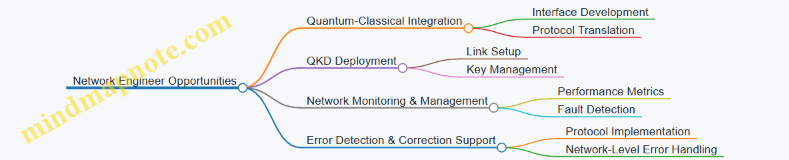
Opportunities for Quantum Researchers
Quantum Researchers are essential for advancing the theoretical foundations and practical protocols that make quantum networking viable.
- Protocol Innovation: Designing new quantum communication protocols optimized for real-world constraints.
- Quantum Hardware Development: Creating more reliable quantum memories, repeaters, and photon sources.
- Error Correction Research: Developing scalable quantum error correction codes tailored for networks.
- Simulation and Modeling: Building accurate models and simulators to predict network behavior.
Example: A researcher develops an improved entanglement swapping protocol that reduces latency in quantum repeaters, then validates it through simulation and experimental collaboration.
Mind Map: Quantum Researcher Opportunities
Opportunities for Systems Architects
Systems Architects will design the overarching frameworks that integrate quantum technologies into scalable, interoperable networks.
- Architectural Frameworks: Defining layered models that support quantum and classical coexistence.
- Standardization Efforts: Leading or contributing to the development of quantum network standards.
- Scalability Planning: Creating strategies for incremental network growth and resource allocation.
- Security Architecture: Designing multi-layered security frameworks that leverage quantum advantages.
Example: A systems architect designs a modular quantum network architecture for a university campus, enabling phased deployment and easy integration with existing IT infrastructure.
Mind Map: Systems Architect Opportunities
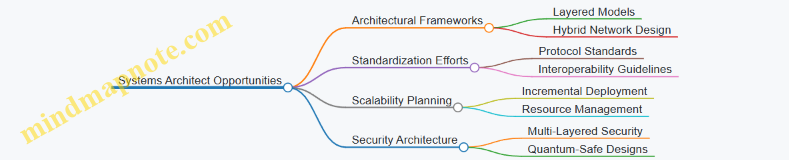
Cross-Disciplinary Collaboration
The quantum internet demands collaboration across these roles. For instance, network engineers rely on researchers’ protocols, while architects ensure the system is scalable and secure.
Mind Map: Collaborative Opportunities
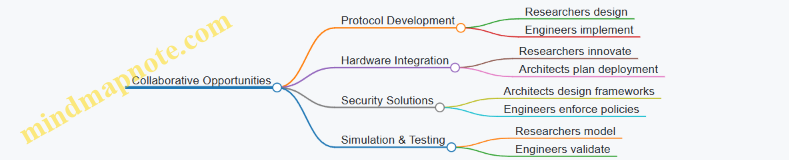
Summary
The quantum internet is a fertile ground for innovation and professional growth. By embracing these opportunities, network engineers, quantum researchers, and systems architects can shape the future of secure, scalable, and efficient quantum communications.
Additional Resources:
- Quantum Internet Alliance: https://quantum-internet.team/
- Qiskit Quantum Network Tutorials: https://qiskit.org/documentation/
- IEEE Quantum Initiative: https://quantum.ieee.org/
12.4 Practical Example: Building a Quantum Networking Skill Development Plan
Building expertise in quantum networking requires a structured approach that balances foundational knowledge, hands-on experience, and continuous learning. This section guides you through creating a personalized skill development plan, supported by mind maps and practical examples.
Step 1: Assess Your Current Skill Level
- Evaluate your understanding of classical networking concepts.
- Gauge your familiarity with quantum mechanics basics.
- Identify gaps in knowledge related to quantum communication protocols and hardware.
Example:
| Skill Area | Beginner | Intermediate | Advanced |
|---|---|---|---|
| Classical Networking | ✔️ | ||
| Quantum Mechanics | ✔️ | ||
| Quantum Protocols | |||
| Quantum Hardware |
Step 2: Define Learning Objectives
- Master fundamental quantum mechanics relevant to networking.
- Understand quantum communication protocols (e.g., QKD, teleportation).
- Gain practical experience with quantum hardware and simulators.
- Learn to design and analyze quantum network architectures.
Step 3: Create a Learning Roadmap
Quantum Networking Skill Development Mind Map
Step 4: Select Learning Resources
- Books:
- “Quantum Computation and Quantum Information” by Nielsen & Chuang
- “Quantum Networking” by Rodney Van Meter
- Online Courses:
- Quantum Networking courses on Coursera and edX
- Tutorials from Qiskit and QuTech
- Simulators:
- NetSquid: https://netsquid.org
- QuNetSim: https://qunetsim.readthedocs.io
- Communities:
- Quantum Internet Alliance
- IEEE Quantum Initiative
Step 5: Hands-On Practice and Projects
Example Project 1: Simulating BB84 Protocol
- Use QuNetSim to simulate quantum key distribution.
- Analyze key generation rate and error rates.
Example Project 2: Building a Quantum Teleportation Circuit
- Use IBM Quantum Experience to implement teleportation.
- Understand the role of entanglement and classical communication.
Example Project 3: Designing a Small Quantum Network Architecture
- Draft a network diagram integrating quantum repeaters and classical nodes.
- Simulate network behavior under different noise conditions.
Step 6: Evaluate Progress and Iterate
- Regularly test your knowledge through quizzes and practical exercises.
- Participate in hackathons or collaborative projects.
- Update your roadmap based on emerging technologies and personal interests.
Summary Mind Map: Quantum Networking Skill Development Plan
By following this structured plan, network engineers, quantum researchers, and system architects can systematically build the expertise needed to contribute effectively to the evolving field of quantum networking and the future quantum internet.
12.5 Final Recommendations and Resources for Continued Learning
As quantum networking continues to evolve rapidly, staying informed and continuously developing your skills is essential. This section provides actionable recommendations and curated resources to help network engineers, quantum researchers, and systems architects deepen their expertise and contribute effectively to the future Quantum Internet.
Final Recommendations
Build a Strong Foundation in Quantum Mechanics and Networking Principles
- Understand core quantum concepts such as superposition, entanglement, and quantum measurement.
- Familiarize yourself with classical networking fundamentals to appreciate hybrid quantum-classical architectures.
Engage with Hands-On Quantum Networking Tools
- Experiment with open-source quantum simulators like QuNetSim and NetSquid.
- Set up small-scale QKD experiments using available toolkits or cloud-based quantum platforms.
Follow Emerging Standards and Protocol Developments
- Keep track of organizations like the Quantum Internet Alliance (QIA) and IEEE Quantum Initiative.
- Participate in standardization discussions to align your designs with future-proof protocols.
Collaborate Across Disciplines
- Work closely with physicists, cryptographers, and software developers to build comprehensive solutions.
- Join quantum networking forums, workshops, and conferences to exchange knowledge.
Prioritize Security and Error Management
- Implement multi-layered security frameworks integrating quantum-safe cryptography.
- Develop expertise in quantum error correction and noise mitigation techniques.
Plan for Scalability and Integration
- Design modular network architectures that can evolve with technology advances.
- Explore hybrid quantum-classical network models to maximize current infrastructure use.
Mind Maps
Mind Map 1: Quantum Networking Skill Development
Mind Map 2: Recommended Learning Resources
Mind Map 3: Practical Steps to Stay Updated
Practical Examples
Example 1: Building a Quantum Networking Skill Development Plan
- Month 1-2: Study quantum mechanics basics and classical networking fundamentals.
- Month 3-4: Complete an online course on quantum communication protocols.
- Month 5: Experiment with QuNetSim to simulate simple QKD protocols.
- Month 6: Join a quantum networking community and attend a webinar.
- Month 7-8: Explore hardware integration concepts and review recent research papers.
- Month 9: Implement a small-scale quantum teleportation simulation.
- Month 10: Engage in collaborative projects or contribute to open-source quantum networking tools.
Example 2: Utilizing Resources for a Research Project
- Use NetSquid to model a quantum repeater chain.
- Reference Nielsen & Chuang for theoretical underpinnings.
- Follow updates from the Quantum Internet Alliance to align with current standards.
- Present findings at a quantum networking workshop to receive feedback.
By following these recommendations and leveraging the resources and mind maps provided, professionals can confidently navigate the evolving landscape of quantum networking and actively contribute to the realization of the Quantum Internet.