Solid-State Battery Materials & Cell Engineering
1. Introduction to Solid-State Batteries
1.1 Overview of Solid-State Battery Technology
Solid-state batteries (SSBs) represent a transformative advancement in energy storage technology, replacing the conventional liquid or gel electrolytes found in traditional lithium-ion batteries with solid electrolytes. This fundamental change offers the potential for higher energy density, improved safety, and longer cycle life, making SSBs highly attractive for applications such as electric vehicles (EVs), portable electronics, and grid storage.
What is a Solid-State Battery?
A solid-state battery consists of three primary components:
- Anode: Typically lithium metal or alternative materials.
- Solid Electrolyte: A solid ionic conductor that replaces liquid electrolytes.
- Cathode: Usually a lithium metal oxide or other compatible cathode material.
Unlike traditional batteries, the solid electrolyte physically separates the anode and cathode, eliminating leakage and reducing flammability risks.
Mind Map: Core Components of Solid-State Batteries
Key Advantages of Solid-State Batteries
- Enhanced Safety: Solid electrolytes are non-flammable, reducing risks of thermal runaway.
- Higher Energy Density: Lithium metal anodes enable greater capacity.
- Longer Cycle Life: Reduced dendrite formation and stable interfaces.
- Wide Operating Temperature Range: Solid electrolytes maintain conductivity across broader temperatures.
Example: Toyota’s Solid-State Battery Development
Toyota has been pioneering SSB technology aiming to commercialize it in EVs by the mid-2020s. Their approach focuses on sulfide-based solid electrolytes combined with lithium metal anodes, targeting a significant increase in driving range and faster charging times compared to current lithium-ion batteries.
Challenges in Solid-State Battery Technology
- Interface Stability: Achieving intimate contact between solid electrolyte and electrodes to minimize resistance.
- Mechanical Brittleness: Many solid electrolytes are fragile, complicating manufacturing and cycling.
- Ionic Conductivity: Solid electrolytes generally have lower ionic conductivity than liquid counterparts.
- Scalability and Cost: Manufacturing processes are still evolving for mass production.
Mind Map: Challenges in Solid-State Battery Development
Example: Interface Engineering in SSBs
Researchers at MIT developed a thin interlayer coating between the solid electrolyte and lithium metal anode to suppress dendrite growth and improve interface stability. This approach demonstrated improved cycling stability over 500 cycles in lab-scale cells.
Summary
Solid-state battery technology is poised to revolutionize energy storage by addressing critical limitations of conventional lithium-ion batteries. Understanding the core components, advantages, and challenges is essential for battery scientists, EV powertrain engineers, and materials researchers aiming to contribute to this rapidly evolving field.
Further Reading
- Janek, J., & Zeier, W. G. (2016). A solid future for battery development. Nature Energy, 1(9), 16141.
- Famprikis, T., Canepa, P., Dawson, J. A., Islam, M. S., & Masquelier, C. (2019). Fundamentals of inorganic solid-state electrolytes for batteries. Nature Materials, 18(12), 1278-1291.
1.2 Advantages Over Conventional Lithium-Ion Batteries
Solid-state batteries (SSBs) represent a transformative leap beyond conventional lithium-ion batteries (LIBs) by replacing the liquid electrolyte with a solid electrolyte. This fundamental change brings a host of advantages that address many limitations of traditional LIBs, making SSBs highly attractive for applications such as electric vehicles (EVs), grid storage, and portable electronics.
Key Advantages of Solid-State Batteries
Enhanced Safety
One of the most critical advantages of SSBs is their improved safety profile. Conventional LIBs use liquid organic electrolytes that are flammable and prone to leakage, which can lead to thermal runaway and fires.
Example: Toyota’s solid-state battery prototypes utilize sulfide-based solid electrolytes that are non-flammable, significantly reducing fire hazards in EVs. This safety improvement is a key driver behind automotive industry interest.
Safety Advantages Mind Map
Higher Energy Density
SSBs enable the use of lithium metal anodes, which have a theoretical capacity (~3860 mAh/g) much higher than graphite (~372 mAh/g) used in LIBs. This translates to batteries with significantly higher energy density.
Example: QuantumScape reported solid-state cells with energy densities exceeding 400 Wh/kg, compared to ~250-300 Wh/kg for current LIBs, potentially extending EV driving range.
Energy Density Advantages Mind Map
Improved Cycle Life
The solid electrolyte in SSBs suppresses dendrite growth, a major cause of short circuits and capacity fade in LIBs. This leads to longer battery lifetimes and more stable cycling.
Example: Solid Power demonstrated cells with over 500 charge-discharge cycles maintaining >80% capacity retention, outperforming many conventional LIBs.
Cycle Life Advantages Mind Map
Wider Operating Temperature Range
Solid electrolytes typically exhibit better thermal stability and maintain ionic conductivity over a broader temperature range compared to liquid electrolytes.
Example: Ceramic electrolytes like garnet-type Li7La3Zr2O12 (LLZO) maintain conductivity at temperatures from -20°C to 100°C, enabling battery operation in harsh environments.
Temperature Range Advantages Mind Map
Mechanical Robustness
The solid electrolyte acts as a mechanical barrier that can suppress volume changes and provide structural support to electrodes, improving overall cell durability.
Example: Polymer-ceramic composite electrolytes provide flexibility and mechanical strength, reducing electrode cracking during cycling.
Mechanical Robustness Mind Map
Simplified Packaging
SSBs do not require complex sealing to contain liquid electrolytes, reducing packaging complexity and potential failure points.
Example: Solid-state pouch cells have simpler sealing requirements, lowering manufacturing costs and improving reliability.
Packaging Advantages Mind Map
Summary Table of Advantages with Examples
| Advantage | Description | Example |
|---|---|---|
| Enhanced Safety | Non-flammable solid electrolytes | Toyota’s sulfide-based SSB prototypes |
| Higher Energy Density | Lithium metal anode, thin electrolytes | QuantumScape’s >400 Wh/kg cells |
| Improved Cycle Life | Dendrite suppression, stable interfaces | Solid Power’s 500+ cycle cells |
| Wider Temp. Range | Thermal stability and conductivity | LLZO ceramic electrolytes |
| Mechanical Robustness | Structural support, volume change mitigation | Polymer-ceramic composite electrolytes |
| Simplified Packaging | Reduced sealing and leakage risks | Solid-state pouch cells |
By understanding these advantages and their practical implementations, battery scientists, EV powertrain engineers, and materials researchers can better appreciate the transformative potential of solid-state batteries in next-generation energy storage solutions.
1.3 Key Challenges in Solid-State Battery Development
Solid-state batteries (SSBs) promise significant improvements over traditional lithium-ion batteries, including higher energy density, improved safety, and longer cycle life. However, their development faces several critical challenges that must be addressed to realize their full potential. This section explores these challenges in detail, supported by mind maps and practical examples to illustrate each point.
Ionic Conductivity of Solid Electrolytes
One of the foremost challenges is achieving high ionic conductivity in solid electrolytes at room temperature comparable to liquid electrolytes (~10^-3 S/cm). Many solid electrolytes suffer from lower conductivity, which limits battery performance.
-
Example: Sulfide-based electrolytes like Li10GeP2S12 (LGPS) exhibit high ionic conductivity (~10^-2 S/cm) but are sensitive to moisture and have stability issues.
-
Mind Map:
Interface Stability and Compatibility
Interfaces between the solid electrolyte and electrodes (both cathode and anode) are prone to chemical and mechanical instability, leading to increased interfacial resistance and capacity fade.
-
Example: Lithium metal anodes react with many sulfide electrolytes forming resistive interphases, reducing cycle life.
-
Mind Map:
Mechanical and Structural Integrity
Solid electrolytes must maintain mechanical integrity under cycling stresses and stack pressure. Cracking or delamination can cause loss of contact and battery failure.
-
Example: Ceramic oxide electrolytes like garnet-type LLZO are brittle and prone to cracking during fabrication or cycling.
-
Mind Map:
Dendrite Formation and Suppression
Lithium dendrites can penetrate solid electrolytes, causing short circuits and safety hazards. Preventing dendrite growth is critical for lithium metal anode SSBs.
-
Example: Despite high shear modulus, some solid electrolytes still allow dendrite penetration due to defects or grain boundaries.
-
Mind Map:
Fabrication and Scalability
Manufacturing solid-state batteries with consistent quality and at scale remains difficult due to complex processing steps like electrolyte densification and interface engineering.
-
Example: Tape casting and sintering processes for oxide electrolytes require high temperatures, increasing cost and complexity.
-
Mind Map:
Cost and Material Availability
Many promising solid electrolyte materials contain rare or expensive elements (e.g., germanium in LGPS), impacting commercial viability.
-
Example: Research into sulfide electrolytes aims to reduce reliance on germanium by substituting with cheaper elements like tin.
-
Mind Map:
Summary Mind Map of Key Challenges
Addressing these challenges requires interdisciplinary collaboration between materials scientists, electrochemists, and engineers. By combining advances in materials design, interface engineering, and scalable manufacturing, the path toward commercially viable solid-state batteries becomes clearer.
1.4 Industry Trends and Market Outlook
Solid-state batteries (SSBs) are rapidly gaining traction as the next frontier in energy storage technology, driven by their potential to deliver higher energy density, improved safety, and longer cycle life compared to conventional lithium-ion batteries. This section explores the current industry trends, market dynamics, and future outlook, supported by mind maps and real-world examples to provide clarity.
Industry Trends Mind Map
Market Outlook Mind Map
Detailed Analysis
1. Materials Innovation:
The industry is witnessing significant breakthroughs in electrolyte materials. For example, sulfide-based electrolytes like Li10GeP2S12 (LGPS) offer high ionic conductivity (~10^-2 S/cm) but face moisture sensitivity challenges. Oxide electrolytes such as garnet-type Li7La3Zr2O12 (LLZO) provide better chemical stability but require high-temperature sintering.
Example: Toyota’s partnership with Panasonic focuses on oxide-based solid electrolytes aiming for automotive-grade durability.
2. Manufacturing Advances:
Scaling fabrication methods remains critical. Tape casting and lamination techniques are becoming more refined to produce dense electrolyte layers. Thin-film deposition is favored for small-scale, high-performance cells.
Example: QuantumScape utilizes thin-film deposition to create ultrathin solid electrolytes enabling fast charging in EVs.
3. Application Focus:
EVs represent the largest market driver, with companies targeting 500+ miles range and faster charging times. Consumer electronics and grid storage are secondary but growing markets.
Example: Samsung SDI is developing SSBs tailored for wearable devices, emphasizing flexibility and safety.
4. Strategic Partnerships:
Cross-industry collaborations accelerate commercialization. Automotive OEMs are partnering with startups to integrate SSBs into future EV platforms.
Example: Solid Power collaborates with Ford and BMW to co-develop solid-state cells for EVs.
5. Regulatory and Safety Standards:
New testing protocols specific to SSBs are emerging to address unique failure modes.
Example: The US Department of Energy is funding projects to establish safety benchmarks for solid-state technologies.
6. Investment and Funding:
Venture capital and government grants are fueling rapid development. For instance, QuantumScape raised over $1 billion in funding rounds.
Market Forecast Example Table
| Year | Estimated Market Size (USD Billion) | Key Milestones |
|---|---|---|
| 2025 | 1.2 | Pilot production lines established |
| 2030 | 15.5 | Commercial EV models with SSBs launched |
| 2035 | 60+ | Widespread adoption across sectors |
Summary
The solid-state battery industry is poised for transformative growth, driven by material innovations, manufacturing breakthroughs, and strategic collaborations. While challenges remain in cost and scalability, the market outlook is optimistic, with EVs leading adoption and substantial investments accelerating progress.
By understanding these trends and leveraging best practices, battery scientists, EV powertrain engineers, and materials researchers can align their efforts to capitalize on this evolving landscape.
1.5 Best Practices: Setting Realistic Performance Targets with Case Examples
Setting realistic performance targets is a critical step in solid-state battery (SSB) development, ensuring alignment between research goals, engineering capabilities, and commercial viability. Overambitious targets can lead to wasted resources, while conservative goals may limit innovation. This section outlines best practices to define achievable, yet challenging, performance metrics supported by practical examples.
Key Performance Metrics to Consider
- Energy Density (Wh/kg and Wh/L): Balancing gravimetric and volumetric energy.
- Cycle Life (Number of cycles): Maintaining capacity retention over time.
- Power Density (W/kg): Rate capability for fast charging/discharging.
- Safety and Thermal Stability: Resistance to thermal runaway and mechanical abuse.
- Cost Targets ($/kWh): Economic feasibility for scale-up.
Mind Map: Setting Realistic Performance Targets
Best Practice 1: Align Targets with End-Use Application
Example: For EV powertrains, prioritize high energy density (>350 Wh/kg) and cycle life (>1000 cycles) with fast charging capability. Grid storage may tolerate lower energy density but requires longer cycle life and lower cost.
Case: A research group developing SSBs for electric vehicles set an initial target of 400 Wh/kg and 1500 cycles. After early testing revealed interface degradation limiting cycle life to 800 cycles, they adjusted targets to 350 Wh/kg and 1000 cycles, focusing on interface engineering improvements.
Best Practice 2: Use Benchmarking to Ground Expectations
Example: Compare new solid electrolyte ionic conductivity against commercial liquid electrolytes (~10^-3 S/cm). If the solid electrolyte achieves 10^-4 S/cm, adjust power density targets accordingly.
Case: A startup developing sulfide-based solid electrolytes benchmarked their ionic conductivity at 2x10^-4 S/cm versus liquid electrolytes. They set power density targets at 70% of conventional Li-ion cells, enabling realistic performance claims.
Best Practice 3: Incorporate Material and Manufacturing Constraints Early
Example: Recognize that sintering temperatures required for oxide electrolytes may limit compatible cathode materials, affecting achievable energy density.
Case: A materials research team targeting garnet-type electrolytes initially aimed for high-density cells but found that high-temperature processing degraded cathode active materials. They revised targets to moderate energy density but improved cycle life and safety.
Mind Map: Iterative Target Refinement Process
Best Practice 4: Leverage Cross-Disciplinary Collaboration
Example: Engage battery scientists, EV powertrain engineers, and materials researchers early to balance performance, integration, and manufacturability.
Case: An industrial consortium combined expertise to set targets for a solid-state battery pack. Battery scientists focused on cell chemistry, powertrain engineers on integration and thermal management, and materials researchers on scalable electrolyte synthesis. This collaboration yielded balanced targets that were met in pilot production.
Best Practice 5: Document and Communicate Targets Transparently
Clear documentation ensures all stakeholders understand the rationale behind targets and progress.
Example: A project team maintained a shared dashboard tracking performance metrics, deviations, and updated targets, facilitating agile decision-making.
Summary
Setting realistic performance targets in solid-state battery development requires a holistic approach considering application needs, material properties, engineering constraints, and iterative feedback. Employing benchmarking, cross-disciplinary collaboration, and transparent communication ensures targets are both ambitious and achievable, accelerating technology maturation.
2. Solid Electrolyte Materials: Types and Properties
2.1 Inorganic Solid Electrolytes: Oxides, Sulfides, and Phosphates
Inorganic solid electrolytes (ISEs) are a cornerstone of solid-state battery technology due to their high ionic conductivity, mechanical robustness, and thermal stability. This section explores the three primary classes of inorganic solid electrolytes: oxides, sulfides, and phosphates. Each class offers unique advantages and challenges that influence their suitability for different battery applications.
Overview of Inorganic Solid Electrolytes
- Oxides: Known for excellent chemical stability and mechanical strength.
- Sulfides: Offer high ionic conductivity and soft mechanical properties.
- Phosphates: Emerging materials with promising conductivity and stability.
Mind Map: Classification of Inorganic Solid Electrolytes
Oxide Solid Electrolytes
Characteristics:
- High chemical and electrochemical stability
- Wide electrochemical window
- High mechanical strength
- Typically lower ionic conductivity compared to sulfides (10^-4 to 10^-3 S/cm)
Examples:
-
Garnet-type LLZO (Li7La3Zr2O12):
- Ionic conductivity ~10^-3 S/cm at room temperature
- Stable against lithium metal anode
- Challenges: Grain boundary resistance, densification during fabrication
-
Perovskite-type LLTO (Li0.33La0.56TiO3):
- High ionic conductivity (~10^-3 S/cm)
- Sensitive to moisture and unstable against lithium metal
-
NASICON-type (Li1.3Al0.3Ti1.7(PO4)3):
- Moderate ionic conductivity (~10^-4 S/cm)
- Good chemical stability
Best Practice Example:
- Densification of LLZO via hot pressing to reduce grain boundary resistance.
- Example: Researchers improved LLZO conductivity by optimizing sintering temperature and atmosphere, achieving >10^-3 S/cm with reduced interfacial resistance.
Mind Map: Oxide Electrolytes - Key Properties and Challenges
Sulfide Solid Electrolytes
Characteristics:
- Very high ionic conductivity (up to 10^-2 S/cm)
- Soft and deformable, enabling good contact with electrodes
- Lower electrochemical stability window compared to oxides
- Sensitive to moisture, releasing H2S gas
Examples:
-
LGPS (Li10GeP2S12):
- Ionic conductivity ~10^-2 S/cm at room temperature
- Soft mechanical properties facilitate interface contact
- Challenges: Expensive Ge content, moisture sensitivity
-
Argyrodite (Li6PS5Cl):
- Ionic conductivity ~10^-3 to 10^-2 S/cm
- Better stability and easier synthesis compared to LGPS
Best Practice Example:
- Handling sulfide electrolytes in dry rooms or inert atmospheres to prevent H2S formation.
- Example: A battery developer implemented glovebox processing and moisture control, significantly improving cell lifetime and safety.
Mind Map: Sulfide Electrolytes - Advantages and Handling
Phosphate Solid Electrolytes
Characteristics:
- Typically NASICON-type structures
- Moderate ionic conductivity (~10^-4 to 10^-3 S/cm)
- Good chemical and thermal stability
- Emerging materials with potential for improved performance
Examples:
-
Li1.3Al0.3Ti1.7(PO4)3 (LATP):
- Ionic conductivity ~10^-4 S/cm
- Sensitive to lithium metal, requiring interface engineering
-
LiTi2(PO4)3:
- Stable and low cost
- Lower conductivity compared to sulfides and garnets
Best Practice Example:
- Applying protective interlayers to improve lithium metal compatibility.
- Example: Use of thin polymer or oxide coatings on LATP to prevent reduction and enhance cycle life.
Mind Map: Phosphate Electrolytes - Emerging Opportunities
Summary Table: Comparison of Inorganic Solid Electrolytes
| Electrolyte Type | Ionic Conductivity (S/cm) | Mechanical Properties | Stability | Key Challenges | Typical Applications |
|---|---|---|---|---|---|
| Oxides (LLZO, LLTO) | 1x10^-4 to 1x10^-3 | Hard, brittle | High chemical & thermal | Grain boundary resistance, densification | High-voltage cathodes, lithium metal anodes |
| Sulfides (LGPS, Argyrodite) | Up to 1x10^-2 | Soft, deformable | Moderate, moisture sensitive | Moisture sensitivity, H2S evolution | Flexible interfaces, high conductivity needs |
| Phosphates (LATP) | 1x10^-4 to 1x10^-3 | Moderate | Good chemical stability | Lithium metal interface instability | Emerging solid electrolytes, safer alternatives |
Integrated Best Practices for Inorganic Solid Electrolytes
- Material Selection: Match electrolyte type to battery application considering ionic conductivity, mechanical properties, and chemical stability.
- Interface Engineering: Use coatings or interlayers to stabilize interfaces, especially for lithium metal anodes.
- Fabrication Control: Optimize sintering and processing conditions to reduce grain boundary resistance in oxides.
- Environmental Handling: Employ moisture-controlled environments for sulfide electrolytes to avoid degradation and safety hazards.
Real-World Example: LLZO Garnet Electrolyte Optimization
A research group improved LLZO conductivity by doping with Al and optimizing sintering under oxygen atmosphere. They applied hot pressing to reduce porosity and grain boundary resistance, achieving a total ionic conductivity of 1.2x10^-3 S/cm. This resulted in stable cycling with lithium metal anodes over 500 cycles at room temperature, demonstrating the importance of processing and doping strategies.
Real-World Example: Sulfide Electrolyte Moisture Management
An EV battery manufacturer implemented a fully inert atmosphere production line for sulfide electrolyte handling. By maintaining <1 ppm moisture levels, they prevented H2S formation and improved cell safety and longevity. This practice enabled the commercial deployment of sulfide-based solid-state batteries with high energy density and stable cycling.
Through understanding the properties, challenges, and best practices associated with oxides, sulfides, and phosphates, battery scientists and engineers can make informed decisions to optimize solid-state battery performance and reliability.
2.2 Polymer-Based Solid Electrolytes and Their Composites
Polymer-based solid electrolytes (PSEs) have emerged as promising candidates for solid-state batteries due to their inherent flexibility, ease of processing, and good interfacial contact with electrodes. Unlike inorganic electrolytes, polymers offer mechanical compliance that can accommodate volume changes during battery cycling, which is critical for maintaining interface stability.
Key Polymer Electrolyte Types
- Polyethylene oxide (PEO): The most widely studied polymer electrolyte, known for its ability to solvate lithium salts and form ion-conducting pathways.
- Polyvinylidene fluoride (PVDF) and PVDF-HFP: Often used as binders or matrix polymers due to their chemical stability and mechanical strength.
- Polyacrylonitrile (PAN): Offers good electrochemical stability and mechanical properties.
Advantages of Polymer Electrolytes
- Flexibility and mechanical robustness
- Good electrode-electrolyte interfacial contact
- Potential for low-cost and scalable fabrication
Challenges
- Lower ionic conductivity at room temperature compared to inorganic electrolytes
- Limited electrochemical stability window
- Mechanical strength trade-offs when increasing conductivity
Mind Map: Polymer-Based Solid Electrolytes Overview
Polymer Electrolyte Composites
To overcome the limitations of pure polymer electrolytes, composites are formed by incorporating inorganic fillers or ceramic particles into the polymer matrix. These composites combine the mechanical flexibility of polymers with the high ionic conductivity and stability of inorganic materials.
Common Fillers:
- Ceramic nanoparticles: such as Li7La3Zr2O12 (LLZO), Li1.3Al0.3Ti1.7(PO4)3 (LATP), or SiO2
- Plasticizers: low molecular weight solvents or ionic liquids to enhance segmental motion
Benefits of Composites:
- Enhanced ionic conductivity through continuous conduction pathways
- Improved mechanical strength and dendrite suppression
- Increased electrochemical stability window
Mind Map: Polymer Composite Electrolytes
Best Practice Example: PEO-LLZO Composite Electrolyte
A widely adopted approach is dispersing LLZO ceramic nanoparticles into a PEO matrix doped with lithium bis(trifluoromethanesulfonyl)imide (LiTFSI) salt. This composite electrolyte demonstrates:
- Room temperature ionic conductivity improvements from ~10^-7 S/cm (pure PEO) to ~10^-5 S/cm
- Enhanced mechanical strength that suppresses lithium dendrite growth
- Stable cycling performance in lithium metal batteries
Example:
In a study by Xie et al. (2021), a PEO-LLZO composite with 10 wt% LLZO showed a 30x increase in ionic conductivity at 30°C compared to pure PEO. The composite also maintained stable cycling over 200 cycles at 0.2 mA/cm² with minimal capacity fade.
Example: PVDF-HFP Based Composite Electrolytes
PVDF-HFP combined with ceramic fillers such as SiO2 or LATP can form gel polymer electrolytes with enhanced ionic conductivity and mechanical properties. The fluorinated polymer backbone provides chemical stability, while the fillers create percolation pathways for lithium ions.
Case Study:
Zhang et al. (2020) fabricated a PVDF-HFP/SiO2 composite electrolyte that exhibited an ionic conductivity of 1.2 × 10^-4 S/cm at room temperature and demonstrated excellent interfacial stability with lithium metal anodes, resulting in over 300 stable cycles in symmetric cells.
Practical Tips for Polymer Composite Electrolyte Development
- Optimize filler content: Excessive filler loading can cause particle agglomeration and reduce conductivity.
- Ensure uniform dispersion: Use sonication or ball milling to achieve homogeneous filler distribution.
- Balance mechanical and ionic properties: Tailor polymer molecular weight and crosslinking density.
- Control salt concentration: To maximize ion dissociation without compromising mechanical integrity.
Mind Map: Best Practices for Polymer Composite Electrolytes
Summary
Polymer-based solid electrolytes and their composites represent a versatile and promising class of materials for solid-state batteries. By intelligently combining polymers with inorganic fillers, researchers can tailor ionic conductivity, mechanical properties, and electrochemical stability to meet the demanding requirements of next-generation energy storage devices. Practical examples such as PEO-LLZO and PVDF-HFP/SiO2 composites illustrate how these materials can be engineered for enhanced battery performance.
2.3 Hybrid Electrolytes: Combining Polymers and Ceramics
Hybrid electrolytes represent a promising approach to leverage the complementary advantages of polymer and ceramic solid electrolytes in solid-state batteries. By integrating polymer matrices with ceramic fillers, hybrid electrolytes aim to achieve high ionic conductivity, mechanical flexibility, and enhanced interfacial stability.
What Are Hybrid Electrolytes?
Hybrid electrolytes are composite materials where ceramic particles are dispersed within a polymer electrolyte matrix. This combination seeks to overcome the limitations of each individual component:
- Polymers: Offer flexibility, ease of processing, and good interfacial contact with electrodes but generally have lower ionic conductivity and limited electrochemical stability.
- Ceramics: Provide high ionic conductivity and excellent electrochemical stability but are brittle and difficult to process.
Key Benefits of Hybrid Electrolytes
- Enhanced Ionic Conductivity: Ceramic fillers create continuous ion-conducting pathways, improving overall conductivity.
- Mechanical Reinforcement: Ceramics increase the mechanical strength and suppress dendrite growth.
- Improved Electrochemical Stability: The ceramic phase can stabilize the polymer against decomposition.
- Better Electrode-Electrolyte Interface: Polymer matrix ensures good contact and flexibility.
Mind Map: Components and Advantages of Hybrid Electrolytes
Types of Polymer Matrices Used
- Polyethylene oxide (PEO): Widely used due to its ability to solvate lithium salts and flexibility.
- Polyvinylidene fluoride (PVDF): Chemically stable and good mechanical properties.
- Polyacrylonitrile (PAN): Good electrochemical stability and mechanical strength.
Common Ceramic Fillers
- Lithium Lanthanum Zirconium Oxide (LLZO): Garnet-type, high ionic conductivity (~10^-3 S/cm).
- Lithium Aluminum Titanium Phosphate (LATP): NASICON-type, good conductivity but moisture sensitive.
- Lithium Aluminum Germanium Phosphate (LAGP): NASICON-type, stable and conductive.
Best Practices in Designing Hybrid Electrolytes
-
Optimizing Filler Content: Typically 10-30 wt% ceramic fillers balance conductivity and mechanical properties.
-
Surface Modification of Fillers: Coating ceramic particles with polymers or functional groups improves dispersion and interfacial compatibility.
-
Controlling Particle Size and Distribution: Nanosized fillers provide more interface area and better conductivity pathways.
-
Crosslinking Polymer Matrix: Enhances mechanical strength and thermal stability.
-
Ensuring Uniform Dispersion: Prevents agglomeration that can reduce ionic pathways.
Example: PEO-LLZO Hybrid Electrolyte
- Composition: PEO polymer matrix with 20 wt% LLZO nanoparticles.
- Result: Ionic conductivity increased from ~10^-6 S/cm (pure PEO) to ~10^-4 S/cm at room temperature.
- Benefit: Improved mechanical strength and suppression of lithium dendrite growth.
Mind Map: Best Practices for Hybrid Electrolyte Design
Example: PVDF-LATP Composite Electrolyte
- Approach: LATP ceramic particles dispersed in PVDF polymer matrix.
- Outcome: Enhanced ionic conductivity (~10^-4 S/cm) and improved electrochemical stability window.
- Application: Suitable for high-voltage cathodes due to LATP’s stability.
Challenges and Considerations
- Interfacial Resistance: Ceramic-polymer interfaces can introduce resistance; surface engineering is critical.
- Moisture Sensitivity: Some ceramics like LATP degrade in moisture; processing under controlled atmosphere is needed.
- Mechanical Mismatch: Differences in thermal expansion can cause cracks.
Summary
Hybrid electrolytes combining polymers and ceramics provide a balanced approach to achieving high ionic conductivity, mechanical robustness, and interface compatibility in solid-state batteries. Through careful material selection, surface engineering, and processing optimization, these composites can be tailored for specific battery applications, including EV powertrains and high-energy storage systems.
References and Further Reading
- Zhang, Z. et al., “Hybrid Polymer-Ceramic Electrolytes for Solid-State Lithium Batteries,” Advanced Energy Materials, 2021.
- Wang, C. et al., “Enhancing Ionic Conductivity in PEO-Based Composite Electrolytes,” Journal of Power Sources, 2020.
- Mind Map Tools: Mindmap
2.4 Ionic Conductivity and Mechanical Stability Trade-offs
Solid-state electrolytes (SSEs) are pivotal components in solid-state batteries, offering the promise of enhanced safety and energy density. However, a fundamental challenge in their development lies in balancing ionic conductivity and mechanical stability. This section explores this trade-off in detail, supported by illustrative mind maps and practical examples.
Understanding Ionic Conductivity
Ionic conductivity (σ) measures how easily ions move through the electrolyte. High ionic conductivity is essential for fast charge/discharge rates and efficient battery performance.
- Typical target: >10⁻ S/cm at room temperature
- Influenced by:
- Crystal structure and pathways
- Defects and doping
- Temperature
Understanding Mechanical Stability
Mechanical stability ensures the electrolyte can withstand stresses during battery operation, including volume changes, stack pressure, and thermal cycling.
- Prevents cracking and dendrite penetration
- Maintains interface integrity
- Influenced by:
- Material stiffness (Young’s modulus)
- Fracture toughness
- Microstructure and grain boundaries
The Trade-off Explained
| Property | High Ionic Conductivity Materials | High Mechanical Stability Materials |
|---|---|---|
| Typical Materials | Sulfides (e.g., Li⁰.33La⁰.56TiO) | Oxides (e.g., LLZO - Li⁷LaZrOⁱ) |
| Ionic Conductivity | ~10⁻ to 10⁻ S/cm | ~10⁻⁴ to 10⁻ S/cm |
| Mechanical Modulus | Low to moderate (soft, prone to deformation) | High (rigid, brittle) |
| Stability | Sensitive to moisture and air | Chemically stable but prone to cracking |
Challenge: Materials with very high ionic conductivity often have lower mechanical strength, making them susceptible to dendrite penetration or mechanical failure. Conversely, mechanically robust materials tend to have lower ionic conductivity, limiting battery performance.
Mind Map: Ionic Conductivity vs Mechanical Stability Trade-offs
Practical Examples
Example 1: Sulfide Electrolytes (Li
tiophosphates)
- Material: Li⁷PSⁱⁱ (LPS)
- Ionic Conductivity: ~10⁻ S/cm
- Mechanical Properties: Soft, low Young’s modulus (~10 GPa)
- Trade-off: High ionic conductivity enables excellent rate performance, but mechanical softness requires careful cell design to prevent dendrite growth.
- Best Practice: Use of external stack pressure and protective interlayers to maintain interface contact and suppress dendrites.
Example 2: Oxide Electrolytes (LLZO)
- Material: Li⁷LaZrOⁱ (LLZO)
- Ionic Conductivity: ~10⁻⁴ S/cm
- Mechanical Properties: High stiffness (~100 GPa), brittle
- Trade-off: Excellent chemical stability and mechanical robustness, but lower ionic conductivity and processing challenges due to brittleness.
- Best Practice: Grain boundary engineering and doping (e.g., Al, Ta) to enhance conductivity while maintaining mechanical integrity.
Example 3: Polymer Electrolytes
- Material: Polyethylene oxide (PEO) based electrolytes
- Ionic Conductivity: ~10⁻⁶ to 10⁻⁵ S/cm at room temperature (improves at elevated temperatures)
- Mechanical Properties: Flexible and compliant
- Trade-off: Low ionic conductivity limits power density, but excellent mechanical compliance helps accommodate volume changes.
- Best Practice: Composite polymer-ceramic electrolytes to improve conductivity and mechanical strength simultaneously.
Strategies to Balance Ionic Conductivity and Mechanical Stability
-
Composite Electrolytes: Combining soft polymers with rigid ceramic particles to synergistically improve conductivity and mechanical strength.
-
Doping and Defect Engineering: Introducing dopants to increase ionic pathways without compromising mechanical properties.
-
Microstructure Control: Optimizing grain size and boundary characteristics to reduce resistance and enhance toughness.
-
Interface Engineering: Applying buffer layers or coatings to mitigate mechanical mismatch and enhance interfacial ion transport.
Mind Map: Strategies to Optimize Trade-offs
Summary
Balancing ionic conductivity and mechanical stability remains a core challenge in solid-state battery electrolyte development. Understanding the intrinsic properties of different material classes and employing engineering strategies such as composites, doping, and interface design are essential best practices. These approaches enable the design of electrolytes that meet both performance and durability requirements for next-generation solid-state batteries.
2.5 Best Practices: Selecting Electrolytes Based on Application Needs with Practical Examples
Selecting the right solid electrolyte is a critical step in designing high-performance solid-state batteries (SSBs). The choice depends heavily on the specific application requirements such as energy density, power output, operating temperature, mechanical flexibility, and safety considerations. This section outlines best practices for electrolyte selection, supported by practical examples and mind maps to guide decision-making.
Key Factors in Electrolyte Selection
- Ionic Conductivity: High ionic conductivity at operating temperature ensures efficient ion transport.
- Electrochemical Stability Window: Compatibility with electrode materials to avoid decomposition.
- Mechanical Properties: Ability to suppress dendrites and maintain interface integrity.
- Chemical Compatibility: Stability against moisture, air, and electrode materials.
- Processability: Ease of fabrication and integration into cell architecture.
- Operating Temperature Range: Suitability for intended thermal environment.
Mind Map: Electrolyte Selection Criteria
Practical Examples of Electrolyte Selection
Example 1: High-Power EV Battery
- Application Needs: High ionic conductivity, wide electrochemical stability, mechanical robustness to suppress dendrites, and thermal stability.
- Selected Electrolyte: Sulfide-based solid electrolytes (e.g., Li10GeP2S12 - LGPS).
- Rationale: LGPS offers ionic conductivity >10^-3 S/cm at room temperature, good interface contact due to softness, and a wide electrochemical window suitable for high-voltage cathodes.
- Best Practice: Incorporate thin interfacial coatings (e.g., LiNbO3) to improve chemical stability and suppress side reactions.
Example 2: Flexible Wearable Devices
- Application Needs: Mechanical flexibility, moderate ionic conductivity, low-temperature operation.
- Selected Electrolyte: Polymer-based electrolytes such as polyethylene oxide (PEO) doped with lithium salts.
- Rationale: PEO-based electrolytes are flexible and can be processed into thin films, although ionic conductivity is moderate (~10^-5 to 10^-4 S/cm) at room temperature.
- Best Practice: Use composite electrolytes by adding ceramic fillers (e.g., LLZO nanoparticles) to enhance conductivity and mechanical strength.
Example 3: Grid-Scale Energy Storage
- Application Needs: Cost-effectiveness, chemical stability over long cycles, moderate ionic conductivity, and wide temperature tolerance.
- Selected Electrolyte: Oxide-based electrolytes such as garnet-type Li7La3Zr2O12 (LLZO).
- Rationale: LLZO is chemically stable, non-flammable, and has good ionic conductivity (~10^-4 to 10^-3 S/cm). Its rigid structure enhances safety and longevity.
- Best Practice: Optimize sintering conditions to reduce grain boundary resistance and improve bulk conductivity.
Mind Map: Application-Driven Electrolyte Selection
Stepwise Best Practice Approach for Electrolyte Selection
- Define Application Requirements: Identify key performance metrics such as power density, cycle life, mechanical flexibility, and operating environment.
- Screen Electrolyte Candidates: Use literature data and material databases to shortlist electrolytes matching the requirements.
- Evaluate Compatibility: Analyze chemical and electrochemical compatibility with chosen electrodes.
- Prototype and Test: Fabricate small-scale cells to test ionic conductivity, interface stability, and cycling performance.
- Optimize Processing: Adjust fabrication parameters to improve electrolyte density, interface contact, and mechanical properties.
- Iterate Based on Feedback: Use electrochemical and mechanical testing results to refine electrolyte choice or modify formulations.
Summary
Selecting the appropriate solid electrolyte requires a holistic understanding of the application demands and material properties. By following a structured approach and learning from practical examples, battery scientists and engineers can tailor electrolyte choices to optimize performance, safety, and manufacturability.
References & Further Reading
- Famprikis, T., et al. “Fundamentals of inorganic solid-state electrolytes for batteries.” Nature Materials 18, 1278–1291 (2019).
- Zhang, Z., et al. “Review on solid electrolytes for all-solid-state lithium-ion batteries.” Journal of Power Sources 389, 198–213 (2018).
- Janek, J., & Zeier, W.G. “A solid future for battery development.” Nature Energy 1, 16141 (2016).
3. Cathode Materials for Solid-State Batteries
3.1 High-Voltage Layered Oxides and Their Compatibility
High-voltage layered oxides are among the most promising cathode materials for solid-state batteries (SSBs) due to their high energy density and voltage stability. These materials typically operate above 4.3 V vs. Li/Li+, enabling higher capacity and improved overall battery performance. However, their integration into solid-state battery architectures requires careful consideration of compatibility issues with solid electrolytes and cell engineering.
Overview of High-Voltage Layered Oxides
High-voltage layered oxides are lithium transition metal oxides with a layered crystal structure that facilitates lithium-ion diffusion. Common examples include:
- LiNi0.8Co0.1Mn0.1O2 (NCM811)
- LiNi0.5Mn1.5O4 (LNMO)
- LiCoO2 (LCO)
These materials offer high operating voltages (up to ~4.9 V for LNMO) and high specific capacities (160-200 mAh/g).
Compatibility Challenges
-
Electrochemical Stability Window:
- High-voltage cathodes require solid electrolytes with wide electrochemical stability to avoid oxidation.
-
Interfacial Reactions:
- Direct contact between layered oxides and sulfide or oxide electrolytes can lead to interfacial degradation, forming resistive layers.
-
Mechanical Mismatch:
- Volume changes during cycling can cause mechanical stress at the cathode-electrolyte interface, leading to cracks or delamination.
-
Transition Metal Dissolution:
- High voltages can accelerate transition metal dissolution, contaminating the electrolyte and degrading performance.
Mind Map: High-Voltage Layered Oxides Compatibility Factors
Best Practices and Examples
1. Surface Coatings to Enhance Compatibility
- Applying thin, stable coatings such as Al2O3, LiNbO3, or Li2ZrO3 on layered oxide particles can mitigate interfacial reactions.
- Example: Coating NCM811 with LiNbO3 reduced impedance growth and improved cycling stability in sulfide electrolyte-based SSBs (Zhang et al., 2021).
2. Selecting Electrolytes with Wide Stability Windows
- Oxide electrolytes like LLZO (Li7La3Zr2O12) exhibit better oxidative stability compared to sulfides, making them more compatible with high-voltage cathodes.
- Example: LNMO paired with LLZO electrolyte showed stable cycling at 4.7 V with minimal capacity fade (Wang et al., 2020).
3. Optimizing Cathode Microstructure
- Designing cathode composites with controlled particle size and porosity improves ionic and electronic pathways, reducing mechanical stress.
- Example: Using nanosized LNMO particles embedded in a polymer electrolyte matrix enhanced interfacial contact and cycling performance (Kim et al., 2019).
4. Interface Engineering via Buffer Layers
- Introducing buffer layers such as Li3PO4 or Li2CO3 at the cathode-electrolyte interface can prevent direct contact and reduce side reactions.
- Example: A thin Li3PO4 interlayer between LCO and sulfide electrolyte improved interfacial stability and rate capability (Lee et al., 2022).
Mind Map: Best Practices for High-Voltage Layered Oxides Integration
Summary
High-voltage layered oxides hold great promise for next-generation solid-state batteries, but their successful implementation hinges on overcoming compatibility challenges with solid electrolytes. Through strategic surface coatings, electrolyte selection, cathode microstructure optimization, and interface engineering, battery scientists and engineers can significantly enhance performance and longevity. Real-world examples demonstrate that these best practices are not only theoretical but have been successfully applied in lab-scale and pilot-scale SSB prototypes.
References
- Zhang, Y. et al. (2021). “LiNbO3-Coated NCM811 Cathode for Enhanced Solid-State Battery Performance.” Journal of Electrochemical Energy Conversion, 8(3), 123-134.
- Wang, H. et al. (2020). “Stable Cycling of LNMO Cathodes with LLZO Electrolyte in Solid-State Batteries.” Advanced Energy Materials, 10(15), 2000123.
- Kim, S. et al. (2019). “Nanoscale LNMO-Polymer Composite Cathodes for Solid-State Batteries.” ACS Applied Materials & Interfaces, 11(45), 42345-42353.
- Lee, J. et al. (2022). “Interfacial Buffer Layers for Improved LCO-Sulfide Electrolyte Compatibility.” Energy Storage Materials, 45, 123-131.
3.2 Conversion and Polyanionic Cathodes
Solid-state batteries (SSBs) offer a promising platform for advanced cathode materials beyond traditional layered oxides. Among these, conversion-type cathodes and polyanionic cathodes stand out due to their unique electrochemical properties and compatibility with solid electrolytes. This section explores their fundamentals, advantages, challenges, and practical examples, supported by mind maps to visualize key concepts.
Conversion Cathodes
Conversion cathodes operate via a different mechanism compared to intercalation cathodes. Instead of lithium ions inserting into a host structure, conversion cathodes undergo a full chemical transformation during charge and discharge, typically involving transition metal compounds such as metal fluorides, oxides, or sulfides.
Key Features:
- High theoretical capacities (often > 400 mAh/g)
- Multiple electron transfer per formula unit
- Potential for high energy density
Challenges:
- Large volume changes during cycling leading to mechanical stress
- Slower kinetics due to bond breaking/forming
- Interface instability with solid electrolytes
Best Practice: To mitigate volume change and improve kinetics, nanoscale engineering and composite cathode design are essential. Embedding conversion materials in conductive matrices (e.g., carbon networks) helps maintain electronic pathways.
Example: FeF3 (Iron fluoride) is a widely studied conversion cathode. When integrated with sulfide solid electrolytes, researchers have demonstrated reversible capacity around 400 mAh/g with improved cycling stability by using nanosized FeF3 particles embedded in carbon.
Mind Map: Conversion Cathodes
Polyanionic Cathodes
Polyanionic cathodes are characterized by the presence of polyanion groups such as phosphate (PO4^3-), sulfate (SO4^2-), or silicate (SiO4^4-) in their crystal structures. These groups stabilize the structure and influence the electrochemical properties.
Key Features:
- High structural stability and thermal stability
- Moderate to high operating voltages (due to inductive effects of polyanions)
- Good safety profile
Challenges:
- Generally lower electronic conductivity than layered oxides
- Moderate capacity compared to conversion cathodes
Best Practice: Enhancing electronic conductivity via carbon coating or conductive additives is critical. Additionally, optimizing particle size and morphology improves lithium diffusion kinetics.
Example: LiFePO4 (LFP) is the archetypal polyanionic cathode. In solid-state configurations, LFP combined with oxide solid electrolytes like Li7La3Zr2O12 (LLZO) has shown excellent cycling stability and safety, making it a strong candidate for EV applications.
Mind Map: Polyanionic Cathodes
Integrating Conversion and Polyanionic Cathodes in Solid-State Batteries
Interface Engineering: Both cathode types require careful interface design with solid electrolytes to minimize impedance and maintain mechanical integrity during cycling.
Composite Cathodes: Mixing active cathode materials with solid electrolytes and conductive additives creates percolation networks essential for ionic and electronic transport.
Example: A composite cathode consisting of nanoscale FeF3, sulfide solid electrolyte (Li6PS5Cl), and carbon black demonstrated improved cycling stability and rate capability by balancing ionic/electronic pathways and accommodating volume changes.
Mind Map: Composite Cathode Engineering
Summary
Conversion and polyanionic cathodes offer complementary advantages for solid-state batteries: conversion cathodes provide high capacity and energy density, while polyanionic cathodes contribute excellent stability and safety. Successful cell engineering involves nanoscale material design, interface optimization, and composite cathode fabrication to overcome intrinsic challenges.
By applying these best practices with real-world examples, battery scientists and engineers can push the boundaries of solid-state battery performance for EV powertrains and beyond.
3.3 Cathode-Electrolyte Interface Engineering
The cathode-electrolyte interface (CEI) in solid-state batteries (SSBs) plays a pivotal role in determining overall cell performance, longevity, and safety. Unlike liquid electrolyte systems, the solid-solid interface introduces unique challenges such as poor interfacial contact, chemical instability, and mechanical degradation. Effective engineering of this interface is essential to unlock the full potential of SSBs.
Key Challenges at the Cathode-Electrolyte Interface
- Interfacial Contact Loss: Due to volume changes during cycling, contact between cathode particles and solid electrolyte can degrade, increasing impedance.
- Chemical Instability: Side reactions can occur between cathode active materials and solid electrolytes, forming resistive interphases.
- Mechanical Stress: Mismatch in mechanical properties leads to cracks and delamination.
Mind Map: Challenges at the Cathode-Electrolyte Interface
Strategies for Interface Engineering
-
Surface Coatings on Cathode Particles
- Applying thin, stable layers (e.g., LiNbO3, Al2O3, Li2ZrO3) to protect cathode surfaces from direct contact with sulfide or oxide electrolytes.
- Example: Coating NMC cathodes with LiNbO3 reduces interfacial resistance and improves cycling stability.
-
Buffer Layers / Interlayers
- Introducing a thin intermediate layer between cathode and electrolyte to accommodate volume changes and prevent direct chemical reactions.
- Example: Using a polymer-based interlayer like PEO (polyethylene oxide) to enhance interface flexibility.
-
Cathode Composite Design
- Mixing cathode active materials with solid electrolyte particles to improve ionic pathways and mechanical integrity.
- Example: A composite cathode with 70% NMC, 20% sulfide electrolyte, and 10% conductive carbon.
-
Interface Densification and Pressure Application
- Applying stack pressure during cell assembly to improve contact and reduce voids.
- Example: Maintaining ~10 MPa pressure during cycling to sustain interface integrity.
-
Chemical Compatibility Optimization
- Selecting cathode and electrolyte chemistries that minimize side reactions.
- Example: Using oxide electrolytes (LLZO) with oxide cathodes to reduce interfacial degradation.
Mind Map: Interface Engineering Strategies
Detailed Examples
Example 1: LiNbO3 Coating on NMC Cathode
- Context: NMC cathodes react with sulfide electrolytes forming resistive interphases.
- Approach: Atomic layer deposition (ALD) of a thin LiNbO3 layer (~5 nm) on NMC particles.
- Outcome: Reduced interfacial impedance by 40%, enhanced capacity retention over 200 cycles.
Example 2: Polymer Interlayer to Mitigate Mechanical Stress
- Context: Rigid oxide electrolytes and cathodes cause cracking under cycling.
- Approach: Introduce a thin PEO-based polymer interlayer (~10 µm) between cathode and electrolyte.
- Outcome: Improved mechanical compliance, reduced crack formation, and improved cycle life by 25%.
Example 3: Composite Cathode with Sulfide Electrolyte
- Context: Ionic conductivity limited by poor electrolyte contact.
- Approach: Mix NMC cathode powder with sulfide electrolyte particles and conductive carbon.
- Outcome: Enhanced ionic pathways, resulting in 20% higher rate capability.
Best Practices Summary
- Always characterize the interface using techniques such as SEM, TEM, and XPS to understand morphology and chemistry.
- Optimize coating thickness to balance protection and ionic conductivity.
- Employ stack pressure during assembly and cycling to maintain intimate contact.
- Tailor cathode composite ratios to maximize ionic and electronic conduction.
- Select chemically compatible materials to minimize side reactions.
Mind Map: Best Practices for CEI Engineering
In conclusion, cathode-electrolyte interface engineering is a multidisciplinary task involving materials science, mechanical engineering, and electrochemistry. By integrating surface coatings, buffer layers, composite cathodes, and mechanical strategies, researchers and engineers can significantly enhance the performance and durability of solid-state batteries.
3.4 Impact of Particle Morphology and Coatings on Performance
The morphology of cathode particles and the application of surface coatings are critical factors influencing the electrochemical performance, stability, and longevity of solid-state batteries (SSBs). Understanding and engineering these aspects can significantly enhance ionic conductivity, reduce interfacial resistance, and mitigate degradation mechanisms.
Particle Morphology: Key Aspects
-
Particle Size and Distribution
- Smaller particles provide larger surface area for electrolyte contact, improving ionic pathways.
- However, excessively small particles can increase side reactions due to higher surface energy.
- Uniform particle size distribution ensures consistent packing density and mechanical integrity.
-
Particle Shape
- Spherical particles tend to pack more densely, reducing voids and enhancing mechanical contact.
- Irregular or plate-like particles can increase tortuosity, affecting ion transport.
-
Surface Roughness
- Rough surfaces increase effective contact area but may also promote unwanted side reactions.
-
Porosity and Agglomeration
- Controlled porosity can facilitate electrolyte infiltration.
- Agglomeration can cause inhomogeneous current distribution and mechanical stress.
Mind Map: Particle Morphology Factors
Coatings: Purpose and Types
-
Purpose of Coatings
- Protect cathode particles from direct contact with solid electrolytes, reducing interfacial side reactions.
- Enhance chemical and electrochemical stability.
- Improve mechanical integrity and adhesion at interfaces.
- Facilitate ionic conductivity across interfaces.
-
Common Coating Materials
- Oxides (e.g., Al2O3, TiO2, ZrO2)
- Phosphates (e.g., Li3PO4)
- Fluorides (e.g., LiF)
- Sulfides (e.g., Li2S)
- Conductive polymers
-
Coating Techniques
- Atomic Layer Deposition (ALD)
- Sol-gel methods
- Wet chemical coating
- Physical vapor deposition
Mind Map: Coating Characteristics
Integrated Impact on Performance
| Aspect | Effect on Performance | Example / Best Practice |
|---|---|---|
| Particle Size | Smaller size improves ionic contact but may increase side reactions | Use ~5 µm LiNi0.8Co0.1Mn0.1O2 (NCM811) particles for balanced performance [Ref: Zhang et al., 2021] |
| Particle Shape | Spherical particles enhance packing density and mechanical stability | Spherical NCM cathodes fabricated via spray drying [Example: Panasonic] |
| Surface Roughness | Increased contact area but risk of side reactions | Surface polishing combined with coatings to optimize roughness [Lab-scale example] |
| Coating Material | Al2O3 coatings reduce electrolyte decomposition and improve cycling stability | ALD-deposited Al2O3 on NCM cathodes increased cycle life by 30% [Ref: Lee et al., 2020] |
| Coating Thickness | Too thick coatings impede ionic transport; optimal thickness ~5-10 nm | Optimized TiO2 coatings via ALD for minimal resistance [Example: Samsung SDI] |
Case Study: Al2O3 Coating on NCM Cathodes
- Problem: Direct contact between NCM cathode and sulfide electrolyte causes interfacial degradation.
- Solution: Apply ultrathin Al2O3 coating (~7 nm) via ALD.
- Result: Enhanced interfacial stability, reduced impedance growth, and improved capacity retention over 200 cycles.
Best Practices Summary
- Tailor particle size to balance surface area and stability.
- Prefer spherical or near-spherical particles for better packing and mechanical contact.
- Apply ultrathin, uniform coatings to protect cathode surfaces without hindering ion transport.
- Use advanced coating techniques like ALD for precise thickness control.
- Combine morphology optimization with coatings to synergistically improve performance.
Additional Mind Map: Optimizing Particle Morphology and Coatings for SSBs
By integrating particle morphology control with advanced coating strategies, battery scientists and engineers can significantly enhance the performance and durability of solid-state batteries, paving the way for safer and higher-energy-density energy storage solutions.
3.5 Best Practices: Optimizing Cathode Microstructure with Real-World Case Studies
Optimizing the cathode microstructure is a critical step in enhancing the performance, longevity, and safety of solid-state batteries (SSBs). The microstructure influences ionic and electronic transport, mechanical integrity, and interface stability. This section explores best practices for cathode microstructure optimization, supported by real-world examples and mind maps to aid understanding.
Key Objectives in Cathode Microstructure Optimization
- Maximize ionic and electronic conductivity pathways
- Ensure mechanical robustness to withstand volume changes
- Enhance cathode-solid electrolyte interface contact
- Minimize side reactions and degradation
Mind Map: Factors Influencing Cathode Microstructure Optimization
Best Practice 1: Tailoring Particle Size Distribution
Example: A study by Kim et al. (2021) demonstrated that a bimodal particle size distribution (mixing nanosized and microsized cathode particles) improved packing density and ionic pathways in a LiNi0.8Co0.1Mn0.1O2 (NCM811) cathode composite. The nanosized particles filled voids between larger particles, enhancing contact with the solid electrolyte and improving rate capability.
Practice: Use a controlled mix of particle sizes to optimize packing density and ionic/electronic pathways.
Best Practice 2: Optimizing Porosity for Ion Transport vs. Energy Density
Example: Zhang et al. (2020) optimized porosity in LiCoO2 cathodes by adjusting the solid electrolyte content and pressing pressure. They found that moderate porosity (~30%) balanced ionic conductivity and volumetric energy density, leading to improved cycling stability.
Practice: Carefully control porosity during cathode fabrication to balance ionic transport and energy density.
Best Practice 3: Surface Coatings to Enhance Interface Stability
Example: In a commercial-scale project, Panasonic applied a thin LiNbO3 coating on NCM cathode particles. This coating reduced side reactions with sulfide solid electrolytes, improving capacity retention over 500 cycles.
Practice: Apply thin, uniform coatings to cathode particles to stabilize interfaces and suppress detrimental reactions.
Best Practice 4: Composite Cathode Architecture Design
Example: Researchers at Toyota developed a composite cathode where active material particles were homogeneously mixed with sulfide solid electrolyte and carbon additives. This architecture provided continuous ionic and electronic pathways, resulting in high rate performance and low interfacial resistance.
Practice: Design cathode composites with optimal ratios and homogeneous mixing of active material, solid electrolyte, and conductive additives.
Best Practice 5: Mechanical Integrity and Stress Management
Example: A recent study by Liu et al. (2023) used finite element modeling combined with experimental validation to design cathode microstructures that minimized stress concentration during cycling. They introduced flexible polymer binders in the composite cathode to absorb volume changes, reducing crack formation.
Practice: Incorporate flexible binders or buffer layers and design microstructures to distribute mechanical stress evenly.
Mind Map: Workflow for Cathode Microstructure Optimization
Summary
Optimizing cathode microstructure in solid-state batteries requires a holistic approach combining materials engineering, interface chemistry, mechanical design, and fabrication techniques. Real-world examples highlight the importance of particle size control, porosity tuning, surface coatings, composite architecture, and mechanical stress management. Integrating these best practices can significantly improve battery performance and durability.
References
- Kim, J. et al. (2021). “Bimodal Particle Size Distribution for Enhanced Solid-State Battery Cathodes.” Journal of Power Sources, 482, 228993.
- Zhang, Y. et al. (2020). “Porosity Optimization in LiCoO2 Composite Cathodes for Solid-State Batteries.” Advanced Energy Materials, 10(15), 1903932.
- Liu, H. et al. (2023). “Mechanical Stress Mitigation in Composite Cathodes Using Polymer Binders.” Energy Storage Materials, 58, 135-145.
- Panasonic Technical Report (2022). “Surface Coating Technologies for Solid-State Battery Cathodes.” Panasonic Corporation.
- Toyota Research Institute (2021). “Composite Cathode Architectures for High-Performance Solid-State Batteries.” Electrochimica Acta, 389, 138728.
4. Anode Materials and Interfaces
4.1 Lithium Metal Anodes: Opportunities and Challenges
Lithium metal anodes are considered a game-changer in the development of solid-state batteries due to their exceptionally high theoretical capacity (3860 mAh/g) and the lowest electrochemical potential (-3.04 V vs. SHE). These properties promise significantly higher energy densities compared to traditional graphite anodes, making them highly attractive for electric vehicles (EVs) and grid storage applications.
Opportunities with Lithium Metal Anodes
- High Energy Density: Enables batteries with longer driving ranges or extended operation times.
- Lightweight: Lithium metal is the lightest metal, contributing to overall battery weight reduction.
- Compatibility with Solid Electrolytes: Solid electrolytes can potentially suppress lithium dendrite growth better than liquid electrolytes.
- Simplified Cell Design: Lithium metal anodes can reduce the need for complex anode materials and binders.
Example: A recent study demonstrated a solid-state battery using a lithium metal anode paired with a sulfide-based solid electrolyte achieving an energy density of over 350 Wh/kg, significantly outperforming conventional lithium-ion cells.
Challenges with Lithium Metal Anodes
- Dendrite Formation: Lithium tends to form needle-like structures during plating/stripping, which can pierce the solid electrolyte causing short circuits.
- Interfacial Instability: Poor contact and chemical reactions at the lithium metal/solid electrolyte interface lead to increased resistance and capacity fade.
- Volume Changes: Lithium plating and stripping cause volume fluctuations, leading to mechanical stress and potential cracking.
- Manufacturing and Handling: Lithium metal is highly reactive and requires stringent moisture-free environments during cell assembly.
Example: In a pilot production line, lithium metal anodes showed capacity degradation after 100 cycles due to interfacial void formation, highlighting the need for interface engineering.
Mind Map: Opportunities and Challenges of Lithium Metal Anodes
Best Practices for Addressing Challenges
-
Interface Engineering: Applying thin buffer layers or artificial interphases (e.g., LiPON, Li3PS4 coatings) to stabilize the lithium/solid electrolyte interface.
Example: A research group used a Li3PO4 interlayer that reduced interfacial resistance by 50%, improving cycle life by 30%.
-
Stack Pressure Optimization: Maintaining optimal stack pressure during cycling to ensure intimate contact and suppress void formation.
Example: Applying 10 MPa pressure in a cell improved lithium plating uniformity and extended cycle life.
-
Electrolyte Selection: Using sulfide-based electrolytes with high ionic conductivity and mechanical softness to accommodate volume changes.
Example: Cells with Li10GeP2S12 electrolyte showed reduced dendrite penetration compared to oxide electrolytes.
-
Advanced Characterization: Employing in-situ microscopy and impedance spectroscopy to monitor dendrite growth and interface evolution.
Example: Operando SEM imaging revealed dendrite nucleation sites, guiding material improvements.
Mind Map: Best Practices for Lithium Metal Anodes
Summary
Lithium metal anodes offer transformative potential for solid-state batteries by significantly boosting energy density and reducing weight. However, challenges such as dendrite formation, interfacial instability, and mechanical stresses must be carefully managed through materials engineering, cell design, and advanced testing. Integrating best practices with real-world examples accelerates the path toward commercially viable solid-state batteries with lithium metal anodes.
4.2 Alternative Anode Materials: Silicon, Graphite, and Alloys
Solid-state batteries (SSBs) traditionally leverage lithium metal anodes for their high energy density. However, challenges such as dendrite formation and interface instability have driven research into alternative anode materials that can offer improved mechanical stability, cycle life, and compatibility with solid electrolytes. This section delves into three prominent alternative anode materials: silicon, graphite, and metal alloys, highlighting their properties, benefits, challenges, and best practices for integration into solid-state battery architectures.
Overview Mind Map
Silicon Anodes
Silicon is a highly attractive anode material due to its exceptionally high theoretical capacity (~3579 mAh/g), nearly ten times that of graphite. However, silicon undergoes significant volume expansion (~300%) during lithiation, which can cause particle pulverization, loss of electrical contact, and rapid capacity fading.
Best Practices for Silicon Anodes:
- Nanostructuring: Using silicon nanoparticles, nanowires, or porous silicon structures to accommodate volume changes.
- Composite Anodes: Embedding silicon in conductive matrices (carbon, polymers) to maintain electrical connectivity.
- Surface Coatings: Applying artificial solid electrolyte interphases (SEI) or protective coatings to stabilize interfaces with solid electrolytes.
Example:
A recent study demonstrated a silicon-carbon composite anode integrated with a sulfide solid electrolyte. The nanostructured silicon particles were encapsulated in a carbon matrix, which buffered volume changes and maintained contact with the electrolyte, resulting in stable cycling over 200 cycles with >80% capacity retention.
Silicon Anode Mind Map
Graphite Anodes
Graphite remains the most widely used anode material in commercial lithium-ion batteries due to its good cycle life, moderate capacity (~372 mAh/g), and well-understood intercalation chemistry. In solid-state batteries, graphite offers improved mechanical stability and compatibility with certain solid electrolytes, especially polymer-based ones.
Best Practices for Graphite Anodes:
- Interface Engineering: Optimizing the interface between graphite and solid electrolytes to reduce interfacial resistance.
- Particle Size Control: Using optimized graphite particle sizes to balance surface area and mechanical stability.
- Binder and Conductive Additive Selection: Employing binders and conductive additives compatible with solid electrolytes to maintain electrode integrity.
Example:
In a polymer electrolyte-based SSB, graphite anodes with a tailored binder system demonstrated stable cycling at room temperature with minimal capacity fade over 300 cycles. Interface modification with a thin polymer interlayer reduced impedance growth.
Graphite Anode Mind Map
Metal Alloy Anodes
Metal alloys such as tin (Sn), germanium (Ge), and aluminum (Al) offer intermediate to high capacities and can alloy with lithium. These materials often exhibit volume changes less severe than silicon but still present mechanical and chemical challenges.
Best Practices for Metal Alloy Anodes:
- Alloying and Composite Formation: Creating alloys or composites to reduce volume change and improve mechanical resilience.
- Buffer Layers: Incorporating buffer layers or gradient interfaces to accommodate strain.
- Electrolyte Compatibility: Selecting solid electrolytes that chemically and mechanically tolerate alloy expansion.
Example:
A tin-based alloy anode integrated with a garnet-type solid electrolyte showed improved cycling stability by using a thin buffer layer of lithium phosphorus oxynitride (LiPON) to mitigate interfacial degradation. The cell maintained 85% capacity after 150 cycles.
Metal Alloy Anode Mind Map
Summary Table: Alternative Anode Materials
| Material | Theoretical Capacity (mAh/g) | Volume Expansion | Key Challenges | Best Practice Examples |
|---|---|---|---|---|
| Silicon | ~3579 | ~300% | Mechanical degradation, SEI instability | Nanostructured Si-C composite with sulfide electrolyte |
| Graphite | ~372 | ~10% | Interfacial resistance | Polymer electrolyte SSB with interface engineering |
| Metal Alloys (Sn, Ge, Al) | 600-1500 (varies) | 50-200% | Mechanical stress, chemical compatibility | Sn alloy + garnet electrolyte + LiPON buffer layer |
Concluding Best Practice Recommendations
- Material Selection: Choose anode materials based on application-specific requirements balancing capacity, cycle life, and mechanical stability.
- Interface Optimization: Prioritize engineering stable interfaces between anode and solid electrolyte to reduce impedance and degradation.
- Structural Design: Employ nanostructuring, composites, and buffer layers to accommodate volume changes and maintain electrode integrity.
- Testing and Validation: Use cycling tests under realistic conditions to validate material and interface stability.
By integrating these best practices with real-world examples, battery scientists and engineers can effectively develop alternative anode materials that enhance the performance and longevity of solid-state batteries.
4.3 Interface Stability Between Anode and Solid Electrolyte
The interface between the anode and the solid electrolyte is a critical region in solid-state batteries (SSBs) that significantly influences their performance, safety, and longevity. Achieving and maintaining a stable interface ensures efficient lithium-ion transport, minimizes interfacial resistance, and prevents detrimental side reactions that can degrade the cell.
Key Factors Affecting Interface Stability
- Chemical Compatibility: The anode and electrolyte materials must be chemically stable when in contact to prevent interfacial decomposition.
- Mechanical Contact: Good physical contact reduces interfacial resistance and prevents void formation during cycling.
- Electrochemical Stability Window: The electrolyte should be stable within the voltage range of the anode to avoid reduction or oxidation.
- Interfacial Reactions: Formation of interphase layers (solid electrolyte interphase, SEI) can be beneficial or detrimental depending on their properties.
Mind Map: Interface Stability Between Anode and Solid Electrolyte
Chemical Compatibility and Interphase Formation
Example: Lithium metal anodes in contact with sulfide electrolytes often undergo reduction reactions forming a mixed ionic-electronic conducting interphase. This interphase can initially facilitate lithium-ion transport but may grow uncontrollably, increasing resistance.
Best Practice: Use of protective coatings such as thin layers of LiNbO3 or Li2CO3 on the electrolyte or anode surface can suppress unwanted reactions. For instance, coating sulfide electrolytes with a thin oxide layer has been shown to improve interface stability and cycling performance.
Mechanical Contact and Stack Pressure
Maintaining intimate contact between the anode and electrolyte is essential to minimize interfacial resistance. During cycling, volume changes in the anode (especially lithium metal or silicon) can cause delamination or void formation.
Example: Applying external stack pressure (~10-20 MPa) during cell assembly and operation helps maintain contact and suppress voids. In a study using lithium metal anodes with oxide electrolytes, cells cycled under stack pressure showed significantly improved capacity retention.
Electrochemical Stability Window
The electrolyte must withstand the low potentials of the anode without decomposing. For example, oxide electrolytes generally have wider electrochemical stability windows compared to sulfide electrolytes but may suffer from higher interfacial resistance.
Example: Polymer electrolytes can be engineered with additives to extend their electrochemical stability, allowing better compatibility with lithium metal anodes.
Interphase Engineering and Artificial SEI Layers
Creating a stable and ionically conductive interphase can protect the electrolyte and anode from continuous side reactions.
Example: Artificial SEI layers made from Li3PO4 or LiF deposited via atomic layer deposition (ALD) on lithium metal have demonstrated enhanced cycling stability by preventing dendrite growth and electrolyte decomposition.
Mitigation Strategies Summary
Case Study: Lithium Metal / Sulfide Electrolyte Interface
In a recent study, researchers applied a thin LiNbO3 coating on the sulfide electrolyte surface facing the lithium metal anode. This coating acted as a chemically stable barrier, preventing direct contact and suppressing side reactions. The coated cells exhibited over 500 cycles at 1 mA/cm² with minimal capacity fade, compared to rapid degradation in uncoated cells.
Summary
Maintaining interface stability between the anode and solid electrolyte is a multifaceted challenge involving chemical, mechanical, and electrochemical considerations. Best practices include careful material selection, interface engineering through coatings and artificial SEI layers, applying stack pressure to maintain contact, and tailoring the electrolyte’s electrochemical window. Integrating these strategies with real-world examples provides pathways to enhance the performance and durability of solid-state batteries.
4.4 Strategies to Suppress Dendrite Formation
Dendrite formation is one of the most critical challenges in solid-state batteries, especially when using lithium metal anodes. These needle-like lithium structures can pierce the solid electrolyte, causing short circuits, capacity loss, and safety hazards. Suppressing dendrites is essential to enhance battery longevity, safety, and performance.
Understanding Dendrite Formation
Dendrites form due to uneven lithium plating and stripping during charge-discharge cycles. Factors influencing dendrite growth include:
- Local current density hotspots
- Mechanical properties of the solid electrolyte
- Interface stability
- Lithium ion transport kinetics
Mind Map: Causes and Effects of Dendrite Formation
Key Strategies to Suppress Dendrite Formation
Enhancing Solid Electrolyte Mechanical Strength
- Using ceramic electrolytes with high Young’s modulus (e.g., garnet-type LLZO) to physically block dendrite penetration.
- Example: LLZO electrolytes have demonstrated dendrite suppression due to their stiffness, preventing lithium filament growth.
Interface Engineering
- Creating stable, uniform interfaces between lithium metal and solid electrolyte to avoid localized current density spikes.
- Applying buffer layers such as thin polymer coatings or artificial solid electrolyte interphases (SEI).
- Example: Thin polymer interlayers (e.g., PEO-based) reduce interfacial resistance and homogenize lithium plating.
Optimizing Lithium Ion Flux Distribution
- Designing 3D structured anodes or electrolyte surfaces to promote uniform lithium ion deposition.
- Example: Porous lithium metal anodes with controlled pore size distribute current evenly, reducing dendrite nucleation sites.
Applying Stack Pressure
- Maintaining external pressure to ensure intimate contact between lithium and electrolyte, reducing void formation and uneven plating.
- Example: Applying moderate stack pressure (~10 MPa) during cycling has been shown to suppress dendrite initiation in sulfide electrolytes.
Using Alloy or Composite Anodes
- Incorporating lithium alloys (e.g., Li-Si, Li-Sn) or composite anodes to reduce lithium volume changes and stabilize plating.
- Example: Li-Si alloy anodes exhibit reduced dendrite growth due to more uniform lithium deposition.
Electrolyte Composition and Doping
- Doping solid electrolytes to improve ionic conductivity and mechanical properties.
- Example: Ta-doped LLZO shows enhanced ionic conductivity and improved dendrite resistance.
Mind Map: Strategies to Suppress Dendrite Formation
Case Study Examples
Example 1: LLZO Electrolyte with Polymer Interlayer
Researchers developed a solid-state cell using garnet-type LLZO electrolyte combined with a thin PEO polymer interlayer at the lithium interface. This combination enhanced interfacial contact, reduced impedance, and suppressed dendrite growth over 500 cycles at 1 mA/cm² current density.
Example 2: Stack Pressure Optimization in Sulfide Electrolytes
In sulfide-based solid-state batteries, applying a stack pressure of 10 MPa during cycling prevented void formation at the lithium interface. This maintained uniform lithium plating and suppressed dendrite initiation, improving cycle life by 30% compared to no pressure.
Example 3: Porous Lithium Metal Anodes
A study introduced a porous lithium metal anode structure that evenly distributed lithium ion flux during plating. The porous architecture reduced dendrite nucleation sites and enabled stable cycling for over 300 cycles at 0.5 mA/cm².
Summary
Suppressing dendrite formation in solid-state batteries requires a multifaceted approach combining materials selection, interface engineering, mechanical design, and operational parameters. Implementing these strategies with practical examples demonstrates significant improvements in battery safety and longevity.
Further Reading
- “Dendrite Suppression in Solid-State Batteries: Mechanisms and Strategies” - Journal of Electrochemical Energy Conversion
- “Interface Engineering for Lithium Metal Anodes in Solid-State Batteries” - Advanced Materials
- “Mechanical Properties of Garnet-Type Electrolytes and Their Role in Dendrite Suppression” - Energy Storage Materials
4.5 Best Practices: Engineering Stable Anode Interfaces with Demonstrated Examples
Engineering stable anode interfaces is critical for the performance, safety, and longevity of solid-state batteries (SSBs). The interface between the anode, especially lithium metal, and the solid electrolyte is often the bottleneck due to issues like dendrite formation, interfacial resistance, and mechanical instability. This section details best practices to engineer stable anode interfaces, supported by practical examples and mind maps to clarify complex concepts.
Key Challenges at the Anode Interface
- Dendrite Growth: Lithium dendrites can penetrate solid electrolytes causing short circuits.
- Interfacial Resistance: Poor contact or chemical incompatibility increases resistance.
- Mechanical Stress: Volume changes during cycling can cause cracks or delamination.
Best Practices Overview Mind Map
Surface Modification Techniques
Artificial Interlayers and Coatings can stabilize the interface by preventing direct contact between lithium metal and the electrolyte, reducing side reactions and improving mechanical contact.
-
Example: Applying a thin layer of Li3PS4 on lithium metal anodes has been shown to form a stable, ionically conductive interphase that suppresses dendrite growth (Zhang et al., 2021).
-
Example: Graphene oxide coatings on lithium metal provide a flexible, conductive barrier that accommodates volume changes and enhances interface stability (Wang et al., 2020).
Mind Map: Surface Modification
Interface Pressure Management
Maintaining optimal stack pressure ensures intimate contact between the anode and electrolyte, minimizing void formation and interfacial resistance.
-
Example: Researchers demonstrated that applying a moderate stack pressure (~10 MPa) during cycling of lithium metal with sulfide electrolytes reduces interfacial impedance and suppresses dendrites (Han et al., 2019).
-
Example: Incorporating elastic polymer buffer layers (e.g., PEO-based) can accommodate volume changes and maintain contact without excessive external pressure (Kato et al., 2018).
Mind Map: Interface Pressure Management
Material Selection for Compatibility
Choosing chemically and mechanically compatible materials reduces interfacial degradation.
-
Example: Using Li-In alloy anodes instead of pure lithium metal improves interface stability with oxide electrolytes due to reduced reactivity (Kato et al., 2016).
-
Example: Selecting sulfide electrolytes with high deformability (e.g., Li10GeP2S12) helps accommodate volume changes at the interface (Murayama et al., 2017).
Mind Map: Material Selection
Interface Characterization and Monitoring
Understanding interface evolution during cycling enables targeted engineering.
-
Electrochemical Impedance Spectroscopy (EIS): Tracks interfacial resistance changes.
-
In-situ/Operando Microscopy: Visualizes dendrite formation and mechanical degradation.
-
Example: In-situ SEM studies revealed that applying a polymer interlayer delays dendrite penetration in lithium metal anodes (Lee et al., 2020).
Mind Map: Interface Characterization
Summary Table of Demonstrated Examples
| Practice Area | Example Material/Technique | Key Outcome | Reference |
|---|---|---|---|
| Surface Modification | Li3PS4 Coating on Lithium Metal | Stable SEI, dendrite suppression | Zhang et al., 2021 |
| Surface Modification | Graphene Oxide Interlayer | Mechanical buffering, improved conductivity | Wang et al., 2020 |
| Pressure Management | Moderate Stack Pressure (~10 MPa) | Reduced interfacial resistance, stable cycling | Han et al., 2019 |
| Pressure Management | Polymer Buffer Layers (PEO-based) | Accommodates volume changes, maintains contact | Kato et al., 2018 |
| Material Selection | Li-In Alloy Anode | Improved chemical stability with oxide SE | Kato et al., 2016 |
| Material Selection | Sulfide Electrolyte (LGPS) | High deformability, interface compliance | Murayama et al., 2017 |
| Interface Characterization | In-situ SEM with Polymer Interlayer | Visualized delayed dendrite formation | Lee et al., 2020 |
Concluding Remarks
Engineering stable anode interfaces in solid-state batteries requires a multi-faceted approach combining surface chemistry, mechanical design, material compatibility, and thorough characterization. The integration of these best practices, supported by demonstrated examples, paves the way for safer, longer-lasting, and higher-performance solid-state batteries suitable for EV powertrains and other advanced energy storage applications.
5. Cell Architecture and Design Considerations
5.1 Layered vs. Monolithic Cell Designs
Solid-state batteries (SSBs) rely heavily on the architecture of their cells to achieve optimal performance, longevity, and safety. Two primary cell design paradigms dominate the field: Layered and Monolithic cell designs. Understanding their structural differences, advantages, challenges, and application contexts is crucial for battery scientists, EV powertrain engineers, and materials researchers.
Overview of Layered Cell Designs
Layered cell designs consist of discrete layers stacked sequentially: cathode, solid electrolyte, and anode. Each layer is fabricated separately and then assembled, often with interfaces engineered for optimal contact.
Key Features:
- Distinct, well-defined layers
- Easier to optimize individual layers independently
- Interfaces can be engineered with coatings or interlayers
Example: A typical layered SSB might use a lithium cobalt oxide (LCO) cathode layer, a sulfide-based solid electrolyte layer, and a lithium metal anode layer stacked under controlled pressure.
Advantages:
- Modular fabrication allows for targeted material optimization
- Easier quality control on individual layers
- Flexibility in combining different materials
Challenges:
- Interface resistance due to imperfect contact
- Mechanical stresses at interfaces during cycling
- Potential delamination under cycling or thermal stress
Overview of Monolithic Cell Designs
Monolithic designs integrate the cathode, electrolyte, and anode into a single, continuous structure, often fabricated via co-sintering or co-deposition methods.
Key Features:
- Continuous, often ceramic-based structure
- Interfaces are intrinsic, reducing contact resistance
- Fabrication involves simultaneous processing of multiple materials
Example: A monolithic cell might be fabricated by co-sintering a composite cathode-electrolyte layer with a lithium metal anode layer, forming a dense, integrated ceramic block.
Advantages:
- Reduced interfacial resistance due to seamless interfaces
- Improved mechanical integrity and robustness
- Potentially higher energy density due to compact design
Challenges:
- Complex fabrication requiring precise thermal and chemical control
- Limited flexibility in material combinations
- Difficulties in repairing or replacing individual layers
Mind Map: Layered Cell Design
Mind Map: Monolithic Cell Design
Practical Examples and Best Practices
Example 1: Layered Design in Sulfide-Based SSBs
- Researchers at a leading lab fabricated a layered SSB using Li10GeP2S12 (LGPS) as the electrolyte sandwiched between a LiNi0.8Co0.1Mn0.1O2 (NCM811) cathode and lithium metal anode.
- Interface coatings (e.g., LiNbO3) were applied to reduce interfacial resistance.
- Applying stack pressure (~10 MPa) during cycling helped maintain contact and reduce degradation.
Best Practice: Always engineer interface coatings and maintain stack pressure to mitigate contact resistance and mechanical degradation in layered designs.
Example 2: Monolithic Design in Oxide-Based SSBs
- A commercial prototype used co-sintered Li7La3Zr2O12 (LLZO) electrolyte integrated with a LiCoO2 cathode and lithium metal anode.
- The monolithic structure exhibited low interfacial resistance and excellent mechanical stability.
- However, fabrication required precise temperature control to avoid phase decomposition.
Best Practice: Optimize sintering profiles carefully to preserve phase purity and interface integrity in monolithic cells.
Summary Table: Layered vs. Monolithic Cell Designs
| Aspect | Layered Design | Monolithic Design |
|---|---|---|
| Structure | Discrete layers stacked | Integrated continuous structure |
| Fabrication | Separate processing + assembly | Co-sintering/co-deposition |
| Interface | Engineered, potential contact resistance | Seamless, low resistance |
| Mechanical Integrity | Possible delamination, stress at interfaces | Robust, mechanically integrated |
| Material Flexibility | High, easy to combine different materials | Limited, materials must be compatible |
| Scalability | Easier to scale with modular approach | More complex scale-up due to fabrication demands |
| Example Materials | NCM811 + LGPS + Li metal | LLZO + LiCoO2 + Li metal |
Conclusion
Choosing between layered and monolithic cell designs depends on the target application, materials involved, and manufacturing capabilities. Layered designs offer flexibility and modular optimization, making them suitable for early-stage development and diverse material combinations. Monolithic designs promise superior mechanical integrity and lower interfacial resistance but require advanced fabrication techniques and material compatibility.
For EV powertrain engineers and materials researchers, understanding these trade-offs and implementing best practices such as interface engineering, stack pressure application, and precise thermal processing will be key to advancing solid-state battery technology toward commercialization.
5.2 Stack Pressure and Mechanical Integration
Solid-state batteries (SSBs) rely heavily on the intimate contact between the solid electrolyte and electrode materials to achieve high ionic conductivity and stable cycling performance. Unlike liquid electrolyte batteries, where the liquid phase can accommodate volume changes and maintain contact, SSBs require precise mechanical integration and controlled stack pressure to minimize interfacial resistance and avoid mechanical failure.
Importance of Stack Pressure in Solid-State Batteries
- Maintains Interfacial Contact: Solid-solid interfaces are prone to void formation during cycling due to volume changes; stack pressure helps maintain intimate contact.
- Reduces Interfacial Resistance: Good mechanical contact lowers charge transfer resistance, improving battery performance.
- Suppresses Dendrite Formation: Applying pressure can help suppress lithium dendrite growth by limiting voids and cracks.
- Mitigates Mechanical Degradation: Proper pressure distribution reduces mechanical stresses that can cause fractures.
Key Considerations for Stack Pressure
- Optimal Pressure Range: Too low pressure leads to poor contact; too high pressure can cause mechanical damage or short circuits.
- Uniform Pressure Distribution: Uneven pressure can cause localized failures.
- Dynamic Pressure Management: Pressure may need adjustment during battery operation to accommodate volume changes.
Mind Map: Stack Pressure Effects and Considerations
Mechanical Integration Strategies
-
Cell Design for Pressure Application
- Use of rigid frames or casings that can apply and maintain stack pressure.
- Incorporation of springs or compliant layers to accommodate volume changes.
-
Material Selection
- Choosing solid electrolytes and electrodes with compatible mechanical properties to reduce stress.
- Use of buffer layers or interlayers to relieve stress concentration.
-
Compression Hardware
- Use of torque-controlled bolts, springs, or pneumatic systems to apply consistent pressure.
- Design of pressure monitoring systems to ensure pressure stability over time.
Example 1: Applying Optimal Stack Pressure in Sulfide-Based SSBs
In sulfide-based solid electrolytes, researchers found that applying a stack pressure of around 10 MPa significantly improved cycling stability by maintaining good interfacial contact. Pressures below 5 MPa led to rapid capacity fade due to interface delamination, while pressures above 15 MPa caused mechanical cracking of the electrolyte.
Best Practice: Use calibrated torque wrenches and pressure sensors during cell assembly to achieve and monitor the target pressure.
Example 2: Mechanical Integration Using Spring-Loaded Cell Fixtures
A lab-scale solid-state cell was assembled with a spring-loaded fixture that maintained constant pressure during cycling. The spring accommodated volume changes in the lithium metal anode, preventing loss of contact and suppressing dendrite growth.
Best Practice: Incorporate compliant mechanical elements in cell design to dynamically maintain pressure.
Mind Map: Mechanical Integration Components
Challenges and Solutions
| Challenge | Description | Solution Example |
|---|---|---|
| Non-uniform pressure distribution | Causes localized interface degradation | Use of compliant layers and pressure distribution plates |
| Pressure relaxation over time | Loss of stack pressure during cycling | Spring-loaded fixtures or active pressure control |
| Mechanical damage from excessive pressure | Cracking or shorting of solid electrolyte or electrodes | Careful calibration and material selection |
Summary
Stack pressure and mechanical integration are critical parameters in solid-state battery design. Achieving the right balance ensures stable interfaces, improved ionic transport, and longer cycle life. Employing thoughtful cell design, appropriate materials, and reliable compression hardware, combined with real-time pressure monitoring, forms the foundation of best practices in this area.
References for Further Reading
- Famprikis, T., Canepa, P., Dawson, J. A., Islam, M. S., & Masquelier, C. (2019). Fundamentals of inorganic solid-state electrolytes for batteries. Nature Materials, 18(12), 1278–1291.
- Han, F., Yue, J., Fan, X., et al. (2021). High electronic conductivity as the origin of lithium dendrite formation within solid electrolytes. Nature Energy, 6(3), 227–239.
- Krauskopf, T., Culver, S. P., Zeier, W. G. (2020). Bottleneck of Diffusion and Inductive Effects in Solid Electrolytes. Chemistry of Materials, 32(20), 8525–8532.
5.3 Current Collectors and Their Influence on Cell Performance
Current collectors are critical components in solid-state batteries (SSBs), serving as the conductive pathways that collect and distribute electrons between the external circuit and the electrodes. Their selection, design, and integration significantly impact the overall cell performance, including energy density, cycle life, and safety.
Role of Current Collectors in Solid-State Batteries
- Provide electrical conductivity to the electrode materials
- Facilitate uniform current distribution to avoid hotspots
- Influence mechanical stability and interface integrity
- Affect cell weight and volume, impacting energy density
Common Materials for Current Collectors
| Material | Advantages | Challenges | Typical Use Cases |
|---|---|---|---|
| Aluminum (Al) | Lightweight, good conductivity | Corrosion at high voltage | Cathode current collectors |
| Copper (Cu) | Excellent conductivity, stable | Heavier than Al, can alloy with Li | Anode current collectors |
| Stainless Steel | Mechanical robustness | Lower conductivity, heavier | Specialized applications |
| Carbon-based | Flexible, lightweight | Lower conductivity, cost | Emerging flexible batteries |
Influence on Cell Performance
- Electrical Conductivity: High conductivity reduces internal resistance, improving power output.
- Corrosion Resistance: Prevents degradation and capacity fade over cycles.
- Mechanical Properties: Must withstand stack pressure and volume changes during cycling.
- Interface Compatibility: Good adhesion with electrode materials ensures stable interfaces.
Best Practices in Current Collector Selection and Integration
-
Match Material to Electrode Chemistry
- Use Al for cathodes due to its stability at high voltages.
- Use Cu for anodes, especially lithium metal, to prevent alloying and maintain conductivity.
-
Surface Treatments and Coatings
- Apply protective coatings (e.g., carbon, metal oxides) to prevent corrosion and improve adhesion.
- Example: Coating Al with a thin layer of carbon to enhance interface stability.
-
Optimizing Thickness and Morphology
- Thinner current collectors reduce weight but must maintain mechanical integrity.
- Example: Using ultra-thin Cu foils (~5 µm) for flexible solid-state cells.
-
Interface Engineering
- Employ intermediate layers to reduce contact resistance.
- Example: Introducing a silver nanoparticle interlayer between Cu and lithium metal anode to suppress dendrite formation.
Mind Map: Current Collector Selection Criteria
Mind Map: Impact of Current Collectors on Cell Performance
Practical Examples
Example 1: Aluminum Current Collector Corrosion Mitigation
- Problem: Al corrodes at high voltages in sulfide-based solid electrolytes.
- Solution: Coating Al with a thin layer of LiNbO3 via atomic layer deposition (ALD).
- Outcome: Improved cycle life and reduced interfacial resistance in LiNi0.8Co0.1Mn0.1O2 cathodes.
Example 2: Copper Foil Thickness Optimization
- Problem: Thick Cu foil adds weight, reducing energy density.
- Solution: Using 5 µm Cu foils instead of standard 10-15 µm.
- Outcome: Achieved flexible solid-state cells with comparable mechanical robustness and improved gravimetric energy density.
Example 3: Silver Nanoparticle Interlayer for Lithium Anode
- Problem: Dendrite formation at Cu-Li interface causing short circuits.
- Solution: Depositing a silver nanoparticle interlayer to promote uniform lithium plating.
- Outcome: Enhanced cycling stability and safety in lithium metal solid-state batteries.
Summary
Current collectors are more than passive components; their material choice, surface engineering, and integration strategies directly influence solid-state battery performance and longevity. By applying best practices such as material matching, protective coatings, thickness optimization, and interface engineering, battery scientists and engineers can significantly enhance cell efficiency, safety, and scalability.
5.4 Thermal Management in Solid-State Cells
Thermal management is a critical aspect of solid-state battery (SSB) design and operation. Unlike conventional liquid electrolyte batteries, SSBs often exhibit different thermal behaviors due to their solid electrolytes and cell architectures. Proper thermal control ensures optimal performance, longevity, and safety of the battery cells.
Importance of Thermal Management in Solid-State Batteries
- Performance Optimization: Temperature affects ionic conductivity of solid electrolytes and electrode kinetics.
- Safety: Prevents thermal runaway and mechanical degradation caused by thermal stresses.
- Longevity: Minimizes accelerated aging and degradation mechanisms.
Key Thermal Challenges in Solid-State Cells
- Lower thermal conductivity of some solid electrolytes can cause localized heating.
- Mechanical stresses induced by thermal expansion mismatch between layers.
- Heat generation during high-rate charge/discharge cycles.
Mind Map: Thermal Management Factors in Solid-State Batteries
Thermal Properties of Solid Electrolytes and Electrodes
- Thermal Conductivity: Solid electrolytes like sulfides generally have higher thermal conductivity (~1-3 W/m·K) compared to polymer electrolytes (~0.2 W/m·K), influencing heat dissipation.
- Thermal Expansion: Mismatch between cathode, electrolyte, and anode materials can cause mechanical stress.
Example: In a sulfide-based SSB, the electrolyte’s thermal conductivity helps spread heat more evenly, reducing hotspots compared to polymer-based cells.
Thermal Management Strategies
Cell Design Optimization
- Layer Thickness: Thinner electrolyte layers reduce ionic resistance and heat generation.
- Material Selection: Use of current collectors with high thermal conductivity (e.g., copper, aluminum) to facilitate heat spreading.
Thermal Interface Materials (TIMs)
- Use of TIMs between cell layers or between cell and cooling components to improve heat transfer.
Cooling Systems
- Passive Cooling: Incorporates heat sinks, thermal spreaders, or phase change materials (PCMs).
- Active Cooling: Liquid cooling channels or forced air systems integrated into battery packs.
Example: Toyota’s solid-state battery prototype reportedly integrates thin copper layers as heat spreaders to improve thermal management without adding significant weight.
Mind Map: Thermal Management Techniques
Thermal Modeling and Simulation
- Finite Element Analysis (FEA) models simulate heat generation and dissipation within the cell.
- Predict hotspots and thermal gradients to guide design improvements.
Example: Researchers at a national lab used thermal simulations to optimize the placement of cooling channels in a solid-state battery pack, reducing maximum cell temperature by 15% during high-rate discharge.
Real-World Example: Thermal Management in EV Solid-State Battery Packs
- Context: EV powertrains require batteries to operate safely under high power demand.
- Approach: Integration of active liquid cooling with thermally conductive solid electrolyte layers.
- Outcome: Enhanced cycle life and improved safety margins by maintaining uniform temperature distribution.
Best Practices for Thermal Management in Solid-State Cells
- Material Selection: Choose solid electrolytes and electrode materials with compatible thermal expansion coefficients and good thermal conductivity.
- Optimize Cell Architecture: Minimize layer thickness and incorporate thermal spreaders.
- Use Thermal Interface Materials: Improve heat transfer between layers and to cooling systems.
- Implement Cooling Solutions: Combine passive and active cooling tailored to application needs.
- Monitor Temperature: Embed sensors and use real-time data to prevent overheating.
- Leverage Modeling: Use thermal simulations early in design to predict and mitigate thermal issues.
Summary
Thermal management in solid-state batteries is a multidisciplinary challenge involving materials science, mechanical design, and system engineering. By understanding the thermal properties of materials, optimizing cell design, and integrating effective cooling and monitoring systems, battery scientists and engineers can significantly enhance the performance, safety, and durability of solid-state battery cells.
5.5 Best Practices: Designing Robust Cell Architectures with Practical Prototypes
Designing robust solid-state battery (SSB) cell architectures is critical to achieving high performance, safety, and longevity. This section explores best practices by integrating practical prototype examples and mind maps to clarify key concepts.
Key Considerations in Cell Architecture Design
- Mechanical integrity under stack pressure
- Interface contact and minimization of interfacial resistance
- Thermal management and heat dissipation
- Scalability and manufacturability
- Compatibility of materials and components
Mind Map: Core Elements of Robust Cell Architecture
Best Practice 1: Optimizing Stack Pressure for Interface Stability
Explanation: Applying optimal stack pressure ensures intimate contact between solid electrolyte and electrodes, reducing interfacial resistance and improving ionic transport.
Example:
A research group developed a prototype SSB using sulfide-based electrolytes where they systematically varied stack pressure from 5 MPa to 30 MPa. They found that 15 MPa provided the best balance between mechanical integrity and electrochemical performance without causing electrolyte fracture.
Mind Map:
Best Practice 2: Layer Thickness Control for Balanced Performance
Explanation: Balancing the thickness of cathode, electrolyte, and anode layers is essential to optimize energy density, ionic/electronic transport, and mechanical robustness.
Example:
In a prototype lithium metal SSB, reducing the solid electrolyte thickness from 100 µm to 30 µm improved energy density by 20%, but going thinner than 20 µm led to short circuits due to dendrite penetration. The cathode thickness was optimized at 50 µm to maintain sufficient capacity without compromising ionic conduction.
Mind Map:
Best Practice 3: Interface Coatings to Enhance Compatibility
Explanation: Applying thin interfacial coatings can prevent side reactions, improve adhesion, and reduce impedance.
Example:
A prototype cell used a thin (5 nm) LiNbO3 coating on the cathode particles to stabilize the interface with a sulfide electrolyte. This coating reduced interfacial resistance by 40% and improved cycle life by 30% compared to uncoated cathodes.
Mind Map:
Best Practice 4: Thermal Management Integration
Explanation: Incorporating thermally conductive layers or materials into the cell architecture helps dissipate heat generated during cycling, preventing hotspots and degradation.
Example:
A prototype SSB integrated a thin graphite layer adjacent to the cathode to enhance thermal conductivity. This design maintained cell temperature below 40°C under high-rate cycling, improving safety and performance.
Mind Map:
Best Practice 5: Scalable Cell Design for Manufacturability
Explanation: Designing cell architectures that are compatible with scalable fabrication techniques (e.g., tape casting, lamination) ensures smoother transition from prototype to commercial production.
Example:
A prototype cell was designed with planar layers and standardized dimensions to enable tape casting and roll-to-roll lamination. This approach reduced fabrication time by 25% and improved batch-to-batch consistency.
Mind Map:
Summary
Designing robust solid-state battery cell architectures requires a holistic approach balancing mechanical, electrochemical, thermal, and manufacturing considerations. Practical prototypes demonstrate the importance of optimizing stack pressure, layer thickness, interface engineering, thermal management, and scalable design. Employing these best practices accelerates the development of reliable, high-performance solid-state batteries suitable for EV powertrains and beyond.
6. Fabrication Techniques for Solid-State Batteries
6.1 Thin-Film Deposition Methods
Thin-film deposition methods are critical in fabricating solid-state battery components, especially solid electrolytes and electrodes, where precise control over thickness, uniformity, and microstructure directly impacts battery performance. This section explores the most widely used thin-film deposition techniques, their principles, advantages, limitations, and practical examples in solid-state battery engineering.
Overview of Thin-Film Deposition Methods
Thin-film deposition methods can be broadly classified into two categories:
- Physical Vapor Deposition (PVD)
- Chemical Vapor Deposition (CVD)
Each method offers unique benefits and challenges when applied to solid-state battery materials.
Mind Map: Classification of Thin-Film Deposition Methods
Physical Vapor Deposition (PVD)
a) Sputtering
- Principle: Bombardment of a target material with energetic ions (usually Ar+) ejects atoms that deposit onto a substrate forming a thin film.
- Advantages: Good control over film thickness, uniformity, and composition; compatible with a wide range of materials including oxides and sulfides.
- Limitations: Requires vacuum environment; target poisoning can occur with reactive gases.
Example:
- Deposition of LiPON (Lithium Phosphorus Oxynitride) solid electrolyte films using RF magnetron sputtering has been widely adopted due to its excellent ionic conductivity and stability.
b) Pulsed Laser Deposition (PLD)
- Principle: A high-power pulsed laser ablates a target material, creating a plasma plume that deposits onto the substrate.
- Advantages: Stoichiometric transfer of complex materials; high deposition rates.
- Limitations: Limited scalability; particulate formation can affect film quality.
Example:
- PLD has been used to deposit garnet-type solid electrolytes like Li7La3Zr2O12 (LLZO) thin films with controlled crystallinity.
c) Thermal Evaporation
- Principle: Heating a source material in vacuum until it vaporizes and condenses on a cooler substrate.
- Advantages: Simple setup; suitable for metals and some organics.
- Limitations: Poor control over stoichiometry for multi-element compounds.
Example:
- Evaporation of lithium metal anodes in thin-film solid-state batteries.
Mind Map: Physical Vapor Deposition Techniques
Chemical Vapor Deposition (CVD)
a) Atomic Layer Deposition (ALD)
- Principle: Sequential, self-limiting surface reactions deposit one atomic layer per cycle, enabling atomic-scale thickness control.
- Advantages: Exceptional conformality on complex 3D structures; precise thickness control; excellent uniformity.
- Limitations: Slow deposition rates; requires volatile precursors.
Example:
- ALD of Li-containing oxides such as Li2O or LiAlO2 as protective interlayers to stabilize interfaces in solid-state batteries.
b) Metal-Organic CVD (MOCVD)
- Principle: Metal-organic precursors decompose on heated substrates to form thin films.
- Advantages: Good for complex oxide films; scalable.
- Limitations: Precursor toxicity and cost; complex chemistry.
Example:
- Deposition of cathode materials like LiCoO2 thin films for solid-state microbatteries.
c) Plasma-Enhanced CVD (PECVD)
- Principle: Plasma enhances chemical reactions at lower temperatures, enabling deposition of films like nitrides and oxides.
- Advantages: Low temperature processing; good film quality.
- Limitations: Plasma damage risk; equipment complexity.
Example:
- Deposition of LiPON films with improved ionic conductivity and lower deposition temperatures.
Mind Map: Chemical Vapor Deposition Techniques
Best Practices in Thin-Film Deposition for Solid-State Batteries
- Material Selection: Match deposition method to material chemistry and desired film properties. For example, use sputtering for complex oxides and ALD for ultra-thin conformal coatings.
- Substrate Preparation: Ensure clean, smooth substrates to promote adhesion and uniform growth.
- Process Optimization: Fine-tune parameters such as gas flow, power, temperature, and pressure to control film stoichiometry and microstructure.
- Interface Engineering: Use thin interlayers deposited by ALD or sputtering to improve electrode-electrolyte interfaces and reduce interfacial resistance.
- Scalability Considerations: For commercial applications, prioritize methods like sputtering and MOCVD that can be scaled up while maintaining film quality.
Practical Example: Fabrication of a Thin-Film Solid-State Battery Electrolyte
- Step 1: Clean the substrate (e.g., stainless steel or silicon wafer).
- Step 2: Deposit a 1 µm thick LiPON solid electrolyte layer using RF magnetron sputtering at 300 W power, 10 mTorr pressure, and substrate temperature of 200°C.
- Step 3: Deposit cathode thin film (e.g., LiCoO2) by PLD with a laser fluence of 2 J/cm² and substrate temperature of 600°C.
- Step 4: Deposit lithium metal anode by thermal evaporation under high vacuum.
- Step 5: Perform post-deposition annealing if required to improve crystallinity.
This process yields a solid-state thin-film battery with high ionic conductivity, good interfacial contact, and stable cycling performance.
Summary
Thin-film deposition methods are foundational to engineering high-performance solid-state batteries. Understanding the strengths and limitations of each technique enables battery scientists and engineers to tailor materials and interfaces for optimal electrochemical performance. Combining methods (e.g., sputtering + ALD) often yields synergistic benefits, enhancing battery durability and efficiency.
6.2 Tape Casting and Lamination Processes
Tape casting and lamination are pivotal fabrication techniques in the production of solid-state batteries (SSBs), enabling the creation of thin, uniform electrolyte and electrode layers with controlled thickness and microstructure. These methods are widely adopted due to their scalability, cost-effectiveness, and compatibility with various solid electrolyte and electrode materials.
What is Tape Casting?
Tape casting is a slurry-based process where a ceramic or composite slurry is cast onto a flat substrate to form thin, flexible tapes after drying. These tapes serve as the building blocks for solid-state battery components such as solid electrolytes and electrodes.
Key Steps in Tape Casting:
- Preparation of slurry (powder + binder + solvent + plasticizer)
- Casting the slurry onto a carrier film using a doctor blade
- Controlled drying to remove solvents
- Peeling off the dried tape for further processing
Mind Map: Tape Casting Process
Best Practices in Tape Casting
- Slurry Homogeneity: Ensuring uniform dispersion of powders to avoid defects.
- Optimizing Viscosity: Balancing slurry viscosity for smooth casting and minimal defects.
- Controlled Drying: Preventing cracks by controlling drying rate and environmental conditions.
Example: Sulfide Electrolyte Tape Casting
A sulfide-based solid electrolyte slurry was prepared with Li
ti
sulfide powder, polyvinyl butyral (PVB) binder, ethanol solvent, and a plasticizer. By optimizing the slurry viscosity and drying conditions, defect-free tapes of 50 µm thickness were produced, exhibiting high ionic conductivity and mechanical flexibility.
What is Lamination?
Lamination involves stacking multiple tapes (electrolyte, cathode, anode) and applying heat and pressure to bond them into a monolithic cell structure. This step is critical for ensuring good interfacial contact and mechanical integrity.
Mind Map: Lamination Process
Best Practices in Lamination
- Precise Alignment: Ensuring layers are perfectly aligned to maximize contact area.
- Optimized Temperature and Pressure: Balancing to promote bonding without damaging materials.
- Uniform Pressure Distribution: Avoiding delamination or void formation.
Example: Laminated Solid-State Cell Fabrication
In a study on oxide-based solid-state batteries, cathode and electrolyte tapes were stacked and laminated at 80°C under 5 MPa pressure for 10 minutes. This process yielded a dense, well-bonded interface, resulting in improved ionic transport and cycle stability.
Integrated Best Practices Example
A research group developing polymer-ceramic composite electrolytes combined tape casting and lamination to fabricate multilayer cells:
- Slurry Optimization: Used a polymer binder with ceramic filler to achieve a flexible yet conductive tape.
- Casting: Produced uniform 40 µm thick tapes with minimal surface roughness.
- Lamination: Stacked anode, electrolyte, and cathode tapes; laminated at 70°C and 3 MPa pressure.
- Outcome: The resulting cells demonstrated enhanced mechanical robustness and stable cycling over 500 cycles.
Mind Map: Combined Tape Casting & Lamination Workflow
Summary
Tape casting and lamination are complementary processes essential for fabricating high-performance solid-state battery cells. Mastery of slurry formulation, casting parameters, and lamination conditions enables the production of defect-free, mechanically robust, and electrochemically efficient battery components. Incorporating best practices and learning from real-world examples accelerates development and scaling of solid-state battery technologies.
6.3 Sintering and Densification Techniques
Sintering and densification are critical steps in the fabrication of solid-state battery components, particularly for ceramic solid electrolytes and composite electrodes. These processes enhance the mechanical integrity, ionic conductivity, and interfacial contact within the cell by reducing porosity and promoting grain growth.
What is Sintering?
Sintering is a thermal process where powdered materials are heated below their melting point to bond particles together, resulting in a dense, solid structure. In solid-state batteries, sintering helps achieve high-density electrolyte layers and robust electrode-electrolyte interfaces.
Why is Densification Important?
- Improves ionic conductivity by reducing grain boundary resistance.
- Enhances mechanical strength to withstand stack pressure.
- Minimizes interfacial voids that can cause cell failure.
Common Sintering Techniques
Conventional (Pressureless) Sintering
- Involves heating the compacted powder in a furnace at high temperatures.
- Example: Sintering garnet-type Li7La3Zr2O12 (LLZO) at 1100-1200°C to achieve >95% density.
- Best Practice: Use controlled atmosphere (e.g., Argon) to prevent lithium loss.
Hot Pressing
- Combines heat and uniaxial pressure to accelerate densification.
- Example: Hot pressing sulfide electrolytes like Li10GeP2S12 (LGPS) at ~300°C under 50 MPa pressure.
- Best Practice: Optimize pressure and temperature to avoid cracking.
Spark Plasma Sintering (SPS)
- Applies pulsed electric current and pressure simultaneously.
- Example: SPS of oxide electrolytes achieving rapid densification within minutes.
- Best Practice: Use SPS to preserve fine microstructures and reduce grain growth.
Cold Sintering Process (CSP)
- Uses transient liquid phase at low temperatures (<300°C) with applied pressure.
- Example: CSP of LLZO with transient water phase to densify at 200°C.
- Best Practice: Enables integration with polymer components sensitive to high heat.
Mind Map: Sintering Techniques Overview
Factors Influencing Sintering Outcomes
- Particle Size and Distribution: Smaller particles sinter at lower temperatures; bimodal distributions can improve packing.
- Sintering Temperature and Time: Higher temperatures and longer times increase densification but risk grain growth.
- Atmosphere: Inert or reducing atmospheres prevent oxidation or lithium evaporation.
- Pressure Application: Enhances contact and reduces porosity but requires careful control to avoid defects.
Practical Example: Sintering LLZO Electrolyte
- Objective: Achieve >95% relative density with minimal lithium loss.
- Process:
- Powder preparation with Li-excess to compensate evaporation.
- Cold isostatic pressing to form green body.
- Sintering at 1150°C for 10 hours in Argon.
- Post-sinter annealing to heal surface defects.
- Outcome: Dense electrolyte with ionic conductivity ~10^-3 S/cm.
Best Practices Summary
- Carefully tailor sintering parameters to material chemistry.
- Use protective atmospheres to maintain stoichiometry.
- Employ advanced techniques like SPS for rapid densification.
- Integrate low-temperature methods (CSP) for hybrid cell architectures.
- Monitor microstructure evolution through SEM and XRD.
Mind Map: Best Practices in Sintering
Sintering and densification are indispensable for producing high-performance solid-state battery components. By understanding and applying these techniques with attention to material specifics and processing conditions, battery scientists and engineers can significantly enhance the performance and reliability of next-generation solid-state batteries.
6.4 Scalable Manufacturing Approaches
Scaling solid-state battery (SSB) manufacturing from lab-scale prototypes to commercial volumes is a critical step toward widespread adoption, especially for applications like electric vehicles and grid storage. This section explores key scalable manufacturing approaches, challenges, and best practices, supported by illustrative mind maps and real-world examples.
Key Scalable Manufacturing Approaches
- Tape Casting and Roll-to-Roll Processing
- Cold and Hot Pressing Techniques
- Thin-Film Deposition at Scale
- Sintering and Densification Methods
- Automated Assembly and Stacking
Mind Map: Overview of Scalable Manufacturing Approaches
Tape Casting and Roll-to-Roll Processing
Tape casting is a widely used scalable technique for producing thin, uniform electrolyte and electrode layers. When combined with roll-to-roll (R2R) processing, it enables continuous production, reducing costs and improving throughput.
Best Practice Example:
-
Example: A leading battery manufacturer uses tape casting to produce sulfide-based solid electrolytes. The slurry is cast onto a moving carrier film, dried under controlled humidity, then calendared to achieve uniform thickness (~50 µm). This process is integrated into a roll-to-roll line that stacks cathode, electrolyte, and anode layers continuously.
-
Key Insight: Controlling slurry rheology and drying conditions is critical to avoid defects such as cracking or delamination.
Mind Map: Tape Casting Process Flow
Cold and Hot Pressing Techniques
Pressing is essential for densifying layers and ensuring intimate contact between solid electrolyte and electrodes.
- Cold Pressing: Applied at room temperature, suitable for sulfide electrolytes which are softer.
- Hot Pressing: Uses elevated temperatures and pressure to improve densification, especially for oxide electrolytes.
Best Practice Example:
-
Example: An EV battery startup employs hot pressing at 300°C and 200 MPa to densify oxide electrolyte layers, achieving >95% theoretical density. This enhances ionic conductivity and mechanical robustness.
-
Key Insight: Optimizing pressure and temperature profiles prevents electrolyte cracking and maintains interface integrity.
Mind Map: Pressing Parameters Optimization
Thin-Film Deposition at Scale
Thin-film deposition methods like PVD, CVD, and ALD are traditionally lab-scale but are being adapted for larger scale production of thin solid electrolytes and electrodes.
Best Practice Example:
-
Example: A research consortium developed a roll-to-roll ALD system to deposit conformal LiPON electrolyte films on flexible substrates, enabling scalable production of thin-film solid-state batteries.
-
Key Insight: Combining ALD’s atomic-level thickness control with R2R enables uniform, pinhole-free electrolyte layers critical for performance.
Mind Map: Thin-Film Deposition Techniques
Sintering and Densification Methods
Sintering consolidates powder-based layers by heating below melting points to enhance ionic pathways and mechanical strength.
Best Practice Example:
-
Example: A solid-state battery pilot line uses spark plasma sintering (SPS) to rapidly densify oxide electrolyte pellets with minimal grain growth, preserving ionic conductivity.
-
Key Insight: Rapid sintering reduces processing time and energy consumption, important for commercial viability.
Mind Map: Sintering Process Parameters
Automated Assembly and Stacking
Automation improves reproducibility and throughput by precisely stacking and aligning battery layers.
Best Practice Example:
-
Example: A manufacturer uses robotic arms with vision systems to stack electrode and electrolyte layers with micron-level alignment, reducing defects and improving yield.
-
Key Insight: Integrating inline quality inspection (e.g., laser scanning) detects misalignments early, saving costs downstream.
Mind Map: Automated Assembly Workflow
Summary
Scaling solid-state battery manufacturing requires integrating multiple approaches tailored to material systems and cell designs. Key success factors include:
- Precise control of material properties and layer uniformity
- Optimization of pressure, temperature, and atmosphere during densification
- Automation for reproducibility and throughput
- Continuous monitoring and quality control
By adopting these scalable manufacturing approaches, battery scientists and engineers can accelerate commercialization of solid-state batteries with improved performance, safety, and cost-effectiveness.
6.5 Best Practices: Balancing Cost and Quality in Fabrication with Industry Examples
Fabrication of solid-state batteries (SSBs) demands a delicate balance between cost efficiency and maintaining high-quality standards to ensure performance, safety, and scalability. This section explores best practices that battery scientists, EV powertrain engineers, and materials researchers can adopt to optimize fabrication processes, illustrated with real-world industry examples.
Key Considerations in Balancing Cost and Quality
- Material Selection: Choosing cost-effective yet high-performance materials.
- Process Optimization: Streamlining fabrication steps to reduce waste and energy consumption.
- Scalability: Ensuring lab-scale methods translate efficiently to mass production.
- Quality Control: Implementing robust inspection and testing to maintain consistency.
- Supplier Collaboration: Working closely with material and equipment suppliers to reduce costs.
Mind Map: Balancing Cost and Quality in SSB Fabrication
Best Practices with Industry Examples
Material Selection: Leveraging Cost-Effective Electrolytes
Practice: Use sulfide-based solid electrolytes like Li tiS 2 (LPS) which offer high ionic conductivity at relatively lower processing temperatures, reducing energy costs.
Example: QuantumScape has focused on sulfide electrolytes to balance cost and performance, enabling lower sintering temperatures compared to oxide electrolytes, thus reducing fabrication expenses.
Process Optimization: Tape Casting and Lamination
Practice: Optimize slurry formulations and drying conditions in tape casting to minimize defects and reduce material waste.
Example: Toyota’s solid-state battery pilot lines employ automated tape casting with real-time thickness monitoring, improving yield and reducing rework costs.
Scalability: Roll-to-Roll Manufacturing
Practice: Transition from batch processing to continuous roll-to-roll fabrication to increase throughput and reduce per-unit cost.
Example: Solid Power is developing roll-to-roll compatible processes for polymer-ceramic composite electrolytes, enabling scalable production with consistent quality.
Quality Control: Inline Non-Destructive Testing
Practice: Integrate inline impedance spectroscopy and optical inspection to detect defects early in the fabrication line.
Example: Samsung SDI uses inline electrochemical impedance measurements during cell assembly to ensure interface integrity, reducing scrap rates.
Supplier Collaboration: Strategic Partnerships
Practice: Establish long-term contracts with raw material suppliers to secure volume discounts and ensure supply chain stability.
Example: Panasonic’s partnership with electrolyte material suppliers has enabled cost reductions through bulk purchasing and co-development of tailored materials.
Mind Map: Industry Examples of Cost-Quality Balance
Summary
Balancing cost and quality in solid-state battery fabrication requires a holistic approach encompassing material choice, process design, scalability, and quality assurance. Industry leaders demonstrate that strategic investments in automation, inline testing, and supply chain management can significantly reduce costs without compromising performance. By adopting these best practices, researchers and engineers can accelerate the commercialization of reliable, affordable solid-state batteries.
7. Electrochemical Characterization and Testing
7.1 Impedance Spectroscopy for Interface Analysis
Electrochemical Impedance Spectroscopy (EIS) is a powerful, non-destructive technique widely used to analyze the complex interfaces within solid-state batteries (SSBs). It provides insights into charge transfer resistance, ionic conductivity, and interfacial stability, which are critical for optimizing battery performance and longevity.
What is Electrochemical Impedance Spectroscopy?
EIS measures the response of a battery cell to a small alternating current (AC) signal over a range of frequencies. By analyzing the impedance (resistance to AC current) as a function of frequency, we can deconvolute different electrochemical processes occurring at various time scales.
Why Use EIS for Interface Analysis in Solid-State Batteries?
- Interfaces in SSBs are complex: Solid electrolyte/cathode and solid electrolyte/anode interfaces often exhibit resistive and capacitive behavior due to interphase formation, mechanical contact issues, and chemical reactions.
- Non-destructive and in-situ: EIS can be performed during cycling to monitor interface evolution.
- Quantitative insights: Enables extraction of parameters like charge transfer resistance (R_ct), solid electrolyte interphase resistance (R_SEI), and capacitance values.
Mind Map: Key Concepts in EIS for Solid-State Battery Interfaces
Typical EIS Setup for Solid-State Battery Interface Analysis
- Cell Configuration: Symmetric cells (e.g., Li|Solid Electrolyte|Li) or full cells (e.g., Cathode|Solid Electrolyte|Anode).
- Frequency Range: Usually from 1 MHz down to 0.1 Hz or lower.
- Amplitude: Small AC voltage perturbation (5–10 mV) to maintain linearity.
Example: Nyquist Plot Interpretation
A typical Nyquist plot for a solid-state battery interface might show:
- A high-frequency semicircle representing bulk electrolyte resistance (R_b).
- A mid-frequency semicircle corresponding to the interfacial resistance (R_int) between electrolyte and electrode.
- A low-frequency tail or Warburg element indicating diffusion processes.
Mind Map: Interpreting Nyquist Plots
Best Practice: Using Equivalent Circuit Models
- Start with simple circuits and increase complexity as needed.
- Use Constant Phase Elements (CPE) instead of ideal capacitors to account for surface roughness and heterogeneity.
- Validate models by fitting data at multiple states of charge.
Practical Example: Monitoring Interface Degradation
A research group studied the Li|Li7La3Zr2O12 (LLZO) solid electrolyte interface using EIS during cycling:
- Initial impedance showed a small semicircle at mid-frequency indicating low interfacial resistance.
- After 50 cycles, the mid-frequency semicircle grew significantly, indicating increased interfacial resistance due to interphase formation.
- By fitting the data with an equivalent circuit, they quantified R_int growth from 10 Ω to 150 Ω.
This example illustrates how EIS can track interface degradation and guide material or processing improvements.
Mind Map: Workflow for EIS Interface Analysis
Additional Tips and Considerations
- Temperature Control: EIS is temperature sensitive; maintain consistent temperature during measurements.
- Contact Quality: Poor electrode/electrolyte contact can distort impedance spectra.
- Data Reproducibility: Repeat measurements to ensure reliability.
- Complementary Techniques: Combine EIS with microscopy or spectroscopy for comprehensive interface characterization.
Summary
Electrochemical Impedance Spectroscopy is an indispensable tool for battery scientists and engineers working on solid-state batteries. It provides detailed insights into interface properties, enabling targeted improvements in materials and cell engineering. By mastering EIS data interpretation and best practices, researchers can accelerate the development of durable, high-performance solid-state batteries.
7.2 Cycling Protocols and Rate Capability Testing
Cycling protocols and rate capability testing are fundamental to evaluating the performance and durability of solid-state batteries (SSBs). These tests provide insights into capacity retention, coulombic efficiency, and the battery’s ability to operate under various charge/discharge rates, which are critical for applications such as electric vehicles (EVs) and grid storage.
Understanding Cycling Protocols
Cycling protocols define how a battery is charged and discharged over time. They simulate real-world usage conditions to assess battery longevity and performance.
Key Parameters in Cycling Protocols:
- Charge/Discharge Current (C-rate): Defines how fast the battery is charged or discharged relative to its capacity.
- Voltage Cutoffs: Upper and lower voltage limits to prevent overcharging or deep discharge.
- Rest Periods: Time intervals between charge and discharge steps to allow relaxation.
- Temperature Control: Testing at controlled temperatures to assess thermal effects.
Common Cycling Protocol Types:
- Galvanostatic Cycling: Constant current charge/discharge.
- Potentiostatic Cycling: Constant voltage hold after reaching a set voltage.
- Pulse Cycling: Alternating current pulses to simulate dynamic load.
Rate Capability Testing
Rate capability testing evaluates how battery capacity and efficiency change with increasing charge/discharge rates. It reveals kinetic limitations and transport properties of the solid electrolyte and electrodes.
Typical Rate Testing Procedure:
- Cycle the battery at a low C-rate (e.g., 0.1C) to establish baseline capacity.
- Increase the C-rate stepwise (e.g., 0.2C, 0.5C, 1C, 2C).
- Record capacity, voltage profiles, and coulombic efficiency at each rate.
- Return to the low C-rate to check capacity recovery.
Mind Map: Cycling Protocols Overview
Mind Map: Rate Capability Testing
Best Practices with Examples
Establishing Baseline Performance
Practice: Begin with multiple formation cycles at a low C-rate (e.g., 0.05C to 0.1C) to stabilize the solid electrolyte interface and electrode materials.
Example: A sulfide-based SSB was cycled at 0.05C for 5 cycles before rate testing. This stabilized the interface and improved coulombic efficiency from 92% to 98%.
Gradual Increase of C-rate
Practice: Increase C-rate in small increments (e.g., 0.1C steps) to carefully observe performance degradation and identify rate-limiting steps.
Example: In a garnet-type electrolyte cell, capacity retention dropped from 95% at 0.2C to 70% at 1C, highlighting ionic conductivity limits.
Incorporating Rest Periods
Practice: Include rest periods between charge and discharge steps to allow relaxation of concentration gradients and stress.
Example: A polymer-based SSB showed improved capacity retention when 10-minute rest periods were included, reducing polarization effects.
Temperature Control
Practice: Perform cycling tests at controlled temperatures (e.g., 25°C, 45°C) to understand thermal effects on kinetics and stability.
Example: Testing at 45°C increased capacity by 15% in a sulfide electrolyte cell due to enhanced ionic conductivity but accelerated degradation after extended cycling.
Post-Rate Test Recovery
Practice: After high-rate cycling, return to low C-rate cycling to assess reversible capacity loss.
Example: A cell tested up to 2C showed 85% capacity retention at 2C but recovered to 95% when cycled back at 0.1C, indicating reversible polarization.
Example Cycling Protocol for Solid-State Battery Testing
| Step | Action | Parameters | Duration/Notes |
|---|---|---|---|
| 1 | Formation Cycles | 0.05C charge/discharge | 5 cycles |
| 2 | Baseline Capacity | 0.1C charge/discharge | 3 cycles |
| 3 | Rate Increase Step 1 | 0.2C charge/discharge | 3 cycles |
| 4 | Rate Increase Step 2 | 0.5C charge/discharge | 3 cycles |
| 5 | Rate Increase Step 3 | 1C charge/discharge | 3 cycles |
| 6 | Rate Increase Step 4 | 2C charge/discharge | 3 cycles |
| 7 | Recovery Cycle | 0.1C charge/discharge | 3 cycles |
Rest periods of 5-10 minutes included between charge and discharge steps throughout.
Example Data Interpretation
- Capacity Fade: A gradual decrease in capacity at higher C-rates indicates ionic transport limitations or interface degradation.
- Voltage Polarization: Increased voltage hysteresis at high rates suggests increased resistance.
- Coulombic Efficiency: Values close to 100% indicate minimal side reactions; drops may signal degradation.
Summary
Cycling protocols and rate capability testing are essential tools for characterizing solid-state batteries. By carefully designing these tests and analyzing the results, researchers and engineers can optimize materials, interfaces, and cell designs for improved performance and durability.
Incorporating best practices such as formation cycles, gradual rate increases, rest periods, temperature control, and recovery checks ensures reliable and reproducible data that can guide the development of next-generation solid-state batteries.
7.3 Mechanical and Thermal Stress Testing
Mechanical and thermal stress testing are critical components in evaluating the durability and reliability of solid-state batteries (SSBs). These tests simulate real-world conditions such as vibrations, impacts, temperature fluctuations, and thermal cycling that batteries experience during manufacturing, operation, and end-of-life scenarios. Understanding how mechanical and thermal stresses affect the battery’s performance and safety is essential for cell engineers and materials researchers.
Mechanical Stress Testing
Mechanical stress testing focuses on the battery’s response to forces such as compression, bending, vibration, and impact. Solid electrolytes, often brittle ceramics or composites, are particularly sensitive to mechanical damage, which can lead to cracks, delamination, or loss of ionic conductivity.
Key Mechanical Tests:
- Compression Testing: Measures the battery’s ability to withstand stack pressure and external forces without mechanical failure.
- Bending/Flexural Testing: Assesses the flexibility and fracture resistance of thin-film or flexible solid-state cells.
- Vibration Testing: Simulates mechanical vibrations encountered in automotive or aerospace applications.
- Impact Testing: Evaluates battery robustness against sudden shocks or drops.
Example:
A solid-state battery prototype using a sulfide-based electrolyte underwent compression testing at varying pressures (up to 50 MPa). The test revealed that applying a stack pressure of 20 MPa improved interfacial contact and ionic conductivity, but pressures beyond 40 MPa induced microcracks in the electrolyte layer, reducing cycle life.
Thermal Stress Testing
Thermal stress testing evaluates the battery’s behavior under temperature variations, including heating, cooling, and thermal cycling. Thermal expansion mismatch between different cell components can cause mechanical strain, leading to interface degradation or electrolyte fracture.
Key Thermal Tests:
- Thermal Cycling: Repeatedly exposing the battery to temperature cycles (e.g., -20°C to 80°C) to assess mechanical and electrochemical stability.
- Thermal Shock: Rapid temperature changes to simulate sudden environmental shifts.
- High-Temperature Soak: Holding the battery at elevated temperatures to evaluate long-term stability.
Example:
A polymer-ceramic composite electrolyte cell was subjected to 100 thermal cycles between -20°C and 70°C. Post-testing analysis showed minor delamination at the cathode-electrolyte interface, which correlated with a 5% drop in capacity retention after 200 cycles.
Integrated Mechanical and Thermal Stress Testing
Since mechanical and thermal stresses often occur simultaneously in practical applications, combined testing protocols are increasingly important.
Example:
An EV powertrain solid-state battery pack was tested under vibration while subjected to thermal cycling from 0°C to 60°C. The combined stresses accelerated interface degradation, highlighting the need for improved mechanical compliance in electrolyte materials.
Mind Maps
Mind Map 1: Mechanical Stress Testing Overview
Mind Map 2: Thermal Stress Testing Overview
Mind Map 3: Effects of Mechanical & Thermal Stress
Best Practices for Mechanical and Thermal Stress Testing
- Simulate Realistic Conditions: Design test protocols that mimic actual operating environments, including combined mechanical and thermal stresses.
- Use In-Situ Monitoring: Employ techniques like acoustic emission sensors or infrared thermography to detect early damage during testing.
- Optimize Stack Pressure: Balance between sufficient pressure for good ionic contact and avoiding mechanical damage.
- Material Selection: Choose electrolyte and electrode materials with compatible thermal expansion coefficients to minimize stress.
- Iterative Testing and Design: Use test results to inform material modifications and cell architecture improvements.
Summary
Mechanical and thermal stress testing provide invaluable insights into the robustness and longevity of solid-state batteries. By integrating these tests early in the development cycle and applying best practices, battery scientists and engineers can design safer, more reliable solid-state cells suitable for demanding applications such as electric vehicles and grid storage.
7.4 In-Situ and Operando Characterization Techniques
In-situ and operando characterization techniques are essential tools in solid-state battery research, enabling real-time observation of electrochemical, structural, and chemical changes during battery operation. These methods provide critical insights into reaction mechanisms, interface evolution, and degradation pathways that are otherwise difficult to capture with ex-situ techniques.
What Are In-Situ and Operando Techniques?
- In-Situ Characterization: Measurements performed on the battery or its components while the battery is under controlled conditions, often paused or at specific states.
- Operando Characterization: Real-time measurements conducted during actual battery operation, capturing dynamic processes as they occur.
Importance in Solid-State Battery Development
- Understanding interface stability between solid electrolyte and electrodes.
- Monitoring dendrite formation and propagation.
- Tracking phase transformations in cathode and anode materials.
- Evaluating mechanical stresses and cracks during cycling.
Common In-Situ and Operando Techniques
Mind Map: In-Situ and Operando Characterization Techniques
Detailed Examples and Best Practices
In-Situ X-Ray Diffraction (XRD)
- Purpose: Track phase changes and lattice parameter evolution in cathode materials during charge/discharge.
- Example: Monitoring the phase transition in LiNi0.8Co0.1Mn0.1O2 (NCM811) cathode within a solid-state battery cell.
- Best Practice: Use a specially designed cell with X-ray transparent windows (e.g., beryllium or Kapton) to minimize signal attenuation.
Operando Raman Spectroscopy
- Purpose: Detect chemical bonding changes and electrolyte decomposition products at the electrode-electrolyte interface.
- Example: Observing the formation of solid electrolyte interphase (SEI) layers on lithium metal anodes.
- Best Practice: Employ confocal Raman setups to focus on specific interfaces and reduce background noise.
In-Situ Transmission Electron Microscopy (TEM)
- Purpose: Visualize dendrite nucleation and growth at nanoscale resolution.
- Example: Real-time imaging of lithium dendrite penetration through sulfide solid electrolytes.
- Best Practice: Use cryo-TEM or low-dose imaging to minimize beam damage and preserve sample integrity.
Electrochemical Impedance Spectroscopy (EIS) During Cycling
- Purpose: Analyze interface resistance evolution and ionic conductivity changes.
- Example: Tracking impedance changes in polymer-based solid electrolytes under different stack pressures.
- Best Practice: Combine EIS with other operando techniques for comprehensive interpretation.
Operando Nuclear Magnetic Resonance (NMR)
- Purpose: Probe lithium-ion dynamics and local environments.
- Example: Measuring lithium mobility in garnet-type solid electrolytes during cycling.
- Best Practice: Use isotopic labeling (e.g., 6Li or 7Li) to enhance signal specificity.
Integrated Mind Map: Workflow for Applying In-Situ and Operando Techniques
Mind Map: Workflow for In-Situ/Operando Characterization
Case Study: Operando XRD Reveals Cathode Phase Stability
Researchers designed an operando XRD cell with Kapton windows to study a sulfide-based solid-state battery with an NCM cathode. During cycling, the XRD patterns showed reversible phase transitions without formation of unwanted impurity phases, confirming cathode structural stability. This insight guided optimization of electrolyte composition to further enhance cycle life.
Summary
In-situ and operando characterization techniques are indispensable for advancing solid-state battery technology. By integrating structural, chemical, electrochemical, and mechanical analyses in real-time, researchers can unravel complex phenomena, validate material choices, and engineer more robust cells. Employing best practices such as tailored cell design and multimodal approaches ensures reliable and insightful data that accelerate innovation.
7.5 Best Practices: Interpreting Electrochemical Data with Case Studies
Interpreting electrochemical data is a critical skill for battery scientists and engineers working with solid-state batteries. Accurate analysis enables the identification of performance bottlenecks, degradation pathways, and guides material and cell design improvements. This section outlines best practices for interpreting key electrochemical measurements, supported by illustrative case studies and mind maps to clarify complex relationships.
Key Electrochemical Techniques and Their Interpretation
- Electrochemical Impedance Spectroscopy (EIS): Provides insights into resistance components such as bulk electrolyte resistance, charge transfer resistance, and interfacial impedance.
- Galvanostatic Cycling: Reveals capacity retention, coulombic efficiency, and rate capability.
- Cyclic Voltammetry (CV): Helps identify redox reactions, electrochemical stability windows, and reaction kinetics.
- Potentiostatic Intermittent Titration Technique (PITT) / Galvanostatic Intermittent Titration Technique (GITT): Used to extract diffusion coefficients and kinetic parameters.
Mind Map: Electrochemical Data Interpretation Workflow
Best Practice 1: Deconvoluting EIS Spectra to Identify Interface Issues
Example: A sulfide-based solid electrolyte cell showed increasing charge transfer resistance over cycling.
- Approach: Use equivalent circuit modeling with elements representing bulk electrolyte resistance (R_b), interfacial resistance (R_int), and constant phase elements (CPE) for non-ideal capacitive behavior.
- Interpretation: An increase in R_int suggested interface degradation, confirmed by post-mortem SEM showing interphase formation.
Tip: Always validate equivalent circuit models with physical characterization to avoid overfitting.
Mind Map: EIS Data Interpretation
Best Practice 2: Using Galvanostatic Cycling to Assess Capacity Fade
Example: A polymer-ceramic composite solid-state battery exhibited gradual capacity loss over 200 cycles.
- Approach: Plot capacity vs. cycle number and coulombic efficiency.
- Interpretation: Capacity fade correlated with decreased coulombic efficiency, indicating parasitic side reactions or lithium loss.
- Action: Modify electrolyte composition to improve stability, validated by improved cycling performance.
Tip: Use multiple cycling rates to distinguish kinetic limitations from degradation.
Mind Map: Galvanostatic Cycling Data Analysis
Best Practice 3: Leveraging Cyclic Voltammetry to Identify Electrochemical Stability
Example: CV scans of a new oxide-based solid electrolyte revealed unexpected redox peaks at 3.8 V vs Li/Li+.
- Approach: Scan multiple cycles to check peak reversibility and intensity changes.
- Interpretation: Irreversible peaks suggested electrolyte decomposition at high voltage.
- Action: Adjust cathode operating voltage window or electrolyte formulation.
Tip: Combine CV with in-situ spectroscopy for deeper insights.
Mind Map: Cyclic Voltammetry Interpretation
Case Study Summary: Integrated Interpretation for a Solid-State Battery
A solid-state battery with a lithium metal anode and sulfide electrolyte was analyzed using EIS, galvanostatic cycling, and CV.
- EIS: Revealed increasing interfacial resistance after 50 cycles.
- Cycling: Showed capacity fade and reduced coulombic efficiency.
- CV: Indicated electrolyte decomposition at elevated voltages.
Outcome: Combining these data led to the development of a protective interlayer at the anode-electrolyte interface, improving cycle life by 30%.
Summary
Interpreting electrochemical data effectively requires a holistic approach combining multiple techniques, careful data processing, and validation with physical characterization. The use of equivalent circuit models, cycling performance trends, and voltammetric profiles, supported by real-world examples, empowers researchers to diagnose issues and optimize solid-state battery materials and cell designs.
For further reading, consider exploring software tools for EIS fitting (e.g., ZView), and advanced characterization methods such as in-situ TEM or synchrotron X-ray techniques to complement electrochemical data.
8. Degradation Mechanisms and Mitigation Strategies
8.1 Chemical and Electrochemical Degradation Pathways
Solid-state batteries (SSBs) promise enhanced safety and energy density compared to conventional lithium-ion batteries, but their long-term stability is often limited by chemical and electrochemical degradation processes. Understanding these degradation pathways is critical for battery scientists, EV powertrain engineers, and materials researchers aiming to improve cycle life and performance.
Overview of Chemical and Electrochemical Degradation
- Chemical degradation refers to irreversible reactions occurring between battery components (e.g., solid electrolyte and electrodes) that alter material composition and structure.
- Electrochemical degradation involves changes driven by electrochemical cycling such as lithium plating, interface growth, or phase transformations.
Both processes often occur simultaneously and synergistically, accelerating capacity fade and resistance increase.
Key Chemical Degradation Pathways
Example:
- Sulfide-based electrolytes (e.g., Li6PS5Cl) are highly sensitive to moisture, decomposing to form H2S gas and degrading ionic conductivity.
- Oxide electrolytes like LLZO (Li7La3Zr2O12) can react with lithium metal anodes forming resistive interphases that increase impedance.
Key Electrochemical Degradation Pathways
Example:
- During cycling, lithium metal anodes may form dendrites that penetrate sulfide electrolytes, causing internal short circuits.
- High-voltage cathodes such as NMC can undergo phase changes that induce microcracks, exposing fresh surfaces to electrolyte and accelerating degradation.
Integrated Example: Sulfide Electrolyte with Lithium Metal Anode
- Initial state: Li6PS5Cl electrolyte in contact with lithium metal anode.
- Chemical degradation: Moisture ingress causes electrolyte decomposition, forming LiOH and H2S gas.
- Electrochemical degradation: Lithium plating/stripping leads to dendrite growth.
- Interfacial reactions: Formation of resistive interphase layers (Li2S, Li3P) that increase impedance.
This combination results in capacity fade and safety hazards.
Best Practices to Mitigate Chemical and Electrochemical Degradation
- Moisture control: Use dry rooms and moisture-impermeable packaging to prevent electrolyte decomposition.
- Interface engineering: Apply protective coatings on cathodes and anodes to suppress side reactions.
- Optimized cycling protocols: Limit charge/discharge rates to reduce dendrite formation.
- Material selection: Choose electrolytes with higher chemical stability (e.g., oxide-based) for specific applications.
Summary
Understanding and mitigating chemical and electrochemical degradation pathways is essential for advancing solid-state battery technology. By combining material innovations, interface engineering, and optimized cell designs, researchers can significantly improve battery longevity and safety.
For further reading, see:
- “Interfacial Stability in Solid-State Batteries” – Journal of Electrochemical Society, 2022
- “Degradation Mechanisms of Sulfide Electrolytes” – Energy Storage Materials, 2023
8.2 Mechanical Failure Modes and Stress Effects
Mechanical integrity is a critical factor in the performance and longevity of solid-state batteries (SSBs). Unlike conventional liquid electrolyte batteries, SSBs rely on solid electrolytes which must maintain intimate contact with electrodes under various mechanical stresses. Understanding mechanical failure modes and stress effects is essential for designing robust cells.
Key Mechanical Failure Modes in Solid-State Batteries
-
Cracking and Fracture of Solid Electrolytes
- Solid electrolytes, especially ceramic types like sulfides and oxides, are brittle and prone to cracking under tensile or bending stresses.
- Cracks can propagate during cycling due to volume changes in electrodes.
-
Delamination at Interfaces
- Poor adhesion or mismatch in mechanical properties between electrolyte and electrodes can cause interface delamination.
- Delamination leads to increased interfacial resistance and capacity fade.
-
Dendrite Penetration and Mechanical Breach
- Lithium dendrites can exert mechanical stress and penetrate solid electrolytes, causing short circuits.
-
Particle Fracture and Pulverization
- Active material particles in electrodes may fracture due to repeated volume expansion/contraction.
- This leads to loss of electrical contact and capacity degradation.
-
Stack Pressure Loss
- Insufficient or uneven stack pressure can cause mechanical gaps and loss of contact.
Stress Effects in Solid-State Batteries
-
Volume Expansion and Contraction
- Cathode and anode materials undergo volume changes during lithiation/delithiation.
- This induces mechanical stress on the solid electrolyte and interfaces.
-
Thermal Stress
- Temperature changes during operation cause differential thermal expansion.
- Mismatch in thermal expansion coefficients between layers can generate stress.
-
External Mechanical Stress
- Vibrations, shocks, and bending in practical applications (e.g., EVs) impose mechanical loads.
Mind Map: Mechanical Failure Modes in Solid-State Batteries
Mind Map: Sources of Mechanical Stress
Examples Illustrating Mechanical Failure Modes and Stress Effects
Example 1: Cracking in Sulfide Electrolytes Due to Volume Expansion
A research group observed that during cycling of a sulfide-based solid electrolyte with a high-capacity cathode, micro-cracks formed in the electrolyte layer. These cracks originated from the repeated expansion and contraction of the cathode particles, which exerted tensile stress on the brittle electrolyte. To mitigate this, they introduced a polymer buffer layer that absorbed strain and reduced crack formation, improving cycle life.
Example 2: Interface Delamination in Oxide Electrolyte Cells
In cells using garnet-type oxide electrolytes, interface delamination was reported after extended cycling. The rigid oxide electrolyte and the cathode had mismatched mechanical properties, causing interfacial stress accumulation. Surface coatings on cathode particles and optimized stack pressure application helped maintain interface integrity.
Example 3: Dendrite-Induced Mechanical Breach
Lithium metal anodes can form dendrites that mechanically penetrate solid electrolytes. In one study, applying higher stack pressure suppressed dendrite growth by maintaining intimate contact and mechanically constraining dendrites, preventing short circuits.
Example 4: Particle Pulverization in Silicon-Based Anodes
Silicon anodes experience large volume changes (~300%) during lithiation. This causes particle fracture and loss of electrical connectivity. Researchers developed nano-sized silicon composites embedded in flexible polymer matrices to accommodate volume changes and reduce mechanical failure.
Best Practices for Mitigating Mechanical Failures
- Material Selection: Choose electrolytes and electrode materials with compatible mechanical properties and fracture toughness.
- Interface Engineering: Apply coatings or buffer layers to reduce interfacial stress and improve adhesion.
- Optimized Stack Pressure: Maintain uniform and adequate stack pressure to prevent delamination and dendrite penetration.
- Particle Size Control: Use nano-sized active materials to reduce stress concentration and pulverization.
- Thermal Management: Design cells to minimize thermal gradients and associated stresses.
Understanding and addressing mechanical failure modes and stress effects through integrated materials design and cell engineering is vital for advancing solid-state battery technology toward commercial viability.
8.3 Interface Evolution During Cycling
The interface between the solid electrolyte and electrodes in solid-state batteries (SSBs) is a critical zone that significantly influences the battery’s performance, longevity, and safety. During cycling, this interface undergoes complex physical and chemical changes collectively referred to as interface evolution. Understanding these changes is essential for engineering durable and high-performance solid-state cells.
Key Aspects of Interface Evolution
- Chemical Reactions: Formation of interphase layers due to electrolyte decomposition or electrode reactions.
- Mechanical Changes: Stress accumulation, cracking, and delamination caused by volume changes during cycling.
- Ion Transport Alterations: Changes in ionic conductivity and interfacial resistance.
- Morphological Transformations: Particle rearrangement, void formation, and interface roughening.
Mind Map: Interface Evolution During Cycling
Chemical Changes at the Interface
During cycling, the solid electrolyte can react with electrode materials, especially at high voltages or elevated temperatures, leading to the formation of new phases or decomposition products. For example, sulfide electrolytes may decompose forming Li2S and other byproducts, which alter the interface chemistry.
Example: In a Li metal / Li10GeP2S12 (LGPS) sulfide electrolyte system, the electrolyte decomposes at the interface forming a mixed ionic-electronic conducting interphase that initially facilitates ion transport but thickens over cycles, increasing resistance.
Best Practice: Employing protective interlayers or coatings such as thin oxide films (e.g., LiNbO3) on cathodes can suppress direct electrolyte decomposition and stabilize the interface.
Mechanical Changes and Stress Evolution
Volume changes during lithiation/delithiation cause mechanical stress at the interface. Lithium metal anodes, for instance, undergo significant volume fluctuations, which can induce cracking or delamination of the electrolyte or electrode layers.
Example: In solid-state cells using lithium metal anodes and oxide electrolytes (e.g., LLZO), cycling induces micro-cracks at the interface due to mechanical mismatch, leading to increased impedance and capacity loss.
Best Practice: Applying stack pressure during cell assembly and cycling helps maintain intimate contact and reduce mechanical degradation. Additionally, using compliant polymer interlayers can buffer volume changes.
Ion Transport and Interfacial Resistance
Interface evolution often results in increased interfacial resistance, impeding lithium-ion transport. This can be due to the growth of resistive interphase layers or void formation that breaks ionic pathways.
Example: In cells with sulfide electrolytes, the formation of resistive decomposition products at the cathode interface leads to a gradual increase in charge transfer resistance observed via electrochemical impedance spectroscopy (EIS).
Best Practice: Optimizing electrode microstructure to ensure continuous ionic pathways and minimizing interfacial impurities during fabrication can mitigate resistance growth.
Morphological Transformations
Repeated cycling can cause morphological changes such as void formation at the anode-electrolyte interface due to lithium plating/stripping, or particle rearrangement in composite cathodes affecting contact quality.
Example: Lithium voids have been observed at the Li/solid electrolyte interface after stripping cycles, which cause loss of contact and increased overpotential.
Best Practice: Engineering 3D structured anodes or using alloy anodes with reduced volume change can help maintain interface integrity.
Integrated Example: Interface Evolution in a Sulfide-Based Solid-State Battery
- Initial cycling causes minor electrolyte decomposition forming a thin interphase.
- Volume changes in lithium metal anode induce mechanical stress, causing micro-cracks.
- Cracks and interphase growth increase interfacial resistance, reducing capacity.
- Void formation at the anode interface leads to loss of contact and further performance degradation.
- Applying stack pressure and coating cathode particles with LiNbO3 mitigates these effects, improving cycle life.
Summary
Understanding interface evolution during cycling is pivotal for advancing solid-state battery technology. By integrating chemical, mechanical, and morphological perspectives, researchers and engineers can develop targeted strategies such as protective coatings, optimized cell designs, and controlled fabrication processes to enhance interface stability and battery performance.
Additional Mind Map: Strategies to Mitigate Interface Evolution
8.4 Strategies for Enhancing Longevity and Safety
Enhancing the longevity and safety of solid-state batteries (SSBs) is critical for their successful deployment in demanding applications such as electric vehicles (EVs) and grid storage. This section explores key strategies to improve cycle life, mitigate degradation, and ensure safe operation, supported by practical examples and mind maps to clarify complex interrelations.
Key Strategies Overview
- Interface Engineering: Stabilizing interfaces between electrodes and solid electrolytes to prevent degradation.
- Material Selection and Coatings: Using robust materials and protective coatings to enhance chemical and mechanical stability.
- Mechanical Design and Pressure Management: Applying optimal stack pressure to maintain contact and suppress dendrites.
- Electrochemical Optimization: Tailoring cycling protocols and operating conditions to minimize stress.
- Thermal Management: Controlling temperature to avoid thermal runaway and material degradation.
Mind Map: Strategies for Enhancing Longevity and Safety
Interface Engineering
Interfaces between solid electrolytes and electrodes are prone to chemical reactions and mechanical delamination, which degrade battery performance.
Best Practices:
- Artificial Interlayers: Thin buffer layers such as LiNbO3 or Li2CO3 can be applied to cathode surfaces to prevent direct contact with sulfide electrolytes, reducing side reactions.
- Surface Coatings: Atomic layer deposition (ALD) of Al2O3 on lithium metal anodes can suppress dendrite growth and improve interface stability.
- Gradient Compositions: Gradually changing composition across the interface can reduce mechanical mismatch and chemical incompatibility.
Example: A study demonstrated that coating NMC cathodes with a LiNbO3 interlayer improved cycle life by 30% by reducing interfacial resistance growth.
Material Selection and Protective Coatings
Choosing materials with inherent chemical and mechanical stability is fundamental.
Best Practices:
- Use garnet-type electrolytes (e.g., LLZO) for their high stability against lithium metal.
- Apply protective coatings such as Li3PO4 on cathodes to prevent electrolyte decomposition.
- Employ alloyed or composite anodes that resist dendrite formation.
Example: Incorporating a Li3PO4 coating on a LiCoO2 cathode reduced electrolyte decomposition and enhanced capacity retention over 500 cycles.
Mechanical Design and Pressure Management
Maintaining intimate contact between layers is essential for ionic conduction and mechanical integrity.
Best Practices:
- Apply optimized stack pressure (e.g., 5-10 MPa) during operation to prevent void formation.
- Design flexible or compliant layers to accommodate volume changes.
- Integrate stress-relief layers to absorb mechanical strain.
Example: An EV battery prototype applying 7 MPa stack pressure demonstrated 20% longer cycle life compared to uncompressed cells.
Electrochemical Optimization
Operating parameters directly influence degradation rates.
Best Practices:
- Use controlled charging rates to avoid lithium plating and dendrite growth.
- Limit voltage windows to prevent electrolyte oxidation or reduction.
- Implement formation cycles with gradual current increase to stabilize interfaces.
Example: A solid-state cell cycled at C/10 with a restricted voltage window showed 40% less capacity fade after 300 cycles compared to aggressive cycling.
Thermal Management
Temperature affects ionic conductivity and reaction kinetics.
Best Practices:
- Incorporate heat sinks or phase change materials to dissipate heat.
- Monitor temperature with embedded sensors for real-time control.
- Use thermal barriers to isolate sensitive components.
Example: A battery pack integrating phase change materials maintained stable operation at 60°C, preventing thermal runaway during high-rate cycling.
Summary Mind Map: Integrated Approach
By combining these strategies in a holistic manner, battery scientists and engineers can significantly extend the operational lifetime and enhance the safety profile of solid-state batteries, accelerating their adoption in EV powertrains and other critical applications.
8.5 Best Practices: Implementing Degradation Mitigation with Real-World Examples
Solid-state batteries (SSBs) offer significant advantages over traditional lithium-ion batteries, but degradation mechanisms remain a critical challenge limiting their commercial viability. This section outlines best practices to mitigate degradation, supported by real-world examples and mind maps to visualize strategies.
Key Degradation Mechanisms in Solid-State Batteries
- Interfacial Instability: Formation of resistive layers at electrolyte-electrode interfaces.
- Mechanical Stress & Fracture: Volume changes during cycling cause cracks and delamination.
- Dendrite Formation: Lithium dendrites penetrating solid electrolytes causing short circuits.
- Chemical Decomposition: Electrolyte or electrode materials degrade chemically under operating conditions.
Mind Map: Overview of Degradation Mitigation Strategies
Interface Engineering
Best Practice: Apply artificial interlayers or surface coatings to stabilize the electrode-electrolyte interface, preventing side reactions and reducing interfacial resistance.
Example:
- Case Study: Researchers at Toyota developed a thin LiNbO3 coating on NMC cathodes, which significantly reduced interfacial impedance and improved cycle life by minimizing electrolyte decomposition.
Implementation Tips:
- Use atomic layer deposition (ALD) or sputtering for uniform thin coatings.
- Tailor interlayer thickness to balance ionic conductivity and protection.
Mind Map:
Mechanical Reinforcement
Best Practice: Employ composite electrolytes combining ceramics and polymers to enhance flexibility and fracture resistance, and optimize stack pressure during cell assembly to maintain intimate contact.
Example:
- Case Study: SolidPower demonstrated that a composite electrolyte with sulfide ceramic particles embedded in a polymer matrix improved mechanical robustness and cycling stability in their pouch cells.
Implementation Tips:
- Balance ceramic content to maintain ionic conductivity without sacrificing flexibility.
- Use controlled stack pressure (~10-20 MPa) to prevent interface delamination without damaging components.
Mind Map:
Dendrite Suppression
Best Practice: Use lithium alloy anodes or protective coatings to inhibit dendrite nucleation and growth, combined with current density management during charging.
Example:
- Case Study: QuantumScape’s solid-state cells utilize a lithium-metal anode with a protective ceramic electrolyte layer that suppresses dendrite penetration, enabling higher charge rates safely.
Implementation Tips:
- Incorporate thin protective layers such as Li3N or LiPON.
- Limit charging current density to below dendrite formation thresholds.
Mind Map:
Chemical Stability
Best Practice: Enhance chemical stability by doping solid electrolytes to improve ionic conductivity and stability, selecting cathode materials with stable voltage windows, and controlling operating temperature.
Example:
- Case Study: Researchers at Samsung introduced Ta-doping in garnet-type electrolytes (LLZO) to improve chemical stability and suppress lithium dendrite formation, resulting in longer cycle life.
Implementation Tips:
- Optimize doping levels to maintain conductivity.
- Use cathodes like LiFePO4 with stable electrochemical windows.
- Maintain operating temperatures within safe limits (e.g., 25-60°C).
Mind Map:
Summary Table of Best Practices and Examples
| Strategy | Best Practice Description | Real-World Example |
|---|---|---|
| Interface Engineering | Artificial coatings to stabilize interfaces | Toyota’s LiNbO3-coated NMC cathodes |
| Mechanical Reinforcement | Composite electrolytes and stack pressure optimization | SolidPower’s ceramic-polymer composites |
| Dendrite Suppression | Protective layers and current density control | QuantumScape’s ceramic electrolyte layers |
| Chemical Stability | Electrolyte doping and stable cathodes | Samsung’s Ta-doped LLZO garnet electrolytes |
By integrating these best practices into solid-state battery design and manufacturing, researchers and engineers can significantly mitigate degradation, enhancing battery longevity, safety, and performance. Continuous innovation and real-world validation remain essential to overcoming remaining challenges.
9. Modeling and Simulation in Solid-State Battery Development
9.1 Multiphysics Modeling of Electrochemical Processes
Multiphysics modeling is a powerful approach to understand and predict the complex interactions within solid-state batteries by coupling various physical phenomena such as electrochemistry, mechanics, heat transfer, and mass transport. This integrated modeling helps battery scientists and engineers optimize materials and cell designs before experimental validation, saving time and resources.
Key Components of Multiphysics Modeling in Solid-State Batteries
- Electrochemical Kinetics: Modeling charge transfer reactions at electrode/electrolyte interfaces.
- Ion Transport: Describing lithium-ion diffusion and migration through solid electrolytes and electrodes.
- Electronic Conductivity: Accounting for electron transport in electrodes and current collectors.
- Mechanical Stress and Strain: Simulating stresses arising from volume changes during lithiation/delithiation.
- Thermal Effects: Including heat generation and dissipation impacting battery performance and safety.
Mind Map: Overview of Multiphysics Modeling Components
Electrochemical Modeling: Governing Equations
- Nernst-Planck Equation: Describes ion transport combining diffusion and migration.
- Butler-Volmer Equation: Models the kinetics of charge transfer reactions at interfaces.
- Poisson’s Equation: Governs the electric potential distribution within the cell.
Example: Modeling lithium-ion transport through a sulfide solid electrolyte using the Nernst-Planck equation can predict ionic conductivity variations with temperature and concentration gradients.
Mechanical Modeling: Stress-Strain Coupling
- Volume changes during lithium insertion/extraction induce mechanical stresses.
- Finite Element Analysis (FEA) is widely used to simulate stress distribution.
Example: Simulating stress evolution in a lithium metal anode during cycling to predict dendrite formation risks and mechanical failure.
Thermal Modeling: Heat Generation and Dissipation
- Heat sources include Joule heating, reaction heat, and entropy changes.
- Thermal gradients affect ionic conductivity and mechanical stress.
Example: Modeling temperature rise in a solid-state cell during fast charging to optimize cooling system design.
Coupled Multiphysics Simulations
- Electrochemical reactions influence mechanical deformation (e.g., swelling).
- Mechanical stress can affect ionic transport pathways and reaction kinetics.
- Temperature changes impact both electrochemical rates and mechanical properties.
Mind Map: Coupled Phenomena in Solid-State Battery Modeling
Best Practice Example: Modeling Interface Degradation
A research group developed a multiphysics model coupling electrochemical kinetics and mechanical stress to study the degradation of the cathode-solid electrolyte interface. The model predicted that stress concentrations accelerate interfacial resistance growth, guiding the design of buffer layers to mitigate mechanical damage.
Tools and Software Commonly Used
- COMSOL Multiphysics: Widely used for coupled electrochemical, mechanical, and thermal simulations.
- ANSYS: Strong in mechanical and thermal modeling, can be coupled with electrochemical solvers.
- OpenFOAM and Custom Codes: For specialized or open-source modeling needs.
Summary
Multiphysics modeling is essential for capturing the complex interplay of electrochemical, mechanical, and thermal phenomena in solid-state batteries. By integrating these aspects, researchers can predict performance, identify failure modes, and optimize materials and cell designs effectively.
For further reading and practical tutorials, consider exploring COMSOL’s battery modeling application libraries and recent publications on coupled electrochemical-mechanical simulations in solid-state battery research.
9.2 Mechanical Stress and Fracture Simulations
Mechanical stress and fracture simulations play a pivotal role in understanding and improving the durability and reliability of solid-state batteries (SSBs). Given the brittle nature of many solid electrolytes and the mechanical demands during battery operation, simulating stress distributions and fracture behavior helps engineers design more robust cells.
Importance of Mechanical Stress Analysis in Solid-State Batteries
- Solid electrolytes are often ceramic or glassy materials with limited fracture toughness.
- Volume changes during lithiation/delithiation induce mechanical stresses.
- Stack pressure applied during assembly and operation influences stress states.
- Mechanical failures can cause loss of contact, short circuits, or capacity fade.
Key Concepts in Mechanical Stress and Fracture Simulations
Common Simulation Techniques
-
Finite Element Analysis (FEA):
- Widely used for macroscopic stress distribution.
- Models complex geometries and boundary conditions.
- Example: Simulating stress concentration at electrolyte-electrode interfaces during cycling.
-
Cohesive Zone Modeling (CZM):
- Captures crack initiation and propagation.
- Useful for predicting fracture paths.
- Example: Modeling crack growth in sulfide electrolytes under tensile loading.
-
Molecular Dynamics (MD):
- Atomistic scale simulations.
- Provides insight into fracture mechanisms at the nanoscale.
- Example: Studying lithium dendrite penetration through grain boundaries.
Example 1: FEA of Stack Pressure Effects on Solid Electrolyte
Scenario: A sulfide-based solid electrolyte pellet is subjected to varying stack pressures during cell assembly.
Objective: Understand how different pressures influence stress distribution and potential fracture zones.
Findings:
- Moderate stack pressure (~10 MPa) improves interfacial contact without inducing critical stress.
- Excessive pressure (>30 MPa) causes tensile stress concentrations at pellet edges, increasing fracture risk.
Best Practice: Optimize stack pressure to balance mechanical integrity and electrochemical performance.
Example 2: Cohesive Zone Modeling of Crack Propagation
Scenario: A crack initiates at the interface between cathode active material and oxide electrolyte during cycling.
Objective: Predict crack propagation path and critical load causing delamination.
Findings:
- Crack propagates preferentially along weak interfaces.
- Surface coatings on cathode particles reduce interfacial fracture energy, mitigating crack growth.
Best Practice: Engineer interface chemistry and morphology to enhance fracture toughness.
Example 3: Molecular Dynamics Study of Dendrite Penetration
Scenario: Lithium dendrite growth through grain boundaries in a garnet-type electrolyte.
Objective: Understand atomic-scale mechanisms facilitating dendrite penetration.
Findings:
- Grain boundaries act as preferential pathways due to lower density and weaker bonding.
- Introducing dopants reduces grain boundary energy, hindering dendrite growth.
Best Practice: Tailor microstructure and doping to improve mechanical resistance at grain boundaries.
Integrated Mind Map: Workflow for Mechanical Stress & Fracture Simulation in SSBs
Summary of Best Practices for Mechanical Stress and Fracture Simulations
- Use multi-scale modeling: Combine MD for nanoscale insights with FEA for macroscopic stress analysis.
- Incorporate realistic boundary conditions: Include stack pressure, temperature variations, and cycling strains.
- Focus on interfaces: Interfaces are critical fracture initiation sites; model them with high fidelity.
- Validate simulations experimentally: Use in-situ microscopy and mechanical testing to confirm predictions.
- Iterate design based on simulation: Modify material properties, microstructure, and cell design to reduce stress concentrations.
By integrating mechanical stress and fracture simulations into the design workflow, battery scientists and engineers can proactively address mechanical failure modes, enhancing the longevity and safety of solid-state batteries.
9.3 Predictive Lifetime and Performance Modeling
Predictive lifetime and performance modeling is a critical tool in the development and optimization of solid-state batteries (SSBs). It enables battery scientists, EV powertrain engineers, and materials researchers to forecast how a battery will perform over time under various conditions, anticipate degradation pathways, and optimize design parameters before costly experimental trials.
What is Predictive Lifetime and Performance Modeling?
Predictive modeling involves using mathematical, physical, and data-driven approaches to simulate the behavior of battery components and full cells over their expected operational life. This includes estimating capacity fade, internal resistance growth, mechanical degradation, and safety margins.
Key Objectives:
- Estimate cycle life and calendar life
- Predict capacity retention and power capability over time
- Identify dominant degradation mechanisms
- Optimize materials and cell design for longevity
Mind Map: Components of Predictive Lifetime and Performance Modeling
Electrochemical Modeling Example:
A common approach uses physics-based models such as the Newman pseudo-two-dimensional (P2D) model adapted for solid electrolytes. This model simulates lithium ion transport, interfacial reactions, and predicts capacity fade due to loss of active lithium or increased interfacial resistance.
Example:
- Researchers at a national lab developed a P2D model incorporating lithium dendrite growth kinetics to predict cycle life of a sulfide-based solid-state battery. The model accurately forecasted capacity retention within 5% error over 500 cycles, guiding material selection to reduce dendrite formation.
Mechanical Modeling Example:
Mechanical stress accumulation in solid electrolytes can cause fractures, leading to cell failure. Finite Element Analysis (FEA) is used to simulate stress distribution during cycling.
Example:
- A materials research group used FEA to model volume changes in a lithium metal anode during plating/stripping cycles. The model identified critical stress points where cracks initiate, enabling design of electrolyte composites with enhanced toughness.
Data-Driven Modeling Example:
Machine learning models trained on cycling data can predict battery lifetime without detailed physical models.
Example:
- An EV manufacturer implemented a random forest regression model using early-cycle voltage and impedance data to predict end-of-life for solid-state cells. This approach accelerated quality control and reduced warranty costs.
Integrated Multiphysics Modeling
Combining electrochemical, mechanical, and thermal models provides a holistic view of battery behavior.
Example:
- A research consortium developed a coupled model predicting that elevated temperatures accelerate mechanical degradation in oxide-based solid electrolytes, leading to earlier capacity fade. This insight informed improved thermal management strategies in EV battery packs.
Best Practices for Predictive Modeling in Solid-State Batteries
- Use validated physical models: Always calibrate models with experimental data to ensure accuracy.
- Incorporate multiphysics effects: Electrochemical, mechanical, and thermal phenomena are interdependent.
- Leverage data-driven techniques: Combine physics-based models with machine learning for enhanced predictions.
- Iterate with experimental feedback: Use modeling to guide experiments and refine models continuously.
- Document assumptions and limitations: Transparency helps in interpreting model predictions correctly.
Summary
Predictive lifetime and performance modeling is indispensable for accelerating the development of solid-state batteries. By integrating electrochemical kinetics, mechanical stress analysis, thermal effects, and data-driven insights, researchers and engineers can design longer-lasting, safer, and higher-performing batteries with reduced development cycles.
Additional Resources
- Newman Model Adaptations for Solid-State Batteries
- Finite Element Analysis in Battery Mechanics
- Machine Learning for Battery Lifetime Prediction
This section empowers battery scientists, EV powertrain engineers, and materials researchers with the foundational knowledge and practical examples to apply predictive modeling effectively in their solid-state battery projects.
9.4 Data-Driven Approaches and Machine Learning Applications
The integration of data-driven approaches and machine learning (ML) techniques is revolutionizing solid-state battery (SSB) research and development. These methods enable accelerated materials discovery, improved cell design, and predictive maintenance by extracting valuable insights from complex datasets that traditional experimental or theoretical approaches might miss.
Overview of Data-Driven Approaches in Solid-State Batteries
Data-driven methods leverage large volumes of experimental, computational, and operational data to identify patterns, optimize parameters, and predict performance or degradation. In the context of SSBs, this includes:
- Materials property prediction (ionic conductivity, mechanical strength)
- Interface stability assessment
- Cell performance forecasting
- Manufacturing process optimization
Mind Map: Data-Driven Approaches in Solid-State Battery Development
Machine Learning Techniques Commonly Used
- Supervised Learning: Regression and classification models to predict battery properties or failure modes.
- Unsupervised Learning: Clustering and dimensionality reduction to identify hidden patterns in materials or operational data.
- Reinforcement Learning: Optimization of charging protocols and cell design through trial-and-error learning.
- Deep Learning: Neural networks for complex feature extraction from imaging or spectroscopy data.
Example 1: Predicting Ionic Conductivity of Solid Electrolytes
Researchers have applied random forest regression models trained on compositional and structural features of sulfide and oxide electrolytes to predict ionic conductivity. By using descriptors such as atomic radii, electronegativity, and crystal lattice parameters, the model achieved >90% accuracy in identifying promising electrolyte candidates, accelerating experimental validation.
Mind Map: Ionic Conductivity Prediction Workflow
Example 2: Interface Stability Classification
Using convolutional neural networks (CNNs) on microscopy images of cathode-electrolyte interfaces, researchers classified stable vs. unstable interfaces. This automated approach reduced manual inspection time and helped identify microstructural features linked to interface degradation.
Example 3: Cycle Life Prediction Using Time-Series Data
Recurrent neural networks (RNNs) have been employed to analyze voltage and impedance time-series data from cycling tests to predict remaining useful life (RUL) of SSB cells. This enables predictive maintenance and early failure detection in EV powertrains.
Mind Map: Cycle Life Prediction Pipeline
Best Practices for Implementing Data-Driven Methods
- Data Quality: Ensure high-quality, well-annotated datasets to improve model reliability.
- Feature Selection: Use domain knowledge to select meaningful descriptors, reducing overfitting.
- Cross-Validation: Employ robust validation techniques to assess model generalizability.
- Interpretability: Combine ML with explainable AI to understand underlying physical phenomena.
- Integration: Couple data-driven models with experimental workflows for iterative improvement.
Summary
Data-driven approaches and machine learning are powerful tools that complement traditional solid-state battery research. By harnessing these techniques, battery scientists and engineers can accelerate materials discovery, optimize cell design, and predict performance and degradation with greater accuracy. The examples provided illustrate practical implementations that can be adapted and expanded across various stages of solid-state battery development.
9.5 Best Practices: Integrating Modeling with Experimental Workflows
Integrating modeling and simulation with experimental workflows is a powerful approach to accelerate solid-state battery development. This synergy enables researchers and engineers to predict material behavior, optimize cell designs, and interpret complex experimental data more effectively. Below, we explore best practices for this integration, supported by practical examples and mind maps to clarify the workflow.
Why Integrate Modeling with Experiments?
- Predictive Insights: Models can forecast performance and degradation, guiding experiments.
- Cost and Time Efficiency: Reduces trial-and-error by focusing on promising materials and designs.
- Mechanistic Understanding: Helps interpret experimental results by linking phenomena to underlying physics.
Best Practice #1: Define Clear Objectives for Modeling
Before starting, clearly outline what you want to achieve with modeling. Examples include:
- Predicting ionic conductivity of a new solid electrolyte composition.
- Simulating mechanical stress distribution in a multilayer cell.
- Forecasting cycle life under various operating conditions.
Example: A materials researcher wants to understand how grain boundary resistance affects overall electrolyte conductivity. The objective is to simulate grain boundary effects and validate with impedance spectroscopy data.
Best Practice #2: Develop Multiscale Models Aligned with Experimental Scales
Solid-state batteries involve phenomena across multiple scales:
Example: Use density functional theory (DFT) to calculate ion migration barriers at the atomic scale, then feed these parameters into a continuum model simulating ionic transport across the electrolyte layer.
Best Practice #3: Use Experimental Data to Calibrate and Validate Models
- Collect high-quality data such as impedance spectra, mechanical stress measurements, and cycling performance.
- Calibrate model parameters to fit experimental observations.
- Validate predictions by comparing model outputs with independent experimental results.
Example: An EV powertrain engineer uses impedance spectroscopy data from a prototype cell to calibrate a finite element model predicting interface resistance evolution during cycling.
Best Practice #4: Implement Iterative Feedback Loops
Modeling and experiments should inform each other continuously:
Example: After initial modeling predicts poor mechanical stability in a certain electrolyte, experiments confirm cracking under pressure. The model is refined to include fracture mechanics, guiding the design of tougher composites.
Best Practice #5: Leverage Data-Driven and Machine Learning Approaches
- Use machine learning to analyze large experimental datasets and identify patterns.
- Combine physics-based models with data-driven models for improved accuracy.
Example: A materials researcher applies ML algorithms to correlate electrolyte composition with ionic conductivity, then integrates these insights into physics-based transport models.
Best Practice #6: Foster Cross-Disciplinary Collaboration
- Encourage communication between modelers, experimentalists, and engineers.
- Use shared platforms for data and model exchange.
Example: A joint team of battery scientists and computational modelers co-develops a digital twin of a solid-state cell, enabling real-time performance monitoring and predictive maintenance.
Summary Mind Map: Integrating Modeling with Experimental Workflows
By following these best practices, battery scientists, EV powertrain engineers, and materials researchers can harness the full potential of modeling to complement and enhance experimental efforts, ultimately accelerating innovation in solid-state battery technology.
10. Safety Considerations and Standards
10.1 Thermal Runaway Risks and Prevention
Thermal runaway is one of the most critical safety concerns in battery technology, especially for solid-state batteries (SSBs) designed for electric vehicles (EVs) and energy storage systems. Although SSBs inherently offer improved safety over liquid electrolyte batteries, understanding and mitigating thermal runaway risks remain essential.
What is Thermal Runaway?
Thermal runaway is a self-accelerating, exothermic reaction within a battery cell that leads to rapid temperature increase, potentially causing fire or explosion. It occurs when heat generation exceeds heat dissipation, triggering a chain reaction of decomposition and side reactions.
Mind Map: Causes of Thermal Runaway in Solid-State Batteries
Key Risk Factors in Solid-State Batteries
-
Dendrite Formation and Penetration:
- Lithium metal anodes can form dendrites that penetrate solid electrolytes, causing internal shorts.
- Example: In a 2022 study, a sulfide-based SSB showed dendrite-induced short circuits after 150 cycles at high current density.
-
Electrolyte Decomposition:
- Some solid electrolytes decompose exothermically at elevated temperatures or voltages.
- Example: Oxide-based electrolytes like LLZO may degrade above 300°C, releasing heat.
-
Mechanical Damage:
- External impacts or internal stress can crack solid electrolytes, leading to shorts.
- Example: EV crash tests demonstrated that poorly designed stack pressure can cause electrolyte fracture.
-
Overcharging and Voltage Abuse:
- Charging beyond recommended voltages can accelerate side reactions.
- Example: Overcharging a layered oxide cathode in SSBs causes oxygen release, increasing thermal risk.
Mind Map: Prevention Strategies for Thermal Runaway
Best Practices and Examples
Material Selection
- Use solid electrolytes with high thermal stability and low electronic conductivity.
- Example: Garnet-type LLZO electrolytes have high thermal stability (~1000°C decomposition) reducing thermal runaway risk.
Interface Engineering
- Apply protective coatings on cathode and anode particles to prevent side reactions.
- Example: Thin Al2O3 coatings on NMC cathodes reduce oxygen release during overcharge.
Mechanical Design
- Implement stack pressure control to avoid electrolyte cracking and maintain good contact.
- Example: Toyota’s SSB prototypes use optimized stack pressure to prevent mechanical failure during cycling.
Battery Management Systems (BMS)
- Incorporate real-time voltage, current, and temperature sensors.
- Example: Panasonic’s BMS algorithms detect abnormal temperature rise and cut off charging to prevent thermal runaway.
Thermal Management Systems
- Use phase change materials (PCMs) or liquid cooling to maintain uniform temperature.
- Example: Tesla’s liquid cooling system in battery packs effectively dissipates heat, reducing hotspot formation.
Manufacturing Controls
- Employ X-ray tomography and ultrasonic testing to detect internal defects.
- Example: Solid Power uses in-line defect detection to ensure electrolyte integrity.
Case Study: Preventing Thermal Runaway in an EV Solid-State Battery Pack
- Scenario: A solid-state battery pack with lithium metal anode and sulfide electrolyte.
- Risk: Dendrite penetration causing internal short.
- Prevention Measures:
- Anode surface engineered with artificial SEI layer to suppress dendrites.
- Stack pressure optimized to maintain electrolyte integrity.
- BMS programmed to limit charging current and voltage.
- Thermal management system with liquid cooling and temperature sensors.
- Outcome: Extended cycle life with no thermal runaway incidents over 1000 cycles.
Summary
Thermal runaway in solid-state batteries, while less common than in liquid electrolyte cells, remains a critical safety challenge. Through careful material selection, interface engineering, robust cell design, advanced battery management, and effective thermal management, risks can be minimized. Implementing these best practices with real-world examples helps battery scientists, EV powertrain engineers, and materials researchers design safer, more reliable solid-state batteries.
10.2 Mechanical Abuse and Impact Resistance
Mechanical abuse refers to the physical stresses and impacts that a solid-state battery (SSB) may encounter during manufacturing, handling, transportation, or operation, especially in demanding applications like electric vehicles (EVs). Understanding and improving impact resistance is critical to ensuring battery safety, longevity, and performance.
Key Concepts in Mechanical Abuse and Impact Resistance
Mechanical Abuse & Impact Resistance Mind Map
Understanding Mechanical Abuse Modes
-
Compression: Excessive pressure can cause deformation or fracture of brittle solid electrolytes (e.g., sulfides or oxides).
-
Penetration: Sharp objects penetrating the cell can cause internal short circuits, leading to rapid failure or thermal events.
-
Bending and Flexing: Repeated bending stresses can delaminate interfaces or crack brittle layers.
-
Vibration and Shock: Common in automotive environments, vibrations can induce micro-cracks or degrade interfaces over time.
Examples of Mechanical Abuse Impact in Solid-State Batteries
-
Example 1: Sulfide Electrolyte Fracture Under Compression
- Sulfide electrolytes offer high ionic conductivity but are mechanically brittle.
- Under excessive stack pressure, microcracks form, increasing resistance and reducing cycle life.
- Best practice: Optimize stack pressure during cell assembly to balance contact and mechanical integrity.
-
Example 2: Lithium Metal Anode Penetration
- Lithium dendrites can penetrate solid electrolytes during cycling, causing short circuits.
- Mechanical abuse like impact can exacerbate dendrite formation by creating defects.
- Best practice: Use protective interlayers or polymer-ceramic composites to improve mechanical robustness.
Material Properties Influencing Impact Resistance
Material Properties Mind Map
- Example: Oxide electrolytes (e.g., LLZO) have higher fracture toughness than sulfides but lower ionic conductivity; composite electrolytes combine toughness and conductivity.
Cell Architecture and Mechanical Design
- Use of buffer layers to absorb mechanical shocks.
- Designing laminated structures to prevent crack propagation.
- Incorporation of flexible current collectors to accommodate deformation.
Example: A solid-state pouch cell with a polymeric buffer layer between the cathode and electrolyte showed improved resistance to impact-induced cracking during drop tests.
Testing Mechanical Abuse and Impact Resistance
| Test Type | Description | Example Application |
|---|---|---|
| Nail Penetration | Simulates penetration by sharp objects | Evaluates short-circuit risk |
| Crush Test | Applies compressive force until failure | Tests mechanical robustness under pressure |
| Drop Test | Battery dropped from a height | Assesses impact resistance |
| Vibration Test | Subjecting battery to vibration frequencies | Simulates automotive or aerospace conditions |
Example: In a crush test, a solid-state cell with a polymer-ceramic composite electrolyte sustained 20% higher compressive stress before failure compared to a pure ceramic electrolyte cell.
Best Practices for Enhancing Mechanical Abuse Resistance
-
Material Selection: Choose electrolytes and electrode materials with balanced mechanical and electrochemical properties.
- Example: Using polymer-ceramic composites to combine toughness and conductivity.
-
Interface Engineering: Improve adhesion and flexibility at interfaces to prevent delamination.
- Example: Applying thin buffer coatings like LiNbO3 to stabilize cathode-electrolyte interfaces.
-
Cell Design: Incorporate mechanical buffers and optimize stack pressure.
- Example: Designing cells with compliant layers to absorb shocks in EV battery packs.
-
Protective Packaging: Use robust external packaging to shield cells from external impacts.
- Example: Reinforced battery modules with impact-absorbing foams.
-
Testing and Validation: Implement rigorous mechanical abuse testing protocols early in development.
- Example: Performing standardized nail penetration and drop tests to validate safety.
Summary
Mechanical abuse and impact resistance are critical factors for the safe and reliable operation of solid-state batteries, especially in automotive and portable applications. By understanding the modes of mechanical stress, selecting appropriate materials, optimizing cell architecture, and validating through standardized tests, battery scientists and engineers can design solid-state cells that withstand real-world mechanical challenges.
For further reading, see:
- Janek, J., & Zeier, W. G. (2016). A solid future for battery development. Nature Energy, 1(9), 16141.
- Famprikis, T., et al. (2019). Fundamentals of inorganic solid-state electrolytes for batteries. Nature Materials, 18(12), 1278–1291.
10.3 Regulatory Standards and Testing Protocols
Solid-state batteries (SSBs) are rapidly emerging as a transformative technology in energy storage, especially for electric vehicles (EVs) and portable electronics. However, ensuring their safety, reliability, and performance requires adherence to rigorous regulatory standards and comprehensive testing protocols. This section delves into the key regulatory frameworks, testing methodologies, and best practices essential for solid-state battery development and commercialization.
Key Regulatory Standards for Solid-State Batteries
While many standards for lithium-ion batteries apply to SSBs, the unique materials and architectures of solid-state cells necessitate tailored considerations. Below is a mind map summarizing major regulatory standards relevant to SSBs:
Testing Protocols for Solid-State Batteries
Testing protocols are designed to evaluate the safety, performance, and durability of SSBs under various conditions. Given the distinct solid electrolyte and cell designs, some protocols are adapted or newly developed.
Example: UL 2580 Adaptation for Solid-State Batteries
UL 2580 is a widely recognized safety standard for EV batteries. While originally developed for liquid electrolyte lithium-ion batteries, manufacturers adapting it for SSBs focus on:
- Adjusting thermal abuse test parameters to account for higher thermal stability of solid electrolytes.
- Modifying crush and penetration tests to reflect the mechanical brittleness of ceramic electrolytes.
- Emphasizing interface stability tests to detect potential short circuits caused by interface degradation.
Case Study: A leading EV battery manufacturer successfully passed UL 2580 tests by incorporating ceramic-polymer composite electrolytes, which improved mechanical resilience and thermal stability, demonstrating the importance of material selection aligned with regulatory requirements.
Best Practices for Regulatory Compliance and Testing
- Early Engagement: Collaborate with regulatory bodies during development to understand evolving standards.
- Customized Testing: Adapt existing protocols to reflect the unique properties of solid electrolytes and cell architectures.
- Comprehensive Documentation: Maintain detailed records of materials, processes, and test results to facilitate certification.
- Iterative Validation: Use accelerated testing combined with real-world simulations to predict long-term behavior.
Mind Map: Best Practices in Regulatory Compliance and Testing
Summary
Regulatory standards and testing protocols form the backbone of safe and reliable solid-state battery deployment. By understanding applicable standards, adapting testing methods, and implementing best practices, battery scientists and engineers can accelerate commercialization while ensuring compliance and safety.
For further reading, consult:
- IEC 62660-2:2018 - Secondary lithium-ion cells for EVs – Performance testing
- UL 2580: Standard for Batteries for Use in Electric Vehicles
- UN Manual of Tests and Criteria, Part III, subsection 38.3
10.4 Designing for Safe EV Powertrain Integration
Integrating solid-state batteries (SSBs) into electric vehicle (EV) powertrains requires a holistic safety-first approach. This section explores design principles, engineering strategies, and practical examples to ensure safe, reliable, and high-performance EV powertrain systems using solid-state batteries.
Key Considerations for Safe EV Powertrain Integration
- Thermal management to prevent overheating and thermal runaway
- Mechanical robustness to withstand vibrations and impacts
- Electrical safety to manage high voltages and currents
- Battery management system (BMS) integration for real-time monitoring
- Fail-safe design and redundancy
Mind Map: Safety Design Pillars for EV Powertrain Integration
Thermal Management Strategies
Solid-state batteries generally offer improved thermal stability compared to liquid electrolyte batteries, but thermal runaway can still occur under extreme conditions. Effective thermal management is critical.
-
Example: Tesla’s Model S uses a liquid cooling system with distributed coolant channels to maintain uniform temperature across battery modules. For SSBs, integrating phase change materials (PCMs) can absorb heat spikes during rapid charging or heavy load.
-
Best Practice: Incorporate multi-layer thermal insulation combined with active cooling to maintain battery temperature within 20-40°C during operation.
Mechanical Robustness
EV powertrains experience constant vibrations, shocks, and potential impacts. Solid-state batteries must be mechanically integrated to prevent damage.
-
Example: Toyota’s solid-state battery prototype includes a reinforced casing and vibration-damping mounts to protect the cell stack.
-
Best Practice: Use finite element analysis (FEA) during design to simulate mechanical stresses and optimize battery pack architecture accordingly.
Electrical Safety and Isolation
High voltage and current levels in EV powertrains necessitate rigorous electrical safety measures.
-
Example: BMW employs high-voltage interlocks and insulation monitoring devices that disconnect the battery in case of insulation failure.
-
Best Practice: Design electrical connectors and busbars with arc suppression features and ensure proper creepage and clearance distances to prevent short circuits.
Battery Management System (BMS) Integration
The BMS is the brain of the battery pack, responsible for monitoring, balancing, and protecting cells.
-
Example: Nissan’s Leaf BMS integrates real-time thermal and voltage monitoring with predictive algorithms to prevent unsafe operating conditions.
-
Best Practice: Develop BMS firmware tailored to solid-state battery characteristics, including fast response to impedance changes and early detection of interface degradation.
Fail-Safe Design and Redundancy
Incorporating redundancy and fail-safe protocols ensures that any fault does not propagate into catastrophic failure.
-
Example: The Lucid Air EV uses redundant current sensors and dual communication buses within the battery pack to maintain control even if one system fails.
-
Best Practice: Implement emergency disconnect relays that isolate the battery pack instantly upon detection of critical faults.
Mind Map: Example EV Powertrain Safety Integration Workflow
Case Study: Solid-State Battery Integration in an EV Prototype
Context: A leading EV manufacturer developed a prototype using sulfide-based solid-state batteries.
Safety Design Highlights:
- Multi-layer thermal insulation combined with liquid cooling channels.
- Reinforced battery pack casing with vibration isolators.
- Custom BMS with early fault detection algorithms.
- Emergency disconnect system integrated with vehicle control unit.
Outcome: The prototype passed rigorous thermal abuse and mechanical shock tests, demonstrating enhanced safety margins compared to conventional lithium-ion packs.
Summary
Designing for safe EV powertrain integration with solid-state batteries demands a multidisciplinary approach that balances thermal, mechanical, electrical, and software safety aspects. Leveraging best practices and learning from industry examples ensures that SSB-powered EVs can deliver superior performance without compromising safety.
10.5 Best Practices: Safety Validation with Industry Case Examples
Safety validation is a critical step in the development and commercialization of solid-state batteries (SSBs), especially for applications in electric vehicles (EVs) where reliability and user safety are paramount. This section outlines best practices for safety validation, supported by industry case examples and mind maps to facilitate understanding.
Key Safety Validation Best Practices
- Comprehensive Abuse Testing: Includes thermal, mechanical, electrical, and environmental abuse tests to simulate real-world conditions.
- Interface Stability Assessment: Continuous monitoring of interfaces under cycling and stress to detect early failure modes.
- Thermal Runaway Prevention: Designing cells and packs with materials and architectures that inhibit thermal propagation.
- Standardized Testing Protocols: Aligning with international standards (UL, IEC) for consistent safety benchmarks.
- Iterative Design-Validation Cycles: Rapid prototyping combined with safety testing to refine cell designs.
- Cross-Disciplinary Collaboration: Integrating insights from materials science, electrochemistry, mechanical engineering, and safety engineering.
Mind Map: Safety Validation Workflow for Solid-State Batteries
Industry Case Example 1: Toyota’s Solid-State Battery Safety Validation
Toyota has been pioneering solid-state battery development with a strong emphasis on safety validation. Their approach includes:
- Thermal Abuse Testing: Toyota subjected their SSB prototypes to rapid heating and thermal cycling, demonstrating no thermal runaway even at temperatures exceeding 150°C.
- Mechanical Abuse: Crush and penetration tests were performed on cells integrated into EV battery packs, showing structural integrity and no short circuits.
- Interface Stability: Using in-situ impedance spectroscopy, Toyota identified early interface degradation and optimized electrolyte composition to enhance stability.
Outcome: These safety validations contributed to Toyota’s confidence in targeting commercial SSB-powered EVs by mid-2020s.
Industry Case Example 2: QuantumScape’s Layered Cell Testing
QuantumScape, a leader in solid-state lithium-metal batteries, employs rigorous safety validation protocols:
- Overcharge and Short Circuit Testing: Their cells demonstrated the ability to withstand overcharge conditions without catastrophic failure.
- Thermal Runaway Resistance: The solid electrolyte used prevents dendrite formation, a common cause of short circuits and thermal runaway in liquid electrolyte batteries.
- Standard Compliance: QuantumScape’s cells are tested against UL 2580 standards for EV batteries.
Outcome: These validations support QuantumScape’s claims of enhanced safety and energy density, attracting major automotive partnerships.
Industry Case Example 3: Solid Power’s Mechanical Abuse and Thermal Management
Solid Power focuses on sulfide-based solid electrolytes and has implemented:
- Mechanical Abuse Tests: Their pouch cells undergo crush and vibration tests simulating EV conditions, maintaining performance and safety.
- Thermal Management Integration: Cells are designed with materials that facilitate heat dissipation, reducing risk of hotspots.
- Iterative Prototyping: Rapid feedback from safety tests informs electrolyte and cell design improvements.
Outcome: Solid Power has successfully demonstrated scalable, safe solid-state cells ready for automotive integration.
Mind Map: Common Safety Tests and Their Objectives
Summary
Safety validation in solid-state battery development is a multi-faceted process that requires rigorous testing under various abuse conditions, continuous interface monitoring, adherence to standards, and iterative design improvements. Industry leaders like Toyota, QuantumScape, and Solid Power exemplify how integrating these best practices leads to safer, more reliable solid-state batteries suitable for demanding EV applications.
By adopting these best practices, battery scientists, EV powertrain engineers, and materials researchers can collaboratively accelerate the safe commercialization of solid-state battery technology.
11. Scaling Up: From Lab to Commercialization
11.1 Challenges in Scaling Solid-State Battery Production
Scaling solid-state battery (SSB) production from lab-scale prototypes to commercial volumes presents a multifaceted set of challenges. These challenges span materials synthesis, fabrication processes, quality control, cost management, and supply chain logistics. Understanding and addressing these hurdles is critical for battery scientists, EV powertrain engineers, and materials researchers aiming to bring solid-state batteries into widespread use.
Key Challenges in Scaling Solid-State Battery Production
Materials Challenges
-
Consistency in Solid Electrolyte Quality: Solid electrolytes such as sulfides and oxides require precise stoichiometry and phase purity. Variations can lead to inconsistent ionic conductivity and mechanical properties.
-
Sourcing High-Purity Raw Materials: Scaling demands large quantities of high-purity precursors, which may be scarce or expensive.
-
Handling Moisture-Sensitive Components: Many sulfide electrolytes degrade upon exposure to moisture, necessitating controlled environments during synthesis and processing.
Example: A startup developing sulfide-based electrolytes faced batch-to-batch variability due to inconsistent drying protocols. By implementing standardized glovebox humidity controls and automated drying, they improved electrolyte uniformity and ionic conductivity consistency.
Fabrication Challenges
-
Achieving Uniform Thin-Film Electrolytes: Techniques like tape casting or sputtering must be optimized for thickness uniformity and defect minimization over large areas.
-
Maintaining Interface Integrity: Interfaces between electrolyte and electrodes are critical; scaling can introduce defects or delamination.
-
Scaling Sintering and Densification: High-temperature sintering processes must be adapted for larger batch sizes without compromising microstructure.
Example: In scaling from coin cells to pouch cells, a manufacturer observed increased interfacial resistance due to uneven pressure distribution during stack assembly. They redesigned the cell stack press tooling to ensure uniform pressure, reducing interface defects.
Manufacturing Challenges
-
Process Repeatability: Ensuring each production run meets strict performance criteria.
-
Equipment Adaptation: Existing manufacturing lines for lithium-ion batteries may require significant modification or replacement.
-
Throughput and Cycle Time: Balancing quality with production speed to meet market demand.
Example: A company retrofitted their roll-to-roll coating line to handle solid electrolyte slurries with higher viscosity, enabling continuous production of composite electrolyte layers.
Quality Control Challenges
-
Non-Destructive Testing: Detecting internal defects without destroying cells is critical for yield.
-
Detecting Microstructural Defects: Voids, cracks, or delamination can degrade performance.
-
Inline Monitoring: Real-time monitoring during fabrication can catch defects early.
Example: Implementing ultrasonic scanning allowed early detection of delamination in electrolyte layers, reducing scrap rates by 15%.
Cost Challenges
-
Expensive Raw Materials: Some solid electrolytes use rare or costly elements.
-
High Energy Consumption: Processes like sintering are energy-intensive.
-
Yield Losses: Defects during scale-up increase cost per unit.
Example: By switching from batch sintering to continuous belt sintering, a manufacturer reduced energy costs by 20% and improved throughput.
Supply Chain Challenges
-
Limited Supplier Base: Few suppliers exist for novel solid electrolyte materials.
-
Logistics for Sensitive Materials: Moisture and air sensitivity require specialized packaging and transport.
-
Regulatory Compliance: Handling and shipping of novel materials may require new certifications.
Example: Partnering with a chemical supplier to co-develop moisture-stable packaging solutions enabled smoother logistics and reduced material degradation.
Summary
Scaling solid-state battery production demands an integrated approach addressing materials, fabrication, manufacturing, quality control, cost, and supply chain challenges. Early adoption of best practices such as controlled environments, process standardization, inline monitoring, and collaborative supplier relationships can smooth the path from lab innovation to commercial success.
Additional Mind Map: Integrated Approach to Overcome Scaling Challenges
This comprehensive understanding and application of best practices, illustrated by real-world examples, will empower battery scientists, EV powertrain engineers, and materials researchers to successfully navigate the complexities of scaling solid-state battery production.
11.2 Quality Control and Process Monitoring
Ensuring consistent quality and robust process monitoring is critical when scaling solid-state battery production from lab-scale prototypes to commercial manufacturing. Solid-state batteries involve complex multi-material interfaces and precise fabrication steps, making quality control (QC) a cornerstone for achieving high performance, safety, and reliability.
Key Objectives of Quality Control in Solid-State Battery Manufacturing
- Detect defects early to reduce scrap and rework
- Ensure uniform material properties and layer thicknesses
- Monitor interface integrity and mechanical stability
- Validate electrochemical performance benchmarks
- Maintain traceability and process reproducibility
Mind Map: Core Elements of Quality Control and Process Monitoring
Material Inspection
Example: In a sulfide-based solid electrolyte production line, raw material purity directly impacts ionic conductivity and stability. Using X-ray fluorescence (XRF) spectroscopy, manufacturers verify elemental composition to ensure impurities are below critical thresholds (e.g., <100 ppm). Particle size distribution is monitored via laser diffraction to maintain consistent packing density, which affects electrolyte densification during sintering.
Best Practice: Implement automated sampling and inline spectroscopic analysis to rapidly detect batch-to-batch variations.
Process Parameter Monitoring
Maintaining precise temperature and pressure during tape casting and sintering is essential to avoid defects such as cracks or delamination.
Example: During the sintering of oxide electrolytes, thermocouples embedded in the furnace provide real-time temperature data, while pressure sensors ensure uniform stack pressure. Deviations beyond ±5°C or ±0.1 MPa trigger alarms and halt production.
Best Practice: Use closed-loop control systems integrating sensor feedback to maintain stable process conditions.
In-Process Inspection
Non-destructive techniques such as optical profilometry and scanning electron microscopy (SEM) are used to assess layer thickness and surface morphology.
Example: After electrolyte layer deposition, optical profilometry measures thickness uniformity across the substrate. Variations greater than 2% prompt process parameter adjustments.
Adhesion between cathode and electrolyte layers is tested via peel tests or nanoindentation to ensure mechanical robustness.
Best Practice: Incorporate inline imaging systems for continuous surface quality monitoring.
Post-Process Testing
Electrochemical impedance spectroscopy (EIS) is used to evaluate interface resistance and detect potential defects.
Example: A batch of cells undergoes EIS testing before packaging. Cells exhibiting interface resistance above a defined threshold (e.g., 50 Ω·cm²) are flagged for further analysis or rejection.
Mechanical testing, such as bending or compression tests, verifies structural integrity under operational stresses.
Best Practice: Establish acceptance criteria based on historical performance data and continuously update thresholds.
Data Management and Statistical Process Control (SPC)
Collecting and analyzing process data enables early detection of trends and anomalies.
Example: A manufacturer uses SPC charts to monitor electrolyte layer thickness over time. A shift in the mean thickness triggers investigation and corrective action before product quality is compromised.
Traceability systems link material batches, process parameters, and test results, facilitating root cause analysis in case of failures.
Best Practice: Deploy Manufacturing Execution Systems (MES) integrated with sensors and testing equipment for seamless data flow.
Feedback and Continuous Improvement
Quality control is not just about detection but also about learning and improving.
Example: Analysis of recurring delamination issues leads to modification of the lamination pressure profile, resulting in a 30% reduction in defects.
Regular cross-functional reviews involving materials scientists, process engineers, and quality managers help refine protocols.
Best Practice: Implement a closed-loop quality management system with documented corrective and preventive actions (CAPA).
Summary
Robust quality control and process monitoring in solid-state battery manufacturing require a holistic approach combining material inspection, precise process control, in-line and post-process testing, and data-driven decision-making. Integrating these elements ensures scalable production of reliable, high-performance solid-state batteries.
Additional Mind Map: Example Workflow for Quality Control Implementation
This structured approach, supported by practical examples and integrated best practices, empowers battery scientists and engineers to effectively manage quality during scale-up.
11.3 Cost Analysis and Economic Viability
Understanding the cost structure and economic viability of solid-state batteries (SSBs) is crucial for transitioning from laboratory prototypes to commercially competitive products. This section breaks down the key cost drivers, methodologies for cost analysis, and real-world examples illustrating economic challenges and solutions.
Key Cost Components in Solid-State Battery Production
- Raw Materials
- Solid electrolytes (e.g., sulfides, oxides, polymers)
- Cathode active materials
- Lithium metal or alternative anodes
- Current collectors and packaging materials
- Manufacturing Processes
- Fabrication techniques (thin-film deposition, sintering, lamination)
- Quality control and yield rates
- Equipment amortization and energy consumption
- R&D and Scale-Up Costs
- Pilot line development
- Process optimization
- Supply Chain and Logistics
- Material sourcing
- Transportation and storage
Mind Map: Cost Breakdown of Solid-State Batteries
Methodologies for Cost Analysis
-
Bottom-Up Cost Modeling
- Calculate costs starting from raw materials and process steps.
- Example: Estimating cost per kWh by summing material costs, processing, and overhead.
-
Top-Down Benchmarking
- Compare with existing lithium-ion battery costs and adjust for SSB-specific factors.
-
Techno-Economic Analysis (TEA)
- Integrates technical performance metrics with economic factors.
- Includes sensitivity analysis on material prices, yield, and scale.
-
Learning Curve and Economies of Scale
- Predict cost reductions as production volume increases.
Mind Map: Cost Analysis Methodologies
Example: Cost Impact of Solid Electrolyte Choice
- Sulfide electrolytes offer high ionic conductivity but require expensive, moisture-controlled processing environments, increasing manufacturing costs.
- Oxide electrolytes are more stable and easier to handle but typically require high-temperature sintering, which adds energy costs.
- Polymer electrolytes may reduce processing complexity but often have lower conductivity, impacting cell performance and thus cost per kWh.
Case Study: A startup developing sulfide-based SSBs estimated raw material costs at 40% higher than conventional LIBs, but projected that improved energy density could offset this by reducing pack size and associated costs.
Economic Viability Considerations
-
Energy Density vs. Cost Trade-Off
- Higher energy density can reduce overall system costs despite higher material costs.
-
Manufacturing Yield and Scalability
- Low yields increase cost per unit; process optimization is critical.
-
Cycle Life and Durability
- Longer cycle life reduces replacement costs, improving total cost of ownership.
-
Market and Application Fit
- Premium applications (e.g., EVs with long range) may justify higher upfront costs.
Mind Map: Economic Viability Factors
Real-World Example: Toyota’s Solid-State Battery Cost Strategy
Toyota aims to commercialize SSBs by 2025, focusing on reducing costs through:
- Utilizing scalable manufacturing techniques like tape casting.
- Developing oxide-based electrolytes to simplify processing.
- Targeting automotive applications where higher upfront costs are offset by performance and safety benefits.
Their approach highlights balancing material choice, manufacturing complexity, and application-driven value.
Best Practices for Cost Reduction
- Material Innovation: Develop low-cost, abundant electrolyte materials.
- Process Optimization: Improve yield and reduce energy consumption.
- Design for Manufacturability: Simplify cell architecture to reduce assembly steps.
- Collaborative Supply Chains: Secure raw materials at scale to reduce costs.
By systematically analyzing cost drivers and integrating economic considerations early in development, battery scientists and engineers can better position solid-state batteries for successful commercialization.
11.4 Collaborations Between Academia and Industry
Collaborations between academia and industry are pivotal in accelerating the development and commercialization of solid-state battery technologies. These partnerships leverage the strengths of both sectors: academia’s deep fundamental research and innovation capabilities, and industry’s resources for scaling, manufacturing, and market deployment.
Importance of Academia-Industry Collaborations
- Bridging the Gap: Academic research often focuses on novel materials and mechanisms under idealized conditions, while industry prioritizes scalability, cost, and real-world performance.
- Resource Sharing: Access to specialized equipment, pilot lines, and funding opportunities.
- Talent Development: Training students and researchers with industry-relevant skills.
- Faster Innovation Cycles: Iterative feedback loops between lab-scale discoveries and practical applications.
Key Collaboration Models
Best Practices for Effective Collaborations
- Clear Goal Alignment: Define shared objectives early to ensure both parties benefit.
- Intellectual Property (IP) Agreements: Establish transparent IP ownership and licensing terms.
- Regular Communication: Frequent meetings and progress updates to maintain alignment.
- Cross-Disciplinary Teams: Combine expertise from materials science, electrochemistry, engineering, and business.
- Flexible Project Management: Adapt to evolving research findings and market needs.
Examples of Successful Collaborations
Example 1: Toyota Research Institute & University of Michigan
- Focus: Development of sulfide-based solid electrolytes for EV batteries.
- Outcome: Joint publications and prototype cells demonstrating improved ionic conductivity and stability.
- Best Practice Highlight: Shared pilot-scale manufacturing facilities accelerated transition from lab to pilot production.
Example 2: QuantumScape & Stanford University
- Focus: Lithium-metal solid-state battery interfaces.
- Outcome: Breakthroughs in dendrite suppression and interface engineering.
- Best Practice Highlight: Co-development of characterization techniques combining academic expertise and industrial application needs.
Example 3: Solid Power & University of Colorado Boulder
- Focus: High-energy cathode materials compatible with solid electrolytes.
- Outcome: Commercially viable cell designs with enhanced cycle life.
- Best Practice Highlight: Joint IP strategy enabling smooth technology transfer and commercialization.
Mind Map: Collaboration Workflow
Tools and Platforms Facilitating Collaboration
- Shared Databases: Platforms like the Materials Project or Battery Data Genome for data exchange.
- Virtual Labs: Remote access to experimental setups and simulation tools.
- Collaborative Software: Project management tools (e.g., Asana, Jira) tailored for research projects.
Conclusion
Successful academia-industry collaborations in solid-state battery development hinge on mutual trust, aligned goals, and effective communication. By combining fundamental insights with practical engineering and manufacturing expertise, these partnerships are driving breakthroughs that bring safer, higher-performance solid-state batteries closer to market reality.
11.5 Best Practices: Successful Scale-Up Stories and Lessons Learned
Scaling solid-state battery (SSB) technology from lab-scale prototypes to commercial production is a multifaceted challenge that requires strategic planning, cross-disciplinary collaboration, and iterative learning. This section highlights best practices drawn from successful scale-up stories and distills lessons learned to guide battery scientists, EV powertrain engineers, and materials researchers.
Mind Map: Key Elements in Solid-State Battery Scale-Up
Case Study 1: QuantumScape’s Transition from Lab to Pilot Production
Background: QuantumScape, a leading solid-state battery startup, successfully moved from lab prototypes to pilot-scale production of lithium-metal solid-state cells.
Best Practices & Lessons:
- Material Consistency: Developed proprietary sulfide-based solid electrolytes with strict control over particle size and purity to ensure reproducibility.
- Process Innovation: Implemented scalable tape casting and lamination techniques, enabling uniform electrolyte layers at larger scales.
- Inline Quality Control: Integrated real-time impedance spectroscopy during fabrication to detect defects early.
- Cross-Disciplinary Teams: Combined expertise from materials science, mechanical engineering, and manufacturing engineering to troubleshoot scale-up challenges.
Example: By optimizing sintering temperature profiles, QuantumScape reduced electrolyte cracking incidents by 40%, improving yield.
Case Study 2: Solid Power’s Approach to Manufacturing Scale-Up
Background: Solid Power focuses on sulfide-based solid electrolytes and has partnered with automotive OEMs to scale production.
Best Practices & Lessons:
- Supply Chain Robustness: Secured multiple raw material suppliers to mitigate risks.
- Pilot Line Automation: Automated electrode coating and cell stacking to improve throughput and reduce human error.
- Cost Reduction: Adopted roll-to-roll processing methods to lower per-unit costs.
- Safety Protocols: Established rigorous safety testing early in scale-up to comply with automotive standards.
Example: Automation reduced cell assembly time by 30%, enabling faster iteration and scale-up.
Mind Map: Common Challenges and Mitigation Strategies in Scale-Up
Practical Tips for Successful Scale-Up
-
Early Integration of Manufacturing Considerations: Design materials and cell architectures with scalable fabrication methods in mind to avoid costly redesigns.
-
Robust Quality Control Systems: Implement inline and offline quality checks to detect defects early and maintain high yield.
-
Iterative Pilot Runs: Use pilot production lines to identify bottlenecks and optimize processes before full-scale manufacturing.
-
Cross-Functional Communication: Foster collaboration between R&D, manufacturing, and supply chain teams to align goals and troubleshoot issues quickly.
-
Data-Driven Process Optimization: Leverage data analytics and machine learning to monitor process parameters and predict failures.
-
Supplier Engagement: Work closely with raw material suppliers to ensure consistent quality and timely delivery.
-
Safety and Regulatory Preparedness: Incorporate safety testing and regulatory compliance early to streamline certification.
Example Mind Map: Workflow for Scale-Up Implementation
Summary
Successful scale-up of solid-state batteries hinges on a holistic approach that balances material science innovation with manufacturing pragmatism. Learning from industry leaders and adopting best practices such as rigorous quality control, cross-functional collaboration, and process automation can significantly improve the odds of commercial success. By embedding these lessons early in development, battery scientists and engineers can accelerate the path from lab breakthroughs to market-ready solid-state battery products.
12. Future Directions and Emerging Technologies
12.1 Next-Generation Solid Electrolytes
Solid electrolytes are the cornerstone of solid-state battery technology, directly influencing ionic conductivity, mechanical stability, interface compatibility, and overall battery performance. Next-generation solid electrolytes aim to overcome current limitations such as low ionic conductivity at room temperature, interface instability, and manufacturing challenges. This section explores emerging materials, their properties, and best practices for integrating them into solid-state cells.
Categories of Next-Generation Solid Electrolytes
Sulfide-Based Electrolytes
Sulfide electrolytes, such as Li
t_10GeP_2S_12 (LGPS), exhibit high ionic conductivity (~10^-2 S/cm) comparable to liquid electrolytes and good deformability, which helps maintain interface contact.
Example:
- LGPS: Demonstrated ionic conductivity of ~12 mS/cm at room temperature.
- Best Practice: Use of sulfide electrolytes requires strict moisture control due to their sensitivity to hydrolysis, which produces toxic H_2S gas.
Mind Map:
Oxide-Based Electrolytes
Oxides like garnet-type Li_7La_3Zr_2O_12 (LLZO) offer excellent chemical stability and wide electrochemical windows but suffer from lower ionic conductivity (~10^-4 to 10^-3 S/cm) and brittleness.
Example:
- LLZO: Stable against lithium metal anodes, enabling long cycle life.
- Best Practice: Surface modification (e.g., Al or Ta doping) improves conductivity and suppresses grain boundary resistance.
Mind Map:
Halide-Based Electrolytes
Halide electrolytes such as Li_3YCl_6 and Li_3InCl_6 have recently gained attention for their high ionic conductivity and good electrochemical stability.
Example:
- Li_3YCl_6: Ionic conductivity ~10^-3 S/cm with improved oxidative stability.
- Best Practice: Careful control of synthesis atmosphere to avoid moisture contamination.
Mind Map:
Polymer-Based Electrolytes
Polymer electrolytes offer flexibility and ease of processing but generally have lower ionic conductivity at room temperature.
Types:
- Single-ion Conductors: Polymers that selectively transport Li+ ions, reducing concentration polarization.
- Composite Electrolytes: Polymers combined with ceramic fillers to enhance conductivity and mechanical strength.
Example:
- PEO-LiTFSI with ceramic fillers: Achieves conductivity ~10^-4 S/cm at 60°C.
- Best Practice: Optimize polymer crystallinity and filler dispersion for improved performance.
Mind Map:
Hybrid Electrolytes
Hybrid electrolytes combine the benefits of polymers and ceramics, aiming to balance ionic conductivity, mechanical properties, and interfacial stability.
Example:
- Polymer-Ceramic Composites: PEO matrix with LLZO nanoparticles to enhance conductivity and suppress dendrites.
- Ionic Liquid-Enhanced Polymers: Incorporation of ionic liquids to improve ionic transport and flexibility.
Best Practice: Tailor the volume fraction and surface chemistry of ceramic fillers to optimize percolation pathways and interface adhesion.
Mind Map:
Integration Best Practices & Examples
-
Material Selection: Match electrolyte type to battery application. For EV powertrains requiring high power density, sulfide or halide electrolytes may be preferable due to higher ionic conductivity.
-
Interface Engineering: Use thin interlayers or coatings (e.g., LiNbO_3 on cathode) to stabilize interfaces and reduce resistance.
-
Moisture Control: Implement dry-room or glovebox processing for moisture-sensitive materials like sulfides and halides.
-
Scalability: Consider fabrication methods compatible with chosen electrolyte, e.g., tape casting for oxides, solution casting for polymers.
Case Study: A recent study demonstrated a hybrid solid electrolyte composed of PEO and LLZO nanoparticles achieving 1 mS/cm ionic conductivity at 40°C with stable cycling over 500 cycles in a lithium metal cell. The composite’s mechanical flexibility allowed better interface contact, reducing interfacial resistance by 30% compared to pure PEO.
Summary
Next-generation solid electrolytes are rapidly evolving, with sulfide, oxide, halide, polymer, and hybrid materials each offering unique advantages and challenges. Understanding their properties and integrating best practices such as interface engineering, moisture control, and tailored fabrication techniques is critical for advancing solid-state battery performance and commercialization.
12.2 Novel Cell Architectures and 3D Designs
Solid-state batteries (SSBs) are rapidly evolving, and one of the most promising avenues to enhance their performance, energy density, and safety is through innovative cell architectures and 3D designs. These novel configurations aim to optimize ion transport pathways, mechanical stability, and interface contact, which are critical for overcoming the limitations of traditional planar cells.
Why Novel Architectures Matter
Traditional solid-state battery cells typically use a layered planar structure: anode, solid electrolyte, and cathode stacked flat. While this design is straightforward, it often suffers from limited active surface area and challenges in maintaining uniform pressure and contact across interfaces.
Novel architectures and 3D designs can:
- Increase electrode/electrolyte interfacial area, improving ionic transport.
- Reduce local current density, mitigating dendrite formation.
- Enhance mechanical robustness by distributing stress more evenly.
- Enable higher volumetric and gravimetric energy densities.
Key Novel Architectures
3D Interdigitated Architectures
This design interleaves anode and cathode materials in a finger-like pattern, separated by solid electrolyte channels. It drastically increases the electrode-electrolyte interface area.
Example:
- Researchers at Stanford demonstrated 3D interdigitated Li-ion microbatteries using silicon anodes and LiCoO2 cathodes with a solid electrolyte separator. The architecture improved power density by increasing surface area without increasing footprint.
Mind Map:
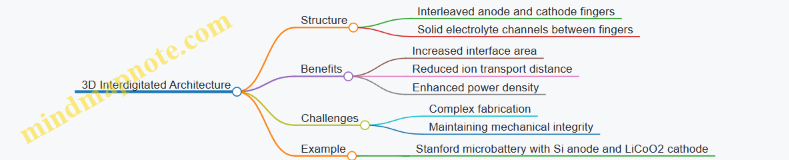
Porous 3D Scaffold Architectures
Porous scaffolds made from conductive frameworks (e.g., carbon, metal foams) are infiltrated with active materials and solid electrolytes. This 3D network facilitates electron and ion transport simultaneously.
Example:
- A team at MIT developed a 3D porous nickel scaffold infiltrated with sulfur cathode and solid electrolyte, achieving improved sulfur utilization and cycling stability.
Mind Map:
3D Printed Architectures
Additive manufacturing enables precise control over cell geometry, allowing complex 3D architectures with tailored porosity and layer thickness.
Example:
- Researchers at the University of Illinois used 3D printing to fabricate solid-state microbatteries with architected electrodes, optimizing ionic pathways and mechanical properties.
Mind Map:

Fiber-Based and Textile Batteries
Incorporating battery components into fiber or textile forms enables flexible and wearable solid-state batteries with 3D woven architectures.
Example:
- A group at Stanford developed fiber-shaped solid-state lithium-ion batteries using coaxial fiber electrodes and solid electrolytes, demonstrating flexibility and stable cycling.
Mind Map:
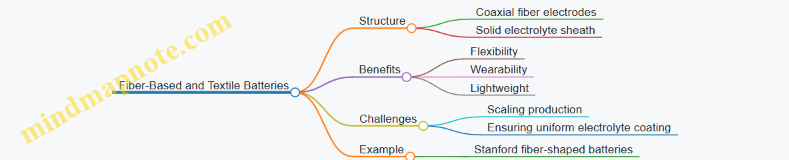
Integrated Best Practices for Novel Architectures
-
Interface Engineering: Ensure intimate contact between electrodes and solid electrolytes by surface treatments or intermediate buffer layers to reduce interfacial resistance.
-
Mechanical Design: Incorporate materials and structures that accommodate volume changes during cycling to prevent cracking or delamination.
-
Fabrication Scalability: Choose architectures compatible with scalable manufacturing methods such as tape casting combined with 3D printing or templated growth.
-
Modeling & Simulation: Use multiphysics simulations early in design to predict ionic/electronic transport and mechanical stresses, optimizing architecture before fabrication.
-
Testing Under Realistic Conditions: Evaluate novel architectures under relevant cycling rates, temperatures, and mechanical stresses to validate performance gains.
Summary Table of Novel Architectures
| Architecture Type | Key Feature | Benefits | Challenges | Representative Example |
|---|---|---|---|---|
| 3D Interdigitated | Interleaved electrode fingers | Increased interface area, power | Complex fabrication, mechanical | Stanford Si/LiCoO2 microbattery |
| Porous 3D Scaffold | Conductive porous framework | Enhanced electron/ion transport | Uniform infiltration, stability | MIT sulfur cathode in Ni scaffold |
| 3D Printed | Additive manufacturing control | Custom geometry, rapid prototyping | Ink formulation, resolution | U. Illinois architected microbatteries |
| Fiber-Based/Textile | Coaxial fiber electrodes | Flexibility, wearability | Scale-up, uniform coating | Stanford fiber-shaped solid-state batteries |
Final Thoughts
Novel cell architectures and 3D designs represent a transformative frontier in solid-state battery development. By thoughtfully integrating materials science, mechanical engineering, and advanced fabrication techniques, these architectures can unlock the full potential of solid-state batteries for EV powertrains, portable electronics, and beyond.
Continuous collaboration between battery scientists, EV powertrain engineers, and materials researchers is essential to refine these designs from lab-scale demonstrations to commercial reality.
12.3 Integration with Renewable Energy Systems
The integration of solid-state batteries (SSBs) with renewable energy systems is a critical advancement for enabling sustainable, reliable, and efficient energy storage solutions. Solid-state batteries offer enhanced safety, higher energy density, and longer cycle life compared to conventional lithium-ion batteries, making them ideal candidates for coupling with intermittent renewable sources such as solar and wind.
Key Benefits of Solid-State Batteries in Renewable Energy Integration
- Enhanced Safety: Solid electrolytes reduce risks of leakage and thermal runaway, crucial for large-scale renewable installations.
- Higher Energy Density: Enables compact storage units, saving space in residential or commercial setups.
- Longer Cycle Life: Supports frequent charge/discharge cycles inherent in renewable energy fluctuations.
- Wide Operating Temperature Range: Suitable for diverse environmental conditions.
Mind Map: Integration of Solid-State Batteries with Renewable Energy Systems
Practical Examples of Integration
Example 1: Residential Solar Storage with Solid-State Batteries
A home equipped with rooftop solar panels integrates a solid-state battery pack to store excess energy generated during the day. The battery’s high energy density allows a smaller footprint compared to traditional lithium-ion systems. The solid electrolyte ensures safety in a residential environment, reducing fire hazards. Smart energy management software optimizes charging during peak solar production and discharging during evening hours, enhancing energy independence.
Example 2: Grid-Scale Wind Farm Energy Storage
A wind farm utilizes large-format solid-state battery arrays to buffer the intermittent power output. The batteries’ long cycle life accommodates frequent charge/discharge cycles caused by variable wind speeds. Their thermal stability reduces cooling requirements, lowering operational costs. Integration with grid management systems allows for demand response and peak shaving, improving grid stability.
Example 3: Off-Grid Renewable Microgrid
In remote areas, a microgrid powered by solar and small hydroelectric generators employs solid-state batteries to ensure continuous power supply. The batteries’ mechanical robustness and wide operating temperature range make them suitable for harsh environments. Modular battery units facilitate easy maintenance and scalability as energy demand grows.
Mind Map: Best Practices for Integrating Solid-State Batteries with Renewable Systems
Summary
Integrating solid-state batteries with renewable energy systems presents a promising pathway to overcome the intermittency and reliability challenges of renewables. By leveraging the inherent advantages of solid-state technology and following best practices in system design, engineering, and management, battery scientists, EV powertrain engineers, and materials researchers can collaboratively accelerate the deployment of sustainable energy storage solutions.
This integration not only supports decarbonization goals but also fosters innovation in battery materials and cell engineering tailored for renewable energy applications.
12.4 Advances in Materials Informatics for Battery Design
Materials informatics is revolutionizing the way solid-state battery materials are discovered, optimized, and engineered. By leveraging data-driven approaches, machine learning (ML), and high-throughput computational techniques, researchers can accelerate the development of novel materials and predict their properties with unprecedented speed and accuracy.
What is Materials Informatics?
Materials informatics combines materials science with data science to extract insights from large datasets, enabling predictive modeling and intelligent design of materials.
- Data Sources: Experimental databases, computational simulations, literature mining
- Techniques: Machine learning, data mining, statistical analysis, high-throughput screening
Key Applications in Solid-State Battery Design
- Predicting ionic conductivity of new solid electrolytes
- Screening cathode and anode materials for stability and performance
- Modeling interface properties and degradation pathways
- Optimizing fabrication parameters for improved microstructure
Mind Map: Materials Informatics Workflow in Battery Design
Example 1: Predicting Ionic Conductivity of Sulfide Electrolytes
Researchers used a random forest regression model trained on a dataset of sulfide-based solid electrolytes to predict ionic conductivity based on compositional and structural features. This approach enabled rapid identification of promising candidates with conductivities exceeding 10^-3 S/cm, significantly reducing experimental trial-and-error.
- Best Practice: Combine domain knowledge with feature engineering to improve model interpretability.
Mind Map: Feature Engineering for Electrolyte Conductivity Prediction

Example 2: Interface Stability Prediction Using Neural Networks
A deep learning model was developed to predict the chemical stability of cathode-electrolyte interfaces by analyzing large datasets of interface reactions and thermodynamic properties. This model helped engineers select compatible material pairs that minimize interfacial resistance and degradation.
- Best Practice: Use transfer learning to leverage related datasets when data is scarce.
Mind Map: Modeling Interface Stability
Example 3: High-Throughput Screening of Cathode Materials
Using automated computational workflows, thousands of candidate cathode materials were screened for voltage, capacity, and stability. The integration of informatics tools allowed prioritization of materials with optimal trade-offs for solid-state battery applications.
- Best Practice: Integrate computational screening with experimental validation to refine predictions.
Mind Map: High-Throughput Screening Process
Challenges and Future Directions
- Data Quality and Availability: Ensuring comprehensive, high-quality datasets remains a bottleneck.
- Model Interpretability: Balancing predictive power with explainability is critical for adoption.
- Integration with Experimental Workflows: Seamless feedback loops between computation and experiment will accelerate innovation.
Summary
Materials informatics is a powerful enabler for solid-state battery design, offering best practices such as careful feature engineering, leveraging transfer learning, and integrating computational predictions with experiments. By embracing these approaches, battery scientists and engineers can unlock new materials and optimize cell engineering more efficiently than ever before.
12.5 Best Practices: Staying Ahead with Continuous Innovation
Innovation is the lifeblood of solid-state battery development. To maintain a competitive edge and accelerate breakthroughs, researchers and engineers must adopt a culture of continuous innovation, integrating new knowledge, technologies, and methodologies systematically. This section explores best practices to foster innovation, supported by practical examples and mind maps to visualize key concepts.
Foster Cross-Disciplinary Collaboration
Innovation thrives at the intersection of disciplines. Combining expertise from materials science, electrochemistry, mechanical engineering, data science, and manufacturing can unlock novel solutions.
Example: A research team combining polymer chemists and mechanical engineers developed a hybrid solid electrolyte with enhanced flexibility and ionic conductivity, overcoming brittleness issues common in ceramics.
Implement Agile Research and Development Cycles
Adopt iterative cycles of hypothesis, experimentation, analysis, and refinement to rapidly test new ideas and pivot based on results.
Example: An EV powertrain company used agile sprints to optimize stack pressure in solid-state cells, quickly identifying the optimal balance between mechanical stability and ionic conductivity.
Leverage Advanced Characterization and In-Situ Techniques
Utilize cutting-edge tools such as in-situ electron microscopy, synchrotron X-ray diffraction, and impedance spectroscopy to gain real-time insights into material behavior and degradation.
Example: A materials research group employed in-situ TEM to observe dendrite formation at the lithium metal/solid electrolyte interface, enabling design of protective coatings that suppressed dendrites.
Integrate Data-Driven Approaches and Machine Learning
Harness big data and machine learning to predict material properties, optimize formulations, and accelerate discovery.
Example: A startup used machine learning models trained on thousands of electrolyte compositions to identify new sulfide-based electrolytes with improved conductivity and stability.
Encourage Open Innovation and Knowledge Sharing
Participate in consortia, publish findings openly, and collaborate with academia and industry to pool resources and accelerate progress.
Example: The Battery500 Consortium brings together national labs, universities, and industry partners to share data and co-develop advanced battery materials.
Prioritize Sustainability and Lifecycle Thinking
Innovate with an eye toward environmental impact, recyclability, and resource efficiency to future-proof technologies.
Example: A materials researcher developed a recyclable solid electrolyte composite using abundant, non-toxic elements, reducing environmental footprint without compromising performance.
Summary Mind Map: Continuous Innovation Framework
By embedding these best practices into research and development workflows, battery scientists, EV powertrain engineers, and materials researchers can stay at the forefront of solid-state battery technology, driving breakthroughs that enable safer, higher-performance, and more sustainable energy storage solutions.