mRNA Vaccine Manufacturing Scale-Up and Tech Transfer
1. Introduction to mRNA Vaccine Manufacturing
1.1 Overview of mRNA Vaccine Technology
Messenger RNA (mRNA) vaccine technology represents a transformative approach to immunization, leveraging the body’s own cellular machinery to produce antigenic proteins that stimulate an immune response. Unlike traditional vaccines that introduce weakened or inactivated pathogens, mRNA vaccines deliver the genetic instructions for the target antigen, enabling rapid and flexible vaccine development.
Key Features of mRNA Vaccine Technology
- Synthetic and Cell-Free Production: mRNA vaccines are produced via in vitro transcription, eliminating the need for cell culture or live pathogens.
- Rapid Development: The platform allows for quick design and manufacturing once the genetic sequence of the target antigen is known.
- Strong Immune Response: mRNA vaccines induce both humoral (antibody-mediated) and cellular (T-cell mediated) immunity.
- Safety Profile: mRNA does not integrate into the host genome and is naturally degraded after protein translation.
Mind Map: Core Components of mRNA Vaccine Technology
Example: Pfizer-BioNTech and Moderna COVID-19 Vaccines
Both vaccines utilize nucleoside-modified mRNA encoding the SARS-CoV-2 spike protein encapsulated in lipid nanoparticles. Their rapid development and emergency use authorization highlight the advantages of mRNA technology in responding to emerging infectious diseases.
- Pfizer-BioNTech (BNT162b2): Utilizes a nucleoside-modified mRNA with optimized 5’ and 3’ UTRs to enhance stability and translation efficiency.
- Moderna (mRNA-1273): Employs a similar approach with proprietary lipid nanoparticle formulations for efficient delivery.
Mind Map: Advantages vs. Challenges of mRNA Vaccines
Example: Stability Challenge and Solutions
Challenge: mRNA molecules are inherently unstable and susceptible to degradation by nucleases.
Solution: Incorporation of modified nucleosides (e.g., pseudouridine), optimized UTRs, and encapsulation in lipid nanoparticles protect the mRNA and improve stability.
Additionally, cold chain logistics (e.g., storage at -70°C for Pfizer-BioNTech vaccine) are implemented to maintain vaccine integrity during distribution.
Summary
mRNA vaccine technology is a versatile and powerful platform that has revolutionized vaccine development. Understanding its core components, advantages, and challenges is essential for process engineers, tech transfer leads, and regulatory specialists involved in scaling up and transferring mRNA vaccine manufacturing processes.
1.2 Key Components and Workflow in mRNA Vaccine Production
The production of mRNA vaccines involves a series of well-orchestrated steps and critical components that ensure the final product is safe, effective, and scalable. Understanding these key components and the overall workflow is essential for process engineers, tech transfer leads, and regulatory affairs specialists to optimize manufacturing and ensure smooth technology transfer.
Key Components in mRNA Vaccine Production
- DNA Template: The starting material encoding the antigen of interest, typically a plasmid DNA containing the gene sequence.
- In Vitro Transcription (IVT) Reagents: Enzymes like RNA polymerase, nucleotides (NTPs), capping enzymes, and buffers required to synthesize mRNA from the DNA template.
- Purification Materials: Chromatography resins, filtration membranes, and buffers used to purify the mRNA product.
- Lipid Nanoparticles (LNPs): Lipids that encapsulate the mRNA to protect it from degradation and facilitate delivery into human cells.
- Formulation Buffers: Solutions that stabilize the LNP-encapsulated mRNA for storage and administration.
Workflow Overview
Below is a mind map illustrating the main stages of mRNA vaccine production:
Detailed Workflow Description with Examples
DNA Template Preparation
The process begins with the design and preparation of the DNA template. A plasmid encoding the antigen is amplified in bacterial cultures, then extracted and purified. The plasmid is linearized to serve as the template for IVT.
Example: A tech transfer lead overseeing scale-up might coordinate with the plasmid manufacturing site to ensure the linearized DNA meets purity specifications, reducing impurities that could inhibit transcription.
In Vitro Transcription (IVT)
IVT synthesizes mRNA from the DNA template using RNA polymerase and nucleotides. This step includes capping the mRNA to enhance stability and translation efficiency.
Best Practice: Employing a Design of Experiments (DoE) approach to optimize IVT reaction conditions (e.g., temperature, enzyme concentration) can increase yield and reduce batch variability.
Example: A process engineer optimized magnesium ion concentration during IVT, resulting in a 20% increase in mRNA yield at pilot scale.
Purification
Post-transcription, the mRNA is purified to remove DNA templates, enzymes, and other impurities. DNase treatment digests residual DNA, followed by chromatography and tangential flow filtration (TFF) to concentrate and buffer-exchange the mRNA.
Example: A regulatory affairs specialist ensures that purification steps meet regulatory guidelines for impurity levels, referencing prior successful submissions.
Formulation
The purified mRNA is encapsulated in lipid nanoparticles (LNPs) to protect it and facilitate delivery. This step involves mixing mRNA with lipids under controlled conditions, followed by buffer exchange and sterile filtration.
Best Practice: Using microfluidic mixing technology during LNP formulation ensures uniform particle size and encapsulation efficiency.
Example: During tech transfer, a receiving site adopted microfluidic mixers, improving batch-to-batch consistency compared to manual mixing.
Fill & Finish
The formulated vaccine is aseptically filled into vials, sealed, labeled, and stored under cold chain conditions.
Example: A process engineer collaborated with the fill-finish team to validate sterile filtration and filling parameters, ensuring compliance with GMP requirements.
Mind Map: Key Components and Their Roles
Summary
Understanding the key components and workflow of mRNA vaccine manufacturing is foundational for successful scale-up and tech transfer. Integrating best practices, such as DoE optimization and microfluidic mixing, with clear communication between teams ensures product quality and regulatory compliance throughout the process.
1.3 Importance of Scale-Up and Tech Transfer in mRNA Vaccine Development
The development of mRNA vaccines represents a groundbreaking advancement in vaccine technology, offering rapid design and high efficacy. However, the journey from laboratory-scale discovery to large-scale manufacturing and global distribution hinges critically on two interconnected processes: scale-up and technology transfer (tech transfer). Understanding their importance is essential for process engineers, tech transfer leads, and regulatory affairs specialists to ensure timely, consistent, and compliant vaccine production.
What is Scale-Up?
Scale-up refers to the process of increasing production volume from small-scale laboratory batches to commercial-scale manufacturing while maintaining product quality, safety, and efficacy.
What is Tech Transfer?
Tech transfer is the systematic process of transferring manufacturing knowledge, processes, and analytical methods from one site (often R&D or pilot) to another (such as a commercial manufacturing facility).
Why Scale-Up and Tech Transfer Matter in mRNA Vaccine Development
-
Rapid Response to Public Health Needs: mRNA vaccines, such as those developed for COVID-19, require swift scale-up to meet global demand. Efficient tech transfer accelerates this timeline by enabling new manufacturing sites to come online quickly.
-
Ensuring Consistency and Quality: Scale-up can introduce variability in process parameters. Tech transfer ensures that the receiving site replicates the process accurately, preserving vaccine quality and batch-to-batch consistency.
-
Regulatory Compliance: Regulatory agencies require documented evidence that scale-up and tech transfer activities maintain product integrity. Proper execution supports regulatory submissions and approvals.
-
Cost Efficiency: Effective scale-up and tech transfer reduce manufacturing costs by optimizing resource use, minimizing waste, and avoiding costly delays.
-
Supply Chain Resilience: Transferring technology to multiple sites diversifies manufacturing capacity, mitigating risks from site-specific disruptions.
Mind Map: Core Elements of Scale-Up and Tech Transfer in mRNA Vaccine Development
Best Practice Example: Scaling In Vitro Transcription (IVT) Reaction
Scenario: A biotech company developed an mRNA vaccine candidate at a 1-liter IVT reaction scale in R&D. To meet demand, they needed to scale to 50 liters.
Challenges:
- Maintaining enzyme activity and reaction kinetics at larger volumes.
- Ensuring uniform mixing to avoid localized concentration gradients.
- Controlling temperature precisely to prevent RNA degradation.
Approach:
- Conducted small intermediate scale runs (5L, 10L) to identify scale-dependent variables.
- Used computational fluid dynamics (CFD) modeling to optimize mixing parameters.
- Implemented inline temperature sensors and automated controls.
Outcome:
- Achieved comparable yield and purity at 50L scale.
- Reduced batch failures by 30% compared to initial scale-up attempts.
Mind Map: Tech Transfer Workflow
Real-World Example: COVID-19 mRNA Vaccine Tech Transfer
During the COVID-19 pandemic, rapid tech transfer was critical to scale production globally. For instance, Pfizer-BioNTech transferred their mRNA vaccine manufacturing process from their initial site in Belgium to multiple contract manufacturing organizations worldwide.
Key Success Factors:
- Detailed and standardized tech transfer packages including SOPs, batch records, and analytical protocols.
- Intensive training programs for receiving site personnel.
- Use of pilot runs to identify and resolve site-specific challenges.
- Close collaboration between sending and receiving teams, supported by digital communication tools.
Result:
- Enabled production scale-up from thousands to millions of doses per week.
- Facilitated regulatory submissions with consistent documentation.
Summary
Scale-up and tech transfer are pivotal in transforming mRNA vaccine candidates into accessible, life-saving products. They require meticulous planning, cross-functional collaboration, and adherence to best practices to ensure quality, speed, and compliance. By mastering these processes, biomanufacturing professionals can help meet global vaccine demands efficiently and reliably.
1.4 Regulatory Landscape and Compliance Considerations
The regulatory landscape for mRNA vaccine manufacturing is complex and evolving rapidly, especially given the accelerated development timelines seen during the COVID-19 pandemic. Understanding and navigating these regulations is critical for process engineers, tech transfer leads, and regulatory affairs specialists to ensure compliance, product safety, and efficacy.
Key Regulatory Authorities
- FDA (U.S. Food and Drug Administration)
- EMA (European Medicines Agency)
- WHO (World Health Organization)
- PMDA (Pharmaceuticals and Medical Devices Agency, Japan)
Each authority has specific guidelines and expectations for vaccine development, manufacturing, and approval.
Regulatory Considerations for mRNA Vaccine Manufacturing
- Quality by Design (QbD): Emphasizing a science- and risk-based approach to process development.
- Good Manufacturing Practices (GMP): Compliance with GMP is mandatory to ensure product quality and patient safety.
- Process Validation: Demonstrating that manufacturing processes consistently produce a product meeting predetermined specifications.
- Analytical Method Validation: Ensuring analytical tests are reliable and reproducible.
- Change Control: Managing changes in process, equipment, or materials with regulatory oversight.
- Documentation: Maintaining comprehensive and traceable records throughout the manufacturing lifecycle.
Mind Map: Regulatory Landscape Overview
Accelerated Pathways and Emergency Use Authorizations (EUA)
During public health emergencies, regulatory agencies may allow accelerated review and approval pathways:
- FDA EUA: Allows temporary use of unapproved medical products or unapproved uses of approved products.
- EMA Conditional Marketing Authorization: Permits early approval with less comprehensive data, subject to post-approval obligations.
Example: The Pfizer-BioNTech and Moderna COVID-19 mRNA vaccines received EUA from the FDA within a year of development, a process that typically takes several years.
Mind Map: Accelerated Regulatory Pathways
Compliance Considerations During Tech Transfer and Scale-Up
- Regulatory Documentation: Transfer of comprehensive tech transfer packages including batch records, SOPs, validation protocols.
- Facility and Equipment Qualification: Ensuring receiving sites meet GMP standards.
- Change Management: Regulatory notification or approval may be required for significant changes.
- Bridging Studies: Comparative studies to demonstrate equivalence between manufacturing sites or scales.
Example: When transferring mRNA vaccine manufacturing from a pilot facility to a commercial site, a comparability study was conducted to confirm that the product quality attributes remained consistent, satisfying FDA requirements.
Mind Map: Compliance in Tech Transfer
Post-Approval Regulatory Obligations
- Pharmacovigilance: Continuous monitoring of vaccine safety post-market.
- Periodic Safety Update Reports (PSURs): Regular submission of safety data to regulators.
- Manufacturing Site Inspections: Routine GMP inspections by regulatory agencies.
- Product Lifecycle Management: Managing changes and improvements with regulatory oversight.
Example: After approval, manufacturers of mRNA vaccines submit monthly safety reports to the FDA and EMA, enabling rapid identification of any adverse events.
Summary
Navigating the regulatory landscape for mRNA vaccine manufacturing requires a thorough understanding of global regulatory expectations, a proactive approach to compliance, and effective communication with regulatory bodies. Integrating regulatory considerations early in process development, scale-up, and tech transfer ensures smoother approvals and sustained product quality.
For further reading:
- FDA Guidance on mRNA Vaccines
- EMA Guidelines on Vaccine Development
- WHO Technical Report Series on Vaccine Quality
1.5 Case Study: Rapid Development of COVID-19 mRNA Vaccines
The rapid development of COVID-19 mRNA vaccines represents a landmark achievement in biomanufacturing and vaccine technology. This case study explores the key factors, best practices, and challenges overcome during the accelerated timeline, providing valuable insights for process engineers, tech transfer leads, and regulatory affairs specialists.
Background
In early 2020, the SARS-CoV-2 virus emerged as a global threat, demanding an unprecedented speed in vaccine development. mRNA vaccine platforms, due to their modularity and rapid design capabilities, became front-runners in the race to develop effective vaccines.
Key Success Factors Mind Map
Best Practices Demonstrated
-
Platform-Based Manufacturing
- Example: Both Pfizer-BioNTech and Moderna leveraged existing mRNA synthesis and LNP formulation platforms, enabling rapid insertion of the SARS-CoV-2 spike protein sequence without reinventing the process.
-
Parallel Process Development and Scale-Up
- Example: While clinical trials were ongoing, scale-up activities proceeded simultaneously, reducing overall timeline.
-
Early and Continuous Regulatory Engagement
- Example: Rolling submissions allowed regulatory agencies to review data in real-time, speeding approval.
-
Robust Tech Transfer Practices
- Example: Pfizer transferred technology to multiple global manufacturing sites using standardized tech transfer packages and virtual training sessions.
-
Supply Chain Management
- Example: Early procurement of critical raw materials such as nucleotides and lipids prevented bottlenecks.
Challenges and Solutions Mind Map
Example: Pfizer-BioNTech’s Tech Transfer Approach
- Developed a comprehensive tech transfer package including process descriptions, batch records, and analytical methods.
- Conducted virtual training sessions to overcome travel restrictions.
- Established cross-functional teams involving R&D, manufacturing, quality, and regulatory affairs.
- Implemented pilot runs at receiving sites to identify and resolve gaps before full-scale production.
Summary
The rapid development and deployment of COVID-19 mRNA vaccines were made possible by leveraging platform technologies, embracing parallel development and scale-up, maintaining close regulatory collaboration, and executing efficient tech transfer and supply chain strategies. These lessons serve as a blueprint for future rapid vaccine responses and biomanufacturing scale-up efforts.
2. Process Development for mRNA Vaccine Manufacturing
2.1 Designing a Robust mRNA Synthesis Process
Designing a robust mRNA synthesis process is a critical foundational step in mRNA vaccine manufacturing. It ensures high yield, purity, and reproducibility, which are essential for downstream processing and ultimately vaccine efficacy and safety. This section will explore the key considerations, best practices, and practical examples to help process engineers and tech transfer leads develop a reliable mRNA synthesis workflow.
Key Considerations in mRNA Synthesis Process Design
- Template DNA Quality and Design
- In Vitro Transcription (IVT) Reaction Optimization
- Capping and Tailoring of mRNA
- Purification Strategies
- Scalability and Reproducibility
Mind Map: Core Components of mRNA Synthesis Process
Best Practices and Examples
Template DNA Preparation
- Best Practice: Use high-quality linearized plasmid DNA or PCR products with a strong promoter (commonly T7) to ensure efficient transcription.
- Example: A manufacturer optimized the plasmid linearization step by switching from restriction enzyme digestion to PCR amplification, reducing impurities and improving IVT yield by 15%.
IVT Reaction Optimization
- Best Practice: Optimize magnesium ion concentration, NTP ratios, and reaction time to maximize yield and minimize abortive transcripts.
- Example: Using a Design of Experiments (DoE) approach, a team identified that increasing Mg2+ concentration by 20% and reducing reaction time from 4 hours to 3 hours improved mRNA yield by 25% without compromising quality.
Capping Strategy
- Best Practice: Employ co-transcriptional capping with CleanCap reagents to improve cap efficiency and reduce downstream enzymatic steps.
- Example: Switching from enzymatic capping post-IVT to co-transcriptional capping reduced processing time by 30% and increased translation efficiency in vitro.
Purification
- Best Practice: Incorporate DNase treatment to remove template DNA followed by chromatographic purification to eliminate dsRNA contaminants.
- Example: Implementing ion-exchange chromatography reduced double-stranded RNA contaminants by over 90%, improving vaccine safety profiles.
Mind Map: Factors Affecting IVT Reaction Yield and Quality
Example Workflow: Bench-Scale mRNA Synthesis
- Template Preparation: Linearize plasmid DNA using restriction enzymes, purify by column chromatography.
- IVT Reaction: Mix template DNA, NTPs (including modified nucleotides), T7 RNA polymerase, buffer, and additives; incubate at 37°C for 3 hours.
- DNase Treatment: Add DNase I to degrade template DNA.
- Purification: Use ion-exchange chromatography followed by tangential flow filtration.
- Quality Control: Assess RNA integrity, purity, and concentration.
Summary
Designing a robust mRNA synthesis process requires a holistic approach that integrates template design, enzymatic reaction optimization, capping methods, and purification strategies. Applying best practices such as DoE for reaction optimization and adopting co-transcriptional capping can significantly improve yield and product quality. Real-world examples demonstrate how incremental improvements at each step contribute to a scalable and reproducible manufacturing process.
This foundational robustness is essential for successful scale-up and tech transfer, ensuring consistent vaccine quality across manufacturing sites.
2.2 Optimization of In Vitro Transcription (IVT) Reactions
In vitro transcription (IVT) is a critical step in mRNA vaccine manufacturing, where the mRNA strand is synthesized enzymatically from a DNA template. Optimizing IVT reactions is essential to maximize yield, ensure high-quality mRNA, and reduce impurities that could affect vaccine efficacy and safety.
Key Factors Influencing IVT Reaction Optimization
IVT Reaction Optimization Mind Map
Template DNA Quality
High-quality, linearized DNA template is crucial for efficient transcription. Circular plasmid DNA can cause premature termination or incomplete transcripts.
Best Practice Example:
- Use restriction enzymes to linearize plasmid DNA at a site downstream of the poly(A) tail.
- Purify linearized DNA via column purification or phenol-chloroform extraction to remove contaminants.
Enzyme Selection and Concentration
T7 RNA polymerase is commonly used due to its high specificity and efficiency.
Optimization Tip:
- Titrate enzyme concentration to balance cost and yield; excessive enzyme may increase impurities.
Example:
- At bench scale, increasing T7 polymerase from 50 U/mL to 100 U/mL improved yield by 20%, but further increase showed diminishing returns.
Nucleotide Triphosphates (NTPs)
Balanced and optimal NTP concentrations are vital for efficient transcription and to minimize abortive transcripts.
Mind Map:
Example:
- Incorporation of modified nucleotides like pseudouridine at 25% substitution improved mRNA stability and reduced innate immune activation.
Reaction Conditions
Temperature, pH, and divalent cation concentration (Mg2+) influence enzyme activity and transcript quality.
Optimization Strategy:
- Typical IVT reactions run at 37°C for 2-4 hours.
- Mg2+ concentration is optimized between 10-30 mM to balance yield and transcript integrity.
Example:
- Increasing Mg2+ from 15 mM to 25 mM increased yield by 15% but required careful monitoring to avoid RNA degradation.
Additives
Additives like RNase inhibitors prevent degradation, while pyrophosphatase can improve yield by removing inhibitory pyrophosphate.
Example:
- Adding inorganic pyrophosphatase at 0.01 U/μL improved yield by reducing pyrophosphate accumulation.
Reaction Volume and Mixing
Scaling IVT requires ensuring homogenous mixing to avoid localized depletion of substrates or enzyme.
Best Practice:
- Use gentle agitation or mixing systems compatible with RNA stability.
Example:
- At pilot scale, implementing slow overhead stirring prevented gradient formation and improved batch consistency.
Post-IVT Treatment
DNase treatment removes template DNA, preventing contamination.
Example:
- Treating IVT product with DNase I for 15 minutes at 37°C followed by purification reduced residual DNA below regulatory thresholds.
Integrated Example: Bench to Pilot Scale IVT Optimization
| Parameter | Bench Scale (1 mL) | Pilot Scale (10 L) | Outcome / Notes |
|---|---|---|---|
| Template DNA | 1 µg/µL, linearized, purified | 1 µg/µL, linearized, purified | Consistent template quality maintained |
| T7 Polymerase | 100 U/mL | 90 U/mL | Slight reduction to control cost |
| NTPs | 7.5 mM each + 25% pseudouridine | Same | Maintained modified nucleotide ratio |
| Mg2+ Concentration | 20 mM | 22 mM | Slight increase improved yield |
| Temperature | 37°C, 3 hours | 37°C, 3 hours | Consistent reaction time and temp |
| Mixing | Gentle pipetting | Overhead stirring at 50 rpm | Homogeneous mixing ensured |
| Additives | Pyrophosphatase 0.01 U/μL | Same | Yield improvement consistent |
Result: Pilot scale maintained >90% yield relative to bench scale with consistent mRNA integrity and purity.
Summary of Best Practices for IVT Optimization
- Use high-quality, linearized DNA templates.
- Optimize enzyme and NTP concentrations balancing cost and yield.
- Incorporate modified nucleotides to improve mRNA stability.
- Fine-tune Mg2+ concentration and reaction conditions.
- Include additives like pyrophosphatase and RNase inhibitors.
- Ensure homogenous mixing, especially during scale-up.
- Perform DNase treatment post-IVT to remove template DNA.
By systematically optimizing these parameters, process engineers and tech transfer leads can ensure robust, scalable IVT reactions that produce high-quality mRNA suitable for vaccine formulation and regulatory approval.
2.3 Purification Strategies: Chromatography and Tangential Flow Filtration
Purification is a critical step in mRNA vaccine manufacturing, ensuring the removal of impurities such as enzymes, DNA templates, truncated RNA, and reaction by-products to achieve high product purity and safety. Two primary purification techniques used in mRNA vaccine production are chromatography and tangential flow filtration (TFF). This section will explore these strategies in detail, illustrating best practices and practical examples.
Chromatography in mRNA Purification
Chromatography is widely used for its high resolution and specificity in separating mRNA from impurities. The most common types employed include:
- Ion Exchange Chromatography (IEX): Separates molecules based on charge differences.
- Affinity Chromatography: Uses specific binding interactions.
- Size Exclusion Chromatography (SEC): Separates based on molecular size.
Mind Map: Chromatography Techniques
Example: Ion Exchange Chromatography Optimization
A process engineer optimized the salt gradient in an anion exchange step to improve separation of full-length mRNA from truncated species. By adjusting the NaCl concentration from 0.3 M to 0.5 M during elution, purity increased from 85% to 95%, demonstrating the importance of fine-tuning chromatographic conditions.
Tangential Flow Filtration (TFF) in mRNA Purification
TFF is a membrane filtration technique used for buffer exchange, concentration, and removal of small impurities. It is often integrated before or after chromatography steps.
Mind Map: Tangential Flow Filtration Process
Example: TFF to Improve Buffer Exchange Efficiency
A tech transfer lead implemented a TFF step with a 100 kDa molecular weight cutoff membrane to exchange the mRNA solution into the formulation buffer. By increasing diafiltration volumes from 5 to 8, residual salt levels dropped below 10 mM, meeting formulation requirements without compromising mRNA yield.
Integrated Purification Strategy
Combining chromatography and TFF enables robust purification:
- Initial TFF for concentration and buffer exchange
- Ion exchange chromatography for impurity removal
- Final TFF for formulation adjustment and sterile filtration
Mind Map: Integrated Purification Workflow
Example: Case Study of Purification Scale-Up
During scale-up, a process engineer encountered increased membrane fouling in TFF steps. By switching to a membrane with a hydrophilic coating and adjusting flow rates, fouling was reduced by 40%, improving throughput and maintaining mRNA integrity.
Best Practices Summary
- Chromatography: Optimize salt gradients and pH to maximize purity and yield.
- TFF: Select appropriate membrane MWCO and control shear to protect mRNA.
- Integration: Design purification steps to complement each other for efficient impurity removal.
- Monitoring: Use in-process analytics to track purity and yield at each step.
By carefully applying these purification strategies, process engineers and tech transfer leads can ensure scalable, reproducible, and high-quality mRNA vaccine production.
2.4 Formulation Development: Lipid Nanoparticle (LNP) Encapsulation
Lipid Nanoparticle (LNP) encapsulation is a critical step in mRNA vaccine manufacturing, as it protects the fragile mRNA molecules, facilitates cellular uptake, and ensures efficient delivery to the target cells. This section explores the fundamentals of LNP formulation development, best practices, and real-world examples to guide process engineers, tech transfer leads, and regulatory affairs specialists.
What is LNP Encapsulation?
LNPs are nanoscale vesicles composed of lipids that encapsulate mRNA, shielding it from degradation and enabling its delivery into cells. The formulation typically includes four lipid components:
- Ionizable cationic lipids (for mRNA complexation and endosomal escape)
- Phospholipids (structural support)
- Cholesterol (membrane stability)
- PEGylated lipids (surface modification to reduce aggregation and improve circulation)
Mind Map: Key Components of LNP Formulation
Best Practices in LNP Formulation Development
-
Lipid Selection and Ratio Optimization
- Optimize lipid molar ratios to balance encapsulation efficiency, particle size, and stability.
- Example: Moderna optimized the ionizable lipid to phospholipid ratio to achieve >90% encapsulation efficiency.
-
Microfluidic Mixing for Controlled Particle Formation
- Use microfluidic devices to mix mRNA and lipids rapidly and uniformly, producing consistent particle sizes (typically 80-100 nm).
- Example: Pfizer/BioNTech employed microfluidic mixers to scale from bench to commercial production while maintaining particle uniformity.
-
Buffer and pH Control
- Maintain acidic pH during mixing to promote ionizable lipid-mRNA complexation.
- Adjust to neutral pH post-formation to stabilize LNPs.
-
Sterile Filtration and Storage Conditions
- Filter LNP formulations through 0.2 µm filters to ensure sterility.
- Store at recommended temperatures (e.g., -20°C or -80°C) to maintain stability.
-
Analytical Characterization
- Measure particle size and polydispersity index (PDI) via dynamic light scattering (DLS).
- Assess encapsulation efficiency using Ribogreen assay or similar.
- Evaluate potency via in vitro transfection assays.
Mind Map: LNP Formulation Development Workflow
Example: Scaling LNP Formulation from Bench to Pilot Scale
Scenario: A process engineer is tasked with scaling the LNP formulation from 1 mL bench scale to 10 L pilot scale.
Challenges:
- Maintaining consistent particle size and encapsulation efficiency.
- Ensuring reproducibility of mixing parameters.
Approach:
- Use scalable microfluidic mixers or staggered herringbone mixers designed for larger volumes.
- Maintain constant flow rate ratios and total flow rates adjusted for scale.
- Perform DoE (Design of Experiments) to optimize flow rates and lipid:mRNA ratios at scale.
Outcome:
- Achieved consistent particle size (~90 nm) and encapsulation efficiency (>95%) at pilot scale.
- Process parameters documented for tech transfer.
Example: Troubleshooting LNP Aggregation Issues
Problem: During scale-up, increased LNP aggregation was observed, causing higher PDI and reduced potency.
Root Cause Analysis:
- Inadequate PEG-lipid concentration leading to insufficient steric stabilization.
- Variations in mixing speed causing uneven particle formation.
Solution:
- Increased PEG-lipid molar ratio by 10%.
- Optimized microfluidic flow rates to improve mixing homogeneity.
- Implemented in-process monitoring of particle size.
Result:
- Reduced aggregation, PDI improved from 0.3 to 0.15.
- Potency restored to target levels.
Summary
LNP encapsulation is a sophisticated yet essential step in mRNA vaccine manufacturing. By carefully selecting lipid components, optimizing mixing processes, and rigorously characterizing the formulation, manufacturers can ensure high-quality, stable, and efficacious vaccine products. Integrating best practices and learning from real-world examples helps streamline scale-up and tech transfer activities, ultimately supporting rapid and reliable vaccine deployment.
2.5 Best Practice: Using Design of Experiments (DoE) for Process Optimization
Design of Experiments (DoE) is a structured, systematic method for determining the relationship between factors affecting a process and the output of that process. In mRNA vaccine manufacturing, DoE is invaluable for optimizing complex processes such as in vitro transcription (IVT), purification, and lipid nanoparticle (LNP) formulation. By applying DoE, process engineers can efficiently identify critical process parameters (CPPs) and their interactions, leading to improved yield, quality, and robustness.
Why Use DoE in mRNA Vaccine Manufacturing?
- Efficiency: Reduces the number of experiments needed compared to one-factor-at-a-time approaches.
- Interaction Identification: Detects interactions between variables that might be missed otherwise.
- Robustness: Helps develop processes that are less sensitive to variability.
- Regulatory Alignment: Supports Quality by Design (QbD) principles encouraged by regulatory agencies.
Key Steps in Applying DoE
- Define Objectives: What process output(s) to optimize (e.g., mRNA yield, purity, encapsulation efficiency).
- Select Factors and Levels: Identify CPPs such as temperature, reaction time, enzyme concentration, buffer pH.
- Choose Experimental Design: Factorial, fractional factorial, response surface methodology (RSM), etc.
- Conduct Experiments: Execute according to the design matrix.
- Analyze Data: Use statistical software to interpret results and model responses.
- Confirm Optimal Conditions: Validate predicted optimal settings with confirmatory runs.
Mind Map: DoE Workflow in mRNA Process Optimization
Example: Optimizing IVT Reaction Using DoE
Objective: Maximize mRNA yield while maintaining purity.
Factors Selected:
- Temperature (37°C, 40°C, 43°C)
- Mg2+ Concentration (10 mM, 15 mM, 20 mM)
- Reaction Time (1 hr, 2 hr, 3 hr)
Design: Full factorial design with 3 factors at 3 levels each (27 runs).
Process:
- Conducted 27 IVT reactions varying the three factors.
- Measured mRNA yield and purity for each run.
- Analyzed data using ANOVA to identify significant factors and interactions.
Findings:
- Mg2+ concentration and temperature had significant effects on yield.
- Interaction between temperature and reaction time influenced purity.
- Optimal conditions predicted: 40°C, 15 mM Mg2+, 2 hr reaction time.
Validation: Confirmatory runs at optimal conditions showed a 20% increase in yield without compromising purity.
Mind Map: IVT Reaction Optimization Example
Tips for Successful DoE Implementation in mRNA Manufacturing
- Start Small: Begin with screening designs to identify key factors before detailed optimization.
- Use Software Tools: Leverage tools like JMP, Minitab, or Design-Expert for design creation and analysis.
- Include Replicates: To assess variability and improve statistical confidence.
- Consider Scale: Perform DoE at a scale representative of intended manufacturing scale to capture scale-dependent effects.
- Cross-Functional Collaboration: Engage process engineers, analytical scientists, and statisticians early.
Additional Example: LNP Formulation Optimization
Objective: Maximize encapsulation efficiency and particle stability.
Factors:
- Lipid-to-mRNA ratio
- Mixing speed
- pH of aqueous phase
Design: Fractional factorial to reduce runs.
Outcome: Identified that lipid-to-mRNA ratio and mixing speed significantly impacted encapsulation efficiency, enabling formulation refinement that improved stability by 15%.
By integrating DoE into mRNA vaccine manufacturing process development, teams can systematically optimize critical parameters, reduce development timelines, and ensure robust, scalable processes that meet quality and regulatory expectations.
2.6 Example: Scaling IVT Reaction from Bench to Pilot Scale
Scaling the In Vitro Transcription (IVT) reaction from bench scale (milliliters) to pilot scale (liters) is a critical step in mRNA vaccine manufacturing. This process requires careful consideration of reaction kinetics, mixing, temperature control, and reagent stability to ensure product quality and yield are maintained or improved.
Key Considerations in IVT Scale-Up
IVT Reaction Scale-Up Mind Map
Step-by-Step Example: Scaling IVT from 10 mL to 5 L
Bench Scale Optimization (10 mL)
- Objective: Establish baseline reaction conditions.
- Process:
- Use a 10 mL reaction volume in a small stirred vessel.
- Optimize enzyme and NTP concentrations using Design of Experiments (DoE).
- Monitor reaction kinetics via agarose gel electrophoresis and UV absorbance.
- Outcome: Achieved 90% yield with high RNA integrity in 4 hours.
Intermediate Scale Testing (100 mL)
- Objective: Assess mixing and temperature control at larger volume.
- Process:
- Use a jacketed glass reactor with controlled stirring.
- Adjust stirring speed to maintain homogeneity without damaging enzymes.
- Monitor temperature uniformity with multiple probes.
- Outcome: Maintained yield and quality; identified need for improved mixing to prevent localized overheating.
Pilot Scale Implementation (5 L)
- Objective: Transition to pilot scale bioreactor.
- Process:
- Use a stainless steel bioreactor with automated control systems.
- Scale reagent volumes linearly but adjust enzyme concentration based on mixing efficiency.
- Implement Process Analytical Technology (PAT) tools for real-time monitoring.
- Conduct multiple pilot batches to confirm reproducibility.
- Outcome: Achieved consistent yields (~88-92%) and RNA quality comparable to bench scale.
Best Practices Illustrated
Additional Example: Addressing Shear Stress During Scale-Up
- At pilot scale, increased stirring speed caused enzyme denaturation.
- Solution: Switched to low-shear impellers and optimized agitation speed.
- Result: Maintained enzyme activity and improved RNA yield by 5%.
Summary
Scaling the IVT reaction requires a systematic approach combining experimental optimization, engineering controls, and quality monitoring. By following best practices and learning from iterative scale increases, process engineers can ensure successful scale-up that maintains product quality and manufacturing efficiency.
3. Scale-Up Challenges and Solutions
3.1 Common Scale-Up Challenges in mRNA Manufacturing
Scaling up mRNA vaccine manufacturing from laboratory or pilot scale to commercial production presents a unique set of challenges. These challenges must be carefully managed to maintain product quality, ensure process robustness, and meet regulatory requirements. Below is a detailed overview of the most common scale-up challenges encountered in mRNA manufacturing, accompanied by illustrative mind maps and practical examples.
Key Scale-Up Challenges Mind Map
Process Complexity
Challenge: The mRNA manufacturing process involves multiple critical steps such as in vitro transcription (IVT), purification, and lipid nanoparticle (LNP) formulation. Each step has parameters that are sensitive to scale changes.
-
Example: At small scale, IVT reactions are typically performed in small vessels with precise temperature control and gentle mixing. When scaling to 50L or 100L bioreactors, maintaining uniform mixing and temperature becomes challenging, potentially affecting mRNA yield and integrity.
-
Best Practice: Implementing Design of Experiments (DoE) during scale-up helps identify critical process parameters and their interactions, enabling robust process design.
Equipment & Facility Constraints
Challenge: Equipment used at lab scale often cannot be directly scaled up. Differences in bioreactor geometry, mixing dynamics, and shear forces can impact product quality.
-
Example: A lab-scale microfluidic mixer used for LNP formulation may not be feasible at commercial scale. Transitioning to larger mixers requires careful evaluation to avoid damaging the delicate LNP structures.
-
Best Practice: Conduct scale-down models to simulate large-scale equipment behavior and predict potential issues before full-scale implementation.
Raw Material Supply
Challenge: Securing a consistent supply of high-quality raw materials such as nucleotide triphosphates (NTPs), enzymes, capping reagents, and lipids is critical. Scale-up demands larger quantities, increasing the risk of supply chain disruptions.
-
Example: During the COVID-19 vaccine scale-up, many manufacturers faced shortages of specialized lipids required for LNP formulation, leading to production delays.
-
Best Practice: Early vendor qualification and establishing multiple suppliers for critical raw materials mitigate risks.
Quality and Consistency
Challenge: Maintaining consistent product quality across larger batches is difficult due to increased process variability.
-
Example: Batch-to-batch variability in mRNA purity or LNP size distribution can impact vaccine efficacy and safety.
-
Best Practice: Implement Process Analytical Technology (PAT) tools for real-time monitoring and control to ensure consistent quality.
Regulatory Compliance
Challenge: Scale-up requires extensive documentation, validation, and adherence to regulatory guidelines, which become more complex at commercial scale.
-
Example: Changes in process scale may require comparability studies and regulatory submissions to agencies like FDA or EMA.
-
Best Practice: Engage regulatory affairs early in scale-up planning to align on expectations and streamline approvals.
Technology Transfer
Challenge: Transferring the process from R&D or pilot facilities to manufacturing sites involves knowledge transfer, training, and adaptation to new equipment.
-
Example: A tech transfer from a small-scale R&D lab to a contract manufacturing organization (CMO) may reveal gaps in process understanding, requiring additional runs and troubleshooting.
-
Best Practice: Develop comprehensive tech transfer packages including protocols, batch records, and training materials.
Summary
Scaling up mRNA vaccine manufacturing is a multifaceted challenge involving process complexity, equipment constraints, raw material supply, quality assurance, regulatory compliance, and effective tech transfer. Addressing these challenges proactively with best practices such as DoE, scale-down modeling, vendor qualification, PAT implementation, early regulatory engagement, and thorough tech transfer planning is essential for successful commercial production.
Additional Example: Overcoming Shear Stress During LNP Scale-Up
During scale-up of LNP formulation, increased shear forces in larger mixers caused premature degradation of lipid nanoparticles, reducing encapsulation efficiency. By switching to a staggered herringbone micromixer design and optimizing flow rates, the manufacturer restored LNP integrity and improved batch consistency.
This example highlights the importance of understanding equipment impact on product quality and adapting process parameters accordingly.
3.2 Maintaining Product Quality and Consistency at Large Scale
Scaling up mRNA vaccine manufacturing presents unique challenges in maintaining product quality and consistency. As production volume increases, subtle variations in process parameters can lead to significant impacts on the final product’s safety, efficacy, and stability. This section explores best practices and real-world examples to ensure consistent quality during large-scale manufacturing.
Key Factors Influencing Product Quality at Scale
Best Practices for Maintaining Quality and Consistency
-
Robust Raw Material Management
- Establish strong vendor qualification programs to ensure raw materials meet specifications consistently.
- Example: A manufacturer implementing dual sourcing for nucleotides to mitigate supply variability and conducting batch-to-batch comparison testing.
-
Tight Process Parameter Control
- Use automated control systems to maintain critical parameters such as temperature, pH, and mixing speed within narrow ranges.
- Example: During scale-up of IVT reactions, a company implemented inline pH probes and automated acid/base addition to maintain optimal transcription conditions.
-
Equipment Suitability and Calibration
- Select equipment designed for large-scale production that can replicate small-scale process dynamics.
- Regular calibration and preventive maintenance prevent drift and variability.
- Example: Transitioning from bench-top stirrers to large-scale bioreactors with similar impeller designs to maintain shear profiles.
-
In-Process Monitoring and Real-Time Analytics
- Implement Process Analytical Technology (PAT) tools such as UV absorbance, fluorescence, or NMR to monitor mRNA concentration and purity during synthesis.
- Example: A manufacturer used real-time UV monitoring during purification to detect deviations early and adjust flow rates accordingly.
-
Comprehensive Personnel Training
- Ensure operators are trained on scaled-up processes and understand the impact of deviations.
- Example: Conducting cross-site training sessions with hands-on workshops to align practices between R&D and manufacturing teams.
-
Environmental and Contamination Controls
- Maintain stringent cleanroom classifications and implement contamination control strategies to avoid product degradation.
- Example: Introducing enhanced gowning protocols and environmental monitoring during scale-up to reduce particulate contamination.
Mind Map: Process Parameter Control for Quality Consistency
Example: Overcoming Quality Variability in LNP Encapsulation at Scale
A biotech company experienced batch-to-batch variability in lipid nanoparticle (LNP) size distribution when scaling from 10 L to 200 L batches. The root cause was identified as inconsistent mixing energy leading to variable shear forces.
Solution:
- Conducted scale-down modeling to replicate shear conditions.
- Selected impellers that provided similar flow patterns at large scale.
- Implemented inline particle size monitoring using dynamic light scattering.
- Adjusted flow rates and mixing speeds accordingly.
Outcome:
- Achieved consistent LNP size distribution across batches.
- Improved encapsulation efficiency and vaccine potency.
Summary
Maintaining product quality and consistency at large scale requires a holistic approach encompassing raw material control, precise process parameter management, suitable equipment, real-time monitoring, trained personnel, and strict environmental controls. Leveraging these best practices with continuous feedback loops ensures that scaled-up mRNA vaccine manufacturing meets rigorous quality standards essential for regulatory approval and patient safety.
3.3 Equipment Selection and Adaptation for Large-Scale Production
Scaling up mRNA vaccine manufacturing requires careful selection and adaptation of equipment to ensure process robustness, product quality, and operational efficiency. Equipment that works well at bench scale may not directly translate to large-scale production due to differences in volume, mixing dynamics, heat transfer, and automation capabilities.
Key Considerations for Equipment Selection
- Process Compatibility: Equipment must be compatible with the biochemical processes involved, such as in vitro transcription (IVT), purification, and lipid nanoparticle (LNP) formulation.
- Scalability: The equipment should support scale increments without compromising product quality.
- Material of Construction: Use materials that minimize product interaction and contamination risk, e.g., stainless steel or single-use systems.
- Automation and Control: Integration with process control systems for consistent operation and data capture.
- Cleaning and Sterilization: Equipment should allow for effective cleaning-in-place (CIP) or be disposable to reduce turnaround time.
- Regulatory Compliance: Must meet GMP standards and be validated for intended use.
Mind Map: Equipment Selection Criteria
Equipment Adaptation Strategies
-
Scaling Reactor Vessels:
- Example: Moving from 1 L IVT reactors to 50 L or 200 L bioreactors requires ensuring uniform mixing and temperature control.
- Adaptation: Use reactors with advanced impeller designs and jacketed vessels for precise temperature regulation.
-
Chromatography Systems:
- Example: Bench-scale purification may use manual column packing; large scale demands automated, skid-mounted chromatography systems.
- Adaptation: Implement pre-packed, single-use chromatography columns to reduce cleaning validation.
-
LNP Formulation Equipment:
- Example: Microfluidic mixers at small scale replaced by scalable T-junction or impingement jet mixers.
- Adaptation: Optimize flow rates and mixing parameters to maintain particle size and encapsulation efficiency.
-
Single-Use Systems (SUS):
- Increasingly favored to reduce cross-contamination and cleaning times.
- Example: Single-use bags and tubing for buffer preparation and intermediate storage.
Mind Map: Equipment Adaptation Approaches
Example: Overcoming Shear Stress in LNP Formulation Scale-Up
During scale-up of LNP formulation, high shear forces from larger mixers can degrade mRNA integrity or alter particle size distribution. To address this:
- The team evaluated different mixer designs, selecting a scalable impingement jet mixer that maintained consistent particle size.
- Process parameters such as flow rates and pressure were optimized using Design of Experiments (DoE).
- Inline particle size analyzers were integrated for real-time monitoring.
This adaptation ensured product quality was maintained at commercial scale.
Example: Transitioning from Stainless Steel to Single-Use Bioreactors
A vaccine manufacturer initially used stainless steel reactors for IVT but faced long cleaning cycles and risk of cross-contamination. They transitioned to single-use bioreactors:
- Reduced turnaround time between batches from days to hours.
- Minimized cleaning validation requirements.
- Allowed flexible batch sizes and easier tech transfer between sites.
This change improved manufacturing agility during pandemic response.
Summary
Selecting and adapting equipment for large-scale mRNA vaccine manufacturing is a multidisciplinary effort involving process engineers, quality assurance, and regulatory teams. Leveraging scalable designs, automation, and single-use technologies can streamline scale-up while safeguarding product quality and compliance.
3.4 Managing Raw Material Supply and Vendor Qualification
Effective management of raw material supply and rigorous vendor qualification are critical to ensuring consistent quality and uninterrupted production in mRNA vaccine manufacturing scale-up. Given the complexity and sensitivity of mRNA vaccine components, any variability or supply disruption can significantly impact product quality, timelines, and regulatory compliance.
Key Considerations in Raw Material Supply Management
-
Critical Raw Materials Identification:
- Nucleotides, enzymes (e.g., T7 RNA polymerase), capping reagents, lipids for LNP formulation, buffers, and solvents.
- Each material’s impact on final product quality attributes (purity, potency, stability).
-
Supply Chain Risk Assessment:
- Single vs. multiple suppliers.
- Geographic risks (natural disasters, political instability).
- Lead times and inventory buffers.
-
Quality Specifications and Testing:
- Raw material specifications aligned with regulatory expectations.
- Incoming material testing protocols.
-
Inventory Management:
- Just-in-time vs. safety stock strategies.
- Cold chain requirements for temperature-sensitive materials.
Vendor Qualification Process
Vendor qualification ensures that suppliers can consistently provide materials meeting predefined quality and regulatory standards.
-
Initial Vendor Assessment:
- Review of vendor’s quality management system (QMS).
- Regulatory compliance history.
- Manufacturing capabilities and capacity.
-
Quality Agreement Establishment:
- Defines responsibilities, quality standards, and communication protocols.
-
Audit and Site Visit:
- On-site audits to verify compliance with GMP and quality standards.
-
Sample Testing and Validation:
- Testing vendor samples for critical quality attributes.
-
Ongoing Monitoring:
- Periodic requalification, performance reviews, and change notifications.
Mind Map: Raw Material Supply Management
Mind Map: Vendor Qualification Process
Best Practice Example: Dual Sourcing of Critical Lipids
A leading mRNA vaccine manufacturer identified the lipid components used in LNP formulation as a critical raw material with limited suppliers. To mitigate risk, they implemented a dual sourcing strategy:
- Qualified two vendors through rigorous audits and sample testing.
- Established quality agreements with both.
- Maintained safety stock to buffer supply interruptions.
- Resulted in uninterrupted production during a global supply shortage.
Example: Vendor Qualification for Enzymes
During scale-up, a manufacturer needed to qualify a new supplier for T7 RNA polymerase due to increased demand.
- Conducted a detailed questionnaire assessing the vendor’s GMP compliance.
- Performed an on-site audit focusing on enzyme production and quality control processes.
- Tested enzyme lots for activity, purity, and endotoxin levels.
- After successful validation, the vendor was approved and integrated into the supply chain.
Summary
Managing raw material supply and vendor qualification is a multi-faceted process involving risk assessment, quality control, and strategic planning. Employing best practices such as dual sourcing, rigorous audits, and clear quality agreements ensures robustness in mRNA vaccine manufacturing scale-up, ultimately supporting product quality and regulatory compliance.
3.5 Best Practice: Implementing Process Analytical Technology (PAT) for Real-Time Monitoring
Process Analytical Technology (PAT) is a critical best practice in mRNA vaccine manufacturing scale-up, enabling real-time monitoring and control of critical process parameters (CPPs) and critical quality attributes (CQAs). Implementing PAT helps ensure consistent product quality, reduces batch failures, and accelerates process understanding and optimization.
What is PAT?
PAT refers to systems for designing, analyzing, and controlling manufacturing through timely measurements of critical quality and performance attributes of raw and in-process materials and processes, with the goal of ensuring final product quality.
Why Implement PAT in mRNA Vaccine Manufacturing?
- Real-time data acquisition: Enables immediate detection of deviations.
- Improved process understanding: Facilitates robust scale-up.
- Reduced batch variability: Enhances consistency.
- Faster decision-making: Minimizes downtime and waste.
- Regulatory compliance: Supports Quality by Design (QbD) approaches.
Key PAT Tools and Technologies for mRNA Manufacturing
- Spectroscopic methods: UV-Vis, Raman, NIR spectroscopy for monitoring nucleic acid concentration and purity.
- Chromatography coupled with real-time detectors: For purification process monitoring.
- Particle size analyzers: For lipid nanoparticle (LNP) size and distribution.
- pH and conductivity sensors: Critical for buffer and reaction condition monitoring.
- Flow cytometry and fluorescence detectors: For assessing encapsulation efficiency.
Mind Map: PAT Implementation in mRNA Vaccine Manufacturing
Example 1: Real-Time Monitoring of IVT Reaction Using UV-Vis Spectroscopy
During the in vitro transcription (IVT) step, monitoring mRNA concentration and nucleotide consumption is critical. Implementing inline UV-Vis spectroscopy allows continuous measurement of absorbance at 260 nm, correlating with mRNA concentration.
- Outcome: Immediate detection of reaction completion or deviations.
- Benefit: Avoids over- or under-processing, improving yield and quality.
Example 2: Monitoring LNP Size Distribution with Dynamic Light Scattering (DLS)
Lipid nanoparticle size is a critical quality attribute affecting vaccine efficacy and stability. Integrating DLS instruments inline or at-line during formulation enables real-time particle size monitoring.
- Outcome: Rapid detection of aggregation or size drift during scale-up.
- Benefit: Enables timely process adjustments to maintain target size distribution.
Mind Map: Benefits and Challenges of PAT
Best Practice Tips for PAT Implementation
- Start Early: Integrate PAT tools during process development to build robust data sets.
- Cross-Functional Collaboration: Engage process engineers, analytical scientists, and IT teams.
- Calibration and Validation: Regularly calibrate sensors and validate data accuracy.
- Data Management: Implement centralized data systems with analytics capabilities.
- Training: Ensure operators and analysts are trained on PAT tools and data interpretation.
Summary
Implementing PAT for real-time monitoring in mRNA vaccine manufacturing is a transformative best practice that supports consistent quality, efficient scale-up, and regulatory compliance. By leveraging appropriate analytical technologies and integrating them into the process control framework, manufacturers can proactively manage process variability and accelerate vaccine availability.
3.6 Example: Overcoming Shear Stress Issues During LNP Formulation Scale-Up
Lipid nanoparticle (LNP) formulation is a critical step in mRNA vaccine manufacturing, as it protects the mRNA and facilitates its delivery into cells. However, during scale-up from lab to commercial production, shear stress generated by mixing and pumping equipment can damage LNPs, leading to reduced encapsulation efficiency, altered particle size distribution, and compromised vaccine efficacy.
Understanding Shear Stress in LNP Formulation
Shear stress refers to the force per unit area exerted by fluid layers moving at different velocities. In LNP formulation, high shear can disrupt the delicate lipid structures encapsulating the mRNA.
Mind Map: Shear Stress Impact on LNP Formulation
Case Example: Scale-Up Challenge
During scale-up of an mRNA vaccine LNP formulation process, the team observed a significant increase in particle size variability and a drop in encapsulation efficiency when moving from bench-scale (10 mL) to pilot-scale (10 L). Investigation revealed that the high shear forces generated by the larger-scale inline mixers and pumps were disrupting the LNPs.
Best Practices and Solutions Implemented
-
Equipment Optimization:
- Replaced high-shear rotor-stator mixers with low-shear static mixers.
- Selected peristaltic pumps with gentle flow characteristics instead of centrifugal pumps.
-
Process Parameter Adjustment:
- Reduced flow rates during mixing to lower shear.
- Increased tubing diameter to reduce velocity and shear stress.
-
Process Analytical Technology (PAT) Implementation:
- Installed inline particle size analyzers to monitor LNP size distribution in real time.
- Adjusted process parameters dynamically based on PAT feedback.
-
Formulation Tweaks:
- Optimized lipid composition to enhance LNP robustness.
- Added stabilizing excipients to protect LNPs from shear-induced damage.
Mind Map: Mitigation Strategy for Shear Stress in LNP Scale-Up
Outcome and Lessons Learned
- Particle size distribution returned to target range (80-100 nm) with low PDI (<0.2).
- Encapsulation efficiency improved from 75% at pilot scale to 92%, comparable to bench scale.
- Real-time monitoring enabled rapid troubleshooting and process control.
- Early identification of shear-related risks during scale-up planning is critical.
Summary Table of Actions and Results
| Action Taken | Result Achieved |
|---|---|
| Replaced rotor-stator mixers | Reduced shear, improved particle size |
| Switched to peristaltic pumps | Gentler flow, less LNP disruption |
| Reduced flow rates | Lowered shear stress |
| Increased tubing diameter | Decreased fluid velocity and shear |
| Added inline PAT tools | Enabled real-time quality control |
| Optimized lipid formulation | Enhanced LNP stability and robustness |
Final Thoughts
Overcoming shear stress issues during LNP formulation scale-up requires a multidisciplinary approach involving equipment engineering, process optimization, formulation science, and real-time monitoring. By proactively addressing shear-related challenges, process engineers and tech transfer leads can ensure consistent product quality and successful scale-up of mRNA vaccine manufacturing.
For process engineers and tech transfer leads, this example underscores the importance of:
- Early risk assessment of mechanical stresses during scale-up.
- Close collaboration with equipment vendors to select appropriate mixing and pumping technologies.
- Leveraging PAT tools for dynamic process control.
- Iterative formulation adjustments to enhance product robustness.
This integrated approach helps maintain the delicate balance required for effective LNP formulation, ultimately supporting the delivery of safe and efficacious mRNA vaccines at commercial scale.
4. Tech Transfer Fundamentals and Strategy
4.1 Defining Tech Transfer Objectives and Scope
Tech transfer is a critical phase in mRNA vaccine manufacturing where the process, knowledge, and technology developed at one site (typically R&D or pilot scale) are transferred to another site (often commercial manufacturing). Defining clear objectives and scope at the outset ensures alignment among stakeholders, minimizes risks, and facilitates a smooth transition.
Key Objectives of Tech Transfer
- Ensure Process Reproducibility: Guarantee that the manufacturing process can be reliably replicated at the receiving site with consistent product quality.
- Knowledge Transfer: Transfer all necessary scientific, technical, and operational knowledge.
- Regulatory Compliance: Ensure the transfer meets all regulatory requirements and documentation standards.
- Timeline Adherence: Meet project timelines to support product launch or scale-up.
- Risk Mitigation: Identify and manage risks associated with the transfer.
Defining the Scope of Tech Transfer
The scope outlines what is included and excluded in the transfer. It typically covers:
- Process Steps: Which unit operations (e.g., IVT synthesis, purification, LNP formulation) are transferred.
- Scale: Bench, pilot, or commercial scale.
- Analytical Methods: Transfer of QC and release testing methods.
- Documentation: Batch records, SOPs, validation protocols.
- Training: Personnel training requirements.
- Equipment and Facilities: Specifications and readiness.
Mind Map: Tech Transfer Objectives and Scope
Example: Defining Objectives and Scope for an mRNA Vaccine Tech Transfer
Scenario: A biotech company developed an mRNA vaccine at bench scale and plans to transfer the process to a contract manufacturing organization (CMO) for commercial production.
-
Objectives:
- Achieve consistent mRNA yield and purity at commercial scale.
- Transfer all process knowledge including critical process parameters (CPPs) and critical quality attributes (CQAs).
- Ensure analytical methods are validated and transferable.
- Meet regulatory documentation standards for FDA submission.
- Complete transfer within 6 months to meet launch timelines.
-
Scope:
- Process Steps: Full process including IVT, purification, LNP formulation, and sterile filtration.
- Scale: From 1L bench scale to 100L commercial scale.
- Analytical Methods: Transfer of potency assay, purity assays, and endotoxin testing.
- Documentation: Batch records, SOPs, validation protocols.
- Training: On-site training for CMO operators and QC analysts.
- Equipment: CMO to qualify new IVT reactors and chromatography systems.
Best Practice Tips
- Engage cross-functional teams early (R&D, manufacturing, quality, regulatory).
- Use a Tech Transfer Plan document to clearly define objectives, scope, timelines, and responsibilities.
- Conduct a gap analysis between sending and receiving sites to tailor the scope.
- Establish clear communication channels and regular update meetings.
Mind Map: Best Practices in Defining Objectives and Scope
By thoroughly defining the tech transfer objectives and scope, organizations set a strong foundation for successful scale-up and commercialization of mRNA vaccines, reducing delays and ensuring product quality and compliance.
4.2 Documentation and Knowledge Management Best Practices
Effective documentation and knowledge management are critical pillars for successful tech transfer in mRNA vaccine manufacturing. They ensure that all process details, quality attributes, and operational nuances are clearly communicated and preserved, minimizing risks and enabling reproducibility across sites.
Key Documentation Types in Tech Transfer
- Process Descriptions: Detailed step-by-step protocols for mRNA synthesis, purification, formulation, and filling.
- Batch Records: Templates capturing in-process parameters and deviations.
- Analytical Methods: SOPs and validation reports for assays used in quality control.
- Equipment Qualification Documents: IQ, OQ, PQ reports ensuring equipment readiness.
- Change Control Records: Documentation of modifications and their impact assessments.
- Training Records: Evidence of personnel competency on transferred processes.
Best Practices Mind Map
Example: Centralized Document Repository Implementation
A vaccine manufacturer transitioning from R&D to commercial manufacturing implemented a cloud-based document management system (DMS) with strict version control and user permissions. This enabled real-time updates to SOPs and batch records, reducing errors caused by outdated documents during tech transfer. The system also facilitated audit readiness by maintaining a complete document history.
Knowledge Management Mind Map
Example: Capturing Tacit Knowledge
During a tech transfer of the lipid nanoparticle formulation step, the receiving site struggled with subtle mixing nuances affecting particle size. The sending site created video tutorials and conducted live virtual sessions demonstrating the technique. This tacit knowledge capture significantly reduced troubleshooting time and improved batch consistency.
Tips for Effective Documentation and Knowledge Management
- Start Early: Begin documentation during process development, not just at transfer.
- Engage Stakeholders: Include operators, engineers, QA, and regulatory teams in document creation.
- Use Visual Aids: Flowcharts, diagrams, and tables enhance understanding.
- Maintain Traceability: Link documents to raw data, equipment, and personnel involved.
- Train on Documentation: Ensure teams understand how to use and update documents correctly.
By embedding these best practices into the tech transfer process, organizations can safeguard critical process knowledge, reduce transfer risks, and accelerate successful scale-up of mRNA vaccine manufacturing.
4.3 Roles and Responsibilities in Tech Transfer Teams
Tech transfer is a complex, cross-functional activity that requires clear definition of roles and responsibilities to ensure a smooth transition of manufacturing processes from development to commercial production. Understanding who is responsible for what helps mitigate risks, avoid miscommunication, and accelerate timelines.
Key Roles in a Tech Transfer Team
Tech Transfer Team Roles Mind Map
Detailed Responsibilities
| Role | Responsibilities | Example |
|---|---|---|
| Project Manager | - Develops and tracks project timelines<br>- Facilitates communication between teams<br>- Manages risks and escalations | Coordinated weekly cross-functional meetings to resolve a bottleneck in lipid nanoparticle formulation scale-up. |
| Process Development Scientist | - Provides process details and critical parameters<br>- Supports process optimization at receiving site | Assisted manufacturing team in adjusting IVT reaction time to improve yield during pilot runs. |
| Manufacturing Lead | - Ensures equipment qualification<br>- Adapts process to site-specific constraints<br>- Manages batch execution | Led equipment qualification activities to accommodate new chromatography columns at commercial site. |
| Quality Assurance Specialist | - Reviews tech transfer documentation<br>- Ensures compliance with cGMP and regulatory guidelines | Reviewed and approved the tech transfer package before batch release, preventing potential compliance issues. |
| Quality Control Analyst | - Transfers analytical methods<br>- Validates methods at receiving site<br>- Performs in-process and release testing | Validated potency assay transfer from R&D to QC lab, ensuring consistent vaccine quality. |
| Regulatory Affairs Specialist | - Prepares regulatory submissions<br>- Liaises with agencies<br>- Manages change control notifications | Submitted comparability data to FDA during process scale-up to support regulatory approval. |
| Supply Chain Manager | - Coordinates raw material procurement<br>- Manages vendor audits and qualification<br>- Ensures supply continuity | Secured alternate suppliers for critical nucleotides to avoid production delays. |
| Validation Engineer | - Develops validation protocols<br>- Oversees process and equipment validation<br>- Ensures documentation integrity | Executed cleaning validation for new IVT reactors at commercial site. |
| Training Coordinator | - Develops training materials<br>- Conducts hands-on training sessions<br>- Assesses personnel competency | Delivered LNP formulation training to new operators, reducing batch failures during tech transfer. |
Example Scenario: Coordinated Tech Transfer for mRNA Vaccine
In a recent tech transfer from R&D to a contract manufacturing organization (CMO), the project manager established a clear communication plan involving daily stand-ups and weekly progress reports. The process development scientist provided detailed process flow diagrams and critical quality attribute (CQA) data, which the manufacturing lead used to adapt the process to the CMO’s equipment.
The QA specialist reviewed all documentation to ensure compliance with cGMP, while the QC analyst transferred and validated analytical methods, including potency and purity assays. The regulatory affairs specialist prepared the necessary documentation for regulatory submissions, and the supply chain manager secured raw materials with qualified vendors. Validation engineers executed process validation protocols, and the training coordinator ensured all operators were fully trained before commercial batches began.
This coordinated approach minimized delays and ensured a successful tech transfer with consistent product quality.
Summary
Clear definition of roles and responsibilities in tech transfer teams is essential for successful mRNA vaccine manufacturing scale-up. Cross-functional collaboration, effective communication, and detailed planning empower teams to overcome challenges and deliver high-quality vaccines efficiently.
4.4 Risk Assessment and Mitigation During Tech Transfer
Tech transfer is a critical phase in mRNA vaccine manufacturing where processes, knowledge, and technology move from development or pilot scale to commercial manufacturing sites. Effective risk assessment and mitigation during this phase ensure a smooth transition, maintain product quality, and minimize delays or failures.
Importance of Risk Assessment in Tech Transfer
- Identifies potential failure points early
- Enables proactive planning and resource allocation
- Ensures compliance with regulatory expectations
- Protects product quality, safety, and efficacy
Key Risk Areas in mRNA Vaccine Tech Transfer
Stepwise Risk Assessment Approach
- Process Mapping: Detail every step to identify complexity and variability.
- Failure Mode and Effects Analysis (FMEA): Rank potential failure modes by severity, occurrence, and detectability.
- Gap Analysis: Compare source and receiving site capabilities.
- Risk Prioritization: Focus on high-impact, high-likelihood risks.
- Mitigation Planning: Develop corrective actions and contingencies.
Example: FMEA for mRNA IVT Reaction Scale-Up
| Failure Mode | Severity | Occurrence | Detectability | Risk Priority Number (RPN) | Mitigation Strategy |
|---|---|---|---|---|---|
| Enzyme activity loss | 9 | 4 | 5 | 180 | Use fresh enzyme lots; real-time activity monitoring |
| Incorrect nucleotide ratio | 8 | 3 | 6 | 144 | Standardize raw material specs; in-process checks |
| Temperature fluctuations | 7 | 5 | 4 | 140 | Automated temperature control; alarms |
Mitigation Strategies
Example: Mitigating Analytical Method Transfer Risk
Scenario: The receiving site reports inconsistent mRNA purity results compared to the sending site.
Mitigation:
- Conduct parallel sample testing at both sites.
- Review and harmonize sample preparation protocols.
- Retrain analysts on method nuances.
- Update method validation documentation.
Outcome: Alignment of results and successful method transfer.
Best Practices for Risk Mitigation
- Engage cross-functional teams early (R&D, manufacturing, QC, regulatory).
- Use pilot runs to uncover hidden risks.
- Maintain transparent and frequent communication.
- Document all risk assessments and mitigation actions.
- Review and update risk assessments as tech transfer progresses.
Summary
Risk assessment and mitigation during tech transfer are vital to ensuring that mRNA vaccine manufacturing processes are reliably and reproducibly transferred to commercial sites. By systematically identifying risks, prioritizing them, and implementing robust mitigation strategies—supported by clear documentation, training, and communication—organizations can minimize disruptions and maintain high product quality.
4.5 Best Practice: Creating a Comprehensive Tech Transfer Package
A comprehensive Tech Transfer (Tech Transfer) package is the cornerstone of a successful transfer of mRNA vaccine manufacturing processes from development to commercial production or between manufacturing sites. It ensures that all critical information, protocols, and data are clearly documented and communicated, minimizing risks and enabling a smooth transition.
Key Components of a Comprehensive Tech Transfer Package
Detailed Breakdown and Examples
-
Process Description and Batch Records
- Provide a detailed step-by-step description of the mRNA vaccine manufacturing process, including critical process parameters (CPPs) and critical quality attributes (CQAs).
- Example: Include a batch record template showing the IVT reaction conditions, purification steps, and LNP formulation parameters.
-
Standard Operating Procedures (SOPs)
- SOPs for each unit operation, analytical testing, cleaning, and maintenance.
- Example: SOP for lipid nanoparticle encapsulation with detailed instructions on flow rates and mixing conditions.
-
Analytical Methods and Validation Reports
- Document analytical methods used for identity, purity, potency, and safety testing.
- Include validation reports demonstrating method robustness.
- Example: Validation report for mRNA integrity assay using capillary electrophoresis.
-
Raw Material and Vendor Information
- List all raw materials with specifications, approved vendors, and supply chain considerations.
- Example: Vendor qualification summary for nucleotides and lipid components.
-
Equipment List and Qualification Status
- Detailed list of equipment with qualification status (IQ/OQ/PQ).
- Example: Qualification certificates for bioreactors and TFF systems used in scale-up.
-
Training and Competency Records
- Training plans for receiving site personnel and records of completed training.
- Example: Training matrix showing personnel trained on aseptic techniques and analytical methods.
-
Quality Control and Release Specifications
- Define release criteria and quality control testing requirements.
- Example: Release specification sheet including endotoxin limits and encapsulation efficiency.
-
Risk Management and Change Control
- Include risk assessments related to process transfer and documented change controls.
- Example: Risk assessment identifying potential variability in IVT enzyme lots.
-
Communication and Contact Information
- Provide a contact list for key stakeholders and escalation procedures.
- Example: Contact list with roles such as Process Engineer, Quality Lead, and Regulatory Affairs Specialist.
Mind Map: Workflow for Creating a Tech Transfer Package
Example Scenario: Tech Transfer Package for IVT Scale-Up
- Situation: Transferring the in vitro transcription (IVT) process from R&D to a commercial manufacturing site.
- Package Highlights:
- Detailed IVT reaction parameters (temperature, time, enzyme concentrations).
- SOPs for enzyme handling and reaction setup.
- Analytical methods for mRNA yield and purity with validation data.
- Equipment qualification documents for bioreactors and filtration units.
- Risk assessment addressing enzyme lot variability and reaction scale effects.
- Training plan for operators on new equipment and process nuances.
This comprehensive package enabled the receiving site to replicate the process with minimal deviations, ensuring consistent product quality.
Summary
Creating a comprehensive Tech Transfer package involves meticulous documentation, clear communication, and proactive risk management. By integrating detailed process descriptions, validated analytical methods, equipment qualifications, and thorough training plans, process engineers and tech transfer leads can facilitate a seamless transition that upholds product quality and regulatory compliance.
4.6 Example: Successful Tech Transfer from R&D to Commercial Manufacturing
Tech transfer from R&D to commercial manufacturing is a critical milestone in mRNA vaccine development. A successful transfer ensures that the process developed at the lab scale can be reliably and reproducibly executed at commercial scale, meeting quality, regulatory, and timeline requirements.
Overview of the Tech Transfer Example
A biotech company developed an mRNA vaccine candidate in their R&D lab. The process was optimized at a 1-5 L scale, including in vitro transcription (IVT), purification, and lipid nanoparticle (LNP) formulation. The goal was to transfer this process to a commercial manufacturing site capable of producing batches at 200 L scale.
Key Steps and Best Practices Demonstrated
- Comprehensive Documentation: The R&D team prepared a detailed tech transfer package including process descriptions, batch records, analytical methods, and critical quality attributes (CQAs).
- Cross-Functional Team Formation: A dedicated tech transfer team was formed with members from R&D, manufacturing, quality, regulatory, and supply chain.
- Risk Assessment: Potential risks such as scale-dependent reaction kinetics and equipment differences were identified early.
- Pilot Runs: Pilot-scale batches at 50 L were produced at the receiving site to identify gaps and optimize parameters.
- Training: Manufacturing operators received hands-on training and process knowledge transfer sessions.
- Analytical Method Transfer: Analytical methods were validated at the commercial site to ensure consistency.
- Regulatory Alignment: Early engagement with regulatory affairs ensured documentation met submission standards.
Mind Map: Successful Tech Transfer Workflow
Example: Addressing Scale-Dependent IVT Reaction Time
During pilot runs, the commercial site observed that the IVT reaction time needed adjustment. At 1-5 L scale, the reaction completed in 2 hours, but at 50 L, it extended to 2.5 hours due to mixing efficiency differences.
Solution: The team optimized impeller speed and added baffles to improve mixing, reducing reaction time back to 2 hours. This example highlights the importance of pilot runs and equipment adaptation.
Mind Map: Problem-Solving During Tech Transfer
Example: Analytical Method Transfer for mRNA Integrity
The R&D lab used capillary electrophoresis to assess mRNA integrity. The commercial site had a different instrument model.
Approach:
- Cross-validation of methods between sites.
- Adjustment of instrument parameters.
- Training of analysts.
Result: Analytical results were consistent, ensuring reliable quality control.
Mind Map: Analytical Method Transfer
Summary
This example demonstrates that successful tech transfer requires meticulous planning, open communication, risk mitigation, and iterative optimization. Pilot runs and training are essential to bridge the gap between R&D and commercial manufacturing. Analytical method transfer ensures product quality is maintained. By following these best practices, companies can accelerate time-to-market for mRNA vaccines while maintaining compliance and quality standards.
5. Tech Transfer Execution for mRNA Vaccines
5.1 Process Characterization and Validation Prior to Transfer
Process characterization and validation are critical steps before transferring an mRNA vaccine manufacturing process to a new site or scale. These activities ensure that the process is well understood, robust, and capable of consistently producing a product that meets predefined quality attributes.
What is Process Characterization?
Process characterization involves systematically studying the manufacturing process to identify critical process parameters (CPPs) and their impact on critical quality attributes (CQAs) of the mRNA vaccine.
- Goal: Understand the relationship between process inputs and outputs.
- Outcome: Define design space and control strategies.
What is Process Validation?
Process validation confirms that the manufacturing process, as designed, can reproducibly deliver a product meeting its quality specifications.
- Goal: Demonstrate consistency and reliability.
- Outcome: Regulatory approval and commercial readiness.
Mind Map: Process Characterization and Validation Workflow
Key Steps in Process Characterization and Validation
Identify Critical Quality Attributes (CQAs)
- Examples: mRNA integrity, encapsulation efficiency, particle size, potency, sterility.
- Example: Ensuring mRNA purity >95% to guarantee vaccine efficacy.
Identify Critical Process Parameters (CPPs)
- Examples: IVT reaction temperature, nucleotide concentrations, LNP mixing speed.
- Example: IVT reaction temperature must be tightly controlled between 37-40°C to maximize yield.
Design of Experiments (DoE)
- Use factorial or response surface designs to study effects of CPPs on CQAs.
- Example: A DoE study varying magnesium ion concentration and reaction time to optimize mRNA yield.
Risk Assessment
- Use Failure Mode and Effects Analysis (FMEA) to prioritize parameters.
- Example: Identifying that lipid composition variability has high risk on particle stability.
Data Analysis and Defining Design Space
- Statistical tools (ANOVA, regression) to model process behavior.
- Example: Defining acceptable LNP flow rates that maintain particle size within 80-100 nm.
Process Validation Runs
- Conduct multiple consecutive batches at intended scale.
- Example: Three consecutive pilot-scale batches demonstrating consistent encapsulation efficiency.
Documentation
- Prepare Validation Master Plan, protocols, and final reports.
- Example: Documenting all DoE results and validation runs for regulatory submission.
Example: Characterizing the In Vitro Transcription (IVT) Step
- Objective: Optimize IVT reaction conditions to maximize mRNA yield and integrity.
- Parameters Studied: Temperature, reaction time, nucleotide concentration, enzyme concentration.
- Approach: Use DoE to test combinations.
- Findings: Reaction temperature between 38-39°C and 2-hour reaction time yielded >90% full-length mRNA.
- Validation: Three pilot-scale batches run under optimized conditions showed consistent yield and purity.
Example: Validation of Lipid Nanoparticle (LNP) Formulation
- Objective: Ensure consistent particle size and encapsulation efficiency.
- Parameters: Flow rate ratio, lipid composition, mixing speed.
- Approach: Risk assessment identified flow rate ratio as critical.
- Validation: Performance Qualification runs confirmed particle size within 80-100 nm and encapsulation efficiency >95%.
Best Practices
- Engage cross-functional teams early (R&D, manufacturing, quality, regulatory).
- Use robust statistical methods and software tools.
- Perform scale-down models to simulate large-scale behavior.
- Document all findings comprehensively to facilitate smooth tech transfer.
By thoroughly characterizing and validating the mRNA vaccine manufacturing process before transfer, organizations can mitigate risks, ensure product quality, and accelerate regulatory approvals, ultimately enabling successful scale-up and technology transfer.
5.2 Training and Competency Development for Receiving Site Personnel
Introduction
Training and competency development are critical components in the successful tech transfer of mRNA vaccine manufacturing processes. The receiving site personnel must be fully equipped with the knowledge, skills, and confidence to execute the process consistently and compliantly. This section outlines best practices, structured training approaches, and practical examples to ensure a smooth transition.
Key Objectives of Training and Competency Development
- Ensure understanding of the mRNA vaccine manufacturing process and critical quality attributes.
- Develop hands-on skills for operating equipment and performing analytical testing.
- Promote adherence to Good Manufacturing Practices (GMP) and safety protocols.
- Foster problem-solving and troubleshooting capabilities.
- Establish a feedback loop for continuous learning and improvement.
Training Program Structure
Mind Map: Training Program Structure
Best Practices in Training and Competency Development
-
Early Engagement: Begin training activities early in the tech transfer timeline to allow ample time for learning and adjustment.
-
Role-Based Training: Tailor training content to specific roles such as operators, quality control analysts, and supervisors.
-
Use of Standardized Training Materials: Utilize validated SOPs, process flow diagrams, and video demonstrations to ensure consistency.
-
Hands-On Experience: Incorporate pilot runs or mock production sessions to provide practical exposure.
-
Competency Assessments: Implement formal assessments to verify understanding and skill proficiency before independent operation.
-
Documentation: Maintain detailed training records for regulatory compliance and audit readiness.
Example: Training Program for LNP Formulation Operators
- Objective: Equip operators with skills to perform lipid nanoparticle (LNP) formulation at scale.
- Training Components:
- Theory session on LNP technology and critical parameters.
- Demonstration of microfluidic mixing equipment.
- Hands-on supervised runs with scaled-down batches.
- Safety training on handling lipids and solvents.
- Competency test including a practical run and written quiz.
Mind Map: Competency Development Cycle
Example: Addressing Knowledge Gaps Through Targeted Refresher Training
During the tech transfer of analytical methods, QC analysts at the receiving site showed variability in RNA integrity assay results. A targeted refresher training was organized focusing on sample preparation techniques and instrument calibration. Post-training, assay variability decreased by 30%, demonstrating the effectiveness of competency-focused interventions.
Leveraging Technology in Training
- E-Learning Platforms: Provide flexible access to training modules and track progress.
- Virtual Reality (VR) Simulations: Offer immersive, risk-free practice environments for complex equipment operation.
- Interactive Webinars: Facilitate real-time Q&A sessions with subject matter experts.
Summary
Training and competency development for receiving site personnel are foundational to the success of mRNA vaccine tech transfer. A structured, role-specific, and continuous training approach, supported by practical examples and modern technologies, ensures that personnel are prepared to maintain process integrity and product quality at scale.
5.3 Equipment Qualification and Facility Readiness
Ensuring equipment qualification and facility readiness is a critical step in the tech transfer process for mRNA vaccine manufacturing. This phase guarantees that all manufacturing equipment and the production environment meet the required standards to consistently produce high-quality vaccines at scale.
Key Aspects of Equipment Qualification
Equipment qualification is typically divided into four main stages:
- Design Qualification (DQ): Verifying that equipment design meets the required specifications and regulatory standards.
- Installation Qualification (IQ): Confirming that equipment is installed correctly according to design and manufacturer specifications.
- Operational Qualification (OQ): Testing equipment functions to ensure it operates within defined limits.
- Performance Qualification (PQ): Demonstrating that equipment performs consistently under real production conditions.
Facility Readiness Considerations
Facility readiness involves ensuring the manufacturing environment supports GMP compliance and process requirements:
- Cleanroom classification and environmental controls (temperature, humidity, particulate counts)
- HVAC system validation
- Utility systems qualification (e.g., purified water, compressed air)
- Material and personnel flow to prevent cross-contamination
- Adequate space and layout for process flow and equipment
Mind Map: Equipment Qualification Process
Mind Map: Facility Readiness Checklist
Best Practices for Equipment Qualification and Facility Readiness
- Early Engagement: Involve engineering, quality, and operations teams early to align on qualification protocols and timelines.
- Risk-Based Approach: Prioritize qualification activities based on criticality to product quality and patient safety.
- Comprehensive Documentation: Maintain detailed records for all qualification activities to support regulatory submissions and audits.
- Training: Ensure personnel are trained on equipment operation, maintenance, and GMP requirements.
- Mock Runs: Conduct pilot or mock production runs to validate equipment and facility readiness before full-scale manufacturing.
Examples
Example 1: Qualification of a Tangential Flow Filtration (TFF) System
- DQ: Confirmed system materials compatible with mRNA vaccine buffers.
- IQ: Verified installation of pumps, tubing, and sensors per vendor specifications.
- OQ: Tested flow rates, pressure limits, and sensor alarms.
- PQ: Ran multiple filtration cycles using placebo solution to confirm consistent performance and product recovery.
Example 2: Facility HVAC Validation for mRNA Vaccine Suite
- Conducted particle count testing to verify ISO 7 classification.
- Validated airflow patterns to maintain unidirectional flow in critical zones.
- Monitored temperature and humidity controls over multiple days to ensure stability.
Summary
Equipment qualification and facility readiness form the backbone of a successful tech transfer in mRNA vaccine manufacturing. By systematically verifying equipment and environment compliance, manufacturers can reduce risks, ensure product quality, and meet regulatory expectations. Integrating best practices and learning from real-world examples helps streamline this complex but essential process.
5.4 Analytical Method Transfer and Validation
Analytical method transfer and validation are critical steps in the tech transfer process for mRNA vaccine manufacturing. These steps ensure that the receiving site can reliably perform the analytical tests with the same accuracy, precision, and robustness as the sending site, thereby guaranteeing consistent product quality and regulatory compliance.
Key Objectives of Analytical Method Transfer
- Confirm equivalency of analytical methods between sending and receiving sites
- Ensure methods are suitable for intended use at the receiving site
- Identify and mitigate risks related to method performance
- Establish documented evidence for regulatory submissions
Analytical Method Transfer Process Mind Map
Best Practices for Analytical Method Transfer
- Early Engagement: Involve analytical teams from both sites early to align expectations and clarify requirements.
- Comprehensive Documentation: Provide detailed SOPs, method validation reports, and training materials.
- Parallel Testing: Conduct side-by-side testing of samples to directly compare results.
- Use of Standardized Samples: Employ well-characterized reference standards and control samples.
- Clear Acceptance Criteria: Define quantitative criteria for method equivalency (e.g., % recovery, RSD limits).
- Risk-Based Approach: Focus on critical method attributes that impact product quality.
- Open Communication: Maintain frequent dialogue to promptly resolve discrepancies.
Example: Transferring an mRNA Integrity Assay
Context: Transferring an agarose gel electrophoresis-based assay to assess mRNA integrity from R&D to commercial QC lab.
- Preparation: Sending site provides detailed SOP, gel images, and acceptance criteria (e.g., intact mRNA band intensity > 90%).
- Training: Receiving site analysts observe demonstrations and practice runs.
- Parallel Runs: Both sites run identical mRNA samples; gel images are compared visually and via densitometry.
- Data Evaluation: Statistical comparison shows <5% variance in band intensity measurements.
- Validation: Receiving site performs repeatability and specificity tests confirming method robustness.
Outcome: Successful transfer with documented equivalency, enabling routine QC testing at commercial site.
Analytical Method Validation Mind Map
Example: Validation of Lipid Nanoparticle (LNP) Size Measurement by Dynamic Light Scattering (DLS)
- Specificity: Confirm no interference from buffer components.
- Accuracy: Use size standards to verify measurement accuracy.
- Precision: Perform multiple runs on same sample; calculate %RSD.
- Linearity and Range: Assess instrument response across size standards.
- Robustness: Test impact of temperature and sample concentration variations.
Result: Validation confirms method is reliable for routine LNP size monitoring post-tech transfer.
Common Challenges and Mitigation Strategies
| Challenge | Mitigation Strategy |
|---|---|
| Differences in equipment models | Calibrate instruments; adjust method parameters |
| Variability in reagents or standards | Use same lot or qualified equivalent materials |
| Analyst skill variability | Comprehensive training and proficiency testing |
| Environmental differences | Control lab conditions; validate method robustness |
| Data interpretation discrepancies | Use standardized data analysis protocols |
Summary
Analytical method transfer and validation are foundational to ensuring that mRNA vaccine quality testing is consistent and reliable across manufacturing sites. By following structured processes, leveraging best practices, and learning from practical examples, process engineers, tech transfer leads, and regulatory specialists can facilitate smooth transitions that uphold product integrity and regulatory compliance.
5.5 Best Practice: Utilizing Pilot Runs to Identify Transfer Gaps
Pilot runs are a critical step in the technology transfer process for mRNA vaccine manufacturing. They serve as a bridge between process development and full-scale commercial production, enabling teams to identify and address potential gaps before committing to large-scale manufacturing. This section explores best practices for leveraging pilot runs effectively, supported by mind maps and practical examples.
Why Pilot Runs Matter in Tech Transfer
- Validate process reproducibility at a scale closer to commercial production.
- Identify equipment, process, and operational gaps early.
- Facilitate hands-on training for receiving site personnel.
- Generate data to support regulatory submissions and process validation.
Mind Map: Key Objectives of Pilot Runs
Steps to Conduct Effective Pilot Runs
- Define Clear Objectives: Establish what the pilot run aims to achieve, including specific process parameters and quality targets.
- Replicate Commercial Conditions: Use equipment and materials that closely mimic commercial scale to ensure relevant data.
- Document Thoroughly: Record all process parameters, observations, and deviations meticulously.
- Engage Cross-Functional Teams: Include process engineers, quality assurance, and regulatory specialists to provide comprehensive oversight.
- Analyze Data Promptly: Review results to identify any gaps or inconsistencies.
- Implement Improvements: Adjust processes or protocols based on findings before full-scale transfer.
Mind Map: Pilot Run Workflow
Example 1: Identifying Shear Sensitivity During LNP Formulation
During a pilot run scaling lipid nanoparticle (LNP) encapsulation from 10 L to 100 L, the receiving site noticed a drop in encapsulation efficiency and increased particle size variability. Investigation revealed that the larger-scale homogenizer applied excessive shear, damaging the mRNA integrity.
Actions Taken:
- Adjusted homogenization speed and duration.
- Implemented inline monitoring of particle size.
- Updated SOPs to include shear limits.
Outcome: Subsequent pilot runs confirmed improved encapsulation efficiency and consistent particle size, enabling a successful tech transfer.
Example 2: Analytical Method Transfer Gaps Discovered in Pilot Runs
A pilot run batch revealed discrepancies in RNA purity results between the sending and receiving sites. The root cause was traced to differences in HPLC column calibration and sample preparation techniques.
Actions Taken:
- Harmonized analytical protocols.
- Conducted joint training sessions for analytical teams.
- Performed method re-validation at the receiving site.
Outcome: Alignment of analytical methods ensured consistent quality data, facilitating regulatory approval.
Best Practices Summary
- Treat pilot runs as a learning opportunity, not just a formality.
- Use pilot runs to simulate worst-case scenarios and stress test processes.
- Maintain open communication between sending and receiving sites.
- Document all findings and integrate lessons learned into the tech transfer package.
By incorporating pilot runs thoughtfully into the tech transfer process, teams can proactively identify and close gaps, reducing risks and accelerating the path to successful large-scale mRNA vaccine manufacturing.
5.6 Example: Addressing Analytical Method Variability During Transfer
Analytical method variability is a common challenge encountered during tech transfer, especially when transferring complex assays for mRNA vaccine characterization. Variability can arise from differences in equipment, operator technique, reagent lots, or environmental conditions between the sending and receiving sites. Addressing these variabilities early and systematically is critical to ensure data comparability, regulatory compliance, and ultimately product quality.
Understanding Sources of Analytical Method Variability
Stepwise Approach to Address Variability
-
Pre-Transfer Assessment
- Conduct a gap analysis comparing analytical methods and equipment.
- Identify critical method parameters and acceptance criteria.
- Align on reference standards and control samples.
-
Method Qualification at Receiving Site
- Perform system suitability testing to verify instrument performance.
- Run parallel testing of samples with sending site to compare results.
-
Training and Documentation
- Provide detailed SOPs and method protocols.
- Conduct hands-on training sessions with experienced analysts.
-
Bridging Studies
- Analyze a representative sample set at both sites.
- Use statistical tools (e.g., Bland-Altman plots, correlation coefficients) to assess comparability.
-
Continuous Monitoring and Troubleshooting
- Implement trending of QC results post-transfer.
- Investigate and root cause any deviations or shifts.
Example Scenario: RT-qPCR Assay Transfer for mRNA Quantification
Context: A biotech company is transferring an RT-qPCR assay used to quantify mRNA concentration from their R&D lab to a GMP manufacturing QC lab. Initial runs at the receiving site show higher Ct values and increased variability.
Actions Taken:
-
Equipment Calibration: Verified thermal cycler calibration and uniformity; identified a temperature offset causing delayed amplification.
-
Reagent Lot Consistency: Compared reagent lots; switched to the same lot as sending site for bridging runs.
-
Operator Training: Conducted refresher training on RNA handling and pipetting techniques to minimize degradation and variability.
-
Method Optimization: Adjusted annealing temperature and primer concentrations slightly to accommodate equipment differences.
-
Bridging Study: Tested 20 samples in parallel; statistical analysis showed improved correlation (R² > 0.98) post-adjustments.
-
Documentation Update: Revised SOP with updated parameters and troubleshooting guidance.
Key Takeaways and Best Practices
- Early and open communication between sending and receiving sites is essential.
- Use standardized reference materials and controls to benchmark performance.
- Employ statistical tools to objectively assess method comparability.
- Document all changes and rationale thoroughly to support regulatory submissions.
- Plan for iterative troubleshooting and continuous improvement post-transfer.
By systematically addressing analytical method variability during tech transfer, organizations can ensure reliable and reproducible assay performance, supporting robust mRNA vaccine manufacturing and quality control.
6. Quality Control and Regulatory Considerations in Scale-Up and Tech Transfer
6.1 Establishing Quality Control Parameters for mRNA Vaccines
Quality Control (QC) is a critical pillar in ensuring the safety, efficacy, and consistency of mRNA vaccines throughout manufacturing scale-up and tech transfer. Establishing robust QC parameters helps detect deviations early, maintain regulatory compliance, and guarantee product quality.
Key Quality Control Parameters for mRNA Vaccines
- Identity: Confirming the mRNA sequence and integrity.
- Purity: Assessing contaminants such as dsRNA, residual DNA, proteins, and solvents.
- Potency: Measuring the biological activity of the mRNA vaccine.
- Safety: Testing for endotoxins, sterility, and bioburden.
- Physicochemical Properties: Particle size, encapsulation efficiency, pH, osmolality.
- Stability: Evaluating degradation over time under various storage conditions.
Mind Map: Core QC Parameters for mRNA Vaccines
Detailed Explanation of QC Parameters
-
Identity
- Sequence Verification: Use Next-Generation Sequencing (NGS) or Sanger sequencing to confirm the exact mRNA sequence.
- Cap Structure Confirmation: Employ mass spectrometry or enzymatic assays to verify the presence and integrity of the 5’ cap, which is essential for translation.
- Poly(A) Tail Length: Analyze using gel electrophoresis or capillary electrophoresis to ensure proper tail length, impacting mRNA stability.
-
Purity
- Double-Stranded RNA (dsRNA) Content: dsRNA is an immunogenic impurity; quantify using dot blot assays with J2 antibody or HPLC.
- Residual DNA: Detect plasmid DNA remnants from template production using qPCR.
- Protein Impurities: Measure residual enzymes or host cell proteins via ELISA or SDS-PAGE.
- Solvent Residues: Gas chromatography to ensure solvents used in purification are below acceptable limits.
-
Potency
- In Vitro Translation Assays: Assess the ability of mRNA to produce the encoded protein in cell-free systems.
- Cell-Based Expression Assays: Transfect cultured cells and quantify protein expression via ELISA or flow cytometry.
-
Safety
- Endotoxin Testing: Limulus Amebocyte Lysate (LAL) assay to measure endotoxin levels.
- Sterility Testing: Culture-based methods to confirm absence of microbial contamination.
- Bioburden Assessment: Quantify microbial load before sterilization.
-
Physicochemical Properties
- Particle Size Distribution: Dynamic Light Scattering (DLS) to ensure consistent LNP size for optimal delivery.
- Encapsulation Efficiency: Quantify percentage of mRNA encapsulated within LNPs using fluorescence assays.
- pH and Osmolality: Ensure formulation parameters are within acceptable ranges for stability and safety.
-
Stability
- Conduct accelerated and real-time stability studies to monitor degradation products, potency loss, and physical changes.
Example: Implementing dsRNA Content Testing During Scale-Up
During scale-up of an mRNA vaccine, a manufacturer observed increased innate immune responses in preclinical studies. Investigation revealed elevated dsRNA impurities due to less efficient purification at larger volumes.
Best Practice Applied: Introduction of a dot blot assay using the J2 antibody was implemented as an in-process QC test to monitor dsRNA levels in real-time. This enabled rapid adjustments in purification parameters, reducing dsRNA content to acceptable levels and ensuring product safety.
Mind Map: QC Testing Workflow Integration
Example: Potency Assay Adaptation for Tech Transfer
A tech transfer from an R&D lab to a commercial manufacturing site required transferring the potency assay. The original cell-based assay was complex and time-consuming.
Solution: The receiving site developed a streamlined in vitro translation assay that correlated well with the original assay but was faster and more reproducible. This adaptation improved throughput and supported timely batch release without compromising assay integrity.
Summary
Establishing comprehensive QC parameters for mRNA vaccines is essential to ensure product quality throughout scale-up and tech transfer. Integrating identity, purity, potency, safety, physicochemical, and stability testing into a cohesive QC strategy, supported by real-world examples and best practices, empowers process engineers, tech transfer leads, and regulatory specialists to maintain high standards and regulatory compliance.
6.2 Regulatory Expectations for Scale-Up and Tech Transfer Documentation
Regulatory agencies such as the FDA, EMA, and other global health authorities place significant emphasis on thorough documentation during the scale-up and tech transfer phases of mRNA vaccine manufacturing. Proper documentation ensures product quality, process consistency, and compliance with regulatory standards, ultimately supporting product approval and patient safety.
Key Regulatory Expectations
- Comprehensive Process Descriptions: Detailed step-by-step descriptions of the manufacturing process, including any modifications made during scale-up.
- Validation and Qualification Data: Evidence supporting that the scaled-up process consistently produces product meeting predefined quality attributes.
- Change Control Documentation: Records of any changes from the original process, with risk assessments and justifications.
- Analytical Method Transfer Reports: Documentation demonstrating successful transfer and validation of analytical methods between sites.
- Batch Records and Manufacturing Instructions: Clear, controlled documents for manufacturing execution at the new scale or site.
- Risk Assessments: Identification and mitigation strategies for potential risks introduced during scale-up or transfer.
- Regulatory Communication Records: Correspondence and meeting minutes with regulatory bodies regarding scale-up and tech transfer.
Mind Map: Regulatory Documentation Components for Scale-Up and Tech Transfer
Best Practices for Documentation
- Maintain Traceability: Every change or decision during scale-up and tech transfer must be traceable through controlled documentation.
- Use Standardized Templates: Employ consistent document formats to facilitate review and regulatory submissions.
- Cross-Functional Review: Involve quality, regulatory, manufacturing, and R&D teams to ensure completeness and accuracy.
- Timely Updates: Keep documentation current to reflect the latest process knowledge and changes.
Example: Analytical Method Transfer Documentation
Scenario: Transferring a critical potency assay from the R&D lab to the commercial QC lab.
- Documentation Includes:
- Transfer protocol outlining objectives, acceptance criteria, and responsibilities.
- Comparative data demonstrating equivalency between labs.
- Validation report confirming method performance at the receiving site.
- Training records for QC analysts.
This documentation package supports regulatory submissions by demonstrating that the analytical method is reliable and reproducible post-transfer.
Mind Map: Analytical Method Transfer Documentation
Example: Change Control Documentation During Scale-Up
Scenario: Increasing the reaction volume in the in vitro transcription step from 10 L to 100 L.
- Change Control Document Contains:
- Description of the change and rationale.
- Risk assessment addressing potential impacts on product quality.
- Experimental data supporting process robustness at larger scale.
- Approval signatures from quality and regulatory teams.
This documentation ensures that regulatory agencies understand and approve the scale-up modifications.
Summary
Regulatory expectations for scale-up and tech transfer documentation are rigorous and multifaceted. Clear, detailed, and well-organized documentation not only facilitates regulatory approval but also supports consistent manufacturing and product quality. Integrating best practices and examples into documentation workflows is essential for successful mRNA vaccine manufacturing scale-up and tech transfer.
6.3 Managing Change Control and Deviation Handling
Effective management of change control and deviation handling is critical in mRNA vaccine manufacturing scale-up and tech transfer to ensure product quality, regulatory compliance, and process robustness. This section explores best practices, workflows, and real-world examples to help process engineers, tech transfer leads, and regulatory affairs specialists navigate these challenges.
Understanding Change Control and Deviations
- Change Control refers to the formal process of proposing, reviewing, approving, and implementing changes to manufacturing processes, equipment, materials, or documentation.
- Deviations are unplanned events or departures from approved procedures or specifications that may impact product quality or process integrity.
Why Managing Change Control and Deviations Matters
- Ensures consistent product quality and safety.
- Maintains regulatory compliance and audit readiness.
- Minimizes risks associated with process variability.
- Facilitates continuous improvement and knowledge management.
Mind Map: Change Control Process
Mind Map: Deviation Handling Workflow
Best Practices for Change Control in mRNA Vaccine Manufacturing
-
Early and Thorough Impact Assessment:
- Evaluate potential effects on product quality, process parameters, regulatory filings, and supply chain.
- Example: Before scaling up the lipid nanoparticle formulation, assess how changes in mixing speed might affect particle size distribution and encapsulation efficiency.
-
Cross-Functional Collaboration:
- Involve representatives from R&D, manufacturing, quality, regulatory, and supply chain.
- Example: A proposed change in raw material vendor requires input from procurement, quality control, and regulatory affairs to ensure compliance and supply continuity.
-
Robust Documentation and Traceability:
- Maintain clear records of change requests, approvals, implementation steps, and verification results.
- Example: Using an electronic quality management system (eQMS) to track change control activities ensures audit readiness.
-
Training and Communication:
- Train affected personnel on changes and update relevant SOPs.
- Example: After modifying the IVT reaction time, operators receive updated training and revised batch records.
-
Regulatory Notification and Approval:
- Determine if changes require regulatory submission or notification.
- Example: A change in the mRNA purification method may require a supplement submission to regulatory agencies.
Best Practices for Deviation Handling
-
Prompt Detection and Reporting:
- Encourage a culture of transparency and immediate reporting.
- Example: An operator notices an unexpected turbidity during the IVT reaction and reports it immediately.
-
Comprehensive Root Cause Analysis:
- Use tools like Fishbone diagrams, 5 Whys, or Fault Tree Analysis.
- Example: Investigating a deviation in LNP particle size reveals a clogged filter during formulation.
-
Effective CAPA Implementation:
- Define corrective actions to fix the issue and preventive actions to avoid recurrence.
- Example: Replacing filters more frequently and improving filter integrity testing.
-
Documentation and Review:
- Document all investigation steps, decisions, and approvals.
- Example: QA reviews and approves the deviation report before closure.
-
Trend Analysis:
- Monitor deviations over time to identify systemic issues.
- Example: Multiple deviations related to temperature excursions trigger a review of cold chain processes.
Example Scenario 1: Change Control for Scale-Up of IVT Reaction Volume
Situation: During tech transfer, the IVT reaction volume is increased from 1 L to 50 L.
- Change Request: Modify process parameters to accommodate larger volume.
- Impact Assessment: Evaluate mixing efficiency, reaction kinetics, and temperature control.
- Implementation: Adjust impeller speed, update batch records, and train operators.
- Verification: Conduct pilot batches and analyze mRNA yield and quality.
- Regulatory: Submit comparability data to regulatory agencies.
Example Scenario 2: Deviation Handling for Unexpected Endotoxin Spike
Situation: Routine QC testing detects an endotoxin spike in a batch of mRNA vaccine.
- Detection: QC alerts QA immediately.
- Containment: Quarantine affected batch.
- Investigation: Root cause analysis identifies a compromised filter housing.
- CAPA: Replace filter housing design and enhance filter integrity testing.
- Review: QA approves deviation closure after confirming effectiveness.
Summary
Managing change control and deviation handling with structured processes, clear communication, and thorough documentation is essential for successful mRNA vaccine manufacturing scale-up and tech transfer. Implementing these best practices helps maintain product quality, ensures regulatory compliance, and supports continuous improvement.
6.4 Stability Studies and Shelf-Life Determination
Stability studies and shelf-life determination are critical components in the lifecycle management of mRNA vaccines. These studies ensure that the vaccine maintains its safety, potency, purity, and efficacy throughout its intended storage and use period. For process engineers, tech transfer leads, and regulatory affairs specialists, understanding and implementing robust stability protocols is essential for regulatory approval and successful commercialization.
Importance of Stability Studies in mRNA Vaccine Manufacturing
- Ensures product quality over time
- Supports regulatory submissions and labeling
- Guides storage conditions and distribution logistics
- Detects degradation pathways and potential impurities
Key Stability Study Types
- Real-Time Stability: Testing under recommended storage conditions over the intended shelf-life.
- Accelerated Stability: Testing under elevated stress conditions (e.g., higher temperature) to predict long-term stability.
- Stress Testing: Exposing the vaccine to extreme conditions (e.g., freeze-thaw cycles, light exposure) to identify degradation mechanisms.
Mind Map: Stability Study Workflow for mRNA Vaccines
Best Practices for Stability Study Design
- Representative Batches: Use multiple batches from scale-up or commercial manufacturing to capture variability.
- Comprehensive Analytical Testing: Include assays for mRNA integrity (e.g., capillary electrophoresis), LNP particle size, encapsulation efficiency, potency assays, and impurity profiling.
- Defined Storage Conditions: Follow ICH guidelines (Q1A(R2)) and consider real-world distribution conditions.
- Frequent Sampling Early On: More frequent testing at early time points to detect rapid degradation.
- Robust Data Management: Use electronic systems for data capture and trend analysis.
Example: Stability Study for an mRNA COVID-19 Vaccine
Scenario: A vaccine manufacturer conducts a real-time stability study on three commercial-scale batches stored at -20°C and 2-8°C.
- Time Points: 0, 1, 3, 6, 9, 12 months
- Parameters: mRNA integrity (via agarose gel electrophoresis), LNP particle size (dynamic light scattering), potency (cell-based assay), pH, and sterility.
Findings:
- At -20°C, all parameters remained within specifications for 12 months.
- At 2-8°C, potency decreased by 10% at 3 months and 25% at 6 months.
Outcome:
- Shelf-life assigned as 12 months at -20°C.
- Labeling includes a 6-month use period if stored at 2-8°C after thawing.
Mind Map: Shelf-Life Determination Process
Challenges and Considerations
- mRNA Sensitivity: mRNA molecules are inherently unstable and susceptible to hydrolysis and enzymatic degradation.
- LNP Stability: Lipid nanoparticles can aggregate or degrade, impacting delivery efficiency.
- Cold Chain Logistics: Ultra-cold storage requirements complicate distribution and shelf-life.
- Analytical Method Sensitivity: Methods must be sensitive enough to detect subtle changes in mRNA integrity and potency.
Example: Addressing Stability Challenges During Tech Transfer
During tech transfer of an mRNA vaccine to a new manufacturing site, differences in storage equipment led to temperature fluctuations during stability studies. This caused unexpected potency loss at 2-8°C storage conditions.
Resolution:
- Implemented enhanced temperature monitoring with alarms.
- Revised stability protocol to include additional time points.
- Conducted root cause analysis and retrained staff on cold chain management.
Result: Stability data aligned with original site, supporting consistent shelf-life claims.
Summary
Stability studies and shelf-life determination are foundational to ensuring mRNA vaccines remain safe and effective throughout their lifecycle. By integrating comprehensive analytical testing, robust study design, and proactive risk management, manufacturers can confidently support regulatory submissions and optimize vaccine distribution.
For further reading, refer to ICH Q1A(R2) guidelines and recent publications on mRNA vaccine stability.
6.5 Best Practice: Early Engagement with Regulatory Agencies
Engaging early and proactively with regulatory agencies is a critical best practice in the scale-up and tech transfer of mRNA vaccine manufacturing. This approach helps ensure alignment on quality, safety, and efficacy expectations, reduces the risk of delays, and facilitates smoother regulatory approvals.
Why Early Engagement Matters
- Clarifies Regulatory Expectations: Early dialogue helps manufacturers understand specific agency requirements for process validation, analytical methods, and documentation.
- Identifies Potential Risks Early: Agencies can provide insights into potential regulatory concerns or gaps in data.
- Facilitates Accelerated Review: Early discussions can enable priority review pathways or rolling submissions.
- Supports Lifecycle Management: Helps plan for post-approval changes and continuous improvement.
Mind Map: Benefits of Early Regulatory Engagement
Key Steps for Effective Early Engagement
- Identify Relevant Regulatory Agencies Early: Depending on target markets (e.g., FDA, EMA, PMDA).
- Prepare Comprehensive Briefing Packages: Include process descriptions, scale-up plans, and tech transfer strategies.
- Request Pre-Submission Meetings: Use these to discuss expectations and receive feedback.
- Incorporate Feedback into Development Plans: Adjust manufacturing and documentation accordingly.
- Maintain Ongoing Communication: Keep agencies informed of major changes or challenges.
Mind Map: Steps for Early Regulatory Engagement
Example 1: Early FDA Engagement Accelerates COVID-19 mRNA Vaccine Approval
During the rapid development of COVID-19 mRNA vaccines, manufacturers engaged the FDA early through multiple pre-IND and pre-EUA meetings. This enabled:
- Alignment on accelerated clinical trial designs.
- Agreement on critical quality attributes for mRNA and lipid nanoparticle components.
- Early review of manufacturing scale-up plans and tech transfer approaches.
As a result, the FDA was able to provide timely feedback, reducing review times and facilitating Emergency Use Authorization (EUA) within months.
Example 2: EMA Scientific Advice for Tech Transfer Optimization
A biotech company planning to transfer mRNA vaccine manufacturing to a contract manufacturing organization (CMO) sought EMA scientific advice early in the tech transfer process. The agency provided guidance on:
- Required comparability studies between sites.
- Analytical method validation expectations.
- Documentation needed for regulatory submissions.
This early input helped the company design a robust tech transfer package, minimizing regulatory queries during the marketing authorization application.
Tips for Process Engineers, Tech Transfer Leads, and Regulatory Affairs Specialists
- Process Engineers: Document scale-up changes meticulously to support regulatory discussions.
- Tech Transfer Leads: Coordinate cross-functional teams to prepare comprehensive briefing materials.
- Regulatory Affairs Specialists: Schedule and prepare for agency meetings well in advance; anticipate questions related to product quality and process control.
Summary
Early engagement with regulatory agencies is a cornerstone best practice in mRNA vaccine manufacturing scale-up and tech transfer. It fosters transparency, reduces risks, and accelerates time-to-market by ensuring that manufacturing processes and documentation meet regulatory expectations from the outset.
6.6 Example: Navigating FDA and EMA Requirements for mRNA Vaccine Approval
Navigating the regulatory landscape for mRNA vaccine approval involves understanding and complying with the specific requirements set forth by agencies such as the U.S. Food and Drug Administration (FDA) and the European Medicines Agency (EMA). Both agencies have stringent guidelines to ensure safety, efficacy, and quality, but they also provide pathways to accelerate development, especially during public health emergencies.
Key Regulatory Considerations for mRNA Vaccine Approval
Step-by-Step Example: FDA and EMA Approval Pathways for an mRNA Vaccine
| Step | FDA Approach | EMA Approach | Example/Best Practice |
|---|---|---|---|
| Early Engagement | Pre-IND meeting to discuss development plan | Scientific Advice meetings for guidance | Moderna engaged FDA early to align on CMC requirements |
| Clinical Trials | IND submission, phased clinical trials | CTA submission, phased clinical trials | Pfizer-BioNTech coordinated trials to meet both agencies’ expectations |
| CMC Documentation | Detailed Chemistry, Manufacturing, and Controls (CMC) data | Comprehensive CMC dossier in MAA | Both companies provided extensive lipid nanoparticle characterization data |
| Accelerated Pathways | Emergency Use Authorization (EUA) | Conditional Marketing Authorization (CMA) | Both vaccines received EUA/CMA during COVID-19 pandemic |
| Post-Approval Monitoring | Risk Evaluation and Mitigation Strategies (REMS) | Pharmacovigilance plans and periodic safety update reports (PSURs) | Robust safety monitoring implemented globally |
Best Practices for Meeting FDA and EMA Requirements
Real-World Example: Pfizer-BioNTech COVID-19 Vaccine Approval
-
FDA: Submitted an Emergency Use Authorization (EUA) request with robust Phase 3 clinical data, detailed CMC information including mRNA sequence, lipid nanoparticle formulation, and manufacturing controls. Engaged in multiple pre-EUA meetings to clarify expectations.
-
EMA: Applied for Conditional Marketing Authorization (CMA) with rolling review submissions, allowing EMA to assess data as it became available. Provided extensive stability data and pharmacovigilance plans.
-
Outcome: Both agencies granted rapid approval while ensuring safety and efficacy, enabling global distribution within one year of vaccine design.
Tips for Regulatory Affairs Specialists
- Maintain a regulatory intelligence database to track evolving guidelines.
- Develop cross-functional teams including CMC, clinical, and quality to prepare integrated submissions.
- Use electronic Common Technical Document (eCTD) format for streamlined submissions.
- Anticipate questions related to novel mRNA technology and provide clear scientific rationale.
Summary
Navigating FDA and EMA requirements for mRNA vaccine approval requires strategic planning, early engagement, and comprehensive documentation. Leveraging accelerated pathways and maintaining open communication with regulators are critical for successful and timely approval. Real-world examples from COVID-19 vaccine approvals provide valuable lessons and best practices for future mRNA vaccine candidates.
7. Supply Chain and Logistics for Large-Scale mRNA Vaccine Manufacturing
7.1 Raw Material Sourcing and Supply Chain Risk Management
Raw material sourcing and supply chain risk management are critical components in the large-scale manufacturing of mRNA vaccines. Ensuring a reliable supply of high-quality raw materials directly impacts product quality, manufacturing timelines, and regulatory compliance.
Key Considerations in Raw Material Sourcing
- Quality and Regulatory Compliance: Raw materials must meet stringent quality standards and comply with regulatory guidelines (e.g., GMP, pharmacopeia standards).
- Supplier Qualification: Rigorous assessment and qualification of suppliers to ensure consistent supply and quality.
- Supply Chain Transparency: Visibility into supplier operations and raw material traceability.
- Lead Times and Inventory Management: Balancing inventory levels to avoid shortages or overstock.
- Cost and Contract Negotiations: Securing competitive pricing without compromising quality.
Supply Chain Risk Management Strategies
- Risk Identification: Mapping out potential risks such as supplier disruptions, geopolitical issues, or raw material shortages.
- Risk Assessment: Evaluating the likelihood and impact of identified risks.
- Mitigation Plans: Developing contingency plans, including dual sourcing and safety stock.
- Continuous Monitoring: Using real-time data and supplier audits to monitor risks.
- Communication and Collaboration: Maintaining open channels with suppliers and internal teams.
Mind Map: Raw Material Sourcing and Supply Chain Risk Management
Example 1: Dual Sourcing to Mitigate Supply Disruption
A leading mRNA vaccine manufacturer experienced delays when a single supplier of nucleotides faced production issues due to a factory fire. To mitigate this risk, the company implemented a dual sourcing strategy, qualifying a second supplier with equivalent quality standards. This approach ensured continuity of supply and minimized production downtime.
Example 2: Supplier Qualification and Audits
During tech transfer to a new manufacturing site, the receiving team identified a new supplier for lipid components. A comprehensive qualification process was conducted, including on-site audits, review of quality systems, and batch consistency testing. This ensured the new supplier met all regulatory and quality requirements before integration into the supply chain.
Mind Map: Supplier Qualification Process
Best Practice: Implementing Real-Time Supply Chain Monitoring
Utilizing digital tools and dashboards to monitor raw material inventory levels, supplier performance, and shipment status enables proactive management of potential disruptions. For example, integrating supplier ERP data with manufacturing scheduling systems allows early identification of delays, enabling rapid mitigation actions.
Example 3: Managing Cold Chain for Lipid Nanoparticles (LNP) Raw Materials
LNP components require strict temperature control during transportation and storage. One manufacturer partnered with logistics providers specializing in cold chain management, using temperature-tracked shipments and validated storage facilities. This ensured material integrity and compliance with regulatory expectations.
Summary
Effective raw material sourcing combined with robust supply chain risk management is vital for the successful scale-up and tech transfer of mRNA vaccine manufacturing. Employing strategies such as supplier qualification, dual sourcing, real-time monitoring, and cold chain management helps ensure uninterrupted production and consistent product quality.
7.2 Cold Chain Requirements for mRNA Vaccine Storage and Distribution
mRNA vaccines are highly sensitive biological products that require stringent cold chain management to maintain their stability, efficacy, and safety from manufacturing through to administration. This section explores the critical cold chain requirements, best practices, and real-world examples to ensure optimal storage and distribution conditions.
Importance of Cold Chain for mRNA Vaccines
- mRNA molecules are inherently unstable and prone to degradation at elevated temperatures.
- Lipid nanoparticles (LNPs) encapsulating the mRNA are sensitive to temperature fluctuations.
- Maintaining the cold chain prevents loss of potency and ensures vaccine effectiveness.
Temperature Requirements
- Ultra-Low Temperature (ULT) Storage: Typically between -80°C to -60°C for long-term storage.
- Frozen Storage: Around -25°C to -15°C for shorter durations.
- Refrigerated Storage: 2°C to 8°C for thawed vaccines with limited shelf life.
Cold Chain Components Mind Map
Best Practices in Cold Chain Management
Temperature Monitoring and Control
- Use calibrated data loggers and continuous temperature monitoring devices.
- Implement real-time alerts for temperature excursions.
Packaging Solutions
- Employ validated insulated containers with sufficient dry ice or phase change materials.
- Use multi-layer packaging to protect against temperature fluctuations.
Transportation Strategies
- Plan routes minimizing transit time.
- Use specialized vehicles equipped with temperature control.
- Train logistics personnel on cold chain handling.
Storage Facility Requirements
- Maintain ultra-low freezers with backup power systems.
- Regularly validate storage equipment performance.
Handling and Thawing Procedures
- Define SOPs for controlled thawing to prevent mRNA degradation.
- Limit time vaccines spend at refrigerated temperatures post-thaw.
Example: Pfizer-BioNTech COVID-19 Vaccine Cold Chain
- Storage: Initially required -80°C to -60°C freezers.
- Transportation: Shipped in thermal containers with dry ice, capable of maintaining ULT for up to 10 days unopened.
- Thawing: Once thawed, can be stored at 2°C to 8°C for up to 5 days.
- Monitoring: Utilized GPS-enabled temperature tracking during shipment.
This example highlights the complexity and precision required in cold chain logistics for mRNA vaccines.
Example: Moderna COVID-19 Vaccine Cold Chain
- Storage: Stable at -25°C to -15°C, more flexible than Pfizer’s vaccine.
- Transportation: Shipped in specialized containers with frozen gel packs.
- Refrigerated Storage: Can be stored at 2°C to 8°C for up to 30 days post-thaw.
This improved stability profile simplified distribution logistics.
Mind Map: Cold Chain Risk Management
Summary
Maintaining a robust cold chain for mRNA vaccines is essential to preserve their integrity and efficacy. By integrating advanced monitoring technologies, validated packaging, and well-trained personnel, manufacturers and distributors can mitigate risks associated with temperature excursions. Real-world examples from COVID-19 vaccine distribution illustrate how tailored cold chain strategies enable successful global vaccination campaigns.
7.3 Packaging and Labeling Considerations
Packaging and labeling are critical components in the manufacturing and distribution of mRNA vaccines. They ensure product integrity, compliance with regulatory requirements, and provide essential information for safe handling and administration. This section explores best practices, challenges, and practical examples to guide process engineers, tech transfer leads, and regulatory affairs specialists.
Key Packaging Considerations
-
Protection of mRNA Vaccine Integrity
- mRNA vaccines are sensitive to temperature fluctuations and physical stress.
- Packaging must maintain cold chain requirements (e.g., -20°C or -70°C).
- Use of insulated containers, dry ice, or advanced phase change materials.
-
Material Compatibility
- Selection of vials, stoppers, and seals that do not interact adversely with the vaccine.
- Avoidance of leachables and extractables that could compromise vaccine quality.
-
Container Closure System
- Ensuring sterility and preventing contamination.
- Compatibility with automated filling and sealing equipment.
-
Scalability and Supply Chain Availability
- Sourcing packaging materials in sufficient quantities without delays.
- Flexibility to switch suppliers if needed.
-
Sustainability Considerations
- Minimizing packaging waste.
- Use of recyclable or biodegradable materials where possible.
Labeling Considerations
-
Regulatory Compliance
- Labels must comply with FDA, EMA, and other regional regulatory guidelines.
- Inclusion of mandatory information: product name, dosage, batch number, expiry date, storage conditions, and handling instructions.
-
Anti-Counterfeiting Measures
- Incorporation of QR codes, holograms, or serialization to ensure traceability.
-
Clarity and Readability
- Use of legible fonts and appropriate label size.
- Multilingual labeling for global distribution.
-
Change Management
- Procedures for label updates during tech transfer or regulatory changes.
Mind Map: Packaging and Labeling Considerations
Practical Examples
Example 1: Cold Chain Packaging for Pfizer-BioNTech COVID-19 Vaccine
Pfizer-BioNTech developed specialized thermal shippers using dry ice and advanced insulation to maintain the vaccine at approximately -70°C during transport. The packaging included temperature monitoring devices to ensure compliance throughout the supply chain.
Best Practice: Integrate real-time temperature monitoring sensors within packaging to promptly detect deviations.
Example 2: Label Serialization for Global Traceability
Moderna implemented unique serialized barcodes on each vaccine vial label, enabling tracking from manufacturing through distribution to administration. This system helps prevent counterfeiting and supports recall management.
Best Practice: Collaborate early with regulatory affairs to design labeling that meets global serialization standards.
Example 3: Multi-Language Labeling for International Distribution
To support global vaccination efforts, manufacturers include labels with instructions and warnings in multiple languages, ensuring healthcare providers worldwide can safely handle and administer the vaccine.
Best Practice: Use modular label designs that allow easy swapping or addition of language panels without redesigning the entire label.
Summary
Effective packaging and labeling are vital to preserving mRNA vaccine quality, ensuring regulatory compliance, and facilitating safe administration. By considering material compatibility, cold chain requirements, regulatory mandates, and anti-counterfeiting measures, manufacturers can optimize their packaging and labeling strategies. Early planning and cross-functional collaboration during tech transfer help mitigate risks and support successful scale-up.
7.4 Best Practice: Implementing Track-and-Trace Systems
In the large-scale manufacturing and distribution of mRNA vaccines, implementing robust track-and-trace systems is essential to ensure product integrity, regulatory compliance, and supply chain transparency. These systems enable real-time monitoring of vaccine batches from production through distribution to the end user, minimizing risks such as counterfeiting, product diversion, and temperature excursions.
Why Track-and-Trace is Critical in mRNA Vaccine Manufacturing
- Product Integrity: Ensures vaccines maintain efficacy by monitoring storage conditions.
- Regulatory Compliance: Meets stringent requirements from agencies like FDA, EMA.
- Recall Management: Enables rapid identification and isolation of affected batches.
- Supply Chain Visibility: Provides end-to-end transparency across multiple stakeholders.
- Counterfeit Prevention: Secures the supply chain against fake or substandard products.
Core Components of a Track-and-Trace System
Step-by-Step Implementation Guide
-
Define Objectives and Scope
- Determine which stages (manufacturing, packaging, distribution) require tracking.
- Identify regulatory requirements for serialization and reporting.
-
Select Serialization Technology
- Choose between 1D barcodes, 2D QR codes, or RFID tags.
- Example: Pfizer uses 2D DataMatrix codes for batch-level serialization.
-
Integrate Data Capture Devices
- Deploy scanners and IoT sensors at critical control points.
- Example: Cold chain monitoring sensors that log temperature data continuously.
-
Develop or Adopt Data Management Platform
- Centralize data storage with secure cloud solutions.
- Ensure interoperability with existing ERP and quality systems.
-
Train Personnel and Establish SOPs
- Train operators on scanning procedures and data entry.
- Create SOPs for handling exceptions and discrepancies.
-
Pilot and Validate System
- Run pilot batches to test data accuracy and system responsiveness.
- Validate compliance with regulatory standards.
-
Deploy and Monitor
- Roll out system across manufacturing and distribution sites.
- Continuously monitor KPIs and system performance.
Mind Map: Implementation Workflow
Real-World Example: Moderna’s Track-and-Trace System
Moderna implemented a comprehensive track-and-trace system during their COVID-19 vaccine scale-up:
- Serialization: Each vial was labeled with a unique 2D barcode encoding batch and expiry data.
- Cold Chain Monitoring: IoT-enabled temperature sensors tracked storage conditions in real time.
- Data Integration: Information was fed into a centralized cloud platform accessible by manufacturing, quality, and distribution teams.
- Outcome: Enabled rapid identification of any temperature excursions and facilitated efficient recall management when needed.
Mind Map: Benefits of Track-and-Trace in mRNA Vaccine Supply Chain

Additional Best Practices
- Leverage Blockchain Technology: For immutable, tamper-proof records enhancing trust among stakeholders.
- Automate Data Capture: Minimize human error by integrating automated scanning and sensor data logging.
- Collaborate with Supply Chain Partners: Ensure seamless data exchange and visibility across manufacturers, distributors, and healthcare providers.
- Regular System Audits: Conduct periodic reviews to identify gaps and improve system robustness.
Summary
Implementing a track-and-trace system is a critical best practice in scaling up mRNA vaccine manufacturing and distribution. It safeguards product quality, ensures regulatory compliance, and enhances supply chain transparency. By following a structured implementation approach and learning from industry examples, process engineers, tech transfer leads, and regulatory affairs specialists can effectively manage this complex but vital component of vaccine technology.
7.5 Example: Managing Global Distribution Challenges During Pandemic Response
The global distribution of mRNA vaccines during a pandemic presents unique and complex challenges that require meticulous planning, coordination, and execution. This example explores how manufacturers, supply chain managers, and regulatory specialists collaboratively addressed these challenges to ensure timely and equitable vaccine delivery worldwide.
Key Challenges in Global Distribution
- Cold Chain Requirements: mRNA vaccines require ultra-cold storage (typically -70°C to -20°C), complicating transport and storage.
- Supply Chain Disruptions: Pandemic-related restrictions affected raw material availability, transportation, and workforce.
- Regulatory Variability: Different countries have varying import/export regulations and emergency use authorizations.
- Demand Surge and Prioritization: High global demand necessitated prioritizing distribution to high-risk populations and regions.
- Logistical Complexity: Coordinating multi-modal transport (air, land, sea) under strict timelines.
Mind Map: Global Distribution Challenges and Solutions
Real-World Example: COVID-19 mRNA Vaccine Distribution
During the COVID-19 pandemic, manufacturers like Pfizer-BioNTech and Moderna faced immense pressure to distribute billions of doses globally. Key strategies included:
-
Ultra-Cold Chain Innovations: Pfizer developed specialized thermal shippers with GPS-enabled temperature monitoring, capable of maintaining -70°C for up to 10 days without replenishing dry ice.
-
Collaborative Logistics Networks: Partnerships with global logistics providers (e.g., FedEx, UPS) enabled rapid air transport and last-mile delivery.
-
Regulatory Coordination: Early and continuous communication with regulatory bodies worldwide facilitated expedited approvals and customs clearance.
-
Demand Prioritization: Governments established phased vaccination plans prioritizing healthcare workers, elderly, and vulnerable populations.
-
Real-Time Data Tracking: Implementation of digital platforms allowed stakeholders to monitor shipment status, temperature excursions, and inventory levels.
Mind Map: Pfizer-BioNTech COVID-19 Vaccine Distribution Strategy
Lessons Learned and Best Practices
-
Invest in Robust Cold Chain Infrastructure: Early validation and deployment of specialized packaging and monitoring technologies are critical.
-
Foster Cross-Functional Collaboration: Coordination between manufacturing, logistics, regulatory, and government agencies ensures smoother distribution.
-
Leverage Technology: Digital tools for tracking and data analytics improve transparency and responsiveness.
-
Plan for Flexibility: Contingency plans for supply disruptions, alternative routes, and storage options mitigate risks.
-
Engage Early with Regulators: Proactive communication helps navigate regulatory complexities and accelerates approvals.
Summary
Managing global distribution challenges during a pandemic requires an integrated approach combining advanced technology, strategic partnerships, regulatory savvy, and operational agility. The COVID-19 mRNA vaccine rollout exemplifies how best practices and innovative solutions can overcome unprecedented obstacles to deliver life-saving vaccines worldwide.
8. Continuous Improvement and Post-Scale-Up Optimization
8.1 Monitoring Process Performance and Product Quality Post-Scale-Up
Post-scale-up monitoring is critical to ensure that the mRNA vaccine manufacturing process remains robust, consistent, and capable of producing high-quality product at commercial scale. This section explores key strategies, tools, and examples to effectively monitor process performance and product quality after scale-up.
Key Objectives of Post-Scale-Up Monitoring
- Ensure process consistency and reproducibility
- Detect deviations early to prevent batch failures
- Maintain product quality attributes within specifications
- Support continuous improvement initiatives
Mind Map: Post-Scale-Up Monitoring Framework
Monitoring Critical Process Parameters (CPPs)
CPPs are variables that have a direct impact on the Critical Quality Attributes (CQAs) of the mRNA vaccine. Examples include:
- Temperature and pH during in vitro transcription (IVT)
- Enzyme concentrations and reaction time
- Flow rates and pressure during lipid nanoparticle (LNP) formulation
Best Practice: Implementing Process Analytical Technology (PAT) tools such as inline UV spectroscopy for real-time monitoring of mRNA concentration during IVT can help detect deviations early.
Example: A manufacturer observed that slight fluctuations in IVT reaction temperature led to reduced mRNA yield. By installing inline temperature sensors with automated alarms, they maintained temperature within the optimal range, improving batch consistency.
Monitoring Critical Quality Attributes (CQAs)
CQAs for mRNA vaccines typically include:
- mRNA integrity and purity
- Encapsulation efficiency of LNPs
- Particle size distribution
- Potency and biological activity
Routine analytical testing using techniques such as capillary electrophoresis, dynamic light scattering, and cell-based potency assays is essential.
Example: After scale-up, a site implemented enhanced potency assays to monitor biological activity. Early detection of potency drift allowed timely process adjustments, preventing out-of-specification batches.
Data Collection and Analysis
Robust data management systems enable real-time collection and trending of process and quality data.
- Use of Manufacturing Execution Systems (MES) to capture process parameters
- Statistical Process Control (SPC) charts to identify trends and shifts
- Root Cause Analysis (RCA) for investigating deviations
Mind Map: Data Management and Analysis
Example: A tech transfer lead used SPC charts to monitor LNP particle size over multiple batches post-scale-up. A gradual increase in particle size was detected early, prompting investigation that revealed a pump calibration issue, which was corrected before product quality was impacted.
Continuous Improvement and Feedback Loops
Post-scale-up monitoring should feed into continuous improvement programs.
- Regular review meetings involving process engineers, quality, and regulatory teams
- Implementing CAPA based on monitoring data
- Updating process controls and training as needed
Example: A manufacturing site established monthly cross-functional meetings to review process and quality data. This collaborative approach led to identification of a subtle impurity source in raw materials, which was addressed through supplier qualification improvements.
Summary
Monitoring process performance and product quality post-scale-up is a multi-faceted activity involving real-time parameter tracking, rigorous analytical testing, data-driven decision making, and continuous improvement. By integrating these elements, manufacturers can ensure consistent delivery of safe and effective mRNA vaccines at commercial scale.
8.2 Leveraging Data Analytics for Process Improvement
In the complex and highly regulated field of mRNA vaccine manufacturing, leveraging data analytics is a powerful approach to drive continuous process improvement. By systematically collecting, analyzing, and interpreting manufacturing data, process engineers and tech transfer leads can identify inefficiencies, optimize parameters, and ensure consistent product quality.
Why Data Analytics Matters in mRNA Vaccine Manufacturing
- Complexity of Processes: mRNA vaccine production involves multiple critical steps such as in vitro transcription, purification, and lipid nanoparticle (LNP) formulation. Each step generates large volumes of data.
- Quality Assurance: Data analytics helps detect subtle trends or deviations that might impact vaccine potency or safety.
- Regulatory Compliance: Robust data analysis supports documentation requirements and facilitates regulatory submissions.
- Cost and Time Efficiency: Identifying bottlenecks and optimizing process parameters reduces waste and accelerates scale-up.
Mind Map: Key Areas for Data Analytics Application
Types of Data in mRNA Vaccine Manufacturing
- Process Parameters: Temperature, pH, reaction time, flow rates
- Analytical Data: Purity, potency, particle size distribution
- Environmental Data: Cleanroom conditions, equipment performance
- Supply Chain Data: Raw material lot variability
Best Practices for Leveraging Data Analytics
-
Implement Real-Time Monitoring with PAT Tools
- Example: Using UV absorbance and fluorescence sensors during in vitro transcription to monitor mRNA yield in real time.
-
Centralize Data Collection and Management
- Example: Integrating data from chromatography, filtration, and formulation steps into a single Manufacturing Execution System (MES) for holistic analysis.
-
Use Statistical Process Control (SPC) Charts
- Example: Tracking lipid nanoparticle size distribution over multiple batches to detect drift or out-of-specification trends early.
-
Apply Root Cause Analysis (RCA) for Deviations
- Example: Investigating a sudden drop in mRNA purity by correlating process parameters and raw material lots.
-
Develop Predictive Models to Forecast Outcomes
- Example: Machine learning models predicting final vaccine potency based on early process data, enabling proactive adjustments.
-
Facilitate Cross-Functional Collaboration
- Example: Data scientists working with process engineers and quality teams to interpret analytics results and implement improvements.
Mind Map: Data Analytics Workflow for Process Improvement
Example: Improving LNP Encapsulation Efficiency Using Data Analytics
Context: During scale-up, a manufacturing site noticed variability in lipid nanoparticle encapsulation efficiency, impacting vaccine potency.
Approach:
- Collected data on process parameters such as flow rates, lipid:mRNA ratios, temperature, and mixing speeds.
- Applied multivariate statistical analysis to identify which parameters most strongly correlated with encapsulation efficiency.
- Developed a predictive model using machine learning to forecast encapsulation efficiency based on input parameters.
- Implemented real-time monitoring of critical parameters and adjusted process controls accordingly.
Outcome:
- Reduced batch-to-batch variability by 25%.
- Increased overall encapsulation efficiency by 10%.
- Enhanced process robustness and reduced waste.
Example: Root Cause Analysis of mRNA Yield Drop
Context: A sudden decrease in mRNA yield was observed during in vitro transcription at pilot scale.
Approach:
- Aggregated historical process data including enzyme lot numbers, reaction times, temperatures, and raw material quality.
- Used SPC charts to identify the exact batch when the yield dropped.
- Performed root cause analysis correlating enzyme lot changes with yield drop.
- Confirmed that a new enzyme lot had reduced activity.
Outcome:
- Promptly quarantined affected batches.
- Revised raw material qualification criteria.
- Established tighter vendor communication and testing protocols.
Summary
Leveraging data analytics in mRNA vaccine manufacturing empowers teams to make informed decisions, optimize processes, and maintain high-quality standards during scale-up and tech transfer. By integrating real-time monitoring, statistical analysis, and predictive modeling, manufacturers can proactively address challenges and drive continuous improvement.
For process engineers, tech transfer leads, and regulatory specialists, embedding data analytics into your workflow is no longer optional but essential for successful mRNA vaccine production.
8.3 Implementing Feedback Loops Between Manufacturing and R&D
Effective feedback loops between Manufacturing and R&D are critical to ensure continuous improvement, rapid problem resolution, and innovation in mRNA vaccine production. These loops create a dynamic communication channel where insights from manufacturing operations inform R&D activities, and vice versa, enabling agile responses to challenges encountered during scale-up and commercial production.
Why Feedback Loops Matter
- Accelerate Problem Solving: Manufacturing often encounters unexpected issues such as yield drops or stability concerns. Timely feedback to R&D allows for rapid root cause analysis and formulation or process adjustments.
- Enhance Process Robustness: Continuous data sharing helps R&D refine process parameters and develop more robust protocols that withstand scale-up stresses.
- Facilitate Tech Transfer Success: Clear communication ensures that lessons learned during manufacturing are incorporated into updated tech transfer packages.
- Drive Innovation: Manufacturing insights can inspire novel approaches in mRNA synthesis, purification, or formulation.
Key Components of Effective Feedback Loops
Practical Steps to Implement Feedback Loops
-
Establish Cross-Functional Teams: Create teams comprising manufacturing engineers, process scientists, quality specialists, and regulatory experts to meet regularly and discuss ongoing production data and challenges.
-
Leverage Digital Tools: Use centralized data management systems (e.g., LIMS, MES) to share real-time manufacturing data with R&D for immediate analysis.
-
Schedule Structured Review Meetings: Hold weekly or biweekly meetings focused on reviewing batch data, deviations, and performance trends.
-
Document and Track Feedback: Maintain a shared log of issues, investigations, and resolutions accessible to both groups.
-
Implement Joint Root Cause Analysis: When deviations occur, conduct joint investigations to identify underlying causes and develop corrective actions.
-
Update Process Documentation: Reflect lessons learned in SOPs, batch records, and tech transfer documents to prevent recurrence.
-
Train Manufacturing Staff on R&D Updates: Ensure manufacturing personnel are informed of any process changes or innovations developed by R&D.
Example: Feedback Loop in Action During mRNA Vaccine Scale-Up
During the scale-up of an mRNA vaccine’s lipid nanoparticle (LNP) formulation, manufacturing noticed inconsistent particle size distribution leading to batch variability. This was communicated promptly to R&D via a cross-functional team meeting.
- Manufacturing Input: Data showed increased shear stress during large-scale mixing correlated with particle size variability.
- R&D Response: R&D reviewed the formulation protocol and proposed adjusting mixing speed and flow rates.
- Joint Experimentation: Pilot runs were conducted with modified parameters.
- Outcome: Particle size consistency improved, and updated parameters were incorporated into the manufacturing SOP.
This feedback loop prevented potential product quality issues and minimized batch failures.
Mind Map: Example Feedback Loop Workflow
Additional Example: Analytical Method Improvement
Manufacturing reported variability in potency assay results during routine QC testing. Feedback was sent to R&D and analytical development teams.
- Issue: Variability was traced to subtle differences in sample preparation at manufacturing site.
- R&D Action: Analytical team revised the assay protocol to include more robust sample handling steps.
- Training: Manufacturing QC staff received updated training.
- Result: Reduced assay variability and improved confidence in batch release decisions.
Summary
Implementing structured, transparent, and continuous feedback loops between Manufacturing and R&D is a best practice that drives quality, efficiency, and innovation in mRNA vaccine manufacturing. By fostering collaboration, leveraging data, and maintaining open communication channels, organizations can rapidly adapt processes, reduce risks, and accelerate product availability.
8.4 Best Practice: Conducting Regular Tech Transfer Review Meetings
Regular Tech Transfer Review Meetings are a cornerstone for ensuring successful knowledge exchange, alignment, and continuous improvement during the tech transfer process in mRNA vaccine manufacturing. These meetings foster collaboration among cross-functional teams, identify potential risks early, and track progress against milestones.
Why Conduct Regular Tech Transfer Review Meetings?
- Alignment: Ensure all stakeholders (Process Engineers, Tech Transfer Leads, Regulatory Affairs Specialists, Quality, and Manufacturing) share a common understanding of objectives and timelines.
- Risk Mitigation: Early identification and resolution of technical, regulatory, or operational challenges.
- Documentation: Maintain a clear record of decisions, action items, and changes.
- Continuous Improvement: Facilitate feedback loops to optimize processes and transfer strategies.
Key Components of Effective Tech Transfer Review Meetings
Suggested Agenda for Regular Review Meetings
- Opening and Objectives
- Recap of transfer goals and scope
- Status Updates
- Process development progress
- Analytical method transfer status
- Equipment and facility readiness
- Quality and Regulatory Updates
- Review of deviations, change controls
- Regulatory submissions or feedback
- Risk and Issue Management
- Identification of new risks
- Status of mitigation plans
- Action Items from Previous Meetings
- Review completion and effectiveness
- Next Steps and Timeline Review
- Confirm upcoming milestones
- Open Discussion and Q&A
Example: Tech Transfer Review Meeting in Action
Scenario: A tech transfer from R&D to a contract manufacturing organization (CMO) for an mRNA COVID-19 vaccine.
- During the third review meeting, the Process Engineer reports unexpected variability in the lipid nanoparticle (LNP) encapsulation efficiency at pilot scale.
- The Regulatory Affairs Specialist highlights a pending analytical method validation required by the FDA.
- The team collaboratively decides to initiate a root cause analysis on the LNP variability and prioritize the analytical validation.
- Action items are assigned with deadlines, and a follow-up meeting is scheduled in two weeks.
This structured approach ensured timely identification and resolution of issues, preventing delays in the transfer timeline.
Mind Map: Roles and Responsibilities in Review Meetings
Tips for Maximizing Meeting Effectiveness
- Consistent Scheduling: Hold meetings at regular intervals (weekly or biweekly) depending on transfer complexity.
- Clear Documentation: Use standardized templates for minutes and action logs.
- Engage All Stakeholders: Encourage open communication and ensure all voices are heard.
- Use Visual Aids: Charts, dashboards, and mind maps can clarify complex issues.
- Follow-Up: Track action item completion rigorously.
Summary
Conducting regular Tech Transfer Review Meetings is a best practice that drives transparency, accountability, and collaboration. By systematically reviewing progress, addressing challenges, and aligning teams, organizations can significantly improve the success rate and efficiency of mRNA vaccine manufacturing tech transfers.
8.5 Example: Incremental Yield Improvements Through Process Refinement
Incremental yield improvements in mRNA vaccine manufacturing are critical for enhancing production efficiency, reducing costs, and meeting global demand. This section explores practical examples and strategies for process refinement that have led to measurable yield gains, emphasizing a systematic approach grounded in data analysis, experimentation, and cross-functional collaboration.
Mind Map: Key Areas for Yield Improvement
Example 1: Optimizing In Vitro Transcription (IVT) Reaction Conditions
Context: A manufacturing site observed that the mRNA yield plateaued at pilot scale despite scaling up enzyme and nucleotide inputs proportionally.
Approach:
- Conducted a Design of Experiments (DoE) focusing on magnesium ion concentration, reaction temperature, and reaction time.
- Introduced a stepwise temperature ramping strategy rather than a fixed temperature.
Outcome:
- Yield increased by 12% due to improved enzyme activity and reduced premature termination.
- Reaction time shortened by 15%, improving throughput.
Mind Map:
Example 2: Enhancing Lipid Nanoparticle (LNP) Encapsulation Efficiency
Context: During scale-up, encapsulation efficiency dropped from 95% at bench scale to 88% at manufacturing scale.
Approach:
- Investigated mixing speed and flow rates in microfluidic mixing devices.
- Adjusted lipid-to-mRNA ratios and solvent compositions.
- Implemented inline particle size monitoring.
Outcome:
- Encapsulation efficiency restored to 94%.
- Particle size distribution tightened, improving product consistency.
Mind Map:
Example 3: Purification Process Improvement
Context: Chromatography step yield was suboptimal, with losses attributed to column overloading and suboptimal buffer conditions.
Approach:
- Conducted buffer pH and salt gradient optimization.
- Reduced load volume per cycle to avoid column saturation.
- Implemented a cleaning-in-place (CIP) protocol to maintain column performance.
Outcome:
- Yield improved by 8%.
- Column lifespan extended, reducing downtime and costs.
Mind Map:
Best Practices for Incremental Yield Improvement
- Data-Driven Decision Making: Utilize process data and analytics to identify bottlenecks and variability sources.
- Iterative Testing: Apply DoE and small-scale experiments before implementing changes at scale.
- Cross-Functional Teams: Engage R&D, manufacturing, quality, and supply chain teams for holistic insights.
- Real-Time Monitoring: Employ PAT tools to detect deviations early and maintain process control.
- Documentation and Knowledge Sharing: Record lessons learned and update standard operating procedures (SOPs) accordingly.
Summary
Incremental yield improvements through process refinement are achievable by focusing on critical process parameters and leveraging systematic experimentation. The examples above illustrate how targeted adjustments in IVT reactions, LNP encapsulation, and purification can cumulatively enhance overall mRNA vaccine manufacturing yields, supporting efficient scale-up and tech transfer efforts.
9. Case Studies and Lessons Learned
9.1 Case Study: Scaling mRNA Vaccine Production at a Contract Manufacturing Organization (CMO)
Introduction
This case study explores the journey of a Contract Manufacturing Organization (CMO) tasked with scaling up mRNA vaccine production to meet urgent global demand. It highlights the challenges faced, best practices implemented, and lessons learned during the scale-up process.
Background
- The CMO was selected due to its existing capabilities in nucleic acid manufacturing.
- Initial production was at bench scale, focusing on process development and small batch runs.
- The goal was to scale production to commercial scale within 6 months while maintaining product quality and regulatory compliance.
Mind Map: Key Areas of Focus in mRNA Vaccine Scale-Up at the CMO
Process Optimization
Challenge: Scaling the IVT reaction from 1 L bench scale to 50 L pilot scale without compromising yield or integrity.
Best Practice Implemented:
- Applied Design of Experiments (DoE) to optimize reaction parameters such as enzyme concentration, temperature, and reaction time.
- Conducted small-scale mimic runs to predict scale-up behavior.
Example:
- At bench scale, the IVT reaction yielded 1.2 g/L of mRNA. After optimization and scale-up, the pilot runs consistently achieved 1.15 g/L, demonstrating minimal loss in yield.
Equipment & Facility Adaptation
Challenge: Existing equipment was designed for plasmid DNA production, requiring adaptation for mRNA processes.
Best Practice Implemented:
- Retrofitted bioreactors with specialized impellers to reduce shear stress on mRNA.
- Upgraded chromatography systems to handle increased volumes and ensure purification efficiency.
Example:
- Shear stress during LNP formulation was mitigated by switching from a standard impeller to a low-shear marine impeller, improving particle size distribution consistency.
Quality Control and Analytical Method Transfer
Challenge: Ensuring analytical methods developed at the R&D site were robust and reproducible at the CMO.
Best Practice Implemented:
- Conducted parallel testing and method validation runs.
- Implemented Process Analytical Technology (PAT) tools for real-time monitoring of critical quality attributes.
Example:
- The capillary electrophoresis method for mRNA integrity was successfully transferred with <5% variability between sites.
Supply Chain Management
Challenge: Securing reliable raw material supply amid global shortages.
Best Practice Implemented:
- Qualified multiple vendors for critical raw materials such as nucleotides and lipids.
- Established buffer stock policies to mitigate supply interruptions.
Example:
- When a primary lipid vendor faced delays, the secondary vendor’s materials were seamlessly integrated without impacting production timelines.
Regulatory and Documentation
Challenge: Aligning documentation and regulatory submissions with accelerated timelines.
Best Practice Implemented:
- Developed a comprehensive tech transfer package including batch records, SOPs, and validation protocols.
- Engaged early with regulatory agencies to clarify expectations.
Example:
- The CMO’s documentation package facilitated a smooth FDA inspection with zero critical observations.
Team and Training
Challenge: Rapidly training operators and quality personnel on new processes.
Best Practice Implemented:
- Created detailed training modules and hands-on workshops.
- Fostered cross-functional collaboration between R&D, manufacturing, and quality teams.
Example:
- Within 4 weeks, 90% of operators were certified to run the scaled-up IVT and LNP formulation processes.
Summary of Lessons Learned
- Early and thorough process characterization is critical for successful scale-up.
- Equipment adaptation must consider the unique sensitivities of mRNA and LNP components.
- Robust analytical method transfer ensures consistent product quality.
- Supply chain diversification mitigates risk during global crises.
- Comprehensive documentation and proactive regulatory engagement accelerate approvals.
- Investing in team training and communication fosters smoother tech transfer.
This case study exemplifies how a CMO can effectively scale mRNA vaccine manufacturing by integrating best practices, leveraging cross-functional expertise, and maintaining a focus on quality and compliance throughout the process.
9.2 Case Study: Tech Transfer Challenges in a Multi-Site Manufacturing Network
Introduction
Tech transfer within a multi-site manufacturing network presents unique challenges that require careful coordination, communication, and robust project management. This case study explores a real-world example of transferring an mRNA vaccine manufacturing process from a primary site to two geographically dispersed secondary sites. The goal was to ensure consistent product quality, regulatory compliance, and timely scale-up to meet global demand.
Key Challenges Encountered
Challenge 1: Communication Across Sites
Example: The primary site was located in North America, while secondary sites were in Europe and Asia. Time zone differences caused delays in synchronous meetings, slowing decision-making.
Best Practice: Establish overlapping working hours and use collaborative platforms (e.g., Microsoft Teams, Slack) to maintain continuous asynchronous communication.
Challenge 2: Equipment and Process Variability
Example: The secondary sites used different models of bioreactors and tangential flow filtration systems, which affected process parameters such as mixing speed and filtration flux.
Best Practice: Conduct detailed equipment mapping and gap analysis early. Implement process parameter ranges that accommodate equipment variability without compromising product quality.
Challenge 3: Regulatory Compliance Differences
Example: The European site required additional documentation for environmental monitoring compared to the North American site.
Best Practice: Engage regulatory affairs specialists from all regions early in the tech transfer planning to harmonize documentation and address region-specific requirements proactively.
Challenge 4: Training and Competency Development
Example: Due to travel restrictions, on-site training was limited, impacting hands-on learning at the Asian site.
Best Practice: Develop comprehensive virtual training modules, augmented with detailed SOP videos and remote mentoring sessions.
Challenge 5: Data and Analytical Method Transfer
Example: Analytical methods for mRNA purity testing showed variability when transferred due to differences in instrumentation sensitivity.
Best Practice: Perform cross-validation studies and standardize calibration procedures across sites to ensure data comparability.
Integrated Mind Map of Challenges and Solutions
Outcome and Lessons Learned
- Consistent Product Quality: Despite equipment and regional differences, product quality met specifications across all sites.
- Improved Communication Protocols: Established regular cross-site meetings and clear escalation paths.
- Enhanced Training Programs: Virtual training became a standard complement to on-site sessions.
- Regulatory Alignment: Early involvement of regulatory teams prevented delays in product release.
Summary
This case study highlights that successful tech transfer in a multi-site manufacturing network hinges on proactive identification of challenges, flexible process design, robust communication, and comprehensive training. By integrating these best practices, organizations can achieve efficient scale-up and maintain high-quality standards globally.
9.3 Lessons Learned from Early mRNA Vaccine Scale-Up Efforts
The rapid development and scale-up of mRNA vaccines during the COVID-19 pandemic provided invaluable insights into the complexities and best practices of mRNA vaccine manufacturing. These lessons are critical for process engineers, tech transfer leads, and regulatory affairs specialists aiming to optimize future scale-up efforts.
Key Lessons Learned
-
Lesson 1: Early Process Characterization is Crucial
- Understanding critical process parameters (CPPs) and critical quality attributes (CQAs) early helps avoid bottlenecks during scale-up.
- Example: Early identification of IVT reaction temperature and nucleotide concentration as CPPs enabled consistent mRNA yield when scaling from 1L to 50L reactors.
-
Lesson 2: Robust Raw Material Supply Chains are Essential
- Limited availability of nucleotides, enzymes, and lipids caused delays.
- Example: Proactively qualifying multiple vendors for lipid components reduced risk during global shortages.
-
Lesson 3: Equipment Adaptation Requires Flexibility
- Not all bench-scale equipment scales linearly; shear forces and mixing dynamics change.
- Example: Switching from small-scale microfluidic mixers to scalable T-junction mixers for LNP formulation improved batch consistency.
-
Lesson 4: Real-Time Monitoring Accelerates Troubleshooting
- Implementing Process Analytical Technology (PAT) tools allowed for immediate detection of deviations.
- Example: Inline UV absorbance monitoring during IVT helped detect enzyme degradation early.
-
Lesson 5: Cross-Functional Collaboration Enhances Tech Transfer Success
- Close communication between R&D, manufacturing, quality, and regulatory teams reduced knowledge gaps.
- Example: Weekly cross-site meetings during tech transfer identified and resolved analytical method discrepancies promptly.
-
Lesson 6: Regulatory Engagement Should Begin Early and Be Continuous
- Early dialogue with agencies facilitated alignment on validation strategies and data expectations.
- Example: Pre-submission meetings with FDA helped define acceptable ranges for LNP particle size and encapsulation efficiency.
Mind Map: Lessons Learned from Early mRNA Vaccine Scale-Up
Detailed Example: Overcoming Shear Stress Issues During LNP Scale-Up
During early scale-up, batches of lipid nanoparticle-encapsulated mRNA showed inconsistent particle size distribution, impacting vaccine efficacy. Investigation revealed that the larger-scale mixers generated higher shear forces, causing premature lipid aggregation.
Solution:
- Transitioned from a microfluidic mixer to a T-junction mixer with controlled flow rates.
- Implemented inline particle size monitoring using dynamic light scattering (DLS).
- Adjusted flow rates and lipid:mRNA ratios to optimize encapsulation.
Outcome:
- Achieved consistent particle size within target range (80-100 nm).
- Improved batch-to-batch reproducibility.
Mind Map: Addressing Scale-Up Challenges via Lessons Learned
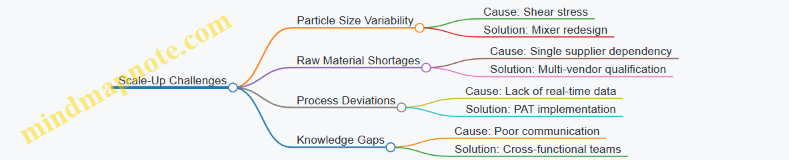
Summary
The early mRNA vaccine scale-up efforts underscored the importance of proactive process understanding, flexible manufacturing approaches, and strong collaboration among stakeholders. By integrating these lessons, future mRNA vaccine manufacturing campaigns can achieve faster, more reliable scale-up and tech transfer, ultimately accelerating patient access to life-saving vaccines.
9.4 Best Practice: Knowledge Sharing and Cross-Functional Collaboration
In the complex and fast-paced environment of mRNA vaccine manufacturing scale-up and tech transfer, effective knowledge sharing and cross-functional collaboration are critical success factors. These practices ensure that expertise, lessons learned, and process insights are disseminated across teams, reducing risks, accelerating timelines, and improving overall product quality.
Why Knowledge Sharing and Cross-Functional Collaboration Matter
- Complexity of mRNA Manufacturing: Multiple specialized disciplines (process engineering, analytical development, regulatory affairs, quality control, supply chain) must work in harmony.
- Speed to Market: Rapid vaccine development demands seamless communication to avoid bottlenecks.
- Risk Mitigation: Sharing lessons learned helps prevent repeated mistakes.
- Continuous Improvement: Cross-functional feedback loops enable ongoing process optimization.
Key Components of Effective Knowledge Sharing
- Centralized Documentation Systems: Use of digital platforms (e.g., electronic lab notebooks, document management systems) to store SOPs, batch records, validation reports.
- Regular Cross-Functional Meetings: Scheduled touchpoints for updates, issue resolution, and brainstorming.
- Communities of Practice: Groups focused on specific topics (e.g., LNP formulation, analytical methods) to share expertise.
- Training and Workshops: Interactive sessions to build shared understanding and skills.
Mind Map: Knowledge Sharing Framework
Mind Map: Cross-Functional Collaboration in Tech Transfer
Practical Examples
Example 1: Implementing a Cross-Functional Tech Transfer Kickoff Meeting
At a leading mRNA vaccine manufacturer, a formal kickoff meeting is held at the start of every tech transfer. Representatives from R&D, process engineering, quality, regulatory, and supply chain participate. During this meeting:
- Transfer objectives and timelines are aligned.
- Potential risks are identified collaboratively.
- Communication channels and responsibilities are defined.
This practice has led to a 30% reduction in transfer-related deviations by ensuring all stakeholders are aligned from the outset.
Example 2: Using a Digital Knowledge Repository for Lessons Learned
A contract manufacturing organization (CMO) developed a centralized digital repository where all tech transfer teams upload detailed lessons learned, including root cause analyses and corrective actions. This repository is searchable and accessible across sites.
When a new mRNA vaccine project started, the team reviewed previous lessons, avoiding pitfalls such as equipment incompatibilities and analytical method discrepancies. This proactive knowledge sharing shortened the transfer timeline by 20%.
Example 3: Cross-Functional Workshops on Lipid Nanoparticle (LNP) Formulation Challenges
To address scale-up challenges in LNP formulation, a series of workshops involving formulation scientists, process engineers, and quality control analysts was organized. These workshops:
- Facilitated open discussion of observed issues (e.g., particle size variability).
- Enabled joint troubleshooting and hypothesis testing.
- Resulted in optimized mixing parameters and improved batch consistency.
Tips for Fostering a Collaborative Culture
- Encourage open communication and psychological safety.
- Recognize and reward collaborative behaviors.
- Leverage collaboration tools effectively.
- Promote leadership support for cross-functional initiatives.
By embedding knowledge sharing and cross-functional collaboration into the fabric of mRNA vaccine manufacturing scale-up and tech transfer, organizations can significantly enhance efficiency, reduce risks, and ultimately deliver safe and effective vaccines to patients faster.
9.5 Example: Implementing Corrective Actions Post-Tech Transfer
Post-tech transfer, it is common to encounter unexpected challenges that require prompt and effective corrective actions to ensure the manufacturing process remains robust and compliant. This section explores a detailed example of implementing corrective actions after tech transfer, highlighting best practices and practical steps.
Scenario Overview
A biotech company transferred an mRNA vaccine manufacturing process from R&D to a commercial manufacturing site. During initial commercial runs, the quality control team observed increased variability in the lipid nanoparticle (LNP) encapsulation efficiency, leading to inconsistent product potency.
Step 1: Identifying the Root Cause
A cross-functional investigation team was formed, including process engineers, analytical scientists, and quality assurance specialists. They used a structured root cause analysis approach:
- Fishbone Diagram (Cause and Effect):
- 5 Whys Analysis:
- Why is encapsulation efficiency variable? Because mixing speed fluctuates.
- Why does mixing speed fluctuate? Because the mixer speed controller is unstable.
- Why is the controller unstable? Because it was not calibrated after installation.
- Why was it not calibrated? Because calibration SOP was not updated for new equipment.
- Why was SOP not updated? Because of communication gaps between engineering and QA.
Step 2: Developing Corrective Actions
Based on the root cause analysis, the team proposed the following corrective actions:
-
Equipment Calibration and Maintenance:
- Update and enforce calibration SOPs for all critical equipment.
- Schedule immediate calibration of the mixer speed controller.
-
Operator Training:
- Conduct refresher training on equipment operation and critical parameters.
- Implement a checklist for shift handovers emphasizing critical control points.
-
Process Monitoring Enhancements:
- Introduce real-time monitoring of mixing speed and temperature using PAT tools.
- Establish tighter control limits for critical parameters.
-
Analytical Method Review:
- Validate and standardize analytical methods for encapsulation efficiency.
- Implement routine proficiency testing for QC analysts.
Step 3: Implementation and Verification
- Pilot Runs: Conducted pilot batches incorporating corrective actions to verify improvements.
- Data Review: Statistical analysis showed reduced variability in encapsulation efficiency.
- Documentation: Updated batch records, SOPs, and training logs to reflect changes.
Step 4: Continuous Monitoring
- Established a dashboard for ongoing monitoring of encapsulation efficiency and related parameters.
- Scheduled periodic audits to ensure sustained compliance.
Mind Map: Corrective Action Workflow Post-Tech Transfer
Example: Applying Corrective Actions in a Real-World Context
Company X faced similar challenges during tech transfer of their mRNA vaccine LNP formulation. By implementing a corrective action plan focused on equipment calibration and operator training, they reduced batch failures by 40% within three months. The use of PAT for real-time monitoring enabled early detection of deviations, preventing out-of-specification batches.
Key Takeaways
- Early identification and structured root cause analysis are critical.
- Cross-functional collaboration accelerates problem resolution.
- Updating SOPs and training ensures sustainability of corrective actions.
- Real-time monitoring tools enhance process control and product quality.
- Documentation and verification are essential for regulatory compliance.
By integrating these best practices and examples, process engineers, tech transfer leads, and regulatory affairs specialists can effectively manage and resolve post-tech transfer challenges, ensuring successful scale-up and consistent mRNA vaccine manufacturing.
10. Future Trends and Innovations in mRNA Vaccine Manufacturing
10.1 Emerging Technologies in mRNA Synthesis and Purification
The rapid evolution of mRNA vaccine technology has spurred significant advancements in both synthesis and purification processes. These emerging technologies aim to enhance yield, purity, scalability, and cost-effectiveness, which are critical for meeting global vaccine demands.
Mind Map: Emerging Technologies in mRNA Synthesis and Purification
Enzyme Engineering for Enhanced mRNA Synthesis
Best Practice: Utilizing engineered RNA polymerases with improved processivity and fidelity can significantly increase mRNA yield and reduce impurities such as abortive transcripts.
Example: A biotech company developed a mutant T7 RNA polymerase variant that incorporates modified nucleotides more efficiently, enabling the production of mRNA with enhanced stability and reduced immunogenicity. This enzyme reduced reaction times by 30% during scale-up.
Continuous Flow In Vitro Transcription (IVT) Systems
Traditional batch IVT reactions can be limited by substrate depletion and enzyme instability. Continuous flow systems allow constant substrate feeding and product removal, improving reaction efficiency.
Example: A pilot facility implemented a continuous flow IVT reactor that maintained steady-state conditions, resulting in a 40% increase in mRNA productivity and easier scalability compared to batch processes.
Cell-Free Systems and Template Optimization
Cell-free expression platforms are emerging as alternatives to traditional IVT, offering rapid synthesis with fewer contaminants.
Example: Researchers optimized linear DNA templates with enhanced promoter sequences and 5’/3’ untranslated regions (UTRs) to maximize transcription efficiency, achieving higher yields in a cell-free system.
Advanced Purification Technologies
Chromatography Innovations
- Affinity Chromatography: Use of sequence-specific affinity ligands to selectively bind mRNA molecules, improving purity.
- Ion Exchange Chromatography: Optimized resins and gradient elution profiles enhance separation of full-length mRNA from truncated species.
Example: A manufacturer integrated a multimodal chromatography step combining ion exchange and hydrophobic interaction, reducing dsRNA contaminants by 90%.
Membrane-Based Technologies
Tangential Flow Filtration (TFF) remains a cornerstone for buffer exchange and concentration but is being enhanced with novel membranes offering higher flux and selectivity.
Example: Implementation of high-performance TFF membranes reduced processing time by 25% while maintaining RNA integrity.
Novel Purification Approaches
- Magnetic Bead-Based Purification: Enables rapid and scalable mRNA capture with minimal equipment footprint.
- Precipitation Techniques: Use of selective precipitation agents to remove impurities prior to chromatography.
Example: A start-up developed an automated magnetic bead purification platform that decreased hands-on time by 50%, facilitating faster tech transfer.
Integration and Automation
Process Analytical Technology (PAT): Real-time monitoring tools such as UV absorbance, fluorescence, and Raman spectroscopy are being integrated inline to monitor mRNA concentration and purity during synthesis and purification.
Example: A vaccine manufacturer deployed inline UV and fluorescence sensors during IVT, enabling immediate adjustments to reaction parameters and improving batch consistency.
AI and Machine Learning: Data-driven models predict optimal process parameters, reducing development timelines.
Example: Machine learning algorithms analyzed historical IVT runs to optimize nucleotide concentrations and reaction times, resulting in a 15% yield increase.
Summary
Emerging technologies in mRNA synthesis and purification are transforming vaccine manufacturing by improving efficiency, scalability, and product quality. Process engineers and tech transfer leads should consider integrating enzyme engineering, continuous flow systems, advanced chromatography, and automation to stay at the forefront of mRNA vaccine production.
These innovations not only streamline scale-up but also facilitate smoother tech transfer by generating robust, reproducible processes that meet stringent regulatory standards.
10.2 Automation and Digitalization in Scale-Up and Tech Transfer
Automation and digitalization are revolutionizing mRNA vaccine manufacturing, particularly during scale-up and technology transfer phases. These advancements enhance process control, reduce human error, accelerate timelines, and improve data integrity—critical factors for successful commercial manufacturing.
Key Benefits of Automation and Digitalization
- Enhanced Process Consistency: Automated systems ensure repeatable operations, reducing variability.
- Real-Time Monitoring: Digital tools enable continuous data capture and analysis.
- Improved Data Integrity and Traceability: Electronic records facilitate compliance with regulatory requirements.
- Accelerated Tech Transfer: Digital platforms streamline knowledge sharing and documentation.
- Resource Optimization: Automation reduces manual labor and operational costs.
Mind Map: Automation and Digitalization in mRNA Scale-Up and Tech Transfer
Automation in Process Control
Automated bioreactors equipped with inline sensors monitor critical parameters such as temperature, pH, dissolved oxygen, and mixing speed during mRNA synthesis and LNP formulation. For example, a large-scale IVT reaction can be controlled via a distributed control system (DCS) that adjusts reagent feed rates in real-time based on sensor feedback.
Example: A leading mRNA manufacturer implemented automated inline UV and conductivity sensors during purification steps, enabling immediate detection of impurities and reducing batch failures by 30%.
Digital Data Management Systems
Electronic Batch Records (EBR) and Manufacturing Execution Systems (MES) replace paper-based documentation, ensuring accuracy and facilitating rapid data retrieval during audits. Cloud-based platforms enable secure, centralized data access across multiple manufacturing sites, enhancing collaboration during tech transfer.
Example: During a multi-site tech transfer, a vaccine developer used a cloud-based MES to synchronize process parameters and batch records, reducing transfer time by 25% and minimizing data discrepancies.
Digital Tools for Tech Transfer
Digital knowledge repositories store detailed process descriptions, SOPs, and training materials accessible to both sending and receiving sites. Virtual training platforms using video tutorials and interactive modules help train personnel remotely, maintaining consistency in skill development.
Example: A contract manufacturing organization (CMO) leveraged a collaborative software platform to manage tech transfer documentation and conduct virtual workshops, enabling a smooth handover despite travel restrictions.
Quality Control Automation
Automated QC instruments, such as high-throughput PCR analyzers and automated chromatography systems, accelerate testing timelines and reduce operator variability. Integrated audit trails within digital systems ensure full traceability of QC results.
Example: Implementing automated RNA integrity analysis reduced QC turnaround time from days to hours, facilitating faster batch release decisions.
Advanced Examples: AI and Robotics
-
AI-Driven Process Optimization: Machine learning algorithms analyze historical process data to predict optimal reaction conditions and identify potential failure points before scale-up.
-
Robotics in Formulation: Automated liquid handlers precisely prepare LNP formulations, improving reproducibility and reducing contamination risk.
Example: An mRNA vaccine producer integrated AI models to optimize IVT reaction parameters, achieving a 15% increase in yield during scale-up.
Summary
Automation and digitalization are indispensable enablers for efficient, reliable, and compliant mRNA vaccine manufacturing scale-up and tech transfer. By embracing these technologies, process engineers, tech transfer leads, and regulatory specialists can significantly reduce risks, accelerate timelines, and ensure product quality.
References and Further Reading
- FDA Guidance on Process Analytical Technology
- ISPE Good Practice Guide: Technology Transfer
- Case Studies on Digital Transformation in Biomanufacturing
10.3 Advances in Lipid Nanoparticle Delivery Systems
Lipid nanoparticles (LNPs) have become the cornerstone of mRNA vaccine delivery, enabling efficient cellular uptake and protection of the fragile mRNA molecules. Recent advances in LNP technology focus on improving delivery efficiency, reducing toxicity, enhancing stability, and enabling targeted delivery. This section explores these advances with practical examples and mind maps to clarify complex concepts.
Key Components of Lipid Nanoparticles
- Ionizable lipids: Facilitate endosomal escape
- Helper lipids: Stabilize the particle structure
- Cholesterol: Enhances membrane fluidity
- PEGylated lipids: Improve circulation time
Mind Map: Components and Functions of LNPs
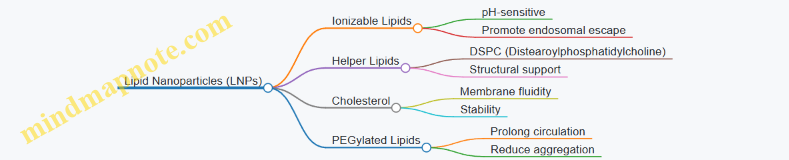
Advances in Ionizable Lipids
New ionizable lipids have been engineered to optimize the balance between efficacy and safety. For example, Moderna’s SM-102 and BioNTech’s ALC-0315 lipids have been tailored for improved endosomal escape and reduced inflammatory responses.
Example:
- SM-102 lipid enables efficient mRNA delivery with minimal toxicity, contributing to Moderna’s vaccine success.
Mind Map: Ionizable Lipid Development Focus
Targeted Delivery Innovations
Emerging LNP designs incorporate targeting ligands to direct vaccines to specific cell types or tissues, enhancing immune response and reducing off-target effects.
Example:
- Incorporation of mannose ligands to target dendritic cells, improving antigen presentation.
Stability and Storage Improvements
Recent formulations focus on enhancing LNP stability to reduce cold chain dependency.
Example:
- Lyophilized LNP formulations that maintain mRNA integrity at refrigerated or room temperatures, facilitating global distribution.
Mind Map: Stability Enhancement Strategies
Manufacturing and Scale-Up Considerations
Advances in microfluidic mixing technologies allow precise and scalable LNP assembly with consistent particle size and encapsulation efficiency.
Example:
- Use of staggered herringbone micromixers (SHMs) to produce uniform LNP batches at commercial scale.
Best Practice Example: Integrating Microfluidic Mixing for LNP Scale-Up
- Start with small-scale microfluidic optimization to define flow rates and lipid:mRNA ratios.
- Scale using parallelized microfluidic chips to maintain consistency.
- Monitor particle size distribution and encapsulation efficiency via dynamic light scattering (DLS) and Ribogreen assays.
Summary
Advances in LNP delivery systems are critical to the continued success and evolution of mRNA vaccines. By optimizing lipid composition, targeting capabilities, stability, and manufacturing processes, the next generation of mRNA vaccines will be safer, more effective, and easier to distribute globally.
For process engineers, tech transfer leads, and regulatory affairs specialists, understanding these advances is essential to ensure smooth scale-up, regulatory compliance, and robust product performance.
10.4 Regulatory Innovations Supporting Accelerated Development
The rapid development and deployment of mRNA vaccines, especially during the COVID-19 pandemic, have driven significant regulatory innovations aimed at accelerating vaccine availability without compromising safety or efficacy. Understanding these innovations is crucial for process engineers, tech transfer leads, and regulatory affairs specialists to navigate compliance efficiently while maintaining speed.
Key Regulatory Innovations
-
Emergency Use Authorizations (EUAs)
- Allow temporary use of vaccines during public health emergencies before full approval.
- Example: The FDA granted EUA for Pfizer-BioNTech and Moderna COVID-19 mRNA vaccines within a year of development.
-
Rolling Review Processes
- Regulators review data packages as they become available rather than waiting for a complete dossier.
- This enables faster feedback and iterative improvements.
- Example: EMA used rolling reviews extensively for COVID-19 vaccines.
-
Adaptive Clinical Trial Designs
- Flexible protocols that allow modifications based on interim data.
- Speeds up decision-making and reduces time to market.
-
Harmonization of Regulatory Requirements
- International collaboration to align standards and reduce duplicative efforts.
- Initiatives like ICH Q12 provide guidance on lifecycle management.
-
Use of Real-World Evidence (RWE)
- Incorporating post-market data to support ongoing safety and efficacy assessments.
-
Digital Submissions and eCTD (electronic Common Technical Document)
- Streamlines dossier submission and review processes.
Mind Map: Regulatory Innovations for Accelerated mRNA Vaccine Development
Best Practices for Leveraging Regulatory Innovations
-
Early and Frequent Engagement with Regulatory Authorities
- Schedule pre-submission meetings to clarify expectations.
- Example: Pfizer engaged FDA early to align on rolling review data requirements.
-
Prepare Modular and Flexible Documentation
- Organize data to support rolling submissions.
- Use electronic systems to update dossiers seamlessly.
-
Implement Adaptive Trial Designs Where Feasible
- Collaborate with clinical teams to design trials that allow interim analyses.
-
Leverage Global Regulatory Harmonization
- Align submissions with ICH guidelines to facilitate multi-region approvals.
-
Utilize Real-World Evidence Strategically
- Plan post-approval studies to complement clinical trial data.
-
Invest in Digital Infrastructure
- Adopt eCTD-compliant software for efficient submission and tracking.
Example: Accelerated Approval of COVID-19 mRNA Vaccines
- Context: The unprecedented urgency of the COVID-19 pandemic required rapid vaccine development and approval.
- Regulatory Innovation: FDA’s EUA pathway allowed Pfizer-BioNTech and Moderna to deploy vaccines after phase 3 interim results.
- Rolling Review: Both companies submitted data packages in real-time, enabling FDA to review efficacy, safety, and manufacturing data concurrently.
- Adaptive Trials: Trials included interim analyses to assess early efficacy signals.
- Outcome: Vaccines were authorized within approximately 10 months from sequence identification, a historic acceleration.
Mind Map: Best Practices to Navigate Regulatory Innovations
Summary
Regulatory innovations such as EUAs, rolling reviews, adaptive trial designs, and global harmonization have revolutionized the pathway for mRNA vaccine development and scale-up. By integrating these innovations into manufacturing and tech transfer strategies, teams can accelerate timelines while ensuring compliance and product quality. Embracing digital tools and proactive regulatory engagement further enhances the ability to respond swiftly to public health needs.
10.5 Best Practice: Preparing for Flexible Manufacturing Platforms
Flexible manufacturing platforms are becoming essential in the mRNA vaccine industry to rapidly respond to emerging pathogens, scale production efficiently, and accommodate multiple product variants with minimal downtime. Preparing for such platforms involves strategic planning, adaptable process design, and investment in modular technologies.
Key Elements of Flexible Manufacturing Platforms
Modular Equipment and Facility Design
- Description: Use of modular bioreactors, single-use systems, and plug-and-play components that can be quickly reconfigured for different processes or scales.
- Example: A facility using single-use bioreactors ranging from 50L to 2000L allows seamless switching between clinical and commercial scale production without extensive cleaning or downtime.
Multi-Product Capability
- Description: Designing processes and facilities that can manufacture multiple mRNA vaccine candidates or other biologics without cross-contamination.
- Example: Implementing dedicated changeover protocols and validated cleaning procedures to switch between different mRNA constructs within the same manufacturing suite.
Automation and Digital Integration
- Description: Leveraging automation for process control and digital systems for data capture enhances flexibility by reducing manual intervention and enabling rapid process adjustments.
- Example: Using a centralized Manufacturing Execution System (MES) that supports multiple product recipes and real-time analytics to optimize batch runs.
Workforce Training and Cross-Functional Teams
- Description: Preparing personnel to operate across different platforms and products ensures smooth transitions and reduces errors.
- Example: Cross-training operators on both mRNA synthesis and LNP formulation processes, enabling flexible staffing during scale-up or tech transfer.
Regulatory Strategy for Flexible Platforms
- Description: Engaging early with regulatory agencies to define validation approaches that accommodate multiple products and process changes.
- Example: Using platform master files or comparability protocols to streamline approval of new mRNA vaccine variants produced on the same flexible platform.
Integrated Example: Implementing a Flexible Manufacturing Platform at a Biomanufacturing Site
A mid-sized biomanufacturing company planned to produce multiple mRNA vaccines targeting different infectious diseases. They invested in single-use bioreactors with scalable volumes and installed an MES capable of handling multiple product recipes. Operators were cross-trained on all process steps, and a comprehensive cleaning validation was performed to support multi-product manufacturing.
During tech transfer, the team engaged regulatory agencies early, submitting a platform master file that covered common process parameters and analytical methods. This approach reduced the time needed for regulatory review when introducing new vaccine candidates.
As a result, the company achieved rapid product changeovers with minimal downtime, maintained consistent product quality across batches, and scaled production efficiently to meet fluctuating demand.
Summary
Preparing for flexible manufacturing platforms in mRNA vaccine production requires a holistic approach encompassing modular equipment, multi-product process design, automation, workforce readiness, and regulatory foresight. Incorporating these best practices enables manufacturers to respond swiftly to evolving public health needs while maintaining high standards of quality and compliance.
10.6 Example: Integrating AI-Driven Process Control in mRNA Vaccine Production
The integration of Artificial Intelligence (AI) into process control systems is revolutionizing mRNA vaccine manufacturing by enabling real-time decision-making, predictive analytics, and enhanced process optimization. This example explores how AI-driven process control can be implemented effectively, highlighting best practices and practical use cases.
Overview of AI-Driven Process Control in mRNA Manufacturing
AI-driven process control involves leveraging machine learning algorithms, data analytics, and automation to monitor and adjust manufacturing parameters dynamically. This approach helps maintain consistent product quality, reduce variability, and accelerate scale-up timelines.
Mind Map: AI-Driven Process Control Components
Example Use Case: Real-Time Monitoring of In Vitro Transcription (IVT) Reaction
Scenario: During the IVT step, critical parameters such as temperature, pH, and nucleotide concentrations significantly impact mRNA yield and quality. Traditional control methods rely on fixed setpoints and manual adjustments.
AI Integration:
- Sensors continuously collect data on temperature, pH, and reagent flow rates.
- Machine learning models analyze this data in real time to predict reaction kinetics and identify deviations.
- The system automatically adjusts temperature and reagent feed rates to optimize yield.
Outcome:
- Increased batch-to-batch consistency.
- Reduced reaction failures due to early detection of anomalies.
- Enhanced overall process efficiency.
Mind Map: AI Application in IVT Reaction Control
Best Practices for Implementing AI-Driven Process Control
-
Data Quality and Integration: Ensure high-quality, comprehensive data collection from PAT tools and sensors. Integrate historical batch data to train robust AI models.
-
Cross-Functional Collaboration: Engage process engineers, data scientists, and quality teams early to align AI objectives with manufacturing goals.
-
Pilot Testing: Start with pilot-scale runs to validate AI model predictions and control strategies before full-scale implementation.
-
Regulatory Compliance: Document AI algorithms, validation protocols, and change management processes to meet regulatory expectations.
-
Operator Training: Train manufacturing personnel on AI system interfaces and decision-making workflows to foster trust and effective use.
Example: Predictive Maintenance of Lipid Nanoparticle (LNP) Formulation Equipment
Scenario: LNP formulation involves sensitive mixing equipment prone to wear and tear, which can cause batch inconsistencies.
AI Integration:
- Vibration and temperature sensors collect equipment health data.
- AI models predict potential failures before they occur.
- Maintenance is scheduled proactively, minimizing downtime.
Outcome:
- Reduced unplanned equipment failures.
- Improved batch quality by maintaining optimal equipment conditions.
Mind Map: AI in Predictive Maintenance

Summary
Integrating AI-driven process control into mRNA vaccine manufacturing offers transformative benefits, including enhanced process robustness, improved product quality, and accelerated scale-up. By combining real-time data acquisition, machine learning, and automated decision-making, manufacturers can proactively manage complex bioprocesses with greater precision.
The examples of IVT reaction control and predictive maintenance demonstrate practical applications, while mind maps provide a structured visualization of AI components and benefits. Adhering to best practices ensures successful implementation and regulatory compliance, positioning organizations at the forefront of innovative vaccine manufacturing.