AI Native Product Design and Intelligent Automation Business Models
1. Introduction to AI Native Product Design
1.1 Defining AI Native Products: Characteristics and Core Principles
What Are AI Native Products?
AI Native Products are digital solutions designed from the ground up to leverage artificial intelligence as a core component, not just an add-on feature. These products inherently embed AI capabilities within their architecture, enabling them to learn, adapt, and evolve based on data and user interactions.
Core Characteristics of AI Native Products
- Data-Centric Design: AI native products are built around continuous data collection and analysis, enabling real-time insights and decision-making.
- Adaptive Intelligence: They dynamically improve their performance through machine learning and feedback loops.
- Automation-Driven: Many routine or complex tasks are automated, reducing manual intervention.
- User-Centric Personalization: AI tailors experiences uniquely to each user, enhancing engagement and satisfaction.
- Scalability and Flexibility: Designed to scale with data volume and user base while adapting to changing environments.
- Embedded AI Components: AI is integrated into the core product logic rather than bolted on as a separate module.
Core Principles Guiding AI Native Product Design
- AI as a First-Class Citizen: AI is not an afterthought but a foundational element shaping product capabilities.
- Continuous Learning: Products must incorporate mechanisms for ongoing model training and refinement.
- Transparency and Explainability: Users and stakeholders should understand AI-driven decisions.
- Ethical AI Use: Design must consider fairness, privacy, and accountability.
- Seamless Human-AI Collaboration: AI augments human capabilities rather than replacing them outright.
Mind Map: Characteristics of AI Native Products
Mind Map: Core Principles of AI Native Product Design
Examples of AI Native Products
Netflix Recommendation Engine
Netflix’s product is AI native because its core user experience—content discovery—is powered by sophisticated machine learning models that analyze viewing habits, preferences, and contextual data to personalize recommendations. This AI-driven personalization is embedded deeply into the product, continuously learning and adapting to user behavior.
- Best Practice Demonstrated: Continuous learning and user-centric personalization.
Google Duplex
Google Duplex is an AI native product designed to autonomously make phone calls for tasks like booking appointments. The AI is embedded in the core interaction, enabling natural language understanding and generation.
- Best Practice Demonstrated: Seamless human-AI collaboration and transparency.
Tesla Autopilot
Tesla’s Autopilot system is an AI native product where AI algorithms are integral to vehicle control and safety. It continuously learns from real-world driving data, improving over time.
- Best Practice Demonstrated: Adaptive intelligence and automation-driven design.
Summary
AI Native Products represent a paradigm shift where AI is foundational, enabling products to be smarter, more adaptive, and personalized. By adhering to core principles such as continuous learning, ethical AI use, and transparency, product teams can design solutions that deliver sustained value and trust.
For Product Directors and Innovation Managers, understanding these characteristics and principles is essential to spearhead AI native initiatives that align with business goals and user needs.
1.2 The Evolution from Traditional to AI Native Design
The shift from traditional product design to AI native design marks a fundamental transformation in how products are conceived, developed, and delivered. This evolution is driven by the increasing capabilities of artificial intelligence technologies and the demand for more adaptive, personalized, and intelligent user experiences.
Traditional Product Design: Key Characteristics
- Rule-Based Logic: Products rely on predefined rules and static workflows.
- Manual Data Processing: Data is often collected and analyzed manually or in batch processes.
- Fixed User Experience: UX is designed based on assumptions and static personas.
- Linear Development Cycles: Waterfall or stage-gate models dominate.
- Limited Adaptability: Products require manual updates to respond to changing user needs.
Example: A traditional e-commerce website recommends products based on fixed categories and manually curated lists.
AI Native Product Design: Key Characteristics
- Data-Driven Intelligence: Products continuously learn from real-time data.
- Adaptive and Personalized UX: AI models tailor experiences dynamically.
- Continuous Deployment: Agile and DevOps enable rapid iteration and model updates.
- Embedded Automation: Intelligent automation handles routine tasks seamlessly.
- Context Awareness: Products understand user context and intent.
Example: Amazon’s recommendation system uses machine learning to personalize product suggestions based on browsing and purchase history in real-time.
Mind Map: Evolution from Traditional to AI Native Design
Transition Phases with Examples
-
Augmentation Phase: AI assists traditional products by adding features.
- Example: Grammarly integrates AI-powered grammar suggestions into a traditional text editor.
-
Integration Phase: AI components become core to the product functionality.
- Example: Google Photos uses AI for automatic photo tagging and organization.
-
AI Native Phase: AI is foundational; product design revolves around AI capabilities.
- Example: Tesla’s Autopilot system where AI drives core product experience.
Mind Map: Transition Phases
Best Practices for Managing the Evolution
- Start Small with AI Features: Begin by embedding AI in specific product areas.
- Invest in Data Infrastructure: Ensure robust data collection and processing pipelines.
- Foster Cross-Functional Collaboration: Align AI engineers, product managers, and designers.
- Adopt Agile and Continuous Delivery: Enable rapid experimentation and iteration.
- Prioritize User Trust and Transparency: Clearly communicate AI’s role to users.
Summary
The evolution from traditional to AI native design is not just a technological upgrade but a paradigm shift. By embracing AI native principles, product teams can unlock new levels of personalization, efficiency, and innovation, positioning their products for future success.
1.3 Business Impact of AI Native Products: Case Study of Netflix’s Recommendation Engine
AI native products leverage artificial intelligence as a core component of their design, enabling them to deliver personalized, efficient, and scalable user experiences. Netflix’s recommendation engine is a prime example of how AI native design can transform a product and drive significant business impact.
Overview of Netflix’s Recommendation Engine
Netflix uses a sophisticated AI-driven recommendation system to personalize content suggestions for over 230 million subscribers worldwide. This system analyzes user behavior, viewing history, ratings, and even contextual data such as time of day or device type to predict what content a user is most likely to enjoy.
Business Impact Mind Map
Netflix Recommendation Engine: Business Impact Mind Map
How AI Powers These Impacts
-
Collaborative Filtering: Netflix uses algorithms that identify patterns across users with similar tastes to recommend new content.
-
Content-Based Filtering: Analyzes attributes of content (genre, actors, directors) to suggest similar titles.
-
Deep Learning Models: Neural networks process complex user interaction data to improve prediction accuracy.
-
Contextual Bandits: Real-time learning models adapt recommendations based on immediate user feedback.
Example: Personalized Homepage
When a user logs in, the homepage is dynamically generated with rows of content tailored to their preferences, such as “Because you watched Stranger Things” or “Trending in your area.” This personalization increases the likelihood of content discovery and consumption.
Best Practices Illustrated by Netflix
-
Continuous Model Training: Netflix constantly updates its models with fresh data to maintain relevance.
-
A/B Testing: Rigorous experimentation to test recommendation algorithms before full rollout.
-
User Privacy Considerations: Data anonymization and compliance with regulations to protect user data.
-
Cross-Functional Collaboration: Data scientists, engineers, and product managers work closely to align AI capabilities with business goals.
Additional Examples of AI Native Product Impact
-
Spotify: Personalized playlists like “Discover Weekly” increase user engagement similarly.
-
Amazon: Product recommendations drive a significant portion of sales.
Summary
Netflix’s AI native recommendation engine exemplifies how embedding AI deeply into product design can create a virtuous cycle of enhanced user experience, operational efficiency, and business growth. For product directors and innovation managers, this case underscores the importance of leveraging AI not just as an add-on but as a foundational element of product strategy.
1.4 Best Practices for Identifying AI Opportunities in Product Design
Identifying AI opportunities in product design is a critical step for Product Directors and Innovation Managers aiming to build AI native products that deliver meaningful value. This section outlines best practices, supported by clear examples and mind maps, to help you systematically uncover where AI can transform your product offerings.
Best Practice 1: Start with Customer Pain Points and Jobs to Be Done (JTBD)
Focus on understanding the core problems your customers face and the jobs they want to accomplish. AI is most impactful when it automates repetitive tasks, enhances decision-making, or personalizes experiences.
Example:
- Netflix identified the pain point of users struggling to find relevant content quickly. By applying AI-driven recommendation algorithms, they personalized the viewing experience, increasing engagement and retention.
Mind Map:
Best Practice 2: Analyze Data Availability and Quality
AI thrives on data. Evaluate what data you currently collect and its quality. Identify gaps where new data sources or improved data collection can unlock AI capabilities.
Example:
- In healthcare, companies like Tempus collect vast amounts of clinical and molecular data to train AI models that assist in personalized cancer treatment decisions.
Mind Map:
Best Practice 3: Leverage Cross-Functional Workshops to Brainstorm AI Use Cases
Bring together product managers, AI engineers, UX designers, and business stakeholders to ideate AI applications. Diverse perspectives help uncover innovative opportunities.
Example:
- Google’s AI teams regularly run design sprints involving cross-disciplinary teams to rapidly prototype AI features, such as Google Duplex’s natural language capabilities.
Mind Map:
Best Practice 4: Identify Automation Potential in Existing Workflows
Map current workflows to spot repetitive, rule-based, or high-volume tasks that can be automated or augmented with AI.
Example:
- UiPath transformed robotic process automation (RPA) by integrating AI to handle unstructured data, enabling automation of invoice processing in finance departments.
Mind Map:
Best Practice 5: Evaluate Competitive Landscape and Market Trends
Analyze competitors’ AI initiatives and emerging market trends to identify gaps and opportunities for differentiation.
Example:
- Spotify’s use of AI for dynamic playlist generation and music discovery set a new standard in personalized music streaming, inspiring competitors to adopt similar AI-driven features.
Mind Map:
Best Practice 6: Prototype and Validate AI Concepts Early
Build lightweight AI prototypes to test assumptions and gather user feedback before full-scale development.
Example:
- Google Duplex started as a minimal viable AI prototype focused on natural conversation for booking appointments, iteratively refined based on real-world testing.
Mind Map:
Summary
By systematically applying these best practices, Product Directors and Innovation Managers can uncover high-impact AI opportunities that align with customer needs, leverage data assets, and fit within business goals. The integration of mind maps helps visualize complex considerations, while real-world examples provide concrete inspiration for your AI native product design journey.
2. Foundations of Intelligent Automation in Business Models
2.1 Understanding Intelligent Automation: RPA, AI, and Machine Learning Synergies
Intelligent Automation (IA) represents the convergence of Robotic Process Automation (RPA), Artificial Intelligence (AI), and Machine Learning (ML) to create systems that not only automate repetitive tasks but also learn, adapt, and make decisions. This synergy enables businesses to achieve higher efficiency, reduce errors, and unlock new value streams.
What is Robotic Process Automation (RPA)?
RPA is a technology that uses software robots (bots) to automate highly repetitive, rule-based tasks traditionally performed by humans. Examples include data entry, invoice processing, and report generation.
Example: A bank uses RPA bots to automatically extract data from loan applications and input it into their core banking system, reducing manual errors and speeding up processing time.
What is Artificial Intelligence (AI)?
AI refers to systems that simulate human intelligence processes such as understanding natural language, recognizing images, and making decisions.
Example: A customer service chatbot that understands and responds to customer queries in natural language.
What is Machine Learning (ML)?
ML is a subset of AI that enables systems to learn from data and improve their performance over time without being explicitly programmed.
Example: Email spam filters that improve accuracy by learning from user feedback.
Mind Map: Components of Intelligent Automation
How RPA, AI, and ML Work Together
While RPA excels at automating structured, repetitive tasks, it struggles with unstructured data and decision-making. AI and ML complement RPA by enabling the automation of complex tasks involving unstructured data and cognitive functions.
Example:
- Invoice Processing Automation:
- RPA extracts invoice data from structured fields.
- AI-powered Optical Character Recognition (OCR) reads unstructured invoice formats.
- ML models classify invoices and detect anomalies or fraud.
- The combined system automates end-to-end invoice processing with minimal human intervention.
Mind Map: Synergy Workflow Example - Invoice Processing
Real-World Example: Intelligent Automation in Financial Services
Company: A global insurance firm
Challenge: Manual claims processing was slow and error-prone.
Solution:
- RPA bots automated data entry from claim forms.
- AI-powered NLP interpreted unstructured claim descriptions.
- ML models predicted claim fraud risk.
Outcome:
- 70% reduction in processing time.
- Significant decrease in fraudulent claims payouts.
- Improved customer satisfaction due to faster claim resolutions.
Best Practices for Leveraging IA Synergies
- Start with Process Assessment: Identify tasks suitable for RPA and those requiring AI/ML.
- Combine Technologies Thoughtfully: Use RPA for structured automation and AI/ML for cognitive tasks.
- Iterate and Improve: Continuously train ML models with new data.
- Ensure Data Quality: High-quality data is critical for AI/ML success.
- Plan for Exception Handling: Use AI chatbots or human-in-the-loop systems for complex cases.
Summary
Intelligent Automation is not just about automating tasks but about creating adaptive, intelligent systems by combining RPA, AI, and ML. This synergy enables businesses to automate complex workflows, improve decision-making, and unlock new efficiencies.
By understanding and leveraging these technologies together, Product Directors and Innovation Managers can design innovative AI native products and intelligent automation business models that drive competitive advantage.
2.2 Mapping Business Processes for Automation Potential: Example from Financial Services
Mapping business processes to identify automation potential is a critical step in designing intelligent automation strategies. In the financial services sector, where operations are complex and compliance-heavy, this approach can unlock significant efficiency gains, reduce errors, and improve customer experience.
Why Map Business Processes?
- Visualize workflows: Understand how tasks flow across departments.
- Identify bottlenecks: Spot repetitive, manual, or error-prone steps.
- Prioritize automation: Focus on processes with high volume, complexity, or cost.
- Ensure compliance: Map controls and checkpoints for regulatory adherence.
Step-by-Step Process Mapping for Automation
- Select the Process: Choose a high-impact process, e.g., loan application processing.
- Gather Stakeholders: Include process owners, frontline employees, IT, and compliance teams.
- Document Current State: Use flowcharts or swimlane diagrams to capture each step.
- Analyze for Automation: Identify tasks suitable for RPA, AI, or cognitive automation.
- Prioritize and Plan: Rank processes by ROI, feasibility, and risk.
Mind Map: Mapping Loan Application Process for Automation Potential
Example: Automation Opportunities in Loan Processing
- Data Collection: Replace manual form entry with AI-powered OCR (Optical Character Recognition) to extract data from scanned documents.
- Identity Verification: Use AI-based facial recognition and document validation to speed up onboarding.
- Credit Score Retrieval: Automate API calls to credit bureaus, reducing manual lookup time.
- Risk Analysis: Implement machine learning models to assess risk dynamically, flagging exceptions for human review.
- Approval Workflow: Use RPA bots to route applications based on predefined rules.
- Compliance Checks: Automate AML/KYC screening with AI algorithms that detect suspicious patterns.
Mind Map: Automation Suitability Criteria
Real-World Example: A Leading Bank’s Automation Journey
A major global bank mapped its mortgage approval process to identify automation potential. By applying the above methodology, they discovered:
- 60% of manual data entry could be automated using OCR and RPA.
- AI models could reduce credit risk assessment time by 40%.
- Automation of compliance checks reduced audit preparation time by 50%.
This mapping enabled the bank to prioritize automation projects, resulting in faster loan approvals, improved customer satisfaction, and significant cost savings.
Best Practices for Mapping Business Processes in Financial Services
- Engage cross-functional teams early to capture diverse perspectives.
- Use visual tools like flowcharts, swimlanes, and mind maps for clarity.
- Validate process maps with frontline employees to ensure accuracy.
- Incorporate regulatory and compliance checkpoints explicitly.
- Continuously update process maps as automation evolves.
Summary
Mapping business processes is the foundation for identifying automation opportunities in financial services. By visualizing workflows, analyzing tasks against suitability criteria, and leveraging real-world examples like loan processing, organizations can strategically deploy intelligent automation to maximize impact.
2.3 Designing Automation-First Business Models: Lessons from UiPath
Automation-first business models prioritize the integration of intelligent automation at the core of their value proposition, operational processes, and customer engagement strategies. UiPath, a global leader in Robotic Process Automation (RPA), exemplifies how to successfully build and scale such a model.
Understanding Automation-First Business Models
An automation-first business model leverages automation technologies not just as tools but as foundational elements that redefine workflows, reduce costs, and unlock new revenue streams. This approach demands rethinking traditional business processes with automation embedded from the outset.
UiPath’s Approach: Key Pillars
- Platform-Centric Ecosystem: UiPath built a comprehensive automation platform that supports RPA, AI, and analytics, enabling customers to automate end-to-end processes.
- Community and Marketplace: UiPath invested heavily in building a vibrant developer community and marketplace (UiPath Marketplace) to accelerate innovation and adoption.
- Flexible Licensing and Consumption Models: Offering subscription-based and usage-based pricing to align with customer needs and scale.
- Partner-Led Growth: Collaborating with system integrators and technology partners to expand reach and deliver tailored automation solutions.
Mind Map: UiPath’s Automation-First Business Model
Example: UiPath’s Subscription and Usage-Based Pricing
UiPath offers flexible pricing models that allow customers to start small and scale automation as needed. For example, a mid-sized bank might begin with automating invoice processing using a subscription plan. As automation proves ROI, the bank can expand usage-based licenses to automate additional processes like customer onboarding and compliance checks.
This flexibility reduces upfront investment risk and aligns UiPath’s revenue with customer success.
Best Practices Derived from UiPath’s Model
-
Build a Comprehensive Automation Platform: Provide tools that cover the entire automation lifecycle—from design to deployment to monitoring—to create stickiness and value.
-
Foster a Developer and User Community: Invest in training, forums, and marketplaces to accelerate innovation and reduce time-to-value.
-
Adopt Flexible Pricing Models: Use subscription and consumption-based pricing to lower barriers to entry and scale with customer needs.
-
Leverage Partnerships: Collaborate with ecosystem partners to extend capabilities and reach diverse markets.
-
Focus on Customer Success: Provide strong implementation support and measure ROI to ensure long-term adoption.
Mind Map: Best Practices for Automation-First Business Models
Additional Example: Automation-First in Action
Consider a healthcare provider aiming to reduce administrative overhead. By adopting an automation-first model inspired by UiPath, the provider implements bots to handle patient data entry, insurance claims processing, and appointment scheduling. The provider leverages a subscription plan initially, then scales usage as automation proves effective, partnering with consulting firms to customize workflows.
This approach results in faster processing times, reduced errors, and improved patient satisfaction, demonstrating the power of embedding automation at the core of the business model.
Summary
Designing automation-first business models requires a holistic approach that combines technology, community, flexible monetization, partnerships, and customer-centricity. UiPath’s success provides a blueprint for product directors and innovation managers to build scalable, sustainable automation-driven businesses.
2.4 Best Practices for Scaling Intelligent Automation Across Enterprises
Scaling intelligent automation (IA) across an enterprise is a complex but rewarding endeavor. It requires strategic planning, robust governance, and continuous alignment with business goals. Below, we explore best practices enriched with examples and mind maps to guide Product Directors and Innovation Managers in successfully scaling IA initiatives.
Establish a Clear Automation Strategy and Vision
- Define Objectives: Align automation goals with overall business strategy.
- Prioritize Use Cases: Focus on high-impact, repeatable processes.
- Example: A global bank prioritized automating loan processing to reduce turnaround time by 50%, increasing customer satisfaction.
Build a Center of Excellence (CoE)
- Purpose: Centralize expertise, governance, and best practices.
- Functions: Training, tool selection, standards enforcement.
- Example: UiPath’s CoE helped a multinational retailer scale from 5 to 200 automated processes within 18 months.
Invest in Scalable and Flexible Technology Platforms
- Cloud-Native Solutions: Facilitate rapid deployment and scalability.
- Integration Capabilities: Ensure seamless connection with legacy systems.
- Example: A healthcare provider adopted a cloud-based IA platform enabling rapid scaling during peak patient intake periods.
Foster Cross-Functional Collaboration
- Stakeholders: Involve IT, operations, compliance, and business units.
- Communication: Regular updates and feedback loops.
- Example: At a telecom company, collaboration between AI engineers and customer service led to automating 70% of routine inquiries.
Implement Robust Change Management
- Address Resistance: Transparent communication about benefits and impacts.
- Training Programs: Equip employees with necessary skills.
- Example: A manufacturing firm reduced employee pushback by involving workers early and offering reskilling programs.
Monitor, Measure, and Optimize Continuously
- KPIs: Track automation ROI, error rates, process cycle times.
- Feedback Loops: Use data to refine bots and AI models.
- Example: Salesforce continuously monitors AI-powered sales assistants, improving lead conversion rates by 15% over a year.
Summary Table of Best Practices with Examples
| Best Practice | Description | Example |
|---|---|---|
| Clear Automation Strategy | Align IA with business goals and prioritize use cases | Global bank automating loan processing |
| Center of Excellence (CoE) | Centralize governance and expertise | UiPath CoE scaling retailer automation |
| Scalable Technology Platforms | Use cloud-native, integrable platforms | Healthcare provider using cloud IA platform |
| Cross-Functional Collaboration | Engage all relevant stakeholders | Telecom automating customer inquiries |
| Change Management | Manage employee adoption and training | Manufacturing firm’s reskilling programs |
| Continuous Monitoring & Optimization | Track KPIs and refine IA continuously | Salesforce improving AI sales assistants |
By following these best practices, enterprises can effectively scale intelligent automation initiatives, unlocking operational efficiencies and driving innovation at scale.
3. Integrating AI into Product Development Lifecycle
3.1 AI-Driven User Research and Persona Development: Using NLP for Customer Insights
In the modern product innovation landscape, understanding your users deeply is paramount. Traditional user research methods—surveys, interviews, focus groups—are invaluable but can be time-consuming, costly, and sometimes limited in scope. AI-driven user research, particularly leveraging Natural Language Processing (NLP), offers a powerful way to extract rich, actionable insights from vast amounts of unstructured customer data.
What is NLP and Why Use it for User Research?
NLP is a branch of artificial intelligence that enables computers to understand, interpret, and generate human language. When applied to user research, NLP can analyze customer feedback, social media conversations, support tickets, reviews, and more, to uncover patterns, sentiments, and emerging needs.
Benefits of NLP in User Research:
- Scalability: Analyze thousands or millions of data points quickly.
- Unbiased Pattern Recognition: Detect trends that might be missed by manual review.
- Real-Time Insights: Monitor evolving customer sentiment continuously.
Mind Map: AI-Driven User Research Workflow Using NLP
Step-by-Step Example: Using NLP to Develop Personas from Customer Reviews
Context: A product team at a SaaS company wants to better understand their users to improve onboarding.
- Data Collection: Gather 10,000+ customer reviews and support chat transcripts.
- Preprocessing: Clean the text data by removing noise, tokenizing sentences, and normalizing words.
- Sentiment Analysis: Use an NLP model to score sentiments — positive, neutral, negative — to identify areas causing frustration.
- Topic Modeling: Apply Latent Dirichlet Allocation (LDA) to uncover key themes such as “ease of use,” “integration issues,” and “customer support.”
- Cluster Users: Based on themes and sentiment, cluster users into groups like “Tech-Savvy Integrators,” “Small Business Owners,” and “New Users Seeking Guidance.”
- Persona Creation: Develop personas that reflect these clusters, including motivations, pain points, and preferred communication channels.
Result: The team discovers that “New Users Seeking Guidance” struggle most with onboarding, prompting the creation of tailored tutorials and chatbot assistance.
Mind Map: Persona Development from NLP Insights
Real-World Example: Airbnb’s Use of NLP for Customer Insights
Airbnb leverages NLP to analyze millions of guest reviews to understand sentiment trends and identify unmet needs. By extracting themes such as “cleanliness,” “host responsiveness,” and “local experience,” Airbnb refines its user personas and tailors product features, like enhanced host communication tools and localized recommendations.
Best Practices for AI-Driven User Research and Persona Development
- Combine Quantitative and Qualitative Data: Use NLP insights alongside traditional research methods for richer personas.
- Iterate Personas Regularly: Customer needs evolve; update personas with fresh data continuously.
- Ensure Data Privacy: Anonymize data and comply with regulations when analyzing user-generated content.
- Use Explainable Models: Prefer NLP models that provide interpretable outputs to build trust with stakeholders.
- Cross-Functional Collaboration: Engage product managers, data scientists, UX designers, and marketers in the persona development process.
Summary
AI-driven user research using NLP transforms vast unstructured data into clear, actionable customer insights. By automating sentiment analysis, topic modeling, and clustering, product teams can develop nuanced, data-backed personas that drive smarter product decisions and innovation strategies.
Next up: 3.2 Prototyping AI Features with Minimal Viable Intelligence: Example from Google Duplex
3.2 Prototyping AI Features with Minimal Viable Intelligence: Example from Google Duplex
Prototyping AI features with Minimal Viable Intelligence (MVI) is a strategic approach that allows product teams to validate AI-driven functionalities early without building fully-fledged, complex AI systems. This approach focuses on delivering the core AI value with just enough intelligence to demonstrate feasibility, gather user feedback, and iterate rapidly.
What is Minimal Viable Intelligence (MVI)?
MVI is the AI equivalent of the Minimum Viable Product (MVP) concept. Instead of building a complete AI model with all possible capabilities, MVI prototypes focus on the smallest set of AI features that can deliver meaningful user value and validate assumptions.
Key Characteristics of MVI:
- Limited scope AI functionality
- Focus on core user interaction or automation
- Use of rule-based or hybrid AI approaches to supplement machine learning
- Rapid iteration based on user feedback
Why Use MVI in AI Prototyping?
- Faster time-to-market: Avoids long development cycles for complex AI models.
- Risk reduction: Tests AI assumptions early before heavy investment.
- User-centric design: Incorporates real user feedback to refine AI capabilities.
- Resource efficiency: Minimizes data and compute requirements initially.
Google Duplex: A Prime Example of MVI in Action
Google Duplex is an AI system designed to carry out natural conversations to perform real-world tasks over the phone, such as booking appointments or making reservations.
How Google Duplex Embodies MVI:
- Initially focused on a narrow domain: restaurant reservations and hair salon appointments.
- Used a combination of deep learning and rule-based dialogue management to handle conversations.
- Leveraged pre-defined templates and fallback strategies to manage unexpected user responses.
- Prioritized natural-sounding speech and context awareness over broad conversational AI.
This focused approach allowed Google to prototype and launch Duplex with a high success rate in its limited domain before considering broader applications.
Mind Map: Prototyping AI Features with MVI
Practical Steps to Prototype AI Features with MVI
-
Identify a focused use case: Choose a specific task where AI can add clear value, e.g., scheduling, recommendations, or classification.
-
Leverage existing AI components: Use pre-trained models, APIs (like Google Cloud AI, AWS AI services), or rule-based engines to reduce development time.
-
Design simple interaction flows: Build conversational or UI flows that handle the most common scenarios effectively.
-
Implement fallback strategies: For cases where AI confidence is low, fallback to manual handling or scripted responses to maintain user experience.
-
Test with real users: Deploy the prototype to a controlled user group to gather insights on usability and AI performance.
-
Iterate based on feedback: Improve AI models and interaction flows incrementally.
Example: Building a MVI Prototype for an AI-Powered Meeting Scheduler
-
Use Case: Automatically schedule meetings by understanding user preferences and calendar availability.
-
MVI Approach:
- Use a natural language understanding (NLU) API to extract date/time and participant info.
- Apply rule-based logic to check calendar availability.
- Generate confirmation messages using templated responses.
- Fallback to manual confirmation if conflicts arise.
-
Outcome: Early prototype can schedule simple meetings reliably, allowing product teams to validate user interest before investing in complex AI planning algorithms.
Lessons Learned from Google Duplex for Product Directors and Innovation Managers
- Start narrow, think big: Focus on a limited domain to prove AI viability before scaling.
- Hybrid AI systems work well: Combining ML with rules and templates can accelerate prototyping.
- User trust is critical: Natural, human-like interactions improve acceptance.
- Fallbacks safeguard experience: Always design for failure scenarios to maintain reliability.
By adopting the MVI approach to AI prototyping, product teams can reduce risks, accelerate learning, and build AI features that truly resonate with users, just as Google Duplex demonstrated in revolutionizing voice-based task automation.
3.3 Continuous Learning and Model Updating in Product Releases
Continuous learning and model updating are critical components of AI native product design. Unlike traditional software, AI models improve and adapt over time by learning from new data, user interactions, and changing environments. This section explores best practices, challenges, and real-world examples to help Product Directors and Innovation Managers successfully integrate continuous learning into their product lifecycle.
Why Continuous Learning Matters
- AI models can degrade over time due to data drift, concept drift, or changes in user behavior.
- Continuous learning ensures models remain accurate, relevant, and aligned with business goals.
- Enables products to adapt dynamically without requiring full redeployment.
Key Components of Continuous Learning
Best Practices for Continuous Learning
- Automate Data Pipelines: Establish robust pipelines to collect, clean, and label data continuously.
- Monitor Model Performance: Use metrics like accuracy, precision, recall, and business KPIs to detect degradation.
- Implement Retraining Strategies: Choose between batch retraining, online learning, or hybrid approaches based on product needs.
- Use Shadow or Canary Testing: Deploy updated models to a subset of users to validate performance before full rollout.
- Maintain Model Versioning: Track versions to enable rollback if new models underperform.
- Incorporate Human-in-the-Loop: Use expert feedback to correct model errors and improve training data.
Example: Google Duplex
Google Duplex, an AI system for natural conversations, continuously learns from interactions to improve its speech recognition and dialogue management. It collects anonymized call data, retrains models regularly, and uses A/B testing to validate improvements before wider deployment.
Example: Netflix Recommendation Engine
Netflix continuously updates its recommendation algorithms by learning from user viewing habits, ratings, and search queries. The system retrains models frequently to adapt to new content and changing user preferences, ensuring personalized experiences remain relevant.
Challenges and Solutions
| Challenge | Solution |
|---|---|
| Data Drift | Continuous monitoring and automated alerts |
| Model Staleness | Scheduled retraining and online learning |
| Deployment Risks | Canary releases and rollback mechanisms |
| Labeling Bottlenecks | Semi-supervised learning and active learning |
| Compliance & Auditability | Model versioning and audit trails |
Summary
Continuous learning and model updating are essential to keep AI native products effective and competitive. By automating data pipelines, monitoring performance, and adopting safe deployment strategies, organizations can ensure their AI models evolve in tandem with user needs and market changes.
Further Reading
- “Continuous Delivery for Machine Learning” by S. Sato et al.
- Google AI Blog on Duplex updates
- Netflix Tech Blog on Recommendation Systems
This integrated approach empowers Product Directors and Innovation Managers to embed continuous learning seamlessly into their AI product lifecycles, driving sustained innovation and customer satisfaction.
3.4 Best Practices for Cross-Functional Collaboration Between AI Engineers and Product Teams
Effective collaboration between AI engineers and product teams is critical to building successful AI native products. Bridging the gap between technical expertise and product vision ensures that AI capabilities are aligned with user needs and business goals. Below are best practices, supported by practical examples and mind maps, to foster this collaboration.
Establish Clear Communication Channels
- Use shared collaboration tools (e.g., Slack, Jira, Confluence) to maintain transparency.
- Schedule regular sync-ups with clear agendas focusing on AI progress, challenges, and product alignment.
Example: At Spotify, AI engineers and product managers hold weekly “AI Sync” meetings to discuss model performance and user feedback, ensuring the recommendation engine evolves with user preferences.
Define Shared Goals and Metrics
- Co-create success metrics that reflect both AI performance (e.g., accuracy, latency) and product impact (e.g., user engagement, retention).
- Use OKRs (Objectives and Key Results) to align teams around common objectives.
Example: Google Duplex’s product and AI teams jointly defined metrics such as call completion rate and user satisfaction scores to measure the assistant’s effectiveness.
Foster Mutual Understanding of Roles and Expertise
- Conduct cross-training sessions where AI engineers explain model capabilities and limitations, while product teams share user personas and market insights.
- Encourage shadowing opportunities to build empathy.
Example: At Microsoft, AI engineers participate in product discovery workshops, gaining firsthand understanding of customer pain points.
Implement Agile and Iterative Development Processes
- Use agile frameworks tailored for AI projects, such as iterative model prototyping combined with sprint-based product development.
- Incorporate feedback loops from product teams and end-users to refine AI features continuously.
Example: The team behind Netflix’s personalization engine uses rapid A/B testing cycles to iterate on AI-driven recommendations, integrating product insights at every stage.
Document and Share Knowledge Transparently
- Maintain living documentation of AI models, data sources, assumptions, and product decisions.
- Use visual aids like flowcharts and mind maps to simplify complex AI concepts for non-technical stakeholders.
Example Mind Map: Collaboration Workflow
Encourage Inclusive Decision-Making
- Involve both AI engineers and product managers in key decisions such as feature prioritization, trade-offs between model complexity and latency, and ethical considerations.
Example: At IBM Watson, product teams and AI researchers collaboratively decide on model deployment strategies balancing performance and interpretability.
Leverage Prototyping and Visualization Tools
- Use tools like Jupyter notebooks, TensorBoard, or custom dashboards to visualize AI model behavior and outputs.
- Enable product teams to interact with prototypes to better understand AI capabilities.
Example Mind Map: Prototyping and Feedback Loop
Address Ethical and Privacy Concerns Together
- Collaborate on identifying potential biases and privacy risks early in the design process.
- Develop mitigation strategies jointly to ensure responsible AI deployment.
Example: Salesforce’s Einstein AI team works closely with product managers to audit datasets for bias before launching new AI features.
Summary Mind Map: Best Practices for Cross-Functional Collaboration
By embedding these best practices into your AI native product development process, product directors and innovation managers can ensure seamless collaboration that accelerates innovation, improves product-market fit, and drives business value.
4. Designing AI Native User Experiences
4.1 Principles of AI UX: Transparency, Trust, and Control
Designing user experiences (UX) for AI native products requires a nuanced approach that balances advanced technology with human-centered design principles. Three foundational pillars—Transparency, Trust, and Control—are essential to creating AI interactions that users find reliable, understandable, and empowering.
Transparency: Making AI Understandable
Transparency means users should understand how AI systems work, what data they use, and why certain decisions or recommendations are made.
- Why it matters: Users are more likely to accept AI suggestions if they understand the rationale behind them.
- Example: Google’s “What’s this?” feature in Google Photos explains why a photo was categorized a certain way.
Mind map: Transparency in AI UX
Example in practice:
- IBM Watson Assistant provides users with explanations of how it arrived at answers, showing confidence levels and source documents.
Trust: Building Confidence in AI Systems
Trust is the user’s belief that the AI will behave reliably, ethically, and in their best interest.
- Why it matters: Without trust, users may reject or underutilize AI features.
- Example: Amazon Alexa’s consistent performance and privacy controls build user trust.
Mind map: Trust in AI UX
Example in practice:
- Spotify builds trust by transparently showing how it uses listening history to personalize playlists and offering users control over data sharing.
Control: Empowering Users with Agency
Control means giving users the ability to influence, override, or customize AI behavior.
- Why it matters: Users feel empowered and less alienated when they can shape AI outputs.
- Example: Gmail’s Smart Compose allows users to accept, reject, or edit AI-generated text.
Mind map: Control in AI UX
Example in practice:
- Tesla’s Autopilot system allows drivers to take over control instantly, ensuring human agency remains paramount.
Integrated Example: AI UX in a Healthcare Chatbot
- Transparency: The chatbot explains why it asks certain health questions and how answers influence recommendations.
- Trust: It clearly states data privacy policies and uses medically vetted knowledge bases.
- Control: Users can choose to skip questions, request human assistance, or adjust notification preferences.
Summary Table
| Principle | Key Focus | Example Feature | User Benefit |
|---|---|---|---|
| Transparency | Explainability & Data Usage | Confidence scores in AI answers | Understand AI decisions |
| Trust | Reliability & Ethics | Privacy controls in Alexa | Confidence in AI reliability |
| Control | User Overrides & Customization | Accept/reject suggestions in Gmail | Empowerment & personalization |
By embedding Transparency, Trust, and Control into AI UX design, product teams can create AI native products that users not only adopt but also champion. These principles help bridge the gap between complex AI technology and human expectations, fostering meaningful, long-term engagement.
4.2 Personalization at Scale: Spotify’s Dynamic Playlists as a Model
Personalization at scale is a hallmark of AI native product design, enabling companies to deliver highly tailored experiences to millions of users simultaneously. Spotify’s dynamic playlists provide a compelling example of how intelligent automation and AI-driven personalization can transform user engagement and satisfaction.
Understanding Spotify’s Dynamic Playlists
Spotify leverages AI and machine learning algorithms to curate playlists that adapt in real-time to user preferences, listening habits, and contextual signals. These playlists are not static; they evolve continuously, reflecting changes in user behavior and broader music trends.
Key Features:
- Data-Driven User Profiles: Spotify collects vast amounts of data including listening history, skips, likes, and even time of day.
- Collaborative Filtering: By analyzing patterns across millions of users, Spotify identifies similar tastes and recommends tracks accordingly.
- Natural Language Processing (NLP): Analyzes song metadata, lyrics, and external content like blogs and social media to understand music context.
- Contextual Awareness: Factors such as location, device type, and activity (e.g., workout vs. relaxation) influence playlist generation.
Mind Map: Components of Spotify’s Personalization Engine
Example: Discover Weekly
One of Spotify’s flagship personalized playlists, Discover Weekly, updates every Monday with a fresh set of songs tailored to each user. It combines collaborative filtering with content-based recommendations to introduce users to new music they are likely to enjoy.
How it works:
- Analyzes your listening patterns and those of users with similar tastes.
- Incorporates metadata and audio features (tempo, key, etc.) to find songs with similar characteristics.
- Continuously refines recommendations based on your interactions with the playlist.
Best Practices Demonstrated by Spotify’s Approach
- Leverage Multi-Modal Data Sources: Combine behavioral data with content metadata and contextual signals to enrich personalization.
- Implement Continuous Learning: Use real-time feedback loops to keep personalization relevant and adaptive.
- Balance Automation with User Control: Allow users to influence recommendations through likes, skips, and playlist customization.
- Scale with Robust Infrastructure: Employ cloud computing and distributed systems to handle massive data and computation demands.
Mind Map: Best Practices for Personalization at Scale
Additional Examples of Personalization at Scale
- Netflix: Uses AI to personalize movie and show recommendations, dynamically adjusting thumbnails and descriptions to appeal to individual users.
- Amazon: Personalizes product recommendations based on browsing history, purchase behavior, and even time-sensitive trends.
Summary
Spotify’s dynamic playlists exemplify how AI native products can deliver deeply personalized experiences at scale by integrating diverse data sources, employing advanced machine learning models, and continuously adapting to user feedback. For product directors and innovation managers, adopting similar strategies involves building robust data pipelines, fostering cross-functional collaboration, and prioritizing user-centric design principles.
4.3 Handling AI Errors Gracefully: Chatbot Failures and Recovery Strategies
AI-powered chatbots are increasingly becoming the frontline of customer interaction. However, despite advances in natural language processing and machine learning, chatbot failures are inevitable. Handling these errors gracefully is critical to maintaining user trust, ensuring a positive user experience, and ultimately driving product success.
Understanding Common Chatbot Failures
- Misinterpretation of User Intent: Chatbots may misunderstand ambiguous or complex queries.
- Inability to Handle Out-of-Scope Requests: When users ask questions outside the chatbot’s domain.
- Technical Failures: Connectivity issues, API errors, or backend system downtime.
- Repetitive or Looping Responses: When the chatbot gets stuck in a cycle without resolution.
Mind Map: Types of Chatbot Failures and Their Impact
Best Practices for Handling Chatbot Failures Gracefully
-
Clear and Empathetic Error Messaging
- Use friendly language that acknowledges the failure.
- Example: “I’m sorry, I didn’t quite get that. Could you please rephrase?”
-
Fallback and Escalation Mechanisms
- Automatically escalate to a human agent when the chatbot cannot resolve the issue.
- Example: Zendesk’s Answer Bot escalates to live chat after three failed attempts.
-
Context Preservation
- Retain conversation history so human agents can pick up seamlessly.
- Example: Intercom’s chatbot passes chat transcripts to support reps.
-
Guided User Inputs
- Use buttons, quick replies, or menus to reduce ambiguity.
- Example: Bank chatbots offering predefined options for common queries.
-
Continuous Learning from Failures
- Log failed interactions and retrain models regularly.
- Example: IBM Watson Assistant uses failure logs to improve intent recognition.
-
Multi-Modal Recovery Options
- Offer alternative channels like email, phone, or FAQs.
- Example: Chatbot suggests “If you prefer, you can call our support line at 1-800-123-4567.”
Mind Map: Chatbot Error Recovery Strategies
Example 1: Handling Misinterpretation Gracefully
Scenario: A user asks a chatbot, “Can you help me with my account?” but the chatbot only understands specific intents like “password reset” or “billing inquiry.”
Poor Handling: Chatbot responds with “I don’t understand your request.”
Best Practice: Chatbot replies, “I can help with password resets, billing inquiries, and more. Could you please specify what you need help with?” and offers quick reply buttons for common topics.
Example 2: Escalation After Repeated Failures
Scenario: A chatbot fails to understand a user’s complex request after multiple attempts.
Best Practice: After 3 failed attempts, the chatbot says, “I’m having trouble understanding. Let me connect you to a support agent who can assist you further.” The conversation context is passed along to the agent.
Example 3: Technical Failure Handling
Scenario: Backend API is down, causing chatbot to fail.
Best Practice: Chatbot displays, “Our system is currently experiencing issues. Please try again later or contact support at [email protected].” This message avoids frustration and sets clear expectations.
Summary
Handling AI errors gracefully in chatbots is about combining technical robustness with empathetic user experience design. By anticipating failures, providing clear communication, and enabling seamless recovery paths, product teams can maintain trust and satisfaction even when AI falls short.
Additional Resources
- Google’s Dialogflow Best Practices for Error Handling
- Microsoft Bot Framework: Handling Failures
- Zendesk Answer Bot Escalation Guide
4.4 Best Practices for Ethical AI UX Design
Designing ethical AI user experiences (UX) is essential to build trust, ensure fairness, and promote transparency in AI-native products. Ethical AI UX design not only protects users but also strengthens brand reputation and long-term adoption. Below are key best practices with illustrative examples and mind maps to guide Product Directors and Innovation Managers.
Transparency: Make AI Decisions Understandable
- Explainability: Provide clear explanations about how AI-driven decisions are made.
- User Awareness: Inform users when they are interacting with AI rather than a human.
- Example: Google’s “What is this?” feature in Google Photos explains why an image was categorized a certain way.
Fairness: Mitigate Bias and Promote Inclusivity
- Bias Audits: Regularly test AI models for demographic biases.
- Inclusive Design: Ensure AI UX accommodates diverse user groups.
- Example: Microsoft’s Fairlearn toolkit helps developers detect and mitigate bias in AI models.
User Control: Empower Users with Choice and Override Options
- Opt-Out Mechanisms: Allow users to disable AI features if desired.
- Customization: Let users personalize AI behavior to their preferences.
- Example: Spotify allows users to customize recommendation algorithms by liking/disliking songs, influencing future suggestions.
Privacy: Protect User Data and Ensure Compliance
- Data Minimization: Collect only necessary data for AI functionality.
- Anonymization: Use techniques to protect user identity.
- Example: Apple’s on-device AI processing limits data sent to servers, enhancing privacy.
Accountability: Define Responsibility and Provide Recourse
- Clear Ownership: Identify who is responsible for AI outcomes.
- Error Handling: Provide users with ways to report issues and get support.
- Example: IBM Watson includes detailed documentation and support channels for AI system errors.
Continuous Ethical Evaluation
- Ethics Review Boards: Establish cross-functional teams to review AI UX regularly.
- User Feedback Integration: Actively collect and incorporate user concerns.
- Example: Salesforce’s Office of Ethical and Humane Use of Technology reviews AI products for ethical compliance.
Summary Table of Best Practices and Examples
| Best Practice | Description | Example |
|---|---|---|
| Transparency | Explain AI decisions and disclose AI usage | Google Photos “What is this?” feature |
| Fairness | Detect and mitigate bias | Microsoft Fairlearn toolkit |
| User Control | Provide opt-out and customization options | Spotify recommendation customization |
| Privacy | Minimize data collection and anonymize data | Apple on-device AI processing |
| Accountability | Define responsibility and error handling | IBM Watson support and documentation |
| Continuous Evaluation | Regular ethics reviews and user feedback loops | Salesforce Office of Ethical Use |
By embedding these ethical principles into AI UX design, Product Directors and Innovation Managers can create AI native products that users trust, engage with confidently, and that align with evolving regulatory and societal expectations.
5. Data Strategy for AI Native Products
5.1 Building Data Pipelines for Real-Time AI Insights
In AI native product design, the ability to generate real-time insights is a game changer. Building robust data pipelines that can ingest, process, and deliver data in real-time enables AI models to make timely and accurate decisions, improving user experience and operational efficiency.
What is a Data Pipeline?
A data pipeline is a series of data processing steps that ingest raw data from various sources, transform it, and deliver it to a destination where it can be consumed by AI models or analytics tools.
Key Components of Real-Time Data Pipelines
- Data Sources: Sensors, user interactions, logs, third-party APIs
- Data Ingestion: Streaming platforms like Apache Kafka, AWS Kinesis
- Data Processing: Real-time processing frameworks such as Apache Flink, Spark Streaming
- Data Storage: Fast-access databases like Apache Cassandra, Redis, or time-series databases
- Model Serving: AI inference engines that consume processed data
- Monitoring & Alerting: Tools to ensure pipeline health and data quality
Mind Map: Real-Time Data Pipeline Architecture
Example: Real-Time Recommendation Engine at Netflix
Netflix uses real-time data pipelines to capture user interactions such as clicks, watch history, and ratings. This data is ingested via Kafka streams, processed in real-time to update user profiles, and fed into AI models that generate personalized recommendations instantly. This pipeline enables Netflix to adapt recommendations dynamically, improving user engagement.
Best Practices for Building Real-Time Data Pipelines
-
Design for Scalability: Use distributed streaming platforms (Kafka, Kinesis) that can handle large volumes of data as your user base grows.
-
Ensure Low Latency: Optimize processing frameworks and data storage to minimize lag between data ingestion and AI inference.
-
Implement Data Quality Checks: Real-time validation to detect anomalies or corrupt data early.
-
Build Modular Pipelines: Separate ingestion, processing, and serving layers for easier maintenance and upgrades.
-
Enable Observability: Use monitoring tools to track pipeline health, throughput, and error rates.
-
Secure Data in Transit and at Rest: Apply encryption and access controls to protect sensitive data.
Mind Map: Best Practices for Real-Time Data Pipelines
Example: Financial Fraud Detection with Real-Time Pipelines
A leading bank implemented a real-time data pipeline to detect fraudulent transactions. Transaction data streams through Kafka, processed by Apache Flink to identify suspicious patterns using AI models. Alerts are generated within milliseconds, enabling immediate action. This pipeline reduced fraud losses by 30% within the first year.
Tools and Technologies Overview
| Pipeline Stage | Tools / Technologies | Description |
|---|---|---|
| Data Ingestion | Apache Kafka, AWS Kinesis, Google Pub/Sub | High-throughput, distributed messaging systems |
| Data Processing | Apache Flink, Spark Streaming, Apache Beam | Real-time stream processing frameworks |
| Data Storage | Apache Cassandra, Redis, InfluxDB | Fast, scalable storage optimized for real-time |
| Model Serving | TensorFlow Serving, TorchServe, Seldon | AI model deployment and inference platforms |
| Monitoring | Prometheus, Grafana, ELK Stack | Observability and alerting tools |
Summary
Building data pipelines for real-time AI insights requires a thoughtful architecture that balances speed, scalability, and reliability. By leveraging modern streaming and processing technologies, product directors and innovation managers can enable AI native products to respond instantly to user needs and business events, unlocking significant competitive advantages.
5.2 Data Quality and Governance: Lessons from Healthcare AI Applications
In AI native product design, especially within sensitive and highly regulated fields like healthcare, data quality and governance are paramount. Poor data quality can lead to inaccurate models, misdiagnoses, and ultimately, loss of trust and compliance issues. This section explores best practices and lessons learned from healthcare AI applications to help product directors and innovation managers implement robust data quality and governance frameworks.
Why Data Quality Matters in Healthcare AI
- Accuracy: Medical decisions rely on precise data; errors can have life-threatening consequences.
- Completeness: Missing data can skew AI model training and predictions.
- Consistency: Uniform data formats and standards are critical to integrate diverse sources.
- Timeliness: Real-time or near-real-time data is often necessary for effective AI-driven interventions.
Core Components of Data Governance in Healthcare AI
- Data Stewardship: Assigning responsibility for data accuracy and security.
- Compliance: Adhering to regulations like HIPAA, GDPR, and FDA guidelines.
- Auditability: Maintaining logs and traceability for data usage and changes.
- Access Control: Ensuring only authorized personnel can access sensitive data.
Mind Map: Data Quality Dimensions in Healthcare AI
Mind Map: Data Governance Framework for Healthcare AI
Real-World Example: IBM Watson for Oncology
IBM Watson for Oncology was designed to assist oncologists by analyzing patient data and providing evidence-based treatment options. The success and challenges of this AI product highlight key lessons:
- Data Quality Challenge: Watson required vast amounts of high-quality, curated oncology data. Variability in electronic health records (EHR) formats and incomplete patient histories initially limited model effectiveness.
- Governance Approach: IBM partnered with leading cancer centers to establish data stewardship programs ensuring data accuracy and compliance.
- Outcome: Improved treatment recommendations but underscored the need for ongoing data validation and governance to maintain model relevance.
Best Practices for Ensuring Data Quality and Governance in AI Native Products
-
Implement Rigorous Data Validation Pipelines
- Automated checks for missing, inconsistent, or outlier data.
- Example: Mayo Clinic uses automated data validation to ensure EHR data integrity before AI ingestion.
-
Adopt Standardized Medical Terminologies and Formats
- Use ICD, LOINC, SNOMED to ensure consistency.
- Example: Google Health’s AI models rely on standardized coding to integrate multi-source data.
-
Establish Clear Data Ownership and Stewardship Roles
- Define who is responsible for data quality at each stage.
- Example: Partners HealthCare assigns data stewards for each clinical domain.
-
Ensure Compliance with Privacy and Security Regulations
- Encrypt data at rest and in transit.
- Implement role-based access controls.
- Example: Philips Healthcare employs strict HIPAA-compliant data governance frameworks.
-
Maintain Audit Trails and Data Lineage
- Track data origin, transformations, and usage.
- Example: FDA’s proposed AI regulatory framework emphasizes traceability for AI training data.
-
Use Synthetic Data to Augment and Test Models
- Generate privacy-preserving synthetic datasets to fill gaps.
- Example: Stanford Medicine uses synthetic patient data to train AI models without compromising privacy.
Mind Map: Best Practices Summary
Conclusion
Healthcare AI applications provide a critical lens through which to understand the importance of data quality and governance. By adopting rigorous validation, standardization, stewardship, and compliance practices, product directors and innovation managers can build trustworthy AI native products that not only deliver value but also meet ethical and regulatory standards.
These lessons are transferable across industries, especially where data sensitivity and accuracy are paramount, making them essential pillars for any AI native product design and intelligent automation business model.
5.3 Leveraging Synthetic Data to Accelerate AI Training
Synthetic data is artificially generated information that mimics real-world data. It plays a crucial role in accelerating AI training by overcoming challenges such as data scarcity, privacy concerns, and high labeling costs. This section explores how synthetic data can be effectively leveraged to boost AI model performance, illustrated with practical examples and mind maps.
What is Synthetic Data?
Synthetic data is generated using algorithms, simulations, or generative models (like GANs - Generative Adversarial Networks) to create datasets that resemble real data distributions without exposing sensitive or proprietary information.
Why Use Synthetic Data?
- Data Scarcity: When real data is limited or expensive to collect.
- Privacy & Compliance: Avoids exposing sensitive personal or proprietary information.
- Data Augmentation: Enhances diversity and volume of training datasets.
- Edge Cases: Simulates rare or dangerous scenarios difficult to capture in real life.
Mind Map: Benefits and Applications of Synthetic Data
How Synthetic Data Accelerates AI Training
- Rapid Dataset Expansion: Synthetic data generation can produce large volumes of labeled data quickly, enabling faster model training iterations.
- Improved Model Generalization: By introducing diverse synthetic scenarios, models become more robust to variations.
- Safe Testing Environments: Synthetic data allows training on hazardous or rare events without real-world risks.
Example 1: Autonomous Vehicles
Tesla and Waymo use synthetic data to simulate millions of driving scenarios, including rare edge cases like unusual pedestrian behavior or adverse weather conditions. This synthetic data supplements real-world driving data to improve object detection and decision-making AI systems.
Mind Map: Synthetic Data Workflow in Autonomous Vehicles
Example 2: Healthcare Imaging
Medical AI startups generate synthetic MRI or CT scan images to augment datasets for training diagnostic models. This approach helps overcome patient privacy issues and limited availability of annotated medical images.
Best Practices for Leveraging Synthetic Data
- Validate Synthetic Data Quality: Use statistical similarity metrics and domain expert reviews to ensure synthetic data aligns well with real data distributions.
- Combine Synthetic and Real Data: Hybrid training datasets often yield better model performance than synthetic-only or real-only datasets.
- Focus on Edge Cases: Prioritize generating synthetic data for rare but critical scenarios to improve model robustness.
- Monitor for Bias: Ensure synthetic data does not unintentionally introduce or amplify biases.
Mind Map: Best Practices for Synthetic Data Usage
Example 3: Financial Fraud Detection
Banks use synthetic transaction data to train fraud detection models, simulating fraudulent patterns without exposing sensitive customer data. This accelerates model development while maintaining compliance with data privacy regulations.
Summary
Leveraging synthetic data is a powerful strategy for Product Directors and Innovation Managers aiming to accelerate AI training cycles, enhance model robustness, and navigate data privacy challenges. By integrating synthetic data thoughtfully into the AI development lifecycle, organizations can unlock new levels of innovation and efficiency.
For further reading, explore tools like NVIDIA’s GANverse3D, Synthesis AI, and open-source libraries such as SDV (Synthetic Data Vault) to start experimenting with synthetic data generation.
5.4 Best Practices for Privacy-Compliant Data Usage in AI Products
Ensuring privacy compliance in AI products is critical not only for legal adherence but also for building user trust and maintaining brand reputation. This section explores best practices for privacy-compliant data usage, illustrated with practical examples and mind maps to help Product Directors and Innovation Managers integrate privacy considerations seamlessly into AI product design.
Key Principles of Privacy-Compliant Data Usage
- Data Minimization: Collect only the data necessary for the AI model.
- Purpose Limitation: Use data strictly for the purposes communicated to users.
- Transparency: Clearly inform users about data collection and usage.
- User Consent: Obtain explicit consent where required.
- Data Security: Protect data from unauthorized access.
- Anonymization and Pseudonymization: Reduce identifiability of personal data.
- Compliance with Regulations: GDPR, CCPA, HIPAA, etc.
Mind Map: Privacy-Compliant Data Usage Framework
Best Practices with Examples
Data Minimization and Purpose Limitation
Practice: Collect only the data necessary for the AI model’s function and use it solely for the stated purpose.
Example: Apple’s Siri collects voice data only when activated and processes much of it on-device to minimize data sent to servers, reducing exposure.
Transparent User Communication
Practice: Provide clear, accessible privacy notices explaining what data is collected and how it is used.
Example: Spotify’s privacy dashboard allows users to see what data is collected and manage preferences, enhancing transparency.
Obtaining Explicit Consent
Practice: Use clear opt-in mechanisms for data collection, especially for sensitive information.
Example: Facebook’s GDPR-compliant consent flow requires users to actively agree to data policies before continuing.
Anonymization and Pseudonymization Techniques
Practice: Apply techniques to remove or mask personally identifiable information (PII) before using data for AI training.
Example: Healthcare AI startups like Tempus anonymize patient data to comply with HIPAA while enabling AI-driven insights.
Secure Data Storage and Access Controls
Practice: Encrypt data at rest and in transit; implement strict access controls and authentication.
Example: Google Cloud AI services use multi-layered encryption and role-based access controls to safeguard data.
Third-Party Data Sharing Governance
Practice: Establish contracts and data processing agreements with third parties, ensuring they comply with privacy standards.
Example: Salesforce requires all partners to adhere to strict data protection clauses in their agreements.
Continuous Monitoring and Privacy Audits
Practice: Regularly audit data practices and AI models for privacy compliance and address vulnerabilities.
Example: Microsoft conducts ongoing privacy impact assessments and publishes transparency reports.
Mind Map: Implementing Privacy by Design in AI Products
Practical Example: Privacy Compliance in AI Chatbots
Scenario: A company deploying an AI-powered customer support chatbot must ensure privacy compliance.
- Data Minimization: The chatbot collects only necessary information (e.g., issue description, contact email).
- Consent: Users are informed upfront that their data will be used to improve service and must consent.
- Anonymization: Chat logs are anonymized before being used to train NLP models.
- Security: Chat data is encrypted and access is limited to authorized personnel.
- Transparency: Privacy policy links are provided within the chat interface.
This approach reduces risk and aligns with GDPR and CCPA requirements.
Summary
Privacy-compliant data usage in AI products requires a holistic approach combining technical, legal, and ethical practices. By embedding privacy principles early and continuously monitoring compliance, organizations can build AI products that respect user privacy and meet regulatory demands.
For Product Directors and Innovation Managers, integrating these best practices into product roadmaps and collaborating closely with legal and data teams is essential for sustainable AI innovation.
6. Business Models Enabled by Intelligent Automation
6.1 Subscription and Usage-Based Models Powered by AI Analytics
In the evolving landscape of AI native products, subscription and usage-based business models have gained significant traction. These models leverage AI analytics to dynamically tailor offerings, optimize pricing, and enhance customer engagement. This section explores how AI analytics empower these models, supported by practical examples and mind maps to visualize key concepts.
Understanding Subscription and Usage-Based Models
- Subscription Model: Customers pay a recurring fee (monthly, yearly) for continuous access to a product or service.
- Usage-Based Model: Customers are charged based on how much they use the product or service, often metered in units, time, or transactions.
AI analytics can transform these models by enabling dynamic personalization, predictive insights, and real-time optimization.
How AI Analytics Enhance These Models
- Personalized Pricing: AI analyzes customer behavior and willingness to pay, enabling dynamic pricing strategies.
- Churn Prediction: Machine learning models predict which customers are likely to cancel subscriptions, allowing proactive retention efforts.
- Usage Forecasting: AI forecasts customer usage patterns to optimize resource allocation and pricing tiers.
- Customer Segmentation: Clustering algorithms identify distinct customer groups for targeted marketing and customized plans.
Mind Map: AI Analytics in Subscription and Usage-Based Models
Example 1: Adobe Creative Cloud
Adobe transitioned from perpetual licenses to a subscription model powered by AI analytics:
- Personalized Plans: AI analyzes user engagement to recommend appropriate subscription tiers.
- Churn Reduction: Predictive models identify users at risk of cancellation, triggering targeted offers.
- Usage Insights: AI tracks feature usage to inform product development and marketing.
This approach increased customer lifetime value and stabilized recurring revenue.
Example 2: AWS (Amazon Web Services) Usage-Based Pricing
AWS charges customers based on actual consumption of cloud resources:
- Real-Time Usage Analytics: AI monitors resource consumption to provide accurate billing.
- Cost Optimization Recommendations: Machine learning suggests ways to reduce costs by rightsizing resources.
- Predictive Scaling: AI forecasts demand spikes to ensure seamless service and pricing adjustments.
This usage-based model, enhanced by AI, drives customer trust and operational efficiency.
Mind Map: AWS Usage-Based Model Powered by AI
Best Practices for Implementing AI-Powered Subscription and Usage Models
- Start with Data Quality: Ensure accurate, clean, and comprehensive data collection on user behavior and usage.
- Leverage Predictive Analytics: Use machine learning models to anticipate customer needs and behaviors.
- Implement Dynamic Pricing Carefully: Balance AI-driven pricing with transparency to maintain customer trust.
- Continuously Monitor KPIs: Track churn rates, usage patterns, and revenue to refine models.
- Integrate Feedback Loops: Use customer feedback and AI insights to evolve product offerings and pricing.
Summary
AI analytics unlock the full potential of subscription and usage-based business models by enabling dynamic, data-driven decisions that enhance customer value and business profitability. By adopting these practices, product directors and innovation managers can design AI native products that not only meet but anticipate customer needs in real time.
6.2 Outcome-Based Pricing in Automation Services: Example from Autonomous Vehicles
Outcome-based pricing is a transformative business model where customers pay based on the results or value delivered rather than a fixed fee for products or services. In the context of intelligent automation, especially in autonomous vehicles (AVs), this model aligns incentives between providers and customers, fostering innovation, efficiency, and trust.
What is Outcome-Based Pricing?
Outcome-based pricing shifts the focus from inputs (hours worked, units produced) to outputs (performance, efficiency, safety). This model is particularly effective in automation services where measurable outcomes can be clearly defined and tracked.
Key Characteristics:
- Payment tied to specific, agreed-upon outcomes
- Shared risk and reward between provider and client
- Encourages continuous improvement and innovation
Why Outcome-Based Pricing Fits Autonomous Vehicles
Autonomous vehicle services (e.g., ride-hailing, logistics, delivery) inherently produce measurable outcomes such as miles driven safely, delivery times, fuel efficiency, and customer satisfaction.
Benefits:
- Aligns cost with actual usage and performance
- Incentivizes providers to optimize vehicle safety and efficiency
- Reduces upfront costs and financial risk for clients
Example: Autonomous Fleet Management Service
Scenario: A logistics company partners with an AV provider to automate its delivery fleet. Instead of paying a fixed lease or service fee, the company agrees to pay based on:
- Number of successful deliveries completed
- Average delivery time meeting SLA (Service Level Agreement)
- Safety incidents (with penalties for accidents)
This outcome-based pricing ensures the AV provider is motivated to maintain high performance and safety standards.
Mind Map: Outcome-Based Pricing Model in Autonomous Vehicles
Real-World Example: Waymo Via’s Outcome-Based Logistics Model
Waymo Via, the logistics arm of Waymo, offers autonomous trucking and delivery services. Their contracts often incorporate outcome-based elements such as payment per mile driven without incidents and bonuses for meeting delivery windows.
Key Points:
- Payment tied to miles driven safely
- Incentives for fuel-efficient driving
- Penalties for delays or accidents
This model helps Waymo Via build trust with clients by demonstrating commitment to performance and safety.
Best Practices for Implementing Outcome-Based Pricing in AV Automation
- Define Clear, Measurable Outcomes: Collaborate with clients to identify KPIs such as delivery success rate, safety metrics, or uptime.
- Implement Robust Data Collection: Use IoT sensors, telematics, and AI analytics to track performance transparently.
- Establish Transparent Reporting: Provide clients with real-time dashboards showing outcome metrics.
- Incorporate Flexibility: Allow contract terms to evolve as technology and client needs change.
- Mitigate Risks: Use insurance and contingency clauses to manage unforeseen events.
Mind Map: Best Practices for Outcome-Based Pricing Implementation
Additional Example: Ride-Hailing with Autonomous Vehicles
A ride-hailing company contracts an AV service provider with a pricing model based on:
- Number of rides completed
- Customer satisfaction scores
- Average wait time
This outcome-based pricing encourages the AV provider to optimize routing algorithms, vehicle maintenance, and customer experience.
Summary
Outcome-based pricing in autonomous vehicle automation services creates a win-win scenario by linking payments to tangible results. It drives providers to continuously improve their technology and service quality while offering clients cost efficiency and risk mitigation.
By adopting this model, product directors and innovation managers can craft compelling value propositions that accelerate AI-native automation adoption in their industries.
6.3 Platform Ecosystems and AI Marketplaces: Amazon Web Services Case Study
In the rapidly evolving landscape of AI and intelligent automation, platform ecosystems and AI marketplaces have emerged as pivotal business models that enable scalability, innovation, and collaboration. Amazon Web Services (AWS) stands out as a prime example of how a robust AI marketplace can empower businesses to integrate AI capabilities seamlessly into their products and services.
Understanding Platform Ecosystems and AI Marketplaces
A platform ecosystem is a network of interconnected products, services, and users that create value through collaboration and shared resources. AI marketplaces within these ecosystems provide curated AI models, tools, and services that businesses can leverage without building from scratch.
Key Benefits:
- Accelerated AI adoption
- Reduced development costs
- Access to diverse AI capabilities
- Community-driven innovation
AWS AI Marketplace Overview
AWS AI Marketplace offers a wide range of AI and machine learning models, algorithms, and applications from third-party vendors and AWS itself. It enables customers to discover, test, and deploy AI solutions tailored to their business needs.
Features:
- Pre-trained AI models for NLP, computer vision, forecasting, and more
- Integration with AWS services like SageMaker, Lambda, and EC2
- Flexible pricing models including pay-as-you-go and subscriptions
- Security and compliance adherence
Mind Map: AWS AI Marketplace Ecosystem
Example: How AWS AI Marketplace Accelerates Product Innovation
Scenario: A retail company wants to implement a demand forecasting feature in its inventory management system but lacks in-house AI expertise.
Solution:
- The product team browses AWS AI Marketplace and selects a pre-trained demand forecasting model.
- Using Amazon SageMaker, they deploy the model and integrate it with their existing system.
- The model is fine-tuned with the company’s historical sales data.
- The company benefits from improved inventory accuracy and reduced stockouts.
Outcome: Faster time-to-market, reduced development costs, and enhanced product value.
Best Practices for Leveraging AI Marketplaces in Platform Ecosystems
- Evaluate Model Fit: Assess pre-trained models for alignment with your specific use case and data.
- Leverage Integration Tools: Utilize platform-native services (e.g., SageMaker) to simplify deployment and scaling.
- Monitor Performance: Continuously track model accuracy and business impact to iterate effectively.
- Ensure Security: Verify compliance and data privacy standards are met.
- Engage with Community: Participate in forums and feedback loops to stay updated and influence marketplace offerings.
Mind Map: Best Practices for AI Marketplace Adoption
Additional Examples of AI Marketplaces in Platform Ecosystems
- Microsoft Azure AI Marketplace: Offers cognitive services and AI models integrated with Azure cloud.
- Google Cloud AI Hub: Provides reusable AI components and pipelines.
- IBM Watson Marketplace: Delivers AI-powered applications and services.
Each platform emphasizes ease of integration, scalability, and a rich ecosystem to foster innovation.
Summary
AWS AI Marketplace exemplifies how platform ecosystems can democratize AI by providing accessible, scalable, and secure AI solutions. For product directors and innovation managers, leveraging such marketplaces accelerates AI native product design and intelligent automation business models, enabling faster innovation cycles and competitive advantage.
6.4 Best Practices for Designing Flexible and Scalable AI-Driven Business Models
Designing AI-driven business models that are both flexible and scalable is critical for long-term success in rapidly evolving markets. Below are key best practices, supported by illustrative examples and mind maps to help Product Directors and Innovation Managers visualize and implement these strategies effectively.
Embrace Modular Architecture
AI components should be designed as modular, interoperable services that can be updated or replaced independently without disrupting the entire system.
- Example: Amazon Web Services (AWS) offers modular AI services (e.g., Rekognition for image analysis, Comprehend for NLP) allowing businesses to pick and choose capabilities and scale them independently.
Adopt Usage-Based and Outcome-Driven Pricing Models
Flexible pricing models aligned with customer value encourage adoption and scalability.
- Example: UiPath offers automation platform pricing based on the number of robots deployed and processes automated, allowing customers to scale usage as needed.
Build Data-Driven Feedback Loops
Continuously collect and analyze usage data to refine AI models and business strategies, enabling dynamic adaptation to market needs.
- Example: Netflix uses viewer data to continuously improve its recommendation algorithms and content acquisition strategies, driving subscriber growth.
Design for Multi-Tenancy and Cloud-Native Scalability
Leverage cloud infrastructure and multi-tenant architectures to support rapid scaling and cost efficiency.
- Example: Salesforce Einstein AI is embedded in a multi-tenant cloud platform, allowing seamless scaling for millions of users.
Foster Ecosystem and Platform Thinking
Create AI-driven platforms that enable third-party integrations and partner innovations, expanding reach and capabilities.
- Example: Google Cloud AI Marketplace allows partners to offer AI models and tools, enriching the ecosystem and providing customers with diverse solutions.
Prioritize Ethical AI and Compliance
Flexible models must incorporate mechanisms to ensure ethical use and compliance with regulations, which builds trust and long-term viability.
- Example: IBM’s AI OpenScale platform includes bias detection and explainability features embedded into business workflows.
Summary Mind Map
By integrating these best practices, Product Directors and Innovation Managers can architect AI-driven business models that adapt fluidly to changing customer needs, scale efficiently with demand, and maintain ethical standards — all critical for sustainable competitive advantage.
7. Measuring Success: KPIs for AI Native Products and Automation
7.1 Defining AI-Specific Metrics: Model Accuracy, Latency, and User Engagement
In AI native product design and intelligent automation, defining the right metrics is critical to measure the effectiveness, efficiency, and user impact of AI features. Unlike traditional product metrics, AI-specific metrics focus on the performance of machine learning models, system responsiveness, and how users interact with AI-driven functionalities.
Key AI-Specific Metrics Overview
AI-Specific Metrics Mind Map
Model Accuracy and Related Metrics
Definition: Model accuracy measures the proportion of correct predictions made by the AI model out of all predictions. However, accuracy alone can be misleading, especially with imbalanced datasets.
Examples of Related Metrics:
- Precision: How many of the predicted positive cases were actually positive?
- Recall: How many of the actual positive cases did the model correctly identify?
- F1 Score: Harmonic mean of precision and recall, balancing both.
- AUC-ROC: Measures the ability of the model to distinguish between classes.
Example: A fraud detection AI model in banking achieves 98% accuracy. However, since fraud cases are rare, precision and recall are more insightful. If the model has high recall but low precision, it flags many legitimate transactions as fraud, frustrating users.
Model Accuracy Mind Map
Latency
Definition: Latency is the time taken by the AI system to process input and return a result. Low latency ensures a smooth and responsive user experience.
Why It Matters:
- High latency can degrade user experience, especially in real-time AI applications like voice assistants or recommendation engines.
Example: Google Duplex, the AI-powered voice assistant, must respond within milliseconds to maintain a natural conversation flow. Latency above 300ms can make interactions feel sluggish.
Latency Mind Map
User Engagement Metrics
Definition: These metrics measure how users interact with AI features, indicating adoption, satisfaction, and value.
Key Metrics:
- Feature Adoption Rate: Percentage of users who use the AI feature.
- Session Duration: Time spent interacting with AI-driven components.
- Interaction Frequency: How often users engage with the AI.
- User Satisfaction: Often measured via surveys or Net Promoter Score (NPS).
Example: Spotify’s AI-driven personalized playlists show high feature adoption and session duration, indicating strong user engagement and satisfaction.
User Engagement Mind Map
Integrated Example: AI-Powered Customer Support Chatbot
| Metric Category | Metric | Description | Example Value | Business Insight |
|---|---|---|---|---|
| Model Performance | Accuracy | % correct intent classification | 92% | Good understanding of user queries |
| Precision | Correct positive predictions | 89% | Low false positives in intent detection | |
| System Performance | Latency | Time to respond to user input | 150 ms | Fast response ensures smooth conversation |
| User Engagement | Feature Adoption | % of users using chatbot | 75% | High adoption indicates trust and usefulness |
| Session Duration | Average time per chat session | 5 minutes | Indicates engagement and problem resolution time |
Best Practices for Defining AI Metrics
- Align metrics with business goals: Ensure AI metrics tie back to user value and revenue impact.
- Use a balanced set of metrics: Combine model accuracy, system performance, and user engagement for holistic evaluation.
- Monitor continuously: AI models can degrade over time; continuous monitoring is essential.
- Contextualize metrics: Interpret metrics within the context of the product and user behavior.
By carefully defining and tracking AI-specific metrics such as model accuracy, latency, and user engagement, product directors and innovation managers can ensure their AI native products deliver meaningful, reliable, and delightful experiences.
7.2 Business Impact Metrics: Cost Savings and Revenue Growth from Automation
Intelligent automation is not just a technological upgrade; it is a strategic lever that drives measurable business outcomes. To truly understand its value, organizations must focus on specific business impact metrics that reflect cost savings and revenue growth. This section explores these metrics in detail, supported by illustrative mind maps and real-world examples.
Key Business Impact Metrics
-
Cost Savings Metrics
- Reduction in Manual Labor Costs
- Decrease in Error Rates and Rework Costs
- Lower Operational Overhead
- Improved Resource Utilization
-
Revenue Growth Metrics
- Increased Sales Conversion Rates
- Faster Time-to-Market for New Products
- Enhanced Customer Retention and Lifetime Value
- New Revenue Streams Enabled by Automation
Mind Map: Business Impact Metrics from Intelligent Automation
Cost Savings: Detailed Examples
-
Invoice Processing Automation in Financial Services
- Scenario: A large bank automates invoice processing using RPA combined with AI-based document recognition.
- Impact: Reduced manual processing time by 80%, cutting labor costs by $1.2 million annually.
- Additional Benefit: Error rates dropped from 5% to less than 1%, minimizing costly rework.
-
Customer Support Automation in Telecom
- Scenario: Deployment of AI-powered chatbots to handle tier-1 customer queries.
- Impact: 60% of inquiries resolved without human intervention, reducing support staff workload and saving $900K per year.
Revenue Growth: Detailed Examples
-
AI-Driven Lead Scoring in SaaS
- Scenario: A SaaS company integrates AI models to score and prioritize sales leads automatically.
- Impact: Sales conversion rates improved by 25%, resulting in an additional $3 million in annual revenue.
-
Faster Time-to-Market in E-commerce
- Scenario: Automated testing and deployment pipelines enable rapid feature releases.
- Impact: Reduced release cycles from 4 weeks to 1 week, allowing quicker response to market trends and increasing revenue by 12%.
Mind Map: Linking Automation Activities to Business Metrics
Best Practices for Measuring Business Impact
- Establish Baselines: Measure current costs and revenues before automation.
- Define Clear KPIs: Align automation goals with specific cost and revenue metrics.
- Use Control Groups: Compare automated processes against manual ones.
- Leverage Analytics Dashboards: Real-time tracking of impact metrics.
- Iterate and Optimize: Use data to refine automation strategies continuously.
Real-World Example: UiPath’s Automation Impact Dashboard
UiPath, a leader in RPA, provides clients with dashboards that track automation ROI, including:
- Hours saved per automated process
- Cost savings from reduced manual effort
- Revenue impact from faster customer onboarding
One client, a global insurance firm, reported $5 million in annual savings and a 20% increase in customer satisfaction scores after deploying UiPath automation.
Summary
Measuring the business impact of intelligent automation through cost savings and revenue growth metrics is essential for validating investments and guiding future initiatives. By focusing on concrete examples and structured metrics, product directors and innovation managers can demonstrate clear value and drive strategic decisions.
7.3 Real-World Example: How Salesforce Measures AI Feature Adoption
Salesforce, a global leader in CRM solutions, has integrated AI deeply into its product suite through Salesforce Einstein. Measuring AI feature adoption is critical for Salesforce to understand user engagement, improve AI capabilities, and drive business value. Below, we explore how Salesforce approaches this measurement with detailed examples and mind maps.
Understanding AI Feature Adoption at Salesforce
Salesforce defines AI feature adoption as the extent to which users engage with AI-powered functionalities embedded in their workflows. These features include predictive lead scoring, automated data entry, intelligent recommendations, and natural language processing capabilities.
Key Metrics Salesforce Uses to Measure AI Adoption
- Activation Rate: Percentage of users who have enabled or started using an AI feature after it becomes available.
- Engagement Frequency: How often users interact with the AI feature within a given time frame.
- Feature Utilization Depth: The range of AI capabilities used by a single user or team.
- Business Outcome Impact: Correlation between AI feature usage and key business KPIs such as sales conversion rates or customer satisfaction.
Mind Map: Salesforce AI Feature Adoption Metrics
Example: Predictive Lead Scoring Adoption
Salesforce Einstein’s predictive lead scoring helps sales reps prioritize leads likely to convert. To measure adoption:
- Activation Rate: Salesforce tracks how many sales reps enable predictive scoring in their dashboards.
- Engagement Frequency: Monitored by how often reps consult the AI-generated scores during their sales activities.
- Utilization Depth: Whether reps use just the lead score or also explore AI-driven insights like next best actions.
- Business Impact: Salesforce correlates usage data with lead conversion rates to quantify ROI.
Mind Map: Predictive Lead Scoring Adoption
Tools and Techniques Salesforce Uses
- In-App Analytics: Embedded analytics track feature usage in real-time.
- User Feedback Loops: Surveys and NPS scores gauge user satisfaction with AI features.
- A/B Testing: Different AI feature versions are tested to optimize adoption.
- Data Pipelines: Integration of usage data with CRM outcomes for comprehensive analysis.
Best Practices Derived from Salesforce’s Approach
- Embed Measurement Early: Integrate adoption tracking from the feature design phase.
- Link Usage to Outcomes: Always connect feature adoption metrics to tangible business results.
- Iterate Based on Insights: Use data-driven insights to improve AI features and onboarding.
- Educate Users: Provide training and resources to increase activation and engagement.
Summary
Salesforce’s comprehensive approach to measuring AI feature adoption combines quantitative metrics with qualitative feedback and business outcomes. This enables continuous improvement and ensures AI features deliver real value to users and the organization.
By adopting similar measurement frameworks, Product Directors and Innovation Managers can effectively track and optimize AI feature adoption within their own products, driving sustained innovation and business growth.
7.4 Best Practices for Continuous Monitoring and Improvement
Continuous monitoring and improvement are critical to the success and longevity of AI native products and intelligent automation initiatives. Due to the dynamic nature of AI models and automation workflows, ongoing oversight ensures that performance remains optimal, risks are mitigated, and business value is maximized.
Key Best Practices
-
Establish Clear Metrics and KPIs
- Define quantitative and qualitative metrics aligned with business goals.
- Examples: Model accuracy, precision/recall, latency, user engagement, automation throughput, error rates.
- Case Example: Salesforce tracks AI feature adoption rates alongside customer satisfaction scores to gauge impact.
-
Implement Real-Time Monitoring Systems
- Use dashboards and alerting tools to track model performance and automation health.
- Example Tools: Prometheus, Grafana, MLflow, DataDog.
- Example: An e-commerce platform monitors recommendation engine latency and triggers alerts if response times degrade.
-
Automate Data Drift and Concept Drift Detection
- Continuously analyze input data and model outputs to detect shifts that degrade model accuracy.
- Example: Financial fraud detection models retrain automatically when drift is detected to maintain precision.
-
Schedule Regular Model Retraining and Validation
- Define retraining cadence based on data volume, drift detection, or business cycles.
- Example: Google’s spam filters retrain daily to adapt to new spam patterns.
-
Incorporate Human-in-the-Loop Feedback
- Leverage user feedback and expert reviews to identify errors and improve models.
- Example: Chatbot systems escalate ambiguous queries to human agents and incorporate corrections into training data.
-
Perform Root Cause Analysis on Failures
- Investigate anomalies or failures to understand underlying causes and prevent recurrence.
- Example: An automated claims processing system analyzes error logs to identify data format inconsistencies causing failures.
-
Maintain Robust Versioning and Rollback Procedures
- Track model and automation workflow versions with ability to rollback if issues arise.
- Example: Using MLflow for model version control enables quick rollback when a new model underperforms.
-
Foster a Culture of Continuous Improvement
- Encourage cross-functional teams to review performance data regularly and propose enhancements.
- Example: Monthly AI performance review meetings at Microsoft include product, engineering, and data science teams.
Mind Maps
Mind Map 1: Continuous Monitoring Framework
Mind Map 2: Continuous Improvement Cycle
Detailed Examples
Example 1: Netflix’s Recommendation Engine Monitoring
- Netflix continuously monitors the accuracy and relevance of its recommendation algorithms.
- They track engagement metrics such as click-through rates and watch time.
- When a drop in performance is detected, automated retraining pipelines are triggered using fresh user interaction data.
- Human analysts review flagged anomalies to identify potential biases or data issues.
Example 2: UiPath’s Automation Health Dashboard
- UiPath provides customers with dashboards that monitor robotic process automation (RPA) bot performance.
- Key metrics include task completion rates, error frequency, and execution time.
- Alerts notify operations teams of failures or bottlenecks.
- Continuous feedback from users helps improve bot workflows and expand automation coverage.
Example 3: Google Duplex Human-in-the-Loop Feedback
- Google Duplex integrates human review for ambiguous voice assistant interactions.
- When the AI is uncertain, conversations are routed to human operators who provide corrections.
- These corrections are fed back into the training data to improve future interactions.
Summary
Continuous monitoring and improvement are not one-time activities but ongoing processes that require the right combination of technology, metrics, human insight, and organizational culture. By implementing these best practices, product directors and innovation managers can ensure their AI native products and intelligent automation solutions remain effective, trustworthy, and aligned with evolving business needs.
8. Organizational Change and Culture for AI Native Innovation
8.1 Building AI Literacy Across Product and Innovation Teams
Building AI literacy is a foundational step for product directors and innovation managers aiming to successfully integrate AI into their products and business models. AI literacy empowers teams to understand AI capabilities, limitations, and ethical considerations, enabling informed decision-making and fostering innovation.
Why AI Literacy Matters
- Bridges the gap between technical AI teams and business stakeholders.
- Enhances collaboration by creating a common language around AI concepts.
- Reduces risks by improving understanding of AI biases, data privacy, and ethical implications.
- Accelerates innovation by enabling teams to identify AI opportunities and constraints early.
Core Components of AI Literacy
Practical Steps to Build AI Literacy
-
Tailored Training Programs
- Develop role-specific AI learning paths for product managers, designers, and innovation leads.
- Example: Google’s “AI for Everyone” course tailored for non-engineers.
-
Hands-On Workshops and Hackathons
- Organize workshops where teams experiment with AI tools like AutoML or no-code AI platforms.
- Example: IBM’s AI Garage sessions encourage cross-team collaboration on AI prototypes.
-
AI Knowledge Sharing Forums
- Establish regular brown-bag sessions or AI lunch-and-learns.
- Example: Spotify’s internal AI community hosts monthly talks on latest AI trends and project showcases.
-
Integrate AI Literacy into Onboarding
- Include AI fundamentals as part of new hire orientation for product and innovation teams.
-
Leverage External Resources and Certifications
- Encourage team members to pursue certifications like Coursera’s AI for Everyone or MIT’s AI: Implications for Business Strategy.
Example: Building AI Literacy at a Mid-Sized SaaS Company
Context: A SaaS company aiming to embed AI-driven personalization into their product.
Approach:
- Conducted an initial AI literacy survey to assess team knowledge.
- Rolled out a 6-week AI fundamentals course customized for product and innovation teams.
- Hosted bi-weekly AI innovation workshops where teams built simple AI prototypes using pre-labeled datasets.
- Created an internal Slack channel dedicated to AI questions and resource sharing.
Outcome:
- Product managers gained confidence in scoping AI features.
- Innovation managers identified new AI use cases aligned with customer needs.
- Cross-functional teams improved communication, reducing development cycles by 20%.
Mind Map: AI Literacy Development Roadmap
Best Practices Summary
- Start with assessing the existing AI knowledge within teams.
- Customize learning content to the audience’s role and technical background.
- Promote experiential learning through workshops and prototyping.
- Encourage ongoing knowledge sharing and community building.
- Measure progress and iterate on the literacy program.
By embedding AI literacy deeply into product and innovation teams, organizations create a fertile ground for AI-native product design and intelligent automation strategies to thrive.
8.2 Fostering a Culture of Experimentation and Data-Driven Decisions
Creating a culture where experimentation and data-driven decision-making are core values is essential for organizations aiming to thrive in AI native product design and intelligent automation. This culture empowers teams to innovate rapidly, learn from failures, and make informed choices that drive business impact.
Why Foster a Culture of Experimentation?
- Encourages innovation by allowing safe-to-fail experiments.
- Accelerates learning cycles and reduces time-to-market.
- Helps validate assumptions with real user data.
- Builds resilience and adaptability in fast-changing markets.
Why Data-Driven Decisions Matter?
- Removes biases and gut-feeling from critical decisions.
- Enables measurable impact assessment.
- Supports continuous optimization of AI models and automation workflows.
Key Components of a Culture of Experimentation and Data-Driven Decisions
Best Practices with Examples
Establish a Safe-to-Fail Environment
Encourage teams to run experiments without fear of punitive consequences if they fail. Failure is reframed as a learning opportunity.
Example: At Amazon, the “Day 1” mentality promotes continuous experimentation. Teams are encouraged to try bold ideas, knowing that failures are part of the innovation process. Amazon’s culture celebrates “two-way doors” — reversible decisions that can be quickly undone if an experiment doesn’t succeed.
Adopt a Hypothesis-Driven Approach
Before launching an experiment, clearly define the hypothesis, expected outcomes, and success criteria.
Example: Spotify’s product teams use A/B testing extensively. For instance, when testing a new playlist feature, the hypothesis might be: “Adding mood-based playlists will increase user engagement by 10%.” The team then measures engagement metrics to validate or refute this.
Enable Rapid Prototyping and Iterative Testing
Use tools and frameworks that allow quick building and testing of AI features or automation workflows.
Example: Google’s AI teams often use TensorFlow Extended (TFX) pipelines to rapidly prototype and deploy machine learning models, enabling quick iteration based on user feedback.
Ensure Data Accessibility and Transparency
Provide teams with easy access to relevant data and analytics dashboards to support decision-making.
Example: At Netflix, data scientists and product managers collaborate closely using shared analytics platforms that provide real-time insights into user behavior, enabling data-driven feature prioritization.
Define Clear KPIs and Metrics
Align experiments with measurable business or product KPIs to objectively assess impact.
Example: Salesforce tracks AI feature adoption rates, customer satisfaction scores, and sales growth to evaluate the success of their Einstein AI integrations.
Foster Leadership Support and Recognition
Leaders must champion experimentation and data-driven culture by rewarding learning and transparent communication.
Example: Microsoft’s CEO Satya Nadella emphasized a “growth mindset” culture, encouraging employees to embrace experimentation and learn from failures, which has been critical in their AI transformation.
Promote Cross-Functional Collaboration
Break down silos between product, engineering, data science, and business teams to ensure experiments are holistic and insights are shared.
Example: At Airbnb, cross-functional “pods” consisting of product managers, data scientists, and engineers work together on AI-driven personalization experiments, accelerating decision cycles.
Mind Map: Experimentation Workflow
Summary
Fostering a culture of experimentation and data-driven decisions is not just about processes or tools—it requires mindset shifts, leadership commitment, and organizational alignment. By embedding these principles into everyday workflows, product directors and innovation managers can accelerate AI native product innovation and intelligent automation adoption while minimizing risks.
Additional Resources
- Google’s Guide to A/B Testing
- Spotify Engineering Culture Videos
- Microsoft’s Growth Mindset
- Amazon’s Culture of Innovation
8.3 Case Study: How Microsoft Transformed its Culture for AI Integration
Microsoft’s journey towards AI integration is a compelling example of how a large, established organization can successfully transform its culture to embrace AI innovation. This transformation was not just about technology adoption but about reshaping mindsets, processes, and organizational structures to become AI native.
Background
Before AI became a core part of its strategy, Microsoft was primarily known for its software products like Windows and Office. Recognizing the disruptive potential of AI, Microsoft embarked on a cultural transformation to embed AI into its DNA across all product lines and business units.
Key Pillars of Microsoft’s Cultural Transformation for AI
Microsoft AI Cultural Transformation Mind Map
Leadership Commitment
Satya Nadella, Microsoft’s CEO, played a pivotal role by articulating a clear vision that positioned AI as a core pillar of the company’s future. He emphasized a growth mindset and encouraged leaders to become AI literate.
Example: Nadella launched the “AI Business School,” an internal program designed to educate executives and managers on AI strategy, ethics, and implementation.
AI Literacy and Education
To democratize AI knowledge, Microsoft created comprehensive learning resources accessible to all employees.
Example: The Microsoft AI School offers courses ranging from AI fundamentals to advanced machine learning, enabling product teams to understand AI capabilities and limitations.
Additionally, internal hackathons focused on AI innovation fostered hands-on experience and cross-team collaboration.
Cross-Functional Collaboration
Microsoft broke down silos by integrating AI engineers, data scientists, and product managers into unified teams.
Example: The Azure AI team works closely with product managers to co-create AI-powered features, ensuring alignment with customer needs and business goals.
Shared Objectives and Key Results (OKRs) helped maintain focus and accountability across disciplines.
Ethical AI and Responsible Innovation
Microsoft established an AI Ethics Committee to oversee AI development and deployment.
Example: The company developed tools like Fairlearn to detect and mitigate bias in AI models, embedding fairness into product design.
Transparency initiatives include publishing AI principles and engaging with external stakeholders.
Experimentation and Fail-Fast Mentality
Microsoft encouraged teams to prototype AI features rapidly and learn from failures without fear.
Example: The early iterations of Microsoft’s AI-powered chatbot, Xiaoice, involved multiple experimental versions before scaling.
This approach accelerated innovation and reduced time-to-market.
Data-Driven Decision Making
AI-powered analytics tools were embedded into business processes to enable informed decisions.
Example: Power BI integrates AI capabilities to provide predictive insights, helping product directors and innovation managers optimize strategies.
Summary Mind Map
Lessons for Product Directors and Innovation Managers
- Champion Leadership: Gain executive buy-in and lead by example in AI literacy.
- Invest in Education: Provide accessible AI training to empower teams.
- Foster Collaboration: Break down silos and create cross-disciplinary teams.
- Embed Ethics: Prioritize responsible AI practices from day one.
- Encourage Experimentation: Promote a fail-fast culture to accelerate learning.
- Leverage Data: Use AI-driven insights to guide product decisions.
By following Microsoft’s example, organizations can transform their culture to not only adopt AI technologies but to thrive as AI native enterprises.
8.4 Best Practices for Managing Change and Overcoming Resistance
Managing change effectively and overcoming resistance are critical for successfully embedding AI native product design and intelligent automation within an organization. Resistance often arises from fear of job displacement, lack of understanding, or uncertainty about new technologies. Here, we explore best practices supported by real-world examples and mind maps to help Product Directors and Innovation Managers lead smooth transitions.
Communicate a Clear Vision and Purpose
Why it matters: People resist change when they don’t understand the rationale behind it. A clear, compelling vision helps align teams and reduces uncertainty.
Example: At Microsoft, Satya Nadella’s leadership emphasized a growth mindset and AI-first culture, which was communicated consistently across all levels, helping employees embrace AI-driven changes.
Mind Map:
Involve Stakeholders Early and Often
Why it matters: Early involvement builds ownership and reduces resistance by incorporating feedback and addressing concerns proactively.
Example: UiPath involved frontline employees and managers early in their automation initiatives, which helped identify practical challenges and fostered champions within teams.
Mind Map:
Provide Education and AI Literacy Programs
Why it matters: Fear often stems from lack of knowledge. Training demystifies AI and automation, empowering employees to adapt and innovate.
Example: Google runs internal AI education programs, including hands-on labs and courses, to upskill employees and reduce anxiety around AI adoption.
Mind Map:
Address Emotional and Cultural Barriers
Why it matters: Change impacts emotions and culture; acknowledging this fosters empathy and trust.
Example: IBM’s AI transformation included open forums where employees could voice concerns, helping leadership address fears about job security and ethical AI use.
Mind Map:
Implement Incremental Changes with Quick Wins
Why it matters: Small, visible successes build momentum and reduce resistance by demonstrating tangible benefits.
Example: Salesforce introduced AI-powered features gradually, allowing sales teams to experience productivity gains before full rollout.
Mind Map:
Foster Cross-Functional Collaboration
Why it matters: Collaboration breaks down silos, encourages knowledge sharing, and creates a unified approach to AI adoption.
Example: At Amazon, product, engineering, and data science teams collaborate closely on AI initiatives, ensuring alignment and reducing friction.
Mind Map:
Monitor and Adapt Change Management Strategies
Why it matters: Change is dynamic; continuous monitoring allows timely adjustments to address emerging resistance.
Example: Tesla’s rapid innovation cycles include feedback loops from production teams to leadership, enabling agile responses to workforce concerns.
Mind Map:
Summary Mind Map: Managing Change and Overcoming Resistance
By applying these best practices, Product Directors and Innovation Managers can effectively manage change, reduce resistance, and foster a culture that embraces AI native product design and intelligent automation. The key is empathy, communication, and iterative engagement that aligns technology adoption with human factors.
9. Ethical and Regulatory Considerations in AI Native Products
9.1 Navigating AI Ethics: Bias, Fairness, and Accountability
Artificial Intelligence (AI) systems are increasingly embedded in products and business processes, making ethical considerations critical to their design and deployment. Navigating AI ethics involves understanding and addressing issues related to bias, fairness, and accountability to build trustworthy AI native products.
Understanding AI Ethics
AI ethics refers to the moral principles guiding the development and use of AI technologies. These principles ensure AI systems respect human rights, promote fairness, and prevent harm.
Key Ethical Challenges
- Bias: AI models can inherit or amplify biases present in training data or design choices.
- Fairness: Ensuring AI decisions do not unfairly disadvantage any group.
- Accountability: Defining who is responsible for AI decisions and outcomes.
Mind Map: Core Components of AI Ethics
Bias in AI: Examples and Best Practices
Example: Facial Recognition Bias
Facial recognition systems have been shown to have higher error rates for people with darker skin tones due to underrepresentation in training datasets. This can lead to unfair treatment in security or law enforcement applications.
Best Practices:
- Use diverse and representative datasets.
- Conduct bias audits regularly.
- Implement fairness-aware algorithms.
Example: Recruitment AI Tools
An AI recruiting tool trained on historical hiring data favored male candidates because the data reflected past hiring biases.
Best Practices:
- Remove sensitive attributes (e.g., gender, race) from training data.
- Use synthetic data to balance datasets.
- Monitor outcomes for disparate impacts.
Fairness: Approaches and Real-World Applications
Fairness in AI means that decisions should be equitable across different groups.
Approaches:
- Demographic Parity: Ensuring equal positive decision rates across groups.
- Equal Opportunity: Equal true positive rates.
- Individual Fairness: Similar individuals receive similar outcomes.
Example: Lending Platforms
AI-driven lending platforms use fairness constraints to ensure loan approvals do not discriminate based on race or gender.
Best Practices:
- Define fairness metrics aligned with business and ethical goals.
- Engage stakeholders to understand fairness perceptions.
- Continuously monitor and adjust models.
Accountability: Transparency and Explainability
Accountability requires clear assignment of responsibility and the ability to explain AI decisions.
Example: AI in Healthcare Diagnosis
When AI assists in medical diagnosis, clinicians must understand and trust AI recommendations to make informed decisions.
Best Practices:
- Use explainable AI (XAI) techniques to provide interpretable outputs.
- Maintain audit trails of AI decisions.
- Establish governance frameworks defining roles and responsibilities.
Mind Map: Strategies for Ethical AI Implementation
Integrated Example: AI Ethics in Action at a Financial Institution
A global bank deployed an AI credit scoring system. To navigate ethics:
- They audited training data for historical biases.
- Applied fairness constraints to avoid discrimination.
- Developed dashboards explaining credit decisions to customers.
- Established an AI ethics board to oversee accountability.
This approach improved customer trust and regulatory compliance.
Summary
Navigating AI ethics requires a holistic approach addressing bias, fairness, and accountability. By embedding these principles into AI native product design, product directors and innovation managers can build responsible, trustworthy AI systems that deliver equitable value.
Additional Resources
- “Fairness and Machine Learning” by Solon Barocas et al.
- IBM AI Fairness 360 Toolkit
- Partnership on AI Ethical Guidelines
9.2 Compliance with Global AI Regulations: GDPR, CCPA, and Beyond
As AI native products increasingly rely on vast amounts of data and automated decision-making, compliance with global regulations becomes a critical pillar of responsible innovation. Understanding and aligning with frameworks such as the General Data Protection Regulation (GDPR), California Consumer Privacy Act (CCPA), and emerging AI-specific regulations ensures legal adherence, builds user trust, and mitigates risks.
Overview of Key Regulations Impacting AI Products
- GDPR (EU): Enforces strict data protection and privacy rules for individuals within the European Union, emphasizing user consent, data minimization, and the right to explanation in automated decisions.
- CCPA (California, USA): Grants California residents rights over their personal data, including access, deletion, and opting out of data sales.
- Emerging AI Regulations: Various governments and organizations are proposing or enacting AI-specific laws focusing on transparency, fairness, and accountability (e.g., EU AI Act).
Mind Map: Core Compliance Areas for AI Products
GDPR Compliance in AI Native Products
Key Requirements:
- Lawful Basis for Processing: AI products must have a legal basis such as explicit user consent or legitimate interest.
- Data Minimization: Collect only data necessary for AI functions.
- Right to Explanation: Users can request meaningful information about automated decisions affecting them.
- Data Subject Rights: Access, rectification, erasure, and portability.
Example:
- A European fintech startup uses AI to assess loan applications. To comply with GDPR, it implements an explainability module that provides applicants with clear reasons for loan approval or denial, alongside a user portal to request data deletion or correction.
CCPA Compliance in AI Native Products
Key Requirements:
- Consumer Rights: Right to know what personal data is collected, right to delete data, and right to opt-out of data sales.
- Transparency: Clear privacy notices about data collection and usage.
- Non-Discrimination: Consumers exercising their rights should not face service degradation.
Example:
- An AI-powered e-commerce platform serving California customers adds a dashboard where users can view their collected data, request deletion, and opt-out of personalized advertising, ensuring adherence to CCPA.
Beyond GDPR and CCPA: Emerging AI Regulations
- EU AI Act (Proposed): Classifies AI systems by risk level and imposes requirements such as conformity assessments, transparency, and human oversight.
- China’s Personal Information Protection Law (PIPL): Emphasizes user consent, cross-border data transfer restrictions, and strong penalties.
- US Algorithmic Accountability Act (Proposed): Would require impact assessments for automated decision systems.
Example:
- A multinational AI SaaS provider implements modular compliance workflows that adapt to regional regulations, including documentation for risk assessments and human-in-the-loop controls to meet EU AI Act standards.
Mind Map: Steps to Achieve Regulatory Compliance in AI Products
Best Practices for Compliance
- Embed Privacy by Design: Integrate privacy and compliance considerations early in the product development lifecycle.
- Implement Explainable AI: Use interpretable models or post-hoc explanation tools to meet transparency requirements.
- Maintain Detailed Documentation: Keep records of data processing activities, consent, and AI model decisions.
- Engage Legal and Ethics Teams: Collaborate cross-functionally to interpret regulations and implement controls.
- Automate Compliance Workflows: Use AI-powered tools to monitor data usage, flag non-compliance, and generate reports.
Real-World Example: IBM’s AI Governance Framework
IBM has developed an AI governance framework that includes compliance with GDPR and other regulations by:
- Conducting regular AI risk assessments.
- Implementing explainability tools for AI models.
- Providing users with control over their data.
- Establishing audit trails and accountability mechanisms.
This approach helps IBM’s AI products maintain regulatory compliance while fostering trust.
Summary
Compliance with global AI regulations such as GDPR and CCPA is not just a legal obligation but a strategic advantage. By embedding privacy, transparency, and accountability into AI native product design, organizations can build trustworthy products that respect user rights and adapt to evolving regulatory landscapes.
9.3 Example: AI Governance Framework at IBM
IBM is widely recognized for its comprehensive approach to AI governance, which serves as a benchmark for organizations aiming to embed ethics, accountability, and transparency into their AI native products and automation business models. Their AI Governance Framework is designed to ensure responsible AI development and deployment across all stages of the AI lifecycle.
Overview of IBM’s AI Governance Framework
IBM’s framework is built around four core pillars:
- Ethical Principles
- Accountability Mechanisms
- Transparency and Explainability
- Risk Management and Compliance
Each pillar is supported by policies, processes, and tools that guide product teams and innovation managers in implementing AI responsibly.
Mind Map: IBM AI Governance Framework
Ethical Principles
IBM emphasizes embedding ethical considerations from the earliest stages of AI product design. This includes:
-
Fairness: Ensuring AI models do not propagate or amplify bias. For example, IBM’s AI Fairness 360 toolkit helps detect and mitigate bias in datasets and models.
-
Privacy: Adhering to data privacy laws and implementing data minimization techniques. IBM employs differential privacy methods in sensitive applications.
-
Inclusiveness: Designing AI systems that serve diverse user groups, including underrepresented populations.
-
Reliability: Building AI systems that perform consistently and safely under different conditions.
-
Transparency: Making AI decisions understandable to users and stakeholders.
Example: IBM Watson’s healthcare AI tools undergo rigorous fairness testing to prevent disparities in diagnosis recommendations across demographic groups.
Accountability Mechanisms
IBM establishes clear roles and responsibilities to ensure accountability:
-
AI Ethics Board: A cross-functional team including ethicists, legal experts, engineers, and product managers reviews AI projects for ethical risks.
-
Audit Trails: All AI model changes and decision logs are recorded to enable traceability.
-
Responsible AI Champions: Designated individuals within teams who oversee adherence to governance policies.
Example: Before launching a new AI feature in IBM Cloud, the AI Ethics Board conducts a review session to assess potential ethical and compliance risks.
Mind Map: Accountability Mechanisms
Transparency and Explainability
IBM prioritizes making AI systems interpretable to both developers and end-users:
-
Model Interpretability: Using explainable AI (XAI) techniques such as LIME and SHAP to clarify how models make decisions.
-
User Communication: Providing clear explanations in user interfaces about AI-driven recommendations or actions.
-
Documentation Standards: Maintaining comprehensive documentation of data sources, model assumptions, and limitations.
Example: IBM’s AI-powered customer service chatbots provide users with explanations when suggesting specific solutions, increasing trust and adoption.
Risk Management and Compliance
IBM integrates risk assessment and regulatory compliance into AI governance:
-
Bias Detection: Continuous monitoring of deployed models to detect and mitigate bias over time.
-
Regulatory Alignment: Ensuring AI products comply with GDPR, CCPA, and emerging AI regulations.
-
Continuous Monitoring: Automated tools track AI system performance and flag anomalies.
Example: IBM’s AI governance platform automatically scans models for fairness metrics post-deployment and alerts teams if thresholds are breached.
Mind Map: Risk Management and Compliance
Summary
IBM’s AI Governance Framework exemplifies best practices for embedding ethics, transparency, and accountability into AI native product design and intelligent automation business models. By adopting a structured approach with clear pillars, roles, and tools, product directors and innovation managers can mitigate risks, build user trust, and ensure compliance — all critical for sustainable AI innovation.
Actionable Takeaways for Product Directors and Innovation Managers
- Establish an internal AI Ethics Board to review AI initiatives regularly.
- Implement audit trails and version control for AI models.
- Use explainable AI tools to improve transparency.
- Continuously monitor AI systems for bias and performance degradation.
- Align AI governance policies with evolving regulations.
These practices, inspired by IBM’s approach, help create AI products that are not only innovative but also responsible and trustworthy.
9.4 Best Practices for Embedding Ethics into Product Design and Automation
Embedding ethics into AI native product design and intelligent automation is critical to building trust, ensuring fairness, and complying with regulations. Below are best practices illustrated with examples and mind maps to help Product Directors and Innovation Managers integrate ethical considerations seamlessly.
Establish Clear Ethical Guidelines and Principles
- Define core ethical values aligned with your company mission (e.g., fairness, transparency, accountability).
- Use frameworks like IEEE’s Ethically Aligned Design or Google’s AI Principles as references.
Example: IBM’s AI Ethics Board sets company-wide standards ensuring AI products respect privacy and avoid bias.
Integrate Ethics Early in the Product Lifecycle
- Embed ethical checkpoints in ideation, design, development, testing, and deployment.
- Conduct ethical impact assessments alongside technical feasibility studies.
Example: Microsoft’s Responsible AI Standard requires teams to evaluate fairness and privacy risks before launch.
Foster Cross-Functional Collaboration
- Involve ethicists, legal experts, data scientists, and user experience designers.
- Create multidisciplinary review committees to assess ethical risks.
Example: Salesforce’s Office of Ethical and Humane Use includes diverse stakeholders to guide AI product decisions.
Prioritize Transparency and Explainability
- Design AI systems whose decisions can be understood by users and auditors.
- Provide clear explanations for automated decisions, especially in high-stakes contexts.
Example: FICO’s credit scoring models include explainability features to help customers understand their credit decisions.
Implement Bias Detection and Mitigation Strategies
- Use diverse datasets and continuously monitor models for bias.
- Apply fairness-aware algorithms and conduct regular audits.
Example: Amazon scrapped an AI recruiting tool after discovering gender bias; they now use bias detection tools as a mandatory step.
Ensure Data Privacy and Security
- Adopt privacy-by-design principles and comply with GDPR, CCPA, and other regulations.
- Use techniques like data anonymization, differential privacy, and secure data storage.
Example: Apple’s on-device machine learning processes user data locally to enhance privacy.
Design for User Control and Consent
- Allow users to opt-in/out of AI-driven features.
- Provide clear consent mechanisms and options to review or delete personal data.
Example: Google’s activity controls let users manage how their data is used for AI personalization.
Prepare for Ethical Incident Response
- Develop protocols for addressing ethical breaches or unintended consequences.
- Train teams to respond quickly and transparently.
Example: When a chatbot exhibits inappropriate behavior, companies like Microsoft have rapid response teams to deactivate and retrain models.
Mind Map: Embedding Ethics into AI Product Design
Mind Map: Ethical AI Automation Business Model Considerations

Summary
Embedding ethics into AI native product design and intelligent automation is not a one-time task but an ongoing commitment. By establishing clear principles, involving diverse teams, prioritizing transparency, and preparing for ethical challenges, organizations can build AI products that are trustworthy, fair, and aligned with societal values.
These best practices, supported by real-world examples and structured frameworks, empower Product Directors and Innovation Managers to lead ethical AI innovation confidently.
10. Future Trends and Innovations in AI Native Design and Automation
10.1 Emerging Technologies: Explainable AI, Federated Learning, and Edge AI
In the rapidly evolving landscape of AI native product design and intelligent automation, emerging technologies such as Explainable AI (XAI), Federated Learning, and Edge AI are reshaping how products are built, deployed, and trusted. These technologies address critical challenges around transparency, privacy, and latency, enabling innovation that is both cutting-edge and user-centric.
Explainable AI (XAI)
Explainable AI refers to methods and techniques that make the decision-making processes of AI models understandable to humans. This transparency is crucial for building trust, meeting regulatory requirements, and improving AI systems iteratively.
Key Concepts:
- Interpretability: Understanding how inputs influence outputs.
- Transparency: Making AI logic accessible.
- Accountability: Enabling audit and compliance.
Example:
- Healthcare Diagnostics: IBM Watson Health uses XAI to explain why a particular diagnosis or treatment recommendation was made, helping doctors validate AI suggestions and improve patient outcomes.
Mind Map:
Federated Learning
Federated Learning is a decentralized approach to training AI models where data remains on local devices, and only model updates are shared and aggregated centrally. This preserves data privacy and reduces the risks associated with data transfer.
Example:
- Google Keyboard (Gboard): Uses federated learning to improve next-word prediction models by training on users’ devices without uploading sensitive typing data to servers.
Mind Map:
Edge AI
Edge AI involves running AI algorithms locally on devices (edge devices) rather than relying solely on cloud computing. This reduces latency, improves responsiveness, and enhances privacy by processing data near its source.
Example:
- Tesla Autopilot: Performs real-time object detection and decision-making on the vehicle itself, enabling rapid responses without cloud dependency.
Mind Map:
Integrating These Technologies in AI Native Product Design
Best Practices:
- Combine XAI with Edge AI: For example, deploying interpretable models on edge devices to provide real-time, trustworthy insights.
- Leverage Federated Learning for Privacy-Sensitive Products: Particularly in industries like finance and healthcare where data privacy is paramount.
- Iterate with User Feedback: Use explainability to gather user trust and improve models continuously.
Example:
- Smart Healthcare Wearables: Use federated learning to train models on-device, edge AI for real-time monitoring, and XAI to explain alerts to users and clinicians.
Summary
Emerging technologies like Explainable AI, Federated Learning, and Edge AI are foundational pillars for next-generation AI native products and intelligent automation business models. By understanding and integrating these technologies, product directors and innovation managers can build solutions that are transparent, privacy-conscious, and highly responsive, positioning their organizations at the forefront of AI innovation.
10.2 The Rise of Autonomous Business Models
Autonomous business models represent a transformative shift where decision-making, operations, and even strategic initiatives are increasingly driven by AI systems with minimal human intervention. These models leverage advances in artificial intelligence, machine learning, and intelligent automation to create self-sustaining, adaptive, and scalable enterprises.
What Are Autonomous Business Models?
Autonomous business models integrate AI-driven automation into core business processes, enabling companies to operate with enhanced efficiency, agility, and innovation. They often include autonomous systems that can learn from data, optimize workflows, and make decisions in real-time.
Key Characteristics:
- Self-Optimization: Systems continuously improve performance based on feedback loops.
- Real-Time Decision Making: AI algorithms analyze data and make instant operational decisions.
- Minimal Human Intervention: Humans oversee but do not micromanage routine processes.
- Scalability: Easily adaptable to changing market conditions and volumes.
Mind Map: Core Components of Autonomous Business Models
Examples of Autonomous Business Models
Tesla’s Autonomous Manufacturing and Sales
Tesla uses AI-powered robots and machine learning algorithms to optimize its manufacturing lines with minimal human intervention. Their sales model increasingly leverages AI for dynamic pricing, inventory management, and customer engagement through autonomous online platforms.
Amazon Go Stores
Amazon Go is a cashier-less retail store where AI, computer vision, and sensor fusion enable customers to shop and leave without manual checkout. The entire shopping experience is autonomous, from inventory management to payment processing.
Autonomous Financial Trading Firms
Quantitative hedge funds like Renaissance Technologies deploy AI models that autonomously analyze market data and execute trades without human input, enabling rapid, data-driven investment decisions.
Mind Map: Benefits of Autonomous Business Models

Best Practices for Building Autonomous Business Models
- Start with Clear Use Cases: Identify processes that benefit most from autonomy, such as supply chain optimization or customer service.
- Invest in Robust Data Infrastructure: Autonomous systems require high-quality, real-time data.
- Implement Continuous Learning: Use reinforcement learning and feedback loops to improve AI decision-making.
- Ensure Ethical and Regulatory Compliance: Embed governance frameworks to manage risks.
- Maintain Human Oversight: While autonomy is key, humans should monitor and intervene when necessary.
Mind Map: Challenges and Mitigation Strategies
Real-World Example: Autonomous Supply Chain at DHL
DHL has integrated AI and robotics to create an autonomous supply chain system. Automated guided vehicles (AGVs) move goods within warehouses, while AI algorithms predict demand and optimize inventory levels. This reduces human error, speeds up delivery times, and lowers operational costs.
Summary
The rise of autonomous business models is reshaping industries by embedding AI deeply into operational and strategic layers. For product directors and innovation managers, understanding and leveraging these models is critical to staying competitive and driving innovation in the AI native era.
10.3 Case Study: AI-Driven Innovation at Tesla’s Manufacturing and Product Lines
Tesla stands as a pioneering example of how AI-driven innovation can revolutionize both manufacturing processes and product offerings in the automotive industry. By embedding AI at the core of its operations, Tesla has not only optimized production efficiency but also delivered intelligent, adaptive products that redefine user experience.
AI in Tesla’s Manufacturing: Smart Automation and Predictive Maintenance
Tesla’s factories leverage AI-powered robotics combined with advanced data analytics to streamline assembly lines and reduce downtime.
- Smart Robotics: AI algorithms coordinate robotic arms for precision tasks such as battery pack assembly and paint application, improving speed and quality.
- Predictive Maintenance: Using machine learning models, Tesla predicts equipment failures before they occur, minimizing costly production halts.
Example: Tesla’s Gigafactory uses AI to analyze sensor data from machines in real-time, enabling predictive alerts that have reportedly reduced unplanned downtime by over 30%.
Mind Map: AI in Tesla Manufacturing
AI-Driven Quality Control
Tesla employs computer vision systems powered by deep learning to inspect vehicles during production.
- Cameras capture high-resolution images of components.
- AI models detect defects such as paint imperfections or misalignments.
- Real-time feedback allows immediate correction, reducing waste.
Example: The AI vision system at Tesla’s Fremont factory reportedly identifies defects with over 95% accuracy, significantly outperforming manual inspections.
AI in Tesla’s Product Lines: Intelligent Features and Continuous Improvement
Tesla’s vehicles are AI-native products, integrating machine learning models that enhance driving experience and safety.
- Autopilot and Full Self-Driving (FSD): AI processes sensor data (cameras, radar, ultrasonic) to enable semi-autonomous driving.
- Over-the-Air (OTA) Updates: Tesla continuously improves AI models and vehicle software remotely, delivering new features and safety enhancements.
Example: Tesla’s FSD Beta program uses fleet learning where data from thousands of vehicles trains AI models, accelerating autonomous driving capabilities.
Mind Map: AI in Tesla Product Lines
AI-Enabled Energy Products
Tesla’s energy products, including Powerwall and Solar Roof, also incorporate AI for optimized energy management.
- AI algorithms predict energy consumption patterns.
- Smart scheduling maximizes solar energy usage and battery storage efficiency.
Example: Powerwall’s AI learns household energy usage to reduce grid dependency and lower electricity costs.
Best Practices Demonstrated by Tesla
- End-to-End AI Integration: Tesla’s approach integrates AI from manufacturing to product usage, creating a seamless innovation cycle.
- Data-Driven Continuous Learning: Leveraging real-world data from vehicles and factories to improve AI models continuously.
- Cross-Functional Collaboration: AI teams work closely with manufacturing engineers, product designers, and software developers.
- Scalable AI Infrastructure: Building robust data pipelines and cloud infrastructure to support massive data ingestion and real-time analytics.
Summary
Tesla exemplifies how AI-native product design combined with intelligent automation business models can disrupt traditional industries. Their use of AI in manufacturing enhances efficiency and quality, while AI-powered products offer adaptive, continuously improving user experiences. For product directors and innovation managers, Tesla’s case underscores the importance of holistic AI adoption, data-centric operations, and agile innovation frameworks.
10.4 Best Practices for Staying Ahead in a Rapidly Evolving AI Landscape
In the fast-paced world of AI, staying ahead requires a proactive approach that combines continuous learning, strategic foresight, agile execution, and ethical vigilance. Below are best practices designed specifically for Product Directors and Innovation Managers to maintain a competitive edge.
Foster a Culture of Continuous Learning and Experimentation
- Encourage teams to regularly update their AI knowledge through courses, webinars, and conferences.
- Promote hackathons and innovation sprints to test new AI concepts rapidly.
- Example: Google’s 20% Time policy allows engineers to dedicate time to passion projects, leading to innovations like Gmail and Google News.
Invest in Scalable and Modular AI Architectures
- Design AI systems with modular components to quickly integrate new algorithms or data sources.
- Use microservices and APIs to enable flexible deployment and iteration.
- Example: Netflix’s AI architecture allows rapid experimentation with recommendation algorithms without disrupting the entire system.
Monitor Emerging AI Technologies and Trends
- Establish a dedicated team or role for technology scouting.
- Subscribe to AI research journals, patent databases, and startup ecosystems.
- Example: IBM Research maintains an AI trends dashboard to guide product innovation strategies.
Build Strategic Partnerships and Ecosystems
- Collaborate with AI startups, academic institutions, and technology vendors.
- Participate in AI consortia to share knowledge and set industry standards.
- Example: Microsoft’s AI for Good initiative partners with NGOs and universities to accelerate AI impact responsibly.
Prioritize Ethical AI and Responsible Innovation
- Integrate ethics reviews into product development cycles.
- Use fairness and bias detection tools to audit AI models.
- Example: Salesforce’s Ethical AI Office ensures their AI products comply with ethical standards and user trust.
Leverage Data as a Strategic Asset
- Continuously improve data quality and diversity to enhance AI model robustness.
- Use synthetic data and federated learning to overcome data scarcity and privacy constraints.
- Example: Healthcare AI startups use federated learning to train models across hospitals without sharing sensitive patient data.
Implement Agile and Adaptive Product Management
- Use iterative development cycles with rapid feedback loops.
- Incorporate AI performance metrics alongside traditional KPIs.
- Example: Spotify’s Squad Model empowers small, autonomous teams to innovate quickly and pivot based on user data.
Summary Mind Map
By embedding these best practices into your product innovation and management processes, you can ensure your organization remains resilient, innovative, and ethically grounded in the rapidly evolving AI landscape.
11. Practical Frameworks and Toolkits for AI Native Product Directors and Innovation Managers
11.1 Framework for Evaluating AI Use Cases in Product Portfolios
Evaluating AI use cases effectively is crucial for Product Directors and Innovation Managers aiming to integrate AI-native capabilities into their product portfolios. A structured framework helps prioritize initiatives that deliver maximum business value, technical feasibility, and user impact.
Step 1: Identify Potential AI Use Cases
Start by brainstorming and gathering AI opportunities across your product lines. Consider customer pain points, operational inefficiencies, and emerging AI capabilities.
- Example: An e-commerce platform identifies use cases such as personalized recommendations, automated customer support, and inventory demand forecasting.
Step 2: Assess Business Value
Evaluate how each AI use case aligns with strategic goals and its potential impact on revenue, cost savings, or customer satisfaction.
- Example: Personalized recommendations can increase average order value by 15%, while automated support reduces customer service costs by 30%.
Step 3: Evaluate Technical Feasibility
Analyze data availability, AI model maturity, integration complexity, and team expertise.
- Example: Demand forecasting requires historical sales data and time series models, which the company already has expertise in.
Step 4: Consider User Experience Impact
Determine how AI will affect end-users, focusing on usability, trust, and transparency.
- Example: Automated chatbots must handle fallback gracefully to avoid frustrating customers.
Step 5: Analyze Risks and Ethical Considerations
Identify potential biases, privacy concerns, and regulatory compliance issues.
- Example: Personalized ads must comply with GDPR and avoid discriminatory targeting.
Step 6: Prioritize and Select Use Cases
Use a scoring matrix combining all previous criteria to rank use cases and select those with the highest overall value.
Mind Map: AI Use Case Evaluation Framework
Example: Applying the Framework to a SaaS Product Portfolio
| Use Case | Business Value (1-5) | Technical Feasibility (1-5) | User Experience Impact (1-5) | Risk Level (1-5) | Total Score |
|---|---|---|---|---|---|
| AI-powered Customer Support | 4 | 4 | 3 | 2 | 13 |
| Predictive Churn Analytics | 5 | 3 | 4 | 3 | 15 |
| Automated Feature Prioritization | 3 | 2 | 4 | 2 | 11 |
Based on the scores, Predictive Churn Analytics is prioritized for development.
Best Practices
- Involve cross-functional teams early to capture diverse perspectives.
- Use quantitative data wherever possible to score criteria.
- Revisit and update the evaluation as AI capabilities and business contexts evolve.
- Document assumptions and rationale for transparency.
By applying this comprehensive framework, Product Directors and Innovation Managers can systematically evaluate and prioritize AI use cases, ensuring alignment with strategic objectives and maximizing the impact of AI-native product innovation.
11.2 Toolkits for Rapid AI Prototyping and Validation
Rapid AI prototyping and validation are critical steps for Product Directors and Innovation Managers aiming to accelerate time-to-market while ensuring the AI features meet user needs and business goals. Leveraging the right toolkits enables teams to quickly build, test, and iterate AI models and integrations without heavy upfront investments.
Key Components of AI Prototyping Toolkits
- Data Preparation Tools: For cleaning, labeling, and augmenting datasets.
- Model Development Frameworks: Libraries and platforms to build machine learning models.
- No-Code/Low-Code Platforms: Enable non-technical stakeholders to prototype AI features.
- Experiment Tracking and Validation: Tools to monitor model performance and compare iterations.
- Deployment and Integration: Lightweight environments to embed AI prototypes into product demos.
Mind Map: AI Prototyping Toolkit Components
Example 1: Using Google AutoML for Rapid Prototyping
Scenario: An innovation manager wants to prototype an image classification feature for a retail app to identify product categories from photos.
Approach:
- Upload a small labeled dataset to Google AutoML Vision.
- Use the no-code interface to train a custom model.
- Evaluate model accuracy with built-in validation tools.
- Export the model and integrate it into a demo app using Google Cloud APIs.
Outcome: Within a few days, the team has a working prototype that can classify images with 85% accuracy, enabling early user testing and feedback.
Mind Map: Rapid Prototyping Workflow with Google AutoML
Example 2: Experiment Tracking with MLflow
Scenario: A product director oversees multiple AI experiments for a chatbot’s natural language understanding (NLU) module.
Approach:
- Use MLflow to log parameters, metrics, and artifacts for each model version.
- Compare performance across different algorithms and hyperparameter settings.
- Share results with cross-functional teams via MLflow’s UI.
Outcome: The team identifies the best-performing model faster, reducing experimentation time by 30% and improving chatbot accuracy by 12%.
Mind Map: Experiment Tracking and Validation
Best Practices for Using AI Prototyping Toolkits
- Start Small: Use minimal datasets and simple models to validate concepts before scaling.
- Collaborate Closely: Engage data scientists, engineers, and product teams early using shared tools.
- Automate Tracking: Use experiment tracking to avoid losing insights and to enable reproducibility.
- Iterate Rapidly: Leverage no-code platforms for quick pivots based on user feedback.
- Integrate Early: Prototype AI features within product contexts to assess real-world usability.
Summary
Rapid AI prototyping and validation toolkits empower product innovation leaders to test AI concepts efficiently and effectively. By combining data preparation tools, model development frameworks, no-code platforms, and experiment tracking systems, teams can accelerate AI adoption while minimizing risk. Real-world examples like Google AutoML and MLflow demonstrate how these toolkits translate into tangible business value through faster iterations and improved model quality.
11.3 Collaboration Frameworks Between AI Teams and Business Units
Effective collaboration between AI teams and business units is critical to successfully design, develop, and deploy AI native products and intelligent automation solutions. Bridging the gap between technical expertise and business objectives ensures that AI initiatives deliver measurable value and align with strategic goals.
Key Challenges in Collaboration
- Communication gaps due to different terminologies and mindsets
- Misaligned priorities between technical feasibility and business impact
- Lack of shared understanding of AI capabilities and limitations
- Siloed workflows and insufficient cross-functional integration
Collaboration Framework Overview
Communication: Building a Common Language
- Regular Sync Meetings: Establish weekly or bi-weekly meetings involving AI engineers, data scientists, product managers, and business stakeholders to discuss progress, challenges, and upcoming priorities.
- Shared Glossary: Develop and maintain a living glossary of AI and business terms to reduce misunderstandings.
- Transparent Reporting: Use dashboards and visualizations that translate AI metrics into business-relevant KPIs.
Example: At a leading retail company, AI and marketing teams hold weekly “AI in Business” sessions where data scientists explain model outputs in business terms, enabling marketers to better leverage personalization algorithms.
Alignment: Joint Goal Setting and Prioritization
- Joint OKRs (Objectives and Key Results): Define shared objectives that align AI development efforts with business outcomes.
- Business-Driven Use Cases: Prioritize AI projects based on clear business value, such as customer retention or operational efficiency.
- Prioritization Workshops: Facilitate workshops where both teams collaboratively evaluate AI initiatives based on impact, feasibility, and resource availability.
Example: A financial services firm uses quarterly workshops where AI teams and business units score potential AI projects on a matrix of ROI vs. technical complexity, ensuring focus on high-impact automation.
Integration: Embedding AI Expertise Within Business Units
- Cross-Functional Teams: Form teams composed of AI engineers, product managers, UX designers, and business analysts working together from ideation to deployment.
- Embedded AI Liaisons: Assign AI specialists as liaisons within business units to facilitate ongoing collaboration and rapid issue resolution.
- Collaborative Tools: Utilize platforms like Jira, Confluence, and Slack channels dedicated to AI projects to maintain transparency and streamline communication.
Example: At a healthcare technology company, AI scientists are embedded within clinical teams, enabling real-time feedback and iterative model improvements based on domain expertise.
Education: Building Mutual Understanding
- AI Literacy Programs for Business Units: Conduct workshops and e-learning modules to familiarize business stakeholders with AI concepts, capabilities, and limitations.
- Business Context Training for AI Teams: Provide AI engineers with training on industry-specific challenges, customer needs, and regulatory constraints.
- Continuous Feedback Loops: Encourage open feedback from business users on AI tools to refine both technical and functional aspects.
Example: A telecom operator runs monthly “AI Bootcamps” for sales and marketing teams, improving adoption of AI-driven customer segmentation tools.
Mind Map: Collaboration Framework Detailed View
Additional Example: Collaboration at a Global E-Commerce Platform
Scenario: The AI team developed a fraud detection model, but initial deployment showed low adoption by the fraud prevention business unit.
Collaboration Framework Applied:
- Embedded AI liaisons joined the fraud prevention team to understand daily workflows.
- Joint workshops redefined the model’s alert thresholds to balance false positives and negatives in business terms.
- Regular syncs ensured continuous feedback and model tuning.
- AI literacy sessions helped fraud analysts interpret model outputs effectively.
Outcome: Fraud detection accuracy improved by 15%, and business unit adoption increased by 40%, leading to significant cost savings.
Summary of Best Practices
- Establish regular, structured communication channels.
- Align AI initiatives with clear business goals through joint OKRs.
- Integrate AI experts within business units for seamless collaboration.
- Invest in mutual education to bridge knowledge gaps.
- Use collaborative tools and transparent reporting to maintain shared visibility.
By adopting these collaboration frameworks, Product Directors and Innovation Managers can unlock the full potential of AI native product design and intelligent automation, ensuring that AI solutions are not just technically sound but also deeply embedded in business value creation.
11.4 Best Practices for Continuous Learning and Skill Development
In the rapidly evolving fields of AI native product design and intelligent automation, continuous learning and skill development are not just beneficial—they are essential. Product Directors and Innovation Managers must foster a culture and personal practice of ongoing education to keep pace with technological advances, emerging methodologies, and shifting market demands.
Why Continuous Learning Matters
- AI technologies and frameworks evolve quickly.
- New automation tools and platforms emerge regularly.
- Business models and user expectations shift.
- Staying current enables better decision-making and innovation leadership.
Best Practices for Continuous Learning and Skill Development
Structured Learning Programs
- Enroll in specialized courses: Platforms like Coursera, edX, and Udacity offer AI and automation-focused programs.
- Certifications: Pursue certifications such as TensorFlow Developer Certificate, UiPath Certified RPA Associate, or AI Product Manager certifications.
Example: An Innovation Manager at a fintech startup completed the “AI For Everyone” course by Andrew Ng to build foundational knowledge, enabling better collaboration with data scientists.
Hands-On Experimentation and Prototyping
- Build small AI prototypes or automation scripts to internalize concepts.
- Use open-source datasets and tools like Jupyter Notebooks, Google Colab, or Microsoft Azure AI Studio.
Example: A Product Director created a chatbot prototype using Rasa to understand conversational AI challenges firsthand before integrating it into their product.
Cross-Functional Knowledge Sharing
- Organize regular knowledge-sharing sessions between AI engineers, product teams, and business units.
- Encourage pair programming, joint workshops, and hackathons.
Example: Spotify holds monthly “AI Innovation Days” where teams demo AI experiments and share lessons learned, fostering a culture of collaborative learning.
Staying Updated with Industry Trends
- Subscribe to AI newsletters (e.g., The Batch by deeplearning.ai, Import AI).
- Follow thought leaders on social media and attend webinars/conferences.
Example: An Innovation Manager follows AI researchers like Fei-Fei Li and Andrew Ng on Twitter and regularly attends the AI Summit to stay abreast of breakthroughs.
Leveraging Internal Learning Platforms
- Use company LMS (Learning Management Systems) to access curated AI and automation content.
- Encourage microlearning modules for bite-sized, on-demand education.
Example: Microsoft employees use the internal “AI School” platform to access role-specific AI learning paths.
Mentorship and Coaching
- Seek mentors with AI expertise for guidance.
- Participate in coaching circles or peer learning groups.
Example: A Product Director partnered with an AI Lead to co-develop a roadmap for AI integration, accelerating their understanding of technical constraints.
Reflective Practice and Documentation
- Maintain a learning journal or wiki to document insights, experiments, and outcomes.
- Regularly review and update personal and team learning goals.
Example: An Innovation Manager documents lessons from each AI sprint in a shared Confluence space, enabling continuous improvement.
Mind Maps
Mind Map 1: Continuous Learning Framework for AI Native Product Teams
Mind Map 2: Skill Development Focus Areas for Product Directors and Innovation Managers
Mind Map 3: Learning Resources and Activities
Summary
Continuous learning for AI native product design and intelligent automation is multifaceted, involving formal education, practical experimentation, collaboration, and reflection. By embedding these best practices into daily workflows, Product Directors and Innovation Managers can maintain a competitive edge, drive innovation, and effectively lead AI-powered product initiatives.
12. Conclusion and Action Plan
12.1 Recap of Key Insights and Best Practices
As we conclude our deep dive into AI Native Product Design and Intelligent Automation Business Models, it’s essential to consolidate the key insights and best practices that will empower Product Directors and Innovation Managers to lead successful AI-driven initiatives.
Mind Map: Core Pillars of AI Native Product Design
Mind Map: Intelligent Automation Business Models
Key Insights and Best Practices
Embrace AI as a Core Product Capability
- Insight: AI should not be an add-on but embedded deeply into the product’s DNA.
- Example: Netflix’s recommendation engine drives user engagement by personalizing content.
- Best Practice: Identify AI opportunities early and design products around AI capabilities rather than retrofitting.
Design for Transparency and Trust
- Insight: Users need to understand and trust AI-driven decisions.
- Example: Spotify’s dynamic playlists clearly communicate personalization, enhancing user trust.
- Best Practice: Incorporate explainability features and allow user control where possible.
Build Robust Data Strategies
- Insight: Quality data is the foundation of effective AI.
- Example: Healthcare AI applications emphasize strict data governance to ensure accuracy and compliance.
- Best Practice: Invest in real-time data pipelines, enforce governance policies, and consider synthetic data to augment training.
Align Business Models with Automation Capabilities
- Insight: Intelligent automation enables innovative pricing and delivery models.
- Example: Autonomous vehicle companies adopting outcome-based pricing models tied to actual usage.
- Best Practice: Design flexible, scalable business models that leverage AI analytics for dynamic pricing and customer insights.
Measure What Matters
- Insight: Traditional KPIs are insufficient; AI-specific metrics are critical.
- Example: Salesforce tracks AI feature adoption alongside model accuracy and latency.
- Best Practice: Define and monitor AI performance metrics alongside business impact indicators.
Foster an AI-Ready Culture
- Insight: Organizational readiness is as important as technology.
- Example: Microsoft’s cultural transformation enabled successful AI integration across teams.
- Best Practice: Promote AI literacy, encourage experimentation, and manage change proactively.
Embed Ethics and Compliance from the Start
- Insight: Ethical AI design mitigates risks and builds customer confidence.
- Example: IBM’s AI governance framework ensures fairness and accountability.
- Best Practice: Integrate ethical guidelines and regulatory compliance into product design and automation workflows.
Stay Ahead with Continuous Innovation
- Insight: AI and automation landscapes evolve rapidly.
- Example: Tesla’s use of edge AI and autonomous manufacturing showcases cutting-edge innovation.
- Best Practice: Invest in emerging technologies, maintain agility, and continuously upskill teams.
Summary Table: Best Practices with Examples
| Best Practice | Description | Example |
|---|---|---|
| Embed AI Early | Design products around AI capabilities | Netflix recommendation engine |
| Prioritize Transparency | Build trust with explainability and user control | Spotify personalized playlists |
| Invest in Data Quality | Ensure reliable, compliant, and rich data | Healthcare AI data governance |
| Innovate Business Models | Use AI to enable dynamic pricing and delivery | Autonomous vehicle pricing |
| Define AI-Specific KPIs | Track model accuracy, latency, and user engagement | Salesforce AI adoption metrics |
| Cultivate AI-Ready Culture | Promote literacy and experimentation | Microsoft AI culture shift |
| Integrate Ethics & Compliance | Embed fairness and regulatory adherence | IBM AI governance framework |
| Commit to Continuous Innovation | Leverage emerging AI technologies | Tesla autonomous manufacturing |
By internalizing these insights and applying these best practices, Product Directors and Innovation Managers can confidently navigate the complexities of AI native product design and intelligent automation business models, driving sustained innovation and competitive advantage.
12.2 Roadmap for Implementing AI Native Product Design and Intelligent Automation
Implementing AI native product design alongside intelligent automation requires a structured roadmap that balances strategic vision with tactical execution. This section provides a detailed step-by-step guide, enriched with mind maps and real-world examples, to help Product Directors and Innovation Managers navigate this complex journey.
Step 1: Assess and Identify AI Opportunities
- Objective: Understand where AI and automation can create the most value within your product portfolio and business processes.
- Actions:
- Conduct AI readiness assessment.
- Map existing product features and business workflows.
- Identify pain points and inefficiencies.
- Prioritize AI use cases based on impact and feasibility.
Example: A retail company analyzed customer support tickets and identified that 40% were repetitive queries, making it an ideal candidate for chatbot automation.
Step 2: Build Cross-Functional AI Teams
- Objective: Assemble a team that combines AI expertise, product management, UX design, and business strategy.
- Actions:
- Recruit or upskill AI engineers and data scientists.
- Include product managers familiar with AI capabilities.
- Engage UX designers to ensure AI-native user experience.
- Establish communication channels and collaboration rituals.
Example: Google’s Duplex project succeeded by tightly integrating AI researchers with product and UX teams from day one.
Step 3: Develop Data Strategy and Infrastructure
- Objective: Ensure high-quality, compliant data pipelines to fuel AI models.
- Actions:
- Audit existing data sources.
- Implement data governance and privacy policies.
- Build scalable data pipelines for real-time and batch processing.
- Explore synthetic data generation if needed.
Example: Healthcare AI startups like Tempus invest heavily in data governance to comply with HIPAA while enabling AI-driven diagnostics.
Step 4: Prototype and Validate AI Features
- Objective: Quickly build minimum viable AI features to test assumptions and gather user feedback.
- Actions:
- Use rapid prototyping tools and cloud AI services.
- Run A/B tests and gather qualitative feedback.
- Iterate on model performance and UX.
Example: Spotify’s early use of AI for playlist personalization started with simple prototypes that evolved based on user engagement metrics.
Step 5: Integrate AI into Product Development Lifecycle
- Objective: Embed AI model development, deployment, and monitoring into standard product workflows.
- Actions:
- Adopt MLOps practices for continuous integration and delivery.
- Define roles and responsibilities for AI lifecycle management.
- Establish monitoring for model drift and performance.
Example: Salesforce integrates AI features like Einstein into their release cycles with dedicated MLOps pipelines ensuring reliability.
Step 6: Design AI Native User Experiences
- Objective: Create intuitive, transparent, and trustworthy AI interactions.
- Actions:
- Apply principles of explainability and user control.
- Personalize experiences using AI insights.
- Plan for graceful error handling and fallback mechanisms.
Example: IBM Watson Assistant incorporates clear explanations of AI decisions to build user trust.
Step 7: Implement Intelligent Automation in Business Models
- Objective: Leverage automation to optimize operations and create new revenue streams.
- Actions:
- Identify repetitive, rule-based processes for RPA.
- Combine AI for decision-making automation.
- Explore new business models such as outcome-based pricing.
Example: UiPath’s automation platform enables enterprises to reduce manual processing costs and offer automation-as-a-service.
Step 8: Measure, Learn, and Scale
- Objective: Continuously monitor KPIs, learn from data, and scale successful AI initiatives.
- Actions:
- Define AI-specific and business KPIs.
- Set up dashboards and alerting.
- Conduct regular retrospectives.
- Expand AI capabilities to additional products or processes.
Example: Tesla continuously collects vehicle data to improve autonomous driving AI and rolls out updates over-the-air.
Summary Mind Map: AI Native Product Design & Intelligent Automation Roadmap
By following this roadmap, Product Directors and Innovation Managers can methodically transition their organizations toward AI native product design and intelligent automation, ensuring sustainable innovation and competitive advantage.
12.3 Real-World Example: Stepwise AI Adoption at a Mid-Sized Enterprise
In this section, we explore how a mid-sized enterprise, “TechNova Solutions,” successfully adopted AI in a stepwise manner to transform its product offerings and business operations. This example highlights practical steps, challenges, and best practices that Product Directors and Innovation Managers can emulate.
Overview of TechNova Solutions
- Industry: B2B SaaS for supply chain management
- Employees: ~500
- Revenue: $75M annually
- Initial AI maturity: Low, limited data infrastructure
Stepwise AI Adoption Journey
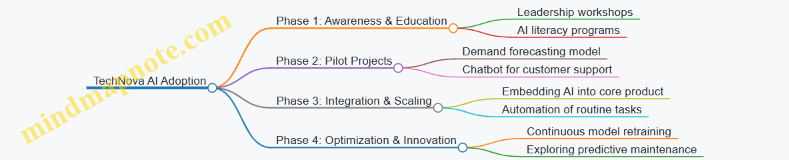
Phase 1: Awareness & Education
- Objective: Build foundational AI knowledge and align leadership vision.
- Actions:
- Conducted executive workshops on AI trends and business impact.
- Launched internal AI literacy courses for product and innovation teams.
- Established an AI Center of Excellence (CoE) to coordinate efforts.
Example: TechNova partnered with an AI consultancy to run a 3-day workshop for executives, focusing on AI opportunities in supply chain and risk management.
Phase 2: Pilot Projects
-
Objective: Validate AI use cases with low-risk pilots.
-
Use Case 1: Demand Forecasting Model
- Developed a machine learning model using historical sales and external data (weather, market trends).
- Resulted in 15% improvement in forecast accuracy.
-
Use Case 2: Customer Support Chatbot
- Deployed an NLP-based chatbot to handle common FAQs.
- Reduced support tickets by 20%, improving customer satisfaction.
Best Practice: Start with pilots that have measurable KPIs and clear ROI potential.
Phase 3: Integration & Scaling
- Objective: Embed AI capabilities into core products and automate internal processes.
- Actions:
- Integrated demand forecasting directly into the SaaS dashboard for clients.
- Automated invoice processing using intelligent document recognition.
- Expanded chatbot capabilities to handle complex queries with escalation.
Example: By embedding AI forecasts into the product, clients could dynamically adjust inventory orders, reducing stockouts by 10%.
Best Practice: Ensure seamless user experience by tightly integrating AI features rather than treating them as add-ons.
Phase 4: Optimization & Innovation
- Objective: Continuously improve AI models and explore new AI-driven business opportunities.
- Actions:
- Implemented automated model retraining pipelines to adapt to changing data.
- Launched a predictive maintenance module for clients’ warehouse equipment.
- Began exploring federated learning to collaborate on AI models without sharing sensitive data.
Example: Predictive maintenance reduced client equipment downtime by 25%, creating a new revenue stream through premium service offerings.
Best Practice: Foster a culture of continuous learning and innovation, leveraging AI not just for efficiency but for new value creation.
Key Takeaways from TechNova’s AI Adoption
- Start Small, Think Big: Begin with manageable pilots but keep the long-term vision clear.
- Cross-Functional Collaboration: Engage data scientists, product managers, and business stakeholders early.
- Measure and Iterate: Use KPIs to track success and iterate rapidly.
- Build AI Literacy: Invest in education to reduce resistance and empower teams.
- Embed Ethics and Governance: Establish guidelines early to ensure responsible AI use.
This stepwise approach demonstrates how mid-sized enterprises can pragmatically adopt AI native product design and intelligent automation, balancing risk with innovation to drive sustainable business growth.
12.4 Final Recommendations for Product Directors and Innovation Managers
As AI Native Product Design and Intelligent Automation become central to competitive advantage, Product Directors and Innovation Managers must adopt a strategic, informed, and agile approach. Below are comprehensive recommendations, supported by practical examples and mind maps, to guide your journey.
Embrace a Holistic AI-First Mindset
- Integrate AI from Day One: Treat AI not as an add-on but as a core product capability.
- Example: Netflix’s recommendation engine was built into the product experience from the start, driving engagement and retention.
Foster Cross-Disciplinary Collaboration
- Break silos between AI engineers, product teams, UX designers, and business stakeholders.
- Example: Google Duplex’s success came from close collaboration between AI researchers and UX designers to create a natural conversational experience.
Prioritize Data Strategy and Governance
- Ensure data quality, privacy compliance, and ethical use.
- Use synthetic data to augment training when real data is scarce.
- Example: Healthcare AI startups rigorously apply data governance to comply with HIPAA while leveraging synthetic data to improve models.
Design for Transparency and Trust
- Build explainability into AI features to foster user trust.
- Handle AI errors gracefully with fallback mechanisms.
- Example: Spotify’s personalized playlists include explanations on why songs are recommended, increasing user trust.
Develop Flexible and Scalable Business Models
- Leverage AI analytics to enable subscription, usage-based, or outcome-based pricing.
- Example: Autonomous vehicle companies offer outcome-based pricing models where customers pay per mile driven autonomously.
Implement Continuous Monitoring and Improvement
- Define AI-specific KPIs such as model accuracy, latency, and user engagement.
- Use dashboards to monitor business impact and automate alerts for performance degradation.
- Example: Salesforce continuously tracks AI feature adoption and model performance to iterate rapidly.
Cultivate an AI-Ready Culture
- Invest in AI literacy programs for all teams.
- Encourage experimentation and data-driven decision-making.
- Example: Microsoft’s AI transformation included extensive upskilling and cultural initiatives to embrace AI innovation.
Embed Ethics and Compliance
- Proactively address bias, fairness, and regulatory requirements.
- Establish governance frameworks to oversee AI ethics.
- Example: IBM’s AI governance framework ensures accountability and ethical compliance across product lines.
Summary Mind Map: Final Recommendations Overview

By embedding these recommendations into your strategic planning and execution, you position your organization to harness the full potential of AI native product design and intelligent automation. Remember, success lies in balancing technological innovation with human-centric design, ethical responsibility, and agile business models.