The Agentic Finance Revolution
1. Foundations of Agentic Finance
1.1 Defining Agentic Systems in Finance Operations
Agentic systems in finance operations are software that can carry out multi-step tasks toward a goal, using tools (like ERP actions, payment initiation, or risk calculations) and following rules about what it may do. The key difference from simple automation is that the system can decide the next step based on what it observes, rather than executing a fixed script from start to finish.
A practical way to define the scope is to start with the goal and work backward. For example, “prepare a cash forecast” is a goal. The system must then determine which inputs are required, which calculations to run, which assumptions to request or retrieve, and which checks to perform before publishing. If any check fails, the workflow must either correct the issue or route it to a human reviewer with a clear explanation.
Core Characteristics
- Goal orientation: The system is designed around an outcome, not a sequence of button clicks. In treasury, the outcome might be “submit a funding instruction that matches approved limits.”
- Tool use: It interacts with systems of record and systems of action. Examples include reading balances from a TMS, validating bank account details, and creating a payment draft.
- State and memory: It tracks what it has already done and what remains. For instance, it remembers which invoices were matched and which are still pending.
- Rule-based boundaries: It follows constraints such as approval thresholds, permitted counterparties, and data quality requirements.
- Evidence and traceability: It records the inputs, decisions, and actions so an auditor can reconstruct what happened.
Mind Map: What Makes It Agentic
From Automation to Agentic Workflows
A fixed workflow might say: “Pull last month’s cash, apply a fixed growth rate, publish.” An agentic workflow adds conditional steps: “If the growth rate inputs are missing, request them; if bank holidays affect settlement dates, adjust the calendar; if the forecast breaches a liquidity threshold, prepare an escalation package.” The system is still rule-governed, but it adapts to observed conditions.
A Simple Example: Payment Draft with Guardrails
Consider a workflow that prepares a payment draft for an approved vendor.
- Inputs: invoice amount, vendor bank account, payment currency, and due date.
- Perception: it checks whether the vendor is active and whether the bank account matches master data.
- Reasoning: it determines the correct payment method and settlement date rules.
- Actions: it creates a draft in the payment system.
- Safety checks: it verifies that the payment amount is within the approved invoice amount and that the beneficiary details match.
- Escalation: if the bank account differs from master data, it routes to a human with the discrepancy highlighted.
This example shows the “agentic” part: the next step changes based on what the system finds, while the boundaries remain explicit.
Defining the Boundaries Clearly
Agentic systems fail when the boundaries are vague. In finance operations, boundaries should be expressed as concrete rules:
- What it may do: permitted tool actions (read-only vs write operations).
- When it must ask: approval gates based on amount, counterparty, or risk flags.
- What it must verify: reconciliation checks, mandatory fields, and data freshness.
- How it handles uncertainty: if required data is missing, it should stop and request it rather than guess.
A useful test is to ask: “If the system sees conflicting data, what exact behavior occurs?” If the answer is not specific, the workflow needs refinement.
Mind Map: Decision Points in Finance Tasks
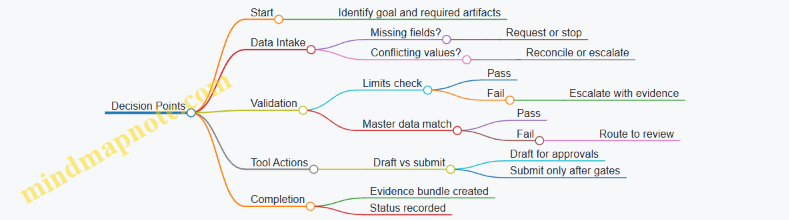
Practical Definition Summary
An agentic system in finance operations is a goal-driven workflow that observes the environment, plans the next step, uses authorized tools to act, and enforces governance rules with evidence capture. When you can describe the goal, the allowed actions, the decision points, and the escalation behavior in plain language, you have a definition that can be implemented and audited.
Mini Checklist for “Agentic”
- The workflow can choose the next step based on observed conditions.
- It uses tools to read and write in finance systems.
- It maintains state across steps.
- It enforces explicit approval and permission boundaries.
- It produces an audit-ready record of actions and decisions.
1.2 Distinguishing Automation From Agentic Workflows
Automation and agentic workflows both reduce manual effort, but they differ in how decisions are made, how work is planned, and how exceptions are handled. A useful rule of thumb: automation follows a script; agentic workflows coordinate a goal using tools, evidence, and guardrails.
Automation: Predictable Steps with Limited Choice
Automation is best when the process is stable and the “right action” is known in advance. The workflow typically has fixed inputs, deterministic transformations, and a clear success path.
What automation usually looks like
- Predefined triggers: “When invoice arrives, validate fields.”
- Fixed rules: “If tax ID is missing, reject.”
- Single-pass execution: The system does one round of checks and either passes or fails.
- Exception routing: Failures go to a queue with a reason code.
Treasury example A bank statement import runs nightly. It parses transactions, matches them to expected payment references, and flags unmatched items. If a payment reference is missing, the system marks the record as “needs review” and stops. The logic is clear, testable, and easy to audit because the decision boundaries are defined ahead of time.
Best-fit areas
- Repetitive reconciliations with stable formats
- Standard reporting calculations
- Straight-through processing where exceptions are rare and well categorized
Agentic Workflows: Goal-Driven Coordination with Tool Use
Agentic workflows are designed around a goal and the ability to choose actions. Instead of only applying a fixed set of rules, the workflow can plan steps, call tools, and adjust its path based on what it observes.
What agentic workflows usually look like
- Goal specification: “Prepare a cash position summary suitable for approval.”
- Dynamic planning: The workflow decides which data to fetch first.
- Tool use: It can query systems, compute metrics, and draft an approval package.
- Evidence gathering: It collects the facts needed to justify its output.
- Guardrails: It must respect limits, permissions, and required approvals.
Treasury example Suppose the cash forecast for next week is due. An agentic workflow starts by pulling current balances, then checks whether FX rates are available for the relevant currencies. If rates are missing, it requests the appropriate source data and reruns the forecast. If the forecast would breach an internal liquidity threshold, it prepares an escalation note with the specific assumptions and the exact limit that would be exceeded. The workflow doesn’t just “fail”; it actively assembles the information needed to move the process forward safely.
The Practical Distinction: Decision Timing and Recovery
The difference becomes obvious when something goes wrong.
- Automation recovery: Often limited to routing. The system detects an issue and hands it off.
- Agentic recovery: Can attempt structured remediation. It may try alternative data sources, re-run calculations, or propose an approval-ready explanation—while still requiring human signoff for high-impact actions.
A simple comparison for finance teams:
- If the workflow can be fully described as “if X then Y,” it’s likely automation.
- If the workflow must decide “what to do next” based on intermediate findings, it’s likely agentic.
Mind Map: Automation Versus Agentic Workflows
Example: Same Goal, Different Workflow Styles
Goal: “Create a payment batch for approval.”
- Automation approach: Generate a batch from a fixed file format, validate mandatory fields, and reject any record that fails validation. The approver receives a list of rejected items.
- Agentic approach: Generate the batch, but if a beneficiary account is inconsistent, the workflow checks master data, verifies whether an alternate account exists, and drafts a short justification for the approver. If the workflow cannot confirm the beneficiary, it routes the item with the exact missing evidence.
A Quick Checklist for Choosing the Right Style
- Stability: Are inputs and rules stable enough to predefine?
- Runtime choice: Does the workflow need to decide next steps after seeing results?
- Exception handling: Should the system only route issues, or also gather evidence and propose safe next actions?
- Approval requirements: Are high-impact actions gated by explicit human review?
When you can answer these questions clearly, the distinction stops being theoretical and becomes a design decision you can test with real finance scenarios.
1.3 Core Components Including Tools Memory and Governance
Agentic finance workflows work only when three things are coordinated: the tools an agent can use, the memory it carries across steps, and the governance that decides what is allowed. Think of it as a controlled kitchen: tools are the appliances, memory is the recipe book and pantry labels, and governance is the rulebook for what can be cooked, by whom, and with which ingredients.
Tools the Action Surface
Tools are the concrete interfaces the agent can call to do work. In finance, they should be narrow, well-defined, and permissioned. A “tool” is not a vague capability; it is an operation with inputs, outputs, and an expected audit footprint.
Best practice is to design tools around stable business objects. For example, instead of one generic “payment” tool, use smaller tools:
- Create Payment Draft: validates required fields and formats beneficiary data.
- Request Payment Approval: routes a draft to the right approver group.
- Submit Payment to Bank: sends the final instruction and captures bank response codes.
- Query Payment Status: retrieves settlement state and exception reasons.
Easy example: If a treasury analyst asks the system to “prepare a EUR payment for vendor X,” the agent should call Create Payment Draft with vendor ID, amount, currency, and payment date. The tool returns a structured draft plus validation warnings (e.g., missing IBAN checksum). The agent then asks for approval only after the draft passes tool-level checks.
A practical rule: tools should fail loudly and predictably. If a tool cannot complete an operation, it should return an error category the agent can handle (validation error, permission error, upstream outage, or data not found).
Memory the Working Context
Memory is how the agent keeps track of what it has already learned or decided. In finance, memory must be explicit and bounded so it does not silently accumulate contradictions.
Use three memory layers:
- Session Memory stores the current workflow state, such as the payment draft ID or the risk limit record being reviewed.
- Reference Memory stores stable facts the workflow needs repeatedly, like counterparty master data fields or policy thresholds.
- Evidence Memory stores audit-relevant artifacts, such as tool outputs, approval decisions, and reconciliation results.
Easy example: For a cash forecast workflow, session memory holds the selected forecast horizon and the chosen scenario. Reference memory holds the company’s cash account mapping and historical seasonality parameters. Evidence memory stores the exact data extracts used and the reconciliation summary that confirms the forecast inputs match the general ledger totals.
To keep memory reliable, store memory as structured records, not free text. When the agent needs to “remember” something, it should retrieve the relevant record by key (workflow ID, draft ID, limit ID) and verify it matches the current request.
Governance the Permission and Policy Layer
Governance is the set of rules that constrains tool use and decision-making. It answers: What can the agent do, under which conditions, with what approvals, and how is it recorded?
Governance should be implemented as enforceable checks, not as instructions the agent merely follows. Typical governance gates include:
- Role and Segregation of Duties: the agent can draft but cannot submit without an approval gate.
- Policy Thresholds: certain actions require additional review when amounts exceed limits.
- Data Access Controls: the agent can read only the data domains it is authorized to use.
- Exception Handling Rules: if a tool returns a specific error category, the agent must route to a human queue.
Easy example: If a payment draft exceeds the “single payment approval threshold,” governance blocks submission and triggers Request Payment Approval. The approval record becomes part of evidence memory, so an auditor can trace the decision to the exact draft and the exact tool outputs.
Mind Map: Core Components
Putting It Together a Single Workflow Walkthrough
A coherent workflow shows the components interacting in order. Start with a request, use tools to produce structured outputs, store those outputs in evidence memory, and apply governance gates before any irreversible action.
Example: Payment Draft to Submission
- The agent receives payment details and calls Create Payment Draft.
- The tool returns a draft plus validation warnings; the agent resolves only warnings it can address via additional tool calls.
- The agent stores the draft ID and tool outputs in session and evidence memory.
- Governance checks whether the draft amount requires approval.
- If approval is required, the agent calls Request Payment Approval and waits for a signoff record.
- After signoff, the agent calls Submit Payment to Bank and stores the bank response in evidence memory.
- If bank submission returns an exception category, governance routes the workflow to human review instead of retrying blindly.
This structure prevents the most common failure mode: an agent that can “talk” about finance but cannot reliably execute it with traceable, permissioned actions.
1.4 Data Inputs Controls and Auditability Requirements
Agentic finance workflows live or die by their inputs. If the system cannot explain where a number came from, which rule transformed it, and who approved the action, then the workflow is just a fancy spreadsheet with better posture. This section lays out practical requirements for data inputs, control design, and auditability.
Data Inputs That Are Fit for Finance Work
Start with a simple principle: every input must have an owner, a definition, and a validation rule.
- Owner and purpose: For example, “Bank balance” is owned by Treasury Operations and used for cash forecasting. “Counterparty credit rating” is owned by Risk and used for exposure flags.
- Definition and units: Store currency, sign conventions, and time zones explicitly. A payment amount of “-250,000” is not the same as “250,000” unless the sign rule is documented.
- Validation rules: Apply checks before any agent action. Examples include schema validation (required fields present), referential integrity (account IDs exist), and range checks (interest rate within plausible bounds).
A useful pattern is to separate inputs into three buckets:
- Reference data: counterparties, accounts, instruments, payment templates.
- Transactional data: invoices, payment instructions, bank statements.
- Derived data: forecasts, risk metrics, reconciled balances.
Controls differ by bucket. Reference data needs change governance; transactional data needs completeness and reconciliation; derived data needs traceability to source fields.
Control Requirements Across the Data Lifecycle
Controls should be designed for the lifecycle: ingestion, transformation, decision, and action.
- Ingestion controls: Ensure the feed is complete and timely. Example: if a bank statement arrives late, the workflow should either pause or switch to a documented fallback source.
- Transformation controls: Every transformation should be deterministic where possible. Example: currency conversion must record the FX rate source, timestamp, and method.
- Decision controls: Decisions must be tied to explicit rules and thresholds. Example: “Approve funding transfer” only when projected liquidity after transfer stays above the minimum buffer.
- Action controls: Actions must be constrained by permissions and approval gates. Example: payment initiation requires a beneficiary match check and a second approval for amounts above a threshold.
A small but powerful best practice is to implement control coverage mapping: for each workflow step, list the required checks and the evidence they produce.
Auditability Requirements That Make Evidence Easy
Auditability is not a folder of screenshots; it is structured evidence that can be reconstructed.
Key requirements:
- Immutable logs: Record who/what initiated the workflow, the input snapshot identifiers, and the exact rule set version.
- Input snapshots: Store the data used for the run, not just a pointer to where it lived. Example: if a counterparty name changes later, the audit trail must still show the name used at decision time.
- Evidence bundles: For each action, capture the checks performed and their outcomes. Example: a payment evidence bundle includes beneficiary verification result, account validation result, and approval signoff.
- Reproducibility: A run should be re-executable in principle. That means versioned transformation logic and rule definitions.
When evidence is structured, auditors can answer questions quickly: “What did the system see?” “Which rule fired?” “Who approved?”
Mind Map: Data Inputs Controls and Auditability
Example: Payment Instruction with Evidence-First Controls
Consider a workflow that prepares a payment instruction.
- Input validation: Confirm beneficiary bank account ID exists in master data and that currency matches the payment template.
- Reconciliation check: Verify the payment amount matches the invoice total after applying the documented discount rule.
- Decision rule: If amount is above the approval threshold, require a second approver.
- Action constraints: Only allow the payment tool to submit to pre-approved bank endpoints.
- Evidence bundle: Store the input snapshot IDs, the invoice-to-payment mapping, the rule versions, the validation outcomes, and the approval signoffs.
If any validation fails, the workflow should stop with a clear reason and a record of which control failed. That record becomes the audit evidence and the operational troubleshooting trail.
Example: Cash Forecast Inputs with Controlled Assumptions
A cash forecast run should capture:
- the bank balance snapshot used as the starting point,
- the forecast horizon and time zone,
- the assumption set version (for example, collection timing rules), and
- the reconciliation status of recent transactions.
If the reconciliation status is “partial,” the workflow can still produce a forecast, but it must label the derived outputs with the reconciliation condition and the specific controls that were bypassed or replaced. That keeps the forecast usable without pretending it is fully clean.
2. Architecture for Autonomous Financial Workflows
2.1 Reference Architecture for Agent Orchestration and Tool Use
Agent orchestration is the part of the system that decides what to do next, calls the right tools, and records evidence so finance teams can explain outcomes. A good reference architecture starts with a simple loop—plan, act, verify—and then adds the guardrails treasury, risk, and compliance require.
Core Loop and Responsibilities
- Intake and normalization: Convert a user request into a structured task with required fields (entities, dates, thresholds, and desired output format). Example: “Prepare the weekly cash forecast for EMEA” becomes a task with a date range, legal entities, and forecast granularity.
- Policy and control checks: Validate that the task is allowed for the requester and that it meets control requirements. Example: payment instructions require beneficiary verification and an approval gate above a configured amount.
- Planning and decomposition: Break the task into steps that map to tools. Example: forecasting might require retrieving historical balances, applying seasonality assumptions, and generating a variance report.
- Tool execution: Call deterministic tools for data retrieval, calculations, and system updates. Example: a “get bank balances” tool reads from TMS or banking APIs rather than relying on text generation.
- Verification and reconciliation: Check outputs against constraints and cross-source totals. Example: forecast totals must reconcile to the latest ledger snapshot within an allowed tolerance.
- Evidence capture and audit trail: Store inputs, tool calls, parameters, and verification results. Example: record the exact query filters used to compute exposure.
- Human review when required: Route exceptions and high-impact actions to approvers. Example: if a payment beneficiary is new, require a manual signoff.
Reference Architecture Components
- Orchestrator: The coordinator that manages the loop, step ordering, and retries.
- Task Schema: A strict structure for inputs and outputs, including required fields and validation rules.
- Tool Registry: A catalog of tools with schemas, permissions, and expected outputs.
- State Store: Persists intermediate results so the workflow can resume after failures.
- Policy Engine: Encodes segregation of duties, approval thresholds, and allowed actions.
- Evidence Store: Captures tool calls, parameters, and verification artifacts.
- Observability Layer: Tracks latency, failure rates, and reconciliation outcomes.
Mind Map: Orchestration and Tool Use
Tool Use Design Principles
1. Tools do the work; the orchestrator coordinates. Keep tool outputs structured so verification is straightforward. Example: a “calculate_fx_exposure” tool returns a table with currency, tenor, and sensitivity values.
2. Every tool call is permissioned. The tool registry should specify which roles can execute it. Example: only treasury operations can run “create_payment_batch,” while risk can run “compute_limit_utilization.”
3. Idempotency prevents double actions. For actions like posting or sending, include an idempotency key. Example: if a payment batch creation times out, rerunning with the same key returns the existing batch ID instead of creating a duplicate.
4. Verification is a first-class step. Define checks per workflow stage. Example: after retrieving bank balances, verify that the sum of sub-accounts equals the account total within tolerance.
Example Workflow: Payment Instruction with Controls
A payment request typically includes payee details, amount, currency, and execution date. The orchestrator should:
- Normalize the request into a task schema.
- Check policy: beneficiary verification required for new payees; approval required above a threshold.
- Plan steps: validate beneficiary, verify account format, generate payment file, and stage it for approval.
- Execute tools: run “validate_beneficiary,” “format_payment,” and “stage_payment_batch.”
- Verify: confirm amount precision, currency match, and remittance reference rules.
- Capture evidence: store tool call parameters and verification results.
- Human review: if beneficiary is new or amount exceeds threshold, pause and request approval.
Example Workflow: Risk Limit Monitoring with Reconciliation
For limit monitoring, the orchestrator should:
- Normalize inputs: portfolio scope, limit set, valuation date.
- Retrieve exposures via deterministic tools.
- Compute utilization and compare to limits.
- Reconcile totals to the latest risk ledger snapshot.
- If utilization breaches, generate an exception package with evidence and the exact computations used.
Minimal Diagram of Execution Flow
graph TD
A[Intake Request] --> B[Normalize Task Schema]
B --> C[Policy Checks]
C --> D[Plan Steps]
D --> E[Tool Execute]
E --> F[Verify and Reconcile]
F --> G[Capture Evidence]
G --> H{Human Review Required?}
H -->|No| I[Finalize Output]
H -->|Yes| J[Route to Approver]
J --> I
This architecture keeps orchestration predictable: the orchestrator manages order and controls, tools provide deterministic results, and verification plus evidence make the workflow explainable. That combination is what turns “it ran” into “it can be trusted.”
2.2 Integrating Enterprise Systems Including ERP TMS and Banking Platforms
Enterprise integration is where agentic finance stops being a clever workflow and becomes a reliable operating capability. The goal is simple: the agent must read the right facts, act through the right systems, and leave an audit trail that matches what auditors and operators expect.
Start with System Boundaries and Responsibilities
Treat each system as owning specific truths. ERP typically owns legal entity structure, vendor/customer master data, and accounting treatment. TMS owns payment instructions, remittance details, and payment status transitions. Banking platforms own account balances, cut-off rules, and settlement outcomes.
A practical rule: the agent should not “recreate” master data. Instead, it should request authoritative fields from the system that owns them, then cache only what it needs for the current workflow.
Example: When preparing a payment, the agent pulls beneficiary name and address from ERP vendor records, pulls payment method and remittance format from TMS configuration, and pulls available balance and bank account identifiers from the banking platform.
Define Integration Contracts for Inputs Outputs and Evidence
Integration contracts specify what the agent must provide and what it can trust back. For each action, define:
- Input fields with formats and validation rules (currency codes, bank routing formats, invoice references)
- Output fields with status semantics (e.g., “submitted,” “accepted,” “rejected,” “settled”)
- Evidence artifacts (request/response payload hashes, timestamps, approver IDs)
Example: For a payment submission, the contract requires the agent to send a normalized beneficiary record, then store the banking platform’s acceptance reference as evidence. If the platform returns a rejection reason, the agent must map it to a TMS status and trigger an exception workflow.
Choose Integration Patterns That Match the Workflow Shape
Not every workflow needs the same integration style.
- Synchronous calls fit validations that must block execution, like checking beneficiary bank details before submission.
- Asynchronous events fit status updates, like receiving settlement confirmations after cut-off.
- Batch reconciliation fits accounting alignment, like matching ERP posted entries to TMS payment records.
Example: The agent can synchronously validate bank account ownership before sending a payment, then rely on asynchronous webhooks to update payment status when the bank confirms settlement.
Build a Canonical Data Model for Cross-System Consistency
ERP and TMS often use different identifiers for the same business object. A canonical model reduces confusion by mapping each object to a stable internal key.
Include canonical entities such as:
- Legal entity and operating unit
- Counterparty and beneficiary
- Payment instruction and payment line
- Invoice or settlement reference
- Risk and compliance flags
Example: ERP might store vendor ID as V-1042, while TMS stores beneficiary as B-7781. The canonical model links both to a single internal counterparty key so the agent can join facts without guessing.
Implement Tooling Layers for Safe Execution
Use a tooling layer that wraps each system call with consistent behavior: authentication, retries, idempotency keys, and structured error handling.
Idempotency matters because payment submissions are not “safe to repeat.” The tooling layer should attach an idempotency key derived from payment instruction ID plus version.
Example: If the agent retries after a network timeout, the banking platform should recognize the idempotency key and avoid duplicate submissions. The tooling layer records whether the retry resulted in a new submission or a previously accepted one.
Orchestrate Status Lifecycles Across ERP TMS and Banking
A common failure mode is mismatched status definitions. Define a single lifecycle model and map each system’s statuses into it.
Example lifecycle:
- Draft in TMS
- Approved in TMS
- Submitted to bank
- Accepted by bank
- Settled at bank
- Posted in ERP
The agent updates the lifecycle only when it receives evidence from the owning system. If ERP posting lags, the agent continues to monitor without re-posting.
Add Control Points Without Breaking Throughput
Integration should include control points that are enforceable and observable.
- Pre-submission checks: beneficiary verification, payment format validation, and required approvals
- Post-submission checks: bank acceptance reference captured, rejection reasons categorized
- Reconciliation checks: ERP posting matched to TMS payment ID
Example: If the bank rejects a payment due to an invalid routing number, the agent marks the instruction as “Rejected—Data Issue,” requests corrected bank details from ERP, and routes it back to the approval gate.
Mind Map: Integration of ERP TMS and Banking Platforms
Case Study: Payment Submission with Evidence Capture
A multinational uses ERP for vendor records, TMS for payment instructions, and a banking platform for submission and settlement confirmations.
- The agent selects invoices in ERP and creates a payment draft in TMS.
- Before approval, it synchronously validates beneficiary bank details by requesting the banking platform’s account metadata and comparing it to the canonical beneficiary record.
- After approval, it submits the payment through the tooling layer using an idempotency key tied to the TMS payment instruction ID.
- When the bank returns acceptance, the agent stores the acceptance reference and updates TMS status to “Accepted.”
- When settlement arrives, the agent updates TMS to “Settled,” then triggers a reconciliation check that ensures ERP posting exists for the same payment instruction ID.
The result is not just a working payment. It is a chain of evidence that ties each decision and action to the system that owns the truth.
2.3 Designing Task Decomposition for Transactional and Analytical Work
Task decomposition is how you turn a messy business goal into a sequence of actions that an agent can execute safely. The trick is to separate what must be executed exactly (transactional work) from what can be reasoned about (analytical work), then connect them with explicit handoffs. If you skip that separation, you get either brittle automation or vague analysis that never reaches a decision.
Foundational Principle: Separate Execution from Reasoning
Transactional tasks require deterministic outputs, strict validation, and clear stop conditions. Analytical tasks require structured inputs, assumptions, and traceable calculations. A good decomposition makes those differences visible.
A practical way to start is to define three layers:
- Inputs: the data and documents the workflow needs.
- Decisions: the rules that determine what happens next.
- Actions: the system operations that change state, such as creating a payment instruction or updating a risk limit status.
When you map a workflow, every step should answer: What data is required? What decision gates exist? What action is performed, and what evidence is recorded?
Mind Map: Decomposition Building Blocks
Transactional Decomposition: Payment and Instruction Work
Transactional workflows should be decomposed into small, testable steps with explicit validation after each step. A typical payment workflow can be broken into:
- Intake and Normalization: Parse invoice or payment request data into a canonical structure. Example: convert “1,250.00 USD” and “1250 USD” into a single numeric amount with currency code.
- Reference Resolution: Map vendor, bank account, and payment purpose to master data. Example: if the vendor has two active bank accounts, require the workflow to select the one tied to the invoice’s remittance reference.
- Control Checks: Apply rules before any state change. Example: verify beneficiary name matches the account owner on file; if it doesn’t, route to manual review.
- Instruction Drafting: Create the payment instruction payload without submitting it. Example: generate the SWIFT/SEPA fields and validate length and allowed characters.
- Approval Gate: For high-value or new-beneficiary cases, require a human signoff. Example: if amount exceeds a threshold or the beneficiary is first-time, pause and request approval.
- Submission and Confirmation: Submit to the banking interface and capture confirmation identifiers. Example: store the bank’s message ID and timestamp.
- Post-Action Reconciliation: Confirm that the payment appears in the expected ledger or status feed. Example: match instruction ID to settlement status; if missing after a defined window, open an exception ticket.
Notice how each step produces evidence. That evidence is what makes the workflow auditable and debuggable.
Analytical Decomposition: Forecasting and Risk Work
Analytical workflows should be decomposed into computations that can be validated independently. A risk monitoring workflow might follow:
- Scope Definition: Choose the portfolio, time horizon, and scenario set. Example: “last 30 business days, base and stress scenarios.”
- Data Preparation: Filter and align positions, rates, and exposures. Example: ensure all instruments use the same valuation date; if not, reconcile or exclude.
- Metric Computation: Compute exposures, sensitivities, or limit utilization. Example: calculate FX exposure by currency netting across entities.
- Assumption Traceability: Record assumptions used in the calculation. Example: document how missing rates were handled (e.g., interpolation method and source).
- Decision Logic: Compare metrics to thresholds and determine actions. Example: if limit utilization exceeds 90%, recommend escalation; if it exceeds 100%, require approval.
- Output Packaging: Produce a structured report for downstream systems. Example: include metric values, threshold levels, and the exact rules triggered.
Analytical steps should not directly change operational state. They should produce recommendations and evidence, then hand off to an execution workflow.
Handoffs: The Glue Between Analytical and Transactional Work
The handoff is where many designs fail. A clean handoff includes:
- A decision payload: what to do next and why.
- An evidence bundle: inputs, calculations, and rule triggers.
- A control context: which approvals or permissions apply.
Example: A cash forecast analysis recommends a funding action. The execution workflow then:
- Re-validates the required fields (available cash, target liquidity, funding instrument constraints).
- Applies the same control checks used for other funding actions.
- Records the forecast evidence ID so auditors can trace the recommendation to the executed action.
Example: Decomposing One Use Case End to End
Use case: “If FX exposure breaches a limit, propose hedging and then draft the hedge instruction.”
- Analytical steps produce: exposure breach details, suggested hedge size, and the rule that triggered escalation.
- Transactional steps consume: suggested hedge size, eligible instruments list, and beneficiary or counterparty constraints.
- Validation gates ensure: the hedge instruction is consistent with master data and approval requirements.
This decomposition keeps reasoning honest and execution controlled. The agent can be helpful without pretending it can skip the parts where mistakes are expensive.
2.4 Implementing Human in the Loop Review and Approval Gates
Human-in-the-loop gates are the part of an agentic workflow where responsibility becomes explicit. The goal is not to slow everything down; it is to ensure that high-impact actions are reviewed with the right evidence, by the right people, at the right time.
Start with Decision Types and Risk Levels
Before you design approvals, classify actions by consequence and reversibility.
- Low-impact, reversible: e.g., drafting a payment instruction for review. You can allow straight-through execution with logging.
- Medium-impact, partially reversible: e.g., updating a beneficiary name that affects future payments. Require review of the specific fields.
- High-impact, hard to reverse: e.g., submitting a payment, changing bank account details, or overriding risk limits. Require explicit approval.
A practical rule: if the action can cause money movement, regulatory exposure, or limit breaches, treat it as high-impact until proven otherwise.
Define Gate Triggers and Evidence Requirements
Each gate needs two things: when it triggers and what evidence the reviewer must see.
- Trigger examples
- Payment amount exceeds a threshold.
- Beneficiary account differs from master data.
- Forecast suggests a liquidity action outside normal ranges.
- Risk metric breaches a configured limit.
- Evidence examples
- Source data references (transaction IDs, forecast inputs).
- Calculations summary (what changed and why).
- Control checks performed (e.g., sanctions screening status, duplicate detection).
- Proposed action payload (exact fields to be sent).
Keep evidence structured so reviewers can scan quickly. A reviewer should not have to reverse-engineer the agent’s reasoning from raw logs.
Choose Gate Placement Along the Workflow
Gates work best when placed at natural boundaries.
- Pre-commit gate: before the system sends instructions to a bank or ERP.
- Pre-change gate: before master data updates that affect future operations.
- Post-commit monitoring gate: after submission, to verify confirmations and handle exceptions.
For example, a payment workflow can draft and validate automatically, then stop right before submission for approval, then resume to reconcile confirmation messages.
Implement Role-Based Approvals with Clear Authority
Approvals should map to roles that already exist in finance operations.
- Requester: initiates the workflow (often treasury ops).
- Reviewer: checks evidence and approves or rejects.
- Approver: required only for high-impact actions.
- Exception handler: resolves failures and documents remediation.
A simple but effective pattern is two-step approval for high-impact actions: one reviewer verifies correctness, and a second approver confirms policy alignment (such as limit compliance).
Use Deterministic Gate Logic and Avoid Ambiguous States
Gate logic must be deterministic: the system should always know whether it is waiting for approval, ready to proceed, or blocked.
- Statuses: Drafted, Awaiting Approval, Approved, Rejected, Submitted, Reconciliation Pending, Resolved.
- No silent fallthrough: if evidence is missing, the workflow must stop and request the missing inputs.
This prevents the classic failure mode where an agent “continues anyway” because a field was empty.
Mind Map: Human in the Loop Gates
Example: Payment Submission Gate with Field-Level Checks
Scenario: the agent drafts a payment for approval.
- Automatic steps
- Validate mandatory fields.
- Check beneficiary against master data.
- Run sanctions screening status check.
- Compute totals and fees.
- Gate trigger
- Payment amount is above the “single-approval” threshold.
- Beneficiary bank account differs from master data.
- Evidence shown to reviewer
- Payment draft payload with highlighted differences.
- Master data record reference and the exact mismatch fields.
- Screening status and timestamp.
- Calculation summary of amount and fees.
- Approval outcome
- If approved, the system submits the payment and records the approval ID.
- If rejected, the workflow returns to Drafted with a required correction note.
The key is that the reviewer approves a specific payload, not a vague plan.
Example: Risk Limit Breach Gate with Escalation Path
Scenario: the agent monitors limits and detects a breach.
- Automatic steps
- Recalculate exposure using the latest positions.
- Identify which component drove the breach.
- Compare against limit configuration.
- Gate trigger
- Breach severity is “hard limit.”
- Evidence shown to reviewer
- Exposure breakdown by instrument and counterparty.
- Limit definition and effective date.
- Control checks confirming data completeness.
- Approval outcome
- Reviewer can approve an action that reduces exposure.
- If no reduction action is approved, the workflow blocks further limit-impacting tasks and routes to exception handling.
This keeps the system from treating “breach detected” as permission to proceed.
Operationalizing Rejections and Exception Handling
Rejections should be actionable. Require a structured reason code (e.g., Missing evidence, Payload mismatch, Policy conflict) and a correction target (which field or which input set).
For exception handling, the workflow should capture:
- the failing step and error details,
- the remediation action taken,
- the evidence supporting the remediation,
- whether a new approval is required.
That way, the audit trail reflects both the decision and the correction path, without forcing reviewers to guess what happened.
2.5 Logging Traceability and Evidence Capture for Every Action
Agentic finance workflows only earn trust when you can reconstruct what happened, why it happened, and who (or what) approved it. Logging traceability is the record; evidence capture is the proof package. Together they let treasury, risk, compliance, and audit teams answer the same questions with the same facts—without chasing screenshots.
What “Every Action” Means in Practice
Treat an “action” as any step that changes state or creates a decision artifact. Examples include:
- Creating a payment draft and generating a beneficiary record.
- Calling a bank API to submit an instruction.
- Applying a risk limit rule and producing an approval or rejection.
- Marking a compliance check as passed and assembling an evidence bundle.
- Escalating an exception to a human reviewer.
A useful rule: if the step could affect money, risk posture, or regulatory standing, it must be logged with enough detail to replay the reasoning.
Traceability Model from Inputs to Outcomes
Start with a simple chain: input facts → decision logic → tool calls → outputs → approvals → final state. Each link needs identifiers and consistent fields.
Minimum trace fields for every action:
- Correlation identifiers: workflow_id, run_id, action_id.
- Actor: system component name and version; human reviewer identity when applicable.
- Trigger: event source (e.g., “monthly cash forecast run” or “payment exception detected”).
- Inputs snapshot: references to data versions and the exact parameters used.
- Decision record: rule/model name, version, and key outputs (not just a final label).
- Tool calls: endpoint/system name, request parameters (redacted), response status, and timestamps.
- Outputs: artifact IDs (payment instruction ID, risk report ID, evidence bundle ID).
- Approvals and overrides: who approved, what changed, and the reason code.
- Outcome: success/failure, error codes, and remediation path.
To keep logs readable, store large payloads (like full API responses) in an evidence store and log pointers plus hashes.
Evidence Capture as a Proof Package
Evidence is not “whatever we logged.” It is the subset that an auditor or control owner can verify. Build evidence bundles per action type.
Evidence bundle contents (tailored by action):
- Payment submission: payment instruction payload (redacted), bank response, timestamp, and approval record.
- Risk limit decision: exposure inputs, limit definition version, computed metrics, and the rule evaluation trace.
- Compliance check: policy version, mapping to the specific control, transaction attributes used, and pass/fail rationale.
- Exception escalation: exception classification, recommended action, reviewer decision, and final disposition.
Use stable naming and include a “bundle manifest” that lists included items and their hashes. That manifest becomes the anchor for later verification.
Logging Granularity and Redaction
Logs must be detailed enough to reconstruct, but not so detailed that they leak sensitive data.
A practical approach:
- Log identifiers and computed metrics freely.
- Redact secrets and personal data (account numbers, names, credentials) while preserving referential integrity (e.g., last-4 digits and internal IDs).
- Record data provenance (source system, extraction batch, transformation version) so you can explain why a value was used.
Mind Map: Traceability and Evidence Capture
Example: Payment Exception with Evidence Bundle
Assume a payment draft is created, then rejected by the bank due to beneficiary details.
Logged action sequence
action_id=pay_draft_createrecords workflow_id/run_id, payment fields (redacted), and the draft artifact ID.action_id=bank_submitlogs the bank endpoint, request parameters (redacted), response statusREJECTED, and bank error code.action_id=exception_classifystores the exception category, the rule name used, and the recommended fix (e.g., “verify beneficiary reference format”).action_id=human_approvalcaptures reviewer identity, approval decision, and reason code.action_id=evidence_bundle_creategeneratesbundle_id=EVB-2026-02-15-1042with a manifest listing the draft artifact hash, bank response hash, and approval record hash.
The key detail: the evidence bundle is created after the final disposition, but it references the exact artifacts produced earlier.
Example: Risk Limit Decision with Evaluation Trace
For a limit check, log the computed exposure metrics and the specific rule evaluation path.
- Record
limit_definition_versionand the metric inputs used. - Store the rule evaluation trace as structured data (e.g., which threshold was compared, and the resulting branch).
- If the decision is “approve with conditions,” log the condition set as an explicit output artifact ID.
This prevents the classic problem where logs show “approved” but not the math or the rule path that led there.
Operational Checks That Keep Logs Useful
- Consistency tests: every action must have correlation IDs and an outcome.
- Completeness checks: evidence bundles must include the manifest and hashes for referenced artifacts.
- Redaction verification: ensure sensitive fields are never written to the log store.
- Replay readiness: a control owner should be able to trace from a final artifact back to inputs and approvals using only IDs.
When these checks are in place, traceability stops being a compliance chore and becomes a practical debugging tool—one that works even when the original run is long gone.
3. Treasury Operations with Agentic Execution
3.1 Cash Forecasting Workflows With Structured Assumptions
Cash forecasting is easiest to trust when assumptions are explicit, testable, and tied to observable drivers. A structured workflow turns “best guesses” into a chain of inputs that can be reviewed, challenged, and audited.
The Goal of Structured Assumptions
A cash forecast should answer three practical questions: What cash movements are expected? When do they occur? What assumptions would make the forecast wrong? Structured assumptions make the third question answerable without rewriting the whole model.
Start by separating assumptions into three layers:
- Transaction drivers: what creates cash movements (invoices, payroll cycles, debt coupons, payment terms).
- Timing rules: how dates shift (cutoff times, settlement lags, holiday calendars, bank processing windows).
- Behavioral adjustments: what changes the pattern (collection rates by aging bucket, supplier payment prioritization, one-off events).
A useful rule of thumb: if an assumption can’t be traced to a driver, it probably belongs in a “review needed” bucket rather than the forecast.
Workflow from Inputs to Forecast
Step 1: Define the Forecast Scope
Choose the cash scope and horizon before touching assumptions. For example, decide whether you forecast only bank balances or also include intercompany settlements and intraday liquidity. Then set the horizon granularity, such as daily for the next 30 days and weekly beyond.
Example: A company forecasts daily cash for the next 45 days to manage payment deadlines, and weekly for the next quarter to plan funding capacity.
Step 2: Build an Assumption Inventory
Create a list of assumptions with owners, sources, and review frequency. Each assumption should include:
- Assumption statement: “Collections for 31–45 day receivables occur 70% in week 1.”
- Source: last 6 months of collection history.
- Update cadence: monthly.
- Confidence or variability: derived from historical dispersion.
- Impact path: which forecast line items it affects.
This inventory prevents the common failure mode where assumptions live in spreadsheets with no clear lineage.
Step 3: Map Assumptions to Cash Movement Types
Cash forecasts usually combine recurring and non-recurring movements. Map assumptions to categories so reviewers know where to look.
- Operating inflows: customer collections by aging and payment method.
- Operating outflows: vendor payments by terms and scheduled runs.
- Payroll and taxes: fixed calendars with known variability windows.
- Financing: interest, principal, revolver draws, lease payments.
- Investing and other: capex disbursements, dividends, intercompany settlements.
Example: Payroll timing is calendar-driven, while vendor payments are terms-driven with a “payment run” timing rule.
Step 4: Encode Timing Rules Explicitly
Timing rules are where forecasts quietly drift. Capture them as deterministic rules first, then add variability.
Common timing rules include:
- Settlement lag: invoice date to expected cash receipt date.
- Cutoff and processing windows: payments initiated before a cutoff settle sooner.
- Non-business days: shift to next business day.
- Bank holidays: apply bank-specific calendars.
Example: If a payment is submitted after 3:00 PM local cutoff, assume settlement shifts by one business day.
Step 5: Apply Behavioral Adjustments with Guardrails
Behavioral adjustments should be bounded. Instead of “collections will be higher,” use aging-bucket adjustments with caps.
Example: If historical collections for 0–30 day receivables average 85%, set a cap at 92% and a floor at 75% for the next month unless a documented reason changes it.
Guardrails reduce the chance that a single optimistic assumption dominates the forecast.
Step 6: Reconcile with Actuals and Close the Loop
At each refresh, reconcile forecasted vs. actual cash movements. Use variance analysis to update assumptions that are truly wrong.
A practical approach:
- Compute variance by cash movement type.
- Attribute variance to timing vs. amount.
- Update only the assumptions implicated by the attribution.
This avoids “model churn,” where everything changes because someone wants the forecast to look better.
Mind Map: Structured Assumptions
Example: Collections Assumptions That Don’t Drift
Suppose the company forecasts customer collections from receivables aging. Use a structured assumption set:
- Driver: receivables balance by aging bucket.
- Timing rule: expected cash receipt date = invoice due date + settlement lag.
- Behavioral adjustment: collection rate by bucket.
Example: For the 31–45 day bucket, assume 70% collected in week 1 and 30% in week 2. If actuals show week 1 collections at 60%, attribute variance to amount (collection rate) rather than timing unless receipts consistently arrive earlier or later than expected.
The result is a forecast that can be explained in plain language: “We expected 70% of that bucket in week 1; actual was 60%, so the forecast is short by the difference, not because the calendar suddenly changed.”
Practical Checklist for Reviewers
Before approving a forecast run, verify:
- Every assumption has a source and an owner.
- Timing rules are calendar-aware and bank-aware.
- Behavioral adjustments have caps, floors, and a reason.
- Variance analysis is ready for the next refresh.
If any item fails, the forecast can still be produced, but it should be labeled as “needs review” so the team knows where attention belongs.
3.2 Liquidity Management Including Cash Concentration and Sweeps
Liquidity management answers one question: “Do we have the right cash, in the right place, at the right time?” Cash concentration and sweeps are the practical mechanisms that move cash from where it sits idle to where it is needed, while keeping controls, tax, and banking constraints in view.
Core Concepts and Why Location Matters
Start with the basics. Cash concentration pools balances from multiple legal entities or bank accounts into fewer “hub” accounts. Sweeps then automate movement of balances based on rules, such as end-of-day thresholds. The key nuance is that liquidity is not just an amount; it is also a location tied to bank accounts, currencies, and legal entities.
A simple example: Entity A has $5 million in an operating account overnight, while Entity B needs $2 million for payroll the next morning. Without concentration, B may borrow or delay. With concentration and a sweep, A’s excess can be transferred to the hub, and then made available to B through internal funding or direct sweep logic.
Cash Concentration Models and Their Tradeoffs
Common concentration structures include:
- Physical concentration: balances are transferred to a hub account. This reduces idle cash but creates more movement and requires careful reconciliation.
- Notional concentration: balances are offset for interest calculation without moving principal. This can reduce transfer volume, but interest allocation and bank reporting must be precise.
A best-practice approach is to map each entity’s cash behavior. If an entity’s balance is volatile and unpredictable, sweeping it aggressively can increase exceptions. If an entity’s balance is consistently above a minimum, it is a strong candidate for concentration.
Sweep Mechanics and Rule Design
Sweeps typically run on a schedule, often end-of-day, and follow rules. Good rules are explicit about inputs, thresholds, and exceptions.
Consider a threshold-based sweep:
- If available balance exceeds a target buffer (e.g., $500,000), sweep the excess to the hub.
- If the balance is below the buffer, do nothing.
The “available balance” definition matters. It should exclude amounts reserved for payments already queued, such as scheduled wires or payroll files. Otherwise, the sweep can create avoidable payment failures.
A second rule handles minimums for operational continuity. For example, a subsidiary may need a $200,000 intraday buffer to cover card settlements. The sweep should respect that buffer even if the end-of-day balance looks temporarily high.
Controls That Prevent Costly Surprises
Liquidity automation is only as safe as its guardrails. Build controls around three failure modes: wrong direction, wrong amount, and wrong timing.
- Wrong direction: ensure the sweep direction is tied to a clear “excess vs. deficit” condition. For deficit scenarios, decide whether you want a reverse sweep, an internal loan, or no action.
- Wrong amount: enforce rounding rules and maximum transfer caps. For example, cap daily sweeps at $3 million to avoid large transfers caused by data errors.
- Wrong timing: align sweep execution with cutoffs for payment files. If your bank cutoff is 3:00 PM local time, schedule sweeps after the cutoff or coordinate with payment processing.
Reconciliation is the fourth control. Each sweep should produce an evidence record: source account balance, computed sweep amount, transfer reference, and resulting hub balance.
Mind Map: Liquidity Concentration and Sweeps
Example: End-of-Day Excess Sweep with Payment Reservations
Assume three entities share a hub in the same currency.
- Entity A: operating account balance $6,200,000; reserved payments $1,000,000
- Entity B: operating account balance $1,100,000; reserved payments $900,000
- Entity C: operating account balance $450,000; reserved payments $50,000
Rules:
- Target buffer: $500,000 per entity
- Available balance = current balance minus reserved payments
- Sweep excess to hub at end of day
Compute available balances:
- A: $6,200,000 − $1,000,000 = $5,200,000 excess over buffer $500,000 → sweep $4,700,000
- B: $1,100,000 − $900,000 = $200,000 below buffer → sweep $0
- C: $450,000 − $50,000 = $400,000 below buffer → sweep $0
This example shows why reservations are non-negotiable. If you sweep based on the raw balance, Entity A would transfer too much and create payment failures.
Example: Handling Exceptions Without Breaking the System
Define exceptions so operations can respond quickly and consistently.
Common exceptions include:
- Missing or late balance feeds
- Unavailable hub account due to bank maintenance
- Currency mismatch where the sweep requires conversion
A practical response rule is to stop sweeping for the affected entity and route it to manual review. For instance, if Entity C’s balance feed is missing, keep its funds in place and document the reason. That prevents “silent” failures where the system appears to run but does not move cash as intended.
Operational Checklist for Reliable Sweeps
A reliable liquidity setup includes: clear definitions of available balance, entity-specific buffers, cutoff-aware scheduling, caps and rounding rules, exception triggers, and reconciliation evidence for every sweep. When these pieces are consistent, concentration becomes a controlled plumbing system rather than a daily guessing game.
3.3 Debt and Funding Operations Including Rollovers and Notices
Debt and funding operations are where “paper decisions” meet cash reality. The goal is simple: keep funding available, keep costs within policy, and ensure every notice and rollover is executed with the right approvals and evidence.
Core Concepts That Drive Reliable Execution
Start with three inputs: the debt instrument terms, the funding calendar, and the decision rules. Terms include maturity dates, coupon reset schedules, call or put features, notice periods, and any covenants that affect refinancing options. The funding calendar lists upcoming maturities, interest payment dates, rate reset dates, and required notice deadlines. Decision rules define what actions are allowed, who approves them, and which conditions trigger exceptions.
A practical best practice is to represent each obligation as a structured record with fields for maturity, currency, instrument type, benchmark and spread, settlement instructions, and notice windows. For example, a $50 million USD term loan due 2026-06-30 with a 30-day notice period for prepayment should carry a computed “earliest notice date” and “latest safe notice date” based on your operational cutoffs.
Rollover Workflow from Intake to Execution
Rollover is the controlled replacement of maturing funding with a new instrument or extension. A systematic workflow prevents last-minute scrambling.
- Instrument intake and validation: Confirm the instrument identity, currency, and maturity. Validate that settlement accounts and payment calendars match the treasury bank setup.
- Eligibility check: Verify whether the instrument can be rolled over under current authority limits and any covenant constraints. If the debt is tied to a credit agreement, ensure the relevant covenant status is current.
- Funding option preparation: Generate candidate actions such as refinancing with a new loan, extending the existing facility, or using short-term funding to bridge. Each option should map to expected cash flows and operational steps.
- Cost and risk comparison: Compare options using the same assumptions you use elsewhere in treasury. For instance, if you compare a 3-month bill bridge versus a 12-month rollover, use consistent day count conventions and include fees.
- Approval gate: Route the selected action to the correct approver based on amount, tenor, and instrument type. Evidence should include the option set, the selected rationale, and the approval record.
- Execution and confirmation: Submit instructions to the bank or counterparty, then capture confirmations. For a rollover, confirmations often include revised maturity dates, new interest terms, and updated settlement details.
A concrete example: On 2026-04-10, you identify a maturity on 2026-06-30. Your notice window is 30 days. Your “latest safe notice date” is 2026-05-31 after accounting for internal review and bank processing. If approval is required by 2026-05-20, the workflow should flag any missing approvals as early as 2026-05-15.
Notice Management That Prevents Missed Deadlines
Notices are time-bound communications that can be strict. Treat them as first-class work items with deadlines, templates, and evidence requirements.
A notice workflow should include:
- Notice type: maturity extension, prepayment election, rate reset notice, or conversion election.
- Deadline computation: derive the deadline from the instrument terms and your operational cutoffs.
- Content assembly: populate required fields such as reference numbers, amounts, effective dates, and payment instructions.
- Review and signoff: ensure the notice is reviewed by the appropriate role and signed according to policy.
- Delivery proof: store proof of delivery such as email logs, portal submission receipts, or courier tracking.
Example: A bondholder notice requires the “principal amount to be redeemed” and an “effective redemption date.” If the redemption date falls on a non-business day, your notice should reflect the correct adjusted date per the instrument’s business day convention.
Mind Map: Debt and Funding Operations
Controls and Evidence That Make Audits Boring
To keep operations clean, tie every rollover and notice to an evidence bundle: the computed deadlines, the approved action, the executed instruction, and the received confirmation. Reconcile the confirmation against the original terms you expected to change. If the confirmation differs, route it to an exception workflow rather than silently updating records.
A final practical rule: never let “deadline passed” be the first time someone learns about a problem. Your process should surface risks when the notice window is still wide enough to correct content, approvals, or settlement details.
3.4 Bank Account Management and Payment Instruction Governance
Bank account management is where “finance operations” meets “systems reality.” If the account list is wrong, every downstream payment workflow becomes a confidence problem. Governance is the set of rules that keeps the account master accurate, the payment instructions consistent, and the audit trail complete.
Foundational Concepts for Account Governance
Start with three objects: (1) the legal entity that owns the account, (2) the bank account record, and (3) the payment instruction template. A bank account record should include immutable identifiers (bank country, bank code, account number or tokenized reference, account holder name, currency, and account type). Payment instruction templates should include what changes frequently (beneficiary reference formatting, remittance fields mapping, and payment method constraints).
A practical best practice is to treat account records as “slow-moving” and instruction templates as “faster-moving.” For example, the account number rarely changes, but the way you populate remittance lines can evolve with customer billing formats.
Master Data Controls for Bank Accounts
Use a single source of truth for bank accounts, with strict lifecycle states: Draft, Active, Suspended, and Closed. Only Active accounts can be selected in payment creation. Suspended accounts remain visible for investigation and reconciliation, but they block new payments.
Validation rules should be explicit and testable:
- Format checks: bank code length by country, IBAN checksum where applicable, currency match.
- Consistency checks: account holder name must match the legal entity’s registered name or a controlled alias list.
- Uniqueness checks: prevent duplicate active records for the same bank account reference and currency.
Example: If a user tries to add a USD account for Entity A but the record’s currency is EUR, the system should stop the workflow before any payment instruction is generated.
Role-Based Access and Segregation of Duties
Governance requires separation between “requesting” and “approving” changes. A common pattern:
- Account requester: proposes changes and provides supporting documentation.
- Account approver: validates documentation and activates or suspends the account.
- Payment operator: creates payments using Active accounts but cannot modify account master data.
This separation prevents a single person from both changing the destination and approving the payment. If your organization uses a single approval group, at least require two distinct approvals for high-risk fields such as account number, bank code, and account holder name.
Payment Instruction Governance for Accuracy
Payment instructions are where errors become expensive. Define a mapping layer between payment fields and instruction fields, and enforce it through templates.
Key governance controls:
- Template selection rules: payment method and currency determine which template is allowed.
- Mandatory fields: beneficiary name, beneficiary bank identifiers, and remittance mapping must be present.
- Field-level immutability: once a payment is submitted for execution, critical fields should be locked.
Example: For SEPA credit transfers, ensure the template enforces IBAN-based beneficiary details and restricts remittance fields to the allowed character limits. If a remittance reference exceeds the limit, the system should either truncate using a defined rule or reject with a clear message.
Change Management with Evidence Capture
Every account change should produce an evidence bundle: request form, documentation (bank confirmation letter or signed mandate), approver identity, and timestamps. Store evidence in a way that can be retrieved during reconciliation and audits.
A useful operational rule is to require evidence for both activation and deactivation. Deactivation often happens during investigations, and missing evidence turns a simple closure into a long explanation.
Example: When an account is suspended after a suspected mismatch, capture the reason code, the approver, and the reconciliation outcome that triggered the suspension.
Exception Handling and Reconciliation Loops
Governance must include what happens when reality disagrees with the master data. Define exception categories:
- Payment rejected by bank due to beneficiary details.
- Payment returned due to incorrect remittance or beneficiary mismatch.
- Account master mismatch discovered during reconciliation.
For each category, specify the allowed actions. For instance, if a payment is rejected due to beneficiary bank identifiers, you may update the instruction template mapping only after an approver reviews the underlying account record.
Mind Map: Bank Account Management and Payment Instruction Governance
Example Workflow: Adding and Using a New Account
- A requester submits a new bank account record for Entity A with documentation and a proposed activation date.
- The system validates country-specific formats and checks for duplicates against existing Active records.
- An approver reviews evidence and approves the activation; the record transitions from Draft to Active.
- Payment operators can now select the account when creating payments, but they cannot edit account identifiers.
- If a payment fails due to beneficiary mismatch, the exception workflow checks whether the account record or the instruction template mapping is responsible, then routes the remediation to the correct approver.
This structure keeps the account list trustworthy and ensures payment instructions remain consistent with the governed master data.
4. Payments and Working Capital Optimization
4.1 Payment Lifecycle Management From Draft to Settlement
Payment lifecycle management is the boring part that keeps money from going to the wrong place. This section describes a practical end-to-end flow, with controls at the moments where errors are most likely: when data is created, when it is approved, when it is sent, and when it is reconciled.
Payment Lifecycle Stages
Draft and Data Capture
A payment draft starts as a structured request, not a free-form email. The draft should include: payee identity, payment method, currency, amount, value date, payment reference, and supporting documents. A simple best practice is to require the draft to reference a source record such as an invoice or contract line, so the payment can be traced back to the business reason.
Example: A buyer submits a draft for an invoice of $48,250.00. The draft pulls vendor bank details from master data, sets the payment reference to the invoice number, and records the value date as 2026-02-15.
Validation and Pre-Send Checks
Before approval, the system should run deterministic checks that catch common issues without needing judgment. Typical checks include:
- Amount and currency consistency with the source invoice
- Mandatory fields present, including beneficiary name and account identifiers
- Payment reference format rules
- Bank account validity rules, such as checksum or country-specific formatting
- Duplicate detection using a combination of payee, amount, currency, and reference
Example: The system flags a draft where the invoice currency is USD but the payment currency is EUR, and blocks submission until the mismatch is corrected.
Approval and Authorization
Approval should be role-based and risk-based. Low-value payments might require one approval, while high-value or new-beneficiary payments require additional review. The key is to define approval gates that match control objectives: preventing unauthorized payments, preventing tampering after approval, and ensuring segregation of duties.
Best practice: lock the payment fields that affect settlement once approved. If a user changes the amount or beneficiary after approval, the workflow should revert to a new approval cycle.
Example: A payment over a threshold requires two approvals. The first approval validates the business basis; the second confirms beneficiary details. If the beneficiary bank account is edited, the second approval is invalidated.
Payment File Creation and Transmission
For bank connectivity, payments are often sent as files or via an API. The lifecycle should include a clear separation between the approved payment record and the transmitted instruction. Generate the payment file from the approved dataset, then compute and store a file hash or checksum for integrity.
Example: After approval, the system generates a SEPA credit transfer file, stores the checksum, and transmits it to the bank. If transmission fails, the draft remains in a “ready to send” state rather than being marked as sent.
Bank Response Handling and Status Updates
Banks respond with acknowledgements and later settlement confirmations. Your workflow should map bank messages into internal statuses such as: accepted, rejected, pending, returned, or settled. Each status change should be tied to the original payment instruction and the bank message identifier.
Example: A payment is accepted by the bank but later returned due to beneficiary account closure. The system records the return reason code and triggers an exception workflow.
Exception Management and Corrections
Exceptions are not failures of the process; they are branches that must still be controlled. Common exceptions include missing remittance details, beneficiary validation failures, insufficient funds, and formatting errors.
Best practice: treat exceptions as structured work items with required fields for resolution. For instance, a returned payment should capture the return reason, the action taken (reissue, cancel, or manual settlement), and the evidence supporting the decision.
Example: A returned payment due to an invalid beneficiary account triggers a workflow to update master data, re-validate the account, and re-approve the corrected payment before re-sending.
Settlement Confirmation and Reconciliation
Settlement is where accounting reality meets bank reality. Reconciliation should match payments to bank statements using reference fields and amounts, then update ledger entries and payment statuses. The control objective is to ensure every settled payment has a corresponding accounting entry and every accounting entry has a bank settlement.
Example: The system reconciles a settled payment by matching the bank statement reference to the invoice number stored in the payment reference field. Any unmatched items become reconciliation exceptions with assigned owners.
Integrated Example Walkthrough
A finance team processes a $48,250.00 USD invoice payment.
- The draft is created from the invoice record, auto-filling beneficiary details from master data and setting the value date to 2026-02-15.
- Pre-send checks confirm currency match, required fields, and reference format, and run duplicate detection.
- The payment is approved by two roles because it exceeds the threshold.
- The system generates a bank file from the approved snapshot, stores a checksum, and transmits it.
- The bank accepts the instruction; the status updates to accepted.
- Later, the bank settles the payment; the system reconciles it to the invoice reference and posts the accounting entry.
- If the bank had returned it, the workflow would require beneficiary validation, evidence capture for the correction, and re-approval before re-sending.
Control Checklist for This Stage
- Draft references a source record
- Pre-send checks are deterministic and blocking
- Approval gates match risk and segregation of duties
- Approved fields are locked against post-approval edits
- Transmission stores integrity evidence and outcomes
- Bank messages map to internal statuses with identifiers
- Exceptions are structured and require re-approval when fields change
- Settlement reconciliation matches bank and ledger with clear exception handling
4.2 Exception Handling for Failed Payments and Missing Remittances
Failed payments and missing remittances are the two sides of the same coin: money didn’t arrive as expected, and the ledger needs a story that matches reality. The goal of exception handling is not just to “fix” the payment, but to (1) classify what went wrong, (2) gather evidence, (3) decide the correct next action, and (4) close the loop in accounting and controls.
Exception Handling Foundations
Start with a consistent exception taxonomy so every case follows the same workflow. Use three labels:
- Failure type: rejected, returned, delayed, or partially settled.
- Scope: beneficiary bank issue, intermediary network issue, internal data issue, or unknown.
- Accounting impact: requires reversal, requires reclassification, or requires only reconciliation.
A practical example: a supplier payment is submitted, but the bank returns it with a “beneficiary account closed” reason. That is a rejected/returned failure type, beneficiary bank issue scope, and accounting impact of reversal plus a new payment attempt after updated beneficiary details.
Detection and Triage Workflow
Detection should combine operational signals and ledger checks. Operational signals include bank status messages, payment confirmations, and remittance advice feeds. Ledger checks include “payment sent but not cleared” aging and “invoice paid but not matched” flags.
Triage should happen in a fixed order:
- Validate identifiers: payment reference, invoice number, beneficiary account, and currency.
- Check timing: compare expected settlement windows to actual timestamps.
- Confirm status: reconcile bank status codes to your internal payment state model.
- Assess remittance linkage: determine whether the remittance advice is missing, mismatched, or present under a different reference.
A simple rule prevents chaos: if the payment reference is missing or inconsistent, treat the case as data integrity first, not bank failure first.
Evidence Collection That Stays Audit-Friendly
For each exception, capture a minimal evidence bundle. Include:
- Bank message payload or status code and timestamp
- Payment instruction fields used at submission time
- Internal approval record reference
- Invoice and remittance mapping used for matching
- Any correspondence log with the beneficiary or bank
Example: a payment is marked “sent,” but the remittance file never matches the invoice. Evidence shows the payment instruction used reference INV-1042, while the invoice expects INV-1042A. The fix is to correct the reference mapping and reissue the remittance match, not to reverse the payment immediately.
Decision Logic for Failed Payments
Once classified, route the case through decision gates.
- If rejected before settlement: correct the instruction data and resubmit, unless the bank indicates a permanent issue (e.g., closed account).
- If returned after settlement attempt: reverse the accounting impact, then decide whether to re-pay using updated beneficiary details.
- If delayed: keep the payment in a “pending confirmation” state, reconcile against bank updates, and avoid duplicate reissues.
- If partially settled: reconcile the partial amount to the invoice(s), then create a residual exception for the remaining balance.
A concrete example: a cross-border payment is delayed beyond the usual window. Evidence shows the bank accepted the instruction but hasn’t confirmed settlement. The correct action is to pause reissue and run a reconciliation check against intermediary status updates, because duplicate payments are expensive and messy.
Decision Logic for Missing Remittances
Missing remittances usually fall into three buckets:
- Remittance not received: bank feed delay or beneficiary not sending advice.
- Remittance received but not matched: reference mismatch, currency mismatch, or invoice number formatting differences.
- Remittance matched to the wrong item: duplicate invoice numbers or reused references.
Best practice: attempt deterministic matching before manual review. Deterministic matching uses exact keys first (payment reference, invoice number), then controlled fallbacks (normalized invoice formats, amount tolerance, and currency). If deterministic matching fails, escalate with a clear “why” list.
Example: remittance arrives with reference INV1042 while your system stores INV-1042. Deterministic matching after normalization succeeds, so you update the match and close the exception without touching the payment.
Mind Map: Exception Handling for Failed Payments and Missing Remittances
Exception Handling Mind Map
Example: End-to-End Exception Resolution
Scenario: A supplier invoice INV-1042 is scheduled for payment on 2026-02-20. The bank returns the payment on 2026-02-21 with reason “beneficiary account closed.” No remittance advice is expected because the payment did not settle.
Resolution:
- Classify: failed payment, returned/rejected, beneficiary bank issue, accounting impact requires reversal.
- Collect evidence: store the bank return message, the submitted instruction fields, and the approval record reference.
- Validate identifiers: confirm payment reference matches the instruction tied to
INV-1042. - Accounting action: reverse the payment posting and restore the payable status.
- Operational action: request updated beneficiary details from the supplier.
- Control action: ensure the resubmission uses a new approval if beneficiary details changed.
- Close: mark the exception resolved with reason codes and evidence pointers.
The key is that each step changes either the classification, the evidence, the accounting state, or the control posture—so the case ends with a clean ledger and a defensible audit trail.
4.3 Working Capital Analytics for Receivables and Payables
Working capital analytics turns “we have invoices and bills” into measurable cash timing. For receivables, the goal is to shorten the time between billing and cash. For payables, the goal is to avoid accidental early payments while staying within terms and avoiding penalties. The analytics should be built around a few stable concepts: aging, collection behavior, payment terms, and cash conversion.
Core Concepts That Make Metrics Comparable
Start with a consistent definition of each metric so teams can compare results across business units and months.
- Aging buckets: classify open items by how long they have been outstanding. Example: an invoice dated 2026-02-26 with today’s posting date in the system falls into the “31–60 days” bucket.
- Days Sales Outstanding: estimate how many days, on average, it takes to collect receivables. Example: if average receivables are $10M and net credit sales are $30M for the month, DSO ≈ 10M / (30M/30) = 10 days.
- Days Payables Outstanding: estimate how many days, on average, it takes to pay suppliers. Example: if average payables are $8M and cost of goods sold for the month is $24M, DPO ≈ 8M / (24M/30) = 10 days.
- Cash Conversion Cycle: connect receivables and payables with inventory timing. Even if inventory is handled elsewhere, the receivables-payables link matters. Example: if DSO rises by 5 days and DPO stays flat, the cash conversion cycle lengthens by roughly 5 days.
Receivables Analytics That Identify Collection Levers
Receivables analytics should separate “slow collections” from “slow billing” and “disputes.” A practical workflow:
- Build an aging view by customer and invoice type. Example: group invoices into categories like standard services, chargebacks, and disputed items. If only disputed items age, collections may be fine.
- Compute collection velocity. For each customer, measure the fraction of open receivables that becomes cash within 7, 14, and 30 days. Example: Customer A collects 60% within 14 days; Customer B collects 20%. That difference guides prioritization.
- Track promise-to-pay behavior. When a customer commits to a payment date, compare promised date vs. actual. Example: if 70% of promises miss by more than 3 days, escalation rules should trigger earlier.
- Measure dispute rate and cycle time. Disputes are often the hidden driver of aging. Example: if 25% of aged receivables are in dispute and disputes take 45 days to resolve, the fix is upstream in billing accuracy and supporting documents.
A simple rule set for prioritization:
- High value + oldest bucket + low collection velocity → immediate outreach.
- High value + dispute category → route to dispute resolution with a document checklist.
- Low value + recent bucket → batch reminders.
Payables Analytics That Protect Terms and Cash
Payables analytics should focus on avoiding unnecessary early payments and preventing late-payment costs.
- Aging by due date, not invoice date. Example: a supplier invoice from 90 days ago may still be current if terms are net 120.
- Terms compliance rate. Measure the percentage of payments made within agreed terms. Example: if 92% are within terms, the process is stable; if it drops, investigate approval bottlenecks.
- Discount capture rate. If early payment discounts exist, track how often they are taken. Example: if a 2% discount is available when paying within 10 days, compare the discount value foregone vs. cash constraints.
- Exception categories. Classify why an invoice is not paid on time: missing PO match, missing receipt, approval pending, or blocked by master data. Example: if “approval pending” dominates, the issue is workflow, not supplier behavior.
A practical operational view:
- Due soon list: invoices due in the next 7 days, sorted by discount eligibility and supplier criticality.
- At risk list: invoices due in 8–30 days that are already blocked or missing required fields.
- Blocked list: invoices that cannot be paid due to data or workflow gaps.
Integrated Metrics for Decision Making
Receivables and payables should be analyzed together because they determine net cash timing.
- Net working capital exposure: receivables outstanding minus payables due within the same horizon. Example: within the next 30 days, if receivables expected cash is $12M and payables due are $9M, net exposure is $3M.
- Horizon-based cash forecast adjustments: update cash forecasts using aging movement assumptions. Example: if a customer historically pays 30% of 61–90 day invoices within 14 days, apply that rate to the forecast.
- Customer-supplier pairing for cash planning: when large customers drive receivables and large suppliers drive payables, align the timing. Example: if a major customer pays at month-end but a major supplier requires weekly payments, the gap becomes a funding question.
Mind Map: Working Capital Analytics for Receivables and Payables
Example: From Aging to Action in One Week
Assume you review receivables and payables every Monday.
- Receivables: Customer B has $2.4M in the 61–90 day bucket, with low 14-day collection velocity (15%). The analytics also show 40% of that bucket is marked as dispute. Action: route disputed invoices to a resolution queue and schedule outreach for non-disputed invoices.
- Payables: Supplier X has $1.8M due in 20 days, but 60% are blocked by approval pending. Action: escalate approvals for the portion due within 10 days and prioritize invoices eligible for an early payment discount.
By Wednesday, you should be able to show two measurable outputs: reduced blocked payables for the next 10 days and a clear split of receivables into “dispute resolution” vs “collection outreach,” each with a defined next step.
4.4 Trade Finance Support Including Document Checks and Status Updates
Trade finance lives and dies by documents. A shipment can be perfect and still fail if the bill of lading, invoice, insurance certificate, or certificate of origin is inconsistent with the letter of credit (LC) terms. This section explains a systematic way to support trade operations by checking documents against requirements and maintaining accurate status updates for internal stakeholders and banks.
Foundational Concepts for Document-Driven Work
Start with the requirement set. For each trade instrument, capture the “document checklist” and the “presentation rules” that define what must be submitted, in what format, by whom, and by when. A practical checklist includes:
- Document types required (e.g., commercial invoice, packing list, transport document, insurance).
- Data fields that must match (e.g., consignee name, vessel/flight, shipment date, currency, amount, Incoterms).
- Tolerances and acceptable variants (e.g., minor spelling differences, partial shipments allowed or not).
- Presentation deadline and banking cutoffs.
Then define the status model. A status update should answer two questions: “What stage is the trade in?” and “What is the current blocker, if any?” Common internal statuses include Drafting, Awaiting Document Receipt, Checking, Correction Requested, Submitted, Under Review, and Released.
Document Checks That Prevent Common Failures
Document checks should be organized from low-effort, high-impact validations to deeper semantic checks.
-
Completeness checks
- Confirm every required document is present.
- Verify that each document has the minimum required pages and signatures where applicable.
- Example: If the LC requires an insurance certificate and it’s missing, stop early and request it rather than spending time on field matching.
-
Structural checks
- Validate that dates are in the expected format and that numeric fields include currency.
- Ensure transport documents include required identifiers (e.g., vessel name, voyage number, port of loading/discharge).
- Example: If the invoice date is blank or the currency symbol conflicts with the LC, flag it as a formatting issue that blocks submission.
-
Field-level matching
- Compare key fields across documents and against LC terms.
- Typical match set: exporter/importer names, amounts, shipment dates, ports, Incoterms, and container or airway bill numbers.
- Example: The bill of lading shows “Port of Discharge: Rotterdam,” but the LC requires “Port of Discharge: Antwerp.” This is a hard mismatch.
-
Tolerance and rule checks
- Apply allowed deviations. Some LCs allow shipment dates within a window; others require exact dates.
- Example: If the LC allows shipment within 5 days of a stated date, a shipment date outside that window should trigger correction.
-
Consistency checks across documents
- Ensure that totals and references align. Invoice totals should reconcile with packing list quantities and transport document references.
- Example: Invoice quantity is 1,000 units, but packing list totals 950. That inconsistency often leads to bank queries.
Status Updates That Stay Useful
Status updates should be generated from events, not guesses. Use event triggers such as “document received,” “check completed,” “discrepancy found,” “correction submitted,” and “bank accepted.” Each update should include:
- Timestamp (use a consistent timezone).
- Trade reference and document set identifier.
- Current status.
- Discrepancy summary or confirmation of compliance.
- Next action owner and due date.
Example timeline using a fixed date of 2026-02-20:
- 2026-02-20 09:15: Documents received for LC-1042; completeness check passed.
- 2026-02-20 10:05: Field matching completed; discrepancy found in shipment date tolerance.
- 2026-02-20 11:00: Correction requested to exporter; updated status to Correction Requested.
- 2026-02-21 15:30: Corrected documents received; resubmission prepared.
Mind Map: Document Checks and Status Updates
Example Workflow with Integrated Checks
A shipment arrives with a commercial invoice, packing list, and bill of lading. The system first confirms completeness. Next it checks structural validity: invoice currency is present, shipment date is parseable, and the bill of lading includes port identifiers. Then it performs field matching: exporter name matches the LC, but the bill of lading shipment date is outside the allowed window. The discrepancy is classified as “hard” because the LC requires strict compliance for that field. A correction request is prepared that specifies exactly what must change and which document field is responsible. Finally, status updates move from Checking to Correction Requested, and the corrected set is rechecked before submission readiness is confirmed.
Example Discrepancy Summary Format
A discrepancy summary should be specific enough that a document preparer can fix it without guessing:
- Document: Bill of Lading
- Field: Shipment Date
- LC Requirement: On or before 2026-02-10
- Found: 2026-02-16
- Impact: Presentation will be rejected unless corrected
- Requested Fix: Update shipment date or provide an acceptable amendment
This approach keeps trade operations grounded: documents are checked systematically, discrepancies are actionable, and status updates reflect what actually happened rather than what someone hopes is true.
4.5 Controls for Payment Accuracy and Beneficiary Verification
Payment errors are rarely caused by one thing. They usually come from a mismatch between what someone intended, what the system stored, and what the bank received. Controls for payment accuracy and beneficiary verification aim to make those mismatches hard to create and easy to detect.
Foundational Concepts for Accurate Payments
Start with three definitions that drive control design:
- Payment intent is the business reason and the target amount and date.
- Payment instruction is the structured data sent to the bank, including beneficiary identity and account details.
- Payment evidence is the record that proves what was approved, what was sent, and what the bank confirmed.
A practical rule: every control should either (1) prevent an incorrect instruction from being created, (2) detect an incorrect instruction before sending, or (3) reconcile the result after sending.
Beneficiary Verification Controls
Beneficiary verification answers one question: “Is this beneficiary the right one for this payment?”
Identity and Account Matching
Use layered checks rather than a single “green light.” For example, when a vendor requests payment, verify:
- Name-to-account consistency: the beneficiary name on file should match the account holder name format returned by your reference data or bank validation.
- Account ownership indicators: if your bank provides account status or validation results, store them and require a match for new beneficiaries.
- Payment purpose alignment: link the beneficiary to a vendor or contract record so that the payment reason and beneficiary relationship are not freely editable.
Example: A buyer tries to pay “Northwind Supplies” but past payments show the beneficiary account for “Northwind Supplies Ltd.” If your system requires an exact match on the normalized name and account number for that vendor, the payment cannot be submitted until the buyer corrects the vendor record or requests a controlled change.
Change Management for Beneficiary Updates
Beneficiary data changes are where errors hide. Treat updates like controlled events:
- Require two-step approval for beneficiary changes that affect bank-relevant fields (account number, routing details, or beneficiary name).
- Enforce cooling-off windows for high-risk changes, such as switching to a different account for an existing vendor.
- Maintain effective-dated records so you can prove which beneficiary details were used at the time of approval.
Example: A finance user updates a supplier’s bank account after receiving an email. The system flags the change as “new account for existing vendor,” routes it to a second approver, and records the old and new details with timestamps.
Payment Accuracy Controls Before Sending
Once beneficiary identity is verified, accuracy controls focus on the instruction itself.
Field-Level Validation
Validate each bank-relevant field with deterministic rules:
- Amount rules: currency, decimal precision, and minimum/maximum thresholds.
- Date rules: value date not in the past, cut-off compliance, and holiday calendars.
- Reference rules: remittance reference length and allowed characters.
- Routing rules: routing codes match the bank and country format.
Example: A payment instruction is rejected because the amount includes more than two decimals for a currency that requires two. The user sees the exact field and the expected format.
Cross-Checks Against Source Systems
Accuracy improves when the payment instruction is compared to the underlying source:
- Compare invoice amount and currency to the payment amount.
- Compare vendor ID to the beneficiary record used for the instruction.
- Compare payment method to what the contract or vendor profile allows.
Example: An invoice is for 10,000 EUR, but the user attempts to pay 11,000 EUR. The system blocks submission because the payment amount does not match the approved invoice total.
Duplicate and Similarity Detection
Duplicate payments waste money and create reconciliation pain. Use controls that detect:
- Exact duplicates by invoice number and amount.
- Near duplicates by beneficiary and amount tolerance.
Example: A user submits a payment for the same invoice number and beneficiary within the last 24 hours. The system requires a reason code and approval escalation.
Human Approval Gates That Actually Help
Approvals should be meaningful, not rubber stamps. Design gates around risk:
- Low-risk payments: allow straight-through processing with automated checks.
- Medium-risk payments: require approval when beneficiary data is unchanged but amount or timing differs.
- High-risk payments: require approval when beneficiary details changed, when routing differs, or when similarity detection indicates a potential duplicate.
Example: A payment for the same vendor and account is approved automatically. A payment that changes the beneficiary account triggers a second approver and blocks sending until the beneficiary change is validated.
Evidence Capture and Reconciliation Controls
Controls do not end at “sent.” Evidence capture ensures you can reconstruct the story.
Evidence Bundle Requirements
For every payment, store:
- the approved instruction snapshot (who approved, when, and what fields were approved)
- the sent instruction snapshot (what was transmitted to the bank)
- the bank response (accepted, rejected, or pending)
- any exception handling notes (why a manual override occurred)
Example: If a payment is rejected for an invalid routing code, the evidence bundle shows the exact routing value that was sent and the approver who approved it.
Reconciliation Rules
Reconcile at two levels:
- Instruction reconciliation: confirm the bank accepted the instruction and that key fields match.
- Outcome reconciliation: confirm the payment settled and that the remittance reference maps back to the invoice.
Example: The bank accepts the payment, but settlement reports show a different reference. The system flags the mismatch for manual resolution.
Mind Map: Payment Accuracy and Beneficiary Verification
Integrated Control Flow Example
A clean flow looks like this: beneficiary verification runs first, then field validation and source cross-checks, then risk-based approval, then evidence capture, and finally reconciliation.
Example: On 2026-02-26, a user creates a payment for an existing vendor. The beneficiary account is unchanged, so the system runs field validation and invoice matching. The payment is approved automatically. The evidence bundle records the approved snapshot and the bank acceptance response. During reconciliation, the system confirms the remittance reference maps to the invoice and clears the payment from the exception queue.
5. Risk Management Workflows for Agentic Decision Support
5.1 Risk Taxonomy and Mapping to Data and Controls
A risk taxonomy is a structured way to name risks so teams can talk about them consistently. In agentic finance, that consistency matters because the system must connect a risk label to the exact data it needs and the exact controls it must check. If the taxonomy is vague, the mapping becomes guesswork; if the mapping is guesswork, approvals become paperwork.
Risk Taxonomy Foundations
Start with a taxonomy that is stable enough to support reporting and flexible enough to support execution. A practical approach is to organize risks along three axes:
- Risk category: the “what” (e.g., market, credit, liquidity, operational, compliance).
- Risk driver: the “why it happens” (e.g., rate moves, counterparty behavior, process failure, policy breach).
- Risk event and impact: the “what goes wrong” and “what it costs” (e.g., missed payment, limit breach, incorrect reporting).
A good taxonomy has two properties. First, each risk has a clear boundary so two teams do not describe the same issue with different names. Second, each risk has at least one measurable signal so controls can be tested.
Example Taxonomy Snippet
- Liquidity Risk
- Driver: cash flow timing mismatch
- Event: insufficient available cash for scheduled payments
- Impact: failed payments, penalties, emergency funding
- Operational Risk
- Driver: incorrect payment instruction entry
- Event: wrong beneficiary account or amount
- Impact: payment reversal costs, customer disputes
- Compliance Risk
- Driver: restricted counterparty or prohibited purpose
- Event: transaction executed outside policy
- Impact: regulatory findings, remediation costs
Mapping Risks to Data
Mapping means specifying the data elements that can detect or explain each risk. Think of it as a checklist of evidence the system can collect.
For each risk, define:
- Detection data: what signals show the risk is present.
- Context data: what explains why the signal matters.
- Scope data: what entities and time windows apply.
- Granularity: the level at which the control should operate (transaction, counterparty, legal entity, desk).
Example Mapping for Liquidity Risk
- Detection data: daily cash balances, bank account availability, upcoming payment calendar
- Context data: payment priority rules, settlement calendars, FX conversion assumptions
- Scope data: legal entity, currency, bank account group
- Granularity: per currency per entity per day
A small but important best practice: include “time semantics” in the mapping. For example, distinguish value date from booking date, because controls that compare the wrong date can either miss breaches or flag false ones.
Mapping Risks to Controls
Controls are the actions that reduce risk or detect it early. In agentic workflows, controls should be expressed as checkable statements with inputs and outputs.
Define each control with:
- Control objective: what risk it mitigates.
- Trigger: when it runs (every payment, daily limit check, per counterparty onboarding).
- Rule logic: the condition that must hold.
- Evidence output: what the system records to prove the check ran.
- Escalation path: what happens when the rule fails.
Example Control for Payment Accuracy
- Objective: prevent incorrect beneficiary details
- Trigger: before payment submission
- Rule logic: beneficiary account matches approved master data and amount is within allowed tolerance
- Evidence output: hash of payment instruction, master data version, tolerance parameters, approver identity
- Escalation path: route to human approval if any mismatch is detected
Mind Map: Risk Taxonomy to Data and Controls
Systematic Workflow for Building the Mapping
- List risk events in plain language. Avoid abstract labels like “risk of errors.” Replace them with events such as “payment submitted with unapproved beneficiary.”
- Assign detection signals for each event. If you cannot name a signal, the control will be hard to test.
- Specify data sources and fields for each signal. Include identifiers (counterparty ID, bank account ID) rather than relying on free text.
- Define control rules that can be evaluated deterministically where possible. When uncertainty exists, the control should still produce a clear pass/fail basis.
- Attach evidence outputs. Evidence should be sufficient to reproduce the decision later, including the relevant parameter values.
- Validate with edge cases. For example, test what happens when a payment is scheduled on a non-business day or when master data versions change mid-process.
Integrated Example: Credit Risk Limit Breach
- Risk event: a new exposure increases total exposure beyond the approved limit.
- Detection data: current exposure by counterparty, proposed trade details, FX rates used for conversion, limit definitions.
- Context data: netting agreements, collateral status, effective dates.
- Scope data: counterparty legal entity mapping, limit owner, trading desk.
- Control rule: after applying netting and FX conversion, projected exposure must be <= approved limit.
- Evidence output: exposure components, conversion inputs, limit version, and the computed projected exposure.
- Escalation path: block submission and route to credit approval if the rule fails.
This structure keeps the taxonomy, data, and controls aligned. The system can then do something useful: it can explain which risk event it is guarding against, which data it used, and which control it executed—without relying on tribal knowledge or heroic interpretation.
5.2 Market Risk Workflows Including Sensitivities and Limits
Market risk workflows turn “what could move?” into “what do we do next?” Sensitivities quantify how portfolio values respond to risk factors, while limits define what responses are acceptable. The workflow below is designed to be auditable, repeatable, and practical for treasury and risk teams.
Starting with Risk Factors and Portfolio Scope
Begin by fixing scope so every downstream number has a home. Identify the risk factors you will measure (for example, yield curves by tenor, FX rates, equity indices, commodity benchmarks) and map each instrument to those factors. A simple rule prevents confusion: if an instrument cannot be mapped to at least one risk factor, it either gets excluded from the sensitivity run or is handled in a separate bucket with explicit justification.
Example: A company holds a 3-year USD fixed-rate bond and a EUR/USD forward. The bond maps to the USD yield curve at the bond’s effective duration and convexity approximation. The forward maps to the relevant FX spot rate and, if your model uses it, the interest rate differential for discounting.
Computing Sensitivities with Consistent Conventions
Sensitivities require consistent conventions: units, sign, compounding assumptions, and whether results are reported as price change, P&L change, or risk measure change. Most teams standardize on a “one-factor shock” approach for operational simplicity.
Best practice: store the shock definition alongside the output. For instance, “1 bp parallel shift” for rates and “1% spot move” for FX. Without this, two reports can look comparable while actually answering different questions.
Example: If the USD curve sensitivity is reported as “PV01 per 1 bp,” then a portfolio PV01 of 250,000 means a 1 bp rise reduces PV by 250,000 in currency units (sign depends on your convention). For FX, a delta of 40,000 per 1% EUR/USD move means a 1% EUR appreciation against USD changes value by 40,000.
Aggregating to Risk Views That Match Decision Points
Sensitivities are rarely the final decision metric. Convert them into risk views aligned to how limits are set. Common views include:
- Tenor buckets for rates limits (short, medium, long)
- Currency buckets for FX limits
- Issuer or counterparty buckets if instruments embed credit-like market components
- Netting sets for portfolios where offsets are meaningful
Best practice: aggregation must respect netting rules. If your limit assumes netting within a currency but not across currencies, then your aggregation should mirror that structure.
Example: If the limit is “USD rates DV01 by tenor,” you sum PV01 within each tenor bucket, not across all tenors. Summing across tenors can hide concentration in the part of the curve that actually drives the limit breach.
Translating Sensitivities into Limit Consumption
Limits can be expressed in multiple ways. A straightforward approach is to compute “limit consumption” as the absolute value of the risk measure relative to the limit threshold.
- For rates: consumption = |DV01 bucket| / limit
- For FX: consumption = |delta for 1% move| / limit
- For scenario-based limits: consumption = |scenario P&L| / limit
Best practice: keep the mapping from sensitivity to limit explicit. If a limit is based on a scenario, document how scenario P&L is derived from sensitivities (for example, linear approximation vs. full revaluation).
Example: A “USD short-end limit” might be defined as the expected P&L under a 10 bp shock. If you only have PV01, you can approximate scenario P&L as PV01 × 10. The workflow should label this as an approximation and flag when nonlinear instruments (like options) require a different method.
Monitoring, Thresholds, and Escalation Logic
Monitoring runs on a schedule (daily for most desks, intraday for active trading portfolios). Each run produces:
- Current limit consumption by limit bucket
- Breach status (none, warning, breach)
- Drivers (which instruments or factors contributed most)
- Action recommendation (what to review first)
Escalation logic should be deterministic. For example:
- Warning at 80% consumption: desk review and hedging check
- Breach at 100%: risk approval required for new trades and immediate mitigation review
Example: A sudden FX move increases EUR/USD delta consumption from 72% to 92%. The workflow identifies the top contributors as a specific forward maturity and a hedge mismatch in a netting set, so the desk can correct the mismatch rather than reducing unrelated positions.
Handling Exceptions and Model Limitations
Not every portfolio fits a single sensitivity method. The workflow must define exception categories:
- Instruments requiring nonlinear treatment (options)
- Instruments with incomplete factor mapping
- Data quality issues (missing curves, stale FX rates)
Best practice: exceptions should block limit decisions when they invalidate the risk measure, but they can still allow partial reporting. For example, report rates sensitivities while marking FX delta as “not computed” due to missing spot data.
Mind Map: Market Risk Workflow for Sensitivities and Limits
Example: End-to-End Run for Rates and FX Limits
A daily run starts with mapped instruments and fixed shock conventions. It computes PV01 by tenor for USD rates and delta for EUR/USD for forwards. The workflow aggregates PV01 into short, medium, and long buckets, then calculates consumption against each bucket’s limit. It flags a warning when the medium bucket reaches 82% and lists the top contributors by instrument. If FX delta is missing due to a stale spot rate, the workflow reports rates limit status while marking FX limit consumption as unavailable, preventing a misleading “all clear.”
5.3 Credit Risk Workflows Including Exposure Summaries and Flags
Credit risk workflows turn raw credit data into decisions with traceable reasoning. The goal is simple: produce an exposure summary that is consistent across systems, then raise flags when something crosses a defined threshold or violates a control rule. A good workflow also explains itself—so a reviewer can see why an account was flagged and what evidence supports the action.
Credit Risk Workflow Foundations
Start with a clear exposure definition. For each counterparty, decide what “exposure” means for your organization: outstanding principal, current receivables, committed but undrawn facilities, or a blended view. Then define the measurement basis: gross vs. net of collateral, on-balance-sheet vs. off-balance-sheet, and whether exposures are measured at trade date, settlement date, or reporting date.
Next, establish the data contract. At minimum, the workflow needs counterparty identity, instrument type, currency, maturity, outstanding amounts, collateral details, and any credit limit or internal rating inputs. If your treasury and risk teams use different counterparty keys, the workflow should include a mapping step that produces a “match confidence” score and a reject list for ambiguous matches.
Finally, define the flag taxonomy. Flags should be actionable categories, not vague alerts. Typical categories include limit breaches, overdue status changes, concentration spikes, collateral shortfalls, rating downgrades, and data quality failures.
Exposure Summary Construction
An exposure summary is a structured output that can be reviewed and reconciled. Build it in layers:
- Normalize exposures: Convert amounts to a reporting currency using the agreed FX rate source and timestamp. Keep the original currency and rate used.
- Bucket by time: Create aging buckets for receivables and maturity buckets for facilities. Example: 0–30 days, 31–60 days, 61–90 days, 90+ days.
- Apply netting and collateral rules: If you net exposures under legal agreements, compute both gross and net. For collateral, include coverage ratio = eligible collateral value / exposure.
- Attach credit policy parameters: Bring in credit limits, approval thresholds, and rating-to-limit mappings.
- Produce rollups: Summarize by counterparty, group entity, region, and instrument type. This supports both operational follow-up and risk reporting.
A practical example: Counterparty A has €10.0M in receivables and a €6.0M credit limit. If €2.5M is overdue beyond 90 days and collateral coverage is only 40%, the summary should show both the limit breach (exposure vs. limit) and the collateral shortfall (coverage ratio) in separate fields so reviewers can act precisely.
Flag Logic and Threshold Design
Flags should be computed from explicit rules. Use a rule set that separates hard stops from review triggers.
- Hard stops: Conditions that require immediate escalation or blocking actions. Example: exposure exceeds limit by more than a defined buffer, or collateral eligibility fails due to documentation status.
- Review triggers: Conditions that require investigation but do not block. Example: exposure is within 5% of limit, or overdue status changed since last run.
Include hysteresis to prevent repeated noise. For instance, require a breach to persist for two consecutive runs before creating a “confirmed breach” flag, while still generating a “pre-breach” flag on the first run.
Also include data quality flags. If the workflow cannot confidently map a counterparty, or if FX rates are missing, the output should mark the exposure as “unverified” rather than silently proceeding.
Mind Map: Credit Risk Workflows Including Exposure Summaries and Flags
Credit Risk Workflow Mind Map
Example: Exposure Summary with Flags in Practice
Assume a daily run on 2026-02-26. Counterparty B has:
- Outstanding receivables: $18.0M
- Credit limit: $15.0M
- Eligible collateral: $3.0M
- Coverage ratio rule: at least 60% for exposures above 80% of limit
- Overdue rule: any increase in 90+ day bucket triggers review
The workflow computes:
- Exposure vs limit: $18.0M / $15.0M = 120% (limit breach)
- Coverage ratio: $3.0M / $18.0M = 16.7% (collateral shortfall)
- Overdue change: 90+ day bucket increased from $1.2M to $1.8M (review trigger)
It then produces three flags:
- Limit Breach Hard Stop with evidence fields: exposure amount, limit, currency conversion rate.
- Collateral Shortfall with evidence fields: eligible collateral value, coverage ratio, collateral status.
- Overdue Aging Review Trigger with evidence fields: prior vs current 90+ bucket amounts.
A reviewer sees the flags as separate, evidence-backed categories, not a single blended “bad news” label. That separation matters because the remediation differs: limit breach may require approval for further exposure, while collateral shortfall may require documentation updates.
Auditability and Evidence Capture
Every flag should carry an evidence bundle: the computed metrics, the rule version, the data sources used, and the key inputs that influenced the result. If a rule changes, the workflow should record which rule version produced the flag so the team can reproduce the outcome later. This is the difference between “we think it was wrong” and “we can show exactly where it went wrong.”
Operational Handoff and Closure
After flags are created, route them to the right owners based on category. Limit breaches typically go to credit approval, collateral shortfalls to operations for documentation, and overdue aging triggers to collections. Closure should require a recorded resolution action and a confirmation that the underlying condition is resolved, not just that someone acknowledged the alert.
5.4 Operational Risk Workflows Including Control Testing Evidence
Operational risk work is where “process” meets “proof.” A workflow that produces control testing evidence should answer three questions every time: What control was tested, how was it tested, and what evidence shows it worked (or didn’t). The trick is to make the evidence collection systematic, so reviewers can trace from a control objective to a specific test result without hunting through folders.
Control Testing Evidence Foundations
Start by defining the control in testable terms. A control description should include the trigger, the owner, the frequency, the system or data it relies on, and the expected outcome. For example, a control might be: “Before payments are released, verify beneficiary bank account details against the approved vendor master.” If the control is described as “ensure accuracy,” testing becomes subjective and evidence becomes inconsistent.
Next, define evidence types that match the control’s nature:
- Execution evidence shows the control ran (e.g., workflow logs, approval records).
- Data evidence shows the inputs used (e.g., vendor master snapshot, payment instruction fields).
- Result evidence shows the outcome (e.g., match/no-match decision, exception handling record).
- Review evidence shows who reviewed and when (e.g., signoff timestamp, reviewer identity).
A practical best practice is to map each control to at least one evidence artifact per evidence type. If you cannot name the artifact, you probably cannot test the control reliably.
End to End Workflow for Control Testing
A complete workflow typically moves through six steps.
-
Select control and test scope Choose a time window and sample method. If the control is monthly, test the last month’s population. If it’s event-driven, test a defined number of recent events. Example: “Test 20 payment releases from the last 30 business days.”
-
Prepare test plan and acceptance criteria Write down what “pass” means. For the beneficiary verification control, acceptance might be: “All sampled payments must have a successful match to the approved vendor master; exceptions must have documented investigation and approval.”
-
Collect evidence artifacts Pull execution logs, the relevant vendor master records, and the decision outputs. Evidence should be stored with consistent naming and immutable references. Example: store “PaymentRelease_2026-02-14_Sample07” with linked log IDs.
-
Perform the test Execute the test procedure. For a match control, compare payment instruction fields to the approved master snapshot used at the time of release. For an approval control, verify that the approver role and timestamp meet policy.
-
Record results and exceptions Document pass/fail per sample item. If a failure occurs, capture the exact discrepancy and the missing or incorrect evidence. Example: “Beneficiary account number differed from vendor master; no exception ticket present; payment was still released.”
-
Review, signoff, and remediation tracking A reviewer confirms the test steps and results. If failures exist, link them to remediation actions with owners and due dates. Evidence should remain attached to the finding, not reassembled later.
Mind Map: Operational Risk Control Testing Evidence
Example: Beneficiary Verification Control Testing
Assume a control prevents payment release when beneficiary bank account details do not match the approved vendor master.
Test scope: 20 payment releases from 2026-02-14 to 2026-02-28.
Evidence artifacts per sample item:
- Payment release workflow log ID (execution evidence)
- Vendor master record ID and effective date used during the check (data evidence)
- Verification decision output showing match status and rule version (result evidence)
- Approver identity and timestamp for any exception path (review evidence)
Acceptance criteria:
- If match status is “match,” payment must be released without exception documentation.
- If match status is “no match,” payment must follow the exception path with documented investigation and approval.
Sample outcome:
- 19 items pass: match status “match,” no exception ticket.
- 1 item fails: match status “no match,” payment released, exception ticket missing, and approver signoff absent.
The evidence bundle for the failed item should include the exact vendor master record used, the rule version that produced “no match,” and the workflow log showing release. That combination makes the finding specific enough to remediate without debate.
Quality Controls for Evidence Integrity
Evidence is only useful if it is traceable and consistent. Apply three checks:
- Traceability: every test result links to artifact IDs, not just filenames.
- Consistency: evidence naming follows a standard pattern so reviewers can scan quickly.
- Immutability: evidence references should not change after signoff.
A small but effective practice is to require that reviewers verify one random artifact per sample item, not just the test summary. It catches the classic issue where the report looks right but the evidence link is wrong.
Output Structure for Reviewers
Your final test report should be structured so a reviewer can reproduce the logic:
- Control ID and objective
- Test scope and sampling method
- Test steps and acceptance criteria
- Per-sample results with evidence references
- Findings summary with exception details
- Signoff and remediation links
When evidence is collected this way, operational risk testing becomes less about paperwork and more about repeatable verification. The workflow still respects human judgment, but it stops relying on memory and folder archaeology.
6. Model Risk Management and Validation for Autonomous Systems
6.1 Establishing Model Inventory and Classification for Agentic Components
Agentic finance depends on many small “models” that behave differently: some score risk, some extract fields from documents, some decide which workflow step to run next, and some generate payment narratives. If you treat them all as one blob, governance becomes guesswork. Model inventory and classification turns that blob into a map you can audit, test, and control.
What You Inventory
Start by defining “model” broadly enough to cover real behavior, not just traditional statistical models. Include:
- Predictive models: credit scoring, default probability, market risk estimators.
- Generative components: text extraction, summarization, narrative generation for reports.
- Decision components: routing logic that selects actions or tools based on inputs.
- Embedding and retrieval components: similarity search used to fetch relevant policies or prior cases.
- Rule engines and deterministic classifiers: if they are parameterized and versioned.
- Tool-choice policies: the part that decides whether to call a bank API, request approval, or stop.
A practical inventory rule: if a component’s output can change the financial outcome or the evidence trail, it belongs in the inventory.
Classification Dimensions That Matter
Classification should be driven by governance needs. Use a small set of dimensions so teams can apply them consistently.
- Purpose: prediction, extraction, decision/routing, generation, retrieval.
- Impact Level: low (informational), medium (affects recommendations), high (affects execution or regulatory evidence).
- Data Sensitivity: public, internal, confidential, regulated (e.g., personal data, transaction details).
- Automation Scope: advisory only, requires approval, or can execute actions.
- Uncertainty Profile: deterministic, probabilistic, or open-ended generation.
- Interfaces and Tools: which systems it can read/write and which tools it can call.
These dimensions let you assign the right validation rigor without treating every component as equally risky.
Inventory Workflow That Stays Usable
Build the inventory in a repeatable pipeline.
- Component discovery: scan repositories, workflow definitions, and orchestration configs to list every component that produces an output consumed downstream.
- Owner assignment: each component gets a business owner and a technical owner.
- Evidence mapping: record what artifacts the component produces (scores, extracted fields, tool calls, rationales, logs).
- Versioning capture: store the exact version identifiers used in production.
- Control mapping: link each component to the controls that govern it (access, approvals, monitoring, audit logging).
A good inventory entry is not a spreadsheet trophy; it should answer, “What can this component do, on which data, and with what consequences?”
Example Inventory Entry
Consider a component used in payment operations.
- Component name: Payment Beneficiary Extractor
- Purpose: extraction and normalization
- Impact level: high (wrong beneficiary can misdirect funds)
- Data sensitivity: confidential (payment instructions)
- Automation scope: requires approval before execution
- Uncertainty profile: probabilistic extraction
- Interfaces and tools: reads payment document text; writes extracted fields to a draft payment record
- Evidence artifacts: field-level confidence scores, extraction spans, and a before/after diff
- Validation expectations: accuracy thresholds per field, adversarial document tests, and reconciliation checks
This entry immediately tells you what to test and what to log.
Mind Map: Inventory and Classification
Model Inventory and Classification Mind Map
Classification Rules That Prevent Common Mistakes
- Do not classify by model type alone. A “small” extraction model can still be high impact if it feeds payment execution.
- Do not ignore the orchestration layer. Tool-choice policies often determine whether actions happen.
- Do not treat evidence as optional. If a component’s output is used in compliance reporting, it must be traceable to inputs and versions.
- Do not mix production and test versions. Inventory should reflect what actually ran, not what could run.
A Simple Classification Matrix
Use a matrix to standardize decisions across teams.
| Purpose | Automation Scope | Impact Level | Typical Validation Focus |
|---|---|---|---|
| Extraction | Approval required | High | Field accuracy, reconciliation, diff evidence |
| Prediction | Advisory | Medium | Calibration, stability, limit checks |
| Routing | Executes actions | High | Tool-permission tests, scenario coverage, audit logs |
| Retrieval | Advisory | Low to Medium | Retrieval precision, citation traceability |
| Generation for reports | Evidence used | Medium to High | Consistency, formatting constraints, source grounding |
This matrix is intentionally boring: it makes governance decisions repeatable.
Output of This Section
By the end, you should have:
- A complete inventory of agentic components that can affect outcomes or evidence.
- A classification for each component using the same dimensions.
- A mapping from components to owners, versions, interfaces, and evidence artifacts.
That foundation makes later steps—validation, monitoring, and control design—specific instead of theoretical.
6.2 Validation Protocols for Deterministic and Probabilistic Outputs
Validation is easiest when you treat every agent output like a deliverable with a contract: inputs, method, expected behavior, and evidence. Deterministic outputs should match rules and data; probabilistic outputs should match calibration and risk tolerances. The protocols below are designed to work whether the agent is producing a payment instruction, a limit breach flag, or a scenario-based risk estimate.
Deterministic Output Validation Protocols
Deterministic outputs are those where the same inputs and the same versioned logic should yield the same result. Validation focuses on correctness, completeness, and reproducibility.
- Input conformance checks: Verify schema, units, and required fields before any computation. Example: if a cash forecast expects amounts in USD, reject values tagged as EUR rather than silently converting.
- Rule execution verification: Confirm that each rule fired is the one you intended. Example: a payment eligibility rule might require “beneficiary verified” and “invoice approved.” The validation record should list which conditions were true.
- Reproducibility tests: Re-run the workflow with the same inputs and pinned versions of prompts, tools, and data snapshots. Example: rerun a bank statement parsing job against the same statement file and confirm the extracted balances match exactly.
- Boundary and exception cases: Test edges where logic often breaks. Example: a discount calculation at exactly the threshold date should follow the “inclusive” branch, not the “exclusive” one.
- Evidence bundling: Store the inputs used, the intermediate artifacts, and the final output. Example: for a payment instruction, keep the beneficiary record ID, the remittance text, and the computed total.
Probabilistic Output Validation Protocols
Probabilistic outputs express uncertainty, such as a probability of default, a distribution of forecast errors, or a confidence score for a classification. Validation focuses on calibration, discrimination, and stability.
- Calibration checks: If the model says “70%,” then roughly 70% of those cases should be correct over time. Example: group historical cases by predicted probability bins (0–0.1, 0.1–0.2, etc.) and compare observed frequencies.
- Proper scoring rules: Use metrics that reward honest probabilities. Example: compute log loss for predicted event probabilities; a model that outputs extreme probabilities when it is wrong will score poorly.
- Discrimination tests: Ensure the model separates likely from unlikely outcomes. Example: measure ROC-AUC or precision-recall for breach vs non-breach labels.
- Stability under controlled perturbations: Small changes in inputs should not cause wild swings. Example: slightly vary exchange rate inputs within their known data quality range and confirm the probability of a limit breach changes smoothly.
- Decision-threshold validation: Probabilities are only useful when tied to actions. Example: if the workflow escalates when breach probability exceeds 0.8, validate that the escalation rate and missed-breach rate meet the control design.
Mind Map: Validation Evidence and Checks
Example: Validating a Deterministic Payment Eligibility Decision
Suppose an agent decides whether an invoice can be paid. The deterministic protocol requires a traceable decision record.
- Input conformance: Confirm invoice status is “Approved,” currency is present, and due date is parseable.
- Rule execution verification: Record that “Approved” and “No payment hold” were true, while “Missing tax ID” was false.
- Reproducibility: Re-run the same workflow on the same invoice snapshot and confirm the eligibility flag remains “Eligible.”
- Boundary test: Create an invoice with due date exactly equal to the cutoff and confirm the rule uses the intended inclusive comparison.
If any check fails, the workflow should stop at the approval gate with a reason code, not produce a best-guess payment.
Example: Validating a Probabilistic Limit Breach Flag
Assume the agent outputs a probability that a credit limit will be breached within the next month.
- Calibration: Bin historical predictions and compare predicted vs observed breach rates. If the 0.7 bin shows 0.55 observed breaches, calibration is off.
- Proper scoring: Compute log loss on the same evaluation set used for calibration.
- Decision threshold: If escalation triggers at 0.8, measure how often escalations were correct and how many true breaches were missed.
- Stability: Perturb inputs such as utilization by a small amount consistent with measurement error and confirm the breach probability changes gradually.
The output becomes actionable only when the evidence shows both statistical validity (calibration and scoring) and operational validity (threshold behavior and stability).
6.3 Documentation Standards for Assumptions Data Lineage and Tests
Agentic finance outputs are only as trustworthy as the assumptions that feed them. Documentation standards make those assumptions legible to humans, verifiable by auditors, and testable by engineers. The goal is simple: if someone reruns the workflow months later, they should be able to reproduce the same inputs, understand why they were chosen, and see which checks would have caught bad data.
Assumptions Documentation That Survives Real Questions
Start with an assumptions register that treats each assumption like a small contract. For every assumption, record: purpose, owner, scope, default value, allowed range, units, refresh cadence, and the exact source system or manual entry path. Include a short “why this assumption exists” note, because the same numeric value can be justified differently depending on whether it represents a policy rule, a forecast parameter, or a data correction.
Example: a cash forecast might use an “expected collection lag” assumption. Document whether it is derived from historical averages, a policy override, or a negotiated SLA. Then specify the units (days), the range (e.g., 0–60), and the cadence (monthly recalculation unless a manual override is applied).
Data Lineage That Connects Numbers to Origins
Lineage documentation should answer three questions for every field used in calculations: where it came from, how it was transformed, and where it was consumed. Use a consistent structure across workflows.
- Source: system, dataset, table or report name, and extraction timestamp.
- Transformations: filters, joins, currency conversions, imputation rules, and rounding.
- Consumption: which downstream model or rule uses the field, and under what condition.
A practical standard is to maintain a field-level lineage map for the top 20–50 inputs that drive outcomes. You do not need to document every intermediate variable; you do need to document the ones that can materially change decisions.
Tests That Prove Assumptions Are Still True Enough
Tests should be organized by the type of risk they prevent. Use three layers: data quality tests, assumption validity tests, and workflow regression tests.
- Data quality tests catch broken inputs: missing values, schema changes, out-of-format identifiers, duplicate transactions, and currency mismatches.
- Assumption validity tests catch incorrect application: a collection lag outside the allowed range, a policy rate applied to the wrong entity, or a manual override used without an approval record.
- Workflow regression tests catch logic drift: the same input bundle produces the same outputs within a defined tolerance.
Keep tests readable. Each test should state the failure condition, the expected behavior on failure (block, warn, or route to review), and the evidence artifact it produces (e.g., a reconciliation report or a validation summary).
Mind Map: Documentation Artifacts and Their Relationships
Example: Collection Lag Assumption with Lineage and Tests
Assumption: Expected Collection Lag (days)
- Purpose: convert receivables aging into forecasted cash receipts.
- Owner: Treasury Analytics Lead.
- Default: 18 days.
- Allowed range: 0–45 days.
- Units: days.
- Refresh cadence: monthly.
- Source: internal aging report, computed as weighted average by customer segment.
Lineage for the underlying field Weighted Average Lag:
- Source:
aging_reportextracted on 2026-02-15. - Transformations: filter to active customers, weight by invoice amount, compute weighted mean, cap at 45 days only if data completeness is above 98%.
- Consumption: used by the cash forecast rule for all entities in scope.
Tests:
- Data quality test: ensure invoice amount totals are non-zero and customer IDs match the master list.
- Assumption validity test: fail if weighted average lag is outside 0–45 days.
- Governance test: if a manual override changes lag by more than 5 days, require an approval record and attach it to the run evidence.
- Regression test: for a fixed input snapshot, forecasted receipts totals must match prior baseline within a 0.5% tolerance.
Evidence Bundles That Make Reruns Boring
For each workflow run, store an evidence bundle that includes: run ID, input snapshot references, assumption values used, lineage map version identifiers, and test results. When an exception occurs, record the exact rule that triggered it and the remediation path taken. This is where “documentation” becomes operational: it tells the next person what happened without asking them to reverse-engineer the workflow.
Documentation Standards Checklist
- Assumptions register exists and is field-complete for material assumptions.
- Lineage map covers the fields that materially affect outputs.
- Tests are categorized and each test has a clear failure behavior.
- Evidence bundles capture inputs, assumption values, lineage versions, and test outcomes.
- Overrides are governed and traceable to approvals.
With these standards, assumptions stop being mysterious numbers and become accountable inputs with proof attached. That’s the difference between “it should work” and “it did work, and here’s why.”
6.4 Ongoing Monitoring Including Drift Detection and Performance Reporting
Ongoing monitoring keeps agentic finance workflows trustworthy after they leave the pilot phase. The goal is simple: detect when behavior changes in ways that matter, then report it in a way that helps teams act quickly and consistently.
Monitoring Foundations That Make Drift Detectable
Start by defining what “normal” means for each workflow. Normal is not a single number; it is a set of expectations tied to inputs, decisions, and outputs.
- Workflow inventory and boundaries: list each agent workflow, its triggers, tools it calls, and the outputs it produces. Example: a payment exception triage workflow that reads payment status, checks beneficiary details, and drafts a remediation message.
- Metrics by layer: separate operational health from decision quality.
- Operational metrics: run success rate, tool call failure rate, latency, queue time.
- Decision metrics: match rate to expected categories, limit breach detection accuracy, reconciliation completeness.
- Evidence schema: ensure every run produces structured logs that include inputs used, rules applied, tool outputs, and final actions. Example: store the beneficiary country and bank routing fields used for verification, not just the final “approved” label.
Drift Detection with Clear Types and Triggers
Drift is any change that causes outputs to deviate from expectations. Treat it as a taxonomy so you can respond appropriately.
- Data drift: input distributions shift. Example: remittance messages start arriving with a new formatting pattern, causing parsing confidence to drop.
- Concept drift: the relationship between inputs and outcomes changes. Example: counterparties previously categorized as low risk begin showing higher dispute rates.
- Process drift: the workflow behavior changes due to configuration, tool versions, or prompt/rule edits. Example: a new bank API field becomes mandatory, and the workflow starts skipping it.
- Model or policy drift: decision logic changes because the underlying model or rule set changed.
Use triggers that are both sensitive and specific. A practical approach is to combine thresholds with trend checks.
- Threshold checks: alert when a metric crosses a fixed boundary.
- Example: reconciliation completeness falls below 98% for two consecutive days.
- Trend checks: alert when the metric moves consistently.
- Example: parsing confidence mean drops by 0.08 over a rolling 14-day window.
- Segment checks: alert when drift is localized.
- Example: only one region’s payments show higher exception rates.
Mind Map: Monitoring and Drift Response
Performance Reporting That Teams Can Use
Performance reporting should answer three questions: Are we operating reliably? Are decisions still correct? Are controls still being followed?
A useful reporting cadence is weekly for trend summaries and daily for operational alerts. For each workflow, include:
- Reliability summary: success rate, top failure reasons, and tool availability. Example: “Payment exception triage succeeded 96.7% of runs; 62% of failures were missing remittance fields.”
- Quality summary: decision metrics tied to business outcomes. Example: “Exception categories matched analyst labels in 91% of reviewed cases; the largest drop occurred for invoices with partial references.”
- Control adherence: counts of overrides, approvals requested, and any deviations from expected gating. Example: “High-impact actions required approval in 100% of runs; overrides were 3.1% and always recorded with justification.”
- Evidence coverage: percentage of runs with complete evidence bundles. Example: “Evidence completeness was 99.4%; missing bundles were traced to a logging timeout.”
Concrete Example of Drift Detection and Reporting
Assume the workflow is cash forecasting. Baseline metrics were set using runs from a stable period ending around 2026-02-15.
- Operational change: tool timeouts increase from 0.5% to 2.2%.
- Data change: bank statement CSV files start including an extra column, and the parser ignores it.
- Decision impact: forecast variance increases for one legal entity.
Detection sequence:
- Alert fires on tool failure rate threshold.
- Segment check confirms the issue is limited to one entity.
- Data drift check shows a schema mismatch in statement files.
- Evidence comparison identifies that the parser version changed during a deployment.
Reporting output should include containment actions and what was verified. Example: “Contained by routing affected runs to a fallback parser; validated by reconciling 30 sample statements and confirming variance returned to within baseline tolerance.”
Response Discipline for When Drift Is Found
Treat drift as an operational incident with a finance-specific lens.
- Severity: classify by control impact and decision impact.
- High severity: evidence missing, approvals skipped, or reconciliation materially wrong.
- Medium severity: quality metrics degrade but controls remain intact.
- Low severity: minor metric movement without business impact.
- Containment: stop the bleeding before fixing.
- Example: route only affected segments to a safer workflow variant.
- Root cause evidence: link the drift to a specific change such as schema updates, tool version differences, or rule edits.
- Documentation: record what changed, what was tested, and which metrics returned to baseline.
Done well, monitoring becomes a feedback loop rather than a report that nobody reads. The trick is to make each alert traceable to evidence, each metric tied to a decision, and each response grounded in repeatable checks.
6.5 Managing Overrides and Exceptions in Model Governance
Overrides and exceptions are the pressure points where model governance either holds up or quietly leaks. The goal is not to eliminate human judgment; it is to make it legible, bounded, and auditable.
What Counts as Override Versus Exception
An override is an intentional deviation from the model’s recommended output, typically by a user or workflow step. An exception is a condition where the model cannot be applied as intended, so the workflow must switch to an alternate path (for example, “insufficient data” or “input outside training range”).
A practical rule: if the model produced a value and someone changed it, it is an override. If the model could not produce a valid value under defined conditions, it is an exception.
Define Decision Boundaries Before You Need Them
Governance starts with explicit boundaries. For each model-driven decision, specify:
- Allowed actions (approve, reject, request more info, route to manual review)
- Override thresholds (for example, override permitted only within a tolerance band)
- Required evidence (what must be attached to justify the change)
- Escalation rules (who reviews overrides beyond certain impact)
Example: A credit risk model recommends “approve” with an estimated loss rate of 2.1%. If the business policy allows overrides only when the loss rate change is within ±0.3%, then a decision to treat the applicant as 2.6% loss rate is still within band, but 3.4% requires escalation and documented rationale.
Build an Override Workflow That Forces Useful Inputs
A good override workflow is short but strict. It should:
- Capture the model output and the final decision.
- Require a reason code chosen from a controlled list.
- Collect evidence fields relevant to that reason code.
- Record who approved and under what authority.
- Store the data snapshot identifiers used for the model run.
Reason codes should be specific enough to support analysis later. For example, “Data quality issue” is too broad; “Missing collateral valuation date” is better.
Use Exception Gates to Prevent Silent Misuse
Exception gates stop the workflow before it produces a misleading result. Typical gates include:
- Input completeness checks (required fields present)
- Schema and unit validation (currency, dates, sign conventions)
- Range checks (values outside expected bounds)
- Model applicability checks (segment, product type, counterparty class)
Example: A market risk model expects yields in basis points. If the input arrives in percent due to a mapping error, the unit validation gate should trigger an exception and route to a correction step rather than letting the model compute nonsense.
Evidence Bundles That Make Audits Boring
When an override or exception occurs, governance needs an evidence bundle that answers three questions:
- What happened (model output, workflow path)
- Why it happened (reason code, gate failure details)
- Who decided (approver identity, authority level)
Keep evidence structured. Free-text is allowed, but it should complement fields, not replace them. For instance, attach a reconciliation report for a data-quality exception and record the reconciliation run ID.
Mind Map of Override and Exception Governance
Mind Map: Managing Overrides and Exceptions in Model Governance
Worked Example with Thresholds and Escalation
Assume a treasury liquidity model recommends an action: “place €50M in overnight deposits.” The workflow allows overrides only if the deposit amount changes by no more than 10% without escalation.
- Model recommendation: €50M
- User override: €54M (8% increase)
- Outcome: allowed, requires reason code “cash visibility adjustment” and evidence “bank balance updated on 2026-02-26 run ID.”
If the user overrides to €62M (24% increase):
- Outcome: escalation required to a senior approver.
- Evidence: include a short justification tied to liquidity constraints and a reconciliation of cash positions.
The key is that the system enforces the boundary, while governance ensures the human reasoning is recorded in a consistent structure.
Monitoring Overrides Without Punishing Judgment
Track override and exception metrics by reason code and gate type. High override rates with the same reason code often indicate a policy mismatch or a data mapping issue. High exception rates for a single gate type often point to a recurring upstream problem.
The monitoring objective is operational learning from governance signals, not blame. When you see repeated patterns, update thresholds, reason code definitions, or data checks so fewer decisions require manual intervention.
7. Compliance Automation for Policies and Regulatory Evidence
7.1 Translating Policies Into Executable Rules and Checklists
Policies are written for humans; systems need rules written for machines. The translation step turns “comply with X” into testable conditions, required evidence, and clear decision paths. A good translation also makes exceptions manageable, because real life rarely follows the happy path.
Policy to Rule Foundations
Start by separating policy intent from operational detail.
- Policy intent states the objective, such as “prevent unauthorized payment changes.”
- Operational scope defines what transactions, systems, and roles are covered.
- Control requirements specify what must be true before an action is allowed.
- Evidence expectations list what must be recorded to prove the control ran.
A practical way to avoid gaps is to create a “policy card” for each requirement. Each card should include: trigger, actor, data fields, decision outcome, and evidence artifact. If any of those are missing, the policy cannot be reliably executed.
From Natural Language to Testable Conditions
Translate each requirement into a set of if-then rules with explicit inputs.
- Identify the trigger: what event starts the rule (e.g., “payment instruction created”).
- List required fields: what data must be present (e.g., beneficiary account, payment amount, currency).
- Define the checks: what comparisons or validations must pass (e.g., “beneficiary bank code must match master data”).
- Define outcomes: allow, block, or route to manual review.
- Specify evidence: what gets logged (e.g., validation results, approver identity, timestamp).
A rule that cannot name its inputs is a rule that will fail under pressure.
Checklist Design That Matches Real Work
Checklists should mirror the workflow steps people actually perform.
- Pre-action checks verify completeness and correctness before submission.
- Decision checks confirm the policy outcome (approve, reject, escalate).
- Post-action checks confirm the system recorded evidence and the action matches the approved parameters.
Keep each checklist item atomic: one question, one expected answer, one evidence field. For example, “Verify beneficiary account exists in master data” is better than “Verify everything about the beneficiary.”
Mind Map: Policy Translation Components
Example: Payment Change Policy to Executable Rules
Assume a policy requirement: “Changes to payment beneficiary details require approval and must be consistent with master data.”
Rule set
- Rule 1: Trigger: When a payment instruction is created or beneficiary details are modified.
- Rule 2: Completeness: If beneficiary name, account number, and bank code are missing, block and request correction.
- Rule 3: Master Data Match: If beneficiary details do not match master data, route to manual review.
- Rule 4: Approval Requirement: If beneficiary details changed and master data match is not exact, require an approver from the designated role group.
- Rule 5: Evidence Logging: Record the before/after values, master data match result, approver identity, and decision timestamp.
Checklist items
- Confirm all beneficiary fields are present.
- Confirm master data match status and record the result.
- If mismatch exists, confirm approval was captured for the specific changed fields.
- Confirm the submitted payment instruction matches the approved values.
This structure prevents a common failure mode: approvals that are recorded but not tied to the exact fields that changed.
Example: Compliance Rule for Sanctions Screening Evidence
Policy requirement: “Screen counterparties against sanctions lists and retain screening evidence.”
- Trigger: counterparty is used in a transaction.
- Checks: screening performed; match status recorded; screening timestamp captured.
- Outcomes: allow if no match; escalate if match or ambiguous match.
- Evidence: store screening report identifier, list version, and decision rationale.
A useful nuance is to require evidence that includes the list version and timestamp, because screening without those details is hard to defend later.
Testing the Translation Without Guesswork
After rules and checklists are written, test them like a skeptical auditor.
- Positive cases: data matches master data; approval present; evidence logged.
- Negative cases: missing fields; mismatch without approval; evidence missing.
- Boundary cases: partial matches, formatting differences, and role misalignment.
Each test should assert both the decision and the evidence artifact. If a rule blocks correctly but fails to log evidence, the control still fails.
Exception Handling That Stays Traceable
Exceptions should be explicit, not implied.
- Define which exceptions are permitted (e.g., temporary beneficiary updates).
- Require an exception reason code.
- Require a separate approval path.
- Log exception-specific evidence and the policy requirement it overrides.
When exceptions are treated as first-class workflow objects, the system can remain strict without becoming brittle.
7.2 Compliance Monitoring for Transactions and Counterparties
Compliance monitoring is the routine practice of checking whether transactions and counterparties follow internal policies and external requirements. In practice, it means you can answer three questions quickly: What happened, why it matters, and what you did about it. The monitoring system should be systematic enough to scale, but specific enough to produce evidence that stands up to review.
Foundational Concepts and Scope
Start by defining the monitoring scope in plain terms. For transactions, scope usually includes payment initiation, settlement, fees, refunds, and adjustments. For counterparties, scope includes vendors, customers, banks, intermediaries, and beneficial owners where applicable. Then map each scope item to compliance objectives such as sanctions screening, AML typology coverage, fraud controls, and regulatory reporting triggers.
A practical best practice is to define “monitoring events.” For example, a monitoring event might be “outgoing payment above threshold to a new beneficiary” or “incoming funds from a counterparty with changed ownership.” Each event should have a clear trigger rule, a data requirement list, and an expected disposition path.
Data Inputs and Quality Checks
Monitoring fails when data is inconsistent. Build a data checklist before you build rules.
- Counterparty identity fields: legal name, aliases, country of incorporation, tax identifiers, address, and ownership indicators.
- Transaction fields: amount, currency, payment type, originator and beneficiary identifiers, timestamps, and reference numbers.
- Context fields: account and entity mapping, product type, contract references, and relationship status.
Use deterministic checks first: missing beneficiary bank codes, mismatched currency, or invalid account formats. Then apply reconciliation checks: confirm that the transaction record matches the bank statement line item and that the amount and value date align within tolerance.
Example: If a payment instruction says USD 250,000 but the settlement record shows EUR 250,000, your monitoring should flag the record as “data integrity issue” rather than treating it as a compliance risk. That distinction prevents noisy alerts and preserves trust in the process.
Screening and Matching Logic
Compliance monitoring typically combines screening and matching.
- Sanctions screening: compare counterparty names and identifiers against watchlists.
- AML monitoring: look for patterns that may indicate risk, such as unusual payment routes, rapid movement of funds, or inconsistent transaction behavior.
- Counterparty due diligence monitoring: detect changes in ownership, address, or legal status.
Matching should be transparent. Use a scoring approach for name similarity, but keep the thresholds tied to policy and evidence needs. For instance, a high-confidence match might require immediate escalation, while a low-confidence match might require additional verification steps.
Example: A vendor named “Northbridge Trading Ltd” appears on a watchlist as “Northbridge Trade Ltd.” If identifiers like tax number or registration number are missing, the system should request manual verification of those fields before concluding a match.
Monitoring Workflow and Dispositions
A monitoring workflow should move from detection to disposition without ambiguity.
- Detect: apply trigger rules to incoming and outgoing transactions.
- Enrich: pull counterparty details, relationship history, and relevant policy mappings.
- Assess: run screening and risk scoring, then classify the alert.
- Investigate: gather evidence, confirm identity, and check transaction rationale.
- Decide: approve, escalate, block, or request remediation.
- Document: store the evidence bundle and the decision rationale.
Disposition categories should be consistent. A common set is “cleared,” “needs review,” “escalated,” and “blocked.” Each category should have required fields. For example, “cleared” should include the specific checks performed and the reason the checks were sufficient.
Evidence and Audit Trail Construction
Evidence is not just a screenshot of an alert. It is a structured record showing what was checked and what the outcome was.
Minimum evidence elements:
- Trigger rule identifier and monitoring run timestamp.
- Counterparty match details including similarity score and matched fields.
- Transaction reconciliation results against bank records.
- Investigation notes with factual statements and supporting documents.
- Final disposition, approver identity, and policy reference.
Example: For a payment flagged due to a partial name match, the evidence bundle should include the counterparty’s verified tax identifier, the reconciliation of payment amount and value date, and the final decision that the match was not a sanctions hit.
Mind Map: Transaction and Counterparty Monitoring
Example: From Trigger to Decision
Consider an outgoing payment of EUR 180,000 to a beneficiary that has not been used before. The trigger rule is “new beneficiary + amount above threshold.”
- Detect: alert created with the trigger rule ID.
- Enrich: beneficiary identity pulled, including name variants and tax identifier.
- Assess: sanctions screening returns a low-confidence name similarity; AML checks show no unusual route based on historical patterns.
- Investigate: compliance requests verification of the beneficiary’s tax identifier and checks the contract reference tied to the payment.
- Decide: if the verified tax identifier matches the internal vendor record and reconciliation confirms the settlement amount and value date, the disposition is “cleared.”
- Document: the evidence bundle records the low-confidence match, the verification steps, and the reconciliation results.
This approach keeps the monitoring grounded in facts. It also ensures that when someone reviews the case later, they can see the chain from trigger to decision without hunting through scattered notes.
7.3 Audit Trail Construction Including Evidence Bundles and Signoffs
An audit trail is the chain of custody for what happened, why it happened, and who approved it. In agentic finance, the chain must survive three realities: automated execution, human review, and system integration. The goal is simple: if someone asks “What did the agent do, based on which data, under which rule, and with what approval?”, you can answer without hunting across systems.
What to Capture for Every Action
Start with a consistent “evidence bundle” template. For each agent action, capture:
- Action identity: workflow name, action type (e.g., payment release, limit check, exception escalation), and a unique action ID.
- Trigger and scope: what started the workflow (user request, scheduled run, event from bank feed) and which entities were in scope (legal entity, bank account, counterparty, instrument).
- Inputs snapshot: the exact data used at decision time, including reference dates and amounts. If the agent used a forecast, store the forecast version and the assumptions set.
- Rules and rationale: the specific policy/rule version that governed the decision, plus the key facts that made the decision true (e.g., “beneficiary country = X, sanction screening result = clear”).
- Tool calls and outputs: for each system interaction, record request parameters (redacted where needed), response status, and returned identifiers (e.g., payment instruction ID).
- Approvals and signoffs: who approved, what they approved, and under what authority level.
- Final outcome: success/failure, timestamps, and any remediation performed.
A practical way to keep this manageable is to treat the evidence bundle like a receipt folder: one folder per action ID, with standardized file names and a manifest.
Evidence Bundle Structure
Use a manifest file plus attachments. The manifest is the index; attachments are the proof.
- manifest.json: action ID, workflow run ID, timestamps, data sources, rule versions, approver IDs, and a hash of each attachment.
- inputs/: data extracts or query results used for the decision.
- rules/: policy text or rule configuration snapshot, including version identifiers.
- tools/: tool call logs with request/response summaries.
- approvals/: signoff records, including reviewer comments and decision codes.
- outcomes/: final status, generated documents, and any exception tickets.
To avoid “we have logs but no meaning,” ensure the manifest explicitly links each approval to the action it covered.
Signoffs That Actually Mean Something
Signoffs should be granular and role-aware. A reviewer should not sign a vague statement like “Looks good.” Instead, require signoff fields that map to control intent:
- Decision type: approve, approve with conditions, or reject.
- Control scope: which checks were satisfied (e.g., payment accuracy, beneficiary verification, sanction screening).
- Evidence references: pointers to the relevant attachments in the bundle.
- Reviewer identity: user ID, role, and authorization level.
- Timestamp: when the signoff occurred.
Example: if an agent proposes a payment release after exception triage, the signoff should reference the beneficiary verification output and the exception resolution record, not just the final payment status.
Mind Map: Audit Trail Construction
Example: Payment Release with Exception Resolution
Assume an agent receives a payment draft, detects a missing remittance reference, and routes the case to a reviewer.
- Action ID created:
PAY-2026-03-15-000417. - Inputs snapshot stored: payment amount, currency, debtor/creditor accounts, and the missing reference flag.
- Rule version recorded: payment completeness policy
PCOMP-v4.2. - Tool calls logged: bank draft retrieval and customer master lookup, each with returned record IDs.
- Exception resolution evidence: a reconciliation record showing how the reference was derived, including the source field and transformation rule.
- Signoff captured: reviewer approves “beneficiary verification and reference completeness,” with evidence pointers to the reconciliation record and beneficiary check output.
- Outcome recorded: payment instruction created with bank instruction ID, plus the final status.
If an auditor later asks why the agent released the payment, the manifest answers in minutes: it points to the exact inputs, the exact rule version, the exception resolution evidence, and the signoff that covered the control scope.
Example: Risk Limit Monitoring Decision
For a limit breach alert, the evidence bundle should show:
- the limit definition version and effective date,
- the exposure calculation inputs and aggregation logic,
- the threshold comparison result,
- the escalation signoff (if escalation requires approval), and
- the ticket or notification ID created.
This prevents a common failure mode: the alert exists, but the calculation cannot be reproduced.
Practical Checklist for Completeness
Before marking an action bundle “ready for audit,” verify:
- every required field in the manifest is present,
- every signoff references at least one evidence attachment,
- tool call logs include success/failure status and returned identifiers,
- timestamps are consistent across workflow, tools, and signoffs,
- redactions are applied consistently to sensitive fields.
A good audit trail is boring in the best way: it answers questions directly, with enough structure that evidence can be verified without interpretation gymnastics.
7.4 Regulatory Reporting Support Including Data Reconciliation
Regulatory reporting succeeds or fails on one unglamorous skill: making sure the numbers you submit match the numbers you can explain. Data reconciliation is the discipline that connects source systems to regulatory templates through a chain of evidence, transformations, and control checks.
Regulatory Reporting Data Flow
Start by mapping the reporting journey in plain terms: source data is extracted, transformed into reporting fields, aggregated into required measures, validated against rules, and finally packaged for submission. Reconciliation sits at multiple points in this flow, not just at the end.
A practical way to structure the work is to separate three layers:
- Source layer: ERP, treasury systems, risk engines, payment platforms, and reference data stores.
- Reporting layer: regulatory schema, mapping logic, and template-specific calculations.
- Evidence layer: logs, control outputs, reconciliation results, and signoffs.
When teams treat these layers as one blob, discrepancies become hard to diagnose. When they are separated, each mismatch has a likely home.
Foundational Reconciliation Concepts
Reconciliation is not a single check. It is a set of comparisons with different purposes:
- Completeness checks ensure required records exist. Example: every legal entity with reporting obligations has a row in the template.
- Balance checks ensure totals tie. Example: sum of exposures by counterparty equals the template total for the same reporting scope.
- Consistency checks ensure definitions match. Example: “past due” in the regulatory definition aligns with the system’s delinquency flag logic.
- Timing checks ensure dates align. Example: trade date vs. settlement date mapping is consistent with the regulatory rule.
A useful mindset is to reconcile at the level where the regulator cares. If the regulator expects totals by portfolio, reconciling only at transaction level may still leave you blind.
Mind Map: Reconciliation Scope and Evidence
Reconciliation Workflow That Works in Practice
A systematic workflow reduces surprises during submission week.
-
Lock the reporting scope: confirm reporting entities, instruments, and portfolios included for the period. Example: if a subsidiary was acquired on 2025-02-15, verify whether it is included for the full month or from the effective date per the internal policy.
-
Reconcile reference data first: many “data” mismatches are actually classification mismatches. Example: a counterparty is tagged as “financial” in one system and “corporate” in another. Fixing the reference mapping prevents downstream arithmetic errors.
-
Validate transformations with targeted spot checks: before full aggregation, test a small set of records where you know the expected outcome. Example: take three exposures in different currencies and verify the FX conversion path and rounding rules match the regulatory calculation.
-
Run completeness checks: ensure every required row exists. Example: if the template requires a row per legal entity and reporting currency, missing currencies should be flagged rather than silently omitted.
-
Perform balance ties at multiple granularities: totals by portfolio should tie to totals by entity, and subtotals should tie to totals within the same template. Example: if portfolio A totals to 120 and portfolio B totals to 80, the template total must be 200 for the same scope and cutoff.
-
Investigate exceptions with a structured root-cause taxonomy: categorize discrepancies so fixes are consistent. Example categories: mapping mismatch, missing source records, FX rate mismatch, cutoff misalignment, or calculation rule divergence.
-
Assemble evidence for auditability: keep reconciliation outputs, the exact version of mapping logic, and the approval trail. Example: store the reconciliation summary showing which checks passed, which failed, and who approved the final numbers.
Example: Reconciling Currency Conversion in a Reporting Template
Suppose the template requires exposures in EUR, but your source exposures are in multiple currencies.
- Step A: Confirm FX rate source and timestamp. Example: use the same FX rate set and the same “as-of” date used in the regulatory rule. If your treasury system uses end-of-day rates and the regulatory rule uses a specific fixing time, align them.
- Step B: Reconcile a sample. Pick one exposure in USD, one in GBP, and one in JPY. Compute EUR values using the conversion logic and compare to the template fields.
- Step C: Reconcile totals. After sample validation, compare the sum of converted exposures by portfolio to the template totals. If totals differ but samples match, the issue is likely aggregation scope or missing records, not conversion logic.
Mind Map: Exception Handling and Closure
Control Design for Reconciliation
Reconciliation controls should be repeatable and measurable. A good control produces an output that can be reviewed quickly: a pass/fail result with a clear explanation when it fails.
For example, a balance tie control should include:
- the exact fields compared,
- the scope filters applied,
- the expected relationship (e.g., sum-to-total within a tolerance),
- and the tolerance rationale (e.g., rounding differences).
When these elements are present, reviewers spend time understanding the discrepancy rather than reconstructing the logic.
Practical Checklist for Submission Readiness
Before submission, verify that:
- scope is locked and documented,
- reference data mappings are reconciled,
- transformation spot checks are completed,
- completeness and balance ties have passed or have approved exceptions,
- evidence bundles include reconciliation outputs and approvals,
- and the final template values are traceable back to source records and mapping logic.
This is the boring part that keeps the reporting part from becoming a detective story.
7.5 Handling Control Breaks With Documented Remediation Steps
Control breaks happen when an automated workflow produces an outcome that violates a control rule, a data expectation, or a required approval path. The goal is not to “fix” the system; it is to restore control alignment with evidence, clear ownership, and a repeatable remediation record.
What Counts as a Control Break
A control break is any deviation that would cause an auditor to ask, “How did this get through?” Common triggers include:
- Missing approval: a payment is prepared but not routed to the required approver.
- Data mismatch: beneficiary name differs from master data, or currency totals do not reconcile.
- Limit breach: exposure exceeds a configured threshold without escalation.
- Workflow interruption: a step fails, leaving the transaction in an indeterminate state.
A practical way to classify breaks is by impact and recoverability. High-impact breaks affect money movement or regulatory evidence; low-impact breaks affect reporting formatting or non-critical enrichment.
Remediation Principles That Keep Audits Calm
Remediation should follow four principles:
- Containment first: stop further actions that depend on the broken state.
- Evidence preservation: capture inputs, rule evaluations, and system logs before any changes.
- Corrective action with a reason: the remediation must explain why the break occurred and what changed.
- Prevention with a control update: update the rule, mapping, or data quality checks so the same break does not recur.
Step-by-Step Remediation Workflow
-
Detect and freeze the case
- Mark the workflow instance as “control break” and prevent downstream steps (for example, do not release payment instructions).
- Record the control ID, rule version, and the exact failing condition.
-
Triage and assign ownership
- Route to the responsible function based on the control type: treasury operations, risk, compliance, or data management.
- Set a target resolution window appropriate to impact. For example, payment-related breaks typically require faster handling than formatting-only issues.
-
Reconcile facts using a structured checklist
- Confirm whether the break is caused by data (wrong inputs), process (wrong workflow path), or configuration (wrong rule thresholds or mappings).
- Example checklist items:
- Payment instruction matches approved invoice set.
- Beneficiary account exists and is active in master data.
- Approval status matches the required role for the payment amount.
-
Choose the remediation action
- Correct data: update master data or fix the input record, then re-run only the affected validation steps.
- Correct workflow routing: adjust approval routing rules or role mappings.
- Correct control configuration: revise thresholds, tolerances, or exception criteria.
- Manual override with justification: use only when policy allows, and require a documented rationale and compensating control.
-
Re-run validations and confirm closure criteria
- Closure means the same control rule now passes, or the exception is properly authorized and recorded.
- Capture the “before” and “after” evidence bundle.
-
Document the remediation record
- Store: case ID, control rule, failing inputs, remediation action, approver, evidence links, and the prevention step.
- Include a short narrative that answers: what happened, why it happened, what was changed, and how recurrence is prevented.
Mind Map: Control Break Lifecycle
Example: Payment Control Break with Data Mismatch
A payment workflow flags a control break because the beneficiary name in the payment file does not match master data for the beneficiary ID.
- Containment: payment release is blocked.
- Triage: treasury operations owns the case; data management supports.
- Investigation: reconciliation shows the beneficiary ID is correct, but the payment file used an outdated name.
- Remediation: update the payment file mapping to pull the current beneficiary name from master data; re-run the beneficiary verification check.
- Closure: the control passes, and the remediation record notes the mapping correction and the evidence bundle.
Example: Limit Breach with Required Escalation
A risk monitoring workflow detects that an exposure exceeds the configured limit.
- Containment: the workflow does not auto-authorize any action that would increase exposure.
- Triage: risk management assigns an escalation owner.
- Investigation: the limit is correct, but the exposure calculation used a stale FX rate from an earlier batch.
- Remediation: refresh the FX input for the calculation window, then re-run the exposure computation.
- Closure: escalation is recorded, and the prevention step updates the data freshness validation so stale FX inputs cannot be used.
Documentation Template for Remediation Records
Use consistent fields so evidence is searchable and reviewable:
- Case ID and workflow instance ID
- Control ID and rule version
- Failing condition and timestamp
- Inputs snapshot (key fields)
- Owner and approver
- Remediation action type
- Evidence bundle summary
- Prevention update description
- Closure confirmation statement
A good remediation record reads like a clean audit trail: it shows what failed, what stopped, what changed, and what proves the control is back in line.
8. Controls Design for Agentic Finance
8.1 Segregation of Duties and Role Based Access Design
Segregation of duties (SoD) and role based access control (RBAC) are the twin guardrails that keep agentic finance workflows from doing the wrong thing quickly. SoD answers “who may do what,” while RBAC answers “how do we enforce it consistently across systems.” Together, they reduce both accidental errors and deliberate misuse—without requiring every action to be manually reviewed.
Foundational Concepts for Safe Access
Start by listing the actions your treasury, risk, and compliance workflows can take. Examples include creating a payment instruction, changing a bank account beneficiary, approving a funding trade, releasing a risk limit override, and exporting an audit evidence bundle.
Next, group actions into “capability buckets.” A capability bucket is a stable permission unit that maps to a business control. For instance:
- Payment Creation: drafting payment details from approved sources
- Payment Approval: authorizing release to the bank
- Beneficiary Maintenance: creating or editing payee records
- Exception Override: bypassing a control condition
- Evidence Export: producing audit artifacts
Then define roles that represent real job functions, not org charts. A role might be “Treasury Operations,” “Treasury Approver,” “Banking Administrator,” or “Compliance Reviewer.” Each role gets a set of capability buckets.
Finally, decide where SoD applies. Some actions must never be performed by the same person (or same service identity) that can approve them. Other actions can be shared if they are low risk and fully logged.
Mind Map: SoD and RBAC Design Flow
Designing SoD Rules That Actually Hold
A practical SoD rule is a separation pair. For payments, a common separation pair is Payment Creation vs Payment Approval. If the same role can both draft and approve, the approval gate becomes a rubber stamp.
For beneficiary changes, use Beneficiary Maintenance vs Payment Release. Even if operations can draft payments, only a controlled administrator role should be able to alter beneficiary master data. This prevents a workflow from “fixing” a payee and then immediately sending money.
For exception overrides, use Exception Override vs Exception Approval. If an agentic workflow can bypass a control condition, the approval for that bypass should be restricted to a role that is not allowed to initiate the bypass.
A useful technique is to define “control-critical actions” and apply stricter SoD to them. Control-critical actions are the ones that change money movement, limit status, or compliance evidence. Everything else can follow lighter rules as long as logging is complete.
RBAC Implementation Details That Reduce Mistakes
RBAC is only as good as its enforcement points. In agentic finance, enforcement must exist at the tool boundary, not just at the UI. For example, if an agent can call a “Create Payment” tool, the tool must check that the calling identity has Payment Creation permission. Similarly, the “Release Payment to Bank” tool must require Payment Approval permission.
Use least privilege by default. If a role needs to review a payment draft, it should not have permission to release it. If a role needs to export evidence, it should not have permission to modify underlying records.
Also separate human roles from service identities. A service identity used by an agent should be granted only the capability buckets required for its workflow stage. If the agent needs to request approval, it should create an approval task rather than directly performing the approval action.
Example: Payment Workflow with SoD Gates
Consider a workflow that handles a standard vendor payment.
- Treasury Operations drafts the payment using approved invoice data.
- The workflow generates a payment draft record and routes it to Treasury Approver.
- Treasury Approver reviews key fields (amount, beneficiary, payment date) and then releases the payment.
SoD enforcement rules:
- Treasury Operations has Payment Creation but not Payment Approval.
- Treasury Approver has Payment Approval but not Beneficiary Maintenance.
- Beneficiary Maintenance is restricted to a Banking Administrator role.
If a payment draft fails a validation check (for example, beneficiary mismatch), the workflow creates an exception case. Only a role with Exception Override can propose a controlled override, and only a separate role with Exception Approval can authorize it. Every step writes to an audit log with who/what/when and the reason for the decision.
Example: Beneficiary Change Without Approval Bypass
Suppose a vendor requests a new bank account. The system should require:
- Banking Administrator updates the beneficiary record.
- Treasury Operations can then draft payments using the updated beneficiary.
- Treasury Approver still must release the payment.
This prevents a single role from both changing the payee and sending money. It also keeps the approval gate focused on the payment instance, not on the master data change.
Validation and Ongoing Integrity
After roles and SoD rules are defined, validate them with two checks:
- Role-to-Action Coverage: every required action has at least one role that can perform it.
- Separation Pair Enforcement: no role is granted both sides of a separation pair for control-critical actions.
Finally, require audit logs for every tool call that changes state. If a permission check blocks an action, log the attempted capability bucket and the reason. That makes troubleshooting straightforward and keeps evidence complete for reviews.
8.2 Approval Workflows for High Impact Actions
High impact actions are the few finance moves that can cause outsized damage if executed incorrectly: sending payments to the wrong beneficiary, changing bank account details, breaching risk limits, or booking entries that materially affect reporting. Approval workflows exist to prevent “fast and wrong” outcomes while keeping routine work moving. The trick is to design approvals as a measurable control, not a vague “someone signs off.”
Define High Impact Actions Using Decision Criteria
Start by classifying actions with clear thresholds. A practical approach is to combine impact and reversibility.
- Impact: monetary value, reporting materiality, regulatory relevance, and operational disruption.
- Reversibility: whether the action can be recalled, corrected quickly, or requires manual remediation.
Example: A $50,000 vendor payment to a verified beneficiary might be “standard” if it can be recalled within hours. The same amount to a newly added beneficiary is “high impact” because the beneficiary identity is less certain and recall may be difficult.
Map Each Workflow to an Approval Gate
Every high impact action should pass through one or more gates. Gates are not all-or-nothing; they can be layered.
- Gate A: Pre-Execution Validation checks completeness and correctness before any external call.
- Gate B: Policy and Limit Checks verifies rules, entitlements, and thresholds.
- Gate C: Human Approval confirms intent and accepts responsibility.
- Gate D: Post-Execution Evidence captures results for audit and reconciliation.
Example: For a bank account change, Gate A verifies required fields and ownership evidence, Gate B checks role permissions and customer status, Gate C requires a second approver, and Gate D stores the change confirmation and effective timestamp.
Use a Role-Based Approval Matrix with Clear Escalation
Approvals should be assigned by role and action attributes, not by personal preference. Create a matrix that specifies:
- Approver role (e.g., Treasury Manager, Controller, Risk Officer)
- Approval level (single vs dual)
- Trigger conditions (amount bands, new counterparties, exception types)
- Escalation path when the primary approver is unavailable
Example matrix logic:
- Payments under $250k to existing beneficiaries: single approval.
- Payments over $250k or to newly added beneficiaries: dual approval.
- Any payment that overrides a control rule: escalation to a designated senior approver.
Require Evidence Bundles and Make Them Consistent
An approval is only as useful as the information the approver sees. Standardize an evidence bundle so reviewers can make decisions quickly and consistently.
Include:
- Action summary: what will happen, to whom, and when
- Data provenance: source system and last refresh time
- Control results: which checks passed or failed
- Exception rationale: why an override is requested
- Impact estimate: accounting and liquidity implications in plain terms
Example: If a payment is initiated with a corrected remittance reference, the evidence bundle should show the original reference, the corrected value, the reason code, and the reconciliation impact.
Design the Approval User Experience for Low Cognitive Load
Approvers should not hunt for details. Use structured prompts and decision buttons that match the control intent.
- Present a single-page decision view with sections for summary, checks, and evidence.
- Use “Approve with conditions” only when the workflow can enforce those conditions.
- Require a reason when rejecting or requesting changes.
Example: A reviewer rejects a payment because the beneficiary name differs by one character. The workflow should route the action back to the requester with the specific field flagged, not a generic “failed.”
Implement Audit-Grade Logging and Separation of Duties
To support audit and internal investigations, log every step:
- who requested
- who approved
- what checks ran
- what data was used
- what external system calls were made
- the final outcome and timestamps
Separation of duties matters: the person who prepares the action should not be the sole approver for the same high impact category.
Handle Exceptions Without Turning Approvals into a Bottleneck
Exceptions are inevitable, but they should be bounded. Define exception categories and pre-approved remediation paths.
Example exception categories:
- Data mismatch (beneficiary details differ)
- Missing documentation (contract or invoice reference absent)
- Control override (limit exception or policy deviation)
For each category, specify:
- required supporting documents
- approver role(s)
- whether the action can proceed or must be blocked
Mind Map: Approval Workflows for High Impact Actions
Example: Dual Approval for a High Value Payment
A treasury agent prepares a $600,000 payment to a newly added beneficiary.
- Gate A validates beneficiary fields, checks bank account format, and confirms the beneficiary record is active.
- Gate B verifies the payment amount band requires dual approval and that the agent’s role permits preparation but not final approval.
- Gate C presents an evidence bundle to two approvers: Treasury Manager and Controller.
- Approver 1 checks identity evidence and approves.
- Approver 2 checks accounting impact and approves.
- Gate D records the payment reference, settlement status, and reconciliation notes.
If either approver rejects, the workflow routes the action back with the exact failing element and required correction fields.
8.3 Preventing Unauthorized Actions with Tool Permissions
Unauthorized actions usually happen for one of three reasons: the system can reach a tool it shouldn’t, the tool call lacks the right authorization context, or the workflow allows an action to proceed without the required approvals. Tool permissions address the first two directly, and they support the third by making “allowed” and “approved” measurable.
Foundational Concepts for Tool Permissions
Tool permissions are a policy layer that sits between an agent workflow and the underlying finance systems (payments, bank account management, limit changes, risk model runs, and compliance evidence generation). Instead of treating “the agent” as trusted, you treat each tool as a guarded door with rules.
A practical permission model has four parts:
- Tool identity: a stable name for each capability, such as
payments.create,bank_accounts.update, orrisk.limits.override. - Action scope: what parameters are allowed, such as permitted bank accounts, allowed currencies, or maximum amount thresholds.
- Subject identity: who is requesting the action—human user, service account, or workflow role.
- Context requirements: conditions that must be true, such as “approval ticket present” or “two-person rule satisfied.”
A simple example: even if the workflow can “create a payment,” it should only do so for pre-approved beneficiary lists and only for amounts under the threshold that requires no extra approval.
Permission Design Patterns That Reduce Risk
Start with least privilege. Give workflows only the tools they need for their job, and nothing else.
Pattern A: Separate read and write tools
- Read tools like
payments.listandrisk.reports.generateare generally safer. - Write tools like
payments.submitandbank_accounts.updaterequire stricter scope and approvals.
Pattern B: Parameter allowlists
- Allow only specific bank accounts and beneficiary IDs.
- Restrict currencies and payment types.
Pattern C: Threshold-based escalation
- For example, payments under $50,000 can be auto-prepared but not auto-submitted.
- Payments above $50,000 require an approval gate before submission.
Pattern D: Workflow role permissions
- A “forecasting” workflow role should never have permission to call “payment submission.”
- A “payment exception triage” role may call “payment recall” but not “payment creation.”
Mind Map: Tool Permission Controls
Enforcement Mechanics That Make Permissions Real
Permissions are only useful if they’re enforced at the moment of tool invocation. A robust approach uses a pre-call authorization check that evaluates the tool identity, subject identity, action scope, and context requirements.
Example: Payment submission gate
- Workflow step: “Submit payment to bank.”
- Tool:
payments.submit - Permission rule: allowed only when
approval.status = approvedandpayment.amount <= 50,000for auto-submission. - If the rule fails, the workflow must stop and return a structured reason, such as
MISSING_APPROVALorAMOUNT_EXCEEDS_POLICY.
This is better than letting the workflow “try another method,” because alternative paths often bypass the intended controls.
Concrete Example Scenarios
Scenario 1: Unauthorized bank account update attempt
- A workflow that reconciles statements should have
bank_statements.readonly. - If a bug or misconfiguration tries to call
bank_accounts.update, the authorization check denies it because the workflow role lacks write permission. - The audit log records: tool denied, subject role, requested parameters, and the policy rule that blocked it.
Scenario 2: Correct tool, wrong parameters
- The workflow is allowed to call
payments.create, but only for beneficiary IDs in an allowlist. - If it attempts to create a payment to a new beneficiary not in the allowlist, the call is denied with
BENEFICIARY_NOT_ALLOWED. - The workflow can then route to a human review step that updates the allowlist through the normal approval process.
Scenario 3: Approval context missing
- The workflow can call
risk.limits.overrideonly when a specific approval artifact is attached. - If the approval artifact is absent, the tool call is denied even if the subject identity is correct.
- This prevents “right person, wrong paperwork” failures.
Auditability and Evidence Capture
Every denied and allowed tool call should produce an audit record with enough detail to explain what happened without exposing sensitive data unnecessarily. At minimum, record:
- tool identity
- subject identity and workflow role
- decision outcome (allow/deny)
- policy rule identifier
- sanitized parameter summary
- correlation ID for the workflow run
A good audit record turns permission enforcement into something you can verify during control testing. It also helps when a workflow fails in production: you can see whether the issue was missing approval context, parameter mismatch, or an incorrect role assignment.
Practical Checklist for Tool Permissions
- Define tool identities for every capability that touches money, limits, or counterparties.
- Separate read and write tools and restrict write tools by default.
- Use allowlists for accounts, beneficiaries, and currencies.
- Require explicit approval context for high-impact actions.
- Enforce permissions at tool invocation time, not only at workflow design time.
- Log both allowed and denied decisions with policy rule identifiers.
- Ensure workflows fail closed when a permission check fails.
8.4 Data Quality Controls Including Validation and Reconciliation Rules
Data quality controls are the difference between “the system ran” and “the numbers mean something.” In agentic finance workflows, the controls must be explicit, testable, and tied to the exact action being taken, such as creating a payment, updating a limit breach, or producing a risk exposure summary.
Foundational Principles for Financial Data Quality
Start with four principles that guide every rule you write:
- Validity means the value fits the expected format and domain. Example: a currency code must be one of the ISO codes your treasury uses, not “US$”.
- Completeness means required fields exist. Example: a payment instruction missing beneficiary country cannot pass screening.
- Consistency means related fields agree. Example: if the payment currency is EUR, the amount in base currency must equal amount × EUR-to-base rate within tolerance.
- Accuracy means the value matches the source of truth. Example: bank account IBAN must match the approved master record for that legal entity.
A practical way to implement this is to define a data contract per workflow step: inputs, required fields, allowed ranges, and the reconciliation target.
Validation Rules That Catch Errors Early
Validation should run before any irreversible action. Use layered checks:
- Schema and format checks: ensure types, lengths, and patterns are correct. Example: IBAN length varies by country; validate length and checksum.
- Domain checks: ensure values are in allowed sets. Example: payment purpose codes must map to your internal chart of purposes.
- Range checks: ensure numeric values are within plausible bounds. Example: a cash forecast variance of 10,000,000,000 might be valid, but it should trigger a review if it exceeds your historical distribution.
- Cross-field checks: ensure relationships hold. Example: if settlement date is before value date, block the instruction.
Easy example: A payment draft arrives with amount=2500, currency=USD, and beneficiary_bank_country=DE. Validation rules should confirm that the beneficiary bank country is consistent with the IBAN country, not just present.
Reconciliation Rules That Confirm Meaning
Validation checks structure; reconciliation checks agreement between systems. Reconciliation rules should specify:
- Reconciliation pair: which two datasets must match (e.g., payment file vs. bank confirmation feed).
- Key mapping: how records align (e.g., instruction ID, end-to-end reference, beneficiary account).
- Tolerance: how much difference is acceptable (e.g., rounding to cents, FX rate precision).
- Resolution path: what to do when mismatches occur.
Easy example: After sending payments, compare the outgoing payment file totals by currency and settlement date against the bank’s accepted totals. If totals differ by more than 0.5%, the workflow should halt and generate an evidence bundle listing missing or rejected instructions.
Mind Map: Data Quality Control Design
Designing Rules for Agentic Workflow Steps
To keep rules systematic, tie each rule to a workflow step and an outcome.
-
Step: Draft Payment Creation
- Validation: required fields present; IBAN checksum passes; currency is allowed.
- Cross-field: base amount equals amount × FX rate within tolerance.
- Outcome: if any check fails, the agent returns a structured error list for human review.
-
Step: Payment Submission
- Validation: beneficiary account matches approved master data for the legal entity.
- Outcome: block submission if master data mismatch is detected.
-
Step: Post-Submission Reconciliation
- Reconciliation: compare instruction counts and totals against bank acceptance.
- Outcome: if rejected instructions exist, assemble an evidence bundle containing the original instruction, rejection reason, and the rule checks that passed.
Resolution Rules That Prevent Silent Failures
When mismatches occur, define deterministic actions:
- Auto-correct only for low-risk issues with clear deterministic mapping. Example: normalize currency case (
usd→USD). - Request clarification when the mismatch is ambiguous. Example: bank confirmation shows beneficiary name truncated; require a human to confirm whether it matches the approved record.
- Escalate and stop when the mismatch affects legality or money movement. Example: IBAN checksum fails or beneficiary account does not match master data.
Evidence Bundles for Control Proof
Every validation and reconciliation should produce evidence that can be audited without reconstructing the entire run. Include:
- rule set identifier and version
- input snapshot identifiers
- pass/fail results per rule
- reconciliation diff summary (counts, totals, and mismatched keys)
- timestamps for each stage
Easy example: For a reconciliation mismatch, the evidence bundle should list the exact instruction IDs missing from the bank confirmation and the computed totals by currency, not just a generic “mismatch occurred.”
Practical Checklist for Writing Rules
- Define required fields per step.
- Specify allowed domains and numeric tolerances.
- Add cross-field checks for relationships that commonly break.
- Reconcile using stable keys and explicit tolerance.
- Choose a deterministic resolution action for each mismatch type.
- Emit evidence artifacts for every pass/fail and every reconciliation diff.
With these controls in place, your agentic finance workflow becomes measurable: it either produces validated, reconcilable outputs or it stops with a clear, evidence-backed reason.
9. Data Foundations for Reliable Agentic Finance
9.1 Data Modeling for Financial Entities and Transactions
Data modeling in finance is mostly about making ambiguity expensive. If your model can’t clearly say what an entity is, what a transaction is, and how they relate, every downstream report becomes a guessing game with a spreadsheet as the referee.
Core Concepts for Financial Data
Start with three building blocks: entities, transactions, and events.
- Entities are stable real-world objects you reference repeatedly: legal entities, bank accounts, counterparties, instruments, cost centers, and payment beneficiaries.
- Transactions are the business records you care about for accounting and reporting: invoices, payments, receipts, journal entries, trades, and funding actions.
- Events are what happens over time: a payment instruction is created, approved, sent, rejected, or settled; a credit limit is updated; a rate is fixed.
A practical rule: if something can be referenced by ID across many records, model it as an entity. If it happens once and has a measurable outcome, model it as a transaction or event.
Entity Modeling for Financial Participants
Model entities with identifiers, attributes, and lifecycle rules.
Identifiers should include both system IDs and business keys. For example, a counterparty might have a CRM ID and a tax identifier. Keep them separate so you can reconcile when one system changes.
Attributes should be grouped by purpose. For a legal entity, separate accounting attributes (currency, fiscal calendar, reporting hierarchy) from operational attributes (address, contact, onboarding status). This prevents accidental mixing of “how we pay” with “how we report.”
Lifecycle rules matter because finance data rarely stays static. A bank account can be reissued, a beneficiary can be replaced, and a counterparty can be merged. Represent status and effective dates so you can answer: “Which account was valid when this payment was approved?”
Transaction Modeling for Accounting-Grade Clarity
Transactions need a consistent structure so you can trace amounts, dimensions, and outcomes.
A useful pattern is to separate transaction header from transaction lines.
- Header: who initiated it, when it was created, what it is for, and what workflow state it is in.
- Lines: the measurable components, such as payment amount, invoice amount, fee amount, or principal vs. interest.
For payments, include fields that support reconciliation: payment reference, remittance information, beneficiary account, and settlement status. For journals, include debit/credit indicators and posting period.
Modeling Relationships Without Guesswork
Relationships should be explicit and typed.
- A payment relates to a beneficiary and a bank account.
- A payment may relate to one or more invoices.
- A transaction may have multiple events as it moves through approval and settlement.
Use relationship tables or foreign keys with clear cardinality. If one payment can cover multiple invoices, model it as a many-to-many relationship with allocation amounts per invoice.
Mind Map: Data Modeling for Financial Entities and Transactions
Example: Payment Data Model in Practice
Imagine a company pays an invoice for €120,000.
-
Entities
- Counterparty: “Northwind Supplies” with a tax identifier.
- Beneficiary: a specific bank account at a specific bank.
- Bank Account: the company’s funding account used for the transfer.
-
Transaction
- Payment header: payment ID, created date, workflow state (approved), currency (EUR), and payment reference.
- Payment lines: one line for principal €120,000, plus optional lines for fees if applicable.
-
Events
- Approved event with approver ID and approval timestamp.
- Sent event with file batch ID.
- Settled event with settlement timestamp and settlement status.
This structure lets you answer reconciliation questions precisely. If settlement arrives with a different reference, you can compare the payment reference stored in the header against the settlement reference captured in the settled event.
Example: Handling Counterparty Changes with Effective Dates
Suppose the counterparty’s legal name changes, but the tax identifier stays the same.
- Keep the counterparty entity stable using the business key.
- Store the name as an attribute with effective dates.
- When you model historical payments, link them to the counterparty entity, not to the “current name” snapshot.
That way, a report for last quarter shows the name that was valid then, while still preserving continuity for matching and controls.
Validation Rules That Keep the Model Honest
To prevent silent data drift, enforce constraints at the model level.
- Required fields: currency, amount, and workflow state for payment headers; debit/credit and posting period for journals.
- Consistency checks: settlement status must align with the presence of settlement event data.
- Dimensional integrity: cost center and entity dimensions must be valid for the transaction’s posting period.
When these rules are part of the model, they become reusable across treasury, risk, and compliance reporting instead of being reimplemented in every report query.
9.2 Master Data Management for Counterparties Accounts and Instruments
Master data management (MDM) for counterparties, accounts, and instruments is the part of finance that makes downstream automation boring—in a good way. If the same supplier appears under three names, or the same bank account is stored with two different identifiers, every workflow that touches payments, risk, or reporting starts doing extra work. MDM reduces that friction by making identity, attributes, and relationships consistent.
Counterparty Identity Foundations
Start with a clear identity model. A counterparty is not just a name; it is an entity with a stable identifier and a set of attributes that can change over time. Use a single “golden record” identifier per legal entity (or per counterparty group, if your governance requires it). Store display names separately from the identity key.
Best practice: define identity rules before you import data. For example, if you receive a vendor onboarding file with “Acme Ltd” and “ACME LIMITED,” do not treat them as separate counterparties just because the spelling differs. Instead, map both to the same golden record using deterministic keys where possible (tax ID, registration number) and controlled matching where not.
Example: A treasury analyst requests a payment to “Acme Ltd.” The payment workflow pulls the counterparty golden record, then selects the correct remittance address and payment instructions from that record. If the vendor later changes its legal suffix, the golden record stays the same, so historical payments remain traceable.
Account and Instrument Modeling
Accounts and instruments are where many organizations accidentally create duplicates. Model them as distinct objects with their own identifiers and lifecycle rules.
For accounts, separate:
- Bank account identity: account number plus bank identifier, stored in a controlled format.
- Account usage: which business units or payment types use the account.
- Account status: active, blocked, closed, or pending verification.
For instruments, separate:
- Instrument identity: ISIN/CUSIP/other canonical identifiers.
- Contract terms: coupon, maturity, day count, and other attributes.
- Holdings mapping: which portfolios or ledgers reference the instrument.
Best practice: treat “instrument” and “position” as different layers. The instrument describes the contract; the position describes quantity and valuation context.
Example: Two subsidiaries hold the same bond. The instrument record is shared, but the holdings records differ by portfolio and accounting treatment. This prevents the system from thinking they are different instruments.
Data Quality Controls That Actually Help
MDM is not a one-time cleanup. It is a set of controls that keeps identity stable as new data arrives.
Key controls:
- Format normalization: strip spaces, standardize casing, normalize country codes.
- Uniqueness constraints: prevent two golden records from sharing the same canonical identifier.
- Validation rules: ensure bank account numbers match expected lengths by country, and instrument identifiers match checksum rules where applicable.
- Change governance: require approvals for sensitive fields like bank account details.
Example: A payment instruction update arrives for a counterparty. The workflow checks whether the new bank account number already exists under another golden record. If it does, the system flags a potential merge or misassignment rather than silently creating a duplicate.
Relationship Mapping and Reference Integrity
Counterparties connect to accounts and instruments through relationships that must be explicit.
Common relationship types:
- Counterparty-to-account: which bank accounts belong to the counterparty.
- Counterparty-to-instrument: issuer, guarantor, or counterparty role.
- Account-to-instruction: which payment instruction templates are allowed.
Best practice: store relationship roles and effective dates. A counterparty might have multiple roles for the same instrument, and roles can change.
Example: A firm acts as both issuer and paying agent for different tranches. If you store only one relationship without roles, risk and compliance checks may use the wrong counterparties for limit attribution.
Mind Map: Master Data Management Scope
Example Workflow: From Onboarding to Payment
- Onboard counterparty: create golden record using canonical identifiers; store aliases for incoming files.
- Verify accounts: add bank account records with status “pending verification” until approved.
- Link payment instructions: associate approved accounts to allowed payment types.
- Execute payment: payment workflow references golden record and selects the approved account; it logs the identifiers used.
- Handle updates: if bank details change, create a new account record version and require approval before switching the active mapping.
This approach keeps identity stable, prevents silent duplication, and ensures that every payment can be explained later using the exact master data identifiers that drove the decision.
9.3 Data Lineage and Provenance for Traceable Outputs
Traceable outputs mean you can answer three questions quickly: Where did this number come from, how was it transformed, and who approved the final step. In finance, that matters because a forecast, a risk metric, or a compliance flag is rarely produced by one system in one step. Lineage and provenance turn a chain of steps into an auditable story.
Foundational Concepts for Traceable Outputs
Lineage describes the path data takes: sources, transformations, joins, filters, calculations, and destinations. Provenance records context about that path: when it ran, which dataset versions were used, what rules were applied, and which identity performed or approved an action.
A practical way to think about it is “receipt plus method.” The receipt is provenance (who/when/what versions). The method is lineage (how the data moved and changed). If you store only one, investigations stall.
What to Capture in Lineage
Start with a minimal set that supports investigation, not just reporting.
- Source identifiers: system name, dataset name, and extraction window. Example: “ERP invoices table, extracted for period 2026-02-01 to 2026-02-29.”
- Transformation steps: each operation that changes meaning. Example: currency conversion, netting logic, deduplication rules.
- Join and mapping logic: which keys were used and what mapping tables were referenced. Example: vendor-to-counterparty mapping version.
- Calculation definitions: formulas and parameter values. Example: credit exposure uses EAD = principal + accrued interest, with interest rate curve version X.
- Output destinations: where the result was written and under what record key. Example: “RiskLimits table, batch id B-1042.”
Each step should be linkable to an artifact: a job run, a workflow execution, a query, or a ruleset version.
What to Capture in Provenance
Provenance should be consistent across workflows so auditors and operators can compare runs.
- Run metadata: execution timestamp, batch id, environment (dev/test/prod), and scheduling trigger.
- Versioning: dataset snapshot id, model/ruleset version, and code revision hash.
- Identity and approvals: service account for automated steps, user identity for approvals, and the approval timestamp.
- Parameters and thresholds: limit values, exception criteria, and feature toggles.
- Evidence pointers: references to logs, reconciliation results, and exception tickets.
A simple example: a payment exception list. Lineage tells you it came from “payment instructions” joined with “bank return codes” and filtered by “missing remittance reference.” Provenance tells you which bank return extract snapshot was used, which mapping version translated return codes, and who approved the final exception classification.
Designing Traceability Boundaries
Not every field needs full detail. Define boundaries so you capture lineage where it matters.
- Critical outputs: anything that triggers action, reporting, or regulatory evidence.
- Decision inputs: fields used to compute flags, limits, or eligibility.
- High-risk transformations: currency conversion, netting, aggregation, and mapping.
For everything else, store enough metadata to connect outputs to upstream datasets without bloating storage.
Mind Map: Data Lineage and Provenance
Example: Traceable Risk Limit Breach Flag
Assume a workflow produces a “LimitBreach” flag for each counterparty.
- Lineage: exposures are computed from positions, enriched with counterparty mapping, converted to reporting currency, aggregated by limit group, then compared to the limit threshold.
- Provenance: the workflow run uses positions snapshot S-8892, mapping version M-17, FX rates snapshot F-2031, and ruleset R-04. The comparison uses threshold T=25,000,000 and currency rounding mode “banker’s rounding.” The flag is generated by a service account, then reviewed and approved by a risk analyst.
When someone asks “Why did counterparty ACME breach on that date?” the system should provide a single trace view: the exact run id, the snapshots used, the mapping applied, and the computed exposure value with the formula and parameters.
Implementation Checklist for Traceable Outputs
- Assign a unique run id to every workflow execution.
- Store dataset snapshot ids and ruleset versions alongside outputs.
- Record transformation step ids so lineage is navigable, not a wall of logs.
- Capture identity and approval events for any step that changes the final outcome.
- Provide a trace query that returns sources, steps, parameters, and approvals for a given output record key.
Traceability is not about collecting everything. It’s about collecting the right facts so the next person can reconstruct the decision without guessing.
9.4 Building Reusable Data Pipelines for Forecasts and Reports
Reusable data pipelines turn “one-off spreadsheet heroics” into repeatable, testable flows. In finance, reuse matters because forecasts and reports share the same building blocks: master data, transaction extracts, reference rates, and control logic. The goal is not to build one giant pipeline for everything; it is to build composable pipelines that can be assembled into different forecast and reporting products.
Start with Stable Data Contracts
A reusable pipeline begins with a data contract: what the dataset contains, how it is keyed, what types and units are expected, and what “valid” means. For example, a cash forecast input dataset might require fields like entity_id, currency, as_of_date, bucket, amount, and source_system. If amount is in minor units for one source and major units for another, the pipeline should normalize it or fail fast.
Best practice: define contracts at dataset boundaries, not inside transformations. That way, downstream consumers can rely on consistent semantics.
Separate Ingestion from Transformation
Ingestion pipelines focus on getting data reliably into a staging area. Transformation pipelines focus on converting staging data into curated datasets that match the contracts.
Example:
- Ingestion pulls bank statement lines and payment events into
stg_bank_linesandstg_payment_events. - Transformation maps them into
cur_cash_movementswith standardized currencies, timestamps, and counterparty normalization.
This separation improves reuse because the same curated dataset can feed multiple outputs: daily cash forecasts, month-end liquidity reports, and variance analysis.
Build Curated Layers That Are Easy to Reuse
A practical layering approach is:
- Staging: raw extracts with minimal assumptions.
- Curated: cleaned, conformed, and keyed data.
- Mart: report-ready structures optimized for specific use cases.
For forecasts, the mart might include pre-bucketed cash flows by entity and currency. For reports, the mart might include summarized totals by cost center or legal entity. Both can reuse the same curated cash movements.
Parameterize Pipelines for Different Time Windows
Forecasts and reports differ mainly by time window and scenario selection. Parameterization keeps the logic consistent while allowing different runs.
Example parameters:
as_of_datefor the forecast anchorhorizon_daysfor bucket generationscenariosuch as base or budgetentity_scopefor legal entities included
A pipeline that hardcodes “last month” will eventually become a maintenance problem. A pipeline that accepts parameters can be scheduled and audited without rewriting.
Make Transformations Deterministic and Testable
Reusable transformations should produce the same output for the same inputs. Determinism reduces reconciliation headaches.
Concrete checks:
- Row counts by key should not change unexpectedly between runs.
- Sums by currency should reconcile within a tolerance to source totals.
- No negative amounts where the business rules forbid them.
When a check fails, the pipeline should record the failure reason and stop or route to a controlled exception path.
Use Reusable Feature and Metric Modules
Forecasts often reuse the same derived metrics: rolling averages, seasonality factors, payment cycle distributions, and exposure summaries. Treat these as modules with clear inputs and outputs.
Example module:
module_payment_cycle_profiletakes historical payment events and outputs expected lead times by counterparty segment.- The cash forecast pipeline consumes the module output to allocate future payments into buckets.
This prevents re-implementing the same logic in every report.
Mind Map: Reusable Forecast and Report Pipelines
Example Pipeline Assembly for a Cash Forecast Mart
A cash forecast mart typically assembles curated datasets plus parameterized logic.
Example flow:
- Curate cash movements from bank lines and payment events.
- Generate forecast buckets from
as_of_dateandhorizon_days. - Apply scenario adjustments using a scenario table keyed by entity and currency.
- Produce
mart_cash_forecastwith one row per entity, currency, bucket, and scenario.
To keep it reusable, the bucket generator and scenario adjustment should be modules used by both forecast and reporting pipelines.
Observability That Supports Audit Without Guesswork
Reusable pipelines need consistent run metadata: what inputs were used, which versions of transformations ran, and which checks passed. Store lineage at the dataset level, not only at the job level.
Example observability artifacts:
run_id,as_of_date,scenario- input dataset versions and row counts
- check results with thresholds
- output dataset row counts and reconciliation deltas
If someone asks why a report changed, the pipeline should answer with evidence, not interpretation.
A Simple Implementation Pattern
The pattern below shows how to keep logic modular and reusable.
-- Module: bucket generation
-- Inputs: as_of_date, horizon_days
-- Output: forecast_buckets
SELECT
  entity_id,
  currency,
  bucket_start_date,
  bucket_end_date,
  bucket_label
FROM generate_buckets(:as_of_date, :horizon_days);
-- Assembly: cash forecast mart
-- Inputs: cur_cash_movements, forecast_buckets, scenario_adjustments
SELECT
  m.entity_id,
  m.currency,
  b.bucket_label,
  :scenario AS scenario,
  SUM(m.amount * s.adjustment_factor) AS forecast_amount
FROM cur_cash_movements m
JOIN forecast_buckets b
  ON m.movement_date >= b.bucket_start_date
 AND m.movement_date <  b.bucket_end_date
LEFT JOIN scenario_adjustments s
  ON s.entity_id = m.entity_id
 AND s.currency = m.currency
 AND s.scenario = :scenario
GROUP BY m.entity_id, m.currency, b.bucket_label;
Practical Checklist for Reuse
- Contracts exist for every curated dataset.
- Staging and transformation are separated.
- Curated layers feed multiple marts.
- Parameters cover time window and scenario.
- Transformations are deterministic with explicit checks.
- Derived metrics are modules, not copy-paste logic.
- Run metadata and check results are stored for every execution.
10. Implementation Playbooks for Treasury and Finance Teams
10.1 Selecting Use Cases With Clear Inputs Outputs and Controls
Start by treating a use case like a small contract: it has defined inputs, produces defined outputs, and follows defined controls. If any of those three are fuzzy, the workflow will eventually become a “please check this” machine.
Step 1: Pick Use Cases with Stable Inputs
Stable inputs are the ones you can name precisely and retrieve reliably. In treasury, that often means reference data (bank accounts, counterparties, currencies), transaction feeds (payments, invoices, FX trades), and schedules (debt maturities, cut-off calendars). If the input depends on someone typing values into a spreadsheet, you can still automate, but you must first standardize the capture.
Example: A cash forecasting workflow that starts from daily bank balances, FX rates, and known cash movements. The inputs are consistent because the bank feed and rate source are consistent. The forecast can still be wrong, but it is wrong for understandable reasons.
Step 2: Define Outputs That Match Finance Decisions
Outputs should be decision-ready, not just “analysis.” A good output is either an action recommendation with a clear rationale and evidence, or a report that triggers a specific follow-up.
Example: Instead of “forecast liquidity risk,” produce “proposed funding action for next 10 business days” with: expected minimum cash, funding gap, candidate instruments, and the exact assumptions used.
Step 3: Map Controls to the Workflow, Not the Org Chart
Controls belong where the risk occurs. Typical controls include data validation, segregation of duties, approval gates, exception handling, and audit evidence capture.
A practical way to design controls is to list the highest-impact actions the workflow can take. Then you decide which actions require approvals and which can be executed automatically.
Example: For payment creation, you might allow automatic drafting but require approval for beneficiary changes, new bank accounts, or amounts above a threshold. For risk limit monitoring, you might allow automatic alerting but require approval for any override of a limit breach.
Step 4: Use a Simple Use Case Scorecard
Score each candidate use case on four dimensions. Keep it lightweight; the goal is to avoid spending months on something that cannot be controlled.
- Input clarity: Can you enumerate required fields and sources?
- Output decisiveness: Does the output trigger a specific action or ticket?
- Control feasibility: Can you enforce approvals, permissions, and evidence capture?
- Operational fit: Can the workflow run within existing cut-offs and system constraints?
Example scorecard outcome: A payment exception triage use case scores high if you can classify exceptions (missing remittance, wrong reference, bank rejection reason) and route them to a defined queue with required evidence.
Step 5: Specify the “Control Envelope”
Write down what the workflow is allowed to do and what it must never do without approval.
- Allowed without approval: data checks, draft generation, suggestions, and evidence packaging.
- Requires approval: changes to payment instructions, overrides of limits, booking entries, and any action that affects counterparties.
- Requires escalation: missing critical data, conflicting sources, or repeated failures.
This prevents the common failure mode where the workflow becomes powerful but not governable.
Mind Map: Use Case Selection with Inputs Outputs and Controls
Use Case Selection Mind Map
Example: Payment Drafting with Exception Triage
Inputs: payment request fields (amount, currency, beneficiary ID), bank account registry, payment cut-off time, and historical beneficiary validation status.
Outputs: a payment draft plus an exception classification if validation fails. If the beneficiary ID is new or the account details differ from the registry, the workflow routes to approval. If the bank rejects a payment, the workflow packages the rejection reason, the attempted instruction fields, and the suggested correction path.
Controls: automatic drafting only; approvals for beneficiary changes and amount thresholds; mandatory evidence capture for every exception; escalation when required fields are missing.
Example: Risk Limit Monitoring with Escalation Paths
Inputs: exposure measures, limit definitions, valuation timestamps, and scenario parameters used for sensitivities.
Outputs: a limit status report that includes current utilization, the breached instrument set, and the exact calculation inputs. If a breach occurs, the workflow creates an escalation ticket with recommended actions and the control evidence showing which data points drove the breach.
Controls: data validation for valuation timestamps, permissions restricting any limit override, and an approval gate for any change to limit parameters.
Step 6: Confirm the Workflow Boundary
Before building, confirm the boundary between what the workflow does and what humans do. A useful test is to ask: “If the workflow is wrong, what evidence will show why?” If you cannot answer that, the controls and evidence design are not yet complete.
A good use case selection ends with a short, concrete specification: required inputs, exact outputs, and the control envelope that governs every action.
10.2 Defining Success Metrics for Operational and Risk Outcomes
Success metrics for agentic finance should answer two questions: did the workflow run correctly, and did it reduce the right kind of risk? The trick is to measure both outcomes and the conditions that make those outcomes possible, so you can tell whether a “good result” came from solid control or from luck.
Start with Outcome Categories
Use three layers of metrics: operational performance, control effectiveness, and risk impact.
- Operational performance measures whether the workflow completes work efficiently and consistently.
- Control effectiveness measures whether approvals, validations, and audit evidence are present and correct.
- Risk impact measures whether the workflow reduces losses, limit breaches, or control failures.
A practical rule: every operational metric should have a matching control metric, and every control metric should connect to at least one risk metric.
Operational Metrics That Teams Actually Use
Operational metrics should be specific enough to drive action but simple enough to compute from logs.
- Workflow completion rate: % of runs that reach the intended final state (e.g., “payment submitted” rather than “draft created”).
- Example: If 1,000 payment workflows run and 940 reach “submitted,” completion rate is 94%.
- Time to decision: median time from trigger to final approval decision.
- Example: A cash forecast workflow takes 6 minutes median; if it jumps to 18 minutes, investigate data retrieval or approval bottlenecks.
- Rework rate: % of runs requiring manual correction after automated steps.
- Example: If 120 runs are returned for beneficiary detail fixes, rework rate is 12%.
- Exception handling coverage: % of known exception types that the workflow can classify and route.
- Example: If “missing remittance reference” is handled but “beneficiary account mismatch” is not, coverage is incomplete.
Control Effectiveness Metrics with Evidence
Control metrics should verify that the workflow produced the right artifacts, not just that it “probably did.”
- Approval gate adherence: % of high-impact actions that include required approvals.
- Example: For payments above a threshold, if 98 out of 100 actions include the correct signoff, adherence is 98%.
- Validation pass rate: % of transactions passing required checks (format, master data match, limit pre-check).
- Example: If 900 of 1,000 payments pass beneficiary validation, pass rate is 90%.
- Audit evidence completeness: % of runs with complete evidence bundles (inputs, rules applied, outputs, approver identity, timestamps).
- Example: If 85% of runs contain evidence for both the decision and the executed tool call, evidence completeness is 85%.
- Segregation of duties violations: count or rate of cases where the same role both prepares and approves.
- Example: Track violations per 10,000 runs.
Risk Impact Metrics That Tie Back to Limits and Losses
Risk metrics should reflect the risk the workflow is meant to reduce.
- Limit breach rate: % of runs that would exceed exposure or liquidity limits without intervention, plus the % prevented by controls.
- Example: If 20 forecasts would breach overdraft limits and 18 are blocked before execution, prevention rate is 90%.
- Control failure rate: % of runs where a required control is missing or incorrect.
- Example: Missing evidence for an approval is a control failure, even if the payment still succeeded.
- Operational loss proxy: count of incidents tied to workflow actions (wrong beneficiary, incorrect bank instruction, missed reconciliation).
- Example: Track “payment recall requests” as a proxy for avoidable settlement issues.
- Near-miss rate: number of times the workflow detected a problem and stopped or escalated.
- Example: A near-miss is a payment flagged for account mismatch that never reaches the bank.
Mind Map: Metric Design
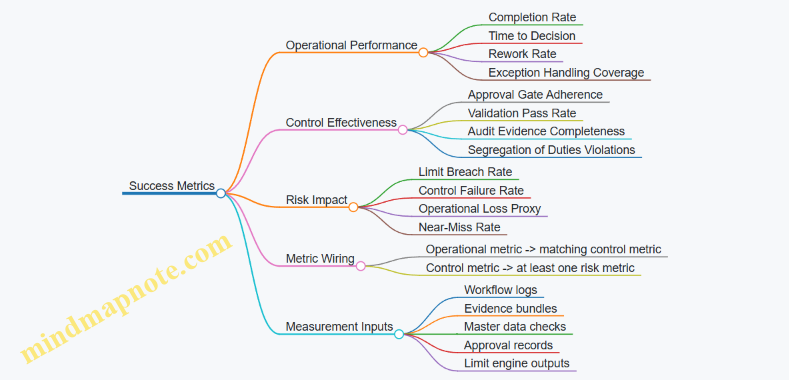
Build Metric Definitions That Prevent Argument
Ambiguity causes metric drift. Define each metric with: scope, numerator, denominator, and data source.
- Scope: which workflows, which business units, which channels.
- Numerator: what counts as success or failure.
- Denominator: what you measure against.
- Data source: which logs or evidence tables.
Example: “Approval Gate Adherence”
- Numerator: actions requiring approval that include a valid approver record and timestamp.
- Denominator: all actions requiring approval.
- Data source: approval ledger plus workflow run ID.
Example Scorecard for a Payment Workflow
A payment workflow scorecard can combine metrics without mixing units.
- Completion rate: 98%
- Time to decision: median 9 minutes
- Rework rate: 3%
- Approval gate adherence: 99.5%
- Validation pass rate: 96%
- Evidence completeness: 97%
- Limit breach rate: 0.2% of runs would breach without intervention; 90% prevented
- Near-miss rate: 14 escalations per 10,000 payments
If completion is high but evidence completeness is low, you have a control problem, not an efficiency problem. If evidence completeness is high but rework is high, you likely have data quality or rule coverage gaps.
Measurement Cadence and Thresholds
Use two cadences: a fast operational cadence and a slower risk cadence.
- Operational cadence: daily or per release, focusing on completion, time, and rework.
- Risk cadence: weekly or monthly, focusing on limit breaches, control failures, and loss proxies.
Set thresholds based on historical baselines from a recent period such as 2026-02-15 to 2026-03-15, then review after each workflow change. The goal is not to chase perfect numbers; it is to catch meaningful deviations quickly and explain them with evidence.
10.3 Pilot Design Including Test Scenarios and Acceptance Criteria
A pilot is a controlled experiment: you prove the workflow works with real data, real exceptions, and real approvals—without turning the whole finance organization into a test environment. The goal is not to “see if it can do the job,” but to confirm that it does the job correctly, safely, and repeatably under defined conditions.
Pilot Scope and Boundaries
Start by writing a one-page scope statement that answers four questions: which workflow(s), which systems, which data sources, and which decision points. Keep boundaries tight. For example, a payments pilot might limit to one legal entity, one payment rail, and one set of beneficiary types. A risk pilot might limit to limit monitoring and escalation, not model recalibration.
Define what is out of scope. If the pilot excludes vendor onboarding, then your test scenarios should not require new counterparties to be created. This prevents “helpful” side effects that blur results.
Test Scenario Design
Test scenarios should cover the full lifecycle of the workflow, plus the failure modes you actually expect in production. A practical way to build scenarios is to enumerate: inputs, transformations, tool actions, control checks, approvals, outputs, and evidence.
Mind Map: Pilot Test Scenarios
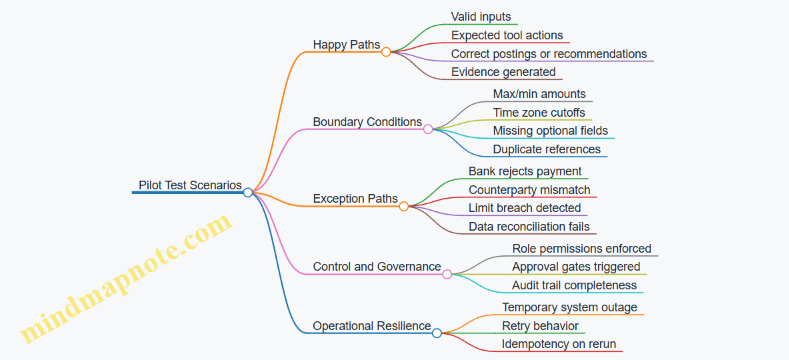
Acceptance Criteria That Can Be Measured
Acceptance criteria should be written so someone can verify them without interpreting vibes. Use measurable statements tied to outcomes and evidence.
A good acceptance set includes:
- Correctness: outputs match expected results for each scenario.
- Safety: prohibited actions never occur without required approvals.
- Completeness: evidence artifacts exist for every run that took an action.
- Consistency: rerunning the same input does not create duplicates.
- Usability for Reviewers: approvers can understand why an action is proposed or blocked.
Example Test Scenarios for a Payments Workflow
Below is a compact scenario set you can adapt. Each scenario includes expected behavior and what evidence must be produced.
Example: Payments Pilot Scenarios
| Scenario | Trigger Inputs | Expected Behavior | Evidence Required |
|---|---|---|---|
| S1 Valid payment | Amount within limits, beneficiary verified | Payment instruction created and queued for approval | Draft record, beneficiary check result, approval request log |
| S2 Duplicate reference | Same invoice ID as prior run | Workflow detects duplication and blocks or links to existing draft | Duplicate detection log, no new instruction created |
| S3 Bank rejection | Bank response indicates invalid account | Workflow marks as failed, prepares remediation checklist | Failure reason, remediation steps, reviewer assignment |
| S4 Limit breach | Amount exceeds threshold | Workflow routes to higher approval gate | Limit calculation, approval gate triggered, no submission |
| S5 Missing remittance | Optional remittance field absent | Workflow applies default rule or requests clarification | Data quality check result, clarification request |
Example Acceptance Criteria for the Same Pilot
Use criteria that map directly to the scenarios.
- AC1 Scenario Coverage: At least one happy path, one boundary condition, and one exception path must pass for every workflow step that performs an action.
- AC2 No Unauthorized Actions: If an approval gate is required, the system must not submit or post until the gate is approved.
- AC3 Evidence Completeness: For any run that creates a draft, triggers an approval request, or attempts a submission, the audit bundle must include inputs summary, checks performed, decisions made, and timestamps.
- AC4 Idempotency: Rerunning the same input set must not create duplicate drafts or duplicate submissions.
- AC5 Reviewer Clarity: The approval request must state the specific rule(s) evaluated and the reason for the decision in plain language.
Pilot Execution Plan and Verification Steps
Run the pilot in two passes. Pass one uses controlled test data and simulated tool responses to validate logic and evidence formatting. Pass two uses production-like data extracts and real system integrations in a restricted mode.
Verification is straightforward: execute each scenario, compare actual outputs to expected outputs, and confirm evidence artifacts exist. If a scenario fails, record whether the failure is a logic gap, a data quality issue, a control misconfiguration, or an integration mismatch.
Acceptance Sign-Off Checklist
Before sign-off, confirm that:
- Every acceptance criterion has a test record.
- Failures are either resolved or explicitly waived with documented justification.
- Operational runbooks cover the top three failure modes observed during testing.
- Reviewers can reproduce the decision from the evidence bundle.
A pilot that meets these criteria is ready to expand scope without turning “testing” into an ongoing job for the finance team.
10.4 Change Management Training and Runbook Development
Agentic finance workflows change how work gets done, not just what gets done. Training and runbooks turn that shift into something teams can execute consistently, even when the workflow behaves differently on a busy day.
Training Foundations for Agentic Finance
Start with a shared mental model: the agent proposes actions, tools execute them, and controls decide what is allowed. A good training program makes that model visible through hands-on practice.
1) Map roles to responsibilities
- Treasury operators: verify inputs, review proposed actions, and approve when required.
- Risk and compliance reviewers: validate rationale, confirm evidence completeness, and approve exceptions.
- System owners: maintain tool access, data feeds, and workflow versions.
Example: If a payment is proposed with a beneficiary name mismatch, operators should know they are not “fixing the agent,” they are correcting the underlying data or requesting an exception with evidence.
2) Teach the workflow lifecycle Cover the same stages every time: intake, planning, tool execution, control checks, evidence capture, and final outcome. Use one scenario across training sessions so people learn the pattern, not the screenshots.
3) Train on decision points, not just screens People need to recognize when to approve, when to ask for clarification, and when to stop. Provide a short checklist for each decision point.
Example checklist for approvals:
- Are the proposed amounts and dates consistent with policy?
- Do the referenced documents match the transaction context?
- Is the evidence bundle complete and readable?
- Does the action fall within the role’s authority?
Runbook Development That Matches Real Work
A runbook is a step-by-step guide for what to do when something goes off-script. Write it so a competent person can follow it without guessing.
1) Define runbook triggers Use concrete triggers tied to system behavior and control outcomes.
- Workflow fails to execute a tool call
- Evidence bundle is missing required artifacts
- Control check returns “needs review”
- Data reconciliation shows a mismatch beyond tolerance
- Approval gate times out or is skipped
2) Standardize the runbook structure Each runbook page should include:
- Purpose and scope
- Trigger conditions
- Immediate actions to take
- Investigation steps
- Evidence to collect
- Escalation path and who to notify
- Resolution criteria and closure checklist
3) Include “safe stops” and “safe retries” Safe stop means you halt further actions to prevent compounding errors. Safe retry means you re-run only the steps that are known to be repeatable.
Example: If a bank API times out, you may retry the status query, but you should not re-submit a payment instruction without confirming whether it was already created.
4) Build evidence expectations into the runbook Runbooks should specify what “good” looks like.
- Required fields in the evidence bundle
- Minimum screenshots or record identifiers
- How to record rationale for overrides
Example: For a compliance exception, the runbook should require the reviewer to attach the policy reference, the reason code, and the reconciliation result.
Mind Map: Training and Runbooks
Integrated Example Training Session and Runbook Pairing
Scenario: A cash forecast proposes a liquidity move, but the evidence bundle lacks the underlying bank statement reference.
Training flow
- Participants identify the decision point: approval requires evidence completeness.
- They use the approval checklist and mark the missing artifact.
- They practice requesting a data correction or re-running the evidence assembly step.
- They document the outcome in the same format the runbook expects.
Runbook flow
- Trigger: evidence bundle missing required bank statement reference.
- Immediate action: stop approval and prevent downstream actions that depend on the move.
- Investigation: verify statement ingestion status and reconciliation tolerance.
- Evidence to collect: ingestion logs, reconciliation result, and the corrected statement identifier.
- Escalation: notify the system owner if ingestion is stalled.
- Closure: confirm evidence completeness and then proceed with the approval gate.
Practical Implementation Notes for Adoption
Schedule training around the actual workflow cadence: operators learn best when practice mirrors the frequency of real tasks. Keep runbooks close to the workflow interface so people can act without hunting for the “right page.” Finally, review runbooks after each pilot incident using a simple rule: if someone had to improvise, the runbook should now contain that exact improvisation as a documented step.
11. Operational Excellence for Agentic Finance in Production
11.1 Runbooks for Incident Response and Workflow Failures
Agentic finance workflows fail for ordinary reasons: missing data, permissions, unexpected formats, downstream system outages, or a control rule that blocks an action. A runbook turns those causes into a repeatable sequence: detect, classify, contain, recover, and learn. The goal is not to “fix everything fast,” but to restore correct outcomes while preserving evidence for audit and post-incident review.
Incident Response Foundations
Start by defining what counts as an incident. Use three severity levels tied to impact on money movement, reporting accuracy, and control compliance.
- Severity 1: Any risk of incorrect payment, unauthorized action, or corrupted audit trail.
- Severity 2: Workflow cannot complete, but no money movement occurred; evidence is incomplete or delayed.
- Severity 3: Degraded performance, partial results, or non-critical exceptions with safe fallback.
Then define roles. At minimum: Workflow Owner (decides business impact), Operations (executes recovery steps), Controls/Risk (confirms control posture), and System Support (addresses platform issues). A runbook without named roles is just a well-written document.
Workflow Failure Taxonomy
Classify failures so the response steps match the cause. Use a simple taxonomy:
- Input failures: missing fields, wrong currency, malformed dates, stale reference data.
- Tool failures: API errors, timeouts, authentication failures, rate limits.
- Policy and control failures: approval gate blocks, segregation of duties violations, limit breaches.
- Data reconciliation failures: totals don’t match ledgers, bank statements don’t reconcile, duplicate transactions detected.
- Execution failures: workflow stuck, idempotency breaks, retries create duplicates.
A practical rule: if the workflow attempted a money movement, treat it as Severity 1 until proven otherwise.
Mind Map: Incident Response and Workflow Failures
Runbook Steps from Detection to Recovery
Detect and Freeze
When an alert triggers, capture the trace ID, workflow version, and the last completed step. Immediately pause the workflow instance to prevent repeated attempts. If the workflow is mid-payment, switch to a “no new actions” posture while you verify the current payment status in the banking platform.
Example: A payment workflow fails after generating instructions but before settlement confirmation. The runbook instructs you to check the bank’s payment status for each instruction ID, then freeze the evidence bundle so you can later prove what was sent and what was not.
Classify and Decide Severity
Use the taxonomy to label the failure type. Then map it to severity. If the failure is a control gate block, you may be able to recover quickly by collecting missing approvals. If it’s a tool authentication failure, you likely need system support and should avoid re-running until credentials are restored.
Example: A compliance check fails because a counterparty classification is missing. This is an input failure with potential control impact. Severity is typically 2 unless the workflow already attempted an action.
Contain
Containment prevents compounding damage.
- Pause the workflow instance.
- Disable the specific tool call that failed if retries are unsafe.
- Enforce idempotency by using stable keys for payment instructions and ledger postings.
Example: A timeout occurs during bank API submission. Without idempotency, a retry could create duplicate payments. The runbook requires checking whether the instruction ID was already accepted before retrying.
Recover with Verified Inputs
Recovery should be evidence-driven.
- Inspect the failing step and required fields.
- Validate data mappings against a known-good example.
- Re-run only after the remediation is applied.
Example: Cash forecasting fails because a currency conversion rate is missing for one entity. The runbook directs you to confirm the rate source, populate the missing rate, and re-run the forecast for that entity only, not the entire group.
Verify Outcomes and Control Posture
Verification is not “it ran again.” It is reconciliation and control confirmation.
- Confirm money movement status matches internal records.
- Reconcile totals to source systems.
- Ensure approvals and evidence bundles are complete.
Example: Risk limit monitoring flags a breach but the workflow cannot post the escalation. The runbook requires confirming the breach calculation inputs and then ensuring the escalation record exists with the correct signoff.
Example Runbook Entry for a Payment Workflow Failure
Trigger: Payment workflow error rate exceeds threshold; trace ID available.
Symptoms: Workflow stopped after instruction generation; settlement status unknown.
Actions:
- Pause workflow instance.
- Query bank platform for each instruction ID.
- If any instruction is accepted, record status and do not re-submit.
- If none are accepted, check tool authentication and retry only after credentials are restored.
- Re-run with the same idempotency keys.
- Reconcile internal payment ledger totals to bank confirmations.
Evidence: Store trace ID, instruction payload hash, bank status screenshots or API responses, and approval records.
Post-Incident Review That Actually Helps
After recovery, document root cause in one sentence, then list three concrete changes: one to data validation, one to tool handling, and one to control gating. If you cannot name changes, the runbook will fail the next time—because the next failure will look familiar.
11.2 Performance Management Including Latency and Throughput Targets
Agentic finance workflows behave like production systems: they have inputs, queues, compute steps, tool calls, and approvals. Performance management means you measure those parts separately, then set targets that match business risk. A workflow that is “fast” but unreliable is just a faster way to fail.
Start with What You Actually Measure
Latency is the time from workflow start to the moment the outcome is usable. Throughput is how many workflow instances complete per unit time. For treasury and risk, you also care about:
- Tool latency: time spent calling ERP, TMS, bank APIs, or data warehouses.
- Queue time: time waiting for resources, approvals, or rate limits.
- Human approval latency: time between a request and a signoff.
- Failure rate: percentage of runs that end in a retry loop, manual fallback, or rejection.
A practical baseline uses three percentiles: p50 (typical), p90 (stretched but acceptable), and p99 (rare but important). If you only track averages, you will miss the “long tail” that causes operational pileups.
Define Targets by Workflow Criticality
Not every workflow deserves the same speed. Set targets using business impact and control strictness.
- High criticality (e.g., payment release approvals): prioritize low failure rate and predictable p90 latency.
- Medium criticality (e.g., daily risk limit monitoring): prioritize steady throughput and manageable queueing.
- Low criticality (e.g., draft reports): prioritize cost and batch efficiency over ultra-low latency.
Example targets for a payment exception triage workflow:
- p50 latency: 2 minutes
- p90 latency: 7 minutes
- p99 latency: 20 minutes
- Failure rate: < 1% per 100 runs
- Human approval latency: median 30 minutes, with a separate SLA for weekends
Build a Measurement Map from Trigger to Outcome
You need a traceable timeline. Split the workflow into stages and measure each stage.
Stage list
- Intake: validate inputs, normalize identifiers.
- Planning: decide which checks and tools to run.
- Execution: tool calls and calculations.
- Reconciliation: compare outputs to expected constraints.
- Approval: route to the right role.
- Finalize: write results, evidence, and status.
If execution is slow, you tune tools and data access. If planning is slow, you tune prompt/rule complexity and reduce branching. If approval dominates, you tune routing and pre-fill evidence so reviewers spend time deciding, not searching.
Manage Throughput with Concurrency and Rate Limits
Throughput is constrained by bottlenecks. Common ones are:
- Bank API rate limits for payment status checks.
- Database contention during large reconciliation queries.
- Approval capacity when too many cases land on the same queue.
Use concurrency controls per workflow type and per tool. For example, allow 10 concurrent payment status checks per bank connection, but only 2 concurrent reconciliation jobs per ledger database to avoid lock contention.
Use a Simple Targeting Framework
A useful rule: set targets for end-to-end and top bottleneck stages.
- End-to-end: p90 latency and failure rate
- Bottleneck stages: tool latency p90 and queue time p90
Example: if end-to-end p90 is 7 minutes but tool p90 is 6 minutes, you know the workflow is tool-bound. If tool p90 is 2 minutes but end-to-end p90 is 7 minutes, queueing or approval routing is the culprit.
Mind Map: Performance Management for Agentic Finance
Concrete Example: Payment Status Checks Under Load
Suppose a bank returns payment status updates slowly during month-end. You run 300 exception cases.
- Without controls: all cases call the bank simultaneously, tool latency spikes, and queue time grows.
- With controls: you cap concurrent calls per bank at 10, and you stagger retries using exponential backoff with jitter.
You then measure:
- Tool p90 latency for bank calls
- Queue p90 time before a case can start execution
- End-to-end p90 latency for the workflow outcome
If end-to-end p90 exceeds target, you adjust either concurrency (if the bank can handle more) or batching (if you can query multiple payment IDs in one request). If failure rate rises, you tighten validation earlier in intake so bad identifiers don’t waste tool calls.
Operational Targets That Don’t Break Controls
Performance tuning must respect governance. If you reduce steps to gain speed, you still need evidence capture and approval gates. A good target system keeps controls intact by measuring:
- time spent before approvals
- time spent after approvals
- whether evidence completeness correlates with speed
When evidence is missing, reviewers will slow down, and throughput will drop. So the fastest workflow is the one that produces complete, reviewable outputs the first time.
11.3 Versioning for Prompts Rules Tools and Data Schemas
Versioning is how agentic finance stays boring in the best way: you can reproduce what happened, explain why it happened, and change things without breaking controls. Treat prompts, rules, tools, and data schemas as four separate artifacts with different risk profiles, then connect them through a single version record per workflow run.
Foundational Principles for Versioning
Start with a simple rule: every workflow execution must be traceable to exact artifact versions. That means you version inputs (data snapshots or query parameters), version the decision logic (rules and prompt templates), version the capabilities (tool definitions and permissions), and version the data contracts (schemas).
Use semantic intent for version numbers:
- Major: incompatible behavior or contract changes.
- Minor: backward-compatible improvements.
- Patch: bug fixes without changing outputs for valid inputs.
A practical example: if a payment approval rule changes from “amount > 100k requires CFO approval” to “amount > 100k OR beneficiary is new requires CFO approval,” that is a behavior change and should be a major bump.
Versioning Prompts
Prompts are not just text; they are part of your decision boundary. Version prompt templates and any system instructions separately from user-provided content.
Best practice: store prompts as immutable templates and render them at runtime with explicit variables. Record the template version and the rendered variable set.
Example: a cash forecasting prompt might include a variable scenario and a variable base_currency. If you later change wording that affects how assumptions are interpreted, you must bump the prompt version even if the variables are unchanged.
Versioning Rules
Rules should be treated like code: deterministic where possible, testable, and reviewable. Represent rules in a structured form (even if authored by humans) so you can diff changes.
Best practice: maintain a rule registry with:
- rule id
- version
- effective date range
- dependencies on data fields
- required evidence fields
Example: a compliance rule that checks whether a counterparty is on a sanctions list should declare which data fields it uses (e.g., counterparty.legal_name, counterparty.country_of_incorporation) and which evidence it must output (e.g., screening_result_id).
Versioning Tools
Tools are the “hands” of the agent. Version tool definitions and permissions together. A tool version change can alter side effects, so treat it as high risk.
Best practice: define tool contracts with:
- input schema version
- output schema version
- idempotency key strategy
- side-effect description
- approval requirements
Example: a create_payment tool should specify whether it supports idempotency. If you change idempotency behavior, bump the tool major version because retries may otherwise create duplicates.
Versioning Data Schemas
Schemas are the glue between systems and the agent. Version them with explicit compatibility rules.
Best practice: use a compatibility matrix:
- Backward-compatible: adding optional fields, widening enums.
- Breaking: renaming fields, changing units, changing required fields.
Example: if amount changes from “minor units” to “major units,” that is breaking even if the field name stays the same. Bump the schema major version and update any unit conversion logic.
Mind Map: Versioning Scope and Connections
Integrated Example Workflow Run Record
When a treasury workflow proposes a funding action, capture a single “run manifest” that ties everything together.
Example run manifest fields:
run_id: unique idinput_snapshot: reference to the data extract usedprompt_versions:{ "cash_forecast": "1.4.0" }rule_versions:{ "funding_decision": "2.1.3" }tool_versions:{ "place_funding_trade": "3.0.0" }schema_versions:{ "forecast_input": "1.2.0", "trade_request": "2.0.0" }evidence_ids: list of evidence bundle idsapproval_path: which approvals were required and who approved
If a later audit asks why the agent chose a specific funding tenor, you can reconstruct the exact prompt template, the exact rule set, and the exact schema interpretation of the inputs. That’s the whole point: no guesswork, no “it probably used the latest.”
Change Management Checklist for Safe Releases
Before promoting new versions to production, verify four things in order:
- Contract compatibility: schema and tool input/output versions match.
- Behavioral impact: rules and prompt changes have documented intent.
- Evidence continuity: required evidence fields still exist.
- Regression coverage: run the same test scenarios and compare outputs where determinism is expected.
A small but effective habit: require a short “diff summary” for each major version bump, written in plain language, stating what changed and what should remain unchanged. That keeps reviews efficient and prevents accidental control drift.
11.4 Continuous Improvement Using Post Action Reviews and Metrics
Continuous improvement in agentic finance is less about “learning from outcomes” in general and more about building a repeatable loop: capture what happened, compare it to what should have happened, fix the specific gap, and verify the fix. The loop works best when it is standardized across treasury, risk, compliance, and decision support, because the failure modes rhyme even when the workflows differ.
The Post Action Review Workflow
A Post Action Review (PAR) should start immediately after a workflow completes, whether it succeeded, partially succeeded, or failed. The goal is to reduce ambiguity, not to assign blame.
- Collect the evidence bundle: workflow run ID, inputs used, tool calls, intermediate outputs, approvals granted, and final decision or transaction result. If the system cannot produce an evidence bundle automatically, the PAR becomes a scavenger hunt.
- Classify the outcome: success, success with exceptions, partial completion, or failure. “Success with exceptions” is important because it often hides control weaknesses.
- Compare to the expected control path: for each high-impact action, confirm the correct approval gate, the correct data checks, and the correct exception handling.
- Identify the gap type: data quality, rule mismatch, tool integration issue, model output inconsistency, or human review misalignment.
- Record the fix with an owner and verification step: every fix must include a measurable check, such as “reduce missing remittance exceptions by 30% over 2 weeks” or “ensure beneficiary validation fails closed for 100% of malformed inputs.”
- Close the loop with a regression test: rerun the workflow on the same scenario plus a small set of related edge cases.
A practical example: a payment workflow fails because the beneficiary bank code is missing. The PAR should capture whether the workflow attempted a payment anyway, whether it routed to exception handling, and whether the evidence bundle shows the exact validation rule that triggered the exception.
Metrics That Actually Help
Metrics should be chosen so they point to actions. If a metric cannot guide a change, it is just decoration.
Operational metrics
- Workflow completion rate: percentage of runs that reach the intended end state.
- Exception rate by category: split by missing data, control gate rejection, tool error, and reconciliation mismatch.
- Time-to-resolution: from run start to closure of the exception, including human review time.
Control and quality metrics
- Control pass-through rate: percentage of high-impact actions that pass required checks without manual override.
- Override frequency: how often reviewers bypass a gate, and whether bypasses are justified by evidence.
- Reconciliation accuracy: for payments and forecasts, measure variance between expected and posted outcomes.
Model and rule behavior metrics
- Decision consistency: for the same inputs, measure whether the workflow produces the same classification or recommendation.
- Rule coverage: how often each rule is exercised during real runs, which helps prioritize improvements.
A useful pattern is to track metrics at two levels: per workflow and per control gate. A workflow may look healthy while a single gate quietly accumulates near-misses.
Mind Map: The Improvement Loop
Post Action Review and Metrics Mind Map
Example PAR with Metrics and Fix
Scenario: A risk limit monitoring workflow flags an exposure breach but routes it to the wrong escalation path.
- Evidence bundle shows the exposure calculation was correct, but the escalation routing rule used the wrong counterparty classification.
- Outcome classification: success with exceptions.
- Gap type: rule mismatch tied to master data classification.
- Fix: update the routing rule to reference the validated counterparty master record, and add a data check that fails closed when classification confidence is low.
- Verification: rerun the same case and two similar cases where classification differs; confirm the escalation path matches the control matrix.
- Metrics to watch: escalation misroute rate should drop to zero for the covered categories, and override frequency should decrease because the workflow should now fail closed rather than “guess.”
Operating Cadence and Ownership
PARs should not be a one-off event. Assign ownership by gap type: data issues go to data stewardship, rule mismatches to workflow owners, tool failures to integration engineers, and reviewer misalignment to process owners. Use a consistent cadence such as weekly review of high-impact exceptions and monthly review of control pass-through trends. The cadence matters because it determines whether fixes are verified before the same issue repeats.
When PARs and metrics are connected this tightly, improvement becomes measurable and boring in the best way: fewer surprises, clearer evidence, and controls that behave the same way every time.
12. Practical End-to-End Examples Across Finance Functions
12.1 End-to-End Cash Forecast to Liquidity Action With Approvals
A cash forecast becomes useful only when it turns into a liquidity action with clear approvals, evidence, and a traceable rationale. This end-to-end flow starts with structured inputs, produces forecast outputs with uncertainty-aware assumptions, and ends with an executed action that passes control gates.
Mind Map: End-To-End Flow
Step 1: Define the Forecast Boundary and Time Buckets
Start by locking the forecast boundary: which legal entities, which bank accounts, and which cash movements are in scope. Then choose time buckets that match operational reality. For example, a weekly bucket might be fine for investment decisions, but payment timing often needs daily buckets for the next 10 business days.
Best practice: define cutoffs. If invoices are posted by 3:00 PM local time, treat anything after the cutoff as next-day activity. This prevents “mystery cash” caused by posting delays.
Step 2: Assemble Inputs with Evidence-Ready Structure
Collect inputs in a consistent schema so the forecast can be reproduced. A practical example set:
- Bank balances: end-of-day balances per account, plus any known intraday holds.
- AR cash: expected collections by customer segment, using aging buckets.
- AP cash: expected payments by vendor segment, using invoice due dates and typical payment terms.
- Known outflows: payroll, rent, utilities, and tax payments from calendars.
- Debt: maturities, interest dates, and any scheduled drawdowns.
Example: If payroll is scheduled for the 15th, store it as a dated outflow with a fixed amount and a “cannot shift” flag. If collections are estimated, store them with a confidence range.
Step 3: Build Scenarios That Produce Actionable Differences
Use at least two scenarios so approvals can be tied to risk tolerance, not just a single number.
- Base case: uses standard collection and payment timing assumptions.
- Conservative case: applies a lower collection rate and a slower payment timing assumption.
Example: Suppose the base case predicts a minimum cash balance of $8.5M on day 7, while the conservative case predicts $6.2M. If your internal liquidity threshold is $7.0M, the conservative case triggers an action even though the base case looks safe. That difference is the point.
Step 4: Compute Liquidity Headroom and Breach Flags
Liquidity headroom is more than “cash on hand.” It should incorporate committed facilities and constraints.
Compute:
- Projected cash position per day.
- Available credit under committed facilities after any utilization assumptions.
- Headroom = projected cash + available credit − required minimum.
Breach flags should be explicit: “Headroom below threshold on day X” and “Covenant risk indicator changes.”
Example: If a revolving credit facility has a borrowing base tied to receivables, the forecast must reflect the receivables assumption used for the borrowing base. Otherwise, the headroom calculation becomes a guess with a spreadsheet costume.
Step 5: Run Control Gates Before Any Action Proposal
Control gates prevent the system from proposing actions based on bad data or missing approvals.
- Data quality checks
- Missing bank balance for an account.
- Out-of-range collection rates.
- Debt maturity date outside the forecast horizon.
- Limit and covenant checks
- Facility availability mismatch.
- FX exposure mismatch with hedging settlement dates.
- Segregation of duties
- The proposer role cannot be the approver role.
- Approval thresholds
- Low-impact actions (e.g., small sweep adjustments) require one approval.
- High-impact actions (e.g., new borrowing or large investment term placements) require additional review.
Example: If the forecast input snapshot shows a collection rate override, require a finance controller approval even if the headroom breach is small.
Step 6: Propose Liquidity Actions with Clear Rationale
Actions should be mapped to the breach type.
- If headroom breach is near-term and predictable: use short-term funding or drawdown.
- If breach is driven by timing shifts: adjust payment scheduling where policy allows.
- If breach is driven by FX cash timing: execute FX conversion for the near-term bucket.
Example: On day 7, conservative headroom is below $7.0M. The system proposes a $3.0M short-term borrowing drawdown on day 6, with an alternative of $1.5M drawdown plus a sweep reduction. Both options include expected impact on headroom and a note about assumptions.
Step 7: Capture Approvals and Evidence, Then Execute
Approvals must be tied to the exact forecast version and scenario.
Evidence bundle should include:
- Forecast version ID and timestamp.
- Input snapshot reference (balances, AR/AP schedules, calendars).
- Scenario parameters and any overrides.
- Breach flags and computed headroom table.
- Approval records with approver identity and decision.
Execution confirmations should record:
- Trade or booking reference.
- Settlement date.
- Amount and instrument details.
Example: If an approval happens on 2026-02-26, the evidence should show the forecast version used at that time, not a later recalculation.
Step 8: Track Variance and Handle Exceptions
After execution, compare actual cash movements to forecast outputs for the same buckets. Variance should be categorized:
- Timing variance (posted later/earlier).
- Amount variance (collections higher/lower).
- Data variance (missing input or corrected amount).
Example: If collections were 12% lower than forecast on day 5, the next run should adjust the collection assumption for that customer segment and flag whether the change is due to timing or amount.
This workflow keeps the chain tight: structured inputs produce scenario outputs, scenario outputs trigger controlled action proposals, approvals bind to evidence, and execution results feed back into the next forecast run.
12.2 End-to-End Payment Exception Triage With Evidence Capture
Payment exceptions are the moments when “the plan” meets reality: a beneficiary account mismatch, a missing remittance reference, a bank rejection, or a compliance block. Triage is the disciplined process that turns those moments into traceable decisions—fast enough to protect cash flow, strict enough to satisfy controls.
Mind Map: Payment Exception Triage Flow
Step 1: Detect and Classify with Consistent Inputs
Start by treating every exception as a structured event. When a bank returns a payment, capture the return reason code and the original payment identifiers. Then map the reason code to a small set of categories such as “Beneficiary data invalid,” “Reference missing,” “Routing failure,” “Duplicate suspected,” or “Compliance blocked.”
Example: A payment for EUR 250,000 is rejected with a return message stating “beneficiary account number invalid.” The triage record should include the payment ID, the beneficiary’s account as stored at the time of approval, the value date, and the bank’s return timestamp. This prevents the classic problem where someone “fixes” the account later and the team can’t prove what was sent.
Step 2: Contain and Preserve Evidence Before Any Change
Before remediation, freeze the workflow state for the affected payment. Preserve a snapshot of:
- The payment instruction fields (beneficiary, bank routing, reference, amount, currency)
- The beneficiary master data version used during approval
- The approval trail (who approved, what policy checks were satisfied)
- Any FX inputs used for conversion
- System logs showing what actions occurred and when
Example: If the exception is caused by a missing remittance reference, you may be tempted to simply re-submit with a new reference. Instead, capture the original instruction first, then add the reference and record who approved the change.
Step 3: Diagnose Root Cause Using a Decision Tree
A practical triage decision tree reduces back-and-forth.
- If the exception is “reference missing” and the reference is available in the source system, it’s usually a data completeness issue.
- If the exception is “account invalid,” check formatting rules and master data alignment.
- If the exception is “compliance blocked,” route to compliance with the evidence bundle and do not attempt re-submission until cleared.
- If the exception suggests duplication, verify whether an earlier payment was already sent for the same invoice set.
Example: A duplicate suspected return appears after a retry. The triage should compare instruction IDs and invoice references to determine whether the retry created a second payment or whether the first payment was still pending.
Step 4: Decide and Route with Clear Authority Boundaries
Not every exception needs the same level of human involvement.
- Safe auto-resolve: correctable formatting issues where the beneficiary master data is unchanged and approvals remain valid.
- Human approval required: any change to beneficiary master data, cancellation/rebooking, or compliance-related remediation.
- Specialist escalation: sanctions screening hits, complex routing failures, or accounting impacts.
Example: The bank rejects a payment because the beneficiary country code is wrong. If the country code in master data is incorrect, you need master data governance approval before updating and re-submitting.
Step 5: Execute Remediation and Capture the “Why”
Remediation should be performed as a controlled sequence: update the instruction, re-submit or cancel, and notify the right parties. Every action must be linked to the triage decision.
Example: For a missing remittance reference, the remediation steps are:
- Populate the reference from the invoice system
- Validate formatting rules
- Re-submit
- Record the decision rationale: “Reference missing per bank return; source reference available; no master data change.”
Step 6: Close with an Evidence Bundle That Auditors Can Follow
A complete evidence bundle includes:
- The bank return message payload or screenshot
- The normalized exception category
- The snapshot of original instruction fields
- The remediation actions taken
- Approval sign-offs and timestamps
- The final bank status after remediation
- A short rationale written in plain language
Example evidence bundle entry:
- Exception category: Reference missing
- Root cause: Remittance reference field empty in original instruction
- Action: Reference populated from invoice system; re-submitted
- Approvals: Treasury ops approval at 2026-02-26 10:14
- Final status: Accepted by bank
Mind Map: Evidence Bundle Contents
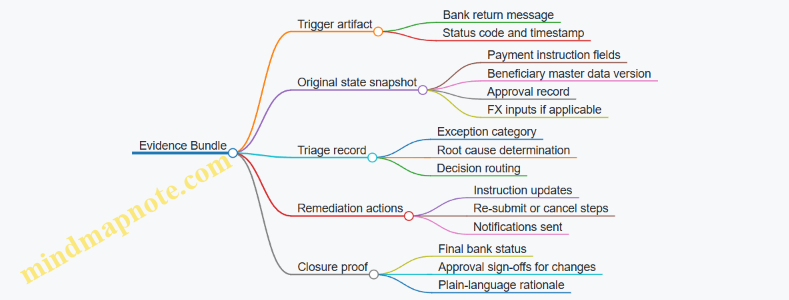
When triage is systematic, exceptions stop being “mysteries” and become repeatable workflows. The goal is not just to get payments through; it’s to make every decision defensible, reproducible, and understandable by the next person who has to pick up the thread.
12.3 End-to-End Risk Limit Monitoring with Escalation Paths
Risk limit monitoring is the part of risk management that turns “we have limits” into “we know when limits are being approached, why, and what happens next.” An end-to-end workflow should cover four things in order: (1) define limits and measurement, (2) detect and explain breaches or near-breaches, (3) route decisions through escalation paths, and (4) record evidence so the outcome is auditable.
Foundational Setup for Limits and Measurement
Start by making each limit measurable and unambiguous. For every limit, document: the risk type, the portfolio scope, the measurement method, the data source, the refresh cadence, and the action threshold(s). A common pattern uses two thresholds: a warning level (for early action) and a breach level (for mandatory action).
Example: A market risk limit for FX options might be measured as “delta-equivalent VaR” computed daily from positions and market curves. The warning threshold could be 80% of the limit, and the breach threshold 100%. If the measurement method changes, the monitoring logic must change too, or you’ll get false alarms.
Detection Logic and Evidence Capture
Detection should run on a schedule and also on demand when material events occur (for example, large trades or curve updates). Each monitoring run should produce a structured record containing: the computed utilization, the threshold status, the drivers (what moved), and the data quality checks performed.
Data quality checks prevent “limit breach due to missing data.” For instance, if the market data feed is stale, the workflow should mark the utilization as “not reliable” and route it to a data issue queue rather than a risk decision queue.
Example: On a daily run, utilization jumps from 62% to 91%. The evidence bundle should include the prior-day utilization, the current-day utilization, the top contributing instruments or risk factors, and the market data timestamp used for the calculation.
Explanation and Triage Before Escalation
Escalation should not be triggered by a number alone. The workflow should perform triage to answer two questions: “Is this a real risk increase?” and “Is it actionable right now?”
A practical triage checklist:
- Confirm the scope: are the positions included correctly?
- Confirm the measurement: are the risk factor mappings correct?
- Confirm the driver: is the increase due to new trades, market moves, or model parameter changes?
- Confirm the action feasibility: can the team reduce exposure within the required timeframe?
Example: The utilization is at 102% because a new trade was booked late in the day. If the trade is within the same approval chain and can be unwound quickly, escalation can focus on execution actions. If the driver is a market shock with no immediate hedging capacity, escalation should focus on governance decisions (for example, temporary limit relaxation requests).
Escalation Paths and Decision Routing
Escalation paths should be explicit and role-based. Define who receives what, when, and with which decision options. A clean approach is to map statuses to routes:
- Warning: notify risk owner and portfolio manager; request review and mitigation plan.
- Breach: notify risk committee delegate and require a mitigation decision within a fixed SLA.
- Data quality issue: notify data steward and pause risk actions until resolved.
Example SLA: Warning within 2 hours of run completion; breach within 30 minutes. The SLA is not a vibe; it’s a control that prevents slow reactions.
Mind Map: End-to-End Monitoring Flow
Example: One Day in the Life of a Breach
Assume a credit risk limit measured as “expected exposure” is computed hourly. At 10:00, utilization reaches 78% (warning). The workflow routes a notification to the credit risk owner with the top counterparties contributing to the increase and the driver classification. The portfolio manager reviews and identifies that a single counterparty’s utilization is rising due to drawdowns.
At 12:00, utilization reaches 103% (breach). The workflow triggers the breach route: it sends an escalation packet containing the evidence bundle, the driver attribution, and a proposed action set (for example, reduce exposure via repayment schedule changes or adjust collateral terms if permitted). The risk committee delegate must choose one of the documented outcomes: mitigate immediately, request a temporary limit adjustment with justification, or confirm that the breach is due to a data issue.
Operational Controls for Consistency
To keep the process reliable, enforce three controls:
- Deterministic routing rules: the same status always maps to the same recipients and SLAs.
- Immutable evidence: store the computed utilization, driver details, and data timestamps used.
- Closure requirements: every escalation ends with a recorded outcome and an approval trail.
Example: If a breach is mitigated by reducing exposure, the closure record should include the post-action utilization and the time the positions changed, so auditors can reconcile the timeline.
12.4 End-to-End Compliance Evidence Assembly for Audit Readiness
Compliance evidence assembly is the unglamorous work of proving that controls ran as designed, at the right time, on the right data, with the right approvals. For agentic finance workflows, the goal is simple: every automated action must leave a trace that an auditor can follow without guessing.
Start with the Audit Question
Begin by translating the audit objective into concrete questions. For example: “Were payments screened against sanctions before release?” becomes three evidence questions: (1) what dataset was used, (2) what rule or screening method was applied, and (3) who approved exceptions.
A practical way to structure this is to define an evidence map per control. Each map row should include: control name, trigger event, system of record, evidence artifacts, retention period, and review owner. If you cannot name the system of record, you cannot reliably prove anything.
Define the Evidence Model
Agentic workflows typically produce evidence in layers.
- Input evidence: the source records used (invoice, vendor master, bank account, counterparty profile).
- Decision evidence: the checks performed (policy rules, limit checks, sanctions screening results, risk flags).
- Action evidence: what was executed (payment instruction created, message sent, journal posted).
- Approval evidence: who reviewed and what they approved (approver identity, timestamp, decision outcome).
- Exception evidence: why the workflow deviated (reason codes, supporting documents, remediation steps).
- Integrity evidence: how the system ensured traceability (correlation IDs, immutable logs, versioned rules).
A good evidence model also specifies granularity. If you store only “payment approved,” you will struggle when a single payment fails screening. Store evidence at the transaction level, plus a link to the batch-level run context.
Build the Evidence Pipeline
Treat evidence assembly like a pipeline with deterministic outputs.
Step 1: Correlate everything to a single run context. Generate a correlation ID at workflow start and propagate it to every tool call, rule evaluation, and external system interaction. Example: a payment workflow run creates RUN-2026-03-01-1042 and every evidence artifact references it.
Step 2: Capture tool inputs and outputs. For sanctions screening, store the screening request payload (counterparty identifiers), the screening engine version, the result status, and the match details used to decide “pass” or “review.”
Step 3: Record rule versions and policy snapshots. If policy rules change, evidence must reflect the rule version used at the time. Store a policy snapshot hash or rule package identifier alongside the decision evidence.
Step 4: Store approvals as structured records. Avoid free-text-only approvals. Use fields like approver role, decision, justification category, and linked exception ID.
Step 5: Package evidence for audit consumption. Assemble an evidence bundle per control instance. A bundle should include a manifest (what’s inside), the transaction-level artifacts, and the run-level context.
Mind Map: Evidence Assembly Flow
Example: Payment Screening Evidence Bundle
Suppose a vendor payment is prepared and the workflow performs sanctions screening.
Transaction-level evidence artifacts
- Payment draft record ID and timestamp
- Vendor master snapshot ID
- Counterparty identifiers used for screening
- Screening engine version and screening result
- Decision outcome:
PASSorREVIEW - If
REVIEW: exception reason code and supporting document reference
Approval evidence
- Approver user ID and role
- Approval timestamp
- Decision: approve or reject
- Linked exception ID
Action evidence
- Payment instruction creation record ID
- Outbound message status and timestamp
Integrity evidence
- Correlation ID
RUN-2026-03-01-1042 - Evidence manifest hash
- Log retention confirmation
An auditor should be able to start at the payment ID and reach the screening result, then the approval (if needed), then the actual release action.
Validation Checks That Prevent “Evidence Theater”
Evidence assembly fails when artifacts exist but do not agree. Run three checks before declaring a bundle audit-ready.
- Completeness: every required artifact type exists for the control instance.
- Consistency: timestamps and IDs match across systems (draft, screening, approval, release).
- Traceability: every decision evidence item links back to the exact inputs and rule version.
A simple sampling approach works: pick a small set of transactions across normal and exception paths, then verify the bundle end-to-end.
Governance for Evidence Ownership
Finally, assign ownership for each evidence layer. Input evidence may be owned by data operations, decision evidence by risk/compliance, and action evidence by treasury operations. Evidence bundles should be accessible only to authorized reviewers, with retention rules aligned to your audit policy.
When these pieces are in place, audit readiness becomes a repeatable outcome rather than a last-minute scramble. The workflow still does the work; the evidence just makes the work provable.
12.5 End-to-End Decision Support for Funding Strategy Documentation
Funding strategy decisions are easiest to review when they are documented as a chain of evidence: what you observed, what you assumed, what options you considered, what constraints you applied, and why the chosen plan is acceptable. This section shows a systematic way to produce that documentation using a repeatable workflow.
Start with the Decision Frame
Begin by writing a one-page decision frame that answers four questions.
-
Decision scope: Which entities and currencies are in scope? Example: “Group treasury funding for USD and EUR, covering 12 months, excluding project finance.”
-
Decision horizon: What time window matters? Example: “Twelve months for funding mix; quarterly for refinancing risk.”
-
Objective and success criteria: Choose measurable targets. Example: “Minimize expected funding cost subject to liquidity coverage and refinancing risk limits.”
-
Constraints and non-negotiables: List policy rules that cannot be violated. Example: “No unsecured issuance above X% of total debt; maintain minimum cash buffer of Y days.”
A good practice is to include a “what would change my mind” section. Example: “If credit spreads widen by more than 50 bps for two consecutive weeks, re-run the option set.” This keeps later documentation consistent with the original intent.
Gather Inputs with Traceability
Funding documentation fails when inputs are scattered. Use a structured input checklist.
- Market inputs: yield curves, swap rates, credit spreads, FX forward points.
- Company inputs: debt maturity ladder, covenants, liquidity facilities, collateral availability.
- Operational inputs: settlement calendars, bank cutoffs, documentation lead times.
- Risk inputs: stress scenarios for rates and spreads, liquidity draw assumptions.
Example: If you assume a draw on a committed facility, document the trigger and the draw rate. “Assume 30% draw under the liquidity stress scenario because historical utilization rose from 10% to 40% during similar conditions.”
Build the Option Set and Make Tradeoffs Explicit
List funding options in a comparable format so the decision is reviewable.
- Short-term: CP, T-bills, revolving credit draw.
- Medium-term: term loans, notes, private placements.
- Long-term: public bonds, syndicated facilities.
- Hedging overlays: fixed-to-floating swaps, FX hedges.
For each option, document:
- Cost components: base rate, spread, issuance fees, hedge costs.
- Timing: earliest execution date and expected settlement.
- Capacity: remaining facility headroom and issuance limits.
- Risk impact: refinancing concentration, liquidity usage, covenant effects.
Example: “Option A: 3-year notes in USD. Cost estimate includes 12 bps issuance fee amortized over the term. Risk impact: reduces 12-month refinancing exposure by 18% but increases unsecured share by 6%.”
Apply Constraints Through a Scoring and Filter Process
Use a two-stage method: filter first, then score.
- Filter: remove options that violate hard constraints.
- Example: “Reject any plan that breaches the unsecured cap or fails liquidity buffer requirements under the stress scenario.”
- Score: rank remaining options using weighted criteria.
- Example: 50% expected cost, 30% refinancing risk, 20% operational feasibility.
Keep the scoring transparent. If operational feasibility is scored, define it. Example: “Feasibility score is based on documentation lead time: 1.0 if settlement within 30 days, 0.7 if 31–60 days, 0.4 if over 60 days.”
Produce the Documentation Package
A complete package should read like a controlled audit trail.
- Decision frame (scope, horizon, objective, constraints).
- Input register (source, timestamp, version, owner).
- Option table (cost, timing, capacity, risk impact).
- Constraint results (which options were filtered and why).
- Scoring summary (weights, scores, sensitivity notes).
- Chosen plan rationale (why it wins under the stated criteria).
- Approval checklist (treasury, risk, compliance, legal).
- Execution plan (next actions, owners, dates, dependencies).
Example execution plan line: “Draft term sheet for Option A by 2026-02-26; confirm covenant impact with legal by 2026-02-28; reserve issuance capacity with banks by 2026-03-01.”
Mind Map for the End-To-End Workflow
Funding Strategy Documentation Mind Map
Worked Example in Miniature
Suppose the objective is to reduce 12-month refinancing risk while keeping expected cost within a tolerance.
- Filter out options that breach the unsecured cap.
- Score remaining options using cost and refinancing risk weights.
- Select the highest score plan and document the exact reason: “It meets liquidity stress and reduces refinancing concentration the most without exceeding the unsecured cap.”
- Add an execution plan with owners and dates, plus an approval checklist.
The result is a funding strategy document that a reviewer can follow without guessing what happened between the assumptions and the decision.