Biotechnology Engineering and Modern Genetic Engineering Techniques
1. Introduction to Biotechnology Engineering
1.1 Definition and Scope of Biotechnology Engineering
Biotechnology engineering is an interdisciplinary field that combines principles of biology, chemistry, physics, and engineering to develop technologies and products that utilize biological systems. At its core, it focuses on applying engineering methods to manipulate living organisms or their components for practical uses. This can range from producing pharmaceuticals to improving agricultural crops or developing biofuels.
The scope of biotechnology engineering is broad and includes various subfields such as genetic engineering, bioprocess engineering, molecular biology, and synthetic biology. It involves designing and optimizing processes that use cells or enzymes to manufacture products on a commercial scale, as well as developing tools to modify genetic material.
To clarify the concept, consider the following mind map outlining the main components and applications of biotechnology engineering:
Biotechnology Engineering Mind Map
This mind map shows how biotechnology engineering integrates biological knowledge with engineering principles to create solutions across multiple sectors.
Example 1: Producing Insulin Using Recombinant DNA Technology
Before biotechnology engineering, insulin was extracted from animal pancreases, which was inefficient and sometimes caused allergic reactions. With genetic engineering, the human insulin gene was inserted into bacteria, allowing them to produce insulin identical to the human form. This process involves isolating the insulin gene, inserting it into a plasmid vector, transforming bacteria, and cultivating them in bioreactors to produce insulin at scale.
Example 2: Bioprocess Engineering in Brewing
Brewing beer is a traditional example of bioprocess engineering. Yeast cells ferment sugars into alcohol and carbon dioxide. Modern biotechnology engineering optimizes fermentation conditions, controls contamination, and scales production efficiently. Engineers design fermenters that maintain optimal temperature, pH, and oxygen levels to maximize yield and product consistency.
Another way to visualize the scope is through a layered mind map showing the interaction between disciplines:
This layered structure highlights how biotechnology engineering sits at the intersection of life sciences and engineering disciplines, applying tools and techniques from both to solve biological problems.
In summary, biotechnology engineering is about harnessing biological systems through engineering approaches to develop useful products and processes. Its scope covers genetic manipulation, process development, and application across diverse fields, making it a versatile and practical discipline.
1.2 Historical Milestones in Genetic Engineering
Genetic engineering has a history marked by key discoveries and technological advances that shaped the field into what it is today. Understanding these milestones helps clarify how modern techniques evolved and why certain methods remain foundational.
Early Discoveries in Genetics
-
1865: Gregor Mendel’s Laws of Inheritance Mendel’s experiments with pea plants established the basic principles of heredity, introducing the concept of discrete units of inheritance, later called genes. This laid the groundwork for understanding how traits pass from one generation to another.
-
1902: Chromosome Theory of Inheritance Walter Sutton and Theodor Boveri independently proposed that chromosomes carry genetic material, linking Mendel’s laws to physical structures within cells.
Molecular Biology Foundations
-
1953: Discovery of DNA Structure James Watson and Francis Crick described the double helix structure of DNA, revealing how genetic information is stored and replicated. This discovery was crucial for later manipulation of DNA.
-
1970: Discovery of Restriction Enzymes Hamilton Smith and colleagues identified enzymes that cut DNA at specific sequences. This allowed scientists to cut and paste DNA fragments, a fundamental step in genetic engineering.
Birth of Recombinant DNA Technology
-
1972: First Recombinant DNA Molecule Paul Berg combined DNA from two different organisms, creating the first recombinant DNA molecule. This experiment demonstrated that DNA from different sources could be joined and function in a host cell.
-
1973: Cloning of Genes in E. coli Herbert Boyer and Stanley Cohen inserted foreign DNA into bacteria, enabling replication and expression of new genes. This was the first practical demonstration of gene cloning.
Development of Gene Editing Tools
-
1980s: PCR (Polymerase Chain Reaction) Kary Mullis developed PCR, a method to amplify specific DNA sequences rapidly. PCR revolutionized genetic analysis and manipulation by making DNA readily available in large quantities.
-
1990: First Gene Therapy Trial The first attempt to treat a genetic disorder by inserting a functional gene into a patient’s cells marked the beginning of therapeutic genetic engineering.
Emergence of CRISPR and Synthetic Biology
-
2012: CRISPR-Cas9 as a Gene Editing Tool Jennifer Doudna and Emmanuelle Charpentier adapted the bacterial CRISPR-Cas9 system for precise genome editing in eukaryotic cells. This technique simplified and accelerated gene editing.
-
2000s: Synthetic Biology Advances The design and construction of new biological parts and systems emerged, allowing more complex genetic circuits and engineered organisms.
Mind Map: Historical Milestones in Genetic Engineering
Examples Illustrating Milestones
-
Restriction Enzymes in Action: Imagine wanting to insert a gene that produces insulin into bacteria. Restriction enzymes act like molecular scissors, cutting both the bacterial plasmid and the insulin gene at matching sequences. This allows the insulin gene to be inserted precisely, creating a recombinant plasmid that bacteria can replicate.
-
PCR Simplified: PCR is like a photocopier for DNA. If you have a tiny amount of DNA from a crime scene or a patient, PCR can make millions of copies of a specific gene segment in just a few hours, enabling detailed study or manipulation.
-
CRISPR Gene Editing Example: Using CRISPR-Cas9, scientists can target a specific faulty gene in human cells and cut it out or correct it. For instance, removing a mutation responsible for a genetic disorder involves designing a guide RNA that directs Cas9 to the precise DNA sequence.
These milestones reflect a steady progression from understanding heredity to manipulating genes with precision. Each step built on previous knowledge and tools, culminating in the versatile and powerful techniques used today.
1.3 Overview of Molecular Biology Fundamentals
Molecular biology is the study of biological molecules that make up living organisms, focusing primarily on the structure and function of nucleic acids and proteins. Understanding these fundamentals is essential for biotechnology engineering and genetic manipulation.
DNA: The Genetic Blueprint
DNA (deoxyribonucleic acid) carries the genetic instructions used in growth, development, and functioning of all known living organisms. It is composed of two strands forming a double helix, each strand made of nucleotides. Each nucleotide consists of a sugar (deoxyribose), a phosphate group, and one of four nitrogenous bases: adenine (A), thymine (T), cytosine (C), and guanine (G).
The base pairing rules (A pairs with T, C pairs with G) enable DNA replication and transcription. DNA sequences encode genes, which are instructions for making proteins.
DNA Structure Mind Map
Example: Consider a DNA segment with the sequence 5’-ATCG-3’. Its complementary strand will be 3’-TAGC-5’. This complementarity is critical during DNA replication.
RNA: The Messenger and More
RNA (ribonucleic acid) is similar to DNA but usually single-stranded and contains ribose sugar instead of deoxyribose. It uses uracil (U) in place of thymine.
Types of RNA include:
- Messenger RNA (mRNA): Carries genetic information from DNA to ribosomes.
- Transfer RNA (tRNA): Brings amino acids to ribosomes during protein synthesis.
- Ribosomal RNA (rRNA): Structural and catalytic component of ribosomes.
RNA Types Mind Map
Example: When a gene is expressed, DNA is transcribed into mRNA, which then travels to the ribosome to guide protein assembly.
Transcription and Translation
Transcription is the process where RNA polymerase synthesizes RNA from a DNA template. The RNA sequence is complementary to the DNA template strand.
Translation is the process where ribosomes read mRNA sequences to assemble amino acids into a polypeptide chain, forming proteins.
Central Dogma Mind Map
Example: The gene coding for the green fluorescent protein (GFP) can be transcribed and translated in bacterial cells, causing them to fluoresce green under UV light.
Proteins: Structure and Function
Proteins are polymers of amino acids linked by peptide bonds. Their structure is organized into four levels:
- Primary: Amino acid sequence.
- Secondary: Local folding patterns like alpha-helices and beta-sheets.
- Tertiary: Overall 3D shape.
- Quaternary: Assembly of multiple polypeptide chains.
Protein function depends on its structure, enabling roles such as enzymes, structural components, and signaling molecules.
Protein Structure Mind Map
Example: The enzyme restriction endonuclease EcoRI recognizes a specific DNA sequence and cuts it, a tool widely used in genetic engineering.
Enzymes in Molecular Biology
Enzymes accelerate biochemical reactions. Key enzymes include:
- DNA Polymerase: Synthesizes new DNA strands.
- RNA Polymerase: Synthesizes RNA from DNA.
- Ligase: Joins DNA fragments.
- Restriction Enzymes: Cut DNA at specific sequences.
Best practice involves selecting enzymes with high specificity and activity suited for the intended application.
Genetic Code and Codons
The genetic code translates nucleotide triplets (codons) into amino acids. There are 64 codons, including start (AUG) and stop codons (UAA, UAG, UGA).
Genetic Code Mind Map
Example: The codon AUG codes for methionine and signals the start of translation.
Summary Mind Map
This overview covers the essential molecular biology concepts needed to understand genetic engineering techniques. Each component interacts precisely to maintain life’s processes and offers tools for manipulation in biotechnology.
1.4 Best Practices in Laboratory Safety and Protocols
Laboratory safety and protocols form the backbone of any biotechnology engineering workspace. They protect personnel, preserve experimental integrity, and ensure compliance with regulations. Understanding and applying best practices in this area is essential for smooth and safe operations.
Key Elements of Laboratory Safety
- Personal Protective Equipment (PPE): Always wear appropriate PPE such as lab coats, gloves, and eye protection. The choice depends on the materials handled.
- Chemical Safety: Proper labeling, storage, and handling of chemicals prevent accidents. Use Material Safety Data Sheets (MSDS) to understand hazards.
- Biological Safety: Follow biosafety level (BSL) guidelines according to the organisms or materials used. This includes containment procedures and waste disposal.
- Equipment Handling: Regular maintenance and correct operation of instruments reduce risks and improve data quality.
- Emergency Procedures: Know the location and use of safety showers, eyewash stations, fire extinguishers, and first aid kits.
Mind Map: Laboratory Safety Components
Best Practices in Laboratory Protocols
-
Standard Operating Procedures (SOPs): Develop clear, step-by-step SOPs for all routine tasks. This reduces variability and errors.
-
Training and Competency: Ensure all personnel are trained on SOPs and safety protocols before starting work. Periodic refresher training helps maintain standards.
-
Documentation: Keep detailed records of experiments, reagent batches, and equipment calibration. Good documentation supports reproducibility and troubleshooting.
-
Cleanliness and Organization: Maintain a clean workspace to avoid contamination and accidents. Organize reagents and tools logically.
-
Waste Management: Segregate and dispose of chemical, biological, and sharps waste according to regulations. This prevents environmental contamination and health hazards.
-
Incident Reporting: Encourage prompt reporting of accidents or near misses. Analyze incidents to improve safety measures.
Mind Map: Laboratory Protocol Best Practices
Examples Illustrating Best Practices
Example 1: Handling Ethidium Bromide (EtBr) Ethidium bromide is a common nucleic acid stain but is mutagenic. Best practice includes wearing gloves and eye protection, working in a designated area with spill containment, and disposing of EtBr waste in labeled containers. Using safer alternatives like SYBR Green can also be considered.
Example 2: Preventing Cross-Contamination in PCR Setup Set up PCR reactions in a dedicated clean area using filtered pipette tips. Change gloves frequently and use separate reagents aliquots. Document each step in the lab notebook to track potential contamination sources.
Example 3: Emergency Response to Chemical Spill If a spill occurs, immediately alert others, contain the spill with absorbent materials, and clean up using appropriate PPE. Dispose of waste properly and report the incident to the safety officer.
Mind Map: Example Scenarios
In summary, laboratory safety and protocols are not just rules to follow but tools to create a reliable and secure environment. Applying these best practices consistently helps avoid accidents, protects research quality, and fosters a culture of responsibility.
1.5 Example: Setting Up a Basic Molecular Biology Lab
Setting up a basic molecular biology lab requires thoughtful planning and organization to ensure efficient workflows and reliable results. The goal is to create a space that supports common molecular biology techniques such as DNA extraction, PCR amplification, gel electrophoresis, and cloning. Below is a detailed guide outlining essential components, equipment, and best practices, complemented by mind maps to visualize the setup.
Key Components of a Basic Molecular Biology Lab
- Workspace: Clean, well-lit bench space with enough room for multiple procedures.
- Equipment: Core instruments needed for routine molecular biology tasks.
- Consumables and Reagents: Essential chemicals, enzymes, and disposables.
- Safety and Waste Management: Protocols and materials to maintain a safe environment.
Mind Map: Basic Molecular Biology Lab Setup
Workspace Considerations
A dedicated bench free from clutter is essential. Organize the bench to separate “clean” areas (for reagent preparation) from “dirty” areas (where DNA samples or amplified products are handled) to reduce contamination risk. Position frequently used equipment within easy reach. Storage cabinets nearby should hold reagents and consumables, with refrigerators (4°C) for enzymes and sensitive chemicals, and freezers (-20°C or -80°C) for long-term storage.
Essential Equipment and Their Roles
-
Micropipettes: Accurate liquid handling is fundamental. A set covering ranges from 0.1 µL to 1000 µL is ideal. Calibrate regularly.
-
Centrifuge: For pelleting cells, precipitating nucleic acids, or separating phases. A microcentrifuge capable of 12,000–15,000 rpm is standard.
-
Thermal Cycler: PCR machines amplify DNA segments. Choose one with adjustable block sizes and gradient functions for optimization.
-
Gel Electrophoresis Apparatus: Used to separate DNA fragments by size. Includes gel trays, combs, power supply, and casting stands.
-
UV Transilluminator or Blue Light Imager: For visualizing DNA stained with ethidium bromide or safer alternatives.
-
Vortex Mixer: For mixing reagents and samples quickly.
-
Water Bath or Heat Block: Maintains samples at specific temperatures during incubations.
Consumables and Reagents
Stock commonly used buffers (e.g., TAE, TBE), agarose for gels, DNA ladders for size estimation, and enzymes like Taq polymerase, restriction enzymes, and ligase. Use aliquots to avoid repeated freeze-thaw cycles. Maintain an inventory system to track expiration dates and quantities.
Safety and Waste Management
Wear gloves and lab coats at all times. Eye protection is mandatory when handling UV light or chemicals. Dispose of biohazardous waste in designated containers. Chemical waste, such as ethidium bromide gels, requires special handling. Keep Material Safety Data Sheets (MSDS) accessible.
Mind Map: Workflow for a Basic Molecular Biology Experiment
Example: Setting Up for a PCR Experiment
- Prepare Workspace: Clean bench, gather reagents and consumables.
- Assemble Reaction Mix: Use micropipettes to add buffer, dNTPs, primers, polymerase, and template DNA into PCR tubes.
- Run Thermal Cycler: Program appropriate cycling parameters.
- Prepare Agarose Gel: Dissolve agarose in buffer, pour gel, insert combs.
- Load Samples: Mix PCR products with loading dye, pipette into gel wells alongside DNA ladder.
- Run Electrophoresis: Apply voltage, separate DNA fragments.
- Visualize DNA: Use UV or blue light to observe bands.
This example highlights the importance of organized setup and precise pipetting. Each step benefits from having dedicated equipment and consumables arranged logically.
Final Tips
- Label everything clearly to avoid mix-ups.
- Maintain a clean environment to prevent contamination.
- Regularly calibrate equipment.
- Keep a lab notebook documenting procedures and observations.
Setting up a basic molecular biology lab is about creating an environment that supports accuracy, reproducibility, and safety. Thoughtful arrangement and adherence to best practices make routine experiments smoother and more reliable.
2. Fundamentals of Genetic Engineering
2.1 DNA Structure and Function
DNA, or deoxyribonucleic acid, is the molecule that carries the genetic instructions for life. It is composed of two long strands forming a double helix, held together by complementary base pairs. Each strand is a polymer of nucleotides, which consist of three components: a sugar (deoxyribose), a phosphate group, and a nitrogenous base.
The four nitrogenous bases in DNA are adenine (A), thymine (T), cytosine (C), and guanine (G). Adenine pairs specifically with thymine via two hydrogen bonds, while cytosine pairs with guanine through three hydrogen bonds. This base pairing is crucial for the accurate replication and transcription of genetic information.
The sugar-phosphate backbone forms the structural framework of each strand, with the bases projecting inward to pair with bases on the opposite strand. The strands run in opposite directions, known as antiparallel orientation: one strand runs 5’ to 3’, and the other 3’ to 5’. This orientation is important for enzymes that replicate and transcribe DNA.
DNA’s primary function is to store genetic information that dictates cellular functions and organism traits. It achieves this by encoding genes—specific sequences of bases that provide instructions for making proteins or functional RNA molecules.
Mind Map: DNA Structure
Mind Map: DNA Function
Example: Understanding Base Pairing Through a Simple Analogy
Imagine DNA as a zipper. The two sides of the zipper are the sugar-phosphate backbones, and the teeth are the nitrogenous bases. Just like a zipper only closes properly when the teeth on both sides match, DNA strands pair correctly because A always pairs with T, and C always pairs with G. If the teeth don’t match, the zipper won’t close properly, just as mismatched bases can cause errors in DNA function.
Example: DNA Replication Basics
During cell division, DNA must be copied. The double helix unwinds, and each strand serves as a template for a new complementary strand. Thanks to base pairing rules, the cell’s replication machinery can add the correct nucleotides opposite each template base, ensuring the new DNA molecules are identical to the original.
This process is semi-conservative because each new DNA molecule contains one original strand and one newly synthesized strand. This mechanism preserves genetic information across generations of cells.
Example: Gene Encoding
A gene is a sequence of DNA bases that codes for a protein. For instance, the sequence ATG marks the start codon in messenger RNA, signaling the beginning of protein synthesis. The order of bases determines the sequence of amino acids in the protein, which in turn affects the protein’s structure and function.
In summary, DNA’s structure—its double helix with specific base pairing—directly supports its role in storing and transmitting genetic information. Understanding these basics is essential before moving on to techniques that manipulate DNA for biotechnology applications.
2.2 Gene Cloning Techniques and Vectors
Gene cloning is the process of making multiple copies of a specific DNA segment. It involves isolating a gene of interest and inserting it into a vector, which then replicates inside a host organism, usually bacteria. This section covers the main cloning techniques and the types of vectors used, along with practical examples and mind maps to clarify the concepts.
Overview of Gene Cloning Steps
- Isolation of DNA fragment: The gene of interest is extracted from the source DNA.
- Insertion into a vector: The DNA fragment is ligated into a cloning vector.
- Introduction into host cells: The recombinant vector is introduced into a host, commonly E. coli.
- Selection and screening: Cells that have taken up the vector are identified and isolated.
- Replication and expression: The host replicates the vector, producing multiple copies of the gene.
Mind Map: Gene Cloning Workflow
Cloning Techniques
Restriction Enzyme-Based Cloning
This classic method uses restriction enzymes to cut both the vector and the DNA fragment at specific sequences, creating compatible ends that can be joined by DNA ligase. Sticky ends (overhangs) improve ligation efficiency compared to blunt ends.
Example: Cloning the green fluorescent protein (GFP) gene into a pUC19 plasmid using EcoRI and HindIII restriction sites. After digestion, the GFP fragment and plasmid are ligated and transformed into E. coli. Colonies expressing GFP glow under UV light.
PCR-Based Cloning
Polymerase Chain Reaction (PCR) amplifies the gene of interest with primers that can add restriction sites or homologous sequences for cloning. This method is faster and does not require large amounts of source DNA.
Example: Amplifying a human insulin gene with primers adding BamHI and XhoI sites, followed by digestion and ligation into a pET expression vector.
TA Cloning
PCR products generated by Taq polymerase have a single 3’-A overhang. TA cloning vectors have complementary 3’-T overhangs, allowing direct ligation without restriction digestion.
Example: Cloning a PCR product of a bacterial gene directly into a TA vector for sequencing.
Gibson Assembly
This is a seamless cloning method that joins multiple DNA fragments with overlapping ends in a single isothermal reaction. It uses exonuclease, DNA polymerase, and ligase.
Example: Assembling a synthetic operon by joining three PCR fragments with overlapping ends into a plasmid vector.
Vectors Used in Gene Cloning
Vectors are DNA molecules that carry foreign DNA into a host cell and replicate there. The choice depends on the cloning purpose.
Plasmids
Small, circular DNA molecules naturally found in bacteria. They replicate independently and often carry antibiotic resistance genes for selection.
- Features: Origin of replication (Ori), multiple cloning site (MCS), selectable marker.
- Example: pUC19, pBR322.
Bacteriophages
Viruses that infect bacteria, used for cloning larger DNA fragments than plasmids.
- Example: Lambda phage vectors can carry inserts up to ~20 kb.
Cosmids
Hybrid vectors combining plasmid and phage features, able to carry larger inserts (up to 45 kb).
Bacterial Artificial Chromosomes (BACs)
Large plasmid-based vectors that can carry very large DNA fragments (100–300 kb), useful for genomic libraries.
Yeast Artificial Chromosomes (YACs)
Vectors that replicate in yeast cells, capable of carrying very large DNA fragments (up to 1 Mb).
Mind Map: Common Cloning Vectors
Selection and Screening
After transformation, only a fraction of host cells carry the recombinant vector. Selection uses antibiotic resistance genes in the vector to grow only transformed cells. Screening distinguishes recombinant clones from non-recombinant ones.
-
Blue-White Screening: Vectors carry the lacZ gene; insertion disrupts lacZ, so recombinant colonies remain white on X-gal plates, while non-recombinants turn blue.
-
Colony PCR: Quickly checks for insert presence by PCR directly from colonies.
Example: Cloning a Gene Using Restriction Enzyme-Based Method
- Isolate the gene: PCR amplify the gene with primers adding EcoRI and HindIII sites.
- Digest vector and insert: Cut both with EcoRI and HindIII.
- Purify fragments: Gel extraction to isolate correct bands.
- Ligation: Mix vector and insert with DNA ligase.
- Transformation: Introduce ligation mix into competent E. coli.
- Selection: Plate on ampicillin agar.
- Screening: Use blue-white screening and colony PCR.
- Confirmation: Sequence positive clones.
This straightforward example illustrates the integration of techniques and best practices to ensure successful cloning.
Summary
Gene cloning combines molecular techniques and vector biology to replicate specific DNA sequences. Understanding the strengths and limitations of each cloning method and vector type helps design efficient experiments. Practical examples and clear workflows make the process manageable, even for newcomers.
2.3 Restriction Enzymes and Ligases: Mechanisms and Applications
Restriction enzymes and ligases are fundamental tools in genetic engineering. They act like molecular scissors and glue, respectively, enabling precise manipulation of DNA sequences.
Restriction Enzymes
Restriction enzymes, also called restriction endonucleases, recognize specific short DNA sequences, usually palindromic, and cut the DNA at or near these sites. They originate from bacteria, where they serve as a defense mechanism against invading viral DNA.
Types of Restriction Enzymes
- Type I: Cut DNA at random sites far from recognition sequences; complex and less used in labs.
- Type II: Cut at specific sites within or near the recognition sequence; most commonly used in genetic engineering.
- Type III: Cut a short distance away from recognition sites; less common.
Recognition and Cutting Patterns
Restriction enzymes recognize sequences typically 4-8 base pairs long. For example, EcoRI recognizes the sequence 5’-GAATTC-3’ and cuts between G and A, producing sticky ends:
5' - G | AATTC - 3'
3' - CTTAA | G - 5'
Sticky ends have overhanging single-stranded DNA that can base-pair with complementary sequences, facilitating ligation. Some enzymes produce blunt ends, cutting straight across both strands.
Mind Map: Restriction Enzymes
Example: Using EcoRI and HindIII for Cloning
Suppose you want to insert a gene into a plasmid vector. Both the plasmid and the gene insert are cut with EcoRI and HindIII, producing compatible sticky ends. When mixed, the complementary overhangs anneal, and the DNA fragments can be joined by ligase.
DNA Ligases
DNA ligases are enzymes that join DNA strands by catalyzing the formation of phosphodiester bonds between adjacent nucleotides. They seal nicks in the sugar-phosphate backbone, effectively gluing DNA fragments together.
Mechanism
Ligases require ATP (or NAD+ in some bacteria) to activate the 5’ phosphate group, enabling the formation of the bond with the 3’ hydroxyl group of another DNA strand.
Types
- T4 DNA Ligase: Most commonly used in labs; derived from T4 bacteriophage.
- E. coli DNA Ligase: Requires NAD+; less commonly used in molecular cloning.
Mind Map: DNA Ligases
Example: Ligation of Sticky Ends vs. Blunt Ends
Sticky ends anneal through base pairing, making ligation more efficient. Blunt ends lack overhangs, so ligation requires higher enzyme concentrations and longer incubation times. For instance, joining two blunt-ended PCR products with T4 DNA ligase is possible but less efficient than sticky-end ligation.
Integrated Application: Cloning Workflow
- Restriction Digest: Cut both vector and insert DNA with the same restriction enzymes to generate compatible ends.
- Purification: Remove enzymes and unwanted fragments.
- Ligation: Mix vector and insert with DNA ligase to join fragments.
- Transformation: Introduce recombinant DNA into host cells.
Mind Map: Cloning Workflow
Practical Tips and Best Practices
- Always verify the restriction sites on both vector and insert using sequence analysis software before choosing enzymes.
- Use enzymes that produce compatible ends to avoid unwanted ligation products.
- When ligating blunt ends, increase ligase amount and incubation time.
- Dephosphorylate vector ends to prevent self-ligation when cloning with a single enzyme.
- Include controls in ligation and transformation steps to assess background.
Example: Cloning Green Fluorescent Protein (GFP) Gene
You want to clone the GFP gene into a plasmid vector for expression in bacteria. The GFP gene is amplified with primers adding EcoRI and HindIII sites. Both PCR product and plasmid are digested with EcoRI and HindIII, purified, then ligated with T4 DNA ligase. After transformation, colonies expressing GFP fluoresce under UV light, confirming successful cloning.
This example illustrates how restriction enzymes and ligases enable precise DNA manipulation, forming the backbone of recombinant DNA technology.
2.4 Transformation, Transfection, and Transduction Methods
In genetic engineering, introducing foreign DNA into host cells is a fundamental step. This can be achieved through transformation, transfection, or transduction, each suited for different cell types and purposes. Understanding these methods helps in selecting the right approach for your experiment.
Transformation
Transformation refers to the uptake of naked DNA by bacterial cells. It is the most straightforward method for prokaryotic cells, especially Escherichia coli.
- Chemical Transformation: Cells are treated with calcium chloride or other divalent cations to make their membranes permeable. Heat shock then facilitates DNA entry.
- Electroporation: A brief electric pulse creates temporary pores in the cell membrane, allowing DNA to enter.
Mind Map: Transformation
Example: To clone a gene into E. coli, chemically competent cells are mixed with plasmid DNA and heat shocked at 42°C for 45 seconds. After recovery, cells are plated on antibiotic-containing media to select transformants.
Transfection
Transfection is the process of introducing nucleic acids into eukaryotic cells. Unlike bacteria, eukaryotic cells have more complex membranes and intracellular compartments, requiring different techniques.
- Chemical Methods: Lipid-based reagents (liposomes) encapsulate DNA or RNA, fusing with the cell membrane.
- Physical Methods: Electroporation applies an electric pulse to permeabilize the membrane.
- Viral Vectors: Modified viruses deliver genetic material efficiently.
Mind Map: Transfection
Example: Lipofection is used to introduce a plasmid encoding a fluorescent protein into mammalian cells. Lipid-DNA complexes are incubated with cells, which then express the protein within 24-48 hours.
Transduction
Transduction uses viruses to deliver genetic material into host cells. This method is highly efficient for both dividing and non-dividing cells and is common in mammalian systems.
- Types of Viral Vectors: Retrovirus, lentivirus, adenovirus, and adeno-associated virus (AAV).
- Integration: Some viruses integrate DNA into the host genome; others remain episomal.
Mind Map: Transduction
Example: Lentiviral transduction is used to introduce a shRNA construct into human T cells for gene knockdown. The viral particles are incubated with cells, and stable integration allows long-term gene silencing.
Comparison and Considerations
| Method | Typical Host Cells | DNA Type | Efficiency | Integration | Common Use Cases |
|---|---|---|---|---|---|
| Transformation | Bacteria (e.g., E. coli) | Plasmid DNA | Moderate to High | No | Cloning, plasmid propagation |
| Transfection | Mammalian, plant, insect | Plasmid, RNA | Variable | Usually no | Protein expression, RNAi, CRISPR |
| Transduction | Mammalian | Viral genome | High | Often yes | Stable gene expression, gene therapy |
Best Practices
- Always optimize conditions for your specific cell type and DNA construct.
- Use controls: include mock-transfected or untransformed cells to assess background.
- For transfection, verify reagent compatibility and cell health.
- When using viral vectors, follow biosafety guidelines strictly.
- Confirm successful DNA delivery by reporter gene expression or PCR.
This section provides a clear understanding of how genetic material can be introduced into cells using transformation, transfection, and transduction. Each method has its strengths and limitations, and selecting the right one depends on the host cell type, desired expression duration, and experimental goals.
2.5 Best Practices in Gene Cloning: Case Study of GFP Expression
Gene cloning is a foundational technique in biotechnology, enabling the replication and expression of specific DNA sequences. Using the green fluorescent protein (GFP) gene as a model provides a clear, visual way to understand and implement best practices in gene cloning. This section outlines the key steps, considerations, and common pitfalls, supported by mind maps and concrete examples.
Overview of the GFP Cloning Workflow
Step 1: Preparation
Primer Design:
- Design primers that flank the GFP coding sequence with appropriate restriction sites for cloning.
- Ensure primers have melting temperatures (Tm) within 2–3°C of each other.
- Avoid secondary structures and primer-dimers.
Example: Adding EcoRI and HindIII sites to the 5’ ends of forward and reverse primers respectively allows directional cloning into a plasmid vector digested with the same enzymes.
PCR Amplification:
- Use high-fidelity DNA polymerase to minimize mutations.
- Optimize annealing temperature based on primer Tm.
- Verify product size by gel electrophoresis.
Step 2: Cloning
Vector Selection:
- Choose a plasmid with a compatible multiple cloning site (MCS) and a selectable marker (e.g., antibiotic resistance).
- Consider promoter strength if expression is required.
Restriction Digestion:
- Double digest both PCR product and vector with the chosen enzymes.
- Purify digested fragments to remove enzymes and small DNA fragments.
Ligation:
- Use a molar ratio of insert to vector of about 3:1.
- Include a negative control (vector only) to assess background.
- Incubate ligation reaction under recommended conditions (e.g., 16°C overnight or room temperature for 1 hour).
Step 3: Transformation
Competent Cells:
- Use chemically competent or electrocompetent cells with high transformation efficiency.
Method:
- Heat shock: 42°C for 45–60 seconds followed by recovery in SOC medium.
- Electroporation: Apply electric pulse, then recover.
Example: Transforming E. coli DH5α cells with the ligation mix and plating on LB agar with ampicillin.
Step 4: Screening
Colony PCR:
- Rapidly screen colonies for the presence of the insert.
- Use primers flanking the MCS.
Fluorescence Screening:
- GFP expression can be directly observed under UV light or blue light transilluminator.
- Colonies expressing GFP will fluoresce green, providing an immediate visual confirmation.
Step 5: Validation
Sequencing:
- Sequence positive clones to confirm correct insert sequence and orientation.
Expression Analysis:
- Induce expression if under inducible promoter.
- Measure fluorescence intensity quantitatively using a fluorometer or qualitatively by microscopy.
Mind Map: Troubleshooting Common Issues
Concrete Examples
Example 1: Primer Design for GFP Cloning
- Forward primer: 5’-GAATTCATGAGTAAAGGAGAAGAACTTTTCACTGG-3’ (EcoRI site underlined)
- Reverse primer: 5’-AAGCTTTTATTTGTAGAGCTCATCCATGCC-3’ (HindIII site underlined)
These primers amplify the GFP coding sequence with flanking restriction sites for cloning.
Example 2: Ligation Control
- Set up two ligation reactions: one with insert + vector, one with vector only.
- If colonies appear on vector-only plate, consider dephosphorylating vector ends to prevent self-ligation.
Example 3: Visual Screening
- After transformation, plate cells on selective media.
- Incubate overnight and examine under blue light.
- Fluorescent colonies indicate successful GFP expression, reducing the need for extensive PCR screening.
Summary
Cloning GFP involves careful primer design, precise enzymatic reactions, and strategic screening methods. Visual confirmation via fluorescence simplifies identifying positive clones. Including controls at each step helps identify issues early. Sequencing remains the definitive validation step. Following these best practices improves efficiency and reliability in gene cloning projects.
2.6 Example: Cloning a Gene into a Plasmid Vector
Cloning a gene into a plasmid vector is a foundational technique in genetic engineering. It involves inserting a DNA fragment—your gene of interest—into a circular DNA molecule (the plasmid) that can replicate independently inside a host cell, typically bacteria. This example will guide you through the standard steps, highlighting best practices and common pitfalls.
Step 1: Selecting the Gene and Vector
Before starting, you must choose the gene to clone and an appropriate plasmid vector. The vector should have:
- A selectable marker (e.g., antibiotic resistance) to identify cells that took up the plasmid.
- A multiple cloning site (MCS) with restriction enzyme sites compatible with your gene insert.
- An origin of replication to ensure plasmid duplication.
Example: Cloning the Green Fluorescent Protein (GFP) gene into pUC19 plasmid.
Step 2: Preparing the Insert and Vector DNA
Both the gene insert and plasmid vector are cut with the same restriction enzymes to create compatible ends.
- Digest the plasmid with restriction enzymes that flank the MCS.
- Digest the PCR-amplified GFP gene with the same enzymes.
Mind Map: DNA Preparation
Purify both digested products using gel extraction to remove uncut plasmid and enzymes that could interfere with ligation.
Step 3: Ligation
Ligate the digested insert and vector using DNA ligase. This enzyme joins the compatible ends, forming a recombinant plasmid.
- Use a molar ratio of insert to vector typically between 3:1 and 5:1.
- Incubate at 16°C overnight or room temperature for 1-2 hours.
Best Practice: Include a control ligation with vector only to estimate background colony formation.
Step 4: Transformation
Introduce the ligation mixture into competent E. coli cells.
- Use chemically competent or electrocompetent cells.
- Follow heat shock or electroporation protocols.
- Recover cells in SOC medium before plating on selective agar.
Example: Transform DH5α cells with the ligation mix, then plate on LB agar containing ampicillin.
Step 5: Screening and Verification
After overnight incubation, select colonies for screening.
- Perform colony PCR using primers flanking the MCS to check for insert presence.
- Alternatively, isolate plasmid DNA and perform restriction digestion or sequencing.
Mind Map: Screening Workflow
Step 6: Expression and Functional Testing (Optional)
If the plasmid is designed for expression, induce protein production and verify functionality.
- Induce with IPTG if using a lac promoter.
- Check GFP fluorescence under UV light.
Summary Mind Map: Cloning Workflow
Tips and Common Issues
- Incomplete digestion: Always verify digestion efficiency by running a small aliquot on a gel.
- Vector self-ligation: Dephosphorylate vector ends to reduce background.
- Low transformation efficiency: Use freshly prepared competent cells and optimize heat shock conditions.
- Insert mutations: Use high-fidelity polymerases for PCR amplification.
This example illustrates a clear, stepwise approach to cloning a gene into a plasmid vector, balancing technical detail with practical advice. Each step builds on the previous, ensuring a smooth workflow from gene selection to verification.
3. CRISPR-Cas Systems: Principles and Mechanisms
3.1 Discovery and Types of CRISPR Systems
CRISPR, short for Clustered Regularly Interspaced Short Palindromic Repeats, was first identified in the late 1980s as unusual repetitive sequences in the DNA of bacteria. Initially, these sequences were a curiosity without a clear function. It wasn’t until the early 2000s that researchers connected CRISPR arrays with an adaptive immune system in prokaryotes, capable of defending against invading viruses and plasmids.
The CRISPR system works by capturing snippets of DNA from invading viruses and storing them within the host genome as spacers between repeat sequences. When the same virus attacks again, the CRISPR system uses these stored sequences to recognize and cut the viral DNA, neutralizing the threat.
Mind Map: Discovery of CRISPR
The CRISPR system is not uniform; it exists in multiple types and subtypes, each with distinct components and mechanisms. These systems are broadly classified into two classes based on their effector modules:
- Class 1: Use multi-protein effector complexes to target nucleic acids.
- Class 2: Use a single, large Cas protein for interference.
Within these classes, there are several types:
| Class | Type | Key Features | Example Cas Proteins |
|---|---|---|---|
| 1 | I | Multi-subunit effector complex; targets DNA | Cas3 |
| 1 | III | Targets RNA and DNA; complex interference | Cas10 |
| 2 | II | Single effector protein; DNA targeting | Cas9 |
| 2 | V | Single effector; DNA targeting, uses Cas12 | |
| 2 | VI | Targets RNA; uses Cas13 |
Mind Map: CRISPR System Classification
Class 1 systems are the most common in nature but are more complex to engineer due to their multi-protein nature. Type I systems use the Cascade complex to recognize target DNA and recruit Cas3 for cleavage. Type III systems can target both RNA and DNA, adding versatility.
Class 2 systems are simpler and have been more widely adopted for genetic engineering. Cas9, from Type II, is the most famous and widely used. Cas12 (Type V) differs by producing staggered cuts and recognizing different PAM sequences. Cas13 (Type VI) is unique in targeting RNA instead of DNA, which opens different applications.
Example: How Cas9 Works
Cas9 is guided by a single-guide RNA (sgRNA) that matches the target DNA sequence. It scans the genome for a short PAM (Protospacer Adjacent Motif) sequence, which is essential for binding. Once the PAM is recognized, Cas9 unwinds the DNA and checks for complementarity with the sgRNA. If matched, Cas9 introduces a double-strand break.
This mechanism is straightforward compared to Class 1 systems, which require multiple proteins to form a surveillance complex. This simplicity is why Cas9 became the go-to tool for genome editing.
Mind Map: Cas9 Mechanism
Example: Cas12 and Cas13 Differences
- Cas12 recognizes a different PAM sequence and creates staggered cuts, which can be useful for certain types of gene insertions.
- Cas13 targets RNA, making it valuable for transient gene regulation or viral RNA targeting without altering the genome.
Understanding the diversity of CRISPR systems helps in selecting the right tool for specific applications, balancing complexity, target type, and desired outcomes.
3.2 Molecular Mechanism of CRISPR-Cas9
CRISPR-Cas9 is a bacterial adaptive immune system repurposed for precise genome editing. At its core, it uses a protein-RNA complex to locate and cut specific DNA sequences. Understanding this mechanism requires breaking down the components and their interactions.
Components of CRISPR-Cas9
- Cas9 Protein: An endonuclease enzyme that introduces double-strand breaks (DSBs) in DNA.
- Guide RNA (gRNA): A synthetic RNA molecule combining two natural RNAs — CRISPR RNA (crRNA) and trans-activating crRNA (tracrRNA) — which directs Cas9 to the target DNA sequence.
- Protospacer Adjacent Motif (PAM): A short DNA sequence immediately following the target DNA sequence, essential for Cas9 binding and cleavage.
Step-by-Step Mechanism
-
Target Recognition: The Cas9 protein forms a complex with the guide RNA. This complex scans the genome for PAM sequences (typically 5’-NGG-3’ for Streptococcus pyogenes Cas9).
-
DNA Binding: Upon PAM detection, Cas9 locally unwinds the DNA double helix adjacent to the PAM.
-
RNA-DNA Hybridization: The guide RNA base-pairs with the complementary DNA strand if the sequence matches the guide RNA spacer region.
-
Conformational Change: Successful RNA-DNA pairing triggers a conformational change in Cas9, activating its nuclease domains.
-
DNA Cleavage: Cas9 uses two nuclease domains — RuvC and HNH — to cut both DNA strands, creating a double-strand break three base pairs upstream of the PAM.
-
DNA Repair: The cell’s natural repair mechanisms (non-homologous end joining or homology-directed repair) fix the break, enabling gene disruption or precise editing.
Mind Map: CRISPR-Cas9 Molecular Mechanism
Example: Targeting the EMX1 Gene
Suppose you want to knock out the human EMX1 gene. You design a guide RNA complementary to a 20-nucleotide sequence within EMX1, immediately upstream of a PAM site (5’-NGG-3’). The Cas9-gRNA complex locates the PAM, unwinds the DNA, and pairs the guide RNA with the target sequence. Once matched, Cas9 cleaves both DNA strands three bases upstream of the PAM. The cell repairs the break, often introducing small insertions or deletions that disrupt the gene.
Key Details
- The PAM sequence is essential; without it, Cas9 will not bind or cut.
- Cas9’s two nuclease domains have distinct roles: HNH cleaves the DNA strand complementary to the guide RNA, and RuvC cleaves the non-complementary strand.
- The double-strand break location is predictable, enabling precise editing strategies.
Mind Map: Cas9 Nuclease Domains and Function
Summary
The CRISPR-Cas9 system works by combining a programmable RNA guide with a DNA-cutting enzyme. The guide RNA directs Cas9 to a specific DNA sequence next to a PAM, where Cas9 induces a double-strand break. This break triggers cellular repair pathways that can be harnessed for gene editing. The precision and programmability of this mechanism make CRISPR-Cas9 a powerful tool in genetic engineering.
3.3 Guide RNA Design and Optimization
Guide RNA (gRNA) is the cornerstone of CRISPR-Cas9 gene editing. It directs the Cas9 enzyme to the precise DNA sequence to be cut. Designing an effective gRNA involves balancing specificity, efficiency, and minimizing off-target effects. This section covers the key principles and practical steps for designing and optimizing guide RNAs.
Understanding Guide RNA Structure
A typical guide RNA consists of two parts:
- CRISPR RNA (crRNA): A 20-nucleotide sequence complementary to the target DNA.
- Trans-activating crRNA (tracrRNA): A scaffold that binds to Cas9 and forms the active complex.
In many systems, these two are fused into a single-guide RNA (sgRNA) for simplicity.
Key Factors in Guide RNA Design
-
Target Sequence Selection:
- The 20-nucleotide sequence must be immediately upstream of a PAM (Protospacer Adjacent Motif) sequence, typically NGG for SpCas9.
- The PAM is essential for Cas9 binding but is not part of the gRNA.
-
Specificity:
- The gRNA should uniquely match the target site to avoid off-target cleavage.
- Mismatches near the PAM-proximal region (seed region, ~10-12 bases) drastically reduce binding.
-
GC Content:
- Optimal GC content is generally between 40-60%.
- Too low GC content weakens binding; too high can cause secondary structures.
-
Avoiding Secondary Structures:
- Hairpins or loops in the gRNA can reduce Cas9 binding efficiency.
-
Position in the Gene:
- Targeting early exons increases the chance of generating a knockout.
-
Off-target Potential:
- Similar sequences elsewhere in the genome can lead to unintended cuts.
Mind Map: Guide RNA Design Considerations
Step-by-Step Guide RNA Design Process
-
Identify Candidate Target Sites: Scan the gene of interest for NGG PAM sites. Extract the 20 nucleotides immediately upstream.
-
Evaluate GC Content: Calculate GC percentage for each candidate. Discard guides with GC content below 40% or above 60%.
-
Check for Secondary Structures: Use RNA folding prediction tools to identify guides with minimal secondary structure.
-
Assess Specificity: Compare candidate sequences against the genome to find potential off-target sites with few mismatches, especially in the seed region.
-
Prioritize Guides in Early Exons: Prefer guides targeting exons near the 5’ end of the gene to maximize knockout efficiency.
-
Select Final Guide(s): Choose one or more guides balancing all criteria.
Example: Designing a Guide RNA for Human Beta-Globin Gene (HBB)
- Step 1: Locate PAM sites in exon 1 of HBB.
- Step 2: Extract 20 nt upstream sequences.
- Step 3: Calculate GC content; select guides with 45-55% GC.
- Step 4: Predict RNA folding; discard guides with strong hairpins.
- Step 5: Check for off-targets with up to 3 mismatches; exclude guides with high off-target risk.
- Step 6: Select guide targeting codon 6 (site of sickle cell mutation) for functional relevance.
Mind Map: Guide RNA Optimization Workflow
Tips for Improving Guide RNA Performance
- Use Multiple Guides: Testing several guides increases chances of success.
- Chemical Modifications: Modifying the gRNA ends can improve stability.
- Truncated gRNAs: Shortening the guide to 17-18 nt can reduce off-target effects.
- Paired Nickases: Using two guides with Cas9 nickase reduces off-target cleavage.
Example: Comparing Two Guides Targeting the Same Gene
Guide A:
- Sequence: 5’-GAGTCTGAGTCCGAGTCCAG-3’
- GC Content: 55%
- Predicted Hairpin: None
- Off-targets: 1 site with 3 mismatches
Guide B:
- Sequence: 5’-CTGAGTCCGAGTCCAGTTGA-3’
- GC Content: 65%
- Predicted Hairpin: Moderate
- Off-targets: 5 sites with 2 mismatches
Conclusion: Guide A is preferred due to better GC content, fewer off-targets, and no predicted secondary structures.
Summary
Effective guide RNA design requires careful consideration of sequence specificity, GC content, secondary structure, and genomic context. Systematic evaluation and optimization improve editing efficiency and reduce unintended effects. Practical examples highlight the importance of balancing these factors to achieve reliable CRISPR outcomes.
3.4 Off-target Effects and Minimization Strategies
CRISPR-Cas9 has revolutionized gene editing by offering precision and efficiency. However, the system is not perfect. One of the main challenges is off-target effects—unintended edits at genomic sites similar but not identical to the intended target. These can lead to mutations with unpredictable consequences, affecting experimental outcomes or therapeutic safety.
What Are Off-target Effects?
Off-target effects occur when the Cas9 nuclease, guided by the single guide RNA (sgRNA), binds and cleaves DNA sequences that resemble the target site but differ by a few nucleotides. The specificity depends largely on the sgRNA sequence and the PAM (Protospacer Adjacent Motif) recognition. Even a few mismatches can sometimes be tolerated, leading to unintended cuts.
Why Do Off-target Effects Matter?
- Experimental Integrity: Off-target mutations can confound results by introducing phenotypes unrelated to the intended edit.
- Therapeutic Safety: In clinical applications, off-target mutations might disrupt tumor suppressor genes or activate oncogenes.
- Regulatory Concerns: Minimizing off-target effects is critical for regulatory approval of gene therapies.
Mind Map: Causes of Off-target Effects
Strategies to Minimize Off-target Effects
-
Careful sgRNA Design
- Use bioinformatics tools to select sgRNAs with minimal similarity to other genomic regions.
- Avoid sgRNAs with multiple potential off-target sites, especially in coding regions.
- Optimize GC content (40-60%) to balance binding strength and specificity.
-
Use of High-Fidelity Cas9 Variants
- Engineered Cas9 proteins (e.g., eSpCas9, SpCas9-HF1) have reduced off-target cleavage.
- These variants alter the nuclease domains to increase specificity without sacrificing much efficiency.
-
Transient Delivery of CRISPR Components
- Deliver Cas9 as ribonucleoprotein (RNP) complexes rather than plasmids to reduce exposure time.
- Shorter Cas9 activity reduces chances for off-target cuts.
-
Paired Nickases
- Use Cas9 nickase mutants that cut only one DNA strand.
- Two nickases targeting opposite strands near each other create a double-strand break, increasing specificity.
-
Chemical Modifications of sgRNA
- Modified nucleotides in sgRNA can improve binding specificity and stability.
-
Screening and Validation
- Use methods like GUIDE-seq, Digenome-seq, or targeted deep sequencing to detect off-target sites.
- Validate edits with PCR and sequencing before downstream applications.
Mind Map: Minimization Strategies
Example: Minimizing Off-target Effects in a CRISPR Knockout Experiment
Suppose you want to knock out the gene TP53 in human cells. Here’s how you might minimize off-target effects:
-
Step 1: sgRNA Design
- Use a design tool to find sgRNAs targeting early exons of TP53.
- Select sgRNAs with no predicted off-target sites with fewer than three mismatches.
- Choose sgRNAs with 50% GC content.
-
Step 2: Cas9 Variant
- Use SpCas9-HF1, a high-fidelity variant, to reduce non-specific cleavage.
-
Step 3: Delivery
- Deliver Cas9 protein and sgRNA as an RNP complex via electroporation.
- This transient presence reduces off-target activity.
-
Step 4: Validation
- After editing, perform targeted deep sequencing of predicted off-target sites.
- Confirm no significant off-target mutations.
-
Step 5: Functional Assay
- Verify TP53 knockout by Western blot and functional assays.
This approach balances efficiency with safety and reliability.
Summary
Off-target effects are a key concern in CRISPR gene editing. They arise from imperfect sgRNA specificity and Cas9 activity. Minimizing them requires a combination of thoughtful sgRNA design, use of engineered Cas9 variants, transient delivery methods, and thorough validation. Incorporating these strategies improves the precision of genome editing and the reliability of experimental or therapeutic outcomes.
3.5 Best Practices in CRISPR Experiment Design
Designing a CRISPR experiment requires careful planning to ensure efficiency, specificity, and reproducibility. The goal is to edit the target gene precisely while minimizing unintended effects. Here’s a structured approach to best practices, supported by clear examples and mind maps.
Key Considerations in CRISPR Experiment Design
- Target Selection: Choose a genomic region critical to your study. Consider exon location, functional domains, and isoforms.
- Guide RNA (gRNA) Design: Select gRNAs with high on-target activity and low off-target potential.
- Delivery Method: Decide between plasmid, ribonucleoprotein (RNP), or viral delivery based on cell type and experiment goals.
- Validation Strategy: Plan how to confirm editing efficiency and specificity.
- Controls: Include negative and positive controls to interpret results accurately.
Mind Map: CRISPR Experiment Design Overview
Step 1: Target Selection
Start by identifying the exact gene or locus to edit. If knocking out a gene, target an early exon shared by all isoforms to maximize disruption. For precise edits, such as base changes, pick a site near the mutation.
Example: To knock out the human TP53 gene, targeting exon 2 ensures disruption across all isoforms.
Step 2: Guide RNA Design
Design gRNAs using software tools that score candidates based on predicted efficiency and off-target risk. Choose guides with a PAM (Protospacer Adjacent Motif) sequence compatible with your Cas enzyme (e.g., NGG for SpCas9).
Best Practice: Select at least two gRNAs per target to compare editing efficiency.
Example: For editing the CCR5 gene, two guides targeting exon 3 with high specificity scores are synthesized and tested.
Mind Map: Guide RNA Design Factors
Step 3: Delivery Method
Choose a delivery system suited to your cells and experimental timeline. Plasmids are easy but slower; RNP complexes offer rapid editing and reduced off-target effects; viral vectors provide high efficiency in hard-to-transfect cells.
Example: For primary human T cells, electroporation of Cas9 RNPs is preferred to minimize toxicity and maximize editing.
Step 4: Validation Strategy
Confirm editing by PCR amplification of the target locus followed by sequencing. Use mismatch detection assays like T7E1 or Surveyor for quick screening. Protein-level validation via Western blot or flow cytometry confirms functional knockout.
Example: After editing the B2M gene in HEK293 cells, Sanger sequencing reveals indels, and flow cytometry shows loss of MHC class I surface expression.
Step 5: Controls
Include unedited cells as negative controls and cells edited with a known effective gRNA as positive controls. Mock transfections help assess background effects.
Example: In a CRISPR experiment targeting the EGFP gene, cells transfected with non-targeting gRNA serve as negative controls.
Mind Map: Validation and Controls
Additional Tips
- Minimize Off-target Effects: Use high-fidelity Cas variants and carefully design gRNAs.
- Optimize Transfection Conditions: Cell type and delivery method influence efficiency.
- Replicate Experiments: Biological and technical replicates increase confidence.
- Document Thoroughly: Record all parameters for reproducibility.
Example Workflow Summary
- Identify target exon in gene X.
- Design two gRNAs with high specificity scores.
- Deliver Cas9 RNPs via electroporation into target cells.
- Validate editing by PCR and sequencing after 72 hours.
- Confirm protein loss by Western blot.
- Include non-targeting gRNA and mock controls.
This structured approach helps ensure your CRISPR experiment is well-planned, efficient, and yields interpretable results.
3.6 Example: CRISPR-Mediated Knockout of a Target Gene in Mammalian Cells
This example walks through the process of knocking out a gene in mammalian cells using CRISPR-Cas9 technology. The goal is to disrupt the gene’s function by introducing double-strand breaks (DSBs) that lead to insertions or deletions (indels) during DNA repair, effectively creating a loss-of-function mutation.
Step 1: Define the Target Gene and Objective
- Identify the gene of interest (GOI) to be knocked out.
- Understand the gene’s coding sequence and functional domains.
- Decide on the cell type for editing (e.g., HEK293, HeLa).
Step 2: Design Guide RNA (gRNA)
- Select target sites within early exons to maximize knockout efficiency.
- Use software tools to find 20-nucleotide sequences adjacent to a PAM (NGG) site.
- Evaluate potential off-target sites to minimize unintended edits.
Step 3: Construct CRISPR-Cas9 Components
- Clone the gRNA sequence into a suitable expression vector (e.g., plasmid with U6 promoter).
- Use a Cas9 expression plasmid or a Cas9 protein for delivery.
Step 4: Delivery into Mammalian Cells
- Choose a delivery method: lipofection, electroporation, or viral transduction.
- Optimize transfection conditions for cell type and plasmid size.
Step 5: Selection and Expansion
- If using a selectable marker, apply antibiotic selection.
- Alternatively, sort transfected cells using fluorescence markers.
- Expand single-cell clones to isolate edited populations.
Step 6: Validation of Knockout
- Extract genomic DNA and perform PCR across the target site.
- Use T7 endonuclease I assay or Sanger sequencing to detect indels.
- Confirm protein loss by Western blot or immunofluorescence.
Mind Map: Workflow Overview
Example: Knocking Out the TP53 Gene in HEK293 Cells
Objective: Disrupt TP53, a tumor suppressor gene, to study its role in cell cycle regulation.
Process:
- Target Site Selection: Early exon 2 of TP53 chosen for gRNA design.
- gRNA Design: Selected sequence 5’-GGAGGTTGTGAGGTTGGAGG-3’ adjacent to PAM.
- Vector Preparation: gRNA cloned into px330 vector expressing Cas9.
- Transfection: Lipofectamine 3000 used to transfect HEK293 cells.
- Selection: GFP co-expressed for sorting transfected cells by FACS.
- Cloning: Single cells plated in 96-well plates.
- Screening: PCR amplification of target locus followed by Sanger sequencing.
- Validation: Western blot confirmed absence of p53 protein.
Mind Map: Validation Techniques
Best Practices Highlighted
- gRNA Design: Prioritize target sites in early exons to maximize disruption.
- Off-target Minimization: Use computational tools to check specificity.
- Delivery Optimization: Tailor transfection methods to cell type for higher efficiency.
- Clonal Isolation: Single-cell cloning ensures pure knockout populations.
- Multi-level Validation: Confirm edits at DNA and protein levels.
This example demonstrates a straightforward approach to gene knockout using CRISPR-Cas9 in mammalian cells, balancing technical detail with practical steps to guide successful experiments.
4. Advanced CRISPR Techniques and Applications
4.1 Base Editing and Prime Editing Technologies
Base editing and prime editing are precise gene editing techniques that allow targeted changes to DNA without introducing double-strand breaks. These methods offer alternatives to traditional CRISPR-Cas9 editing, which relies on creating breaks followed by cellular repair mechanisms that can be unpredictable.
Base Editing
Base editing converts one DNA base into another at a specific location. The two main types are cytosine base editors (CBEs) and adenine base editors (ABEs). CBEs convert a cytosine (C) to a thymine (T), while ABEs convert an adenine (A) to a guanine (G). This is achieved by fusing a catalytically impaired Cas9 (nickase or dead Cas9) to a deaminase enzyme that chemically modifies the target base.
- The Cas9 component guides the complex to a specific DNA sequence using a guide RNA.
- The deaminase modifies the target base within a small editing window.
- Cellular repair mechanisms then convert the modified base into the desired base pair.
Base editing avoids double-strand breaks, reducing the risk of insertions, deletions, or chromosomal rearrangements.
Mind Map: Base Editing Components and Process
Example: Correcting a Point Mutation in the HBB Gene
A common example is correcting the sickle cell mutation (a single A to T substitution) in the HBB gene. Using an adenine base editor, the mutant T can be converted back to the wild-type A without cutting the DNA backbone. This precise correction minimizes unintended mutations and improves safety.
Prime Editing
Prime editing expands the scope of base editing by enabling targeted insertions, deletions, and all 12 possible base-to-base conversions. It uses a fusion of a Cas9 nickase and a reverse transcriptase enzyme, guided by a prime editing guide RNA (pegRNA) that both directs the complex to the target site and encodes the desired edit.
- The Cas9 nickase creates a single-strand break.
- The reverse transcriptase uses the pegRNA as a template to synthesize the edited DNA sequence at the break site.
- Cellular repair pathways incorporate the new sequence into the genome.
Prime editing is more versatile but also more complex than base editing.
Mind Map: Prime Editing Workflow
Example: Introducing a Small Deletion in the PCSK9 Gene
Inactivating PCSK9 can lower cholesterol levels. Prime editing can introduce a precise 3-base deletion in the PCSK9 gene to disrupt its function. The pegRNA encodes this deletion, and the reverse transcriptase synthesizes the edited strand, which is then incorporated by the cell.
Best Practices for Base and Prime Editing
- Design guide RNAs carefully to minimize off-target activity.
- Validate editing efficiency and specificity using sequencing methods.
- Use appropriate controls, including untreated cells and cells treated with Cas9 alone.
- Consider cell type and delivery method, as editing efficiency varies.
- Monitor for unintended edits or byproducts, such as indels or large deletions.
Mind Map: Best Practices
Summary
Base editing and prime editing provide targeted, efficient, and versatile tools for precise genome modification. Base editing excels at single base conversions without double-strand breaks, while prime editing allows a broader range of edits, including small insertions and deletions. Both require careful design and validation to ensure accuracy and minimize unintended effects.
4.2 CRISPR for Gene Activation and Repression (CRISPRa/i)
CRISPR technology is widely known for its gene-editing capabilities, but it also offers precise control over gene expression without altering the DNA sequence. This is achieved through CRISPRa (CRISPR activation) and CRISPRi (CRISPR interference), which use a catalytically dead Cas9 (dCas9) fused to transcriptional modulators. These systems allow researchers to upregulate or downregulate target genes, providing a reversible and tunable approach to study gene function or engineer cellular behavior.
Basic Principles
- dCas9: A Cas9 variant mutated to lose its DNA-cutting ability but still able to bind specific DNA sequences guided by a single guide RNA (sgRNA).
- Effector Domains: Proteins or peptides fused to dCas9 that either activate or repress transcription.
CRISPRa (Activation)
In CRISPRa, dCas9 is fused to transcriptional activators such as VP64, p65, or Rta. When directed to promoter or enhancer regions, these activators recruit the transcriptional machinery, increasing gene expression.
CRISPRi (Interference/Repression)
CRISPRi uses dCas9 fused to repressor domains like KRAB (Krüppel-associated box). Binding near the transcription start site, the complex blocks RNA polymerase or recruits chromatin modifiers, reducing gene expression.
Mind Map: CRISPRa/i Overview
Mechanism Details
- Targeting: sgRNAs are designed to bind near the transcription start site (TSS) of a gene for effective modulation.
- Activation: The activator domains recruit transcription factors and co-activators, loosening chromatin and enhancing RNA polymerase II recruitment.
- Repression: The KRAB domain recruits histone deacetylases and other chromatin remodeling complexes, tightening chromatin and blocking transcription.
Mind Map: Mechanism of Action
Designing sgRNAs for CRISPRa/i
- Target sgRNAs within ~50-150 base pairs upstream or downstream of the TSS.
- Multiple sgRNAs can be used simultaneously to enhance activation or repression.
- Avoid off-target binding by using bioinformatics tools to select unique sequences.
Best Practices
- Validate sgRNA efficiency by measuring mRNA levels through qPCR or RNA-seq.
- Use controls such as non-targeting sgRNAs and untreated cells.
- Confirm specificity by checking potential off-target gene expression.
- Combine multiple activator or repressor domains for stronger effects (e.g., dCas9-VPR combines VP64, p65, and Rta).
Example 1: Activating a Silent Gene in Human Cells
A research team wants to activate a gene that is normally silent in a particular cell line to study its function. They design three sgRNAs targeting the promoter region of the gene. Using a dCas9-VP64 construct, they transfect cells with the sgRNAs and observe a 10-fold increase in gene expression measured by qPCR after 48 hours. Control cells with non-targeting sgRNAs show no change.
This example highlights the importance of targeting multiple sites near the TSS and using a strong activator domain.
Example 2: Repressing an Oncogene in Cancer Cells
To test the effect of downregulating an oncogene, scientists use dCas9-KRAB with sgRNAs targeting the gene’s promoter. After transduction, they observe a 70% reduction in mRNA levels and a corresponding decrease in cell proliferation. Off-target effects are minimal, confirmed by RNA-seq.
This case demonstrates CRISPRi’s potential for gene silencing without permanent genome modification.
Mind Map: Example Workflow for CRISPRa/i Experiment
CRISPRa and CRISPRi provide flexible tools to modulate gene expression with spatial and temporal control. Their reversible nature and precision make them valuable for functional genomics, synthetic biology, and therapeutic research. Understanding the design principles and mechanisms ensures effective application and reliable results.
4.3 Multiplexed Gene Editing Approaches
Multiplexed gene editing refers to the simultaneous modification of multiple genetic targets within a single experiment. This approach is particularly useful when studying complex traits controlled by several genes, engineering metabolic pathways, or generating combinatorial genetic variants.
Why Multiplex?
- Efficiency: Editing multiple genes at once reduces time and resources compared to sequential editing.
- Complex Phenotypes: Many biological processes involve networks of genes; multiplexing allows interrogation or modification of these networks.
- Synthetic Biology: Building complex genetic circuits often requires editing or inserting multiple elements simultaneously.
Key Strategies for Multiplexed Editing
- Multiple Guide RNAs (gRNAs) Delivery: Delivering several gRNAs targeting different loci alongside the Cas9 protein or mRNA.
- Polycistronic gRNA Expression: Using a single transcript encoding multiple gRNAs separated by self-cleaving ribozymes or tRNA sequences.
- Cas Variants and Orthogonal Systems: Employing different Cas proteins with distinct PAM requirements to target multiple sites independently.
Mind Map: Multiplexed Gene Editing Approaches
Designing Multiplexed Experiments
The first step is selecting target genes and designing specific gRNAs for each. Tools that predict off-target effects are essential to minimize unintended edits. When multiple gRNAs are used, their interactions and competition for Cas9 must be considered.
Polycistronic expression systems simplify delivery by encoding multiple gRNAs in a single transcript. For example, the tRNA-processing system exploits endogenous RNase P and RNase Z enzymes to cleave tRNA-gRNA arrays into individual functional gRNAs.
Example: Multiplex Knockout of Metabolic Genes in Yeast
A research team wanted to disrupt three genes involved in competing pathways to increase production of a desired metabolite. They constructed a plasmid expressing Cas9 and a polycistronic gRNA array separated by tRNA sequences. After transformation, they screened colonies and confirmed simultaneous knockouts of all three genes by PCR and sequencing. This multiplex approach saved weeks compared to editing each gene sequentially.
Mind Map: Polycistronic gRNA Expression
Delivery Methods
Multiplex editing requires efficient delivery of Cas9 and multiple gRNAs. Common methods include:
- Plasmid Vectors: Easy to construct and use but may have variable expression.
- Viral Vectors: Lentivirus or AAV can package multiple gRNAs; useful for difficult-to-transfect cells.
- Ribonucleoprotein (RNP) Complexes: Direct delivery of Cas9 protein pre-complexed with gRNAs reduces off-target effects and transiently expresses editing machinery.
Example: Multiplex Editing in Human T Cells Using RNPs
To engineer T cells with enhanced therapeutic properties, researchers delivered Cas9 RNP complexes with three different gRNAs targeting checkpoint inhibitor genes. This method minimized prolonged Cas9 expression, reducing off-target risks. Flow cytometry confirmed simultaneous knockout of all targets.
Challenges and Best Practices
- Off-target Effects: Multiplexing increases the number of gRNAs, potentially raising off-target risks. Careful design and validation are crucial.
- gRNA Competition: Multiple gRNAs may compete for Cas9, affecting editing efficiency. Balancing gRNA expression levels helps.
- Screening Complexity: Confirming edits at multiple loci requires robust genotyping strategies.
Best practices include using validated gRNAs, employing polycistronic systems for coordinated expression, optimizing delivery methods for the target cell type, and thorough screening of edited clones.
Summary
Multiplexed gene editing expands the scope of genetic engineering by enabling simultaneous modifications at multiple sites. Understanding delivery methods, expression strategies, and potential pitfalls is essential for successful implementation. Practical examples demonstrate how multiplexing accelerates research and development in biotechnology.
4.4 Delivery Methods for CRISPR Components
Delivering CRISPR components efficiently and accurately into target cells is a fundamental step in gene editing. The choice of delivery method depends on the cell type, the CRISPR system used, and the intended application. The main forms of CRISPR components to be delivered include DNA plasmids encoding Cas9 and guide RNA (gRNA), messenger RNA (mRNA), and ribonucleoprotein complexes (RNPs) composed of Cas9 protein bound to gRNA.
Categories of Delivery Methods
- Physical methods: Techniques that physically introduce CRISPR components into cells.
- Chemical methods: Use of chemical agents to facilitate uptake.
- Viral vectors: Engineered viruses that deliver genetic material.
Mind Map: Delivery Methods Overview
Physical Methods
Electroporation uses brief electrical pulses to create temporary pores in the cell membrane, allowing CRISPR components to enter. It works well for many cell types, including primary cells and stem cells. The method is fast and efficient but can cause cell damage if parameters are not optimized.
Example: Introducing Cas9 RNPs into human T cells via electroporation to knock out the PD-1 gene. This approach yields high editing efficiency with minimal off-target effects.
Microinjection involves directly injecting CRISPR components into individual cells using a fine needle. It is precise but low-throughput and technically demanding.
Example: Editing zygotes by microinjecting Cas9 mRNA and gRNA to generate genetically modified animals.
Particle Bombardment (gene gun) shoots microscopic particles coated with DNA into cells. It is mainly used in plant cells and some hard-to-transfect mammalian cells.
Example: Delivering CRISPR plasmids into maize cells for crop genome editing.
Chemical Methods
Lipid Nanoparticles (LNPs) encapsulate CRISPR components, facilitating fusion with the cell membrane and endosomal escape. LNPs are widely used for in vivo delivery due to their biocompatibility.
Example: Delivering Cas9 mRNA and gRNA via LNPs to mouse liver cells to correct a genetic mutation.
Polymeric Nanoparticles use polymers like polyethyleneimine (PEI) to form complexes with nucleic acids. They offer tunable properties but can be cytotoxic at high doses.
Example: Using PEI-based nanoparticles to deliver CRISPR plasmids into cancer cell lines.
Cell-Penetrating Peptides (CPPs) are short peptides that facilitate cellular uptake of attached cargo. They can deliver Cas9 protein or RNP complexes.
Example: Conjugating CPPs to Cas9 protein to enhance delivery into hard-to-transfect cells.
Viral Vectors
Adeno-Associated Virus (AAV) vectors are popular for in vivo delivery due to low immunogenicity and ability to infect dividing and non-dividing cells. However, their limited packaging capacity (~4.7 kb) restricts delivery of large Cas9 variants.
Example: Using AAV to deliver a split-Cas9 system and gRNA to mouse retinal cells.
Lentivirus can integrate into the host genome, allowing stable expression of CRISPR components. This is useful for long-term studies but raises concerns about insertional mutagenesis.
Example: Generating stable Cas9-expressing cell lines via lentiviral transduction.
Adenovirus vectors have high transduction efficiency and large packaging capacity but can induce stronger immune responses.
Example: Transient delivery of CRISPR components to airway epithelial cells using adenovirus.
Mind Map: Considerations for Delivery Method Selection
Summary of Key Points
- Electroporation is versatile but requires optimization to balance efficiency and viability.
- Microinjection offers precision but is low-throughput.
- Lipid nanoparticles are favored for in vivo delivery of RNA and RNPs.
- Viral vectors provide efficient gene delivery but differ in capacity and safety profiles.
- The choice depends on the biological context and experimental goals.
Example: Delivering CRISPR RNPs to Primary Human T Cells Using Electroporation
- Prepare Cas9 protein and synthetic gRNA to form RNP complexes.
- Isolate primary T cells and resuspend in electroporation buffer.
- Mix cells with RNP complexes.
- Apply optimized electrical pulse using a nucleofector device.
- Culture cells and assess editing efficiency by PCR and sequencing.
This method achieves rapid editing with minimal DNA integration risks and is widely used in immunotherapy research.
This section outlines the practical delivery options for CRISPR components, highlighting their mechanisms, advantages, limitations, and real-world examples to guide method selection.
4.5 Best Practices in Multiplex CRISPR Editing
Multiplex CRISPR editing involves targeting multiple genomic sites simultaneously. This approach can accelerate research and enable complex genetic modifications but requires careful planning and execution to avoid pitfalls. Here are key best practices, illustrated with mind maps and examples.
Guide RNA (gRNA) Design and Selection
- Specificity: Design gRNAs with minimal off-target potential. Use computational tools to predict and exclude guides with high similarity to non-target sites.
- Efficiency: Select guides with high on-target cleavage efficiency based on sequence context and PAM compatibility.
- Compatibility: Ensure all gRNAs work under the same experimental conditions (e.g., same Cas variant, promoter).
Mind Map: gRNA Design Considerations
Example: When editing three genes in human cells, selecting gRNAs with distinct PAMs (e.g., NGG for SpCas9) but similar melting temperatures helps maintain uniform activity.
Delivery Strategy
- Vector Choice: Use vectors capable of expressing multiple gRNAs, such as polycistronic constructs with self-cleaving ribozymes or tRNA spacers.
- Cas Protein Delivery: Decide between plasmid, mRNA, or ribonucleoprotein (RNP) delivery based on cell type and desired editing kinetics.
- Co-delivery Efficiency: Optimize transfection or transduction protocols to ensure simultaneous delivery of all components.
Mind Map: Delivery Strategy
Example: In primary T cells, delivering Cas9 as RNP complexes with synthetic gRNAs reduces toxicity and improves multiplex editing efficiency.
Balancing Expression Levels
- Promoter Selection: Use promoters with similar strengths to avoid uneven gRNA expression.
- Copy Number Control: Maintain consistent vector copy numbers to prevent dominance of one gRNA.
- Avoiding Recombination: Design spacer sequences carefully to minimize homologous recombination in repetitive elements.
Mind Map: Expression Balancing
Example: Using U6 promoters for all gRNAs in a multiplex array ensures comparable transcription levels, reducing bias in editing outcomes.
Minimizing Off-Target Effects
- Sequential vs. Simultaneous Editing: Consider sequential editing if off-target risks accumulate.
- High-Fidelity Cas Variants: Employ Cas9 variants engineered for reduced off-target activity.
- Validation: Use targeted deep sequencing to assess off-target sites for each gRNA.
Mind Map: Off-Target Management
Example: Using SpCas9-HF1 with multiplex gRNAs in stem cells lowered off-target mutations compared to wild-type Cas9.
Experimental Controls and Validation
- Single gRNA Controls: Test each gRNA individually to confirm activity.
- Non-targeting Controls: Include negative controls to monitor background effects.
- Phenotypic and Genotypic Validation: Confirm edits by PCR, sequencing, and functional assays.
Mind Map: Controls and Validation
Example: Before multiplex editing in yeast, each gRNA was validated for cutting efficiency to predict combined outcomes accurately.
Data Analysis and Interpretation
- Deconvolution of Edits: Use sequencing data to distinguish edits at each target locus.
- Quantification of Editing Efficiency: Calculate indel rates per target site.
- Assessing Combinatorial Effects: Analyze whether simultaneous edits interact or affect each other’s efficiency.
Mind Map: Data Analysis
Example: In a multiplex CRISPR screen, next-generation sequencing allowed quantification of editing frequencies at five loci, revealing that one target’s editing efficiency dropped when combined with others.
Summary Table of Best Practices
| Aspect | Best Practice | Example |
|---|---|---|
| gRNA Design | High specificity and efficiency, compatible PAMs | Selecting guides with NGG PAMs for SpCas9 |
| Delivery | Use polycistronic vectors or RNPs for co-delivery | RNP delivery in primary T cells |
| Expression Balancing | Uniform promoters, avoid recombination | Using U6 promoters for all gRNAs |
| Off-target Minimization | Use high-fidelity Cas variants, validate carefully | SpCas9-HF1 in stem cells |
| Controls and Validation | Single gRNA tests, non-targeting controls | Validating each gRNA in yeast |
| Data Analysis | Deconvolute edits, quantify efficiency | NGS-based quantification of edits |
Multiplex CRISPR editing is powerful but demands attention to detail in design, delivery, and validation. Following these practices helps ensure reliable and interpretable results.
4.6 Example: Base Editing to Correct a Point Mutation in Human Cells
Base editing is a precise gene editing technique that enables the direct, irreversible conversion of one DNA base into another without introducing double-strand breaks. This example focuses on correcting a point mutation in human cells using cytosine base editors (CBEs) or adenine base editors (ABEs), depending on the mutation type.
Background
A point mutation is a single nucleotide change in the DNA sequence, which can cause diseases by altering protein function. For instance, a G•C to A•T mutation might disrupt a critical amino acid. Base editors can convert C→T (or G→A on the complementary strand) or A→G (or T→C), enabling correction of such mutations.
Step-by-Step Example: Correcting a G→A Mutation Using an Adenine Base Editor (ABE)
-
Identify the Mutation and Target Site
- Mutation: A pathogenic G→A transition in the gene of interest.
- Goal: Convert the mutant A back to G.
-
Design the Guide RNA (gRNA)
- Select a 20-nucleotide sequence adjacent to a PAM site (NGG for SpCas9) that positions the target adenine within the editing window (typically positions 4-8 from the PAM).
- Ensure minimal off-target potential by checking the genome for similar sequences.
-
Choose the Base Editor Construct
- Use an ABE variant fused to a catalytically impaired Cas9 (nickase) to deaminate adenine to inosine, which is read as guanine during replication.
-
Delivery Method
- Transfect human cells (e.g., HEK293T) with plasmids encoding the ABE and the gRNA.
- Alternatively, use ribonucleoprotein complexes or viral vectors depending on cell type and experimental goals.
-
Incubation and Expression
- Allow 48-72 hours for expression and editing activity.
-
Screening and Validation
- Extract genomic DNA.
- Amplify the target locus by PCR.
- Sequence the PCR product using Sanger or next-generation sequencing.
- Quantify editing efficiency and check for bystander edits or off-target effects.
Mind Map: Base Editing Workflow
Practical Considerations and Best Practices
-
Editing Window Awareness: Base editors have a defined editing window. Positioning the target base within this window is crucial. If the mutation lies outside, alternative gRNAs or editors may be needed.
-
Bystander Editing: Bases near the target within the editing window may also be edited unintentionally. Design gRNAs to minimize harmful bystander edits.
-
Off-target Effects: While base editors reduce double-strand breaks, off-target deaminations can occur. Use computational tools and experimental validation to assess specificity.
-
Cell Type and Delivery: Different human cells vary in transfection efficiency and DNA repair pathways. Optimize delivery methods accordingly.
-
Controls: Include non-edited controls and mock transfections to distinguish editing effects from background noise.
Example Data Interpretation
Suppose sequencing results show 60% of alleles corrected from A→G, 5% bystander edits, and 2% indels. This indicates efficient base editing with minimal unintended mutations. Further clonal isolation can enrich for correctly edited cells.
Mind Map: Troubleshooting Base Editing
This example demonstrates how base editing can precisely correct a point mutation in human cells. By carefully designing gRNAs, selecting appropriate editors, and validating outcomes, researchers can apply base editing to study gene function or develop therapeutic strategies.
5. Synthetic Biology: Design and Construction of Biological Systems
5.1 Principles of Synthetic Biology
Synthetic biology is an interdisciplinary field that combines biology, engineering, and computer science to design and construct new biological parts, devices, and systems or to redesign existing natural biological systems. The goal is to create predictable and controllable biological functions by applying engineering principles such as standardization, modularity, and abstraction.
Core Concepts
-
Standardization: Biological parts, often called “bioparts,” are designed to have defined functions and interfaces, allowing them to be combined in predictable ways. This is similar to how electronic components follow standards to ensure compatibility.
-
Modularity: Complex biological systems are broken down into smaller, manageable modules or parts. Each module performs a specific function and can be independently designed, tested, and optimized before integration.
-
Abstraction: This principle hides the complexity of lower-level biological details by creating layers of information. For example, DNA sequences are abstracted into parts (promoters, coding sequences), which are then combined into devices and systems.
-
Design-Build-Test Cycle: Synthetic biology follows an iterative process where designs are created, constructed in the lab, tested for function, and refined based on results.
-
Mathematical Modeling: Computational models predict the behavior of synthetic constructs before physical implementation, saving time and resources.
Mind Map: Principles of Synthetic Biology
Example: The BioBrick Standard
BioBricks are standardized DNA sequences that encode biological functions such as promoters, ribosome binding sites (RBS), coding sequences, and terminators. Each BioBrick part has defined prefix and suffix sequences that allow easy assembly using restriction enzymes. This standardization enables researchers to mix and match parts to build new genetic circuits without redesigning the assembly strategy each time.
For instance, a researcher can combine a BioBrick promoter with a coding sequence for green fluorescent protein (GFP) and a terminator to create a device that fluoresces under specific conditions. Because the parts follow the BioBrick standard, they can be reliably assembled and shared across labs.
Mind Map: BioBrick Assembly
Example: Designing a Synthetic Toggle Switch
A synthetic toggle switch is a genetic circuit that can flip between two stable states, much like a light switch. It typically consists of two repressors that mutually inhibit each other’s expression. When one repressor is active, it suppresses the other, maintaining the system in one state until an external signal flips it.
This design uses modular parts: promoters sensitive to repressors, coding sequences for the repressors themselves, and reporter genes to indicate the state. By assembling these modules following synthetic biology principles, the toggle switch can be constructed and tested in bacteria such as E. coli.
Mind Map: Synthetic Toggle Switch
Summary
Synthetic biology applies engineering principles to biology by creating standardized, modular, and abstracted biological parts and systems. This approach enables predictable design and construction of new biological functions. Examples like BioBrick assembly and synthetic toggle switches illustrate how these principles translate into practical applications. The iterative design-build-test cycle and computational modeling support efficient development and optimization of synthetic biological systems.
5.2 Standard Biological Parts and BioBricks
In synthetic biology, the concept of standard biological parts is fundamental. These parts are DNA sequences with defined functions that can be combined to build genetic circuits or systems. The idea is to treat DNA components like modular building blocks, similar to how electronic engineers use resistors or capacitors.
BioBricks are a widely adopted standard for these parts. They follow a specific format that allows easy assembly of parts through standardized restriction enzyme sites. This standardization simplifies the process of combining parts, making genetic engineering more predictable and reproducible.
What Are Standard Biological Parts?
Standard biological parts include promoters, ribosome binding sites (RBS), coding sequences (CDS), terminators, and other regulatory elements. Each part has a defined function:
- Promoters: DNA sequences where RNA polymerase binds to initiate transcription.
- Ribosome Binding Sites (RBS): Sequences that recruit ribosomes to start translation.
- Coding Sequences (CDS): DNA that encodes proteins.
- Terminators: Sequences signaling the end of transcription.
These parts can be mixed and matched to create new genetic constructs.
BioBrick Assembly Standard
BioBricks use a set of restriction enzyme sites flanking each part, typically EcoRI, XbaI, SpeI, and PstI. The standard assembly method involves cutting two parts with these enzymes and ligating them to form a new composite part without introducing unwanted sequences.
Mind Map: BioBrick Assembly Process
This compatibility between XbaI and SpeI sticky ends is key to the standard. It allows seamless joining of parts while preserving the ability to assemble further parts in the future.
Example: Building a Simple Expression Cassette
Suppose you want to express green fluorescent protein (GFP) in E. coli. You would assemble the following parts:
- Promoter (e.g., constitutive promoter BBa_J23100)
- RBS (e.g., BBa_B0034)
- GFP coding sequence (e.g., BBa_E0040)
- Terminator (e.g., BBa_B0015)
Each part is a BioBrick with defined prefix and suffix sequences. Using the BioBrick assembly method, you ligate these parts in order to create a complete expression cassette.
Mind Map: Expression Cassette Assembly
This modular approach allows swapping parts easily. For example, changing the promoter to a stronger or inducible one can tune expression levels without redesigning the entire construct.
Best Practices with BioBricks
- Verify sequences before assembly: Even standard parts can have mutations or errors.
- Use compatible antibiotic markers: When assembling multiple plasmids, ensure selection markers do not conflict.
- Plan assembly steps: Some parts may require intermediate cloning steps.
- Document part provenance and sequence: Maintain records for reproducibility.
Limitations and Considerations
While BioBricks simplify assembly, the scar sequence left between parts (usually 8 base pairs) can affect protein fusions or regulatory element function. Alternative methods like Gibson assembly or Golden Gate cloning address some of these issues but lack the strict standardization BioBricks provide.
Example: Troubleshooting a BioBrick Assembly
If a ligation fails, common causes include incomplete digestion, incompatible ends due to incorrect enzyme use, or low DNA concentration. Running diagnostic gels after digestion and using controls can help identify the problem.
Mind Map: Troubleshooting BioBrick Assembly
In summary, standard biological parts and BioBricks provide a framework for modular, predictable genetic engineering. Their standardized format enables systematic construction of genetic devices, making synthetic biology more accessible and scalable.
5.3 Genetic Circuit Design and Modeling
Genetic circuits are engineered networks of genes and regulatory elements that perform logical functions inside living cells, similar to electronic circuits but built from biological parts. Designing these circuits requires understanding how DNA sequences, promoters, repressors, activators, and other components interact to produce predictable behaviors.
Key Concepts in Genetic Circuit Design
- Promoters: DNA sequences where RNA polymerase binds to initiate transcription. Their strength influences gene expression levels.
- Operators: DNA regions where repressors bind to block transcription.
- Regulatory Proteins: Activators and repressors that modulate gene expression.
- Reporters: Genes encoding measurable outputs, such as fluorescent proteins.
The goal is to arrange these elements to create desired input-output relationships, such as switches, oscillators, or logic gates.
Steps in Designing a Genetic Circuit
- Define the Function: Decide what the circuit should do (e.g., turn on a gene in response to a chemical).
- Select Parts: Choose promoters, regulators, and reporters with known characteristics.
- Assemble the Circuit: Arrange parts in a DNA construct.
- Model Behavior: Use mathematical or computational models to predict circuit dynamics.
- Test and Optimize: Build the circuit in cells and refine based on results.
Mind Map: Components of Genetic Circuits
Modeling Genetic Circuits
Modeling helps anticipate how circuits behave before building them. Common approaches include:
- Deterministic Models: Use differential equations to describe changes in molecule concentrations over time.
- Stochastic Models: Account for randomness in gene expression, important in low-copy number scenarios.
- Boolean Models: Simplify gene states to ON/OFF for logic analysis.
A simple deterministic model for a repressor-based circuit might express the rate of change of a protein concentration as:
\[ \frac{dP}{dt} = \beta \times f(R) - \alpha P \]
where \( \beta \) is the production rate, \( f(R) \) is a function representing repression by regulator \( R \), and \( \alpha \) is the degradation rate.
Mind Map: Modeling Approaches
Example 1: Designing a Genetic Toggle Switch
A toggle switch is a circuit with two genes that mutually repress each other, creating a bistable system that can switch between two states.
- Components:
- Two repressors (e.g., LacI and TetR)
- Two promoters each inhibited by the other’s repressor
- Behavior:
- When LacI is high, TetR is low, and vice versa.
Modeling involves writing coupled ODEs for the concentrations of LacI and TetR proteins, incorporating repression terms. Simulation shows two stable steady states.
Best Practice: Use well-characterized promoters and repressors with known binding affinities to improve predictability.
Example 2: Oscillator Circuit (Repressilator)
The repressilator is a synthetic genetic oscillator made of three genes repressing each other in a cycle.
- Components:
- Three repressor genes arranged in a ring
- Outcome:
- Oscillations in protein levels over time
Modeling requires nonlinear differential equations capturing delays and repression strengths. Experimentally, fluorescent reporters track oscillations.
Best Practice: Include degradation tags on proteins to control their half-lives and tune oscillation periods.
Practical Tips for Circuit Design
- Characterize parts individually before combining them.
- Use modular design principles to facilitate swapping parts.
- Incorporate insulator sequences to reduce unintended interactions.
- Validate models with small-scale experiments.
Mind Map: Best Practices in Genetic Circuit Design
Genetic circuit design and modeling blend biology with engineering principles. Clear understanding of components and their interactions, combined with modeling, helps create circuits that behave as intended. Examples like the toggle switch and repressilator illustrate how design choices translate into dynamic cellular behaviors.
5.4 Genome Engineering and Minimal Cells
Genome engineering refers to the precise modification of an organism’s DNA to alter its functions or characteristics. This can range from inserting or deleting genes to rewriting entire genomic regions. Minimal cells, on the other hand, are organisms engineered to contain only the essential genes necessary for survival and reproduction, stripping away non-essential functions to create a simplified, controllable biological chassis.
Genome Engineering
Genome engineering techniques have evolved from simple gene knockouts to complex rewiring of genetic networks. Tools like CRISPR-Cas systems allow targeted edits with high precision. Other methods include recombineering, zinc finger nucleases, and TALENs. The goal is often to optimize organisms for specific tasks, such as producing pharmaceuticals, biofuels, or studying gene function.
Key considerations in genome engineering include:
- Target specificity: Avoiding off-target mutations that could affect cell viability or function.
- Efficiency: Achieving high editing rates to reduce screening workload.
- Scalability: Applying edits across multiple loci or in populations.
Mind Map: Genome Engineering Overview
Example: Multiplex Genome Editing in E. coli
Using CRISPR-Cas9, researchers can simultaneously target multiple genes in E. coli to optimize metabolic pathways. For instance, knocking out competing pathways while inserting genes for a desired product can increase yield. This requires designing multiple guide RNAs and ensuring minimal cross-reactivity.
Minimal Cells
Minimal cells are engineered organisms with genomes reduced to the bare essentials. The rationale is to remove redundant or non-critical genes, reducing complexity and increasing predictability. This approach aids in understanding fundamental biology and creating platforms for synthetic biology applications.
Creating a minimal cell involves:
- Genome Reduction: Systematic deletion of non-essential genes.
- Viability Testing: Ensuring the cell can survive and reproduce.
- Functional Validation: Confirming essential processes remain intact.
Mind Map: Minimal Cells
Example: JCVI-syn3.0
One of the most famous minimal cells is JCVI-syn3.0, created by the J. Craig Venter Institute. It has a genome of about 531,000 base pairs and 473 genes, significantly smaller than its parent Mycoplasma mycoides. The project involved iterative removal of genes and testing cell viability. The minimal genome retains only genes necessary for basic life functions.
This minimal cell serves as a platform to add synthetic pathways without interference from unnecessary native functions.
Integration of Genome Engineering and Minimal Cells
Genome engineering tools enable the construction of minimal cells by allowing precise deletions and insertions. Conversely, minimal cells provide a clean slate for genome engineering, reducing background noise from redundant genes.
Mind Map: Integration
Example: Synthetic Genome Assembly
Researchers have synthesized entire bacterial genomes in the lab and transplanted them into recipient cells. This approach combines genome engineering and minimal cell concepts, allowing the design of organisms with customized genomes. For example, synthetic genomes can be designed to include only desired metabolic pathways.
In summary, genome engineering and minimal cells are complementary strategies. Genome engineering provides the tools to sculpt and rewrite DNA, while minimal cells offer a streamlined platform to build upon. Together, they enable precise control over cellular functions, facilitating applications in biotechnology and synthetic biology.
5.5 Best Practices in Synthetic Circuit Assembly
Synthetic circuit assembly involves designing and constructing genetic circuits that perform specific functions within a host organism. Achieving reliable and predictable behavior requires attention to detail at every step, from part selection to final validation. Below are key best practices, supported by mind maps and examples, to guide successful assembly.
Careful Selection and Characterization of Biological Parts
Start with well-characterized parts such as promoters, ribosome binding sites (RBS), coding sequences, and terminators. Use parts with documented performance metrics under conditions similar to your intended application.
- Check for compatibility in terms of host organism and expression levels.
- Avoid parts with known context-dependent behavior unless you plan to characterize them yourself.
Example: When constructing a toggle switch, choosing two promoters with non-overlapping regulatory mechanisms reduces crosstalk and unintended activation.
Modular Design and Standardization
Design circuits in modular units that can be independently tested and combined. Using standardized assembly methods (e.g., BioBrick, Golden Gate) facilitates reuse and troubleshooting.
- Modular design reduces complexity and allows swapping parts without redesigning the entire circuit.
- Standardized overhangs or restriction sites help maintain assembly fidelity.
Example: Building a biosensor circuit by first assembling and testing the sensing module separately from the reporter module ensures each part functions before integration.
Sequence Verification and Error Checking
After assembly, verify the sequence of the construct to confirm the absence of mutations or rearrangements.
- Use Sanger sequencing for small constructs or next-generation sequencing for larger assemblies.
- Check for frame shifts, premature stop codons, and unintended restriction sites.
Example: A frameshift mutation in the coding sequence of a transcription factor can render the entire circuit nonfunctional, so sequencing is essential before functional assays.
Minimizing Context Effects
Genetic parts can behave differently depending on their neighbors and genomic context.
- Include insulator sequences or terminators to reduce transcriptional read-through.
- Avoid repetitive sequences that may cause recombination.
- Test parts in the final construct rather than relying solely on isolated characterization.
Example: Adding strong terminators between modules in a multi-gene circuit prevents unintended activation of downstream genes.
Use of Computational Tools for Design and Simulation
Leverage software tools to predict circuit behavior before physical assembly.
- Simulate gene expression dynamics to identify potential bottlenecks or unintended feedback.
- Use codon optimization tools tailored to the host organism.
Example: Simulating a genetic oscillator circuit can reveal if the chosen promoter strengths and degradation rates produce the desired oscillation frequency.
Incremental Testing and Validation
Test each module and intermediate assembly step before combining into the full circuit.
- Use reporter genes like GFP or RFP to monitor expression.
- Validate regulatory interactions with inducible promoters or repressors.
Example: Confirming that a repressor protein effectively inhibits its target promoter before integrating it into a larger network reduces troubleshooting time.
Documentation and Version Control
Keep detailed records of part sequences, assembly steps, and experimental results.
- Use electronic lab notebooks or version control systems for genetic constructs.
- Label physical samples clearly to avoid confusion.
Example: Tracking changes in plasmid versions helps identify when a mutation or assembly error was introduced.
Consider Host Strain and Growth Conditions
The host organism and its environment influence circuit performance.
- Choose strains with minimal background expression or mutations that could interfere.
- Standardize growth media, temperature, and induction protocols.
Example: Using an E. coli strain lacking certain proteases can improve stability of synthetic proteins.
Summary Mind Map
By following these practices, synthetic biologists can reduce trial-and-error cycles, improve reproducibility, and build circuits that behave as intended in their chosen host organisms.
5.6 Example: Constructing a Synthetic Toggle Switch in E. coli
A synthetic toggle switch is a classic example of a genetic circuit that can exist in one of two stable states, switching between them in response to specific inputs. This bistable system is a foundational construct in synthetic biology, demonstrating how engineered gene networks can control cellular behavior. Here, we outline the design, construction, and testing of a toggle switch in Escherichia coli.
Conceptual Overview
The toggle switch consists of two repressors that mutually inhibit each other’s expression. When one repressor is active, it suppresses the other, locking the system into a stable state. An external inducer can flip the switch by inhibiting one repressor, allowing the other to become active.
Key Components
- Repressor A (e.g., LacI): Inhibits promoter driving Repressor B.
- Repressor B (e.g., TetR): Inhibits promoter driving Repressor A.
- Promoters: Each repressor gene is under control of a promoter inhibited by the opposing repressor.
- Inducers: Molecules such as IPTG (induces LacI) or aTc (induces TetR) that can flip the switch.
Step-by-Step Construction
-
Select Repressor-Promoter Pairs: Choose well-characterized repressors and their cognate promoters. LacI and TetR are common choices due to their well-understood kinetics.
-
Design Plasmids: Construct two plasmids or a single plasmid with two expression cassettes:
- Cassette 1: Promoter P_Tet controlling LacI expression.
- Cassette 2: Promoter P_Lac controlling TetR expression.
-
Assemble Genetic Parts: Use standard cloning techniques (restriction digestion, Gibson assembly) to place promoters and repressor genes correctly.
-
Transform E. coli: Introduce the plasmid(s) into a suitable E. coli strain.
-
Test Basal Expression: Verify that in the absence of inducers, the system settles into one stable state.
-
Induce Switching: Add IPTG or aTc to flip the switch and monitor the change in gene expression.
-
Measure Output: Use reporter genes (e.g., GFP or RFP) linked to each promoter to visualize the switch state.
Mind Map: Toggle Switch Design
Mind Map: Experimental Workflow
Example Data Interpretation
- When no inducer is present, the system might default to LacI active, repressing TetR, resulting in GFP off and RFP on.
- Adding IPTG inhibits LacI, allowing TetR expression, switching the system state, turning GFP on and RFP off.
- The system remains stable in either state after inducer removal, demonstrating memory.
Best Practices
- Promoter Strength Balancing: Use promoters with carefully tuned strengths to ensure both states are stable.
- Reporter Choice: Select reporters with non-overlapping spectra to avoid signal bleed-through.
- Host Strain Selection: Use E. coli strains lacking endogenous LacI or TetR to reduce background noise.
- Control Experiments: Include single repressor controls to confirm repression specificity.
- Inducer Concentration Optimization: Titrate inducers to find minimal effective concentrations that flip the switch without toxicity.
Troubleshooting Tips
- If the switch does not flip, verify inducer activity and repressor expression levels.
- If the system is unstable, adjust promoter strengths or plasmid copy numbers.
- Monitor for plasmid loss or mutations by sequencing after multiple generations.
This example illustrates how synthetic biology applies engineering principles to biological systems, creating controllable gene circuits. The toggle switch remains a foundational tool for exploring gene regulation, memory, and cellular decision-making.
6. Metabolic Engineering and Pathway Optimization
6.1 Fundamentals of Metabolic Pathways
Metabolic pathways are series of chemical reactions occurring within a cell, where each step is catalyzed by a specific enzyme. These pathways convert substrates through intermediates into final products, supporting cellular functions such as energy production, biosynthesis, and waste elimination.
At their core, metabolic pathways can be divided into two categories: catabolic and anabolic. Catabolic pathways break down molecules to release energy, while anabolic pathways use energy to build complex molecules.
Key Concepts
- Substrate: The starting molecule that undergoes transformation.
- Intermediate: Molecules formed between the initial substrate and final product.
- Product: The end molecule of the pathway.
- Enzyme: Biological catalyst that speeds up each reaction step.
- Cofactors and Coenzymes: Non-protein molecules that assist enzymes.
Mind Map: Components of a Metabolic Pathway
Example: Glycolysis
Glycolysis is a classic example of a catabolic pathway. It converts one glucose molecule into two molecules of pyruvate, producing ATP and NADH in the process. This pathway consists of ten enzyme-catalyzed steps and occurs in the cytoplasm.
- Substrate: Glucose
- Intermediates: Glucose-6-phosphate, Fructose-1,6-bisphosphate, Glyceraldehyde-3-phosphate, etc.
- Products: Pyruvate, ATP, NADH
Each step is tightly regulated to balance energy production with cellular demand.
Mind Map: Glycolysis Overview
Metabolic Flux and Pathway Direction
Metabolic flux refers to the rate at which substrates and products flow through a pathway. Flux depends on enzyme activity, substrate availability, and cellular conditions.
Pathways can be reversible or irreversible. Irreversible steps often serve as control points, where the cell can regulate the pathway’s activity.
Example: Regulation at Phosphofructokinase-1 (PFK-1)
PFK-1 catalyzes a key irreversible step in glycolysis. It is allosterically inhibited by ATP (indicating high energy levels) and activated by AMP (indicating low energy). This feedback mechanism ensures glycolysis runs only when energy is needed.
Mind Map: Regulation of Metabolic Pathways
Integration and Branch Points
Metabolic pathways rarely operate in isolation. They intersect at branch points where intermediates can be diverted to different pathways depending on cellular needs.
Example: Glucose-6-phosphate Branching
Glucose-6-phosphate can enter glycolysis, the pentose phosphate pathway, or glycogen synthesis. The cell’s metabolic state determines which route predominates.
Summary
Understanding metabolic pathways involves recognizing their components, directionality, regulation, and integration within the cell. These pathways form the biochemical foundation for cellular life and provide the framework for metabolic engineering.
Each pathway’s enzymes and intermediates offer potential targets for modification, making this knowledge essential for biotechnology applications.
6.2 Strategies for Pathway Engineering
Pathway engineering involves modifying metabolic routes within an organism to enhance or redirect the production of desired compounds. The goal is to optimize flux through specific pathways while maintaining cellular health and efficiency. This section covers common strategies used to engineer metabolic pathways, illustrated with examples and mind maps to clarify concepts.
Key Strategies in Pathway Engineering
-
Overexpression of Rate-Limiting Enzymes
- Identify bottleneck enzymes that limit pathway throughput.
- Increase their expression using strong promoters or multi-copy plasmids.
- Example: Overexpressing 3-hydroxy-3-methylglutaryl-CoA reductase (HMGR) in yeast to boost mevalonate pathway flux for isoprenoid production.
-
Knockout or Downregulation of Competing Pathways
- Remove or reduce enzymes diverting precursors away from the target product.
- Use gene knockouts, RNA interference, or CRISPR interference.
- Example: Deleting lactate dehydrogenase in E. coli to reduce lactate formation and channel pyruvate towards ethanol.
-
Introduction of Heterologous Pathways
- Insert genes from other organisms to create new biosynthetic capabilities.
- Optimize codon usage and regulatory elements for expression.
- Example: Engineering E. coli with plant-derived genes to produce artemisinic acid, a precursor to antimalarial drugs.
-
Enzyme Engineering and Directed Evolution
- Modify enzymes to improve activity, stability, or substrate specificity.
- Use rational design or random mutagenesis followed by screening.
- Example: Engineering a cytochrome P450 enzyme to increase hydroxylation efficiency in steroid biosynthesis.
-
Balancing Cofactor Availability
- Adjust pathways to ensure sufficient NADH, NADPH, ATP, or other cofactors.
- Introduce cofactor regeneration systems or alter enzyme cofactor specificity.
- Example: Engineering a glucose-6-phosphate dehydrogenase overexpression to increase NADPH supply for fatty acid synthesis.
-
Dynamic Regulation and Feedback Control
- Use inducible promoters or riboswitches to control gene expression based on metabolite levels.
- Prevent accumulation of toxic intermediates or metabolic burden.
- Example: A synthetic feedback loop that represses pathway genes when product concentration reaches a threshold.
-
Compartmentalization
- Localize enzymes or pathways to specific cellular compartments to increase local substrate concentration or isolate toxic intermediates.
- Example: Targeting enzymes to mitochondria or peroxisomes in yeast to improve fatty acid-derived product yields.
Mind Map: Strategies for Pathway Engineering
Example: Engineering E. coli for Lycopene Production
Lycopene is a red carotenoid with antioxidant properties. E. coli does not naturally produce lycopene but can be engineered to do so by introducing the mevalonate pathway and downstream enzymes.
-
Step 1: Introduce Heterologous Genes
- Insert genes encoding enzymes for the mevalonate pathway from yeast.
- Add genes for lycopene synthase and related enzymes from plants.
-
Step 2: Overexpress Rate-Limiting Steps
- Identify bottlenecks such as HMG-CoA reductase.
- Use strong promoters to increase expression.
-
Step 3: Knockout Competing Pathways
- Delete genes that divert precursors like acetyl-CoA to other metabolites.
-
Step 4: Balance Cofactors
- Enhance NADPH regeneration pathways to support biosynthesis.
-
Step 5: Dynamic Regulation
- Implement inducible promoters to control pathway expression and reduce metabolic burden during growth.
This approach increased lycopene yield significantly compared to unmodified strains.
Mind Map: Lycopene Pathway Engineering in E. coli
Best Practices
- Always verify pathway bottlenecks experimentally; computational predictions help but need validation.
- Monitor host cell health; excessive pathway flux can cause stress or toxicity.
- Use modular cloning systems to facilitate rapid assembly and testing of pathway variants.
- Consider metabolic burden and balance expression levels accordingly.
- Employ analytical methods such as metabolomics to track pathway intermediates and flux.
This section provides a framework for systematically approaching pathway engineering. The strategies are often combined and tailored to the specific organism and product. Practical examples and mind maps help visualize and organize these approaches effectively.
6.3 Flux Analysis and Modeling Tools
Flux analysis is a method used to quantify the rates of metabolic reactions within a biological system. It helps engineers understand how metabolites flow through pathways, which is essential for optimizing production or modifying cellular behavior. Modeling tools assist in interpreting these fluxes and predicting the effects of genetic or environmental changes.
What is Metabolic Flux?
Metabolic flux refers to the rate at which substrates and products are converted through metabolic pathways. Unlike static measurements of metabolite concentrations, fluxes capture the dynamic nature of metabolism.
Why Flux Analysis?
- Identifies bottlenecks in metabolic pathways.
- Guides genetic modifications to improve yield.
- Helps balance cofactor usage and energy requirements.
Types of Flux Analysis
- Flux Balance Analysis (FBA): Uses stoichiometric models and linear programming to predict flux distributions under steady-state assumptions.
- 13C Metabolic Flux Analysis (13C-MFA): Employs isotopic labeling and mass spectrometry to experimentally determine fluxes.
Mind Map: Overview of Flux Analysis
Flux Balance Analysis (FBA)
FBA uses a stoichiometric matrix representing all metabolic reactions in the system. It assumes steady state, meaning the concentration of internal metabolites does not change over time. The method applies linear optimization to maximize or minimize an objective function, often biomass production or product yield.
Key steps in FBA:
- Construct the stoichiometric matrix (S).
- Define constraints (reaction reversibility, uptake rates).
- Choose an objective function.
- Solve the linear program to find flux distribution.
Example: Suppose you want to maximize ethanol production in yeast. By setting ethanol secretion as the objective, FBA predicts which pathways should be upregulated or downregulated.
Mind Map: Flux Balance Analysis Workflow
13C Metabolic Flux Analysis (13C-MFA)
This method tracks the incorporation of 13C-labeled substrates into metabolic intermediates. By measuring labeling patterns using mass spectrometry or NMR, it calculates actual fluxes through pathways.
Process:
- Feed cells with 13C-labeled glucose.
- Extract metabolites after steady state labeling.
- Analyze isotopomer distributions.
- Use computational models to estimate fluxes that best explain the data.
Example: In E. coli engineered for amino acid production, 13C-MFA can reveal whether the carbon is efficiently channeled into the desired product or lost to byproducts.
Mind Map: 13C Metabolic Flux Analysis
Modeling Tools
Several software packages facilitate flux analysis:
- COBRA Toolbox: MATLAB-based, widely used for FBA.
- OpenFLUX: Open-source tool for 13C-MFA.
- OptFlux: User-friendly platform integrating multiple modeling approaches.
These tools allow users to build models, apply constraints, run simulations, and visualize flux distributions.
Best Practices in Flux Analysis
- Ensure accurate and complete metabolic network reconstruction.
- Validate models with experimental data when possible.
- Carefully define constraints based on physiological conditions.
- Use appropriate objective functions aligned with biological goals.
- Combine computational predictions with experimental flux measurements for robust conclusions.
Example: Using FBA to Improve Lactic Acid Production
A metabolic engineer working with Lactobacillus wants to increase lactic acid yield. Using FBA, they:
- Construct a stoichiometric model including glycolysis and fermentation pathways.
- Set lactic acid secretion as the objective function.
- Apply constraints reflecting oxygen-limited conditions.
- Identify that knocking out competing pathways (e.g., ethanol production) increases lactic acid flux.
- Validate predictions experimentally by gene knockout and measuring product yield.
This iterative process of modeling and experimentation streamlines strain improvement.
Flux analysis and modeling tools provide a quantitative framework to understand and manipulate metabolism. They bridge the gap between genetic modifications and their phenotypic outcomes, enabling more rational design in biotechnology engineering.
6.4 Balancing Pathway Expression and Host Viability
Balancing pathway expression and host viability is a critical challenge in metabolic engineering. Overexpressing pathway enzymes can increase product yield but often at the cost of cellular health. Cells have limited resources, and diverting too much energy or precursors toward a synthetic pathway can slow growth, reduce biomass, or cause stress responses. The goal is to find a middle ground where the engineered pathway functions efficiently without overwhelming the host.
Key Considerations
- Metabolic Burden: High expression levels of heterologous proteins consume ATP, amino acids, and ribosomes, which can reduce growth rate.
- Toxic Intermediates: Some pathway intermediates or products may be toxic to the host, requiring careful control of enzyme levels.
- Cofactor Availability: Pathways often depend on cofactors like NADH, NADPH, or ATP; imbalance can limit both host metabolism and product formation.
- Gene Dosage and Promoter Strength: Adjusting gene copy number or promoter activity tunes enzyme expression.
- Feedback Regulation: Natural or synthetic feedback loops can help maintain balance.
Mind Map: Factors Affecting Pathway-Host Balance
Strategies for Balancing Expression
-
Promoter Engineering: Use promoters of varying strengths or inducible promoters to fine-tune expression. For example, a weak promoter might reduce metabolic burden but still maintain sufficient enzyme levels.
-
Gene Copy Number Variation: Lowering plasmid copy number or integrating genes into the chromosome can stabilize expression and reduce burden.
-
Ribosome Binding Site (RBS) Optimization: Modifying RBS sequences changes translation initiation rates, allowing precise control over protein levels.
-
Dynamic Regulation: Employ sensors and feedback loops that adjust enzyme expression based on metabolite concentrations or stress signals.
-
Modular Pathway Design: Break pathways into modules and optimize each separately before combining.
-
Cofactor Balancing: Engineer cofactor regeneration pathways or select enzymes with compatible cofactor preferences.
Mind Map: Strategies to Balance Expression
Example: Engineering E. coli for Lycopene Production
Lycopene is a valuable carotenoid produced via a multi-step pathway. Early attempts to overexpress all pathway enzymes at high levels caused slow growth and low yields. Researchers applied several balancing strategies:
- Reduced promoter strength for the first enzyme to prevent accumulation of toxic intermediates.
- Used a medium-copy plasmid to moderate gene dosage.
- Optimized RBS sequences to balance enzyme ratios.
- Introduced a feedback-regulated promoter responsive to lycopene concentration to downregulate expression when product levels were high.
This approach improved lycopene yield while maintaining healthy growth rates.
Example: Balancing Cofactor Use in Yeast for Bioethanol Production
In engineered yeast strains, overexpression of enzymes in the xylose fermentation pathway led to NADH/NAD+ imbalance, causing redox stress and reduced viability. By co-expressing NADH oxidase and adjusting enzyme expression levels, researchers restored cofactor balance, improving both ethanol yield and cell growth.
Practical Tips
- Start with moderate expression levels and gradually increase while monitoring growth and product formation.
- Use reporter genes to quantify expression levels and correlate with host fitness.
- Monitor stress markers such as heat shock proteins or reactive oxygen species.
- Consider host strain background; some strains tolerate metabolic burden better.
Balancing pathway expression and host viability is a process of iterative tuning. Small changes in expression can have large effects on cell health and productivity. Careful design, combined with quantitative measurements, helps find the optimal balance for each engineered system.
6.5 Best Practices in Metabolic Engineering Projects
Best Practices in Metabolic Engineering Projects
Metabolic engineering involves modifying cellular pathways to increase the production of desired compounds or to introduce new metabolic capabilities. Success depends on a systematic approach that balances biological insight, engineering principles, and iterative testing. Here are key best practices to consider:
Define Clear Objectives and Metrics
Start with a specific, measurable goal. Whether it’s increasing yield, productivity, or tolerance to a substrate, having clear targets guides design and evaluation.
Map and Understand the Native Metabolism
Before making changes, thoroughly map the host organism’s metabolic pathways. Identify bottlenecks, competing pathways, and regulatory nodes.
Use Computational Tools for Pathway Design
Leverage flux balance analysis (FBA), genome-scale metabolic models, and pathway prediction software to simulate modifications and predict outcomes.
Prioritize Genetic Targets
Focus on genes encoding enzymes that control rate-limiting steps or branch points. Consider knockouts, overexpression, or heterologous gene introduction.
Balance Pathway Fluxes
Avoid accumulation of toxic intermediates or metabolic imbalances by tuning expression levels and enzyme activities.
Employ Modular and Standardized Parts
Use well-characterized promoters, ribosome binding sites, and terminators to facilitate predictable expression.
Incorporate Dynamic Regulation
Consider inducible or feedback-controlled systems to adjust pathway activity in response to cellular or environmental signals.
Validate Stepwise
Test individual modifications before combining them. Measure metabolite levels, enzyme activities, and growth parameters.
Optimize Culture Conditions
Adjust media composition, pH, temperature, and feeding strategies to support engineered metabolism.
Document and Iterate
Keep detailed records of constructs, conditions, and results. Use this data to refine designs systematically.
Mind Map: Key Components of Metabolic Engineering Projects
Example 1: Engineering E. coli for Increased Lycopene Production
Objective: Increase lycopene yield, a valuable antioxidant.
Approach: The native pathway was enhanced by overexpressing key enzymes in the MEP pathway and introducing heterologous genes from other species to boost precursor supply. Competing pathways consuming precursors were knocked out.
Best Practices Applied: Clear goal setting, pathway mapping to identify bottlenecks, modular cloning of genes with standardized promoters, and iterative testing of enzyme expression levels to balance flux.
Outcome: Lycopene production increased several-fold, with minimal growth penalty.
Example 2: Optimizing Yeast for Bioethanol Production from Xylose
Objective: Enable efficient fermentation of xylose, a sugar not naturally metabolized by Saccharomyces cerevisiae.
Approach: Genes encoding xylose reductase and xylitol dehydrogenase were introduced. Native pathways were adjusted to improve cofactor balance. Dynamic promoters were used to regulate expression based on sugar availability.
Best Practices Applied: Understanding native metabolism, introducing heterologous genes, balancing cofactor usage, and employing dynamic regulation.
Outcome: Improved xylose uptake and ethanol yield under fermentation conditions.
Mind Map: Troubleshooting Metabolic Engineering
In summary, metabolic engineering projects benefit from a structured workflow that integrates biological understanding with engineering tools. Clear objectives, thorough pathway analysis, and careful balancing of metabolic fluxes reduce trial-and-error. Iterative validation and process optimization ensure that engineered strains perform reliably under production conditions.
6.6 Example: Engineering Yeast for Enhanced Bioethanol Production
Bioethanol production using yeast, primarily Saccharomyces cerevisiae, is a well-established industrial process. However, improving yield and efficiency remains a key goal. This example walks through the genetic engineering steps to enhance bioethanol production, focusing on pathway optimization, stress tolerance, and substrate utilization.
Overview of Yeast Bioethanol Production Pathway
Yeast converts sugars into ethanol via glycolysis and fermentation. The main steps include:
- Sugar uptake (glucose, xylose, etc.)
- Glycolysis converting sugars to pyruvate
- Pyruvate decarboxylation to acetaldehyde
- Reduction of acetaldehyde to ethanol by alcohol dehydrogenase
Challenges include limited substrate range, ethanol toxicity, and byproduct formation.
Mind Map: Key Engineering Targets for Yeast Bioethanol Production
Step 1: Expanding Substrate Range
Wild-type S. cerevisiae primarily ferments glucose. Lignocellulosic biomass contains pentoses like xylose, which yeast cannot naturally ferment efficiently. Engineering involves:
- Introducing xylose reductase (XR) and xylitol dehydrogenase (XDH) from Scheffersomyces stipitis to convert xylose to xylulose.
- Expressing xylulokinase (XK) to phosphorylate xylulose, feeding it into the pentose phosphate pathway.
- Enhancing sugar transporter genes to improve xylose uptake.
Example: Cloning and expressing XYL1 (XR), XYL2 (XDH), and XYL3 (XK) genes under strong promoters in yeast.
Step 2: Increasing Ethanol Tolerance
Ethanol inhibits yeast growth by disrupting membranes and denaturing proteins. Strategies include:
- Overexpressing heat shock proteins (HSPs) and chaperones to protect proteins.
- Altering fatty acid desaturase genes to modify membrane fluidity.
- Enhancing antioxidant systems to reduce oxidative stress.
Example: Overexpression of HSP104 and OLE1 genes to improve tolerance.
Step 3: Metabolic Flux Optimization
Redirecting metabolic flux towards ethanol production involves:
- Knocking out genes responsible for glycerol and acetate formation (e.g., GPD1, ALD6).
- Overexpressing pyruvate decarboxylase (PDC1) and alcohol dehydrogenase (ADH1) to increase conversion rates.
Example: CRISPR-Cas9 mediated deletion of GPD1 reduces glycerol byproduct, increasing ethanol yield.
Step 4: Integrating Engineering with Fermentation Process
Genetic changes must be complemented by fermentation optimization:
- Controlling pH and temperature to favor engineered yeast performance.
- Using fed-batch fermentation to maintain sugar levels.
- Applying adaptive laboratory evolution to select for robust strains.
Mind Map: Workflow for Engineering Yeast Strain
Concrete Example: Engineering and Testing
- Gene Cloning: Insert XYL1, XYL2, and XYL3 into yeast expression vectors under constitutive promoters.
- Transformation: Use electroporation to introduce plasmids into yeast.
- CRISPR Editing: Delete GPD1 gene to reduce glycerol formation.
- Screening: Grow transformants on xylose media; select strains with improved growth.
- Tolerance Testing: Expose strains to increasing ethanol concentrations; measure survival.
- Fermentation: Conduct batch fermentation with mixed glucose-xylose feed; measure ethanol yield and byproducts.
Results typically show increased xylose utilization, higher ethanol titers, and reduced byproducts compared to wild-type.
Summary
Engineering yeast for enhanced bioethanol production requires a combination of genetic modifications targeting substrate range, stress tolerance, and metabolic flux. Each step involves selecting appropriate genes, validating modifications, and integrating with fermentation process conditions. This example illustrates how systematic engineering and testing can improve industrial bioethanol yields.
7. Bioprocess Development and Scale-Up
7.1 Principles of Bioprocess Engineering
Bioprocess engineering is the discipline that combines biology, chemistry, and engineering to design and develop processes that use living cells or their components to obtain desired products. These products can range from pharmaceuticals and enzymes to biofuels and food additives. The core of bioprocess engineering lies in optimizing biological reactions and scaling them from laboratory to industrial levels.
Core Components of Bioprocess Engineering
- Biological System: The living cells or enzymes that carry out the biochemical transformations.
- Bioreactor: The vessel or system where the biological reactions occur under controlled conditions.
- Downstream Processing: The recovery and purification of the product after the biological reaction.
- Process Control: Monitoring and adjusting parameters to maintain optimal conditions.
Mind Map: Core Components of Bioprocess Engineering
Bioreactor Design and Operation
The bioreactor is the heart of any bioprocess. It provides a controlled environment where cells or enzymes can perform efficiently. Key parameters include:
- Temperature: Each organism or enzyme has an optimal temperature range.
- pH: Maintaining pH is critical for enzyme activity and cell viability.
- Dissolved Oxygen: Aerobic organisms require sufficient oxygen; oxygen transfer rate is a limiting factor.
- Agitation: Ensures uniform mixing and oxygen distribution.
For example, in yeast fermentation to produce ethanol, maintaining a temperature around 30°C and a slightly acidic pH (~5) maximizes yield. Agitation speeds must be balanced to avoid damaging cells while ensuring oxygen transfer.
Mind Map: Bioreactor Parameters
Example: Stirred Tank Bioreactor for Recombinant Protein Production
In producing a recombinant protein using E. coli, a stirred tank bioreactor is commonly used. The process involves:
- Inoculating the bioreactor with a seed culture.
- Maintaining temperature at 37°C for optimal bacterial growth.
- Controlling pH around 7.0 using acid/base addition.
- Providing oxygen through sparging and agitation.
- Inducing protein expression at a specific growth phase.
Best practices include gradual scale-up from shake flasks to pilot bioreactors, careful monitoring of dissolved oxygen to avoid oxygen limitation, and maintaining sterile conditions to prevent contamination.
Process Scale and Modes
Bioprocesses operate in different modes:
- Batch: All ingredients added at the start; process runs without addition until completion.
- Fed-batch: Nutrients added during the process to prolong growth or production.
- Continuous: Fresh medium added and product removed continuously, maintaining steady state.
Each mode has trade-offs in complexity, control, and productivity. Fed-batch is common in industrial bioprocessing because it balances control and yield.
Mind Map: Bioprocess Modes
Example: Fed-Batch Cultivation of Monoclonal Antibodies
In mammalian cell culture for monoclonal antibody production, fed-batch mode allows controlled nutrient addition to avoid substrate inhibition and waste accumulation. This improves cell viability and product titer compared to batch mode.
Process Monitoring and Control
Effective bioprocess engineering relies on real-time monitoring of critical parameters:
- Sensors: Measure pH, temperature, dissolved oxygen, biomass concentration.
- Control Systems: Automated feedback loops adjust aeration, agitation, and nutrient feed.
For instance, if dissolved oxygen drops below a set point, the system can increase agitation speed or oxygen flow. This prevents oxygen limitation that would reduce productivity.
Summary
Bioprocess engineering integrates biological knowledge with engineering principles to design efficient, scalable processes. Understanding the biological system, controlling the bioreactor environment, choosing the right process mode, and implementing robust monitoring are essential. Examples like yeast ethanol fermentation and recombinant protein production illustrate how these principles apply in practice.
7.2 Upstream Processing: Cell Culture and Fermentation
Upstream processing is the initial phase in bioprocess development where living cells are cultivated to produce the desired biological product. This stage includes cell culture and fermentation, which provide the environment and nutrients for cells to grow and express target molecules. The quality and yield of the final product heavily depend on how well upstream processing is managed.
Cell Culture
Cell culture involves growing cells under controlled conditions outside their natural environment. It can be broadly divided into two categories: microbial culture and mammalian (or eukaryotic) cell culture.
- Microbial culture typically uses bacteria or yeast. These cells grow rapidly and are often used for producing enzymes, biofuels, or recombinant proteins.
- Mammalian cell culture is more complex, requiring precise control of temperature, pH, and nutrients. It is commonly used for producing monoclonal antibodies, vaccines, and therapeutic proteins.
Key parameters to monitor during cell culture include:
- Temperature: Most mammalian cells grow optimally at 37°C, while microbial cultures vary (e.g., E. coli at 37°C, yeast around 30°C).
- pH: Maintaining a stable pH (typically 6.8–7.4 for mammalian cells) is critical for cell viability.
- Dissolved oxygen (DO): Cells require oxygen for metabolism; DO levels must be monitored and controlled.
- Nutrient supply: Carbon sources (glucose, glycerol), nitrogen sources (amino acids, ammonium salts), and vitamins must be balanced.
Fermentation
Fermentation is a controlled biochemical process where microorganisms convert substrates into desired products under aerobic or anaerobic conditions.
- Batch fermentation: All nutrients are added at the start; the process runs until nutrients are depleted or inhibitory products accumulate.
- Fed-batch fermentation: Nutrients are added progressively to avoid substrate inhibition and extend productive phases.
- Continuous fermentation: Fresh medium is continuously added while culture broth is removed, maintaining cells in a steady state.
Each mode has advantages and challenges. For example, fed-batch is widely used for recombinant protein production because it balances growth and product formation.
Mind Map: Upstream Processing Overview
Best Practices in Upstream Processing
- Sterility: Prevent contamination by rigorous sterilization of media, equipment, and environment.
- Consistent Monitoring: Use sensors and automated systems to track pH, DO, temperature, and cell density.
- Optimized Media Formulation: Tailor nutrient composition to the specific cell line and product.
- Scale-Up Considerations: Maintain similar hydrodynamic and oxygen transfer conditions when moving from lab to pilot or production scale.
Example: Culturing CHO Cells for Monoclonal Antibody Production
Chinese Hamster Ovary (CHO) cells are a workhorse in biopharmaceutical production. They require a temperature of 37°C and a pH around 7.0. The culture is maintained in a fed-batch mode to maximize antibody yield. Nutrients like glucose and glutamine are monitored and supplemented to avoid depletion. Dissolved oxygen is kept near 40% saturation using controlled aeration and agitation. Regular sampling ensures cell viability stays above 90%, and metabolites such as lactate are kept in check to prevent toxicity.
Mind Map: CHO Cell Culture Parameters
Example: Fed-Batch Fermentation with E. coli
E. coli grows rapidly and is often used for recombinant protein production. In a fed-batch process, glucose is added gradually to prevent overflow metabolism, which can produce acetate and inhibit growth. The culture is maintained at 37°C with pH controlled around 7.0. Oxygen supply is critical; agitation and aeration rates are adjusted to keep DO above 20%. Induction of protein expression is timed to the mid-log growth phase to balance cell growth and product formation.
Mind Map: Fed-Batch E. coli Fermentation
In summary, upstream processing sets the stage for successful bioprocessing. Understanding the biological needs of the cells, controlling environmental parameters, and choosing the right fermentation strategy are essential. Careful monitoring and adjustment ensure cells remain healthy and productive, which directly impacts downstream processing and final product quality.
7.3 Downstream Processing: Purification and Quality Control
Downstream processing is the set of operations that follow the cultivation or production phase in biotechnology. Its goal is to isolate and purify the desired product—whether a protein, nucleic acid, or metabolite—while maintaining its activity and ensuring it meets quality standards. This stage often determines the overall yield, purity, and usability of the product.
Key Steps in Downstream Processing
- Cell Harvesting: Separating cells or biomass from the culture medium.
- Cell Disruption: Breaking open cells to release intracellular products.
- Clarification: Removing cell debris and insoluble materials.
- Purification: Isolating the target molecule from contaminants.
- Polishing: Final steps to achieve high purity and stability.
- Quality Control: Testing to confirm identity, purity, potency, and safety.
Mind Map: Overview of Downstream Processing
Cell Harvesting
The first step is to separate the cells or biomass from the liquid culture. Centrifugation is common for microbial cultures, spinning the broth to sediment cells. Filtration can also be used, especially for larger cells or when gentle handling is required. The choice depends on the scale, cell type, and product location (intracellular or extracellular).
Example: In producing recombinant insulin from E. coli, centrifugation collects the bacterial cells before lysis.
Cell Disruption
If the product is intracellular, cells must be lysed. Mechanical methods like bead milling or high-pressure homogenization physically break cells. Chemical methods use detergents or solvents to dissolve membranes. Enzymatic lysis employs lysozyme or other enzymes to digest cell walls.
Example: Bead milling is widely used for yeast cells, which have tough walls, to release intracellular enzymes.
Clarification
After disruption, the mixture contains cell debris and soluble components. Clarification removes solids to prepare for purification. Depth filtration traps particles in a thick filter matrix, while microfiltration uses membranes with defined pore sizes.
Example: After E. coli lysis, microfiltration removes insoluble debris before chromatography.
Purification
This step isolates the target molecule from impurities. Chromatography is the workhorse, with several types:
- Affinity Chromatography: Uses specific binding interactions (e.g., His-tagged proteins binding to nickel columns).
- Ion Exchange Chromatography: Separates molecules based on charge.
- Size Exclusion Chromatography: Separates by molecular size.
Other methods include precipitation (e.g., ammonium sulfate to precipitate proteins) and ultrafiltration (membrane-based concentration and buffer exchange).
Example: Purifying a monoclonal antibody often starts with Protein A affinity chromatography, exploiting the antibody’s Fc region binding.
Polishing
Polishing steps remove trace impurities and prepare the product for formulation. Dialysis can remove salts or small molecules. Final filtration ensures sterility.
Example: After chromatography, dialysis removes residual imidazole used in affinity elution.
Quality Control (QC)
QC confirms the product’s identity, purity, potency, and safety. Common assays include:
- Purity: SDS-PAGE, HPLC
- Activity: Enzyme assays, binding assays
- Contaminants: Endotoxin testing, host cell protein assays
QC is critical to meet regulatory standards and ensure batch-to-batch consistency.
Mind Map: Quality Control Components
Example: Purification of Recombinant Human Growth Hormone (hGH)
- Harvesting: Cells expressing hGH are collected by centrifugation.
- Lysis: Cells are disrupted using high-pressure homogenization.
- Clarification: Cell debris is removed by filtration.
- Purification: Affinity chromatography using a specific ligand captures hGH.
- Polishing: Size exclusion chromatography removes aggregates.
- Quality Control: SDS-PAGE confirms purity; bioassays verify activity.
This workflow balances yield and purity, ensuring the hormone is safe and effective.
Downstream processing requires careful planning and optimization. Each step influences the next, so understanding the product’s properties and the process constraints is essential. The goal is a pure, active product with minimal contaminants, ready for its intended application.
7.4 Scale-Up Challenges and Solutions
Scaling up a bioprocess from the lab bench to industrial production involves more than just increasing volume. It requires careful consideration of physical, biological, and engineering factors that can affect yield, product quality, and process consistency. Here, we explore common challenges encountered during scale-up and practical solutions to address them.
Key Challenges in Scale-Up
- Maintaining Homogeneous Conditions: Mixing and oxygen transfer become less efficient as vessel size increases, potentially creating gradients in nutrients, pH, and dissolved oxygen.
- Shear Stress Effects: Larger bioreactors often generate higher shear forces that can damage sensitive cells or alter metabolic activity.
- Heat Transfer Limitations: Removing metabolic heat or maintaining temperature uniformity is more difficult at scale.
- Reproducibility and Consistency: Small variations in parameters can have amplified effects, making process control critical.
- Scale-Dependent Kinetics: Growth rates and product formation can change due to altered microenvironments.
Mind Map: Scale-Up Challenges
Solutions and Best Practices
-
Optimize Mixing and Aeration: Use impeller designs and agitation speeds that balance oxygen transfer with minimal shear. For example, marine impellers often provide gentler mixing than Rushton turbines.
-
Monitor and Control Critical Parameters: Implement real-time sensors for pH, dissolved oxygen, temperature, and cell density. Automated feedback loops help maintain stable conditions.
-
Scale-Down Models: Develop small-scale bioreactors that mimic large-scale conditions to test process changes before full scale-up.
-
Gradual Scale Increase: Instead of jumping from milliliters to thousands of liters, use intermediate scales (pilot plants) to identify issues early.
-
Shear Protection Strategies: Add shear protectants like Pluronic F68 or optimize cell culture media to improve cell robustness.
-
Heat Management: Design cooling jackets or internal coils to efficiently remove heat. Computational fluid dynamics (CFD) can help predict hot spots.
-
Standardize Inoculum Preparation: Ensure consistent cell health and density to reduce variability.
Mind Map: Scale-Up Solutions
Example: Scaling Up Recombinant Protein Production
A team working on producing a recombinant enzyme in E. coli faced low yields when moving from 5 L to 500 L bioreactors. Initial attempts used the same agitation speed and aeration rates scaled proportionally by volume. However, oxygen limitation and uneven mixing caused slower growth and reduced protein expression.
They addressed this by:
- Switching to a marine impeller to reduce shear and improve mixing.
- Increasing aeration with pure oxygen supplementation to maintain dissolved oxygen above 30% saturation.
- Implementing online pH and DO sensors linked to automated control systems.
- Adding Pluronic F68 to protect cells from shear damage.
- Using a 50 L pilot reactor as an intermediate step to optimize parameters.
These adjustments restored growth rates and protein yields close to lab-scale levels.
Example: Yeast Fermentation Scale-Up
In scaling up a yeast fermentation process for bioethanol, uneven temperature distribution in a 10,000 L fermenter caused localized overheating, stressing cells and lowering ethanol output. The solution involved redesigning the cooling jacket and installing multiple temperature probes to monitor different zones. CFD simulations helped optimize cooling flow patterns. After modifications, temperature uniformity improved, and ethanol yields increased by 15%.
In summary, scale-up requires a systematic approach that considers physical and biological changes at larger volumes. Using appropriate equipment, monitoring tools, and intermediate scale models helps identify and solve problems early. Maintaining consistent conditions and protecting cells from stress are key to successful bioprocess scale-up.
7.5 Best Practices in Bioprocess Optimization
Bioprocess optimization is the art and science of improving biological production systems to achieve higher yields, better product quality, and cost efficiency. It involves fine-tuning parameters across upstream and downstream processes while maintaining reproducibility and scalability. Here are some key practices to keep in mind.
Understand Your Biological System
Before adjusting any parameters, know the biology of your production organism or cell line. Different cells respond uniquely to environmental changes such as pH, temperature, and nutrient availability. For example, mammalian cells often require tightly controlled pH and oxygen levels, whereas bacterial cultures can tolerate wider ranges.
Mind Map: Key Factors Influencing Bioprocess Optimization
Optimize Media Composition
Media provides the nutrients and environment for cells to grow and produce the desired product. Start with a well-established base medium and adjust components such as carbon sources, nitrogen, vitamins, and trace elements based on the organism’s needs. For example, increasing glucose concentration may boost biomass but can also lead to unwanted byproducts like acetate in E. coli cultures.
Control Physical Parameters Precisely
Temperature, pH, and dissolved oxygen (DO) are critical. Use automated control systems to maintain these within narrow ranges. For instance, a drop in DO can slow cell growth or product formation; increasing agitation or oxygen supply can compensate. However, too much agitation may cause shear stress damaging sensitive cells.
Mind Map: Physical Parameter Control
Use Real-Time Monitoring and Data Analysis
Implement sensors for pH, DO, temperature, and biomass to track culture health continuously. Analyze trends to identify bottlenecks early. For example, a sudden pH shift might indicate metabolic stress. Data-driven adjustments reduce guesswork and improve consistency.
Scale-Up with Care
Conditions that work in small shake flasks often don’t translate directly to large bioreactors. Parameters like mixing time and oxygen transfer scale non-linearly. Use dimensionless numbers such as Reynolds and Damköhler numbers to guide scale-up. Pilot-scale runs help identify issues before full production.
Mind Map: Scale-Up Challenges
Optimize Harvest Timing
Harvesting too early may yield less product; too late can lead to degradation or contamination. Monitor product concentration and cell viability to decide the optimal time. For example, recombinant protein expression in E. coli often peaks during late exponential phase.
Streamline Downstream Processing
Downstream steps like centrifugation, filtration, and chromatography affect final product purity and yield. Optimize conditions such as flow rates and buffer compositions. For instance, adjusting pH during chromatography can improve binding specificity.
Example: Optimizing Recombinant Protein Production in E. coli
- Start with a well-characterized strain and defined media.
- Maintain temperature at 37°C during growth, then reduce to 30°C during induction to improve protein folding.
- Control pH around 7.0 using automated acid/base addition.
- Use dissolved oxygen probes to keep DO above 30% saturation by adjusting agitation and aeration.
- Monitor optical density (OD600) to determine induction time.
- Harvest cells at mid to late exponential phase to maximize yield.
- Optimize lysis and purification buffers to improve protein recovery.
Summary
Bioprocess optimization requires balancing biological needs with engineering controls. Systematic testing, real-time monitoring, and careful scale-up are essential. Each process is unique, so document changes and results thoroughly to build a reliable knowledge base. The goal is consistent, efficient production without surprises.
7.6 Example: Scaling Up Production of Recombinant Protein in Bioreactors
Scaling up recombinant protein production from lab-scale to industrial bioreactors involves careful planning and control at multiple stages. The goal is to maintain or improve protein yield, quality, and process reproducibility while increasing volume.
Key Steps in Scaling Up Recombinant Protein Production
Example Walkthrough: Scaling Up a Recombinant Protein in E. coli
-
Starting Point: Shake Flask Culture
- Small volume (50-250 mL) used to optimize expression conditions.
- Parameters like inducer concentration, temperature, and harvest time are tested.
- Example: Inducing protein expression at 0.5 mM IPTG at 30°C for 6 hours.
-
Pilot Scale: Bench-top Bioreactor (2-10 L)
- Transition from shake flask to controlled environment.
- Control pH using acid/base addition; maintain dissolved oxygen (DO) above 30% saturation.
- Agitation speed and aeration rate adjusted to meet oxygen demand.
- Example: Agitation at 500 rpm, air flow at 1 vvm (volume of air per volume of culture per minute).
-
Optimization of Feeding Strategy
- Batch culture often limited by nutrient depletion and byproduct accumulation.
- Fed-batch approach introduced: feeding glucose or glycerol to sustain growth.
- Avoid overflow metabolism (e.g., acetate formation) by controlling feed rate.
- Example: Exponential feeding profile to maintain growth rate at 0.2 h⁻¹.
-
Scale-Up to Pilot Plant (50-200 L)
- Maintain geometric similarity where possible, but oxygen transfer and mixing differ.
- Use dimensionless numbers (e.g., Reynolds number, power input per volume) to guide scale-up.
- Monitor oxygen transfer rate (OTR) and adjust agitation and aeration accordingly.
-
Industrial Scale (1000 L and above)
- Oxygen transfer becomes limiting; may require pure oxygen supplementation.
- Heat removal critical due to metabolic heat generation.
- Increased risk of gradients (pH, oxygen) requires improved mixing.
Mind Map: Critical Parameters in Bioreactor Scale-Up
Best Practices
- Maintain Cell Physiology: Avoid sudden changes in environment; cells adapted to shake flasks may react differently in large bioreactors.
- Monitor Key Variables Continuously: Use online sensors for pH, DO, temperature, and biomass estimation.
- Control Feeding to Prevent Byproduct Formation: Overfeeding carbon source can cause acetate accumulation in E. coli, inhibiting growth.
- Validate at Intermediate Scales: Do not jump directly from shake flask to large scale; intermediate steps help identify scale-dependent issues.
- Ensure Sterility: Larger volumes increase contamination risk; rigorous sterilization protocols are essential.
Example: Troubleshooting Low Yield After Scale-Up
- Problem: Protein yield dropped by 30% after moving from 10 L to 100 L bioreactor.
- Investigation: Found DO dropped below 10% during induction phase.
- Solution: Increased agitation speed and introduced oxygen-enriched air; implemented fed-batch feeding to reduce oxygen demand.
- Result: Yield restored to expected levels.
Mind Map: Troubleshooting Scale-Up Issues
Scaling up recombinant protein production is a balance between engineering controls and biological responses. Each increase in volume requires adjustments to maintain the environment cells need to produce protein efficiently. Documenting each step and understanding the interplay of parameters helps avoid surprises and ensures a smoother transition from lab bench to production floor.
8. Analytical Techniques in Biotechnology
8.1 Nucleic Acid Analysis: PCR, qPCR, and Sequencing
Nucleic acid analysis is central to biotechnology, enabling the detection, quantification, and characterization of DNA and RNA. This section covers three core techniques: PCR (Polymerase Chain Reaction), qPCR (quantitative PCR), and sequencing. Each method serves distinct purposes but often complements the others in workflows.
Polymerase Chain Reaction (PCR)
PCR is a method to amplify specific DNA sequences exponentially. It relies on thermal cycling to denature DNA, anneal primers, and extend new DNA strands using a DNA polymerase enzyme.
Key components:
- Template DNA: the target sequence to be amplified
- Primers: short DNA sequences complementary to target flanking regions
- DNA polymerase: typically a thermostable enzyme like Taq polymerase
- dNTPs: building blocks for new DNA synthesis
- Buffer and Mg2+: maintain optimal enzyme activity
Basic PCR cycle:
- Denaturation (~95°C): separates double-stranded DNA
- Annealing (50–65°C): primers bind to complementary sequences
- Extension (72°C): polymerase synthesizes new DNA
This cycle repeats 25–35 times, doubling the target DNA each cycle.
Mind map:
Example: Amplifying the green fluorescent protein (GFP) gene from a plasmid. Primers are designed to flank the GFP coding region. After 30 cycles, the PCR product is run on an agarose gel to confirm the expected ~720 bp band.
Quantitative PCR (qPCR)
qPCR measures DNA amplification in real-time, allowing quantification of nucleic acids. It uses fluorescent dyes or probes to monitor product accumulation during each cycle.
Two main detection chemistries:
- SYBR Green: binds double-stranded DNA, fluoresces upon binding
- TaqMan probes: sequence-specific probes with a fluorescent reporter and quencher
Key differences from conventional PCR:
- Fluorescence measured after each cycle
- Data used to calculate initial template quantity
Quantification methods:
- Absolute quantification: compares Ct (cycle threshold) values to a standard curve
- Relative quantification: compares target gene expression normalized to a reference gene
Mind map:
Example: Measuring expression of a stress-response gene in bacteria exposed to heat. RNA is extracted, converted to cDNA, and qPCR performed using SYBR Green. The Ct values show a 5-fold increase in expression compared to control.
DNA Sequencing
Sequencing determines the exact nucleotide order in DNA. It provides detailed information about mutations, polymorphisms, or novel sequences.
Common methods:
- Sanger sequencing: chain-termination method, suitable for short sequences (~700 bp)
- Next-generation sequencing (NGS): massively parallel sequencing for whole genomes or transcriptomes
Sanger sequencing workflow:
- PCR amplify target region
- Incorporate fluorescently labeled dideoxynucleotides (ddNTPs) during extension
- Capillary electrophoresis separates fragments by size
- Detector reads fluorescence to determine sequence
Mind map:
Example: Verifying a CRISPR-induced mutation in a target gene. PCR amplifies the edited region, followed by Sanger sequencing. The chromatogram reveals a single base insertion causing a frameshift.
Integrating Techniques
PCR is often the first step to amplify DNA for downstream analysis. qPCR adds quantification, useful in gene expression or copy number studies. Sequencing confirms sequence integrity or identifies mutations.
Example workflow:
- Extract RNA from cells
- Reverse transcribe to cDNA
- Use qPCR to quantify gene expression changes
- Amplify target region by PCR
- Sequence PCR product to confirm variant presence
These nucleic acid analysis techniques form the backbone of many genetic engineering experiments. Understanding their principles and applications helps design robust experiments and interpret results accurately.
8.2 Protein Analysis: Western Blot, ELISA, and Mass Spectrometry
Protein analysis is fundamental in biotechnology for understanding protein expression, structure, function, and interactions. This section covers three widely used techniques: Western blotting, ELISA (Enzyme-Linked Immunosorbent Assay), and Mass Spectrometry. Each method offers unique advantages and suits different experimental goals.
Western Blot
Western blotting detects specific proteins in a complex mixture using antibody binding after protein separation by gel electrophoresis.
Steps:
- Sample Preparation: Proteins are extracted and denatured.
- Gel Electrophoresis: SDS-PAGE separates proteins by size.
- Transfer: Proteins are transferred onto a membrane (nitrocellulose or PVDF).
- Blocking: Membrane is blocked to prevent nonspecific antibody binding.
- Antibody Incubation: Primary antibody binds target protein; secondary antibody binds primary and carries detection label.
- Detection: Chemiluminescence or colorimetric methods reveal protein bands.
Best Practice: Use loading controls (e.g., actin or GAPDH) to confirm equal protein loading across lanes.
Example: Detecting GFP expression in transfected cells to confirm successful gene expression.
Mind Map: Western Blot Workflow
ELISA (Enzyme-Linked Immunosorbent Assay)
ELISA quantifies proteins or antibodies in a sample using antigen-antibody interactions linked to an enzymatic color change.
Types:
- Direct ELISA: Antigen immobilized; enzyme-linked antibody binds directly.
- Indirect ELISA: Primary antibody binds antigen; enzyme-linked secondary antibody binds primary.
- Sandwich ELISA: Capture antibody immobilized; antigen binds; detection antibody added.
- Competitive ELISA: Sample antigen competes with labeled antigen for antibody binding.
Best Practice: Optimize antibody concentrations and incubation times to maximize signal-to-noise ratio.
Example: Measuring cytokine levels in cell culture supernatants to assess immune response.
Mind Map: ELISA Types and Workflow
Mass Spectrometry (MS)
Mass spectrometry identifies and quantifies proteins by measuring mass-to-charge ratios of ionized peptides, often following enzymatic digestion.
Key Steps:
- Protein Extraction and Digestion: Proteins are digested into peptides, commonly using trypsin.
- Ionization: Peptides are ionized (e.g., ESI or MALDI).
- Mass Analysis: Ions are separated based on mass-to-charge ratio.
- Detection: Detector records ion signals.
- Data Analysis: Software matches spectra to protein databases.
Best Practice: Use internal standards and replicate runs to improve quantification accuracy.
Example: Identifying post-translational modifications in a signaling protein.
Mind Map: Mass Spectrometry Workflow
Summary Comparison
| Technique | Purpose | Sensitivity | Quantitative Ability | Sample Complexity | Typical Use Case |
|---|---|---|---|---|---|
| Western Blot | Protein detection & size | Moderate | Semi-quantitative | Moderate | Confirm protein expression |
| ELISA | Protein quantification | High | Quantitative | Low to moderate | Cytokine measurement, antibody titers |
| Mass Spectrometry | Protein identification & quantification | Very high | Quantitative | Complex | Proteomics, PTM analysis |
Each method complements the others. Western blot provides size and presence information, ELISA offers sensitive quantification, and mass spectrometry delivers detailed identification and modification data.
Practical Example: Combining Techniques
Suppose you engineer a cell line to express a novel enzyme. You might:
- Use Western blot to confirm the enzyme is produced and estimate its size.
- Apply ELISA to quantify enzyme concentration in culture media.
- Employ mass spectrometry to verify the enzyme’s sequence and detect any post-translational modifications.
This integrated approach ensures robust validation of your protein of interest.
8.3 Cell Sorting and Imaging Techniques
Cell sorting and imaging are fundamental tools in biotechnology and genetic engineering. They allow researchers to isolate specific cell populations and visualize cellular structures or processes with precision. Both techniques rely on physical and biochemical properties of cells, enabling detailed analysis and manipulation.
Cell Sorting Techniques
Cell sorting separates cells based on characteristics such as size, granularity, or fluorescence. The most common methods include:
-
Fluorescence-Activated Cell Sorting (FACS): Uses fluorescently labeled antibodies or dyes to tag cells. As cells pass through a laser beam, detectors measure fluorescence intensity and scatter properties. Based on preset criteria, cells are electrically charged and deflected into collection tubes.
-
Magnetic-Activated Cell Sorting (MACS): Employs magnetic beads conjugated to antibodies targeting specific cell surface markers. When passed through a magnetic field, labeled cells are retained while unlabeled cells flow through.
-
Density Gradient Centrifugation: Separates cells based on density differences using media like Ficoll or Percoll. Though less specific, it is useful for initial enrichment.
-
Microfluidic Sorting: Uses micro-scale channels and physical forces to separate cells. Often combined with fluorescence detection for high precision.
Mind Map: Cell Sorting Techniques
Example: Sorting T Cells from Blood
A researcher wants to isolate CD4+ T cells from human blood. They label cells with fluorescent antibodies against CD4 and CD3. Using FACS, cells expressing both markers are sorted into a separate tube. This purified population can then be used for downstream functional assays.
Imaging Techniques
Imaging techniques reveal cellular morphology, localization of molecules, and dynamic processes. Common methods include:
-
Light Microscopy: Uses visible light to image cells. Variants include brightfield, phase contrast, and differential interference contrast (DIC). Useful for observing cell shape and general structure.
-
Fluorescence Microscopy: Cells are labeled with fluorescent dyes or proteins. Excitation by specific wavelengths causes emission of light, highlighting structures or molecules.
-
Confocal Microscopy: Employs point illumination and pinholes to eliminate out-of-focus light, producing sharp images of thick specimens and enabling 3D reconstruction.
-
Two-Photon Microscopy: Uses longer wavelengths to excite fluorescence deep within tissues, reducing photodamage.
-
Electron Microscopy (EM): Uses electron beams for extremely high resolution. Transmission EM (TEM) shows internal structures; scanning EM (SEM) shows surface topology.
Mind Map: Imaging Techniques
Example: Visualizing Protein Localization
To study the localization of a protein within a cell, a researcher tags it with green fluorescent protein (GFP). Using confocal microscopy, they obtain sharp images showing the protein concentrated in the nucleus, confirming its nuclear function.
Integrating Sorting and Imaging
Combining cell sorting with imaging enhances experimental precision. For instance, sorted cells can be imaged to verify purity or to observe phenotypic changes post-sorting. Imaging flow cytometry merges these approaches by capturing images of cells as they flow through the instrument.
Mind Map: Integration of Sorting and Imaging
Example: Imaging Flow Cytometry for Apoptosis
After sorting a population of cells treated with a drug, imaging flow cytometry is used to detect apoptotic features such as membrane blebbing and nuclear fragmentation. This provides both quantitative and morphological data.
Best Practices
-
Sample Preparation: Ensure cells are in single-cell suspension without clumps to prevent clogging and inaccurate sorting.
-
Fluorescent Labeling: Use appropriate controls, including unstained and single-stained samples, to set gates and compensate for spectral overlap.
-
Instrument Calibration: Regularly calibrate lasers, detectors, and fluidics to maintain consistent performance.
-
Data Analysis: Use software tools to analyze sorting and imaging data carefully, applying statistical rigor.
-
Cell Viability: Monitor viability before and after sorting to ensure cells remain functional.
-
Documentation: Record all parameters and conditions to facilitate reproducibility.
In summary, cell sorting and imaging techniques provide complementary capabilities essential for modern biotechnology. Understanding their principles, applications, and best practices enables effective experimental design and reliable results.
8.4 Bioinformatics Tools for Data Analysis
Bioinformatics tools are essential for interpreting the vast amounts of data generated in biotechnology, especially in genetic engineering projects. These tools help organize, analyze, and visualize data, turning raw sequences or expression profiles into actionable insights. Understanding which tools to use and how they fit together can streamline workflows and improve accuracy.
Categories of Bioinformatics Tools
Bioinformatics tools can be broadly grouped based on the type of data they handle and the analysis they perform. Here’s a mind map summarizing the main categories:
Sequence Analysis Tools
Sequence analysis is the foundation of many genetic engineering projects. Tools like BLAST (Basic Local Alignment Search Tool) help identify sequence similarity, which is useful for confirming gene identity or detecting homologs.
- Alignment Tools: Programs such as Clustal Omega or MUSCLE align multiple sequences to identify conserved regions, which can guide guide RNA design in CRISPR experiments.
- Assembly Tools: For projects involving sequencing, assemblers like SPAdes or Velvet reconstruct genomes or plasmids from short reads.
- Variant Calling: Tools like GATK or FreeBayes detect mutations or edits introduced by gene editing techniques.
Example: After performing CRISPR editing on a cell line, sequencing reads are aligned to the reference genome using BWA. Variant calling with GATK identifies insertions or deletions at the target site, confirming editing efficiency.
Structural Analysis Tools
Understanding the 3D structure of proteins or RNA can inform design decisions.
- Protein Modeling: Tools like SWISS-MODEL or Phyre2 predict protein structures from sequences.
- RNA Secondary Structure: Programs such as RNAfold predict folding patterns, which can affect guide RNA stability.
Example: Designing a guide RNA with minimal secondary structure to improve Cas9 binding efficiency involves running RNAfold to predict and optimize the sequence.
Functional Analysis Tools
These tools annotate genes and interpret their biological roles.
- Gene Ontology (GO): Tools like DAVID or PANTHER classify genes based on molecular function, biological process, and cellular component.
- Pathway Analysis: KEGG Mapper or Reactome help place genes within metabolic or signaling pathways.
Example: After identifying differentially expressed genes post-editing, GO analysis reveals enrichment in DNA repair pathways, suggesting cellular response to CRISPR-induced breaks.
Expression Analysis Tools
Analyzing gene expression data is crucial for validating genetic modifications.
- RNA-seq Analysis: Pipelines using tools like STAR for alignment and DESeq2 for differential expression provide insights into transcriptomic changes.
- qPCR Data Processing: Software such as qBase+ helps normalize and interpret qPCR results.
Example: Comparing RNA-seq data from edited and control cells, DESeq2 highlights upregulated genes linked to stress response.
Data Visualization Tools
Visual representation aids interpretation and communication.
- Genome Browsers: IGV or UCSC Genome Browser allow inspection of sequencing reads and annotations.
- Heatmaps and Plots: R packages like ggplot2 or pheatmap visualize expression patterns or clustering results.
Example: Visualizing CRISPR off-target sites on IGV confirms specificity of editing.
Statistical and Machine Learning Tools
These tools help detect patterns and classify data.
- Clustering: Hierarchical clustering or k-means groups genes or samples based on expression.
- Classification: Random forests or support vector machines can predict phenotypes from genetic data.
Example: Clustering expression profiles identifies subgroups of edited cells with distinct responses.
Integrated Workflow Example: RNA-seq Data Analysis Post-CRISPR Editing
This workflow integrates multiple tools to move from raw sequencing data to biological interpretation.
Best Practices
- Always perform quality control at every stage.
- Use multiple tools when possible to cross-validate results.
- Keep track of software versions and parameters for reproducibility.
- Visualize data early and often to catch anomalies.
Bioinformatics tools are not just software; they are the lenses through which genetic data becomes meaningful. Choosing the right tool for the task and understanding its output are key to successful biotechnology engineering projects.
8.5 Best Practices in Experimental Data Validation
Validating experimental data is a crucial step in biotechnology research. It ensures that results are reliable, reproducible, and meaningful. Without proper validation, data can mislead conclusions and waste resources. This section outlines practical approaches to confirm data integrity, accuracy, and relevance.
Key Principles of Data Validation
- Reproducibility: Can the experiment be repeated with the same outcome?
- Accuracy: Does the data reflect the true value or phenomenon?
- Consistency: Are results stable across replicates and conditions?
- Specificity: Is the measured signal specific to the target of interest?
- Sensitivity: Can the method detect changes or low-abundance targets?
Mind Map: Core Elements of Data Validation
Step 1: Use Appropriate Controls
Controls are the backbone of validation. Negative controls confirm that no signal arises from contaminants or background noise. Positive controls verify that the assay can detect the target under known conditions.
Example: In qPCR, a no-template control (NTC) ensures no contamination, while a known concentration of target DNA serves as a positive control to check amplification efficiency.
Step 2: Include Replicates
Replicates reduce the impact of random variation. Biological replicates capture natural variability between samples, while technical replicates address measurement precision.
Example: When measuring gene expression changes after CRISPR editing, running three biological replicates each with three technical replicates helps distinguish real effects from noise.
Step 3: Calibrate Instruments and Assays
Regular calibration aligns measurements with standards. This practice prevents systematic errors and drift.
Example: Fluorescence plate readers should be calibrated with standard fluorescent dyes to ensure consistent intensity readings across experiments.
Step 4: Perform Statistical Analysis
Statistics help interpret data variability and significance. Use appropriate tests based on data distribution and experimental design.
- Calculate mean, standard deviation, and coefficient of variation to assess consistency.
- Apply t-tests or ANOVA to compare groups.
- Use regression analysis for dose-response relationships.
Example: After editing a gene, comparing expression levels between edited and control groups with a t-test confirms whether changes are statistically significant.
Step 5: Detect and Handle Outliers
Outliers can skew results. Identify them using statistical methods like Grubbs’ test or visual tools such as boxplots.
Decide whether to exclude outliers based on experimental context and justification.
Example: An unusually high fluorescence reading in one replicate might indicate a pipetting error. Confirm by repeating the measurement before excluding.
Step 6: Confirm Specificity
Ensure that signals arise from the intended target, not from off-target effects or cross-reactivity.
Example: In Western blotting, verify antibody specificity by including samples lacking the target protein or using isotype controls.
Mind Map: Workflow for Data Validation
Step 7: Document Thoroughly
Keep detailed records of protocols, reagents, instrument settings, and raw data. Transparency aids reproducibility and troubleshooting.
Example: Maintaining a lab notebook with dates, lot numbers, and step-by-step procedures helps track sources of variation.
Step 8: Cross-Validate with Alternative Methods
Whenever possible, verify findings using different techniques targeting the same endpoint.
Example: Confirm gene knockout by both PCR genotyping and protein-level analysis via Western blot.
Summary Example: Validating CRISPR Gene Editing Data
- Include unedited cells as negative controls and cells with a known edit as positive controls.
- Perform at least three biological replicates with technical duplicates.
- Calibrate flow cytometer before measuring fluorescent reporter expression.
- Analyze data using ANOVA to compare edited vs. control groups.
- Identify outliers in fluorescence intensity and verify by re-measurement.
- Confirm editing specificity by sequencing the target locus and checking off-target sites.
- Document all protocols, reagents, and instrument settings.
- Validate results by complementary assays such as Western blot or qPCR.
Following these steps ensures that experimental data reflect true biological effects rather than artifacts or errors. Validation is not a one-time task but an integral part of the experimental cycle.
8.6 Example: Using qPCR to Quantify Gene Expression Changes Post-CRISPR Editing
Quantitative Polymerase Chain Reaction (qPCR) is a widely used technique to measure gene expression levels. When combined with CRISPR gene editing, qPCR helps verify whether the intended genetic modifications affect transcription as expected. This example walks through the process of quantifying gene expression changes after knocking out a target gene using CRISPR-Cas9.
Step 1: Experimental Design
- Objective: Confirm that CRISPR-mediated knockout reduces mRNA expression of the target gene.
- Samples:
- Edited cells (CRISPR knockout)
- Control cells (non-edited or mock-edited)
- Genes to Measure:
- Target gene (expected to decrease)
- Housekeeping gene (reference for normalization, e.g., GAPDH or ACTB)
Step 2: RNA Extraction and cDNA Synthesis
- Extract total RNA from both edited and control cells using a reliable RNA isolation kit.
- Assess RNA quality and quantity (e.g., using a spectrophotometer or bioanalyzer).
- Reverse transcribe equal amounts of RNA to complementary DNA (cDNA) using reverse transcriptase.
Step 3: qPCR Setup
- Design primers specific to the target gene and housekeeping gene.
- Prepare qPCR reactions with SYBR Green or TaqMan chemistry.
- Include technical replicates (usually triplicates) for each sample.
- Run qPCR under optimized cycling conditions.
Step 4: Data Analysis
- Obtain Ct (threshold cycle) values for each gene in all samples.
- Calculate ΔCt = Ct(target gene) - Ct(housekeeping gene) for normalization.
- Calculate ΔΔCt = ΔCt(edited) - ΔCt(control).
- Determine fold change in expression using 2^(-ΔΔCt).
Mind Map: Workflow of qPCR Analysis Post-CRISPR
Concrete Example
Suppose you knocked out gene X in a human cell line using CRISPR. After RNA extraction and cDNA synthesis, you perform qPCR and obtain the following average Ct values:
| Sample | Ct (Gene X) | Ct (GAPDH) |
|---|---|---|
| Control | 22.5 | 18.0 |
| CRISPR Knockout | 30.0 | 18.5 |
Calculate:
- ΔCt (Control) = 22.5 - 18.0 = 4.5
- ΔCt (Knockout) = 30.0 - 18.5 = 11.5
- ΔΔCt = 11.5 - 4.5 = 7.0
- Fold change = 2^(-7.0) ≈ 0.0078
Interpretation: The target gene expression in the knockout cells is about 0.78% of that in control cells, indicating a strong reduction consistent with successful gene knockout.
Best Practices Highlighted
- Primer Validation: Ensure primers amplify a single product and have similar efficiencies for target and reference genes.
- Housekeeping Gene Selection: Choose a stable reference gene unaffected by CRISPR editing or experimental conditions.
- Replicates: Use biological and technical replicates to account for variability.
- Controls: Include no-template controls to detect contamination.
- Data Normalization: Always normalize target gene expression to a housekeeping gene to correct for sample-to-sample variation.
Troubleshooting Tips
- If Ct values are unexpectedly high or variable, check RNA integrity and reverse transcription efficiency.
- Multiple melting peaks in SYBR Green assays suggest non-specific amplification; redesign primers.
- If housekeeping gene expression varies across samples, test alternative reference genes.
This example demonstrates how qPCR quantifies gene expression changes after CRISPR editing, providing a reliable method to confirm the functional impact of genetic modifications at the mRNA level.
9. Regulatory and Ethical Considerations in Genetic Engineering
9.1 Overview of Regulatory Frameworks Worldwide
Genetic engineering and biotechnology operate under a patchwork of regulations that vary significantly by country and region. These frameworks aim to ensure safety, efficacy, environmental protection, and ethical compliance. Understanding these regulations is essential for researchers, developers, and companies working with genetically engineered organisms or products.
Key Regulatory Bodies and Their Roles
-
United States: The regulatory landscape is divided among three main agencies:
- FDA (Food and Drug Administration): Oversees genetically engineered products related to food, drugs, and biologics.
- USDA (United States Department of Agriculture): Regulates genetically engineered plants and organisms that could affect agriculture.
- EPA (Environmental Protection Agency): Manages genetically engineered organisms that may impact the environment, such as pest-resistant crops.
-
European Union: The European Food Safety Authority (EFSA) provides scientific advice, while the European Commission enforces regulations under directives like the GMO Directive 2001/18/EC. The EU maintains a precautionary approach, requiring rigorous risk assessments.
-
China: The Ministry of Agriculture and Rural Affairs (MARA) regulates genetically modified organisms (GMOs), with a focus on biosafety and environmental impact.
-
Japan: The Ministry of Health, Labour and Welfare (MHLW) and the Ministry of Agriculture, Forestry and Fisheries (MAFF) share regulatory responsibilities.
-
Other Regions: Countries like Canada, Brazil, and Australia have their own frameworks, often involving multiple agencies.
Regulatory Focus Areas
- Safety Assessment: Evaluating potential risks to human health and the environment.
- Labeling Requirements: Determining when and how genetically engineered products must be labeled.
- Environmental Release: Controlling field trials and commercial release of GMOs.
- Intellectual Property and Compliance: Ensuring adherence to patent laws and regulatory submissions.
Mind Map: Regulatory Framework Components
Example: Approval Process for a Genetically Modified Crop in the US
- Development and Lab Testing: The developer conducts initial safety and efficacy tests.
- Field Trials: Permission is sought from USDA-APHIS to conduct confined field trials.
- Regulatory Submission: Data on safety, environmental impact, and efficacy are submitted to USDA, EPA, and FDA as applicable.
- Review and Public Comment: Agencies review data and may open a public comment period.
- Approval or Denial: Based on the review, agencies approve, request more data, or deny the application.
- Post-Approval Monitoring: Ongoing surveillance for unintended effects.
Mind Map: US GMO Crop Approval Process
Differences in Regulatory Approaches
- The US tends to regulate based on the product’s characteristics rather than the process used to create it.
- The EU regulates based on the process, with stricter controls on organisms created through recombinant DNA techniques.
- Japan and China have hybrid models, combining product and process-based assessments.
Example: Labeling Requirements
- In the EU, all foods containing more than 0.9% GMO content must be labeled.
- The US requires disclosure of bioengineered food ingredients but allows flexibility in labeling.
- Japan requires labeling for certain genetically modified foods but exempts others based on processing.
Mind Map: Labeling Regulations
Summary
Navigating regulatory frameworks requires understanding the jurisdiction-specific agencies, their focus areas, and the processes they enforce. Compliance involves thorough documentation, risk assessment, and sometimes public engagement. Examples from the US and EU highlight how different philosophies shape regulation, affecting everything from research to commercialization.
9.2 Biosafety Levels and Containment Practices
Biosafety levels (BSLs) are a set of standards designed to protect laboratory personnel, the environment, and the public from exposure to potentially hazardous biological agents. These levels range from BSL-1, the lowest risk, to BSL-4, the highest. Each level corresponds to specific containment practices, facility design, and operational procedures.
Understanding and applying the correct biosafety level is essential in biotechnology engineering, especially when working with genetically modified organisms (GMOs) or pathogens.
Overview of Biosafety Levels
- BSL-1: Suitable for work with well-characterized agents not known to cause disease in healthy adults.
- BSL-2: For agents posing moderate hazards; includes human pathogens with limited risk.
- BSL-3: For agents that can cause serious or potentially lethal disease via inhalation.
- BSL-4: For dangerous and exotic agents with high risk of aerosol-transmitted infections and no known treatments.
Mind Map: Biosafety Levels and Key Features
Containment Practices by Biosafety Level
BSL-1:
- Work can be performed on open benchtops.
- Use of gloves and lab coats is recommended.
- Decontamination of work surfaces after use.
Example: Culturing E. coli K-12 strains for cloning experiments.
BSL-2:
- Access restricted to trained personnel.
- Use of biological safety cabinets (Class II) for procedures that may generate aerosols.
- Proper disposal of sharps and contaminated materials.
Example: Handling Staphylococcus aureus or recombinant DNA constructs.
BSL-3:
- Laboratory access strictly controlled.
- Work conducted in biosafety cabinets with HEPA-filtered exhaust.
- Use of respirators and protective gowns.
- Negative air pressure maintained to prevent airborne escape.
Example: Research involving Mycobacterium tuberculosis or engineered viruses.
BSL-4:
- Entry through airlocks with showers and UV light decontamination.
- Personnel wear full-body, positive-pressure suits.
- Dedicated supply and exhaust air systems.
- Complete isolation from other areas.
Example: Studying Ebola virus or other hemorrhagic fever viruses.
Mind Map: Containment Practices
Examples of Applying Biosafety Levels and Containment
Example 1: CRISPR Editing in Bacteria (BSL-1) A lab working with non-pathogenic E. coli strains uses BSL-1 practices. Experiments are performed on open benches with gloves and lab coats. Surfaces are disinfected after work. This level suffices because the bacteria pose minimal risk.
Example 2: Gene Therapy Vector Production (BSL-2) A facility producing recombinant adenoviruses for gene therapy employs BSL-2 containment. Procedures generating aerosols are done inside biosafety cabinets. Staff wear gloves, lab coats, and eye protection. Access is limited to trained personnel.
Example 3: Handling Engineered Pathogens (BSL-3) Research involving genetically modified Mycobacterium tuberculosis requires BSL-3. The lab maintains negative pressure, uses respirators, and restricts access. All manipulations occur in biosafety cabinets to prevent aerosol exposure.
Summary
Selecting the appropriate biosafety level depends on the agent’s risk and the procedures performed. Containment practices combine facility design, PPE, and operational protocols to minimize exposure. Following these standards ensures safety without unnecessarily complicating workflows.
In practice, clear signage, training, and routine audits support compliance. Understanding these levels helps engineers design experiments and facilities that align safety with scientific goals.
9.3 Ethical Issues in Gene Editing and Synthetic Biology
Gene editing and synthetic biology raise ethical questions that touch on safety, fairness, and responsibility. These issues are not just academic; they influence how research is conducted, regulated, and accepted by society.
Key Ethical Concerns
-
Human Germline Editing: Changing genes in sperm, eggs, or embryos affects future generations. This raises questions about consent, unintended consequences, and the potential for altering human traits beyond disease prevention.
-
Equity and Access: Advanced genetic technologies may be expensive or limited to certain groups, potentially widening social inequalities.
-
Dual Use and Biosecurity: Techniques developed for beneficial purposes could be misused to create harmful organisms or biological weapons.
-
Environmental Impact: Releasing genetically modified organisms (GMOs) into ecosystems can disrupt natural balances.
-
Intellectual Property and Ownership: Patents on genetic sequences or synthetic constructs can restrict research and access.
-
Informed Consent and Privacy: Genetic data used in research or therapy must be handled with care to protect individuals’ rights.
Mind Map: Ethical Issues in Gene Editing and Synthetic Biology
Human Germline Editing
Editing the germline means changes pass to offspring. This raises the question: can future individuals consent to alterations made before their existence? The risk of off-target effects or unintended consequences is a practical concern. For example, a gene edit intended to prevent a hereditary disease might inadvertently affect another gene, leading to new health issues.
Example: In 2018, a controversial case involved editing embryos to confer HIV resistance. The scientific community widely criticized this due to insufficient understanding of risks and ethical approval.
Equity and Access
Cutting-edge therapies often come with high costs. If only wealthy individuals or countries can afford gene therapies, existing health disparities may deepen. This creates ethical tension between innovation and fairness.
Example: Gene therapies for rare diseases can cost hundreds of thousands of dollars per patient, limiting access to those with financial means or insurance coverage.
Dual Use and Biosecurity
Techniques like CRISPR can be repurposed for harmful applications. This dual-use dilemma requires careful oversight. Balancing open research with security concerns is complex.
Example: Synthetic biology tools could theoretically be used to recreate pathogenic viruses. While no such misuse has been reported, the possibility demands vigilance.
Environmental Impact
Introducing genetically modified organisms into the environment can have unintended ecological effects. Genes might transfer to wild relatives, or modified organisms could outcompete native species.
Example: Genetically engineered mosquitoes designed to reduce disease transmission have been released in some regions. Monitoring their ecological impact is ongoing.
Intellectual Property and Ownership
Patenting genes or synthetic constructs can restrict who can study or use them. This may slow research or limit access to therapies.
Example: The patenting of the BRCA1 and BRCA2 genes led to legal disputes and debates about gene ownership.
Informed Consent and Privacy
Genetic data is sensitive. Participants in research or therapy must understand how their data will be used and protected.
Example: Biobanks storing genetic samples implement strict privacy measures to prevent unauthorized access.
Mind Map: Ethical Decision-Making Framework
Ethical considerations in gene editing and synthetic biology require balancing innovation with responsibility. Clear guidelines, public dialogue, and rigorous oversight help navigate these challenges. Concrete examples and best practices support informed decisions that respect human rights and environmental integrity.
9.4 Intellectual Property and Patent Considerations
Intellectual property (IP) is a cornerstone of biotechnology innovation. It protects inventions, encourages investment, and defines ownership rights. In genetic engineering, patents are the most common form of IP protection, covering new genes, methods, organisms, or synthetic biology constructs. Understanding patent considerations helps researchers and companies navigate legal boundaries and secure their discoveries.
What Can Be Patented in Biotechnology?
Patents protect inventions that are novel, non-obvious, and useful. In biotechnology, this includes:
- Genes and DNA sequences: Isolated or modified sequences may be patentable if they meet criteria.
- Genetic constructs and vectors: Engineered plasmids or synthetic circuits.
- Methods: Techniques for gene editing, cloning, or expression.
- Organisms: Genetically modified plants, animals, or microbes.
- Products: Proteins, enzymes, or metabolites produced by engineered organisms.
However, natural phenomena, abstract ideas, and products of nature without modification are generally excluded.
Patent Application Process
The patent process involves:
- Filing a patent application: Describes the invention in detail.
- Examination: Patent office reviews novelty and inventive step.
- Grant or rejection: Based on examination results.
- Maintenance: Paying fees to keep the patent active.
Timely and thorough documentation is essential to support claims.
Key Considerations in Genetic Engineering Patents
- Scope of Claims: Broad claims can protect a wide range of applications but risk rejection for lack of specificity. Narrow claims are easier to defend but offer limited protection.
- Enablement: The patent must enable others skilled in the art to reproduce the invention.
- Prior Art: Existing publications or patents can limit patentability.
- Patentable Subject Matter: Laws vary by jurisdiction, especially regarding genes and living organisms.
Mind Map: Patent Considerations in Biotechnology
Example: Patent on a CRISPR-Cas9 Gene Editing Method
A research group develops a novel CRISPR-Cas9 variant with improved specificity. They file a patent application describing the modified enzyme, guide RNA design, and experimental results demonstrating reduced off-target effects. The claims cover the enzyme variant itself, the method of editing using this enzyme, and potential applications in mammalian cells.
The patent office examines prior art, including earlier CRISPR patents and scientific publications. The group narrows claims to focus on specific mutations in the enzyme that confer improved specificity. They also provide detailed protocols to satisfy enablement requirements.
This patent protects their invention, allowing them to license the technology or develop commercial products while preventing competitors from using the same variant without permission.
Licensing and Collaboration
Patents can be licensed to other entities, enabling technology transfer and collaboration. Licensing agreements define terms such as royalties, exclusivity, and field of use. In biotechnology, cross-licensing is common due to overlapping technologies.
Mind Map: Licensing and Collaboration
Example: Licensing a Synthetic Biology Toolkit
A company develops a set of standardized genetic parts for synthetic biology. They patent these parts and license them to academic labs and biotech startups. The licensing agreements specify non-exclusive rights for research use and exclusive rights for commercial applications in specific sectors. This arrangement fosters innovation while generating income for the company.
Trade Secrets and Other IP Forms
Not all biotechnology innovations are patented. Some companies protect proprietary processes or formulations as trade secrets. Copyrights may protect software or databases related to genetic information. Trademarks protect brand names of biotech products.
Summary
Intellectual property in biotechnology requires careful navigation of patent laws, strategic claim drafting, and awareness of jurisdictional differences. Patents secure inventions but come with disclosure obligations. Licensing enables wider use but requires clear agreements. Understanding these elements helps researchers and companies protect and leverage their genetic engineering innovations effectively.
9.5 Best Practices in Compliance and Documentation
Compliance and documentation are the backbone of responsible biotechnology engineering. They ensure that work meets legal standards, maintains safety, and supports reproducibility. In genetic engineering, where precision and traceability matter, good documentation is not just a formality but a practical necessity.
Key Elements of Compliance and Documentation
- Regulatory Adherence: Follow all applicable laws and guidelines, such as biosafety regulations and data protection laws.
- Accurate Record-Keeping: Maintain detailed lab notebooks, electronic records, and version control for protocols and data.
- Traceability: Document the origin of biological materials, reagents, and equipment used.
- Change Management: Record any modifications in procedures or materials, including rationale and approval.
- Audit Preparedness: Organize records so they can be easily reviewed by internal or external auditors.
- Confidentiality and Security: Protect sensitive data and intellectual property.
Mind Map: Compliance and Documentation Workflow
Best Practices Explained
1. Regulatory Adherence: Before starting any project, identify the regulatory bodies relevant to your work. For example, if working with human cells, ensure Institutional Review Board (IRB) approval is documented. Keep copies of all permits and approvals accessible.
2. Accurate Record-Keeping: Use bound lab notebooks or validated electronic lab notebooks (ELNs). Each experiment should have a clear date, objective, methods, results, and observations. For instance, when performing CRISPR editing, record the guide RNA sequences, delivery method, cell line, and observed editing efficiency.
3. Traceability: Label all samples and reagents with unique identifiers. Maintain a log that links these identifiers to purchase orders, batch numbers, and storage conditions. This practice helps track down issues like reagent variability or contamination.
4. Change Management: Any change to protocols or materials must be documented with the reason for change, date, and approval signatures. For example, if switching to a new transfection reagent, note the expected benefits and any observed differences in results.
5. Audit Preparedness: Organize documentation logically—group by project, date, or experiment type. Use checklists to verify completeness before audits. For instance, ensure all CRISPR experiments have corresponding safety assessments and data files.
6. Confidentiality and Security: Limit access to sensitive data through password protection and user permissions. Regularly back up electronic data to prevent loss. For example, store patient-derived cell line data in encrypted folders with restricted access.
Mind Map: Example Documentation for a CRISPR Experiment
Concrete Example
Imagine a lab working on knocking out a gene in human stem cells using CRISPR-Cas9. The team starts by securing IRB approval and documenting it. They assign unique IDs to each cell batch and reagent lot. Every step, from guide RNA design to cell transfection, is recorded in an ELN with timestamps. When they notice low editing efficiency, they switch transfection reagents and document the change with justification and new results. All data, including sequencing files, are stored securely with controlled access. Before submitting results for publication or regulatory review, the team reviews all documentation using a checklist to ensure completeness and compliance.
This approach minimizes errors, facilitates troubleshooting, and ensures accountability. It also builds trust with regulators and collaborators by demonstrating a clear, organized process.
In summary, compliance and documentation are ongoing commitments. They require discipline but pay off by making genetic engineering projects more reliable, transparent, and legally sound.
9.6 Example: Navigating Regulatory Approval for a Gene Therapy Product
Navigating regulatory approval for a gene therapy product involves a structured process that ensures safety, efficacy, and quality before the therapy reaches patients. This process is complex because gene therapies often involve novel mechanisms, living cells, or viral vectors, which require specialized evaluation.
Key Stages in Regulatory Approval
The approval journey typically follows these stages:
- Preclinical Research: Laboratory and animal studies to assess safety and biological activity.
- Investigational New Drug (IND) Application: Submission to regulatory authorities to begin clinical trials.
- Clinical Trials: Phases 1 through 3 to evaluate safety, dosing, and efficacy in humans.
- Biologics License Application (BLA) or Marketing Authorization Application (MAA): Formal request for product approval.
- Post-Market Surveillance: Monitoring after approval for long-term effects.
Mind Map: Regulatory Approval Workflow
Preclinical Research
Before human trials, developers must demonstrate that the gene therapy is reasonably safe and biologically active. This includes toxicology studies in relevant animal models and biodistribution analyses to understand where the therapy travels in the body. For example, if a viral vector is used, researchers must confirm it does not integrate into unintended genomic sites or cause harmful immune responses.
IND Application
An IND application is a detailed dossier submitted to regulatory agencies (like the FDA in the US) to request permission to start clinical trials. It includes:
- Manufacturing details ensuring consistent product quality.
- Preclinical study results.
- Proposed clinical trial protocols.
A best practice here is to engage in early communication with regulators through pre-IND meetings to clarify expectations and avoid delays.
Clinical Trials
Clinical trials are conducted in phases:
- Phase 1: Small group, focusing on safety and dosage.
- Phase 2: Larger group, assessing efficacy and side effects.
- Phase 3: Large-scale trials to confirm effectiveness and monitor adverse reactions.
Each phase requires rigorous data collection and adherence to Good Clinical Practice (GCP). For gene therapies, long-term follow-up is often mandated due to potential delayed effects.
Mind Map: Clinical Trial Phases
BLA/MAA Submission
After successful clinical trials, the developer submits a BLA or MAA, which compiles all data on safety, efficacy, manufacturing, and labeling. This submission undergoes thorough review, including facility inspections and data audits.
Post-Market Surveillance
Approval is not the end. Continuous monitoring for adverse events and long-term safety is required. Registries or patient follow-up studies may be mandated.
Example: Navigating Approval for a Hypothetical Gene Therapy
Imagine a gene therapy designed to treat a rare genetic disorder by delivering a functional copy of a defective gene using an adeno-associated virus (AAV) vector.
- Preclinical: Animal studies show effective gene expression and no significant toxicity.
- IND Submission: Includes vector manufacturing details, quality control measures, and preclinical data.
- Phase 1/2 Trial: Demonstrates safety and initial signs of clinical benefit in 20 patients.
- Phase 3 Trial: Confirms efficacy in 150 patients with a control group.
- BLA Submission: Compiles all trial data, manufacturing consistency reports, and proposed labeling.
- Approval: Granted with a requirement for 5-year follow-up to monitor for delayed adverse effects.
Best Practices Summary
- Engage regulators early and often to clarify requirements.
- Maintain detailed documentation for manufacturing and quality control.
- Design clinical trials with clear endpoints and robust monitoring.
- Prepare for long-term follow-up commitments.
This structured approach ensures that gene therapies meet stringent standards before reaching patients, balancing innovation with safety and efficacy.
10. Industrial Applications of Biotechnology Engineering
10.1 Pharmaceutical Biotechnology: Biologics and Vaccines
Pharmaceutical biotechnology focuses on developing therapeutic products derived from biological sources. Unlike traditional small-molecule drugs synthesized chemically, biologics are large, complex molecules such as proteins, antibodies, or nucleic acids produced using living cells. Vaccines, a subset of biologics, stimulate the immune system to recognize and combat pathogens.
Key Concepts in Biologics
- Monoclonal Antibodies (mAbs): Engineered antibodies targeting specific antigens, widely used in cancer, autoimmune diseases, and infectious diseases.
- Recombinant Proteins: Proteins produced by inserting a gene encoding the protein into a host cell, often bacteria, yeast, or mammalian cells.
- Gene Therapy Products: Delivery of genetic material to correct or modify defective genes.
Manufacturing Process Overview
The production of biologics involves several stages:
- Gene Cloning: Insertion of the gene encoding the therapeutic protein into an expression vector.
- Cell Line Development: Selecting and optimizing host cells (e.g., CHO cells) for high-yield protein production.
- Upstream Processing: Culturing cells under controlled conditions to express the target protein.
- Downstream Processing: Purification steps including filtration, chromatography, and formulation.
- Quality Control: Testing for purity, potency, and safety.
Mind Map: Biologics Production Workflow
Vaccines: Types and Production
Vaccines can be classified based on their composition and production methods:
- Live Attenuated Vaccines: Contain weakened pathogens that replicate without causing disease.
- Inactivated Vaccines: Contain killed pathogens, incapable of replication.
- Subunit Vaccines: Contain specific antigenic parts of the pathogen, such as proteins or polysaccharides.
- mRNA Vaccines: Use messenger RNA encoding an antigen to induce an immune response.
Each type requires distinct manufacturing and quality control approaches.
Mind Map: Vaccine Types and Characteristics
Best Practices in Biologics and Vaccine Development
- Host Cell Selection: Choose cells that provide proper post-translational modifications; mammalian cells for complex proteins, bacteria for simpler ones.
- Expression Vector Optimization: Use promoters and regulatory elements that maximize expression without compromising cell health.
- Process Control: Monitor parameters like pH, temperature, and oxygen to maintain consistent product quality.
- Purification Strategy: Employ multi-step chromatography to remove impurities while preserving protein activity.
- Analytical Characterization: Use techniques such as SDS-PAGE, ELISA, and mass spectrometry to confirm identity and purity.
- Stability Testing: Assess product stability under various conditions to determine shelf life.
Example: Production of a Monoclonal Antibody for Cancer Therapy
- Gene Cloning: The antibody gene is cloned into a mammalian expression vector.
- Cell Line Development: Chinese Hamster Ovary (CHO) cells are transfected and clones with high antibody expression are selected.
- Upstream Processing: Cells are cultured in bioreactors with optimized media to maximize yield.
- Downstream Processing: The antibody is purified using Protein A affinity chromatography followed by ion exchange and size exclusion chromatography.
- Quality Control: The purified antibody is tested for binding affinity, purity, and endotoxin levels.
This process ensures a consistent, high-quality therapeutic product.
Example: mRNA Vaccine Manufacturing
- Template DNA Preparation: A DNA template encoding the antigen is synthesized.
- In Vitro Transcription: The mRNA is transcribed enzymatically from the DNA template.
- mRNA Purification: Purification removes enzymes, nucleotides, and impurities.
- Lipid Nanoparticle Formulation: The mRNA is encapsulated in lipid nanoparticles for delivery.
- Quality Control: Tests include mRNA integrity, potency assays, and sterility.
This approach allows rapid production and flexibility in targeting different pathogens.
In summary, pharmaceutical biotechnology integrates molecular biology, cell culture, and engineering principles to produce biologics and vaccines. Each step requires careful optimization and quality control to ensure safety and efficacy.
10.2 Agricultural Biotechnology: GM Crops and Traits
Agricultural biotechnology focuses on modifying plants to improve traits such as yield, resistance to pests, tolerance to environmental stresses, and nutritional value. Genetically modified (GM) crops are created by introducing specific genes into the plant genome to achieve these improvements. This section covers key traits engineered in GM crops, the methods used, and practical examples illustrating these concepts.
Key Traits in GM Crops
- Herbicide Tolerance: Allows crops to survive applications of herbicides that kill weeds.
- Insect Resistance: Enables plants to produce proteins toxic to specific insect pests.
- Disease Resistance: Provides protection against viruses, fungi, or bacteria.
- Abiotic Stress Tolerance: Improves tolerance to drought, salinity, or extreme temperatures.
- Nutritional Enhancement: Increases levels of vitamins, minerals, or other nutrients.
Mind Map: GM Crop Traits
Methods for Developing GM Crops
Genetic engineering in plants often involves the following steps:
- Gene Identification: Selecting a gene that confers the desired trait.
- Vector Construction: Inserting the gene into a plasmid or other delivery system.
- Transformation: Introducing the gene into plant cells via methods like Agrobacterium-mediated transformation or biolistics (gene gun).
- Selection and Regeneration: Growing transformed cells into whole plants and selecting those expressing the trait.
- Molecular Characterization: Confirming gene insertion, expression, and stability.
Mind Map: GM Crop Development Process
Example 1: Herbicide-Tolerant Soybean
Glyphosate-tolerant soybean was developed by introducing a gene encoding a glyphosate-resistant version of the enzyme EPSPS (5-enolpyruvylshikimate-3-phosphate synthase). This enzyme is essential for aromatic amino acid biosynthesis and is normally inhibited by glyphosate. The modified EPSPS allows the plant to survive glyphosate application, enabling farmers to control weeds without damaging the crop.
Best Practice: When developing herbicide-tolerant crops, it is important to monitor for potential weed resistance development and implement integrated weed management strategies.
Example 2: Bt Cotton for Insect Resistance
Bt cotton expresses genes from Bacillus thuringiensis that produce insecticidal proteins targeting specific pests like the cotton bollworm. These proteins bind to receptors in the insect gut, causing cell lysis and death.
Best Practice: To delay pest resistance, refuge areas with non-Bt plants are maintained, ensuring a population of susceptible insects.
Example 3: Golden Rice for Nutritional Enhancement
Golden Rice has been engineered to produce beta-carotene, a precursor of vitamin A, in the rice endosperm. This was achieved by inserting genes encoding enzymes from daffodil and bacteria that complete the carotenoid biosynthesis pathway.
Best Practice: Nutritional traits require careful evaluation of bioavailability and stability of the nutrient in the food matrix.
Mind Map: Examples of GM Crops
Integration of Traits
Some crops combine multiple traits, such as insect resistance and herbicide tolerance, to provide broader benefits. This requires stacking multiple genes and ensuring they function without interfering with each other.
Best Practice: Molecular characterization and field trials are essential to confirm trait stability and performance in stacked varieties.
Summary
Agricultural biotechnology applies genetic engineering to improve crop traits, targeting challenges in pest control, weed management, stress tolerance, and nutrition. Understanding the underlying biology, transformation techniques, and trait-specific considerations is crucial. Practical examples like herbicide-tolerant soybean, Bt cotton, and Golden Rice illustrate how specific genes translate into real-world benefits. Maintaining best practices in development and deployment ensures these technologies are effective and sustainable.
10.3 Environmental Biotechnology: Bioremediation and Biofuels
Environmental biotechnology applies biological systems to address environmental challenges, primarily focusing on bioremediation and biofuel production. Both areas use microorganisms or biological processes to convert pollutants or biomass into less harmful or useful products.
Bioremediation
Bioremediation uses living organisms, mainly microbes, to break down or neutralize contaminants in soil, water, or air. It offers a cost-effective and environmentally friendly alternative to physical or chemical cleanup methods.
Key Types of Bioremediation:
- In situ bioremediation: Treating the contamination directly at the site without excavation.
- Ex situ bioremediation: Contaminated material is removed and treated elsewhere.
Common Contaminants Addressed:
- Hydrocarbons (oil spills, petroleum products)
- Heavy metals
- Pesticides and herbicides
- Industrial solvents
Microorganisms Used:
- Bacteria such as Pseudomonas, Alcaligenes, and Deinococcus species
- Fungi like white-rot fungi for lignin and complex organic pollutant degradation
Best Practices in Bioremediation:
- Characterize the contamination and site conditions thoroughly before treatment.
- Select or engineer microbial strains suited to degrade specific pollutants.
- Monitor environmental parameters (pH, temperature, oxygen levels) to optimize microbial activity.
- Use bioaugmentation (adding specific microbes) or biostimulation (adding nutrients) as needed.
Example: Oil Spill Cleanup Using Bioremediation
In the aftermath of an oil spill, native hydrocarbon-degrading bacteria can be stimulated by adding nitrogen and phosphorus fertilizers. This encourages microbial growth and accelerates the breakdown of oil compounds into less toxic substances. The process requires monitoring oxygen levels to ensure aerobic degradation.
Mind Map: Bioremediation Overview
Biofuels
Biofuels are fuels derived from biological materials, offering renewable alternatives to fossil fuels. Environmental biotechnology contributes by engineering organisms or optimizing processes to convert biomass into fuels such as bioethanol, biodiesel, and biogas.
Types of Biofuels:
- Bioethanol: Produced mainly by fermenting sugars from crops like corn or sugarcane.
- Biodiesel: Derived from vegetable oils or animal fats through transesterification.
- Biogas: Methane-rich gas generated by anaerobic digestion of organic waste.
Biotechnological Approaches:
- Engineering yeast or bacteria to ferment a broader range of sugars, including cellulose-derived sugars.
- Using genetically modified algae to produce lipids for biodiesel.
- Optimizing microbial consortia for efficient anaerobic digestion.
Best Practices in Biofuel Production:
- Select feedstocks that do not compete directly with food crops to avoid ethical concerns.
- Employ pretreatment methods to break down complex biomass into fermentable sugars.
- Monitor fermentation parameters such as pH, temperature, and nutrient levels to maximize yield.
- Integrate waste valorization to improve sustainability and reduce costs.
Example: Cellulosic Ethanol Production
Cellulosic ethanol uses agricultural residues like corn stover as feedstock. The biomass undergoes pretreatment to release cellulose and hemicellulose, which are then enzymatically hydrolyzed into sugars. Engineered microbes ferment these sugars into ethanol. This process reduces reliance on food crops and utilizes waste materials.
Mind Map: Biofuel Production
Integrated Environmental Biotechnology
Bioremediation and biofuel production sometimes overlap. For instance, organic waste from bioremediation sites can serve as feedstock for biogas production, creating a circular approach to waste management.
Example: Using Wastewater Sludge for Biogas
Wastewater treatment plants generate sludge rich in organic matter. Anaerobic digestion of this sludge produces biogas, which can be used as an energy source for the plant itself, reducing external energy needs.
Mind Map: Integration of Bioremediation and Biofuels
This section highlights how environmental biotechnology applies biological tools and processes to reduce pollution and generate renewable energy. Understanding the microbial players, process parameters, and practical examples helps in designing effective solutions that balance environmental and economic considerations.
10.4 Food Biotechnology: Fermentation and Enzyme Production
Food biotechnology applies biological processes and organisms to improve food quality, safety, and production efficiency. Two key areas within this field are fermentation and enzyme production, both of which have longstanding histories and modern applications.
Fermentation in Food Biotechnology
Fermentation is a metabolic process where microorganisms convert carbohydrates into alcohol, acids, or gases under anaerobic conditions. This process not only preserves food but also enhances flavor, texture, and nutritional value.
Key Microorganisms Used:
- Lactobacillus species (lactic acid bacteria)
- Saccharomyces cerevisiae (yeast)
- Aspergillus species (filamentous fungi)
Common Fermented Foods:
- Yogurt and cheese (lactic acid fermentation)
- Bread and beer (alcoholic fermentation)
- Soy sauce and miso (mixed fermentation)
Mind Map: Fermentation Process and Applications
Example: Yogurt Production Yogurt is produced by fermenting milk with Lactobacillus delbrueckii subsp. bulgaricus and Streptococcus thermophilus. These bacteria ferment lactose into lactic acid, lowering pH and causing milk proteins to coagulate, forming the characteristic texture. The acidic environment also inhibits spoilage organisms, extending shelf life.
Best practices in yogurt fermentation include maintaining optimal temperature (around 42–45°C), controlling fermentation time to balance acidity and texture, and ensuring starter culture viability.
Enzyme Production for Food Applications
Enzymes are biological catalysts that speed up chemical reactions. In food biotechnology, enzymes improve processing efficiency, product consistency, and quality.
Common Food Enzymes:
- Amylases: break down starch into sugars
- Proteases: hydrolyze proteins
- Lipases: catalyze fat breakdown
- Pectinases: degrade pectin in fruit processing
Sources of Enzymes:
- Microbial (bacteria, fungi)
- Plant-derived
- Animal-derived
Microbial enzymes dominate industrial use due to ease of production, stability, and cost-effectiveness.
Mind Map: Enzyme Production and Applications in Food
Example: Amylase in Baking Amylase enzymes break down starch in flour into simpler sugars, which yeast then ferments to produce carbon dioxide, helping dough rise. Adding amylase improves bread volume, crust color, and crumb softness.
Best practices for enzyme use in baking include optimizing enzyme concentration to avoid over-degradation of starch, which can weaken dough structure, and selecting enzymes with appropriate temperature and pH stability for the baking process.
Integration of Fermentation and Enzyme Production
Sometimes, fermentation and enzyme production overlap. For instance, Aspergillus oryzae is used in fermenting soy products and simultaneously produces enzymes like proteases and amylases that break down complex molecules, enhancing flavor and digestibility.
Example: Soy Sauce Production Soy sauce fermentation involves Aspergillus oryzae breaking down soy proteins and starches into amino acids and sugars. These compounds then undergo further fermentation by lactic acid bacteria and yeasts, developing the sauce’s characteristic taste.
Best practices include controlling fermentation temperature and humidity, monitoring microbial populations, and timing enzyme activity to optimize flavor development.
Summary
Fermentation and enzyme production are foundational to food biotechnology. Understanding the microorganisms and enzymes involved, their conditions for optimal activity, and their effects on food properties allows for controlled, efficient, and safe food production.
These processes are not isolated; they often complement each other to enhance food quality and variety. Practical examples like yogurt fermentation, amylase use in baking, and soy sauce production illustrate how these techniques are applied in real-world settings.
10.5 Best Practices in Translating Lab Research to Industry
Translating lab research into industrial applications requires a structured approach that balances scientific rigor with practical constraints. The process involves multiple stages, each with its own challenges and best practices. Below is a detailed overview, supported by mind maps and examples, to clarify key steps and considerations.
Understanding the Scale-Up Challenge
Scaling from bench to industry is not just about doing more of the same. It involves adapting processes to larger volumes, different equipment, and economic realities. Variables that are negligible in small-scale experiments can become critical at industrial scale.
Best Practices in Process Development
-
Early Integration of Scale-Up Criteria: Design experiments with scale-up in mind. For example, if agitation speed affects product yield, test a range of speeds that are feasible in industrial reactors.
-
Robust Process Optimization: Use Design of Experiments (DoE) to identify critical parameters and their interactions rather than one-factor-at-a-time approaches.
-
Pilot-Scale Validation: Before full-scale production, validate processes at pilot scale to identify unforeseen issues.
-
Quality by Design (QbD): Define quality attributes early and monitor them throughout development to ensure consistent product quality.
-
Cross-Disciplinary Collaboration: Engage engineers, biologists, and quality experts early to align goals and anticipate challenges.
Example: Scaling Up Recombinant Protein Production
In the lab, a recombinant protein is produced in shake flasks with controlled temperature and aeration. When moving to a 1000-liter bioreactor, oxygen transfer becomes limiting. The team adjusts agitation speed and sparger design to maintain dissolved oxygen levels. They also optimize feed rates to prevent substrate inhibition. This iterative process involves monitoring cell growth, protein yield, and byproduct formation.
Regulatory and Documentation Considerations
Industrial translation requires thorough documentation of protocols, batch records, and validation data. Regulatory bodies expect traceability and reproducibility. Early attention to documentation reduces delays during approval.
Example: Documentation in Bioprocess Scale-Up
A team developing a biosimilar documents every change from lab to pilot scale, including media composition adjustments and equipment calibration. This documentation supports regulatory submissions and helps troubleshoot deviations.
Managing Intellectual Property (IP) and Technology Transfer
Clear agreements on IP rights and responsibilities smooth the transition from research to production. Technology transfer teams translate lab protocols into industrial procedures, often requiring training and adaptation.
Example: Technology Transfer for a CRISPR-Based Product
Researchers develop a CRISPR-edited cell line in the lab. The technology transfer team adapts the cell culture protocols for larger bioreactors, trains manufacturing staff, and establishes quality control assays to verify gene edits at scale.
Summary Mind Map
Following these best practices helps ensure that promising lab discoveries become reliable, scalable, and compliant industrial processes. Concrete examples illustrate how attention to detail at each stage avoids costly setbacks and supports successful product development.
10.6 Example: Developing a CRISPR-Edited Crop with Enhanced Nutritional Value
Improving the nutritional content of crops using CRISPR gene editing involves a series of deliberate steps, from target identification to field testing. This example walks through the process of enhancing vitamin A content in rice, a well-studied case that illustrates key principles and best practices.
Step 1: Identifying the Target Trait and Gene
Vitamin A deficiency is a significant health issue in many regions. Rice naturally lacks beta-carotene, a precursor to vitamin A. The goal is to increase beta-carotene accumulation in the rice endosperm.
- Target trait: Beta-carotene biosynthesis in rice grain.
- Candidate genes: Genes involved in the carotenoid biosynthetic pathway, such as phytoene synthase (PSY) and carotene desaturase.
Mind map for target identification:
Step 2: Designing the CRISPR Strategy
The approach involves editing regulatory elements or endogenous genes to upregulate beta-carotene synthesis, or knocking out repressors that limit pathway flux.
- Select CRISPR-Cas system (e.g., Cas9) for precise editing.
- Design guide RNAs (gRNAs) targeting promoter regions or coding sequences.
- Use bioinformatics tools to minimize off-target effects.
Mind map for CRISPR design:
Step 3: Constructing the Editing Vector
The vector includes the Cas9 gene, gRNA expression cassette, and selectable marker.
- Use plant-compatible promoters (e.g., U6 for gRNA, 35S for Cas9).
- Include reporter genes for screening (e.g., GFP).
Example:
- A binary vector with Cas9 under the 35S promoter.
- Two gRNAs expressed under U6 promoters targeting PSY promoter.
Step 4: Transformation and Regeneration
Rice calli are transformed using Agrobacterium tumefaciens carrying the CRISPR vector.
- Select transformed cells using antibiotic resistance.
- Regenerate plants from calli.
Best practice: Include controls such as non-transformed plants and plants transformed with empty vectors.
Step 5: Screening and Validation
- PCR and sequencing confirm edits at target sites.
- Off-target sites are checked by sequencing predicted loci.
- Phenotypic assays measure beta-carotene levels using HPLC.
Example result:
- Edited plants show a 5-fold increase in beta-carotene compared to wild type.
Mind map for screening:
Step 6: Field Trials and Regulatory Compliance
- Edited plants undergo confined field trials to assess agronomic performance.
- Data collected on yield, disease resistance, and nutritional content.
- Compliance with biosafety regulations is essential.
Summary Mind Map of the Whole Process
This example demonstrates a clear workflow integrating molecular biology, genetic engineering, and bioprocess considerations. Each step includes best practices such as minimizing off-target effects, using appropriate controls, and validating both molecular and phenotypic outcomes. The process is iterative and may require optimization based on initial results, but the structured approach helps ensure reproducibility and success.
11. Case Studies in Modern Genetic Engineering
11.1 CRISPR Gene Editing in Sickle Cell Disease Treatment
Sickle Cell Disease (SCD) is a genetic disorder caused by a single point mutation in the beta-globin gene (HBB), resulting in abnormal hemoglobin (HbS). This mutation causes red blood cells to adopt a sickle shape, impairing their ability to transport oxygen efficiently and leading to various complications such as anemia, pain crises, and organ damage.
CRISPR-Cas9 gene editing offers a precise method to correct or mitigate this mutation at the DNA level. The approach typically involves harvesting hematopoietic stem cells (HSCs) from the patient, editing the HBB gene or related regulatory elements ex vivo, and then reintroducing the corrected cells back into the patient.
Key Steps in CRISPR-Based SCD Treatment
- Isolation of HSCs: Collecting stem cells from bone marrow or peripheral blood.
- Design of Guide RNA (gRNA): Targeting the specific mutation site or regulatory regions.
- CRISPR-Cas9 Editing: Introducing the Cas9 nuclease and gRNA into HSCs to induce a double-strand break.
- Homology-Directed Repair (HDR) or Base Editing: Correcting the mutation using a DNA repair template or base editors.
- Expansion and Quality Control: Growing edited cells and verifying editing efficiency and off-target effects.
- Conditioning and Transplantation: Preparing the patient and infusing the edited cells.
Mind Map: CRISPR Treatment Workflow for Sickle Cell Disease
Example: Correcting the SCD Mutation via HDR
A common approach uses CRISPR-Cas9 to target the sickle mutation (a single A>T substitution at the sixth codon of HBB). A synthetic single-stranded DNA template is provided to guide HDR, replacing the mutant base with the normal sequence. After editing, cells are screened to confirm correction and absence of unintended mutations.
This method requires careful timing since HDR is most efficient during the S/G2 phase of the cell cycle. Ensuring high viability and minimal off-target activity is critical for clinical success.
Alternative Strategy: Reactivating Fetal Hemoglobin (HbF)
Instead of directly correcting HBB, CRISPR can target regulatory genes like BCL11A, which repress fetal hemoglobin production. By disrupting BCL11A in HSCs, HbF expression increases, compensating for defective adult hemoglobin.
This approach avoids the need for precise correction and leverages the natural protective effect of HbF.
Mind Map: Strategies for CRISPR-Based SCD Therapy
Best Practices in CRISPR Editing for SCD
- Guide RNA Design: Use computational tools to minimize off-target binding and maximize on-target efficiency.
- Delivery Optimization: Electroporation of ribonucleoprotein complexes (Cas9 protein + gRNA) reduces prolonged nuclease activity, lowering off-target risks.
- Cell Cycle Synchronization: Enriching cells in HDR-permissive phases improves correction rates.
- Comprehensive Screening: Employ deep sequencing to detect off-target edits and large genomic rearrangements.
- Functional Validation: Confirm restored hemoglobin function and normal cell morphology post-editing.
Example: Electroporation of Cas9 RNPs into HSCs
In a typical protocol, purified HSCs are mixed with pre-assembled Cas9 RNPs and a DNA repair template, then subjected to electroporation. This transient delivery method limits exposure to nucleases, reducing off-target mutations. After editing, cells are cultured briefly, assessed for viability and editing efficiency, and prepared for transplantation.
In summary, CRISPR gene editing for SCD involves either correcting the causative mutation or modulating gene expression to alleviate symptoms. Each step requires careful design and validation to ensure safety and efficacy. The examples and mind maps here illustrate the practical workflow and decision points in developing such therapies.
11.2 Synthetic Biology for Biosensor Development
Synthetic biology applies engineering principles to biology, allowing us to design and build biological systems with predictable behaviors. One practical application is the development of biosensors—biological devices that detect specific substances and produce measurable signals. These biosensors often combine sensing elements with genetic circuits to translate molecular recognition into an output, such as fluorescence or color change.
What is a Biosensor?
A biosensor typically consists of three components:
- Recognition element: Detects the target molecule (analyte).
- Transducer: Converts the recognition event into a measurable signal.
- Output: The signal readout, which can be optical, electrical, or chemical.
In synthetic biology, the recognition element is often a protein or nucleic acid engineered to bind or respond to a specific molecule. The transducer and output are encoded genetically, enabling living cells to act as biosensors.
Mind Map: Components of a Synthetic Biology Biosensor
Designing a Biosensor: Step-by-Step
- Target Selection: Choose the molecule to detect (e.g., heavy metals, metabolites, toxins).
- Sensing Module: Identify or engineer a biological part that specifically interacts with the target.
- Signal Transduction: Link the sensing event to a genetic circuit that modulates gene expression.
- Reporter Output: Select a reporter gene that produces an easily measurable signal.
- Host System: Choose a suitable organism (commonly E. coli) to house the biosensor.
- Testing and Optimization: Characterize sensitivity, specificity, and dynamic range.
Example: Arsenic Biosensor Using Synthetic Biology
- Target: Arsenic ions in water.
- Recognition Element: ArsR, a transcriptional repressor that binds arsenic.
- Genetic Circuit: In the absence of arsenic, ArsR binds to the promoter and represses transcription. When arsenic is present, ArsR releases the DNA, allowing transcription.
- Reporter: Green fluorescent protein (GFP) gene under control of the ArsR-regulated promoter.
- Host: E. coli engineered to carry this construct.
When arsenic is present, GFP is expressed, producing fluorescence proportional to arsenic concentration.
Mind Map: Arsenic Biosensor Circuit
Riboswitch-Based Biosensors
Riboswitches are RNA elements that change conformation upon binding small molecules, affecting gene expression. Synthetic biology enables the design of riboswitches responsive to various ligands.
Example: A riboswitch that binds theophylline controls translation initiation of a reporter gene. When theophylline is present, the riboswitch structure changes, allowing ribosome binding and reporter expression.
Mind Map: Riboswitch Biosensor
Best Practices in Biosensor Development
- Specificity: Use well-characterized recognition elements to minimize false positives.
- Dynamic Range: Engineer promoters and regulators to respond within the desired concentration range.
- Signal-to-Noise Ratio: Choose reporters with strong signals and low background.
- Modularity: Design circuits with interchangeable parts for easy adaptation.
- Host Compatibility: Ensure the host organism supports the biosensor components without toxicity or interference.
- Validation: Test biosensors in relevant conditions, including complex samples.
Example: Multiplexed Biosensor for Environmental Monitoring
A synthetic biology approach can combine multiple sensing modules in one cell to detect several pollutants simultaneously. For instance, combining arsenic and mercury sensing circuits, each controlling a different fluorescent protein (GFP and RFP), allows simultaneous detection and discrimination.
Mind Map: Multiplexed Biosensor
Synthetic biology biosensors offer a flexible platform to detect a wide range of molecules with tailored sensitivity and outputs. By combining modular genetic parts, engineers can create living sensors that provide real-time, on-site detection, useful in environmental monitoring, healthcare, and industrial processes.
11.3 Metabolic Engineering for Production of High-Value Chemicals
Metabolic engineering involves modifying cellular pathways to increase the production of specific chemicals, often those with commercial or therapeutic value. This process requires a clear understanding of the host organism’s metabolism, the target compound’s biosynthetic pathway, and the interactions between native and engineered pathways.
Core Concepts
- Pathway Identification: Pinpointing the metabolic route that leads to the desired chemical.
- Gene Manipulation: Overexpressing, deleting, or introducing genes to redirect metabolic flux.
- Balancing Cofactors: Ensuring availability of NADH, ATP, or other cofactors critical for pathway function.
- Host Optimization: Adapting the host organism to tolerate the product or pathway intermediates.
Mind Map: Key Steps in Metabolic Engineering
Example: Engineering E. coli for Production of 1,4-Butanediol (BDO)
1,4-Butanediol is a valuable chemical used in plastics and solvents. E. coli does not naturally produce BDO, so metabolic engineering introduces a synthetic pathway.
- Pathway Construction: Genes from other organisms encoding enzymes that convert succinyl-CoA to BDO are inserted.
- Flux Redirection: Native pathways competing for succinyl-CoA are knocked out to increase precursor availability.
- Cofactor Management: NADH regeneration is optimized to support the reduction steps in the pathway.
- Host Adaptation: E. coli strains are selected or evolved for tolerance to BDO, which can be toxic at high concentrations.
This approach increased BDO titers significantly compared to wild-type strains.
Mind Map: Example Workflow for BDO Production
Strategies for Effective Metabolic Engineering
- Modular Pathway Design: Breaking pathways into modules allows independent optimization.
- Dynamic Regulation: Using inducible or feedback-controlled promoters to balance pathway flux.
- Genome-Scale Modeling: Predicting metabolic bottlenecks and effects of gene edits.
- Adaptive Laboratory Evolution: Selecting for strains with improved production or tolerance.
Example: Production of Artemisinic Acid in Yeast
Artemisinic acid is a precursor to the antimalarial drug artemisinin. Yeast was engineered to produce it by:
- Introducing plant genes encoding the biosynthetic enzymes.
- Enhancing precursor supply by overexpressing native mevalonate pathway genes.
- Deleting competing pathways consuming farnesyl pyrophosphate.
- Using promoters of varying strengths to balance enzyme expression.
This resulted in commercially viable yields.
Mind Map: Artemisinic Acid Production Strategy
Common Challenges
- Metabolic Burden: Excessive pathway expression can slow growth.
- Toxicity: Accumulated intermediates or products may harm the host.
- Regulatory Complexity: Native regulation can interfere with engineered pathways.
- Unintended Byproducts: Side reactions reduce yield and complicate purification.
Best Practices
- Use iterative design-build-test cycles.
- Employ quantitative measurements (metabolomics, flux analysis).
- Combine genetic engineering with process optimization.
- Consider co-culture or compartmentalization to separate conflicting pathways.
Example: Improving Lycopene Production in E. coli
Lycopene, a red pigment with antioxidant properties, is produced via the isoprenoid pathway.
- Overexpressed key enzymes in the MEP pathway.
- Knocked out competing pathways consuming precursors.
- Used a plasmid-based system with inducible promoters to control expression levels.
- Optimized fermentation conditions to balance growth and production.
Result: A significant increase in lycopene yield with manageable growth rates.
Metabolic engineering for high-value chemicals combines molecular biology, systems biology, and process engineering. Clear pathway mapping, careful gene editing, and host optimization are essential. Examples like BDO, artemisinic acid, and lycopene illustrate how these principles translate into practical outcomes.
11.4 Bioprocess Development for Monoclonal Antibody Manufacturing
Monoclonal antibodies (mAbs) are proteins designed to bind specific targets, widely used in diagnostics and therapeutics. Manufacturing mAbs involves a series of carefully controlled bioprocess steps, from cell line development to final product formulation. This section outlines the key stages, challenges, and best practices involved in bioprocess development for mAb production.
Overview of the Bioprocess Workflow
Cell Line Development
The process starts with choosing a suitable host cell, often Chinese Hamster Ovary (CHO) cells, due to their human-like post-translational modifications and robust growth. The gene encoding the antibody is integrated into the host genome, typically via electroporation or viral vectors. Screening for high-producing clones involves measuring antibody titer and growth characteristics.
Example: A lab inserts the heavy and light chain genes into CHO cells using electroporation. After recovery, clones are screened in 96-well plates for antibody secretion using ELISA. The top 1% of clones with the highest titers and stable growth are selected for scale-up.
Upstream Processing
Upstream processing includes culturing the selected cell line in bioreactors. Media composition and feeding strategies are optimized to maximize yield and maintain product quality. Parameters like pH, temperature, dissolved oxygen, and agitation speed are tightly controlled.
Example: A fed-batch culture is run in a 10 L bioreactor. Glucose and amino acid feeds are added based on real-time measurements to prevent nutrient depletion. The process runs for 14 days, achieving a titer of 3 g/L.
Downstream Processing
Downstream steps purify the antibody from the culture broth. This usually involves:
- Harvesting: Removing cells and debris via centrifugation or filtration.
- Protein A Chromatography: Captures antibodies based on Fc region affinity.
- Polishing Steps: Ion exchange and size exclusion chromatography remove impurities like host cell proteins, DNA, and aggregates.
Example: After harvest, the clarified supernatant passes through a Protein A column. Eluted antibody is further purified by cation exchange chromatography, reducing host cell protein contamination to below 10 ppm.
Formulation and Fill-Finish
The purified antibody is formulated into a stable solution, often with excipients like sugars, surfactants, and buffers to maintain stability and prevent aggregation. The product is then sterile-filtered and filled into vials or syringes.
Example: A mAb is formulated in a phosphate buffer with 5% trehalose and 0.01% polysorbate 80. Stability studies confirm no significant degradation over 6 months at 4°C.
Quality Control
Throughout the process, analytical tests ensure product identity, purity, potency, and safety. Common assays include SDS-PAGE, HPLC, mass spectrometry, and bioassays.
Example: A batch release test includes:
- Purity by size exclusion chromatography (>95%)
- Endotoxin levels (<0.1 EU/mL)
- Binding affinity via surface plasmon resonance
Best Practices Summary
- Early Clone Screening: Use high-throughput assays to identify clones with stable, high expression.
- Process Parameter Control: Implement real-time monitoring and control systems in bioreactors.
- Robust Purification: Design multi-step purification to remove impurities effectively.
- Formulation Stability: Conduct forced degradation studies to optimize formulation.
- Comprehensive QC: Develop a panel of analytical tests covering all critical quality attributes.
Integrated Example: From Clone to Clinic
A biotech company develops a mAb targeting an inflammatory cytokine. They start by transfecting CHO cells and screening 500 clones. The top clone is cultured in a 200 L fed-batch bioreactor, achieving 4 g/L titer. After harvest, Protein A chromatography captures the antibody, followed by ion exchange and size exclusion steps to ensure purity. The final formulation includes stabilizers to maintain shelf life. Quality control confirms the product meets all specifications before clinical trial release.
This example illustrates how each bioprocess step connects, emphasizing the importance of optimization and quality at every stage.
11.5 Best Practices Derived from Successful Case Studies
In reviewing successful case studies across genetic engineering and biotechnology, several best practices emerge that consistently contribute to effective outcomes. These practices span project planning, experimental design, data management, and interdisciplinary collaboration. Below is a detailed summary organized through mind maps and examples to clarify how these principles apply in real-world contexts.
Mind Map: Project Planning and Goal Definition
- Define Clear Objectives
  - Specific gene targets or pathways
  - Desired phenotypic outcomes
- Assess Feasibility
  - Available tools and technologies
  - Resource and timeline constraints
- Risk Assessment
  - Potential off-target effects
  - Regulatory and ethical considerations
Example: In the CRISPR gene editing project for sickle cell disease, researchers clearly defined the goal as disrupting the BCL11A enhancer to reactivate fetal hemoglobin. This focused objective helped streamline guide RNA design and downstream assays.
Mind Map: Experimental Design and Optimization
- Select Appropriate Tools
  - CRISPR variants (Cas9, base editors, prime editors)
  - Delivery methods (viral vectors, electroporation, nanoparticles)
- Control Experiments
  - Negative and positive controls
  - Replicates for statistical validity
- Optimize Conditions
  - Guide RNA efficiency
  - Cell type and culture conditions
  - Dosage and timing
Example: In synthetic biology circuits, iterative testing of promoter strengths and ribosome binding sites allowed fine-tuning of gene expression, avoiding toxic overexpression that could kill host cells.
Mind Map: Data Collection and Validation
- Use Multiple Analytical Techniques
  - PCR/qPCR for gene editing confirmation
  - Sequencing to detect on/off-target mutations
  - Protein assays for functional validation
- Quantitative and Qualitative Data
  - Statistical analysis
  - Phenotypic characterization
- Documentation
  - Detailed lab notebooks
  - Version control for genetic constructs
Example: In metabolic engineering of yeast for bioethanol, combining flux analysis with metabolite profiling ensured pathway bottlenecks were identified and addressed systematically.
Mind Map: Collaboration and Interdisciplinary Integration
- Engage Experts Across Fields
  - Molecular biologists
  - Bioinformaticians
  - Process engineers
- Regular Communication
  - Progress meetings
  - Shared data platforms
- Cross-validation of Results
  - Independent replication
  - Peer review within the team
Example: The development of monoclonal antibody production processes involved close coordination between genetic engineers optimizing cell lines and bioprocess engineers scaling up fermentation.
Mind Map: Regulatory Compliance and Ethical Considerations
- Early Engagement with Regulatory Bodies
  - Understand approval pathways
  - Prepare documentation accordingly
- Ethical Review
  - Informed consent for clinical samples
  - Environmental impact assessments
- Biosafety Practices
  - Containment levels
  - Waste disposal protocols
Example: The gene therapy case study highlighted the importance of thorough documentation and adherence to biosafety standards to gain regulatory approval efficiently.
Summary of Key Best Practices
- Define precise and measurable goals to guide experimental design and resource allocation.
- Choose tools and methods suited to the biological system and desired outcome, optimizing parameters iteratively.
- Incorporate rigorous controls and multiple validation techniques to ensure data reliability.
- Maintain detailed and organized records to facilitate troubleshooting and regulatory review.
- Foster interdisciplinary collaboration to leverage diverse expertise and perspectives.
- Address regulatory and ethical requirements early to avoid delays and ensure responsible research.
By integrating these practices, projects benefit from clearer direction, higher reproducibility, and smoother transitions from bench to application. Each example underscores how thoughtful planning and execution reduce common pitfalls and improve the likelihood of success.
11.6 Example: Integrated Approach to Engineering a Microbial Cell Factory
Engineering a microbial cell factory involves combining genetic engineering, synthetic biology, and bioprocess development to produce a target compound efficiently. This example walks through the integrated steps of designing and optimizing a microbial strain to produce a valuable chemical, such as a bio-based polymer precursor.
Step 1: Define the Target Product and Pathway
The first step is to identify the chemical to be produced and the biosynthetic pathway. Suppose the goal is to produce 3-hydroxypropionic acid (3-HP), a precursor for biodegradable plastics.
- Identify natural or engineered pathways that convert native metabolites into 3-HP.
- Select a host microorganism with favorable growth and genetic tractability, such as Escherichia coli or Corynebacterium glutamicum.
Mind Map: Target Product and Pathway
Step 2: Pathway Construction and Gene Selection
Once the pathway is chosen, genes encoding the necessary enzymes are identified. This may involve:
- Cloning genes from other organisms if the host lacks the pathway.
- Using synthetic biology tools to assemble gene cassettes with promoters, ribosome binding sites, and terminators optimized for expression.
Best practice includes modular design of genetic parts to allow easy swapping and tuning.
Mind Map: Pathway Construction
Example: Cloning the malonyl-CoA reductase gene from Chloroflexus aurantiacus into E. coli with a strong constitutive promoter.
Step 3: Host Strain Engineering
The host strain may require modifications to improve precursor availability and reduce byproduct formation.
- Knock out competing pathways that consume precursors.
- Overexpress native genes that increase precursor pools.
- Engineer global regulators to optimize metabolism.
Best practice involves iterative cycles of design, build, test, and learn (DBTL) to refine strain performance.
Mind Map: Host Strain Engineering
Example: Deleting the ldhA gene in E. coli to reduce lactate formation, increasing flux toward 3-HP.
Step 4: Pathway Optimization
Fine-tuning expression levels of pathway enzymes is critical to balance metabolic flux.
- Use promoter libraries or inducible systems to vary expression.
- Employ ribosome binding site calculators to adjust translation efficiency.
- Monitor intermediate accumulation to avoid toxicity.
Best practice includes using reporter systems or metabolite sensors to guide optimization.
Mind Map: Pathway Optimization
Example: Using a fluorescent reporter linked to pathway intermediates to identify optimal promoter combinations.
Step 5: Bioprocess Development
After strain optimization, the production process must be scaled and controlled.
- Optimize fermentation parameters: pH, temperature, oxygen levels.
- Develop feeding strategies to maintain substrate availability.
- Implement downstream processing for product recovery.
Best practice involves integrating strain characteristics with process conditions for maximum yield and productivity.
Mind Map: Bioprocess Development
Example: Running fed-batch fermentation with controlled glycerol feeding to sustain 3-HP production without substrate inhibition.
Step 6: Analytical Validation and Scale-Up
Consistent product quality and yield require robust analytical methods.
- Use HPLC or GC to quantify product concentration.
- Monitor cell growth and metabolite profiles.
- Scale-up bioreactor conditions from lab to pilot scale, adjusting parameters as needed.
Best practice is to maintain close feedback between analytical data and process adjustments.
Mind Map: Analytical Validation and Scale-Up
Example: Confirming 3-HP concentration via HPLC and adjusting aeration rates during scale-up to maintain oxygen transfer.
This integrated approach combines genetic design, host engineering, pathway tuning, and process development into a coherent workflow. Each step informs the next, and iterative testing ensures the microbial cell factory performs efficiently and reliably.
12. Troubleshooting and Optimization in Genetic Engineering Workflows
12.1 Common Challenges in Gene Editing Experiments
Gene editing experiments, particularly those involving CRISPR-Cas systems, come with a set of practical challenges that can affect outcomes. Understanding these challenges helps in planning experiments and interpreting results accurately.
Off-Target Effects
One of the most discussed issues is unintended edits at genomic sites other than the target. These off-target mutations can cause misleading phenotypes or safety concerns.
- Cause: Imperfect guide RNA (gRNA) specificity or tolerance of mismatches by Cas9.
- Impact: Unintended gene disruptions or activation.
Example: Editing a gene linked to drug resistance might inadvertently disable a tumor suppressor gene if off-target cuts occur.
Mind Map:
Low Editing Efficiency
Sometimes, the desired edit occurs at a low frequency, making it hard to detect or isolate edited cells.
- Cause: Inefficient delivery of CRISPR components, poor gRNA activity, or cell type resistance.
- Impact: Time-consuming screening and increased resource use.
Example: Primary cells often show lower editing rates compared to immortalized cell lines, requiring optimization.
Mind Map:

Mosaicism
In multicellular organisms or populations, edited cells may be mixed with unedited or partially edited cells, leading to mosaicism.
- Cause: Editing occurs after the first cell division or incomplete editing in all cells.
- Impact: Variable phenotypes and challenges in analysis.
Example: In animal models, mosaicism can complicate genotype-phenotype correlations.
Mind Map:
Delivery Challenges
Efficiently delivering CRISPR components (Cas9 protein or mRNA, gRNA) into target cells is often a bottleneck.
- Cause: Cell type-specific barriers, toxicity of delivery methods.
- Impact: Reduced editing efficiency or cell viability.
Example: Hard-to-transfect cells like neurons require specialized viral vectors or electroporation protocols.
Mind Map:

Unintended DNA Repair Outcomes
After Cas9-induced double-strand breaks, cells repair DNA via non-homologous end joining (NHEJ) or homology-directed repair (HDR). Repair outcomes can be unpredictable.
- Cause: Cellular preference for NHEJ, which is error-prone.
- Impact: Insertions/deletions (indels) of varying sizes, incomplete edits.
Example: Attempting precise gene correction via HDR may yield mostly disruptive indels instead.
Mind Map:
Genomic Context Effects
The chromatin state and DNA accessibility influence editing efficiency.
- Cause: Closed chromatin or DNA methylation can hinder Cas9 access.
- Impact: Variable editing success across loci.
Example: Targeting heterochromatic regions often results in lower editing rates.
Mind Map:
Cell Viability and Toxicity
CRISPR components or delivery methods can induce cellular stress or toxicity.
- Cause: DNA damage response activation, off-target cleavage.
- Impact: Reduced cell survival, skewed experimental results.
Example: High doses of Cas9 plasmid can cause apoptosis in sensitive cells.
Mind Map:
Summary Example: Troubleshooting Low Editing Efficiency
Imagine you are editing a gene in human fibroblasts and observe low editing rates. You might:
- Test multiple gRNAs targeting different exons.
- Switch from plasmid transfection to ribonucleoprotein (RNP) delivery for faster action.
- Synchronize cells to S/G2 phase to promote HDR if precise edits are needed.
- Sequence potential off-target sites to rule out unintended effects.
Each step addresses a specific challenge, improving the chance of success.
Understanding these common challenges and their causes allows researchers to design better experiments and interpret results with appropriate caution. Practical adjustments based on these insights often make the difference between a failed experiment and a robust gene edit.
12.2 Optimization of Transfection and Transformation Efficiencies
Transfection and transformation are foundational techniques for introducing foreign DNA into cells. Whether working with bacterial cells, mammalian cell lines, or yeast, the efficiency of these processes directly affects experimental success. Optimizing these methods requires understanding the variables at play and systematically adjusting them.
Key Factors Influencing Transfection and Transformation
Optimization Mind Map
Cell Type and Preparation
Different cells respond differently to transfection or transformation methods. For example, E. coli strains like DH5α are commonly used for plasmid propagation due to high transformation efficiency, while BL21 strains are preferred for protein expression but may have lower transformation rates.
For mammalian cells, adherent cells often require different protocols than suspension cells. Ensuring cells are in the logarithmic growth phase improves uptake, as cells are metabolically active and more receptive.
Example: Preparing E. coli for transformation involves making cells chemically competent or electrocompetent. Chemical competence typically uses calcium chloride treatment, which permeabilizes the membrane, while electroporation requires washing cells in a low ionic strength buffer to prevent arcing.
DNA Quality and Quantity
High purity DNA reduces toxicity and improves uptake. Contaminants like phenol or salts can inhibit transformation. The DNA should be free of RNA and proteins, with an ideal A260/A280 ratio around 1.8.
DNA quantity needs balancing: too little reduces the chance of uptake, too much can be toxic or cause aggregation.
Example: Using 10-100 ng of supercoiled plasmid DNA per 50 µL of competent E. coli cells is a typical starting point. For mammalian cells, 1-5 µg DNA per million cells is common but varies by method.
Method of Delivery
Chemical methods like calcium phosphate transfection rely on forming a DNA-calcium phosphate precipitate that cells uptake by endocytosis. This method is inexpensive but sensitive to pH and requires optimization of precipitate size.
Lipofection uses lipid vesicles to encapsulate DNA, facilitating fusion with the cell membrane. It is gentler on cells and works well for many mammalian lines.
Electroporation applies an electric pulse to create temporary pores in the membrane, allowing DNA entry. It is effective across many cell types but requires precise voltage and pulse duration settings.
Example: Electroporation of mammalian cells typically uses 200-300 V with 5 ms pulses, but these parameters must be optimized per cell line to balance efficiency and viability.
Cell Health and Density
Cells should be healthy and in the exponential growth phase. Over-confluent or stressed cells show reduced uptake.
For bacterial transformation, cells harvested at mid-log phase (OD600 ~0.4-0.6) yield the best results.
Example: For HEK293 cells, plating cells 24 hours before transfection to reach 70-80% confluency optimizes uptake.
Environmental Conditions
Temperature affects membrane fluidity and enzymatic activity. For chemical transformation of bacteria, heat shock at 42°C for 30-90 seconds facilitates DNA uptake.
Incubation times post-transfection influence expression and recovery. Immediate antibiotic selection can kill cells before expression, so a recovery period is often necessary.
Example: After heat shock, incubating E. coli in SOC medium at 37°C for 1 hour before plating improves colony formation.
Post-Transfection Care
Allowing cells to recover in antibiotic-free media helps expression of resistance genes before selection.
Changing media to remove transfection reagents can reduce toxicity.
Example: For lipofection, replacing media 4-6 hours post-transfection reduces cytotoxicity and improves viability.
Practical Example: Optimizing Lipofection in HEK293 Cells
- Seed HEK293 cells at 70% confluency 24 hours before transfection.
- Use 2 µg of plasmid DNA per well of a 6-well plate.
- Prepare liposome-DNA complexes in serum-free medium, incubate for 15 minutes.
- Add complexes to cells and incubate for 4-6 hours.
- Replace with complete medium and incubate 24-48 hours.
- Assess transfection efficiency by fluorescence microscopy if using GFP reporter.
Adjust DNA amount, liposome ratio, and incubation times based on observed efficiency and cell viability.
Summary Mind Map
Summary Mind Map: Optimization Workflow
Optimizing transfection and transformation is a process of balancing multiple factors. Systematic testing and careful observation lead to protocols tailored for specific cells and applications.
12.3 Managing Off-target Effects and Unintended Mutations
Off-target effects and unintended mutations are among the most common concerns when working with gene editing tools, especially CRISPR-Cas systems. These effects occur when the editing machinery modifies DNA sequences other than the intended target, potentially causing unwanted genetic changes. Managing these effects is crucial for experimental accuracy, safety, and downstream applications.
Understanding Off-target Effects
Off-target effects happen because the guide RNA (gRNA) can bind to DNA sequences that are similar but not identical to the target. The Cas nuclease may then cut at these sites, leading to insertions, deletions, or other mutations.
Key factors influencing off-target activity:
- Sequence similarity between target and non-target sites
- gRNA design and specificity
- Cas protein variant used
- Delivery method and expression levels
Strategies to Manage Off-target Effects
1. Careful gRNA Design
- Use computational tools to select gRNAs with minimal predicted off-target sites.
- Prefer gRNAs with high specificity scores.
- Avoid gRNAs with repetitive or low-complexity sequences.
2. Use High-Fidelity Cas Variants
- Engineered Cas9 variants (e.g., eSpCas9, SpCas9-HF1) reduce off-target cleavage.
- These variants have altered protein domains that increase specificity.
3. Optimize Delivery and Expression
- Deliver Cas9 and gRNA as ribonucleoprotein complexes (RNPs) rather than plasmids to limit exposure time.
- Use inducible or tissue-specific promoters to control expression.
4. Employ Paired Nickases or dCas9-Fused Base Editors
- Paired nickases cut only one DNA strand each, requiring two adjacent nicks for a double-strand break, reducing off-target cuts.
- Base editors modify single bases without double-strand breaks, lowering unintended mutations.
5. Validate Off-target Sites Experimentally
- Use techniques like GUIDE-seq, Digenome-seq, or SITE-seq to detect off-target cleavage.
- Perform targeted deep sequencing of predicted off-target loci.
Mind Map: Managing Off-target Effects
Unintended Mutations Beyond Off-target Cuts
Unintended mutations can also arise from DNA repair processes after Cas-induced breaks. Non-homologous end joining (NHEJ) is error-prone and can introduce insertions or deletions (indels). Even on-target edits can have unexpected outcomes if repair is imperfect.
Managing unintended mutations:
- Use homology-directed repair (HDR) templates for precise edits when possible.
- Limit Cas9 activity duration to reduce multiple cutting cycles.
- Screen clones thoroughly to identify desired edits without unwanted mutations.
Example: Reducing Off-target Effects in a CRISPR Knockout Experiment
Imagine you want to knock out a gene in human cells using CRISPR-Cas9. You start by designing three different gRNAs targeting exons of the gene. Using a computational tool, you select the gRNA with the fewest predicted off-target sites and the highest specificity score.
Next, you choose to deliver Cas9 and gRNA as an RNP complex to limit the time Cas9 is active inside cells. You also use a high-fidelity Cas9 variant to further reduce off-target cutting.
After editing, you perform targeted deep sequencing on the top predicted off-target sites and find no detectable mutations. Your knockout clones are then screened for on-target indels, confirming successful editing with minimal unintended effects.
Mind Map: Example Workflow for Managing Off-target Effects

Summary
Managing off-target effects and unintended mutations requires a combination of thoughtful design, choice of tools, delivery methods, and thorough validation. Each step reduces risk and improves confidence in the genetic modifications. While no method guarantees zero off-target activity, applying these best practices keeps unintended changes within acceptable limits for research or application purposes.
12.4 Quality Control in Synthetic Biology Constructs
Quality control (QC) in synthetic biology constructs is essential to ensure that engineered biological systems perform as intended. It involves verifying the accuracy, stability, and functionality of genetic constructs throughout the design, assembly, and testing phases. Without rigorous QC, errors can propagate, leading to wasted resources and misleading results.
Key Aspects of Quality Control
- Sequence Verification: Confirming that the DNA sequence matches the design.
- Functional Validation: Testing whether the construct behaves as expected in the host.
- Stability Assessment: Ensuring the construct remains intact and functional over time and generations.
- Contamination Checks: Detecting unwanted genetic material or organisms.
- Documentation and Traceability: Keeping detailed records of construct versions and modifications.
Mind Map: Quality Control Components
Sequence Verification
The first step in QC is confirming the DNA sequence. Sanger sequencing remains the gold standard for small to medium-sized constructs. It provides high accuracy and is cost-effective for verifying plasmids or gene inserts. For larger or more complex constructs, next-generation sequencing (NGS) offers comprehensive coverage but requires more data analysis.
PCR screening can quickly check for the presence or absence of specific elements but does not provide full sequence information. It is useful as a preliminary step before sequencing.
Example: After assembling a synthetic operon, a researcher uses Sanger sequencing to verify each gene and regulatory element. Any mismatches trigger a redesign or reassembly before functional tests.
Functional Validation
Sequence correctness does not guarantee biological function. Functional assays test whether the construct produces the intended output.
Reporter genes like GFP or luciferase provide straightforward readouts. Phenotypic assays observe changes in growth, morphology, or metabolism. Enzymatic activity assays measure specific biochemical functions.
Example: A synthetic toggle switch is introduced into E. coli. Fluorescence measurements confirm that the switch flips states in response to inducers, validating circuit function.
Stability Assessment
Constructs can lose function over time due to mutations, deletions, or plasmid loss. Stability tests involve growing cells over multiple generations and checking if the construct remains intact and functional.
Plasmid retention assays involve culturing cells without antibiotic selection and measuring the fraction that retains the plasmid. Serial passage experiments monitor genetic integrity through sequencing or functional assays after repeated growth cycles.
Example: A metabolic pathway plasmid is tested for stability by culturing Saccharomyces cerevisiae for 50 generations without selection. Periodic sampling confirms plasmid retention and product yield.
Contamination Checks
Cross-contamination with other strains or DNA can confound results. Sterility tests and PCR screening for common contaminants help maintain construct purity.
Example: Before functional assays, a lab runs PCR targeting common lab contaminants like Mycoplasma to ensure cultures are clean.
Documentation and Traceability
Accurate records of construct versions, assembly methods, and test results are vital. Version control systems and electronic lab notebooks improve traceability and reproducibility.
Example: A lab uses a version control system to track changes in plasmid maps and sequences, linking each version to experimental outcomes.
Mind Map: Workflow for Quality Control
Summary Example: Quality Control in Action
A team engineers a biosynthetic pathway in E. coli to produce a pigment. After assembly, they perform PCR screening to confirm insert presence, followed by Sanger sequencing to verify sequence accuracy. Functional assays measure pigment production under different conditions. The construct is then subjected to serial passage without antibiotic selection to assess stability. Contamination checks ensure culture purity. Throughout, detailed records document each step and result. This integrated QC approach prevents costly errors and supports reliable conclusions.
12.5 Best Practices in Experimental Troubleshooting
Troubleshooting in genetic engineering is less about luck and more about systematic analysis. When experiments don’t go as planned, the key is to isolate variables, verify assumptions, and methodically test hypotheses. Below are best practices to help navigate common pitfalls and improve your chances of success.
Define the Problem Clearly
Start by describing exactly what went wrong. Is the issue low editing efficiency, unexpected mutations, or failure in expression? Avoid vague terms like “it didn’t work”. Instead, specify measurable outcomes such as “transfection efficiency below 10%” or “no detectable protein expression after 48 hours”.
Break Down the Workflow
Divide the entire process into discrete steps: reagent preparation, delivery method, cell health, incubation conditions, detection methods, and data analysis. By isolating each step, you can identify where the problem originates.
Mind Map: Troubleshooting Workflow Breakdown
Verify Reagents and Materials
Reagents degrade or vary between batches. Always check the expiration dates and storage conditions of enzymes, buffers, and nucleic acids. For example, a common cause of cloning failure is degraded ligase or contaminated competent cells.
Example: If PCR amplification repeatedly fails, test your polymerase on a known template to confirm activity.
Use Proper Controls
Controls are your compass. Negative controls help identify contamination or background noise; positive controls confirm the system works.
Example: In CRISPR editing, include a non-targeting guide RNA control to assess off-target effects and a positive control targeting a gene with a known phenotype.
Monitor Cell Health and Conditions
Cells that are stressed or over-confluent respond poorly to genetic manipulation. Regularly check viability and morphology. Passage cells within recommended ranges.
Example: Low transfection efficiency may be due to cells being too old or unhealthy rather than the transfection reagent.
Optimize Delivery Methods
Different cell types respond differently to transfection, electroporation, or viral delivery. Test multiple methods and reagent ratios.
Example: For hard-to-transfect cells, electroporation may outperform lipofection. Adjust voltage and pulse duration systematically.
Confirm Targeting and Editing
Use multiple assays to confirm gene editing: PCR, sequencing, and functional assays. Sometimes the editing occurs but is not detected due to assay sensitivity.
Example: A T7 endonuclease assay may miss small indels; sequencing can provide a clearer picture.
Document Everything
Keep detailed records of protocols, reagent lots, cell passage numbers, and environmental conditions. This helps identify subtle variables affecting outcomes.
Analyze Data Critically
Look for patterns and inconsistencies. Are failures consistent with certain reagent lots or cell batches? Statistical analysis can reveal whether observed effects are significant or noise.
Ask for a Second Opinion
Sometimes fresh eyes spot overlooked details. Discussing with colleagues or revisiting protocols after a break can reveal simple fixes.
Mind Map: Key Areas for Troubleshooting Focus
Example: Troubleshooting Low CRISPR Editing Efficiency
- Problem: Editing efficiency is below 5%, lower than expected.
- Check Reagents: Confirm guide RNA synthesis quality and Cas9 protein activity.
- Controls: Run a positive control with a validated guide RNA.
- Cell Health: Assess viability and passage number; use freshly cultured cells.
- Delivery: Test different transfection reagents and amounts.
- Detection: Use both T7 assay and sequencing to confirm edits.
- Documentation: Record all variables and compare with previous successful runs.
- Data Analysis: Evaluate if low efficiency correlates with specific batches or conditions.
- Peer Review: Consult with a colleague to review the protocol.
By following these steps, you can systematically identify and address the root cause rather than guessing.
Troubleshooting is a skill developed through experience and attention to detail. A structured approach reduces frustration and increases reproducibility. Keep your mind organized, your records thorough, and your assumptions tested.
12.6 Example: Resolving Low Editing Efficiency in CRISPR Experiments
Low editing efficiency in CRISPR experiments is a common obstacle that can stem from multiple factors. Addressing this issue requires a systematic approach to identify and correct the underlying causes. Below is a detailed guide with mind maps and examples to help troubleshoot and improve editing efficiency.
Step 1: Assess the Design of the CRISPR Components
Key factors: guide RNA (gRNA) design, Cas protein choice, delivery method.
CRISPR Component Design Mind Map
Example: If your gRNA targets a region with low accessibility or poor PAM sites, editing efficiency will drop. Using online tools to select gRNAs with high on-target scores and minimal off-targets is critical. For instance, switching from a gRNA with 30% GC content to one with 50% can improve binding stability.
Step 2: Optimize Delivery of CRISPR Components
Key factors: transfection efficiency, cell type, toxicity, timing.
Delivery Optimization Mind Map
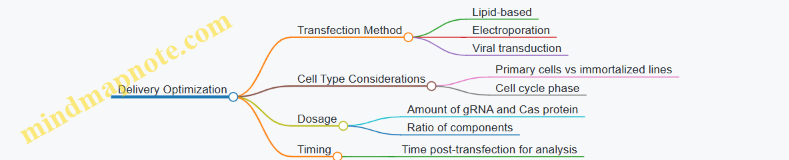
Example: Electroporation often yields higher delivery efficiency in hard-to-transfect cells like primary T cells compared to lipid-based methods. If editing efficiency is low, increasing the amount of RNP complex or optimizing electroporation parameters (voltage, pulse length) can help.
Step 3: Verify Expression and Activity of CRISPR Components
Key factors: protein expression, gRNA stability, nuclease activity.
Expression and Activity Mind Map
Example: If Cas9 protein is poorly expressed, switching from plasmid delivery to RNP complexes can bypass transcription and translation steps, leading to more immediate and efficient editing.
Step 4: Minimize Off-Target Effects and DNA Repair Issues
Key factors: off-target cleavage, DNA repair pathway bias.
Off-Target and Repair Mind Map
Example: Using a high-fidelity Cas9 variant reduces off-target cuts that can compete with desired editing. Additionally, synchronizing cells in S/G2 phase can improve HDR efficiency if precise edits are needed.
Step 5: Confirm and Quantify Editing Efficiency
Key factors: detection method, sample preparation, data interpretation.
Editing Efficiency Assessment Mind Map
Example: Using TIDE analysis on Sanger sequencing data can quickly reveal editing efficiency and indel patterns. If efficiency appears low, verify DNA quality and consider testing different time points post-transfection.
Summary Table: Troubleshooting Low CRISPR Editing Efficiency
| Problem Area | Potential Cause | Recommended Action | Example Outcome |
|---|---|---|---|
| gRNA Design | Poor target site, low GC content | Redesign gRNA with better target and GC | Increased cleavage at target site |
| Delivery | Low transfection efficiency | Optimize electroporation or switch method | Higher percentage of edited cells |
| Cas Protein Expression | Low protein levels | Use RNP complexes instead of plasmids | Faster and more consistent editing |
| Off-Target Effects | Non-specific cleavage | Use high-fidelity Cas9 variants | Reduced unintended mutations |
| DNA Repair Bias | Low HDR efficiency | Synchronize cells, use HDR enhancers | Improved precise editing rates |
| Detection | Poor sample quality or timing | Optimize DNA prep and assay timing | Accurate measurement of editing rates |
Concrete Example Walkthrough
Scenario: A lab attempts CRISPR knockout of a gene in HEK293 cells using plasmid delivery of Cas9 and gRNA. Initial editing efficiency is below 10%.
Actions Taken:
- gRNA redesign: Selected a new gRNA with 55% GC content and minimal predicted off-targets.
- Delivery optimization: Switched from lipid-based transfection to electroporation, increasing delivery efficiency.
- Cas9 delivery: Used RNP complexes instead of plasmids to ensure immediate nuclease activity.
- Timing: Collected samples 72 hours post-electroporation rather than 48 hours.
- Detection: Used TIDE analysis on high-quality DNA samples.
Result: Editing efficiency increased to over 60%, with clear knockout phenotypes observed.
This example illustrates how addressing each factor systematically can resolve low editing efficiency. The key is to test one variable at a time and use quantitative assays to guide adjustments.