Liquidity Engineering Across Supply Networks
1. Mapping Liquidity Flows Across Supply Networks
1.1 Defining Liquidity Engineering in Supply Chain Contexts
Liquidity engineering is the practice of designing how cash moves through a supply network so that payments happen on time, funding is available when needed, and disruptions don’t turn into a funding crisis. In supply chains, “liquidity” is not just a treasury concern; it’s the operational ability to pay invoices, settle disputes, and fund working capital across many parties with different incentives.
A useful starting point is to separate three ideas that often get mixed together:
- Liquidity availability: whether cash is present or can be sourced quickly.
- Liquidity timing: whether cash arrives before payment deadlines and before operational thresholds are breached.
- Liquidity quality: whether the cash is tied to valid invoices and correct settlement instructions, not to paperwork that will later be rejected.
When these three align, the supply network behaves like a well-tuned payment system rather than a collection of one-off transactions.
What Liquidity Engineering Changes in Practice
Liquidity engineering changes the rules of the game in four places.
- Who funds whom: A buyer may fund vendors earlier, a vendor may fund buyers through receivables, or an intermediary may fund both using a pool structure.
- What is eligible: Not every invoice should be financeable. Eligibility rules reduce funding tied to disputed or incomplete deliveries.
- When funding happens: Funding can be tied to invoice submission, proof of delivery, acceptance, or a scheduled payment date.
- How exceptions are handled: Disputes, partial deliveries, returns, and payment instruction errors need predefined workflows so liquidity doesn’t freeze.
A concrete example: a manufacturer receives raw materials from multiple suppliers. Without liquidity engineering, the manufacturer pays on its own schedule, vendors negotiate individually, and disputes cause delays. With liquidity engineering, the network defines invoice eligibility (including proof requirements), sets funding windows, and creates a dispute workflow that continues to move undisputed amounts. The result is fewer “cash surprises” and less time spent chasing paperwork.
Core Building Blocks
Think of liquidity engineering as assembling four blocks that must fit together.
- Flow map: the path from purchase order to delivery to invoice to payment, including who approves each step.
- Funding mechanism: the instrument or pool that provides cash, such as a receivables program or a payables funding structure.
- Risk controls: credit, operational, and legal controls that prevent funding from being based on unreliable data.
- Operational cadence: cutoffs, reconciliation routines, and escalation paths that keep the system moving.
If any block is missing, the system becomes fragile. For instance, a strong funding mechanism with weak eligibility rules can still fund invoices that later fail settlement, turning “liquidity” into a collection problem.
Stakeholder Roles and Their Liquidity Goals
Different parties optimize for different outcomes:
- Buyers want predictable payment timing, manageable working capital, and clean audit trails.
- Vendors want faster access to cash, clear acceptance criteria, and fewer payment delays caused by disputes.
- Intermediaries or program administrators want stable utilization, enforceable eligibility, and operational scalability.
- Banks and payment operators need correct instructions, consistent data formats, and exception handling that doesn’t create manual overload.
A practical way to align goals is to translate each party’s objective into measurable operational rules. For example, “vendors get paid faster” becomes “funding is triggered after invoice validation and proof-of-delivery acceptance, with a defined cutoff time.”
Mind Map: Liquidity Engineering in Supply Chain Contexts
Example: From Invoice Intake to Payment Without Surprises
Consider a vendor that submits invoices for delivered goods. Liquidity engineering starts at intake: the system checks invoice fields (invoice number, buyer reference, amounts, currency) and verifies that required delivery evidence is present. Next, eligibility rules determine whether the invoice can be funded immediately or only after acceptance. Then timing rules define the funding window and the expected value date. Finally, if a dispute is raised, the workflow specifies what happens to undisputed line items and what evidence is required to release disputed amounts.
This sequence matters because liquidity problems usually show up at boundaries: when data is incomplete, when acceptance is unclear, or when disputes are handled ad hoc. Liquidity engineering reduces those boundary failures by turning them into explicit rules.
A Simple Definition You Can Use Internally
Liquidity engineering in supply chain contexts is the design of eligibility, timing, funding mechanisms, and exception workflows so that cash movement matches the real state of goods, invoices, and approvals across multiple parties.
1.2 Identifying Liquidity Sources Uses and Constraints by Role
Liquidity engineering starts with a simple question: where does cash come from, where does it need to go, and what stops it from moving cleanly? In a supply network, “cleanly” is doing a lot of work. Different roles—buyers, vendors, logistics providers, banks, and program administrators—see different cash realities because they control different documents, payment triggers, and risk tolerances.
Role Based Liquidity Sources
Buyer side sources usually include operating cash, treasury credit lines, and working-capital facilities that convert invoices into earlier cash movements. A buyer may also have internal “payment timing” levers: payment calendars, approval workflows, and the ability to fund through centralized treasury rather than local accounts.
Vendor side sources often include receivables purchase programs, factoring arrangements, and short-term credit secured by invoice portfolios. Vendors typically care about speed and certainty: if an invoice is eligible and approved, cash should arrive on a predictable schedule.
Intermediary and program administrator sources include committed funding from banks or investors, plus internal liquidity buffers used to bridge timing gaps. Their job is to keep the program running even when invoices arrive late, disputes spike, or settlement instructions need correction.
Service providers such as logistics or inspection firms can indirectly affect liquidity by controlling proof-of-delivery or acceptance signals. Even when they do not fund directly, their operational outputs determine whether invoices become payable.
Role Based Liquidity Uses
Uses are where the cash must land, and they differ by role.
- Buyers use liquidity to pay suppliers on agreed terms while maintaining internal cash targets. They also use liquidity to manage exceptions: partial deliveries, invoice corrections, and dispute resolution.
- Vendors use liquidity to cover production costs, inventory replenishment, and payroll. Their “use” is often time-sensitive: a delay of a few days can force expensive short-term borrowing.
- Administrators use liquidity to fund eligible receivables, cover operational settlement timing, and maintain required reserves. They also use liquidity to absorb temporary mismatches between drawdowns and repayments.
- Banks and counterparties use liquidity to provide funding, manage credit exposure, and handle settlement rails. Their constraints show up as cutoffs, documentation requirements, and operational controls.
Constraints That Actually Matter
Constraints are not just risk limits; they are practical barriers that show up in daily operations.
- Eligibility constraints: Not every invoice can be funded. Common blockers include missing purchase order references, unclear delivery status, or incorrect tax treatment.
- Timing constraints: Value dates, cutoff times, and approval cycles can shift cash by days. A program that funds “on receipt” may still fund “after validation.”
- Credit constraints: Concentration limits by buyer, country, or industry restrict how much can be drawn. A sudden volume increase can exceed limits even if invoices are otherwise valid.
- Dispute constraints: Dispute windows, cure periods, and proof requirements determine whether cash is delayed or withheld.
- Operational constraints: Settlement instructions, bank account changes, and reconciliation rules can create funding holds.
A useful mental model is: sources generate capacity, uses consume capacity, constraints define the usable slice.
Mind Map: Liquidity Sources Uses and Constraints
Example: Same Invoice Different Outcomes
Consider an invoice for $250,000 dated 2026-02-26.
- The vendor submits it with a correct purchase order number and proof of delivery. If the invoice is eligible, the vendor expects funding within the program’s validation window.
- The buyer may have a payment approval workflow that requires confirmation of acceptance. If acceptance is not recorded by the cutoff, the buyer’s payment date shifts, which changes when the administrator receives repayment.
- The administrator checks eligibility and credit limits. If the buyer’s remaining credit cap is $180,000 for the month, only part of the invoice portfolio can be funded immediately.
- The bank handling settlement may require standardized remittance information. If the remittance reference is missing, repayment can be delayed even after the buyer pays.
The point is not that everyone is wrong; it’s that each role sees a different constraint surface. Liquidity engineering succeeds when those surfaces are mapped and managed together.
Practical Role Mapping Checklist
To identify sources, uses, and constraints without missing the obvious, map each role to three lists: what they can fund, what they must pay, and what can block movement. Then test the mapping with one real invoice lifecycle: submission, eligibility checks, funding decision, buyer approval, settlement, and reconciliation. If any step lacks an owner or a measurable rule, that gap will show up as a funding hold later—usually at the least convenient time.
1.3 Modeling Working Capital Cycles from Purchase Order to Settlement
Working capital modeling turns a messy chain of events into a timeline you can measure. The goal is simple: estimate how long cash is tied up from when a buyer commits to a purchase order until the moment the seller is paid and the buyer’s cash position reflects the settlement.
Core Timeline from Order to Cash Movement
Start with a sequence of states that every transaction can map onto. For a buyer, the cycle typically includes: purchase order issuance, goods receipt, invoice submission, invoice validation, payment scheduling, payment execution, and settlement confirmation. For a seller, the mirror image matters: order acceptance, fulfillment, invoice issuance, funding request, payment receipt, and reconciliation.
A practical modeling approach uses event dates and derives durations. For example, define:
- PO Date: when the buyer issues the purchase order.
- Receipt Date: when goods or services are accepted.
- Invoice Date: when the seller issues the invoice.
- Validation Date: when the buyer approves invoice for payment.
- Payment Date: when the buyer sends funds.
- Settlement Date: when funds are confirmed at the seller’s bank.
Then compute working capital drivers as differences between these dates. If you only track one metric, track Days Cash Tied Up: from PO Date to Settlement Date. If you track two, also track Invoice-to-Payment Lag: from Validation Date to Settlement Date.
Mind Map: Modeling Inputs and Outputs
Building the Model Step by Step
- Choose the unit of analysis. Use invoice-level records, not order-level, because payment usually follows invoices. If your business pays per milestone, model milestones as invoice-like events.
- Create a state machine. Each invoice moves through states such as Submitted, Validated, Scheduled, Paid, and Settled. This prevents mixing “sent” with “settled,” which is a common source of off-by-one-week errors.
- Map event dates to sources. PO dates come from procurement systems; receipt dates from warehouse or acceptance workflows; invoice dates from AP intake; validation dates from approval logs; payment and settlement from treasury and bank confirmations.
- Derive durations and cash timing. For payment terms, compute the contractual due date from the agreed reference point. Many programs use Receipt Date as the reference for Net terms; others use Invoice Date. Your model must encode which one applies.
- Handle discounts and partial payments. If terms include early payment discounts, compute two cashflow scenarios: discount taken vs. discount missed. For partial payments, split the invoice into payment tranches so the model doesn’t pretend the entire invoice settles at once.
Example with Concrete Numbers
Assume a buyer issues a PO on 2026-02-26. Goods are accepted on 2026-03-03. The seller submits the invoice on 2026-03-05. The buyer validates it on 2026-03-12. Payment terms are Net 30 from Receipt, so the contractual due date is 2026-04-02. The buyer schedules payment for 2026-03-28 to capture an operational preference, and the bank confirms settlement on 2026-03-31.
Derived durations:
- PO to Receipt: 5 days
- Receipt to Invoice: 2 days
- Invoice to Validation: 7 days
- Validation to Payment: 16 days
- Payment to Settlement: 3 days
Days Cash Tied Up for the buyer (PO to Settlement): from 2026-02-26 to 2026-03-31 is 33 days.
Modeling Exceptions Without Breaking the Timeline
Delays rarely come from one place. Add explicit exception states so you can measure where cash gets stuck:
- Invoice mismatch: validation paused due to quantity or price differences.
- Dispute: validation blocked until resolution.
- Missing references: invoice cannot be matched to PO.
- Bank cutoff: payment sent after cutoff shifts settlement by a business day.
When an exception occurs, keep the original planned dates and record the actual dates. That way, you can compute both “what should have happened” and “what did happen,” which is essential for improving the process rather than just reporting it.
Turning the Model into Decisions
Once the model produces stage durations and exception rates, you can identify bottlenecks. If Invoice-to-Validation is consistently long, focus on AP intake rules and matching tolerances. If Payment-to-Settlement is volatile, focus on cutoff calendars and payment rail selection. The model’s job is to point to the stage, not to blame a team—cash doesn’t care who pressed the button, but your controls should.
1.4 Segmenting Flows by Contract Type Payment Terms and Risk Drivers
Segmenting liquidity flows means grouping cash movements that behave similarly under stress. Instead of treating every invoice payment as the same event, you classify flows by contract type, payment terms, and the risk drivers that can change timing or certainty. The payoff is practical: you can set different pool rules, eligibility checks, and funding limits for each segment.
Foundational Building Blocks
Start with three attributes for every flow record (or every contract template):
- Contract type: what the legal and commercial relationship is doing. Examples include purchase orders with standard terms, supply agreements with rebates, framework contracts with call-offs, and consignment arrangements.
- Payment terms: when and how money moves. Examples include net 30, end-of-month, early payment discounts, milestone payments, and payment upon proof of delivery.
- Risk drivers: what can delay or reduce payment. Examples include disputes, delivery acceptance, credit concentration, currency mismatch, and regulatory withholding.
A simple way to keep this systematic is to map each flow to a “timing behavior” profile: does the contract anchor payment to an invoice date, a delivery event, or a calendar rule? Then map “certainty behavior”: does the contract create a clean path to payment, or does it require acceptance, reconciliation, or dispute resolution?
Segmenting by Contract Type
Contract type determines the event that starts the payment clock.
- Purchase order with invoice-based terms: payment often starts from invoice issuance. Liquidity is sensitive to invoice submission quality and completeness.
- Example: A buyer pays net 45 from invoice date. If vendors submit invoices late or with missing references, the cash-out shifts.
- Framework contract with call-offs: payment may start from each call-off delivery. Liquidity is sensitive to how call-offs are recorded and matched.
- Example: A buyer funds call-offs weekly; if call-off quantities are corrected after delivery, the payment date can move.
- Milestone or acceptance-based agreements: payment depends on acceptance. Liquidity is sensitive to dispute rates and acceptance turnaround.
- Example: A buyer pays 80% on acceptance and 20% after a warranty period. The pool should treat the 20% as a different segment with longer uncertainty.
- Rebates and deductions clauses: cash can be reduced after the fact. Liquidity is sensitive to reconciliation cycles.
- Example: A vendor issues invoices gross, but rebates are netted monthly. Segment the “netting window” separately so funding doesn’t assume full gross recovery.
Segmenting by Payment Terms
Payment terms control the cash calendar and the pool’s operational rhythm.
- Fixed tenor terms (net 30, net 60): timing is predictable, so focus on eligibility and dispute controls.
- Example: If most invoices are net 60, you can set a drawdown window aligned to that tenor.
- End-of-month terms: timing depends on month boundaries.
- Example: End-of-month net 30 means payment can cluster at month end. Pool liquidity should account for batch effects.
- Early payment discounts: timing is optional and can change behavior.
- Example: If a buyer offers 2%/10 net 30, the buyer may pay early when cash is available. Segment these invoices so the pool doesn’t overestimate funding duration.
- Payment upon proof of delivery: timing depends on operational events.
- Example: If proof of delivery is uploaded within two days, payment starts quickly; if not, funding certainty drops.
Segmenting by Risk Drivers
Risk drivers explain why two flows with the same tenor can behave differently.
- Dispute and chargeback likelihood: drives uncertainty in both timing and amount.
- Example: A segment with high dispute rates should require stronger proof of delivery and tighter submission rules.
- Credit concentration: drives pool fragility when one buyer dominates.
- Example: If 40% of eligible invoices come from one buyer, you set lower concentration limits and smaller draw sizes.
- Currency and withholding: drives payment amount variability.
- Example: Cross-border invoices with withholding tax can reduce net proceeds. Segment by tax treatment so eligibility reflects expected recoveries.
- Operational data quality: drives matching failures.
- Example: If invoice references are frequently incorrect, matching delays can mimic credit risk. Segment by data quality score.
Integrated Mind Map
Mind Map: Segmenting Flows by Contract Type, Payment Terms, and Risk Drivers
Example Segmentation Output
A practical output is a small set of segments with clear rules.
- Segment A: PO Invoice Net 45, Low Dispute
- Eligibility: complete invoice references, proof of delivery optional if historically low disputes.
- Pool rule: drawdown window aligned to net 45; standard concentration limits.
- Segment B: Acceptance-Based Milestones, Medium Dispute
- Eligibility: acceptance confirmation required; dispute history threshold enforced.
- Pool rule: shorter drawdown window and reduced advance rate to reflect acceptance delays.
- Segment C: Framework Call-Off End-of-Month Net 30, High Data Errors
- Eligibility: call-off linkage mandatory; data quality score minimum.
- Pool rule: funding only after successful matching; operational exception queue limits.
- Segment D: Cross-Border Invoices With Withholding
- Eligibility: tax treatment documented; expected net proceeds calculated.
- Pool rule: advance based on net recovery; separate limits by country and tax profile.
When you segment this way, every downstream decision has a reason. Eligibility checks stop being generic, pool limits stop being one-size-fits-all, and monitoring becomes targeted. The result is a liquidity system that behaves consistently with how contracts actually move cash.
1.5 Establishing a Data Inventory for Invoices Payments and Receivables
A liquidity pool lives or dies by data quality. If you cannot reliably answer “Which invoices are eligible, which payments are completed, and which receivables remain outstanding?” then every downstream decision becomes guesswork. A data inventory is the practical way to make those answers repeatable.
Start with the Inventory Purpose and Decision Questions
Before listing fields, write the decision questions the inventory must support. Typical questions include: Which invoices are submitted and within eligibility rules? Which invoices are funded and when? Which payments were made, matched, and settled? Which receivables are disputed, partially paid, or reversed? Each question maps to a data set and a minimum set of attributes.
Example: If your pool funds “approved invoices,” you need data that proves approval status, approval timestamp, and the approver identity or system event. Without timestamps, you cannot enforce cutoff calendars.
Define the Core Entities and Their Required Attributes
Use a small set of entities that cover the full lifecycle.
- Invoice: invoice identifier, buyer and vendor identifiers, invoice date, due date, currency, invoice amount, line items or total basis, goods or services reference, tax treatment indicators.
- Eligibility Event: eligibility status, eligibility decision timestamp, eligibility rule version, reason codes for rejection, and any required supporting documents references.
- Funding Event: funding request timestamp, funding amount, funding status, funding tranche or pool identifier, and settlement instructions used.
- Payment: payment identifier, payment date, value date, payment amount, payment currency, payment rail or method, bank account identifiers, and payment reference.
- Settlement and Reconciliation: match status, matched invoice(s), matched amount(s), tolerance thresholds, exception category, and reconciliation timestamp.
- Receivable: outstanding amount by invoice, aging bucket, dispute flag, dispute reason, dispute status, and expected resolution date.
A useful rule: every attribute should exist for a reason. If you cannot point to a decision question it supports, it probably belongs in a later enhancement.
Map Data Sources to Entities and Control Points
Data rarely comes from one place. Build a source-to-entity map that includes system of record and control points.
- ERP for invoice creation, due dates, and tax fields.
- AP/AR workflow for approval and dispute status.
- Treasury or payments platform for payment instructions and settlement confirmations.
- Bank feeds for actual payment events.
- Document systems for proof of delivery, credit notes, and dispute evidence.
Control points are where errors become expensive. For example, payment value date and currency must be validated against the payment platform and bank confirmation, not just the instruction record.
Establish Data Quality Rules with Concrete Examples
Quality rules should be testable.
- Uniqueness: invoice IDs must be unique within buyer-currency combinations. Example: two invoices with the same invoice number but different amounts should trigger a “duplicate candidate” exception.
- Completeness: funding cannot proceed without due date, currency, and buyer identifier. Example: if due date is missing, the invoice is held in “pending data” rather than rejected outright.
- Consistency: invoice total must equal sum of line items within tolerance. Example: a 0.02 currency unit difference might be allowed for rounding; a 20-unit difference is not.
- Timeliness: eligibility decisions must be recorded with timestamps. Example: if eligibility status changes after the cutoff, the system should tag it as “post-cutoff” for reporting.
Design the Inventory as a Traceable Lineage Chain
For liquidity engineering, traceability matters more than volume. Each funding decision should be traceable to: the invoice record, the eligibility decision, the funding event, the payment instruction, and the settlement match.
Include Exception Data as First-Class Inventory Items
Exceptions are not edge cases; they are the daily work of keeping pools accurate.
Inventory exception categories should include: dispute initiation and resolution, partial payment and allocation logic, credit notes and reversals, missing documentation, and mismatched bank references. For each category, define the minimum fields needed to resume normal processing.
Example: For a dispute, you need dispute reason code, dispute start timestamp, disputed amount, and the evidence reference. Without disputed amount, you cannot compute the remaining eligible receivable.
Set a Practical Implementation Scope and Naming Standards
A good inventory starts with a “minimum viable lineage.” For a first release, include the fields required to answer the four lifecycle questions: eligible or not, funded or not, paid or not, and outstanding or resolved.
Naming standards prevent confusion later. Use consistent prefixes such as inv_, elig_, fund_, pay_, setl_, and rcv_. Also standardize timestamps to a single time zone and store both event time and ingestion time.
Example: If you store elig_decision_ts and elig_ingest_ts, you can measure processing delays without guessing.
Validate the Inventory Using a Small End-to-End Sample
Pick a sample that includes normal and messy cases: one clean invoice, one with a credit note, one with a dispute, and one with a partial payment. Run the lifecycle questions end-to-end and confirm that every answer is supported by inventory data.
If the sample fails, fix the inventory before adding more fields. Data inventories are like payment rails: once you commit to a structure, retrofitting is expensive.
2. Designing Funding Pools for Vendors and Buyers
2.1 Selecting Pool Structures Based on Counterparty and Asset Eligibility
Pool structure is the part where “we can fund invoices” becomes “we can fund the right invoices, from the right counterparties, in the right way.” The goal is simple: match funding mechanics to (1) who is allowed to participate and (2) which assets are eligible to be financed.
Foundational Inputs
Start with two inventories.
Counterparty inventory lists every potential participant: buyers, vendors, and any intermediaries. For each, capture credit standing, dispute behavior, operational reliability, and legal capacity to assign or participate in receivables. A buyer with stable payment behavior can support a larger pool than a buyer with frequent invoice disputes.
Asset inventory lists every receivable type you might fund: standard invoices, credit notes, disputed invoices, and invoices with special delivery terms. Eligibility is not just “is it an invoice,” but also “is it provable, assignable, and matchable to purchase orders and delivery evidence.”
Eligibility Rules That Drive Structure
Eligibility rules determine the pool’s shape. Use them to decide whether you need a single pool, multiple pools, or a tiered structure.
- Proof strength: If invoices require proof of delivery, the pool must include workflow steps that block funding until proof is present. Weak proof pushes you toward shorter tenors and tighter draw limits.
- Dispute profile: If disputes are common, structure must separate “clean” invoices from “disputed” ones. Mixing them increases funding volatility and reconciliation workload.
- Assignment and setoff constraints: Some jurisdictions or contracts restrict assignment or allow setoff. When constraints exist, you may need buyer-specific sub-pools with tailored legal terms.
- Concentration tolerance: If one buyer represents most volume, you need concentration limits and possibly a cap per buyer or per country.
Pool Structure Options
Single Pool with Shared Eligibility
Use this when counterparties are similar and assets share the same eligibility requirements.
Example: A regional buyer group agrees to identical invoice formats, proof-of-delivery standards, and dispute windows. You create one pool where any eligible vendor invoice can be funded, subject to a single concentration cap per buyer.
Why it works: One set of rules reduces operational friction. When it fails: If one buyer’s dispute rate is materially higher, the pool’s risk profile becomes inconsistent.
Buyer-Specific Sub-Pools
Use this when legal terms, dispute behavior, or operational processes differ by buyer.
Example: Buyer A allows assignment with minimal restrictions; Buyer B requires additional consent for certain contract types. You create two sub-pools, each with its own eligibility checklist and concentration limits.
Why it works: You isolate risk and simplify audit evidence. Tradeoff: More pools mean more administration and reporting.
Tiered Pools Based on Asset Cleanliness
Use this when you want to fund a broad range of invoices but with different risk levels.
Example: Tier 1 funds invoices with proof of delivery and no exceptions. Tier 2 funds invoices submitted with partial documentation but within a defined cure period. Tier 2 draws are smaller and priced higher to reflect the extra uncertainty.
Why it works: You keep vendors funded while controlling funding volatility. Key control: A clear cure mechanism that either upgrades the invoice to Tier 1 or removes it from eligibility.
Rolling Eligibility with Cutoff Windows
Use this when asset eligibility depends on time-bound events like delivery confirmation or dispute notice.
Example: Invoices become eligible only after delivery confirmation is received and matched to the purchase order. If confirmation arrives after the cutoff, the invoice waits for the next funding cycle.
Why it works: Eligibility becomes deterministic. Operational note: You must align cutoff times with bank value dates and internal approval workflows.
Mind Map: Pool Structure Selection
Practical Selection Workflow
- Group counterparties by eligibility similarity: If two buyers require different legal handling or have meaningfully different dispute rates, separate them.
- Group assets by proof and dispute handling: If some invoices can be funded only after proof arrives, treat them as a different eligibility tier or separate pool.
- Apply concentration constraints early: Decide caps before you finalize structure, because caps often force sub-pooling.
- Design workflow gates to match the structure: A tiered pool without cure rules is just a single pool with extra steps.
- Confirm operational matchability: If your systems cannot reliably match invoices to purchase orders and delivery evidence, choose the structure that minimizes funding before matching is complete.
Worked Example: Choosing Between Two Structures
Assume you have invoices from three buyers.
- Buyer X: low disputes, assignment allowed, consistent delivery proof.
- Buyer Y: moderate disputes, assignment allowed, delivery proof sometimes delayed.
- Buyer Z: high disputes, assignment restricted for certain contract types.
A single pool would require broad eligibility rules and would fund delayed-proof invoices alongside clean ones, creating reconciliation spikes.
A buyer-specific sub-pool plus tiering fits better: create sub-pools for X and Z, and within Y use Tier 1 for invoices with proof and Tier 2 for invoices within a cure period. This keeps funding steady for Y while preventing Z’s restricted contracts from contaminating the rest of the program’s eligibility.
2.2 Defining Pool Governance Roles and Decision Rights
A funding pool is only as steady as the decisions that run it. Governance defines who can approve eligibility, who can release funds, who can pause draws, and how disputes get resolved—without forcing every question into a meeting. The goal is simple: make decisions fast enough to fund invoices on time, and careful enough to avoid funding the wrong things.
Core Governance Principles
Start with three principles that shape every role.
- Separation of duties: the person who approves eligibility should not be the same person who can unilaterally release funds.
- Clear decision thresholds: small exceptions can be handled operationally; larger deviations require higher approval.
- Documented authority: every decision path must map to a record, so audits and internal reviews can trace “who decided what and why.”
A practical way to implement this is to define a decision catalog. Each decision type gets an owner, an approver, a reviewer, and an evidence requirement.
Role Set for a Typical Vendor Buyer Pool
Most pools can be governed with five role groups.
Pool Sponsor: sets the program objectives and approves the governance charter. In a buyer-sponsored pool, the buyer sponsor typically owns the eligibility policy and dispute tolerance.
Pool Administrator: runs day-to-day operations. This role validates submissions, checks eligibility rules, and prepares draw requests.
Credit and Risk Committee: approves credit policy changes, concentration limits, and any exception that increases risk. This committee should include risk and finance leadership, not only operations.
Legal and Contract Owner: ensures program terms match operational behavior, especially around assignment, setoff, and dispute handling.
Operations Escalation Desk: handles time-sensitive exceptions like missing proof of delivery or partial invoice corrections, within pre-set thresholds.
To keep things concrete, define what each role can do in one sentence. For example: the Pool Administrator can validate and stage draws, but cannot approve eligibility exceptions beyond the documented tolerance.
Decision Rights Matrix
Decision rights should be expressed as a matrix of decision types versus roles. Below is a compact template you can adapt.
| Decision Type | Pool Administrator | Credit and Risk Committee | Legal and Contract Owner | Operations Escalation Desk |
|---|---|---|---|---|
| Standard invoice eligibility check | Approve | - | - | - |
| Eligibility exception within tolerance | Recommend | Approve | - | Approve |
| New buyer or vendor onboarding | Recommend | Approve | Review | - |
| Concentration limit breach | Stop draw | Approve remediation | Review | - |
| Dispute classification and funding hold | Recommend | Approve hold extension | Review | Approve short hold |
| Contract term change | - | Review | Approve | - |
| Data model change affecting eligibility | Recommend | Review | Review | Approve if low risk |
The key is that “Approve” and “Recommend” are not synonyms. If the administrator recommends, the committee must be able to say yes or no with a defined evidence package.
Evidence and Approval Thresholds
Every decision needs evidence. For eligibility, evidence might include invoice fields, proof of delivery status, and contract term mapping. For risk exceptions, evidence should include buyer payment history, dispute rates, and any collateral or guarantees.
Set thresholds that prevent governance gridlock. A common pattern is:
- Operational threshold: small data corrections or short holds (handled by the Escalation Desk).
- Risk threshold: exceptions that change credit exposure or tenor (handled by the Credit and Risk Committee).
- Legal threshold: anything that changes rights, setoff, or assignment mechanics (handled by Legal).
If you need a date for governance records, use a fixed reference point such as 2026-02-15 for the initial charter effective date.
Mind Map: Governance Roles and Decision Rights
Example: Who Approves a Funding Hold
Assume a vendor submits an invoice and proof of delivery is missing for two line items due to a partial shipment.
- The Pool Administrator runs the standard eligibility check and flags the missing proof.
- The Escalation Desk approves a short hold for the affected line items because it falls within the operational threshold.
- The administrator continues processing the eligible portion so the vendor still receives funding on time.
- If the dispute classification later indicates a higher dispute risk category, the Credit and Risk Committee approves an extended hold and any remediation plan.
This example shows why governance matters: the pool keeps moving, but the riskier decisions still go through the right authority.
Example: Concentration Limit Breach Remediation
If a single buyer’s funded exposure exceeds a pre-set concentration limit, the system should trigger a draw stop. The administrator prepares a remediation package: current exposure, remaining eligible invoices, and options such as reducing future draws or tightening eligibility for that buyer.
The Credit and Risk Committee decides the remediation path, while Legal reviews whether any contractual levers exist for setoff or assignment adjustments. The sponsor is informed, but does not need to approve every operational remediation step.
Governance Outputs You Should Produce
To make governance usable, produce three artifacts:
- Decision catalog listing decision types, owners, approvers, and evidence.
- Decision thresholds defining what can be handled operationally versus committee-level.
- RACI-style matrix mapping roles to actions for eligibility, draws, holds, disputes, and contract changes.
With these in place, the pool can fund efficiently without turning governance into a bottleneck.
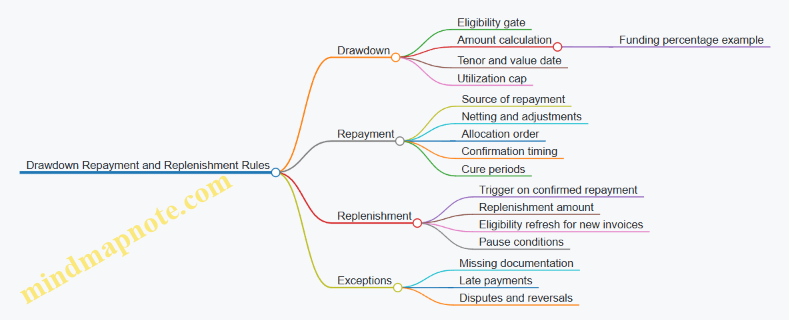
2.3 Setting Operational Rules for Drawdown Repayment and Replenishment
Operational rules turn a funding pool from a spreadsheet promise into a repeatable routine. The goal is simple: every drawdown has a clear repayment path, every repayment has a clear replenishment path, and exceptions are handled without inventing new rules under pressure.
Foundational Concepts for Pool Operations
Start by defining three operational objects: drawdown, repayment, and replenishment.
- Drawdown is the pool’s advance to a vendor or buyer under agreed eligibility and documentation.
- Repayment is the cash return to the pool when the underlying invoices are paid, net of any agreed adjustments.
- Replenishment is the restoration of available capacity after repayments, so the pool can fund new eligible invoices.
A practical way to keep teams aligned is to map these objects to the pool’s lifecycle states: Available, Utilized, In Repayment, and Replenished. Each state should have a short checklist of what must be true before moving forward.
Core Operational Rules for Drawdown
Operational rules for drawdown should be strict enough to prevent accidental overfunding, but not so strict that they block normal invoice flow.
- Eligibility gate before funding: funding requests must reference eligible invoices and include required proof (for example, invoice number, buyer reference, and proof of delivery where applicable). If a field is missing, the request is rejected or queued, not partially funded.
- Amount calculation rule: define whether the drawdown equals invoice face value, a percentage, or a discounted amount. For example, if the pool funds 90% of eligible invoices, then a €100,000 invoice drawdown is €90,000.
- Tenor and value date rule: specify the expected repayment date window based on payment terms. If terms are “net 30,” set the expected repayment window to invoice date plus 30 days, plus a small operational buffer for settlement timing.
- Utilization cap: enforce a hard limit on total outstanding advances. If the cap is €50 million and utilization is already €49.2 million, a new request for €1.5 million can only proceed up to €0.8 million.
Repayment Rules That Prevent Cash Confusion
Repayment rules should define what counts as repayment and how it is applied.
- Source of repayment: repayment comes from buyer payments into a designated account or from a contractual remittance process. Mixing repayment sources without tagging creates reconciliation pain.
- Netting and adjustments: define how disputes, credit notes, and returns affect repayment. Example: if a buyer pays €95,000 on a €100,000 invoice and a €5,000 credit note is already confirmed, treat the €95,000 as full repayment for that invoice.
- Allocation order: when multiple invoices are funded, specify allocation order for partial payments. A common rule is FIFO by invoice maturity date, but the rule must be consistent and auditable.
- Repayment confirmation timing: set a rule for when repayment is considered confirmed. For instance, confirmation occurs when bank settlement is received and matched to invoice references.
- Cure periods for late payments: if repayment is late, define the cure window and what actions occur during it. Example: if payment is 5 days late, send a reminder; if 15 days late, require escalation and may pause new drawdowns for that buyer.
Replenishment Rules That Restore Capacity Safely
Replenishment rules should be the mirror image of drawdown rules, with additional safeguards.
- Replenishment trigger: capacity increases only after confirmed repayments, not after payment initiation. This avoids “phantom capacity” based on pending transfers.
- Replenishment amount calculation: replenishment should reflect the principal portion returned, not fees. Example: if a €90,000 drawdown repays €89,100 due to an agreed discount, replenishment should restore €89,100 of capacity, while fees are handled separately.
- Eligibility refresh requirement: after replenishment, new drawdowns must re-check eligibility for newly submitted invoices. Replenishment does not automatically validate future invoices.
- Operational pause conditions: define when replenishment continues but drawdowns pause. Example: if dispute rates exceed a threshold for a specific buyer, allow replenishment to keep the pool stable while preventing new utilization from that buyer.
Exception Handling Rules That Keep the System Honest
Exceptions should be categorized so teams respond consistently.
- Missing documentation: reject drawdown requests until corrected; do not “fund now, fix later.”
- Dispute opened after drawdown: define whether the outstanding advance is reduced immediately or after dispute confirmation. Example: reduce utilization only when the dispute is validated and supported by agreed evidence.
- Chargebacks or reversals: treat reversals as negative repayments with a defined timeline for re-collection or replacement invoices.
Mind Map: Drawdown Repayment and Replenishment Rules
Example Workflow with Concrete Numbers
Assume a pool funds 90% of eligible invoices and has a €50 million utilization cap.
- A vendor submits an eligible €100,000 invoice. Drawdown request is €90,000, and utilization becomes €49.2 million + €90,000.
- The buyer pays €95,000 on the invoice, and a €5,000 credit note is already confirmed. Repayment is treated as €100,000 principal settled, but replenishment restores only the funded principal portion: €90,000.
- If the payment arrives 12 days late, the cure period rule triggers escalation at day 10. New drawdowns for that buyer are paused, but replenishment continues once the bank settlement is confirmed.
These rules create a predictable rhythm: funding depends on eligibility, repayment depends on confirmed cash and agreed adjustments, and replenishment depends on verified principal return. The pool stays usable without turning reconciliation into a scavenger hunt.
2.4 Building Eligibility Criteria for Invoices Credit Notes and Disputes
Eligibility criteria are the rules that decide what can be funded, when it can be funded, and what evidence must exist to support the decision. In practice, they prevent the pool from paying for invoices that are not real, not payable, or not yet settled enough to be safe. The trick is to write criteria that are strict where it matters and flexible where it helps operations.
Eligibility Foundations That Keep the Pool Honest
Start with three baseline questions for every submission.
- Is the document eligible? The pool should accept only specific document types: invoices and credit notes, plus dispute records that meet defined thresholds. Everything else is rejected or routed to manual review.
- Is the underlying transaction eligible? Eligibility depends on contract terms, delivery status, service period, and whether the buyer has approved the goods or services.
- Is the counterparty and amount eligible? Limits should cover buyer credit standing, invoice amount bands, and concentration rules.
A simple example: a vendor submits an invoice for $120,000 dated 2026-02-15. The pool checks that the invoice is within the allowed age window, that the buyer is an approved counterparty, and that the contract includes the product category. If the invoice is outside the age window, it is not funded even if the buyer is approved.
Invoice Eligibility Criteria
Invoice criteria should be grouped into identity, commercial validity, and payment readiness.
Identity checks ensure the invoice is uniquely identifiable and internally consistent.
- Invoice number format and uniqueness within the pool.
- Buyer legal entity match to the pool’s master data.
- Currency match to supported currencies.
Commercial validity checks ensure the invoice reflects an actual transaction.
- Contract reference present and active.
- Goods receipt or service acceptance evidence available.
- No duplicate invoice for the same purchase order line items.
Payment readiness checks ensure the invoice is not already blocked.
- No existing dispute above the allowed tolerance.
- Not subject to legal setoff or termination clauses that would prevent payment.
- Payment terms within the pool’s supported tenor range.
Operationally, these checks should be applied in a predictable order so teams can explain outcomes. If identity fails, there is no need to evaluate delivery evidence.
Credit Note Eligibility Criteria
Credit notes are not just “negative invoices.” They change the net amount and can reverse prior funding exposure.
Key eligibility rules include:
- Credit note must reference an eligible invoice or a specific purchase order.
- Credit note must be approved by the buyer according to the same acceptance workflow used for invoices.
- Credit note effective date must fall within the pool’s adjustment window.
- Netting rules must be explicit: whether the pool reduces the funded amount immediately or waits until the next reconciliation cycle.
Example: A vendor’s invoice for $50,000 was funded. Two weeks later, the buyer issues a credit note for $5,000 due to a quantity correction. If the credit note is within the adjustment window and properly approved, the pool reduces the outstanding balance by $5,000 using the defined netting rule. If it is not approved, the pool keeps the original exposure until approval arrives.
Dispute Eligibility Criteria
Disputes are the part of the process where eligibility must be both fair and controlled. A dispute record should not automatically block everything, but it must prevent funding for the disputed portion.
Define disputes using these criteria:
- Dispute type: quantity, quality, pricing, or service period.
- Dispute status: submitted, under review, resolved.
- Dispute amount threshold: disputes below a tolerance may be funded with holdbacks; disputes above it trigger partial funding or full rejection.
- Evidence requirement: buyer must provide a reason code and supporting documentation.
- Timing rules: disputes must be raised within the allowed window after invoice submission or acceptance.
Example: The buyer disputes $8,000 of a $40,000 invoice for a delivery variance. If the pool’s tolerance is 20% and the dispute is 20% exactly, the pool may fund 80% immediately and hold the disputed amount until resolution. If the dispute is $12,000 (30%), the pool funds nothing until the dispute is resolved or falls below the threshold.
Advanced Details That Prevent Edge-Case Failures
Eligibility criteria should include how to handle common edge cases.
- Partial deliveries: allow funding based on accepted delivery quantities, not on the full purchase order value.
- Multiple invoices per purchase order: require line-level matching to avoid double counting.
- Amended invoices: treat amendments as new submissions with a clear rule for superseding prior versions.
- Reconciliation timing: specify whether eligibility is evaluated at submission time, funding time, or both.
A practical rule: evaluate eligibility at submission for speed, then re-check critical items at funding time for safety. This catches late disputes or late approval changes.
Mind Map: Eligibility Criteria for Invoices, Credit Notes, and Disputes
Example Workflow That Ties the Criteria Together
A vendor submits an invoice on 2026-02-10. The system checks identity and contract validity first. Next it verifies acceptance evidence. Then it checks whether a dispute exists and whether it is within tolerance. If eligible, the pool funds the accepted portion and records the holdback logic for any disputed portion. If a credit note arrives later, the system applies the adjustment window and netting rule to update the outstanding balance.
This approach keeps eligibility criteria actionable: every rule has a clear input, a clear decision, and a clear operational outcome.
2.5 Creating Standard Operating Procedures for Pool Administration
A pool works only if people can execute the same steps the same way, even when the invoice volume spikes or a counterparty sends “almost correct” documents. Standard Operating Procedures (SOPs) turn that consistency into a repeatable workflow: who does what, when they do it, what they check, and what happens when something doesn’t match.
SOP Scope and Operating Principles
Start by defining the SOP boundary: it covers pool administration tasks from intake of eligible invoices through funding, repayment, and exception handling. Then set operating principles that guide every step.
- Single source of truth: one system holds the pool rules, eligibility status, and funding decisions.
- Segregation of duties: the person who approves eligibility is not the person who releases funds.
- Traceability: every funding decision links to the exact eligibility evidence used.
- Time discipline: each step has a target turnaround time and a fallback path.
Example: If a vendor submits invoices via email, the SOP requires a manual intake step that creates a structured record in the system before any eligibility checks begin. This prevents “lost attachments” from becoming “mysterious funding gaps.”
Roles, Responsibilities, and Escalation Paths
Define roles in a way that matches real operations.
- Pool Administrator: maintains eligibility rules, monitors daily exceptions, and approves funding batches.
- Eligibility Analyst: validates invoice attributes, proof of delivery, and dispute flags.
- Treasury Operator: executes funding and repayment instructions.
- Compliance Reviewer: checks sanctions screening outcomes, tax documentation completeness, and contract term alignment.
- Dispute Coordinator: manages dispute intake, evidence requests, and resolution updates.
Escalation should be explicit. For example, if eligibility evidence is missing beyond a defined window, the SOP routes the item to “Hold” with a reason code and triggers a counterparty request workflow.
End-to-End Workflow for Funding and Repayment
Use a batch-oriented workflow so the pool can be administered predictably.
- Intake and normalization: invoices are converted into standardized fields (invoice number, buyer, amount, currency, due date, goods/service reference).
- Eligibility validation: checks include contract coverage, invoice status, dispute indicators, and required supporting documents.
- Credit and concentration checks: ensures the buyer and pool limits are not breached.
- Funding decision: eligibility analyst recommends; pool administrator approves.
- Funding execution: treasury sends payment instructions and records value dates.
- Reconciliation: compare funding confirmations to the batch ledger.
- Repayment tracking: repayment is scheduled based on contract terms and updated when settlement occurs.
- Closeout and reporting: exceptions are summarized with counts, amounts, and resolution status.
Example: A batch includes 500 invoices. If 12 invoices fail proof-of-delivery checks, the SOP funds the remaining 488 and places the 12 into a separate exception batch. This avoids delaying the entire vendor population for one missing document.
Eligibility Evidence Standards and Checklists
Eligibility checks must be measurable. Define evidence requirements per invoice type.
- Invoice completeness: required fields present and consistent with master data.
- Contract match: buyer and vendor are active under the pool agreement.
- Dispute status: disputes must be flagged with a reason and evidence; disputed invoices are excluded or partially funded per policy.
- Proof of delivery: acceptance documents must match the goods/service reference.
Checklist example for a goods shipment invoice:
- Purchase order reference matches buyer contract
- Delivery note number present
- Delivery date within allowed window
- Amount equals invoice line totals after tax handling rules
Exception Handling and Root Cause Discipline
Exceptions are inevitable; the SOP should make them structured.
- Category: data error, missing evidence, contract mismatch, dispute, payment failure, or reconciliation mismatch.
- Severity: block funding, allow partial funding, or allow post-funding correction.
- Resolution owner: assigns responsibility for each category.
- Evidence request template: standard messages reduce back-and-forth.
Example: If a buyer reports a dispute after funding, the SOP requires a dispute coordinator to record the dispute date, attach evidence, and trigger a defined adjustment path (e.g., hold future drawdowns and reconcile repayment timing).
Controls, Audit Trail, and Version Management
SOPs must survive audits.
- Approval controls: funding batch approval requires two-person sign-off.
- System controls: eligibility rule changes require change tickets and effective dates.
- Audit trail: each decision stores the rule version, evidence references, and approver identity.
- Retention: documents are retained for the contractually required period.
Use a versioning rule: “Rule set version X.Y applies to intake after the effective timestamp.” This prevents arguments like “we followed the old rules” when the system already moved on.
Mind Map: Pool Administration SOP
Practical Example SOP Runbook for One Day
On a typical day, the pool administrator starts with a batch queue review, then confirms that the eligibility analyst completed validations for the scheduled intake window. The treasury operator executes only the approved batch, records confirmations, and flags any payment failures immediately. By end of day, the dispute coordinator updates exception statuses, and the compliance reviewer checks that sanctions screening results and tax documentation completeness meet the defined thresholds.
Example: If payment confirmations arrive late, the SOP requires a reconciliation hold for that batch and a status update to finance so reporting doesn’t mix “sent” with “settled.”
3. Credit Underwriting for Receivables and Payables Programs
3.1 Underwriting Frameworks for Buyer Sponsored and Vendor Sponsored Programs
Underwriting is the discipline of deciding what you will fund, for whom, under what evidence, and what you will do when reality disagrees with the paperwork. In supply networks, the “reality” usually shows up as disputes, partial deliveries, late approvals, and invoices that look fine until you match them to a purchase order.
Core Underwriting Inputs
Start with the same three building blocks for both buyer sponsored and vendor sponsored programs:
- Counterparty quality: buyer creditworthiness for buyer sponsored programs, and vendor creditworthiness for vendor sponsored programs.
- Invoice quality: proof that the invoice corresponds to a valid obligation, including delivery or service acceptance.
- Program mechanics: eligibility rules, cure periods, dispute handling, and how quickly information flows from operational systems to treasury.
A simple way to keep teams aligned is to treat underwriting as a checklist that produces a decision outcome: approve, approve with limits, or decline. The checklist should be auditable, not just “someone’s judgment.”
Buyer Sponsored Underwriting Framework
In a buyer sponsored program, the buyer’s obligation is the anchor. The underwriting goal is to ensure that when vendors submit invoices, the buyer will pay or will resolve disputes in a controlled way.
Step 1: Buyer credit assessment
- Use financial indicators and payment history, but also check operational signals like billing disputes volume and approval cycle time.
- Example: If a buyer’s dispute rate spikes after a new ERP rollout, you may still approve, but you tighten eligibility and shorten the funding window.
Step 2: Invoice eligibility and evidence
- Require matching fields such as purchase order number, line item identifiers, and delivery confirmation.
- Example: For a shipment-based contract, fund only invoices with a proof-of-delivery reference and a delivery date within the contract window.
Step 3: Dispute and cure design
- Define what counts as a valid dispute and how quickly the buyer must notify.
- Example: If the buyer disputes within 5 business days, you pause further funding for that invoice and route it to a resolution workflow; if not, you treat it as accepted.
Step 4: Limits and concentration controls
- Set limits by buyer, country, and contract type.
- Example: Cap exposure to a single buyer at a percentage of program capacity, and reduce the cap for higher dispute categories like services without acceptance milestones.
Vendor Sponsored Underwriting Framework
In a vendor sponsored program, the vendor’s ability to originate clean receivables becomes central. The underwriting goal is to ensure that the vendor can consistently produce eligible invoices and manage disputes.
Step 1: Vendor credit and operational reliability
- Assess vendor financial stability and, just as importantly, invoice origination discipline.
- Example: A vendor with stable margins but frequent invoice corrections may still be eligible, but you require stricter matching and longer review for first-time contracts.
Step 2: Receivable quality controls
- Validate that invoices are supported by contract terms, delivery/service acceptance, and correct tax treatment.
- Example: For maintenance services, require acceptance sign-off or ticket closure evidence, not just invoice submission.
Step 3: Program governance and data integrity
- Underwrite the workflow: who submits, who approves, and how exceptions are handled.
- Example: If the vendor’s system sometimes omits tax IDs, you can approve the vendor but block funding until corrected master data is in place.
Step 4: Limits based on performance history
- Use early performance to adjust limits.
- Example: If early batches show low dispute rates and fast resolution, you expand eligibility; if not, you tighten evidence requirements.
Mind Map: Underwriting Logic Across Sponsorship Models
Integrated Example: Same Invoice, Different Underwriting Emphasis
Imagine a vendor submits an invoice for delivered components.
- Buyer sponsored: You focus on whether the buyer is likely to pay and how quickly disputes are raised. If the buyer typically disputes late, you shorten the funding window and require stricter proof-of-delivery.
- Vendor sponsored: You focus on whether the vendor reliably links invoices to the correct purchase order and delivery evidence. If invoice corrections are common, you require additional matching fields before funding.
Both models use the same evidence categories, but they weight them differently because the risk sits with different parties.
Practical Underwriting Artifacts
To keep underwriting operational, produce three artifacts for each program:
- Eligibility rulebook: what qualifies, what is blocked, and what triggers review.
- Dispute playbook: dispute categories, required evidence, and cure timelines.
- Limit schedule: how exposure changes with performance and concentration.
When these artifacts exist, underwriting becomes repeatable. It also makes exceptions easier to handle, because everyone knows which lever to pull and why.
3.2 Assessing Invoice Quality Including Dispute Rates and Proof of Delivery
Invoice quality is the practical bridge between “we funded it” and “we can defend it.” In receivables and payables programs, quality assessment should answer three questions: Is the invoice valid, is it payable under the program rules, and will it survive the dispute process? The goal is not to predict every dispute, but to reduce avoidable ones by catching the common failure modes early.
Foundational Quality Signals
Start with invoice identity and completeness. A high-quality invoice has a consistent invoice number, correct buyer and seller identifiers, a clear invoice date, and a line-item structure that matches the underlying commercial agreement. As a simple example, if an invoice lists 120 units but the purchase order line shows 100 units, the mismatch is not a “minor clerical issue”—it is a dispute magnet. Similarly, missing tax fields, absent currency codes, or unclear service periods should trigger a hold until corrected.
Next, validate commercial alignment. Compare invoice terms to the contract or purchase order: unit prices, quantities, discounts, and payment terms. If the invoice applies a discount that the contract does not allow, the buyer may dispute even if the invoice is otherwise accurate. A good rule of thumb: if the invoice requires interpretation to determine what was agreed, it is not ready for funding.
Dispute Rate Assessment
Dispute rate is a quality metric that turns messy human behavior into something you can manage. Compute it at multiple levels: by buyer, by vendor, by program, and by invoice type (goods vs. services, domestic vs. cross-border). Use a consistent definition, such as “disputed invoices divided by submitted invoices” over a fixed window.
Example: Suppose Vendor A submits 1,000 invoices in a quarter and 35 are disputed. The dispute rate is 3.5%. If Vendor B submits 1,000 invoices and 10 are disputed, its dispute rate is 1.0%. The difference is actionable only if you also categorize dispute reasons. If Vendor A’s disputes are mostly “quantity mismatch,” you can tighten proof-of-delivery requirements. If they are mostly “pricing disputes,” you can tighten price validation against the contract.
To make dispute rates useful, separate “early disputes” from “late disputes.” Early disputes often indicate preventable data issues. Late disputes can indicate process gaps, such as delayed buyer review or late delivery confirmations. Both matter, but they point to different fixes.
Proof of Delivery as Evidence Quality
Proof of delivery (PoD) is the evidence that the goods or services were actually delivered or accepted. PoD quality is not binary; it has gradations. A delivery note with missing delivery dates is weaker than one with delivery dates, reference numbers, and recipient confirmation.
A practical approach is to score PoD completeness and traceability. Completeness covers whether required fields exist. Traceability covers whether the PoD can be linked to the invoice and the underlying order line.
Example: A warehouse scan system records a pallet ID and delivery timestamp, but the invoice references only the order number. If the mapping from pallet ID to order line is not stored, the PoD becomes hard to use during a dispute. The invoice may still be funded, but it should be funded with a lower confidence score or with tighter monitoring.
Integrated Quality Workflow
Quality assessment should be systematic: validate, score, decide, and record. The workflow below keeps decisions consistent across teams.
- Step 1: Validate structure: required fields, formats, and identifiers.
- Step 2: Validate commercial alignment: prices, quantities, terms, and tax.
- Step 3: Validate PoD linkage: delivery/service evidence matches invoice lines.
- Step 4: Compute quality score: combine structural, commercial, and PoD scores.
- Step 5: Decide funding action: approve, approve with conditions, or hold.
- Step 6: Record outcomes: dispute reason codes and resolution status.
A conditional example: If PoD is present but missing recipient confirmation, you might allow funding with a reduced advance rate and require an updated PoD within a defined cure window.
Mind Map: Invoice Quality Assessment
Example: Putting It Together with a Quality Score
Assume a simple scoring model with three components: structure (0–40), commercial alignment (0–40), and PoD linkage (0–20). An invoice with perfect structure (40), correct pricing and quantities (35), and PoD linked to the order line but missing recipient confirmation (12) totals 87. If your program threshold for standard funding is 90, you can either hold it for the missing confirmation or fund with a condition.
The key is that the score is explainable. When a dispute happens, you can trace it back to the component that was weakest. If most disputes occur on invoices with PoD linkage under 15, you tighten PoD requirements rather than blaming the entire invoice process.
Evidence Recording for Dispute Handling
Finally, record dispute outcomes in a way that supports future assessment. Store the dispute reason code, the disputed line items, the missing or incorrect fields, and whether PoD was the root cause. Over time, this turns dispute rates from a retrospective statistic into a targeted quality control system that reduces avoidable disputes without slowing down every invoice.
3.3 Evaluating Concentration Limits by Buyer Vendor Country and Industry
Concentration limits answer one practical question: “How much of our pool can depend on a small set of counterparties or geographies before a single disruption becomes expensive?” In liquidity engineering, concentration is not just a credit metric; it directly shapes funding stability, operational workload, and recovery time when invoices fail to perform.
Start with the basics. A concentration limit is a cap on exposure measured over a defined window (for example, outstanding funded amount, committed amount, or expected cash inflow). The window matters because a pool can look diversified on paper while still being fragile during a short settlement cycle.
Next, define exposure consistently. For invoice-based programs, exposure is typically the funded principal outstanding. For payables programs, exposure can be the net amount due to the pool participant. Use the same currency basis across countries by converting at the invoice currency spot rate used for funding, then track FX movements separately so concentration limits do not accidentally “move” just because rates changed.
Now choose the concentration dimensions. Buyer concentration is usually the first lever because buyer default or payment suspension stops cash inflow. Vendor concentration matters when the pool relies on a narrow set of suppliers whose delivery performance drives dispute rates. Country concentration matters because payment rails, legal enforceability, and tax friction vary by jurisdiction. Industry concentration matters because contract norms differ: some sectors see higher dispute rates, longer proof-of-delivery cycles, or more frequent contract amendments.
A simple foundation is a three-layer limit set:
- Buyer-level cap: maximum funded exposure per buyer.
- Country-level cap: maximum funded exposure per buyer country and per vendor country.
- Industry-level cap: maximum funded exposure per industry segment, often mapped from buyer and vendor industries.
Then add cross-dimension caps. A buyer in a high-risk country can be riskier than the same buyer in a stable country, so you need a combined view such as “Buyer Country × Buyer” or “Buyer Country × Industry.” This prevents a pool from passing individual caps while still concentrating risk in a specific corner.
Mind Map: Concentration Limit Design
Example: Buyer Country Concentration with a Concrete Threshold
Assume a pool has a total funding capacity of 100 million. You set a buyer-level cap of 12% (12 million) and a buyer-country cap of 35% (35 million). The pool currently has:
- Buyer A (Germany): 10 million
- Buyer B (Germany): 9 million
- Buyer C (Germany): 8 million
- Buyer D (France): 20 million
- Remaining buyers: 53 million
Germany exposure totals 27 million, which is under the 35 million country cap. Even if Buyer A is under its 12 million cap, the pool is still reasonably diversified by country. Now suppose a new onboarding adds 15 million from Buyer E (Germany). Germany becomes 42 million, exceeding the country cap. The correct response is not “reject everything,” but apply a structured action: reduce the new drawdown amount, require additional credit enhancement, or pause onboarding until Germany exposure falls below the cap.
Example: Industry Concentration Using Dispute Rate as a Risk Weight
Concentration limits can be sharpened by risk weighting. Suppose the pool uses a base exposure cap by industry, but industries with historically higher dispute rates get tighter caps. For instance:
- “Industrial Components” dispute rate: 1.5%
- “Construction Services” dispute rate: 4.5%
If both industries share the same base industry cap of 30 million, you might tighten “Construction Services” to 20 million because disputes delay cash inflow and increase operational exception handling. This is not a prediction; it is a disciplined use of observed behavior in the same program design.
Example: Cross-Dimension Cap Preventing Hidden Fragility
Consider a pool where buyer-level caps are respected and country caps are respected. Yet the pool is still fragile if many exposures cluster in one buyer country and one industry combination. Example:
- Buyer-level: all buyers are below 12 million
- Country-level: no country exceeds 35%
- But “Germany × Construction Services” totals 30 million, while your cross-dimension cap is 18 million.
In this case, the pool fails the cross-dimension cap because the same operational failure mode—proof-of-delivery disputes and contract change cycles—tends to occur together. The cross-dimension cap forces the program to treat this combination as a single risk bucket.
Operationalizing Limits Without Creating a Paper Exercise
Monitoring frequency should match settlement cadence. If funding draws and repayments occur weekly, concentration checks should run at least daily against the latest invoice register and payment status. When limits are breached, define cure actions in advance: partial funding, delayed drawdown until eligibility is confirmed, or temporary suspension for specific onboarding batches.
Finally, document the rationale for each cap so exceptions are explainable. A limit that exists only because “someone set it” will be hard to defend during audits and hard to adjust during onboarding. A limit that ties to exposure definition, observed dispute behavior, and governance thresholds stays usable even when the pool grows.
3.4 Structuring Credit Enhancements Such as Guarantees and Overcollateralization
Credit enhancements are the “extra layer” that makes a funding pool behave better when invoices don’t pay on time, disputes linger, or a buyer’s credit weakens. The key is to structure them so they are enforceable, measurable, and operationally usable—otherwise they become paperwork with good intentions.
Foundations for Choosing the Right Enhancement
Start with three inputs: (1) what risk you are covering, (2) who can trigger the enhancement, and (3) how quickly the pool needs relief.
- Risk covered: late payment, non-payment, dispute losses, or a mix. For example, if disputes are common, a guarantee that pays only after final adjudication may be too slow.
- Trigger timing: enhancements should activate on objective events such as delinquency days, dispute aging, or failure to replenish.
- Operational usability: the enhancement must specify the exact calculation method for losses and the payment mechanics.
A practical rule: if your enhancement cannot be calculated from data you already receive daily, it will not work when you need it.
Guarantees and Letters of Credit
A guarantee is a promise by a third party to cover defined losses. A letter of credit is a payment instrument that can be drawn under specified conditions.
Example: Buyer delinquency guarantee
- A buyer participates in a receivables pool.
- The enhancement is triggered when invoices become delinquent for 15 business days.
- The guarantor pays the pool for the unpaid invoice amount net of any amounts already recovered.
To keep this enforceable, define:
- Eligible invoices: only invoices that meet proof-of-delivery and invoice format rules.
- Loss definition: unpaid principal only, or principal plus approved fees.
- Claim package: what documents prove delinquency and eligibility.
Overcollateralization as a buffer Overcollateralization means the pool holds more value than the amount funded. It absorbs losses without requiring immediate third-party payment.
Example: 10% overcollateralization
- Pool funds $900 for eligible receivables.
- It holds $100 of additional collateral (cash or highly liquid instruments).
- If $60 of receivables are ultimately uncollectible, the buffer covers it, and the pool remains solvent.
This is especially useful when disputes take time to resolve, because the buffer is available immediately.
Structuring Overcollateralization Mechanics
Overcollateralization needs rules for how it changes over time.
- Initial ratio: set at onboarding based on historical dispute and delinquency rates.
- Dynamic ratio: adjust when credit quality changes or when dispute rates rise.
- Release schedule: specify when excess collateral can be returned.
Example: release schedule tied to dispute aging
- Collateral ratio starts at 12%.
- When disputes on a batch move from “open” to “resolved in favor of the pool,” the pool releases collateral back toward 8%.
- If disputes worsen, the ratio returns to 12%.
This avoids the common failure mode where collateral is released too early, then replenishment becomes urgent and expensive.
Combining Enhancements Without Double Counting
Many programs use both guarantees and overcollateralization. The goal is to prevent overlap that confuses loss recovery.
A clean approach is to define priority of coverage:
- First, use the overcollateralization buffer.
- Then, draw on the guarantee for losses beyond the buffer.
Example: layered coverage
- Overcollateralization covers losses up to $2 million.
- Any additional losses are covered by a guarantee up to $5 million.
- The claim clause states that the guarantor pays only the excess after buffer utilization.
Mind Map: Credit Enhancements Design
Mini Case Study: Dispute Heavy Environment
Assume a pool funds invoices from multiple buyers, and disputes are frequent due to delivery documentation issues.
- The program uses 8% overcollateralization to cover timing gaps.
- It adds a guarantee that triggers when unresolved disputes exceed a defined threshold for a buyer.
- The claim clause requires proof that the invoice met eligibility rules at funding time.
Result: the pool can absorb losses while disputes are processed, and the guarantee prevents the buffer from being drained by repeated documentation failures.
Practical Checklist for Implementation
- Define triggers using measurable events, not vague “credit deterioration.”
- Specify loss calculations and netting rules.
- Set claim documentation requirements that match your operational reality.
- Use layered coverage with explicit priority to avoid conflicting recoveries.
- Maintain ledgers for collateral, funded amounts, and realized losses so governance decisions are auditable.
3.5 Documenting Underwriting Evidence for Audits and Ongoing Monitoring
Underwriting evidence is what lets an auditor (or an internal reviewer) trace a funding decision back to specific inputs, checks, and approvals. It also helps operations teams answer practical questions like “Why was this invoice eligible?” without hunting through emails.
Evidence Goals and Evidence Boundaries
Start by defining what counts as evidence and what does not. Evidence should be: (1) attributable to a specific underwriting decision, (2) time-stamped, (3) stored in a retrievable location, and (4) sufficient to reproduce the decision logic. Non-evidence includes informal notes without identifiers, screenshots without context, and spreadsheets that cannot be tied to a version or approval.
A simple rule: if a reviewer cannot connect the document to a decision record, it belongs in a work folder, not the evidence vault.
Evidence Map from Input to Decision
Organize evidence in the same order underwriting runs. That way, audits feel less like archaeology.
- Counterparty and program setup: onboarding documents, legal entity details, sanctions screening results, and approved credit policy versions.
- Invoice-level underwriting: invoice attributes, proof of delivery or service acceptance, dispute history checks, and eligibility rule outputs.
- Credit decision: credit limit calculations, concentration checks, enhancement terms, and final approval.
- Ongoing monitoring: periodic reviews, early warning triggers, remediation actions, and re-approval outcomes.
Mind Map: Underwriting Evidence Components
Evidence Packaging That Auditors Can Follow
Use a consistent “decision package” format for each underwriting outcome. A package should include a decision header, the inputs used, the checks performed, and the approvals granted.
Example: A buyer-sponsored receivables program funds invoices submitted by a vendor.
- Decision header: program ID, buyer ID, underwriting run ID, decision date (for example, 2026-02-26), and the underwriting policy version.
- Inputs: invoice file reference, buyer contract reference, and the proof-of-delivery document ID.
- Checks: dispute-rate lookup result, concentration exposure snapshot, and eligibility rule evaluation output.
- Approvals: underwriter approval ID and timestamp, plus any risk committee sign-off if required.
If an invoice is rejected, the package should still include the rule that failed and the data field that caused the failure. That prevents “mystery rejections,” which are the fastest route to repeat work.
Naming, Indexing, and Version Control
Evidence becomes usable when it is findable. Use naming conventions that encode the key identifiers: program, counterparty, decision type, and date. Store policy documents with immutable version IDs.
Example:
PROG-AX12_BUYER-GBR001_UNDERWRITING-INV-ELIGIBILITY_2026-02-26_RUN-7782.pdfPOLICY-CREDIT_V3.4_approved-2026-01-15.pdf
Version control matters most for credit policy and eligibility rules. If the policy changes, the evidence must show which version governed the decision.
Audit Trail for Changes and Exceptions
Audits often focus on exceptions: manual overrides, missing documents, and late dispute updates. Treat exceptions as first-class evidence.
Example: An invoice is funded despite a missing proof-of-delivery at submission because the program allows a temporary holdback.
- Evidence includes the exception approval, the holdback calculation, the due date for proof submission, and the final outcome when proof arrives.
- The audit trail records who approved the exception and what rule justified it.
Ongoing Monitoring Evidence That Connects to Actions
Ongoing monitoring is not just “we checked.” It is “we checked, we saw X, and we did Y.”
Example: A buyer’s dispute rate rises above the internal threshold.
- Evidence includes the monitoring report output, the threshold definition from the policy version, and the trigger timestamp.
- Action evidence includes the remediation steps: increased documentation requirements, temporary suspension of new submissions, or revised concentration limits.
- Closure evidence includes the re-approval decision and the updated monitoring baseline.
Diagram: Evidence Flow from Underwriting to Monitoring
    flowchart TD
  A[Program Setup Evidence] --> B[Invoice Submission Data]
  B --> C[Invoice-Level Checks]
  C --> D[Credit Decision and Approvals]
  D --> E[Funding Outcome Record]
  E --> F[Ongoing Monitoring Checks]
  F --> G[Triggers and Exception Handling]
  G --> H[Remediation Actions Evidence]
  H --> I[Re-Approval and Updated Baselines]
Practical Checklist for Evidence Completeness
Before closing a underwriting cycle, confirm that each decision package contains: (1) policy version, (2) inputs with identifiers, (3) check outputs tied to eligibility or credit rules, (4) approvals with IDs, and (5) exception documentation when applicable. If any element is missing, fix it while the underwriting context is still fresh—future-you will thank you, and auditors will stop asking the same question twice.
4. Payment Mechanics and Settlement Engineering
4.1 Choosing Settlement Paths for Domestic and Cross Border Payments
Settlement paths are the “how” of moving money from payer to payee. In supply networks, the right path reduces failed payments, shortens time-to-cash, and keeps reconciliation sane when invoices, currencies, and banks multiply. The trick is to choose based on constraints you can measure: payment speed, cost, data requirements, legal finality, and operational effort.
Foundations: What a Settlement Path Must Deliver
A settlement path should answer four practical questions.
First, when does the payee receive funds in usable form? “Sent” is not “received,” and value dates matter when treasury teams forecast cash. Second, how does the payment carry remittance information so the payee can match it to the correct invoice or credit note? Third, what happens when something goes wrong: return codes, rejection reasons, and dispute handling. Fourth, what is the legal finality point for your program’s accounting and risk controls.
A simple domestic example: a buyer pays a vendor via ACH. If the remittance field is populated with invoice numbers, the vendor’s ERP can auto-match. If the field is blank, someone will manually key it in, and that is where delays and errors breed.
Domestic Settlement Paths: Common Options and Selection Logic
Domestic payments usually have fewer moving parts, so selection focuses on speed, certainty, and reconciliation.
-
Batch ACH or Direct Debit: Best when volumes are high and timing is predictable. You trade immediacy for operational efficiency. Use when your invoice data is clean and your remittance format is standardized.
-
Real-Time Payments: Best when you need faster settlement and can tolerate higher per-transaction cost. Use when vendors offer discounts for early payment or when dispute resolution requires quick re-issuance.
-
Wire Transfers: Best for high-value payments or when you need stronger control over beneficiary details. Use when you can afford extra operational steps and when the payment amount is large enough to justify the cost.
Selection rule of thumb: if your program can standardize remittance data and you have a reliable cutoff calendar, ACH-like paths often win on total cost. If your program’s value depends on speed or you frequently correct exceptions, real-time or wires reduce the “time tax.”
Cross Border Settlement Paths: Added Complexity You Must Plan For
Cross border payments add friction in three places: currency conversion, bank routing, and compliance data. The settlement path must support the required payment instruction fields and the bank’s ability to screen and route.
Key selection dimensions:
- Currency and FX handling: Decide whether conversion happens before sending (you control the rate) or during settlement (the bank controls it). Either way, your reconciliation must record the effective rate.
- Bank routing and rails: Different rails change speed and the likelihood of intermediary bank fees. Your cost model should include intermediary charges, not just your own bank’s fee.
- Remittance and instruction formats: Many cross border systems limit remittance length or structure. If you rely on long invoice references, you may need a mapping strategy such as a reference key plus a separate remittance file.
- Compliance and screening: Some paths require more detailed party and purpose information. If your vendor onboarding collects the right data, the payment instruction becomes less of a guessing game.
Concrete example: paying a supplier in EUR from a USD buyer. If you send a cross border wire with a short remittance reference, the supplier might not match it to the right invoice. A practical fix is to include a compact reference key (e.g., program ID + invoice sequence) and ensure the supplier’s treasury team can map that key to invoices.
Mind Map: Settlement Path Decision Flow
Operational Details: Data, Cutoffs, and Reconciliation
Choosing the path is not enough; you must wire it into operations.
- Data fields: Define the minimum remittance fields required for auto-matching. For cross border, specify which fields are mandatory for routing and which are optional but helpful for reconciliation.
- Cutoff calendar: Align treasury cutoffs with invoice approval workflows. If approvals happen after the cutoff, you will see predictable delays that look like “payment failures” to vendors.
- Reconciliation method: Decide how you will match payments to invoices when remittance data is truncated. A reference key approach works well: the payment carries a compact key, and your system links that key to invoice details.
- Exception playbook: For returns and rejections, document the exact reason codes you expect and the corrective action. Example: if a cross border payment is rejected due to beneficiary details, your playbook should specify whether you correct the beneficiary record first or reissue with updated instructions.
Example: Two Paths for One Program
A buyer runs a vendor funding program with weekly draws.
- Domestic invoices: Use ACH for standard payments because the vendor’s ERP can auto-match invoice numbers from remittance. Keep a strict cutoff calendar tied to invoice approval.
- Cross border invoices: Use wire for high-value payments and a cross border rail for lower values, but always include a compact reference key. Record the effective FX rate used for settlement in the program ledger so the vendor can reconcile without manual rate hunting.
This approach keeps each settlement path aligned with what it does best: domestic efficiency where data is stable, and cross border control where routing and instruction constraints are real.
4.2 Implementing Payment Matching Rules for Invoices and Credit Notes
Payment matching rules decide what gets paid, how much gets paid, and what happens when reality refuses to match paperwork. In a supply network, the same buyer invoice can be paired with multiple credit notes, partial deliveries, and dispute outcomes. A good matching design makes those outcomes explicit, so operations can explain them without guessing.
Foundational Concepts for Matching
Start with three building blocks.
-
Documents: Invoices represent amounts due; credit notes represent reductions. Both can be partial, corrected, or disputed.
-
Match Keys: These are the fields used to link documents. Typical keys include invoice number, purchase order number, supplier ID, line item identifiers, and delivery references.
-
Match Outcomes: Rules should produce a controlled set of outcomes such as Matched Full, Matched Partial, Reduced by Credit Note, Exception Dispute, or Unmatched.
A practical rule set begins with strict keys for high-confidence matches, then adds softer keys for controlled exceptions. If you skip the confidence ladder, you end up paying the wrong thing faster than you can fix it.
Designing the Rule Ladder
Use a tiered approach so the system tries the simplest, safest match first.
Tier 1: Exact Document Match
- Match invoice to credit note using invoice number and supplier ID.
- Apply only if currency and amount sign conventions are consistent.
- Example: Invoice for 10,000 USD; credit note references that invoice and is for 1,250 USD. Outcome: Reduced by Credit Note with remaining 8,750 USD.
Tier 2: Reference Match with Tolerance
- Match using purchase order number plus delivery reference.
- Allow small tolerances for rounding differences (for example, tax rounding).
- Example: Invoice line totals differ by 2 USD from the sum of delivery confirmations due to VAT rounding. Outcome: Matched Partial after tolerance check.
Tier 3: Line-Level Match
- Match at line item level using SKU or internal item code plus quantity.
- Require proof that quantities reconcile within an allowed variance.
- Example: Invoice has 100 units; credit note reduces 30 units for a specific SKU. Outcome: Reduced by Credit Note at line level, leaving other lines untouched.
Tier 4: Exception Handling
- If keys conflict or reconciliation fails, route to an exception queue.
- Example: Credit note references the right PO but the wrong invoice number. Outcome: Exception Dispute with reason codes.
Handling Credit Notes Without Chaos
Credit notes are where matching rules either stay calm or turn into a spreadsheet sport.
- Credit Note Priority: Decide whether credit notes apply before or after dispute holds. Many teams apply credits only to eligible invoice amounts that are not under active dispute.
- Credit Note Sequencing: If multiple credits exist, define an order. Common choice: apply credits by posting date, then by reference specificity.
- Sign and Currency Controls: Enforce that credit notes reduce invoice amounts. If currency differs, require FX conversion rules or block automatic matching.
Example workflow: A supplier issues two credit notes for the same invoice: one for damages (1,000 EUR) and one for an agreed price correction (300 EUR). The invoice is 1,600 EUR. If both are eligible, the system matches both and sets the payable to 300 EUR. If one credit note is flagged for dispute, only the eligible credit applies.
Mind Map: Matching Rules for Invoices and Credit Notes
Example: Rule Set in Action
Assume the buyer receives:
- Invoice INV-1042: 10,000 USD, PO PO-7781, currency USD.
- Credit note CN-55: references INV-1042 for 1,250 USD.
- Credit note CN-56: references PO-7781 for 300 USD but does not reference INV-1042.
Matching results:
- Tier 1 matches INV-1042 to CN-55 exactly. Payable becomes 8,750 USD.
- Tier 2 evaluates CN-56 using PO reference. If delivery references and tolerance checks pass, apply it to the remaining eligible amount. Payable becomes 8,450 USD.
- If CN-56 fails tolerance or has a dispute flag, route it to exception with a reason code like PO Reference Match Failed.
Implementation Details That Prevent Silent Errors
- Deterministic Rules: The same inputs must always produce the same outcome. Avoid rules that depend on processing order.
- Reason Codes Everywhere: Every exception should carry a structured reason so teams can fix the right field.
- Reconciliation Output: For each payment instruction, generate a reconciliation summary listing which invoice and credit notes were applied and why.
- Audit Trail of Applied Rules: Store the tier used, the keys matched, and the tolerance checks performed.
When matching is deterministic and explainable, operations spend less time arguing about numbers and more time resolving the actual exceptions.
4.3 Designing Cutoff Calendars and Value Date Controls
Cutoff calendars decide when a transaction becomes eligible for funding, settlement, and reporting. Value date controls decide when money is considered “effective,” which matters for interest, liquidity availability, and reconciliation. In supply-network funding pools, these two topics must be engineered together, or you end up with a pool that looks liquid on paper and behaves differently in practice.
Foundational Concepts for Cutoff and Value Date
A cutoff calendar is a set of time boundaries tied to operational steps: invoice submission, validation, funding draw, payment instruction creation, and bank release. Each boundary should map to a specific system event, not a vague “end of day.”
Value date is the date used by banks to determine when funds start earning interest or when balances are considered settled. For example, a payment instruction sent on a Monday may have a value date on Tuesday depending on the payment rail and bank processing.
In a pool, you typically need three timelines:
- Operational timestamp: when the system records the event.
- Processing deadline: when the event must arrive to be included in the next funding or payment batch.
- Value date: when the cash impact is effective.
A simple rule keeps teams aligned: every funding decision must reference both the processing deadline and the expected value date.
Building a Cutoff Calendar That Matches Real Work
Start with the “batch rhythm.” If your pool funds twice daily, you need two submission windows and two funding windows. If you fund daily, you still need to define when validation completes so that funding can be scheduled.
A practical cutoff calendar includes:
- Invoice submission cutoff: latest time invoices can be submitted for inclusion.
- Validation cutoff: latest time disputes, missing proof, or mismatches must be resolved to remain eligible.
- Drawdown cutoff: latest time the pool administrator can approve and release funds.
- Payment instruction cutoff: latest time payment files must be generated and transmitted.
- Bank holiday and weekend rules: explicit handling for non-business days.
Example: Suppose a buyer pool funds vendor invoices. Invoices submitted after 15:00 local time are validated next day. If validation completes after 17:00, the draw is scheduled for the next funding window, even if the invoice itself arrived earlier.
Value Date Controls for Accurate Liquidity Accounting
Value date controls should be deterministic. That means the system must compute expected value dates from inputs such as:
- payment rail type (domestic vs cross-border)
- currency
- beneficiary country
- bank processing calendar
- cutover rules for weekends and holidays
Then the system should enforce guardrails:
- No funding without value date: every draw must carry an expected value date.
- Value date consistency checks: the value date used for pool accounting must match the value date in the payment instruction file.
- Tolerance windows: if the bank returns a different value date, the transaction is flagged for correction before final reporting.
Example: A cross-border payment sent on 2026-02-15 might return with a value date of 2026-02-17. If the pool already reduced available liquidity on 2026-02-15, you need an adjustment entry so that liquidity availability reflects the effective date.
Mind Map: Cutoff and Value Date Engineering
Example Workflow with Clear Boundaries
Consider a daily funding pool with a single payment batch.
- 09:00: validation starts for submitted invoices.
- 12:00: invoice submission cutoff.
- 14:00: validation cutoff. Anything unresolved becomes ineligible for today’s draw.
- 15:00: drawdown cutoff. Approved draws are released for today’s expected value date.
- 16:00: payment instruction cutoff. Payment files are transmitted.
If an invoice is submitted at 12:05, it misses the submission cutoff and is validated tomorrow. If it is submitted at 11:30 but proof of delivery arrives at 14:10, it misses the validation cutoff and is funded tomorrow. This prevents “almost eligible” transactions from creating reconciliation noise.
Advanced Controls for Exceptions Without Chaos
Exceptions are inevitable, but they should be categorized so the system can respond consistently:
- Late data exceptions: proof arrives after validation cutoff; keep it eligible only for the next cycle.
- Value date mismatch exceptions: bank confirms a different value date; create an adjustment and lock reporting for the affected period.
- Instruction rejection exceptions: payment file rejected; reverse the draw eligibility and re-run with corrected data.
A good control pattern is to treat exceptions as state transitions with timestamps, rather than manual notes. That way, the pool’s liquidity view stays coherent even when reality refuses to follow the calendar.
4.4 Handling Exceptions Including Partial Payments Returns and Chargebacks
Exception handling is where payment engineering stops being theoretical and starts being practical. The goal is simple: keep the pool running while ensuring every cash movement has a traceable reason, a correct accounting outcome, and a clear next action.
Foundations for Exception Classification
Start by defining what “exception” means in your program rules. In practice, you want three layers of categorization:
- Cash outcome: paid, partially paid, returned, reversed, or charged back.
- Root cause: invoice mismatch, dispute, bank/rail failure, tax or withholding variance, or credit limit breach.
- Operational state: pending investigation, resolved, or escalated to legal or credit.
A useful mental model is to treat exceptions as state transitions, not one-off events. For example, a partial payment is not “done”; it creates a remaining balance that must be either funded later, corrected via credit note, or written off after dispute resolution.
Mind Map: Exception Handling Workflow
Partial Payments: How to Engineer the Remaining Balance
Partial payments usually happen for one of two reasons: the payer applied a different amount than the invoice expects, or the invoice amount changed after submission (for example, a credit note was issued but the payment instruction still references the old figure).
Step 1: Reconcile the remittance. Compare three numbers: invoice net amount, any expected adjustments (credit notes, withholding, deductions), and the paid amount. If the remittance includes a reference that maps to the invoice line items, you can often compute the exact shortfall.
Step 2: Decide the funding posture for the shortfall. Your rules should specify whether the remaining amount can be funded immediately, only after eligibility is revalidated, or only after dispute resolution.
Step 3: Create a “remaining balance” work item. This is where operational discipline matters. The work item should carry:
- the shortfall amount,
- the reason code,
- the evidence required (POD, dispute ticket, tax calculation), and
- the SLA timer for resolution.
Example: A buyer pays 92,000 EUR against an invoice net of 100,000 EUR. The remittance references a deduction for “quality adjustment” of 8,000 EUR. Your workflow marks the 8,000 EUR as a dispute-related adjustment, pauses funding for that portion, and routes it to the dispute queue. If the dispute is later resolved in favor of the vendor, you resume funding for the remaining 8,000 EUR using the original eligibility rules; if not, you process a credit note and close the work item.
Returns and Reversals: Treat Them Like Missing Cash, Not Bad Luck
A return or reversal means the cash movement did not settle as intended. The engineering challenge is to prevent double counting and to avoid leaving the pool in a misleading “funded” state.
Step 1: Identify the return type. Bank returns often include standardized reason codes. Map those codes to your internal categories: routing error, account closure, instruction invalid, or compliance hold.
Step 2: Reverse the ledger entry with the correct effective date. Your accounting should reflect when the payment was originally initiated versus when it was actually reversed. This prevents reconciliation gaps during month-end.
Step 3: Re-issue or correct. If the return is due to instruction data, you correct the payment details and resubmit. If it is due to eligibility or dispute, you do not resubmit until the underlying item is corrected.
Example: A payment instruction is sent for 50,000 USD but returned due to an invalid beneficiary account. The ledger is reversed the day the return is received, and the invoice remains eligible only if your program rules allow reprocessing without re-underwriting. The operations team updates beneficiary details and resubmits within the defined resubmission window.
Chargebacks: Separate “Dispute” From “Cash Reversal”
Chargebacks are typically tied to card or payment network disputes and often come with strict timelines. Even if the commercial dispute is still being argued, the cash reality is that the pool must absorb the reversal unless your contract allocates otherwise.
Step 1: Lock the affected exposure. Mark the funded item as “chargeback pending” and stop any automated replenishment that would rely on that cash.
Step 2: Collect evidence immediately. Your evidence checklist should be pre-defined: proof of delivery, service acceptance, invoice matching, and any communications required by the payment method rules.
Step 3: Apply contractual allocation. Some programs require the vendor to reimburse the pool if the chargeback is upheld. Others allow recovery if evidence meets the threshold. Your workflow should route to the correct party based on the contract clause.
Example: A buyer disputes a 12,500 GBP payment as “goods not received.” The chargeback is filed, and the cash is reversed. Your system flags the invoice for evidence collection, requests POD and acceptance records, and sets a response deadline of 30 days from the chargeback notice date. If evidence is sufficient and the chargeback is reversed, you restore the ledger and resume normal reconciliation; if upheld, you process vendor reimbursement and update the pool balance.
Control Points That Prevent Chaos
To keep exceptions from turning into a spreadsheet festival, enforce three controls:
- Approval thresholds: define who can override eligibility or write off balances.
- SLA timers: partials, returns, and chargebacks each need different timelines.
- Audit trail: every exception decision should store the reason code, evidence references, and the user or system action.
Mini Checklist: For each exception, ensure you can answer: What happened to the cash? Why did it happen? What is the next action and who owns it?
4.5 Automating Reconciliation With Bank Feeds and Enterprise Systems
Reconciliation is the process of proving that what your bank says happened matches what your enterprise systems say should have happened. Automation helps because the volume is usually high and the exceptions are predictable once you model them. The goal is not “more automation,” but fewer manual checks and faster, evidence-based resolution when something doesn’t match.
Foundations: What You Are Matching
Start by defining the reconciliation unit. In supply network liquidity programs, the unit is typically a payment instruction tied to one or more invoices, plus the resulting bank transaction. Your automation should match at three levels:
- Instruction level: payment reference, amount, currency, beneficiary, and value date.
- Document level: invoice number(s), credit note number(s), and dispute status.
- Program level: pool or facility identifier, funding draw or repayment type, and eligibility basis.
A simple example: a buyer pays a vendor invoice for 10,000 EUR on 2026-02-15. Your ERP records the invoice settlement; your bank feed records a credit to the vendor account with a matching reference and value date. Your reconciliation engine confirms both, then marks the invoice as settled and the pool as reduced.
Data Ingestion: Bank Feeds and System Events
Automated reconciliation usually ingests two streams:
- Bank feed events: transaction records with bank reference, amount, currency, timestamp, and sometimes remittance text.
- Enterprise events: payment creation, status changes, and accounting postings from ERP and treasury systems.
To keep the process deterministic, normalize both streams into a shared schema. Common normalization fields include:
payment_referenceamountcurrencyvalue_datebeneficiary_accountorbeneficiary_idremittance_textprogram_idinvoice_ids
If your bank feed lacks a clean reference, remittance text becomes the bridge. Your rules should extract invoice numbers and credit note identifiers from remittance text using controlled patterns (for example, “INV 12345” or “CN 7788”).
Matching Logic: Deterministic Rules First
Use a tiered matching approach so the system can explain its decisions.
- Tier 1: exact match: payment reference + amount + currency + value date.
- Tier 2: near match: payment reference + amount + currency, allowing a small value date tolerance (for example, one business day).
- Tier 3: remittance match: extracted invoice or credit note identifiers + amount + currency.
- Tier 4: manual review queue: everything else.
Example: the bank posts the transaction one day later due to a holiday. Tier 1 fails on value date, but Tier 2 succeeds using the same payment reference and amount. The invoice settlement is still marked correct, and the accounting entry is linked to the bank transaction with a “value date adjusted” flag.
Exception Handling: Make It Boring and Traceable
Exceptions should be categorized so humans can resolve them quickly.
- Duplicate bank transactions: same reference and amount appear twice.
- Partial payments: one bank transaction covers only part of an invoice set.
- Amount mismatches: rounding differences or fees included in the bank posting.
- Unmatched references: bank reference missing or not propagated.
- Dispute or credit note conflicts: invoice is in dispute or already credited.
For partial payments, the automation should split the settlement allocation. Example: a 10,000 EUR invoice is paid as 6,000 EUR now and 4,000 EUR later. The system allocates the first bank transaction to the invoice and keeps the remainder open, rather than forcing a binary “settled or not.”
Workflow Automation: From Match to Accounting
Once a match is found, the workflow should:
- Link records: attach bank transaction ID to payment instruction and to invoice(s).
- Update statuses: mark payment as settled and invoice as paid or partially paid.
- Post accounting: create or confirm journal entries in the finance ledger.
- Record evidence: store the matching rule tier and the fields used.
- Notify exceptions: route only the exception set to a review queue.
A practical rule: if Tier 1 or Tier 2 matches, the system auto-posts. If Tier 3 matches via remittance extraction, it posts but requires a lightweight confirmation step for dispute-heavy invoices.
Mind Map: Reconciliation Automation Flow
Example: End-to-End Reconciliation in One Run
Assume a vendor invoice program where payments are generated in ERP and bank feeds arrive in batches.
- ERP creates payment instruction
PAY-88421for 10,000 EUR with value date 2026-02-15. - Bank feed batch includes transaction
TX-55190for 10,000 EUR with referencePAY-88421and value date 2026-02-16. - Tier 1: fails due to value date; Tier 2 succeeds with one-business-day tolerance.
- The system links
TX-55190toPAY-88421, marks the invoice as settled, posts the ledger entry, and records that the match used Tier 2. - No manual task is created, because the evidence is complete and the invoice is not in dispute.
Controls: Completeness Checks That Prevent Silent Errors
Automation should include completeness checks that catch missing data rather than guessing. Examples:
- Unreconciled payment instructions: payments older than a cutoff must be either matched or explicitly queued.
- Unmatched bank transactions: transactions above a threshold must be investigated or mapped to a known non-program category.
- Document coverage: invoices marked paid in ERP must have a linked bank transaction ID.
These checks keep the system honest. When something doesn’t match, it should be visible, categorized, and resolvable—preferably without a spreadsheet and a prayer.
5. Risk Management for Liquidity Resilience
5.1 Liquidity Risk Identification for Pool Runoff and Funding Gaps
Liquidity risk in a supply-network funding pool is not just “not enough cash.” It’s the mismatch between when money is expected to arrive and when it must be paid out, plus the possibility that the pool’s inflows slow down or stop. The goal of this section is to identify runoff and funding gaps early enough to act, using a systematic set of checks that connect pool mechanics to real operational timing.
Foundational Concepts for Runoff and Gaps
Start by separating two timelines:
- Inflow timeline: when eligible receivables are funded, when buyers pay, and when repayments are received.
- Outflow timeline: when the pool pays vendors, when intermediaries settle, and when principal and fees must be returned to investors or replenished by the sponsor.
A runoff event is any factor that reduces expected inflows or accelerates outflows. A funding gap is the net shortfall on a specific settlement date, after considering all known inflows and required payments.
A simple example: a pool funds invoices on Monday for payment on Friday. If buyer payments slip by two days, the pool may still have to repay the funding source on Friday, creating a gap even though invoices are “good.”
Mind Map: Liquidity Risk Identification
Step 1: Build a Daily Cash Waterfall
Create a daily cash waterfall for the pool, not a monthly summary. Each line item should map to a real operational event.
Include at minimum:
- Opening cash balance for the pool account.
- Expected inflows: buyer repayments by value date, plus any scheduled replenishments.
- Expected outflows: vendor settlements, fees, and required repayments to the funding source.
- Known adjustments: reversals for rejected invoices, dispute-related holds, and credit note offsets.
- Net position: inflows minus outflows.
Example: On 2026-02-26, the pool forecasts $10.0m inflows and $10.6m outflows, producing a -$0.6m net position. That negative number is the funding gap for that date, even if the pool is positive later in the week.
Step 2: Identify Runoff Drivers That Change the Forecast
Runoff is usually caused by one of four categories. For each, define what changes in your waterfall.
- Payment timing drift: buyers pay later than expected. Track not only average delay but the distribution of delays by buyer.
- Eligibility shrinkage: fewer invoices qualify due to missing proof, disputes, or documentation failures. This reduces future inflows because fewer draws can occur.
- Dispute and reversal behavior: disputes can delay repayment and trigger reversals. The key is to model dispute resolution timing, not just dispute counts.
- Contractual runoff accelerators: triggers that force earlier repayment, reduced limits, or suspension of draws.
Concrete example: if proof-of-delivery is missing for 8% of submissions, and those invoices are held for 5 business days, your inflow forecast must reflect the hold period. Otherwise, you’ll repeatedly “discover” gaps after the fact.
Step 3: Convert Drivers into Measurable Early Warnings
Early warnings should be tied to actions, not just dashboards.
Use thresholds such as:
- Buyer delay threshold: if a buyer’s 5-day rolling average delay exceeds the underwriting assumption by a set number of days.
- Dispute rate threshold: if disputes exceed a baseline for a defined window, and the baseline includes expected resolution time.
- Eligibility throughput threshold: if the daily funded volume drops below a minimum due to documentation issues.
- Concentration threshold: if top buyers account for a disproportionate share of inflows on the same repayment date.
Example: if the top three buyers represent 60% of inflows due on the same value date, a single delay can create a gap. Your warning should trigger a pre-defined response such as pausing new draws or requesting temporary liquidity.
Step 4: Validate the Forecast Against Reality
A forecast that isn’t reconciled becomes a confidence theater. Validation requires:
- Data completeness checks before funding: invoice status, buyer identifiers, and expected settlement dates.
- Reconciliation to bank feeds: confirm that receipts are recorded on the correct value date.
- Exception queue review: track rejected payments, returned transfers, and dispute holds with timestamps.
Example: if bank feeds show receipts arriving one day later than your system’s value date, your gap calendar must shift accordingly. Otherwise, you’ll overreact to “gaps” that are actually timing artifacts.
Step 5: Produce a Gap Calendar and Action Map
The final output of identification is a gap calendar listing dates with expected shortfalls and the magnitude of each. Pair it with an action map that links each gap type to a response.
For instance:
- Gap caused by payment delay: pause draws for new invoices from the affected buyer segment.
- Gap caused by eligibility shrinkage: tighten submission requirements and re-sequence funding toward invoices with complete documentation.
- Gap caused by operational failures: activate an exception workflow and temporarily adjust cutoff handling.
This turns liquidity risk identification from a reporting exercise into a controlled decision process—one where the pool’s cash story matches the supply network’s actual behavior.
5.2 Credit Risk Controls Including Early Warning Triggers and Cure Periods
Credit risk controls keep liquidity programs from turning into “funding on vibes.” The goal is simple: detect deterioration early, act consistently, and give counterparties a fair chance to fix issues without freezing the entire supply network.
Foundational Concepts for Credit Risk Controls
Start by separating three ideas that often get mixed together:
- Credit deterioration is a change in the counterparty’s ability to pay.
- Program performance deterioration is a change in how invoices move through the workflow (for example, more disputes or missing proof of delivery).
- Operational deterioration is a process failure (for example, late submission, wrong bank details, or data mismatches).
Early warning triggers should focus on deterioration signals that are measurable and actionable. Cure periods should define what “fixing” means, who verifies it, and how long the program waits before escalating.
Designing Early Warning Triggers
Use a layered trigger set so you do not rely on a single metric.
Trigger Categories
-
Payment behavior triggers
- Example: If a buyer misses scheduled remittance by more than 5 business days on two consecutive cycles, flag the account.
- Why it works: it captures pattern, not one-off timing.
-
Invoice quality triggers
- Example: If dispute rate rises above 3% of funded invoice value for 30 days, require enhanced documentation for new submissions.
- Why it works: disputes often precede payment delays.
-
Concentration triggers
- Example: If exposure to one buyer exceeds 25% of the pool limit, reduce new draws by 50% until concentration returns below 20%.
- Why it works: concentration amplifies losses when something goes wrong.
-
Data and workflow triggers
- Example: If proof-of-delivery completeness drops below 95% for a supplier, pause funding for that supplier’s new invoices until the missing fields are corrected.
- Why it works: weak data increases the chance of later disputes.
Trigger Thresholds and Evidence
Set thresholds using historical distributions from your own program or a comparable pilot. For each trigger, define:
- Metric (what you measure)
- Window (how long you observe)
- Threshold (the cutoff)
- Evidence source (ERP, bank statement, dispute system)
- Action (what changes immediately)
A practical example: “Dispute rate > 3% over 30 days” should point to a specific dispute log and funding ledger, not a spreadsheet someone updates “when they remember.”
Cure Periods That Are Clear and Verifiable
A cure period is the time between “triggered” and “escalated.” It should be long enough to correct issues, short enough to protect liquidity.
Cure Ladder
-
Level 1 Cure: documentation remediation
- Example: If missing proof-of-delivery fields cause a trigger, the supplier has 10 business days to resubmit corrected documents.
- Verification: program admin checks completeness and matching keys.
-
Level 2 Cure: payment performance remediation
- Example: If a buyer is late by more than 5 days, the buyer must clear the next two scheduled payments on time within 20 business days.
- Verification: bank remittance timestamps and reconciliation results.
-
Level 3 Cure: structural remediation
- Example: If concentration breaches persist, the buyer must accept reduced limits or provide additional credit support within 30 business days.
- Verification: executed amendment and updated limit configuration.
What Happens if Cure Fails
Define escalation actions that are proportional. Typical actions include:
- tightening eligibility (fund fewer invoice types)
- reducing draw limits (fund at a lower percentage)
- requiring pre-funding documentation
- pausing new draws while keeping existing obligations intact where contractually allowed
The key is consistency: the same trigger should lead to the same ladder step, regardless of who is on shift.
Mind Map: Trigger-to-Cure Logic
Credit Risk Controls Mind Map
Integrated Example with End-to-End Flow
Assume a buyer-sponsored receivables pool.
- Over the last 30 days, dispute rate rises to 4.2% of funded value. This crosses the “3% over 30 days” trigger.
- Immediate action: new draws require enhanced proof-of-delivery for any invoice above a defined threshold.
- Cure period: 20 business days to bring dispute rate back below 3% and to show at least 95% completeness for required fields.
- Verification: the program compares dispute logs to funded invoice IDs and checks completeness rates.
- If cure succeeds: enhanced documentation remains for one additional cycle, then returns to standard.
- If cure fails: draw limits for that buyer are reduced by 50% and eligibility for certain invoice categories is restricted.
This approach prevents a single bad month from becoming a permanent funding freeze while still protecting the pool when patterns emerge.
5.3 Operational Risk Controls for Data Errors Fraud and Process Failures
Operational risk is what happens when the system of record, the workflow, and the people do not agree. In liquidity engineering, that disagreement can turn a “valid invoice” into a wrong draw, a missed repayment, or a reconciliation backlog that quietly grows teeth.
Start with Failure Modes That Actually Matter
Operational controls work best when they map to concrete failure modes:
- Data errors: wrong invoice number, mismatched buyer, incorrect currency, missing proof of delivery, or swapped dates.
- Fraud patterns: duplicate submissions, altered invoice amounts, forged supporting documents, or collusion around disputes.
- Process failures: approvals skipped, cutoff calendars misapplied, exceptions handled manually without traceability, or system outages causing partial postings.
A practical way to keep this grounded is to list the top 20 fields that drive eligibility and funding decisions, then ask: “What if this field is wrong, missing, or inconsistent?”
Data Controls That Prevent Bad Inputs from Becoming Funded Outputs
Use a layered approach: validate early, validate often, and validate against reality.
-
Schema and format checks: enforce invoice number patterns, currency codes, and mandatory fields before workflow advances.
- Example: if currency is “EUR” but the amount is stored as “1,000,000” with a local formatting error, the system rejects the record and routes it to a data steward.
-
Cross-field consistency checks: ensure dates and amounts agree.
- Example: if invoice date is after due date, the record is flagged for review because it breaks the tenor logic used for discounting.
-
Reference data validation: confirm buyer IDs, vendor IDs, and contract terms against master data.
- Example: a vendor submits an invoice under an old buyer entity code; the control blocks funding and requests a corrected entity mapping.
-
Document completeness checks: require proof of delivery, credit note linkage, and dispute evidence when thresholds are met.
- Example: invoices above a configured amount require proof of delivery; missing documents keep the invoice in “submitted” rather than “eligible.”
Fraud Controls That Focus on Behavior, Not Suspicion
Fraud controls should reduce the chance of profitable manipulation while keeping legitimate exceptions manageable.
-
Duplicate detection: match on invoice number, buyer, vendor, amount band, and settlement date.
- Example: two submissions with the same invoice number and amount but different proof-of-delivery references trigger a “possible duplicate” queue.
-
Amount and pattern anomalies: compare against historical norms by vendor and buyer.
- Example: a vendor’s typical invoice amount is 50k–80k; a sudden 500k invoice is held for enhanced review.
-
Dispute linkage integrity: ensure credit notes and disputes reference the correct original invoice.
- Example: a credit note that references an invoice ID not present in the pool system is rejected.
-
Role separation and approvals: the person who uploads documents should not be the sole approver for eligibility.
- Example: upload is performed by operations; eligibility approval requires treasury or credit operations sign-off.
Process Controls That Keep Cutoffs and Exceptions Honest
Operational failures often come from timing and handoffs.
-
Cutoff calendar controls: enforce value date and submission windows in the workflow engine.
- Example: invoices submitted after the daily cutoff are automatically scheduled for the next funding cycle.
-
Exception handling with mandatory reason codes: every exception must include a reason, evidence reference, and disposition.
- Example: “missing proof of delivery” requires attaching the missing document or selecting “awaiting vendor” with a due date.
-
Reconciliation as a first-class workflow: reconcile funded draws to bank confirmations and ledger postings daily.
- Example: if bank settlement fails, the system reverses the draw status and prevents repayment schedules from being generated.
-
Change management for rules: eligibility rules and matching logic require versioning and approval.
- Example: when a matching threshold changes, the system re-evaluates only affected records and logs the rule version used.
Evidence and Audit Trails That Survive Real Questions
Controls are only as good as their traceability.
- Immutable logs: record who changed what, when, and why.
- Data lineage: show the path from invoice submission to eligibility decision to funding draw.
- Operational dashboards: track exception volumes, aging, and override rates.
- Example: if overrides spike on a specific buyer, the dashboard highlights a potential data mapping issue.
Mind Map: Operational Risk Controls
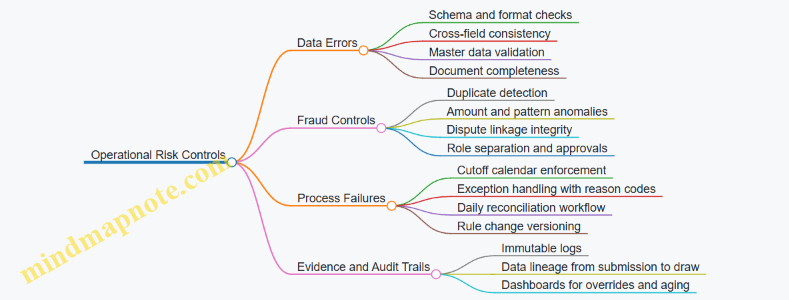
Example: End-to-End Control Flow for One Invoice
An invoice is submitted with buyer ID, vendor ID, amount, currency, invoice date, due date, and proof of delivery.
- The workflow blocks the record if currency is invalid or required fields are missing.
- It checks that invoice date is not after due date and that buyer entity matches the contract.
- It verifies proof of delivery is present because the amount exceeds the threshold.
- It runs duplicate detection; if a match is found, it routes to enhanced review.
- If approved, it generates the funding draw and logs the rule versions used.
- Daily reconciliation confirms bank settlement; if settlement fails, the draw is reversed and repayment scheduling is paused.
This is the core idea: controls should stop errors early, constrain fraud attempts with consistent logic, and keep exceptions measurable rather than mysterious.
5.4 Legal and Contractual Risk Controls for Assignment and Setoff
Assignment and setoff clauses decide what happens when money is owed, disputed, or simply not paid on time. In liquidity pools, these clauses also determine whether a funding draw remains valid when the underlying invoice relationship gets messy. The goal is straightforward: make the legal mechanics match the operational workflow, so disputes don’t accidentally become funding failures.
Core Concepts That Drive Contract Controls
Start with three building blocks.
- Assignment transfers rights to payment. If the pool relies on assigned receivables, the contract must clearly state what is assigned, when it becomes effective, and what happens if the invoice is later disputed.
- Setoff allows a debtor to reduce what it owes by claiming it is owed something back. Setoff can be legitimate, but it can also be used to reduce payments in ways that undermine pool cash flows.
- Priority and enforceability determine who gets paid first and whether the assignment is respected against competing claims.
A practical way to align these concepts is to map them to operational states: invoice submitted, accepted, funded, disputed, partially paid, and resolved. Each state should have a corresponding contractual outcome.
Assignment Controls That Reduce Funding Disruption
1. Define the assigned rights precisely. The agreement should specify that the seller assigns the right to receive payment under the invoice, including proceeds and related claims needed to collect. Example: if a vendor assigns invoices to a buyer-sponsored pool, the pool should receive the right to collect from the buyer for the invoice amount, not just a vague “interest.”
2. Make assignment effective at a predictable time. Common triggers include submission of an invoice schedule, acceptance by the pool administrator, or funding draw date. Example: if assignment becomes effective only after a manual approval, a dispute filed before approval could create uncertainty about whether the pool ever held the rights.
3. Require notice and acknowledgements where needed. Some jurisdictions and counterparties require notification to enforce assignment. Example: if the buyer never receives notice, the buyer might argue it paid the vendor directly in good faith, complicating recovery.
4. Include dispute-aware assignment language. The contract should state how disputes affect assigned receivables. Example: if the buyer disputes quality, the pool should still treat the receivable as assigned, but apply a defined holdback or reserve until resolution, rather than treating the assignment as void.
Setoff Controls That Preserve Cash Flow Predictability
Setoff risk is usually operationally triggered by contract ambiguity: the debtor claims it can offset for any reason, even unrelated matters.
1. Limit setoff to defined, proven claims. The agreement should restrict setoff to claims arising from the same contract or transaction, and require that the claim is undisputed or finally determined. Example: a buyer cannot reduce payment because it “expects” a future credit; it must have a documented credit note or a final determination.
2. Add a notice-and-cure mechanism. Require the buyer to notify the pool or administrator of any setoff intention within a short window and provide supporting details. Example: if the buyer intends to set off for a short shipment, it must submit the discrepancy report within the notice period; otherwise, the pool treats the invoice as payable.
3. Separate disputes from setoff. Disputes should follow a defined process, while setoff should not be used as a substitute for that process. Example: if a buyer disputes an invoice, it may place the invoice into dispute status, but it cannot automatically reduce payment unless the contract’s setoff conditions are met.
4. Address partial payments explicitly. If the buyer pays the undisputed portion, the contract should clarify how the remaining disputed amount is handled. Example: the pool receives payment for the undisputed portion and the administrator records the disputed remainder in a reserve bucket.
Priority, Perfection, and Competing Claims
Even a well-written clause can fail if it is not enforceable against third parties.
- Priority language should state that the assignment is intended to be effective against the debtor and third parties, subject to local requirements.
- Perfection steps should be aligned with the legal environment, including any filings or documentation needed to establish enforceability.
- Competing claims should be anticipated: if a creditor of the vendor claims rights to receivables, the pool agreement should define how the pool’s rights are protected.
Example: if the vendor grants security interests to a lender, the pool agreement should coordinate with those arrangements so the pool’s assigned receivables are not treated as unencumbered or, worse, as already pledged elsewhere.
Mind Map: Assignment and Setoff Risk Controls
Integrated Example Walkthrough
Assume a buyer-sponsored pool funds vendor invoices. The buyer later claims a quality issue and attempts to reduce payment by 100%.
- The contract’s assignment clause confirms the pool holds the right to payment upon invoice acceptance.
- The setoff clause limits setoff to claims that are documented and meet the contract’s conditions.
- The buyer provides a notice late and lacks the required documentation.
- The administrator marks the invoice as disputed but processes payment for the undisputed portion, placing the remainder into a reserve.
- The pool’s legal position remains consistent: assignment is intact, setoff is constrained, and the operational workflow matches the contractual mechanics.
Control Checklist for Drafting and Review
- Assignment scope is explicit and includes proceeds.
- Assignment effectiveness trigger is operationally achievable.
- Notice and enforceability steps are defined.
- Dispute handling does not nullify assignment.
- Setoff is limited by eligibility and proof.
- Setoff requires timely notice and documentation.
- Disputes and setoff are separated in the contract.
- Partial payments and reserves are specified.
- Priority and perfection steps are coordinated with other claims.
5.5 Stress Testing Using Historical Scenarios and Parameterized Shocks
Stress testing answers a practical question: if the supply network behaves badly, do your funding pools still pay on time and stay within credit and liquidity limits? The goal is not to predict the future; it is to measure how your engineered rules behave when inputs move in the wrong direction.
Start with What Can Break
Begin by separating two failure modes that often get mixed:
- Liquidity runoff: cash leaves faster than it returns because draws increase, repayments slow, or settlement timing shifts.
- Credit deterioration: eligible invoices become less collectible due to disputes, delivery failures, or buyer payment stress.
A useful starting checklist maps each pool control to a stress lever. For example, if eligibility requires proof of delivery, then a scenario that increases delivery disputes should reduce eligible volume and trigger draw limits. If repayment depends on scheduled buyer payment dates, then a scenario that delays buyer payments should increase outstanding balances.
Build Historical Scenarios That Match Your Contract Reality
Historical scenarios work best when they are translated into contract-relevant variables. Pick events that resemble your network’s risk drivers, then convert them into measurable changes.
Example: “Invoice Dispute Spike” scenario
- Historical observation: dispute rates rose after a logistics disruption.
- Parameter translation: dispute rate increases from 1.5% to 6% of submitted invoices; dispute resolution lag extends from 10 days to 35 days.
- Contract impact: fewer invoices remain eligible; funding advances pause; repayments slow because disputed amounts are withheld.
Example: “Payment Date Stretch” scenario
- Historical observation: buyers delayed settlement during a cost-of-funds shock.
- Parameter translation: buyer payment cycle extends by 15 days for the top three buyers by volume.
- Contract impact: pool utilization rises; replenishment timing shifts; overdraft buffers get tested.
To keep scenarios grounded, define a small set of variables you will actually use in the model: eligible volume, draw behavior, repayment timing, dispute rates, recovery rates, and settlement delays.
Add Parameterized Shocks for Coverage
Historical scenarios rarely cover every combination of stress. Parameterized shocks fill gaps by changing one or two variables at a time, so you can see cause and effect.
Use a “shock ladder” approach:
- Mild: small deviations that still stress controls.
- Severe: deviations that represent a plausible worst-case within your assumptions.
- Extreme: deviations that test robustness of governance and operational execution.
Example parameter set for liquidity
- Drawdown rate increases by 30% over baseline for 20 business days.
- Repayment lag increases by 10 business days.
- Settlement cutoff slips by 2 value-date days.
Example parameter set for credit
- Recovery rate on defaulted receivables drops from 85% to 65%.
- Dispute resolution lag increases by 25 days.
- Concentration limit breaches are triggered by a single buyer’s eligibility decline.
Model the Pool with Time Buckets and Rule Engines
Stress testing needs a timeline, not a single snapshot. Use business-day or weekly buckets aligned to your operational cycles: submission windows, funding approval cutoffs, and repayment processing.
Within each bucket, apply rules in the same order as production:
- Eligibility evaluation reduces or increases the pool’s available advance base.
- Draw requests are accepted or rejected based on limits and eligibility.
- Repayments occur when buyer payments settle and when disputes clear.
- Reconciliation updates outstanding balances and triggers any cure actions.
If your system uses thresholds like “minimum eligible ratio” or “maximum utilization,” test whether the model triggers them correctly under each stress.
Mind Map of Stress Testing Inputs and Outputs
Mind Map: Stress Testing Using Historical Scenarios and Parameterized Shocks
Evaluate Results with Clear Decision Thresholds
Outputs should be actionable. Track three categories:
- Timing: when does the first breach occur, and how long until it is resolved?
- Magnitude: how large is the cash shortfall or loss relative to buffers and credit enhancements?
- Control effectiveness: which rule prevented the worst outcome, and which rule failed to trigger?
Example decision thresholds
- If utilization exceeds 90% for more than 5 business days, suspend new draws for non-core buyers.
- If eligible base drops below a minimum ratio, tighten eligibility haircuts and require additional proof.
- If dispute lag exceeds a set limit, switch to conservative repayment assumptions for the affected segment.
Run a Small Set of Scenarios, Then Improve the Model
Start with a manageable suite: 3 historical scenarios and 3 parameterized shock sets. After each run, compare model outputs to what your operations team would expect from the contract.
Example of model improvement loop
- If the model shows no utilization spike during a payment date stretch, check whether repayment timing is actually shifted in the rule engine.
- If losses look too low during a dispute spike, verify whether disputed invoices are excluded from eligibility and whether recoveries are applied after resolution.
This keeps stress testing systematic: scenarios are translated into variables, variables drive rule-based cash flows, and outputs map directly to governance actions.
6. Legal and Contract Engineering for Multi Party Programs
6.1 Contract Architecture for Participation Purchase and Assignment
A participation purchase and assignment contract is the legal “plumbing” that lets one party fund invoices or receivables while another party keeps operational control of the underlying supply relationship. The architecture matters because it determines who can enforce rights, who bears which risks, and how disputes flow through the system.
Core Building Blocks
Start with three roles: the Originator (buyer or vendor that generates the receivables), the Participant/Assignee (the funder or pool investor), and the Administrator (often the Originator or a service provider that processes submissions and collections). Then define the contract’s three layers.
- Participation layer: sets out how the Participant acquires an economic interest in receivables without necessarily taking over every operational step.
- Purchase and assignment layer: specifies when receivables are sold and assigned, what is transferred, and what remains with the Originator.
- Servicing and enforcement layer: explains who collects, how remittances are handled, and what happens when there is a dispute or default.
A practical way to keep the architecture coherent is to align each clause with a lifecycle stage: eligibility, transfer, payment, dispute, and termination.
Transfer Mechanics That Avoid Legal Ambiguity
The contract should state the transfer trigger precisely. For example, it can be “upon acceptance of an eligible invoice submission” or “on the funding date for that invoice.” If the trigger is vague, parties end up arguing whether the Participant owns the receivable before funding.
Next, define what is assigned. Many programs assign the receivable itself plus related rights such as proceeds, security interests (if any), and enforcement rights. If the Originator retains certain rights, the contract must say so explicitly, including how those retained rights interact with collection instructions.
Finally, include a representation and warranty set that matches the transfer moment. A clean pattern is: the Originator warrants eligibility facts at submission, and warrants ownership and non-encumbrance at the transfer trigger.
Clause Map for Participation, Purchase, and Assignment
The following mind map shows how the contract pieces connect.
Mind Map: Contract Architecture Flow
Example: Buyer Sponsored Program with Invoice Dispute
Assume a buyer sponsors a funding pool. The buyer’s supplier submits invoices to the Originator (the buyer’s program administrator). The Participant funds accepted invoices.
Transfer trigger clause (example logic): “The receivable is purchased and assigned to the Participant on the funding date for each accepted invoice.”
Dispute clause (example logic): If the buyer disputes an invoice, the Originator must notify the Participant within a defined window and identify the dispute category (quantity, service defect, pricing mismatch). The contract then defines whether collections are suspended, partially paid, or held in a segregated dispute reserve.
Enforcement clause (example logic): If the dispute is resolved in favor of the supplier, the Participant receives the proceeds according to the waterfall. If resolved against the supplier, the Originator bears the loss through a replacement, repurchase, or credit note mechanism.
This structure prevents a common failure mode: the Participant assumes ownership and enforcement rights, while the Originator continues to treat the receivable as operationally “still theirs” during disputes.
Example: Assignment Language That Matches Practical Operations
If the Administrator is the Originator, the contract should state that the Administrator acts as agent for collection and remittance, not as an independent owner. A clean drafting approach is to separate “who collects” from “who owns.”
For instance:
- Ownership transfers at the transfer trigger.
- Collection is performed by the Administrator under collection instructions.
- Remittances go to a specified account controlled per the waterfall.
Advanced Details That Matter in Real Programs
Notification mechanics: define how and when notices are delivered, and what evidence counts. For example, dispute notices should include invoice identifiers and dispute category codes.
Setoff and assignment interaction: if the buyer can set off against other amounts, the contract must specify whether setoff is permitted against assigned receivables and how it is reported.
Reconciliation and releases: include a final accounting process that reconciles funded amounts, collections, disputes, and any replacement invoices. Without this, termination becomes a negotiation rather than a calculation.
A well-architected contract reads like a sequence diagram: each clause answers what happens next, who acts, and what legal status applies at that moment.
6.2 Managing Consent Requirements and Notification Mechanics
Consent and notification mechanics are the parts of a multi-party liquidity program that prevent “we thought you knew” moments. In practice, they govern who must agree, when they must be told, and what evidence proves the message was received or at least properly dispatched.
Foundational Concepts for Consent and Notice
Start by separating three ideas that often get mixed:
- Consent: a counterparty’s affirmative agreement to a specific action, such as assignment, participation, or changes to eligibility rules.
- Notification: a formal message that informs a counterparty of an action even if consent is not required.
- Effectiveness: the moment the program terms become binding for that counterparty, which may be later than the message date.
A clean program defines these in the contract and then mirrors them in operations. If the contract says “notice is effective upon receipt,” operations must track receipt, not just sending.
Consent Triggers and What They Usually Cover
Consent is typically required for actions that change legal position or control over receivables. Common triggers include:
- Assignment of receivables from a vendor to a funding pool participant.
- Participation by a new buyer in a shared pool, where the buyer’s role affects eligibility and payment instructions.
- Amendments to key terms such as dispute handling, settlement timing, or setoff rights.
Example: A vendor submits invoices to a buyer-sponsored pool. The vendor’s receivables contract prohibits assignment without buyer consent. The program therefore requires buyer consent before the first draw against that buyer’s invoices. Operations should treat the consent as a prerequisite for funding, not a post-funding cleanup.
Notification Mechanics That Hold Up in Disputes
Notification mechanics should specify four operational facts:
- Recipient: who must receive the notice.
- Method: email, portal, courier, or a combination.
- Timing: when notice must be sent and when it becomes effective.
- Content: what must be included so the recipient can act.
A practical approach is to standardize notice templates and require a “minimum viable notice” checklist. For instance, a notice of assignment should include program identifier, invoice range or reference, effective date, and the payment instruction destination.
Example: The buyer receives a notice that payment should be redirected to the pool account. If the notice omits the account identifier, the buyer may argue it could not follow instructions. The checklist prevents that by forcing inclusion of the account details and a clear payment reference format.
Evidence Standards for “Sent” Versus “Received”
Contracts often distinguish between “sent” and “received.” Operations should implement evidence aligned to the contract language:
- If effectiveness is upon receipt, store proof of receipt such as portal confirmation, signed courier receipt, or an email read receipt where contractually acceptable.
- If effectiveness is upon dispatch, store proof of dispatch such as timestamped email logs or courier tracking.
Example: A dispute notice must be effective upon receipt. If the team only logs the email being sent, the program may fail to meet the contractual timeline. The fix is to require portal submission confirmation or courier tracking for that notice type.
Operational Workflow for Consent and Notice
Use a workflow that makes the “gates” visible. The goal is to prevent funding from proceeding when consent is missing or notice evidence is insufficient.
Mind Map: Consent and Notification Workflow
Exception Handling Without Guesswork
Exceptions are inevitable: wrong email address, portal downtime, or a buyer requesting a different notice format. The contract should define what counts as a valid alternative method. Operationally, you want a controlled escalation path:
- Detect: notice failed delivery or consent document incomplete.
- Escalate: notify legal/operations lead within the contract timeline.
- Re-send: use the fallback method specified in the contract.
- Record: keep the full audit trail of attempts and outcomes.
Example: A buyer’s inbox rejects the assignment notice. The contract allows courier as a fallback. Operations should immediately switch to courier and record the rejection event plus courier tracking.
Integrated Example: First Draw Under a Buyer-Sponsored Pool
Assume a vendor wants to submit invoices to a buyer-sponsored pool.
- Step 1: Confirm buyer consent is on file for assignment of receivables.
- Step 2: Generate an assignment notice listing the invoice references and the pool payment account.
- Step 3: Send the notice using the contract method and capture evidence.
- Step 4: Only after the contract effectiveness condition is met, allow the first draw.
If the contract says notice is effective upon receipt, the draw waits for receipt evidence. If it says effective upon dispatch, the draw can proceed once dispatch evidence is captured. Either way, the workflow prevents ambiguity.
Practical Checklist for Notice Quality
A notice is “good” when it is actionable and provable. Use this checklist:
- Program identifier and counterparty role
- Invoice references or clear selection criteria
- Effective date and any timing requirements
- Payment instruction destination and required remittance reference
- Dispute and dispute-notice contact details if relevant
- Evidence capture method aligned to contract language
When these items are consistent across notice types, consent and notification become routine rather than stressful. The program still has complexity, but the mechanics stop being a guessing game.
6.3 Structuring Setoff Rights and Dispute Handling Clauses
Setoff and disputes are where program paperwork meets real life: invoices get corrected, goods arrive late, and sometimes the parties simply disagree on what “delivered” means. This section shows how to structure clauses so that (1) setoff is permitted only when it is safe and measurable, (2) disputes do not quietly drain liquidity, and (3) the operational workflow is clear enough that teams can execute it without guessing.
Foundational Concepts for Setoff and Disputes
Setoff is the right to reduce an amount owed by an amount claimed to be owed back. In supply networks, setoff often appears when a buyer wants to offset a payment against credits, rebates, or damages, while a funding pool participant wants to keep cash flows predictable.
A dispute is a claim that a specific invoice amount, status, or underlying facts are incorrect. The key is to tie disputes to identifiable invoice line items and to define what happens to cash during the dispute window.
A practical rule: setoff should be a consequence of a resolved dispute, not a substitute for one—unless the contract explicitly allows “provisional setoff” with strict conditions.
Clause Architecture That Works in Practice
A well-structured clause usually contains five parts: scope, triggers, process, timing, and effects on payment and funding.
-
Scope: Define what can be set off (e.g., credit notes, confirmed deductions, liquidated damages) and what cannot (e.g., unverified claims, general service disputes not tied to invoice references).
-
Triggers: Specify the events that permit setoff, such as receipt of a credit note, acceptance of a deduction by the buyer, or a final determination under the dispute process.
-
Process: Require written notice that identifies the invoice number, disputed amount, reason code, and supporting evidence. Include a structured response obligation for the counterparty.
-
Timing: Set clear deadlines for raising disputes and for responding. Use a short initial window for “notice of dispute” and a longer window for “evidence and resolution.”
-
Effects: State whether disputed amounts are withheld, escrowed, or paid with a true-up. Also state whether setoff is allowed during the dispute.
Dispute Handling Workflow with Payment Effects
A common pattern is “pay undisputed amounts, quarantine disputed amounts.” This keeps liquidity moving while preserving the right to correct errors.
Use these operational definitions:
- Undisputed Amount: The portion of the invoice not covered by a valid dispute notice.
- Disputed Amount: The portion covered by a valid dispute notice that meets minimum evidence requirements.
- Quarantine Period: The time between dispute notice and resolution during which the disputed amount is treated consistently.
Example: If an invoice is $100,000 and the buyer disputes $12,000 for quantity shortfall, the buyer pays $88,000 on the normal due date. The $12,000 is quarantined until resolution. If the dispute is resolved in favor of the buyer, a credit note is issued and the funding pool adjusts accordingly.
Setoff Rights That Are Measurable and Bounded
To prevent “setoff by surprise,” require that setoff claims be either (a) already documented (credit notes, agreed deductions) or (b) explicitly permitted as provisional setoff with caps.
Provisional setoff can be allowed only when all conditions are met:
- The claim is tied to a specific invoice reference.
- The disputed amount is within a defined percentage cap of the invoice value.
- The buyer provides evidence sufficient to classify the claim type (e.g., chargeback, documented damages).
- The funding participant receives notice before the payment cutoff.
Example: A buyer may provisionally set off up to 5% of an invoice value for documented packaging damage, but cannot set off for “quality concerns” without a reason code and evidence.
Evidence Requirements and Reason Codes
Evidence should be concrete and standardized. Reason codes reduce arguments about classification.
Minimum evidence examples:
- Delivery disputes: proof of delivery documents and delivery dates.
- Quantity disputes: receiving reports and count sheets.
- Service disputes: acceptance records tied to milestones.
If evidence is missing, the dispute notice should be treated as incomplete, and the disputed amount should remain payable until the buyer cures the deficiency.
Timing Rules and a Concrete Deadline Example
Use a two-step timing approach:
- Dispute Notice Deadline: e.g., within 10 business days after invoice receipt or after proof of delivery becomes available.
- Resolution Deadline: e.g., within 30 business days after a complete dispute notice.
Example: On 2026-02-26, a buyer receives an invoice. The buyer must submit a dispute notice by 2026-03-12. If the notice is complete, resolution is due by 2026-04-11. If the buyer misses the notice deadline, the invoice amount is treated as undisputed for setoff purposes.
Mind Map: Setoff and Dispute Clause Components
Example Clause Language Patterns
Below are patterns you can adapt without turning the contract into a novel.
- Setoff Permission: “Setoff is permitted only for amounts supported by a credit note or a resolved dispute under this clause.”
- Quarantine Rule: “Disputed amounts are quarantined; undisputed amounts are paid on the scheduled due date.”
- Provisional Setoff: “Provisional setoff applies only to invoice-referenced claims within the agreed cap and only when evidence is provided with the dispute notice.”
- Incomplete Notice: “If the dispute notice lacks required evidence or reason codes, the disputed amount remains payable until the notice is cured.”
Operational Checklist for Implementation
- Confirm every dispute notice includes invoice reference, reason code, disputed amount, and evidence.
- Ensure payment instructions separate undisputed and disputed amounts.
- Maintain a single dispute log with timestamps to support audit trails.
- Require that any setoff entry references either a credit note or a resolution outcome.
When these elements are consistent, setoff becomes a controlled adjustment mechanism rather than a payment interruption tool, and disputes become a structured workflow instead of an ongoing negotiation.
6.4 Aligning Program Terms With Accounting Treatment And Reporting
Accounting alignment is what turns a liquidity program from “it works operationally” into “it is reportable, auditable, and consistent across teams.” The goal is to ensure that the program’s legal and operational terms map cleanly to accounting recognition, measurement, and disclosures for both buyers and vendors.
Foundational Mapping from Program Terms to Accounting Outcomes
Start by listing the program terms that drive accounting outcomes. Typical drivers include whether invoices are sold or merely financed, how disputes suspend or reverse funding, what happens on early repayment, and whether any recourse exists.
A practical way to think about it: accounting follows substance. If the buyer can effectively require repayment for performance failures, the arrangement may behave like a secured borrowing rather than a true sale. If the vendor retains significant risks and rewards, derecognition may be limited. If the pool is structured as a participation with assignment and clear risk transfer, derecognition may be more supportable.
Mind Map: Accounting Alignment Workflow
Choosing the Right Accounting Model for the Arrangement
The first decision is whether the arrangement results in derecognition of receivables or recognition of a financing liability. This depends on how risks and rewards are allocated.
Example: Buyer-Sponsored Receivables Pool
- Terms: Vendors submit invoices to the pool; the buyer confirms acceptance; the buyer repays the funding on the invoice due date.
- Dispute rule: If proof of delivery is missing, funding is suspended and the vendor must reimburse the pool.
- Accounting implication: The reimbursement obligation can indicate that the vendor or buyer retains credit/performance risk, affecting derecognition. The accounting team will document whether the arrangement is a financing arrangement with a liability and receivable, or a transfer with derecognition.
Example: Vendor-Sponsored Assignment With Non-Recourse
- Terms: Invoices are assigned to the pool; the pool bears credit risk; disputes are handled by reducing the assigned amount rather than requiring reimbursement.
- Accounting implication: If the contract clearly limits recourse and the pool controls the receivables, derecognition may be supported, but only if the evidence matches the legal terms and operational practice.
Aligning Fees and Discounting with Measurement and Presentation
Program pricing often includes funding cost, service fees, and discount rates for early payment. Accounting teams need to know whether fees are treated as part of the effective interest rate, recognized over time, or presented as separate income/expense.
Example: Discount Rate For Early Settlement
- Operationally: The pool advances 95% on submission and pays the remaining 5% when the invoice is settled, net of a discount.
- Accounting question: Is the discount effectively interest on a financing, or is it a reduction of revenue/receivable value?
- Alignment approach: Define in the term sheet how the discount is calculated, when it accrues, and whether it is refundable on reversal. Then ensure the system posts the discount to the correct ledger accounts and periods.
Handling Disputes, Chargebacks, and Setoff Without Accounting Surprises
Dispute rules are where operational reality frequently diverges from accounting assumptions. If disputes suspend funding, accounting must reflect whether the receivable is still considered transferred or whether a receivable adjustment is required.
Example: Dispute Suspension With Later Netting
- Terms: Funding is released upon invoice submission. If a dispute is raised within 10 business days, the pool suspends further releases and later nets disputed amounts against future invoices.
- Accounting implication: The team must decide how to treat the disputed portion during the suspension window and how to reflect netting when it occurs. The reporting must be consistent with the contract’s netting rights and the system’s ability to track disputed amounts separately.
Setoff clauses also matter. If the buyer can offset amounts due under the program against other obligations, accounting may require gross vs net presentation decisions and careful disclosure of offset rights.
Ensuring Reporting Consistency Across Buyer, Vendor, and Pool Administrators
Each party may have different reporting responsibilities. Buyer reporting often focuses on whether receivables remain on balance sheet and how program fees affect finance costs. Vendor reporting often focuses on whether the vendor has derecognized receivables and how reimbursements are treated.
Example: Reconciliation Between Subledger And General Ledger
- Operational system: Tracks invoice-level funding, dispute status, and repayment.
- Accounting system: Posts aggregated journal entries by period.
- Control requirement: A monthly reconciliation must tie invoice-level totals to GL balances, including a clear mapping for suspended invoices and disputed amounts.
Evidence Pack for Audit-Ready Alignment
Accounting alignment is not a one-time memo; it is a repeatable process.
Include:
- A contract-to-accounting mapping document that states which terms drive which accounting conclusions.
- A policy interpretation memo for key judgments such as recourse, risk transfer, and netting.
- System evidence showing that operational workflows follow the contract, including dispute triggers, suspension logic, and repayment timing.
- A reporting checklist that confirms disclosures are supported by the same data used for recognition and measurement.
When program terms, system behavior, and accounting entries agree, reporting becomes predictable. The program still has risk, but it stops having surprises.
6.5 Building Contract Templates for Standardization Across Regions
Standardization across regions is less about copying the same contract everywhere and more about separating what must be consistent from what must be local. A good template set behaves like a product: the core terms are stable, the variable fields are controlled, and the workflow tells everyone what to do when a deal deviates.
Foundational Template Architecture
Start with a three-layer structure.
-
Master Program Agreement covers the overall program: parties, definitions, eligibility rules at a high level, governance, and dispute handling. This layer should be identical across regions except for jurisdiction-specific clauses.
-
Local Participation Agreement covers the mechanics for a specific country or legal entity: signing authority, local taxes, regulatory notices, and any required local language or form.
-
Operational Schedules cover the day-to-day: submission formats, cutoffs, bank account update rules, and evidence requirements for invoices and credit notes.
A practical rule: if a clause changes how money moves (timing, payment instructions, setoff), it belongs in the operational schedules; if it changes who can participate or under what conditions, it belongs in the master or participation layer.
Controlled Variability with Clear Decision Rights
Templates fail when “local legal” edits everything. Instead, define a controlled variability matrix.
- Global locked terms: definitions, core eligibility logic, assignment mechanics, dispute escalation ladder, and baseline reporting.
- Region editable terms: governing law, service of process, tax gross-up approach, and local regulatory notices.
- Deal editable terms: tenor limits, concentration caps, and specific bank account details.
To keep edits from turning into chaos, require a change log field in the template. Each deviation must reference the reason category (legal, tax, operational, or counterparty). This makes approvals faster because reviewers can focus on the deviation type rather than re-reading the whole document.
Clause Library Approach for Consistency
Build a clause library so that every template uses the same wording for the same concept.
- Eligibility clause: states what qualifies and how disputes are handled.
- Assignment clause: states when and how receivables are assigned or transferred.
- Setoff clause: states whether setoff is allowed and under what conditions.
- Notice clause: states acceptable notice channels and timing.
- Default clause: states triggers, cure periods, and remedies.
Each library clause should include: (a) a “plain meaning” sentence for operational teams, (b) the legal text, and (c) a short list of required cross-references. That last part prevents the classic problem where the legal clause references a schedule that never gets attached.
Mind Map: Template Standardization Workflow
Example: A Template Set with Region-Specific Tax Handling
Consider a buyer-sponsored receivables pool where invoices are funded before settlement. The master agreement can keep the same funding and assignment logic everywhere. The local participation agreement can then vary the tax clause.
Global locked part (same across regions):
- Assignment occurs upon invoice acceptance and eligibility confirmation.
- Disputes suspend payment only for the disputed portion.
Region editable part (varies):
- Whether withholding tax is borne by the buyer, the pool, or grossed up.
- The required documentation for tax relief claims.
Operational schedule (same structure, different fields):
- Cutoff times for tax documentation submission.
- Evidence list for invoice acceptance and dispute status.
This separation prevents the most common failure mode: tax edits accidentally change funding timing or dispute suspension mechanics.
Example: Cross-Reference Checklist to Prevent Broken Documents
Use a one-page checklist attached to every contract packet.
- Master agreement references operational schedules by name and version.
- Schedules include the exact evidence list used by the workflow.
- Notice clause matches the operational submission channel.
- Setoff clause aligns with the dispute suspension rule.
- Bank account update rules match the treasury process.
If a packet fails the checklist, it cannot be signed. That single gate saves time later because it stops “almost correct” documents from reaching execution.
Advanced Details Without Overcomplication
Standardization also requires version control. Assign a template version number and require that any signed deviation be recorded as a named amendment. Operational teams should receive the “effective rules” summary, not the full redline.
Finally, keep the template language consistent in tone and structure. When the same concept appears in multiple clauses, use the same defined term. That reduces interpretation risk and makes training easier for teams who will administer the program across regions.
7. Data Architecture and Workflow Automation
7.1 Defining Data Models for Invoices Receivables and Payment Status
A data model is the shared language between finance, treasury, ERP, and payment operations. For liquidity engineering, it must represent three things clearly: what is owed (receivables), what is being paid (payment instructions), and what state each item is in (status). If any of those are ambiguous, your funding pool will either stall or fund the wrong amount.
Start with the core entities and their keys. Use stable identifiers so you can reconcile across systems even when business documents change. A practical baseline includes:
- Invoice: the commercial document that creates the receivable.
- Invoice Line: the item-level basis for quantity, tax, and dispute evidence.
- Receivable: the accounting view of the invoice amount that is eligible for funding.
- Credit Note: a negative adjustment that reduces receivables.
- Payment Instruction: the operational record that triggers settlement.
- Payment Event: the timeline of outcomes such as sent, accepted, rejected, or returned.
- Dispute Record: the reason and scope for withholding or partial funding.
Mind Map: Data Model Scope and Relationships
Foundational Fields That Prevent Reconciliation Headaches
Define fields in a way that supports matching and netting. For invoices, store both the document identifiers and the amount components. For example, keep invoice_total, tax_total, and net_amount separately so you can explain why a funded amount differs from a paid amount.
For receivables, include an eligible_amount and an ineligible_reason_code. Eligibility is not the same as existence. An invoice may exist but be temporarily ineligible due to missing proof of delivery, an open dispute, or a contract rule. This distinction keeps your pool math honest.
For payment status, avoid a single “status” field that tries to do everything. Instead, model status as a combination of:
- Receivable Status: whether the receivable is open, partially settled, or settled.
- Instruction Status: whether the payment instruction is created, queued, sent, or failed.
- Settlement Outcome: whether funds were accepted, rejected, or returned.
A simple rule: the receivable status should change only when settlement outcomes are confirmed, not when instructions are merely submitted.
Status Model with Clear Transitions
Use a state machine approach so operations and finance interpret the same transitions. Below is a compact example of how statuses can relate.
    flowchart TD
  A[Invoice Created] --> B[Receivable Open]
  B --> C[Dispute Open]
  C -->|Resolved| D[Receivable Eligible]
  B -->|Eligible| D
  D --> E[Payment Instruction Created]
  E --> F[Payment Sent]
  F --> G[Accepted]
  F --> H[Rejected]
  G --> I[Receivable Partially Settled]
  I --> J[Receivable Settled]
  H --> K[Instruction Failed]
  K --> E
Example: Partial Payment with a Credit Note
Consider an invoice for 10,000 USD with a due date of 2026-02-15. A credit note of 1,500 USD is issued for a returned item. The receivable model should represent:
- Invoice total: 10,000
- Credit note: -1,500 linked to the invoice
- Net receivable: 8,500
Now suppose the buyer pays 5,000 USD on 2026-02-20 and the remainder later. Your payment instruction should record the paid amount and the allocation basis. The receivable status should move from Open to Partially Settled after the settlement outcome is confirmed, and then to Settled after the remaining 3,500 is confirmed.
If a dispute exists for one line item worth 2,000 USD, set eligible_amount to 6,500 USD (8,500 minus 2,000). The funding pool can then draw against 6,500 even while the invoice remains open for the full net amount.
Advanced Details That Make the Model Operational
- External References: store bank references and payment rail identifiers in
Payment Eventso you can reconcile even when invoice numbers are missing in bank messages. - Allocation Rules: when partial payments occur, define how amounts map to invoice lines, taxes, and disputes. Without allocation rules, “partially settled” becomes a guess.
- Audit Trail: every change to eligibility, dispute scope, or payment status should record
changed_by,changed_at, andchange_reason_code. - Temporal Consistency: keep a status snapshot timestamp so reporting can answer questions like “What was eligible on 2026-02-10?”
A good data model is boring in the best way: it makes reconciliation deterministic, eligibility explainable, and payment status unambiguous. That’s what lets liquidity engineering behave like engineering rather than guesswork.
7.2 Establishing Master Data Governance for Parties Products and Terms
Master data governance is the boring part that prevents the exciting part from breaking. In liquidity engineering, “master data” means the stable identifiers and rules that connect invoices, payments, eligibility checks, and funding pool operations. When parties, products, and terms are inconsistent, you get funding for the wrong invoice, failed matching, or disputes that take longer than the cash cycle.
Foundational Scope and Ownership
Start by defining what counts as master data versus transactional data. Parties (legal entities, suppliers, buyers, intermediaries), products (what is being billed), and terms (payment terms, invoice requirements, dispute windows) are master data because they change slowly and drive many downstream decisions.
Assign clear ownership:
- Party steward: maintains legal names, tax identifiers, addresses, and relationship roles.
- Product steward: maintains product catalog codes, descriptions, and mapping rules.
- Terms steward: maintains payment term templates, discount rules, and dispute handling parameters.
A practical rule: if a field is used in eligibility logic or reconciliation matching, it needs a steward and a change process.
Party Governance for Reliable Eligibility
Parties governance focuses on identity resolution and role clarity. A supplier might appear under multiple names across systems; a buyer might be a group entity in one place and a local operating company in another.
Define a golden record for each party with a unique internal ID. Store multiple external identifiers (tax number, VAT, registration numbers) as attributes, not as the primary key.
Example: A vendor invoices “Acme Components Ltd.” but the contract names “Acme Components Limited.” The golden record keeps one internal ID, while the external name variants are tracked as aliases. Eligibility checks use the internal ID, while invoices carry the external name that gets mapped during onboarding.
Role governance matters too. The same legal entity can be both a buyer and a guarantor. Store roles explicitly so rules don’t accidentally apply the wrong logic.
Product Governance for Consistent Matching
Product governance prevents mismatches where the invoice line looks similar but fails eligibility due to code differences. Create a product catalog with:
- a stable internal product code
- standardized description
- mapping to external ERP codes
- rules for what qualifies as “eligible goods” or “eligible services”
Example: One region bills “Freight” under code FRT-01, another uses LOG-77. Both map to internal product code FREIGHT. If eligibility depends on product category, the internal code is what the system evaluates.
Also define how to handle partial mappings. If an invoice line cannot be mapped confidently, route it to an exception workflow rather than guessing.
Terms Governance for Predictable Cash Behavior
Terms governance defines the parameters that drive funding and payment schedules. Create term templates that include:
- payment due date logic (e.g., net 60 from invoice date)
- discount windows and rates, if applicable
- invoice requirements (mandatory fields, acceptable document types)
- dispute window length and cure steps
Example: “Net 45” might mean different reference dates in different contracts. One contract counts from invoice date; another counts from proof-of-delivery date. Store the reference date rule as part of the term template, not as a free-text label.
When a contract changes, treat it as a new version of the term template with an effective date range. That way, historical invoices still evaluate under the rules that were valid when they were issued.
Data Quality Controls That Don’t Create Chaos
Governance needs measurable controls:
- Completeness: required attributes present (tax ID, country, term reference date rule).
- Validity: formats and allowed values (country codes, term codes).
- Uniqueness: no duplicate golden records for the same party.
- Consistency: product category mapping aligns with eligibility rules.
Use a staged workflow: onboarding → validation → approval → activation. Activation should be time-bound so changes don’t affect already-funded invoices.
Mind Map: Parties Products and Terms Governance
Example: End-to-End Governance Flow for One Invoice
- Onboard parties: Map buyer and vendor to golden records; store aliases for both names.
- Map products: Convert invoice line codes to internal product codes; flag any unmapped lines.
- Select terms: Attach the correct term template version based on contract reference and effective dates.
- Run eligibility checks: Use internal IDs and internal term parameters for deterministic outcomes.
- Reconcile and audit: Store which golden record IDs, product codes, and term template versions were used for the funding decision.
This approach keeps governance systematic: identifiers are stable, rules are parameterized, and changes are versioned. The result is fewer exceptions and faster dispute resolution because everyone is working from the same definitions.
7.3 Designing Workflow States for Submission Validation and Funding
A workflow state is the set of rules that decides what happens to a submission at each step. In liquidity engineering, the workflow must prevent “funding the wrong thing” while keeping operations fast enough that vendors don’t start calling it a hobby. The design starts with foundational concepts—what a submission is, what “valid” means, and who is responsible—then grows into advanced details like exception paths, audit evidence, and funding timing.
Foundational Concepts for Workflow States
Submission is a package containing invoice identifiers, amounts, dates, supporting documents, and the parties involved. Validation is the deterministic check that the submission matches program rules. Funding is the moment money moves (or is committed) based on validated eligibility.
A good workflow separates concerns:
- Data correctness checks (format, completeness, referential integrity)
- Eligibility checks (contract terms, invoice status, dispute flags)
- Operational readiness checks (required approvals, reconciliation readiness)
- Funding execution checks (settlement instructions, value date rules)
State Machine Overview
Use a state machine with explicit transitions. Each state should have: (1) entry criteria, (2) exit criteria, (3) outputs (records created or updated), and (4) evidence captured.
Core states typically include:
- Received: submission arrives and is assigned a unique submission ID
- Pre-Validation: schema and mandatory field checks
- Eligibility Validation: contract and invoice-level rules
- Document Validation: proof of delivery, credit note linkage, and dispute evidence
- Reconciliation Check: matching against ERP/bank/ledger references
- Approval Queue: manual or automated approval based on risk thresholds
- Ready for Funding: all gates passed; funding can be executed
- Funded: funding completed; status locked for audit
- Rejected: validation failed; reason codes recorded
- Exception Handling: partial data, disputes, or mismatches requiring controlled resolution
Mind Map: Workflow States and Gates
Designing Each State with Concrete Rules
Received should do minimal work: store the raw submission payload, normalize identifiers, and create a submission record. Example: if the vendor submits invoice number “INV-1042” with currency “USD” but the program expects “EUR” for that buyer, you still accept the submission into Received so you can produce a clear rejection later.
Pre-Validation catches errors that would otherwise waste underwriting and approvals. Example rules:
- Reject if invoice amount is missing or negative
- Reject if buyer ID is unknown in master data
- Reject if invoice date is outside the allowed lookback window
Eligibility Validation applies program rules. Example: if the contract allows funding only for invoices with payment terms up to 60 days, then a 75-day invoice moves to Rejected with a reason code like TENOR_EXCEEDS_LIMIT. Another example: if the invoice is marked as “disputed” in the buyer system, route it to Exception Handling rather than rejecting immediately, because disputes may be curable within a defined period.
Document Validation ensures the submission includes what the contract requires. Example: for goods deliveries, require proof of delivery reference; for services, require acceptance confirmation. If a credit note is submitted, verify it links to an original invoice and that the net amount calculation is consistent.
Reconciliation Check prevents funding mismatches. Example: allow a small tolerance for rounding differences (say, within 0.5%) but reject if the invoice total differs beyond tolerance. Also detect duplicates: if the same invoice ID and amount were already funded, move to Rejected with DUPLICATE_SUBMISSION.
Approval Queue should be risk-threshold driven. Example: auto-approve when dispute rate is below a threshold and the buyer is within concentration limits; require manual approval when the submission is the first from a new vendor or when the amount is near the buyer’s limit.
Ready for Funding locks the final funding amount and computes value date rules. Example: if settlement requires a specific cutoff time, compute the earliest value date and store it before funding execution.
Exception Handling and Resubmission Paths
Exceptions should be structured, not a free-for-all. Use two main exception outcomes:
- Cure Path: missing documents or minor data issues can be corrected within a cure period
- Dispute Path: disputes require evidence updates and may pause funding until resolution
Example: a submission fails Document Validation because proof of delivery is missing. Move it to Exception Handling with DOCS_MISSING and a deadline. If the vendor resubmits the missing document before the deadline, transition back to Document Validation without redoing unrelated checks.
Evidence and Auditability Embedded in States
Every state transition should write an evidence record: who/what triggered the transition, what checks ran, and the outcome. Example: when moving from Eligibility Validation to Approval Queue, store the specific contract rule identifiers used and the computed tenor and payment date inputs. When moving to Funded, store the funding reference, settlement instructions hash, and the final eligibility snapshot.
Example Workflow with One Invoice
- Received: invoice INV-1042 submitted with required fields
- Pre-Validation: passes schema checks
- Eligibility Validation: tenor is 45 days, within limit
- Document Validation: proof of delivery present
- Reconciliation Check: ERP match found; amount within tolerance
- Approval Queue: auto-approved due to low dispute history
- Ready for Funding: value date computed based on cutoff
- Funded: ledger updated; submission marked locked
This state design keeps validation deterministic, exceptions controlled, and funding execution tied to evidence—so the workflow behaves like a reliable machine, not a guessing game.
7.4 Implementing Controls for Data Quality Completeness and Timeliness
Data quality controls are the difference between a pool that funds smoothly and one that funds “eventually,” which is not a business model. Completeness ensures the right fields exist for underwriting and funding decisions. Timeliness ensures those fields arrive early enough to meet cutoff times, value dates, and dispute windows.
Define Data Quality Targets by Decision Point
Start by mapping each data element to the decision it enables. For example, invoice amount and due date drive funding eligibility, while proof of delivery drives dispute risk scoring. Then set targets per decision point:
- Completeness threshold: percentage of required fields present before funding submission.
- Timeliness threshold: maximum age of each field at the moment of decision.
- Freshness threshold: maximum time between source event and data availability.
A practical rule: if a field is required to decide eligibility, it must be present before the workflow can move to “Ready for Funding.” If it is only used for monitoring, it can arrive later with a different control.
Completeness Controls That Fail Fast
Use layered checks so errors are caught early and corrected at the source.
Field-level validation
- Mandatory fields: invoice number, buyer legal entity, currency, invoice date, due date, invoice total, and line-level quantities.
- Format checks: currency codes, numeric ranges, and consistent decimal precision.
- Referential checks: buyer and vendor IDs must match master data.
Cross-field validation
- Due date must be consistent with payment terms and invoice date.
- Invoice total must equal the sum of line totals after tax and rounding rules.
- Credit notes must reference an original invoice and carry a negative or offsetting amount consistent with accounting conventions.
Example: A vendor submits an invoice where the due date is earlier than the invoice date. Field-level checks pass, but cross-field validation blocks the workflow and returns a reason code: “Due date precedes invoice date.” The operations team fixes the term mapping rather than letting the invoice reach funding.
Timeliness Controls That Respect Cutoffs
Timeliness controls should reflect real operational constraints: bank cutoffs, settlement calendars, and internal approval queues.
Event-time vs. processing-time
- Event-time: when the invoice was issued or when goods were delivered.
- Processing-time: when the system ingests and validates the record.
Controls should measure both. A record can be “fresh” in processing-time but stale in event-time, which matters for dispute windows.
Example: Proof of delivery arrives two days after goods delivery. If your dispute window is 30 days, that may be acceptable. If your funding cutoff requires proof within 24 hours for certain buyers, the workflow must route the invoice to a “Hold for POD” state.
Workflow Gates and Exception Routing
Implement workflow states that make quality visible.
- Ingestion Gate: stop records missing mandatory fields.
- Eligibility Gate: stop records failing cross-field rules.
- Funding Gate: stop records whose required data is older than the timeliness threshold.
- Exception Routing: send failures to the correct queue with actionable diagnostics.
A good exception message includes the failing rule, the expected value pattern, and the source system field name. “Data invalid” is not a diagnostic; it is a shrug.
Monitoring with Metrics That Point to Causes
Track metrics at three levels: volume, accuracy, and latency.
- Completeness rate: required fields present at ingestion and at funding submission.
- Rule failure rate: counts by rule category such as “Due Date Consistency” or “Total Mismatch.”
- Latency distribution: time from invoice issue to validated record, and from POD event to POD availability.
Use thresholds that trigger operational review. If “Total Mismatch” spikes after a new tax configuration, you want the alert to fire before funding volume grows.
Mind Map: Data Quality Controls for Completeness and Timeliness
Example Control Set for an Invoice Funding Workflow
Rule set for “Ready for Funding”
- Required fields present: invoice number, buyer ID, currency, invoice total, due date, line totals.
- Cross-field checks: due date consistent with terms; invoice total equals line sum after rounding.
- Timeliness checks: invoice issue date not older than the configured limit; POD present for buyers flagged as POD-required.
Outcome behavior
- If missing mandatory fields: block at ingestion and route to “Data Completion.”
- If cross-field mismatch: block at eligibility and route to “Term and Tax Mapping.”
- If POD missing or too old: hold at funding gate and route to “POD Follow-up.”
This structure keeps the system honest: it funds only when the data is both complete enough to decide and timely enough to act.
7.5 Integrating Enterprise Resource Planning and Treasury Systems
Integration is the practical bridge between “finance records” and “cash reality.” ERP systems typically own the source-of-truth for invoices, purchase orders, goods receipts, and payment instructions. Treasury systems own liquidity planning, funding pool controls, and bank execution. When these systems agree on the same facts, you can fund correctly, reconcile quickly, and explain outcomes without heroic manual work.
Foundational Data Boundaries
Start by deciding what each system is responsible for.
- ERP owns commercial truth: invoice numbers, supplier and buyer identities, line items, tax fields, dispute flags, and settlement terms.
- Treasury owns cash truth: expected payment dates, funding pool draw schedules, bank account mappings, and payment status tracking.
A clean boundary prevents “two systems, two versions” of the same invoice. For example, if ERP marks an invoice as disputed, treasury should treat it as non-fundable until the dispute is resolved according to your eligibility rules.
Core Integration Objects
Most programs integrate through a small set of objects. Map them explicitly so teams can test them end-to-end.
- Parties: legal entity, counterparty, and remittance details.
- Commercial documents: purchase orders, goods receipts, invoices, credit notes.
- Settlement terms: due date logic, discount eligibility, and allowable payment windows.
- Payment instructions: bank account, payment reference format, and remittance text.
- Status events: submitted, validated, approved, disputed, partially paid, settled, reversed.
A useful rule: every object should have a stable identifier shared across systems. If ERP uses invoice IDs but treasury generates its own internal IDs, reconciliation becomes a scavenger hunt.
Workflow Integration Patterns
Choose an integration pattern that matches your operational cadence.
- Event-driven updates: ERP emits status changes (e.g., “invoice approved”). Treasury updates funding eligibility and expected cash.
- Batch synchronization: scheduled extracts refresh treasury views when event reliability is limited.
- Hybrid approach: events for high-frequency status changes, batch for periodic completeness checks.
Example: On 2026-02-15, ERP validates a batch of invoices at 10:00. With event-driven updates, treasury receives the “validated” event and recalculates expected outflows before the daily funding cut. With batch-only integration, the same recalculation might happen after the cut, forcing manual adjustments.
Data Validation and Control Points
Integration is only as good as its validation. Implement controls at three layers.
- Schema and field validation: ensure required fields exist (currency, due date, supplier bank account).
- Business rule validation: confirm eligibility criteria (no unresolved disputes, correct tenor, allowed invoice types).
- Reconciliation validation: compare treasury expected amounts against ERP totals by currency and entity.
Concrete example: If ERP records a credit note for an invoice but treasury still expects the original gross amount, your pool utilization metrics will drift. A reconciliation check that flags “ERP net amount differs from treasury expected amount” should trigger an exception workflow.
Mapping Payment Status to Funding Pool Logic
Treasury needs a consistent interpretation of ERP statuses.
- Approved and eligible → eligible for draw.
- Disputed or under review → excluded from draw.
- Partially paid → reduce outstanding exposure and adjust remaining funding.
- Reversed → reverse expected cash and release any reserved capacity.
Keep the mapping table versioned and auditable. When finance changes a dispute workflow in ERP, the mapping should be reviewed so treasury doesn’t keep treating “under review” as “eligible.”
Mind Map: Integration Scope and Controls
Example: End-to-End Invoice to Payment Flow
- ERP creates invoice with supplier, currency, and due date.
- ERP validates and approves after matching to purchase order and goods receipt.
- ERP sends status event to treasury: “approved.”
- Treasury applies eligibility rules: invoice type allowed, dispute flag clear, tenor within pool limits.
- Treasury schedules funding draw and updates expected cash outflow.
- ERP confirms payment instruction details (bank account and reference format).
- Treasury executes payment and records payment status.
- ERP posts settlement; treasury reconciles actuals to expected amounts and clears the invoice.
The key is that each step produces a measurable artifact: a status event, a validated eligibility decision, a scheduled cash movement, and a reconciliation outcome.
Practical Implementation Checklist
- Confirm shared identifiers for invoices, credit notes, and parties.
- Define the status event taxonomy in ERP and map it to treasury pool states.
- Implement validation at schema, business rule, and reconciliation levels.
- Test with realistic exceptions: partial payments, disputed invoices, and reversed documents.
- Ensure auditability for mapping rule changes and data corrections.
When these pieces fit, treasury planning stops being a separate universe. It becomes a controlled view of ERP facts, translated into cash actions with fewer surprises and cleaner explanations.
8. Pricing and Fee Engineering for Sustainable Funding Pools
8.1 Pricing Components Including Funding Cost Credit Spread and Service Fees
Pricing a funding pool is mostly arithmetic with a side of discipline. You want a rate that covers the pool’s actual cost of money, compensates for credit risk, and pays for the operational work required to keep the program running without surprises.
Start with the Three Building Blocks
A practical pricing model usually separates into three components:
- Funding cost: what it costs the pool to obtain liquidity (for example, treasury funding, bank borrowing, or investor capital cost).
- Credit spread: compensation for expected losses and uncertainty in receivables performance.
- Service fees: payment for program administration such as onboarding, eligibility checks, dispute handling, reporting, and reconciliation.
A simple way to express the total price is:
Total rate = Funding cost + Credit spread + Service fee component
The key is that each component has its own measurement method and governance. If you mix them, you lose control when volumes or risk profiles change.
Funding Cost: Use a Clear Reference and Tenor
Funding cost should be tied to a reference rate and adjusted for the pool’s effective tenor. For example, if the pool funds purchases of invoices and expects cash to return at settlement, the relevant tenor is the average time between drawdown and repayment.
Example: A buyer-sponsored pool draws on Monday and expects repayment on the invoice due date, typically 45 days later. If the pool’s funding reference is 5.00% annualized and the effective tenor is 45 days, the funding cost component for a 45-day advance is approximately:
- 5.00% × (45/360) = 0.625% of principal
If the pool allows early repayment or has variable drawdown timing, you should compute funding cost using the actual weighted average days outstanding rather than a fixed assumption.
Credit Spread: Tie It to Loss Drivers, Not Vibes
Credit spread is where risk becomes money. A robust approach links the spread to measurable drivers such as:
- Expected loss rate based on historical default or non-payment behavior
- Recovery assumptions for disputed or partially paid invoices
- Concentration effects by buyer, country, and industry
- Dispute rate and cure behavior which affect timing and cash conversion
Example: Suppose historical data shows that invoices from Buyer A have a 0.30% annualized loss rate, while Buyer B has 0.90%. If the pool uses a 45-day advance horizon, the expected loss portion for Buyer A is roughly:
- 0.30% × (45/360) = 0.0375% of principal
Then you add a buffer for uncertainty and operational frictions (for example, a risk margin). If the buffer is 0.10% annualized, the total credit spread component becomes:
- (0.30% + 0.10%) × (45/360) = 0.05% of principal
This structure keeps the spread explainable: when dispute rates rise or concentration shifts, the inputs change and the spread moves for a reason.
Service Fees: Separate Fixed Work from Volume Work
Service fees should reflect the cost to run the program. Split them into two buckets:
- Fixed or semi-fixed fees: onboarding, contract administration, eligibility rule setup, and baseline reporting.
- Variable fees: per-invoice processing, exception handling, reconciliation, and statement generation.
Example: If onboarding and monthly reporting cost the program 40,000 per month and the expected average funded principal is 200 million, the fixed component is 0.02% per month. If per-invoice processing averages 0.50 per invoice and the pool processes 10,000 invoices per month, the variable component can be allocated across principal or charged as a per-invoice fee depending on your billing policy.
The goal is to avoid a situation where fees lag behind operational load. When invoice volume spikes, variable fees should scale with it.
Put It Together with a Worked Pricing Example
Assume a 45-day advance of 10,000,000.
- Funding cost: 5.00% annualized → 0.625% over 45 days
- Credit spread: 0.40% annualized total (expected loss plus risk margin) → 0.05% over 45 days
- Service fee: 0.03% over 45 days allocated to the advance
Total price over the term is:
- 0.625% + 0.05% + 0.03% = 0.705% of principal
Fee amount equals 10,000,000 × 0.705% = 70,500.
This example is intentionally simple, but it shows the discipline: each component has a measurement basis and a term convention.
Mind Map of Pricing Logic
Governance Rules That Keep Pricing Consistent
To prevent pricing drift, define who sets each input and when it can change. Funding cost should follow the reference rate with a documented lag. Credit spread should update when credit metrics or concentration thresholds move. Service fees should be reviewed when operational cost drivers change, such as invoice volume, dispute volume, or onboarding throughput.
Example: If dispute rates exceed a threshold for two consecutive measurement cycles, the credit spread input for that buyer segment increases, while service fees remain unchanged unless processing workload also rises. This separation avoids charging twice for the same problem.
8.2 Fee Structures for Buyers Vendors and Intermediaries
Fee structures decide who pays for funding, who pays for administration, and who absorbs friction when invoices don’t match cleanly. A good structure is consistent enough to be operationally boring, but flexible enough to reflect real differences in credit quality, processing effort, and settlement timing.
Foundational Fee Building Blocks
Start with three fee categories that can be combined without confusion.
- Funding Cost Component: tied to the money’s cost (for example, a reference rate plus a spread). If the pool draws earlier than expected, this component naturally scales with the draw duration.
- Service Component: tied to operational work (onboarding, eligibility checks, dispute handling, reporting). This is usually less sensitive to draw size and more sensitive to volume and complexity.
- Risk and Friction Component: tied to expected losses and exceptions (disputes, returns, late submissions, missing proof of delivery). This is where you prevent “everyone pays the same” from becoming a hidden subsidy.
A simple rule of thumb: funding cost follows time; service follows workload; risk follows failure modes.
Who Pays and Why
Fee allocation should match incentives.
- Buyer pays when the buyer wants predictable supplier cash timing and the buyer controls most eligibility inputs (for example, purchase order accuracy and delivery confirmation).
- Vendor pays when the vendor benefits from faster access to cash but has more control over invoice completeness and supporting documents.
- Intermediary pays or shares when it provides the platform and credit administration, and when it can standardize processes across many buyers.
Example: In a buyer-sponsored program, the buyer may pay the service component because it benefits from standardized invoice intake and fewer exceptions. Vendors still pay a small risk component if their invoices frequently arrive with missing references.
Fee Structures That Work in Practice
Percentage of Funded Amount
A common approach is a fee expressed as a percentage of each funded draw or each invoice amount. It is easy to explain and easy to reconcile.
Example: A 0.30% fee per funded invoice draw covers administration. If an invoice is funded for 60% of its face value due to partial eligibility, the fee applies to the funded amount, not the full face value.
Use this when: you want straightforward billing and your operational effort scales with volume.
Spread over a Reference Rate
Funding cost is often modeled as a reference rate plus a spread. The spread can be adjusted by credit tier, tenor, and concentration.
Example: Reference rate is 3-month EURIBOR. A vendor in Tier B receives a 120 bps spread, while Tier A receives 80 bps. The difference reflects expected loss and recovery friction, not just “who negotiated harder.”
Use this when: you need time-consistent pricing and can maintain clear tier definitions.
Flat Per-Invoice Processing Fees
Service fees can be fixed per invoice submission, per resubmission, or per exception case.
Example: €2.50 per invoice for eligibility checks; €15 per resubmission when required fields are missing; €40 per dispute case for document review. This discourages sloppy submissions without punishing occasional human error.
Use this when: you can measure processing events reliably.
Tiered Fees by Invoice Quality
Invoice quality can be measured using objective signals: match rate to purchase order, proof-of-delivery completeness, and dispute frequency.
Example: Vendors with >98% purchase order match get a lower service fee. Vendors below 95% pay a higher fee because the program expects more manual review.
Use this when: you have stable data and a fair way to define thresholds.
Intermediary Fee Design Without Confusing Incentives
Intermediaries often charge both for platform operations and for credit administration. Keep incentives aligned by separating fees that depend on draw size from fees that depend on operational outcomes.
Example: The intermediary charges a service fee per invoice for intake and eligibility, but does not earn additional revenue when disputes rise. Instead, dispute-related costs are recovered through a risk component charged to the party whose data quality drives the exception.
Mind Map: Fee Structure Logic
Worked Example: Three-Party Allocation
Assume a buyer-sponsored pool with intermediary administration.
- Funding cost: reference rate + spread. Spread is 90 bps for Tier A vendors.
- Service fee: €3.00 per funded invoice for eligibility and reporting.
- Exception fee: €20 per dispute case where the vendor’s documents are incomplete at submission.
If Vendor X submits 1,000 invoices and 30 disputes occur due to missing proof of delivery, the intermediary can recover dispute review costs via the exception fee, while the funding cost remains tied to time and the service fee remains tied to invoice volume. The buyer’s incentives stay focused on improving delivery confirmation quality, because the dispute fee is triggered by document completeness.
Governance and Reconciliation Rules
Fee structures fail when the “event” that triggers a fee is ambiguous. Define triggers such as: invoice accepted, invoice funded, resubmission required, dispute opened, and dispute resolved. Then reconcile fees using the same operational ledger used for funding draws.
A practical control: require a daily reconciliation report that lists each fee event with the invoice identifier, the trigger reason, and the party charged. That keeps billing disputes from turning into a scavenger hunt.
8.3 Handling Risk Based Pricing With Concentration And Tenor Adjustments
Risk based pricing turns “how much liquidity you need” into “how much risk you add,” then prices that risk in a way that stays explainable to finance, operations, and counterparties. The core idea is simple: concentration and tenor change the probability and impact of payment delays, disputes, and funding gaps. The mechanics are where teams usually get stuck, so this section builds a practical path from inputs to final rates.
Foundational Inputs and Risk Signals
Start with three categories of inputs.
-
Concentration drivers: how much of the pool is tied to a single buyer, country, industry, or invoice supplier. A pool where 40% of eligible invoices come from one buyer behaves differently than a diversified pool.
-
Tenor drivers: the time between funding and expected settlement. Longer tenors increase exposure to operational slippage (late proof of delivery, invoice corrections) and credit deterioration.
-
Baseline cost: your funding cost plus operating margin. This is the “neutral” rate before risk adjustments.
A useful rule of thumb for governance: every risk adjustment must be traceable to a measurable signal (e.g., concentration ratio, weighted average days to settlement, dispute rate), not to a gut feeling.
Concentration Adjustments That Stay Quantitative
Concentration adjustments should penalize skew without punishing normal variation.
Step 1: Choose concentration buckets. For example, compute the share of eligible invoice value by buyer.
- Bucket A: 0–10%
- Bucket B: 10–25%
- Bucket C: 25–40%
- Bucket D: >40%
Step 2: Assign an incremental spread per bucket. Suppose your baseline spread is 1.20% and you set incremental add-ons:
- A: +0.00%
- B: +0.10%
- C: +0.35%
- D: +0.70%
Step 3: Apply to the pool or to each draw. Pool-level pricing is easier to administer; draw-level pricing is more precise. If you do draw-level, use the concentration at the time of funding.
Example: A draw includes invoices where Buyer X represents 28% of the eligible value. That lands in Bucket C, so you add +0.35% to the baseline spread for that draw.
Tenor Adjustments That Reflect Time Exposure
Tenor adjustments should reflect that risk compounds with time, but you can keep it linear if you explain it clearly.
Step 1: Compute weighted average tenor. Use days from funding date to expected settlement date, weighted by invoice value.
Step 2: Define tenor bands. Example bands:
- 0–30 days: +0.00%
- 31–60 days: +0.15%
- 61–90 days: +0.40%
-
90 days: +0.80%
Step 3: Add tenor spread to the concentration-adjusted spread. This keeps the model modular.
Example: The same draw has a weighted average tenor of 72 days. That falls in 61–90 days, so add +0.40%.
Combining Adjustments Without Double Counting
Concentration and tenor can overlap. For instance, a single buyer might also have longer settlement cycles. To avoid double counting, use one of these approaches:
- Orthogonal signals: concentration is based on buyer share; tenor is based on days-to-settlement. You accept that some overlap exists but keep spreads small.
- Dominant driver selection: if concentration exceeds a threshold, apply concentration add-on and cap tenor add-on at a lower maximum.
A practical governance choice is the cap method: it prevents extreme pricing outcomes when both drivers spike.
Mind Map: Risk Based Pricing Logic
Worked Example from Inputs to Final Rate
Assume:
- Baseline spread: 1.20%
- Concentration: Buyer share 28% → Bucket C → +0.35%
- Tenor: Weighted average tenor 72 days → Band 61–90 → +0.40%
- Double counting cap: if concentration is in Bucket C or D, cap tenor add-on at +0.30%
Final spread = 1.20% + 0.35% + min(0.40%, 0.30%) = 1.85%.
If the pool discount rate is computed as baseline cost plus spread, then the discount rate for that draw is the baseline cost rate plus 1.85%. The key is that the rationale is consistent: concentration drove the main adjustment, tenor contributed within a controlled range.
Operationalizing the Model with Clear Controls
To keep pricing stable and auditable:
- Recompute concentration and tenor at a defined point, such as each funding cut-off.
- Store the bucket and band outcomes alongside the draw record.
- Define exception rules for missing tenor inputs (e.g., use contractual expected settlement date) and for disputed invoices (e.g., exclude from eligible concentration calculations until resolved).
A pricing model that can be reproduced from stored inputs is much easier to defend when counterparties ask, “Why did the rate change on this batch?”
8.4 Designing Discount Rates for Early Payment and Dynamic Terms
Early-payment discounts and dynamic terms are two sides of the same coin: you reduce the buyer’s cash outflow timing risk, and you compensate the buyer for paying sooner than the invoice due date. The design challenge is to set a discount rate that is (1) mathematically consistent, (2) operationally usable, and (3) aligned with credit and liquidity constraints.
Foundational Mechanics of Discount Rates
Start with the time basis. Most programs express discounts as an annualized rate, even though the discount is applied over a short window (for example, 10 days). A practical approach is to compute the effective discount using a day-count convention and then translate it into an annualized percentage for pricing consistency.
Use a simple example: an invoice of 100,000 with a 2% discount if paid within 10 days, otherwise net 30. If paid on day 10, the buyer pays 98,000. The implied cost of capital to the buyer is not exactly 2% because the discount covers only 20 days of difference between net 30 and day 10. That’s why you should treat the stated discount as a rule, and separately track the implied annualized rate for internal pricing and reporting.
Converting Discount Rules into Comparable Rates
To compare offers across different tenors, convert each discount rule into an annualized rate using the formula:
- Discount amount = Invoice × DiscountPercent
- Effective period = (NetDueDays − DiscountDays)
- Implied annualized rate ≈ (DiscountPercent / (1 − DiscountPercent)) × (360 or 365 / EffectivePeriod)
Example: DiscountPercent = 2%, DiscountDays = 10, NetDueDays = 30, EffectivePeriod = 20. Using a 360-day basis, implied annualized rate ≈ (0.02 / 0.98) × (360/20) ≈ 0.020408 × 18 = 36.7% annualized. That number is not what the buyer “pays,” but it is a consistent way to compare discount generosity across programs.
Designing Dynamic Terms That Stay Simple
Dynamic terms adjust the discount based on when payment is actually made. The key is to keep the number of decision points small so operations can implement it without spreadsheet gymnastics.
A workable structure is a tiered schedule:
- Pay within 5 days: 2.5% discount
- Pay within 10 days: 2.0% discount
- Pay within 15 days: 1.0% discount
- After 15 days: no discount
This structure creates predictable behavior. It also allows reconciliation to be deterministic: the payment date determines the discount tier, and the invoice ledger records the applied discount percent.
Pricing Inputs That Determine the Discount Level
Discount rates should reflect three cost components:
- Funding cost for the pool or funding vehicle during the reduced holding period.
- Credit and operational risk costs, which depend on invoice quality and dispute likelihood.
- Program margin or service fee, if the discount is shared between parties.
A concrete way to operationalize this is to start from the pool’s expected funding cost for the discount window, then add a risk add-on. If the pool funds at 8% annualized and the risk add-on is 3% annualized, the target implied annualized return is 11% for the effective period. You then translate that target return back into a discount percent for the specific discount days.
Example: Building a Discount Schedule from Target Return
Assume:
- Target implied annualized return: 11%
- Day-count basis: 360
- Net due: 30 days
- Discount window: pay at day 10
- Effective period: 20 days
Approximate discount percent from implied return:
- DiscountPercent ≈ (ImpliedAnnualRate × EffectivePeriod / 360) / (1 + ImpliedAnnualRate × EffectivePeriod / 360)
- DiscountPercent ≈ (0.11 × 20/360) / (1 + 0.11 × 20/360)
- DiscountPercent ≈ 0.006111 / 1.006111 ≈ 0.607%
If you want a buyer-friendly round number, you might set 0.6% for day-10 payment. If you instead choose 1.0%, you are effectively pricing in a higher return or absorbing more risk than the pool target. Either choice can be valid, but you should be able to explain it in one line to finance and one line to operations.
Guardrails for Discount Implementation
Discount design fails when edge cases are ignored. Three guardrails prevent most disputes:
- Payment date definition: Use the value date or the bank confirmation date consistently. If your system uses “payment received” but your contract uses “payment initiated,” you will create avoidable mismatches.
- Partial payments: Decide whether partial payments earn proportional discounts or whether discounts apply only when the invoice is fully settled.
- Disputes and credits: If an invoice is under dispute, freeze discount eligibility until resolution. For credit notes, apply the discount logic to the net amount after offsets, not the gross invoice.
Mind Map: Discount Rates and Dynamic Terms Design
Practical Checklist for Finalizing the Discount Schedule
Before publishing the discount terms, verify that the schedule can be computed from invoice data alone, without manual judgment. Confirm that the implied annualized rates are consistent across tiers, that the payment date definition matches the contract, and that partial payments and disputes have explicit rules. If you can’t state those rules in a short paragraph, the discount will eventually become a dispute—usually on a day when everyone is busy.
8.5 Documenting Pricing Methodologies for Transparency and Compliance
Pricing documentation is what lets different teams—treasury, finance, legal, operations, and auditors—agree on the same numbers for the same reasons. The goal is not to write a novel; it is to produce a traceable method that survives questions like “Why did the rate change?” and “Which inputs were used?”
Pricing Methodology Foundations
Start with a one-page overview that states the pricing purpose and scope. Specify which products are priced (for example, vendor-funded invoice purchases, buyer-sponsored receivables advances, or payables funding discounts), which currencies are supported, and whether pricing applies to new draws, renewals, or both.
Next, document the pricing components in a fixed order. A common structure is:
- Funding cost: the base borrowing rate used by the funding provider.
- Credit spread: compensation for expected credit losses and credit risk.
- Liquidity and operational adders: costs for administration, servicing, and operational capacity.
- Optional fees: explicit charges such as onboarding or dispute handling fees.
For transparency, define each component’s measurement basis. For example, “funding cost is the daily reference rate plus/minus a fixed margin, observed at the time of draw approval.” For compliance, define what is excluded. If disputes are handled via a separate process, state that dispute-related costs are not embedded in the credit spread.
Governance and Version Control
Pricing documentation must include governance rules. Identify the owner of the methodology, the approval authority, and the change control process. Record effective dates and version numbers, and require that any change to inputs or formulas triggers a new version.
Use a concrete example: on 2026-02-26, the methodology version 3.1 updates the operational adder from a flat amount to a utilization-based amount. The documentation should state the effective date, the exact formula, and the data fields used to compute utilization. It should also specify whether existing funded amounts are repriced or only new draws use the new adder.
Input Data Definitions and Evidence
A methodology is only as good as its inputs. Define each input field, its source system, its data type, and its validation rules.
Example input set for a draw price:
- Reference rate: source, observation time, day count convention.
- Counterparty rating or credit tier: source, mapping rules, and what happens if the rating is missing.
- Tenor: computed from invoice date to settlement date, with clear handling for weekends and holidays.
- Utilization: pool outstanding divided by pool limit, with numerator and denominator definitions.
Document evidence requirements. If the reference rate comes from a bank feed, specify the feed identifier and retention period. If credit tier mapping comes from a credit committee decision, specify the decision record ID.
Formula Specification and Calculation Steps
Write formulas as deterministic steps. Avoid “management judgment” language inside the formula section; keep judgment in the approval section.
A practical approach is to present a calculation flow that auditors can follow:
- Determine eligibility and compute tenor.
- Select pricing version based on effective date.
- Pull reference rate and compute funding cost.
- Apply credit spread based on tier and concentration rules.
- Add operational adder based on utilization.
- Add explicit fees if applicable.
- Compute the final discount rate and the monetary amount.
Include rounding rules and compounding conventions. For instance, state whether the discount rate is applied on a simple basis to the invoice face value or whether it uses a compounding convention.
Compliance Controls and Audit Trail
Compliance documentation should explain how the methodology prevents inconsistent pricing. Define controls such as:
- Segregation of duties: pricing formula changes require legal and finance approval.
- Automated checks: system rejects draws if required inputs are missing.
- Exception handling: disputes and chargebacks must not silently alter pricing; they follow a separate adjustment workflow.
- Concentration limits: if a pool breaches a limit, pricing must switch to a restricted mode or block new draws.
Also document audit trail fields: who approved the draw, which pricing version was used, and which input values were captured at approval time.
Mind Map: Pricing Documentation Components
Example: Documented Pricing for a Vendor Invoice Purchase
Assume a vendor invoice purchase program where the buyer’s invoices are eligible only if proof of delivery is present. The documentation states:
- Tenor is settlement date minus invoice date, using actual days.
- Funding cost uses the daily reference rate observed at draw approval time.
- Credit spread uses the counterparty tier assigned from the latest approved credit review record.
- Operational adder equals 0.10% per month multiplied by utilization, where utilization is outstanding divided by pool limit.
- A dispute fee of a fixed amount applies only when a dispute is opened, and it is not included in the discount rate.
The calculation section then shows the exact order of operations and rounding. The audit trail section lists the fields stored at approval: pricing version, reference rate value, tier ID, utilization value, and computed discount rate.
Example: Handling a Methodology Change Without Confusion
When the operational adder changes on 2026-02-26, the documentation specifies that:
- New draws after the effective date use version 3.1.
- Existing draws keep their original discount rate until maturity.
- Any repricing event must be explicitly approved and recorded with a repricing reason code.
This prevents the classic “the system recalculated everything” problem and makes pricing behavior predictable for both operations and auditors.
9. Cross Border Liquidity Engineering and Currency Management
9.1 Structuring Cross Border Eligibility and Settlement Rules
Cross border programs fail less often because of missing money and more often because of mismatched rules. Eligibility rules decide which invoices can be funded, while settlement rules decide how and when cash moves across borders. Treat them as one system: eligibility determines what you can fund; settlement determines whether funding actually pays out and settles cleanly.
Eligibility Foundations for Cross Border Participation
Start with a clear eligibility matrix that ties together counterparty, invoice attributes, and operational constraints.
-
Counterparty eligibility: define which buyer and vendor entities may participate by legal name and jurisdiction. Example: a pool may accept invoices from VendorCo (DE) only if the buyer is BuyerCo (NL) and the program agreement lists both legal entities.
-
Invoice eligibility: specify invoice types, minimum documentation, and acceptable currencies. Example: only standard invoices with proof of delivery attached qualify; credit notes qualify only if they reference an eligible invoice number.
-
Jurisdictional constraints: map which countries are allowed for assignment, payment instructions, and dispute handling. Example: if assignment is restricted in a particular jurisdiction, you may still fund invoices but require a different legal mechanism for payment routing.
-
Operational constraints: set cutoffs for submission, required data fields, and acceptable bank account formats. Example: if the settlement bank requires IBAN for EU payments, reject submissions missing IBAN rather than “fixing” them later.
Settlement Rules That Match Eligibility
Settlement rules should be written as deterministic steps, not as “best efforts.” A practical structure is: payment instruction, timing, matching, and exception handling.
Payment instruction: define the payee, payer, and beneficiary bank. Example: for a vendor-funded structure, the pool pays the vendor in the invoice currency, but the buyer remains responsible for repayment to the pool.
Timing and value dates: specify when the funding amount becomes available and when repayment is due. Example: funding is released on T+1 business day after invoice validation; repayment is due on the contractual due date, with a grace period for bank processing delays.
Matching rules: define how you match payment to invoice and credit note. Example: a payment is considered matched only when invoice number, amount, and currency match within a tolerance; partial payments require explicit allocation codes.
Exception handling: define what happens when banks reject payments, when instructions are incomplete, or when disputes are raised. Example: if a payment is rejected due to an invalid IBAN, the invoice remains eligible but the settlement attempt is paused until corrected data is received.
Building the Cross Border Eligibility Matrix
Use a matrix that can be implemented in workflow systems. Each row should represent an invoice “type + counterparty + jurisdiction + currency” combination.
- Allowed: eligible for funding and eligible for settlement in the same currency.
- Conditionally allowed: eligible for funding only if additional documentation is provided (e.g., proof of delivery, tax forms).
- Not allowed: excluded due to legal assignment limits, prohibited payment rails, or missing required data.
Concrete example:
- Invoice from VendorCo (DE) to BuyerCo (NL) in EUR is Allowed.
- Same invoice in GBP is Conditionally allowed only if FX conversion documentation is present and settlement uses the approved correspondent bank.
- Invoices involving a third-country buyer are Not allowed because settlement requires a different legal mechanism.
Mind Map: Cross Border Eligibility and Settlement Rules
Example Workflow with Rule Enforcement
Assume a program where funding is released after validation and settlement occurs via approved rails.
- A vendor submits an invoice for EUR 120,000 with proof of delivery and an IBAN.
- The system checks eligibility: buyer is in the allowed jurisdiction list, invoice type is permitted, currency is EUR, and required fields are complete.
- Settlement rules apply: funding is released on the next business day after validation; repayment is scheduled for the contractual due date.
- Matching rules apply at settlement: the payment must match invoice number and currency; if the bank returns a partial amount, the system flags an exception and requests allocation details.
- If a dispute is filed for EUR 10,000, the settlement hold is applied only to the disputed portion, while the undisputed portion continues to settle.
This approach keeps the rules consistent: eligibility determines what enters the pool, and settlement rules determine how cash moves without surprises.
9.2 Managing Currency Exposure Through Natural Hedging and FX Instruments
Currency exposure shows up when cash inflows and outflows are not in the same currency, or when timing differs. In supply networks, that mismatch often comes from invoicing in one currency while paying suppliers in another, plus settlement delays that stretch the exposure window.
Natural Hedging Foundations
Natural hedging means structuring operations so that currency inflows and outflows offset each other without relying on derivatives. The basic rule is simple: if you can align the currency of receipts with the currency of payments, you reduce net exposure.
Start with a “currency cashflow map” for each node in the network: buyer, vendor, logistics provider, and any intermediary. For each currency, list expected receipts (invoice settlements) and expected payments (supplier payments) by value date. Then compute net exposure per currency per time bucket.
A practical example: a buyer in EUR pays a US vendor in USD. If the buyer also receives USD revenue from another contract, those USD receipts can be used to fund USD payments. If USD receipts arrive weekly and USD payments are weekly, the net USD exposure shrinks dramatically. If receipts arrive monthly but payments are weekly, natural hedging still helps, but you’ll likely need a short-term FX tool for the timing gap.
Natural Hedging Techniques That Actually Work
1) Currency Matching by Contract Design Negotiate invoice currency so that the party who pays in a currency also receives in that currency. For instance, if a buyer’s procurement team can switch supplier invoicing to EUR for EU suppliers, the buyer’s EUR receipts and EUR payments align.
2) Cross-Currency Netting Across Entities If multiple group entities settle with each other, netting can reduce the number of currency conversions. Example: Entity A owes Entity B USD, while Entity B owes Entity A EUR. If intercompany settlement is netted through a single conversion, fewer FX trades are needed and the remaining exposure is smaller.
3) Timing Alignment Using Payment Terms Even without changing invoice currency, you can reduce exposure by aligning payment dates with receipt dates. Example: if a buyer receives an invoice payment on the 15th but pays suppliers on the 5th, you have a 10-day USD/EUR exposure window. Moving supplier payment to the 18th (where commercially feasible) shortens the window.
4) Operational Offsets Through Service Fees Sometimes the network has multiple payment streams: freight, customs brokerage, and service fees. If those fees can be billed in the same currency as supplier payments, you create an operational offset.
FX Instruments for Residual Exposure
Natural hedging rarely eliminates exposure completely, especially when disputes, partial deliveries, or settlement delays occur. That’s where FX instruments come in.
Spot FX is used for immediate conversion when exposure is already realized or effectively within the next settlement window. Example: an invoice is confirmed and will settle tomorrow; a spot trade locks the conversion rate for that known amount.
Forward FX is used to cover known future exposures. Example: you expect to pay USD 5 million in 30 days for a confirmed shipment. A forward contract fixes the EUR amount you will pay, reducing uncertainty.
FX Options provide protection when the exposure amount or timing is uncertain. Example: a vendor invoice may be partially disputed, so the final USD amount could vary. A call/put option structure can cap adverse FX moves while allowing favorable outcomes.
FX Swaps combine spot and forward legs and are useful when you need temporary funding in a foreign currency. Example: you have EUR receipts but need USD to pay suppliers today, and you expect USD to be available later; an FX swap can bridge the gap.
Mind Map: Natural Hedging and FX Instruments
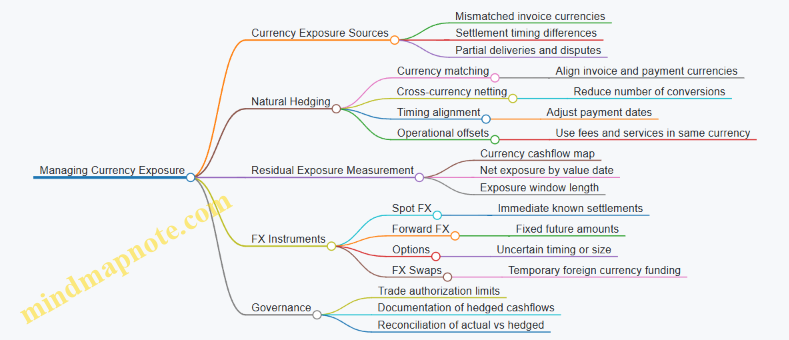
Worked Example with Integrated Logic
Assume a buyer expects three USD supplier payments: USD 2.0m in 10 days, USD 1.5m in 25 days, and USD 0.8m in 40 days. The buyer also expects USD receipts of USD 1.2m in 20 days and USD 2.0m in 45 days.
- Build net USD exposure by value date buckets.
- Days 0–10: net USD outflow USD 2.0m
- Days 10–20: net USD outflow USD 0.3m (USD 2.0m paid, USD 1.2m not yet received)
- Days 20–25: net USD outflow USD 1.5m minus USD 1.2m receipt effect, leaving USD 0.3m outflow until day 25
- Days 25–40: net USD outflow USD 0.8m (until day 40)
- After day 45: net USD inflow covers remaining
-
Apply natural hedging first.
If the buyer can shift one supplier payment by 5 days to align with the USD receipt on day 20, the early net outflow shrinks. That reduces the notional needed for FX hedges. -
Use FX instruments for what remains.
- For the day-10 USD 2.0m outflow, use forward FX if the amount is confirmed.
- For the day-40 USD 0.8m outflow, if delivery confirmation is still pending, use an option to protect against adverse moves while keeping flexibility.
- Keep governance tight. Each hedge should reference the underlying cashflow bucket and amount, so reconciliation is straightforward when actual settlement happens.
Practical Controls That Prevent “Accidental Exposure”
Track hedges against the same currency cashflow map used for natural hedging. When disputes or partial settlements change the final amount, adjust the hedge promptly rather than waiting for month-end. Also separate operational decisions (currency matching and timing alignment) from financial execution (spot, forward, options) so that each lever has clear ownership and measurable impact.
9.3 Selecting Payment Rails and Correspondent Banking Considerations
Payment rails are the routes money takes from payer to payee. In cross-border supply networks, the rail choice affects speed, cost, traceability, and how often payments get stuck in the middle of the chain. Correspondent banking considerations determine which banks handle the transfer along the way, and how smoothly instructions survive translation between systems.
Start with the Payment Job to Be Done
Before comparing rails, define the payment job in operational terms:
- Timing: Is the goal same-day settlement, end-of-day, or a specific value date?
- Amount pattern: Are payments many small invoices or fewer large settlements?
- Information quality: Do you reliably have invoice numbers, buyer references, and remittance details?
- Exception tolerance: How quickly can you investigate failed payments and resend corrected instructions?
Example: A buyer paying 2,000 invoices per week usually needs a rail that supports high-volume automation and clean remittance handling. A one-off settlement for a disputed batch may prioritize traceability and clear exception codes.
Compare Rails Using Practical Criteria
Evaluate rails against the realities of your workflow:
- Cutoff times and value dates: Some rails accept instructions later but still settle on the next business day.
- Fee model: Determine who bears fees (shared, sender-only, or receiver-only) and how that impacts net amounts.
- Message format compatibility: Rails differ in how they accept structured payment messages and remittance fields.
- Return and rejection behavior: Some rails return funds quickly with reason codes; others require manual investigation.
- Tracking granularity: You want a reference you can use across banks, not just a local confirmation.
A simple rule: if your finance team cannot reconcile within the same day, the rail is not “fast” in practice.
Choose Correspondent Banking Paths Carefully
Correspondent banks act as intermediaries when the payer’s bank and payee’s bank do not have a direct relationship. This introduces extra steps where instructions can be altered or delayed.
Key considerations:
- Correspondent coverage: Does the correspondent network reliably reach the payee’s bank and country?
- Instruction handling: Confirm how remittance details are carried through, especially when the rail uses intermediary hops.
- Operational controls: Ask how the correspondent handles rejected messages, missing fields, and name/address mismatches.
- Sanctions and screening: Ensure screening is performed consistently across parties and intermediaries.
- Fee transparency: Intermediaries may deduct fees without clear visibility, creating shortfalls.
Example: If your payment instructions include a long remittance narrative, one correspondent may truncate it. The payee then cannot match the payment to the invoice, and your dispute rate rises even though the payment “worked.”
Build a Rail Selection Matrix for Each Corridor
A corridor is a payer country to payee country pairing, often with specific bank combinations. Build a matrix that ties rail choice to corridor constraints:
- Preferred rail for normal volume
- Backup rail for cutoff misses or temporary failures
- Fallback correspondent set if a bank relationship is disrupted
- Remittance field rules for each corridor
Validate with Test Payments That Mirror Real Life
A rail that looks good on paper can fail in reconciliation. Test with realistic instructions:
- Use real invoice references and remittance fields you expect to carry.
- Send small controlled amounts first, then scale.
- Include at least one intentional error (e.g., wrong beneficiary reference) to observe rejection behavior.
- Confirm whether the payee receives the net amount you intended.
Example: If your process assumes that the payee will always receive the full invoice amount, run a test where fees are shared. If the payee receives less, update your pricing or fee allocation rules.
Document the Decision So Operations Can Execute It
Operational teams need rules they can follow under pressure:
- Which rail to use by corridor and payment type
- What remittance fields are mandatory and maximum length constraints
- How to handle returns, including who corrects instructions and within what timeframe
- The bank reference format required for reconciliation
A good decision record reads like a checklist, not a novel. When the first exception hits, that checklist is what keeps the payment from becoming a week-long scavenger hunt.
9.4 Handling Withholding Taxes Charges and Payment Instruction Variances
Withholding taxes and payment instruction variances are two different problems that often show up together. One reduces the amount the vendor receives; the other causes the payment to fail, be returned, or be booked to the wrong place. Treat them as a single workflow: determine the correct net amount, generate instructions that match the contract and invoice, and reconcile what actually happened.
Foundational Concepts That Drive Correct Handling
Start with three amounts that must be tracked separately:
- Invoice gross amount: what the vendor billed.
- Contractual tax treatment: whether withholding applies, who bears it, and what documentation is required.
- Payment net amount: what the payer should remit after withholding and any agreed charges.
Then define the two instruction types that can vary:
- Payment instruction fields: beneficiary name, bank account, routing, reference, and remittance details.
- Accounting and settlement fields: value date, currency, payment purpose code, and internal cost center or invoice linkage.
A common failure mode is mixing these. For example, teams may apply withholding to the invoice but still send instructions that reference the gross amount, which later triggers reconciliation breaks.
Withholding Taxes: Determination and Net Amount Calculation
-
Confirm whether withholding is required Use the invoice’s tax classification and the vendor’s jurisdiction. If the contract says withholding is the vendor’s responsibility, the payer still must compute and remit the correct amount, but the vendor may expect a different net.
-
Identify the withholding rate and basis The rate may depend on the payment type (goods vs services), treaty eligibility, or tax form status. For a concrete example: a vendor invoices EUR 100,000 for services. The applicable withholding rate is 10% on the gross. The payer remits EUR 90,000 and remits EUR 10,000 to the tax authority.
-
Decide who bears additional charges Some jurisdictions require the payer to cover bank fees charged by the tax authority or intermediary banks. If the contract states “withholding applies and all bank charges are borne by payer,” then the payer must ensure the vendor still receives the agreed net.
-
Generate a tax breakdown that matches the remittance reference Include a reference that allows the vendor to match the payment to the invoice and the withholding amount. If the vendor expects a statement, attach or transmit the withholding certificate number when available.
Charges: Bank, Intermediary, and Handling Fees
Charges can be deducted in two ways:
- Shared deduction: fees reduce the net received by the vendor.
- Gross payment with fee reimbursement: payer covers fees so vendor receives the intended net.
Example: A buyer pays USD 50,000 for an invoice. The contract specifies “vendor receives net of withholding; bank fees are borne by buyer.” If intermediary fees are USD 250, the buyer must either (a) increase the payment amount so the vendor still receives USD 50,000 minus withholding, or (b) reimburse the vendor separately with a clear reference.
To avoid surprises, define fee handling in the payment instruction: choose the correct charge option (e.g., shared vs bearer) and confirm it with treasury operations before sending.
Payment Instruction Variances: Preventing Failures and Misposting
Payment instruction variances include mismatched beneficiary details, incorrect currency, wrong value date, and inconsistent references. A practical way to manage this is to validate instructions against a “payment instruction checklist” derived from the contract and invoice.
Example variance set:
- Reference mismatch: invoice number in the remittance field differs by one character.
- Beneficiary name mismatch: legal entity name differs from the bank’s records.
- Currency mismatch: instruction currency set to USD while the invoice is EUR and FX conversion is required.
- Value date mismatch: instruction uses the invoice date instead of the agreed payment date.
Each variance creates a different downstream issue: reconciliation breaks, returned payments, or payments posted to an unlinked ledger account.
Integrated Workflow for Net Amount, Instructions, and Reconciliation
Use a single sequence so the numbers and fields stay aligned.
- Compute net amount using invoice gross, withholding rate, and agreed charge responsibility.
- Prepare payment instruction with beneficiary details, currency, value date, and a remittance reference that includes invoice identifier and withholding indicator.
- Run validation checks for reference format, currency, and beneficiary bank account.
- Send payment and capture the payment reference from the bank.
- Reconcile: compare intended net vs actual received, and compare tax remittance evidence vs expected.
- Resolve exceptions: if the payment returns or the vendor receives a different net, issue an adjustment with a clear explanation and matching reference.
Mind Map: Withholding Taxes and Payment Instruction Variances
Example: One Invoice, Two Countries, One Clean Outcome
A buyer pays a vendor for GBP 200,000. The invoice is for services. The vendor’s country requires 15% withholding. The contract states: “Buyer remits withholding and bears bank charges.”
- Withholding: GBP 30,000
- Intended vendor net: GBP 170,000
- Intermediary fees expected: GBP 500
The buyer sends a payment instruction configured so the vendor receives GBP 170,000 regardless of fees. The remittance reference includes the invoice number and a withholding indicator. After payment, treasury reconciles three items: the gross invoice linkage, the net received by the vendor, and the tax remittance evidence tied to the same invoice reference.
When this workflow is followed, reconciliation becomes a check rather than a detective story, and instruction variances stop being “mysteries” and start being controlled inputs.
9.5 Building Documentation Packs for Cross Border Compliance
Cross border funding pools fail in predictable ways: missing evidence, mismatched parties, unclear tax treatment, and payment instructions that don’t match what banks actually process. A documentation pack prevents those failures by collecting the minimum set of records needed to (1) prove eligibility, (2) justify payment and withholding outcomes, and (3) support audits and disputes.
Start with a Compliance Map of What Must Be Proven
A documentation pack should answer three questions for every funded invoice and every cross border payment run.
- Eligibility proof: Why this invoice can be funded under the program rules.
- Payment justification: Why the payment amount, currency, and timing are correct.
- Withholding and reporting basis: Why any tax or reporting treatment is applied.
A practical approach is to list each document by the specific claim it supports. For example, a proof of delivery document supports eligibility and dispute handling, while a tax residency certificate supports withholding decisions.
Define Pack Scope by Role and Jurisdiction
Different roles need different evidence. A buyer-sponsored program typically needs buyer-side confirmation, while vendor onboarding needs identity and eligibility criteria.
Use a pack structure that separates program-level documents from transaction-level documents.
- Program-level: master agreements, participation terms, governing law, dispute process, and cross border payment instructions.
- Transaction-level: invoice package, funding request evidence, tax forms, and payment confirmation.
Jurisdiction matters because banks and tax authorities care about different fields. For instance, some jurisdictions require specific tax form identifiers, while others focus on residency and beneficial ownership statements.
Build a Standard Template with Required Fields
A template should be consistent enough that operations can assemble it quickly, but flexible enough to handle exceptions.
Include a header section with:
- Program name and reference number
- Counterparty legal names and registration identifiers
- Invoice identifiers and dates
- Currency and settlement method
- Responsible party for approvals
Then include a checklist section that maps each required document to the claim it supports.
Mind Map: Cross Border Compliance Documentation Pack
Examples That Show What “Minimum Viable Evidence” Looks Like
Example: Invoice eligibility with delivery proof
- Invoice package includes the invoice, purchase order reference, and proof of delivery.
- If delivery is electronic, store the acceptance confirmation with a timestamp and the acceptance identifier.
- If the invoice is later disputed, the pack already contains the evidence needed to determine whether the dispute is valid under the program rules.
Example: Withholding decision with residency evidence
- The pack includes a tax residency certificate for the payee, plus a beneficial ownership statement if required by the program.
- A withholding calculation worksheet records the tax rate used, the basis for that rate, and the currency conversion method.
- When the bank remits funds, the payment confirmation is stored alongside the worksheet so the audit trail connects the calculation to the actual remittance.
Example: Payment instruction mismatch handling
- If a bank rejects a payment due to beneficiary details, the pack records the original instruction, the rejection reason, and the corrected instruction.
- The exception log links the corrected instruction to the same invoice reference so reconciliation remains consistent.
Add an Assembly Workflow So Packs Are Audit-Ready
A pack is only useful if it is assembled consistently.
- Pre-funding assembly: compile transaction-level documents before funding approval.
- Funding approval snapshot: store the approval record and the eligibility outcome.
- Post-payment closure: store bank confirmations, remittance advice, and any tax withholding confirmations.
Use version control for documents that can change, such as tax forms or corrected invoices. If a correction occurs, keep the original and the revised version, and record why the change was made.
Include a Simple Index and Naming Convention
Operations should be able to find documents in under a minute.
Adopt a naming convention that includes:
- Program reference
- Counterparty role (buyer or vendor)
- Invoice reference
- Document type
- Version number
Then include an index file listing each document and its purpose claim, such as “supports eligibility” or “supports withholding basis.”
Use a Date for Evidence Validity Windows
Some documents have validity windows, especially tax residency certificates. Record the certificate issue date and the validity end date, and enforce a rule that funding requests cannot proceed if the certificate is expired.
For example, if a residency certificate issued on 2026-02-26 is valid for 12 months, the pack must show that the funding date falls within the validity window.
Close with a Dispute-Ready Pack Standard
Cross border disputes often involve both eligibility and payment mechanics. Ensure the pack includes:
- the dispute notice
- the timeline of responses
- the revised calculation or matching outcome
- the final payment adjustment evidence
This keeps disputes from turning into document scavenger hunts, and it ensures the same evidence supports both operational resolution and audit explanations.
10. Operational Playbooks for Program Launch and Scale
10.1 Launch Readiness Checklist for Systems People and Controls
A launch-ready program is one where systems can submit, validate, fund, and reconcile transactions without heroic effort. The checklist below moves from basics to controls, then to operational readiness, using concrete examples so teams can test what “ready” means.
Scope and Success Criteria
Start by writing down what the system must do on day one.
- Define the transaction types: invoice funding, credit note adjustments, dispute holds, and repayments.
- Set measurable acceptance criteria: for example, “95% of funded items reconcile to bank statements within two business days.”
- List the first operational markets: include at least one domestic and one cross-border route if the program covers both.
Example: If the pool funds invoices, the system must accept invoice submissions, validate eligibility, generate funding instructions, and later reconcile settlement and repayments.
Data Foundations and Master Data Governance
Systems fail most often because the data model is incomplete or inconsistent.
- Party master data: legal entity name, tax identifiers, country, and settlement account mapping.
- Invoice master fields: invoice number, issue date, due date, currency, buyer reference, and line-level totals.
- Contract and eligibility parameters: tenor limits, allowed invoice types, dispute thresholds, and maximum concentration.
- Dispute and adjustment identifiers: stable keys that link credit notes and dispute events to original invoices.
Example: A buyer changes its invoice numbering format. If the system only stores “invoice number” as a free-text field, reconciliation breaks. Store buyer reference keys and validate format rules at submission.
Workflow States and Validation Controls
Define a workflow that prevents “half-funded” transactions.
- Submission: capture documents and metadata.
- Validation: check required fields, eligibility rules, and duplicate detection.
- Funding decision: approve, reject, or place on hold.
- Funding execution: create payment instructions.
- Settlement and reconciliation: match bank events to internal records.
Validation examples:
- Reject if invoice currency is not supported for the pool.
- Hold if proof of delivery is missing above a defined threshold.
- Reject duplicates using a composite key of buyer reference plus invoice number plus issue date.
Controls for Exceptions and Disputes
Exceptions are not edge cases; they are part of the workflow.
- Dispute hold rules: when a dispute is opened, freeze funding or cap additional funding.
- Partial payment handling: allow partial settlements and update remaining balances.
- Return and chargeback mapping: record reason codes and link them to the original funding event.
- Cure periods: define how long the system waits for corrected documents before escalation.
Example: If a credit note arrives after funding, the system should automatically reduce the outstanding amount and trigger a repayment adjustment workflow.
Payment Instruction Engineering
Systems must produce correct instructions, not just correct records.
- Value date and cutoff logic: ensure instructions are generated before bank cutoffs.
- Bank account selection: use the correct settlement account per counterparty and currency.
- Instruction completeness checks: beneficiary name, account details, reference fields, and remittance information.
- Idempotency: prevent duplicate payment instructions if a job retries.
Example: A retry job runs after a network timeout. Idempotency keys ensure only one payment instruction is created for the same funding event.
Reconciliation and Audit Trails
Reconciliation should be explainable by a person who was not on the original build.
- Reconciliation matching rules: reference fields first, then amount and currency, then timing windows.
- Exception queues: separate “unmatched,” “partially matched,” and “conflicting match” items.
- Audit trail: store who approved, what rule fired, and what data changed.
Example: If a funding decision changes due to updated eligibility, the audit trail should show the exact rule version and the specific data fields that changed.
Operational Readiness for Systems People
Make sure the people side can run the controls.
- Runbooks: step-by-step actions for unmatched payments, dispute spikes, and data correction requests.
- Escalation paths: who owns eligibility rules, who owns payment operations, and who approves overrides.
- Monitoring: alerts for job failures, validation error rates, and reconciliation backlogs.
- Access and segregation of duties: limit who can approve funding versus who can edit master data.
Launch Testing Plan with Evidence
Testing should produce evidence, not just “it worked on my machine.”
- Test cases by workflow state: submission, validation, hold, funding, settlement, repayment.
- Data quality tests: missing fields, wrong currency, duplicate invoices.
- Control tests: dispute hold triggers, concentration breaches, cutoff timing.
- End-to-end reconciliation tests: confirm bank events map to internal records.
Example: Run a scenario where 10 invoices are submitted, 2 are held due to missing proof, 1 is rejected for duplicate, and 7 are funded. Confirm the system produces the expected counts and reconciliation outcomes.
Mind Map: Launch Readiness Checklist
Go Live Gate Checklist
Before go-live, confirm each gate has an owner and a pass/fail outcome.
- Gate 1: data model and master data mappings validated with sample parties and invoices.
- Gate 2: workflow transitions tested with holds, rejections, and dispute adjustments.
- Gate 3: payment instruction generation tested with idempotency and cutoff timing.
- Gate 4: reconciliation rules tested with unmatched and partial match scenarios.
- Gate 5: monitoring, runbooks, and escalation paths tested via tabletop exercises.
Example: For a pilot starting on 2026-02-26, run the full checklist using a small set of invoices from each market route, then confirm reconciliation backlog stays within the acceptance criteria by the end of the first settlement cycle.
10.2 Pilot Design With Limited Scope and Measurable Acceptance Criteria
A pilot is a controlled experiment: you test the mechanics of funding, eligibility, and operations without betting the whole program on unproven assumptions. The goal is not to “see if it works,” but to prove that specific outcomes meet agreed thresholds under real workflow conditions.
Pilot Objectives and Boundaries
Start by writing three objective statements that are testable.
- Operational correctness: submissions, validations, funding draws, and repayments follow the defined workflow.
- Credit and eligibility correctness: only eligible invoices are funded, and ineligible items are rejected with traceable reasons.
- Settlement correctness: payment instructions, value dates, and reconciliation outputs match the rules.
Then set boundaries so the pilot stays small and interpretable.
- Counterparty scope: pick one buyer and a limited set of vendor counterparties, or one region with multiple vendors.
- Invoice scope: limit to a narrow invoice profile (e.g., single currency, standard terms, low dispute history).
- Tenor scope: restrict to one or two funding tenors.
- Volume scope: choose a volume that stresses throughput but does not overwhelm manual review (for example, 200–500 invoices over 4–6 weeks).
A practical rule: if a failure occurs, you should be able to identify the responsible control within one working day.
Acceptance Criteria That Can Be Measured
Define acceptance criteria as thresholds tied to evidence you can collect.
A. Eligibility and underwriting outcomes
- Eligibility accuracy: at least 98% of funded invoices meet stated eligibility rules.
- Rejection reason quality: 100% of rejected invoices include a reason code that maps to a documented rule.
- Dispute handling: any invoice flagged for dispute is either excluded or routed to a defined exception path within the same operational window.
B. Workflow performance
- Submission-to-decision time: 90% of submissions receive a decision within the target SLA (e.g., same day for standard cases).
- Exception resolution time: 80% of exceptions are resolved or escalated within the agreed cure window.
- Data completeness: required fields are present for at least 99% of submissions.
C. Funding and repayment mechanics
- Draw correctness: funded amounts match invoice totals after applying approved discounts, caps, and adjustments.
- Repayment correctness: repayments reconcile to expected amounts and dates with no unexplained deltas beyond a defined tolerance.
D. Reconciliation and audit evidence
- Reconciliation completeness: 100% of funded items appear in reconciliation outputs.
- Audit trail integrity: every funding decision has a stored decision record, including rule version and approver identity.
Pilot Design Steps from Setup to Evidence
- Choose the pilot scenario: one end-to-end path (e.g., buyer-sponsored receivables pool with vendor submissions).
- Freeze the ruleset: lock eligibility rules, cutoff times, and exception handling for the pilot window.
- Prepare test data and a live run: run a small dry test first, then switch to live submissions.
- Define roles and escalation: name a workflow owner, a credit/eligibility reviewer, and a settlement reconciler.
- Instrument the process: ensure logs capture rule outcomes, timestamps, and reconciliation identifiers.
- Run a weekly control review: compare actual outcomes to acceptance thresholds and fix only what is necessary to remove defects.
On the calendar, a common pilot window is 2026-02-15 to 2026-03-15, which gives enough time to observe multiple submission cycles without dragging on.
Mind Map: Pilot Scope and Acceptance Criteria
Pilot Design Mind Map
Example Pilot Plan with Concrete Thresholds
Assume a buyer-sponsored receivables pool pilot.
- Scope: one buyer, 15 vendors, one currency, standard payment terms, two tenors.
- Volume: 300 invoices over 5 weeks.
- Acceptance thresholds:
- Eligibility accuracy: 98%
- Submission-to-decision SLA: 90% within same day
- Data completeness: 99%
- Draw correctness: zero unexplained deltas beyond tolerance
- Reconciliation completeness: 100%
If eligibility accuracy lands at 96%, you do not “accept with a note.” You identify which rule(s) caused the misses, correct the rule mapping or data requirement, rerun the affected subset, and re-measure until thresholds are met.
Example Exception Handling During the Pilot
Define one exception type and test it deliberately.
- Scenario: proof of delivery arrives after invoice submission.
- Expected behavior: invoice is either held until proof arrives or routed to an exception queue with a documented decision by a named reviewer.
- Acceptance evidence: each instance shows the timestamp of routing, the reviewer decision, and the final funding outcome.
This keeps exceptions from becoming informal “tribal knowledge,” which is where pilots quietly fail.
Go/No-Go Decision Criteria
At the end, the decision is based on the measured thresholds and the completeness of evidence. Residual gaps are allowed only if they are explicitly categorized as non-blocking and have a documented mitigation plan for the next phase, with the same evidence standard applied.
10.3 Scaling Eligibility Volumes Without Compromising Controls
Scaling eligibility volumes means more invoices, more counterparties, more countries, and more operational events per day—without letting credit, legal, and data controls drift. The trick is to treat eligibility as a system with measurable gates, not a one-time checklist.
Start with What Must Never Break
Eligibility controls usually fail in predictable places: data quality, timing, and exception handling. Before increasing volume, define three invariants that remain true at all scales:
- Every funded invoice has a verifiable eligibility record (party, terms, goods or services reference, and dispute status).
- Every eligibility decision is reproducible using stored inputs and rule versions.
- Every exception is routed to the correct owner within a fixed time window.
A practical way to enforce this is to map each control to an input dataset, a decision rule, an evidence artifact, and a monitoring metric.
Build a Capacity Model for the Eligibility Pipeline
Eligibility is a pipeline: ingestion → validation → underwriting checks → legal checks → funding readiness. Scaling volumes without compromising controls requires knowing where the bottleneck is.
Create a simple capacity model with three numbers per stage: average processing time, peak processing time, and maximum queue length. For example, if invoice validation averages 30 seconds but spikes to 3 minutes during ERP outages, you need queue buffers and fallback behavior. Otherwise, the system “works” in tests and fails on launch day.
Use a load test scenario that mirrors real operations: mixed invoice ages, partial deliveries, and a realistic dispute rate. If you only test clean invoices, you will scale the wrong thing.
Use Tiered Eligibility with Clear Escalation Rules
Not all invoices require the same depth of review. Tiered eligibility keeps controls strong while reducing unnecessary friction.
- Tier 1: Auto-eligible when data completeness is high and counterparties are within established limits.
- Tier 2: Rule-checked when one attribute is unusual but still within safe bounds.
- Tier 3: Manual review when legal or credit constraints are triggered.
Example: A vendor’s invoices are normally eligible for 60-day terms. When a new buyer requests 120-day terms, the invoice moves from Tier 1 to Tier 3. The control is not “more manual work”; it is “more targeted review.”
Escalation rules must be explicit. Define what changes the tier: missing proof of delivery, mismatched currency, new country routing, or dispute flags. Then ensure the workflow state machine matches those rules.
Version Rules and Evidence So Decisions Stay Auditable
Scaling increases the number of decisions, which increases the chance that someone cannot explain why an invoice was eligible. Solve this by versioning:
- Rule set version used for the decision
- Data snapshot identifiers for the inputs
- Evidence artifacts stored at decision time
Example: If a dispute rate threshold changes on 2026-02-20, the system must still show which threshold applied to invoices submitted on 2026-02-10. Without this, audits become archaeology.
Apply Guardrails on Volume, Not Just on Risk
Risk controls alone do not prevent operational overload. Add guardrails that throttle or pause eligibility when system health degrades.
Common guardrails include:
- Maximum number of invoices per counterparty per day
- Maximum queue length per workflow stage
- Maximum percentage of invoices entering Tier 3
- Maximum reconciliation failures per batch
Example: If Tier 3 share jumps from 2% to 15% after a new ERP mapping release, you pause auto-eligibility and route the batch to a controlled review lane. You are not stopping because the business is “bad”; you are stopping because the data pipeline is misbehaving.
Monitor Control Effectiveness with Leading Metrics
After scaling, you need metrics that indicate control drift early.
- Eligibility completeness rate: percent of invoices with all required fields
- Evidence coverage rate: percent with stored proof artifacts
- Exception routing time: time from exception creation to owner assignment
- Dispute and chargeback correlation: whether eligibility decisions align with later outcomes
Example: If evidence coverage drops, you will see higher dispute rates later. Catch it now, not after the funding pool has already absorbed the cost.
Mind Map: Scaling Eligibility Volumes
Example Workflow: From 10,000 to 50,000 Invoices per Month
Start with a pilot that increases volume in steps, not one leap. For each step, confirm four things: Tier distribution stays within bounds, evidence coverage remains stable, exception routing time does not breach the window, and rule versions match the expected release.
If any metric breaks, you do not “fix later.” You roll back the eligibility rule version or the data mapping release, then re-run the same load scenario. Scaling is successful when the control system behaves the same way under higher volume—like a well-labeled circuit breaker, not like a mystery box.
10.4 Managing Change Requests for Terms Eligibility and Workflows
Change requests are where good programs either stay stable or quietly drift into chaos. In liquidity engineering, “terms eligibility” affects what can be funded, while “workflows” determine how quickly and correctly those terms become funding decisions. A solid change process keeps both aligned with contracts, data, and operational reality.
Start with a Change Intake That Captures Meaning
A change request should state what changes, where it applies, and what “success” looks like. For example, suppose a buyer wants to add a new invoice type eligible for funding: “service invoices with proof of delivery.” The intake should capture:
- Eligibility scope: which buyer(s), supplier(s), countries, and invoice categories.
- Term parameters: required fields, acceptable payment terms, and any exclusions (e.g., disputed lines).
- Workflow impact: whether the new invoice type changes validation steps, matching rules, or approval routing.
- Operational constraints: expected volume, peak timing, and system dependencies.
A practical intake template can be as simple as a checklist plus a short narrative. The narrative matters because it prevents the team from implementing the “what” while missing the “why.”
Classify Changes by Risk and Reversibility
Not all changes deserve the same level of ceremony. Classify each request into tiers based on funding impact and rollback difficulty.
- Tier 1: Low Risk: formatting changes that do not alter eligibility logic, such as adding a label to an existing invoice category.
- Tier 2: Medium Risk: eligibility rule changes that affect validation or routing but can be isolated by buyer or date.
- Tier 3: High Risk: changes that alter core matching logic, dispute handling, or cross-border settlement instructions.
Example: If you change the required proof-of-delivery field from “signed PDF” to “carrier scan reference,” that’s Tier 2 because it changes validation criteria. If you change the matching logic from invoice-level to line-level, that’s Tier 3 because it can change funding outcomes.
Validate Against Contracts, Data, and Controls
Before any system work, confirm the change is consistent with the program agreement and operational controls.
- Contract alignment: ensure the new eligibility terms are explicitly permitted and that dispute and setoff clauses still apply.
- Data readiness: verify the required fields exist in source systems and are populated reliably.
- Control coverage: identify which checks must be updated, such as duplicate detection, invoice-to-PO matching, and dispute-rate thresholds.
Concrete example: A request to allow invoices with partial deliveries must specify how partial delivery is represented in data. If the workflow currently assumes full delivery, you’ll need a new rule for acceptable partial proof and a clear way to prevent funding for lines that are still undelivered.
Design Workflow Changes as State Transitions
Workflow updates should be described as transitions between states, not as a vague “add a step.” This reduces ambiguity between finance, operations, and engineering.
Example state transitions for a new eligibility rule:
- Submitted → Validated when required proof-of-delivery fields are present.
- Validated → Eligible when invoice type and payment terms match the new criteria.
- Eligible → Funded only after matching rules confirm the invoice lines map to approved PO lines.
- Validated → Exception if proof-of-delivery is missing or inconsistent.
Implement with Configuration First, Then Code
Where possible, implement eligibility changes through configuration to reduce deployment risk. Use code changes only when logic cannot be expressed safely in configuration.
Example: Adding a new invoice category to an eligibility list is configuration. Changing the dispute handling rule from “invoice-level dispute blocks funding” to “line-level dispute blocks funding” likely requires code and careful testing.
Include a rollback plan. For a Tier 2 change, rollback might mean reverting eligibility configuration for affected buyers starting from a specific cutoff date. Use a cutoff date such as 2026-02-15 to keep audit trails consistent.
Test with Scenarios That Mirror Real Exceptions
Testing should include normal flows and the annoying ones.
- Happy path: eligible invoice with complete proof and correct matching.
- Missing data: proof-of-delivery present but missing the reference field.
- Dispute edge: invoice contains both disputed and non-disputed lines.
- Timing edge: invoice submitted after the workflow cutoff calendar.
Example: If the new rule allows “carrier scan reference,” test how the system behaves when the reference exists but the scan date is outside the allowed window.
Release with a Pilot Window and Clear Metrics
A pilot window limits blast radius and provides evidence that the workflow behaves as intended.
Metrics to track during the pilot:
- Eligibility acceptance rate by buyer and invoice type.
- Exception rate and top exception reasons.
- Funding cycle time from submission to funding decision.
- Reconciliation accuracy between workflow decisions and settlement outcomes.
Example: If acceptance rate drops sharply, you likely missed a required field mapping or a validation rule is too strict.
Close the Loop with Documentation and Training Updates
Closure is not paperwork for its own sake. Update:
- eligibility rule documentation,
- workflow state definitions,
- exception reason codes,
- and operator training scripts.
Example: If the workflow now routes “proof-of-delivery missing” to a different approval queue, training should include the exact reason code so operations do not improvise.
Keep Decisions Traceable Through an Audit-Ready Record
Every change should leave a trace: who requested it, what was approved, what was implemented, and how it was tested. When disputes or audits happen, the team should be able to answer two questions quickly: “What rule applied?” and “Why did the workflow choose that path?”
10.5 Training Materials And Escalation Paths For Disputes And Exceptions
Training for disputes and exceptions should be built like the workflow itself: start with what “normal” looks like, then teach people how to recognize deviations, and finally show exactly where decisions get made. The goal is simple—fewer surprises, faster resolution, and consistent evidence.
Training Materials That Match Real Work
1) Start with the dispute lifecycle. Teach the full sequence: invoice submission → validation → funding decision → payment execution → reconciliation → dispute intake → investigation → resolution → closure and reporting. Use one running example throughout training.
Example: A vendor submits an invoice for 10,000 EUR with proof of delivery attached. The system validates required fields, funds the invoice, and schedules payment. Two days after payment, the buyer reports a quantity mismatch and requests a credit note.
2) Teach “exception categories” before “exception handling.” People handle exceptions better when they know what kind they are. Use a small taxonomy:
- Data exceptions: missing fields, wrong currency, mismatched invoice number.
- Eligibility exceptions: invoice not eligible due to terms, dispute flags, or buyer restrictions.
- Execution exceptions: payment failed, wrong value date, partial payment.
- Dispute exceptions: buyer claims nonconformance, quantity/price mismatch, or documentation issues.
3) Provide role-based scripts. Each role should have a short script that answers: what to check, what to collect, and what to do next.
- Operations analyst: verify evidence completeness and system status.
- Credit/underwriting reviewer: assess whether the dispute changes risk or eligibility.
- Treasury/payment specialist: confirm settlement instructions and bank outcomes.
- Legal/contract owner: confirm rights for setoff, assignment, and dispute timelines.
Escalation Paths That Prevent Ping-Pong
Escalation should be a ladder with clear rungs, not a maze. Define triggers, owners, and response times. Keep the ladder consistent across regions.
Escalation triggers should be measurable, such as:
- Dispute filed within the allowed window and supported by documentation.
- Payment failure after retry attempts.
- Eligibility breach discovered after funding.
- Dispute that affects principal amount or payment timing.
Escalation owners should be named by function, not by “whoever is available.”
Response expectations should be stated as targets for first acknowledgement and for resolution milestones.
Mind Map: Dispute Intake to Closure
Example: A Quantity Mismatch That Becomes an Escalation
Scenario: Buyer disputes an invoice because the delivered quantity is 8,000 units instead of 10,000. The vendor attached proof of delivery, but it shows partial delivery across two dates.
Step 1: Operations triage. Confirm the dispute reason code and verify whether the invoice matching rules require a single delivery record or allow multiple.
Step 2: Evidence gap check. If the proof of delivery is split, request the missing delivery note or confirm the system can aggregate deliveries.
Step 3: Decision gate. If the mismatch changes the funded amount, escalate to credit/underwriting for eligibility impact. If the dispute affects payment timing, escalate to treasury for settlement handling.
Step 4: Closure. Record the resolution as either an accepted credit note or an invoice adjustment, then tag the root cause as “matching rule interpretation” or “documentation completeness.”
Training Exercises That Build Consistency
Exercise A: Evidence completeness drill. Provide five dispute packets with missing items. Trainees must mark what is missing, what can be decided immediately, and what must be escalated.
Exercise B: Escalation ladder simulation. Give a case where payment failed once, then succeeded, and a dispute arrives afterward. Trainees must decide whether to pause reconciliation, how to preserve audit trail evidence, and which owner gets the next action.
Exercise C: Closure quality check. After a resolution, trainees review whether the record includes: decision rationale, supporting evidence references, and the correct status transitions.
Mind Map: Escalation Ladder and Decision Gates
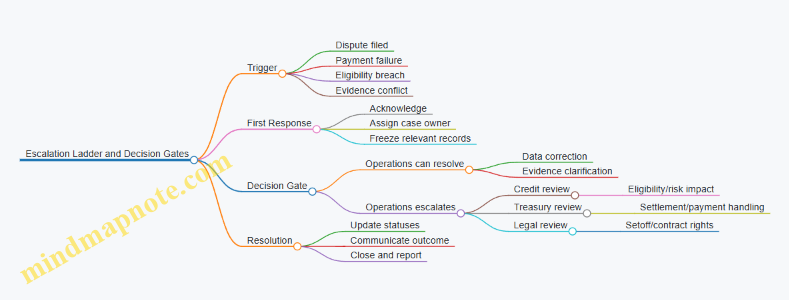
Escalation Communication Templates
Use short templates to reduce ambiguity.
Template 1: Escalation request. Include invoice reference, dispute category, amount/currency, current payment status, evidence received, and the exact question to be answered.
Template 2: Resolution notice. Include decision outcome, what changed (if anything), and what the next operational step is for reconciliation.
Template 3: Closure summary. Include root cause tag and whether the case required cross-functional review.
Example: “Escalate to Treasury: Invoice INV-1042, 10,000 EUR, payment status ‘failed then retried’, value date mismatch suspected. Evidence: bank return code and payment instruction record attached. Question: which value date governs reconciliation for this case?”
Practical Guardrails for Training
Teach trainees to preserve the audit trail by avoiding manual edits without a documented reason. Also teach them to separate “what happened” from “what we think caused it,” so investigations remain grounded in evidence rather than assumptions.
11. Case Based Implementation Patterns Across Supply Networks
11.1 Implementing a Buyer Sponsored Receivables Pool With Vendor Onboarding
A buyer sponsored receivables pool lets a buyer fund vendor invoices by purchasing or financing receivables, typically through a structured program. The buyer’s role matters: vendors get faster cash, while the buyer gains tighter control over payment timing and invoice quality. The pool works only if onboarding, eligibility, and settlement are engineered so that “what gets funded” is unambiguous.
Core Setup and Roles
Start with a clear division of responsibilities.
- Buyer sets program rules, approves eligibility, and provides payment instructions.
- Vendors submit invoices and supporting documents.
- Pool administrator or funding entity validates submissions, calculates funding amounts, and manages drawdowns and repayments.
- Servicer or operations team handles reconciliation, disputes, and exception workflows.
A practical starting point is a single buyer with a limited set of vendors and one or two invoice types. This keeps the first version small enough that you can fix process issues without rewriting the whole program.
Vendor Onboarding That Actually Works
Onboarding should be a checklist with evidence, not a form with good intentions.
-
Vendor identity and legal status
- Collect legal entity name, tax identifiers, bank account details, and authorized signatories.
- Example: A vendor submits invoices under a trading name; the program requires the invoice issuer to match the legal entity on file. If it doesn’t, the invoice is rejected before funding.
-
Contract alignment
- Confirm that purchase orders, pricing terms, and delivery obligations exist and match the program’s invoice format.
- Example: If the contract requires delivery confirmation, invoices lacking proof of delivery are ineligible.
-
Invoice format and submission channel
- Define required fields: invoice number, PO reference, delivery date, currency, line items, and tax breakdown.
- Example: If tax is missing, the pool can’t compute the funded amount consistently, so the invoice goes to “data exception.”
-
Dispute and returns readiness
- Require a documented dispute process with timelines.
- Example: If a vendor disputes a deduction, the program specifies what evidence is needed and how long the buyer has to respond.
Eligibility Rules and Funding Logic
Eligibility rules prevent funding the wrong receivables. Keep them measurable.
- Invoice age: only invoices issued within a defined window are eligible.
- Buyer approval status: invoices must be matched to an approved PO and delivery record.
- Credit limits: vendors can be capped by concentration and historical performance.
- Dispute status: invoices with open disputes are either excluded or funded at a reduced percentage.
Example funding logic for a first release:
- Fund 90% of eligible invoice value on submission.
- Hold 10% as a reserve until delivery confirmation and buyer acceptance are complete.
- If a dispute is opened within the agreed window, the reserve is used to cover deductions.
This approach reduces operational friction because it gives teams time to resolve disputes without stopping the whole program.
Operational Workflow from Submission to Settlement
A buyer sponsored pool needs a predictable workflow with clear states.
- Submission: vendor sends invoice and required documents.
- Validation: system checks completeness and format.
- Matching: invoice is matched to PO and delivery records.
- Eligibility decision: eligible invoices are approved for funding; ineligible ones are routed to exceptions.
- Funding: administrator pays the vendor (or credits the vendor account).
- Repayment: on the buyer’s scheduled payment date, the buyer pays the pool.
- Reconciliation: differences due to deductions, returns, or corrections are processed.
Example exception handling:
- If PO reference is missing, the invoice is “rejected” and the vendor must resubmit.
- If delivery proof is missing but PO exists, the invoice is “pending” and can be funded only after proof arrives.
Mind Map: Buyer Sponsored Pool with Vendor Onboarding
Example Implementation Plan for a First Cohort
Use a staged rollout so process issues surface early.
- Week 1–2: finalize invoice schema, matching rules, and exception categories.
- Week 3–4: onboard 3–5 vendors with one contract each; run parallel testing with real invoices.
- Week 5: start funding with the reserve policy and strict eligibility checks.
- Week 6: review exception volumes and tighten rules that cause repeated rejects.
A small but concrete success metric is operational: the share of invoices that reach “eligible decision” without manual intervention. If that number is low, the fix is usually data mapping and evidence requirements, not more approvals.
Controls That Keep the Pool Clean
Finally, treat governance as part of the product.
- Maintain an audit trail of eligibility decisions, including why an invoice was rejected or funded.
- Use role-based approvals for changes to eligibility rules and vendor master data.
- Define service-level expectations for exceptions so vendors know what to do next.
When onboarding, eligibility, and workflow states are aligned, the pool behaves like a system rather than a series of emails. That’s the whole point: fewer surprises, faster funding, and cleaner reconciliation.
11.2 Implementing a Multi Buyer Pool With Shared Eligibility Standards
A multi buyer pool lets several buyers fund vendor invoices using one shared set of rules. The trick is to standardize eligibility without pretending every buyer behaves the same. You want one pool workflow, plus buyer-specific parameters where they truly matter.
Foundational Setup and Role Clarity
Start by defining who does what. The pool sponsor (often a treasury or finance team) owns the pool agreement and governance. Each buyer becomes an eligibility source because invoice acceptance and dispute handling are buyer-specific. Vendors are the funding beneficiaries, and the administrator runs daily operations like submission checks and funding releases.
A practical way to avoid confusion is to map responsibilities to artifacts:
- Buyer produces acceptance evidence and dispute status.
- Vendor submits invoice data and supporting documents.
- Administrator validates completeness, eligibility, and matching.
- Sponsor approves exceptions and sets concentration limits.
Shared Eligibility Standards That Actually Work
Shared eligibility standards cover the “shape” of invoices and the “rules” for whether they can be funded. Keep the standards stable and parameterize the differences.
Define eligibility in three layers:
- Invoice Quality Rules: invoice must be within allowed tenor, have a valid invoice number, and include required fields (buyer ID, invoice date, due date, currency, line totals).
- Commercial Validity Rules: goods or services must be tied to an approved order or contract reference; proof of delivery or service confirmation must meet a minimum threshold.
- Risk Controls: dispute rate limits, buyer concentration limits, and minimum credit enhancement coverage.
Then parameterize buyer-specific items:
- Allowed invoice tenors and maximum invoice amounts.
- Dispute cure windows and acceptable proof types.
- Preferred settlement dates and any local banking constraints.
Mind Map: Multi Buyer Pool Eligibility and Operations
Operational Flow with Concrete Examples
Use a single submission format for all buyers. Example: Vendor submits an invoice for Buyer A and Buyer B using the same fields, but the due date rules differ.
Example 1: Shared Quality, Buyer-Specific Tenor
- Shared rule: invoice due date must be between 30 and 120 days from invoice date.
- Buyer A parameter: maximum funded amount per invoice is 500,000.
- Buyer B parameter: maximum funded amount per invoice is 250,000.
If the invoice is 90 days and otherwise complete, it passes shared quality. The administrator then applies the buyer parameter to determine the maximum draw.
Example 2: Shared Proof Requirements, Different Proof Types
- Shared rule: proof must show delivery or service completion.
- Buyer A accepts a signed delivery note.
- Buyer B accepts a system-generated service completion timestamp.
The workflow stays the same, but the proof validator uses buyer-specific acceptable evidence mappings.
Credit and Concentration Controls Without Overcomplication
Multi buyer pools fail when one buyer dominates utilization. Set concentration limits at two levels:
- Per buyer: cap funded exposure as a percentage of pool size.
- Per segment: group buyers by country, industry, or payment behavior and cap each group.
A simple example: pool size is 100 million. You set per buyer cap at 20% (20 million) and per country cap at 40% (40 million). When Buyer C invoices would push exposure above 20 million, the administrator routes them to an exception queue instead of rejecting everything.
Exception Handling That Keeps the Pool Running
Exceptions should be rare and structured. Create a short list of exception categories:
- Missing proof but within a defined “resubmission window.”
- Dispute flagged but within cure period.
- Data mismatch that can be corrected by a buyer confirmation.
Example 3: Dispute Flag Within Cure Period
- Shared rule: disputes are eligible for funding only if they are within the buyer’s cure window.
- Buyer A cure window is 15 days; Buyer B cure window is 30 days.
If the dispute is 10 days old for Buyer A, the invoice can be funded under shared logic. If it is 25 days old for Buyer B, it is still eligible. The same dispute status field drives both outcomes.
Evidence, Decision Logs, and Rule Versioning
To keep audits calm, store three things for every funding decision:
- The ruleset version used.
- The data snapshot used for matching and validation.
- The buyer acceptance and dispute status snapshot.
This prevents “but we changed the rule last week” from becoming a recurring plot twist. It also makes reconciliation straightforward when invoices are partially paid or corrected.
Implementation Checklist for the First Multi Buyer Launch
- Confirm shared eligibility layers and define buyer parameters.
- Build a proof mapping table by buyer.
- Set per buyer and per segment concentration limits.
- Define exception categories and who approves each.
- Validate the end-to-end workflow using a small set of invoices from each buyer.
- Run reconciliation tests for mismatches, resubmissions, and dispute cures.
Once these pieces are in place, the pool behaves consistently across buyers while still respecting the differences that matter.
11.3 Implementing a Payables Funding Structure with Payment Date Optimization
Payables funding structures let a buyer turn supplier invoices into earlier cash for vendors while the buyer pays on an optimized schedule. Payment date optimization is the part that makes the structure operationally useful: it aligns funding draw dates, payment dates, and reconciliation so the buyer avoids accidental early payments and vendors receive predictable cash.
Core Building Blocks
Start with three dates per invoice: (1) invoice date, (2) scheduled payment date under the buyer’s terms, and (3) funding date when the vendor receives cash from the pool. In a typical setup, the vendor can request funding before the buyer’s scheduled payment date. The buyer then pays the pool on the scheduled payment date, not on the funding date.
Example: A buyer has 60-day terms. A vendor submits an invoice on day 10. The vendor requests funding on day 20 and receives cash then. The buyer pays the pool on day 70 (day 10 + 60). The pool absorbs the time gap, so pricing and risk controls must reflect that gap.
Step 1: Define Eligibility and Timing Rules
Eligibility rules prevent “funding on bad data.” Require a clean invoice status and a matching purchase order. Also define what counts as a valid funding request window.
Practical rules that work:
- Funding request must be submitted by a cutoff time on the business day before the desired funding date.
- Funding is allowed only for invoices that are not disputed and have proof of delivery or service acceptance where applicable.
- Partial funding is either allowed with clear limits or disallowed to keep reconciliation simple.
Example: If proof of delivery is missing, the system routes the invoice to “hold” and the vendor can still be paid later on the buyer’s scheduled date, but funding is blocked.
Step 2: Engineer Payment Date Optimization
Payment date optimization means choosing the buyer’s payment schedule so it supports funding without creating operational chaos. The simplest approach is to standardize payment dates into a small set of weekly or biweekly value dates.
Operational logic:
- The pool needs predictable settlement dates to manage liquidity.
- Vendors need predictable funding availability.
- The buyer needs stable bank instructions and reconciliation windows.
Example: Instead of paying every invoice on its own day, the buyer pays all eligible invoices on two value dates per week. If a vendor requests funding on a Wednesday, the pool can still settle with the buyer on the next scheduled value date.
Step 3: Set Up the Funding and Repayment Cycle
A clean cycle reduces disputes and accounting surprises.
- Vendor submits invoice and funding request.
- Pool validates eligibility and confirms the funding date.
- Pool pays the vendor on the funding date.
- Buyer confirms invoice acceptance and schedules repayment on the optimized payment date.
- Pool reconciles repayment against funded invoices.
Example: An invoice funded on day 20 is repaid by the buyer on the next optimized value date, say day 25. The pool’s internal ledger records the funded amount and the expected repayment date so treasury can plan cash.
Step 4: Pricing and Fee Mechanics Tied to Dates
Pricing should depend on the time between funding date and repayment date. Keep the formula transparent so finance teams can explain it.
A practical fee structure:
- Vendor receives invoice amount minus a discount for the funding period.
- Buyer pays the pool the invoice amount on the optimized payment date.
- The pool charges an administration fee per funded invoice.
Example: If funding is requested 10 days before repayment, the discount rate applies to those 10 days. If the buyer’s optimized schedule changes, the discount period changes too, so the system must compute it from the actual repayment date.
Step 5: Reconciliation and Exception Handling
Exceptions are where good designs go to die, so handle them explicitly.
Common exceptions:
- Invoice rejected by buyer after funding request.
- Partial delivery or service dispute.
- Payment instruction errors or bank cutoffs.
Controls that prevent mess:
- A dispute window that starts from invoice acceptance, not from funding.
- Clear rules for how reversals work when an invoice is later rejected.
- Automated matching of repayment remittance advice to funded invoice IDs.
Example: If a buyer rejects an invoice within a defined cure period, the pool reverses the funding discount and adjusts the repayment amount. If the repayment already occurred, the system posts a credit note reconciliation for the next settlement batch.
Mind Map: Payables Funding with Payment Date Optimization
Worked Example with Concrete Dates
Assume a buyer uses two value dates per week and a vendor requests funding on 2026-02-26. The buyer’s optimized repayment value date for that invoice is 2026-03-03.
- Invoice submitted: 2026-02-20
- Funding request: 2026-02-26
- Funding date to vendor: 2026-02-26
- Repayment value date by buyer: 2026-03-03
- Funding period for discount: 5 business days (based on the actual calendar used by the system)
The system computes the discount using the funding period between funding date and repayment value date, then reconciliation confirms that the buyer’s remittance advice matches the funded invoice ID and amount on 2026-03-03.
Implementation Checklist
- Define eligibility and funding request cutoffs.
- Standardize repayment value dates into a small cadence.
- Implement a funding-to-repayment ledger that records expected repayment dates.
- Tie discount calculation to actual repayment value dates.
- Build exception workflows for rejection, disputes, and reversals.
- Ensure reconciliation matches by invoice ID and remittance advice fields.
11.4 Implementing a Cross Border Pool With FX and Tax Handling Controls
Cross border pools fund invoices across countries, but the “pool” is only as stable as its settlement mechanics. The core idea is simple: every drawdown must map to a specific invoice set, a specific currency plan, and a tax treatment that both parties can execute without last-minute surprises.
Foundational Setup for Cross Border Eligibility
Start by defining what qualifies for funding when multiple jurisdictions are involved. Eligibility should include: invoice currency, buyer country, vendor country, payment rail availability, and whether the invoice is subject to withholding tax. A practical rule: if you cannot produce a tax instruction and a payment instruction that match the invoice data, the invoice does not enter the pool.
Example: A buyer in Germany purchases from a vendor in India. The pool accepts invoices in EUR and INR, but only routes INR invoices through a rail that supports the required remittance details. If the vendor’s bank account format is missing SWIFT fields, the invoice is held in a “ready for funding” queue rather than funded.
FX Handling Controls That Prevent Settlement Drift
FX risk shows up as timing differences and rounding differences, not just rate volatility. Implement three controls.
-
Rate Source and Timestamp: Choose a single rate source and lock the rate at a defined event, such as funding approval time or payment instruction generation time. Document the timestamp rule so disputes have a clear anchor.
-
Currency Conversion Ledger: Maintain a conversion ledger that records original amount, FX rate, converted amount, and rounding method. This ledger should reconcile to both the funding drawdown and the final payment.
-
Tolerance Bands: Define allowable differences between expected and actual converted amounts. If the difference exceeds tolerance, the system should require a manual review before final settlement.
Example: An invoice is 100,000 INR. The locked FX rate converts it to 1,120.50 EUR. If the payment processor returns 1,120.47 EUR due to bank fees or rounding, the tolerance band determines whether the pool auto-accepts or triggers an exception workflow.
Tax Handling Controls That Match Real Payment Instructions
Withholding tax is where cross border programs often stumble because tax treatment depends on documentation, not just country. Build tax handling as a deterministic workflow.
-
Tax Classification Per Invoice: Store tax status fields at the invoice level, including whether withholding applies, the rate, and the treaty position if relevant.
-
Documentation Readiness: Require a “tax packet” before funding. The packet typically includes forms or certificates needed to justify reduced withholding. If the packet is incomplete, route the invoice to a higher-withholding path or exclude it.
-
Instruction Generation: Generate payment instructions that reflect the tax outcome. The instruction should separate gross amount, withholding amount, and net remittance.
Example: A French buyer pays a US vendor. If treaty documentation is present, withholding is 0%. If it is missing, withholding is 30%. The pool must generate two different instruction templates, not a single template with a manual note.
Operational Workflow from Drawdown to Reconciliation
A cross border pool needs a clear state machine.
- Submission: invoice data arrives with buyer and vendor identifiers, currency, and tax classification.
- Validation: system checks eligibility, tax packet completeness, and required bank fields.
- FX Lock: rate is locked at the defined event, and the conversion ledger is created.
- Funding Drawdown: pool funds the vendor side according to the conversion ledger.
- Payment Execution: payment is sent with gross/withholding/net fields.
- Reconciliation: compare expected net remittance to actual net received; record any differences.
Example: If the payment execution returns a different net amount due to bank charges, reconciliation should attribute the difference to “bank fees” rather than “FX mismatch,” so the FX ledger remains consistent.
Mind Map: Cross Border Pool Controls
Example: One Pool, Two Jurisdictions, One Set of Rules
Assume a pool funds invoices from vendors in the UK to buyers in Spain.
- UK invoices arrive in GBP.
- The pool locks an FX rate when funding is approved.
- Tax classification is determined per invoice based on documentation status.
- Payment instructions are generated with gross, withholding, and net remittance.
If an invoice lacks the tax packet, the pool routes it to the “withholding applies” instruction template. The vendor receives the net amount, while the pool records the withholding amount separately for reconciliation and reporting.
Case Handling for Exceptions Without Breaking the Pool
Exceptions should be narrow and actionable.
- Missing Tax Packet: hold funding or apply the default withholding template, but never mix both.
- FX Tolerance Breach: stop final settlement and require a review of rate lock timestamp and rounding method.
- Net Remittance Mismatch: reconcile bank fees separately from FX conversion, then decide whether to adjust the pool balance or open a dispute.
The goal is consistency: every exception must point to a specific control that failed, and every control must produce evidence that can be reviewed quickly.
11.5 Implementing a Dispute Heavy Environment With Proof of Delivery Controls
Disputes are rarely random. In a dispute-heavy supply network, the same few failure points show up: missing or inconsistent proof of delivery (POD), mismatched invoice line items, unclear delivery conditions, and weak exception handling. The goal of this section is to build a POD control system that reduces disputes at the source, while still allowing legitimate exceptions to flow through without stalling liquidity.
Foundational Concepts for Dispute Control
Start by separating disputes into two buckets. Eligibility disputes block funding because the invoice does not meet program rules. Payment disputes occur after funding because the buyer challenges delivered goods or service terms. POD controls mainly prevent eligibility disputes, and they also reduce payment disputes by making delivery facts consistent across finance, operations, and the buyer.
A practical way to think about POD is as a set of evidence fields that must agree with the invoice and the delivery record. If your POD captures “what happened,” your invoice captures “what is owed.” Disputes often happen when those two stories do not match.
Proof of Delivery Control Design
Build POD controls around four evidence categories:
- Identity and authority: who received the goods or service. Example: POD includes receiver name, role (warehouse clerk vs. driver), and a signature or verified digital stamp.
- Delivery scope: what was delivered. Example: POD line items include SKU or part number, quantity, and unit of measure.
- Timing and location: when and where delivery occurred. Example: POD records delivery timestamp and site code that maps to the buyer’s location master.
- Condition and exceptions: what was wrong, if anything. Example: POD includes damage notes, short-ship quantity, and reason codes.
Each category should have a validation rule. For instance, if the invoice quantity is 100 units, the POD must show 100 units for the same SKU and delivery location. If POD shows 95 units with a short-ship reason, the invoice must either be adjusted or routed to an exception workflow.
Workflow States That Prevent “Silent Mismatches”
A dispute-heavy environment needs explicit workflow states so exceptions do not get buried.
- Submitted: invoice received with required fields.
- POD Requested: POD not yet available; funding is held.
- POD Validated: POD exists and passes evidence checks.
- Eligible for Funding: invoice meets program rules.
- Exception Routed: mismatch found; requires resolution steps.
- Resolved: corrected invoice or accepted exception.
Example: A vendor submits an invoice for 20 pallets. POD arrives showing 18 pallets delivered due to a loading constraint. The system routes the invoice to “Exception Routed” with a checklist: confirm reason code, confirm whether the buyer accepted the short-ship, and confirm whether the invoice should be credit-noted for 2 pallets.
Mind Map: Dispute Heavy POD Controls
Exception Handling That Keeps Liquidity Moving
When mismatches occur, you need a controlled path that distinguishes “needs correction” from “buyer accepts variance.”
Use three resolution outcomes:
- Invoice Correction: vendor issues a credit note or revised invoice. Example: POD shows 18 pallets; invoice was for 20. The system triggers a credit note for 2 pallets and then re-runs eligibility.
- Accepted Variance: buyer formally accepts the POD variance. Example: buyer accepts short-ship due to agreed partial delivery. The system records buyer acceptance and allows funding under an exception rule.
- Dispute Escalation: evidence is insufficient or contradictory. Example: POD lacks receiver identity or has mismatched site code. The invoice remains non-eligible until evidence is corrected.
To make this work, capture dispute reason codes consistently. If the reason code is “missing signature,” the resolution step is “obtain verified receiver confirmation,” not “reprice the invoice.”
Concrete Example: POD Validation with Line Item Matching
Imagine a buyer program where funding requires POD for each funded invoice line. The validation rule set is:
- SKU must match exactly.
- Quantity must match within a defined tolerance (for example, zero tolerance for unit count, small tolerance for weight-based measures).
- Delivery location must match the buyer’s site code.
- If POD includes a short-ship reason, the invoice must include a corresponding credit note line or be routed to accepted variance.
On 2026-02-26, a vendor submits an invoice with three lines. Two lines match POD cleanly. One line has correct SKU but quantity mismatch. The system funds the two eligible lines and routes the third line to exception handling. This prevents the entire invoice from becoming a dispute magnet while still respecting the program’s evidence requirements.
Operational Discipline for Data Quality
Finally, POD controls fail when data entry is inconsistent. Put guardrails in the places people touch: receiver data capture screens, required field prompts, and validation at submission time. Add an audit trail for every POD change, including who changed it and why. In dispute-heavy environments, the audit trail is not paperwork; it is the difference between “we disagree” and “we can prove what happened.”
12. Measurement Reporting and Audit Ready Evidence
12.1 Defining Key Metrics for Liquidity Utilization and Turnover
Liquidity utilization answers a simple question: how much of the available funding pool is being used. Liquidity turnover answers a different one: how quickly that usage turns into repayments. Together, they show whether a program is efficient, stable, and operationally healthy.
Core Definitions That Prevent Metric Confusion
Start by defining the pool’s “capacity” and the “usage” you will measure. Capacity is the maximum amount the pool can fund under current eligibility and governance limits. Usage is the funded amount actually outstanding at a point in time.
A practical utilization metric is Average Utilization over a measurement window (daily or weekly):
- Daily Utilization = Outstanding Funded Amount / Current Capacity
- Average Utilization = Average of Daily Utilization across the window
Turnover needs a time-based view of how quickly money cycles. Use Turnover Rate as repayments relative to average outstanding:
- Turnover Rate = Total Repayments in Window / Average Outstanding in Window
If you prefer a more operational view, compute Days Outstanding (a pool-level analog to DSO):
- Days Outstanding = Average Outstanding / Average Daily Repayments
These definitions matter because capacity can change when eligibility tightens, limits are revised, or new counterparties are added. If you ignore that, utilization can look “worse” even when operations are fine.
Metric Set for Liquidity Utilization
Measure utilization with three layers so you can separate “how much” from “why.”
-
Utilization Level
- Track daily utilization and its distribution (median and 90th percentile). A high median suggests structural demand; a high 90th percentile suggests occasional spikes.
-
Utilization Drivers
- Break utilization into funded by tenor bucket, buyer segment, and currency. Example: if utilization spikes only in one currency, you may be seeing settlement timing or FX instruction delays.
-
Utilization Friction
- Track Funding Latency: time from invoice approval to funding. Example: if utilization is low but latency is high, the pool is ready but the workflow is not.
Example: Suppose a pool has capacity of 100M. On Day 1, outstanding is 60M; on Day 2, 80M; on Day 3, 70M. Daily utilization is 60%, 80%, 70%, so average utilization is 70%. If capacity was reduced from 100M to 90M mid-week due to eligibility changes, you must recompute utilization using the correct capacity per day.
Metric Set for Liquidity Turnover
Turnover metrics should reflect both repayment speed and repayment reliability.
-
Repayment Speed
- Use Days Outstanding or average time from funding to repayment.
- Example: If most invoices repay in 25–30 days, turnover is stable. If the distribution stretches to 60+ days, you likely have dispute handling or settlement exceptions.
-
Repayment Reliability
- Track On-Time Repayment Rate: repayments made on or before the scheduled repayment date divided by total scheduled repayments.
- Example: If on-time rate drops while utilization stays constant, you may be funding invoices that are “technically eligible” but operationally problematic.
-
Reinvestment Efficiency
- Track Recycling Time: time between a repayment and the next funding draw that uses the freed capacity.
- Example: If repayments occur quickly but recycling time is long, operational bottlenecks (approval queues, missing documentation, or matching failures) are preventing the pool from staying productive.
Mind Map: Metric Logic
Putting Metrics Together Without Contradictions
A common mistake is interpreting utilization and turnover in isolation. Use a simple decision table.
- High Utilization + High Turnover: demand is strong and repayment is fast; the pool is doing its job.
- High Utilization + Low Turnover: money is stuck; investigate repayment exceptions, dispute volumes, or settlement timing.
- Low Utilization + High Turnover: repayments are happening, but funding demand or eligibility flow is weak; check onboarding throughput and invoice approval latency.
- Low Utilization + Low Turnover: both demand and repayment are slow; verify capacity settings, eligibility rules, and operational workflow health.
Example: If utilization is 85% but Days Outstanding rises from 30 to 55, you should not blame “market conditions” first. Start with operational causes: higher dispute rates, slower proof-of-delivery matching, or bank settlement delays that push repayment dates.
Measurement Window and Granularity
Choose a window that matches operational cadence. Daily metrics work well for workflow and settlement issues; weekly metrics smooth out invoice batching effects. Keep granularity consistent: if you compute utilization daily, compute turnover using the same window boundaries so comparisons are meaningful.
Finally, document the measurement rules in one place: how capacity is computed per day, which statuses count as outstanding, and how exceptions are treated in repayment totals. When those rules are explicit, the metrics become a tool rather than a debate.
12.2 Reporting Payment Performance Including On Time Rates and Exceptions
Payment performance reporting turns “we paid” into “we paid correctly, on time, and with the right reason when we didn’t.” The goal is to give finance, treasury, and operations a shared view of timing, quality, and exception handling—without forcing them to interpret raw transaction logs.
Foundations for on Time Rates
Start with a clear definition of “on time.” In supply networks, the target date is usually derived from invoice due date plus any agreed settlement rules, not from the bank transfer initiation date. For example, if a buyer’s terms say net 45 and the invoice is accepted on 2026-02-15, the due date is 2026-03-32 (adjusted to the next business day). The on time rate then measures whether the payment value date (or settlement date, depending on your policy) falls on or before that due date.
Next, decide the measurement grain. Most programs report at least two levels:
- Invoice level: each invoice has a single status outcome.
- Payment batch level: batches show operational throughput and exception volume.
A practical rule prevents confusion: an invoice is “on time” only if it is fully settled by the target date. If partial payments occur, treat the invoice as an exception unless your program explicitly supports partial on-time scoring.
Exception Taxonomy That People Can Use
Exceptions should be categorized by what operations can fix, not by what happened in the bank. A useful taxonomy ties each exception to a responsible workflow:
- Data exceptions: missing PO reference, wrong currency, mismatched invoice amount, invalid tax fields.
- Dispute exceptions: invoice under dispute, proof of delivery missing, credit note pending.
- Eligibility exceptions: invoice not eligible due to contract terms, concentration limits, or cutoff rules.
- Execution exceptions: payment rejected, bank instruction error, wrong beneficiary details.
Example: A vendor submits an invoice with a PO number that doesn’t match the buyer’s system. The invoice is not eligible until corrected, so the report should show a data exception with a “re-submission required” outcome, rather than lumping it into “late.”
Building the Reporting Logic
Use a consistent calculation pipeline:
- Establish the target date per invoice using accepted date, terms, and business day conventions.
- Determine settlement timing using value date or settlement date, aligned with your treasury policy.
- Assign outcome: on time, late, partially paid, or exception.
- Attach reason codes from your taxonomy.
- Link to workflow actions such as resubmission, approval, dispute resolution, or bank correction.
To keep reporting honest, include a “not scored” bucket for invoices that lack required fields or were never submitted through the program workflow. Otherwise, teams will quietly treat missing data as “good news.”
Mind Map: Metrics and Exception Reporting
Payment Performance Reporting Mind Map
Example Reporting Layout and Interpretation
A compact dashboard can include three tables.
Table 1: On Time Summary
- On time invoices: 92%
- Late invoices: 6%
- Exceptions: 2%
Interpretation rule: if exceptions are low but late is high, the issue is often operational timing (cutoffs, approvals). If exceptions are high, the issue is usually eligibility or data quality.
Table 2: Exception Breakdown by Reason Code
- Data exceptions 1.1%
- Dispute exceptions 0.4%
- Eligibility exceptions 0.3%
- Execution exceptions 0.2%
Example: If data exceptions dominate, you should expect repeat patterns like missing PO references. The report should therefore include the most common missing fields and the average time to correction.
Table 3: Exception Aging
- 0–2 business days
- 3–5 business days
- 6+ business days
This table prevents a common mistake: counting exceptions without measuring how long they remain unresolved. A program can have a steady exception rate but still be improving if aging shrinks.
Handling Edge Cases Without Messy Numbers
Two edge cases deserve explicit rules.
- Credit notes and offsets: If a credit note resolves an invoice, the report should show the final settled outcome and the resolution path. Otherwise, teams will argue whether the invoice was “late” or “fixed.”
- Business day conventions: If a due date falls on a non-business day, the target date must shift consistently. Reporting should state the convention once and apply it everywhere.
When these rules are consistent, on time rates become comparable across buyers, vendors, and regions, and exceptions become actionable rather than merely descriptive.
12.3 Monitoring Credit Quality Through Delinquency and Dispute Statistics
Credit quality monitoring is the part where “we approved it” turns into “we can prove it’s performing.” Delinquency and dispute statistics are two lenses on the same reality: whether invoices convert into timely, uncontested cash.
Core Concepts and Measurement Foundations
Start with clear definitions so the numbers mean the same thing across teams.
- Delinquency measures payment timing slippage. A simple baseline is days past due (DPD): how many days an invoice is overdue relative to its contractual due date.
- Dispute measures non-payment due to disagreements. Track dispute status (submitted, under review, resolved) and dispute age (days from submission to resolution).
- Resolution outcome matters. A dispute can end in full payment, partial payment, or rejection. Treat these as separate outcomes, not one blended “resolved.”
A practical example: if an invoice is due on March 1 and paid on March 18, DPD is 17. If the buyer disputed it on March 5 and resolved on March 12, the dispute age is 7, and the invoice’s paid status should reflect the resolution outcome.
Delinquency Metrics That Actually Help
Use a small set of metrics that connect to operational decisions.
- DPD Buckets: 0–7, 8–30, 31–60, 61–90, 90+. Buckets are easier to interpret than averages.
- Delinquency Rate: count of invoices in DPD 8+ divided by total eligible invoices.
- Weighted DPD: sum of DPD across invoices divided by total invoice count. This prevents one huge delay from being hidden.
- Cure Rate: percentage of invoices that move from DPD 8+ back to DPD 0–7 within a defined window (for example, 30 days).
Example: A pool shows a delinquency rate of 6% in one month. If the cure rate is 80%, the issue is likely operational friction rather than credit deterioration. If cure rate drops to 20%, the same delinquency rate is more concerning.
Dispute Statistics with Clear Attribution
Disputes are not all equal, so track them with enough detail to guide actions.
- Dispute Submission Rate: disputes submitted divided by invoices submitted.
- Dispute Incidence by Reason: mismatch, quantity, pricing, service acceptance, documentation, or other.
- Dispute Win Rate: proportion of disputes resolved in favor of the seller (full or partial payment).
- Dispute Leakage: amount not paid due to disputes divided by total invoice value.
Example: Two buyers each have a 3% dispute rate. Buyer A’s disputes are mostly “documentation” and resolve in 5 days with 90% win rate. Buyer B’s disputes are mostly “service acceptance,” resolve in 25 days, and win rate is 40%. Same headline rate, very different credit implications.
Linking Delinquency and Disputes Without Double Counting
A common mistake is treating disputes as separate from delinquency, then counting the same invoice twice in risk reporting. Instead, define a payment status hierarchy.
- If an invoice is in dispute, delinquency reporting should either pause or report separately as “dispute-related non-payment.”
- If a dispute is resolved, then delinquency resumes based on the new payment expectation.
Example: Invoice due date is March 1. It enters dispute on March 3. You record it as “dispute-related non-payment” with dispute age, not as DPD 2. After resolution on March 20 with payment due March 25, DPD is computed from March 25 onward.
Mind Map: Monitoring Logic
Credit Quality Monitoring Mind Map
Evidence Quality and Review Cadence
Statistics are only as good as their timestamps and statuses. Validate three fields before trusting trends: contractual due date, dispute submission date, and dispute resolution date. If any are missing or inconsistent, you’ll see phantom improvements or sudden spikes.
A simple cadence works well:
- Weekly: review top delinquency movers by DPD bucket and top dispute reasons by dispute age.
- Monthly: publish a credit quality summary that includes delinquency rate, cure rate, dispute submission rate, win rate, and dispute leakage.
Example: In a monthly summary, delinquency rate might be stable, but dispute leakage rises because disputes are resolving into partial payments more often. That pattern points to contract interpretation or proof-of-delivery gaps, not just late payment behavior.
Turning Statistics into Actionable Signals
Use thresholds that map to specific interventions.
- If DPD 31–60 increases for a buyer while cure rate falls, escalate buyer engagement and tighten invoice readiness checks.
- If dispute age increases for one reason category, focus on the underlying documentation or acceptance process.
- If win rate drops across multiple reasons, treat it as a credit quality signal and apply stronger controls to new submissions.
The goal is not to “score” buyers for sport. It’s to connect what you see in delinquency and disputes to the operational levers that can reduce non-payment and shorten time-to-cash.
12.4 Building Audit Trails for Data Changes Funding Decisions and Approvals
Audit trails are the paper trail of your program’s reality: what changed, who changed it, why it changed, and how that change affected funding decisions. In liquidity engineering, the audit trail is not just compliance; it is how you explain a funding outcome when someone asks, “Why did this invoice get funded on that date?”
Foundations of an Audit Trail
Start with four invariants.
- Traceability: every funded amount can be traced back to the exact data inputs used at the time of approval.
- Immutability: once a decision is recorded, the record is not silently altered.
- Attribution: each change has an accountable actor, whether a person or an automated job.
- Reproducibility: given the same inputs and rules, the decision can be re-created.
A practical way to think about this is to separate data events from decision events. Data events capture edits to invoices, eligibility flags, disputes, and payment instructions. Decision events capture approvals, denials, funding drawdowns, and replenishment actions.
Data Change Events That Must Be Logged
Log changes at the field level for anything that can affect eligibility or amount.
- Invoice attributes: invoice number, invoice date, buyer reference, currency, gross/net amounts.
- Eligibility signals: proof of delivery status, dispute status, credit note linkage, contract terms version.
- Operational fields: submission timestamp, cutoff calendar mapping, value date selection.
- Counterparty master data: buyer/vendor legal entity mapping, country codes, tax profile identifiers.
Example: If an invoice’s “proof of delivery” status changes from pending to accepted after a dispute is resolved, the audit trail should show the exact timestamp of the status change, the user or system that performed it, the source document reference, and the downstream effect on eligibility.
Decision Events That Must Be Logged
For each funding decision, record:
- Decision identifier: a unique ID tied to the funding batch and invoice set.
- Rule set version: which eligibility and pricing rules were applied.
- Inputs snapshot: the values of relevant fields at decision time.
- Outcome: approved, partially approved, or rejected, with reason codes.
- Approvals: approver identity, approval level, and timestamp.
- Financial outputs: funded amount, discount rate or fee components if applicable, and settlement instructions.
Example: A partial approval might occur when only part of the invoice is supported by accepted delivery evidence. The audit trail should show which line items or amounts were excluded and why.
Minimum Data Model for Auditability
Use a consistent structure across systems so auditors do not have to play detective.
- Event: event type (data change or decision), event ID, event timestamp.
- Actor: user ID, system job name, or integration identifier.
- Subject: invoice ID, buyer ID, pool ID, or contract ID.
- Before and After: field-level old value and new value.
- Reason: human reason code or automated reason derived from validation results.
- Correlation keys: batch ID, workflow instance ID, and settlement instruction ID.
Controls That Make the Trail Trustworthy
- Field-Level Logging With Whitelists: log only fields that matter for eligibility and amount, but do it consistently. A whitelist prevents noisy logs from hiding the important changes.
- Rule and Template Versioning: store the rule set version and contract template version used for each decision. If the rules change, the audit trail must still point to the old version for past decisions.
- Approval Workflow Enforcement: approvals should be impossible to bypass. If an exception is granted, the audit trail must capture the exception reason and the approver level.
- Cross-System Reconciliation: ensure the decision record matches the settlement instruction and the payment file. If they differ, the audit trail should record the reconciliation outcome and the corrective action.
Worked Example with Clear Causality
On 2026-02-26, a buyer dispute is marked as resolved for invoice INV-10492. The system updates eligibility from “dispute open” to “dispute closed,” and the audit trail records:
- Data change event: field name, before/after values, actor (workflow job), source reference, and timestamp.
- Correlation keys: the invoice’s workflow instance ID and the next funding batch ID.
- Decision event: the funding decision ID, rule set version, inputs snapshot, and approver identity.
If the invoice is then partially funded due to missing delivery evidence for one line item, the decision event includes the reason code for the excluded amount and the exact evidence status used.
Practical Formatting of Audit Evidence
When auditors or internal reviewers request evidence, they should be able to follow a single chain:
- Invoice ID → data change events
- Data change events → decision event
- Decision event → approval record
- Decision event → settlement instruction and payment outcome
Keep the chain short and consistent. If you need multiple hops, record the correlation keys at each hop so the trail remains navigable.
Finally, treat the audit trail as a controlled record: once written, it should be append-only, with any corrections captured as new events rather than silent edits. That one rule prevents most “how did this change happen?” questions from turning into “who changed it and when?” investigations.
12.5 Producing Operational Dashboards for Treasury Legal and Finance Teams
Operational dashboards turn program mechanics into shared, decision-ready facts. The goal is simple: show what happened, why it happened, and what needs attention—without forcing teams to read the same spreadsheet three different ways.
Dashboard Foundations for Shared Understanding
Start with a single “source of truth” for each metric. For example, payment status should come from the reconciliation workflow, not from invoice status in the ERP. Define metric ownership so Treasury, Legal, and Finance know who validates the numbers.
Use a consistent time basis. If your program uses value dates, report both “payment initiated” and “value date posted.” A dashboard that shows only one can make a healthy program look late, or a late program look fine.
Finally, standardize the grain. Decide whether each row represents a vendor, a buyer, a pool, or an invoice. Then keep that grain consistent across charts; mixing grains is how dashboards quietly lie.
Mind Map: Dashboard Components and Data Lineage
Treasury Dashboards for Liquidity Reality
Treasury needs a view that answers: “Are we funded, and are we going to stay funded?” Build three panels.
-
Pool Utilization and Headroom: show current funded amount, available capacity, and next scheduled repayments. Example: if a pool has 100M capacity, 72M funded, and 15M due in two business days, headroom is not just 28M—it is 28M minus the near-term repayment pressure.
-
Runoff and Drawdown Calendar: list upcoming maturities and expected drawdowns by pool. Include a “confidence” flag based on whether the underlying invoices are validated and matched.
-
Exception Liquidity: track failed payments, reversals, and delayed settlements. Example: if 2% of payments fail due to bank instruction mismatches, you can quantify the liquidity impact instead of treating failures as noise.
Finance Dashboards for Payment Performance and Economics
Finance dashboards should connect operational outcomes to accounting and economics.
-
On-Time Payment Rate: define “on time” using the program’s cutoff calendar. Report both rate and volume. A 98% rate with 50,000 invoices is operationally different from 98% with 500.
-
Discount and Fee Realization: show realized discounts, service fees, and any adjustments from disputes. Example: if early-payment discounts are offered, track the gap between “eligible” and “actually discounted” invoices to find process friction.
-
Exception Breakdown: categorize exceptions into match failures, missing proof, dispute holds, and bank rejects. Provide a short “top driver” label for each category based on the last 30 days.
Legal Dashboards for Disputes and Contract Compliance
Legal needs dashboards that reduce time spent chasing evidence.
-
Dispute Pipeline: show counts by stage—submitted, under review, in cure period, resolved, and escalated. Include average days in stage.
-
Clause Coverage Heatmap: map common program events to contract clauses. Example: when a dispute is raised for proof of delivery, the dashboard should indicate whether the clause governing POD evidence is present and whether the required notice timeline was met.
-
Consent and Notice Compliance: track whether required consents were obtained for assignments or amendments. Example: if a buyer changes payment terms, show whether the notice was issued and acknowledged within the required window.
Cross Functional Controls and Data Quality
Dashboards must include a “trust layer.” Add a small panel that reports data freshness, reconciliation completeness, and missing fields. Example: if invoice matching confidence drops because proof of delivery uploads are delayed, the dashboard should flag it so teams don’t interpret the drop as a credit problem.
Also show workflow health: approvals pending, exceptions awaiting review, and reconciliation jobs that failed. A dashboard that reports metrics without reporting the health of the process behind them is like a map without a compass.
Example Dashboard Layout and Drill-Down
Use a consistent layout across teams: summary at the top, diagnostics in the middle, evidence at the bottom.
- Summary: utilization, on-time rate, dispute counts.
- Diagnostics: top exception reasons, stage durations, headroom drivers.
- Evidence: drill-down to invoice or contract event level with links to the underlying records.
Example drill-down flow: start with “payment failures by reason,” click into “bank rejects,” filter by country and pool, then open a specific invoice to view the instruction fields that failed validation and the corresponding remediation status.
Operational Cadence and Alert Thresholds
Set alert thresholds that reflect actionability. Example: alert when dispute holds exceed a defined volume per pool, not when a single invoice is late. Use different thresholds for Treasury and Legal because their response times and tolerances differ.
Run a weekly review with a fixed agenda: top three liquidity drivers, top three payment exceptions, and top three dispute stage bottlenecks. Keep the dashboard stable during the meeting so teams can compare last week to this week without re-learning the interface.