EBITDA, Free Cash Flow, and Earnings Quality Analysis Essentials
1. Foundations for Cash and Earnings Quality Analysis
1.1 Define Performance Objectives and Decision Use Cases
Before you compute EBITDA, free cash flow, or earnings quality scores, you need to decide what “good” means for a specific decision. Otherwise, you end up with a spreadsheet full of numbers and no agreement on what they’re supposed to answer. Performance objectives translate analysis into questions like: “Can this business generate cash from operations consistently?” or “Are reported profits supported by cash, or are they mostly accounting timing?”
Start with the Decision, Not the Metric
A metric is a tool; a decision is the job. Common decision use cases include:
- Credit risk screening: Determine whether cash generation can cover interest and principal.
- Equity valuation support: Assess whether earnings are likely to persist and whether cash supports reinvestment.
- Operational diagnosis: Identify whether working capital or capex patterns explain cash shortfalls.
- Quality control for reporting: Detect aggressive adjustments that inflate earnings without cash backing.
Each use case implies different emphasis. For example, a credit decision cares more about cash coverage and downside resilience, while an operational diagnosis may focus on working capital drivers.
Define the Objective in Measurable Terms
Turn the broad goal into a measurable objective with a clear target and time horizon. A practical template:
- Decision: What decision will be made?
- Time horizon: Quarterly, annual, or multi-year.
- Success criterion: What threshold or pattern counts as acceptable?
- Evidence required: Which statements and line items must support the conclusion?
- Action link: What will you do if the evidence fails?
Example objective: “For the last four quarters, operating cash flow should generally track EBITDA, and free cash flow should remain positive after maintenance-like capex.” The phrase “generally track” forces you to define tolerances, not just eyeball charts.
Map Metrics to Evidence Types
To keep analysis coherent, classify each metric by what it measures and what it can miss.
- EBITDA: Approximates operating profitability before depreciation and amortization, but it ignores cash timing and working capital changes.
- Free Cash Flow: Captures cash after capex and working capital effects, but it depends heavily on capex classification and cash flow statement presentation.
- Earnings quality signals: Uses accrual behavior to judge whether earnings are supported by cash or by accounting timing.
A good workflow uses all three: EBITDA helps interpret operating performance, free cash flow tests cash reality, and earnings quality diagnostics explain the gap.
Mind Map: Objectives, Questions, and Evidence
Example: Choosing Objectives for Two Different Decisions
Consider the same company with strong EBITDA but weak free cash flow.
- Credit screening objective: “Assess whether cash from operations can cover interest after normal working capital swings.” Evidence focus: operating cash flow trend, receivables/payables changes, and interest coverage using cash.
- Equity analysis objective: “Assess whether earnings are likely to persist and whether reinvestment needs are sustainable.” Evidence focus: margin stability, capex intensity and classification, and accrual patterns in revenue and expenses.
Both decisions may use EBITDA and free cash flow, but the success criteria and the “why” behind the gap differ.
Define Your Tolerance for “Consistency”
Consistency is not a vibe; it’s a rule. Decide what counts as acceptable variation.
- If you’re evaluating cash coverage, define a minimum coverage ratio or a maximum number of consecutive weak periods.
- If you’re evaluating earnings quality, define what level of accrual-cash divergence triggers follow-up.
A simple rule for early screening: “Flag cases where operating cash flow is negative while EBITDA is positive for two consecutive quarters, unless working capital movements are clearly explained.” This turns a vague concern into a repeatable trigger.
Document Assumptions Before Calculations
Write down definitions and constraints that affect interpretation. For instance:
- Which capex categories are treated as maintenance-like versus growth-like.
- Whether you will adjust for discontinued operations or one-time items.
- How you will treat changes in accounting policies.
Even a short note prevents later confusion when two analysts compute different “free cash flow” versions and both claim they’re correct.
Case Study: A Clean Objective Statement
On 2026-04-05, an analyst is asked to support a lending decision for a mid-sized manufacturer. The objective is documented as: “Over the last four quarters, confirm that free cash flow after maintenance-like capex is non-negative in at least three quarters, and that the largest negative quarter has an identifiable working capital or capex explanation supported by statement line items.”
That objective dictates the evidence you must pull, the checks you must run, and the standard for concluding whether the business is cash-capable or merely accounting-profitable.
1.2 Distinguish Accounting Profit From Cash Generation
Accounting profit and cash generation measure different things. Profit is an accounting result shaped by recognition rules, estimates, and timing. Cash generation is the actual movement of money through the business. Confusing the two is how you end up praising “earnings strength” while the bank balance quietly files for divorce.
Profit Is Not Cash
Profit starts with revenues and expenses recognized under accrual accounting. Revenues are recorded when earned, not when cash is received. Expenses are recorded when incurred, not when paid. That means profit can rise even if cash is delayed, and profit can fall even if cash is temporarily strong.
A simple example: a company sells $1,000 of goods on credit in December. If the customer pays in January, December profit includes the $1,000 revenue, but December cash does not. The gap is not a moral failing; it’s a timing difference.
Cash Generation Is Not Profit
Cash generation comes from cash receipts and cash payments. It is affected by working capital movements, capital spending, taxes paid, and interest paid. A company can report solid profit while cash drains due to growing receivables, rising inventory, or large tax payments.
Consider a retailer that expands aggressively. It may record profit from higher sales, but it also buys inventory and extends credit to customers. If receivables and inventory increase faster than payables, cash can decline even while profit looks fine.
The Core Bridge: Accruals and Timing
The practical way to distinguish profit from cash is to track the accrual components that sit between them. Accruals typically show up in:
- Receivables: revenue recognized before cash collection.
- Inventory: costs recognized through cost of goods sold before cash is paid or after cash is paid depending on purchase timing.
- Payables and accrued expenses: expenses recognized before cash payment.
When these balances change, they influence cash from operations. If profit is high but receivables rise, cash from operations often lags.
Mind Map: Profit Versus Cash Signals
Worked Example: Same Profit, Different Cash
Assume a company reports $500 of accounting profit for the quarter. During the quarter:
- Receivables increase by $120 (cash not yet collected)
- Inventory increases by $60 (cash tied up in stock)
- Payables increase by $40 (cash payments delayed)
Net working capital effect on cash is typically negative: $120 + $60 − $40 = $140 of cash drag. Even with $500 profit, cash from operations may be closer to $360 before considering non-cash items like depreciation.
This is the key distinction: profit can be “earned” while cash is “still traveling.”
Worked Example: Cash Without Profit
Now flip the scenario. Suppose profit is $200, but the company collects $300 of prior-period receivables this quarter. Cash from operations can be strong even if current-period sales are weaker. That doesn’t mean the business is magically healthier; it means cash timing improved.
How to Tell the Difference in Practice
Use a consistent workflow:
- Start with profit from the income statement.
- Identify non-cash items that affect profit but not cash (for example, depreciation).
- Track working capital changes to see whether profit is converting into cash.
- Check cash flow classification so you don’t treat financing cash as operating cash.
A quick rule of thumb: if profit is rising while receivables and inventory also rise, expect cash conversion to be weaker unless payables rise enough to offset it.
Common Pitfalls to Avoid
- Equating EBITDA with cash: EBITDA removes depreciation and amortization, but it does not remove working capital effects.
- Ignoring tax and interest cash: profit includes tax expense and interest expense under accrual rules, while cash reflects what was actually paid.
- Treating one quarter as a verdict: timing differences can dominate short periods; patterns across quarters clarify whether the gap is structural or temporary.
Mini Case: A Single Line Item Can Explain the Gap
If a company’s profit is stable but cash from operations falls sharply, look first at receivables and inventory changes. A large receivables increase often explains a lot, because it directly signals that revenue recognized is not yet collected. That’s the cleanest way to distinguish “earned” from “received.”
1.3 Map Financial Statements to Cash Flow Mechanics
Mapping financial statements to cash flow mechanics is about tracing “what the numbers claim” to “what cash actually did.” The trick is to treat each statement as a different lens on the same underlying events: transactions first hit the income statement through accruals, then show up in the cash flow statement through timing, and finally settle in the balance sheet through working capital and non-cash items.
The Core Link Between Statements
Start with the accounting identity: cash flow is driven by cash receipts and cash payments, while net income is driven by accrual recognition. That gap is not a flaw; it’s the reason the cash flow statement exists.
A practical mapping workflow looks like this:
- Identify the income statement line items that are mostly non-cash (depreciation, amortization, impairments, stock-based compensation).
- Identify the income statement line items that are cash-sensitive but timing-shifted (revenue, cost of sales, operating expenses).
- Use the balance sheet to measure timing shifts via changes in working capital accounts.
- Reconcile the result to the cash flow statement sections: operating, investing, and financing.
Operating Cash Flow Mechanics
Operating cash flow (OCF) is where the mapping gets most concrete. In the indirect method, OCF begins with net income and adjusts for:
- Non-cash expenses added back (e.g., depreciation)
- Non-cash gains subtracted (e.g., gains on asset sales)
- Changes in working capital that reflect timing differences
Working capital mapping is the bridge between accruals and cash. For example, if revenue is recognized before cash is received, accounts receivable rises and OCF falls relative to net income.
Example:
- Net income: $100
- Depreciation: +$20 (non-cash)
- Increase in accounts receivable: -$15 (cash not yet collected)
- Increase in accounts payable: +$5 (cash payments delayed)
- Other working capital changes net: -$3
Mapped OCF: 100 + 20 − 15 + 5 − 3 = $107. The income statement said “profit,” but the balance sheet said “timing,” and the cash flow statement reports the combined effect.
Investing Cash Flow Mechanics
Investing cash flow maps to changes in long-term assets and the cash effects of buying or selling them.
- Purchases of property, plant, and equipment (capex) reduce cash.
- Proceeds from asset sales increase cash.
- Acquisitions and divestitures show up as larger investing movements.
A common mapping pitfall is confusing depreciation with capex. Depreciation affects net income (non-cash), while capex affects cash (cash outflow). A company can show strong OCF while still spending heavily on capex, because the cash payment is recorded in investing activities.
Example:
- Depreciation expense: $20
- Capex during the year: $60
Even if net income is supported by depreciation, cash still left the business for new or maintained assets.
Financing Cash Flow Mechanics
Financing cash flow maps to capital structure actions and cash settlements with providers of capital.
- Issuing shares or repurchasing shares
- Borrowing or repaying debt
- Paying dividends
- Lease payments split between interest and principal depending on reporting conventions
Mapping here is about separating operating performance from capital structure effects. Interest expense appears in the income statement, but the cash paid for interest typically appears in financing or operating sections depending on reporting rules. The balance sheet helps confirm the cash settlement through changes in debt and accrued interest.
Mind Map: Statement to Cash Flow Mapping
A Systematic Mapping Checklist
Use this checklist to avoid gaps:
- For each major income statement item, ask: “Is this mostly non-cash, timing-shifted cash, or cash-settled?”
- For each working capital account, ask: “What accrual created this balance, and what cash movement would reverse it?”
- For each investing and financing line, ask: “Which balance sheet accounts changed, and does the cash flow match the settlement?”
Putting It Together with One Integrated Walkthrough
Take a year where net income is $100. Depreciation adds $20 to OCF. Receivables rise by $15, inventory rises by $8, and payables rise by $6. Those working capital changes explain why OCF might be lower than net income even after non-cash add-backs. Then capex of $60 appears in investing cash flow, and debt repayment of $25 appears in financing cash flow. The full mapping shows that “profit” and “cash” can move differently for understandable reasons: accrual timing, asset investment, and capital structure decisions.
When you can produce that walk-through from the statements alone, you’ve mapped financial statements to cash flow mechanics in a way that supports later EBITDA and earnings quality analysis.
1.4 Identify Common Misinterpretations of EBITDA and Earnings
EBITDA and earnings are often treated as interchangeable “performance” measures. They are not. EBITDA is a profitability proxy that removes interest, taxes, depreciation, and amortization; earnings are the accounting result after all those items and after accrual-based revenue and expense recognition. Misinterpretations usually come from mixing these different purposes into one mental model.
Mind Map: Where Misinterpretations Start
EBITDA Misread as Cash Generation
A common mistake is to assume that if EBITDA is rising, cash generation must be rising too. EBITDA can increase while cash falls when working capital consumes cash. For example, suppose a retailer reports EBITDA of $50 million, but accounts receivable increases by $20 million and inventory increases by $10 million during the year. Cash from operations will be pressured because customers paid later and goods sat longer. EBITDA did not “cause” cash; it only described earnings before certain non-cash and financing items.
Another frequent error is to ignore capital expenditures. EBITDA excludes depreciation, but depreciation is not the same thing as spending. A software company may show stable EBITDA while still investing heavily in servers, development, or platform upgrades. If those investments are expensed immediately, EBITDA may look strong while free cash flow is weak. If they are capitalized, EBITDA may look even stronger because expenses are deferred.
Earnings Misread as Sustainable Profit
Earnings are often treated as a direct measure of cash profitability and sustainability. Yet earnings can be supported by accruals that reverse later. Consider a construction firm that recognizes revenue when milestones are achieved. If billings lag collections, earnings can rise even as cash stays flat. Later, when the firm collects cash, earnings may not rise again because the revenue was already recognized.
Earnings can also be distorted by accounting choices that affect timing. A simple example: a company changes its estimate of bad debt expense. If it reduces the allowance for doubtful accounts, earnings improve immediately, even if cash collections have not improved. The “profit” is real in accounting terms, but the quality is questionable because it depends on assumptions.
Adjusted EBITDA and the Definition Problem
“Adjusted EBITDA” is where comparability goes to die—quietly. Companies may exclude restructuring costs, stock-based compensation, litigation expenses, or “non-recurring” items. The misinterpretation is treating adjusted EBITDA as a clean, objective measure. In practice, exclusions can be frequent enough to become recurring. If a firm reports adjusted EBITDA that removes restructuring every year, the adjustment is no longer a one-off; it is part of the business’s operating reality.
A practical check is to ask: “Would a rational investor still expect these exclusions to be absent in the future?” Even without forecasting, you can test whether the excluded items appear consistently in the notes or in the cash flow statement.
A Simple Earnings vs EBITDA Reality Check
Use a two-step logic: (1) identify what EBITDA and earnings include or exclude, then (2) identify what can still move cash.
- EBITDA excludes interest and taxes, so it can look strong even when financing costs are heavy.
- EBITDA excludes depreciation and amortization, so it can look strong even when asset replacement is costly.
- Earnings include interest and taxes, but they still rely on accrual timing for revenue and expenses.
Example: Same EBITDA, Different Cash Outcomes
Company A and Company B both report EBITDA of $100 million. Company A has stable working capital and moderate capex; its free cash flow is $70 million. Company B has EBITDA of $100 million but working capital consumes $40 million of cash and capex is $30 million; its free cash flow is $30 million. The misinterpretation would be to rank A and B by EBITDA alone. The integrated view is that cash depends on working capital and investment needs, not just on operating profitability before certain accounting items.
Example: Same Earnings, Different Quality
Company C reports net income of $60 million. Its accounts receivable rises sharply, and operating cash flow is only $20 million. The misinterpretation is to treat net income as high-quality profit. A more careful read connects the accruals: revenue recognized without cash collection often signals lower earnings quality, even if the income statement looks fine.
Mind Map: Quick Diagnostic Questions

Practical Takeaway
EBITDA and earnings are useful, but they answer different questions. EBITDA helps isolate operating profitability before financing and non-cash charges; earnings reflect accounting profit after accrual timing and financing/tax effects. Misinterpretations happen when you treat either measure as a direct proxy for cash without checking working capital, investment needs, and the consistency of definitions.
1.5 Establish an Evidence Based Workflow for Quality Assessment
A quality assessment is only as good as its evidence trail. The goal is simple: decide whether reported performance is likely to be repeatable, and explain why using items you can point to in the statements and notes. A good workflow moves from definitions to measurements, then to tests, and finally to a documented conclusion.
Step 1: Fix Definitions Before You Touch the Numbers
Start by writing down what you mean by each metric you will use. For example, if you plan to compare EBITDA to free cash flow, you must choose a free cash flow definition and stick to it. A practical approach is to define free cash flow as operating cash flow minus capital expenditures, using the cash flow statement line items. Then define earnings quality signals you will test, such as accrual intensity, working capital drift, and cash tax behavior.
Example: Suppose a company reports EBITDA of $120 million and operating cash flow of $70 million. If you define free cash flow as $70 million minus $40 million of capex, you get $30 million. If you later use a different capex definition, your conclusion about cash conversion can flip.
Step 2: Build a Statement Map You Can Reconcile
Create a one-page map that links each metric to its source. Income statement items feed EBITDA; cash flow items feed free cash flow; balance sheet movements explain the “why” behind cash differences. This prevents the common mistake of treating EBITDA as a cash proxy without checking the mechanics.
Step 3: Collect Evidence with a Purpose, Not a Checklist
Evidence should answer specific questions. For earnings quality, the questions are usually: Are earnings supported by cash? Are accruals stable or erratic? Do working capital movements look like timing or like ongoing strain? Are capex levels consistent with the business model? Notes are where you confirm accounting policies and identify adjustments that may not be repeatable.
Example: If management excludes “non-recurring” items from EBITDA, record the exact line items they come from, the accounting basis, and whether similar items appeared in prior periods. If the exclusions cluster around the same type of charge every year, it is not truly non-recurring.
Step 4: Run Diagnostic Tests in a Logical Order
Use tests that build on each other.
-
Cash Conversion Test: Compare operating cash flow to EBITDA over multiple periods. Look for persistent gaps rather than one-off differences.
-
Accrual Intensity Test: Compute accruals as earnings minus operating cash flow. Large swings often indicate timing effects or aggressive recognition.
-
Working Capital Quality Test: Break down changes in receivables, inventory, and payables. A company can “earn” revenue while cash lags if collections slow, or it can generate cash by stretching payables.
-
Capex Quality Test: Check whether capex is maintenance-like or growth-like using disclosures and asset commentary. Also verify whether asset sales inflate cash.
-
Tax and Interest Cash Test: Reconcile tax expense to cash taxes paid and compare interest expense to cash interest. If cash taxes diverge sharply from accounting tax expense without explanation, earnings can be less reliable.
Example: A retailer shows stable EBITDA but recurring negative free cash flow. Working capital analysis reveals receivables rising faster than revenue, while inventory turns slow. That pattern points to collection and inventory management issues, not just accounting noise.
Step 5: Apply Decision Rules and Document the Reconciliation
Evidence becomes useful when you convert it into a decision. Create simple thresholds tied to your definitions. For instance, you might flag “quality concern” when free cash flow is negative for multiple consecutive years while EBITDA remains positive, or when accrual intensity is consistently large relative to earnings.
Then document the reconciliation: EBITDA to operating cash flow, and operating cash flow to free cash flow. Include the drivers you identified—working capital changes, capex, and cash taxes—so the conclusion is traceable.
Step 6: Produce a Clear Quality Conclusion
Write the conclusion as a short chain of evidence. Example structure: “EBITDA is positive, but operating cash flow trails due to receivables growth and slower inventory turnover. Capex is consistent with the business, and cash taxes track accounting taxes. Therefore, earnings appear less supported by cash in the current period.”
This keeps the analysis grounded: you are not guessing; you are connecting reported numbers to the cash mechanics that make them real.
2. EBITDA Construction and Interpretation in Financial Statements
2.1 Start with Reported Earnings and Reconcile to EBITDA
EBITDA starts life as a simple idea: take earnings from the income statement and remove items that are not meant to represent day-to-day operating performance. The key word is “meant.” Different companies define EBITDA differently, so your first job is to reconcile from reported earnings using a definition you can defend.
What Reported Earnings Means in Practice
Most companies report “net income” or “income before tax” and then include interest and other items. To reconcile to EBITDA, you typically begin with a pre-financing, pre-tax earnings measure such as operating income or earnings before tax, depending on the company’s starting point. If you start from net income, you must add back taxes, interest, and other non-operating items—more steps, more chances to mismatch.
A clean workflow is:
- Choose the starting line item that best matches the company’s EBITDA definition.
- Add back depreciation and amortization.
- Add back interest and taxes if they are excluded in the definition.
- Remove or adjust other items the company treats as “non-recurring” or “non-operating.”
- Confirm the math with a reconciliation table.
Mind Map: From Reported Earnings to EBITDA
A Systematic Reconciliation Method
Use a bridge that mirrors the income statement logic. The bridge should show each adjustment explicitly, not as a single lump sum.
Step 1: Pick the starting earnings line. If the company’s EBITDA is presented in the notes, it often starts from operating profit. If not, you can infer the starting point by testing which combination of add-backs lands you closest to the reported EBITDA.
Step 2: Add back depreciation and amortization. Depreciation and amortization are usually the largest and most stable adjustments. For example, if operating income is 120 and depreciation and amortization is 40, your interim total becomes 160 before considering interest and taxes.
Step 3: Handle interest and taxes according to the definition. If EBITDA is defined as earnings before interest and taxes, you add back interest expense and tax expense. Suppose interest expense is 15 and tax expense is 25. Adding both to 160 gives 200.
Step 4: Treat other adjustments carefully. Some companies adjust for restructuring, impairments, or gains/losses on asset sales. If you include these, you must use the same sign convention the company uses. For instance, an impairment charge reduces earnings; adding it back increases EBITDA.
Step 5: Validate with a tie-out. Your final EBITDA should match the company’s reported EBITDA within rounding. If it doesn’t, the mismatch usually comes from one of these issues:
- You started from the wrong earnings line.
- You missed a component of depreciation and amortization.
- You misread whether an item is included in operating income.
- You applied an adjustment with the wrong direction.
Example: A Worked Reconciliation
Assume a company reports:
- Operating income: 120
- Depreciation and amortization: 40
- Interest expense: 15
- Tax expense: 25
- Restructuring charge: 10 (included in operating income)
- Gain on asset sale: 6 (included in operating income)
If the company’s EBITDA definition excludes interest, taxes, and includes add-backs for restructuring while excluding gains on asset sales, the bridge is:
- Start with operating income: 120
- Add D&A: +40 → 160
- Add restructuring: +10 → 170
- Remove asset sale gain: −6 → 164
- Add interest: +15 → 179
- Add taxes: +25 → 204
So EBITDA is 204. If the company reports EBITDA of 203 due to rounding, you can accept the difference; if it reports 220, you need to revisit the starting line or the adjustment list.
Common Pitfalls That Break the Bridge
A reconciliation is only as good as its assumptions. Watch for:
- Double counting: If depreciation is already excluded in the starting line, adding it back again inflates EBITDA.
- Hidden components: Some companies split amortization into multiple lines; you must capture all relevant items.
- Inconsistent treatment across periods: If the company changes its EBITDA definition, you should reconcile each period using the same logic or clearly document the change.
Practical Output: What You Should Record
For each period, keep a short reconciliation table with the exact line items used and a note on the EBITDA definition source. This turns EBITDA from a number into a traceable calculation—useful when you later compare EBITDA to free cash flow and ask whether “operating performance” is actually paying its bills.
2.2 Understand Depreciation and Amortization Treatment
Depreciation and amortization are accounting methods for allocating the cost of long-lived assets over time. They matter for EBITDA because EBITDA adds back depreciation and amortization, but they matter for cash flow because the underlying assets still require real spending—either now (when purchased) or later (when replaced). A good analysis keeps two ideas in view: (1) the accounting expense is a timing allocation, and (2) the cash impact depends on capital spending and asset turnover.
What Depreciation and Amortization Actually Do
Depreciation applies to tangible assets like buildings, equipment, and vehicles. Amortization applies to intangible assets like patents, customer relationships, and software. Both reduce accounting profit without directly consuming cash in the period they are recorded.
A simple example: a company buys a machine for $1,000,000. If it is depreciated straight-line over 10 years, the income statement shows $100,000 depreciation each year. Cash leaves at purchase, not at the moment the expense is recognized. That’s why EBITDA can look strong while free cash flow is weak.
The Mechanics Behind the Expense
Depreciation and amortization require three inputs:
- Cost basis: what the asset cost (net of any salvage value for depreciation).
- Useful life: how long the company expects to benefit from the asset.
- Method: how the expense is allocated (commonly straight-line; sometimes units-of-production or declining balance).
If useful life changes, the accounting expense changes too. For instance, extending a useful life from 8 to 10 years lowers annual depreciation, improving earnings and EBITDA (since EBITDA adds it back anyway, the effect shows up more in net income and operating profit). The cash story doesn’t magically improve; it reflects whether the company is still investing at a similar pace.
Where It Appears in Financial Statements
Depreciation and amortization usually show up in operating expenses, cost of revenue, or both. They also reduce the carrying value of assets on the balance sheet through accumulated depreciation or amortization.
A practical check: if depreciation expense rises but capital expenditures are flat, the company may be running down older assets or changing estimates. If both rise, the company may be investing heavily and ramping production capacity. If depreciation falls while capex rises, the company might be shifting toward assets with different useful lives or capitalization policies.
How EBITDA Treatment Can Mislead
EBITDA adds back depreciation and amortization to remove non-cash charges. That is reasonable for comparing operating performance across firms with different capital intensity, but it becomes misleading when depreciation is a proxy for “how much the business has been investing.”
Example: Company A has $50 million depreciation and $10 million capex. Company B has $50 million depreciation and $60 million capex. Even if EBITDA is identical, Company B is funding replacement and growth through cash outflows, while Company A may be under-investing relative to its asset base. The accounting expense alone can’t tell you which situation you’re in; you need the link to cash.
Mind Map: Depreciation and Amortization Treatment
Advanced Details That Change the Numbers
1. Componentization and major parts. Some companies depreciate major components separately. A building might have a structure and a roof with different useful lives. Componentization increases the likelihood that depreciation changes as parts are replaced.
2. Impairments. If an asset is impaired, accounting charges can accelerate the expense pattern. Depreciation may not fully capture the economic wear-and-tear if impairment losses are significant.
3. Capitalization policies. Costs can be expensed or capitalized depending on accounting rules and management judgment. If more costs are capitalized, future depreciation rises while current expenses fall. That can make EBITDA look better in the short run because fewer operating expenses are recognized.
4. Reassessments of useful lives. Changes in estimates alter the expense schedule. Two firms with the same asset base can report different depreciation simply due to different assumptions.
Example: Linking Depreciation to Asset Replacement
Assume a firm reports $30 million depreciation and $25 million capex in a year.
- If capex is mostly maintenance, depreciation roughly matches the consumption of the asset base, and free cash flow is more likely to be stable.
- If capex is mostly growth, depreciation may lag behind the new asset base, and future depreciation could rise even if cash spending continues.
Now add one more check: if depreciation is rising while capex is falling, the firm may be relying on an older asset base and not replacing it. That pattern can still produce positive EBITDA, but it often shows up as weaker free cash flow once working capital and capex needs catch up.
Mind Map: What to Check Next

Depreciation and amortization are not “fake” expenses, but they are not cash expenses either. Treat them as a structured way to allocate past spending, then test whether the company’s current cash spending supports the asset base that generates earnings.
2.3 Analyze Interest Taxes and Other Non Operating Items
EBITDA is often treated as a “clean” operating measure, but it still depends on what the income statement labels as operating versus non operating. This section helps you analyze interest, taxes, and other non operating items so you can interpret EBITDA adjustments without accidentally mixing operating performance with financing or accounting artifacts.
Start with the Income Statement Labels
Begin by locating three lines (or their equivalents): interest expense, income tax expense, and any other non operating items such as gains or losses on investments, foreign exchange, or restructuring. The key best practice is to treat these lines as separate “sources of variation” rather than noise. If EBITDA is meant to reflect operations, then interest and taxes should not be driving your operating conclusions.
A simple check: if a company’s EBITDA margin is stable while net income swings sharply, the swing likely sits in interest, taxes, or non operating items. That’s not a guarantee, but it’s a useful first filter.
Interest Expense: Financing Cost, Not Operating Cost
Interest expense reflects capital structure and borrowing terms. Two companies can have identical operations but different interest expense due to leverage or interest rates. When you reconcile from earnings to EBITDA, you typically add back interest expense (and sometimes other financing-related items depending on the definition used).
Easy example: Company A reports earnings of 100, interest expense of 20, and tax expense of 30. If EBITDA is computed as earnings + interest + taxes + depreciation and amortization (plus any standard adjustments), then interest is explicitly excluded from EBITDA. If Company A’s interest expense rises from 20 to 35 while earnings stay similar, EBITDA should not be interpreted as deteriorating unless operating lines also change.
Advanced detail: interest can be split between continuing operations and discontinued operations, or between “interest expense” and “other income/expense.” If you only add back the interest line but the company nets interest elsewhere, your reconciliation will be inconsistent.
Income Tax Expense: The Cash Reality Behind the Accrual
Tax expense is an accrual-based measure that can differ from cash taxes due to timing differences, tax credits, and valuation allowances. For EBITDA analysis, taxes are usually excluded, but you still need to understand why tax expense is moving.
Practical approach:
- Compare tax expense to earnings before tax to infer the effective tax rate.
- Check whether the company discloses discrete items such as one-time tax benefits, jurisdictional mix changes, or valuation allowance adjustments.
Example: Company B has earnings before tax of 200 and tax expense of 10, implying a very low effective tax rate. If EBITDA is steady, the low tax expense may be driven by discrete tax benefits rather than improved operating performance. Your reconciliation should reflect that taxes are excluded from EBITDA, but your interpretation of net income should note the tax driver.
Other Non Operating Items: Gains, Losses, and Accounting Timing
“Other non operating items” can include:
- Gains or losses on asset sales
- Impairments and reversals
- Foreign exchange gains or losses
- Equity method earnings
- Restructuring charges presented outside operating profit
The best practice is to classify each item by its economic nature and its placement on the income statement. If an item is recurring and tied to operations, excluding it from EBITDA may distort operating performance. If it is truly non operating or non recurring, excluding it can improve comparability.
Example: Company C reports a large gain from selling a property. Net income jumps, but EBITDA does not. If you only look at net income, you might conclude profitability improved. If you look at the non operating gain, you correctly attribute the jump to a one-time transaction.
Mind Map: How to Analyze Interest, Taxes, and Non Operating Items
A Worked Reconciliation Mini-Example
Assume Company D reports:
- Earnings: 120
- Interest expense: 18
- Tax expense: 42
- Depreciation and amortization: 60
- Non operating gain on asset sale: -25 (a gain reduces expense)
If EBITDA is defined as earnings + interest + taxes + depreciation and amortization, then EBITDA = 120 + 18 + 42 + 60 = 240. The asset sale gain affects net income but not EBITDA under this definition because it is not part of operating profit. Your interpretation should explicitly note that net income includes a non operating gain, while EBITDA excludes it.
Common Pitfalls to Avoid
-
Mixing financing items into operating adjustments. If you adjust EBITDA for items that are actually financing-related, you lose the point of excluding interest.
-
Treating tax expense as a proxy for operating quality. Taxes can be driven by jurisdictional mix or discrete items, not by operational improvements.
-
Ignoring where the company hides non operating items. A gain or loss may appear in “other income/expense” rather than a dedicated line, so your reconciliation must follow the company’s presentation.
By the end of this step, you should be able to explain why net income differs from EBITDA using three buckets: interest, taxes, and other non operating items—each with a clear, evidence-based reason.
2.4 Evaluate EBITDA Margin and Trend Using Consistent Bases
EBITDA margin is a ratio: EBITDA divided by a revenue base. The “consistent bases” part matters because EBITDA itself can be computed in multiple ways, and the denominator can be defined differently across companies and even across periods. If you mix definitions, the margin trend becomes a story about accounting choices rather than operating performance.
Start with a Single EBITDA Definition
Pick one EBITDA definition and stick to it for the entire analysis. A practical approach is to begin with reported operating profit (or net income) and reconcile to EBITDA using the same adjustment logic each period. For example, if you exclude restructuring charges in one year, you should exclude them in every year. If you include stock-based compensation in EBITDA (common in many reported EBITDA figures), keep that treatment consistent.
A quick sanity check: compute EBITDA margin for two adjacent years using your chosen definition. If the margin swings wildly while the business description suggests stability, you likely changed the EBITDA build or missed an item that moved between “operating” and “non-operating.”
Choose a Revenue Base That Matches the Business
EBITDA margin uses a revenue denominator. Common choices include:
- Total revenue (most straightforward)
- Revenue from continuing operations only (if discontinued operations exist)
- Segment revenue for a segment-level view
Consistency rule: the denominator should match the scope of the EBITDA numerator. If EBITDA is built from continuing operations, the revenue base should also be continuing operations revenue.
Example: Company A reports a discontinued business in 2024. If you compute EBITDA using only continuing operations but divide by total revenue including the discontinued business, the margin will look artificially low in 2024 and artificially high in 2023.
Normalize for Currency, Consolidation, and Reporting Changes
Even with a fixed EBITDA definition, trends can be distorted by structural changes:
- Currency translation: use the same currency basis across periods (often reported currency, or a consistent constant-currency approach if you choose it)
- Consolidation changes: acquisitions and disposals can shift margins even if the core business is stable
- Reporting reclassifications: companies sometimes move items between cost of revenue and operating expenses
Consistency rule: when you see a reporting change, either restate the prior period using the company’s own restatement (if provided) or keep the original reported figures and explicitly note the scope change in your working papers.
Use a Margin Trend with a Clear Time Window
A one-year comparison is fragile. A three- to five-year window usually reveals whether margin movement is persistent or a one-off. The goal is not to predict; it is to understand whether the margin change is systematic.
A simple method:
- Compute EBITDA margin for each year.
- Compute year-over-year change in margin.
- Separate “level shifts” from “gradual drift.”
Level shift example: EBITDA margin jumps from 12% to 18% in one year. That often points to a one-time cost reduction, a pricing change, or a structural change in revenue mix.
Gradual drift example: margin moves from 12% to 13% to 13.5% over several years. That can reflect steady operating leverage, cost discipline, or gradual mix changes.
Break Margin Into Drivers Using a Consistent Bridge
EBITDA margin can be decomposed into revenue growth and EBITDA margin components. A clean way is to build a bridge from revenue to EBITDA using consistent line items.
Worked Example with Consistent Bases
Assume Company B reports:
- 2023 revenue: 1,000
- 2024 revenue: 1,100
- EBITDA (your consistent definition): 150 in 2023, 180 in 2024
EBITDA margin:
- 2023: 150 / 1,000 = 15.0%
- 2024: 180 / 1,100 = 16.4%
Interpretation with discipline:
- Margin increased by 1.4 percentage points, not just because revenue grew.
- To understand why, you would next examine whether EBITDA grew faster than revenue, and whether the change came from recurring cost structure or from adjustments you included consistently.
If, instead, you had divided 2024 EBITDA by a different revenue base (say, revenue including a discontinued unit), the margin might have fallen, and you would incorrectly conclude that profitability weakened.
Common Pitfalls and How to Avoid Them
- Mixing EBITDA definitions across years: fix by locking the adjustment policy.
- Using total revenue when EBITDA is from continuing operations: fix by matching scope.
- Ignoring reporting changes: fix by documenting scope and consolidation effects in your margin worksheet.
- Overreacting to a single-year spike: fix by using a multi-year window and checking for level shifts.
A consistent margin trend is less about finding the “right” number and more about ensuring the number is comparable. Once comparability is solid, the margin trend becomes a reliable starting point for deeper earnings quality work.
2.5 Use EBITDA Bridge Techniques with Worked Examples
An EBITDA bridge is a structured reconciliation that shows how you move from a reported earnings figure to an EBITDA figure, and then how you explain the main drivers of change across periods. Done well, it prevents two common errors: (1) treating EBITDA as a magic number, and (2) explaining period-to-period movement with vague “adjustments” instead of traceable components.
Core Bridge Logic
Start with a base earnings measure and add back items that EBITDA excludes, then subtract items EBITDA excludes that are not already handled. A practical bridge usually includes these buckets:
- Starting point: Operating profit or net income, depending on the company’s reporting conventions.
- Depreciation and amortization: Added back because EBITDA excludes it.
- Interest: Added back because EBITDA excludes financing effects.
- Taxes: Added back because EBITDA excludes tax effects.
- Other non-operating items: Added back or excluded depending on how the company defines EBITDA.
- Adjustments: Added back only if they are consistent with the definition and supported by disclosures.
A bridge should also include directional checks. If EBITDA rises while depreciation stays flat and revenue is stable, something else must be moving—usually margins, cost structure, or adjustments.
EBITDA Bridge Mind Map
Mind Map: Bridge Components
Worked Example 1: Building EBITDA from Operating Profit
Assume a company reports the following for Year 1 (in $ millions):
- Operating profit: 120
- Depreciation and amortization: 40
- Interest expense: 25
- Income tax expense: 30
- Other items included in operating profit: 5 (net expense)
A simple bridge from operating profit to EBITDA can be written as:
- Starting point: Operating profit = 120
- Add back depreciation and amortization: +40 → 160
- Add back interest: +25 → 185
- Add back taxes: +30 → 215
- Adjust for other items included in operating profit: -5 → 210
EBITDA (Year 1) = 210.
Notice the small but important step: if the “other items” are already embedded in operating profit and are not part of EBITDA’s definition, you need to remove them. If you skip that, your bridge will still “work,” but it will be wrong in a way that becomes obvious only when you compare to the company’s reported EBITDA.
Worked Example 2: Explaining EBITDA Change Across Two Years
Now compare Year 2 to Year 1. Suppose the company reports:
- EBITDA Year 1: 210
- EBITDA Year 2: 240
- Depreciation and amortization Year 2: 42 (up by 2)
- Interest expense Year 2: 20 (down by 5)
- Taxes Year 2: 28 (down by 2)
- Adjustments Year 2: restructuring expense 18 (Year 1 had 10)
A driver-style bridge focuses on what changed in the components:
- Starting point: EBITDA Year 1 = 210
- Depreciation and amortization effect: +2 (added back more) → 212
- Interest effect: -5 (added back less) → 207
- Tax effect: -2 (added back less) → 205
- Restructuring adjustment effect: +8 (18 vs 10) → 213
- Remaining difference: 27
That remaining difference is not a nuisance; it’s a prompt. It tells you the bridge is incomplete unless you reconcile the remaining 27 through either:
- operating profit changes not captured by the listed line items, or
- other adjustments and non-operating components that were omitted.
A good bridge therefore includes an “other” line that is not a black box. You either break it into specific categories (e.g., impairments, litigation, one-time gains) or you explicitly reconcile it to the change in the starting earnings measure.
Bridge Quality Checks That Prevent Self-Inflicted Confusion
- Definition consistency: If the company changes how it treats stock-based compensation or restructuring, the bridge must reflect that change.
- Materiality discipline: Include every adjustment that is large enough to move EBITDA meaningfully; smaller items can be grouped if disclosures support it.
- Direction sanity: If EBITDA increases but depreciation increases and interest and taxes decrease, the net effect must still be explained by operating performance or adjustments.
- Reconciliation completeness: Every bridge should reconcile exactly to the reported EBITDA for each period.
Example Mind Map for a Two-Year Bridge
A well-constructed EBITDA bridge is less about producing a number and more about producing an explanation that survives scrutiny. If the bridge leaves a large unexplained residual, the analysis is not finished—it’s just waiting for the missing components to be named.
3. Free Cash Flow Measurement and Cash Conversion
3.1 Define Free Cash Flow Variants and Choose a Consistent Definition
Free Cash Flow (FCF) is not one number. It’s a family of definitions built from the same raw materials—cash from operations, capital spending, and sometimes interest or leases. The goal of this section is simple: pick a definition you can compute consistently, explain clearly, and defend when the numbers don’t behave.
Start with the foundation: most FCF variants begin with cash generated by the core business and then subtract cash required to maintain or grow the asset base. The differences come from two choices: (1) what you treat as “operating” cash, and (2) what you treat as “investment” cash.
Core Building Blocks
- Operating cash generation: usually based on cash flow from operations (CFO). CFO already reflects working capital changes and non-cash items converted into cash.
- Capital spending: typically cash paid for property, plant, and equipment (capex). Some definitions also include capitalized software or other investing outflows.
- Financing-related items: interest and principal payments can be treated as either operating or financing depending on the purpose of the metric.
If you keep these building blocks separate, you can swap variants without losing logic.
Mind Map: Free Cash Flow Variants
The Most Used Variants
1) Levered Free Cash Flow (FCF to Equity, common in practice)
- Typical form: FCF = CFO − Capex
- Why it’s used: it’s easy to compute from the cash flow statement and reflects cash available after reinvestment, before financing decisions.
- What it hides: it doesn’t explicitly separate interest burden from operating performance.
Example: A company has CFO of 120, capex of 60, so FCF is 60. If interest payments rise later, CFO may fall even if operations are stable, and the FCF change will reflect that mix.
2) Unlevered Free Cash Flow (FCF to Firm)
- Typical form: FCF to Firm = (Operating cash after taxes) − Net investment in operating assets
- Why it’s used: it aims to measure cash generation independent of capital structure.
- What it requires: more careful handling of interest and taxes, sometimes using EBIT-based adjustments or explicit tax/interest cash mapping.
Example: If you compute operating cash after taxes as 150, subtract net investment of 70, you get FCF to Firm of 80. This number is intended to be comparable across firms with different debt levels.
3) Free Cash Flow After Maintenance Capex
- Typical form: FCF after maintenance = CFO − Maintenance capex
- Why it’s used: it distinguishes “keep the lights on” spending from growth spending.
- What it requires: a maintenance vs growth split, usually inferred from disclosures, historical patterns, and segment behavior.
Example: If total capex is 90 but maintenance is estimated at 60, then FCF after maintenance is CFO − 60. If CFO is 100, the metric is 40, not 10. The difference matters when growth spending is temporarily elevated.
Choosing a Definition That Stays Defensible
Pick the variant that matches your question.
- If you’re assessing cash available to reinvest and absorb shocks without isolating financing effects, CFO − capex is usually the cleanest starting point.
- If you’re comparing operating cash strength across different leverage levels, use an unlevered approach.
- If you’re evaluating profit sustainability, maintenance capex is often the most informative, but only if you can justify the split.
Then lock the definition.
Consistency rules that prevent accidental metric drift:
- Use the same capex scope each period (PP&E only, or PP&E plus capitalized software).
- Use the same lease treatment each period (especially if reporting changes).
- Avoid mixing net and gross capex across years. If you subtract capex only, don’t later subtract capex net of asset sales.
- State the definition in one sentence you can reuse in your model documentation.
A Practical Decision Checklist
- What is the metric’s purpose: equity cash, firm cash, or sustainability after maintenance?
- What line items will you use: CFO, capex, and any explicit adjustments?
- Are there accounting changes that affect comparability (lease classification, software capitalization, discontinued operations)?
- Can you reproduce the number from the cash flow statement with minimal interpretation?
When these answers are clear, the definition becomes a tool rather than a debate.
Worked Mini-Scenario with Two Definitions
Assume:
- CFO = 200
- Cash capex = 120
- Asset sales proceeds = 20
- Cash interest = 30
If you use FCF = CFO − capex, you get 80. If you use a variant that nets asset sales with investment outflows, you might compute FCF = CFO − (capex − asset sales proceeds) = 200 − (120 − 20) = 100.
Both can be reasonable, but only one matches your stated definition. The difference is not math—it’s interpretation. Choose one, document it, and keep it steady.
3.2 Compute Operating Cash Flow and Adjust for Working Capital
Operating cash flow (OCF) starts with the cash generated by day-to-day operations. In practice, most companies report OCF using the indirect method, which begins with net income and then adjusts for non-cash items and working capital changes. The goal is simple: translate accrual-based earnings into cash timing.
Core Idea from Net Income to Cash
Net income includes revenues earned and expenses incurred, even when cash hasn’t moved yet. Working capital accounts—receivables, inventory, payables, and other current items—capture those timing gaps. If receivables rise, customers paid later than the revenue was recognized, so cash is lower than earnings suggest. If payables rise, the company recognized expenses before paying suppliers, so cash is higher than earnings suggest.
Step 1: Start with Net Income
Use the income statement net income for the period. If the company reports discontinued operations, decide whether to keep them consistent with your analysis scope. For a clean bridge, match the net income line you will use with the cash flow line you will reconcile.
Step 2: Add Back Non-Cash Expenses
Common non-cash adjustments include depreciation and amortization, stock-based compensation, impairment charges (when non-cash), and deferred taxes (depending on presentation). These items reduce net income but do not consume cash in the period.
Example: Suppose net income is $10.0 million, depreciation is $4.0 million, and stock-based compensation is $1.0 million. Before working capital, you have $15.0 million of cash-related earnings.
Step 3: Remove Non-Cash Gains
If the company records gains that do not generate cash in the period—such as gains on asset sales—subtract them. This prevents double counting: the gain increased net income, but the cash impact is already captured elsewhere in the cash flow statement.
Step 4: Adjust for Working Capital Changes
Working capital adjustments convert accrual timing into cash timing. The indirect method typically shows these as changes in current assets and current liabilities.
- Increase in accounts receivable: subtract (cash outflow)
- Decrease in accounts receivable: add (cash inflow)
- Increase in inventory: subtract (cash outflow)
- Decrease in inventory: add (cash inflow)
- Increase in accounts payable: add (cash inflow)
- Decrease in accounts payable: subtract (cash outflow)
A practical way to avoid sign mistakes is to think in terms of cash movement: if the balance grows, cash usually went into that asset; if the balance shrinks, cash usually came out.
Worked Example with Clear Signs
Assume:
- Net income: $10.0
- Depreciation: $4.0
- Stock-based compensation: $1.0
- Gain on asset sale: $0.5 (non-cash in this simplified example)
- Accounts receivable increased by $2.0
- Inventory increased by $1.0
- Accounts payable increased by $1.5
Compute:
- Net income + depreciation + stock comp − gain = $10.0 + 4.0 + 1.0 − 0.5 = $14.5
- Working capital adjustment = −2.0 −1.0 +1.5 = −1.5
- Operating cash flow = $14.5 − 1.5 = $13.0 million
Notice how the cash story is consistent: earnings were strong, but customers paid later and inventory grew, which absorbed cash; suppliers were paid later too, which partially offset the drag.
Step 5: Handle Other Current Items Carefully
Other current assets and liabilities can include prepaid expenses, accrued revenue, accrued expenses, contract assets, and contract liabilities. Treat them the same way: determine whether the balance increase represents cash paid earlier than expense recognition, or cash received earlier than revenue recognition.
Example: If contract liabilities (deferred revenue) increase, cash was received before revenue was recognized, so OCF typically benefits.
Mind Map: Operating Cash Flow and Working Capital
Common Pitfalls and How to Stay Consistent
First, don’t mix definitions: if you use net income from continuing operations, use the corresponding cash flow scope. Second, keep sign discipline by mapping each working capital line to a cash direction. Third, when a company presents working capital changes net of certain items, mirror that presentation in your model rather than forcing a different breakdown.
Quick Consistency Check
After computing OCF, compare it to net income. A persistent pattern of OCF far below net income often signals working capital absorption or aggressive revenue timing. A persistent pattern of OCF far above net income often signals delayed payments or early cash collection. Either way, the working capital bridge explains the gap rather than leaving it as a mystery.
3.3 Incorporate Capital Expenditures and Disposals Correctly
Free cash flow (FCF) is sensitive to how you treat capital expenditures (capex) and asset disposals. The goal is simple: measure cash spent to keep the business running and to grow it, then adjust for cash received when assets are sold. If you get the classification wrong, your FCF can look healthier or weaker than the underlying economics.
Core Concept: Capex Is Cash Used for Long-Term Assets
Capex is cash paid to acquire or improve long-lived assets. In practice, you’ll usually start from the cash flow statement line items, then reconcile them to notes and schedules. A common pitfall is mixing accounting “capitalization” with cash timing. Capitalized costs may not all be paid in the same period, and some cash payments may be expensed depending on the accounting policy.
A practical rule: use the cash flow statement for the cash amount, then use the notes to understand what the cash represents.
Step 1: Identify Capex from the Cash Flow Statement
Look for “Payments for property, plant and equipment” (or similar) and “Payments for intangible assets.” If the statement is netted or grouped, you may need note disclosures to split maintenance versus growth.
Example: A company reports:
- Cash paid for PP&E: 120
- Cash paid for intangibles: 30
- Proceeds from sale of assets: 15
If your FCF definition is:
- FCF = Operating cash flow − capex + proceeds from disposals then capex cash outflow is 150, and disposals add 15.
Step 2: Treat Disposals as Cash Inflows, Not Negative Capex
Disposals are not “negative capex” in an accounting sense; they are cash inflows from selling assets. In FCF, you typically add proceeds to offset the net cash impact of investing activity.
Why this matters: a company can sell an asset and temporarily boost FCF even if it is not investing enough to replace capacity. That’s not fraud; it’s a measurement choice. Your job is to interpret it consistently.
Step 3: Separate Maintenance and Growth When Evidence Exists
When notes provide enough detail, you can split capex into maintenance and growth. If you cannot, you still incorporate total capex correctly, but you should avoid claiming maintenance-only conclusions.
Example with evidence:
- Management discloses maintenance capex as “required to sustain production capacity.”
- Growth capex is tied to new lines or expansions.
If maintenance capex is 70 and growth capex is 80, and operating cash flow is 200, then:
- FCF after maintenance = 200 − 70 + proceeds
- FCF after total capex = 200 − 150 + proceeds
This distinction helps explain why EBITDA might stay stable while cash generation changes.
Step 4: Handle Asset Sales, Impairments, and “Non-Cash” Adjustments
Impairments reduce accounting earnings but do not automatically create cash. Disposals create cash, but the gain or loss on sale is an accounting result that may differ from the cash proceeds.
Example: The company sells equipment for 15 cash. The book value was 20, so it records a loss of 5. In FCF, you use the 15 cash proceeds, not the accounting loss.
Step 5: Watch for Leases and Financing-Style Investing
Some companies present lease-related payments differently across jurisdictions and reporting standards. If lease payments are included in operating cash flow, you must not treat them as capex. Instead, focus on the specific cash lines that represent purchases of PP&E and intangibles.
A quick sanity check: if capex is low but the company’s asset base is expanding, review whether investments are being done through leases, joint ventures, or acquisitions.
Step 6: Reconcile Capex with Notes and Movement Schedules
To avoid “mystery capex,” reconcile:
- Beginning and ending PP&E and intangibles
- Additions
- Disposals
- Depreciation/amortization
- FX effects (if applicable)
If the cash paid for PP&E is 120 but the note shows additions of 140, the gap can come from unpaid invoices, timing differences, or reclassifications. Your FCF should still use the cash paid, but the reconciliation tells you whether the period is unusually cash-heavy or cash-light.
Mind Map: Capex and Disposals Integration Logic
Example: Building a Clean FCF Bridge from Investing Cash
Assume:
- Operating cash flow: 260
- Cash paid for PP&E: 110
- Cash paid for intangibles: 25
- Proceeds from sale of assets: 10
Then:
- Total capex cash outflow = 135
- Net investing cash impact = −135 + 10 = −125
- FCF = 260 − 125 = 135
Now add interpretation:
- If proceeds are recurring and capex is consistently low, FCF may reflect asset turnover rather than sustained reinvestment.
- If capex rises while operating cash flow stays steady, FCF compresses even if EBITDA looks unchanged.
Correct incorporation is the foundation; the reconciliation and interpretation are what keep the numbers honest.
3.4 Calculate Free Cash Flow Yield and Cash Conversion Ratios
Free Cash Flow (FCF) is a cash-based measure of what a business generates after funding its operating needs and capital spending. Yield and conversion ratios turn that raw cash number into something comparable across companies, time periods, and capital structures.
Core Definitions and Why Ratios Matter
Start with a consistent FCF definition. A common approach is:
- FCF = Operating Cash Flow − Capital Expenditures
Then compute two families of ratios:
- FCF Yield: relates FCF to a valuation base (most often enterprise value).
- Cash Conversion Ratios: relate FCF to accounting earnings or revenue, showing how much profit becomes cash.
A useful mental model: yield answers “how much cash per unit of value,” while conversion answers “how much of the reported performance becomes cash.” Both are needed because a company can look cheap on yield yet have weak conversion.
Free Cash Flow Yield Calculation
Step 1: Choose the valuation base.
- Enterprise Value (EV) is typically preferred because it reflects the value of operations before financing choices.
Step 2: Use a consistent time horizon.
- Use trailing twelve months (TTM) FCF for stability, or use the same period as the EV snapshot.
Step 3: Compute the ratio.
- FCF Yield = FCF / EV
Example:
- FCF (TTM): $120 million
- EV: $1,200 million
- FCF Yield = 120 / 1,200 = 10%
Interpretation is comparative, not absolute. If the company’s yield is higher than its own history or peers, the market is assigning less value per dollar of cash generated.
Cash Conversion Ratios That Connect Profit to Cash
Conversion ratios help you test whether earnings quality is supported by cash. Use at least one earnings-based and one revenue-based view.
FCF to Net Income Conversion
- FCF Conversion to Net Income = FCF / Net Income
Example:
- FCF: $120 million
- Net income: $90 million
- FCF / Net income = 120 / 90 = 1.33
A ratio above 1 means cash exceeds accounting profit for the period. A ratio below 1 suggests cash is lagging earnings, which can be caused by working capital build, aggressive revenue timing, or higher-than-expected capital needs.
FCF to Operating Cash Flow Conversion
This ratio checks whether “free” is truly free.
- FCF Conversion to Operating Cash Flow = FCF / Operating Cash Flow
Example:
- Operating cash flow: $200 million
- Capex: $80 million
- FCF: $120 million
- 120 / 200 = 0.60
If this ratio is consistently low, the business may require heavy reinvestment just to maintain operations.
FCF to Revenue Conversion
- FCF Margin in Cash Terms = FCF / Revenue
Example:
- Revenue: $800 million
- FCF: $120 million
- 120 / 800 = 15%
This is especially helpful when comparing firms with different accounting margins but similar cash economics.
Mind Map: What You Calculate and What It Means
Practical Data Checks That Prevent Ratio Errors
- Capex classification: Ensure capital expenditures are consistently defined (cash paid for capex vs accounting capex can differ). If you mix definitions, your conversion ratios will “drift” for reasons unrelated to business performance.
- EV consistency: EV should be computed using the same treatment of cash, debt, and minority interests across periods. A small EV mismatch can swing yield meaningfully.
- Net income distortions: Net income can include non-cash items and one-time charges. If conversion to net income looks poor, confirm whether the denominator is temporarily depressed or inflated.
Worked Mini-Template for a Single Company
Assume:
- Revenue: $800m
- Operating cash flow: $200m
- Capex: $80m
- Net income: $90m
- EV: $1,200m
Compute:
- FCF = 200 − 80 = $120m
- FCF Yield = 120 / 1,200 = 10%
- FCF / Net Income = 120 / 90 = 1.33
- FCF / Operating Cash Flow = 120 / 200 = 0.60
- FCF / Revenue = 120 / 800 = 15%
Use the set together: yield tells you how the market values the cash stream, while conversion ratios tell you whether that cash stream is supported by earnings and how much reinvestment is required to keep it coming.
3.5 Validate Free Cash Flow With Statement Level Reconciliations
Free cash flow (FCF) is only as trustworthy as the path you used to get there. Validation means proving that your FCF math is consistent with the cash flow statement and the balance sheet movements that feed it. Think of it as a three-way handshake: income statement logic, balance sheet timing, and cash flow presentation.
Core Validation Idea
Start with a definition you can defend. A common approach is:
- FCF = Operating Cash Flow − Capital Expenditures
Then validate each component using statement-level reconciliations.
Step 1: Reconcile Operating Cash Flow to Accrual Earnings
Operating cash flow (OCF) is derived from net income plus non-cash items and working capital changes. Validation checks whether your working capital adjustments match the balance sheet.
Example: Suppose a company reports:
- Net income: 100
- Depreciation and amortization: 40
- Accounts receivable increase: +15
- Accounts payable increase: +10
- Other working capital items net: −5
If you compute OCF as:
- 100 + 40 − 15 + 10 − 5 = 130 Then your statement-level validation is: does the cash flow statement show OCF of 130 (or very close after rounding)? If not, you likely missed a working capital line, mis-signed a change, or used a different “other” bucket than the company uses.
Practical rule: For each working capital line on the cash flow statement, map it to the exact balance sheet line and confirm whether the cash flow statement uses “increase is negative” conventions.
Step 2: Reconcile Changes in Working Capital Using Balance Sheet Movements
Working capital changes are where many FCF errors hide because they depend on timing.
Example: If accounts receivable rises from 200 to 215, the change is +15. On the indirect method, that typically reduces OCF by 15 because cash hasn’t been collected yet.
Validation checklist:
- Confirm the beginning and ending balance sheet dates match the cash flow period.
- Check whether the company presents netting (for example, receivables net of allowances).
- Ensure discontinued operations are treated consistently across statements.
If the cash flow statement shows a different working capital impact than your balance sheet math, reconcile the difference by identifying reclassifications, FX effects, or acquisitions/disposals that alter balances without corresponding operating cash.
Step 3: Reconcile Capital Expenditures to Cash Flow Investing Lines
FCF subtracts capex, but capex can be presented in multiple ways. Validation ensures you’re using the same capex concept as the cash flow statement.
Example: A cash flow statement may show:
- “Capital expenditures” of −60
- “Proceeds from sale of property, plant, and equipment” of +5 If your FCF definition subtracts only capex, you subtract 60. If your definition subtracts net capex, you subtract 55.
Best practice: Choose one definition and stick to it. Then validate by matching your capex input to the investing cash flow lines, or to the notes if the company provides a capex reconciliation.
Step 4: Validate the Bridge from OCF to FCF Using a Statement-Level Ledger
Create a simple reconciliation ledger that shows how you move from OCF to FCF and how the remainder ties back to the cash flow statement.
Example ledger (illustrative):
- OCF (from cash flow statement): 130
- Less capex (from investing section): 60
- FCF: 70
Then sanity-check whether the company’s net cash change roughly aligns with FCF plus financing and other investing items. You’re not forcing a perfect match (timing and other items exist), but you should understand the major drivers.
Step 5: Use Variance Checks to Catch Data and Classification Issues
Validation is incomplete without variance checks.
Common variance sources:
- Rounding differences between statements.
- “Other investing” cash flows that include items you treated as capex or vice versa.
- Lease payments: some companies classify certain lease cash flows differently.
- Changes in cash due to FX translation on cash and cash equivalents.
Example: If your computed FCF is 70 but your spreadsheet shows 62, the first suspect is capex classification. Confirm whether you subtracted gross capex or net of asset sales.
Mind Map: Statement-Level Reconciliation Workflow
Mini Case Example: Spotting a Capex Definition Mismatch
A company reports:
- OCF: 200
- Investing cash flow shows “Purchases of property, plant, and equipment” of −90
- Notes mention asset sales of +10 If you subtract only 90, FCF is 110. If you mistakenly subtract net (90−10=80), FCF becomes 120. The reconciliation ledger immediately reveals the mismatch: your capex input doesn’t match your chosen definition.
Validation ends when every input has a clear statement-level source and every major difference is explained, not ignored. Once that’s done, FCF becomes a measurement you can compare across periods with confidence.
4. Earnings Quality Framework Using Accruals and Cash Alignment
4.1 Understand Accrual Accounting and Its Implications
Accrual accounting records economic events when they occur, not when cash changes hands. That single design choice explains why earnings can look strong while cash looks weak, and why the reverse can also happen. If you want to judge earnings quality, you need to understand what accruals are doing under the hood.
Core Idea and Why It Exists
Accrual accounting matches revenues with the expenses incurred to generate them. For example, if a company delivers services in March but invoices in April, accrual accounting records revenue in March and creates an accounts receivable balance. The goal is timing consistency: performance is measured by activity, not by payment.
This approach is useful, but it introduces estimates. Many accruals depend on judgment about timing, collectability, and allocation. Those estimates are not automatically wrong, but they are where earnings quality can vary.
The Main Accrual Mechanisms
Accrual accounting typically creates four recurring “bridges” between the income statement and the cash flow statement.
- Revenue recognition creates receivables or deferred revenue.
- Expense recognition creates payables or accrued expenses.
- Depreciation and amortization allocate past cash outflows across future periods.
- Provisions and estimates create liabilities that may later be adjusted.
A quick example: suppose a firm signs a contract for $120,000 in January, delivers the work evenly over four months, and bills at delivery. Under accrual accounting, revenue is recognized each month even though cash arrives later. The cash flow timing depends on billing and collections.
Mind Map: Accrual Accounting Implications
How Accruals Move Through the Statements
The income statement reports earnings after including non-cash items and estimated timing effects. The cash flow statement then reconciles earnings to cash from operations.
Consider a simple scenario for a retailer:
- In March, the retailer sells $1,000 of goods on credit.
- It recognizes $1,000 revenue in March.
- It records $1,000 in accounts receivable.
- In April, it collects the cash.
March earnings include the revenue, but March operating cash flow is reduced by the increase in receivables. When cash arrives in April, operating cash flow increases as receivables decrease. This is not a flaw; it is the expected pattern of accrual accounting.
Where Earnings Quality Can Diverge
Accrual accounting becomes a quality issue when accruals do not behave as expected.
1. Receivables that don’t convert to cash. If sales are recorded but collections lag far beyond normal terms, accounts receivable grows. That can indicate overly optimistic revenue recognition, weak credit control, or insufficient allowance for doubtful accounts.
2. Expenses that are delayed. If costs are recognized later than the period in which related benefits are consumed, earnings can be overstated. A common signal is persistently low expense ratios relative to revenue growth, paired with rising accrued liabilities or shrinking payables.
3. Depreciation that doesn’t reflect reality. Depreciation is an allocation, not a cash payment. If useful lives are set too long, depreciation expense may be understated, boosting earnings while cash needs show up later through higher future capex.
4. Provisions that are adjusted opportunistically. Provisions for warranties, litigation, or restructuring rely on estimates. If the company repeatedly releases provisions without corresponding changes in underlying risk, earnings can look smoother than cash generation.
Example: A Small Accrual Story with Numbers
Assume a software firm recognizes $500,000 of subscription revenue in a quarter. It collects only $420,000 cash and records $80,000 in accounts receivable.
- Income statement: revenue increases earnings by $500,000.
- Cash flow from operations: operating cash flow is reduced by the $80,000 increase in receivables.
If, in the next quarter, the firm collects most of the receivable, operating cash flow will improve. If it does not, earnings quality concerns rise because the accrual did not convert into cash as expected.
Practical Implication for EBITDA and Free Cash Flow Analysis
EBITDA starts from earnings and removes depreciation, amortization, interest, and taxes. Accrual accounting still matters because revenue and expense timing affect earnings before EBITDA is calculated. Free cash flow analysis then tests whether those accrual-driven earnings are supported by cash generation.
In other words, accrual accounting is the “language” earnings are written in. Earnings quality analysis checks whether that language translates into cash in a consistent, evidence-based way.
4.2 Compare Earnings to Cash Flows Using Direct and Indirect Signals
Earnings and cash flows often move together, but not always for the same reasons. The goal here is not to declare one “real” and the other “fake.” Instead, you compare them using signals that point to timing, accounting choices, and cash collection or payment behavior.
Core Idea: What Each Statement Is Good At
Income statement earnings summarize performance over a period using accrual accounting. Cash flow statements show actual cash movements, which depend on when customers pay and when suppliers, employees, and tax authorities get paid.
A quick mental model helps: earnings can rise because revenue is recognized, even if cash hasn’t arrived yet; cash can rise because collections happen earlier than usual, even if earnings are flat. Your job is to identify which mechanism is driving the gap.
Direct Signals from Cash Flow
Direct signals focus on cash receipts and cash payments. Even when you only have the indirect cash flow format, you can still infer direct behavior by reading the cash flow line items and the notes.
Key direct signals:
- Cash receipts vs. revenue: If revenue grows but cash receipts lag persistently, collections may be slipping or credit terms may be loosening.
- Cash payments vs. expenses: If cash paid for operating costs is lower than expected relative to expense growth, expenses may be accruing faster than they are paid.
Example: A retailer reports revenue up 12% year over year. Operating cash flow is up only 3%. Receivables increased and the cash flow notes show higher “cash used in changes in working capital.” That combination suggests the revenue growth is not yet converting into cash.
Indirect Signals from Accrual Mechanics
Indirect signals use the indirect method’s bridge from net income to operating cash flow. The bridge highlights how accruals and non-cash items affect cash.
Common indirect signals:
- Working capital changes: Increases in receivables and inventory usually reduce operating cash flow; increases in payables and accrued liabilities often increase it.
- Non-cash expenses: Depreciation and amortization reduce earnings but do not consume cash in the period.
- Non-operating items: Gains or losses can distort the link between operating earnings and operating cash.
Example: A software firm shows net income up 20%, but operating cash flow is flat. Depreciation is steady, so the gap likely comes from working capital. If deferred revenue rises while receivables also rise, you may be seeing a mix of cash collected upfront for future services and slower collection on billed work.
Mind Map: Earnings to Cash Comparison Signals
A Systematic Comparison Workflow
- Start with the gap: Compute the difference between net income and operating cash flow for the period. A small gap can be normal; a persistent gap deserves a cause.
- Separate operating from investing and financing: Only operating cash flow is the natural partner to earnings. If operating cash is weak but investing cash is strong due to asset sales, that’s a different story.
- Use the indirect bridge: Identify whether the bridge is driven mainly by working capital, non-cash items, or other adjustments.
- Check for consistency: If the same pattern repeats across multiple periods—like rising receivables alongside stable revenue growth—your conclusion should be about collection behavior, not one quarter’s noise.
- Validate with notes and line items: Look for disclosures about billing cycles, contract terms, restructuring timing, or changes in payment practices.
Example: An industrial company reports earnings up 15%. Operating cash flow is down 10%. The bridge shows a large negative “change in receivables” and a smaller positive “change in payables.” That suggests customers are taking longer to pay, partially offset by the company stretching supplier payments.
Turning Signals Into Clear Conclusions
A useful conclusion format is: what changed, where it shows up, and what mechanism likely explains it.
- If earnings rise and operating cash falls with receivables increasing, the mechanism is often slower cash collection.
- If earnings rise and operating cash falls with inventory increasing, the mechanism may be production outpacing sales or valuation effects.
- If earnings fall but operating cash rises with payables increasing, the mechanism may be delayed payments or timing of supplier settlements.
The comparison is strongest when you can point to a specific bridge component and connect it to an operational driver. When you can’t, the gap may be due to classification differences, one-time items, or incomplete visibility—so you keep the conclusion narrow and evidence-based.
4.3 Assess Working Capital Accrual Drivers and Timing Effects
Working capital accruals are the accounting bridge between “we earned it” and “we got the cash.” When accruals move, free cash flow often follows later—sometimes quickly, sometimes not at all. The goal here is to identify which accruals are driving the change and whether the timing looks normal for the business.
Start with the Core Mechanics
Working capital accruals mainly live in current assets and current liabilities:
- Receivables (revenue recognized before cash collection)
- Inventory (costs capitalized before sale)
- Payables (expenses recognized before cash payment)
- Accrued expenses and other current liabilities (expenses recognized before payment)
A simple way to think about timing effects: accruals can rise because performance is genuinely improving, or because cash collection and payment cycles are shifting. The same direction in accruals can mean different things depending on the underlying driver.
Build a Timing Map from Financial Statement Lines
Use a “timing map” that links each working capital line to the business event that creates it.
- Accounts Receivable increases when sales are recognized faster than collections.
- Inventory increases when production or purchases outpace sales.
- Accounts Payable decreases when suppliers are paid faster than purchases are recognized.
- Accrued Expenses increases when costs are recognized but not yet paid.
This map prevents a common mistake: treating all working capital changes as equally informative. Receivables and payables often reflect customer and supplier behavior; inventory can reflect demand, purchasing discipline, or accounting choices.
Mind Map: Working Capital Accrual Drivers
Analyze Changes Using a Structured Checklist
Work period by period, not just year over year. Timing issues often show up as “lumpy” movements.
-
Compute the change in each working capital line and compare it to the change in the related income statement driver.
- Example: If revenue rises 10% but receivables rise 25%, collections likely slowed or revenue quality weakened.
-
Check for reversals in the next period. Accrual timing that is normal often reverses when cash collections or payments occur.
- Example: Receivables spike in Q4 due to month-end billing, then drop in Q1 without a revenue decline.
-
Separate operational drivers from accounting policy signals.
- Example: Inventory increases alongside stable gross margin may indicate production timing; inventory increases alongside falling gross margin may indicate demand softness or higher write-down risk.
Example: Receivables Accruals with Two Different Stories
Assume a company reports:
- Revenue: +12% year over year
- Accounts receivable: +30% year over year
- Operating cash flow: down year over year
Story A: Normal timing. Collections are slower because the company shifted to longer payment terms for a new customer segment, but the allowance for doubtful accounts stays stable and disputes are low.
Story B: Quality concern. Revenue growth is accompanied by rising allowance, higher credit memos, and receivables aging that worsens. In this story, accruals reflect revenue that may not convert to cash cleanly.
The key is not the direction of receivables, but whether the supporting signals match the explanation.
Example: Accrued Expenses That Don’t Behave
A company’s accrued expenses rise while operating margins are stable. That can be benign if it reflects timing of payroll and vendor invoices. But if accrued expenses rise while cash paid for expenses falls sharply and the company later reports a sudden cash outflow, the accruals may be masking timing rather than reflecting normal accrual patterns.
A practical check: compare accrued expenses to the related expense line.
- If accrued expenses rise while the expense line is flat, timing may be the driver.
- If accrued expenses rise while the expense line also rises, the accruals may be capturing genuine cost growth.
Advanced Timing Effects: Cutoffs and Seasonality
Month-end cutoffs can create temporary working capital swings. Seasonality can do the same, especially for retailers and subscription businesses with billing cycles.
A simple method: look at the pattern across quarters.
- If receivables rise every Q4 and fall in Q1, it’s likely timing.
- If receivables rise irregularly without a consistent seasonal pattern, investigate customer concentration, collection practices, and credit terms.
Turn the Analysis Into a Cash Conversion Conclusion
After identifying drivers, translate them into a cash conversion statement:
- If accruals rise with supportive operational indicators (stable allowances, consistent margins, normal aging), expect cash conversion to occur with a lag.
- If accruals rise without supportive indicators (worsening aging, rising allowances, margin pressure), the accruals are less likely to convert cleanly, and operating cash flow will likely remain constrained.
The “assessment” is complete when you can explain each working capital movement with a specific mechanism and a timing expectation that matches the evidence.
4.4 Evaluate Revenue and Expense Recognition Quality
Revenue and expense recognition quality is about whether reported results reflect economic activity, not just accounting timing. A company can show strong EBITDA while revenue is booked early, expenses are deferred, or one-time items are blended into recurring lines. The goal here is to test whether the income statement’s “when” matches the business’s “what.”
Core Concepts That Drive Recognition Quality
Start with two anchors: (1) revenue recognition timing and (2) expense matching discipline.
- Revenue timing: When does the company record revenue relative to delivery, performance, and collectability?
- Expense timing: When does it record costs relative to benefiting periods, and does it capitalize costs that should be expensed?
- Consistency: Do these choices stay stable across periods, or do they shift when results need support?
A quick practical rule: if cash receipts and customer-related balances move in the same direction as revenue, recognition is usually more credible. If they move in opposite directions, investigate.
Revenue Recognition Quality Checks
Read the Revenue Policy Like a Checklist
Look for the stated basis of recognition, such as point-in-time delivery versus over-time performance, and whether revenue is reduced for returns, rebates, or variable consideration. Then check whether the policy is actually reflected in the numbers.
Example: A software firm says it recognizes revenue over time based on usage. If revenue rises but accounts receivable (A/R) also rises sharply while deferred revenue falls, the pattern may indicate revenue is being recognized faster than billing or performance.
Compare Revenue to Cash and Working Capital
Use three linked signals:
- A/R trend versus revenue trend: Revenue growth funded by slower collections often shows up as rising A/R.
- Deferred revenue trend: If deferred revenue declines while revenue grows, it can be normal (old contracts are being earned). But if deferred revenue collapses while cash receipts are weak, it may signal aggressive recognition.
- Cash receipts versus revenue: If cash receipts lag persistently, revenue may be booked before collectability.
Example: Retailers often collect quickly. If a retailer’s revenue is steady but cash receipts drop and A/R balloons, the revenue line may be overstated or collections may be deteriorating.
Inspect Contract and Estimate Behavior
Many revenue models include estimates: returns, rebates, discounts, and performance obligations. Quality improves when estimates are updated transparently and consistently.
Example: A consumer goods company reports revenue net of expected returns. If the return reserve stays flat while sales rise and A/R rises, the reserve may be underestimating future returns.
Watch for “One-Off” Revenue Mechanics
Some companies shift revenue through channel stuffing, bill-and-hold, or unusual contract modifications. You don’t need to accuse; you need to test.
Example: If gross margin is stable but revenue spikes while inventory rises and A/R rises, the company may be selling to distributors faster than end customers consume.
Expense Recognition Quality Checks
Separate Operating Expenses from Capitalization
Expense quality often hinges on whether costs are expensed or capitalized. Capitalization can be legitimate, but aggressive capitalization can make current earnings look better.
Example: A manufacturer capitalizes development costs. If revenue is flat but operating expenses fall while capitalized assets rise, confirm whether the capitalization criteria were met and whether amortization begins when expected.
Test Matching Through Accruals and Timing
Accrued expenses, provisions, and other liabilities show whether costs are recognized when incurred.
Example: If payroll-related accruals drop while revenue grows, the company may be under-accruing labor costs. Alternatively, it could be a real productivity improvement; the difference is whether the change aligns with headcount and production volumes.
Normalize Recurring Versus Nonrecurring Items
Recognition quality declines when recurring costs are labeled “special” or when gains are netted against expenses in ways that obscure the underlying pattern.
Example: A company reports “restructuring” charges every year with similar magnitude. If the charges recur, they are likely not truly nonrecurring, and expense quality is weaker.
Integrated Mind Map
Mind Map: Revenue and Expense Recognition Quality
Worked Example: Putting It Together
Assume a company reports revenue up 15% year over year, operating income up 20%, and A/R up 25%. Deferred revenue is down 10%.
- Revenue timing test: Revenue growth outpaces A/R growth slightly, but A/R growth is still higher than revenue, suggesting slower collections or earlier recognition.
- Deferred revenue test: Deferred revenue down while revenue up could be normal earning. The concern is whether cash receipts are also rising; if cash receipts are flat, the decline in deferred revenue may reflect recognition without corresponding billing.
- Expense test: If operating expenses are flat but capitalized assets rise and amortization is delayed, earnings quality may be supported by timing rather than performance.
A quality conclusion should name the specific tension: “Revenue increased faster than cash receipts and A/R rose faster than revenue,” and “Expense recognition may be influenced by capitalization and delayed amortization.” That’s the difference between a vague impression and a testable assessment.
4.5 Build an Earnings Quality Scorecard With Clear Rules
A good earnings quality scorecard turns “this looks off” into a repeatable set of checks. The goal is not to replace judgment; it’s to make judgment consistent. You’ll score both the earnings (accrual-based results) and the cash reality (how much cash the business actually generates).
Step 1: Choose the Scorecard Scope and Time Window
Start with a clear scope: one reporting unit, one accounting basis, and a consistent time window (typically 3–5 years plus the latest quarter). Consistency matters more than sophistication. If you compare a year with unusual restructuring to a normal year, your score will reflect the event, not the underlying quality.
Rule: Use the same definition of EBITDA and the same free cash flow variant across all periods. If you change definitions, you must re-score prior periods.
Step 2: Define the Metrics and What Each One Means
A practical scorecard uses a small set of metrics that map to specific quality risks.
Core Metrics
- Accrual intensity: (Net income − Operating cash flow) relative to revenue or assets. High gaps suggest earnings are being supported by accruals rather than cash.
- Working capital drift: Persistent increases in receivables, inventory, or other current assets without matching cash receipts.
- Capex cash discipline: Free cash flow after capex that stays negative while EBITDA stays positive for multiple periods.
- Margin stability with cash support: Gross and operating margin trends that do not “float” away from cash.
- Non-recurring adjustments discipline: Frequency and magnitude of adjustments used to present “normalized” earnings.
Rule: Each metric must have a direction and a threshold. “Higher is better” or “lower is better” should be explicit.
Step 3: Set Clear Thresholds Using Simple Benchmarks
Thresholds can be absolute or relative. Relative thresholds are often easier when companies differ in size.
- Accrual intensity: Score higher risk when the accrual gap is consistently large versus revenue.
- Working capital drift: Score higher risk when working capital consumes cash in most periods.
- Capex cash discipline: Score higher risk when free cash flow remains weak despite stable EBITDA.
- Non-recurring adjustments: Score higher risk when adjustments are frequent, large, or poorly described.
Rule: Use “majority rule” for multi-year signals. For example, if 4 out of 5 years show cash weakness relative to earnings, treat it as a persistent pattern.
Step 4: Assign Points with a Transparent Scale
Use a 0–2 scale per metric to keep the scorecard readable.
- 2 points: Meets quality expectation (cash and earnings align, adjustments are limited).
- 1 point: Mixed signals (some alignment, some drift).
- 0 points: Quality risk (persistent accrual/cash mismatch or heavy reliance on adjustments).
Rule: If a metric is not meaningful due to one-off events, mark it as “not scored” and document why.
Step 5: Add Evidence Checks So Scores Don’t Become Guesswork
Each metric should have a “show me” requirement.
- For accrual intensity, reconcile the gap using operating cash flow components.
- For working capital drift, check receivables aging and inventory movement where available.
- For capex discipline, compare capex to depreciation and look for asset sale effects.
- For non-recurring adjustments, verify whether items are truly non-recurring and whether they recur.
Rule: A score of 0 must be supported by at least one concrete statement-level or cash-flow-level observation.
Mind Map: Earnings Quality Scorecard Logic
Example: Scoring a Hypothetical Manufacturer
Assume a company reports stable EBITDA but shows the following over 4 years:
- Accrual intensity: large gap in 3 of 4 years → 0 points.
- Working capital drift: receivables and inventory rise while cash receipts lag in 3 of 4 years → 0 points.
- Capex cash discipline: free cash flow negative in 3 of 4 years despite steady EBITDA → 1 point.
- Margin stability with cash support: margins stable, but operating cash flow weak → 1 point.
- Non-recurring adjustments: recurring “one-time” restructuring each year with limited detail → 0 points.
Total score: 0+0+1+1+0 = 2 out of 10. The conclusion is not “fraud” or “bad management.” It’s narrower: earnings quality is weak because cash is not supporting accrual-based profits.
Example: When Earnings Quality Looks Fine
Another company has moderate accrual intensity, working capital that fluctuates but does not trend against cash, and free cash flow that turns positive in most periods. Non-recurring adjustments are rare and clearly explained. Under the same 0–2 scale, it might score 7–9 out of 10, with evidence checks showing cash flow components that align with reported earnings.
Step 6: Produce a Decision-Ready Summary
Finish with two outputs: (1) the total score, and (2) a short metric-by-metric explanation. Keep it factual: what happened, how often, and which statement-level evidence supports the score.
Rule: The summary must answer one question: “Are reported earnings likely to be sustainable cash earnings, or are they being propped up by accrual timing and adjustments?”
5. Reconciling EBITDA and Free Cash Flow with Profit Sustainability
5.1 Analyze the Relationship Between EBITDA and Operating Cash Flow
EBITDA and operating cash flow (OCF) often move together, but they are built from different accounting mechanics. EBITDA starts with accrual earnings and removes depreciation, amortization, interest, and taxes. OCF starts from cash receipts and cash payments, then adjusts for working capital changes. When the relationship is healthy, EBITDA strength shows up as cash generation. When it is weak, the gap usually has a reason you can trace.
Core Concept: What Each Metric Measures
EBITDA measures operating performance before non-cash charges and financing/tax effects. It is useful for comparing operating profitability across firms with different capital structures, but it does not tell you whether customers paid or suppliers were paid.
OCF measures cash generated from core operations. It is sensitive to timing: revenue collected later than it is recognized reduces OCF, while paying expenses later than recognition can temporarily boost OCF.
A practical rule: EBITDA tells you how profitable operations look on paper; OCF tells you how much cash those operations actually produced.
The Bridge Logic: From EBITDA to Cash
A systematic way to analyze the relationship is to build a reconciliation chain:
- Start with earnings that include accruals.
- Remove non-cash items to align with EBITDA’s operating focus.
- Add back or subtract working capital movements because they convert accruals into cash.
- Account for cash taxes and interest if you are comparing to a cash-based operating measure.
Even if you do not compute EBITDA-to-OCF perfectly, you can still diagnose where the divergence comes from by checking the direction of working capital and the presence of large non-cash or timing items.
Mind Map: Relationship Drivers
Example: EBITDA Up, OCF Down
Assume a company reports EBITDA of $100 million this year, up from $90 million. OCF is $60 million, down from $75 million. The first check is working capital.
- Accounts receivable increased by $25 million.
- Inventory increased by $10 million.
- Accounts payable decreased by $8 million.
These three movements explain the cash squeeze. Revenue may have been recognized, but cash collections lagged. Inventory growth suggests either higher production or slower sell-through, both of which consume cash. Payables decreasing means the company paid suppliers faster than it accrued new obligations.
A useful best practice is to compute the net working capital drag: $25 + $10 - 8 = $27 million of cash pressure. If OCF fell by $15 million year over year, the working capital drag is already more than enough to account for the difference, even before considering taxes or other cash timing items.
Example: EBITDA Flat, OCF Up
Now assume EBITDA stays at $100 million, but OCF rises from $60 million to $85 million. Working capital can do the heavy lifting in the opposite direction.
- Accounts receivable decreased by $20 million.
- Accrued expenses increased by $12 million.
A receivables decline often means customers paid earlier than revenue recognition. An increase in accrued expenses means the company recognized expenses without paying them yet, which boosts OCF in the short run.
This is not automatically “good quality.” It is good cash timing, but you still need to check whether the improvement is sustainable within the normal operating cycle. In this section, the key is to identify the mechanism, not to judge it prematurely.
Advanced Detail: Using Directional Signals
When you compare EBITDA and OCF across multiple periods, focus on direction and consistency:
- Persistent EBITDA growth with persistent OCF decline usually points to recurring working capital build.
- One-period divergence is often timing-related; repeated divergence suggests a structural issue in collections, inventory management, or payment terms.
Also watch for non-cash operating items that can affect OCF indirectly through accrual reversals. For example, large changes in provisions or deferred items can move OCF without changing EBITDA much.
Practical Checklist for This Relationship
Use this sequence each time you analyze a period:
- Confirm EBITDA trend and OCF trend.
- Identify whether the OCF change is driven by working capital or by cash taxes/other operating cash items.
- Break working capital into receivables, inventory, payables, and accrued expenses.
- Match the direction of each component to the cash outcome.
- Summarize the “why” in one sentence you can defend with numbers.
A clean conclusion might read: “EBITDA rose, but OCF fell because receivables and inventory increased while payables declined, indicating slower cash collections and greater cash tied up in operating assets.”
5.2 Identify When EBITDA Strength Does Not Translate to Cash
EBITDA can look healthy while cash generation quietly misbehaves. The key is to treat EBITDA as an earnings measure with specific accounting boundaries, then test whether those boundaries match what actually moves through the cash flow statement.
Start with the Core Mismatch
EBITDA typically excludes depreciation and amortization, interest, and taxes. That means it can remain stable even when cash is pressured by:
- Higher capital spending to keep assets productive
- Working capital build, such as receivables growing faster than sales
- Cash taxes that differ from accounting tax expense
- Changes in payables timing that temporarily boost earnings but not cash
A practical rule: if EBITDA rises but operating cash flow (OCF) falls, you should assume the cash story is being told elsewhere—usually working capital, capex, or cash taxes.
Use a Simple Diagnostic Sequence
- Check the direction and magnitude: Compare EBITDA trend to OCF trend over at least 3 periods.
- Reconcile the gap: Ask whether the gap is driven by accruals (timing) or cash outflows (real resource use).
- Localize the driver: Determine whether the issue is primarily working capital, capex, or taxes.
This sequence prevents the common mistake of treating every cash shortfall as “bad earnings quality.” Sometimes EBITDA is fine and the business model simply requires cash-heavy maintenance.
Mind Map: Cash vs EBITDA Failure Modes
Working Capital: The Most Common Culprit
When EBITDA is strong, it often reflects accrual-based profitability. Cash depends on when customers pay and when the company pays suppliers.
Example: A company reports EBITDA up 12% year over year. OCF drops 8%.
- Accounts receivable increases by $40 million.
- Revenue increases by $60 million.
- Cash collections lag because customers are taking longer to pay.
The earnings looked good because revenue was recognized when earned, not when collected. The cash shortfall is not a mystery; it’s a timing difference that shows up in receivables.
Quick test: Compute the change in working capital components and compare it to the OCF movement. If receivables and inventory changes explain most of the OCF decline, the issue is likely collection or inventory management rather than “fake EBITDA.”
Capex: When “No Depreciation” Hides Cash Needs
EBITDA ignores depreciation, so it can stay steady even when the company spends more cash to replace or expand assets.
Example: EBITDA is flat, but free cash flow declines because:
- Capex increases from $30 million to $55 million.
- Depreciation rises only slightly because the new assets are not yet fully depreciated.
This is a measurement reality: EBITDA can describe operating earnings, while cash reflects the cost of maintaining the operating base.
Cash Taxes: The Quiet Divergence
Accounting tax expense can differ from cash taxes due to timing of deductions, credits, and deferred taxes.
Example: EBITDA increases 10%, tax expense increases 5%, but cash taxes paid increase 25%.
- The company may have used prior-year losses or credits that are no longer available.
- Deferred tax balances can reverse, causing cash outflows.
If you only compare EBITDA to OCF, you might misclassify the driver. Look specifically at “cash paid for income taxes” in the cash flow statement.
Build a Focused Evidence Checklist
Use these checks to decide whether the EBITDA-to-cash gap is explainable or concerning:
- Receivables trend: Does receivables growth track revenue growth, or exceed it?
- Inventory trend: Are inventory levels rising without a matching demand signal?
- Payables trend: Are payables stretching in a way that could reverse later?
- Capex trend: Is capex rising faster than depreciation?
- Cash taxes trend: Do cash taxes move differently than tax expense?
- Definition consistency: Are EBITDA adjustments comparable across periods?
Case Study: A Coherent Explanation Beats Guesswork
Assume a firm reports EBITDA up 15% but OCF down 10%.
- Receivables increase by $35 million.
- Inventory increases by $10 million.
- Capex increases by $20 million.
- Cash taxes paid increase by $8 million.
Each item has a clear cash mechanism. The combined effect explains the OCF decline without needing to assume earnings fraud or “bad accounting.” The goal is not to accuse; it’s to identify which real cash pathways are responsible.
Mind Map: Evidence to Gather Before Concluding
Bottom Line
EBITDA strength does not translate to cash when the company’s accrual-based profitability is offset by cash timing (working capital), cash reinvestment (capex), or cash tax mechanics. The fastest way to avoid confusion is to localize the gap using statement-level components, then support the conclusion with the specific line items that explain the movement.
5.3 Diagnose Cash Shortfalls from Working Capital and Capex
Cash shortfalls usually show up when earnings look fine but cash does not. The quickest way to diagnose the gap is to separate two engines: (1) working capital movements that change cash timing, and (2) capital spending that changes cash magnitude. Then you test whether the company is “spending cash to buy time” or “spending cash to buy assets,” and whether either behavior is consistent with the business model.
Step 1: Start with the Cash Gap You Actually Have
Pick a period and compute the cash shortfall using a consistent baseline. A practical approach is to compare operating cash flow (CFO) to what you would expect from EBITDA after taxes and interest, then reconcile the remainder to working capital and capex.
Example: A company reports stable EBITDA. CFO is lower by $40 million. Cash paid for interest and taxes is $10 million. That leaves $30 million of unexplained difference that must be explained by working capital and/or capex classification.
Step 2: Diagnose Working Capital Cash Drain
Working capital cash effects come from changes in current assets and current liabilities. The key is to translate balance sheet changes into cash direction.
- Receivables: Rising receivables often mean cash is delayed. If revenue grows but collections lag, CFO drops.
- Inventory: Inventory increases can mean production outpaced sales, or write-down risk is rising.
- Payables: Falling payables can mean the company is paying suppliers faster than before.
- Accrued expenses and other current liabilities: If these decline, the company may be paying obligations earlier than expected.
A simple rule: If CFO is weak, check whether current assets are rising faster than current liabilities.
Mind Map: Working Capital Cash Drain
Example: Receivables and Inventory Together
Suppose receivables increased by $18 million and inventory increased by $12 million, while payables decreased by $9 million. Net working capital effect is $18 + $12 + 9 = $39 million of cash drain (directionally: CFO lower). If your cash shortfall was $30 million, then either (a) some of the capex is misclassified as operating, or (b) other working capital items offset the drain.
Step 3: Diagnose Capex Cash Drain
Capex affects cash directly and can also indirectly affect working capital. The diagnostic goal is to separate maintenance from growth and to check whether capex timing matches the cash shortfall.
- Cash capex: Look at cash paid for property, plant, and equipment and compare it to depreciation. If capex is high relative to depreciation, CFO will often look weak even if operations are healthy.
- Asset sales: Proceeds can offset capex in the cash flow statement, but they do not fix operating cash generation.
- Capitalized costs: Some costs that look like expenses in the income statement may be capitalized, shifting cash impact into capex.
Mind Map: Capex Cash Drain

Example: Capex Explains the Remaining Gap
Continuing the earlier example, if working capital explains $39 million of drain but the total cash shortfall is $30 million, you might find capex cash outflow of $20 million that was partially offset by asset sale proceeds of $10 million. That would reduce the remaining unexplained difference and align the reconciliation.
Step 4: Reconcile with a Statement-Level Bridge
A diagnosis is complete only when the pieces reconcile to the cash shortfall. Build a bridge that starts with CFO and adjusts for the specific working capital line items and capex classification.
Mind Map: Reconciliation Logic
Step 5: Validate the Diagnosis with Consistency Checks
Once you identify the drivers, test whether the story matches operational signals.
- If receivables rise, check whether revenue growth is accompanied by weaker collection indicators or customer concentration.
- If inventory rises, check whether gross margin is stable or deteriorating and whether inventory turnover is slowing.
- If capex is high, check whether depreciation is lagging and whether the capex aligns with the company’s production or service capacity needs.
Example: A firm shows rising inventory and stable gross margin. That can still be a cash drain, but it suggests the inventory is not being written down immediately. The cash shortfall is then more likely timing-related than quality-related.
Step 6: Summarize the Root Cause in One Sentence
End with a precise statement that names the mechanism. For example: “Cash shortfall is primarily driven by delayed collections and inventory build, partially offset by supplier payment timing, with capex adding a secondary cash outflow.”
5.4 Separate Maintenance and Growth Capital Using Evidence from Disclosures
Maintenance capital keeps existing assets running at their current capacity and service level. Growth capital expands capacity, adds new capabilities, or changes the asset base so the company can produce more or different output. The tricky part is that companies rarely label capex as “maintenance” or “growth,” so you have to infer it from disclosures and the way cash is spent.
Start with What Disclosures Actually Tell You
Most useful evidence comes from three places: (1) capex breakdowns by category, (2) management explanations of major projects, and (3) asset life and depreciation policy. If a company says “we invested to sustain operations” and separately describes “capacity expansion,” you already have a clean split. If it only provides a total capex number, you can still build a defensible estimate by triangulating.
A practical rule: treat maintenance as the portion required to avoid deterioration in output quality, safety, or compliance, and treat growth as the portion that increases future productive capacity or introduces new revenue-generating capabilities.
Build a Classification Checklist
Use a consistent checklist so your conclusion doesn’t change just because the narrative feels persuasive.
- Category cues: capex labeled as “replacement,” “refurbishment,” “maintenance,” or “sustaining” usually maps to maintenance; “expansion,” “growth,” “new plants,” or “new product lines” maps to growth.
- Project purpose: disclosures that describe capacity, throughput, or new sites usually indicate growth; those that describe uptime, reliability, or regulatory compliance usually indicate maintenance.
- Timing and scale: maintenance projects tend to be recurring and smaller in scope; growth projects often appear as discrete, larger initiatives.
- Link to depreciation: if depreciation rises because the company is adding new assets, that supports growth classification.
Mind Map: Evidence to Use
Turn Disclosures Into a Simple Allocation
Create an allocation table that starts with what is explicitly stated, then fills gaps using the checklist.
Example: A manufacturer reports capex of $120 million. Notes show:
- $55 million for “equipment replacement and reliability upgrades”
- $40 million for “new production line to increase capacity”
- $15 million for “environmental compliance improvements”
- No further detail
A straightforward allocation:
- Maintenance: $55 million (replacement) + $15 million (compliance) = $70 million
- Growth: $40 million (new production line)
Now sanity-check: if the company’s depreciation expense increases meaningfully in the same period, it supports that the $40 million is growth rather than merely maintenance.
Handle Common Complications Without Getting Lost
1) Mixed-purpose projects
Sometimes a project includes both replacement and expansion. If disclosures provide sub-budgets, use them. If not, look for wording like “upgrade to meet higher throughput” versus “upgrade to restore original performance.” The former leans growth; the latter leans maintenance.
2) Asset acquisitions and disposals
Capex is not the same as acquisitions of businesses or purchases of intangible assets. If the cash flow statement includes “acquisitions” separately, keep them out of the capex bucket. Otherwise you’ll inflate growth capital and distort free cash flow interpretation.
3) Leases and right-of-use assets
For companies with significant leasing, some “capex-like” spending appears as lease additions rather than traditional capex. Use the lease note to understand whether new capacity is being financed through leases; then classify those additions based on project purpose.
Use a Confidence-Weighted Conclusion
Instead of forcing a single number when evidence is thin, assign confidence.
- High confidence: explicit “replacement/sustaining” and “expansion” labels.
- Medium confidence: narrative purpose is clear but no amounts are broken out.
- Low confidence: only generic capex language exists.
Example: Another firm discloses only “capex for property, plant, and equipment.” Management says it is “primarily to sustain operations” and mentions one “capacity expansion project” without amounts. You might allocate maintenance as the majority (based on “primarily”) and growth as the remainder (based on the single project), but mark the split as medium confidence and keep the allocation transparent.
Reconcile Back to the Cash Story
Once you separate maintenance and growth, check whether the pattern matches the company’s operating reality.
- If maintenance capital is stable while earnings quality weakens, the issue may be accrual quality or working capital timing rather than underinvestment.
- If growth capital rises while operating margins deteriorate, the disclosed projects may be absorbing cash without immediate payoff, but you still avoid calling it maintenance.
The goal is not to predict outcomes; it’s to classify spending in a way that makes the cash generation story internally consistent and evidence-based.
5.5 Use Multi Period Reconciliation Templates with Examples
A multi-period reconciliation template turns “EBITDA looks good” into a repeatable check: does cash generation behave similarly across time, and where does the gap come from when it doesn’t? The goal is not to predict; it’s to explain.
Core Idea and Template Logic
Start with a consistent bridge for each period (quarterly or annual). Use the same definitions every time so differences reflect business and accounting changes, not spreadsheet drift.
Template flow
- Begin with EBITDA (or operating income if you reconcile that instead).
- Move to Operating Cash Flow by accounting for working capital changes and non-cash items.
- Adjust for capital expenditures to reach Free Cash Flow.
- Reconcile discrepancies using statement-level evidence (notes, cash flow line items, and balance sheet movements).
Multi Period Reconciliation Mind Map
Mind Map: Multi Period Reconciliation
A Practical Template Layout
Use one row per period and one column per bridge component. Keep a separate “notes” column for accounting policy changes, one-time items, or classification changes.
Recommended columns
- EBITDA
- D&A (if EBITDA is built from operating income)
- Working Capital Change (split into receivables, inventory, payables, other)
- Other Non-Cash Items (if material)
- Cash From Operations (computed)
- Capex (maintenance vs growth if you can justify it)
- Asset Sales Proceeds (if your FCF definition includes them)
- Free Cash Flow (computed)
- Reported Cash From Operations and Reported FCF (for tie-out)
- Reconciliation Difference (computed minus reported)
Example 1: EBITDA Strong, Cash Weak
Assume a company reports the following for two consecutive quarters:
- Q1: EBITDA 100; Working capital change is +5 (a cash inflow); Capex 20.
- Q2: EBITDA 105; Working capital change is -15 (a cash outflow); Capex 22.
A simple bridge shows why cash doesn’t follow EBITDA.
How to read the template
- In Q1, the working capital movement helps cash, so the cash bridge looks “clean.”
- In Q2, the working capital movement is the dominant driver. Even if EBITDA rises, cash can fall because customers paid later or inventory increased.
What to do next
In the working capital sub-columns, check which line caused the -15:
- Receivables might have increased due to slower collections.
- Inventory might have risen because production outpaced sales.
- Accrued expenses might have declined because the company paid down obligations.
Your reconciliation difference column should remain near zero if your computed cash matches the cash flow statement. If it doesn’t, the issue is usually classification or missing non-cash items.
Example 2: Cash from Operations Tie-Out Fails
Suppose your computed “Cash From Operations” doesn’t match the reported operating cash flow by 8 in Q2.
Systematic troubleshooting order
- Confirm you used the same period-end balance sheet dates for working capital changes.
- Verify whether your EBITDA definition already includes or excludes certain items (for example, restructuring charges treated as non-cash in your model).
- Check for material “other” cash flow adjustments that don’t show up in your bridge (for example, gains/losses on asset disposals, deferred taxes, or changes in other assets and liabilities).
- Confirm capex classification: some cash flow statements present certain payments as investing cash flows even when they relate to operating assets.
Once you locate the missing component, update the template so the tie-out difference returns to zero for that period, then re-check prior periods to ensure the fix didn’t break earlier reconciliations.
Example 3: Multi Period Pattern Recognition Without Guessing
After you reconcile at least 4–6 periods, look for patterns that are evidence-based:
- Consistent working capital drag: if working capital is negative every period with similar magnitude, the business model likely requires ongoing cash investment in operations.
- One-off working capital spike: if only one period shows a large swing, the notes and balance sheet detail should explain it (for example, a customer settlement timing).
- Capex volatility: if capex jumps while EBITDA stays stable, the cash gap may be investment timing rather than earnings quality.
The template supports this by forcing you to attribute each variance to a named component, not a vague conclusion.
Output That Stays Useful
End each period with a short driver summary grounded in the bridge components:
- “EBITDA increased by 5, but working capital reduced cash by 15, offsetting the improvement.”
- “Operating cash flow tie-out differed by 8 due to missing non-cash adjustments; updated template reconciles thereafter.”
This keeps the analysis systematic: every reconciliation either ties out cleanly or it teaches you exactly what’s missing.
6. Working Capital Analysis for Cash Generation
6.1 Compute and Interpret Changes in Receivables and Payables
Receivables and payables are the working-capital “plumbing.” When they move, cash often moves too—even if EBITDA stays the same. The goal here is to compute the changes clearly and interpret what they mean for cash conversion and earnings quality.
Core Concepts and Why They Matter
Receivables represent amounts customers owe. Payables represent amounts the company owes suppliers. Changes in these balances affect operating cash flow through timing: revenue can be recognized before cash is collected, and expenses can be recognized before cash is paid.
A useful mental model is:
- If receivables rise, cash is typically delayed.
- If receivables fall, cash is typically collected faster.
- If payables rise, cash is typically held longer.
- If payables fall, cash is typically paid sooner.
Step 1: Compute Period Changes
Use consistent measurement dates (e.g., quarter-end to quarter-end). For each line item, compute:
- Change in Receivables = Ending Receivables − Beginning Receivables
- Change in Payables = Ending Payables − Beginning Payables
Then translate to cash-flow direction:
- Cash impact from receivables is usually negative when receivables increase.
- Cash impact from payables is usually positive when payables increase.
If you’re using the indirect method of cash flow, the sign convention often appears as “increase in receivables” deducted and “increase in payables” added. Keep your own sign convention consistent across the analysis.
Step 2: Break Receivables into Meaningful Components
Receivables can include trade accounts receivable, contract assets, and sometimes notes receivable. Treat them separately when possible because their drivers differ.
- Trade receivables often track sales and collection practices.
- Contract assets can rise when performance obligations are satisfied but billing is delayed.
- Notes receivable may reflect longer-term financing arrangements.
A quick check: if total revenue is flat but contract assets rise, the issue may be billing timing rather than demand.
Step 3: Break Payables into Meaningful Components
Payables can include trade payables, accrued expenses, and sometimes other current liabilities. For cash conversion, the most direct linkage is usually trade payables.
- Trade payables reflect supplier payment timing.
- Accrued expenses can reflect timing of payroll, utilities, or other costs.
If payables rise while expenses also rise sharply, the increase may be normal timing. If payables rise while revenue is weak, it may indicate stretched supplier terms.
Step 4: Add Ratios to Interpret the Changes
Changes in dollars are helpful, but ratios explain whether the movement is proportional.
Compute:
- Days Sales Outstanding (DSO) = (Average Receivables ÷ Revenue) × Days
- Days Payables Outstanding (DPO) = (Average Payables ÷ Cost of Goods Sold or Operating Expenses) × Days
Use the same denominator across periods. If you only have revenue and not COGS, you can still analyze payables using operating expenses, but be consistent.
Worked Example with Clear Interpretation
Assume a quarter:
- Revenue: 100,000
- COGS: 60,000
- Receivables: beginning 20,000; ending 26,000
- Payables: beginning 15,000; ending 18,000
Compute changes:
- Receivables change = 26,000 − 20,000 = +6,000 (cash delay)
- Payables change = 18,000 − 15,000 = +3,000 (cash release)
Net working-capital effect from these two lines is roughly −3,000 (a cash drag), before considering other working-capital items like inventory and accrued expenses.
Now sanity-check with ratios (using 90 days for the quarter):
- Average receivables = (20,000 + 26,000)/2 = 23,000
- DSO = (23,000 ÷ 100,000) × 90 = 20.7 days
If DSO jumped from, say, 16 days last quarter, the receivables increase likely reflects slower collections. If DSO stayed stable, the receivables increase may be driven by higher sales volume rather than weaker collections.
Mind Map: Receivables and Payables Analysis
Step 5: Cross-Check with Revenue and Expense Patterns
A change is more credible when it matches the story told by the income statement.
- If receivables rise faster than revenue, investigate collections, disputes, or contract billing delays.
- If payables rise faster than COGS, investigate supplier terms, purchase timing, or accrual behavior.
Also check for accounting policy shifts that can reclassify amounts between receivables, contract assets, and other current assets.
Step 6: Interpret Quality Signals Without Overreaching
Good analysis avoids one-line conclusions. Instead, classify the movement:
- Timing-driven: receivables/payables move with sales or purchases, and ratios remain stable.
- Process-driven: ratios shift, suggesting collections slowed or payments stretched.
- Classification-driven: balances change due to reclassification among working-capital line items.
When you can’t fully explain the movement, the safest conclusion is limited to what the numbers show: the company’s cash conversion changed because working-capital balances changed in specific directions.
6.2 Analyze Inventory Valuation and Turnover Effects
Inventory analysis is where accounting meets logistics. Two companies can report the same inventory balance, yet one may be sitting on slow-moving stock while the other holds lean, fast-selling goods. Valuation method and turnover behavior jointly determine whether inventory is a source of cash or a storage fee with a spreadsheet.
Inventory Valuation Basics That Affect Cash
Inventory is usually measured at the lower of cost and net realizable value (NRV). Cost includes purchase price, conversion costs, and other costs to bring inventory to its present location and condition. NRV reflects expected selling price less costs to complete and sell. When NRV falls below cost, write-downs reduce inventory and earnings.
A practical implication: if inventory is consistently written down, the company is admitting that some units will not be sold at expected prices. That admission often shows up before cash weakens, because the write-down hits profit even if the cash hasn’t yet been collected.
Turnover as the Bridge Between Inventory and Earnings Quality
Inventory turnover is commonly computed as Cost of Goods Sold (COGS) divided by average inventory. Higher turnover means inventory cycles through faster. Lower turnover can indicate weaker demand, overproduction, product obsolescence, or purchasing timing issues.
Turnover matters for earnings quality because slow turnover increases the chance of valuation pressure. If inventory ages, NRV tends to drift downward due to s, warranty costs, or component obsolescence. Even if the company avoids write-downs in the short term, the underlying economics still show up through higher holding costs and eventual price concessions.
Mind Map: Inventory Valuation and Turnover
Step 1: Check Inventory Composition and Valuation Policy
Start with the notes. Identify whether inventory is measured using FIFO, weighted average, or another method, and whether the company discloses write-downs and the basis for NRV. Then separate inventory into categories if the company provides them, such as raw materials, work in progress, and finished goods.
Example: A retailer reports a stable total inventory balance, but finished goods rise while raw materials fall. That pattern can reflect production timing or demand shifts. If finished goods are growing faster than sales, turnover will likely deteriorate even if valuation looks unchanged.
Step 2: Compute Turnover and Inventory Days with Consistent Inputs
Use average inventory to reduce noise from period-end spikes. Also ensure COGS and inventory belong to the same accounting period and currency basis.
Example: Company A has COGS of $120m and average inventory of $30m, so turnover is 4.0x and inventory days are about 91 days. Company B has COGS of $120m but average inventory of $45m, so turnover is 2.7x and inventory days are about 135 days. If both report similar gross margins, Company B’s cash is more likely tied up in stock that takes longer to sell.
Step 3: Link Turnover Changes to Valuation and Margin
Turnover changes should align with margin behavior. If turnover slows and gross margin declines, the company may be selling at lower prices or absorbing higher costs. If turnover slows but gross margin stays flat, investigate whether the company is deferring write-downs, benefiting from favorable cost flows, or shifting mix toward higher-margin items.
Example: A manufacturer’s inventory days rise from 80 to 120. In the same period, gross margin drops by 300 bps. This combination suggests that either demand weakened (leading to s) or costs increased faster than pricing. Either way, inventory valuation is under pressure.
Step 4: Use Write-Downs as a Reality Check
Write-downs are not automatically bad; they can be a sign of disciplined NRV assessment. The key is consistency and coverage. Look for whether write-downs are concentrated in certain product lines, whether they recur, and whether reversals occur when conditions improve.
Example: A company reports $10m of inventory write-downs in year one and $1m in year two. If turnover improves and gross margin stabilizes, the first year may have been a one-time adjustment. If turnover remains weak, the low write-down in year two could indicate that NRV assumptions are becoming less conservative.
Step 5: Reconcile Inventory to Cash Flow Mechanics
Inventory increases consume cash. The working capital effect is often visible in operating cash flow, but the direction can be masked by other working capital movements.
Example: Inventory rises by $20m. Receivables also rise by $5m, while payables rise by $18m. Net working capital change is roughly $7m of cash absorption ($20m + $5m − $18m). Even if EBITDA is steady, the cash story is shaped by how inventory and payables move together.
Common Pitfalls and How to Avoid Them
First, don’t interpret period-end inventory alone; a spike can be seasonal. Second, don’t treat turnover as a single number without considering product mix and lifecycle. Third, don’t ignore valuation notes; two companies with identical turnover can have different NRV discipline.
Quick Diagnostic Checklist
- Inventory days trend: improving, stable, or worsening
- Write-downs: size, frequency, and whether they align with turnover
- Gross margin movement: consistent with inventory aging or not
- Inventory composition: finished goods vs raw materials vs WIP
- Cash flow tie-out: inventory change within working capital movement
6.3 Evaluate Accrued Expenses and Other Current Liabilities
Accrued expenses and other current liabilities are where “we owe it” shows up before “we paid it.” That timing gap can be normal, but it can also hide earnings quality issues. The goal of this section is to evaluate whether these balances are consistent with the company’s operating model and whether they support a believable path from accrual to cash.
What These Liabilities Represent
Accrued expenses typically include wages payable, bonuses, utilities, professional fees, and interest payable that have been incurred but not yet paid. Other current liabilities can include customer deposits, accrued taxes, deferred revenue portions due within a year, and short-term provisions.
A useful mental model is a two-step process: (1) the company recognizes an expense when it is incurred, and (2) it pays cash later. If the accruals are measured carefully, the cash outflow should eventually appear. If they are measured loosely, the cash outflow may be delayed, reduced, or replaced by new accruals.
Start with Balance Sheet Composition
Begin by breaking the line item into components using the notes. If the notes do not provide detail, use the income statement and cash flow statement to infer likely drivers.
Practical checks:
- Materiality: Focus on the largest components. A small accrual can be noisy; a large one can move working capital.
- Stability: Compare quarter-to-quarter changes. A stable business often shows stable accrual patterns.
- Seasonality: Retail and some services have predictable timing. Compare to the same quarter in the prior year.
Link Accrued Expenses to Cash Flow Mechanics
Accrued expenses affect operating cash flow through working capital changes. In the indirect cash flow method, increases in accrued expenses generally add back to cash (because expenses were recognized without cash payment yet). When the company later pays, the accrual balance should fall, reducing cash.
So you want to see a rhythm: accruals build when expenses are incurred, then unwind when cash is paid. If accruals rise while cash from operations weakens, the company may be delaying payments or under-recognizing expenses.
Analyze Accrual Movement over Time
Use a simple framework: opening balance → additions → payments → closing balance.
You rarely see all four pieces directly, but you can approximate:
- Accrued expense increases often imply either higher incurred costs or delayed payments.
- Accrued expense decreases often imply payments catching up.
Example: A company reports accrued expenses of $40m at the start of the year and $55m at year-end. Operating cash flow is $10m lower than net income. If the notes show rising payroll and professional services, the increase could be timing. If the notes show flat headcount and flat services expense, the increase becomes a red flag for payment delays.
Evaluate Measurement Quality and Policy Consistency
Accrued expenses depend on estimates: bonus accruals, legal fees, warranty provisions, and tax-related accruals. Evaluate whether the company’s estimation approach is consistent.
Key questions:
- Are estimates tied to observable inputs? For example, bonuses based on targets and payroll schedules are more grounded than vague “management judgment” buckets.
- Do changes in assumptions coincide with unusual accrual swings? If accruals jump and the notes mention revised estimates, you should check whether the cash flow behavior matches the revised numbers.
- Is there a pattern of “catch-up” payments? A one-time catch-up can explain a sharp decline in accruals.
Separate Normal Timing from Quality Problems
Not all accrual growth is bad. It can reflect legitimate working capital needs.
Common normal drivers:
- Payroll timing around period-end
- Annual bonuses accrued before payment
- Timing of utilities and professional invoices
- Customer deposits and related refunds that follow a schedule
Common quality concerns:
- Accrued expenses rising faster than the underlying expense line
- Cash payments for expenses lagging while expenses keep increasing
- Frequent reclassification between current and non-current liabilities to manage timing
A quick internal consistency test: compare the trend in accrued expenses to the trend in the related expense categories. If accrued expenses rise but the expense categories are flat, the accruals may be doing more work than they should.
Mind Map: Accrued Expenses Evaluation
Example: Payroll Accrual That Behaves
Assume a services firm ends the quarter with accrued wages of $18m, up from $12m last quarter. Payroll expense in the income statement is also higher due to seasonal staffing. The notes state that payroll is paid on the first business day of the next month. In the next quarter, accrued wages drop back toward $12m and operating cash flow improves. This is a coherent story: accruals built with incurred labor and unwound with scheduled payment.
Example: Accrued Expenses Rising Without an Expense Match
Now assume accrued expenses rise from $20m to $35m, while the income statement shows stable operating expenses. Notes provide limited detail and do not mention revised estimates. Operating cash flow declines relative to net income. This combination suggests the company may be delaying payments or under-recognizing expenses. The next step is to reconcile which expense categories should have increased and whether cash payments for those categories are lagging.
What to Conclude
A good conclusion ties three things together: (1) what the accruals likely represent, (2) whether their movement matches the company’s operating timing, and (3) whether cash flow behavior supports the accrual story. When those align, the accruals are probably doing their job. When they don’t, you have a concrete mismatch to investigate rather than a vague feeling.
6.4 Assess Cash Conversion Cycle Components with Practical Calculations
The cash conversion cycle (CCC) measures how long it takes for cash tied up in operations to return as cash. It is built from three operational timing gaps: days sales outstanding (DSO), days inventory outstanding (DIO), and days payables outstanding (DPO). A shorter CCC usually means cash returns faster, but the “why” matters—faster CCC can come from better collections or from squeezing suppliers.
Core Definitions and How They Fit Together
DSO estimates how many days, on average, pass between a sale and cash collection. DIO estimates how many days inventory sits before it is sold. DPO estimates how many days the company takes to pay suppliers.
A practical CCC formula is:
- CCC = DSO + DIO − DPO
To compute each component, use average balances to reduce distortions from seasonality.
Step 1: Calculate DSO with a Concrete Example
DSO is typically calculated as:
- DSO = (Average Accounts Receivable / Revenue) × 365
Example: A company reports revenue of $120,000 for the year. Average accounts receivable is $18,000.
- DSO = (18,000 / 120,000) × 365 = 54.75 days
Interpretation: On average, cash collection lags sales by about 55 days. If DSO rises while revenue quality is stable, collections may be weakening or credit terms may be expanding.
Step 2: Calculate DIO with a Concrete Example
DIO is typically calculated as:
- DIO = (Average Inventory / Cost of Goods Sold) × 365
Example: Cost of goods sold (COGS) is $80,000 for the year. Average inventory is $16,000.
- DIO = (16,000 / 80,000) × 365 = 73.00 days
Interpretation: Inventory stays in the warehouse and supply chain for about 73 days before sale. A high DIO can reflect slow-moving stock, forecasting misses, or longer production cycles.
Step 3: Calculate DPO with a Concrete Example
DPO is typically calculated as:
- DPO = (Average Accounts Payable / COGS) × 365
Example: Average accounts payable is $12,000. COGS is $80,000.
- DPO = (12,000 / 80,000) × 365 = 54.75 days
Interpretation: The company pays suppliers after about 55 days on average. If DPO increases sharply, it may be due to deliberate payment stretching, supplier credit changes, or timing effects.
Step 4: Combine Components into CCC
Using the examples above:
- CCC = 54.75 + 73.00 − 54.75 = 73.00 days
So cash is tied up for about 73 days from paying for inputs to receiving cash from customers.
Step 5: Validate the Components Against Statement Logic
Before trusting the numbers, check whether the inputs align with the business model.
- If revenue is mostly cash-based, DSO should be relatively low.
- If the company is asset-light with minimal inventory, DIO should be modest.
- If suppliers are paid quickly due to strict terms, DPO should be lower.
Also verify that you used consistent periods: annual revenue with annual receivables averages, and annual COGS with annual inventory and payables averages.
Mind Map: Cash Conversion Cycle Components
Step 6: Practical Calculation Checklist
Use this sequence to avoid common mistakes:
- Choose a consistent day count (365) and consistent period (annual or trailing twelve months).
- Use average balances: (beginning + ending) / 2.
- Match denominators to numerators: revenue for receivables, COGS for inventory and payables.
- Confirm that inventory and payables are meaningful for the company’s model.
- Compare CCC components to prior periods to identify which driver moved.
Example: Is the CCC Change Operational or Timing?
Suppose CCC falls from 90 days to 73 days. If DSO drops from 60 to 50 days while DPO stays flat, the improvement likely reflects better collections. If DPO rises from 40 to 55 days while DSO and DIO are unchanged, the improvement may reflect slower supplier payments—useful for cash, but it can strain relationships.
The CCC is a timing lens. The components tell you where the timing changed, and the statement-level checks keep the lens from distorting the picture.
6.5 Detect Quality Issues Using Aging and Turnover Consistency Checks
Quality issues often show up as timing problems: cash arrives later than the income statement suggests, or costs are recognized before the related obligations are actually settled. Two practical tools help you spot these patterns without relying on guesswork: (1) aging of receivables and payables, and (2) turnover consistency checks across periods.
Core Idea and Why It Works
Aging breaks balances into time buckets, such as “0–30 days,” “31–60 days,” and “over 90 days.” Turnover checks translate balances into implied activity rates, such as receivables turnover and days sales outstanding (DSO). When earnings quality is high, the aging profile and turnover metrics tend to move together. When earnings quality is weak, you often see one metric “improve” while the other quietly worsens.
Step 1: Prepare the Inputs You Actually Need
Start with three items for at least two periods:
- Accounts receivable by aging bucket (or enough detail to approximate it)
- Net credit sales (or revenue, if credit sales are not disclosed)
- Accounts payable by aging bucket (or enough detail to approximate it)
If you only have total receivables and total revenue, you can still do a basic turnover check, but aging-based detection becomes much less precise.
Step 2: Run Receivables Aging Consistency Checks
Look for three red flags.
-
Aging shifts toward older buckets without a sales slowdown. Example: Revenue is flat, but the share of receivables over 90 days rises from 8% to 18%. That suggests collections are slipping.
-
DSO rises while margins look stable. Example: DSO increases from 45 to 60 days, yet gross margin stays at 38%. If the business were truly improving, you’d expect collections to hold steady or improve, not drift.
-
Large “current” balances that don’t behave like current. Example: Receivables labeled “0–30 days” grow sharply, but cash receipts in the period do not. That can happen when revenue is recognized on shipments or billings that customers do not pay promptly.
A simple calculation helps you connect the dots:
- DSO ≈ (Average Accounts Receivable / Net Credit Sales) × 365
If average receivables rise faster than sales, DSO will increase. Aging tells you where the increase is coming from.
Step 3: Run Payables Aging Consistency Checks
Payables aging can reveal whether a company is stretching suppliers to support reported performance.
-
Payables days rise while operating cash flow weakens. Example: Payables turnover slows, and operating cash flow declines even though EBITDA is steady.
-
Older payables accumulate without a corresponding expense pattern. Example: If the company reports stable cost of goods sold but payables over 90 days increase, it may be delaying payments relative to when costs are recognized.
-
Mismatch between expense recognition and settlement timing. Example: Expenses appear in the income statement, but cash outflows lag materially.
Step 4: Compare Turnover Metrics Across Periods
Turnover checks work best when you compare multiple ratios, not just one.
- Receivables turnover and DSO
- Payables turnover and days payables outstanding (DPO)
- Working capital change versus sales change
Example with numbers:
- Period A: Net credit sales = 1,000; average receivables = 125 → DSO ≈ 45.6
- Period B: Net credit sales = 1,020; average receivables = 170 → DSO ≈ 60.9
Now check aging: if the “over 90 days” bucket grows from 10 to 35, the DSO increase is explained by collection delays, not by a harmless mix shift.
Step 5: Use a Simple Decision Grid
Use this logic to classify what you’re seeing.
| Observation | Likely Mechanism | What to Verify |
|---|---|---|
| Older receivables rise, DSO rises | Collections timing deteriorates | Cash receipts trend, customer concentration |
| Older receivables rise, DSO flat | Balance mix or classification issue | Aging methodology, credit policy changes |
| Payables days rise, operating cash flow falls | Supplier stretching | Notes on payment terms, dispute or backlog indicators |
| Payables days rise, expenses fall | Timing of expense recognition | Accruals, inventory movement, purchase timing |
Mind Map: Aging and Turnover Consistency Checks
Step 6: Tie It Back to Earnings Quality
Finally, connect the timing signals to earnings. If revenue growth is accompanied by worsening receivables aging and rising DSO, the earnings may be less “cash-real” than it looks. If payables aging worsens while operating cash flow weakens, reported operating performance may be supported by delayed settlements rather than improved underlying economics.
A good quality check ends with a clear statement you can defend: “The receivables aging profile deteriorated and DSO increased faster than sales, indicating slower collections relative to revenue recognition.” That’s specific enough to be useful, and boring enough to be reliable.
7. Capital Expenditure Analysis and Cash Flow Durability
7.1 Classify Capex Types and Link Them to Business Models
Capex is not one thing. A company can spend cash on assets that keep the lights on, assets that expand capacity, and assets that change the way the business operates. Classifying capex by type helps you connect cash outflows to the business model, which in turn makes Free Cash Flow (FCF) analysis more grounded than “capex went up, therefore something is wrong.”
Start with the Business Model Lens
Before labeling capex, identify what the company is trying to do operationally. A simple way is to map the business model to three drivers:
- Throughput: how much the business can produce or process (often tied to capacity and equipment)
- Service delivery: how reliably and quickly it serves customers (often tied to systems and maintenance)
- Unit economics: how costs and margins behave per unit (often tied to process improvements and asset efficiency)
Once those drivers are clear, capex categories become easier to interpret because each category typically supports a specific driver.
Core Capex Categories That Actually Matter
Use a classification that aligns with how the asset affects cash generation.
-
Maintenance Capex
- Purpose: sustain existing capacity and performance.
- Cash implication: usually recurring; if it’s consistently underfunded, future cash flows often deteriorate through higher downtime, repairs, or lost sales.
- Business model link: throughput-heavy businesses (manufacturing, logistics) often need regular maintenance to keep utilization stable.
-
Growth Capex
- Purpose: add capacity, enter new geographies, or increase production/service volume.
- Cash implication: typically less frequent but larger; it can depress near-term FCF while building future earnings.
- Business model link: growth-oriented models (scaling retail footprint, expanding data center capacity) show growth capex aligned with expansion milestones.
-
Efficiency Capex
- Purpose: reduce unit costs, improve yields, automate steps, or lower energy usage.
- Cash implication: can be “maintenance plus,” but it often changes cost structure; you should expect some operational metrics to improve after spending.
- Business model link: process-driven models (utilities, industrial services, some software-enabled operations) often justify efficiency projects.
-
Strategic Capex
- Purpose: shift the business model or create new revenue pathways (new platforms, major system migrations, new product lines requiring different assets).
- Cash implication: can be lumpy and may not immediately translate into cash; the key is whether the spending is tied to a specific operational capability.
- Business model link: companies changing how they deliver value (e.g., moving from legacy systems to a unified platform) often classify these as strategic.
-
Discretionary or Non-Operating Asset Purchases
- Purpose: items that don’t clearly support operating cash generation (for example, certain investments in non-core assets).
- Cash implication: can distort FCF comparisons if mixed with operating capex.
- Business model link: conglomerate-like structures need extra care to avoid treating all purchases as “business sustaining.”
Mind Map: Capex Classification
Evidence Rules That Keep the Labels Honest
Capex classification should be anchored in evidence, not vibes. A practical rule set:
- Match spending to the operational driver: if the company says it is expanding capacity, label it growth; if it is replacing worn equipment to keep output stable, label it maintenance.
- Check timing against operational metrics: maintenance capex should correlate with stability in downtime or throughput; efficiency capex should align with cost-per-unit improvements.
- Use depreciation behavior as a sanity check: sustained maintenance capex often supports a relatively stable depreciation base, while growth capex can increase future depreciation.
Worked Examples That Show the Logic
Example 1: Manufacturer With Rising Capex And Stable Output
- Facts: production volumes are steady, but capex increases alongside higher replacement of older equipment.
- Classification: mostly maintenance.
- Business model link: throughput reliability is the priority; cash outflows support continued utilization.
Example 2: Retailer Expanding Store Count
- Facts: capex rises in line with new store openings; management describes new locations and distribution expansion.
- Classification: primarily growth.
- Business model link: service delivery and throughput scale with footprint.
Example 3: Logistics Firm Investing In Route Optimization Systems
- Facts: capex includes major software and related infrastructure; operating metrics show improved delivery times and reduced fuel or labor per shipment.
- Classification: efficiency (or strategic if it replaces the core operating model).
- Business model link: unit economics improve through process change.
Common Pitfalls to Avoid
- Treating all capex as growth: if the company is replacing assets just to keep performance steady, labeling it growth will overstate the “investment cycle.”
- Ignoring segment differences: a single company can have maintenance-heavy operations in one segment and growth-heavy expansion in another.
- Mixing capex with acquisitions: acquisitions are not capex; they are separate cash uses that can confuse FCF interpretation.
A good capex classification turns cash spending into a story the business model can actually support. Once you can explain why the cash left and what operational driver it serves, the next step—linking capex to FCF durability—becomes much easier to do consistently.
7.2 Evaluate Capex Intensity and Its Consistency over Time
Capex intensity answers a simple question: how much cash a business must reinvest to keep operating and producing results. It becomes more useful when you track it over time, because a stable business model tends to show a fairly consistent reinvestment pattern, while a business with shifting economics often shows capex intensity that drifts for reasons that may not be obvious from the income statement.
Start with a Clear Capex Intensity Definition
Use a definition you can reproduce every period. A practical starting point is:
- Capex intensity (cash basis) = Capital expenditures / Operating cash flow (or / Revenue if you prefer a sales-based view).
If you use operating cash flow as the denominator, you’re implicitly asking whether reinvestment is “paid for” by the cash the business generates. If you use revenue, you’re asking whether reinvestment needs scale with sales.
Example: A company reports operating cash flow of $120m and capex of $30m in Year 1. Capex intensity is 0.25. In Year 2, operating cash flow is $90m and capex is $27m, so intensity rises to 0.30. Even though capex dollars fell slightly, the business generated less cash, so reinvestment became heavier relative to cash generation.
Compute Intensity Using Consistent Inputs
Consistency matters more than precision. Capex can be reported differently across companies and across periods, especially when there are asset purchases, software capitalization, and business combinations.
Best practice is to:
- Use the same line-item source for capex each year (typically the investing cash flow section).
- Treat acquisitions separately. If you include acquisition-related purchases in capex, intensity may look high even when the core business is stable.
- Keep the denominator consistent. Don’t mix operating cash flow in one year with EBITDA in another.
Example: Company A includes “capitalized software” in capex; Company B does not. If you compare them, you may see different intensity levels that reflect accounting classification rather than economics. Within each company, however, the trend is still informative if the classification stays stable.
Separate Maintenance from Growth Without Guessing
Capex intensity is most interpretable when you can tell whether higher capex is “needed to stand still” or “needed to expand.” You can often infer this from disclosures and from how capex behaves relative to output.
A systematic approach:
- Look for output alignment: If capex rises and revenue or production volume rises proportionally, the increase may be growth-oriented.
- Look for lag patterns: Maintenance capex often supports existing capacity; growth capex may show effects later.
- Check for asset turnover signals: If capex rises but revenue per dollar of assets falls, the business may be buying capacity it can’t monetize.
Example: A utility company shows capex intensity rising from 0.18 to 0.26 over three years. Revenue is flat, but depreciation rises slowly. That pattern can fit maintenance-heavy spending, especially if regulatory disclosures indicate ongoing infrastructure replacement.
Evaluate Consistency over Time with Simple Benchmarks
Once you have intensity for multiple years, assess whether it is stable, step-changed, or erratic.
A practical checklist:
- Trend direction: Is intensity trending up, down, or flat?
- Volatility: Are changes small year to year, or are there spikes?
- Structural breaks: Did intensity jump after a known event such as a plant expansion, major contract, or reclassification?
Example: A retailer’s capex intensity by operating cash flow is 0.20, 0.21, 0.19, then 0.33. If the notes mention a new distribution center, the spike is explainable. If there is no explanation, you should treat the jump as a quality flag and investigate whether cash generation is being strained.
Use a Two-Lens View to Avoid Misleading Conclusions
Capex intensity can mislead if the denominator is volatile. Operating cash flow can swing due to working capital timing, while revenue can swing due to demand.
Use two lenses:
- Lens 1: Capex / Operating cash flow
- Lens 2: Capex / Revenue
If both lenses move together, the reinvestment burden is likely real. If only one moves, the change may be driven by the denominator.
Example: Capex intensity rises on the cash basis but capex/revenue stays flat. That suggests operating cash flow fell due to working capital timing rather than a true increase in reinvestment needs.
Mind Map: Capex Intensity and Consistency
Worked Example: From Numbers to a Clear Conclusion
Assume a three-year series:
- Year 1: Revenue $500m, Operating cash flow $100m, Capex $20m → Capex/OCF 0.20, Capex/Revenue 0.04
- Year 2: Revenue $520m, Operating cash flow $80m, Capex $21m → Capex/OCF 0.26, Capex/Revenue 0.04
- Year 3: Revenue $530m, Operating cash flow $95m, Capex $22m → Capex/OCF 0.23, Capex/Revenue 0.04
Capex dollars and capex/revenue stay steady, while capex/OCF fluctuates. The most likely explanation is that operating cash flow moved due to timing in working capital or other non-capex cash items, not because reinvestment needs increased. The conclusion should be: capex intensity appears consistent in an economic sense, even though cash-based intensity varies.
What to Document in Your Analysis Notes
Write down three items for each period: the capex intensity values, the direction of change, and the most plausible driver based on disclosures and the two-lens comparison. If you can’t explain a step change with evidence, treat it as an unresolved quality issue rather than forcing a story.
7.3 Analyze Asset Sales and Their Impact on Free Cash Flow
Asset sales can boost Free Cash Flow (FCF) in the short run, but they can also mask weak operating cash generation. The key is to separate cash that comes from selling assets from cash that comes from running the business. A systematic approach prevents you from treating one-time proceeds as recurring performance.
Core Concept: What Asset Sales Do to Free Cash Flow
Most FCF definitions start with Operating Cash Flow (OCF), then subtract capital expenditures (capex). Asset sales affect FCF through two main channels:
- They change cash directly via proceeds from selling property, plant, equipment, or other investments.
- They change future cash needs because sold assets may reduce future depreciation, maintenance costs, or replacement capex.
If a company sells an asset and records proceeds in investing cash flows, those proceeds can increase reported net cash from investing activities. Whether that increases your chosen FCF measure depends on how your FCF definition handles investing items.
Step 1: Identify the Exact Cash Line Items
Start with the cash flow statement and locate:
- Proceeds from sale of property, plant, and equipment
- Proceeds from sale of investments or businesses
- Cash paid for acquisitions (often paired with sales in restructuring)
- Net cash from investing activities
Then check the notes for what was sold. A sale of a small asset is different from a sale of a business unit. The cash flow statement alone rarely tells you the full story.
Step 2: Classify the Sale Type Using Evidence
Use the company’s disclosures and your own mapping to classify each sale:
- Maintenance or portfolio clean-up: selling non-core assets to reduce clutter
- Restructuring: selling assets to exit lines, close facilities, or fund reorganization
- Growth through divest-and-reinvest: selling one asset to finance another
- One-off liquidity actions: selling assets mainly to raise cash
A practical rule: if the sale is paired with major restructuring charges or discontinued operations, treat the proceeds as less comparable to ongoing operations.
Step 3: Adjust Your FCF View to Avoid Mixing Recurring and Nonrecurring Cash
If your FCF definition is OCF minus capex, asset sale proceeds are not automatically included. However, they still matter because they can explain why the company’s overall cash position improved.
To keep analysis consistent, create two views:
- Operating FCF: OCF minus capex only
- Total Cash Generation Including Divestments: Operating FCF plus net proceeds from asset sales (and minus any related acquisition cash if you want a net divestment view)
This makes it clear whether cash improved because operations improved or because assets were sold.
Worked Example: One Year of Strong FCF, Weak Operations
Assume a company reports:
- OCF: $120 million
- Capex: $90 million
- Operating FCF: $30 million
- Proceeds from asset sales: $80 million
- Cash paid for acquisitions: $20 million
Operating FCF of $30 million suggests modest cash generation from operations. But total cash generation including divestments is $30 + (80 − 20) = $90 million. The difference is the sale-driven cash. If the company’s working capital is deteriorating or margins are slipping, the sale proceeds may be compensating for operational weakness.
Step 4: Check Whether Sales Are Replacing or Reducing Future Cash Needs
Asset sales can change future capex requirements. For example:
- Selling a facility may reduce future maintenance capex.
- Selling equipment may reduce depreciation, but it may also reduce production capacity.
Look for evidence in:
- Capex trend after the sale
- Depreciation expense trend
- Production or segment volume disclosures
If capex drops sharply after a sale, some of the FCF improvement may be mechanical rather than operational.
Step 5: Watch for Accounting Traps
Common pitfalls include:
- Netting effects: some statements show net proceeds; confirm gross proceeds when possible.
- Classifications: a sale might be labeled as an investment sale rather than PPE sale, changing how it appears in your mapping.
- Discontinued operations: proceeds may be separated from continuing operations, so compare like with like.
A good habit is to reconcile your “divestment proceeds” figure to the notes and the investing cash flow lines.
Mind Map: Asset Sales and Free Cash Flow Impact
Practical Conclusion: What You Should Be Able to Say
After this analysis, you should be able to state whether FCF strength is primarily driven by operations or by asset sales, quantify the cash contribution from divestments, and explain whether the sale reduced future cash needs or simply provided temporary liquidity. That’s the difference between “cash improved” and “cash quality improved.”
7.4 Assess Lease and Financing Effects on Reported Cash Flows
Lease and financing items can make cash flows look better or worse than operating performance. The key is to separate cash that comes from running the business from cash that comes from financing structure, including how leases are classified and presented.
Start with What Changes Cash Flow Presentation
Begin by identifying where leases and financing show up in the cash flow statement:
- Operating cash flow: under many reporting frameworks, lease payments are often split between interest and principal components, with the interest portion typically treated as operating and principal as financing.
- Financing cash flow: principal repayments for lease liabilities appear here, along with payments on loans and other borrowings.
- Non-cash lease accounting: the initial recognition of lease liabilities and right-of-use assets is non-cash, so it won’t appear as a cash movement—yet it affects later cash classification.
A practical check: if a company’s operating cash flow improves while financing cash outflows rise, leases may be shifting cash from operating to financing rather than changing underlying business cash generation.
Map Lease Payments to Cash Flow Categories
Create a simple mapping from lease economics to cash statement lines.
- Lease interest component: usually included in operating cash flow (because it is treated like interest expense).
- Lease principal component: usually included in financing cash flow (because it reduces the lease liability).
- Variable lease payments: may be treated differently depending on whether they depend on usage or other factors.
Mind the difference between cash paid and expense recognized. Lease expense in the income statement can include depreciation of the right-of-use asset plus interest on the lease liability, which does not equal the cash paid in the period.
Mind Map: Lease and Financing Effects on Cash Flows
Use a Worked Example to Separate Operating from Financing
Assume a company reports the following for the year:
- Lease expense in the income statement: $40m
- Cash paid for leases disclosed in notes: $50m
- Cash flow statement shows:
- Operating cash flow: $120m
- Financing cash flow: -$35m
A common reconciliation approach is to infer the split:
- If lease cash paid is $50m and lease interest is included in operating cash flow, then the portion of operating cash flow influenced by leases is likely less than $50m.
- The remaining portion of lease cash paid is likely reducing the lease liability and therefore appears in financing cash flow.
Even without exact interest/principal disclosure, the direction is informative. If lease expense is $40m but cash paid is $50m, cash is not matching expense, which is normal under lease accounting. The important part is that the difference is not automatically a quality problem; it is often timing and classification.
Normalize Free Cash Flow for Lease Payments When Comparing Companies
When you compute free cash flow, be consistent about whether you treat lease payments as operating-like or financing-like. Two companies can both have strong EBITDA, but one may lease heavily and show different free cash flow depending on how lease cash is handled.
A practical normalization rule:
- If you want a measure closer to “cash generated by operations,” you can treat lease principal repayments as financing-like and focus on operating cash flow plus maintenance-like capital needs.
- If you want a “cash available after all contractual occupancy costs,” you can include lease payments in the cash outflow burden.
The point is not to find a single universal definition; it is to use one definition consistently and explain it in your model.
Check Financing Effects That Masquerade as Lease Effects
Lease liabilities often move alongside broader financing decisions. Watch for these signals:
- Refinancing or restructuring: may change financing cash flows without changing operating cash generation.
- New leases: can increase non-cash lease liabilities and later change cash patterns.
- Debt issuance used to fund lease-related needs: can keep operating cash stable while financing cash becomes more negative.
A simple diagnostic: compare the change in lease liabilities (from the balance sheet and note disclosures) to the cash paid for leases. If lease liabilities rise sharply while cash paid is modest, the difference may be driven by new leases or remeasurement rather than improved operating cash.
Diagram: Cash Flow Classification Logic
    flowchart TD
  A[Lease economics] --> B[Lease expense in income statement]
  A --> C[Cash paid for leases]
  C --> D{Cash flow classification}
  D -->|Interest component| E[Operating cash flow]
  D -->|Principal component| F[Financing cash flow]
  A --> G[Non-cash lease recognition]
  G --> H[No immediate cash impact]
Summarize What to Conclude from the Analysis
After mapping and reconciling, your conclusion should answer three questions:
- Did operating cash flow move because of leasing classification or because operations changed?
- Does free cash flow reflect a consistent treatment of lease payments across periods and peers?
- Are financing actions driving cash movements that could be mistaken for earnings quality?
If you can answer these cleanly, lease and financing effects stop being noise and start being a controlled variable in your cash and earnings quality assessment.
7.5 Perform Capex Quality Checks Using Notes and Segment Data
Capex quality checks answer a simple question: are the reported capital expenditures consistent with the business’s operations and disclosures, or are they hiding something behind accounting labels? The goal is not to second-guess management; it’s to verify that the numbers you use for free cash flow and sustainability analysis are grounded in what the company actually says.
Start with the Capex Definition the Company Uses
Begin by locating the company’s stated capex definition in the cash flow discussion and the notes. Some firms include software development costs in capex, while others expense them. Some treat capitalized interest as part of capex; others present it separately. A practical best practice is to write down the company’s capex scope in one sentence, then check whether the cash flow line items and the capex narrative match that scope.
Example: A retailer reports “capital expenditures” of $120 million in the cash flow statement. In the notes, it clarifies that this includes store build-outs and distribution center equipment, but excludes capitalized software. If your model assumes all software is included, your free cash flow bridge will show unexplained differences.
Reconcile Capex Across Statements and Notes
Next, reconcile capex from the cash flow statement to the notes. Look for three common reconciliation points:
- Property, plant, and equipment additions versus capex presented in the cash flow
- Acquisitions of businesses versus organic capex
- Asset disposals and whether proceeds are netted or shown separately
A clean workflow is to build a small bridge: cash flow capex → note-based additions → adjustments for acquisitions, disposals, and classification differences.
Example: A manufacturer shows capex of $200 million in operating cash flow disclosures, but the PPE note shows $230 million of additions. The notes explain that $30 million relates to acquisitions of a small subsidiary’s fixed assets. Once you exclude that, the numbers align.
Use Segment Data to Check Whether Capex Matches the Operating Story
Segment reporting often provides the most useful sanity check. Compare capex by segment with segment revenue growth, margin changes, and capacity indicators described in management’s discussion. If a segment’s revenue is flat but capex is rising sharply, investigate whether the capex is for maintenance, compliance, or a one-time expansion.
Example: A telecom company shows segment revenue stable in “Consumer,” but capex in that segment increases 40%. The notes specify that the capex is for network upgrades required to support higher data usage. That explanation supports the idea that capex is not arbitrary; it’s tied to operational needs.
Separate Maintenance from Growth Using Evidence, Not Guesswork
Maintenance versus growth is often inferred, but you can make it more evidence-based using disclosure cues:
- Management’s capex commentary about replacement cycles or regulatory requirements
- Asset age and depreciation discussion in the PPE note
- Segment capex language such as “capacity expansion” versus “network reliability”
When disclosures are thin, use a structured proxy: maintenance capex tends to be steadier and aligns with depreciation trends, while growth capex tends to be more lumpy and aligns with project milestones.
Example: A logistics firm’s depreciation expense declines slightly, while capex stays steady. That pattern supports maintenance-heavy spending. If capex spikes while depreciation lags, it may reflect growth projects not yet depreciating.
Watch for Accounting Classification Traps
Capex quality issues frequently come from classification choices:
- Capitalized software and internal-use development
- Leases where some payments are treated as financing cash flows rather than capex
- Capitalized interest included in asset cost
- Business combinations where “capex-like” spending is actually acquisition-related
A good check is to list every line item that could be confused with capex and confirm how the company labels it in the notes.
Example: A software company reports “additions to property and equipment” but also discloses that most development costs are expensed. If you treat all R&D as capex, you’ll overstate free cash flow durability.
Validate Capex Consistency over Time with Simple Ratios
Use a few ratios that are hard to fake because they connect capex to scale:
- Capex as a percentage of revenue by segment
- Capex per unit of capacity indicator where available
- Capex-to-depreciation trend
Consistency doesn’t mean “always stable.” It means changes should be explainable by disclosed projects, asset base changes, or segment mix.
Example: A utility’s capex-to-depreciation ratio jumps after a regulatory approval. The notes cite the approval and the timing of grid upgrades. That’s a coherent explanation rather than a random shift.
Mind Map for Capex Quality Checks
Quick Checklist You Can Reuse
- Capex definition captured in one sentence
- Cash flow capex reconciled to notes with documented adjustments
- Segment capex compared to segment operating narrative
- Maintenance versus growth supported by disclosure evidence
- Classification traps reviewed and resolved
- Ratios checked for explainable changes
When these steps are completed, your capex inputs become more defensible, and your free cash flow analysis stops relying on “trust me, it’s capex” assumptions. That’s the whole point: fewer surprises, clearer reasoning, and better alignment between cash generation and what the company actually reports.
8. Revenue Quality and Margin Sustainability Checks
8.1 Evaluate Revenue Recognition Patterns and Contract Terms
Revenue quality starts with a simple question: what did the company promise, and when did it earn it? EBITDA and free cash flow can look fine even when revenue is booked early, booked late, or booked for the wrong performance obligation. This section gives you a systematic way to evaluate revenue recognition patterns and the contract terms that drive them.
Core Concepts That Control Timing
Revenue recognition is mostly about timing and measurement. Timing depends on whether performance obligations are satisfied over time or at a point in time. Measurement depends on how the transaction price is determined and allocated.
A practical way to keep this grounded is to read revenue notes as if they were a set of operating instructions. Look for consistent language across periods: the same revenue streams, the same method of recognizing revenue, and the same key judgments.
Mind Map: What to Check
Step 1: Identify Revenue Streams and Recognition Methods
Start by listing each material revenue stream and the stated recognition method. If a company sells software subscriptions, it may recognize revenue over time as services are provided. If it sells equipment, it may recognize at point in time when control transfers.
Easy check: compare the mix of revenue streams over the period. If subscription revenue grows while equipment revenue shrinks, but total revenue growth stays steady, the company may be shifting toward a more predictable recognition pattern. That’s not automatically good or bad; it just changes what “normal” looks like.
Step 2: Read Contract Terms That Create Timing Differences
Contract terms often explain why revenue and cash don’t move together.
- Acceptance clauses: If customers can reject deliverables, revenue may be delayed until acceptance. If acceptance is routinely granted quickly, revenue may appear earlier than expected.
- Shipping and delivery terms: “FOB shipping point” style terms can shift control earlier than “FOB destination.”
- Right of return: A generous return right can require estimates for refunds, affecting both revenue and contract liabilities.
Worked example: A manufacturer sells machines with a 30-day acceptance period. In Year 1, it ships 1,000 units but recognizes revenue for only 600 units at shipment and 400 at acceptance. In Year 2, it recognizes 950 units at shipment. If cash receipts also rise, the change may be operational. If cash receipts don’t rise, the change may be accounting judgment or contract interpretation.
Step 3: Evaluate Variable Consideration and Constraints
Variable consideration is where revenue quality often gets messy. Bonuses, penalties, rebates, and usage-based fees can be recognized only to the extent it’s highly probable that a significant reversal will not occur.
Easy check: look for disclosures about variable consideration and how they’re constrained. Then compare revenue trends to the underlying drivers. If revenue increases sharply while the disclosed drivers (usage metrics, performance milestones, or customer acceptance rates) do not, you should scrutinize the constraint logic.
Worked example: A logistics provider earns a base fee plus a fuel surcharge that varies with market rates. If the company recognizes the surcharge immediately but cash collections lag, that could be normal billing timing. If the surcharge is recognized at full amounts despite frequent disputes, that’s a potential mismatch between revenue estimates and collectability.
Step 4: Track Contract Assets, Contract Liabilities, and Deferred Revenue
Contract assets and liabilities are the accounting footprints of timing.
- Contract liabilities (deferred revenue) often increase when customers pay in advance or when billing precedes performance.
- Contract assets often increase when performance occurs before billing.
Easy check: pair revenue growth with movements in these balances. If revenue rises while contract liabilities fall sharply, it may indicate that the company is earning revenue without collecting upfront. That can be fine, but it should align with the company’s billing cycle and delivery pattern.
Worked example: A subscription company reports revenue growth of 20% but deferred revenue declines by 25%. If the company also reports strong cash receipts, the decline could reflect customers consuming services and the company billing after usage. If cash receipts are flat, the revenue growth may be coming from estimates rather than actual billing and performance.
Step 5: Look for Consistency in Significant Judgments
Revenue notes usually include key judgments such as progress measurement methods, standalone selling prices, and estimates for returns or warranties. Consistency matters because changes can shift revenue timing without changing operations.
Easy check: compare the wording and magnitude of key judgments across periods. If the company changes its progress measurement method or the basis for standalone selling prices, you should expect revenue patterns to change too. If they don’t, the change may be immaterial; if they do, you should verify the change is supported by contract facts.
Step 6: Use a Simple Reconciliation Mindset
Even without building a full model, you can connect revenue to cash.
- Compare revenue to cash receipts from customers.
- Compare revenue to changes in contract assets and liabilities.
- Compare revenue to bad debt expense and refund-related accruals.
Worked example: A service company reports steady revenue but rising contract assets and rising bad debt. That combination suggests the company is recognizing revenue before it bills or collects, and that collectability is weakening. The revenue number may still be “correct” under the accounting policy, but the quality is lower because the estimates are carrying more risk.
Practical Conclusion
A strong revenue quality assessment ties three things together: the stated recognition method, the contract terms that govern when performance is satisfied, and the accounting footprints in contract assets and liabilities. When those pieces align, revenue timing is easier to trust. When they don’t, you have a clear path to ask the right questions without guessing.
8.2 Analyze Gross Margin and Operating Margin Drivers
Gross margin and operating margin tell different stories. Gross margin starts at the product or service level—how much you keep after direct costs. Operating margin then adds the overhead of running the business—sales, general and administrative, and other operating expenses. If you analyze them together, you can usually pinpoint whether margin changes come from pricing, cost structure, mix, or operating discipline.
Start with Clean Definitions and Consistent Bases
Use the same margin definitions across periods:
- Gross margin = (Revenue − Cost of revenue) / Revenue
- Operating margin = Operating income / Revenue
Before interpreting changes, confirm that revenue and cost of revenue are comparable across time. A common gotcha is a shift in accounting classification (for example, certain costs moving between cost of revenue and operating expenses). When classification changes, margins can move even if the underlying economics didn’t.
Example: A software company reports gross margin rising from 72% to 75%. If cost of revenue now excludes certain hosting costs that were previously included, the gross margin improves mechanically. Operating margin might stay flat, which is your clue that the “driver” is presentation rather than performance.
Build a Margin Driver Map from Revenue and Costs
Gross margin drivers typically fall into four buckets: pricing, unit costs, sales mix, and volume-related effects.
Operating margin drivers then add operating expense behavior and efficiency.
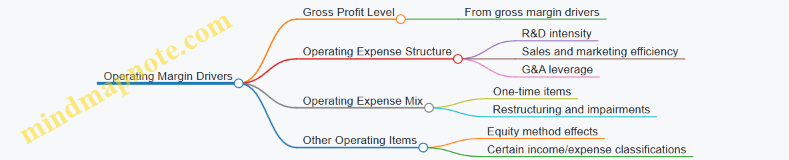
Analyze Gross Margin Systematically
- Separate price from volume and mix. If you have segment or product-level reporting, compute gross margin by segment. A segment-level view often reveals that “overall margin” moved because the company sold more of a higher-margin product, not because pricing improved.
Example: A retailer’s consolidated gross margin rises 1.5 points. Segment data shows that the share of private-label sales increased from 30% to 36%. Private-label typically carries higher gross margin, so the change is mix-driven. You can confirm by checking whether average selling price per category changed materially.
- Check unit cost components. Look for disclosures that break down cost of revenue: materials, labor, freight, and fulfillment. If those components are not disclosed, use notes on cost drivers (for example, commodity exposure, wage inflation, or logistics disruptions) and compare trends.
Example: A manufacturer’s gross margin declines while revenue grows. Direct materials expense rises faster than revenue. Even if management says “pricing held,” the cost side is doing the damage.
- Watch for absorption and step costs. Some costs are semi-fixed. When volume drops, fixed costs per unit rise, pressuring gross margin even if unit variable costs didn’t change.
Example: A contract manufacturer sees gross margin fall during a production slowdown. If utilization dropped, overhead absorption into cost of revenue worsened. Operating expenses might not change much, so the margin hit shows up primarily in gross margin.
Analyze Operating Margin with Expense Leverage in Mind
Operating margin equals gross profit minus operating expenses. So the question becomes: did operating expenses grow slower than gross profit, or faster?
Compute and compare:
- Operating expense ratio = Operating expenses / Revenue
- Gross profit ratio = Gross profit / Revenue
If operating margin falls while gross margin is stable, operating expense ratio likely rose.
Example: A services firm’s gross margin stays at 60%, but operating margin drops from 12% to 8%. Operating expense ratio increased because sales and marketing rose faster than revenue. If the firm also reports higher headcount or increased contractor usage, you can link the expense growth to operational inputs.
Use a Simple Bridge to Avoid Hand-Waving
A bridge ties margin movement to measurable components.
Example Bridge Logic:
- Start with prior period revenue.
- Apply changes in average selling price (or realized revenue per unit).
- Apply changes in unit cost.
- Apply mix effects.
- Then subtract the change in operating expense ratio.
Even a “rough but consistent” bridge is better than a narrative that only says “costs increased.”
Example: Revenue is up 10%, gross margin down 2 points, and operating margin down 3 points. If operating expenses as a percent of revenue rose by 1 point, then the remaining 2-point deterioration is explained by gross margin drivers. That split tells you where to focus your evidence gathering.
Validate with Quality Checks
Before concluding drivers, verify that margin changes aren’t driven by classification or unusual items.
- Look for one-time operating charges that can depress operating margin without affecting gross margin.
- Check whether certain costs are capitalized (which can improve current gross margin but later affect cash and future expenses).
- Confirm segment reporting consistency so mix analysis isn’t comparing apples to different fruit.
Summarize Drivers Into a Decision-Ready Conclusion
End with a compact statement that names the dominant driver and the supporting evidence.
Example Conclusion: “Gross margin declined mainly due to higher direct unit costs, while operating expenses did not offset the decline because the operating expense ratio increased slightly. The combined effect explains the operating margin contraction.”
8.3 Assess Pricing Mix and Volume Effects Using Disclosed Metrics
Pricing mix and volume effects explain why revenue changes even when the business model stays the same. The core idea is simple: revenue equals price times quantity, but real companies report revenue in categories, geographies, and product lines. Your job is to use disclosed metrics to separate what changed in price (including mix) from what changed in volume (including units, customers, or usage).
Start with the Revenue Decomposition You Can Actually Support
Begin by listing the revenue lines the company discloses with enough detail to compute effects. Common examples include:
- Revenue by segment or geography
- Unit volume or customer counts
- Average selling price (ASP) or revenue per unit
- Contract metrics such as billable usage
- Deferred revenue or contract assets that hint at timing
If the company provides only total revenue, you can still do a basic decomposition using management commentary, but the “mix” portion will be weaker. If it provides segment revenue plus volume and price proxies, you can do a cleaner split.
Define the Variables and Choose a Consistent Base
For each revenue category, define:
- Quantity: units sold, customers, or usage
- Price: revenue per unit (or ASP)
- Mix: the relative share of categories in total revenue
A practical approach is to compute an implied price for each category: Price = Category Revenue ÷ Category Quantity. Then you can compare current period values to prior period values.
To avoid accidental apples-to-oranges, use the same quantity definition across periods. If the company changes reporting units (for example, “shipments” vs “sales”), treat that as a data integrity issue and document it before calculating effects.
Use a Two-Step Logic for Pricing Versus Volume
Step 1: Hold mix constant and separate price and volume within each category.
- Price effect: (Price_current − Price_prior) × Quantity_prior
- Volume effect: (Quantity_current − Quantity_prior) × Price_prior
Step 2: Capture mix by comparing how category shares changed.
- Mix effect: the portion of revenue change caused by shifting category weights, after accounting for within-category price and volume.
You can compute mix either explicitly (using category-level decomposition) or implicitly (by reconciling the sum of price and volume effects to total revenue change).
Mind Map: Pricing Mix and Volume Effects Workflow
Example: Segment Revenue with Quantity and Implied Price
Assume a company reports two segments: A and B. It discloses segment revenue and units sold.
- Segment A: Prior revenue 200, prior units 100 → implied price 2.00. Current revenue 240, current units 110 → implied price 2.18.
- Segment B: Prior revenue 150, prior units 75 → implied price 2.00. Current revenue 160, current units 80 → implied price 2.00.
Total revenue change = (240 + 160) − (200 + 150) = 400 − 350 = +50.
Within-category effects:
- Segment A price effect = (2.18 − 2.00) × 100 = +18
- Segment A volume effect = (110 − 100) × 2.00 = +20
- Segment B price effect = (2.00 − 2.00) × 75 = 0
- Segment B volume effect = (80 − 75) × 2.00 = +10
Sum of price and volume effects = +48. The remaining +2 is the mix effect (because category shares changed: A grew faster than B).
This example shows a common pattern: one segment’s implied price rises while both segments grow in units. The mix effect is smaller here, but it matters when one segment expands faster.
Example: When “Price” Is Not Disclosed Directly
If the company discloses revenue and usage but not ASP, compute implied price per unit. For instance, a telecom-like business might report:
- Revenue from data services
- Total data usage (GB)
Implied price = data revenue ÷ GB. Then apply the same decomposition. If implied price jumps while usage is flat, you likely have pricing changes or mix within usage tiers.
Interpret Mix Carefully Using Disclosed Category Shares
Mix effects are not automatically “good” or “bad.” They are a description of what changed in the composition of sales. To interpret them, connect mix to what the company discloses:
- If higher-priced tiers gained share, mix likely boosted revenue without requiring broad demand growth.
- If lower-priced tiers gained share, revenue may rise slower than volume, which can pressure margins.
A simple check is to compare category share changes to the sign of within-category price and volume effects. If total revenue rises but the within-category effects are weak, a mix shift is doing the heavy lifting.
Use Reconciliation to Prevent Silent Errors
After computing price, volume, and mix effects, reconcile to the total revenue change. If the math doesn’t tie out, the cause is usually one of:
- Category alignment issues (a category was renamed or regrouped)
- Quantity definition changes
- Rounding differences in disclosed metrics
Treat reconciliation as part of the analysis, not a cleanup step. It’s the fastest way to catch “looks right” calculations that are actually based on mismatched inputs.
Mind Map: Interpretation Questions That Stay Grounded
Practical Output: A One-Page Bridge You Can Read Without Guessing
End the section with a compact bridge table for each disclosed category, showing prior revenue, current revenue, and the computed price, volume, and mix contributions. The goal is not to impress anyone with formulas; it’s to make the revenue change explainable using the company’s own disclosed metrics. When the bridge ties out and the signs make sense, you can confidently move from “what happened” to “what likely drove it” without relying on vague narratives.
8.4 Review Customer Concentration and Collection Risk Indicators
Customer concentration and collection risk are two sides of the same coin: concentration tells you how much your results depend on a small set of counterparties, while collection risk tells you how likely you are to turn invoices into cash on time. Together, they explain why revenue can look fine while free cash flow quietly struggles.
Customer Concentration Fundamentals
Start with a simple question: if one customer slows payments, what happens to your cash cycle? Concentration is usually measured using revenue and receivables, because those capture different failure modes.
- Revenue concentration shows how much of sales depend on a few customers. If the top customer is 30% of revenue, a dispute or churn can hit both earnings and future cash.
- Receivable concentration shows how much of your outstanding invoices sit with a few customers. If the top debtor is 40% of accounts receivable, collection delays can immediately strain working capital.
A practical best practice is to compute both measures and compare them. If revenue concentration is moderate but receivable concentration is high, you may be extending credit more aggressively to the customers that already owe you the most.
Worked Example
Assume a company has annual revenue of $100 million and accounts receivable (A/R) of $20 million.
- Top customer revenue: $25 million → 25% revenue concentration
- Top customer A/R: $9 million → 45% receivable concentration
That mismatch suggests the company is more exposed to payment timing than to sales volume. Your analysis should prioritize collection indicators for that customer group.
Collection Risk Indicators That Matter
Collection risk is not just “will they pay?” It is “will they pay on the terms you priced and planned for?” Use indicators that connect directly to cash conversion.
Days Sales Outstanding and Aging
Compute Days Sales Outstanding (DSO) and review the aging distribution of A/R.
- If DSO rises while revenue stays stable, you are collecting more slowly.
- If aging shifts toward 60–90+ days, the issue is likely credit terms, disputes, or operational friction.
Best practice: compare aging by customer segment, not only by total company. A single large customer can distort the average.
Bad Debt Expense and Allowance Coverage
Look at the relationship between bad debt expense, A/R allowance, and A/R balance.
- A growing allowance relative to A/R can indicate management is recognizing higher expected losses.
- A flat allowance while A/R ages deteriorate is a red flag for under-provisioning.
Use a simple coverage ratio: Allowance / A/R. Track it over time and by major customer.
Cash Receipts Versus Revenue
Revenue can be recognized before cash is received. Compare cash receipts to revenue trends.
A straightforward check: if revenue is stable but cash receipts decline, the gap often shows up in A/R growth or in higher deductions.
Dispute and Deduction Patterns
Many companies experience deductions for pricing, quality, or billing errors. Review notes and internal breakdowns if available.
If a concentrated customer has recurring deductions, the “collection” problem may be a billing process issue rather than pure credit risk.
Integrating Concentration with Collection Risk
Once you have concentration and collection indicators, combine them into a customer risk map. The goal is to identify where operational fixes and credit policy changes are most likely to improve cash.
Mind Map: Customer Concentration and Collection Risk
Customer Risk Map with Clear Decision Rules
Use a two-axis approach: receivable concentration on one axis and collection deterioration on the other.
- High receivable concentration: top customer(s) represent a large share of A/R.
- Collection deterioration: DSO up and aging moving older.
Decision rules that keep the analysis grounded:
- High concentration + deteriorating collection → prioritize credit review and dispute resolution for those customers.
- High concentration + stable collection → focus on contract terms and renewal risk, since cash timing is currently holding.
- Low concentration + deteriorating collection → investigate company-wide credit policy, billing accuracy, or operational bottlenecks.
Example: Applying the Rules
Suppose Customer A is 35% of A/R and its 90+ day balance increased from 2% to 8% of its A/R over two quarters. Customer B is 10% of A/R with stable aging.
- Customer A falls into high concentration + deteriorating collection, so the immediate work is to understand why invoices are aging: credit approval delays, disputes, or payment behavior.
- Customer B does not drive the cash problem, so it should not consume the same investigative effort.
Evidence Checklist for This Section
To keep the review repeatable, document the following for the top customers and the company total:
- Top customers’ share of revenue and A/R
- DSO trend and aging distribution changes
- Allowance / A/R coverage trend
- Notes or internal indicators for disputes and deductions
- A short conclusion linking concentration to the specific collection indicator that explains cash pressure
8.5 Test Revenue Quality Using Cash Receipts and Deferred Revenue
Revenue quality is about whether reported sales behave like cash sales. A simple rule of thumb: if revenue is “real,” cash receipts should show up in roughly the same periods, and deferred revenue should move in a way that matches the delivery schedule. This section shows how to test that rule using cash receipts and deferred revenue, with concrete checks you can run on real statements.
Core Concepts for Cash-Receipt Revenue Testing
Start with two definitions.
- Cash receipts represent actual inflows from customers. They can lag revenue if billing happens after delivery, or if customers pay later.
- Deferred revenue (also called contract liabilities) represents cash received for goods or services not yet delivered, or billings in advance of performance.
If a company reports revenue aggressively but collects cash slowly, you’ll often see revenue rising while cash receipts lag. If it collects cash early but delays delivery, deferred revenue will rise. Neither pattern is automatically wrong; the test is whether the pattern is consistent with the business model and the company’s stated contract mechanics.
Mind Map: Revenue Quality Signals from Cash and Deferred Revenue
Step 1: Compare Trends with a Timing Lens
Use at least three periods so you can see whether timing is stable. Compare:
- Revenue trend (income statement)
- Cash receipts from customers (cash flow statement, often “cash received from customers”)
- Deferred revenue trend (balance sheet)
Example: Suppose a software-as-a-service firm reports revenue of $100m, $110m, and $120m over three quarters. Cash receipts are $98m, $105m, and $112m. Deferred revenue is $30m, $32m, and $34m. This is coherent: revenue and receipts both rise, and deferred revenue increases modestly, consistent with ongoing contract signings.
Now contrast a less coherent case. Revenue rises from $100m to $130m, but cash receipts stay near $102m. Deferred revenue also falls from $25m to $15m. That combination suggests revenue is being recognized without equivalent cash collection and without a buildup of contract liabilities to explain the gap.
Step 2: Use a Working-Capital Bridge for Receipts
A practical bridge connects revenue to cash via receivables and contract liabilities.
- Accounts receivable (A/R): higher A/R often means revenue recognized but not yet collected.
- Deferred revenue (contract liabilities): higher deferred revenue often means cash received before delivery.
Example calculation (simplified):
- Revenue this quarter: $120m
- A/R increases by $10m
- Deferred revenue increases by $5m
- Cash receipts from customers: $105m
Interpretation: $15m of “timing” is visible in working capital. If the company’s billing terms support that timing, the cash receipts can still be consistent with reported revenue. If the company typically collects within 30 days and A/R jumps by $10m without explanation, the revenue quality signal weakens.
Step 3: Interpret Deferred Revenue Movement Correctly
Deferred revenue should generally behave like this:
- When the company receives cash for future performance, deferred revenue increases.
- When the company performs and recognizes revenue, deferred revenue decreases.
Example: A construction services firm has milestone-based contracts. In Q1 it bills $40m for work to be completed in Q2, and cash is received immediately. Deferred revenue rises by $40m. In Q2, as milestones are completed, revenue increases and deferred revenue falls. If deferred revenue keeps rising while revenue also keeps rising at the same time, you may be seeing both more cash received and more delivery—possible, but you should check whether the delivery schedule and contract mix support that simultaneous movement.
Step 4: Validate with Notes and Contract Mechanics
Deferred revenue is not a single universal concept. It can include:
- prepaid subscriptions
- unearned service revenue
- billings in excess of revenue recognized
Use the company’s disclosures to confirm what drives contract liabilities. For instance, if the firm states that customers pay upfront for annual plans, then deferred revenue should rise when new plans are sold and cash is collected. If instead the firm says it invoices monthly in arrears, large deferred revenue increases become harder to justify.
Step 5: Turn Findings Into a Clear Quality Conclusion
A simple scoring approach keeps the analysis consistent:
- Cash receipts alignment: receipts trend matches revenue trend with reasonable timing.
- Deferred revenue logic: contract liabilities move in a way consistent with delivery and billing.
- Working-capital consistency: A/R and deferred revenue changes explain the cash gap.
Example conclusion: “Revenue increased 18% while cash receipts increased 15%, and deferred revenue increased modestly. A/R rose slightly, consistent with collection timing. Overall, cash and contract liability movements support the revenue recognition pattern.”
When the three signals disagree, treat it as a quality issue to investigate, not a verdict. The test is designed to tell you where the story breaks—cash receipts and deferred revenue are usually where the plot shows its seams.
9. Expense Quality and Non Recurring Item Normalization
9.1 Identify Non Recurring Items and Their Accounting Basis
Non-recurring items are transactions that are not expected to happen regularly as part of normal operations, or that are presented separately because their nature makes them hard to compare across periods. The key word is not “rare”; it’s “not part of the recurring operating pattern.” A good analysis treats non-recurring items as evidence about earnings quality, not as a free pass to adjust anything that looks inconvenient.
Start with What “Non-Recurring” Means in Practice
Begin by separating two ideas:
- Non-recurring by nature: events like major litigation settlements, plant closures, or one-time asset impairments.
- Non-recurring by presentation: items management labels as “special,” “other,” or “restructuring,” even if the underlying activity has occurred before.
A company can call something non-recurring while the accounting pattern suggests it happens every few years. Your job is to test the label against the financial statement notes and the history of similar charges.
Build a Source-First Checklist
Use the financial statements in this order:
- Income statement: locate “Other income/expense,” “Restructuring,” “Impairment,” “Gain/loss on disposal,” and any line items that look isolated.
- Cash flow statement: check whether the item affects cash (e.g., cash settlements) or mostly changes accruals (e.g., non-cash impairments).
- Notes: confirm the accounting basis—what was measured, when it was recognized, and why.
A practical rule: if the item is truly non-recurring, the notes should explain the trigger clearly and tie it to a specific event or decision.
Identify Common Non-Recurring Categories and Their Accounting Basis
Below are frequent categories and what to look for in the notes.
-
Restructuring and severance: often includes employee termination benefits, contract termination costs, and facility exit costs. Accounting basis usually involves recognizing obligations when a plan is communicated and criteria are met.
- Example: A company announces a facility closure in Q2 and records severance in Q2 and Q3. If the notes show the obligation was recognized based on communication dates, the charge is tied to a specific event rather than ongoing operations.
-
Impairment of long-lived assets: accounting basis is typically a recoverability test (or fair value less costs of disposal under certain standards). The impairment is usually non-cash but can signal future cash strain.
- Example: An impairment is recorded after a business unit underperforms. If the note provides the cash flow assumptions and the impairment reversals are restricted, you can treat it as non-recurring in the sense of event-driven, while still flagging that the underlying economics deteriorated.
-
Litigation settlements and legal judgments: accounting basis depends on probability and estimability of loss. Many settlements are recognized when the outcome becomes probable and reasonably estimable, then finalized when paid.
- Example: A lawsuit accrual is recorded in one quarter, then settled later. The accrual may appear non-recurring, but the cash payment timing can differ, so compare the income statement charge to cash flow disclosures.
-
Gains or losses on asset sales: accounting basis is the difference between sale proceeds and carrying value. These are often one-time, but repeated disposals can indicate a recurring portfolio strategy.
- Example: Selling a subsidiary generates a gain in one year. If the notes show the sale was part of a one-off divestiture plan, it’s a clean non-recurring item; if disposals happen annually, it’s less “special.”
-
Foreign exchange and remeasurement items: sometimes presented as “other.” The accounting basis is remeasurement of monetary items, which can recur with currency volatility.
- Example: A company reports FX losses in “other expense” each year. Even if management calls it non-recurring, the accounting mechanism is recurring, so treat it as a volatility driver rather than a one-time event.
Use Evidence to Decide Whether to Adjust
Non-recurring items are not automatically “excluded” from analysis. Use a two-step decision:
- Confirm the trigger and accounting basis: Is there a specific event, and does the note explain recognition and measurement?
- Assess comparability impact: Would including the item distort the view of operating performance for the period?
A simple example: Suppose earnings include a large restructuring charge. If the charge is non-cash and the company’s core revenue and margins remain stable, excluding it may help isolate operating performance. But if the restructuring reflects a fundamental decline in demand, excluding it can hide the earnings quality issue.
Mind Map: Identification Workflow
Worked Example with a Clear Outcome
Assume a company reports a “Restructuring expense” of $40 million in the current year. The notes state that the company committed to a plant exit, communicated the plan to affected employees, and recognized termination benefits when the obligation was incurred. The cash flow statement shows $10 million paid in the current year and $30 million expected to be paid in later periods.
Identification outcome: The item is non-recurring by nature because it is tied to a specific exit plan and has an obligation-based accounting basis. Analysis outcome: You can treat it as non-recurring for operating performance comparisons, but you should also track the cash payments to understand whether the charge is merely accounting or also affects cash generation.
Common Failure Modes to Avoid
- Adjusting without notes: if you can’t point to the accounting basis in the notes, the adjustment is guesswork.
- Confusing “one quarter” with “non-recurring”: a charge can be repeated annually even if it appears in one quarter each year.
- Ignoring cash flow linkage: non-cash items can still reduce future cash through lost capacity, higher costs, or delayed working capital effects.
A disciplined approach turns non-recurring identification into a repeatable check: locate the item, verify the accounting basis, test whether the pattern is truly event-driven, and then decide how it should be treated in your earnings quality assessment.
9.2 Normalize EBITDA and Earnings Using Documented Adjustments
Normalization means adjusting reported EBITDA and earnings to reflect a consistent view of operating performance. The goal is not to make numbers prettier; it is to make them comparable. If two periods include different one-time items, comparing them without adjustments is like comparing a full tank to an empty one and calling it “efficiency.”
What “Documented Adjustments” Means
A documented adjustment is an item you remove or modify with a clear rule and an evidence trail. Evidence can be management discussion, footnotes, segment disclosures, or the line-item detail in the income statement. A documented rule answers three questions: what is being adjusted, why it is excluded or treated differently, and how the amount is calculated.
Normalization typically follows a hierarchy:
- Start with reported earnings (or operating income) and reconcile to EBITDA.
- Identify non-recurring or non-operating components that distort period-to-period comparability.
- Apply consistent treatment across periods so the resulting metric reflects the same underlying business activity.
- Keep a reconciliation table so readers can see the bridge from reported to normalized.
Adjustment Categories That Usually Matter
Not every adjustment is equal. Some items are often normalized because they are genuinely unusual or non-operating; others should be handled carefully because they may be recurring in disguise.
- Non-recurring operating items: restructuring charges, major litigation settlements, impairments tied to specific events.
- Non-operating items: gains or losses on asset sales, certain foreign exchange effects, and other items outside core operations.
- Financing-linked items: interest and some tax effects are not part of EBITDA, but they matter for earnings normalization.
- Accounting policy effects: changes in estimates or classification that alter comparability.
A practical rule: normalize only what you can explain with evidence and a consistent method. If you cannot state the rule in one sentence, the adjustment is probably not ready.
Mind Map: Normalization Workflow
Example: Restructuring Charge and a Clean EBITDA Bridge
Assume a company reports EBITDA of $120 million for Year 1. The income statement includes a $15 million restructuring charge within operating expenses. Management states the program is completed and the charge is not expected to recur.
Normalization rule: remove the restructuring charge from EBITDA.
- Reported EBITDA: $120
- Less: restructuring charge (non-recurring operating expense): $15
- Normalized EBITDA: $105
For earnings, suppose the same charge reduces net income by $12 million after tax effects. If you normalize earnings, you typically adjust earnings by the after-tax impact consistent with the EBITDA adjustment.
- Reported earnings: $60
- Add back after-tax restructuring impact: $12
- Normalized earnings: $72
The key is consistency: if the company normalizes restructuring in Year 1, it should apply the same logic to any similar items in Year 2, using the same definition of “non-recurring.”
Example: Stock-Based Compensation and “Recurring but Non-Cash”
Stock-based compensation (SBC) is often treated as a normalization candidate because it is non-cash in the period. However, it is also frequently recurring. A documented approach might be:
- Option A: present EBITDA as reported, but show a second line “EBITDA excluding SBC” with a clear label.
- Option B: normalize earnings by adjusting for SBC only if the company’s compensation structure is atypical for its peer group and the evidence supports that it is not a core recurring cost.
Either way, the documentation must state whether SBC is being removed for comparability or merely presented separately. Mixing these purposes leads to confusion.
Advanced Details Without the Usual Confusion
- Avoid double counting: if an impairment is already excluded from operating income, do not also remove it again through another adjustment.
- Handle taxes deliberately: EBITDA ignores taxes, but normalized earnings usually requires after-tax treatment. Use the company’s effective tax rate only if it is appropriate for the nature of the item.
- Keep the adjustment scope tight: if you adjust only the expense portion of a gain/loss, document why the offsetting component is not adjusted.
- Check frequency: if “non-recurring” items appear in most quarters, the label is probably doing more work than the evidence.
Mind Map: Documented Adjustment Rules
Practical Output Format
A good normalization section ends with a reconciliation table conceptually like this:
- Reported EBITDA
- Less: non-recurring operating items
- Less: non-operating items if reclassified
- Add or subtract: any policy-driven adjustments
- Normalized EBITDA
Then repeat the same discipline for earnings, with after-tax logic stated once and applied consistently. The result is a metric that is easier to interpret and harder to misread.
9.3 Evaluate Stock Based Compensation and Its Cash Implications
Stock based compensation (SBC) is an accounting expense for equity awards, but it usually does not require an immediate cash payment. That mismatch can make EBITDA and earnings look healthier than cash generation, or it can hide cash strain when SBC is paired with dilution, buybacks, or deferred compensation structures. The goal is not to “remove SBC” automatically; it is to understand what it represents, how it flows through the statements, and what cash effects it may have.
Foundational Concepts That Drive the Analysis
SBC typically appears as an operating expense (often within cost of revenue, R&D, or SG&A) and reduces reported earnings. In the cash flow statement, SBC is commonly added back in the operating section because it is non-cash. That means:
- EBITDA often includes SBC implicitly because EBITDA starts from operating earnings.
- Free cash flow (FCF) often excludes SBC effects because FCF begins with cash from operations, where SBC is added back.
- The “quality” question is whether the company can sustain earnings without relying on non-cash charges.
A simple way to keep your bearings: if SBC rises while operating cash flow stays flat or declines, the company may be funding performance with accounting entries rather than cash.
Where SBC Shows Up in the Statements
Start with the income statement: locate the SBC line item if disclosed, or infer it within operating expenses. Next, check the cash flow statement: SBC is usually included in the reconciliation from net income to cash from operations as a non-cash add-back. Finally, review equity disclosures: the notes often describe grant types, vesting schedules, and the weighted average assumptions used for valuation.
A practical example: suppose a company reports operating income of $100 million and includes $20 million of SBC in operating expenses. If operating cash flow is $85 million, the cash conversion is $85 / ($100 + $20) = 0.71 on a simplified basis. If SBC is $20 million and added back, cash from operations may look less impaired than earnings, but the conversion ratio still tells you whether the underlying operations generate cash.
SBC Cash Implications Mind Map
Mind Map: SBC Cash Implications
Evaluate SBC Magnitude and Trend with Clear Ratios
Use ratios that connect SBC to the business scale:
- SBC as a percentage of revenue: helps compare across companies.
- SBC as a percentage of operating expenses: shows whether SBC is crowding out other costs.
- SBC per share or per employee: useful when headcount changes.
Example: Company A reports revenue of $2.0 billion and SBC of $60 million, so SBC is 3.0% of revenue. Over two years, revenue grows 5% but SBC grows 25%. If operating cash flow does not grow similarly, the company may be increasing compensation cost without a matching cash engine.
Check Whether SBC Is Consistently Non-Cash
SBC is often non-cash, but not always entirely. Some awards trigger cash payments for taxes or are settled in cash. The notes may mention:
- Tax withholding obligations on vested shares
- Cash settlement features for certain plans
- Net settlement mechanics for options
Example: a company reports $30 million of SBC expense and adds back $30 million in operating cash flow. If the notes also indicate $8 million of cash paid for withholding taxes related to equity awards, then the “non-cash” label is incomplete. You can adjust your cash view by treating those taxes as a cash cost tied to SBC.
Connect SBC to Earnings Quality Signals
SBC can distort the relationship between earnings and cash in two ways:
- Earnings are reduced by SBC, but cash is boosted by add-backs, which can make cash conversion look better than it is.
- If SBC is rising, it can mask weakening operating performance because reported expenses include non-cash charges while cash generation may lag.
A concrete diagnostic: compare operating cash flow to net income plus SBC add-back. If operating cash flow is consistently below that adjusted earnings base, the gap likely reflects working capital movements, capex intensity, or margin pressure rather than SBC alone.
Build a Simple SBC Quality Checklist
Use this sequence each reporting period:
- Identify SBC expense on the income statement.
- Confirm the add-back amount in operating cash flow.
- Compute SBC as % of revenue and % of operating expenses.
- Review equity notes for award types and any cash settlement or withholding.
- Compare SBC trend to operating cash flow trend.
Example checklist outcome: SBC rises from 2% to 4% of revenue while operating cash flow margin falls. Even if EBITDA looks stable, the cash conversion deterioration suggests earnings are becoming less supported by cash-generating operations.
Common Pitfalls to Avoid
- Treating “SBC is non-cash” as a full conclusion. Taxes and certain settlement structures can create cash effects.
- Comparing SBC across periods without checking changes in award mix or vesting schedules.
- Ignoring dilution disclosures when evaluating per-share earnings quality.
SBC is a useful lens, not a verdict. When you connect the expense, the cash flow add-back, and the equity note details, you can separate accounting mechanics from the company’s actual cash generation.
9.4 Analyze Restructuring and Impairment Charges With Evidence
Restructuring and impairment charges can be legitimate reflections of changing economics, but they can also be used to “clean up” earnings in ways that are hard to compare across periods. The goal is not to label charges as good or bad; it is to determine whether the accounting reflects identifiable events and whether the cash impact is consistent with the story.
Foundational Concepts and What to Look For
Start with two questions. First, is the charge tied to a specific event (a plant closure, a contract exit, a business unit sale, a triggering event for impairment)? Second, does the company provide evidence that the event occurred and that the accounting estimate is supportable?
Restructuring charges typically include costs such as severance, lease termination, contract termination, and asset write-downs. Impairment charges arise when the carrying value of an asset or cash-generating unit exceeds recoverable amount. Both categories often involve estimates, so evidence quality matters.
Evidence Checklist That Keeps You Honest
Use a consistent checklist for every period:
- Trigger description: What event caused the charge? Look for clear linkage to operations.
- Scope: Which locations, business lines, or asset groups are affected?
- Measurement basis: For impairment, identify whether the company uses discounted cash flows, market values, or other inputs.
- Assumptions: Note key assumptions such as discount rates, growth rates, and margins. Evidence is stronger when assumptions are tied to observable data or internal budgets.
- Timing: Does the charge occur in the same period as the trigger? Large delays can indicate accounting convenience.
- Cash follow-through: Compare the charge to subsequent cash payments and changes in related accruals.
- Reversals or updates: If estimates change, does the company explain why?
A quick sanity check: if a restructuring charge is “one-time,” you should still see related cash outflows and accrual utilization over the following quarters.
Mind Map: Restructuring and Impairment Evidence
Systematic Analysis Steps with Examples
Step 1: Separate Restructuring from Impairment
A company might report a single “restructuring and impairment” line item. Split it using notes: severance and termination costs usually behave differently from impairment write-downs.
Example: In Year 1, a retailer reports $120 million of restructuring charges. Notes show $60 million severance and $40 million lease termination, plus $20 million impairment of store assets. In Year 2, cash payments for severance are $55 million and lease termination payments are $35 million, while the impairment portion does not generate cash. If cash payments roughly track the accrual utilization, the restructuring component looks operationally grounded.
Step 2: Test Timing Against the Trigger
If management says a restructuring began in Q2, but the charge is recorded in Q4 with no explanation, ask what changed. Sometimes timing differences are legitimate (for example, when a plan is approved), but the notes should say so.
Example: A software firm announces a data center consolidation in late Q1. If the restructuring charge appears only in Q3 and the disclosure does not mention plan approval or contract termination notice periods, you may need to treat the charge as less evidence-rich.
Step 3: Evaluate Measurement Inputs for Impairment
Impairment often depends on discounted cash flows or market-based estimates. Evidence improves when the company discloses how assumptions relate to actual performance and internal forecasts.
Example: A manufacturer records a $200 million impairment on a plant. The note states a recoverable amount based on value in use with a discount rate of 9% and a terminal growth rate of 2%. If the company also discloses that recent margins were stable and the impairment cash flows reflect those margins, the estimate is more defensible than if the cash flows assume a sharp margin rebound without support.
Step 4: Track Accruals and Cash Payments
Restructuring provisions create a bridge from non-cash expense to cash outflow. Look for a rollforward of provisions: opening balance, additions, utilization, and reversals.
Example: A telecom company shows restructuring provisions of $80 million at the start of the year. During the year, it adds $30 million and uses $25 million. If the company later reports that the remaining $85 million provision is largely reversed without explanation, the original estimate may have been overstated or the plan may have changed.
Step 5: Check Recurrence and Classification Consistency
A one-time charge should not repeatedly appear with the same label and the same affected units. Recurrence doesn’t automatically mean “wrong,” but it does reduce comparability.
Example: A bank reports “branch optimization” charges every year for three years. If each year’s disclosure shows different branches and different triggers, it may be a rolling program. If the scope is nearly identical and the company repeatedly adjusts earnings with similar magnitude, you should treat the label as less informative.
Practical Conclusion Rules
When you summarize, avoid vague statements like “management adjusted for non-recurring items.” Instead, state what the evidence supports: the trigger, the scope, the measurement basis, and whether cash payments and provision rollforwards align with the expense.
If the disclosures provide clear triggers, consistent scope, supportable assumptions, and cash follow-through, the charges are more likely to reflect real economic events. If evidence is thin—especially on timing, assumptions, and provision utilization—treat the charges as lower-quality adjustments even if the accounting outcome is technically correct.
9.5 Build a Consistent Normalization Policy for Comparability
Normalization is the discipline of adjusting reported earnings in a repeatable way so that comparisons across companies and time mean something. The goal is not to “make numbers look better”; it’s to separate recurring operating performance from items that are driven by accounting choices, one-time events, or financing structure.
Start with a Normalization Charter
A normalization policy should begin with three decisions that you write down before touching the spreadsheet:
- Scope: Which metrics are normalized (EBITDA, EBIT, net income, EPS) and which are left as-reported.
- Materiality threshold: Define a cutoff for when an item qualifies for adjustment (for example, items exceeding 1% of revenue or a fixed dollar amount).
- Consistency rule: If you adjust one period for an item, you must apply the same logic to all comparable periods where the item appears.
Example: If you normalize restructuring charges for 2023 because they are clearly disclosed and non-recurring, you should also normalize any similar charges in 2022 and 2021 using the same criteria.
Classify Adjustments Into Three Buckets
Most normalization disputes come from mixing categories. Use a simple classification so every adjustment has a home.
- Non-Recurring Operating Items: Events that are not expected to happen regularly in the normal course of business.
- Accounting-Policy and Presentation Effects: Items that arise from how the company reports rather than how the business performs.
- Financing and Tax Effects: Items tied to capital structure or tax jurisdiction that should not contaminate operating comparisons.
Example: A gain from selling a facility belongs in non-recurring operating items (or below operating, depending on your policy). Interest expense belongs in financing effects and should not be used to “normalize” operating profitability.
Define Each Adjustment with Evidence Rules
For each adjustment type, specify what evidence must exist and what you will do when evidence is partial.
- Evidence requirement: The company must disclose the item with enough detail to quantify it (amount, timing, and nature).
- Quantification method: Use the disclosed amount when available; otherwise, use a clearly documented proxy (and mark it as such).
- Reversal logic: If the company later reverses an accrual or impairment, your policy must say whether the reversal is treated as part of the original item or as a separate event.
Example: If impairment charges are disclosed as “non-cash,” you still normalize them because they are not part of recurring operating performance. If later the company reverses part of the impairment, you normalize the reversal using the same classification so the net effect across periods is coherent.
Lock Down the EBITDA Normalization Mechanics
EBITDA normalization should follow a consistent formula so readers can reproduce it.
- Start from reported operating profit or reported earnings, depending on your base.
- Add back depreciation and amortization using the same line items each period.
- Apply adjustments only to the operating portion you have defined.
- Keep a running reconciliation so the normalized EBITDA equals the base plus/minus each adjustment.
Example: If you adjust EBITDA for stock-based compensation (SBC), you must decide whether you add back the full SBC expense and whether you also adjust for related employer payroll taxes if they are separately disclosed.
Use a Normalization Decision Tree
This mind map turns policy into a repeatable workflow.
Mind Map: Normalization Decision Tree
Build a Normalization Register
A normalization register is a table you maintain for every period and every company. It prevents “one-off heroics” and makes your work auditable.
Include columns for: item name, classification bucket, materiality check, evidence reference (what disclosure line), quantification method, and treatment in each metric.
Example: For a retailer, you might normalize “store closure costs” and “impairment of leasehold improvements.” Your register should specify whether you include only cash costs, only non-cash impairments, or both, based on the company’s disclosure.
Handle Edge Cases Without Breaking Comparability
Edge cases are where policies either hold up or collapse.
- Overlapping items: If restructuring includes impairments, treat them as separate components only if disclosed separately; otherwise treat the combined amount as one adjustment with a clear label.
- Partial recurrence: If a “one-time” program repeats annually, reclassify it as recurring operating and stop normalizing it.
- Tax-linked items: If you normalize pre-tax earnings, keep tax effects out of the EBITDA normalization. If you normalize net income, apply a consistent tax treatment rule.
Example: A company may describe “annual compliance remediation” as one-time. If the same program appears every year with similar scope, your policy should treat it as recurring and stop adjusting it.
Example: A Mini Normalization Policy in Practice
Assume you normalize EBITDA for a software company.
- Adjust: restructuring charges, impairment of capitalized software, and litigation settlements that are explicitly non-recurring.
- Do not adjust: interest expense, income tax expense, and amortization that is part of the company’s regular cost structure.
- Materiality: adjust only if the item exceeds 1% of revenue.
If 2023 shows a $40m restructuring charge and 2022 shows $5m, you normalize 2023 (material) and keep 2022 as-is (immaterial), but you still record the 2022 item in the register so the reader understands why it was not adjusted.
Final Consistency Checks
Before you publish results, run three checks:
- Same logic across time: If an item qualifies in one year, verify it qualifies under the same rules in other years.
- No category mixing: Confirm operating adjustments are not compensating for financing or tax effects.
- Reconciliation completeness: Ensure the normalized metric reconciles back to the base with every adjustment accounted for.
A good normalization policy makes comparisons boring—in the best way—because the numbers are consistent, explainable, and resistant to selective interpretation.
10. Tax Interest and Financing Effects on Earnings and Cash
10.1 Understand Effective Tax Rate Mechanics and Cash Taxes
An effective tax rate (ETR) is the tax expense you see on the income statement, expressed as a percentage of a chosen earnings base. Cash taxes are what the company actually pays to tax authorities. These two can move together, but they often do not, because accounting tax expense includes timing differences, noncash items, and jurisdiction-specific rules.
Core Definitions and What They Hide
ETR is typically computed as:
- ETR on pre-tax income:
Tax expense ÷ Earnings before tax. - Cash tax rate:
Cash taxes paid ÷ Earnings before tax(or sometimes ÷ operating cash flow).
A key mechanic: tax expense is not “cash taxes in disguise.” It is the sum of current tax (cash-related) plus deferred tax (timing-related). If deferred taxes change a lot, the ETR can look “wrong” even when cash taxes are steady.
From Tax Expense to Cash Taxes
Tax expense usually breaks into two buckets:
- Current tax expense: based on taxable income for the period; this is the part that generally drives cash payments.
- Deferred tax expense: arises from temporary differences between accounting carrying values and tax bases.
Temporary differences reverse over time. When they reverse, deferred tax expense swings, but cash taxes may lag or lead depending on the direction of reversal.
Mind Map: Tax Expense Versus Cash Taxes
The Three Main Reasons ETR and Cash Taxes Diverge
Deferred Tax Timing Differences
Suppose a company records depreciation expense faster for tax than for accounting. Accounting profit is higher than taxable profit early on, so the ETR may be higher than cash taxes suggest. Later, when accounting depreciation catches up, the pattern reverses.
A simple numeric example:
- Pre-tax income: 100
- Tax expense: 25 → ETR = 25%
- Current tax (cash-related): 18
- Deferred tax: 7
Here, cash taxes are 18% of pre-tax income, even though the ETR is 25%. The extra 7% is an accounting timing effect.
Permanent Differences
Permanent differences never reverse. Examples include certain non-deductible expenses or tax-exempt income. These change the ETR but do not create deferred tax balances.
Example:
- Pre-tax income: 100
- Taxable income: 80 due to non-deductible costs
- Statutory rate: 25%
- Current tax: 20
- If there are no deferred taxes, tax expense is also 20 → ETR = 20%
The ETR is lower because the tax base is smaller, not because cash payments are delayed.
Discrete Items and Valuation Effects
Discrete items can cause one-period jumps. Valuation allowances on deferred tax assets can also swing tax expense when management concludes that some deferred tax assets are not recoverable.
Example:
- Pre-tax income: 200
- Normal current tax would imply 50 at a 25% rate
- A valuation allowance adjustment adds 10 to tax expense
- Reported tax expense becomes 60 → ETR = 30%
Cash taxes may still be close to 50, while the ETR shows 30% because the extra 10 is noncash.
How to Read the Effective Tax Rate Without Getting Tricked
A practical workflow:
- Start with the ETR trend: note whether it is stable, rising, or falling.
- Check whether the tax expense is driven by current or deferred components: if deferred tax dominates, expect cash taxes to differ.
- Compare to cash taxes paid: the cash flow statement often shows “income taxes paid,” which may include refunds.
- Scan for discrete items: settlements, tax law changes, and unusual credits can distort the period’s ETR.
- Confirm the denominator: ETR computed on pre-tax income can behave oddly when pre-tax income is small or negative.
Mini Example: Reconciling ETR to Cash Taxes
Assume:
- Pre-tax income: 120
- Tax expense: 30 → ETR = 25%
- Current tax: 26
- Deferred tax: 4
- Cash flow shows taxes paid: 24 (after refunds or timing of payments)
Interpretation:
- The income statement ETR (25%) includes deferred tax (4).
- Cash taxes paid (24) differ slightly from current tax (26) due to payment timing and refunds.
This is the “mechanics” view: ETR is an accounting rate; cash taxes are a cash outcome.
Common Pitfalls to Avoid
- Comparing ETR across companies without checking the denominator and tax structure.
- Treating a low ETR as proof of tax efficiency when deferred tax assets or discrete items are doing the heavy lifting.
- Ignoring negative pre-tax income where ETR can become meaningless or highly volatile.
Understanding these mechanics turns ETR from a single number into a set of explainable drivers, which is exactly what you want when assessing earnings quality and cash sustainability.
10.2 Reconcile Tax Expense to Cash Paid for Taxes
Tax expense and cash taxes are related, but they rarely match in the same period. The gap is not a mystery; it’s a trail of timing differences, accrual mechanics, and balance-sheet movements. A good reconciliation turns that trail into a checkable set of steps.
Core Idea and What You’re Actually Reconciling
Start with the income statement: tax expense is recorded when the tax authority’s rules imply a liability or benefit, not when cash moves. Then move to the cash flow statement: cash paid for taxes reflects actual payments net of refunds.
Your reconciliation should explain three things:
- Why tax expense differs from “taxes at the statutory rate.”
- Why the difference between expense and cash changes over time.
- Which balance-sheet lines are responsible for the timing.
Step 1: Build a Tax Expense Bridge to “Expected” Taxes
Compute expected taxes using a statutory rate and a pre-tax income base. Then reconcile to reported tax expense using items such as:
- Non-deductible expenses (e.g., certain penalties)
- Tax credits (e.g., R&D credits)
- Jurisdictional mix (different rates in different countries)
- Changes in valuation allowances for deferred tax assets
Example: A company has $100 million pre-tax income. If the statutory rate is 25%, expected tax is $25 million. Reported tax expense is $22 million. The $3 million difference could be explained by $4 million of credits and $1 million of non-deductible items.
This step ensures you understand the income statement side before you touch cash.
Step 2: Translate Tax Expense Into a Balance-Sheet Movement
Tax expense affects the balance sheet through current tax payable and deferred taxes.
- Current tax: closer to cash, but still not identical because payments lag accruals.
- Deferred tax: usually non-cash in the period, but it can change the current tax through recognition and reversals.
You’re looking for the movement in the current tax payable line:
- If current tax payable increases, cash paid is usually less than tax expense.
- If current tax payable decreases, cash paid is usually more than tax expense.
Step 3: Reconcile Cash Taxes Using a Simple Cash Taxes Equation
A practical equation is:
Cash paid for taxes = Tax expense + (Current tax payable decrease) − (Current tax payable increase) + (Refunds net of payments adjustments)
Many statements don’t show “refunds” explicitly, so you infer them from the cash flow line and the balance-sheet movement.
Example:
- Tax expense for the year: $22 million
- Current tax payable at start: $6 million
- Current tax payable at end: $10 million
Current tax payable increased by $4 million. That typically means cash paid was $22m − $4m = $18 million, before considering any explicit refunds or other adjustments.
If the cash flow statement reports cash paid for taxes of $17 million, the remaining $1 million difference often reflects net refunds, foreign withholding timing, or classification differences.
Step 4: Use Deferred Tax to Explain Why the Gap Persists
Deferred tax changes can be large even when cash taxes are stable. The key is to separate:
- Non-cash deferred tax expense/benefit from
- Current tax that drives payable and cash.
Example: Suppose deferred tax expense is $5 million for the year, but current tax expense is $17 million. Reported tax expense is $22 million. Cash taxes will track current tax more closely than the total.
When deferred tax assets are recognized or valuation allowances change, tax expense can move without immediate cash impact. Your reconciliation should note whether the tax expense is driven by current items or deferred items.
Step 5: Validate with Two Consistency Checks
Consistency Check A: Directional Logic
- If tax expense rises but current tax payable rises even more, cash taxes should lag.
- If tax expense falls but current tax payable falls too, cash taxes might still be steady.
Consistency Check B: Rate and Jurisdiction Plausibility
If the effective tax rate swings sharply, verify whether the swing is explained by credits, mix of jurisdictions, or valuation allowance changes. Then confirm that the payable movement aligns with the current portion.
Mind Map: Tax Expense to Cash Taxes Reconciliation
Worked Mini-Example with All Pieces
Assume:
- Pre-tax income: $100m
- Statutory rate: 25% → expected tax $25m
- Reported tax expense: $22m (credits and mix reduce it)
- Current tax payable: start $6m, end $10m → increase $4m
- Cash flow reports cash paid for taxes: $17m
Interpretation:
- Current tax payable increase suggests cash should be about $18m ($22m − $4m).
- The $1m shortfall versus $17m points to net refunds, withholding timing, or classification differences.
That’s the reconciliation: not just arithmetic, but a map from accounting recognition to cash movement.
10.3 Analyze Interest Expense and Its Relationship to Operating Performance
Interest expense sits at the intersection of operations and financing. It’s not an operating metric, but it can distort how operating performance looks—especially when comparing companies with different leverage, interest-rate environments, or debt structures. The goal here is to separate what the business earns from what the capital structure costs.
Core Concepts and What to Expect
Start with the income statement mechanics. Interest expense is typically reported below operating income, after gross profit and operating costs. Operating performance is usually summarized by operating income or EBITDA, while interest expense reflects financing costs. A company can have strong operating income yet weak net income if interest expense is large.
A practical expectation: if operating performance improves but interest expense rises faster, net income may stagnate or fall. Conversely, if operating performance is stable and interest expense declines, net income can improve even without better operations. That’s why the relationship matters.
Step 1: Connect Interest Expense to Financing Structure
Interest expense depends on three inputs: average debt balance, the interest rate on that debt, and the mix of fixed versus floating rates.
Use this simple decomposition:
- Higher average debt → more interest dollars, even at the same rate.
- Higher rate on debt → more interest dollars, even at the same debt.
- Floating-rate debt → interest expense can move with market rates.
Example: Company A has $500m average debt at 6% → about $30m annual interest. Company B has $500m at 4% → about $20m. If both have identical operating income, Company A’s net income will be $10m lower purely from financing cost.
Step 2: Compare Interest Expense to Operating Earnings
To relate interest expense to operating performance, use coverage measures that express how easily operations pay interest.
Common coverage ratios:
- EBIT to Interest: operating earnings before interest and taxes divided by interest expense.
- EBITDA to Interest: EBITDA divided by interest expense.
These ratios are more informative than interest expense alone because they scale with business earnings. A company with $50m interest expense might be fine if it generates $500m of operating earnings, but problematic if operating earnings are $80m.
Example: Company C has EBITDA of $200m and interest expense of $40m → EBITDA/Interest = 5. Company D has EBITDA of $120m and interest expense of $30m → EBITDA/Interest = 4. Even though both have similar interest burdens, Company C has more cushion.
Step 3: Watch for Accounting Effects That Change the “Interest” Label
Interest expense can include more than plain coupon interest depending on accounting policies and debt instruments. Common items that can shift the line item:
- Amortization of debt issuance costs or discounts/premiums.
- Accretion of certain liabilities.
- Interest on lease liabilities (often presented separately, but classification varies).
Best practice: reconcile interest expense to cash interest paid when possible. If interest expense is rising while cash interest is flat, the change may be driven by non-cash components or balance-sheet remeasurement.
Example: Company E reports interest expense of $60m, but cash paid for interest is $55m. If the gap widens over time, check whether amortization or other non-cash components are increasing.
Step 4: Separate Operating Quality from Financing Burden
A clean way to do this is to compare trends in operating earnings and interest expense over multiple periods.
- If operating earnings rise and interest expense is stable, net income improvement likely reflects real operating progress.
- If operating earnings rise but interest expense rises faster, net income may not reflect the operating improvement.
- If operating earnings fall and interest expense is stable, coverage deteriorates quickly.
Example: Over two years, Company F’s EBITDA increases 10%, but interest expense increases 25%. Coverage declines, suggesting financing costs are offsetting operating gains.
Mind Map: Interest Expense and Operating Performance Relationship
Step 5: Use a Simple Diagnostic Checklist
- Compute coverage (EBIT/Interest and/or EBITDA/Interest) for at least two periods.
- Check whether interest expense growth is driven by higher debt, higher rates, or both.
- Compare reported interest expense to cash interest paid to identify non-cash effects.
- Confirm whether lease-related interest or unusual items are embedded in the interest line.
- Summarize the story in one sentence: “Operations can/cannot support interest costs,” backed by the coverage trend.
Example summary sentence: “EBITDA rose modestly, but interest expense rose faster, causing coverage to fall from 5.0x to 3.8x; net income improvement is therefore constrained by financing burden rather than operating weakness.”
Common Pitfalls and How to Avoid Them
- Using interest expense by itself: it ignores scale. Coverage ratios prevent that mistake.
- Treating net income as an operating outcome: net income includes financing costs.
- Ignoring classification differences: two companies can report “interest expense” differently, so reconcile when possible.
When you analyze interest expense with operating earnings in the same frame, you get a practical answer: whether the business generates enough operating earnings to carry its financing costs without turning every quarter into a balancing act.
10.4 Evaluate Debt Service Burdens Using Cash Coverage Measures
Debt service burden asks a simple question: when cash is tight, can the business still pay interest and principal without turning operations into a funding source for creditors? EBITDA and earnings help, but cash coverage measures answer the “can it be paid from cash?” part.
Start with the cash reality. Interest is a cash outflow, and principal is a cash outflow when scheduled payments occur. Coverage measures translate cash generation into the number of times debt service can be met. The best practice is to use at least two lenses: one focused on interest (survival) and one focused on total debt service (stability).
Core Concepts for Cash Coverage
Interest coverage with cash compares cash available for interest to cash interest expense. A practical approach is to use operating cash flow (or free cash flow before financing) as the numerator.
Total debt service coverage with cash compares cash available for debt service to the sum of cash interest plus scheduled principal repayments. This prevents a common mistake: a company can cover interest while still failing to repay principal on time.
Why “cash available” matters: EBITDA can rise while working capital consumes cash. If receivables grow or inventory builds, cash coverage can fall even when profitability looks fine.
Step-by-Step Measurement
-
Choose a cash numerator definition
Use one of these consistent options:
- Operating cash flow (CFO)
- Free cash flow before financing (often CFO minus capex)
- A “cash available for debt service” line you compute from CFO and required maintenance capex
Consistency is the best practice. If you use CFO in one period, use CFO in all periods.
-
Use cash interest expense
Prefer cash paid for interest if disclosed. If not available, approximate with interest expense from the income statement, but note that timing differences can distort coverage.
-
Include scheduled principal
Principal due within the next year is usually the cleanest starting point. If you only use total debt maturities, you may overstate near-term burden.
-
Compute coverage ratios
- Cash Interest Coverage = Cash Available for Interest ÷ Cash Interest
- Cash Total Debt Service Coverage = Cash Available for Debt Service ÷ (Cash Interest + Scheduled Principal)
-
Check the denominator for distortions
One-time refinancing can change interest expense and principal timing. Coverage should be interpreted alongside debt footnote details.
Worked Example with Clear Numbers
Assume a firm reports:
- Operating cash flow: 120
- Capex: 30
- Cash available for debt service (CFO − capex): 90
- Cash interest paid: 20
- Scheduled principal due next year: 50
Cash Interest Coverage = 90 ÷ 20 = 4.5x.
Cash Total Debt Service Coverage = 90 ÷ (20 + 50) = 90 ÷ 70 = 1.29x.
Interpretation: interest looks comfortably covered, but total debt service is only modestly covered. If working capital tightens by even a small amount, the firm could still manage interest while struggling with principal.
Mind Map: Cash Coverage Logic
Common Pitfalls and How to Avoid Them
Pitfall: Using EBITDA coverage as a substitute for cash coverage. EBITDA can ignore working capital and capex needs. Cash coverage is the reality check.
Pitfall: Ignoring principal timing. A company may show strong interest coverage while principal payments cluster in a later year. Using scheduled principal due within the next year aligns the measure with near-term cash pressure.
Pitfall: Mixing cash and non-cash interest. If you use cash interest paid in the numerator, use cash interest in the denominator. If you must approximate, keep the approximation consistent and document it in your model.
Practical Interpretation Rules
Use coverage ratios as signals, not verdicts. A ratio below 1.0x on total debt service coverage means cash available after capex is insufficient to cover interest plus scheduled principal. A ratio above 1.0x suggests coverage exists, but the margin matters: 1.1x leaves little room for working capital surprises.
Finally, connect the ratio back to the drivers. If cash coverage weakens while EBITDA stays stable, the likely culprits are working capital changes, capex intensity, or timing differences in interest payments. If cash coverage improves alongside rising CFO, check whether the improvement is recurring or driven by temporary cash movements in receivables or payables.
10.5 Separate Operating Quality From Financing Effects in Analysis
Operating quality is about how well the business turns its core activities into durable earnings and cash. Financing effects are about how the company funds itself—debt, interest, leases, and tax timing. Mixing them can make a good operator look risky or a risky operator look fine. The goal here is to keep the “engine” and the “fuel system” in separate buckets.
Core Idea and Why It Matters
Start with a simple rule: if a change is mainly caused by capital structure or financing mechanics, it should not be used as evidence that operations improved or deteriorated.
A practical example: two companies both show higher EBITDA. If one company also took on more debt and pays higher interest, its net income may fall even if operations are stable. If you judge operating quality using net income without separating financing, you may misclassify the driver.
Step 1: Build an Operating Lens
Use metrics that are designed to reflect operations before financing. EBITDA is a common starting point, but it still includes items that may be influenced by accounting choices. So, pair it with cash flow from operations and working capital movements.
A clean operating lens typically includes:
- Operating profit measures (EBIT or EBITDA)
- Cash from operations
- Working capital changes (receivables, inventory, payables)
- Maintenance versus growth capital indicators when available
Example: A retailer reports flat EBITDA. Cash from operations drops because receivables rise sharply. That points to operating quality issues in collections, not to financing.
Step 2: Identify Financing Channels
Financing effects show up through several channels:
- Interest expense and interest income
- Net debt changes and refinancing activity
- Lease accounting effects on interest and depreciation patterns
- Tax expense timing and cash taxes
A useful mental model: financing affects the “below-the-line” items and the cash timing, while operations affect the “in-the-line” items and the working capital story.
Step 3: Use a Reconciliation That Keeps Buckets Separate
Create a bridge from operating performance to earnings, then to cash, while labeling each step as operating or financing.
Step 4: Apply the “Driver Test” to Each Movement
When you see a change in earnings or cash, ask which driver is most likely.
Driver Test questions:
- Did operating cash move in the same direction as operating profit?
- Did working capital swing explain the cash movement?
- Did interest expense or debt levels change materially?
- Did tax expense change without a matching operating cash change?
Example: A software firm’s EBITDA rises 8%, but operating cash is flat. Receivables increase and deferred revenue falls. That’s operating quality friction. If, at the same time, interest expense also rises due to a higher average debt balance, that’s financing pressure on net income, not the reason operating cash is flat.
Step 5: Treat Taxes as a Timing and Mechanism Problem
Taxes can be tricky because tax expense is accounting-based, while cash taxes are cash-based. Financing can influence taxable income through interest deductibility, and it can also change the timing of deductions.
A disciplined approach:
- Compare tax expense to cash taxes paid.
- Note whether the difference is stable or volatile.
- If tax cash diverges from operating cash without a working capital explanation, treat it as a financing or timing effect rather than pure operating quality.
Example: A manufacturing company shows stable EBITDA, but cash taxes spike. If the notes indicate a change in tax payments or settlements, you should not interpret the spike as a deterioration in operating efficiency.
Step 6: Keep Lease Effects from Polluting Operating Conclusions
Leases can create a pattern where depreciation and interest are split between operating and financing components. If you only look at net income, you may attribute lease-driven interest to operational weakness.
A practical check:
- Compare EBITDA trends to operating cash trends.
- If EBITDA is stable but net income falls, inspect interest and lease-related interest components.
Step 7: Summarize with a Two-Column Conclusion
End each analysis period with two short statements: one for operating quality and one for financing effects.
Example Summary Template:
- Operating quality: EBITDA and operating cash moved [direction]. Working capital contributed [amount/driver].
- Financing effects: Interest and lease-related costs changed [direction]. Tax cash versus tax expense indicates [timing/mechanism].
This format prevents the common mistake of using financing-driven net income changes as evidence about the business model.
Worked Mini-Example
Assume a company reports:
- EBITDA up 10%
- Operating cash down 5%
- Interest expense up 25%
- Receivables up significantly
Interpretation:
- Operating quality: likely weaker cash conversion due to collections (operating bucket).
- Financing effects: higher interest explains part of net income pressure (financing bucket).
You can then focus on the operational fix—collections and credit terms—without blaming the capital structure for what is primarily a working capital issue.
11. Building an Integrated Analysis Model with Worked Examples
11.1 Design a Statement Linking Model From Income Statement to Cash Flow
A statement linking model connects three things that often get treated as separate worlds: reported earnings, the cash generated by operations, and the working-capital and non-cash items that explain the difference. The goal is not to predict the future; it is to explain the past in a way that is consistent, repeatable, and easy to audit.
1) Start with What You Can Observe
Use the income statement and cash flow statement as your anchors.
- Income statement: revenue, operating expenses, depreciation and amortization, interest expense, tax expense, and net income.
- Cash flow statement: cash from operations, cash from investing, and cash from financing.
Best practice: write down your exact definitions before any calculations. For example, decide whether you will treat “cash from operations” as the line item labeled CFO, and whether you will use reported D&A from the cash flow statement or compute it from the notes.
2) Build the Core Bridge from Net Income to Operating Cash Flow
Most companies use an indirect method for CFO. Your model should mirror that logic.
A simple structure is:
- Begin with net income.
- Add back non-cash charges (commonly depreciation and amortization).
- Subtract non-cash gains (for example, gains on asset sales).
- Adjust for changes in working capital accounts.
- The result should reconcile to CFO.
Example:
- Net income: 100
- Depreciation and amortization: 30
- Gain on sale of equipment: 10 (non-cash gain)
- Increase in accounts receivable: (15)
- Increase in accounts payable: 8
- Increase in accrued expenses: 5
Operating cash flow = 100 + 30 − 10 − 15 + 8 + 5 = 118.
If your computed CFO does not match the reported CFO, treat it as a data problem until proven otherwise. The most common causes are sign errors, missing line items, or different treatment of certain items (like restructuring cash payments).
3) Add an EBITDA Layer Without Letting It Run the Show
EBITDA sits above the cash bridge. It helps you separate operating performance from financing and taxes, but it does not replace the cash reconciliation.
A practical approach:
- Compute EBITDA from operating income plus D&A, or from revenue minus operating expenses excluding D&A.
- Then show how EBITDA turns into operating cash flow through two buckets:
- Non-cash operating items (beyond D&A)
- Working capital changes
Example:
- EBITDA: 150
- Non-cash operating items net: −5
- Working capital drag: −20
Implied operating cash flow before other adjustments = 150 − 5 − 20 = 125.
Then reconcile to CFO using the same bridge logic as in section 2. This keeps EBITDA as a diagnostic, not a substitute.
4) Include Taxes and Interest as Separate Explanations
Even though CFO is “cash from operations,” taxes and interest can still affect the path from earnings to cash.
Model rule:
- Keep tax expense and interest expense on the income statement side.
- Use cash paid for taxes and cash paid for interest where the cash flow statement provides it, or explain differences using the working-capital and accrual timing.
Example:
- Tax expense is 25, but cash taxes paid are 18.
- The 7 difference often reflects changes in tax receivables/payables or accrual timing.
Your model should show that difference explicitly so the reader can see whether the company is “saving cash” through timing or simply shifting accruals.
5) Validate with a Variance Checklist
After you reconcile to CFO, break the variance versus the prior period into categories.
- Non-cash items: D&A and other non-cash charges/gains
- Working capital: receivables, inventory, payables, accruals
- Other operating adjustments: items that the cash flow statement includes in CFO
Example variance logic:
- CFO increased by 30.
- D&A increased by 5.
- Working capital improved by 20.
- Other operating adjustments reduced CFO by 5.
- Net effect: 5 + 20 − 5 = 20, leaving a remaining 10 to be explained by remaining line items or classification differences.
If the remaining amount is large, do not force a narrative. Fix the mapping.
6) Output a Driver Table That Matches the Bridge
End with a compact driver view that mirrors your reconciliation.
Example output columns:
- Net income
- Non-cash adjustments
- Working capital adjustments
- Other operating adjustments
- Reconciled CFO
This table becomes the backbone for later earnings quality checks, because it already tells you whether cash is being generated by operations, delayed by receivables, or absorbed by inventory and accrual timing.
11.2 Create an EBITDA to Free Cash Flow Bridge With Assumptions Controls
An EBITDA to Free Cash Flow (FCF) bridge is a structured reconciliation that shows why cash from operations differs from earnings before interest, taxes, depreciation, and amortization. The bridge is most useful when it is explicit about definitions, consistent across periods, and controlled for assumptions so the reader can see what changed and why.
Start with Definitions and Boundaries
First, lock the EBITDA definition and the FCF definition before building the bridge. For example, choose whether EBITDA is based on reported operating income plus D&A, or whether it includes specific adjustments. Then choose an FCF variant, such as:
- FCF to the firm: Operating cash flow minus capital expenditures.
- FCF after maintenance capex: Operating cash flow minus maintenance capex (requires a classification step).
A simple control rule prevents confusion: every line item in the bridge must map to a specific statement line or a clearly defined adjustment.
Build the Bridge in Layers
Use a layered structure so each layer explains one mechanism.
- From EBITDA to Operating Profit Cash Drivers
- Convert EBITDA into an operating earnings base by subtracting non-cash items that are included in EBITDA but not in cash.
- Typical bridge lines include changes in working capital and other operating accruals.
- From Operating Earnings to Cash From Operations
- Add or subtract working capital changes: receivables, inventory, payables, and accrued expenses.
- Keep the sign convention consistent. A quick check: if receivables rise, cash usually falls.
- From Cash From Operations to Free Cash Flow
- Subtract capital expenditures.
- If you include asset sales, decide whether to treat them as offsets to capex or as separate investing cash flow lines.
EBITDA to FCF Bridge Mind Map
Mind Map: Bridge Components and Controls
Assumptions Controls That Actually Matter
Assumptions controls are not paperwork; they prevent the bridge from becoming a “choose-your-own-adventure” model.
Control 1: Adjustment Policy for EBITDA
If you adjust EBITDA for one-time items, document the rule: only include items that are explicitly disclosed and consistently applied across periods. Example: if restructuring charges are adjusted out in Year 1, apply the same logic in Year 2 when similar charges occur.
Control 2: Working Capital Mapping Rules
Use a deterministic mapping. Example:
- Change in receivables = Ending receivables − Beginning receivables.
- Cash impact sign: increase in receivables reduces cash.
Control 3: Capex Classification Rule
If you separate maintenance vs growth capex, define the classification method. A practical approach is to use management’s stated capex categories when available; otherwise, use a consistent proxy such as historical depreciation coverage and asset age.
Control 4: Reconciliation Checks
At the end, the bridge must reconcile exactly to the chosen FCF definition. If it doesn’t, the model is missing a line or double-counting.
Worked Example with Concrete Numbers
Assume a company reports:
- EBITDA: 100
- Depreciation and amortization: 40
- Cash from operations: 70
- Capital expenditures: 25
FCF (to the firm) = 70 − 25 = 45.
Now create the bridge logic:
- Start at EBITDA: 100
- Subtract non-cash and accrual effects that prevent EBITDA from becoming cash. Suppose the net effect of non-cash items and other operating accruals is −10.
- Then incorporate working capital. Suppose working capital changes reduce cash by −20.
This yields cash from operations:
- 100 − 10 − 20 = 70
Finally, subtract capex:
- 70 − 25 = 45
The bridge explains the story in numbers: EBITDA is strong, but cash is lower because working capital consumes cash and non-cash items don’t convert into cash.
Quality Flags Embedded in the Bridge
Add two simple flags to make the bridge diagnostic, not just descriptive.
- Cash conversion stress: If working capital changes are consistently negative while EBITDA is stable, flag it as a recurring cash drain.
- Capex mismatch: If capex rises while cash from operations falls, check whether capex is being funded by working capital or financing.
These flags should be computed from the bridge lines, not from vague impressions.
Output Format for Decision Use
Present the bridge as a table with columns for each period and rows for each mechanism: EBITDA, non-cash/accrual alignment, working capital changes, cash from operations, capex, and FCF. Then add a short driver summary that references the largest absolute contributors, using the bridge lines as the source of truth.
11.3 Implement Earnings Quality Diagnostics Using Accrual and Cash Signals
Earnings quality diagnostics answer one practical question: do reported profits behave like cash-generating performance, or do they rely on accounting timing and estimates? The goal is not to declare a company “good” or “bad” in one pass. The goal is to produce a repeatable set of checks that explain what is happening and why.
Core Diagnostic Logic
Start with a simple mapping from accounting to cash.
- Accrual earnings reflect revenues and expenses recognized when earned or incurred, not when cash moves.
- Cash signals show whether the company collected cash from customers and paid suppliers in a pattern consistent with the reported earnings.
- Quality issues usually appear as persistent gaps between earnings and cash, driven by working capital, revenue recognition, expense timing, or one-off adjustments.
A useful mindset is to treat each diagnostic as a hypothesis test. If the cash pattern supports the accrual pattern, you keep the hypothesis. If it conflicts, you investigate the specific driver.
Mind Map: Earnings Quality Diagnostics
Step 1: Build an Accrual vs Cash Baseline
Compute two anchor measures for each year (or quarter):
- Operating Cash Flow (OCF) from the cash flow statement.
- Earnings proxy using operating profit or net income, depending on your scope.
Then calculate cash conversion of earnings as:
- OCF / Earnings (use the same earnings line each period).
Example: Suppose a company reports operating profit of 100 and OCF of 60. The ratio is 0.60. If next year operating profit is 110 but OCF is still 60, the ratio falls to 0.55. That deterioration is a signal worth explaining, not a verdict.
Step 2: Diagnose Accrual Intensity with Working Capital
Most persistent earnings-to-cash gaps come from working capital. Break the OCF movement into components:
- Receivables: rising receivables can mean sales are recognized before cash collection.
- Inventory: inventory increases can indicate slower sell-through or capitalization of costs.
- Payables and accruals: rising payables can mean expenses are recognized but cash payments lag.
Example: Revenue rises 10% year over year, but receivables rise 25%. If cash receipts do not rise proportionally, the company may be collecting more slowly, or it may be recognizing revenue with weaker collection terms. The diagnostic is to compare the direction and magnitude of receivables change to revenue change.
Step 3: Use Cash Receipt and Deferred Revenue Signals
When available, compare cash receipts to revenue. If cash receipts grow slower than revenue, the revenue recognition pattern may be front-loaded.
For companies with contracts, deferred revenue is a useful counterweight. A decline in deferred revenue alongside rising revenue can be normal (performance delivered). But if deferred revenue declines while cash receipts also decline, the combination suggests revenue is being recognized without corresponding cash support.
Example: Deferred revenue drops from 40 to 30 while revenue rises from 200 to 220. If OCF falls at the same time, you should ask whether customers are being billed and paid later than the accounting implies.
Step 4: Separate Expense Timing from One-Off Effects
Expense quality diagnostics focus on whether costs are recognized in the same period as the cash outflow.
Common patterns to check:
- Capitalized costs: if capitalized development or internal costs rise while operating expenses fall, earnings may look better than cash.
- Restructuring and impairments: these can depress earnings without immediate cash impact, or they can be used repeatedly.
Example: Operating expenses decline 5% while OCF declines 10%. If notes show increased capitalization of costs, the cash drain may be real even when expenses look controlled.
Step 5: Apply Consistency Rules Across Periods
A single quarter can be noisy. Use consistency checks:
- Does the earnings-to-cash ratio move in the same direction as working capital?
- Are the drivers stable across multiple periods?
- Do the same balance sheet accounts explain the gap repeatedly?
Example: If each year the gap between earnings and OCF is explained primarily by receivables growth, you treat receivables as the main driver. If the driver flips randomly, the issue may be measurement noise or changing business mix.
Step 6: Produce a Driver Attribution Output
Conclude with a structured statement that links evidence to the diagnostic.
- Observed gap: OCF consistently below earnings.
- Primary driver: receivables and accrued items move with revenue.
- Supporting evidence: receivables growth exceeds revenue growth; cash receipts lag.
- Accounting implication: accrual timing likely dominates cash timing.
Keep the conclusion specific. “Earnings quality is mixed” is less useful than “earnings are supported by accruals in receivables; cash conversion weakens as collections lag.” That specificity is what makes the diagnostics actionable in the integrated model.
11.4 Run Scenario Sensitivity Using Documented Inputs Without Forecasting
Scenario sensitivity is not forecasting. It is controlled stress-testing of your existing analysis using documented inputs, so you can see which assumptions actually move EBITDA-to-cash conclusions. The goal is to answer: “If one driver changes, what breaks first—EBITDA, free cash flow, or earnings quality signals?”
Step 1: Lock Your Definitions and Inputs
Start by freezing three items in writing: (1) your EBITDA definition, (2) your free cash flow definition, and (3) your reconciliation logic from earnings to cash. Then list the inputs you will vary. Keep them grounded in what the statements already show.
A practical input set for sensitivity:
- Working capital change drivers (receivables, inventory, payables)
- Cash taxes paid vs. tax expense
- Maintenance vs. growth capex split assumptions (even if rough)
- Non-cash charges you adjusted in earnings quality (stock comp, impairments, restructuring)
- Timing effects in revenue and expense recognition
Example: You previously computed free cash flow as operating cash flow minus capex. Your sensitivity will vary only working capital and capex, while leaving the EBITDA construction method untouched.
Step 2: Choose a Small Set of Scenarios
Resist the urge to create 20 scenarios. Three to five scenarios are usually enough to show directionality.
Use scenario labels that describe the mechanism, not the mood:
- “Receivables Stretch” increases days sales outstanding
- “Inventory Build” increases inventory days
- “Payables Tighten” reduces days payables outstanding
- “Capex Reclass” shifts capex between maintenance and growth buckets
- “Cash Tax Mismatch” increases cash taxes relative to tax expense
Each scenario should change one driver at a time, or you will not know what caused the movement.
Step 3: Convert Driver Changes Into Statement-Level Deltas
Sensitivity works when you translate a business change into accounting deltas.
Example calculation for receivables stretch:
- Current receivables: $120m
- Revenue: $600m
- Current DSO: 120/600 * 365 ≈ 73 days
- Scenario DSO: 83 days (+10)
- Implied receivables: 600/365 * 83 ≈ $136.4m
- Working capital delta: +$16.4m receivables
- Cash impact: operating cash flow decreases by about $16.4m (ignoring second-order effects)
You then recompute free cash flow using the same definition as before.
Step 4: Run the Reconciliation Again, Not Just the Final Ratio
A common mistake is changing inputs and only recalculating the final free cash flow number. Instead, rerun the reconciliation chain so you can see where the story changes.
For each scenario, record:
- EBITDA (unchanged by construction, unless your scenario changes adjustments)
- Operating cash flow delta from working capital and taxes
- Capex delta from maintenance/growth reclassification
- Resulting free cash flow delta
Example: If EBITDA stays stable but free cash flow drops sharply, your conclusion should shift toward cash conversion weakness rather than profit weakness.
Step 5: Use a Simple Decision Matrix
Turn results into a compact matrix that links “what moved” to “what it means.”
| Scenario Driver | EBITDA Movement | Free Cash Flow Movement | Likely Quality Signal |
|---|---|---|---|
| Receivables Stretch | None | Down | Cash collection timing issue |
| Inventory Build | None | Down | Demand or production mismatch |
| Payables Tighten | None | Down | Supplier terms pressure |
| Capex Reclass | Small | Mixed | Maintenance funding risk |
| Cash Tax Mismatch | None | Down | Cash tax timing or exposure |
This matrix helps you avoid vague conclusions like “cash is worse.” You can say exactly which mechanism drove the change.
Mind Map: Scenario Sensitivity Workflow
Step 6: Document the “Sensitivity Boundaries”
Sensitivity should include guardrails so the exercise stays honest. Write down what you did not change.
Example boundaries:
- No revenue growth assumptions were added.
- EBITDA adjustments were held constant.
- Only working capital timing and capex classification were varied.
This matters because it prevents the analysis from quietly becoming a forecast with a different costume.
Step 7: Interpret Results with Specificity
End each scenario with one sentence that ties mechanism to quality.
Example interpretations:
- “When receivables stretch by 10 DSO days, free cash flow falls while EBITDA remains stable, indicating earnings quality is more about cash conversion timing than profit sustainability.”
- “When capex is shifted toward maintenance, free cash flow becomes less resilient, suggesting the sustainability question is capital intensity rather than accrual aggressiveness.”
That is the whole point: sensitivity turns your reconciliation into a testable set of statements you can defend with numbers.
11.5 Produce an Evidence Based Summary for Decision Makers
A decision maker does not need every calculation; they need a defensible story with receipts. This section turns your EBITDA, free cash flow, and earnings quality work into a short summary that answers three questions: What is the company really earning? What cash does it actually generate? What parts look durable versus fragile?
The Summary Should Follow a Single Logic Path
Start with a one-paragraph headline that states the conclusion, then support it with a compact evidence stack. Use the same order every time so readers can compare companies and periods.
- Performance snapshot: EBITDA margin trend and operating cash flow direction.
- Cash conversion: free cash flow level, free cash flow yield, and the main drivers of change.
- Earnings quality: accrual versus cash alignment, working capital behavior, and revenue or expense recognition signals.
- Sustainability call: which drivers appear maintenance-like versus one-off.
- Risks and confidence: what could break the story, stated as evidence-based uncertainties.
Evidence Stack Template with Easy Examples
Use a consistent template. Replace placeholders with numbers and one-sentence explanations.
Headline conclusion (2–3 sentences)
- Example: “EBITDA improved from 18% to 21% margin, but free cash flow fell from 10% to 6% of revenue. The gap is explained primarily by working capital outflows and higher capital spending, not by a deterioration in cash earnings.”
Key metrics (bullets)
- EBITDA margin: 21% (up 3 pts)
- Operating cash flow: $120m (down 5%)
- Free cash flow: $90m (down 25%)
- Cash conversion: FCF / EBITDA = 0.43 (down from 0.60)
Driver mapping (what changed and why)
- Working capital: “Receivables increased by $30m, consistent with slower collections; payables rose only $5m, so the net effect is cash drag.”
- Capex: “Capital expenditures rose from 6% to 9% of revenue, consistent with capacity expansion; asset sales were minimal, so FCF reduction is not offset.”
- Earnings quality signal: “Accruals rose alongside revenue, but cash receipts did not; this points to timing differences rather than immediate cash impairment.”
Sustainability assessment (maintenance vs one-off)
- Maintenance-like: “Depreciation tracks capex over the last three years, suggesting ongoing reinvestment needs.”
- Potentially one-off: “Restructuring charges were $12m this year; excluding them, operating cash flow still lags EBITDA, so the core issue is not purely normalization.”
Decision-ready bottom line
- Example: “The company can generate accounting profits with improving operating margins, but cash conversion is currently weaker. The evidence suggests the weakness is explainable by working capital and capex intensity, so the quality is mixed rather than uniformly poor.”
Evidence-Based Summary Mind Map
Mind Map: Turning Analysis Into a Decision Summary
A Worked Example Summary That Stays Honest
Assume a company reports: EBITDA margin up, operating cash flow down, and free cash flow down more sharply.
- “EBITDA margin increased to 22% from 19%, indicating stronger operating profitability. However, operating cash flow declined, and free cash flow dropped from 9% to 5% of revenue.”
- “The EBITDA-to-cash gap is primarily explained by working capital: receivables rose $28m while payables rose $6m, producing a net cash outflow of $22m.”
- “Capital expenditures increased to 9% of revenue from 6%, and there were no meaningful asset sales to offset cash use.”
- “Earnings quality appears mixed: accruals rose with revenue, but cash receipts did not keep pace, suggesting timing differences rather than an immediate collapse in cash earnings.”
- “Decision implication: treat current cash conversion as constrained by identifiable drivers. The evidence supports a ‘watch working capital and capex intensity’ stance rather than a blanket dismissal of earnings quality.”
Quality Controls for the Summary Itself
Before finalizing, verify three things.
- Traceability: every claim must map to a metric or a reconciliation line you computed.
- Specificity: name the driver category (working capital, capex, non-recurring items) and the direction (up/down) with one number.
- Consistency: use the same definitions for EBITDA and free cash flow across periods so comparisons are apples-to-apples.
A good summary reads like a compact audit trail: short enough to fit on one screen, structured enough that a skeptical reader can follow the logic without asking for a spreadsheet.
12. Reporting Findings and Communicating Quality Results
12.1 Write Clear Conclusions Using Defined Metrics and Thresholds
Clear conclusions start with clear definitions. If you cannot state what you measured and what would count as “good” or “concerning,” your reader will fill in the blanks—usually incorrectly. This section turns EBITDA, free cash flow, and earnings quality signals into a compact decision-ready summary.
Define Metrics and Thresholds Before Writing
Use a small set of metrics that match the question you are answering. For example:
- Cash generation strength: Operating cash flow (OCF) and free cash flow (FCF).
- Earnings quality: Accrual-to-cash alignment and working capital behavior.
- Profit sustainability: Whether cash supports reported earnings after normal capital needs.
Set thresholds that are specific enough to guide action. A practical approach is to use directional thresholds plus consistency thresholds.
Directional thresholds answer “is it high or low?”
- FCF margin: FCF / revenue.
- Cash conversion: FCF / EBITDA.
- Accrual pressure: (Net income − OCF) relative to revenue or EBITDA.
Consistency thresholds answer “does it hold up?”
- At least 2 of the last 3 periods meet the directional threshold.
- No persistent pattern of “strong earnings, weak cash” without a documented reason.
Example: Suppose a company reports EBITDA margin around 25% for three years. Your conclusion should not be “EBITDA is strong.” Instead, you state: “EBITDA margin is stable, but FCF margin is below 2% in 3 of 3 years and cash conversion is under 0.4 in 2 of 3 years, indicating earnings are not consistently cash-backed.”
Use a Standard Conclusion Template
A consistent structure prevents accidental omissions. Use four sentences, each with a defined metric and a defined implication.
- What the numbers say: Summarize EBITDA and FCF performance with one metric each.
- What the cash says: Explain whether cash generation supports earnings using cash conversion and accrual signals.
- What explains the gap: Attribute differences to working capital, capex, or non-recurring items using evidence from reconciliations.
- What the quality implies: State whether earnings appear sustainable under your chosen definition of “normal” capital needs.
Example conclusion (worked):
- “EBITDA margin averaged 22% over the last three years, while FCF margin averaged 1%.”
- “Cash conversion (FCF/EBITDA) averaged 0.25, and the accrual-to-cash gap widened in two of three years.”
- “The gap is primarily driven by sustained working capital outflows and higher-than-usual capitalized development spending, partially offset by lower restructuring charges.”
- “Under a maintenance-capex view, earnings quality is mixed: profitability is present, but cash support is weak and not explained solely by one-time items.”
Conclusion Logic Mind Map
Mind Map: Conclusion Logic
Apply Thresholds with Clear “If–Then” Rules
Turn thresholds into decision rules so the conclusion is not a vibe.
- If FCF margin is positive and cash conversion is consistently above your threshold, then earnings are likely cash-backed.
- If EBITDA is strong but cash conversion is persistently low, then investigate accrual drivers and working capital timing before concluding quality is high.
- If the accrual-to-cash gap is driven by recurring receivable growth, then sustainability is questionable even when margins look stable.
- If FCF weakness is explained by clearly identified non-recurring capex or asset sales, then treat the issue as potentially temporary, but only if it does not recur.
Example: A retailer shows stable gross margin and rising EBITDA, but OCF falls due to receivables growth. Your conclusion should specify: “Despite stable margins, cash conversion is below threshold because receivables increased faster than revenue, suggesting collections lag rather than pure profitability.” That is a conclusion with a mechanism.
Keep the Conclusion Honest About Definitions
Readers often assume you used the “standard” FCF definition. Your conclusion should explicitly align with your earlier definition choices, especially around:
- whether you treat certain cash flows as operating or investing,
- how you handle lease payments,
- whether you normalize capex into maintenance vs growth.
A short definition reminder prevents misinterpretation. Example: “FCF is computed as OCF minus capex as classified in the cash flow statement, excluding proceeds from asset sales.”
Final Checklist for a Decision-Ready Conclusion
Before finalizing, verify:
- Each metric in the conclusion has a threshold and a time window.
- Every “why” statement references an evidence category (working capital, capex, non-recurring items).
- The conclusion states quality as cash-backed, mixed, or weak based on your rules, not on intuition.
When these pieces are in place, the conclusion reads like a summary of facts and logic, not a report card with vibes.
12.2 Present Reconciliations and Supporting Evidence Transparently
A reconciliation is only as useful as the reader’s ability to reproduce it. Transparency means you show the bridge logic, the source line items, and the adjustments in a way that someone else can follow without guessing. The goal is not to impress; it’s to reduce interpretation risk.
What a Transparent Reconciliation Includes
Start with a consistent template and keep the same order every period. A practical reconciliation typically contains:
- Starting point: the reported figure (e.g., net income or operating income).
- Intermediate steps: the accounting items that move the number toward EBITDA and then toward free cash flow.
- Adjustments: items you add back or subtract, each tied to a specific disclosure or statement line.
- Ending point: the target metric (EBITDA, operating cash flow, or free cash flow).
- Evidence notes: where each adjustment comes from (income statement, cash flow statement, footnotes, or management discussion).
A good rule: if an adjustment cannot be traced to a line item or footnote, it doesn’t belong in the reconciliation.
Mind Map: Evidence and Reconciliation Flow
Example: EBITDA Reconciliation That Readers Can Audit
Suppose a company reports net income of 120. To present EBITDA transparently, you show a bridge like this (numbers are illustrative):
- Net income: 120
- Add back: income taxes: 35
- Add back: interest expense: 18
- Add back: depreciation and amortization: 60
- EBITDA: 233
Supporting evidence should be explicit. For instance, the taxes and interest amounts should match the income statement lines, and depreciation and amortization should match the cash flow statement’s non-cash add-back or the income statement’s D&A line, depending on the company’s reporting structure. If the company presents D&A split between cost of revenue and operating expenses, you still reconcile to the total D&A used in the EBITDA bridge.
If management also adjusts EBITDA for restructuring charges, you must show the adjustment separately and cite the footnote that describes the charge, the accounting basis, and the period it affects. A reader should be able to confirm whether the charge is truly non-recurring or simply recurring under a different label.
Example: Free Cash Flow Reconciliation with Clear Cash Logic
Free cash flow should be anchored to cash flow statement mechanics. A common approach starts with operating cash flow and subtracts capital expenditures:
- Operating cash flow: 210
- Less capital expenditures: (95)
- Free cash flow: 115
Transparency requires you to explain what counts as capital expenditures. If the company includes software capitalization, you show that policy and the cash impact. If asset purchases are net of proceeds from asset sales, you clarify whether the reconciliation uses gross purchases or net cash outflow. The reconciliation should match the cash flow statement presentation, not a custom internal definition that isn’t evidenced.
Supporting Evidence Notes That Actually Help
Evidence notes should be short but specific. Use a consistent pattern:
- Source: statement and line item name.
- Policy: how the company classifies the item.
- Reconciliation impact: whether it is included, excluded, or reclassified.
For example, if working capital changes are used to explain why EBITDA and free cash flow diverge, the reconciliation notes should point to receivables, inventory, and payables movements as shown in the cash flow statement’s working capital section or in the company’s supplemental tables.
Assumption Control Without Overexplaining
Some choices are unavoidable, such as how to treat discontinued operations or unusual tax settlements. Handle these with controlled, documented rules:
- State the rule once in the reconciliation header.
- Apply it consistently across periods.
- If a line item is excluded, show the excluded amount and cite the disclosure.
This keeps the reconciliation honest and prevents the reader from having to infer why the numbers look different from the prior year.
A Practical Checklist for Presentation
Before publishing, verify:
- Every adjustment has a traceable source.
- The bridge order is consistent across periods.
- Definitions match the metric labels used elsewhere in the document.
- Reconciliations reconcile to the exact reported totals.
- Notes explain classification and policy choices, not just outcomes.
A transparent reconciliation reads like a map: it doesn’t just show where you ended up; it shows how you got there, and it points to the landmarks along the way.
12.3 Document Methodology for EBITDA and Free Cash Flow Definitions
A methodology is only useful if someone else can reproduce your numbers. That means you document definitions, inputs, adjustments, and exclusions in a way that survives spreadsheet copy-paste and accounting policy differences.
Step 1: Fix the Metric Definitions Before Any Calculations
Start with a one-paragraph definition for each metric.
- EBITDA definition: specify whether it is based on operating income plus depreciation and amortization, or on net income plus interest, taxes, depreciation, and amortization. Also state whether it includes or excludes items like restructuring, impairment, and stock-based compensation.
- Free cash flow definition: specify the exact variant. A common choice is operating cash flow minus capital expenditures. If you treat capitalized software, leases, or proceeds from asset sales differently, write that down.
Example: If you use “Free cash flow = Net cash provided by operating activities − Capital expenditures,” you should also state whether you use cash capex from the cash flow statement or capex from notes when cash flow line items are ambiguous.
Step 2: Create a Source Map for Every Input
List the statement line items you will pull from, and where you will find them.
- Income statement: revenue, operating income, depreciation and amortization, interest expense, tax expense.
- Cash flow statement: net cash provided by operating activities, capital expenditures, proceeds from asset sales.
- Notes: segment disclosures, lease accounting notes, restructuring details, and any reconciliation tables.
If a line item is not directly available, document the substitution rule. Example: “If depreciation and amortization is not separately disclosed, use the sum of depreciation and amortization from the cash flow footnote.”
Step 3: Define Adjustment Rules with Clear Inclusion and Exclusion
Write a short “adjustment policy” that covers the most common EBITDA and free cash flow adjustments.
For EBITDA adjustments, document:
- Non-recurring items: include only if you can justify that they are non-recurring and you have a consistent classification rule.
- Stock-based compensation: state whether it is included (usually it is included in EBITDA) and whether you adjust it.
- Restructuring and impairment: state whether you exclude them and how you treat reversals.
For free cash flow adjustments, document:
- Working capital: do you leave operating cash flow as reported, or do you adjust for timing items? Most methodologies keep operating cash flow intact and focus on capex classification.
- Asset sales: state whether proceeds are netted against capex or treated separately.
Example: If you exclude restructuring charges from EBITDA, you should also document whether you exclude related cash payments from free cash flow adjustments (often you do not, because free cash flow already reflects cash reality).
Step 4: Specify Sign Conventions and Unit Handling
This sounds boring until it breaks your model.
Document:
- Whether capex is treated as a positive number in your formula (for example, “subtract capex” where capex is entered as a positive magnitude).
- Whether you use millions or thousands.
- Whether you normalize per-share or per-revenue.
Example: If your cash flow statement shows capex as a negative number, you must state whether you convert it to a positive magnitude before subtracting.
Step 5: Provide a Worked Mini-Reconciliation Template
A methodology becomes credible when it includes a small example that shows the path from statements to metrics.
Example template logic:
- Start with operating income.
- Add depreciation and amortization.
- Add back or exclude specified items per your adjustment policy.
- For free cash flow, start with operating cash flow and subtract capex per your capex definition.
Even if you don’t show every number, document the sequence so another analyst can reproduce it.
Step 6: Add a Consistency Checklist for Each Reporting Period
Consistency is a methodology feature, not a hope.
Include a checklist:
- Same EBITDA definition across all periods.
- Same free cash flow variant across all periods.
- Same treatment of leases and capitalized software.
- Same approach to discontinued operations.
- Same handling of currency translation if applicable.
If you change a definition, document the change date and the reason, and state whether you restate prior periods.
Mind Map: Methodology Documentation for EBITDA and Free Cash Flow
Example: A Compact Methodology Statement You Can Reuse
“EBITDA is calculated as operating income plus depreciation and amortization, with restructuring and impairment excluded only when classified as non-recurring in the notes. Free cash flow is calculated as net cash provided by operating activities minus capital expenditures measured as cash paid for property, plant, and equipment. Asset sale proceeds are not netted against capex; they remain separate within operating cash flow reconciliation. All capex inputs are converted to positive magnitudes before subtraction.”
This kind of statement is short enough to fit in a model header, but specific enough to prevent silent drift across analysts and quarters.
12.4 Address Data Quality Issues and Accounting Policy Differences
Good EBITDA and free cash flow work only as well as the inputs. Data quality issues and accounting policy differences can quietly bend results, especially when you compare companies across industries or even across reporting periods. This section gives a systematic way to spot those bends, quantify their impact, and document what you changed and why.
Start with a Data Inventory and Consistency Checks
Before any calculations, list the exact source fields you will use: income statement line items, cash flow statement components, and key balance sheet drivers (working capital accounts, capex, and accrual balances). Then run consistency checks that catch common data problems.
Example: If operating cash flow is reported as “net cash provided by operating activities,” but your model also separately adds interest paid and taxes paid from notes, you may double count. A quick check is to reconcile your computed operating cash flow to the reported figure using the same sign conventions.
Practical checks include:
- Sign conventions: cash outflows should be negative in your model, regardless of how the source statement formats them.
- Rounding and unit scaling: confirm whether figures are in thousands, millions, or per-share amounts.
- Statement alignment: ensure the fiscal year end and reporting currency match across statements.
Normalize Accounting Policy Differences at the Source
Accounting policy differences often show up in the “same-looking” line items that are not actually comparable. The goal is not to force identical accounting, but to adjust your analysis so the metric reflects the economic driver you care about.
Key areas that commonly affect EBITDA and free cash flow:
- Revenue recognition: timing differences can inflate earnings while cash lags.
- Capitalization policies: what one company treats as capex, another may treat as expense.
- Depreciation and amortization methods: these change EBITDA less directly than earnings, but they affect the bridge to cash.
- Restructuring and impairment: recurring vs non-recurring classification varies.
- Lease accounting presentation: operating vs financing classification can shift cash flow line items.
Example: Two retailers both report “capital expenditures,” but one capitalizes software development costs while the other expenses them. If you compute free cash flow as operating cash flow minus capex, the first company may show higher free cash flow simply because fewer costs hit capex. A data-quality fix is to identify policy disclosures and adjust capex-like spending to a consistent “cash investment” concept.
Build a Reconciliation Layer for Every Metric
Treat each metric as a chain of transformations. When you compute EBITDA or free cash flow, store intermediate steps so you can trace where differences enter.
Example: For free cash flow, keep a “bridge table” that shows operating cash flow, capex, and any adjustments for capitalized software, asset sales, or lease-related cash classification. If your computed free cash flow differs from a peer’s published free cash flow, you can explain whether the gap comes from definition differences or from data errors.
Detect Data Errors Using Cross-Statement Signals
Some errors are easiest to catch by comparing related items across statements.
Common cross-checks:
- Working capital movement: changes in receivables and payables should align with cash flow adjustments in the indirect method.
- Accrual reversals: if earnings include large accruals but cash shows no corresponding movement, verify whether the accrual is actually settled through another line.
- Capex vs asset growth: capex should roughly explain changes in property, plant, and equipment, adjusted for depreciation and disposals.
Example: A company reports modest capex but property, plant, and equipment increases sharply. That can be due to acquisitions, reclassifications, foreign currency translation, or capitalization of costs not labeled as capex. Your data-quality response is to tag the discrepancy and adjust only when the notes provide enough detail.
Document Adjustments with Evidence and Impact
Documentation is part of the analysis, not an afterthought. For every adjustment, record:
- the original field(s)
- the policy rationale or data issue
- the exact adjustment rule
- the numeric impact on EBITDA or free cash flow
Example: If you reclassify certain restructuring charges as non-recurring, note the basis used (for instance, repeated restructuring programs vs one-time events) and show how the reclassification changes normalized EBITDA.
A simple adjustment log format keeps the work auditable:
- Adjustment ID
- Metric affected
- Source line items
- Rule
- Evidence
- Before vs after
Use a “Definition Lock” Before Comparing Companies
Once you normalize for policy differences, lock your definitions and reuse them consistently. Comparisons then reflect business performance rather than spreadsheet creativity.
Example: If you decide that free cash flow includes operating cash flow minus maintenance-like capex and excludes proceeds from asset sales, apply the same rule to every company in the peer set. If a company’s disclosures are insufficient to apply the rule, mark the metric as “definition-limited” rather than forcing an estimate.
Quick Checklist for This Subsection
- Reconcile computed totals to reported statement totals.
- Normalize capitalization, revenue timing, and lease presentation where disclosures support it.
- Use cross-statement signals to catch data errors.
- Maintain an adjustment log with evidence and numeric impact.
- Lock definitions before any peer comparison.
12.5 Create an Audit Like Checklist for Repeatable Analysis
A repeatable analysis is mostly about consistency: the same definitions, the same checks, and the same evidence trail each time. Think of this checklist as a small internal audit for EBITDA, free cash flow, and earnings quality—designed to catch avoidable errors before they turn into confident but wrong conclusions.
Mind Map: Audit Like Checklist for Repeatable Analysis
Scope and Definitions
Start by writing down the exact definitions you will use. For example, decide whether “free cash flow” means operating cash flow minus capital expenditures, and whether you treat capitalized software or lease payments as capex or financing. Then lock the time window and reporting basis. If one year is reported under a different accounting standard or currency translation method, note it before you compare margins.
Example: You analyze a retailer. You define free cash flow as “net cash from operating activities minus purchases of property and equipment.” In the notes, you find that the company includes software development costs in capex. You keep that treatment consistent across years, rather than mixing “cash capex” with “accounting capex.”
Data Integrity
Verify the inputs before you interpret them. Confirm that you are using the same statements across metrics: income statement for earnings, cash flow statement for operating cash flow, and cash flow statement plus notes for capex. Map each adjustment to a specific line item or disclosure.
Example: A company reports “other income” and you exclude it from EBITDA. Your checklist requires you to record whether that other income is non operating, recurring, or tied to financing. If you cannot classify it from disclosures, you flag the limitation instead of forcing a choice.
EBITDA Quality Checks
Use a reconciliation discipline. Your checklist should require:
- Earnings to EBITDA bridge: show the starting point (operating income or net income, whichever you use) and each add-back.
- Adjustment consistency: the same type of items should be treated the same way across periods.
- Non operating separation: interest and taxes should not be mixed into operating performance adjustments.
Example: A software firm adds back “amortization of acquired intangibles” each year. Your checklist asks whether the amortization is driven by acquisitions that occurred in different years. If the acquisitions are recent, you record that EBITDA may be temporarily elevated relative to cash generation.
Free Cash Flow Checks
Free cash flow errors usually come from capex classification and working capital logic.
- Validate operating cash flow directly from the statement.
- Check working capital changes: receivables, payables, inventory, and other current items.
- Verify capex: purchases, disposals, and any “capitalized development” treatment.
Example: A manufacturer shows strong EBITDA but weak free cash flow. Your checklist forces you to compute the working capital contribution. You find that receivables increased sharply due to extended payment terms. That is a quality issue in cash conversion, not a “mysterious” cash shortfall.
Earnings Quality Checks
Assess whether earnings are supported by cash and whether accruals look reasonable.
- Accrual vs cash alignment: compare earnings trends to operating cash flow trends.
- Revenue recognition signals: look for unusual growth in receivables or deferred revenue patterns.
- Expense timing signals: check whether expenses are being deferred or shifted into capitalized assets.
Example: A services company reports stable net income but rising “contract assets.” Your checklist flags that as a potential timing mismatch between recognized revenue and cash receipts.
Reconciliation and Cross Checks
Add sanity checks that catch arithmetic and interpretation mistakes.
- EBITDA to free cash flow bridge: confirm the direction and magnitude of the main drivers.
- Margin and yield consistency: EBITDA margin should not swing wildly without a cash explanation.
- Outlier detection rules: define what counts as an outlier before you see the results.
Example: You set a rule: if free cash flow yield changes by more than a chosen threshold while EBITDA margin is stable, you require a working capital or capex explanation in the notes.
Evidence and Documentation
Finally, make the work auditable. Your checklist should require an evidence log that includes:
- The exact line items used for each metric.
- The accounting policy references for adjustments and capex treatment.
- An assumption log for any judgment calls.
- A review sign off with date, such as 2026-04-05.
Example: When you normalize EBITDA for restructuring charges, your checklist requires the disclosure paragraph reference and the specific line item where the charge appears. If the company later reclassifies similar costs, you can update the analysis without guessing.
Quick Checklist Summary
- Definitions locked and consistent across periods
- Statements sourced and line items mapped
- EBITDA reconciliation documented and adjustment types consistent
- Free cash flow computed with verified capex and working capital logic
- Earnings quality assessed via accrual and cash alignment signals
- Bridges and sanity checks completed with defined outlier rules
- Evidence log complete with policy references and assumption notes
- Review sign off recorded