Equity Structure Design and Corporate Control Essentials
1. Foundations of Equity Structure and Corporate Control
1.1 Ownership Rights and Control Pathways
Ownership rights are not just about who holds shares. They determine who can decide, who can block, who can receive value, and who can influence the company when decisions get messy. Control pathways are the practical routes from ownership to outcomes, shaped by law, charter documents, and the specific terms attached to each equity class.
Ownership Rights as a Decision System
Start with the three core categories of rights.
- Voting rights decide matters submitted to shareholders. If a vote is required, the voting rights determine who can approve or reject.
- Economic rights determine who receives money or value, such as dividends, liquidation proceeds, and conversion value.
- Information and procedural rights determine who gets notified, who can inspect records, and what steps must occur for actions to be valid.
A useful way to think about control is: voting rights control decisions directly; economic rights control incentives indirectly; procedural rights control whether decisions can be taken at all.
Control Pathways: From Shareholder to Board to Company Actions
In most corporations, shareholders rarely run daily operations. Instead, they control the company through a chain.
- Shareholders elect directors and approve certain fundamental actions.
- Directors set strategy, oversee management, and approve major transactions.
- Management executes day-to-day operations under board oversight.
Ownership rights shape each link. For example, a shareholder with strong voting rights can influence board composition, which then influences board decisions on budgets, hiring executives, and approving financing.
The “Right” to Vote Versus the “Ability” to Vote
Not all votes are equal in practice.
- Record date mechanics determine which shareholders count for a vote. If someone buys after the record date, they may not vote even if they hold shares before the meeting.
- Quorum and meeting rules can prevent action if attendance thresholds are not met.
- Class voting means some decisions require approval by specific equity classes, not the entire cap table.
A control pathway fails when the documents require a vote that the controlling party cannot actually secure.
Protective Rights and Reserved Matters
Even when a shareholder can elect directors, they may still lack control over certain actions. Protective provisions and reserved matters carve out decisions that require additional approvals, often by class vote or supermajority.
This is where governance control becomes more than “who has the most shares.” It becomes “who can block specific categories of actions.”
Economic Rights That Influence Control
Economic rights can change behavior even when they do not directly vote.
- Liquidation preferences can make certain investors more focused on downside protection, which can affect how they push for financing terms.
- Conversion rights can shift voting power over time if conversion is triggered.
- Dividend terms can create pressure for cash management decisions.
Economic rights are incentive levers. They often explain why two groups with similar voting power still behave differently.
Mind Map: Ownership Rights and Control Pathways
Example: Two Investors with Different Control Profiles
Assume a company has 100 common shares.
- Investor A holds 55 common shares.
- Investor B holds 45 common shares.
If the charter requires a simple majority for director elections, Investor A can elect the full board. That looks like clear control.
Now add a reserved matter: issuing new preferred shares requires approval by a supermajority of the preferred class and a separate class vote of common. If Investor B later receives preferred with class voting rights, Investor B may block the financing even if Investor A controls board elections.
The key point: control is not a single number. It is the combination of voting thresholds, class structure, and reserved matters.
Example: Procedural Rights That Prevent “Control by Accident”
Suppose management wants to approve a major asset sale. The board votes, but the charter requires shareholder approval for transactions above a threshold.
If the company fails to provide proper notice or uses the wrong record date, the approval can be challenged. In that moment, procedural rights become a control pathway: they stop actions from becoming effective.
A Systematic Checklist for Mapping Control Pathways
To map ownership rights to control outcomes, identify:
- Which actions require shareholder votes, board votes, or both.
- Which equity classes vote on each action.
- What thresholds apply for each vote.
- What procedural steps must occur for validity.
- Which economic terms create incentive pressure on decision-makers.
Once you can answer those five items, you can explain control pathways in plain language: who can approve, who can block, and how value terms shape behavior.
1.2 Governance Mechanisms That Translate Equity Into Decisions
Equity only becomes “control” when governance mechanisms convert ownership into specific, repeatable decision outcomes. The key is to separate three layers: who has the authority, how decisions are made, and what happens when interests conflict. A well-designed system makes those layers explicit so the company can act without constant renegotiation.
Ownership to Authority
Start with the simplest mapping: equity class and voting rights determine who can approve or block certain actions. If founders hold common shares and investors hold preferred shares, the charter and investor rights agreement typically specify which class votes are required for major matters. For ordinary operations, the board usually acts on behalf of the company, while shareholders vote mainly on reserved matters.
A practical example: a company plans to issue new shares to fund a product launch. If the issuance would dilute investor economics, the documents may require a preferred class vote or a protective provision consent. Without that mechanism, investors might only complain after the fact, which is like trying to steer a car after the crash.
Board as the Decision Engine
The board translates equity into decisions through appointment rights, committee structure, and voting procedures. Appointment rights determine who sits on the board, and board composition determines which perspectives are present when tradeoffs arise.
A common pattern is a board with a majority of independent directors plus seats for founders and investors. Independence matters because it reduces the chance that a single shareholder bloc controls every outcome. Committees add focus: audit for financial oversight, compensation for executive pay, and sometimes governance or strategy for specific domains.
Example: if the company wants to adopt a new executive compensation plan, the compensation committee can review design choices, benchmark pay levels, and recommend approval. The board then votes, and the minutes record the rationale. This turns equity influence into a documented process rather than a series of informal conversations.
Reserved Matters and Protective Provisions
Reserved matters define the boundary between “management runs the business” and “owners must agree on major changes.” The mechanism is not just the list; it’s the threshold and the scope.
A good reserved matter clause is precise. Instead of “material transactions,” it specifies categories such as mergers, asset sales above a dollar threshold, incurring debt beyond a limit, changing the number of authorized shares, or amending the charter. Precision prevents disputes about whether something counts.
Example: a company sells a subsidiary. If the clause covers “sale of all or substantially all assets,” the board might still need investor consent if the sale is structured as multiple smaller transfers. Drafting should address aggregation and related-party structuring so the mechanism can’t be bypassed by paperwork gymnastics.
Voting Thresholds and Decision Rules
Decision rules determine how many votes are needed and which votes count. Thresholds can be simple majority, supermajority, or class vote requirements. The system should also specify whether abstentions count and how quorum is established.
Example: suppose a supermajority of the board is required to approve a related-party transaction. If one director abstains due to conflict, the quorum and voting rule determine whether the transaction can proceed. Clear rules reduce “interpretation fights” and keep decisions moving.
Information Rights and Effective Oversight
Oversight requires more than the right to vote. Information rights provide the inputs that make voting meaningful. These rights often include periodic financial statements, budgets, and notice of major events.
Example: an investor has protective consent rights over additional debt. If the company provides monthly cash flow and a quarterly budget, the investor can evaluate whether the debt is truly “necessary and reasonable” rather than reacting to a single press-release style update.
Conflict Management and Fiduciary Boundaries
Equity holders and directors may have conflicting incentives, especially when a decision affects their economics or control. Governance mechanisms handle this through conflict-of-interest policies, recusal requirements, and sometimes independent director approvals.
Example: if the company considers awarding a contract to a founder-affiliated vendor, the board can require disclosure, recusal of conflicted directors, and review by an independent committee. The goal is not to eliminate bias entirely, but to ensure the decision process is defensible.
Document Hierarchy and Consistency
Governance mechanisms live across multiple documents: charter, bylaws, shareholder agreements, and board policies. Consistency matters because contradictions create uncertainty about which rule applies.
A simple hierarchy rule can prevent chaos: charter controls over bylaws, and investor rights agreements specify additional class-level consent requirements. When drafting, map each governance action to the exact document section that governs it.
Mind Map: Equity to Decisions
Integrated Example: Funding a Product Launch
A company needs $10 million to launch a product. Management proposes a financing round.
- Authority check: The charter and investor rights agreement determine whether the issuance requires a preferred class vote due to protective provisions.
- Board process: The board reviews the budget, approves the financing terms, and assigns committee review if executive compensation or option grants are part of the package.
- Information inputs: Investors receive cash flow forecasts, use-of-proceeds detail, and the updated capitalization table.
- Conflict handling: If a director has an investment interest, disclosure and recusal rules apply.
- Decision rule: The vote threshold is applied exactly as written, with quorum and abstentions handled per the bylaws.
When these mechanisms work together, equity influence becomes predictable. The company can raise capital, investors can protect their rights, and the board can document decisions in a way that stands up to scrutiny.
1.3 Economic Rights and Their Interaction with Voting Power
Economic rights answer a simple question: “Who gets what, and when?” Voting power answers: “Who gets to decide?” In practice, the two are tightly linked because the people who control outcomes often also control the rules that determine outcomes.
The Core Economic Rights
Economic rights typically include dividends, liquidation proceeds, redemption or buyback rights, and participation in value on major events. For example, a preferred investor might receive a fixed dividend and a priority claim on liquidation proceeds, while common shareholders receive whatever remains after those priorities are satisfied.
A key nuance is that economic rights can be structured to influence behavior even when voting rights are limited. If a class receives priority economics, it may be less willing to approve actions that reduce its expected payout, even if it technically can’t block the decision.
How Voting Power Changes the Meaning of Economic Rights
Voting power determines which group can approve corporate actions that affect economic outcomes. Those actions include issuing new shares, changing dividend policy, approving mergers, authorizing redemptions, and amending charter terms.
Consider two scenarios:
-
Common shareholders hold most voting power, but preferred shareholders hold strong economic preferences. If the company wants to raise capital by issuing new shares, common may approve the issuance, but the preferred’s liquidation preference can reduce the value that common expects to receive. Common’s voting power then becomes a tool that can shift economics away from itself.
-
Preferred shareholders hold protective voting rights, even if they own a minority of equity. In that case, economic rights and voting rights reinforce each other. Preferred investors can block transactions that would worsen their payout position, such as issuing senior securities or changing conversion terms.
The interaction is easiest to see when you map “decision rights” to “economic impact.” Voting rights are the steering wheel; economic rights determine where the car ends up.
Priority Economics and Control Incentives
Liquidation preferences are the classic bridge between economics and control. A 1x non-participating preference means the preferred gets its principal back first, then common shares share the remainder. A participating preference means the preferred may take its principal and then also share in the remaining proceeds.
Example: Suppose a company sells for $100 million.
- Preferred has $30 million of 1x non-participating preference.
- Common owns the rest.
If the sale price is $100 million, preferred receives $30 million and common receives $70 million. If the sale price drops to $40 million, preferred still receives $30 million, leaving only $10 million for common. Common’s economic exposure becomes highly sensitive to downside outcomes.
Now connect that to voting. If common holds the votes to approve a sale, but preferred expects to be protected by its preference, common may still approve a sale that is “good for preferred” but “bad for common.” That mismatch is why many deals pair economic preferences with protective provisions or negotiation over conversion.
Conversion Rights and the Voting-Economics Loop
Conversion rights let preferred convert into common, usually at the investor’s option. Conversion changes both economics and voting power because converted shares typically vote with common.
Example: Preferred converts on a qualified financing or at a sale. If conversion is mandatory at a certain threshold, then the investor’s voting position can shift from protective-only to full voting participation. That means the company’s capital structure can change who effectively controls outcomes.
A practical way to reason about this is to ask: “At the decision point, is the investor likely to be converted or not?” If the investor is likely to convert, then its voting influence grows. If it is likely to stay preferred, its influence may be limited to protective votes.
Dividends and the Timing of Value
Dividends affect economics over time, not just at exit. Cumulative dividends can accumulate if unpaid, increasing the amount that must be satisfied before common receives anything in liquidation.
Example: Preferred has a $2 million annual cumulative dividend. If the company skips dividends for two years, the preference stack may grow by $4 million. Even if preferred does not vote on day-to-day matters, the accumulated dividend can change the economic stakes of approvals like refinancing, dividend policy changes, or liquidation.
This is where voting rights matter again: if the company needs approvals to change dividend policy or to authorize actions that affect whether dividends are paid, the group with voting leverage can influence the timing and size of economic claims.
Mind Map: Economic Rights Meet Voting Power
A Simple Integrated Example
Assume a company has common and preferred with a 1x non-participating liquidation preference. Preferred also has protective voting rights over issuing senior securities and changing conversion terms.
If the company proposes a new financing that would create another senior class, common might be tempted to approve because it needs capital. Preferred can block it because the new senior class would reduce preferred’s relative payout position. Economic rights therefore translate into voting leverage, even when preferred owns less equity.
The design goal is not to make one side “win,” but to ensure the voting structure matches the economic stakes. When those match, decisions are easier to justify internally, and the documents behave like they were meant to: clear on paper, coherent in outcomes.
1.4 Agency Risks and Misalignment Between Owners and Managers
Agency risk shows up when the people running the company (managers) do not bear the full consequences of their decisions, while owners do. The result is not that managers are “bad”; it’s that incentives, information, and decision rights can point in different directions.
Core Concept of Agency Risk
Agency risk has three ingredients: (1) a separation between ownership and control, (2) incomplete information about effort and quality, and (3) incentives that can be satisfied without maximizing owner value. When these ingredients combine, managers can choose actions that look rational under their personal goals but reduce long-term outcomes for owners.
A simple example: a manager’s bonus is tied to quarterly revenue. They may push aggressive discounting to hit targets. Revenue rises, but gross margin falls and customer churn increases. Owners experience lower long-term value even though the manager met the metric.
Where Misalignment Comes From
Misalignment usually starts with how decisions are measured and rewarded.
- Goal substitution: Managers optimize for what is tracked. If the company tracks “cost reduction” but not “service quality,” managers can cut maintenance and support until problems surface later.
- Information asymmetry: Owners cannot perfectly observe effort, risk-taking, or internal tradeoffs. Managers can present a selective picture, intentionally or not.
- Time horizon gaps: Owners may care about durable value; managers may care about near-term performance reviews. A manager who expects to be evaluated this year may underinvest in systems that pay off later.
- Risk shifting: If downside is limited for managers but upside is shared, managers may take risks that owners would avoid. For instance, if compensation is capped while losses reduce equity value, the manager’s personal downside is smaller than the owners’.
Mapping the Agency Problem to Decision Types
Not all decisions create the same agency risk. The risk is highest where outcomes are hard to observe and where managers have discretion.
- Investment decisions: Capital allocation, hiring, and product bets. These involve uncertainty and long payback periods.
- Operating decisions: Pricing, procurement, and staffing levels. These can be influenced by short-term targets.
- Financing decisions: Debt versus equity, refinancing timing, and covenant management. These affect risk distribution.
- Governance-facing decisions: Reporting quality, disclosure timing, and how performance is framed to the board.
A practical way to think about it: the more a decision depends on internal effort and judgment, the more agency risk matters.
Mind Map: Agency Risks and Misalignment
Mechanisms That Reduce Misalignment
Owners can’t eliminate agency risk, but they can reduce it by improving measurement, oversight, and alignment.
-
Better performance measurement
- Use a balanced scorecard that includes leading and lagging indicators.
- Example: pair revenue targets with retention or customer satisfaction metrics so discounting alone cannot carry the score.
-
Incentives that match time horizons
- Use vesting schedules and performance periods that extend beyond a single quarter.
- Example: if executives receive equity that vests over three years, they have a reason to avoid short-term actions that damage future value.
-
Board oversight with decision-specific questions
- The board should ask about assumptions, not just results.
- Example: when approving a hiring plan, require a simple model showing expected utilization and payback, plus what would trigger a pause.
-
Information rights that support verification
- Owners need timely, comparable reporting.
- Example: require monthly KPI packs with consistent definitions so “improved performance” can be checked rather than accepted.
-
Clear decision rights and escalation paths
- If managers can act freely on high-impact matters, agency risk rises.
- Example: reserve board approval for related-party transactions and major capital expenditures above a threshold.
Case Example: How Misalignment Plays Out
Imagine a company where managers are rewarded for EBITDA growth, and owners care about sustainable cash generation.
- Managers cut discretionary spend to raise EBITDA.
- They also delay vendor payments to preserve cash, which boosts near-term EBITDA but strains supplier relationships.
- Later, procurement costs increase and delivery reliability drops, hurting sales.
The fix is not “trust managers less.” It’s to align the measurement system with the outcome owners actually want: include cash conversion or supplier reliability indicators, and require board review for large discretionary cuts.
Practical Diagnostic Checklist
When you suspect misalignment, look for these signals:
- Metrics that can be improved without improving underlying economics.
- Decisions with long payback periods being judged on short-term results.
- Reporting that changes definitions or emphasizes favorable comparisons.
- Compensation that rewards upside while limiting personal exposure to downside.
- High-discretion areas where the board rarely asks for the assumptions behind the numbers.
Agency risk is a design problem: if owners define goals, measurement, and oversight well, managers can still run the company day to day without drifting away from owner value.
1.5 Scope of Equity Design Across Corporate Forms and Jurisdictions
Equity structure design is not one-size-fits-all because the legal “plumbing” differs by corporate form and jurisdiction. The same economic intent—say, protecting investors while keeping founders in control—can require different instruments, approval routes, and drafting language depending on whether the company is a Delaware corporation, a UK private company, or an LLC-like entity elsewhere.
Start with the Corporate Form First
Corporate form determines what equity can legally look like and how it can be governed.
- Corporations typically issue shares with defined classes. Voting rights, dividends, and liquidation outcomes are usually tied to share classes, and many governance actions require board and shareholder approvals.
- Partnership-style entities (including LLCs) often allow more contractual flexibility. Instead of “classes of stock,” you may see membership interests, profit allocations, and voting rights set through an operating agreement.
- Statutory hybrids in some jurisdictions can blend features, but still impose mandatory rules for certain matters like capital maintenance, distributions, and director duties.
A practical example: if you want investors to have a say over major financings, a corporation might implement this through preferred stock protective provisions plus class votes. An LLC might implement it through consent rights in the operating agreement tied to specific member actions.
Then Map Jurisdictional Constraints
Jurisdictions impose constraints that affect both drafting and enforceability.
- Mandatory corporate law can limit what you can contract around. For instance, some jurisdictions restrict the ability to create non-voting equity or to waive certain shareholder protections.
- Capital and distribution rules affect economic terms. Liquidation preferences and dividend mechanics must align with solvency tests and capital maintenance concepts.
- Fiduciary duties and governance formalities influence how board control and information rights are structured. Even if documents say one thing, courts may scrutinize governance practices.
- Tax classification rules can change the real-world effect of “economic rights.” A term that looks neutral legally might create unintended tax consequences.
A concrete example: a structure that relies on cumulative dividends may be treated differently across jurisdictions depending on whether dividends are legally “distributions” subject to solvency limits.
Identify the Design Surface Area
Equity design spans multiple layers, and each layer has different legal “failure modes.”
- Instrument layer: what is issued (shares, preferred, options, warrants, membership interests).
- Governance layer: who votes, who appoints, what requires class consent.
- Economic layer: how money flows on dividends, sale, or liquidation.
- Transfer layer: what happens when ownership changes hands.
- Process layer: how approvals are documented and recorded.
If you design only the instrument layer, you can still end up with governance gaps. For example, you might create a preferred class with protective provisions, but fail to ensure the charter/bylaws amendment process matches the class vote requirements.
Mind Map: Equity Design Scope Across Forms and Jurisdictions
Integrated Example: Same Goal, Different Implementation
Assume the goal is: “Investors get downside protection, founders keep day-to-day control, and major actions require investor consent.”
- In a corporation, you might use preferred shares with liquidation preference and protective provisions requiring investor class approval for actions like issuing senior securities, changing board composition, or approving a sale.
- In an LLC, you might use preferred-like economic rights through membership interest allocations and redemption features, while investor consent is handled through member voting thresholds for specified actions.
The key difference is not the intent; it’s the legal mechanism. In one form, the mechanism is share-class voting and charter amendments. In the other, it’s contractual consent and operating agreement provisions.
Practical Checklist for Scope Decisions
Before drafting term sheets, confirm these items in order:
- What corporate form is being used and what documents govern equity rights.
- Which jurisdiction’s mandatory rules apply to issuance, distributions, and voting.
- Which design layers must be aligned for your specific deal terms.
- What approval pathways are required for each reserved matter and amendment.
- How the economic terms interact with legal distribution limits.
When these checks are done, the rest of the equity design work becomes more precise. You are no longer guessing whether a term is “allowed” or whether it will be enforceable in the real governance process. You can then draft with fewer surprises and clearer accountability.
2. Mapping Stakeholders and Defining Control Objectives
2.1 Stakeholder Inventory and Role Clarification
A good equity structure starts with a simple question: who can influence outcomes, and how? Stakeholders are not just people with money; they are decision-makers, information receivers, and constraint enforcers. This section builds a practical inventory method and turns it into clear role definitions you can carry into governance documents.
Stakeholder Inventory: What You Are Actually Listing
Create an inventory that separates stakeholders by function rather than by title. A founder, for example, may be both an owner and an operator, which means they can affect both voting outcomes and day-to-day decisions.
Use five buckets:
- Equity holders: common, preferred, option holders, and any warrants.
- Governance actors: board members, board committees, and any designated observers.
- Management: CEO, CFO, and other executives who propose actions and manage execution.
- Contract counterparties: lenders, landlords, strategic partners, and counterparties with consent rights.
- Control constraints: regulators, auditors, and internal compliance functions that limit what can be approved.
For each bucket, record three fields: power, interest, and inputs. Power is the ability to block or approve. Interest is the reason they care. Inputs are what they provide—capital, expertise, approvals, or information.
Role Clarification: Turning Inventory Into Decision Logic
Once you list stakeholders, translate them into roles that map to governance mechanics.
Define these roles explicitly:
- Decision owner: the party whose approval is required for an action to proceed.
- Proposal owner: the party that drafts or initiates the action.
- Consulted party: the party whose input is required or expected before a decision.
- Informed party: the party that receives updates but does not approve.
- Constraint enforcer: the party whose rights limit the decision owner.
A common mistake is mixing roles. For instance, an investor may be “informed” through monthly reporting but also hold protective provisions that make them a “constraint enforcer” for certain reserved matters. Your documents should reflect that difference.
Mind Map: Stakeholder Inventory to Governance Roles
Practical Example: Two Stakeholders, Different Roles
Consider a Series A investor and the CFO.
-
Series A investor
- Power: can approve reserved matters through class votes.
- Interest: protect downside and preserve control over major actions.
- Inputs: capital and governance oversight.
- Role mapping: constraint enforcer for specific actions; informed party for routine operations.
-
CFO
- Power: may not have voting power, but can influence outcomes through budgets and reporting.
- Interest: ensure financial controls and accurate disclosures.
- Inputs: forecasts, compliance reporting, and financial models.
- Role mapping: proposal owner for budgets and financial policies; consulted party for certain board decisions.
This separation prevents a frequent governance failure: treating investor rights as if they apply to everything, or treating management proposals as if they automatically become decisions.
Practical Example: Consent Rights That Change the Role
Suppose a lender agreement requires consent before the company issues additional debt. Even if the board would normally approve financing, the lender becomes a constraint enforcer for that specific action.
Your inventory should therefore include contract counterparties not as generic “stakeholders,” but as targeted rights holders tied to specific decision categories. When you later draft reserved matters, you can avoid duplicating rights and instead reference the correct decision pathway.
Inventory Output: A Role-Ready Checklist
To make this section usable, convert the inventory into a checklist you can reuse during drafting:
- For each stakeholder, list power, interest, and inputs.
- Assign one primary role for each governance layer: board decisions, management proposals, and document-level constraints.
- Identify where roles overlap and document the overlap explicitly.
- Mark actions that require class votes, board approval, management initiation, or third-party consent.
When the inventory is role-ready, the next step is straightforward: you can map these roles to voting rights, board appointment mechanics, and reserved matters without guessing who actually controls what.
2.2 Control Objectives for Founders Investors and Strategic Partners
Control objectives are the “why” behind governance design. They answer what each party is trying to protect, what decisions they must influence, and what tradeoffs they can tolerate. Founders typically optimize for speed and continuity; investors optimize for downside protection and accountability; strategic partners optimize for operational alignment and IP or commercial safeguards.
Control Objectives as Decision Filters
A useful way to structure objectives is to treat them as filters applied to a decision list. Start with three questions for each party: (1) What could go wrong if this decision is made poorly? (2) Who has the information needed to judge it? (3) How reversible is the decision if it turns out wrong?
Reversibility matters. Approving a new share class is hard to undo; approving a quarterly budget is easier to correct. That difference drives whether control should be exercised through voting rights, board oversight, or information rights.
Founders Control Objectives
Founders usually want control that preserves execution quality while preventing governance from becoming a bottleneck.
- Preserve decision speed for ordinary-course matters. Founders prefer that routine operating decisions sit with management and the board, without requiring investor-level consents.
Example: A founder-led company budgets marketing spend within an approved annual plan. The control objective is that management can reallocate within the plan without triggering a new approval cycle.
- Maintain continuity of strategy and leadership. Founders often seek stability around CEO appointment, removal, and succession planning.
Example: If a founder is also CEO, the objective is to avoid sudden leadership changes driven by short-term disagreement, while still allowing removal for defined cause.
- Protect against value leakage through capital structure changes. Founders may accept investor protections, but they want clear boundaries so financing terms cannot be used to force repeated renegotiations.
Example: Reserved matters define that any issuance of senior securities requires class approval, but ordinary equity grants under an approved plan do not.
Investor Control Objectives
Investors typically focus on preventing irreversible downside and ensuring accountability.
- Limit dilution and preserve economic expectations. Investors care about how new equity affects ownership and liquidation outcomes.
Example: A venture investor’s objective is that option pool expansions and new issuances follow a defined framework, so dilution is modeled and not handled ad hoc.
- Ensure governance accountability through board-level oversight. Investors often want board rights that translate into real monitoring: budgets, major contracts, and performance reporting.
Example: Board approval is required for entering contracts above a threshold, because those contracts can shift risk and cash flow materially.
- Control major structural events. Investors usually prioritize reserved matters for actions that change the company’s fundamental risk profile.
Example: Mergers, asset sales, and changes to liquidation preferences require supermajority or cross-class consent.
- Reduce information asymmetry. Investors use information rights to make voting meaningful.
Example: Monthly financials and quarterly KPI reporting are tied to specific decision points, like approving a new financing or revising the budget.
Strategic Partner Control Objectives
Strategic partners often care less about pure financial upside and more about operational alignment and protection of their contributions.
- Protect IP, data, and confidentiality. Strategic partners want governance hooks that prevent misuse or uncontrolled disclosure.
Example: Any transfer of core technology rights or changes to licensing terms require board approval.
- Ensure commercial commitments are honored. They may seek control over pricing, exclusivity, or termination rights in key agreements.
Example: A strategic partner’s objective is that the company cannot terminate a supply agreement without board review, because termination could harm both sides.
- Align decision-making on product roadmap and integration. Strategic partners may request input rights on decisions that affect integration scope.
Example: A board committee reviews integration milestones and approves changes that materially alter service levels.
Control Objectives Mind Map
Mind Map: Control Objectives by Party and Decision Type
Turning Objectives Into Governance Requirements
Once objectives are clear, convert them into three governance outputs: decision rights, thresholds, and documentation.
- Decision rights: Who decides—management, board, investor class, or specific board committee.
- Thresholds: What level of approval—simple majority, supermajority, or cross-class vote.
- Documentation: What must be produced—budgets, reports, valuation support, or contract terms.
Example: If the investor objective is accountability, the governance requirement might be board approval for annual budget and quarterly variance review, supported by a standard reporting pack.
Practical Example: A Control Objective to Clause Mapping
Example scenario: A company plans to issue new shares to fund a product expansion.
- Founder objective: keep financing execution efficient.
- Investor objective: prevent unexpected dilution and ensure terms are fair.
- Strategic partner objective: ensure the expansion does not compromise IP licensing obligations.
Integrated design: management proposes the financing; the board approves within a pre-agreed issuance framework; investor class consent is required only if the issuance crosses defined seniority or pricing thresholds; any change that affects the IP license terms is a reserved matter requiring board approval with the relevant committee review.
This approach keeps control where it matters, avoids blanket vetoes, and makes each party’s objective measurable in the governance process.
2.3 Decision Rights Framework for Board Management and Owners
A decision rights framework answers one practical question: who gets to decide, and what happens if the decision is wrong or delayed? In equity design, the board and owners share responsibility, but they should not share confusion. The goal is to map decisions to governance roles so that ownership control is real, not just ceremonial.
Foundational Concepts That Make Decisions Work
Start with three building blocks.
- Decision type
- Strategy: where to compete, what to build, and which risks to accept.
- Capital: raising money, issuing equity, changing the cap table.
- Operations: budgets, major contracts, hiring executives.
- Governance: amendments, reserved matters, committee structure.
- Decision authority
- Board approval means the board is accountable.
- Owner approval means owners vote as a class or as a whole.
- Management authority means executives decide within defined limits.
- Decision process
- Proposal: who brings the item forward.
- Review: who analyzes and challenges.
- Approval: what vote threshold applies.
- Implementation: who executes and reports back.
A useful rule of thumb: the more irreversible the decision, the more formal the approval path.
A Practical Rights Map from Owners to Management
Think of decision rights as a ladder.
- Owners set boundaries through charter-level reserved matters and class votes.
- Board translates boundaries into company-level decisions and oversight.
- Management runs the business within board-approved policies.
To keep this ladder from wobbling, define three categories of items.
- Reserved matters for owners
These are actions that change the economic or control bargain. Examples include creating new share classes with different voting rights, approving a merger that changes consideration, or amending investor protective provisions.
- Reserved matters for the board
These are actions that materially affect risk, capital structure, or long-term direction but do not require owner votes. Examples include approving annual budgets, entering credit facilities above a threshold, or adopting equity incentive plan terms.
- Management decisions within limits
These are operational choices that management can make without repeated approvals. Examples include routine hiring below an executive level, signing contracts within a dollar cap, or adjusting pricing within approved ranges.
Vote Thresholds and Decision Hygiene
A threshold is not just a number; it is a control signal. Use consistent patterns so people can predict outcomes.
- Simple majority for ordinary board actions.
- Supermajority for sensitive board actions like issuing equity outside a plan.
- Class vote or cross-class vote when the action affects a specific class’s rights.
Decision hygiene prevents “silent vetoes.” Require written materials, define quorum rules, and specify when abstentions count. If a board member has a conflict, state the process for recusal and how the remaining vote is counted.
Mind Map: Decision Rights Framework
Example: Mapping Rights for a Typical Financing
Assume a company issues preferred shares to new investors.
- Owners approve charter amendments that create the new preferred class and its voting protections.
- Board approves the financing terms, subject to board reserved matters thresholds.
- Management prepares the offering documents and runs the process, but cannot change key economics like liquidation preference without board approval.
If the financing also includes an option pool increase, the framework should specify whether that increase is a board reserved matter or an owner reserved matter. The clean approach is: if the increase meaningfully dilutes existing holders beyond a defined band, require owner approval.
Example: Handling a Major Acquisition
For a proposed acquisition:
- Management evaluates targets, negotiates terms, and drafts the deal memo.
- Board approves entering the definitive agreement and sets conditions for closing.
- Owners vote only if the transaction triggers reserved matters, such as a change of control that affects protective provisions or requires class consent.
To avoid delays, define a timeline: when management must deliver materials, when the board committee reviews, and when the vote must occur.
Example: Preventing Control Drift in Ordinary Operations
Suppose management wants to sign a long-term customer contract.
- If the contract is within the board-approved dollar cap and does not create unusual risk, management decides.
- If it exceeds the cap or includes terms that could materially affect leverage or covenants, it becomes a board reserved matter.
This is how the framework balances control with speed: owners and the board focus on decisions that change the company’s risk and ownership bargain, while management handles the rest with clear boundaries.
2.4 Constraints from Existing Agreements and Corporate Charters
When you design equity and control, you’re not starting on a blank whiteboard. Existing charters, bylaws, investor rights agreements, option plan documents, and side letters already define what can be done, who must approve it, and what wording must be used. Treat these constraints like the rules of the road: they don’t change because you prefer a different route.
Step 1: Inventory the Documents That Bind the Company
Start with a document map, not a negotiation map. Create a list of every instrument that can affect governance or economics, then tag each one by its “binding force.”
- Corporate charter and bylaws: set baseline governance, board structure, and amendment mechanics.
- Investor rights agreements: often add consent rights, information rights, and class vote requirements.
- Voting agreements and ROFR/Co-sale agreements: control transfers and sometimes voting behavior.
- Equity plan and option agreements: govern option pool approvals, vesting, and award issuance.
- Prior financing documents: can include protective provisions, anti-dilution terms, and conversion mechanics.
Example: A company plans to issue a new class of preferred stock with different voting rights. The charter may allow preferred stock issuance, but the investor rights agreement may require each affected class to approve any “materially adverse” change. If you skip the inventory step, you may draft a term sheet that cannot be implemented.
Step 2: Identify the “Decision Gate” for Each Action
Not every action needs the same approvals. Constraints usually show up as decision gates: board approval, stockholder approval, class vote, or specific investor consent.
Create a simple action-to-approval table in your head:
- Board-level actions: budgets, hiring executives, approving equity grants within plan limits.
- Stockholder-level actions: charter amendments, mergers, major asset sales.
- Class vote actions: changes that affect rights of a specific class of stock.
- Contract consent actions: actions that trigger investor rights under side agreements.
Example: Issuing additional shares might be board-approved under the charter, but if the issuance triggers anti-dilution adjustments or changes the relative economics of an existing preferred class, class vote or investor consent may be required.
Step 3: Translate Constraints Into Drafting Requirements
Constraints aren’t just approval thresholds; they also dictate how terms must be written.
Common drafting constraints include:
- Defined terms: “Change of Control,” “Major Transaction,” “Qualified Financing,” and “Original Issue Date” often appear in multiple documents. If definitions differ, you get inconsistent triggers.
- Amendment hierarchy: some agreements require charter amendments for certain changes, while others can be amended by contract consent.
- Notice and recordkeeping: meeting notices, written consent procedures, and timing requirements can invalidate actions.
Example: A protective provision might say a class vote is required for “any amendment that adversely affects the liquidation preference.” If your new financing changes the cap table in a way that indirectly affects liquidation outcomes, you need to decide whether the change is “adverse” under the existing definition and how to document that analysis.
Step 4: Check for Hidden Interactions Between Documents
Constraints often collide in ways that are easy to miss.
- Equity plan vs. financing: option pool increases may require board approval, but investor rights may require consent if the pool is “material” or if it affects anti-dilution calculations.
- Transfer restrictions vs. new issuance: ROFR and co-sale rights can apply to transfers by founders, which affects who can actually hold the new securities.
- Conversion mechanics vs. voting outcomes: conversion ratios can change voting power, which can indirectly affect reserved matters.
Example: A company wants to add a founder-friendly voting structure. If existing preferred stock has conversion terms that increase common voting power upon conversion, the “reserved matters” thresholds might be met or missed depending on conversion timing.
Mind Map: Constraints Workflow and Where They Show Up
Step 5: Produce an Approval Matrix and a Constraint List
Before negotiating new terms, convert constraints into two practical artifacts.
- Approval matrix: each planned action mapped to required approvals (board, stockholder, class vote, investor consent) and the relevant document section.
- Constraint list: the exact phrases and thresholds that cannot be changed without specific approvals.
Example: If the charter requires a supermajority for charter amendments, and the investor rights agreement requires class consent for changes to protective provisions, your matrix will show that a “simple” charter amendment is not simple. It becomes a coordinated process: draft language, confirm class vote mechanics, and align notice timing.
Step 6: Use Clear “What Changes What” Language in Negotiations
When you propose new equity terms, explicitly state which existing rights are being preserved, modified, or replaced. This reduces the chance that counterparties interpret your proposal as a broader change than intended.
Example: Instead of saying “we’ll update protective provisions,” specify: “We are adding a new reserved matter category, but we are not changing the approval thresholds for existing categories.” That sentence forces the conversation into concrete territory and makes it easier to confirm compliance with the existing amendment rules.
2.5 Document Checklist for Governance and Equity Instruments
A good equity structure is only as reliable as the documents that implement it. This checklist moves from the “who decides” basics to the “what happens if” details, so you can trace every control right to a specific clause and every economic term to a specific instrument.
Governance Core Documents
Start with the documents that define the company’s decision-making machinery.
- Charter or Articles of Incorporation: Confirm the authorized share classes, any class votes, and any special rights that must live at the charter level.
- Bylaws: Verify board meeting rules, officer roles, notice and quorum mechanics, and how amendments are handled.
- Stockholders Agreement: Check voting agreements, transfer restrictions, and any drag or tag mechanics that bind stockholders.
- Board Consent and Minutes Template: Ensure you have a consistent recordkeeping approach for approvals that require board action.
Example: If preferred stock requires class approval for a financing, the charter should state the class vote threshold, while the stockholders agreement should not silently override it.
Equity Instrument Set
Next, inventory the documents that create and govern the equity itself.
- Stock Purchase Agreements: Tie each investor’s purchase to the exact class, number of shares, and representations.
- Preferred Stock Terms or Certificate of Designation: Confirm voting, dividends, liquidation, conversion, and protective provisions are fully specified.
- Investor Rights Agreement: Validate information rights, registration rights if applicable, and any consent rights.
- Voting Agreement or Irrevocable Proxy: If used, confirm scope, duration, and revocation mechanics.
- Option Plan and Option Grant Documents: Ensure the plan authorizes the pool, and grants match the plan terms.
Example: If an option plan says vesting is four years with a one-year cliff, but a grant letter says otherwise, you will eventually litigate the mismatch.
Decision Rights and Reserved Matters
Document the “reserved matters” so they are enforceable and operational.
- Reserved Matters Schedule: List each action requiring investor or class approval, such as issuing new senior securities, changing board size, or altering dividend terms.
- Approval Threshold Matrix: Specify whether approvals are by majority of the board, majority of the class, supermajority, or cross-class vote.
- Information Rights Trigger List: Identify what information must be delivered and when, including financial statements and budget approvals.
Example: A reserved matter clause that says “material transactions” without a definition is like a seatbelt labeled “important.” Add objective thresholds.
Transfer, Liquidity, and Control Boundaries
Transfer restrictions should be consistent across every document that touches ownership.
- ROFR and Co-Sale Clauses: Confirm notice procedures, timing, and how price and terms are matched.
- Drag-Along Rights: Verify who can trigger, what vote is required, and what protections apply to minority holders.
- Permitted Transfers: List affiliates, estate planning, and internal reorganizations with conditions.
- Change of Control Definition: Ensure it matches the company’s governance intent and any investor consent rights.
Example: If “change of control” includes asset sales in one document but not another, you can end up with investors who are bound to a drag but not to the consent that should have preceded it.
Amendment and Consent Management
Finally, make sure you can actually run the governance process without chaos.
- Amendment Hierarchy: Confirm which rights live in charter vs bylaws vs investor agreements, and which require class vote.
- Consent Mechanics: Specify notice, response periods, quorum, and whether consents can be delivered electronically.
- Waiver Rules: Confirm whether waivers require the same threshold as approvals.
- Document Version Control: Maintain a single “current” set of executed documents and a change log.
Example: If an amendment requires preferred class approval, but the company’s internal checklist treats it as a board matter, you have a governance failure waiting for a signature.
Mind Map: the Checklist
Practical Execution Checklist
Use this short run-through before closing a financing or issuing new equity.
- Confirm each investor right has a home document and a clause reference.
- Verify every reserved matter appears in the correct agreement and matches the voting thresholds.
- Cross-check transfer restrictions across charter, stockholders agreement, and investor rights.
- Ensure option plan terms and grant letters match exactly.
- Record the executed versions and update the cap table assumptions used for governance decisions.
Example: If you update conversion mechanics in a certificate of designation, also confirm any investor agreement provisions that reference conversion outcomes still align with the new terms.
3. Core Equity Instruments and Their Governance Effects
3.1 Common Stock Preferred Stock and Hybrid Securities
Equity instruments are not just “ownership.” They are bundles of rights that determine who gets paid first, who votes on which matters, and how control can shift when things get expensive—financially or legally. This section builds a clean mental model: start with common stock, add preferred stock, then connect both to hybrid securities that mix features.
Common Stock as the Baseline Ownership Unit
Common stock is the default equity class in most corporations. It typically carries:
- Residual economics: common shareholders receive what remains after creditors and preferred holders are paid.
- Voting rights: common votes elect directors and approve major corporate actions, subject to charter and statutory rules.
- Participation in upside: if the company grows, common holders generally benefit through price appreciation and dividends if declared.
A simple example: Company A has $10 million in assets and $6 million in debt. If the company is sold for $10 million, creditors get $6 million. If there is no preferred stock, the remaining $4 million is distributed to common shareholders based on their ownership percentages.
Common stock is also the “control anchor.” If a company has multiple classes, common often becomes the reference point for voting thresholds, board elections, and consent mechanics.
Preferred Stock as the Payment Priority Tool
Preferred stock is designed to change the order and terms of economic outcomes. It commonly includes:
- Liquidation preference: preferred holders are paid before common on a sale or liquidation.
- Dividend rights: dividends may be cumulative or non-cumulative, and may be fixed or adjustable.
- Limited voting: preferred may vote only on specific matters, often called protective provisions.
Example: Company B issues preferred stock with a 1x liquidation preference. In a sale, proceeds after debt are $50 million. Preferred is $20 million. Preferred holders receive $20 million first, and the remaining $30 million goes to common.
If dividends are cumulative, unpaid dividends can accumulate and must be satisfied before common receives anything in a liquidation scenario. If dividends are non-cumulative, missed dividends generally do not create a liquidation claim.
Preferred stock can also include conversion rights. Conversion turns preferred into common on a specified basis, which matters for control because converted shares may carry full voting rights.
Hybrid Securities as the Rights Mixer
Hybrid securities combine features of equity and debt-like instruments. They exist to solve a specific negotiation problem: investors want downside protection or priority, while founders want flexibility and less immediate dilution.
Common hybrid patterns include:
- Convertible preferred: preferred with conversion into common, often at the investor’s option.
- Redeemable preferred: company can be required or permitted to redeem shares after a period, which can affect long-term ownership stability.
- Preferred with participation: preferred holders may receive their preference plus an additional share of remaining proceeds.
Example: Company C issues convertible preferred with a 1x preference and a conversion ratio that effectively prices the preferred at a negotiated valuation. If the company later raises a new round at a higher valuation, conversion may be attractive because preferred holders can participate in greater upside. If the company sells at a lower valuation, the liquidation preference still provides a floor.
Control Implications You Can Actually Track
Economic priority and voting control do not always move together. A company can grant preferred holders strong economic rights while limiting their voting, or it can give them voting rights only when certain reserved matters occur.
To design control that stays stable, you typically map three layers:
- Economics: who gets paid first and how dividends work.
- Voting: who votes for directors and on reserved matters.
- Conversion and transfer mechanics: how shares change class status and who can hold them.
A practical example: If preferred holders have limited voting but strong liquidation preferences, they may not control day-to-day decisions. However, they can still influence outcomes through protective provisions tied to major actions like issuing senior securities, changing charter terms, or approving mergers.
Mind Map: Rights and Outcomes Across Equity Classes
Example: Three Outcomes from One Cap Table Snapshot
Assume Company D has:
- $60 million sale proceeds after debt
- $20 million preferred with 1x liquidation preference
- $40 million common
Outcome A: No participation and no conversion
- Preferred gets $20 million
- Common gets $40 million
Outcome B: Participation where preferred also shares remaining proceeds
- Preferred gets $20 million first
- Remaining $40 million is split per participation formula (for example, preferred receives an additional 20% of remaining proceeds, common receives the rest)
Outcome C: Conversion into common before sale
- Preferred converts to common based on the conversion ratio
- Total proceeds are distributed across the enlarged common base, changing who receives the residual
These three outcomes show why “common vs preferred” is not a label game. The charter terms decide the math, and the math decides who has leverage.
Practical Drafting Checklist for This Section
When you review or draft terms, confirm that the documents align on:
- Liquidation preference type: 1x vs multiple, and whether it is participating.
- Dividend structure: cumulative vs non-cumulative and payment priority.
- Voting scope: what preferred votes on, and what it does not.
- Conversion mechanics: triggers, ratios, and whether conversion is automatic or optional.
- Interaction with reserved matters: whether protective provisions cover charter amendments that change economics or voting.
If these items are consistent, the equity structure becomes predictable. If they conflict, control can shift in ways that neither side expected—usually at the worst possible moment.
3.2 Voting Rights Classes and Protective Provisions
Voting rights classes translate ownership into decision power, while protective provisions define which decisions require extra consent. Together, they prevent “majority rule” from becoming “majority takeover,” and they prevent minority holders from being ignored when decisions affect the economic deal.
Voting Rights Classes: The Basics That Matter
A voting rights class is a set of shares with a defined voting behavior. The most common levers are (1) who gets votes, (2) how many votes each share gets, and (3) which matters those votes cover.
Start with the simplest model: one share, one vote, for ordinary matters. This is easy to administer and easy for everyone to understand. The moment you introduce multiple classes, you should also introduce a clear map of which matters are ordinary and which are reserved.
Common Voting Structures
Single class with protective provisions. All shares vote equally for director elections and shareholder votes, but certain actions require a separate class vote or a supermajority. This keeps control straightforward while still protecting key rights.
Dual class with different voting power. Founder shares may carry higher votes per share than investor shares. This can preserve long-term strategy, but it must be paired with reserved matters so that high-vote holders cannot change the rules that govern investor economics.
Preferred shares with class votes. Preferred stock often votes as a class on matters that affect liquidation preference, conversion, or seniority. This is the cleanest way to ensure the preferred holders’ core economics are not altered without their consent.
Protective Provisions: What They Actually Do
Protective provisions are contractual and charter-based constraints. They typically require one or more of the following: a supermajority of the affected class, a separate class vote, or consent of a specified investor group.
A useful way to think about protective provisions is: they define “no surprises” boundaries. If a decision changes the risk profile or the economic bargain, it should trigger heightened approval.
Reserved Matters Categories
Protective provisions usually cluster into a few categories. Each category should be drafted with precision so the company can operate without constant consent requests.
- Capital structure changes. Issuing senior securities, creating new classes with priority, or changing the number of authorized shares.
- Economic term changes. Altering liquidation preference, dividend rights, conversion ratios, or participation features.
- Control and governance changes. Changing board size, removing directors appointed under rights agreements, or amending voting rights.
- Fundamental transactions. Mergers, asset sales, or dissolutions that would change the company’s form or the value of the security.
- Transfer and enforcement mechanics. Waiving rights, changing transfer restrictions, or modifying consent requirements.
Thresholds and Drafting Precision
Common thresholds include: (a) majority of the outstanding shares of the affected class, (b) two-thirds or three-quarters supermajority, or (c) a separate class vote plus an overall shareholder vote. The key is consistency: if a matter is “reserved,” the approval path should be unambiguous.
Ambiguity often comes from vague terms like “materially adversely affects.” A better approach is to list the specific rights that cannot be changed without consent, and to define what counts as an adverse change.
Mind Map: Voting Classes and Protective Provisions
Integrated Example: How the Pieces Work Together
Assume a company issues Preferred A and Common. Preferred A has class voting rights and protective provisions.
- Ordinary decision: approve an annual budget. Common and Preferred vote together as a single class for this matter.
- Reserved decision: issue new preferred stock that ranks senior to Preferred A. This triggers a Preferred A class vote requiring approval of a supermajority of Preferred A outstanding.
- Reserved decision: amend the charter to change conversion ratios for Preferred A. This also triggers a Preferred A class vote.
Now add a twist: the company also has a dual-class structure where founder common has higher votes per share. Without reserved matters, the high-vote founder could pass governance changes that indirectly alter investor economics. With reserved matters, the founder’s voting strength cannot override changes that affect Preferred A’s liquidation preference, conversion mechanics, or seniority.
Practical Example: Drafting a Protective Provision Without Overreach
A common failure mode is drafting reserved matters so broadly that routine operations require consent. Instead, tie the reserved matter to specific outcomes.
Example approach for capital structure: reserve “issuance of securities senior to Preferred A” rather than “any financing.” That allows the company to raise money through junior instruments without triggering class consent, while still preventing the seniority bargain from being diluted.
Case Study: Board Elections Versus Board Composition Changes
Consider two related but distinct actions.
- Board election. If preferred holders have voting rights for director elections, the charter should specify whether they vote with common or separately.
- Board composition change. If the company wants to change board size or remove a director appointed under investor rights, that should be a reserved matter requiring the affected class vote or investor consent.
This separation matters because elections are about choosing representatives, while composition changes can restructure control permanently. Treating them differently keeps governance workable and protections meaningful.
3.3 Dividend Rights Liquidation Preferences And Participation
Dividend rights and liquidation preferences answer two different questions: who gets paid first when cash is available, and who gets paid first when the company is sold or otherwise exits. Participation determines whether preferred holders stop after their preference or keep sharing alongside common. Together, these terms shape both control incentives and economic outcomes.
Dividend Rights: When Cash Flows Before Exit
Dividend rights can be cumulative or non-cumulative. With non-cumulative dividends, if the company skips a dividend in a given year, preferred holders generally cannot claim the missed amount later. With cumulative dividends, unpaid dividends accrue and must be paid before common receives anything. A simple example: a preferred series has a 6% cumulative dividend on a $10 million original issue price. If the company declares no dividends for two years and later pays $1.2 million, the preferred holders typically receive $1.2 million first (6% of $10 million per year), and only then does common participate in any remaining distribution.
Dividend payment mechanics also matter. Some deals require dividends only when declared by the board, which means governance and board composition indirectly affect dividend outcomes. Others include a “mandatory” dividend trigger tied to specific events or financial thresholds. Even when dividends are “optional,” the presence of cumulative dividends can create pressure to manage cash carefully, because the preference balance grows while common waits.
Liquidation Preferences: Who Gets Paid First on Exit
Liquidation preference is usually expressed as a multiple of the original issue price. A 1x non-participating preference means preferred holders receive the greater of their preference amount or the amount they would receive if they converted to common, but they do not share further. A 2x preference means they receive twice the original issue price before common gets anything, subject to the deal’s participation and conversion rules.
Consider an exit of $50 million with $20 million of preferred at 1x. If the preferred is non-participating, preferred holders receive $20 million first, leaving $30 million for common. If the preferred is participating, the preferred may receive $20 million first and then also share in the remaining $30 million with common, often on an as-converted basis. Participation is where economics can shift dramatically.
Participation: Stop After Preference or Share Again
Participation comes in two common flavors: participating and non-participating. Non-participating preferred holders typically choose between taking the preference or converting to common, whichever yields more. Participating preferred holders often take the preference and then share the rest, sometimes with a cap.
A capped participating structure limits how much the preferred can receive in total. Example: preferred has a 1x participating preference with a 2x cap. If the company exits for a very large amount, preferred holders receive their 1x preference and then participate until their total payout reaches 2x of original issue price. After the cap is reached, remaining proceeds go to common. This prevents the preferred from effectively absorbing most upside while still preserving a downside floor.
A practical way to see the difference: suppose preferred original issue price is $10 million, common ownership is 50% on an as-converted basis, and exit proceeds are $30 million.
- Non-participating: preferred receives $10 million, common receives $20 million.
- Participating uncapped: preferred receives $10 million, then shares the remaining $20 million with common. If preferred and common split the remaining $20 million 50/50 on an as-converted basis, preferred receives another $10 million, totaling $20 million.
That second $10 million is the “participation” effect. It can be fair when the preferred is meant to behave partly like equity, but it can also reduce common’s incentive to support growth if the preferred’s upside is too strong.
Conversion Interactions: The Choice That Changes Everything
Many preferred series include an automatic conversion right or mandatory conversion at certain thresholds. Conversion is often evaluated by comparing the preference payout to the as-converted common payout. For non-participating preferred, this comparison is the core economic decision. For participating preferred, conversion may be less relevant if participation already grants sharing, but conversion can still matter for voting and for how future rounds treat the series.
A clean example: if the exit is high enough that converting yields more than taking the preference, non-participating preferred will convert. If the exit is modest, the preference dominates and conversion is not chosen. This is why liquidation preference and participation must be read together with conversion triggers and any caps.
Mind Map: Dividend Rights Liquidation Preferences and Participation
Example: Putting It Together in One Exit Scenario
Assume Series A preferred has a 1x non-participating preference, and Series B preferred has a 1x participating preference with a 2x cap. Total preferred original issue price across both series is $30 million. The company exits for $60 million.
- Series A non-participating receives $15 million (1x on its share) and does not share further.
- Series B participating receives its $15 million preference first, then shares the remaining proceeds with common until it reaches its 2x cap. If the cap is reached, any additional proceeds go to common rather than continuing to feed the preferred.
This structure creates a clear hierarchy: both series get a floor, but only the participating series can share, and only up to a defined limit. That limit is often the difference between “preferred as a risk-mitigating instrument” and “preferred as a second common,” so it deserves careful attention during drafting.
3.4 Conversion Mechanics and Their Control Implications
Conversion mechanics decide when and how one security becomes another, and that timing directly shapes who can influence corporate decisions. The key control question is simple: does conversion change voting power, board influence, or protective consent thresholds at moments that matter?
Conversion Basics That Control the Timeline
Most conversion provisions specify four moving parts: the trigger, the ratio, the method, and the administrative effect.
- Trigger: conversion may be automatic on an event (like a qualified financing) or optional at the holder’s election.
- Ratio: the conversion rate determines how many common shares a converted holder receives.
- Method: conversion may require notice, surrender of certificates, or a conversion form.
- Administrative effect: the charter and stock ledger rules determine when voting rights attach after conversion.
A practical example: if preferred converts automatically at closing, the company must ensure the cap table and voting record reflect the new common ownership immediately for any shareholder vote scheduled around that closing.
Control Implications of Conversion Triggers
Conversion triggers can be designed to prevent “surprise control” while still allowing investors to participate in upside.
- Automatic conversion on a financing tends to shift control quickly. If the new common shares are large enough, the investor group may gain voting influence right when the company is also making major approvals.
- Optional conversion at holder election spreads control changes over time. That can be helpful when the company wants stability for near-term governance, but it requires careful tracking of when holders exercise the option.
- Mandatory conversion at maturity or a fixed date creates a predictable governance transition. The company can plan board composition and reserved matters approvals around that date.
Example: A preferred series converts mandatorily on a specific date unless a protective condition is met. If the company schedules a shareholder vote shortly after that date, the voting threshold calculations must use the post-conversion ownership.
Conversion Ratios and Voting Power Math
The conversion ratio is where control often lives. Even small ratio differences can swing outcomes when votes are close.
Consider a simplified scenario:
- Preferred shares: 1,000
- Conversion ratio: 1.0 common per preferred
- If converted, the holder receives 1,000 common shares.
Now compare a second scenario:
- Preferred shares: 1,000
- Conversion ratio: 1.5 common per preferred
- If converted, the holder receives 1,500 common shares.
If the company has 10,000 common shares outstanding, the holder’s voting share becomes 10% versus 15%. That difference can matter for reserved matters requiring supermajority approvals.
Conversion Administration and Ledger Timing
Control is not only legal; it is operational. The company’s recordkeeping determines which votes are valid.
- Notice windows: if conversion requires notice, the company can define a cutoff date for inclusion in a meeting record.
- Surrender requirements: holders may need to surrender certificates or submit forms, which can delay conversion effectiveness.
- Effective time: documents should state whether conversion is effective upon notice, upon issuance of shares, or upon ledger update.
Example: If a holder submits a conversion notice after the record date for a meeting, the holder may not be counted for that meeting even if conversion is later processed. That is a governance control lever, intentionally or not.
Interaction with Protective Provisions
Conversion can change the class composition of the shareholder base, which can affect which protective provisions apply.
Two common design patterns:
- Protective provisions that survive conversion: some rights remain even after conversion, preventing holders from losing protections due to conversion.
- Protective provisions tied to class ownership: if protections apply only while preferred remains outstanding, conversion can reduce the group that holds those veto rights.
Example: A reserved matter might require approval by the preferred class “so long as any preferred remains outstanding.” Once conversion completes, that veto disappears. That can be acceptable if the company’s governance plan anticipates the transition, but it should be explicit.
Mind Map: Conversion Mechanics and Control Implications
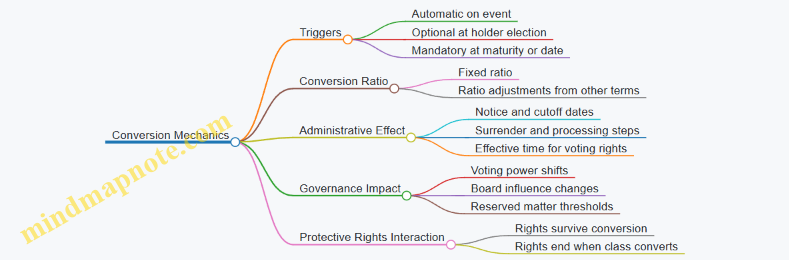
Example: Designing Conversion to Avoid Governance Whiplash
Suppose a company issues preferred with optional conversion. The company wants stable voting for the next two quarters while it completes a restructuring. The documents can:
- require conversion notices to be delivered with a defined lead time,
- specify that voting rights attach only after the company updates the ledger,
- and clarify whether reserved matters require preferred approval only while preferred remains outstanding.
This approach doesn’t stop conversion; it prevents conversion from being used as a last-minute voting tactic during a meeting where the record date has already been set.
Example: Conversion Ratio That Aligns Incentives
If the preferred includes a liquidation preference, conversion ratio design can balance investor participation with founder control. A higher conversion ratio increases investor voting influence after conversion, which can be appropriate when investors also bear meaningful downside risk. If the ratio is too generous, founders may lose practical control even when the company is still operating under a governance plan intended for a founder-led phase.
The control implication is straightforward: conversion ratio is not just economics; it is a governance dial that changes who can approve, block, or steer key decisions once conversion occurs.
3.5 Transfer Restrictions and Their Impact on Ownership Stability
Transfer restrictions are the rules that control how shares move between holders. They matter because ownership stability is not just about percentages on a cap table; it is about who can realistically become a decision-maker, who can influence governance, and how smoothly the company can plan for financing, exits, and board composition.
Core Concepts That Make Restrictions Work
A transfer restriction usually combines three ideas: (1) a gatekeeping process, (2) defined categories of permitted transfers, and (3) consequences if someone tries to move shares outside the rules.
Gatekeeping process. Most commonly, the company or existing holders get a first look at a proposed transfer. A typical starting point is a Right of First Refusal (ROFR): if a holder wants to sell, they must offer the shares to the company or other eligible holders first, usually on the same terms offered by a third party.
Permitted transfers. Restrictions often allow transfers to affiliates, trusts, or family entities, but only if the transferee agrees to be bound by the same restriction. This keeps ownership stable while still allowing normal estate and internal restructuring.
Consequences. If a transfer violates the restriction, the company may refuse to register the transfer on its books. In practice, that means the buyer cannot exercise voting rights or receive dividends until the paperwork is corrected.
Building Blocks of Transfer Restrictions
Right of First Refusal
ROFR is a “try to keep it in the family” mechanism. Example: Jordan holds 2% of a startup. They receive an offer from a strategic buyer for $10 per share. Under ROFR, Jordan must first offer those shares to the company (or other specified holders) at $10 per share. If the company declines within the stated window, Jordan can sell to the third party, typically without changing the economics.
ROFR improves stability by reducing surprise ownership changes. It also reduces the chance that a buyer with different governance expectations suddenly appears.
Right of Co-Sale
Co-sale rights protect minority holders when a major holder sells. Example: A lead investor sells its stake to an acquirer. If the deal triggers co-sale, smaller holders can sell a proportional amount on the same terms. This prevents a minority holder from being left behind with a new majority owner they did not choose.
Co-sale can increase stability in a different way: it reduces holdout behavior by giving minorities an exit path that matches the majority’s transaction.
Drag Along Rights
Drag along rights let a majority (or a specified vote threshold) force minority holders to sell in a qualifying transaction. Example: The company is acquired, and the buyer requires 100% ownership. If the majority meets the drag threshold, minority holders must participate, subject to conditions like minimum price and the same consideration type.
Drag rights can reduce deal friction, but they must be drafted carefully to avoid undermining minority protections. The stability benefit is operational: fewer stalled transactions, fewer renegotiations at the last minute.
Lockups and Transfer Timing
Lockups restrict transfers for a period after issuance or after a financing. Example: After a Series A, founders may be restricted from selling for 12 months. This keeps early ownership from scattering just as governance and strategy are being set.
Lockups also help the company manage communications and cap table volatility during periods when board and investor relationships are still forming.
How Restrictions Affect Ownership Stability in Practice
Transfer restrictions stabilize ownership by controlling three “instability channels.”
- Unexpected new holders. ROFR and consent rights reduce sudden entry by parties with unknown governance preferences.
- Unaligned exit outcomes. Co-sale and drag rights align minority and majority participation during liquidity events.
- Voting and economic continuity. If transfers are not registered, voting rights and dividend entitlements remain with the intended holders.
Mind Map: Transfer Restrictions and Their Effects
Example: A Clean Transfer Workflow
A well-run restriction clause usually specifies steps so everyone knows what happens next.
Example workflow for ROFR: (1) the holder sends a notice describing the buyer, number of shares, price per share, and payment terms; (2) the company/eligible holders respond within a defined period; (3) if they elect to buy, they close on the same terms; (4) if they decline, the holder can sell to the third party, but only within a specified time and without improving the buyer’s economics.
This procedural clarity prevents disputes that can otherwise turn a simple sale into a months-long governance headache.
Drafting Details That Prevent Instability
Small drafting choices can have big operational effects. Define “Transfer” broadly enough to cover indirect transfers, such as changes in control of a holder entity. Define “affiliate” and “permitted transferee” precisely so the company can consistently apply the rules. Set response deadlines that are long enough for internal approvals but short enough to avoid stalling legitimate transactions.
Finally, ensure the restriction is enforceable through the company’s share ledger and issuance documents. If the company can refuse to register noncompliant transfers, the restriction becomes real rather than optional.
4. Designing Share Classes and Voting Structures
4.1 Single Class Versus Multi Class Structures
Equity structures decide who can vote, who can block, and how control shifts as the company raises money. The simplest design is a single class of common stock. The more flexible design is multi class capital with different voting rights. Neither is automatically better; the right choice depends on how much control stability you need versus how much investor protection you want.
Single Class Structures
A single class structure means one vote per share (or one vote per share within a defined range) and generally uniform economic rights. Founders typically like it because it keeps the cap table easy to explain and reduces governance friction.
Core mechanics
- Voting: Each share has the same voting power for shareholder matters.
- Reserved matters: If investors need protection, they usually negotiate board-level vetoes or charter amendments that require a supermajority of the single class.
- Amendments: Changes to voting or rights often require the same shareholder vote threshold, so the process is straightforward.
Easy example
A company issues 10 million shares of common stock to founders and employees. Later, it sells 2 million more shares to an investor. The investor’s voting power becomes 2/12 of the total. If the company wants to approve a merger, the charter might require a 2/3 vote of the single class. The investor can influence outcomes but cannot unilaterally block them.
Where it fits well
- Early stages where governance simplicity matters.
- Companies where founders are comfortable with dilution of voting power.
- Situations where investor protection can be handled through board composition and information rights rather than share-class vetoes.
Multi Class Structures
Multi class structures split ownership into at least two classes, usually with different voting rights. A common pattern is high-vote founder shares and lower-vote investor shares. This can preserve founder control while still bringing in outside capital.
Core mechanics
- Voting: One class may have multiple votes per share while another has one vote per share.
- Economic rights: Economic terms can match across classes or differ through dividends, liquidation preferences, or conversion.
- Protective provisions: Investors often require class votes for certain charter changes, so they can block changes that would erode their position.
Easy example
Founders hold 8 million high-vote shares with 10 votes each. Investors receive 4 million low-vote shares with 1 vote each. Total votes are 80 million from founders plus 4 million from investors, so founders control voting even after the financing. If the charter requires a separate class vote for changes to voting rights, investors can still block attempts to strip their protections.
Where it fits well
- Companies that need consistent long-term decision-making and want to reduce the risk of control flipping after each financing.
- Founder-led businesses where continuity of strategy is a stated governance goal.
- Cases where investors accept control stability in exchange for clear reserved matters and information rights.
Tradeoffs You Can Actually Measure
Control stability vs. control accountability
- Single class structures naturally shift control with ownership changes.
- Multi class structures can keep control stable, but they must compensate with board oversight, reserved matters, and clear amendment rules.
Complexity vs. clarity
- Single class structures are easier to explain to employees, future investors, and even internal teams.
- Multi class structures require careful drafting so that everyone understands which actions require which votes.
Dilution behavior
- In single class, new issuances dilute voting power proportionally.
- In multi class, dilution can be asymmetric if new shares are issued into different classes or if conversion mechanics exist.
Mind Map: Choosing Between Single Class and Multi Class
Practical Drafting Checklist for This Choice
- If single class: define the shareholder vote thresholds for reserved matters and ensure board protections cover the investor’s real concerns.
- If multi class: specify (1) votes per share by class, (2) which actions require separate class votes, and (3) how conversion or reclassification works, if any.
- In both cases: align shareholder voting rules with board appointment and removal rights so that control does not depend on a single ambiguous mechanism.
Example: Two Term Sheet Approaches in Plain Language
Approach A: Single class with board protections
- All shares are common with one vote each.
- Investors get two board seats and a list of reserved matters requiring board approval.
- Certain charter amendments require a supermajority of the single class.
Approach B: Multi class with class votes
- Founders receive high-vote shares; investors receive low-vote shares.
- Reserved matters require approval by both the board and the affected share class.
- Charter amendments that change voting rights require class consent.
Both approaches can work. The key is to ensure that the governance outcome matches the intended balance between control stability and meaningful checks on power.
4.2 Supermajority Requirements and Reserved Matters
Supermajority requirements are the “slow down” button for decisions that can permanently change who controls the company or how value is shared. Reserved matters are the list of those decisions. Together, they create a predictable boundary: ordinary business can move quickly, while structural or control-shifting actions require extra agreement.
Foundational Concept: Why Supermajority Exists
A simple majority answers, “Can we do this now?” A supermajority answers, “Can we do this without a meaningful faction disagreeing?” In practice, supermajority thresholds reduce the risk that one group can quietly rewire governance through a sequence of ordinary votes.
A useful mental model is to separate two questions:
- Is the action structural? If it changes control, economics, or fundamental rights, it belongs in reserved matters.
- Is the action irreversible or hard to unwind? If reversing it would be costly, it needs a higher voting bar.
Designing Reserved Matters: Coverage and Precision
Reserved matters should be drafted with enough specificity to avoid arguments later. Vague categories like “major decisions” invite disputes over whether a particular transaction qualifies.
A strong reserved matters list usually includes:
- Charter and bylaw changes (because they define governance rules)
- Issuance of new equity above a defined threshold (because it can dilute control)
- Changes to class rights (because it can shift economic or voting power)
- Mergers, asset sales, and liquidation (because they can end the current ownership model)
- Borrowing or guarantees beyond a threshold (because leverage can change risk allocation)
- Related-party transactions above a threshold (because they can transfer value)
To keep the list workable, define thresholds in measurable terms: dollar amounts, percentage of outstanding shares, or budget lines. If you cannot define it, you probably cannot enforce it.
Supermajority Thresholds: Choosing the Number
Common approaches include:
- Two-thirds of votes cast for class-level reserved matters
- Two-thirds of outstanding shares for charter-level changes
- Majority of each class voting separately for actions that affect class rights
The choice depends on what you are protecting. If the goal is to prevent a single class from being outvoted by another, require approval by each affected class. If the goal is to prevent a bare majority from changing the rules, use an outstanding-share supermajority.
A practical drafting tip: specify whether the threshold is based on votes cast or shares outstanding. “Votes cast” can be easier to reach when abstentions are common; “outstanding” is harder and therefore more protective.
Interaction with Board Authority: Avoiding Governance Whiplash
Reserved matters should not conflict with board powers. If the board can approve an action, but the stockholders must also approve it, the documents should clearly state the sequence.
A clean structure is:
- Board approves the proposal.
- Stockholders vote if the action is a reserved matter.
- Only after stockholder approval does the company execute.
This prevents a scenario where the board “does the thing,” then the vote fails, leaving the company with a partially executed transaction.
Mind Map: Supermajority and Reserved Matters
Example: Reserved Matters Clause with Clear Voting Standard
Scenario: A company wants to issue a large equity tranche to a new investor.
- Reserved matter: “Issuance of equity securities resulting in more than 20% dilution on a fully diluted basis.”
- Voting: “Approval by the holders of at least two-thirds of the outstanding shares entitled to vote, voting together as a single class.”
Why this works: The threshold is measurable, and the voting standard is tied to outstanding shares, so abstentions do not quietly lower the bar.
Example: Class Vote for Control-Shifting Actions
Scenario: Preferred shares have protective provisions over changes to liquidation preferences.
- Reserved matter: “Any amendment that adversely changes liquidation preference, conversion ratio, or voting rights of a class of preferred stock.”
- Voting: “Approval by at least two-thirds of the outstanding shares of that preferred class, voting as a separate class.”
Why this works: It prevents common holders from using a general vote to alter preferred economics.
Example: Related-Party Transactions with a Dollar Threshold
Scenario: A founder’s affiliate provides consulting services.
- Reserved matter: “Related-party transactions exceeding $250,000 in any fiscal year.”
- Voting: “Approval by a supermajority of the board and stockholders, or by stockholders only if the transaction is also a reserved matter under the equity issuance or asset sale categories.”
Why this works: The threshold filters routine small transactions while still requiring heightened approval for value-moving deals.
Practical Drafting Checklist
- Define reserved matters using specific triggers and measurable thresholds.
- State the supermajority basis: votes cast or shares outstanding.
- Require separate class approval when class rights are affected.
- Specify the approval sequence to avoid partially executed transactions.
- Ensure reserved matters do not contradict board authority in the governance section.
When these elements are consistent across charter, bylaws, and investor rights documents, the company gets speed for normal decisions and friction for the decisions that truly matter.
4.3 Weighted Voting and Founder Control Considerations
Weighted voting is a design choice where different shares carry different voting power. In founder-led companies, it’s often used to keep long-term direction stable while still raising capital from investors who want meaningful governance influence. The key is to treat voting weight as a tool with tradeoffs, not a trophy.
Core Concept of Weighted Voting
Start with the basic mapping: equity ownership determines economic participation, while voting weight determines decision influence. A founder might hold a smaller percentage of total shares but a larger percentage of voting power. That separation can be helpful when founders have unique operational knowledge, but it can also create friction if investors feel their capital is funding decisions they can’t steer.
A practical way to reason about weighted voting is to ask two questions for each major decision type: Who should have the final say, and how much disagreement should be allowed before action stops? Weighted voting answers the first question; reserved matters and consent thresholds answer the second.
Founder Control Goals and Boundaries
Founder control usually aims at continuity: hiring and strategy decisions that take time to show results, and governance stability during early volatility. Boundaries prevent control from becoming a one-person veto. A common boundary is to reserve certain actions for class votes or supermajority approvals, so investors can block fundamental changes like selling the company, issuing senior securities, or amending key rights.
A second boundary is scope. Weighted voting can apply to ordinary director elections and routine board matters, while other decisions rely on separate approval mechanics. This reduces the feeling that investors are powerless in the areas that matter most.
Designing Voting Weight Without Creating Governance Deadlocks
Weighted voting can accidentally create deadlocks when thresholds are misaligned with the actual voting power distribution. To avoid that, model voting power at three levels: (1) founder-controlled votes, (2) investor class votes, and (3) cross-class combined outcomes.
A simple example: suppose the charter sets director election approval at a majority of votes cast. If the founder’s weighted votes always exceed 50%, the founder effectively controls the board. If that’s intended, fine. If not, the threshold should be tied to a class vote or a higher bar for certain board seats.
Deadlocks happen when two groups each have enough voting power to block but not enough to approve. Reserved matters should therefore be paired with clear thresholds that reflect the desired balance, such as “approval by the holders of at least X% of each affected class.”
Practical Example of Weighted Voting Mechanics
Imagine a company issues two classes.
- Class A common: 1 vote per share, held mainly by investors.
- Class B founder shares: 10 votes per share, held by the founder.
If the founder holds 20% of economic ownership but 67% of voting power, the founder can elect directors and approve ordinary board actions. Investors can still negotiate reserved matters requiring class consent.
Now add a reserved matter: “sale of the company requires approval by Class A and Class B voting together, each by at least 60% of its class votes.” This means investors can block a sale even if the founder can pass ordinary resolutions. The governance outcome becomes predictable: day-to-day direction stays stable, while existential decisions require broader agreement.
Conversion Triggers and Control Drift Management
Weighted voting often includes conversion rules that reduce founder voting power over time or upon certain events. The goal is to prevent control from being permanent in a way that conflicts with later capital needs.
Common conversion triggers include:
- Time-based conversion, such as converting Class B to Class A after a defined period.
- Performance or financing triggers, such as conversion upon a new qualified financing.
- Event-based conversion, such as conversion upon a change of control.
Each trigger changes the control curve. If conversion happens too early, the founder may lose stability before the company is ready. If it happens too late, investors may resist because their governance leverage never grows. The design should match the company’s expected governance maturity at each stage.
Mind Map: Weighted Voting and Founder Control Considerations
Example: Threshold Alignment Check
Suppose the charter says: “Reserved matters require approval by holders of at least 70% of the voting power.” If the founder holds 67% voting power, the founder alone cannot approve reserved matters, which is good for balance. But if investors collectively hold 33% and are fragmented across multiple investor holders, 70% might be hard to reach, causing operational paralysis. A class-consent approach can be more reliable: require 70% within each affected class rather than a single combined voting-power number.
Implementation Checklist for Founder Weighted Voting
Before finalizing, verify that the charter, investor rights agreement, and board consent rules all use the same definitions of voting power, class votes, and approval thresholds. Then run scenario calculations for: director elections, issuance of new shares, amendments to voting rights, and any sale or merger pathways. If the outcomes don’t match the intended balance, adjust the vote ratios, the thresholds, or the reserved matter list—preferably in that order.
4.4 Dual Track Voting for Major Transactions and Ordinary Business
Dual track voting separates “things that change the company’s life” from “things that keep it running.” The basic idea is simple: ordinary business decisions follow one voting track, while major transactions require a higher threshold or a different class vote. Done well, it prevents a small group from steering routine operations while still allowing the company to act efficiently day to day.
Foundational Concept: Two Categories of Decisions
Start by defining decision categories in plain language.
- Ordinary business: budgets, hiring within approved ranges, entering routine contracts, renewing leases, approving quarterly financial statements, and similar operational matters.
- Major transactions: mergers, asset sales outside the ordinary course, incurring debt above a threshold, issuing new equity, changing the business purpose, dissolving, or amending core governance documents.
A practical rule: if the decision can materially alter the risk profile or ownership economics, it belongs in the major track.
Designing the Voting Tracks
A common structure uses one voting mechanism for ordinary matters and a stricter mechanism for major matters.
- Ordinary track: majority vote of the voting power present, often aligned with board recommendations.
- Major track: supermajority vote, class vote of preferred or founders, or both.
To keep the system coherent, specify whether the major track applies to stockholder votes, board votes, or both. Many companies apply major track protections at the stockholder level while leaving board authority intact for operational speed.
Reserved Matters That Trigger the Major Track
Reserved matters should be precise enough to reduce disputes.
Include both transaction type and quantitative triggers.
- Asset sales: require major track approval if the sale exceeds a stated percentage of total assets or revenue.
- Debt: require major track approval if new debt exceeds a dollar amount or leverage ratio.
- Equity issuances: require major track approval for issuances that dilute existing holders beyond an agreed threshold, or for any issuance of a new class.
A good drafting habit is to define “ordinary course” by reference to an approved budget and prior practice, rather than leaving it as a vague vibe.
Mind Map: Dual Track Voting Architecture
Example: Ordinary Track That Still Feels Fair
Assume a company has common stock and a preferred class with protective provisions. Ordinary track matters require approval by holders of a majority of voting power. If the board wants to approve a new software contract for $2 million, it goes through the ordinary track because it is within the approved budget and does not change ownership economics.
If the board later proposes selling a product line for $25 million, that likely exceeds the asset sale threshold and triggers the major track. The company can still move quickly, but it must gather the higher approvals.
Example: Major Track with Clear Thresholds
Consider a debt financing proposal.
- If the company issues $5 million of debt, it falls under the ordinary track because the debt threshold is $10 million.
- If it issues $18 million, it triggers the major track.
Now add a class vote requirement: preferred holders must approve major track items affecting liquidation preference or conversion rights. This prevents a majority from using routine governance to quietly change the deal economics.
Board and Stockholder Coordination
Dual track voting works best when the board’s authority is aligned with the reserved matters list.
- The board can approve ordinary actions without calling a stockholder meeting.
- The board must seek stockholder approval for major matters.
To avoid process bottlenecks, include a mechanism for delegation within limits. For instance, the board may authorize officers to sign contracts up to a specified amount, while anything above that amount requires board approval and possibly stockholder approval.
Drafting Details That Prevent “But We Meant Ordinary” Disputes
Three drafting choices reduce ambiguity:
- Define “ordinary course” by reference to an approved budget and prior similar transactions.
- Use objective thresholds for major track triggers.
- State the consequence of misclassification by requiring the higher approval level if a matter is later determined to be major.
Case Study: A Clean Split Between Tracks
On 2026-04-06, a company’s board proposes two actions.
- Action A: hire 15 engineers and approve a quarterly operating plan. This is ordinary business, so it follows the ordinary track.
- Action B: issue new equity to fund an acquisition and amend the charter to create a new preferred series. This is major, so it triggers the major track, including class vote requirements.
The result is not just legal compliance. It is operational clarity: teams know what can be done quickly and what requires broader consent.
4.5 Practical Examples of Share Class Term Sheets and Governance Outcomes
This section turns share class language into governance outcomes you can actually picture. The goal is not to memorize terms, but to see how each term shifts decision power, information flow, and economic incentives.
Example 1: Founder Control with Investor Protective Provisions
Scenario. A founder keeps day-to-day control and board leadership, while Series A investors protect against major value shifts.
Term sheet choices.
- Capital structure. One common class for founders and employees; one preferred class for Series A.
- Voting. Preferred votes with common on an as-converted basis, but also has class votes for reserved matters.
- Board. 5 seats total: 2 founder-appointed, 2 investor-appointed, 1 independent chosen by mutual agreement.
- Reserved matters. Preferred class vote required for: issuing senior securities, changing liquidation preference, selling substantially all assets, merging, amending charter/bylaws in ways that affect preferred rights.
- Protective information. Quarterly financials and prompt notice of material litigation and financings.
Governance outcome. Ordinary operating decisions remain with management and the board majority. The investor block becomes decisive only when actions could change the preferred’s economic position or shift control through major transactions. The independent director often becomes the “tie-breaker” for non-reserved disputes, which reduces the chance that investor protection turns into constant veto power.
Example 2: Dual Share Classes with Weighted Voting for Founder Longevity
Scenario. A founder wants long-term continuity through multiple funding rounds without losing control to short-term capital cycles.
Term sheet choices.
- Capital structure. Two common-like classes: Class A common (founder) and Class B common (public/employee pool). Both participate economically, but voting differs.
- Voting. Class A carries 10 votes per share; Class B carries 1 vote per share.
- Preferred. Series A preferred converts to Class A voting on conversion, preserving the founder’s voting advantage.
- Reserved matters. Investor class vote for the same core items as Example 1, plus a specific item: changing the voting ratio between Class A and Class B.
- Transfer restrictions. Founder transfers of Class A require board consent, and permitted transfers exclude most sales to third parties.
Governance outcome. The founder can pass ordinary shareholder votes even after dilution, because voting power is anchored to Class A. Investors still have a meaningful veto on charter-level changes that would reduce their protection or alter the voting ratio. The practical tradeoff is that investors must accept that shareholder-level votes are not a reliable control lever; instead, they rely on board seats and reserved matters.
Example 3: “Capped” Liquidation Preference to Reduce Overhang
Scenario. Investors want downside protection, but the company wants to avoid a structure that discourages future fundraising.
Term sheet choices.
- Preferred economics. 1x liquidation preference with a cap tied to a multiple of original investment (for example, 2x total preference across all preferred series).
- Participation. Non-participating preferred: investors receive either their preference or the amount they would receive on an as-converted basis, whichever is higher.
- Conversion. Automatic conversion on a qualified financing threshold.
- Board and reserved matters. Same board split as Example 1; reserved matters focus on seniority, preference changes, and asset sales.
Governance outcome. In a modest exit, investors recover their preference. In a strong exit, conversion becomes attractive because non-participating preferred avoids “double dipping.” This reduces the chance that future investors view the cap table as permanently hostile to new capital, while still giving current investors a clear economic floor.
Mind Map: Share Class Terms to Governance Outcomes
Example 4: Putting It Together in a Governance Matrix
Scenario. A company wants a simple way to decide who approves what.
Governance matrix logic.
- Management and board majority approve ordinary-course actions.
- Board supermajority approves actions that are important but not value-shifting (for example, entering new lines of business).
- Preferred class vote approves reserved matters that change economics or control rights.
- Shareholder vote is required only when law or charter requires it (for example, charter amendments).
Concrete mini-matrix.
- Issue new common options under an approved plan: board majority.
- Issue new preferred senior to existing preferred: preferred class vote.
- Amend liquidation preference language: preferred class vote.
- Approve a merger: board approval plus preferred class vote if charter requires.
This approach prevents “surprise vetoes.” When each term is mapped to a decision category, the term sheet reads less like legal poetry and more like a decision system.
5. Board Composition and Appointment Rights
5.1 Board Size Independence and Committee Architecture
Board size independence means the board’s ability to govern does not depend on one person’s availability, one investor’s preferences, or one committee chair’s style. Committee architecture is the practical way to make that independence real: work is distributed, expertise is matched to decisions, and escalation paths are clear.
Board Size as a Governance Design Variable
Start with a simple principle: board size should fit the company’s decision load, not the company’s ego. A board that is too small concentrates knowledge and increases the chance that a single absence blocks key discussions. A board that is too large can slow decisions and dilute accountability.
A practical way to size the board is to count recurring board-level responsibilities and estimate how often they require deep discussion. For many companies, the recurring set includes strategy review, financial oversight, risk and compliance monitoring, executive performance and compensation, and major transaction review. If each area needs meaningful time every quarter, the board needs enough members to cover that workload without turning every meeting into a marathon.
Independence also depends on meeting cadence and committee coverage. If the board meets only quarterly, committees must do more between meetings. If the board meets monthly, committees can be lighter. Either way, the architecture should ensure that the board can still function when one director is unavailable.
Committee Architecture That Prevents Single Points of Failure
Committees exist to do two things well: prepare decisions and oversee ongoing matters. Preparation means committees develop options, test assumptions, and recommend actions. Oversight means committees monitor metrics, review reports, and ensure issues are escalated.
A common baseline set is:
- Audit Committee for financial reporting, internal controls, and external audit oversight.
- Compensation Committee for executive pay design, performance evaluation, and equity plan governance.
- Nominating and Governance Committee for director selection, board evaluation, and governance policies.
Add committees only when the company’s risk profile or transaction volume justifies it. For example, a company with significant regulatory exposure may need a dedicated risk or compliance committee, or it may assign that work to the audit committee with a clear charter.
Mind Map: Board Size and Committee Architecture
Membership Design and Independence Requirements
Committee membership should be intentional, not accidental. Each committee needs enough members to meet quorum without relying on one person. If a committee has three members and one is absent, the committee may be unable to operate. Increasing to four members can improve continuity, but only if the extra seat adds competence or reduces workload.
Match expertise to committee scope. Audit committee members should be comfortable with financial statements, internal controls, and audit processes. Compensation committee members should understand incentive design and performance measurement. Governance committee members should be effective at evaluating director performance and maintaining governance documentation.
Independence requirements matter because committees often handle sensitive topics. If a committee member has conflicts that impair judgment, the committee’s recommendations lose credibility. The architecture should define how conflicts are handled, including recusal and documentation.
Operating Rhythm That Keeps Committees Useful
A committee charter is not enough; the operating rhythm must support it. Each committee should have:
- A recurring agenda tied to oversight responsibilities.
- A reporting cadence to the full board.
- A clear escalation trigger list.
Escalation triggers prevent “committee silence.” For instance, the audit committee should escalate issues involving material misstatements, control failures, or audit disagreements. The compensation committee should escalate when performance metrics are disputed or when pay outcomes diverge sharply from stated principles. The governance committee should escalate when director attendance or performance evaluation indicates a need for action.
Example: Mid-Size Company Baseline
Assume a company with a board of five directors and three standing committees. A workable structure is:
- Audit committee: three members, one designated financial expert.
- Compensation committee: three members.
- Nominating and governance committee: three members.
To preserve independence, ensure at least two members overlap across committees only when it is necessary for expertise, not convenience. Quorum rules should allow committees to meet even if one member is unavailable, and the board should receive committee summaries that include decisions made, issues raised, and items requiring board approval.
Example: Regulated Company Adjustment
If the company faces frequent compliance reviews, the audit committee can expand its charter to include compliance monitoring, but the committee must receive the right inputs. That means management provides a standard compliance dashboard, internal audit reports include compliance testing results, and the audit committee agenda includes a standing compliance review item.
Example: Founder-Heavy Board with Investor Protection
When founders hold multiple seats, committee architecture can still protect minority investors by separating preparation from final decision. For example, the compensation committee can be structured so that founder-affiliated directors are not the sole decision makers on executive pay mechanics. The committee can recommend pay outcomes to the full board, while the full board retains authority for final approval. This keeps governance control aligned with the company’s long-term interests without turning every meeting into a negotiation.
Practical Checklist for Independence and Architecture
- Board size supports quorum and continuity during absences.
- Committees have charters with scope, authority, and reporting lines.
- Committee membership matches expertise and independence expectations.
- Quorum rules prevent committees from stalling.
- Escalation triggers are explicit and consistently used.
- Action tracking links committee recommendations to board decisions.
5.2 Appointment Rights for Founders Investors and Affiliates
Appointment rights are the mechanism that turns ownership into board-level influence. They answer a practical question: when a board seat becomes vacant, who gets to nominate the next person, and under what conditions. Done well, appointment rights keep governance stable while still allowing the company to adapt as ownership and strategy evolve.
Foundational Concepts for Appointment Rights
Start with the board seat lifecycle. A seat is created by the charter or bylaws, filled by an election process, and maintained through term and removal rules. Appointment rights typically sit at the “nomination” step: the right holder proposes a candidate, and the company’s election mechanics are designed to make that nomination effective.
Next, separate three layers that people often mix up:
- Nomination right: who selects the candidate.
- Election right: who has the votes to install the candidate.
- Removal right: who can replace the director mid-term.
Founders investors and affiliates may hold one or more of these layers. The cleanest designs specify each layer explicitly so there is no argument about whether a right is “soft” (influence) or “hard” (binding nomination).
Designing Appointment Rights for Founders
Founders usually want appointment rights that preserve continuity and decision speed. A common approach is to grant founders a fixed number of board seats tied to founder status or a minimum ownership threshold. The threshold should be defined in a way that matches how ownership actually changes, including transfers to permitted affiliates.
A practical example: a founder holds 40% of voting power at closing. The documents grant the founder two board appointment rights as long as the founder (or permitted affiliate) holds at least 25% of the company’s outstanding voting stock. If the founder later drops below 25% due to a sale, the appointment rights convert to a different structure, such as nomination rights only for a defined transition period.
To avoid governance whiplash, founders’ appointment rights often include a “replacement candidate” rule. If the nominee declines, is disqualified, or cannot serve, the right holder must provide a replacement within a set window. This prevents the company from being stuck with an empty seat.
Designing Appointment Rights for Investors
Investors typically seek appointment rights that protect their ability to monitor and influence major decisions. The key is to align investor appointment rights with the company’s capital structure and the investor’s continuing stake.
A common pattern is to tie appointment rights to either:
- Ownership level: seats scale with the investor’s percentage of voting stock.
- Class vote: seats are linked to a preferred class that votes as a block.
- Investment milestone: seats attach at closing and remain until a defined event such as conversion or a liquidity transaction.
Example: an investor purchases preferred stock with a right to appoint one director while it holds at least 10% of the company’s voting power. If the investor’s stake falls below 10% after subsequent issuances, the investor’s appointment right reduces to zero, but the investor retains information rights and reserved matter consent rights.
This separation matters. Appointment rights alone can become too blunt if they change abruptly. Pairing them with reserved matters ensures investors still have meaningful protection even when they lose a seat.
Handling Affiliates and Permitted Transfers
Affiliates are often included to prevent appointment rights from evaporating when ownership is reorganized. The documents should define “affiliate” and “permitted transferee” in a way that matches corporate reality: holding companies, management vehicles, and estate planning structures.
Example: an investor’s appointment right is held by “Investor and its affiliates.” The investor later transfers shares to a wholly owned holding company. The appointment right remains effective because the transferee qualifies as a permitted affiliate and the company receives notice plus updated beneficial ownership information.
To keep this from becoming a loophole, many agreements require that the affiliate remain under the same control and that the appointment right cannot be reassigned to unrelated parties without triggering a loss of the right.
Removal, Replacement, and Qualification Rules
Appointment rights should specify what happens when a director must be replaced. Removal rules can be structured as:
- At-will removal by the right holder: the right holder can remove and replace the director.
- Removal only for cause: the company controls removal, but the right holder can nominate a replacement if the director resigns.
- Hybrid: the right holder can remove for specified reasons such as failure to meet independence standards.
Qualification rules reduce disputes. They typically include independence requirements, conflict-of-interest standards, and eligibility to serve under corporate law. If a nominee fails qualification, the right holder must propose another candidate.
A concrete example: the board requires that at least one investor-appointed director be independent under the company’s governance policy. If the investor nominates someone who has a consulting relationship that breaches the independence definition, the company rejects the nominee and the investor must submit a replacement within 15 business days.
Mind Map: Appointment Rights Architecture
Integrated Example: Putting It Together in One Board
Assume a board of five seats: two founder-appointed, one investor-appointed, one independent, and one company-appointed. The charter states that the founder nominees are elected by the common vote, the investor nominee is elected by the preferred class vote, and the company-appointed seat is elected by the board or stockholders as specified.
If the investor-appointed director resigns, the investor must submit a replacement nominee within the defined window. If the nominee fails independence qualification, the company rejects the candidate and the investor submits another. Meanwhile, reserved matters ensure that even if the investor later loses its appointment right due to reduced voting power, the investor still has consent rights over actions that materially affect its economic position.
This structure keeps appointment rights from being the only protection and keeps reserved matters from becoming the only governance tool. Together, they create a board that is both stable and accountable.
5.3 Observer Rights Versus Voting Rights at Board Level
Observer rights and voting rights both sit at the board level, but they do different jobs. Voting rights decide outcomes; observer rights improve information flow. Confusing the two is a common source of governance friction, especially when investors want visibility without taking on full control.
Core Distinction and Practical Consequences
Voting rights mean a party can approve or block board actions through formal votes. Observer rights mean a party can attend meetings, receive materials, and ask questions, but cannot cast votes. The practical consequence is straightforward: voting rights change the decision; observer rights change the quality of the decision by shaping what the board knows.
A useful mental model is “participation in decisions” versus “participation in understanding.” If an investor’s main concern is whether management is executing the plan, observer rights can address that concern without forcing every strategic decision into a negotiation.
What Observers Typically Receive
Observer packages usually include:
- Board materials in advance, often the same packet as directors but sometimes with timing differences.
- Attendance at board meetings, including portions that are normally restricted for confidentiality.
- The ability to ask questions, usually through the chair or the board secretary.
- Access to minutes or summaries, sometimes limited to non-confidential sections.
To keep this workable, the documents should specify whether observers receive materials for every meeting type (regular, special, committee) and whether they can attend executive sessions.
What Observers Typically Cannot Do
Observers generally cannot:
- Vote on resolutions, including procedural votes like adopting agendas.
- Influence outcomes through informal “counting” of preferences, because the governance system should not treat observer input as binding.
- Unilaterally request actions that require board approval.
- Receive information that is restricted for legal, personnel, or trade-secret reasons.
A clean drafting approach is to define observer status as “attendance and information rights without decision rights,” then list explicit exclusions. That prevents the classic misunderstanding where an observer behaves like a director but is treated like a guest.
When Voting Rights Make Sense
Voting rights are appropriate when the party must protect specific governance interests. Common triggers include:
- Reserved matters that affect fundamental rights, such as issuing senior securities, changing the business scope, or approving major acquisitions.
- Situations where the party’s economic position is highly sensitive to board decisions.
- Early-stage control needs, where founders and investors agree that certain decisions must be jointly approved.
Voting rights can be structured narrowly, so the investor does not vote on everything. For example, an investor might have voting rights only for reserved matters, while management and independent directors handle ordinary-course decisions.
When Observer Rights Make Sense
Observer rights fit when the party needs oversight through information rather than control. They work well for:
- Strategic investors who want transparency but do not want to interfere with day-to-day governance.
- Parties with limited board expertise who still need to understand performance drivers.
- Situations where the company wants to keep decision-making efficient while maintaining trust.
Observer rights can also reduce the “surprise factor.” If observers receive materials early and can ask questions, the board spends less time explaining basics during meetings.
Mind Map: Observer Rights Versus Voting Rights at Board Level
Example: Investor Observer with Reserved-Matter Voting
Assume a company has three board seats: two independent directors and one founder director. A Series A investor receives observer rights plus voting rights only for reserved matters.
- Observer role: The investor attends all regular board meetings, receives the packet 48 hours in advance, and can ask questions during a designated Q&A segment.
- Voting role: The investor votes only when the board considers reserved matters, such as issuing new preferred shares or approving a sale of substantially all assets.
Outcome: ordinary decisions proceed without investor vetoes, while the investor still has a formal say on decisions that could materially change the investment’s risk profile.
Example: Observer Rights Without Materials Clarity
Now consider a different setup: observers are allowed to attend meetings, but the charter says “observers may receive materials as determined by the chair.” In practice, management shares some slides but not financial schedules, and the observer’s questions arrive too late to be useful.
The board may still act correctly, but the governance process becomes noisy. The fix is to specify a minimum materials standard, timing, and confidentiality rules, so observers can contribute meaningfully without turning every meeting into a negotiation about what counts as “the packet.”
Drafting Checklist for the Chair and Secretary
- Define which meetings observers attend.
- Specify materials delivery timing and scope.
- Set a structured question process and who responds.
- State confidentiality and restricted-session rules.
- Confirm that observers do not vote, and that voting authority is limited to named directors or defined reserved-matter votes.
- Align observer rights with reserved matters and any class consent requirements so the system is consistent.
Observer rights are not a consolation prize; they are a design choice. Used well, they improve decision quality without slowing the company down. Used poorly, they create ambiguity about authority. The difference is mostly in the definitions.
5.4 Removal Rights and Replacement Procedures
Removal rights are the part of governance design that turns “we can disagree” into “we can act.” They define who may remove a director, under what conditions, how quickly the company must respond, and what happens next so control doesn’t stall.
Core Concepts for Removal and Replacement
Removal rights typically come in two layers: (1) the right to remove and (2) the right to appoint a replacement. If either layer is missing or vague, the company can end up with a board vacancy, a contested vote, or an awkward interim period.
Start with the baseline: most jurisdictions allow shareholders to remove directors subject to charter and statutory limits. Investor rights documents often add contractual protections, such as requiring the company to vote in favor of removal when specific triggers occur.
Replacement procedures should specify timing and mechanics. A clean process usually includes notice, a vote or written consent method, and a defined appointment window for the replacement director.
Removal Triggers and Thresholds
Removal triggers should be objective and tied to governance outcomes. Common triggers include:
- For cause: fraud, material breach of fiduciary duties, or failure to meet board attendance requirements defined in the board governance guidelines.
- Without cause: removal by a specified vote threshold, often aligned to the class vote or protective provisions.
- Change in investor status: for example, if an investor no longer holds a minimum ownership percentage.
Thresholds matter because they determine whether removal is a routine governance tool or a high-friction event. A practical approach is to align thresholds with the same voting logic used for other reserved matters, so the company doesn’t face inconsistent approval standards.
Procedural Steps for a Smooth Removal
A systematic removal process reduces disputes. A typical sequence looks like this:
- Notice of intent: the removing party delivers written notice stating the director identity, the trigger category, and the proposed effective date.
- Company confirmation: the company verifies whether the trigger is satisfied based on defined criteria and documents.
- Board or shareholder action: removal occurs through the legally required body (often shareholders) using the charter/bylaws method.
- Replacement appointment: the replacement right holder nominates a candidate, and the company completes the appointment within a defined period.
- Documentation and cap table hygiene: the company updates corporate records and ensures the governance action is reflected in board minutes.
A key detail: define whether removal is effective immediately upon the vote or only after the replacement is seated. If you require replacement first, you risk a vacancy. If you allow immediate removal, you need a short appointment window to prevent governance gaps.
Removal Rights and Replacement Procedures Mind Map
Mind Map: Removal and Replacement Workflow
Example: Investor-Driven Removal with a Replacement Window
Assume an investor holds a preferred class with a contractual right to remove and replace one director. The charter allows shareholder removal by a simple majority of the voting power of that class.
- Trigger: the investor alleges “material breach” by the director.
- Notice: the investor sends a notice describing the breach and attaching supporting board materials.
- Company confirmation: the company has 10 business days to confirm whether the breach meets the agreement’s definition.
- Vote: the investor class votes by written consent if permitted.
- Effective date: removal is effective immediately upon consent.
- Replacement: the investor must nominate a replacement within 15 business days.
This structure prevents the company from arguing about the trigger indefinitely, while also preventing a long vacancy.
Example: Without-Cause Removal and the “No Vacancy” Rule
Consider a scenario where the investor wants to remove a director without cause because the investor’s strategy changed. The agreement allows without-cause removal by a supermajority of the investor class.
To avoid a governance gap, the agreement can require that the replacement nominee be identified in the removal notice. The company then seats the replacement director within a fixed period (for example, 5 business days) after the removal vote.
The practical benefit is simple: the board’s committee coverage doesn’t collapse, and the company can keep running without a scramble.
Drafting Details That Reduce Disputes
Removal and replacement clauses should define:
- Nominee eligibility: independence standards, conflicts policy, and whether the replacement must be acceptable to the board.
- Dispute handling: what happens if the company disputes whether the trigger is met, such as a defined cure period for certain breaches.
- Interim authority: whether committees can continue operating and whether the chair can act without the removed director.
When these points are explicit, the company spends less time arguing about process and more time making decisions. That’s the whole point: governance control should be precise enough to be boring.
5.5 Practical Examples of Board Seats and Voting Thresholds
Board seats and voting thresholds are where equity design turns into real governance behavior. The goal is simple: make sure the people who can block major actions are also the people who can steer the company when ordinary decisions need to move.
Foundational Concepts with Concrete Anchors
Start with three building blocks.
- Seat allocation answers: who gets to sit at the table.
- Voting thresholds answer: how many votes are needed to pass a board action.
- Reserved matters answer: which actions require special thresholds or class votes.
A practical way to think about it is to separate “day-to-day board control” from “major decision veto power.” If you mix them, you often get either paralysis or accidental control.
Example 1: Board Composition with Balanced Control
Assume a company has 7 board seats.
- Founder holds common stock and appoints 3 directors.
- Lead investor holds preferred stock and appoints 3 directors.
- Independent director is appointed by mutual agreement and holds 1 seat.
Now define voting thresholds.
- Ordinary board actions require a majority of directors present.
- Reserved matters require at least 5 of 7 directors, including at least 1 investor-appointed director.
Why this works: ordinary decisions can be made without forcing every disagreement into a veto. Reserved matters still protect the investor class from being steamrolled.
A concrete scenario: the board approves a new product roadmap. That’s ordinary business, so 4 votes out of 7 pass. If the board instead approves a sale of substantially all assets, it needs 5 votes and at least one investor director, so neither side can act alone.
Example 2: Supermajority Thresholds That Prevent Accidental Control
Consider a 5-seat board.
- Founder appoints 2.
- Investor appoints 2.
- Independent appoints 1.
Set thresholds like this:
- Ordinary actions: 3 of 5.
- Reserved matters: 4 of 5.
This creates a built-in requirement for cross-party agreement on major actions. With 4 of 5, neither side can pass reserved matters without the independent director or without at least one director from the other side.
A concrete scenario: issuing a new class of equity that changes economics is a reserved matter. If the founder and investor directors vote as blocs (2 and 2), they still cannot reach 4. The independent seat becomes the tie-breaker only when there is genuine alignment.
Example 3: Investor Protective Provisions at Board Level
Sometimes the investor wants protection without taking full board control. Use a “seat-light, veto-heavy” design.
- Board has 6 seats.
- Founder appoints 4.
- Investor appoints 1.
- Independent appoints 1.
Voting thresholds:
- Ordinary actions: majority.
- Reserved matters: 5 of 6, and must include the investor’s director.
Concrete scenario: approving a related-party transaction with a founder affiliate is reserved. Even if the founder’s 4 directors vote yes, the investor director must be among the 5 approving votes. This prevents self-dealing from being approved by a simple founder majority.
Mind Map: Board Seats and Voting Thresholds
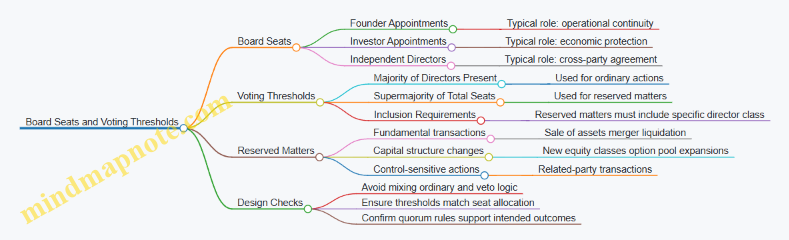
Example 4: Quorum Rules That Match the Threshold Logic
Quorum is the quiet partner that can break a design. If quorum is too low, one side can hold a meeting without the other side.
Example quorum setup for a 7-seat board:
- Quorum: at least 5 directors, including at least 1 investor-appointed director.
- Ordinary actions: majority of directors present.
- Reserved matters: 5 of 7, including at least 1 investor-appointed director.
Concrete scenario: the founder schedules a meeting to approve a financing. If the investor-appointed director refuses to attend, quorum fails, and the meeting cannot proceed. That’s intentional if the financing is reserved or if the charter requires investor participation for that category.
Example 5: A Simple Threshold Matrix You Can Reuse
Use a matrix to keep drafting consistent.
| Action Type | Board Seats Needed | Special Inclusion | Practical Effect |
|---|---|---|---|
| Ordinary business | Majority of directors present | None | Moves quickly |
| Hiring or compensation within plan | Majority of directors present | None | Operational flexibility |
| Equity issuance changing economics | 5 of 7 | At least 1 investor-appointed director | Prevents unilateral economic shifts |
| Sale of substantially all assets | 5 of 7 | At least 1 investor-appointed director | Forces cross-party agreement |
| Related-party transactions | 5 of 7 | At least 1 investor-appointed director | Reduces self-dealing risk |
The key is that seat allocation and thresholds should tell the same story. If the investor has only one seat but can block reserved matters, the inclusion requirement explains why that one seat matters. If the investor has multiple seats, you can often reduce inclusion complexity and rely on supermajority thresholds instead.
6. Protective Provisions and Reserved Matters Design
6.1 Defining Reserved Matters With Precision and Coverage
Reserved matters are the decisions that require extra owner approval beyond the ordinary board and management workflow. The goal is not to block the company; it’s to prevent a small set of high-impact actions from being taken under “routine” authority. Precision matters because vague reserved matters create disputes, while overbroad reserved matters slow down execution.
Start with Decision Categories and Real Control Points
Reserved matters should map to where control can shift materially. A practical way to begin is to classify decisions by the mechanism of control change:
- Economic control: actions that change cash flows, dilution, or exit economics.
- Voting control: actions that change who can decide later.
- Risk control: actions that create unusual liabilities or concentrate exposure.
- Strategic control: actions that commit the company to a new direction or structure.
- Governance control: actions that alter board composition, information rights, or amendment pathways.
Example: If the company issues new shares with different voting rights, that’s voting control even if the board “approves financing.” If it grants a large security interest over substantially all assets, that’s risk control even if it’s “just a loan.”
Define Each Reserved Matter Using a Trigger, a Scope, and a Threshold
Good drafting is a three-part sentence: trigger (what happens), scope (what it covers), and threshold (how big it must be). This prevents arguments about whether an action “counts.”
- Trigger: “Issuance of equity securities,” “incurrence of indebtedness,” “sale of all or substantially all assets,” “amendment of charter,” etc.
- Scope: specify whether it includes affiliates, options, warrants, convertible instruments, and amendments to existing instruments.
- Threshold: use dollar amounts, percentage of capitalization, or qualitative criteria like “substantially all” with a measurable test.
Example: Instead of “material financing,” define “any issuance of equity securities (including options, warrants, and convertible instruments) that results in more than X% dilution on a fully diluted basis.” Now everyone can calculate it.
Cover the “Common Escape Routes” Without Covering Everything
Most governance fights come from actions that are technically outside the reserved matter label. Coverage improves when you anticipate how a decision can be structured.
- Split transactions: require aggregation over a defined period.
- Side letters and amendments: include amendments that change economics or voting.
- Use of subsidiaries: include actions by material subsidiaries or that transfer value to them.
- Convertible and option instruments: include issuances that are economically equivalent to equity.
Example: If reserved matters cover “issuance of preferred stock,” an investor may still be diluted by issuing a large convertible note. Draft the trigger to include instruments “convertible into equity” and specify the conversion mechanics that count.
Set Approval Mechanics That Match the Stakes
Reserved matters typically require one of these approval patterns:
- Board approval plus class vote for actions that affect a specific class’s economics or voting.
- Supermajority owner approval for structural changes.
- Cross-class consent for actions that harm multiple classes differently.
Precision means stating who votes and how. For instance, “approval of a majority of the outstanding shares of each affected class” is clearer than “approval by the preferred.”
Example: If a reserved matter is “amendment that adversely affects liquidation preference,” define “adversely affects” by listing measurable changes: reduction in preference amount, elimination of participation, or extension of seniority.
Use Objective Tests for Ambiguous Terms
Some terms are magnets for disputes. Replace them with objective tests.
- “Substantially all assets”: define as a percentage of book value or revenue, or a threshold of enterprise value.
- “Material contract”: define by annual spend, contract value, or impact on revenue.
- “Change of control”: define by merger, sale of voting power, or sale of assets exceeding a threshold.
Example: “Sale of substantially all assets” becomes “sale or transfer of assets representing at least 50% of the company’s consolidated total assets (as shown on the most recent financial statements).”
Mind Map: Reserved Matters Design
Example: A Reserved Matters Clause Set That Stays Manageable
Below is a compact example of how multiple reserved matters can be drafted consistently. The point is the pattern: trigger + scope + threshold.
Reserved Matters Require Approval by [Board] and [Class Vote]

1. Equity Issuances
   - Trigger: issuance of equity securities
   - Scope: includes options, warrants, and convertible instruments
   - Threshold: results in > X% dilution on a fully diluted basis

2. Indebtedness
   - Trigger: incurrence of indebtedness
   - Scope: includes guarantees and liens
   - Threshold: exceeds $Y or creates liens on > Z% of assets

3. Asset Sales
   - Trigger: sale or transfer of assets
   - Scope: includes transfers to affiliates and material subsidiaries
   - Threshold: substantially all defined as >= 50% of consolidated assets

4. Charter and Rights Amendments
   - Trigger: amendment affecting class rights
   - Scope: includes changes to liquidation preference and voting
   - Threshold: requires consent of each affected class
Final Check: Coverage Versus Speed
After drafting, test each reserved matter against three questions: (1) Can a reasonable person calculate whether it applies? (2) Can the action be restructured to avoid the trigger? (3) Does the approval body match the impact on the affected class? If any answer is “no,” tighten the trigger, broaden the scope, or add an objective threshold. That’s how reserved matters protect ownership without turning governance into a constant meeting schedule.
6.2 Thresholds for Approval and Cross Class Voting Requirements
Thresholds for approval decide how much agreement is enough to change the rules. Cross class voting requirements decide which groups must agree, even when one class holds most of the votes. Together, they prevent “majority wins” from quietly rewriting economics or control.
Foundational Concepts for Threshold Design
Start with two separate questions. First: what action is being taken, and what risk does it create? Second: who is affected, and which class has the most direct exposure to that risk. A threshold is the minimum fraction needed for approval; cross class voting specifies which classes must reach that fraction.
A practical way to think about it is: thresholds protect the company from gridlock, while cross class voting protects minority positions from being steamrolled. If you only set thresholds, the majority can still change protected terms. If you only set cross class voting, you can end up with too many veto points that slow ordinary operations.
Choosing Threshold Levels That Match Action Risk
Use a tiered approach aligned to the severity of the change.
- Ordinary course actions: require only board approval or a simple owner vote. Example: approving an annual budget or entering a routine vendor contract.
- Material but reversible actions: use a higher owner threshold, such as a majority of outstanding shares. Example: authorizing a new line of credit within a defined cap.
- Fundamental changes: require supermajority approval, often two-thirds or three-quarters, and may require class votes. Example: amending the charter to change share rights, merging into another company, or issuing senior securities.
A useful rule of thumb is to tie the threshold to the “irreversibility” of the economic or control impact. If the company can unwind the decision without harming the affected class, the threshold can be lower.
Cross Class Voting Requirements That Prevent Quiet Rule Changes
Cross class voting typically appears in two forms.
- Class vote for charter amendments affecting that class: If an amendment changes voting rights, dividends, liquidation preferences, or conversion terms, the affected class must approve.
- Protective provisions requiring investor consent: Certain actions require approval by a specified investor group, even if the overall vote would pass.
To keep this systematic, define “affected” precisely. For example, an amendment that changes the conversion ratio for preferred stock clearly affects that class. An amendment that changes the common stock dividend policy might not affect preferred holders unless the preferred terms reference dividends.
Defining the Voting Denominator and Avoiding Counting Errors
Threshold math depends on what counts in the denominator.
- Outstanding shares: includes shares issued and not repurchased. This is common for owner votes.
- Outstanding and entitled to vote: excludes shares that are restricted from voting due to terms or status.
- Series or class-specific denominators: for class votes, use the outstanding shares of that class.
Example: Suppose Series A preferred has 10,000,000 shares outstanding. If the charter requires “approval by holders of at least 66 2/3% of the Series A preferred then outstanding,” you must calculate using 10,000,000, not the total company shares.
Worked Examples of Threshold and Cross Class Combinations
Example 1: Supermajority owner vote without class vote
- Action: approve a new equity plan.
- Threshold: majority of outstanding common.
- Cross class: none.
- Outcome: common holders can approve the plan, while preferred holders are not granted a veto.
This is appropriate when the plan’s dilution impact is handled through other mechanisms, such as option pool sizing rules and anti-dilution definitions.
Example 2: Charter amendment changing preferred liquidation preference
- Action: amend charter to reduce liquidation preference from 1.0x to 0.8x.
- Threshold: two-thirds of outstanding shares voting as a class.
- Cross class: Series A class vote required, and possibly investor consent for any series that is directly impacted.
- Outcome: even if common holders approve, the preferred holders can block the change.
Example 3: Issuance of senior securities
- Action: issue new preferred with priority over existing preferred.
- Threshold: approval by at least a majority of the affected preferred class, plus a supermajority of the overall preferred vote if specified.
- Cross class: required for each series that would be subordinated.
- Outcome: the company cannot “stack” new priority rights without the impacted holders agreeing.
Mind Map: Thresholds and Cross Class Voting
Practical Drafting Checklist for Consistent Approval Rules
- List each protected action and state the exact approval threshold.
- Specify which classes vote and whether the vote is “as a class” or “with the company.”
- Define the denominator for each vote type.
- Ensure the same action is not described differently across charter, bylaws, and investor rights agreements.
- Confirm that ordinary actions do not accidentally trigger class votes through broad wording.
When these pieces line up, thresholds become predictable and cross class voting becomes targeted, which is exactly what you want: enough protection to matter, and enough flexibility to operate.
6.3 Information Rights and Their Role in Effective Protection
Information rights are the practical counterpart to governance protections. A reserved matter without timely, usable information is like a seatbelt without a buckle: it looks reassuring until you need it. In this section, the goal is to show how information rights work as a system—what they cover, how they’re delivered, who receives them, and how they prevent control from becoming a one-way street.
Foundational Purpose of Information Rights
Information rights exist to reduce decision-making asymmetry. Investors and minority holders typically cannot observe day-to-day operations, so they rely on structured reporting to evaluate whether management is acting within agreed boundaries. Effective information rights also support enforcement: if a right is never triggered, never delivered, or delivered in a form that can’t be assessed, it doesn’t protect anyone.
A useful way to think about protection is a three-step loop:
- Observe what is happening.
- Assess whether it aligns with the governance framework.
- Act through voting, consent, or escalation. Information rights strengthen all three steps by making “observe” reliable and “assess” feasible.
Core Categories of Information Rights
Most information rights fall into four buckets, each tied to a different governance need.
- Periodic reporting: monthly or quarterly financials, cash position, and operational metrics. This supports ongoing oversight and early detection of drift.
- Event-driven reporting: notice of material transactions, related-party dealings, litigation, or breaches of covenants. This supports timely consent and reserved-matter workflows.
- Budget and plan visibility: annual budgets, rolling forecasts, and variance explanations. This helps holders understand whether management is operating within the agreed economic and control assumptions.
- Governance and compliance reporting: board materials, committee minutes summaries, cap table updates, and equity plan administration. This ensures the ownership record and decision record match.
A common best practice is to align each bucket with a specific decision right. If the agreement requires investor consent for a major issuance, then the information rights should include enough detail to evaluate pricing, dilution impact, and strategic rationale.
Delivery, Timing, and Usability
Timing is not a formality; it determines whether information can influence decisions. Rights should specify:
- When information is delivered (for example, within a set number of days after month-end).
- What is included (financial statements, supporting schedules, and key assumptions).
- How it is delivered (secure data room, email with attachments, or board portal).
- In what format it is usable (spreadsheets for cap table and dilution math; narrative explanations for variances).
A practical example: if quarterly reporting arrives after the next board meeting, investors can still read it, but they can’t realistically use it to ask targeted questions before decisions are made. The protection becomes retrospective rather than preventive.
Usability also means defining terms. “Material” should have a threshold or reference point, such as dollar value, percentage of revenue, or impact on control. Without that, notice becomes inconsistent and disputes become inevitable.
Who Receives What and How Escalation Works
Information rights should specify recipients and channels. Typically, rights extend to:
- the investor entity or its designated representative,
- board observers (if granted),
- and sometimes specific committees for specialized review.
Escalation is the bridge from information to action. A well-designed system includes:
- a question window after delivery,
- a management response obligation within a defined timeframe,
- and a remedy path if information is withheld or incomplete.
Example: Suppose an investor requests supporting schedules for a reported cash burn increase. If the agreement requires management to respond within 10 business days and provides a remedy for noncompliance, the right becomes enforceable. If it only says “reasonable access,” enforcement becomes a negotiation, not a process.
Mind Map: Information Rights as a Protection System
Example Workflows That Keep Rights from Becoming Paper Rights
Example: Reserved Matter Evaluation for a New Financing
- Management delivers event-driven notice with: proposed terms, valuation rationale, cap table impact, and use of proceeds.
- Investors receive a defined period to review and submit questions.
- Management provides responses before the consent vote.
- If information is incomplete, escalation triggers a delay or a remedy consistent with the agreement.
This workflow prevents a common failure mode: investors being asked to approve a transaction without the math.
Example: Monthly Reporting for Cash Management
- Monthly package includes cash balance, burn rate, runway estimate, and covenant status.
- If runway falls below a threshold, management must provide an explanation and a mitigation plan.
- Investors can then decide whether to use governance tools such as board discussions or consent rights tied to operational changes.
Here, information rights act like an early warning system rather than a post-mortem report.
Common Drafting Pitfalls and How to Avoid Them
- Vague materiality: replace “material” with thresholds.
- Late delivery: tie deadlines to decision calendars.
- Overbroad confidentiality: allow disclosure to advisors under confidentiality obligations.
- No response obligation: add a management response timeframe.
- No link to decisions: ensure each information right supports a specific consent or oversight function.
When these elements are present, information rights stop being a checkbox and start functioning as a control mechanism that is both fair and operationally realistic.
6.4 Scope Control for Amendments Waivers and Consents
Scope control is the discipline of making sure an amendment, waiver, or consent changes only what it is supposed to change. In equity and governance documents, the biggest practical risk is not that people disagree—it’s that the legal text accidentally grants broader power than intended, or that the approval process is inconsistent across instruments.
Foundational Concept of Scope
Start with three building blocks: (1) the action being taken, (2) the documents being affected, and (3) the parties whose rights are being modified. A clean scope statement answers all three in plain language before you draft the operative clauses.
Easy example: A preferred investor wants a waiver of a reporting deadline for one quarter. If the waiver clause is written as “waive any breach under the agreement,” it may be argued to cover unrelated obligations. A scope-controlled version says “waive the reporting covenant breach for the quarter ended [date] only, and only for the failure to deliver the specified report.”
Amendment Versus Waiver Versus Consent
Treat these as different tools with different boundaries.
- Amendment changes the underlying terms. It usually requires the highest level of formal approval because it rewrites rights.
- Waiver temporarily or conditionally excuses a breach or noncompliance. It should be narrow in time, obligation, and affected parties.
- Consent approves a specific action that would otherwise be prohibited or require approval under a protective provision.
Easy example: If a company wants to issue new shares that trigger a protective provision, that’s typically a consent to the issuance. If the company instead wants to permanently change the protective provision threshold, that’s an amendment.
Scope Control Checklist for Drafting
Use a consistent checklist so the approval matrix and the legal text match.
- Identify the triggering right or covenant. Name the exact clause number or describe the obligation precisely.
- Limit the subject matter. Specify the exact transaction, event, or covenant being addressed.
- Limit the time period. For waivers, define the start and end date. For consents, define the transaction closing window.
- Limit the affected instruments. State whether the change applies to the charter, bylaws, investor rights agreement, voting agreement, or all of them.
- State the approval standard. Confirm whether the action requires class vote, separate class vote, or a cross-class threshold.
- Preserve all other rights. Include an express “no other waiver” statement.
- Confirm no implied amendment. Make clear that the waiver or consent does not modify the underlying terms.
Easy example: A waiver for late delivery of financial statements should include “no waiver of any other covenant, including delivery of budgets, notice obligations, or compliance with covenants in future periods.”
Approval Mechanics That Prevent Scope Creep
Scope control is also process control. If approvals are inconsistent, you can end up with a document that is technically valid but practically contested.
- Match the approval to the right being changed. If only one class has the protective right, require that class’s vote.
- Use a single action description across documents. The consent resolution, notice, and signature page should describe the same transaction.
- Avoid “blanket consents.” A consent that covers “any actions related to financing” invites disputes about what was actually approved.
Easy example: A board resolution says “consent to amendments related to financing.” The investor consent form says “consent to issuance of Series Seed.” If the company relies on the board language to justify a broader issuance, the mismatch becomes a scope dispute.
Mind Map: Scope Control for Amendments Waivers and Consents
Integrated Example: One Waiver, Three Documents
Assume a company’s investor rights agreement requires quarterly reporting by the 15th. The company misses the deadline for the quarter ended April 15 and asks for a waiver.
- Investor rights agreement waiver clause: waives only the reporting covenant breach for that quarter.
- Board consent resolution: authorizes the company to deliver the report by a specified new date.
- Preferred stock protective provision acknowledgment: confirms that the waiver does not change any other protective rights.
If the waiver request also included a request to “waive any future reporting breaches,” that would exceed scope and likely require a different approval standard than a narrow waiver.
Practical “Scope Language” Patterns
Use patterns that reduce ambiguity.
- Time-limited waiver: “for the quarter ended [date] only.”
- Obligation-limited waiver: “only with respect to delivery of [specific report].”
- Document-limited effect: “only under [agreement name] and does not amend the charter.”
- No other rights affected: “all other covenants and rights remain in full force.”
When scope is controlled this way, the parties can sign with confidence that the legal effect matches the business intent—no more, no less.
6.5 Practical Examples of Reserved Matters Clauses and Governance Tradeoffs
Reserved matters are the “stop points” where certain actions require approval beyond ordinary management authority. The goal is not to slow everything down; it’s to prevent a few high-impact moves from being made with insufficient oversight. A useful clause set starts with clear categories, then assigns thresholds and voting scope that match the risk.
Reserved Matters Categories That Actually Cover Real Decisions
A practical reserved matters list usually groups decisions by who is harmed if they go wrong: the company’s long-term value, the investors’ economic position, or the board’s ability to govern. For example:
- Capital structure moves: issuing new equity, creating senior securities, changing conversion terms.
- Control-affecting transactions: mergers, asset sales, entering material lines of business.
- Financial commitments: incurring debt above a threshold, guaranteeing obligations.
- Governance integrity: amending charter documents, changing board size, adopting equity plans.
- Related-party transactions: deals with founders, affiliates, or board members.
A clause that only lists “major transactions” is too vague to administer. A clause that lists specific actions with thresholds is easier to interpret and easier to enforce.
Threshold Design with Examples
Thresholds determine how often reserved matters trigger. Too low, and the board becomes a rubber stamp for routine work. Too high, and the protection becomes symbolic.
Example A: Debt threshold
- Reserved matter: “The Company shall not incur indebtedness exceeding $2,000,000 in aggregate at any time, excluding ordinary course trade payables.”
- Tradeoff: $2,000,000 is high enough to avoid constant approvals, but low enough to prevent leverage surprises.
Example B: Equity issuance threshold
- Reserved matter: “The Company shall not issue any equity securities or securities convertible into equity, other than under the approved equity plan, unless approved by the Board and the Required Investor Vote.”
- Tradeoff: This protects dilution risk, but it can complicate hiring if the equity plan is undersized.
Voting Scope Choices That Reduce Governance Friction
Reserved matters often require one or more of the following approval layers:
- Board approval (usually simple majority or supermajority).
- Class vote (approval by a specific investor class).
- Investor vote (approval by holders of a percentage of preferred or voting power).
Example C: Class vote for charter amendments
- Reserved matter: “Any amendment to the Certificate of Incorporation that adversely affects the rights of the Preferred Stock requires approval by the holders of at least two-thirds of the outstanding Preferred Stock voting as a class.”
- Tradeoff: Strong protection for investors, but it can slow down administrative fixes if “adversely affects” is not defined.
To reduce disputes, define “adversely affects” with a short list of what counts and what does not, such as changes to dividends, liquidation preference, or voting rights.
Drafting Patterns That Prevent Ambiguity
Three drafting patterns help reserved matters work in real life.
- Include exclusions for ordinary course actions.
- Example: “Debt incurred under existing credit facilities” is excluded if it stays within the cap.
- Use objective triggers rather than subjective ones.
- Example: “Material” is replaced by a dollar threshold or percentage of revenue.
- Specify measurement timing.
- Example: “aggregate at any time” avoids confusion about whether the cap resets after repayment.
Mind Map of Reserved Matters and Tradeoffs
Mind Map: Reserved Matters Clauses and Governance Tradeoffs
Case-Style Example Set with Integrated Clauses
Scenario: A company wants to (1) raise a bridge note, (2) amend the charter to adjust conversion mechanics, and (3) approve a founder consulting agreement.
-
Bridge note
- Reserved matter: “Incurring indebtedness above $2,000,000 requires Board approval plus the Required Investor Vote.”
- Tradeoff: Investors get a say on leverage; management keeps room for smaller financing.
-
Conversion mechanics amendment
- Reserved matter: “Any amendment that changes conversion ratios, conversion price, or voting rights of Preferred Stock requires approval by the holders of at least two-thirds of the outstanding Preferred Stock voting as a class.”
- Tradeoff: Investors prevent economic drift; the company must plan charter changes with approval lead time.
-
Founder consulting agreement
- Reserved matter: “Any related-party transaction above $250,000 per year requires Board approval excluding interested directors and, if applicable, investor approval if it materially affects budgets.”
- Tradeoff: The company can compensate founders, but it must document fairness and avoid disguised value transfers.
The practical lesson is that reserved matters should be drafted as a coherent system: categories define what matters, thresholds define when it matters, and voting scope defines who must agree. When those three pieces fit together, governance becomes predictable rather than negotiable every time a decision appears on the agenda.
7. Economic Terms That Support Sustainable Ownership
7.1 Capitalization Tables and Ownership Percentages Over Time
A capitalization table, or cap table, is the ledger that shows who owns what, how ownership changes, and why. “Ownership percentage over time” matters because equity is rarely static: option pools grow, investors convert instruments, and rounds reprice or adjust economics. A good cap table turns those events into a clear sequence of ownership outcomes.
Core Concepts That Make Percentages Make Sense
Start with three building blocks.
-
Units: shares and equity units (common shares, preferred shares, options, warrants). Percentages are always based on a defined unit count.
-
Fully Diluted Shares: the denominator used for “as-converted” or “fully diluted” ownership. It includes shares that would exist if all convertible instruments converted and all options were exercised (using a specified method).
-
Event Timing: ownership percentages change at specific moments—issuance, conversion, vesting, exercise, or amendment. If you model events out of order, you get percentages that look plausible but are wrong.
A practical rule: every time you compute an ownership percentage, write down the denominator definition you used. If you don’t, you’ll eventually compare apples to “apples that have been through a few financing rounds.”
A Systematic Workflow for Ownership over Time
Step 1: Establish the starting point. Create a baseline cap table at a known date (for example, 2026-04-15). Include each class of equity, the number of shares, and the conversion terms for any preferred stock.
Step 2: List events in chronological order. Common events include:
- New equity issuance in a financing round
- Option pool creation or expansion
- Option exercises
- Preferred conversion (often automatic at certain triggers)
- Equity plan grants and vesting (which affect ownership only when exercised, unless you track “unexercised” on a separate basis)
Step 3: Decide which ownership view you need. Use consistent views:
- Issued and outstanding: ignores unexercised options and unconverted instruments.
- As-converted: converts preferred into common using conversion ratios.
- Fully diluted: adds the effect of options/warrants using a specified exercise assumption.
Step 4: Apply each event and recompute. After each event, update share counts, conversion ratios (if they change), and the fully diluted denominator. Then compute ownership percentages for each holder.
Step 5: Record the “why” next to the “what.” For each change, store a short reason: “Series A issued,” “Option pool added,” “Conversion triggered by IPO,” etc. This prevents future confusion when someone asks why a percentage moved.
Mind Map: Cap Table Mechanics
Example: Modeling Two Rounds with an Option Pool
Assume a company starts with 1,000,000 common shares owned by the founders.
Event A: Series Seed issued. Investors receive 200,000 shares of preferred that convert 1:1 into common. After issuance:
- Issued and outstanding common-equivalent shares = 1,200,000
- Founders ownership (as-converted) = 1,000,000 / 1,200,000 = 83.33%
- Seed investors ownership (as-converted) = 200,000 / 1,200,000 = 16.67%
Event B: Option pool created before Series A. The board creates a 150,000-share option pool. If you model fully diluted ownership by assuming options are outstanding (not exercised yet), the fully diluted denominator becomes 1,350,000 common-equivalent shares.
- Founders ownership (fully diluted) = 1,000,000 / 1,350,000 = 74.07%
- Seed investors ownership (fully diluted) = 200,000 / 1,350,000 = 14.81%
- Option pool ownership (fully diluted) = 150,000 / 1,350,000 = 11.11%
Notice what changed: founders’ as-converted ownership after Seed was 83.33%, but their fully diluted ownership after the pool is 74.07%. Both are correct—because the denominator changed.
Example: Conversion Timing Changes the Story
If Series A triggers an automatic conversion of the Seed preferred at closing, then at that moment the as-converted and issued-and-outstanding common-equivalent views align. If conversion is delayed until a later trigger, the as-converted view will show investors’ common-equivalent ownership earlier than the issued-and-outstanding view. The cap table should show both views so readers don’t mistake timing differences for math errors.
Quality Checks That Prevent Common Mistakes
- Denominator consistency: the same denominator definition must be used across a table.
- Chronology: apply events in order; don’t “merge” rounds without modeling intermediate states.
- Reconciliation: totals in each view should match the sum of holders’ shares in that view.
- Conversion math: verify conversion ratios and any caps or adjustments that affect share counts.
When these checks are routine, ownership percentages over time become a reliable narrative of how control and economics moved, not a spreadsheet that merely looks tidy.
7.2 Liquidation Preferences Participation and Cap Structures
Liquidation preferences answer one practical question: when the company is sold or liquidated, who gets paid first, and how much? The answer depends on two design choices that often travel together: (1) whether the preferred holders get a fixed “multiple” and (2) whether they also get to share in remaining proceeds through participation. Cap structures then decide how much participation is allowed to stack up.
Foundational Mechanics of Liquidation Preferences
Start with the basic payout waterfall. Imagine a sale where the company receives $100 million. If investors hold preferred stock with a 1x liquidation preference, they typically receive their invested amount first. If they invested $30 million, they get $30 million before common holders receive anything.
Now add the multiple. A 2x liquidation preference means the preferred holders receive 2 times their original investment before common gets paid. Using the same $100 million sale, if the preferred invested $30 million, a 2x preference pays $60 million first.
This is where the “cap” concept becomes important: participation can cause preferred holders to receive both their preference and a share of the rest, potentially leaving common with very little. Caps limit that stacking.
Participation Types and Their Governance Consequences
Participation comes in two common forms.
Non-Participating Preferred: Preferred holders choose between (a) taking their liquidation preference or (b) converting to common (or otherwise sharing as if they were common). In practice, conversion is usually beneficial when the sale proceeds are high enough that common economics outperform the preference.
Participating Preferred: Preferred holders take their liquidation preference and then also participate in the remaining proceeds as if they held common, usually alongside common holders. This is the “double dip” structure—except the cap determines whether it’s a small dip or a full plunge.
A simple example clarifies the difference.
- Preferred invested: $30 million at 1x
- Sale proceeds: $100 million
- Assume preferred would convert to common if it were non-participating and conversion is economically better
Non-Participating Outcome: Preferred takes $30 million first, and the remaining $70 million goes to common (including any converted preferred, depending on the conversion decision).
Participating Outcome Without a Cap: Preferred takes $30 million first, then participates again in the remaining $70 million based on its ownership percentage. If preferred ownership is large, common can be squeezed.
Cap Structures That Prevent Runaway Participation
Caps limit the total amount a participating preferred can receive.
Full Cap: Participation stops once preferred holders reach a maximum payout, often expressed as a multiple of original investment. For example, a 2x cap means preferred holders cannot receive more than 2 times their original investment total.
Partial Cap: Participation is limited in a more nuanced way, such as capping participation only above a threshold or using a formula that reduces participation after certain payout levels.
No Cap: Participation continues until proceeds are exhausted, which can make common economics heavily dependent on the preferred’s ownership percentage and the sale price.
Consider a participating preferred with a 1x preference and a 2x cap.
- Preferred invested: $30 million
- 1x preference paid first: $30 million
- Maximum total under 2x cap: $60 million
If the sale proceeds are $100 million, the preferred would like to participate in the remaining $70 million. But the cap prevents the preferred from receiving more than $60 million total. That means only $30 million of the remaining $70 million can be allocated to preferred; the rest goes to common.
This cap structure is often the difference between “preferred gets paid first” and “preferred gets paid first and then keeps taking until the common is mostly symbolic.”
How Cap Structures Interact with Ownership Percentages
Caps do not operate in a vacuum. The ownership percentage of preferred holders determines how much of the remaining proceeds they would receive under participation. A cap then truncates that entitlement.
Example with two scenarios:
- Preferred ownership is 20% of the company on an as-converted basis.
- Preferred ownership is 60% on an as-converted basis.
Without a cap, the 60% scenario gives preferred a much larger share of the remaining proceeds, leaving common with less. With a 2x cap, both scenarios are limited, but the 60% scenario reaches the cap sooner, shifting more of the payout to common at lower sale prices.
Mind Map: Liquidation Preferences Participation and Cap Structures
Worked Example with a Cap and a Conversion Choice
Assume:
- Preferred invested: $25 million
- Preference: 1x
- Participation: participating
- Cap: 3x
- Sale proceeds: $90 million
- As-converted preferred ownership: 40%
Step 1: Pay preference first.
- Preferred gets $25 million.
Step 2: Determine maximum total under cap.
- 3x cap means maximum total payout is $75 million.
Step 3: Compute how much participation can add.
- Remaining proceeds after preference: $65 million.
- If preferred participated without a cap, it would receive 40% of $65 million = $26 million, plus the $25 million preference, totaling $51 million.
Step 4: Apply the cap.
- Total $51 million is below the $75 million cap, so the cap does not bind.
- Preferred receives $51 million total; common receives $39 million.
Now change only the sale proceeds to $200 million.
- Preference first: $25 million.
- Remaining proceeds: $175 million.
- Uncapped participation share: 40% of $175 million = $70 million.
- Uncapped total: $95 million.
- Cap binds at $75 million total, so preferred receives $75 million and common receives $125 million.
This shows why caps matter: they control how far participation can stretch as sale proceeds rise, and they do so with a clear arithmetic limit rather than vague bargaining.
7.3 Anti Dilution Protection and Its Governance Consequences
Anti-dilution protection is a contractual mechanism that adjusts the conversion price of certain preferred shares when the company issues new equity at a lower price than the protected investors originally paid. The adjustment is not just an economic tweak; it changes who effectively controls outcomes in later financings, because conversion price drives voting power and liquidation economics.
Core Concept from Price to Control
Start with the conversion ratio: preferred shares convert into common shares based on a conversion price. If the conversion price drops, each preferred share converts into more common shares. That means anti-dilution can shift voting leverage at the board and shareholder levels, even if the charter and voting provisions stay unchanged.
A simple example: Investor A buys preferred at $2.00 per share with a 1:1 conversion at issuance. Later, the company issues new shares at $1.00. If Investor A’s conversion price is adjusted downward, Investor A’s conversion ratio increases, which can increase Investor A’s share of the common-equivalent cap table.
Two Main Adjustment Styles
Most agreements use either a full ratchet or a weighted average approach.
- Full ratchet resets the conversion price to the lowest price at which new shares are issued, regardless of how many shares were issued. This is the “everyone pays attention to the worst price” method.
- Weighted average adjusts the conversion price based on both the new issuance price and the number of shares issued. This is the “size matters” method.
Governance consequence: full ratchet is more likely to create large ownership swings from relatively small issuances, which can make future financing negotiations more contentious. Weighted average tends to produce smoother adjustments, which reduces the chance that a single transaction dramatically rebalances control.
Governance Consequences You Can Actually Measure
Anti-dilution affects at least five governance levers.
- Voting power through conversion: More common-equivalent shares can increase the likelihood of meeting class vote thresholds or influencing shareholder votes.
- Board dynamics: Even when board seats are fixed, investor influence can rise because ownership changes alter bargaining positions in consent requests.
- Investor incentives in down rounds: Protected investors may prefer terms that preserve their economics, while founders and common holders may push for alternative structures.
- Negotiation leverage in amendments: If anti-dilution is triggered, investors often seek additional protections elsewhere, such as information rights or reserved matters.
- Future issuance friction: Management may hesitate to issue equity at lower prices, because the downstream conversion impact can be severe.
Mind Map: Anti Dilution Mechanics and Governance Effects
Example: Full Ratchet Versus Weighted Average
Assume Investor A holds 10,000 preferred shares convertible at $2.00, so the initial conversion implies 10,000 common-equivalent shares.
Later, the company issues 5,000 new common shares at $1.00. Under full ratchet, Investor A’s conversion price becomes $1.00. If the agreement keeps the same conversion formula, Investor A’s conversion ratio doubles, so Investor A converts into 20,000 common-equivalent shares.
Under weighted average, the conversion price adjusts partially because the new issuance is only a portion of the pre-transaction capitalization. The result is a conversion price somewhere between $1.00 and $2.00, producing an ownership increase that is meaningful but not explosive.
Governance consequence: with full ratchet, a relatively small issuance at a low price can materially change who controls shareholder votes. With weighted average, the same issuance produces less dramatic control shifts.
Drafting Details That Prevent Governance Surprises
Anti-dilution clauses often fail in practice due to ambiguous definitions.
- What counts as a “new issuance”: Some agreements exclude equity issued under employee option plans or in connection with acquisitions. If exclusions are unclear, management may avoid ordinary operational issuances.
- How “price” is measured: Discounts, bundled consideration, and non-cash consideration can create disputes. Clear valuation rules reduce later fights.
- Whether the adjustment is based on fully diluted shares: Weighted average formulas can use different denominators. The choice changes the magnitude of the adjustment.
A practical governance habit: before signing, parties should run a “trigger simulation” using the company’s current cap table and a few plausible issuance scenarios. That turns the clause from a theoretical protection into a predictable governance outcome.
Example: Option Pool and Trigger Avoidance
Suppose the company plans to expand an option pool at a time when the company’s valuation is under pressure. If the anti-dilution clause treats option pool issuances as triggering events, the company may face a conversion price reset even though the issuance is meant to support hiring and retention.
If the agreement excludes option pool grants from the anti-dilution trigger, the governance consequence is different: the company can manage compensation without automatically rebalancing investor economics. The tradeoff is that investors may negotiate tighter limits on pool size or require board approval for the pool expansion.
Practical Takeaway for Governance Design
Anti-dilution protection is best treated as a control-shaping term, not only a price-protection term. The adjustment method, the definitions of triggers, and the treatment of common operational issuances determine whether the clause produces manageable, predictable governance shifts or sudden ownership jumps that complicate future financing and consent processes.
7.4 Dividend Policies and Cumulative Versus Non Cumulative Terms
Dividend policy is where “economic rights” meet “control reality.” Even when dividends are rarely paid, the wording determines who gets paid first when cash finally shows up, and what happens when it does not.
Dividend Policy Basics That Actually Matter
A dividend policy typically answers four questions:
- Whether dividends are declared: Many preferred shares are entitled to dividends only if the board declares them. Common shares usually follow the same rule.
- When dividends accrue: Some terms require dividends to be cumulative, meaning unpaid amounts build up.
- How dividends are calculated: Dividends may be a fixed rate on the original issue price, or a percentage of par or stated value.
- What dividends do in liquidation: Dividend rights can interact with liquidation preferences, affecting the order and amount of payouts.
A simple example: Preferred stock is issued with a 6% dividend on a $10.00 issue price. That implies an annual dividend of $0.60 per share, but whether it is paid, and whether it accumulates, depends on the cumulative or non-cumulative label.
Cumulative Preferred Dividends
Cumulative means unpaid dividends accumulate and become a liability-like obligation for the issuer to satisfy before common shareholders receive anything.
How Accumulation Works
If dividends are cumulative and the company skips payment for two years, the preferred holders typically have a claim for the total unpaid dividends plus any current-year dividend that is declared.
Example: 1,000 shares of preferred at $10 issue price, 6% cumulative dividend.
- Annual dividend per share: $0.60
- Two unpaid years: $0.60 × 2 = $1.20 per share
- Total accumulated dividends: $1.20 × 1,000 = $1,200
When the board later declares dividends, the company generally must pay the accumulated amount to preferred holders before common holders receive dividends.
Why Cumulative Terms Change Negotiation
Cumulative terms shift leverage toward preferred holders because they create a measurable “catch-up” amount. That catch-up can also influence board behavior: directors may treat dividend declarations as a way to manage capital structure friction rather than as a pure cash-return decision.
Non Cumulative Preferred Dividends
Non-cumulative means dividends do not accumulate. If the company does not declare dividends in a given period, preferred holders generally lose the right to that missed dividend.
Example: Using the same preferred terms as above, if the company skips dividends for two years, the preferred holders do not receive a $1.20 per share catch-up. They only receive dividends for periods when dividends are declared.
The Practical Effect
Non-cumulative terms reduce the long-term “backlog” of dividend obligations. That can make it easier for the company to preserve cash without creating a growing preferred claim. It also reduces the certainty of economic return for preferred holders.
Dividend Declaration Mechanics and Board Discretion
Even with cumulative terms, dividends are usually payable only when declared. This is a key distinction: cumulative affects what is owed when declared, not necessarily whether dividends must be declared.
A board might declare dividends after a profitable year, or it might retain cash for operations. The cumulative versus non-cumulative choice determines whether the missed amounts become a future payment priority.
Mind Map: Dividend Policy Logic
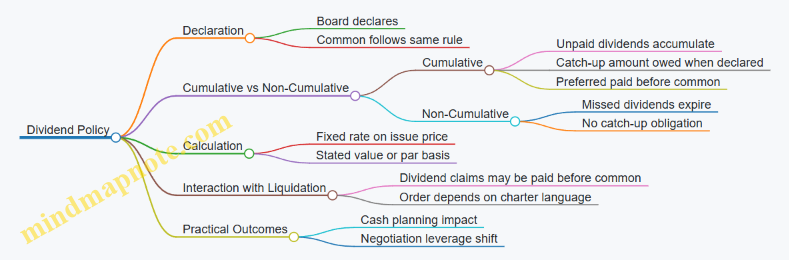
Integrated Example with Clear Outcomes
Assume preferred stock has a 6% dividend on $10 issue price, 1,000 shares outstanding, and dividends are declared at the end of Year 3.
Scenario A: Cumulative
- Years 1 and 2: no dividends declared
- Year 3: dividends declared
- Accumulated dividends per share: $0.60 × 2 = $1.20
- Year 3 dividend per share: $0.60
- Total paid to preferred per share: $1.80
- Total paid to preferred: $1.80 × 1,000 = $1,800
Common dividends, if any, come after preferred is satisfied.
Scenario B: Non-Cumulative
- Years 1 and 2: no dividends declared
- Year 3: dividends declared
- Accumulated dividends: $0
- Year 3 dividend per share: $0.60
- Total paid to preferred: $0.60 × 1,000 = $600
The company’s cash obligation is smaller, and preferred holders receive less economic value from missed periods.
Drafting Details That Prevent Confusion
When reviewing or drafting dividend provisions, focus on these items:
- Dividend rate base: Is it on original issue price, par, or stated value?
- Accrual language: Does it say dividends “accrue” or “accumulate,” and does it specify the period?
- Payment priority: Does the charter state preferred dividends must be paid before common dividends?
- Interaction with liquidation: Does the liquidation section treat unpaid dividends as part of the preferred payout?
A well-written cumulative clause is specific enough that a finance team can compute the amount without calling legal every time. Non-cumulative clauses should be equally clear about what is forfeited when dividends are not declared.
Mini Case Study: One Clause, Two Interpretations
Consider a term that says: “Preferred dividends are payable when declared.” If it also says “dividends are cumulative,” then missed dividends become a catch-up claim when declared later. If it says “dividends are non-cumulative,” then the same missed periods create no catch-up amount. The board’s discretion to declare remains, but the economic consequence of not declaring changes completely.
In short: cumulative terms create a backlog; non-cumulative terms prevent one. Both can be consistent with sustainable ownership, but they allocate cash-return certainty differently between preferred and common holders.
7.5 Practical Examples of Economic Term Combinations and Outcomes
Economic terms rarely act alone. The same liquidation preference can produce very different results depending on participation, conversion, anti-dilution, and how the option pool and future issuances affect the cap table. The examples below use a consistent baseline so you can see the cause-and-effect without mental gymnastics.
Baseline Setup for All Examples
Assume a company raises $10M at a $40M pre-money valuation using a single preferred class (Series A). The investor buys 20% of the company on a fully diluted basis at close. The preferred has a 1x liquidation preference with a $10M original issue price (OIP). The company later sells for $60M (a “mid exit”) or $120M (a “high exit”). Common stock holders receive the remainder after preferred is paid.
To keep the math readable, assume no dividends, no participation unless stated, and that conversion to common is available for all scenarios.
Mind Map: Economic Term Interactions
Example 1: Non-Participating 1x Preference with Conversion Advantage
Terms: 1x non-participating liquidation preference; conversion is automatic if it yields more than staying preferred.
Mid Exit ($60M): Preferred is entitled to $10M if it stays preferred. If it converts, it receives its ownership share of the sale proceeds. With 20% ownership, conversion yields $12M. Since $12M > $10M, the investor converts.
Outcome: Investor receives $12M; common receives $48M. This structure is often described as “investor gets downside protection, then shares upside like a common holder,” but the key detail is that conversion is what makes the upside sharing happen.
High Exit ($120M): Preferred conversion yields $24M versus $10M staying preferred, so conversion again occurs.
Example 2: Participating 1x Preference with No Cap
Terms: 1x participating liquidation preference; investor receives preference first, then also participates as if converted.
Mid Exit ($60M): Investor gets $10M preference, then participates on the remaining proceeds. After paying $10M, $50M remains. If the investor’s fully diluted share is 20%, it receives an additional $10M. Total investor payout: $20M.
Outcome: Common receives $40M. Compared to Example 1, the investor’s payout is higher because participation stacks on top of the preference.
High Exit ($120M): Investor gets $10M plus 20% of $110M, or $10M + $22M = $32M. Common receives $88M.
Example 3: Participating 1x Preference with a Cap
Terms: 1x participating preference capped at 2x OIP. That means the investor’s total payout cannot exceed $20M.
Mid Exit ($60M): The uncapped participating payout would be $20M (same as Example 2), so the cap does not bind. Investor receives $20M; common receives $40M.
High Exit ($120M): Uncapped participating payout would be $32M, but the cap limits it to $20M. Investor receives $20M; common receives $100M.
Outcome: The cap shifts the balance at higher exits. The investor still gets preference protection, but common holders regain more value when the company sells for a lot.
Example 4: Anti-Dilution Effects in a Down Round
Now add a down round to show how economic terms can change ownership before the exit.
Scenario: After Series A, the company raises a new round at a lower valuation. Assume the company issues additional preferred to new investors, reducing the Series A investor’s ownership through anti-dilution adjustment.
Terms Variant A: Weighted average anti-dilution.
Terms Variant B: Full ratchet anti-dilution.
Illustrative Result: After the down round, Series A’s effective ownership at the eventual $60M exit becomes 25% under weighted average, but 35% under full ratchet.
If Series A is non-participating 1x:
- Under weighted average: staying preferred pays $10M; converting pays 25% of $60M = $15M, so conversion occurs.
- Under full ratchet: converting pays 35% of $60M = $21M, so conversion occurs.
Outcome: Full ratchet increases the investor’s share more aggressively, which reduces common’s slice even if the exit value is the same. The “economic” part is not only the preference; it’s also the ownership math created by anti-dilution.
Example 5: Combining Participation and Anti-Dilution
Terms: Participating 1x preference with no cap, plus full ratchet.
Effect: Full ratchet increases the investor’s ownership, and participation ensures the investor gets both the preference and the increased ownership share.
Mid Exit ($60M): If full ratchet raises ownership to 35%, the investor payout becomes:
- Preference: $10M
- Participation share: 35% of remaining $50M = $17.5M
- Total: $27.5M
Outcome: Common receives $32.5M. This combination is powerful because it multiplies two levers: (1) preference payment and (2) a larger ownership percentage at exit.
Practical Takeaways for Term Sheet Drafting
- Non-participating 1x tends to behave like “protected downside, shared upside,” because conversion usually dominates at meaningful exits.
- Participating preferences shift value toward preferred holders at most exit levels unless a cap limits the stacking effect.
- Anti-dilution changes the cap table, so it can matter even when liquidation preference is only 1x.
- Combining participation with strong anti-dilution can heavily compress common outcomes, especially in down-round paths.
These examples show why term sheets should be read as systems. The same headline number—like “1x”—can produce very different economics once you account for conversion, participation, and how anti-dilution rewrites ownership.
8. Anti Dilution and Down Round Protection Without Control Breakdown
8.1 Mechanics of Full Ratchet Versus Weighted Average Approaches
When a down round happens, anti-dilution provisions adjust the conversion price of preferred stock so earlier investors do not get diluted “for free.” The two most common adjustment formulas are full ratchet and weighted average. They differ mainly in how aggressively they respond to the new lower price.
Core Concepts That Drive the Math
Start with three inputs:
- Old conversion price: the price at which preferred converts into common.
- New issue price: the price of the down round financing.
- New shares issued: how many shares are sold at the new price.
Both approaches aim to set a new conversion price. The practical difference is whether the adjustment depends only on the new price (full ratchet) or also on the size of the down round (weighted average).
Full Ratchet Mechanics
Full ratchet sets the conversion price equal to the new issue price, regardless of how small the down round is.
Mechanism:
- If the company issues new shares at a lower price, the preferred conversion price drops to that lower price.
- The adjustment does not consider how many shares were issued at the lower price.
Easy example:
- Old conversion price: $10
- Down round new issue price: $5
- Full ratchet conversion price becomes $5
If only 1% of the company’s equity is issued in the down round, full ratchet still cuts the conversion price in half. That is why full ratchet is often described as “price-only” protection: it treats every down round as equally severe.
Governance consequence:
Because conversion price drives how many common shares preferred holders receive, full ratchet can materially increase investor ownership after a down round, which can shift voting control and board dynamics.
Weighted Average Mechanics
Weighted average adjusts the conversion price using both the old price and the new price, weighted by the relative impact of the new issuance.
There are two common variants:
- Broad-based weighted average: uses a wider measure of shares outstanding (including more potential dilution sources).
- Narrow-based weighted average: uses a narrower share count.
The formula structure is similar: it blends old and new prices based on how large the down round is.
Intuition:
- If the down round is small, the weighted average adjustment is modest.
- If the down round is large, the adjustment approaches the new price more closely.
Easy example:
Assume:
- Old conversion price: $10
- New issue price: $5
- Company issues new shares equal to 20% of the relevant share base
A weighted average approach will reduce the conversion price, but not all the way to $5. The more shares issued at $5, the more the conversion price moves downward.
Mind Map: Full Ratchet Versus Weighted Average
Comparing Outcomes with a Single Scenario
Use the same price drop, but change the down round size.
Scenario A: small down round
-
Old conversion price: $10
-
New issue price: $5
-
Down round size: small
-
Full ratchet: conversion price still becomes $5.
-
Weighted average: conversion price drops, but less than $5 because the new issuance has limited impact.
Scenario B: large down round
-
Old conversion price: $10
-
New issue price: $5
-
Down round size: large
-
Full ratchet: conversion price becomes $5 in both scenarios.
-
Weighted average: conversion price moves closer to $5 because the new issuance is large.
This is the core tradeoff: full ratchet is uniformly punitive to the common side, while weighted average is proportional to how much new capital was raised at the lower price.
Drafting Details That Matter in Real Agreements
- What counts as a “down round”: typically issuances below the conversion price, but definitions can exclude certain transactions.
- How the share base is calculated for weighted average: broad-based vs narrow-based changes the weight and therefore the adjustment.
- Whether the provision is triggered by all issuances or only equity issued for cash.
- How conversion price is applied: some structures adjust conversion price immediately; others coordinate with conversion events.
Practical Guidance for Choosing Between Them
- Choose full ratchet when investors want maximum price protection and are comfortable with larger ownership shifts.
- Choose weighted average when the goal is to protect investors while keeping adjustments aligned with the actual size of the down round.
Neither approach is “better” in the abstract. The right choice is the one that matches the parties’ tolerance for ownership change, and the agreement’s definitions must be precise enough that the math produces the same result every time.
8.2 Calculation Inputs and Avoiding Ambiguity in Definitions
Anti-dilution adjustments only work if the inputs are defined precisely. The goal is simple: when a down round happens, the formula should produce the same adjustment no matter who is doing the math. Ambiguity usually comes from undefined terms, inconsistent measurement dates, and “helpful” shortcuts that later become arguments.
Core Inputs You Must Define
Start with the capitalization snapshot. You need a clear definition of the pre-transaction capitalization base and the post-transaction issue price.
-
Pre-money and post-money measurement basis
- Define whether the adjustment uses pre-money fully diluted shares or issued and outstanding shares.
- Example: If the company has options outstanding, “fully diluted” must say whether it includes unissued options in the option pool and whether it assumes a specific exercise price.
-
Conversion and share count mechanics
- Define how preferred converts into common for the purpose of the calculation.
- Example: If preferred converts at a 1:1 ratio today but has a conversion adjustment later, specify which ratio is used for the anti-dilution math.
-
The “issuance price” used in the formula
- Define whether it is the cash price per share or the effective price after considering discounts, warrants, or consideration other than cash.
- Example: If investors pay $1.00 per share but receive warrants with a defined value, the agreement must state whether the effective price includes that warrant value.
-
What counts as a “new issuance”
- Define whether the adjustment triggers only on equity issuances or also on convertible instruments, SAFEs, and debt with conversion features.
- Example: If a convertible note converts into preferred, the definition should specify whether the anti-dilution uses the note’s conversion price or the eventual preferred issuance price.
-
The “trigger price” and comparison standard
- Define the reference price used to compare against the new issuance price.
- Example: If the reference price is the original issue price, specify whether it is adjusted for prior splits, dividends, or prior anti-dilution events.
Avoiding Ambiguity in Definitions
Ambiguity often hides in three places: timing, scope, and valuation.
-
Timing: Specify the exact date used for the share count and the price comparison. If the down round closes on one date but the board approves on another, pick one and say so.
- Example: “As of the closing date” is clearer than “as of the transaction.”
-
Scope: Define which securities are included in “outstanding” and which are excluded.
- Example: If the company has employee options that are unvested, decide whether they are included in the fully diluted denominator.
-
Valuation: For non-cash consideration, define the valuation method.
- Example: If consideration includes services, the agreement should state whether the value is the amount recognized for accounting purposes or a stated fair value.
Weighted Average Inputs for Weighted Average Anti-Dilution
Weighted average formulas reduce the adjustment compared to full ratchet by weighting the new money against the existing base. To do that, you need these inputs:
- Old shares (A): the number of shares on a fully diluted basis before the new issuance.
- New shares (B): the number of shares issued in the down round, calculated using the defined issuance price and consideration.
- Old conversion price (C): the reference price before adjustment.
- New issuance price (D): the defined effective price per share in the down round.
A typical structure is:
- Adjusted conversion price = C × (A + B × (D/C)) / (A + B)
The formula is only as good as A, B, C, and D. If any of those are undefined or inconsistently measured, the math becomes a debate.
Mind Map: Calculation Inputs and Definition Guardrails
Example: The Same Deal, Two Different Definitions
Assume a company issues new preferred at an effective price of $0.80 per share. The agreement says the pre-transaction base is “fully diluted,” but it does not specify whether the option pool is included.
-
Version 1 definition: fully diluted includes unissued option pool shares.
- Result: A is larger, so the weighted average adjustment is smaller.
-
Version 2 definition: fully diluted includes only issued and outstanding shares.
- Result: A is smaller, so the adjustment is larger.
Both versions are mathematically consistent, but they produce different outcomes. The fix is not “better math”; it is a tighter definition of what “fully diluted” means.
Example: Effective Price Ambiguity with Warrants
In the down round, investors buy preferred at $1.00 per share and receive warrants. If the agreement does not define whether warrant value reduces the effective price, one side may treat the effective price as $1.00 while the other treats it as lower. A clean definition states how to compute effective price and what valuation method to use.
Practical Definition Checklist
Before signing, verify that each term used in the formula has a single, consistent definition across the charter, investor rights agreement, and the preferred stock terms. Also confirm rounding rules (for example, to the nearest cent or to a specified number of decimals) and the exact notice date that starts the calculation workflow.
A well-defined set of inputs turns anti-dilution from a negotiation topic into a mechanical outcome. That’s the point: the formula should be boring, deterministic, and easy to reproduce.
8.3 Interaction With Option Pools and Equity Grants
Option pools and equity grants are where economic protection clauses meet day-to-day dilution. The key is to design option pool mechanics so that (1) investors understand how their ownership changes, (2) employees can be granted equity without constant renegotiation, and (3) anti-dilution adjustments don’t accidentally punish normal hiring.
Option Pool Basics and Why They Matter
An option pool is a reserved set of equity (usually common stock options) approved by the board and typically governed by an equity incentive plan. Even before any employee exercises options, the pool affects the capitalization table because it represents potential shares that will exist after vesting and exercise.
A simple example: a company has 10,000,000 common shares outstanding. It creates a 1,000,000 share option pool. If the pool is fully granted and exercised, total common shares become 11,000,000. That dilution can be meaningful to investors, especially when anti-dilution is triggered by later financings.
The Anti-Dilution Trigger and the Option Pool Question
Anti-dilution clauses usually adjust conversion prices when the company issues equity at a price below a protected threshold. The interaction question is: do option grants count as “issuances” for anti-dilution purposes?
Most well-drafted structures treat option grants differently from straight equity issuances by focusing on the “issuance price” and the “type of security.” For example, an option granted at-the-money with a strike price equal to fair market value often should not be treated as a discounted issuance. But if the plan grants options at a discount, or if the company issues shares directly to employees at a low price, the clause may treat that as a triggering issuance.
Common Design Approaches
Pre-Funded Pool Versus Post-Funded Pool
A pre-funded pool is created before a financing and included in the capitalization baseline used for anti-dilution calculations. A post-funded pool is created after the financing, which can create disputes about whether the pool should be “counted” for dilution protection.
Example: Investor A invests at $2.00 per share. The agreement defines a baseline fully diluted capitalization that includes a 5% option pool. If the company later increases the pool to 10% without investor consent, Investor A may argue that the increase effectively dilutes them without the agreed baseline protections.
Pool Size Caps and Approval Thresholds
Many agreements include limits such as “the company may maintain an option pool up to X% of fully diluted capitalization without triggering consent rights.” This prevents the pool from becoming a backdoor issuance at a time when investors are trying to lock in economics.
Example: If the cap is 10%, the company can grant within that range. If it wants 15%, it must seek approval or amend the rights. This turns a vague negotiation into a measurable governance step.
Excluding Certain Grants from Anti-Dilution Calculations
Drafting often excludes grants under an approved equity plan from anti-dilution adjustments, provided they meet conditions like:
- options are granted at or above fair market value,
- grants are made pursuant to the plan approved by the board (and sometimes stockholders),
- the pool is within an agreed size range.
Example: The company grants 200,000 options at a $1.00 strike price when fair market value is $1.00. Even if later financing happens at $0.80, the anti-dilution clause focuses on the later financing issuance, not on the earlier at-market option grants.
Equity Grant Mechanics That Change the Outcome
Vesting, Exercise, and Timing
Anti-dilution is usually triggered by the issuance of securities, not by the mere existence of an option pool. But timing matters: if the company issues shares upon early exercise, or if it grants restricted stock instead of options, the “issuance event” can happen sooner and may be treated differently.
Example: Early exercise of options converts into shares before a down round. If those shares were issued at a price that the anti-dilution clause treats as discounted, the investor may claim an adjustment. Using standard option structures with clear fair market value determinations reduces ambiguity.
Option Pool Refreshes and Replenishment
A pool can be depleted as options vest and are exercised. Companies often “refresh” the pool to keep hiring possible. The interaction with investor rights depends on whether refreshes are treated as increases beyond the baseline.
Example: The company starts with a 1,000,000 pool. After two years, 700,000 options have been exercised. If the company refreshes by adding 500,000 more, that may exceed the original baseline and require consent depending on the agreement.
Mind Map: Interaction with Option Pools and Equity Grants
Practical Example: A Clean, Low-Conflict Setup
Assume an investor invests at $2.00 per share. The charter and investor rights agreement state that:
- the company may maintain an option pool up to 10% of fully diluted capitalization,
- grants under the approved plan are excluded from anti-dilution adjustments if granted at fair market value,
- any increase above 10% requires investor consent.
Now the company can hire and grant options within the cap without triggering anti-dilution fights. If it needs a larger pool, it has a clear consent pathway. When a down round occurs, the anti-dilution clause focuses on the financing issuance rather than normal employee equity administration.
Checklist for Drafting and Administration
- Confirm whether the anti-dilution clause counts option grants, restricted stock, and early exercise differently.
- Define the baseline capitalization and whether it includes a specific pool size.
- Add measurable pool caps and specify the approval threshold for increases.
- Require fair market value discipline for option strike prices.
- Ensure the equity plan approval process matches the agreement’s conditions.
- Track pool refreshes as governance events, not just accounting updates.
8.4 Consent Rights for Issuances That Trigger Adjustments
Consent rights are the “pause button” that prevents certain issuances from changing investor economics or control outcomes without explicit approval. In anti-dilution design, the tricky part is that the issuance itself may be ordinary, but its downstream effect on conversion prices or adjustment formulas can be anything but ordinary.
Foundational Concept: What Triggers an Adjustment
An adjustment typically happens when the company issues new equity at a price that is lower than a reference price used in the anti-dilution formula. That reference price is often the conversion price of a preferred class. The consent right is therefore tied to the issuance category that can cause the formula to move.
A practical way to think about it: the consent right is not about stopping fundraising; it is about stopping specific fundraising mechanics from silently changing the economics of existing preferred holders.
Consent Rights Placement in the Document Stack
Consent rights usually appear in one or more places:
- Investor rights agreement for class-level approvals and notice obligations.
- Preferred stock terms for class vote requirements tied to conversion price adjustments.
- Charter and bylaws for amendment mechanics and reserved matters.
The integrated design goal is consistency: the same issuance that triggers an adjustment should also trigger the same consent process, with no gaps between “what changes” and “who approves.”
Step 1: Define the Issuance Events Precisely
Start by listing issuance events that can trigger adjustments. Common categories include:
- Issuances of equity securities for cash at a discount to the reference price.
- Issuances in connection with acquisitions where consideration is equity.
- Conversions of convertible instruments that effectively create a lower-priced equity issuance.
Easy example: Preferred converts at $10. The company issues new common at $7. If the anti-dilution formula applies, the conversion price may adjust. The consent right should clearly cover “issuances of equity at a price below the conversion price,” including equity issued as consideration.
Step 2: Specify the Consent Threshold and Class Scope
Consent rights can be structured as:
- Single class vote by the affected preferred class.
- Cross-class vote if multiple classes share the same adjustment mechanics.
- Majority of the affected class by voting power or by number of shares.
Easy example: Series A and Series B both have anti-dilution. If a new issuance triggers adjustment only for Series A, requiring Series B consent would be overbroad and can slow routine financing. Conversely, requiring only Series A consent when both classes are economically affected creates a mismatch.
Step 3: Tie Consent to Notice and Timing
Consent rights should include:
- Advance notice of the proposed issuance terms.
- A clear response window for approval or rejection.
- A defined “deemed approval” or “no action” outcome if the investor does not respond.
Easy example: The company plans to issue 1,000,000 shares at $6.50. Investors receive a term sheet and calculation showing the adjustment impact. If investors do not respond within the stated period, the company can proceed only if the agreement allows deemed approval; otherwise, the company must treat silence as non-approval.
Step 4: Draft the Consent Standard for Operational Clarity
Consent standards often fall into two patterns:
- Absolute consent for covered events.
- Consent not to be unreasonably withheld for certain categories.
To avoid disputes, define what “reasonably” means in practice, such as requiring investors to consider whether the issuance is part of a financing plan and whether the company offered alternative structures.
Easy example: If the company offers a discounted priced round, investors may reasonably withhold consent unless the company provides a compensating adjustment (like a higher conversion price floor or a different security structure).
Step 5: Coordinate Consent Rights with Exceptions and Carveouts
Many agreements include carveouts that do not trigger adjustments, such as:
- Equity issued under an employee option plan within an approved pool.
- Equity issued in connection with certain pro rata rights.
- Equity issued for consideration in a manner explicitly excluded from the anti-dilution definition.
The consent right should align with these carveouts. If an issuance is excluded from adjustment, it should typically not require consent tied to adjustment.
Easy example: The company grants options from an approved pool. If the anti-dilution clause excludes option grants from adjustment, then the consent right should not be triggered by those grants.
Mind Map: Consent Rights for Issuances That Trigger Adjustments
Example: A Covered Issuance with a Clean Consent Workflow
Assume Series A has an anti-dilution adjustment tied to conversion price. The company proposes issuing common at $8 while Series A conversion price is $10.
- The company prepares a notice package: issuance terms, expected proceeds, and a short calculation showing the adjustment impact.
- The agreement requires Series A consent for issuances that would trigger the adjustment.
- Series A investors review and either approve or withhold within the response window.
- If approved, the company closes the issuance and the adjustment is applied automatically under the formula.
- If withheld, the company either restructures the financing into a carveout category or uses a different security form that does not trigger the adjustment.
The key is that the consent right is operationally tied to the same trigger that causes the adjustment, so everyone is voting on the same underlying economic event.
8.5 Practical Examples of Anti Dilution Scenarios and Governance Effects
Anti-dilution provisions are easiest to understand when you track three things in order: (1) what triggers the adjustment, (2) how the conversion price is recalculated, and (3) what governance consequences follow from the new economics. The same mechanism can feel fair or unfair depending on how the terms are drafted and how the board uses them.
Foundational Setup for the Examples
Assume a company issues preferred stock to investors at $10.00 per share. The preferred converts into common using a conversion price that may adjust if the company later issues equity at a lower price.
- Initial preferred issue price: $10.00
- Initial conversion price: $10.00
- Later issuance price: $6.00
- Later issuance size: 1,000,000 shares of common
- Existing common shares outstanding before the down round: 20,000,000
For simplicity, assume the preferred is convertible into common on a one-to-one basis at the conversion price, and ignore option pool effects in the math. The governance effects still show up clearly through voting and control outcomes.
Mind Map: Anti Dilution Mechanics and Governance Effects
Example 1: Full Ratchet Down Round and Sudden Control Shift
Full ratchet sets the conversion price equal to the new lower issue price. If the company issues common at $6.00, the conversion price drops from $10.00 to $6.00.
Governance effect: the preferred converts into more common shares than before. If the preferred originally converted at $10.00, then each preferred share now converts as if it were worth $6.00, increasing the number of common shares received upon conversion.
Easy-to-grasp outcome: imagine the preferred holder owned 25% of the company on a fully diluted basis before the down round. After full ratchet, that percentage can jump materially because the conversion ratio increases sharply. Even if the preferred does not vote until conversion, the company’s cap table changes the math behind any vote that depends on fully diluted ownership or that is influenced by conversion timing.
Governance consequence to watch: reserved matters approved by class votes or supermajorities may become easier or harder to pass depending on how thresholds are defined (by outstanding shares, by converted shares, or by a fully diluted measure). A board that thought it was negotiating with one ownership profile may find the voting math has shifted.
Example 2: Weighted Average Down Round and Smoother Ownership Transition
Weighted average reduces the conversion price adjustment by blending the old price with the new issuance. Using the same inputs, the conversion price moves down, but not all the way to $6.00.
A simple intuition: full ratchet treats the down round as if the entire prior investment should be repriced to the new price. Weighted average treats it as if only the incremental issuance at the lower price should pull the price down.
Governance effect: preferred holders still gain additional common shares, but the magnitude is smaller than full ratchet. That usually means fewer abrupt changes in voting power and fewer “surprise” outcomes at the next shareholder vote.
Easy-to-grasp outcome: if full ratchet would increase the preferred holder’s common-equivalent ownership by a large step, weighted average might increase it by a smaller step. The difference matters most when the company has tight voting thresholds for reserved matters.
Example 3: Drafting Sensitivity When the Down Round Includes Options or Warrants
Suppose the company issues a lower-priced equity instrument that is either included or excluded from the anti-dilution trigger. Two companies can both “raise money at a lower price,” yet only one triggers anti-dilution because the definition of “issuance” differs.
Governance effect: if option grants or warrants are treated as triggering issuances, the conversion price can adjust even when the company’s actual cash proceeds are not from a direct down round. That can shift ownership economics without a corresponding change in control negotiations.
Easy-to-grasp outcome: Company A excludes certain equity grants from the trigger definition, so anti-dilution does not activate. Company B includes them, so conversion price adjusts. In Company B, preferred holders may gain more common shares even though the company’s fundraising story is not a classic down round.
Example 4: Governance Effects Through Consent Rights and Amendment Thresholds
Anti-dilution terms often interact with consent rights. If the company later wants to amend the charter, change the board structure, or adjust equity plan mechanics, the required approvals may depend on class votes.
Governance effect: after an anti-dilution adjustment, the preferred’s increased common-equivalent ownership can change whether a threshold is met. Even when the preferred class vote is fixed by class percentage, the increased conversion ratio can affect how many common shares are effectively “in play” for any vote that uses a fully diluted denominator.
Easy-to-grasp outcome: a board may plan an amendment assuming a certain fully diluted ownership mix. After anti-dilution recalculations, the fully diluted mix changes, and the amendment can fail or succeed for reasons unrelated to the board’s intent.
Practical Takeaways for Governance Design
- Choose the anti-dilution method intentionally: full ratchet creates sharper ownership jumps; weighted average creates smoother adjustments.
- Define triggers precisely: whether options, warrants, and certain issuances count can materially change outcomes.
- Align voting thresholds with the economics: if thresholds reference fully diluted ownership, conversion price changes will affect governance immediately.
- Model scenarios before signing: the “math” is the governance, because voting power follows conversion economics.
In short, anti-dilution is not just a pricing clause. It is a control-adjacent mechanism that changes who can credibly approve or block decisions once conversion math and voting definitions are applied.
9. Transfer Restrictions and Liquidity Governance
9.1 Right of First Refusal and Right of Co-Sale Design
Right of First Refusal (ROFR) and Right of Co-Sale (often called “co-sale” or “tag-along”) are two tools that control what happens when an owner wants to sell. ROFR gives the company or certain holders a first chance to buy the offered shares. Co-sale ensures that if a selling holder finds a buyer, other protected holders can sell alongside them on similar terms. Used together, they reduce surprise transfers while keeping liquidity options for minority holders.
Core Concepts and How They Work Together
ROFR is a “pause and offer” mechanism. When a shareholder receives a bona fide third-party offer, the holder must notify the ROFR beneficiary and provide the same terms. The beneficiary then decides whether to match the offer within a defined window.
Co-sale is a “join the deal” mechanism. If a shareholder sells to a third party, co-sale beneficiaries can elect to sell their shares with the seller. The buyer typically must accept the co-sale shares on the same price and generally the same economic terms.
Together, ROFR can prevent unwanted buyers from entering the cap table, while co-sale prevents a majority or controlling seller from monetizing value while leaving minorities behind.
Mind Map: ROFR and Co-Sale Design Inputs
Designing ROFR That Is Clear and Enforceable
Start with the trigger. A common approach is to require a “bona fide third-party offer” with enough detail to allow matching: price per share, number of shares, buyer identity, and consideration structure (cash vs. stock, escrow, earnout). If the offer is vague, the ROFR process becomes a negotiation disguised as a formality.
Next, define who can exercise. If the company has ROFR, it must have the cash or a financing plan; otherwise, the right becomes theoretical. If investors have ROFR, specify whether they act individually or as a group and how they allocate if multiple holders want to buy.
Then set timelines. A practical structure is: notice delivery, beneficiary election window, and closing within a fixed number of days after exercise. The key is symmetry: the seller should not be stuck waiting indefinitely, and the buyer should not be blocked by repeated delays.
Finally, address what happens if the ROFR beneficiary cannot buy all offered shares. You can allow partial exercise with pro rata allocation among exercising beneficiaries, or you can require full matching. Partial matching is often more workable because it reduces deal failure.
Example: ROFR Notice and Matching
An investor receives an offer to buy 200,000 shares at $2.50 per share, with 10% escrow for 12 months. The investor must deliver a notice stating the buyer name, purchase price, escrow amount and duration, and the expected closing date. If the ROFR beneficiary exercises within the deadline, it must match the escrow terms, not just the headline price.
Designing Co-Sale So Minorities Can Participate
Co-sale needs a trigger that aligns with the seller’s transaction. Many agreements apply co-sale when a holder sells to a third party, excluding transfers that are already carved out as permitted. The trigger should also specify whether co-sale applies to partial sales or only to sales above a threshold.
The “same terms” requirement must be defined carefully. If the buyer offers mixed consideration, co-sale beneficiaries should receive the same mix, not a cash substitute. If there is escrow, indemnity, or earnout, the agreement should state whether co-sale shares are subject to the same holdbacks and how the seller’s indemnity obligations are allocated.
Allocation matters when the seller wants to sell more shares than the buyer will accept. A clean method is pro rata allocation among co-sale electing holders based on their ownership percentages, with a shortfall rule if the buyer limits the number of shares.
Example: Co-Sale Election and Allocation
A founder sells 1,000,000 shares to a buyer. Preferred holders representing 300,000 shares elect co-sale. The buyer agrees to purchase only 250,000 co-sale shares due to internal limits. The agreement allocates the 250,000 pro rata across electing preferred holders, and each electing holder sells its allocated portion on the same per-share price and escrow terms.
Integrating ROFR and Co-Sale Without Contradictions
ROFR and co-sale can conflict if both apply to the same transfer. A common integration pattern is: ROFR governs the seller’s ability to accept a third-party buyer, while co-sale governs whether protected holders can join the sale once a third-party transaction is underway.
To make this work, specify that co-sale elections are tied to the third-party sale that results from the ROFR process. If ROFR is exercised by the company or another buyer, the third-party sale does not occur, so co-sale should not trigger.
Practical Drafting Checklist
- Define “bona fide third-party offer” with sufficient detail to match.
- Set clear notice content requirements and delivery method.
- Specify ROFR exercise deadline and closing timeline.
- Provide partial exercise and pro rata allocation rules.
- Define co-sale trigger and election deadline.
- Require “same terms” with explicit treatment of escrow, indemnity, and consideration type.
- Add allocation rules for buyer-imposed limits.
- State how permitted transfers interact with both rights.
Quick Scenario Walkthrough
A shareholder receives a third-party offer. The shareholder sends ROFR notice. If the ROFR beneficiary matches, the company or beneficiary buys the shares and the third-party deal ends. If no one matches, the shareholder proceeds with the third-party sale. Co-sale beneficiaries then elect to sell their shares alongside the seller, subject to allocation if the buyer limits the number of shares.
9.2 Drag Along Rights and Minority Protection Boundaries
Drag along rights let a majority or controlling vote force minority holders to sell their shares in a qualifying sale. The trick is to define the boundary conditions so the minority is not forced into a bad deal, while still keeping exit processes workable.
What Drag Along Rights Actually Do
Drag along rights typically operate at the shareholder level during a sale of the company or a sale of control. When triggered, the minority must tender their shares to the buyer on the same economic terms as the selling group, subject to the contract’s defined exceptions. A clean boundary starts with a precise “qualifying transaction” definition and a clear “same terms” standard.
Core Trigger Requirements
A well-drafted drag along clause usually requires:
- A sale of the company or sale of control that meets a threshold (often a majority or supermajority vote).
- A buyer who purchases a defined percentage of the company’s equity.
- A minimum consideration threshold or structure that avoids “paper-only” outcomes.
Example: If the clause requires a sale where the buyer acquires at least 80% of the voting power, a deal for 51% cannot trigger drag even if the buyer offers a higher price per share. This prevents minority holders from being swept into partial-control transactions.
The “Same Terms” Standard and Its Common Loopholes
The minority boundary is usually enforced through “same consideration” language. The clause should specify that dragged holders receive:
- The same per-share price or the same value of consideration.
- The same payment timing and form (cash vs. stock vs. earn-out).
- The same escrow, holdback, and indemnity allocation mechanics.
Loophole to avoid: “Same terms” that only compares headline price, while allowing different escrow percentages or different indemnity caps. If the minority is dragged, they should not be asked to absorb extra risk just because they are smaller.
Example: Deal A offers $10 cash per share with a 10% escrow for 18 months. If dragged minority shares face a 20% escrow, the clause should treat that as noncompliance and either require equalization or block the drag.
Minority Protection Boundaries That Matter in Practice
Drag along rights can coexist with minority protections when the contract includes these guardrails:
- Minimum Consideration and Payment Certainty
Require that consideration is at least a defined mix of cash or buyer equity with valuation support, and that earn-outs are not the only meaningful value.
- No Forced Conversion Into Worse Securities
If the buyer offers stock, dragged holders should receive the same class and rights as other selling holders, or the clause should require a cash alternative.
- Indemnity and Liability Limits
Set a cap and ensure the minority’s indemnity obligations are not materially worse than those of the majority.
- Reps and Warranties Scope
Limit the minority’s reps to those they can reasonably make, and avoid requiring them to sign broad, company-wide disclosure schedules that they did not control.
- Procedural Fairness
Require notice, disclosure of the transaction documents, and a defined timeline for minority acceptance and closing mechanics.
- Exclusions for Certain Holders or Transactions
Some agreements exclude certain transfers, related-party sales, or transactions where the buyer is an affiliate without independent valuation.
Mind Map: Drag Along and Minority Boundaries
Example: A Boundary-Respecting Drag Along Clause in Action
Assume a company has common and preferred holders. The majority votes to sell for $50 million cash, with a 10% escrow for indemnities. The drag along clause triggers because the buyer will acquire 90% of voting power.
- Same terms check: Preferred and common dragged holders receive the same cash per share value after applying their respective liquidation preferences, and both groups face the same escrow percentage.
- Indemnity boundary check: The minority is not asked to provide additional personal guarantees, and the indemnity cap matches the majority’s cap.
- Procedural check: The minority receives the purchase agreement and escrow terms at least a defined number of days before closing.
Result: the minority is compelled to sell, but only into a deal that matches the selling group’s economics and risk allocation.
Example: When Drag Along Should Not Trigger
A proposed transaction offers $30 million cash plus an earn-out that is the majority of the value, and the buyer will acquire only 60% of voting power. Even if the majority supports the deal, the drag along clause should not trigger because:
- The buyer acquisition percentage fails the qualifying threshold.
- The consideration structure fails the minimum certainty requirement.
This is how boundaries prevent drag rights from becoming a shortcut around minority economics.
Practical Drafting Checklist for Boundaries
- Define qualifying transactions with measurable thresholds.
- Specify “same terms” across price, timing, form, escrow, and indemnity.
- Add minimum consideration certainty and limit earn-out dominance.
- Cap indemnity and narrow reps required from dragged holders.
- Require notice and document delivery before closing.
- Include explicit exclusions for related-party or structurally unusual deals.
When these pieces fit together, drag along rights do what they should: they reduce deal friction without turning minority holders into accidental co-signers for someone else’s risk.
9.3 Lockups and Permitted Transfers for Affiliates and Estates
Lockups and permitted transfers are the “how ownership moves” rules. They matter because equity is not just a percentage; it’s a control and stability mechanism. A well-designed lockup prevents sudden ownership shocks, while permitted transfers let owners handle real-life events without breaking the governance plan.
Foundational Concepts for Transfer Control
A lockup is a contractual period during which certain holders cannot transfer shares. The purpose is usually twofold: (1) keep the ownership base stable during early financing or after a major transaction, and (2) reduce the chance that a governance-protective holder loses influence due to an unexpected sale.
Permitted transfers define which transfers are allowed even if the holder is otherwise restricted. These typically include transfers to affiliates, estate planning transfers, and certain internal reorganizations. The key idea is that the company and other shareholders want the “economic owner” to remain effectively the same, even if the legal title changes.
Lockup Design for Affiliates
Lockups often apply to founders, key employees, and investors, but affiliate transfers are where drafting gets practical. An affiliate is usually an entity controlled by the holder, or under common control. If affiliate transfers were unrestricted, a holder could bypass the lockup by moving shares into a controlled entity.
A common best practice is to require that any affiliate transferee must agree to the same lockup terms, including the same end date and any legends on the certificates or book-entry accounts. Another best practice is to define “affiliate” by control rather than by name, so the rule still works after internal reorganizations.
Example: A founder owns 60% of the company and also controls a holding company. The founder’s shares are subject to a 12-month lockup after an equity financing. If the founder transfers shares to the holding company during month 3, the holding company must sign the same lockup agreement, and the shares remain locked until month 12.
Permitted Transfers for Estates and Family Planning
Estate transfers are different from affiliate transfers because the holder may not be making a strategic decision. The drafting goal is to allow transfers that preserve continuity while preventing a sudden change in who can exercise voting rights.
A typical approach is to permit transfers upon death or incapacity to executors, administrators, trustees, or beneficiaries under a will or trust, but only if the transferee becomes subject to the same transfer restrictions and legends. Voting rights may be handled in a few ways: the company can require the transferee to provide documentation, and the transferee may need to confirm that they will comply with the governance and information rights.
Example: A shareholder dies during a lockup period. The shares are transferred to a trust for the benefit of the shareholder’s children. The trust is allowed to receive the shares, but it must accept the lockup and any voting limitations until the lockup ends.
Practical Mechanics and Compliance Steps
Lockups and permitted transfers should be operational, not just theoretical. The company’s transfer agent or corporate secretary needs clear instructions.
- Transfer notice requirements: The restricted holder must provide written notice and supporting documents for permitted transfers.
- Legend and stop-transfer instructions: Shares should carry legends or book-entry restrictions that prevent transfers without required approvals.
- Assumption of obligations: Permitted transferees must sign joinders or confirmations so the restrictions “travel” with the shares.
- Company consent boundaries: Even permitted transfers may require consent if the transferee is not eligible under defined criteria.
Mind Map: Lockups and Permitted Transfers
Example: Drafting the “Permitted Transfer with Conditions” Rule
A strong permitted transfer clause usually reads like a checklist: what is allowed, what documents are required, and what obligations transfer.
Example scenario: A founder wants to transfer shares to a family trust during a lockup.
- Allowed because it is an estate planning transfer.
- Condition: the trust signs a joinder agreeing to the lockup end date.
- Condition: the company receives proof of trust formation and trustee authority.
- Result: the shares are registered to the trust, but transfers out of the trust remain restricted until the lockup ends.
Common Pitfalls to Avoid
First, avoid vague affiliate definitions that depend on titles or relationships that can change. Second, avoid permitted transfer language that allows legal title changes but forgets to carry over lockup obligations. Third, avoid leaving voting rights undefined; if voting is important to control, the agreement must say who votes during the restriction period and under what conditions.
9.4 Change of Control Definitions and Scope Control
A “change of control” definition decides when investors’ rights activate, when transfer restrictions tighten, and when board and shareholder approvals must be re-run. The tricky part is that the definition is not just legal wording; it is a control map. If it is too narrow, investors may miss the moment they expected protection. If it is too broad, ordinary restructurings can accidentally trigger consent rights and slow down deals.
Foundational Concepts for Defining Change of Control
Start with three building blocks: (1) the event, (2) the threshold, and (3) the scope of what counts as the event.
-
The event is typically a sale, merger, consolidation, or transfer of voting power. A definition that lists only “merger” but not “asset sale” can create loopholes.
-
The threshold sets how much ownership or voting power must move. Common thresholds include “more than 50%” of voting power, “control” by board appointment, or a combination of voting power and board control.
-
The scope clarifies whether indirect transfers count, whether internal reorganizations count, and whether transfers among affiliates count.
A practical example: if a founder sells 40% of voting stock to a strategic buyer but the buyer also gains the right to appoint a majority of directors, the company has effectively changed control even though the percentage alone looks modest. Definitions should capture that.
Event Types and How to Avoid Definition Gaps
Most disputes come from missing event types or unclear “who controls whom” logic.
- Stock sale: define whether it includes transfers of shares, voting agreements, or rights to vote.
- Merger or consolidation: specify whether the surviving entity must be the same company or whether any resulting entity counts.
- Asset sale: decide whether “substantially all assets” triggers the definition. If you include it, define “substantially all” by reference to revenue, book value, or another consistent metric.
- Change in board control: include scenarios where control shifts via director appointment rights rather than share ownership.
A clean approach is to define change of control as any transaction that results in a person or group acquiring control, where “control” is defined using voting power and/or board appointment.
Threshold Design and Scope Control
Thresholds should be consistent with the rights they trigger. If consent rights require investor approval, the threshold should align with the level of influence investors care about.
- Voting power thresholds: “more than 50% of the outstanding voting securities” is common, but it should specify whether it is based on issued and outstanding at signing or closing.
- Board majority thresholds: if the company’s governance is board-driven, include a board-control test.
- Combination thresholds: some agreements treat a deal as a change of control if either voting power crosses a threshold or board control changes.
Scope control is where you prevent accidental triggers.
- Affiliate transfers: state that transfers among affiliates do not count as change of control.
- Reorganizations without control change: carve out mergers where the same ultimate owners retain control.
- Equity issuances: decide whether a financing that changes ownership percentages counts. Many agreements exclude ordinary issuances unless they result in a control shift.
Example: Company A merges into Company B, but the same founder group owns the majority of voting power in the surviving entity and retains board appointment rights. Without a carve-out, this could technically trigger change of control even though the practical control did not change.
Consent Triggers and Rights That Attach
Once the definition is stable, map which rights activate.
Common triggers include:
- Investor consent for certain transactions.
- Repurchase or redemption rights if investors want an exit.
- Co-sale or drag-along mechanics that govern how minority holders participate.
A scope-control detail matters here: if rights attach to “change of control,” ensure the rights are not also separately triggered by “sale of substantially all assets” unless that is intentional. Double triggers create negotiation friction.
Mind Map: Change of Control Definition Architecture
Example: Three Definitions, Three Outcomes
Example 1: Narrow definition
- Triggers only “merger where the company is not the surviving entity.”
- Result: a sale of substantially all assets could avoid consent rights.
Example 2: Overbroad definition
- Triggers any transaction where any person acquires more than 50% of voting power.
- Result: a financing where an investor crosses 50% could trigger rights even if board control remains unchanged.
Example 3: Balanced definition
- Triggers when a person or group obtains control via voting power and/or board appointment, with affiliate and no-control-change carve-outs.
- Result: investors get protection when control truly shifts, while routine reorganizations do not create unnecessary approvals.
Practical Drafting Checklist for Scope Control
- Define “control” using voting power and board appointment, not just one metric.
- Specify measurement timing for thresholds.
- Include affiliate and no-control-change carve-outs.
- Decide whether asset sales and board-control shifts are included, then draft consistently.
- Align the definition with the rights that trigger, so you do not accidentally create overlapping or contradictory activation.
When the definition is built like a control system—event, threshold, and scope—you reduce surprises and make consent decisions easier to administer. The goal is simple: the agreement should react to real control changes, not just to technical transaction labels.
9.5 Practical Examples of Transfer Restriction Clauses and Enforcement
Transfer restrictions are only as good as their enforcement mechanics. A clause that looks tight on paper can still fail if the company cannot reliably identify transfers, verify compliance, or process approvals on time. The practical goal is simple: prevent unauthorized transfers while keeping authorized transfers predictable and documentable.
Core Building Blocks of Transfer Restriction Clauses
Most well-run restriction packages combine five elements.
- Transfer trigger: defines what counts as a “transfer” (sale, assignment, pledge, change in beneficial ownership, or indirect transfers through entities).
- Permitted transfers: lists transfers allowed without investor-by-investor consent, often including transfers to affiliates, estate planning transfers, or transfers to controlled entities.
- Approval process: sets who must approve, what standard applies, and what documents the transferee must provide.
- Legend and notice: requires stock certificates or electronic records to carry a legend and requires the holder to give notice before any transfer.
- Company enforcement: gives the company and transfer agent authority to refuse registration of transfers that do not meet conditions.
A clause is enforceable when it clearly states that the company can refuse to register the transfer, and when it gives a process for the holder to cure deficiencies.
Example Transfer Restriction Language and How It Works
Example 1: ROFR with a clear timeline
A common structure is Right of First Refusal (ROFR) paired with a short, workable notice window.
- The holder delivers a “Transfer Notice” describing the proposed transferee, price, and material terms.
- The company has a fixed period to elect to purchase.
- If the company declines, the holder can complete the transfer to the third party within a defined period, usually on substantially the same terms.
Practical enforcement detail: the company should require proof of the third-party offer (for example, a signed term sheet or purchase agreement). Without that, holders can claim “offers” that are not real, and the company cannot verify whether the ROFR election was meaningful.
Example 2: ROFR plus co-sale to protect minority holders
If the company or a controlling holder buys first, minority holders may still want participation rights. A co-sale mechanism can be triggered when a major holder sells a block.
- The selling holder must give notice of the proposed sale.
- Eligible holders can elect to sell pro rata.
- The buyer must accept the co-sale shares on the same terms.
Practical enforcement detail: the clause should specify how elections are delivered and what happens if an election is late. Late elections should not be treated as valid, but the company should provide a clear method for delivery (for example, email plus confirmation, or a specific notice address).
Transfer Restriction Enforcement Mind Map
Mind Map: Transfer Restriction Enforcement
Enforcement Workflow Example: Unauthorized Transfer Attempt
Assume a holder sells shares to a third party without giving the required notice and without obtaining the company’s approval.
- Detection: the transfer agent receives an instruction to register the transfer.
- Document check: the agent requests the Transfer Notice and approval evidence.
- Refusal to register: if documentation is missing, the agent refuses registration and notifies the holder.
- Cure window: the clause allows the holder to submit missing documents within a defined period.
- Outcome:
- If the holder cures, the transfer proceeds under the restriction terms.
- If the holder cannot cure, the company treats the transfer as ineffective for corporate purposes.
Practical enforcement detail: the company should maintain a written instruction to the transfer agent that mirrors the restriction clause. Otherwise, enforcement becomes inconsistent, and holders learn which requests are likely to be ignored.
Example Clause Pairing: Legend + Refusal to Register
A legend requirement helps the holder understand restrictions, but enforcement depends on the refusal-to-register mechanism.
- Legend: “Transfer is subject to restrictions under the company’s charter and investor rights agreements.”
- Refusal: “The company and transfer agent may refuse to register any transfer not made in compliance with these restrictions.”
Practical enforcement detail: for electronic share systems, the legend concept should be implemented through account-level flags or transfer agent controls, not only through paper certificates.
Example: Indirect Transfer Through an Entity
A frequent loophole is an “indirect transfer,” such as selling membership interests in an entity that owns shares.
A robust clause treats certain indirect changes as transfers of the underlying shares when they result in a change of control of the shareholder entity.
Practical enforcement detail: define “change of control” with objective thresholds (for example, ownership percentage or voting power changes). Vague definitions invite disputes about whether the company can block the transaction.
Practical Enforcement Checklist for Drafting
- The company can refuse registration.
- The transfer agent has written instructions.
- Timelines are short and specific.
- Notice methods are defined.
- Elections (ROFR, co-sale) have clear deadlines.
- “Substantially the same terms” is defined.
- Indirect transfers are covered.
- A cure process exists for missing documents.
When these pieces work together, enforcement becomes routine rather than argumentative. The restriction clause stops being a “maybe,” and becomes a predictable process with clear inputs and outputs.
10. Option Pools and Employee Equity Without Ownership Instability
10.1 Option Pool Sizing and Dilution Modeling Basics
Option pools exist to fund future hiring and retention, but they also affect everyone’s ownership math. The goal is to size the pool so you can grant meaningful equity without creating avoidable dilution or governance friction.
Core Concepts That Drive Pool Size
Start with three inputs: (1) the hiring plan, (2) the grant philosophy, and (3) the timing of grants. A pool sized from only “headcount” often misses the fact that different roles typically receive different grant sizes.
A simple way to think about it: the pool is a reservoir of shares reserved for issuance. When you grant options, you draw from the reservoir. If you later increase the pool, you usually dilute existing holders because the company issues more shares (or more potential shares) than originally reserved.
Step 1: Build a Grant Inventory
Create a list of roles you expect to hire or retain, then assign a target grant range per role. For example, suppose you plan to hire 6 people over the next year: 2 engineers at 0.50% each, 2 senior hires at 0.80% each, and 2 leaders at 1.00% each. That totals 2.0% + 1.6% + 2.0% = 5.6% of the company on a fully diluted basis.
Now adjust for the fact that not every grant will be used exactly as planned. Some candidates decline, some offers get renegotiated, and some employees leave before vesting. A practical modeling approach adds a buffer so the pool can absorb normal variance.
Step 2: Choose a Modeling Basis
Dilution math depends on what “fully diluted” means in your documents. Common bases include:
- Fully diluted shares including options and warrants that are expected to be exercised or issued.
- As-converted basis for preferred stock, if conversion is assumed.
- Post-money or pre-money basis for financing rounds.
If you mix bases, you get confident-looking numbers that are wrong in a way that is hard to spot. Pick one basis for the model and keep it consistent across the pool sizing and the financing impact.
Step 3: Model the Pool as a Percentage and as a Share Count
You can model the pool two ways. Percentage modeling is easier for discussions; share-count modeling is easier for drafting.
Example: assume the company has 10,000,000 fully diluted shares today. You want a 6.0% option pool. The share-count target is 10,000,000 × 6.0% = 600,000 reserved shares.
If the pool is created before a financing, the pool size may be expressed as a percentage of the post-financing fully diluted capitalization. That changes the denominator. The model should explicitly show which denominator you used.
Step 4: Account for Vesting and Forfeitures
Options typically vest over time. If you grant 600,000 options but 15% are forfeited before vesting, the “effective” issued equity is lower than the raw pool draw. However, forfeiture assumptions should be handled carefully because investors often care about the reserved pool size, not just the net vested outcome.
A reasonable approach is to model two views:
- Reserved pool draw: how many options you expect to grant from the pool.
- Net vested equity: how much equity is expected to vest after forfeitures.
This keeps the conversation grounded: the pool is about reservation and issuance mechanics; vesting is about economic realization.
Step 5: Simulate Dilution Through a Financing Round
Pool increases often become a negotiation point in financings because the pool can be created pre-round or post-round. Pre-round pools generally dilute existing holders before new investors arrive; post-round pools dilute new investors more.
A clean modeling workflow is:
- Start with current capitalization.
- Add the proposed option pool (pre-round or post-round, as specified).
- Add the financing issuance.
- Recompute ownership percentages for each holder class.
Mind Map: Option Pool Sizing and Dilution Modeling Basics
Example: A Complete Mini-Model
Assume fully diluted shares today are 10,000,000. You plan grants totaling 5.6% of fully diluted equity, and you add a 10% buffer for variance, giving 6.16% target pool size.
- Target pool percentage: 6.16%
- Target pool shares: 10,000,000 × 6.16% = 616,000 reserved shares
If a financing occurs and the pool is created pre-round, the denominator for ownership immediately includes the pool. If the financing is post-round, the new investors’ ownership percentages reflect the pool after their investment. The model should show both scenarios if you are negotiating, because the difference is often the entire point of the discussion.
Common Pitfalls to Avoid
First, don’t treat the pool as a one-time number. The pool is a living reserve, so your model should reflect when grants happen, not just how many.
Second, don’t ignore the documents. Some agreements require the pool to be created at a specific time or size, and some define “fully diluted” in a way that changes the math.
Third, don’t hide assumptions. If you use a forfeiture rate or buffer, state it in the model so stakeholders can adjust it without guessing.
Quick Modeling Checklist
- Confirm the fully diluted basis definition.
- Choose pre-round or post-round pool creation.
- Convert target grant percentages into share counts.
- Add a variance buffer for normal hiring and offer changes.
- Separate reserved pool draw from net vested equity.
- Recompute ownership impacts after the financing issuance.
This is enough structure to produce a pool size that is defensible, explainable, and consistent with the dilution mechanics everyone will actually live with.
10.2 Vesting Schedules and Acceleration Provisions
Vesting schedules answer one practical question: when does an employee actually earn the equity? The schedule should match how the company expects value to be created, while the acceleration provisions should match how the company wants to handle transitions like termination or change of control.
Vesting Schedules Core Concepts
A vesting schedule is usually expressed as a timeline plus a vesting pattern. The most common baseline is four years with a one-year cliff. The cliff means nothing vests until the employee completes the first year; then a portion vests immediately, and the remainder vests monthly or quarterly.
Example: An employee receives 40,000 options with a four-year term and a one-year cliff. If they leave after 11 months, they keep zero. If they stay 12 months, they vest 10,000 (25%). If they remain for 24 months, they vest another 10,000 over the second year, totaling 20,000.
Cliff design is not just math. It reduces administrative churn and discourages short-term “grab and go” behavior. Monthly vesting after the cliff keeps incentives aligned with ongoing contribution.
Common Vesting Patterns and When They Fit
Time-based vesting ties equity to continued service. It fits roles where retention and steady execution matter.
Milestone-based vesting ties equity to performance events. It can work for specific deliverables, but it requires careful drafting so the company can measure outcomes consistently.
Hybrid vesting combines both. A typical approach is time vesting for baseline retention plus milestone vesting for a defined project. This reduces the risk that a single metric controls everything.
Acceleration Provisions Purpose and Types
Acceleration changes the vesting outcome when a triggering event occurs. Without acceleration, vesting typically stops when service ends. With acceleration, some or all unvested equity becomes vested earlier.
There are two main categories:
- Single-trigger acceleration: vesting accelerates upon one event, usually a change of control.
- Double-trigger acceleration: vesting accelerates only if a change of control happens and then the employee is terminated or constructively removed within a defined period.
Double-trigger is often more company-friendly because it avoids paying full acceleration when the employee remains employed and continues performing after the transaction.
Single-Trigger Acceleration Mechanics
Single-trigger acceleration can be drafted as full or partial.
Example: A grant has 4 years vesting with a one-year cliff. If the company sells and the agreement provides full single-trigger acceleration, then all unvested options become vested immediately at closing. If the employee had completed 18 months, they might already be 50% vested; the remaining 50% vests at closing.
This structure is straightforward, but it can create large equity costs at transaction time.
Double-Trigger Acceleration Mechanics
Double-trigger acceleration usually specifies a window after the change of control, such as 12 months. The agreement also defines what counts as termination or constructive termination.
Example: The grant provides partial double-trigger acceleration of 50% of the unvested portion if the employee is terminated without cause within 12 months after the change of control. If the employee is 30% vested at closing, then 70% remains unvested. Half of that unvested portion (35% of the original grant) vests upon the qualifying termination.
This approach turns acceleration into a targeted retention and fairness mechanism rather than a pure transaction bonus.
Partial Acceleration and “Unvested Portion” Definitions
Partial acceleration requires careful definitions. The agreement should clarify whether acceleration applies to:
- the unvested portion only,
- the unvested portion as of the trigger date,
- or the unvested portion as of a later termination date.
Ambiguity causes disputes, especially when the company changes the equity form during the transaction.
Termination Scenarios and Vesting Outcomes
Most plans distinguish between termination for cause, termination without cause, resignation, and death or disability.
A common baseline is:
- Termination without cause or qualifying termination: acceleration may apply depending on the agreement.
- Termination for cause: acceleration typically does not apply.
- Death or disability: vesting may accelerate or vest according to a service-based rule.
Example: If death triggers immediate vesting of the unvested portion, then the employee’s estate receives vested options immediately, avoiding the need to wait for a cliff or schedule completion.
Mind Map: Vesting Schedules and Acceleration Provisions
Example: Drafting a Clean Double-Trigger Provision
A well-structured clause typically includes: the event, the timing window, the qualifying termination standard, and the acceleration percentage.
Example language concept (not a legal form): “If a change of control occurs and within 12 months the employee is terminated without cause, then 50% of the unvested options vest immediately; the remaining unvested options continue to vest only if the plan permits continued service.”
This keeps the outcome predictable: the company knows what it owes, and the employee knows what must happen for acceleration to apply.
Practical Checklist for Consistency
Before finalizing, verify that the vesting schedule and acceleration provisions agree with each other and with the plan’s termination rules. Also confirm that the equity type (options vs restricted stock) and the exercise or settlement mechanics match the acceleration outcome, so the company does not vest equity it cannot administer cleanly.
10.3 Equity Plan Governance and Approval Requirements
Equity plans are not just documents that grant options or restricted stock. They are governance systems with approval gates, recordkeeping rules, and decision rights that determine who can issue awards, under what conditions, and how those awards interact with the company’s cap table. The goal is simple: keep the plan flexible enough to hire and retain, while preventing accidental over-issuance or inconsistent approvals.
Governance Basics That Prevent Costly Mistakes
Start with three foundational questions.
First, who can approve equity awards: the board, a committee of the board, or both. Many companies use a board committee (often Compensation Committee) for day-to-day approvals, while reserving certain actions for the full board.
Second, what approvals are required for plan-level changes: amendments to the plan, increases in the share reserve, and changes to key terms like vesting rules or exercise price mechanics.
Third, what approvals are required for grants: whether the committee can grant awards within the approved reserve and within pre-set parameters, or whether specific grants require additional approvals.
A practical example: a committee approves new grants each quarter using a pre-approved grant policy. If the company later wants to introduce a new vesting schedule that materially changes risk allocation, that is typically treated as a plan amendment, not a routine grant approval.
Approval Architecture Board Committee and Management
A common structure is layered.
- Board or committee approves the plan and major amendments. This includes adopting the equity incentive plan, setting the initial share reserve, and approving material term changes.
- Committee approves individual grants. This includes determining award type, number of shares, vesting terms, and exercise price (for options).
- Management administers within limits. The plan’s administration section usually authorizes an officer or administrator to process grants, maintain records, and handle routine operational steps.
To keep this clean, the plan should define what “administration” means. For instance, management can typically schedule grant dates and prepare grant documents, but it should not be able to change award terms that would require committee discretion.
Plan-Level Approvals Share Reserve and Material Amendments
Equity plans usually include a share reserve and a method for counting shares. Governance requires approvals when the reserve changes or when the plan’s terms change in ways that affect dilution or participant economics.
Key plan-level approval triggers include:
- Share reserve increases. If the company runs low on available shares, it needs the appropriate approval path to authorize additional issuance capacity.
- Material amendments. Examples include changing the maximum award limits, altering eligibility rules, or modifying vesting and forfeiture provisions in a way that affects participant outcomes.
- Repricing or exchange programs. If the company wants to adjust underwater options, it should treat that as a special approval event rather than a routine administrative step.
Example: a company wants to increase the reserve to support a hiring plan. It should not rely on management’s ability to grant awards; instead, it should follow the plan’s amendment and approval requirements for reserve increases.
Grant-Level Approvals Eligibility and Award Parameters
Grant approvals should be consistent with eligibility rules and with any limits the plan sets.
A systematic approach is to define:
- Eligibility categories. Employees, directors, consultants, or specific groups.
- Award limits. Per-participant caps, annual limits, or maximum award sizes.
- Discretion boundaries. What the committee can decide versus what is fixed by the plan.
Example: if the plan sets a per-participant annual cap, the committee must verify the cap before approving a grant. If the cap is exceeded, the company should either reduce the grant size or seek the required approval to amend the plan or adjust the counting method.
Document Control and Recordkeeping That Holds Up Under Review
Governance is only as good as the paperwork trail.
Maintain records for:
- Board and committee minutes showing approvals and the rationale for key decisions.
- Grant documentation including award agreements, vesting schedules, and exercise price calculations.
- Cap table tracking showing how shares are counted against the reserve.
A simple operational rule helps: every grant should have a single source of truth for approval date, grant date, and award terms. If those dates drift across documents, it creates avoidable confusion.
Mind Map: Equity Plan Governance and Approval Requirements
Example Approval Workflow from Drafting to Grants
A coherent workflow reduces errors.
- Plan adoption or amendment is approved by the board (or committee if permitted by the plan and charter).
- Share reserve is set and tracked using the plan’s counting rules.
- Quarterly grant cycle: the committee reviews eligibility, confirms award limits, and approves grant quantities and terms.
- Grant documents are issued by management after committee approval.
- Recordkeeping: minutes, executed agreements, and cap table updates are stored together.
Example: on 2026-04-15, the committee approves grants for eligible employees for the next vesting cycle. Management then issues agreements with the approved terms, and the cap table update references the committee approval minutes as the authority.
Common Governance Gaps to Close Early
Watch for these recurring issues.
- Unclear authority boundaries between committee and management.
- Reserve counting ambiguity when awards are forfeited, canceled, or settled in different ways.
- Approval drift where grant dates and approval dates are inconsistent across documents.
- Missing minutes for special actions like exchanges or repricing.
Closing these gaps is mostly about clarity: define decision rights in the plan, document approvals consistently, and ensure the share reserve tracking matches the plan’s counting rules.
10.4 Treatment of Terminated Employees and Unvested Awards
When an employee leaves, the equity plan stops being a “future promise” and becomes a set of contractual outcomes. The goal is to treat unvested awards consistently, align them with the plan’s purpose, and avoid accidental forfeitures or unintended payouts. The cleanest approach is to separate three questions: what type of award it is, what the termination reason is, and what the award agreement says about vesting and post-termination exercise.
Foundational Concepts That Drive the Outcome
Award type matters. Options and restricted stock behave differently. Options typically require exercise to realize value, while restricted stock is already owned subject to repurchase or forfeiture rules.
Termination reason matters. Plans usually distinguish between voluntary resignation, termination for cause, termination without cause, disability, death, and sometimes retirement. Each category changes whether unvested amounts are forfeited, partially retained, or accelerated.
Agreement language matters most. The plan document sets the baseline, but the award agreement and any employment agreement can override details like repurchase rights, vesting start dates, and exercise windows.
Core Treatment Rules for Unvested Awards
Forfeiture as the Default
Most equity plans treat unvested portions as forfeited upon termination, unless the plan or award agreement provides a carve-out. This default keeps the cap table predictable and prevents “vesting by exit” that would reward departures rather than performance.
Example: An employee holds 40,000 options with 25% vested (10,000 options). They resign after 18 months. If the plan says unvested options are forfeited on resignation, the remaining 30,000 options are canceled, and only the 10,000 vested options remain exercisable during the post-termination window.
Repurchase Rights for Restricted Stock
For restricted stock, the company often retains a repurchase right for unvested shares at the original purchase price (or another formula stated in the agreement). The company’s repurchase mechanics should be clear: notice timing, payment method, and whether repurchase is automatic.
Example: An employee receives 20,000 restricted shares with a four-year vesting schedule. After leaving at year one, 5,000 shares are vested and 15,000 are unvested. If the agreement grants repurchase rights, the company repurchases the 15,000 unvested shares at the stated price, and the employee keeps only the vested 5,000.
Post-Termination Exercise Windows for Options
Plans commonly set a short exercise period after termination for vested options. The window may differ by termination reason.
Example: A plan allows vested options to be exercised within 90 days after termination without cause, but within 30 days if terminated for cause. If the employee’s vested options are 10,000 and the exercise window is 30 days, the company should communicate the deadline immediately to avoid accidental lapse.
Termination Categories and Practical Outcomes
Voluntary Resignation
Typically results in forfeiture of unvested awards and a limited exercise window for vested options.
Example: A founder resigns from employment but remains a board member. If the plan ties vesting to employment status, unvested awards stop vesting and are forfeited, unless the plan separately defines continued service for board roles.
Termination Without Cause
Often preserves some or all unvested value through continued vesting, partial acceleration, or extended exercise windows.
Example: An employee is terminated without cause at month 20. The plan provides that unvested options are forfeited, but vested options can be exercised for 12 months instead of 90 days. That preserves value for what was already earned while keeping unvested portions from becoming a windfall.
Termination for Cause
Usually triggers immediate forfeiture of unvested awards and shorter exercise windows, and may include cancellation of vested options depending on plan terms.
Example: If “cause” is defined as material misconduct, the company should document the determination process and timing. Ambiguity here is costly because it affects whether vested options remain exercisable.
Death or Disability
Many plans allow continued vesting for a period, full vesting, or extended exercise windows.
Example: If the plan states that upon death, unvested options vest immediately and the estate has 12 months to exercise, the company’s administration team should confirm the vesting trigger date and communicate exercise instructions to the estate.
Administrative Controls That Prevent Mistakes
Use a Termination Decision Checklist
A termination event should be processed through a consistent checklist: termination date, termination category, award types held, vested/unvested amounts, exercise windows, and any acceleration or repurchase triggers.
Align Cap Table and Payroll Systems
Equity administration should reconcile vesting status with the cap table and payroll records. If the systems disagree, the company can accidentally repurchase the wrong number of shares or report incorrect outstanding options.
Communicate Deadlines in Writing
For options, deadlines are the main failure point. Notices should include: number of vested options/shares, whether unvested is forfeited or repurchased, the exercise deadline, and the method for exercise.
Mind Map: Terminated Employees and Unvested Awards
Integrated Example: One Employee, Two Award Types
An employee holds 30,000 options and 10,000 restricted stock units (RSUs). They are terminated without cause on 2026-04-15.
- Options: If the plan says unvested options are forfeited on termination, the company cancels the unvested portion. Vested options remain exercisable for 12 months under the without-cause rule.
- RSUs: If RSUs are treated like stock units that settle only when vested, the company stops further vesting. If the plan provides no acceleration for without-cause termination, unvested RSUs are canceled. If the plan provides partial acceleration, the company calculates the accelerated vested amount using the agreement’s formula.
The key is consistency: the company applies the same termination category across both award types, then uses the award-specific mechanics to determine what is canceled, what remains, and what deadlines apply.
10.5 Practical Examples of Equity Plan Terms and Board Oversight
Equity plans look simple on paper: grant options or restricted stock, set vesting, and define what happens when someone leaves. Board oversight is what makes the plan behave consistently when real life shows up—new hires, resignations, terminations, and amendments that affect everyone’s economics.
Foundational Term Set Boards Should Standardize
A board should treat these terms as a “default kit” and only vary them with a clear reason.
- Eligibility and grant authority: Who can receive awards, and who approves grants. Example: the board delegates grants to the CEO up to a stated dollar amount per quarter, while the board approves grants above that threshold.
- Award type and exercise mechanics: Options vs. restricted stock vs. RSUs. Example: options require an exercise price; restricted stock does not.
- Vesting schedule: Time-based vesting, cliff vesting, and acceleration rules. Example: four-year vesting with a one-year cliff for employees.
- Termination treatment: What happens to unvested and vested awards when employment ends. Example: vested options remain exercisable for a limited period after termination.
- Change of control provisions: Whether and how vesting accelerates. Example: single-trigger acceleration for certain terminations after a change of control.
- Plan amendment and board approval: Which changes require board approval and which require stockholder approval.
Mind Map: Equity Plan Terms and Oversight Flow
Example: Employee Option Grant with Clean Termination Outcomes
Assume the plan uses incentive-style option mechanics (the exact tax label depends on jurisdiction, but the structure matters).
Term set
- Grant: 40,000 options
- Vesting: 25% at the one-year cliff, then monthly for 36 months
- Exercise price: set at grant date fair market value
- Post-termination exercise window: 90 days for termination without cause; 30 days for termination for cause; options expire at the earlier of the window end or the plan’s stated maximum term
Board oversight checklist
- Confirm the vesting start date matches the employment start date or an approved grant date rule.
- Confirm the board-approved exercise window aligns with the plan document and any employment agreements.
- Ensure the grant summary includes the employee’s termination category mapping (for cause vs. without cause) so the administration team applies the same logic.
A common failure mode is inconsistent labeling: one manager calls a separation “for cause” while another uses the same facts to treat it as “without cause.” The board reduces that risk by requiring a standardized termination determination process before awards are processed.
Example: Restricted Stock with Repurchase Rights and Board Review
Restricted stock often includes a company repurchase right for unvested shares at cost upon termination.
Term set
- Grant: 10,000 restricted shares
- Vesting: 4 years, monthly after a one-year cliff
- Repurchase: company repurchases unvested shares at the original purchase price
- Acceleration: none for ordinary resignations; partial acceleration for termination without cause after a change of control
Board oversight checklist
- Verify the repurchase right is triggered only by events defined in the plan.
- Confirm the repurchase price is consistent with the grant’s purchase price and any board-approved valuation method.
- Review whether any employment agreements add acceleration that conflicts with the plan. If there’s a conflict, the board should document which document controls.
Example: Board-Approved Deviation for a New Executive Hire
Sometimes the board approves a deviation from the default vesting schedule.
Scenario
A new executive joins mid-year and the board wants to align vesting with a milestone-based retention goal.
Deviation
- Standard plan default: 4-year vesting with 1-year cliff
- Board-approved deviation: 3-year vesting with a 6-month cliff for this executive only, with a written rationale tied to retention and role scope
Board oversight checklist
- Confirm the deviation is permitted under the plan’s administration section.
- Ensure the deviation does not change the total pool usage beyond what the board approved.
- Require a short written record: why the deviation is necessary and how it remains consistent with the plan’s fairness principles.
Example: Amendment Governance That Protects the Plan’s Integrity
Boards should treat amendments as “behavior changes” to the plan, not just paperwork.
Practical amendment example
The board amends the plan to clarify that unvested awards are forfeited upon termination for cause, and it defines “cause” more precisely.
Oversight checklist
- Confirm the amendment does not retroactively change vested rights unless the plan explicitly allows it.
- Confirm the amendment approval path matches the plan and charter requirements.
- Confirm administration systems will apply the clarified definition consistently for future terminations.
Board Reporting Format That Makes Oversight Real
A board packet should include a compact grant summary and a term compliance check.
- Grant summary: award type, number of awards, vesting start, vesting schedule, exercise price (if options), and termination category mapping.
- Pool math: remaining pool, prior grants, and any amendments affecting pool usage.
- Material deviations: any grants that differ from the default term set, with the board’s rationale.
When these items are present, the board can ask targeted questions—“Does this vesting start date follow the plan rule?” “Are we applying the same termination category logic across cohorts?”—instead of debating vague fairness after the fact.
11. Amendment Rights and Consent Management Across Documents
11.1 Amendment Hierarchy Across Charter Bylaws and Investor Rights
Amendments are where governance design either holds together or quietly falls apart. The key idea is hierarchy: different documents control different kinds of changes, and each change must follow the correct approval path. If you treat amendments like one-size-fits-all paperwork, you’ll eventually get an action that is technically invalid, or valid but not enforceable against the right people.
The Amendment Hierarchy You Actually Need
Start with the corporate “stack.” In most jurisdictions, the charter (or articles) sits at the top because it defines fundamental rights and the company’s legal identity. Bylaws typically govern internal procedures and board operations. Investor rights agreements, voting agreements, and side letters add contract obligations that may require investor consent even when the charter or bylaws could be amended.
A practical way to think about it:
- Charter amendments change legal rights and usually require the highest voting threshold.
- Bylaw amendments adjust governance mechanics like meeting procedures, committee rules, and officer roles.
- Investor rights amendments modify contractual protections and often require class or individual investor consent.
A Systematic Approval Workflow
Use a repeatable workflow so the same logic applies every time.
- Classify the change by subject matter. Ask: does this alter ownership rights, voting power, or economic entitlements? If yes, it likely belongs in the charter.
- Check the document that grants the power. The charter grants authority to amend the charter; bylaws grant authority to amend bylaws; investor agreements grant authority to waive or modify investor protections.
- Identify the required vote threshold. Charter changes often require both board approval and a supermajority of outstanding shares, sometimes with separate class votes.
- Identify cross-document consent. Even if the charter vote passes, investor agreements may still require consent for actions that affect reserved matters.
- Confirm notice and recordkeeping. Many amendment failures are procedural: wrong notice, wrong meeting type, or missing written consents.
Mind Map: Amendment Decision Tree
Reserved Matters and the “Two Keys” Problem
A common failure mode is the two keys problem: the company can technically amend its charter, but investors bargained for a veto over specific outcomes. Reserved matters clauses typically list actions that require investor consent, such as:
- creating new classes that dilute voting power,
- changing liquidation preference terms,
- altering board composition rights,
- amending the charter in a way that affects investor protections.
Example: A company wants to amend the charter to add a new preferred class with different conversion terms. The board and a shareholder supermajority approve the charter amendment. However, the investor rights agreement says that any charter amendment affecting conversion or liquidation preferences requires investor consent. The charter amendment may be filed, but the company still breaches the contract if it proceeds without the required investor approvals.
Amendment Hierarchy Matrix for Real Drafting
Use an internal matrix to map “change type” to “document” and “approval.”
| Change Type | Primary Document | Typical Approval Path | Investor Consent Trigger |
|---|---|---|---|
| Change voting rights | Charter | Board + shareholder supermajority + class vote | Yes, if reserved matters include voting |
| Change meeting mechanics | Bylaws | Board + shareholder/bylaw vote per bylaws | Sometimes, if reserved matters include governance procedures |
| Modify liquidation preference | Charter | Board + class vote | Yes, almost always |
| Waive investor protective provisions | Investor rights agreement | Investor consent per agreement | Directly required |
Practical Example: Amendment That Touches Multiple Layers
Scenario: The company wants to streamline board committee appointments and also update a protective provision in the charter.
- The committee appointment rule is mostly procedural, so it belongs in bylaws.
- The protective provision is a reserved matter, so it requires investor consent.
- If the charter change also indirectly affects voting thresholds for future amendments, you may need both a charter class vote and investor consent.
The clean approach is to draft the actions as separate instruments with separate approval steps, even if they are adopted on the same date. That keeps the record clear and reduces the chance that one approval defect infects the whole package.
Procedural Details That Prevent Invalid Actions
Even when the hierarchy is correct, procedural missteps can invalidate the action. Confirm:
- the correct meeting type and quorum,
- whether written consents are permitted for the specific amendment,
- that notice describes the amendment with enough specificity,
- that the charter filing matches the approved text.
Example: If notice states the company will amend bylaws to change officer appointment procedures, but the final amendment also changes a reserved matter that requires investor consent, the action can be challenged on both notice and consent grounds.
A Simple Checklist for Amendment Packages
Before signatures, run this checklist:
- Identify the subject matter and the controlling document.
- Determine the required vote thresholds, including class votes.
- Determine whether investor consent is required for reserved matters.
- Ensure the approval steps are documented in the minutes or written consents.
- Verify notice content, quorum, and filing accuracy.
That’s the hierarchy in practice: classify the change, follow the document power, apply the right votes, and then respect contractual vetoes. When those steps are aligned, amendments become predictable rather than mysterious.
11.2 Class Vote Requirements and Consent Thresholds
Class votes and consent thresholds are the mechanics that decide whether a change is “for everyone” or only for the people who hold the relevant class. The core idea is simple: if an action changes the economic or control bargain of a class, that class gets a say. The implementation details are where most mistakes hide.
Foundational Concepts for Class Voting
A “class” is a group of equity holders whose rights are aligned by the charter or investor rights agreement. Rights typically include voting power, liquidation economics, conversion terms, and protective provisions. When a document says a matter requires “class vote,” it usually means the holders of that class must approve the action under a specified threshold.
A “consent threshold” is the percentage required for approval. Common thresholds include:
- Majority of the class: more than 50% of the votes cast or outstanding, depending on the drafting.
- Supermajority: often 66 2/3% or 75%.
- Unanimous consent: every holder in the class, or every holder voting, depending on the clause.
The difference between “votes cast” and “votes of outstanding shares” matters. If abstentions are allowed, a “votes cast” threshold can pass with fewer total shares than “outstanding shares.” Drafting should specify which denominator applies.
Mapping Matters to the Right Voting Trigger
Not every corporate action needs a class vote. A well-structured agreement distinguishes between:
- Board-level decisions that do not alter class rights.
- Stockholder approvals that affect charter-level structure.
- Protective provisions that explicitly require class consent.
A practical rule: if the action changes the rights of a class in a way that would be unfair to that class, the agreement should require that class’s approval. For example, issuing new preferred stock with the same or better liquidation preference typically triggers protective consent for existing preferred holders.
Threshold Design Principles That Reduce Friction
- Use thresholds that match the severity of the change. Ordinary amendments might need a lower threshold; changes to liquidation preference or conversion mechanics often need a higher one.
- Avoid ambiguous denominators. Specify whether the threshold is based on outstanding shares, votes cast, or shares held by a quorum.
- Define quorum separately from approval. Quorum controls whether the vote is valid; the threshold controls whether it passes.
- State whether class consent is required per class or in aggregate. Some drafts require consent from each affected class; others allow a single combined vote. The former is safer for minority protection.
Mind Map: Class Vote Logic and Threshold Mechanics
Example: Reserved Matter with a Class Vote
Assume a company has Common Stock and Series A Preferred. The charter states that any amendment that “adversely affects” Series A liquidation preference requires Series A class approval by at least 66 2/3% of the outstanding Series A shares.
If the company proposes to issue Series B Preferred with a liquidation preference senior to Series A, the Series A holders are affected because their payout order changes. The correct process is:
- Identify the affected class (Series A).
- Confirm the trigger language covers seniority changes.
- Apply the threshold using the specified denominator: 66 2/3% of outstanding Series A.
- Ensure quorum is met for the Series A class vote.
If 60% of outstanding Series A votes are in favor, the amendment fails even if the majority of votes cast supports it. That’s the practical consequence of choosing “outstanding shares” as the denominator.
Example: Written Consent Versus Meeting Vote
Some agreements allow action by written consent. If written consent is permitted, the threshold still applies, but the drafting must specify:
- Whether abstentions are treated as “not consenting.”
- Whether the consent must be signed by holders meeting the threshold of outstanding shares.
- How notice and recordkeeping are handled.
For instance, if Series A approval requires 75% of outstanding shares, written consent must be signed by holders representing at least 75% of outstanding Series A. A smaller set of signatures cannot be “rounded up” by assuming missing holders would have voted yes.
Example: Cross-Class Effects and “Adversely Affects”
Consider a charter clause requiring class consent if an amendment “adversely affects” a class. The phrase can be interpreted narrowly or broadly. A drafting approach that reduces disputes is to list concrete examples of adverse effects, such as:
- reducing liquidation preference amount or seniority,
- changing conversion ratio in a way that reduces value,
- adding redemption rights that worsen outcomes,
- restricting transfer rights in a way that burdens the class.
If the company amends the charter to change the voting rights of Common Stock only, Series A may not be “adversely affected” if its protective provisions and conversion terms remain unchanged. The class vote requirement should track the actual bargain, not the mere fact that the charter was amended.
Practical Checklist for Threshold Clauses
- State the denominator: outstanding shares vs votes cast.
- State the threshold: majority, supermajority, or unanimity.
- State quorum requirements and adjournment rules.
- Specify whether approval is per affected class.
- Define what counts as adverse effect with concrete examples.
- Confirm whether the action can be done by meeting or written consent and how notice is satisfied.
When these elements are explicit, class votes become predictable. Predictability is the quiet superpower: it prevents governance from turning into a math problem with missing variables.
11.3 Waivers and Consents for Operational Flexibility
Operational flexibility often depends on a simple question: when a contract says “approval required,” what happens when the company needs to act anyway? Waivers and consents provide controlled exceptions. A waiver typically releases a specific right for a specific event, while a consent typically approves an action that would otherwise be prohibited. Both should be treated like surgical instruments: precise scope, clear timing, and documented authority.
Core Concepts That Prevent Accidental Governance Drift
Start with three foundational distinctions.
First, right holder: identify who must agree. In investor rights documents, the approval may be by a class vote, a percentage of a class, or a separate protective-provision consent. If you waive “for the company,” but the document requires “for the preferred,” you will have a mismatch.
Second, trigger: define what event is being waived or consented. Many disputes come from vague triggers like “in connection with financing” without specifying the exact transaction, security type, or issuance amount.
Third, scope and duration: a waiver should cover only the intended breach or action and only for the stated period. If the company needs flexibility for one quarter, the waiver should not quietly become a permanent rewrite.
A practical example: suppose the charter requires investor consent before issuing securities that are senior to existing preferred. The company wants to issue a small amount of convertible notes that will be junior, but the term sheet language could be read as “senior” due to liquidation mechanics. The company can request a consent that confirms the notes are not senior for purposes of the protective provision, limited to that issuance.
Waiver Versus Consent Decision Framework
Use this sequence to choose the right tool.
- Is the company already in breach? If yes, a waiver is usually the cleaner fix for the past event.
- Is the company about to take a prohibited action? If yes, a consent is usually the cleaner fix for the future action.
- Is the issue interpretive? If the parties disagree on how a clause applies, a consent can function as an agreement on interpretation, but it should still specify the clause and the transaction.
- Is the company seeking flexibility repeatedly? If the same operational need will recur, consider whether a one-time waiver is enough or whether the documents should be amended. Repeated waivers can create a paper trail that later becomes evidence of uncertainty.
Drafting Elements That Make Approvals Work in Real Life
A waiver or consent should include:
- Identified document and clause: name the agreement and the exact section number.
- Identified event or action: specify the transaction description, amounts, dates, and security terms.
- Approval threshold and signatories: confirm the required percentage and list the parties who sign.
- Effect statement: state what is waived or approved, and what is not.
- No admission: many agreements include language that the waiver does not concede breach or liability.
- No precedent: clarify that the waiver does not change future rights.
- Execution mechanics: define whether email signatures are acceptable and how notices are delivered.
A small but important detail: if the consent is class-based, ensure the cap table snapshot used for voting is consistent with the agreement’s definition of “outstanding” and “record date.” Otherwise, the consent can be challenged even if the math looks right.
Mind Map: Waivers and Consents for Operational Flexibility
Example: Consent for a Technical Breach That Could Stall Operations
Assume the investors’ rights agreement requires notice 10 business days before entering a new lease above a threshold. The company signed the lease after 7 business days because the landlord required a faster signature. The company requests a waiver for the late notice.
A good waiver request package includes:
- the lease summary and the exact threshold clause,
- the date the company signed,
- the date notice was sent,
- confirmation that the lease terms are unchanged from the version shared with investors,
- a statement that the waiver covers only this lease and this notice timing.
If the investors agree, the waiver should explicitly state that the company is not in breach “solely with respect to notice timing” for that lease. That phrasing matters because investors may still want to reserve rights if the company later changes the lease terms.
Example: Consent to Issue Securities Without Changing Seniority
Suppose the protective provision blocks issuance of securities that rank senior to existing preferred. The company wants to issue warrants that could be argued to affect liquidation priority. The company can request a consent that confirms the warrants do not create seniority under the liquidation preference clause.
The consent should:
- identify the warrant terms that drive the analysis,
- reference the liquidation preference language being interpreted,
- limit the consent to the specific issuance,
- state that future issuances require separate review.
Operational Checklist for Getting It Done Cleanly
Before circulating a waiver or consent, confirm:
- the correct agreement and clause are cited,
- the right holders and thresholds are correct,
- the trigger is described with enough specificity to be unambiguous,
- the effect is limited in time and scope,
- the execution method matches the documents,
- the final signed version is stored with the cap table record used for approvals.
When these pieces line up, waivers and consents stop being paperwork chores and start functioning as reliable governance tools—helpful, bounded, and easy to defend later.
11.4 Recordkeeping and Notice Requirements for Valid Actions
Valid corporate actions depend on more than having the right votes. They also depend on proving that the action was properly authorized, properly communicated, and properly documented. Recordkeeping and notice are the “paper trail” that turns a decision from a claim into a fact.
Core Principles of Validity
First, notice requirements exist to ensure that each entitled party had a real opportunity to participate or object. Second, recordkeeping requirements exist to show what happened, when it happened, and who approved it. If either piece is missing, the action can become vulnerable even when the outcome seems reasonable.
A practical way to think about it: notice is the input, records are the output. Good governance makes the input verifiable and the output complete.
What Counts as Proper Notice
Notice is usually satisfied by meeting three elements: (1) correct recipients, (2) correct timing, and (3) correct content.
Correct Recipients
Recipients typically include directors, stockholders, and sometimes specific classes or series holders. For investor-protected actions, the notice must reach the class or series that has a voting or consent right, not just the common holders.
Example: If preferred stock has class consent rights for amending protective provisions, sending notice only to common stockholders is not enough. The preferred holders must receive notice consistent with the charter, bylaws, and investor rights agreement.
Correct Timing
Timing is usually expressed as a minimum number of days before the meeting or action date. Some actions allow shorter notice if all required parties waive notice in writing.
Example: A written consent action may require notice of the consent solicitation period, even if no meeting occurs. If the agreement requires a 10-day notice period for consents, you cannot treat “we got signatures” as a substitute for “we notified properly.”
Correct Content
Notice content should identify the action to be taken with enough specificity that recipients understand what they are being asked to approve. Vague descriptions invite disputes.
Example: “Approve financing” is weaker than “Approve issuance of Series Seed Preferred up to $5,000,000 on the terms attached as Exhibit A.” Attachments and term summaries help recipients evaluate the request without guessing.
Recordkeeping That Holds Up Under Scrutiny
Records should be organized so a reader can reconstruct the decision without calling anyone. That means capturing the decision process, not just the final vote.
Meeting Records
For meetings, keep: notice proof, agenda or call notice, attendance or quorum evidence, voting results, and minutes approved according to the bylaws.
Example: Minutes should reflect quorum, the motion made, the vote tally by class if required, and any abstentions. If a director recused due to a conflict, record the recusal and the reason in a factual way.
Written Consent Records
For written consents, keep: the consent form, signature pages, the date each signature was obtained, and evidence that the required notice or solicitation process occurred.
Example: If the charter requires that class holders be given a copy of the consent and supporting materials, store the exact materials sent and the delivery method used.
Class and Series Voting Evidence
When multiple classes vote, recordkeeping must show how each class voted. A single consolidated tally can be misleading.
Example: If common approves by majority but preferred requires two-thirds, the records should show the preferred class vote separately, including the number of shares voting for, against, and abstaining.
Notice and Recordkeeping Workflow
A reliable workflow reduces mistakes and makes audits boring—in the best way.
- Action identification: Determine whether the action is a meeting vote, written consent, or both.
- Authority mapping: Identify which documents govern notice and records for that action.
- Recipient list build: Generate the list by class, series, and entitlement.
- Timing check: Confirm the earliest and latest permissible dates.
- Notice package assembly: Draft the notice and attach the action materials.
- Delivery and proof capture: Save delivery receipts, email confirmations, and logs.
- Decision capture: Record votes, quorum, consents, and abstentions.
- Minutes and approvals: Prepare minutes or consent documentation and ensure required approvals.
- Cap table and signature hygiene: Confirm share counts used for voting match the cap table version referenced in the process.
Mind Map: Recordkeeping and Notice Requirements
Example: Two Documents, One Clean Outcome
Assume the company needs to amend protective provisions requiring preferred class consent. The notice package includes the proposed amendment text and a summary of its effect on liquidation and voting protections. Delivery is made to the preferred holders using the method required by the governing documents, and the company stores proof of delivery.
At the decision stage, the company records the preferred class vote separately from the common vote, notes any abstentions, and includes quorum evidence for the preferred class. Minutes or consent documentation references the exact notice package and the date it was delivered. The result is a file that a third party can review and understand without guessing.
Common Failure Points to Prevent
The most frequent problems are mismatched recipients, missing attachments, incorrect timing, and records that do not show class-specific voting. Another frequent issue is using a cap table version that does not match the share counts used for voting. If you treat these as checklist items in the workflow, you avoid the kind of disputes that start with “we thought everyone knew.”
Practical Checklist for This Section
- Notice sent to all required recipients by class or series
- Notice timing meets the minimum requirement or includes valid waivers
- Notice content identifies the action with specificity and attachments
- Proof of delivery is stored with the decision file
- Meeting minutes include quorum, vote tallies, and recusal or abstention notes
- Written consents include consent forms, signature pages, and signature dates
- Class and series votes are recorded separately with threshold compliance
- Records reference the same cap table version used for voting calculations
11.5 Practical Examples of Amendment Workflows and Approval Matrices
Amendments rarely fail because the drafting is bad; they fail because the process is unclear. A workable workflow starts with a single question: which document controls the action, and which vote or consent is required at each layer. The trick is to treat approvals like a routing problem, not a negotiation free-for-all.
Foundational Workflow Pattern
- Identify the action and the document layer
- Example: changing the number of authorized shares affects the charter; changing board committee procedures affects bylaws; changing investor rights affects investor rights agreement.
- Classify the amendment type
- Charter amendment usually triggers class votes if it changes rights tied to a class.
- Bylaw amendment often requires board approval and a stockholder vote only if the bylaws or statute require it.
- Investor rights amendment typically requires the written consent of the affected investor class or a threshold of holders.
- Build an approval matrix
- Each row is an action; each column is a required approval body (board, common vote, preferred class vote, investor consent).
- Run a “consent sufficiency” check
- Confirm the threshold is met by the correct denominator (e.g., “majority of outstanding shares of Series A” not “majority of shares present”).
- Execute and record
- Charter amendments require filing; bylaws and agreements require signed consents and updated copies.
Amendment Workflow Mind Map
Mind Map: Amendment Workflow and Decision Points
Example 1: Charter Amendment to Increase Authorized Shares
Scenario: The company wants to increase authorized common shares from 100,000,000 to 200,000,000 to support an expanded option pool.
Integrated reasoning: This is a charter change, so it typically requires board approval and a stockholder vote under the charter/bylaws and applicable law. If preferred holders have protective provisions tied to charter amendments, a preferred class vote may be required even if only common is being increased.
Approval matrix (simplified):
| Action | Board Approval | Common Vote | Preferred Class Vote | Investor Agreement Consent |
|---|---|---|---|---|
| Increase authorized shares | Majority | Majority of outstanding common | If protective provision covers charter amendments | Usually no, unless rights are directly modified |
Practical workflow:
- Draft charter amendment.
- Confirm whether the protective provisions define “amendments to charter” as reserved matters for preferred.
- Use a record date and notice consistent with the charter.
- After approval, file promptly and update the cap table model to reflect the new authorization ceiling.
Example 2: Bylaw Amendment Changing Board Committee Structure
Scenario: The company wants to replace an audit committee with an audit and risk committee and adjust appointment rules.
Integrated reasoning: This is usually a bylaws matter. Preferred investors often care about board composition and certain reserved matters, but committee structure changes may not affect class rights unless the bylaws amendment alters appointment rights or removal protections.
Approval matrix (simplified):
| Action | Board Approval | Common Vote | Preferred Class Vote | Investor Agreement Consent |
|---|---|---|---|---|
| Change committee structure | Majority | Not required unless bylaws/statute require | Unlikely | Unlikely |
Practical workflow:
- Board approves the amended bylaws.
- Verify that no investor rights agreement requires consent for changes to board governance mechanics.
- Update committee charters and document the effective date.
Example 3: Investor Rights Amendment to Modify Protective Provisions
Scenario: The company proposes to narrow a protective provision so that certain issuances no longer require preferred consent.
Integrated reasoning: This is not a “mere drafting cleanup.” It changes the bargain. The approval threshold should be based on the investor rights agreement terms, often requiring consent of a specified percentage of affected preferred holders.
Approval matrix (simplified):
| Action | Board Approval | Common Vote | Preferred Class Vote | Investor Agreement Consent |
|---|---|---|---|---|
| Modify protective provisions | Majority | Not required | Often required | Required for affected series |
Practical workflow:
- Identify the exact protective provision section being changed.
- Calculate the consent threshold using the agreement’s denominator.
- Collect written consents with clear series identification.
- Confirm whether the amendment must be executed by the company and the holders, and whether it triggers any conforming charter/bylaw updates.
Example 4: Cross-Document Amendment Package for a Financing
Scenario: A financing requires (a) a charter amendment to create a new preferred series, (b) a board resolution to approve issuance, and (c) amendments to investor rights to include the new series.
Integrated reasoning: Treat it as one package with multiple gates. The board can approve issuance, but the charter amendment must be effective before the new series can be issued. Investor rights amendments must be signed before closing so the new series has the intended protections.
Practical workflow:
- Gate 1: board approves charter amendment and financing documents.
- Gate 2: stockholder and any required class votes approve charter amendment.
- Gate 3: investor consents for investor rights amendment are executed.
- Gate 4: closing documents are signed; issuance occurs only after charter effectiveness.
Consent Sufficiency Checklist
- Denominator matches the document language.
- Record date and notice method match the governing rules.
- Written consents are properly signed and attributed to the correct series.
- Protective provisions are mapped to the exact amendment being made.
- Evidence is stored: voting results, consent pages, and filing confirmations.
A good approval matrix is not a formality; it is a map that prevents the last-minute question, “Wait, who needed to sign this?”
12. Implementation Toolkit for Equity Structure Design
12.1 Building a Governance and Equity Design Matrix
A governance and equity design matrix is a single working document that connects “who decides what” with “what ownership economics do.” It prevents the common failure mode where the cap table looks tidy, but the decision process is ambiguous, slow, or accidentally one-sided.
Step 1: Start with Decision Outcomes, Not Instruments
List the decisions the company must make repeatedly and the decisions that are rare but high-impact. For each, write the outcome you want, then map the decision rights.
Example decisions
- Approving annual budgets and operating plans
- Issuing new equity or options
- Entering major contracts or taking on material debt
- Approving mergers, asset sales, or liquidation events
- Amending charter documents and investor rights
For each decision, capture three fields:
- Decision type: ordinary course vs reserved matter
- Decision maker(s): board, class vote, or both
- Threshold: simple majority, supermajority, or class-by-class approval
Step 2: Translate Decision Rights Into Document Hooks
Equity design is implemented through charter, bylaws, investor rights agreements, voting agreements, and equity plan documents. Your matrix should show where each decision right lives.
Example mapping
- Budget approval: board approval in bylaws or board consent framework
- New equity issuance: board approval plus investor class consent if it triggers protective provisions
- Charter amendments: class vote requirements in the charter and consent mechanics in investor agreements
Step 3: Build the Matrix Skeleton
Create rows for decisions and columns for governance and equity mechanics. Keep it compact enough to update during negotiations.
| Decision | Ordinary vs Reserved | Board Role | Investor Class Vote | Threshold | Trigger Conditions | Document Source |
|---|---|---|---|---|---|---|
| Issue equity | Reserved | Approve | Yes | Supermajority of preferred class | Exceeds option pool or changes class rights | Charter + Investor Rights |
| Amend charter | Reserved | Approve | Yes | Majority of each affected class | Any change to voting/economic terms | Charter + Consents |
| Approve budget | Ordinary | Approve | No | N/A | Annual cycle | Bylaws + Board procedures |
Step 4: Add Equity Economics Columns That Affect Control
Control is not only voting. Economic terms can change incentives and bargaining power, so the matrix should include the relevant economics.
Add these columns:
- Economic effect: dilution, preference, participation, conversion
- Who benefits: founders, common holders, preferred holders
- Control linkage: whether the economic term is paired with a protective vote
Example:
If preferred has liquidation preference, confirm whether the company can amend preference terms only with class consent. If the answer is “yes,” the matrix should show that the amendment row requires class vote.
Step 5: Model Ownership Stability and Option Pool Interactions
Equity structure often breaks when option pool mechanics collide with investor protections.
Add a row group for equity creation events:
- Initial option pool approval
- Annual refresh
- Equity plan amendments
- Issuance of equity outside the plan
Example:
If investor consent is required for issuances that materially dilute existing holders, specify whether option pool refreshes are included, excluded, or capped. The matrix should state the exact trigger language you intend to draft.
Step 6: Use a Mind Map to Keep the System Coherent
The matrix is easier to maintain when you can see the relationships at a glance.
Mind Map: Governance and Equity Design Matrix
Step 7: Run Consistency Checks Like a Boring Accountant
Before you finalize drafts, verify three things.
- No orphan rights: every protective provision has a corresponding matrix row.
- No conflicting thresholds: the same decision cannot require two different approval standards depending on which document is consulted.
- No silent control: if an economic term changes without a vote, the matrix should explicitly show why that is acceptable.
Example check
If a charter amendment changes conversion ratios, confirm the matrix row for “amend charter affecting conversion” requires affected class consent. If not, you have a control gap.
Step 8: Produce a Negotiation-Ready Output
End with a one-page “control map” summary derived from the matrix.
Example summary format
- Ordinary decisions: board only
- Reserved matters: board + affected class vote
- Equity creation: board approval with investor consent only when triggers are met
- Amendments: class vote for any change to voting or economic terms
This approach keeps the equity structure and corporate control aligned, so the cap table and the decision process tell the same story.
12.2 Drafting Checklist for Term Sheets and Definitive Agreements
A good term sheet is a map; a good definitive agreement is the terrain. This checklist keeps the two aligned so the deal doesn’t turn into a scavenger hunt later.
Mind Map: Term Sheet to Definitive Agreement Flow
Term Sheet Essentials That Prevent Later Conflicts
Start with parties and authority. Identify the legal names of the company, each investor, and any selling stockholders. Confirm whether the company is issuing new securities or selling existing ones; the documents and tax treatment differ.
Next, include a capitalization snapshot. It should state the fully diluted shares, option pool size, and any outstanding warrants or convertible instruments. Example: if the term sheet says “$10M pre-money” but the capitalization snapshot omits an in-the-money warrant, the definitive agreement will either be wrong or require a late correction.
Then specify the security terms in plain mechanics. For preferred stock, state the conversion triggers, conversion ratio, and whether conversion is automatic or optional. For dividends, state whether they are cumulative and how they accrue. If liquidation preference is “1x non-participating,” define it precisely so there’s no argument about whether investors also share in remaining proceeds.
Governance Terms That Translate Ownership Into Decisions
Governance provisions should be drafted as decision rules, not vibes. Board composition must specify size, class or seat allocation, appointment rights, and replacement mechanics. Example: “Investor has the right to appoint two directors” is incomplete unless it also states what happens if an appointee resigns, is removed, or becomes ineligible.
Reserved matters need thresholds and voting mechanics. Include a list of actions requiring investor approval, and state whether approval is by majority of the preferred class, a separate class vote, or a supermajority of the board. Example: if issuing senior securities is a reserved matter, define “senior” by reference to liquidation preference, voting rights, or both—pick one and stick with it.
Information rights should specify frequency, delivery method, and scope. If the company must provide monthly financials, define whether they are unaudited and whether they include a budget versus actuals.
Economic Terms Checklist with Easy-to-Verify Math
Anti-dilution is where ambiguity hides. Define the adjustment formula, the calculation inputs, and the measurement date. Example: weighted average anti-dilution should specify whether it uses fully diluted shares outstanding or only common shares outstanding, and whether option pool increases count.
Liquidation preference should state the order of payments and whether any participation exists. If participation is allowed, define the waterfall so it’s clear whether investors convert before or after receiving their preference.
Dividend and redemption provisions should include timing and notice requirements. If redemption is optional, state who can elect it and what conditions must be met.
Conditions, Covenants, and Closing Mechanics
List conditions to closing in a way that can be checked. Typical categories include corporate approvals, execution of ancillary agreements, and delivery of legal opinions. Example: if closing requires “board approval,” specify whether it must be documented by written consent or meeting minutes.
Covenants should be scoped to the period between signing and closing. Avoid vague promises like “operate in the ordinary course” without defining what approvals are required for departures.
Definitive Agreement Alignment Checklist
Use a cross-document matrix to ensure definitions match. Confirm that the term sheet’s defined terms appear consistently in the stock purchase agreement, investor rights agreement, and any voting agreement.
Charter and bylaws amendments must match the security terms. If the term sheet grants protective provisions through class voting, ensure the charter includes the required voting rights and that the bylaws don’t contradict them.
Disclosure schedules should be referenced and updated. Example: if the company discloses a litigation matter, ensure the disclosure is tied to the correct representation so it actually qualifies as a disclosure.
Legal opinions should be requested with the correct closing deliverables. If an opinion covers enforceability of the investor rights agreement, the agreement must be in final form at closing.
Practical Drafting Examples
Example: Reserved Matters Clause Drafting
A reserved matter clause should include: (1) the action, (2) the approval body, (3) the threshold, and (4) any carve-outs.
Example structure:
- Action: “Issue any securities senior to the preferred stock.”
- Approval body: “Majority of the preferred class voting as a separate class.”
- Threshold: “Majority of shares held by the preferred class.”
- Carve-outs: “Excludes issuances under the approved option plan in the stated pool size.”
Example: Anti-Dilution Definition Drafting
Define the “issuance price” and the “number of shares” used in the formula. Example: if the company issues shares for cash, specify whether the calculation uses gross proceeds or net proceeds after fees.
Example: Board Appointment Mechanics
Include appointment, removal, and replacement timing. Example: “Investor may replace an appointee at any time by written notice; replacement takes effect upon receipt.” This prevents delays caused by administrative processing.
Final Consistency Pass Before Signature
Do a final pass on: (1) capitalization math, (2) voting thresholds, (3) cross-references, (4) notice mechanics, and (5) the list of closing deliverables. If any item can’t be verified from the documents alone, it’s not ready for signature—yet.
12.3 Cap Table Hygiene and Version Control for Amendments
Cap table hygiene is the boring part that prevents the exciting part from going wrong. In practice, it means keeping ownership records consistent across documents, versions, and systems so that every amendment produces the intended voting and economic outcomes.
Define the Source of Truth and Its Boundaries
Start by naming one system as the source of truth for each category of information. For example, the charter and stock ledger govern legal ownership and class rights, while the cap table model supports forecasting and internal reporting.
A simple rule: if a number affects legal rights, it must trace back to a document and a ledger entry. If it’s only for planning, it can live in the model without being treated as legally determinative.
Example: A preferred conversion changes voting power. The cap table model should reflect the conversion, but the conversion notice, board approval, and ledger update are what make the change real.
Establish a Versioning Rhythm for Amendments
Amendments touch multiple layers: term sheets, board consents, investor consents, charter amendments, and ledger updates. Version control prevents “we updated the spreadsheet but not the charter” situations.
Use a consistent amendment package structure:
- Amendment identifier (e.g., “Amd-2026-04-15-01”)
- Approval record (board and required class votes)
- Redline set (what changed)
- Execution set (signed documents)
- Ledger update instructions (what to post)
- Cap table model update instructions (how to reflect it)
Example: If you amend protective provisions, the ledger may not change, but the voting thresholds and consent requirements do. The model must update, and the amendment identifier must link to the charter text.
Build a Reconciliation Loop After Every Change
After any amendment, run a reconciliation loop that compares three views:
- Document view: what the amendment says.
- Ledger view: what the stock ledger records.
- Model view: what the cap table spreadsheet shows.
Discrepancies should be resolved immediately, not “later when someone has time.” Assign ownership for each reconciliation step so it doesn’t drift into a group project.
Example: A transfer restriction amendment might change permitted transfers, but the ledger still shows the same shares. The reconciliation should confirm that no unintended share reclassifications occurred.
Control Inputs and Outputs in the Cap Table Model
A cap table model is a calculator, not a courtroom. Still, it needs controls.
- Lock assumptions that come from executed documents (conversion ratios, class rights, option pool size rules).
- Separate manual inputs from computed outputs so you can audit changes.
- Track effective dates for amendments so historical reporting remains accurate.
Example: If an amendment becomes effective on 2026-04-15, then cap table reporting before that date should use the prior terms, even if the spreadsheet is updated later.
Use an Amendment-to-Ledger Posting Checklist
Every amendment should have a posting checklist that tells the ledger team exactly what to update.
Checklist categories:
- Security type changes (common to preferred, preferred to common)
- Share count changes (issuances, cancellations, splits)
- Rights changes (voting, dividends, liquidation)
- Restriction changes (transfer permissions, legends)
- Board and consent mechanics changes (thresholds and required votes)
Example: A stock split changes share counts but not economic rights. The ledger posting must reflect the split, while the rights text remains unchanged.
Maintain an Audit Trail That Survives Human Memory
An audit trail should answer: “What changed, when, and why?” Store the chain of custody for each amendment package.
Minimum audit trail elements:
- Executed documents with filenames that include the amendment identifier
- Approval minutes or written consents
- Posting checklist completion evidence
- Model update log with before/after snapshots
Example: If two amendments occur close together, the model update log should show which effective date each change belongs to.
Mind Map: Cap Table Hygiene and Version Control
Integrated Example Workflow
Assume a preferred investor receives a conversion right amendment effective 2026-04-15.
- Create Amendment Package with identifier Amd-2026-04-15-01, including executed charter amendment and investor consent.
- Post to Ledger: update the preferred class terms and confirm share counts remain correct.
- Update Model: set effective date to 2026-04-15 and lock conversion ratio inputs from the executed document.
- Reconcile: confirm document view and ledger view match on rights; confirm model view matches on voting and conversion outcomes.
- Record Audit Trail: store the executed documents and log the model snapshot before and after the update.
This workflow keeps the cap table usable for both governance decisions and internal reporting, without turning every amendment into a scavenger hunt through files and spreadsheets.
12.4 Compliance With Corporate Formalities and Meeting Practices
Corporate control is only as solid as the paperwork trail behind it. Formalities are not bureaucracy for its own sake; they are the mechanism that turns board intent into legally effective decisions, and they reduce the odds that later disputes become “he said, she said” contests. This section focuses on the practical habits that keep equity and governance structures enforceable.
Core Principle of Formality
A governance system has two layers: (1) the decision-making rules in the charter, bylaws, and investor rights documents, and (2) the execution steps that prove the rules were followed. Compliance is the second layer. If the first layer says a reserved matter needs a class vote, the second layer must show the class vote happened with proper notice, quorum, and written consents.
Meeting Types and Why They Matter
Boards and shareholders typically act through meetings or written consents. Meetings require notice, quorum, and minutes. Written consents require the correct signatories, proper form, and timely execution. The choice affects timing, recordkeeping, and how you demonstrate that the right parties approved the right actions.
A practical way to think about it: meetings create a narrative; consents create a paper trail. Both can be valid, but each has its own failure modes.
Notice Quorum and Recordkeeping
Start with a simple compliance checklist for every meeting:
- Notice: confirm the method allowed by bylaws (email, courier, etc.), the recipient list, and the minimum lead time.
- Quorum: verify the number of directors or shares required, using the latest cap table and director attendance records.
- Agenda and materials: ensure the agenda matches the decisions to be made, and that materials are distributed far enough in advance to support informed voting.
- Minutes: capture motions, votes, abstentions, and any conflicts disclosed.
- Signatures and approvals: ensure minutes are approved by the board per bylaws and that resolutions are executed.
Example: If a board meeting approves an issuance that triggers investor consent, the minutes should show the resolution, the vote count, and the fact that the consent requirement was identified and satisfied.
Conflict of Interest and Recusal Discipline
Equity structures often concentrate power, which makes conflicts more likely. A clean process prevents later challenges.
- Require directors to disclose conflicts before deliberation.
- Record the disclosure in minutes.
- Apply recusal consistently, including whether the conflicted director votes or participates in discussion.
Example: A director who is also an investor representative should disclose the relationship before approving a related-party contract. If the director is recused, the minutes should state that the director left the room and did not vote.
Written Consents Without Meetings
Written consents are efficient, but they demand precision.
- Use the correct consent form for the body acting (board vs. shareholders).
- Ensure the signatories match the required voting power or director seats.
- Confirm the effective date and that all consents are obtained within the permitted window.
- Attach supporting documents referenced by the resolutions.
Example: For a shareholder class vote, the consent package should include the class designation, the action description, and a cap-table-backed calculation of voting power supporting the threshold.
Minutes That Actually Help Later
Minutes should be detailed enough to prove compliance, not so detailed that they become a liability.
A good minutes structure:
- Meeting header: date, time, location or remote format, and type.
- Attendance: directors present, absent, and any observers.
- Quorum statement: the basis for quorum.
- Resolutions: each resolution numbered, with motion and vote results.
- Conflicts: disclosures and recusal notes.
- Adjournment or closing.
Example: If the board approves a stock option plan amendment, the minutes should reference the exact plan document version and the resolution number, not just “approved the amendment.”
Integrated Compliance Mind Map
Mind Map: Compliance with Corporate Formalities and Meeting Practices
Practical Example Workflow
Consider a board action on March 15, 2026 to approve a financing term sheet that requires a class consent. The workflow should look like this:
- Confirm the charter/bylaws and investor rights specify the reserved matter and the class vote threshold.
- Send board notice with the agenda and financing materials.
- Establish quorum based on current director seats.
- Record any conflicts and recusal.
- Pass the board resolution and document the vote.
- Prepare the class consent package with voting power calculations from the latest cap table.
- Collect class consents, attach supporting documents, and record the effective date.
- Store the full packet: notice, minutes, resolutions, consents, and supporting schedules.
Common Failure Points and How to Prevent Them
- Wrong recipient list: verify against the latest investor roster and notice provisions.
- Quorum mismatch: reconcile director seats and share counts before the meeting.
- Minutes missing vote details: require a standardized vote capture template.
- Consent signatory errors: cross-check signatories against the required voting power.
- Untracked document versions: label plan and agreement versions in the resolution package.
When these habits are consistent, equity structure design becomes more than a set of terms on paper. It becomes a record that holds up under scrutiny, which is the real point of corporate formalities.
12.5 Practical Examples of End-to-End Equity Structure Assembly
This section walks through two complete assembly paths: one for a typical venture-backed company and one for a founder-led company with a strategic investor. Each path starts with a decision map, then moves through documents, then ends with a working cap table and governance calendar.
Example: Venture-Backed Company Assembly from Term Sheet to Cap Table
Scenario. A founder team incorporates a Delaware C-corp. They raise $6M Series A at a $30M pre-money. The lead investor wants board control protections but not day-to-day interference.
Step 1: Translate goals into a design matrix.
- Founder goal: keep ordinary-course control and preserve future fundraising flexibility.
- Investor goal: protect against value leakage and major structural changes.
- Company goal: enable hiring through an option pool without repeatedly triggering investor consents.
Step 2: Choose equity instruments that match the control story.
- Issue Series Seed/Series A Preferred with voting rights that track reserved matters.
- Keep Common for founders, employees, and standard option grants.
- Use protective provisions so the investor can block only specific actions.
Step 3: Draft the governance skeleton.
- Board: 5 seats total, with 2 founder seats, 2 investor seats, and 1 independent mutually agreed.
- Committees: audit and compensation committees chaired by independent directors.
- Observers: investor may have an observer for board materials, but observers do not vote.
Step 4: Lock in reserved matters with precise thresholds. Reserved matters should include items like: charter amendments, new senior securities, liquidation events, large asset sales, and equity plan changes above a defined size. Use a matrix so each item states the required vote (board approval, class vote, or both).
Step 5: Align economic terms with control boundaries.
- Set liquidation preference to a 1x non-participating structure to avoid double-dipping.
- Use weighted-average anti-dilution rather than full ratchet to reduce governance fights during down rounds.
- Define dividend rights clearly (often non-cumulative for simplicity unless investors require otherwise).
Step 6: Build the cap table and option pool in one pass.
- Create an initial option pool sized to cover hiring needs and model dilution.
- Specify whether the option pool is created pre- or post-financing and how it affects investor ownership.
- Ensure the equity plan approval mechanics match the reserved matters list.
Step 7: Assemble the document set so approvals do not contradict. A clean assembly uses consistent definitions across: charter, investor rights agreement, voting agreement (if any), stock purchase agreement, and board consent forms.
Step 8: Run a “first 90 days” governance calendar.
- Close financing with board and stockholder consents.
- Adopt equity plan and grant initial awards.
- Schedule quarterly reporting and confirm information rights delivery.
Example: Founder-Led Company with Strategic Investor Assembly
Scenario. A founder-led company raises $10M from a strategic investor. The founder wants long-term continuity; the investor wants veto rights on operationally sensitive moves.
Design choices.
- Use a single preferred class with protective provisions limited to charter-level changes and major transactions.
- Avoid broad supermajority voting for routine hiring and budgeting.
- Grant the strategic investor one board seat plus class consent rights for reserved matters.
Assembly outcome. The founder retains ordinary-course control through board majority and management appointment rights, while the investor can block actions that would change the risk profile.
Mind Map: End-to-End Assembly Flow
Mind Map: Reserved Matters Approval Matrix
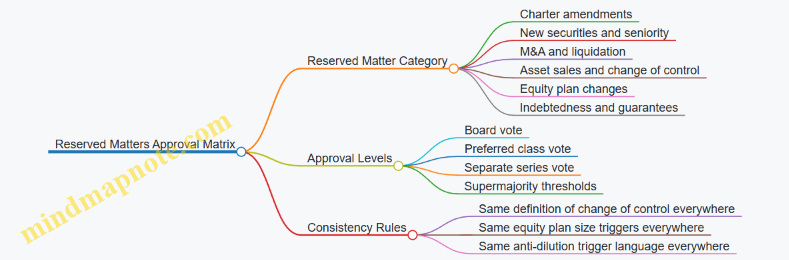
Practical Checklist: What to Verify Before Closing
- Definitions match. If “Change of Control” appears in three documents, it must mean the same thing.
- Approval paths are unambiguous. Every reserved matter should state who votes and how.
- Cap table math is executable. The issuance mechanics should produce the same ownership percentages as the spreadsheet.
- Option pool governance is coherent. Equity plan approvals should not accidentally require class votes for routine grants.
- Board actions are ready. Pre-close board consents should already cover adoption of the equity plan and initial grants.
Example: A Minimal Approval Matrix You Can Actually Use
| Action | Board Vote | Preferred Class Vote | Notes |
|---|---|---|---|
| Create new equity plan above threshold | Yes | Yes | Threshold prevents repeated consents |
| Issue senior securities | Yes | Yes | Protects liquidation and control economics |
| Approve routine grants under plan | Yes | No | Keeps hiring from becoming a negotiation |
| Amend charter to change voting rights | Yes | Yes | Ensures class consent is meaningful |
This assembly approach keeps governance control targeted, economic terms consistent, and the paperwork aligned—so the company can run without turning every decision into a referendum.