Startup Funding and Venture Capital Strategies
1. Preparing Your Startup for Fundraising
1.1 Defining Your Fundraising Objectives and Funding Use Cases
Before you talk to investors, decide what you are trying to accomplish with the money. “Raise capital” is a task; fundraising objectives are measurable outcomes tied to specific use cases. When these are clear, your pitch becomes easier to write, your financial model becomes easier to defend, and your team stops arguing about priorities.
Start with Outcomes, Not Amounts
Pick 2–4 fundraising objectives that can be checked in the next 6–18 months. Each objective should map to a business bottleneck you can actually solve.
Common objective patterns:
- Revenue acceleration: reduce sales cycle time, improve conversion, or expand into a new customer segment.
- Product readiness: ship a feature set that unlocks a new pricing tier or reduces churn.
- Operational stability: hire key roles to prevent execution gaps, not just to “grow.”
- Market expansion: localize support, build a partner channel, or add compliance capacity.
Example: A B2B SaaS startup might set an objective of “increase net revenue retention from 92% to 105% by improving onboarding and support coverage.” That objective implies use cases like customer success capacity and product instrumentation, not generic “marketing.”
Translate Objectives into Funding Use Cases
A funding use case is a bucket of spending with a purpose, an owner, and a measurable result. Good use cases are specific enough that you can explain tradeoffs if the round is smaller.
Use case categories that cover most early-stage startups:
- People: engineering, product, sales, customer success, finance, and operations.
- Go-to-market execution: sales enablement, outbound tooling, events, partnerships, and customer acquisition experiments.
- Product and infrastructure: hosting, security reviews, analytics, QA, and key platform work.
- Customer validation: pilots, onboarding support, research, and service costs tied to learning.
- Legal and compliance: incorporation, IP work, contracts, and securities administration.
- Working capital: inventory (if relevant), payment terms buffers, and cash management.
Example: If your objective is “reduce churn,” a use case might be “hire a customer success lead and fund a structured onboarding program.” The measurable result could be “churn down by X points and time-to-value down by Y weeks.”
Define Success Metrics and Decision Rules
For each use case, define:
- Metric: what changes if the spending works.
- Baseline: what the number is today.
- Target: what “good” looks like.
- Time window: when you expect to see movement.
- Decision rule: what you do if progress is slower than expected.
Decision rules prevent endless spending. Example: “If onboarding activation does not improve within two months, we pause the additional CS headcount and reallocate to product changes that address the activation bottleneck.”
Avoid the Two Common Mistakes
- Listing expenses without purpose: “$120k for marketing” tells investors nothing about what will improve. Replace it with “$120k for sales enablement and outbound testing to improve demo-to-trial conversion from 18% to 25%.”
- Overstuffing objectives: If you have five objectives, you usually have none. Choose the bottleneck that most constrains execution right now.
Build a Simple Funding Use Case Map
Use the map below to connect objectives to use cases and metrics. Keep it to one page.
Mind Map: Fundraising Objectives
Convert the Map into a Funding Plan
Once the use cases are defined, estimate how much cash each one consumes and when it will be spent. A practical approach is to assign a rough monthly burn range per use case, then sum them into a total round size.
Example allocation for a $2.0M seed round:
- People (product and CS): $900k over 12 months
- Go-to-market execution: $550k over 10 months
- Product and infrastructure: $300k over 9 months
- Legal and compliance: $150k over 6 months
- Working capital buffer: $100k over 12 months
The buffer is not a “nice to have.” It prevents the plan from collapsing when hiring starts later than expected or when a customer pilot runs longer than the calendar promised.
Write Your Objective Statement
Create a short statement you can reuse in meetings and in your internal planning. It should include the bottleneck, the outcome, and the use cases.
Example objective statement:
“We are raising to improve net revenue retention by reducing churn drivers in onboarding and support. The funds will be used for customer success capacity, onboarding flow redesign, and security/compliance work needed for larger contracts, measured by activation rate and retention movement over the next two quarters.”
Quick Checklist Before You Pitch
- Do you have 2–4 objectives with measurable targets?
- Does each use case have an owner and a metric?
- Can you explain tradeoffs if the round is 20% smaller?
- Are you spending on bottlenecks, not categories?
When these answers are consistent, your fundraising story stops being a collection of slides and becomes a plan with logic investors can follow.
1.2 Building a Fundraising Readiness Checklist for Team Product and Metrics
A fundraising readiness checklist is not a list of chores. It’s a way to prove you can answer investor questions quickly, consistently, and with evidence. Start with what investors test first: the team’s ability to execute, the product’s ability to solve a real problem, and the metrics’ ability to describe reality without hand-waving.
Mind Map: Readiness Signals
Team Readiness Checklist
1. Roles and ownership. Write down who owns product, engineering, sales, and finance. Then add one sentence each: what that person is accountable for in the next 60 days. Example: “Product owns onboarding improvements and activation metrics; Engineering owns reliability and deployment cadence.” Investors don’t need job descriptions; they need clarity.
2. Execution history. Prepare a short “what we shipped” log with dates and outcomes. If you launched a feature, include what changed in usage. Example: “New onboarding reduced time-to-first-action from 9 minutes to 4 minutes over two weeks.” If you can’t quantify it, explain why and what you measured instead.
3. Hiring plan and gaps. List the top two roles you need and why they matter for the next milestone. Include what you will stop doing to make room. Example: “Hire a customer success lead to reduce churn; pause nonessential custom integrations.”
4. Decision cadence. Show how you make tradeoffs. A simple weekly operating rhythm works: product review, metrics review, and engineering status. Investors look for repeatable process, not heroics.
Product Readiness Checklist
1. Problem clarity. Create a one-page “problem statement” that includes who has the problem, how they describe it, and what they do today instead. Example: “Ops teams at mid-market firms struggle to reconcile invoices; they currently use spreadsheets and manual checks.”
2. Solution proof. Map each core feature to the user job it supports. Then add evidence: screenshots, short demo clips, or a written walkthrough of a typical workflow. Example: “Automated invoice matching supports the job of reducing manual reconciliation time.”
3. Customer feedback loop. Document how you collect feedback and how it changes the roadmap. Include at least three recent examples. Example: “Users requested export formats; we added CSV export and reduced support tickets about formatting.”
4. Roadmap discipline. Your roadmap should include milestones with measurable outcomes. Avoid vague goals like “improve engagement.” Use outcomes like “increase activation rate from 22% to 30% by improving onboarding steps 1–3.”
Metrics Readiness Checklist
1. Metric definitions that don’t drift. Write definitions for the metrics you’ll discuss: activation, retention, churn, revenue, and runway. Include the exact calculation and the data source. Example: “Activation is a user who completes the first successful workflow within 7 days of signup.”
2. Data quality checks. Add a small section called “How we know the numbers are right.” Include checks like deduping events, handling timezone issues, and reconciling analytics totals with billing totals. Example: “Monthly active users exclude test accounts; billing revenue reconciles to Stripe gross receipts minus refunds.”
3. Cohorts and retention evidence. Investors want to see whether users stick around. Provide cohort tables for at least two periods and explain what changed. Example: “Cohort retention improved after onboarding update because users reached the first workflow faster.”
4. Unit economics inputs. If you have revenue, show the inputs behind gross margin and customer acquisition cost. If you don’t, show the cost drivers you track anyway: support cost per active account, infrastructure cost per usage unit, and sales cycle length. Example: “Infrastructure cost per active workspace decreased 18% after optimizing queries.”
Evidence and Q and a Readiness
1. Data room completeness. Confirm you have the basics: cap table, incorporation documents, option plan details, key contracts, and financial statements. Add a “last updated” note for each file so you don’t repeat yourself.
2. Versioned artifacts. Keep pitch deck and metric definitions in one place with a clear version number. Example: “Deck v3.2 matches metrics sheet v3.2; both updated after the latest cohort export.”
3. Red flag handling. Prepare short explanations for known issues: churn spikes, delayed launches, or a mismatch between pipeline and bookings. The goal is not to hide problems; it’s to show you can explain them precisely.
Process Checklist for the Fundraising Window
Assign owners for every recurring task: updating metrics, responding to diligence questions, and coordinating legal review. Then set a simple workflow: questions arrive, owner triages, response is drafted, and evidence is attached. Example: “If an investor asks about retention, the metrics owner answers and links the cohort export and definition sheet.”
Example Readiness Scorecard
| Area | Evidence You Have | What’s Missing | Owner | Target Date |
|---|---|---|---|---|
| Team | Ship log, org ownership | Hiring plan detail | Head of Product | 2026-02-15 |
| Product | Workflow demo, roadmap milestones | Customer feedback examples | PM | 2026-02-15 |
| Metrics | Definitions, cohort exports | Revenue reconciliation notes | Finance | 2026-02-18 |
| Evidence | Data room folder structure | Versioning for deck | Ops | 2026-02-18 |
A good checklist ends with accountability. When every item has an owner and a target date, fundraising stops being a vague project and becomes a controlled process.
1.3 Establishing Your Company Structure and Cap Table Baseline
A cap table is not just a spreadsheet; it’s the ledger of who owns what, how ownership changes, and what investors will later ask you to prove. Before you raise money, you want a structure that is legally coherent, operationally manageable, and easy to explain in one page.
Start with the Corporate Form and Governance Basics
Most venture-backed startups incorporate as a C-Corp (common in the US). The practical reason is simple: preferred stock and standard venture financing mechanics fit cleanly. If you’re outside that norm, the same principles apply—choose a structure that supports equity issuance, option grants, and investor preferred rights.
Governance basics should be set early:
- Board and consent process: define how decisions are made (board meetings vs written consents).
- Authorized shares: confirm the number of shares the company can issue without amending the charter.
- Stock classes and rights: decide what exists today (common stock) and what will exist later (preferred stock).
Example: If your charter authorizes 10,000,000 shares but you only track 1,000,000 issued, you still need a clear record of what happened to the remaining authorized shares. Investors will ask, and your answer must match the charter.
Create a Cap Table Baseline Snapshot
A baseline snapshot is the state of the cap table at a specific moment, with documents that support every line item. Build it from primary records, not memory.
Include at minimum:
- Issued shares by holder (founders, employees, any existing investors)
- Vesting status for founders and employees (if applicable)
- Option pool size and what portion is reserved vs granted
- Any SAFEs or notes outstanding (even if they are not equity yet)
- Any transfers, cancellations, or repurchases
Use a consistent naming convention for holders and securities so you can reconcile later.
Example: Two founders each have 3,000,000 common shares, but one has a repurchase agreement for unvested shares. Your baseline should show the vesting schedule and the repurchase terms, not just the current share count.
Align Equity with Vesting and Founder Agreements
Equity that is “owned” but not “earned” causes problems during fundraising. The baseline should reflect vesting and any acceleration rules.
Common setup:
- Founders receive common stock subject to vesting
- Unvested shares are subject to repurchase at cost if the founder leaves
- Vesting typically spans multiple years with monthly vesting after an initial cliff
Example: A founder starts on Day 1 and leaves after 10 months. If you issued fully vested shares without a repurchase mechanism, you may need to unwind ownership later. If you used vesting with repurchase, you can cancel or repurchase unvested shares and update the cap table cleanly.
Establish an Option Pool Plan Before You Need It
An option pool is reserved equity for future hires. Even if you plan to hire later, you want the baseline to show how much equity is available and how it will be granted.
Key baseline components:
- Board-approved equity incentive plan
- Option pool size (reserved shares)
- Granting policy and approval workflow
- Standard option terms (exercise price, vesting, expiration)
Example: You reserve 1,500,000 shares for options. Later you grant 300,000 options to an early engineer. Your cap table baseline should already know the pool size and show remaining reserved shares after the grant.
Document Everything That Changes Ownership
Ownership changes come from a small set of events. Your baseline should be backed by documents for each event type.
Common event categories:
- Issuance: stock purchase agreements, subscription agreements
- Vesting: vesting schedules, board approvals for grants
- Repurchase or cancellation: repurchase agreements, cancellation records
- Transfers: stock transfer forms and board consents
- Rights conversion: SAFEs/notes documentation and conversion mechanics
If you have any SAFEs or notes, record them as separate line items with their terms. Even without conversion, investors will want to see what could become equity.
Mind Map: Cap Table Baseline Work
A Practical Baseline Checklist
Treat this as a “numbers plus proof” exercise.
- Confirm charter and authorized shares match your intended issuance plan.
- List every holder and security type currently outstanding.
- For each founder, include vesting and repurchase details.
- For the option pool, show reserved shares and what has been granted.
- Record any SAFEs/notes as separate items with terms.
- Reconcile totals: issued shares + reserved options + any other equity instruments should align with your authorized share framework.
Example: If your cap table says 6,000,000 shares issued and your charter authorizes 10,000,000, you still need to show how the remaining 4,000,000 is treated—reserved for options, unissued, or otherwise allocated.
Common Mistakes That Break Fundraising
- Missing repurchase terms for unvested founder equity.
- Option pool reserved shares not matching the approved plan.
- Cap table built from a founder’s memory instead of board records.
- SAFEs/notes omitted from the baseline because “they aren’t equity yet.”
A clean baseline makes later steps faster: diligence questions become straightforward, and term sheet negotiations start from accurate facts rather than guesswork.
1.4 Organizing Financial Records and Data Rooms for Investor Review
Investors don’t review your company; they review evidence. A well-organized financial record set and data room turns “Can you show me?” into “Got it.” The goal is not to impress with volume, but to reduce friction: clear documents, consistent numbers, and a trail that matches your story.
Start with a Single Source of Truth
Before you create folders, decide what system owns each number. For example, if your accounting software produces revenue and expenses, treat it as the source for the income statement. If you track customer usage in a separate billing system, treat that as the source for usage metrics, then reconcile it to revenue.
A simple rule prevents chaos: every metric used in your pitch deck should be traceable to a document in the data room. If a slide says “MRR grew from $40k to $55k,” the data room should contain the MRR calculation method and the underlying export or report.
Build Your Data Room Structure Like a Filing Cabinet
Use a consistent folder hierarchy so investors can navigate without asking you to explain the layout. A practical structure:
- 00 Cover And Index
- Data room index with document descriptions
- Investor Q&A log template
- 01 Corporate
- Charter, bylaws, cap table, stock ledger
- 02 Financial Statements
- Monthly P&L, balance sheet, cash flow (or closest equivalent)
- General ledger trial balance exports
- 03 Revenue And Billing
- Billing reports, churn/retention calculations, revenue recognition notes
- 04 Expenses And Payroll
- Payroll summaries, contractor payment summaries, major expense categories
- 05 Bank And Cash
- Bank statements, cash reconciliation worksheet
- 06 Tax And Compliance
- Tax filings, sales tax reports if applicable
- 07 Contracts And Legal Financial Impact
- Customer master agreements, key vendor contracts
Investors often start with financials, then jump to contracts that explain why the numbers look the way they do. Keeping contracts near the financial impact reduces back-and-forth.
Create a Reconciliation Layer for Every “Why”
Numbers rarely match perfectly across systems. Your job is to explain differences with a reconciliation worksheet.
Example: Revenue Reconciliation
- Billing system shows invoiced amounts.
- Accounting system shows recognized revenue.
- Reconciliation worksheet includes:
- Invoiced vs recognized delta
- Timing differences (prepaid months, annual contracts)
- Credits and refunds
If you have a monthly revenue chart, include a one-page explanation of the calculation method and the reconciliation approach. That one page saves hours of investor time.
Document Your Accounting Policies in Plain Language
Investors don’t need accounting textbooks; they need consistent definitions. Include a short “Accounting Notes” document covering:
- Revenue recognition approach at a high level
- Treatment of refunds, credits, and discounts
- How you handle prepaid revenue
- How you classify expenses (especially one-time items)
Example: One-Time Expense Labeling If you had a $25,000 legal expense that won’t repeat, label it clearly as non-recurring in your monthly reporting package and explain why it occurred. Investors can then adjust their own models without guessing.
Prepare a Monthly Reporting Package That Stays Stable
A stable monthly package reduces investor questions because the format doesn’t change.
Include:
- Income statement with clear line items
- Balance sheet
- Cash reconciliation summary
- Headcount and payroll summary
- Variance notes for major changes (for example, “Marketing spend increased due to annual contract start”)
Use a consistent naming convention, such as YYYY-MM_PnL, YYYY-MM_CashReconciliation, and YYYY-MM_Headcount. Consistency beats cleverness.
Mind Map: Data Room Readiness
Example: A Clean Index Entry That Works
Your index should describe what a document contains and how it connects to a metric.
Example Index Entry
- 02 Financial Statements / 2026-02 Monthly P&L
- Contains: revenue, COGS, operating expenses by category
- Ties to: investor deck “Monthly burn” and “Gross margin”
- Notes: includes non-recurring legal expense line item
This level of specificity prevents the classic problem: investors download a file but still can’t tell what it means.
Version Control and Access Hygiene
Use a single “final” version per month per document type. If you revise a reconciliation, update the index entry and mark the revised file clearly.
Also, avoid mixing drafts with finals. A simple approach:
- Drafts live in a separate internal folder
- Only finals are uploaded
- File names include the month and document type
Close the Loop with a Q and a Log
Add a lightweight Q&A log template in the data room. When an investor asks a question, record:
- Question summary
- Where the answer lives in the data room
- Date answered (for example, 2026-02-15)
This keeps you from re-explaining the same reconciliation every time someone new joins the diligence call.
1.5 Selecting the Right Funding Path for Your Stage and Business Model
Choosing a funding path is mostly about matching cash needs to investor expectations. Investors care less about the label of the round and more about whether your current evidence supports the risk they’re taking.
Start with two foundational questions: What are you building, and what proof can you produce soon? A product with fast customer feedback can often raise earlier because you can generate evidence quickly. A product that depends on long sales cycles or complex compliance usually needs more runway and clearer milestones before investors feel comfortable.
Step 1: Match Stage to Evidence
Early stage typically means you’re still proving something fundamental: demand, repeatability, or technical feasibility. Funding paths differ in how much uncertainty they tolerate.
- Pre-revenue or early revenue: Investors expect learning velocity. Your metrics should show progress toward a repeatable motion, not just raw growth.
- Revenue with early retention: Investors expect unit economics to be directionally correct. They want to see that customers keep coming back and that costs don’t scale faster than value.
- Scaling revenue: Investors expect predictable execution. Your funding plan should support hiring, sales capacity, and operational scaling without losing control of margins.
A practical example: if you run a B2B service with manual onboarding, you may show revenue quickly but still lack scalable delivery. That’s a sign to fund with a path that supports process refinement, not one that assumes immediate automation.
Step 2: Match Business Model to Cash Flow
Your business model determines how quickly cash returns.
- Subscription or usage-based: Cash often comes in recurring intervals, so investors look for retention, churn, and cohort behavior.
- Marketplace: Cash depends on liquidity and take rate. Investors look for supply and demand balance and whether incentives are sustainable.
- One-time sales: Cash may arrive in bursts. Investors focus on pipeline quality, sales cycle consistency, and gross margin stability.
- Hardware or regulated products: Cash needs are front-loaded. Investors expect milestones tied to manufacturing, approvals, or clinical/technical gates.
Example: a SaaS company with monthly churn of 6% might still be fundable early, but a SaaS company with churn of 25% usually needs product and pricing work before equity investors will underwrite the risk.
Step 3: Choose the Funding Instrument That Fits the Risk
Different instruments shift risk between founders and investors.
- Equity rounds: Best when you can articulate valuation logic and you have enough evidence to justify ownership transfer now. Equity also simplifies future fundraising because the cap table is straightforward.
- Convertible notes: Useful when you want speed and expect a priced round soon. They add complexity through interest and maturity, so you need a plan for what happens if the next round takes longer than expected.
- SAFEs: Similar intent to notes but typically simpler. They still require clarity on conversion mechanics and how you’ll handle future pricing.
A simple rule: if you can credibly reach a priced round milestone within the instrument’s expected timeline, convertibles can be efficient. If not, equity may reduce the chance of an awkward maturity event.
Step 4: Pick the Round Size and Milestones Together
Funding paths fail when the round size is chosen without linking it to what you’ll prove.
Create a milestone map with three layers:
- Product proof (what users do, not just what they say)
- Commercial proof (repeatable acquisition and retention)
- Operational proof (unit economics, delivery capacity, and cash discipline)
Example: for a seed round, you might set milestones like “reduce onboarding time from 10 days to 3” and “reach cohort retention of X at a defined price.” For a Series A, you might set “improve gross margin to Y” and “demonstrate sales efficiency with a stable sales cycle.”
Step 5: Use a Decision Mind Map
Mind Map: Selecting the Right Funding Path
Step 6: Validate with a “Fit Check”
Before you commit, run a fit check using three tests.
- Evidence test: Can you show the metric that justifies the instrument and stage within the next 6–12 weeks?
- Cash test: Does the funding path cover the time needed to reach the next milestone without forcing emergency decisions?
- Complexity test: Does the added paperwork and negotiation effort match your current bandwidth?
If you fail any test, adjust the plan: either narrow the milestones, change the instrument, or delay the round until the evidence is stronger.
A final practical note: the “right” funding path is the one that lets you keep building while staying consistent with what investors will ask for next. When your next milestone is clear and your metrics are measurable, the funding conversation becomes less about persuasion and more about verification.
2. Understanding Venture Capital and Investor Decision Making
2.1 Mapping Venture Capital Firm Structures and Investment Mandates
Venture capital firms are not just “money with opinions.” Their internal structure determines how fast decisions happen, what gets prioritized, and which founders get a meeting in the first place. Mapping a firm’s structure and mandate helps you predict the questions you’ll face and the terms you’re likely to see.
Core Firm Structures
Most VC firms fit one of these patterns, and each changes how deals are sourced and approved.
- Single-fund partnership: A small team runs one main fund. Fewer people means faster alignment, but the mandate can be narrow because the team is accountable to a specific strategy.
- Multi-fund platform: The firm manages multiple funds across stages. You may meet a partner who invests early, but the “real decision” could involve a partner aligned to the specific fund that matches your round.
- Fund-of-funds or feeder structures: Some firms allocate to other managers. Their mandate is about manager selection, so they rarely lead startup rounds directly.
- Corporate venture arms: These sit inside a corporate group. They often have a strategic lens, which can affect diligence depth, timelines, and governance expectations.
A practical way to map structure is to identify who signs the investment, who leads diligence, and who sets the investment committee agenda.
Investment Mandates That Actually Matter
A mandate is more than a one-line description like “seed to Series A.” It usually includes constraints that show up in meetings.
- Stage: Seed, Series A, growth, or a narrow band like “pre-seed with revenue.” Stage affects what evidence investors expect.
- Check size: A firm that writes $2–5M checks will ask different questions than one that writes $250k–$1M checks.
- Geography: Some firms are global; others are tied to a region. Even remote-friendly firms may prefer founders who can meet in person.
- Sector focus: “Software” can mean anything from developer tools to fintech. The mandate often specifies subcategories.
- Ownership expectations: Many firms target a certain level of influence. This shows up in board expectations and protective provisions.
- Follow-on behavior: Some firms reserve capital for later rounds; others invest opportunistically. Your fundraising plan should match their likely participation.
When you map these constraints, you can translate them into meeting prep. If a firm’s mandate emphasizes retention, expect deeper questions on cohorts and churn. If it emphasizes enterprise sales, expect diligence on pipeline quality and sales cycle length.
Decision Flow Inside the Firm
Investment committees and partner approvals vary, but the logic is consistent: risk is reduced through internal review.
- Sourcing: A partner or associate brings the deal. The first meeting often tests fit with the mandate.
- Pre-diligence: The team checks basic viability: team credibility, market clarity, and whether the numbers are internally consistent.
- Diligence ownership: Different partners may own different diligence tracks, such as product, market, or legal.
- Investment committee: The committee decides whether to proceed and under what terms. If the firm has multiple funds, the committee may route the deal to the appropriate fund.
A useful founder habit is to ask, early and politely, “Which fund would this typically be allocated to?” That question is grounded in how the firm operates, not in curiosity for its own sake.
Mind Map: Firm Structure and Mandate
Example Mapping in Practice
Example 1: Multi-fund platform with a narrow stage band You’re raising a seed round for a B2B SaaS product with early revenue. The partner you meet says “seed is our focus,” but their firm is a multi-fund platform. In the second meeting, you ask which fund would invest. You learn it would be routed to a specific seed fund that emphasizes retention. That explains why they ask for cohort charts and why they want a clear plan for improving net revenue retention.
Example 2: Corporate venture arm with strategic governance You’re pitching an infrastructure startup to a corporate venture group. Their mandate includes a sector match, but their internal process includes additional stakeholders from the corporate side. In diligence, they request more documentation around security posture and integration timelines. Even if the economics look fine, the governance expectations may be stricter because the corporate parent needs predictable risk management.
Turning Mapping into Meeting Preparation
Once you map structure and mandate, you can tailor your materials and questions without guessing. Prepare a one-page “fit summary” that ties your stage, traction evidence, and funding use to the constraints you identified. Then align your questions to the decision flow: ask about fund routing, diligence ownership, and expected timeline for committee review.
This approach keeps the conversation grounded. It also reduces the chance that you spend time pitching to a firm that is structurally capable of investing, but mandate-incompatible with your specific round.
2.2 Understanding Partner Roles and How Deals Get Approved
Venture capital firms are not monoliths. Even when the same partner meets you, the decision is usually shaped by a small group with different jobs: sourcing, diligence, investment committee preparation, and final approval. Knowing who does what helps you answer questions the right way and at the right time.
Partner Roles That Actually Touch Your Deal
Start with the simplest mental model: partners are accountable for outcomes, but they operate through a pipeline.
- Sourcing partner: Often the first person you meet. They translate your story into the firm’s internal language and decide whether it’s worth spending diligence time.
- Diligence lead: Sometimes the same person, sometimes not. They coordinate the information requests, pressure-test assumptions, and ensure the firm’s internal checklist is satisfied.
- Industry or functional specialist: A partner or senior associate who focuses on a domain like fintech, developer tools, or healthcare. They may not run the whole process, but they can veto weak technical or market reasoning.
- Investment committee partner: The person who helps package the deal for approval. They care about consistency: does the round fit the firm’s mandate, and is the risk profile coherent with the proposed terms?
- Operations or legal partner: Not always a “partner” in the meeting sense, but they influence feasibility. They flag issues like option pool mechanics, cap table cleanliness, or contract gaps that could delay closing.
A useful rule: if you only impress the sourcing partner, you may still lose later. If you satisfy the diligence lead and the committee partner, you’re much more likely to move.
How Deals Get Approved Inside a Firm
Most firms follow a repeatable sequence. The names vary, but the logic is consistent.
- Initial screen: The firm checks fit with stage, geography, and sector. If you’re outside the mandate, the process stops early.
- Partner alignment: The sourcing partner confirms internal interest and identifies who must sign off.
- Diligence sprint: The firm requests documents and runs structured questions. This is where weak metrics, unclear ownership, or inconsistent unit economics get caught.
- Investment memo: A written summary is prepared for the committee. It includes the thesis, risks, and how the proposed terms address those risks.
- Investment committee: The committee debates the memo, compares it to portfolio needs, and decides whether to approve, revise, or pass.
- Term negotiation and closing: If approved, the firm negotiates terms and coordinates legal execution.
A practical implication: your answers should map to the memo. If you can’t explain your numbers clearly, you’re forcing the diligence lead to guess, and committees dislike guessing.
Mind Map: Partner Roles and Approval Flow
Partner Roles and Deal Approval Mind Map
Example: How the Same Meeting Plays Differently Across Roles
Imagine you’re raising a Seed round.
- In the first meeting, the sourcing partner asks, “Why now, and why you?” They want a coherent narrative and a reason the firm should spend time.
- During the diligence sprint, the diligence lead asks, “Show the retention cohort math and explain churn drivers.” They’re not judging your ambition; they’re checking whether the evidence supports the plan.
- In the specialist review, a partner might ask, “How defensible is your distribution?” They look for concrete differentiation, not just a claim.
- At the investment committee, the committee partner focuses on whether the proposed terms match the risk. If your traction is real but your revenue model is fragile, they may push for protections or a smaller check.
If you treat every question as a chance to tell your story, you’ll miss the point. Each role is asking for a different kind of proof.
Example: A Clean Path to Approval Through Targeted Evidence
Suppose an investor asks for customer references and you provide two calls plus a short summary of outcomes. That helps, but it’s not enough if the diligence lead also needs contract clarity.
A stronger approach is to bundle evidence by question type:
- Commercial proof: retention and usage metrics with cohort definitions
- Legal proof: signed customer agreements and IP assignment confirmations
- Financial proof: reconciled revenue numbers and burn calculation notes
When your evidence is organized this way, the diligence lead can write the memo faster, and the committee can focus on substance rather than chasing documents.
What to Watch for in Partner Behavior
Even without knowing internal names, you can infer roles from behavior.
- If someone asks for documents early, they’re likely driving diligence.
- If someone summarizes your thesis and asks about terms, they’re likely preparing for committee.
- If someone focuses on feasibility and closing mechanics, they’re likely connected to operations or legal.
Your job is to respond with the right evidence for the role that’s currently “holding the steering wheel.”
2.3 Reading Investment Thesis Fit Through Sector Stage and Geography
A venture firm’s thesis is not a slogan; it’s a set of constraints that shapes what they can underwrite quickly and defend internally. Your job is to translate your startup into those constraints using evidence, not persuasion.
Sector Fit Starts with What They Can Actually Evaluate
Sector fit usually means the firm has a repeatable way to judge customer pain, buying behavior, and competitive dynamics. Begin with three questions you can answer in your first meeting:
- Who is the buyer and how do they decide? If you sell to procurement, show how deals get approved and what blocks them.
- What is the workflow your product changes? Investors look for a clear “before and after,” even if you’re early.
- What evidence counts in this sector? In B2B, it might be pilot-to-contract conversion; in marketplaces, it might be liquidity and retention.
Example: A seed investor focused on developer tools will ask about adoption loops and integration effort. If you instead lead with revenue charts but can’t explain how developers evaluate and switch, you’ll feel “off-thesis” even if your numbers are strong.
Stage Fit Means Matching Their Decision Tempo
Stage fit is about how much uncertainty the firm is willing to carry and how they structure support. Early-stage investors often accept messy metrics if you can show learning velocity. Later-stage investors expect clearer unit economics, repeatable sales motion, and governance readiness.
Use a simple mapping:
- Pre-product: evidence of problem clarity, early design partners, and iteration cadence.
- Seed: early traction that proves demand and a credible plan to reach the next milestone.
- Series A: stronger retention or conversion, clearer pricing logic, and a sales process that doesn’t rely on founder magic.
Example: If you’re raising a seed round but your deck reads like a Series A plan—complete with mature churn cohorts and enterprise procurement timelines—some investors will assume you’re mis-staged. Others may still invest, but you’ll spend time correcting their mental model.
Geography Fit Is Mostly About Network and Execution
Geography is often less about where you live and more about where the firm’s partners can reach customers, talent, and follow-on capital. It affects how quickly they can validate claims and help with hiring.
To assess geography fit, check:
- Where are your first customers located? If your buyers are concentrated in one region, align your narrative to that reality.
- Where do you already have credibility? Advisory boards, early hires, and customer references in the target region matter.
- How will the firm add value locally? If they can’t introduce you to relevant operators or buyers, they may still invest, but they’ll be slower.
Example: A firm headquartered in Europe may still fund a US startup if your early customers are in Europe and you can show local traction. If your traction is US-only and your team is US-only, you’ll need stronger proof that the firm’s network is still useful.
Mind Map: Thesis Fit Signals
Turning Fit into a Practical Pitch Structure
A thesis-fit pitch should reduce investor effort. Use a three-part sequence:
- One-sentence positioning: “We help [buyer] do [workflow] by [mechanism].”
- Evidence in their language: pick one metric or customer story that matches how they judge this sector.
- Fit justification: explain why your stage and geography match their pattern, or acknowledge the mismatch and show why it won’t block execution.
Example: If you’re raising seed for a B2B compliance product, don’t just say “we’re growing.” Show a pilot conversion story, then connect it to the firm’s sector evidence standard. If your customers are outside the firm’s home region, show how you already built local credibility through a specific customer relationship and a hiring plan that supports that region’s go-to-market.
Common Misreads That Make Fit Look Worse Than It Is
Investors sometimes label “not a fit” when the pitch doesn’t map to their internal checklist. Watch for these avoidable issues:
- Sector mismatch by framing: using consumer metrics for a B2B sales cycle.
- Stage mismatch by expectations: presenting late-stage claims without the underlying retention or sales process.
- Geography mismatch by omission: ignoring where customers are and how you’ll operate there.
A good rule: if you can’t point to one concrete example that supports sector, stage, and geography fit, your thesis alignment is still mostly hope. Replace hope with evidence, one claim at a time.
2.4 Evaluating Risk Factors Investors Screen for in Early Deals
Early-stage investors are not trying to be pessimists. They’re trying to avoid predictable failure modes using limited information. Risk screening is therefore a structured process: identify what can break, estimate how likely it is, and check whether the team has already built evidence that the break is unlikely.
The Risk Map Investors Use
Most risk checks fall into five buckets that show up repeatedly across seed and Series A conversations: market risk, product risk, traction risk, execution risk, and financial risk. Each bucket has observable signals, and each signal has a “what would I expect to see if this is going well?” counterpart.
Market Risk
Market risk asks whether customers actually have the problem and whether the company can reach them. Investors look for problem clarity first: can the team describe who feels the pain, how they currently solve it, and what makes the current workaround expensive in time or money?
A simple example: a founder says, “We sell to HR teams.” That’s a category, not a customer. A stronger signal is, “We sell to mid-market companies with 200–800 employees that are rolling out performance reviews and need audit-ready documentation.” The second statement implies a buying trigger and a path to identifying prospects.
Investors also test customer access. They look for evidence that the team can find and engage the target buyer without heroic effort. If the only channel is “we’ll do outbound,” the risk is that the company has no proof of message-market fit. A practical counter-signal is a short list of target accounts with documented outreach results and conversion rates.
Product Risk
Product risk is about whether the solution works well enough to be adopted. Investors typically focus on three things: solution fit, reliability, and differentiation.
Solution fit shows up as repeatable value delivery. For a B2B SaaS product, that might be “time-to-first-value” measured from signup to the first completed workflow. If customers take weeks to get value, adoption becomes fragile.
Reliability is often overlooked in early demos. Investors ask questions like: how often does the product fail, what are the top support tickets, and what percentage of sessions complete successfully. Even basic metrics help. For example, “99.2% successful workflow runs over the last 30 days” is more useful than “it’s stable.”
Differentiation is not a slogan. It’s a defensible mechanism: data advantage, workflow integration, switching costs, or a technical constraint that competitors can’t easily replicate. Investors look for “why you” that can be explained without hand-waving.
Traction Risk
Traction risk is whether early interest turns into consistent usage or revenue. Investors screen for leading indicators, not just totals.
For usage-based products, they look at retention and cohort behavior. A common red flag is high initial signups with flat or declining week-4 usage. A counter-signal is improving retention after onboarding changes, with a clear before-and-after explanation.
For revenue-based products, they look at sales cycle signals and deal quality. Investors ask: are deals small because the product is weak, or small because the market is early? They also check whether revenue is recurring or one-time. A concrete example: “10 customers, $30k MRR, churn is 2% monthly” is a different risk profile than “10 customers, $30k annual contracts, no renewal history.”
Execution Risk
Execution risk is whether the team can build and sell the product under real constraints. Investors evaluate capability through past work, but they also evaluate judgment through current decisions.
They look for a realistic hiring plan tied to milestones. If the roadmap requires three engineering hires and one sales hire, investors expect the plan to match the timeline and budget. They also look for operational discipline: do you track bugs, measure onboarding steps, and run experiments with documented outcomes?
A helpful example is onboarding iteration. If the team can explain how they reduced time-to-first-value from 14 days to 5 days by changing a specific workflow step, that shows learning velocity.
Financial Risk
Financial risk is about survival and capital efficiency. Investors screen runway because it determines how many mistakes you can afford. They also screen burn rate against milestones: spending should correlate with measurable progress.
Unit economics matter even early. Investors don’t require perfect numbers, but they require coherent assumptions. For instance, if customer acquisition cost is estimated from a small sample, the team should state the sample size and what would change the estimate.
A practical checklist investors use:
- Runway in months at current burn
- Burn breakdown by category (engineering, sales, cloud, contractors)
- Revenue or usage trend with a defined metric
- Evidence that spending is tied to a milestone (not just “we need time”)
Putting It Together with a Risk Scorecard
Investors often translate the buckets into a scorecard that supports consistent decision-making. The goal is not to “grade” the startup; it’s to identify which risk is currently dominant.
Risk Scorecard
- Market: 1–5 (problem clarity, access proof)
- Product: 1–5 (fit, reliability signals, differentiation)
- Traction: 1–5 (retention/usage or recurring revenue quality)
- Execution: 1–5 (milestones, learning velocity, operational discipline)
- Finance: 1–5 (runway, burn-to-milestone alignment, coherent assumptions)
Dominant risk: the lowest score with the least evidence
Mitigation evidence: what the team has already done to reduce it
When founders can point to mitigation evidence—like improved onboarding metrics, documented conversion rates, or clearer customer access—the screening conversation shifts from “what could go wrong?” to “what have you already proven you can handle?”
2.5 Knowing Common Deal Terms and What They Signal
Deal terms are the investor’s way of translating risk into structure. The same word can mean different things across firms, so treat each term as a signal about priorities: control, downside protection, alignment, and how the investor expects to get paid.
The Core Economic Terms
Valuation and Price Per Share Valuation sets the starting point for ownership. If an investor pushes a low valuation, they’re pricing in more perceived risk or expecting stronger downside protection elsewhere. Example: a seed round at a $6M pre-money means the new investors receive a larger slice than a $10M pre-money round, even if the round size is identical.
Round Size and Ownership Target Investors often aim for a specific ownership percentage. If the round is small relative to the company’s needs, the investor may be trying to keep dilution limited for themselves while still gaining meaningful influence.
Liquidation Preference This term determines who gets paid first if the company is sold or liquidated. A 1x non-participating preference means investors get their money back before common holders, but they don’t also share in the remaining proceeds. A participating preference lets them get their preference and then share again, which can heavily reduce outcomes for founders and employees. Signal: participating terms usually indicate a stronger preference for downside certainty.
Participation Cap If participation exists, a cap limits how much investors can receive. A cap is a compromise: it protects investors from worst-case scenarios while preserving some upside for others.
The Conversion and Anti-Dilution Terms
Convertible Notes and SAFEs Notes convert into equity later, usually at a discount or with a valuation cap. SAFEs convert similarly but typically without interest. Signal: a discount or cap suggests the investor expects the next priced round to be higher, and they want a built-in adjustment.
Discount Rate A discount (for example, 20%) means conversion happens as if the next round price were lower. Example: if the next priced round values shares at $2.00, a 20% discount converts at $1.60.
Valuation Cap A cap sets a maximum valuation for conversion. Example: with a $8M cap, even if the next round values the company at $12M, the SAFE converts as if the company were worth $8M.
Anti-Dilution Protection Anti-dilution adjusts conversion terms if the company issues equity at a lower price later. A “weighted average” approach is generally less punitive than “full ratchet.” Signal: full ratchet indicates a strong concern that the company may need to raise at a lower valuation.
Control and Governance Terms
Board Composition and Voting Rights Board seats and voting thresholds shape how decisions get made. If an investor requests board control early, they’re signaling a desire to actively manage risk. Example: a board with two investor directors and one founder director can shift outcomes on budgets and hiring.
Protective Provisions Protective provisions require investor approval for major actions like issuing new shares, changing the charter, or taking on debt. Signal: extensive protective provisions indicate the investor wants veto power over events that could dilute or change risk.
Information Rights These specify what the company must share and how often. Signal: frequent reporting requests often correlate with a hands-on investor style or a need to monitor cash closely.
Liquidation, Exit, and Transfer Terms
Drag-Along Rights Drag-along rights allow a majority (often including preferred holders) to force minority holders to participate in a sale. Signal: drag rights reduce holdout risk for investors and acquirers.
Pro Rata Rights Pro rata rights let investors maintain their ownership by participating in future rounds. Signal: pro rata rights show the investor expects to stay involved and wants to avoid dilution.
ROFR and Transfer Restrictions Right of first refusal and restrictions on share transfers control who can buy shares. Signal: these terms reduce surprises in the cap table and help investors manage who becomes a new shareholder.
Mind Map: Deal Terms and Their Signals
Putting It Together with a Practical Example
Imagine a seed round where the term sheet includes a 1x non-participating liquidation preference, a valuation cap on a SAFE, and standard protective provisions.
- The 1x non-participating preference signals downside protection without stacking extra upside on top.
- The valuation cap signals the investor expects a higher priced round later and wants a fair conversion anchor.
- Standard protective provisions signal they want control over major risk events, but not day-to-day interference.
Now compare that to a term sheet with participating preference, full ratchet anti-dilution, and broad veto rights. The combination signals stronger fear of downside and a higher likelihood the investor expects the company to face pricing pressure later.
Quick Term-to-Question Checklist
When you see a term, ask what it changes in a real scenario:
- If there’s a preference, who gets paid first and how much?
- If there’s a cap or discount, what happens if the next round price is higher or lower?
- If there are protective provisions, which future actions become harder?
- If there are pro rata rights, how much future dilution is effectively pre-allocated?
This approach keeps the discussion grounded in mechanics, not vibes, and it makes negotiation more precise.
3. Choosing the Right Capital Instruments
3.1 Comparing Equity Rounds Convertible Notes and SAFEs
When founders compare equity rounds, convertible notes, and SAFEs, they’re really comparing three ways to handle one question: what happens between “we need money now” and “we can agree on a valuation later.” The differences show up in timing, pricing mechanics, investor protections, and how much paperwork you’ll manage.
Mind Map: Funding Instrument Decision
Foundational Mechanics
Equity rounds sell shares at a stated price. Investors become shareholders immediately, and the company’s cap table reflects the new ownership right away. This clarity is useful when you already have enough traction to justify a valuation and when you want clean governance from day one.
Convertible notes start as a loan. The note accrues interest, and it has a maturity date. If the company raises a priced equity round before maturity, the note converts into equity using agreed conversion terms. If not, the maturity date can force repayment or renegotiation.
SAFEs (Simple Agreement for Future Equity) are not debt and typically do not include interest or maturity. They convert into equity when a triggering event occurs, most commonly a priced equity round. The conversion math is governed by discount and/or a valuation cap.
Conversion Triggers and What They Mean
In practice, the biggest operational difference is what triggers conversion.
- In an equity round, there is no conversion event. The deal is already equity.
- In a note, conversion is usually tied to a future equity financing, and the note’s maturity date still matters if that financing is delayed.
- In a SAFE, conversion is also tied to a future equity financing, but without maturity pressure.
A simple example: suppose you raise $1,000,000 and expect a priced round in 12 months.
- With an equity round, you agree on valuation now, and everyone knows their ownership.
- With a note, you agree on conversion rules now, but the note also accrues interest during those 12 months.
- With a SAFE, you agree on conversion rules now, and the agreement avoids interest and maturity, so the company’s cash planning is simpler.
Pricing: Discount, Valuation Cap, and Effective Price
Convertible notes and SAFEs often use the same two levers: a discount and a valuation cap.
- A discount gives the investor a lower effective price than the price paid by new investors in the next priced round.
- A valuation cap sets a maximum valuation used to calculate conversion.
Consider a priced round where new investors pay $2.00 per share.
- If an instrument has a 20% discount, it converts at $1.60 per share.
- If it has a $10M valuation cap, conversion uses the cap valuation to compute the share price, which may be lower than the priced round price.
If both are present, the agreement usually uses whichever produces the lower conversion price. That “whichever is lower” detail matters because it determines how much equity the investor receives.
Investor Protections and Founder Tradeoffs
Equity rounds typically include protective provisions and governance rights negotiated as part of the share purchase. The tradeoff is time: agreeing on valuation and terms can take longer, and the cap table changes immediately.
Convertible notes often include additional investor protections because they are debt-like. Interest accrual increases the eventual conversion amount, and the maturity date can create leverage for investors if fundraising stalls.
SAFEs reduce complexity by removing debt mechanics. However, investors still negotiate conversion terms and sometimes additional rights. The tradeoff is that SAFEs can be less precise about certain economic outcomes than a fully priced equity round, so founders must be careful about how the conversion math interacts with future financing.
Paperwork and Cap Table Impact
A clean rule of thumb: the earlier you sell equity, the more immediate the cap table work; the later you convert, the more you must track conversion math.
- Equity round: immediate share issuance and straightforward ownership records.
- Convertible note: you track principal, interest accrual, and conversion upon trigger.
- SAFE: you track the SAFE amount and conversion calculation, usually without interest.
Mind Map: Practical Comparison Checklist
Choosing the Instrument for the Moment
If your company can support a credible valuation and you want immediate shareholder alignment, an equity round is the cleanest path.
If you need speed and prefer to postpone valuation while still accepting debt-like mechanics, a convertible note can fit, but founders should treat maturity and interest as real economic variables, not fine print.
If you want a simpler instrument that postpones valuation without debt mechanics, a SAFE is often the most straightforward option, provided you model conversion outcomes carefully for the next priced round.
A practical closing example: imagine two founders raising at the same time.
- Founder A raises an equity round at a $12M valuation.
- Founder B raises a SAFE with a $12M valuation cap and a 20% discount.
If the next priced round values the company at $20M, Founder B’s effective conversion price will be lower due to the cap and/or discount, resulting in more shares for the SAFE holders than Founder A’s investors received for their $12M valuation. That’s not good or bad by itself; it’s the direct consequence of deferring valuation and setting conversion rules.
3.2 Using Preferred Stock Terms to Balance Control and Economics
Preferred stock is the “grown-up” version of equity: it keeps the upside of ownership while adding rules that protect investors when outcomes are uneven. The trick is balancing control (who can steer decisions) with economics (who gets paid first and how much).
Foundational Concepts Investors Care About
Start with three baseline questions.
-
What happens if the company does well? Preferred terms should still allow common holders to participate meaningfully, usually through conversion.
-
What happens if the company struggles? Investors want downside protection, typically via liquidation preference and anti-dilution.
-
Who decides? Governance rights determine whether investors can block actions that affect value, like issuing new shares or selling the company.
A useful mental model is: economics set the payment order; control sets the decision order. You can have strong economics with limited control, or vice versa, but the combination should match the risk the investor is taking.
Economics Terms That Shape Payouts
Liquidation Preference
Liquidation preference defines the payout waterfall if the company is sold, liquidated, or otherwise exits. Common structures include:
- 1x non-participating: Investor gets their original investment back first; then remaining proceeds split according to conversion to common.
- 1x participating: Investor gets their preference first and then also shares in the remaining proceeds.
Example: An investor puts in $5M for preferred. In a $30M acquisition, a 1x non-participating preferred typically converts and shares like common, so founders and employees still benefit. With 1x participating, the investor may receive $5M first and then still share, reducing what’s left for everyone else.
Conversion Rights
Most preferred converts to common, either automatically at an IPO or at the investor’s option. Conversion is how investors participate in upside without giving up protection.
Example: If the preferred converts at a 1:1 ratio, then in a strong exit the preferred behaves like common. If conversion is adjusted by anti-dilution, the effective conversion rate can improve for investors after down rounds.
Anti-Dilution
Anti-dilution protects investors when the company issues shares at a lower valuation later.
- Full ratchet: The conversion price resets to the lowest price paid in a later round. This can be harsh to founders and employees.
- Weighted average: Adjusts conversion price using a formula that considers both the new price and the amount of new shares.
Example: Suppose preferred converts at $2.00 per share. A later round prices new shares at $1.50. With weighted average, the conversion price moves down but not all the way to $1.50 unless the new issuance is large enough to justify it.
Control Terms That Shape Decision Power
Preferred stock often comes with protective provisions. These are not “day-to-day control,” but they can block major actions.
Typical protective matters include:
- Issuing senior or pari passu securities
- Changing charter documents in ways that affect investor rights
- Authorizing new share classes or increasing option pool beyond agreed limits
- Selling the company or merging
Example: If the company wants to raise a bridge round that includes new preferred with senior liquidation preference, protective provisions can require investor consent. That prevents a scenario where new money changes the payout order midstream.
The Balance: How Terms Interact
Preferred terms rarely operate in isolation. A common pattern is:
- Stronger economics (participating preference, aggressive anti-dilution) often comes with fewer governance rights.
- Stronger control (more protective provisions, board seats) can be paired with less aggressive economics.
Example: A seed investor might accept a 1x non-participating preference but request board observation and consent on major financings. A later-stage investor might accept fewer consent rights if the liquidation preference and anti-dilution are already protective.
Mind Map: Control and Economics Tradeoffs
Practical Negotiation Examples
Example: Choosing Between Participating and Non-Participating
If the company expects a range of outcomes, non-participating is often easier to justify because it preserves upside for common holders after the investor is made whole.
Example: In a $50M exit, a participating preference can cause the investor to receive more than their original investment plus a share of the remainder, leaving less for employees. Non-participating typically results in conversion and a more “common-like” outcome.
Example: Anti-Dilution Standard Selection
Weighted average is usually the compromise because it protects investors without fully resetting conversion based on a single later price.
Example: If a down round happens due to temporary market conditions, weighted average reduces the chance that one financing event permanently rewrites the economics for everyone.
A Simple Term Checklist for Founders
Before signing, verify that each term answers a concrete question:
- Payment order: Is the liquidation preference non-participating or participating?
- Upside participation: Under what conditions does preferred convert?
- Downside protection: Is anti-dilution full ratchet or weighted average?
- Decision power: Which actions require investor consent?
- Consistency: Do the control rights match the level of economic protection?
When these pieces align, preferred stock becomes a structured compromise rather than a surprise mechanism. The goal is not to eliminate investor protection, but to make it predictable and proportional to the risk being priced.
3.3 Applying Valuation Methods for Early Stage Rounds
Early stage valuation is less about finding a single “correct” number and more about choosing a method that matches what you can prove today. Investors are usually underwriting three things: the risk that the product won’t work, the speed at which traction can compound, and the dilution they’ll experience if the company needs more capital later. Your job is to make those risks measurable, then translate them into valuation logic.
Start with What You Can Actually Measure
Before any math, separate evidence into three buckets:
- Current traction: revenue, usage, retention, pipeline, or signed pilots.
- Execution capacity: team capability, delivery milestones, and operational cadence.
- Market access: distribution channels, customer segments, and sales cycle reality.
If you only have an idea and a prototype, valuation methods will rely more heavily on comparable deals and risk adjustments. If you have repeatable revenue or strong retention, you can justify valuation with unit economics and growth rates.
Mind Map: Early Stage Valuation Inputs
Comparable Deal Method with Realistic Adjustments
The comparable method starts with recent seed and Series A transactions in similar sectors and geographies. The key is to adjust for differences that change risk, not just scale.
Use a simple adjustment checklist:
- Stage alignment: compare companies with similar traction quality, not just “seed.”
- Business model alignment: usage-based SaaS behaves differently from services or marketplaces.
- Geography and hiring intensity: cost structure affects how quickly milestones can be reached.
- Customer proof: pilots with no repeat usage are not the same as retention-backed revenue.
Example: If a comparable company raised at a $10M pre-money with monthly retention of 80% and you have 50%, you should expect a lower valuation unless your growth rate or margins compensate. Investors often express this as a discount to reflect higher uncertainty.
Venture Capital Method with a Clear Exit Assumption
The venture capital method works backward from an expected exit value. It’s popular because it forces you to state what “success” means and how much ownership investors need to earn.
Core steps:
- Choose an exit multiple or exit value based on comparable outcomes.
- Estimate the time to exit and the probability-weighted success path.
- Apply an investor required return to compute the maximum price today.
Example: Suppose an investor expects a $60M exit in 5 years and targets a 3x to 5x return on their money. If they want to own 20% to 30% post-money to achieve that outcome, the implied pre-money valuation range becomes constrained. If your current traction suggests a longer path to exit or higher failure probability, the same exit assumption yields a lower present valuation.
This method is not about predicting the future; it’s about stress-testing whether your story can support the ownership and return math.
Discounted Cash Flow with Guardrails
DCF can be misleading early because cash flows are uncertain and often negative. Still, it can be useful if you apply guardrails that prevent false precision.
Guardrails:
- Use scenario-based projections rather than a single forecast.
- Discount using a rate that reflects early-stage uncertainty.
- Tie projections to measurable drivers like retention, conversion, and gross margin.
Example: If you forecast revenue growth based on improving retention, show the chain: retention affects expansion, expansion affects revenue per customer, and revenue per customer affects total revenue. If you can’t connect those links, DCF becomes decorative.
A practical approach is to use DCF as a sanity check against other methods. If DCF suggests a valuation far above comparable deals without stronger evidence, you likely assumed too much too soon.
Scorecard and Risk Factor Adjustments Without Hand-Waving
Scorecard methods start from a baseline valuation for comparable deals, then adjust for factors like team strength, market size, product differentiation, and traction quality.
To avoid hand-waving, define each factor with observable criteria:
- Team: prior relevant execution, ability to ship, and customer-facing competence.
- Market: clear segment definition and evidence of willingness to pay.
- Product: measurable engagement or retention, not just feature lists.
- Traction: growth rate, churn, and pipeline conversion.
Example: Two startups both raise at seed. Startup A has strong retention but weak sales conversion; Startup B has decent conversion but churns quickly. A scorecard can justify different valuations by weighting the factor that most limits near-term cash generation.
Converging on a Valuation Range Investors Can Defend
In practice, strong rounds converge on a range that multiple methods support. A common workflow:
- Use comparable deals to set a baseline.
- Use venture capital method to check whether the implied ownership and return requirements are consistent with your traction and timeline.
- Use DCF only as a guardrail, ensuring projections are driver-based.
- Use scorecard adjustments to explain why your company deserves a higher or lower position within the range.
When you present valuation, focus on the reasoning chain: evidence → risk assessment → method choice → implied ownership. That’s what makes the number feel earned rather than guessed.
3.4 Designing Option Pools and Understanding Dilution Mechanics
An option pool is a pre-allocated slice of a company’s equity reserved for hiring and retaining people. Investors care because the pool affects ownership percentages, and founders care because the pool affects how much equity you can grant without constantly renegotiating terms. The trick is to size the pool correctly and understand how dilution works when the pool is created and when options are later exercised.
Option Pool Basics and Why It Exists
Start with the purpose: you need a mechanism to grant equity to employees and sometimes advisors. Without a pool, every grant either reduces the founder’s and existing holders’ percentages immediately or requires amendments and approvals that slow hiring.
A simple mental model: the pool is created first, then individual option grants happen over time. The pool is not “spent” all at once; it’s a budget.
Mind Map: Option Pool Components
Sizing the Pool Without Guessing
Sizing is not a single number; it’s a set of assumptions. Use a hiring plan and translate it into equity needs.
- Estimate headcount growth. Example: you plan to hire 6 people over 18 months.
- Assign typical grant ranges. Example: early engineers might receive 0.5%–1.0% each, while a senior hire might receive 1.0%–2.0% depending on level and market.
- Account for forfeiture. Options often return to the pool when employees leave before vesting.
- Decide whether you want a refresh. If you plan another hiring wave, you may need a larger pool now or a smaller pool with a later increase.
A practical approach: build a “grant budget” table for roles and expected start dates, then add a buffer for attrition. If your plan is vague, investors will assume the worst-case and push for a bigger pool.
Fully Diluted Shares and the Dilution Equation
Dilution is about percentages changing as new shares enter the cap table. Option pools are usually expressed as a percentage of “fully diluted” shares, meaning the denominator includes shares that could be issued under existing instruments.
When you create an option pool, you typically increase the share count immediately, even though options are granted later. That creates immediate dilution for existing holders.
Example: Suppose the company has 10,000,000 fully diluted shares before the pool. You create a 10% option pool on a fully diluted basis. The pool effectively increases the denominator, so existing holders’ percentages drop even before any individual grant.
A useful way to compute it: if the pool is X% of post-pool fully diluted shares, then the pre-pool holders’ ownership becomes (1 − X). In the example, existing holders collectively become 90% of the post-pool fully diluted capitalization.
Pre-Round Versus Post-Round Pool Creation
Whether the pool is created before or after a financing changes who bears the dilution.
- Pre-round pool: founders and existing holders absorb dilution before new investors come in.
- Post-round pool: new investors may effectively share the dilution because they buy into a capitalization that already includes the pool.
Example: If investors require a 10% pool, they may negotiate whether that 10% is carved out of the pre-money or post-money capitalization. The difference affects both founder ownership and investor economics.
Vesting, Forfeiture, and How the Pool “Recycles”
Options usually vest over time, often with a four-year schedule and a one-year cliff. If someone leaves before vesting, unvested options typically expire and return to the pool.
This matters for dilution mechanics because the pool percentage is based on the total options authorized, not on how many ultimately vest. Over time, forfeitures reduce the number of shares that actually get issued.
Example: You grant 100,000 options to an employee. If they leave after 9 months, only the cliff portion vests (often zero), and the remaining options return to the pool. The pool authorization stays the same, but the issued shares are lower than the maximum.
Mind Map: Dilution Mechanics

Common Mistakes and How to Avoid Them
- Oversizing the pool “just in case.” It dilutes everyone immediately and can make future hiring harder to justify.
- Undersizing the pool and then increasing it later without a clear plan. Investors may treat later increases as a signal that the original assumptions were weak.
- Ignoring role-based grant sizes. A pool sized for 6 hires at one equity level will not work if you later hire a different profile.
- Treating the pool as a one-time event. If your hiring cadence changes, your pool strategy should change too, but with clear reasoning.
A Simple Worked Example for Founder Ownership
Assume pre-round fully diluted shares are 10,000,000. You negotiate a 10% option pool created pre-round. After pool creation, existing holders collectively hold 90% of the post-pool fully diluted shares.
If you later grant and vest options that result in shares being issued, your ownership percentage can drop further. The key is that the first drop happens when the pool is created, and the next drops happen as options vest and are exercised.
Designing the pool well means you can explain both steps: why the pool size is reasonable, and how the company will manage grants so the pool is used efficiently rather than inflated.
3.5 Selecting Investor Rights and Protective Provisions
Investor rights are the “how we communicate and how we prevent surprises” layer of a financing. Protective provisions are the “you can’t change these basics without investor consent” layer. Together, they shape day-to-day governance and define which decisions require a vote, which require notice, and which are simply off-limits.
Start with a simple principle: the more rights investors have, the more operational friction you should expect. That friction isn’t automatically bad—especially when it prevents value leakage—but it should match the risk investors are taking. Early rounds often grant fewer rights than later rounds, and strategic investors sometimes negotiate more than financial investors.
Mind Map: Investor Rights and Protective Provisions
Information Rights That Actually Help
Information rights typically include periodic updates and notice of significant events. Monthly reporting is common, but the content should be realistic for your team. A practical package might include: cash on hand, net burn for the month, runway based on current burn, and a KPI table tied to your operating plan. If you don’t have clean KPI definitions yet, investors will still ask—so define them before you promise them.
Notice rights matter when they prevent investors from learning about major issues through the market or employees. For example, if you enter a contract that materially changes customer economics, investors may want advance notice. The key is to define “material” with a threshold, such as a percentage of annual revenue or a fixed dollar amount, so you’re not negotiating every time a contract is signed.
Governance Rights That Define Decision Flow
Governance rights cover board structure and voting mechanics. Preferred investors often request board seats proportional to their ownership or a minimum number of seats. Even if you keep board seats limited, you still need to specify what happens when the board can’t agree.
Voting thresholds should be explicit. A common pattern is: ordinary matters pass by majority vote, while reserved matters require a supermajority of preferred holders or a separate class vote. This prevents a small group from blocking routine operations while still giving investors a veto over actions that could shift economics.
Protective Provisions Reserved Matters List
Protective provisions are usually expressed as a list of “reserved matters.” The list should be narrow, because every extra item becomes a future negotiation. Typical reserved matters include:
- Issuing new shares or securities that rank senior or pari passu with the preferred.
- Changing the charter or bylaws in ways that affect investor rights.
- Declaring dividends or making distributions that alter the value flow.
- Creating new classes of equity or options that dilute the preferred in a way investors didn’t underwrite.
- Taking on debt above a defined threshold.
- Selling substantially all assets or merging with another company.
A useful way to negotiate is to map each reserved matter to the harm it prevents. If the harm is “investors get diluted without consent,” then the provision should focus on equity issuance and dilution mechanics, not on unrelated operational decisions like hiring.
Economic Protections That Need Clear Triggers
Economic protections often include anti-dilution and preemptive rights. Anti-dilution is not just a number; it’s a mechanism triggered by specific events. If you grant it, define what counts as a “down round,” how the conversion price is recalculated, and whether it applies to option exercises, employee grants, or certain financing types.
Preemptive rights let investors participate in future rounds to maintain ownership. They can be structured as pro rata rights, but you should also define the process: notice timing, investor election deadlines, and what happens if an investor doesn’t participate. Without those mechanics, you’ll spend time chasing paperwork instead of closing deals.
Example: Narrowing Reserved Matters Without Losing Investor Confidence
Suppose an investor requests consent for “any material transaction.” You can replace that with specific categories and thresholds:
- Consent required for asset sales above $250,000.
- Consent required for debt above $100,000.
- Consent required for equity issuance that would increase the fully diluted share count by more than 10% in a single financing.
This keeps the investor protected while reducing ambiguity. It also makes internal approvals faster because your team knows what triggers consent.
Example: Reporting Rights That Don’t Break Your Month
If your finance function is small, a monthly reporting covenant can be satisfied with a consistent template. For instance, you can commit to a one-page cash and runway summary plus a KPI table. If an investor asks for a full variance analysis every month, you can negotiate to provide variance commentary quarterly instead, while still delivering the underlying numbers monthly.
Mind Map: Negotiation Levers

Selecting investor rights is mostly about precision. When rights are specific, your company can move quickly without constantly asking for permission, and investors can still monitor what they need to monitor. The goal is a governance system that is predictable enough to run on weekdays, not just during deal season.
4. Building a Fundraising Narrative and Pitch Materials
4.1 Crafting a Clear Problem Solution and Value Proposition
A strong value proposition starts with a specific problem, not a category. Investors look for a chain of logic: the problem is real, the customer feels it, your solution reduces the pain in a measurable way, and you can explain why you win.
The Problem
Begin by writing the problem as a sentence your target customer would recognize. Use a structure like: “When [situation], customers struggle to [job], which causes [cost].” Keep it grounded in observable behavior.
Example: “When small clinics onboard new staff, they struggle to keep training materials consistent across locations, which causes missed compliance steps and extra admin time.”
To make the problem credible, specify:
- Who experiences it: roles, company size, and context.
- How often it happens: per onboarding, per month, per ticket.
- What it costs: time, errors, churn, lost revenue, or risk.
A common mistake is describing a feature gap instead of a pain. “We have better analytics” is not a problem. “Teams can’t tell which leads convert, so they waste budget on low-performing channels” is a problem.
The Solution
Your solution should map directly to the problem’s mechanism. Investors want to see that you’re not just solving symptoms.
Write a solution statement as: “We help [customer] by [what you do] so they can [outcome].” Then add the “how” in plain terms: what the product does during the customer’s workflow.
Example: “We help clinics standardize onboarding by turning compliance checklists into role-based training paths, so managers can verify completion and reduce missed steps.”
Next, define the solution’s boundaries. What is included in the first version, and what is intentionally not? This prevents the pitch from sounding like a wish list.
The Value Proposition
The value proposition is the tightest summary of the entire argument. It answers: why you, why now, and why it matters—without hand-waving.
Use a three-part format:
- Outcome: what improves.
- Evidence: what you’ve observed or measured.
- Mechanism: why your approach produces that outcome.
Example: “Clinics reduce onboarding compliance misses by 30% because our system converts checklists into guided training with completion verification.”
If you don’t have the final metric yet, use interim evidence that still connects to the mechanism: pilot completion rates, time saved in a workflow test, or reduction in manual steps.
Mind Map: Problem Solution and Value Proposition
Turning Notes into a Coherent Pitch
Draft your problem, solution, and value proposition separately, then force them to agree.
- Problem to Solution mapping: list the top two pain drivers from the problem and show how each is addressed.
- Solution to Value mapping: for each product capability, state the outcome it changes.
- Value to Evidence mapping: attach one piece of evidence per outcome, even if it’s small.
Example mapping for the clinic onboarding case:
- Pain driver: inconsistent training content across locations.
- Product action: role-based training paths generated from standardized checklists.
- Outcome: fewer missed compliance steps.
- Evidence: pilot showed completion verification reduced manual follow-ups.
Advanced Details That Make It Investor-Ready
Define the “before” and “after.” Investors trust comparisons. “Before: managers chase confirmations in spreadsheets. After: completion is verified inside the workflow.”
Quantify where you can. Use ranges if needed, but keep them tied to a measurement method. “We reduced onboarding admin time by about 2 hours per new hire based on time logs during a two-week pilot.”
Avoid audience inflation. If you say “everyone,” you’ll sound like you don’t know who pays. Name the role and the trigger event.
Write one sentence you can defend. If a skeptical investor asks, “How do you know this works?” you should be able to point to the mechanism and the evidence you already stated.
Example: Putting It Together
Problem: “When small clinics onboard new staff, managers struggle to keep compliance steps consistent across locations, causing missed steps and extra admin time.”
Solution: “We standardize onboarding by converting compliance checklists into role-based training paths with completion verification inside the manager workflow.”
Value Proposition: “Clinics reduce onboarding compliance misses and admin follow-ups because our system turns checklists into guided training and tracks completion.”
The result is a proposition that reads like a logic chain, not a slogan: problem → mechanism → outcome → evidence.
4.2 Translating Traction into Evidence Investors Can Verify
Traction is only persuasive when it can be checked. Investors want evidence that (1) the numbers are real, (2) the numbers mean something for your business model, and (3) the story holds up when they ask for the underlying records. The goal of this section is to turn “we’re growing” into a set of verifiable claims.
Start with Claims Not Metrics
Begin by writing 5–8 “claims” your traction supports. Each claim should be testable and tied to a specific metric.
- Claim: “We convert trial users into paying customers.” Evidence: trial-to-paid conversion rate by cohort.
- Claim: “Customers keep using the product.” Evidence: retention curves and churn definitions.
- Claim: “Revenue is expanding from existing customers.” Evidence: net revenue retention and expansion revenue breakdown.
A useful rule: if you can’t explain how you would prove the claim to a skeptical analyst, the claim is too vague.
Define the Metric So It Can Be Reproduced
Investors often reject traction because the metric definition is inconsistent. Create a one-page “metric dictionary” that includes:
- Numerator and denominator
- Time window (daily, monthly, cohort-based)
- Inclusion rules (what counts, what doesn’t)
- Data source (billing system, analytics tool, CRM)
- Owner and update cadence
Example: If you report “active users,” specify whether “active” means logged in within 30 days, used a key feature, or generated a report. Then show the query logic at a high level (not necessarily the exact SQL).
Build Evidence Packages for Each Claim
For each traction claim, assemble a small evidence package. Keep it consistent so diligence feels routine.
Evidence package components
- Raw export or screenshot from the system of record
- A summary table with the metric definition applied
- A reconciliation note explaining any differences between systems
- A short narrative that links the metric to customer behavior
Example: For conversion, include a CSV export of signups and a separate export of paid invoices. Then reconcile by matching customer IDs and explaining edge cases like refunds or delayed billing.
Use Cohorts to Prevent “One-Off” Growth
Single-period growth can be misleading. Cohorts show whether performance is stable across time.
- For acquisition: cohort by signup month and track activation and conversion.
- For retention: cohort by first paid month and track retention at 30/60/90 days.
- For revenue: cohort by first invoice month and track revenue per customer.
Example: If you grew from 20 to 35 customers in a quarter, investors will ask whether the new customers behave like the earlier ones. A cohort table answers that without debate.
Reconcile Numbers Across Systems
Traction becomes credible when the same story appears in multiple places.
Common reconciliation checks:
- Analytics events vs. billing customers
- CRM “qualified leads” vs. sales accepted opportunities
- Support tickets vs. churn reasons
Example: Suppose analytics shows 1,200 trials started, but billing shows 980 trials converted to paid. Your reconciliation note should explain why: trial cancellations, failed payment attempts, or manual billing adjustments.
Show the Mechanism Behind the Metric
Investors verify traction faster when you explain the mechanism in plain terms.
Mechanism examples:
- Conversion mechanism: onboarding completion triggers a “first value” action.
- Retention mechanism: recurring usage depends on scheduled workflows.
- Revenue mechanism: pricing tiers map to customer size and feature adoption.
You don’t need a diagram for everything, but you do need a causal link between product behavior and the metric.
Mind Map: Evidence-Backed Traction
A Concrete Example Package
Imagine you claim: “We have 18% monthly net revenue retention.” Your evidence package should include:
- A definition: net revenue retention = (starting MRR + expansion MRR − churned MRR) / starting MRR, measured per cohort of customers active at month start.
- A cohort table for the last 6 months showing starting MRR, expansion, churn, and resulting net retention.
- Reconciliation: CRM account list vs. billing subscriptions list, with any exclusions documented.
- A mechanism note: expansion comes from customers adopting an additional module after a specific onboarding milestone.
If an investor asks, “How much of expansion is price changes vs. usage?” you should already have a breakdown ready.
Advanced Details That Reduce Friction
Once the basics are solid, add a few “quality signals” that make verification painless:
- Customer-level drill downs for a small sample (10–20 accounts) showing the metric inputs.
- A change log for metrics: what changed in tracking, pricing, or product behavior.
- A data quality section: missing events, late-arriving invoices, or known limitations.
These details don’t inflate your story; they show you understand how numbers can lie when definitions are sloppy.
When traction is translated into evidence, the pitch becomes less about persuasion and more about clarity. Investors can verify what you claim, and you can spend your time answering the questions that actually matter.
4.3 Presenting Market Size and Customer Segmentation with Support
Investors want two things here: a market size that is defensible and a segmentation that explains why you can reach specific customers with a clear path to revenue. The trick is to connect both to evidence, not to vibes.
Start with Definitions That Don’t Drift
Begin by defining the “market” you’re measuring in plain terms.
- Product market: what problem you solve and for whom.
- Geography: where you sell or can sell with your current distribution.
- Time horizon: usually annual revenue potential.
- Customer unit: the buyer entity you charge (company, team, seat, household, etc.).
Example: If you sell a compliance workflow tool, don’t say “the compliance market.” Instead, say “software spend on workflow automation for regulated teams in the US,” and specify whether you sell to healthcare providers, fintechs, or both.
Use a Simple Market Sizing Ladder
Present market size as a ladder from broad to narrow. Each step should reduce ambiguity.
- TAM: total annual spend for the defined product market in the defined geography.
- SAM: the portion you can serve with your current product and go-to-market.
- SOM: the portion you can realistically capture in a defined period.
Investors don’t need perfect precision; they need consistent logic. Support each step with at least one concrete input (pricing anchor, number of target customers, or adoption rate) and show how you combine them.
Example calculation (illustrative):
- Target customer count: 12,000 mid-market firms in your geography.
- Average annual contract value: $18,000.
- Serviceable portion: 60% because your product fits only certain workflows.
- SAM ≈ 12,000 × 0.60 × $18,000 = $129.6M.
Then explain SOM using capacity and conversion assumptions.
- If you can close 40 deals per year at $18,000 average, SOM ≈ 40 × $18,000 = $720k.
That gap between SAM and SOM is not a weakness; it’s a reality check that signals you understand sales constraints.
Segment Customers by Jobs, Buying Behavior, and Constraints
Segmentation should answer: who buys, why they buy, and what blocks adoption. Use three layers so the story stays coherent.
- Job to be Done: the outcome the customer wants.
- Buyer and Buying Trigger: who signs and what event creates urgency.
- Constraints: what makes adoption hard (integration needs, compliance requirements, procurement rules, switching costs).
Example segmentation for a B2B analytics product:
- Segment A: RevOps teams in SaaS companies.
- Job: reduce churn by improving retention signals.
- Trigger: monthly churn review reveals a spike.
- Constraint: must integrate with CRM and billing.
- Segment B: Finance teams in marketplaces.
- Job: reconcile payouts and identify leakage.
- Trigger: audit cycle or payout disputes.
- Constraint: strict access controls and data lineage requirements.
Investors can see immediately whether your product fits each segment and whether your sales motion matches the buyer’s reality.
Match Segments to a Reachable Go to Market
After segmentation, show which segments you prioritize and why.
- Prioritization criteria: fit, urgency, budget access, and ease of reaching.
- Evidence: customer interviews, pilot outcomes, inbound patterns, or sales cycle observations.
Example: If Segment A closes faster because you already integrate with their CRM, say so and cite the observed sales cycle range from your pipeline.
Provide Support with a Market Map and a Segment Matrix
Use visuals to keep the logic tight.
Mind Map: Market Size and Segmentation
Mind Map: Segment Matrix

Add a “Support Pack” Under the Numbers
Numbers without support feel like math homework. Add a short support pack for each major claim.
- TAM support: source type and why it’s relevant (e.g., industry spend category aligned to your product scope).
- SAM support: your eligibility filters (industry, company size, workflow match).
- SOM support: capacity and conversion logic (sales capacity, expected win rate, deal size).
Example support pack for SOM:
- “We target mid-market firms with 200–2,000 employees.”
- “Our current sales capacity is 2 active deals per month per rep.”
- “Our observed win rate in pilots is 25%, so we plan for 40–50 qualified opportunities to land 10–12 deals.”
Even if the exact numbers change later, the method stays consistent.
Keep the Narrative Tight and Testable
End this section by stating what you will measure next to validate your segmentation and sizing assumptions. Use measurable items tied to the segments you prioritized.
Example: “For Segment A, we track time from first call to pilot, pilot-to-paid conversion, and average contract value. For Segment B, we track procurement cycle length and integration lead time.”
That closes the loop: market size explains opportunity, segmentation explains access, and support explains how you know.
4.4 Building a Business Model Slide With Unit Economics
A business model slide should answer one question fast: “How does the company turn money in, money out, and cash into growth?” Unit economics makes that answer testable. Investors don’t need a perfect spreadsheet; they need a clear chain from customer behavior to revenue, costs, and cash.
Start with the Business Model Skeleton
Begin with a simple flow: Customer → Value → Revenue → Delivery → Costs → Profit. Keep each box short enough to fit on a slide.
- Customer segment: who pays and why they pay now.
- Value proposition: the specific job-to-be-done outcome.
- Revenue streams: what you charge for, how often, and what triggers payment.
- Key activities: what you must do repeatedly to deliver.
- Key resources: what you rely on (team, tech, partnerships).
- Key costs: the major cost buckets that scale with delivery.
- Distribution channels: how customers find you.
A useful trick: write the skeleton first, then add unit economics only where it changes decisions. If a cost doesn’t vary with volume, don’t pretend it does.
Add Unit Economics Where It Matters
Unit economics connects behavior to numbers. Choose the “unit” that matches your billing and delivery.
- Subscription: unit is typically customer or active account.
- Usage-based: unit is active user or unit of usage.
- Marketplace: unit is transaction or active buyer/seller pair.
- Services: unit is project or hour.
For each unit, show:
- Revenue per unit (price × usage × retention).
- Direct cost per unit (cost to serve that unit).
- Gross margin per unit (revenue minus direct cost).
- Customer acquisition cost (CAC) and payback period.
If you can’t compute one of these yet, show the closest measurable proxy and label it clearly.
Mind Map: The Slide Components
Build the Slide with a Logical Layout
Use a left-to-right layout so a reader can follow the money.
Left side: Revenue engine
- Show the pricing metric (e.g., “$120/month per account” or “$0.05 per API call”).
- Add retention in plain terms (e.g., “Avg customer stays 14 months” or “Monthly churn 4%”).
- If expansion exists, show it as a multiplier (e.g., “Expansion adds 8% per quarter”).
Middle: Cost-to-serve
- Split direct costs from overhead. Direct costs are tied to delivering the product to the unit.
- Example buckets: hosting, support hours per account, payment processing, customer success time that scales with accounts.
Right side: Cash and growth
- Show CAC and payback. Payback is often the most persuasive because it links spending to recovery.
- Include a simple formula box so the reader can verify it.
Concrete Example for a Subscription Business
Assume a B2B subscription priced at $200/month per account.
- Retention: monthly churn 5%, so average customer lifetime is about 20 months.
- Revenue per account (gross): $200 × 20 = $4,000 lifetime revenue.
- Direct cost per account: $60/month hosting and support allocation.
- Lifetime direct cost: $60 × 20 = $1,200.
- Lifetime gross profit: $4,000 − $1,200 = $2,800.
Now add acquisition:
- CAC: $3,000 per account.
- CAC payback: CAC ÷ monthly gross profit per account.
- Monthly gross profit per account: ($200 − $60) = $140.
- Payback: $3,000 ÷ $140 ≈ 21.4 months.
On the slide, you don’t need every intermediate step, but you should show the inputs and the outputs. Investors will ask about the assumptions; your job is to make them easy to find.
Common Mistakes and How to Fix Them
- Mixing overhead into direct costs: overhead belongs in operating expenses, not cost-to-serve.
- Using annualized revenue without retention context: revenue alone doesn’t explain whether it’s repeatable.
- Showing CAC without payback: CAC is a number; payback is a decision tool.
- Choosing the wrong unit: if your pricing is per account but you compute costs per user, the slide will confuse more than it informs.
Final Slide Checklist
- The unit is clearly defined.
- Revenue, direct costs, and gross margin are consistent with the unit.
- CAC and payback are shown or explicitly marked as “not yet measured.”
- The slide layout follows the money from customer to cash.
4.5 Creating a Data Driven Pitch Deck and Supporting Documents
A data-driven pitch deck is not a spreadsheet in disguise. It is a sequence of claims, each backed by a specific artifact: a metric definition, a chart, a table, or a short explanation of how you measured it. Investors usually decide in minutes, but they verify in hours, so your deck must make verification easy.
Deck Foundations That Prevent Confusion
Start with a consistent metric system. Define key terms once and reuse them: revenue recognition rule, active user definition, churn calculation method, and cohort window. For example, if you say “monthly active users,” specify whether it means users with at least one event in the last 30 days, and whether internal accounts are excluded.
Next, decide what each slide must accomplish. A practical rule: every slide should answer one question. If a slide tries to answer three questions, it will answer none clearly.
Finally, keep the deck honest about uncertainty. If a metric is directionally correct but not yet stable, label it as such and show the underlying driver. Investors prefer “we measured it this way” over “trust us.”
Slide Order That Matches Investor Verification
Use a flow that mirrors how diligence works.
- Problem and solution: one slide each, with a concrete example of the current pain and how your product changes the workflow.
- Market and customer: show segmentation and why your first segment buys. Include a simple funnel or buying trigger.
- Product and traction: show usage or revenue metrics with definitions and time windows.
- Business model and unit economics: show how money moves, not just totals.
- Go-to-market and execution: show what you tried, what worked, and what you will do next.
- Team and milestones: show relevant experience and the specific milestones you hit or plan to hit.
- Ask: state amount, runway impact, and the measurable milestones tied to the raise.
Evidence Slides with Clear Metric Definitions
For traction, avoid “vanity metrics” by pairing each headline number with a measurement note. Example: “Net revenue retention 118%” should be accompanied by “calculated as (starting MRR + expansion MRR − contraction MRR) / starting MRR, excluding one-time credits.”
For growth, prefer charts that show both level and trend. A line chart of monthly revenue is useful, but a bar chart of new customers by channel plus a short note on attribution rules is often more actionable.
For unit economics, show at least one example calculation. If your gross margin depends on usage, include a small table: average cost per active unit, average price per unit, and resulting gross margin at a realistic usage band.
Supporting Documents That Reduce Back-and-Forth
Your deck should reference documents that answer “prove it” questions. Keep them organized and versioned.
Core packet
- Cap table snapshot and option pool summary
- Financial statements and monthly reporting pack
- Customer list summary with anonymized details
- Product metrics definitions sheet
- Data room index with file names that match your deck claims
Optional but powerful
- A one-page customer proof sheet with quotes tied to outcomes
- A pricing and packaging rationale memo with example invoices
- A sales pipeline snapshot with stage definitions and conversion rates
A simple practice: create a “Slide-to-File Map” so every metric slide points to the exact document and page number.
Mind Map: Deck and Document Design
Example Deck Content Patterns
Pattern: Traction slide
- Top line: “Revenue grew from $120k to $310k in 9 months”
- Chart: monthly revenue line
- Notes: revenue recognition rule and exclusions
- Proof pointer: “See Financial Reporting Pack, page 3”
Pattern: Unit economics slide
- Table: average revenue per customer per month
- Table: average cost per customer per month
- Result: gross margin range by usage band
- Proof pointer: “See Unit Economics Memo, section 2”
Pattern: Ask slide
- Amount requested and intended use categories
- Runway estimate based on current burn and planned hires
- Milestones: “Reach $X MRR with Y% retention” tied to the metrics you already defined
Practical Quality Checks Before Sending
Run a “definition sweep”: every metric on a slide must have a definition somewhere in the deck or in the definitions sheet. Then run a “proof sweep”: every chart must have a source document. If you cannot point to a file, the chart is a guess, and investors will treat it like one.
Finally, check readability under stress. If someone reads your deck on a phone screen, they should still understand what you measured and why it matters. Clear labels beat clever formatting every time.
5. Pitching Investors Effectively
5.1 Running a Structured First Meeting and Setting Expectations
A first investor meeting works best when it feels like a guided conversation, not a surprise quiz. Your goal is to confirm fit, establish a decision timeline, and leave the investor with clear next steps and the specific materials they’ll want.
Meeting Objectives and Success Criteria
Start by aligning on what “good” looks like.
- Fit check: Does the investor’s mandate match your stage, sector, and geography?
- Evidence check: Are your traction and financial assumptions credible enough to justify diligence?
- Process check: Can they move through their internal steps without you guessing?
A simple success statement you can use internally: “By the end, we know whether they’re likely to invest and what they need to decide.”
Pre-Call Setup That Prevents Chaos
Before you join, prepare three items.
- A one-paragraph company summary you can say in under 30 seconds.
- A metrics snapshot with the numbers you’ll reference repeatedly (revenue, growth, retention, burn, runway).
- A meeting agenda you can read verbatim if the conversation drifts.
If you’re meeting on 2026-02-08, treat that date as a reference point for your internal materials: ensure the deck and metrics reflect the latest month-end close.
A Structured Agenda That Still Feels Natural
Use a time-boxed flow. Adjust minutes based on the investor’s style, but keep the order.
-
Opening and context (3–5 minutes)
- Confirm who’s in the room and what each person covers.
- State the agenda: “We’ll do a quick overview, then traction and economics, then questions, and finish with next steps.”
-
Company overview (8–10 minutes)
- Problem, solution, and why you win.
- Keep it concrete: one customer example, one product proof point.
-
Traction and customer evidence (10–12 minutes)
- Show what changed because of your product.
- Explain how you measure retention or usage, not just the headline number.
-
Business model and unit economics (8–10 minutes)
- Clarify pricing mechanics and the cost drivers.
- If you’re early, explain what you’re using as proxies and how you validate them.
-
Use of funds and runway (5–7 minutes)
- Tie spend categories to milestones.
- Example: “We’re hiring two roles to reach X, which we’ll measure by Y.”
-
Questions and investor fit (10–15 minutes)
- Invite questions after you’ve covered the basics.
- If a question is outside scope, answer briefly and offer to follow up with the exact detail.
-
Next steps and timeline (3–5 minutes)
- Ask what they need to proceed.
- Confirm the decision process and target dates.
Setting Expectations Without Overpromising
Expectations should be specific and measurable.
- What you will send: deck version, metrics spreadsheet, cap table summary, and any diligence items they request.
- What you will not send yet: anything you can’t verify or that would create confusion.
- How fast you respond: agree on a turnaround window for follow-ups.
A helpful line: “If we’re aligned, we’ll share the materials by end of day tomorrow, and we’ll schedule a diligence call once you confirm your checklist.”
Mind Map: First Meeting Execution
First Meeting Structure Mind Map
Concrete Example: A Tight Opening and a Clear Close
Opening example (spoken): “Thanks for making time. Here’s the plan: I’ll give a quick overview, then we’ll cover traction and unit economics, and we’ll end with questions and next steps. If anything doesn’t match your mandate, tell me early so we can adjust.”
Close example (spoken): “Based on what you asked, it sounds like your next step is reviewing our metrics definitions and the cap table. We’ll send the updated spreadsheet and a short note on how we calculate retention by tomorrow. What’s the internal timeline on your side for a diligence decision?”
Common Mistakes and How to Avoid Them
- Metrics without definitions: If you say “retention is 120%,” explain what period and cohort you used.
- Use of funds as a wish list: Replace “growth” with milestones and measurable outcomes.
- No explicit next step: End every meeting with a named deliverable and a date.
A structured first meeting is not about controlling the conversation; it’s about making it easy for the investor to understand you, verify your claims, and move forward with confidence.
5.2 Handling Q and A With Financial and Product Specificity
Q and A is where investors test whether your story holds up when they poke at the details. The goal is not to win every question; it’s to answer in a way that makes your numbers and product decisions feel connected. Start by treating questions as a map of what they still need to believe.
Foundations for Product and Financial Specificity
Separate what you know from what you can prove. If you can cite a metric, cite it. If you can’t, explain what data you would check next and why. Investors often ask the same question in different forms, so your job is to keep the answer consistent while adding precision.
Use a consistent answer structure. A reliable pattern is: (1) direct answer, (2) supporting metric or mechanism, (3) implication for the business, (4) what you’re doing next. This prevents rambling and keeps the conversation grounded.
Keep product and finance in the same sentence. If you say a feature improves retention, follow with how you measure retention and how that affects revenue timing, churn, or cost to serve. Investors don’t need every formula, but they do need the causal chain.
Mind Map: Question Handling
Clarify the Question Without Being Defensive
When an investor asks something broad, restate it in your own words and confirm scope. Example: “When you say ‘retention,’ do you mean weekly active retention for active users, or cohort retention by first purchase month?” This takes ten seconds and prevents you from answering the wrong metric.
If they ask for a number you don’t have, don’t guess. Say: “I don’t have that exact split in front of me. We can pull it from our event logs and CRM export; I’ll send it after the meeting.” Then actually send it.
Metrics and Definitions Investors Commonly Stress
Churn and retention. Investors may challenge whether churn is logo churn, revenue churn, or user churn. Use one definition consistently. Example: “We report monthly logo churn because it matches our contract structure. Revenue churn is lower because expansion offsets some downgrades; we track it separately.”
CAC and payback. If you quote CAC, specify whether it includes sales compensation, marketing spend, and tools. Example: “Our CAC includes marketing spend and sales commissions for the first 90 days after lead conversion. Payback is measured from first invoice to gross margin contribution that covers CAC.”
Gross margin and cost to serve. If your product is usage-based, explain what drives margin changes. Example: “Gross margin drops when usage spikes because compute scales faster than our base subscription. We mitigate with tiered limits and caching improvements; we track margin by plan and by usage band.”
Unit Economics Q and a That Stays Grounded
Investors often ask “What happens if X changes?” Answer with a small scenario, not a lecture.
Example scenario. “If conversion improves by 10%, we expect CAC to fall because sales time per deal decreases. That changes payback by reducing the time to first invoice, but gross margin stays the same unless usage mix shifts. We can model this by holding usage band distribution constant.”
If you don’t have the model, say so and offer a simpler proxy: “We can approximate by using last quarter’s conversion and average onboarding time, then refine once we have the full cohort data.”
Product Questions That Need Financial Consequences
When asked about features, connect them to measurable outcomes.
Example. Investor: “Why build feature A instead of feature B?” Founder: “Feature A reduces onboarding time. We measure onboarding completion within 14 days. That improves retention because customers who complete onboarding are 1.6x more likely to reach the first value milestone, which increases renewal probability and shortens the sales cycle.”
Notice the pattern: product mechanism → metric → financial implication.
Handling Risks Without Turning the Meeting into a Trial
Risk questions are normal. Your job is to show you understand failure modes and have operating responses.
Example. “The risk is that churn rises if customers don’t adopt the workflow. We mitigate by instrumenting activation events, running weekly customer health reviews, and adjusting onboarding content when activation drops. Financially, we monitor churn alongside support tickets per active account so we can separate product issues from service issues.”
A Practical Q and a Playbook for the Moment
Before the meeting: align your team on metric definitions and who answers what. If someone can’t answer, they should say so and route the question to the right owner.
During the meeting: keep answers short enough to invite follow-ups. If you answer everything at once, you remove the chance to correct misunderstandings.
After the meeting: send a concise recap with any missing numbers. Example: “You asked for revenue churn definition and cohort split by plan. We use revenue churn as monthly recurring revenue lost divided by starting MRR; cohort split is attached.”
Mind Map: Follow-Up Moves
Example Q and a Snippets with Integrated Answers
Investor: “Your growth looks strong. How much is driven by retention versus new acquisition?”
Founder: “Retention drives it. In the last quarter, net revenue retention stayed above 120% because expansion outweighed churn. New acquisition contributed to top-of-funnel growth, but the renewal cohort performance is what keeps revenue compounding. We can show this by comparing cohort renewal rates to acquisition conversion rates.”
Investor: “What’s the biggest cost driver as you scale?”
Founder: “Support and compute. Support scales with active accounts, so we track tickets per active account and correlate it with activation. Compute scales with usage, so we track gross margin by usage band. When either metric worsens, we adjust onboarding and optimize infrastructure, then re-check the margin trend the next month.”
Closing the Loop
When Q and A ends, summarize what you want them to remember: the product mechanism, the metric proof, and the financial consequence. Keep it factual, consistent, and tied to how you run the business day to day.
5.3 Communicating Risks and Mitigations Without Undermining Confidence
Investors expect risk. Your job is to show you can name it precisely, quantify its impact, and explain the controls you already use. The trick is to treat risk as a management topic, not a confession.
Start with a simple framing rule: every risk you mention must include (1) what could go wrong, (2) how you will detect it early, and (3) what you will do if it happens. If any one of those is missing, the risk sounds like a guess.
The Risk Narrative That Builds Trust
Use a consistent order so the listener can follow under pressure.
- Risk statement: One sentence, plain language.
- Impact: What metric or milestone it threatens.
- Early signals: The leading indicators you track weekly.
- Mitigation: The specific actions you take when signals move.
- Status: What you have already done to reduce likelihood.
Example: “Our churn could rise if onboarding time stays above 14 days. That would pressure monthly recurring revenue and delay payback. We monitor activation-to-first-value time and cohort churn weekly. If activation slips, we run targeted onboarding improvements and adjust product guidance. We already reduced setup steps from 9 to 6 and instrumented the funnel.”
Notice what’s absent: no vague reassurance, no “we’ll figure it out.” The investor hears a system.
Mind Map: Risk Communication
Choosing the Right Risks to Mention
Not every weakness deserves airtime. Prioritize risks that are both (a) material to the round’s thesis and (b) currently uncertain. A useful filter is to ask: “If this goes wrong, does it change whether the business model works?” If the answer is no, keep it out of the main narrative and handle it only if asked.
A practical way to do this is to map risks to your top three assumptions. For each assumption, list one risk that could break it and one mitigation that reduces the chance of failure.
From Foundational Controls to Advanced Detail
Begin with controls you can explain quickly, then add depth only when the investor asks.
Foundational controls include:
- Instrumentation: You can’t manage what you can’t measure.
- Cadence: Weekly reviews prevent surprises.
- Ownership: A named person responds to signals.
- Decision rules: “If X happens, we do Y” beats “we will consider options.”
Advanced detail includes:
- Thresholds: Define what “bad” looks like. Example: “If activation drops below 45% for two consecutive weeks, we pause new experiments and fix onboarding.”
- Capacity constraints: Investors care whether you can execute. Example: “We have 0.5 FTE dedicated to onboarding improvements; if churn worsens, we reallocate from feature work.”
- Counterfactuals: Explain what you would do differently if the risk materializes. Example: “If enterprise sales cycles extend beyond 120 days, we shift to a smaller initial scope and tighten qualification.”
Examples You Can Reuse in a Meeting
Example: Product risk
- Risk: “The integration may take longer than customers expect.”
- Impact: “Longer time-to-value reduces retention.”
- Early signals: “Track average integration completion time and support tickets per deployment.”
- Mitigation: “If completion time exceeds the target by 20%, we add guided setup steps and update the deployment checklist.”
- Status: “We already reduced the most common failure step and added in-app validation.”
Example: Market risk
- Risk: “Customers may not adopt the workflow without a specific trigger.”
- Impact: “Sales conversion could stall.”
- Early signals: “Monitor lead-to-trial conversion by segment and trigger usage in onboarding.”
- Mitigation: “If conversion lags, we adjust messaging to the trigger and run a short pilot with a narrower use case.”
- Status: “We validated the trigger in 6 pilots and can reproduce it in the next cohort.”
Example: Financial risk
- Risk: “Burn could exceed plan due to hiring delays.”
- Impact: “Runway shortens and forces a smaller scope.”
- Early signals: “Track monthly burn vs. budget and hiring funnel conversion.”
- Mitigation: “If burn runs 10% over plan for two months, we freeze non-critical roles and renegotiate vendor schedules.”
- Status: “We already moved to milestone-based hiring and tightened approval for discretionary spend.”
A Simple Script for Handling Follow-Up Questions
When an investor asks, “What would you do if this happens?” answer with a decision rule and a timeline.
- “We would detect it by [signal] within [time]. If it crosses [threshold], we would [action] by [date or sprint]. The owner is [role], and we review progress in [cadence].”
If you don’t know yet, say what you will learn and how quickly. Example: “We don’t have enough data on X. We’ll run a controlled test with Y customers over the next two weeks and decide based on Z.” That’s not a promise; it’s a plan.
Common Mistakes That Undermine Confidence
- Listing risks without controls: “We face competition” is not a mitigation.
- Confusing optimism with evidence: “We’re confident” replaces thresholds.
- Over-disclosing every issue: You can be honest without being exhaustive.
- Changing the story mid-answer: Keep the risk, impact, signals, and actions aligned.
Your goal is not to sound fearless. It’s to sound prepared—like you already run the business, even before the round closes.
5.4 Managing Follow Ups Term Sheets and Decision Timelines
Follow-ups are where momentum either becomes a signed agreement or turns into polite silence. The goal is simple: keep the process moving with clear asks, clean documentation, and decision-ready context.
Foundational Principles for Follow Ups
Start by separating three timelines that often get mixed together:
- Investor internal timeline: when they can review, discuss, and approve.
- Your internal timeline: when you can respond, revise, and route approvals.
- Legal timeline: when counsel can draft, negotiate, and circulate signatures.
A good follow-up message respects all three. It gives the investor what they need for their internal step, and it reduces the chance that legal work stalls due to missing inputs.
Term Sheet Handling Without Confusion
Once you receive a term sheet, treat it like a checklist, not a document to admire. Create a one-page “term sheet map” that translates each major term into an action and an owner.
For example, if the term sheet includes a liquidation preference, your map should note whether it is participating or non-participating, and who will confirm your position. If it includes information rights, note whether you can comply immediately and what format you will use.
A practical rule: every follow-up should either (a) answer a question, (b) propose a specific revision, or (c) confirm a next step with a date.
Decision Timelines That Actually Work
Investors rarely decide on the first read. They usually need a sequence: review → partner discussion → diligence alignment → legal instructions. Your job is to make that sequence easy to execute.
Use a “decision ladder” in your follow-ups:
- Step 1: Confirm fit (Is this the right structure and economics?)
- Step 2: Confirm feasibility (Can you meet the operational and legal requirements?)
- Step 3: Confirm documentation (Are the documents consistent with the term sheet?)
- Step 4: Confirm timing (When can signatures happen?)
If you only ask “Any update?”, you force them to do extra work. If you ask “Can you confirm whether you want non-participating or participating preference, so counsel can draft accordingly?”, you reduce ambiguity.
Mind Map: Follow Ups and Timelines
A Systematic Follow Up Workflow
1) Within 24–48 hours of receiving the term sheet Send a short acknowledgment plus a term sheet map summary. Include a list of the top 5–10 items you want clarified, ordered by impact.
2) During negotiation After each call or email thread, send a “decision recap” that states what was agreed, what remains open, and who owns each open item. This prevents the classic problem where both sides think the other side already accepted a revision.
3) Before legal drafting begins Confirm that counsel has everything needed: cap table status, option plan terms, IP assignment status, and any required disclosures. If legal starts without these, you’ll spend weeks redoing work.
4) During signature routing When documents are with counsel or on the investor side, follow up with a timing request tied to a concrete milestone: “Can you confirm when you expect to receive the final signature packet back from your counsel?”
Example Follow Up Messages
Example: Clarifying a key economic term
Subject: Term sheet items to confirm before counsel drafts
Thanks for sending the term sheet. To keep legal moving, can you confirm your preference on the liquidation preference: non-participating or participating? Also, please confirm whether the information rights include quarterly reporting or only annual. We can align our counsel’s draft immediately once we have those two answers.
Example: Decision recap after a negotiation call
Great speaking today. Here’s the recap:
- Agreed: non-participating preference, 1x.
- Agreed: board size of 5 with 2 investor seats.
- Open: protective provisions scope for issuing senior securities.
- Open: option pool size and whether it is pre- or post-money. Next: we’ll send revised language by Friday, and we’d like your confirmation by Monday so counsel can circulate the final draft.
Tracking Open Items Without Losing the Thread
Maintain a single open-items table. Each row should include: item, current position, requested change, owner, and due date. If an item slips, update the due date and explain the reason in one sentence.
A helpful cadence is to send follow-ups on a predictable schedule, such as every 3–4 business days during negotiation, and every 5–7 business days during legal routing. Consistency reduces the chance that your process becomes “the one they forget.”
Mind Map: Open Items and Escalation
Closing the Loop with Clean Timing
When you reach agreement, send a final “closing packet” message: confirm the exact terms, confirm the document set, and propose a signature timeline. If you need a date, use a specific point such as March 1 and tie it to a milestone like “final draft circulated” or “signature packet returned.”
Well-managed follow-ups are less about persistence and more about reducing decision friction. Every message should move one step up the decision ladder, with the next step clearly stated.
5.5 Preparing for Reference Checks and Customer Validation Requests
Reference checks and customer validation requests are the part of fundraising where investors try to verify reality with other humans. Your job is to make it easy for them to get consistent answers, while protecting your customers and your company.
What Investors Are Actually Testing
Investors usually want three things: (1) whether you execute, (2) whether you communicate clearly under pressure, and (3) whether your product and team create measurable value. A reference call is not a performance review; it’s a consistency check. If your deck says “fast onboarding,” the reference should confirm what “fast” means in practice.
Building a Reference and Customer Validation Plan
Start with a simple matrix: each reference maps to a claim you’ve made. Claims can be operational (delivery timelines), commercial (sales cycle length), or technical (reliability, support responsiveness).
Mind Map: Reference Checks and Customer Validation
Selecting References That Match Your Claims
Pick people who can speak to specific behaviors, not just general praise. A good reference can answer: “What was the situation, what did they do, and what changed?”
Use a mix of perspectives:
- Direct manager or peer for execution and communication.
- Customer champion for day-to-day value and support experience.
- Partner or vendor for reliability and professionalism.
Avoid stacking only your strongest fans. If every reference says the same thing in the same tone, investors may suspect selection bias. One reference can be neutral on a minor point while still confirming the core outcome.
Getting Customer Permission Without Creating Friction
Customer validation requests often involve a call, a short questionnaire, or a review of specific usage outcomes. Before you share customer names, confirm:
- The customer is comfortable being contacted.
- The customer understands what will be asked.
- Any confidentiality boundaries (e.g., pricing, internal metrics) are clear.
A practical approach is to ask customers for permission using a short script:
- “An investor wants to confirm onboarding speed and support responsiveness. They may ask about outcomes and timelines. We’ll avoid sharing sensitive pricing details.”
Creating a Lightweight Evidence Package
References and customers respond better when you provide context. Prepare a one-page internal brief for each reference:
- Your role and the customer’s situation.
- The timeline of key events.
- The outcomes you want them to confirm.
- Any terms that might come up (e.g., “pilot,” “integration,” “SLA”).
Also prepare a “what we won’t ask” list. For example, you might say: “We won’t request access to raw billing exports,” or “We won’t ask for competitor comparisons.” This reduces the chance of awkward surprises.
Reference Call Workflow That Keeps Answers Consistent
When the investor schedules the call, send a short confirmation email to the reference with:
- Who the investor is and why they’re calling.
- The general topics (execution, communication, outcomes).
- A reminder of confidentiality boundaries.
During the call, you typically should not sit in. If you’re asked to join, ask to step out for the investor’s questions. After the call, request a brief summary from the reference: what they said, what questions came up, and whether anything felt unclear.
Example: Reference Brief for a Customer Champion
Reference: Customer Ops Lead
Company: Acme Logistics
Your role: Implemented integration and onboarding
Key events: 6-week pilot, then rollout
Outcomes to confirm:
- Onboarding took ~2 weeks from kickoff
- Support response within 1 business day
- Fewer manual steps after integration
Boundaries:
- No pricing details
- No access to internal cost models
Handling Sensitive Topics Without Evading
If a reference mentions a problem, treat it as data. Investors often prefer honest nuance over polished stories. Your goal is to ensure the problem is framed with what you did next.
A useful structure for references is: “Issue → action → result.” If the issue was slow initial setup, the result might be improved onboarding after you changed the process.
Customer Validation Requests with Clear Scope
For customer interviews, confirm the scope in writing. Investors may ask about:
- Implementation timeline.
- Adoption and usage patterns.
- Support quality.
- Whether the product solved the stated problem.
If the customer is asked for metrics, agree on what counts as a metric. “Reduction in time” should have a baseline and a measurement method, even if it’s simple.
Documenting Outcomes and Closing the Loop
After each reference or customer interaction, document:
- Key answers and any numbers mentioned.
- Questions that revealed gaps in your narrative.
- Any follow-up items the investor requested.
Then update your internal materials so your next investor meeting doesn’t contradict what the references confirmed. Consistency is not just good manners; it’s how you reduce investor uncertainty.
6. Conducting Due Diligence and Managing the Data Room
6.1 Building a Due Diligence Plan for Legal Financial and Product
A due diligence plan is a map of what you will verify, who will verify it, and how you will prove it. Investors don’t want a pile of documents; they want answers that match the claims in your pitch. A good plan also prevents the classic failure mode: everyone sends files, nobody knows what was already checked, and the round stalls.
Start with the Questions Investors Actually Ask
Begin by translating investor concerns into a checklist. For each concern, define the evidence you will provide and the owner who will produce it.
- Legal risk questions: Are there ownership gaps, contract traps, or compliance issues?
- Financial risk questions: Are numbers consistent, supportable, and complete?
- Product risk questions: Does the product work as described, and is it built on stable foundations?
A simple rule: every checklist item must have (1) a document or test result, (2) a reviewer, and (3) a pass/fail criterion.
Mind Map: The Due Diligence Plan
Build the Timeline Like a Project, Not a Panic
Use a short, staged schedule. Most diligence requests arrive in waves, so your plan should match that reality.
- Week 0 to 1: Baseline package
- Provide entity documents, cap table snapshot, and a first pass on financial statements.
- Deliver a product overview plus a short demo script with the exact flows you will show.
- Week 1 to 2: Deep verification
- Run contract and IP review, reconcile revenue to billing records, and test key product workflows.
- Week 2 to 3: Exceptions and closure
- Resolve inconsistencies, document mitigations, and produce a final diligence summary.
If an investor asks for something outside the plan, log it as an exception with a due date and an owner.
Assign Owners and Define Review Criteria
Diligence fails when ownership is fuzzy. Assign a single owner per workstream, plus a backup.
- Legal owner: corporate counsel or a founder with strong document control.
- Financial owner: controller, fractional CFO, or the person who can reconcile the books.
- Product owner: engineering lead or product lead who can reproduce behavior.
- Data room coordinator: the person who controls file naming, versions, and access.
Pass/fail criteria should be concrete. Example: “Revenue agrees to invoices within $X for each month” or “IP assignments exist for all contributors who touched core code.”
Legal Diligence Plan with Practical Deliverables
Create a legal checklist that mirrors how legal teams think.
- Entity and governance: articles, bylaws, board consents, and meeting minutes.
- Cap table and equity: option plan docs, grant records, vesting schedules, and any amendments.
- Contracts: customer agreements, vendor terms, and any unusual clauses (auto-renewals, indemnities, assignment restrictions).
- IP ownership: assignment agreements from founders, employees, and contractors; evidence that work product belongs to the company.
- Compliance: basic filings, securities compliance for prior raises, and any regulated-data handling policies.
Example: If a contractor wrote key code, the plan should require an assignment agreement plus a short statement confirming the contractor’s work scope and delivery dates.
Financial Diligence Plan with Reconciliation Logic
Investors look for consistency more than perfection.
- Historical financials: income statement, balance sheet, and cash flow summary.
- Revenue support: tie each revenue line to invoices, contracts, and payment status.
- Expense support: map major expenses to invoices and payroll records.
- Cash and runway: reconcile bank statements to cash balances and show burn rate drivers.
- Taxes and payroll: confirm payroll filings and tax payments are current.
Example: If you report $120,000 in monthly revenue, your plan should specify which invoices sum to that number and how refunds or credits are treated.
Product Diligence Plan with Reproducible Tests
Product diligence should be testable, not just narrated.
- Core workflow tests: reproduce the top three user journeys end to end.
- Reliability evidence: uptime logs, incident summaries, and how you handle failures.
- Security basics: access controls, authentication approach, and data retention rules.
- Data handling: confirm what data you store, where it lives, and who can access it.
- Customer evidence: screenshots, usage summaries, and support ticket samples that match your claims.
Example: If you claim “setup takes under 30 minutes,” your plan should include a recorded setup run with timestamps and a list of prerequisites.
Use a Red Flags Log to Keep Momentum
Create a single log for issues that need follow-up. Each entry should include the issue, where it was found, the impact, and the mitigation plan.
Example red flag entries:
- “Two invoices recorded in the wrong month; corrected in reconciliation.”
- “One contractor lacks a signed assignment; replacement executed and scope documented.”
Close with a Diligence Summary Memo
At the end, produce a short memo that summarizes what was verified, what remains open, and where evidence lives in the data room. This prevents the “we sent it but nobody saw it” problem and helps investors connect the dots quickly.
A good diligence plan is boring in the best way: it turns questions into evidence, evidence into decisions, and decisions into a clean close.
6.2 Preparing Cap Table Documents Stock Option Plans and Grants
A cap table is the ledger of who owns what, on what terms, and why. When investors ask for it during due diligence, they are not just checking totals; they are checking consistency across documents. Your job in this section is to prepare a document set that answers three questions quickly: (1) what equity exists, (2) who holds it, and (3) what rights and restrictions apply.
Cap Table Foundations You Must Get Right
Start with a baseline cap table that matches your corporate records. Include common stock, preferred stock (if any), SAFEs/convertibles (if applicable), warrants, and any option pool. For each security class, list: security type, number of shares, issue date, price (if relevant), holder, vesting status, and any conversion or exercise mechanics.
A practical example: if your cap table shows 1,000,000 shares authorized for common but your charter says 10,000,000, your cap table is already wrong. Investors will notice because the math won’t reconcile with option grants, exercises, and any prior issuances.
Stock Option Plan Documents Investors Expect
Prepare the stock option plan as a complete package, not a folder of separate PDFs. At minimum, include:
- Board and stockholder approvals for adopting the plan
- The plan document itself
- Any amendments and restatements, with dates and approval records
- The option grant agreement form used under the plan
- The administration provisions showing who can grant options and how
If you have an option pool, include the board resolutions that created the pool and the cap table line item that reflects it. The pool size should match the plan’s share reserve.
Option Grant Records That Must Reconcile
For each grant, investors typically expect a grant-by-grant trail:
- Grant notice or grant agreement
- Vesting schedule and vesting start date
- Exercise price and method of determination
- Number of shares subject to the grant
- Any acceleration provisions
- Evidence of acceptance by the grantee
- Stock restriction or legend requirements, if applicable
A common failure mode is the “accepted but not recorded” problem. Example: a founder signs an option agreement, but the board never issued the grant resolution in the minutes, or the cap table was updated without updating the grant file. The fix is to ensure every grant has both the legal grant document and the corporate authorization trail.
Mind Map: Cap Table Document Set
Building a Reconciliation Workflow
Treat preparation like accounting: verify totals before you polish formatting. Use a three-pass workflow.
Pass 1: Totals match corporate authorization. Compare your cap table totals to the charter and board approvals for authorized shares and issued shares.
Pass 2: Grants match the plan. Confirm the option pool reserve equals the plan’s share reserve after amendments. Then confirm each grant’s share count is included in the cap table and that exercised shares reduce the option balance.
Pass 3: Vesting and status match the documents. For each holder, confirm whether options are unvested, vested, exercised, or canceled. Example: if a founder left and options were canceled, the cap table must reflect the cancellation and the grant file must include the cancellation documentation.
Stock Ledger and Board Minutes Alignment
Your cap table is a summary; the stock ledger and board minutes are the source of truth. Ensure the stock ledger reflects issuance and transfers, and that board minutes include approvals for:
- Adopting the option plan
- Creating the option pool
- Granting each option (or delegating authority with documented procedures)
- Any amendments affecting terms or share counts
If you delegated grant authority to an officer, include the resolution that grants that authority and the record of grants made under it.
Example Grant File Checklist
Use a consistent naming convention so diligence is fast. For each grant, include a single “grant packet” containing:
- Grant agreement or notice
- Vesting schedule page
- Exercise price determination page (or statement of how it was set)
- Acceptance evidence
- Any amendment or cancellation documents
- Board resolution reference or officer authorization reference
A small but effective detail: include a cover page inside each packet listing the grant date, grantee name, number of shares, vesting start date, and vesting term. It reduces the chance of mixing two similarly dated grants.
Common Inconsistencies to Fix Before Sharing
Before you send anything to investors, check for these mismatches:
- Plan reserve differs from cap table option pool
- Cap table shows grants that lack acceptance evidence
- Vesting start date differs between grant agreement and cap table
- Exercise price missing or inconsistent with the grant document
- Canceled options still appear as outstanding
When you fix an inconsistency, update the cap table and also correct the underlying record trail. Investors are not only looking for correct numbers; they are looking for correct history.
6.3 Organizing Contracts, IP Assignments, and Compliance Evidence
Investors don’t just want to know what your company owns; they want to see the paper trail that proves it. This section turns that paper trail into a structured, investor-friendly system: contracts first, then IP assignments, then compliance evidence, all mapped to the exact questions diligence asks.
Foundational Contracts Inventory
Start with a single inventory that answers three questions for every agreement: who signed, what it covers, and whether it creates ownership or risk. A simple rule: if it touches customers, data, code, or money, it belongs in the inventory.
What to include
- Customer and partner agreements: MSAs, SOWs, terms of service, reseller agreements.
- Vendor and contractor agreements: design, engineering, marketing, and any “work for hire” arrangements.
- Employment and consulting agreements: especially anything about inventions, assignment, and confidentiality.
- Licenses and third-party terms: open-source licenses, SDK terms, cloud service terms.
How to organize
Create one folder per agreement type, and inside each folder use a consistent naming pattern: Counterparty_ContractType_SignedDate_Version. If you have multiple versions, keep the signed version and a “working” version separately.
IP Assignments That Actually Hold Up
IP diligence usually focuses on whether the company owns the work product and whether inventors and contractors assigned their rights.
Core documents to gather
- Employee invention assignment agreements covering present and future inventions.
- Contractor IP assignment agreements that clearly assign work product to the company.
- Work-for-hire language where applicable, plus assignment language as a backup.
- Confidentiality agreements tied to the same people and time periods.
Common gap to fix early If a contractor delivered code or designs but only signed a generic services agreement, you may have a missing assignment. The fix is not “send a new email”; it’s a signed assignment that matches the scope of work and the deliverables.
Compliance Evidence That Matches the Claim
Compliance evidence should support specific statements you make in diligence. If you claim you handle personal data, you need documents that show how you do it.
Evidence categories
- Data handling: privacy policy version history, data processing addendum (if applicable), security questionnaires responses.
- Security and access: basic access control descriptions, incident response process, and evidence of least-privilege practices.
- Regulatory and industry: only what you actually operate under (for example, HIPAA-related agreements if you process health data).
- Open-source usage: a bill of materials listing dependencies and licenses, plus a note on how you comply with obligations.
Investor-friendly mapping For each compliance claim, add a “supporting document” pointer in your diligence tracker. This prevents the classic problem: you have the document, but it’s not obvious why it matters.
Mind Map: Contracts, IP Assignments, and Compliance Evidence
Example: Turning Chaos into a Traceable Record
Assume your CTO used a contractor to build a dashboard component. Your diligence tracker entry might look like this:
- Claim: “Company owns the dashboard code.”
- Supporting documents:
- Contractor agreement signed
2026-02-15with scope listing the dashboard. - Contractor IP assignment signed by the same contractor.
- Employee invention assignment for the CTO.
- Git commit history showing the delivered component merged into the main repo.
- Contractor agreement signed
- Status: Complete.
- Owner: Legal ops.
If the contractor agreement includes confidentiality but not assignment, you mark the claim as “partially supported” and request a signed assignment covering the dashboard deliverables.
Example: Compliance Evidence That Avoids Back-and-Forth
If you state that you use a standard data processing addendum with enterprise customers, your packet should include:
- The DPA template version you use.
- A redacted executed DPA from one customer.
- A short internal mapping: “This DPA is used when customer is controller and we act as processor,” tied to your actual workflow.
That mapping saves time because it answers the diligence question directly: not just “do you have a DPA,” but “does it match your operating reality.”
Practical Closing Checklist
Before sending the data room link, verify three things:
- Every contract has a signed version and a clear counterparty.
- Every person who created IP has an assignment or a documented basis for ownership.
- Every compliance claim has a supporting document pointer in the tracker.
When these three are true, diligence becomes a review instead of a scavenger hunt—less work for you, fewer surprises for investors.
6.4 Supporting Financial Statements with Reconciliations and Notes
Investors don’t just want numbers; they want to see how the numbers were produced. A clean set of financial statements plus reconciliations and notes answers three questions: what the figures are, why they differ from internal reports, and what assumptions sit behind them. Think of reconciliations as translation work between systems, and notes as the “how it works” manual for the statements.
Core Financial Statements and What They Must Tie To
Start with the minimum set investors expect for diligence: balance sheet, income statement, and cash flow statement. Then define the tie-outs you will prove.
- Balance sheet tie-outs: bank balances, accounts receivable, accounts payable, accrued expenses, and equity accounts must match the general ledger (GL) and supporting schedules.
- Income statement tie-outs: revenue and expense categories must reconcile from the GL to the statement line items, including any reclassifications.
- Cash flow tie-outs: cash movements must reconcile from bank activity and GL cash accounts, with clear bridges from net income to operating cash.
A practical rule: every statement line that could be questioned should have a reconciliation or a note explaining the method.
Reconciliations That Reduce Investor Friction
Reconciliations are most useful when they are specific, repeatable, and easy to audit. Use the same structure each month so reviewers can spot changes quickly.
Bank to General Ledger Reconciliation
Reconcile each bank account to the GL cash account. Include:
- statement ending balance
- GL ending balance
- reconciling items (timing differences, uncleared checks, outstanding deposits)
- adjustments made and their GL impact
Example: If your bank shows $12,400 but the GL shows $12,050, list outstanding deposits of $350 and an uncleared vendor check of $0 (or the correct amount). If you made an adjustment in the GL, note the journal entry reference.
Revenue Reconciliation and Cutoff
Revenue often causes the most confusion because it depends on billing, delivery, and contract terms. Reconcile revenue from:
- billing system exports
- GL revenue accounts
- adjustments for refunds, credits, and contract modifications
Add a cutoff schedule for the last 10–15 days of the period. Example: invoices issued on the last day may not represent delivered service. Your note should state the policy used to recognize revenue and how you handled partial periods.
Accounts Receivable Aging to GL
Create an AR aging schedule and reconcile the total to the GL AR balance. Include:
- customer name
- invoice date
- aging buckets
- dispute or credit status
- allowance or write-off policy
Example: If AR aging totals $85,000 but GL AR is $83,500, identify the $1,500 difference as either a credit memo not included in the aging export or a reclassification to another account.
Accounts Payable and Accrual Reconciliation
AP and accruals should be supported by vendor statements, expense reports, and accrual schedules. Reconcile:
- vendor invoices received but not paid
- accrued payroll and benefits
- accrued professional fees
Example: If payroll accrual is $9,200 in the GL, show the calculation based on earned wages for the period and the pay date timing.
Notes That Explain Accounting Policies and Judgments
Notes should be concise but complete. They should not repeat the statement; they should explain the “why” behind the line items.
Revenue Recognition Policy Note
State the method used (for example, over time vs. at a point in time), the basis for determining performance obligations, and how you handle refunds and credits. Include a short example: “A customer is billed monthly in advance; revenue is recognized ratably over the service month.”
Expense Classification Note
Explain how you classify expenses between product development, sales and marketing, and general and administrative. Example: “Contractor costs are allocated based on project tags; untagged contractor invoices are classified to G&A until allocation is available.”
Stock-Based Compensation and Option Pool Note
If you have equity compensation, include:
- the valuation approach used for grants
- vesting terms summary
- how you record expense and true-ups
Example: “Monthly expense is recognized based on vesting schedules; forfeitures are estimated using historical patterns and updated when material changes occur.”
Related Party Transactions Note
Disclose any payments to founders, family members, or entities they control. Provide amounts, nature of services, and whether terms are market-based. Even if immaterial, investors prefer transparency over guessing.
Advanced Detail Without Making It Hard to Read
Once the basics tie out, add “bridge” notes for unusual items.
- One-time adjustments: explain why they occurred and where they appear on the statements.
- Reclassifications: show what moved from one line to another and why.
- Accounting changes: describe the impact on comparability.
A good bridge note includes three elements: the original amount, the adjustment, and the resulting statement line.
Mind Map: Supporting Financial Statements
A Simple Example Package Investors Can Follow
For each month in the diligence period, include:
- Balance sheet and income statement with the GL trial balance as the source.
- Bank-to-GL reconciliation for each cash account.
- Revenue reconciliation with a cutoff schedule.
- AR aging schedule tied to GL.
- AP and accrual schedule tied to GL.
- Notes covering revenue policy, expense classification, stock-based compensation, and any unusual items.
If you do this consistently, investors spend less time asking “where did this number come from?” and more time evaluating the business. That’s the whole point: clarity that survives scrutiny.
6.5 Responding to Investor Questions with Version Controlled Evidence
Investors ask questions for two reasons: to test whether your story matches reality, and to see how you handle uncertainty. Version controlled evidence makes both easier by keeping answers tied to a specific snapshot of your data, documents, and assumptions.
Foundational Principle: Evidence Answers the Question, Not the Mood
Start by mapping each question to the artifact that proves it. If the question is about revenue, the evidence is a revenue report and its reconciliation. If it is about churn, the evidence is cohort logic and the query or spreadsheet that produced it. If it is about hiring plans, the evidence is the hiring plan and the budget line items that support it.
A practical rule: every answer should include (1) the claim, (2) the evidence location, and (3) the version identifier. “We grew 12% month over month” becomes “We grew 12% from March to April, using the MRR report v2026-02-14, reconciled to billing exports.” The version identifier prevents the awkward moment when a later spreadsheet edit changes the number.
Version Control Basics That Actually Matter
Version control is not just for code. For fundraising, it means you can answer “Which numbers did you use?” without hunting.
Use three layers:
- Source layer: raw exports from billing, CRM, payroll, or support tools.
- Processing layer: the transformation step that turns raw exports into investor-ready metrics.
- Presentation layer: the deck slide, memo, or dashboard screenshot you show investors.
Each layer should carry the same version tag. If you update the processing logic, you create a new version rather than silently overwriting the old one.
Mind Map: Evidence Workflow for Investor Questions
Response Mechanics: A Repeatable Template
When a question arrives, respond in a consistent structure so investors can follow your logic.
Template
- Answer: one sentence with the number or conclusion.
- Evidence: where it lives (report name + version tag).
- Method: one sentence describing how it was calculated.
- Boundary: what the metric includes or excludes.
Example: “Net revenue retention is 108% for the April cohort, based on the NRR cohort sheet v2026-02-14. NRR compares starting MRR to ending MRR for customers active at cohort start. It excludes churned accounts that never generated usage after onboarding.”
Example: Handling a “Simple” Metric That Has Hidden Edges
Investors often ask about churn, but churn depends on definitions.
Question: “What is your churn?”
Good response
- Answer: “Logo churn is 4.2% monthly; revenue churn is 1.1% monthly.”
- Evidence: “Logo churn from churn report v2026-02-14; revenue churn from billing reconciliation v2026-02-14.”
- Method: “Logo churn counts customers with zero active status at month end; revenue churn uses MRR change for the same customer set.”
- Boundary: “We treat customers who pause billing as churn only if they remain inactive for the full month.”
The version tag matters because your definition might have been refined after an earlier investor call. With version control, you can show both: “In v2026-02-01 we counted pauses as churn; in v2026-02-14 we changed the rule to match our billing policy.”
Advanced Detail: Change Logs Without Overexplaining
You do not need to write a novel. You need a short change log that answers “What changed and why?”
Maintain a lightweight log for each metric package:
- Version: v2026-02-14
- Change: “Updated churn boundary to align with billing pause definition.”
- Impact: “Logo churn moved from 4.5% to 4.2%; revenue churn unchanged.”
- Owner: “Finance lead”
This prevents repeated debates and reduces the chance that investors compare mismatched versions.
Mind Map: Organizing Answers During a Live Call
Operational Discipline: Evidence Bundles for Follow Ups
For follow ups, send a compact evidence bundle rather than scattered files. A bundle can include:
- the metric report (with version tag)
- the reconciliation summary
- the definition note (one paragraph)
- the change log entry if applicable
Example bundle title: “MRR and Churn Evidence Bundle v2026-02-14.” This makes it easy for investors to forward internally without losing context.
Closing the Loop: Confirming Definitions and Ownership
Before ending a call, confirm two things: the metric definitions and who owns the evidence. If an investor asks, “Does this include annual contracts?” you should answer with the definition boundary and point to the exact versioned reconciliation. If you are unsure, say what you will check and when you will send the versioned evidence—then do it. Investors remember follow-through more than perfect answers.
7. Negotiating Term Sheets and Closing the Round
7.1 Understanding Key Term Sheet Terms and Their Practical Effects
A term sheet is a map of tradeoffs. Each clause changes who bears risk, who gets paid first, and how much control founders and investors keep. The practical effects show up later—in board decisions, liquidation outcomes, and how fast money moves when something goes wrong.
The Core Terms That Drive Outcomes
Valuation and Price
Valuation sets the starting point for ownership. In a priced equity round, investors buy shares at a stated price, so higher valuation usually means less dilution for founders. In a SAFE or note, the “price” is indirect: a valuation cap and/or discount determines what conversion price becomes later.
Example: If a SAFE converts with a valuation cap of $10M and the next round values the company at $30M, the SAFE converts as if the company were worth $10M. That means the SAFE holder gets more shares than an investor who bought at the $30M price.
Liquidation Preference
Liquidation preference determines payout order if the company is sold, merged, or liquidated. A “1x non-participating” preference means the investor gets either their preference amount or their pro-rata share of remaining proceeds—whichever is higher. “Participating” preferences let investors take the preference and then also share the rest.
Example: Suppose investors put in $5M with a 1x participating preference. If the company sells for $8M, the investors first receive $5M, leaving $3M to split with common. With non-participating, they would choose the higher of $5M or pro-rata, which often favors founders when the sale price is not far above the investment.
Participation and Cap Mechanics
Participation can be capped (for example, “participation capped at 2x”). A cap limits how much investors can receive through participation, which reduces the chance that common shareholders get squeezed in mid-range exits.
Example: If the cap is 2x and the investor’s original investment is $5M, their maximum payout through preference plus participation is $10M. If the sale is $12M, the cap stops participation from taking more than $10M, and the remaining proceeds go to other holders.
Control Terms That Change Day-to-Day Power
Board Composition and Voting Rights
Board seats and voting thresholds affect who can steer strategy. Investors often request board seats proportional to their stake or based on negotiation leverage. Protective provisions can require investor consent for major actions.
Example: If a protective provision requires investor approval to issue new shares, founders can’t raise a bridge quickly without investor buy-in. That can slow down hiring or product pivots when timing matters.
Protective Provisions
Protective provisions typically cover actions like changing the charter, issuing senior securities, selling the company, or taking on debt above a threshold. The practical effect is that certain decisions become “consent-based,” not “majority-based.”
Example: If the term sheet says new senior securities require investor approval, a future down round or a bridge with senior terms may be harder to execute.
Information Rights
Information rights specify what investors receive and how often. While they don’t directly change payout, they affect governance and operational transparency.
Example: Monthly reporting requirements can force tighter budgeting discipline. If the company can’t produce consistent metrics, it may create friction during fundraising or board meetings.
Economic Terms That Affect Founder Ownership over Time
Option Pool Size and Dilution
An option pool is reserved for hiring and retention. If the pool is created “pre-money,” it dilutes founders before the new investors’ shares are issued. If “post-money,” the dilution is typically calculated after the new money enters, changing the effective founder ownership.
Example: A 10% pre-money pool can reduce founder ownership more than the same 10% post-money pool, even if the headline valuation looks identical.
Anti-Dilution Provisions
Anti-dilution protects investors if the company issues shares at a lower effective price later. “Full ratchet” resets the investor’s conversion price to the lowest price, which can be harsh on founders. “Weighted average” is more common and less severe because it blends the new issuance price with prior prices.
Example: If a down round prices shares at half the prior price, full ratchet can double investor share count relative to weighted average, depending on the size of the new issuance.
A Mind Map of Term Sheet Effects
Mind Map: Key Term Sheet Terms and Practical Effects
Putting It Together with One Integrated Scenario
Imagine a company raises a priced seed with a $12M valuation, a 1x non-participating preference, and a 15% pre-money option pool. Later, the company sells for $20M. The non-participating structure means investors compare their $1x preference to pro-rata proceeds; if the sale is strong enough, common holders participate meaningfully. Meanwhile, the pre-money pool already reduced founder ownership before the seed money arrived, so founder outcomes depend heavily on how much of the pool is used and how grants are managed.
The key skill is reading each term as a lever with a measurable effect: payout order, ownership math, and decision rights. When you can explain those effects in plain numbers, you can negotiate with precision instead of vibes.
7.2 Negotiating Valuation Liquidation Preferences and Participation
Valuation and liquidation preference terms decide who gets paid first when the company sells, merges, or shuts down. Negotiation here is less about “winning” and more about aligning incentives: investors want downside protection, founders want upside to remain meaningful.
Foundational Concepts That Drive the Math
Start with two building blocks: valuation and liquidation preference.
- Valuation sets the price of the round. For example, a $10M pre-money with a $2M investment implies a $12M post-money and a specific ownership percentage.
- Liquidation preference sets a payment priority. If an investor has a 1x preference, they receive their original investment back before common shareholders receive anything.
- Participation determines whether, after taking the preference, the investor can also share in the remaining proceeds like a common holder.
A quick sanity check: if a term sounds “simple,” it usually hides a second-order effect in the payout waterfall.
Liquidation Preference Basics and Common Variants
Most venture deals use preferred stock with a liquidation preference. The two most common variants are:
- Non-Participating (Single Dip): Investor takes the preference or converts to common, whichever yields more.
- Participating: Investor takes the preference and then also participates in the remaining proceeds.
Participation is where founders often feel the most pressure, because it can reduce the value of the common pool even when the company exits above the investor’s entry price.
The Payout Waterfall Example
Assume:
- Investor invests $5M at 1x preference.
- Founder/common ownership is the rest.
- Exit proceeds are $8M.
Non-Participating Outcome:
- Investor receives $5M first.
- Remaining $3M goes to common (including any conversion decision).
Participating Outcome:
- Investor receives $5M first.
- Then investor also shares in the remaining $3M based on their ownership percentage.
If the investor’s ownership is large enough, participating can make the common holders’ incremental upside smaller than expected. That’s not inherently “bad,” but it should be intentional and understood.
Negotiation Levers That Matter
When negotiating, focus on the terms that change the waterfall, not the ones that sound like they do.
- Preference Multiple: 1x is common; higher multiples increase downside protection and reduce common recovery.
- Participation Type: non-participating is usually more founder-friendly; participating is more investor-protective.
- Conversion Mechanics: non-participating deals often include automatic conversion when it benefits the investor.
- Seniority: later rounds can be senior to earlier rounds, changing who gets paid first.
A practical approach is to ask: “At what exit value does the investor switch from taking preference to converting?” For non-participating deals, that break-even point is the key.
Mind Map: Valuation and Preference Negotiation
Advanced Details Without the Fog
Stacking across multiple preferred series can compound effects. If Series A is participating and Series B is also participating, the waterfall can become “preference-heavy” in a way that makes common recovery feel capped.
Seniority matters even when the preference multiple is the same. A later round with senior preferred can take proceeds before earlier preferred, shifting the effective economics.
Conversion rights can be automatic or optional depending on the term sheet. Optional conversion can create negotiation friction later, so clarity on triggers reduces surprises.
A Second Example with Break-Even Thinking
Assume:
- Investor invests $5M.
- Their ownership on conversion would be 25%.
- Preference is 1x.
If the exit is $6M:
- Preference-first pays $5M, leaving $1M for common.
- If the investor converts, they would receive 25% of $6M = $1.5M, which is less than $5M.
- So non-participating investor keeps the preference.
If the exit is $20M:
- Preference-first pays $5M, leaving $15M.
- Converting yields 25% of $20M = $5M.
- At this point, the investor is indifferent; above it, conversion becomes better.
This is why break-even analysis is more useful than arguing “fairness” in the abstract.
Practical Negotiation Checklist
Before signing, verify:
- The preference is 1x or understand the exact multiple.
- The preferred is non-participating unless you intentionally accept participation.
- The deal states how conversion works and when it occurs.
- Seniority across series is clearly described.
- The waterfall is consistent with the ownership math.
If you can’t reproduce the payout for a few exit values on paper, the term sheet is doing more work than it should.
7.3 Managing Governance Board Rights and Information Rights
Governance rights define who can steer decisions and how quickly the company must share information. Board rights cover control and oversight; information rights cover transparency and timing. Together, they reduce surprises, but they also create obligations you must operationalize.
Board Rights Foundations
Start with the board’s job description in plain language: approve major actions, hire and evaluate leadership, and ensure the company can survive reality. In practice, board rights show up as voting rights, consent thresholds, and board composition.
Common board rights include:
- Board composition: who gets a seat, how many seats exist, and whether seats are tied to specific investor classes.
- Voting thresholds: what requires a simple majority versus a supermajority.
- Protective provisions: actions the company cannot take without investor approval, even if the board votes.
A useful mental model is “board controls the steering wheel; protective provisions control the ignition.” If you can’t start the ignition without investor consent, you must plan for that in your operating cadence.
Information Rights Foundations
Information rights specify what the company must deliver, to whom, and when. Investors typically want enough detail to monitor risk without turning the company into a reporting factory.
Information rights usually include:
- Periodic financials: monthly or quarterly statements, often with a narrative.
- Budgets and forecasts: an annual budget and updates when material changes occur.
- Board materials: the same packet the board receives, delivered on a defined schedule.
- Notices of major events: litigation, material contracts, financing activity, and changes in key personnel.
The key is timing. If your agreement says “within 10 business days,” you need a calendar and owners for each deliverable. Otherwise, you’ll be late for reasons that have nothing to do with performance.
Mind Map: Governance and Information Rights
Practical Board Management
Treat board governance like a recurring process, not a one-off negotiation. Build a board calendar that matches your internal rhythm.
Example: You plan to hire a new head of sales. The board meeting is scheduled for the first week of the month, but the investor information rights require delivery of the board packet five business days before the meeting. If your hiring decision depends on updated headcount and budget assumptions, you must finalize the numbers before the packet deadline. Otherwise, you either delay the decision or you ship incomplete information.
Also watch quorum and consent mechanics. If quorum requires a specific investor seat, and that seat holder is traveling, you can lose the ability to act. A common fix is to define quorum in a way that reflects realistic attendance patterns, or to allow written consents for certain categories.
Practical Information Rights Management
Information rights become manageable when you standardize what you send. Investors care about consistency because it makes comparisons possible.
Example: Your monthly package includes a one-page KPI summary, a cash runway section, and a short variance narrative. If you keep the format stable for six months, investors can quickly spot whether changes are operational or accounting-driven. You also reduce the time spent answering the same “where did this number move?” questions.
For event notices, define internal triggers. For instance, “material contract” might mean any agreement above a threshold or any contract that changes revenue recognition materially. Without a trigger definition, teams debate whether they must notify, and that delays action.
Mapping Rights to Company Workflows
A rights agreement is only as good as the workflow behind it. Create a simple internal matrix that links each right to an owner and a deadline.
| Right Type | Deliverable | Frequency | Owner | Deadline | Where Stored |
|---|---|---|---|---|---|
| Board Rights | Approve budget | Annual | CFO | Board date | Board portal |
| Information Rights | Monthly financials | Monthly | Controller | 10 business days | Data room |
| Information Rights | Board packet | Monthly | CEO ops | 5 business days before | Board portal |
| Event Notice | Material litigation | As needed | General counsel | Prompt after notice | Legal tracker |
| Protective Provision | New financing | As needed | CEO + CFO | Before signing | Deal folder |
Common Failure Modes and How to Prevent Them
- Late delivery: Fix by setting internal deadlines earlier than the contract deadline and using a checklist.
- Over-sharing or under-sharing: Fix by aligning deliverables to the exact agreement language and keeping a consistent template.
- Ambiguous “major event” definitions: Fix by documenting internal thresholds and escalation steps.
- Board packet chaos: Fix by version control and a single source of truth for financials.
When governance and information rights are treated as operational systems, they stop being a negotiation topic and start being a reliable routine. That reliability protects both the company’s decision speed and the investors’ ability to monitor risk.
7.4 Handling Vesting Drag Along and Protective Provisions
Vesting and protective provisions are the two places where “who owns what” meets “who can block what.” Done well, they prevent accidental dilution, reduce governance surprises, and keep founders focused on building instead of negotiating every month.
Foundational Concepts That Shape the Negotiation
Vesting drag is the practical effect of vesting schedules on ownership outcomes during a sale or change of control. If founders have unvested shares, the deal terms must specify whether those shares accelerate, are forfeited, or convert into something else.
Drag-along rights let a majority of preferred holders force other holders to sell their shares in a qualifying transaction. The goal is deal certainty: the buyer doesn’t want one small group holding up the entire exit.
Protective provisions are veto rights held by certain classes of stock. They usually cover major actions like issuing new shares, changing the charter, or taking on debt that could shift value away from protected holders.
Vesting Drag Along How It Works in Practice
Start by mapping the vesting schedule to the deal mechanics. Most early-stage setups include a four-year vesting period with a one-year cliff. That means a founder who leaves before the cliff typically has no vested shares, while someone who stays past the cliff has a portion vested.
When a sale happens, the term sheet may include one of these approaches:
- No acceleration: unvested shares are forfeited or remain unvested and are treated according to the plan. This is common when the company is being acquired and the buyer wants clean ownership.
- Single-trigger acceleration: acceleration happens upon the change of control itself, regardless of whether the founder stays.
- Double-trigger acceleration: acceleration happens only if the founder is terminated without cause or resigns for good reason after the change of control.
A concrete example: Suppose a founder has 18 months of service on a four-year schedule. They have 18/48 = 37.5% vested. If the deal includes double-trigger acceleration, and the founder is terminated without cause 60 days after closing, the remaining unvested portion accelerates. If the founder stays in role, acceleration may not occur, and the buyer gets the benefit of continued founder involvement.
The negotiation point is usually not whether acceleration exists, but how it aligns with incentives. If acceleration is too generous on a single trigger, founders may have less reason to stay post-close. If acceleration is too strict, founders may feel exposed and push for stronger “good reason” definitions.
Protective Provisions What They Can Block
Protective provisions typically require the consent of preferred holders (often a majority of the preferred) for actions that could change economics or control. Common items include:
- Issuing senior securities that would dilute or change liquidation outcomes
- Altering charter documents in ways that affect voting rights or preferences
- Changing the option pool or equity plans in ways that affect dilution
- Mergers, asset sales, or liquidation outside the scope of a qualifying sale
A practical way to understand the impact: imagine the company needs to raise a small bridge or issue equity to a strategic partner. If protective provisions treat that issuance as a major action, the company may be forced to wait for preferred consent, which can slow execution.
To keep this from becoming a constant bottleneck, founders should ensure protective provisions are precisely defined. Vague language like “materially adversely affect” can create friction. Better drafting ties consent rights to specific outcomes, such as changes to liquidation preference, conversion ratios, or voting thresholds.
Mind Map: Vesting Drag Along and Protective Provisions
Example Negotiation Walkthrough with Clear Tradeoffs
Assume a company is selling for cash plus a small rollover. Founders have unvested shares. The buyer wants no acceleration to keep the cap table simple. The founders want double-trigger acceleration to protect them if the buyer replaces leadership.
A balanced compromise often looks like this:
- Double-trigger acceleration for a defined group of founders or key executives
- Narrow definitions of “cause” and “good reason”
- Limits on acceleration such as a cap to prevent full acceleration for everyone
Then, for protective provisions, the company can agree to preferred consent on major charter changes while carving out routine actions that don’t change economics, like issuing shares under an existing option plan within an approved pool.
Practical Checklist Before You Sign
- Confirm the vesting schedule and cliff terms for each founder and executive.
- Identify which acceleration trigger is proposed and who benefits.
- Review drag-along terms for qualifying thresholds and how consideration is distributed.
- List each protective provision category and test whether it could block ordinary operations.
- Tighten definitions so consent rights attach to specific economic or control changes, not broad interpretations.
When these pieces fit together, the company can close a transaction without turning vesting into a surprise tax and without turning protective provisions into a surprise veto.
7.5 Coordinating Legal Process Signatures and Funding Mechanics
Closing a startup round is mostly project management with paperwork. The goal is simple: every signature lands on the correct version of every document, funds move only after the legal conditions are satisfied, and your cap table ends up exactly as the term sheet promised.
Foundational Sequencing and Who Does What
Start with a closing checklist that separates three lanes: (1) corporate approvals, (2) investor legal documents, and (3) funding mechanics. For example, if you are issuing preferred stock, you typically need board and stockholder actions before the purchase agreement can be executed. If you are using a SAFE or note, you still need the corporate authority, but the document set differs.
A practical division of labor:
- Company counsel drafts and consolidates the document set and manages version control.
- Investor counsel reviews and marks changes, then confirms sign-off.
- Company finance prepares wiring instructions, tracks funds received, and updates internal records.
- Operations or founder coordinates signature logistics and ensures the correct signers are used.
Document Set Alignment and Version Control
Before anyone signs, confirm the “final” package is actually final. A common failure mode is signing an earlier version of the same exhibit, such as the disclosure schedule or investor questionnaire. Use a single source of truth: one folder or repository that contains the latest PDF for each document, with a clear naming convention like 2026-02-15_Final.
Example: You circulate a draft Stock Purchase Agreement with an exhibit listing investors and purchase amounts. Two days later, one investor reduces their check size. If the exhibit is updated but the purchase agreement PDF is not reissued, signatures can still happen—then closing stalls when the mismatch is discovered.
Signature Logistics That Prevent Rework
Choose one signature method and stick to it. If you use e-signature, ensure:
- each signatory’s identity is verified per your counsel’s preference,
- the signature order matches document requirements,
- attachments are embedded correctly (not linked), and
- the final signed PDFs are exported and stored immediately.
A useful operational habit is to assign a “signature captain” who only tracks completion status. They maintain a table with columns for document name, required signers, signature received date, and storage location of the signed PDF.
Conditions Precedent and Closing Deliverables
Most rounds include conditions precedent—items that must be satisfied before funds are released. These usually fall into categories:
- Corporate: board consent, officer certificates, and authority to issue.
- Legal: representations and warranties, no injunctions, and required disclosures.
- Cap table: option plan status, share counts, and conversion mechanics.
Example: If your term sheet required an updated option pool, your counsel may require evidence that the pool is approved before closing. If the approval is delayed, investors may refuse to fund even if they already signed.
Funding Mechanics and Wiring Discipline
Funding typically happens after counsel confirms that all conditions are satisfied. Your finance team should prepare wiring instructions that match the purchase agreement and confirm the receiving account details with a trusted channel.
Operational safeguards:
- verify wiring instructions using a second method (for example, a call to a known number),
- reconcile funds against the investor list and purchase amounts,
- record the receipt timestamp and amount in a closing ledger.
Example: Investor A wires $1,000,000 but the agreement lists $950,000 due to a late adjustment. If you accept the excess without documentation, you can create a mismatch that forces an amendment or refund.
Cap Table Updates and Post-Closing Consistency
After funds are received, you must update the cap table and issue shares or record the instrument. The key is consistency between:
- the executed purchase agreement,
- the stock issuance documents,
- the cap table snapshot used for internal reporting.
A simple rule: do not update the cap table until you have the executed documents and the funding ledger entry. Then update once, not multiple times, to avoid conflicting versions.
Mind Map: Legal Signatures and Funding Mechanics
Example Closing Timeline That Avoids Common Stalls
Use a timeline that makes dependencies explicit:
- Day 0: finalize document package and confirm exhibits match purchase amounts.
- Day 1: collect corporate approvals and officer certificates.
- Day 2: execute investor and company signatures; store signed PDFs immediately.
- Day 3: confirm conditions precedent checklist completion.
- Day 4: release wiring instructions and receive funds.
- Day 5: update cap table and issue shares or record instruments.
If anything slips, the checklist should tell you what slipped. For instance, if signatures are complete but a certificate is missing, you pause funding rather than trying to “work around” the missing deliverable.
Closing Checklist You Can Run in Practice
- Document package list with versioned PDFs
- Signature tracker with required signers per document
- Conditions precedent checklist with owner and status
- Wiring instructions verification log
- Funding ledger reconciliation to purchase amounts
- Cap table update confirmation and final snapshot
When these pieces move together, closing becomes predictable. When they don’t, the paperwork starts arguing with itself, and everyone spends time reconciling instead of building.
8. Managing Startup Finance After Investment
8.1 Setting Up Budgeting Forecasting and Operating Cadence
A good budgeting and forecasting setup answers three questions: What do we expect to spend? What do we expect to earn? What decisions will we make if reality differs? The goal is not a perfect forecast; it’s a repeatable system that keeps the company from arguing about numbers every month.
Foundational Budgeting Concepts
Start with a simple budget structure that matches how you operate. Use three layers:
- Operating budget: headcount, contractors, software, rent, travel, and other recurring costs.
- Program budget: specific initiatives like “enterprise onboarding improvements” or “new integrations,” with start and end dates.
- Capital and one-time budget: equipment, legal settlements, migrations, and other non-recurring items.
Example: If you hire two engineers in July and one in September, the operating budget should show hiring costs spread across months, not just a single total. That makes runway math and hiring decisions consistent.
Forecasting That Stays Useful
Forecasting should be updated on a schedule and built from drivers, not guesses. Use driver-based inputs:
- Revenue drivers: pipeline conversion rates, average deal size, churn, and expansion.
- Cost drivers: hiring plan, contractor hours, cloud usage tied to active users, and marketing spend tied to experiments.
Example: Instead of forecasting “cloud costs will be $18k,” forecast “cloud costs = active users × cost per user,” then update active user assumptions monthly.
Operating Cadence That Prevents Number Drift
Operating cadence is the rhythm of planning, review, and decision-making. A practical cadence for early-stage teams is monthly planning with weekly execution checks.
Weekly: a short operating review focused on blockers and leading indicators.
- Sales pipeline movement, onboarding throughput, support ticket trends.
- Any spend that is changing due to scope or timing.
Monthly: a budgeting and forecasting review.
- Compare actuals vs budget.
- Update the forecast for the next 3–6 months.
- Decide what changes now, not after the month ends.
Quarterly: a deeper plan refresh.
- Reconfirm hiring and major program assumptions.
- Adjust targets and budgets based on what you learned.
Mind the difference: weekly meetings manage execution; monthly meetings manage tradeoffs.
Mind Map: Budgeting, Forecasting, and Cadence
Building the Monthly Process Step by Step
- Close the month quickly: aim for a consistent “numbers ready” date around two months ago, such as March 15. The exact date matters less than consistency.
- Create a variance report: split variances into categories.
- Volume variance (more or fewer customers)
- Timing variance (spend or revenue shifted)
- Rate variance (price, churn, cost per unit)
- Require explanations for material variances: define “material” as something like 10% of a line item or $25k, whichever is smaller.
- Update the forecast using drivers: revise assumptions, not just totals.
- Make decisions with the forecast: hiring pauses, vendor renegotiations, scope changes, or reallocation between programs.
Example: If revenue is down because conversion slowed, don’t just lower revenue. Update the forecast by adjusting conversion assumptions and then decide whether to change sales process, pricing, or target segments.
Advanced Details Without Making It Complicated
Granularity: budget at the level you can control. If you can’t influence “software,” break it into “CRM,” “support tooling,” and “engineering tools.”
Runway reporting: track cash runway using the same forecast horizon as your decision cycle. If you decide monthly, runway should be updated monthly.
Ownership: assign a single owner per budget area. Finance can coordinate, but the product owner should own program spend assumptions, and the sales lead should own pipeline drivers.
Change control: when a project scope changes, require a budget impact note. This prevents “surprise spend” from showing up as unexplained variance.
A Concrete Example of the System in Action
Imagine a startup with a $120k monthly burn target. In the monthly review, actual burn is $135k. The variance report shows:
- $8k timing variance from an annual invoice paid early.
- $12k volume variance from hiring delays that increased contractor usage.
- $-5k rate variance from lower cloud costs due to reduced usage.
The decision isn’t “cut everything.” It’s targeted: move the next invoice timing, adjust contractor-to-hire ratios, and keep the cloud optimization plan. The next forecast reflects those driver changes, so the following month’s budget discussion starts with updated assumptions rather than fresh arguments.
8.2 Building a Cash Management System and Runway Tracking
Cash management is the part of startup finance that keeps decisions grounded. Revenue forecasts are useful, but cash timing is what actually pays invoices, payroll, and taxes. A good system answers three questions every week: How much cash do we have right now? How much will we spend before the next inflow? What actions can we take if the gap is larger than expected?
Core Concepts That Make Runway Real
Runway is not a single number you compute once. It is a moving estimate based on a cash balance and a forecast of net cash burn. Start with a simple definition: Runway months = Current cash ÷ Average monthly net burn. Then improve it by using a rolling forecast that updates weekly and uses actuals, not guesses.
Net burn is cash outflows minus cash inflows over a period. Outflows include payroll, contractors, hosting, legal, and taxes. Inflows include customer payments, refunds received, and any financing draws. If you only track expenses, you’ll overestimate burn and panic too early.
Cash Management System Components
1) A Single Source of Truth
Maintain one cash dashboard that pulls from your bank balances and accounting system. If you have multiple bank accounts, label them by purpose (operating, payroll, tax reserve). The dashboard should show:
- Total cash available today
- Cash restricted for specific uses
- Cash committed for the next 30 days (based on signed obligations)
Example: If $80,000 sits in operating and $20,000 is reserved for taxes, your “available cash” is $80,000 even though total cash is $100,000.
2) A Weekly Cash Forecast
Build a 13-week forecast with weekly buckets. Each bucket should include:
- Expected cash inflows with a confidence level (high/medium/low)
- Expected cash outflows with the same confidence level
- One-line notes for assumptions (for example, “Invoice paid in 14 days”)
Confidence levels prevent false precision. If a customer payment is “low confidence,” you still include it, but you also track the downside scenario.
3) A Commitments Register
Not all future spending is equal. Create a commitments list for expenses you are obligated to pay, such as:
- Signed contracts
- Scheduled payroll and benefits
- Committed vendor renewals
- Tax payments with known due dates
This register reduces the “surprise burn” problem. It also helps you negotiate changes because you can show what is flexible versus fixed.
Runway Tracking That Survives Reality
Rolling Runway Calculation
Compute runway using the forecasted net burn for the next 4–8 weeks, not just historical averages. Historical burn is helpful for context, but it lags behind operational changes.
A practical approach:
- Calculate expected net burn for the next 4 weeks.
- Annualize or monthly-normalize that number.
- Recompute every week after updating actual bank balances and forecast assumptions.
Runway Alerts with Thresholds
Set thresholds tied to actions, not emotions. For example:
- Warning: runway drops below the time needed to execute a cost adjustment (often 6–8 weeks)
- Action: runway drops below the time needed to renegotiate key contracts or pause nonessential spend
- Critical: runway drops below the time needed to secure additional funding or bridge financing
Example: If payroll changes take 4–6 weeks to implement cleanly, a warning threshold at 6–8 weeks gives you time to act without scrambling.
Mind Map Structures
Mind Map: Cash Management System
Mind Map: Runway Inputs and Outputs
A Concrete Weekly Workflow
Use a consistent cadence so the system becomes routine. A simple weekly agenda:
- Update bank balances and reconcile last week’s forecast variance.
- Review the next 4 weeks of inflows and outflows line by line.
- Confirm which commitments are still valid and which have changed.
- Decide whether to adjust spend, payment timing, or collections efforts.
- Record the decision and update the forecast immediately.
Example: If a vendor invoice moved from Week 3 to Week 5, your runway improves for the next two weeks but may worsen later. The forecast should reflect timing, not just totals.
Example: Turning Forecasts into Decisions
Suppose current cash is $500,000. The 13-week forecast shows net burn of $120,000 over the next 4 weeks, normalized to $360,000 per month. Rolling runway is about 1.39 months.
Now apply the commitments register. You discover $90,000 of spend is tied to a contract renewal that can be delayed by 30 days with a written notice. If delaying that spend reduces net burn by $45,000 over the next month, runway becomes roughly 1.64 months. That’s not a miracle, but it’s a measurable improvement tied to an action you can execute.
Common Failure Points to Avoid
- Using accounting revenue instead of cash inflows. A signed contract doesn’t pay the bills.
- Ignoring restricted cash. Taxes and payroll reserves are not optional.
- Forecasting without confidence. You need to know what assumptions can break.
- Treating runway as a monthly report. Weekly updates catch timing shifts early.
A cash management system is successful when it reduces surprises. The goal is not to predict perfectly; it’s to make the next decision with the best available information and a clear view of what changes the outcome.
8.3 Creating Monthly Reporting Packages for Investors
A monthly reporting package is a structured way to answer the same investor questions every time: Are we executing? Are we spending responsibly? Are the numbers consistent with the story? When you keep the format stable, investors spend less time decoding and more time deciding.
What Investors Expect Every Month
Start with a predictable flow. Most packages work best when they move from outcomes to numbers to risks.
- Executive summary: 5–10 bullets covering progress, key metrics, and what changed since last month.
- Operating highlights: product, sales, hiring, and customer outcomes tied to the plan.
- Financial performance: income statement view, cash burn, runway, and major variances.
- Cash and balance sheet: cash movements, debt/convertible status, and any restricted funds.
- Pipeline and customer metrics: what you track for your business model, with definitions.
- Risks and mitigations: a short list of issues, what you’re doing, and whether the mitigation worked.
- Appendix: supporting schedules, reconciliations, and links to source reports.
A good rule: every chart should have a one-sentence interpretation. If you can’t explain it in one sentence, the chart probably needs a different metric.
Mind Map: the Monthly Package
Building the Package Step by Step
1) Executive Summary That Actually Helps
Write it last, but place it first. Include:
- Runway: “Cash at end of month: $X; burn rate: $Y/month; runway: Z months.”
- Top three operational changes: one product, one go-to-market, one internal.
- Metric deltas: show what moved and why.
Example bullets:
- “Monthly active users increased 8% after onboarding changes; activation rate rose from 41% to 45%.”
- “Gross margin improved 3 points due to vendor rate renegotiation; support costs per customer declined.”
- “Hiring is on track; we added 2 engineers and paused one contractor role to control burn.”
2) Operating Highlights with Traceability
Use a simple structure: Goal → What happened → Evidence → Next action.
Example:
- Goal: “Reduce time-to-first-value.”
- What happened: “New guided setup shipped to 60% of new signups.”
- Evidence: “Median time-to-first-value fell from 3.2 days to 2.4 days.”
- Next action: “Extend to remaining cohorts and monitor support tickets.”
This prevents the common problem where updates read like a list of tasks rather than progress.
3) Financial Performance with Variance Logic
Include a short income statement summary and then explain variances. Investors care less about perfect accounting and more about whether you understand the drivers.
A practical variance template:
- Revenue: “Up/down due to pricing, volume, or churn.”
- COGS: “Up/down due to usage, hosting, or fulfillment.”
- Operating expenses: “Up/down due to headcount, contractors, or one-time items.”
- Net burn: “Burn changed because of X; cash timing explains Y.”
Example variance explanation:
- “R&D expense increased $45k because two roles moved from contractor to payroll mid-month. Cash burn rose less than expense due to delayed invoice payments.”
4) Cash and Runway That Are Reconciled
Runway should be based on cash available, not on revenue projections. Show:
- Cash at beginning and end of month
- Major inflows/outflows
- Any restricted cash
- Current debt or obligations that affect cash
If you use a forecast, keep it separate from the historical facts. The package should always reconcile to what already happened.
5) Business Metrics with Definitions
Every metric needs a definition and a source. Put definitions in the appendix or a “Metric Notes” section.
Example definitions:
- “Churn: percentage of customers that had no active usage in the last 30 days.”
- “MRR: recurring revenue recognized from active subscriptions at month end.”
When definitions stay stable, month-to-month comparisons become meaningful.
Example Monthly Package Outline
- Cover page
- Company name, reporting period (e.g., “Reporting Month: May 2026”)
- Prepared by and finance owner
- Executive summary (1 page)
- Operating highlights (2–3 pages)
- Financials (2 pages)
- Cash and runway (1 page)
- Business metrics (1–2 pages)
- Risks and mitigations (1 page)
- Appendix (2–5 pages)
Quality Controls Before Sending
- Reconcile: every number in the deck matches the accounting report.
- Version control: label spreadsheets and ensure the same file feeds the PDF.
- Consistency: keep metric definitions unchanged unless you explicitly note the change.
- Ownership: assign one person per section so questions get answered quickly.
A monthly package is not a performance review for your company; it’s a repeatable system for clarity. When it’s consistent, investors can focus on the few things that actually matter: execution, cash, and whether the plan still fits the evidence.
8.4 Controlling Burn Rate Through Hiring and Spend Policies
Burn rate is the speed at which cash disappears. Controlling it is mostly about deciding what to fund, when to fund it, and how to stop spending when the plan stops making sense. Hiring and spend policies are the two levers that matter most because they create recurring commitments.
Foundational Principles for Burn Control
Start with a simple rule: every dollar of spend must have (1) a purpose, (2) an owner, and (3) a stop condition. Purpose prevents “we’ll figure it out later.” Ownership prevents “someone else will handle it.” Stop conditions prevent “we kept paying because it was already in motion.”
Next, separate variable costs from fixed commitments. Variable costs can scale up or down with usage, like cloud compute. Fixed commitments are harder to reverse, like salaries and long-term contracts. Your policies should treat fixed commitments as exceptions that require stronger justification.
Finally, measure burn in a way that matches reality. If you track only monthly net burn, you’ll miss timing effects like annual insurance payments. Track both net burn and cash runway, and reconcile them to the cash balance weekly during fundraising periods.
Hiring Policies That Prevent Runaway Burn
Hiring is the most common way startups accidentally lock in burn. A good hiring policy makes headcount changes deliberate.
1) Role approval tied to a budget envelope Create a hiring envelope for each quarter: a maximum total cost for new hires, including payroll taxes, benefits, and recruiting. Any role request must fit inside the envelope or come with a tradeoff, such as pausing another role.
Example: If the quarter hiring envelope is $180,000 and you want to add a $140,000 engineer, you still need to account for employer taxes and benefits. If the fully loaded cost is $160,000, you have only $20,000 left for other hires, which forces prioritization.
2) Hiring gates based on evidence Use gates before you post the job:
- Gate A: the work is tied to a measurable outcome (not a vague “support growth”).
- Gate B: the team can’t absorb the work without harming key metrics.
- Gate C: you have a plan for onboarding and ramp time.
Example: A customer success hire should be justified by a measurable support backlog or retention risk, not by “we’re busy.” If ticket volume is stable and retention is steady, the evidence doesn’t support the role yet.
3) Backfill rules and freeze windows When someone leaves, decide whether to backfill immediately, delay, or redistribute. Add a freeze window after each month-end close so you don’t approve spending based on incomplete numbers.
Example: If a salesperson leaves in the middle of the month, you can pause backfill until pipeline reporting is finalized. That avoids hiring into a blind spot.
4) Compensation bands and leveling discipline Set salary bands by level and require justification for exceptions. This prevents “we’ll adjust later” behavior that quietly inflates burn.
Example: If the band for a mid-level engineer is $120k–$135k and a candidate is $145k, the request must explain why the role is actually senior or why the scope is different.
Spend Policies That Keep Costs Reversible
Spend policies should make it easy to approve small things and hard to approve large, recurring commitments without justification.
1) Spend categories with approval thresholds Define thresholds by category:
- Subscriptions and tools: low threshold, but require a documented owner and review date.
- Contracts and vendors: higher threshold, require a business case and term length justification.
- Travel and events: moderate threshold, require expected outcomes and post-event reporting.
Example: A $900/month analytics tool might be approved quickly, but if it’s not reviewed after 60 days, it becomes a policy violation. The review date is the control.
2) Vendor term limits and renewal discipline Prefer month-to-month or short terms for non-critical services. For annual contracts, require a renewal review at least 60 days before the end date.
Example: If you signed a $24,000 annual design subscription, you should know by month 10 whether it’s still used. Otherwise, you pay for “maybe” work.
3) One-time spend with explicit conversion plans If you spend on something one-time, require a plan for whether it becomes recurring. If it doesn’t, it should stop.
Example: If you pay $6,000 for a one-time onboarding migration, the policy should specify whether ongoing support will be handled by existing staff or whether a new support contract is needed.
Mind Map: Burn Control Through Hiring and Spend
Putting Policies into Practice with a Simple Workflow
Use a recurring monthly workflow:
- Close the month and reconcile cash.
- Review burn drivers by category: payroll, contractors, tools, and other.
- Compare actual spend to the budget envelope.
- Approve only what fits the envelope, or document tradeoffs.
- Confirm stop conditions for any new commitment.
Example workflow outcome: If payroll is trending above envelope by $25,000 due to contractor extensions, you either reduce contractor hours, convert work to internal capacity, or pause a non-critical tool subscription. The policy forces a decision instead of letting overruns accumulate.
Advanced Detail Without Complexity: The Stop Condition Template
For any hiring or spend approval, require a short stop condition statement. Keep it concrete and time-bound.
Example stop conditions:
- Hiring: “Continue the role for 90 days only if support backlog drops below X and retention stays above Y.”
- Subscription: “Renew only if monthly active usage exceeds Z for two consecutive months.”
- Contract: “Extend only if deliverables are accepted and cost per outcome stays within the target range.”
This turns burn control into a management habit: spending is treated as a test with a clear pass/fail rule, not as a permanent default.
8.5 Implementing Financial Controls for Expenses Invoices and Approvals
Financial controls are the boring part that keeps your runway from turning into a mystery novel. The goal is simple: every expense should have a clear purpose, an identifiable owner, a documented approval trail, and a payment process that matches your cash reality.
Core Principles and Control Objectives
Start with three objectives. First, accuracy: invoices should map to what you actually bought or received. Second, authorization: spending should happen only within agreed limits. Third, traceability: anyone reviewing the books later should be able to follow the chain from request to approval to payment.
A practical way to think about controls is to separate them into four stages: request, review, approval, and payment. Each stage has different risks, so each stage needs different checks.
Expense Intake and Invoice Capture
Create a single intake path so expenses don’t live in inboxes and chat threads. A lightweight approach works: a shared form or email alias that captures vendor name, amount, category, project or cost center, and who requested it.
When invoices arrive, require three minimum fields before they enter the accounting workflow: invoice number, invoice date, and line-item description. If a vendor sends a PDF with missing details, you treat it like incomplete documentation, not like “close enough.”
Example: A contractor submits an invoice for “design work.” Your intake form asks for the related statement of work or ticket link. Without it, the invoice stays in “needs info” until the requestor provides the missing reference.
Approval Workflow and Spending Limits
Approvals should be role-based and amount-based. Define approval tiers such as: requestor, department head, finance lead, and CEO. Then set thresholds, for example: up to $2,500 requires department head approval; $2,500–$10,000 requires finance lead; above $10,000 requires CEO sign-off.
To avoid bottlenecks, also define pre-approved categories. If you already have a signed contract for a vendor, renewals within the contract terms can follow a faster approval path.
Example: Your monthly cloud bill is predictable. You approve the vendor and plan once, then require only a monthly reconciliation check rather than a fresh approval for each invoice.
Matching Invoices to Commitments
Controls get stronger when you match invoices to commitments. Use one of these matching levels depending on complexity:
- Two-way match: invoice amount equals the approved purchase request.
- Three-way match: invoice amount equals approved purchase request and goods or services received.
For services, “received” can mean a deliverable acceptance note, a ticket status, or a manager confirmation. For subscriptions, “received” can mean the account is active and the usage period matches.
Example: A marketing agency invoice arrives for “campaign management.” Your three-way match requires the approved scope and a brief acceptance summary from the project owner, such as “Deliverables completed for May 2026, assets delivered and reviewed.”
Payment Controls and Vendor Hygiene
Payment controls prevent the classic problems: paying the wrong vendor, paying twice, or paying before work is done.
Require vendor setup through finance, not through ad-hoc requests. When a new vendor is added, verify legal name, tax ID where applicable, and bank details. For bank changes, require a second confirmation step.
Also implement a payment queue that only releases invoices marked “approved” and “ready to pay.” Keep a simple rule: no approval, no payment.
Accounting Categorization and Cost Center Discipline
A control isn’t only about approvals; it’s also about consistent categorization. Define expense categories and cost centers so reporting is meaningful. If you allow free-form categories, you’ll spend more time cleaning data than managing cash.
Example: If “Software” is a category, require subcategories like “Product tools” and “Internal tools.” That way, you can explain burn rate changes without guessing.
Mind Map: Expense Controls
Expense, Invoice, and Approval Controls Mind Map
Implementation Steps That Don’t Break Your Week
- Define the workflow states in your system: Draft request, Needs Info, In Review, Approved, Ready to Pay, Paid.
- Write approval rules in plain language and test them on last month’s invoices.
- Assign owners: who reviews completeness, who approves, who releases payment.
- Run a reconciliation cadence: monthly review of recurring vendors, credit notes, and invoice duplicates.
- Audit one expense per week internally. Pick a random invoice and verify the chain from request to payment.
Example: In the first month, you discover that two invoices were categorized differently for the same vendor. Fix the category mapping and add a short instruction to the intake form so it stops happening.
A Simple Control Example End to End
A contractor requests $6,000 for “feature implementation.” The request includes a ticket link and expected deliverable dates. Finance checks that the scope matches the approved statement of work. The department head approves because it’s within their threshold. Finance then performs a three-way match when the deliverable is marked complete. The invoice is marked Ready to Pay, and payment is released from the payment queue only after approval status is confirmed.
That’s the whole point: controls should be predictable enough that people follow them without resentment, and strict enough that mistakes are caught before cash leaves the building.
9. Modeling Revenue Unit Economics and Pricing
9.1 Defining Revenue Recognition and Billing Models
Revenue recognition answers one question: when do you record revenue in the financial statements? Billing models answer a different question: when do you invoice customers and how do you structure payments. Confusing the two is a common way to end up with “great cash flow” and “mysterious revenue,” so this section separates them and then connects them.
Revenue Recognition Foundations
Start with the core idea: revenue is recognized when performance obligations are satisfied. In practice, you map your product or service delivery into discrete obligations and then decide whether revenue is recognized over time or at a point in time.
- Point in time fits when the customer obtains control of a deliverable, such as a completed license activation, a shipped hardware unit, or a one-time consulting deliverable.
- Over time fits when the customer simultaneously receives and consumes benefits as you perform, or when your work creates an asset the customer controls as it’s created.
A billing schedule can be monthly, quarterly, or annual, but recognition follows delivery. For example, an annual plan billed upfront may still be recognized monthly if the service is provided evenly over the year.
Performance Obligations and Contract Structure
Most startups have contracts that look simple on the surface but hide multiple obligations. A “subscription” might include onboarding, support, and optional professional services.
Use a practical rule: if a component is separately identifiable and the customer can benefit from it on its own, treat it as a separate performance obligation. Then allocate the transaction price across obligations based on relative standalone selling prices.
Example: A customer signs for $12,000 for a 12-month platform subscription plus $2,000 for onboarding workshops. If onboarding is sold separately for $2,500, and the subscription standalone price implies the rest, you allocate the total contract value across both obligations. Subscription revenue is recognized over the 12 months; onboarding revenue depends on whether the workshops are a one-time deliverable or a service performed over a period.
Billing Models That Commonly Appear
Billing models describe invoicing and cash collection mechanics. They should be consistent with recognition, but they don’t have to match it.
- Upfront annual billing: invoice today, recognize over the service period.
- Monthly billing in arrears: invoice after service delivery; recognition and billing often align.
- Usage-based billing: invoice based on measured consumption; recognition follows usage measurement.
- Milestone billing: invoice when milestones are reached; recognition depends on whether the milestone corresponds to satisfying a performance obligation.
- Retainers: invoice for access or availability; recognize as the service is provided.
Mind Map: Revenue Recognition and Billing
Implementation Details That Prevent Errors
- Create a contract-to-ledger mapping. For each contract type, define: obligations, recognition timing, allocation method, and how you measure progress or delivery.
- Define measurement rules. For over-time services, specify the basis for recognizing revenue (often time elapsed). For usage, specify how you compute usage per period and how disputes are handled.
- Separate invoicing from recognition in your systems. Your billing system should generate invoices; your accounting process should generate revenue schedules. If they are forced to match, you’ll repeatedly fix the same mismatch.
- Reconcile monthly. Compare invoices issued, cash received, and revenue recognized. Differences should have explanations like deferred revenue, unbilled revenue, credits, or refunds.
Concrete Example with Numbers
Assume a SaaS subscription billed annually.
- Contract: $120,000 for 12 months of access
- Billing: invoice on day 1 for the full amount
- Recognition: straight-line over 12 months
On day 1, you invoice and receive cash, but you record deferred revenue for the full amount. Each month, you recognize $10,000 of revenue and reduce deferred revenue by the same amount.
Now add onboarding workshops included in the contract for no extra charge. If onboarding is a separate performance obligation and is delivered in month 1, you recognize onboarding revenue during month 1 and subscription revenue for the remaining months based on the allocated amounts. The key is that the allocation changes the monthly revenue pattern even though the invoice total stays the same.
Common Pitfalls and How to Avoid Them
- Treating billing date as recognition date: it works until you have annual plans, prepaid retainers, or multi-component contracts.
- Ignoring credits and refunds: revenue recognition should reflect expected consideration and contract modifications, not just the original invoice.
- Mixing contract types in one revenue rule: a single “subscription revenue” rule often fails when you add services, hardware, or usage components.
A good revenue recognition policy is specific enough to be executed consistently, but simple enough that your team can explain it without pulling out a legal dictionary.
9.2 Calculating Unit Economics for Subscription Usage and Services
Unit economics turns “we have customers” into “each customer contributes predictable value.” For subscription usage and services, you typically track value per customer per month, then connect it to costs that scale with usage.
Core Building Blocks
Start with three definitions:
- Revenue per account per period: what you collect from a customer in a month.
- Variable cost per account per period: costs that rise as usage rises.
- Contribution margin per account per period: revenue minus variable costs.
A simple monthly model often works even if billing is annual, because you can convert annual contracts into monthly equivalents.
Mind Map: Subscription Unit Economics
Revenue per Account per Month
For subscription usage, revenue usually splits into:
- Base subscription (fixed per account or per seat).
- Usage charges (variable per API call, gigabyte, transaction, or active user).
- Service revenue (implementation, managed services, or support tiers).
- Adjustments (credits, refunds, discounts).
A practical formula:
- ARPA (Average Revenue Per Account) = (Base subscription + Usage revenue + Service revenue − Credits/Refunds) / Number of accounts
If you have multiple plans, compute ARPA per plan first, then weight by plan mix.
Variable Costs That Scale with Usage
Variable costs are the ones you can reasonably expect to move when usage moves. Common examples:
- Infrastructure: compute, storage, bandwidth.
- Support effort: ticket handling that correlates with usage or plan tier.
- Payment processing: often a percentage of collected revenue.
- Fulfillment labor: onboarding or customer success time that scales with seats or active usage.
A practical formula for monthly variable cost per account:
- Variable Cost Per Account = (Infrastructure cost allocated to usage) + (Support variable portion) + (Payment processing) + (Other usage-linked costs)
Allocation matters. If you allocate infrastructure purely by total usage volume, you should confirm that the cost drivers match your billing drivers.
Contribution Margin per Account
Once you have ARPA and variable cost per account:
- Contribution Margin Per Account = ARPA − Variable Cost Per Account
This is the number you use to judge whether growth is economically healthy. If contribution margin is negative, you need either higher pricing, lower variable costs, or a change in what “one account” means (for example, fewer accounts with higher usage).
From Averages to Cohorts
Averages hide the real story. Two customers can pay the same ARPA while one consumes far more infrastructure. Use cohorts by plan and usage band.
Example cohort approach:
- Group accounts by monthly active usage (e.g., 0–100, 101–500, 501–2,000 units).
- Compute ARPA and variable cost per account for each band.
- Identify which bands drive margin.
This also helps you set guardrails like usage limits, overage pricing, or support tier boundaries.
Worked Example with Subscription Usage and Services
Assume a SaaS product with:
- 1,000 accounts in a month
- Base subscription: $120 per account
- Usage: average 300 units per account at $0.08 per unit
- Service revenue: $25 per account
- Credits/refunds: $5 per account
ARPA = 120 + (300 × 0.08) + 25 − 5 = 120 + 24 + 25 − 5 = $164
Variable costs per account:
- Infrastructure allocated by usage: $55
- Support variable portion: $18
- Payment processing: 2.9% of collected revenue (use ARPA as proxy): 0.029 × 164 = $4.76
- Other variable fulfillment: $7
Variable Cost Per Account = 55 + 18 + 4.76 + 7 = $84.76
Contribution Margin Per Account = 164 − 84.76 = $79.24
If you later add more accounts and the usage distribution stays similar, contribution margin per account should remain close to $79.24. If it drops, you likely attracted higher-usage customers or your cost allocation no longer matches reality.
Data Validation Checks
Before trusting the numbers, reconcile three things:
- Billing to revenue: ensure exports match the finance revenue line for the same period.
- Usage to delivery costs: confirm that the cost driver you allocate (usage units) correlates with infrastructure spend.
- Support to variable costs: separate fixed support overhead from the portion that scales with tickets or usage.
A quick sanity check: if ARPA rises but contribution margin falls sharply, inspect whether variable costs are being under-allocated or whether credits/refunds increased.
Common Pitfalls and How to Avoid Them
- Using gross margin instead of contribution margin: gross margin may include fixed costs that don’t scale with usage.
- Mixing annual and monthly periods: convert consistently so unit economics reflects the same time basis.
- Ignoring service delivery: managed services can be variable even when the subscription fee is fixed.
- Over-reliance on averages: cohort by plan and usage band to prevent misleading conclusions.
When unit economics is calculated this way, it becomes a reliable bridge between pricing, product usage, and the finance reality of delivering the service.
9.3 Measuring Retention Churn and Cohort Performance
Retention and churn are two sides of the same coin: retention tells you how many customers stay, while churn tells you how many leave. Cohort performance organizes that story by start date, so you can see whether early customers behave differently from later ones. If you only track a single churn number, you’ll miss whether changes to onboarding, pricing, or product quality are actually working.
Core Definitions That Prevent Confusion
Start by defining the unit of analysis. For most startups it’s either a customer account or an active user. Mixing them makes your metrics look inconsistent even when the product behavior is stable.
- Retention: the fraction of a cohort that remains “active” at a given time period.
- Churn: the fraction that is no longer “active” (or has canceled) over the same period.
- Cohort: a group of customers who share a start event, such as first purchase, signup, or first successful activation.
A practical rule: choose one start event and one activity definition, then keep them consistent across all cohorts.
Choosing Activity Definitions
Activity definition is where most measurement errors happen. Decide what “staying” means.
- Customer churn: account canceled or no longer paying.
- User churn: user has no meaningful activity for a defined window.
- Engagement retention: user performs a key action at least once per period.
Example: If you define monthly active users as “used the product at least once in the last 30 days,” then churn is “no usage in the last 30 days.” If you instead define activity as “completed onboarding steps,” churn becomes a different metric that’s more sensitive to early product experience.
Building Cohorts with a Clear Timeline
Cohorts are usually measured in weekly or monthly buckets. The bucket size should match your customer cycle and your reporting cadence.
Example timeline for a monthly cohort:
- Cohort start: customers who activated in March.
- Measurement points: end of April, end of May, end of June.
- Output: retention rate for March cohort at each month boundary.
This structure lets you compare cohorts even if the business grows and the customer mix changes.
Calculating Retention and Churn
For each cohort and each period:
- Retention rate = (number of active customers in period) / (number of customers in cohort at start).
- Churn rate = 1 − retention rate, if churn is defined as “not active” for that period.
If you use revenue churn instead of customer churn, you’ll compute the fraction of recurring revenue lost, which is different from losing customers. Revenue churn is often lower than customer churn when larger customers stay while smaller ones leave.
Mind Map: Cohort Measurement
Interpreting Cohort Curves Without Guessing
Cohort performance is most useful when you look at the shape of the curve.
- High churn in the first period often points to activation or expectation mismatch. Example: if March cohorts show 40% retention at end of April while April cohorts show 55%, something changed in onboarding or product readiness.
- Stable early retention but rising churn later can indicate that customers initially find value but stop using it. Example: if retention is 70% at month 1 for every cohort, but month 3 retention declines from 50% to 35%, the issue is likely ongoing value delivery rather than first-time setup.
To avoid accidental conclusions, compare cohorts that share similar start conditions. If you changed pricing or target segments, cohort comparisons become less apples-to-apples.
Worked Example with Simple Numbers
Assume you track monthly customer retention for activated accounts.
- March cohort size: 200 activated accounts.
- Active at end of April: 120 accounts.
- April retention for March cohort = 120 / 200 = 60%.
- Churn for that period = 1 − 0.60 = 40%.
Now compare with April cohort:
- April cohort size: 180.
- Active at end of May: 126.
- May retention for April cohort = 126 / 180 = 70%.
The 10-point retention gap suggests improved retention behavior for later cohorts, but you still need to confirm whether the activity definition stayed constant and whether the cohort start event truly reflects comparable “activation.”
Common Pitfalls and How to Avoid Them
- Changing the activity definition midstream: it breaks comparability.
- Using different cohort start events: activation vs signup can produce very different churn.
- Ignoring re-activation: decide whether a customer who returns counts as active for that period.
- Mixing customer and user metrics: churn at the user level can look worse even when accounts remain.
A good measurement system makes these choices explicit, so your cohort curves reflect customer behavior rather than measurement artifacts.
9.4 Building Pricing Experiments with Documented Assumptions
Pricing experiments work best when you treat them like small, testable hypotheses rather than “let’s try a new number.” The goal is to learn what changes customer behavior and what changes your revenue, while keeping the experiment readable enough that someone else could run it the same way.
Start with foundational assumptions. A pricing change usually affects at least four things: purchase intent, conversion rate, usage intensity, and retention. If you only track one metric, you’ll end up with a result that looks like a mystery. For example, a lower price might increase signups but reduce activation, leading to lower long-term revenue even if the first click looks great.
Mind Map: Pricing Experiment Inputs and Outputs
Step 1: Write Assumptions in Plain Language
Document assumptions as statements you can falsify. Use a format like: “If we reduce the monthly price from $49 to $39 for new customers, then conversion will increase because the plan becomes easier to justify for small teams.” Then list what you expect to stay stable: “Activation rate will not drop because onboarding steps remain unchanged.”
Concrete example: Suppose your product is usage-based with a monthly base fee. You plan to test a $10 reduction in the base fee and a new “starter” tier that caps usage at 200 units. Your assumptions might include: (1) small teams will buy more often due to lower commitment, (2) capped usage will reduce overage surprises, and (3) support load will not rise because the cap is communicated clearly at checkout.
Step 2: Choose a Primary Metric and Guardrails
Pick one primary metric that matches the business question. If you’re testing pricing for new customers, revenue per visitor or first-month net revenue is often more informative than raw signups. If you’re testing packaging for existing customers, net revenue retention or upgrade rate is usually the right anchor.
Guardrails prevent “wins” that quietly damage the business. For instance, a lower price might increase conversion but also increase refunds. If refunds exceed a threshold, the experiment should be considered a failure even if revenue per visitor rises briefly.
Example guardrails for a subscription product:
- Refund rate: must not increase by more than 20% relative to baseline.
- Trial-to-paid conversion: must not fall by more than 10%.
- Support tickets per 100 customers: must not increase beyond a set limit.
Step 3: Design Variants That Isolate the Cause
Avoid changing everything at once. If you adjust price, packaging, and trial length in the same experiment, you won’t know which lever mattered. Keep variants focused.
A clean structure is:
- Control: current pricing and packaging.
- Variant A: price change only.
- Variant B: packaging change only.
If you must combine changes, document the reason and define how you’ll interpret outcomes. For example, if you bundle a lower price with clearer usage caps, you can treat the experiment as testing “price plus reduced surprise,” not just “price.”
Step 4: Define Data Rules Before You Run
Write down how you’ll measure each metric so the numbers mean the same thing to everyone. Define:
- Cohort start date (signup date vs. activation date)
- Revenue window (first 30 days vs. first billing cycle)
- Churn definition (cancellation vs. non-renewal)
- Usage measurement (metered units vs. estimated usage)
Concrete example: If you measure “first-month net revenue,” specify whether you subtract refunds and credits. Otherwise, two analysts can produce different results from the same raw events.
Step 5: Document the Experiment Runbook
A runbook is a short checklist that prevents accidental changes mid-test. Include:
- Eligibility rules for who sees the variant
- Assignment method and how you’ll verify balance
- Duration and what happens if traffic is low
- Who can pause the experiment and under what conditions
Example: If you run a pricing test on a landing page, ensure the variant assignment is consistent for the entire session and that returning visitors don’t silently switch variants.
Mind Map: Documented Assumptions Template
Step 6: Interpret Results Without Overfitting
When results come in, compare the primary metric to guardrails first. Then check whether the change affected the expected mechanism. If conversion rose but activation fell, the experiment likely improved “interest” while hurting “fit” or onboarding clarity.
Example interpretation: A lower price increases signups, but the new starter tier leads to higher churn within 45 days. That suggests the tier attracts customers who don’t reach the value threshold quickly, so the issue is not only price—it’s how the tier matches customer needs.
Finally, update your pricing model using the documented assumptions. If the experiment disproves a key assumption, revise the hypothesis and run a narrower follow-up test rather than repeating the same broad change.
9.5 Using Models to Support Investor Updates and Internal Decisions
Models are only useful if they answer the questions people actually ask: “What changed?”, “Why did it change?”, and “What should we do next?”. A good investor-update model is the same model your team uses to run the business, with a few extra guardrails so the numbers stay consistent across decks, emails, and board discussions.
Foundations: What a Model Must Do
Start with three outputs.
-
A single source of truth for key metrics. If your deck says revenue grew 12% and your internal dashboard says 10%, you’ll spend meeting time reconciling instead of deciding.
-
A traceable bridge from assumptions to results. Investors care about the “so what” chain: pricing, conversion, churn, headcount, and cash all connect.
-
A decision view, not just a reporting view. The model should highlight which levers move outcomes and which constraints limit them.
A practical example: if churn rises, the model should show whether the impact comes from retention, pricing changes, or customer mix. That’s the difference between “bad news” and “actionable diagnosis.”
Building the Investor Update Model
Use a layered structure so you can update quickly without breaking logic.
- Inputs layer: assumptions like conversion rate, average revenue per account, gross margin, hiring plan, and payment timing.
- Computation layer: revenue build, cost build, and cash timing.
- Outputs layer: monthly revenue, gross profit, operating expenses, runway, and key ratios.
- Narrative layer: short explanations tied to specific cells or drivers.
To keep the narrative honest, write the explanation as a rule: “We changed X because Y, which moved Z by A.” For instance, “We increased enterprise pricing by 5% after two pilot renewals; average revenue per account rose, lifting MRR by $48k.”
Mind Map: Model Components and How They Connect
Variance Analysis That Investors Actually Understand
Investors don’t need every calculation; they need a clean decomposition.
Use a variance table with three columns: Plan, Actual, Driver. Drivers should be mutually exclusive at the level you present.
Example for revenue variance in a subscription business:
- Plan MRR: $1,000,000
- Actual MRR: $1,120,000
- Variance: +$120,000
- Decomposition:
- New bookings: +$70,000
- Expansion: +$30,000
- Churn: -$10,000
- Pricing and mix: +$30,000
Then add one sentence per driver that references evidence: “New bookings improved due to higher conversion in mid-market; see pipeline-to-close ratio.”
Turning Model Outputs into Internal Decisions
Investor updates should not be a separate activity. Use the same outputs to decide weekly and monthly.
Common decision loops:
-
Hiring and burn control. If runway tightens, the model should show whether the constraint is cash timing or true operating burn. If it’s timing, you may adjust collections or payment terms rather than freezing headcount.
-
Pricing and packaging. When churn changes, the model should separate churn from mix. If churn is stable but mix worsened, the fix is targeting and onboarding, not pricing.
-
Sales capacity allocation. If conversion improves but pipeline coverage drops, the model should recommend whether to shift effort toward top-of-funnel or retention.
A simple internal workflow:
- Monday: update inputs from CRM and finance systems.
- Wednesday: run the forecast and variance analysis.
- Friday: choose one lever with a measurable target for next month.
Example: A Monthly Forecast Update Template
Forecast Month: May
Plan MRR: 1,000,000
Actual MRR: 1,120,000
Variance: +120,000
Drivers
- New bookings: +70,000 (conversion +2 pts)
- Expansion: +30,000 (ARPA +3%)
- Churn: -10,000 (logo churn 1.2% vs 1.0%)
- Pricing and mix: +30,000 (enterprise share increased)
Cash
- Beginning cash: 6.2M
- Net burn: 0.9M
- Ending cash: 5.3M
Runway: 9.0 months
Decision
- Keep hiring plan but shift 1 SDR pod to mid-market after churn driver review.
Governance: Keeping the Model Trustworthy
Models fail when they become “whatever someone last edited.” Add lightweight controls:
- Assumption log: record what changed since the last forecast and why.
- Version control: label the forecast version used for the investor update.
- Review checklist: confirm that totals tie out (revenue build equals MRR roll-forward; cash equals beginning cash plus net change).
A final detail that saves time: keep the investor-update model aligned to the board pack cadence. If the board sees monthly numbers, the model should produce monthly numbers without manual translation.
When your model is consistent, variance analysis becomes a tool for decisions, and investor updates become a clear explanation of cause and effect rather than a collection of figures.
10. Planning for Fundraising Timelines and Follow on Rounds
10.1 Building a Fundraising Calendar With Milestones and Triggers
A fundraising calendar is a plan for decision-making, not just a list of meetings. The goal is to move from “we’re talking” to “we’re signing” with fewer surprises, because investors tend to move faster when the company’s internal work is already done.
Core Timeline Logic
Start with three anchors: (1) your target close date, (2) the time you need for diligence and legal, and (3) the time you need for your internal team to produce consistent materials. A practical starting point is a 10–14 week window for a typical seed or Series A process, assuming you already have a clean cap table and a functioning data room.
Use milestones that represent completed work, not just scheduled events. For example, “Deck sent” is weaker than “Deck sent with updated metrics and a verified revenue reconciliation.”
Example Target Close Date
If you aim to close around 2026-02-15, you can work backward from that date to set diligence readiness, term sheet alignment, and signature buffers.
Mind Map: Calendar Components
Milestones with Concrete Triggers
Below is a systematic sequence. Each step includes a trigger that tells you the next step is safe to start.
Weeks 1–2 Outreach Setup
Milestone: Outreach list finalized and materials standardized.
Trigger: Your deck and model match the same numbers across slides, financial statements, and investor Q&A notes.
Example: If your deck says monthly recurring revenue is $120k, your model should reproduce $120k from the same cohort assumptions, and your data room should include the underlying export or reconciliation.
Weeks 2–4 First Meetings
Milestone: First meetings completed with a clear next-step outcome for each investor.
Trigger: Every investor has a documented reason for moving forward or pausing.
Example: Instead of “waiting,” record “needs clearer retention math” or “wants to see customer contracts.” That becomes your diligence plan.
Weeks 3–6 Diligence Readiness and Start
Milestone: Data room live and diligence questions tracked in one place.
Trigger: Cap table, option plan, and ownership records are reconciled and internally signed off.
Example: If an advisor grant was issued informally, fix it before diligence expands. Investors notice inconsistencies because they must be able to underwrite ownership.
Weeks 5–8 Term Sheet Alignment
Milestone: Term sheets received and compared using a consistent scoring rubric.
Trigger: You have a board-approved negotiation stance on the top three economic and control terms.
Example: Decide in advance how you’ll respond to liquidation preference structure and information rights. Without that, negotiations can stall while the board meets.
Weeks 7–10 Legal Drafting and Closing
Milestone: Legal documents drafted, redlines managed, and signature workflow ready.
Trigger: All closing conditions are listed with owners and dates.
Example: “Bring-down certificate completed” should have a named owner and a due date, not a vague “we’ll handle it.”
A Simple Weekly Operating Rhythm
Each week should produce at least one tangible deliverable. A lightweight rhythm works well:
- Monday: Confirm the next milestone and the trigger status.
- Midweek: Hold a 30-minute diligence triage to assign answers and document gaps.
- Friday: Publish an internal “investor readiness” summary: what changed, what’s pending, and what’s blocked.
This prevents the common failure mode where the calendar looks busy but the work is still scattered.
Calendar Template in Plain Language
Use this structure for your own calendar:
- Target close date: 2026-02-15
- Week 1–2: Standardize deck, model, and data room baseline
- Week 2–4: Run first meetings and capture next-step reasons
- Week 3–6: Start diligence for qualified investors; track questions
- Week 5–8: Negotiate and align on term sheet terms
- Week 7–10: Legal drafting, redlines, closing conditions, signatures
Trigger Checklist That Prevents Delays
Before you move from one stage to the next, confirm:
- Financials reconcile to the model and deck.
- Cap table and option grants are consistent and documented.
- Customer evidence exists for every traction claim.
- Legal documents are organized and searchable.
- Board approvals are scheduled before negotiation gets stuck.
A good calendar is boring in the best way: it turns “we hope this goes smoothly” into “we know what must be true next.”
10.2 Preparing for Follow On Rounds With Updated Metrics
Follow-on rounds are less about proving you can build and more about proving you can repeat. Investors already know your story; they now want evidence that your numbers improved for reasons you can explain, not just because the market was kind.
What “Updated Metrics” Means in Practice
Start by separating metrics into three buckets:
- Performance: what happened since the last round.
- Efficiency: how much it cost to get that result.
- Quality: whether the result is durable, not a one-off.
A simple rule: every metric you show should answer a question. If it doesn’t, it’s decoration.
The Metric Refresh Workflow
Use a repeatable workflow so your team can update numbers quickly and consistently.
-
Lock the measurement window Pick a clear period, such as the last 8–12 weeks for weekly metrics and the last 2–3 months for monthly metrics. For example, if your last round closed on 2026-02-01, your update window might run from 2026-02-01 to 2026-04-15.
-
Reconcile source systems Confirm that your product analytics, billing system, and CRM agree on definitions. If “active user” changed between rounds, say so and show both definitions.
-
Recalculate with the same formulas Investors notice when you change calculations midstream. If you must adjust, keep the old method for comparability and add a footnote explaining the difference.
-
Add one layer of explanation After each metric, include the driver. Example: “Churn fell from 4.2% to 3.1% because we reduced onboarding time from 10 days to 6 days and improved activation in week one.”
Mind Map: Follow-On Metric Preparation
Performance Metrics That Actually Move the Conversation
Pick a small set of metrics that map to your business model.
- Revenue growth: show both total revenue and revenue per customer segment. If you’re B2B, include expansion revenue and contraction revenue separately.
- Retention and churn: don’t just report churn; show churn by cohort age. Example: “Customers acquired in the last 60 days churn at 2.8%, while customers acquired 6–9 months ago churn at 3.6%.”
- Pipeline conversion: for sales-led models, include win rate and sales cycle length. Example: “Win rate improved from 18% to 24% after we added a security questionnaire checklist and reduced time-to-first-technical-call from 9 days to 4.”
- Customer outcomes: translate product usage into outcomes. Example: “Teams using the reporting workflow weekly reduced manual reporting time by 35%, which correlates with higher renewal rates.”
Efficiency Metrics That Prevent Misleading Optimism
Efficiency metrics keep your story grounded.
- Burn rate and runway: show burn as a range if expenses vary. Example: “Net burn averaged $420k/month, with a $60k swing due to quarterly marketing invoices.”
- CAC and payback: define CAC consistently. If CAC includes sales compensation, state it. Example: “Payback improved from 7.5 months to 6.2 months because gross margin rose and onboarding completion increased.”
- Gross margin: if margin changed, explain why. Example: “Cloud costs per active seat dropped 12% after we moved workloads to a more efficient instance type.”
Quality Metrics That Signal Durability
Quality metrics protect you from the “numbers look good, but…” question.
- Cohort durability: show at least two cohort slices. Example: “Cohort month 1 retention is 91%, cohort month 2 retention is 86%.”
- Expansion behavior: track net revenue retention (NRR) and separate expansion from churn.
- Operational load: if support tickets per customer rose, it can foreshadow churn. Example: “Tickets per customer decreased 18% after we shipped self-serve templates.”
- Data integrity: include a short section on metric definitions and known gaps. Example: “Usage data is complete for 98% of accounts; the remaining 2% are missing due to an integration delay.”
Turning Metrics into a Coherent Update
Investors want a chain of reasoning, not a spreadsheet dump.
Use this structure for your update package:
- Headline results (3–5 bullets)
- Metric table with definitions and time windows
- Driver notes for each key metric
- What changed operationally (process, product, pricing, sales)
- Risks you can name and how you’re addressing them
Example driver note: “Activation improved because we changed the first-run checklist and added an in-app progress indicator. As a result, week-one activated accounts rose from 41% to 52%, and churn for new cohorts dropped from 4.0% to 2.9%.”
Common Mistakes to Avoid
- Showing only totals without cohort or segment breakdowns.
- Changing definitions without preserving comparability.
- Explaining metrics with vague causes like “better execution” instead of specific operational changes.
- Including metrics that don’t connect to your business model.
When your updated metrics are consistent, explained, and tied to operational drivers, follow-on conversations become about scaling what’s working rather than re-litigating what you already proved.
10.3 Managing Investor Communications Between Rounds
Between rounds, investors still want evidence that you can run the business, not just tell a story. The goal is simple: keep decisions easy by making updates consistent, verifiable, and responsive. You are not trying to impress; you are trying to reduce uncertainty.
Core Principles for Ongoing Updates
Start with a predictable cadence. Many teams use monthly updates, with a shorter note for major events and a longer package for monthly reporting. If you meet once a month, you can also avoid the “where are we?” email that appears when time passes without context.
Use a standard structure so readers can scan. A good update typically includes: what changed, why it changed, what you did about it, and what you will do next. If you keep the same headings every time, investors spend less time searching and more time understanding.
Separate facts from interpretation. For example, “Churn fell from 4.2% to 3.6%” is a fact; “We believe onboarding improvements drove this” is interpretation. When you label them clearly, you prevent the update from turning into a debate.
Close with decisions and asks. If you need nothing, say so. If you need intros, a specific approval, or feedback on a pricing change, state the exact question and the deadline.
Mind Map: Investor Communication Workflow
What to Send and When
Monthly update package. Use a single document (or a short email plus an attached dashboard) that includes the same sections each month. Include a metrics table with the definitions you used. If you changed how you calculate churn, explain the change and show both versions.
Event-driven notes. Send a brief note when something materially affects the plan: a pricing change, a key customer win or loss, a delayed milestone, or a financing process update. Keep it short: the event, impact, and next steps. If the event is small, it can wait for the monthly package.
Quarterly investor call. Use the call to discuss tradeoffs and progress against the plan. The call is not a replacement for the written update; it is where you answer questions and align on priorities.
A practical example: if your runway drops below your target due to a hiring delay, you do not wait for the monthly package. You send a two-paragraph note the same week, then cover the full financial explanation in the monthly update.
Building the Metrics Dashboard That People Trust
Investors read metrics for consistency more than for perfection. Choose a small set of metrics that map to your operating model.
For a subscription business, include: monthly recurring revenue, net revenue retention, churn, active customers, and a usage or engagement metric that correlates with retention. For a marketplace, include supply and demand health indicators plus take rate.
Add one “definition line” under each metric. Example: “Net revenue retention is calculated as (starting MRR + expansion MRR - contraction MRR) / starting MRR.” This prevents misunderstandings when someone asks, “Is this gross or net?”
Financial Updates Without Confusion
Your finance section should answer three questions: How much cash do we have, how fast are we spending it, and what changed since last month?
Include a runway calculation with assumptions. If you forecast burn, show the drivers: headcount changes, cloud spend, and any one-time expenses. If you have a reconciliation between cash and accounting expense, include it. Investors do not need accounting theory; they need to see that the numbers connect.
Example: “Operating expense increased by $120k due to two new roles starting mid-month and a one-time legal invoice of $35k.” That sentence prevents the reader from assuming the burn rate is worsening for unknown reasons.
Handling Questions and Feedback Between Rounds
Treat investor questions like a mini project. Create a simple tracker with columns: question, owner, due date, status, and answer summary. When you respond, reference where the answer lives in the update package so the investor can find it later.
If multiple investors ask the same question, consolidate the response in the next monthly update rather than repeating the same email thread.
Example Communication Timeline
- May 15: Monthly update sent with metrics dashboard and runway summary.
- May 22: Event note sent after a key customer extends contract terms; includes impact on retention and forecast.
- May 30: Investor call agenda circulated with three topics and the specific metrics you will reference.
- June 1: Follow-up email with answers to the top five questions from the call.
This rhythm keeps investors informed without turning your team into a customer support desk for spreadsheets.
Closing the Loop with the Lead Investor
The lead investor often sets the tone for what “good” looks like. Ask for feedback on your update format early, then stick to it. If you change the format, explain why and what will remain consistent. Consistency is the quiet part of trust.
10.4 Handling New Investors and Maintaining Consistent Reporting
When new investors join midstream, your job is to keep the story consistent while still answering their specific questions. The trick is to treat reporting as a system: the same source of truth, the same cadence, and the same definitions across investor groups.
Establishing a Single Source of Truth
Start by locking down your “numbers truth.” Use one set of spreadsheets and one set of definitions for revenue, expenses, headcount, and runway. If you have multiple versions floating around, new investors will compare them and assume something is wrong.
A simple example: your monthly report shows “Net Burn” as cash out minus cash in. If one investor sees “Net Burn” and another sees “Operating Cash Flow,” you’ll spend your time reconciling labels instead of discussing performance. Fix this by publishing a glossary inside the investor update package.
Aligning Reporting Cadence and Cutoff Rules
New investors often arrive with different expectations about timing. Set a clear cadence and cutoff rule so everyone receives the same reporting window.
Example: “Monthly investor update is sent on the first business day after month-end, covering the prior month through the last bank statement date.” If you closed the books on the 12th, do not send “as of the 12th” to one group and “as of the 30th” to another. Consistency reduces follow-up questions.
Segmenting Investor Updates Without Forking the Truth
You can tailor the emphasis without changing the underlying data. Keep one core deck and one core metrics table, then add short sections depending on investor type.
For instance:
- Seed investors may care more about customer traction and product milestones.
- Growth investors may care more about retention, gross margin, and sales efficiency.
You still use the same revenue and expense definitions; you just reorder the narrative and add a few targeted charts.
Building a New Investor Onboarding Packet
A new investor should be able to understand your current position without asking for five separate documents. Your onboarding packet should include:
- Latest investor update deck and metrics table
- Current cap table snapshot
- Budget and runway summary
- Key operating metrics definitions
- Recent board materials or board summary
- A short “what changed since last update” section
Example: If you hired 6 people since the last update, the onboarding packet should state the headcount change and the expected impact on burn. Otherwise, the investor will infer the impact and ask for clarification.
Running a Consistent Q and a Loop
New investors will ask overlapping questions. Create a repeatable process so answers are accurate and not reinvented each time.
A practical approach:
- Capture questions in a shared log.
- Assign an owner and a target response date.
- Provide the answer with the same supporting evidence each time.
If you respond to “Why did churn change?” by referencing a cohort chart, use that same chart for every investor. If you later discover the chart was filtered incorrectly, update the chart and resend the corrected version with a brief change note.
Managing Data Room Access and Document Versions
Investors may request documents through a data room. The risk is version drift: one investor downloads an older contract or a draft financial statement.
Use naming conventions and a “current” folder. Example: “2026-02-28_Financials_Monthly_Close_v3.pdf” and “Current_Financials.pdf” that always points to the latest approved version. When you update, keep the old file but mark it as superseded.
Mind Map: Investor Onboarding and Reporting
Example Workflow for a New Investor Joining
Assume a new investor joins after your monthly close. You send them the onboarding packet within two business days, including the latest deck and the “what changed” note. Then you schedule a 45-minute call where you walk through the same metrics table you sent in the packet.
During the call, you log questions and respond within your standard timeline. If a question requires a document, you point them to the data room “current” file rather than uploading a new one. This keeps your reporting consistent and prevents accidental contradictions.
Keeping the Narrative Stable While Facts Evolve
Facts can change: a contract is amended, a cohort chart is corrected, or a forecast assumption is updated. When that happens, update the relevant materials and send a short correction note that states what changed and what did not.
Example: “Forecast headcount assumption updated from 12 to 14 hires for next quarter; revenue and gross margin assumptions unchanged.” This gives new investors clarity without forcing you to rewrite the entire story.
10.5 Coordinating Bridge Financing and Interim Funding Needs
Bridge financing exists to cover the gap between “we’re raising” and “the money is in the bank.” Interim funding needs are rarely just about runway; they also include operational continuity, investor confidence, and clean documentation so the eventual priced round can close without surprises.
Foundational Questions Before You Ask for a Bridge
Start by defining the gap precisely. Calculate runway using a cash ledger, not a spreadsheet estimate. Then identify what must keep running during the gap: payroll, hosting, compliance, customer support, and any vendor contracts with termination risk.
Next, decide what the bridge must accomplish. A bridge can fund operations only, or it can also buy time to complete diligence, finalize a term sheet, or resolve a cap table issue. If the bridge is meant to “get to the next round,” specify the milestone that ends the bridge—such as signing definitive agreements or receiving funds from a Series A.
Finally, align on the bridge’s scope with the priced-round plan. If the priced round will include a new option pool or a reallocation of existing grants, the bridge should not create avoidable legal or accounting work.
Mind Map: Bridge Financing Decision Flow
Choosing a Bridge Structure That Matches the Gap
A convertible note or SAFE is common because it is fast to document and can convert into the next priced round. The key is matching the conversion mechanics to the priced-round expectations.
Example: Suppose your Series A is expected in 10–12 weeks, but you need two months of runway now. A SAFE with a valuation cap and discount can be appropriate if you expect a priced round soon and want to avoid negotiating equity valuation today. If the Series A might slip, you still need a clear maturity or extension plan so the bridge does not become a permanent liability.
Example: If you have meaningful revenue and want to avoid dilution during a short interim period, a revenue-based structure can fund operations without immediate conversion. This works best when revenue is stable and predictable enough to support repayment terms.
Building an Interim Funding Plan with Numbers Investors Can Trust
Investors will ask for a cash plan that explains both timing and use of funds. Provide a monthly cash forecast with three layers: starting cash, operating burn, and one-time items.
Include a “safety buffer” line. It is not a wish list; it covers known uncertainties like payroll timing, annual renewals, or a delayed vendor invoice. If your buffer is 10–15% of the bridge amount, explain what it covers.
Example: You forecast $420k burn per month and need $900k bridge funding. Your plan might show $840k for two months of burn plus $60k for annual software renewals and legal fees. That breakdown makes it easier for investors to approve the amount without guessing.
Coordinating Investor Communication Without Creating Confusion
Bridge investors need clarity on what changes and what does not. Use a consistent cadence: weekly updates during the first month, then biweekly once the priced-round process is stable.
Your updates should include: cash balance, burn vs forecast, progress on the priced round (for example, “term sheet signed, diligence ongoing”), and any material changes to assumptions.
Example: If diligence uncovers a contract assignment issue, you should state the impact on timeline and how you’re addressing it. Investors tolerate delays better when they see the plan and the numbers.
Managing the Closing Timeline Like a Project, Not a Hope
Create a timeline with owners and dependencies. Track legal review, board approvals, signature collection, and funding transfer steps. Even if you use outside counsel, you should own the checklist.
Mind the “definition of done.” For a bridge, done means funds received and recorded, not merely documents signed.
Risk Controls That Prevent Bridge Financing from Becoming a Mess
Avoid overfunding. Extra cash can reduce urgency, but it also increases the chance you spend without the same discipline you would have under a tighter runway.
Prevent conflicting terms. If multiple bridge investors are involved, ensure they share the same core conversion terms and documentation approach. Inconsistent terms can force renegotiation later, which is the opposite of what a bridge is for.
Document everything. Keep a single source of truth for the cap table, bridge agreements, and any side letters. When the priced round closes, you want conversion to be mechanical, not interpretive.
Mind Map: Interim Funding Controls
Practical Bridge Checklist for the Final Two Weeks
In the last two weeks before bridge closing, confirm: (1) the cash forecast matches the amount requested, (2) the conversion terms align with the priced-round draft, (3) board approvals are scheduled and recorded, (4) signatures and funding instructions are ready, and (5) your update plan for bridge investors is written and assigned.
Example: If your board meeting is scheduled for the day before signatures, you should have the board packet finalized earlier. That avoids a last-minute scramble where the bridge is delayed for administrative reasons rather than business reasons.
11. Legal and Administrative Foundations for Fundraising
11.1 Corporate Governance Documents and Board Meeting Practices
Corporate governance is the paperwork and behavior that keep decisions consistent, traceable, and defensible. For startups, the goal is not to create bureaucracy; it’s to ensure that when someone asks, “Who approved this and why?”, the answer is clear and supported.
Core Governance Documents
Start with the documents that define authority and boundaries.
- Certificate of Incorporation or Articles of Incorporation: Sets the company’s basic legal identity, share structure, and any special rights.
- Bylaws or Operating Agreement: Describes how the company runs day to day at the governance level, including officer roles, meeting rules, and voting mechanics.
- Board Written Consents: Allows action without a live meeting when permitted by law and the bylaws.
- Stock Ledger and Cap Table Records: Not “governance” in the narrow sense, but they are the source of truth for voting and ownership.
- Equity Plan Documents: Option plan, grant agreements, and any board resolutions approving grants or amendments.
- Indemnification Provisions: Defines how directors and officers are protected when acting in good faith.
A practical way to think about this: the charter answers “what the company is,” the bylaws answer “how it makes decisions,” and the consents and ledgers answer “what decisions were actually made.”
Board Meeting Practices That Hold Up
Good board practice is a repeatable system. It has inputs (agenda and materials), a process (discussion and voting), and outputs (minutes and resolutions).
Board Composition and Roles
- Chair or Lead Director: Sets agenda flow and ensures decisions are recorded.
- Directors: Provide oversight, approve major actions, and ask questions that management may not.
- Officers: Present information and implement decisions.
If you have observer seats or informal advisors, document their status. Observers can inform, but they should not be treated as voting directors.
Meeting Cadence and Scheduling
Most early-stage companies benefit from a predictable rhythm, such as monthly or quarterly board meetings plus written consents for urgent items. Use a calendar invite that includes a deadline for materials submission. A simple rule prevents last-minute chaos: if materials arrive after the meeting starts, they are not “board-ready.”
Agenda Design That Prevents Confusion
An effective agenda has three layers:
- Decision items: Items requiring a vote, with the proposed resolution stated clearly.
- Discussion items: Topics that inform decisions later, without implying approval.
- Information updates: Metrics and operational reports that keep the board current.
Example: If you plan to approve a new hire budget, list it as a decision item with a specific dollar amount and time period. If you only want feedback on hiring priorities, label it as discussion.
Minutes and Resolutions
Minutes are the board’s memory. They should be factual, not narrative. Include:
- Date, time, and method of meeting (in person or remote)
- Attendees and whether any director participated by permitted means
- Agenda items in order
- Summary of key discussion points tied to decision items
- Exact vote results and any abstentions
- Attached or referenced resolutions
Resolutions should be written so they can stand alone. For example, “Approve the issuance of X shares to Y under the equity plan, subject to execution of the standard grant agreement” is clearer than “Approve the grant.”
Mind Map: Governance Flow
Example: A Board Packet That Works
A board packet for a typical quarterly meeting can include:
- CEO report: product progress, customer metrics, and risks
- Financials: income statement, cash balance, burn rate, runway, and variance vs budget
- Pipeline: fundraising status or major customer negotiations
- Decision proposals: a short memo per vote item with the resolution text
If the board is asked to approve an equity grant, include the grant summary (recipient, number of options, strike price basis, vesting schedule) and the plan reference. The board should not have to infer the details from a spreadsheet with hidden columns.
Example: Written Consent for Time-Sensitive Actions
When you use written consents, keep the record complete:
- The consent document states the action and the proposed resolution.
- Each director signs or indicates approval per the bylaws.
- The company updates the stock ledger and any equity plan records immediately after approval.
For instance, if you approve a small bridge investment or a routine contract above a board threshold, the consent should specify the amount, counterparty, and any conditions.
Practical Checklist for the Board Secretary
- Agenda labels decision vs discussion vs information
- Board packet submitted before the meeting deadline
- Resolutions include exact numbers and plan references
- Minutes record votes and abstentions
- Signed documents are stored in the company record system
- Cap table and ledgers match the approved actions
A governance system is only as strong as its consistency. Templates, deadlines, and clear resolution language reduce ambiguity and make board oversight efficient, not exhausting.
11.2 Stock Option Plan Administration and Compliance Basics
A stock option plan is more than a document; it is a system. Administration is what turns legal terms into real grants, exercises, and reporting. Compliance is what keeps those actions consistent with securities and tax rules, plus your own plan documents.
Mind Map: Stock Option Plan Administration and Compliance Basics
Plan Governance That Prevents Confusion Later
Start with who can approve what. Most companies use the board or a board committee to approve grants, with clear delegation for administrative steps like preparing grant paperwork. Keep minutes that show the board approved the option pool usage, the number of options, the exercise price basis, and the vesting schedule.
A practical example: if a founder joins mid-quarter, the board may approve the grant on a specific date, but payroll and equity systems might be updated later. The minutes should reflect the approval date, while the grant agreement should reflect the grant terms. Mixing these dates is a common source of downstream errors.
Grant Mechanics from Eligibility to Vesting
Your plan should define eligibility, option type, vesting rules, and how forfeitures work. Administration should enforce those rules consistently.
Key mechanics to get right:
- Eligibility checks: confirm the person is eligible under the plan and that the role aligns with the plan’s definitions.
- Vesting schedule: ensure the vesting start date matches the intended service start or grant date per the plan.
- Exercise price: document the method used to set the price, especially for early-stage companies where valuations may be based on board determinations.
- Option counts and rounding: decide how you handle fractional shares and keep it consistent.
Example: a plan provides for four-year vesting with a one-year cliff. If you grant 12,000 options, you should specify how many vest at the cliff (typically 3,000) and how monthly vesting is calculated after the cliff. If your equity system uses a different vesting granularity than your agreement, reconcile it before the first vesting date.
Documents That Need to Match the Plan
A grant package usually includes a grant agreement and related notices. Administration should verify that the grant terms match the plan’s permitted terms, including:
- vesting and termination provisions
- exercise window after termination
- treatment of unvested options upon departure
- any acceleration provisions, if allowed
Example: if the plan allows only board-approved acceleration, but a grant agreement includes automatic acceleration on certain events, you have a mismatch. The fix is not “change the agreement later”; it is to correct the grant terms to align with the plan.
Records, Cap Table Alignment, and Audit Trail
Equity administration requires a single source of truth. Your cap table, option ledger, and grant documents must agree.
Minimum records to maintain:
- executed grant agreements
- board minutes approving grants and exercise price determinations
- option ledger showing grant, vesting, exercises, forfeitures, and expirations
- cap table snapshots that reconcile to the option ledger
Example: if an investor diligence request asks for the fully diluted capitalization, you should be able to produce it by reconciling issued shares, outstanding options, and vested/unvested status. If your ledger says options are outstanding but your cap table reflects them as canceled, you will spend time explaining rather than answering.
Exercise Workflow and Post-Grant Events
When an option is exercised, administration must handle:
- exercise notice receipt and validation
- payment method processing
- issuance of shares and cap table updates
- tax withholding steps, if applicable
- updating the option ledger for exercised and remaining options
Also track post-grant events:
- termination of employment or service
- forfeiture of unvested options
- expiration of vested options after the plan’s exercise window
Example: if the plan provides a 90-day exercise window after termination, your system should flag the expiration date and prevent exercises after the window closes. A simple calendar reminder is not enough; it must be enforced in the workflow.
Compliance Basics Without Making It Complicated
Compliance is about aligning your actions with securities law and tax rules, plus your own plan terms.
Core compliance practices:
- Securities law alignment: ensure grants and exercises are made under the plan and any required exemptions or procedures your jurisdiction requires.
- Tax withholding and reporting: administer withholding and reporting consistent with the option type and your payroll/tax setup.
- Insider and blackout awareness: if your company has insiders, coordinate grant timing and exercise windows with any internal trading restrictions.
Example: if an employee exercises options and the company must withhold taxes, the exercise workflow should confirm withholding is calculated correctly before share issuance. Otherwise, you risk mismatched tax forms and employee confusion.
Mind Map: Common Failure Points and Fixes
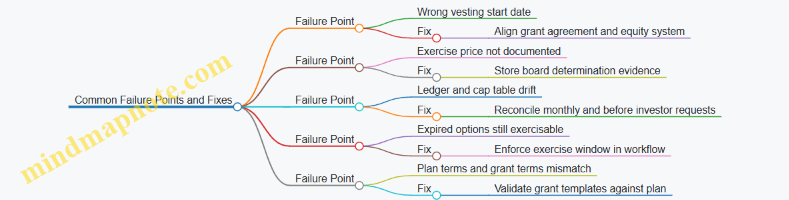
A Simple Administration Rhythm That Works
Use a repeatable cadence: approve grants with documented authority, issue matching agreements, reconcile ledgers to the cap table, and run a monthly check for vesting, exercises, and expirations. When something changes—like a termination or a plan amendment—update the records immediately and keep the audit trail clean. This is the unglamorous part that keeps everything else from turning into a spreadsheet archaeology project.
11.3 IP Ownership Assignments and Contractor Agreements
When investors review your diligence materials, they look for one boring but crucial thing: who owns what. For startups, the “what” is usually software, designs, data, and documentation created by founders and contractors. If ownership is unclear, the company can’t confidently license, sell, or defend its core assets. This section lays out a systematic way to prevent that mess.
Foundational Concepts of IP Ownership
Start with the baseline rule: in many jurisdictions, work created by employees is owned by the employer under employment law, but work created by independent contractors is often owned by the contractor unless you have a written assignment. That’s why your agreements must do two jobs: (1) define what counts as the work product, and (2) transfer rights to the company.
A second baseline rule is that “assignment” is not the same as “promise.” A contractor can promise to assign later, but if the assignment paperwork is missing or incomplete, you may end up with gaps. Your goal is to make the transfer effective at creation time, not after someone forgets.
Mind Map: Agreement Components
Defining Work Product and Background IP
Your agreement should clearly separate “Work Product” from “Background IP.” Work Product is what the contractor creates for you under the engagement. Background IP is what they already owned before the engagement or independently developed outside the scope.
Example: a contractor builds a dashboard for your product. The dashboard UI, backend endpoints, and documentation are Work Product. If they reuse a generic charting component they already owned, that component is Background IP. The agreement should state whether Background IP is licensed to you (often with a broad, royalty-free license) or excluded from the assignment.
This distinction prevents two common failures: (1) contractors later claim they own parts you assumed were transferred, and (2) you accidentally assign something you don’t have the right to assign.
Assignment Mechanics That Actually Hold Up
Use assignment language that is effective immediately. A typical structure includes:
- Present assignment of Work Product to the company as soon as it is created.
- Future assignment language for anything that can’t be assigned automatically due to legal formalities.
- Moral rights handling where applicable, such as waivers or consents, to reduce the risk of later objections to modifications.
Example: a contractor writes code and later refuses to sign a separate assignment form. If your agreement already assigns rights at creation, you have a stronger position.
Contractor Obligations That Create Evidence
Ownership paperwork is necessary, but investors also like to see operational proof. Add obligations that force clarity:
- Invention disclosure: the contractor must list what they created and when.
- Cooperation: the contractor must sign additional documents if required for filings or enforcement.
- Record keeping: require a simple log of deliverables and commits.
Example: if a contractor delivers a library, require a short “deliverables memo” that maps files and modules to the scope. This memo becomes a clean bridge between the contract and the codebase.
Confidentiality and Return of Materials
Confidentiality should cover source code, designs, customer data, and internal processes. It should also require return or deletion of company materials at the end of the engagement.
Example: a contractor keeps a local copy of your proprietary dataset and uses it to test their own scripts later. A clear confidentiality clause and return obligation gives you a contractual basis to demand deletion and to document what was retained.
Compliance with Third-Party Code and Open Source
Your agreement should require contractors to avoid introducing third-party code without permission. If open source is used, require disclosure of licenses and ensure compatibility with your intended distribution.
Example: a contractor adds a dependency under a license that requires source disclosure in certain distribution scenarios. If your agreement requires disclosure, you can catch the issue before it becomes a legal surprise.
Practical Workflow for Getting It Right
Use a repeatable workflow so agreements don’t become a last-minute scramble:
- Before work starts: sign the contractor agreement and confirm the scope.
- During work: require deliverable logs and ensure repository access is controlled.
- At handoff: collect the invention disclosure memo and confirm files match the scope.
- After handoff: verify the assignment language is present and that any required cooperation documents are signed.
Example: for a design contractor, require the final Figma export plus a short list of assets created for your brand system. Then verify the agreement covers those assets as Work Product.
Example Clause Map for Quick Drafting
    flowchart TD
  A[Define Scope] --> B[Define Work Product vs Background IP]
  B --> C[Include Present Assignment]
  C --> D[Add Future Assignment and Moral Rights Handling]
  D --> E[Require Invention Disclosure and Cooperation]
  E --> F[Add Confidentiality and Return Obligations]
  F --> G[Add Third-Party Code and Open Source Disclosure]
  G --> H[Operationalize with Logs and Handoff Checklist]
Common Failure Modes and How to Avoid Them
- Missing assignment: the contract says “contractor will assign” but doesn’t assign now.
- Vague scope: “services” without deliverables makes it hard to prove what was transferred.
- No Background IP handling: contractors later claim ownership of reused components.
- No evidence trail: you have signatures but can’t connect them to the actual code or assets.
A clean agreement plus a simple handoff checklist turns IP ownership from a legal theory into something you can point to during diligence.
11.4 Regulatory Considerations for Fundraising and Securities Filings
Fundraising sits at the intersection of corporate law and securities regulation. The practical goal is simple: make sure the securities you sell are offered and sold in a way that matches the rules you’re operating under, and that your disclosures are accurate and complete. The details vary by jurisdiction, but the workflow is consistent: determine what you’re selling, who you’re selling it to, how you’re marketing it, and what filings or exemptions apply.
Core Concepts You Must Get Right
What Counts as a Security
Most equity and many debt-like instruments are securities. Convertible notes and SAFEs often fall into the same bucket because they create an investment contract expectation. The safe approach is to treat any instrument that investors buy with the expectation of profit from your efforts as a security unless counsel confirms otherwise.
Securities Offerings and “Selling”
An offering includes the solicitation and sale process, not just the final signature. If you share a pitch deck broadly, run public ads, or host open events that function like marketing to the general public, you may trigger rules that are harder to satisfy. Even “private” fundraising can become non-private if the audience and communications don’t match the exemption requirements.
Exemptions and Their Conditions
Exemptions are not magic; they come with conditions. Common conditions include limits on who can invest, limits on resale, and restrictions on general solicitation. A frequent mistake is assuming that “we didn’t advertise” automatically satisfies the exemption. If you post materials publicly or share them widely without controlling access, you can lose the exemption.
Mind Map: Regulatory Workstreams
Practical Filing and Disclosure Mechanics
Offering Documents That Match Your Story
Your pitch deck is not usually the legal offering document. Still, the facts must line up. If your deck says “$X MRR” and your disclosure says “approximately $Y,” you need to reconcile the difference. A clean method is to treat the disclosure package as the source of truth for numbers and risk statements, then ensure the deck mirrors it.
A typical package includes a subscription agreement, investor questionnaire, and disclosures about risks, dilution, and the company’s financial condition. Risk factors should be specific to your situation, not generic. For example, if customer concentration is high, say so and quantify it. If you rely on a single supplier, disclose that dependency.
Investor Qualification Checks
If the exemption you’re using depends on investor status, you need evidence. That can include investor questionnaires, documentation of accredited status, or other qualification forms required by the exemption. The key is consistency: the information you collect should be the same information you rely on when you accept the investment.
Material Changes and Update Discipline
If facts change during the offering—say, a major customer churn event, a lawsuit, or a financing gap—you may need to update disclosures. The operational approach is to define a “materiality” review trigger internally. For instance, if a change affects revenue, cash runway, or legal exposure, route it to the person coordinating the offering documents so the disclosure package can be updated before investors sign.
Advanced Details That Commonly Trip Teams
Resale Restrictions and Legends
Even when an exemption allows you to sell, resale can be restricted. Securities often carry legends or transfer restrictions that require a process for transfers. Your cap table system should track these restrictions so you don’t accidentally process an improper transfer.
Cross-Border Complications
If investors are outside your home jurisdiction, you may face additional rules. The safest operational practice is to treat investor location as a variable in the compliance plan, not an afterthought. Your counsel can confirm which jurisdiction’s rules apply, but your team should provide accurate investor location data.
Timing and Signature Hygiene
Many filing obligations depend on dates: when the offering starts, when sales occur, and when documents are finalized. Use a single timeline owner who records key milestones, including when each investor’s subscription is accepted. A messy timeline is how “we thought we filed” turns into “we didn’t.”
Example: A Controlled Private Round
A startup plans a seed round using a private-offering exemption that requires limiting investors and avoiding general solicitation. The team creates a gated intake form, shares the deck only after investor qualification is completed, and uses a subscription agreement that includes the required risk disclosures. During the offering, a key contract is terminated earlier than expected. The coordinator updates the financial assumptions in the disclosure package and sends a revised version to signed-but-not-yet-closed investors. After closing, the cap table is updated with issuance dates and transfer legends, and the company retains the signed subscription documents in the records folder.
Example: A “Private” Round That Isn’t
A founder posts the deck publicly on a website and shares the link in a broad social media post. Even if the company later accepts only qualified investors, the public sharing can be treated as general solicitation, which may invalidate the exemption. The fix is not just “stop posting”; it’s to re-run the offering under the correct exemption or structure, with counsel confirming the path.
Compliance Mindset for Teams
Treat fundraising compliance as a system: instrument classification, investor eligibility, communication controls, disclosure accuracy, and recordkeeping. When those pieces are aligned, the paperwork becomes less of a hurdle and more of a reliable trail showing that the company sold securities the way it said it would.
11.5 Maintaining Records for Audits and Investor Requests
Maintaining records is less about storing everything and more about being able to answer questions quickly with consistent evidence. Investors typically request documents to verify ownership, financial accuracy, and compliance. Audits test whether your records are complete, traceable, and internally consistent. The goal is simple: when someone asks “show me,” you can point to a specific document, version, and date.
Core Record Categories
Start by separating records into five buckets, because each bucket has different owners and retention needs.
- Corporate and governance: charter documents, bylaws, board consents, meeting minutes, written consents, and cap table change approvals.
- Equity and option administration: stock purchase agreements, option grant agreements, vesting schedules, exercise records, and option plan documents.
- Financial and tax: general ledger, bank statements, invoices, expense receipts, payroll records, and tax filings.
- Legal and compliance: IP assignments, contractor agreements, customer and vendor contracts, regulatory filings, and securities-related paperwork.
- Operational evidence: product documentation, customer support logs, and key operational reports used in investor updates.
A practical rule: if a number appears in a report, there must be a trail from the report to source documents in the same accounting period.
Record Ownership and Version Control
Assign a single “record owner” per bucket. For example, finance owns financial records, legal owns equity and IP, and operations owns customer-facing evidence. Then define version control rules:
- Use a consistent naming convention like
YYYY-MM-DD_DocumentType_Entity_Version. - Store the authoritative version in one location, and treat everything else as working copies.
- Log changes with a short note describing what changed and why.
This avoids the classic problem where two spreadsheets disagree and nobody remembers which one investors saw.
Retention and Audit Readiness
Retention should match the purpose of the record. For instance, board approvals and equity documents must be easy to retrieve because they support ownership and dilution history. Financial records must support reconciliation and tax positions. A lightweight approach works well:
- Keep a “current” folder for active work.
- Keep an “archive” folder for closed periods.
- Maintain a simple index file listing what’s in each folder and where the authoritative copy lives.
If you need a concrete example, consider a monthly close completed on 2024-02-15. Your archive for that month should include the final general ledger export, bank reconciliation, and the investor reporting package used for that period.
Mind Map: Record Maintenance
Evidence Mapping That Prevents Rework
When an investor requests “revenue,” you should not hunt across folders. Instead, map each metric to its source. For example:
- Monthly recurring revenue: link to the billing system export and the revenue recognition worksheet.
- Cash balance: link to bank statements and the bank reconciliation.
- Headcount and payroll: link to payroll reports and the payroll journal entries.
Create a one-page “metric evidence map” for internal use. It reduces back-and-forth because the team knows which documents are expected for each question.
Handling Investor Requests Without Chaos
Treat requests like a small project. Use an intake checklist:
- Capture what’s being asked and the deadline.
- Identify the record bucket(s) involved.
- Pull the authoritative documents and confirm the version.
- Provide a response log noting what was sent and when.
Example: an investor asks for “cap table changes and option grants since the last update.” Your response should include:
- Board consent or written approval for each grant batch.
- The option grant agreements.
- A cap table snapshot showing the before-and-after.
- A short reconciliation note explaining any adjustments.
Quality Checks Before Sending
Before you export and send files, run three checks:
- Completeness: every requested item has a document.
- Consistency: totals match the accounting period and the investor package.
- Traceability: each document can be traced back to the authoritative source.
A final sanity step is to have one person who didn’t create the package review it. They will naturally catch missing attachments and mismatched versions, which is exactly what you want.
12. Case Based Playbooks for Common Funding Scenarios
12.1 Playbook for a Seed Equity Round with Early Traction
A seed equity round is often the first time outside investors own meaningful shares. With early traction, your job is to show that your numbers are not just “promising,” but explainable, repeatable, and tied to decisions you can make again next month.
Mind Map: Seed Equity Round with Early Traction
Foundational Setup Before You Talk Money
Start with a “traction ledger” that lists every metric you plan to mention, where it comes from, and how often it updates. For example, if you claim 30% month-over-month active usage growth, specify whether “active” means logged-in users, active teams, or completed workflows, and name the system that counts it.
Next, align your cap table baseline. Investors will ask whether you have issued options correctly, whether any founders have unvested shares, and whether there are side letters. A simple spreadsheet with share counts, vesting schedules, and option grants prevents most avoidable diligence delays.
Finally, prepare a minimal data room. Include your pitch deck, current financial statements, cap table, customer contracts or anonymized summaries, and IP assignment evidence. You do not need perfection; you do need consistency.
Building the Narrative That Matches the Numbers
Your pitch should connect three layers: what you sell, how customers adopt it, and why the adoption is improving.
Use a concrete example: suppose you sell a B2B workflow tool. Your story might be:
- Problem: teams lose time to manual handoffs.
- Solution: automated routing with audit trails.
- Traction: 12 paying customers, with average time-to-value of 14 days.
- Improvement: onboarding completion rose from 45% to 62% after you changed the setup flow.
Notice the pattern: traction is not just a count; it is a result of a decision you made.
Financials Investors Expect at Seed
Seed investors usually want a clear path from revenue to cash burn, even if the model is still evolving.
Include a simple revenue model slide with assumptions you can defend. For instance, if you charge $2,000 per customer per year and you have 12 customers, show expected annual recurring revenue and explain churn assumptions. If churn is unknown, show a conservative range based on cohort behavior you can measure.
Unit economics should be understandable, not spreadsheet art. For a usage-based product, show:
- Gross margin drivers (hosting and support costs per active account)
- Contribution margin per customer after variable costs
- Customer acquisition cost estimate and how it changes with sales motion
If you do not have full unit economics yet, show “unit economics by proxy.” Example: if you cannot measure support cost per account precisely, estimate it using tickets per account and average resolution time.
Finally, present burn with ownership. A good seed plan ties hiring and spend to milestones. Example: “Hire 1 engineer and 1 customer success specialist to reduce onboarding time from 14 to 10 days, targeting higher activation.” Investors care less about the exact number and more about the causal link.
Deal Mechanics That Matter in Practice
Equity rounds require you to decide how much to reserve for the option pool. A common failure mode is under-sizing the pool, then scrambling later when you need to hire. Your goal is to show you can recruit without creating avoidable dilution surprises.
Valuation logic should be grounded in comparable deals and your traction specifics. Instead of arguing for a number, explain what milestones the valuation is funding. Example: “This round funds product stability and onboarding improvements to reach 25 paying customers with improving activation.”
Governance matters at seed. Investors will ask for board seats or observer rights and for information rights. Keep governance proportional: you want oversight without turning every decision into a meeting.
Process Playbook from Outreach to Close
Use a structured outreach plan. Start with 20–40 targets that match your stage and geography, then narrow based on responsiveness. Track each conversation with a short note: what they asked, what they liked, and what they still need.
During diligence, use a checklist aligned to your story. If your traction claim depends on onboarding improvements, diligence should include product analytics definitions, onboarding funnel screenshots or exports, and customer feedback summaries.
Closing is mostly project management. Assign one owner for legal, one for finance, and one for data room updates. Keep a single issue log with status and next action.
Mind Map: Diligence Checklist for Seed Equity
Example: A Seed Equity Round Narrative in One Page
- Traction: 12 paying customers; activation improved from 45% to 62% after onboarding changes.
- Revenue: $2,000 average annual contract value; churn assumptions based on first two cohorts.
- Unit economics: variable costs per active account are stable; contribution margin improves as onboarding reduces support tickets.
- Use of funds: 10 months runway; hire 2 roles tied to activation and reliability; spend focused on onboarding, integrations, and customer success.
- Milestones: reach 25 paying customers, maintain improving activation, and reduce time-to-value to 10 days.
This structure keeps the round coherent: every claim has a measurement method, and every measurement ties to a decision you can repeat.
12.2 Playbook for a Convertible Note or SAFE with Limited Revenue
When Limited Revenue Makes Equity Harder
Convertible notes and SAFEs let you raise money before you can prove stable revenue. The investor still wants clarity, just not full financial history. Your job is to show that (1) the problem is real, (2) your solution is working enough to learn fast, and (3) the money will buy measurable progress.
A practical way to frame “limited revenue” is to separate traction into three buckets: product usage, customer validation, and financial signals. For example, a B2B tool might have low billing but strong weekly active usage, a growing waitlist converting to pilots, and a clear path from pilot to paid seats.
Mind Map: the Convertible Note or SAFE Workflow
Step 1: Decide What You Can Prove Right Now
Before you talk terms, write a one-page “evidence list.” Include only items you can show in a data room or a live demo.
Example evidence list for a pre-revenue marketplace:
- Product usage: 30% week-over-week retention in a cohort of 200.
- Customer validation: 12 paid pilots signed, even if revenue is small.
- Unit economics direction: average take rate of 8% with variable costs under 3%.
- Execution: burn rate of $80k/month and a plan to reach 50 pilots.
Investors use this list to judge whether the instrument is a bridge or a detour.
Step 2: Choose Between SAFE and Convertible Note
Use a SAFE when you want simplicity and fewer moving parts. Use a convertible note when you prefer a debt-like structure with interest and a maturity date.
Key differences in plain terms:
- SAFE: typically no interest and no maturity date, conversion happens on a triggering event.
- Note: accrues interest and has a maturity date, which can create pressure if you miss timelines.
Example decision:
- If your runway is short and you want to avoid maturity risk, a SAFE can be cleaner.
- If you already have a lender-like relationship or want a structured repayment timeline, a note may fit.
Step 3: Understand Discount and Valuation Cap Without Hand-Waving
Two common economics levers are the discount and the valuation cap.
- Discount: investors convert at a lower price than the next priced round.
- Valuation cap: investors convert as if the company were valued at the cap, even if the next round values you higher.
Example with numbers:
- Next priced round price implies a $20M post-money valuation.
- Your SAFE has a $12M valuation cap.
- Conversion effectively prices the SAFE like the company is worth $12M, giving the investor a better deal.
If both discount and cap exist, the agreement usually uses the more favorable conversion outcome for the investor. You should read the exact conversion formula in your draft.
Step 4: Prepare a Minimal Financial Model That Matches the Instrument
Even with limited revenue, you need a model that explains how money becomes progress.
Include:
- Runway math: current cash, monthly burn, and target cash at the next milestone.
- Hiring and spend plan: headcount assumptions tied to product milestones.
- Revenue path assumptions: what must be true for revenue to start, such as conversion rate from pilot to paid.
Example milestone-to-metric mapping:
- Spend $120k on engineering and sales ops.
- Goal: increase pilot-to-paid conversion from 20% to 35%.
- Expected result: first $25k/month in recurring revenue by month six.
Step 5: Negotiate Terms That Affect Control and Future Rounds
Investors may ask for:
- Pro rata rights: the ability to maintain ownership in later rounds.
- Information rights: regular updates and access to financial statements.
- Conversion mechanics: how the SAFE or note turns into equity.
You should focus negotiation on what changes outcomes:
- How conversion is calculated.
- Whether there are caps on additional issuances.
- What happens in equity financing versus asset sales or other triggers.
Example negotiation stance:
- If you can provide strong evidence and a clear milestone plan, you can often trade away some investor-friendly terms for a cleaner cap table.
- If your evidence is thin, investors will push harder on economics because they are compensating for uncertainty.
Step 6: Close Cleanly and Run a Post-Close Reporting Cadence
After signing, treat the instrument like a contract with a schedule.
Operational checklist:
- Confirm wire instructions and funding date.
- Update cap table immediately after issuance.
- Set a reporting cadence aligned with information rights.
Example reporting package for the first two months:
- Cash balance and burn rate.
- Progress against the milestone plan.
- One-page metrics update with screenshots or exports.
- Any material legal or product changes.
Mind Map: What Investors Will Ask During Due Diligence
A Simple Closing Script for Your Team
When you meet investors, keep the conversation grounded in evidence and mechanics.
Example structure:
- Evidence list: what you can show today.
- Milestone plan: what the money buys.
- Instrument fit: why SAFE or note matches your risk profile.
- Terms: confirm discount/cap and conversion formula details.
- Process: data room readiness and expected timeline to sign.
This approach reduces confusion and prevents term debates from replacing the real discussion: whether the company can execute with the capital you’re asking for.
12.3 Playbook for a Series A Round With Unit Economics Proof
A Series A round is where “we think this can work” needs to become “we can show how it works.” Unit economics proof is not a single metric; it’s a chain of evidence that connects pricing, delivery costs, retention, and cash flow. Investors typically want to see that your gross margin is stable enough to fund growth, and that your growth doesn’t rely on permanent discounts or unrealistic churn.
Mind Map: Unit Economics Proof Chain
Step 1: Define the Unit of Analysis
Start by choosing the unit that matches how customers buy and how costs scale. For SaaS, it’s often “active subscription account” or “monthly active user.” For usage-based products, it’s “active usage unit” (for example, compute hours or API calls). If you mix units, your margins will look better than they are.
Example: If you sell seats but measure costs per API call, you must either (a) convert costs to per-seat equivalents using a measured ratio, or (b) present both views and explain why each is useful. Investors dislike mystery math, not math.
Step 2: Prove Revenue Quality with Cohorts
Unit economics depends on retention, but retention must be defined consistently. Use cohorts by start month and track churn and expansion separately. Then compute net revenue retention (NRR) with a clear rule for what counts as expansion.
Example: If a customer downgrades and later upgrades, you should show both the downgrade event and the net effect over the cohort window. A simple table can prevent confusion:
- Starting MRR at month 0
- MRR at month 3
- Expansion MRR
- Contraction MRR
- Net MRR retention
Step 3: Break Down Variable Costs into Customer-Linked Buckets
Investors want to see variable costs that move with customer count or usage. Split costs into buckets that you can actually manage:
- Support and customer success time per account
- Hosting or infrastructure per active usage
- Payment processing and refunds
- Customer acquisition costs (CAC) if you’re modeling payback
Example: If your hosting costs spike due to a new feature, show the cost per active usage before and after the feature launch. If you can’t isolate it, you can still show a range and explain the driver, but you must be explicit.
Step 4: Calculate Contribution Margin, Not Just Gross Margin
Gross margin is useful, but contribution margin is where the story becomes operational. Contribution margin subtracts variable costs that scale with revenue, and it should align with your budgeting categories.
Example: Suppose gross margin is 80%, but support costs are rising faster than revenue. Your contribution margin might be 55%. Present both, then explain the support driver: onboarding time, ticket volume, or product complexity.
Step 5: Model Payback with Clear Assumptions
Payback period connects unit economics to cash. Use CAC payback based on contribution margin and average customer lifetime. Keep assumptions grounded in your cohort data.
Example: If your average customer contributes $120/month in contribution margin and your CAC is $1,800, payback is about 15 months. Then show how that changes for cohorts with different activation rates.
Mind Map: Evidence You Put in the Data Room
Step 6: Reconcile the Model to Actuals Every Month
A Series A model must survive contact with reality. Create a monthly reconciliation between your unit economics model and your financial statements. Investors often ask, “Why did the forecast miss?” Your answer should point to specific drivers: churn definition changes, cost reclassification, or a pricing change.
Example: If your model assumed NRR of 120% but actuals were 112%, show whether the gap came from contraction, delayed expansion, or cohort mix. Then show what you changed operationally to address the driver.
Step 7: Present the Proof as a Coherent Narrative
Your pitch should connect the chain: pricing → retention → variable costs → contribution margin → payback → cash discipline. Avoid a slide that only shows one number. Instead, show a small set of metrics that agree with each other.
Example slide flow:
- Pricing and packaging summary
- Cohort retention and NRR with definitions
- Variable cost per unit and cost drivers
- Contribution margin trend
- CAC payback based on cohort contribution
- Forecast bridge tied to actual variance
Step 8: Anticipate the “Show Your Work” Questions
Be ready for questions that test whether your unit economics is stable or just temporarily favorable.
- “What happens if churn increases by 2 points?” Answer with cohort-based sensitivity.
- “Are costs truly variable?” Answer with cost allocation method and evidence.
- “How do discounts affect payback?” Answer with discount policy and cohort impact.
The goal is not to defend every number. It’s to demonstrate that your metrics are measurable, your assumptions are traceable, and your finance system can keep them honest.
12.4 Playbook for Negotiating With Multiple Competing Investors
When more than one investor wants in, the goal is not to “win” a bidding war. The goal is to get the best overall deal for your company: price, terms, speed, and the quality of the relationship. Competition can help, but only if you run it like a process.
Foundational Setup Before You Mention Competition
Start by defining your non-negotiables and your trade-offs. Non-negotiables are usually structural: board composition, option pool size, and investor rights that affect future rounds. Trade-offs are usually economic: valuation, liquidation preference details, and pro rata mechanics.
Example: You want a 20% option pool and standard information rights. You can accept a slightly lower valuation if the liquidation preference is single-dip and participation is excluded. You can accept a modest governance concession if the investor commits to a fast close.
Mind Map: the Negotiation Loop
Run a Single Process, Not Separate Negotiations
Competing investors often ask for different versions of the story. Resist that. Use one data room, one metrics set, and one timeline. If you change the narrative or the numbers between investors, you create avoidable doubt.
Practical move: send a short “process note” after the first substantive meeting. It should state what you will share, when you will share it, and when you expect term sheets. Keep it factual.
Example: “We will share the latest monthly metrics package by Friday. We plan to review term sheets the following Tuesday. We will not be able to accommodate late-stage changes to option pool size after that review.”
Build a Deal Scorecard That Includes Terms and Execution
Price is visible; execution quality is not. Your scorecard should weight both.
Use categories like:
- Economics: valuation, liquidation preference, participation, conversion mechanics.
- Control: board seats, voting thresholds, protective provisions.
- Future flexibility: option pool size, preemptive rights, ROFR/ROFO.
- Speed: diligence responsiveness, legal turnaround, and willingness to close on your schedule.
Example scorecard weights for a seed round:
- 35% economics
- 25% control and future flexibility
- 25% speed
- 15% investor fit and operational support
Compare Term Sheets Like a Mechanic, Not a Fan
When you receive term sheets, translate them into plain effects. Don’t just list differences; explain what each difference does.
Key comparisons to do line-by-line:
- Liquidation preference: Is it 1x or higher? Is it participating? Does it stack with other preferences?
- Conversion: Are there caps or discounts in notes/SAFEs? For preferred, what triggers conversion?
- Pro rata rights: Are they standard or unusually broad? Do they require future participation at specific thresholds?
- Protective provisions: Which actions require investor consent? Watch for items that can block hiring, fundraising, or equity grants.
Example: Investor A offers a higher valuation but requires participation. Investor B offers a slightly lower valuation with non-participating preference. If your base case includes a range of exit outcomes, non-participating preference often preserves more upside for common and option holders.
Use Competition Without Creating Confusion
You can acknowledge competition without turning every conversation into a negotiation performance.
A clean approach:
- Confirm interest and ask what they need to move.
- Share your process timeline.
- If they ask for leverage, answer with your readiness and schedule, not with threats.
Example script: “We’re reviewing term sheets from multiple investors. To keep diligence efficient, we’re aligning on the same set of documents and we’ll decide based on overall terms and closing feasibility.”
Redline Discipline and Version Control
Multiple investors means multiple redlines. You need one “source of truth” for your preferred positions.
Practical method:
- Maintain a master term sheet summary with your positions.
- For each investor, track only deviations from your master.
- Require that legal teams reference the same document version.
Example: If you agree to a board seat for Investor A, do not accidentally grant a different board structure to Investor B without updating the master. That’s how “small” differences become expensive.
Decision Criteria That Prevent Regret
After you compare terms, choose based on the combination of economics, control, and execution.
A simple rule: if two offers are close on price, pick the one that closes faster with fewer governance surprises. If two offers are close on governance, pick the one with clearer economics and fewer hidden stacking effects.
Closing Coordination When Two Investors Want the Same Day
Once you select, move quickly and keep the losing side respectful.
Example closing plan:
- Day 0: confirm selected investor and send final doc checklist.
- Day 1-2: legal review and signature scheduling.
- Day 3: execute documents and confirm funding date.
- Day 4: send a concise update to all investors who were in process.
This keeps momentum and avoids the awkward “we’re still waiting” loop.
Mind Map: the Scorecard and Redline Workflow
Quick Example Walkthrough
You receive two term sheets on the same day.
- Investor A: higher valuation, participating preference, slower legal timeline.
- Investor B: slightly lower valuation, non-participating preference, faster close, standard protective provisions.
Your scorecard favors execution and future flexibility. You choose Investor B, then you still confirm that option pool and governance match your master positions before signing. Competition helped you compare; the scorecard helped you decide.
12.5 Playbook for Closing Delays With Clear Issue Tracking
Closing delays usually come from a small set of repeatable problems: missing documents, mismatched term sheet language, slow internal approvals, or unclear ownership of “who fixes what.” The goal of this playbook is to turn delay into a visible, trackable workflow so everyone knows the next action and the deadline.
Foundational Setup for Issue Tracking
Start with a single source of truth. Create one issue log shared with your lead counsel and the investor’s deal team. Each issue must have an owner, a due date, and a status. If you can’t assign an owner, you don’t yet have an issue—you have a vague concern.
Use a simple status model:
- New: Not reviewed yet
- In Review: Someone is checking it
- Blocked: Waiting on a specific dependency
- Resolved: Fixed and confirmed
- Closed: Included in the final documents
Example: If the investor asks for “updated cap table,” that’s not one issue. Split it into “cap table spreadsheet update,” “option grant schedule update,” and “board approvals evidence.” Each gets its own owner and due date.
Mind Map: the Closing Delay Workflow
Closing Delay Workflow Mind Map
Triage Rhythm That Prevents “Ping-Pong”
Run a short daily async check with the investor’s counsel and your counsel. The message should include only: new issues, items moved to Blocked, and anything due within 48 hours. Then hold one weekly live meeting (30–45 minutes) focused on issues that are either blocked or overdue.
Escalation should be time-based, not emotional. For example, if an issue remains Blocked for more than three business days, escalate to the responsible party’s manager with a one-paragraph summary and the exact dependency.
Root Cause Categories and What to Do
Document Gaps
Document gaps are the most common. Treat them like a checklist with evidence requirements.
- Issue: “Missing IP assignment for contractor X”
- Owner: Founder or ops lead
- Due date: 2026-02-15
- Resolution proof: Signed assignment PDF plus a brief mapping note showing the contractor’s work period
If you receive a request that sounds broad, ask for the specific document name and the acceptable format. “We need updated financials” becomes “Provide the last two months’ bank statements and a reconciliation to the monthly P&L.”
Term Mismatch
Term mismatches often appear when a term sheet is summarized in emails but not reflected in the definitive documents.
- Issue: “Liquidation preference language inconsistent between term sheet and draft”
- Owner: Lead counsel
- Due date: 2026-02-16
- Resolution proof: Redline showing the definitive agreement matches the agreed term
A practical trick: maintain a “term mapping” table with three columns—agreed term, where it appears in the documents, and who confirmed it. When delays happen, you can point to the exact clause rather than re-litigate the whole deal.
Internal Approvals
Internal approvals stall when the board or management team doesn’t know what they’re approving.
- Issue: “Board approval for option pool amendment not scheduled”
- Owner: Company secretary
- Due date: 2026-02-17
- Resolution proof: Signed written consent or meeting minutes plus the updated cap table snapshot
Bundle approvals into a single packet with a cover page listing decisions and the effective date. People approve faster when the packet answers “what changes” and “what date it applies to.”
Legal Review Bottlenecks
Legal bottlenecks happen when too many questions arrive at once.
- Issue: “Investor counsel questions on representations schedule”
- Owner: Your counsel
- Due date: 2026-02-18
- Resolution proof: A consolidated response memo and updated schedule
Ask for questions in a single batch with references to the draft section. Then respond in one pass, not five.
Signature Logistics
Signature delays are often operational, not legal.
- Issue: “Missing signature from director Y”
- Owner: Ops lead
- Due date: 2026-02-19
- Resolution proof: Fully executed signature page and confirmation email
Use a signature checklist: who signs, what they sign, and the order. If you wait for “everyone to be ready,” you’ll create avoidable gaps.
Closing Confirmation and Proof of Resolution
When an issue is marked Resolved, require proof that it’s actually reflected in the final documents. The final step is Closed, which means the investor’s counsel confirms the change is present and correct.
Example: If you resolve “updated cap table,” close it only after the investor’s counsel confirms the cap table version number matches the one attached to the definitive agreements.
Example Issue Log Entry
| Issue | Owner | Due Date | Status | Next Action | Proof Needed |
|---|---|---|---|---|---|
| Contractor IP assignment for Jordan Lee | Founder | 2026-02-15 | Blocked | Request signed PDF from contractor | Signed assignment + work period mapping |
Communication Rules That Keep Momentum
Update only what changed. If nothing moved, say so and state the dependency. Avoid broad “we’re working on it” messages; they don’t help anyone decide what to do next. When you do send an update, include the next action and the due date, even if the due date is “same day” or “tomorrow morning.”