Introduction to Financial Derivatives
1. Understanding Financial Derivatives: Basics and Terminology
1.1 What Are Financial Derivatives? Definition and Key Concepts
Financial derivatives are financial instruments whose value is derived from the value of an underlying asset, index, or rate. They are contracts between two or more parties, and their price depends on fluctuations in the underlying asset. Common underlying assets include stocks, bonds, commodities, currencies, interest rates, and market indexes.
Key Concepts:
- Underlying Asset: The financial asset or benchmark on which the derivative’s value is based.
- Contract: The agreement between parties that specifies terms such as price, quantity, and expiration.
- Leverage: Derivatives often allow control of a large position with a relatively small amount of capital.
- Risk Management: Derivatives are widely used to hedge or mitigate risks associated with price movements.
- Speculation: Investors can use derivatives to bet on the direction of market movements.
Mind Map: Financial Derivatives Overview
Example 1: Understanding a Stock Option
Imagine an investor buys a call option on 100 shares of Company XYZ with a strike price of $50, expiring in 3 months. The option gives the investor the right, but not the obligation, to buy the shares at $50 regardless of the market price.
- If the stock price rises to $70, the option is valuable because the investor can buy shares at $50 and potentially sell at $70.
- If the stock price stays below $50, the investor may let the option expire worthless, losing only the premium paid.
This example illustrates how the derivative’s value depends on the underlying stock price.
Mind Map: Stock Option Example
Example 2: Futures Contract on Crude Oil
A refinery agrees to buy 1,000 barrels of crude oil in 6 months at a price of $60 per barrel using a futures contract. This locks in the price and protects the refinery from price increases.
- If the market price rises to $75, the refinery benefits by paying only $60.
- If the price falls to $50, the refinery still pays $60, potentially incurring a loss compared to the spot price.
This example shows how derivatives can be used to hedge price risk.
Mind Map: Futures Contract Example
Summary
Financial derivatives are powerful tools that derive their value from underlying assets. They serve multiple purposes including hedging, speculation, and arbitrage. Understanding their basic definitions and key concepts is essential for accountants and financial analysts to effectively analyze and manage financial risks.
By using clear examples and mind maps, the foundational knowledge of derivatives becomes accessible and practical for real-world application.
1.2 Types of Financial Derivatives: Futures, Options, Swaps, and Forwards
Financial derivatives are contracts whose value is derived from the performance of underlying assets such as stocks, bonds, commodities, currencies, interest rates, or market indexes. The primary types of financial derivatives include Futures, Options, Swaps, and Forwards. Each type serves different purposes and has unique characteristics.
Mind Map: Overview of Financial Derivatives
Futures
Definition: A futures contract is a standardized agreement traded on an exchange to buy or sell an underlying asset at a predetermined price on a specified future date.
Key Features:
- Standardized contract terms
- Traded on regulated exchanges
- Requires margin deposits
- Marked-to-market daily
Example: A wheat farmer enters into a futures contract to sell 5,000 bushels of wheat at $6.00 per bushel in three months. This locks in the selling price, protecting against price drops.
Mind Map: Futures
Options
Definition: An option gives the buyer the right, but not the obligation, to buy (call option) or sell (put option) an underlying asset at a specified strike price before or on a specific expiration date.
Key Features:
- Right without obligation
- Premium paid upfront
- Can be traded OTC or on exchanges
Example: An investor buys a call option on 100 shares of XYZ stock with a strike price of $50, paying a premium of $2 per share. If the stock price rises above $50, the investor can exercise the option to buy at $50, profiting from the difference.
Mind Map: Options
Swaps
Definition: Swaps are customized contracts between two parties to exchange cash flows or financial instruments over a specified period. Common types include interest rate swaps and currency swaps.
Key Features:
- OTC contracts
- Customized terms
- Used to manage interest rate or currency risk
Example: A company with a floating-rate loan enters into an interest rate swap to exchange floating interest payments for fixed payments, stabilizing its interest expense.
Mind Map: Swaps
Forwards
Definition: A forward contract is a customized agreement between two parties to buy or sell an asset at a specified price on a future date. Unlike futures, forwards are traded OTC and are not standardized.
Key Features:
- Customized contract terms
- OTC trading
- Settlement at maturity
Example: An importer agrees with a bank to buy €1 million in 6 months at a fixed exchange rate of 1.10 USD/EUR, locking in the cost and hedging against currency fluctuations.
Mind Map: Forwards
Summary Table of Derivative Types
| Derivative | Trading Venue | Standardization | Obligation | Typical Use Case | Example |
|---|---|---|---|---|---|
| Futures | Exchange | Standardized | Obligation | Hedging, Speculation | Wheat futures contract |
| Options | Exchange/OTC | Standardized or Customized | Right, not obligation | Hedging, Speculation | Call option on stock |
| Swaps | OTC | Customized | Obligation | Risk management | Interest rate swap |
| Forwards | OTC | Customized | Obligation | Hedging | Forward FX contract |
Integrated Best Practice Example
Scenario: A multinational corporation wants to hedge its currency risk due to expected foreign revenue.
- The company can use a forward contract to lock in the exchange rate for future cash flows.
- Alternatively, it might use currency options to have the right to exchange currency at a favorable rate while retaining upside potential.
This decision depends on risk tolerance, cost considerations, and market outlook.
By understanding these four primary types of derivatives, accountants and financial analysts can better evaluate risk management strategies, pricing models, and financial reporting implications.
1.3 Key Terminology in Derivatives Trading: Underlying Asset, Strike Price, Expiry, Premium
Understanding the key terminology in derivatives trading is essential for accountants and financial analysts to accurately interpret contracts, assess risks, and communicate effectively. This section breaks down the fundamental terms with clear definitions, mind maps, and practical examples.
Underlying Asset
The underlying asset is the financial instrument or physical commodity on which a derivative’s value is based. It can be stocks, bonds, commodities, currencies, interest rates, or market indexes.
- Example: In an option contract for Apple Inc. stock, Apple shares are the underlying asset.
Mind Map: Underlying Asset
Strike Price (Exercise Price)
The strike price is the predetermined price at which the holder of an option can buy (call option) or sell (put option) the underlying asset.
- Example: If an investor holds a call option on Tesla stock with a strike price of $700, they have the right to buy Tesla shares at $700 regardless of the current market price.
Mind Map: Strike Price
Expiry (Expiration Date)
The expiry or expiration date is the last date on which the derivative contract is valid. After this date, the option or futures contract ceases to exist.
- Example: An option expiring on December 20, 2024, must be exercised or closed before or on that date.
Mind Map: Expiry
Premium
The premium is the price paid by the buyer to the seller to acquire the option. It reflects the intrinsic value plus time value and is influenced by volatility, time to expiry, and underlying asset price.
- Example: If an investor pays a $5 premium per share for a call option, and each contract represents 100 shares, the total premium paid is $500.
Mind Map: Premium
Integrated Example: Understanding These Terms in Practice
Consider an investor buying a call option on Microsoft (MSFT) stock:
- Underlying Asset: MSFT stock
- Strike Price: $300
- Expiry: 15-Jan-2025
- Premium: $7 per share
If MSFT stock price rises to $320 before expiry, the option is “in the money”. The investor can exercise the option to buy shares at $300, even though the market price is $320, potentially making a profit (excluding premium paid).
Best Practice Tip
Always document and confirm these key terms explicitly when analyzing or entering into derivative contracts to avoid misunderstandings and ensure accurate valuation and risk assessment.
1.4 Best Practice: Using Clear Terminology to Avoid Miscommunication - Example of an Option Contract Explanation
Clear and precise terminology is critical in financial derivatives to avoid costly misunderstandings and errors, especially when dealing with complex instruments like options. This section emphasizes best practices for using clear language and provides an example of explaining an option contract effectively.
Why Clear Terminology Matters
- Prevents Misinterpretation: Ambiguous terms can lead to incorrect assumptions about contract obligations.
- Facilitates Communication: Clear language ensures all parties (traders, analysts, accountants) understand the contract the same way.
- Supports Compliance: Regulatory reporting and accounting require precise definitions.
Key Terms in an Option Contract
Mind Map: Key Terms in an Option Contract
Explanation:
- Underlying Asset: The financial instrument (e.g., stock, commodity) on which the option is based.
- Strike Price: The price at which the option holder can buy (call) or sell (put) the underlying asset.
- Expiration Date: The last date the option can be exercised.
- Premium: The price paid to purchase the option.
- Call Option: Gives the holder the right to buy the underlying asset.
- Put Option: Gives the holder the right to sell the underlying asset.
- Exercise: The act of using the option to buy or sell the underlying asset.
- American Style: Can be exercised any time before expiration.
- European Style: Can only be exercised at expiration.
Example Explanation of an Option Contract
Imagine you are explaining a call option on stock XYZ to a colleague:
“A call option on XYZ stock gives you the right, but not the obligation, to buy 100 shares of XYZ at a strike price of $50 per share anytime before the option expires on December 31. To acquire this right, you pay a premium of $3 per share upfront. If the stock price rises above $50, you can exercise the option to buy at $50 and potentially sell at the higher market price, profiting from the difference minus the premium paid. If the stock price stays below $50, you can let the option expire worthless, limiting your loss to the premium paid.”
Mind Map: Explaining a Call Option Contract
Additional Best Practices for Clear Communication
- Use Analogies: Compare options to insurance policies or tickets to clarify optional rights.
- Avoid Jargon Without Explanation: Always define terms like “in the money,” “out of the money,” or “intrinsic value.”
- Visual Aids: Use payoff diagrams to illustrate potential outcomes.
Example Payoff Diagram Description
For the call option example above, the payoff diagram shows:
- X-axis: Stock price at expiration
- Y-axis: Profit/Loss
- Break-even Point: Strike price + premium = $53
- Profit if stock price > $53
- Loss limited to premium if stock price ≤ $53
By consistently applying clear terminology and providing concrete examples, financial professionals can significantly reduce miscommunication risks when dealing with derivatives, ensuring all stakeholders have a shared understanding of the contracts involved.
1.5 Practical Example: Identifying Derivative Types in Real-World Financial Markets
Understanding how to identify different types of financial derivatives in real-world scenarios is crucial for accountants and financial analysts. This section provides practical examples and mind maps to help visualize and categorize derivatives effectively.
Mind Map: Overview of Financial Derivatives
Example 1: Identifying a Futures Contract
Scenario: A manufacturing company wants to lock in the price of copper for delivery in six months to avoid price volatility.
- The company enters into a copper futures contract on a commodities exchange.
- The contract is standardized in terms of quantity, quality, and delivery date.
- The contract is marked-to-market daily.
Identification: This is a Futures Contract because it is standardized, exchange-traded, and involves a commitment to buy/sell an asset at a future date.
Mind Map: Futures Contract Characteristics
Example 2: Recognizing an Option Contract
Scenario: An investor buys a call option giving the right to purchase 100 shares of a tech company at $50 per share within the next three months.
- The investor pays a premium upfront.
- The option gives the right but not the obligation to buy shares.
Identification: This is an Option Contract because it provides the right without obligation, involves a premium, and has a defined strike price and expiry.
Mind Map: Option Contract Features
Example 3: Spotting a Swap Agreement
Scenario: A corporation with a floating-rate loan wants to switch to a fixed interest rate to reduce uncertainty.
- The corporation enters into an interest rate swap with a bank.
- They agree to exchange interest payments: floating rate for fixed rate.
- The notional principal is not exchanged.
Identification: This is a Swap because it involves exchanging cash flows based on different interest rates without exchanging principal.
Mind Map: Swap Contract Types
Example 4: Recognizing a Forward Contract
Scenario: An exporter expects to receive €1 million in three months and wants to lock in the USD/EUR exchange rate.
- The exporter enters into a forward FX contract with a bank.
- The contract is customized and OTC.
- Settlement occurs at contract maturity.
Identification: This is a Forward Contract because it is customized, OTC, and settles at a future date without daily marking to market.
Mind Map: Forward Contract Characteristics
Summary Table: Identifying Derivative Types
| Derivative Type | Standardization | Trading Venue | Obligation vs Right | Settlement | Example Use Case |
|---|---|---|---|---|---|
| Futures | Standardized | Exchange-traded | Obligation | Daily mark-to-market | Hedging commodity price risk |
| Options | Standardized | Exchange/OTC | Right (not obligation) | At expiry or exercise | Speculating on stock price movement |
| Swaps | Customized | OTC | Obligation | Periodic cash flow exchange | Managing interest rate exposure |
| Forwards | Customized | OTC | Obligation | At maturity | Locking FX rates for future payments |
By using these mind maps and examples, accountants and financial analysts can confidently identify and classify derivatives encountered in financial markets, facilitating better analysis, reporting, and risk management.
2. The Role of Financial Derivatives in Modern Finance
2.1 Hedging Risk: How Derivatives Protect Against Price Volatility
Financial derivatives are powerful tools that allow businesses and investors to manage and mitigate the risks associated with price volatility in underlying assets. Hedging is the primary risk management strategy that uses derivatives to offset potential losses in an asset by taking an opposite position in a related derivative instrument.
What is Hedging?
Hedging involves entering into a financial contract that will gain value when the underlying asset loses value, and vice versa. This reduces the overall risk exposure and stabilizes cash flows or portfolio values.
Mind Map: Hedging Risk with Derivatives
Example 1: Hedging Commodity Price Risk for a Manufacturer
Scenario: A manufacturing company relies heavily on copper as a raw material. Copper prices are volatile and could rise significantly in the next six months, increasing production costs.
Hedging Strategy: The company enters into copper futures contracts to lock in the current price.
- If copper prices rise, the company’s higher raw material cost is offset by gains in the futures contract.
- If prices fall, the company pays more than the market price but gains certainty in budgeting.
Best Practice: Align the hedge size with the actual exposure to avoid over-hedging or under-hedging.
Mind Map: Hedging Commodity Price Risk
Example 2: Hedging Currency Risk for an Importer
Scenario: A US-based company expects to pay €1 million in 3 months for imported goods. The company is concerned about the euro appreciating against the dollar, increasing the payment cost.
Hedging Strategy: The company enters into a forward contract to buy €1 million at a fixed exchange rate in 3 months.
- If the euro strengthens, the forward contract protects the company from paying more dollars.
- If the euro weakens, the company still pays the agreed forward rate, foregoing potential savings but gaining certainty.
Best Practice: Document the hedge accounting treatment and monitor counterparty risk.
Mind Map: Hedging Currency Risk
Summary of Best Practices in Hedging with Derivatives
- Match Hedge to Exposure: Ensure the derivative instrument’s size, duration, and underlying asset closely align with the actual risk.
- Understand Costs: Consider premiums, margin requirements, and potential opportunity costs.
- Document Strategy: Maintain clear documentation for hedge accounting and compliance.
- Monitor and Adjust: Regularly review hedge effectiveness and adjust positions as market conditions change.
- Educate Stakeholders: Ensure accounting, treasury, and risk teams understand the hedging strategy and instruments used.
By strategically using derivatives to hedge risk, accountants and financial analysts can help their organizations stabilize earnings, protect cash flows, and navigate volatile markets with greater confidence.
2.2 Speculation: Leveraging Derivatives for Profit Opportunities
Speculation in financial derivatives involves taking positions based on the expectation of future price movements of underlying assets to generate profits. Unlike hedging, which aims to reduce risk, speculation embraces risk in pursuit of higher returns. This section explores how derivatives can be effectively used for speculation, highlighting best practices and providing easy-to-understand examples.
What is Speculation in Derivatives?
Speculation is the act of buying or selling derivatives contracts to profit from anticipated changes in the price of the underlying asset. Speculators do not necessarily own the underlying asset but use derivatives to gain leveraged exposure.
Key Characteristics:
- High risk, high reward
- Leverage amplifies gains and losses
- Requires strong market insight and timing
Why Use Derivatives for Speculation?
- Leverage: Derivatives allow control of a large position with a relatively small capital outlay.
- Flexibility: Variety of instruments (options, futures, swaps) to express bullish, bearish, or neutral views.
- Liquidity: Many derivatives are traded on exchanges with high liquidity.
Mind Map: Speculation Using Derivatives
Common Speculative Strategies with Examples
Futures Speculation
Example: A financial analyst believes that crude oil prices will rise from $70 to $80 per barrel in the next three months.
- The analyst buys crude oil futures contracts.
- Each contract controls 1,000 barrels.
- If the price rises to $80, the profit per contract = (80 - 70) * 1,000 = $10,000.
- If the price falls, losses are similarly magnified.
Best Practice: Use margin wisely and set stop-loss orders to limit downside.
Options Speculation
Example: An accountant expects the stock of Company XYZ (currently $50) to increase significantly.
- Buys call options with a strike price of $55, expiring in 2 months, paying a premium of $2 per share.
- If the stock price rises to $65, intrinsic value = $10; profit = $10 - $2 = $8 per share.
- If the stock price stays below $55, the option expires worthless, and the loss is limited to the premium paid.
Best Practice: Understand option Greeks (Delta, Theta, Vega) to manage risk and time decay.
Writing Options for Speculation
Example: A financial analyst believes a stock will remain stable.
- Writes (sells) call options to collect premium income.
- If the stock price remains below the strike price, the premium is kept as profit.
- Risk: If the stock price rises sharply, losses can be significant.
Best Practice: Use covered calls (owning the underlying) to limit risk.
Mind Map: Option Speculation Strategies
Best Practices for Speculative Use of Derivatives
- Define Clear Objectives: Know your profit targets and acceptable losses.
- Leverage Cautiously: Avoid over-leveraging; it can magnify losses.
- Use Risk Management Tools: Stop-loss orders, position sizing, and diversification.
- Stay Informed: Monitor market news and technical indicators.
- Understand the Instrument: Know contract specifications, expiry dates, and pricing models.
Practical Example: Speculating on Currency Movements Using Futures
A financial analyst expects the EUR/USD exchange rate to rise from 1.10 to 1.15 in the next month.
- Buys EUR futures contracts at 1.10.
- Each contract represents €125,000.
- If the rate rises to 1.15, profit per contract = (1.15 - 1.10) * 125,000 = $6,250.
- If the rate falls, losses occur accordingly.
Best Practice: Monitor geopolitical and economic indicators that affect currency movements.
Summary
Speculation using financial derivatives offers significant profit opportunities but comes with elevated risk. By understanding the instruments, employing sound strategies, and adhering to best practices, accountants and financial analysts can leverage derivatives effectively to capitalize on market movements.
2.3 Arbitrage: Exploiting Price Differences Using Derivatives
Arbitrage is a fundamental concept in finance that involves simultaneously buying and selling an asset or related assets in different markets to exploit price differences and generate risk-free profits. In the context of financial derivatives, arbitrage opportunities arise when the price of a derivative does not align with the price of its underlying asset or related derivatives, allowing traders to lock in guaranteed returns.
What is Arbitrage in Derivatives?
Arbitrage in derivatives involves taking advantage of mispricings between the derivative and its underlying asset or between different derivatives. Because derivatives derive their value from underlying assets, any price discrepancies can be exploited until market forces correct the imbalance.
Mind Map: Key Concepts of Arbitrage in Derivatives
Types of Arbitrage Using Derivatives
- Pure Arbitrage: Riskless profit by exploiting price differences in identical or equivalent instruments.
- Risk Arbitrage (Merger Arbitrage): Involves some risk, such as betting on the outcome of corporate events.
This section focuses on pure arbitrage opportunities using derivatives.
Common Arbitrage Strategies with Derivatives
Cash-and-Carry Arbitrage
- Concept: Buy the underlying asset and sell a futures contract when the futures price is higher than the cost of carrying the asset.
- Goal: Lock in a risk-free profit by holding the asset until the futures contract expires.
Reverse Cash-and-Carry Arbitrage
- Concept: Sell the underlying asset short and buy the futures contract when the futures price is lower than the cost of carrying.
- Goal: Profit from the price difference when the futures price converges to the spot price.
Put-Call Parity Arbitrage
- Concept: Exploit violations in the put-call parity relationship between European call and put options with the same strike price and expiry.
- Goal: Construct a portfolio of options and underlying assets to generate riskless profits.
Mind Map: Arbitrage Strategies Using Derivatives
Example 1: Cash-and-Carry Arbitrage
Scenario:
- Spot price of gold: $1,800 per ounce
- Futures price for delivery in 3 months: $1,850 per ounce
- Cost of carry (storage, insurance, financing): $30 per ounce
Steps:
- Buy gold at $1,800.
- Simultaneously sell a futures contract at $1,850.
- Hold the gold for 3 months, incurring $30 in carrying costs.
- At contract expiry, deliver gold to fulfill futures contract and receive $1,850.
Profit Calculation:
- Total cost: $1,800 + $30 = $1,830
- Futures proceeds: $1,850
- Risk-free profit: $20 per ounce
Example 2: Put-Call Parity Arbitrage
Put-Call Parity Formula:
\[ C + Ke^{-rt} = P + S \]
Where:
- C = price of a European call option
- P = price of a European put option
- K = strike price
- S = spot price of underlying
- r = risk-free interest rate
- t = time to maturity
Scenario:
- Spot price (S): $100
- Strike price (K): $100
- Call price (C): $12
- Put price (P): $7
- Risk-free rate (r): 5% per annum
- Time to maturity (t): 1 year
Calculate the left and right sides:
- Left: C + Ke^{-rt} = 12 + 100 * e^{-0.05*1} ≈ 12 + 95.12 = 107.12
- Right: P + S = 7 + 100 = 107
Since left > right by $0.12, an arbitrage opportunity exists.
Arbitrage Steps:
- Sell the call option.
- Buy the put option.
- Buy the underlying asset.
- Borrow present value of strike price ($95.12).
At maturity, the portfolio yields a risk-free profit of approximately $0.12 per share.
Best Practices for Arbitrage Using Derivatives
- Monitor Market Prices Continuously: Arbitrage opportunities are often short-lived due to rapid market corrections.
- Consider Transaction Costs: Fees, bid-ask spreads, and taxes can erode arbitrage profits.
- Assess Execution Risk: Ensure simultaneous execution of trades to avoid exposure.
- Evaluate Counterparty Risk: Especially important in OTC derivatives.
- Use Automated Trading Systems: To capitalize on fleeting arbitrage opportunities efficiently.
Summary
Arbitrage using financial derivatives is a powerful tool for exploiting price inefficiencies and ensuring market efficiency. By understanding and applying strategies such as cash-and-carry arbitrage and put-call parity arbitrage, financial analysts and accountants can identify risk-free profit opportunities. However, successful arbitrage requires careful consideration of transaction costs, execution timing, and regulatory compliance.
Additional Mind Map: Arbitrage Workflow
2.4 Best Practice: Aligning Derivative Use with Corporate Risk Management Policies - Case Study of a Hedging Strategy
Introduction
Effective use of financial derivatives requires alignment with a company’s overall risk management framework. This ensures that derivatives are used not for speculative purposes but as tools to mitigate specific financial risks. This section explores best practices for integrating derivatives into corporate risk management policies, illustrated by a detailed case study of a hedging strategy.
Why Align Derivative Use with Risk Management Policies?
- Consistency: Ensures derivative transactions support the company’s risk appetite and objectives.
- Control: Prevents unauthorized or speculative derivative use.
- Transparency: Facilitates clear reporting and compliance.
- Effectiveness: Enhances the ability to measure hedge effectiveness and manage exposures.
Key Components of a Corporate Risk Management Policy for Derivatives
Best Practice Framework for Derivative Use
- Define Clear Objectives: Identify which risks (e.g., interest rate, FX, commodity price) need hedging.
- Establish Authorization Procedures: Derivative trades must be approved by designated risk managers or committees.
- Set Exposure Limits: Define maximum allowable derivative positions relative to underlying exposures.
- Document Hedge Relationships: Maintain detailed documentation outlining the hedging rationale, instruments used, and expected outcomes.
- Monitor and Report: Implement continuous monitoring of hedge effectiveness and compliance with policies.
Case Study: Hedging Foreign Currency Risk for a Multinational Corporation
Background: A multinational corporation (MNC) with significant revenue in euros (EUR) but reporting in US dollars (USD) faces currency risk due to fluctuating EUR/USD exchange rates.
Risk: Potential adverse currency movements could reduce USD-reported revenues.
Objective: Use derivatives to hedge forecasted EUR cash flows over the next 12 months.
Derivative Instrument: Forward contracts to sell EUR and buy USD at predetermined rates.
Step-by-Step Hedging Strategy
Example: Forward Contract Details
| Parameter | Description |
|---|---|
| Notional Amount | EUR 10 million |
| Forward Rate | 1 EUR = 1.10 USD |
| Contract Duration | 12 months |
| Settlement Dates | Quarterly settlements |
Monitoring and Reporting
- Mark-to-Market Valuation: Regularly assess the fair value of forward contracts.
- Hedge Effectiveness Testing: Compare changes in the value of the hedged item (EUR revenues) with changes in the derivative’s value.
- Compliance Checks: Ensure positions remain within authorized limits.
- Management Reporting: Provide transparent updates to senior management and auditors.
Lessons Learned and Best Practices
- Early Involvement of Risk Management: Engage risk managers during strategy formulation.
- Robust Documentation: Maintain comprehensive records to support hedge accounting and audits.
- Clear Communication: Ensure all stakeholders understand the purpose and mechanics of the hedge.
- Regular Review: Periodically reassess the hedge strategy as market conditions and exposures evolve.
Summary
Aligning derivative use with corporate risk management policies transforms derivatives from speculative tools into effective risk mitigation instruments. The case study demonstrates how a structured approach to hedging foreign currency risk can protect financial results while maintaining transparency and control.
Additional Example: Hedging Interest Rate Risk Using Interest Rate Swaps
This example shows how a company with floating rate debt can use interest rate swaps to convert variable payments into fixed payments, stabilizing interest expenses in line with corporate risk policies.
By following these best practices, accountants and financial analysts can ensure derivative strategies are both effective and compliant, supporting the broader financial health of their organizations.
2.5 Practical Example: A Financial Analyst’s Approach to Using Derivatives for Portfolio Risk Reduction
Financial analysts play a crucial role in managing portfolio risk by strategically incorporating derivatives. This section demonstrates a step-by-step approach to using derivatives, specifically options and futures, to reduce portfolio risk with clear examples and mind maps.
Step 1: Assessing Portfolio Risk
Before using derivatives, the analyst must identify the key risks in the portfolio. Common risks include market risk, interest rate risk, currency risk, and sector-specific risk.
Example:
- Portfolio consists mainly of U.S. equities valued at $10 million.
- Analyst identifies high exposure to market downturn risk.
Step 2: Defining Risk Reduction Objectives
The analyst sets clear objectives such as limiting downside loss to 10% over the next 6 months or reducing portfolio volatility by 15%.
Example Objective:
- Protect portfolio value against a 10% drop in the S&P 500 index over 6 months.
Step 3: Selecting Appropriate Derivative Instruments
Based on the risk profile and objectives, the analyst chooses derivatives that best hedge the identified risks.
Common choices:
- Put Options: Provide the right to sell underlying assets at a strike price, limiting downside.
- Futures Contracts: Lock in prices to hedge against market movements.
Example:
- Buy S&P 500 put options with a strike price 10% below current index level.
Step 4: Constructing the Hedge
The analyst calculates the number of contracts needed to hedge the portfolio effectively.
Example Calculation:
- Portfolio value: $10 million
- Current S&P 500 index level: 4,000
- One S&P 500 futures contract controls $250 x index = $1,000,000
- To hedge $10 million, buy 10 futures contracts or equivalent put options.
Step 5: Monitoring and Adjusting the Hedge
Derivatives require active management. The analyst monitors market movements, portfolio changes, and derivative valuations to adjust the hedge as needed.
Example:
- If the portfolio value increases, the analyst may reduce the number of contracts.
- If volatility spikes, option premiums rise, impacting cost-benefit analysis.
Detailed Example: Using Put Options to Hedge an Equity Portfolio
Scenario:
- Portfolio: $10 million in S&P 500 stocks
- Objective: Limit losses to 10% over 6 months
- Current S&P 500 index: 4,000
Step-by-step:
- Buy 10 put option contracts (each representing 100 shares) on an S&P 500 ETF (e.g., SPY).
- Strike price set at 3,600 (10% below current level).
- Premium per option: $15 per share (total $15 x 100 shares x 10 contracts = $15,000).
Outcome:
- If the market drops below 3,600, the puts increase in value, offsetting portfolio losses.
- Maximum loss limited to 10% plus the premium paid ($15,000).
Best Practice:
- Balance cost of premium against risk tolerance.
- Avoid over-hedging which can reduce upside potential.
Summary
By following a structured approach—assessing risk, defining objectives, selecting derivatives, constructing hedges, and monitoring positions—financial analysts can effectively use derivatives to reduce portfolio risk. Mind maps help visualize each step, ensuring clarity and comprehensive risk management.
This practical example illustrates how derivatives are not just complex instruments but powerful tools when applied with discipline and understanding.
3. Futures Contracts: Mechanics and Applications
3.1 Understanding Futures Contracts: Standardization and Exchange Trading
Futures contracts are standardized agreements to buy or sell an asset at a predetermined price on a specified future date. They are one of the most widely used types of financial derivatives, primarily traded on organized exchanges. Understanding their standardization and exchange trading mechanisms is crucial for accountants and financial analysts to effectively analyze and manage these instruments.
What Are Futures Contracts?
- Definition: A futures contract obligates the buyer to purchase, and the seller to sell, a specific quantity of an underlying asset at a set price on a future date.
- Underlying Assets: Can include commodities (oil, gold, wheat), financial instruments (bonds, stock indices), currencies, and interest rates.
Key Features of Futures Contracts
- Standardization: Unlike forwards, futures contracts are standardized in terms of contract size, expiration dates, and settlement procedures.
- Exchange-Traded: Futures are traded on regulated exchanges such as CME Group, ICE, and Eurex.
- Margin Requirements: Traders must post an initial margin and maintain a maintenance margin to cover potential losses.
- Mark-to-Market: Daily settlement of gains and losses ensures credit risk is minimized.
Mind Map: Futures Contracts Overview
Standardization Explained
Standardization means that every futures contract for a particular asset has the same specifications, which include:
- Contract Size: The quantity of the underlying asset covered by one contract. For example, one crude oil futures contract on the NYMEX represents 1,000 barrels of oil.
- Expiration Dates: Futures contracts have fixed expiration months. For example, agricultural futures may expire in March, May, July, etc.
- Tick Size and Tick Value: The minimum price movement and its monetary value. For example, in S&P 500 futures, the tick size is 0.25 index points, worth $12.50.
Best Practice: Always verify the contract specifications before trading or analyzing futures to ensure accurate valuation and risk assessment.
Mind Map: Standardization Components
Exchange Trading of Futures
Futures contracts are traded on centralized exchanges, which provide:
- Transparency: Real-time price quotes and trade information.
- Liquidity: Large number of buyers and sellers ensures ease of entering and exiting positions.
- Credit Risk Mitigation: The exchange clearinghouse acts as the counterparty to both sides, reducing default risk.
- Regulation: Exchanges are regulated by authorities such as the CFTC (Commodity Futures Trading Commission) in the U.S.
Example: The Chicago Mercantile Exchange (CME) offers futures contracts on a wide range of assets, including equity indexes, interest rates, and agricultural products.
Mind Map: Exchange Trading Features
Practical Example: Trading a Crude Oil Futures Contract
- Contract: NYMEX Crude Oil Futures
- Contract Size: 1,000 barrels
- Price: $70 per barrel
- Expiration: June 2024
If an oil refiner wants to hedge against rising oil prices, they can buy a June 2024 crude oil futures contract at $70/barrel. If the price rises to $75 at expiration, the refiner benefits by having locked in the lower price, effectively saving $5,000 (5 x 1,000 barrels). Conversely, if the price falls, they face a loss on the futures but benefit from cheaper physical oil.
Best Practice: Monitoring Margin and Mark-to-Market
- Initial Margin: The upfront collateral required to open a futures position.
- Maintenance Margin: The minimum account balance to keep the position open.
- Mark-to-Market: Daily adjustment of the margin account based on price changes.
Example: If the crude oil futures price drops from $70 to $68, the trader’s margin account is debited $2,000 (2 x 1,000 barrels). If the margin falls below maintenance, a margin call requires additional funds.
Summary
Understanding the standardized nature of futures contracts and their exchange-traded environment is fundamental for financial professionals. This knowledge ensures accurate pricing, risk management, and compliance with regulatory requirements.
For further reading, explore sections 3.2 on Pricing Futures and 3.3 on Margin Requirements and Mark-to-Market Process.
3.2 Pricing Futures: Cost of Carry Model Explained
The pricing of futures contracts is a fundamental concept in derivatives trading, especially for financial analysts and accountants who need to understand how futures prices relate to the underlying asset prices. The Cost of Carry Model is the most widely used framework to determine the theoretical price of a futures contract.
What is the Cost of Carry Model?
The Cost of Carry Model states that the futures price is equal to the spot price of the underlying asset plus the cost of carrying (holding) the asset until the futures contract’s delivery date, minus any income earned from the asset during the holding period.
Mathematically:
\[ F_t = S_t \times e^{(r + c - y)(T - t)} \]
Where:
- \(F_t\) = Futures price at time \(t\)
- \(S_t\) = Spot price of the underlying asset at time \(t\)
- \(r\) = Risk-free interest rate (cost of financing)
- \(c\) = Storage costs (if applicable)
- \(y\) = Income yield from the asset (e.g., dividends, coupons)
- \(T - t\) = Time to maturity (in years)
- \(e\) = Exponential function
Mind Map: Components of the Cost of Carry Model
Explanation of Each Component
- Spot Price (S_t): The current market price of the underlying asset.
- Risk-Free Interest Rate (r): The cost of financing the purchase of the asset, typically proxied by government bond yields.
- Storage Costs (c): Costs incurred to store the physical asset until delivery (applicable for commodities).
- Income Yield (y): Any income generated by the asset during the holding period, such as dividends for stocks or coupons for bonds.
- Time to Maturity (T - t): The remaining time until the futures contract expires.
Best Practice: Incorporate All Relevant Costs and Income for Accurate Pricing
When pricing futures, it is crucial to include all carrying costs and income streams to avoid mispricing, which could lead to arbitrage opportunities or unexpected losses.
Practical Example 1: Pricing a Commodity Futures Contract
Suppose an analyst is pricing a 6-month futures contract on crude oil.
- Current spot price (S_t): $50 per barrel
- Risk-free rate (r): 4% annually
- Storage costs (c): 2% annually
- Income yield (y): 0% (no income from crude oil)
- Time to maturity (T - t): 0.5 years
Using the formula:
\[ F_t = 50 \times e^{(0.04 + 0.02 - 0)(0.5)} = 50 \times e^{0.03} \approx 50 \times 1.03045 = 51.52 \]
Interpretation: The theoretical futures price is $51.52 per barrel.
Mind Map: Example 1 Calculation Flow
Practical Example 2: Pricing an Equity Index Futures Contract
Consider an equity index futures contract with the following details:
- Spot price (S_t): 3,000 points
- Risk-free rate (r): 3% annually
- Dividend yield (y): 2% annually
- Storage costs (c): 0% (no storage costs for financial assets)
- Time to maturity (T - t): 3 months (0.25 years)
Calculation:
\[ F_t = 3000 \times e^{(0.03 + 0 - 0.02)(0.25)} = 3000 \times e^{0.0025} \approx 3000 \times 1.0025 = 3007.5 \]
Interpretation: The futures price is approximately 3007.5 points, slightly higher than the spot price due to the net cost of carry.
Mind Map: Example 2 Calculation Flow
Summary
- The Cost of Carry Model links the futures price to the spot price by accounting for financing costs, storage costs, and income yields.
- Accurate futures pricing requires careful consideration of all components.
- Understanding this model helps financial analysts and accountants evaluate fair value and identify arbitrage opportunities.
Additional Tips
- For assets with no storage costs or income (e.g., some financial instruments), the formula simplifies to \(F_t = S_t \times e^{r(T-t)}\).
- When income yields exceed carrying costs, futures prices can trade below spot prices (known as backwardation).
- Always verify assumptions about rates and costs with current market data.
This section equips you with a clear understanding of futures pricing through the Cost of Carry Model, supported by practical examples and visual mind maps to reinforce learning.
3.3 Margin Requirements and Mark-to-Market Process
Financial derivatives, especially futures contracts, involve margin requirements and a mark-to-market process to manage credit risk and ensure market integrity. Understanding these concepts is crucial for accountants and financial analysts to accurately assess exposure and maintain compliance.
Margin Requirements
Margin is a good faith deposit or collateral that both parties in a futures contract must maintain with their broker or clearinghouse. It acts as a security to cover potential losses.
- Initial Margin: The upfront amount required to open a futures position.
- Maintenance Margin: The minimum amount that must be maintained in the margin account to keep the position open.
- Margin Call: Triggered when the margin balance falls below the maintenance margin, requiring the trader to deposit additional funds.
Mind Map: Margin Requirements
Example: Margin Call Scenario
Imagine a trader opens a futures contract on crude oil with an initial margin of $5,000 and a maintenance margin of $4,000.
- Day 1: Position opened, margin account funded with $5,000.
- Day 2: Market moves against the trader, margin balance drops to $3,800.
- Since $3,800 < $4,000 maintenance margin, a margin call is issued.
- The trader must deposit at least $1,200 to bring the balance back to the initial margin level.
Mark-to-Market Process
Mark-to-market (MTM) is the daily adjustment of the margin account to reflect gains or losses based on the settlement price of the futures contract.
- Ensures that losses are realized daily, minimizing credit risk.
- Gains are credited to the margin account; losses are debited.
- If losses cause the margin to fall below maintenance margin, a margin call is triggered.
Mind Map: Mark-to-Market Process
Example: Daily MTM Adjustment
A trader holds a futures contract for gold with an initial margin of $6,000.
- Day 1 Settlement Price: $1,800/oz
- Day 2 Settlement Price: $1,820/oz (price increase)
- Trader gains $20 per oz.
- Margin account credited with gain.
- Day 3 Settlement Price: $1,790/oz (price decrease)
- Trader loses $30 per oz.
- Margin account debited accordingly.
If after Day 3, the margin balance falls below the maintenance margin, the trader receives a margin call.
Integrated Example: Margin and Mark-to-Market in Action
Consider a futures contract on wheat:
| Day | Settlement Price | Daily Gain/Loss | Margin Account Balance | Action |
|---|---|---|---|---|
| 1 | $500 | - | $5,000 (initial margin) | Position opened |
| 2 | $490 | -$10 | $4,900 | No margin call |
| 3 | $480 | -$10 | $4,800 | Margin call (below $4,000) |
| 4 | $485 | +$5 | $5,000 (after deposit) | Position maintained |
The trader must deposit funds on Day 3 to meet the margin call and maintain the position.
Best Practices for Managing Margin and MTM
- Regular Monitoring: Daily review of margin balances and market prices.
- Liquidity Planning: Maintain sufficient cash or liquid assets to meet margin calls promptly.
- Clear Communication: Establish protocols with brokers and counterparties for margin calls.
- Documentation: Keep detailed records of margin transactions and MTM adjustments for audit and compliance.
Understanding margin requirements and the mark-to-market process helps financial professionals manage risk effectively and maintain the financial health of derivative positions.
3.4 Best Practice: Managing Margin Calls Effectively - Example of a Commodity Futures Position
Managing margin calls is a critical aspect of trading futures contracts, especially in volatile commodity markets. Failure to manage margin calls effectively can lead to forced liquidation of positions and significant financial losses. This section provides best practices for handling margin calls, illustrated with a practical example involving a commodity futures position.
What is a Margin Call?
A margin call occurs when the equity in a trader’s margin account falls below the maintenance margin level set by the exchange or broker. The trader must then deposit additional funds to restore the margin to the initial required level.
Key Concepts:
- Initial Margin: The upfront deposit required to open a futures position.
- Maintenance Margin: The minimum equity level that must be maintained.
- Mark-to-Market: Daily settlement process where gains or losses are credited/debited.
Mind Map: Managing Margin Calls Effectively
Practical Example: Commodity Futures Position
Scenario: A manufacturing company holds a long position in crude oil futures to hedge against rising fuel costs. The initial margin per contract is $5,000, and the maintenance margin is $4,000.
- The company buys 10 crude oil futures contracts at $70 per barrel.
- Due to market volatility, the price drops to $65 per barrel.
- The daily mark-to-market loss triggers a margin call.
Step-by-Step Margin Call Management:
-
Monitor Daily Mark-to-Market:
- Calculate daily losses: (70 - 65) x 1,000 barrels x 10 contracts = $50,000 loss.
- Equity in margin account reduces accordingly.
-
Receive Margin Call Notification:
- Broker alerts the company to deposit additional funds to restore margin.
-
Assess Liquidity:
- Company reviews cash reserves to meet margin call.
-
Deposit Additional Funds:
- Deposit $10,000 to bring margin back to initial level.
-
Review Position and Risk:
- Consider reducing position size or implementing stop-loss orders to limit further losses.
-
Document Actions:
- Record margin call event and response for audit and risk management.
Mind Map: Margin Call Response Workflow
Additional Best Practices:
- Maintain a Margin Buffer: Always keep extra funds beyond the initial margin to absorb market swings.
- Use Real-Time Monitoring Tools: Employ software that tracks margin levels and alerts immediately.
- Educate Stakeholders: Ensure the finance and risk teams understand margin call implications.
- Diversify Hedging Instruments: Avoid concentration risk by using a mix of derivatives.
By following these best practices, accountants and financial analysts can proactively manage margin calls, safeguarding the company’s financial health and maintaining effective commodity futures hedging strategies.
3.5 Practical Example: Using Futures to Hedge Commodity Price Risk in a Manufacturing Firm
In this section, we will explore how a manufacturing firm can use futures contracts to hedge against the risk of rising commodity prices. This practical example will include detailed explanations, step-by-step processes, and mind maps to visualize the concepts.
Background
A manufacturing firm that produces plastic goods relies heavily on crude oil as a raw material. Since crude oil prices are volatile, sudden price increases can significantly impact the firm’s production costs and profitability.
To mitigate this risk, the firm decides to use crude oil futures contracts to lock in prices and stabilize costs.
Step 1: Identifying the Exposure
- Commodity: Crude oil
- Quantity needed: 100,000 barrels over the next 6 months
- Current spot price: $70 per barrel
- Risk: Price increase in crude oil leading to higher raw material costs
Step 2: Choosing the Appropriate Futures Contract
- Futures contract: NYMEX Crude Oil Futures
- Contract size: 1,000 barrels per contract
- Number of contracts needed: 100,000 barrels / 1,000 barrels per contract = 100 contracts
Step 3: Entering the Hedge Position
The firm sells (shorts) 100 crude oil futures contracts at the current futures price of $70 per barrel to lock in the purchase price.
Step 4: Outcomes at Contract Maturity
Scenario A: Price Increases to $80 per barrel
- Spot price at maturity: $80
- Loss on physical purchase: (80 - 70) * 100,000 = $1,000,000 (higher cost)
- Gain on futures position: (70 - 80) * 100,000 = -$1,000,000 (profit from short futures position)
Net effect: The loss on physical purchase is offset by the gain on futures, stabilizing the cost.
Scenario B: Price Decreases to $60 per barrel
- Spot price at maturity: $60
- Gain on physical purchase: (70 - 60) * 100,000 = $1,000,000 (lower cost)
- Loss on futures position: (70 - 60) * 100,000 = $1,000,000 (loss from short futures position)
Net effect: The gain on physical purchase is offset by the loss on futures, but the firm has effectively locked in the price at $70.
Mind Map: Hedging Commodity Price Risk Using Futures
Additional Example: Partial Hedge
Suppose the firm only wants to hedge 50% of its exposure to maintain some flexibility.
- Quantity hedged: 50,000 barrels
- Number of futures contracts: 50
This partial hedge reduces risk but allows the firm to benefit from potential price decreases on the unhedged portion.
Best Practice Tips for Hedging with Futures
- Match the hedge size closely to the exposure: Avoid over- or under-hedging.
- Consider contract expiration dates: Align futures maturity with the timing of commodity purchases.
- Monitor margin requirements: Ensure sufficient liquidity to meet margin calls.
- Regularly review hedge effectiveness: Adjust hedge positions as market conditions or exposure changes.
Summary
Using futures contracts, a manufacturing firm can effectively hedge commodity price risk by locking in prices for raw materials. This strategy stabilizes production costs, facilitates budgeting, and reduces earnings volatility. The example demonstrates how gains and losses on futures offset changes in the physical commodity price, achieving the primary goal of risk mitigation.
4. Options Contracts: Types, Valuation, and Strategies
4.1 Call and Put Options: Definitions and Payoff Structures
Introduction
Options are one of the most versatile financial derivatives, providing investors and analysts with powerful tools to hedge risk, speculate on price movements, or generate income. This section focuses on the two primary types of options: call options and put options. We will define each, explain their payoff structures, and provide clear examples to illustrate their practical use.
What is a Call Option?
A call option gives the buyer the right, but not the obligation, to buy an underlying asset at a specified price (called the strike price) on or before a specified expiration date.
- Buyer of a call option expects the price of the underlying asset to rise.
- Seller (writer) of a call option has the obligation to sell the asset if the buyer exercises the option.
Call Option Mind Map
Call Option Payoff Structure
The payoff for a call option buyer at expiration is:
\[ \text{Payoff} = \max(0, S_T - K) \]
Where:
- \( S_T \) = Price of the underlying asset at expiration
- \( K \) = Strike price
The profit is payoff minus the premium paid.
Example: Call Option
Suppose an investor buys a call option on stock XYZ with:
- Strike price: $50
- Premium: $3
- Expiration: 1 month
| Stock Price at Expiration | Payoff (\( \max(0, S_T - 50) \)) | Profit (Payoff - Premium) |
|---|---|---|
| $45 | $0 | -$3 (loss limited to premium) |
| $50 | $0 | -$3 |
| $55 | $5 | $2 |
| $60 | $10 | $7 |
This shows the call buyer profits when the stock price exceeds the strike price plus the premium.
What is a Put Option?
A put option gives the buyer the right, but not the obligation, to sell an underlying asset at a specified strike price on or before the expiration date.
- Buyer of a put option expects the price of the underlying asset to fall.
- Seller (writer) of a put option has the obligation to buy the asset if the buyer exercises the option.
Put Option Mind Map
Put Option Payoff Structure
The payoff for a put option buyer at expiration is:
\[ \text{Payoff} = \max(0, K - S_T) \]
Where:
- \( S_T \) = Price of the underlying asset at expiration
- \( K \) = Strike price
Profit is payoff minus the premium paid.
Example: Put Option
Suppose an investor buys a put option on stock ABC with:
- Strike price: $40
- Premium: $2
- Expiration: 1 month
| Stock Price at Expiration | Payoff (\( \max(0, 40 - S_T) \)) | Profit (Payoff - Premium) |
|---|---|---|
| $45 | $0 | -$2 (loss limited to premium) |
| $40 | $0 | -$2 |
| $35 | $5 | $3 |
| $30 | $10 | $8 |
This shows the put buyer profits when the stock price falls below the strike price minus the premium.
Summary Table: Call vs Put Options
| Feature | Call Option | Put Option |
|---|---|---|
| Right | To buy underlying asset | To sell underlying asset |
| Buyer’s Market View | Bullish (expects price increase) | Bearish (expects price decrease) |
| Seller’s Obligation | Sell asset if exercised | Buy asset if exercised |
| Payoff Formula | \( \max(0, S_T - K) \) | \( \max(0, K - S_T) \) |
| Maximum Loss | Premium paid | Premium paid |
Best Practice: Visualizing Payoff Diagrams
For accountants and financial analysts, visualizing option payoffs helps in understanding risk and reward profiles clearly. Here is a simple payoff diagram example for a call option buyer:
Stock Price (S_T) -->
|
|         / (Profit)
|        /
|       /
|______/
|      Strike Price + Premium
|
|
|
|
Loss limited to premium
Similarly, for a put option buyer:
Stock Price (S_T) -->
|\
| \
|  \
|   \_________
|   Strike Price - Premium
|
|
|
Loss limited to premium
Practical Example: Using Call and Put Options in Portfolio Management
A financial analyst managing an equity portfolio expects a short-term rise in a tech stock but wants to limit downside risk. They might:
- Buy a call option to benefit from the expected price increase without committing full capital.
- Buy a put option as insurance against a sudden price drop.
This combined approach is known as a protective collar strategy.
Conclusion
Understanding call and put options, their definitions, and payoff structures is fundamental for financial professionals. These instruments provide flexible ways to manage risk and capitalize on market movements. Using clear examples and visual tools like mind maps and payoff diagrams enhances comprehension and application in real-world scenarios.
4.2 Option Pricing Models: Introduction to Black-Scholes and Binomial Models
Understanding how options are priced is fundamental for financial analysts and accountants working with derivatives. Two of the most widely used models for option pricing are the Black-Scholes model and the Binomial model. This section introduces these models with clear explanations, mind maps, and practical examples.
Black-Scholes Model
The Black-Scholes model, developed in 1973 by Fischer Black, Myron Scholes, and Robert Merton, is a mathematical model for pricing European-style options. It assumes that the price of the underlying asset follows a geometric Brownian motion with constant volatility and interest rates.
Key Assumptions:
- The stock price follows a lognormal distribution.
- No dividends are paid during the option’s life.
- Markets are efficient (no arbitrage opportunities).
- No transaction costs or taxes.
- Constant risk-free interest rate.
- The option is European (exercisable only at expiration).
Black-Scholes Formula for a Call Option:
\[ C = S_0 N(d_1) - K e^{-rT} N(d_2) \]
Where:
\[ d_1 = \frac{\ln(\frac{S_0}{K}) + (r + \frac{\sigma^2}{2})T}{\sigma \sqrt{T}}, \quad d_2 = d_1 - \sigma \sqrt{T} \]
- \(C\): Call option price
- \(S_0\): Current stock price
- \(K\): Strike price
- \(r\): Risk-free interest rate
- \(T\): Time to maturity (in years)
- \(\sigma\): Volatility of the underlying asset
- \(N(\cdot)\): Cumulative distribution function of the standard normal distribution
Mind Map: Black-Scholes Model Components
Example: Pricing a European Call Option Using Black-Scholes
- Current stock price (S0): $100
- Strike price (K): $105
- Time to maturity (T): 1 year
- Risk-free rate (r): 5% (0.05)
- Volatility (σ): 20% (0.20)
Step 1: Calculate \(d_1\) and \(d_2\)
\[ d_1 = \frac{\ln(100/105) + (0.05 + 0.5 \times 0.2^2) \times 1}{0.2 \times \sqrt{1}} = \frac{-0.04879 + 0.07}{0.2} = 0.106\]
\[ d_2 = 0.106 - 0.2 = -0.094\]
Step 2: Find \(N(d_1)\) and \(N(d_2)\) from standard normal tables or software:
- \(N(0.106) \approx 0.5423\)
- \(N(-0.094) \approx 0.4625\)
Step 3: Calculate the call price:
\[ C = 100 \times 0.5423 - 105 \times e^{-0.05 \times 1} \times 0.4625 = 54.23 - 105 \times 0.9512 \times 0.4625 = 54.23 - 46.21 = 8.02 \]
Interpretation: The fair value of the call option is approximately $8.02.
Binomial Option Pricing Model
The Binomial model, introduced by Cox, Ross, and Rubinstein in 1979, is a discrete-time model for option pricing. It models the underlying asset price movements as a recombining binomial tree, where at each step the price can move up or down by specific factors.
Key Features:
- Works for American and European options.
- Flexible with dividends and varying parameters.
- Intuitive and easy to implement computationally.
Components:
- Up factor (u): The multiplier for an upward move.
- Down factor (d): The multiplier for a downward move.
- Risk-neutral probability (p): Probability of an upward move under the risk-neutral measure.
Mind Map: Binomial Model Structure
Example: Pricing a One-Period European Call Option Using Binomial Model
- Current stock price (S0): $100
- Strike price (K): $100
- Up factor (u): 1.1 (price goes to $110)
- Down factor (d): 0.9 (price goes to $90)
- Risk-free rate (r): 5% (0.05)
Step 1: Calculate risk-neutral probability \(p\):
\[ p = \frac{e^{r \Delta t} - d}{u - d} = \frac{e^{0.05} - 0.9}{1.1 - 0.9} = \frac{1.05127 - 0.9}{0.2} = 0.7563 \]
Step 2: Calculate option payoffs at maturity:
- If price goes up: \(\max(110 - 100, 0) = 10\)
- If price goes down: \(\max(90 - 100, 0) = 0\)
Step 3: Calculate option value today:
\[ C = e^{-r \Delta t} (p \times \text{Payoff}_u + (1-p) \times \text{Payoff}_d) = e^{-0.05} (0.7563 \times 10 + 0.2437 \times 0) = 0.9512 \times 7.563 = 7.19 \]
Interpretation: The fair value of the call option is approximately $7.19.
Comparing Black-Scholes and Binomial Models
| Feature | Black-Scholes | Binomial Model |
|---|---|---|
| Time | Continuous | Discrete |
| Option Types | European only | European and American |
| Dividends | Assumes none or continuous yield | Can handle discrete dividends |
| Complexity | Closed-form formula | Numerical, iterative |
| Flexibility | Limited | High |
Best Practice: Choosing the Right Model
- Use Black-Scholes for quick, analytical pricing of European options without dividends.
- Use Binomial for American options, options with dividends, or when modeling complex features.
Summary Mind Map
By mastering these models, financial analysts and accountants can accurately value options, assess risk, and make informed investment decisions.
4.3 Common Option Strategies: Covered Calls, Protective Puts, Spreads
Options strategies are essential tools for financial analysts and accountants to manage risk, enhance returns, or speculate on market movements. This section explores three widely used option strategies: Covered Calls, Protective Puts, and Spreads. Each strategy is explained with clear examples and accompanied by mind maps to visualize their structure and payoff.
Covered Calls
A covered call involves holding a long position in an underlying asset while simultaneously selling (writing) call options on the same asset. This strategy generates income through option premiums and provides limited downside protection but caps the upside potential.
Mind Map: Covered Call Strategy
Example:
Suppose you own 100 shares of XYZ stock at $50 per share. You sell a call option with a strike price of $55 for a premium of $2 per share.
- If the stock price stays below $55 at expiration, you keep the premium ($200) plus any dividends.
- If the stock price rises above $55, your shares may be called away, and your maximum profit is capped at $55 + $2 premium = $57 per share.
Best Practice: Use covered calls when you have a neutral to moderately bullish outlook on the underlying asset and want to generate additional income.
Protective Puts
A protective put involves holding a long position in an underlying asset and buying put options to protect against downside risk. This strategy acts like an insurance policy, limiting potential losses while allowing upside gains.
Mind Map: Protective Put Strategy
Example:
You own 100 shares of ABC stock at $80 per share. To protect against a price drop, you buy a put option with a strike price of $75 for a premium of $3 per share.
- If the stock price falls below $75, the put option limits your losses.
- If the stock price rises above $80, you benefit from the appreciation minus the premium paid.
Best Practice: Employ protective puts when you want to maintain exposure to an asset but limit downside risk, especially during volatile markets.
Spreads
Spreads involve simultaneously buying and selling options of the same class (calls or puts) on the same underlying asset but with different strike prices or expiration dates. Spreads reduce risk and cost compared to outright option purchases.
There are several types of spreads; here we focus on two common ones:
- Vertical Spread: Buy and sell options with the same expiration but different strike prices.
- Horizontal (Calendar) Spread: Buy and sell options with the same strike price but different expiration dates.
Mind Map: Option Spreads
Example 1: Bull Call Spread (Vertical Spread)
You expect stock DEF, currently at $40, to rise moderately. You buy a call option with a strike price of $40 for $3 and sell a call option with a strike price of $45 for $1.
- Net cost = $3 - $1 = $2 per share.
- Maximum profit = Difference in strike prices - net cost = ($45 - $40) - $2 = $3.
- Maximum loss = Net cost = $2.
Example 2: Calendar Spread (Horizontal Spread)
You buy a call option expiring in 3 months and sell a call option with the same strike price expiring in 1 month.
- This strategy profits from time decay and volatility differences.
Best Practice: Use spreads to tailor risk/reward profiles and reduce upfront costs, especially when expecting moderate price movements.
Summary Table of Strategies
| Strategy | Position in Underlying | Option Position | Objective | Risk Profile | Example Use Case |
|---|---|---|---|---|---|
| Covered Call | Long | Short Call | Generate income, limit upside | Limited upside, partial downside protection | Income generation in neutral markets |
| Protective Put | Long | Long Put | Hedge downside risk | Limited downside, unlimited upside | Protecting gains in volatile markets |
| Spreads | N/A | Buy & Sell Options | Limit risk, reduce cost | Defined risk and reward | Moderate directional views |
By understanding and applying these option strategies, financial analysts and accountants can effectively manage portfolios, hedge risks, and optimize returns with clarity and precision.
4.4 Best Practice: Selecting the Right Option Strategy Based on Market Outlook - Example of a Protective Put in Equity Portfolio
When selecting an option strategy, it is crucial to align the choice with your market outlook, risk tolerance, and investment objectives. One of the most widely used strategies for protecting an equity portfolio against downside risk is the Protective Put.
What is a Protective Put?
A Protective Put involves buying a put option for a stock or portfolio you already own. This strategy acts like an insurance policy, limiting potential losses while allowing for upside gains.
Key Features:
- Provides downside protection
- Retains upside potential
- Involves paying a premium for the put option
When to Use a Protective Put?
- Market Outlook: Moderately bearish or uncertain
- Objective: Protect gains or limit losses without selling the underlying asset
- Risk Tolerance: Willing to pay a premium for downside insurance
Mind Map: Selecting Option Strategies Based on Market Outlook
Step-by-Step Example: Protective Put in an Equity Portfolio
Scenario:
- You own 100 shares of XYZ Corp at $50 per share.
- You are concerned about a potential short-term decline but want to keep your shares.
- You buy 1 XYZ put option with a strike price of $48, expiring in 3 months, paying a premium of $2 per share.
Outcomes:
| Stock Price at Expiry | Outcome on Stock | Outcome on Put Option | Net Position (Stock + Put - Premium) |
|---|---|---|---|
| $60 | +$10/share | $0 (expires worthless) | +$8/share (10 - 2 premium) |
| $48 | -$2/share | $0 (at-the-money) | -$2/share (stock loss offset by put) |
| $40 | -$10/share | +$8 (48 - 40) | -$4/share (loss limited by put) |
Interpretation:
- The put option limits the downside to approximately $4 per share (loss on stock minus gain on put minus premium).
- Upside gains are only reduced by the premium paid.
Mind Map: Protective Put Components
Best Practices When Using Protective Puts
- Strike Price Selection: Choose a strike price that balances protection and cost. Closer strike prices offer better protection but higher premiums.
- Expiration Date: Match the option expiration to your risk horizon. Longer expirations cost more but provide extended protection.
- Cost-Benefit Analysis: Evaluate if the premium cost justifies the protection based on portfolio size and risk tolerance.
- Monitor and Adjust: Regularly review the position and consider rolling the put option forward or adjusting strike prices as market conditions change.
- Integration with Overall Portfolio: Use protective puts as part of a broader risk management strategy, not in isolation.
Additional Example: Protective Put for a Financial Analyst’s Portfolio
Context:
- A financial analyst holds a concentrated position in a tech stock showing signs of volatility.
- The analyst buys a protective put to guard against a potential earnings miss.
Outcome:
- The stock drops 15% after earnings.
- The put option increases in value, offsetting most losses.
- The analyst avoids selling the stock at a loss, maintaining long-term exposure.
Summary
Selecting the right option strategy requires a clear understanding of your market outlook and investment goals. The Protective Put is an effective best practice for equity portfolio protection during uncertain or bearish periods. By paying a premium for downside insurance, investors can limit losses while retaining upside potential, making it a versatile and practical tool for accountants and financial analysts managing risk.
4.5 Practical Example: Constructing a Covered Call Strategy for Income Generation
A covered call strategy is a popular options trading approach used by investors to generate additional income on stocks they already own. This strategy involves holding a long position in an underlying stock while simultaneously selling (writing) call options on the same stock. The premium received from selling the call options provides income, which can enhance overall portfolio returns, especially in sideways or moderately bullish markets.
Step-by-Step Breakdown of a Covered Call Strategy
Example Scenario
- Investor: Jane, a financial analyst
- Stock Owned: 100 shares of XYZ Corp
- Current Stock Price: $50 per share
- Objective: Generate additional income while holding the stock
Jane decides to sell 1 call option contract (each contract typically represents 100 shares) with a strike price of $55, expiring in one month. She receives a premium of $2 per share.
Calculations:
| Item | Value |
|---|---|
| Stock Price | $50 |
| Strike Price | $55 |
| Premium Received | $2 per share |
| Total Premium Income | $2 x 100 = $200 |
| Maximum Gain (Stock + Premium) | ($55 - $50) x 100 + $200 = $700 |
Possible Outcomes at Expiration
- If XYZ stock stays below $55: The call option expires worthless. Jane keeps the $200 premium, effectively reducing her cost basis on the stock from $50 to $48 per share.
- If XYZ stock rises above $55: The option is exercised, and Jane must sell her shares at $55, missing out on any upside beyond $55. However, she keeps the $200 premium, so her total effective sale price is $57 per share.
- If XYZ stock falls below $50: Jane experiences a loss on the stock, but the $200 premium cushions the loss slightly.
Best Practices for Implementing Covered Calls
Additional Example: Income Generation Over Multiple Periods
Suppose Jane repeats this covered call strategy every month for 6 months, consistently selling calls with a $55 strike price and collecting $200 premium each time.
- Total Premium Income: $200 x 6 = $1,200
- Stock Price at End of 6 Months: $54 (below strike price)
Jane keeps her shares and earns $1,200 in premiums, which enhances her total return even if the stock price remains flat or slightly increases.
Summary
The covered call strategy is an effective way for investors, including financial analysts and accountants managing portfolios, to generate incremental income while holding stocks. It requires understanding option mechanics, selecting appropriate strike prices and expiration dates, and monitoring market conditions to manage risks effectively.
By integrating this strategy into a broader investment plan, professionals can optimize portfolio returns, especially in markets with limited upside potential.
5. Swaps: Types and Uses in Financial Management
5.1 Interest Rate Swaps: Structure and Purpose
What is an Interest Rate Swap?
An Interest Rate Swap (IRS) is a financial derivative contract between two parties to exchange interest rate cash flows, based on a specified notional principal amount, over a set period. Typically, one party pays a fixed interest rate while the other pays a floating interest rate, often linked to a benchmark such as LIBOR or SOFR.
Purpose of Interest Rate Swaps
- Hedging Interest Rate Risk: Corporations or financial institutions use IRS to manage exposure to fluctuations in interest rates.
- Speculation: Traders may use swaps to speculate on changes in interest rates.
- Balance Sheet Management: Banks and companies adjust their asset-liability profiles.
Structure of an Interest Rate Swap
How Does an Interest Rate Swap Work?
- Agreement: Two parties agree on the notional amount, fixed rate, floating rate index, payment frequency, and maturity.
- Cash Flow Exchange: At each payment date, the parties exchange interest payments calculated on the notional amount.
- No Principal Exchange: The notional principal is never exchanged; it is only used to calculate interest payments.
Example:
A company has a $10 million loan with a floating interest rate of LIBOR + 1%. To protect against rising interest rates, it enters into an IRS to pay a fixed rate of 3% and receive LIBOR on $10 million.
- If LIBOR rises to 4%, the company pays 3% fixed but receives 4% floating, effectively paying 1% net.
- If LIBOR falls to 2%, the company pays 3% fixed and receives 2% floating, effectively paying 1% net.
This swap stabilizes the company’s interest expense.
Mind Map: Interest Rate Swap Cash Flows
Best Practice: Clear Documentation and Valuation
- Document Terms Clearly: Define fixed rate, floating rate index, payment dates, and notional amount.
- Mark-to-Market Valuation: Regularly value the swap to reflect current market rates.
- Counterparty Risk Assessment: Evaluate the creditworthiness of the swap counterparty.
Practical Example: Corporate Treasury Hedging
A corporate treasury with a $50 million floating-rate debt worries about rising rates. They enter an IRS to pay fixed at 2.5% and receive floating (3-month SOFR). This swap locks in their interest expense, improving budgeting accuracy.
Summary
Interest Rate Swaps are vital tools for managing interest rate exposure. By exchanging fixed and floating rate payments, parties can tailor their interest rate risk profiles to better align with their financial strategies.
5.2 Currency Swaps: Managing Foreign Exchange Exposure
Introduction to Currency Swaps
Currency swaps are financial derivative contracts where two parties exchange principal and interest payments in different currencies. These instruments are widely used by multinational corporations, financial institutions, and investors to manage foreign exchange (FX) risk, reduce borrowing costs, or access foreign capital markets.
How Currency Swaps Work
- Two counterparties agree to exchange a notional amount in one currency for an equivalent amount in another currency at the current spot rate.
- They exchange interest payments on the swapped principal amounts over the life of the contract.
- At maturity, the principal amounts are swapped back at the original agreed exchange rate.
Mind Map: Currency Swap Structure
Purposes of Currency Swaps
- Hedging Foreign Exchange Exposure: Protect against adverse currency movements on foreign-denominated debt or assets.
- Accessing Cheaper Financing: Borrow in a currency with lower interest rates and swap into the desired currency.
- Balance Sheet Management: Manage currency mismatches in assets and liabilities.
Mind Map: Uses of Currency Swaps
Example 1: Hedging Foreign Currency Debt
Scenario: A US-based company borrows €100 million from a European bank at a fixed interest rate but wants to avoid exposure to EUR/USD exchange rate fluctuations.
Solution: The company enters into a currency swap with a counterparty where:
- It pays USD interest and principal.
- It receives EUR interest and principal.
This swap effectively converts the EUR loan into a USD loan, stabilizing cash flows in USD.
Best Practice: Ensure the swap’s notional amount and maturity align exactly with the underlying debt to avoid residual FX risk.
Mind Map: Hedging Foreign Currency Debt with Currency Swaps
Example 2: Accessing Cheaper Financing
Scenario: A Japanese company wants to finance a project in the US but finds USD interest rates higher than JPY rates.
Solution:
- The company borrows in JPY at a lower interest rate.
- Enters into a currency swap to pay USD interest and principal while receiving JPY payments.
This allows the company to effectively borrow USD at a lower cost than direct USD borrowing.
Best Practice: Carefully analyze the interest rate differential and swap costs to confirm net savings.
Mind Map: Accessing Cheaper Financing via Currency Swaps
Key Risks in Currency Swaps
- Counterparty Risk: Risk that the other party defaults on payments.
- Market Risk: Changes in interest rates and FX rates affecting swap valuation.
- Liquidity Risk: Difficulty in unwinding or modifying swaps before maturity.
Best Practice: Managing Risks in Currency Swaps
- Conduct thorough counterparty credit assessment.
- Use collateral agreements or central clearing where possible.
- Align swap terms precisely with underlying exposures.
- Regularly mark-to-market and monitor swap valuations.
Practical Example: Step-by-Step Currency Swap Transaction
- Identify Exposure: A UK firm has a $50 million loan payable in USD.
- Determine Swap Need: The firm wants to convert USD exposure to GBP.
- Find Counterparty: Enter into a currency swap with a bank.
- Agree Terms: Notional amounts, interest rates, maturity, and exchange rates.
- Initial Exchange: Swap $50 million for equivalent GBP at spot rate.
- Periodic Payments: Exchange interest payments in respective currencies.
- Final Exchange: At maturity, swap principal amounts back.
Summary
Currency swaps are powerful tools for managing foreign exchange exposure by exchanging principal and interest payments in different currencies. They help companies hedge FX risk, access cheaper financing, and manage balance sheet currency mismatches. Best practices include aligning swap terms with exposures, managing counterparty risk, and understanding the underlying economics of the swap.
For accountants and financial analysts, mastering currency swaps enhances the ability to advise on risk management strategies and accurately reflect derivative positions in financial statements.
5.3 Commodity Swaps: Hedging Price Risk in Raw Materials
Commodity swaps are financial derivative contracts where two parties agree to exchange cash flows related to the price of a specific commodity over a predetermined period. These swaps are widely used by companies involved in the production, consumption, or trading of raw materials to hedge against price volatility.
What is a Commodity Swap?
- Definition: A commodity swap is an agreement to exchange fixed price payments for floating price payments based on the market price of a commodity.
- Purpose: To stabilize cash flows and protect against adverse price movements in commodities such as oil, natural gas, metals, or agricultural products.
How Commodity Swaps Work
- One party agrees to pay a fixed price for the commodity over the contract period.
- The other party pays a floating price, typically linked to a market index or spot price.
- At each settlement date, the difference between fixed and floating prices is exchanged.
Mind Map: Commodity Swap Structure
Example 1: Hedging Crude Oil Price Risk
Scenario: An airline company expects to consume 1 million gallons of jet fuel over the next year. Concerned about rising fuel prices, the company enters into a commodity swap to pay a fixed price of $2.50 per gallon while receiving floating payments based on the market price of jet fuel.
- Fixed leg: Airline pays $2.50/gallon × 1 million gallons = $2.5 million (fixed cash outflow)
- Floating leg: Airline receives market price × 1 million gallons (variable cash inflow)
Outcome:
- If market price rises above $2.50, the airline benefits by receiving higher floating payments, offsetting increased fuel costs.
- If market price falls below $2.50, the airline pays more than the market price but gains price certainty.
Best Practice: Aligning Swap Terms with Operational Needs
- Match Notional Quantity: Ensure the swap quantity closely matches expected consumption or production volumes to avoid over- or under-hedging.
- Select Appropriate Index: Use a reliable and transparent market price index relevant to the commodity.
- Set Realistic Fixed Prices: Base fixed prices on market forecasts and risk tolerance.
- Monitor and Adjust: Regularly review swap performance and adjust hedging strategy as needed.
Mind Map: Best Practices in Commodity Swaps
Example 2: A Mining Company Hedging Copper Prices
Scenario: A copper mining company wants to lock in revenue for the next 12 months to protect against price drops. It enters a commodity swap paying floating prices based on the LME copper spot price and receiving a fixed price of $9,000 per metric ton for 10,000 metric tons.
- Fixed leg: Receives $9,000 × 10,000 = $90 million
- Floating leg: Pays market price × 10,000
Outcome:
- If copper prices fall below $9,000, the company benefits by receiving the fixed price.
- If prices rise above $9,000, the company pays more on the floating leg but gains revenue certainty.
Summary
Commodity swaps are powerful tools for managing raw material price risk. By exchanging fixed and floating price payments, companies can stabilize costs or revenues, aiding budgeting and financial planning. Successful implementation requires careful alignment of contract terms with operational realities and ongoing risk management.
Additional Mind Map: Key Advantages and Risks
This section equips accountants and financial analysts with a clear understanding of commodity swaps, practical examples, and best practices to effectively incorporate these derivatives into risk management strategies.
5.4 Best Practice: Evaluating Swap Counterparty Risk - Example of a Corporate Interest Rate Swap Agreement
Introduction
Counterparty risk, also known as credit risk, is the risk that the other party in a derivatives contract, such as an interest rate swap, will default on their contractual obligations. For corporations entering into interest rate swap agreements, evaluating and managing this risk is critical to ensure financial stability and avoid unexpected losses.
What is Counterparty Risk in Interest Rate Swaps?
- In an interest rate swap, two parties exchange interest payment obligations, typically swapping fixed rate payments for floating rate payments or vice versa.
- If one party fails to make the agreed payments, the other party faces potential financial loss.
Key Components of Counterparty Risk Evaluation
Step-by-Step Best Practice Approach
-
Assess Creditworthiness of the Counterparty
- Review credit ratings from agencies (e.g., Moody’s, S&P).
- Analyze financial statements for liquidity, leverage, and profitability.
- Consider market reputation and past performance.
-
Calculate Exposure
- Determine the current mark-to-market (MTM) value of the swap.
- Estimate potential future exposure (PFE) using statistical models or scenario analysis.
-
Review Legal Documentation
- Ensure an ISDA Master Agreement is in place.
- Confirm existence of a Credit Support Annex (CSA) outlining collateral terms.
-
Collateral Management
- Verify margin calls and collateral postings are timely and adequate.
- Assess the quality and liquidity of collateral accepted.
-
Ongoing Monitoring and Reporting
- Establish regular credit reviews.
- Use early warning indicators such as credit spread widening or downgrades.
Example: Corporate Interest Rate Swap Agreement
Scenario: A manufacturing company, ABC Corp, enters into a 5-year interest rate swap with Bank XYZ to convert its floating rate debt payments into fixed rate payments, stabilizing cash flows.
Counterparty Risk Evaluation:
Interpretation:
- ABC Corp confirms Bank XYZ’s credit rating is strong but still monitors for any downgrade.
- The positive MTM indicates ABC Corp is currently owed money, increasing its exposure.
- Collateral agreement mitigates risk by requiring Bank XYZ to post high-quality collateral daily.
- Legal documentation ensures enforceability and netting in case of default.
Additional Example: Impact of Counterparty Downgrade
- Suppose Bank XYZ’s credit rating drops from A- to BBB.
- ABC Corp’s risk management team recalculates exposure and may require additional collateral or consider terminating the swap.
Summary
Evaluating swap counterparty risk involves a holistic approach combining credit analysis, exposure measurement, legal safeguards, and active monitoring. Using structured agreements like ISDA and CSA, alongside collateral management, significantly reduces risk. Corporations should continuously reassess counterparties and maintain flexibility to respond to credit events.
Key Takeaways
- Always perform thorough credit analysis before entering swap agreements.
- Use mark-to-market and potential future exposure to quantify risk.
- Ensure robust legal documentation and collateral arrangements.
- Monitor counterparties regularly and be prepared to act on credit deterioration.
By following these best practices, financial analysts and accountants can effectively manage counterparty risk in interest rate swaps, safeguarding corporate financial health.
5.5 Practical Example: Using Currency Swaps to Mitigate FX Risk in International Investments
Introduction
Currency swaps are powerful tools for multinational corporations and financial analysts to manage foreign exchange (FX) risk arising from international investments. This section explores a detailed practical example of how a company can use currency swaps to hedge FX exposure, supported by mind maps and step-by-step illustrations.
Scenario Overview
A U.S.-based multinational company, GlobalTech Inc., plans to invest €100 million in a European subsidiary. The investment is expected to generate returns in euros, but GlobalTech’s reporting currency is USD. The company is exposed to EUR/USD exchange rate fluctuations, which could impact the USD value of the investment returns.
Objective: Use a currency swap to mitigate the FX risk associated with the €100 million investment.
Step 1: Understanding the FX Exposure
- GlobalTech invests €100 million.
- The investment duration is 5 years.
- Expected returns will be in euros.
- USD/EUR exchange rate volatility can affect the USD value of returns.
Step 2: Structuring the Currency Swap
GlobalTech enters into a currency swap agreement with a financial institution:
- Initial Exchange: GlobalTech exchanges $110 million (assumed spot rate 1.10 USD/EUR) for €100 million with the counterparty.
- Periodic Interest Payments: Both parties pay interest in their respective currencies based on agreed rates.
- Final Exchange: At maturity (5 years), the principal amounts are swapped back at the original exchange rate.
This structure locks in the exchange rate for the principal, eliminating uncertainty about the USD value of the €100 million investment.
Step 3: Cash Flow Illustration
| Year | GlobalTech Cash Flow (EUR) | Swap Cash Flow (USD) | Net FX Exposure |
|---|---|---|---|
| 0 | -€100M (investment) | +$110M (initial swap) | Neutralized |
| 1-4 | +€X million (returns) | Swap interest flows | Reduced risk |
| 5 | +€100M (principal return) | +$110M (final swap) | Neutralized |
Step 4: Best Practice - Documentation and Monitoring
- Document Swap Terms: Clearly outline notional amounts, interest rates, payment dates, and exchange rates.
- Regular Mark-to-Market: Monitor swap valuation to manage counterparty risk.
- Accounting Treatment: Apply hedge accounting where applicable to reflect economic reality.
Additional Example: Mind Map of Benefits
Summary
Using currency swaps, GlobalTech effectively hedges its FX exposure on the €100 million investment, stabilizing USD cash flows and protecting against adverse currency movements. This practical example demonstrates how financial analysts and accountants can apply currency swaps as part of a comprehensive international risk management strategy.
6. Forward Contracts: Customization and Risk Management
6.1 Understanding Forward Contracts and Their Differences from Futures
What is a Forward Contract?
A forward contract is a customized, non-standardized agreement between two parties to buy or sell an asset at a specified price on a future date. Unlike standardized futures contracts, forwards are traded over-the-counter (OTC), allowing flexibility in terms, size, and settlement.
Key Characteristics of Forward Contracts:
- Customization: Terms like quantity, price, and delivery date are tailored to the parties’ needs.
- OTC Trading: Not traded on exchanges, which implies counterparty risk.
- Settlement: Typically settled at maturity by physical delivery or cash settlement.
- No Daily Mark-to-Market: Gains and losses are realized only at contract maturity.
Mind Map: Forward Contracts Overview
Differences Between Forward Contracts and Futures
| Feature | Forward Contracts | Futures Contracts |
|---|---|---|
| Standardization | Customized terms | Standardized contracts |
| Trading Venue | Over-the-counter (OTC) | Exchange-traded |
| Counterparty Risk | Higher, no clearinghouse | Lower, guaranteed by clearinghouse |
| Settlement | At maturity (physical or cash) | Daily mark-to-market and at maturity |
| Margin Requirements | Usually none or negotiated | Mandatory initial and variation margin |
| Liquidity | Lower, less liquid | Higher liquidity |
Mind Map: Forward vs Futures
Example 1: Forward Contract in Currency Hedging
A US-based company expects to receive €1,000,000 in 6 months. To protect against euro depreciation, it enters a forward contract with a bank to sell €1,000,000 at a fixed rate of 1.10 USD/EUR in 6 months.
- Scenario: If the spot rate in 6 months is 1.05 USD/EUR, the company still sells euros at 1.10, avoiding a loss.
- Benefit: The company locks in the exchange rate, eliminating currency risk.
Example 2: Futures Contract for Commodity Hedging
A wheat farmer sells wheat futures contracts on an exchange to lock in the price before harvest. The contracts are standardized in size and delivery dates.
- Scenario: If wheat prices fall at harvest, the farmer’s futures gains offset lower spot prices.
- Difference: The futures contract is standardized and marked to market daily, unlike a forward contract.
Best Practice: Choosing Between Forward and Futures
- Use forwards when you need customized terms and are comfortable managing counterparty risk.
- Use futures when you prefer liquidity, transparency, and reduced counterparty risk.
Summary
Forward contracts offer flexibility and customization but come with higher counterparty risk and less liquidity. Futures contracts provide standardization, daily settlement, and reduced risk through clearinghouses but lack customization. Understanding these differences helps financial analysts and accountants select the right instrument for hedging or speculative purposes.
6.2 Pricing and Settlement of Forward Contracts
Forward contracts are customized agreements between two parties to buy or sell an asset at a specified price on a future date. Unlike futures, forwards are over-the-counter (OTC) instruments, which means they are not standardized or traded on an exchange.
Pricing of Forward Contracts
The price of a forward contract, often called the forward price, is derived from the spot price of the underlying asset adjusted for the cost of carry until the contract’s maturity.
Key components influencing forward price:
- Spot Price (S)
- Cost of Carry (including storage costs, financing costs, dividends, or convenience yield)
- Time to Maturity (T)
- Risk-Free Interest Rate (r)
Mind Map: Factors Influencing Forward Pricing
Forward Price Formula
For a non-dividend paying asset, the forward price (F_0) is calculated as:
\[ F_0 = S_0 \times e^{rT} \]
Where:
- \(S_0\) = Current spot price
- \(r\) = Risk-free interest rate (continuously compounded)
- \(T\) = Time to maturity (in years)
If the asset pays dividends or generates income, the formula adjusts accordingly:
\[ F_0 = (S_0 - I) \times e^{rT} \]
Where \(I\) is the present value of dividends or income expected before maturity.
Example 1: Pricing a Forward Contract on a Stock
- Current stock price (\(S_0\)): $100
- Risk-free rate (\(r\)): 5% per annum
- Time to maturity (\(T\)): 6 months (0.5 years)
- No dividends expected
Calculation:
\[ F_0 = 100 \times e^{0.05 \times 0.5} = 100 \times e^{0.025} \approx 100 \times 1.0253 = 102.53 \]
Interpretation: The forward price is $102.53, meaning the buyer agrees to pay $102.53 in 6 months for the stock.
Settlement of Forward Contracts
Since forwards are OTC contracts, settlement can be done in two ways:
- Physical Delivery: The actual underlying asset is delivered at maturity.
- Cash Settlement: The difference between the forward price and the spot price at maturity is exchanged.
Mind Map: Forward Contract Settlement Methods
Best Practice: Choosing Settlement Method
- Physical delivery is preferred when the underlying asset is needed (e.g., commodities for production).
- Cash settlement is common in financial forwards where physical delivery is impractical.
Example 2: Cash Settlement of a Forward Contract
- Forward price agreed: $102.53
- Spot price at maturity: $105
Settlement amount:
Buyer pays seller: $102.53 (contract price)
Seller delivers asset worth $105 (spot price)
If cash settled, the seller pays the buyer the difference:
\[ \text{Settlement Payment} = S_T - F_0 = 105 - 102.53 = 2.47 \]
The seller pays $2.47 to the buyer.
Practical Considerations
- Forward contracts carry counterparty risk since they are OTC.
- Pricing must consider credit risk adjustments in some cases.
- Settlement terms should be clearly documented to avoid disputes.
Summary Mind Map: Pricing and Settlement of Forward Contracts
By understanding the pricing mechanics and settlement options of forward contracts, financial analysts and accountants can better evaluate their use in hedging and risk management strategies.
6.3 Best Practice: Documenting Forward Contracts to Avoid Legal Disputes - Example of a Forward FX Contract
Proper documentation of forward contracts is critical to ensure clarity, enforceability, and to minimize the risk of legal disputes. This is especially true for Forward FX (foreign exchange) contracts, where parties agree to exchange currencies at a predetermined rate on a future date.
Why Document Forward Contracts Thoroughly?
- Legal Clarity: Clearly defines obligations, rights, and remedies.
- Risk Mitigation: Reduces misunderstandings and potential conflicts.
- Regulatory Compliance: Meets jurisdictional and accounting standards.
- Audit Trail: Provides evidence for internal and external audits.
Key Elements to Include in Forward FX Contract Documentation
Example: Forward FX Contract Documentation
Scenario: A multinational corporation (MNC) based in the US wants to hedge EUR/USD exposure by entering a forward contract to buy EUR 1,000,000 in 3 months at a forward rate of 1.10 USD/EUR.
Sample Contract Extract:
Forward FX Contract
Parties:
- Buyer: ABC Corporation, 123 Finance St., New York, NY
- Seller: XYZ Bank, 456 Market Ave., London, UK
Contract Details:
- Notional Amount: EUR 1,000,000
- Currency Pair: EUR/USD
- Forward Rate: 1.10 USD/EUR
- Settlement Date: 2024-09-30
Payment Terms:
- Buyer will pay USD 1,100,000 on settlement date.
- Seller will deliver EUR 1,000,000 on settlement date.
Representations & Warranties:
- Both parties confirm authority to enter contract.
- Both parties comply with applicable laws.
Events of Default:
- Failure to deliver currency on settlement date.
- Insolvency or bankruptcy of either party.
Termination:
- Early termination allowed upon mutual agreement.
- Termination payments calculated based on market rates.
Governing Law:
- This contract is governed by the laws of the State of New York.
Signatures:
- ABC Corporation: __________________ Date: _______
- XYZ Bank: ________________________ Date: _______
Mind Map: Steps to Document a Forward FX Contract
Additional Best Practices
-
Use Standardized Templates: Leverage industry-standard contract templates (e.g., ISDA Master Agreement with FX Annex) to ensure consistency and legal robustness.
-
Maintain Audit Trail: Keep records of all negotiations, amendments, and communications.
-
Regular Training: Ensure staff involved in contract preparation understand legal and operational requirements.
-
Consult Legal Experts: Engage legal counsel for complex or high-value contracts.
-
Clear Communication: Confirm mutual understanding of terms before execution.
Summary
Documenting forward contracts, particularly Forward FX contracts, with comprehensive and clear terms is essential to avoid legal disputes and operational risks. Incorporating all critical elements, using standardized templates, and following a structured documentation process ensures enforceability and smooth settlement.
References
- ISDA FX Definitions
- IFRS 9 Financial Instruments
- Sample Forward FX Contract Templates from Leading Banks
6.4 Practical Example: Using Forward Contracts for Budgeting and Forecasting in Multinational Corporations
Forward contracts are essential tools for multinational corporations (MNCs) to manage foreign exchange (FX) risk, especially when budgeting and forecasting future cash flows. By locking in exchange rates today for transactions that will occur in the future, MNCs can reduce uncertainty and improve financial planning accuracy.
Why Use Forward Contracts in Budgeting and Forecasting?
- Mitigate FX risk: Protect against adverse currency movements impacting revenue or expenses.
- Improve predictability: Lock exchange rates to forecast cash flows and profits more accurately.
- Enhance decision-making: Provide certainty to management for investment, pricing, and cost control decisions.
Example Scenario
Imagine a US-based multinational corporation, “GlobalTech,” that expects to receive €10 million from its European subsidiary in 6 months. The current EUR/USD spot rate is 1.10, but the company is concerned the euro might weaken against the dollar, reducing the USD value of the receivable.
To hedge this risk, GlobalTech enters into a forward contract to sell €10 million in 6 months at a forward rate of 1.08 EUR/USD.
Step-by-Step Application
-
Forecasting Revenue:
- Without hedge: Revenue in USD depends on spot rate in 6 months.
- With hedge: Revenue locked at €10 million * 1.08 = $10.8 million.
-
Budgeting:
- Use the forward rate to set expected cash inflows in the budgeting process.
- Align operational and financial plans with the hedged amount.
-
Financial Reporting:
- Recognize the forward contract as a derivative on the balance sheet.
- Account for any gains or losses from the forward contract as per accounting standards.
Mind Map: Using Forward Contracts for Budgeting & Forecasting
Additional Example: Budgeting for Import Costs
An Australian company imports machinery from Japan and expects to pay ¥500 million in 3 months. The AUD/JPY spot rate is 85. To avoid cost overruns if the yen strengthens, the company enters a forward contract to buy ¥500 million at 84.
- Forecasted cost without hedge: ¥500 million / spot rate (variable)
- Forecasted cost with hedge: ¥500 million / 84 = AUD 5.95 million
This locked-in rate allows the company to budget accurately and avoid surprises.
Best Practices for Using Forward Contracts in Budgeting
- Identify all FX exposures: Map out all expected foreign currency cash flows.
- Match hedge maturities with forecast periods: Ensure forward contracts align with timing of cash flows.
- Regularly update forecasts: Adjust forward contracts if forecasts change materially.
- Document hedging strategy: Maintain clear policies and documentation for audit and compliance.
- Coordinate across departments: Finance, treasury, and operations should collaborate closely.
Mind Map: Best Practices
Summary
Using forward contracts for budgeting and forecasting enables multinational corporations to stabilize cash flows, reduce earnings volatility, and make more informed financial decisions. By integrating these contracts into their financial planning processes, companies can confidently navigate currency fluctuations and maintain operational stability.
7. Risk Management Using Financial Derivatives
7.1 Identifying Risks Suitable for Derivative Hedging
Financial derivatives are powerful tools for managing various types of financial risks. However, not all risks are suitable for hedging with derivatives. Identifying the right risks to hedge is a critical first step in designing an effective risk management strategy.
Key Risks Suitable for Derivative Hedging
-
Market Risk
- Price risk (commodities, equities)
- Interest rate risk
- Foreign exchange risk
-
Credit Risk
- Counterparty default risk (partially mitigated through credit derivatives)
-
Liquidity Risk
- Limited ability to enter or exit positions (derivatives can sometimes improve liquidity)
-
Operational Risk
- Process failures, not typically hedged by derivatives but important to consider
Mind Map: Types of Risks Suitable for Derivative Hedging
Step-by-Step Approach to Identifying Risks for Hedging
-
Risk Identification
- Analyze the business environment and financial exposures.
- Example: A multinational corporation exposed to currency fluctuations.
-
Risk Measurement
- Quantify the potential impact of identified risks.
- Example: Calculate potential losses from interest rate increases on debt.
-
Risk Prioritization
- Focus on risks with the highest financial impact and volatility.
- Example: Prioritize hedging foreign exchange risk over operational risk.
-
Feasibility of Hedging
- Assess availability and suitability of derivatives to hedge the risk.
- Example: Use FX forwards or options to hedge currency risk.
-
Cost-Benefit Analysis
- Evaluate the cost of hedging versus the risk reduction benefit.
- Example: Determine if the premium paid for options is justified by risk mitigation.
Mind Map: Process to Identify Risks for Derivative Hedging
Practical Examples
Example 1: Hedging Foreign Exchange Risk
A US-based company expects to receive €5 million in 6 months from a European customer. The company is exposed to EUR/USD exchange rate fluctuations, which could reduce the USD value of the receivable.
- Risk Identified: Foreign exchange risk
- Derivative Used: Forward contract to lock in the EUR/USD rate
- Best Practice: Match the forward contract maturity with the expected payment date to avoid basis risk.
Example 2: Hedging Interest Rate Risk
A company has a $100 million floating-rate loan. Rising interest rates could increase interest expenses.
- Risk Identified: Interest rate risk
- Derivative Used: Interest rate swap to convert floating rate to fixed rate
- Best Practice: Analyze the loan amortization schedule and align swap notional amounts accordingly.
Example 3: Hedging Commodity Price Risk
An airline company is exposed to jet fuel price volatility.
- Risk Identified: Commodity price risk
- Derivative Used: Futures contracts on crude oil or jet fuel
- Best Practice: Use futures contracts with delivery months matching fuel consumption periods.
Summary
Identifying risks suitable for derivative hedging involves a thorough understanding of the organization’s exposures and the characteristics of available derivatives. By systematically analyzing and prioritizing risks, accountants and financial analysts can design targeted hedging strategies that effectively mitigate financial uncertainties.
For further reading, consider exploring sections 7.2 and 7.3, which cover designing risk management frameworks and integrating derivatives into enterprise risk management.
7.2 Designing a Derivative-Based Risk Management Framework
Designing a robust derivative-based risk management framework is essential for accountants and financial analysts to effectively identify, assess, and mitigate financial risks using derivatives. This section provides a step-by-step guide, mind maps to visualize the process, and practical examples to illustrate best practices.
Step 1: Identify and Categorize Risks
The first step is to identify the types of financial risks the organization faces. Common risks include:
- Market Risk (interest rate, currency, commodity price)
- Credit Risk
- Liquidity Risk
- Operational Risk
Mind Map: Risk Identification
Example: A multinational corporation identifies currency risk due to its exposure to multiple foreign currencies in its revenue and expenses.
Step 2: Define Risk Management Objectives
Clearly articulate what the organization aims to achieve with derivatives, such as:
- Hedging against adverse price movements
- Reducing earnings volatility
- Enhancing cash flow predictability
Mind Map: Risk Management Objectives
Example: The corporation decides to hedge 80% of its forecasted foreign currency exposure over the next 12 months to stabilize cash flows.
Step 3: Select Appropriate Derivative Instruments
Choose derivatives that align with the identified risks and objectives. Consider:
- Futures and forwards for straightforward hedging
- Options for asymmetric risk protection
- Swaps for interest rate or currency exposure
Mind Map: Derivative Instrument Selection
Example: To hedge currency risk, the company selects forward contracts for predictable cash flows and options for uncertain exposures.
Step 4: Establish Risk Limits and Controls
Set quantitative limits on derivative usage to control risk exposure, such as:
- Maximum notional amounts
- Counterparty credit limits
- Stop-loss thresholds
Implement approval processes and segregation of duties.
Mind Map: Risk Limits and Controls
Example: The treasury department limits total forward contract exposure to 100 million USD equivalent and requires dual approval for trades exceeding 10 million.
Step 5: Develop Monitoring and Reporting Mechanisms
Continuous monitoring and transparent reporting ensure the framework’s effectiveness:
- Daily mark-to-market valuations
- Risk metrics (VaR, Greeks for options)
- Regular management reports
Mind Map: Monitoring and Reporting
Example: The financial analyst prepares weekly reports showing the mark-to-market value of derivative positions and their impact on overall portfolio risk.
Step 6: Conduct Periodic Review and Stress Testing
Regularly review the framework and perform stress tests to evaluate resilience under extreme market conditions.
Mind Map: Review and Stress Testing
Example: The company runs a stress test simulating a 20% depreciation in the USD and assesses the effectiveness of its currency hedges.
Integrated Example: Designing a Derivative-Based Risk Management Framework for a Manufacturing Firm
Scenario:
A manufacturing firm is exposed to commodity price risk (copper) and foreign currency risk (EUR/USD). It wants to stabilize costs and cash flows over the next year.
Framework Design:
- Identify Risks: Commodity price risk (copper), currency risk (EUR/USD).
- Objectives: Hedge 90% of copper price exposure and 75% of EUR/USD exposure.
- Instruments: Use copper futures for commodity risk and forward contracts for currency risk.
- Limits: Maximum futures position of 500 tons, forward contracts capped at $50 million.
- Monitoring: Daily mark-to-market, weekly risk reports.
- Review: Quarterly stress tests simulating commodity price spikes and currency volatility.
Outcome: The firm achieves more predictable input costs and reduces earnings volatility.
Summary
Designing a derivative-based risk management framework involves a structured approach:
- Identify risks clearly
- Set precise objectives
- Select suitable derivatives
- Implement risk limits and controls
- Monitor and report consistently
- Review and stress test regularly
Using mind maps helps visualize and communicate the framework effectively, while real-world examples ensure practical understanding and application.
7.3 Best Practice: Integrating Derivative Positions into Enterprise Risk Management - Case Study of a Financial Institution
Financial derivatives are powerful tools for managing risk, but their effectiveness depends heavily on how well they are integrated into an organization’s overall Enterprise Risk Management (ERM) framework. This section explores best practices for embedding derivative positions into ERM, illustrated through a detailed case study of a financial institution.
Why Integrate Derivatives into ERM?
- Holistic Risk View: Derivatives impact multiple risk types (market, credit, liquidity, operational).
- Transparency: Clear visibility of derivative exposures across business units.
- Regulatory Compliance: Ensures adherence to risk limits and reporting standards.
- Decision Support: Enables informed strategic and tactical decisions.
Mind Map: Integration of Derivatives into ERM
Case Study: Financial Institution XYZ
Background: Financial Institution XYZ is a mid-sized bank with significant exposure to interest rate and foreign exchange risk due to its lending and investment portfolio. To manage these risks, it employs a variety of derivatives, including interest rate swaps and FX forwards.
Challenge: Prior to integration, derivative positions were managed in silos by different departments, leading to:
- Inconsistent risk measurement approaches.
- Lack of consolidated exposure reporting.
- Difficulty in assessing counterparty credit risk.
Solution: XYZ implemented an integrated ERM framework with the following steps:
-
Centralized Derivative Position Repository:
- All derivative contracts are logged in a centralized system.
- Real-time updates on positions and valuations.
-
Unified Risk Metrics:
- Adopted consistent risk metrics (e.g., VaR, sensitivity analysis) across all desks.
- Regular stress testing incorporating derivative exposures.
-
Cross-Functional Risk Committee:
- Established a committee including treasury, risk management, compliance, and finance.
- Monthly reviews of derivative risk profiles and limit adherence.
-
Counterparty Risk Assessment:
- Integrated credit risk models to evaluate derivative counterparties.
- Set exposure limits and collateral requirements accordingly.
-
Reporting and Transparency:
- Automated dashboards for senior management.
- Regulatory reports generated from the integrated system.
Mind Map: XYZ’s ERM Integration Process
Example: Interest Rate Swap Risk Integration
- Scenario: XYZ holds an interest rate swap to hedge floating rate loan exposure.
- Risk Identification: The swap reduces interest rate risk but introduces counterparty credit risk.
- Risk Measurement: Using the centralized system, the swap’s mark-to-market value and potential future exposure are calculated daily.
- Risk Monitoring: Exposure is compared against pre-set limits; any breach triggers alerts.
- Risk Mitigation: Collateral calls are made if exposure exceeds thresholds.
- Reporting: The swap’s risk metrics are included in monthly ERM reports.
Key Takeaways and Best Practices
- Centralization: Maintain a single source of truth for all derivative positions.
- Standardization: Use consistent risk measurement methodologies.
- Cross-Department Collaboration: Engage multiple stakeholders for comprehensive risk oversight.
- Technology Enablement: Leverage systems that provide real-time data and analytics.
- Continuous Monitoring: Implement automated alerts and regular reviews.
- Regulatory Alignment: Ensure frameworks meet evolving compliance requirements.
By following these best practices, financial institutions can effectively integrate derivative positions into their ERM frameworks, enhancing risk visibility, control, and strategic decision-making.
7.4 Practical Example: Using Options to Hedge Equity Portfolio Downside Risk
Hedging equity portfolios against downside risk is a common strategy employed by financial analysts and accountants to protect investments from significant losses during market downturns. One of the most effective tools for this purpose is the use of put options.
What is a Put Option?
A put option gives the holder the right, but not the obligation, to sell an underlying asset (e.g., a stock or an equity portfolio) at a predetermined price (strike price) before or at expiration.
Why Use Put Options for Hedging?
- Downside Protection: Limits losses if the market declines.
- Cost Efficiency: You pay a premium upfront but avoid selling the underlying assets.
- Flexibility: You can choose strike prices and expiration dates tailored to your risk tolerance.
Mind Map: Using Put Options to Hedge Equity Portfolio
Example Scenario: Hedging a $1,000,000 Equity Portfolio
Portfolio: S&P 500 ETF (SPY) valued at $1,000,000
Objective: Protect portfolio from losses beyond 10% over the next 3 months.
Step 1: Determine Hedge Parameters
- Current SPY price: $400
- Desired strike price for put option: $360 (10% below current price)
- Expiration: 3 months
Step 2: Calculate Number of Contracts
- Each SPY option contract covers 100 shares.
- Number of shares equivalent to $1,000,000 = $1,000,000 / $400 = 2,500 shares
- Number of contracts = 2,500 / 100 = 25 contracts
Step 3: Estimate Premium
- Suppose the premium for a 3-month $360 strike put is $5 per share.
- Total premium = 25 contracts * 100 shares * $5 = $12,500
Step 4: Implement Hedge
- Buy 25 put option contracts at $360 strike price.
Outcome:
- If SPY falls below $360, losses on the portfolio are offset by gains on the put options.
- Maximum loss limited to approximately 10% plus the premium paid ($12,500).
Mind Map: Protective Put Strategy Breakdown
Additional Example: Collar Strategy to Reduce Hedging Cost
Concept: Buy a put option and simultaneously sell a call option to offset the premium cost.
- Buy 25 put contracts at $360 strike (cost: $12,500)
- Sell 25 call contracts at $440 strike (premium received: $10 per share = $10,000)
Net Cost: $12,500 - $10,000 = $2,500
Trade-Off: Limited upside potential above $440 but reduced hedging cost.
Summary of Best Practices
- Align Hedge Size with Portfolio Exposure: Calculate number of contracts based on portfolio value.
- Choose Appropriate Strike Prices: Reflect risk tolerance and market outlook.
- Consider Time Horizon: Match option expiration with investment horizon.
- Monitor and Adjust: Regularly review hedge effectiveness and adjust positions as needed.
- Cost-Benefit Analysis: Weigh premium costs against protection benefits.
By integrating put options into an equity portfolio, financial analysts and accountants can effectively manage downside risk while maintaining upside potential, ensuring a balanced approach to risk management.
8. Regulatory Environment and Compliance in Derivatives Trading
8.1 Overview of Global Derivatives Regulations: Dodd-Frank, EMIR, MiFID II
Financial derivatives markets are highly regulated globally to ensure transparency, reduce systemic risk, and protect market participants. This section provides a comprehensive overview of three major regulatory frameworks governing derivatives trading: Dodd-Frank Act (United States), EMIR (European Union), and MiFID II (European Union).
Dodd-Frank Wall Street Reform and Consumer Protection Act (United States)
The Dodd-Frank Act, enacted in 2010 following the 2008 financial crisis, introduced sweeping reforms to the U.S. financial regulatory system, including derivatives markets.
Key Objectives:
- Increase transparency in OTC derivatives markets
- Reduce systemic risk through central clearing and margin requirements
- Regulate swap dealers and major swap participants
Core Provisions:
- Mandatory clearing of standardized swaps through central counterparties (CCPs)
- Swap Execution Facilities (SEFs) for trading swaps on regulated platforms
- Reporting of swap transactions to swap data repositories (SDRs)
- Enhanced capital and margin requirements for swap dealers
Example: A bank acting as a swap dealer must clear standardized interest rate swaps through a CCP and report all swap transactions to an SDR, ensuring regulators have real-time data on market exposures.
Mind Map: Dodd-Frank Derivatives Regulation
European Market Infrastructure Regulation (EMIR)
EMIR was introduced by the European Union in 2012 to improve transparency and reduce risks in the OTC derivatives market.
Key Objectives:
- Obligate central clearing of certain OTC derivatives
- Impose risk mitigation techniques for non-cleared derivatives
- Require reporting of derivative contracts to trade repositories
Core Provisions:
- Mandatory clearing for standardized OTC derivatives via CCPs
- Timely confirmation of trades and portfolio reconciliation
- Daily marking-to-market and collateral exchange for non-cleared derivatives
- Reporting of all derivative contracts to registered trade repositories
Example: A European asset manager entering into an OTC equity swap must confirm the trade within prescribed timelines, report it to a trade repository, and if the swap is standardized, clear it through a CCP.
Mind Map: EMIR Regulation
Markets in Financial Instruments Directive II (MiFID II)
MiFID II, effective from 2018, is a comprehensive EU regulation that enhances transparency and investor protection across financial markets, including derivatives.
Key Objectives:
- Increase transparency in trading venues
- Regulate systematic internalisers and multilateral trading facilities (MTFs)
- Improve investor protection and market integrity
Core Provisions Related to Derivatives:
- Obligation to trade certain derivatives on regulated venues (regulated markets, MTFs, or organized trading facilities - OTFs)
- Pre- and post-trade transparency requirements
- Position limits and reporting for commodity derivatives
- Enhanced governance and conduct of business rules for firms dealing in derivatives
Example: A financial analyst working at a brokerage must ensure that certain equity derivatives are executed on regulated trading venues and that position limits are monitored to comply with MiFID II.
Mind Map: MiFID II Derivatives Regulation
Integrated Example: Cross-Jurisdictional Compliance
Consider a multinational bank trading interest rate swaps with counterparties in the U.S. and EU:
- Under Dodd-Frank, the bank must clear standardized swaps through a CCP in the U.S. and report to an SDR.
- Under EMIR, the same swaps must be cleared through an authorized CCP in the EU, with trade reporting to a trade repository.
- If the swaps fall under MiFID II’s trading obligation, the bank must execute them on regulated trading venues and comply with transparency and position limits.
This requires coordinated compliance efforts across jurisdictions to meet all regulatory requirements effectively.
Best Practice for Accountants and Financial Analysts
- Stay Updated: Regulatory frameworks evolve; continuous education is critical.
- Implement Robust Reporting Systems: Automate trade reporting to SDRs and trade repositories to ensure accuracy and timeliness.
- Coordinate Across Jurisdictions: Understand differences and overlaps in regulations to avoid compliance gaps.
- Use Technology: Leverage compliance software that integrates regulatory requirements for Dodd-Frank, EMIR, and MiFID II.
By understanding these key regulations and their practical implications, finance professionals can better manage compliance risks and contribute to transparent, stable derivatives markets.
8.2 Reporting and Transparency Requirements
Financial derivatives, especially in the post-2008 regulatory landscape, are subject to stringent reporting and transparency requirements designed to reduce systemic risk, improve market integrity, and protect investors. This section explores the key reporting obligations, the rationale behind transparency, and practical examples to help accountants and financial analysts navigate these complex requirements.
Why Reporting and Transparency Matter
- Risk Mitigation: Regulators require detailed reporting to monitor counterparty exposures and systemic risks.
- Market Integrity: Transparency helps prevent market manipulation and promotes fair pricing.
- Investor Protection: Ensures that investors and stakeholders have access to accurate and timely information.
Key Regulatory Frameworks Impacting Reporting
- Dodd-Frank Act (US): Mandates reporting of over-the-counter (OTC) derivatives to swap data repositories (SDRs).
- EMIR (European Market Infrastructure Regulation): Requires reporting of derivative contracts to trade repositories and imposes clearing and risk mitigation obligations.
- MiFID II (Markets in Financial Instruments Directive II): Enhances transparency requirements for derivatives traded on regulated markets.
Core Components of Reporting Requirements
- Trade Reporting: Submission of detailed trade data including counterparties, notional amounts, prices, and timestamps.
- Position Reporting: Regular disclosure of aggregate positions to regulators.
- Valuation Reporting: Mark-to-market valuations and collateral details.
- Counterparty Identification: Unique identifiers such as Legal Entity Identifiers (LEIs).
Mind Map: Reporting and Transparency Requirements
Best Practice: Ensuring Compliance Through Robust Internal Controls
Example: A multinational bank implements an automated trade capture system that integrates with its risk management platform. This system:
- Automatically assigns LEIs to counterparties.
- Validates trade data against predefined rules before submission.
- Generates daily reconciliation reports comparing internal records with trade repository data.
- Flags discrepancies for immediate resolution.
This approach minimizes errors, reduces regulatory fines risk, and improves transparency.
Practical Example: Navigating Regulatory Reporting for OTC Derivatives
Scenario: An investment firm executes an OTC interest rate swap with a corporate client.
Reporting Steps:
- Trade Capture: The trade details (notional amount, fixed/floating rates, maturity) are recorded in the firm’s system.
- LEI Assignment: Both parties’ LEIs are verified and attached.
- Trade Reporting: Within the regulatory timeline (e.g., T+1), the trade is reported to the designated trade repository.
- Valuation Updates: Mark-to-market valuations are updated daily and reported as required.
- Collateral Reporting: Any collateral exchanged is documented and reported.
Outcome: The firm maintains compliance, enabling regulators to monitor exposures and the firm to manage counterparty risk effectively.
Mind Map: Practical Reporting Workflow for OTC Derivatives
Challenges and Solutions
| Challenge | Solution | Example |
|---|---|---|
| Data Inconsistencies | Automated validation and reconciliation | Daily reports highlighting mismatches |
| Timely Reporting | Real-time or batch automated submissions | System triggers alerts for late reporting |
| Counterparty Identification | Use of standardized LEIs | LEI database integration |
| Complex Product Structures | Detailed trade breakdown and documentation | Modular reporting templates |
Summary
Reporting and transparency requirements for financial derivatives are critical for regulatory compliance and market stability. By implementing best practices such as automated data capture, use of LEIs, and rigorous reconciliation, financial professionals can ensure accurate and timely reporting. This not only mitigates regulatory risk but also enhances the credibility and operational efficiency of their organizations.
8.3 Best Practice: Ensuring Compliance Through Robust Internal Controls - Example of a Compliance Checklist for Derivative Transactions
Financial derivatives, due to their complexity and regulatory scrutiny, require stringent internal controls to ensure compliance with laws and regulations. Robust internal controls help mitigate operational, legal, and reputational risks associated with derivative transactions.
Key Components of Internal Controls for Derivative Compliance
Example: Compliance Checklist for Derivative Transactions
| Control Area | Checklist Item | Description / Example |
|---|---|---|
| Pre-Trade Controls | Verify counterparty creditworthiness | Use credit ratings and internal limits before trade approval. Example: Reject trades exceeding credit limits. |
| Confirm trade authorization | Ensure trades are approved by authorized personnel. Example: Dual sign-off on all derivative contracts. | |
| Validate trade terms and documentation | Check contract terms against internal policies and regulatory requirements. Example: Confirm ISDA agreement in place. | |
| Trade Execution | Use approved trading platforms | Execute trades only on compliant platforms or exchanges. Example: Avoid unauthorized OTC platforms. |
| Record trade details accurately | Capture all trade details in the system immediately. Example: Timestamp and trade confirmation logging. | |
| Post-Trade Controls | Confirm trade settlement and reconciliation | Match trade details with counterparty confirmations. Example: Daily reconciliation reports. |
| Monitor margin calls and collateral management | Ensure margin requirements are met timely. Example: Automated alerts for margin shortfalls. | |
| Perform valuation and mark-to-market assessments | Use independent pricing sources for valuation. Example: Cross-check market prices daily. | |
| Reporting & Compliance | Submit regulatory reports within deadlines | File required reports such as EMIR, Dodd-Frank timely. Example: Automated regulatory reporting tools. |
| Maintain audit trails and documentation | Keep detailed records for audits and inspections. Example: Secure electronic storage with access logs. | |
| Training & Awareness | Conduct regular compliance training | Educate staff on regulatory updates and internal policies. Example: Quarterly training sessions. |
| Update policies based on regulatory changes | Review and revise policies proactively. Example: Policy update after new MiFID II guidelines. |
Mind Map: Compliance Checklist Workflow
Practical Example: Applying the Compliance Checklist
A financial institution is about to enter into a new interest rate swap with a corporate client.
-
Pre-Trade: The risk management team reviews the client’s credit rating and confirms it is within approved limits. The trade is authorized by both the front office and compliance officer.
-
Trade Execution: The swap is executed on an approved OTC platform. All trade details are immediately recorded in the trade capture system.
-
Post-Trade: The back office reconciles the trade details with the counterparty confirmation the next day. Margin calls are monitored daily, and collateral is adjusted accordingly.
-
Reporting: The trade is reported to the relevant trade repository within the regulatory deadline. All documentation is archived securely.
-
Training: Staff involved in the transaction have completed recent training on derivatives compliance and are aware of the latest regulatory changes.
By following this checklist, the institution ensures compliance, reduces risk, and maintains transparency.
Summary
Implementing a comprehensive compliance checklist supported by robust internal controls is critical for managing the complexities of derivative transactions. Regular monitoring, clear documentation, and ongoing staff training form the backbone of effective compliance programs.
This approach not only satisfies regulatory requirements but also strengthens organizational risk management and operational integrity.
8.4 Practical Example: Navigating Regulatory Reporting for OTC Derivatives
Navigating regulatory reporting for Over-The-Counter (OTC) derivatives is a critical task for financial analysts and accountants to ensure compliance with global regulations such as Dodd-Frank (US), EMIR (EU), and MiFID II. This section provides a detailed practical example, supported by mind maps and step-by-step guidance, to help professionals understand and implement effective reporting practices.
Understanding the Regulatory Reporting Landscape
Before diving into the example, it’s essential to grasp the key elements involved in OTC derivatives reporting:
- Trade Capture: Recording all relevant trade details accurately.
- Data Validation: Ensuring data quality and completeness.
- Reporting Timelines: Meeting deadlines mandated by regulators.
- Trade Reconciliation: Matching trade details with counterparties.
- Regulatory Authorities: Identifying the correct trade repositories or regulators.
Mind Map: Key Components of OTC Derivatives Regulatory Reporting
Step-by-Step Practical Example: Reporting an Interest Rate Swap under EMIR
Scenario: A financial institution enters into an interest rate swap (IRS) with a corporate client. The institution must report this trade to a registered Trade Repository (TR) under EMIR within one working day.
Step 1: Trade Capture
- Record trade details:
- Trade Date: 2024-06-01
- Counterparty: ABC Corporation
- Notional Amount: €10 million
- Swap Type: Interest Rate Swap
- Fixed Rate: 1.5%
- Floating Rate Index: EURIBOR 3M
- Maturity Date: 2029-06-01
Step 2: Data Validation
- Verify all mandatory fields are complete.
- Confirm the accuracy of counterparty identifiers (e.g., LEI - Legal Entity Identifier).
Step 3: Format Data According to EMIR Standards
- Use the prescribed XML or JSON schema for submission.
- Include unique trade identifiers (UTI) to track the trade.
Step 4: Submit to Trade Repository
- Choose an EMIR-registered TR (e.g., DTCC, UnaVista).
- Submit the trade report electronically within T+1.
Step 5: Trade Reconciliation
- Confirm trade details with ABC Corporation.
- Resolve any discrepancies promptly.
Step 6: Maintain Audit Trail
- Store copies of submitted reports and acknowledgments.
- Document any amendments or cancellations.
Mind Map: EMIR Reporting Workflow
Common Challenges and Best Practices
| Challenge | Best Practice | Example |
|---|---|---|
| Incomplete or inaccurate data | Implement automated validation tools | Use software to flag missing LEIs |
| Tight reporting deadlines | Set internal deadlines ahead of regulatory ones | Submit reports 12 hours before deadline |
| Trade reconciliation disputes | Establish clear communication channels | Weekly reconciliation meetings with counterparties |
| Regulatory changes | Regularly update compliance frameworks | Subscribe to regulatory update services |
Additional Example: Reporting a Forward FX Contract under Dodd-Frank
- Trade Date: 2024-06-10
- Counterparty: XYZ Bank
- Notional Amount: $5 million
- Currency Pair: USD/EUR
- Settlement Date: 2024-09-10
- Reporting Deadline: T+1
Key Points:
- Use the CFTC’s SDR (Swap Data Repository) for submission.
- Include swap execution facility (SEF) details if applicable.
- Ensure the Unique Swap Identifier (USI) is generated and included.
Summary
Navigating regulatory reporting for OTC derivatives requires a structured approach combining accurate trade capture, rigorous data validation, timely submission, and effective reconciliation. Leveraging technology and maintaining clear communication with counterparties and regulators are essential best practices to ensure compliance and reduce operational risk.
By following the outlined steps and utilizing the mind maps, accountants and financial analysts can confidently manage OTC derivatives reporting obligations in a complex regulatory environment.
9. Accounting and Financial Reporting for Derivatives
9.1 Derivative Accounting Standards: IFRS 9 and ASC 815 Overview
Financial derivatives require specialized accounting treatment due to their complexity and potential impact on financial statements. Two primary accounting standards govern derivative accounting globally:
- IFRS 9 (International Financial Reporting Standards) - used internationally
- ASC 815 (Accounting Standards Codification Topic 815) - used in the United States under US GAAP
Overview of IFRS 9
IFRS 9, issued by the IASB, provides guidance on the classification, measurement, and impairment of financial instruments, including derivatives. Key features include:
- Classification & Measurement: Derivatives are generally classified as financial assets or liabilities at fair value through profit or loss (FVTPL).
- Hedge Accounting: IFRS 9 introduces a more principles-based approach to hedge accounting, allowing better alignment with risk management activities.
- Impairment: Focuses on expected credit losses, though derivatives typically are marked to market.
Overview of ASC 815
ASC 815, issued by FASB, provides detailed guidance on derivative instruments and hedging activities under US GAAP. Key points include:
- Recognition: Derivatives must be recognized on the balance sheet as assets or liabilities measured at fair value.
- Hedge Accounting: ASC 815 has specific rules for fair value hedges, cash flow hedges, and net investment hedges.
- Documentation: Requires strict documentation and effectiveness testing for hedge accounting.
Mind Map: Key Components of Derivative Accounting Standards
Best Practice: Aligning Accounting Treatment with Risk Management
Ensure that the accounting treatment of derivatives reflects the entity’s risk management objectives. For example, if a company uses derivatives to hedge forecasted transactions, applying hedge accounting under IFRS 9 or ASC 815 can reduce earnings volatility.
Practical Example 1: Accounting for a Forward Contract under IFRS 9
Scenario: A company enters a forward contract to purchase foreign currency in 6 months to hedge a forecasted purchase.
- Initial Recognition: The forward contract is recognized at fair value on the balance sheet.
- Subsequent Measurement: Changes in fair value are recognized in profit or loss unless hedge accounting is applied.
- Hedge Accounting: If criteria are met, changes in the forward contract’s fair value related to the hedged risk can be recognized in other comprehensive income (OCI).
Mind Map: Forward Contract Accounting under IFRS 9
Practical Example 2: Applying ASC 815 to an Interest Rate Swap
Scenario: A company enters an interest rate swap to convert floating rate debt to fixed rate.
- Recognition: The swap is recorded at fair value on the balance sheet.
- Hedge Accounting: If designated as a fair value hedge, changes in the swap’s fair value and the hedged debt’s carrying amount are recognized in earnings, offsetting each other.
- Documentation: The company must document the hedge relationship and perform effectiveness testing.
Mind Map: Interest Rate Swap Accounting under ASC 815
Summary Table: IFRS 9 vs ASC 815 on Derivative Accounting
| Aspect | IFRS 9 | ASC 815 |
|---|---|---|
| Recognition | All derivatives at fair value | All derivatives at fair value |
| Measurement | Fair value through profit or loss (FVTPL) or hedge accounting | Fair value through earnings or hedge accounting |
| Hedge Accounting | Principles-based, more flexible | Detailed rules, strict documentation |
| Hedge Types | Fair value, cash flow, net investment | Fair value, cash flow, net investment |
| Documentation | Required for hedge accounting | Strict documentation and effectiveness testing |
Understanding these standards is critical for accountants and financial analysts to ensure accurate financial reporting and compliance, while also supporting effective risk management strategies.
9.2 Hedge Accounting: Criteria and Documentation
Hedge accounting is a specialized accounting method that aligns the timing of gains and losses on hedging instruments with the recognition of the hedged item’s gains and losses. This approach helps companies reduce volatility in their financial statements caused by fluctuations in the fair value or cash flows of derivatives.
Key Objectives of Hedge Accounting
- Reflect economic relationship between hedging instrument and hedged item
- Reduce earnings volatility
- Provide transparent and relevant financial information
Types of Hedges
- Fair Value Hedge: Hedges exposure to changes in the fair value of an asset or liability.
- Cash Flow Hedge: Hedges exposure to variability in cash flows related to a recognized asset/liability or forecasted transaction.
- Net Investment Hedge: Hedges foreign currency exposure of a net investment in a foreign operation.
Hedge Accounting Criteria
To qualify for hedge accounting under IFRS 9 / ASC 815, the following criteria must be met:
-
Formal Documentation at Inception:
- Hedging relationship must be formally documented before or at the inception of the hedge.
- Documentation includes:
- Hedging instrument details
- Hedged item description
- Risk management objective and strategy
- Method for assessing hedge effectiveness
-
Hedge Effectiveness:
- The hedge must be expected to be highly effective in offsetting changes in fair value or cash flows.
- Effectiveness must be reliably measurable.
- Ongoing assessment of effectiveness is required.
-
Hedge Designation:
- Clear designation of the hedging instrument and hedged item.
- Identification of the specific risk being hedged (e.g., interest rate risk, currency risk).
-
Reliability of Measurement:
- Changes in fair value or cash flows of the hedging instrument and hedged item must be measurable.
Mind Map: Hedge Accounting Criteria
Documentation Requirements
Proper documentation is critical for hedge accounting compliance. It ensures transparency and supports auditability.
Essential Documentation Components:
-
Hedging Relationship Description:
- Clearly define the relationship between the hedging instrument and the hedged item.
-
Risk Management Objective and Strategy:
- Explain why the hedge is being undertaken and how it fits into the overall risk management framework.
-
Hedging Instrument Details:
- Type of derivative or non-derivative instrument used.
- Terms and conditions.
-
Hedged Item Details:
- Description of the asset, liability, or forecasted transaction.
-
Hedge Effectiveness Assessment Methodology:
- Quantitative methods (e.g., regression analysis, dollar-offset method).
- Frequency of testing.
-
Hedge Effectiveness Results:
- Document initial and ongoing effectiveness test outcomes.
-
Rebalancing or Discontinuation Policies:
- Procedures if hedge effectiveness falls below required thresholds.
Mind Map: Hedge Accounting Documentation
Example 1: Cash Flow Hedge Documentation for Interest Rate Swap
Scenario: A corporation enters into an interest rate swap to hedge the variability of cash flows on a floating-rate loan.
Documentation Sample:
- Hedging Instrument: Interest rate swap paying fixed, receiving floating.
- Hedged Item: Floating-rate loan with principal of $10 million.
- Risk Being Hedged: Variability in interest payments due to floating rate changes.
- Risk Management Objective: To fix interest expense and reduce cash flow uncertainty.
- Effectiveness Assessment: Dollar-offset method comparing changes in swap fair value to changes in loan interest payments.
- Testing Frequency: Quarterly.
- Initial Effectiveness Result: 95% offset.
- Rebalancing Policy: If effectiveness falls below 80%, consider adjusting hedge or discontinuing hedge accounting.
Example 2: Fair Value Hedge of Fixed-Rate Debt
Scenario: A company holds fixed-rate bonds and uses interest rate swaps to hedge changes in fair value due to interest rate movements.
Documentation Sample:
- Hedging Instrument: Interest rate swap paying floating, receiving fixed.
- Hedged Item: Fixed-rate bonds with a carrying amount of $20 million.
- Risk Being Hedged: Changes in fair value attributable to interest rate risk.
- Risk Management Objective: To convert fixed-rate exposure to floating-rate exposure.
- Effectiveness Assessment: Regression analysis comparing swap and bond price changes.
- Testing Frequency: Monthly.
- Initial Effectiveness Result: 98% offset.
- Discontinuation Policy: Hedge accounting discontinued if effectiveness falls below 80% for two consecutive periods.
Summary
Hedge accounting requires rigorous documentation and strict adherence to criteria to ensure that the economic reality of hedging activities is accurately reflected in financial statements. For accountants and financial analysts, understanding these requirements is essential for compliance and effective risk management reporting.
9.3 Best Practice: Accurate Valuation and Disclosure of Derivative Instruments - Example of Hedge Effectiveness Testing
Accurate valuation and transparent disclosure of derivative instruments are critical components of financial reporting and risk management. This ensures stakeholders have a clear understanding of the financial position and risk exposures of an entity. Hedge effectiveness testing is a key process in this context, particularly under accounting standards like IFRS 9 and ASC 815, where qualifying for hedge accounting depends on demonstrating that the hedge is highly effective.
What is Hedge Effectiveness Testing?
Hedge effectiveness testing measures how well a derivative instrument (hedging instrument) offsets the changes in the fair value or cash flows of the hedged item.
- Objective: Confirm that the hedge relationship reduces risk as intended.
- Outcome: Determines if hedge accounting can be applied, impacting profit and loss volatility.
Types of Hedge Effectiveness Tests
Hedge Effectiveness Testing Mind Map
Best Practices for Accurate Valuation and Disclosure
-
Consistent Valuation Methodologies
- Use market-observable inputs where possible.
- Apply appropriate pricing models (e.g., Black-Scholes for options).
- Regularly update assumptions to reflect current market conditions.
-
Robust Hedge Documentation
- Clearly document the hedging relationship, risk management objective, and strategy.
- Define the hedged item and hedging instrument precisely.
- Specify the method and frequency of effectiveness testing.
-
Regular Hedge Effectiveness Testing
- Perform both prospective and retrospective tests at least quarterly.
- Use quantitative methods suitable for the hedge type.
-
Transparent Financial Disclosure
- Disclose the nature and extent of derivative use.
- Explain hedge accounting policies and effectiveness results.
- Highlight the impact on financial statements.
Example: Hedge Effectiveness Testing for an Interest Rate Swap
Scenario: A corporation enters into an interest rate swap to hedge the variability of cash flows on a floating-rate loan.
- Hedged Item: Floating-rate loan interest payments.
- Hedging Instrument: Interest rate swap paying fixed, receiving floating.
Step 1: Documentation
- Objective: Hedge variability in cash flows due to interest rate fluctuations.
- Strategy: Use swap to convert floating-rate exposure to fixed-rate.
Step 2: Valuation
- Calculate fair value of swap using discounted cash flow models.
- Determine fair value changes of the loan’s cash flows.
Step 3: Effectiveness Testing
- Prospective Test: Use regression analysis to predict correlation between swap and loan cash flows.
- Retrospective Test: Calculate dollar offset ratio (change in swap value/change in loan value).
Interpretation:
- Dollar offset ratio between 80% and 125% indicates high effectiveness.
- If ratio falls outside, hedge accounting may be discontinued.
Hedge Effectiveness Testing Example Mind Map
Additional Example: Option Hedge on Equity Portfolio
- Hedged Item: Equity portfolio exposed to downside risk.
- Hedging Instrument: Protective put option.
Effectiveness Testing:
- Compare changes in portfolio value with changes in option value.
- Use variance reduction test to quantify risk mitigation.
Best Practice: Ensure option strike price and expiration align with risk exposure period.
Summary
Accurate valuation combined with rigorous hedge effectiveness testing ensures compliance with accounting standards and provides reliable financial information. Best practices involve clear documentation, consistent valuation, regular testing, and transparent disclosure.
By integrating these practices, accountants and financial analysts can enhance the credibility of derivative reporting and support informed decision-making.
References: IFRS 9 Financial Instruments, ASC 815 Derivatives and Hedging, CFA Institute Hedge Accounting Guide.
9.4 Practical Example: Preparing Financial Statements Including Derivative Positions
Preparing financial statements that include derivative positions requires a clear understanding of how derivatives are recognized, measured, and disclosed under accounting standards such as IFRS 9 and ASC 815. This section walks through a practical example illustrating the key steps and considerations.
Step 1: Identify the Derivative Instruments and Their Purpose
- Derivative Type: Interest Rate Swap (IRS)
- Purpose: Hedge against floating interest rate exposure on a variable-rate loan
- Notional Amount: $10 million
- Swap Terms: Pay fixed 3%, receive floating LIBOR
Step 2: Initial Recognition and Measurement
- Derivative is recognized on the balance sheet at fair value on the trade date.
- Initial fair value is typically zero or close to zero.
Step 3: Subsequent Measurement
- Derivatives are measured at fair value at each reporting date.
- Changes in fair value are recorded either in profit or loss or in other comprehensive income (OCI) depending on hedge accounting treatment.
Step 4: Hedge Accounting Assessment
- Determine if the derivative qualifies for hedge accounting (e.g., cash flow hedge).
- Document the hedge relationship, risk management objective, and hedge effectiveness.
Step 5: Prepare Journal Entries
| Date | Account | Debit ($) | Credit ($) |
|---|---|---|---|
| Initial | Derivative Asset/Liability | 0 | 0 |
| Reporting | Derivative Asset (Fair Value) | 150,000 | |
| Reporting | OCI - Cash Flow Hedge Reserve | 150,000 |
Assuming the IRS has a positive fair value of $150,000 at reporting date and qualifies for cash flow hedge accounting.
Step 6: Disclosures in Financial Statements
- Balance Sheet: Present derivative asset/liability separately or within financial assets/liabilities.
- OCI: Show accumulated amount related to cash flow hedge.
- Notes: Describe the nature of derivatives, risk management objectives, fair value measurement methods, and hedge accounting policies.
Mind Map: Preparing Financial Statements Including Derivative Positions
Example: Step-by-Step Walkthrough
- Company A enters into an interest rate swap on Jan 1, 2024, to hedge floating rate debt.
- On Jan 1, the swap has zero fair value; no initial entry.
- On March 31, 2024, fair value of swap is $150,000 (asset).
- Company applies cash flow hedge accounting; records $150,000 in OCI.
- Journal entry on March 31:
- Debit Derivative Asset $150,000
- Credit OCI - Cash Flow Hedge Reserve $150,000
- In the notes, Company A discloses:
- Nature and terms of the swap
- Hedge accounting policy
- Fair value measurement techniques
Additional Example: Option Contract in Equity Portfolio
- Derivative: Purchased put option on 1,000 shares of stock XYZ
- Initial Cost (Premium): $5,000
- Fair Value at Reporting Date: $6,500
Journal Entries:
| Date | Account | Debit ($) | Credit ($) |
|---|---|---|---|
| Initial | Derivative Asset (Option) | 5,000 | |
| Cash | 5,000 | ||
| Reporting | Derivative Asset (Fair Value) | 1,500 | |
| Unrealized Gain on Derivative | 1,500 |
Disclosure:
- Recognize option at fair value.
- Changes in fair value recognized in profit or loss (if not designated as hedge).
Summary
Including derivative positions in financial statements involves:
- Accurate identification and classification of derivatives.
- Measuring derivatives at fair value consistently.
- Applying hedge accounting where appropriate to reflect economic reality.
- Making comprehensive disclosures to provide transparency.
This practical example equips accountants and financial analysts with a clear framework to handle derivatives in financial reporting, ensuring compliance and clarity for stakeholders.
10. Advanced Derivative Strategies and Innovations
10.1 Exotic Options: Barrier, Asian, and Digital Options Explained
Financial derivatives have evolved beyond standard options to include a variety of exotic options designed to meet specific risk management and speculative needs. In this section, we will explore three popular types of exotic options: Barrier Options, Asian Options, and Digital Options. Each type has unique features and payoff structures that differentiate them from vanilla options.
Barrier Options
Barrier options are path-dependent options where the payoff depends on whether the underlying asset’s price reaches a predetermined barrier level during the option’s life.
- Types of Barrier Options:
- Knock-In Options: Become active only if the underlying hits the barrier.
- Knock-Out Options: Become void if the underlying hits the barrier.
Example: A Knock-Out Call option on stock XYZ with a strike price of $50 and an upper barrier of $60. If the stock price reaches $60 anytime before expiration, the option ceases to exist.
Best Practice: Barrier options are useful for reducing premium costs compared to vanilla options but require careful monitoring of barrier levels.
Mind Map: Barrier Options
Asian Options
Asian options have payoffs based on the average price of the underlying asset over a specified period rather than the price at maturity. This averaging reduces volatility and the risk of market manipulation.
- Types:
- Average Price Options: Payoff depends on the difference between the average price and strike.
- Average Strike Options: Strike price is the average price over the period.
Example: An Asian call option on oil with a strike price of $70 where the payoff is based on the average oil price over the last 30 days before expiration.
Best Practice: Asian options are ideal for commodities and currencies where price averaging smooths out short-term fluctuations.
Mind Map: Asian Options
Digital Options (Binary Options)
Digital options pay a fixed amount if the underlying asset meets a certain condition at expiration, otherwise, they pay nothing.
- Types:
- Cash-or-Nothing: Pays a fixed cash amount if the option finishes in-the-money.
- Asset-or-Nothing: Pays the underlying asset if in-the-money.
Example: A cash-or-nothing digital call option on stock ABC with a strike price of $100 pays $100 if ABC closes above $100 at expiration, else pays $0.
Best Practice: Digital options are useful for traders seeking binary outcomes and can be used to express strong directional views with limited risk.
Mind Map: Digital Options
Integrated Example: Comparing Exotic Options
| Option Type | Payoff Trigger | Payoff Structure | Use Case Example |
|---|---|---|---|
| Barrier Option | Underlying hits barrier level | Activated or deactivated based on barrier | Hedging an equity position with cost constraints |
| Asian Option | Average underlying price over period | Payoff based on average price vs strike | Hedging commodity price fluctuations |
| Digital Option | Underlying above/below strike at expiry | Fixed payout if condition met, else zero | Speculating on a stock price crossing a threshold |
Summary
Exotic options like Barrier, Asian, and Digital options provide tailored solutions for complex risk profiles and strategic objectives. Understanding their mechanics and appropriate use cases allows financial analysts and accountants to better evaluate derivative strategies and optimize portfolio risk management.
For further reading and practical modeling, consider exploring pricing models specific to exotic options and software tools that support path-dependent option valuation.
10.2 Structured Products Combining Derivatives
Structured products are pre-packaged investment strategies based on derivatives combined with traditional financial instruments such as bonds or equities. These products are designed to meet specific investor needs, such as capital protection, enhanced yield, or exposure to particular market scenarios.
What Are Structured Products?
Structured products typically combine multiple derivatives (options, swaps, futures) with underlying assets to create customized payoffs. They can be tailored to achieve risk-return profiles that are difficult to obtain through direct investment.
Key Components of Structured Products
- Underlying Asset: Equities, indices, commodities, interest rates, currencies.
- Derivatives Used: Options (calls, puts, exotic), swaps, forwards.
- Capital Protection: Full, partial, or none.
- Payoff Profile: Defined by the combination of derivatives.
Mind Map: Components of Structured Products
Common Types of Structured Products Combining Derivatives
-
Capital Protected Notes (CPNs): Combine a zero-coupon bond with call options on an underlying asset. The bond ensures capital protection while options provide upside participation.
-
Yield Enhancement Products: Use derivatives like short puts or covered calls to generate additional income, often at the cost of limited downside protection.
-
Participation Notes: Provide leveraged exposure to an underlying asset’s performance using options or swaps.
-
Range Accrual Notes: Interest payments depend on the underlying asset staying within a specified range, using digital options.
Mind Map: Types of Structured Products
Example 1: Capital Protected Note
Scenario: An investor wants to invest $10,000 with capital protection over 3 years and participate in the upside of the S&P 500 index.
-
Structure:
- Invest $8,500 in a zero-coupon bond maturing to $10,000 in 3 years (capital protection).
- Use remaining $1,500 to buy call options on the S&P 500 index.
-
Outcome:
- If the index rises, the call options provide upside participation.
- If the index falls, the investor still receives the $10,000 principal at maturity.
Example 2: Yield Enhancement Product Using Covered Calls
Scenario: An investor holds 1,000 shares of a stock priced at $50 and wants to generate additional income.
-
Structure:
- Sell call options with a strike price of $55 expiring in 3 months.
- Collect premium income from selling calls.
-
Outcome:
- If the stock price stays below $55, the investor keeps the premium as income.
- If the stock price rises above $55, shares may be called away, capping upside but locking in gains.
Best Practices When Using Structured Products
- Understand the Payoff: Fully analyze how the derivatives combine to create the payoff profile.
- Assess Counterparty Risk: Structured products are often issued by financial institutions; evaluate credit risk.
- Consider Liquidity: Some structured products may be illiquid or have limited secondary markets.
- Match Investor Objectives: Ensure the product aligns with risk tolerance, investment horizon, and goals.
Mind Map: Best Practices for Structured Products
Practical Example: Designing a Structured Product for Income and Moderate Growth
-
Investor Goal: Generate steady income with moderate equity exposure.
-
Product Design:
- Buy a bond providing 80% of principal protection.
- Sell covered call options on a blue-chip equity index to generate premium income.
- Use remaining funds to buy call options for upside participation.
-
Expected Outcome:
- Partial capital protection.
- Regular income from call premiums.
- Potential for capital gains if the market performs well.
Structured products combining derivatives offer versatile tools for financial analysts and accountants to tailor investment solutions. Understanding their components, payoff structures, and risks is essential for effective application and client advisory.
10.3 Best Practice: Assessing Complexity and Suitability Before Implementation - Example of a Barrier Option in Currency Hedging
Financial derivatives, especially exotic options like barrier options, offer sophisticated ways to manage risk but come with increased complexity. Before implementing such instruments, it is crucial to thoroughly assess their complexity and suitability to ensure they align with the organization’s risk appetite, objectives, and operational capabilities.
What is a Barrier Option?
A barrier option is a type of exotic option where the payoff depends on whether the underlying asset’s price reaches or surpasses a predetermined barrier level during the option’s life.
- Knock-in option: Becomes active only if the barrier is breached.
- Knock-out option: Ceases to exist if the barrier is breached.
Barrier options are often used in currency hedging to reduce premium costs while maintaining downside protection.
Mind Map: Assessing Complexity and Suitability of Barrier Options
Step-by-Step Example: Using a Barrier Option for Currency Hedging
Scenario: A US-based multinational company expects to receive €10 million in 6 months from a European customer. The company wants to hedge against the risk of the euro depreciating against the USD but wants to reduce the cost of hedging compared to a plain vanilla put option.
Solution: Use a down-and-out put option on EUR/USD with a strike price of 1.10 USD/EUR and a barrier at 1.05 USD/EUR.
- If EUR/USD stays above 1.05, the put option remains active, protecting the company if the rate falls below 1.10.
- If EUR/USD falls below 1.05, the option knocks out and expires worthless, meaning no protection but also a lower premium cost.
Assessment:
-
Understand Product Features:
- Barrier type: Down-and-out
- Strike price: 1.10
- Barrier level: 1.05
- Expiry: 6 months
-
Risk Assessment:
- Market risk: If EUR/USD falls below 1.05, no protection is available.
- Counterparty risk: Evaluate creditworthiness of the option seller.
- Liquidity risk: Barrier options are less liquid than vanilla options.
-
Cost-Benefit Analysis:
- Premium is significantly lower than a vanilla put.
- Potential risk if barrier is breached.
-
Organizational Fit:
- Treasury team trained in exotic options.
- Systems in place to monitor barrier levels continuously.
-
Regulatory and Accounting:
- Confirm hedge accounting treatment eligibility.
-
Scenario Analysis:
- Stress test EUR/USD dropping below 1.05.
- Evaluate impact on financial statements.
Mind Map: Barrier Option Currency Hedging Example
Key Takeaways and Best Practices
- Comprehensive Understanding: Fully grasp the product’s mechanics and payoff structure.
- Risk vs. Reward: Weigh premium savings against potential loss of protection.
- Organizational Readiness: Ensure teams have the expertise and systems to manage complexity.
- Continuous Monitoring: Barrier options require active monitoring of underlying prices.
- Regulatory Compliance: Verify that the derivative fits within accounting and regulatory frameworks.
- Scenario Planning: Conduct stress tests and scenario analyses to understand potential outcomes.
By following these best practices, financial analysts and accountants can effectively evaluate whether barrier options are suitable for their currency hedging needs, balancing cost efficiency with risk management objectives.
10.4 Practical Example: Using Structured Notes to Enhance Yield in Fixed Income Portfolios
Structured notes are hybrid financial instruments that combine a traditional fixed income security with derivatives to create customized risk-return profiles. They are widely used by financial analysts and portfolio managers to enhance yield, manage risk, or gain exposure to specific market views.
What Are Structured Notes?
- Definition: Debt securities with embedded derivatives.
- Purpose: Tailor risk and return beyond conventional bonds.
- Common Features: Principal protection, capped upside, participation rates.
Why Use Structured Notes in Fixed Income Portfolios?
- Enhance yield in low interest rate environments.
- Customize exposure to equity, interest rates, commodities, or currencies.
- Potentially reduce volatility through principal protection features.
Mind Map: Components of a Structured Note
Example Scenario: Enhancing Yield with a Principal-Protected Structured Note
Investor Profile: Conservative fixed income portfolio manager seeking higher yield without sacrificing principal.
Market Context: Low interest rates on government bonds; desire to enhance returns.
Structured Note Design:
- Principal protection at maturity (100% return of principal).
- Coupon linked to the performance of the S&P 500 index.
- Participation rate of 70% on positive index returns.
- Maturity: 5 years.
How It Works:
- If the S&P 500 rises by 10% over 5 years, investor receives 7% (70% of 10%) coupon plus principal.
- If the S&P 500 falls or remains flat, investor still receives 100% principal back.
Mind Map: Yield Enhancement via Structured Notes
Step-by-Step Example Calculation
- Principal: $100,000
- S&P 500 Performance Over 5 Years: +12%
- Participation Rate: 70%
- Coupon Payment: 12% * 70% = 8.4%
- Total Return: 8.4% coupon + 100% principal = $108,400
If the S&P 500 declines by 5%, coupon = $0, principal returned = $100,000.
Best Practices When Using Structured Notes
- Understand the Underlying Derivative: Know how the embedded option or swap affects returns.
- Assess Issuer Credit Risk: Structured notes are subject to issuer default risk.
- Evaluate Liquidity: Structured notes may be less liquid than traditional bonds.
- Align with Investment Objectives: Ensure the note’s payoff profile matches portfolio goals.
- Perform Scenario Analysis: Model different market outcomes to understand potential returns and risks.
Additional Example: Callable Structured Note with Step-Up Coupon
- Design: Fixed coupon that steps up every year if the note is not called.
- Benefit: Incentivizes issuer to call the note early if rates decline.
- Investor Impact: Potential for higher yield if note is held to maturity.
Mind Map: Evaluating Structured Notes
Summary
Structured notes offer a flexible tool for fixed income portfolio managers to enhance yield while managing risk through embedded derivatives. By carefully designing the note features and understanding their payoff structures, investors can tailor solutions to meet specific investment objectives. The example above illustrates how principal-protected equity-linked notes can provide upside participation with downside protection, making them attractive in low-yield environments.
For accountants and financial analysts, it is critical to understand the valuation, risk, and accounting implications of structured notes to effectively integrate them into portfolios and financial statements.
11. Case Studies: Real-World Applications of Financial Derivatives
11.1 Case Study 1: Hedging Interest Rate Risk in a Corporate Treasury
Introduction
Interest rate risk is a significant concern for corporate treasuries, especially for companies with large debt portfolios or those planning to raise capital through borrowing. Fluctuations in interest rates can increase borrowing costs or reduce investment returns, impacting the company’s financial stability.
This case study explores how a corporate treasury can effectively hedge interest rate risk using derivatives, focusing on best practices and practical examples.
Understanding Interest Rate Risk
Interest rate risk arises primarily from:
- Variable-rate debt exposure
- Future borrowing plans
- Investment in fixed income securities
Mind Map: Interest Rate Risk Components
Step 1: Identifying Exposure
A manufacturing company, “ABC Corp,” has a $100 million loan with a floating interest rate tied to LIBOR + 2%. The treasury team anticipates rising interest rates over the next 12 months, which could increase interest expenses.
Best Practice: Conduct a thorough exposure analysis by quantifying the amount, timing, and sensitivity of debt to interest rate changes.
Example:
- Current LIBOR: 1.5%
- Current interest rate: 3.5% (1.5% + 2%)
- Potential increase in LIBOR: up to 3.0%
- Potential interest rate after increase: 5.0%
Step 2: Selecting the Hedging Instrument
The treasury opts to use an Interest Rate Swap (IRS) to convert the floating rate exposure into a fixed rate, thus stabilizing interest payments.
Mind Map: Interest Rate Swap Structure
Best Practice: Negotiate clear terms and document the swap agreement thoroughly to avoid disputes.
Step 3: Pricing and Valuation
Using market data, the treasury calculates the fixed rate for the swap at 4.0%, which is slightly above the current floating rate to account for expected rate increases and counterparty risk.
Example Calculation:
- Notional: $100 million
- Fixed rate payment: $4 million annually
- Floating rate payment (current): $3.5 million annually
If LIBOR rises to 3%, floating payment becomes $5 million, but through the swap, ABC Corp pays fixed $4 million, effectively saving $1 million.
Step 4: Implementing the Hedge
ABC Corp enters into the swap with a financial institution. The swap payments occur quarterly, with ABC Corp paying fixed and receiving floating.
Mind Map: Hedge Implementation Process
Best Practice: Establish a monitoring system to track hedge effectiveness and market movements.
Step 5: Monitoring and Reporting
Throughout the year, the treasury monitors interest rate movements and swap valuations.
Example:
- At 6 months, LIBOR rises to 2.5%
- Floating payment expected: $4.5 million
- Fixed payment remains $4 million
- Swap gains offset increased interest expense
Best Practice: Perform periodic hedge effectiveness testing to comply with accounting standards (e.g., IFRS 9 or ASC 815).
Summary of Benefits
| Benefit | Explanation | Example Outcome |
|---|---|---|
| Interest Expense Stability | Fixed payments reduce uncertainty | ABC Corp pays $4 million fixed vs. up to $5 million floating |
| Cash Flow Predictability | Easier budgeting and forecasting | Treasury plans with fixed interest costs |
| Risk Reduction | Mitigates impact of rising rates | Swap offsets increased floating payments |
Additional Example: Using Interest Rate Caps
If ABC Corp wanted to maintain some benefit from falling rates but limit the risk of rising rates, it could purchase an Interest Rate Cap.
Mind Map: Interest Rate Cap Concept
Example:
- LIBOR rises to 5%, cap pays ABC Corp 1% on notional
- If LIBOR stays below 4%, ABC Corp pays only floating rate
Best Practice: Choose derivative instruments aligned with risk appetite and financial objectives.
Conclusion
This case study demonstrates how a corporate treasury can use financial derivatives like interest rate swaps and caps to hedge interest rate risk effectively. By following best practices—such as thorough exposure analysis, careful instrument selection, clear documentation, and ongoing monitoring—corporate treasuries can stabilize cash flows and protect against adverse market movements.
References & Further Reading
- Hull, J. C. (2018). Options, Futures, and Other Derivatives.
- IFRS 9 Financial Instruments - Hedge Accounting Guidelines.
- Corporate Treasury Risk Management Frameworks.
11.2 Case Study 2: Speculating on Commodity Prices Using Futures
Introduction
Speculating on commodity prices using futures contracts is a common strategy employed by financial analysts and traders to profit from anticipated price movements. Unlike hedgers who use futures to reduce risk, speculators accept risk with the goal of generating returns.
What is Speculation in Commodity Futures?
Speculation involves taking a position in futures contracts based on the expectation that the price of the underlying commodity will move favorably. Speculators do not intend to take physical delivery; instead, they close out their positions before contract expiry to realize gains or losses.
Mind Map: Speculating on Commodity Futures
Example 1: Speculating on Crude Oil Prices
Scenario: A financial analyst believes that crude oil prices, currently at $70 per barrel, will rise over the next three months due to geopolitical tensions.
Action: The analyst buys 5 crude oil futures contracts (each contract representing 1,000 barrels) at $70.
Margin: Initial margin per contract is $5,000, so total margin required is $25,000.
Outcome 1 (Price Rises): After two months, the price rises to $80 per barrel.
- Profit per barrel = $80 - $70 = $10
- Total profit = $10 * 1,000 barrels * 5 contracts = $50,000
Outcome 2 (Price Falls): If the price falls to $65 per barrel,
- Loss per barrel = $70 - $65 = $5
- Total loss = $5 * 1,000 barrels * 5 contracts = $25,000
Best Practice:
- Monitor margin requirements closely to avoid margin calls.
- Use stop-loss orders to limit downside risk.
Mind Map: Crude Oil Futures Speculation Process
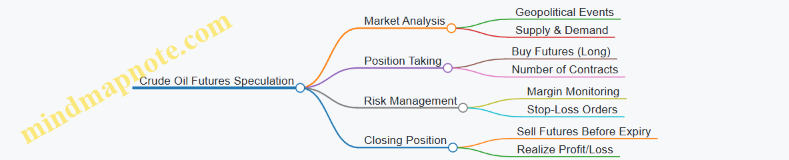
Example 2: Speculating on Gold Prices Using Futures
Scenario: A financial analyst expects gold prices to decline from $1,800 per ounce due to strengthening USD.
Action: The analyst sells 10 gold futures contracts (each contract is 100 ounces) at $1,800.
Margin: Initial margin per contract is $7,000, total margin $70,000.
Outcome 1 (Price Falls): Gold price drops to $1,750.
- Profit per ounce = $1,800 - $1,750 = $50
- Total profit = $50 * 100 ounces * 10 contracts = $50,000
Outcome 2 (Price Rises): Gold price rises to $1,850.
- Loss per ounce = $1,850 - $1,800 = $50
- Total loss = $50 * 100 ounces * 10 contracts = $50,000
Best Practice:
- Analyze macroeconomic indicators affecting gold.
- Maintain liquidity to meet potential margin calls.
Mind Map: Gold Futures Speculation Strategy

Key Takeaways and Best Practices
- Understand the Contract Specifications: Know the contract size, expiry, and margin requirements.
- Leverage Can Amplify Gains and Losses: Use leverage cautiously and be prepared for margin calls.
- Use Technical and Fundamental Analysis: Combine both to form a well-rounded market view.
- Implement Risk Management Tools: Stop-loss orders and position sizing are essential to control risk.
- Monitor Market News: Commodity prices are sensitive to geopolitical events, weather, and economic data.
Summary
Speculating on commodity futures offers opportunities for significant profits but comes with substantial risk. Financial analysts must combine thorough market analysis with disciplined risk management and a clear exit strategy to succeed. By studying real-world examples such as crude oil and gold futures, professionals can better understand how to apply these principles effectively.
11.3 Case Study 3: Managing Currency Exposure in an International Fund
Managing currency exposure is a critical task for international funds that invest across multiple countries and currencies. Currency fluctuations can significantly impact the returns of a portfolio, either amplifying gains or exacerbating losses. This case study explores how an international fund can effectively manage currency risk using financial derivatives.
Understanding Currency Exposure
Currency exposure arises when the value of foreign investments fluctuates due to changes in exchange rates. There are three main types of currency exposure:
- Transaction Exposure: Risk from actual foreign currency transactions (e.g., buying/selling foreign assets).
- Translation Exposure: Risk from converting foreign assets and liabilities into the fund’s base currency for reporting.
- Economic Exposure: Long-term impact of currency fluctuations on the fund’s market value and competitive position.
Mind Map: Types of Currency Exposure
Step 1: Identifying the Exposure
The international fund holds assets in USD, EUR, and JPY, but reports performance in GBP. The fund’s portfolio breakdown:
| Currency | Value (in local currency) | GBP Equivalent |
|---|---|---|
| USD | $100 million | £75 million |
| EUR | €80 million | £68 million |
| JPY | ¥10 billion | £65 million |
The fund is exposed to GBP/USD, GBP/EUR, and GBP/JPY exchange rate fluctuations.
Step 2: Measuring Currency Risk
The fund uses Value at Risk (VaR) and scenario analysis to estimate potential losses due to currency movements. For example, a 5% depreciation of GBP against USD could reduce the GBP value of USD holdings by approximately £3.75 million.
Step 3: Choosing Hedging Instruments
The fund decides to use currency forwards and options to hedge its exposure:
- Currency Forwards: Contract to buy/sell a currency at a predetermined rate on a future date.
- Currency Options: Right, but not obligation, to exchange currency at a specified rate.
Mind Map: Currency Hedging Instruments
Step 4: Implementing the Hedge
Example: Hedging USD exposure with currency forwards
- Current GBP/USD rate: 1.33
- USD exposure: $100 million
- Fund enters into a forward contract to sell $100 million at 1.33 GBP/USD in 3 months.
This locks in the GBP value of the USD holdings, protecting against GBP appreciation.
Example: Using currency options for EUR exposure
- Current GBP/EUR rate: 0.85
- EUR exposure: €80 million
- Fund buys put options on EUR with strike price 0.83 GBP/EUR, paying a premium.
If GBP strengthens beyond 0.83, the fund can exercise the option to limit losses.
Step 5: Monitoring and Adjusting the Hedge
The fund continuously monitors currency markets and the portfolio’s exposure. If market conditions change, the fund may adjust hedge ratios or switch instruments.
Mind Map: Currency Hedge Management Process
Best Practice: Aligning Hedging Strategy with Fund Objectives
- Partial vs. Full Hedge: The fund may choose to hedge only a portion of the exposure to balance cost and risk.
- Cost-Benefit Analysis: Weigh the cost of options premiums or forward spreads against potential currency losses.
- Documentation: Maintain clear records of hedge rationale and effectiveness.
Practical Example: Hedge Effectiveness
Over a 3-month period:
- GBP/USD moves from 1.33 to 1.28 (GBP strengthens).
- Without hedge: $100 million worth £76.56 million → £80 million × 1.28 = £76.56 million
- With forward contract at 1.33: Locked in £75 million, avoiding loss.
The hedge reduced currency risk and stabilized returns.
Summary
Managing currency exposure in an international fund requires a structured approach:
- Identify and quantify currency risks.
- Choose appropriate derivative instruments (forwards, options).
- Implement hedges aligned with fund objectives.
- Monitor and adjust hedges dynamically.
- Document strategies and outcomes.
This approach helps protect the fund’s value from adverse currency movements while allowing for strategic flexibility.
11.4 Best Practice: Lessons Learned from Derivative Failures and Successes
Financial derivatives have transformed risk management and investment strategies, but their complexity and leverage also pose significant risks. Understanding past failures and successes is crucial for accountants and financial analysts to apply best practices and avoid costly mistakes.
Key Lessons from Derivative Failures
-
Lack of Understanding and Oversight
- Many derivative-related losses stem from inadequate knowledge of the instruments.
- Example: The 1995 Barings Bank collapse due to unauthorized futures trading by Nick Leeson.
-
Excessive Leverage and Risk Concentration
- Overleveraging magnifies losses.
- Example: Long-Term Capital Management (LTCM) 1998 crisis, where massive leverage on complex derivatives led to near collapse.
-
Poor Risk Management and Controls
- Failure to monitor positions and counterparty risk.
- Example: AIG’s 2008 credit default swap exposure caused by insufficient risk controls.
-
Inadequate Documentation and Compliance
- Legal disputes and regulatory penalties arise from poor contract documentation.
- Example: Forward contracts without clear terms leading to disputes.
-
Market Illiquidity and Unexpected Events
- Derivatives can become difficult to unwind during market stress.
- Example: The 2008 financial crisis where liquidity dried up, exacerbating losses.
Key Lessons from Derivative Successes
-
Clear Hedging Objectives and Strategy Alignment
- Successful firms define clear goals for derivatives use.
- Example: Southwest Airlines’ fuel hedging program that stabilized costs.
-
Robust Risk Management Frameworks
- Continuous monitoring, stress testing, and scenario analysis.
- Example: JPMorgan Chase’s comprehensive derivatives risk management post-2008.
-
Transparent Reporting and Compliance
- Accurate accounting and regulatory adherence build trust and reduce risk.
- Example: Companies adopting IFRS 9 hedge accounting to reflect economic reality.
-
Education and Training
- Ensuring all stakeholders understand derivative products and risks.
- Example: Financial institutions investing in ongoing training programs.
-
Use of Technology and Analytics
- Leveraging advanced tools for pricing, valuation, and risk assessment.
- Example: Use of Monte Carlo simulations for option pricing and risk.
Mind Map: Lessons from Derivative Failures and Successes
Practical Example: Barings Bank Collapse
Scenario: Nick Leeson, a trader at Barings Bank, took massive unauthorized positions in futures contracts on the Singapore and Osaka exchanges. The positions were highly leveraged and speculative.
What Went Wrong:
- Lack of internal controls allowed unchecked trading.
- Leeson concealed losses in a secret account.
- The bank failed to understand the risk exposure fully.
Lesson:
- Implement strict segregation of duties.
- Regular independent risk reviews and audits.
- Transparent reporting to senior management.
Practical Example: Southwest Airlines Fuel Hedging
Scenario: Southwest Airlines uses futures contracts to hedge against volatile jet fuel prices, locking in costs and stabilizing budgeting.
Success Factors:
- Clear objective: cost stability, not speculation.
- Regular review and adjustment of hedge ratios.
- Transparent communication with stakeholders.
Lesson:
- Align derivative use with business goals.
- Maintain flexibility to adapt hedges as market conditions change.
Summary Table: Comparing Failures and Successes
| Aspect | Failure Example | Success Example | Best Practice Recommendation |
|---|---|---|---|
| Understanding | Barings Bank (lack of knowledge) | Southwest Airlines (clear goals) | Invest in education and training |
| Leverage | LTCM (excessive leverage) | JPMorgan (controlled leverage) | Set leverage limits and monitor continuously |
| Risk Management | AIG (poor controls) | JPMorgan (robust framework) | Implement comprehensive risk management systems |
| Documentation & Compliance | Forward contract disputes | IFRS 9 Adoption | Maintain clear, legally sound documentation |
| Market Conditions | 2008 Crisis (illiquidity) | Southwest (adaptive hedging) | Stress test and prepare for adverse market scenarios |
By studying these lessons, accountants and financial analysts can better design, monitor, and report derivative strategies, minimizing risks and maximizing the benefits of these powerful financial instruments.
11.5 Practical Example: Step-by-Step Walkthrough of a Derivative Trade Lifecycle
Understanding the lifecycle of a derivative trade is essential for accountants and financial analysts to ensure accurate valuation, risk management, and compliance. This section provides a detailed, step-by-step walkthrough of a typical derivative trade lifecycle using a futures contract example, complemented by mind maps and practical illustrations.
Step 1: Trade Initiation
- Description: The trade begins when two parties agree to enter into a derivative contract. For example, a manufacturing company agrees to buy oil futures to hedge against rising oil prices.
- Key Actions: Negotiation of terms, selection of contract type, underlying asset, quantity, price, and maturity date.

- Example: Company A agrees to purchase 1,000 barrels of oil futures at $70 per barrel, expiring in 3 months.
Step 2: Trade Execution
- Description: The trade is executed on an exchange or OTC platform. The contract is officially entered into the system.
- Key Actions: Order placement, trade confirmation, and recording.
- Example: The futures contract is executed on the CME exchange, and both parties receive trade confirmations.
Step 3: Margining and Collateral Management
- Description: Futures require margin accounts to manage credit risk. Initial margin is posted, and daily mark-to-market adjustments are made.
- Key Actions: Posting initial margin, daily variation margin settlements, margin calls if necessary.
- Example: Company A posts an initial margin of $10,000. After the first day, oil prices rise to $72, Company A gains $2,000, credited to its margin account.
Step 4: Monitoring and Risk Management
- Description: Continuous monitoring of the derivative position and underlying asset price to manage risk.
- Key Actions: Daily valuation, risk metrics calculation (e.g., VaR), adjusting hedge ratios.
- Example: Financial analysts review the futures position daily and adjust hedge size if oil price volatility increases.
Step 5: Settlement and Closeout
- Description: The contract reaches maturity and is settled either by physical delivery or cash settlement.
- Key Actions: Final valuation, settlement instructions, contract closeout.
- Example: At contract expiry, oil price is $75. Company A settles the futures contract by cash, receiving a $5,000 gain ([$75-$70] x 1,000 barrels).
Step 6: Accounting and Reporting
- Description: Recording the derivative transactions in financial statements and regulatory reports.
- Key Actions: Valuation adjustments, hedge accounting documentation, disclosure.
- Example: The $5,000 gain is recognized in the income statement; hedge effectiveness is documented as per IFRS 9.
Summary Mind Map: Derivative Trade Lifecycle
Additional Practical Example: Option Trade Lifecycle
- Trade Initiation: Investor buys a call option on stock XYZ with strike price $50, premium $3, expiry in 2 months.
- Trade Execution: Option purchased via broker, trade confirmed.
- Margining: Premium paid upfront; no margin required for buyer.
- Monitoring: Daily mark-to-market valuation; Greeks analyzed.
- Settlement: Option exercised if stock price > $50 at expiry or expires worthless.
- Accounting: Premium recorded as asset; gains/losses recognized upon exercise or expiry.
This detailed walkthrough equips financial professionals with a clear understanding of each phase in the derivative trade lifecycle, enabling better decision-making, risk management, and compliance.
12. Tools and Resources for Financial Derivatives Analysis
12.1 Software and Platforms for Derivative Pricing and Risk Analysis
Financial derivatives require sophisticated tools for accurate pricing, risk measurement, and management. This section explores the most widely used software and platforms in the industry, highlighting their features, use cases, and integration capabilities. We also provide mind maps to visualize the ecosystem and examples demonstrating practical applications.
Key Software Categories for Derivative Analysis
Quantitative Libraries
QuantLib: An open-source C++ library widely used for modeling, pricing, and risk management of derivatives. It supports a broad range of instruments including options, futures, swaps, and more.
Example: A financial analyst uses QuantLib to implement a custom Monte Carlo simulation for pricing an exotic option that is not supported by standard platforms.
OpenGamma: A platform focused on risk analytics and portfolio valuation, often integrated with trading systems for real-time risk monitoring.
Trading Platforms
Bloomberg Terminal: Industry-standard platform offering real-time market data, pricing models, and analytics for derivatives. It includes built-in calculators for options Greeks, yield curves, and scenario analysis.
Example: An accountant uses Bloomberg’s option calculator to verify the fair value of employee stock options for financial reporting.
Thomson Reuters Eikon: Similar to Bloomberg, it provides comprehensive derivative pricing tools and market data.
TradeStation: Popular among traders for futures and options trading with integrated backtesting and strategy development.
Risk Management Systems
MSCI RiskMetrics: Provides risk analytics including Value at Risk (VaR), stress testing, and scenario analysis tailored for derivatives portfolios.
Moody’s Analytics: Offers credit risk and market risk solutions, including derivative valuation and counterparty risk assessment.
SAS Risk Management: Integrates data management with advanced analytics to monitor derivative exposures and regulatory compliance.
Modeling & Simulation Tools
MATLAB: Widely used for prototyping pricing models and running simulations. Its Financial Toolbox includes functions for option pricing and risk metrics.
R: Open-source statistical software with packages like ‘RQuantLib’ and ‘fOptions’ for derivative pricing.
Python: Increasingly popular due to flexibility and extensive libraries (NumPy, SciPy, Pandas, QuantLib-Python bindings).
Example: A financial analyst builds a Python script to calculate Greeks for a portfolio of options, automating risk reports.
Spreadsheet Tools
Microsoft Excel: The most accessible tool for accountants and analysts. With VBA and add-ins, Excel can handle complex derivative pricing and risk calculations.
Example: Using the Deriscope add-in, an accountant prices a range of interest rate swaps directly within Excel, linking cash flow schedules and discount curves.
Google Sheets: Cloud-based alternative with scripting capabilities, useful for collaborative derivative analysis.
Best Practice: Integrating Multiple Tools
Often, professionals combine platforms to leverage strengths. For example, using Python for heavy computation, Excel for reporting, and Bloomberg for market data.
Summary Example: End-to-End Derivative Pricing Workflow
- Data Retrieval: Use Bloomberg Terminal API to pull live market data.
- Modeling: Run pricing models in Python using QuantLib bindings.
- Risk Metrics: Calculate VaR and Greeks with MSCI RiskMetrics.
- Reporting: Generate Excel reports with VBA macros for management review.
This integrated approach ensures accuracy, efficiency, and transparency in derivative pricing and risk analysis.
By understanding and leveraging these software tools and platforms, accountants and financial analysts can enhance their derivative valuation accuracy, streamline risk management processes, and improve decision-making quality.
12.2 Data Sources for Market and Historical Prices
Accurate and timely data is the backbone of effective financial derivatives analysis. Market and historical price data enable accountants and financial analysts to price derivatives correctly, assess risk, and make informed decisions. This section explores the primary sources of such data, their characteristics, and best practices for their use.
Key Data Sources for Market and Historical Prices
-
Exchange Data Feeds
- Real-time and end-of-day prices from organized exchanges (e.g., CME, NYSE, LSE)
- Includes futures prices, options premiums, volumes, and open interest
-
Financial Data Vendors
- Bloomberg Terminal
- Refinitiv (formerly Thomson Reuters)
- S&P Capital IQ
- FactSet
- These vendors aggregate data from multiple exchanges and OTC markets
-
Public Data Sources
- Government agencies (e.g., U.S. Commodity Futures Trading Commission, SEC)
- Central banks (e.g., Federal Reserve, ECB)
- Exchange websites providing historical data downloads
-
OTC Market Data Providers
- Markit (now part of IHS Markit)
- DTCC
- Specialized platforms offering pricing for swaps, forwards, and other OTC derivatives
-
Alternative Data Sources
- Web scraping of financial news and market sentiment
- Social media analytics
- Satellite data for commodities
Mind Map: Overview of Data Sources for Market and Historical Prices
Best Practice: Verifying Data Integrity and Consistency
- Cross-check data from multiple sources to identify discrepancies
- Use vendor-provided metadata to understand data collection methods and limitations
- Maintain a data audit trail for compliance and back-testing purposes
Practical Example 1: Using Bloomberg Terminal to Retrieve Historical Futures Prices
- Open Bloomberg Terminal.
- Use the command
FUT <GO>to access futures contracts. - Select the desired contract (e.g., Crude Oil Futures).
- Use
GP <GO>to generate a price graph. - Export historical daily closing prices for the last 5 years.
This data can then be imported into Excel or a statistical software package for derivative pricing or risk analysis.
Practical Example 2: Downloading Historical Options Data from an Exchange Website
- Visit the Chicago Board Options Exchange (CBOE) website.
- Navigate to the ‘Data Shop’ or ‘Historical Data’ section.
- Select the underlying asset and date range.
- Download CSV files containing options premiums, strike prices, and expiry dates.
This data is essential for calibrating option pricing models such as Black-Scholes.
Mind Map: Workflow for Integrating Market Data into Derivative Analysis
Additional Tips
- Subscribe to real-time data feeds if intraday derivative pricing is required.
- Consider data latency and update frequency when selecting sources.
- For OTC derivatives, rely on specialized providers due to lack of centralized exchanges.
- Document data sources and versions used in all analyses for transparency and reproducibility.
By leveraging a combination of exchange feeds, vendor platforms, and public data, financial professionals can build robust datasets that support accurate derivative valuation and risk assessment.
12.3 Best Practice: Leveraging Technology to Enhance Accuracy and Efficiency - Example of Using Excel and VBA for Option Pricing
Financial analysts and accountants increasingly rely on technology to improve the accuracy, speed, and repeatability of derivative pricing and risk management tasks. Excel, combined with VBA (Visual Basic for Applications), offers a powerful and accessible platform to implement option pricing models such as the Black-Scholes model.
Why Use Excel and VBA for Option Pricing?
- Accessibility: Excel is widely available and familiar to finance professionals.
- Customization: VBA allows automation and creation of custom functions.
- Transparency: Formulas and code can be reviewed and audited.
- Efficiency: Automates repetitive calculations, reducing manual errors.
Mind Map: Leveraging Excel and VBA for Option Pricing
Step 1: Understanding the Black-Scholes Model Inputs
| Parameter | Description | Example Value |
|---|---|---|
| Stock Price (S) | Current price of the underlying asset | 100 |
| Strike Price (K) | Price at which option can be exercised | 100 |
| Time to Maturity (T) | Time in years until option expires | 0.5 (6 months) |
| Risk-Free Rate (r) | Annual risk-free interest rate | 5% (0.05) |
| Volatility (σ) | Annualized standard deviation of returns | 20% (0.20) |
Step 2: Excel Setup
- Create a worksheet with clearly labeled input cells for S, K, T, r, and σ.
- Reserve cells for output: Call Option Price and Put Option Price.
- Use named ranges for inputs to improve formula readability.
Step 3: VBA Implementation
Below is an example VBA code snippet to calculate the Black-Scholes call and put option prices.
Function CND(X As Double) As Double
    ' Cumulative normal distribution function approximation
    Dim L As Double, K As Double, w As Double
    Dim a1 As Double, a2 As Double, a3 As Double, a4 As Double, a5 As Double

    a1 = 0.31938153
    a2 = -0.356563782
    a3 = 1.781477937
    a4 = -1.821255978
    a5 = 1.330274429

    L = Abs(X)
    K = 1 / (1 + 0.2316419 * L)
    w = 1 - 1 / Sqr(2 * WorksheetFunction.Pi()) * Exp(-L * L / 2) * _
        (a1 * K + a2 * K ^ 2 + a3 * K ^ 3 + a4 * K ^ 4 + a5 * K ^ 5)

    If X < 0 Then w = 1 - w
    CND = w
End Function

Function BlackScholesCall(S As Double, K As Double, T As Double, r As Double, sigma As Double) As Double
    Dim d1 As Double, d2 As Double
    d1 = (Log(S / K) + (r + sigma ^ 2 / 2) * T) / (sigma * Sqr(T))
    d2 = d1 - sigma * Sqr(T)
    BlackScholesCall = S * CND(d1) - K * Exp(-r * T) * CND(d2)
End Function

Function BlackScholesPut(S As Double, K As Double, T As Double, r As Double, sigma As Double) As Double
    Dim d1 As Double, d2 As Double
    d1 = (Log(S / K) + (r + sigma ^ 2 / 2) * T) / (sigma * Sqr(T))
    d2 = d1 - sigma * Sqr(T)
    BlackScholesPut = K * Exp(-r * T) * CND(-d2) - S * CND(-d1)
End Function
Step 4: Using the VBA Functions in Excel
-
After inserting the VBA code into a module, use formulas like:
=BlackScholesCall(S, K, T, r, sigma)=BlackScholesPut(S, K, T, r, sigma)
-
Replace the parameters with cell references or named ranges.
Step 5: Best Practices for Implementation
- Modular Code: Separate functions for cumulative normal distribution and option pricing improve readability and maintenance.
- Input Validation: Add checks to ensure inputs are within valid ranges (e.g., positive stock price, non-negative time).
- Documentation: Comment code thoroughly to explain formulas and logic.
- Error Handling: Use VBA error handling to manage unexpected inputs or calculation errors.
- Version Control: Maintain versions of your VBA code to track changes and improvements.
Example Walkthrough
| Input Parameter | Cell | Value |
|---|---|---|
| Stock Price (S) | B2 | 100 |
| Strike Price (K) | B3 | 100 |
| Time to Maturity (T) | B4 | 0.5 |
| Risk-Free Rate (r) | B5 | 0.05 |
| Volatility (σ) | B6 | 0.20 |
- In cell B8, enter formula:
=BlackScholesCall(B2, B3, B4, B5, B6)→ Returns call option price. - In cell B9, enter formula:
=BlackScholesPut(B2, B3, B4, B5, B6)→ Returns put option price.
Mind Map: Best Practices Summary
Conclusion
Leveraging Excel and VBA for option pricing empowers finance professionals to build transparent, customizable, and efficient pricing tools. By adhering to best practices such as modular coding, input validation, and thorough documentation, analysts and accountants can reduce errors and improve decision-making accuracy. This approach also facilitates easy scenario analysis and integration into broader financial models, making it an indispensable skill in the derivatives domain.
12.4 Practical Example: Building a Simple Derivative Valuation Model
In this section, we will walk through building a simple derivative valuation model using a call option as an example. This practical exercise is designed to help accountants and financial analysts understand the core principles of option pricing and how to implement a basic valuation model using Excel or any spreadsheet tool.
Step 1: Understanding the Call Option Payoff
A call option gives the holder the right, but not the obligation, to buy an underlying asset at a specified strike price before or at expiration.
Payoff formula:
Payoff = max(0, S - K)
Where:
- S = Price of the underlying asset at expiration
- K = Strike price of the option
Step 2: Inputs Required for the Model
| Input Parameter | Description | Example Value |
|---|---|---|
| Current Stock Price (S0) | Price of the underlying asset today | $100 |
| Strike Price (K) | Price at which option can be exercised | $105 |
| Time to Expiration (T) | Time until option expires (in years) | 0.5 (6 months) |
| Risk-Free Rate (r) | Annual risk-free interest rate (continuously compounded) | 5% (0.05) |
| Volatility (σ) | Annualized standard deviation of stock returns | 20% (0.20) |
Step 3: Choosing the Valuation Method
For simplicity, we will use the Black-Scholes model, a widely accepted method for pricing European call options.
Black-Scholes Formula for Call Option Price (C):
C = S_0 * N(d1) - K * e^{-rT} * N(d2)
Where:
d1 = [ln(S_0 / K) + (r + σ^2 / 2) * T] / (σ * sqrt(T))
d2 = d1 - σ * sqrt(T)
- N(x) is the cumulative distribution function of the standard normal distribution.
Step 4: Mind Map of the Valuation Process
Step 5: Step-by-Step Calculation Example
Using the example values:
- S0 = $100
- K = $105
- T = 0.5 years
- r = 0.05
- σ = 0.20
Calculate d1:
ln(S0/K) = ln(100/105) = ln(0.95238) ≈ -0.04879
(r + σ^2/2)*T = (0.05 + 0.20^2/2)*0.5 = (0.05 + 0.02)*0.5 = 0.035
σ * sqrt(T) = 0.20 * sqrt(0.5) ≈ 0.14142

d1 = (-0.04879 + 0.035) / 0.14142 ≈ (-0.01379) / 0.14142 ≈ -0.0975
Calculate d2:
d2 = d1 - σ * sqrt(T) = -0.0975 - 0.14142 = -0.2389
Calculate N(d1) and N(d2):
Using standard normal distribution tables or Excel function =NORM.S.DIST(value, TRUE):
- N(d1) = N(-0.0975) ≈ 0.4611
- N(d2) = N(-0.2389) ≈ 0.4056
Calculate present value of strike price:
K * e^{-rT} = 105 * e^{-0.05*0.5} = 105 * e^{-0.025} ≈ 105 * 0.9753 = 102.41
Calculate Call Option Price (C):
C = S0 * N(d1) - K * e^{-rT} * N(d2)
C = 100 * 0.4611 - 102.41 * 0.4056
C = 46.11 - 41.54 = 4.57
Interpretation: The fair value of the call option is approximately $4.57.
Step 6: Building the Model in Excel
| Cell | Description | Formula / Value |
|---|---|---|
| A1 | Current Stock Price (S0) | 100 |
| A2 | Strike Price (K) | 105 |
| A3 | Time to Expiration (T) | 0.5 |
| A4 | Risk-Free Rate (r) | 0.05 |
| A5 | Volatility (σ) | 0.20 |
| B1 | ln(S0/K) | =LN(A1/A2) |
| B2 | (r + σ^2/2)*T | =(A4 + (A5^2)/2)*A3 |
| B3 | σ * sqrt(T) | =A5*SQRT(A3) |
| B4 | d1 | =(B1 + B2)/B3 |
| B5 | d2 | =B4 - B3 |
| B6 | N(d1) | =NORM.S.DIST(B4, TRUE) |
| B7 | N(d2) | =NORM.S.DIST(B5, TRUE) |
| B8 | Present Value of Strike Price | =A2*EXP(-A4*A3) |
| B9 | Call Option Price (C) | =A1*B6 - B8*B7 |
This spreadsheet setup allows quick recalculation by changing input parameters.
Step 7: Best Practices for Model Building
- Validate Inputs: Ensure all inputs are accurate and reflect current market conditions.
- Use Built-in Functions: Leverage Excel’s statistical functions to avoid manual errors.
- Document Assumptions: Clearly state assumptions such as European option style and no dividends.
- Perform Sensitivity Analysis: Test how changes in volatility, time, or interest rates affect option price.
- Version Control: Keep track of model versions and changes for audit purposes.
Step 8: Mind Map for Best Practices
Summary
Building a simple derivative valuation model demystifies the pricing process and equips financial professionals with a practical tool for analysis. By following the step-by-step approach and adhering to best practices, accountants and financial analysts can enhance their understanding and application of financial derivatives in their daily work.
13. Future Trends in Financial Derivatives
13.1 Impact of Fintech and Blockchain on Derivatives Markets
The advent of Fintech and blockchain technology has significantly transformed the landscape of financial derivatives markets. These innovations are reshaping how derivatives are created, traded, cleared, and settled, offering enhanced transparency, efficiency, and security.
Key Areas of Impact
Detailed Explanation and Examples
1. Enhanced Transparency and Trust
Blockchain’s distributed ledger technology ensures that every transaction related to derivatives is recorded immutably and transparently. This reduces the risk of fraud and manipulation.
Example: A derivatives clearinghouse uses blockchain to record futures contract trades. Both parties can verify contract terms and settlement status in real-time, reducing disputes and enhancing trust.
2. Improved Efficiency and Speed
Smart contracts automate the execution and settlement of derivatives contracts, eliminating manual reconciliation and reducing settlement times from days to minutes.
Example: An options contract executed via a smart contract automatically triggers payment and transfer of underlying assets upon expiry, without human intervention.
3. Increased Accessibility and Market Participation
Fintech platforms enable retail investors to participate in derivatives markets through user-friendly apps and fractionalized tokenized derivatives.
Example: A mobile app offers tokenized commodity futures, allowing small investors to gain exposure to gold futures with minimal capital.
4. Regulatory Compliance and Reporting
Blockchain enables real-time, tamper-proof reporting to regulators, simplifying compliance with frameworks like Dodd-Frank and EMIR.
Example: A derivatives trading platform automatically reports all trades and margin data to regulators via a blockchain-based reporting system.
5. New Product Innovation
Tokenization allows derivatives to be represented as digital tokens, enabling fractional ownership and easier transfer.
Example: A decentralized finance (DeFi) platform offers synthetic derivatives that track the price of traditional assets without requiring ownership of the underlying.
6. Risk Management Enhancements
Real-time data from blockchain networks allows for instantaneous risk assessment and automated margin calls, reducing systemic risk.
Example: A clearinghouse uses blockchain data to trigger automatic margin calls when a trader’s position breaches risk thresholds.
Mind Map: Fintech and Blockchain Impact on Derivatives
Summary
Fintech and blockchain technologies are revolutionizing derivatives markets by enhancing transparency, automating processes, broadening access, and enabling innovative products. For accountants and financial analysts, understanding these changes is crucial to leveraging new tools for valuation, risk management, and compliance in a rapidly evolving financial ecosystem.
13.2 Increasing Role of ESG and Sustainable Finance Derivatives
Environmental, Social, and Governance (ESG) criteria have become central to investment decisions and corporate strategies worldwide. As the demand for sustainable finance grows, derivatives linked to ESG factors are emerging as powerful tools for risk management, speculation, and portfolio enhancement.
What Are ESG and Sustainable Finance Derivatives?
ESG derivatives are financial instruments whose underlying assets or payoff structures are linked to ESG-related indices, benchmarks, or performance metrics. These derivatives enable market participants to hedge ESG risks, gain exposure to sustainable assets, or speculate on ESG trends.
Why Are ESG Derivatives Important?
- Risk Management: Companies and investors can hedge risks related to carbon pricing, regulatory changes, or reputational damage.
- Capital Allocation: Facilitate investment flows into sustainable projects by providing liquidity and price discovery.
- Performance Enhancement: Allow investors to express views on ESG factors without direct asset ownership.
Mind Map: ESG Derivatives Overview
Examples of ESG and Sustainable Finance Derivatives
-
Carbon Emission Futures and Options
- These derivatives are linked to carbon credit prices under cap-and-trade systems.
- Example: A manufacturing company uses carbon futures to hedge against rising carbon credit costs, locking in prices to manage budgeting.
-
ESG Index Futures
- Futures contracts based on ESG-focused equity indices (e.g., MSCI ESG Leaders Index).
- Example: A financial analyst uses ESG index futures to gain exposure to companies with high ESG ratings without buying individual stocks.
-
Green Bond Derivatives
- Options or swaps linked to the performance or yields of green bonds.
- Example: An asset manager uses green bond swaps to adjust duration exposure while supporting sustainable projects.
-
Social Impact Derivatives
- Emerging instruments linked to social outcomes, such as employment rates or education metrics.
- Example: A government issues derivatives tied to social development goals to attract impact investors.
Best Practice: Integrating ESG Derivatives into Investment Strategies
- Due Diligence on ESG Data: Verify the quality and source of ESG data underlying derivatives.
- Alignment with ESG Goals: Ensure derivative use supports the investor’s or company’s sustainability objectives.
- Risk Assessment: Evaluate counterparty risk and regulatory compliance related to ESG products.
- Transparency and Reporting: Maintain clear documentation and disclose derivative positions in ESG reporting.
Mind Map: Best Practices for ESG Derivatives
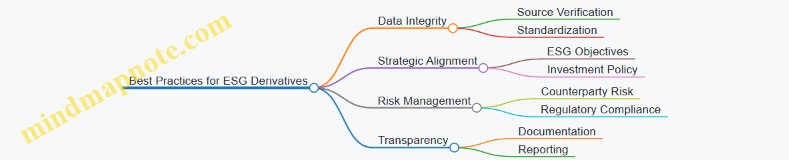
Practical Example: Hedging Carbon Price Risk with Futures
A European energy company anticipates increased carbon credit prices due to stricter regulations. To manage this risk, the company buys carbon emission futures contracts:
- Step 1: Analyze historical carbon price volatility and forecast future trends.
- Step 2: Determine the volume of carbon credits to hedge based on expected emissions.
- Step 3: Purchase futures contracts on a regulated exchange to lock in current prices.
- Step 4: Monitor market and regulatory developments, adjusting positions as needed.
This approach stabilizes the company’s cost structure and aligns with its sustainability commitments.
Emerging Trends and Outlook
- Expansion of ESG derivatives into new asset classes such as agriculture and water rights.
- Increased regulatory support and standardization efforts to improve market confidence.
- Growing interest in derivatives linked to social and governance metrics beyond environmental factors.
In summary, ESG and sustainable finance derivatives represent a dynamic and evolving segment of the financial markets. For accountants and financial analysts, understanding these instruments is crucial to effectively managing ESG-related risks and capitalizing on emerging opportunities in sustainable finance.
13.3 Best Practice: Staying Updated and Adapting to Market Innovations
In the rapidly evolving world of financial derivatives, staying updated with the latest market innovations is crucial for accountants and financial analysts. This ensures not only compliance with regulatory changes but also the ability to leverage new instruments and technologies for enhanced risk management and investment strategies.
Why Staying Updated Matters
- Regulatory Compliance: New rules can impact derivative valuation, reporting, and risk management.
- Competitive Advantage: Early adoption of innovative derivatives or technology can improve portfolio performance.
- Risk Mitigation: Understanding emerging risks linked to new products or market structures.
Key Areas to Monitor
Practical Steps to Stay Updated
-
Subscribe to Industry Publications and Newsletters
- Examples: Risk.net, Derivatives Strategy, CFA Institute newsletters.
-
Attend Webinars and Conferences
- Example: Annual Global Derivatives Trading & Risk Management conference.
-
Engage in Professional Networks and Forums
- Example: LinkedIn groups focused on derivatives, or specialized forums like QuantNet.
-
Pursue Continuous Education and Certifications
- Example: Certifications such as Financial Risk Manager (FRM) or Chartered Financial Analyst (CFA) with derivatives focus.
-
Leverage Technology Tools for Market Monitoring
- Example: Using platforms like Bloomberg Terminal or Refinitiv Eikon for real-time updates.
Example: Adapting to Tokenized Derivatives
Tokenized derivatives are emerging as a new frontier, leveraging blockchain technology to create digital representations of derivative contracts.
- Scenario: A financial analyst at an investment firm learns about tokenized options that enable fractional ownership and faster settlement.
- Action: They attend a webinar on blockchain applications in derivatives, join a professional forum discussing regulatory implications, and pilot a small tokenized options trade using a blockchain-based platform.
- Outcome: The firm gains early mover advantage, reduces settlement risk, and improves transparency.
Mind Map: Continuous Learning Framework
Summary
Staying updated and adapting to market innovations requires a proactive approach combining education, technology adoption, and active engagement with the financial derivatives community. By following these best practices, accountants and financial analysts can enhance their expertise, manage risks effectively, and capitalize on new opportunities in the derivatives market.
13.4 Practical Example: Exploring Tokenized Derivatives and Smart Contracts
Tokenized derivatives and smart contracts represent a cutting-edge intersection of finance and blockchain technology, offering transparency, automation, and accessibility in derivative trading and settlement.
What Are Tokenized Derivatives?
Tokenized derivatives are financial derivative contracts represented as digital tokens on a blockchain. These tokens encode the rights and obligations of the derivative contract, enabling peer-to-peer trading without traditional intermediaries.
What Are Smart Contracts?
Smart contracts are self-executing contracts with the terms directly written into code on a blockchain. They automatically enforce and execute contract conditions when predefined criteria are met.
Mind Map: Tokenized Derivatives and Smart Contracts Overview
Example Scenario: Tokenized Option Contract on Ethereum Blockchain
Context: A financial analyst wants to hedge equity exposure using a tokenized call option on a popular stock, executed via a smart contract.
Step 1: Creation of Tokenized Option
- The option contract terms (strike price, expiry date, underlying asset) are coded into a smart contract.
- The option is minted as a digital token representing the right to buy the underlying stock at the strike price.
Step 2: Trading the Tokenized Option
- The tokenized option can be traded on decentralized exchanges (DEXs) without intermediaries.
- Ownership transfers are recorded on the blockchain, ensuring transparency.
Step 3: Execution and Settlement
- Upon expiry, the smart contract automatically checks the underlying asset price via an oracle.
- If the option is in-the-money, the smart contract executes the option, transferring tokens or cash equivalents accordingly.
- Margin calls and collateral management can be automated within the contract.
Mind Map: Tokenized Option Contract Lifecycle
Best Practices for Implementing Tokenized Derivatives and Smart Contracts
- Use Reliable Oracles: Ensure accurate and tamper-proof price feeds for contract execution.
- Smart Contract Audits: Conduct thorough security audits to prevent vulnerabilities.
- Clear Legal Framework: Align tokenized derivatives with regulatory requirements to ensure compliance.
- User Education: Provide clear documentation and training for users interacting with tokenized derivatives.
Additional Example: Automated Margin Call via Smart Contract
Scenario: A tokenized futures contract includes an automated margin call feature.
- The smart contract continuously monitors the value of the underlying asset.
- If the margin falls below a threshold, the contract automatically triggers a margin call notification.
- The trader must deposit additional collateral within a specified timeframe, or the contract liquidates the position.
This automation reduces operational risk and enhances efficiency.
Summary
Tokenized derivatives and smart contracts are revolutionizing the derivatives market by embedding contract terms into code, enabling automation, transparency, and reduced reliance on intermediaries. For financial analysts and accountants, understanding these technologies is essential to leverage their benefits while managing associated risks effectively.