Accounting for Equity Transactions
1. Introduction to Equity Transactions
1.1 Definition and Importance of Equity Transactions
Definition of Equity Transactions
Equity transactions refer to the financial activities involving the issuance, repurchase, or restructuring of a company’s ownership interests represented by shares or other equity instruments. These transactions impact the ownership structure, capital base, and financial position of a company.
Equity transactions include:
- Issuance of common or preferred stock
- Share buybacks or treasury stock transactions
- Stock splits and reverse splits
- Equity-based compensation such as stock options
- Conversion of convertible securities into equity
- Dividend distributions to shareholders
Why Are Equity Transactions Important?
Equity transactions are fundamental to corporate finance and accounting for several reasons:
- Capital Raising: Issuing shares allows companies to raise capital without incurring debt.
- Ownership and Control: Equity transactions affect the distribution of ownership and voting rights.
- Financial Reporting: They impact the equity section of the balance sheet and require accurate accounting and disclosure.
- Investor Relations: Transparent equity transactions build investor confidence and influence market perception.
- Regulatory Compliance: Proper accounting ensures compliance with accounting standards and securities regulations.
Mind Map: Key Aspects of Equity Transactions
Mind Map: Stakeholders and Their Roles
Practical Example 1: Basic Equity Issuance
Scenario: A startup company issues 10,000 shares of common stock at $5 per share to raise capital.
Accounting Impact:
- Cash increases by $50,000 (10,000 shares × $5)
- Share capital increases by the par value portion (e.g., $1 per share × 10,000 = $10,000)
- Additional paid-in capital increases by the excess over par ($4 × 10,000 = $40,000)
Journal Entry:
Dr. Cash $50,000
  Cr. Share Capital $10,000
  Cr. Additional Paid-in Capital $40,000
This transaction strengthens the company’s equity base without increasing liabilities.
Practical Example 2: Share Buyback
Scenario: The same company decides to repurchase 2,000 shares at $6 per share to return capital to shareholders.
Accounting Impact:
- Cash decreases by $12,000
- Treasury stock (a contra-equity account) increases by $12,000
Journal Entry:
Dr. Treasury Stock $12,000
  Cr. Cash $12,000
This reduces the number of shares outstanding and impacts earnings per share calculations.
Summary
Understanding the definition and importance of equity transactions is essential for accountants and equity analysts. These transactions influence a company’s capital structure, financial health, and investor relations. Accurate accounting and clear reporting ensure transparency and compliance, supporting informed decision-making by all stakeholders.
1.2 Types of Equity Instruments
Equity instruments represent ownership interests in a company and are a fundamental part of corporate finance and accounting. Understanding the different types of equity instruments is essential for accountants and equity analysts to accurately record, analyze, and report equity transactions.
Overview of Equity Instruments
Equity instruments can be broadly categorized based on their rights, privileges, and characteristics. Below is a mind map illustrating the main types:
Common Stock
Definition: Common stock represents the basic ownership interest in a company. Holders have voting rights and may receive dividends, which are not guaranteed.
Key Features:
- Voting rights typically one vote per share.
- Dividends are declared at the discretion of the board.
- Residual claim on assets after liabilities and preferred shareholders.
Example: Company ABC issues 1,000 shares of common stock with a par value of $1 at $10 per share.
Accounting Entry:
- Debit Cash $10,000
- Credit Common Stock $1,000 (par value)
- Credit Additional Paid-in Capital $9,000
Preferred Stock
Definition: Preferred stock is a class of ownership with preferential rights over common stock, especially regarding dividends and liquidation.
Key Features:
- Fixed dividend rate.
- Priority over common stock in dividend payments and liquidation.
- May be convertible into common stock.
- Can be cumulative (dividends accumulate if unpaid) or non-cumulative.
Example: Company XYZ issues 500 shares of preferred stock with a $100 par value and a 5% cumulative dividend.
Accounting Entry:
- Debit Cash $50,000
- Credit Preferred Stock $50,000
Dividend Example: If dividends are not declared in Year 1, the $2,500 (5% of $50,000) accumulates and must be paid before any dividends to common shareholders.
Treasury Stock
Definition: Treasury stock consists of shares that were issued and subsequently reacquired by the company. These shares do not have voting rights or pay dividends.
Key Features:
- Reduces total shareholders’ equity.
- Can be reissued or retired.
Example: Company DEF buys back 200 shares of its common stock at $15 per share.
Accounting Entry:
- Debit Treasury Stock $3,000
- Credit Cash $3,000
Stock Options and Warrants
Definition: These are rights granted to purchase shares at a specified price within a certain period.
Key Features:
- Often used as employee compensation.
- Warrants are typically issued to investors.
Example: An employee is granted options to buy 100 shares at $20 each. The fair value of the options is estimated at $500.
Accounting Entry:
- Debit Compensation Expense $500
- Credit Additional Paid-in Capital - Stock Options $500
Mind Map: Detailed Breakdown of Preferred Stock Types
Practical Example: Differentiating Equity Instruments
| Instrument Type | Voting Rights | Dividend Priority | Dividend Type | Conversion Feature | Example Scenario |
|---|---|---|---|---|---|
| Common Stock | Yes | Last | Variable | No | Basic ownership with voting and residual claims |
| Preferred Stock | Usually No | First | Fixed (often) | Sometimes | Fixed dividends, priority in liquidation |
| Treasury Stock | No | None | None | No | Shares repurchased by company |
| Stock Options/Warrants | No | N/A | N/A | N/A | Right to buy shares at a fixed price |
By understanding these types of equity instruments, accountants and equity analysts can better evaluate the financial position and performance of a company, ensuring accurate accounting and insightful analysis.
1.3 Overview of Accounting Standards Governing Equity
Accounting for equity transactions is governed by a set of accounting standards that ensure consistency, transparency, and comparability across financial statements. These standards provide guidance on how to recognize, measure, present, and disclose equity-related transactions.
Key Accounting Standards for Equity Transactions
-
IFRS (International Financial Reporting Standards)
- IAS 32: Financial Instruments: Presentation
- IAS 1: Presentation of Financial Statements
- IFRS 2: Share-based Payment
- IFRS 9: Financial Instruments (for classification and measurement)
-
US GAAP (Generally Accepted Accounting Principles)
- ASC 505: Equity
- ASC 718: Compensation—Stock Compensation
- ASC 480: Distinguishing Liabilities from Equity
Mind Map: Accounting Standards Governing Equity
Detailed Explanation of Key Standards
IAS 32: Financial Instruments: Presentation
- Purpose: Defines when a financial instrument should be classified as equity or liability.
- Key Principle: An instrument is classified as equity if it evidences a residual interest in the assets of the entity after deducting all liabilities.
- Example: Common shares issued by a company are classified as equity, while convertible bonds may have both liability and equity components.
IAS 1: Presentation of Financial Statements
- Purpose: Specifies how equity should be presented in the statement of financial position.
- Key Principle: Equity is presented separately from liabilities and broken down into components such as share capital, share premium, retained earnings, and other reserves.
IFRS 2: Share-based Payment
- Purpose: Provides guidance on accounting for transactions where an entity receives goods or services in exchange for equity instruments or cash based on equity value.
- Key Principle: Recognize expense over the vesting period with a corresponding increase in equity (for equity-settled) or liability (for cash-settled).
ASC 505: Equity (US GAAP)
- Purpose: Provides comprehensive guidance on equity transactions, including issuance, repurchase, and retirement of shares.
- Key Principle: Equity transactions are recorded at fair value or consideration received, with detailed rules on treasury stock and additional paid-in capital.
ASC 718: Compensation—Stock Compensation
- Purpose: Addresses accounting for stock-based compensation, including measurement of fair value and expense recognition.
- Key Principle: Expense recognized over the service period with corresponding increase in equity.
ASC 480: Distinguishing Liabilities from Equity
- Purpose: Provides criteria to classify financial instruments as liabilities or equity.
- Key Principle: Instruments that require mandatory redemption or settlement in cash are liabilities.
Practical Example: Classification of a Convertible Bond
Scenario: A company issues a convertible bond with a face value of $1,000,000 that can be converted into common shares at the option of the holder.
Accounting under IAS 32:
- The bond is split into two components:
- Liability component: Present value of cash flows if the bond were not convertible.
- Equity component: Residual amount representing the conversion option.
Journal Entry at Issuance:
Dr. Cash $1,000,000
  Cr. Liability component (bond payable) $900,000
  Cr. Equity component (conversion option) $100,000
This separation ensures clear presentation and measurement of both liability and equity parts.
Best Practices for Accountants and Equity Analysts
- Stay current with updates to IFRS and US GAAP standards related to equity.
- Carefully analyze the terms of financial instruments to determine correct classification.
- Use detailed disclosures to explain equity transactions and components.
- Apply consistent measurement bases for initial recognition and subsequent accounting.
- Collaborate with legal and tax teams to understand implications of equity instruments.
This overview provides a foundation for understanding the regulatory framework governing equity transactions, enabling accurate accounting and insightful analysis.
1.4 Key Stakeholders: Accountants and Equity Analysts
Understanding the roles and responsibilities of key stakeholders in equity transactions is crucial for accurate accounting and insightful financial analysis. This section focuses on two primary stakeholders: Accountants and Equity Analysts.
Role of Accountants in Equity Transactions
Accountants are responsible for the accurate recording, classification, and reporting of equity transactions in accordance with relevant accounting standards (e.g., IFRS, US GAAP). Their work ensures the financial statements reflect the true financial position and performance of the company.
Key Responsibilities:
- Recognition and Measurement: Properly identifying equity instruments and measuring them at initial recognition and subsequent reporting periods.
- Journal Entries: Recording equity transactions such as share issuances, buybacks, stock options, and dividends.
- Compliance: Ensuring adherence to accounting standards and regulatory requirements.
- Disclosure: Preparing transparent notes and disclosures related to equity transactions.
Mind Map: Accountant’s Role in Equity Transactions
Example: Recording a Share Issuance
A company issues 10,000 common shares with a par value of $1 at $15 per share.
- Journal Entry:
- Debit Cash $150,000 (10,000 shares x $15)
- Credit Share Capital $10,000 (10,000 shares x $1 par value)
- Credit Additional Paid-in Capital $140,000 (difference)
Role of Equity Analysts in Equity Transactions
Equity Analysts evaluate the impact of equity transactions on a company’s financial health and valuation. They analyze how these transactions affect shareholder value, earnings per share (EPS), and capital structure.
Key Responsibilities:
- Financial Analysis: Assessing the effects of equity transactions on key financial metrics.
- Valuation Impact: Understanding dilution or accretion from share issuances or buybacks.
- Market Implications: Evaluating investor perception and market reaction.
- Reporting: Communicating findings through research reports and recommendations.
Mind Map: Equity Analyst’s Role in Equity Transactions
Example: Analyzing Share Buyback Impact
A company repurchases 5,000 shares from the market. Prior to buyback, the company had 100,000 shares outstanding and net income of $1,000,000.
-
Before Buyback EPS:
- EPS = $1,000,000 / 100,000 = $10.00
-
After Buyback EPS:
- Shares outstanding = 95,000
- EPS = $1,000,000 / 95,000 ≈ $10.53
-
Interpretation: EPS increased due to reduced shares outstanding, potentially making the stock more attractive.
Collaboration Between Accountants and Equity Analysts
Both stakeholders must work closely to ensure:
- Accurate financial data is recorded and available.
- Equity transactions are properly understood and interpreted.
- Transparent communication to investors and regulators.
Mind Map: Collaboration for Effective Equity Transaction Management
Summary
| Stakeholder | Primary Focus | Key Output | Example Focus |
|---|---|---|---|
| Accountants | Accurate recording & compliance | Financial statements & disclosures | Journal entries for share issuance |
| Equity Analysts | Financial impact & valuation analysis | Research reports & recommendations | EPS impact of share buybacks |
By understanding these roles, professionals in finance and investment can better navigate the complexities of equity transactions, ensuring both compliance and insightful analysis.
1.5 Practical Example: Basic Equity Issuance
When a company issues equity, it is essentially raising capital by selling ownership stakes to investors. This transaction increases the company’s shareholders’ equity and provides funds for business operations or growth.
Scenario:
ABC Corporation decides to issue 10,000 shares of common stock with a par value of $1 per share at a price of $10 per share.
Key points:
- Number of shares issued: 10,000
- Par value per share: $1
- Issue price per share: $10
Step 1: Calculate the total proceeds from the issuance
Total Proceeds = Number of Shares Issued × Issue Price
Total Proceeds = 10,000 × $10 = $100,000
Step 2: Separate the par value and additional paid-in capital
Par Value Portion = Number of Shares Issued × Par Value
Par Value Portion = 10,000 × $1 = $10,000
Additional Paid-in Capital (APIC) = Total Proceeds - Par Value Portion
APIC = $100,000 - $10,000 = $90,000
Step 3: Journal Entry for Equity Issuance
| Account | Debit | Credit |
|---|---|---|
| Cash | $100,000 | |
| Common Stock (at par) | $10,000 | |
| Additional Paid-in Capital | $90,000 |
Explanation:
- Debit Cash to reflect the inflow of funds.
- Credit Common Stock at par value to reflect the legal capital.
- Credit Additional Paid-in Capital for the excess over par value.
Mind Map: Basic Equity Issuance Process
Additional Example: No-Par Value Shares
If ABC Corporation issues 5,000 no-par value shares at $15 per share, the entire proceeds are credited to Common Stock.
Journal Entry:
| Account | Debit | Credit |
|---|---|---|
| Cash | $75,000 | |
| Common Stock | $75,000 |
Explanation: Since there is no par value, the full amount received is credited to Common Stock.
Summary
- Equity issuance increases both cash and shareholders’ equity.
- Par value represents the minimum legal capital per share.
- Additional Paid-in Capital accounts for the amount received over par value.
- No-par shares simplify accounting by crediting the full amount to Common Stock.
This foundational example sets the stage for more complex equity transactions covered in later sections.
2. Initial Recognition and Measurement of Equity
2.1 Identifying Equity vs. Liability Instruments
Understanding whether a financial instrument should be classified as equity or liability is fundamental in accounting for equity transactions. This classification impacts the financial statements, investor perception, and compliance with accounting standards such as IFRS and US GAAP.
Key Concepts
- Equity Instruments represent ownership interests in a company. Holders have residual claims on assets after liabilities are settled.
- Liability Instruments represent obligations to transfer economic resources (usually cash or other assets) to another party.
Mind Map: Classification of Financial Instruments
Criteria for Classification
| Criteria | Equity Instrument | Liability Instrument |
|---|---|---|
| Obligation to Deliver Cash/Assets | No | Yes |
| Contractual Obligation | No | Yes |
| Settlement Method | Settled in own equity instruments | Settled in cash or other assets |
| Residual Interest | Yes | No |
Mind Map: Decision Tree for Classification
Examples
Example 1: Common Stock Issuance
- The company issues 1,000 shares of common stock with no obligation to redeem.
- Classification: Equity
- Reason: No contractual obligation to deliver cash or assets; holders have residual interest.
Example 2: Redeemable Preferred Stock
- Preferred shares that the company must redeem at a fixed date for cash.
- Classification: Liability
- Reason: Contractual obligation to deliver cash, so classified as liability.
Example 3: Convertible Bonds
- Bonds that can be converted into common shares at the option of the holder.
- Classification: Compound instrument (split into liability and equity components).
- Reason: Initial obligation to pay interest and principal (liability), plus conversion option (equity).
Example 4: Warrants
- Warrants that allow holders to purchase shares at a fixed price.
- Classification: Equity if settled by issuing shares; liability if cash-settled.
Best Practices
- Review contractual terms carefully to identify obligations.
- Consult relevant accounting standards (IAS 32, ASC 480) for detailed guidance.
- Use a decision tree or flowchart to ensure consistent classification.
- Document judgments and rationale for classification decisions.
Practical Example: Applying Classification
A company issues a financial instrument with the following features:
- It obligates the company to pay $1,000 in cash after 5 years.
- The holder has an option to convert the instrument into 100 shares of common stock.
Step 1: Identify obligations.
- The company must pay cash unless conversion occurs.
Step 2: Classify the instrument.
- The instrument contains a liability component (cash payment obligation).
- The conversion option is an equity component.
Accounting treatment: Separate the instrument into liability and equity parts.
By mastering the identification of equity versus liability instruments, accountants and equity analysts can ensure accurate financial reporting and compliance, which ultimately supports better investment decisions.
2.2 Measuring Equity Instruments at Issuance
Measuring equity instruments at issuance is a critical step in accounting for equity transactions. It ensures that the financial statements accurately reflect the value of the equity issued by the company. This section will explore the principles, methods, and best practices for measuring equity instruments at the time they are issued, supported by clear examples and mind maps.
Key Principles for Measuring Equity Instruments
- Fair Value Measurement: Equity instruments are generally measured at the fair value of the consideration received or the fair value of the equity instruments issued, whichever is more reliably measurable.
- Consideration Received: This includes cash, other assets, or services received in exchange for the equity instruments.
- No Liability Recognition: Since equity instruments represent ownership, they are not recognized as liabilities.
Mind Map: Measuring Equity Instruments at Issuance
Measuring Common Stock Issuance
When common stock is issued, the measurement is typically straightforward:
- Step 1: Determine the par value per share.
- Step 2: Multiply the par value by the number of shares issued to record share capital.
- Step 3: Record any excess amount received over par value as Additional Paid-in Capital (APIC).
Example 1:
A company issues 10,000 shares of common stock with a par value of $1 per share at $15 per share.
- Cash received = 10,000 shares × $15 = $150,000
- Share Capital = 10,000 shares × $1 = $10,000
- APIC = $150,000 - $10,000 = $140,000
Journal Entry:
| Account | Debit | Credit |
|---|---|---|
| Cash | $150,000 | |
| Share Capital | $10,000 | |
| Additional Paid-in Capital | $140,000 |
Measuring Preferred Stock Issuance
Preferred stock may have features such as dividends, redemption rights, or conversion options that affect measurement.
- Measure at the fair value of consideration received.
- If no par value, record entire proceeds as share capital.
- Consider any issuance costs separately.
Example 2:
A company issues 5,000 shares of preferred stock with no par value at $50 per share.
- Cash received = 5,000 × $50 = $250,000
- Entire amount recorded as Share Capital.
Journal Entry:
| Account | Debit | Credit |
|---|---|---|
| Cash | $250,000 | |
| Share Capital | $250,000 |
Shares Issued for Non-Cash Consideration
When shares are issued in exchange for non-cash assets or services, the equity instruments are measured at the fair value of the consideration received or the fair value of the shares issued, whichever is more clearly evident.
Example 3:
A company issues 2,000 shares of $1 par common stock in exchange for equipment valued at $30,000.
- Fair value of equipment = $30,000
- Par value of shares = 2,000 × $1 = $2,000
- APIC = $30,000 - $2,000 = $28,000
Journal Entry:
| Account | Debit | Credit |
|---|---|---|
| Equipment | $30,000 | |
| Share Capital | $2,000 | |
| Additional Paid-in Capital | $28,000 |
Shares Issued to Employees (Equity-Based Compensation)
Shares issued to employees as compensation are measured at the fair value of the equity instruments granted at the grant date.
- Recognize compensation expense over the vesting period.
- Increase equity by the same amount.
Example 4:
A company grants 1,000 shares to an employee with a fair value of $20 per share at grant date, vesting over 4 years.
- Total fair value = 1,000 × $20 = $20,000
- Annual compensation expense = $20,000 / 4 = $5,000
Journal Entry (Year 1):
| Account | Debit | Credit |
|---|---|---|
| Compensation Expense | $5,000 | |
| Additional Paid-in Capital - Stock Compensation | $5,000 |
Best Practices
- Always use the most reliable measure of fair value.
- Document assumptions and valuation methods clearly.
- Separate par value and APIC to maintain clarity in equity accounts.
- For non-cash consideration, obtain independent appraisals if necessary.
- Follow relevant accounting standards (e.g., IFRS IAS 32, ASC 505).
Summary Mind Map
Measuring equity instruments accurately at issuance is foundational for transparent financial reporting and informed decision-making by accountants and equity analysts alike.
2.3 Accounting for Common Stock Issuance
Issuing common stock is one of the primary ways companies raise capital. This section covers the accounting treatment for common stock issuance, including journal entries, valuation, and best practices.
Understanding Common Stock Issuance
When a company issues common stock, it sells ownership shares to investors. The proceeds from this issuance increase the company’s equity and provide funds for operations or expansion.
Key concepts:
- Par value: A nominal value assigned to shares, often very low (e.g., $0.01 per share).
- Additional Paid-in Capital (APIC): The amount received over the par value.
- Market value: The price at which shares are issued, which may be equal to or above par value.
Mind Map: Common Stock Issuance Process
Accounting Treatment
- Issuance at Par Value
If shares are issued at par value, the entire proceeds are credited to the Common Stock account.
Example:
- Company issues 10,000 shares at $1 par value.
- Issue price = $1 (par value).
Journal Entry:
| Account | Debit | Credit |
|---|---|---|
| Cash | $10,000 | |
| Common Stock | $10,000 |
- Issuance Above Par Value
When shares are issued above par value, the excess over par is credited to Additional Paid-in Capital.
Example:
- Company issues 10,000 shares with $1 par value at $5 per share.
Calculation:
- Cash received = 10,000 × $5 = $50,000
- Common Stock = 10,000 × $1 = $10,000
- APIC = $50,000 - $10,000 = $40,000
Journal Entry:
| Account | Debit | Credit |
|---|---|---|
| Cash | $50,000 | |
| Common Stock | $10,000 | |
| Additional Paid-in Capital | $40,000 |
Mind Map: Journal Entry Components
Best Practices
- Accurate valuation: Ensure the issue price is correctly determined based on market conditions or negotiated terms.
- Clear documentation: Maintain detailed records of share issuance agreements.
- Compliance: Follow relevant accounting standards (e.g., IFRS IAS 32, US GAAP ASC 505).
- Disclosure: Clearly disclose the number of shares issued, par value, and proceeds in financial statements.
Practical Example: Step-by-Step
Scenario: A startup issues 5,000 shares of common stock with a par value of $0.10 at $12 per share to raise capital.
Step 1: Calculate proceeds
- Cash received = 5,000 × $12 = $60,000
Step 2: Calculate par value portion
- Common Stock = 5,000 × $0.10 = $500
Step 3: Calculate APIC
- APIC = $60,000 - $500 = $59,500
Step 4: Record journal entry
| Account | Debit | Credit |
|---|---|---|
| Cash | $60,000 | |
| Common Stock | $500 | |
| Additional Paid-in Capital | $59,500 |
Mind Map: Practical Example Summary
Additional Considerations
- No-par stock: If shares have no par value, the entire proceeds are credited to Common Stock.
- Stock issuance costs: Direct costs (e.g., legal fees, underwriting) reduce the proceeds and are often netted against APIC.
Example: If issuance costs are $2,000 on the $60,000 proceeds above, net cash is $58,000.
Adjusted Journal Entry:
| Account | Debit | Credit |
|---|---|---|
| Cash | $58,000 | |
| Issuance Costs (Expense or Contra-Equity) | $2,000 | |
| Common Stock | $500 | |
| Additional Paid-in Capital | $59,500 |
Summary
Accounting for common stock issuance requires careful separation of par value and additional paid-in capital, accurate recording of cash received, and clear documentation. Using the examples and mind maps above, accountants and equity analysts can ensure transparent and compliant equity transaction reporting.
2.4 Accounting for Preferred Stock Issuance
Preferred stock represents a class of equity that has preferential rights over common stock, typically in dividends and liquidation. Accounting for preferred stock issuance requires careful consideration of its features, such as dividend preferences, convertibility, and redemption rights.
Key Concepts in Preferred Stock Issuance
- Par Value: The nominal value assigned to the preferred shares.
- Dividend Preference: Fixed dividend rate or amount that preferred shareholders receive before common shareholders.
- Convertible Preferred Stock: Preferred shares that can be converted into common stock.
- Redeemable Preferred Stock: Preferred shares that the issuer can buy back at a predetermined price.
- Additional Paid-in Capital (APIC): Amount received over the par value.
Mind Map: Features of Preferred Stock
Initial Measurement and Journal Entries
Preferred stock is recorded at the proceeds received from issuance, allocated between par value and any excess (APIC). If there are issuance costs, they reduce the proceeds.
Example 1: Issuance of Preferred Stock at Par
Company ABC issues 1,000 shares of preferred stock with a par value of $100 per share at par.
- Cash received = 1,000 shares × $100 = $100,000
Journal Entry:
| Account | Debit | Credit |
|---|---|---|
| Cash | $100,000 | |
| Preferred Stock | $100,000 |
Example 2: Issuance of Preferred Stock Above Par
Company ABC issues 1,000 shares of preferred stock with a par value of $100 at $120 per share.
- Cash received = 1,000 × $120 = $120,000
- Par value = 1,000 × $100 = $100,000
- APIC = $20,000
Journal Entry:
| Account | Debit | Credit |
|---|---|---|
| Cash | $120,000 | |
| Preferred Stock | $100,000 | |
| Additional Paid-in Capital - Preferred Stock | $20,000 |
Mind Map: Accounting for Preferred Stock Issuance
Accounting for Issuance Costs
Issuance costs (e.g., legal fees, underwriting fees) reduce the amount of cash received and are deducted from APIC or directly from cash.
Example 3: Issuance with Costs
Company ABC issues 1,000 preferred shares at $120 per share with $5,000 issuance costs.
- Gross cash = $120,000
- Net cash = $115,000
- Par value = $100,000
- APIC = $15,000 (Net cash - par value)
Journal Entry:
| Account | Debit | Credit |
|---|---|---|
| Cash | $115,000 | |
| Issuance Costs Expense | $5,000 | |
| Preferred Stock | $100,000 | |
| Additional Paid-in Capital - Preferred Stock | $15,000 |
Special Cases
- Convertible Preferred Stock: Initially recorded as equity at issuance price. Conversion feature is disclosed; no separate liability unless mandatorily redeemable.
- Redeemable Preferred Stock: If redeemable at issuer’s option, may be classified as liability or mezzanine equity depending on terms.
Practical Tips and Best Practices
- Always review the terms of preferred stock carefully to determine classification.
- Separate issuance costs clearly and deduct appropriately.
- Maintain detailed disclosures about preferred stock features in financial statements.
- Use clear and consistent account names for APIC related to preferred stock.
Summary
Accounting for preferred stock issuance involves:
- Recording cash received.
- Crediting preferred stock at par value.
- Crediting APIC for amounts received above par.
- Deducting issuance costs.
- Considering special features like convertibility and redeemability.
This ensures accurate representation of equity and compliance with accounting standards.
Additional Mind Map: Journal Entry Flow for Preferred Stock Issuance
2.5 Practical Example: Journal Entries for Initial Equity Issuance
When a company issues equity for the first time, it is crucial to correctly record the transaction in the accounting books. This section provides detailed examples and mind maps to help accountants and equity analysts understand the journal entries involved in initial equity issuance.
Key Concepts Mind Map
Scenario 1: Issuance of Common Stock with Par Value
Company ABC issues 10,000 shares of common stock with a par value of $1 per share at $10 per share.
- Total cash received = 10,000 shares × $10 = $100,000
- Par value portion = 10,000 shares × $1 = $10,000
- Additional Paid-in Capital = $100,000 - $10,000 = $90,000
Journal Entry:
| Account | Debit | Credit |
|---|---|---|
| Cash | $100,000 | |
| Common Stock (at par) | $10,000 | |
| Additional Paid-in Capital | $90,000 |
Explanation:
- Debit Cash to record the inflow of cash.
- Credit Common Stock at par value to recognize the legal capital.
- Credit Additional Paid-in Capital for the excess amount over par.
Scenario 2: Issuance of No-Par Common Stock
Company XYZ issues 5,000 shares of no-par common stock at $15 per share.
- Total cash received = 5,000 × $15 = $75,000
Journal Entry:
| Account | Debit | Credit |
|---|---|---|
| Cash | $75,000 | |
| Common Stock (no-par) | $75,000 |
Explanation:
- Since shares have no par value, the entire proceeds are credited to Common Stock.
Scenario 3: Issuance of Preferred Stock with Par Value and Dividend Preference
Company DEF issues 2,000 shares of preferred stock with a par value of $50 per share at $60 per share.
- Total cash received = 2,000 × $60 = $120,000
- Par value portion = 2,000 × $50 = $100,000
- Additional Paid-in Capital = $120,000 - $100,000 = $20,000
Journal Entry:
| Account | Debit | Credit |
|---|---|---|
| Cash | $120,000 | |
| Preferred Stock (at par) | $100,000 | |
| Additional Paid-in Capital | $20,000 |
Explanation:
- Debit Cash for the amount received.
- Credit Preferred Stock at par value.
- Credit Additional Paid-in Capital for the excess over par.
Mind Map: Journal Entry Components
Best Practices
- Always verify the par value and share type before recording.
- Separate the par value and additional paid-in capital clearly in the ledger.
- Ensure cash received matches the total credit to equity accounts.
- Maintain detailed supporting documentation for audit trails.
Summary
Initial equity issuance journal entries are foundational to accurate equity accounting. By breaking down the transaction into cash received, par value, and additional paid-in capital, accountants can ensure compliance with accounting standards and provide clear financial reporting.
For further reading, refer to sections 3.2 and 3.3 on par value and APIC accounting.
3. Share Capital and Additional Paid-in Capital
3.1 Components of Shareholders’ Equity
Shareholders’ equity represents the owners’ residual interest in the assets of a company after deducting liabilities. It is a crucial section on the balance sheet that reflects the financial health and capital structure of a business. Understanding its components helps accountants and equity analysts accurately interpret and report a company’s financial position.
Key Components of Shareholders’ Equity
-
Share Capital (Common Stock and Preferred Stock)
- Represents the nominal value of shares issued to shareholders.
- Common stockholders typically have voting rights.
- Preferred stockholders have preferential rights to dividends and assets but usually no voting rights.
-
Additional Paid-In Capital (APIC)
- The amount received from shareholders above the par value of the shares.
- Reflects the premium investors pay for shares.
-
Retained Earnings
- Accumulated net income retained in the business after dividends.
- Indicates the company’s ability to reinvest profits.
-
Treasury Stock
- Shares repurchased by the company and held in its treasury.
- Reduces total shareholders’ equity.
-
Accumulated Other Comprehensive Income (AOCI)
- Gains and losses excluded from net income, such as foreign currency translation adjustments and unrealized gains/losses on certain investments.
-
Non-Controlling Interest (Minority Interest)
- Represents equity in subsidiaries not owned by the parent company.
Mind Map: Components of Shareholders’ Equity
Detailed Explanation with Examples
1. Share Capital
-
Example: A company issues 1,000,000 common shares with a par value of $1 each.
- Journal Entry:
Dr Cash $1,000,000
Cr Common Stock $1,000,000
- Journal Entry:
-
If shares are issued above par value, say at $5 per share:
- Journal Entry:
Dr Cash $5,000,000
Cr Common Stock $1,000,000
Cr Additional Paid-In Capital $4,000,000
- Journal Entry:
2. Additional Paid-In Capital (APIC)
-
Represents the excess amount paid by investors over the par value.
-
Example: Continuing from above, the $4,000,000 is recorded as APIC.
3. Retained Earnings
-
Accumulated profits reinvested in the company.
-
Example: If the company earns $500,000 net income and pays $100,000 dividends:
- Retained Earnings increase by $400,000.
4. Treasury Stock
-
Shares repurchased reduce equity.
-
Example: Company buys back 10,000 shares at $6 each:
- Journal Entry:
Dr Treasury Stock $60,000
Cr Cash $60,000
- Journal Entry:
-
Treasury stock is a contra equity account and reduces total equity.
5. Accumulated Other Comprehensive Income (AOCI)
-
Includes unrealized gains/losses.
-
Example: Unrealized gain on available-for-sale securities of $20,000 increases AOCI.
6. Non-Controlling Interest
-
Equity portion of minority shareholders in subsidiaries.
-
Example: Parent owns 80% of a subsidiary; 20% is non-controlling interest.
Mind Map: Example Journal Entries Related to Shareholders’ Equity
Best Practice Tips
- Always clearly separate par value and additional paid-in capital to maintain transparency.
- Track treasury stock transactions meticulously to avoid overstating equity.
- Regularly reconcile retained earnings with net income and dividend payments.
- Disclose accumulated other comprehensive income components in the notes to financial statements.
This foundational understanding of shareholders’ equity components equips accountants and equity analysts to accurately record, analyze, and report equity transactions, ensuring clarity and compliance with accounting standards.
3.2 Accounting for Par Value and No-Par Value Shares
When accounting for equity transactions, understanding the distinction between par value and no-par value shares is critical. This section explores the accounting treatment for both types of shares, supported by mind maps and practical examples.
What is Par Value?
- Par value is a nominal value assigned to each share of stock in the corporate charter.
- It represents the minimum legal capital that must be maintained and cannot be returned to shareholders.
- Typically set very low (e.g., $0.01 per share).
What are No-Par Value Shares?
- Shares issued without a nominal or par value.
- The entire proceeds from issuance are credited to common stock or stated capital.
- Common in jurisdictions where par value is not required.
Mind Map: Par Value vs No-Par Value Shares
Accounting Treatment for Par Value Shares
| Transaction Aspect | Accounting Treatment |
|---|---|
| Issuance at Par | Debit Cash; Credit Common Stock at par value |
| Issuance Above Par | Debit Cash; Credit Common Stock at par value; Credit APIC (Additional Paid-In Capital) for excess |
| Issuance Below Par | Generally not allowed; if allowed, debit Cash and APIC or debit a discount on shares (contra equity) |
Example 1: Issuance of Par Value Shares Above Par
- Company issues 10,000 shares with $1 par value at $5 per share.
Journal Entry:
| Account | Debit | Credit |
|---|---|---|
| Cash | $50,000 | |
| Common Stock (10,000 x $1) | $10,000 | |
| Additional Paid-In Capital | $40,000 |
Mind Map: Journal Entry for Par Value Shares Issuance
Accounting Treatment for No-Par Value Shares
| Transaction Aspect | Accounting Treatment |
|---|---|
| Issuance of No-Par Shares | Debit Cash; Credit Common Stock (or Stated Capital) for full amount received |
| Stated Capital Concept | Some jurisdictions require a stated capital amount to be assigned, which may create APIC accounts |
Example 2: Issuance of No-Par Value Shares
- Company issues 5,000 no-par shares at $10 each.
Journal Entry:
| Account | Debit | Credit |
|---|---|---|
| Cash | $50,000 | |
| Common Stock (No-Par) | $50,000 |
Mind Map: Journal Entry for No-Par Value Shares Issuance
Additional Considerations
-
Stated Capital vs APIC:
- Some companies assign a stated capital amount to no-par shares to separate legal capital from additional paid-in capital.
- This depends on jurisdiction and company bylaws.
-
Legal and Regulatory Requirements:
- Par value requirements vary by country and state.
- Some jurisdictions prohibit issuance below par value.
-
Best Practices:
- Maintain clear documentation of share issuance terms.
- Ensure compliance with local corporate laws.
- Use detailed ledger accounts to separate par/stated capital and APIC.
Summary Table
| Aspect | Par Value Shares | No-Par Value Shares |
|---|---|---|
| Definition | Nominal value assigned to shares | No nominal value assigned |
| Share Capital Account | Credited at par value | Credited at full proceeds |
| Additional Paid-In Capital | Records excess over par | May not exist or depends on stated capital |
| Legal Capital | Minimum capital to be maintained | Entire proceeds usually considered capital |
Final Practical Example
Scenario:
- Company ABC issues 8,000 shares with $2 par value at $3 per share.
- Company XYZ issues 6,000 no-par shares at $4 per share.
Journal Entries:
| Account | Debit | Credit | Description |
|---|---|---|---|
| Cash | $24,000 | (8,000 x $3) + (6,000 x $4) | |
| Common Stock (ABC) | $16,000 | (8,000 x $2 par) | |
| APIC (ABC) | $8,000 | Excess over par (8,000 x $1) | |
| Common Stock (XYZ) | $24,000 | No-par shares at full proceeds |
This example highlights how par value shares require splitting proceeds between par value and APIC, while no-par shares credit the entire amount to common stock.
By mastering the accounting for par value and no-par value shares, accountants and equity analysts can ensure accurate equity reporting and compliance with regulatory standards.
3.3 Recording Additional Paid-in Capital (APIC)
Additional Paid-in Capital (APIC), also known as Share Premium, represents the amount received by a company from shareholders in excess of the par value of the stock issued. It is a critical component of shareholders’ equity and reflects the extra funds investors are willing to pay beyond the nominal value of shares.
Understanding APIC
APIC arises when shares are issued at a price higher than their par value. The accounting treatment separates the par value portion credited to Share Capital and the excess credited to APIC.
Why is APIC Important?
- Reflects investor confidence and willingness to pay a premium.
- Provides additional equity capital without increasing the number of shares.
- Used in various corporate actions such as stock buybacks, stock dividends, and conversions.
Mind Map: Components of Equity from Share Issuance
Recording APIC: Step-by-Step Process
-
Determine Par Value and Issue Price:
- Par Value: Legal capital per share (e.g., $1)
- Issue Price: Price at which shares are sold (e.g., $5)
-
Calculate Total Proceeds:
- Number of shares issued * Issue Price
-
Calculate Share Capital:
- Number of shares issued * Par Value
-
Calculate APIC:
- Total Proceeds - Share Capital
-
Record Journal Entry:
- Debit Cash (Total Proceeds)
- Credit Share Capital (Par Value portion)
- Credit APIC (Excess over Par)
Practical Example 1: Basic Share Issuance
Scenario: A company issues 10,000 shares with a par value of $1 at an issue price of $5 per share.
Calculations:
- Total Proceeds = 10,000 * $5 = $50,000
- Share Capital = 10,000 * $1 = $10,000
- APIC = $50,000 - $10,000 = $40,000
Journal Entry:
| Account | Debit | Credit |
|---|---|---|
| Cash | 50,000 | |
| Share Capital | 10,000 | |
| Additional Paid-in Capital | 40,000 |
Mind Map: Journal Entry Breakdown
Practical Example 2: Issuance with No-Par Value Shares
Scenario: A company issues 5,000 no-par value shares at $10 per share. The entire proceeds are credited to Share Capital as no-par shares do not have a par value.
Journal Entry:
| Account | Debit | Credit |
|---|---|---|
| Cash | 50,000 | |
| Share Capital | 50,000 |
Note: Since there is no par value, APIC is not recorded separately.
Best Practices for Recording APIC
- Maintain Clear Documentation: Keep detailed records of share issuance terms including par value, issue price, and number of shares.
- Consistent Accounting Treatment: Follow applicable accounting standards (e.g., IFRS IAS 32, US GAAP ASC 505) for classification and measurement.
- Separate Equity Accounts: Always distinguish between Share Capital and APIC in the ledger to provide clarity.
- Regular Reconciliation: Periodically reconcile equity accounts to ensure accuracy.
- Disclose in Financial Statements: Clearly disclose APIC in the equity section and notes.
Mind Map: Best Practices for APIC Recording
Practical Example 3: Share Issuance with Transaction Costs
Scenario: A company issues 8,000 shares with a par value of $2 at $12 per share. The company incurs $4,000 in issuance costs.
Calculations:
- Total Proceeds = 8,000 * $12 = $96,000
- Less Issuance Costs = $4,000
- Net Proceeds = $92,000
- Share Capital = 8,000 * $2 = $16,000
- APIC = $92,000 - $16,000 = $76,000
Journal Entry:
| Account | Debit | Credit |
|---|---|---|
| Cash | 92,000 | |
| Share Capital | 16,000 | |
| Additional Paid-in Capital | 76,000 | |
| Issuance Costs (Expense or Deducted from APIC) | 4,000 |
Note: Issuance costs can be recorded as an expense or deducted from APIC depending on the accounting policy.
Summary
Recording Additional Paid-in Capital correctly ensures transparency and accuracy in the equity section of the balance sheet. By separating the par value from the premium paid, companies provide a clear picture of the capital structure and investor contributions beyond nominal share value.
3.4 Best Practices for Tracking Capital Contributions
Tracking capital contributions accurately is essential for maintaining transparent and reliable equity records. It ensures proper shareholder equity balances, facilitates audit trails, and supports regulatory compliance. Below are best practices, illustrated with mind maps and practical examples.
Best Practices Overview
Mind Map: Capital Contribution Tracking Workflow
Practical Example 1: Recording a Cash Capital Contribution
Scenario: ABC Corp issues 10,000 common shares with a par value of $1 at $5 per share. The investor pays $50,000 in cash.
Journal Entry:
| Account | Debit | Credit |
|---|---|---|
| Cash | $50,000 | |
| Common Stock (10,000 x $1) | $10,000 | |
| Additional Paid-in Capital (APIC) | $40,000 |
Explanation:
- Cash is debited for the total amount received.
- Common Stock is credited at par value.
- APIC records the excess over par.
Tracking Tips:
- Document subscription agreement.
- Update shareholder ledger with investor details.
- Issue share certificate.
- Reconcile cash receipt with bank deposit.
Practical Example 2: Non-Cash Capital Contribution
Scenario: An investor contributes equipment valued at $30,000 in exchange for 6,000 common shares with a par value of $1.
Journal Entry:
| Account | Debit | Credit |
|---|---|---|
| Equipment | $30,000 | |
| Common Stock (6,000 x $1) | $6,000 | |
| Additional Paid-in Capital (APIC) | $24,000 |
Explanation:
- Equipment is debited at fair value.
- Common Stock credited at par value.
- APIC records the excess.
Tracking Tips:
- Obtain independent valuation.
- Record detailed documentation.
- Update shareholder ledger.
- Disclose non-cash contribution in notes.
Mind Map: Internal Controls for Capital Contributions
Summary
Tracking capital contributions requires a combination of accurate documentation, timely recording, segregation of accounts, and strong internal controls. Leveraging accounting software and maintaining clear communication with shareholders further enhances accuracy and transparency. Regular reconciliation and compliance with legal requirements ensure the integrity of equity records.
By following these best practices, accountants and equity analysts can confidently manage capital contributions, supporting reliable financial reporting and investor trust.
3.5 Practical Example: Equity Capitalization with Additional Paid-In Capital (APIC)
Equity capitalization often involves issuing shares at a price above their par value. The excess amount received over the par value is recorded as Additional Paid-In Capital (APIC). This section walks through a detailed example of equity capitalization, illustrating journal entries, accounting treatment, and the impact on the balance sheet.
Concept Recap: Equity Capitalization and APIC
- Par Value: The nominal value of a share as stated in the corporate charter.
- Issue Price: The price at which shares are sold to investors.
- Additional Paid-In Capital (APIC): The amount received from shareholders above the par value.
Example Scenario:
A company issues 10,000 common shares with a par value of $1 per share at an issue price of $15 per share.
Step 1: Calculate the amounts
- Par value portion = 10,000 shares × $1 = $10,000
- APIC portion = 10,000 shares × ($15 - $1) = $140,000
- Total cash received = 10,000 shares × $15 = $150,000
Journal Entry for Equity Capitalization
| Account | Debit | Credit |
|---|---|---|
| Cash | $150,000 | |
| Common Stock (par value) | $10,000 | |
| Additional Paid-In Capital (APIC) | $140,000 |
Explanation:
- Debit Cash to reflect the inflow of funds.
- Credit Common Stock at par value to reflect the legal capital.
- Credit APIC for the excess amount received over par value.
Mind Map: Equity Capitalization Breakdown
Impact on the Balance Sheet
| Equity Section | Amount |
|---|---|
| Common Stock (10,000 × $1) | $10,000 |
| Additional Paid-In Capital | $140,000 |
| Total Equity Increase | $150,000 |
Assets increase by $150,000 (cash), balanced by an equal increase in equity.
Extended Example: Issuance with No-Par Value Shares
If the shares are no-par value but have a stated value of $1, the accounting treatment is similar:
- Stated value portion is credited to Common Stock.
- Any excess over stated value is credited to APIC.
For example, issuing 5,000 no-par shares with a stated value of $1 at $12 per share:
- Common Stock = 5,000 × $1 = $5,000
- APIC = 5,000 × ($12 - $1) = $55,000
Journal Entry:
| Account | Debit | Credit |
|---|---|---|
| Cash | $60,000 | |
| Common Stock (stated value) | $5,000 | |
| Additional Paid-In Capital (APIC) | $55,000 |
Mind Map: No-Par Value Share Issuance
Best Practices for Accountants and Equity Analysts
- Verify par or stated value: Always confirm the par or stated value before recording transactions.
- Separate APIC clearly: Maintain clear records of APIC to track capital contributions above par.
- Use consistent journal entries: Follow standard formats to ensure clarity and audit readiness.
- Disclose appropriately: Ensure equity section disclosures in financial statements reflect these components.
Summary
This example demonstrates how equity capitalization affects both the asset and equity sides of the balance sheet, emphasizing the role of APIC in capturing amounts received above par or stated value. Understanding this process is critical for accurate financial reporting and analysis.
For further reading, see sections 3.2 and 3.3 on par value shares and APIC accounting principles.
4. Equity Transactions: Issuance, Buybacks, and Retirement
4.1 Accounting for New Share Issuances
Issuing new shares is a fundamental equity transaction that companies undertake to raise capital. Proper accounting for new share issuances ensures accurate financial reporting and compliance with accounting standards.
Key Concepts in Accounting for New Share Issuances
- Share Capital: The nominal value of shares issued.
- Additional Paid-in Capital (APIC): The amount received over and above the par value.
- Par Value vs. No-Par Value Shares: Determines how share capital and APIC are recorded.
- Journal Entries: Recording the issuance in the accounting system.
Mind Map: Accounting for New Share Issuances
Step-by-Step Process
- Determine the number of shares to be issued and their issue price.
- Identify the par value per share (if applicable).
- Calculate total proceeds: Number of shares x Issue price.
- Calculate share capital: Number of shares x Par value.
- Calculate additional paid-in capital: Total proceeds - Share capital.
- Record journal entries accordingly.
Example 1: Issuance of Common Stock with Par Value
A company issues 10,000 common shares with a par value of $1 at an issue price of $5 per share.
- Total proceeds = 10,000 shares x $5 = $50,000
- Share capital = 10,000 shares x $1 = $10,000
- Additional paid-in capital = $50,000 - $10,000 = $40,000
Journal Entry:
| Account | Debit | Credit |
|---|---|---|
| Cash | 50,000 | |
| Share Capital | 10,000 | |
| Additional Paid-in Capital | 40,000 |
Example 2: Issuance of No-Par Value Shares
A company issues 5,000 no-par common shares at $10 per share.
- Total proceeds = 5,000 shares x $10 = $50,000
- Since shares have no par value, entire proceeds are credited to Share Capital.
Journal Entry:
| Account | Debit | Credit |
|---|---|---|
| Cash | 50,000 | |
| Share Capital | 50,000 |
Practical Tips and Best Practices
- Always verify the par value and legal requirements before recording.
- Maintain clear documentation of share issuance terms.
- Disclose share issuance details in the financial statements notes.
- Use consistent account titles for Share Capital and APIC.
Mind Map: Journal Entry Components
Accounting for new share issuances is straightforward when following the structured approach above. This ensures transparency, compliance, and accurate reflection of the company’s equity position.
4.2 Share Buybacks: Treasury Stock Method
Introduction
Share buybacks, also known as share repurchases, occur when a company buys back its own shares from the marketplace. This reduces the number of outstanding shares, which can impact earnings per share (EPS), share price, and overall equity structure.
The Treasury Stock Method is a common accounting approach used to record and report these transactions.
What is the Treasury Stock Method?
The Treasury Stock Method accounts for repurchased shares by treating them as “treasury stock” — shares that the company holds but does not retire immediately. These shares are recorded as a contra equity account, reducing total shareholders’ equity.
Unlike retiring shares, treasury stock can be reissued or retired later.
Key Concepts
- Treasury Stock Account: A contra equity account that reduces total equity.
- Cost Method: Treasury stock is recorded at the cost of repurchase.
- Par Value Method: Less commonly used, records treasury stock at par value.
Mind Map: Treasury Stock Method Overview
Accounting Entries for Share Buybacks (Cost Method)
| Transaction | Debit | Credit |
|---|---|---|
| Purchase of Treasury Stock | Treasury Stock (Contra) | Cash |
Example 1:
A company repurchases 10,000 shares at $15 per share.
Journal Entry:
| Account | Debit | Credit |
|---|---|---|
| Treasury Stock | $150,000 | |
| Cash | $150,000 |
Impact on Financial Statements
- Balance Sheet: Treasury stock reduces total shareholders’ equity.
- Income Statement: No direct impact; buybacks are not expenses.
- EPS: Reduced shares outstanding can increase EPS.
Mind Map: Effects of Treasury Stock on Financials
Reissuance of Treasury Stock
When treasury shares are reissued, the accounting depends on the reissue price relative to the cost:
- Reissued at cost: Debit Cash, credit Treasury Stock.
- Reissued above cost: Credit Additional Paid-in Capital (APIC) for the excess.
- Reissued below cost: Debit APIC or Retained Earnings if APIC is insufficient.
Example 2:
Reissue 2,000 treasury shares at $18 per share (original cost $15).
Journal Entry:
| Account | Debit | Credit |
|---|---|---|
| Cash | $36,000 | |
| Treasury Stock | $30,000 | |
| APIC | $6,000 |
Retirement of Treasury Stock
Retiring treasury stock removes shares permanently from equity.
Accounting involves:
- Removing treasury stock at cost.
- Reducing common stock at par value.
- Adjusting APIC or retained earnings for the difference.
Example 3:
Retire 5,000 treasury shares originally purchased at $15, par value $1.
Journal Entry:
| Account | Debit | Credit | |
|---|---|---|---|
| Common Stock | $5,000 | ||
| APIC | $10,000 | ||
| Treasury Stock | $75,000 | ||
| Retained Earnings | $60,000 | (if needed to balance) |
Best Practices for Share Buybacks
- Maintain clear documentation of buyback authorizations.
- Use the cost method consistently for treasury stock.
- Disclose buyback transactions transparently in financial statements.
- Monitor impact on EPS and communicate with stakeholders.
Summary
The Treasury Stock Method provides a clear, standardized way to account for share buybacks by recording repurchased shares as treasury stock at cost. This method affects the equity section of the balance sheet but does not impact the income statement directly. Proper accounting and disclosure ensure transparency and help analysts accurately assess company performance.
4.3 Retiring Shares and Its Impact on Equity
Retiring shares is a significant equity transaction where a company permanently removes shares from circulation, reducing the total number of outstanding shares. Unlike treasury stock, which is held by the company for potential reissuance, retired shares are canceled and cannot be reissued.
What Does Retiring Shares Mean?
- Permanent removal of shares from the company’s equity.
- Reduces share capital and total equity.
- Often done after a share buyback or as part of restructuring.
Why Retire Shares?
- To reduce the number of outstanding shares, potentially increasing earnings per share (EPS).
- To return capital to shareholders by repurchasing and retiring shares.
- To simplify capital structure.
- To eliminate dilution from previous equity issuances.
Accounting Treatment of Retiring Shares
When shares are retired, the company removes the shares’ par value and any related additional paid-in capital (APIC) from equity accounts. The difference between the cost of retiring shares and the equity removed is typically adjusted against retained earnings or other equity reserves.
Mind Map: Key Steps in Accounting for Retiring Shares
Detailed Example 1: Retiring Shares After Buyback
Scenario:
- Company XYZ buys back 10,000 shares at $15 per share.
- Par value per share is $10.
- Additional Paid-in Capital (APIC) per share is $5.
Step 1: Record the Buyback (Treasury Stock Acquisition)
| Account | Debit | Credit |
|---|---|---|
| Treasury Stock | $150,000 | |
| Cash | $150,000 |
(10,000 shares × $15)
Step 2: Retire the Treasury Shares
| Account | Debit | Credit |
|---|---|---|
| Share Capital | $100,000 | |
| Additional Paid-in Capital | $50,000 | |
| Treasury Stock | $150,000 | |
| Retained Earnings* | $0 or adjust |
- Remove par value: 10,000 × $10 = $100,000
- Remove APIC: 10,000 × $5 = $50,000
- Remove Treasury Stock at cost: $150,000
If the cost to retire shares differs from equity removed:
- If cost > equity removed, debit Retained Earnings for the difference.
- If cost < equity removed, credit Retained Earnings.
In this example, cost equals equity removed, so no retained earnings adjustment.
Mind Map: Impact on Equity Components
Example 2: Retiring Shares at a Cost Different from Equity Value
Scenario:
- Company ABC retires 5,000 shares with par value $20 and APIC $10 per share.
- The company repurchased shares at $35 each.
Calculations:
- Par value removed: 5,000 × $20 = $100,000
- APIC removed: 5,000 × $10 = $50,000
- Total equity removed: $150,000
- Cost to retire shares: 5,000 × $35 = $175,000
Journal Entry:
| Account | Debit | Credit |
|---|---|---|
| Share Capital | $100,000 | |
| Additional Paid-in Capital | $50,000 | |
| Retained Earnings | $25,000 | |
| Treasury Stock | $175,000 |
- Retained Earnings debited for $25,000 to cover excess cost.
Best Practices for Retiring Shares
- Maintain detailed records of share repurchases and retirements.
- Ensure compliance with local laws and accounting standards.
- Disclose the impact of share retirements clearly in financial statements.
- Review retained earnings for sufficient balance before adjustments.
- Coordinate with legal and tax teams to understand implications.
Summary
Retiring shares permanently reduces the company’s equity by removing share capital and APIC related to those shares. The accounting treatment requires careful calculation of differences between cost and equity removed, with adjustments typically made to retained earnings. Proper documentation and disclosure are essential to maintain transparency and compliance.
For accountants and equity analysts, understanding the nuances of share retirement helps in accurate financial reporting and insightful equity analysis.
4.4 Best Practices for Disclosure of Buybacks and Retirements
Effective disclosure of share buybacks and retirements is critical for transparency, investor confidence, and regulatory compliance. This section outlines best practices to ensure clear, accurate, and comprehensive reporting.
Key Elements to Disclose
- Purpose of Buyback or Retirement: Explain the strategic reasons (e.g., capital restructuring, returning value to shareholders).
- Number of Shares Involved: Specify shares repurchased or retired during the period.
- Price Paid per Share: Disclose the average or range of prices paid.
- Method of Buyback: Open market, tender offer, or private negotiation.
- Impact on Equity Accounts: Changes in treasury stock, retained earnings, or additional paid-in capital.
- Effect on Earnings per Share (EPS): Discuss potential EPS dilution or accretion.
- Regulatory Compliance: Confirm adherence to relevant laws and stock exchange rules.
Mind Map: Disclosure Components for Buybacks and Retirements
Best Practices for Preparing Disclosures
-
Be Transparent and Specific
- Avoid vague language; provide exact figures and clear explanations.
-
Use Consistent Terminology
- Maintain uniform terms across financial statements and notes.
-
Provide Comparative Information
- Show current period vs. prior period buyback activities.
-
Explain Accounting Treatment
- Clarify how buybacks affect equity accounts, referencing applicable standards.
-
Highlight Strategic Rationale
- Help analysts and investors understand management’s intent.
-
Disclose Impact on Key Metrics
- EPS, cash flow, and leverage ratios.
-
Ensure Regulatory Compliance
- Align disclosures with IFRS, US GAAP, and local regulations.
-
Use Visual Aids Where Appropriate
- Tables, charts, or graphs to summarize buyback data.
Practical Example: Disclosure Note for Share Buyback
Note X: Share Buyback Program
During the fiscal year ended December 31, 2023, the Company repurchased 1,000,000 common shares at an average price of $25 per share through open market transactions. The total cost of $25 million was recorded as treasury stock, reducing shareholders’ equity accordingly.
The buyback program aims to optimize the capital structure and enhance shareholder value. The repurchased shares represent approximately 5% of the outstanding shares as of the beginning of the year.
The Company complied with all regulatory requirements under the Securities Exchange Act and relevant stock exchange rules. The buyback has resulted in an increase in basic earnings per share from $1.20 to $1.25 due to the reduced share count.
Mind Map: Example Disclosure Note Structure
Additional Example: Disclosure for Share Retirement
Note Y: Share Retirement
On March 15, 2024, the Company retired 500,000 treasury shares previously repurchased at an average cost of $20 per share. The retirement reduced common stock and additional paid-in capital by $5 million and $5 million respectively, with no impact on retained earnings.
This retirement is part of the Company’s ongoing capital restructuring plan aimed at simplifying the capital base and improving return on equity.
Summary
Proper disclosure of buybacks and retirements enhances financial statement transparency and aids equity analysts and accountants in assessing the company’s capital management strategies. Integrating clear explanations, precise figures, and compliance statements ensures best practice adherence.
For further reading, see sections 4.2 (Share Buybacks: Treasury Stock Method) and 10.5 (Sample Equity Disclosure Notes).
4.5 Practical Example: Treasury Stock Transactions
Treasury stock transactions occur when a company buys back its own shares from the marketplace. These shares are held in the company’s treasury and can be reissued or retired later. Understanding how to account for treasury stock is crucial for accountants and equity analysts as it impacts shareholders’ equity and financial ratios.
Key Concepts Mind Map
Treasury Stock Transactions Mind Map
Example Scenario
Company ABC has 1,000,000 shares outstanding with a par value of $1 per share. The company decides to repurchase 50,000 shares at $15 per share. Later, the company reissues 10,000 treasury shares at $18 per share.
Step 1: Recording the Treasury Stock Purchase (Cost Method)
- Treasury Stock account is debited at the cost of repurchase.
- Cash is credited for the amount paid.
Journal Entry:
| Account | Debit | Credit |
|---|---|---|
| Treasury Stock | $750,000 | |
| Cash | $750,000 |
Calculation: 50,000 shares × $15 = $750,000
Step 2: Reissuing Treasury Shares Above Cost
- Treasury Stock is credited at cost for the shares reissued.
- Cash is debited for the proceeds received.
- The difference between proceeds and cost is credited to Additional Paid-in Capital (APIC).
Journal Entry:
| Account | Debit | Credit |
|---|---|---|
| Cash | $180,000 | |
| Treasury Stock | $150,000 | |
| Additional Paid-in Capital | $30,000 |
Calculation:
- Cash received = 10,000 shares × $18 = $180,000
- Treasury stock cost = 10,000 shares × $15 = $150,000
- Excess = $30,000 credited to APIC
Step 3: Impact on Equity Section
| Equity Component | Before Transaction | After Purchase | After Reissuance |
|---|---|---|---|
| Common Stock (1,000,000 × $1 par) | $1,000,000 | $1,000,000 | $1,000,000 |
| Additional Paid-in Capital | $500,000 | $500,000 | $530,000 |
| Treasury Stock (contra equity) | $0 | $(750,000) | $(600,000) |
| Retained Earnings | $2,000,000 | $2,000,000 | $2,000,000 |
| Total Equity | $3,500,000 | $2,750,000 | $2,930,000 |
Mind Map: Journal Entries Flow
Additional Example: Reissuing Treasury Stock Below Cost
Suppose Company ABC reissues 5,000 treasury shares at $13 per share (below the $15 cost). Assume there is $30,000 balance in APIC from previous treasury stock transactions.
Journal Entry:
| Account | Debit | Credit |
|---|---|---|
| Cash | $65,000 | |
| Additional Paid-in Capital | $10,000 | |
| Treasury Stock | $75,000 |
Calculation:
- Cash received = 5,000 × $13 = $65,000
- Treasury stock cost = 5,000 × $15 = $75,000
- Shortfall = $10,000 debited to APIC
If APIC is insufficient, the shortfall reduces Retained Earnings.
Best Practices for Treasury Stock Accounting
- Always use the cost method unless local GAAP requires otherwise.
- Maintain detailed records of treasury stock transactions.
- Disclose treasury stock transactions clearly in financial statement notes.
- Monitor APIC balances to manage reissuance below cost.
- Understand impact on key financial ratios (e.g., EPS, ROE).
This practical example illustrates how treasury stock transactions affect the equity section and how to properly record these transactions using the cost method. Accountants and equity analysts should carefully track these movements to ensure accurate financial reporting and analysis.
5. Stock Options and Equity-Based Compensation
5.1 Overview of Equity-Based Compensation Plans
Equity-based compensation plans are a popular method used by companies to attract, retain, and motivate employees by aligning their interests with those of shareholders. These plans provide employees with ownership stakes or rights to purchase shares in the company, thereby incentivizing performance and loyalty.
What Are Equity-Based Compensation Plans?
Equity-based compensation refers to remuneration paid to employees or executives in the form of equity instruments such as stock options, restricted stock units (RSUs), stock appreciation rights (SARs), or direct stock grants.
Key Objectives:
- Align employee interests with shareholders
- Encourage long-term commitment
- Provide tax advantages for employees and employers
Types of Equity-Based Compensation Plans
Stock Options
Stock options give employees the right, but not the obligation, to purchase company shares at a predetermined price (exercise price) after a vesting period.
- Incentive Stock Options (ISOs): Favorable tax treatment, limited to employees.
- Non-Qualified Stock Options (NSOs): More flexible, taxable as ordinary income upon exercise.
Example: An employee receives 1,000 NSOs with an exercise price of $10 per share. After 3 years (vesting period), the market price is $25. The employee can buy shares at $10 and potentially sell at $25, realizing a gain.
Restricted Stock Units (RSUs)
RSUs are promises to deliver shares to employees after certain conditions (usually time-based vesting) are met. Unlike stock options, RSUs have value even if the stock price declines.
Example: An employee is granted 500 RSUs vesting over 4 years. After 2 years, 250 shares vest and are delivered. If the stock price is $30, the employee receives shares worth $7,500.
Stock Appreciation Rights (SARs)
SARs provide employees the right to receive the increase in stock price over a set period, paid in cash or shares.
Example: An employee has SARs with a base price of $15. If the stock price rises to $40, the employee receives $25 per SAR.
Employee Stock Purchase Plans (ESPPs)
ESPPs allow employees to purchase company stock at a discount, often through payroll deductions.
Example: Employees can buy shares at 85% of the market price every 6 months.
Direct Stock Grants
Companies may grant shares outright to employees, often as part of bonuses or retention strategies.
Example: An executive receives 1,000 shares as a signing bonus.
Why Use Equity-Based Compensation?
- Retention: Vesting schedules encourage employees to stay longer.
- Motivation: Employees benefit directly from company growth.
- Cash Conservation: Reduces immediate cash outflows.
Mind Map: Benefits and Considerations
Accounting Implications (Brief Overview)
Equity-based compensation requires careful accounting to measure and recognize the fair value of awards over the vesting period, impacting both the income statement and equity section.
Summary
Equity-based compensation plans are versatile tools that provide employees with ownership incentives while supporting company goals. Understanding the types, benefits, and accounting considerations is essential for accountants and equity analysts to ensure accurate reporting and strategic decision-making.
5.2 Accounting for Stock Options under IFRS and US GAAP
Stock options are a common form of equity-based compensation used by companies to incentivize employees and align their interests with shareholders. Both IFRS and US GAAP provide detailed guidance on how to account for stock options, but there are some differences in terminology, measurement, and recognition.
Key Concepts in Stock Option Accounting
- Grant Date: The date when the company and the employee agree to the stock option terms.
- Vesting Period: The period over which the employee earns the right to exercise the options.
- Exercise Price: The price at which the employee can purchase the stock.
- Fair Value: The estimated value of the stock options at the grant date.
- Expense Recognition: How and when the company recognizes the cost of stock options in its financial statements.
Mind Map: Overview of Stock Option Accounting
IFRS Approach (IFRS 2 - Share-based Payment)
-
Measurement:
- Stock options are measured at fair value at the grant date.
- The fair value is usually estimated using option pricing models such as Black-Scholes or a binomial model.
-
Expense Recognition:
- The total fair value of the options granted is recognized as an expense over the vesting period.
- If options vest based on service only, expense recognition is straight-line over the vesting period.
- If vesting depends on market or performance conditions, these are factored into the fair value at grant date.
-
Modifications:
- If terms are modified, the incremental fair value is recognized over the remaining vesting period.
-
Settlement:
- Equity-settled: Recognize equity and expense.
- Cash-settled: Recognize a liability and expense.
-
Forfeitures:
- IFRS requires companies to estimate expected forfeitures and adjust expense accordingly.
US GAAP Approach (ASC 718 - Compensation—Stock Compensation)
-
Measurement:
- Similar to IFRS, stock options are measured at fair value at grant date using option pricing models.
-
Expense Recognition:
- Expense is recognized over the vesting period based on the grant-date fair value.
- Forfeitures are accounted for as they occur (i.e., companies reverse expense when options are forfeited).
-
Modifications:
- If terms change, the incremental fair value is recognized over the remaining vesting period.
-
Settlement:
- Equity-settled: Recognize equity and expense.
- Cash-settled: Recognize liability and expense.
-
Additional Considerations:
- US GAAP requires detailed disclosures about assumptions used in valuation.
Mind Map: Differences Between IFRS and US GAAP
Practical Example: Accounting for Stock Options
Scenario:
- Company grants 10,000 stock options to employees on January 1, 2024.
- Exercise price: $20
- Market price at grant date: $25
- Vesting period: 4 years
- Fair value per option at grant date (using Black-Scholes): $8
- Employees are expected to remain employed for the full vesting period.
Accounting under IFRS and US GAAP:
-
Calculate total fair value:
- 10,000 options × $8 = $80,000
-
Recognize expense over vesting period:
- Annual expense = $80,000 / 4 = $20,000 per year
-
Journal entry at year-end (each year for 4 years):
| Date | Account | Debit | Credit |
|---|---|---|---|
| Dec 31, 2024 | Compensation Expense | $20,000 | |
| Dec 31, 2024 | Equity - Stock Options | $20,000 |
- If employees forfeit options:
- IFRS: Adjust estimated expense going forward.
- US GAAP: Reverse expense for forfeited options when they occur.
Mind Map: Stock Option Expense Recognition Example
Best Practices for Accountants and Equity Analysts
- Use consistent and appropriate option pricing models.
- Carefully estimate forfeiture rates under IFRS.
- Maintain clear documentation of grant terms and vesting conditions.
- Monitor modifications and remeasure incremental fair value promptly.
- Ensure transparent disclosures in financial statements.
- Collaborate with valuation experts for complex plans.
This section provides a comprehensive understanding of how stock options are accounted for under IFRS and US GAAP, supported by clear examples and visual mind maps to facilitate learning and practical application.
5.3 Measuring Fair Value of Stock Options
Measuring the fair value of stock options is a critical step in accounting for equity-based compensation. It ensures that the expense recognized in the financial statements accurately reflects the economic cost of granting options to employees or other stakeholders.
Key Concepts in Measuring Fair Value
- Fair Value Definition: The price at which an option would change hands between a willing buyer and seller in an arm’s length transaction.
- Grant Date: The date on which the company and the employee agree to the option terms.
- Valuation Models: Commonly used models include the Black-Scholes-Merton model and the Binomial model.
- Inputs to Valuation Models: Stock price, exercise price, expected volatility, expected life, risk-free interest rate, and expected dividends.
Mind Map: Factors Influencing Fair Value of Stock Options
Valuation Models Explained
-
Black-Scholes-Merton Model
- Assumes lognormal distribution of stock prices
- Suitable for European-style options (exercisable only at expiration)
- Inputs: stock price, exercise price, time to expiration, volatility, risk-free rate, dividends
-
Binomial Model
- Uses a discrete-time lattice to model possible stock price paths
- Suitable for American-style options (exercisable anytime before expiration)
- Can incorporate early exercise features and varying assumptions
Practical Example: Calculating Fair Value Using Black-Scholes Model
Scenario:
- Grant Date: January 1, 2024
- Stock Price (S): $50
- Exercise Price (K): $50
- Expected Life (T): 5 years
- Volatility (σ): 30% (0.30)
- Risk-Free Rate (r): 4% (0.04)
- Expected Dividend Yield (q): 2% (0.02)
Step 1: Calculate d1 and d2
\[ d_1 = \frac{\ln(S/K) + (r - q + \frac{\sigma^2}{2})T}{\sigma \sqrt{T}} = \frac{\ln(50/50) + (0.04 - 0.02 + 0.045) \times 5}{0.30 \times \sqrt{5}} = \frac{0 + 0.065 \times 5}{0.30 \times 2.236} = \frac{0.325}{0.671} = 0.484 \]
\[ d_2 = d_1 - \sigma \sqrt{T} = 0.484 - 0.671 = -0.187 \]
Step 2: Calculate N(d1) and N(d2) (using standard normal distribution table)
- N(d1) ≈ 0.685
- N(d2) ≈ 0.426
Step 3: Calculate option price (C)
\[ C = S e^{-qT} N(d_1) - K e^{-rT} N(d_2) \]
\[ = 50 \times e^{-0.02 \times 5} \times 0.685 - 50 \times e^{-0.04 \times 5} \times 0.426 \]
\[ = 50 \times 0.9048 \times 0.685 - 50 \times 0.8187 \times 0.426 \]
\[ = 30.99 - 17.44 = 13.55 \]
Fair Value per Option = $13.55
Mind Map: Step-by-Step Fair Value Calculation Process
Best Practices for Measuring Fair Value
- Use market-based inputs whenever possible (e.g., implied volatility).
- Update assumptions regularly to reflect current market conditions.
- Document all assumptions and methodologies clearly.
- Consider employee behavior patterns when estimating expected life.
- Use appropriate valuation models aligned with option features.
- Collaborate with valuation experts if necessary.
Additional Example: Impact of Volatility on Option Value
| Volatility | Option Fair Value ($) |
|---|---|
| 20% | 9.50 |
| 30% | 13.55 |
| 40% | 18.20 |
Explanation: As volatility increases, the potential upside of the stock option increases, raising its fair value.
Summary
Measuring the fair value of stock options is a nuanced process that requires careful consideration of multiple inputs and assumptions. By applying robust valuation models like Black-Scholes or Binomial and adhering to best practices, accountants and equity analysts can ensure accurate and transparent reporting of equity-based compensation expenses.
5.4 Recognizing Expense and Equity Impact
When accounting for stock options and other equity-based compensation, it is crucial to properly recognize the related expense and understand its impact on equity. This section breaks down the key concepts, accounting treatments, and practical examples to help accountants and equity analysts navigate this complex area.
Key Concepts
- Grant Date: The date when the company and the employee agree on the stock option terms.
- Vesting Period: The time over which the employee earns the right to exercise the options.
- Fair Value Measurement: The value of the stock options at the grant date, typically calculated using option pricing models like Black-Scholes.
- Expense Recognition: The process of recording compensation expense over the vesting period.
- Equity Impact: How the issuance and exercise of stock options affect shareholders’ equity accounts.
Mind Map: Recognizing Expense and Equity Impact
Expense Recognition Process
-
Measure Fair Value at Grant Date:
- Use an appropriate valuation model (e.g., Black-Scholes).
- Consider inputs like stock price, exercise price, volatility, expected life, dividends, and risk-free rate.
-
Allocate Expense Over Vesting Period:
- Total fair value is recognized as compensation expense on a straight-line basis (or another systematic basis) over the vesting period.
-
Adjust for Forfeitures:
- Estimate expected forfeitures and adjust expense accordingly.
- Revise estimates if actual forfeitures differ.
-
Record Expense and Equity Impact:
- Debit Compensation Expense.
- Credit Additional Paid-in Capital – Stock Options.
Mind Map: Expense Recognition Flow
Equity Impact Details
- At Grant: No immediate cash flow; equity is impacted through APIC – Stock Options.
- During Vesting: Compensation expense increases retained earnings deficit (via net income reduction), APIC increases.
- At Exercise:
- Cash received (exercise price) increases cash.
- APIC related to options exercised is reclassified to share capital and APIC – Share Capital.
- Any difference between exercise price and par value is recorded in APIC.
- At Expiry: Unexercised options expire; related APIC – Stock Options is transferred to APIC – Expired Stock Options.
Practical Example 1: Recognizing Expense Over Vesting Period
Scenario:
- Company grants 10,000 stock options to an employee on January 1.
- Fair value per option at grant date: $5.
- Vesting period: 4 years.
- No expected forfeitures.
Calculation:
- Total fair value = 10,000 options * $5 = $50,000.
- Annual compensation expense = $50,000 / 4 = $12,500.
Journal Entry (each year during vesting):
Dr. Compensation Expense          12,500
    Cr. Additional Paid-in Capital - Stock Options     12,500
Practical Example 2: Exercise of Stock Options
Scenario:
- After 4 years, employee exercises 6,000 options.
- Exercise price: $10 per option.
- Par value of common stock: $1.
Journal Entry at Exercise:
Dr. Cash                         60,000   (6,000 * $10)
Dr. Additional Paid-in Capital - Stock Options  30,000   (6,000 * $5 fair value per option)
    Cr. Share Capital             6,000    (6,000 * $1 par value)
    Cr. Additional Paid-in Capital - Share Capital  84,000
Explanation:
- Cash increases by exercise price.
- APIC - Stock Options related to exercised options is removed.
- Share capital increases by par value.
- Remaining amount credited to APIC – Share Capital.
Practical Example 3: Forfeiture Adjustment
Scenario:
- Same as Example 1, but company expects 10% forfeiture.
Calculation:
- Adjusted total fair value = 10,000 * 90% * $5 = $45,000.
- Annual expense = $45,000 / 4 = $11,250.
Journal Entry (each year):
Dr. Compensation Expense          11,250
    Cr. Additional Paid-in Capital - Stock Options     11,250
If actual forfeitures differ, adjust future expense accordingly.
Summary
Recognizing expense and equity impact for stock options requires:
- Accurate fair value measurement at grant date.
- Systematic expense recognition over the vesting period.
- Proper equity account adjustments reflecting the issuance, exercise, and expiry of options.
By following these best practices and understanding the flow of accounting entries, accountants and equity analysts can ensure transparent and compliant financial reporting of equity-based compensation.
5.5 Practical Example: Stock Option Grant and Exercise
Overview
This section walks through a detailed example of accounting for stock options from the grant date through exercise, illustrating key journal entries, valuation methods, and best practices.
Step 1: Granting Stock Options
Scenario:
- Company ABC grants 10,000 stock options to employees on January 1.
- Exercise price: $20 per share
- Vesting period: 4 years (graded vesting, 25% each year)
- Expected life of options: 5 years
- Fair value per option at grant date (using Black-Scholes): $8
Accounting Treatment:
- Total compensation expense = 10,000 options × $8 = $80,000
- Recognize compensation expense over the vesting period (4 years)
Journal Entry (Year 1):
| Date | Account | Debit | Credit |
|---|---|---|---|
| Jan 1, Yr1 | No entry (grant date only) | ||
| Dec 31, Yr1 | Compensation Expense | 20,000 | |
| Dec 31, Yr1 | Additional Paid-in Capital - Stock Options | 20,000 |
Explanation: $80,000 total expense ÷ 4 years = $20,000 per year.
Step 2: Subsequent Years’ Expense Recognition
Each year, recognize $20,000 compensation expense and credit APIC - Stock Options until fully vested.
Step 3: Exercise of Stock Options
Scenario:
- At the end of Year 4, employees exercise 6,000 options.
- Exercise price: $20 × 6,000 = $120,000 cash received
- The fair value of shares at exercise is $30 (market price)
Accounting Treatment:
- Remove the related APIC - Stock Options for exercised options
- Record cash received
- Record common stock at par value
- Record additional paid-in capital for the excess over par
Assumptions:
- Par value per share: $1
- APIC - Stock Options balance related to exercised options: 6,000 × $8 = $48,000
Journal Entry:
| Date | Account | Debit | Credit |
|---|---|---|---|
| Dec 31, Yr4 | Cash | 120,000 | |
| Dec 31, Yr4 | APIC - Stock Options | 48,000 | |
| Dec 31, Yr4 | Common Stock | 6,000 | |
| Dec 31, Yr4 | Additional Paid-in Capital | 162,000 |
Explanation:
- Common Stock = 6,000 shares × $1 par = $6,000
- Additional Paid-in Capital = Cash + APIC - Stock Options – Common Stock = $120,000 + $48,000 - $6,000 = $162,000
Step 4: Expiration or Forfeiture of Options
If any options expire unexercised or are forfeited, reverse the related APIC - Stock Options balance.
Mind Maps
Mind Map 1: Stock Option Accounting Process
Mind Map 2: Journal Entries Overview
Best Practices
- Use reliable valuation models (e.g., Black-Scholes) to estimate fair value at grant date.
- Accurately track vesting schedules to recognize expense appropriately.
- Maintain detailed records of options granted, exercised, forfeited, and expired.
- Disclose key assumptions and amounts in financial statement notes.
- Coordinate with equity analysts to understand the impact on diluted EPS.
Summary Table: Key Figures
| Item | Amount |
|---|---|
| Options Granted | 10,000 |
| Exercise Price | $20 |
| Fair Value per Option | $8 |
| Total Compensation Expense | $80,000 |
| Vesting Period | 4 years |
| Options Exercised | 6,000 |
| Cash Received | $120,000 |
| Par Value per Share | $1 |
| APIC - Stock Options (exercised) | $48,000 |
This example provides a comprehensive view of accounting for stock options from grant to exercise, integrating journal entries, valuation, and best practices to support accountants and equity analysts in their roles.
6. Convertible Securities and Their Accounting
6.1 Types of Convertible Instruments
Convertible instruments are hybrid financial instruments that possess characteristics of both debt and equity. They provide the holder with the option to convert the instrument into a predetermined number of equity shares, usually at the discretion of the holder or upon specific triggering events. Understanding the different types of convertible instruments is essential for accurate accounting and valuation.
Mind Map: Types of Convertible Instruments
Convertible Bonds
Definition: Convertible bonds are debt instruments that pay interest and have a maturity date but can be converted into a fixed number of common shares.
Key Features:
- Fixed coupon payments
- Maturity date
- Conversion ratio (number of shares per bond)
- Conversion price (price per share upon conversion)
Example: A company issues a $1,000 convertible bond with a 5% coupon, maturing in 5 years. The bond is convertible into 20 shares of common stock. If the market price of the stock rises above $50 (conversion price = $1,000/20), investors may convert the bond into equity.
Variants:
- Mandatory Convertible Bonds: Automatically convert at maturity.
- Optional Convertible Bonds: Holder decides whether to convert.
- Contingent Convertible Bonds (CoCos): Convert upon specific events, like capital adequacy triggers.
Convertible Preferred Shares
Definition: Preferred stock that can be converted into a predetermined number of common shares.
Key Features:
- Priority dividends
- Liquidation preference
- Conversion ratio and terms
Example: An investor holds 1,000 shares of convertible preferred stock with a conversion ratio of 1:1. If the company’s common stock price increases, the investor may convert preferred shares into 1,000 common shares to participate in upside potential.
Variants:
- Cumulative: Dividends accumulate if unpaid.
- Non-Cumulative: Dividends do not accumulate.
Warrants
Definition: Warrants are options issued by the company that give the holder the right to purchase shares at a specified price before expiration.
Key Features:
- Exercise price
- Expiration date
- Potential dilution
Example: A company issues warrants allowing holders to buy shares at $30 within 5 years. If the market price rises to $50, holders can exercise the warrants to buy shares at $30, realizing a gain.
Convertible Notes
Definition: Convertible notes are short-term debt instruments often used in startup financing that convert into equity at a future financing round.
Key Features:
- Discount rate on conversion price
- Valuation cap
- Maturity date
Example: A startup issues a $100,000 convertible note with a 20% discount and a valuation cap of $5 million. When the startup raises Series A at a $6 million valuation, the note converts at the capped valuation, giving the investor more shares than the new investors.
Hybrid Instruments
Definition: Instruments that combine features of bonds, preferred stock, and warrants, often customized for specific financing needs.
Example: A structured note that pays interest like a bond but includes embedded options to convert into equity or warrants depending on market conditions.
Summary Table
| Instrument Type | Debt/Equity Nature | Conversion Trigger | Typical Use Case |
|---|---|---|---|
| Convertible Bonds | Debt with equity option | Holder choice or mandatory | Corporate financing |
| Convertible Preferred Shares | Equity with conversion option | Holder choice | Venture capital, private equity |
| Warrants | Equity derivative | Holder exercise | Capital raising, incentives |
| Convertible Notes | Debt convertible to equity | Future financing round | Startup financing |
| Hybrid Instruments | Mixed | Various | Customized financing |
Understanding these types helps accountants and equity analysts properly classify, measure, and disclose convertible instruments in financial statements, ensuring compliance with accounting standards and providing transparent information to stakeholders.
6.2 Accounting for Convertible Bonds and Preferred Shares
Accounting for convertible bonds and preferred shares requires understanding their hybrid nature — they possess characteristics of both debt and equity. Proper accounting ensures accurate financial reporting and compliance with standards such as IFRS and US GAAP.
Overview
- Convertible Bonds: Debt instruments that can be converted into a predetermined number of equity shares.
- Convertible Preferred Shares: Preferred stock that can be converted into common shares, often at the shareholder’s option.
Key Accounting Considerations
- Separation of Components: Identify and separate the liability and equity components.
- Initial Recognition: Measure the fair value of the liability component first.
- Equity Component: Residual amount after deducting the liability component from the proceeds.
- Subsequent Measurement: Liability component is amortized using the effective interest method.
Mind Map: Accounting for Convertible Bonds
Mind Map: Accounting for Convertible Preferred Shares
Detailed Example 1: Convertible Bond Issuance
Scenario:
Company ABC issues $1,000,000 convertible bonds with a 5-year maturity and a 6% coupon rate. The bonds are convertible into 50,000 common shares. The market interest rate for similar non-convertible debt is 8%.
Step 1: Measure Liability Component
- Calculate the present value of principal and interest payments discounted at 8% (market rate).
PV of principal = $1,000,000 / (1.08)^5 = $680,583
PV of interest = $60,000 × [1 - (1.08)^-5] / 0.08 = $239,391
Total liability component = $680,583 + $239,391 = $919,974
Step 2: Equity Component
- Equity component = Proceeds - Liability component = $1,000,000 - $919,974 = $80,026
Journal Entry at Issuance:
| Account | Debit | Credit |
|---|---|---|
| Cash | $1,000,000 | |
| Convertible Bonds Payable (Liability) | $919,974 | |
| Equity - Conversion Option | $80,026 |
Step 3: Subsequent Measurement
- Interest expense each year = Carrying amount of liability × market rate (8%)
- Coupon payment = $60,000
- Amortization of discount = Interest expense - Coupon payment
Example for Year 1:
Interest expense = $919,974 × 8% = $73,598
Amortization = $73,598 - $60,000 = $13,598
New carrying amount = $919,974 + $13,598 = $933,572
Step 4: Conversion
- Upon conversion, derecognize liability and equity components and recognize common stock at par value plus any additional paid-in capital.
Detailed Example 2: Convertible Preferred Shares
Scenario:
Company XYZ issues 10,000 convertible preferred shares at $100 each. The preferred shares pay a 5% dividend and are convertible into common shares at a ratio of 1:1. The dividend is cumulative.
Step 1: Identify Components
- Dividend obligation is treated as a liability.
- Conversion option is equity.
Assume the fair value of the liability component is $900,000.
Step 2: Calculate Equity Component
- Equity component = Total proceeds - liability component = $1,000,000 - $900,000 = $100,000
Journal Entry at Issuance:
| Account | Debit | Credit |
|---|---|---|
| Cash | $1,000,000 | |
| Liability - Dividends Payable | $900,000 | |
| Equity - Conversion Option | $100,000 |
Step 3: Dividend Payment
- Dividends on liability component recognized as interest expense.
Dividend expense = $900,000 × 5% = $45,000
Step 4: Conversion
- Derecognize liability and equity components.
- Recognize common shares issued.
Best Practices
- Accurate Valuation: Use market rates for discounting liability components.
- Clear Documentation: Maintain detailed records of assumptions and calculations.
- Consistent Application: Apply the effective interest method consistently for amortization.
- Disclosure: Fully disclose the nature and terms of convertible instruments in financial statements.
Summary
Accounting for convertible bonds and preferred shares involves separating the hybrid instrument into liability and equity components, measuring each appropriately, and recognizing subsequent changes accurately. This ensures transparency and compliance with accounting standards, aiding both accountants and equity analysts in evaluating a company’s financial position.
6.3 Separation of Liability and Equity Components
When accounting for convertible securities, one of the most critical and nuanced steps is the separation of the instrument into its liability and equity components. This separation ensures that the financial statements accurately reflect the dual nature of these instruments — part debt (liability) and part ownership (equity).
Why Separate Liability and Equity Components?
- Convertible securities often include a debt component (e.g., a bond) and an embedded option to convert the debt into equity.
- Accounting standards such as IFRS and US GAAP require this bifurcation to avoid misstating liabilities or equity.
- Proper separation affects interest expense recognition, equity balances, and ultimately, earnings per share.
Key Principles
- Liability Component: Represents the present value of the contractual cash flows discounted at the market rate for similar debt without the conversion option.
- Equity Component: Residual amount after deducting the liability component from the total proceeds received.
Mind Map: Separation Process Overview
Step-by-Step Example
Scenario: A company issues a convertible bond with a face value of $1,000,000, a coupon rate of 5%, payable annually for 5 years. The bond is convertible into common shares at the holder’s option. The market interest rate for similar non-convertible debt is 7%. The bond is issued at par ($1,000,000).
Step 1: Calculate Present Value of Liability Component
- Calculate the present value of coupon payments:
- Annual coupon = 5% × $1,000,000 = $50,000
- Discount coupons at 7% for 5 years
- Calculate the present value of principal:
- $1,000,000 discounted at 7% for 5 years
Using present value of annuity and lump sum formulas:
-
PV of coupons = $50,000 × [1 - (1 + 0.07)^-5] / 0.07 ≈ $50,000 × 4.1002 = $205,010
-
PV of principal = $1,000,000 / (1 + 0.07)^5 ≈ $712,986
-
Total PV (liability) = $205,010 + $712,986 = $917,996
Step 2: Determine Equity Component
- Equity component = Total proceeds - PV of liability
- Equity component = $1,000,000 - $917,996 = $82,004
Step 3: Journal Entries
Dr. Cash $1,000,000
Cr. Convertible Bond Liability $917,996
Cr. Equity - Conversion Option $82,004
Mind Map: Journal Entry Breakdown
Best Practices
- Use market rates for similar non-convertible debt to ensure accurate valuation.
- Document assumptions and calculations clearly for audit and review.
- Update models if market conditions or terms change before issuance.
- Coordinate with legal and valuation experts to confirm terms and fair values.
Additional Example: Convertible Preferred Stock
Scenario: A company issues 10,000 shares of convertible preferred stock at $100 per share. The preferred stock pays a 6% dividend and is convertible into common stock at any time. The fair value of similar non-convertible preferred stock is 8% dividend yield.
Step 1: Calculate Liability Component
- PV of dividends (6% × $100 = $6 per share) discounted at 8%:
- Assume perpetuity for preferred dividends
- PV = Dividend / Market rate = $6 / 0.08 = $75 per share
- Total liability = 10,000 × $75 = $750,000
Step 2: Equity Component
- Total proceeds = 10,000 × $100 = $1,000,000
- Equity component = $1,000,000 - $750,000 = $250,000
Step 3: Journal Entry
Dr. Cash $1,000,000
Cr. Preferred Stock Liability $750,000
Cr. Equity - Conversion Feature $250,000
Summary
Separating liability and equity components in convertible instruments is essential for transparent and accurate financial reporting. By discounting contractual cash flows at appropriate market rates and recognizing the residual as equity, companies can properly reflect the economic substance of these hybrid instruments.
6.4 Impact on Earnings and Equity
Convertible securities, such as convertible bonds and convertible preferred shares, have a unique impact on both a company’s earnings and equity. Understanding this impact is crucial for accountants and equity analysts to accurately interpret financial statements and assess a company’s financial health.
Mind Map: Impact of Convertible Securities on Earnings and Equity
Earnings Impact
-
Interest Expense on Convertible Bonds:
- Until conversion, the debt component of convertible bonds incurs interest expense, which reduces net income.
- Example: A company issues $1,000,000 convertible bonds with a 5% coupon rate.
- Annual interest expense = $1,000,000 * 5% = $50,000
- This $50,000 reduces earnings before tax.
-
Dilution of Earnings Per Share (EPS):
- When convertible securities are converted into common stock, the number of shares outstanding increases.
- This dilutes EPS, potentially lowering earnings attributable to each share.
- Example: Before conversion, 100,000 shares outstanding with net income of $500,000 results in EPS = $5.00.
- After conversion of convertible bonds into 20,000 shares, total shares = 120,000.
- EPS = $500,000 / 120,000 = $4.17, showing dilution.
Equity Impact
-
Initial Recognition:
- Under IFRS and US GAAP, convertible bonds are split into liability and equity components.
- The equity component represents the option to convert and is recorded in equity (e.g., “Equity Conversion Option” or “Convertible Debt Equity Component”).
-
Upon Conversion:
- The liability component is removed from the books.
- Common stock and additional paid-in capital accounts increase to reflect the new shares issued.
- No gain or loss is recognized on conversion.
-
If Not Converted:
- The equity component remains in equity.
- Interest expense continues to affect earnings.
Mind Map: Accounting Flow for Convertible Bonds
Practical Example: Convertible Bond Issuance and Conversion
Scenario:
- Company XYZ issues $1,000,000 convertible bonds with a 5% coupon, 5-year maturity.
- The fair value of the liability component is $920,000.
- The equity component (conversion option) is $80,000.
Accounting at Issuance:
- Debit Cash $1,000,000
- Credit Convertible Bonds Payable (Liability) $920,000
- Credit Equity – Conversion Option $80,000
Annual Interest Expense (Effective Interest Method):
- Interest expense = Carrying amount of liability * effective interest rate
- Assume effective interest rate is 6%:
- Year 1 interest expense = $920,000 * 6% = $55,200
- Cash interest paid = $1,000,000 * 5% = $50,000
- Difference ($5,200) increases the carrying amount of the liability.
Upon Conversion (after 3 years):
- Carrying amount of liability (assume $950,000)
- Remove liability: Debit Convertible Bonds Payable $950,000
- Remove equity component: Debit Equity – Conversion Option $80,000
- Credit Common Stock and APIC $1,030,000 (reflecting shares issued)
Impact:
- Liability removed, equity increased.
- No gain or loss recognized.
- EPS diluted due to increased shares.
Summary
- Convertible securities affect earnings through interest expense until conversion.
- They impact equity by splitting the instrument into liability and equity components.
- Conversion increases equity and dilutes EPS but does not affect net income directly.
- Proper accounting ensures transparent financial reporting and aids analysts in valuation and performance assessment.
6.5 Practical Example: Convertible Bond Issuance and Conversion
Convertible bonds are hybrid financial instruments that have characteristics of both debt and equity. They provide the bondholder the option to convert the bond into a predetermined number of shares of the issuing company. This section walks through a detailed example of accounting for the issuance of convertible bonds and their subsequent conversion into equity.
Step 1: Understanding the Terms of the Convertible Bond
- Face value: $1,000,000
- Coupon rate: 5% annually
- Maturity: 5 years
- Conversion ratio: 20 shares per $1,000 bond
- Market interest rate for similar non-convertible debt: 7%
Step 2: Separate Liability and Equity Components
Since the bond has both debt and equity features, accounting standards require splitting the proceeds into:
- Liability component: Present value of debt cash flows discounted at market rate for similar non-convertible debt (7%)
- Equity component: Residual amount (difference between proceeds and liability component)
Step 3: Calculate Present Value of Liability Component
Cash flows:
- Annual coupon payments = $1,000,000 * 5% = $50,000
- Principal repayment at maturity = $1,000,000
Discount rate: 7%
Using present value formulas:
- PV of coupons = $50,000 * PV annuity factor (7%, 5 years) ≈ $50,000 * 4.1002 = $205,010
- PV of principal = $1,000,000 * PV factor (7%, 5 years) ≈ $1,000,000 * 0.7130 = $713,000
Total liability component = $205,010 + $713,000 = $918,010
Step 4: Determine Equity Component
- Proceeds from issuance = $1,000,000
- Liability component = $918,010
Equity component = $1,000,000 - $918,010 = $81,990
Step 5: Journal Entry at Issuance
| Account | Debit ($) | Credit ($) |
|---|---|---|
| Cash | 1,000,000 | |
| Convertible Bonds Payable (Liability) | 918,010 | |
| Equity – Conversion Option | 81,990 |
Step 6: Interest Expense Recognition (Effective Interest Method)
- Interest expense = Carrying amount of liability * market interest rate
- Year 1 interest expense = $918,010 * 7% = $64,260.70
- Coupon paid = $50,000
- Amortization of discount = $64,260.70 - $50,000 = $14,260.70
Journal Entry for Interest (Year 1):
| Account | Debit ($) | Credit ($) |
|---|---|---|
| Interest Expense | 64,260.70 | |
| Cash | 50,000 | |
| Convertible Bonds Payable | 14,260.70 |
Step 7: Conversion of Bonds into Equity
Assume at the end of Year 3, bondholders convert $500,000 face value of bonds into shares.
- Conversion ratio = 20 shares per $1,000 bond
- Number of shares issued = ($500,000 / $1,000) * 20 = 10,000 shares
Carrying amount of converted bonds:
- Liability component portion = $918,010 * ($500,000 / $1,000,000) = $459,005
- Equity component portion = $81,990 * ($500,000 / $1,000,000) = $40,995
Journal Entry on Conversion:
| Account | Debit ($) | Credit ($) |
|---|---|---|
| Convertible Bonds Payable | 459,005 | |
| Equity – Conversion Option | 40,995 | |
| Common Stock (par value) | 10,000 | |
| Additional Paid-in Capital | 490,000 |
Note: Assume par value per share is $1, so Common Stock credited for 10,000 shares * $1 = $10,000. The residual credited to Additional Paid-in Capital.
Mind Map: Convertible Bond Accounting Process
Summary
This example illustrates the step-by-step accounting treatment for convertible bonds:
- Separating liability and equity components ensures accurate financial reporting.
- Using the effective interest method properly recognizes interest expense.
- Conversion reduces liabilities and equity conversion option, while increasing common stock and APIC.
By following these best practices, accountants and equity analysts can ensure transparent and compliant accounting for convertible bond transactions.
7. Equity Restructuring and Reclassifications
7.1 Understanding Equity Restructuring Events
Equity restructuring refers to significant changes made to a company’s equity capital structure. These events can alter the number of shares outstanding, the rights attached to shares, or the overall composition of shareholders’ equity. Understanding these events is crucial for accountants and equity analysts as they impact financial statements, shareholder value, and investment decisions.
What Constitutes an Equity Restructuring Event?
- Stock Splits and Reverse Splits: Adjusting the number of shares outstanding without changing the total equity value.
- Share Consolidations: Combining multiple shares into fewer shares.
- Stock Dividends: Issuing additional shares to shareholders instead of cash dividends.
- Share Buybacks and Retirements: Company repurchasing its own shares and either holding them as treasury stock or retiring them.
- Changes in Share Classes: Creating new classes of shares or modifying rights of existing classes.
- Capital Reductions: Decreasing the company’s share capital, often to eliminate losses or return capital to shareholders.
Why Equity Restructuring Matters
- Impact on Earnings Per Share (EPS): Changes in shares outstanding affect EPS calculations.
- Shareholder Value: Restructuring can signal financial health or distress.
- Regulatory Compliance: Proper accounting and disclosure are mandated by accounting standards.
- Market Perception: Investors and analysts interpret restructuring events as strategic moves.
Mind Map: Types of Equity Restructuring Events
Mind Map: Accounting Implications of Equity Restructuring
Practical Example 1: Stock Split
Scenario: ABC Corp has 1,000,000 shares outstanding at $50 per share. The company declares a 2-for-1 stock split.
Accounting Impact:
- Shares outstanding increase to 2,000,000.
- Par value per share decreases by half.
- Total equity value remains unchanged.
Journal Entry: No journal entry is required for a stock split as it does not affect the total equity balance. However, disclosures must be made.
Explanation: Stock splits increase liquidity and make shares more affordable without diluting ownership.
Practical Example 2: Reverse Stock Split
Scenario: XYZ Ltd has 10,000,000 shares outstanding at $1 per share. It executes a 1-for-5 reverse stock split.
Accounting Impact:
- Shares outstanding reduce to 2,000,000.
- Par value per share increases fivefold.
- Total equity remains the same.
Journal Entry: No journal entry is required; adjustments are made in share count and par value.
Explanation: Reverse splits are often used to increase share price and meet listing requirements.
Practical Example 3: Stock Dividend
Scenario: DEF Inc declares a 10% stock dividend when it has 500,000 shares outstanding at $20 market price and $5 par value.
Accounting Impact:
- Additional 50,000 shares issued.
- Transfer from retained earnings to share capital and additional paid-in capital.
Journal Entry:
Dr Retained Earnings (50,000 shares x $20) 1,000,000
   Cr Common Stock (50,000 shares x $5) 250,000
   Cr Additional Paid-in Capital 750,000
Explanation: Stock dividends distribute value to shareholders without cash outflow but dilute share price.
Best Practices for Accountants and Equity Analysts
- Accurate Tracking: Maintain detailed records of share counts and par values.
- Timely Disclosures: Ensure all restructuring events are disclosed in financial statements.
- EPS Adjustments: Recalculate EPS for periods affected by restructuring.
- Stakeholder Communication: Clearly explain the rationale and impact of restructuring to investors.
Understanding equity restructuring events allows finance professionals to interpret changes in a company’s capital structure accurately, ensuring transparent reporting and informed investment decisions.
7.2 Accounting for Stock Splits and Reverse Splits
Stock splits and reverse splits are common equity restructuring tools companies use to adjust their share price and number of outstanding shares without affecting the overall market capitalization. Understanding their accounting treatment is essential for accountants and equity analysts to ensure accurate financial reporting and analysis.
What is a Stock Split?
A stock split increases the number of shares outstanding by issuing more shares to existing shareholders. The price per share decreases proportionally so that the total equity value remains unchanged.
- Example: A 2-for-1 stock split means each shareholder receives 2 shares for every 1 share held, and the share price is halved.
What is a Reverse Stock Split?
A reverse stock split reduces the number of shares outstanding by consolidating shares. The price per share increases proportionally, keeping the total equity value the same.
- Example: A 1-for-5 reverse split means every 5 shares are consolidated into 1 share, and the share price is multiplied by 5.
Mind Map: Stock Splits and Reverse Splits Overview
Accounting Treatment
Key Principle: Stock splits and reverse splits do not affect the total dollar amount of shareholders’ equity. They only change the number of shares outstanding and the par value per share (if par value exists).
-
No Journal Entry Required:
- Since the transaction does not affect the total equity, no journal entry is recorded.
-
Adjust Number of Shares:
- Update the number of shares authorized, issued, and outstanding based on the split ratio.
-
Adjust Par Value per Share:
- If shares have a par value, adjust the par value inversely to the split ratio.
-
Update Financial Statement Disclosures:
- Disclose the nature and ratio of the split in the notes to financial statements.
Mind Map: Accounting Steps for Stock Splits
Practical Examples
Example 1: 3-for-1 Stock Split
Before split:
- Shares issued and outstanding: 1,000,000
- Par value per share: $1
- Share price: $90
After split:
- Shares issued and outstanding: 3,000,000 (1,000,000 x 3)
- Par value per share: $0.33 ($1 / 3)
- Share price: $30 ($90 / 3)
Accounting impact:
- No journal entry required.
- Update share count and par value in equity section.
- Disclose split details in notes.
Example 2: 1-for-5 Reverse Stock Split
Before split:
- Shares issued and outstanding: 5,000,000
- Par value per share: $0.50
- Share price: $2
After split:
- Shares issued and outstanding: 1,000,000 (5,000,000 / 5)
- Par value per share: $2.50 ($0.50 x 5)
- Share price: $10 ($2 x 5)
Accounting impact:
- No journal entry required.
- Adjust share count and par value accordingly.
- Disclose the reverse split in financial statement notes.
Important Considerations
-
Fractional Shares:
- Sometimes stock splits or reverse splits result in fractional shares.
- Companies typically pay cash in lieu of fractional shares.
- This cash payment is recorded as a reduction in equity.
-
Par Value Shares:
- Par value adjustments are necessary to maintain the total par value balance.
-
No Impact on Retained Earnings:
- Stock splits do not affect retained earnings or other equity components.
-
Investor Communication:
- Clear communication is essential to avoid confusion among investors.
Mind Map: Handling Fractional Shares
Summary
Stock splits and reverse splits are equity restructuring tools that adjust the number of shares and share price without changing the total equity value. The accounting treatment involves updating share counts and par values with no journal entries required, except when fractional shares are cashed out. Proper disclosure and communication ensure transparency and maintain investor confidence.
7.3 Reclassifying Equity Components
Reclassifying equity components is an important accounting process that involves moving amounts between different equity accounts to reflect changes in the nature or classification of equity items. This can occur due to corporate actions such as stock splits, issuance of new shares, conversion of preferred stock, or adjustments related to treasury stock.
Why Reclassify Equity Components?
- To ensure the equity section of the balance sheet accurately reflects the company’s capital structure.
- To comply with accounting standards and regulatory requirements.
- To provide clear and transparent financial reporting to stakeholders.
Common Scenarios for Reclassification
- Conversion of preferred stock to common stock.
- Reclassification of contributed surplus to share capital.
- Transfers between retained earnings and other equity reserves.
- Adjustments following stock splits or reverse splits.
Mind Map: Key Areas of Equity Reclassification
Step-by-Step Process for Reclassifying Equity Components
-
Identify the Reason for Reclassification
- Understand the corporate action or accounting event triggering the reclassification.
-
Determine the Accounts Involved
- Pinpoint which equity accounts need adjustment.
-
Calculate the Amounts to be Reclassified
- Use accurate valuations and supporting documentation.
-
Prepare Journal Entries
- Debit and credit the appropriate equity accounts.
-
Disclose the Reclassification
- Provide clear notes in the financial statements explaining the changes.
Mind Map: Reclassification Workflow
Practical Example: Reclassification of Preferred Stock to Common Stock
Scenario: A company has 1,000 shares of preferred stock with a par value of $10 each and additional paid-in capital of $5,000 related to preferred stock. The preferred stock is converted into 2,000 shares of common stock with a par value of $5 each.
Step 1: Identify Accounts
- Debit: Preferred Stock (par value) $10,000 (1,000 shares x $10)
- Debit: Additional Paid-in Capital - Preferred Stock $5,000
- Credit: Common Stock (par value) $10,000 (2,000 shares x $5)
- Credit: Additional Paid-in Capital - Common Stock $5,000 (balancing figure)
Journal Entry:
| Account | Debit | Credit |
|---|---|---|
| Preferred Stock | 10,000 | |
| Additional Paid-in Capital - Preferred Stock | 5,000 | |
| Common Stock | 10,000 | |
| Additional Paid-in Capital - Common Stock | 5,000 |
Explanation:
- The preferred stock and its related APIC are removed from equity.
- Common stock and its APIC are increased to reflect the new shares issued upon conversion.
Mind Map: Example Breakdown
Additional Example: Reclassifying Contributed Surplus to Share Capital
Scenario: A company issues bonus shares to existing shareholders by capitalizing $50,000 from contributed surplus to share capital.
Journal Entry:
| Account | Debit | Credit |
|---|---|---|
| Contributed Surplus | 50,000 | |
| Share Capital | 50,000 |
Explanation:
- The contributed surplus account is reduced.
- Share capital is increased by the same amount, reflecting the capitalization of reserves.
Best Practices for Reclassifying Equity Components
- Maintain detailed documentation for all reclassifications.
- Ensure compliance with relevant accounting standards (e.g., IFRS, US GAAP).
- Communicate changes clearly in financial statement notes.
- Use consistent policies for similar transactions.
- Review equity accounts regularly to identify necessary reclassifications.
Summary
Reclassifying equity components is a critical task to maintain accurate and transparent financial statements. By understanding the nature of equity accounts, following a structured process, and applying best practices, accountants and equity analysts can ensure that equity transactions are properly reflected and disclosed.
7.4 Best Practices for Communicating Equity Changes
Effective communication of equity changes is essential for maintaining transparency, building investor confidence, and ensuring compliance with regulatory requirements. This section outlines best practices for accountants and equity analysts to communicate equity changes clearly and accurately.
Key Principles for Communicating Equity Changes
- Clarity: Use straightforward language and avoid jargon to ensure all stakeholders understand the changes.
- Timeliness: Communicate changes promptly after they occur or are approved.
- Consistency: Maintain uniformity in terminology and presentation across reports and disclosures.
- Transparency: Provide comprehensive details including rationale, financial impact, and future implications.
- Compliance: Adhere to relevant accounting standards (e.g., IFRS, US GAAP) and regulatory disclosure requirements.
Mind Map: Best Practices for Communicating Equity Changes
Practical Examples
Example 1: Communicating a Stock Split
A company announces a 2-for-1 stock split. The accounting team prepares a disclosure note and investor communication as follows:
-
Disclosure Note:
- “On [Date], the Board approved a 2-for-1 stock split, doubling the number of outstanding shares and halving the par value per share. This change does not affect the total equity or the proportional ownership of shareholders.”
-
Investor Communication:
- Infographic showing pre- and post-split share structure.
- FAQ addressing common investor questions.
-
Financial Statement Impact:
- Adjusted share count and par value reflected in the equity section.
Example 2: Reporting Treasury Stock Purchase
A company repurchases 10,000 shares as treasury stock.
-
Disclosure Note:
- “During the quarter ended [Date], the company repurchased 10,000 shares at an average price of $50 per share. These shares are held as treasury stock and reduce total shareholders’ equity by $500,000.”
-
Internal Communication:
- Memo to finance and investor relations teams explaining the rationale and expected impact.
-
External Reporting:
- Updated equity section reflecting treasury stock deduction.
Mind Map: Communication Workflow for Equity Changes
Additional Tips
- Use visual aids such as charts, graphs, and tables to illustrate equity changes.
- Maintain a centralized repository for all equity-related communications to ensure easy access and version control.
- Regularly train staff on disclosure requirements and communication protocols.
- Engage with investors and analysts proactively to explain complex equity transactions.
By integrating these best practices, accountants and equity analysts can ensure that equity changes are communicated effectively, fostering trust and facilitating informed decision-making.
7.5 Practical Example: Stock Split Accounting
Stock splits are a common equity restructuring event where a company increases the number of its outstanding shares by issuing more shares to existing shareholders, proportionally reducing the par value per share without changing the total equity value.
What is a Stock Split?
- Definition: A corporate action that increases the number of shares outstanding by issuing more shares to current shareholders.
- Purpose: Improve liquidity, make shares more affordable, and signal confidence in the company.
Types of Stock Splits
- Forward Stock Split: Increases the number of shares (e.g., 2-for-1 split).
- Reverse Stock Split: Decreases the number of shares (e.g., 1-for-5 split).
Key Accounting Principles for Stock Splits
- No change in total shareholders’ equity.
- Par value per share is adjusted inversely to the split ratio.
- No journal entry is typically required for stock splits.
Mind Map: Stock Split Accounting Overview
Practical Example: 2-for-1 Forward Stock Split
Scenario:
Company ABC has 1,000,000 shares outstanding with a par value of $1 per share. The market price is $50 per share. The company declares a 2-for-1 stock split.
Before Split:
| Item | Amount |
|---|---|
| Shares Outstanding | 1,000,000 |
| Par Value per Share | $1 |
| Total Par Value | $1,000,000 |
| Market Price per Share | $50 |
| Total Market Value | $50,000,000 |
After Split:
| Item | Amount |
|---|---|
| Shares Outstanding | 2,000,000 |
| Par Value per Share | $0.50 |
| Total Par Value | $1,000,000 |
| Market Price per Share | $25 |
| Total Market Value | $50,000,000 |
Accounting Treatment:
- No journal entry is recorded.
- Update the number of shares outstanding in the equity section.
- Adjust par value per share accordingly.
Mind Map: 2-for-1 Stock Split Example
Practical Example: 1-for-5 Reverse Stock Split
Scenario:
Company XYZ has 5,000,000 shares outstanding with a par value of $0.20 per share. The market price is $10 per share. The company declares a 1-for-5 reverse stock split.
Before Split:
| Item | Amount |
|---|---|
| Shares Outstanding | 5,000,000 |
| Par Value per Share | $0.20 |
| Total Par Value | $1,000,000 |
| Market Price per Share | $10 |
| Total Market Value | $50,000,000 |
After Split:
| Item | Amount |
|---|---|
| Shares Outstanding | 1,000,000 |
| Par Value per Share | $1.00 |
| Total Par Value | $1,000,000 |
| Market Price per Share | $50 |
| Total Market Value | $50,000,000 |
Accounting Treatment:
- No journal entry is recorded.
- Update the number of shares outstanding.
- Adjust par value per share.
Mind Map: 1-for-5 Reverse Stock Split Example
Disclosure Best Practices
- Clearly disclose the stock split ratio and date in the notes to financial statements.
- Explain the impact on shares outstanding and par value.
- Provide comparative share and par value information before and after the split.
Summary
| Aspect | Stock Split Accounting |
|---|---|
| Journal Entry | Typically none |
| Par Value Adjustment | Yes, inversely proportional to split ratio |
| Shares Outstanding | Adjusted according to split ratio |
| Total Equity | No change |
| Market Price per Share | Adjusted inversely to split ratio |
This practical example and mind maps provide a clear understanding of how stock splits affect equity accounting, ensuring accountants and equity analysts can accurately reflect these changes in financial statements.
8. Dividends and Distributions to Shareholders
8.1 Types of Dividends: Cash, Stock, and Property
Dividends represent a distribution of a company’s earnings to its shareholders and are a key way for companies to return value to investors. Understanding the different types of dividends is essential for accountants and equity analysts to accurately record and analyze these transactions.
Overview of Dividend Types
Dividends can be broadly categorized into three main types:
- Cash Dividends
- Stock Dividends
- Property Dividends
Each type has unique accounting treatments and implications for both the company’s financial statements and shareholders.
Mind Map: Types of Dividends
Cash Dividends
Definition: Cash dividends are distributions of cash to shareholders, typically declared as a fixed amount per share.
Accounting Treatment:
- When declared, a liability is recognized (Dividends Payable).
- Upon payment, cash is reduced, and the liability is cleared.
Example:
ABC Corporation declares a cash dividend of $0.50 per share on 1,000,000 outstanding shares.
-
Declaration entry:
- Debit Retained Earnings $500,000
- Credit Dividends Payable $500,000
-
Payment entry:
- Debit Dividends Payable $500,000
- Credit Cash $500,000
Best Practice: Ensure dividend declaration dates and payment dates are clearly documented to accurately recognize liabilities and cash outflows.
Stock Dividends
Definition: Stock dividends involve issuing additional shares to shareholders instead of cash.
Accounting Treatment:
- Small stock dividends (typically less than 20-25%) are recorded at fair market value.
- Large stock dividends are often recorded at par or stated value.
- Retained earnings are reduced, and paid-in capital increases.
Example:
XYZ Inc. declares a 10% stock dividend on 500,000 shares outstanding, with a market price of $20 per share and par value of $1.
- Shares issued: 50,000 shares (10% of 500,000)
- Total value: 50,000 shares x $20 = $1,000,000
Journal entry:
- Debit Retained Earnings $1,000,000
- Credit Common Stock $50,000 (50,000 shares x $1 par)
- Credit Additional Paid-in Capital $950,000
Best Practice: Clearly disclose the nature of stock dividends and their impact on share count and equity accounts.
Property Dividends
Definition: Property dividends are distributions of non-cash assets such as equipment, investments, or inventory.
Accounting Treatment:
- The asset is remeasured to fair value at the declaration date.
- Any gain or loss on revaluation is recognized in the income statement.
- Retained earnings are reduced by the fair value of the property dividend.
Example:
DEF Ltd. declares a property dividend by distributing equipment with a book value of $100,000 and a fair value of $120,000.
Journal entries:
-
Revalue equipment to fair value:
- Debit Equipment $20,000
- Credit Gain on Asset Revaluation $20,000
-
Declare property dividend:
- Debit Retained Earnings $120,000
- Credit Property Dividends Payable $120,000
-
Distribute equipment:
- Debit Property Dividends Payable $120,000
- Credit Equipment $120,000
Best Practice: Properly assess and document fair value to avoid misstated financials; disclose the nature and value of property dividends clearly.
Summary Table
| Dividend Type | Distribution Form | Accounting Impact | Example Highlight |
|---|---|---|---|
| Cash Dividend | Cash | Liability recognized and paid | $0.50 per share on 1M shares |
| Stock Dividend | Additional shares | Retained earnings to paid-in capital | 10% stock dividend at $20/share |
| Property Dividend | Non-cash assets | Asset revaluation and liability | Equipment fair valued at $120K |
Final Notes
Understanding these dividend types and their accounting treatments helps accountants ensure accurate financial reporting and assists equity analysts in evaluating shareholder returns and company policies. Always align dividend accounting with applicable standards such as IFRS or US GAAP.
8.2 Accounting for Dividend Declarations and Payments
Dividends represent a distribution of a company’s earnings to its shareholders and are a critical aspect of equity transactions. Proper accounting for dividend declarations and payments ensures accurate financial reporting and compliance with accounting standards.
Understanding Dividend Declarations and Payments
- Dividend Declaration Date: The date on which the board of directors officially approves the dividend.
- Record Date: The date used to determine which shareholders are entitled to receive the dividend.
- Payment Date: The date on which the dividend is actually paid to shareholders.
Accounting Treatment Overview
| Event | Accounting Impact | Typical Journal Entry Example |
|---|---|---|
| Dividend Declaration | Creates a liability (Dividend Payable) | Dr Retained Earnings / Dividends Declared Cr Dividends Payable |
| Dividend Payment | Settles the liability by paying cash or other assets | Dr Dividends Payable Cr Cash / Bank |
Mind Map: Dividend Accounting Process
Step-by-Step Accounting for Cash Dividends
-
Declaration Date:
- Record the dividend liability and reduce retained earnings.
- Example journal entry:
Dr Retained Earnings $50,000
Cr Dividends Payable $50,000
-
Record Date:
- No journal entry required; used for shareholder eligibility.
-
Payment Date:
- Pay the dividend and eliminate the liability.
- Example journal entry:
Dr Dividends Payable $50,000
Cr Cash $50,000
Mind Map: Cash Dividend Accounting Entries
Example 1: Accounting for a Cash Dividend Declaration and Payment
Scenario: ABC Corp declares a cash dividend of $2 per share on 10,000 shares on March 1. The record date is March 15, and the payment date is March 30.
-
Declaration Date (March 1):
Dr Retained Earnings $20,000 Cr Dividends Payable $20,000 -
Record Date (March 15): No entry.
-
Payment Date (March 30):
Dr Dividends Payable $20,000
Cr Cash $20,000
Accounting for Stock Dividends
- Stock dividends distribute additional shares instead of cash.
- They transfer an amount from retained earnings to paid-in capital.
Journal Entry on Declaration:
Dr Retained Earnings (at fair value of shares issued)
Cr Common Stock (at par value)
Cr Additional Paid-in Capital (difference)
No cash movement occurs on payment date.
Mind Map: Stock Dividend Accounting
Example 2: Accounting for a Stock Dividend
Scenario: XYZ Inc declares a 10% stock dividend on 50,000 shares with a par value of $1 and a market value of $5 per share.
- Shares to be issued: 10% × 50,000 = 5,000 shares
- Total value: 5,000 × $5 = $25,000
- Par value portion: 5,000 × $1 = $5,000
- Additional paid-in capital: $25,000 - $5,000 = $20,000
Journal Entry:
Dr Retained Earnings $25,000
Cr Common Stock $5,000
Cr Additional Paid-in Capital $20,000
Best Practices for Dividend Accounting
- Maintain clear documentation of board resolutions and dividend declarations.
- Ensure timely recognition of dividend liabilities on declaration date.
- Accurately track record dates to identify eligible shareholders.
- Disclose dividend policies and transactions transparently in financial statements.
- Use consistent valuation methods for stock dividends.
Summary
Accounting for dividend declarations and payments involves recognizing liabilities when dividends are declared and settling those liabilities upon payment. Cash dividends reduce retained earnings and cash, while stock dividends reclassify equity without cash outflow. Proper documentation and adherence to accounting standards ensure accurate financial reporting and stakeholder confidence.
8.3 Impact of Dividends on Equity and Retained Earnings
Dividends represent a distribution of a company’s earnings to its shareholders and have a direct impact on the equity section of the balance sheet, particularly on retained earnings. Understanding how dividends affect equity and retained earnings is crucial for accountants and equity analysts to accurately reflect a company’s financial health and shareholder value.
Key Concepts:
- Retained Earnings: Accumulated net income not distributed as dividends.
- Dividends Declared: A liability created when the board declares dividends.
- Dividends Paid: Cash or stock distributed to shareholders.
- Equity Reduction: Dividends reduce retained earnings, thus reducing total shareholders’ equity.
Mind Map: Impact of Dividends on Equity and Retained Earnings
Detailed Explanation:
-
Cash Dividends:
- When a company declares a cash dividend, it creates a liability called “Dividends Payable.” This reduces retained earnings once declared.
- Upon payment, cash decreases, and the liability is settled.
- Effect: Retained earnings and total equity decrease by the dividend amount.
-
Stock Dividends:
- Instead of cash, companies may issue additional shares to shareholders.
- Retained earnings decrease by the fair value of the shares issued.
- Common stock and additional paid-in capital (APIC) increase correspondingly.
- Effect: Total equity remains the same; only the composition changes.
-
Property Dividends:
- Distribution of non-cash assets.
- Retained earnings decrease by the fair value of the property.
- Asset accounts decrease accordingly.
- Effect: Total equity decreases.
Example 1: Cash Dividend Declaration and Payment
Scenario: ABC Corp declares a $1 per share cash dividend on 10,000 shares.
-
Declaration Date Journal Entry:
- Dr Retained Earnings $10,000
- Cr Dividends Payable $10,000
-
Payment Date Journal Entry:
- Dr Dividends Payable $10,000
- Cr Cash $10,000
Impact:
- Retained earnings decrease by $10,000 at declaration.
- Cash decreases by $10,000 at payment.
- Total equity decreases by $10,000.
Example 2: Stock Dividend Issuance
Scenario: ABC Corp issues a 10% stock dividend on 10,000 shares with a par value of $1 and market value of $5 per share.
-
Shares issued: 10% of 10,000 = 1,000 shares
-
Fair value of shares issued: 1,000 shares × $5 = $5,000
-
Journal Entry:
- Dr Retained Earnings $5,000
- Cr Common Stock $1,000 (1,000 shares × $1 par)
- Cr Additional Paid-In Capital $4,000
Impact:
- Retained earnings decrease by $5,000.
- Common stock and APIC increase by $5,000.
- Total equity remains unchanged.
Example 3: Property Dividend Distribution
Scenario: ABC Corp distributes equipment with a fair value of $8,000 (book value $6,000) as a dividend.
- Journal Entries:
- To record distribution:
- Dr Retained Earnings $8,000
- Cr Equipment $6,000
- Cr Gain on Disposal of Equipment $2,000
- To record distribution:
Impact:
- Retained earnings decrease by $8,000.
- Equipment asset decreases by $6,000.
- Gain on disposal increases net income, partially offsetting the retained earnings reduction.
- Total equity decreases by the net amount.
Summary Table: Dividend Type vs. Impact on Equity
| Dividend Type | Retained Earnings | Common Stock | APIC | Total Equity | Cash/Asset Impact |
|---|---|---|---|---|---|
| Cash Dividend | Decrease | No Change | No Change | Decrease | Cash Decrease |
| Stock Dividend | Decrease | Increase | Increase | No Change | No Cash Change |
| Property Dividend | Decrease | No Change | No Change | Decrease | Asset Decrease |
Best Practices:
- Always record dividend declaration as a liability to reflect obligations.
- Clearly distinguish between types of dividends in financial statements.
- Provide detailed disclosures on dividend policies and impacts.
- Use fair value for stock and property dividends to ensure accurate equity measurement.
This section equips accountants and equity analysts with a clear understanding of how dividends affect retained earnings and overall equity, supported by practical examples and visual mind maps to enhance comprehension.
8.4 Best Practices for Dividend Disclosure
Dividend disclosure is a critical aspect of transparent financial reporting, providing stakeholders with clear information about the company’s dividend policies, payments, and their impact on equity. Proper disclosure helps maintain investor confidence and ensures compliance with regulatory requirements.
Key Elements to Include in Dividend Disclosures
- Type of Dividends Declared: Cash, stock, property, or special dividends.
- Dividend Amounts: Total dividends declared, per share amount.
- Declaration Dates: When dividends were declared, approved, and paid.
- Impact on Equity: Changes to retained earnings and other equity components.
- Dividend Policy: Company’s approach to dividend payments (e.g., stable, residual).
- Restrictions or Conditions: Any legal or contractual restrictions affecting dividends.
Mind Map: Components of Effective Dividend Disclosure
Best Practices for Dividend Disclosure
-
Be Clear and Concise: Use straightforward language to describe dividend types, amounts, and timing.
-
Provide Complete Information: Include all relevant dates (declaration, record, payment) and amounts per share and in total.
-
Explain Dividend Policy: Offer insight into the company’s approach to dividends to help investors understand future expectations.
-
Disclose Impact on Equity: Clearly show how dividends affect retained earnings and other equity accounts.
-
Highlight Restrictions: If there are any legal or contractual limitations on dividend payments, disclose them explicitly.
-
Use Consistent Presentation: Maintain uniformity in disclosure format across reporting periods for comparability.
-
Include Examples and Scenarios: Where applicable, provide illustrative examples to clarify complex dividend transactions.
-
Ensure Compliance: Align disclosures with applicable accounting standards (e.g., IFRS, US GAAP) and regulatory requirements.
Practical Example 1: Cash Dividend Disclosure Note
Note X: Dividends
During the year ended December 31, 2023, the Company declared and paid cash dividends totaling $2.5 million ($0.50 per share) on common stock. The dividends were declared on November 15, 2023, with a record date of December 1, 2023, and payment date of December 15, 2023. The dividends reduced retained earnings accordingly.
The Company follows a stable dividend policy, targeting a payout ratio of approximately 40% of net income. There are no legal or contractual restrictions on dividend payments as of the reporting date.
Practical Example 2: Stock Dividend Disclosure Note
Note Y: Stock Dividends
On March 10, 2023, the Company declared a 5% stock dividend, issuing 250,000 additional shares to shareholders of record as of March 31, 2023. The stock dividend was distributed on April 15, 2023. The fair value of the shares issued was $10 per share, resulting in a $2.5 million transfer from retained earnings to share capital and additional paid-in capital.
This stock dividend does not affect the total equity but reallocates amounts within equity components.
Mind Map: Disclosure Workflow for Dividends
Additional Tips
- Use tables or schedules in notes to summarize dividend history for multiple periods.
- Link dividend disclosures to cash flow statements to provide a full picture of cash outflows.
- For complex dividends (e.g., property dividends), provide detailed explanations and valuation methods.
By following these best practices, accountants and equity analysts can ensure that dividend disclosures are transparent, informative, and compliant, thereby supporting informed decision-making by investors and other stakeholders.
8.5 Practical Example: Recording Cash and Stock Dividends
In this section, we will explore detailed examples of how to record both cash and stock dividends in the accounting books. Understanding these transactions is crucial for accountants and equity analysts to accurately reflect changes in shareholders’ equity and ensure compliance with accounting standards.
Mind Map: Overview of Dividend Types and Accounting Treatment
Cash Dividends
Scenario: Company ABC declares a cash dividend of $0.50 per share on 10,000 outstanding shares.
Key Dates:
- Declaration Date: March 1
- Record Date: March 15
- Payment Date: March 30
Step-by-step Accounting Entries:
| Date | Account | Debit ($) | Credit ($) |
|---|---|---|---|
| March 1 | Retained Earnings | 5,000 | |
| Dividends Payable | 5,000 | ||
| March 30 | Dividends Payable | 5,000 | |
| Cash | 5,000 |
Explanation:
- On the declaration date, the company recognizes a liability for dividends payable and reduces retained earnings.
- On the payment date, the liability is settled by paying cash to shareholders.
Mind Map: Cash Dividend Accounting Flow
Stock Dividends
Stock dividends distribute additional shares to shareholders instead of cash. The accounting treatment depends on the size of the dividend.
a. Small Stock Dividend (e.g., 10%)
Scenario: Company XYZ has 20,000 shares outstanding with a $1 par value. It declares a 10% stock dividend when the market price is $15 per share.
Calculation:
- New shares issued = 20,000 * 10% = 2,000 shares
- Total value = 2,000 shares * $15 = $30,000
Accounting Entries:
| Date | Account | Debit ($) | Credit ($) |
|---|---|---|---|
| Declaration | Retained Earnings | 30,000 | |
| Common Stock Dividend Distributable | 2,000 | ||
| Additional Paid-in Capital | 28,000 | ||
| Distribution | Common Stock Dividend Distributable | 2,000 | |
| Common Stock | 2,000 |
Explanation:
- Retained earnings are reduced by the fair market value of the shares issued.
- Common Stock Dividend Distributable (at par value) is credited along with Additional Paid-in Capital for the excess over par.
- When shares are distributed, the dividend distributable account is debited and common stock credited.
Mind Map: Small Stock Dividend Accounting
b. Large Stock Dividend (e.g., 30%)
Scenario: Company DEF has 50,000 shares outstanding with a $2 par value. It declares a 30% stock dividend when the market price is $20 per share.
Calculation:
- New shares issued = 50,000 * 30% = 15,000 shares
- Total value = 15,000 shares * $2 (par value) = $30,000
Accounting Entries:
| Date | Account | Debit ($) | Credit ($) |
|---|---|---|---|
| Declaration | Retained Earnings | 30,000 | |
| Common Stock Dividend Distributable | 30,000 | ||
| Distribution | Common Stock Dividend Distributable | 30,000 | |
| Common Stock | 30,000 |
Explanation:
- For large stock dividends, retained earnings are reduced by the par value of shares issued.
- No additional paid-in capital is recorded.
Mind Map: Large Stock Dividend Accounting
Summary Table: Cash vs. Stock Dividends
| Aspect | Cash Dividends | Stock Dividends |
|---|---|---|
| Impact on Cash | Decreases cash | No cash impact |
| Impact on Retained Earnings | Decreases retained earnings | Decreases retained earnings |
| Measurement Basis | Amount declared per share | FMV for small dividends; par value for large dividends |
| Equity Accounts Affected | Dividends Payable, Cash | Common Stock Dividend Distributable, Common Stock, Additional Paid-in Capital |
Final Notes for Accountants and Equity Analysts:
- Always verify the classification of dividends as cash or stock.
- Confirm the market price and par value for stock dividend calculations.
- Ensure proper timing of entries on declaration and payment/distribution dates.
- Disclose dividend policies and transactions clearly in financial statements.
This practical example equips finance professionals with a clear roadmap to accurately record dividend transactions, enhancing the reliability and transparency of equity accounting.
9. Equity Transactions in Mergers and Acquisitions
9.1 Equity Considerations in Business Combinations
When companies engage in business combinations, equity transactions play a critical role in how the acquisition is structured, accounted for, and reported. Understanding these equity considerations is essential for accountants and equity analysts to accurately reflect the financial impact of the combination.
Key Equity Considerations in Business Combinations
- Types of Equity Instruments Used in Acquisition
- Common stock issuance
- Preferred stock issuance
- Warrants or options as part of the deal
- Valuation of Equity Instruments Issued
- Fair value measurement at acquisition date
- Impact on goodwill and purchase price allocation
- Non-controlling Interests (NCI)
- Recognition and measurement
- Equity impact and presentation
- Equity Restructuring Post-Combination
- Changes in share capital
- Reclassification of equity components
- Disclosure Requirements
- Details of equity issued
- Impact on shareholders’ equity
Mind Map: Equity Considerations in Business Combinations
Detailed Explanation
1. Types of Equity Instruments Used in Acquisition
In many business combinations, the acquiring company issues equity instruments as part of the purchase consideration. These can include:
- Common Stock: The most straightforward form, where the acquirer issues new shares to the sellers or shareholders of the acquired company.
- Preferred Stock: Sometimes used to provide specific rights or preferences to the sellers.
- Warrants or Options: Occasionally issued to provide additional incentives or contingent consideration.
Example:
Company A acquires Company B and issues 1 million common shares valued at $10 per share as part of the purchase price. The total equity consideration is $10 million.
2. Valuation of Equity Instruments Issued
The equity instruments issued must be measured at their fair value at the acquisition date. This valuation affects the total purchase price and the goodwill calculation.
- If the fair value of equity issued is higher, goodwill increases.
- If lower, goodwill decreases.
Example:
If Company A’s shares trade at $12 per share on the acquisition date, the fair value of the 1 million shares issued is $12 million, not $10 million. This $2 million difference increases the purchase price and goodwill.
3. Non-controlling Interests (NCI)
When the acquiring company does not obtain 100% ownership, the equity interest of minority shareholders must be recognized.
- NCI can be measured at fair value or at the proportionate share of net identifiable assets.
- NCI is presented within equity but separately from the parent’s equity.
Example:
Company A acquires 80% of Company B. The 20% NCI is recognized at fair value of $4 million and presented separately in equity.
4. Equity Restructuring Post-Combination
Sometimes, the acquisition triggers changes in the equity structure:
- Share capital may increase due to new shares issued.
- Certain equity components may be reclassified (e.g., from contributed surplus to share capital).
Example:
After acquisition, Company A reclassifies $1 million from additional paid-in capital to share capital to reflect the new shares issued.
5. Disclosure Requirements
Transparency is critical. Disclosures should include:
- Number and type of equity instruments issued
- Fair value measurement methods
- Impact on equity and goodwill
- Details on NCI
Example:
In the notes to financial statements, Company A discloses it issued 1 million common shares valued at $12 million, recognized $4 million NCI, and recorded $3 million goodwill.
Mind Map: Example Case Study - Company A Acquires Company B
Summary
Equity considerations in business combinations are multifaceted and require careful attention to the types of equity instruments issued, their fair value measurement, recognition of non-controlling interests, and post-combination equity restructuring. Proper accounting and transparent disclosures ensure that the financial statements accurately reflect the economic substance of the transaction, aiding both accountants and equity analysts in their decision-making processes.
9.2 Accounting for Share Issuance in Acquisitions
When a company acquires another entity, one common method of payment is through the issuance of shares. Accounting for share issuance in acquisitions requires careful consideration to ensure accurate representation of the transaction in the financial statements. This section explores the key principles, best practices, and practical examples to guide accountants and equity analysts.
Key Concepts in Share Issuance for Acquisitions
- Purchase Consideration: The total value paid to acquire the target company, which may include cash, shares, or other assets.
- Fair Value Measurement: Shares issued are measured at their fair value at the acquisition date.
- Shareholder Equity Impact: Issuance of new shares affects share capital and additional paid-in capital.
- Goodwill and Purchase Price Allocation: The difference between purchase consideration and fair value of net identifiable assets is recorded as goodwill.
Mind Map: Overview of Share Issuance Accounting in Acquisitions
Step-by-Step Accounting Process
-
Determine the number of shares issued:
- Identify the agreed number of shares to be issued as part of the acquisition consideration.
-
Measure the fair value of shares issued:
- Use the market price of the acquirer’s shares at the acquisition date.
- If shares are not publicly traded, apply valuation techniques such as discounted cash flow or comparable company analysis.
-
Calculate total purchase consideration:
- Multiply the number of shares issued by their fair value.
-
Record share capital:
- Debit the identifiable assets acquired and liabilities assumed at fair value.
- Credit share capital at par value for shares issued.
- Credit additional paid-in capital for the excess of fair value over par value.
-
Recognize goodwill or gain from bargain purchase:
- Goodwill = Purchase consideration - Fair value of net identifiable assets.
- If negative, recognize a gain on bargain purchase.
Practical Example: Share Issuance in Acquisition
Scenario:
Company A acquires Company B. As part of the purchase consideration, Company A issues 100,000 shares with a par value of $1 each. The market price of Company A’s shares at acquisition date is $15 per share.
- Fair value of shares issued = 100,000 shares * $15 = $1,500,000
- Par value recorded in share capital = 100,000 shares * $1 = $100,000
- Additional paid-in capital = $1,500,000 - $100,000 = $1,400,000
Company B’s net identifiable assets at fair value are $1,200,000.
Journal Entries:
| Account | Debit ($) | Credit ($) |
|---|---|---|
| Identifiable Assets Acquired | 1,200,000 | |
| Goodwill | 300,000 | |
| Share Capital (Par Value) | 100,000 | |
| Additional Paid-in Capital | 1,400,000 |
Explanation:
- The purchase consideration is $1,500,000 (fair value of shares issued).
- Net identifiable assets are $1,200,000.
- Goodwill of $300,000 is recognized as the excess.
Mind Map: Journal Entry Breakdown
Best Practices
- Use Reliable Fair Value Measures: Always base share valuation on observable market data when available.
- Document Valuation Methodology: Maintain clear documentation of how share value was determined.
- Disclose Details Transparently: Include number of shares issued, valuation basis, and impact on equity in financial statement notes.
- Coordinate with Legal and Tax Teams: Ensure compliance with regulatory and tax implications of share issuance.
Additional Example: Non-Publicly Traded Shares
If Company A is private and shares have no active market price, valuation might rely on:
- Recent financing rounds
- Comparable company multiples
- Discounted cash flow models
Suppose the valuation arrives at $12 per share instead of $15.
- Fair value of shares issued = 100,000 * $12 = $1,200,000
- Par value = $100,000
- Additional paid-in capital = $1,100,000
If net identifiable assets remain $1,200,000, this results in a bargain purchase gain:
- Purchase consideration = $1,200,000
- Net assets = $1,200,000
- Goodwill = $0
- Gain on bargain purchase = $0 (no goodwill)
Journal Entry:
| Account | Debit ($) | Credit ($) |
|---|---|---|
| Identifiable Assets Acquired | 1,200,000 | |
| Share Capital (Par Value) | 100,000 | |
| Additional Paid-in Capital | 1,100,000 |
This example highlights the importance of accurate valuation and its impact on goodwill recognition.
Accounting for share issuance in acquisitions is a critical skill for accountants and equity analysts, ensuring transparent, accurate, and compliant financial reporting that reflects the true economic substance of business combinations.
9.3 Treatment of Non-Controlling Interests (NCI)
Non-Controlling Interests (NCI), also known as minority interests, represent the equity in a subsidiary not attributable, directly or indirectly, to the parent company. Proper accounting for NCI is crucial in consolidated financial statements to accurately reflect ownership and control.
What is Non-Controlling Interest?
- NCI is the portion of equity (net assets) in a subsidiary not owned by the parent.
- It arises when a parent owns less than 100% of a subsidiary but still has control.
Why is NCI Important?
- Reflects the economic interest of minority shareholders.
- Ensures consolidated financial statements present a true and fair view.
- Affects profit allocation and equity presentation.
Key Accounting Principles for NCI
- NCI is presented in the consolidated balance sheet within equity, separately from the parent shareholders’ equity.
- Profit or loss and other comprehensive income are attributed to both the parent and NCI.
- Measurement of NCI at acquisition can be either:
- Fair value method: NCI measured at fair value.
- Proportionate share method: NCI measured at the proportionate share of the subsidiary’s net assets.
Mind Map: Understanding Non-Controlling Interests
Example 1: Measuring NCI at Acquisition
Scenario:
Parent acquires 80% of Subsidiary for $800,000. The fair value of the entire Subsidiary is $1,000,000.
-
Using Fair Value Method:
- NCI = 20% × $1,000,000 = $200,000
-
Using Proportionate Share Method (assume subsidiary’s net assets = $900,000):
- NCI = 20% × $900,000 = $180,000
Journal Entry for Acquisition:
| Account | Debit | Credit |
|---|---|---|
| Investment in Subsidiary | $800,000 | |
| Cash | $800,000 |
In consolidation, NCI will be recorded as either $200,000 or $180,000 depending on the method chosen.
Mind Map: Profit Allocation Between Parent and NCI
Example 2: Profit Allocation and Presentation
Subsidiary reports net income of $100,000 for the year.
- Parent’s share: 80% × $100,000 = $80,000
- NCI’s share: 20% × $100,000 = $20,000
Consolidated Income Statement Presentation:
| Description | Amount |
|---|---|
| Net Income | $100,000 |
| Less: Profit Attributable to NCI | $20,000 |
| Profit Attributable to Parent | $80,000 |
Consolidated Balance Sheet Presentation:
| Equity Section | Amount |
|---|---|
| Parent Shareholders’ Equity | $X |
| Non-Controlling Interests | $Y |
Best Practices for Accounting NCI
- Clearly disclose the measurement method used for NCI.
- Present NCI separately in equity and income statement.
- Regularly update NCI balances for changes in ownership.
- Allocate comprehensive income between parent and NCI.
Mind Map: Best Practices for NCI Accounting
Example 3: Change in Ownership Without Loss of Control
Parent increases ownership from 80% to 90% by purchasing additional shares from NCI for $100,000.
- This is an equity transaction.
- Adjust NCI and Parent equity accordingly.
Journal Entry:
| Account | Debit | Credit |
|---|---|---|
| Non-Controlling Interest | $90,000 | |
| Additional Paid-in Capital (Parent) | $90,000 |
(Note: The $90,000 is the book value of the NCI interest acquired; the difference between purchase price and book value is adjusted in equity.)
Summary
- NCI represents minority shareholders’ equity in subsidiaries.
- Measurement can be at fair value or proportionate share.
- Profit and equity are allocated between parent and NCI.
- Proper presentation and disclosure are essential.
- Changes in ownership without loss of control affect equity, not profit or loss.
This comprehensive understanding ensures accurate consolidated financial statements and aids equity analysts and accountants in evaluating group financial performance and position.
9.4 Best Practices for Equity Reporting Post-Merger
Post-merger equity reporting is a critical aspect of financial transparency and compliance. Properly accounting for and reporting equity after a merger ensures stakeholders have a clear understanding of the combined entity’s financial position. Below are best practices, supported by mind maps and practical examples, to guide accountants and equity analysts through this complex process.
Best Practices Mind Map
Detailed Explanation
1. Accurate Identification of Equity Components
- Post-merger, it is essential to clearly identify and classify all equity components of the combined entity. This includes recognizing the common stock issued, additional paid-in capital arising from the merger, retained earnings adjusted for the acquisition, and any non-controlling interests if the merger did not result in 100% ownership.
Example: A company acquires 80% of another entity. The equity section must reflect the parent’s share of equity plus the 20% non-controlling interest, separately disclosed.
2. Proper Valuation and Measurement
- Equity balances must be adjusted to reflect fair values at the acquisition date. This includes recognizing goodwill or other intangible assets and adjusting retained earnings accordingly.
Example: If the acquired company has undervalued assets, the fair value adjustment will increase equity, and goodwill will be recorded as the excess of purchase price over net assets.
3. Consolidation and Elimination Entries
- Intercompany transactions and balances must be eliminated to avoid double counting. Equity interests must be adjusted based on ownership percentages.
Example: If the parent company sold inventory to the subsidiary before the merger, these sales and purchases must be eliminated in consolidation.
4. Disclosure Requirements
- Transparency is key. Disclosures should include the nature and terms of the merger, changes in share capital, the impact on EPS, and details about non-controlling interests.
Example: A note explaining that 1 million new shares were issued to finance the acquisition, increasing common stock and APIC.
5. Consistent Accounting Policies
- The combined entity should apply consistent accounting policies. If policies differ, retrospective adjustments may be necessary to align financial statements.
Example: If the acquired company used a different depreciation method, adjustments should be made to conform to the parent’s policy.
6. Communication and Transparency
- Beyond formal disclosures, management should provide clear explanations in MD&A sections to help users understand the equity changes post-merger.
7. Use of Technology and Automation
- Leveraging financial consolidation software and automated reporting tools can reduce errors and improve efficiency in post-merger equity reporting.
Practical Example: Equity Reporting Post-Merger
Scenario: Company A acquires 75% of Company B. The acquisition price is $5 million. Company B’s book equity before acquisition is $4 million.
Step 1: Calculate Non-Controlling Interest (NCI)
- NCI = 25% × $4 million = $1 million
Step 2: Fair Value Adjustments
- Fair value of net assets = $4.5 million (adjusted from book value)
- Goodwill = Purchase Price + NCI - Fair Value of Net Assets
- Goodwill = $5 million + $1 million - $4.5 million = $1.5 million
Step 3: Equity Section Post-Merger
- Common Stock (Company A’s existing) = $10 million
- Additional Paid-In Capital (new shares issued for acquisition) = $5 million
- Retained Earnings (combined, adjusted) = $8 million
- Non-Controlling Interest = $1 million
- Goodwill recorded as an intangible asset (off-equity but disclosed)
Step 4: Disclosure Note Example
“On January 1, 20XX, Company A acquired 75% of Company B for $5 million. The fair value of Company B’s net identifiable assets was $4.5 million, resulting in goodwill of $1.5 million. Non-controlling interest of $1 million represents the 25% ownership held by minority shareholders. The acquisition was financed through the issuance of new shares, increasing additional paid-in capital by $5 million.”
By following these best practices, accountants and equity analysts can ensure that equity reporting post-merger is accurate, transparent, and compliant with applicable accounting standards.
9.5 Practical Example: Equity Accounting in an Acquisition
When a company acquires another entity, equity accounting plays a crucial role in reflecting the changes in ownership, share issuance, and non-controlling interests. This example will walk through the accounting entries and considerations for equity transactions during an acquisition.
Scenario:
Company A acquires 80% of Company B by issuing 50,000 shares of its own common stock valued at $20 per share. The fair value of Company B’s net identifiable assets is $900,000. The acquisition results in goodwill. The remaining 20% is a non-controlling interest (NCI).
Step 1: Calculate the purchase consideration
- Shares issued: 50,000
- Price per share: $20
- Total consideration = 50,000 * $20 = $1,000,000
Step 2: Determine Non-Controlling Interest (NCI)
- NCI = 20% of fair value of net assets = 20% * $900,000 = $180,000
Step 3: Calculate goodwill
- Total fair value of Company B = Consideration + NCI = $1,000,000 + $180,000 = $1,180,000
- Goodwill = Total fair value - Fair value of net assets = $1,180,000 - $900,000 = $280,000
Mind Map: Equity Accounting in Acquisition
Step 4: Journal Entries
| Account | Debit ($) | Credit ($) |
|---|---|---|
| Investment in Company B | 900,000 | |
| Goodwill | 280,000 | |
| Common Stock (Par Value) | 50,000 | |
| Additional Paid-in Capital | 950,000 | |
| Non-Controlling Interest (NCI) | 180,000 |
Explanation:
- Investment in Company B debited for the fair value of net assets acquired.
- Goodwill recognized as the excess of total consideration plus NCI over net assets.
- Common Stock credited for par value of shares issued (assuming $1 par value).
- Additional Paid-in Capital credited for the excess over par value ($20 - $1 = $19 * 50,000 = $950,000).
- Non-Controlling Interest recognized at fair value.
Step 5: Post-Acquisition Equity Presentation
- Company A’s equity increases by the value of shares issued (par + APIC).
- Goodwill is recorded as an intangible asset.
- NCI is presented separately in the equity section of the consolidated balance sheet.
Additional Mind Map: Post-Acquisition Equity Presentation
Summary
This example demonstrates how equity transactions in an acquisition involve multiple components: share issuance, recognition of goodwill, and accounting for non-controlling interests. Accountants and equity analysts must carefully record these transactions to ensure accurate financial reporting and compliance with accounting standards such as IFRS 3 or ASC 805.
Key Takeaways:
- Always separate the consideration paid from the fair value of net assets.
- Recognize goodwill as the difference between total acquisition value and net assets.
- Properly account for non-controlling interests to reflect minority ownership.
- Reflect share issuance in equity accounts with par value and additional paid-in capital.
This practical example integrates best practices and clear journal entries to help professionals understand the nuances of equity accounting during acquisitions.
10. Disclosures and Reporting Requirements
10.1 Regulatory Requirements for Equity Transactions
Equity transactions are subject to a variety of regulatory requirements designed to ensure transparency, accuracy, and fairness in financial reporting. These regulations help protect investors, maintain market integrity, and provide a standardized framework for accountants and equity analysts.
Key Regulatory Frameworks Governing Equity Transactions
- International Financial Reporting Standards (IFRS)
- Generally Accepted Accounting Principles (GAAP) - US GAAP
- Securities and Exchange Commission (SEC) Regulations
- Stock Exchange Listing Rules
- Local Jurisdictional Laws and Regulations
Mind Map: Regulatory Frameworks for Equity Transactions
Detailed Overview
-
IFRS Requirements:
- IAS 32 defines the criteria to classify financial instruments as equity or liability.
- IFRS 2 governs the accounting treatment of share-based payments, including stock options.
- IFRS 9 impacts classification and measurement of financial instruments that may have equity features.
-
US GAAP Requirements:
- ASC 480 focuses on distinguishing liabilities from equity instruments.
- ASC 718 provides guidance on accounting for stock compensation plans.
- ASC 505 covers equity transactions including stock issuance, buybacks, and dividends.
-
SEC Regulations:
- Companies listed in the US must comply with SEC disclosure rules.
- Regulation S-K mandates detailed disclosures related to equity transactions in filings.
- Regulation S-X specifies the form and content of financial statements.
-
Stock Exchange Listing Rules:
- Exchanges like NYSE and NASDAQ require timely disclosure of equity transactions.
- Rules often specify limits on share issuance and buybacks.
-
Local Jurisdictional Laws:
- Company law often governs the legal issuance and transfer of shares.
- Tax laws impact the treatment of equity transactions for both companies and shareholders.
Practical Example 1: SEC Disclosure for a Stock Issuance
A publicly traded company issues 1 million new shares at $10 per share.
-
Accounting Treatment:
- Debit Cash $10,000,000
- Credit Common Stock (par value $1) $1,000,000
- Credit Additional Paid-in Capital $9,000,000
-
SEC Disclosure Requirements:
- File Form 8-K within 4 business days disclosing the issuance.
- Include details in the next quarterly 10-Q report.
- Disclose the purpose of the issuance and impact on share count.
Mind Map: SEC Disclosure Process for Equity Transactions
Practical Example 2: IFRS Compliance for Share-Based Payment
A company grants 100,000 stock options to employees with a fair value of $5 per option.
-
Accounting Treatment:
- Recognize compensation expense over the vesting period.
- Debit Compensation Expense $500,000 (100,000 x $5)
- Credit Equity – Stock Options $500,000
-
Disclosure Requirements:
- Describe the nature and terms of the share-based payment plan.
- Disclose the number of options granted, exercised, and outstanding.
- Provide assumptions used in fair value measurement.
Summary Table: Regulatory Requirements and Examples
| Regulation / Standard | Key Requirement | Example |
|---|---|---|
| IAS 32 (IFRS) | Classify instruments as equity or liability | Classifying convertible bonds |
| ASC 718 (US GAAP) | Expense stock-based compensation | Recognizing stock option expense |
| SEC Regulation S-K | Disclose equity issuance promptly | Filing Form 8-K for new shares |
| Stock Exchange Rules | Timely disclosure and limits on buybacks | Reporting treasury stock purchases |
| Local Company Law | Legal issuance and transfer of shares | Compliance with share issuance procedures |
Best Practices for Compliance
- Stay updated with changes in accounting standards and regulatory requirements.
- Maintain detailed documentation of all equity transactions.
- Ensure timely and transparent disclosures to regulators and investors.
- Collaborate closely with legal and compliance teams.
- Use technology solutions to track and report equity transactions accurately.
By understanding and adhering to these regulatory requirements, accountants and equity analysts can ensure accurate financial reporting and maintain investor confidence.
10.2 Preparing Equity Section of Financial Statements
The equity section of the financial statements provides a snapshot of the ownership interest in a company. It is a critical component for accountants and equity analysts as it reflects the residual interest after liabilities are deducted from assets. Preparing this section accurately ensures transparency and compliance with accounting standards.
Key Components of the Equity Section
- Share Capital: Represents the nominal value of issued shares.
- Additional Paid-in Capital (APIC): The excess amount paid by investors over the par value of shares.
- Retained Earnings: Accumulated profits retained in the business.
- Treasury Stock: Shares repurchased by the company, recorded as a reduction in equity.
- Other Comprehensive Income (OCI): Gains and losses not included in net income.
- Non-controlling Interests: Equity interest in subsidiaries not owned by the parent company.
Mind Map: Components of Equity Section
Step-by-Step Process to Prepare the Equity Section
-
Identify Issued and Outstanding Shares
- Determine the number and types of shares issued.
- Example: 1,000,000 common shares issued with $1 par value.
-
Calculate Share Capital
- Multiply the number of shares by par value.
- Example: 1,000,000 shares × $1 = $1,000,000.
-
Determine Additional Paid-in Capital (APIC)
- Calculate the amount received over par value.
- Example: Shares issued at $5 each, APIC = (5 - 1) × 1,000,000 = $4,000,000.
-
Update Retained Earnings
- Add net income and subtract dividends.
- Example: Beginning retained earnings $500,000 + Net income $200,000 - Dividends $50,000 = $650,000.
-
Account for Treasury Stock
- Deduct cost of repurchased shares.
- Example: 50,000 shares repurchased at $6 each = $300,000 deduction.
-
Include Other Comprehensive Income (OCI)
- Add unrealized gains/losses.
- Example: Unrealized gain on securities $20,000.
-
Incorporate Non-controlling Interests
- Reflect minority shareholders’ equity.
- Example: Non-controlling interest $150,000.
Mind Map: Step-by-Step Equity Preparation
Example: Preparing the Equity Section
Scenario:
- 1,000,000 common shares issued at $5 (par value $1).
- Retained earnings at beginning: $500,000.
- Net income for the year: $200,000.
- Dividends declared: $50,000.
- Treasury stock: 50,000 shares repurchased at $6.
- OCI: Unrealized gain $20,000.
- Non-controlling interest: $150,000.
Calculation:
| Component | Calculation | Amount ($) |
|---|---|---|
| Share Capital | 1,000,000 × $1 | 1,000,000 |
| Additional Paid-in Capital | (5 - 1) × 1,000,000 | 4,000,000 |
| Retained Earnings | 500,000 + 200,000 - 50,000 | 650,000 |
| Treasury Stock | 50,000 × 6 (deduction) | (300,000) |
| Other Comprehensive Income | Unrealized gain | 20,000 |
| Non-controlling Interests | Given | 150,000 |
Equity Section Presentation:
Shareholders’ Equity:
Share Capital (1,000,000 shares @ $1 par) $1,000,000
Additional Paid-in Capital $4,000,000
Retained Earnings $650,000
Less: Treasury Stock (50,000 shares) ($300,000)
Other Comprehensive Income $20,000
Total Equity Attributable to Shareholders $5,370,000
Non-controlling Interests $150,000
Total Equity $5,520,000
Best Practices
- Consistency: Use consistent classification and presentation across periods.
- Transparency: Clearly disclose the nature and amounts of each component.
- Reconciliation: Provide a reconciliation of changes in equity components.
- Compliance: Follow relevant accounting standards (e.g., IFRS IAS 1, US GAAP ASC 505).
- Review: Regularly review equity accounts for accuracy and completeness.
Mind Map: Best Practices for Equity Preparation
By following these steps and best practices, accountants and equity analysts can prepare a clear, accurate, and informative equity section that supports effective financial analysis and decision-making.
10.3 Notes to Financial Statements: Equity Disclosures
Equity disclosures in the notes to financial statements provide critical information that complements the face of the financial statements. They help users understand the composition, changes, and rights attached to equity instruments, ensuring transparency and compliance with accounting standards.
Key Components of Equity Disclosures
- Share capital details (authorized, issued, and outstanding shares)
- Par value and classes of shares
- Rights, preferences, and restrictions of each class
- Movements in equity during the reporting period
- Dividends declared and paid
- Treasury shares transactions
- Stock option plans and other equity-based compensation
- Changes due to conversions, buybacks, or restructurings
Mind Map: Equity Disclosures Overview
Best Practices for Equity Disclosures
- Clarity and Completeness: Ensure all classes of shares and their rights are clearly described.
- Reconciliation of Equity Movements: Provide a detailed reconciliation showing the beginning balance, additions, reductions, and ending balance for each equity component.
- Consistent Terminology: Use consistent terms for share classes and transactions throughout the notes.
- Quantitative and Qualitative Information: Include both numerical data and narrative explanations.
- Compliance: Align disclosures with IFRS (IAS 1, IAS 32) or US GAAP requirements.
Practical Example: Sample Equity Disclosure Note
Note X: Shareholders’ Equity
Share Capital: The company is authorized to issue 1,000,000 common shares with a par value of $1 each. As of December 31, 2023, 600,000 shares were issued and outstanding.
| Share Class | Authorized Shares | Issued Shares | Par Value | Rights |
|---|---|---|---|---|
| Common | 1,000,000 | 600,000 | $1.00 | Voting, Dividend rights |
Movements in Share Capital:
| Description | Number of Shares | Amount ($) |
|---|---|---|
| Balance at Jan 1, 2023 | 550,000 | 550,000 |
| Issued during 2023 | 50,000 | 50,000 |
| Balance at Dec 31, 2023 | 600,000 | 600,000 |
Treasury Shares: The company holds 10,000 treasury shares acquired at an average cost of $12 per share.
Dividends: During the year, dividends of $0.50 per share were declared and paid, totaling $275,000.
Stock Options: The company has granted stock options to employees under an equity-settled share-based payment plan. As of December 31, 2023, options to purchase 20,000 shares remain outstanding.
Mind Map: Sample Equity Disclosure Structure
Additional Example: Disclosure of Convertible Instruments Impacting Equity
Note Y: Convertible Preferred Shares
The company has 100,000 convertible preferred shares outstanding with a par value of $10 each. These shares are convertible into common shares at a ratio of 1:2 at the option of the holder.
During 2023, no conversions occurred. The preferred shares carry a fixed dividend of 5% per annum, cumulative.
Movements: No changes in the number of preferred shares during the year.
Rights: Preferred shareholders have priority over common shareholders for dividends and liquidation proceeds but do not have voting rights unless dividends are in arrears.
Mind Map: Convertible Preferred Shares Disclosure
Summary
Equity disclosures in the notes to financial statements are essential for providing transparency and detailed insights into a company’s equity structure and changes. By following best practices and using clear, comprehensive disclosures supported by reconciliations and examples, accountants and equity analysts can ensure stakeholders have the information needed for informed decision-making.
10.4 Best Practices for Transparent Equity Reporting
Transparent equity reporting is essential for maintaining investor confidence, complying with regulatory requirements, and providing a clear picture of a company’s financial health. Below are best practices that accountants and equity analysts should follow to ensure clarity, accuracy, and completeness in equity disclosures.
Clear Presentation of Equity Components
- Break down equity into its key components: share capital, additional paid-in capital, retained earnings, treasury stock, and other reserves.
- Use tables and schedules to present changes in equity over the reporting period.
Example:
| Equity Component | Beginning Balance | Changes During Period | Ending Balance |
|---|---|---|---|
| Common Stock | $1,000,000 | $200,000 (issuance) | $1,200,000 |
| Additional Paid-in Capital | $500,000 | $50,000 | $550,000 |
| Retained Earnings | $2,000,000 | $300,000 (net income) | $2,300,000 |
| Treasury Stock | $(100,000) | $(20,000) (buyback) | $(120,000) |
Detailed Notes on Equity Transactions
- Provide narrative explanations for significant equity transactions such as share issuances, buybacks, stock splits, and dividends.
- Include the rationale, terms, and financial impact.
Example:
During the fiscal year, the company issued 100,000 new common shares at $2.00 per share to raise capital for expansion. Additionally, 10,000 shares were repurchased at $2.50 per share as part of the treasury stock program aimed at optimizing capital structure.
Consistent Use of Accounting Policies
- Clearly disclose the accounting policies applied to equity transactions, including measurement bases and recognition criteria.
- Ensure consistency across reporting periods to enhance comparability.
Example:
The company accounts for share-based payments using the fair value method measured at grant date. Treasury stock is recorded at cost and deducted from total equity.
Reconciliation of Equity Balances
- Provide a reconciliation schedule showing the movement in each equity component from the beginning to the end of the period.
- Include transactions such as net income, dividends, share issuances, and buybacks.
Example:
| Description | Common Stock | APIC | Retained Earnings | Treasury Stock | Total Equity |
|---|---|---|---|---|---|
| Beginning Balance | $1,000,000 | $500,000 | $2,000,000 | $(100,000) | $3,400,000 |
| Net Income | - | - | $300,000 | - | $300,000 |
| Share Issuance | $200,000 | $50,000 | - | - | $250,000 |
| Dividends Declared | - | - | $(100,000) | - | $(100,000) |
| Treasury Stock Purchased | - | - | - | $(20,000) | $(20,000) |
| Ending Balance | $1,200,000 | $550,000 | $2,200,000 | $(120,000) | $3,830,000 |
Use of Visual Aids and Summaries
- Incorporate charts, graphs, and mind maps to visually summarize equity changes and key transactions.
- Visual aids improve reader comprehension and highlight important trends.
Example:
- A pie chart showing the proportion of common stock, retained earnings, and treasury stock in total equity.
- A line graph illustrating the trend of retained earnings over the last five years.
Timely and Accurate Disclosures
- Ensure all equity-related disclosures are included in the financial statements and notes before publication deadlines.
- Regularly update disclosures to reflect any new equity transactions or changes in accounting policies.
Example:
The company updated its equity disclosures in the quarterly report to include the recent stock option grants and their estimated fair value impact on equity.
Compliance with Regulatory Requirements
- Follow the specific disclosure requirements under IFRS, US GAAP, or other applicable frameworks.
- Include mandatory disclosures such as share capital details, stock option plans, and treasury stock transactions.
Example:
As per IFRS IAS 1, the company discloses the number and class of shares authorized, issued, and fully paid, along with rights attached to each class.
Summary Mind Map
By integrating these best practices, accountants and equity analysts can enhance the transparency and reliability of equity reporting, fostering trust among investors and stakeholders.
10.5 Practical Example: Sample Equity Disclosure Notes
Equity disclosure notes are an essential part of financial statements, providing transparency and detailed information about a company’s equity structure, changes during the period, and related transactions. These notes help accountants and equity analysts understand the composition and movements within shareholders’ equity.
Key Components of Equity Disclosure Notes
- Share Capital
- Additional Paid-in Capital (APIC)
- Treasury Stock
- Retained Earnings
- Other Reserves (e.g., revaluation surplus, foreign currency translation reserve)
- Non-controlling Interests
Mind Map: Structure of Equity Disclosure Notes
Sample Equity Disclosure Note
Note X: Shareholders’ Equity
| Component | Amount (USD) | Description/Notes |
|---|---|---|
| Share Capital | 5,000,000 | 5,000,000 shares authorized, $1 par value each. |
| Additional Paid-in Capital | 2,000,000 | Premium on shares issued above par value. |
| Treasury Stock | (500,000) | 50,000 shares held as treasury stock at cost. |
| Retained Earnings | 3,500,000 | Accumulated profits less dividends declared. |
| Other Reserves | 300,000 | Includes foreign currency translation reserve. |
| Non-controlling Interests | 700,000 | Minority interest in consolidated subsidiaries. |
Movements in Shareholders’ Equity for the Year Ended December 31, 20XX:
| Description | Share Capital | APIC | Treasury Stock | Retained Earnings | Other Reserves | Non-controlling Interests | Total Equity |
|---|---|---|---|---|---|---|---|
| Opening Balance | 4,500,000 | 1,800,000 | (400,000) | 3,200,000 | 250,000 | 650,000 | 10,000,000 |
| Issuance of Shares | 500,000 | 200,000 | - | - | - | - | 700,000 |
| Purchase of Treasury Stock | - | - | (100,000) | - | - | - | (100,000) |
| Net Income for the Year | - | - | - | 400,000 | - | 50,000 | 450,000 |
| Dividends Declared | - | - | - | (100,000) | - | - | (100,000) |
| Other Comprehensive Income | - | - | - | - | 50,000 | - | 50,000 |
| Closing Balance | 5,000,000 | 2,000,000 | (500,000) | 3,500,000 | 300,000 | 700,000 | 11,000,000 |
Explanation of the Sample Disclosure
- Share Capital: Shows the par value and number of shares authorized and issued.
- Additional Paid-in Capital: Reflects the premium received over par value on share issuance.
- Treasury Stock: Shares repurchased and held by the company, reducing total equity.
- Retained Earnings: Accumulated profits minus dividends paid.
- Other Reserves: Includes items like foreign currency translation adjustments.
- Non-controlling Interests: Equity interest of minority shareholders in subsidiaries.
Mind Map: Best Practices for Equity Disclosure Notes
Additional Example: Disclosure of Stock Options in Equity Notes
Note Y: Stock Options and Equity-Based Compensation
The Company has granted stock options to employees under its equity compensation plan. The following table summarizes the stock option activity during the year:
| Description | Number of Options | Weighted Average Exercise Price (USD) |
|---|---|---|
| Outstanding at beginning of year | 100,000 | 10.00 |
| Granted | 20,000 | 12.00 |
| Exercised | (15,000) | 9.50 |
| Forfeited | (5,000) | 11.00 |
| Outstanding at end of year | 100,000 | 10.50 |
The fair value of options granted during the year was estimated at $2.50 per option using the Black-Scholes model. The total stock-based compensation expense recognized in the income statement was $50,000.
This practical example demonstrates how detailed equity disclosure notes provide essential insights into the company’s equity movements and related transactions, enabling accountants and equity analysts to perform accurate assessments and maintain compliance.
11. Common Challenges and Pitfalls in Equity Accounting
11.1 Misclassification of Equity and Liabilities
Misclassification between equity and liabilities is a common challenge in accounting for equity transactions. Proper classification is critical because it affects the financial statements, ratios, and stakeholders’ understanding of a company’s financial health.
Understanding the Difference
- Equity represents ownership interest in the company and residual claims on assets after liabilities are settled.
- Liabilities represent present obligations to transfer economic resources.
Misclassification can distort:
- Balance sheet presentation
- Earnings volatility
- Debt covenants compliance
Key Criteria for Classification
- Obligation to deliver cash or other financial assets? If yes, likely a liability.
- Contractual terms with mandatory redemption? Indicates liability.
- No obligation to repay or redeem? Indicates equity.
Mind Map: Classification Decision Process
Common Examples of Misclassification
-
Convertible Bonds
- Often contain both liability and equity components.
- Misclassifying the entire instrument as liability inflates debt.
-
Preferred Shares with Mandatory Redemption
- Should be classified as liabilities.
- Misclassifying as equity overstates shareholders’ funds.
-
Warrants and Options
- If settled in cash, treated as liabilities.
- If settled in shares, treated as equity.
Practical Example 1: Convertible Bond
Scenario: A company issues a convertible bond with a face value of $1,000,000, convertible into shares after 3 years.
- The bond pays fixed interest and requires repayment if not converted.
- The bond has a liability component (present value of cash flows) and an equity component (conversion option).
Correct Accounting:
- Separate the liability and equity components at issuance.
- Measure liability at fair value using discounted cash flows.
- Residual amount allocated to equity.
Misclassification Impact:
- Classifying entire $1,000,000 as liability increases debt and interest expense.
Practical Example 2: Preferred Shares with Mandatory Redemption
Scenario: Preferred shares issued with a mandatory redemption in 5 years at par value.
Correct Accounting:
- Classified as a liability due to mandatory redemption.
- Recognize interest expense over the period.
Misclassification Impact:
- Classifying as equity understates liabilities and overstates equity.
Mind Map: Effects of Misclassification
Best Practices to Avoid Misclassification
- Thoroughly review contractual terms.
- Consult relevant accounting standards (e.g., IFRS IAS 32, US GAAP ASC 480).
- Use professional judgment and seek expert advice when in doubt.
- Document classification rationale clearly.
- Regularly update classification upon changes in terms or conditions.
Summary
Misclassification between equity and liabilities can significantly distort financial reporting and decision-making. Understanding the contractual features and applying the correct accounting principles ensures accurate presentation and compliance.
11.2 Errors in Measuring Equity Instruments
Measuring equity instruments accurately is crucial for reliable financial reporting and decision-making. Errors in measurement can lead to misstated financial statements, misinformed stakeholders, and potential regulatory issues. This section explores common errors in measuring equity instruments, their causes, and best practices to avoid them.
Common Errors in Measuring Equity Instruments
Misclassification of Instruments
One of the most frequent errors is misclassifying an instrument as equity when it should be a liability or vice versa. For example, convertible bonds may have both liability and equity components, and improper separation can distort financial statements.
Example:
A company issues convertible bonds with a face value of $1,000,000. The bonds include a conversion option that should be classified as equity. If the entire amount is recorded as a liability without separating the equity component, the company’s debt is overstated, and equity is understated.
Best Practice:
- Carefully analyze contractual terms.
- Apply relevant accounting standards (e.g., IFRS 9, ASC 480).
- Use the ‘split accounting’ approach to separate liability and equity components.
Incorrect Valuation
Valuation errors occur when the fair value of equity instruments is not measured correctly. This can happen due to reliance on outdated market prices, ignoring transaction costs, or failing to account for discounts such as lack of marketability.
Example:
A company issues shares in a private placement. The shares are valued using the last public market price of the parent company’s stock, which does not reflect the private placement’s restrictions. This leads to an overvaluation of equity.
Best Practice:
- Use appropriate valuation techniques (e.g., discounted cash flow, market comparables).
- Adjust for restrictions or lack of liquidity.
- Incorporate transaction costs where applicable.
Timing Issues
Errors can arise when the measurement date of equity instruments is incorrect. For example, recognizing the issuance of shares before the actual transaction date or failing to update the measurement after significant events.
Example:
A company declares a stock dividend on December 15, but the shares are issued on January 10 of the next year. Recognizing the dividend at declaration date without adjusting for issuance timing may misstate equity balances in the reporting period.
Best Practice:
- Recognize equity transactions on the appropriate date (usually the settlement or issuance date).
- Update measurements promptly when new information arises.
Incomplete Data
Measurement errors often stem from missing or incomplete information, such as ignoring vesting conditions in stock-based compensation or overlooking contractual clauses affecting valuation.
Example:
An employee stock option plan includes a vesting period of 3 years. If the company measures the fair value of options assuming immediate vesting, it will overstate equity-based compensation expense.
Best Practice:
- Gather complete contractual details.
- Incorporate vesting and forfeiture conditions in valuation models.
- Collaborate with legal and HR departments for accurate data.
Currency Conversion Errors
For multinational companies, equity instruments denominated in foreign currencies must be converted accurately. Errors in exchange rates or inconsistent application can distort equity measurement.
Example:
A subsidiary issues shares denominated in euros, but the parent company reports in USD. Using an outdated exchange rate or inconsistent timing for conversion can misstate equity.
Best Practice:
- Use exchange rates consistent with accounting policies (e.g., spot rate at transaction date).
- Disclose currency translation methods in financial statements.
Summary Mind Map
Final Example: Correcting a Measurement Error
Scenario:
A company initially recorded the issuance of 10,000 shares at $15 per share based on an outdated market price. The correct fair value at issuance was $12 per share due to market decline and transaction restrictions.
Incorrect Entry:
- Dr. Cash $150,000
- Cr. Share Capital $150,000
Correct Entry:
- Dr. Cash $120,000
- Dr. Discount on Equity Instruments $30,000 (contra equity or APIC adjustment)
- Cr. Share Capital $150,000
Impact:
Adjusting the measurement reduces reported equity and provides a more accurate financial position.
By understanding these common errors and applying best practices, accountants and equity analysts can ensure accurate measurement of equity instruments, leading to reliable financial reporting and informed investment decisions.
11.3 Incomplete or Inaccurate Disclosures
In the realm of equity transactions, disclosures play a critical role in ensuring transparency and providing stakeholders with a clear understanding of a company’s financial position. Incomplete or inaccurate disclosures can lead to misinterpretations, regulatory penalties, and loss of investor confidence.
Why Accurate Disclosures Matter
- Ensure compliance with accounting standards (e.g., IFRS, US GAAP)
- Provide clarity on equity structure and changes
- Facilitate informed decision-making by investors and analysts
- Avoid legal and reputational risks
Common Causes of Incomplete or Inaccurate Disclosures
- Lack of understanding of disclosure requirements
- Poor communication between accounting and reporting teams
- Inadequate documentation of equity transactions
- Complex transactions not properly analyzed
- Time pressures during financial close
Key Disclosure Areas Often Affected
- Details of share capital (types, par value, authorized shares)
- Treasury stock transactions
- Stock option plans and equity-based compensation
- Convertible instruments and their terms
- Dividend policies and payments
- Changes due to mergers, acquisitions, or restructurings
Mind Map: Common Disclosure Pitfalls in Equity Accounting
Best Practices for Complete and Accurate Disclosures
- Understand Regulatory Requirements: Regularly review IFRS and US GAAP guidelines related to equity disclosures.
- Maintain Detailed Documentation: Keep comprehensive records of all equity transactions.
- Collaborate Across Departments: Ensure communication between accounting, legal, and investor relations teams.
- Use Checklists: Implement disclosure checklists tailored to equity transactions.
- Leverage Technology: Utilize accounting software with built-in compliance features.
- Review and Audit: Conduct internal reviews and external audits focusing on equity disclosures.
Practical Example: Disclosure of Stock Option Plan
Scenario: A company grants 10,000 stock options to employees with a fair value of $5 per option, vesting over 4 years.
Incomplete Disclosure Example:
- The company only reports the total number of options granted without mentioning the vesting schedule or valuation method.
Accurate Disclosure Example:
- The notes to financial statements include:
- Description of the stock option plan
- Number of options granted, exercised, and outstanding
- Vesting conditions
- Valuation method used (e.g., Black-Scholes model)
- Expense recognized during the period
Mind Map: Steps to Ensure Accurate Equity Disclosures
Summary
Incomplete or inaccurate disclosures in equity accounting can significantly impair the quality of financial reporting. By understanding common pitfalls, adhering to best practices, and using detailed examples as guides, accountants and equity analysts can enhance transparency and maintain stakeholder trust.
11.4 Best Practices to Avoid Common Mistakes in Equity Accounting
Accounting for equity transactions can be complex and prone to errors if best practices are not followed. Below are key strategies to help accountants and equity analysts avoid common pitfalls, supported by illustrative examples and mind maps to visualize the concepts.
Clear Classification of Equity vs. Liability
Mistake: Misclassifying financial instruments as equity or liabilities leads to incorrect financial reporting.
Best Practice:
- Thoroughly analyze the terms and conditions of the instrument.
- Refer to relevant accounting standards (e.g., IFRS IAS 32, US GAAP ASC 480) for classification guidance.
- Use decision trees or flowcharts to guide classification.
Example: A company issues a convertible bond with an embedded option to convert into shares. The bond’s liability and equity components must be separated. Treating the entire instrument as a liability inflates debt and understates equity.
Mind Map:
Accurate Measurement and Valuation
Mistake: Using incorrect valuation methods for equity instruments, such as ignoring fair value or failing to allocate proceeds properly.
Best Practice:
- Use market prices when available.
- Apply accepted valuation models (e.g., Black-Scholes for options).
- Allocate proceeds between equity and liability components correctly.
Example: When issuing shares with detachable warrants, allocate proceeds between the shares and warrants based on their relative fair values rather than the total proceeds.
Mind Map:
Proper Documentation and Disclosure
Mistake: Incomplete or unclear disclosures of equity transactions can mislead stakeholders.
Best Practice:
- Maintain detailed records of all equity transactions.
- Follow disclosure requirements per accounting standards.
- Provide transparent notes explaining equity changes.
Example: A company repurchases shares but fails to disclose the treasury stock method and impact on equity, causing confusion for analysts.
Mind Map:
Timely Recognition and Consistency
Mistake: Delayed or inconsistent recognition of equity transactions distorts financial statements.
Best Practice:
- Recognize equity transactions at the correct date (e.g., date of issuance, exercise, or declaration).
- Apply consistent accounting policies across periods.
Example: Recognizing stock option expense only in the year of exercise rather than over the vesting period understates expenses and overstates equity.
Mind Map:
Regular Reconciliation and Review
Mistake: Errors accumulate when equity accounts are not regularly reconciled.
Best Practice:
- Perform periodic reconciliations of equity accounts.
- Review journal entries for accuracy.
- Use checklists to ensure completeness.
Example: A reconciliation reveals that treasury stock purchases were recorded at incorrect prices, requiring adjustment.
Mind Map:
Summary Table of Best Practices and Examples
| Best Practice | Common Mistake Avoided | Example Scenario |
|---|---|---|
| Clear classification | Misclassification of instruments | Separating liability and equity in convertible bonds |
| Accurate measurement | Incorrect valuation | Allocating proceeds between shares and warrants |
| Proper documentation and disclosure | Incomplete disclosures | Disclosing treasury stock transactions |
| Timely recognition and consistency | Delayed recognition, inconsistent policies | Recognizing stock option expense over vesting period |
| Regular reconciliation and review | Accumulated errors | Reconciling treasury stock purchase prices |
By following these best practices, accountants and equity analysts can significantly reduce errors in equity accounting, ensuring accurate, transparent, and compliant financial reporting.
11.5 Practical Example: Correcting Equity Accounting Errors
Correcting equity accounting errors is critical to ensure the accuracy and reliability of financial statements. Errors can arise due to misclassification, incorrect measurement, or omission of transactions. This section provides a detailed example of a common equity accounting error and demonstrates best practices for correction.
Common Types of Equity Accounting Errors
Scenario: Misclassification of Treasury Stock Purchase
Background: A company purchased 10,000 shares of its own common stock at $15 per share. The accountant mistakenly recorded the transaction as a retirement of shares instead of treasury stock. This led to an incorrect reduction in both common stock and additional paid-in capital (APIC), rather than recording treasury stock at cost.
Incorrect Entry Recorded:
| Account | Debit | Credit |
|---|---|---|
| Common Stock | $100,000 | |
| Additional Paid-in Capital | $50,000 | |
| Cash | $150,000 |
Assuming $10 par value stock: 10,000 shares x $10 = $100,000 common stock; $5 per share APIC.
Issue: The shares were not retired but held as treasury stock, so common stock and APIC should not be reduced.
Correcting the Error
Step 1: Reverse the Incorrect Entry
| Account | Debit | Credit |
|---|---|---|
| Cash | $150,000 | |
| Common Stock | $100,000 | |
| Additional Paid-in Capital | $50,000 |
Step 2: Record the Treasury Stock Purchase Correctly
| Account | Debit | Credit |
|---|---|---|
| Treasury Stock | $150,000 | |
| Cash | $150,000 |
Explanation: Treasury stock is recorded at cost and reduces total shareholders’ equity but does not affect common stock or APIC.
Mind Map: Steps to Correct Equity Accounting Errors
Additional Example: Incorrect Measurement of Stock Options Expense
Scenario: An accountant underestimated the fair value of stock options granted to employees, resulting in understated equity-based compensation expense and overstated retained earnings.
Correction Approach:
- Recalculate the fair value using an accepted valuation model (e.g., Black-Scholes).
- Adjust the cumulative expense recognized to date.
- Make a prior period adjustment to retained earnings.
- Update disclosures accordingly.
Journal Entry to Adjust Expense:
| Account | Debit | Credit |
|---|---|---|
| Equity-Based Compensation Expense | $20,000 | |
| Additional Paid-in Capital (Stock Options) | $20,000 |
Best Practices to Avoid and Correct Errors
- Regular Reconciliation: Periodically reconcile equity accounts with supporting documentation.
- Clear Documentation: Maintain detailed records of equity transactions.
- Use Checklists: Implement accounting checklists for equity transactions.
- Training: Provide ongoing training for accounting staff on equity standards.
- Timely Review: Conduct timely reviews and audits to detect errors early.
- Transparent Disclosures: Clearly disclose corrections in financial statements.
By following these steps and best practices, accountants and equity analysts can ensure equity transactions are accurately recorded and errors are promptly corrected, maintaining the integrity of financial reporting.
12. Emerging Trends and Future Directions in Equity Accounting
12.1 Impact of New Accounting Standards
The landscape of equity accounting is continuously evolving due to updates and introductions of new accounting standards by regulatory bodies such as the Financial Accounting Standards Board (FASB) and the International Accounting Standards Board (IASB). These changes aim to improve transparency, comparability, and relevance of financial information related to equity transactions.
Key New Accounting Standards Affecting Equity Transactions
Mind Map: Overview of New Standards Impacting Equity Accounting
Mind Map: New Accounting Standards Impacting Equity
Practical Example 1: Impact of IFRS 9 on Convertible Bonds
Scenario: A company issues convertible bonds that can be converted into common shares. Under previous standards, the entire instrument was often classified as a liability.
New Standard Impact: IFRS 9 requires separation of the convertible bond into a liability component and an equity component (conversion option). The liability is measured at amortized cost, and the equity component is measured as the residual amount.
Journal Entries:
| Date | Account | Debit | Credit |
|---|---|---|---|
| Issuance | Cash | $1,000,000 | |
| Convertible Bond Liability | $900,000 | ||
| Equity - Conversion Option | $100,000 |
This separation improves transparency by clearly showing the equity portion embedded in the convertible bond.
Practical Example 2: ASC 718 Update on Stock Option Expense Recognition
Scenario: A company grants stock options to employees with a vesting period of 3 years.
New Standard Impact: ASC 718 requires companies to estimate the fair value of stock options at grant date using models like Black-Scholes and recognize the expense over the vesting period.
Example Calculation:
- Grant Date Fair Value per Option: $15
- Number of Options Granted: 10,000
- Total Fair Value: $150,000
- Vesting Period: 3 years
Annual Expense: $150,000 / 3 = $50,000
Journal Entries:
| Date | Account | Debit | Credit |
|---|---|---|---|
| Yearly | Compensation Expense | $50,000 | |
| Additional Paid-in Capital | $50,000 |
This ensures that the cost of equity-based compensation is properly matched with the employee service period.
Mind Map: Effects of New Standards on Equity Transactions
Mind Map: Effects of New Standards
Best Practices for Adapting to New Standards
- Stay updated with regulatory releases and implementation guides.
- Conduct training sessions for accounting and finance teams.
- Use robust valuation models and software for fair value measurement.
- Enhance disclosure templates to meet new transparency requirements.
- Collaborate with auditors early to ensure compliance.
Summary
New accounting standards significantly influence how equity transactions are recognized, measured, and disclosed. Understanding these changes helps accountants and equity analysts provide accurate financial reporting and insightful analysis. Practical application through journal entries and valuation examples aids in grasping the real-world impact of these standards.
12.2 Technology and Automation in Equity Accounting
Introduction
Technology and automation are transforming the landscape of equity accounting by increasing accuracy, efficiency, and compliance. For accountants and equity analysts, leveraging modern tools can streamline complex equity transactions, reduce manual errors, and provide real-time insights.
Key Benefits of Technology and Automation in Equity Accounting
- Accuracy: Automated systems reduce human error in journal entries and calculations.
- Efficiency: Faster processing of equity transactions such as stock issuances, buybacks, and option exercises.
- Compliance: Built-in compliance checks with accounting standards (IFRS, US GAAP).
- Transparency: Real-time dashboards and reporting enhance visibility for stakeholders.
- Audit Trail: Automated logs ensure traceability of all equity-related transactions.
Mind Map: Core Areas Impacted by Technology in Equity Accounting
Practical Example 1: Automating Stock Option Accounting
Scenario: A company grants stock options to employees. Manual calculation of fair value, expense recognition, and equity impact is time-consuming and prone to errors.
Automation Solution:
- Use specialized equity compensation software that integrates with the accounting system.
- The software calculates fair value using models like Black-Scholes.
- Automatically generates journal entries for expense recognition over the vesting period.
- Updates equity accounts and disclosures in real-time.
Outcome:
- Reduced manual effort by 70%.
- Improved accuracy in expense reporting.
- Enhanced ability to generate timely disclosures for financial statements.
Mind Map: Automation Workflow for Stock Option Accounting
Practical Example 2: Real-Time Equity Ledger Management
Scenario: A multinational corporation issues shares across multiple jurisdictions and performs frequent buybacks.
Automation Solution:
- Implement a cloud-based equity management platform integrated with ERP.
- Real-time updates reflect all equity transactions globally.
- Automated currency conversion and compliance checks.
- Dashboard provides consolidated equity position and movement.
Outcome:
- Instant visibility into equity structure.
- Simplified consolidation and reporting.
- Reduced reconciliation time from days to hours.
Mind Map: Features of a Cloud-Based Equity Management Platform
Best Practices for Implementing Technology in Equity Accounting
- Assess Needs Thoroughly: Understand your organization’s equity transaction complexity before selecting tools.
- Ensure Integration: Choose software that seamlessly integrates with existing ERP and financial systems.
- Train Staff: Provide comprehensive training to accountants and analysts on new tools.
- Maintain Data Security: Implement robust access controls and encryption.
- Regular Updates: Keep software updated to comply with evolving accounting standards.
- Leverage Analytics: Use built-in analytics for proactive decision-making.
Summary
Technology and automation are indispensable for modern equity accounting. By adopting advanced tools, finance professionals can enhance accuracy, efficiency, and compliance while gaining deeper insights into equity transactions. The integration of automation into equity accounting workflows is not just a trend but a best practice for future-ready finance teams.
12.3 ESG Considerations and Equity Reporting
Environmental, Social, and Governance (ESG) factors have become increasingly critical in the finance and investment sectors, influencing how companies report equity transactions and how stakeholders evaluate corporate value. For accountants and equity analysts, integrating ESG considerations into equity reporting is essential for transparency, compliance, and meeting investor expectations.
Understanding ESG in Equity Reporting
ESG considerations refer to the non-financial factors that affect a company’s long-term sustainability and ethical impact. These factors can influence equity valuation, investor confidence, and regulatory compliance.
- Environmental: Impact of company operations on the environment (carbon footprint, resource usage).
- Social: Company’s relationship with employees, suppliers, customers, and communities.
- Governance: Corporate governance practices, board diversity, executive compensation, and shareholder rights.
Why ESG Matters in Equity Transactions
- Investor Demand: Increasing number of investors seek ESG-compliant companies.
- Risk Management: ESG risks can affect company valuation and equity stability.
- Regulatory Compliance: Emerging regulations require ESG disclosures.
- Reputation and Brand Value: Positive ESG practices enhance corporate reputation.
Mind Map: ESG Considerations in Equity Reporting
Integrating ESG into Equity Reporting: Best Practices
-
Identify Relevant ESG Metrics
- Tailor ESG factors to the company’s industry and operations.
- Example: A manufacturing firm focuses on emissions and waste, while a tech company emphasizes data privacy and governance.
-
Quantify ESG Impacts on Equity
- Adjust equity valuations to reflect ESG risks/opportunities.
- Example: Accounting for potential environmental remediation costs as contingent liabilities affecting equity.
-
Transparent Disclosure
- Include ESG-related equity impacts in financial statement notes.
- Example: Disclose any equity transactions linked to ESG initiatives, such as green bonds converted into equity.
-
Use ESG Reporting Frameworks
- Align disclosures with frameworks like SASB, GRI, or TCFD.
-
Engage Stakeholders
- Communicate ESG equity impacts clearly to investors and analysts.
Mind Map: ESG Reporting Frameworks Relevant to Equity

Practical Example 1: ESG Impact on Equity Valuation
Scenario: A company issues new shares to finance a renewable energy project. The project is expected to reduce carbon emissions significantly, improving the company’s ESG rating.
Accounting Impact:
- The equity issuance is recorded at fair value.
- Notes disclose the purpose of the issuance linked to ESG initiatives.
- Equity analysts factor in the improved ESG rating when assessing the company’s valuation.
Journal Entry:
Dr. Cash ........................................... $10,000,000
    Cr. Common Stock (par value) .................... $1,000,000
    Cr. Additional Paid-in Capital .................. $9,000,000
Disclosure Note: “The proceeds from the equity issuance will be allocated to the company’s renewable energy project, supporting its commitment to reducing carbon emissions and enhancing sustainability performance.”
Practical Example 2: Reporting ESG-Linked Convertible Bonds
Scenario: A company issues convertible bonds with terms linked to achieving specific ESG targets (e.g., reducing water usage by 20%). If targets are met, conversion price is adjusted favorably.
Accounting Considerations:
- Separate liability and equity components.
- Disclose ESG conditions and their potential impact on equity conversion.
- Monitor and update disclosures as ESG targets progress.
Mind Map: ESG-Linked Convertible Bond Accounting
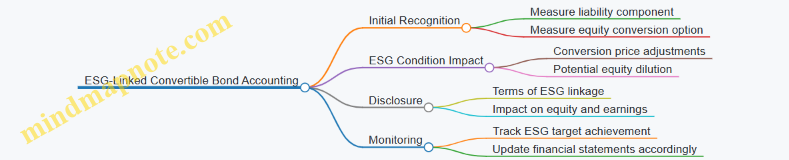
Summary
Integrating ESG considerations into equity reporting is no longer optional but a necessity. Accountants and equity analysts must understand how ESG factors influence equity transactions, valuation, and disclosures. By adopting best practices and leveraging ESG frameworks, professionals can enhance transparency, meet stakeholder expectations, and contribute to sustainable investment decisions.
12.4 Best Practices for Staying Current with Industry Changes
Staying current with industry changes in equity accounting is crucial for accountants and equity analysts to ensure compliance, accuracy, and strategic decision-making. The financial landscape is continuously evolving due to new regulations, technological advancements, and market dynamics. Below is a comprehensive guide with best practices, mind maps, and examples to help professionals remain up-to-date.
Best Practices Overview
- Continuous Education and Training
- Leveraging Professional Networks and Communities
- Utilizing Technology and Automation Tools
- Monitoring Regulatory Updates and Standards
- Engaging with Industry Publications and Research
- Implementing Feedback Loops and Internal Reviews
Mind Map: Staying Current with Industry Changes
Continuous Education and Training
Description: Regularly attending webinars, workshops, and certification courses helps professionals grasp new accounting standards and emerging trends.
Example: An equity analyst enrolls in the latest IFRS 17 training to understand its impact on equity instruments and related disclosures.
Leveraging Professional Networks and Communities
Description: Engaging with peers through forums, LinkedIn groups, and professional bodies facilitates knowledge sharing and early awareness of changes.
Example: An accountant joins the AICPA Equity Accounting Committee, gaining access to exclusive updates and expert discussions.
Utilizing Technology and Automation Tools
Description: Using accounting software with built-in update notifications and AI-driven analytics ensures real-time compliance and insights.
Example: A finance team implements an ERP system that automatically updates equity accounting modules when new standards are released.
Monitoring Regulatory Updates and Standards
Description: Subscribing to official IASB, FASB, and SEC newsletters and tracking their websites helps professionals stay informed on regulatory changes.
Example: An equity analyst sets up email alerts for FASB Exposure Drafts related to equity instruments.
Engaging with Industry Publications and Research
Description: Reading journals, newsletters, and authoritative blogs provides deeper insights into practical implications and case studies.
Example: An accountant regularly reviews the Journal of Accountancy for articles on recent equity transaction case rulings.
Implementing Feedback Loops and Internal Reviews
Description: Conducting periodic internal audits and peer reviews ensures that equity accounting practices remain aligned with current standards.
Example: A company schedules quarterly internal reviews to verify that equity transactions are recorded per the latest GAAP updates.
Mind Map: Technology Tools for Staying Updated

Practical Example: Implementing a Continuous Learning Program
Scenario: A mid-sized investment firm wants to ensure its accounting and equity analysis teams stay current with evolving equity accounting standards.
Steps Taken:
- Subscription to Regulatory Updates: The firm subscribes to IASB and FASB newsletters.
- Monthly Training Sessions: Organizes monthly webinars featuring industry experts.
- Technology Integration: Implements an accounting software with automatic updates for equity transactions.
- Professional Memberships: Encourages team members to join relevant professional bodies.
- Internal Knowledge Sharing: Creates a shared repository of articles, case studies, and FAQs.
Outcome: The firm reduces compliance errors by 30% and improves the accuracy of equity transaction reporting.
By integrating these best practices, accountants and equity analysts can proactively adapt to industry changes, ensuring both compliance and strategic advantage in their roles.
12.5 Practical Example: Implementing New Equity Accounting Software
Implementing new equity accounting software is a critical step for finance and investment professionals aiming to improve accuracy, efficiency, and compliance in managing equity transactions. This example will guide you through the key stages of implementation, highlight best practices, and provide mind maps to visualize the process.
Step 1: Needs Assessment and Requirement Gathering
Before selecting software, it’s essential to understand your organization’s specific equity accounting needs.
- Identify types of equity transactions handled (e.g., stock issuance, buybacks, options).
- Determine regulatory and reporting requirements (IFRS, US GAAP).
- Assess integration needs with existing ERP or financial systems.
- Evaluate user roles and access controls.
Mind Map: Needs Assessment
Step 2: Software Selection
Choose software that aligns with the gathered requirements. Consider:
- Feature set (journal entry automation, fair value calculations, reporting).
- User interface and ease of use.
- Customization capabilities.
- Vendor support and training.
- Cost and scalability.
Example:
A mid-sized investment firm selects “EquiTrack Pro” because it supports complex equity instruments, integrates with their ERP, and offers real-time reporting.
Step 3: Data Migration and Configuration
Migrate existing equity data accurately:
- Map old data fields to new software fields.
- Validate data integrity.
- Configure software settings for your chart of accounts, equity categories, and reporting templates.
Mind Map: Data Migration & Configuration

Example:
The firm exports equity transaction history from their legacy system, cleans the data to remove duplicates, and imports it into EquiTrack Pro with mapped fields for share classes and transaction dates.
Step 4: User Training and Testing
- Conduct training sessions tailored to accountants and equity analysts.
- Perform parallel runs comparing outputs from old and new systems.
- Test key functionalities: journal entries, stock option valuation, dividend processing.
Example:
Accountants perform test entries for a stock issuance and a treasury stock buyback. Equity analysts verify that option fair value calculations match manual computations.
Step 5: Go-Live and Post-Implementation Review
- Transition fully to the new software.
- Monitor for errors or discrepancies.
- Gather user feedback for continuous improvement.
Mind Map: Post-Implementation Review
Example:
After go-live, the firm identifies minor discrepancies in dividend calculations, which are quickly resolved through vendor support and software patching.
Summary Table: Implementation Phases and Key Activities
| Phase | Key Activities | Best Practices |
|---|---|---|
| Needs Assessment | Identify requirements, compliance, integration | Involve cross-functional teams |
| Software Selection | Evaluate features, cost, scalability | Conduct demos and reference checks |
| Data Migration | Map and validate data | Backup data and perform test imports |
| Training & Testing | Train users, parallel runs | Use real transaction scenarios |
| Go-Live & Review | Monitor, collect feedback | Establish support channels and update plan |
Final Notes
Implementing new equity accounting software is a strategic investment that enhances accuracy and transparency in equity transactions. By following a structured approach and leveraging best practices, accountants and equity analysts can ensure a smooth transition and maximize the software’s benefits.
For further reading, consider exploring case studies of firms that successfully implemented equity accounting solutions and the impact on their financial reporting quality.
13. Summary and Best Practice Checklist
13.1 Recap of Key Concepts and Accounting Principles
Accounting for equity transactions is fundamental in reflecting a company’s financial health and ownership structure. This section revisits the essential concepts and principles that guide accurate and transparent equity accounting.
Mind Map: Key Concepts in Equity Accounting
Core Accounting Principles Recap
Equity vs. Liability Classification
- Instruments must be carefully classified based on contractual obligations.
- Example: A convertible bond has both liability (debt) and equity components.
Initial Measurement at Fair Value
- Equity instruments are generally recorded at the fair value of the consideration received.
- Example: Issuing 10,000 shares at $5 each results in $50,000 credited to equity accounts.
Components of Equity
- Share Capital (par or stated value)
- Additional Paid-in Capital (amount received over par)
- Retained Earnings
- Treasury Stock (contra-equity account)
Accounting for Treasury Stock
- Treasury stock is recorded at cost and reduces total equity.
- Example: Company repurchases 1,000 shares at $10 each, treasury stock debited $10,000.
Equity-Based Compensation
- Recognize expense based on fair value of stock options over the vesting period.
- Example: Granting stock options valued at $20,000 over 4 years results in $5,000 expense per year.
Dividends
- Dividends reduce retained earnings when declared.
- Stock dividends reclassify amounts within equity without changing total equity.
Mind Map: Accounting Entries Overview
Practical Example: End-to-End Equity Issuance and Buyback
Scenario:
- A company issues 5,000 shares at $10 par value with a $15 issue price.
- Later, it repurchases 1,000 shares at $20 each as treasury stock.
Journal Entries:
| Transaction | Debit | Credit |
|---|---|---|
| Issue shares | Cash $75,000 | Share Capital $50,000 |
| Additional Paid-in Capital $25,000 | ||
| Buyback shares (Treasury) | Treasury Stock $20,000 | Cash $20,000 |
Explanation:
- The company receives $75,000 cash (5,000 shares × $15).
- Share capital credited at par value ($10 × 5,000 = $50,000).
- Additional paid-in capital is the excess ($25,000).
- Treasury stock reduces equity by $20,000 when shares are repurchased.
This recap consolidates the foundational knowledge required for accurate equity accounting, ensuring clarity and compliance in financial reporting.
13.2 Comprehensive Best Practices for Equity Transactions
Accounting for equity transactions requires precision, clarity, and adherence to standards to ensure accurate financial reporting and informed decision-making. Below is a detailed guide of best practices, supported by mind maps and practical examples to help accountants and equity analysts navigate this complex area effectively.
Best Practices Mind Map
Detailed Best Practices with Examples
Initial Recognition & Measurement
- Best Practice: Clearly distinguish equity instruments from liabilities using definitions in IFRS (IAS 32) or US GAAP.
- Example: A company issues common stock for $1,000,000. Record as:
Dr Cash 1,000,000
  Cr Common Stock (par value) 100,000
  Cr Additional Paid-in Capital 900,000
Share Capital & APIC Management
- Best Practice: Maintain separate ledger accounts for par value and APIC to enhance transparency.
- Example: Issuance of 10,000 shares with $1 par value at $15 each:
Dr Cash 150,000
  Cr Common Stock 10,000
  Cr Additional Paid-in Capital 140,000
Treasury Stock & Buybacks
- Best Practice: Record treasury stock at cost and disclose the method used.
- Example: Company buys back 1,000 shares at $20 each:
Dr Treasury Stock 20,000
  Cr Cash 20,000
Equity-Based Compensation
- Best Practice: Use fair value measurement models (e.g., Black-Scholes) and recognize expense over vesting period.
- Example: Grant of stock options valued at $50,000 over 4 years:
Dr Compensation Expense 12,500
  Cr Additional Paid-in Capital - Stock Options 12,500
Convertible Securities
- Best Practice: Separate liability and equity components at issuance using the ‘with-and-without’ method.
- Example: Convertible bond issued for $1,000,000 with $900,000 liability and $100,000 equity components.
Dr Cash 1,000,000
  Cr Convertible Bond Liability 900,000
  Cr Equity Component - Conversion Option 100,000
Equity Restructuring
-
Best Practice: Account for stock splits by adjusting share count and par value without changing total equity.
-
Example: 2-for-1 stock split on 10,000 shares with $1 par value:
-
Shares increase to 20,000
-
Par value reduces to $0.50
No journal entry required; disclose in notes.
Dividends & Distributions
- Best Practice: Record dividend declaration as a liability and payment as a reduction in cash.
- Example: Declare $0.50 per share dividend on 10,000 shares:
Dr Retained Earnings 5,000
  Cr Dividends Payable 5,000
Upon payment:
Dr Dividends Payable 5,000
  Cr Cash 5,000
Disclosure & Reporting
- Best Practice: Provide detailed notes on equity transactions including nature, terms, and impact.
- Example: Disclose stock option plans, treasury stock transactions, and dividend policies clearly.
Error Prevention & Correction
- Best Practice: Conduct periodic reconciliations of equity accounts and promptly correct misstatements.
- Example: If treasury stock was overstated by $2,000, adjust with:
Dr Treasury Stock 2,000
  Cr Retained Earnings 2,000
Staying Current
- Best Practice: Keep abreast of changes in accounting standards and leverage software tools for accuracy.
- Example: Implement equity accounting modules in ERP systems to automate complex transactions.
Summary
By following these comprehensive best practices, accountants and equity analysts can ensure accurate, transparent, and compliant accounting for equity transactions. The integration of clear measurement, diligent record-keeping, and thorough disclosures will enhance financial statement reliability and stakeholder confidence.
13.3 Practical Tips for Accountants and Equity Analysts
Accounting for equity transactions requires precision, clarity, and a thorough understanding of both accounting standards and business context. Below are practical tips tailored for accountants and equity analysts to enhance accuracy and insight in equity accounting.
Tip 1: Maintain Clear Distinction Between Equity and Liabilities
- Always evaluate the substance over form when classifying instruments.
- Use the definition criteria from IFRS IAS 32 or US GAAP ASC 480 to distinguish.
Example: A company issues a preferred share that mandates redemption at a fixed date. This is classified as a liability, not equity, because of the redemption obligation.
Tip 2: Document and Track Share Capital and APIC Separately
- Maintain detailed ledgers for par value, additional paid-in capital, and treasury stock.
- This improves transparency and eases audit processes.
Example: When issuing 10,000 shares with $1 par value at $5 per share, record $10,000 in share capital and $40,000 in APIC.
Tip 3: Use Consistent Valuation Methods for Equity-Based Compensation
- Apply fair value measurement at grant date.
- Use recognized models like Black-Scholes or binomial models.
- Recognize expense over vesting period.
Example: Granting 1,000 stock options with a fair value of $10 each, vesting over 4 years, requires recognizing $2,500 expense annually.
Tip 4: Monitor Treasury Stock Transactions Closely
- Record treasury stock at cost.
- Avoid recognizing gains or losses on reissuance.
- Disclose treasury stock movements clearly.
Example: Company buys back 5,000 shares at $20 each. Treasury stock is debited $100,000. If reissued at $25, credit cash $125,000 and credit APIC $25,000.
Tip 5: Prepare for Complex Transactions Like Convertible Instruments
- Separate liability and equity components at issuance.
- Use effective interest method for amortization.
- Update equity balances upon conversion.
Example: Issuing $1,000,000 convertible bonds with $800,000 liability and $200,000 equity component. Interest expense is calculated on $800,000.
Tip 6: Ensure Timely and Transparent Disclosures
- Follow regulatory requirements strictly.
- Include detailed notes on equity transactions.
- Highlight changes in share capital, stock options, and treasury stock.
Example: Disclose a stock split by stating the ratio, date, and impact on number of shares and par value.
Tip 7: Leverage Technology and Automation
- Use accounting software with equity management modules.
- Automate journal entries for recurring transactions.
- Maintain audit trails for all equity movements.
Example: Implementing an equity management system that automatically records stock option vesting and exercises, reducing manual errors.
Tip 8: Collaborate Closely Between Accountants and Equity Analysts
- Share insights on market conditions affecting equity instruments.
- Align accounting treatment with investment analysis.
- Jointly review complex transactions for accuracy.
Example: Equity analysts provide valuation inputs for stock options, while accountants ensure proper expense recognition and disclosure.
By integrating these practical tips, accountants and equity analysts can improve the accuracy, transparency, and usefulness of equity transaction accounting, ultimately supporting better financial decision-making and reporting.
13.4 Frequently Asked Questions (FAQs) on Accounting for Equity Transactions
Q1: What is the difference between equity and liability in accounting?
Answer: Equity represents the ownership interest in the company, while liabilities are obligations the company must settle. The classification depends on the substance of the instrument and contractual terms.
Example:
- Common stock is equity.
- Convertible bonds have both liability (debt) and equity components.
Q2: How do you account for treasury stock?
Answer: Treasury stock is recorded at cost as a contra-equity account, reducing total shareholders’ equity.
Example: If a company buys back 1,000 shares at $10 each, debit Treasury Stock $10,000 and credit Cash $10,000.
Q3: When should stock options be expensed?
Answer: Stock options should be expensed over the vesting period based on their fair value at grant date.
Example: A grant of options valued at $50,000 with a 4-year vesting period results in an annual expense of $12,500.
Q4: How are stock splits accounted for?
Answer: Stock splits increase the number of shares outstanding but do not change total equity. Par value per share is adjusted accordingly.
Example: A 2-for-1 stock split doubles shares and halves par value per share.
Q5: What disclosures are required for equity transactions?
Answer: Disclosures include details on share capital, stock options, treasury stock, dividends, and any changes in equity components.
Mind Map: Key FAQ Topics in Equity Accounting
Mind Map: Stock Option Accounting FAQ Breakdown
Example Scenario: Correcting an Equity Accounting Error
Situation: A company mistakenly classified a convertible bond entirely as a liability instead of splitting it into liability and equity components.
Correction Steps:
- Recalculate the equity component using the residual method.
- Adjust the balance sheet to reflect the split.
- Restate prior financial statements if material.
Journal Entry:
- Debit Convertible Bonds Payable (liability) for the equity portion.
- Credit Additional Paid-in Capital (equity) for the same amount.
Mind Map: Common Equity Accounting Errors and Solutions
This FAQ section aims to clarify common doubts and provide practical guidance with examples and visual mind maps to reinforce understanding for accountants and equity analysts.
13.5 Final Practical Example: End-to-End Equity Transaction Accounting
In this section, we will walk through a comprehensive, step-by-step example of an end-to-end equity transaction accounting scenario. This will integrate the key concepts and best practices covered throughout the blog, providing a practical framework for accountants and equity analysts.
Scenario Overview
ABC Corporation, a publicly traded company, undertakes the following equity transactions in a fiscal year:
- Issuance of 100,000 common shares at $15 per share (par value $1)
- Issuance of 10,000 preferred shares at $50 per share (no par value)
- Granting stock options to employees: 5,000 options with an exercise price of $12, vesting over 2 years
- Buyback of 20,000 common shares at $18 per share
- Declaration and payment of a cash dividend of $0.50 per common share
We will account for each transaction, illustrating journal entries, equity impacts, and disclosures.
Mind Map: Equity Transactions Flow
Step 1: Issuance of Common Shares
- Shares issued: 100,000
- Issue price: $15
- Par value: $1
Calculation:
- Total proceeds = 100,000 × $15 = $1,500,000
- Par value portion = 100,000 × $1 = $100,000
- Additional Paid-in Capital (APIC) = $1,500,000 - $100,000 = $1,400,000
Journal Entry:
| Account | Debit ($) | Credit ($) |
|---|---|---|
| Cash | 1,500,000 | |
| Common Stock (at par) | 100,000 | |
| Additional Paid-in Capital | 1,400,000 |
Step 2: Issuance of Preferred Shares
- Shares issued: 10,000
- Issue price: $50
- No par value
Journal Entry:
| Account | Debit ($) | Credit ($) |
|---|---|---|
| Cash | 500,000 | |
| Preferred Stock | 500,000 |
Step 3: Granting Stock Options
- Options granted: 5,000
- Exercise price: $12
- Fair value per option: $5 (determined by Black-Scholes model)
- Vesting period: 2 years
Accounting Treatment:
- Total compensation expense = 5,000 × $5 = $25,000
- Recognize expense over 2 years = $12,500 per year
Journal Entry (Year 1):
| Account | Debit ($) | Credit ($) |
|---|---|---|
| Compensation Expense | 12,500 | |
| Additional Paid-in Capital - Stock Options | 12,500 |
Journal Entry (Year 2):
| Account | Debit ($) | Credit ($) |
|---|---|---|
| Compensation Expense | 12,500 | |
| Additional Paid-in Capital - Stock Options | 12,500 |
Step 4: Buyback of Common Shares
- Shares bought back: 20,000
- Price paid: $18
Total cost = 20,000 × $18 = $360,000
Assuming treasury stock method:
Journal Entry:
| Account | Debit ($) | Credit ($) |
|---|---|---|
| Treasury Stock | 360,000 | |
| Cash | 360,000 |
Impact:
- Treasury stock reduces total shareholders’ equity
Step 5: Declaration and Payment of Cash Dividends
- Dividend per share: $0.50
- Shares outstanding before buyback: 100,000
- Shares outstanding after buyback: 80,000 (100,000 - 20,000)
Total dividend = 80,000 × $0.50 = $40,000
Declaration Date Journal Entry:
| Account | Debit ($) | Credit ($) |
|---|---|---|
| Retained Earnings | 40,000 | |
| Dividends Payable | 40,000 |
Payment Date Journal Entry:
| Account | Debit ($) | Credit ($) |
|---|---|---|
| Dividends Payable | 40,000 | |
| Cash | 40,000 |
Summary Table of Journal Entries
| Transaction | Debit Account | Credit Account | Amount ($) |
|---|---|---|---|
| Common Shares Issuance | Cash | Common Stock (par) | 100,000 |
| Additional Paid-in Capital | 1,400,000 | ||
| Cash | 1,500,000 | ||
| Preferred Shares Issuance | Cash | Preferred Stock | 500,000 |
| Stock Options Expense Y1 | Compensation Expense | APIC - Stock Options | 12,500 |
| Stock Options Expense Y2 | Compensation Expense | APIC - Stock Options | 12,500 |
| Buyback of Shares | Treasury Stock | Cash | 360,000 |
| Dividend Declaration | Retained Earnings | Dividends Payable | 40,000 |
| Dividend Payment | Dividends Payable | Cash | 40,000 |
Mind Map: Journal Entries and Equity Impact
Best Practices Illustrated
- Accurate classification: Distinguishing between par value and APIC ensures correct equity presentation.
- Expense recognition: Properly recognizing stock option expense over the vesting period aligns with accounting standards.
- Treasury stock accounting: Recording buybacks as treasury stock maintains transparency in equity changes.
- Dividend accounting: Declaring dividends reduces retained earnings and creates a payable liability until payment.
- Comprehensive disclosures: Each transaction should be clearly disclosed in notes to financial statements.
Conclusion
This end-to-end example demonstrates how to handle multiple equity transactions cohesively. By following these steps and best practices, accountants and equity analysts can ensure accurate financial reporting and insightful equity analysis.
For further reading, refer to sections 2 through 12 for detailed explanations of each transaction type and their accounting nuances.