Investment Strategies for Accountants
1. Introduction to Investment Strategies for Accountants
1.1 Understanding the Role of Accountants in Investment Planning
Accountants play a pivotal role in investment planning, serving as trusted advisors who bridge the gap between financial data and strategic investment decisions. Their expertise in financial analysis, tax implications, and regulatory compliance uniquely positions them to guide clients toward sound investment choices that align with their financial goals.
Key Responsibilities of Accountants in Investment Planning
- Financial Analysis: Accountants analyze clients’ financial statements to assess their current financial health and capacity for investment.
- Tax Planning: They identify tax-efficient investment opportunities and strategies to minimize tax liabilities.
- Risk Assessment: Accountants evaluate the risk tolerance of clients based on their financial situation and investment objectives.
- Compliance and Reporting: Ensuring that investment activities comply with relevant laws and regulations.
- Strategic Advice: Providing recommendations on asset allocation, portfolio diversification, and investment vehicles.
Mind Map: Role of Accountants in Investment Planning
Example 1: Helping a Client Understand Investment Capacity
Scenario: A client approaches an accountant seeking advice on how much they can invest without jeopardizing their monthly expenses.
Approach: The accountant reviews the client’s income statements and cash flow, identifying discretionary income available for investment. They create a budget forecast to ensure essential expenses and emergency funds are maintained.
Outcome: The client gains clarity on a safe investment amount, reducing financial stress and enabling confident investment decisions.
Example 2: Tax-Efficient Investment Strategy
Scenario: An accountant advises a client who recently received a significant bonus and wants to invest while minimizing tax impact.
Approach: The accountant recommends contributing to tax-advantaged accounts such as IRAs or 401(k)s and explains the benefits of long-term capital gains tax rates versus short-term. They also suggest tax-loss harvesting opportunities in the client’s existing portfolio.
Outcome: The client maximizes after-tax returns and improves overall investment efficiency.
Mind Map: Tax Planning Role in Investment
Why Accountants Are Essential in Investment Planning
- Holistic Financial View: Accountants understand the full financial picture, enabling tailored investment strategies.
- Regulatory Expertise: They ensure investments comply with tax laws and financial regulations.
- Risk Mitigation: Through detailed financial analysis, accountants help clients avoid overexposure to risk.
- Long-Term Planning: Accountants assist in aligning investments with retirement and estate planning.
By integrating financial expertise with investment knowledge, accountants empower clients to make informed, strategic investment decisions that foster financial growth and security.
1.2 Key Investment Principles Every Accountant Should Know
As accountants, understanding core investment principles is essential not only for managing your own finances but also for advising clients effectively. These principles form the foundation of sound investment decisions and help in aligning strategies with financial goals.
Principle 1: Risk and Return Are Inextricably Linked
Investments that offer higher potential returns usually come with higher risks. Accountants must evaluate how much risk a client is willing and able to take.
- Example: A young professional with a long investment horizon might tolerate high volatility in stocks for greater growth, while a retiree may prefer stable bonds.
Principle 2: Diversification Reduces Risk
Spreading investments across various asset classes and sectors minimizes the impact of any single investment’s poor performance.
- Example: Instead of investing solely in technology stocks, an accountant might advise a client to include bonds, real estate, and international equities.
Principle 3: Time Horizon Influences Investment Choices
The length of time before funds are needed affects the risk profile and asset allocation.
- Example: A client saving for a house in 3 years should prioritize capital preservation, while retirement savings 30 years away can afford more aggressive growth.
Principle 4: The Power of Compounding
Reinvested earnings generate earnings themselves, leading to exponential growth over time.
- Example: Investing $5,000 annually at 7% returns grows significantly more over 30 years compared to 10 years.
Principle 5: Market Efficiency and Behavioral Biases
Markets generally price assets efficiently, but investors’ emotions can lead to irrational decisions.
- Example: An accountant advising clients to avoid panic selling during market dips and to stick to their investment plan.
Principle 6: Liquidity Matters
Investments should align with the client’s need for access to cash without significant loss.
- Example: Keeping an emergency fund in highly liquid assets like money market funds or savings accounts.
Summary Example: Applying Principles to a Client Profile
Client: 35-year-old professional, moderate risk tolerance, saving for retirement in 30 years.
- Risk & Return: Focus on growth assets like equities but include bonds for balance.
- Diversification: Invest across sectors and geographies.
- Time Horizon: Long-term allows for higher risk tolerance.
- Compounding: Encourage consistent contributions to maximize growth.
- Behavior: Educate client to avoid emotional reactions during market volatility.
- Liquidity: Maintain an emergency fund in liquid assets.
This integrated approach ensures the client’s portfolio aligns with their financial goals and risk capacity.
By mastering these key investment principles, accountants can confidently guide clients through complex financial landscapes, ensuring strategies are both practical and aligned with best practices.
1.3 Aligning Investment Strategies with Client Financial Goals
Aligning investment strategies with client financial goals is fundamental for accountants acting as financial planners or advisors. Understanding the client’s unique objectives, risk tolerance, and time horizon allows for tailored investment plans that maximize the potential for success while managing risk appropriately.
Key Steps to Align Investment Strategies with Client Goals
- Identify Client Financial Goals: Short-term, medium-term, and long-term goals.
- Assess Risk Tolerance: Conservative, moderate, or aggressive.
- Determine Time Horizon: When the client needs access to funds.
- Evaluate Current Financial Situation: Income, expenses, debts, and existing investments.
- Develop an Investment Plan: Asset allocation, diversification, and investment vehicles.
- Monitor and Adjust: Regular reviews to stay aligned with evolving goals.
Mind Map: Aligning Investment Strategies with Client Financial Goals
Example 1: Aligning Strategy for a Conservative Client Saving for Retirement
Client Profile:
- Age: 45
- Goal: Retirement at 65
- Risk Tolerance: Conservative
- Current Savings: $100,000
- Annual Contribution: $10,000
Strategy:
- Focus on capital preservation and steady growth.
- Asset allocation: 60% bonds, 30% blue-chip equities, 10% cash equivalents.
- Use tax-advantaged retirement accounts.
- Regularly review portfolio every 6-12 months.
Outcome:
- Lower volatility portfolio aligned with client’s comfort level.
- Steady growth to meet retirement funding needs.
Example 2: Aligning Strategy for an Aggressive Client Planning for a House Purchase
Client Profile:
- Age: 30
- Goal: Save $50,000 for a house down payment in 5 years
- Risk Tolerance: Aggressive
- Current Savings: $10,000
- Annual Contribution: $8,000
Strategy:
- Balanced approach with higher equity exposure for growth.
- Asset allocation: 70% equities (including growth stocks), 20% bonds, 10% cash.
- Use a mix of ETFs and mutual funds for diversification.
- Quarterly portfolio reviews to adjust for market changes.
Outcome:
- Potential for higher returns to meet the 5-year goal.
- Acceptable risk level given the time horizon and client’s tolerance.
Practical Tips for Accountants
- Use questionnaires or interviews to accurately gauge client goals and risk tolerance.
- Document client goals clearly and revisit them regularly.
- Educate clients on the trade-off between risk and return.
- Incorporate cash flow analysis to ensure investment plans are realistic.
- Leverage technology tools for scenario analysis and portfolio simulation.
By systematically aligning investment strategies with client financial goals, accountants can provide personalized, effective advice that builds trust and drives long-term financial success.
1.4 Case Study: How an Accountant Helped a Small Business Owner Build Wealth
In this case study, we explore how an accountant leveraged their financial expertise to guide a small business owner through effective investment strategies, ultimately helping them build sustainable wealth.
Background
Client Profile:
- Name: Sarah Thompson
- Business: Boutique Marketing Agency
- Age: 38
- Financial Goal: Build wealth for retirement and expand business operations
Sarah had steady business income but limited knowledge of investment options and wealth management. She sought advice from her accountant to create a clear investment plan aligned with her financial goals.
Step 1: Comprehensive Financial Assessment
The accountant began by assessing Sarah’s current financial situation:
- Business cash flow and profitability
- Personal income and expenses
- Existing savings and investments
- Debt obligations
- Risk tolerance and time horizon
Mind Map: Financial Assessment
Example: Sarah’s business generated $150,000 annual profit, with $50,000 personal savings and no significant debts. She was moderately risk-tolerant with a 20-year investment horizon.
Step 2: Setting Clear Investment Objectives
Together, they defined SMART goals:
- Save $1 million for retirement in 20 years
- Maintain liquidity for business expansion
- Minimize tax liabilities
Mind Map: Investment Objectives
Step 3: Designing a Diversified Portfolio
The accountant recommended a diversified portfolio balancing growth and liquidity:
- 60% in equities (index funds, dividend stocks)
- 25% in bonds (corporate and government)
- 10% in real estate investment trusts (REITs)
- 5% in cash equivalents for emergencies
Example: Sarah invested $30,000 initially, allocating $18,000 to low-cost index funds, $7,500 to bonds, $3,000 to REITs, and kept $1,500 in a high-yield savings account.
Mind Map: Portfolio Allocation
Step 4: Tax-Efficient Strategies
To minimize tax impact, the accountant advised:
- Using a Roth IRA for retirement savings to allow tax-free growth
- Employing tax-loss harvesting to offset capital gains
- Maximizing contributions to tax-advantaged accounts
Example: Sarah contributed the maximum allowed to her Roth IRA annually and reviewed her portfolio yearly to sell underperforming assets and realize losses.
Step 5: Regular Monitoring and Rebalancing
The accountant set up quarterly reviews to:
- Track portfolio performance
- Rebalance asset allocation to maintain target percentages
- Adjust strategy based on changes in Sarah’s business or personal goals
Mind Map: Monitoring & Rebalancing
Example: After a strong equity market run, equities grew to 70% of the portfolio. The accountant recommended selling some equities to buy bonds and cash equivalents, restoring the 60/25/10/5 balance.
Outcome After 5 Years
- Portfolio grew from $30,000 to approximately $60,000
- Sarah maintained liquidity for a business expansion opportunity
- Tax-efficient strategies saved an estimated $3,000 in taxes
- Sarah felt confident and educated about her investments
Key Takeaways
- Accountants can leverage their financial expertise to build personalized investment strategies.
- Comprehensive assessment and clear goal-setting are foundational.
- Diversification and tax efficiency enhance long-term wealth building.
- Regular monitoring ensures the portfolio adapts to changing circumstances.
This case study exemplifies how accountants can go beyond traditional bookkeeping to become trusted financial advisors, empowering clients like Sarah to achieve their wealth-building goals.
2. Fundamental Investment Concepts and Best Practices
2.1 Risk vs. Return: Balancing Client Portfolios
Understanding Risk and Return
Risk and return are fundamental concepts in investment management. The basic principle is that higher potential returns usually come with higher risk. As accountants advising clients, understanding this relationship helps in constructing portfolios that align with clients’ risk tolerance and financial goals.
Types of Investment Risks
- Market Risk: The risk of losses due to market fluctuations.
- Credit Risk: Risk that a bond issuer may default.
- Liquidity Risk: Difficulty in selling an asset quickly without loss.
- Inflation Risk: The risk that inflation erodes purchasing power.
Mind Map: Key Components of Risk vs. Return
Balancing Client Portfolios
Balancing risk and return involves diversifying investments and tailoring asset allocation to the client’s profile.
Step 1: Assess Client Risk Tolerance
- Conservative: Prefers low risk, stable returns.
- Moderate: Willing to accept some risk for growth.
- Aggressive: Comfortable with high risk for maximum returns.
Step 2: Define Time Horizon
- Short-term (0-3 years): Focus on capital preservation.
- Medium-term (3-10 years): Balanced growth and income.
- Long-term (10+ years): Growth-oriented investments.
Step 3: Construct Portfolio
- Conservative Example:
- 60% Bonds
- 30% Blue-chip Stocks
- 10% Cash or equivalents
- Moderate Example:
- 40% Stocks
- 40% Bonds
- 20% Alternatives or cash
- Aggressive Example:
- 70% Stocks (including small-cap and international)
- 20% Bonds
- 10% Alternatives
Mind Map: Portfolio Construction Based on Risk Tolerance
Practical Example: Balancing Risk and Return for a Client
Client Profile: Sarah, 45 years old, moderate risk tolerance, 15-year time horizon, goal to save for early retirement.
Portfolio Strategy:
- 50% equities (mix of large-cap and international stocks)
- 40% bonds (mix of government and corporate bonds)
- 10% cash or short-term instruments
Rationale:
- Equities provide growth potential over the long term.
- Bonds offer income and reduce volatility.
- Cash provides liquidity for short-term needs.
Outcome:
- The portfolio balances growth with risk mitigation.
- Regular reviews ensure alignment with Sarah’s changing circumstances.
Mind Map: Example Client Portfolio
Best Practices for Accountants
- Use risk assessment questionnaires to gauge client comfort.
- Educate clients on the trade-off between risk and return.
- Recommend diversification to reduce unsystematic risk.
- Review and rebalance portfolios periodically.
Summary
Balancing risk and return is essential for successful investment planning. By understanding client profiles and applying diversification, accountants can build portfolios that meet financial goals while managing risk effectively.
2.2 Diversification Techniques Tailored for Financial Professionals
Diversification is a cornerstone of sound investment strategy, especially for accountants and financial planners who manage diverse client portfolios. It involves spreading investments across various asset classes, sectors, geographies, and instruments to reduce risk and improve the potential for returns.
Why Diversification Matters for Financial Professionals
- Risk Mitigation: Reduces the impact of any single investment’s poor performance.
- Smoother Returns: Balances volatility by combining assets that react differently to market conditions.
- Client Confidence: Demonstrates a disciplined, professional approach to managing investments.
Core Diversification Techniques
Asset Class Diversification
Invest across different asset classes such as equities, bonds, real estate, and cash equivalents.
Sector Diversification
Within equities, invest in various sectors like technology, healthcare, consumer goods, and energy.
Geographic Diversification
Include domestic and international investments to hedge against country-specific risks.
Investment Style Diversification
Combine growth, value, and income-focused investments.
Time Diversification
Stagger investments over time to reduce timing risk.
Mind Map: Diversification Techniques
Practical Examples for Accountants
Example 1: Asset Class Diversification
A client has $100,000 to invest. Instead of putting all funds into stocks, the accountant recommends:
- $50,000 in a diversified equity mutual fund
- $30,000 in government and corporate bonds
- $10,000 in a real estate investment trust (REIT)
- $10,000 in a money market fund
This allocation balances growth potential with income and stability.
Example 2: Sector and Geographic Diversification
For a client heavily invested in domestic technology stocks, the accountant suggests:
- Adding healthcare and consumer goods stocks to reduce sector concentration risk.
- Investing in international ETFs focused on developed and emerging markets to diversify geographically.
Example 3: Time Diversification Using Dollar-Cost Averaging
To reduce market timing risk, the accountant advises a client to invest $1,000 monthly over 12 months into a balanced mutual fund rather than a lump sum.
Best Practices for Accountants Implementing Diversification
- Assess Client Risk Tolerance: Tailor diversification to client comfort with risk.
- Review and Rebalance: Periodically adjust portfolios to maintain target allocations.
- Use Low-Cost Funds: ETFs and index funds can provide broad diversification at low fees.
- Educate Clients: Explain the rationale behind diversification to build trust.
Mind Map: Best Practices for Diversification
By integrating these diversification techniques and examples into your financial planning, you can help clients achieve more resilient portfolios that align with their financial goals and risk profiles.
2.3 Time Horizon and Its Impact on Investment Choices
Understanding the time horizon is crucial for accountants when advising clients on investment strategies. The time horizon refers to the length of time an investor expects to hold an investment before needing to access the funds. This factor significantly influences risk tolerance, asset allocation, and the types of investment vehicles suitable for the client.
What is Time Horizon?
- Short-Term: Less than 3 years
- Medium-Term: 3 to 10 years
- Long-Term: More than 10 years
Each category demands a different approach to risk and return.
Why Time Horizon Matters
- Risk Tolerance: Longer horizons generally allow for higher risk tolerance because short-term market volatility can be weathered.
- Liquidity Needs: Shorter horizons require more liquid and stable investments.
- Growth Potential: Longer horizons can benefit from growth-oriented assets like equities.
Mind Map: Time Horizon Impact on Investment Choices
Example 1: Short-Term Investment Strategy
Client Profile: Jane, 28, wants to save for a wedding in 2 years.
- Time Horizon: Short-term (2 years)
- Risk Tolerance: Low
- Recommended Investments:
- High-yield savings account for liquidity and safety.
- Short-term certificates of deposit (CDs) for slightly higher returns.
Rationale: Since Jane needs the money soon, preserving capital and liquidity is critical. Riskier investments like stocks could jeopardize her goal if the market dips.
Example 2: Medium-Term Investment Strategy
Client Profile: Mark, 40, planning to buy a house in 7 years.
- Time Horizon: Medium-term (7 years)
- Risk Tolerance: Moderate
- Recommended Investments:
- Balanced mutual funds combining stocks and bonds.
- Intermediate-term bond funds to reduce volatility.
Rationale: Mark can accept some market fluctuations but should avoid overly aggressive investments to protect his down payment fund.
Example 3: Long-Term Investment Strategy
Client Profile: Sarah, 35, saving for retirement in 30 years.
- Time Horizon: Long-term (30 years)
- Risk Tolerance: High
- Recommended Investments:
- Diversified equity portfolio for growth.
- Real estate investment trusts (REITs) for income and diversification.
- Growth-oriented mutual funds or ETFs.
Rationale: Sarah has time to ride out market volatility and benefit from compounding returns, so a growth-focused portfolio is appropriate.
Best Practices for Accountants
- Assess Client Goals and Time Horizon: Always start with a clear understanding of when clients will need their funds.
- Align Risk Tolerance with Time Horizon: Use the time horizon as a guide to adjust risk levels.
- Regularly Review and Adjust: Life events can change time horizons; periodic reviews ensure the strategy remains aligned.
- Educate Clients: Help clients understand why their time horizon affects investment choices to build trust and confidence.
Summary
Time horizon is a foundational element in investment planning. By categorizing clients’ goals into short, medium, and long-term horizons, accountants can tailor investment strategies that balance risk and return appropriately. This approach not only safeguards client assets but also optimizes growth potential aligned with their financial timelines.
2.4 Practical Example: Constructing a Balanced Portfolio for a Mid-Career Client
When constructing a balanced portfolio for a mid-career client, it’s essential to consider their investment goals, risk tolerance, time horizon, and current financial situation. Mid-career clients typically have 15-20 years before retirement, allowing for a moderate risk approach that balances growth and capital preservation.
Step 1: Assess Client Profile
- Age: 40-50 years
- Investment Horizon: 15-20 years
- Risk Tolerance: Moderate
- Financial Goals: Growth with some income generation
- Current Assets: $200,000 invested
- Annual Savings: $15,000
Step 2: Define Asset Allocation
A balanced portfolio often includes a mix of equities, fixed income, and alternative investments. For a mid-career client, a typical allocation might be:
- Equities: 60%
- Bonds: 30%
- Alternatives/Cash: 10%
Step 3: Select Investment Vehicles
- Equities: Large-cap stocks, index funds, and dividend-paying stocks
- Bonds: Government bonds, corporate bonds, and bond funds
- Alternatives: REITs (Real Estate Investment Trusts), commodities, or cash equivalents
Mind Map: Balanced Portfolio Construction
Step 4: Example Portfolio Breakdown
| Asset Class | Allocation | Investment Example | Rationale |
|---|---|---|---|
| Equities | 60% | S&P 500 Index Fund, Blue-chip stocks | Growth potential and dividend income |
| Bonds | 30% | U.S. Treasury Bonds, Corporate Bond Fund | Stability and income generation |
| Alternatives | 10% | Vanguard REIT ETF, Gold ETFs | Diversification and inflation hedge |
Step 5: Portfolio Implementation Example
-
Equities (60% of $200,000 = $120,000):
- $70,000 in S&P 500 Index Fund
- $30,000 in Dividend-Paying Blue-chip Stocks
- $20,000 in International Equity Fund
-
Bonds (30% = $60,000):
- $40,000 in U.S. Treasury Bonds
- $20,000 in Corporate Bond Fund
-
Alternatives (10% = $20,000):
- $15,000 in REIT ETF
- $5,000 in Gold ETF
Mind Map: Portfolio Implementation
Step 6: Monitoring and Rebalancing
Best practice is to review the portfolio at least annually or after significant market movements. Rebalancing ensures the portfolio stays aligned with the target allocation.
Example: After one year, equities have grown to 65% of the portfolio due to market gains. To rebalance:
- Sell a portion of equities
- Buy bonds or alternatives to restore the 60/30/10 allocation
Step 7: Explaining to the Client
Use simple language and visuals to help the client understand:
- Why diversification reduces risk
- How each asset class contributes to growth and stability
- The importance of staying invested through market fluctuations
Summary
Constructing a balanced portfolio for a mid-career client involves understanding their profile, setting an appropriate asset allocation, selecting suitable investments, and maintaining the portfolio through regular monitoring and rebalancing. This approach balances growth potential with risk management, helping clients progress steadily toward their financial goals.
3. Asset Allocation Strategies for Accountants
3.1 Understanding Asset Classes: Equities, Bonds, Real Estate, and Alternatives
As accountants advising clients or managing portfolios, understanding the fundamental asset classes is crucial. Each asset class has unique characteristics, risk profiles, and roles within a diversified portfolio. This section breaks down the four primary asset classes: Equities, Bonds, Real Estate, and Alternatives, with practical examples and mind maps to clarify their features and uses.
Equities (Stocks)
Equities represent ownership shares in a company. When clients invest in equities, they become partial owners and can benefit from capital appreciation and dividends.
Key Characteristics:
- Higher risk and higher potential returns compared to bonds
- Subject to market volatility
- Can provide dividend income
Example: A client invests $10,000 in shares of a technology company. Over five years, the stock price grows 8% annually, and the company pays a 2% dividend yield. This combination provides growth and income.
Mind Map: Equities
Bonds (Fixed Income)
Bonds are debt instruments where the investor lends money to an entity (government, corporation) in exchange for periodic interest payments and principal repayment at maturity.
Key Characteristics:
- Generally lower risk than equities
- Provide steady income through interest
- Sensitive to interest rate changes
Example: A client purchases a 10-year government bond with a 3% coupon rate. They receive $300 annually in interest and get the $10,000 principal back at maturity.
Mind Map: Bonds
Real Estate
Real estate investments involve purchasing physical property or real estate investment trusts (REITs). They offer income through rent and potential appreciation.
Key Characteristics:
- Tangible asset
- Provides rental income
- Can act as an inflation hedge
- Less liquid than stocks or bonds
Example: A client invests in a rental property generating $1,200 monthly rent. After expenses, the net income provides steady cash flow, and the property value appreciates over time.
Mind Map: Real Estate
Alternatives
Alternative investments include assets outside traditional stocks, bonds, and real estate, such as commodities, hedge funds, private equity, and collectibles.
Key Characteristics:
- Often less correlated with traditional markets
- Can provide diversification benefits
- May have higher fees and lower liquidity
Example: A client allocates 5% of their portfolio to gold (a commodity) to hedge against inflation and market downturns.
Mind Map: Alternatives
Summary Mind Map: Asset Classes Overview
Practical Integration Example for Accountants:
Scenario: A 45-year-old client with moderate risk tolerance seeks investment advice.
- Equities: 50% allocation to diversified stock funds for growth.
- Bonds: 30% allocation to government and corporate bonds for income and stability.
- Real Estate: 15% allocation via REITs for income and inflation protection.
- Alternatives: 5% allocation to commodities like gold for diversification.
This diversified approach balances growth, income, and risk management, aligned with the client’s financial goals and risk profile.
By mastering these asset classes, accountants can confidently guide clients in constructing well-rounded investment portfolios that meet their financial objectives.
3.2 Strategic vs. Tactical Asset Allocation Explained
Asset allocation is a foundational concept in investment management, especially for accountants who advise clients on portfolio construction. Understanding the difference between strategic and tactical asset allocation enables accountants to tailor investment strategies that align with clients’ long-term goals while taking advantage of short-term market opportunities.
What is Strategic Asset Allocation?
Strategic asset allocation (SAA) is a long-term approach where the portfolio is divided among different asset classes based on the investor’s risk tolerance, time horizon, and financial goals. It sets a baseline or target allocation that reflects the ideal balance for growth and risk management.
- Key Characteristics:
- Long-term focus (typically years or decades)
- Based on client’s objectives and risk profile
- Periodic rebalancing to maintain target allocations
Mind Map: Strategic Asset Allocation
Example:
Imagine a client, Sarah, a 40-year-old accountant planning for retirement in 25 years. Based on her moderate risk tolerance, her strategic allocation might be:
- 60% equities
- 30% bonds
- 10% real estate
This allocation is designed to balance growth with risk mitigation over the long term.
What is Tactical Asset Allocation?
Tactical asset allocation (TAA) is a more active, short-term approach where the portfolio weights are adjusted temporarily to capitalize on market inefficiencies or trends. It allows flexibility to deviate from the strategic allocation to seek higher returns or reduce risk based on market conditions.
- Key Characteristics:
- Short- to medium-term focus (months to a few years)
- Market-driven adjustments
- Requires ongoing market analysis
- Risk of increased transaction costs and timing errors
Mind Map: Tactical Asset Allocation
Example:
Continuing with Sarah’s portfolio, suppose there is a market downturn in equities but bonds are expected to underperform due to rising interest rates. A tactical move might be:
- Reduce equities from 60% to 50%
- Increase cash or short-term bonds from 10% to 20%
- Maintain real estate at 10%
This shift aims to protect capital during volatility but is temporary until market conditions improve.
Integrating Strategic and Tactical Asset Allocation
For accountants advising clients, combining both approaches can optimize portfolio performance:
- Strategic allocation provides a stable foundation aligned with client goals.
- Tactical allocation offers flexibility to respond to market changes.
Mind Map: Combined Asset Allocation Approach
Practical Example:
John, a financial planner, manages a client’s portfolio with a strategic allocation of 70% equities and 30% bonds. During a period of expected economic slowdown, John tactically reduces equities to 60% and increases bonds to 40%. After six months, when the market stabilizes, John rebalances the portfolio back to the original strategic targets.
Best Practices for Accountants
- Understand client goals and risk tolerance thoroughly before setting strategic allocations.
- Use tactical allocation sparingly and based on solid market research.
- Communicate clearly with clients about the reasons and risks of tactical shifts.
- Regularly review and rebalance portfolios to maintain alignment with strategic targets.
- Document all allocation decisions and rationale for compliance and transparency.
By mastering both strategic and tactical asset allocation, accountants can provide nuanced, dynamic investment advice that balances long-term stability with short-term opportunity, ultimately helping clients achieve their financial objectives more effectively.
3.3 Best Practices in Rebalancing Portfolios
Rebalancing a portfolio is a critical process to maintain the desired asset allocation aligned with an investor’s risk tolerance, financial goals, and market conditions. For accountants advising clients or managing their own investments, understanding and applying best practices in portfolio rebalancing ensures sustained portfolio health and risk management.
What is Portfolio Rebalancing?
Portfolio rebalancing involves adjusting the weights of assets in a portfolio back to their target allocations after market fluctuations cause drift.
Example: If a client’s target allocation is 60% equities and 40% bonds, but due to a strong equity market, equities now represent 70%, rebalancing would involve selling some equities and buying bonds to restore the 60/40 balance.
Why Rebalance?
- Maintain risk levels consistent with client objectives
- Capture gains from outperforming assets
- Avoid overexposure to any single asset class
- Discipline against emotional investing
Best Practices in Portfolio Rebalancing
Set Clear Rebalancing Triggers
- Calendar-based: Rebalance quarterly, semi-annually, or annually.
- Threshold-based: Rebalance when asset allocation drifts by a certain percentage (e.g., 5%) from target.
Example: An accountant managing a client’s portfolio sets a 5% threshold trigger. If equities move from 60% to 66%, rebalancing is initiated.
Consider Transaction Costs and Tax Implications
- Minimize trading costs by batching transactions.
- Use tax-advantaged accounts for frequent rebalancing.
- Employ tax-loss harvesting opportunities when rebalancing.
Example: When rebalancing a taxable account, the accountant sells losing positions to offset gains, reducing tax liability.
Use Automated Tools and Software
- Portfolio management software can track allocation drift and suggest rebalancing actions.
- Automation reduces human error and emotional bias.
Communicate with Clients Regularly
- Explain the rationale behind rebalancing.
- Set expectations about potential short-term costs for long-term benefits.
Document Rebalancing Decisions
- Keep records for compliance and future reference.
Mind Map: Portfolio Rebalancing Best Practices
Example Scenario: Rebalancing After Market Volatility
Client Profile:
- Target allocation: 50% equities, 30% bonds, 20% real estate
- Initial portfolio value: $1,000,000
Market Impact:
- Equities surge, increasing to 60% of portfolio
- Bonds decline to 25%
- Real estate remains stable at 15%
Rebalancing Action:
- Sell equities worth $100,000
- Buy bonds worth $50,000
- Buy real estate worth $50,000
Outcome:
- Portfolio restored to target allocation
- Risk profile maintained
Mind Map: Rebalancing Process Flow
By following these best practices, accountants can ensure portfolios remain aligned with client goals while managing risks and costs effectively. Rebalancing is not just a mechanical task but a strategic tool to optimize long-term investment outcomes.
3.4 Example: Rebalancing a Client’s Portfolio After Market Volatility
Rebalancing a portfolio is a crucial practice to maintain the desired risk-return profile aligned with a client’s financial goals. Market volatility often causes asset allocations to drift away from their target percentages, increasing risk or reducing potential returns.
Understanding Portfolio Drift
Imagine a client’s target allocation is:
- 60% equities
- 30% bonds
- 10% cash
After a period of market volatility, equities may have surged to 70%, bonds dropped to 20%, and cash remains at 10%. This shift increases the portfolio’s risk beyond what the client is comfortable with.
Mind Map: Portfolio Rebalancing Process
Step-by-Step Example
Client Profile:
- Age: 45
- Risk Tolerance: Moderate
- Target Allocation: 60% equities, 30% bonds, 10% cash
Current Portfolio After Volatility:
- Equities: 70%
- Bonds: 20%
- Cash: 10%
Step 1: Calculate the Drift
- Equities: 70% - 60% = +10%
- Bonds: 20% - 30% = -10%
- Cash: 10% - 10% = 0%
Step 2: Determine Rebalancing Threshold
- Common practice: Rebalance when an asset class deviates by more than 5% from target.
- Equities and bonds both exceed this threshold.
Step 3: Rebalancing Actions
- Sell equities worth 10% of portfolio value.
- Use proceeds to buy bonds to increase allocation by 10%.
Step 4: Consider Tax Implications
- Review capital gains on equity sales.
- If tax impact is significant, consider partial rebalancing or tax-loss harvesting.
Step 5: Communicate with Client
- Explain the need to reduce risk exposure.
- Discuss potential tax consequences.
- Agree on timing and method of rebalancing.
Mind Map: Tax-Aware Rebalancing Considerations
Practical Tips for Accountants
- Set Rebalancing Frequency: Regularly review portfolios quarterly or semi-annually.
- Use Automated Tools: Portfolio management software can flag drift and suggest trades.
- Client Education: Help clients understand why rebalancing is necessary to manage risk.
- Document Decisions: Keep detailed records for compliance and future reference.
Summary
Rebalancing after market volatility ensures the portfolio remains aligned with the client’s risk tolerance and investment objectives. By systematically monitoring asset allocation, calculating drift, and executing tax-efficient trades, accountants can help clients maintain a disciplined investment approach that mitigates risk and supports long-term growth.
4. Tax-Efficient Investment Planning
4.1 Leveraging Tax-Advantaged Accounts for Clients
Tax-advantaged accounts are essential tools that accountants can use to help clients maximize investment returns by minimizing tax liabilities. Understanding the types, benefits, and strategic uses of these accounts allows financial planners and accountants to tailor investment strategies that align with clients’ financial goals and tax situations.
What Are Tax-Advantaged Accounts?
Tax-advantaged accounts are investment or savings accounts that offer tax benefits such as tax deferral, tax exemption, or tax deductions. These benefits can significantly enhance the growth potential of investments over time.
Common Types of Tax-Advantaged Accounts
Best Practices for Leveraging Tax-Advantaged Accounts
-
Maximize Contributions Early
- Encourage clients to contribute the maximum allowed amount each year to benefit from compounding growth and tax advantages.
- Example: A 35-year-old client contributing $6,000 annually to a Roth IRA can potentially accumulate significantly more by retirement due to tax-free growth.
-
Choose the Right Account Based on Tax Situation
- Traditional IRA or 401(k) for clients seeking immediate tax deductions.
- Roth IRA for clients expecting higher tax rates in retirement.
- Example: A young professional in a low tax bracket might prefer Roth IRA contributions to enjoy tax-free withdrawals later.
-
Utilize Employer-Sponsored Plans
- Advise clients to take full advantage of employer matches in 401(k) plans as it’s essentially free money.
- Example: A client contributing 5% to their 401(k) with a 3% employer match effectively saves 8% of their salary.
-
Coordinate Multiple Accounts for Tax Efficiency
- Use a combination of accounts to balance tax deductions now and tax-free income later.
- Example: A client contributing to both a Traditional 401(k) and a Roth IRA can diversify tax exposure.
-
Consider Account-Specific Investment Options
- Some accounts offer unique investment choices or restrictions; tailor asset allocation accordingly.
Example Scenario: Leveraging Tax-Advantaged Accounts for a Client
Client Profile:
- Age: 40
- Income: $85,000/year
- Tax Bracket: 24%
- Goal: Retirement savings and college funding for two children
Strategy:
- Max out 401(k) contributions to $22,500 with employer match (assume 4%).
- Open and contribute $6,000 annually to a Roth IRA for tax-free growth.
- Establish 529 College Savings Plans for each child, contributing $3,000 annually.
Outcome:
- Immediate tax savings from 401(k) contributions reduce taxable income.
- Roth IRA grows tax-free, providing flexibility in retirement withdrawals.
- 529 plans grow tax-free when used for qualified education expenses, reducing future education costs.
Mind Map: Strategic Use of Tax-Advantaged Accounts
Summary
By understanding and leveraging tax-advantaged accounts, accountants and financial planners can create customized investment strategies that optimize tax efficiency and help clients meet their long-term financial goals. Using clear examples and mind maps, professionals can communicate these strategies effectively, ensuring clients understand the benefits and commit to disciplined investing.
4.2 Capital Gains Tax Strategies and Timing
Capital gains tax (CGT) is a critical consideration for accountants when advising clients on investment strategies. Proper understanding and timing of capital gains can significantly reduce tax liabilities and improve after-tax returns.
Understanding Capital Gains Tax
- Capital Gain: The profit realized from the sale of an asset.
- Short-term vs. Long-term Gains: Typically, assets held for more than one year qualify for long-term capital gains tax rates, which are usually lower than short-term rates.
- Tax Rates: Vary depending on jurisdiction, income level, and holding period.
Mind Map: Capital Gains Tax Basics
Key Strategies for Capital Gains Tax Management
Timing the Sale of Assets
- Hold for Long-Term: Encourage clients to hold investments for over a year to benefit from lower tax rates.
- Example:
- Client sells stock held for 11 months and pays 35% tax (short-term rate).
- If held for 13 months, tax rate drops to 15% (long-term rate), saving significant tax.
Utilizing Tax-Loss Harvesting
- Offset capital gains with capital losses by selling underperforming assets.
- Example:
- Client realizes $10,000 capital gains from selling stock A.
- Sells stock B at a $7,000 loss to offset gains.
- Net taxable gain is $3,000 instead of $10,000.
Spreading Gains Over Multiple Tax Years
- Sell portions of an investment over several years to avoid pushing income into higher tax brackets.
- Example:
- Client has $50,000 gain.
- Selling all at once pushes them into a higher tax bracket.
- Selling $25,000 gain in two consecutive years keeps them in a lower bracket.
Gifting Appreciated Assets
- Gift assets to family members in lower tax brackets who may pay less tax on capital gains.
- Example:
- Client gifts appreciated stock to adult child in a lower tax bracket.
- Child sells stock and pays lower capital gains tax.
Using Tax-Advantaged Accounts
- Holding investments in IRAs, 401(k)s, or other tax-advantaged accounts can defer or eliminate capital gains tax.
- Example:
- Client sells appreciated mutual funds within a Roth IRA—no capital gains tax due.
Mind Map: Capital Gains Tax Strategies
Practical Example: Applying Capital Gains Tax Timing
Scenario:
- Client owns 1,000 shares of a stock purchased at $20/share.
- Current price is $50/share.
- Client wants to sell but is concerned about tax impact.
Option A: Sell all now (held 10 months)
- Short-term gain: (50 - 20) * 1,000 = $30,000
- Taxed at 35% = $10,500 tax
Option B: Wait 3 months to qualify for long-term
- Long-term gain: $30,000
- Taxed at 15% = $4,500 tax
Tax Savings: $6,000 by timing sale.
Additional Tips for Accountants
- Keep detailed records of purchase dates and prices.
- Monitor client income levels to optimize timing.
- Coordinate sales with other income events (e.g., retirement, bonuses).
- Stay updated on tax law changes affecting capital gains.
By integrating these capital gains tax strategies and timing considerations into your client advisory process, you can help clients maximize their investment returns while minimizing tax liabilities.
4.3 Utilizing Tax-Loss Harvesting to Maximize Returns
Tax-loss harvesting is a powerful strategy accountants can use to help clients reduce their tax liabilities and improve after-tax returns. It involves selling securities at a loss to offset capital gains realized elsewhere in the portfolio, thereby minimizing the overall tax burden.
What is Tax-Loss Harvesting?
Tax-loss harvesting is the practice of intentionally selling investments that have declined in value to realize a loss. This loss can then be used to offset capital gains from other investments or reduce taxable income up to certain limits.
Why Accountants Should Use Tax-Loss Harvesting
- Reduce Taxable Income: Losses offset gains, lowering the tax bill.
- Improve After-Tax Returns: By minimizing taxes, clients keep more of their investment earnings.
- Portfolio Rebalancing Opportunity: Selling losing positions can help maintain desired asset allocation.
Mind Map: Tax-Loss Harvesting Overview
Step-by-Step Process
- Identify Securities with Unrealized Losses: Review the portfolio to find investments currently valued below their purchase price.
- Sell the Losing Investments: Realize the loss by selling these securities.
- Offset Capital Gains: Use the realized losses to offset any capital gains realized in the same tax year.
- Offset Ordinary Income: If losses exceed gains, up to $3,000 can offset ordinary income annually, with remaining losses carried forward.
- Reinvest Proceeds: To maintain portfolio strategy, reinvest in similar but not ‘substantially identical’ securities to avoid the wash-sale rule.
Mind Map: Wash-Sale Rule
Example 1: Simple Tax-Loss Harvesting
Scenario:
- Client owns 100 shares of XYZ Corp bought at $50/share.
- Current price is $40/share.
- Client also realized $2,000 in capital gains from other investments this year.
Action:
- Sell 100 shares of XYZ at $40, realizing a $1,000 loss (100 shares x $10 loss).
- Use $1,000 loss to offset $2,000 capital gains.
- Taxable capital gains now $1,000.
Result:
- Client pays tax on $1,000 gains instead of $2,000.
- Can reinvest proceeds in a similar but not identical security to maintain exposure.
Example 2: Avoiding the Wash-Sale Rule
Scenario:
- Client sells 200 shares of ABC Fund at a loss.
- Wants to maintain exposure to the sector.
Best Practice:
- Instead of repurchasing ABC Fund within 30 days, client buys DEF Fund, which tracks a similar sector but is not substantially identical.
Benefit:
- Loss is recognized for tax purposes.
- Portfolio exposure remains consistent.
Practical Tips for Accountants
- Monitor Client Portfolios Regularly: Identify loss positions before year-end to maximize tax benefits.
- Coordinate with Financial Planners: Ensure tax strategies align with overall investment goals.
- Educate Clients: Explain the benefits and rules to avoid confusion or unintended consequences.
- Use Technology: Portfolio management software can flag tax-loss harvesting opportunities.
Mind Map: Tax-Loss Harvesting Best Practices
By incorporating tax-loss harvesting into your client advisory services, you can help clients keep more of their investment gains and optimize their tax situations effectively. This strategy, when combined with sound investment planning, can significantly enhance long-term portfolio performance.
4.4 Case Study: Reducing Tax Burden Through Strategic Asset Location
Strategic asset location is a powerful tax-efficient investment strategy that involves placing different types of investments in accounts that provide the most favorable tax treatment. For accountants advising clients, understanding and applying this strategy can significantly reduce the client’s overall tax burden and enhance after-tax returns.
What is Asset Location?
Asset location differs from asset allocation. While asset allocation focuses on the mix of asset classes (stocks, bonds, cash, etc.), asset location focuses on where these assets are held — in taxable accounts, tax-deferred accounts (like traditional IRAs), or tax-exempt accounts (like Roth IRAs).
Why Does Asset Location Matter?
Different investments generate different types of income and gains, which are taxed differently depending on the account type:
- Taxable Accounts: Dividends, interest, and capital gains are subject to annual taxes.
- Tax-Deferred Accounts: Taxes are deferred until withdrawal; withdrawals are taxed as ordinary income.
- Tax-Exempt Accounts: Qualified withdrawals are tax-free.
By placing investments in the most tax-efficient accounts, clients can minimize taxes paid over time.
Mind Map: Strategic Asset Location Overview
Step-by-Step Example: Applying Asset Location for a Client
Client Profile:
- Age: 45
- Investment Accounts:
- Taxable brokerage account
- Traditional IRA (tax-deferred)
- Roth IRA (tax-exempt)
- Investment Goals: Long-term growth with moderate income
Current Portfolio:
- 40% Bonds
- 40% Dividend-Paying Stocks
- 20% Growth Stocks
Challenge: Bonds and dividend stocks generate taxable income, increasing the client’s annual tax bill.
Step 1: Categorize Investments by Tax Efficiency
| Investment Type | Tax Efficiency | Typical Tax Treatment in Taxable Account |
|---|---|---|
| Growth Stocks | Tax-Efficient | Capital gains taxed only upon sale |
| Dividend-Paying Stocks | Tax-Inefficient | Dividends taxed annually as ordinary or qualified income |
| Bonds | Tax-Inefficient | Interest taxed annually as ordinary income |
Step 2: Assign Investments to Optimal Accounts
| Account Type | Best Suited Investments |
|---|---|
| Taxable Account | Growth Stocks, Tax-Efficient Index Funds |
| Traditional IRA | Bonds, Dividend-Paying Stocks (tax-inefficient assets) |
| Roth IRA | High-growth stocks with potential for large tax-free gains |
Step 3: Reallocate Portfolio Based on Asset Location
- Move bonds and dividend-paying stocks into the Traditional IRA.
- Hold growth stocks in the Taxable account and Roth IRA.
Mind Map: Asset Location for Client Example
Step 4: Outcome and Benefits
- Tax Deferral: Interest and dividends in the Traditional IRA grow tax-deferred.
- Tax-Free Growth: Growth stocks in Roth IRA grow and can be withdrawn tax-free.
- Reduced Annual Taxable Income: Taxable account holds mostly growth stocks, minimizing annual taxable dividends and interest.
Real-World Example
An accountant client, Sarah, advised her client John to move his municipal bonds and high-dividend stocks into his Traditional IRA. Previously, John paid approximately $4,000 annually in taxes on bond interest and dividends. After reallocating, John’s annual taxable income from investments dropped by 60%, saving him roughly $2,400 per year in taxes. Over 10 years, this tax saving compounded, improving his net investment returns significantly.
Additional Tips for Accountants
- Review client account types and balances annually to optimize asset location.
- Consider future tax law changes that may affect the benefits of tax-deferred vs. tax-exempt accounts.
- Educate clients on the difference between asset allocation and asset location to manage expectations.
Summary
Strategic asset location is a nuanced but highly effective way for accountants to reduce their clients’ tax burdens. By understanding the tax characteristics of different investments and account types, and by thoughtfully placing assets where they will be taxed most favorably, accountants can enhance after-tax returns and help clients achieve their financial goals more efficiently.
5. Retirement Investment Strategies for Clients
5.1 Understanding Retirement Account Options and Their Benefits
As accountants and financial planners, understanding the various retirement account options available to clients is crucial for crafting effective retirement investment strategies. Each account type offers unique benefits, tax implications, and contribution limits that can significantly impact a client’s long-term financial security.
Key Retirement Account Types
Below is a mind map outlining the most common retirement account options:
Employer-Sponsored Retirement Plans
401(k) Plans:
- Clients can contribute pre-tax income, reducing taxable income today.
- Employers often match contributions, providing “free money”.
- Example: A client earning $80,000 contributes 10% ($8,000) to their 401(k). Their employer matches 50% up to 6% of salary, adding $2,400. This boosts retirement savings significantly.
403(b) Plans:
- Similar to 401(k) but designed for employees of public schools and certain non-profits.
- Contributions and benefits mirror 401(k) plans.
457(b) Plans:
- Available to government employees.
- Unique in that early withdrawals before age 59½ may not incur penalties.
Individual Retirement Accounts (IRAs)
Traditional IRA:
- Contributions may be tax-deductible depending on income and participation in employer plans.
- Earnings grow tax-deferred until withdrawal.
- Example: A client contributes $6,000 annually. If their income qualifies, they reduce taxable income by that amount, deferring taxes until retirement.
Roth IRA:
- Contributions are made with after-tax dollars.
- Qualified withdrawals are tax-free, including earnings.
- Income limits restrict eligibility.
- Example: A young professional expects to be in a higher tax bracket later, so contributing to a Roth IRA now locks in tax-free growth.
Other Retirement Accounts for Specific Client Types
SEP IRA:
- Ideal for self-employed clients or small business owners.
- Allows higher contribution limits (up to 25% of compensation).
- Example: A self-employed accountant earning $100,000 can contribute up to $25,000, reducing taxable income significantly.
SIMPLE IRA:
- Designed for small businesses with fewer than 100 employees.
- Requires employer contributions.
- Easier to administer than 401(k) plans.
Benefits Summary Mind Map
Practical Example: Choosing the Right Retirement Account
Client Profile:
- Age: 35
- Employment: Self-employed accountant
- Income: $120,000/year
- Goal: Maximize retirement savings with tax benefits
Strategy:
- Recommend opening a SEP IRA to leverage higher contribution limits.
- Supplement with a Roth IRA for tax-free growth on some savings.
- Example Calculation:
- SEP IRA contribution: 25% of $120,000 = $30,000 (tax-deductible)
- Roth IRA contribution: $6,500 (2024 limit, after-tax)
This combination allows the client to reduce taxable income substantially while also building a tax-free growth bucket for retirement.
Summary
Understanding the nuances of retirement account options empowers accountants to tailor investment strategies that align with client goals, tax situations, and employment status. By leveraging employer-sponsored plans, IRAs, and specialized accounts like SEP IRAs, accountants can optimize retirement outcomes for a diverse client base.
5.2 Designing Retirement Portfolios Based on Client Age and Risk Tolerance
Designing retirement portfolios tailored to a client’s age and risk tolerance is a cornerstone of effective financial planning. Accountants, with their deep understanding of financial data and client circumstances, are uniquely positioned to create portfolios that balance growth potential with risk management.
Understanding Client Age and Its Impact on Portfolio Design
Age is a critical factor because it influences the investment time horizon. Generally, the younger the client, the longer the investment horizon, allowing for more aggressive growth strategies. Conversely, older clients typically require more conservative portfolios to preserve capital and generate income.
Mind Map: Age-Based Portfolio Design
Example:
- A 30-year-old client might have a portfolio with 80% equities and 20% bonds.
- A 55-year-old client might shift to 60% equities and 40% bonds.
- A 65-year-old client might prefer 30% equities, 60% bonds, and 10% cash or annuities.
Assessing Risk Tolerance
Risk tolerance is the client’s ability and willingness to endure market volatility. It is influenced by psychological factors, financial situation, income stability, and investment goals.
Mind Map: Risk Tolerance Factors
Example:
- A conservative client may prefer a portfolio with 20% equities and 80% fixed income.
- An aggressive client may accept 90% equities and 10% bonds.
Combining Age and Risk Tolerance for Portfolio Construction
Integrating both factors helps tailor portfolios that suit client needs and preferences.
Mind Map: Portfolio Design Matrix
Example:
- A 45-year-old client with moderate risk tolerance might have a portfolio of 60% equities and 40% bonds.
- A 65-year-old aggressive client might still hold 30% equities but increase bonds to 60% and include 10% alternatives for income.
Practical Example: Designing a Retirement Portfolio
Client Profile:
- Age: 50
- Risk Tolerance: Moderate
- Retirement Goal: Retire at 65 with steady income
Portfolio Design:
- 55% Equities (diversified across large-cap, mid-cap, and international stocks)
- 40% Bonds (mix of government and corporate bonds)
- 5% Cash or equivalents (for liquidity)
Rationale:
- The client has 15 years until retirement, allowing for growth but with a need to reduce volatility.
- Moderate risk tolerance suggests a balanced approach.
Outcome:
- This portfolio aims to grow capital while providing some stability and income as retirement approaches.
Best Practices for Accountants
- Regularly Review Portfolios: Adjust allocations as clients age or their risk tolerance changes.
- Use Questionnaires: Employ risk tolerance surveys to quantify client preferences.
- Educate Clients: Explain the rationale behind portfolio choices to build trust.
- Scenario Analysis: Show clients potential outcomes under different market conditions.
By thoughtfully integrating client age and risk tolerance, accountants can design retirement portfolios that not only meet financial goals but also provide peace of mind through appropriate risk management.
5.3 Incorporating Annuities and Other Income-Producing Investments
Accountants advising clients on retirement investment strategies must consider income-producing investments that provide steady cash flow during retirement. Annuities and other income-generating assets can be vital components of a well-rounded retirement portfolio, especially for clients seeking predictable income streams.
Understanding Annuities
Annuities are insurance contracts designed to provide a series of payments at regular intervals, typically during retirement. They can be immediate or deferred, fixed or variable, and offer various guarantees depending on the product.
Key Types of Annuities:
- Immediate Annuities: Begin payments shortly after a lump sum is invested.
- Deferred Annuities: Accumulate value over time before payments start.
- Fixed Annuities: Provide guaranteed fixed payments.
- Variable Annuities: Payments vary based on the performance of selected investments.
Mind Map: Types of Annuities
Benefits of Annuities for Retirement Income
- Predictable Income Stream: Provides peace of mind with steady payments.
- Longevity Protection: Can be structured to pay for life, mitigating longevity risk.
- Tax Deferral: Earnings grow tax-deferred until withdrawal.
Other Income-Producing Investments
Besides annuities, several other investment types can generate income during retirement:
- Dividend-Paying Stocks: Companies that regularly distribute profits to shareholders.
- Bonds and Bond Funds: Fixed interest payments over a set period.
- Real Estate Investment Trusts (REITs): Income from property rentals.
- Preferred Stocks: Hybrid securities offering fixed dividends.
Mind Map: Income-Producing Investments
Best Practices for Incorporating Income-Producing Investments
- Assess Client’s Income Needs: Determine how much income the client requires monthly or annually.
- Evaluate Risk Tolerance: Some income investments carry more risk (e.g., variable annuities, stocks).
- Diversify Income Sources: Combine annuities with stocks, bonds, and REITs to balance growth and income.
- Consider Inflation Protection: Include investments with potential for income growth to combat inflation.
- Review Liquidity Needs: Some annuities have surrender charges or limited access to funds.
Example 1: Incorporating a Fixed Immediate Annuity
Client Profile:
- Age: 65
- Retirement income need: $30,000/year guaranteed
- Risk tolerance: Low
Strategy:
- Invest $400,000 in a fixed immediate annuity that guarantees $30,000/year for life.
- Supplement with a bond ladder to cover additional expenses and provide liquidity.
Outcome:
- Client receives a predictable income stream covering essential expenses.
- Bonds provide flexibility and potential capital preservation.
Example 2: Using Dividend Stocks and REITs for Income Growth
Client Profile:
- Age: 60
- Retirement income need: $40,000/year with growth potential
- Risk tolerance: Moderate
Strategy:
- Allocate 40% of portfolio to high-quality dividend-paying stocks with a history of increasing dividends.
- Allocate 20% to diversified REITs for income and inflation hedge.
- Remaining 40% in bonds and cash equivalents for stability.
Outcome:
- Client benefits from growing income streams and potential capital appreciation.
- Portfolio balances income generation with risk management.
Mind Map: Sample Retirement Income Portfolio
Summary
Incorporating annuities and other income-producing investments into retirement portfolios allows accountants to tailor strategies that meet clients’ income needs, risk tolerance, and liquidity preferences. By combining guaranteed income sources like annuities with growth-oriented income investments such as dividend stocks and REITs, clients can enjoy a balanced and sustainable retirement income.
Accountants should also educate clients on the trade-offs involved, including fees, liquidity constraints, and inflation risk, ensuring informed decisions that align with long-term financial goals.
5.4 Example: Creating a Retirement Plan for a Self-Employed Accountant
Planning retirement as a self-employed accountant involves unique challenges and opportunities. Without employer-sponsored plans, the accountant must proactively design a strategy that balances savings, tax efficiency, and investment growth.
Step 1: Assess Current Financial Situation and Retirement Goals
- Income Analysis: Review current annual income and expenses.
- Retirement Age: Define target retirement age (e.g., 65 years).
- Desired Retirement Lifestyle: Estimate annual retirement spending needs.
- Existing Savings: Identify current retirement savings and other assets.
Step 2: Choose Appropriate Retirement Accounts
For self-employed individuals, several tax-advantaged accounts are available:
- SEP IRA: Allows contributions up to 25% of net earnings, max $66,000 (2024).
- Solo 401(k): Higher contribution limits combining employee and employer contributions, up to $66,000 plus $7,500 catch-up if over 50.
- Traditional or Roth IRA: Additional $6,500 contribution limit.
Example:
- Accountant earns $120,000 net income.
- Max SEP IRA contribution: 25% × $120,000 = $30,000.
- Solo 401(k) could allow similar or higher contributions depending on plan design.
Step 3: Develop an Investment Portfolio Aligned with Risk Tolerance and Time Horizon
- Time Horizon: If retirement is 20 years away, a growth-oriented portfolio is suitable.
- Risk Tolerance: Moderate risk to balance growth and capital preservation.
Sample Portfolio Allocation:
| Asset Class | Percentage |
|---|---|
| U.S. Stocks | 60% |
| International Stocks | 15% |
| Bonds | 20% |
| Cash or Equivalents | 5% |
Step 4: Implement Tax-Efficient Strategies
- Maximize contributions to tax-deferred accounts (SEP IRA, Solo 401(k)).
- Consider Roth conversions during low-income years.
- Use tax-loss harvesting in taxable accounts.
Example:
- Accountant contributes $30,000 to SEP IRA, reducing taxable income.
- Invests in index funds with low turnover to minimize capital gains.
Step 5: Monitor and Adjust the Plan Annually
- Review income changes, expenses, and retirement goals.
- Rebalance portfolio to maintain target allocation.
- Adjust contributions based on cash flow.
Example:
- After a strong market year, stocks grow to 70% of portfolio; rebalance by selling some stocks and buying bonds.
Summary Table: Retirement Plan for Self-Employed Accountant
| Step | Action Item | Example Detail |
|---|---|---|
| 1. Financial Assessment | Define income, expenses, goals | $120,000 income, retire at 65 |
| 2. Choose Accounts | Select SEP IRA, Solo 401(k), IRAs | Max $30,000 SEP IRA contribution |
| 3. Portfolio Design | Allocate assets based on risk/time horizon | 60% U.S. stocks, 20% bonds |
| 4. Tax Strategies | Maximize tax-advantaged contributions | SEP IRA reduces taxable income |
| 5. Monitoring | Annual review and rebalance | Adjust portfolio after market gains |
By following this structured approach, a self-employed accountant can build a robust retirement plan that leverages tax advantages, aligns with personal goals, and adapts to changing financial circumstances.
6. Ethical Considerations and Compliance in Investment Advice
6.1 Understanding Fiduciary Responsibilities
Fiduciary responsibility is a cornerstone concept for accountants who provide investment advice or manage client assets. It refers to the legal and ethical obligation to act in the best interest of the client, placing their needs above personal gain or conflicts of interest.
What is a Fiduciary?
A fiduciary is an individual or organization entrusted with managing assets or interests on behalf of another party. For accountants, this means making decisions that prioritize the client’s financial well-being.
Key Elements of Fiduciary Duty
- Duty of Loyalty: Always act in the client’s best interest without personal conflicts.
- Duty of Care: Exercise prudence, diligence, and competence in managing investments.
- Duty of Disclosure: Fully disclose all relevant information, including potential conflicts.
Mind Map: Fiduciary Responsibilities Overview
Why Fiduciary Duty Matters for Accountants
Accountants often advise clients on investments, tax planning, and financial strategies. Upholding fiduciary duties ensures trust, reduces legal risks, and enhances client relationships.
Example 1: Avoiding Conflicts of Interest
Scenario: An accountant recommends a mutual fund from a company they have a financial stake in without disclosing this to the client.
Best Practice: The accountant must disclose the relationship or avoid recommending the fund altogether to maintain loyalty and transparency.
Mind Map: Handling Conflicts of Interest
Example 2: Exercising Duty of Care
Scenario: An accountant advises a client to invest heavily in a volatile sector without adequate research.
Best Practice: Conduct comprehensive analysis, consider client risk tolerance, and recommend diversified investments to protect client assets.
Mind Map: Exercising Duty of Care
Example 3: Duty of Disclosure
Scenario: An accountant fails to inform a client about fees associated with a recommended investment product.
Best Practice: Clearly explain all fees, potential risks, and benefits before client commitment.
Mind Map: Duty of Disclosure
Summary
For accountants, understanding and implementing fiduciary responsibilities is essential to ethical investment advising. It builds client trust, ensures compliance with regulations, and ultimately leads to better financial outcomes.
Final Thought
Always remember: acting as a fiduciary means putting your client’s interests first — a principle that should guide every investment recommendation and decision.
6.2 Navigating Regulatory Requirements for Financial Advice
Financial advisors, including accountants who provide investment guidance, must operate within a complex regulatory framework designed to protect clients and ensure ethical practices. Understanding and navigating these regulatory requirements is crucial to maintaining compliance and building client trust.
Key Regulatory Bodies and Frameworks
- Securities and Exchange Commission (SEC): Oversees securities markets and enforces federal securities laws.
- Financial Industry Regulatory Authority (FINRA): Regulates brokerage firms and exchange markets.
- State Securities Regulators: Enforce state-level securities laws.
- Investment Advisers Act of 1940: Governs the registration and conduct of investment advisers.
- Dodd-Frank Act: Introduced reforms affecting financial advisors, including fiduciary standards.
Mind Map: Regulatory Landscape for Financial Advice
Registration and Licensing Requirements
Accountants providing investment advice may need to register as investment advisers or representatives depending on the scope of their services and assets under management.
- Example: An accountant advising clients on retirement portfolios exceeding $110 million in assets must register with the SEC as a Registered Investment Adviser (RIA).
- State Registration: Smaller advisers typically register with state regulators.
Disclosure Obligations
Transparency is a cornerstone of regulatory compliance.
- Advisors must provide clients with Form ADV, detailing services, fees, conflicts of interest, and disciplinary history.
- Example: An accountant must disclose if they receive commissions from recommending certain mutual funds.
Fiduciary Duty and Best Interest Standard
- Fiduciary Duty: Requires acting in the best interest of clients, avoiding conflicts of interest.
- Best Interest Standard: Under regulations like the SEC’s Regulation Best Interest (Reg BI), brokers must act in clients’ best interests when recommending securities.
Mind Map: Core Compliance Responsibilities
Recordkeeping and Reporting
- Advisors must maintain detailed records of client communications, transactions, and advice given.
- Example: An accountant documents all investment recommendations and client approvals to demonstrate compliance during audits.
Advertising and Communication Rules
- All marketing materials must be truthful, not misleading, and compliant with regulatory standards.
- Example: Avoiding exaggerated claims such as “guaranteed returns” in client newsletters.
Practical Example: Navigating Compliance for an Accountant Offering Investment Advice
Scenario: Jane, a CPA, begins advising her clients on investment portfolios as part of her financial planning services.
- She reviews whether she needs to register as an investment adviser based on client assets.
- Jane prepares and files Form ADV to disclose her services and fees.
- She implements a compliance program including recordkeeping, client disclosures, and regular training.
- Jane ensures all client communications clearly state her fiduciary responsibilities.
- When recommending investments, she documents the rationale aligned with client goals and risk tolerance.
Summary
Navigating regulatory requirements demands a proactive approach combining knowledge, transparency, and documentation. Accountants expanding into investment advice must understand registration obligations, disclosure duties, fiduciary standards, and ongoing compliance to protect themselves and their clients.
For accountants, integrating these regulatory best practices into everyday client interactions not only ensures compliance but also strengthens client confidence and professional reputation.
6.3 Best Practices for Transparent Client Communication
Transparent communication is a cornerstone of trust and effective financial advising. For accountants providing investment advice, clear, honest, and timely communication ensures clients understand their investment choices, risks, and outcomes. This section explores best practices to foster transparency, supported by practical examples and mind maps.
Key Principles of Transparent Communication
- Clarity: Use simple, jargon-free language.
- Honesty: Disclose all relevant information, including risks and fees.
- Timeliness: Provide updates regularly and promptly.
- Responsiveness: Address client questions and concerns thoroughly.
- Documentation: Keep clear records of communications and decisions.
Mind Map: Elements of Transparent Client Communication
Best Practices Explained with Examples
-
Use Clear and Simple Language
- Avoid technical terms like “alpha,” “beta,” or “derivatives” without explanation.
- Example: Instead of saying “Your portfolio has a beta of 1.2,” say “Your portfolio is slightly more volatile than the overall market, which means it might experience bigger ups and downs.”
-
Disclose All Relevant Information
- Clearly explain all fees, including management fees, transaction costs, and any commissions.
- Example: “This mutual fund charges a 1% annual fee, which will be deducted from your investment returns.”
-
Provide Regular and Proactive Updates
- Schedule quarterly reviews and send monthly performance summaries.
- Example: Sending a monthly email with a simple chart showing portfolio growth and any important market news.
-
Encourage Questions and Provide Thoughtful Answers
- Create an environment where clients feel comfortable asking questions.
- Example: After explaining a new investment product, ask, “Do you have any questions or concerns about how this fits your goals?”
-
Use Visual Aids and Mind Maps
- Help clients visualize portfolio allocation, risk levels, and investment timelines.
- Example: Presenting a pie chart showing asset allocation or a timeline illustrating when funds might be needed.
-
Document All Communications
- Send follow-up emails summarizing meetings and decisions.
- Example: “As discussed, we agreed to increase your bond allocation to 40% to reduce risk. Please review and confirm.”
Mind Map: Communication Workflow for Accountants
Scenario Example: Transparent Communication in Action
Client Profile: Sarah, a 35-year-old professional new to investing.
- Step 1: During the first meeting, the accountant explains investment basics using simple language and visual aids.
- Step 2: The accountant discloses all fees associated with the recommended mutual funds and explains potential risks.
- Step 3: Sarah receives monthly email updates with easy-to-understand charts showing portfolio performance.
- Step 4: Sarah emails questions about market volatility; the accountant responds promptly with clear explanations.
- Step 5: After six months, a review meeting is held, and the accountant sends a summary email documenting agreed changes.
This approach builds Sarah’s confidence and trust, leading to a long-term advisory relationship.
Summary
Transparent client communication is essential for accountants advising on investments. By prioritizing clarity, honesty, timeliness, responsiveness, and documentation, accountants can empower clients to make informed decisions and foster lasting trust.
Using mind maps and examples helps illustrate complex concepts and ensures clients remain engaged and confident in their financial journey.
6.4 Scenario: Handling a Conflict of Interest in Investment Recommendations
Introduction
Conflicts of interest can arise when an accountant or financial planner’s personal interests, or relationships, potentially interfere with their ability to provide unbiased investment advice. Properly identifying, disclosing, and managing these conflicts is essential to maintain trust, comply with ethical standards, and protect client interests.
What is a Conflict of Interest?
A conflict of interest occurs when a professional’s duty to a client is compromised by competing interests, such as financial incentives, relationships, or external pressures.
Mind Map: Identifying Conflicts of Interest
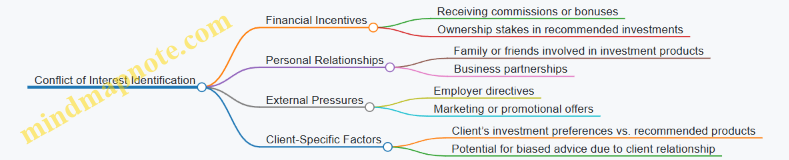
Example Scenario
An accountant, Sarah, is advising a client, John, on investment options. Sarah’s firm has a partnership with a mutual fund company and receives referral fees for recommending their funds. John is interested in low-cost index funds, but Sarah is tempted to recommend the partner mutual fund to earn a referral fee.
Best Practices to Handle the Conflict
-
Disclosure: Sarah must clearly disclose to John the existence of the referral fee and the nature of the partnership.
-
Transparency: Provide John with all available investment options, including pros and cons, fees, and performance data.
-
Client-Centric Advice: Prioritize John’s financial goals, risk tolerance, and preferences over any potential financial gain.
-
Documentation: Record the disclosure and client’s decision to maintain compliance and accountability.
-
Seek Independent Review: If uncertain, Sarah can consult a compliance officer or an independent advisor.
Mind Map: Steps to Manage Conflict of Interest
Additional Example
An accountant, Mike, is asked by a client to invest in a startup company where Mike’s brother is a co-founder. Mike recognizes the potential conflict but also believes in the startup’s prospects.
- Action Plan: Mike discloses the relationship to the client upfront, explains the risks involved, and suggests the client seek a second opinion. Mike also refrains from directly managing the investment to avoid bias.
Summary
Handling conflicts of interest requires vigilance, transparency, and a commitment to ethical standards. By proactively disclosing conflicts, prioritizing client interests, and documenting all communications, accountants and financial planners can maintain trust and uphold their fiduciary duties.
Key Takeaways
- Always identify potential conflicts early.
- Disclose conflicts clearly and promptly.
- Provide unbiased, client-focused recommendations.
- Document all disclosures and client decisions.
- When in doubt, seek independent advice or review.
This approach not only protects clients but also safeguards the professional reputation and compliance standing of accountants and financial planners.
7. Advanced Investment Strategies and Tools
7.1 Introduction to Derivatives and Hedging Techniques
Derivatives are financial instruments whose value is derived from an underlying asset, index, or rate. Common types of derivatives include options, futures, forwards, and swaps. For accountants and financial planners, understanding derivatives is crucial because they offer powerful tools for managing risk and enhancing portfolio performance.
What Are Derivatives?
Derivatives are contracts between two or more parties whose value depends on the performance of an underlying asset. These assets can be stocks, bonds, commodities, currencies, interest rates, or market indexes.
Key Types of Derivatives:
- Options: Contracts that give the buyer the right, but not the obligation, to buy or sell an asset at a predetermined price before a specific date.
- Futures: Agreements to buy or sell an asset at a predetermined price at a future date.
- Forwards: Customized contracts similar to futures but traded over-the-counter (OTC).
- Swaps: Agreements to exchange cash flows or other financial instruments between parties.
Why Accountants Should Understand Derivatives
- Risk Management: Derivatives can hedge against price fluctuations, interest rate changes, or currency risks.
- Valuation and Reporting: Proper accounting treatment of derivatives is essential for accurate financial statements.
- Client Advisory: Accountants can advise clients on using derivatives to protect investments or speculate responsibly.
Mind Map: Overview of Derivatives
Hedging Techniques Using Derivatives
Hedging is the practice of reducing or eliminating financial risk by taking an offsetting position in a related asset.
Common Hedging Strategies:
-
Using Options to Hedge Stock Positions
- Example: An investor owns 1,000 shares of a company but fears a short-term decline. Buying put options gives the right to sell shares at a fixed price, limiting downside risk.
-
Futures Contracts to Lock in Prices
- Example: A company expecting to purchase raw materials in six months can buy futures contracts to lock in current prices, protecting against price increases.
-
Currency Swaps to Manage Exchange Rate Risk
- Example: A multinational client with revenues in euros but expenses in dollars can use currency swaps to stabilize cash flows.
Mind Map: Hedging Techniques
Practical Example: Hedging with Options
Scenario:
An accountant advises a client who owns 5,000 shares of XYZ Corp, currently trading at $50 per share. The client is concerned about a potential market downturn over the next three months but does not want to sell the shares.
Strategy:
- Buy 50 put option contracts (each contract covers 100 shares) with a strike price of $48, expiring in three months.
- Cost per put option is $2 per share.
Outcome:
- If the stock price falls below $48, the client can exercise the puts to sell shares at $48, limiting losses.
- If the stock price stays above $48, the client loses the premium paid ($2 per share) but retains ownership and potential upside.
This strategy effectively caps the downside risk while allowing participation in gains.
Practical Example: Using Futures to Hedge Commodity Price Risk
Scenario:
A manufacturing client expects to buy 10,000 barrels of oil in six months. The current price is $70 per barrel, but the client fears prices may rise.
Strategy:
- Enter into futures contracts to purchase 10,000 barrels at $70 per barrel in six months.
Outcome:
- If prices rise to $80, the client saves $10 per barrel.
- If prices fall to $60, the client pays a premium but gains price certainty and budgeting stability.
Summary
Derivatives are essential tools for accountants to understand, as they enable sophisticated risk management strategies. By integrating derivatives into client portfolios, accountants can help protect against market volatility, currency fluctuations, and interest rate changes. However, it is equally important to understand the risks and accounting implications associated with these instruments.
For further reading, accountants should familiarize themselves with accounting standards such as IFRS 9 and ASC 815, which govern the recognition and measurement of derivatives.
7.2 Using Financial Ratios and Metrics for Investment Analysis
Financial ratios and metrics are essential tools for accountants and financial planners to evaluate the financial health, performance, and valuation of companies before making investment decisions. These ratios help simplify complex financial statements into actionable insights.
Key Financial Ratios and Their Uses
Liquidity Ratios
- Measure a company’s ability to meet short-term obligations.
- Important for assessing financial stability and risk.
Examples:
- Current Ratio = Current Assets / Current Liabilities
- Quick Ratio = (Current Assets - Inventory) / Current Liabilities
Example: A company with a current ratio of 2 means it has twice the current assets compared to current liabilities, indicating good short-term financial health.
Profitability Ratios
- Assess a company’s ability to generate earnings relative to sales, assets, or equity.
Examples:
- Gross Profit Margin = (Revenue - Cost of Goods Sold) / Revenue
- Net Profit Margin = Net Income / Revenue
- Return on Assets (ROA) = Net Income / Total Assets
- Return on Equity (ROE) = Net Income / Shareholder’s Equity
Example: If a company has an ROE of 15%, it means it generates 15 cents of profit for every dollar of equity invested.
Leverage Ratios
- Indicate the degree to which a company is financing its operations through debt.
Examples:
- Debt-to-Equity Ratio = Total Debt / Shareholder’s Equity
- Interest Coverage Ratio = EBIT / Interest Expense
Example: A debt-to-equity ratio of 0.5 suggests the company uses 50 cents of debt for every dollar of equity, which may indicate moderate leverage.
Efficiency Ratios
- Show how well a company utilizes its assets and manages liabilities.
Examples:
- Inventory Turnover = Cost of Goods Sold / Average Inventory
- Receivables Turnover = Net Credit Sales / Average Accounts Receivable
Example: An inventory turnover of 8 means the company sells and replaces its inventory 8 times a year, indicating efficient inventory management.
Valuation Ratios
- Help investors determine if a stock is fairly priced.
Examples:
- Price-to-Earnings (P/E) Ratio = Market Price per Share / Earnings per Share (EPS)
- Price-to-Book (P/B) Ratio = Market Price per Share / Book Value per Share
- Dividend Yield = Annual Dividends per Share / Market Price per Share
Example: A P/E ratio of 20 means investors are willing to pay $20 for every $1 of earnings, which can be compared to industry averages to gauge valuation.
Mind Map: Financial Ratios Overview
How Accountants Use Ratios in Investment Analysis
- Screening Stocks: Quickly filter companies that meet minimum financial health criteria.
- Comparative Analysis: Compare ratios across competitors or industry benchmarks.
- Trend Analysis: Evaluate how ratios change over time to identify improving or deteriorating financial conditions.
- Risk Assessment: Identify companies with excessive debt or poor liquidity.
Practical Example: Analyzing Company XYZ
Financial Data:
- Current Assets: $500,000
- Current Liabilities: $250,000
- Inventory: $100,000
- Revenue: $1,200,000
- Cost of Goods Sold: $700,000
- Net Income: $150,000
- Total Assets: $1,000,000
- Shareholder’s Equity: $600,000
- Total Debt: $400,000
- EBIT: $200,000
- Interest Expense: $50,000
- Market Price per Share: $50
- Earnings per Share (EPS): $2.50
- Book Value per Share: $30
- Annual Dividends per Share: $1.50
Calculations:
- Current Ratio = 500,000 / 250,000 = 2.0
- Quick Ratio = (500,000 - 100,000) / 250,000 = 1.6
- Gross Profit Margin = (1,200,000 - 700,000) / 1,200,000 = 41.7%
- Net Profit Margin = 150,000 / 1,200,000 = 12.5%
- ROA = 150,000 / 1,000,000 = 15%
- ROE = 150,000 / 600,000 = 25%
- Debt-to-Equity = 400,000 / 600,000 = 0.67
- Interest Coverage = 200,000 / 50,000 = 4.0
- P/E Ratio = 50 / 2.5 = 20
- P/B Ratio = 50 / 30 = 1.67
- Dividend Yield = 1.5 / 50 = 3%
Interpretation:
- The company shows strong liquidity with a current ratio of 2.0 and quick ratio of 1.6.
- Profitability is solid, especially with a high ROE of 25%, indicating efficient use of equity.
- Leverage is moderate with a debt-to-equity ratio below 1 and interest coverage of 4, suggesting manageable debt levels.
- Valuation ratios indicate the stock is priced at a P/E of 20, which should be compared with industry peers.
- A 3% dividend yield offers steady income potential.
Mind Map: Practical Application of Ratios
Best Practices for Accountants Using Financial Ratios
- Always compare ratios to industry averages or direct competitors.
- Use multiple ratios together to get a comprehensive picture.
- Consider the context: some industries naturally have higher debt or lower margins.
- Analyze trends over multiple periods rather than a single snapshot.
- Combine ratio analysis with qualitative factors like management quality and market conditions.
By mastering financial ratios and metrics, accountants can provide deeper insights into investment opportunities, helping clients make informed and confident investment decisions.
7.3 Incorporating ESG (Environmental, Social, Governance) Factors
In recent years, ESG investing has gained significant traction as investors and financial professionals recognize the importance of sustainable and responsible investing. For accountants and financial planners, understanding how to incorporate ESG factors into investment strategies is essential to meet client demand, manage risks, and contribute to positive societal impact.
What is ESG?
ESG stands for Environmental, Social, and Governance — three key factors used to evaluate the sustainability and ethical impact of an investment in a company or business.
- Environmental: How a company performs as a steward of nature (e.g., carbon emissions, waste management, resource usage).
- Social: How a company manages relationships with employees, suppliers, customers, and communities (e.g., labor practices, diversity, human rights).
- Governance: How a company is governed (e.g., board diversity, executive pay, shareholder rights, transparency).
Why Should Accountants Incorporate ESG?
- Risk Management: ESG factors can signal potential risks that traditional financial analysis might miss.
- Client Demand: Increasing number of clients seek investments aligned with their values.
- Regulatory Trends: Governments and regulators are pushing for ESG disclosures and responsible investing.
- Long-Term Performance: Studies suggest ESG-focused companies may outperform peers over time.
Mind Map: ESG Factors Overview
ESG Factors Mind Map
How to Integrate ESG into Investment Strategies
-
Screening Investments
- Positive Screening: Select companies with strong ESG performance.
- Negative Screening: Exclude companies involved in harmful activities (e.g., tobacco, fossil fuels).
-
ESG Scoring and Ratings
- Use ESG rating agencies (e.g., MSCI, Sustainalytics) to evaluate companies.
- Incorporate ESG scores alongside traditional financial metrics.
-
Thematic Investing
- Focus on themes like clean energy, social justice, or sustainable agriculture.
-
Active Engagement
- Encourage companies to improve ESG practices through shareholder advocacy.
-
Impact Investing
- Invest in projects or companies with measurable social or environmental impact.
Mind Map: ESG Integration Techniques

Example 1: Positive Screening for a Client Portfolio
Scenario: A client wants to invest in companies with strong environmental records.
Approach:
- Use ESG rating tools to identify companies with high environmental scores.
- Construct a portfolio emphasizing renewable energy firms, companies with low carbon footprints, and those with robust waste reduction programs.
Outcome:
- The client’s portfolio aligns with their values and reduces exposure to environmental risks.
Example 2: Negative Screening to Avoid Controversial Sectors
Scenario: A client requests to avoid investments in tobacco and fossil fuels.
Approach:
- Screen out companies involved in these sectors using ESG databases.
- Reallocate funds to sectors like technology, healthcare, and sustainable consumer goods.
Outcome:
- The portfolio excludes controversial industries, aligning with the client’s ethical preferences.
Example 3: Incorporating ESG Scores in Financial Analysis
Scenario: An accountant is evaluating two companies for a client’s investment.
Company A: Strong financials but poor governance and social practices.
Company B: Moderate financials but excellent ESG ratings.
Approach:
- Factor ESG scores into the risk assessment.
- Recommend Company B for its sustainable practices and lower long-term risk.
Outcome:
- The client benefits from a more resilient investment with reduced reputational and regulatory risks.
Best Practices for Accountants
- Stay updated on ESG frameworks and reporting standards (e.g., GRI, SASB, TCFD).
- Use reliable ESG data providers and understand their methodologies.
- Educate clients on the benefits and limitations of ESG investing.
- Combine ESG analysis with traditional financial metrics for holistic decision-making.
Summary
Incorporating ESG factors into investment strategies allows accountants and financial planners to better serve clients by aligning investments with values, managing risks, and capitalizing on emerging opportunities. By employing screening techniques, leveraging ESG ratings, and engaging in thematic or impact investing, professionals can build portfolios that are both financially sound and socially responsible.
7.4 Practical Example: Evaluating a Stock Using Fundamental and Technical Analysis
Evaluating a stock effectively requires a combination of both fundamental and technical analysis. As accountants and financial planners, understanding these approaches can help you make informed investment decisions or advise your clients with confidence.
Fundamental Analysis
Fundamental analysis involves evaluating a company’s financial health, competitive position, and growth prospects by examining its financial statements and market environment.
Key Steps in Fundamental Analysis:
- Analyze Financial Statements: Income statement, balance sheet, and cash flow statement.
- Calculate Financial Ratios: Profitability, liquidity, efficiency, and valuation ratios.
- Assess Industry and Market Position: Competitive advantages, market share, and sector trends.
- Evaluate Management and Governance: Leadership quality and corporate governance.
Mind Map: Fundamental Analysis Components
Example:
Consider evaluating Company XYZ, a technology firm.
- Income Statement: Revenue has grown 10% year-over-year; net income margin is 15%.
- Balance Sheet: Current ratio is 2.5, indicating good short-term liquidity.
- Valuation: P/E ratio is 18, compared to industry average of 22, suggesting the stock may be undervalued.
Technical Analysis
Technical analysis focuses on studying past market data, primarily price and volume, to forecast future price movements.
Key Concepts in Technical Analysis:
- Price Trends: Identifying upward, downward, or sideways trends.
- Support and Resistance Levels: Price points where the stock tends to stop and reverse.
- Moving Averages: Simple Moving Average (SMA), Exponential Moving Average (EMA).
- Indicators and Oscillators: Relative Strength Index (RSI), Moving Average Convergence Divergence (MACD).
Mind Map: Technical Analysis Tools
Example:
For Company XYZ:
- The 50-day SMA recently crossed above the 200-day SMA (a “Golden Cross”), signaling a potential bullish trend.
- RSI is at 65, indicating the stock is approaching overbought territory but still has momentum.
- Support level identified at $45, resistance at $55.
Integrating Both Analyses
Combining fundamental and technical analysis provides a comprehensive view:
- Fundamental analysis confirms the company’s intrinsic value and long-term potential.
- Technical analysis helps identify optimal entry and exit points based on market behavior.
Mind Map: Integrated Stock Evaluation Approach
Practical Scenario:
You determine Company XYZ is fundamentally strong with solid growth and undervalued metrics. Technical indicators show a bullish trend with a recent Golden Cross and RSI below 70.
Investment Decision:
- Initiate a buy position near the support level ($45).
- Set a stop-loss slightly below support to manage risk.
- Monitor RSI and MACD for signs of trend reversal.
Summary
By applying both fundamental and technical analysis, accountants and financial planners can:
- Provide clients with well-rounded investment advice.
- Identify undervalued stocks with strong growth potential.
- Time market entries and exits more effectively.
This dual approach enhances confidence in investment decisions and supports long-term portfolio success.
8. Integrating Technology in Investment Management
8.1 Utilizing Portfolio Management Software for Accountants
Portfolio management software has become an indispensable tool for accountants who manage investments, whether for clients or their own firms. These platforms streamline the process of tracking, analyzing, and reporting investment portfolios, allowing accountants to focus on strategic decision-making and client advisory.
Why Accountants Should Use Portfolio Management Software
- Efficiency: Automates data entry, reconciliations, and performance calculations.
- Accuracy: Reduces human errors in portfolio valuation and tax calculations.
- Compliance: Helps maintain records and generate reports that comply with regulatory standards.
- Client Transparency: Enables clear, professional reporting to clients.
Key Features to Look for in Portfolio Management Software
Example: How an Accountant Uses Portfolio Management Software
Scenario: Sarah, a financial accountant, manages investment portfolios for multiple clients. Previously, she tracked investments manually using spreadsheets, which was time-consuming and prone to errors.
Implementation: Sarah adopts a portfolio management software that integrates with her clients’ brokerage accounts and accounting systems.
Benefits:
- Automatic updates of portfolio holdings and market values.
- Real-time performance dashboards allow Sarah to quickly identify underperforming assets.
- Tax reports are generated automatically, helping Sarah advise clients on tax-efficient strategies.
- Customized client reports improve communication and trust.
Mind Map: Workflow Using Portfolio Management Software
Best Practices for Accountants When Using Portfolio Management Software
- Regular Data Reconciliation: Even with automation, periodically verify data accuracy against statements.
- Customize Reports: Tailor reports to client needs, highlighting relevant metrics and insights.
- Stay Updated: Use software updates and new features to enhance portfolio management.
- Maintain Security: Protect client data by following cybersecurity best practices.
- Leverage Training: Invest time in learning software capabilities fully to maximize benefits.
Example: Automating Client Portfolio Reviews
John, an accountant managing 50+ client portfolios, schedules monthly automated reports through his portfolio management software. These reports include:
- Portfolio performance vs. benchmarks
- Asset allocation summaries
- Realized and unrealized gains
- Tax implications
This automation frees John to focus on personalized advice rather than manual report generation, improving client satisfaction and retention.
Conclusion
Utilizing portfolio management software empowers accountants to deliver precise, timely, and insightful investment advice. By integrating these tools into their workflow, accountants can enhance efficiency, improve client communication, and uphold compliance — all critical factors in today’s fast-paced financial environment.
8.2 Robo-Advisors: Opportunities and Limitations
Robo-advisors have revolutionized the investment landscape by leveraging technology to provide automated, algorithm-driven financial planning services with minimal human intervention. For accountants and financial planners, understanding the opportunities and limitations of robo-advisors is crucial to effectively integrating them into client strategies.
What Are Robo-Advisors?
Robo-advisors use sophisticated algorithms to create and manage investment portfolios based on clients’ risk tolerance, financial goals, and time horizons. They typically offer low-cost, diversified portfolios and automatic rebalancing.
Opportunities Presented by Robo-Advisors
- Cost Efficiency: Robo-advisors usually charge lower fees compared to traditional financial advisors, making investment management accessible to clients with smaller portfolios.
- Accessibility: Clients can start investing with low minimum deposits, often as low as $500 or less.
- Automation: Automated portfolio rebalancing and tax-loss harvesting reduce the manual workload for both clients and advisors.
- Consistency: Algorithms apply consistent investment strategies without emotional bias.
- Scalability: Accountants can manage multiple client portfolios efficiently using robo-advisor platforms.
Mind Map: Opportunities of Robo-Advisors
Example:
A mid-career client with $10,000 to invest prefers a low-cost solution. By using a robo-advisor, the accountant sets up a diversified portfolio with automatic rebalancing and tax-loss harvesting, saving the client approximately 1% in advisory fees annually compared to traditional advisors.
Limitations of Robo-Advisors
- Limited Personalization: Robo-advisors follow predefined algorithms and may not fully account for complex client circumstances such as unique tax situations, estate planning, or business ownership.
- Lack of Human Touch: Some clients prefer personalized advice, emotional reassurance, and tailored financial planning that robo-advisors cannot provide.
- Algorithm Constraints: Algorithms are based on historical data and assumptions that may not adapt quickly to sudden market changes or unprecedented events.
- Limited Product Offerings: Many robo-advisors focus on ETFs and index funds, limiting access to alternative investments or customized strategies.
Mind Map: Limitations of Robo-Advisors

Example:
A client with a complex estate plan and multiple income streams may find robo-advisor recommendations too generic. The accountant supplements robo-advisor services with personalized tax planning and estate advice to ensure holistic financial management.
Best Practices for Accountants Using Robo-Advisors
- Assess Client Suitability: Determine which clients benefit most from robo-advisors—typically those with straightforward financial goals and limited assets.
- Combine Human Expertise: Use robo-advisors as a tool within a broader advisory framework to provide personalized insights and planning.
- Educate Clients: Explain how robo-advisors work, their benefits, and limitations to set realistic expectations.
- Monitor Performance: Regularly review robo-advisor portfolios to ensure alignment with client goals and make adjustments if needed.
Example:
An accountant integrates a robo-advisor platform for entry-level clients while maintaining direct advisory services for high-net-worth individuals, ensuring tailored service across the client spectrum.
Summary
Robo-advisors offer cost-effective, automated investment solutions that can enhance efficiency and accessibility for accountants and their clients. However, they are not a one-size-fits-all solution and should be complemented with personalized advice and planning to address complex financial needs.
8.3 Data Analytics for Predictive Investment Insights
Data analytics has become an indispensable tool for accountants and financial planners aiming to enhance investment decision-making. By leveraging vast amounts of financial data, predictive analytics helps forecast market trends, identify investment opportunities, and manage risks more effectively.
What is Predictive Investment Analytics?
Predictive investment analytics uses historical data, statistical algorithms, and machine learning techniques to predict future market behaviors and asset performance. This approach enables accountants to provide data-driven advice tailored to their clients’ financial goals.
Mind Map: Key Components of Predictive Investment Analytics
Practical Example: Using Time Series Forecasting to Predict Stock Prices
Imagine an accountant advising a client interested in investing in a technology stock. By analyzing the stock’s historical price data using time series forecasting models like ARIMA (AutoRegressive Integrated Moving Average), the accountant can predict potential future price movements.
Step-by-step:
- Data Collection: Gather daily closing prices of the stock for the past 5 years.
- Data Processing: Clean the data by handling missing values and removing outliers.
- Model Selection: Apply ARIMA to model the time series data.
- Forecasting: Generate price forecasts for the next 6 months.
- Interpretation: Assess predicted trends to advise the client on optimal entry or exit points.
This method provides a quantitative basis for investment decisions, reducing reliance on intuition alone.
Mind Map: Example Workflow for Predictive Analytics in Investment
Example: Sentiment Analysis for Market Prediction
Beyond numerical data, alternative data such as news articles and social media sentiment can provide early indicators of market movements. Accountants can use natural language processing (NLP) tools to analyze sentiment around a particular stock or sector.
Scenario:
- A sudden surge in positive news and social media buzz about a renewable energy company might indicate upcoming stock appreciation.
- Conversely, negative sentiment could signal potential risks.
By integrating sentiment scores into predictive models, accountants can enhance the accuracy of their investment insights.
Best Practices for Accountants Using Predictive Analytics
- Understand the Data: Ensure data quality and relevance before analysis.
- Combine Multiple Models: Use ensemble approaches to improve prediction robustness.
- Stay Updated: Continuously refine models with new data and market conditions.
- Communicate Clearly: Translate complex analytics into understandable advice for clients.
Summary
Data analytics empowers accountants to move beyond traditional investment advice by incorporating predictive insights. Through structured data processing, model building, and interpretation, accountants can offer clients forward-looking strategies that optimize returns and manage risks effectively.
8.4 Example: Automating Client Portfolio Reports to Enhance Efficiency
In today’s fast-paced financial environment, accountants and financial planners must deliver timely, accurate, and insightful portfolio reports to their clients. Automating client portfolio reports not only saves time but also reduces errors and enhances client satisfaction by providing consistent updates.
Why Automate Portfolio Reports?
- Time Savings: Manual report generation can take hours per client.
- Accuracy: Automation reduces human errors in data entry and calculations.
- Consistency: Standardized reports ensure uniform presentation and metrics.
- Scalability: Easily manage growing client bases without proportional increase in workload.
Key Components of an Automated Portfolio Report
Step-by-Step Example: Automating Reports Using Excel and Power Query
Scenario: An accountant manages portfolios for 50 clients and wants to automate monthly performance reports.
-
Data Consolidation:
- Use Power Query to pull transaction data, holdings, and market prices from different Excel sheets or CSV files.
- Example: Connect to a CSV file updated daily with market prices.
-
Data Transformation:
- Clean and format data (e.g., date formats, currency conversions).
- Calculate key metrics such as total portfolio value, returns, and asset allocation percentages.
-
Report Template Setup:
- Create a standardized Excel template with placeholders for client name, portfolio summary, charts, and tables.
-
Automation with Macros:
- Write VBA macros to refresh data, update calculations, and export individual client reports as PDFs.
-
Distribution:
- Automate emailing reports using Outlook integration or upload to a secure client portal.
Example VBA Macro Snippet to Export Reports
Sub ExportClientReport()
    Dim clientName As String
    clientName = Range("B2").Value 'Assuming client name is in cell B2
    Dim filePath As String
    filePath = "C:\Reports\" & clientName & "_PortfolioReport_" & Format(Date, "YYYYMMDD") & ".pdf"

    ActiveSheet.ExportAsFixedFormat Type:=xlTypePDF, Filename:=filePath, Quality:=xlQualityStandard
    MsgBox "Report exported for " & clientName
End Sub
Using Portfolio Management Software with API Integration
Many modern portfolio management platforms (e.g., Morningstar Direct, Orion, or Black Diamond) offer API access to automate data retrieval and report generation.
Example Workflow:
- Use Python scripts to call APIs weekly.
- Aggregate data into a database.
- Generate PDF or web-based reports using reporting libraries (e.g., ReportLab, Jinja2 for HTML).
- Automatically email reports or upload to client portals.
Benefits Realized in Practice
Case Study: Jane, a financial planner, automated her client reporting process using a combination of Excel Power Query and VBA macros.
- Reduced report preparation time from 6 hours to 30 minutes monthly.
- Improved client satisfaction due to timely and visually appealing reports.
- Freed up time to focus on personalized financial advice rather than manual data handling.
Best Practices for Successful Automation
- Standardize Data Inputs: Ensure all data sources follow consistent formats.
- Test Thoroughly: Validate calculations and report outputs before full deployment.
- Maintain Security: Protect sensitive client data during automation and distribution.
- Keep Reports Client-Friendly: Use clear visuals and simple language.
- Regular Updates: Periodically review automation tools and templates to incorporate new insights or compliance requirements.
Automating client portfolio reports is a powerful strategy for accountants and financial planners to enhance operational efficiency, improve accuracy, and deliver superior client service. By leveraging available tools and following best practices, professionals can transform a tedious task into a streamlined, value-adding process.
9. Building Long-Term Client Relationships Through Investment Success
9.1 Educating Clients on Investment Concepts to Build Trust
Building trust with clients is fundamental for accountants who provide investment advice. Educating clients on key investment concepts empowers them to make informed decisions and fosters a transparent advisor-client relationship. This section explores effective methods to educate clients, supported by clear examples and mind maps to simplify complex ideas.
Why Education Builds Trust
- Clients feel more confident when they understand where their money is going.
- Transparency reduces misunderstandings and unrealistic expectations.
- Educated clients are more likely to stay invested during market fluctuations.
Key Investment Concepts to Teach Clients
Mind Map: Core Investment Concepts
Example: Explaining Risk and Return Using a Simple Analogy
Scenario: A client is hesitant to invest in stocks due to fear of losing money.
Approach: Use the “Risk and Reward” analogy.
“Imagine planting two types of seeds: one grows quickly but is sensitive to weather (stocks), the other grows slowly but steadily (bonds). Over time, the fast-growing plant can yield a bigger harvest but might sometimes fail. The slow-growing plant is more reliable but produces less. By planting both, you balance your chances of a good harvest.”
This analogy helps clients visualize risk and return in relatable terms.
Mind Map: Steps to Educate Clients Effectively
Example: Interactive Session on Diversification
Scenario: Client wants to invest all funds in a single tech stock.
Approach: Conduct a visual exercise.
- Show a pie chart of a diversified portfolio vs. a single-stock portfolio.
- Explain how diversification reduces risk by spreading investments across sectors.
- Use historical data to show how diversified portfolios weathered market downturns better.
Outcome: Client understands the importance of diversification and agrees to a balanced portfolio.
Tools and Resources to Support Client Education
- Customized investment guides tailored to client goals.
- Interactive online calculators for risk tolerance and portfolio simulation.
- Regular newsletters explaining market trends in simple terms.
Summary
Educating clients on investment concepts is not a one-time event but an ongoing process. Using clear explanations, relatable examples, and visual tools like mind maps helps accountants build trust and empower clients to participate actively in their financial planning.
For further reading, consider providing clients with beginner-friendly resources such as:
- “The Intelligent Investor” by Benjamin Graham (simplified summaries)
- Online courses on personal finance
- Investment podcasts tailored for novices
9.2 Regular Review and Adjustment of Investment Plans
Regularly reviewing and adjusting investment plans is a cornerstone of successful portfolio management, especially for accountants who manage diverse client portfolios. This practice ensures that investment strategies remain aligned with clients’ evolving financial goals, risk tolerance, and market conditions.
Why Regular Reviews Matter
- Adapt to Life Changes: Clients may experience changes such as marriage, retirement, or career shifts that impact their financial goals.
- Market Dynamics: Economic shifts, interest rate changes, and geopolitical events can affect asset performance.
- Risk Management: Periodic reviews help maintain the desired risk level by rebalancing portfolios.
- Tax Efficiency: Adjustments can optimize tax outcomes by realizing gains or losses strategically.
Mind Map: Key Components of Regular Investment Plan Reviews
Step-by-Step Best Practices for Review and Adjustment
- Schedule Regular Review Meetings: Ideally quarterly or biannually, depending on client needs.
- Update Client Information: Confirm any changes in income, expenses, goals, or risk appetite.
- Analyze Portfolio Performance: Compare actual returns against benchmarks and expectations.
- Assess Asset Allocation: Determine if the current allocation aligns with the client’s profile.
- Evaluate Market Conditions: Consider economic forecasts and sector performance.
- Identify Tax Implications: Plan for tax-loss harvesting or capital gains realization.
- Develop Adjustment Recommendations: Propose rebalancing, new investments, or divestments.
- Communicate Clearly: Explain the rationale and expected outcomes to the client.
Example 1: Mid-Career Client Portfolio Review
Client Profile: 45-year-old professional, moderate risk tolerance, goal to retire at 65.
Initial Allocation: 60% equities, 30% bonds, 10% alternatives.
Review Findings:
- Equities have grown to 70% due to market gains.
- Bonds underperforming relative to benchmarks.
- Client recently had a child, increasing financial responsibilities.
Adjustment Plan:
- Rebalance to original 60/30/10 allocation to reduce risk.
- Increase contributions to tax-advantaged retirement accounts.
- Introduce more conservative bond funds to stabilize income.
Mind Map: Portfolio Adjustment Workflow
Example 2: Retiree Client Facing Market Volatility
Client Profile: 65-year-old retiree, conservative risk tolerance, relying on portfolio income.
Situation: Recent market downturn caused a 15% drop in equity holdings.
Review Actions:
- Assess if withdrawal needs have changed.
- Consider shifting some equity exposure to fixed income or dividend-paying stocks.
- Explore annuities or other income-generating products for stability.
Outcome:
- Reduced equity allocation from 40% to 25%.
- Increased bond allocation and introduced a fixed annuity.
- Client feels more secure with predictable income streams.
Tips for Accountants Conducting Reviews
- Use portfolio management software to generate performance reports.
- Keep detailed notes on client conversations and decisions.
- Educate clients on why adjustments are necessary to maintain trust.
- Stay updated on tax law changes that impact investment decisions.
Regular review and adjustment of investment plans not only protect clients’ assets but also demonstrate proactive stewardship, reinforcing the accountant’s role as a trusted financial advisor.
9.3 Handling Market Downturns and Client Concerns
Market downturns can be challenging periods for both accountants and their clients. As trusted financial planners, accountants must be equipped to manage client concerns effectively while maintaining a long-term investment perspective. This section explores best practices, communication strategies, and practical examples to navigate these turbulent times.
Understanding Client Psychology During Downturns
Clients often react emotionally to market declines, which can lead to impulsive decisions that harm long-term financial goals. Recognizing common emotional responses helps accountants provide empathetic and rational guidance.
- Fear and Panic
- Loss Aversion
- Overreaction to Short-Term Volatility
Mind Map: Client Emotional Responses and Accountant Strategies
Best Practices for Handling Client Concerns
-
Active Listening and Empathy
- Allow clients to express fears without interruption.
- Validate their feelings to build trust.
-
Clear and Transparent Communication
- Explain the reasons behind market downturns in simple terms.
- Use historical data to show market recoveries.
-
Reinforce Long-Term Investment Goals
- Remind clients of their original investment objectives.
- Discuss the importance of staying invested.
-
Review and Adjust if Necessary
- Assess if the client’s risk tolerance or financial situation has changed.
- Make portfolio adjustments only if aligned with updated goals.
-
Provide Regular Updates
- Schedule periodic check-ins to maintain engagement.
- Share market insights and portfolio performance.
Mind Map: Best Practices for Client Communication During Downturns
Practical Example 1: Reassuring a Nervous Client
Scenario: A client calls worried after a 15% market drop over two weeks.
Approach:
- Listen carefully to their concerns.
- Explain that market corrections are normal and often temporary.
- Show a chart of the S&P 500 over the last 20 years highlighting multiple downturns followed by recoveries.
- Reiterate their investment plan’s focus on long-term growth.
- Offer to review their portfolio together to ensure alignment with their risk tolerance.
Outcome: The client feels heard and gains confidence to stay invested.
Practical Example 2: Adjusting a Portfolio Post-Downturn
Scenario: A client nearing retirement is anxious about recent losses.
Approach:
- Review the client’s risk tolerance and time horizon.
- Discuss potential reallocation to more conservative assets like bonds or dividend-paying stocks.
- Explain the trade-offs between risk reduction and potential returns.
- Implement agreed-upon changes gradually to avoid market timing risks.
Outcome: The client feels proactive and secure in their adjusted portfolio.
Mind Map: Steps to Handle Market Downturns
Summary
Handling market downturns effectively requires a blend of empathy, education, and strategic action. Accountants who master these skills can not only help clients weather financial storms but also strengthen long-term relationships built on trust and confidence.
9.4 Case Study: Turning a Skeptical Client into a Long-Term Investor
Background
Meet Sarah, a 42-year-old accountant who had always been skeptical about investing. She preferred keeping her savings in a traditional savings account, fearing market volatility and potential losses. Sarah’s primary concern was the safety of her capital, and she was hesitant to take any risks despite understanding the importance of growing her wealth for retirement.
Initial Challenges
- Risk Aversion: Sarah was highly risk-averse due to past stories of market crashes.
- Lack of Investment Knowledge: She felt overwhelmed by investment jargon and options.
- Short-Term Focus: Sarah was focused on immediate liquidity rather than long-term growth.
Step 1: Building Trust Through Education
The first step was to educate Sarah about the fundamentals of investing in a simple, relatable way.
Mind Map: Educating a Skeptical Client
Example: Explaining risk using a gardening analogy: “Investing is like planting a garden. Some plants grow quickly but are fragile, while others take longer but are more resilient. By planting a variety of seeds, you increase your chances of a good harvest over time.”
Step 2: Customized Investment Plan Aligned with Sarah’s Comfort Level
- Introduced a conservative portfolio with a higher allocation to bonds and dividend-paying stocks.
- Included tax-advantaged accounts to maximize returns.
- Set up automatic monthly contributions to encourage disciplined investing.
Mind Map: Tailoring Investment Plan
Example: Sarah’s portfolio was designed to prioritize capital preservation while still allowing for moderate growth, easing her into the investment world without overwhelming risk.
Step 3: Regular Communication and Progress Tracking
- Monthly updates with simple, jargon-free performance reports.
- Quarterly review meetings to reassess goals and comfort levels.
- Open channel for Sarah to ask questions anytime.
Mind Map: Client Engagement Strategy
Example: A monthly email with a clear infographic showing portfolio growth, dividends earned, and comparison to benchmarks helped Sarah visualize progress and feel more confident.
Step 4: Demonstrating the Power of Compounding and Time
- Showed projections of portfolio growth over 10, 20, and 30 years.
- Highlighted how even small, consistent investments grow significantly over time.
Mind Map: Demonstrating Long-Term Benefits
Example: Using a simple chart, Sarah saw that investing $500 monthly could grow to over $300,000 in 30 years assuming a 6% annual return, reinforcing the value of patience and consistency.
Step 5: Celebrating Milestones and Reinforcing Confidence
- Celebrated first dividend payment and portfolio milestones.
- Shared success stories of other clients with similar profiles.
Example: When Sarah received her first dividend payment, it was highlighted as a tangible benefit of investing, increasing her enthusiasm.
Summary
Through patient education, personalized planning, consistent communication, and demonstrating tangible benefits, Sarah transformed from a skeptical saver to a confident long-term investor. This case underscores the importance of empathy, clear communication, and tailored strategies when working with cautious clients.
Key Takeaways
- Simplify investment concepts using relatable analogies.
- Align investment plans with client risk tolerance.
- Maintain regular, transparent communication.
- Use projections to illustrate long-term benefits.
- Celebrate small wins to build confidence.
This approach can be replicated by accountants and financial planners to nurture trust and foster long-term investment relationships with hesitant clients.
10. Conclusion and Future Trends in Investment Strategies for Accountants
10.1 Recap of Best Practices and Key Takeaways
As accountants navigating the complex world of investments, it is essential to consolidate the core principles and best practices discussed throughout this blog. This recap provides a clear, actionable summary to help you apply these strategies effectively for your clients.
Mind Map: Core Investment Best Practices for Accountants
Key Takeaways with Examples
Align Investment Strategies with Client Goals
- Best Practice: Always begin by understanding the client’s financial objectives, risk tolerance, and time horizon.
- Example: For a young professional aiming for homeownership in 5 years, prioritize low-risk, liquid investments like high-yield savings or short-term bonds rather than volatile equities.
Diversify to Manage Risk
- Best Practice: Spread investments across different asset classes to reduce risk.
- Example: A balanced portfolio might include 60% equities, 30% bonds, and 10% real estate investment trusts (REITs), adjusted based on client risk profile.
Employ Strategic Asset Allocation and Rebalancing
- Best Practice: Set target allocations and periodically rebalance to maintain desired risk exposure.
- Example: If equities outperform and grow to 70% of the portfolio instead of 60%, sell some equities and buy bonds to restore balance.
Optimize for Tax Efficiency
- Best Practice: Use tax-advantaged accounts and strategies like tax-loss harvesting to minimize tax liabilities.
- Example: Harvest losses in a taxable account by selling underperforming stocks to offset capital gains elsewhere.
Plan Retirement Investments Thoughtfully
- Best Practice: Tailor retirement portfolios to client age and income needs, incorporating income-producing assets.
- Example: For a client nearing retirement, increase bond allocation and consider annuities to ensure steady income.
Maintain Ethical Standards and Compliance
- Best Practice: Always act in the client’s best interest, disclose conflicts, and communicate transparently.
- Example: If recommending a product with a commission, clearly explain fees and alternatives.
Leverage Technology to Enhance Efficiency
- Best Practice: Use portfolio management software and robo-advisors to streamline processes and improve accuracy.
- Example: Automate monthly performance reports to keep clients informed without manual effort.
Explore Advanced Strategies When Appropriate
- Best Practice: Incorporate ESG factors or hedging techniques for clients interested in sophisticated approaches.
- Example: Evaluate a stock’s ESG rating alongside traditional financial metrics before inclusion.
Mind Map: Applying Best Practices in Client Scenarios
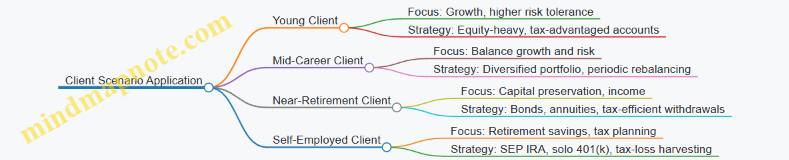
By internalizing these best practices and examples, accountants can confidently guide clients through investment decisions that align with their financial goals, risk tolerance, and evolving market conditions. Remember, the key to success lies in continuous education, ethical conduct, and leveraging technology to enhance client outcomes.
10.2 Emerging Trends: Cryptocurrency, Blockchain, and Beyond
As accountants and financial planners, staying ahead of emerging investment trends is essential to provide clients with innovative and effective strategies. Two of the most transformative technologies reshaping the investment landscape are cryptocurrency and blockchain. Beyond these, other trends such as decentralized finance (DeFi), tokenization, and digital assets are gaining momentum. This section explores these trends with practical insights and examples.
Understanding Cryptocurrency and Blockchain
- Cryptocurrency: Digital or virtual currency that uses cryptography for security. Examples include Bitcoin (BTC), Ethereum (ETH), and many altcoins.
- Blockchain: A decentralized ledger technology that records transactions across many computers securely and transparently.
Example: An accountant advising a tech startup client might recommend allocating a small portion of their investment portfolio to cryptocurrencies like Bitcoin or Ethereum, emphasizing the importance of understanding volatility and regulatory risks.
Practical Applications for Accountants
-
Portfolio Diversification: Cryptocurrencies can offer diversification benefits due to their low correlation with traditional assets.
-
Tax Implications: Understanding the tax treatment of crypto transactions is critical. For example, in many jurisdictions, selling crypto at a gain triggers capital gains tax.
-
Blockchain for Auditing: Blockchain technology can enhance transparency and reduce fraud risk in financial reporting.
Example: An accountant helping a client who mines cryptocurrency must track the fair market value of mined coins at the time of receipt for income recognition and subsequent tax reporting.
Decentralized Finance (DeFi) and Tokenization
- DeFi: Financial services using blockchain to operate without traditional intermediaries (banks, brokers).
- Tokenization: Converting real-world assets (real estate, art) into digital tokens that can be traded on blockchain platforms.
Example: A financial planner might explore DeFi lending platforms to earn interest on idle crypto assets for a client, while carefully assessing the risks of smart contract failures.
Risks and Considerations
- Volatility: Cryptocurrencies can experience rapid price swings.
- Regulatory Uncertainty: Laws governing crypto investments are evolving.
- Security Risks: Risks of hacking, scams, and loss of private keys.
Example: Advising clients to use hardware wallets for storing cryptocurrencies securely and to only invest amounts they can afford to lose.
Future Outlook and Integration
- Increasing institutional adoption of cryptocurrencies.
- Development of Central Bank Digital Currencies (CBDCs).
- Integration of blockchain in supply chain finance and accounting systems.
Example: An accountant might prepare clients for CBDCs by understanding how digital fiat currencies will affect cross-border payments and cash management.
Summary
Cryptocurrency and blockchain are no longer fringe topics but integral parts of modern investment strategies. Accountants and financial planners who embrace these technologies can better serve clients by offering diversified portfolios, tax-efficient strategies, and leveraging blockchain’s transparency for improved financial management.
Key Takeaway: Start small, stay informed, and integrate emerging digital assets thoughtfully into client portfolios, always balancing innovation with risk management.
10.3 Preparing for Changing Regulatory and Market Environments
In the dynamic world of finance and investment, regulatory frameworks and market conditions are constantly evolving. For accountants advising clients on investment strategies, staying ahead of these changes is crucial to ensure compliance, optimize portfolio performance, and manage risks effectively.
Understanding Regulatory Changes
Regulatory bodies such as the SEC, IRS, and international equivalents frequently update rules that impact investment products, reporting requirements, and tax treatments. Accountants must:
- Monitor regulatory announcements and updates regularly.
- Understand how new regulations affect client portfolios.
- Adjust investment strategies to remain compliant and tax-efficient.
Example: When the SEC introduced Regulation Best Interest (Reg BI), accountants needed to ensure that investment recommendations met the new fiduciary standards, emphasizing client best interest.
Adapting to Market Environment Shifts
Market environments can shift due to economic cycles, geopolitical events, technological disruptions, or global crises. Accountants should:
- Analyze macroeconomic indicators (inflation, interest rates, GDP growth).
- Reassess risk tolerance and asset allocation in response to market volatility.
- Incorporate scenario planning and stress testing in portfolio reviews.
Example: During the COVID-19 pandemic, accountants helped clients rebalance portfolios to reduce exposure to vulnerable sectors and increase holdings in resilient industries like technology and healthcare.
Mind Map: Preparing for Regulatory and Market Changes
Best Practices for Accountants
- Continuous Education: Enroll in courses and webinars focused on regulatory updates and market trends.
- Leverage Technology: Use regulatory tracking software and market analysis tools to stay informed.
- Proactive Client Communication: Inform clients promptly about relevant changes and their potential impact.
- Scenario Planning: Develop multiple investment scenarios to prepare for different market conditions.
- Collaborate with Experts: Work alongside legal and compliance professionals to interpret complex regulations.
Practical Example: Navigating New Tax Legislation
Situation: A new tax law increases capital gains tax rates for high-income investors.
Action: An accountant reviews affected client portfolios, identifies assets with significant unrealized gains, and recommends:
- Accelerating sales of certain assets before the tax change takes effect.
- Utilizing tax-loss harvesting to offset gains.
- Increasing contributions to tax-advantaged retirement accounts.
Outcome: The client minimizes tax liability while maintaining a diversified investment portfolio aligned with their goals.
Mind Map: Response Workflow for Regulatory and Market Changes
By integrating these practices and frameworks, accountants can confidently guide their clients through the complexities of changing regulatory landscapes and volatile markets, ensuring sustained investment success and compliance.
10.4 Final Example: Adapting Investment Strategies in a Rapidly Evolving Market
In today’s fast-paced financial environment, accountants must be agile and proactive in adapting investment strategies to meet changing market conditions. This section explores a comprehensive example illustrating how an accountant can successfully navigate a rapidly evolving market by integrating best practices, technological tools, and forward-thinking approaches.
Scenario Overview
Sarah, a financial planner and accountant, manages a diverse portfolio for a mid-sized tech company’s executive team. Recently, the market has experienced significant volatility due to geopolitical tensions, rapid technological advancements, and shifting regulatory landscapes. Sarah needs to adapt her investment strategy to protect and grow her clients’ wealth while minimizing risk.
Step 1: Assessing the Current Market Environment
Sarah begins by conducting a thorough market analysis:
- Monitoring macroeconomic indicators (inflation rates, interest rates, GDP growth)
- Tracking sector-specific trends, especially in technology and emerging markets
- Evaluating geopolitical risks and regulatory changes
Mind Map: Market Assessment
Step 2: Revisiting Client Goals and Risk Tolerance
Sarah schedules meetings with each client to:
- Reconfirm their financial goals considering the new market realities
- Reassess their risk tolerance, especially given increased volatility
- Discuss time horizons and liquidity needs
Example:
One client, previously aggressive, expresses concern about recent market swings and prefers a more balanced approach.
Step 3: Strategy Adaptation and Portfolio Rebalancing
Based on insights, Sarah implements the following adjustments:
- Increase Diversification: Incorporate alternative assets such as real estate investment trusts (REITs) and commodities to reduce correlation with equities.
- Enhance Liquidity: Allocate a portion of the portfolio to short-term bonds and money market funds to provide flexibility.
- Incorporate ESG Investments: Reflecting client values and emerging market demand.
- Utilize Hedging: Introduce options strategies to protect against downside risk.
Mind Map: Adapted Investment Strategy
Example:
For the client with reduced risk tolerance, Sarah shifts 15% of their equity holdings into a mix of REITs and short-term bonds, while adding ESG-focused mutual funds.
Step 4: Leveraging Technology and Analytics
Sarah employs portfolio management software integrated with real-time market data and predictive analytics to:
- Continuously monitor portfolio performance
- Receive alerts on market shifts
- Simulate stress tests under various scenarios
Example:
Using the software, Sarah identifies an overexposure to a volatile tech stock and promptly rebalances to mitigate risk.
Step 5: Continuous Communication and Education
Sarah keeps clients informed through:
- Monthly performance reports with clear explanations
- Educational webinars on market trends and investment principles
- Transparent discussions about strategy changes and rationale
Example:
A webinar on “Navigating Market Volatility” helps clients understand the benefits of diversification and hedging.
Summary Mind Map: Adapting Investment Strategies
Key Takeaways
- Flexibility is critical: Market conditions can change rapidly; strategies must evolve accordingly.
- Client-centric approach: Regularly revisiting client goals and risk preferences ensures alignment.
- Diversification and hedging: Effective tools to manage risk in volatile markets.
- Technology as an enabler: Enhances decision-making and responsiveness.
- Ongoing education: Builds client trust and confidence.
By following this structured approach, accountants and financial planners can confidently guide their clients through uncertain markets, turning challenges into opportunities for long-term growth and stability.