Managing Financial Instruments
1. Introduction to Financial Instruments
1.1 Definition and Classification of Financial Instruments
What Are Financial Instruments?
Financial instruments are contracts that create a financial asset for one entity and a financial liability or equity instrument for another. They represent monetary value and can be traded, transferred, or settled in the financial markets.
Key Characteristics:
- They can be cash, evidence of an ownership interest in an entity, or a contractual right to receive or deliver cash or another financial instrument.
- They facilitate capital raising, risk management, and investment.
Classification of Financial Instruments
Financial instruments are broadly classified based on their nature, rights, and obligations. Understanding this classification helps accountants and portfolio managers manage, report, and analyze these instruments effectively.
Mind Map: Classification of Financial Instruments
Equity Instruments
Equity instruments represent ownership interest in a company.
Example:
- Common Shares: Owning 100 shares of Company ABC means you have a stake in the company’s profits and voting rights.
- Preferred Shares: These provide fixed dividends and priority over common shares in asset liquidation but usually lack voting rights.
Best Practice: Clearly distinguish equity instruments from debt to ensure accurate balance sheet presentation.
Debt Instruments
Debt instruments represent a contractual obligation to repay borrowed funds with interest.
Example:
- Corporate Bonds: A company issues a $10,000 bond with a 5% coupon rate payable annually for 10 years.
- Notes Payable: Short-term borrowings like a bank loan with a fixed repayment schedule.
Best Practice: Track maturity dates and interest rates carefully to manage cash flow and risk.
Derivative Instruments
Derivatives derive their value from underlying assets such as stocks, bonds, commodities, or indices.
Example:
- Options: The right, but not the obligation, to buy 100 shares of Company XYZ at $50 within 3 months.
- Futures: An agreement to buy 1,000 barrels of oil at $70 per barrel in 6 months.
Best Practice: Use derivatives for hedging or speculative purposes but maintain clear documentation of intent.
Hybrid Instruments
Hybrid instruments combine features of both debt and equity.
Example:
- Convertible Bonds: Bonds that can be converted into a predetermined number of common shares.
- Preferred Shares with Warrants: Preferred stock that includes the option to purchase additional shares.
Best Practice: Evaluate the embedded options separately for accurate valuation and risk assessment.
Visual Mind Map: Financial Instrument Types and Examples
Summary
Understanding the definition and classification of financial instruments is foundational for effective management and reporting. By categorizing instruments into equity, debt, derivatives, and hybrids, accountants and portfolio managers can apply appropriate valuation, risk management, and compliance practices.
Additional Example: Misclassification Impact
Imagine a portfolio manager classifies convertible bonds purely as debt without recognizing their equity conversion feature. This misclassification could lead to undervaluing the portfolio and misstating risk exposure.
Best Practice: Always analyze the contractual terms to correctly classify instruments.
1.2 Importance of Financial Instruments in Investment Portfolios
Financial instruments are the building blocks of any investment portfolio. They represent the various assets and contracts through which investors can allocate capital, manage risk, and achieve their financial goals. Understanding their importance is crucial for accountants and portfolio managers to optimize portfolio performance and ensure alignment with investment objectives.
Why Financial Instruments Matter
- Diversification: Financial instruments allow investors to spread risk across different asset classes and sectors, reducing the impact of any single investment’s poor performance.
- Liquidity: Many financial instruments provide liquidity, enabling investors to enter or exit positions with relative ease.
- Income Generation: Instruments like bonds and dividend-paying stocks provide steady income streams.
- Capital Appreciation: Equities and certain derivatives offer the potential for capital gains.
- Risk Management: Derivatives and other instruments can be used to hedge against market risks.
Mind Map: Core Roles of Financial Instruments in Portfolios
Example 1: Diversification Using Mixed Instruments
Consider a portfolio consisting of 60% equities, 30% bonds, and 10% commodities. The equities provide growth potential, bonds generate income and stability, while commodities offer inflation protection. This mix reduces volatility compared to a portfolio solely invested in equities.
Mind Map: Benefits of Diversification
Example 2: Income Generation Through Bonds
A portfolio manager includes corporate bonds with a 5% coupon rate to provide predictable income. This helps meet cash flow needs without selling equity holdings, which might be volatile.
Mind Map: Income Sources in Portfolios
Example 3: Risk Management with Derivatives
To protect against interest rate rises, a portfolio manager uses interest rate swaps to hedge bond holdings. This reduces the portfolio’s sensitivity to interest rate fluctuations.
Mind Map: Risk Management Strategies
Summary
Financial instruments are essential for constructing portfolios that balance risk, return, and liquidity. By leveraging a variety of instruments, portfolio managers and accountants can tailor investment strategies to meet client needs, adapt to market conditions, and comply with regulatory requirements.
1.3 Overview of Regulatory Frameworks Governing Financial Instruments
Financial instruments operate within a complex web of regulatory frameworks designed to ensure market integrity, protect investors, and maintain financial stability. Understanding these frameworks is crucial for accountants and portfolio managers to ensure compliance and manage risks effectively.
Key Regulatory Bodies and Frameworks
-
Securities and Exchange Commission (SEC) - USA
- Oversees securities markets and protects investors.
- Enforces laws like the Securities Act of 1933 and Securities Exchange Act of 1934.
-
European Securities and Markets Authority (ESMA) - EU
- Harmonizes regulation across EU member states.
- Implements MiFID II (Markets in Financial Instruments Directive II).
-
Financial Conduct Authority (FCA) - UK
- Regulates financial markets and firms.
- Enforces the Senior Managers and Certification Regime (SM&CR).
-
International Organization of Securities Commissions (IOSCO)
- Sets global standards for securities regulation.
-
Basel Committee on Banking Supervision
- Provides guidelines on capital requirements affecting financial instruments held by banks.
Mind Map: Regulatory Bodies and Their Roles
Major Regulations Impacting Financial Instruments
-
MiFID II (EU)
- Enhances transparency in trading.
- Regulates algorithmic and high-frequency trading.
- Requires detailed reporting of transactions.
-
Dodd-Frank Act (USA)
- Introduced after 2008 financial crisis.
- Regulates derivatives markets.
- Imposes stricter capital and risk management requirements.
-
IFRS 9 (International Financial Reporting Standards)
- Governs classification, measurement, and impairment of financial instruments.
- Requires expected credit loss model for impairment.
-
EMIR (EU)
- Regulates over-the-counter (OTC) derivatives.
- Mandates clearing and reporting obligations.
Mind Map: Key Regulations and Their Focus Areas
Best Practice: Staying Compliant with Regulatory Frameworks
-
Example: A portfolio manager handling derivatives must ensure compliance with EMIR by:
- Registering with a trade repository.
- Reporting all derivative transactions within the stipulated timeframe.
- Using central clearing counterparties (CCPs) where required.
-
Example: An accountant preparing financial statements must apply IFRS 9 by:
- Classifying financial assets into amortized cost, fair value through profit or loss, or fair value through other comprehensive income.
- Calculating expected credit losses for impairment.
Practical Example: Impact of MiFID II on Trade Reporting
A portfolio manager executing trades across multiple EU exchanges must:
- Report each trade with detailed information such as instrument type, price, quantity, and timestamp.
- Use approved trading venues or systematic internalisers.
- Maintain records for at least five years.
Failure to comply can result in fines and reputational damage.
Summary
Regulatory frameworks governing financial instruments are multifaceted and continuously evolving. Accountants and portfolio managers must maintain up-to-date knowledge of these regulations to ensure compliance, mitigate risks, and optimize portfolio performance. Leveraging technology and establishing robust internal controls are essential components of effective regulatory management.
1.4 Best Practice: Establishing a Clear Instrument Classification System with Examples
Establishing a clear and consistent classification system for financial instruments is fundamental for accountants and portfolio managers. It ensures accurate reporting, risk assessment, and portfolio construction. A well-defined classification system helps avoid misinterpretation, enhances transparency, and aligns with regulatory requirements.
Why Classification Matters
- Regulatory Compliance: Different instruments are subject to varying accounting and reporting standards.
- Risk Management: Classification helps identify risk profiles and appropriate hedging strategies.
- Valuation Consistency: Ensures the correct valuation method is applied.
- Portfolio Optimization: Facilitates asset allocation and diversification decisions.
Core Categories of Financial Instruments
Step-by-Step Approach to Classification
- Identify Instrument Characteristics: Determine if the instrument represents ownership, debt, or a derivative contract.
- Determine Contractual Terms: Look at maturity, coupon payments, conversion rights, etc.
- Assess Rights and Obligations: Voting rights, dividend entitlements, repayment priority.
- Apply Regulatory Definitions: IFRS 9, ASC 815, or local GAAP guidelines.
- Assign to Categories: Equity, Debt, Derivative, or Hybrid.
Example 1: Classifying a Convertible Bond
- Instrument: Convertible bond issued by Company A
- Characteristics: Pays fixed interest, can convert into common shares at a predetermined price.
| Step | Analysis | Classification |
|---|---|---|
| Identify Characteristics | Debt instrument with option to convert | Hybrid |
| Contractual Terms | Fixed coupon, maturity date, conversion option | Convertible Bond (Hybrid) |
| Rights and Obligations | Interest payments, potential equity conversion | Hybrid |
| Regulatory Definition | IFRS 9 treats as compound instrument | Hybrid |
Example 2: Classifying an Equity Option
- Instrument: Call option on stock XYZ
- Characteristics: Right to buy stock at a fixed price within a time frame.
| Step | Analysis | Classification |
|---|---|---|
| Identify Characteristics | Derivative contract | Derivative |
| Contractual Terms | Strike price, expiration date | Option (Derivative) |
| Rights and Obligations | No ownership until exercised | Derivative |
| Regulatory Definition | Classified as derivative under IFRS 9 | Derivative |
Mind Map: Classification Decision Tree
Practical Tips
- Maintain a classification matrix that maps instruments to categories based on key attributes.
- Use software tools to automate classification where possible, reducing human error.
- Regularly review and update classifications as instruments or regulations evolve.
- Train accounting and portfolio teams on classification criteria to ensure consistency.
Summary
A clear classification system acts as the backbone for managing financial instruments effectively. By following a structured approach and leveraging practical examples like convertible bonds and equity options, accountants and portfolio managers can ensure accuracy, compliance, and strategic clarity in their work.
1.5 Case Study: How Misclassification Impacted Portfolio Performance
Introduction
Misclassification of financial instruments can lead to significant distortions in portfolio performance evaluation, risk assessment, and regulatory compliance. This case study explores a real-world scenario where a portfolio manager misclassified hybrid instruments as pure equity, resulting in unexpected portfolio volatility and flawed decision-making.
Background
A mid-sized investment firm managed a diversified portfolio containing equities, bonds, and hybrid instruments such as convertible bonds and preferred shares. The portfolio manager classified all hybrid instruments as equities due to their partial ownership characteristics, overlooking their debt-like features.
The Misclassification Issue
-
Hybrid Instruments Misclassified as Equity:
- Convertible bonds and preferred shares were recorded entirely as equity.
- Ignored fixed income characteristics such as coupon payments and maturity.
-
Impact on Portfolio Metrics:
- Overstated equity exposure.
- Underestimated fixed income allocation.
- Risk metrics (e.g., volatility, beta) skewed higher.
Mind Map: Misclassification Consequences
Example: Portfolio Exposure Before and After Correct Classification
| Instrument Type | Initial Classification | Correct Classification | Portfolio Weight (Initial) | Portfolio Weight (Corrected) |
|---|---|---|---|---|
| Equities | Equity | Equity | 60% | 45% |
| Convertible Bonds | Equity | Hybrid (Debt Component) | 15% | 5% |
| Preferred Shares | Equity | Hybrid (Debt Component) | 10% | 5% |
| Corporate Bonds | Debt | Debt | 15% | 15% |
Note: Initially, hybrid instruments were fully counted as equity, inflating equity exposure to 85%. Correct classification reduced equity exposure to 45%, reflecting a more balanced risk profile.
Impact on Portfolio Performance
- Volatility: Initially reported at 18%, corrected to 12% after reclassification.
- Sharpe Ratio: Initially appeared lower due to higher perceived risk; improved after correction.
- Risk Management: Hedging strategies were misaligned due to incorrect asset allocation.
Mind Map: Corrective Actions and Best Practices
Lessons Learned
- Comprehensive Instrument Analysis: Always evaluate all financial characteristics before classification.
- Dynamic Classification: Instruments with hybrid features require periodic review as market conditions and terms evolve.
- Impact on Risk and Return: Misclassification can distort risk metrics and misguide investment decisions.
- Collaboration Between Teams: Accounting, risk management, and portfolio management must align on classification standards.
Final Example: Correct Classification Workflow
- Identify instrument features (equity-like vs debt-like).
- Apply accounting standards (e.g., IFRS 9) for classification.
- Adjust portfolio weights based on classification.
- Recalculate risk metrics and performance.
- Communicate changes to stakeholders.
Summary
This case study underscores the critical importance of accurate classification of financial instruments. Misclassification not only distorts portfolio performance and risk metrics but also exposes firms to regulatory and operational risks. Implementing best practices and continuous education can mitigate these risks and enhance portfolio management effectiveness.
2. Understanding Different Types of Financial Instruments
2.1 Equity Instruments: Stocks and Shares
Overview
Equity instruments represent ownership interest in a company. When investors buy stocks or shares, they essentially purchase a portion of the company’s equity, entitling them to a share of the profits and voting rights in many cases.
Types of Equity Instruments
- Common Stocks: Provide voting rights and potential dividends. Investors benefit from capital appreciation.
- Preferred Stocks: Typically do not have voting rights but have a higher claim on assets and dividends.
Key Characteristics
- Ownership stake in the company
- Potential for dividends
- Capital gains through price appreciation
- Voting rights (usually for common stocks)
Mind Map: Equity Instruments Overview
Best Practice: Assessing Equity Instruments for Portfolio Inclusion
When selecting equity instruments, consider the company’s financial health, dividend history, market position, and growth potential. Diversify across sectors to reduce risk.
Example:
Imagine a portfolio manager evaluating two stocks:
- Company A: A large-cap tech firm with steady dividend payouts and consistent revenue growth.
- Company B: A small-cap startup with high growth potential but no dividends.
A balanced approach might allocate 60% to Company A for stability and income, and 40% to Company B for growth potential.
Mind Map: Evaluating Equity Instruments
Example: Understanding Dividend Yield and Capital Gains
Suppose an investor buys 100 shares of Company X at $50 each.
- Dividend: Company X pays an annual dividend of $2 per share.
- Dividend Yield: $2 / $50 = 4%
- Capital Gain: After one year, the stock price rises to $60.
Total Return:
- Dividend income = 100 shares * $2 = $200
- Capital gain = (60 - 50) * 100 = $1,000
- Total return = $1,200 on an initial investment of $5,000 (24%)
Mind Map: Returns from Equity Instruments
Practical Example: Managing Equity Risk
A portfolio manager holds shares in a cyclical industry prone to volatility. To manage risk:
- Diversify by adding shares from defensive sectors like utilities or consumer staples.
- Use stop-loss orders to limit downside risk.
- Monitor macroeconomic indicators that affect the sector.
Summary
Equity instruments are fundamental components of investment portfolios, offering ownership, income, and growth potential. Understanding their characteristics, evaluating them carefully, and managing associated risks are essential best practices for accountants and portfolio managers.
For further reading, see sections 2.5 (Selecting Instruments Based on Risk Appetite) and 6.5 (Constructing a Balanced Portfolio Using Equities and Fixed Income Instruments).
2.2 Debt Instruments: Bonds, Notes, and Debentures
Debt instruments are financial assets that represent a loan made by an investor to a borrower, typically corporate or governmental entities. These instruments obligate the borrower to pay back the principal amount along with interest over a specified period. Understanding these instruments is crucial for accountants and portfolio managers as they offer predictable income streams and play a vital role in portfolio diversification and risk management.
Overview of Debt Instruments
- Bonds: Long-term debt securities issued by corporations, municipalities, or governments to raise capital.
- Notes: Medium-term debt instruments, typically with maturities ranging from 1 to 10 years.
- Debentures: Unsecured debt instruments backed only by the issuer’s creditworthiness, often issued by corporations.
Mind Map: Types of Debt Instruments
Characteristics of Debt Instruments
| Feature | Bonds | Notes | Debentures |
|---|---|---|---|
| Maturity | Typically > 10 years | 1 to 10 years | Varies, often medium-term |
| Security | Secured or unsecured | Usually unsecured | Unsecured |
| Interest Rate | Fixed or floating | Fixed or floating | Fixed or floating |
| Risk Level | Generally lower risk | Moderate risk | Higher risk due to unsecured nature |
Best Practice: Selecting Debt Instruments Based on Investment Goals
When managing portfolios, selecting the right debt instrument depends on the investor’s risk tolerance, income needs, and investment horizon.
- Example 1: A conservative portfolio aiming for steady income might prioritize government bonds due to their low risk.
- Example 2: A portfolio seeking higher yields might include corporate debentures, accepting higher credit risk.
Example: Comparing a Government Bond and a Corporate Debenture
| Attribute | Government Bond | Corporate Debenture |
|---|---|---|
| Issuer | U.S. Treasury | ABC Corporation |
| Maturity | 20 years | 7 years |
| Coupon Rate | 2.5% | 6.5% |
| Security | Secured by government | Unsecured |
| Risk | Very low | Moderate to high |
| Yield | Lower | Higher |
Interpretation: The government bond offers safety and lower yield, suitable for risk-averse investors. The corporate debenture offers higher income but carries more risk, suitable for investors willing to accept credit risk.
Mind Map: Key Considerations When Managing Debt Instruments
Practical Example: Portfolio Manager’s Approach to Debt Instruments
Scenario: A portfolio manager is tasked with constructing a fixed income portfolio targeting moderate risk and steady cash flow.
- Credit Analysis: The manager reviews credit ratings from agencies like Moody’s and S&P to filter investment-grade bonds.
- Diversification: The portfolio includes a mix of government bonds (40%), corporate notes (35%), and debentures (25%) to balance risk and return.
- Maturity Laddering: Instruments are selected with staggered maturities (2, 5, 10 years) to manage interest rate risk and liquidity.
- Example Instruments:
- 10-year U.S. Treasury Bond (2.5% coupon)
- 5-year Corporate Note from a blue-chip company (4.0% coupon)
- 7-year Convertible Debenture from a tech firm (6.0% coupon)
This approach ensures steady income, risk mitigation, and flexibility.
Summary
Debt instruments such as bonds, notes, and debentures are foundational components of fixed income portfolios. Understanding their characteristics, risk profiles, and appropriate selection criteria enables accountants and portfolio managers to optimize portfolio performance while managing risk effectively.
By integrating credit analysis, maturity management, and diversification, professionals can tailor debt instrument investments to meet specific financial goals.
Additional Mind Map: Example of Debt Instrument Lifecycle
2.3 Derivatives: Options, Futures, and Swaps
Derivatives are financial instruments whose value is derived from the value of an underlying asset, index, or rate. They are widely used for hedging risks, speculation, and arbitrage. The three most common types of derivatives are options, futures, and swaps. Understanding these instruments is crucial for accountants and portfolio managers to effectively manage risk and optimize portfolio performance.
What Are Derivatives?
- Definition: Contracts whose value depends on the performance of an underlying entity.
- Underlying Assets: Stocks, bonds, commodities, currencies, interest rates, market indexes.
Mind Map: Overview of Derivatives
Options
Options give the holder the right, but not the obligation, to buy or sell an asset at a predetermined price before or on a specific date.
- Call Option: Right to buy the underlying asset.
- Put Option: Right to sell the underlying asset.
Example:
- An investor buys a call option on 100 shares of Company XYZ with a strike price of $50, expiring in 3 months.
- If the stock price rises to $60, the investor can exercise the option to buy at $50, gaining $10 per share.
- If the stock price stays below $50, the investor lets the option expire, losing only the premium paid.
Best Practice: Use options to hedge downside risk or to speculate with limited capital outlay.
Mind Map: Options Breakdown
Futures
Futures are standardized contracts obligating the buyer to purchase, and the seller to sell, an asset at a predetermined price and date.
- Traded on exchanges with standardized terms.
- Used for hedging price risk or speculation.
Example:
- A portfolio manager expects the price of crude oil to rise.
- Buys a futures contract to purchase 1,000 barrels at $70/barrel in 3 months.
- If the price rises to $80, the manager profits $10 per barrel.
Best Practice: Use futures to lock in prices and manage exposure to commodity or interest rate fluctuations.
Mind Map: Futures Breakdown
Swaps
Swaps are private agreements between two parties to exchange cash flows or liabilities from two different financial instruments.
- Interest Rate Swaps: Exchange fixed interest payments for floating rate payments.
- Currency Swaps: Exchange principal and interest payments in different currencies.
Example:
- A company with a floating-rate loan wants to fix its interest payments.
- Enters an interest rate swap to pay fixed and receive floating payments.
- This stabilizes cash flows and reduces interest rate risk.
Best Practice: Use swaps to manage interest rate exposure and currency risk effectively.
Mind Map: Swaps Breakdown
Integrated Example: Using Derivatives in a Portfolio
A portfolio manager holds a diversified equity portfolio but is concerned about short-term market volatility. To manage risk:
- Buys put options on a market index to protect against downside risk.
- Uses futures contracts to hedge commodity exposure in the portfolio.
- Enters an interest rate swap to convert floating-rate debt into fixed-rate, stabilizing interest expenses.
This integrated approach helps manage multiple risk factors while maintaining portfolio growth potential.
Summary
Derivatives—options, futures, and swaps—are powerful tools for managing financial risk and enhancing portfolio strategies. Understanding their mechanics, appropriate use cases, and practical examples enables accountants and portfolio managers to make informed decisions that align with investment objectives and risk tolerance.
2.4 Hybrid Instruments: Convertible Bonds and Preferred Shares
Hybrid financial instruments combine features of both debt and equity, offering unique benefits and risks to investors and portfolio managers. Two of the most common hybrid instruments are convertible bonds and preferred shares. Understanding their characteristics, valuation, and strategic uses is essential for effective portfolio management.
What Are Hybrid Instruments?
Hybrid instruments possess characteristics of both debt (fixed income) and equity (ownership). They often provide fixed income like bonds but also offer potential upside through conversion rights or dividend preferences.
Convertible Bonds
Definition: Convertible bonds are debt securities that can be converted into a predetermined number of the issuer’s equity shares, usually at the discretion of the bondholder.
Key Features:
- Fixed coupon payments like regular bonds
- Option to convert into equity shares
- Maturity date like traditional bonds
- Conversion ratio and conversion price defined upfront
Mind Map: Convertible Bonds
Example: Convertible Bond in Action
Imagine a company issues a convertible bond with a face value of $1,000, a 5% coupon, and a conversion ratio of 20 shares per bond. If the stock price rises above $50 (conversion price = $1,000 / 20), investors may convert the bond into shares to benefit from equity appreciation. If the stock price remains below $50, investors continue to receive coupon payments and principal at maturity.
Best Practice: Portfolio managers should monitor the underlying stock’s price relative to the conversion price to decide when conversion is optimal. This helps balance income generation and capital appreciation.
Preferred Shares
Definition: Preferred shares are equity instruments that have fixed dividend payments and priority over common shares in dividend distribution and liquidation but typically lack voting rights.
Key Features:
- Fixed dividends (similar to bond coupons)
- Priority over common stock dividends and assets
- Perpetual or callable nature
- Limited or no voting rights
Mind Map: Preferred Shares
Example: Preferred Shares in Portfolio
A preferred share pays a fixed dividend of $4 annually on a $100 par value (4% yield). If interest rates rise, the fixed dividend may become less attractive, causing the preferred share price to decline. However, during market downturns, preferred shares may offer more stability than common shares due to their fixed income-like features.
Best Practice: Accountants and portfolio managers should evaluate the call provisions and dividend coverage ratios to assess the sustainability and risk of preferred shares.
Strategic Use of Hybrid Instruments
Hybrid instruments can be used to:
- Enhance yield: They often offer higher yields than pure debt due to embedded equity features.
- Diversify risk: Combining fixed income stability with equity upside.
- Manage capital structure: Issuers use hybrids to optimize leverage without diluting equity immediately.
Mind Map: Strategic Uses
Integrated Example: Portfolio Allocation with Hybrid Instruments
Consider a portfolio with 60% equities, 30% bonds, and 10% hybrid instruments (convertible bonds and preferred shares). The hybrids provide:
- Steady income through coupons/dividends
- Potential capital gains via conversion or price appreciation
- Reduced volatility compared to pure equities
Scenario: During a bullish market, convertible bonds convert to equity, boosting portfolio returns. In a bearish market, the fixed income component cushions losses.
Best Practice: Regularly review hybrid instrument performance relative to market conditions and adjust allocation accordingly.
Summary
Hybrid instruments like convertible bonds and preferred shares offer a blend of income and growth potential. Their unique features require careful analysis and monitoring but can be powerful tools in the hands of skilled accountants and portfolio managers.
Key Takeaways:
- Understand the embedded options and rights
- Monitor market conditions affecting conversion and dividend attractiveness
- Use hybrids strategically to balance risk and return
2.5 Best Practice: Selecting Instruments Based on Risk Appetite with Practical Examples
Selecting financial instruments aligned with an investor’s risk appetite is crucial for effective portfolio management. Risk appetite refers to the amount and type of risk an investor is willing to take to achieve their financial goals. Understanding this helps in choosing instruments that balance potential returns with acceptable levels of risk.
Understanding Risk Appetite
Risk appetite can be broadly categorized into three levels:
- Conservative: Prioritizes capital preservation and low volatility.
- Moderate: Willing to accept some risk for moderate returns.
- Aggressive: Seeks high returns and accepts high volatility and potential losses.
Mind Map: Risk Appetite and Instrument Selection
Step-by-Step Best Practice Approach
- Assess the Investor’s Risk Profile: Use questionnaires, interviews, and historical behavior.
- Define Investment Objectives: Income, growth, capital preservation, or speculation.
- Map Risk Appetite to Instrument Types: Refer to the mind map above.
- Diversify Within Risk Tolerance: Combine instruments to balance risk and return.
- Monitor and Adjust: Regularly review portfolio alignment with risk appetite.
Practical Examples
Example 1: Conservative Investor
- Investor Profile: Retiree seeking steady income with minimal risk.
- Selected Instruments:
- 60% in government treasury bonds
- 30% in high-grade corporate bonds
- 10% in money market funds
Outcome: Stable income stream with low volatility, preserving capital.
Example 2: Moderate Investor
- Investor Profile: Mid-career professional aiming for growth with moderate risk.
- Selected Instruments:
- 40% in blue-chip equities
- 30% in balanced mutual funds
- 20% in convertible bonds
- 10% in cash equivalents
Outcome: Balanced growth potential with some income and risk mitigation.
Example 3: Aggressive Investor
- Investor Profile: Young investor targeting high capital appreciation.
- Selected Instruments:
- 50% in small-cap stocks
- 30% in high-yield bonds
- 20% in derivatives for hedging/speculation
Outcome: High return potential with significant volatility and risk.
Mind Map: Instrument Features vs Risk Levels
Tips for Accountants and Portfolio Managers
- Use risk profiling tools to quantify risk appetite.
- Educate clients on the risk-return tradeoff.
- Document risk appetite assessments and instrument selection rationale.
- Incorporate scenario analysis to test portfolio resilience.
By integrating risk appetite assessment with instrument selection, portfolio managers and accountants can create portfolios that not only meet financial goals but also align with the investor’s comfort with risk, ultimately enhancing client satisfaction and investment success.
2.6 Example: Portfolio Diversification Using Mixed Instrument Types
Portfolio diversification is a fundamental strategy to reduce risk and improve returns by spreading investments across different types of financial instruments. This example illustrates how a portfolio manager can construct a diversified portfolio using a mix of equities, bonds, derivatives, and hybrid instruments.
Mind Map: Portfolio Diversification Components
Step 1: Define Investment Objectives and Risk Appetite
- Objective: Moderate growth with capital preservation
- Risk Appetite: Medium
Step 2: Allocate Asset Classes
| Instrument Type | Allocation (%) | Rationale |
|---|---|---|
| Equities | 50 | Growth potential, dividend income |
| Debt Instruments | 30 | Stability, fixed income |
| Derivatives | 10 | Hedging and risk management |
| Hybrid Instruments | 10 | Balanced risk-return profile |
Step 3: Select Specific Instruments with Examples
-
Equities:
- Large Cap: Apple Inc. (AAPL), Microsoft Corp. (MSFT)
- Mid Cap: Zoom Video Communications (ZM)
- International: Nestlé S.A. (NESN.SW)
-
Debt Instruments:
- Government Bonds: 10-Year U.S. Treasury Bond
- Corporate Bonds: Tesla Inc. 5-year bond
- Municipal Bonds: California Municipal Bond
-
Derivatives:
- Options: Protective put options on AAPL
- Futures: S&P 500 futures contracts for hedging
- Swaps: Interest rate swaps to manage bond portfolio exposure
-
Hybrid Instruments:
- Convertible Bonds: Tesla Convertible Bond
- Preferred Shares: Bank of America Preferred Stock
Mind Map: Risk and Return Considerations
Step 4: Example Portfolio Breakdown
| Instrument Type | Example Instrument | Allocation (%) | Expected Return (%) | Risk Level |
|---|---|---|---|---|
| Equities | AAPL, MSFT, ZM, NESN.SW | 50 | 8-12 | Medium-High |
| Debt Instruments | U.S. Treasury, Tesla Bond | 30 | 3-5 | Low-Medium |
| Derivatives | Protective Puts, Futures | 10 | N/A (hedging tool) | Low (if hedging) |
| Hybrid Instruments | Tesla Convertible, BAC Pref | 10 | 5-7 | Medium |
Step 5: Benefits of Diversification in This Example
- Risk Reduction: Losses in one asset class can be offset by gains or stability in others.
- Income Stability: Bonds and preferred shares provide steady income.
- Growth Potential: Equities and convertible bonds offer capital appreciation.
- Hedging: Derivatives protect against downside risks.
Mind Map: Practical Steps for Portfolio Managers
Final Notes
This example demonstrates how mixing different financial instruments can create a balanced portfolio tailored to specific investment goals and risk tolerance. Portfolio managers and accountants should document the rationale for each allocation and continuously monitor market conditions to adjust the portfolio accordingly.
3. Valuation Techniques for Financial Instruments
3.1 Market Price Valuation
Market Price Valuation is one of the most straightforward and widely used methods to value financial instruments. It relies on the current trading price of an instrument in an active market to determine its fair value. This approach is particularly relevant for instruments like stocks, bonds, and exchange-traded derivatives where market prices are readily available.
What is Market Price Valuation?
Market Price Valuation uses the last traded price or the bid-ask midpoint of a financial instrument on an exchange or over-the-counter market as its value. This method assumes that the market price reflects all available information and represents a fair value agreed upon by buyers and sellers.
When to Use Market Price Valuation?
- Instruments traded on active and liquid markets
- When market prices are transparent and reliable
- For daily portfolio valuation and marking-to-market
Advantages
- Simplicity and ease of use
- Reflects real-time market sentiment
- Provides objective and verifiable values
Limitations
- Not applicable for illiquid or non-traded instruments
- Market prices can be volatile and influenced by short-term factors
- May not reflect intrinsic value during market dislocations
Mind Map: Market Price Valuation Overview
Step-by-Step Process
- Identify the financial instrument to value.
- Locate the most recent market price from a reliable source (exchange, broker, pricing service).
- Use the last traded price or the bid-ask midpoint if last price is unavailable.
- Adjust for any accrued interest or dividends if applicable (especially for bonds).
- Record the market price as the instrument’s valuation for the reporting period.
Example 1: Valuing a Stock Using Market Price
Scenario: An accountant needs to value 1,000 shares of Company XYZ for the quarterly financial statement. The shares are actively traded on the stock exchange.
Market Data:
- Last traded price on valuation date: $45.50 per share
Valuation:
- Total value = 1,000 shares × $45.50 = $45,500
This valuation reflects the current market consensus on the stock’s worth.
Example 2: Valuing a Corporate Bond Using Market Price
Scenario: A portfolio manager holds 500 units of a corporate bond. The bond is traded OTC, and the last bid and ask prices are $102.00 and $102.50 respectively.
Valuation Approach:
- Use the bid-ask midpoint: (102.00 + 102.50) / 2 = $102.25
- Total value = 500 × $102.25 = $51,125
Note: Accrued interest should be added if the bond pays periodic coupons and valuation is between coupon dates.
Mind Map: Market Price Valuation Process
Practical Tips and Best Practices
- Always verify the source of market prices to ensure reliability.
- Use bid-ask midpoints when last traded prices are stale or unavailable.
- For bonds, include accrued interest to reflect true economic value.
- Be cautious during market stress or low liquidity periods as prices may not reflect fair value.
- Document the valuation method and data sources for audit and compliance purposes.
Summary
Market Price Valuation is an essential tool for accountants and portfolio managers to quickly and objectively value financial instruments that trade in active markets. By understanding its process, advantages, and limitations, professionals can apply this method effectively and complement it with other valuation techniques when necessary.
3.2 Discounted Cash Flow (DCF) Method
The Discounted Cash Flow (DCF) method is a fundamental valuation technique used to estimate the value of an investment based on its expected future cash flows. This method involves projecting the future cash flows generated by the financial instrument and then discounting them back to their present value using an appropriate discount rate. The sum of these discounted cash flows represents the intrinsic value of the instrument.
Key Concepts of DCF
- Future Cash Flows: Expected inflows and outflows of cash generated by the asset.
- Discount Rate: The rate used to discount future cash flows to present value, often reflecting the cost of capital or required rate of return.
- Terminal Value: The estimated value of the asset beyond the projection period.
- Present Value: The current worth of future cash flows after discounting.
Mind Map: Components of DCF Method
Step-by-Step Process of DCF Valuation
- Project Future Cash Flows: Estimate the expected cash inflows and outflows over a forecast period (usually 5-10 years).
- Determine the Discount Rate: Calculate the appropriate discount rate, often the Weighted Average Cost of Capital (WACC).
- Calculate Terminal Value: Estimate the value of cash flows beyond the forecast period.
- Discount Cash Flows and Terminal Value: Bring all future cash flows to present value using the discount rate.
- Sum the Present Values: Add the discounted cash flows and terminal value to get the total intrinsic value.
Mind Map: DCF Valuation Workflow
Example: Valuing a Corporate Bond Using DCF
Scenario: You are valuing a 5-year corporate bond with a face value of $1,000, an annual coupon rate of 6%, and a required rate of return (discount rate) of 5%.
Step 1: Project Future Cash Flows
- Annual coupon payment = 6% of $1,000 = $60
- Final year cash flow = $60 (coupon) + $1,000 (principal repayment)
| Year | Cash Flow ($) |
|---|---|
| 1 | 60 |
| 2 | 60 |
| 3 | 60 |
| 4 | 60 |
| 5 | 1,060 |
Step 2: Discount Each Cash Flow to Present Value
Formula: PV = CF / (1 + r)^t
| Year | Cash Flow ($) | PV Factor (5%) | Present Value ($) |
|---|---|---|---|
| 1 | 60 | 0.9524 | 57.14 |
| 2 | 60 | 0.9070 | 54.42 |
| 3 | 60 | 0.8638 | 51.83 |
| 4 | 60 | 0.8227 | 49.36 |
| 5 | 1,060 | 0.7835 | 830.51 |
Step 3: Sum Present Values
Total Present Value = 57.14 + 54.42 + 51.83 + 49.36 + 830.51 = $1,043.26
Interpretation: The intrinsic value of the bond is $1,043.26, which is higher than its face value of $1,000, indicating it is a good buy if the market price is below this value.
Best Practice Tips for Applying DCF
- Use conservative and realistic cash flow projections.
- Select an appropriate discount rate reflecting the risk profile.
- Consider multiple scenarios (base, optimistic, pessimistic) to understand valuation sensitivity.
- Regularly update assumptions to reflect market changes.
Mind Map: Best Practices in DCF
By mastering the DCF method, accountants and portfolio managers can make informed decisions about the intrinsic value of financial instruments, ensuring better investment strategies and accurate financial reporting.
3.3 Comparable Company Analysis
Comparable Company Analysis (CCA), also known as “Trading Comps,” is a valuation technique used to estimate the value of a financial instrument, typically equity, by comparing it to similar companies in the same industry or sector. This method relies on the premise that similar companies should trade at similar multiples, such as Price-to-Earnings (P/E), Enterprise Value-to-EBITDA (EV/EBITDA), or Price-to-Book (P/B).
What is Comparable Company Analysis?
- It involves selecting a peer group of companies that share similar characteristics (industry, size, growth, profitability).
- Key financial metrics and valuation multiples of these peers are analyzed.
- The target company’s value is inferred by applying these multiples to its own financial metrics.
Step-by-Step Process of Comparable Company Analysis
Key Multiples Explained
| Multiple | Definition | Usage Example |
|---|---|---|
| P/E Ratio | Market Price per Share / Earnings per Share | Used to value equity based on earnings |
| EV/EBITDA | Enterprise Value / Earnings Before Interest, Taxes, Depreciation, Amortization | Used to value entire firm regardless of capital structure |
| P/B Ratio | Market Price per Share / Book Value per Share | Useful for asset-heavy industries |
Example: Valuing Company XYZ Using Comparable Company Analysis
Step 1: Select Comparable Companies
- Company A: P/E = 15, EV/EBITDA = 8
- Company B: P/E = 18, EV/EBITDA = 9
- Company C: P/E = 16, EV/EBITDA = 7.5
Step 2: Calculate Median Multiples
- Median P/E = 16
- Median EV/EBITDA = 8
Step 3: Apply to Company XYZ
- XYZ’s Earnings per Share (EPS) = $2.00
- XYZ’s EBITDA = $50 million
- XYZ’s Net Debt = $20 million
Equity Value Using P/E:
- Equity Value = Median P/E * EPS * Number of Shares
- If XYZ has 10 million shares: Equity Value = 16 * $2.00 * 10M = $320 million
Enterprise Value Using EV/EBITDA:
- Enterprise Value = Median EV/EBITDA * EBITDA = 8 * $50M = $400 million
- Equity Value = Enterprise Value - Net Debt = $400M - $20M = $380 million
Interpretation:
- The equity value ranges between $320M and $380M.
- Differences arise due to capital structure considerations.
Best Practices for Comparable Company Analysis
Common Pitfalls and How to Avoid Them
-
Pitfall: Selecting peers that are not truly comparable.
- Solution: Focus on companies with similar business models, size, and growth prospects.
-
Pitfall: Using outdated or non-adjusted financial data.
- Solution: Always use the most recent and normalized financial statements.
-
Pitfall: Ignoring differences in capital structure.
- Solution: Use Enterprise Value multiples when comparing firms with different debt levels.
Additional Example: Applying CCA to a Technology Startup
- Selected Peers: Companies with rapid revenue growth but negative earnings.
- Use Revenue Multiples (EV/Revenue) instead of P/E.
| Company | EV/Revenue |
|---|---|
| Peer 1 | 8x |
| Peer 2 | 10x |
| Peer 3 | 9x |
- Median EV/Revenue = 9x
- Startup’s Revenue = $20 million
- Estimated Enterprise Value = 9 * $20M = $180 million
This example shows flexibility in multiples based on company lifecycle.
Summary
Comparable Company Analysis is a practical and widely used valuation method that leverages market data from similar companies to estimate the value of a target firm. When performed carefully with proper peer selection, data normalization, and multiple application, it provides a market-driven valuation benchmark that is easy to understand and communicate.
For accountants and portfolio managers, mastering CCA is essential for accurate valuation, informed investment decisions, and transparent financial reporting.
3.4 Option Pricing Models: Black-Scholes and Binomial Models
Understanding option pricing is fundamental for portfolio managers and accountants dealing with derivatives. Two of the most widely used models for pricing options are the Black-Scholes model and the Binomial model. This section will explain both models, provide easy-to-understand examples, and include mind maps to visualize the concepts.
Black-Scholes Model
The Black-Scholes model is a mathematical model for pricing European-style options. It assumes that the price of the underlying asset follows a geometric Brownian motion with constant volatility and interest rates.
Key Inputs:
- Current price of the underlying asset (S)
- Strike price of the option (K)
- Time to expiration (T, in years)
- Risk-free interest rate (r)
- Volatility of the underlying asset (σ)
Black-Scholes Formula for a Call Option:
\[ C = S \times N(d_1) - K e^{-rT} \times N(d_2) \]
Where:
\[ d_1 = \frac{\ln(\frac{S}{K}) + (r + \frac{\sigma^2}{2})T}{\sigma \sqrt{T}} \]
\[ d_2 = d_1 - \sigma \sqrt{T} \]
and \(N(\cdot)\) is the cumulative distribution function of the standard normal distribution.
Mind Map: Black-Scholes Model Components
Example: Pricing a European Call Option Using Black-Scholes
- Current stock price (S): $100
- Strike price (K): $105
- Time to expiration (T): 1 year
- Risk-free rate (r): 5% (0.05)
- Volatility (σ): 20% (0.20)
Step 1: Calculate \(d_1\) and \(d_2\):
\[ d_1 = \frac{\ln(100/105) + (0.05 + 0.5 \times 0.2^2) \times 1}{0.2 \times \sqrt{1}} = \frac{-0.04879 + 0.07}{0.2} = 0.10605 \]
\[ d_2 = 0.10605 - 0.2 = -0.09395 \]
Step 2: Find \(N(d_1)\) and \(N(d_2)\) from standard normal tables:
- \(N(0.10605) \approx 0.5423\)
- \(N(-0.09395) \approx 0.4625\)
Step 3: Calculate call price:
\[ C = 100 \times 0.5423 - 105 \times e^{-0.05 \times 1} \times 0.4625 \]
\[ C = 54.23 - 105 \times 0.9512 \times 0.4625 = 54.23 - 46.18 = 8.05 \]
Result: The call option is priced at approximately $8.05.
Binomial Option Pricing Model
The Binomial model uses a discrete-time framework to model the price evolution of the underlying asset. It is particularly useful for American options, which can be exercised at any time before expiration.
Key Concepts:
- The price can move up by a factor \(u\) or down by a factor \(d\) in each time step.
- Probability of up-move \(p\) is risk-neutral.
- The option value is calculated by working backward from expiration to the present.
Mind Map: Binomial Model Workflow
Example: Pricing a One-Step European Call Option Using Binomial Model
- Current stock price (S): $100
- Strike price (K): $100
- Up factor (u): 1.1 (price goes up 10%)
- Down factor (d): 0.9 (price goes down 10%)
- Risk-free rate (r): 5% (0.05)
- Time step: 1 year
Step 1: Calculate possible prices at expiration:
- Up state: $100 × 1.1 = $110
- Down state: $100 × 0.9 = $90
Step 2: Calculate option payoff at expiration:
- Up state payoff: max(110 - 100, 0) = $10
- Down state payoff: max(90 - 100, 0) = $0
Step 3: Calculate risk-neutral probability \(p\):
\[ p = \frac{e^{r \Delta t} - d}{u - d} = \frac{e^{0.05} - 0.9}{1.1 - 0.9} = \frac{1.05127 - 0.9}{0.2} = 0.75635 \]
Step 4: Calculate present value of expected payoff:
\[ C = e^{-r \Delta t} \times (p \times \text{Payoff}_{up} + (1-p) \times \text{Payoff}_{down}) \]
\[ C = e^{-0.05} \times (0.75635 \times 10 + 0.24365 \times 0) = 0.9512 \times 7.5635 = 7.19 \]
Result: The call option price is approximately $7.19.
Comparison of Black-Scholes and Binomial Models
| Feature | Black-Scholes | Binomial Model |
|---|---|---|
| Option Type | European only | European and American |
| Time Framework | Continuous | Discrete |
| Complexity | Closed-form formula | Numerical, iterative |
| Flexibility | Limited (no dividends, constant volatility) | High (dividends, varying parameters) |
Summary Mind Map: Option Pricing Models
By mastering these models, accountants and portfolio managers can accurately price options, assess risk, and make informed investment decisions. Practical application of these models, combined with an understanding of their assumptions and limitations, is essential for effective financial instrument management.
3.5 Best Practice: Applying Multiple Valuation Methods to Cross-Verify Values with Examples
Valuing financial instruments accurately is crucial for portfolio managers and accountants to make informed decisions and maintain transparency. Relying on a single valuation method can lead to biased or incomplete assessments. Therefore, applying multiple valuation methods to cross-verify values is a best practice that enhances reliability and confidence in the valuation process.
Why Use Multiple Valuation Methods?
- Mitigate Method-Specific Biases: Each valuation method has assumptions and limitations.
- Enhance Accuracy: Cross-verification helps identify discrepancies and refine estimates.
- Improve Transparency: Multiple perspectives provide a clearer picture to stakeholders.
Common Valuation Methods to Combine
- Market Price Valuation
- Discounted Cash Flow (DCF) Analysis
- Comparable Company Analysis
- Option Pricing Models (for derivatives)
Mind Map: Cross-Verifying Valuation Methods
Example 1: Valuing a Corporate Bond
Scenario: A portfolio manager needs to value a corporate bond with a 5-year maturity.
| Method | Process | Result (Value per $100 Face) |
|---|---|---|
| Market Price Valuation | Use current market price from bond exchange | $102.50 |
| DCF Method | Discount future coupon payments and principal at required yield (5%) | $101.80 |
| Comparable Analysis | Compare with similar bonds issued by companies with similar ratings | $102.00 |
Cross-Verification:
- The values are close, indicating consistency.
- Slight differences due to market liquidity and yield assumptions.
- Final valuation can be averaged or weighted towards market price for liquidity consideration.
Example 2: Valuing a Stock with Option Features (Convertible Bond)
Scenario: An accountant is valuing a convertible bond that can be converted into equity.
| Method | Process | Result (Value per $100 Face) |
|---|---|---|
| Market Price Valuation | Current trading price of the convertible bond | $110.00 |
| DCF Method | Discount cash flows excluding conversion option | $95.00 |
| Option Pricing Model | Use Black-Scholes to value conversion option embedded in the bond | $18.00 (option premium) |
| Combined Valuation | DCF Value + Option Premium | $113.00 |
Cross-Verification:
- Market price ($110) is close to combined valuation ($113).
- Option pricing highlights the value of conversion feature often ignored in pure DCF.
- Adjust assumptions if large deviation occurs.
Practical Tips for Cross-Verification
- Document Assumptions: Keep clear records of assumptions used in each method.
- Use Sensitivity Analysis: Test how changes in key variables affect valuations.
- Engage Multiple Experts: Different perspectives can help validate assumptions.
- Regularly Update Models: Reflect current market conditions and company fundamentals.
Mind Map: Practical Steps for Cross-Verification
By integrating multiple valuation methods and cross-verifying their results, accountants and portfolio managers can ensure more robust, transparent, and defendable valuations of financial instruments, ultimately leading to better investment decisions and regulatory compliance.
3.6 Example: Valuing a Corporate Bond Using DCF and Market Comparables
Valuing a corporate bond accurately is crucial for portfolio managers and accountants to make informed investment decisions. This example demonstrates how to value a corporate bond using two widely accepted methods: Discounted Cash Flow (DCF) and Market Comparables.
Step 1: Understanding the Bond Details
- Face Value: $1,000
- Coupon Rate: 6% annually
- Coupon Payment Frequency: Semi-annual
- Maturity: 5 years
- Market Price: Unknown (to be valued)
- Current Market Yield (Yield to Maturity - YTM): 5.5%
Step 2: Valuation Using Discounted Cash Flow (DCF) Method
The DCF method involves discounting the bond’s future cash flows (coupon payments and principal repayment) to their present value using the market yield as the discount rate.
Formula for Present Value of Coupon Payments:
\[ PV_{coupons} = \sum_{t=1}^{N} \frac{C}{(1 + r)^t} \]
Where:
- \(C\) = coupon payment per period
- \(r\) = discount rate per period (YTM/number of periods per year)
- \(N\) = total number of periods
Formula for Present Value of Principal:
\[ PV_{principal} = \frac{F}{(1 + r)^N} \]
Where:
- \(F\) = face value
Calculations:
- Coupon payment per period \(C = \frac{6\% \times 1000}{2} = 30\) dollars
- Discount rate per period \(r = \frac{5.5\%}{2} = 2.75\% = 0.0275\)
- Total periods \(N = 5 \times 2 = 10\)
Present Value of Coupons:
\[ PV_{coupons} = 30 \times \left( \frac{1 - (1 + 0.0275)^{-10}}{0.0275} \right) = 30 \times 8.7521 = 262.56 \]
Present Value of Principal:
\[ PV_{principal} = \frac{1000}{(1 + 0.0275)^{10}} = 1000 \times 0.7639 = 763.90 \]
Total Present Value (Bond Price):
\[ Price = PV_{coupons} + PV_{principal} = 262.56 + 763.90 = 1026.46 \]
Step 3: Valuation Using Market Comparables
Market comparables involve comparing the bond to similar bonds in the market with known prices and yields. This method is useful to cross-check the DCF valuation.
Mind Map: Market Comparables Approach
Example:
-
Comparable Bond A:
- Maturity: 5 years
- Coupon Rate: 6.25%
- Market Price: $1,030
- Yield: 5.3%
-
Comparable Bond B:
- Maturity: 5 years
- Coupon Rate: 5.75%
- Market Price: $995
- Yield: 5.7%
Since our bond’s coupon (6%) and maturity (5 years) lie between these comparables, the estimated price should be between $995 and $1,030.
Interpolation:
Using linear interpolation based on yields:
\[ Price = 995 + \frac{(5.7\% - 5.5\%)}{(5.7\% - 5.3\%)} \times (1030 - 995) = 995 + \frac{0.2}{0.4} \times 35 = 995 + 17.5 = 1012.5 \]
Step 4: Comparing the Two Valuations
| Method | Estimated Price ($) |
|---|---|
| DCF | 1026.46 |
| Market Comparables | 1012.50 |
Both methods produce close valuations, with DCF slightly higher due to the precise discounting of cash flows.
Step 5: Best Practice Recommendations
- Use Multiple Valuation Methods: Combining DCF and market comparables provides a more robust valuation.
- Adjust for Market Conditions: Regularly update discount rates and comparable bond data.
- Consider Bond Features: Callable or convertible features require additional valuation adjustments.
- Document Assumptions: Keep clear records of assumptions for transparency and audit purposes.
Summary Mind Map: Valuing a Corporate Bond
This example illustrates how accountants and portfolio managers can apply both DCF and market comparables methods to value corporate bonds effectively, ensuring accurate portfolio valuation and informed decision-making.
4. Risk Management in Financial Instruments
4.1 Identifying Risks: Market, Credit, Liquidity, and Operational
Managing financial instruments effectively requires a deep understanding of the various types of risks that can impact their value and performance. Identifying these risks early allows accountants and portfolio managers to implement strategies to mitigate potential losses and optimize returns.
Types of Risks in Financial Instruments
Below is a mind map illustrating the primary categories of risks associated with financial instruments:
Market Risk
Definition: Market risk is the potential for losses due to changes in market prices or rates.
- Equity Price Risk: Fluctuations in stock prices can affect the value of equity holdings.
- Interest Rate Risk: Changes in interest rates impact bond prices and borrowing costs.
- Currency Risk: For instruments denominated in foreign currencies, exchange rate movements can cause gains or losses.
- Commodity Price Risk: Relevant for portfolios holding commodity-linked instruments.
Example:
A portfolio manager holds a significant position in a foreign stock listed in euros. If the euro depreciates against the portfolio’s base currency (e.g., USD), the value of that holding decreases even if the stock price remains stable.
Credit Risk
Definition: Credit risk is the risk that a counterparty will fail to meet its contractual obligations.
- Counterparty Default: The risk that the issuer of a bond or the counterparty in a derivative contract defaults.
- Downgrade Risk: A credit rating downgrade can reduce the value of debt instruments.
- Concentration Risk: Excessive exposure to a single issuer or sector increases vulnerability.
Example:
An accountant managing corporate bonds notes that one issuer’s credit rating has been downgraded from AA to BBB. This downgrade signals higher default risk, prompting a reassessment of the bond’s valuation and potential sale to reduce exposure.
Liquidity Risk
Definition: Liquidity risk arises when an instrument cannot be bought or sold quickly enough in the market without significantly affecting its price.
- Market Liquidity Risk: Difficulty in selling an asset due to lack of buyers.
- Funding Liquidity Risk: The risk that an entity cannot meet its short-term financial demands.
Example:
A portfolio includes a large position in a small-cap stock. During a market downturn, the stock becomes illiquid, and attempts to sell large quantities cause a sharp price decline, resulting in losses.
Operational Risk
Definition: Operational risk stems from failures in internal processes, systems, or human errors.
- Process Failures: Errors in trade execution or settlement.
- System Failures: IT outages impacting transaction processing.
- Fraud and Human Error: Unauthorized trades or misreporting.
Example:
An accounting team mistakenly records the wrong valuation for a derivative instrument due to a spreadsheet error, leading to inaccurate financial statements and potential regulatory issues.
Integrated Mind Map: Risk Identification Process
Best Practice Example: Risk Identification in Action
Scenario: A portfolio manager oversees a diversified portfolio containing corporate bonds, foreign equities, and interest rate swaps.
- Step 1: Classify each instrument and identify inherent risks.
- Step 2: For corporate bonds, assess credit risk by reviewing issuer ratings and financial health.
- Step 3: For foreign equities, evaluate currency risk and market volatility.
- Step 4: For interest rate swaps, analyze interest rate risk and counterparty credit risk.
- Step 5: Check liquidity by reviewing trading volumes and market depth.
- Step 6: Implement operational controls to ensure accurate trade booking and valuation.
By systematically identifying risks, the manager can implement hedging strategies, diversify exposures, and maintain compliance with risk limits.
Summary
Identifying risks associated with financial instruments is foundational to effective portfolio management and accounting. Understanding market, credit, liquidity, and operational risks, supported by clear examples and structured frameworks, enables professionals to safeguard assets and optimize performance.
4.2 Measuring Risk: VaR, Stress Testing, and Scenario Analysis
Managing financial instruments effectively requires a robust understanding and measurement of risk. This section explores three fundamental risk measurement techniques widely used by accountants and portfolio managers: Value at Risk (VaR), Stress Testing, and Scenario Analysis. Each method provides unique insights into potential losses and helps in making informed risk management decisions.
Value at Risk (VaR)
Definition: Value at Risk (VaR) estimates the maximum potential loss of a portfolio over a specified time period at a given confidence level.
Key Components:
- Time Horizon: The period over which risk is measured (e.g., 1 day, 10 days).
- Confidence Level: Probability that losses will not exceed VaR (commonly 95% or 99%).
- Loss Amount: The estimated maximum loss.
Mind Map: VaR Components
Example: A portfolio manager calculates a 1-day VaR at 99% confidence to be $1 million. This means there is a 1% chance the portfolio could lose more than $1 million in one day.
Best Practice: Use historical data and Monte Carlo simulations to improve VaR accuracy. Combine VaR with other risk measures to avoid blind spots.
Stress Testing
Definition: Stress testing evaluates portfolio resilience under extreme but plausible adverse market conditions.
Types of Stress Tests:
- Historical Stress Tests: Apply past crisis scenarios (e.g., 2008 financial crisis).
- Hypothetical Stress Tests: Create custom scenarios based on potential future events.
Mind Map: Stress Testing Process
Example: A portfolio heavily invested in financial stocks is stress tested against a scenario where interest rates rise by 200 basis points suddenly. The test reveals a potential 15% portfolio loss.
Best Practice: Regularly update stress scenarios to reflect current market conditions and emerging risks.
Scenario Analysis
Definition: Scenario analysis involves evaluating portfolio performance under multiple hypothetical future states, considering a range of economic and market variables.
Steps in Scenario Analysis:
- Define plausible scenarios (e.g., recession, rapid growth).
- Quantify impacts on asset prices and portfolio value.
- Analyze results to identify vulnerabilities.
Mind Map: Scenario Analysis Framework
Example: A portfolio manager models three scenarios:
- Recession: Equity prices drop 20%, bond yields fall.
- Growth: Equity prices rise 15%, bond yields increase.
- Inflation Surge: Commodities rise 25%, bonds lose value.
The analysis helps decide on increasing commodity exposure to hedge inflation risk.
Best Practice: Use scenario analysis to complement VaR and stress testing, providing a broader risk perspective.
Integrated Example: Measuring Risk for a Mixed Portfolio
Consider a portfolio consisting of equities, bonds, and derivatives.
- VaR Calculation: Using historical simulation, the 10-day 95% VaR is $2 million.
- Stress Test: Applying a 2008 crisis scenario shows a potential 25% portfolio loss.
- Scenario Analysis: Three scenarios (recession, growth, inflation) reveal varying impacts, guiding strategic hedging decisions.
This integrated approach ensures comprehensive risk measurement and better-informed portfolio management.
Summary
| Technique | Purpose | Strengths | Limitations |
|---|---|---|---|
| Value at Risk | Quantify potential loss at confidence level | Quantitative, widely accepted | Does not capture extreme tail events |
| Stress Testing | Assess impact of extreme events | Tests resilience under crises | Scenario selection can be subjective |
| Scenario Analysis | Explore multiple hypothetical futures | Broad perspective, flexible | Requires assumptions on scenario probabilities |
By combining these methods, accountants and portfolio managers can achieve a holistic understanding of portfolio risks and implement effective mitigation strategies.
4.3 Hedging Strategies Using Derivatives
Hedging is a risk management strategy used to offset potential losses in an investment by taking an opposite position in a related asset. Derivatives, such as options, futures, and swaps, are powerful tools for hedging because they derive their value from underlying financial instruments.
What is Hedging?
Hedging aims to reduce the impact of adverse price movements in an asset by taking a position in a derivative that will gain value if the underlying asset loses value.
Common Derivative Instruments Used for Hedging:
- Futures Contracts: Agreements to buy or sell an asset at a predetermined price at a future date.
- Options Contracts: Contracts that give the right, but not the obligation, to buy (call) or sell (put) an asset at a set price before a specified date.
- Swaps: Agreements to exchange cash flows or financial instruments, often used to hedge interest rate or currency risk.
Mind Map: Overview of Hedging Strategies Using Derivatives
Futures Contracts Hedging
Example: A portfolio manager holds a large position in crude oil stocks and fears a price decline.
- Short Hedge: The manager sells crude oil futures contracts to lock in the current price.
- If oil prices fall, losses in the stock portfolio are offset by gains in the futures position.
Best Practice: Match the size and duration of the futures contract to the underlying exposure.
Mind Map: Futures Hedging
Options Contracts Hedging
Protective Put: Buying a put option to insure against a decline in the value of an owned asset.
Example: An equity portfolio manager owns 1,000 shares of a tech stock priced at $100.
- Buys 10 put options (each covering 100 shares) with a strike price of $95.
- If the stock price falls below $95, the puts increase in value, offsetting losses.
Covered Call: Selling call options on an owned asset to generate income and provide a partial hedge.
Example: The same manager sells call options with a strike price of $110.
- If the stock price rises above $110, the shares may be called away, but the premium earned cushions downside risk.
Mind Map: Options Hedging
Swaps Hedging
Interest Rate Swaps: Used to manage exposure to fluctuations in interest rates.
Example: A company has a floating rate loan but expects rates to rise.
- Enters an interest rate swap to pay fixed and receive floating.
- This converts the floating rate loan into a fixed rate loan, stabilizing interest expenses.
Currency Swaps: Used to hedge foreign exchange risk.
Example: A portfolio manager holds foreign bonds denominated in euros but reports in USD.
- Enters a currency swap to exchange euro payments for USD payments.
- This reduces exposure to EUR/USD exchange rate fluctuations.
Mind Map: Swaps Hedging
Integrated Example: Hedging a Bond Portfolio
A portfolio manager holds $10 million in corporate bonds with a floating interest rate. Concerned about rising interest rates, the manager:
- Enters an interest rate swap to pay fixed and receive floating, locking in current rates.
- Buys put options on a bond ETF to protect against a drop in bond prices.
- Sells futures contracts on the bond index to hedge against market risk.
This multi-layered approach reduces interest rate risk, market risk, and downside price risk.
Summary of Best Practices for Hedging Using Derivatives
- Align Hedge with Exposure: Ensure the derivative’s underlying asset closely matches the exposure.
- Quantify Hedge Ratio: Determine the correct size of the hedge to avoid under- or over-hedging.
- Consider Costs: Factor in premiums, margin requirements, and transaction costs.
- Monitor and Adjust: Continuously monitor hedge effectiveness and adjust positions as market conditions change.
- Documentation and Compliance: Maintain clear records of hedging rationale and accounting treatment.
By effectively using derivatives for hedging, accountants and portfolio managers can mitigate risks, stabilize returns, and enhance portfolio resilience.
4.4 Best Practice: Implementing a Risk Management Framework with Real-World Examples
Managing financial instruments effectively requires a robust risk management framework that identifies, measures, monitors, and mitigates risks systematically. This section outlines best practices for implementing such a framework, supported by real-world examples and visual mind maps to enhance understanding.
Key Components of a Risk Management Framework
Risk Management Framework Mind Map
Step 1: Risk Identification
Start by cataloging all possible risks associated with the financial instruments in your portfolio.
Example: A portfolio manager overseeing a bond portfolio identifies interest rate risk (market risk), counterparty risk (credit risk), and liquidity risk as primary concerns.
Step 2: Risk Measurement
Use quantitative tools to measure the potential impact of identified risks.
- Value at Risk (VaR): Estimates the maximum expected loss over a given time frame at a certain confidence level.
- Stress Testing: Simulates extreme market conditions to assess portfolio resilience.
- Scenario Analysis: Evaluates portfolio performance under hypothetical events.
Example: An investment firm uses VaR to estimate daily losses on its equity portfolio and conducts stress tests simulating a 2008-style market crash.
Step 3: Risk Monitoring
Continuously track risk exposures against predefined limits.
- Establish risk limits aligned with the firm’s risk appetite.
- Implement real-time reporting dashboards.
- Set up early warning indicators for emerging risks.
Example: A hedge fund sets a maximum VaR limit of 5% of portfolio value and uses automated alerts when exposures approach this threshold.
Step 4: Risk Mitigation
Apply strategies to reduce or transfer risk.
- Hedging: Use derivatives like options or swaps to offset risk.
- Diversification: Spread investments across asset classes and geographies.
- Internal Controls: Enforce policies to prevent operational errors.
Example: A portfolio manager hedges currency risk in an international equity portfolio by purchasing currency futures contracts.
Real-World Example: Interest Rate Risk Management Using Swaps
Scenario: A pension fund holds a large portfolio of fixed-rate bonds exposed to rising interest rates.
Action: To mitigate interest rate risk, the fund enters into interest rate swap agreements, paying fixed and receiving floating rates, effectively converting fixed-rate exposure to floating-rate exposure.
Outcome: This strategy reduces the portfolio’s sensitivity to interest rate hikes, stabilizing returns.
Real-World Example: Credit Risk Mitigation Through Credit Default Swaps (CDS)
Scenario: A bank holds corporate bonds with varying credit qualities.
Action: The bank purchases CDS contracts on higher-risk bonds to protect against default.
Outcome: In the event of a default, the CDS payouts offset losses, reducing credit risk exposure.
Mind Map: Risk Mitigation Strategies
Risk Mitigation Strategies Mind Map
Integrating Risk Management into Daily Operations
- Embed risk reviews into investment decision processes.
- Train portfolio managers and accountants on risk tools and policies.
- Use technology platforms for real-time risk analytics.
Example: A global asset manager integrates risk dashboards into their portfolio management system, enabling instant risk assessment before trade execution.
Summary Checklist for Implementing a Risk Management Framework
- Identify all relevant risks for each financial instrument.
- Quantify risk exposures using appropriate models.
- Set and enforce risk limits aligned with organizational goals.
- Employ hedging and diversification to mitigate risks.
- Monitor risks continuously with automated tools.
- Document policies and ensure compliance.
- Review and update the framework regularly based on market changes.
By following these best practices, accountants and portfolio managers can create a resilient risk management framework that safeguards portfolios and aligns with regulatory expectations, ultimately enhancing financial instrument management effectiveness.
4.5 Example: Using Interest Rate Swaps to Hedge Bond Portfolio Risk
Interest rate swaps are a powerful derivative tool used by portfolio managers and accountants to manage and hedge interest rate risk in bond portfolios. This example will walk through how an interest rate swap can be effectively used to hedge the risk of rising interest rates on a fixed-rate bond portfolio.
Scenario Overview
- Portfolio Composition: $100 million in fixed-rate corporate bonds with a 10-year maturity.
- Risk: Exposure to rising interest rates which would cause bond prices to fall, reducing portfolio value.
- Objective: Hedge against interest rate increases to stabilize portfolio value.
What is an Interest Rate Swap?
An interest rate swap is a contract between two parties to exchange interest payments on a principal amount (notional) over a specified period. Typically, one party pays a fixed rate, and the other pays a floating rate (e.g., linked to LIBOR or SOFR).
Mind Map: Interest Rate Swap Basics
Step 1: Identifying the Risk Exposure
The portfolio manager recognizes that if interest rates rise, the fixed-rate bonds will decrease in value. To offset this, the manager wants to receive floating-rate payments (which increase as rates rise) and pay fixed-rate payments.
Step 2: Structuring the Swap
- Notional Amount: $100 million (matching bond portfolio size)
- Swap Position: Receive floating rate, pay fixed rate
- Swap Tenor: 10 years (matching bond maturity)
Mind Map: Hedging Strategy Using Interest Rate Swap
Step 3: Example Cash Flow Illustration
| Year | Bond Coupon Payment (Fixed 5%) | Swap Payment (Pay Fixed 5%, Receive Floating) | Net Effect |
|---|---|---|---|
| 1 | $5,000,000 | Floating rate = 4%, Pay fixed = 5% -> Net -1% | $5,000,000 - $1,000,000 = $4,000,000 |
| 2 | $5,000,000 | Floating rate rises to 6%, Pay fixed = 5% -> Net +1% | $5,000,000 + $1,000,000 = $6,000,000 |
- When rates rise, floating payments increase, offsetting bond price decline.
- When rates fall, floating payments decrease, but bond prices rise, balancing the effect.
Step 4: Accounting Considerations
- The swap is recorded at fair value on the balance sheet.
- Changes in swap value are recognized in profit and loss or other comprehensive income depending on hedge accounting treatment.
- Proper documentation and designation as a hedge are critical for accounting compliance.
Mind Map: Accounting for Interest Rate Swaps
Step 5: Benefits and Limitations
| Benefits | Limitations |
|---|---|
| Reduces interest rate risk exposure | Requires active management and monitoring |
| Stabilizes portfolio returns | Swap counterparty credit risk |
| Can be tailored to portfolio needs | Complexity in accounting and valuation |
Summary
Using an interest rate swap to receive floating and pay fixed effectively hedges the interest rate risk of a fixed-rate bond portfolio. This strategy helps portfolio managers mitigate losses from rising rates while maintaining income stability.
For accountants and portfolio managers, understanding the mechanics, accounting implications, and strategic application of interest rate swaps is essential for robust risk management.
Additional Example: Partial Hedge
If the portfolio manager only wants to hedge 50% of the portfolio exposure, the swap notional would be $50 million instead of $100 million, balancing cost and risk tolerance.
Mind Map: Partial Hedge Example
This detailed example illustrates how interest rate swaps serve as a practical and effective tool for managing bond portfolio risk.
5. Accounting and Reporting for Financial Instruments
5.1 Relevant Accounting Standards (IFRS 9, ASC 815)
Managing financial instruments requires a thorough understanding of the accounting standards that govern their recognition, measurement, and disclosure. Two of the most critical standards in this area are IFRS 9 (International Financial Reporting Standard 9) and ASC 815 (Accounting Standards Codification Topic 815) under US GAAP.
IFRS 9: Financial Instruments
IFRS 9 is the international accounting standard that addresses the classification, measurement, impairment, and hedge accounting of financial instruments. It replaced IAS 39 and aims to provide more timely and relevant information.
Key Components of IFRS 9:
Mind Map: IFRS 9 Overview
Example 1: Classification and Measurement
A company holds a corporate bond purchased for $1,000 with the intention to collect contractual cash flows. The bond pays fixed interest and principal at maturity.
-
Under IFRS 9, since the bond’s cash flows are solely payments of principal and interest, and the company’s business model is to hold and collect these cash flows, the bond is classified at Amortized Cost.
-
If the company instead actively trades the bond to profit from price changes, it would classify it at Fair Value Through Profit or Loss (FVTPL).
Example 2: Impairment using Expected Credit Loss (ECL)
A bank has issued loans to customers. Under IFRS 9, it must recognize an impairment allowance based on expected credit losses rather than incurred losses.
- If a loan is newly originated, a 12-month ECL is recognized.
- If credit risk has increased significantly, a lifetime ECL is recognized.
This forward-looking approach helps in earlier recognition of credit losses.
ASC 815: Derivatives and Hedging
ASC 815 provides guidance on accounting for derivative instruments and hedging activities under US GAAP.
Key Components of ASC 815:
- Scope
- Derivative Instruments
- Embedded Derivatives
- Recognition
- On Balance Sheet
- Measurement
- Fair Value
- Hedge Accounting
- Fair Value Hedge
- Cash Flow Hedge
- Net Investment Hedge
- Documentation & Effectiveness Testing
Mind Map: ASC 815 Overview
Example 3: Embedded Derivatives
A company issues a debt instrument with an embedded conversion option to convert debt into equity.
-
Under ASC 815, the embedded derivative (conversion option) must be separated from the host contract and accounted for at fair value if certain criteria are met.
-
The host debt is accounted for under traditional debt accounting.
Example 4: Hedge Accounting Documentation
A portfolio manager uses interest rate swaps to hedge the exposure to variable interest payments on floating rate debt.
-
ASC 815 requires formal documentation of the hedging relationship, risk management objective, and strategy at inception.
-
Effectiveness testing must be performed periodically to ensure the hedge is highly effective.
Integrated Best Practice: Aligning IFRS 9 and ASC 815 in Financial Instrument Accounting
While IFRS 9 and ASC 815 have different scopes and frameworks, portfolio managers and accountants should:
- Maintain clear documentation of classification and measurement decisions.
- Use robust impairment models (ECL under IFRS 9) and fair value measurement techniques.
- Implement formal hedge accounting processes including documentation and effectiveness testing.
- Regularly update policies to reflect regulatory changes.
Mind Map: Best Practice Workflow
Summary
Understanding IFRS 9 and ASC 815 is critical for accurate accounting of financial instruments. These standards guide classification, measurement, impairment, and hedge accounting, ensuring transparency and consistency in financial reporting.
Accountants and portfolio managers should leverage examples and mind maps like those above to build a strong foundation and apply best practices effectively.
5.2 Classification and Measurement of Financial Assets and Liabilities
Understanding the classification and measurement of financial assets and liabilities is fundamental for accountants and portfolio managers to ensure accurate financial reporting and compliance with accounting standards such as IFRS 9 and ASC 815. This section will explore the key principles, categories, and measurement bases, supported by mind maps and practical examples.
Classification of Financial Assets
Financial assets are classified primarily based on the business model for managing the assets and the contractual cash flow characteristics. The main categories under IFRS 9 are:
- Amortized Cost
- Fair Value Through Other Comprehensive Income (FVOCI)
- Fair Value Through Profit or Loss (FVTPL)
Mind Map: Classification of Financial Assets
Measurement Bases
- Amortized Cost: Measured at initial recognition minus principal repayments, plus or minus the cumulative amortization using the effective interest method, and adjusted for impairment.
- FVOCI: Measured at fair value, with changes recognized in other comprehensive income (OCI), except for impairment gains or losses and foreign exchange gains or losses, which are recognized in profit or loss.
- FVTPL: Measured at fair value with all changes recognized in profit or loss.
Mind Map: Measurement Bases
Classification of Financial Liabilities
Financial liabilities are generally classified into:
- Amortized Cost (most financial liabilities)
- FVTPL (derivatives, liabilities held for trading, or designated at FVTPL)
Mind Map: Classification of Financial Liabilities
Measurement of Financial Liabilities
- Amortized Cost: Similar to assets, liabilities measured at amortized cost use the effective interest method.
- FVTPL: Measured at fair value with changes recognized in profit or loss.
Practical Examples
Example 1: Classification of a Corporate Bond
A portfolio manager purchases a corporate bond with the intent to hold it to collect contractual cash flows. The bond’s cash flows are solely payments of principal and interest.
- Classification: Amortized Cost
- Measurement: Initially recorded at fair value plus transaction costs, subsequently measured using the effective interest rate method.
Example 2: Equity Investment Without Significant Influence
An accountant manages an equity investment in a publicly traded company, with no significant influence and no election to present changes in OCI.
- Classification: FVTPL
- Measurement: Fair value changes recognized in profit or loss.
Example 3: Debt Instrument Held for Both Collection and Sale
A portfolio manager holds government bonds intending both to collect contractual cash flows and to sell the bonds opportunistically.
- Classification: FVOCI
- Measurement: Fair value changes recognized in OCI, with recycling to profit or loss upon sale.
Example 4: Derivative Liability
A company enters into an interest rate swap to hedge its variable rate loan.
- Classification: FVTPL
- Measurement: Fair value changes recognized in profit or loss.
Summary
Proper classification and measurement of financial assets and liabilities ensure accurate financial reporting and risk management. Accountants and portfolio managers should:
- Assess the business model and contractual cash flow characteristics.
- Apply the appropriate measurement basis.
- Understand the impact on financial statements.
This knowledge supports compliance and enhances decision-making in portfolio management.
5.3 Impairment and Fair Value Measurement
Managing financial instruments requires a deep understanding of impairment and fair value measurement to ensure accurate reporting and compliance with accounting standards such as IFRS 9 and ASC 820. This section explores these concepts, best practices, and practical examples to help accountants and portfolio managers effectively apply them.
What is Impairment?
Impairment occurs when the carrying amount of a financial asset exceeds its recoverable amount, indicating a loss in value that must be recognized in financial statements.
Key Points:
- Triggered by credit losses or market value declines
- Requires timely recognition to reflect true financial position
- Influences decision-making and risk management
What is Fair Value Measurement?
Fair value is the price that would be received to sell an asset or paid to transfer a liability in an orderly transaction between market participants at the measurement date.
Key Points:
- Reflects current market conditions
- Used for valuation of financial instruments not carried at amortized cost
- Requires consistent application of valuation techniques
Mind Map: Impairment Process
Mind Map: Fair Value Measurement Hierarchy (IFRS 13 / ASC 820)
Best Practices for Impairment and Fair Value Measurement
-
Implement Robust Credit Risk Assessment:
- Use forward-looking information to estimate expected credit losses.
- Example: A bank uses macroeconomic forecasts to adjust ECL on loan portfolios.
-
Apply the Fair Value Hierarchy Consistently:
- Classify instruments accurately to ensure transparency.
- Example: Equity securities traded on active exchanges are Level 1, while OTC derivatives may fall under Level 2 or 3.
-
Document Valuation Models and Assumptions:
- Maintain clear records for audit and regulatory review.
- Example: Document assumptions used in discounted cash flow models for Level 3 assets.
-
Regularly Review and Update Impairment Estimates:
- Reflect changes in credit risk and market conditions promptly.
- Example: Adjust impairment allowance after a borrower’s credit rating downgrade.
-
Use Technology to Enhance Accuracy:
- Leverage automated tools for data gathering and model calculations.
- Example: Portfolio management software that integrates market data feeds for real-time fair value updates.
Practical Examples
Example 1: Impairment of a Corporate Bond
- A portfolio manager holds a corporate bond with a carrying amount of $1,000,000.
- Due to a recent downgrade of the issuer’s credit rating, the expected credit loss increases.
- Using the ECL model, the estimated loss is $50,000.
- The portfolio adjusts the allowance for credit losses by $50,000, reducing the bond’s carrying amount to $950,000.
- This impairment is recognized in the profit and loss statement.
Example 2: Fair Value Measurement of an OTC Derivative
- An accountant needs to value an interest rate swap not traded on an active market.
- Level 2 inputs such as observable interest rate curves and counterparty credit spreads are used.
- A discounted cash flow model is applied to estimate the swap’s fair value at $120,000.
- The valuation and assumptions are documented for audit purposes.
Example 3: Level 3 Valuation of Private Equity Investment
- A portfolio includes a private equity stake with no active market price.
- The valuation team uses internal financial projections and discount rates to estimate fair value.
- The estimated value is $5 million.
- Due to the unobservable inputs, this is classified as Level 3.
- Regular reviews are conducted to update assumptions based on company performance.
Summary
- Impairment ensures that financial instruments are not overstated on the balance sheet.
- Fair value measurement provides a market-based valuation reflecting current conditions.
- Applying standardized models and maintaining documentation are critical for compliance.
- Regular monitoring and use of technology improve accuracy and timeliness.
By integrating these practices, accountants and portfolio managers can enhance financial reporting quality and support informed investment decisions.
5.4 Disclosure Requirements and Transparency
Effective disclosure and transparency in managing financial instruments are critical to maintaining trust, ensuring regulatory compliance, and providing stakeholders with a clear understanding of the financial position and risks involved. This section covers the key disclosure requirements, best practices, and illustrative examples to help accountants and portfolio managers navigate this complex area.
Key Disclosure Requirements
Financial reporting standards such as IFRS 7 (Financial Instruments: Disclosures) and ASC 825 require entities to provide comprehensive disclosures about the significance of financial instruments and the nature and extent of risks arising from them.
- Nature and Extent of Risks: Market risk, credit risk, liquidity risk, and operational risk must be disclosed.
- Fair Value Measurement: Methods and assumptions used to determine fair value.
- Classification and Carrying Amounts: Categories of financial instruments and their carrying amounts.
- Hedge Accounting: Details of hedging relationships, strategies, and effectiveness.
Mind Map: Disclosure Requirements Overview
Best Practices for Disclosure and Transparency
-
Comprehensive Risk Disclosure: Clearly describe the types of risks, how they are measured, and the potential impact on the financial position.
-
Consistent Fair Value Reporting: Use standardized valuation techniques and disclose the hierarchy level (Level 1, 2, or 3) of inputs used.
-
Detailed Hedge Accounting Notes: Explain the purpose of hedges, instruments used, and how effectiveness is assessed.
-
Timely Updates: Ensure disclosures reflect the most current information, especially during volatile market conditions.
-
Use of Visual Aids: Incorporate tables, charts, and mind maps to enhance clarity.
Example 1: Disclosure of Market Risk
Scenario: A portfolio manager oversees a bond portfolio exposed to interest rate risk.
Disclosure Extract:
“The portfolio is subject to interest rate risk, which is managed through duration targeting and interest rate swaps. Sensitivity analysis indicates that a 100 basis point increase in interest rates would reduce the portfolio’s fair value by approximately 5%.”
Mind Map:
Example 2: Fair Value Hierarchy Disclosure
Scenario: An accountant prepares notes for a portfolio containing listed equities and unquoted derivatives.
Disclosure Extract:
"Financial instruments are measured at fair value using the following hierarchy:
- Level 1: Quoted prices in active markets for identical assets (e.g., listed equities).
- Level 2: Observable inputs other than quoted prices (e.g., interest rate curves for derivatives).
- Level 3: Unobservable inputs (e.g., valuation models for unquoted derivatives).
At reporting date, the portfolio consisted of 70% Level 1, 20% Level 2, and 10% Level 3 instruments."
Mind Map:
Example 3: Hedge Accounting Disclosure
Scenario: A company uses currency forwards to hedge foreign exchange risk on forecasted sales.
Disclosure Extract:
“The company applies hedge accounting for currency forwards designated as cash flow hedges. The hedging relationship is formally documented, and hedge effectiveness is assessed quarterly using the dollar-offset method. During the period, gains of $500,000 on the hedging instruments were recognized in other comprehensive income.”
Mind Map:
Summary
Transparent and detailed disclosures enable stakeholders to understand the financial instruments’ impact on an entity’s financial health. By following best practices and using clear examples, accountants and portfolio managers can enhance the quality of their financial reporting and maintain regulatory compliance.
5.5 Best Practice: Maintaining Accurate and Compliant Financial Records with Examples
Maintaining accurate and compliant financial records for financial instruments is critical for accountants and portfolio managers. It ensures transparency, supports regulatory compliance, and provides reliable data for decision-making. This section outlines best practices, supported by clear examples and mind maps to help visualize the processes.
Key Components of Accurate and Compliant Financial Record-Keeping
Financial Record-Keeping Mind Map
Best Practices
-
Accurate Classification and Documentation
- Maintain clear records of instrument types and their classification under relevant accounting standards.
- Example: A convertible bond should be split into debt and equity components per IFRS 9, with separate documentation for each.
-
Consistent Valuation Methods
- Apply appropriate valuation techniques consistently (fair value, amortized cost, etc.).
- Example: Use market prices for listed equity instruments and discounted cash flow for unlisted bonds.
-
Regular Reconciliation and Audit Trails
- Perform periodic reconciliations between portfolio records and custodian/trading platforms.
- Maintain detailed audit trails for all transactions.
- Example: Monthly reconciliation of bond holdings with custodian statements to detect discrepancies early.
-
Compliance with Accounting Standards
- Ensure all financial instruments are recorded and reported according to IFRS 9 or ASC 815.
- Example: Recognize impairment losses on debt instruments timely using the expected credit loss model.
-
Transparent and Complete Disclosures
- Provide full disclosures on valuation methods, risk exposures, and instrument characteristics.
- Example: Disclose the use of derivatives for hedging and their fair value impact in notes to financial statements.
-
Use of Technology and Automation
- Implement financial management software to automate record-keeping, valuation, and reporting.
- Example: Automated generation of trade confirmations and real-time valuation updates.
Example 1: Maintaining Records for a Mixed Portfolio
Mixed Portfolio Record-Keeping Mind Map
Scenario: A portfolio manager holds 1,000 shares of a listed company, corporate bonds, and interest rate swaps for hedging.
Action Steps:
- Record equity at market price daily.
- Bonds recorded at amortized cost; interest income accrued monthly.
- Derivatives measured at fair value with hedge accounting documentation.
- Monthly reconciliation with custodians.
- Quarterly impairment review on bonds.
- Disclose hedging strategy and derivative fair values in financial reports.
Example 2: Handling Impairment for Debt Instruments
Scenario: An accountant manages a portfolio with corporate bonds issued by a company facing financial difficulties.
Best Practice Steps:
- Monitor credit risk indicators regularly.
- Calculate expected credit losses using forward-looking information.
- Adjust carrying amount of bonds accordingly.
- Document assumptions and methodology.
- Reflect impairment losses in profit and loss statements.
Mind Map:
Impairment Process Mind Map
Summary Checklist for Maintaining Accurate and Compliant Records
- Correctly classify all financial instruments
- Use consistent and appropriate valuation methods
- Maintain complete documentation for all transactions
- Perform regular reconciliations
- Comply with relevant accounting standards
- Provide transparent disclosures
- Leverage technology to improve accuracy and efficiency
By following these best practices, accountants and portfolio managers can ensure their financial instrument records are accurate, compliant, and useful for strategic decision-making.
5.6 Example: Preparing Financial Statements for a Mixed-Instrument Portfolio
Preparing financial statements for a portfolio containing multiple types of financial instruments requires a clear understanding of classification, measurement, and disclosure principles under relevant accounting standards such as IFRS 9 or ASC 815. This example will walk through the process of preparing key financial statements — the balance sheet, income statement, and notes — for a portfolio consisting of equities, bonds, and derivatives.
Step 1: Classification of Instruments
The first step is to classify each instrument according to its nature and intended use:
- Equities: Classified as Fair Value Through Profit or Loss (FVTPL) or Fair Value Through Other Comprehensive Income (FVOCI) depending on management intent.
- Bonds: Classified as Amortized Cost, FVOCI, or FVTPL based on business model and contractual cash flow characteristics.
- Derivatives: Typically classified as FVTPL.
Mind Map: Classification of Financial Instruments
Step 2: Measurement and Valuation
- Equities: Measured at fair value using quoted market prices.
- Bonds: Measured at amortized cost or fair value depending on classification.
- Derivatives: Measured at fair value using market prices or valuation models.
Example:
- Equity shares of Company A: 1,000 shares @ $50 = $50,000 (FVTPL)
- Corporate bond: Face value $100,000, amortized cost $98,000
- Interest rate swap (derivative): Fair value liability of $2,000
Mind Map: Measurement Techniques
Step 3: Preparing the Balance Sheet
| Account | Amount (USD) |
|---|---|
| Financial Assets at FVTPL | 50,000 |
| Financial Assets at Amortized Cost | 98,000 |
| Derivative Liabilities (FVTPL) | (2,000) |
| Net Financial Instruments | 146,000 |
Step 4: Income Statement Impact
- Gains or losses on equities (FVTPL) recognized in profit or loss.
- Interest income on bonds recognized using the effective interest method.
- Changes in fair value of derivatives recognized in profit or loss.
Example:
- Equity fair value gain: $3,000
- Bond interest income: $5,000
- Derivative loss: $500
Net impact on income statement = $3,000 + $5,000 - $500 = $7,500
Step 5: Disclosure Notes
Key disclosures include:
- Classification and measurement basis for each instrument.
- Fair value hierarchy levels.
- Risk management policies.
- Reconciliation of opening and closing balances.
Mind Map: Disclosure Requirements
Example disclosure snippet:
“The portfolio includes equity instruments measured at fair value through profit or loss, corporate bonds measured at amortized cost, and derivatives measured at fair value. Fair value measurements are categorized within Level 1 and Level 2 of the fair value hierarchy. The portfolio is managed to balance income generation and risk mitigation through diversification and hedging strategies.”
Summary Table
| Step | Action | Example Detail |
|---|---|---|
| Classification | Assign instruments to IFRS categories | Equities (FVTPL), Bonds (Amortized Cost), Derivatives (FVTPL) |
| Measurement | Apply valuation methods | Equities @ market price, Bonds @ amortized cost, Derivatives @ fair value |
| Balance Sheet Preparation | Aggregate values under correct headings | Total net financial instruments = $146,000 |
| Income Statement | Recognize gains, losses, interest | Net income impact = $7,500 |
| Disclosures | Provide transparent notes | Classification, fair value hierarchy, risk policies |
This example demonstrates how accountants and portfolio managers can systematically prepare financial statements for mixed-instrument portfolios, ensuring compliance, transparency, and clarity for stakeholders.
6. Portfolio Management Strategies Involving Financial Instruments
6.1 Asset Allocation and Instrument Selection
Asset allocation and instrument selection are foundational steps in portfolio management that directly influence risk, return, and overall portfolio performance. For accountants and portfolio managers, mastering these concepts ensures that client objectives align with investment strategies.
What is Asset Allocation?
Asset allocation is the process of dividing an investment portfolio among different asset categories, such as equities, fixed income, cash, and alternative investments. The goal is to balance risk and reward according to an investor’s risk tolerance, time horizon, and investment objectives.
Why is Instrument Selection Important?
Instrument selection involves choosing specific financial instruments within each asset class that best fit the portfolio’s goals. This includes selecting individual stocks, bonds, derivatives, or hybrid instruments based on their characteristics, risk profiles, and expected returns.
Mind Map: Asset Allocation Framework
Mind Map: Instrument Selection Considerations
Best Practice: Aligning Asset Allocation with Client Objectives
Step 1: Assess Client Profile
- Risk tolerance (conservative, moderate, aggressive)
- Investment horizon (short, medium, long term)
- Income needs
- Tax considerations
Step 2: Define Strategic Asset Allocation
- Example: For a moderate risk client with a 10-year horizon:
- 60% equities
- 35% fixed income
- 5% cash
Step 3: Tactical Adjustments
- Adjust allocations based on market outlook or economic conditions.
Step 4: Instrument Selection Within Each Asset Class
- Equities: Choose a mix of blue-chip stocks and growth stocks.
- Fixed Income: Mix of government bonds and investment-grade corporate bonds.
Example 1: Constructing a Moderate Risk Portfolio
| Asset Class | Allocation | Instrument Examples | Rationale |
|---|---|---|---|
| Equities | 60% | S&P 500 ETF, Emerging Market Stocks | Growth potential with diversification |
| Fixed Income | 35% | US Treasury Bonds, Corporate Bonds | Stability and income generation |
| Cash | 5% | Money Market Funds | Liquidity and safety |
This allocation balances growth and income, suitable for investors seeking moderate risk.
Mind Map: Example Portfolio Allocation
Example 2: Instrument Selection Based on Risk Appetite
Scenario: A conservative investor prefers low volatility and capital preservation.
- Asset Allocation:
- 20% Equities (focus on dividend-paying blue-chip stocks)
- 70% Fixed Income (high-quality government and municipal bonds)
- 10% Cash
Instrument Selection:
- Equities: Utilities sector stocks with stable dividends.
- Fixed Income: 10-year US Treasury bonds, AAA-rated municipal bonds.
This selection minimizes risk while providing steady income.
Summary
- Asset allocation sets the broad framework for portfolio construction.
- Instrument selection fine-tunes the portfolio to meet specific risk and return goals.
- Mind maps help visualize the components and considerations.
- Real-world examples demonstrate how to apply these concepts effectively.
By integrating these best practices, accountants and portfolio managers can build resilient portfolios tailored to client needs.
6.2 Active vs Passive Management Approaches
Managing financial instruments effectively requires a clear understanding of the two primary portfolio management styles: active management and passive management. Each approach has distinct philosophies, strategies, and implications for risk, cost, and performance.
What is Active Management?
Active management involves continuous analysis, decision-making, and trading by portfolio managers to outperform a benchmark index. It relies on research, market forecasts, and individual security selection.
Key Characteristics:
- Frequent buying and selling of financial instruments
- Goal: Beat the market or a specific benchmark
- Requires deep market knowledge and research
- Higher management fees due to active involvement
What is Passive Management?
Passive management, also known as index investing, aims to replicate the performance of a market index by holding a diversified portfolio that mirrors the index composition.
Key Characteristics:
- Minimal trading activity
- Goal: Match the market returns
- Lower fees and expenses
- Emphasizes long-term holding and diversification
Mind Map: Active vs Passive Management
Advantages and Disadvantages
| Aspect | Active Management | Passive Management |
|---|---|---|
| Goal | Outperform benchmark | Match benchmark |
| Cost | Higher fees due to research and trading | Lower fees due to minimal trading |
| Flexibility | Can adapt to market changes | Limited flexibility, follows index composition |
| Risk | Potentially higher risk due to concentrated bets | Diversified risk aligned with market |
| Performance | Potential for higher returns but also losses | Consistent returns aligned with market |
Example 1: Active Management in Practice
Scenario: A portfolio manager believes technology stocks will outperform due to emerging innovations.
- The manager increases exposure to select tech stocks like Apple, Microsoft, and Nvidia.
- Regularly monitors earnings reports, market news, and adjusts holdings accordingly.
- Uses derivatives to hedge downside risk.
Outcome: If the tech sector outperforms, the portfolio may beat the benchmark. However, if the sector underperforms, losses could be greater.
Example 2: Passive Management in Practice
Scenario: An investor wants broad market exposure with minimal fees.
- Invests in an S&P 500 index fund or ETF.
- Holds the fund long-term, with minimal rebalancing.
Outcome: The portfolio returns closely track the S&P 500 index performance, providing steady growth with lower costs.
Mind Map: Decision Factors for Choosing Management Style
Integrating Both Approaches: The Core-Satellite Strategy
Many portfolio managers combine active and passive management to balance cost and performance.
- Core: Majority of portfolio invested passively (e.g., broad market index funds).
- Satellite: Smaller portion actively managed to capture alpha in specific sectors or themes.
Example:
- 80% invested in a total market ETF.
- 20% actively managed in emerging market equities or technology stocks.
This approach leverages the stability and low cost of passive investing while allowing tactical opportunities through active management.
Summary
Understanding the nuances between active and passive management helps accountants and portfolio managers tailor strategies to client goals, risk profiles, and market conditions. Both approaches have valid roles, and blending them can optimize portfolio outcomes.
Quick Reference Mind Map: Summary
6.3 Rebalancing Techniques and Timing
Rebalancing is a critical portfolio management activity that involves realigning the weightings of a portfolio’s assets to maintain a desired risk and return profile. Over time, due to market fluctuations, the actual asset allocation drifts away from the target allocation, potentially increasing risk or reducing expected returns. Effective rebalancing ensures that the portfolio remains aligned with the investor’s objectives.
What is Rebalancing?
Rebalancing is the process of buying or selling assets periodically to restore the portfolio to its original or desired allocation percentages.
Example:
Suppose a portfolio is initially allocated 60% equities and 40% bonds. After a strong equity market rally, equities grow to 70% of the portfolio, and bonds shrink to 30%. Rebalancing would involve selling some equities and buying bonds to return to the 60/40 target.
Why Rebalance?
- Risk Control: Prevents unintended risk exposure due to drift.
- Discipline: Encourages systematic buying low and selling high.
- Alignment: Keeps portfolio consistent with investment goals and risk tolerance.
Rebalancing Techniques
Below is a mind map summarizing common rebalancing techniques:
Detailed Explanation of Techniques with Examples
-
Calendar-Based Rebalancing
- Description: Portfolio is reviewed and rebalanced at predetermined dates.
- Example: A portfolio manager rebalances every December 31st.
- Best Practice: Choose a frequency that balances transaction costs and risk control.
-
Threshold-Based Rebalancing
- Description: Rebalancing occurs only when asset weights deviate beyond specific limits.
- Example: If equities deviate more than 5% from the target 60%, rebalance is triggered.
- Best Practice: Set thresholds based on volatility and portfolio size.
-
Combination Approach
- Description: Review portfolio at fixed intervals but rebalance only if thresholds are breached.
- Example: Review quarterly; rebalance only if asset allocation drift exceeds 5%.
-
Cash Flow Rebalancing
- Description: Use new investments or withdrawals to adjust portfolio without selling assets.
- Example: New contributions are allocated to underweight asset classes.
-
Tactical Rebalancing
- Description: Adjust allocations based on market conditions or forecasts.
- Example: Increasing bond allocation in anticipation of equity market downturn.
Timing Considerations
- Market Volatility: High volatility may require more frequent monitoring.
- Transaction Costs: Frequent rebalancing can increase costs; balance is key.
- Tax Implications: Consider capital gains taxes when selling appreciated assets.
- Portfolio Size and Complexity: Larger or more complex portfolios may need customized timing.
Mind Map: Factors Influencing Rebalancing Timing
Practical Example: Threshold-Based Rebalancing in Action
Scenario:
- Target allocation: 50% equities, 50% bonds
- Threshold: ±5%
- Initial portfolio value: $1,000,000
Step 1: After 6 months, equities grow to 58%, bonds fall to 42%.
Step 2: Since equities exceeded the 55% upper threshold (50% + 5%), rebalancing is triggered.
Step 3: Sell equities worth $80,000 and buy bonds worth $80,000 to restore 50/50 allocation.
Benefit: This disciplined approach prevents overexposure to equities and locks in gains.
Best Practices Summary
- Define clear rebalancing rules aligned with investment objectives.
- Balance between minimizing transaction costs and maintaining risk control.
- Use technology tools to monitor portfolio drift efficiently.
- Consider tax-efficient strategies when rebalancing.
- Communicate rebalancing policies transparently to stakeholders.
Rebalancing is a cornerstone of effective portfolio management, ensuring that financial instruments within a portfolio continue to serve the investor’s goals while managing risk dynamically.
6.4 Best Practice: Integrating Financial Instruments into Portfolio Construction with Case Examples
Integrating financial instruments into portfolio construction is a critical skill for portfolio managers and accountants aiming to optimize returns while managing risk effectively. This section explores best practices for combining various financial instruments into cohesive portfolios, supported by practical examples and mind maps to visualize the process.
Key Principles for Integration
- Diversification: Spread investments across different asset classes and instruments to reduce unsystematic risk.
- Risk-Return Alignment: Choose instruments that align with the investor’s risk tolerance and return expectations.
- Liquidity Considerations: Balance between liquid and less liquid instruments to ensure portfolio flexibility.
- Correlation Analysis: Select instruments with low or negative correlations to improve portfolio stability.
- Cost Efficiency: Consider transaction costs, management fees, and tax implications when selecting instruments.
Mind Map: Portfolio Construction Framework
Step-by-Step Best Practices with Examples
Define Clear Investment Objectives
Example: A moderate-risk investor seeks a 7% annual return with a 5-year horizon.
Determine Strategic Asset Allocation
Allocate 60% equities, 35% fixed income, and 5% cash equivalents.
Select Financial Instruments Aligned to Allocation
- Equities: Blue-chip stocks, growth stocks, and equity ETFs.
- Fixed Income: Investment-grade corporate bonds, government bonds, and bond mutual funds.
- Cash Equivalents: Money market funds.
Incorporate Derivatives for Hedging and Yield Enhancement
Example: Use equity index options to hedge downside risk during volatile periods.
Monitor Correlations and Adjust Portfolio
Regularly analyze correlations between instruments to maintain diversification benefits.
Mind Map: Instrument Selection and Integration
Case Example 1: Balanced Portfolio Construction
Investor Profile: Conservative investor seeking capital preservation with moderate income.
Portfolio Composition:
- 40% Government Bonds (10-year Treasuries)
- 30% Investment-Grade Corporate Bonds
- 20% Dividend-paying Blue-chip Stocks
- 10% Cash Equivalents
Integration Practice:
- Use bond laddering to manage interest rate risk.
- Select stocks with stable dividends to provide income and potential growth.
- Maintain cash for liquidity and opportunistic buying.
Outcome:
- Stable income stream with reduced volatility.
- Flexibility to adjust allocations based on market conditions.
Case Example 2: Growth-Oriented Portfolio with Derivative Overlay
Investor Profile: Aggressive investor targeting high growth with tolerance for volatility.
Portfolio Composition:
- 70% Equities (including small-cap and sector-specific ETFs)
- 20% Fixed Income (High-yield bonds)
- 10% Derivatives (Equity index options)
Integration Practice:
- Use call options to gain leveraged exposure to high-growth sectors.
- Employ put options as insurance against market downturns.
- Regularly rebalance to maintain target allocations.
Outcome:
- Enhanced returns through selective use of derivatives.
- Risk mitigation during market corrections.
Practical Tips for Effective Integration
- Start with a robust asset allocation model before selecting instruments.
- Use derivatives judiciously to manage risk, not to speculate.
- Continuously monitor portfolio correlations and adjust to preserve diversification.
- Leverage technology tools for real-time analytics and reporting.
- Document all decisions and rationale for compliance and review purposes.
Mind Map: Risk Management in Portfolio Construction
By following these best practices and leveraging a thoughtful integration of financial instruments, portfolio managers and accountants can construct portfolios that are well-aligned with investor goals, resilient to market fluctuations, and optimized for long-term success.
6.5 Example: Constructing a Balanced Portfolio Using Equities and Fixed Income Instruments
Constructing a balanced portfolio is a fundamental strategy for portfolio managers aiming to optimize returns while managing risk. This example will guide you through the process of building a portfolio combining equities and fixed income instruments, illustrating best practices with clear, easy-to-understand examples.
Step 1: Define Investment Objectives and Risk Tolerance
Before selecting instruments, clarify the portfolio’s goals and risk appetite.
- Objective: Moderate growth with capital preservation.
- Risk Tolerance: Medium.
Step 2: Asset Allocation Strategy
A typical balanced portfolio might allocate around 60% to equities and 40% to fixed income.
Step 3: Selecting Equities
- Large Cap Stocks (40%): Stable companies with steady dividends.
- Mid Cap Stocks (15%): Growth potential with moderate risk.
- International Stocks (5%): Diversification across geographies.
Example:
- Apple Inc. (AAPL) - 20%
- Microsoft Corp. (MSFT) - 20%
- Shopify Inc. (SHOP) - 10%
- Nestlé S.A. (NSRGY) - 5%
Step 4: Selecting Fixed Income Instruments
- Government Bonds (25%): Low risk, stable returns.
- Corporate Bonds (10%): Higher yield, moderate risk.
- Municipal Bonds (5%): Tax advantages and diversification.
Example:
- U.S. Treasury Bonds - 25%
- Apple Inc. Corporate Bonds - 10%
- California Municipal Bonds - 5%
Step 5: Portfolio Construction Mind Map
Step 6: Risk and Return Considerations
- Equities provide growth but with higher volatility.
- Fixed Income offers income and stability.
By balancing these, the portfolio aims to achieve moderate growth with controlled risk.
Example:
- Expected annual return: ~7%
- Expected volatility: ~10%
Step 7: Rebalancing Strategy
Regularly review and rebalance the portfolio to maintain the target allocation.
Example: If equities grow to 70% due to market gains, sell some equities and buy fixed income to restore 60/40 balance.
Summary
Constructing a balanced portfolio involves:
- Clear definition of objectives and risk tolerance.
- Thoughtful asset allocation between equities and fixed income.
- Selection of specific instruments aligned with strategy.
- Ongoing monitoring and rebalancing.
This approach helps portfolio managers deliver stable returns while managing downside risks effectively.
7. Regulatory Compliance and Ethical Considerations
7.1 Key Regulatory Bodies and Their Roles
Managing financial instruments effectively requires a deep understanding of the regulatory landscape. Regulatory bodies establish rules and frameworks to ensure transparency, protect investors, and maintain market integrity. Below is an overview of the most influential regulatory bodies globally, their roles, and examples illustrating their impact.
Major Regulatory Bodies
Securities and Exchange Commission (SEC) - United States
- Role: Oversees securities markets, protects investors, enforces securities laws.
- Key Regulations: Securities Act of 1933, Securities Exchange Act of 1934, Sarbanes-Oxley Act.
Example: A portfolio manager must ensure all equity instruments are reported according to SEC disclosure requirements. Failure to do so can lead to penalties or loss of investor trust.
Commodity Futures Trading Commission (CFTC) - United States
- Role: Regulates futures and options markets.
- Key Focus: Preventing market manipulation and fraud in derivatives trading.
Example: A portfolio manager using interest rate swaps must comply with CFTC rules on derivatives reporting and clearing.
Financial Industry Regulatory Authority (FINRA) - United States
- Role: Self-regulatory organization overseeing brokerage firms and exchange markets.
Example: An accountant working with brokerage firms must ensure compliance with FINRA’s suitability rules when recommending financial instruments.
European Securities and Markets Authority (ESMA)
- Role: Enhances investor protection and promotes stable, orderly financial markets across the EU.
Example: Portfolio managers in Europe must adhere to ESMA’s guidelines on MiFID II, which governs transparency and reporting for financial instruments.
Financial Conduct Authority (FCA) - UK
- Role: Regulates financial firms providing services to consumers and maintains market integrity.
Example: Accountants preparing reports for UK-based investment funds must ensure compliance with FCA’s rules on financial promotions and disclosures.
Securities and Exchange Board of India (SEBI)
- Role: Regulates securities markets in India, protects investor interests.
Example: Portfolio managers investing in Indian equities must comply with SEBI’s insider trading regulations and disclosure norms.
Japan Financial Services Agency (JFSA)
- Role: Supervises banking, securities, and insurance sectors.
Example: Financial institutions managing derivatives in Japan must follow JFSA’s risk management guidelines.
International Organization of Securities Commissions (IOSCO)
- Role: Global standard setter for securities regulation.
Example: National regulators often align their rules with IOSCO principles to maintain international consistency.
Summary Mind Map
Practical Example: Navigating Compliance
Imagine a portfolio manager overseeing a diversified fund with equities, bonds, and derivatives across the US and Europe. They must:
- File accurate disclosures with the SEC for US equities.
- Ensure derivatives trades comply with CFTC clearing rules.
- Follow ESMA’s MiFID II transparency requirements for European instruments.
Failure to comply with any of these can lead to regulatory penalties, reputational damage, and financial loss.
Understanding these regulatory bodies and their roles equips accountants and portfolio managers to manage financial instruments confidently and compliantly.
7.2 Compliance Best Practices for Financial Instruments
Managing financial instruments requires strict adherence to regulatory and internal compliance standards to mitigate risks and avoid legal penalties. Below is a detailed guide on compliance best practices tailored for accountants and portfolio managers, enriched with mind maps and practical examples.
Key Compliance Areas
Understand and Stay Updated on Regulatory Requirements
- Example: Under MiFID II, portfolio managers must ensure transparency in transaction reporting and client disclosures. Failure to comply can lead to fines and reputational damage.
- Best Practice: Subscribe to regulatory newsletters and participate in industry webinars to stay current.
Implement Robust Internal Controls
- Segregate duties between trading, settlement, and accounting teams to prevent conflicts of interest and fraud.
- Maintain detailed audit trails for all transactions involving financial instruments.
- Example: A portfolio manager must obtain pre-trade approval from the compliance officer before executing large derivative trades to ensure risk limits are respected.
Ensure Accurate and Timely Reporting
-
Use standardized templates for financial instrument reporting to regulators and stakeholders.
-
Reconcile valuations regularly to avoid discrepancies.
-
Example: An accountant prepares monthly reports showing fair value adjustments on bonds, ensuring compliance with IFRS 9 requirements.
Promote a Culture of Compliance and Ethics
- Conduct regular training sessions on compliance policies and ethical standards.
- Encourage employees to report suspicious activities without fear of retaliation.
- Example: A firm implements quarterly compliance workshops where portfolio managers discuss recent regulatory changes and ethical dilemmas.
Leverage Technology for Compliance Monitoring
-
Use compliance software to automate transaction monitoring and flag suspicious activities.
-
Implement real-time alerts for breaches of investment limits or unauthorized trades.
-
Example: A portfolio manager uses a compliance dashboard that automatically flags trades exceeding pre-set risk thresholds, enabling immediate review.
Summary Table of Compliance Best Practices with Examples
| Best Practice | Description | Example |
|---|---|---|
| Stay Updated on Regulations | Continuous learning and adaptation | Subscribing to SEC newsletters |
| Robust Internal Controls | Segregation of duties and approval workflows | Pre-trade approval for derivatives |
| Accurate & Timely Reporting | Standardized, reconciled reports | IFRS 9 fair value bond reporting |
| Culture of Compliance & Ethics | Training and whistleblower policies | Quarterly compliance workshops |
| Technology Utilization | Automated monitoring and alerts | Compliance dashboards with real-time risk alerts |
By integrating these compliance best practices into daily workflows, accountants and portfolio managers can effectively manage financial instruments while minimizing regulatory risks and enhancing transparency.
7.3 Ethical Issues in Trading and Managing Financial Instruments
Managing financial instruments ethically is crucial for maintaining trust, market integrity, and compliance with regulations. Ethical lapses can lead to significant financial losses, legal penalties, and reputational damage. This section explores common ethical issues encountered in trading and managing financial instruments, supported by mind maps and real-world examples.
Key Ethical Issues in Trading and Managing Financial Instruments
Conflicts of Interest
Conflicts of interest arise when personal or organizational interests interfere with the duty to act in the best interest of clients or stakeholders.
-
Insider Trading: Using non-public, material information to trade financial instruments.
- Example: An employee at a portfolio management firm learns about an upcoming merger and buys shares before the announcement, profiting unfairly.
-
Front Running: Executing orders on a security for one’s own account ahead of a client’s order to capitalize on the anticipated price movement.
- Example: A broker receives a large client order to buy a stock and buys shares beforehand to benefit from the price increase caused by the client’s order.
-
Personal Trading: Employees trading in the same instruments as their clients without proper disclosure or adherence to policies.
- Example: A portfolio manager buys a stock for their personal account just before recommending it to clients, raising questions about motives.
Market Manipulation
Manipulating market prices or volumes to create artificial conditions is unethical and illegal.
-
Pump and Dump: Inflating the price of a security through false or misleading statements, then selling at the high price.
- Example: A trader spreads exaggerated positive news about a small-cap stock to attract buyers, then sells their holdings at the inflated price.
-
Spoofing: Placing large orders with no intention of executing them to create false demand or supply.
- Example: A trader places large sell orders to push prices down, then cancels them and buys at the lower price.
-
Wash Trading: Buying and selling the same financial instrument to create misleading activity.
- Example: A trader simultaneously buys and sells shares to inflate trading volume and attract other investors.
Transparency and Disclosure
Honest and complete disclosure of material information is essential for fair markets.
-
Misleading Information: Providing false or exaggerated data about financial instruments.
- Example: An analyst issues a glowing report on a bond issuer without disclosing the issuer’s deteriorating credit quality.
-
Omission of Material Facts: Leaving out critical information that could influence investment decisions.
- Example: A fund manager fails to disclose significant exposure to high-risk derivatives in client reports.
Fiduciary Duty
Professionals managing financial instruments owe a fiduciary duty to act loyally and with care toward their clients.
-
Duty of Loyalty: Avoiding self-dealing and prioritizing client interests.
- Example: A portfolio manager must not invest client funds in a company where they have a personal stake without disclosure.
-
Duty of Care: Making informed, prudent decisions based on thorough analysis.
- Example: Neglecting to perform due diligence on a complex derivative before including it in a portfolio breaches this duty.
Compliance and Regulatory Adherence
Adhering to laws and regulations is both a legal and ethical obligation.
-
Reporting Violations: Promptly reporting suspicious activities or breaches.
- Example: An accountant notices irregularities in trade reporting and escalates the issue to compliance.
-
Anti-Money Laundering (AML): Ensuring that financial instruments are not used to disguise illicit funds.
- Example: A portfolio manager implements AML checks to prevent accepting investments from suspicious sources.
Mind Map: Ethical Decision-Making Framework
Practical Example: Handling Insider Information
Scenario: A portfolio manager receives a tip about a pending acquisition that will likely increase the target company’s stock price.
Ethical Approach:
- Refrain from trading based on the tip.
- Report the information to the compliance department.
- Ensure no dissemination of the non-public information.
Outcome: Avoids insider trading violations and maintains client trust.
Summary
Ethical issues in trading and managing financial instruments are multifaceted, involving conflicts of interest, market manipulation, transparency, fiduciary duties, and compliance. Accountants and portfolio managers must cultivate a strong ethical culture, supported by clear policies, ongoing education, and vigilant oversight to navigate these challenges effectively.
7.4 Best Practice: Developing a Compliance Checklist with Practical Scenarios
Managing financial instruments requires strict adherence to regulatory compliance to avoid legal pitfalls and maintain ethical standards. Developing a comprehensive compliance checklist is essential for accountants and portfolio managers to systematically ensure all regulatory and ethical requirements are met.
Why Develop a Compliance Checklist?
- Ensures consistent adherence to regulations
- Minimizes risk of non-compliance penalties
- Enhances transparency and accountability
- Facilitates internal audits and external reviews
Key Components of a Compliance Checklist
Step-by-Step Guide to Building Your Compliance Checklist
-
Identify Applicable Regulations
- Understand regulations such as SEC rules, MiFID II, Dodd-Frank, or local jurisdiction requirements.
- Example: For a U.S.-based portfolio manager, ensure compliance with SEC Rule 204A-1 regarding code of ethics.
-
Map Compliance Requirements to Processes
- Link each regulatory requirement to internal processes.
- Example: Reporting deadlines mapped to monthly trade reconciliation processes.
-
Define Monitoring and Reporting Mechanisms
- Establish how compliance will be monitored and reported.
- Example: Weekly exception reports on trade limits.
-
Incorporate Ethical Guidelines
- Include policies on insider trading, conflicts of interest, and confidentiality.
- Example: Mandatory disclosure of personal trading activities.
-
Integrate Training and Updates
- Schedule regular training sessions and update the checklist with new regulations.
- Example: Quarterly compliance webinars.
-
Leverage Technology
- Use compliance management software to automate checklist tracking.
- Example: Automated alerts for approaching reporting deadlines.
-
Review and Update Regularly
- Conduct periodic reviews to keep the checklist current.
- Example: Annual audit of compliance checklist effectiveness.
Practical Scenarios and Examples
Scenario 1: Insider Trading Prevention
Checklist Items:
- Confirm all employees have signed the code of ethics.
- Verify blackout periods are communicated and enforced.
- Monitor employee trading activity for suspicious patterns.
Example: An employee attempts to trade shares of a company before a major earnings announcement. The compliance software flags the trade during a blackout period, triggering an immediate review and preventing the transaction.
Scenario 2: Reporting Accuracy
Checklist Items:
- Validate trade data against broker confirmations.
- Ensure timely submission of regulatory reports.
- Maintain audit trails for all transactions.
Example: During a quarterly review, discrepancies are found between internal records and broker statements. The checklist prompts an investigation, leading to correction before regulatory submission.
Scenario 3: Conflict of Interest Management
Checklist Items:
- Require disclosure of personal relationships with clients.
- Review portfolio manager’s external business interests.
- Implement restrictions on related-party transactions.
Example: A portfolio manager discloses a family member’s stake in a company under consideration for investment. The compliance checklist triggers escalation to the compliance officer who ensures proper controls are applied.
Sample Compliance Checklist Template
Compliance Checklist for Financial Instruments
Regulatory Requirements
- Verify licensing and registration status
- Confirm all reporting deadlines are scheduled
- Review transaction limits adherence
- Ensure proper record keeping
Ethical Standards
- Confirm employee code of ethics signed
- Monitor insider trading blackout periods
- Check conflict of interest disclosures
- Maintain confidentiality protocols
Risk Management
- Conduct risk assessments quarterly
- Review monitoring reports
Training & Awareness
- Schedule staff training sessions
- Update team on regulatory changes
Technology & Tools
- Use compliance management software
- Set automated alerts for deadlines
Documentation
- Maintain audit trails
- Prepare compliance reports
Summary
Developing and maintaining a compliance checklist tailored to your organization’s specific regulatory environment and operational processes is a best practice that helps accountants and portfolio managers manage financial instruments effectively and ethically. Incorporating practical scenarios ensures the checklist is actionable and relevant, reducing compliance risks and fostering a culture of integrity.
7.5 Example: Handling Insider Information in Portfolio Management
Managing insider information is a critical ethical and legal responsibility for portfolio managers and accountants. Insider information refers to material, non-public information about a company or financial instrument that could influence investment decisions and market prices.
Understanding Insider Information
Definition:
- Material: Information that could impact an investor’s decision.
- Non-public: Not yet released to the general market.
Examples:
- Upcoming mergers or acquisitions.
- Earnings results before public release.
- Regulatory approvals or denials.
Mind Map: Insider Information Overview
Best Practices for Handling Insider Information
-
Establish Clear Policies:
- Define what constitutes insider information.
- Outline procedures for handling such information.
-
Training and Awareness:
- Regular training sessions for portfolio managers and accountants.
- Case studies on past violations.
-
Information Barriers (Chinese Walls):
- Separate teams that handle sensitive information from those making investment decisions.
-
Reporting and Escalation:
- Immediate reporting of any suspected insider information.
- Escalation to compliance or legal teams.
-
Record-Keeping:
- Document all communications and decisions related to sensitive information.
Mind Map: Best Practices for Insider Information Compliance
Example Scenario: Insider Information in Action
Scenario: A portfolio manager receives a confidential tip from a trusted company insider that a major acquisition is imminent, which would likely boost the target company’s stock price significantly.
Correct Handling:
- The portfolio manager immediately reports the information to the compliance department.
- Investment decisions on the target company are put on hold.
- The portfolio manager refrains from trading related securities until the information becomes public.
- Compliance monitors communications and trading activities.
Outcome: By following established policies, the firm avoids legal penalties and maintains its reputation.
Incorrect Handling (For Contrast):
- The portfolio manager acts on the tip and buys shares before the announcement.
- This leads to insider trading violations, regulatory fines, and reputational damage.
Mind Map: Handling Insider Information - Scenario Breakdown
Additional Examples
-
Earnings Leak:
- An accountant accidentally receives early earnings data.
- Best practice: Notify compliance immediately and avoid any trading.
-
Regulatory Approval:
- A portfolio manager learns about a pending FDA approval for a biotech stock.
- Best practice: Maintain confidentiality and avoid trading until public disclosure.
-
M&A Rumors:
- A junior analyst overhears a merger discussion.
- Best practice: Report the information and avoid acting on rumors.
Summary
Handling insider information requires vigilance, strict adherence to policies, and ethical discipline. Portfolio managers and accountants must foster a culture of compliance to protect their firms and clients from legal and reputational risks.
References:
- SEC Insider Trading Guidelines
- CFA Institute Code of Ethics
- Company Compliance Manuals
8. Technology and Tools for Managing Financial Instruments
8.1 Financial Instrument Management Software Overview
Managing financial instruments efficiently requires robust software solutions that can handle complex data, provide real-time analytics, and ensure regulatory compliance. This section explores the key features, benefits, and examples of financial instrument management software tailored for accountants and portfolio managers.
Key Features of Financial Instrument Management Software
- Instrument Tracking: Real-time monitoring of equities, bonds, derivatives, and hybrid instruments.
- Valuation Tools: Automated valuation models including DCF, Black-Scholes, and market price integration.
- Risk Management Modules: Tools for calculating VaR, stress testing, and scenario analysis.
- Accounting Integration: Seamless compliance with IFRS, GAAP, and other standards.
- Reporting & Analytics: Customizable dashboards, regulatory reports, and audit trails.
- Trade Execution & Settlement: Integration with trading platforms and clearinghouses.
- Portfolio Rebalancing: Automated alerts and execution support.
Mind Map: Core Components of Financial Instrument Management Software
Benefits of Using Financial Instrument Management Software
- Accuracy: Reduces human errors in valuation and reporting.
- Efficiency: Automates repetitive tasks, freeing up time for strategic decision-making.
- Transparency: Provides clear audit trails and compliance documentation.
- Scalability: Supports growing portfolios and complex instrument types.
- Real-Time Insights: Enables timely risk assessment and portfolio adjustments.
Example 1: Using Bloomberg AIM for Portfolio Management
Bloomberg Asset and Investment Manager (AIM) is a widely used platform that offers comprehensive tools for managing financial instruments. It provides real-time pricing, risk analytics, and compliance monitoring.
-
Scenario: A portfolio manager uses Bloomberg AIM to track a mixed portfolio of equities and derivatives. The software automatically updates valuations and sends alerts when risk thresholds are breached.
-
Outcome: The manager can proactively rebalance the portfolio, reducing exposure to volatile assets.
Example 2: Implementing BlackRock Aladdin for Risk and Accounting Integration
BlackRock’s Aladdin platform integrates risk management with accounting and trading functions.
-
Scenario: An accounting team uses Aladdin to ensure that all financial instruments are valued according to IFRS 9 standards and that impairment testing is automated.
-
Outcome: The team achieves faster month-end closes and improved regulatory compliance.
Mind Map: Workflow Integration in Financial Instrument Management Software
Best Practice: Selecting the Right Software
- Assess Portfolio Complexity: Choose software that supports the specific instruments in your portfolio.
- Ensure Regulatory Compliance: Verify that the software aligns with relevant accounting and reporting standards.
- Prioritize User Experience: Select platforms with intuitive interfaces to reduce training time.
- Evaluate Integration Capabilities: Ensure compatibility with existing systems like ERP, trading platforms, and data providers.
- Consider Vendor Support and Updates: Opt for vendors with strong customer service and regular software updates.
Summary
Financial instrument management software is a critical tool for accountants and portfolio managers aiming to optimize portfolio performance, manage risk, and maintain compliance. By leveraging advanced features and integrating workflows, these platforms enable professionals to make informed decisions with confidence and agility.
8.2 Automation in Valuation and Risk Assessment
Automation has revolutionized the way financial instruments are valued and risks are assessed, enabling accountants and portfolio managers to process vast amounts of data quickly and with greater accuracy. This section explores the key aspects of automation in valuation and risk assessment, supported by mind maps and practical examples.
What is Automation in Valuation and Risk Assessment?
Automation refers to the use of software tools, algorithms, and artificial intelligence to perform repetitive and complex tasks involved in valuing financial instruments and assessing associated risks without manual intervention.
Benefits of Automation
- Speed: Rapid processing of large datasets.
- Accuracy: Reduction of human error.
- Consistency: Standardized valuation and risk metrics.
- Scalability: Ability to handle growing portfolios.
- Real-time Analysis: Instant updates on market changes.
Mind Map: Automation in Valuation and Risk Assessment
Automation in Valuation
Automation tools integrate live market data feeds and apply pricing models to financial instruments. For example, a portfolio management system may automatically pull bond yield curves and calculate the fair value of corporate bonds using discounted cash flow models.
Example:
A portfolio manager uses an automated valuation platform that fetches real-time stock prices and applies the Black-Scholes model to price equity options daily. This eliminates manual spreadsheet calculations and reduces errors.
Automation in Risk Assessment
Automated systems calculate risk metrics such as Value at Risk (VaR) by analyzing historical price movements and simulating potential losses under various scenarios.
Example:
An automated risk engine runs daily VaR calculations across the entire portfolio, incorporating stress tests for extreme market conditions. Alerts are generated if risk thresholds are breached, enabling proactive risk management.
Mind Map: Example Workflow of Automated Valuation and Risk Assessment
Best Practices for Implementing Automation
- Validate Models Regularly: Ensure pricing and risk models remain accurate and relevant.
- Integrate Reliable Data Sources: Use high-quality, real-time market data.
- Maintain Transparency: Keep audit trails for automated decisions.
- Combine Automation with Expert Oversight: Use automation to assist, not replace, human judgment.
- Test Under Various Scenarios: Simulate different market conditions to validate system robustness.
Practical Example: Automating Bond Portfolio Valuation and Risk
Scenario: An accounting team manages a bond portfolio with hundreds of instruments. Manual valuation and risk assessment are time-consuming and prone to errors.
Solution:
- Implement an automated system that:
- Pulls daily yield curves and credit spreads.
- Calculates bond prices using DCF models.
- Computes portfolio VaR and performs stress testing.
- Generates daily reports with valuation and risk summaries.
Outcome:
- Time spent on valuation reduced from days to hours.
- Improved accuracy and timely risk alerts.
- Enhanced ability to make informed portfolio adjustments.
Summary
Automation in valuation and risk assessment empowers finance professionals to manage complex portfolios efficiently and accurately. By leveraging advanced technologies and integrating best practices, accountants and portfolio managers can enhance decision-making and maintain competitive advantage.
8.3 Data Analytics and Reporting Tools
In the realm of managing financial instruments, data analytics and reporting tools play a pivotal role in enabling accountants and portfolio managers to make informed decisions, monitor portfolio performance, and ensure compliance with regulatory requirements. This section explores the key aspects of data analytics and reporting tools, their benefits, and practical examples of how they can be effectively utilized.
Importance of Data Analytics in Financial Instrument Management
- Enhances decision-making by providing actionable insights from complex datasets.
- Enables real-time monitoring of portfolio risks and returns.
- Facilitates compliance through automated reporting and audit trails.
- Supports scenario analysis and stress testing for risk management.
Key Features of Data Analytics and Reporting Tools
- Data Integration: Aggregates data from multiple sources such as market feeds, accounting systems, and trade platforms.
- Visualization: Offers dashboards, charts, and graphs for intuitive understanding.
- Custom Reporting: Allows creation of tailored reports to meet specific regulatory or internal requirements.
- Automation: Schedules regular reports and alerts for anomalies or threshold breaches.
- Advanced Analytics: Incorporates predictive analytics, machine learning, and AI for forecasting and anomaly detection.
Mind Map: Core Components of Data Analytics and Reporting Tools
Practical Example 1: Using Dashboards to Monitor Portfolio Performance
Scenario: A portfolio manager oversees a diversified portfolio containing equities, bonds, and derivatives. Using a data analytics platform, they create a dashboard that displays:
- Real-time portfolio valuation.
- Asset allocation breakdown.
- Risk metrics such as Value at Risk (VaR) and Beta.
- Performance against benchmarks.
Benefit: The dashboard enables quick identification of underperforming assets and risk exposures, facilitating timely rebalancing decisions.
Mind Map: Portfolio Performance Dashboard Elements
Practical Example 2: Automated Regulatory Reporting
Scenario: An accountant is responsible for preparing quarterly reports compliant with IFRS 9 standards. Using a reporting tool integrated with the accounting system, they automate:
- Extraction of relevant financial instrument data.
- Calculation of expected credit losses.
- Generation of standardized reports with audit trails.
Benefit: This automation reduces manual errors, saves time, and ensures timely submission of compliant reports.
Mind Map: Automated Regulatory Reporting Workflow
Practical Example 3: Predictive Analytics for Risk Management
Scenario: A portfolio manager uses advanced analytics tools to predict potential market downturns by analyzing historical price movements, economic indicators, and sentiment data.
- The tool flags increased risk levels.
- Suggests hedging strategies using derivatives.
Benefit: Proactive risk mitigation helps protect portfolio value during volatile periods.
Mind Map: Predictive Analytics for Risk Management
Summary
Data analytics and reporting tools are indispensable for modern financial instrument management. By integrating diverse data sources, providing insightful visualizations, automating reporting, and leveraging advanced analytics, these tools empower accountants and portfolio managers to optimize portfolio performance, manage risks effectively, and maintain regulatory compliance.
Embracing these technologies with best practices ensures a competitive edge and operational excellence in the dynamic finance and investment landscape.
8.4 Best Practice: Leveraging Technology to Enhance Accuracy and Efficiency with Examples
In today’s fast-paced financial environment, leveraging technology is essential for managing financial instruments effectively. Technology not only enhances accuracy but also significantly improves operational efficiency, allowing accountants and portfolio managers to make informed decisions quickly and with confidence.
Key Areas Where Technology Adds Value
Automated Data Entry and Reconciliation
Manual data entry is prone to errors and time-consuming. Financial management software with automated data capture and reconciliation capabilities reduces human error and accelerates data processing.
Example: A portfolio manager uses an integrated platform that automatically imports trade confirmations and market prices from multiple sources. This automation reduces reconciliation time from days to hours and virtually eliminates data entry errors.
Real-Time Market Data Integration
Access to real-time market data ensures valuations and risk assessments reflect current market conditions.
Example: An accountant uses a system that updates bond prices and interest rates in real-time, enabling accurate daily valuation of fixed income portfolios without manual intervention.
Workflow Automation
Automating routine tasks such as trade booking, compliance checks, and report generation frees up time for strategic analysis.
Example: A portfolio management team implements a workflow automation tool that automatically flags trades exceeding risk limits and generates compliance reports weekly, reducing manual oversight and speeding up the review process.
Advanced Portfolio Rebalancing Tools
Technology enables dynamic portfolio rebalancing based on pre-set rules or market triggers, improving responsiveness and maintaining target allocations.
Example: Using a rebalancing tool, a portfolio manager sets thresholds for asset class weights. When equities exceed 60% of the portfolio, the system automatically suggests trades to rebalance back to the target, ensuring disciplined investment management.
Enhanced Reporting and Analytics
Sophisticated analytics platforms provide customizable dashboards and detailed reports, enabling deeper insights into portfolio performance and risk metrics.
Example: An accountant leverages a reporting tool that consolidates data across multiple portfolios, producing visual performance attribution reports that highlight drivers of returns and areas of concern.
Real-Time Risk Monitoring and Scenario Analysis
Technology facilitates continuous risk assessment and stress testing, helping managers anticipate potential losses under various market conditions.
Example: A risk manager uses a platform that runs daily Value-at-Risk (VaR) calculations and simulates interest rate shocks, enabling proactive risk mitigation strategies.
Automated Regulatory Compliance
Systems that automatically generate regulatory reports and maintain audit trails reduce compliance risk and administrative burden.
Example: An accounting team employs software that compiles transaction data and generates reports compliant with IFRS 9 and SEC regulations, ensuring timely and accurate submissions.
Summary Mind Map
Final Thoughts
By embracing technology, accountants and portfolio managers can reduce operational risks, improve decision-making speed, and maintain compliance with evolving regulations. The integration of automated tools and real-time data is no longer optional but a best practice essential for managing financial instruments effectively.
8.5 Example: Using Portfolio Management Software to Track Derivative Positions
Managing derivative positions manually can be complex due to their multifaceted nature, involving variables such as strike prices, expiration dates, underlying assets, and market volatility. Portfolio management software simplifies this by providing real-time tracking, valuation, risk metrics, and reporting functionalities.
Mind Map: Key Features of Portfolio Management Software for Derivatives
Practical Example: Tracking a Call Option on XYZ Stock
Scenario: A portfolio manager holds 100 call options on XYZ stock with a strike price of $50, expiring in 3 months. The current stock price is $55.
Step 1: Input Contract Details
- Enter the option type (Call)
- Underlying asset: XYZ stock
- Strike price: $50
- Expiration date: 3 months from today
- Quantity: 100 contracts
Step 2: Real-Time Price Updates
- The software connects to market data feeds and updates the underlying stock price and option premium in real-time.
Step 3: Valuation and Greeks Calculation
- The software applies the Black-Scholes model to calculate the option’s fair value.
- Greeks such as Delta (sensitivity to stock price), Gamma (rate of change of Delta), Vega (sensitivity to volatility), and Theta (time decay) are computed automatically.
Step 4: Risk Management and Alerts
- The software monitors the portfolio’s exposure and sends alerts if the Delta exposure exceeds predefined limits.
- It also notifies the manager 10 days before option expiry.
Step 5: Reporting
- Generate P&L reports showing realized and unrealized gains/losses on the option position.
- Exposure reports help assess concentration risk.
Mind Map: Workflow for Tracking Derivative Positions
Additional Example: Managing Interest Rate Swaps
Scenario: A portfolio includes an interest rate swap where the manager pays a fixed rate of 3% and receives a floating rate tied to LIBOR.
Using the Software:
- Input swap terms: notional amount, fixed rate, floating rate index, payment frequency, and maturity.
- The software calculates the swap’s mark-to-market value daily.
- It computes sensitivity measures such as DV01 (Dollar Value of a 1 basis point change in interest rates).
- Alerts are generated if the swap’s exposure exceeds risk limits.
- Reports summarize cash flows and valuation changes.
Best Practice Tips
- Integrate Market Data Feeds: Ensure your software is connected to reliable real-time data sources for accurate valuations.
- Customize Alerts: Set thresholds for risk metrics tailored to your portfolio’s risk appetite.
- Regularly Update Models: Keep pricing models updated to reflect current market conditions and regulatory requirements.
- Leverage Reporting Tools: Use automated reports for compliance and stakeholder communication.
By leveraging portfolio management software to track derivative positions, accountants and portfolio managers can enhance accuracy, reduce manual errors, and make informed decisions quickly, ultimately improving portfolio performance and risk management.
9. Case Studies and Real-World Applications
9.1 Case Study: Managing a Multi-Asset Portfolio During Market Volatility
Introduction
Managing a multi-asset portfolio during periods of market volatility requires a strategic approach that balances risk management, asset allocation, and timely decision-making. This case study explores best practices and real-world examples of how portfolio managers and accountants can navigate turbulent markets effectively.
Background
In early 2022, a global multi-asset portfolio faced significant challenges due to geopolitical tensions, inflation concerns, and rapid interest rate hikes. The portfolio consisted of equities, fixed income, commodities, and alternative investments.
Objectives
- Preserve capital while maintaining growth potential
- Manage risk exposure across asset classes
- Ensure liquidity for potential rebalancing
- Maintain compliance and transparent reporting
Mind Map: Key Considerations in Managing Multi-Asset Portfolio During Volatility
Step 1: Risk Assessment and Scenario Analysis
The portfolio management team conducted a thorough risk assessment using Value at Risk (VaR) and stress testing to understand potential losses under extreme market conditions.
Example:
- VaR indicated a potential 5% loss over a 10-day horizon at 95% confidence.
- Stress tests simulated scenarios such as a 10% equity market drop and a 50 basis point rise in interest rates.
This helped prioritize which asset classes required active management.
Step 2: Asset Allocation Adjustments
Based on risk insights, the team adjusted the portfolio:
- Reduced exposure to highly volatile equities in emerging markets.
- Increased allocation to high-quality government bonds to provide stability.
- Added gold and other commodities as a hedge against inflation.
- Maintained a small allocation to alternatives with low correlation to traditional assets.
Example: The equity allocation was reduced from 60% to 50%, fixed income increased from 30% to 40%, and commodities rose from 5% to 8%.
Step 3: Hedging Using Derivatives
To mitigate downside risk, the portfolio employed options and futures:
- Purchased put options on major equity indices to protect against sharp declines.
- Used interest rate swaps to hedge against rising rates impacting bond prices.
Example: A put option on the S&P 500 was acquired with a strike price 5% below the current market, limiting losses if the market fell beyond this point.
Mind Map: Hedging Strategies Employed
Step 4: Monitoring and Rebalancing
The team set predefined thresholds for rebalancing to avoid emotional decision-making:
- Monthly performance reviews
- Rebalancing triggered if asset class deviated by more than 5% from target allocation
Example: After a market rally, equities grew to 55% of the portfolio, triggering a rebalance to bring it back to 50% by selling equities and buying fixed income.
Step 5: Communication and Reporting
Transparent communication with stakeholders was critical:
- Monthly reports detailed portfolio performance, risk metrics, and any changes made.
- Compliance checks ensured all trades and hedges met regulatory standards.
Example: A quarterly webinar was held to explain the rationale behind hedging strategies and allocation changes.
Lessons Learned and Best Practices
- Proactive Risk Management: Early identification of risks allowed timely adjustments.
- Diversification: Including multiple asset classes reduced overall portfolio volatility.
- Use of Derivatives: Hedging instruments provided effective downside protection.
- Disciplined Rebalancing: Predefined rules helped maintain target allocations without emotional bias.
- Clear Communication: Keeping stakeholders informed built trust and transparency.
Final Mind Map: Summary of Best Practices
Conclusion
Managing a multi-asset portfolio during market volatility demands a comprehensive approach that integrates risk management, strategic allocation, hedging, and clear communication. By following these best practices and learning from real-world examples, portfolio managers and accountants can safeguard assets and capitalize on opportunities even in uncertain markets.
9.2 Case Study: Successful Hedging Strategies in Commodity Markets
Introduction
Commodity markets are inherently volatile due to factors such as geopolitical events, weather conditions, and supply-demand imbalances. Effective hedging strategies are essential for portfolio managers and accountants to mitigate risks associated with price fluctuations. This case study explores successful hedging strategies employed in commodity markets, illustrating best practices with practical examples and mind maps.
Understanding Commodity Market Risks
- Price Volatility: Sudden and unpredictable changes in commodity prices.
- Supply Chain Disruptions: Impact of natural disasters, strikes, or geopolitical tensions.
- Currency Fluctuations: Commodities often priced in USD, exposing non-USD investors to currency risk.
Hedging Instruments Commonly Used
- Futures Contracts: Agreements to buy/sell a commodity at a predetermined price and date.
- Options on Futures: Provide the right, but not the obligation, to buy/sell futures.
- Swaps: Agreements to exchange cash flows related to commodity prices.
Mind Map: Hedging Strategies in Commodity Markets
Example 1: Short Hedge by an Oil Producer
Scenario: An oil producer expects to sell 100,000 barrels in 6 months. Concerned about falling prices, the producer uses futures contracts to lock in a selling price.
Action:
- Sells 100 futures contracts (each for 1,000 barrels) at $70/barrel.
Outcome:
- If the market price falls to $60/barrel at delivery, losses in the spot market are offset by gains in the futures position.
Best Practice Highlight: Aligning the hedge size and timing with the actual exposure minimizes basis risk.
Mind Map: Short Hedge Workflow
Example 2: Long Hedge by a Food Manufacturer
Scenario: A food manufacturer needs to purchase 10,000 tons of wheat in 3 months. To protect against rising prices, the company enters into futures contracts.
Action:
- Buys wheat futures contracts equivalent to 10,000 tons.
Outcome:
- If wheat prices rise from $200/ton to $220/ton, the increased cost in the spot market is offset by gains in the futures contracts.
Best Practice Highlight: Using a long hedge to stabilize input costs helps maintain budgeting accuracy.
Mind Map: Long Hedge Workflow
Example 3: Cross Hedge Using Related Commodities
Scenario: A company exposed to natural gas prices but with limited futures liquidity uses heating oil futures as a proxy hedge.
Action:
- Sells heating oil futures contracts to hedge natural gas price exposure.
Outcome:
- Although imperfect, the hedge reduces overall portfolio volatility.
Best Practice Highlight: Cross hedging requires careful correlation analysis and ongoing adjustment.
Mind Map: Cross Hedge Considerations
Key Takeaways from the Case Study
- Align hedging instruments and strategies closely with the underlying exposure.
- Continuously monitor market conditions and hedge effectiveness.
- Use a combination of instruments (futures, options, swaps) to tailor risk management.
- Understand and manage basis risk, especially in cross hedging.
- Document hedging strategies and outcomes for compliance and audit purposes.
Final Example: Integrated Hedging Strategy for a Commodity Portfolio
A diversified commodity portfolio manager uses a blend of short and long futures, options for downside protection, and swaps to manage cash flow risks. By layering these instruments and regularly reviewing positions, the manager successfully reduces volatility and protects portfolio value during a period of extreme market fluctuations.
This case study demonstrates that successful hedging in commodity markets requires a strategic approach, informed instrument selection, and diligent monitoring — all critical best practices for accountants and portfolio managers.
9.3 Case Study: Impact of Regulatory Changes on Financial Instrument Management
Introduction
Regulatory changes can have profound effects on how financial instruments are managed within portfolios. These changes often aim to increase transparency, reduce systemic risk, and protect investors. However, they also require portfolio managers and accountants to adapt their strategies, reporting, and compliance frameworks.
This case study explores a significant regulatory change—the implementation of the Dodd-Frank Act in the United States—and its impact on managing derivatives and other financial instruments.
Background: The Dodd-Frank Act
The Dodd-Frank Wall Street Reform and Consumer Protection Act was enacted in 2010 in response to the 2008 financial crisis. It introduced sweeping reforms, particularly affecting over-the-counter (OTC) derivatives markets.
Key regulatory changes included:
- Mandatory central clearing of standardized derivatives
- Increased reporting and transparency requirements
- Stricter margin and capital requirements
- Enhanced oversight of swap dealers and major participants
Mind Map: Regulatory Changes Under Dodd-Frank and Their Effects
Impact on Financial Instrument Management
-
Operational Adjustments
- Portfolio managers had to integrate new clearing processes, changing counterparty relationships.
- Example: A portfolio manager previously trading bilateral OTC swaps had to shift to CCP-cleared swaps, requiring new operational workflows and collateral management.
-
Cost Implications
- Margin requirements increased the cost of holding non-cleared derivatives, influencing instrument selection.
- Example: A fund reduced exposure to exotic derivatives due to higher capital charges, reallocating to exchange-traded futures.
-
Risk Management Enhancements
- Increased transparency allowed for better risk monitoring but required investment in reporting systems.
- Example: Implementation of automated trade reporting software to comply with SDR requirements.
-
Accounting and Reporting Changes
- New disclosures and valuation adjustments were necessary to reflect regulatory impacts.
- Example: Adjusting fair value measurements to incorporate margin and collateral costs.
Mind Map: Portfolio Manager’s Response to Regulatory Changes
Practical Example: Managing Interest Rate Swaps Post-Dodd-Frank
Scenario: A portfolio manager oversees a fixed income portfolio using interest rate swaps (IRS) to hedge interest rate risk.
Before Dodd-Frank:
- IRS contracts were primarily bilateral OTC agreements with counterparties.
- Limited transparency and no mandatory clearing.
After Dodd-Frank:
- Standardized IRS contracts must be cleared through a CCP.
- Daily margin calls require active collateral management.
- Trade details are reported to SDRs for transparency.
Management Changes:
- The portfolio manager establishes a collateral management desk to handle margin calls.
- Systems are upgraded to automate trade reporting and compliance checks.
- Risk models are updated to include margin liquidity risk.
Outcome:
- Reduced counterparty credit risk due to CCP involvement.
- Increased operational costs but improved regulatory compliance.
- Enhanced portfolio risk visibility and control.
Lessons Learned
- Regulatory changes require proactive adaptation in processes and technology.
- Transparent markets improve risk management but increase compliance complexity.
- Cost-benefit analysis is critical when adjusting portfolio strategies.
- Collaboration between portfolio managers, accountants, and compliance teams is essential.
Summary
The Dodd-Frank Act exemplifies how regulatory changes reshape financial instrument management. By understanding and integrating these changes, portfolio managers and accountants can not only maintain compliance but also leverage new frameworks to enhance risk management and operational efficiency.
For further reading, consider exploring the impact of Basel III on capital requirements or MiFID II on European financial markets.
9.4 Best Practice: Learning from Industry Leaders’ Approaches with Detailed Examples
In the dynamic world of financial instrument management, industry leaders set benchmarks through innovative strategies, robust risk management, and adaptive portfolio construction. Learning from their approaches can provide accountants and portfolio managers with actionable insights to enhance their own practices.
Key Areas Where Industry Leaders Excel
Example 1: BlackRock’s Multi-Asset Diversification Strategy
BlackRock, one of the world’s largest asset managers, employs a multi-asset diversification approach to mitigate risk and optimize returns. Their strategy involves combining equities, fixed income, alternatives, and cash instruments across global markets.
- Best Practice: Use a layered diversification approach that balances growth and safety.
- Example: In 2022, BlackRock adjusted its portfolio by increasing exposure to emerging market bonds while reducing U.S. tech equities to hedge against inflation risks.
Example 2: JPMorgan’s Dynamic Risk Management
JPMorgan Chase utilizes real-time risk analytics and dynamic hedging strategies to manage credit, market, and liquidity risks across its financial instruments portfolio.
- Best Practice: Implement continuous risk monitoring combined with flexible hedging instruments such as options and swaps.
- Example: During periods of market volatility, JPMorgan increased the use of interest rate swaps to hedge against rising rates impacting their bond holdings.
Example 3: Goldman Sachs’ Technology-Driven Compliance
Goldman Sachs leverages AI and blockchain technology to enhance compliance and transparency in managing complex financial instruments.
- Best Practice: Use technology to automate compliance checks and maintain audit trails.
- Example: Goldman Sachs implemented a blockchain-based ledger for derivatives trading, ensuring immutable records and faster regulatory reporting.
Practical Takeaways for Accountants and Portfolio Managers
- Adopt a Holistic Diversification Approach: Balance across asset classes and geographies reduces unsystematic risk.
- Leverage Real-Time Risk Analytics: Continuous monitoring allows for timely hedging and risk mitigation.
- Integrate Advanced Technologies: Automation and blockchain can streamline compliance and reporting.
- Stay Ahead of Regulatory Changes: Proactive governance minimizes compliance risks and enhances reputation.
Final Example: Applying Industry Leader Practices in a Mid-Sized Portfolio
A mid-sized investment firm revamped its financial instrument management by:
- Diversifying its portfolio to include emerging market bonds and ESG equities.
- Implementing a risk dashboard with real-time VaR and scenario analysis.
- Using automated tools to track regulatory changes and generate compliance reports.
Result: The firm improved portfolio resilience during market downturns and reduced compliance-related errors by 40%.
9.5 Example: Applying Lessons from Past Market Crises to Current Portfolio Management
Managing portfolios effectively requires learning from historical market crises to anticipate risks, adapt strategies, and protect investments. Below, we explore key lessons from past crises and demonstrate how they can be applied to current portfolio management.
Mind Map: Key Lessons from Past Market Crises
Applying These Lessons to Current Portfolio Management
Liquidity Management
Example: During the 2008 crisis, many portfolios suffered due to illiquid assets that could not be sold without significant losses. Today, portfolio managers should maintain a liquidity buffer and regularly assess the liquidity profile of holdings.
Practical Application: Maintain at least 10-15% of the portfolio in highly liquid instruments such as Treasury bills or money market funds to meet sudden cash needs.
Diversification Beyond Correlated Assets
Example: The 2008 crisis showed that many supposedly diversified portfolios failed because assets were highly correlated during stress periods.
Practical Application: Incorporate alternative assets like real estate investment trusts (REITs), commodities, or hedge funds that have low correlation with traditional equities and bonds.
Valuation Discipline and Avoiding Speculative Bubbles
Example: The dot-com bubble burst due to overvaluation and speculative buying.
Practical Application: Use fundamental analysis and valuation metrics (P/E ratios, discounted cash flows) to avoid overpaying for assets. Set clear investment criteria and avoid chasing hype.
Currency Risk Management
Example: The Asian Financial Crisis highlighted the dangers of unhedged currency exposure.
Practical Application: Use currency hedging strategies, such as forward contracts or options, for international investments to mitigate currency volatility.
Stress Testing and Scenario Analysis
Example: The COVID-19 crash emphasized the need for portfolios to withstand sudden shocks.
Practical Application: Regularly perform stress tests simulating various adverse scenarios (pandemics, geopolitical events) to evaluate portfolio resilience and adjust allocations accordingly.
Regulatory Compliance and Monitoring
Example: Weak regulatory frameworks contributed to the 1997 crisis.
Practical Application: Stay updated with regulatory changes and ensure portfolio compliance to avoid penalties and reputational risks.
Mind Map: Current Portfolio Management Strategies Inspired by Past Crises
Real-World Example: Portfolio Adjustment Post-COVID-19 Crash
A portfolio manager overseeing a mixed-asset portfolio noticed during the COVID-19 crash that their heavy allocation to small-cap equities and emerging market debt led to significant drawdowns. Applying lessons from past crises, the manager:
- Increased allocation to high-quality government bonds to improve liquidity.
- Added gold and other commodities as a hedge against inflation and market volatility.
- Introduced currency hedges for emerging market debt exposure.
- Implemented monthly stress testing to monitor portfolio sensitivity to various shocks.
As a result, the portfolio’s volatility reduced by 20%, and recovery was faster compared to peers.
Summary
By integrating historical crisis lessons into portfolio management, accountants and portfolio managers can build resilient portfolios that withstand market shocks, optimize returns, and comply with regulatory standards. Continuous learning, disciplined valuation, diversification, and proactive risk management remain the cornerstones of successful financial instrument management.
10. Future Trends in Financial Instrument Management
10.1 Emerging Financial Instruments and Innovations
The financial landscape is continuously evolving, driven by technological advancements, changing investor preferences, and regulatory developments. Emerging financial instruments and innovations are reshaping how accountants and portfolio managers approach investment strategies, risk management, and portfolio diversification. This section explores some of the most impactful new instruments and innovations, providing practical examples and mind maps to help visualize their structure and applications.
Key Emerging Financial Instruments
- Green Bonds and ESG-Linked Securities
- Tokenized Assets and Security Tokens
- Decentralized Finance (DeFi) Instruments
- Structured Products with AI-Driven Features
- Digital Derivatives and Smart Contracts
Mind Map: Emerging Financial Instruments Overview
Green Bonds and ESG-Linked Securities
Green bonds are debt instruments specifically earmarked to finance projects that have positive environmental or climate benefits. ESG-linked securities tie financial returns to environmental, social, and governance performance metrics.
Example: A portfolio manager includes a green bond issued by a renewable energy company. The bond’s proceeds fund solar farm development, and the bond offers a slightly lower coupon rate reflecting the issuer’s ESG commitment.
Best Practice: Evaluate the issuer’s ESG credentials and verify the use of proceeds through third-party certifications to ensure alignment with portfolio sustainability goals.
Mind Map: Green Bonds and ESG Securities
Tokenized Assets and Security Tokens
Tokenization converts ownership of real-world assets into digital tokens on a blockchain, enabling fractional ownership, increased liquidity, and easier transferability.
Example: An accountant manages a portfolio that includes tokenized commercial real estate. Instead of buying an entire property, the portfolio holds tokens representing 5% ownership, allowing for easier rebalancing and liquidity.
Best Practice: Ensure compliance with securities regulations and use reputable platforms for token issuance and trading.
Mind Map: Tokenized Assets
Decentralized Finance (DeFi) Instruments
DeFi platforms offer financial services such as lending, borrowing, and trading without intermediaries, using smart contracts on blockchain networks.
Example: A portfolio manager allocates a small portion of assets to yield farming on a DeFi platform, earning interest by providing liquidity to a decentralized exchange.
Best Practice: Conduct rigorous due diligence on platform security, smart contract audits, and counterparty risks before allocation.
Mind Map: DeFi Instruments
AI-Driven Structured Products
Structured products enhanced by AI algorithms can dynamically adjust payoffs or hedge positions based on real-time data and predictive analytics.
Example: A portfolio manager invests in an AI-driven note that automatically adjusts exposure to equity and fixed income based on market volatility forecasts, aiming to optimize risk-adjusted returns.
Best Practice: Understand the underlying AI models and maintain transparency with stakeholders regarding algorithmic decision-making.
Mind Map: AI-Driven Structured Products

Digital Derivatives and Smart Contracts
Digital derivatives leverage blockchain technology to automate contract execution and settlement, reducing counterparty risk and increasing efficiency.
Example: A portfolio manager uses blockchain-based futures contracts on commodities, where smart contracts automatically settle positions at expiration without intermediaries.
Best Practice: Ensure smart contracts are thoroughly audited and understand the legal enforceability in relevant jurisdictions.
Mind Map: Digital Derivatives & Smart Contracts
Summary
Emerging financial instruments offer exciting opportunities for portfolio diversification, enhanced returns, and alignment with modern investment values such as sustainability and transparency. However, they also bring new risks and complexities that require accountants and portfolio managers to stay informed, adopt best practices, and leverage technology wisely.
By understanding these innovations and integrating them thoughtfully, finance professionals can position their portfolios for future success in an evolving market environment.
10.2 Impact of Blockchain and Digital Assets
Introduction
Blockchain technology and digital assets have revolutionized the finance and investment sectors by introducing decentralized, transparent, and secure ways to manage financial instruments. For accountants and portfolio managers, understanding this impact is crucial to adapting best practices and leveraging new opportunities.
What is Blockchain?
Blockchain is a distributed ledger technology that records transactions across multiple computers in a way that ensures security, transparency, and immutability.
What are Digital Assets?
Digital assets include cryptocurrencies (like Bitcoin and Ethereum), tokenized securities, and other blockchain-based assets.
Mind Map: Core Features of Blockchain Impacting Financial Instruments
How Blockchain Transforms Financial Instruments
Enhanced Transparency and Auditability
Blockchain’s immutable ledger allows accountants to track every transaction related to a financial instrument, simplifying audits and compliance.
Example: A portfolio manager investing in tokenized bonds can verify ownership and transaction history instantly, reducing reconciliation errors.
Improved Security and Fraud Prevention
Cryptographic signatures and consensus mechanisms reduce the risk of unauthorized transactions.
Example: Digital asset custodians use multi-signature wallets to safeguard client funds, enhancing security beyond traditional methods.
Faster Settlement Times
Traditional securities settlements can take days; blockchain enables near-instantaneous settlement.
Example: A stock trade executed on a blockchain platform settles in minutes, freeing up capital faster for reinvestment.
Tokenization of Assets
Real-world assets like real estate, art, or bonds can be tokenized, enabling fractional ownership and increased liquidity.
Example: A portfolio manager includes tokenized real estate shares in a diversified portfolio, allowing clients to invest smaller amounts in high-value assets.
Mind Map: Benefits and Challenges of Digital Assets in Portfolio Management
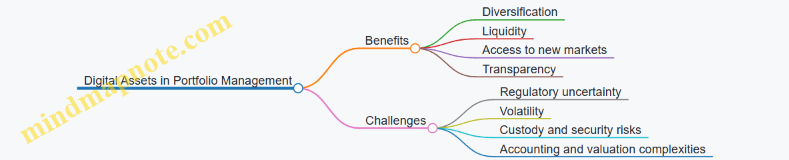
Best Practices for Managing Digital Assets
- Due Diligence: Understand the underlying technology and regulatory environment.
- Robust Custody Solutions: Use secure wallets and trusted custodians.
- Valuation Methods: Adapt traditional valuation techniques to account for volatility and market depth.
- Compliance: Stay updated on evolving regulations and reporting standards.
Example: An accounting team implements a monthly revaluation process for cryptocurrency holdings using market prices from multiple exchanges to ensure accuracy.
Real-World Example: Integrating Digital Assets into a Traditional Portfolio
A portfolio manager at an investment firm decides to allocate 5% of client portfolios to digital assets. They:
- Select a mix of established cryptocurrencies and tokenized securities.
- Use blockchain analytics tools to monitor transactions and risk.
- Partner with a regulated digital asset custodian.
- Educate clients on the risks and benefits.
This approach enhances portfolio diversification and taps into emerging market opportunities while maintaining risk controls.
Conclusion
Blockchain and digital assets are reshaping how financial instruments are managed, offering enhanced transparency, security, and efficiency. Accountants and portfolio managers who embrace these technologies and adopt best practices will be well-positioned to capitalize on the evolving financial landscape.
10.3 Sustainable and ESG-Linked Financial Instruments
Sustainable and ESG (Environmental, Social, and Governance)-linked financial instruments have gained significant traction in recent years as investors increasingly prioritize responsible investing. These instruments not only aim to generate financial returns but also promote positive environmental and social outcomes.
Understanding ESG-Linked Financial Instruments
ESG-linked financial instruments are designed to align investment objectives with sustainability goals. They typically incorporate ESG criteria into their structure, performance metrics, or reporting requirements.
Types of Sustainable and ESG-Linked Instruments
- Green Bonds: Debt instruments where proceeds are exclusively used to finance or refinance projects with environmental benefits, such as renewable energy, energy efficiency, or pollution prevention.
- Social Bonds: Bonds that fund projects with positive social outcomes, like affordable housing, education, or healthcare.
- Sustainability-Linked Bonds (SLBs): Bonds with financial or structural characteristics linked to the issuer’s achievement of predefined ESG targets.
- ESG Funds and ETFs: Investment funds that select securities based on ESG criteria.
- Impact Investing Instruments: Investments explicitly targeting measurable social or environmental impact alongside financial returns.
Mind Map: Overview of ESG-Linked Financial Instruments
Best Practice: Integrating ESG Criteria into Portfolio Management
- Define ESG Objectives: Clearly articulate the sustainability goals aligned with your portfolio strategy.
- Select Appropriate Instruments: Choose financial instruments that directly support these ESG objectives.
- Due Diligence: Conduct thorough research on ESG credentials and impact verification.
- Monitor and Report: Regularly track ESG performance metrics and report transparently to stakeholders.
Example 1: Incorporating Green Bonds into a Fixed Income Portfolio
A portfolio manager aiming to reduce carbon footprint decides to allocate 15% of the fixed income portfolio to green bonds. They select bonds issued by a renewable energy company financing solar power projects. The bonds offer a competitive yield and come with third-party certification verifying the environmental benefits.
- Outcome: The portfolio benefits from stable income while supporting climate change mitigation.
Mind Map: ESG Integration Best Practices
Example 2: Using Sustainability-Linked Bonds to Incentivize Corporate ESG Performance
A corporation issues a sustainability-linked bond where the coupon rate decreases if the company meets specific carbon emission reduction targets within three years. This structure incentivizes the issuer to improve ESG performance while providing investors with a financial benefit tied to sustainability outcomes.
- Outcome: Investors are rewarded for the issuer’s ESG achievements, aligning financial and sustainability interests.
Challenges and Considerations
- Standardization: Lack of universal ESG standards can complicate comparisons.
- Greenwashing Risk: Some issuers may overstate ESG credentials.
- Data Quality: Reliable ESG data is essential for accurate assessment.
Example 3: Avoiding Greenwashing Through Third-Party Verification
An accountant conducting due diligence on a social bond issuance requests third-party verification reports and impact assessments. This ensures the funds are genuinely directed toward social projects and mitigates reputational risk.
Summary
Sustainable and ESG-linked financial instruments represent a powerful tool for portfolio managers and accountants to align investments with broader societal goals. By understanding the types, best practices, and challenges, professionals can effectively incorporate these instruments to drive both financial and positive environmental/social outcomes.
10.4 Best Practice: Preparing for Future Market Changes with Adaptive Strategies
In the fast-evolving world of financial instruments, staying ahead requires adaptive strategies that anticipate and respond to market changes effectively. This section explores best practices to prepare for future market dynamics, supported by mind maps and practical examples.
Understanding Adaptive Strategies
Adaptive strategies involve continuously monitoring market trends, regulatory shifts, technological advancements, and investor preferences to adjust portfolio management approaches proactively.
Key Components of Adaptive Strategies
Adaptive Strategies Mind Map
Best Practice Steps
-
Continuous Market Intelligence Gathering
- Use real-time data feeds and economic reports.
- Example: A portfolio manager subscribing to multiple financial news sources and economic calendars to anticipate interest rate hikes.
-
Scenario Planning and Stress Testing
- Regularly simulate adverse market conditions.
- Example: Running stress tests on bond portfolios to assess impact of sudden inflation spikes.
-
Flexible Asset Allocation Models
- Employ dynamic models that adjust allocations based on market signals.
- Example: Shifting weight from equities to fixed income during early signs of recession.
-
Incorporate Emerging Instruments
- Stay informed about new financial products like ESG bonds or digital assets.
- Example: Adding green bonds to portfolios to capture growing sustainable investment demand.
-
Leverage Technology and Automation
- Use AI-driven analytics for predictive insights.
- Example: Implementing machine learning algorithms to detect early market volatility patterns.
-
Regular Training and Knowledge Updates
- Keep teams updated on regulatory and market developments.
- Example: Quarterly workshops on changes in IFRS standards affecting instrument valuation.
Adaptive Strategy in Action: Example
Scenario: A portfolio manager oversees a diversified portfolio including equities, bonds, and derivatives. Rising geopolitical tensions and inflation fears signal potential market volatility.
Adaptive Approach:
- Increase monitoring frequency of geopolitical news and inflation data.
- Run stress tests simulating a 2% inflation jump and interest rate increase.
- Adjust asset allocation by reducing exposure to long-duration bonds vulnerable to rate hikes.
- Introduce inflation-protected securities and commodity-linked derivatives as hedges.
- Use AI tools to analyze sentiment and volatility forecasts.
Outcome: The portfolio weathers the volatility with minimized losses and captures gains from inflation-linked assets.
Mind Map: Adaptive Strategy Workflow
Summary
Preparing for future market changes with adaptive strategies is essential for accountants and portfolio managers to maintain resilient and profitable portfolios. By integrating continuous monitoring, flexible allocation, technological tools, and proactive risk management, professionals can navigate uncertainties effectively.
Remember: The market is dynamic; your strategies must be equally dynamic to succeed.
10.5 Example: Incorporating ESG Bonds into Traditional Portfolios
Incorporating Environmental, Social, and Governance (ESG) bonds into traditional investment portfolios is an increasingly popular strategy for portfolio managers and accountants aiming to align financial returns with sustainable and ethical considerations. This example will walk through the process, benefits, challenges, and practical steps involved in integrating ESG bonds.
What are ESG Bonds?
ESG bonds are fixed-income securities issued to finance projects or companies that meet specific environmental, social, and governance criteria. These include green bonds, social bonds, and sustainability-linked bonds.
Why Incorporate ESG Bonds?
- Risk Mitigation: ESG factors can reduce exposure to regulatory, reputational, and environmental risks.
- Attracting Investors: Growing demand from socially conscious investors.
- Long-term Performance: Evidence suggests ESG bonds can offer competitive returns.
Step-by-Step Process to Incorporate ESG Bonds
Example Scenario: Adding ESG Bonds to a Traditional Fixed Income Portfolio
Background:
- A portfolio manager oversees a fixed income portfolio worth $100 million.
- Current allocation: 80% corporate bonds, 20% government bonds.
- Objective: Integrate ESG bonds to enhance sustainability without sacrificing returns.
Step 1: Define Allocation
- Decide to allocate 15% of the portfolio ($15 million) to ESG bonds.
Step 2: Select ESG Bonds
- Choose a mix of green bonds (60%), social bonds (25%), and sustainability-linked bonds (15%).
- Example bonds:
- Green Bond: $9 million in a renewable energy project bond rated AA.
- Social Bond: $3.75 million in affordable housing development bond rated A.
- Sustainability-Linked Bond: $2.25 million in a manufacturing company with ESG targets, rated A-.
Step 3: Conduct Due Diligence
- Verify ESG ratings from reputable agencies (e.g., MSCI, Sustainalytics).
- Review issuer’s ESG impact reports and transparency.
Step 4: Integrate and Monitor
- Adjust portfolio to reflect new allocation.
- Set quarterly monitoring for financial performance and ESG impact.
Mind Map: ESG Bond Selection Criteria
Practical Tips
- Start Small: Gradually increase ESG bond allocation to assess impact.
- Use ESG Ratings: Leverage third-party ESG scores to screen bonds.
- Engage with Issuers: Understand the issuer’s commitment to ESG goals.
- Balance Yield and Impact: Ensure ESG bonds meet return expectations.
Summary
Incorporating ESG bonds into traditional portfolios requires careful selection, due diligence, and ongoing monitoring. By following best practices and leveraging tools like ESG ratings and impact reports, portfolio managers can enhance sustainability while maintaining financial performance.
This example demonstrates a practical approach to integrating ESG bonds, providing a roadmap for accountants and portfolio managers to align investment strategies with evolving market demands and ethical considerations.
11. Summary and Key Takeaways
11.1 Recap of Best Practices Across Financial Instrument Management
Managing financial instruments effectively requires a comprehensive approach that integrates classification, valuation, risk management, accounting, compliance, and technology. Below is a detailed recap of the best practices, supported by mind maps and practical examples to reinforce understanding.
Mind Map: Core Areas of Financial Instrument Management
Classification & Selection
Best Practice: Establish a clear and consistent classification system for financial instruments aligned with portfolio objectives and risk tolerance.
Example: An accountant categorizes instruments into equities, fixed income, derivatives, and hybrids. A portfolio manager uses this classification to allocate 60% to equities for growth and 40% to bonds for stability, ensuring alignment with the client’s moderate risk profile.
Valuation
Best Practice: Use multiple valuation methods to cross-verify instrument values and ensure accuracy.
Example: To value a corporate bond, a portfolio manager applies the DCF method using expected cash flows and discount rates, then compares it with market prices of similar bonds. Discrepancies prompt further investigation, avoiding overvaluation.
Mind Map: Valuation Techniques
Risk Management
Best Practice: Implement a comprehensive risk management framework that identifies, measures, and mitigates risks using appropriate tools.
Example: A portfolio manager uses Value at Risk (VaR) to quantify potential losses and employs interest rate swaps to hedge against rising rates in a bond portfolio, effectively reducing exposure.
Accounting & Reporting
Best Practice: Maintain accurate, compliant records following relevant accounting standards and ensure transparent disclosures.
Example: An accountant prepares financial statements reflecting fair value adjustments for derivatives as per IFRS 9, ensuring stakeholders receive a true picture of portfolio performance.
Portfolio Management
Best Practice: Integrate financial instruments strategically within the portfolio, balancing asset allocation and rebalancing to meet investment goals.
Example: A portfolio manager constructs a balanced portfolio with 50% equities and 50% fixed income, rebalancing quarterly to maintain target allocations and respond to market changes.
Mind Map: Portfolio Management Strategies
Regulatory & Ethical Compliance
Best Practice: Develop and follow compliance checklists and uphold ethical standards to avoid legal and reputational risks.
Example: Before executing trades, a portfolio manager reviews insider information policies to ensure no conflicts of interest, maintaining integrity and regulatory compliance.
Technology Utilization
Best Practice: Leverage technology to automate valuation, risk assessment, and reporting, enhancing accuracy and efficiency.
Example: Using portfolio management software, an accountant automates daily mark-to-market valuations of derivatives, reducing manual errors and saving time.
Summary Table of Best Practices with Examples
| Area | Best Practice | Example |
|---|---|---|
| Classification & Selection | Clear categorization aligned with risk appetite | Categorizing instruments to allocate 60% equities, 40% bonds |
| Valuation | Use multiple valuation methods | DCF and market comparables for corporate bond valuation |
| Risk Management | Comprehensive risk framework with hedging | Using VaR and interest rate swaps to manage bond portfolio risk |
| Accounting & Reporting | Compliance with IFRS 9 and transparent disclosures | Fair value adjustments for derivatives in financial statements |
| Portfolio Management | Strategic asset allocation and regular rebalancing | Balanced portfolio with quarterly rebalancing |
| Regulatory & Ethical | Compliance checklists and ethical trading standards | Reviewing insider trading policies before executing trades |
| Technology Utilization | Automation and analytics to improve accuracy | Automating mark-to-market valuations using portfolio software |
By consistently applying these best practices, accountants and portfolio managers can enhance the accuracy, compliance, and performance of financial instrument management, ultimately delivering better outcomes for stakeholders.
11.2 Practical Tips for Accountants and Portfolio Managers
Managing financial instruments effectively requires a blend of technical knowledge, strategic thinking, and operational discipline. Below are practical tips tailored for accountants and portfolio managers, enhanced with mind maps and examples to facilitate understanding and implementation.
Maintain Clear and Consistent Classification
Why: Proper classification ensures accurate valuation, risk assessment, and regulatory compliance.
Tip: Develop and regularly update a classification framework aligned with IFRS 9 or ASC 815.
Example: A portfolio manager classifies convertible bonds as hybrid instruments, ensuring both debt and equity features are accounted for correctly.
Use Multiple Valuation Methods
Why: Cross-verifying valuations reduces errors and improves confidence in financial reporting.
Tip: Combine market price, discounted cash flow (DCF), and comparable company analysis.
Example: An accountant values a corporate bond using DCF and compares it with recent market trades to confirm fair value.

Implement Robust Risk Management Frameworks
Why: Identifying and mitigating risks protects portfolio value and ensures compliance.
Tip: Use Value at Risk (VaR), stress testing, and scenario analysis regularly.
Example: A portfolio manager uses interest rate swaps to hedge against rising rates impacting bond holdings.
Ensure Accurate and Transparent Reporting
Why: Transparency builds trust with stakeholders and meets regulatory requirements.
Tip: Follow disclosure guidelines meticulously and maintain audit trails.
Example: An accountant prepares notes explaining the fair value hierarchy for complex derivatives in the financial statements.
Leverage Technology for Efficiency
Why: Automation reduces errors and frees time for strategic tasks.
Tip: Use portfolio management software with integrated valuation and risk modules.
Example: A portfolio manager uses software to automatically update derivative positions and generate risk reports daily.
Continuous Education and Regulatory Awareness
Why: Staying updated prevents compliance risks and leverages new opportunities.
Tip: Attend workshops, subscribe to regulatory updates, and participate in industry forums.
Example: An accountant attends quarterly IFRS update seminars to stay current on changes affecting financial instruments.
Foster Collaboration Between Accountants and Portfolio Managers
Why: Alignment ensures consistent treatment and better decision-making.
Tip: Establish regular communication channels and joint review sessions.
Example: Portfolio managers and accountants hold monthly meetings to reconcile valuations and discuss risk exposures.

By integrating these practical tips into daily workflows, accountants and portfolio managers can enhance the management of financial instruments, ensuring accuracy, compliance, and strategic advantage.
11.3 Checklist for Effective Financial Instrument Management
Managing financial instruments effectively requires a structured approach to ensure accuracy, compliance, and optimal portfolio performance. Below is a comprehensive checklist designed for accountants and portfolio managers, accompanied by mind maps and practical examples to facilitate understanding and implementation.
Checklist for Effective Financial Instrument Management
-
Classification & Documentation
- Ensure all financial instruments are correctly classified (equity, debt, derivative, hybrid).
- Maintain up-to-date documentation for each instrument including terms, maturity, and covenants.
- Verify instrument classification aligns with accounting standards (e.g., IFRS 9, ASC 815).
-
Valuation & Pricing
- Use multiple valuation methods where applicable (market price, DCF, comparables).
- Regularly update valuations to reflect market conditions.
- Document assumptions and inputs used in valuation models.
-
Risk Identification & Management
- Identify all relevant risks (market, credit, liquidity, operational).
- Apply appropriate risk measurement techniques (VaR, stress testing).
- Implement hedging strategies where necessary and monitor effectiveness.
-
Accounting & Reporting Compliance
- Ensure compliance with relevant accounting standards.
- Accurately record transactions and adjustments.
- Prepare transparent disclosures for stakeholders.
-
Portfolio Monitoring & Rebalancing
- Regularly review portfolio composition and performance.
- Rebalance portfolio to maintain target asset allocation.
- Document rationale for changes and decisions.
-
Regulatory & Ethical Adherence
- Stay updated with regulatory changes.
- Conduct compliance checks routinely.
- Promote ethical behavior and transparency.
-
Technology Utilization
- Leverage portfolio management and valuation software.
- Automate routine tasks to reduce errors.
- Use analytics tools for enhanced decision-making.
-
Continuous Learning & Improvement
- Review case studies and industry best practices.
- Conduct periodic training sessions.
- Incorporate feedback and lessons learned into processes.
Mind Maps
Mind Map 1: Financial Instrument Classification & Documentation
Mind Map 2: Risk Management Framework
Mind Map 3: Valuation Process
Mind Map 4: Compliance & Reporting
Practical Examples
Example 1: Classification & Documentation
A portfolio manager receives a new instrument: a convertible bond. Using the checklist, they classify it as a hybrid instrument. They document the conversion terms, maturity date, coupon rate, and relevant accounting treatment under IFRS 9. This ensures consistent treatment in valuation and reporting.
Example 2: Valuation & Pricing
An accountant values a corporate bond using both the discounted cash flow method and market comparables. The DCF yields a value of $102,000, while comparables suggest $101,500. The slight difference prompts further review of assumptions, improving valuation accuracy.
Example 3: Risk Management
A portfolio manager identifies interest rate risk in a bond-heavy portfolio. They perform a VaR analysis and decide to hedge using interest rate swaps. The hedge effectiveness is monitored monthly, ensuring risk mitigation aligns with targets.
Example 4: Compliance & Reporting
During quarterly reporting, the accounting team verifies that all derivatives are measured at fair value with changes recognized in profit or loss, as per ASC 815. They prepare detailed disclosures on derivative exposures and hedge effectiveness, ensuring transparency.
Example 5: Technology Utilization
A firm implements portfolio management software that automates valuation updates and risk reports. This reduces manual errors and frees up time for deeper analysis, enhancing overall management efficiency.
By following this checklist and leveraging the mind maps and examples, accountants and portfolio managers can systematically manage financial instruments with greater confidence, accuracy, and compliance.
11.4 Final Example: End-to-End Management of a Financial Instrument Portfolio
Managing a financial instrument portfolio from start to finish involves a comprehensive approach that integrates classification, valuation, risk management, accounting, compliance, and performance monitoring. This section provides a detailed, step-by-step example illustrating best practices in managing a diversified portfolio.
Step 1: Portfolio Construction and Instrument Selection
Objective: Build a balanced portfolio with a mix of equities, bonds, and derivatives to achieve moderate growth with controlled risk.
- Asset Allocation: 50% equities, 40% bonds, 10% derivatives (options for hedging).
- Instruments Chosen:
- Equities: Large-cap technology stocks (e.g., Apple, Microsoft)
- Bonds: Investment-grade corporate bonds with varying maturities
- Derivatives: Put options on equity holdings for downside protection
Mind Map: Portfolio Construction
Step 2: Valuation of Instruments
- Equities: Use market price valuation daily.
- Bonds: Use Discounted Cash Flow (DCF) method considering coupon payments and maturity.
- Derivatives: Apply Black-Scholes model to price put options.
Example:
- Corporate bond with face value $1000, coupon 5%, maturity 5 years.
- Discount rate: 4.5%.
Calculating present value of coupons and principal to determine fair value.
Mind Map: Valuation Methods
Step 3: Risk Management
- Identify Risks: Market risk on equities, interest rate risk on bonds, and volatility risk on options.
- Measure Risk: Calculate Value at Risk (VaR) for the portfolio.
- Hedging: Use put options to limit downside on equities.
Example:
- Portfolio VaR at 95% confidence over 1 day is $50,000.
- Put options purchased to hedge against a 10% drop in equity prices.
Mind Map: Risk Management Framework
Step 4: Accounting and Reporting
- Classification: Equities as Fair Value Through Profit or Loss (FVTPL), bonds as Amortized Cost, derivatives as FVTPL.
- Impairment: Monitor bonds for credit risk and apply expected credit loss model.
- Reporting: Prepare monthly reports detailing fair values, unrealized gains/losses, and risk exposures.
Example:
- Recognize unrealized loss on put options as expense.
- Disclose bond maturity schedules and credit ratings.
Mind Map: Accounting & Reporting
Step 5: Compliance and Ethical Considerations
- Ensure all trades comply with regulatory requirements (e.g., SEC, MiFID II).
- Maintain transparent records and audit trails.
- Avoid conflicts of interest and insider trading.
Example:
- Use compliance checklist before executing trades.
- Regular training for portfolio managers on ethical standards.
Mind Map: Compliance & Ethics
Step 6: Performance Monitoring and Rebalancing
- Track portfolio performance against benchmarks monthly.
- Rebalance quarterly to maintain target asset allocation.
Example:
- Equity portion outperformed, increasing to 60% of portfolio.
- Sell some equities and buy bonds to rebalance to original 50/40/10 split.
Mind Map: Performance & Rebalancing
Summary Table: End-to-End Portfolio Management
| Step | Key Activities | Example Highlight |
|---|---|---|
| Portfolio Construction | Asset allocation, instrument selection | 50% equities, 40% bonds, 10% options |
| Valuation | Market price, DCF, Black-Scholes | Valuing corporate bond with DCF |
| Risk Management | Risk identification, VaR, hedging | Using put options to hedge equity downside risk |
| Accounting & Reporting | Classification, impairment, disclosures | Recognizing unrealized losses on derivatives |
| Compliance & Ethics | Regulatory adherence, ethical standards | Compliance checklist and insider trading prevention |
| Performance Monitoring | Benchmarking, rebalancing | Quarterly rebalancing to maintain target allocation |
This final example encapsulates the holistic process of managing a financial instrument portfolio, emphasizing best practices and practical applications tailored for accountants and portfolio managers.