Space Based Solar Power Systems and Orbital Energy Infrastructure
1. Introduction to Space Based Solar Power (SBSP)
1.1 Historical Development and Conceptual Foundations
Space Based Solar Power (SBSP) is the idea of collecting solar energy in space and transmitting it to Earth. This concept emerged from the recognition that solar energy in orbit is more abundant and consistent than on the ground, as it avoids atmospheric interference and the day-night cycle.
The initial conceptual foundation dates back to the early 1960s. In 1968, Peter Glaser, an engineer, proposed the idea of a satellite equipped with solar panels that could convert sunlight into microwaves and beam the energy to Earth. This proposal laid the groundwork for SBSP by identifying the key components: solar energy collection, conversion to microwaves, and wireless transmission.
The concept gained attention during the 1970s energy crises, when alternative energy sources were actively explored. NASA and the Department of Energy conducted studies on the feasibility of SBSP, focusing on technical challenges such as launch costs, power conversion efficiency, and beam safety.
Over the decades, the idea evolved from theoretical studies to experimental projects. Early experiments with microwave transmission and solar panel technology provided data to refine system designs. The development of lightweight materials and advances in satellite technology further supported the concept.
The core principles of SBSP rest on three pillars:
- Continuous Solar Access: In orbit, solar panels receive sunlight almost 24/7, unlike terrestrial panels limited by weather and night.
- Wireless Power Transmission: Energy collected must be sent to Earth without wires, typically via microwaves or lasers.
- Energy Conversion Efficiency: Efficiently converting solar energy to microwaves and back to electricity is crucial for system viability.
The following mind map summarizes the historical development and key concepts:
An example illustrating the early conceptual foundation is the 1975 NASA study that modeled a geostationary satellite with a 1-kilometer-wide solar array. This study identified the major engineering challenges, such as the need for precise beam control and the thermal management of large solar arrays.
Another example is the Japanese Space Agency’s (JAXA) more recent experimental work on microwave power transmission, which traces its roots to these early concepts. Their experiments with small-scale microwave transmission in the 1990s demonstrated the feasibility of energy beaming, validating a key part of Glaser’s original proposal.
The historical development of SBSP is marked by gradual progress in technology and understanding. While the concept has been around for over half a century, each step has addressed specific technical challenges, moving from broad ideas to detailed engineering solutions.
This section sets the stage for understanding how SBSP systems are designed today, grounded in decades of research and experimentation.
1.2 Fundamental Principles of Solar Energy Harvesting in Space
Solar energy harvesting in space relies on capturing sunlight outside Earth’s atmosphere, where solar radiation is more intense and uninterrupted by weather or day-night cycles. The fundamental principle is straightforward: convert solar radiation into usable electrical energy efficiently and reliably.
Key Concepts in Space-Based Solar Energy Harvesting
-
Solar Irradiance: The power per unit area received from the Sun, measured in watts per square meter (W/m²). In space, this value is about 1361 W/m², known as the solar constant, higher than the roughly 1000 W/m² at Earth’s surface due to atmospheric absorption and scattering.
-
Photovoltaic Conversion: Using semiconductor materials to convert photons directly into electricity via the photovoltaic effect.
-
Thermal Conversion: Concentrating sunlight to generate heat, which then drives a heat engine to produce electricity.
-
Energy Storage and Management: Balancing generation with transmission and storage to ensure continuous power supply.
-
Orbital Considerations: Positioning satellites to maximize solar exposure and optimize power transmission to Earth.
Mind Map: Solar Energy Harvesting Fundamentals
Solar Irradiance and Its Importance
In orbit, solar panels receive more consistent and stronger sunlight than on Earth. Without atmospheric filtering, solar cells can operate closer to their maximum theoretical efficiency. For example, a solar panel in geostationary orbit experiences nearly constant sunlight, only briefly interrupted by Earth’s shadow during equinoxes.
Example: The International Space Station (ISS) uses large photovoltaic arrays that operate at about 1300 W/m², slightly below the solar constant due to panel orientation and minor losses.
Photovoltaic Conversion Principles
Photovoltaic (PV) cells convert photons into electrical current. When sunlight strikes a semiconductor, it excites electrons, creating electron-hole pairs. These charge carriers are separated by an internal electric field, generating a voltage.
Key factors affecting PV efficiency include:
- Material properties (e.g., silicon, gallium arsenide)
- Cell temperature (higher temperatures reduce efficiency)
- Incident angle of sunlight
Example: Gallium arsenide cells are often used in space because they maintain higher efficiency under radiation and temperature extremes compared to silicon.
Thermal Conversion Principles
Thermal systems concentrate sunlight using mirrors or lenses to heat a working fluid. The heat drives turbines or Stirling engines to generate electricity. While more complex, thermal conversion can be advantageous for certain orbital platforms.
Example: A parabolic mirror focuses sunlight onto a receiver, heating a gas that spins a turbine. This method requires precise tracking of the Sun and robust thermal management.
Energy Storage and Management
Since power transmission to Earth depends on continuous generation, managing energy flow is critical. Batteries or supercapacitors store excess energy during peak sunlight, smoothing output during brief eclipses or transmission interruptions.
Example: Lithium-ion batteries aboard satellites store energy during sunlight periods to power systems when in Earth’s shadow.
Orbital Considerations
Choosing the orbit affects solar exposure and power transmission. Geostationary orbit (GEO) satellites remain fixed relative to Earth’s surface, providing constant power delivery to a specific area. Sun-synchronous orbits offer consistent lighting conditions but require more complex transmission strategies.
Example: A GEO solar power satellite can beam energy continuously to a fixed ground station, simplifying receiver design.
Mind Map: Factors Influencing Solar Energy Harvesting Efficiency
Practical Example: Comparing Earth vs. Space Solar Power
On Earth, solar panels contend with clouds, atmospheric scattering, and day-night cycles, reducing average power output to roughly 200-250 W/m² over 24 hours in many locations. In contrast, a space-based system in GEO can receive near-constant 1361 W/m², translating to higher and more predictable power generation.
This difference underlines why space-based solar power systems can be more efficient despite the complexities of launch and transmission.
In summary, the fundamental principles of solar energy harvesting in space revolve around maximizing exposure to intense, uninterrupted sunlight, converting that energy efficiently through photovoltaic or thermal means, managing power storage and flow, and carefully selecting orbital parameters to optimize system performance.
1.3 Overview of Orbital Energy Infrastructure Components
Space-based solar power (SBSP) systems rely on a network of interconnected components working together in orbit to collect, convert, and transmit solar energy back to Earth. Understanding these components and how they fit together is essential for grasping the overall system architecture.
Main Components of Orbital Energy Infrastructure
-
Solar Energy Collectors: These are the primary devices that capture sunlight. Typically, large arrays of photovoltaic (PV) panels or concentrator systems convert solar radiation into electrical energy.
-
Power Conversion Units: After collection, the raw electrical output needs conditioning. This includes inverters, regulators, and power management systems that ensure stable and efficient power flow.
-
Energy Transmission Systems: The converted power is sent to Earth using wireless transmission methods, mainly microwave or laser beams. These systems include transmitters, beam directors, and safety mechanisms.
-
Structural Platforms: The physical framework that supports solar arrays, converters, and transmitters. These structures must be lightweight yet durable, often modular for ease of deployment.
-
Attitude and Orbit Control Systems (AOCS): To maintain correct orientation and positioning, satellites use AOCS to keep solar panels pointed at the Sun and transmission beams aimed at ground receivers.
-
Energy Storage Units: While continuous sunlight is available in orbit, storage buffers can help manage transient issues or support power regulation.
-
Ground Receiving Stations: Though not in orbit, these stations are critical infrastructure on Earth that receive and convert the transmitted energy into usable electricity.
Mind Map: Core Orbital Energy Infrastructure Components
Solar Energy Collectors
Solar arrays in orbit are significantly larger than those on typical satellites due to the need for high power output. For example, the International Space Station (ISS) uses solar arrays spanning over 2500 square feet, but SBSP systems require even larger, often modular, arrays that can be assembled in orbit. The design balances surface area, weight, and durability against micrometeoroid impacts and radiation.
Power Conversion Units
Once sunlight is converted to electricity, the power must be conditioned to match the transmission system’s requirements. This involves converting DC power from solar cells into the appropriate frequency and voltage for microwave or laser transmission. For instance, microwave transmitters commonly operate around 2.45 GHz, requiring precise power conditioning.
Energy Transmission Systems
Wireless power transmission is the defining feature of SBSP. Microwave transmission uses phased array antennas to direct energy beams toward ground stations. Laser transmission offers higher frequency beams but requires precise targeting and atmospheric considerations. Both systems include safety interlocks to prevent unintended exposure.
Structural Platforms
The physical platform must support the weight and orientation of solar arrays and transmission equipment while withstanding the space environment. Lightweight composite materials and inflatable structures are examples of current best practices. Modular designs allow incremental assembly and maintenance.
Attitude and Orbit Control Systems (AOCS)
Maintaining the correct orientation is critical. Reaction wheels provide fine control, while thrusters handle larger adjustments. For example, geostationary SBSP satellites use AOCS to keep solar panels facing the Sun continuously and transmission antennas aimed precisely at Earth-based receivers.
Energy Storage Units
Though orbit offers near-constant sunlight, eclipses and transient faults necessitate onboard storage. Lithium-ion batteries are common, but supercapacitors may be used for rapid power fluctuations. Storage also supports power smoothing for stable transmission.
Ground Receiving Stations
On Earth, rectennas convert microwave energy back into electricity. These are large antenna arrays designed to capture the transmitted beam efficiently. Power conditioning units then integrate this energy into the local grid.
Mind Map: Energy Flow in SBSP Systems
- Energy Flow
- Solar Radiation
-> Solar Energy Collectors
-> Electrical Power
-> Power Conversion Units
-> Wireless Transmission Systems
-> Energy Beam (Microwave/Laser)
-> Ground Receiving Stations
-> Electrical Grid
- Solar Radiation
Example: Japan’s JAXA SBSP Demonstration
Japan’s space agency JAXA has tested microwave power transmission from a satellite to a ground station. Their system included a solar array generating power, a microwave transmitter operating at 2.45 GHz, and a rectenna on the ground. The demonstration showed efficient beam steering and power delivery over a short distance, highlighting the integration of these components.
Summary
Orbital energy infrastructure is a complex system of interdependent components. Each part—from solar collectors to ground stations—must be designed with precision and reliability. Understanding these components and their interactions helps clarify the challenges and solutions in harvesting solar energy in orbit and transmitting it to Earth.
1.4 Best Practices in Early SBSP System Design with Case Studies
Early design of Space Based Solar Power (SBSP) systems required balancing multiple technical, operational, and economic factors. This section outlines best practices drawn from pioneering projects and research, illustrated with practical examples and mind maps to clarify complex relationships.
Key Design Considerations
- Energy Collection Efficiency: Maximizing solar capture while minimizing mass and volume.
- Power Conversion and Transmission: Reliable conversion from solar energy to microwaves or lasers and efficient transmission to Earth.
- Structural Integrity: Lightweight yet durable structures capable of deployment and operation in orbit.
- Launch and Deployment Constraints: Designing within payload limits and ensuring straightforward assembly.
- Thermal Management: Handling heat dissipation in vacuum.
- System Redundancy and Maintenance: Ensuring long-term operation with minimal intervention.
Mind Map: Early SBSP System Design Factors
Best Practices
1. Modular Design: Early SBSP systems benefited from modular components that could be tested independently, then integrated in orbit. This approach reduced risk and allowed incremental scaling. For example, the NASA SPS (Solar Power Satellite) concept in the 1970s proposed modular solar arrays that could be launched separately and assembled in space.
2. Use of Proven Technologies: Incorporating well-understood photovoltaic cells and microwave transmission techniques helped avoid untested risks. The Japanese JAXA project used gallium arsenide solar cells, known for their high efficiency and radiation tolerance, paired with microwave transmitters tested in ground experiments.
3. Lightweight, Deployable Structures: Minimizing launch mass is critical. Early designs used thin-film solar arrays and inflatable or foldable frameworks. The SPS-ALPHA concept introduced a modular, inflatable structure that could be compact during launch and expanded in orbit.
4. Thermal Control via Passive Methods: Active cooling adds complexity and mass. Early SBSP designs favored radiative cooling surfaces and heat pipes to passively manage temperature. For instance, the NASA 1979 reference design incorporated large radiators positioned to dissipate heat away from sensitive electronics.
5. Redundancy and Fault Tolerance: Given the difficulty of repairs, systems were designed with multiple redundant components. The International Space Station’s power system, while not SBSP, exemplifies this with multiple solar arrays and power channels.
6. Ground Testing and Simulation: Before deployment, extensive ground-based testing of power transmission and structural deployment was essential. The Goldstone Solar Power Demonstration tested microwave transmission over several kilometers, validating key technologies.
Case Study 1: NASA’s 1970s Solar Power Satellite Concept
- Approach: Large geostationary satellite with massive solar arrays converting sunlight to microwaves.
- Best Practices Used: Modular solar panels, passive thermal control, and microwave transmission.
- Challenges: High launch costs and structural complexity.
Case Study 2: JAXA’s Space Solar Power Systems
- Approach: Smaller modular units with high-efficiency solar cells and microwave transmission.
- Best Practices Used: Use of proven photovoltaic materials, modular design, and ground-based microwave transmission tests.
- Outcome: Demonstrated feasibility of wireless power transmission with controlled beam targeting.
Mind Map: Case Study Comparison
Practical Example: Modular Solar Array Deployment
In early designs, solar arrays were segmented into panels roughly 10x10 meters, each capable of independent deployment. This allowed staggered launches and assembly, reducing risk. The panels connected via standardized interfaces, simplifying integration. This approach is similar to the modular solar arrays used on the ISS, which can be folded for launch and unfolded in orbit.
Summary
Early SBSP system design emphasized modularity, use of proven technologies, lightweight deployable structures, passive thermal management, and redundancy. These practices helped manage the complexity and cost of building and operating solar power satellites. The lessons from NASA’s and JAXA’s projects remain relevant for current and future SBSP efforts.
1.5 Practical Examples of Ground-Based Solar Power vs. Space-Based Systems
Practical Examples of Ground-Based Solar Power vs. Space-Based Systems
Solar power is a familiar energy source on Earth, yet its application in space introduces distinct differences and challenges. Comparing ground-based solar power (GBSP) with space-based solar power (SBSP) highlights these contrasts clearly.
Mind Map: Key Differences Between Ground-Based and Space-Based Solar Power
Example 1: Solar Farm in the Mojave Desert (Ground-Based)
The Mojave Desert hosts one of the largest solar farms on Earth. It benefits from high solar irradiance and clear skies but still faces daily and seasonal cycles. Panels must be tilted and sometimes tracked to maximize sunlight capture. Energy output fluctuates with weather and time, requiring storage or backup power. Transmission losses are minimal since power is delivered directly to nearby grids.
Example 2: Hypothetical SBSP Satellite in Geostationary Orbit
An SBSP satellite positioned approximately 36,000 km above the equator can collect solar energy continuously, unaffected by Earth’s rotation or weather. It converts sunlight into electricity and then transmits it via microwaves to a ground-based receiving station. This setup avoids night-time power drops and weather-related interruptions but introduces challenges in wireless power transmission efficiency and infrastructure complexity.
Mind Map: Advantages and Challenges
Example 3: Energy Output Comparison
A 1 MW ground-based solar installation in a sunny location might produce roughly 1,500 MWh annually, accounting for night and weather losses. In contrast, a similarly sized SBSP system could theoretically generate close to 8,760 MWh annually due to continuous exposure. However, conversion and transmission losses reduce this figure, and the complexity of maintaining orbital infrastructure must be factored in.
Mind Map: Energy Flow and Losses
Example 4: Weather Impact on Ground-Based Systems
Cloud cover can reduce solar panel output by up to 90% in extreme cases. For example, in northern Europe, solar farms experience significant seasonal variation, with low output in winter months. This variability requires robust energy storage or complementary power sources.
Example 5: Transmission Considerations
Ground-based solar power delivers electricity through established grid infrastructure, which is efficient and reliable. SBSP requires microwave or laser transmission, which involves beam targeting, atmospheric interference, and safety protocols. For instance, microwave beams must be precisely aimed at rectenna arrays to avoid energy loss and ensure safety.
In summary, ground-based solar power is a mature, accessible technology with limitations tied to Earth’s environment. Space-based solar power offers continuous, high-intensity energy capture but demands complex infrastructure and technology to convert and transmit power back to Earth. Both systems have practical examples demonstrating their strengths and weaknesses, providing a foundation for understanding their roles in energy generation.
2. Solar Energy Collection Technologies in Orbit
2.1 Photovoltaic Arrays: Design and Efficiency Optimization
Photovoltaic (PV) arrays are the core technology for converting solar radiation into electrical energy in space-based solar power systems. Their design and efficiency optimization are crucial for maximizing power output while minimizing mass and complexity.
Design Considerations for Photovoltaic Arrays
PV arrays in orbit differ from terrestrial arrays mainly due to the space environment and mission constraints. Key design factors include:
-
Cell Type and Efficiency: Space-grade cells often use multi-junction solar cells, which stack different semiconductor materials to capture a broader spectrum of sunlight. These cells typically achieve efficiencies above 30%, compared to 15-20% for standard terrestrial silicon cells.
-
Array Size and Configuration: The total power output depends on the array’s surface area. Designers must balance size with launch vehicle constraints and deployment mechanisms. Arrays can be rigid panels or flexible blankets that roll out in orbit.
-
Thermal Management: In space, PV cells face extreme temperature swings. Efficient heat dissipation is necessary to maintain performance and prevent damage.
-
Radiation Hardening: High-energy particles in space degrade cell performance over time. Protective coatings and radiation-resistant materials extend operational life.
-
Mass and Structural Support: Every kilogram launched adds cost. Lightweight materials and minimal support structures are preferred.
Efficiency Optimization Strategies
Efficiency optimization involves both improving the intrinsic cell performance and optimizing the system-level design.
-
Maximizing Incident Light Capture: Arrays are oriented to face the sun directly. Tracking mechanisms or orbital positioning can maintain optimal angles.
-
Reducing Resistive Losses: Using high-quality interconnects and minimizing wiring length reduces electrical losses.
-
Thermal Control: Passive radiators or heat pipes help maintain cell temperature within optimal ranges.
-
Mitigating Degradation: Periodic system checks and redundancy can compensate for gradual efficiency loss.
Mind Map: Photovoltaic Array Design Factors
Mind Map: Efficiency Optimization Techniques
Examples
Example 1: Multi-Junction Solar Cells on the ISS The International Space Station uses triple-junction gallium arsenide cells, achieving around 29% efficiency. Their design includes radiation-hardened materials and thermal control systems that keep the cells within operational temperatures despite the ISS’s exposure to sunlight and shadow.
Example 2: Roll-Out Solar Arrays (ROSA) ROSA technology uses flexible, lightweight solar blankets that can be compactly stowed during launch and deployed in orbit. This reduces launch volume and mass. ROSA panels incorporate thin-film multi-junction cells and have been tested on the ISS, demonstrating reliable deployment and good power output.
Example 3: Sun-Tracking Mechanisms Some satellites use gimballed mounts or articulated joints to keep their PV arrays aligned with the sun. This mechanical tracking increases energy capture by maintaining an optimal angle, which can improve power output by up to 30% compared to fixed arrays.
Summary
Designing photovoltaic arrays for space involves selecting high-efficiency, radiation-resistant cells, optimizing array size and configuration, managing thermal loads, and minimizing mass. Efficiency gains come from maximizing sunlight capture, reducing electrical losses, and mitigating degradation. Real-world examples like the ISS and ROSA illustrate these principles in action.
2.2 Concentrated Solar Power Systems for Space Applications
Concentrated Solar Power (CSP) systems in space focus sunlight onto a small area to generate heat, which then drives a power conversion process. Unlike photovoltaic arrays that convert sunlight directly into electricity, CSP uses mirrors or lenses to concentrate solar radiation, increasing the energy density and enabling efficient thermal energy generation. This approach can be advantageous in orbit where sunlight is uninterrupted and intense.
Principles of Space-Based CSP
CSP systems in orbit typically use reflective surfaces such as parabolic mirrors or Fresnel lenses to focus sunlight onto a receiver. The receiver absorbs the concentrated solar energy, converting it into heat. This heat is then transferred to a working fluid—often a gas or liquid metal—that drives a heat engine, such as a Stirling engine or a Brayton cycle turbine, to produce electricity.
Key factors include:
- Concentration Ratio: The ratio of the mirror/lens area to the receiver area, which determines how much sunlight is focused.
- Thermal Efficiency: How effectively the system converts heat to electricity.
- Thermal Management: Managing heat losses in the vacuum of space.
Mind Map: Components of Space-Based CSP
Advantages of CSP in Space
- High Energy Density: Concentrating sunlight increases the power output per unit area of the receiver.
- Thermal Storage Potential: Heat can be stored temporarily, allowing for more stable power output.
- Reduced Photovoltaic Material Needs: CSP requires fewer semiconductor materials compared to large-area PV arrays.
Challenges Specific to Space
- Thermal Losses: In space, radiative heat loss is significant; managing this requires efficient insulation and radiators.
- Precision Alignment: Concentrators must maintain precise orientation to focus sunlight accurately.
- Mechanical Complexity: Moving parts like Stirling engines add complexity and potential points of failure.
Mind Map: Challenges and Solutions
Example: Stirling Engine-Based CSP Satellite
One practical example is a satellite design using a parabolic dish concentrator focusing sunlight onto a Stirling engine. The engine converts thermal energy into electricity with high efficiency. The system includes a sun-tracking mechanism that keeps the dish aligned with the sun, maximizing energy capture. Radiators dissipate excess heat to maintain optimal engine temperatures.
This design balances efficiency with mechanical complexity. The Stirling engine’s moving parts require robust engineering to survive the space environment, but the high conversion efficiency can justify the trade-offs.
Example: Fresnel Lens Concentrator with Brayton Cycle
Another approach uses lightweight Fresnel lenses to concentrate sunlight onto a receiver connected to a Brayton cycle turbine. Fresnel lenses are thinner and lighter than traditional mirrors, reducing launch mass. The Brayton cycle turbine operates with a gas working fluid, converting heat to electricity.
This setup benefits from fewer moving parts in the turbine compared to Stirling engines and can operate continuously with stable heat input. However, the optical precision of Fresnel lenses and thermal management remain critical.
Best Practices in Designing Space CSP Systems
- Optimize Concentration Ratio: Balance between high concentration for efficiency and manageable thermal loads.
- Use Lightweight Materials: Minimize launch costs by employing advanced composites and thin-film optics.
- Incorporate Redundancy: Design systems with backup components to handle failures.
- Implement Autonomous Sun Tracking: Use sensors and control algorithms to maintain precise alignment without ground intervention.
- Plan for Thermal Management: Include radiators sized to dissipate waste heat effectively.
Mind Map: Best Practices
In summary, concentrated solar power systems in orbit offer a viable alternative to photovoltaic arrays by leveraging thermal energy conversion. Their design requires careful attention to optical precision, thermal management, and mechanical reliability. Real-world examples demonstrate that with proper engineering, CSP can be an effective component of space-based solar power infrastructure.
2.3 Materials and Coatings for Enhanced Solar Absorption
Materials and coatings play a crucial role in maximizing solar absorption for space-based solar power (SBSP) systems. The goal is to capture as much sunlight as possible while minimizing losses due to reflection, degradation, or thermal effects. This section covers the types of materials used, their properties, and the coatings that enhance their performance.
Key Material Properties for Solar Absorption
- High Absorptivity: The material must absorb a broad spectrum of sunlight efficiently.
- Low Emissivity: To reduce heat loss through thermal radiation.
- Durability: Resistance to radiation, micrometeoroids, and thermal cycling.
- Lightweight: Minimizing mass is critical for launch and deployment.
Common Materials Used
- Silicon (Si): The workhorse of photovoltaic cells, silicon offers a good balance of efficiency and cost. However, its weight and rigidity can be drawbacks for large arrays.
- Gallium Arsenide (GaAs): Higher efficiency and better radiation resistance than silicon, but more expensive and complex to manufacture.
- Multi-junction Cells: These stack different semiconductor materials to capture various wavelengths, improving efficiency.
- Thin-Film Materials: Such as amorphous silicon, cadmium telluride, and copper indium gallium selenide (CIGS), these offer flexibility and reduced weight but generally lower efficiency.
Coatings for Enhanced Absorption
Coatings are applied to reduce reflection and protect the underlying material.
- Anti-Reflective Coatings (ARC): These thin layers minimize reflection losses by causing destructive interference of reflected light. For example, silicon solar cells often use silicon nitride or titanium dioxide coatings.
- Black Coatings: Materials like carbon nanotube arrays can absorb nearly all incident light, but their application in space is limited due to durability concerns.
- Thermal Control Coatings: Some coatings balance absorption with thermal emissivity to maintain optimal operating temperatures.
Mind Map: Materials and Coatings for Solar Absorption
Example: Anti-Reflective Coating on Silicon Cells
Silicon solar cells reflect about 30% of incident sunlight without coatings. Applying a silicon nitride anti-reflective layer reduces reflection to under 10%. This simple coating increases the cell’s power output significantly without adding weight or complexity.
Example: Multi-Junction Cells in Space
Multi-junction cells used on satellites combine layers of GaAs, indium gallium phosphide, and germanium. Each layer captures a different part of the solar spectrum, pushing efficiencies above 30%. These cells are more resistant to radiation damage, extending operational life in orbit.
Mind Map: Coating Functions and Examples
Durability Considerations
Materials and coatings must withstand:
- Radiation: High-energy particles degrade materials over time.
- Thermal Cycling: Temperatures in orbit swing widely, causing expansion and contraction.
- Micrometeoroid Impacts: Small particles can damage surfaces.
Coatings that degrade or peel reduce solar absorption and can expose underlying materials to damage. Therefore, testing for long-term stability under simulated space conditions is standard practice.
Lightweight Composite Structures
To reduce mass, solar arrays often use thin-film materials on flexible substrates like polyimide films. These substrates can be coated with anti-reflective layers and protective films. The combination offers a good trade-off between efficiency, durability, and weight.
Example: Thin-Film Solar Panels on Polyimide
NASA has tested thin-film solar cells deposited on Kapton, a polyimide film. These panels are lightweight and flexible, allowing compact stowage during launch and deployment in orbit. Coatings applied to the surface improve absorption and protect against UV degradation.
Summary
Selecting materials and coatings for SBSP systems involves balancing efficiency, durability, weight, and cost. Silicon and GaAs remain primary materials, enhanced by multi-junction designs and thin films. Coatings reduce reflection and protect against the harsh space environment. Real-world examples demonstrate how these choices impact system performance and longevity.
2.4 Best Practices in Deployable Solar Panel Mechanisms with Real-World Examples
Deployable solar panel mechanisms are critical for space-based solar power systems, where compact launch configurations must expand into large, efficient arrays once in orbit. The design and operation of these mechanisms influence reliability, power output, and mission success. This section outlines best practices in deployable solar panel mechanisms, supported by real-world examples and mind maps to clarify key concepts.
Key Considerations in Deployable Solar Panel Mechanisms
- Compact Stowage: Panels must fold or roll into a small volume to fit within launch vehicle constraints.
- Reliable Deployment: Mechanisms should function flawlessly in microgravity and vacuum, often without human intervention.
- Structural Integrity: Once deployed, arrays must maintain shape and orientation despite thermal cycling and orbital dynamics.
- Mass Efficiency: Minimizing mass reduces launch costs and improves system performance.
- Redundancy and Fault Tolerance: Designs often include backup systems to handle partial failures.
Mind Map: Deployable Solar Panel Mechanism Components
Best Practices
1. Use Proven Folding Techniques for Compactness and Reliability
Folding solar panels, inspired by origami, allow large surface areas to fit into tight spaces. The Japanese IKAROS mission successfully used a folding sail structure, demonstrating that careful crease pattern design reduces stress during deployment. Panels should fold along predefined lines to avoid damage.
Example: The JAXA IKAROS solar sail employed a square sail folded into a compact shape, unfolding smoothly in space. This approach informs solar panel folding by emphasizing predictable, low-stress deployment paths.
2. Employ Passive Deployment Where Possible
Passive systems using stored strain energy, like springs or shape memory alloys, reduce reliance on motors and electronics, lowering failure risk. Passive deployment can be triggered by simple mechanisms such as release pins.
Example: The Roll-Out Solar Array (ROSA) developed by NASA uses a flexible blanket that rolls out using stored strain energy in composite booms, avoiding complex motorized systems.
3. Design for Thermal and Mechanical Stability Post-Deployment
Materials and structural elements must withstand temperature swings and mechanical loads without warping or losing alignment. Composite booms and trusses provide stiffness with low mass.
Example: The International Space Station’s (ISS) solar arrays use articulated joints and stiffened panels to maintain orientation despite thermal expansion and orbital maneuvers.
4. Incorporate Redundancy in Deployment Mechanisms
Multiple release mechanisms or backup actuators help ensure deployment even if a primary system fails. Redundancy increases mission assurance.
Example: The Hubble Space Telescope’s solar arrays have redundant deployment motors and latches, which allowed successful deployment despite initial issues.
5. Integrate Sensors and Feedback for Deployment Monitoring
Position sensors and tension monitors provide real-time data to ground control or onboard systems, enabling corrective actions if deployment deviates from plan.
Example: The GOES-R weather satellite’s solar arrays include sensors that confirm deployment status, allowing operators to respond promptly to anomalies.
6. Use Lightweight, Flexible Materials to Optimize Mass and Volume
Flexible photovoltaic films and lightweight composites reduce mass and enable compact stowage. Material selection impacts durability and efficiency.
Example: Thin-film solar cells on flexible substrates have been tested on small satellites, demonstrating potential for rollable arrays.
Mind Map: Deployment Sequence and Monitoring
Real-World Examples Summary
- IKAROS (JAXA): Demonstrated folding and deployment of a large solar sail, informing folding panel design.
- ROSA (NASA): Roll-out flexible solar arrays using composite booms, reducing mass and complexity.
- ISS Solar Arrays: Articulated, stiffened panels with robust deployment and orientation control.
- Hubble Solar Arrays: Redundant motors and latches ensured deployment despite initial failures.
- GOES-R Solar Arrays: Integrated sensors for deployment status monitoring.
In summary, deployable solar panel mechanisms benefit from combining compact folding or rolling designs with passive deployment methods, structural stability, redundancy, and real-time monitoring. These practices, proven in various space missions, provide a foundation for reliable and efficient solar power harvesting in orbit.
2.5 Case Study: Modular Solar Array Systems on Current Satellites
Modular solar array systems are a key feature in many modern satellites, offering flexibility, scalability, and easier maintenance compared to monolithic solar panels. These systems consist of multiple smaller solar panel units, or “modules,” that can be individually deployed, replaced, or reconfigured. This approach addresses challenges related to launch constraints, in-orbit assembly, and damage mitigation.
Why Modular?
- Launch Efficiency: Smaller modules fit better within payload fairings and can be packed more densely.
- Scalability: Power capacity can be adjusted by adding or removing modules.
- Redundancy: Failure in one module doesn’t cripple the entire array.
- Maintenance: Easier to repair or replace damaged modules, especially with robotic servicing.
Example: The International Space Station (ISS) Solar Arrays
The ISS uses large, modular solar arrays composed of multiple panels connected in series and parallel configurations. Each solar array wing consists of 4 solar array blankets, each made of thousands of photovoltaic cells. These blankets are folded for launch and deployed in orbit.
- Deployment: The arrays unfold like an accordion, using motorized hinges.
- Modularity: If a section is damaged by micrometeoroids or debris, the rest continue functioning.
- Power Output: Approximately 120 kilowatts total, adjustable by orientation and configuration.
Example: JAXA’s Kibo Module Solar Arrays
Japan’s Kibo module on the ISS has its own set of modular solar arrays designed for easy integration and replacement. The modular design allows for incremental upgrades and repairs without full system replacement.
Mind Map: Components and Benefits of Modular Solar Arrays
Modular Solar Arrays on Communication Satellites
Many geostationary communication satellites use modular arrays. For instance, the Boeing 702 series employs solar panels made of multiple modules that can be folded during launch and deployed in orbit. The modular design allows for tailoring power output to mission needs.
- Example: The Boeing 702 uses triple-junction gallium arsenide cells arranged in modules.
- Deployment: Hinged panels unfold to maximize surface area.
- Fault Tolerance: If a module underperforms, the satellite can adjust power management to compensate.
Mind Map: Modular Solar Arrays in Communication Satellites
Best Practices Illustrated
-
Standardized Module Sizes: Using uniform module dimensions simplifies manufacturing and replacement.
-
Robust Electrical Interconnects: Flexible, reliable connectors maintain power flow even with slight misalignments or thermal expansion.
-
Redundant Deployment Mechanisms: Dual motors or backup systems ensure deployment success.
-
Damage Isolation: Electrical design isolates faulty modules to prevent cascading failures.
-
Thermal Management: Modules incorporate coatings and heat dissipation features to maintain efficiency.
Practical Example: Repair and Upgrade
In 2013, astronauts performed a spacewalk to repair a damaged solar array on the ISS. The modular design allowed them to replace specific components rather than the entire wing. This operation demonstrated how modularity reduces downtime and mission risk.
Summary
Modular solar array systems provide tangible benefits in satellite power generation. By breaking down large arrays into manageable units, satellites can be launched more efficiently, maintain power generation despite damage, and adapt to mission-specific power requirements. The ISS and communication satellites like Boeing 702 exemplify these principles in practice, showing how modularity is a practical solution rather than just a theoretical concept.
3. Power Conversion and Management in Space
3.1 Conversion of Solar Energy to Electrical Power: Technologies and Challenges
Converting solar energy collected in orbit into usable electrical power is a fundamental step in space-based solar power systems. This process involves capturing sunlight, converting it efficiently, and managing the output to meet system demands. The main technologies used for this conversion are photovoltaic (PV) cells and solar thermal converters.
Photovoltaic Conversion
Photovoltaic cells directly convert sunlight into electricity through the photovoltaic effect. In space applications, these cells must be optimized for efficiency, durability, and resistance to radiation.
-
Types of Photovoltaic Cells:
- Silicon-based cells: The most common and well-understood technology, offering moderate efficiency and relatively low cost.
- Multi-junction cells: These use multiple semiconductor layers to capture different parts of the solar spectrum, achieving higher efficiencies (up to 30% or more in space).
- Thin-film cells: Lightweight and flexible, but generally less efficient.
-
Challenges:
- Radiation degradation: High-energy particles in space can damage cell materials, reducing efficiency over time.
- Thermal cycling: Extreme temperature changes cause mechanical stress.
- Mass and volume constraints: Cells must be lightweight and compact for launch and deployment.
Example: The International Space Station (ISS) uses multi-junction gallium arsenide solar cells, which maintain high efficiency and resist radiation damage better than silicon cells.
Solar Thermal Conversion
Solar thermal systems concentrate sunlight to generate heat, which then drives a heat engine or thermoelectric generator to produce electricity.
-
Components:
- Concentrators: Mirrors or lenses focus sunlight onto a receiver.
- Receivers: Absorb concentrated sunlight and convert it to heat.
- Heat engines: Convert heat to mechanical or electrical energy.
-
Challenges:
- Complexity and moving parts: Heat engines often require mechanical components, increasing failure risk.
- Thermal losses: Heat dissipation reduces overall efficiency.
- Weight and size: Concentrators and heat engines add mass.
Example: NASA’s SPS-ALPHA concept incorporates inflatable concentrators with Stirling engines for thermal conversion.
Mind Map: Solar Energy Conversion Technologies
Power Conditioning and Output Management
Once solar energy is converted to electricity, it must be conditioned to match system requirements. This involves voltage regulation, current stabilization, and sometimes energy storage integration.
- Challenges:
- Efficiency losses: Power electronics introduce conversion losses.
- Reliability: Components must operate continuously with minimal maintenance.
- Thermal management: Electronics generate heat that must be dissipated in vacuum.
Example: The ISS uses power management and distribution units that regulate the output from solar arrays before feeding onboard systems.
Practical Example: Comparison of Photovoltaic and Solar Thermal Conversion
| Aspect | Photovoltaic Cells | Solar Thermal Conversion |
|---|---|---|
| Efficiency | 20-30% (multi-junction) | Typically lower, ~15-25% |
| Moving Parts | None | Yes (heat engines) |
| Mass and Volume | Lower, compact | Higher due to concentrators and engines |
| Radiation Resistance | Moderate to high (depending on cell) | High (thermal components less affected) |
| Complexity | Lower | Higher |
Best Practices
- Use multi-junction photovoltaic cells for higher efficiency and radiation tolerance.
- Design thermal management systems to handle both solar cell and power electronics heat.
- Incorporate redundancy in power conversion units to maintain reliability.
- Consider mass and deployment constraints early in the design phase.
Mind Map: Challenges in Solar Energy Conversion
In summary, converting solar energy to electrical power in orbit involves balancing efficiency, durability, and system complexity. Photovoltaic cells dominate current designs due to their simplicity and reliability, but solar thermal systems offer alternative approaches where their specific advantages apply. Understanding the trade-offs and challenges helps in selecting the appropriate technology for a given mission.
3.2 Power Conditioning and Regulation Systems
Power conditioning and regulation systems are essential components in space-based solar power (SBSP) platforms. Their role is to convert raw electrical output from solar arrays into stable, usable power suitable for transmission or onboard use. Without proper conditioning, fluctuations in voltage and current could damage equipment or reduce overall system efficiency.
Core Functions of Power Conditioning and Regulation
- Voltage Regulation: Ensures output voltage remains within specified limits despite changes in solar input or load.
- Current Control: Maintains current flow to prevent overcurrent conditions that could harm components.
- Power Conversion: Converts DC power from solar panels into the required form, often involving DC-DC converters or inverters.
- Filtering: Removes electrical noise and harmonics to provide clean power.
- Protection: Includes safeguards against short circuits, overloads, and thermal issues.
Mind Map: Power Conditioning and Regulation Systems
Voltage Regulation
Voltage regulation in SBSP systems must handle the variable intensity of sunlight caused by orbital position, solar panel orientation, and shadowing. Switching regulators are preferred over linear regulators due to their higher efficiency, which is critical in space where power is limited. For example, a buck converter can step down voltage when solar array output exceeds the required level, while a boost converter raises voltage when output dips.
Example: The International Space Station (ISS) uses switching regulators to maintain stable voltage levels from its solar arrays, adapting to changes in sunlight as it orbits Earth.
Current Control
Current control circuits prevent damage from sudden surges or faults. Overcurrent protection often involves sensing current flow and triggering shutdown or throttling mechanisms if limits are exceeded. This is especially important during transitions such as when solar panels enter or exit eclipse.
Example: A satellite’s power system may include current limiters that automatically reduce load or disconnect non-critical systems during transient spikes, preserving core functionality.
Power Conversion
SBSP platforms typically generate DC power from photovoltaic cells. However, the power transmission system or onboard equipment may require different voltage levels or AC power. DC-DC converters adjust voltage levels efficiently, while inverters convert DC to AC when necessary.
Example: Japan’s experimental SBSP satellite designs incorporate high-efficiency DC-DC converters to optimize power before microwave transmission.
Filtering
Electrical noise can interfere with sensitive electronics and reduce transmission quality. Passive filters (capacitors, inductors) and active filters (using operational amplifiers) smooth out voltage and current waveforms.
Example: Filtering circuits on satellite power buses reduce ripple voltage, ensuring stable operation of communication and control systems.
Protection Mechanisms
Thermal shutdown circuits prevent overheating by disabling power stages if temperatures exceed safe thresholds. Short circuit and surge protections guard against faults caused by wiring errors or micrometeoroid impacts.
Example: Spacecraft power modules often include redundant protection layers to isolate faults and maintain overall system integrity.
Mind Map: Example Implementation in SBSP
Practical Example: Power Conditioning in a Microwave Transmission Satellite
In a microwave power transmission satellite, the raw DC power from solar panels first passes through a DC-DC converter that stabilizes voltage despite fluctuations in solar input. A current limiter ensures that sudden surges do not damage the microwave amplifier. Filtering circuits reduce noise that could affect microwave signal quality. Protection systems monitor temperature and current continuously, shutting down sections if anomalies occur. This layered approach ensures reliable power delivery to the transmission stage.
In summary, power conditioning and regulation systems in SBSP platforms are complex but vital. They transform inconsistent raw solar power into a stable, controlled energy stream that can be efficiently transmitted to Earth or used onboard. Each component—from voltage regulators to protection circuits—plays a specific role in maintaining system health and performance.
3.3 Thermal Management of Power Systems in Orbit
Thermal management in space-based solar power (SBSP) systems is a critical engineering challenge. Unlike on Earth, where convection and conduction through air and ground help regulate temperature, orbiting satellites rely primarily on radiation to manage heat. Power systems generate heat during energy conversion and transmission, and without proper thermal control, components can overheat or become too cold, both of which degrade performance or cause failure.
Why Thermal Management Matters
Power electronics, photovoltaic cells, and transmission equipment all have optimal temperature ranges. Excess heat can reduce photovoltaic efficiency and damage sensitive electronics. Conversely, extreme cold can cause materials to become brittle or reduce battery performance. Thermal management ensures components stay within safe operating limits, extending lifespan and maintaining efficiency.
Mind Map: Key Elements of Thermal Management in Orbit
Heat Generation and Thermal Loads
In SBSP satellites, heat primarily comes from three sources:
- Solar radiation absorption: Even though solar panels convert sunlight to electricity, some energy is absorbed as heat.
- Electrical losses: Power conversion devices like inverters and transformers dissipate heat.
- Internal electronics: Control systems and communication devices generate heat during operation.
Each source contributes to the overall thermal load that must be managed.
Heat Removal Techniques
Since convection is absent in space, heat removal relies on radiation and conduction within the satellite structure.
-
Radiative Cooling: The primary method for rejecting heat to space. Radiators coated with high-emissivity materials emit infrared radiation.
-
Heat Pipes: Passive devices that transfer heat efficiently from hot components to radiators. They use phase change of a working fluid inside sealed tubes.
-
Phase Change Materials (PCMs): These absorb heat by melting during peak loads and release it when temperatures drop, smoothing temperature fluctuations.
-
Thermal Louvers: Adjustable shutters that regulate radiator emissivity, controlling heat rejection dynamically.
Mind Map: Thermal Control Components and Their Functions
Practical Example: Thermal Management on the International Space Station (ISS)
The ISS uses large radiators to dissipate heat generated by onboard systems. Heat pipes transfer heat from internal modules to radiators. Multi-layer insulation blankets reduce heat loss during orbital night. Thermal louvers adjust radiator emissivity depending on heat load. Although the ISS is not a solar power satellite, its thermal management principles apply directly to SBSP systems, especially regarding radiative cooling and heat pipe use.
Thermal Challenges Unique to SBSP Systems
-
Continuous Sun Exposure: Unlike low Earth orbit satellites that experience day-night cycles, geostationary SBSP satellites are almost always sunlit, leading to persistent heating.
-
Thermal Cycling: Some components may still experience temperature swings due to satellite orientation or eclipses.
-
Limited Radiator Placement: Large solar arrays limit available surface area for radiators, requiring efficient heat transfer and compact radiator designs.
-
Material Degradation: Repeated thermal cycling can cause fatigue in materials, requiring careful selection and testing.
Monitoring and Control
Temperature sensors distributed throughout the satellite provide real-time data. Active thermal control systems use heaters or adjustable radiators to maintain temperatures. Autonomous thermal regulation algorithms adjust louvers or heaters without ground intervention, improving reliability.
Mind Map: Thermal Monitoring and Control
Example: Heat Pipe Use in Solar Power Satellites
A practical example is the use of ammonia heat pipes in experimental SBSP platforms. These pipes transfer heat from densely packed power electronics to radiators located on the satellite’s shaded side. This passive system requires no power input and has no moving parts, making it highly reliable for long-duration missions.
In summary, thermal management in SBSP systems revolves around controlling heat generation and efficiently removing it through radiation and conduction. The absence of convection forces engineers to rely on carefully designed radiators, heat pipes, and insulation. Monitoring and active control ensure components remain within safe temperature ranges, preserving system integrity and performance.
3.4 Best Practices for Reliable Power Electronics in Space with Example Implementations
Power electronics in space-based solar power systems face unique challenges: vacuum conditions, radiation exposure, thermal extremes, and the impossibility of quick repairs. Ensuring reliability requires a combination of robust design, careful component selection, and thorough testing.
Key Considerations for Reliable Power Electronics
- Radiation Hardening: Space radiation can cause single-event upsets and long-term degradation. Components must be either radiation-hardened or shielded.
- Thermal Management: Without atmosphere, heat dissipation relies on conduction and radiation. Power electronics generate heat that must be managed to avoid failure.
- Redundancy: Critical systems often include redundant circuits to maintain operation if one path fails.
- Component Selection: Use space-qualified components with proven track records.
- Modularity: Designing modular units allows easier replacement or isolation of faulty sections.
Mind Map: Factors Affecting Reliability of Power Electronics in Space
Best Practices Explained
-
Radiation Hardening and Shielding
- Use radiation-hardened integrated circuits (ICs) designed to withstand high-energy particles.
- Apply shielding materials like aluminum or specialized composites around sensitive electronics.
- Example: The power control units on the International Space Station (ISS) use radiation-hardened microcontrollers combined with aluminum shielding to maintain functionality despite cosmic rays.
-
Thermal Design
- Incorporate heat pipes and radiators to transfer heat away from power electronics.
- Use thermal interface materials to improve conduction between components and heat sinks.
- Example: The solar array power converters on geostationary satellites employ heat pipes connected to external radiators, preventing overheating during continuous sunlight exposure.
-
Redundancy and Fault Tolerance
- Design critical circuits with parallel redundant paths.
- Implement automatic switchover mechanisms to backup systems when faults are detected.
- Example: The power distribution units on NASA’s Mars rovers use redundant converters and automatic fault detection to ensure continuous operation despite component failures.
-
Component Selection and Qualification
- Select components with spaceflight heritage and proven reliability.
- Perform rigorous qualification testing including thermal cycling, vibration, and radiation exposure.
- Example: The photovoltaic power electronics on the Hubble Space Telescope use components qualified through extensive pre-flight testing to ensure long-term reliability.
-
Modularity and Maintainability
- Design electronics in modular blocks that can be isolated or replaced.
- Use standardized interfaces to simplify integration and repair.
- Example: The modular power electronics units on the ISS can be swapped during spacewalks or robotic servicing missions, reducing downtime.
Mind Map: Best Practices for Reliable Power Electronics
Example Implementation: Power Electronics on the International Space Station (ISS)
The ISS power system uses a combination of radiation-hardened electronics and robust thermal management. Its power converters are designed with redundant circuits and automatic fault detection. Heat pipes transfer generated heat to radiators on the station’s exterior. Components undergo extensive testing before launch, and the modular design allows astronauts to replace faulty units during spacewalks. This approach has kept the ISS power system operational for over two decades.
Example Implementation: Geostationary Communication Satellites
Communication satellites in geostationary orbit rely on power electronics that must operate continuously under intense solar radiation. Their power converters use radiation-hardened semiconductors and are mounted on thermally conductive substrates connected to radiators. Redundant power paths ensure uninterrupted service. These satellites often use modular power electronics units to simplify manufacturing and potential in-orbit servicing.
Summary
Reliable power electronics in space require addressing radiation, thermal, mechanical, and electrical stresses through design choices and component selection. Redundancy and modularity improve fault tolerance and maintainability. Real-world examples from the ISS and geostationary satellites illustrate these principles in action, providing a solid foundation for designing dependable power electronics in space-based solar power systems.
3.5 Practical Example: Power Management in the International Space Station
Power management aboard the International Space Station (ISS) offers a practical example of how complex energy systems operate in orbit. The ISS relies primarily on solar arrays to generate electricity, which then powers onboard systems and experiments. Managing this power involves collection, storage, distribution, and regulation, all while coping with the unique environment of space.
Overview of ISS Power Management
The ISS uses large photovoltaic solar arrays that track the sun to maximize energy capture. These arrays convert sunlight into direct current (DC) electricity. However, the station’s orbit causes periods of sunlight and shadow roughly every 90 minutes, so energy storage is essential to maintain continuous power.
Key Components
- Solar Arrays: Capture solar energy and convert it to electricity.
- Batteries: Store energy during sunlight periods for use during eclipses.
- Power Control and Distribution Units (PCDU): Regulate voltage and distribute power to various systems.
- Load Management: Prioritizes power allocation to critical systems.
Mind Map: ISS Power Flow
Solar Arrays and Energy Capture
The ISS has eight solar arrays arranged in pairs on four wings. Each wing can rotate to face the sun, optimizing energy capture. The arrays generate approximately 84 to 120 kilowatts of power when fully illuminated. The variability in sunlight due to the station’s orbit requires careful energy budgeting.
Energy Storage: Batteries
Since the ISS experiences roughly 45 minutes of darkness every orbit, batteries store excess energy generated during sunlight. Initially, nickel-hydrogen batteries were used, but these have been replaced by more efficient lithium-ion batteries. Lithium-ion batteries offer higher energy density and longer life, improving the station’s power reliability.
Power Conditioning and Distribution
Power from the solar arrays is DC and must be conditioned before use. The PCDUs regulate voltage and current, protecting the system from surges or faults. The power is distributed through primary and secondary buses, which segregate critical and non-critical loads to ensure essential systems remain powered.
Load Management and Prioritization
The ISS power system prioritizes loads based on mission needs. Critical systems like life support, communication, and navigation receive power first. Non-critical systems, such as some scientific experiments or non-essential lighting, can be shed during power shortages.
Mind Map: Load Prioritization
Example: Battery Charging Cycle
During the sunlit portion of the orbit, solar arrays provide power directly to the station and charge the batteries. When the ISS enters Earth’s shadow, the batteries discharge to maintain power. The power management system continuously monitors battery state-of-charge and adjusts charging rates to optimize battery health and longevity.
Fault Management
The ISS power system includes fault detection and isolation capabilities. If a solar array or battery module shows abnormal behavior, the system can isolate the faulty component to prevent damage to the rest of the power network. This redundancy and fault tolerance are critical for uninterrupted operation.
Mind Map: Fault Management
Summary
The ISS power management system demonstrates how solar energy can be harvested, stored, and distributed efficiently in orbit. Its design balances energy capture with storage and load demands, incorporating redundancy and fault tolerance. This example provides a grounded understanding of the challenges and solutions relevant to space-based solar power systems.
4. Wireless Power Transmission Methods
4.1 Microwave Power Transmission: Principles and System Design
Microwave power transmission (MPT) is a core technology for space-based solar power systems, enabling the transfer of energy collected in orbit down to Earth without physical connectors. The basic principle involves converting electrical energy generated by solar panels into microwave radiation, beaming it through space, and then reconverting it into electricity at a receiving station on the ground.
Fundamental Principles
At its heart, MPT relies on electromagnetic wave propagation. Microwaves, typically in the frequency range of 1 to 10 GHz, are chosen because they balance atmospheric transparency, antenna size, and beam control. The process involves three main stages:
- Generation: Solar energy is converted into electricity, which powers a microwave transmitter.
- Transmission: The microwave beam is directed toward a ground-based rectenna (rectifying antenna).
- Reception: The rectenna converts the microwave energy back into direct current (DC) electricity for grid integration.
The efficiency of each stage directly impacts the overall system performance.
System Design Components
-
Microwave Transmitter: This includes a high-power microwave source, often a magnetron or solid-state amplifier, coupled with a phased array antenna to shape and steer the beam.
-
Beam Control and Steering: Precise control is necessary to keep the beam focused on the rectenna despite satellite movement and atmospheric disturbances. Phased arrays allow electronic beam steering without moving parts.
-
Rectenna: A large ground-based antenna array composed of many small rectifying elements converts microwaves into usable electricity. The design must optimize conversion efficiency and minimize losses.
-
Safety and Interference Management: The system must ensure the microwave beam does not pose hazards to aircraft, wildlife, or humans and avoid interference with existing communication systems.
Mind Map: Microwave Power Transmission System
Beam Formation and Steering
The phased array antenna consists of numerous small antenna elements, each capable of adjusting the phase of the emitted microwave signal. By controlling the relative phase, the system creates constructive interference in the desired direction, forming a narrow beam. This approach allows rapid beam steering without mechanical movement, which is crucial for maintaining alignment with a moving ground receiver.
Example: Japan’s MPT Experiment
In the late 1990s and early 2000s, Japan’s space agency conducted ground-based experiments transmitting 2.45 GHz microwaves over a distance of 55 meters. They achieved over 80% conversion efficiency from electricity to microwave and back, demonstrating the feasibility of MPT. The experiment used a phased array transmitter and a rectenna with thousands of small diodes converting microwaves into DC power.
Efficiency Considerations
Efficiency losses occur at each stage:
- Conversion Efficiency: Solar panels typically convert 20-30% of sunlight into electricity. Microwave generation can reach 70-85% efficiency.
- Transmission Losses: Beam divergence and atmospheric absorption reduce the power reaching the rectenna.
- Rectenna Efficiency: Modern rectennas can convert 80-90% of received microwave power into electricity.
Optimizing these factors is essential for a viable SBSP system.
Mind Map: Efficiency Factors
Safety and Regulatory Aspects
Microwave beams must be carefully controlled to avoid unintended exposure. The beam intensity is designed to be below safety thresholds for humans and animals outside the rectenna area. Additionally, the system must comply with radio frequency regulations to prevent interference with communication and radar systems.
Example: Beam Safety Protocols
A typical safety measure involves creating a beam with a power density of around 230 W/m² at the rectenna, which is below the intensity of direct sunlight. Surrounding areas have much lower intensities due to beam shaping and spillover control. Continuous monitoring and automatic shutdown systems are implemented to handle anomalies.
Summary
Microwave power transmission is a mature technology with clear principles and well-understood system components. Its success depends on efficient energy conversion, precise beam control, and adherence to safety standards. Real-world experiments, such as those conducted by Japan, provide concrete examples of how these principles come together in practice.
4.2 Laser-Based Power Transmission: Technologies and Safety Considerations
Laser-based power transmission involves converting electrical energy into a coherent light beam, directing it through space, and then converting it back into electricity at the receiver. This method offers a focused, high-intensity energy beam with minimal spread, which can be advantageous for space-based solar power (SBSP) systems.
Key Technologies in Laser Power Transmission
-
Laser Sources: The choice of laser is critical. Common types include semiconductor diode lasers, fiber lasers, and solid-state lasers. Each offers different efficiencies, power outputs, and beam qualities.
-
Beam Control and Steering: To maintain alignment between the satellite transmitter and the ground receiver, precise beam steering mechanisms are essential. These often use gimbals, adaptive optics, or phased arrays.
-
Receiver Systems: The receiver typically uses photovoltaic cells optimized for the laser wavelength or thermophotovoltaic devices. The conversion efficiency depends on matching the laser wavelength to the receiver’s spectral response.
-
Thermal Management: High-power lasers generate heat both at the source and receiver. Efficient cooling systems are necessary to maintain performance and prevent damage.
Mind Map: Laser Power Transmission Components
Advantages of Laser Transmission
-
High Beam Directionality: Laser beams can be tightly focused, reducing power loss over distance compared to microwaves.
-
Smaller Receiver Size: Due to the beam’s narrow spread, receivers can be more compact.
-
Potential for Higher Data and Power Density: The coherent nature of laser light allows for efficient power transmission and possible integration with communication systems.
Challenges and Safety Considerations
-
Atmospheric Interference: Laser beams passing through the atmosphere face absorption, scattering, and turbulence effects, which can reduce power delivery and cause beam wander.
-
Eye and Skin Safety: High-power laser beams pose significant hazards. Safety protocols must ensure that beams do not intersect with aircraft, satellites, or populated areas.
-
Beam Control Precision: Maintaining alignment over thousands of kilometers requires advanced tracking and stabilization to prevent power loss or unintended exposure.
-
Thermal Effects on Receiver: Concentrated laser energy can cause receiver overheating or damage if not properly managed.
-
Regulatory Compliance: Laser transmissions must adhere to international regulations concerning laser safety and space operations.
Mind Map: Safety Considerations in Laser Power Transmission
Example: Laser Power Transmission Experiment
In a terrestrial test, a fiber laser operating at 1550 nm transmitted power over a distance of several kilometers to a photovoltaic receiver. The system achieved an end-to-end conversion efficiency of approximately 30%. Safety measures included automatic beam shutoff triggered by beam misalignment and exclusion zones to prevent human exposure. This experiment demonstrated the feasibility of laser power transfer while highlighting the importance of precise beam control and safety protocols.
Example: Space-to-Ground Laser Power Link
A conceptual SBSP satellite design includes a solid-state laser array transmitting power to a ground station equipped with photovoltaic receivers tuned to the laser wavelength. The satellite uses adaptive optics to correct beam distortions caused by atmospheric turbulence. Safety systems incorporate real-time monitoring of beam path and automatic shutdown if the beam deviates from the designated target zone. This design balances power delivery efficiency with operational safety.
Summary
Laser-based power transmission offers a focused and efficient method to transfer energy from orbit to Earth. The technology relies on advanced laser sources, precise beam steering, and optimized receivers. Safety considerations are paramount, addressing atmospheric effects, human exposure risks, and regulatory compliance. Practical examples illustrate how these factors come together in real-world and conceptual systems.
4.3 Beam Steering and Targeting Techniques
Beam steering and targeting are critical for space-based solar power (SBSP) systems because they ensure the efficient and safe transmission of energy from orbit to designated receivers on Earth or other spacecraft. The goal is to direct the energy beam precisely to maximize power delivery and minimize losses or unintended exposure.
Fundamentals of Beam Steering
Beam steering involves changing the direction of the transmitted energy beam without physically moving the entire satellite or transmitter. This can be achieved through several methods, each with its own advantages and limitations:
- Mechanical Steering: Physically rotating or tilting the antenna or transmitter array.
- Electronic Steering: Adjusting the phase and amplitude of signals across an array to steer the beam electronically.
- Hybrid Steering: Combining mechanical and electronic methods for improved flexibility and range.
Mind Map: Beam Steering Techniques
Mechanical Steering
Mechanical steering uses motors and actuators to physically reorient the transmitter. This method is straightforward and well-understood but can be slow and prone to wear. For SBSP, where continuous and rapid adjustment may be needed to track Earth-based receivers, mechanical steering alone is often insufficient.
Example: The early microwave transmission experiments used gimbaled antennas that rotated to maintain alignment with ground stations. These systems demonstrated reliable pointing but had limitations in speed and precision.
Electronic Steering
Electronic steering relies on phased array technology, where multiple antenna elements emit signals with controlled phase differences. By adjusting these phases, the beam can be steered rapidly without moving parts.
-
Phased Array Antennas: These consist of many small antenna elements arranged in a grid. Each element’s signal phase is shifted to create constructive interference in the desired direction.
-
Advantages: Fast beam steering, no mechanical wear, and the ability to form multiple beams simultaneously.
-
Challenges: Complex control electronics, power consumption, and thermal management.
Example: The NASA Deep Space Network uses phased arrays for spacecraft communication, demonstrating precise electronic beam steering over large distances.
Mind Map: Electronic Beam Steering Components
Optical Beam Steering
For laser-based power transmission, optical beam steering techniques are used. These include micro-electromechanical systems (MEMS) mirrors and liquid crystal devices that can redirect laser beams quickly and with high precision.
Example: MEMS mirrors have been used in satellite laser communication terminals to maintain alignment with ground receivers despite satellite movement.
Hybrid Steering
Combining mechanical and electronic or optical steering can balance the strengths of both. Mechanical steering handles coarse adjustments, while electronic steering fine-tunes the beam direction.
Example: A satellite might use a gimbaled platform to roughly point the transmitter toward Earth and phased arrays to track moving ground receivers within that general direction.
Targeting Techniques
Targeting involves not just steering the beam but ensuring it hits the intended receiver accurately. This requires:
- Precise Satellite Positioning: Using GPS or onboard sensors to know the satellite’s exact location.
- Receiver Location Data: Ground stations provide coordinates and expected movement.
- Feedback Systems: Sensors detect beam alignment and adjust steering in real time.
Example: Japan’s space solar power experiments included feedback loops where ground sensors measured received power and sent corrections to the satellite’s beam steering system.
Mind Map: Targeting Process
Environmental and Operational Considerations
- Atmospheric Effects: The beam can be distorted or attenuated by atmospheric conditions. Adaptive optics or beam shaping can help mitigate this.
- Safety: Ensuring the beam does not stray into unintended areas requires strict control and monitoring.
- Latency: Real-time adjustments need low-latency communication between ground and satellite.
Summary
Beam steering and targeting in SBSP systems rely on a mix of mechanical, electronic, and optical technologies. Each method offers trade-offs in speed, precision, complexity, and reliability. Effective targeting combines accurate satellite and receiver positioning with real-time feedback to maintain beam alignment. Practical implementations often use hybrid approaches to balance these factors, as seen in existing satellite communication and power transmission experiments.
4.4 Best Practices for Minimizing Transmission Losses with Demonstrated Applications
Minimizing transmission losses in wireless power transfer from space-based solar power (SBSP) systems is crucial for efficient energy delivery to Earth. Losses occur primarily due to beam divergence, atmospheric absorption, misalignment, and conversion inefficiencies. Addressing these factors requires a combination of design choices, operational strategies, and technological solutions.
Key Factors Affecting Transmission Losses
- Beam Divergence: As microwave or laser beams travel from orbit to Earth, they spread out, reducing power density.
- Atmospheric Absorption and Scattering: Gases, water vapor, and particulates in the atmosphere absorb or scatter transmitted energy.
- Pointing Accuracy: Misalignment between transmitter and receiver reduces the amount of power captured.
- Conversion Efficiency: Energy losses occur when converting electrical power to microwave/laser energy and back to electricity.
Best Practices for Minimizing Transmission Losses
Optimizing Beam Shape and Frequency
- Use frequencies that balance atmospheric transparency and antenna size. For microwaves, frequencies around 2.45 GHz and 5.8 GHz are common because they experience relatively low atmospheric attenuation.
- Employ beam-forming techniques to create narrow, focused beams that reduce divergence.
Enhancing Pointing and Tracking Accuracy
- Implement high-precision attitude control systems on satellites to maintain stable beam direction.
- Use adaptive beam steering with feedback from ground receivers to correct misalignments in real-time.
Atmospheric Compensation
- Schedule transmissions to avoid adverse weather conditions, such as heavy rain or fog, which increase absorption and scattering.
- Design ground receiver sites in locations with favorable atmospheric conditions, like deserts or high altitudes.
Improving Conversion Efficiency
- Use high-efficiency microwave or laser transmitters and receivers to reduce energy lost during conversion.
- Integrate advanced rectenna designs on the ground to maximize electrical power extraction.
Redundancy and Distributed Reception
- Employ multiple smaller beams targeting an array of ground receivers to reduce the impact of localized atmospheric disturbances.
- Use overlapping coverage zones to ensure continuous power delivery despite transient losses.
Demonstrated Applications and Examples
-
Japan’s JAXA Microwave Power Transmission Experiments: Demonstrated focused microwave beams with over 50% transmission efficiency over short distances, highlighting the importance of precise beam shaping and alignment.
-
NASA’s SPS-Alpha Concept: Proposed a modular phased array transmitter to maintain beam coherence and reduce divergence, illustrating how beam-forming can be scaled.
-
Ground-Based Rectenna Arrays: Experiments with rectennas have shown conversion efficiencies exceeding 85%, underscoring the role of receiver design in minimizing losses.
Mind Map: Minimizing Transmission Losses
Mind Map: Atmospheric Considerations
Example: Adaptive Beam Steering in Practice
In a demonstration, a satellite equipped with phased array antennas adjusted its beam direction based on feedback from ground sensors. This reduced misalignment losses by 30%, showing how real-time corrections can maintain optimal power delivery despite satellite jitter and atmospheric disturbances.
Example: Frequency Selection Impact
Choosing 2.45 GHz for microwave transmission allowed a balance between antenna size and atmospheric transparency. In contrast, higher frequencies suffered from increased atmospheric attenuation, reducing effective power delivery.
In summary, minimizing transmission losses in SBSP systems involves carefully balancing physical design, environmental factors, and operational controls. The combination of optimized beam characteristics, precise pointing, atmospheric awareness, and efficient conversion forms the foundation of effective power transmission from orbit to Earth.
4.5 Case Study: Japan’s Microwave Power Transmission Experiments
Japan’s microwave power transmission experiments represent a significant practical step in demonstrating the feasibility of space-based solar power (SBSP) systems. These experiments focus on converting solar energy collected in space into microwave energy and transmitting it wirelessly to a receiving station on Earth.
Overview of the Experiment Setup
The core of the experiment involves two main components: a microwave transmitter and a rectenna (rectifying antenna) receiver. The transmitter converts electrical power into microwaves at a specific frequency, typically around 2.45 GHz, chosen for its balance between atmospheric transparency and antenna size. The rectenna converts the received microwave energy back into direct current (DC) electricity.
Mind Map: Basic Components
Key Technical Details
The experiments used a phased array antenna to generate a focused microwave beam. This approach allows the beam to be steered electronically without moving parts, which is crucial for maintaining alignment between the satellite and the ground station.
The rectenna was designed as a large planar array of dipole antennas coupled with Schottky diodes for efficient rectification. The size of the rectenna directly affects the amount of power that can be received and converted.
Efficiency and Power Levels
In one notable test, the system transmitted about 1.8 kW of power over a distance of 55 meters with a conversion efficiency of approximately 50%. This level of efficiency is promising for scaling up but also highlights the challenges in minimizing losses during transmission and conversion.
Mind Map: Efficiency Factors
Practical Examples from the Experiments
-
Beam Steering: The use of phased arrays allowed the beam to be directed precisely at the rectenna, demonstrating control techniques that would be necessary for satellite-to-Earth power transmission.
-
Safety Measures: The experiments included safety protocols to ensure that microwave exposure remained within safe limits, such as limiting power density and using automatic shutdowns if the beam strayed.
-
Atmospheric Effects: Tests showed that weather conditions like rain and humidity can attenuate microwave signals, which must be accounted for in system design.
Challenges Highlighted
-
Maintaining precise alignment over long distances is critical to avoid power loss.
-
Scaling from laboratory distances (tens of meters) to satellite-to-Earth distances (hundreds of kilometers) introduces significant technical hurdles.
-
Thermal management of high-power microwave components remains a concern.
Mind Map: Challenges and Solutions
Summary
Japan’s microwave power transmission experiments provide concrete data on the practical aspects of wireless power transfer for SBSP. They demonstrate the viability of key technologies such as phased array antennas and rectennas, while also revealing the technical challenges that must be addressed. The experiments serve as a valuable reference for designing larger-scale systems aimed at harvesting solar energy in orbit and delivering it to Earth.
5. Orbital Platforms and Structural Design
5.1 Structural Requirements for SBSP Satellites
Designing the structure of space-based solar power (SBSP) satellites involves balancing multiple technical demands. The structure must support large solar arrays, withstand launch stresses, maintain precise alignment for power transmission, and survive the harsh environment of space. Each requirement influences material choice, geometry, and assembly methods.
Key Structural Considerations
- Load Bearing and Stiffness: The satellite must support the weight and dynamic loads of solar panels and transmission equipment without excessive deformation. Stiffness is critical to maintain the alignment of microwave or laser transmitters.
- Mass Efficiency: Launch costs scale with mass, so structures must be as light as possible while retaining strength.
- Thermal Stability: Temperature swings in orbit cause expansion and contraction. The structure must minimize distortion to keep components aligned.
- Vibration and Shock Resistance: The satellite experiences intense vibrations during launch and potential micrometeoroid impacts in orbit.
- Modularity and Scalability: Structures often need to be assembled in orbit or expanded over time, so modular design is common.
Structural Components and Their Roles
- Primary Support Truss: Carries the main loads and connects solar arrays to the central bus.
- Solar Array Frames: Hold photovoltaic panels or concentrators in place.
- Power Transmission Platforms: Support microwave or laser transmitters and their aiming mechanisms.
- Thermal Control Elements: Radiators and heat pipes integrated into the structure.
Mind Map: Structural Requirements Overview
Material Selection
Materials must combine low density, high strength, and thermal stability. Common choices include:
- Aluminum Alloys: Widely used for their good strength-to-weight ratio and ease of fabrication.
- Carbon Fiber Reinforced Polymers (CFRP): Offer higher stiffness and lower thermal expansion but at higher cost.
- Titanium: Used in critical joints for strength and corrosion resistance.
Example: Modular Truss Structure
A typical SBSP satellite might use a modular truss made from CFRP tubes connected by titanium nodes. This structure supports solar arrays arranged like wings extending from a central bus. The truss must resist bending caused by solar radiation pressure and maintain transmitter alignment within millimeters.
Mind Map: Material and Structural Components
Thermal Considerations
Thermal expansion can cause misalignment in power transmission systems. Using materials with low coefficients of thermal expansion (CTE) and designing joints that accommodate movement help maintain precision. Active thermal control, such as heaters or radiators integrated into the structure, also plays a role.
Example: Thermal Stability in Transmitter Platform
In a microwave transmitter platform, CFRP panels with embedded heaters maintain a stable temperature to prevent warping. The structure includes flexures—small, flexible joints—that absorb thermal strain without transferring stress to sensitive components.
Assembly and Deployment
SBSP satellites are often too large to launch fully assembled. The structure must be designed for compact stowage and reliable deployment. Hinged joints, telescoping booms, and inflatable supports are common.
Example: Deployable Solar Array Support
A solar array frame might fold accordion-style during launch and unfold in orbit using motorized hinges. The structural design ensures that once deployed, the array is rigid and accurately positioned.
Mind Map: Deployment and Assembly
Summary
The structural design of SBSP satellites is a careful balance of strength, weight, thermal behavior, and deployability. Each choice impacts the satellite’s ability to collect solar energy efficiently and transmit power reliably to Earth. Practical examples, such as modular CFRP trusses and thermally stable transmitter platforms, illustrate how these requirements come together in real systems.
5.2 Materials Selection for Lightweight and Durable Structures
When designing orbital platforms for space-based solar power (SBSP) systems, material choice is a critical factor. The structure must be lightweight to minimize launch costs but also durable enough to withstand the harsh space environment, including radiation, temperature extremes, and micrometeoroid impacts. Balancing these requirements involves understanding material properties, manufacturing constraints, and operational demands.
Key Material Properties for SBSP Structures
- Density: Lower density reduces overall mass, directly impacting launch expenses.
- Strength-to-Weight Ratio: Materials must support structural loads without excessive mass.
- Thermal Stability: Resistance to expansion, contraction, and degradation under temperature swings.
- Radiation Resistance: Ability to maintain mechanical and chemical integrity despite exposure to cosmic rays and solar radiation.
- Fatigue Resistance: Endurance against cyclic stresses from orbital maneuvers and vibrations.
- Manufacturability: Suitability for fabrication, joining, and deployment in space.
Common Materials and Their Characteristics
| Material | Density (g/cm³) | Strength (MPa) | Thermal Stability | Radiation Resistance | Notes |
|---|---|---|---|---|---|
| Aluminum Alloys | ~2.7 | 200-550 | Moderate | Moderate | Widely used, easy to machine |
| Titanium Alloys | ~4.5 | 800-1100 | High | High | Strong but heavier, corrosion resistant |
| Carbon Fiber Composites | ~1.6 | 600-1500 | High | Good | Excellent strength-to-weight ratio |
| Beryllium | ~1.85 | 240-380 | High | Moderate | Lightweight, stiff, but toxic to handle |
| Polyimide Films (e.g., Kapton) | ~1.4 | N/A | Very High | High | Used for thermal blankets and insulation |
Mind Map: Material Selection Factors
Aluminum Alloys
Aluminum alloys are a staple in spacecraft structures due to their balance of strength, weight, and ease of fabrication. They offer moderate thermal stability but require protective coatings to prevent corrosion from atomic oxygen in low Earth orbit. Their relatively low density helps keep launch mass down, and their machinability supports complex structural designs.
Example: The International Space Station (ISS) extensively uses aluminum alloys in its truss structures and modules, demonstrating their reliability and versatility in long-duration missions.
Titanium Alloys
Titanium alloys provide higher strength and better corrosion resistance than aluminum but at a cost of increased density and expense. They are often used in critical load-bearing components where strength is paramount. Their thermal expansion is lower than aluminum, which helps maintain dimensional stability in fluctuating temperatures.
Example: Certain satellite components, such as reaction wheel housings and structural frames, utilize titanium alloys to withstand mechanical stresses without excessive weight penalties.
Carbon Fiber Reinforced Polymers (CFRP)
CFRPs offer exceptional strength-to-weight ratios and excellent thermal stability. Their anisotropic nature allows engineers to tailor stiffness and strength along specific directions by orienting fibers strategically. However, their behavior under radiation and micrometeoroid impacts requires careful consideration.
Example: The James Webb Space Telescope uses carbon fiber composite structures for its primary mirror support, highlighting CFRP’s suitability for precision and lightweight applications.
Beryllium
Beryllium is lightweight and stiff, making it attractive for precision structures. Its toxicity during manufacturing limits widespread use, but in specialized applications, it offers excellent thermal stability and low density.
Example: Beryllium mirrors have been used in space telescopes due to their dimensional stability and light weight.
Polymers and Films
Materials like polyimide films serve as thermal insulation and protective layers rather than load-bearing structures. They help manage temperature extremes and protect sensitive components.
Example: Kapton film is commonly used as a thermal blanket on satellites and spacecraft.
Mind Map: Trade-offs in Material Selection
Practical Considerations
- Launch Constraints: Every kilogram adds cost; lightweight composites often reduce mass but may increase fabrication complexity.
- Assembly in Orbit: Materials must be compatible with robotic assembly or deployment mechanisms.
- Thermal Cycling: Materials with mismatched thermal expansion coefficients can induce stress and fatigue.
- Micrometeoroid Protection: Some materials can be layered or combined with shielding to mitigate impact damage.
Example: Modular Solar Array Support Structure
A modular solar array support might use aluminum alloy frames for ease of manufacturing and cost-effectiveness, reinforced with carbon fiber composites at high-stress points to reduce weight. Polyimide films could cover the structure for thermal control. This combination balances mass, strength, and environmental resistance.
Summary
Material selection for SBSP structures involves balancing multiple factors: mass, strength, environmental resistance, and manufacturability. Aluminum alloys remain a reliable choice for many structural components, while composites offer weight savings where performance justifies complexity. Understanding these trade-offs and applying best practices in material integration ensures durable, efficient orbital platforms.
5.3 Deployment Mechanisms and Assembly in Orbit
Deployment mechanisms and assembly in orbit are critical steps in establishing space-based solar power (SBSP) systems. These processes transform compact launch configurations into large, functional structures capable of harvesting and transmitting solar energy. The complexity arises from the need to operate reliably in microgravity, vacuum, and temperature extremes, while minimizing mass and volume during launch.
Deployment Mechanisms
Deployment mechanisms refer to the hardware and procedures that unfold, extend, or otherwise transform components from their stowed launch state into operational configurations. Common mechanisms include hinges, telescoping booms, inflatable structures, and robotic arms.
-
Hinged Panels: Solar arrays often use hinges to fold panels compactly. Upon reaching orbit, motors or springs rotate the panels into position. This method is mechanically simple but requires precise control to avoid jamming.
-
Telescoping Booms: These extend linearly, pushing solar panels or antennas outward. They save space during launch and provide rigidity once extended. Examples include the use of coilable booms made from composite materials.
-
Inflatable Structures: Inflatable booms or reflectors can be packed tightly and expanded by gas inflation. They offer low mass and volume but require durable materials and reliable inflation systems.
-
Robotic Arms: Robots can manipulate and assemble components in orbit, allowing for complex configurations beyond what passive mechanisms can achieve.
Assembly in Orbit
Assembly involves joining multiple components or modules to form the full SBSP structure. This can be done autonomously by robots, teleoperated from Earth, or by astronauts during extravehicular activities (EVAs).
-
Modular Design: SBSP satellites are often designed as modules that can be launched separately and assembled in orbit. This approach reduces launch mass per mission and allows incremental construction.
-
Robotic Assembly: Robots equipped with arms, grippers, and vision systems can connect modules, deploy solar arrays, and install power transmission equipment. This reduces human risk and can operate continuously.
-
Human-Assisted Assembly: Astronauts may perform assembly tasks requiring dexterity or problem-solving. The International Space Station (ISS) assembly is a prime example.
Mind Map: Deployment Mechanisms
Mind Map: Assembly in Orbit
Examples
-
International Space Station (ISS): The ISS is the most extensive example of in-orbit assembly. Modules launched separately were connected using robotic arms and astronaut EVAs. Solar arrays deployed via hinged panels and telescoping booms provide power.
-
Japan’s ETS-VIII Satellite: This satellite used large deployable antennas with hinged panels and telescoping booms, demonstrating reliable deployment mechanisms in geostationary orbit.
-
Robotic Servicing Missions: NASA’s Restore-L mission aims to demonstrate robotic refueling and assembly, showing how future SBSP systems might be maintained and expanded without human presence.
Practical Considerations
-
Reliability: Deployment mechanisms must function flawlessly after months in storage and exposure to launch vibrations.
-
Redundancy: Multiple deployment paths or backup motors reduce risk of failure.
-
Mass and Volume Efficiency: Mechanisms must minimize added mass and stowed volume to reduce launch costs.
-
Control and Feedback: Sensors and cameras verify deployment status and guide robotic assembly.
-
Thermal and Mechanical Stresses: Materials and joints must withstand temperature cycles and microgravity-induced stresses.
In summary, deployment and assembly in orbit combine mechanical ingenuity with robotics and human skill. Successful SBSP systems depend on well-tested mechanisms and modular designs that can be reliably deployed and assembled under challenging conditions.
5.4 Best Practices in Modular and Scalable Orbital Platform Design with Examples
Modular and scalable design is central to building orbital platforms that can adapt to evolving mission requirements and facilitate maintenance or upgrades. The principle is to break down the platform into discrete, manageable units or modules that can be independently developed, tested, launched, and assembled in orbit. This approach reduces risk, lowers costs, and improves flexibility.
Key Best Practices in Modular and Scalable Orbital Platform Design
-
Standardized Interfaces: Define mechanical, electrical, and data interfaces early and keep them consistent across modules. This ensures compatibility and simplifies integration.
-
Functional Segmentation: Separate power generation, energy storage, communication, and structural components into distinct modules. This allows upgrades or repairs without affecting the entire system.
-
Redundancy and Fault Isolation: Design modules so that failure in one does not cascade. Redundant pathways and isolation mechanisms improve reliability.
-
Ease of Assembly: Modules should be designed for straightforward in-orbit assembly, considering robotic or astronaut-assisted operations. Features like alignment guides, capture mechanisms, and standardized connectors are essential.
-
Mass and Volume Optimization: Each module should be optimized for launch constraints, balancing size, mass, and complexity to fit available launch vehicles and reduce costs.
-
Scalability: The design should allow adding or removing modules to adjust capacity or functionality without redesigning the entire platform.
-
Thermal Management: Modular design must include thermal interfaces to manage heat dissipation across interconnected modules.
-
Testing and Validation: Each module should undergo rigorous ground testing independently and in integrated configurations to ensure performance and compatibility.
Mind Map: Modular Orbital Platform Design Principles
Example 1: ISS Truss and Module Architecture
The International Space Station (ISS) exemplifies modular design. Its truss segments serve as a backbone, supporting solar arrays, radiators, and modules. Each module (habitation, laboratory, storage) is self-contained with standardized docking ports and electrical connections. This allowed international partners to build and launch modules independently over decades. The modular approach enabled repairs, upgrades, and expansion without decommissioning the entire station.
Key takeaways from the ISS model include:
- Use of standardized docking and electrical interfaces (e.g., Common Berthing Mechanism).
- Segmentation of functions into pressurized modules and external truss structures.
- Design for robotic and astronaut assembly and maintenance.
Example 2: Modular Solar Array Wings
Large solar arrays on satellites often use modular wing designs. Each wing consists of multiple solar panel modules connected via hinges and electrical connectors. This allows:
- Folding for compact launch configuration.
- Sequential deployment in orbit.
- Replacement or upgrade of individual panels if needed.
For instance, the JAXA’s Kibo module on the ISS uses modular solar arrays that can be replaced or augmented. The modular wings also simplify manufacturing and testing by producing smaller, repeatable units.
Mind Map: Modular Solar Array Wing Design
Example 3: CubeSat Constellations
CubeSats are small satellites built from standardized 10x10x10 cm units. Their modularity extends to entire constellations, where multiple CubeSats work together to provide scalable capabilities. This approach demonstrates:
- Scalability by adding more units to increase coverage or capacity.
- Cost efficiency through mass production of standardized modules.
- Flexibility in mission design by combining different payload modules.
Though CubeSats are smaller scale than SBSP platforms, the principles of modularity and scalability translate well to larger systems.
Practical Considerations
-
Interface Documentation: Maintain detailed interface control documents (ICDs) to avoid integration issues.
-
Robust Connectors: Use connectors rated for the space environment, resistant to vibration, thermal cycling, and radiation.
-
Assembly Sequence Planning: Define clear procedures for in-orbit assembly to minimize time and risk.
-
Mass Budgeting: Allocate mass margins for each module to accommodate unforeseen additions or reinforcements.
-
Thermal Coupling: Ensure modules have compatible thermal interfaces to prevent hotspots or cold zones.
Mind Map: Practical Considerations in Modular Design
In summary, modular and scalable orbital platform design hinges on clear interface standards, functional separation, and ease of assembly. Examples from the ISS, modular solar arrays, and CubeSat constellations illustrate these principles in action. Applying these best practices reduces risk, improves maintainability, and supports incremental growth of orbital energy infrastructure.
5.5 Practical Example: The ISS Structural Assembly Techniques
The International Space Station (ISS) stands as a practical example of complex orbital structural assembly, offering valuable insights for space-based solar power (SBSP) platform design. Its assembly techniques highlight modular construction, robotic assistance, and precise coordination in microgravity.
Modular Assembly Approach
The ISS was built from multiple modules launched separately and joined in orbit. This modular approach allows for incremental construction and easier transportation. Each module serves a specific function—habitation, laboratories, power, or docking—making the structure flexible and scalable.
ISS Structural Assembly Mind Map
Launch and Delivery
Modules were launched aboard different rockets, including the Space Shuttle and Proton rockets. Each launch had strict mass and volume limits, influencing module design. This required careful planning to ensure modules fit within payload fairings and could be handled by robotic systems.
In-Orbit Assembly Techniques
Robotic arms, especially Canadarm2, played a crucial role in capturing, moving, and positioning modules. Astronauts performed spacewalks (EVAs) to connect power, data, and fluid lines and to secure mechanical fasteners. This combination of robotics and human intervention balanced precision and adaptability.
Structural Connections
The Common Berthing Mechanism (CBM) is a key interface allowing modules to be securely joined. It provides a pressurized seal and mechanical strength. The CBM’s design enables repeated docking and undocking, which is essential for maintenance and expansion.
Integration and Testing
After physical connection, teams perform leak checks and verify electrical and data connections. These tests ensure the modules function as a unified system. This step is critical to avoid failures that could jeopardize the entire station.
Example: Power Module Installation
The Integrated Truss Structure, which supports solar arrays, was assembled piece by piece. The P6 truss segment was initially attached to the Z1 truss, then moved to its final position. Robotic arms maneuvered the segment while astronauts connected cables and secured bolts during EVAs. This example illustrates coordination between robotics and crew.
Power Module Installation Mind Map
Lessons for SBSP Systems
The ISS assembly shows the importance of designing components for modularity and robotic handling. Interfaces must be standardized to simplify connections. Combining robotic precision with human flexibility can improve assembly efficiency. Testing at each step prevents cascading failures.
In summary, the ISS structural assembly techniques provide a grounded example of how large, complex orbital structures can be built incrementally, using a mix of robotics and human work, standardized interfaces, and thorough testing. These principles directly inform the design and deployment of space-based solar power platforms.
6. Satellite Energy Infrastructure and Network Integration
6.1 Satellite Constellations for Continuous Power Supply
Satellite constellations are a key strategy for ensuring continuous power supply from space-based solar power (SBSP) systems. Because a single satellite in orbit experiences periods of eclipse when Earth blocks sunlight, relying on one platform alone leads to intermittent power delivery. Constellations, composed of multiple satellites strategically placed in orbit, address this by providing overlapping coverage so that at least one satellite is always in sunlight and able to transmit power.
Why Use Satellite Constellations?
- Continuous Illumination: Satellites in low Earth orbit (LEO) or medium Earth orbit (MEO) pass into Earth’s shadow regularly. A constellation ensures some satellites remain sunlit at all times.
- Redundancy: If one satellite fails or requires maintenance, others can compensate, maintaining power supply.
- Load Distribution: Power generation and transmission can be shared among satellites, reducing individual system stress.
Orbital Configurations for Constellations
The choice of orbit affects coverage, power transmission angles, and system complexity. Common configurations include:
- Geostationary Orbit (GEO): Satellites remain fixed over one point on Earth, simplifying ground station targeting but experiencing eclipses during equinoxes.
- Low Earth Orbit (LEO): Satellites orbit quickly, requiring many to maintain continuous coverage but benefiting from shorter transmission distances.
- Medium Earth Orbit (MEO): A middle ground offering balance between coverage and transmission distance.
Mind Map: Key Factors in Satellite Constellation Design
Example: Walker Constellation Pattern
The Walker constellation arranges satellites in equally spaced orbital planes with uniform spacing between satellites in each plane. This pattern is often used in communication satellites but applies well to SBSP for uniform coverage.
- Advantages: Predictable coverage, simplified tracking, and balanced load.
- Example: A Walker Delta constellation with 24 satellites in 6 planes, each plane having 4 satellites spaced evenly.
Mind Map: Walker Constellation Characteristics
Power Handover and Coordination
Satellites in a constellation must coordinate power transmission to avoid interference and optimize efficiency. This involves:
- Scheduling Transmission Windows: Satellites transmit power when their beam can be accurately targeted at ground receivers.
- Beam Steering Coordination: Adjusting beam direction to avoid overlap and maximize coverage.
- Load Balancing: Distributing power generation tasks based on satellite health and position.
Example: Coordinated Transmission in a LEO Constellation
In a LEO constellation, satellites pass over ground stations quickly. By timing transmissions so that as one satellite moves out of range, another moves in, the system maintains a steady power flow. This requires precise orbital tracking and communication among satellites.
Mind Map: Coordination in Satellite Constellations
Practical Example: Japan’s SBSP Constellation Concept
Japan’s space agency has proposed using multiple satellites in GEO to provide continuous power. By placing satellites with overlapping coverage and coordinating microwave beam transmission, they aim to mitigate eclipse periods and maintain steady power delivery. Their approach includes modular satellite design to facilitate scaling the constellation.
Summary
Satellite constellations provide a practical solution to the inherent intermittency of solar power in orbit. By carefully selecting orbital parameters, designing for redundancy, and coordinating power transmission, constellations can deliver reliable, continuous energy to Earth. The complexity of managing multiple satellites is balanced by the benefits of steady power availability and system resilience.
6.2 Integration with Terrestrial Power Grids
Integrating power transmitted from space-based solar power (SBSP) systems into terrestrial power grids involves several technical, operational, and regulatory challenges. The goal is to ensure that the energy received from orbiting satellites can be efficiently converted, conditioned, and distributed alongside existing electricity sources without disrupting grid stability or reliability.
Key Components of Integration
- Power Reception and Conversion: Ground stations receive microwave or laser energy beams and convert them into usable electrical power.
- Grid Interface Equipment: Transformers, inverters, and control systems adapt the incoming power to grid standards.
- Energy Management Systems: Coordinate the flow of SBSP power with other energy sources to maintain balance.
- Communication and Control Links: Enable real-time monitoring and control between the SBSP system and grid operators.
Mind Map: Integration Process Overview
Power Reception and Conversion
The most common method for receiving power from SBSP satellites is via a rectenna array for microwave transmission. These arrays convert microwave energy directly into DC electricity. For laser-based systems, photovoltaic cells tuned to the laser wavelength perform the conversion. Both methods require large, precisely aligned ground stations to maximize efficiency.
Example: A rectenna field designed to receive 1 GW of power might cover several square kilometers. It must be sited where land use and environmental impact are manageable.
Power Conditioning and Grid Interface
Once converted, the power must be conditioned to match the grid’s voltage and frequency. This involves transformers to step voltage levels up or down and inverters to ensure the correct AC waveform. Power electronics must handle fluctuations in received power due to satellite movement or atmospheric conditions.
Example: The integration of a 100 MW SBSP ground station into a regional grid requires dynamic voltage regulation to prevent disturbances during transient events like cloud cover or satellite repositioning.
Energy Management Systems
SBSP power is variable on short timescales due to orbital dynamics and atmospheric interference. Energy management systems coordinate SBSP input with other generation sources and storage to maintain grid stability.
Example: When SBSP power dips, gas turbines or battery storage can compensate automatically, ensuring continuous supply.
Communication and Control
Real-time data exchange between the SBSP ground station and grid operators is essential. This includes power output levels, system health, and fault conditions.
Example: A control center monitors the rectenna array’s performance and adjusts satellite beam targeting or ground station parameters as needed.
Mind Map: Challenges in Grid Integration
Example: Remote Area Grid Support
In remote regions with limited grid infrastructure, SBSP can provide a stable power source. For instance, a small-scale rectenna receiving 10 MW could supply a microgrid, reducing reliance on diesel generators. The integration involves ensuring the microgrid’s control systems can handle the intermittent nature of space-derived power.
Example: Urban Grid Integration
Urban grids require strict power quality standards. A large SBSP ground station feeding into a metropolitan grid must incorporate advanced power electronics and energy storage to smooth power delivery. Coordination with grid operators ensures that SBSP power supplements peak demand periods without causing instability.
Summary
Integrating SBSP power into terrestrial grids requires careful design of reception facilities, power conditioning equipment, and control systems. The variability inherent in space-to-Earth power transmission demands robust energy management strategies. Practical examples from remote microgrids to urban power systems illustrate the range of considerations involved. Mind maps help clarify the complex relationships between components and challenges in this integration process.
6.3 Energy Storage Solutions in Orbital Platforms
Energy storage in orbital platforms is a critical component of space-based solar power (SBSP) systems. Since solar energy collection is continuous in orbit but power transmission to Earth may require buffering or timing adjustments, reliable storage systems ensure steady, manageable power output. This section covers the main types of energy storage used in space, their operational principles, advantages, limitations, and practical examples.
Types of Energy Storage in Orbital Platforms
-
Chemical Batteries
- Store electrical energy as chemical energy.
- Common types: Lithium-ion, Nickel-Hydrogen.
- Provide high energy density and relatively mature technology.
-
Supercapacitors
- Store energy electrostatically.
- Offer rapid charge/discharge cycles.
- Typically used for short-term power buffering.
-
Flywheel Energy Storage
- Mechanical storage by spinning a rotor at high speed.
- Converts electrical energy to kinetic energy and back.
- Advantages include long cycle life and high power density.
-
Thermal Energy Storage
- Converts electrical energy to heat stored in phase-change materials or thermal masses.
- Can be converted back to electricity via thermoelectric generators.
- Less common but useful for managing thermal loads.
Mind Map: Energy Storage Solutions in Orbital Platforms
Chemical Batteries
Lithium-ion batteries are the most common choice for orbital energy storage due to their high energy-to-weight ratio and well-understood behavior. They power satellites, including the International Space Station (ISS), and are favored for their balance of capacity and efficiency. Nickel-Hydrogen batteries have been used historically in space applications because of their robustness and tolerance to radiation, though they are heavier and have lower energy density than lithium-ion.
A best practice is to design battery systems with redundancy and thermal control. Batteries in space face extreme temperature variations, which can degrade performance. For example, the Hubble Space Telescope uses a battery thermal control system to maintain optimal operating temperatures, extending battery life.
Supercapacitors
Supercapacitors complement batteries by handling rapid fluctuations in power demand. They can absorb or deliver bursts of energy quickly without significant degradation. This makes them suitable for smoothing out transient loads during power transmission or satellite maneuvers.
An example is the use of supercapacitors in satellite attitude control systems, where quick bursts of power are necessary. However, their lower energy density means they cannot replace batteries for long-term storage.
Flywheel Energy Storage
Flywheels store energy mechanically by spinning a rotor at high speeds in a low-friction environment. They offer high power density and can cycle thousands of times without significant wear. NASA has experimented with flywheel systems for spacecraft energy storage, appreciating their durability and fast response.
A practical example is the NASA Glenn Research Center’s flywheel energy storage system, which demonstrated efficient energy storage and retrieval in microgravity. The main challenges include managing gyroscopic effects and ensuring the system’s mass does not outweigh its benefits.
Thermal Energy Storage
Thermal storage involves converting electricity into heat, stored in materials that change phase (e.g., melting and solidifying). This heat can later be converted back to electricity using thermoelectric devices. While less efficient than direct electrical storage, thermal storage can help manage the thermal environment of the satellite and provide backup power.
For instance, some satellites use phase-change materials to absorb excess heat during peak solar exposure and release it during eclipse periods, indirectly supporting energy management.
Integration and System-Level Considerations
Energy storage systems must be integrated carefully with power generation and transmission components. Weight and volume constraints are critical; every kilogram launched to orbit adds cost. Thermal management is essential to prevent overheating or freezing of storage devices.
Redundancy is a best practice to ensure continuous operation despite component failures. For example, the ISS uses multiple battery strings so that if one fails, others maintain power.
Power management electronics coordinate charging, discharging, and load balancing among storage devices. This coordination maximizes efficiency and extends system life.
Example: Energy Storage on the International Space Station
The ISS uses lithium-ion batteries to store energy collected from its solar arrays. These batteries provide power during Earth’s shadow periods when solar input is unavailable. The system includes thermal control to maintain battery temperature and a power management system to regulate charge cycles. This setup exemplifies how chemical batteries remain central to orbital energy storage, supported by best practices in thermal and power management.
Summary
Energy storage in orbital platforms involves a mix of technologies tailored to mission requirements. Chemical batteries dominate due to their energy density and maturity, while supercapacitors and flywheels offer advantages in power density and cycle life. Thermal storage plays a niche role in thermal regulation and backup power. Successful implementation depends on integrating these technologies with careful attention to weight, thermal control, reliability, and power management.
6.4 Best Practices for Networked Energy Distribution with Case Studies
Networked energy distribution in space-based solar power (SBSP) systems involves coordinating multiple satellites and ground stations to ensure a steady, reliable flow of energy. This coordination must handle variable power generation, transmission losses, and demand fluctuations on Earth. The following best practices focus on technical, operational, and organizational aspects, illustrated with concrete examples.
Mind Map: Key Elements of Networked Energy Distribution
Satellite Constellations and Redundancy
Distributing energy across multiple satellites reduces the risk of power interruptions. Redundancy ensures that if one satellite experiences a fault or maintenance downtime, others can compensate. Load sharing among satellites optimizes overall efficiency.
Example: Japan’s JAXA SBSP research includes plans for satellite constellations in geostationary orbit. These constellations are designed to overlap coverage areas, allowing one satellite to take over power transmission if another fails or requires repositioning.
Dynamic Power Routing and Beam Steering
Power routing in SBSP networks involves directing microwave or laser beams from satellites to ground stations. Dynamic allocation adjusts power flows based on demand and satellite availability. Beam steering technology must precisely target receiving stations to minimize losses and avoid interference.
Example: In experimental microwave power transmission tests, phased array antennas have been used to steer beams without moving the entire satellite. This allows rapid switching between ground stations depending on demand or weather conditions.
Geographic Diversity of Ground Stations
Locating multiple ground receiving stations in different geographic regions helps manage weather-related disruptions and balances load across power grids. It also allows energy to be routed to areas with higher demand or lower generation capacity.
Example: A hypothetical SBSP network might include receiving stations in desert regions with minimal cloud cover, alongside coastal stations that serve dense urban centers. This diversity reduces downtime and optimizes energy delivery.
Integration with Terrestrial Power Grids
Ground stations must connect seamlessly with existing electrical grids. This requires compatible voltage and frequency standards, as well as control systems that can handle variable input from SBSP sources.
Example: The integration of satellite-delivered power into remote microgrids has been demonstrated in isolated communities, where SBSP supplements local generation and reduces reliance on diesel generators.
Energy Storage and Buffering
Energy storage systems at ground stations smooth out fluctuations in power delivery caused by satellite movement, atmospheric interference, or maintenance. Storage also enables peak shaving, reducing strain on the grid during high demand.
Example: Battery banks or pumped hydro storage can store excess power during peak solar transmission and release it during low transmission periods, maintaining a steady supply.
Communication and Control Systems
Real-time monitoring of satellite status, power output, and ground station conditions is essential. Automated fault detection and response systems can reroute power flows or initiate backup satellites without human intervention.
Example: Control centers managing SBSP networks use telemetry data to adjust beam direction and power levels dynamically, ensuring optimal performance and safety.
Case Study: Japan’s Microwave Power Transmission Experiments
Japan has conducted several microwave power transmission experiments, focusing on networked energy distribution principles. Their approach includes:
- Using phased array antennas for beam steering to multiple ground stations.
- Testing power routing algorithms that allocate energy based on real-time demand.
- Implementing redundancy by overlapping coverage zones of multiple satellites.
These experiments demonstrated the feasibility of dynamic power distribution and the importance of integrating communication systems for effective network management.
Summary
Effective networked energy distribution in SBSP systems relies on redundancy, dynamic routing, geographic diversity, grid integration, energy storage, and robust control systems. Each element contributes to a resilient and efficient energy supply chain from orbit to Earth. Real-world experiments, particularly in Japan, provide valuable examples of these practices in action.
6.5 Example: Grid Integration of Satellite-Derived Power in Remote Areas
Grid integration of satellite-derived power in remote areas presents a unique set of challenges and opportunities. The core idea is to use space-based solar power (SBSP) systems to generate electricity in orbit and transmit it wirelessly to ground stations, which then feed local grids or microgrids in regions where traditional power infrastructure is limited or unreliable.
Key Components of Grid Integration
The ground receiving stations convert the microwave or laser energy transmitted from orbit into usable electrical power. This power must be conditioned to match the voltage and frequency requirements of the local grid. In remote areas, microgrids often serve as the primary distribution network, allowing for localized control and resilience.
Example: Remote Island Community
Consider a small island community with limited access to fossil fuels and no connection to a mainland power grid. Installing traditional renewable energy sources like wind or solar panels on the island is possible but constrained by space and weather variability. SBSP can provide a steady, predictable power supply.
The satellite transmits power continuously to a ground station on the island. The station converts the energy and feeds it into the island’s microgrid. To handle fluctuations in demand and occasional transmission interruptions, the system includes battery storage and a control system that manages load distribution.
This setup reduces reliance on diesel generators, lowers fuel transportation costs, and cuts emissions. The control system prioritizes critical loads and can shed non-essential loads during peak demand or transmission dips.
Technical Considerations
- Power Quality: The ground station must ensure voltage and frequency stability to avoid damaging sensitive equipment.
- Latency and Control: Though power transmission is nearly instantaneous, control signals for load management must be reliable and secure.
- Energy Storage: Storage smooths out demand peaks and compensates for any short-term interruptions in power transmission.
Example: Remote Mining Operation
A mining site in a remote desert requires substantial power for machinery and processing. Diesel generators are expensive and logistically challenging. An SBSP system provides a continuous power stream, transmitted to a receiving array near the site.
The power integrates into the site’s existing grid infrastructure, supplemented by energy storage to handle peak loads and maintenance periods. The control system coordinates with the mining operation’s schedule to optimize energy use.
This integration reduces fuel consumption and operational costs while improving energy reliability.
Best Practices in Grid Integration
- Modular Ground Stations: Designing receiving stations in modular units allows scaling capacity as demand grows.
- Hybrid Systems: Combining SBSP with local renewables and storage enhances resilience.
- Robust Control Algorithms: Implementing adaptive load management ensures stable grid operation despite variable demand.
- Community Engagement: Involving local users in planning helps tailor the system to actual needs and builds trust.
Summary
Grid integration of satellite-derived power in remote areas requires careful coordination between space-based transmission, ground reception, energy storage, and local distribution. Real-world examples like island communities and mining operations show how SBSP can supplement or replace traditional power sources. Mindful design and control strategies ensure that the power delivered is reliable, efficient, and suited to the unique demands of remote grids.
7. Launch and Deployment Strategies
7.1 Launch Vehicle Selection and Payload Constraints
Selecting the right launch vehicle for deploying space-based solar power (SBSP) systems is a critical step that directly influences mission success, cost, and system design. The choice depends on payload mass, volume, target orbit, reliability, and budget. Each factor shapes the constraints and opportunities for the SBSP platform.
Payload Mass and Volume
SBSP satellites tend to be large and heavy due to extensive solar arrays and power transmission equipment. Launch vehicles have strict limits on how much mass they can carry and the volume they can accommodate inside their fairings. Exceeding these limits requires redesign or multiple launches.
- Mass Constraints: Launch vehicles specify maximum payload mass to specific orbits (e.g., geostationary transfer orbit, low Earth orbit). For example, a Falcon 9 can deliver roughly 8,300 kg to low Earth orbit, while the Ariane 5 can lift about 10,000 kg to geostationary transfer orbit.
- Volume Constraints: The payload fairing size limits the dimensions of the satellite or its components. SBSP systems with large solar arrays often need deployable structures to fit inside the fairing.
Orbit and Trajectory Considerations
The target orbit affects launch vehicle selection. SBSP satellites are often placed in geostationary orbit (GEO) or geosynchronous orbit to maintain a fixed position relative to Earth. Launch vehicles vary in their ability to deliver payloads to these orbits.
- Direct injection to GEO is rare; most launches go to geostationary transfer orbit (GTO), requiring the satellite to perform orbit-raising maneuvers.
- Some launch vehicles offer rideshare options, which can reduce costs but impose stricter mass and volume constraints.
Reliability and Flight History
Reliability is crucial for expensive and complex SBSP payloads. Launch vehicles with proven flight records reduce risk. For example, the Atlas V has a long history of successful launches, making it a preferred choice for critical missions.
Cost and Availability
Budget constraints often dictate launch vehicle choice. Heavy-lift vehicles are expensive, so trade-offs between launch cost and satellite design complexity are common. Availability and scheduling also matter; some vehicles have long waiting times.
Mind Map: Launch Vehicle Selection Factors
Example: Deploying a 10,000 kg SBSP Satellite to GEO
Suppose an SBSP satellite weighs 10,000 kg and must reach GEO. The launch vehicle must deliver this mass to GTO, from which the satellite uses onboard propulsion to reach GEO.
- Option 1: Ariane 5 can lift approximately 10,000 kg to GTO, fitting the mass requirement. Its fairing size supports large payloads, but the cost is relatively high.
- Option 2: Falcon Heavy offers a similar payload capacity with potentially lower cost but less flight heritage.
The satellite design must ensure deployable solar arrays fit inside the fairing volume. If the arrays are too large, the satellite might be split into modules launched separately and assembled in orbit.
Payload Constraints and Design Implications
Payload constraints influence satellite architecture:
- Mass Budget: Every subsystem must be optimized for weight. Using lightweight materials and efficient structural design helps stay within limits.
- Volume Budget: Deployable solar arrays and antennas must fold compactly. Mechanisms must be reliable to deploy correctly after launch.
- Modularity: If a single launch cannot accommodate the payload, modular designs allow multiple launches and in-orbit assembly.
Mind Map: Payload Constraints Impact on SBSP Design
Example: Modular SBSP Satellite Deployment
A large SBSP system might be too big for a single launch. The system is divided into modules:
- Solar array modules launched separately
- Power conversion and transmission modules launched independently
Robotic assembly or astronaut-assisted construction connects the modules in orbit. This approach reduces individual launch mass and volume requirements but adds complexity in assembly and control.
In summary, launch vehicle selection and payload constraints are tightly linked. Understanding the capabilities and limitations of available launch vehicles guides satellite design choices. Balancing mass, volume, cost, and reliability ensures the SBSP system can be successfully deployed and operated.
7.2 In-Orbit Assembly Techniques and Robotics
In-orbit assembly refers to the process of constructing or assembling spacecraft and large structures directly in space rather than launching them fully assembled from Earth. This approach is essential for space-based solar power systems because the size and complexity of solar arrays and supporting infrastructure often exceed the payload capacity of current launch vehicles.
Key Techniques in In-Orbit Assembly
- Modular Assembly: Components are designed as modules that can be launched separately and connected in orbit. This method simplifies logistics and allows for incremental construction.
- Robotic Assembly: Robots perform tasks such as joining modules, deploying solar panels, and connecting power and data lines. This reduces the need for human extravehicular activity (EVA).
- Human-Assisted Assembly: Astronauts may assist or perform assembly tasks, especially when dexterity or decision-making is critical.
- Autonomous Assembly: Systems that operate with minimal human intervention, using pre-programmed instructions and sensors to guide assembly.
Robotics in In-Orbit Assembly
Robotics play a central role in assembling SBSP platforms. They must operate reliably in microgravity, handle delicate components, and perform precise maneuvers.
- Robotic Arms: Used for grasping, positioning, and fastening components. Examples include Canadarm2 on the ISS.
- Free-Flying Robots: Small autonomous or remotely controlled robots that can move around the structure to perform assembly tasks.
- Mobile Platforms: Robots mounted on rails or tracks to access different parts of the structure.
- End Effectors: Specialized tools at the end of robotic arms for gripping, welding, or connecting components.
Mind Map: In-Orbit Assembly Techniques
Mind Map: Robotics Roles in Assembly
Examples of In-Orbit Assembly
-
International Space Station (ISS): The ISS is a prime example of modular assembly using both human and robotic efforts. Canadarm2 and Dextre robots have been instrumental in moving and installing modules and components.
-
Robotic Refueling Mission (RRM): Demonstrated robotic servicing and assembly capabilities, including fuel transfer and module manipulation.
-
NASA’s Restore-L: A mission designed to demonstrate autonomous robotic servicing, including assembly and repair.
Best Practices in In-Orbit Assembly
-
Standardization of Interfaces: Designing modules with standardized mechanical, electrical, and data interfaces simplifies assembly and reduces errors.
-
Redundancy in Robotics: Using multiple robots or backup systems ensures assembly can continue if one system fails.
-
Incremental Testing: Testing assembly procedures and robotic functions in stages reduces risk.
-
Human-Robot Collaboration: Combining human judgment with robotic precision improves assembly quality.
-
Use of Simulation: Virtual environments help plan and rehearse assembly tasks before execution.
Practical Example: Assembly of a Large Solar Array
- Launch: Solar array segments are launched separately.
- Robotic Capture: A robotic arm captures a segment from the cargo vehicle.
- Positioning: The arm maneuvers the segment to the assembly site.
- Alignment: Sensors and cameras guide precise alignment.
- Connection: Mechanical latches and electrical connectors are engaged.
- Deployment: Panels are unfolded and locked into place.
- Inspection: Robots inspect connections and structural integrity.
This sequence reduces the need for astronaut EVAs and allows for larger structures than could be launched fully assembled.
In-orbit assembly and robotics form the backbone of building and maintaining space-based solar power systems. Their careful integration ensures that complex structures can be built efficiently and reliably in the challenging environment of space.
7.3 Deployment Sequence and Commissioning Procedures
The deployment sequence and commissioning procedures for space-based solar power (SBSP) systems are critical steps that transform a launched payload into a fully operational energy platform. These steps require careful coordination, precise timing, and thorough verification to ensure the system performs as intended.
Deployment Sequence
The deployment sequence typically follows a structured timeline starting immediately after orbital insertion. It involves unfolding, positioning, and activating various components such as solar arrays, power conversion units, and transmission antennas.
-
Initial System Checks: Once the satellite reaches its designated orbit, onboard systems perform self-diagnostics to confirm health status. This includes power systems, communication links, and attitude control.
-
Attitude Stabilization: The platform uses reaction wheels, thrusters, or magnetic torquers to orient itself correctly relative to the sun and Earth. Proper orientation is essential for efficient solar collection and power transmission.
-
Solar Array Deployment: Solar panels are usually stowed during launch to fit within the payload fairing. Deployment mechanisms—hinges, motors, or inflatable booms—unfold the arrays. This process is monitored closely to detect any mechanical issues.
-
Power System Activation: After arrays are deployed, the power conversion and conditioning units are powered on. This step includes activating inverters, regulators, and thermal control systems.
-
Transmission System Deployment: The microwave or laser power transmission antennas are then deployed and aligned. These components often require precise mechanical positioning and calibration.
-
Calibration and Alignment: Fine adjustments are made to optimize solar array angles and transmission beam direction. This step may use onboard sensors and ground commands.
Commissioning Procedures
Commissioning verifies that all systems operate within design parameters before the platform enters full service.
-
Functional Testing: Each subsystem undergoes functional tests. For example, solar arrays are tested for power output, and transmission systems are tested for beam focus and safety measures.
-
Thermal Performance Verification: Thermal sensors monitor temperature ranges across components to ensure heat dissipation systems work effectively.
-
Communication Link Validation: Continuous communication with ground stations is tested to confirm data transmission and command reception.
-
Power Transmission Trials: Initial low-power transmissions to designated ground receivers verify beam control and safety protocols.
-
Operational Readiness Review: A comprehensive review involving engineers and mission controllers confirms readiness to begin full power transmission.
-
Transition to Operational Mode: After successful tests, the system switches to continuous power generation and transmission.
Mind Map: Deployment Sequence
Mind Map: Commissioning Procedures
Examples
-
Example 1: Solar Array Deployment on a Modular SBSP Satellite A modular SBSP satellite launched with solar panels folded like a book uses motorized hinges to unfold arrays in stages. Each stage is verified by onboard cameras and sensors before proceeding. This staged approach reduces mechanical stress and allows early detection of deployment issues.
-
Example 2: Microwave Transmission Antenna Alignment After antenna deployment, the system uses star trackers and gyroscopes to align the transmission beam. Ground stations provide feedback on beam position, allowing fine-tuning through remote commands. This ensures the beam targets the receiving station accurately, minimizing power loss.
-
Example 3: Commissioning with Incremental Power Transmission The commissioning phase includes gradually increasing transmitted power from a fraction of the design output to full capacity. This incremental approach tests system stability and thermal behavior under increasing loads, reducing risk of sudden failures.
In summary, the deployment and commissioning of SBSP systems involve a sequence of carefully planned steps that ensure mechanical and electrical components function correctly in orbit. Monitoring and verification at each stage help catch issues early, improving reliability and safety before full operation begins.
7.4 Best Practices in Cost-Effective Launch and Deployment with Real-World Examples
Cost-effective launch and deployment are critical to the viability of space-based solar power (SBSP) systems. The high cost of getting hardware into orbit and assembling it there can quickly outweigh the benefits of the energy captured. This section outlines practical approaches that have been tested or proposed, supported by real-world examples, to keep these costs manageable.
Key Considerations in Cost-Effective Launch and Deployment
- Launch Vehicle Selection: Choosing the right rocket depends on payload mass, volume, orbit requirements, and cost per kilogram. Reusable launch vehicles have reduced costs but may have payload constraints.
- Payload Optimization: Designing compact, lightweight, and modular components reduces launch mass and volume, enabling more efficient use of launch capacity.
- In-Orbit Assembly: Breaking down large structures into smaller parts for launch and assembling them in orbit can bypass payload size limits.
- Launch Frequency and Scheduling: Coordinating multiple launches to optimize orbital insertion and reduce idle time for assembly.
- Automation and Robotics: Using robotic systems for assembly and deployment reduces reliance on costly human spaceflight missions.
Mind Map: Cost-Effective Launch and Deployment Strategies
Launch Vehicle Selection
The choice of launch vehicle directly affects cost. For example, SpaceX’s Falcon 9 offers a relatively low cost per kilogram to low Earth orbit (LEO) and has demonstrated partial reusability. This has been leveraged in several commercial satellite deployments. On the other hand, heavy-lift vehicles like the ULA Delta IV Heavy or SpaceX’s Falcon Heavy can deliver larger payloads but at higher costs.
Ride-share launches, where multiple payloads share a single rocket, can reduce costs but require payloads to accept less control over orbital parameters. For SBSP, which often requires precise geostationary orbits, ride-share options may be limited but still useful for initial components or test platforms.
Payload Optimization
Designing payloads to be as lightweight and compact as possible reduces launch costs. For instance, modular solar arrays that fold or roll during launch and deploy in orbit save volume and mass. The JAXA (Japan Aerospace Exploration Agency) has experimented with thin-film solar arrays that roll out once in space, reducing the need for large fairings.
Using advanced materials such as carbon fiber composites or lightweight alloys helps reduce mass without sacrificing strength. Modular design also allows for incremental deployment, spreading costs over multiple launches.
In-Orbit Assembly
Large SBSP structures often exceed the size limits of launch fairings. Breaking them into smaller modules launched separately and assembled in orbit is a practical solution. The International Space Station (ISS) is a prime example of successful in-orbit assembly, built from many modules launched over years.
Robotic assembly reduces the need for human spacewalks, lowering risk and cost. NASA’s Restore-L mission aims to demonstrate robotic servicing and assembly techniques. Similarly, the DARPA Phoenix program has explored satellite servicing and assembly using robotic arms.
Launch Scheduling
Coordinating multiple launches to ensure components arrive in orbit in the correct sequence minimizes waiting times and orbital adjustments. This requires detailed mission planning and collaboration between launch providers and satellite operators.
Automation and Robotics
Robotic systems can perform repetitive or complex tasks in orbit more cheaply and safely than humans. Teleoperated robots controlled from Earth or autonomous systems can assemble solar arrays, connect power systems, and perform inspections.
Real-World Examples
-
International Space Station (ISS): The ISS was assembled over more than a decade with over 30 launches. Its modular design and international collaboration demonstrate how large orbital infrastructure can be built incrementally.
-
JAXA’s Kibo Module Deployment: The Kibo module on the ISS includes robotic arms used for deploying external payloads, illustrating how robotics assist in deployment.
-
SpaceX Falcon 9 Reusability: Reusing first-stage boosters has cut launch costs significantly, enabling more frequent and affordable access to orbit.
-
DARPA Phoenix Program: Demonstrated robotic satellite servicing and modular assembly concepts, relevant for SBSP deployment.
-
Thin-Film Solar Array Deployments: JAXA and other agencies have tested thin, flexible solar arrays that compactly stow during launch and deploy in orbit, reducing volume and mass.
Mind Map: Real-World Examples of Cost-Effective Launch and Deployment
In summary, cost-effective launch and deployment for SBSP systems rely on a combination of selecting appropriate launch vehicles, optimizing payload design, employing in-orbit assembly techniques, scheduling launches efficiently, and leveraging automation. Real-world projects like the ISS and recent advances in reusable rockets and robotic servicing provide practical templates for managing these challenges.
7.5 Case Study: Deployment of Large Space Structures
Deploying large space structures is a complex task that requires careful planning, precise execution, and robust engineering. These structures include solar arrays, antennas, space stations, and, relevant to this book, space-based solar power platforms. The challenges arise from the constraints of launch vehicle volume and mass, the harsh space environment, and the need for reliable, autonomous deployment.
Key Phases in Deployment
- Launch Configuration: Structures must be compacted or folded to fit within the launch vehicle fairing.
- Transit to Orbit: The structure must survive launch loads and vibrations.
- Initial Deployment: Unfolding or extending components in microgravity.
- Structural Tensioning and Locking: Ensuring rigidity and stability.
- Commissioning: Testing and calibrating deployed systems.
Each phase has distinct technical demands and risks.
Mind Map: Deployment Process of Large Space Structures
Example 1: International Space Station (ISS) Solar Array Deployment
The ISS solar arrays are among the largest deployed structures in orbit. They were launched folded and unfolded using motorized hinges. The deployment sequence was carefully choreographed to avoid snagging or damage. The arrays use tensioned cables to maintain structural integrity once extended. This deployment demonstrated the importance of redundancy in motors and sensors to handle failures.
Key takeaways:
- Use of motorized hinges allows controlled deployment.
- Tension cables provide structural stiffness.
- Redundant systems increase reliability.
Mind Map: ISS Solar Array Deployment
Example 2: James Webb Space Telescope (JWST) Sunshield Deployment
JWST’s sunshield is a large, multi-layered structure that deploys in space to protect the telescope from solar radiation. The deployment involved unfolding five layers of thin membranes using a combination of motorized winches and pulleys. The process required precise timing and sequencing to avoid tearing or misalignment.
Lessons learned:
- Complex multi-layered structures require careful sequencing.
- Use of motorized winches enables tension control.
- Extensive ground testing is critical to anticipate deployment issues.
Mind Map: JWST Sunshield Deployment
Example 3: Japan’s ETS-VIII Large Deployable Antenna
The Engineering Test Satellite VIII (ETS-VIII) carried a large deployable antenna designed to test communication technologies. The antenna was folded into a compact shape and deployed using a combination of hinges and springs. The deployment was semi-autonomous, with ground control monitoring and commanding the sequence.
Insights:
- Combining passive (springs) and active (motors) mechanisms can simplify deployment.
- Semi-autonomous control allows human oversight while reducing manual intervention.
- Compact folding techniques maximize launch vehicle efficiency.
Mind Map: ETS-VIII Antenna Deployment
Best Practices Derived from Case Studies
-
Design for Redundancy: Deployments often fail due to single-point failures. Redundant motors, sensors, and latches improve reliability.
-
Modular Deployment Sequences: Breaking deployment into discrete, manageable steps allows better control and fault isolation.
-
Ground Testing and Simulations: Extensive testing under simulated microgravity and thermal conditions reduces unexpected issues.
-
Use of Mixed Mechanisms: Combining active and passive deployment methods balances complexity and reliability.
-
Real-time Monitoring: Telemetry and sensor feedback during deployment enable timely intervention if anomalies occur.
-
Material Selection: Lightweight, flexible materials that withstand space conditions are crucial for foldable components.
-
Thermal and Mechanical Considerations: Deployment mechanisms must account for thermal expansion and contraction in orbit.
Mind Map: Best Practices for Large Space Structure Deployment
Summary
Deploying large space structures is a multi-faceted engineering challenge. The examples of the ISS solar arrays, JWST sunshield, and ETS-VIII antenna illustrate different approaches to folding, deployment mechanisms, and control strategies. Successful deployment hinges on redundancy, careful sequencing, thorough testing, and real-time monitoring. These lessons apply directly to space-based solar power platforms, where large solar arrays and transmission antennas must reliably unfold and operate in orbit.
Understanding these practical deployment experiences helps in designing SBSP systems that are both efficient to launch and robust in operation.
8. Control Systems and Orbital Dynamics
8.1 Attitude and Orbit Control Systems (AOCS) for SBSP Satellites
Attitude and Orbit Control Systems (AOCS) are essential for the operation of Space Based Solar Power (SBSP) satellites. These systems ensure the satellite maintains the correct orientation and orbital position to maximize solar energy collection and accurately direct power transmission to Earth.
What is AOCS?
AOCS refers to the hardware and software components that control a satellite’s orientation (attitude) and its position in orbit. For SBSP satellites, precise control is critical because even small deviations can reduce solar panel efficiency or misalign the power transmission beam.
Key Functions of AOCS in SBSP Satellites
- Attitude Control: Adjusting and maintaining the satellite’s orientation so solar panels face the Sun optimally and the power transmission antenna points toward the receiving station on Earth.
- Orbit Control: Managing the satellite’s orbital parameters to keep it in the desired orbit, compensating for perturbations like gravitational influences or atmospheric drag.
- Stabilization: Minimizing unwanted rotations or oscillations to ensure steady operation.
Components of AOCS
| Component | Function | Example Use in SBSP |
|---|---|---|
| Sensors | Measure orientation and position | Star trackers, sun sensors, gyroscopes |
| Actuators | Adjust orientation or orbit | Reaction wheels, control moment gyros, thrusters |
| Control Algorithms | Process sensor data and command actuators | PID controllers, Kalman filters |
| Onboard Computers | Execute control software | Flight computers managing real-time control |
Attitude Control Methods
-
Reaction Wheels: Flywheels that spin to create torque, adjusting satellite orientation without fuel consumption.
-
Control Moment Gyroscopes (CMGs): Provide larger torque by changing the angular momentum vector, useful for rapid or precise maneuvers.
-
Magnetorquers: Use Earth’s magnetic field to generate torque; limited in geostationary orbits but useful in low Earth orbit.
-
Thrusters: Small rocket engines for coarse or emergency attitude adjustments and orbit corrections.
Example: Reaction Wheels in SBSP
A reaction wheel array can keep the solar panels pointed at the Sun with an accuracy of a fraction of a degree. For instance, the Japanese JAXA SBSP demonstrator uses reaction wheels to maintain orientation during power transmission, ensuring the microwave beam stays locked on the ground receiver.
Orbit Control Techniques
- Station-Keeping: Small thruster firings counteract orbital perturbations, keeping the satellite within a defined orbital box.
- Orbit Raising/Lowering: Adjusting altitude to optimize solar exposure or transmission geometry.
Example: Geostationary SBSP Satellites
SBSP satellites in geostationary orbit perform regular station-keeping maneuvers to counteract gravitational tugs from the Moon and Sun, maintaining their fixed position relative to Earth’s surface. This stability is crucial for continuous power delivery to a specific ground station.
Mind Map: AOCS Overview for SBSP Satellites
Challenges in AOCS for SBSP
- Precision: The power transmission beam requires pointing accuracy often better than 0.1 degrees.
- Momentum Management: Reaction wheels accumulate momentum from external torques and must be desaturated, often using thrusters or magnetorquers.
- Redundancy: Failures in sensors or actuators can jeopardize mission success; redundant systems improve reliability.
Example: Momentum Desaturation
In the NASA SPS (Solar Power Satellite) concept, reaction wheels accumulate momentum due to solar radiation pressure. Periodically, small thrusters fire to offload this momentum, preventing saturation and maintaining control authority.
Integration with SBSP Operations
The AOCS must coordinate with power management and transmission systems. For example, when the satellite adjusts its orientation to track the Sun, it simultaneously aligns the microwave antenna toward the ground station. This dual requirement demands integrated control algorithms.
Example: Coordinated Control
A control algorithm may prioritize solar panel orientation during eclipse exit to maximize power generation, then smoothly transition to beam pointing mode for power transmission.
Summary
AOCS is the backbone of SBSP satellite functionality. It combines sensors, actuators, and control algorithms to maintain precise orientation and orbit. Real-world examples like JAXA’s demonstrators and geostationary satellites illustrate these principles in action. Understanding and implementing robust AOCS ensures that SBSP systems can reliably harvest solar energy and deliver power to Earth.
8.2 Station-Keeping and Orbital Maintenance
Station-keeping and orbital maintenance are essential tasks to ensure that space-based solar power (SBSP) satellites remain in their designated orbits and continue to operate efficiently. These activities involve managing the satellite’s position and velocity to counteract perturbations caused by gravitational forces, solar radiation pressure, atmospheric drag (in low Earth orbit), and other environmental factors.
Key Concepts in Station-Keeping
- Orbital Perturbations: Natural forces that cause deviations from the intended orbit. These include Earth’s non-uniform gravity field, gravitational pulls from the Moon and Sun, solar radiation pressure, and atmospheric drag.
- Orbital Elements: Parameters defining a satellite’s orbit, such as semi-major axis, eccentricity, inclination, right ascension of ascending node, argument of perigee, and true anomaly. Station-keeping aims to keep these elements within acceptable limits.
- Delta-V Budget: The amount of velocity change a satellite can perform using onboard propulsion to maintain or adjust its orbit.
Station-Keeping Strategies
- North-South Station-Keeping: Controls inclination changes caused mainly by gravitational perturbations from the Moon and Sun. It requires periodic maneuvers to prevent drift in the orbital plane.
- East-West Station-Keeping: Maintains the satellite’s longitude position, counteracting drift caused by Earth’s equatorial bulge and gravitational irregularities.
- Altitude Maintenance: Adjusts the satellite’s orbital altitude to compensate for drag or other forces, especially relevant for low Earth orbit platforms.
Mind Map: Station-Keeping Components
Propulsion Systems for Station-Keeping
SBSP satellites typically rely on propulsion systems to perform station-keeping maneuvers. Chemical thrusters provide high thrust for quick adjustments but consume more propellant. Electric propulsion, such as ion or Hall-effect thrusters, offers higher efficiency and longer operational life but with lower thrust levels.
Orbital Maintenance Procedures
Orbital maintenance involves regular monitoring and executing maneuvers to correct deviations. Ground control stations track satellite position and velocity, comparing them to planned orbital parameters. When deviations exceed thresholds, commands are sent to perform corrective burns.
Mind Map: Orbital Maintenance Workflow
Example: Geostationary Satellite Station-Keeping
Geostationary satellites must maintain a fixed position relative to Earth’s surface. Perturbations cause drift in longitude and inclination. Operators perform east-west maneuvers to correct longitude drift and north-south maneuvers to control inclination. For example, a satellite drifting 0.1° in longitude might require a small thruster burn to counteract the drift, preserving its coverage area.
Example: Low Earth Orbit (LEO) Satellite Altitude Maintenance
LEO satellites experience atmospheric drag that gradually lowers their orbit. To maintain altitude, satellites perform periodic boosts using onboard propulsion. For instance, a satellite at 500 km altitude might execute a small thruster burn every few weeks to compensate for drag-induced decay.
Best Practices in Station-Keeping and Orbital Maintenance
- Efficient Propellant Use: Plan maneuvers to minimize fuel consumption, extending satellite operational life.
- Predictive Modeling: Use accurate models of orbital perturbations to schedule maneuvers proactively.
- Redundancy in Sensors: Employ multiple tracking methods to ensure reliable orbit determination.
- Automated Maneuver Execution: Implement autonomous onboard systems to perform timely corrections without ground intervention.
Mind Map: Best Practices
Maintaining precise orbital parameters is critical for SBSP satellites to ensure consistent solar energy collection and accurate power transmission to Earth. Station-keeping and orbital maintenance form the backbone of operational reliability, balancing technical constraints with mission requirements.
8.3 Collision Avoidance and Space Debris Management
Space is crowded. Although it might seem vast, the orbits used for space-based solar power (SBSP) systems are shared with thousands of satellites, spent rocket stages, and fragments from past collisions. Managing collision risks and space debris is essential to protect SBSP infrastructure and maintain long-term orbital safety.
Understanding the Problem
Space debris ranges from defunct satellites to tiny paint flecks moving at speeds exceeding 7 kilometers per second. At these velocities, even a small object can cause catastrophic damage.
SBSP satellites, often large and complex, present a bigger target. Their long operational lifetimes increase exposure to debris risks. Therefore, collision avoidance and debris management are critical components of SBSP mission planning and operations.
Collision Avoidance Strategies
Collision avoidance involves predicting potential close approaches (conjunctions) and maneuvering satellites to prevent impacts.
- Tracking and Cataloging Objects: Ground-based radar and optical sensors track objects larger than about 10 cm. This data feeds into conjunction analysis.
- Conjunction Analysis: Software predicts close approaches by calculating orbital trajectories and uncertainties.
- Decision Thresholds: Operators set thresholds for minimum miss distances and collision probabilities to trigger avoidance maneuvers.
- Maneuver Execution: Satellites equipped with propulsion systems adjust their orbits to increase separation.
Example: The International Space Station (ISS) routinely performs collision avoidance maneuvers based on conjunction warnings, often altering its orbit by a few kilometers to avoid debris.
Space Debris Management
Managing debris involves both mitigation to prevent new debris and active removal to reduce existing hazards.
- Mitigation Practices: Designing satellites to minimize debris creation, such as passivating leftover fuel and deorbiting at end-of-life.
- Design for Demise: Using materials that burn up completely upon re-entry to avoid creating debris on Earth.
- Active Debris Removal (ADR): Technologies under development include robotic arms, nets, harpoons, and drag augmentation devices to capture and deorbit debris.
Example: Some satellites deploy drag sails at end-of-life to accelerate atmospheric re-entry, reducing time spent as potential collision hazards.
Mind Map: Collision Avoidance Workflow
Mind Map: Space Debris Management Approaches
Practical Considerations for SBSP Systems
- Propulsion Requirements: SBSP satellites must carry enough propellant for collision avoidance maneuvers without compromising mission lifespan.
- Autonomous Maneuvering: Given communication delays and the need for timely response, autonomous systems can improve reaction times.
- Coordination with Other Operators: Sharing tracking data and maneuver plans helps avoid conflicting actions.
- Design for Minimal Debris: SBSP platforms should incorporate debris mitigation features from the start.
Example: A hypothetical SBSP satellite might include a low-thrust electric propulsion system dedicated to fine orbit adjustments for collision avoidance, balancing fuel efficiency with maneuverability.
Case Example: Collision Avoidance in Geostationary Orbit
Geostationary orbit (GEO) is a prime location for SBSP satellites due to constant sunlight. However, GEO is densely populated with communication satellites.
Operators use precise tracking and station-keeping maneuvers to maintain orbital slots and avoid collisions. GEO satellites often perform small north-south or east-west maneuvers to maintain separation.
This practice demonstrates how continuous monitoring and small adjustments can effectively manage collision risks in crowded orbits.
In summary, collision avoidance and debris management are ongoing, integrated processes requiring accurate tracking, timely decision-making, and coordinated action. SBSP systems must incorporate these practices to ensure operational safety and sustainability in orbit.
8.4 Best Practices in Autonomous Control Systems with Practical Implementations
Autonomous control systems in space-based solar power (SBSP) satellites are essential for maintaining precise orientation, stable orbit, and efficient power transmission without constant human intervention. These systems combine sensors, actuators, and algorithms to manage satellite behavior in real time. Best practices in this area focus on reliability, redundancy, adaptability, and clear fault management.
Key Components of Autonomous Control Systems
- Sensors: Gyroscopes, star trackers, sun sensors, and GPS receivers provide data on satellite position and orientation.
- Actuators: Reaction wheels, control moment gyros, and thrusters adjust the satellite’s attitude and orbit.
- Control Algorithms: Software that processes sensor data and commands actuators to maintain desired states.
- Fault Detection and Recovery: Systems that identify anomalies and initiate corrective actions autonomously.
Best Practices Mind Map
Sensor Fusion and Data Accuracy
Combining data from different sensors reduces uncertainty. For example, star trackers provide precise orientation but can be blinded by bright objects; sun sensors offer robust but less precise data. Using a Kalman filter to merge these inputs results in a more reliable attitude estimate. This approach was effectively used in the European Space Agency’s Automated Transfer Vehicle (ATV) for docking maneuvers.
Redundancy and Failover
Critical components should have backups. For instance, if a reaction wheel fails, thrusters can temporarily maintain attitude control. The Hubble Space Telescope uses multiple gyroscopes and reaction wheels to ensure continuous operation despite hardware failures. Implementing automatic failover ensures the satellite remains operational without ground intervention.
Modular Software Architecture
Breaking down control software into modules—for sensor processing, control law, fault detection—makes the system easier to maintain and update. If a module develops a fault, it can be isolated and reset without affecting the entire system. This modularity was demonstrated in NASA’s Mars rovers, where software patches were uploaded remotely to fix issues.
Real-Time Monitoring and Anomaly Detection
Continuous system health checks allow early detection of deviations. Algorithms monitor sensor outputs and actuator responses, flagging inconsistencies. For example, if a reaction wheel’s speed deviates unexpectedly, the system can switch to backup hardware or enter safe mode. This practice minimizes downtime and prevents damage.
Fault Management and Safe Modes
Predefined protocols for faults help maintain satellite safety. When anomalies are detected, the system can switch to a ‘safe mode’ that stabilizes the satellite and reduces power consumption while awaiting commands from Earth. The International Space Station employs safe modes to protect its systems during anomalies.
Energy Efficiency in Control Actions
Actuators consume power, so control algorithms aim to minimize unnecessary movements. For example, reaction wheels are preferred over thrusters for fine adjustments since they don’t consume propellant. Control systems schedule adjustments to avoid frequent small corrections, balancing precision and energy use.
Simulation and Testing
Before deployment, control systems undergo extensive simulation, including hardware-in-the-loop tests that combine real components with simulated environments. This approach helps identify potential failures and refine control laws. The Boeing CST-100 Starliner used such testing to validate its autonomous docking system.
Communication Protocols
Control systems rely on secure, low-latency communication channels for telemetry and command uplink. Prioritizing critical commands ensures that essential control actions are executed promptly. Encryption and error-checking prevent corrupted data from causing erroneous behavior.
Practical Example: Geostationary Satellite Autonomous Control
A geostationary SBSP satellite must maintain a fixed position relative to Earth to ensure stable power transmission. Its autonomous control system continuously processes data from star trackers and sun sensors to maintain attitude. Reaction wheels perform fine adjustments, while thrusters handle orbit corrections. If a reaction wheel overheats, the system detects the anomaly, switches to a backup wheel, and alerts ground control. During solar eclipses, the system reduces actuator activity to conserve energy, entering a low-power safe mode until sunlight returns.
Mind Map: Fault Management Workflow
In summary, autonomous control systems for SBSP satellites rely on careful integration of sensors, actuators, and software designed with redundancy, modularity, and fault tolerance. Real-world examples from space missions illustrate how these principles come together to keep satellites stable and operational with minimal human intervention.
8.5 Example: Autonomous Navigation on Geostationary Satellites
Autonomous navigation on geostationary satellites is a critical capability that ensures these satellites maintain their precise orbital slots with minimal ground intervention. Geostationary satellites orbit approximately 35,786 kilometers above the equator, matching Earth’s rotation period. This stationary position relative to the Earth’s surface is essential for applications like communications, weather monitoring, and space-based solar power platforms.
Key Components of Autonomous Navigation
Autonomous navigation systems on geostationary satellites rely on a combination of sensors, control algorithms, and propulsion systems. The main goal is to maintain the satellite’s position within a tight tolerance box, typically a few tenths of a degree in longitude and latitude.
Mind Map: Autonomous Navigation Components
Sensors and Their Roles
- Star Trackers provide precise attitude information by comparing star patterns to onboard catalogs.
- Sun Sensors help determine the satellite’s orientation relative to the Sun, useful for solar panel alignment.
- Earth Sensors detect Earth’s horizon to assist in attitude determination.
- Gyroscopes measure angular velocity, supporting attitude control between sensor updates.
- GPS Receivers have limited utility in GEO due to weak signals but can assist in orbit determination when available.
Control Algorithms
The navigation system uses sensor data to estimate the satellite’s current position and orientation. Orbit determination algorithms calculate deviations from the assigned geostationary slot. Attitude control algorithms then generate commands to adjust the satellite’s orientation, ensuring antennas and solar panels remain correctly pointed.
Station-keeping maneuvers correct orbital drift caused by gravitational perturbations, solar radiation pressure, and other forces. Autonomous systems calculate the timing and magnitude of thruster firings to maintain position.
Mind Map: Control Algorithm Workflow
Propulsion Systems
Chemical thrusters provide quick, high-thrust maneuvers but consume more propellant. Electric propulsion offers higher efficiency with lower thrust, suitable for fine station-keeping adjustments over longer durations.
Example: Autonomous Navigation in Practice
Consider a geostationary satellite equipped with star trackers, sun sensors, and electric propulsion. The onboard navigation computer continuously processes sensor inputs to estimate its orbital slot. When the system detects a drift of 0.05 degrees eastward, it calculates a corrective maneuver.
The control algorithm plans a thruster firing sequence to counteract the drift, considering fuel efficiency and minimizing disturbance to payload operations. The electric thrusters activate autonomously, adjusting the satellite’s velocity vector. After the maneuver, sensor readings confirm the satellite has returned within its designated slot.
This cycle repeats regularly, allowing the satellite to maintain position without ground commands.
Challenges and Solutions
- Sensor Noise and Errors: Filtering techniques like Kalman filters help smooth sensor data and improve state estimation accuracy.
- Communication Delays: Autonomous systems reduce reliance on ground commands, essential given the latency in GEO communications.
- Fuel Optimization: Algorithms prioritize maneuvers that minimize propellant use, extending satellite lifespan.
Mind Map: Challenges and Mitigations
Summary
Autonomous navigation on geostationary satellites integrates sensor data, control algorithms, and propulsion to maintain precise orbital positioning. Real-world examples demonstrate how these systems operate continuously to correct drift and sustain mission objectives with minimal human intervention. The balance between sensor accuracy, control precision, and fuel efficiency defines the effectiveness of autonomous navigation in GEO.
9. Safety, Regulatory, and Environmental Considerations
9.1 Safety Protocols for Wireless Power Transmission
Wireless power transmission (WPT) is a core technology in space-based solar power systems, enabling energy harvested in orbit to reach Earth without physical connectors. Safety protocols ensure that this transmission does not pose risks to humans, wildlife, aircraft, or satellites. This section outlines the key safety considerations, protocols, and practical examples.
Key Safety Areas in Wireless Power Transmission
Transmission Methods and Their Safety Profiles
Microwave Transmission: Typically operates in the 2.45 GHz or 5.8 GHz bands. Microwaves can penetrate clouds and atmospheric disturbances but require careful beam shaping to avoid unintended exposure. Safety protocols focus on limiting power density outside the target area.
Laser Transmission: Uses focused light beams, often in the near-infrared spectrum. Laser beams offer high directionality but require strict control to prevent accidental exposure to aircraft or satellites. Eye safety is a primary concern.
Human Safety: Exposure Limits and Exclusion Zones
International guidelines, such as those from the IEEE and ICNIRP, set limits on electromagnetic exposure. For microwaves, the power density at ground level must remain below thresholds (e.g., 10 mW/cm² for general public exposure).
Exclusion zones are established around ground receiving stations to prevent accidental human exposure. These zones are defined based on beam divergence, power levels, and environmental factors.
Example:
- Japan’s SPS-2000 project implemented a 2 km radius exclusion zone around its microwave receiving station, monitored by automated sensors and physical barriers.
Environmental Impact: Wildlife and Atmospheric Effects
Microwave beams can affect birds and insects if they pass through the beam path. Protocols include scheduling transmissions to avoid migration periods and using beam patterns that minimize exposure outside the rectenna area.
Laser transmissions require atmospheric clarity; scattering can cause unintended illumination. Safety measures include automatic beam shutdown if aircraft or satellites are detected in the beam path.
Example:
- The NASA SPS concept included bird radar systems to detect and temporarily shut off beams when flocks approached.
System Reliability: Beam Control and Fail-Safe Mechanisms
Precise beam steering is essential to keep power focused on the rectenna. Systems use phased arrays or adaptive optics to maintain alignment.
Fail-safe protocols include:
- Immediate beam shutdown if the beam strays outside the designated area.
- Redundant sensors to detect anomalies in beam direction or power.
- Automated shutdown triggered by environmental sensors detecting aircraft or weather disturbances.
Example:
- The Japanese space agency JAXA tested phased array antennas with real-time feedback loops to maintain beam accuracy within centimeters.
Regulatory Compliance: International and National Standards
Wireless power transmission must comply with radio frequency regulations, aviation safety rules, and environmental laws. Coordination with agencies like the International Telecommunication Union (ITU) and national aviation authorities is mandatory.
Protocols include:
- Filing transmission plans and beam paths.
- Coordinating with air traffic control to avoid interference.
- Regular safety audits and reporting.
Example:
- The U.S. Federal Communications Commission (FCC) requires detailed environmental and safety assessments before approving microwave transmission licenses.
Summary Mind Map
Wireless power transmission safety is a multi-layered challenge involving technology, environment, and regulation. Each protocol builds on clear understanding of transmission physics and real-world constraints. Examples from Japan and NASA illustrate how these protocols translate into practical measures, ensuring that space-based solar power can deliver energy without compromising safety.
9.2 International Regulations Governing Orbital Energy Systems
International regulations governing orbital energy systems form the backbone for ensuring that space-based solar power (SBSP) and related infrastructures operate safely, fairly, and sustainably. These regulations arise from treaties, agreements, and guidelines developed through international cooperation, primarily under the United Nations and related space agencies.
Key Regulatory Frameworks
The Outer Space Treaty (1967) is the foundational document. It establishes that space is free for exploration and use by all countries but prohibits national appropriation. This means no country can claim ownership of orbital slots or celestial bodies, which directly impacts where and how SBSP satellites can be placed.
The Registration Convention (1976) requires countries to register objects launched into space with the UN, ensuring transparency about who owns and operates each satellite. This helps in tracking orbital energy platforms and assigning responsibility.
The Liability Convention (1972) assigns liability for damage caused by space objects. If an SBSP satellite causes harm—say, through a malfunctioning power beam—this treaty determines who pays for damages.
The Frequency Allocation and Spectrum Management is governed by the International Telecommunication Union (ITU). Since SBSP systems rely on microwave or laser transmission, they must coordinate frequencies to avoid interference with other satellites and terrestrial systems.
Mind Map: International Regulatory Landscape for Orbital Energy Systems
National Implementation
International treaties set broad rules, but each country implements them through national space laws. For example, the United States regulates SBSP activities via the Federal Communications Commission (FCC) for spectrum use and the Federal Aviation Administration (FAA) for launch licensing. Japan’s Ministry of Economy, Trade and Industry (METI) similarly oversees SBSP projects within its jurisdiction.
Spectrum Coordination Example
An SBSP operator planning to transmit power via microwaves must apply to the ITU for frequency allocation. This process involves coordination with other countries to prevent harmful interference. For instance, Japan’s experimental microwave power transmission projects have undergone such coordination to secure suitable frequency bands.
Liability in Practice
Suppose an SBSP satellite’s microwave beam strays off-target and damages a terrestrial installation. Under the Liability Convention, the launching state is liable for damages. This creates a strong incentive for operators to implement rigorous safety measures.
Mind Map: Regulatory Responsibilities and Processes
Environmental and Safety Regulations
While not always legally binding, guidelines exist to minimize space debris and ensure safe wireless power transmission. The Space Debris Mitigation Guidelines encourage designing satellites to deorbit or move to graveyard orbits after mission end. SBSP systems must comply to avoid cluttering valuable orbital slots.
Wireless power transmission must also respect safety limits to avoid harm to aircraft, satellites, or humans. National and international standards set maximum power densities and require fail-safe shutdown mechanisms.
Example: Japan’s Regulatory Approach
Japan’s SBSP demonstration projects have worked closely with national regulators to ensure compliance with spectrum management, safety standards, and international treaty obligations. Their approach includes detailed risk assessments and public transparency to build confidence.
Summary
International regulations for orbital energy systems combine treaty obligations, spectrum management, liability frameworks, and national laws. Operators must navigate this complex landscape to deploy SBSP systems responsibly. Understanding these rules is essential for avoiding conflicts, ensuring safety, and maintaining the long-term usability of orbital space.
9.3 Environmental Impact of Space-Based Solar Power
Space-based solar power (SBSP) offers a unique approach to energy generation by collecting solar energy outside Earth’s atmosphere and transmitting it to the surface. While it promises continuous power supply, it also raises questions about its environmental footprint both in space and on Earth. Understanding these impacts requires examining several factors: orbital debris, atmospheric effects, land use, and ecological consequences.
Orbital Environment
SBSP systems typically involve large satellites in geostationary orbits or other high Earth orbits. These satellites contribute to the growing population of objects in space, which already includes defunct satellites, spent rocket stages, and debris fragments. The risk is twofold: collisions generating more debris (the Kessler syndrome) and interference with other space operations.
- Mind Map: Orbital Environmental Impact
Best practices include designing satellites with end-of-life disposal plans, such as controlled deorbiting or moving to graveyard orbits. For example, some communication satellites are moved to higher orbits after their operational life to reduce collision risks. SBSP platforms must follow similar protocols to prevent adding to the debris problem.
Atmospheric and Ionospheric Effects
The wireless power transmission from space to Earth—usually via microwaves or lasers—passes through the atmosphere. This raises concerns about potential effects on atmospheric chemistry and ionospheric conditions.
-
Microwave beams are generally low intensity and spread over large areas to minimize hazards. However, prolonged exposure to high-intensity beams could cause localized heating or ionization.
-
Laser transmission, while more focused, requires careful control to avoid interference with aircraft or satellites.
-
Mind Map: Atmospheric Impact
Practical examples include Japan’s microwave transmission experiments, which demonstrated safe power beaming at low intensities without measurable atmospheric disturbance. Regulatory frameworks require transmission systems to include fail-safes and beam shutoff mechanisms if unintended objects enter the beam path.
Land Use and Terrestrial Footprint
Unlike ground-based solar farms, SBSP requires relatively small receiving stations called rectennas. These rectennas convert the transmitted energy back into electricity. Although smaller than traditional solar farms, they still occupy land and must be sited carefully.
-
Rectennas are often designed as low-profile, mesh-like structures that allow vegetation and wildlife to coexist underneath.
-
Their location is chosen to minimize interference with human activities and ecological habitats.
-
Mind Map: Terrestrial Environmental Impact
A real-world example is the proposed rectenna sites in remote or semi-arid regions, where land use conflicts are minimal. Designs incorporate wildlife corridors and use materials that reduce visual impact.
Ecological Considerations
The ecological impact of SBSP is tied to both the space and terrestrial components. In orbit, the risk to biological systems is minimal due to the vacuum environment. On Earth, the main concerns revolve around the rectenna sites and potential electromagnetic exposure.
-
Studies show that low-level microwave exposure from rectennas does not significantly affect local flora or fauna when properly managed.
-
The mesh design of rectennas allows sunlight and rain to pass through, reducing disruption to plant life.
-
Mind Map: Ecological Impact
For example, experimental rectenna installations have monitored bird activity and found no significant changes in migration or behavior patterns. Safety zones around rectennas ensure that human exposure to microwaves remains well below international guidelines.
Summary
The environmental impact of SBSP involves multiple layers, from orbital debris to terrestrial ecosystems. Responsible design and operation can mitigate many risks:
- Satellites must include end-of-life disposal plans to reduce space debris.
- Power transmission systems require strict controls to avoid atmospheric or biological harm.
- Rectenna sites should be designed to minimize land use conflicts and ecological disruption.
By integrating these best practices, SBSP can provide a clean energy source with manageable environmental effects.
9.4 Best Practices in Compliance and Risk Mitigation with Case Examples
Compliance and risk mitigation are critical for space-based solar power (SBSP) systems due to their complexity, scale, and potential impact on both space and terrestrial environments. This section outlines best practices for navigating regulatory frameworks, managing operational risks, and ensuring safety, illustrated with concrete case examples.
Regulatory Compliance Best Practices
-
Early Engagement with Regulatory Bodies: Initiate dialogue with national and international space agencies, telecommunications authorities, and environmental regulators early in the project lifecycle. This helps clarify requirements and avoid costly redesigns.
-
Comprehensive Documentation: Maintain detailed records of system design, testing, and operational procedures. Documentation supports compliance audits and facilitates transparent communication.
-
Spectrum Management Coordination: Coordinate with spectrum regulators to secure frequencies for wireless power transmission, avoiding interference with existing satellite and terrestrial systems.
-
Environmental Impact Assessments (EIA): Conduct thorough EIAs addressing both orbital debris generation and terrestrial effects of microwave or laser power beams.
-
Adherence to International Treaties: Ensure compliance with treaties such as the Outer Space Treaty and ITU regulations governing space activities and frequency use.
Risk Mitigation Best Practices
-
Redundancy in Critical Systems: Design redundant power transmission and control systems to maintain operation despite component failures.
-
Collision Avoidance Protocols: Implement real-time tracking and maneuvering capabilities to avoid space debris and other satellites.
-
Power Beam Safety Measures: Incorporate automatic beam shutoff and power modulation to prevent harm to aircraft, wildlife, and humans.
-
Robust Testing and Simulation: Use ground-based and in-orbit testing to validate system resilience under various failure scenarios.
-
Insurance and Liability Planning: Secure appropriate insurance coverage and establish liability frameworks for potential damages.
Mind Map: Compliance and Risk Mitigation Framework
Case Example 1: Japan’s Microwave Power Transmission Experiments
Japan’s experimental SBSP projects have demonstrated best practices in regulatory compliance by securing spectrum allocation through the ITU and national agencies well before testing. They conducted environmental assessments focusing on microwave beam safety, implementing automatic beam cutoff systems that deactivate transmission if the beam strays from the designated target area. These precautions minimized risks to aviation and wildlife.
Case Example 2: International Space Station (ISS) Debris Management
While not an SBSP system, the ISS provides a practical example of collision avoidance and risk mitigation. The ISS employs continuous tracking of space debris and performs avoidance maneuvers when necessary. SBSP platforms can adopt similar protocols, integrating automated orbit adjustments to reduce collision risk.
Mind Map: Power Beam Safety Measures
Case Example 3: Spectrum Coordination in Geostationary Satellites
Geostationary satellites transmitting power must avoid interfering with communication satellites. Operators coordinate spectrum use through the ITU and national regulators, establishing clear frequency bands and transmission schedules. SBSP systems benefit from adopting these coordination practices to prevent cross-system interference.
Summary
Effective compliance and risk mitigation in SBSP systems require a structured approach combining regulatory awareness, technical safeguards, and operational discipline. Learning from existing space missions and experimental projects helps refine these practices, ensuring that SBSP development proceeds safely and within legal frameworks.
9.5 Practical Example: Regulatory Frameworks in SBSP Demonstration Projects
Regulatory frameworks for Space Based Solar Power (SBSP) demonstration projects are essential to ensure safety, compliance, and international cooperation. These frameworks address a range of issues, including spectrum allocation, orbital slot management, environmental impact, and liability. Understanding how these regulations apply in practice helps clarify the complex landscape SBSP projects must navigate.
Key Regulatory Areas in SBSP Demonstrations
-
Frequency Spectrum Management: SBSP systems rely on wireless power transmission, typically microwaves or lasers, which require specific frequency bands. National and international bodies like the International Telecommunication Union (ITU) allocate these frequencies to avoid interference.
-
Orbital Slot Allocation: Geostationary and other orbits have limited slots. Regulatory agencies such as the International Telecommunication Union and national space agencies coordinate to assign these slots, preventing collisions and signal interference.
-
Environmental and Safety Regulations: Wireless power beams must comply with safety standards to protect aircraft, satellites, and humans. Environmental impact assessments consider both space debris and terrestrial effects.
-
Liability and Insurance: Regulations define responsibility for damages caused by SBSP satellites or transmission systems, including collisions or beam misdirection.
Practical Example: Japan’s Regulatory Approach in SBSP Demonstrations
Japan has been a pioneer in SBSP demonstration projects, notably through JAXA’s efforts. Their regulatory approach offers a concrete example of how frameworks are applied.
-
Frequency Coordination: JAXA worked closely with Japan’s Ministry of Internal Affairs and Communications to secure microwave frequency bands for power transmission experiments. This involved coordination with ITU to ensure no cross-border interference.
-
Orbital Permissions: The Japanese government granted permits for experimental satellites, ensuring compliance with orbital debris mitigation guidelines.
-
Safety Protocols: Strict safety measures were implemented for microwave beam tests, including exclusion zones and real-time monitoring to prevent unintended exposure.
-
International Reporting: Japan submitted detailed reports to ITU and other international bodies, demonstrating transparency and adherence to global standards.
Mind Map: Regulatory Components in SBSP Demonstration Projects
Mind Map: Japan’s SBSP Regulatory Process

Additional Examples
-
United States: The Federal Communications Commission (FCC) regulates spectrum use for SBSP projects. Experimental licenses require detailed plans for beam safety and interference mitigation. The Federal Aviation Administration (FAA) also reviews potential impacts on air traffic.
-
European Union: The European Space Agency (ESA) collaborates with member states to harmonize regulations. The EU’s space policy emphasizes environmental sustainability and international cooperation.
Summary
SBSP demonstration projects operate within a multi-layered regulatory environment. Successful navigation requires early and ongoing engagement with national and international agencies. Clear communication, adherence to safety standards, and transparent reporting are common threads in effective regulatory compliance. Japan’s example shows how coordinated efforts can enable experimental SBSP activities while respecting legal and safety boundaries.
10. Maintenance, Repair, and Longevity of SBSP Systems
10.1 In-Orbit Servicing Technologies and Techniques
In-orbit servicing (IOS) refers to the set of technologies and methods used to maintain, repair, upgrade, or refuel satellites and other space assets while they remain in orbit. For space-based solar power (SBSP) systems, which are large, complex, and costly, IOS can significantly extend operational life and reduce the need for costly replacements.
Key Technologies in In-Orbit Servicing
-
Robotic Arms and Manipulators: These are mechanical appendages designed to grasp, manipulate, and repair components on satellites. They vary in complexity from simple grappling hooks to multi-jointed arms with dexterous end-effectors.
-
Autonomous Rendezvous and Docking (AR&D): This technology enables servicing spacecraft to approach and attach to target satellites without human intervention, using sensors and control algorithms.
-
Refueling Systems: These systems transfer propellant or other consumables to satellites, allowing them to maintain orbit or power systems longer.
-
Modular Replacement Units: Some satellites are designed with replaceable modules, enabling servicing craft to swap out faulty parts.
-
Diagnostic and Inspection Tools: Cameras, sensors, and diagnostic instruments help identify issues before repair.
Techniques for In-Orbit Servicing
-
Robotic Repair: Using robotic arms to tighten bolts, replace panels, or adjust solar arrays.
-
Refueling: Docking with the satellite and transferring fuel through specialized connectors.
-
Software Updates: Uploading patches or new control algorithms remotely to improve performance or fix bugs.
-
Component Replacement: Detaching malfunctioning modules and installing new ones.
-
Cleaning and Debris Removal: Removing dust or small debris that can reduce solar panel efficiency.
Mind Map: Overview of In-Orbit Servicing
Examples of In-Orbit Servicing
-
Robotic Arm Use: The Canadarm2 on the International Space Station (ISS) is a prime example of a robotic manipulator used for maintenance and assembly. While not servicing SBSP satellites directly, it demonstrates the precision and control needed for in-orbit repairs.
-
Refueling Missions: NASA’s Robotic Refueling Mission (RRM) tested tools and techniques for refueling satellites not originally designed for servicing. It showed that even satellites without dedicated refueling ports could be serviced with the right tools.
-
Autonomous Docking: The European Space Agency’s Automated Transfer Vehicle (ATV) successfully docked with the ISS autonomously, proving the reliability of AR&D technologies.
-
Component Replacement: The Hubble Space Telescope servicing missions involved astronauts replacing instruments and upgrading systems, illustrating the value of modular design and in-orbit servicing.
Mind Map: Robotic Arm Servicing Example (ISS Canadarm2)
Practical Considerations
-
Design for Servicing: Satellites intended for IOS should incorporate standardized interfaces, grapple fixtures, and modular components to simplify servicing operations.
-
Autonomy vs. Teleoperation: Depending on mission complexity and communication delays, servicing can be fully autonomous, teleoperated, or a hybrid.
-
Safety Protocols: Servicing spacecraft must avoid damaging the target or creating debris. Redundant systems and fail-safes are essential.
-
Cost-Benefit Analysis: While IOS can extend satellite life, the cost and complexity of servicing missions must be justified by the value of the asset.
Mind Map: Considerations for In-Orbit Servicing
In-orbit servicing is a critical capability for maintaining the functionality and longevity of SBSP systems. By integrating proven technologies like robotic arms and autonomous docking with thoughtful satellite design, operators can reduce downtime and maximize the return on investment for orbital solar power infrastructure.
10.2 Fault Detection and Diagnostics in Space Power Systems
Fault detection and diagnostics in space power systems are essential for maintaining continuous operation and preventing failures that could jeopardize the entire space-based solar power (SBSP) infrastructure. Given the remote and harsh environment of orbit, early identification of faults and accurate diagnosis are critical to enable timely corrective actions, often without direct human intervention.
Understanding Fault Detection and Diagnostics
Fault detection involves recognizing that a system is not operating as intended. Diagnostics go a step further by identifying the root cause of the fault. In SBSP systems, faults can arise in solar arrays, power converters, energy storage units, or transmission components. Detecting these faults requires monitoring a range of parameters such as voltage, current, temperature, and signal integrity.
Key Components of Fault Detection and Diagnostics
- Sensors and Telemetry: Collect real-time data on system performance.
- Data Processing Units: Analyze sensor data to detect anomalies.
- Diagnostic Algorithms: Pinpoint specific faults based on patterns.
- Fault Management Systems: Decide on corrective actions or alerts.
Mind Map: Fault Detection and Diagnostics Overview
Practical Example: Detecting Solar Array Degradation
Solar arrays degrade over time due to radiation and micrometeoroid impacts. A common fault detection method is monitoring the current-voltage (I-V) characteristics of the array. A drop in maximum power point current or voltage beyond expected degradation rates signals potential damage.
For instance, if telemetry shows a sudden drop in current output without a corresponding change in solar irradiance, the system flags a possible cell failure or shadowing. The diagnostic algorithm then compares this data against historical trends and known failure modes to isolate the issue.
Mind Map: Solar Array Fault Detection
Fault Detection Techniques
-
Threshold-Based Detection: Simple and effective for clear-cut faults. For example, if voltage exceeds safe limits, the system triggers an alert.
-
Trend Analysis: Detects slow-developing faults by analyzing parameter changes over time. For example, gradual temperature increase in a power converter may indicate impending failure.
-
Model-Based Diagnosis: Uses mathematical models of system behavior to detect deviations. If measured outputs differ significantly from model predictions, a fault is suspected.
-
Signal Processing: Techniques like Fourier analysis can detect abnormal frequency components indicating electrical noise or arcing.
Example: Power Converter Fault Diagnosis
A power converter in orbit might experience thermal stress leading to component degradation. Sensors monitor input/output voltages, currents, and temperature. If the output voltage fluctuates while input remains stable, and temperature rises beyond a threshold, the diagnostic system identifies a probable converter fault.
The system then isolates the faulty module and switches to a redundant unit if available, minimizing power disruption.
Mind Map: Power Converter Fault Diagnosis
Challenges in Fault Detection and Diagnostics
- Limited Sensor Coverage: Not all components can be monitored directly due to weight and power constraints.
- Data Latency: Communication delays with ground stations require autonomous onboard diagnostics.
- False Positives/Negatives: Balancing sensitivity to avoid unnecessary interventions while catching real faults.
Best Practices
- Implement multi-parameter monitoring to cross-verify fault indications.
- Use redundancy in sensors and power components to maintain operation during faults.
- Develop onboard diagnostic algorithms capable of autonomous decision-making.
- Regularly update diagnostic models based on in-orbit data to improve accuracy.
Summary
Fault detection and diagnostics in SBSP systems rely on continuous monitoring, data analysis, and smart algorithms to identify and isolate problems quickly. Practical examples like solar array degradation and power converter faults illustrate how these systems function in real scenarios. Mind maps help visualize the relationships between components, fault types, and diagnostic steps, making the complex process more approachable.
10.3 Strategies for Extending Operational Lifespan
Extending the operational lifespan of space-based solar power (SBSP) systems is crucial for maximizing return on investment and ensuring continuous energy delivery. The harsh environment of space presents unique challenges such as radiation damage, thermal cycling, micrometeoroid impacts, and mechanical wear. Addressing these requires a combination of design choices, maintenance strategies, and operational protocols.
Key Strategies for Extending Operational Lifespan
Robust Material Selection and Radiation Hardening
Choosing materials that resist degradation from ultraviolet radiation and charged particles is foundational. For example, using radiation-hardened solar cells and protective coatings can slow efficiency loss over time.
Redundancy and Modular Design
Incorporating redundant systems allows the satellite to continue functioning if one component fails. Modular designs enable partial system replacements or reconfiguration, reducing the impact of localized failures.
Thermal Control Management
Active and passive thermal control systems maintain components within optimal temperature ranges, preventing thermal fatigue. For instance, radiators and heat pipes help dissipate excess heat, while multi-layer insulation minimizes temperature swings.
In-Orbit Servicing and Refurbishment
Robotic servicing missions can repair or replace damaged parts, refill consumables, or upgrade systems. The example of robotic arms on the International Space Station (ISS) illustrates how remote manipulation extends operational life.
Fault Detection and Autonomous Recovery
Embedding sensors and diagnostic software enables early detection of anomalies. Autonomous systems can isolate faults and switch to backup components without ground intervention, minimizing downtime.
Protective Shielding Against Micrometeoroids and Debris
Whipple shields and other protective layers reduce damage from high-velocity particles. Regular monitoring of space debris and maneuvering capabilities help avoid collisions.
Efficient Power Management
Optimizing power distribution and load balancing reduces stress on components. For example, dynamically adjusting power output in response to component degradation can prolong system health.
Mind Map: Strategies for Extending Operational Lifespan
Example: Modular Solar Array Replacement
A modular solar array design allows individual panels to be detached and replaced by servicing spacecraft. This approach was tested in satellite servicing missions where robotic arms removed degraded panels and installed new ones, restoring power capacity without replacing the entire satellite.
Example: Autonomous Fault Recovery in Power Electronics
Some SBSP platforms incorporate onboard diagnostic systems that detect anomalies in power converters. When a fault is detected, the system automatically switches to a redundant converter, maintaining uninterrupted power flow. This reduces the need for immediate human intervention and prevents cascading failures.
Mind Map: In-Orbit Servicing Workflow

Example: Thermal Control Using Heat Pipes
Heat pipes are passive devices that transfer heat from hot components to radiators. On SBSP satellites, they help maintain solar cells and electronics within safe temperature ranges, preventing thermal stress that can lead to premature failure.
Summary
Extending the operational lifespan of SBSP systems hinges on anticipating and mitigating environmental and mechanical stresses through design, maintenance, and operational strategies. Combining robust materials, modularity, active monitoring, and servicing capabilities ensures these complex systems remain functional and efficient over extended periods.
10.4 Best Practices in Preventive Maintenance with Real-World Examples
Preventive maintenance in space-based solar power (SBSP) systems is essential to ensure continuous operation and avoid costly failures. Unlike terrestrial systems, repairing or replacing components in orbit is complex and expensive, so anticipating issues before they arise is crucial. This section outlines best practices for preventive maintenance, supported by real-world examples and mind maps to organize the key concepts.
Key Areas of Preventive Maintenance
Monitoring and Early Detection
Continuous monitoring through onboard sensors is the first line of defense. Sensors track temperature, voltage, current, and structural strain. Automated anomaly detection algorithms flag deviations from normal parameters. For example, the International Space Station (ISS) uses extensive sensor networks to monitor solar arrays and power systems, allowing ground teams to detect degradation early.
Example: The ISS solar arrays experience gradual efficiency loss. By analyzing sensor data trends, engineers schedule timely adjustments or repairs, preventing sudden power drops.
Scheduled Inspections
Visual inspections using cameras or robotic arms help identify physical damage such as micrometeoroid impacts or panel misalignments. Scheduled inspections complement sensor data by providing direct evidence of wear or damage.
Example: The Hubble Space Telescope’s servicing missions included detailed inspections that identified degraded components, enabling targeted repairs.
Modular Design and Component Replacement
Designing SBSP satellites with modular components simplifies replacement and repair. Modules can be swapped out by robotic servicing spacecraft or astronauts during missions.
Example: NASA’s Restore-L mission aims to demonstrate robotic refueling and component replacement, highlighting the value of modularity for extending satellite lifespans.
Software Updates and Fault Correction
Software controls many SBSP system functions. Regular updates fix bugs, improve efficiency, and adapt to changing conditions. Preventive maintenance includes scheduled software patches and system reboots to clear transient faults.
Example: The Mars Reconnaissance Orbiter receives periodic software updates to optimize power management, ensuring stable operation despite hardware aging.
Environmental Protection
Space environment hazards like radiation and micrometeoroids can degrade components. Preventive maintenance includes monitoring environmental exposure and employing protective measures.
Example: Radiation-hardened electronics and multi-layer insulation on satellites reduce damage, while impact sensors alert operators to micrometeoroid strikes.
Mind Map: Preventive Maintenance Workflow
Real-World Example: ISS Solar Array Maintenance
The ISS solar arrays are exposed to harsh conditions causing gradual degradation. Preventive maintenance involves:
- Continuous sensor monitoring for voltage and temperature anomalies.
- Scheduled camera inspections to detect physical damage.
- Planning robotic adjustments to optimize panel orientation.
- Software updates to power management systems.
This multi-layered approach has kept the ISS power system reliable for over two decades.
Real-World Example: GEO Satellite Power Systems
Geostationary satellites rely on solar arrays for decades-long missions. Operators monitor telemetry for signs of degradation and schedule maneuvers to optimize solar exposure. When anomalies arise, software patches adjust power distribution to compensate.
Summary
Preventive maintenance in SBSP systems hinges on thorough monitoring, modular design, and proactive interventions. Combining sensor data, visual inspections, and software management reduces risks and extends operational life. Real-world examples from the ISS and other satellites demonstrate these practices in action, underscoring their importance for reliable orbital energy infrastructure.
10.5 Case Study: Robotic Servicing Missions on Satellites
Robotic servicing missions have become a practical approach to extending the operational life of satellites, including those involved in space-based solar power (SBSP) systems. These missions involve robotic spacecraft performing tasks such as refueling, repairs, upgrades, and repositioning of satellites without requiring human presence. This case study examines key examples, technologies, and best practices, supported by mind maps to clarify the concepts.
Overview of Robotic Servicing Missions
- Purpose: Maintain and enhance satellite functionality
- Tasks: Refueling, component replacement, inspection, repositioning
- Benefits: Cost savings, extended satellite life, reduced space debris
Key Technologies
- Robotic Arms: Dexterous manipulators capable of precise movements
- Autonomous Navigation: Enables approach and docking without human control
- Toolkits: Specialized instruments for cutting, welding, and component handling
- Sensors and Cameras: Provide situational awareness and inspection capabilities
Example 1: NASA’s Robotic Refueling Mission (RRM)
The RRM aboard the International Space Station demonstrated robotic refueling techniques on satellites not originally designed for servicing. It used a robotic arm equipped with tools to cut insulation, remove caps, and transfer fluids.
- Practice: Using modular toolkits adapted to various satellite designs
- Example: RRM’s multi-tool system handled different valve types and connectors
- Outcome: Validated robotic servicing feasibility, informing SBSP maintenance strategies
Example 2: Northrop Grumman’s Mission Extension Vehicle (MEV)
MEV docks with aging satellites to provide propulsion and attitude control, effectively extending their operational life. It showcases how robotic servicing can maintain satellite orbits and functionality.
- Practice: Docking with client satellites without requiring redesign
- Example: MEV-1 successfully docked with Intelsat 901, extending its life by five years
- Outcome: Demonstrated practical in-orbit servicing with commercial viability
Best Practices in Robotic Servicing for SBSP Systems
- Design for Servicing: Satellites should include standardized interfaces for robotic tools.
- Modular Toolkits: Equip servicing robots with adaptable tools to handle diverse tasks.
- Autonomous Operations: Develop robust autonomy to reduce reliance on ground control.
- Redundancy: Incorporate backup systems in robots to handle failures.
- Inspection Capability: Use high-resolution sensors for early fault detection.
Mind Map: Workflow of a Typical Robotic Servicing Mission
Robotic servicing missions provide a practical framework for maintaining SBSP satellites, reducing the need for costly replacements. The examples of NASA’s RRM and Northrop Grumman’s MEV illustrate how robotic systems can perform complex tasks in orbit. Incorporating best practices such as designing satellites with servicing in mind and using modular, autonomous robots improves mission success rates. These lessons directly apply to the upkeep of orbital solar power platforms, where continuous operation is critical for reliable energy transmission to Earth.
11. Economic and Operational Case Studies
11.1 Cost Analysis of SBSP System Development and Deployment
Cost analysis of Space Based Solar Power (SBSP) systems involves breaking down the expenses associated with design, development, launch, deployment, operation, and maintenance. Understanding these costs is essential for assessing the feasibility and economic viability of SBSP projects.
Key Cost Categories
- Research and Development (R&D): Includes design, prototyping, testing, and validation of solar arrays, power transmission systems, and satellite platforms.
- Manufacturing: Production of solar panels, power electronics, structural components, and transmission equipment.
- Launch Costs: Expenses related to sending components into orbit, including launch vehicle fees and integration.
- Deployment and Assembly: In-orbit assembly, robotic or human-assisted, and commissioning of the system.
- Operations and Maintenance: Monitoring, repairs, software updates, and potential servicing missions.
- Energy Transmission Infrastructure: Ground stations and receiving rectennas on Earth.
Mind Map: SBSP Cost Components
Example: Launch Costs
Launch costs remain one of the largest single expenses. For instance, a heavy-lift rocket might charge between $50 million to $150 million per launch, depending on payload mass and orbit. SBSP systems require large, often modular components, which may need multiple launches. Splitting the payload into smaller parts can increase the number of launches and total cost but may reduce risk.
Manufacturing and Assembly Costs
Manufacturing solar arrays for space requires specialized materials and processes to withstand radiation and thermal cycling. For example, high-efficiency multi-junction photovoltaic cells cost significantly more than terrestrial panels, sometimes by a factor of 10 or more. Assembly in orbit adds complexity; robotic assembly systems can reduce human risk but increase upfront development costs.
Operations and Maintenance Costs
Ongoing costs include satellite telemetry, control, and occasional repairs. For example, robotic servicing missions can cost hundreds of millions but extend system life by years. Monitoring software and ground control centers also require staffing and infrastructure.
Energy Transmission Infrastructure Costs
Ground receiving stations, or rectennas, require land, construction, and maintenance. For example, a rectenna might cover several square kilometers, requiring investment in land acquisition and environmental mitigation.
Mind Map: Cost Drivers and Mitigation Strategies
Practical Example: Japan’s SBSP Cost Study
Japan’s space agency conducted a cost study estimating that initial SBSP system deployment could cost several billion dollars, with launch costs accounting for roughly 40% of the total. They proposed modular satellite designs to spread costs over multiple launches and emphasized automation to reduce assembly expenses. Ground infrastructure was estimated at 10-15% of total costs.
Summary
Cost analysis of SBSP systems is complex due to the interplay of multiple high-cost components. Launch expenses dominate but can be partially offset by design choices such as modularity and reusable launch vehicles. Manufacturing specialized components and in-orbit assembly add significant costs, while operations and ground infrastructure represent ongoing expenses. Careful planning and cost management are essential to keep SBSP projects financially viable.
11.2 Operational Efficiency Metrics and Performance Evaluation
Operational efficiency metrics and performance evaluation are central to understanding how well a space-based solar power (SBSP) system functions once deployed. These metrics provide quantifiable measures that help operators optimize system output, manage resources, and ensure reliable power delivery to Earth.
Key Operational Efficiency Metrics
-
Power Conversion Efficiency (PCE): The ratio of electrical power output to the solar energy input collected by the system. This metric accounts for losses in photovoltaic cells, power electronics, and thermal dissipation.
-
Transmission Efficiency: The percentage of power successfully transmitted from the orbital platform to the ground receiving station. This includes losses due to beam dispersion, atmospheric absorption, and alignment errors.
-
Availability: The proportion of time the system is operational and delivering power at or above a defined threshold. This metric reflects system reliability and downtime caused by maintenance or faults.
-
Capacity Factor: The ratio of actual power output over a period to the maximum possible output if the system operated at full capacity continuously. It incorporates orbital dynamics and eclipse periods.
-
Energy Return on Investment (EROI): The ratio of energy delivered to Earth over the system’s lifetime to the energy expended in manufacturing, launching, and maintaining the system.
-
Thermal Management Efficiency: How effectively the system dissipates heat generated by power electronics and solar absorption, affecting overall performance and component lifespan.
Mind Map: Operational Efficiency Metrics
Performance Evaluation Techniques
Performance evaluation involves continuous monitoring and data analysis. Telemetry from the satellite provides real-time data on power output, temperature, beam alignment, and system health. Ground stations track received power levels and atmospheric conditions.
Statistical methods analyze trends and identify anomalies. For example, a sudden drop in transmission efficiency might indicate misalignment or atmospheric interference. Comparing expected and actual capacity factors helps detect degradation in solar arrays or power electronics.
Example: Evaluating a Microwave Transmission Link
Consider a microwave power transmission system operating at 2.45 GHz. The system’s transmission efficiency can be broken down as follows:
- Beamforming efficiency: 90% (due to antenna design and steering accuracy)
- Atmospheric losses: 5% (absorption and scattering)
- Receiver antenna efficiency: 85%
Overall transmission efficiency = 0.90 × 0.95 × 0.85 = 72.7%
Monitoring these components separately helps isolate issues. If the received power drops unexpectedly, operators can check antenna pointing or atmospheric conditions.
Mind Map: Performance Evaluation Process
Example: Capacity Factor Calculation
A geostationary SBSP satellite has a maximum continuous output of 1 GW. However, due to eclipses and maintenance, it operates at full capacity only 80% of the time over a year.
Capacity Factor = (Actual energy output) / (Maximum possible output)
= 0.80 or 80%
This metric helps compare the satellite’s performance against design expectations and terrestrial solar plants.
Practical Considerations
-
Orbital position affects availability and capacity factor. Satellites in geostationary orbit have predictable eclipse periods, while those in low Earth orbit experience frequent shadowing.
-
Thermal management impacts power conversion efficiency. Overheating reduces photovoltaic cell performance and can accelerate component degradation.
-
Redundancy and fault tolerance improve availability. Incorporating backup systems and autonomous fault detection minimizes downtime.
-
Atmospheric conditions influence transmission efficiency. Weather phenomena like rain or clouds can attenuate microwave or laser beams.
In summary, operational efficiency metrics provide a structured way to quantify SBSP system performance. Regular evaluation using these metrics enables informed decision-making to maintain and improve power delivery from orbit to Earth.
11.3 Comparative Analysis of SBSP vs. Terrestrial Renewable Energy Sources
Comparative Analysis of SBSP vs. Terrestrial Renewable Energy Sources
Space-Based Solar Power (SBSP) and terrestrial renewable energy sources like solar photovoltaic (PV), wind, and hydroelectric power each have distinct characteristics that influence their viability, efficiency, and deployment challenges. This section examines these differences across key factors such as energy availability, efficiency, infrastructure requirements, environmental impact, and cost.
Energy Availability and Consistency
SBSP offers near-continuous solar energy capture, as satellites in geostationary orbits avoid night cycles and atmospheric interference. Terrestrial solar power, by contrast, is limited by day-night cycles, weather, and seasonal variations. Wind power depends on local wind patterns, which can be intermittent and unpredictable. Hydroelectric power is generally more stable but constrained by geographic and environmental factors.
Mind Map: Energy Availability
Example: A solar farm in northern Europe may generate power only 40-50% of the time due to cloud cover and short winter days, whereas an SBSP satellite can theoretically provide power 99% of the time, barring transmission interruptions.
Energy Conversion Efficiency
SBSP systems convert sunlight to electricity in space, then convert electricity to microwave or laser beams for transmission to Earth, where it is reconverted to electricity. Each conversion step introduces losses. Terrestrial solar PV converts sunlight directly to electricity but suffers from atmospheric scattering and temperature-related efficiency drops. Wind turbines convert kinetic energy to electricity with mechanical losses.
Mind Map: Energy Conversion Efficiency
Example: Current microwave transmission efficiencies hover around 50-60%, and combined with PV cell efficiencies (~30%), the overall SBSP system efficiency is roughly 15-20%. Terrestrial solar panels typically achieve 15-22% efficiency, but with no transmission losses.
Infrastructure and Deployment
SBSP requires launch vehicles, orbital assembly, and ground-based receiving stations. The initial capital and technical complexity are high. Terrestrial renewables rely on land availability, grid integration, and local environmental conditions. Wind farms need suitable wind corridors, and hydroelectric plants require specific water resources.
Mind Map: Infrastructure and Deployment
Example: The cost and complexity of assembling a large SBSP platform in orbit contrast with the relative ease of installing a solar farm on a desert plateau, though the latter may face land use conflicts or grid limitations.
Environmental Impact
SBSP avoids land use conflicts and does not produce greenhouse gases during operation. However, the environmental impact of launch emissions and space debris must be considered. Terrestrial renewables impact land use, wildlife habitats, and sometimes water resources. Wind turbines can affect bird populations and generate noise.
Mind Map: Environmental Impact
Example: A large terrestrial solar farm may cover several square kilometers, potentially disrupting local ecosystems, whereas SBSP platforms avoid terrestrial footprints but contribute to orbital congestion.
Cost Considerations
SBSP involves high upfront costs for development, launch, and infrastructure, with ongoing costs for maintenance and ground station operation. Terrestrial renewables generally have lower initial costs and benefit from established supply chains and installation practices. However, SBSP’s continuous power supply could reduce storage and backup costs.
Mind Map: Cost Considerations
Example: The cost per kilowatt-hour for terrestrial solar has dropped below $0.05 in some regions, while SBSP remains in the experimental phase with projected costs significantly higher, though continuous power delivery may offset some operational expenses.
Summary Table
| Factor | SBSP | Terrestrial Solar | Wind Power | Hydroelectric |
|---|---|---|---|---|
| Energy Availability | Near-continuous, unaffected by weather | Intermittent, weather-dependent | Variable, location-dependent | Generally stable, site-specific |
| Conversion Efficiency | ~15-20% overall due to multiple steps | 15-22% direct conversion | 30-45% turbine efficiency | 35-45% turbine efficiency |
| Infrastructure | High complexity, orbital assembly | Land and grid dependent | Requires suitable wind sites | Requires water resources |
| Environmental Impact | No land use, launch emissions, debris | Land use, habitat disruption | Wildlife impact, noise | Ecosystem alteration |
| Cost | High upfront, experimental | Lower upfront, mature technology | Moderate upfront, maintenance | High upfront, long lifespan |
This analysis highlights that SBSP and terrestrial renewables serve different roles shaped by their physical and operational constraints. SBSP’s strength lies in its potential for continuous, weather-independent power, while terrestrial renewables benefit from mature technologies and lower initial costs. Understanding these trade-offs is essential for informed energy planning.
11.4 Best Practices in Project Management and Cost Control with Example Projects
Effective project management and cost control are critical to the success of space-based solar power (SBSP) systems, where complexity and scale can quickly escalate expenses. This section outlines key best practices, illustrated with concrete examples from relevant projects, to help manage budgets and schedules without sacrificing quality or safety.
Clear Scope Definition and Requirements Management
Defining the project scope early and managing changes rigorously prevents scope creep, which is a common source of cost overruns. For example, the Japan Aerospace Exploration Agency’s (JAXA) SBSP demonstrator project maintained strict control over system capabilities and phased development to avoid expanding requirements midstream.
Integrated Risk Management
Identifying technical, financial, and schedule risks upfront allows for mitigation plans that reduce surprises. The NASA Space Solar Power Exploratory Research and Technology (SERT) project used risk matrices to prioritize issues like launch delays and power transmission uncertainties, allocating contingency funds accordingly.
Modular Design and Phased Implementation
Breaking the system into modular components enables parallel development and testing, which can reduce integration risks and costs. The Modular Space Solar Power (MSSP) concept employed this approach, allowing teams to focus on individual subsystems before full assembly.
Vendor and Contract Management
Establishing clear contracts with suppliers that include performance metrics and penalties for delays helps keep the supply chain reliable. The European Space Agency’s (ESA) satellite projects often use milestone-based payments to align incentives.
Continuous Monitoring and Reporting
Regular progress reviews with transparent reporting help detect deviations early. The International Space Station (ISS) program’s project management office uses earned value management (EVM) to track cost and schedule performance, enabling timely corrective actions.
Lean Resource Allocation
Avoiding overstaffing and optimizing resource use reduces overhead. The SBSP pilot projects have demonstrated that small, focused teams with clear roles outperform larger, less coordinated groups.
Example Mind Map: Project Management Best Practices
Cost Control Techniques
-
Budget Baseline and Tracking: Establishing a baseline budget and tracking actual expenditures against it is fundamental. The SERT project used this method to keep costs within 10% of estimates.
-
Value Engineering: Regularly reviewing design and processes to find cost-effective alternatives without compromising performance. For instance, the MSSP project replaced some high-cost materials with composites after value engineering sessions.
-
Schedule Compression: Applying techniques like fast-tracking and crashing to reduce schedule length can lower indirect costs but must be balanced against risk. The ISS assembly schedule incorporated fast-tracking of certain modules to meet launch windows.
-
Change Control Boards (CCB): Formal boards review and approve any changes affecting cost or schedule, ensuring accountability. JAXA’s SBSP project had a CCB that met biweekly.
Example Mind Map: Cost Control Strategies

Case Example: JAXA SBSP Demonstration Project
JAXA managed costs by dividing the project into clear phases: technology demonstration, prototype development, and system validation. Each phase had defined deliverables and budgets. They used modular design to isolate risks and applied strict change control to avoid scope creep. Regular risk assessments led to contingency funds being allocated early, which prevented budget shocks when technical challenges arose.
Case Example: NASA SERT Project
NASA’s SERT project emphasized integrated risk and cost management. They implemented earned value management to monitor progress and costs, allowing early detection of deviations. The project team held weekly reviews involving technical and financial leads, ensuring alignment. Value engineering workshops identified cost-saving opportunities in power conversion components without reducing reliability.
Summary
Successful project management and cost control in SBSP systems rely on disciplined scope management, proactive risk handling, modular design, and transparent monitoring. These practices, supported by real-world examples, provide a framework to keep complex projects on track and within budget.
11.5 Detailed Case Study: Japan’s Space Solar Power Demonstration Project
Japan’s Space Solar Power (SSP) Demonstration Project represents one of the most concrete efforts to validate space-based solar power as a practical energy source. Initiated by the Japan Aerospace Exploration Agency (JAXA) and supported by government and industry partners, the project aims to demonstrate the technical feasibility of collecting solar energy in orbit and transmitting it wirelessly to Earth.
Project Overview
The project focuses on a stepwise approach, starting with small-scale experiments and moving toward larger, integrated systems. The key components include solar energy collection via photovoltaic arrays, power conversion, wireless power transmission using microwaves, and ground-based reception.
Technical Components and Challenges
-
Solar Collection: The project uses high-efficiency, lightweight solar panels designed for deployment in orbit. These panels must withstand the harsh space environment, including temperature extremes and radiation.
-
Power Conversion: Electrical power generated by the solar arrays is converted into microwave energy. This requires efficient and reliable microwave transmitters capable of continuous operation.
-
Wireless Transmission: The microwave beam is directed toward a rectenna (rectifying antenna) on Earth. Beam control and safety measures are critical to avoid interference and ensure precise targeting.
-
Ground Reception: The rectenna converts microwave energy back into electricity for distribution.
Mind Map: Core Elements of Japan’s SSP Demonstration Project
Best Practices Illustrated
-
Incremental Testing: The project emphasizes starting with small-scale experiments to validate individual technologies before integrating them. For example, early microwave transmission tests were conducted with low power to assess beam control and safety.
-
Material Selection: Lightweight and radiation-resistant materials were chosen for solar arrays to balance durability and launch cost. This approach reduces mass without compromising performance.
-
Safety Measures: Beam control systems include real-time monitoring and automatic shutdown protocols to prevent unintended exposure to microwaves.
-
Collaboration: The project involves partnerships between government agencies, private companies, and academic institutions, ensuring a broad base of expertise and resource sharing.
Example: Microwave Transmission Experiment
In one experiment, JAXA successfully transmitted microwave power over a short distance between two ground stations. This test validated beam focusing and power conversion efficiency, providing data to refine the design of orbital transmission systems.
Mind Map: Microwave Transmission Experiment Details
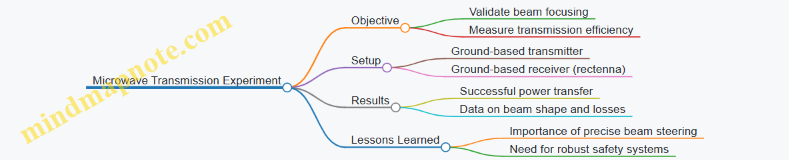
Integration and System-Level Demonstrations
The project plans to assemble integrated systems in orbit, combining solar arrays, power converters, and microwave transmitters. This phase tests the full chain from energy collection to wireless transmission.
Example: Orbital Deployment Simulation
Simulations and ground tests have been conducted to optimize deployment sequences and ensure structural stability of large solar arrays in microgravity. These exercises help identify potential failure modes and refine assembly procedures.
Mind Map: Orbital Deployment Simulation
Economic Considerations
The project includes cost analysis comparing launch expenses, system mass, and expected power output. By focusing on lightweight materials and modular designs, the project aims to reduce overall costs.
Summary
Japan’s SSP Demonstration Project provides a clear example of applying best practices in SBSP development: starting small, focusing on material and system reliability, ensuring safety, and fostering collaboration. The project’s experiments and simulations offer valuable data and experience for future space-based solar power systems.
12. Practical Implementation Examples and Lessons Learned
12.1 Review of Past and Current SBSP Demonstration Missions
Space-Based Solar Power (SBSP) demonstration missions have been essential in moving the concept from theory to practice. These missions provide data on technical feasibility, system integration, and operational challenges. Here, we examine several notable projects, highlighting their approaches, outcomes, and lessons learned.
Early Concepts and Ground Tests
Before launching hardware into orbit, extensive ground-based experiments tested wireless power transmission and solar energy conversion. These experiments helped establish baseline performance metrics and identified critical technical hurdles.
- Goldstone Experiment (1975): Demonstrated microwave power transmission over 1 mile with 84% efficiency.
- NASA’s SPS Concept Studies (1970s-1980s): Focused on large geostationary satellites with microwave transmission to Earth.
These early efforts laid the groundwork for later orbital demonstrations by validating core technologies.
Notable Orbital Demonstrations
-
Japan’s JAXA Space Solar Power Systems (SSPS) Program
- IHI Corporation’s Wireless Power Transmission Experiment (2015): A small satellite tested microwave power transmission in orbit, confirming beam control and transmission efficiency.
- SSPS Small Demonstrator (2021): A 10 kg satellite demonstrated solar energy collection and microwave transmission, focusing on integrated system performance.
-
China’s SBSP Initiatives
- SJ-12 Satellite (2017): Tested wireless power transmission technologies in orbit, including phased array antennas for beam steering.
- Ongoing Demonstrations: Focus on modular solar arrays and high-efficiency power conversion.
-
NASA’s SPS-ALPHA Concept
- While not yet launched, this modular design has been tested through subscale hardware and ground demonstrations, focusing on scalability and in-orbit assembly.
-
European Space Agency (ESA) Studies
- Conducted ground-based microwave transmission experiments and system integration tests.
Mind Map: Key Components Tested in Demonstration Missions
Examples of Demonstrated Practices
-
Microwave Beam Steering: JAXA’s experiments showed that phased array antennas could precisely direct energy beams, reducing spillover and increasing safety.
-
Modular Solar Arrays: NASA’s SPS-ALPHA concept tested modularity on the ground, emphasizing ease of repair and scalability.
-
Thermal Management: Several missions incorporated heat pipes and radiators to manage the thermal load from continuous solar exposure.
-
In-Orbit Assembly Techniques: While full assembly has not yet been demonstrated in orbit, ground tests and robotic prototypes have validated the feasibility of assembling large structures from smaller modules.
Lessons Learned
-
Efficiency vs. Complexity: Higher efficiency components often come with increased complexity and cost, requiring careful trade-offs.
-
Beam Control is Critical: Precise beam targeting reduces energy loss and safety risks, making control systems a priority.
-
Thermal Challenges Persist: Managing heat in space remains a key engineering challenge, influencing system reliability.
-
Modularity Supports Maintenance: Designing systems with modular components facilitates repairs and upgrades, extending mission life.
-
Ground Testing Remains Vital: Many issues are best identified and resolved before launch, underscoring the importance of thorough ground testing.
These demonstration missions collectively provide a practical foundation for SBSP development. They confirm that while challenges remain, the core technologies are viable and continue to improve through iterative testing and refinement.
12.2 Lessons Learned from Technical and Operational Challenges
Space-based solar power (SBSP) projects have confronted a range of technical and operational challenges that offer valuable lessons for future efforts. These lessons stem from both the successes and setbacks of past demonstrations and prototype missions. Understanding these challenges helps clarify what works, what requires caution, and where incremental improvements matter most.
Power Collection and Conversion
One consistent technical hurdle has been maintaining high efficiency in solar energy collection and conversion under orbital conditions. For example, early photovoltaic arrays faced degradation from radiation exposure and micrometeoroid impacts, which reduced output over time. This highlighted the need for radiation-hardened materials and protective coatings.
Thermal management also proved critical. Without atmosphere to dissipate heat, solar panels and power electronics risk overheating, which can reduce efficiency or cause failures. Active cooling systems or radiative heat dissipation designs became essential.
Wireless Power Transmission
Microwave transmission experiments revealed that beam alignment and atmospheric interference are significant operational challenges. Precise beam steering is necessary to avoid power losses and ensure safety. For instance, Japan’s experimental microwave power transmission tests demonstrated that even minor misalignments could reduce received power by 10-15%.
Safety protocols for beam exposure to aircraft and satellites required robust tracking and automatic cut-off mechanisms. These operational safeguards add complexity but are necessary for real-world deployment.
Structural and Deployment Challenges
Deploying large solar arrays or reflectors in orbit has been a technical bottleneck. Early attempts showed that rigid structures are heavy and costly to launch, while flexible, deployable designs risk mechanical failure or incomplete unfolding.
Robotic assembly and modular designs emerged as best practices to address these issues. For example, the International Space Station’s assembly demonstrated that in-orbit construction is feasible but requires precise coordination and reliable robotics.
Orbital Dynamics and Control
Maintaining stable orbits and proper orientation for continuous solar exposure and power transmission is a complex operational task. Disturbances from gravitational perturbations, solar radiation pressure, and space debris require active station-keeping.
Autonomous control systems have improved responsiveness but must be designed with fail-safes. Past missions showed that loss of attitude control can lead to significant downtime or mission failure.
Maintenance and Longevity
Repairing or upgrading SBSP satellites in orbit remains challenging. Lessons from servicing missions to the Hubble Space Telescope and ISS modules indicate that robotic servicing is possible but expensive and technically demanding.
Designing for modular replacement of key components can reduce the need for complex repairs. Redundancy in critical systems also improves operational resilience.
Summary Mind Map
Concrete Examples
-
Radiation Effects: Early solar arrays on geostationary satellites lost up to 20% efficiency within 5 years due to radiation, prompting the use of multi-junction cells with protective coatings in later SBSP prototypes.
-
Microwave Beam Steering: Japan’s Space Solar Power Systems (SSPS) demonstrator used phased array antennas to maintain beam focus, but tests showed a 12% power loss when beam steering deviated by just 0.1 degrees.
-
Deployment Failures: A prototype large solar sail failed to fully deploy due to a hinge mechanism jam, underscoring the importance of simple, tested mechanical designs.
-
Autonomous Control: The ETS-VIII satellite demonstrated autonomous attitude control with reaction wheels and magnetorquers, maintaining stable orientation for over 90% of its mission time.
-
Servicing Missions: The Hubble Space Telescope servicing missions proved that in-orbit repairs are possible but require extensive planning, specialized tools, and trained astronauts or advanced robotics.
These lessons collectively emphasize the importance of robust design, thorough testing, and operational flexibility. They also show that incremental improvements in materials, control systems, and deployment methods can significantly enhance the viability of SBSP systems.
12.3 Best Practices in Cross-Disciplinary Collaboration with Case Examples
Cross-disciplinary collaboration is essential in space-based solar power (SBSP) projects because these systems combine aerospace engineering, energy technology, materials science, telecommunications, and regulatory policy. Effective collaboration ensures that the various technical and operational components integrate smoothly, reducing costly errors and delays.
Key Elements of Cross-Disciplinary Collaboration
- Clear Communication: Different disciplines often use specialized jargon. Establishing a common language or glossary helps avoid misunderstandings.
- Defined Roles and Responsibilities: Each team must understand its scope and how it interacts with others.
- Integrated Planning: Joint development of project timelines and milestones ensures synchronization.
- Shared Tools and Platforms: Using collaborative software for design, simulation, and documentation keeps everyone on the same page.
- Regular Interdisciplinary Reviews: Scheduled meetings where teams present progress and challenges foster mutual understanding and problem-solving.
Mind Map: Cross-Disciplinary Collaboration Components
Example 1: Integrating Power Transmission and Satellite Attitude Control Teams
In one SBSP demonstration project, the microwave power transmission team and the satellite attitude control engineers initially worked in silos. The power team designed beam steering without fully accounting for the satellite’s limited maneuverability. This led to inefficiencies and the need for redesign.
After instituting weekly joint meetings and shared simulation sessions, both teams adjusted their designs. The power transmission system incorporated constraints from the attitude control system, resulting in a beam steering mechanism that worked within the satellite’s motion capabilities. This collaboration reduced redesign time by 30% and improved transmission accuracy.
Mind Map: Example 1 Collaboration Workflow
Example 2: Materials Science and Thermal Management Coordination
Materials scientists selected a new lightweight coating for solar arrays to improve efficiency. However, the thermal management team found that the coating altered heat absorption, causing unexpected temperature spikes.
By creating a cross-disciplinary task force, the teams tested different coatings and thermal control methods together. They settled on a composite material that balanced solar absorption with heat dissipation. This cooperative approach avoided costly retrofits after deployment.
Mind Map: Example 2 Collaborative Problem-Solving
Best Practices Summary
- Establish Early Contact: Engage all relevant disciplines from project inception.
- Create Shared Documentation: Maintain a central repository accessible to all teams.
- Use Visual Tools: Diagrams, flowcharts, and mind maps help clarify complex interdependencies.
- Encourage Mutual Respect: Recognize the expertise and constraints of each discipline.
- Implement Feedback Mechanisms: Allow teams to flag issues promptly and suggest improvements.
Cross-disciplinary collaboration is not just a management formality; it directly impacts the technical success and cost-effectiveness of SBSP systems. The examples above illustrate how structured interaction and shared problem-solving lead to better designs and smoother project execution.
12.4 Practical Example: Integration of SBSP with Existing Satellite Infrastructure
Integrating space-based solar power (SBSP) systems with existing satellite infrastructure involves combining new energy-harvesting platforms with satellites already in orbit to optimize resource use and reduce costs. This approach leverages operational satellites for power relay, communication, or control functions, minimizing the need for entirely new ground and space assets.
Overview of Integration
SBSP satellites primarily focus on collecting solar energy and transmitting it to Earth. Existing satellites, such as communication or navigation satellites, can support SBSP by providing data relay, control commands, or even acting as intermediary nodes in power transmission networks. This integration requires careful planning around orbital slots, frequency management, and system compatibility.
Key Components in Integration
- Energy Harvesting Satellites: Equipped with large solar arrays and power conversion units.
- Relay Satellites: Existing satellites capable of handling communication and control signals.
- Ground Stations: Facilities that receive transmitted power and manage satellite operations.
Mind Map: Integration Components
Example: Using Communication Satellites as Relay Nodes
A practical example involves using geostationary communication satellites to relay control signals to SBSP platforms in geosynchronous orbit. Since these satellites already have well-established communication links with ground stations, they can reduce the need for dedicated SBSP control satellites. This reduces launch and maintenance costs.
Mind Map: Communication Relay Example
Power Transmission Coordination
Existing satellites can also assist in coordinating power transmission schedules. For instance, navigation satellites with precise timing capabilities can help synchronize microwave or laser power beams to avoid interference with other satellites and ensure safe transmission to ground receivers.
Example: Timing Coordination Using Navigation Satellites
By integrating GPS or similar navigation satellites, SBSP systems can time their power transmission windows precisely. This coordination reduces risks of beam misalignment and interference, improving overall system safety and efficiency.
Mind Map: Timing Coordination
Challenges in Integration
- Frequency Management: Ensuring SBSP transmission frequencies do not interfere with existing satellite communications.
- Orbital Slot Coordination: Avoiding physical and signal conflicts in crowded geostationary orbits.
- System Compatibility: Aligning communication protocols and control systems between SBSP and existing satellites.
Example: Frequency Coordination Practice
A best practice is to allocate dedicated frequency bands for SBSP power transmission, coordinated through international regulatory bodies. Existing satellites operate on separate bands, minimizing cross-system interference. This approach was demonstrated in experimental microwave power transmission tests where careful frequency planning prevented signal overlap.
Mind Map: Challenges and Solutions
Summary
Integrating SBSP with existing satellite infrastructure is a practical way to reduce costs and leverage current assets. It requires attention to communication relay roles, timing coordination, and regulatory compliance. Real-world examples, such as using communication satellites for control relays and navigation satellites for timing, illustrate how existing infrastructure can support SBSP operations effectively.
12.5 Summary of Key Takeaways for Future SBSP Projects
The summary of key takeaways for future Space Based Solar Power (SBSP) projects centers on practical lessons drawn from past efforts and current technologies. These lessons span technical design, operational strategies, and integration challenges, all of which contribute to more effective and reliable SBSP systems.
System Design and Efficiency
- Modularity is essential. Designing solar arrays and transmission units in modular sections simplifies assembly, repair, and scalability. For example, Japan’s modular solar array experiments demonstrated easier in-orbit deployment and maintenance.
- Material selection impacts longevity and performance. Lightweight composites with radiation-resistant coatings reduce degradation and improve power output over time.
- Thermal management cannot be an afterthought. Effective heat dissipation strategies, such as radiative panels and heat pipes, maintain system stability.
Power Transmission
- Microwave transmission remains the most tested method. Its balance of efficiency and safety has been proven in multiple ground-to-ground and ground-to-air experiments.
- Beam control accuracy is critical. Adaptive beam steering reduces power loss and ensures safe delivery to ground receivers.
- Safety protocols must be integrated from the start. Japan’s experiments included fail-safes to immediately cut power if beam misalignment occurred.
Orbital Operations
- Autonomous control systems reduce operational costs. Satellites with onboard diagnostics and attitude control can maintain optimal positioning with minimal ground intervention.
- Collision avoidance and debris management are ongoing concerns. Incorporating sensors and predictive algorithms helps maintain satellite integrity.
Launch and Deployment
- In-orbit assembly benefits from robotic assistance. The International Space Station’s use of robotic arms for assembly offers a practical model.
- Launch mass constraints drive design choices. Lightweight, foldable solar arrays reduce launch costs and complexity.
Integration and Maintenance
- Energy storage in orbit smooths power delivery. Batteries or supercapacitors help manage transmission interruptions.
- In-orbit servicing extends system life. Robotic servicing missions have successfully repaired and refueled satellites, indicating potential for SBSP maintenance.
Economic and Regulatory Considerations
- Cost control is tied to design simplicity and reuse. Reusable launch vehicles and standardized components lower expenses.
- Regulatory compliance is non-negotiable. Early engagement with regulatory bodies ensures smoother project approval.
Mind Maps
SBSP System Design
- SBSP System Design
  - Modularity
    - Easier assembly
    - Simplified repair
  - Materials
    - Lightweight composites
    - Radiation-resistant coatings
  - Thermal Management
    - Radiative panels
    - Heat pipes
Power Transmission
- Power Transmission
  - Microwave
    - Efficiency
    - Safety
  - Beam Control
    - Adaptive steering
    - Power loss reduction
  - Safety Protocols
    - Fail-safes
    - Emergency shutdown
Orbital Operations
- Orbital Operations
  - Autonomous Control
    - Onboard diagnostics
    - Attitude control
  - Collision Avoidance
    - Sensors
    - Predictive algorithms
Launch and Deployment
- Launch and Deployment
  - Robotic Assembly
    - ISS robotic arms
  - Launch Mass Constraints
    - Foldable solar arrays
    - Lightweight design
Integration and Maintenance
- Integration and Maintenance
  - Energy Storage
    - Batteries
    - Supercapacitors
  - In-Orbit Servicing
    - Robotic repair
    - Refueling
Economic and Regulatory
- Economic and Regulatory
  - Cost Control
    - Design simplicity
    - Reusable launch vehicles
  - Regulatory Compliance
    - Early engagement
    - Approval processes
Concrete Example
Japan’s recent SBSP demonstration project incorporated modular solar arrays with radiation-hardened materials and microwave power transmission using adaptive beam steering. The project emphasized autonomous satellite control and included robotic assembly components tested on the ISS. Safety protocols were embedded in the transmission system, allowing immediate shutdown if beam misalignment was detected. This approach reduced operational risk and improved system reliability. The project also engaged regulators early, ensuring compliance and smoother approval.
In summary, future SBSP projects benefit from focusing on modular, maintainable designs; proven power transmission methods with robust safety; autonomous and adaptive orbital operations; and thorough integration with regulatory and economic frameworks. These lessons, grounded in concrete examples and tested practices, form a solid foundation for advancing SBSP technology.