Practical Space Systems Engineering for the New Space Economy
1. Introduction to Space Systems Engineering in the New Space Economy
1.1 Overview of the New Space Economy: Opportunities and Challenges
The New Space Economy represents a transformative era in space exploration and commercialization, driven by rapid technological advancements, reduced launch costs, and an influx of private sector participation. This paradigm shift opens unprecedented opportunities while also presenting unique challenges for aerospace engineers, systems engineers, and space startup founders.
What is the New Space Economy?
The New Space Economy refers to the expanding ecosystem of commercial activities related to space, including satellite manufacturing, launch services, space tourism, in-orbit servicing, and space resource utilization. Unlike the traditional space sector, which was dominated by government agencies, the New Space Economy thrives on innovation, agility, and private investment.
Key Opportunities in the New Space Economy
- Reduced Costs and Increased Access: Advances in reusable launch vehicles and miniaturization have drastically lowered the cost of accessing space.
- Satellite Constellations: Large constellations enable global broadband, Earth observation, and IoT connectivity.
- In-Orbit Services: Refueling, repair, and debris removal create new business models.
- Space Tourism and Habitats: Emerging markets for human spaceflight and off-Earth living.
- Space Resource Utilization: Mining asteroids and lunar resources for fuel and materials.
Challenges Facing the New Space Economy
- Regulatory Complexity: Navigating international treaties, licensing, and frequency coordination.
- Space Debris and Sustainability: Managing orbital congestion and long-term environmental impact.
- Technical Complexity: Designing reliable systems under tight budgets and aggressive timelines.
- Market Competition: Differentiating in a rapidly growing but crowded marketplace.
- Funding and Investment Risks: Securing capital while managing high technical and business risks.
Mind Map: Opportunities and Challenges in the New Space Economy
Example 1: SpaceX’s Reusable Launch Vehicles
SpaceX revolutionized launch economics by developing the Falcon 9 rocket with a reusable first stage. This innovation reduced launch costs by an estimated 30-40%, enabling more frequent and affordable access to space. For systems engineers, this meant integrating landing legs, advanced avionics, and robust thermal protection into the rocket design — balancing added complexity with cost savings.
Example 2: OneWeb Satellite Constellation
OneWeb aims to deploy a constellation of hundreds of small satellites to provide global broadband internet. This project illustrates the opportunity of satellite constellations but also highlights challenges such as complex systems integration, frequency licensing across multiple countries, and collision avoidance in crowded orbits.
Best Practice Embedded: Agile Development in New Space
Given the fast-paced environment, adopting agile methodologies helps teams iterate quickly, manage changing requirements, and reduce time-to-market. For example, a startup building a CubeSat might use rapid prototyping and iterative testing to validate subsystems early, reducing risk and cost.
Summary
The New Space Economy offers exciting opportunities for innovation and growth but requires careful navigation of technical, regulatory, and business challenges. Understanding this landscape is critical for aerospace and systems engineers as well as space startup founders aiming to succeed in this dynamic market.
1.2 Defining Space Systems Engineering: Scope and Importance
Space Systems Engineering (SSE) is a multidisciplinary approach to designing, developing, testing, and managing complex space missions and infrastructure. It integrates various engineering disciplines—mechanical, electrical, software, thermal, propulsion, and more—into a cohesive system that meets mission objectives within constraints such as cost, schedule, and risk.
Scope of Space Systems Engineering
The scope of SSE covers the entire lifecycle of a space system, from initial concept through design, development, integration, testing, launch, operations, and end-of-life disposal or reuse. It involves:
- Requirements Definition: Translating mission goals into technical specifications.
- System Architecture: Defining the overall structure and interfaces.
- Subsystem Design: Developing individual components like power, communication, and propulsion.
- Integration & Testing: Ensuring subsystems work together as intended.
- Operations & Maintenance: Managing the system in orbit or on mission.
- Risk & Reliability Management: Identifying and mitigating potential failures.
Importance of Space Systems Engineering
SSE is critical because space missions are inherently complex, costly, and unforgiving. Failures can lead to mission loss, financial setbacks, or even safety hazards. Effective systems engineering ensures:
- Mission Success: By aligning technical solutions with mission objectives.
- Cost Efficiency: Through early identification of risks and design optimizations.
- Schedule Adherence: By managing dependencies and integration challenges.
- Scalability & Flexibility: Enabling future upgrades or mission expansions.
Mind Map: Core Components of Space Systems Engineering
Mind Map: Lifecycle Phases in Space Systems Engineering
Example 1: CubeSat Mission Development
A university team plans to develop a CubeSat for Earth observation. Through SSE, they start by defining clear mission requirements: imaging resolution, data downlink rate, and mission duration. They architect a modular system separating payload, power, and communication subsystems. By applying systems engineering best practices, they identify potential thermal challenges early and select appropriate materials and thermal control methods. Integration and testing phases are carefully planned to verify subsystem compatibility. This structured approach helps the team deliver a functional satellite on time and within budget.
Example 2: Commercial Satellite Constellation
A space startup aims to deploy a constellation of small satellites for broadband internet. SSE guides the design of a scalable architecture that supports adding satellites incrementally. Requirements engineering ensures each satellite meets communication and power needs. Risk management identifies launch delays and in-orbit failures as critical risks, leading to contingency plans such as backup satellites and flexible launch windows. Operations engineering develops automated ground systems for constellation management. This comprehensive systems engineering approach is key to managing complexity and achieving commercial viability.
Summary
Space Systems Engineering is the backbone of successful space missions in the New Space Economy. Its broad scope ensures all technical and programmatic aspects are harmonized to meet challenging mission goals. By understanding and applying SSE principles, aerospace engineers, systems engineers, and startup founders can navigate the complexities of space projects, reduce risks, and accelerate innovation.
1.3 Key Stakeholders: Aerospace Engineers, Systems Engineers, and Space Startup Founders
In the rapidly evolving New Space Economy, understanding the roles and perspectives of key stakeholders is essential for successful space systems engineering. This section explores the primary stakeholders — Aerospace Engineers, Systems Engineers, and Space Startup Founders — highlighting their responsibilities, challenges, and how they collaborate to bring space missions to life.
Aerospace Engineers
Aerospace Engineers focus on the design, development, testing, and production of spacecraft and related systems. Their expertise spans propulsion, structures, avionics, thermal control, and more.
-
Responsibilities:
- Design spacecraft subsystems
- Conduct simulations and analyses
- Perform component testing and validation
- Collaborate with manufacturing teams
-
Challenges:
- Balancing performance with cost and schedule
- Integrating cutting-edge technologies
- Ensuring reliability in harsh space environments
Example: An aerospace engineer working on a CubeSat project might design the power subsystem to optimize battery life while minimizing weight, using commercial off-the-shelf (COTS) components to reduce costs.
Systems Engineers
Systems Engineers serve as the integrators and orchestrators of complex space projects. They ensure that all subsystems work harmoniously to meet mission objectives.
-
Responsibilities:
- Defining system requirements and architecture
- Managing interfaces between subsystems
- Overseeing verification and validation processes
- Risk management and trade-off analysis
-
Challenges:
- Managing complexity and interdisciplinary coordination
- Maintaining traceability of requirements
- Adapting to evolving mission goals and constraints
Example: A systems engineer might use Model-Based Systems Engineering (MBSE) tools to trace requirements from mission goals down to hardware components, ensuring no critical function is overlooked.
Space Startup Founders
Space Startup Founders drive innovation and commercialization in the New Space Economy. They often wear multiple hats, combining technical knowledge with business acumen.
-
Responsibilities:
- Defining the company vision and mission
- Securing funding and managing budgets
- Building and leading multidisciplinary teams
- Navigating regulatory and market landscapes
-
Challenges:
- Balancing technical development with business growth
- Managing limited resources and tight schedules
- Establishing partnerships and customer relationships
Example: A startup founder might pivot their satellite constellation design to target a niche market after customer feedback, while coordinating engineering efforts to meet a compressed launch timeline.
Mind Maps
Mind Map 1: Aerospace Engineer Role and Focus Areas
Mind Map 2: Systems Engineer Responsibilities
Mind Map 3: Space Startup Founder Key Activities
Integrated Example: Collaborative Development of a Small Satellite Mission
Consider a startup aiming to deploy a constellation of Earth observation nanosatellites:
- The Founder defines the mission goals, secures seed funding, and assembles a team.
- Systems Engineers develop the system architecture, ensuring the constellation meets coverage and revisit requirements while managing subsystem interfaces.
- Aerospace Engineers design and test individual satellite subsystems, such as power and communication, optimizing for cost and reliability.
Throughout the project, these stakeholders maintain continuous communication, using agile practices and digital collaboration tools to adapt quickly to technical challenges and market feedback.
This integrated approach exemplifies best practices in the New Space Economy, where cross-functional collaboration accelerates innovation and mission success.
1.4 Best Practice: Integrating Agile Methodologies in Space Systems Development
Agile methodologies, originally developed for software engineering, have increasingly found their place in the domain of space systems development. The traditional waterfall approach, with its rigid sequential phases, often struggles to accommodate the dynamic and innovative nature of New Space projects. Integrating Agile practices enables aerospace and systems engineers to respond rapidly to changing requirements, foster collaboration, and deliver incremental value throughout the project lifecycle.
Why Agile in Space Systems Engineering?
- Flexibility: Space missions often face evolving technical challenges and stakeholder needs. Agile allows iterative refinement.
- Risk Reduction: Early and continuous testing helps identify issues sooner.
- Improved Collaboration: Cross-functional teams communicate more effectively.
- Faster Delivery: Incremental deliveries enable earlier demonstrations of capability.
Core Agile Principles Applied to Space Systems
- Iterative Development: Break down the system into smaller increments or modules.
- Continuous Feedback: Regular stakeholder reviews and testing cycles.
- Cross-Functional Teams: Engineers, analysts, and operators collaborate closely.
- Adaptive Planning: Plans evolve based on new data and lessons learned.
Mind Map: Agile Integration in Space Systems Development
Practical Example: Agile in a CubeSat Development Project
A startup developing a CubeSat constellation adopted Agile to handle tight schedules and evolving payload requirements.
- Sprint Planning: The team divided the project into 2-week sprints focusing on specific subsystems like power, communication, and payload.
- Daily Standups: Short daily meetings ensured alignment and rapid problem resolution.
- Incremental Prototyping: Early hardware-in-the-loop (HIL) testing of communication modules allowed quick identification of design flaws.
- Stakeholder Reviews: Monthly demos to investors and mission operators provided feedback that refined requirements.
Outcome: The Agile approach enabled the startup to reduce integration issues by 30% and accelerated the first satellite launch by 4 months compared to traditional methods.
Mind Map: Agile Sprint Workflow in Space Systems
Tips for Successful Agile Adoption in Space Projects
- Tailor Agile to Hardware Constraints: Unlike pure software, hardware iterations can be costly; plan sprints around feasible prototyping cycles.
- Leverage Digital Twins and Simulations: Use virtual models to accelerate testing and feedback loops.
- Maintain Clear Documentation: Agile does not mean no documentation; maintain traceability for regulatory compliance.
- Foster a Collaborative Culture: Encourage open communication and shared responsibility.
- Integrate Agile with MBSE: Combine Agile’s flexibility with MBSE’s rigor for requirement traceability and system modeling.
Additional Example: Agile in Ground Segment Software Development
A space startup developing ground control software used Scrum to manage evolving user requirements:
- User stories captured operator needs.
- Two-week sprints delivered incremental features like telemetry visualization and command sequencing.
- Continuous integration pipelines ensured software quality.
This approach enabled rapid adaptation to customer feedback and improved operational readiness before satellite deployment.
Summary
Integrating Agile methodologies into space systems engineering empowers teams to navigate the complexities and uncertainties of New Space projects. By embracing iterative development, continuous feedback, and adaptive planning, aerospace engineers and startup founders can enhance innovation, reduce risks, and accelerate mission success.
1.5 Example: How a Small Satellite Startup Leveraged Systems Engineering to Accelerate Development
In the rapidly evolving New Space Economy, small satellite startups face immense pressure to innovate quickly while managing limited resources. This example illustrates how a fictional startup, OrbitalEdge, successfully applied systems engineering principles to accelerate their CubeSat development from concept to launch within 12 months.
Background
OrbitalEdge aimed to develop a 6U CubeSat for Earth observation, focusing on rapid deployment and cost efficiency. The startup had a small team of aerospace engineers and systems engineers, with limited prior experience in full satellite development.
Step 1: Defining Clear Mission Objectives and Requirements
- Mission Objective: Provide high-resolution multispectral imaging for agricultural monitoring.
- Key Requirements:
- Mass < 12 kg
- Power budget < 50 W
- Data downlink rate > 100 Mbps
- Mission lifetime: 1 year
By clearly defining these upfront, OrbitalEdge avoided scope creep and aligned the team on priorities.
Step 2: Employing a Modular Systems Architecture
Using a modular design approach allowed parallel development and easier integration:
Each subsystem team worked concurrently, enabling faster iteration and testing.
Step 3: Implementing Model-Based Systems Engineering (MBSE)
OrbitalEdge adopted MBSE tools to create a digital twin of the satellite:
- Captured requirements and traced them to design elements.
- Simulated power and thermal profiles early to identify bottlenecks.
Example MBSE mind map:
This approach reduced costly redesigns during hardware integration.
Step 4: Agile Development and Continuous Integration
OrbitalEdge adapted agile practices:
- Two-week sprints for subsystem development.
- Frequent integration checkpoints.
- Automated testing for software components.
Example sprint backlog mind map:
This iterative approach improved responsiveness to issues and stakeholder feedback.
Step 5: Leveraging Commercial Off-The-Shelf (COTS) Components
To reduce development time and cost, OrbitalEdge integrated proven COTS parts:
- Power system from a reputable CubeSat supplier.
- Commercial radios with flight heritage.
Example trade-off mind map:
This strategy balanced innovation with risk mitigation.
Step 6: Early and Frequent Testing
- Conducted subsystem-level tests early to validate interfaces.
- Used hardware-in-the-loop simulations to verify system behavior.
Testing mind map:
Early testing uncovered issues that could have delayed launch if found later.
Outcome
- OrbitalEdge completed design, integration, and testing within 12 months.
- Achieved first successful launch and data acquisition on schedule.
- Demonstrated how systems engineering practices enable small teams to compete in the New Space Economy.
Summary Mind Map
This example underscores the power of systems engineering as a practical toolkit for startups aiming to accelerate space mission development while managing complexity and risk.
2. Fundamentals of Space Systems Architecture and Design
2.1 Principles of Space Systems Architecture
Space systems architecture is the structured framework that defines the arrangement, interactions, and design of components within a space mission. It provides a holistic view of the system, ensuring that all subsystems work cohesively to achieve mission objectives while balancing constraints such as cost, schedule, and risk.
Core Principles of Space Systems Architecture
-
Modularity
- Designing subsystems as independent, interchangeable modules.
- Facilitates upgrades, repairs, and scalability.
-
Scalability
- Ability to expand or reduce system capabilities without redesigning the entire architecture.
-
Interoperability
- Ensuring components and subsystems can communicate and operate together seamlessly.
-
Redundancy and Fault Tolerance
- Incorporating backup systems to maintain functionality in case of failures.
-
Flexibility and Adaptability
- Designing systems that can adapt to changing mission requirements or environments.
-
Cost-Effectiveness
- Balancing performance with budget constraints.
-
Maintainability and Supportability
- Facilitating ease of maintenance, upgrades, and ground support.
-
Compliance with Standards and Regulations
- Aligning with industry, governmental, and international standards.
Mind Map: Principles of Space Systems Architecture
Example: Applying Modularity in a CubeSat Architecture
A CubeSat mission team designed their satellite architecture with modularity as a core principle. The payload, power system, communication subsystem, and onboard computer were developed as separate modules with standardized mechanical and electrical interfaces. This approach allowed the team to swap out the payload module late in development without impacting the rest of the satellite, saving time and cost.
Key benefits realized:
- Faster integration and testing cycles.
- Easier troubleshooting and subsystem upgrades.
- Potential for reusing bus modules in future missions.
Mind Map: CubeSat Modular Architecture Example
Additional Considerations
- Trade-Off Analysis: Balancing modularity with mass and volume constraints.
- Interface Definition: Clear interface control documents (ICDs) to ensure compatibility.
- System-of-Systems: For large missions, architectures often involve multiple interacting spacecraft or ground systems.
Summary
Understanding and applying the principles of space systems architecture is critical for designing robust, scalable, and cost-effective space missions. By leveraging modularity, interoperability, and fault tolerance, engineers can create flexible systems that meet the dynamic demands of the new space economy.
2.2 Trade Studies and Decision-Making Frameworks
Trade studies are a cornerstone of space systems engineering, enabling engineers and decision-makers to evaluate multiple design options against a set of criteria to select the most suitable solution. In the New Space Economy, where rapid development and cost-effectiveness are crucial, mastering trade studies and decision-making frameworks is essential.
What is a Trade Study?
A trade study is a structured analysis process to compare alternatives based on quantitative and qualitative factors. It helps balance competing requirements such as cost, performance, schedule, risk, and technology readiness.
Key Steps in a Trade Study:
- Define the problem and objectives
- Identify alternatives
- Establish evaluation criteria and weighting
- Collect data and analyze alternatives
- Make recommendations
Decision-Making Frameworks in Space Systems Engineering
Several frameworks guide trade studies to ensure decisions are transparent, repeatable, and justifiable:
- Multi-Criteria Decision Analysis (MCDA): Assigns weights to criteria and scores alternatives to calculate an overall ranking.
- Analytic Hierarchy Process (AHP): Breaks down decisions into a hierarchy, uses pairwise comparisons to derive weights.
- Cost-Benefit Analysis (CBA): Compares monetary costs against expected benefits.
- Risk-Based Decision Making: Incorporates risk assessments into the evaluation.
Mind Map: Trade Study Process
Example: Trade Study for Propulsion System Selection
Scenario: A small satellite startup must choose between three propulsion options:
| Option | Cost (M USD) | Thrust (mN) | Specific Impulse (s) | TRL | Mass (kg) |
|---|---|---|---|---|---|
| Cold Gas | 0.5 | 10 | 50 | 9 | 2 |
| Electric (Ion) | 2.0 | 5 | 1500 | 7 | 5 |
| Chemical (Hydrazine) | 1.5 | 50 | 230 | 9 | 8 |
Evaluation Criteria and Weights:
- Cost: 30%
- Thrust: 20%
- Specific Impulse: 25%
- TRL: 15%
- Mass: 10%
Step 1: Normalize Scores (0-1 scale, higher is better)
| Option | Cost (lower better) | Thrust | Specific Impulse | TRL | Mass (lower better) |
|---|---|---|---|---|---|
| Cold Gas | 1.0 | 0.2 | 0.033 | 1.0 | 1.0 |
| Electric (Ion) | 0.25 | 0.1 | 1.0 | 0.78 | 0.4 |
| Chemical | 0.33 | 1.0 | 0.153 | 1.0 | 0.25 |
Step 2: Weighted Scores and Total
| Option | Weighted Score |
|---|---|
| Cold Gas | (1.00.3)+(0.20.2)+(0.0330.25)+(1.00.15)+(1.0*0.1) = 0.3 + 0.04 + 0.008 + 0.15 + 0.1 = 0.598 |
| Electric (Ion) | (0.250.3)+(0.10.2)+(1.00.25)+(0.780.15)+(0.4*0.1) = 0.075 + 0.02 + 0.25 + 0.117 + 0.04 = 0.502 |
| Chemical | (0.330.3)+(1.00.2)+(0.1530.25)+(1.00.15)+(0.25*0.1) = 0.099 + 0.2 + 0.038 + 0.15 + 0.025 = 0.512 |
Result: Cold Gas propulsion scores highest due to low cost, high TRL, and low mass, despite lower thrust and specific impulse.
Mind Map: Decision-Making Frameworks
Best Practices for Trade Studies in New Space
- Early and Iterative: Conduct trade studies early and revisit as new data emerges.
- Cross-Functional Teams: Involve experts from engineering, finance, operations, and marketing.
- Use Tools: Leverage MBSE tools and spreadsheets for transparency and repeatability.
- Document Assumptions: Clearly record assumptions and data sources.
- Perform Sensitivity Analysis: Understand how changes in weights or data affect outcomes.
Additional Example: Launch Vehicle Selection for a CubeSat Mission
Alternatives:
- Rideshare on a Large Launcher
- Dedicated Small Launcher
- Space Tug Transfer
Criteria: Cost, Schedule, Reliability, Orbit Accuracy, Integration Complexity
By scoring and weighting these criteria, the startup can decide the best launch approach balancing cost and mission risk.
In summary, trade studies and decision-making frameworks provide a systematic way to navigate complex engineering choices in the New Space Economy. By combining quantitative analysis with practical experience, aerospace engineers and startup founders can make informed decisions that optimize mission success and resource utilization.
2.3 Best Practice: Modular Design for Scalability and Reusability
Modular design is a cornerstone best practice in space systems engineering, especially within the rapidly evolving New Space Economy. It enables scalability, facilitates reusability, reduces development time, and lowers costs by allowing engineers to design, test, and upgrade discrete subsystems independently before integrating them into a complete spacecraft or infrastructure.
What is Modular Design?
Modular design breaks down a complex space system into smaller, self-contained units or modules. Each module performs a specific function and can be developed, tested, and replaced independently without affecting the entire system.
Benefits of Modular Design
- Scalability: Easily add, remove, or upgrade modules to meet changing mission requirements.
- Reusability: Standard modules can be reused across multiple missions, reducing design and manufacturing efforts.
- Parallel Development: Different teams can work simultaneously on separate modules, accelerating development timelines.
- Simplified Testing & Maintenance: Isolated testing of modules improves reliability and eases troubleshooting.
Mind Map: Core Concepts of Modular Design
Mind Map: Modular Design Implementation Steps
Practical Examples
Example 1: Modular CubeSat Bus Design
CubeSats have become a popular platform for small satellite missions due to their standardized form factor and modular design. A typical CubeSat bus is composed of modules such as power, communication, attitude control, and payload.
- Scalability: Additional payload modules can be added by stacking more CubeSat units (e.g., 1U, 3U, 6U configurations).
- Reusability: Standardized power and communication modules are reused across different CubeSat missions.
- Interface Standardization: Electrical and mechanical interfaces conform to CubeSat standards, enabling plug-and-play integration.
Example 2: Modular Satellite Constellation Architecture
In large constellations, satellites are designed as modular units with interchangeable payloads and bus components. This approach allows operators to scale the constellation by launching additional modules without redesigning the entire system.
- Parallel Development: Different teams develop payloads and bus modules simultaneously.
- Upgradability: New payload modules can replace older ones in orbit via servicing missions or by launching replacement satellites.
Example 3: In-Orbit Servicing with Modular Satellites
Modular satellites designed with standardized docking interfaces enable in-orbit servicing, such as refueling, repairs, or upgrades.
- Reusability: Core modules can be refurbished and reused.
- Scalability: Servicing spacecraft can add new modules to extend mission capabilities.
Key Considerations for Effective Modular Design
- Standardized Interfaces: Mechanical, electrical, and data interfaces must be well-defined and standardized to ensure compatibility.
- Interface Control Documents (ICDs): Maintain detailed ICDs to govern module interactions.
- Robustness: Modules must be designed to operate reliably both independently and when integrated.
- Mass and Volume Constraints: Modularization should not introduce excessive mass or volume penalties.
Summary
Modular design is essential for the New Space Economy, enabling rapid innovation, cost efficiency, and mission flexibility. By adopting modularity, aerospace engineers and startups can build scalable and reusable space systems that adapt to evolving mission needs.
For further reading, explore how companies like Planet Labs and Spire Global successfully apply modular design principles in their satellite constellations.
2.4 Example: Designing a Modular CubeSat Bus for Rapid Mission Customization
In the rapidly evolving New Space Economy, the ability to quickly adapt satellite designs to varying mission requirements is crucial. Modular CubeSat buses offer a practical solution by enabling rapid customization, reducing development time, and lowering costs. This section explores the design principles, best practices, and examples of modular CubeSat buses.
What is a Modular CubeSat Bus?
A CubeSat bus is the structural and functional platform that supports the payload and provides essential subsystems such as power, communication, and attitude control. A modular CubeSat bus is designed with interchangeable components or modules that can be easily swapped or upgraded to suit different missions without redesigning the entire system.
Benefits of Modular Design for CubeSats
- Flexibility: Easily adapt to different payloads and mission objectives.
- Scalability: Add or remove modules to adjust satellite capabilities.
- Reduced Development Time: Reuse tested modules to accelerate integration.
- Cost Efficiency: Lower design and manufacturing costs through standardization.
Mind Map: Key Components of a Modular CubeSat Bus
Best Practices in Designing a Modular CubeSat Bus
- Standardized Mechanical Interfaces: Use common mounting points and connectors to ensure modules fit together seamlessly.
- Electrical Interface Uniformity: Define standard voltage levels, communication protocols (e.g., I2C, SPI, CAN bus) for module interoperability.
- Plug-and-Play Capability: Design modules to be hot-swappable during integration and testing phases.
- Robust Thermal Management: Ensure each module can handle its thermal environment independently or cooperatively.
- Documentation and Version Control: Maintain detailed interface control documents (ICDs) and versioning for each module.
Example: Designing a Modular CubeSat Bus for Earth Observation Missions
Scenario: A startup aims to develop CubeSats for Earth observation with different sensor payloads (multispectral camera, hyperspectral sensor, or synthetic aperture radar). Instead of redesigning the bus for each payload, they create a modular bus architecture.
- Structural Module: Standard 3U CubeSat frame with universal mounting rails.
- Power Module: Modular solar panel arrays and battery packs that can be scaled based on power needs.
- Communication Module: Configurable transceiver supporting UHF, S-band, or X-band depending on data rate requirements.
- ADCS Module: Swappable sensor and actuator packages tailored to mission pointing accuracy.
- Payload Interface Module: Universal electrical and mechanical interfaces allowing quick payload swaps.
This approach allowed the startup to reduce the design cycle from 12 months to 6 months and cut integration costs by 30%.
Mind Map: Workflow for Modular CubeSat Bus Development
Additional Example: NASA’s Modular CubeSat Approach
NASA’s CubeSat Launch Initiative encourages modular designs to facilitate rapid mission deployment. For instance, the CubeSat Kit (CSK) developed by NASA includes standardized modules for power, communication, and ADCS, enabling universities and startups to focus on payload innovation while relying on proven bus components.
Summary
Designing a modular CubeSat bus is a practical and effective strategy in the New Space Economy. By focusing on standardized interfaces, plug-and-play modules, and scalable subsystems, aerospace engineers and startups can accelerate mission development, reduce costs, and increase mission flexibility.
This example demonstrates how modularity, combined with best practices, can transform CubeSat development from a bespoke, time-consuming process into a streamlined, repeatable engineering workflow.
2.5 Managing Complexity: Systems-of-Systems Approach in Space Infrastructure
In the rapidly evolving landscape of space infrastructure, complexity management is paramount. Space missions today often involve multiple independent systems working together to achieve overarching objectives. This interconnectedness is best addressed through a Systems-of-Systems (SoS) engineering approach, which treats each system as a component of a larger, integrated whole.
What is a Systems-of-Systems (SoS) Approach?
A Systems-of-Systems approach involves integrating multiple autonomous systems, each capable of independent operation, into a coordinated framework that delivers enhanced capabilities beyond the sum of its parts. In space infrastructure, this could mean linking satellites, ground stations, launch vehicles, and data processing centers into a cohesive operational ecosystem.
Why Use SoS in Space Infrastructure?
- Scalability: Enables expansion by adding new systems without redesigning the entire architecture.
- Flexibility: Allows independent systems to evolve or upgrade without disrupting others.
- Resilience: Failure in one system can be mitigated by others, improving overall mission robustness.
- Resource Optimization: Shared resources and capabilities reduce costs and improve efficiency.
Key Challenges in SoS Engineering for Space
- Interoperability: Ensuring diverse systems communicate effectively.
- Complex Interface Management: Handling numerous interfaces and data exchanges.
- Distributed Control: Coordinating autonomous systems with decentralized decision-making.
- Verification & Validation: Testing integrated systems with emergent behaviors.
Best Practices for Managing SoS Complexity
- Define Clear System Boundaries and Interfaces
- Use interface control documents (ICDs) to formalize interactions.
- Adopt Model-Based Systems Engineering (MBSE)
- Create comprehensive models to visualize and analyze system interactions.
- Incremental Integration and Testing
- Integrate systems stepwise to identify issues early.
- Implement Robust Communication Protocols
- Standardize data formats and communication methods.
- Establish Governance and Coordination Mechanisms
- Define roles, responsibilities, and decision-making processes.
Mind Map: Systems-of-Systems Approach Overview
Example: Satellite Constellation as a System-of-Systems
Consider a large Earth observation satellite constellation designed to provide near real-time global coverage. Each satellite is an independent system with its own payload, power, and communication subsystems. The constellation operates as a SoS with the following characteristics:
- Autonomy: Satellites perform onboard processing and autonomous collision avoidance.
- Inter-satellite Links: Satellites communicate to relay data and coordinate coverage.
- Ground Segment Integration: Multiple ground stations receive data and manage satellite health.
- Data Processing Centers: Distributed centers process and fuse data for end-users.
Managing Complexity:
- Interface standards enable seamless data exchange between satellites and ground stations.
- MBSE tools model constellation coverage, communication paths, and failure modes.
- Incremental deployment allows adding satellites gradually while maintaining system integrity.
Mind Map: Satellite Constellation SoS Example
Example: Integrated Space Infrastructure for Lunar Exploration
A lunar exploration mission may involve multiple systems: landers, orbiters, communication relays, surface habitats, and Earth-based control centers. Each system operates independently but must coordinate for mission success.
- Lander Systems: Deliver payloads and perform surface operations.
- Orbital Relays: Provide communication links between lunar surface and Earth.
- Surface Habitats: Support human life and scientific experiments.
- Ground Control: Monitor and command all systems.
Managing Complexity:
- Use standardized communication protocols (e.g., Delay/Disruption Tolerant Networking) to handle intermittent links.
- Employ MBSE to simulate mission scenarios and system interactions.
- Establish governance frameworks for multi-agency collaboration.
Mind Map: Lunar Exploration SoS
Summary
Managing complexity in space infrastructure through a Systems-of-Systems approach enables the integration of diverse, autonomous systems into a unified, resilient, and scalable architecture. By adopting best practices such as clear interface definition, MBSE, incremental testing, and robust governance, aerospace engineers and system architects can effectively navigate the challenges posed by modern space missions.
This approach is essential for the New Space Economy, where rapid innovation, cost-efficiency, and mission agility are critical to success.
3. Requirements Engineering and Verification in Space Projects
3.1 Capturing and Managing Stakeholder Requirements
Capturing and managing stakeholder requirements is a foundational step in space systems engineering. It ensures that the final system aligns with the mission objectives, user needs, and regulatory constraints. In the New Space Economy, where projects often involve diverse stakeholders—from government agencies to private investors and end-users—effective requirements management is critical for success.
Understanding Stakeholders
Stakeholders can include:
- Mission owners (e.g., satellite operators, scientific teams)
- End users (e.g., data consumers, ground stations)
- Regulatory bodies
- Manufacturing and integration teams
- Investors and business partners
Each stakeholder group has unique needs and expectations that must be captured accurately.
Steps to Capture Stakeholder Requirements
- Stakeholder Identification: Use stakeholder analysis to list all parties involved.
- Elicitation Techniques: Employ interviews, workshops, surveys, and document analysis.
- Requirement Documentation: Use clear, concise, and unambiguous language.
- Prioritization: Rank requirements based on mission criticality, cost, and schedule impact.
- Validation: Confirm requirements with stakeholders to ensure accuracy.
- Change Management: Establish processes to handle evolving requirements.
Mind Map: Stakeholder Requirements Capture Process
Best Practice: Use of Model-Based Systems Engineering (MBSE) Tools
MBSE tools like Cameo Systems Modeler or SysML-based platforms help capture, visualize, and trace requirements throughout the project lifecycle. They enable linking requirements to design elements, tests, and verification activities.
Example: Capturing Requirements for a Small Earth Observation Satellite
Scenario: A startup is developing a 12U CubeSat for Earth imaging targeted at agricultural monitoring.
- Stakeholder Identification: The team identifies farmers (end users), data analysts, regulatory authorities, investors, and the manufacturing team.
- Elicitation: Conducts workshops with farmers to understand imaging resolution needs and revisit regulatory frequency requirements with authorities.
- Documentation: Requirements are documented in a requirements management tool with unique IDs.
- Prioritization: Imaging resolution and data latency are prioritized over secondary features like onboard data storage.
- Validation: Stakeholders review the documented requirements in a collaborative session.
- Change Management: A formal process is established to handle changes as mission scope evolves.
Mind Map: Example Requirements for Earth Observation CubeSat
Managing Requirements Throughout the Project
- Establish traceability matrices linking requirements to design, verification, and validation.
- Regularly review requirements with stakeholders to accommodate evolving needs.
- Use version control to track changes and maintain historical records.
Summary
Capturing and managing stakeholder requirements is an iterative, collaborative process that forms the backbone of successful space systems engineering. Leveraging structured approaches and tools ensures alignment, reduces risk, and facilitates smooth project execution.
3.2 Translating Mission Objectives into Technical Requirements
Translating mission objectives into technical requirements is a critical step in space systems engineering. It ensures that the high-level goals of a space mission are clearly defined, measurable, and actionable, guiding the design, development, and verification of the system.
Understanding Mission Objectives
Mission objectives describe what the mission aims to achieve. They are often broad and strategic, such as “Provide global broadband internet coverage” or “Demonstrate autonomous rendezvous and docking in orbit.” These objectives must be decomposed into specific, testable technical requirements.
The Translation Process
- Identify Stakeholders and Their Needs: Understand who the mission serves and what their expectations are.
- Define Clear, Measurable Objectives: Convert vague goals into quantifiable targets.
- Decompose Objectives into Sub-Objectives: Break down complex goals into manageable parts.
- Derive Technical Requirements: Translate sub-objectives into system-level and subsystem-level requirements.
- Validate Requirements: Ensure requirements are feasible, verifiable, and traceable back to objectives.
Mind Map: Translating Mission Objectives into Technical Requirements
Example: Earth Observation Satellite Mission
Mission Objective: Provide high-resolution multispectral images of agricultural regions to support crop monitoring.
Step 1: Identify Stakeholders and Needs
- Farmers and agribusinesses need timely, accurate data.
- Government agencies require data for food security.
Step 2: Define Clear Objectives
- Capture images with spatial resolution better than 5 meters.
- Cover target regions every 3 days.
Step 3: Decompose Objectives
- Imaging subsystem must support multispectral bands (visible, near-infrared).
- Satellite must have sufficient power and data storage.
- Communication subsystem must downlink data within 24 hours.
Step 4: Derive Technical Requirements
- Payload: Spatial resolution ≤ 5 m, spectral bands: 450-900 nm.
- Orbit: Sun-synchronous, revisit time ≤ 3 days.
- Power subsystem: Minimum 500 W average power.
- Data handling: Onboard storage ≥ 1 TB.
- Communication: Downlink rate ≥ 100 Mbps.
Step 5: Validate Requirements
- Verify that the selected orbit supports revisit time.
- Confirm payload technology can achieve required resolution.
Mind Map: Earth Observation Mission Requirements Breakdown
Best Practices
- Use SMART Criteria: Requirements should be Specific, Measurable, Achievable, Relevant, and Time-bound.
- Maintain Traceability: Each technical requirement should link back to a mission objective.
- Engage Stakeholders Early: Continuous feedback ensures alignment.
- Iterate and Refine: Requirements evolve as understanding matures.
Additional Example: CubeSat Communications Mission
Mission Objective: Demonstrate low-latency data relay between ground stations using a CubeSat.
- Translate to requirements such as:
- Communication latency ≤ 500 ms.
- Uplink/downlink frequency bands: UHF/VHF.
- Power budget ≤ 20 W.
- Onboard processing latency ≤ 100 ms.
This example shows how even small missions require careful translation of objectives into detailed technical specs.
By systematically translating mission objectives into technical requirements, space systems engineers create a solid foundation for design, development, and successful mission execution.
3.3 Best Practice: Using Model-Based Systems Engineering (MBSE) for Traceability
Model-Based Systems Engineering (MBSE) is a transformative approach that uses formalized modeling to support system requirements, design, analysis, verification, and validation activities. In the context of space systems engineering, MBSE enhances traceability by creating a clear, visual, and maintainable link between requirements, system components, and verification activities.
Why Traceability Matters in Space Systems Engineering
Traceability ensures that every system requirement is accounted for throughout the design, implementation, and testing phases. This is critical in space projects where failure to meet requirements can lead to mission failure, costly redesigns, or safety risks.
Key benefits of traceability include:
- Verification and Validation: Ensures all requirements are tested and met.
- Impact Analysis: Quickly identifies what components or subsystems are affected by requirement changes.
- Regulatory Compliance: Demonstrates adherence to standards and contractual obligations.
MBSE for Traceability: Core Concepts
MBSE uses digital models to represent system elements and their relationships. The traceability chain typically connects:
- Stakeholder Needs
- System Requirements
- System Architecture and Design Elements
- Verification and Validation Activities
This chain is maintained and visualized within MBSE tools such as Cameo Systems Modeler, MagicDraw, or IBM Rational Rhapsody.
Mind Map: MBSE Traceability Chain
Practical Example: Traceability in a CubeSat Mission
Scenario: A startup is developing a CubeSat for Earth observation. They use MBSE to ensure traceability from mission objectives to test cases.
- Stakeholder Need: “Capture multispectral images with 5m resolution.”
- Derived Requirement: “Payload camera shall have a spatial resolution of 5 meters or better.”
- Design Element: Select a camera subsystem with appropriate optics and sensor.
- Verification: Define test cases to verify camera resolution in lab and in-orbit.
Using MBSE, the team models these elements and links them. When the camera design changes, the impact on requirements and tests is immediately visible.
Mind Map: CubeSat MBSE Traceability Example
Best Practices for Implementing MBSE Traceability
- Start Early: Begin modeling requirements and traceability from project inception.
- Use Standardized Modeling Languages: Such as SysML to ensure consistency.
- Maintain Single Source of Truth: Keep all traceability data centralized in the MBSE tool.
- Automate Traceability Reports: Generate traceability matrices and impact analyses automatically.
- Train Teams: Ensure all engineers understand MBSE principles and tools.
Additional Example: MBSE Traceability in a Satellite Constellation Deployment
In a constellation deployment, requirements traceability is complex due to multiple satellites and ground segments. MBSE helps by:
- Linking constellation-wide requirements to individual satellite designs.
- Mapping ground station capabilities to communication requirements.
- Managing verification plans across multiple mission phases.
This approach reduces errors and improves coordination across distributed teams.
Summary
Using MBSE for traceability in space systems engineering provides clarity, reduces risk, and improves project outcomes. By visually linking requirements to design and verification, teams can manage complexity effectively, especially in the fast-paced New Space economy.
References & Tools:
- SysML (Systems Modeling Language)
- Cameo Systems Modeler
- IBM Rational Rhapsody
- “Model-Based Systems Engineering: Fundamentals and Methods” by Jon Holt and Simon Perry
For aerospace engineers and startup founders, adopting MBSE for traceability is a practical step toward robust, agile, and transparent space system development.
3.4 Example: Applying MBSE to a Constellation Deployment Mission
Model-Based Systems Engineering (MBSE) is a transformative approach that uses formalized modeling to support system requirements, design, analysis, verification, and validation activities. In the context of a constellation deployment mission, MBSE enables engineers to manage complexity, ensure traceability, and facilitate collaboration across multidisciplinary teams.
Overview of the Constellation Deployment Mission
Imagine a startup aiming to deploy a constellation of 50 small satellites to provide global IoT connectivity. The mission involves:
- Designing individual satellites with standardized bus and payload components.
- Planning launch schedules and deployment orbits.
- Managing ground segment integration.
- Ensuring constellation-wide communication and data routing.
Step 1: Defining Mission Requirements Using MBSE
Using MBSE tools (e.g., Cameo Systems Modeler, MagicDraw), the team creates a requirements model capturing:
- Mission Objectives: Global IoT coverage, low latency, high availability.
- Satellite Requirements: Power budget, communication bandwidth, lifetime.
- Launch Requirements: Compatible with multiple rideshare opportunities.
- Ground Segment Requirements: Scalable data processing and command control.
Mind Map: High-Level Requirements Breakdown
Step 2: Functional Decomposition and Architecture Modeling
The MBSE model decomposes the system into subsystems and functions:
- Satellite Bus: Power, thermal, structure, propulsion.
- Payload: IoT transceivers, antennas.
- Communication: Inter-satellite links, ground links.
- Operations: Deployment sequencing, constellation management.
This decomposition helps identify interfaces and dependencies.
Mind Map: Functional Decomposition
Step 3: Traceability and Impact Analysis
MBSE tools enable linking requirements to functions, components, and verification tests. For example:
- Requirement: “Each satellite shall maintain communication with at least two neighbors.”
- Linked to: Inter-Satellite Links function.
- Verification: Communication link tests during integration.
If a requirement changes (e.g., increasing neighbor links to three), the model highlights impacted components and tests, enabling rapid impact analysis.
Step 4: Simulation and Validation
Using the MBSE environment, the team simulates deployment sequences and communication network behavior:
- Validates orbital insertion timelines.
- Checks network latency and coverage.
- Identifies potential bottlenecks or failure points.
This early validation reduces costly redesigns later.
Step 5: Documentation and Collaboration
The MBSE model serves as a single source of truth:
- Engineers across disciplines access up-to-date system definitions.
- Automated reports generate requirements matrices, interface control documents, and test plans.
- Stakeholders can visualize system behavior through diagrams and simulations.
Summary Mind Map: MBSE Workflow for Constellation Deployment
Practical Example: Impact of a Requirement Change
Suppose the customer requests extending satellite operational lifetime from 5 to 7 years. Using MBSE:
- The requirement is updated in the model.
- Traceability shows impacts on power system capacity, thermal control, and component reliability.
- Verification plans are updated to include extended life testing.
- The team evaluates trade-offs, such as increased mass or cost.
This systematic approach ensures no aspect is overlooked.
Conclusion
Applying MBSE to a constellation deployment mission provides a structured, transparent, and collaborative framework that helps manage complexity, reduce risks, and accelerate development. By integrating requirements, architecture, verification, and validation in a cohesive model, teams can deliver robust space systems aligned with the dynamic needs of the New Space Economy.
3.5 Verification and Validation Strategies for Space Systems
Verification and Validation (V&V) are critical processes in space systems engineering, ensuring that the system meets its requirements and performs as intended under operational conditions. Given the high stakes and costs associated with space missions, rigorous V&V strategies help mitigate risks and increase mission success probability.
Understanding Verification vs. Validation
- Verification answers the question: “Are we building the system right?” It ensures the system complies with design specifications.
- Validation answers the question: “Are we building the right system?” It ensures the system fulfills the intended mission and stakeholder needs.
Key Verification and Validation Strategies
Verification and Validation Strategies Mind Map
Best Practices in V&V for Space Systems
-
Early and Continuous V&V Integration
- Embed V&V activities early in the project lifecycle to catch issues before they propagate.
- Example: A satellite startup integrated simulation-based verification during the design phase, identifying thermal issues before hardware fabrication.
-
Model-Based Systems Engineering (MBSE) for Traceability
- Use MBSE tools to link requirements to verification activities, ensuring full coverage.
- Example: Applying MBSE to track verification of communication subsystem requirements in a CubeSat mission.
-
Incremental and Iterative Testing
- Conduct testing in incremental stages, from component to system level, to isolate defects early.
- Example: A lunar lander project performed subsystem vibration tests before full system integration, reducing integration delays.
-
Environmental Testing to Simulate Space Conditions
- Perform vibration, thermal vacuum, and electromagnetic compatibility (EMC) tests to validate hardware robustness.
- Example: Testing a propulsion system under thermal vacuum conditions to validate performance in space-like environment.
-
Automated Test Procedures
- Develop automated test scripts to improve repeatability and reduce human error.
- Example: Automated functional tests for satellite onboard software to validate command sequences.
-
Independent Verification and Validation (IV&V)
- Employ independent teams to review and test the system, providing unbiased assessments.
- Example: An IV&V team identified software timing issues missed by the development team in a communication satellite.
Example: Verification and Validation in a CubeSat Mission
- Requirements Review: The team held a formal review to verify that all mission requirements were clear, complete, and testable.
- Modeling and Simulation: Thermal and power simulations verified subsystem interactions.
- Unit Testing: Each electronic board was tested individually for functionality.
- Integration Testing: Subsystems were integrated and tested for interface compatibility.
- Environmental Testing: The CubeSat underwent vibration and thermal vacuum testing to simulate launch and space conditions.
- Functional Validation: End-to-end mission scenarios were executed using ground station hardware-in-the-loop.
CubeSat V&V Process Mind Map
Summary
Verification and Validation are foundational to building reliable space systems. By combining rigorous reviews, modeling, testing, and independent assessments, engineers can ensure their systems meet mission goals and withstand the harsh space environment. Incorporating these strategies early and iteratively reduces risk and cost, ultimately contributing to mission success.
4. Spacecraft Subsystems: Design and Integration
4.1 Payload and Bus Subsystems Overview
In space systems engineering, understanding the distinction and interplay between the payload and the bus subsystems is fundamental. These two components form the backbone of any spacecraft, whether it’s a small CubeSat or a large geostationary satellite.
What is the Payload?
The payload is the primary mission-specific equipment or instruments that perform the spacecraft’s intended function. This could be a camera for Earth observation, a scientific instrument for space research, a transponder for communications, or sensors for environmental monitoring.
Key Characteristics of Payload:
- Mission-centric
- Often custom-designed
- Drives the spacecraft’s purpose
Example: A remote sensing satellite’s payload might be a multispectral imaging camera designed to capture high-resolution images of Earth’s surface.
What is the Bus?
The bus refers to the supporting subsystems that provide the necessary infrastructure for the payload to operate effectively. It includes power supply, thermal control, attitude control, communications, data handling, and structural components.
Key Characteristics of Bus:
- Provides essential services
- Standardized and reusable across missions
- Enables payload functionality and survivability
Example: In a CubeSat, the bus includes solar panels for power, reaction wheels for attitude control, and onboard computers for data handling.
Mind Map: Payload vs Bus Subsystems
Best Practice: Designing Payload and Bus for Integration
A practical approach is to design the payload and bus subsystems in parallel with clear interface definitions. This reduces integration risks and allows for modular upgrades.
Example: A satellite startup developing a hyperspectral imaging payload simultaneously defines power and data interface requirements with the bus team. This ensures the bus can supply the necessary power and handle data throughput without redesign delays.
Example: CubeSat Payload and Bus Integration
Consider a 3U CubeSat designed for atmospheric research:
- Payload: A miniaturized spectrometer to analyze atmospheric gases.
- Bus: Includes deployable solar panels, a reaction wheel system for orientation, a communication transceiver, and onboard processing units.
The team uses a modular bus design allowing the payload to be swapped or upgraded without redesigning the entire spacecraft. This approach accelerates development cycles and reduces costs.
Mind Map: CubeSat Subsystems Example
Summary
- The payload is the mission-specific component delivering the spacecraft’s primary function.
- The bus provides all necessary support services enabling the payload to operate.
- Designing payload and bus subsystems in parallel with clear interfaces is a best practice.
- Modular bus designs facilitate rapid development and payload upgrades.
Understanding these fundamentals equips aerospace engineers and startup founders to better architect space systems that are both effective and adaptable in the fast-evolving New Space Economy.
4.2 Power Systems: Best Practices in Design and Testing
Power systems are the lifeblood of any spacecraft, providing the necessary energy to operate payloads, communication, thermal control, and onboard computers. Designing and testing these systems with rigor and foresight is critical to mission success.
Key Considerations in Power System Design
- Power Generation: Typically solar arrays for satellites; RTGs for deep space.
- Energy Storage: Batteries to store energy for eclipse periods or peak loads.
- Power Conditioning and Distribution: Voltage regulation, switching, and protection.
- Thermal Management: Ensuring batteries and electronics operate within temperature limits.
- Redundancy and Fault Tolerance: Mitigating single-point failures.
Best Practices Mind Map
Power Systems Design and Testing Mind Map
Practical Examples
Example 1: Designing Solar Arrays for a CubeSat
A CubeSat team optimized their solar array layout by using high-efficiency triple-junction solar cells. They designed deployable panels with simple hinge mechanisms to maximize surface area post-launch. To mitigate degradation, they selected cells with proven radiation tolerance and incorporated a margin of 20% extra power generation capacity.
Best Practice Highlight: Incorporate degradation factors early in power budget calculations to ensure sufficient end-of-life power.
Example 2: Battery Management in a Small Satellite
A small satellite used lithium-ion batteries paired with a custom Battery Management System (BMS) that monitored temperature, voltage, and current in real-time. The BMS implemented charge balancing and cutoffs to prevent overcharge and deep discharge, extending battery life.
Best Practice Highlight: Integrate BMS with spacecraft telemetry to enable ground monitoring and anomaly detection.
Example 3: Power System Testing for a Medium-Sized Satellite
The engineering team conducted thermal vacuum testing to simulate the space environment, verifying battery performance under extreme temperatures. Vibration tests ensured that connectors and wiring harnesses could withstand launch loads. Endurance tests cycled the batteries through charge and discharge profiles to validate longevity.
Best Practice Highlight: Use incremental testing phases to identify issues early and reduce costly late-stage redesigns.
Testing Strategies
| Test Type | Purpose | Example Scenario |
|---|---|---|
| Functional Testing | Verify power system meets design specs | Confirm solar array output at nominal illumination |
| Thermal Vacuum Test | Simulate space thermal environment | Battery performance at -40°C to +60°C |
| Vibration Test | Simulate launch mechanical stresses | Validate harness and connector integrity |
| Endurance Testing | Assess long-term battery life and reliability | 1000+ charge/discharge cycles |
| FMEA | Identify potential failure modes | Analyze impact of solar array deployment failure |
Summary
Designing and testing power systems for space missions requires a holistic approach that balances performance, reliability, and environmental resilience. By following best practices such as incorporating degradation margins, implementing robust battery management, and conducting thorough environmental testing, engineers can significantly increase mission success probabilities.
Additional Resources
- NASA’s Power System Design Handbook
- ESA’s Battery and Power Management Guidelines
- IEEE Aerospace Power Systems Conference Proceedings
This section empowers aerospace engineers and startup founders with actionable insights and practical examples to design and validate power systems that meet the demanding requirements of the new space economy.
4.3 Thermal Control: Practical Approaches for Small and Large Satellites
Thermal control is a critical aspect of satellite design, ensuring that all components operate within their specified temperature limits despite the harsh and variable environment of space. Both small and large satellites face unique thermal challenges, and practical approaches must be tailored to their size, mission, and budget constraints.
Understanding the Thermal Environment in Space
- No atmosphere means no convective heat transfer; only conduction and radiation are available.
- Extreme temperature swings between sunlight and eclipse phases.
- Internal heat generated by electronics and payloads.
Mind Map: Key Thermal Control Concepts
Practical Approaches for Small Satellites
1. Passive Thermal Control Dominance
- Small satellites often rely heavily on passive methods due to power and volume constraints.
- Use of Multi-Layer Insulation (MLI) blankets to reduce heat loss/gain.
- Surface coatings with specific emissivity and absorptivity properties to balance heat.
Example: A 3U CubeSat designed for a Low Earth Orbit (LEO) mission used white paint on sun-facing surfaces to reflect solar radiation and black paint on shaded sides to radiate internal heat. MLI blankets covered sensitive components, maintaining temperatures within operational limits without active heating.
2. Limited Active Thermal Control
- Small heaters powered during eclipse to prevent critical components from freezing.
- Use of low-power resistive heaters controlled by thermostats.
Example: A small Earth observation satellite incorporated thin-film heaters on its battery pack, activated only during eclipse periods to prevent battery damage.
3. Thermal Modeling and Testing
- Thermal Desktop or ESATAN-TMS used for detailed thermal simulations.
- Thermal vacuum chamber testing to validate models.
Mind Map: Small Satellite Thermal Control Techniques
Practical Approaches for Large Satellites
1. Combination of Passive and Active Thermal Control
- Larger satellites have more complex thermal environments and higher power budgets.
- Use of heat pipes and loop heat pipes to transport heat efficiently from hot components to radiators.
- Deployable radiators sized to reject excess heat.
- Louvers to modulate radiator heat rejection dynamically.
Example: A geostationary communications satellite used ammonia loop heat pipes to transfer heat from power electronics to large radiators. Louvers adjusted radiator emissivity based on thermal needs, maintaining stable temperatures throughout the orbit.
2. Redundant and Zoned Thermal Control
- Different satellite zones may have distinct thermal requirements.
- Redundant heaters and sensors ensure reliability.
Example: An Earth observation satellite divided its bus into thermal zones, each with dedicated heaters and temperature sensors. This zoning allowed precise thermal management tailored to subsystem needs.
3. Advanced Thermal Analysis and Testing
- Coupled thermal-structural simulations to assess thermal distortion risks.
- Extensive thermal vacuum and thermal balance testing.
Mind Map: Large Satellite Thermal Control Techniques
Integrated Example: Thermal Control Strategy for a Medium-Sized Earth Observation Satellite
- Mission Profile: Sun-synchronous orbit with frequent eclipse periods.
- Thermal Challenges: Large temperature swings, high power payload generating heat.
- Solution:
- Passive MLI blankets on bus and payload.
- Heat pipes to transfer heat from payload electronics to radiators.
- Deployable radiators with louvers for dynamic heat rejection.
- Resistive heaters on batteries and propellant tanks to prevent freezing during eclipse.
- Thermal sensors distributed across the satellite for real-time monitoring.
- Thermal modeling performed early in design, validated by thermal vacuum testing.
This approach ensured component temperatures remained within operational limits, maximizing mission lifetime and reliability.
Summary
- Thermal control is mission-critical and must be tailored to satellite size and mission profile.
- Small satellites rely mainly on passive methods with minimal active heating.
- Large satellites use a hybrid approach with advanced heat transport and dynamic thermal control.
- Early thermal modeling and rigorous testing are essential best practices.
- Practical examples from CubeSats to GEO satellites illustrate effective thermal control implementations.
4.4 Communication Systems: Ensuring Robust Data Links
Effective communication systems are the backbone of any space mission, enabling command uplink, telemetry downlink, payload data transmission, and inter-satellite communication. Ensuring robust data links in the harsh environment of space requires careful design, testing, and operational strategies.
Key Components of Space Communication Systems
- Transmitter & Receiver: Convert electrical signals to radio waves and vice versa.
- Antenna Systems: Direct and receive signals with appropriate gain and beamwidth.
- Modulation & Coding: Techniques to encode data for efficient and error-resilient transmission.
- Frequency Bands: Selection of suitable RF bands (S-band, X-band, Ka-band, etc.) based on mission needs.
- Link Budget Analysis: Calculating power, gain, losses, and noise to ensure signal integrity.
Mind Map: Components and Considerations in Space Communication Systems
Communication Systems Mind Map
Best Practices for Ensuring Robust Data Links
-
Comprehensive Link Budget Analysis:
- Calculate all gains and losses including free-space path loss, atmospheric attenuation, antenna gains, and system noise.
- Example: For a CubeSat communicating with a ground station, factoring in rain fade and antenna pointing losses ensures reliable data rates.
-
Use of Forward Error Correction (FEC):
- Implement coding schemes like LDPC or Reed-Solomon to detect and correct errors caused by noise and interference.
- Example: NASA’s Mars rovers use Turbo and Reed-Solomon codes to maintain data integrity over millions of kilometers.
-
Adaptive Modulation and Coding:
- Dynamically adjust modulation schemes based on link conditions to optimize throughput and reliability.
- Example: A satellite in low Earth orbit (LEO) switches from QPSK to BPSK during signal degradation.
-
Redundant Communication Paths:
- Design systems with backup transceivers and antennas to mitigate hardware failures.
- Example: The International Space Station (ISS) uses multiple communication links including TDRSS and ground stations.
-
Antenna Diversity and Beam Steering:
- Use phased array antennas or multiple antennas to maintain link quality despite spacecraft orientation changes.
- Example: Starlink satellites employ electronically steerable phased arrays to maintain continuous ground coverage.
-
Doppler Shift Compensation:
- Account for frequency shifts due to relative motion between spacecraft and ground stations.
- Example: Ground stations use predictive Doppler shift models to adjust receiver frequencies during satellite passes.
-
Environmental Hardening:
- Shield communication electronics against radiation and temperature extremes.
- Example: Using radiation-hardened components in GEO satellites to ensure long-term operation.
Mind Map: Best Practices for Robust Space Communication
Example: Designing Communication for a Small Earth Observation Satellite
Scenario: A 50 kg Earth observation satellite in a 600 km sun-synchronous orbit needs to downlink high-resolution imagery to a ground station once per orbit.
Approach:
- Frequency Selection: X-band chosen for high data rate and moderate atmospheric attenuation.
- Antenna: Deployable directional antenna with 20 dBi gain.
- Transmitter Power: 5 W RF power to balance power consumption and link margin.
- Modulation & Coding: QPSK with LDPC coding for error resilience.
- Link Budget: Calculated to ensure at least 10 dB margin accounting for rain fade and pointing errors.
- Doppler Compensation: Ground station software predicts Doppler shifts and adjusts receiver frequency accordingly.
- Redundancy: Backup transmitter module included to ensure mission continuity.
Outcome: The satellite achieves reliable data downlink during each pass, enabling timely delivery of imagery.
Mind Map: Example Communication System Design for Earth Observation Satellite
Summary
Robust communication systems in space require a holistic approach combining hardware design, signal processing techniques, environmental considerations, and operational strategies. By applying best practices such as thorough link budget analysis, adaptive coding, redundancy, and Doppler compensation, engineers can ensure reliable data links critical for mission success.
This section’s examples and mind maps provide a practical framework for aerospace and systems engineers, as well as space startup founders, to design and implement communication systems tailored to their mission requirements.
4.5 Example: Integrating Commercial Off-The-Shelf (COTS) Components in a Nanosatellite
Integrating Commercial Off-The-Shelf (COTS) components into nanosatellite design has become a popular approach in the New Space economy. This practice offers significant advantages such as cost reduction, accelerated development timelines, and access to proven technologies. However, it also introduces challenges related to reliability, space qualification, and system integration.
Why Use COTS Components?
- Cost Efficiency: COTS parts are mass-produced, lowering unit costs compared to custom space-grade components.
- Faster Development: Ready availability shortens procurement and testing phases.
- Innovation Access: Leverages cutting-edge commercial technology.
Challenges of Using COTS in Space
- Radiation Susceptibility: Many COTS parts are not radiation-hardened.
- Thermal and Vacuum Compatibility: Commercial parts may not tolerate space environment extremes.
- Reliability Concerns: Potential for higher failure rates.
Mind Map: Key Considerations for COTS Integration
Practical Example: Integrating a COTS Microcontroller in a CubeSat
Scenario: A CubeSat development team opts to use a popular commercial microcontroller (MCU) to handle onboard data processing.
Step 1: Selection
- MCU chosen for low power consumption, small footprint, and extensive community support.
- Initial datasheet review highlights lack of radiation hardening.
Step 2: Risk Assessment
- Team performs a Failure Modes and Effects Analysis (FMEA) focusing on radiation-induced errors.
- Decision to implement triple modular redundancy (TMR) in software to mitigate single-event upsets.
Step 3: Environmental Testing
- Thermal vacuum tests conducted to verify MCU operation across expected temperature ranges.
- Radiation testing performed at a specialized facility to characterize susceptibility.
Step 4: System Integration
- MCU integrated with watchdog timers and error-correcting code (ECC) memory.
- Shielding added around the MCU using aluminum enclosure to reduce radiation exposure.
Step 5: Verification
- End-to-end system tests validate data processing reliability under simulated mission conditions.
Mind Map: MCU Integration Workflow
Additional Examples of COTS Integration
- COTS GPS Modules: Used for onboard navigation; require careful antenna design and radiation testing.
- Commercial Batteries: Lithium-ion cells adapted with thermal management for space use.
- COTS Communication Radios: Modified firmware and shielding to withstand space environment.
Best Practices Summary
- Perform thorough environmental and radiation testing on all COTS components.
- Implement system-level mitigation strategies such as redundancy and error correction.
- Maintain detailed documentation and supplier traceability.
- Design for modularity to allow easy replacement of COTS parts if failures occur.
By thoughtfully integrating COTS components with appropriate engineering controls, nanosatellite teams can achieve cost-effective, reliable systems that accelerate mission timelines and foster innovation in the New Space economy.
4.6 Structural and Mechanical Systems: Lightweight and Durable Solutions
In space systems engineering, structural and mechanical systems form the backbone of any spacecraft, ensuring integrity under extreme conditions while minimizing mass to optimize launch costs and performance. Achieving a balance between lightweight design and durability is critical for mission success.
Key Considerations for Structural and Mechanical Systems
- Mass Efficiency: Reducing weight without compromising strength.
- Load Bearing: Withstanding launch vibrations, accelerations, and in-orbit stresses.
- Thermal Stability: Maintaining structural integrity across wide temperature ranges.
- Material Selection: Choosing materials that offer strength, low density, and radiation resistance.
- Manufacturability: Ensuring designs can be fabricated within budget and schedule.
Mind Map: Structural and Mechanical Systems Design Considerations
Lightweight Materials and Their Applications
-
Aluminum Alloys
- Widely used due to good strength-to-weight ratio and ease of machining.
- Example: Aluminum 7075 used in satellite frames.
-
Titanium Alloys
- Higher strength and corrosion resistance but more expensive.
- Example: Structural components in launch vehicle adapters.
-
Composite Materials
- Carbon fiber reinforced polymers (CFRP) offer exceptional stiffness and low mass.
- Example: Satellite antenna reflectors and deployable booms.
-
Advanced Foams and Honeycomb Structures
- Used as core materials in sandwich panels to increase stiffness without adding much weight.
- Example: Spacecraft panels and payload bay doors.
Mind Map: Material Selection Trade-offs
Structural Design Techniques for Weight Reduction
- Topology Optimization: Using computational algorithms to remove unnecessary material while maintaining strength.
- Isogrid and Orthogrid Structures: Machined or molded grid patterns that provide stiffness with minimal mass.
- Sandwich Panels: Combining thin face sheets with lightweight cores to maximize stiffness.
Example: Lightweight CubeSat Frame Using CFRP and Isogrid Design
A CubeSat startup designed their 6U satellite frame using carbon fiber composite panels with an isogrid pattern machined into the face sheets. This approach reduced the frame mass by 25% compared to a traditional aluminum frame while maintaining structural rigidity during launch vibration testing.
- Process:
- Initial design modeled in CAD.
- Topology optimization software identified low-stress regions.
- Isogrid pattern applied to reduce mass.
- Fabrication via autoclave curing of CFRP panels.
- Vibration and thermal vacuum testing validated design.
Mechanical Systems: Deployables and Mechanisms
Lightweight and durable mechanical systems include deployable solar arrays, antenna booms, and separation mechanisms.
- Best Practices:
- Use of shape memory alloys or springs for deployment to reduce motor mass.
- Minimize moving parts to increase reliability.
- Employ redundant release mechanisms.
Example: Deployable Antenna Boom Using Composite Materials
A smallsat mission incorporated a deployable antenna boom made from CFRP tubes with a spring-loaded hinge mechanism. This design reduced mass by 40% compared to a metal boom and passed extensive deployment cycle testing to ensure reliability.
Testing and Validation
- Vibration Testing: Simulates launch loads to verify structural integrity.
- Thermal Vacuum Testing: Ensures materials and joints withstand space environment.
- Shock Testing: Validates separation mechanisms and deployables.
Summary
Designing structural and mechanical systems for space requires a careful balance of lightweight materials, innovative design techniques, and rigorous testing. By leveraging composites, topology optimization, and smart mechanical designs, engineers can build durable spacecraft that meet the demanding requirements of the new space economy.
For further reading, explore how additive manufacturing is revolutionizing lightweight structural components and enabling rapid prototyping in space systems engineering.
5. Space Mission Operations and Ground Systems Engineering
5.1 Designing Ground Segment Architecture
Designing the ground segment architecture is a critical component of space mission success. The ground segment encompasses all terrestrial infrastructure and systems that support satellite operations, including command and control, mission planning, data reception, processing, and distribution. A well-designed ground segment ensures reliable communication, efficient data handling, and robust mission support.
Key Components of Ground Segment Architecture
- Ground Stations: Antennas and RF equipment for uplink/downlink communication.
- Mission Control Center (MCC): Central hub for satellite command, telemetry monitoring, and mission planning.
- Data Processing Centers: Facilities for processing raw satellite data into usable information.
- Network Infrastructure: Secure and high-bandwidth connections linking ground stations, MCC, and data centers.
- User Interfaces: Portals and dashboards for operators and end-users.
Mind Map: Ground Segment Architecture Overview
Best Practices in Designing Ground Segment Architecture
- Modularity and Scalability: Design the ground segment to easily incorporate new ground stations or data centers as mission needs grow.
- Redundancy and Reliability: Implement redundant communication paths and failover systems to ensure continuous operation.
- Automation: Use automated scheduling and command sequences to reduce human error and increase operational efficiency.
- Cybersecurity: Incorporate robust security protocols to protect against cyber threats.
- Interoperability: Ensure compatibility with multiple satellite platforms and international ground stations for collaborative missions.
Example: Designing a Ground Segment for a Remote Sensing Satellite
A startup developing a remote sensing satellite constellation designed their ground segment with the following considerations:
- Distributed Ground Stations: They partnered with existing commercial ground station networks worldwide to reduce upfront infrastructure costs and increase coverage.
- Cloud-Based Mission Control: Leveraged cloud computing for scalable data processing and mission control software, enabling remote operations.
- Automated Data Pipelines: Implemented automated data ingestion and processing pipelines to deliver near-real-time imagery to customers.
- Cybersecurity Measures: Employed end-to-end encryption and multi-factor authentication for all ground segment access points.
This approach allowed rapid deployment, cost savings, and scalable operations aligned with their growth plans.
Mind Map: Example Ground Segment Design for Remote Sensing
Additional Considerations
- Latency Requirements: For time-sensitive missions, ground stations should be strategically located to minimize communication delays.
- Regulatory Compliance: Ensure ground stations comply with local regulations and frequency licensing.
- Environmental Factors: Site selection must consider weather, electromagnetic interference, and physical security.
Designing an effective ground segment architecture requires a holistic approach that balances technical capabilities, cost, and operational needs. Integrating best practices and leveraging existing infrastructure can accelerate deployment and improve mission success.
5.2 Command and Control Systems: Best Practices for Reliability
Command and Control (C2) systems are the nerve center of any space mission, responsible for commanding spacecraft, monitoring health, and ensuring mission success. Reliability in C2 systems is paramount because failures can lead to mission loss or degraded performance.
Key Principles for Reliable Command and Control Systems
- Redundancy: Implement multiple communication paths and backup control centers to avoid single points of failure.
- Robust Communication Protocols: Use error detection and correction techniques to maintain data integrity.
- Real-Time Monitoring and Telemetry: Continuous health monitoring enables early fault detection.
- Automated Fault Detection and Recovery: Systems should autonomously detect anomalies and initiate corrective actions.
- Security: Protect C2 systems from cyber threats to ensure command authenticity and data confidentiality.
- Scalability and Flexibility: Design systems to adapt to evolving mission requirements and increased satellite constellations.
Mind Map: Components of Reliable Command and Control Systems
Mind Map: Best Practices for Reliability
Example 1: Redundancy in Ground Stations for a CubeSat Mission
A CubeSat startup deployed two geographically separated ground stations to ensure continuous communication coverage. When one station experienced a power outage, the other seamlessly took over command operations without interrupting the mission. This redundancy minimized downtime and ensured reliable telemetry reception.
Example 2: Automated Fault Detection in a Remote Sensing Satellite
A remote sensing satellite’s C2 system incorporated onboard anomaly detection algorithms that monitored telemetry in real time. When a minor thermal anomaly was detected, the system autonomously adjusted the satellite’s orientation to reduce heat exposure, preventing hardware damage without waiting for ground intervention.
Example 3: Securing Command Links in a Communications Satellite
To prevent unauthorized commands, a communications satellite operator implemented end-to-end encryption and multi-factor authentication for all command uplinks. Additionally, role-based access control ensured only authorized personnel could issue critical commands, significantly reducing cybersecurity risks.
Summary
Reliable command and control systems are built on principles of redundancy, robust communication, automation, and security. By integrating these best practices and learning from real-world examples, aerospace engineers and space startups can enhance mission success and resilience in the dynamic New Space Economy.
5.3 Data Handling and Processing Pipelines
In modern space missions, efficient data handling and processing pipelines are critical to mission success. Satellites and space systems generate vast amounts of raw data that must be collected, processed, stored, and transmitted reliably and securely. This section explores best practices for designing data handling architectures, processing workflows, and real-world examples to illustrate these concepts.
Key Concepts in Space Data Handling
- Data Acquisition: Collecting raw sensor data from payloads or spacecraft subsystems.
- Data Processing: Transforming raw data into usable information through filtering, calibration, compression, and analysis.
- Data Storage: Temporary or long-term storage onboard and on the ground.
- Data Transmission: Reliable downlink of processed data to ground stations.
- Data Distribution: Delivering data products to end users or downstream systems.
Mind Map: Space Data Handling Pipeline
Best Practices in Data Handling and Processing Pipelines
-
Implement Hierarchical Data Processing:
- Perform initial preprocessing onboard to reduce data volume before downlink.
- Example: A remote sensing satellite applies onboard image compression and cloud detection algorithms to prioritize data transmission.
-
Use Robust Data Formats and Standards:
- Adopt standardized data formats like CCSDS (Consultative Committee for Space Data Systems) for interoperability.
- Example: NASA missions use CCSDS packet telemetry standards to ensure compatibility across ground systems.
-
Design for Fault Tolerance and Data Integrity:
- Incorporate error detection and correction codes (e.g., Reed-Solomon) in data transmission.
- Example: The Mars Reconnaissance Orbiter uses forward error correction to maintain data integrity over long distances.
-
Leverage Automation and AI for Data Processing:
- Automate routine data quality checks and anomaly detection.
- Example: Earth observation constellations use AI to flag corrupted or incomplete data for reprocessing.
-
Plan Scalable Ground Infrastructure:
- Use cloud-based storage and processing to handle growing data volumes.
- Example: Space startups deploy scalable cloud pipelines to process satellite telemetry in near real-time.
Example: Automated Data Pipeline for a Remote Sensing Satellite
Scenario: A small satellite constellation collects multispectral imagery for agricultural monitoring. The data pipeline includes:
- Onboard Processing: Initial radiometric calibration and cloud masking reduce data volume by 30%.
- Data Transmission: Compressed data packets are downlinked via X-band to ground stations.
- Ground Processing: Data is ingested into a cloud platform where AI algorithms classify crop types and detect anomalies.
- Distribution: Processed data products are delivered via a web portal and APIs to farmers and agronomists.
This pipeline exemplifies best practices by combining onboard preprocessing, compression, automated analysis, and scalable distribution.
Mind Map: Example Data Pipeline Workflow
Additional Example: CubeSat Telemetry Data Handling
A CubeSat mission designed for technology demonstration collects telemetry data such as temperature, voltage, and attitude. The data handling pipeline includes:
- Data Acquisition: Sensors sample telemetry at 1 Hz.
- Onboard Buffering: Data is temporarily stored in non-volatile memory.
- Scheduled Downlink: Data is transmitted during ground station passes using UHF radio.
- Ground Processing: Telemetry is parsed, checked for anomalies, and visualized in mission control software.
This simple yet effective pipeline highlights the importance of buffering and scheduled data transmission in low-bandwidth missions.
Summary
Effective data handling and processing pipelines are foundational to the success of space missions in the New Space Economy. By integrating onboard preprocessing, robust communication protocols, automated ground processing, and scalable distribution methods, aerospace engineers and systems engineers can ensure timely, accurate, and actionable data delivery to stakeholders.
5.4 Example: Implementing Automated Mission Operations for a Remote Sensing Satellite
Automated mission operations are critical for maximizing efficiency, reducing operational costs, and improving responsiveness in remote sensing satellite missions. This example explores how a mid-sized Earth observation satellite operator implemented an automated mission operations system to streamline daily activities, from data acquisition to ground processing.
Background
The satellite, named GeoEyeX, is equipped with multispectral imaging payloads designed to capture high-resolution Earth imagery for agriculture, urban planning, and disaster monitoring. The mission operations team faced challenges such as tight imaging schedules, frequent tasking requests, and the need for rapid data delivery.
Objectives of Automation
- Reduce manual intervention in command sequencing and scheduling.
- Ensure timely data acquisition aligned with dynamic user requests.
- Improve fault detection and recovery during operations.
- Optimize ground station usage for downlink and processing.
Key Components of the Automated Mission Operations System
Step 1: Dynamic Task Scheduling
The system uses an AI-driven scheduler that ingests user imaging requests and satellite constraints (orbit, power, thermal) to generate optimized daily command sequences.
- Best Practice: Incorporate constraint-based scheduling algorithms to balance competing priorities.
- Example: When a natural disaster occurs, the scheduler automatically prioritizes imaging over affected areas, preempting routine acquisitions.
Step 2: Automated Command Generation and Telemetry Monitoring
Commands are auto-generated based on the schedule and uploaded via secure links to the satellite. Telemetry streams are continuously monitored by software agents that detect anomalies such as unexpected power drops or thermal excursions.
- Best Practice: Use rule-based and machine learning anomaly detection to cover known and unknown failure modes.
- Example: An unexpected battery voltage drop triggers an automated safe mode command sequence, minimizing risk without operator delay.
Step 3: Automated Data Downlink and Processing
The system schedules ground station passes to maximize data downlink efficiency. Once data is received, automated pipelines perform calibration, georeferencing, and quality checks before delivering products to end-users.
- Best Practice: Integrate cloud-based processing to scale with data volume and enable rapid dissemination.
- Example: After a flood event, processed imagery is delivered within hours, supporting emergency response teams.
Step 4: Ground Segment and Resource Management
The automated system manages multiple ground stations, allocating resources dynamically based on satellite passes and data backlog.
- Best Practice: Implement predictive analytics to forecast ground station demand and prevent bottlenecks.
- Example: During peak imaging periods, the system reallocates passes from less busy stations to maintain throughput.
Benefits Realized
- Operational Efficiency: Reduced manual workload by 70%, allowing the team to focus on mission planning and analysis.
- Responsiveness: Imaging tasking latency reduced from days to hours.
- Reliability: Automated fault detection and recovery improved satellite uptime by 15%.
- Customer Satisfaction: Faster data delivery enhanced client trust and expanded business opportunities.
Summary
Implementing automated mission operations for a remote sensing satellite like GeoEyeX demonstrates how integrating scheduling algorithms, command automation, telemetry monitoring, and data processing pipelines can transform mission efficiency. This approach is a best practice for new space startups and aerospace engineers aiming to scale operations while maintaining high reliability and responsiveness.
Additional Resources
- NASA’s Automated Mission Operations Handbook
- ESA’s Guidelines on Satellite Scheduling Automation
- Open-source tools: COSMOS (Command and Control Framework), GMAT (General Mission Analysis Tool)
5.5 Cybersecurity Considerations in Ground and Space Systems
In the rapidly evolving New Space Economy, cybersecurity is a critical pillar for ensuring the integrity, availability, and confidentiality of both ground and space systems. Space missions increasingly rely on interconnected networks, software-defined payloads, and autonomous operations, making them vulnerable to cyber threats. This section explores key cybersecurity considerations, best practices, and practical examples to safeguard space assets.
Key Cybersecurity Challenges in Space Systems
- Complex Attack Surface: Ground stations, communication links, onboard software, and cloud infrastructure all present potential vulnerabilities.
- Limited Physical Access: Spacecraft cannot be physically patched or repaired easily once deployed.
- Real-Time Operations: Cyber incidents can disrupt mission-critical real-time control and data flows.
- Supply Chain Risks: Use of Commercial Off-The-Shelf (COTS) components and third-party software introduces additional risks.
Mind Map: Cybersecurity Domains in Space Systems
Best Practices for Ground Systems Cybersecurity
- Network Segmentation: Separate mission-critical networks from administrative and public networks to limit lateral movement of attackers.
- Multi-Factor Authentication (MFA): Enforce MFA for all operator and engineer access to ground control systems.
- Regular Patch Management: Maintain timely updates of operating systems, middleware, and applications.
- Intrusion Detection and Prevention Systems (IDPS): Deploy IDPS to monitor anomalous activities.
- Incident Response Planning: Develop and regularly test incident response protocols specific to space operations.
Example:
A commercial Earth observation company implemented network segmentation between their ground station control network and corporate IT network. When a phishing attack compromised an employee’s workstation on the corporate network, segmentation prevented the attacker from reaching the mission control systems, averting potential command injection.
Best Practices for Spacecraft Cybersecurity
- Secure Boot and Firmware Validation: Ensure the spacecraft boots only trusted software images verified by cryptographic signatures.
- Command Authentication and Authorization: All uplink commands must be authenticated and authorized to prevent malicious command injection.
- Onboard Intrusion Detection: Implement anomaly detection algorithms to identify unusual onboard behavior.
- Secure Software Updates: Use encrypted and authenticated update packages to patch vulnerabilities remotely.
Example:
The design of a CubeSat mission incorporated a secure bootloader that cryptographically verified firmware signatures before execution. During an in-orbit software update, the satellite rejected a corrupted update package, preventing a potential system failure.
Communication Link Security
- Encryption: Use strong encryption protocols (e.g., AES-256) for telemetry, telecommand, and payload data.
- Anti-Jamming Techniques: Employ frequency hopping and spread spectrum to mitigate jamming threats.
- Signal Authentication: Implement cryptographic authentication to verify legitimate ground station signals.
Example:
A satellite internet constellation uses end-to-end encryption and signal authentication to prevent man-in-the-middle attacks and unauthorized command uplinks, ensuring subscriber data privacy and system integrity.
Supply Chain Security Considerations
- Component Traceability: Maintain detailed provenance records for hardware and software components.
- Software Bill of Materials (SBOM): Track all software dependencies and versions.
- Third-Party Audits: Conduct security audits of suppliers and subcontractors.
Example:
A startup developing a smallsat platform integrated a supply chain risk management process that included SBOM generation and supplier security questionnaires, reducing the risk of introducing compromised components.
Mind Map: Cybersecurity Incident Response Workflow
Emerging Trends in Space Cybersecurity
- AI-Powered Threat Detection: Leveraging machine learning to detect novel attack patterns onboard and on the ground.
- Blockchain for Command Integrity: Using distributed ledger technology to ensure command authenticity and traceability.
- Zero Trust Architecture: Applying zero trust principles to space system networks and communications.
Summary
Cybersecurity in ground and space systems is a multi-faceted challenge that requires a holistic approach encompassing technical controls, operational procedures, and supply chain vigilance. By adopting best practices such as secure boot, encrypted communications, network segmentation, and incident response planning, space organizations can significantly reduce their cyber risk exposure.
Final Example: Integrated Cybersecurity in a Remote Sensing Mission
A remote sensing satellite operator implemented a layered cybersecurity strategy:
- Ground stations used segmented networks with MFA and continuous monitoring.
- The satellite employed secure boot and encrypted command uplinks.
- Communication links were protected with AES-256 encryption and anti-jamming techniques.
- A dedicated incident response team was trained and drills conducted quarterly.
This integrated approach enabled the operator to detect and mitigate a sophisticated cyber intrusion attempt targeting their ground infrastructure without any mission impact.
6. Risk Management and Reliability Engineering
6.1 Identifying and Categorizing Risks in Space Projects
In space projects, risk identification and categorization are foundational steps to ensure mission success and safety. Given the complexity, high costs, and harsh environment of space, engineers and project managers must systematically identify potential risks early and classify them to prioritize mitigation strategies effectively.
What is Risk in Space Projects?
Risk refers to any uncertain event or condition that, if it occurs, can have a positive or negative effect on project objectives such as cost, schedule, performance, or safety.
In space projects, risks can stem from technical challenges, environmental factors, organizational issues, or external influences.
Why is Risk Identification Critical?
- Enables proactive mitigation rather than reactive fixes.
- Helps allocate resources efficiently.
- Improves decision-making and contingency planning.
- Enhances mission reliability and safety.
Step 1: Sources of Risks in Space Projects
Mind Map: Sources of Risks in Space Projects
Step 2: Techniques for Risk Identification
- Brainstorming sessions with cross-disciplinary teams.
- Checklists derived from past missions and lessons learned.
- Failure Mode and Effects Analysis (FMEA) to systematically analyze potential failure points.
- Fault Tree Analysis (FTA) to trace root causes of failures.
- Expert interviews and consultations.
Step 3: Categorizing Risks
Categorization helps in prioritizing and managing risks effectively. Common categories include:
- Technical Risks
- Risks related to design, manufacturing, integration, and testing.
- Schedule Risks
- Risks that may cause delays in project milestones or launch dates.
- Cost Risks
- Risks that could lead to budget overruns.
- Safety Risks
- Risks that impact crew safety or mission-critical hardware.
- Environmental Risks
- Risks arising from the space environment or launch site conditions.
- Programmatic Risks
- Risks related to management, contracts, or organizational changes.
Mind Map: Risk Categories in Space Projects
Example: Identifying Risks in a CubeSat Mission
Scenario: A university-led CubeSat mission aiming to deploy a small Earth observation satellite.
- Technical Risks: Use of new, untested sensors; integration of commercial off-the-shelf (COTS) components.
- Schedule Risks: Delays in component delivery due to supplier issues.
- Cost Risks: Budget constraints limiting testing scope.
- Environmental Risks: Potential damage from space debris in low Earth orbit.
- Programmatic Risks: Changes in university funding or team turnover.
Using brainstorming and FMEA, the team lists these risks and categorizes them to focus mitigation efforts on the highest priority areas.
Best Practice: Continuous Risk Identification
Risk identification is not a one-time activity but an ongoing process throughout the project lifecycle. New risks may emerge as design evolves, testing progresses, or external conditions change.
Summary
Identifying and categorizing risks in space projects involves:
- Understanding diverse sources of risks.
- Applying systematic techniques like brainstorming, FMEA, and checklists.
- Organizing risks into categories to prioritize mitigation.
- Using real-world examples to ground the process.
By mastering this process, aerospace engineers and project teams can better prepare for uncertainties inherent in the New Space Economy.
6.2 Best Practice: Quantitative Risk Assessment Techniques
Quantitative Risk Assessment (QRA) is a cornerstone of effective risk management in space systems engineering. Unlike qualitative methods that rely on subjective judgment, QRA uses numerical data and statistical models to estimate the probability and impact of risks, enabling more informed decision-making.
Why Quantitative Risk Assessment?
- Objective Analysis: Provides measurable and reproducible risk metrics.
- Prioritization: Helps prioritize risks based on numerical likelihood and consequences.
- Resource Allocation: Guides efficient allocation of mitigation resources.
- Communication: Facilitates clearer communication of risk levels to stakeholders.
Key Steps in Quantitative Risk Assessment
- Risk Identification: Enumerate potential risks affecting the system.
- Data Collection: Gather historical data, test results, and expert estimates.
- Probability Estimation: Assign numerical probabilities to each risk event.
- Consequence Analysis: Quantify the impact or severity of each risk.
- Risk Quantification: Calculate risk values, often as Expected Monetary Value (EMV) or failure probabilities.
- Risk Prioritization: Rank risks based on quantitative scores.
- Mitigation Planning: Develop strategies focused on high-priority risks.
Common Quantitative Risk Assessment Techniques
- Fault Tree Analysis (FTA): Deductive method that models the pathways to system failure.
- Event Tree Analysis (ETA): Inductive method that analyzes possible outcomes following an initiating event.
- Failure Modes and Effects Analysis (FMEA) with Quantification: Assigns numerical severity, occurrence, and detection ratings to failure modes.
- Monte Carlo Simulation: Uses random sampling to model uncertainty and variability.
- Probabilistic Risk Assessment (PRA): Integrates multiple risk factors into a comprehensive probabilistic model.
Mind Map: Quantitative Risk Assessment Techniques
Example 1: Fault Tree Analysis for Satellite Power System Failure
Scenario: Assessing the risk of complete power loss in a small satellite.
- Top Event: Satellite power system failure.
- Basic Events: Solar panel degradation, battery failure, power distribution unit malfunction.
Process:
- Construct a fault tree diagram linking basic events to the top event.
- Assign failure probabilities based on test data and vendor reliability.
- Calculate the overall probability of power system failure.
Outcome:
- Identified that battery failure contributed 60% to the risk.
- Prioritized battery testing and redundancy implementation.
Mind Map: Fault Tree Analysis Example
Example 2: Monte Carlo Simulation for Launch Vehicle Reliability
Scenario: Estimating the probability of successful satellite deployment over multiple launches.
- Input variables: Engine failure rate, guidance system accuracy, weather delays.
- Each variable modeled with probability distributions (e.g., normal, binomial).
Process:
- Run 10,000 simulation iterations sampling input variables.
- Calculate success rate distribution.
Outcome:
- Found a 92% probability of successful deployment per launch.
- Identified weather delays as a significant contributor to variability.
Mind Map: Monte Carlo Simulation Process
Practical Tips for Implementing QRA in Space Projects
- Leverage Historical Data: Use data from past missions and suppliers to improve probability estimates.
- Engage Experts: Combine data with expert elicitation for rare or novel risks.
- Use Software Tools: Tools like @Risk, Crystal Ball, or specialized aerospace PRA software can streamline analysis.
- Iterate and Update: Continuously update risk models as new data and test results become available.
- Integrate with MBSE: Link quantitative risk models with system models for traceability.
Quantitative Risk Assessment techniques empower aerospace engineers and systems engineers to make data-driven decisions, reduce uncertainties, and improve mission success rates in the dynamic New Space Economy.
6.3 Reliability Engineering: Designing for Longevity and Fault Tolerance
Reliability engineering is a cornerstone of successful space systems design, especially in the New Space Economy where cost efficiency and rapid deployment are paramount. Designing for longevity and fault tolerance ensures that spacecraft and infrastructure can withstand the harsh environment of space, operate for their intended lifetimes, and gracefully handle unexpected failures without mission loss.
Key Concepts in Reliability Engineering
- Longevity: The ability of a system to function over its expected mission duration.
- Fault Tolerance: The capacity of a system to continue operating properly in the event of the failure of some of its components.
- Redundancy: Incorporating additional components or systems that can take over if the primary ones fail.
- Derating: Operating components below their maximum rated capacity to extend life and reduce failure probability.
- Failure Modes and Effects Analysis (FMEA): Systematic approach to identify potential failure points and their impacts.
- Mean Time Between Failures (MTBF): Statistical measure of reliability over time.
Mind Map: Core Elements of Reliability Engineering
Designing for Longevity
-
Material and Component Selection:
- Use radiation-hardened electronics to withstand cosmic rays and solar radiation.
- Select materials resistant to atomic oxygen erosion in Low Earth Orbit (LEO).
-
Thermal Control:
- Implement passive thermal control (multi-layer insulation, coatings).
- Use active thermal control systems (heaters, louvers) to maintain operational temperatures.
-
Derating Components:
- Operate electronic components below their maximum voltage/current ratings to reduce stress.
-
Environmental Protection:
- Shield sensitive components from micrometeoroids and debris.
Designing for Fault Tolerance
-
Redundancy Strategies:
- Hardware Redundancy: Duplicate critical components such as power supplies, processors, and communication systems.
- Software Redundancy: Implement watchdog timers, error-correcting codes, and failover algorithms.
-
Error Detection and Correction:
- Use ECC memory and cyclic redundancy checks (CRC) to detect and correct data errors.
-
Graceful Degradation:
- Design systems to maintain partial functionality even when some subsystems fail.
Example 1: Fault-Tolerant Design in a CubeSat Mission
A CubeSat designed for Earth observation incorporated the following reliability features:
- Redundant Onboard Computers: Two identical flight computers running in parallel with a voting system to detect faults.
- Radiation-Hardened Components: Selected to mitigate single-event upsets (SEUs).
- Watchdog Timers: Automatically reset the system if it becomes unresponsive.
- Thermal Coatings: To maintain temperature within operational limits without active heating.
This approach allowed the CubeSat to continue its mission despite a partial failure in one computer unit during its first six months in orbit.
Example 2: Longevity through Derating and Environmental Testing
A commercial communications satellite used extensive derating of its power amplifiers and solar arrays. Combined with accelerated life testing on the ground that simulated 15 years of radiation exposure and thermal cycling, the satellite exceeded its planned 12-year operational life by 3 years, providing additional revenue for the operator.
Mind Map: Reliability Engineering Workflow
Best Practices Summary
- Start reliability engineering early in the design phase to influence architecture decisions.
- Use a combination of hardware and software fault tolerance techniques.
- Perform thorough risk assessments and continuously update them throughout development.
- Validate designs with rigorous environmental and life testing.
- Incorporate lessons learned from past missions to avoid repeating failures.
By integrating these reliability engineering principles, aerospace engineers and system designers can build space systems that not only survive but thrive in the demanding conditions of space, thus maximizing mission success and return on investment in the New Space Economy.
6.4 Example: Risk Mitigation in a Lunar Lander Development Program
Developing a lunar lander is a complex and high-stakes endeavor that involves numerous technical, operational, and programmatic risks. Effective risk mitigation is critical to ensure mission success, safety, and budget adherence. This section explores practical risk mitigation strategies applied in a hypothetical lunar lander development program, illustrating best practices with detailed examples and mind maps.
Understanding Key Risks in Lunar Lander Development
Before mitigation, identifying and categorizing risks is essential. Common risk categories include:
- Technical Risks: Propulsion system failure, landing precision errors, communication blackouts.
- Programmatic Risks: Schedule delays, budget overruns, supplier issues.
- Environmental Risks: Lunar dust contamination, thermal extremes, radiation exposure.
- Operational Risks: Human error during operations, software glitches, launch vehicle integration.
Mind Map: Risk Categories and Examples
Step 1: Risk Identification and Prioritization
Using a Risk Register, the team documents each risk with its likelihood and impact, enabling prioritization.
| Risk | Likelihood | Impact | Priority |
|---|---|---|---|
| Propulsion System Failure | Medium | High | High |
| Schedule Delays | High | Medium | High |
| Lunar Dust Contamination | Medium | Medium | Medium |
| Communication Blackouts | Low | High | Medium |
Step 2: Risk Mitigation Strategies
Technical Risk: Propulsion System Failure
- Mitigation: Implement redundant thruster systems and conduct extensive ground testing including hot-fire tests.
- Example: The program adopted a dual-redundant descent engine architecture. During testing, a thruster valve failure was detected and corrected before flight.
Programmatic Risk: Schedule Delays
- Mitigation: Use Agile project management with frequent sprints and milestone reviews to identify delays early.
- Example: Weekly cross-functional team meetings helped identify supplier delays early, enabling reallocation of resources to critical path tasks.
Environmental Risk: Lunar Dust Contamination
- Mitigation: Design dust-tolerant seals and filters; simulate dust exposure in test chambers.
- Example: The lander’s landing legs were coated with dust-repellent materials, validated through simulated lunar dust exposure tests.
Operational Risk: Software Glitches
- Mitigation: Apply Model-Based Systems Engineering (MBSE) for software verification and implement automated regression testing.
- Example: Automated test suites caught a navigation algorithm bug during integration testing, preventing a potential mission failure.
Mind Map: Risk Mitigation Strategies
Step 3: Continuous Monitoring and Contingency Planning
- Establish a Risk Management Board that meets bi-weekly to review risk status.
- Develop contingency plans for high-priority risks, e.g., backup propulsion suppliers or alternative landing sites.
Example Contingency Plan: Communication Blackouts
- Use autonomous onboard navigation to maintain safe operations during communication loss.
- Schedule regular communication windows and implement fail-safe modes.
Summary
Risk mitigation in a lunar lander program requires a structured approach:
- Identify and prioritize risks using tools like risk registers.
- Apply targeted mitigation strategies such as redundancy, testing, and agile management.
- Continuously monitor risks and prepare contingency plans.
By integrating these practices, the lunar lander development program can reduce uncertainties, improve reliability, and enhance mission success probability.
This example demonstrates how practical risk mitigation strategies, supported by clear documentation and proactive management, are essential in complex space systems engineering projects.
6.5 Lessons Learned from Past Space Mission Failures
Space mission failures, while costly and often disheartening, provide invaluable lessons that shape the future of aerospace systems engineering. Understanding these lessons helps engineers design more robust, reliable, and successful missions. This section explores key failures, the root causes, and the best practices derived from them, supported by mind maps and real-world examples.
Key Lessons from Past Failures
- Importance of Rigorous Requirements Verification
- Thorough Testing Under Realistic Conditions
- Effective Communication and Documentation
- Risk Management and Contingency Planning
- Integration and Interface Control
- Human Factors and Operational Procedures
Mind Map: Root Causes of Space Mission Failures
Example 1: Mars Climate Orbiter (1999) – Unit Conversion Failure
Failure Summary: The Mars Climate Orbiter was lost due to a mismatch between metric and imperial units in the spacecraft’s navigation software.
Root Cause: Lockheed Martin used pound-force seconds (imperial units) while NASA’s navigation team expected newton-seconds (metric units).
Lesson Learned:
- Enforce strict unit standardization and verification across all teams.
- Implement automated unit consistency checks in software development.
- Maintain clear communication protocols between contractors and agencies.
Mind Map: Mars Climate Orbiter Failure Analysis
Example 2: Ariane 5 Flight 501 (1996) – Software Reuse Without Adequate Testing
Failure Summary: The Ariane 5 rocket self-destructed 37 seconds after launch due to a software exception caused by data conversion overflow.
Root Cause: Software from Ariane 4 was reused without considering Ariane 5’s different flight parameters, leading to an unhandled exception.
Lesson Learned:
- Avoid blind software reuse; perform thorough validation for new contexts.
- Implement robust exception handling and fail-safe mechanisms.
- Conduct comprehensive system-level testing simulating actual mission profiles.
Mind Map: Ariane 5 Flight 501 Failure
Example 3: Galaxy 15 Satellite (2010) – Spacecraft Anomaly Leading to ‘Zombie Satellite’
Failure Summary: Galaxy 15 lost control due to a software anomaly but continued transmitting signals, interfering with other satellites.
Root Cause: Software glitch caused loss of command responsiveness; no immediate fail-safe mode activated.
Lesson Learned:
- Design autonomous fault detection and recovery systems.
- Plan for anomaly resolution procedures and remote reset capabilities.
- Incorporate redundancy in command and control pathways.
Mind Map: Galaxy 15 Anomaly
Best Practices Derived from Failures
| Practice | Description | Example |
|---|---|---|
| Rigorous Verification & Validation | Implement multi-level requirement checks and software validation | Mars Climate Orbiter unit checks |
| Comprehensive Environmental Testing | Simulate launch, space, and operational environments | Ariane 5 software tested for new flight parameters |
| Clear Communication Protocols | Standardize documentation and inter-team communication | NASA and contractors alignment on units |
| Robust Risk Management | Identify, quantify, and mitigate risks early | Contingency plans for satellite anomalies |
| Incremental Integration Testing | Test subsystems individually and in combination | Stepwise integration of CubeSat payloads |
| Autonomous Fault Management | Design systems that detect and recover from faults | Galaxy 15 anomaly recovery planning |
Summary
Failures in space missions are complex and multi-faceted, often stemming from technical, human, or organizational issues. By studying these failures and embedding the lessons learned into systems engineering processes, the aerospace community can significantly improve mission success rates. Emphasizing rigorous testing, clear communication, and proactive risk management are foundational to this improvement.
7. Systems Integration and Testing for Space Missions
7.1 Integration Planning and Interface Management
Integration planning and interface management are critical components of successful space systems engineering. They ensure that all subsystems and components work together seamlessly to achieve mission objectives. Effective integration planning minimizes risks, reduces costly rework, and accelerates the path to launch readiness.
What is Integration Planning?
Integration planning is the process of organizing and scheduling the assembly, testing, and verification of spacecraft subsystems and components. It involves defining the sequence of integration activities, resource allocation, and risk mitigation strategies.
What is Interface Management?
Interface management is the systematic process of defining, documenting, and controlling the points of interaction between subsystems, components, and external systems (e.g., launch vehicles, ground stations). Proper interface control ensures compatibility and reduces integration issues.
Key Elements of Integration Planning
- Integration Flow Definition: Establish the step-by-step sequence for assembling and testing subsystems.
- Resource Planning: Allocate personnel, facilities, tools, and equipment.
- Schedule Development: Create timelines with milestones and contingency buffers.
- Risk Identification and Mitigation: Anticipate potential integration challenges.
- Documentation: Maintain integration plans, procedures, and reports.
Key Elements of Interface Management
- Interface Control Documents (ICDs): Formal documents specifying mechanical, electrical, data, thermal, and software interfaces.
- Interface Control Working Groups (ICWGs): Cross-disciplinary teams that review and approve interface definitions.
- Change Control Process: Procedures to manage interface modifications.
- Verification and Validation: Testing interfaces to confirm compatibility.
Mind Map: Integration Planning Overview
Mind Map: Interface Management Components
Best Practices in Integration Planning and Interface Management
-
Early and Continuous Interface Definition: Begin defining interfaces early in the design phase and update continuously to avoid late surprises.
-
Use of Standardized ICD Templates: Employ standardized templates to ensure consistency and completeness.
-
Regular ICWG Meetings: Schedule frequent interface control meetings to resolve issues collaboratively.
-
Incremental Integration: Integrate subsystems stepwise to identify and fix issues early.
-
Comprehensive Documentation: Keep all integration and interface documents up to date and accessible.
-
Simulation and Virtual Integration: Use digital twins and simulation tools to validate interfaces before physical integration.
-
Robust Change Management: Implement strict change control to prevent uncontrolled modifications.
Example: Integration Planning for a Multi-Payload Satellite
Scenario: A small satellite bus is designed to host three distinct payloads: an Earth observation camera, a communication transceiver, and a scientific sensor suite.
Integration Planning Steps:
-
Define Integration Flow:
- Integrate payloads individually with the bus in a cleanroom.
- Perform subsystem functional tests.
- Conduct system-level environmental tests.
-
Resource Allocation:
- Assign subsystem leads for each payload.
- Reserve cleanroom and test facilities.
- Schedule specialized test equipment for RF and optical payloads.
-
Schedule Development:
- Create a Gantt chart with milestones for each payload integration.
- Include contingency time for unexpected issues.
-
Risk Mitigation:
- Identify potential mechanical interference between payloads.
- Plan interface verification tests early.
Interface Management:
- Develop ICDs for mechanical mounting points, power supply interfaces, data buses, and thermal interfaces.
- Hold weekly ICWG meetings with payload teams and bus engineers.
- Use simulation tools to verify data bus compatibility.
- Implement a change request system for any interface modifications.
Outcome:
This structured approach allowed the team to detect a data interface mismatch early, avoiding costly rework. The incremental integration and thorough interface management ensured a smooth final assembly and successful launch.
Additional Example: Launch Vehicle Interface Management
Scenario: A satellite startup is preparing their spacecraft for integration with a commercial launch vehicle.
Key Points:
- Mechanical Interface: Define adapter ring dimensions and mounting points.
- Electrical Interface: Establish separation signals and power connections.
- Environmental Interface: Confirm vibration and acoustic load limits.
Process:
- Develop an ICD jointly with the launch provider.
- Participate in ICWG meetings to resolve interface questions.
- Perform interface verification tests including fit checks and signal continuity.
Best Practice Highlight: Early engagement with the launch provider and rigorous interface documentation prevented last-minute integration delays.
Summary
Integration planning and interface management are foundational to space mission success. By following best practices such as early interface definition, incremental integration, and rigorous documentation, aerospace engineers and space startups can reduce risks and streamline the path from design to launch.
7.2 Environmental Testing: Vibration, Thermal Vacuum, and EMI/EMC
Environmental testing is a critical phase in space systems engineering that ensures spacecraft and their components can withstand the harsh conditions of launch and space environment. This section covers three fundamental environmental tests: vibration, thermal vacuum, and electromagnetic interference/electromagnetic compatibility (EMI/EMC). Each test simulates specific stresses the spacecraft will encounter and validates design robustness.
Vibration Testing
Purpose:
- Simulates the mechanical stresses and dynamic loads experienced during launch.
- Detects structural weaknesses, loose components, and potential failures.
Types of Vibration Tests:
- Sinusoidal vibration: Single frequency sweeps to identify resonances.
- Random vibration: Simulates the complex, broadband vibration environment of launch vehicles.
Best Practices:
- Conduct modal surveys before and after vibration to detect changes in structural dynamics.
- Use realistic vibration profiles based on launch vehicle data.
- Secure all test articles properly to avoid damage unrelated to actual flight conditions.
Example: A CubeSat developer used random vibration testing to identify a resonance at 120 Hz caused by an unsecured antenna mount. By redesigning the mount and re-testing, they ensured the antenna survived launch vibrations without damage.
Mind Map: Vibration Testing
Thermal Vacuum Testing
Purpose:
- Simulates the vacuum of space and the extreme temperature cycles spacecraft experience.
- Validates thermal control systems and material performance.
Test Description:
- Spacecraft is placed inside a vacuum chamber.
- Temperature is cycled between expected operational extremes (e.g., -100°C to +120°C).
- Duration and cycling profile depend on mission requirements.
Best Practices:
- Use thermal balance tests to verify thermal models.
- Monitor temperature sensors at critical points to validate uniformity.
- Include functional tests during thermal cycling to detect performance degradation.
Example: A smallsat mission experienced unexpected battery degradation during thermal vacuum testing. By analyzing the data, engineers improved the battery thermal insulation, preventing failures in orbit.
Mind Map: Thermal Vacuum Testing
EMI/EMC Testing
Purpose:
- Ensures spacecraft electronics do not emit excessive electromagnetic interference (EMI).
- Verifies that systems are immune to external electromagnetic disturbances (EMC).
Types of Tests:
- Radiated emissions and susceptibility.
- Conducted emissions and susceptibility.
Best Practices:
- Design with shielding and grounding from the start.
- Perform pre-compliance testing early to identify issues.
- Use standardized test setups per MIL-STD-461 or ECSS standards.
Example: During EMI testing, a satellite’s communication system was found to be susceptible to interference from its own power supply switching noise. Adding ferrite beads and improving cable shielding resolved the issue.
Mind Map: EMI/EMC Testing
Integrated Example: Environmental Testing in a Small Satellite Project
A startup developing a 6U CubeSat followed a rigorous environmental test campaign:
- Vibration: Applied random vibration profiles based on the selected launch vehicle. Identified and fixed a loose connector.
- Thermal Vacuum: Cycled temperatures between -40°C and +85°C, monitoring battery and payload temperatures. Improved thermal straps after detecting hot spots.
- EMI/EMC: Conducted radiated emissions tests early, discovered power supply noise affecting payload electronics, and redesigned the power filtering.
This integrated approach ensured the CubeSat met all environmental requirements, reducing risk and increasing mission success probability.
Summary Table
| Test Type | Purpose | Key Best Practices | Example Outcome |
|---|---|---|---|
| Vibration | Simulate launch mechanical stresses | Modal surveys, realistic profiles, secure fixtures | Fixed antenna mount resonance |
| Thermal Vacuum | Simulate space vacuum and temperature extremes | Thermal balance, sensor monitoring, functional tests | Improved battery insulation |
| EMI/EMC | Control emissions and ensure immunity | Early shielding, pre-compliance, standards adherence | Resolved power supply interference |
Environmental testing is indispensable for validating spacecraft resilience. Incorporating these best practices and learning from practical examples equips aerospace engineers and startups to confidently prepare their systems for the rigors of space.
7.3 Best Practice: Incremental Integration and Continuous Testing
Incremental integration and continuous testing are cornerstone best practices in space systems engineering, especially given the complexity and high stakes of space missions. These approaches help identify issues early, reduce integration risks, and improve overall system reliability.
What is Incremental Integration?
Incremental integration is the process of assembling and testing a system step-by-step, integrating subsystems and components gradually rather than all at once. This approach allows engineers to verify interfaces, functionality, and performance at each stage before moving forward.
What is Continuous Testing?
Continuous testing involves running automated or manual tests frequently throughout the development and integration process. It ensures that changes or additions do not introduce regressions or new faults, and that the system remains robust as it evolves.
Benefits of Incremental Integration and Continuous Testing
- Early detection of integration issues and design flaws
- Reduced risk of late-stage failures
- Improved traceability of defects to specific integration steps
- Enhanced team collaboration and communication
- Faster feedback loops enabling agile development
Mind Map: Incremental Integration Process
Mind Map: Continuous Testing Framework
Practical Example: Step-by-Step Integration of a Multi-Payload Satellite
Scenario: A satellite platform designed to host multiple scientific payloads with distinct power, data, and thermal requirements.
Incremental Integration Approach:
- Component-Level Testing: Each payload subsystem is individually tested for functionality and interface compliance in the lab.
- Payload Integration: Payloads are integrated one at a time onto the satellite bus, verifying power draw, data communication, and thermal behavior after each addition.
- Subsystem Integration: The satellite bus subsystems (power, communication, thermal control) are integrated and tested incrementally.
- System-Level Integration: Once all payloads and bus subsystems are integrated, full system tests are conducted, including end-to-end data flow and environmental testing.
Continuous Testing Implementation:
- Automated test scripts run after each integration step to verify interfaces and basic functionality.
- Hardware-in-the-loop simulations validate command and control sequences.
- Regression tests ensure that adding new payloads does not disrupt previously integrated components.
Outcome: Early detection of a power interface mismatch between one payload and the bus, which was resolved before full system integration, saving costly rework and schedule delays.
Additional Example: Agile CubeSat Development
A CubeSat startup adopted incremental integration by first developing and testing the avionics board independently, then integrating the communication subsystem, followed by the payload. Continuous testing was enabled through a CI pipeline that ran software simulations and hardware tests nightly. This approach allowed rapid iteration and early identification of software-hardware interface bugs, accelerating the development timeline.
Key Takeaways
- Plan integration in logical, manageable increments based on subsystem dependencies.
- Employ continuous testing to maintain system integrity throughout integration.
- Use automation and simulation tools to enhance testing coverage and speed.
- Document and track issues meticulously to facilitate root cause analysis.
By embracing incremental integration and continuous testing, aerospace engineers and space startups can significantly reduce risks, improve quality, and deliver robust space systems aligned with the fast-paced demands of the New Space Economy.
7.4 Example: Step-by-Step Integration of a Multi-Payload Satellite
Integrating a multi-payload satellite is a complex but rewarding process that requires meticulous planning, coordination, and execution. This example will walk through the key steps involved in integrating multiple payloads onto a single satellite bus, highlighting best practices and practical considerations.
Step 1: Define Payload Requirements and Interfaces
- Identify Payload Types: Optical sensors, communication transponders, scientific instruments, etc.
- Establish Mechanical Interfaces: Mounting points, mass, center of gravity.
- Define Electrical Interfaces: Power requirements, data connections, grounding.
- Thermal Constraints: Operating temperature ranges, heat dissipation.
Example: A satellite carries an Earth observation camera and a communication transponder. The camera requires stable pointing and low vibration, while the transponder needs continuous power and data bandwidth.
Step 2: Develop Integration Plan and Schedule
- Create a detailed integration flowchart.
- Identify critical path activities.
- Allocate resources and personnel.
- Plan for interface verification and testing.
Mind Map: Integration Planning
Step 3: Prepare Payloads and Bus for Integration
- Perform pre-integration functional tests on each payload.
- Inspect mechanical and electrical interfaces.
- Verify calibration and alignment.
Example: The optical payload undergoes alignment verification using laser trackers before mounting.
Step 4: Mechanical Integration
- Mount payloads onto the satellite bus according to the mechanical interface plan.
- Use torque-controlled fasteners to avoid damage.
- Verify alignment and center of gravity.
Mind Map: Mechanical Integration
Example: The communication transponder is mounted on vibration isolators to reduce mechanical stress.
Step 5: Electrical Integration
- Connect power and data cables following harness design.
- Perform continuity and insulation resistance tests.
- Integrate payload control electronics with the onboard computer.
Example: Use standardized connectors to simplify payload swaps and reduce integration time.
Step 6: Thermal Integration
- Attach thermal straps or radiators as required.
- Install temperature sensors on payloads.
- Verify thermal interface materials are correctly applied.
Example: The camera payload has a dedicated radiator panel to dissipate heat during imaging operations.
Step 7: Functional Testing and Verification
- Conduct end-to-end tests of each payload in integrated configuration.
- Verify command and telemetry paths.
- Perform environmental tests (vibration, thermal vacuum) with integrated payloads.
Mind Map: Functional Testing
Example: During thermal vacuum testing, the communication transponder maintains stable operation across temperature extremes.
Step 8: Final Integration Review and Documentation
- Conduct integration review meetings with all stakeholders.
- Document all interface verifications, test results, and anomalies.
- Update configuration management records.
Example: A discrepancy in data throughput is logged and resolved before final sign-off.
Summary Mind Map: Multi-Payload Satellite Integration Process
Key Best Practices Highlighted
- Early and clear definition of interfaces prevents integration delays.
- Modular payload design facilitates parallel integration activities.
- Incremental testing reduces risk by catching issues early.
- Thorough documentation ensures traceability and knowledge retention.
This step-by-step example demonstrates how a structured approach to multi-payload satellite integration can streamline development, reduce risks, and ensure mission success.
7.5 Launch Vehicle Interface and Compatibility Testing
Launch vehicle interface and compatibility testing is a critical phase in space systems engineering, ensuring that the spacecraft and launch vehicle work seamlessly together for a successful mission. This section covers best practices, key considerations, and real-world examples to help aerospace engineers and system engineers navigate this complex process.
Key Objectives of Launch Vehicle Interface and Compatibility Testing
- Verify mechanical, electrical, and software interfaces between spacecraft and launch vehicle
- Ensure environmental compatibility during launch conditions (vibration, shock, acoustics, thermal)
- Confirm communication and command/control link compatibility
- Validate separation mechanisms and deployment sequences
- Mitigate risks related to integration and launch delays
Mind Map: Launch Vehicle Interface Testing Components
Mechanical Interface Testing
Mechanical interfaces include the physical attachment points between the spacecraft and the launch vehicle, as well as the separation system.
- Best Practice: Use detailed 3D CAD models and tolerance stack-ups to verify fit and clearance.
- Example: For a CubeSat deployed from a dispenser on a rideshare launch, engineers performed interface checks using mock-ups and vibration tests to ensure the dispenser would release the satellite without jamming.
Electrical Interface Testing
Electrical compatibility ensures that power, command, and telemetry lines between the spacecraft and launch vehicle function correctly.
- Best Practice: Conduct end-to-end continuity and signal integrity tests with harnesses and connectors.
- Example: A smallsat team discovered a grounding mismatch during interface testing, which was corrected before integration, preventing potential noise issues during launch.
Environmental Compatibility Testing
Launch environments subject spacecraft to intense vibration, shock, acoustic noise, and thermal extremes.
- Best Practice: Perform environmental testing on spacecraft flight units or engineering models using shaker tables, acoustic chambers, and thermal vacuum chambers.
- Example: During testing for a microsatellite, the team identified a structural resonance at 50 Hz during vibration testing and reinforced the affected panel to prevent damage.
Software and Communication Interface Testing
Ensuring command and telemetry protocols are compatible is essential for launch vehicle and spacecraft coordination.
- Best Practice: Use simulation environments and hardware-in-the-loop (HIL) setups to validate communication sequences.
- Example: A launch provider and satellite operator collaborated to test the command uplink during countdown, verifying that abort commands could be received and executed within required timeframes.
Separation System Testing
Separation mechanisms must reliably deploy the spacecraft at the correct time and velocity.
- Best Practice: Conduct functional tests of pyrotechnic or non-pyrotechnic separation devices under flight-like conditions.
- Example: A rideshare mission used spring-loaded separation systems tested for shock and deployment velocity to ensure satellites would not collide post-release.
Mind Map: Launch Vehicle Compatibility Testing Workflow
Real-World Example: Launch Interface Testing for a Small Satellite on a Rideshare Mission
A startup developing a 6U CubeSat planned to launch as a secondary payload on a Falcon 9 rideshare mission. The team followed these steps:
- Interface Control Document (ICD) Review: Collaborated with the launch provider to finalize mechanical and electrical interface requirements.
- Mechanical Fit Checks: Created a full-scale mock-up to verify dispenser fit and clearances.
- Electrical Harness Testing: Verified connector pinouts and signal continuity with the launch vehicle harness.
- Environmental Testing: Performed vibration and acoustic tests simulating Falcon 9 launch loads.
- Separation System Validation: Tested the spring-loaded dispenser mechanism for reliable satellite deployment.
- Software Communication Testing: Simulated command uplink and telemetry downlink sequences with launch vehicle systems.
This rigorous interface and compatibility testing process ensured the CubeSat integrated smoothly with the launch vehicle, contributing to a successful deployment.
Summary of Best Practices
- Early and continuous collaboration with launch vehicle providers
- Detailed interface documentation and configuration control
- Use of mock-ups and engineering models for physical testing
- Comprehensive environmental testing reflecting launch conditions
- End-to-end electrical and software interface validation
- Thorough separation system functional testing
- Rigorous review and sign-off procedures
By integrating these practices into the launch vehicle interface and compatibility testing phase, aerospace engineers and system engineers can significantly reduce integration risks and improve mission success rates in the fast-paced New Space economy.
8. Project Management and Team Collaboration in Space Engineering
8.1 Agile vs. Traditional Project Management in Aerospace
In the aerospace industry, project management methodologies play a crucial role in determining the success of complex space systems engineering projects. Traditionally, aerospace projects have relied on Waterfall or Traditional Project Management approaches, characterized by sequential phases and rigid documentation. However, with the emergence of the New Space Economy, Agile methodologies have gained traction for their flexibility and responsiveness to change.
Traditional Project Management (Waterfall) in Aerospace
- Sequential Phases: Requirements → Design → Implementation → Verification → Maintenance
- Heavy Documentation: Detailed upfront planning and extensive documentation at each phase
- Change Management: Changes are costly and discouraged once the project progresses beyond initial phases
- Predictability: Emphasis on schedule, cost, and scope control
Example: The development of a large geostationary communications satellite often follows a traditional approach due to strict regulatory requirements, long lead times, and the need for thorough verification before launch.
Agile Project Management in Aerospace
- Iterative Development: Work is divided into small increments or sprints
- Flexibility: Encourages adapting to changes even late in development
- Collaboration: Continuous stakeholder involvement and cross-functional teams
- Working Prototypes: Early and frequent delivery of functional components
Example: A CubeSat startup uses Agile to rapidly prototype payload software, iterating every 2 weeks to incorporate customer feedback and evolving mission requirements.
Mind Map: Key Differences Between Agile and Traditional Project Management
When to Use Traditional vs. Agile in Aerospace
| Criteria | Traditional Approach | Agile Approach |
|---|---|---|
| Project Size | Large, complex, multi-year projects | Small to medium projects or subsystems |
| Requirements Stability | Well-defined, stable requirements | Evolving or uncertain requirements |
| Regulatory Constraints | High (e.g., manned spacecraft, launch vehicles) | Moderate to low (e.g., small satellites, software) |
| Customer Involvement | Limited during development | Continuous and frequent |
| Risk Tolerance | Low tolerance for change | Higher tolerance, encourages experimentation |
Hybrid Approaches: Combining Agile and Traditional
Many aerospace projects adopt a hybrid model to leverage the strengths of both methodologies. For example, hardware development may follow a traditional phase-gate process, while software and payload development use Agile sprints.
Example: A satellite manufacturer uses traditional project management for spacecraft bus development but applies Agile for onboard software, enabling rapid updates and bug fixes during integration.
Mind Map: Hybrid Project Management in Aerospace
Best Practices for Implementing Agile in Aerospace Projects
- Tailor Agile Practices: Adapt Agile ceremonies and artifacts to fit aerospace context (e.g., longer sprint durations for hardware)
- Cross-Functional Teams: Integrate engineers, systems engineers, and stakeholders in sprint planning and reviews
- Incremental Deliverables: Focus on delivering testable prototypes or software modules
- Continuous Integration and Testing: Automate testing pipelines where possible to detect issues early
- Stakeholder Engagement: Maintain regular communication channels for feedback and requirement updates
Real-World Example: Agile in a Satellite Software Development
A New Space startup developing Earth observation satellites adopted Agile for their onboard image processing software. They organized 3-week sprints with sprint reviews involving customers and mission operators. This approach allowed rapid incorporation of new image compression algorithms and bug fixes, reducing time-to-market by 30% compared to previous projects using traditional methods.
Summary
| Aspect | Traditional PM | Agile PM |
|---|---|---|
| Planning | Upfront, detailed | Adaptive, ongoing |
| Documentation | Extensive | Minimal, just enough |
| Change Management | Controlled, costly | Embraced, encouraged |
| Delivery | One final delivery | Incremental, frequent |
| Team Structure | Functional silos | Cross-functional, collaborative |
By understanding the strengths and limitations of both Agile and Traditional project management, aerospace engineers and startup founders can select or blend methodologies that best fit their mission needs, team capabilities, and regulatory environments.
8.2 Cross-Disciplinary Collaboration Techniques
In the complex and multifaceted field of space systems engineering, effective cross-disciplinary collaboration is essential for success. Aerospace projects often involve experts from diverse domains such as propulsion, avionics, software, structural engineering, mission operations, and business development. Bridging these areas requires deliberate techniques and tools to foster communication, understanding, and synergy.
Key Techniques for Cross-Disciplinary Collaboration
-
Establishing a Common Language and Shared Understanding
- Use glossaries and standardized terminology to avoid miscommunication.
- Conduct cross-training sessions where team members present their domain basics.
-
Integrated Project Teams (IPTs)
- Form teams with representatives from all relevant disciplines.
- Encourage shared responsibility and joint decision-making.
-
Regular Cross-Functional Meetings and Workshops
- Schedule frequent touchpoints to discuss progress, challenges, and dependencies.
- Use facilitated workshops to resolve conflicts and brainstorm solutions.
-
Collaborative Tools and Platforms
- Utilize digital collaboration platforms (e.g., Jira, Confluence, Slack) for transparent communication.
- Employ Model-Based Systems Engineering (MBSE) tools to visualize system interactions.
-
Mind Mapping and Visual Collaboration
- Use mind maps to capture ideas, requirements, and interfaces across disciplines.
- Visual tools help clarify complex relationships and foster creative problem solving.
-
Conflict Resolution and Negotiation Training
- Equip teams with skills to handle disagreements constructively.
- Promote a culture of respect and openness.
-
Leadership and Facilitation
- Assign skilled facilitators or systems engineers who can bridge technical and managerial perspectives.
Mind Maps Illustrating Cross-Disciplinary Collaboration
Mind Map 1: Core Elements of Cross-Disciplinary Collaboration
Mind Map 2: Collaboration Workflow Example for a Satellite Development Project
Practical Example: Cross-Disciplinary Collaboration in a CubeSat Mission
Scenario: A startup is developing a CubeSat for Earth observation. The team includes aerospace engineers, software developers, mission planners, and business strategists.
-
Challenge: The payload team requires specific power and thermal conditions, but the structural engineers are constrained by mass and volume budgets.
-
Collaboration Approach:
- Weekly cross-functional meetings are held where each discipline presents updates and challenges.
- A shared digital dashboard tracks requirements and design changes.
- Mind maps are used during workshops to visualize subsystem dependencies and identify trade-offs.
- Systems engineers facilitate communication, ensuring that software developers understand hardware constraints and vice versa.
-
Outcome: By fostering open dialogue and visualizing interdependencies, the team optimizes the CubeSat design to meet payload needs without exceeding mass limits, accelerating the development timeline.
Additional Tips for Effective Cross-Disciplinary Collaboration
- Encourage empathy by having team members shadow colleagues in other disciplines.
- Document decisions and rationale to maintain transparency.
- Celebrate collaborative successes to build team cohesion.
Cross-disciplinary collaboration is not just a process but a mindset that enables space projects to harness the full potential of diverse expertise, driving innovation and mission success.
8.3 Best Practice: Utilizing Digital Twins for Real-Time Collaboration
In the rapidly evolving landscape of space systems engineering, especially within the New Space Economy, effective collaboration across multidisciplinary and often geographically dispersed teams is paramount. Digital Twins have emerged as a transformative best practice to enable real-time collaboration, reduce errors, accelerate development cycles, and improve decision-making.
What is a Digital Twin?
A Digital Twin is a dynamic, virtual representation of a physical system or asset that mirrors its real-world counterpart in real-time or near-real-time. In space systems engineering, this can range from a single subsystem (like a propulsion unit) to an entire spacecraft or even a constellation.
Benefits of Digital Twins in Space Systems Engineering
- Real-Time Data Integration: Synchronizes telemetry, sensor data, and simulation models to provide an up-to-date system status.
- Enhanced Collaboration: Enables engineers, operators, and stakeholders to interact with the same system model simultaneously regardless of location.
- Predictive Analysis: Facilitates what-if scenarios and predictive maintenance by simulating system behavior under different conditions.
- Risk Reduction: Early detection of design flaws or operational anomalies through continuous monitoring.
Mind Map: Digital Twin Components and Collaboration Benefits
How to Implement Digital Twins for Collaboration
- Define Scope: Determine which systems or subsystems will be represented.
- Data Integration: Connect sensors, telemetry streams, and simulation outputs to the digital model.
- Model Development: Build high-fidelity 3D and behavioral models using MBSE tools.
- Collaboration Platform: Deploy cloud-based platforms that support multi-user access and interaction.
- Visualization Tools: Use VR/AR or web-based dashboards for intuitive interaction.
- Continuous Synchronization: Ensure the digital twin updates in real-time or near-real-time.
Example 1: Real-Time Collaboration on a Satellite Bus Design
A satellite startup developing a new CubeSat bus used a digital twin to integrate mechanical, electrical, and thermal subsystems. Engineers from different continents accessed the digital twin simultaneously via a cloud platform. When the thermal engineer adjusted radiator placement, the mechanical engineer immediately saw the impact on structural integrity and mass distribution. This real-time feedback loop reduced design iterations by 30% and accelerated the critical design review (CDR) process.
Mind Map: Workflow of Digital Twin Collaboration in Satellite Design
Example 2: Ground Operations and Anomaly Resolution
During the commissioning phase of a remote sensing satellite constellation, the operations team used digital twins of each satellite to monitor health and performance. When an unexpected power fluctuation occurred on one satellite, the team simulated various corrective actions on the digital twin before sending commands. This approach prevented potential damage and minimized downtime.
Best Practices Summary
- Start Small: Begin with critical subsystems before scaling to full spacecraft or constellation models.
- Standardize Data Formats: Use open standards (e.g., CCSDS, OSLC) to ensure interoperability.
- Invest in Training: Equip teams with skills in MBSE, data analytics, and digital twin platforms.
- Foster Cross-Disciplinary Communication: Encourage regular collaborative sessions using the digital twin as a shared reference.
- Leverage Automation: Integrate AI/ML tools to analyze digital twin data and suggest optimizations.
Final Thought
Digital Twins are not just a digital replica but a collaborative ecosystem that empowers aerospace engineers, systems engineers, and space startup founders to innovate faster, reduce risks, and deliver more reliable space systems in the competitive New Space Economy.
8.4 Example: Coordinating Distributed Teams in a Global Satellite Constellation Project
Coordinating distributed teams across multiple time zones, cultures, and disciplines is one of the most challenging aspects of managing a global satellite constellation project. Successful collaboration requires clear communication, robust project management tools, and a shared understanding of goals and responsibilities.
Project Context
Imagine a startup developing a constellation of 50 small Earth observation satellites. The engineering teams are spread across three continents:
- Design and Systems Engineering: United States
- Payload and Manufacturing: Europe
- Software and Ground Systems: India
Each team has specialized expertise but must work seamlessly to deliver a cohesive system on schedule.
Key Coordination Challenges
- Time zone differences causing delays in synchronous communication
- Cultural and language barriers impacting clarity
- Complex interdependencies between subsystems
- Managing version control and configuration across teams
- Aligning schedules for integration and testing phases
Best Practices Applied
- Regular Cross-Team Syncs: Weekly video conferences scheduled at rotating times to accommodate all regions.
- Clear Documentation: Use of a centralized wiki with up-to-date system requirements, interface control documents (ICDs), and test plans.
- Agile Framework: Implementing Scrum with distributed sprint planning and retrospectives.
- Digital Collaboration Tools: Utilizing Jira for task tracking, Confluence for documentation, and Slack for instant messaging.
- Digital Twin Models: Shared 3D models and system simulations accessible to all teams for real-time updates and feedback.
Mind Map: Coordination Framework
Example Scenario: Resolving an Interface Mismatch
During integration, the ground systems team in India notices a discrepancy in the telemetry data format sent by the payload team in Europe. Without real-time collaboration, this could delay the project by weeks.
Resolution Steps:
- Immediate Communication: The software lead initiates a dedicated Slack channel including payload engineers and systems architects.
- Shared Documentation Update: Payload team updates the ICD to reflect the correct data format.
- Digital Twin Simulation: Software team tests the updated data format against the digital twin model.
- Sprint Adjustment: The next sprint backlog is adjusted to include additional validation tests.
- Cross-Team Review: A joint video call is held to confirm resolution and update all stakeholders.
This example highlights how distributed teams can rapidly identify and resolve issues through structured communication and shared tools.
Mind Map: Issue Resolution Workflow
Additional Tips for Distributed Team Success
- Cultural Sensitivity Training: Helps build empathy and reduce misunderstandings.
- Overlapping Work Hours: Establish at least 2-3 hours of overlap for synchronous collaboration.
- Clear Roles and Responsibilities: Use RACI matrices to define accountability.
- Regular Team Building: Virtual social events to foster trust and camaraderie.
By applying these best practices and leveraging modern collaboration tools, the startup successfully delivered the satellite constellation on time and within budget, demonstrating the power of coordinated distributed teams in the new space economy.
8.5 Managing Supplier and Vendor Relationships
Effective management of suppliers and vendors is a cornerstone of successful space systems engineering projects, especially in the fast-paced New Space economy where timelines are tight and innovation is rapid. This section explores best practices, practical strategies, and real-world examples to help aerospace engineers, systems engineers, and space startup founders build and maintain productive supplier relationships.
Why Managing Supplier and Vendor Relationships Matters
- Suppliers provide critical components, subsystems, and services that directly impact mission success.
- Poor supplier management can lead to delays, cost overruns, quality issues, and integration challenges.
- Strong partnerships enable innovation, flexibility, and risk mitigation.
Best Practices for Managing Suppliers and Vendors
Clear Communication and Expectations
- Define technical requirements, delivery schedules, and quality standards upfront.
- Use formal contracts and Service Level Agreements (SLAs).
- Maintain open channels for feedback and issue resolution.
Supplier Qualification and Selection
- Conduct thorough due diligence: financial health, past performance, certifications (e.g., AS9100).
- Evaluate technical capabilities and capacity.
- Consider cultural fit and alignment with project values.
Collaborative Planning and Integration
- Involve suppliers early in the design and development phases.
- Share system architecture and interface requirements.
- Use joint risk assessments and mitigation plans.
Performance Monitoring and Continuous Improvement
- Track key performance indicators (KPIs): on-time delivery, defect rates, responsiveness.
- Conduct regular reviews and audits.
- Encourage innovation and process improvements.
Risk Management and Contingency Planning
- Identify single-source dependencies and develop backup suppliers.
- Plan for supply chain disruptions (e.g., geopolitical, pandemics).
- Maintain inventory buffers where appropriate.
Mind Map: Supplier Relationship Management Framework
Example 1: Managing a COTS Component Supplier for a CubeSat Project
A CubeSat startup needed a reliable supplier for commercial off-the-shelf (COTS) solar panels. They:
- Conducted supplier qualification by reviewing certifications and previous aerospace projects.
- Set clear technical and delivery requirements in the contract.
- Established weekly status calls to monitor progress.
- Implemented a KPI dashboard tracking delivery times and quality.
- Developed a contingency plan with a secondary supplier to mitigate risks.
This approach ensured timely delivery and high-quality components, enabling the startup to meet its launch schedule.
Mind Map: Example - COTS Supplier Management
Example 2: Vendor Collaboration in a Multi-Payload Satellite Integration
A systems engineering team managing a multi-payload satellite project coordinated with multiple vendors supplying payload instruments:
- Hosted joint design reviews to align interface requirements.
- Shared a centralized MBSE model to maintain traceability.
- Created a shared risk register to identify and mitigate integration risks.
- Scheduled integrated testing sessions with vendor teams.
This collaborative approach minimized interface mismatches and reduced integration delays.
Mind Map: Example - Multi-Payload Vendor Collaboration
Additional Tips
- Use digital tools (e.g., supplier portals, project management software) to streamline communication.
- Foster long-term partnerships rather than transactional relationships.
- Encourage transparency and trust to quickly resolve issues.
Summary
Managing supplier and vendor relationships effectively requires a structured approach emphasizing communication, collaboration, risk management, and continuous performance monitoring. By applying these best practices and learning from practical examples, space systems engineers and startup founders can build resilient supply chains that support mission success in the dynamic New Space economy.
9. Regulatory, Legal, and Compliance Considerations
9.1 Overview of Space Law and International Treaties
Space law forms the legal framework that governs activities in outer space, ensuring peaceful use, safety, and cooperation among nations and private entities. As the New Space Economy expands with more actors, including startups and commercial ventures, understanding these laws and treaties is critical for aerospace engineers, systems engineers, and space startup founders.
Key Principles of Space Law
- Outer Space is Free for Exploration and Use by All Nations: No country can claim sovereignty over outer space or celestial bodies.
- Peaceful Purposes: Space activities must be conducted for peaceful purposes and avoid weaponization.
- International Responsibility: States are responsible for national space activities, including those by private entities.
- Avoidance of Harmful Contamination: Protection of Earth and celestial bodies from contamination is mandated.
Major International Treaties Governing Space Activities
Detailed Examples and Practical Implications
1. Outer Space Treaty (OST) - 1967
-
Example: A startup planning to mine lunar resources must understand that the OST prohibits national appropriation of the Moon, meaning no ownership claims can be made on extracted materials. However, the treaty is ambiguous about commercial resource utilization, leading to ongoing debates.
-
Best Practice: Engage legal counsel early to navigate OST provisions and national legislation that may implement or expand on treaty obligations.
2. Liability Convention - 1972
-
Example: If a satellite built by a startup accidentally crashes and damages property on Earth, the Liability Convention holds the launching state liable for damages.
-
Best Practice: Implement rigorous risk management and insurance policies to mitigate liability exposure.
3. Registration Convention - 1976
-
Example: Registering a satellite with the United Nations increases transparency and helps avoid collisions and conflicts.
-
Best Practice: Ensure timely and accurate registration of all space objects launched.
4. Rescue Agreement - 1968
-
Example: In the event of an astronaut emergency, international cooperation is mandated to rescue and return personnel safely.
-
Best Practice: Coordinate with international agencies when planning crewed missions.
5. Moon Agreement - 1984
-
Example: Though not widely adopted, this treaty attempts to regulate resource extraction on the Moon and other celestial bodies.
-
Best Practice: Monitor evolving international consensus and national laws regarding lunar activities.
Mind Map: Practical Considerations for Space Startups
Summary
Understanding space law and international treaties is foundational for successful and responsible space mission development. These legal frameworks protect all stakeholders, promote cooperation, and reduce risks associated with space activities. For engineers and founders, integrating legal considerations early in systems engineering processes ensures smoother project execution and long-term sustainability in the New Space Economy.
9.2 Licensing and Frequency Coordination Best Practices
Navigating the complex landscape of licensing and frequency coordination is critical for any space mission, especially in the New Space Economy where rapid deployment and innovation are key. Proper licensing ensures legal operation, avoids harmful interference, and facilitates international cooperation.
Key Concepts in Licensing and Frequency Coordination
- Licensing: The formal authorization granted by national and international regulatory bodies to operate space systems.
- Frequency Coordination: The process of managing radio frequency spectrum usage to prevent interference among satellite systems.
- Regulatory Bodies: Entities such as the International Telecommunication Union (ITU), Federal Communications Commission (FCC), European Space Agency (ESA), and national space agencies.
Best Practices Overview
-
Early Engagement with Regulatory Authorities
- Initiate contact early to understand specific requirements and timelines.
- Example: A CubeSat startup contacted the FCC during preliminary design, enabling smoother licensing and avoiding costly redesigns.
-
Comprehensive Frequency Planning
- Map out frequency bands based on mission needs and ITU allocations.
- Use software tools for spectrum analysis and interference prediction.
-
International Coordination
- Coordinate with other satellite operators and countries to avoid cross-border interference.
- Participate in ITU filing and coordination processes.
-
Documentation and Compliance
- Maintain detailed records of all filings, correspondence, and approvals.
- Ensure compliance with national and international regulations.
-
Contingency Planning
- Prepare for possible delays or denials by having alternative frequency plans or backup licenses.
Mind Map: Licensing and Frequency Coordination Workflow
Detailed Steps with Examples
Early Engagement with Regulatory Authorities
- Why: Early dialogue helps clarify requirements, avoid surprises, and align mission design with regulatory constraints.
- Example: A nanosatellite company planning a constellation reached out to the FCC six months before launch. This early engagement revealed specific emission limits and paperwork needed, enabling the team to incorporate these into their system design.
Comprehensive Frequency Planning
- Why: Selecting the right frequency bands is crucial to avoid interference and ensure mission success.
- Example: For a remote sensing satellite, the team used spectrum analysis software to identify the X-band frequencies with minimal congestion, ensuring reliable downlink.
International Coordination
- Why: Space is a shared domain; coordination prevents harmful interference and promotes cooperation.
- Example: A communications satellite operator coordinated with neighboring countries via ITU filings, successfully avoiding conflicts and gaining approval within expected timelines.
Documentation and Compliance
- Why: Proper documentation supports audits, renewals, and dispute resolution.
- Example: A startup maintained a centralized digital repository of all licensing documents, enabling quick responses to regulator inquiries and smooth license renewals.
Contingency Planning
- Why: Regulatory processes can be unpredictable; having backups reduces mission risk.
- Example: A lunar mission team prepared alternate frequency plans in case primary bands were delayed in approval, ensuring the mission timeline remained intact.
Mind Map: Frequency Coordination Example Scenario
Practical Example: Licensing a CubeSat in the US
- Step 1: Determine frequency bands suitable for CubeSat communications (e.g., UHF, S-band).
- Step 2: Prepare FCC application including technical parameters, orbital details, and mission description.
- Step 3: Submit application via the FCC’s Licensing and Management System (LMS).
- Step 4: Coordinate with ITU for international frequency registration.
- Step 5: Respond to any FCC requests for additional information promptly.
- Step 6: Upon approval, maintain compliance with operational conditions and report any changes.
This process, while bureaucratic, can be streamlined by following best practices such as early engagement, thorough documentation, and using experienced consultants.
Summary
Licensing and frequency coordination are foundational to successful space missions. By adopting best practices—early regulatory engagement, comprehensive frequency planning, international coordination, meticulous documentation, and contingency planning—space engineers and startups can navigate this complex process efficiently. Real-world examples demonstrate that proactive management of licensing accelerates mission timelines and reduces risk, enabling innovation within the New Space Economy.
9.3 Example: Navigating ITU and FCC Regulations for a Communications Satellite
Navigating the complex regulatory landscape is a critical step in the development and deployment of a communications satellite. Two of the most important regulatory bodies for satellite communications are the International Telecommunication Union (ITU) and the Federal Communications Commission (FCC). This section provides a practical example of how a satellite startup can successfully navigate these regulations.
Understanding the Regulatory Framework
- ITU: A United Nations specialized agency responsible for coordinating global use of the radio-frequency spectrum and satellite orbits to avoid interference.
- FCC: The U.S. governmental agency that regulates interstate and international communications by radio, television, wire, satellite, and cable within the United States.
Step-by-Step Regulatory Navigation Process
Practical Example: Startup “OrbitalLink” Launching a Communications Satellite
Background: OrbitalLink is a U.S.-based startup developing a small geostationary communications satellite to provide broadband services.
Step 1: ITU Filing and Coordination
- OrbitalLink begins by identifying an available orbital slot and frequency band through ITU’s Master International Frequency Register.
- They prepare a detailed filing including technical parameters such as frequency bands, power levels, and orbital position.
- Coordination requests are sent to countries with potentially conflicting satellite assignments.
Example Mind Map:
Step 2: FCC Licensing
- OrbitalLink submits an application for a space station license to the FCC.
- The application includes detailed system descriptions, orbital parameters, and frequency usage plans.
- The FCC reviews for compliance with U.S. laws, including spectrum management and environmental impact.
- Public notices and comment periods are observed.
Example Mind Map:
Step 3: Compliance and Coordination
- OrbitalLink works with legal counsel and regulatory consultants to ensure ongoing compliance.
- They implement interference mitigation strategies such as power control and antenna design.
- Regular reports and updates are submitted to both ITU and FCC as required.
Key Best Practices Illustrated by OrbitalLink
- Early Engagement: Initiate ITU filings and FCC applications early in the design phase to avoid delays.
- Detailed Documentation: Maintain thorough technical documentation to support filings and reviews.
- Stakeholder Collaboration: Collaborate with international administrations and regulatory bodies proactively.
- Use of Experts: Employ regulatory consultants and legal experts to navigate complex rules.
- Iterative Coordination: Be prepared to modify satellite parameters based on coordination feedback.
Additional Example: Frequency Coordination for a Low Earth Orbit (LEO) Constellation
For a LEO constellation, the process involves coordination with multiple countries and administrations due to the satellite’s movement across different jurisdictions.
Summary
Navigating ITU and FCC regulations requires a structured approach combining technical preparation, regulatory knowledge, and proactive communication. By following the example of OrbitalLink, aerospace engineers and startup founders can better understand how to align their satellite projects with international and national regulatory frameworks, ensuring successful deployment and operation in the new space economy.
9.4 Export Controls and Technology Transfer Compliance
Export controls and technology transfer regulations are critical considerations for aerospace engineers, systems engineers, and space startup founders operating in the New Space Economy. These regulations govern the dissemination of sensitive technologies, data, and information across national borders to protect national security and maintain technological advantages.
Understanding Export Controls
Export controls are laws and regulations that restrict the export of certain technologies, software, hardware, and technical data to foreign nationals or countries. In the aerospace sector, these controls often apply to satellite technology, propulsion systems, encryption software, and other space-related technologies.
Key Regulatory Frameworks:
- International Traffic in Arms Regulations (ITAR): Controls defense-related articles and services, including many space systems.
- Export Administration Regulations (EAR): Controls dual-use items that have both commercial and military applications.
- Office of Foreign Assets Control (OFAC): Enforces economic and trade sanctions.
Technology Transfer Compliance
Technology transfer refers to the sharing or dissemination of controlled technical data or know-how to foreign persons, whether in the U.S. or abroad. This can include:
- Sharing technical drawings or software source code.
- Foreign national employees accessing controlled technology.
- Collaborations with foreign entities.
Compliance requires understanding what constitutes a “deemed export” and implementing controls to prevent unauthorized transfers.
Best Practices for Export Controls and Technology Transfer Compliance
- Classify Your Technology Early: Determine if your technology falls under ITAR, EAR, or other regulations.
- Implement Access Controls: Restrict access to controlled technology to authorized personnel only.
- Conduct Training: Regularly train employees on export control policies and consequences of violations.
- Use Export Licenses: Obtain necessary licenses before sharing controlled technology internationally.
- Maintain Documentation: Keep detailed records of exports, licenses, and compliance activities.
Mind Map: Export Controls and Technology Transfer Compliance
Example 1: Navigating ITAR for a Small Satellite Startup
A startup developing a small Earth observation satellite discovered that their payload camera technology was ITAR-controlled. To comply, they:
- Engaged a compliance consultant to classify their technology.
- Restricted foreign national engineers from accessing the camera design documents.
- Applied for and obtained an export license before shipping components internationally.
- Conducted quarterly training sessions on export controls.
This proactive approach prevented costly violations and enabled smooth international collaboration.
Example 2: Managing Deemed Exports in a Multinational Team
A space systems engineering firm employed foreign nationals from multiple countries. They implemented:
- A strict access control system limiting sensitive technical data to U.S. persons.
- Regular audits to ensure compliance with deemed export rules.
- A secure IT environment with encryption and monitoring.
By doing so, they avoided inadvertent technology transfers and maintained compliance with EAR and ITAR.
Mind Map: Steps to Ensure Compliance in Space Startups
Summary
Export controls and technology transfer compliance are non-negotiable aspects of space systems engineering in the New Space Economy. By understanding regulatory frameworks, implementing robust compliance programs, and learning from real-world examples, aerospace professionals can safeguard their projects from legal risks while enabling international cooperation and innovation.
9.5 Environmental and Debris Mitigation Requirements
As the New Space Economy accelerates, the proliferation of satellites and space missions increases the risk of space debris and environmental impacts both in orbit and on Earth. Effective environmental and debris mitigation is critical to ensure sustainable space operations and preserve the orbital environment for future generations.
Key Objectives of Environmental and Debris Mitigation
- Minimize creation of new debris during mission lifetime and at end-of-life
- Comply with international guidelines and national regulations
- Design spacecraft and missions to reduce environmental footprint
- Enable safe disposal or deorbiting of spacecraft
Mind Map: Environmental and Debris Mitigation Requirements
Orbital Debris Mitigation Best Practices
-
Design for Demise: Use materials and structural designs that burn up completely upon reentry to minimize ground risk.
-
Passivation: Deplete stored energy sources (e.g., residual propellant, batteries) at end-of-life to prevent explosions that generate debris.
-
End-of-Life Disposal: Plan for spacecraft disposal via controlled reentry into Earth’s atmosphere or relocation to a stable graveyard orbit.
-
Collision Avoidance: Implement active tracking and maneuvering capabilities to avoid conjunctions with other space objects.
-
Minimize Mission-Related Debris: Avoid intentional release of mission-related objects such as lens caps, deployment devices, or other hardware.
Example: Applying Debris Mitigation in a CubeSat Mission
A CubeSat startup plans a 6U satellite mission in Low Earth Orbit (LEO). To comply with debris mitigation requirements, the team:
- Selects aluminum and carbon fiber materials optimized for complete burn-up during reentry (Design for Demise).
- Implements a passivation procedure by venting residual propellant and discharging batteries after mission completion.
- Designs the satellite with an onboard propulsion system to perform a controlled deorbit maneuver, targeting atmospheric reentry within 25 years post-mission.
- Coordinates with space situational awareness providers to perform conjunction analysis and execute collision avoidance maneuvers if needed.
- Avoids deployment of unnecessary mission-related objects, reducing risk of fragmentation.
This approach ensures compliance with ISO 24113 and UN COPUOS debris mitigation guidelines, reducing long-term orbital debris risk.
Regulatory Framework and Compliance
-
UN COPUOS Space Debris Mitigation Guidelines: Voluntary international guidelines recommending best practices for debris mitigation.
-
ISO 24113: International standard specifying requirements for space debris mitigation applicable to spacecraft and launch vehicles.
-
National Regulations: Agencies like the FCC (USA), ESA (Europe), and JAXA (Japan) enforce debris mitigation requirements as part of licensing.
-
ITU Coordination: Ensures frequency assignments do not interfere with space traffic management and debris tracking.
Mind Map: Regulatory Compliance Landscape
Environmental Impact on Earth
-
Launch Site Environmental Assessments: Evaluate impact of rocket launches on local ecosystems, air quality, and noise.
-
Reentry Debris Risk: Assess potential hazards from surviving debris reaching Earth’s surface.
-
Toxic Propellant Handling: Use of green propellants or safe handling procedures to minimize contamination.
Example: Green Propellant Adoption
A satellite manufacturer transitions from hydrazine to a green monopropellant for attitude control. This reduces toxic handling risks during manufacturing and launch operations, and aligns with environmental sustainability goals.
Conclusion
Environmental and debris mitigation requirements are integral to responsible space systems engineering. By embedding these practices early in design and operations, aerospace engineers and space startups can contribute to a sustainable space environment, ensuring mission success and long-term viability of space activities.
References & Further Reading
- UN COPUOS Space Debris Mitigation Guidelines: https://www.unoosa.org/pdf/publications/st_space_49E.pdf
- ISO 24113: Space Systems — Space Debris Mitigation Requirements
- NASA Orbital Debris Program Office: https://orbitaldebris.jsc.nasa.gov/
- ESA Space Debris Mitigation: https://www.esa.int/Safety_Security/Space_Debris
10. Emerging Technologies and Future Trends in Space Systems Engineering
10.1 Advances in Propulsion and In-Orbit Servicing
The landscape of space propulsion and in-orbit servicing is rapidly evolving, driven by the demands of the New Space Economy. These advances enable more efficient, cost-effective, and sustainable space missions, opening new possibilities for satellite longevity, mission flexibility, and space infrastructure development.
Advances in Propulsion
Propulsion systems are critical to maneuvering spacecraft, enabling orbit insertion, station-keeping, collision avoidance, and interplanetary travel. Recent innovations focus on improving efficiency, reducing mass, and enabling new mission profiles.
Key Propulsion Technologies:
Propulsion Technologies Mind Map
Best Practice:
- Select propulsion technology based on mission delta-V requirements, power availability, and spacecraft mass constraints.
- Incorporate modular propulsion units to allow upgrades or replacements in future servicing missions.
Example:
- SpaceX Starlink satellites use Hall-effect thrusters powered by krypton gas, balancing cost and performance for station-keeping and deorbiting.
- NASA’s Dawn mission utilized ion propulsion to efficiently visit multiple asteroids, demonstrating long-duration electric propulsion benefits.
In-Orbit Servicing (IOS)
In-orbit servicing refers to the ability to repair, refuel, upgrade, or reposition satellites after launch. This capability extends satellite lifetimes, reduces space debris, and enables more complex space infrastructure.
In-Orbit Servicing Mind Map
Best Practice:
- Design spacecraft with standardized interfaces to facilitate docking and servicing.
- Employ autonomous rendezvous and docking technologies to reduce operational complexity.
- Use robotics and AI to perform delicate servicing tasks with precision.
Example:
- Northrop Grumman’s Mission Extension Vehicle (MEV) docks with aging satellites to provide propulsion and attitude control, effectively extending their operational life.
- DARPA’s Robotic Servicing of Geosynchronous Satellites (RSGS) program demonstrates robotic arms performing inspection and repair tasks.
Integrated Example: Combining Propulsion and In-Orbit Servicing
A satellite constellation designed with electric propulsion and standardized docking ports enables:
- Efficient orbit raising and station-keeping via ion thrusters.
- Periodic refueling missions using dedicated servicing spacecraft equipped with robotic arms.
- On-orbit upgrades to payload modules to adapt to evolving mission requirements.
This integrated approach reduces launch mass per satellite, lowers operational costs, and enhances mission flexibility.
Summary
Advances in propulsion and in-orbit servicing are cornerstones of the New Space Economy, enabling sustainable and adaptable space missions. By embracing modular design, autonomous technologies, and innovative propulsion methods, aerospace engineers and startup founders can develop systems that maximize mission value and longevity.
For further reading:
- “Electric Propulsion for Satellites and Spacecraft” by Dan M. Goebel and Ira Katz
- Northrop Grumman MEV mission details: https://www.northropgrumman.com/space/mev/
- DARPA RSGS program overview: https://www.darpa.mil/program/robotic-servicing-of-geosynchronous-satellites
10.2 AI and Machine Learning Applications in Space Systems
Artificial Intelligence (AI) and Machine Learning (ML) are rapidly transforming the landscape of space systems engineering. By enabling autonomous decision-making, predictive analytics, and enhanced data processing, these technologies are critical enablers for the New Space Economy.
Key Areas of AI/ML Application in Space Systems
Autonomy: Onboard Decision Making and Fault Management
AI enables spacecraft to operate with greater independence, reducing reliance on ground control and improving mission resilience.
-
Example: The Mars 2020 Perseverance rover uses AI-driven autonomous navigation to traverse the Martian surface safely and efficiently. Its Terrain-Relative Navigation system processes images in real-time to avoid hazards without waiting for commands from Earth.
-
Best Practice: Implement hierarchical AI systems where low-level controllers handle immediate responses (e.g., fault detection), while higher-level AI manages mission objectives and replanning.
Data Processing: Image and Signal Analysis
Satellites generate vast amounts of data, especially Earth observation and communication satellites. AI/ML algorithms accelerate data analysis and enable real-time insights.
-
Example: Planet Labs uses ML algorithms to automatically classify land cover types from satellite imagery, enabling rapid environmental monitoring.
-
Best Practice: Use convolutional neural networks (CNNs) for image recognition tasks and recurrent neural networks (RNNs) for time-series signal analysis.
Mission Planning and Resource Optimization
AI helps optimize limited spacecraft resources such as power, bandwidth, and computational capacity.
-
Example: AI-driven scheduling algorithms allocate communication windows and power usage in satellite constellations to maximize coverage and minimize conflicts.
-
Best Practice: Employ reinforcement learning to adaptively optimize mission plans based on evolving mission states and environmental conditions.
Ground Operations: Automated Mission Control and Cybersecurity
AI enhances ground segment efficiency by automating routine tasks and improving security.
-
Example: Automated anomaly detection systems monitor telemetry streams to alert operators of potential issues before they escalate.
-
Best Practice: Integrate AI-based intrusion detection systems to safeguard ground control networks from cyber threats.
Research & Development: Simulation, Modeling, and Design Optimization
AI accelerates R&D by enabling rapid prototyping and optimization of spacecraft designs.
-
Example: NASA uses AI-driven generative design tools to create lightweight yet strong structural components for spacecraft.
-
Best Practice: Combine AI with physics-based simulations to validate and refine designs iteratively.
Summary
AI and ML are integral to the future of space systems engineering, enabling smarter, more autonomous, and efficient spacecraft and ground operations. By embedding AI-driven capabilities across autonomy, data processing, mission planning, ground operations, and R&D, aerospace engineers and startups can unlock new mission possibilities and reduce operational costs.
Additional Example: AI-Driven Satellite Constellation Management
A startup developing a large Earth observation constellation implemented ML algorithms to predict satellite health degradation and optimize orbital slot assignments dynamically. This approach reduced downtime by 30% and improved data delivery latency by 25%, demonstrating the practical benefits of AI integration in space infrastructure.
References & Further Reading
- “Artificial Intelligence for Space Applications,” NASA Technical Reports
- “Machine Learning in Satellite Image Analysis,” IEEE Aerospace Conference
- Planet Labs case studies on AI-powered Earth observation
- NASA Mars 2020 Autonomous Navigation documentation
10.3 Best Practice: Incorporating Additive Manufacturing for Rapid Prototyping
Additive Manufacturing (AM), commonly known as 3D printing, has revolutionized the way aerospace systems engineers approach prototyping, design iteration, and even final component production. In the context of space systems engineering, AM enables rapid prototyping, reduces lead times, lowers costs, and allows for complex geometries that traditional manufacturing methods struggle to achieve.
Why Additive Manufacturing Matters in Space Systems Engineering
- Speed: Rapidly produce prototype parts to validate designs quickly.
- Complexity: Manufacture intricate components with internal channels, lattice structures, and optimized weight.
- Cost Efficiency: Reduce tooling and machining costs, especially for low-volume or custom parts.
- Material Efficiency: Minimize waste by building parts layer-by-layer.
- Customization: Easily tailor parts for specific mission requirements.
Mind Map: Benefits and Applications of Additive Manufacturing in Space Systems
Best Practices for Incorporating Additive Manufacturing
-
Design for Additive Manufacturing (DfAM):
- Understand the capabilities and limitations of your chosen AM technology (e.g., Selective Laser Melting, Fused Deposition Modeling).
- Optimize designs to exploit AM strengths such as complex internal structures and weight reduction.
- Avoid features that cause print failures, such as unsupported overhangs beyond a certain angle.
-
Material Selection:
- Choose aerospace-grade materials compatible with AM processes (e.g., titanium alloys, Inconel, high-performance polymers).
- Validate material properties through testing to ensure they meet mission requirements.
-
Iterative Prototyping:
- Use AM to produce multiple design iterations rapidly.
- Perform functional and environmental testing on prototypes to refine designs.
-
Integration with Traditional Manufacturing:
- Combine AM parts with traditionally manufactured components where appropriate.
- Use AM for complex or custom parts while leveraging conventional methods for standard components.
-
Quality Assurance and Certification:
- Implement rigorous inspection and testing protocols (e.g., CT scanning, mechanical testing).
- Work closely with certification bodies to meet aerospace standards.
Mind Map: Workflow for Using Additive Manufacturing in Space Systems Prototyping
Example 1: Rapid Prototyping of a CubeSat Antenna Deployment Mechanism
A startup developing a CubeSat needed a lightweight, reliable antenna deployment mechanism. Using traditional manufacturing, each iteration took weeks and was costly.
-
Approach:
- Designed the mechanism with integrated hinges and locking features optimized for AM.
- Printed prototypes using selective laser sintering (SLS) with high-strength nylon.
- Conducted functional deployment tests immediately after printing.
- Iterated design three times within two weeks, improving reliability and reducing weight by 15%.
-
Outcome:
- Reduced prototype development time from months to weeks.
- Achieved a lightweight design that met mission constraints.
Example 2: Manufacturing a Lightweight Propellant Valve Body
A satellite propulsion subsystem required a valve body with complex internal fluid channels.
-
Approach:
- Employed Direct Metal Laser Sintering (DMLS) to print the valve body in titanium alloy.
- Designed internal cooling channels that were impossible to machine traditionally.
- Performed pressure and thermal cycling tests on the printed part.
-
Outcome:
- Achieved a 25% weight reduction compared to machined parts.
- Enhanced thermal performance due to optimized internal channels.
Additional Tips
- Collaborate early with AM specialists to align design and manufacturing capabilities.
- Use simulation tools to predict print outcomes and optimize build orientation.
- Consider supply chain impacts: AM can enable localized manufacturing, reducing dependency on long lead times.
Incorporating additive manufacturing into space systems engineering workflows empowers teams to innovate faster, reduce costs, and create mission-optimized hardware that pushes the boundaries of what is possible in the new space economy.
10.4 Example: Using AI-Driven Autonomy for Satellite Constellation Management
In the rapidly evolving New Space Economy, satellite constellations have become a cornerstone for providing global communications, Earth observation, and navigation services. Managing these constellations efficiently and reliably is a complex challenge due to the large number of satellites, dynamic orbital environments, and the need for real-time decision-making. AI-driven autonomy offers transformative capabilities to optimize constellation operations, reduce human workload, and enhance mission resilience.
What is AI-Driven Autonomy in Satellite Constellation Management?
AI-driven autonomy refers to the use of artificial intelligence algorithms and machine learning models to enable satellites and ground systems to make decisions, adapt to changing conditions, and optimize performance with minimal human intervention.
Key capabilities include:
- Autonomous orbit maintenance and collision avoidance
- Dynamic resource allocation (power, bandwidth)
- Fault detection, isolation, and recovery (FDIR)
- Predictive maintenance and anomaly detection
- Adaptive mission planning and scheduling
Mind Map: AI-Driven Autonomy Components for Satellite Constellations
Practical Example: AI-Driven Autonomy in a Communications Satellite Constellation
Scenario: A startup operates a constellation of 50 small satellites providing broadband internet. They implement an AI-driven autonomy system to optimize constellation health and service quality.
Implementation Details:
-
Autonomous Orbit Maintenance: Each satellite uses onboard AI to monitor its orbit and predict potential conjunctions. When a collision risk is detected, the AI autonomously plans and executes avoidance maneuvers without waiting for ground commands.
-
Dynamic Bandwidth Allocation: AI algorithms analyze real-time user demand patterns and redistribute bandwidth dynamically among satellites to optimize coverage and throughput.
-
Fault Detection and Recovery: Machine learning models onboard detect anomalies in power subsystem voltages. When a fault is detected, the system isolates the faulty component and switches to backup systems, maintaining uninterrupted service.
-
Adaptive Mission Scheduling: The constellation AI reprioritizes data downlink schedules based on changing weather conditions affecting ground stations, ensuring critical data is transmitted first.
Outcome:
- Reduced operational costs by minimizing ground intervention.
- Improved service uptime and quality.
- Enhanced satellite lifespan through proactive fault management.
Mind Map: Benefits and Challenges of AI-Driven Autonomy
Additional Example: NASA’s TESS Mission and Autonomous Operations
NASA’s Transiting Exoplanet Survey Satellite (TESS) employs onboard autonomy to manage its observation schedule and react to anomalies. Although not a large constellation, TESS demonstrates how AI-driven autonomy can optimize mission operations by enabling the spacecraft to adjust observation targets and manage onboard resources without continuous ground control.
Best Practices for Implementing AI-Driven Autonomy
- Start Small: Begin with automating discrete functions (e.g., anomaly detection) before scaling to full autonomy.
- Simulate Extensively: Use high-fidelity simulations to train and validate AI models under various scenarios.
- Hybrid Control: Maintain human-in-the-loop oversight for critical decisions during early deployment.
- Continuous Learning: Implement mechanisms for AI models to update and improve based on new data.
- Robust Security: Design cybersecurity measures to protect AI systems from adversarial attacks.
Summary
AI-driven autonomy is revolutionizing satellite constellation management by enabling smarter, faster, and more resilient operations. Through practical implementations like autonomous orbit control, dynamic resource management, and fault recovery, space startups and established operators can unlock significant efficiencies and competitive advantages in the New Space Economy.
10.5 Preparing for Space Infrastructure Expansion: Habitats, Refueling, and Beyond
As humanity’s ambitions in space grow, the need for robust space infrastructure becomes paramount. Expanding beyond traditional satellite constellations and launch vehicles, the new space economy is increasingly focused on developing habitats, in-orbit refueling stations, and other critical infrastructure to support sustained space operations.
Key Areas of Space Infrastructure Expansion
- Space Habitats: Long-duration living and working environments for astronauts and commercial occupants.
- In-Orbit Refueling: Extending spacecraft operational lifetimes and enabling deeper space missions.
- On-Orbit Manufacturing and Assembly: Building large structures and components in space.
- Space Logistics and Transportation: Moving cargo, fuel, and personnel efficiently.
Mind Map: Space Infrastructure Expansion Overview
Best Practices for Preparing Space Infrastructure Expansion
-
Adopt Modular and Scalable Designs
- Example: The International Space Station (ISS) uses modular segments allowing incremental expansion and upgrades.
- Practice: Design habitats and refueling stations with standardized interfaces to enable interoperability and future growth.
-
Leverage In-Situ Resource Utilization (ISRU)
- Example: NASA’s Artemis program plans to use lunar ice for water and fuel production.
- Practice: Incorporate ISRU capabilities early in system design to reduce launch mass and costs.
-
Develop Robust Life Support and Environmental Control Systems
- Example: The ISS Environmental Control and Life Support System (ECLSS) recycles air and water to sustain crew.
- Practice: Use closed-loop systems to maximize resource efficiency for long-duration habitats.
-
Implement Advanced Docking and Refueling Technologies
- Example: Northrop Grumman’s Mission Extension Vehicle (MEV) demonstrates in-orbit servicing and refueling.
- Practice: Standardize docking ports and refueling interfaces across spacecraft to enable servicing missions.
-
Integrate Autonomous and Robotic Systems
- Example: Canadarm2 on the ISS assists with assembly and maintenance.
- Practice: Use robotics to reduce human EVA risks and increase operational efficiency.
Mind Map: In-Orbit Refueling System Components
Example: Orbital Refueling Station for Geostationary Satellites
A startup designed an orbital refueling station positioned in geostationary orbit (GEO) to extend the life of commercial communication satellites. The station features:
- Modular cryogenic propellant tanks storing liquid oxygen and hydrogen.
- Autonomous docking system compatible with multiple satellite bus designs.
- Robotic arms to assist in fuel transfer and maintenance.
- Real-time telemetry for monitoring propellant levels and system health.
This approach reduces the need for satellites to carry large fuel reserves at launch, lowering mass and cost, while enabling longer mission durations.
Mind Map: Space Habitat Design Considerations
Example: Lunar Habitat Prototype
A consortium developed a prototype lunar habitat module featuring:
- Regolith-based radiation shielding using 3D-printed walls.
- Closed-loop water and air recycling systems adapted from ISS technology.
- Modular interior allowing reconfiguration for crew quarters, labs, and storage.
- Solar power arrays with battery backup designed for lunar day-night cycles.
This prototype serves as a testbed for future lunar base construction and demonstrates integration of multiple systems engineering disciplines.
Looking Beyond: Future Directions
- On-Orbit Fuel Depots enabling deep space exploration missions to Mars and beyond.
- Expandable Inflatable Habitats offering large volumes with reduced launch mass.
- Autonomous Construction Robots assembling large telescopes or habitats in orbit.
- Interplanetary Logistics Networks supporting cargo and crew transfer between Earth, Moon, Mars, and asteroids.
Summary
Preparing for space infrastructure expansion requires a holistic systems engineering approach that integrates modular design, resource utilization, advanced robotics, and standardized interfaces. By learning from current examples and applying best practices, aerospace engineers and space startups can build the foundation for a sustainable and scalable space economy.
11. Case Studies of Successful New Space Missions
11.1 Small Satellite Constellations: Design and Deployment
Small satellite constellations have revolutionized the space industry by enabling cost-effective, scalable, and rapid deployment of space-based services such as Earth observation, communications, and scientific research. This section delves into the practical aspects of designing and deploying small satellite constellations, emphasizing best practices and real-world examples.
Key Considerations in Small Satellite Constellation Design
- Mission Objectives: Define clear goals (e.g., global broadband, environmental monitoring).
- Orbit Selection: Choose appropriate altitude, inclination, and spacing for coverage and revisit time.
- Satellite Design: Balance payload, power, communication, and cost.
- Constellation Architecture: Determine number of satellites, phasing, and inter-satellite links.
- Launch Strategy: Select rideshare, dedicated launch, or deploy from ISS.
- Ground Segment: Design scalable ground stations and data processing pipelines.
Mind Map: Small Satellite Constellation Design Overview
Best Practice: Iterative Constellation Design Using Trade Studies
Perform iterative trade studies to optimize constellation parameters. For example, adjusting the number of satellites versus altitude can balance coverage and cost.
Example: A startup designing a broadband constellation initially planned 100 satellites at 600 km altitude. Trade studies revealed that increasing altitude to 800 km reduced the number of satellites needed to 80 for similar coverage, saving launch costs but requiring more powerful communication systems. This iterative approach helped balance cost and performance.
Deployment Strategies
- Batch Deployment: Launching multiple satellites on a single rocket.
- Phased Deployment: Gradually deploying satellites over time to spread costs and manage risks.
- On-Orbit Commissioning: Sequential activation and testing of satellites post-deployment.
Mind Map: Deployment Strategies
Example: Planet Labs Dove Constellation
Planet Labs operates one of the largest small satellite constellations with over 150 Dove satellites in Sun-synchronous orbit. Their approach includes:
- Modular Satellite Design: Standardized CubeSat form factor for rapid manufacturing.
- Frequent Batch Launches: Leveraging rideshare opportunities to deploy satellites quickly and cost-effectively.
- Automated Ground Operations: Scalable data processing and command systems to handle large data volumes.
This example illustrates how modular design and flexible deployment strategies enable rapid constellation growth.
Communication and Networking in Constellations
Inter-satellite links (ISLs) can improve data relay and reduce ground station dependency.
Example: The Starlink constellation uses laser ISLs to route data between satellites, reducing latency and increasing coverage. For small satellite constellations, implementing ISLs requires careful power and thermal management.
Challenges and Mitigation
- Collision Avoidance: Implement autonomous collision detection and maneuvering.
- Space Debris: Design for end-of-life deorbiting.
- Regulatory Compliance: Coordinate frequencies and orbital slots.
Example: A small constellation provider integrated GPS-based autonomous collision avoidance systems, reducing risk and operational overhead.
Summary
Designing and deploying small satellite constellations requires a systems engineering approach balancing mission goals, technical constraints, cost, and risk. Iterative trade studies, modular design, and flexible deployment strategies are key best practices. Real-world examples like Planet Labs and Starlink demonstrate successful application of these principles in the new space economy.
11.2 Commercial Lunar Missions: Systems Engineering Challenges and Solutions
Commercial lunar missions represent a new frontier in space exploration and infrastructure development, driven by private companies aiming to establish sustainable presence and economic activity on the Moon. These missions pose unique systems engineering challenges due to the harsh lunar environment, complex mission objectives, and evolving regulatory landscape. This section explores these challenges and presents practical solutions, supported by mind maps and real-world examples.
Key Systems Engineering Challenges in Commercial Lunar Missions
Environmental Challenges and Solutions
The Moon’s environment is characterized by extreme temperature swings (from about -173°C at night to +127°C during the day), abrasive dust, and intense radiation. These factors impact spacecraft design, materials selection, and operational planning.
Best Practice: Use of radiation-hardened electronics and dust mitigation techniques such as electrostatic dust shields or protective coatings.
Example: The Astrobotic Peregrine lander employs dust-tolerant mechanisms and thermal control systems designed to survive lunar day-night cycles.
Mission Complexity: Autonomous Operations and Multi-Phase Profiles
Lunar missions often involve multiple phases: transit, descent and landing, surface operations, and ascent or extended surface stay. Communication delays (~1.3 seconds one-way) necessitate high levels of autonomy.
Best Practice: Implement layered autonomy with onboard fault detection, isolation, and recovery (FDIR) systems.
Example: Intuitive Machines’ Nova-C lander incorporates autonomous hazard detection and avoidance during landing.
Resource Constraints: Power, Mass, and Communication
Limited mass and power budgets require careful trade-offs in subsystem design. Solar power is intermittent due to lunar night, and communication bandwidth is constrained.
Best Practice: Employ energy-efficient electronics, deploy energy storage solutions (e.g., batteries, fuel cells), and optimize communication protocols.
Example: The Lunar Gateway plans to use high-efficiency solar arrays and advanced batteries to support long-duration missions.
Reliability and Risk Management
Given the high stakes and costs, lunar missions require rigorous risk assessment and mitigation strategies.
Best Practice: Apply quantitative risk analysis, redundancy in critical systems, and extensive simulation and testing.
Example: NASA’s Commercial Lunar Payload Services (CLPS) program mandates thorough verification and validation processes for contractors.
Regulatory and Coordination Challenges
Commercial lunar missions must navigate international treaties, spectrum allocation, and coordination with other lunar actors to avoid conflicts.
Best Practice: Early engagement with regulatory bodies (e.g., ITU, FCC), and participation in international coordination forums.
Example: SpaceX’s Starship lunar lander proposal includes coordination with NASA and international partners to ensure compliance.
Integrated Example: Systems Engineering Approach for a Commercial Lunar Rover Mission
- Mission Objective: Deploy a rover to explore lunar south pole for water ice detection.
- Challenges: Harsh environment, autonomous navigation, limited power during lunar night.
- Solutions:
- Modular rover design with dust-resistant joints.
- Autonomous hazard detection and path planning.
- Radioisotope heater units for thermal control during night.
- Use of MBSE tools to manage requirements and interfaces.
- Risk management plan including redundancy in communication and power systems.
This integrated approach exemplifies how systems engineering best practices can be applied to overcome commercial lunar mission challenges.
Summary
Commercial lunar missions demand a holistic systems engineering approach that addresses environmental extremes, mission complexity, resource constraints, reliability, and regulatory compliance. By leveraging best practices such as modular design, autonomy, risk management, and early regulatory engagement, space startups and aerospace engineers can increase mission success probabilities and accelerate the new space economy’s lunar ambitions.
11.3 Best Practice: Leveraging Public-Private Partnerships
Public-Private Partnerships (PPPs) have become a cornerstone strategy in the New Space Economy, enabling space startups and aerospace companies to accelerate innovation, reduce costs, and share risks with government agencies. This collaboration model combines the strengths of public institutions—such as funding, regulatory support, and infrastructure—with the agility, creativity, and commercial drive of private enterprises.
Why Leverage Public-Private Partnerships?
- Access to Funding and Resources: Governments often provide grants, contracts, and infrastructure access that startups alone cannot afford.
- Risk Sharing: Space missions are inherently risky and costly; PPPs distribute these risks between partners.
- Regulatory Navigation: Governments can facilitate licensing, spectrum allocation, and compliance.
- Market Credibility: Association with established agencies enhances trust with investors and customers.
Key Elements of Successful PPPs in Space Systems Engineering
- Clear Objectives and Roles: Define mission goals, responsibilities, and deliverables upfront.
- Transparent Communication: Regular updates and shared documentation to align expectations.
- Flexible Contracting: Agile agreements that accommodate evolving technologies and timelines.
- Joint Risk Management: Collaborative identification and mitigation of technical and programmatic risks.
- Intellectual Property (IP) Agreements: Clear terms on IP ownership and usage rights.
Mind Map: Components of Effective Public-Private Partnerships
Example 1: NASA’s Commercial Orbital Transportation Services (COTS) Program
NASA’s COTS program is a landmark example of a PPP that successfully catalyzed private sector involvement in space transportation. By providing milestone-based funding and technical support, NASA enabled companies like SpaceX and Orbital Sciences to develop cargo delivery systems to the International Space Station (ISS).
- Best Practice Demonstrated: Milestone-based payments aligned with technical achievements reduced financial risk.
- Outcome: SpaceX’s Dragon spacecraft became the first commercially-built vehicle to dock with the ISS, opening new markets for private spaceflight.
Example 2: European Space Agency (ESA) and Surrey Satellite Technology Ltd. (SSTL)
ESA partnered with SSTL, a private satellite manufacturer, to develop small satellite technologies for Earth observation. ESA provided funding and technical expertise, while SSTL contributed innovative design and manufacturing capabilities.
- Best Practice Demonstrated: Combining public funding with private innovation accelerated the development of cost-effective satellites.
- Outcome: SSTL became a global leader in small satellite manufacturing, supporting both governmental and commercial missions.
Mind Map: Steps to Establish a Successful PPP
Practical Tips for Space Startups and Systems Engineers
- Engage Early with Government Agencies: Understand their priorities and how your technology aligns.
- Prepare for Compliance: Familiarize yourself with regulatory requirements to streamline partnership processes.
- Leverage Existing Infrastructure: Use government test facilities and launch services to reduce costs.
- Focus on Deliverables: Structure your project around clear, measurable milestones.
- Build Trust: Transparency and reliability foster long-term partnerships.
Summary
Leveraging Public-Private Partnerships is a powerful best practice in space systems engineering that enables startups and established companies to thrive in the New Space Economy. By combining resources, sharing risks, and aligning objectives, PPPs accelerate innovation and mission success. The examples of NASA’s COTS program and ESA’s collaboration with SSTL illustrate how these partnerships can transform the space industry.
For aerospace engineers, systems engineers, and space startup founders, mastering the art of PPPs is essential to unlocking new opportunities and driving sustainable growth in the rapidly evolving space sector.
11.4 Example: Systems Engineering Behind a Reusable Launch Vehicle
Reusable Launch Vehicles (RLVs) represent a paradigm shift in space access by dramatically reducing launch costs and turnaround times. The systems engineering approach behind RLVs requires meticulous integration of multidisciplinary subsystems, rigorous risk management, and iterative testing to ensure reliability and reusability.
Overview of Systems Engineering Challenges for RLVs
- Complexity of Reusability: Unlike expendable rockets, RLVs must withstand multiple launch and reentry cycles, demanding robust design and maintenance strategies.
- Thermal Protection: Managing extreme thermal loads during reentry.
- Propulsion System Reliability: Engines must be restartable and maintain performance over multiple flights.
- Structural Integrity: Lightweight yet durable structures to survive repeated stresses.
- Rapid Turnaround: Minimizing refurbishment time between flights.
Mind Map: Key Systems Engineering Domains for RLVs
Systems Engineering Best Practices Illustrated
Modular Design for Rapid Maintenance
Example: SpaceX’s Falcon 9 employs modular engine clusters and standardized components allowing quick replacement and inspection, reducing turnaround time from months to weeks.
Model-Based Systems Engineering (MBSE) for Integration
Using MBSE tools, teams create digital twins of the vehicle to simulate thermal loads, structural stresses, and propulsion performance before physical testing.
Example: Blue Origin’s New Shepard program utilizes MBSE to optimize the vehicle’s reentry profile and landing sequence, ensuring system coherence.
Incremental Testing and Validation
Starting from subscale prototypes to full-scale flight tests, incremental testing mitigates risk and validates subsystems progressively.
Example: SpaceX’s Grasshopper and Starhopper prototypes demonstrated vertical takeoff and landing (VTVL) capabilities before Falcon 9 reuse.
Detailed Example: Falcon 9 Reusable First Stage
| Aspect | Description | Systems Engineering Practice |
|---|---|---|
| Thermal Protection | Uses a combination of heat-resistant materials and controlled reentry trajectories. | Thermal analysis and trajectory optimization via MBSE |
| Propulsion | Merlin engines designed for multiple restarts and throttling during descent. | Engine design with redundancy and restart capability |
| Structural Design | Lightweight aluminum-lithium alloy with carbon fiber composites for strength and weight. | Trade studies balancing weight vs durability |
| Guidance & Control | Autonomous grid fins and cold gas thrusters for precise landing on drone ships or pads. | GNC algorithms tested extensively in simulation and flight tests |
| Operations | Rapid inspection and refurbishment protocols developed to minimize turnaround time. | Process engineering and continuous improvement cycles |
Mind Map: Falcon 9 Reusable Stage Lifecycle
Lessons Learned and Practical Takeaways
- Iterative Development: Early prototypes and flight tests are essential to validate assumptions and refine designs.
- Cross-Disciplinary Collaboration: Integration of propulsion, thermal, structural, and software teams is critical.
- Data-Driven Decision Making: Flight telemetry and ground test data feed back into design improvements.
- Risk Mitigation: Redundancy and fault-tolerant designs reduce mission failure probability.
Summary
The systems engineering behind reusable launch vehicles exemplifies the integration of advanced engineering disciplines, iterative testing, and operational innovation. By applying best practices such as modular design, MBSE, and incremental validation, organizations like SpaceX and Blue Origin have transformed space access, enabling the New Space Economy to flourish with more affordable and reliable launch services.
11.5 Lessons from Space Startup Failures and Turnarounds
Space startups operate in an inherently high-risk environment, where technical complexity, regulatory hurdles, and market uncertainties converge. Understanding the lessons learned from failures—and subsequent turnarounds—can provide invaluable insights for aerospace engineers, systems engineers, and space startup founders aiming to navigate the New Space Economy successfully.
Key Lessons from Space Startup Failures
Underestimating Technical Complexity
- Many startups fail because they underestimate the engineering challenges involved.
- Overambitious goals without phased development increase risk.
Insufficient Systems Engineering Discipline
- Lack of rigorous requirements management and verification leads to integration issues.
- Poor interface control between subsystems causes delays and cost overruns.
Inadequate Risk Management
- Failure to identify and mitigate risks early results in costly setbacks.
Funding and Cash Flow Mismanagement
- Space projects often require long development cycles; poor financial planning can cause premature shutdown.
Regulatory and Compliance Oversights
- Ignoring licensing, frequency coordination, or export controls can halt progress.
Market Misalignment
- Building technology without clear customer or market fit leads to unsustainable business models.
Mind Map: Common Causes of Space Startup Failures
Case Example: Planet Labs Early Challenges
Planet Labs, a pioneer in small satellite constellations, initially faced significant technical and operational hurdles:
- Early satellites suffered from hardware failures due to rushed development.
- Integration challenges arose as the constellation scaled rapidly.
- They adopted rigorous systems engineering practices and phased testing to improve reliability.
- Pivoted business model to focus on rapid revisit Earth imaging, aligning with customer needs.
This turnaround was enabled by embracing disciplined engineering, iterative development, and market feedback.
Lessons from Turnarounds: How Startups Recovered
Embracing Agile and Incremental Development
- Breaking down complex missions into smaller, testable increments.
Strengthening Systems Engineering Processes
- Implementing Model-Based Systems Engineering (MBSE) for better requirements management.
Proactive Risk Identification and Mitigation
- Regular risk reviews and contingency planning.
Diversifying Funding Sources
- Combining venture capital, government contracts, and strategic partnerships.
Regulatory Engagement Early and Often
- Engaging with regulators early to streamline licensing and compliance.
Customer-Centric Product Development
- Iterative feedback loops with customers to refine offerings.
Mind Map: Strategies for Space Startup Turnarounds
Example: Rocket Lab’s Path to Success
Rocket Lab, initially a small startup, faced multiple launch failures and technical setbacks:
- Early failures prompted a reassessment of their systems engineering and quality assurance processes.
- They implemented incremental testing and improved supplier oversight.
- Engaged closely with regulatory bodies to secure launch licenses efficiently.
- Diversified their customer base from government to commercial sectors.
Their turnaround highlights the importance of learning from failures and adapting engineering and business strategies accordingly.
Practical Takeaways for Aerospace and Systems Engineers
- Prioritize rigorous systems engineering: Establish clear requirements, interface control, and verification early.
- Adopt iterative development: Use agile methods to reduce risk and improve product maturity.
- Engage stakeholders continuously: Customers, regulators, and investors should be involved throughout the lifecycle.
- Plan for risk and finance: Identify risks early and secure diversified funding.
- Learn from failures: Conduct thorough post-mortems and apply lessons to future projects.
By internalizing these lessons, space startups can improve their odds of success and contribute meaningfully to the New Space Economy’s growth and innovation.
12. Building a Career and Startup in the New Space Economy
12.1 Essential Skills for Aerospace and Systems Engineers Today
In the rapidly evolving New Space Economy, aerospace and systems engineers must cultivate a diverse and adaptable skill set to thrive. The convergence of traditional aerospace engineering principles with modern software, systems thinking, and entrepreneurial skills is critical. Below, we explore the essential skills, supported by mind maps and real-world examples to illustrate their practical application.
Core Technical Skills
- Systems Engineering Fundamentals: Requirements analysis, system architecture, integration, verification & validation.
- Aerospace Engineering Disciplines: Orbital mechanics, propulsion, thermal control, avionics.
- Software Proficiency: Programming (Python, C++), simulation tools (MATLAB, Simulink), MBSE tools (SysML, Cameo Systems Modeler).
- Data Analysis & Modeling: Signal processing, telemetry data interpretation, statistical analysis.
Mind Map: Core Technical Skills
Example: A systems engineer working on a CubeSat mission used MATLAB and Simulink to model the satellite’s thermal environment, ensuring components remained within operational limits during eclipse periods. This modeling was integrated into the overall system architecture using SysML to maintain traceability.
Soft Skills and Interdisciplinary Collaboration
- Communication: Clear documentation, stakeholder engagement, cross-team collaboration.
- Problem-Solving & Critical Thinking: Root cause analysis, design trade-offs, risk assessment.
- Project Management: Agile methodologies, scheduling, resource allocation.
- Adaptability & Continuous Learning: Keeping pace with emerging technologies and standards.
Mind Map: Soft Skills & Collaboration
Example: During the development of a satellite constellation, the lead systems engineer facilitated weekly cross-disciplinary meetings to align hardware, software, and operations teams, ensuring seamless integration and timely issue resolution.
Entrepreneurial and Business Acumen
- Understanding the New Space Market: Commercial drivers, customer needs, competitive landscape.
- Regulatory Knowledge: Licensing, export controls, frequency coordination.
- Funding & Investment Awareness: Grant applications, venture capital, budgeting.
- Innovation Mindset: Lean startup principles, rapid prototyping, risk-taking.
Mind Map: Entrepreneurial & Business Skills
Example: A systems engineer turned startup founder successfully navigated FCC licensing for a communications satellite, securing seed funding by demonstrating a clear understanding of market needs and regulatory compliance.
Emerging Technical Skills
- Artificial Intelligence & Machine Learning: Autonomous operations, anomaly detection.
- Additive Manufacturing: Rapid prototyping of components.
- Cybersecurity: Protecting spacecraft and ground systems.
- In-Orbit Servicing & Robotics: New mission paradigms.
Mind Map: Emerging Technical Skills
Example: Engineers at a startup incorporated machine learning algorithms onboard their satellite to autonomously detect and correct attitude control anomalies, reducing reliance on ground intervention and increasing mission uptime.
Summary
To succeed in today’s New Space Economy, aerospace and systems engineers must blend deep technical expertise with strong soft skills and business savvy. Continuous learning and adaptability are paramount as technology and market dynamics evolve. By mastering these essential skills, engineers can contribute effectively to innovative space missions and entrepreneurial ventures.
12.2 Best Practice: Networking and Mentorship in the Space Industry
In the rapidly evolving New Space Economy, building a strong professional network and seeking mentorship are critical components for success. Aerospace engineers, systems engineers, and space startup founders benefit immensely from connections that provide knowledge exchange, career guidance, and business opportunities.
Why Networking and Mentorship Matter
- Access to Expertise: The space industry is highly specialized. Networking connects you with domain experts who can offer insights beyond textbooks.
- Career Growth: Mentors can help identify skill gaps, suggest certifications, and guide career trajectories.
- Business Development: For startup founders, networking opens doors to investors, partners, and customers.
- Emotional Support: The challenges of space projects can be daunting; mentors provide encouragement and perspective.
Mind Map: Components of Effective Networking and Mentorship
Best Practices for Networking
- Be Intentional and Prepared: Before attending events, research participants and prepare questions or topics.
- Leverage Online Communities: Engage actively in LinkedIn groups or specialized forums like the Space Foundation’s community.
- Follow Up: After meeting, send personalized messages to maintain connections.
- Offer Value: Share knowledge, introduce contacts, or provide assistance to build reciprocal relationships.
- Diversify Your Network: Connect across disciplines and geographies to broaden perspectives.
Example: How an Aerospace Engineer Expanded Their Network
Jane, a systems engineer at a satellite startup, attended the Small Satellite Conference. She prepared by identifying speakers and companies aligned with her interests. After sessions, she approached speakers with thoughtful questions and connected on LinkedIn. She joined the AIAA local chapter and volunteered for event organization, which increased her visibility. Through these efforts, Jane found a mentor who helped her navigate complex project management challenges.
Best Practices for Mentorship
- Seek Mentors with Complementary Strengths: Look for mentors who fill knowledge or experience gaps.
- Set Clear Expectations: Define goals, meeting frequency, and communication style.
- Be Open and Receptive: Actively listen and apply feedback.
- Maintain Confidentiality and Trust: Build a safe environment for honest discussions.
- Engage in Reverse Mentorship: Share your own expertise, especially in emerging technologies.
Example: Mentorship in a Space Startup
Alex, a space startup founder, joined a formal mentorship program through a space incubator. His mentor, a veteran aerospace engineer, provided guidance on systems engineering processes and regulatory compliance. Alex scheduled biweekly calls and shared progress updates. This relationship helped Alex avoid costly design mistakes and successfully secure seed funding.
Mind Map: Steps to Build a Mentorship Relationship
Additional Tips
- Join Space-Focused Accelerator Programs: These often include mentorship as a core component.
- Attend Webinars and Virtual Meetups: Especially useful for global networking.
- Publish and Share Your Work: Writing blogs or presenting at conferences attracts mentors and peers.
- Be Patient and Persistent: Building meaningful relationships takes time.
Summary
Networking and mentorship are not just optional extras but essential pillars for thriving in the New Space Economy. By actively cultivating these relationships, aerospace professionals and startup founders gain access to invaluable resources, accelerate their growth, and contribute to a vibrant, collaborative space community.
12.3 Example: From Engineer to Founder – Launching a Space Startup
Transitioning from an aerospace engineer or systems engineer role into founding a space startup is an exciting yet challenging journey. This section explores practical steps, mindset shifts, and real-world examples to guide engineers aspiring to become space entrepreneurs.
Understanding the Transition: Engineer vs. Founder
| Aspect | Engineer Focus | Founder Focus |
|---|---|---|
| Primary Role | Technical problem solving | Vision, strategy, and leadership |
| Risk Tolerance | Lower, focused on technical risks | Higher, embraces business risks |
| Decision Making | Data-driven, technical | Multi-dimensional, including market |
| Time Allocation | Engineering tasks | Fundraising, networking, management |
Mind Map: Key Areas for Engineers Becoming Founders
Step 1: Idea Validation
Example: An aerospace engineer identifies a gap in affordable propulsion testing services for CubeSat startups. To validate this idea, they conduct interviews with 20 potential customers, discovering a strong demand but concerns about turnaround time.
Best Practice: Use the Lean Startup methodology to test assumptions early and pivot as needed.
Step 2: Business Model Development
Create a clear value proposition that differentiates your startup.
Example: The propulsion testing startup offers rapid turnaround and flexible test packages, targeting small satellite developers who cannot afford traditional long lead times.
Mind Map:
Step 3: Team Building
Example: The founder recruits a co-founder with business development experience and hires a small team of engineers and technicians.
Best Practice: Balance technical and business skills within the founding team.
Step 4: Fundraising
Example: The startup secures seed funding from an aerospace-focused angel investor and applies for a government innovation grant.
Best Practice: Prepare a compelling pitch deck emphasizing technical feasibility and market potential.
Step 5: Product Development
Develop a Minimum Viable Product (MVP) to demonstrate capabilities.
Example: The startup builds a prototype test rig and completes initial tests for early customers.
Best Practice: Iterate based on customer feedback and focus on rapid prototyping.
Step 6: Legal & Compliance
Example: The founder incorporates the company, files patents on unique testing methods, and ensures compliance with export control regulations.
Step 7: Go-to-Market Strategy
Example: The startup attends industry conferences, partners with satellite manufacturers, and leverages social media to build brand awareness.
Step 8: Scaling & Growth
Example: After initial success, the startup expands testing capabilities, hires additional staff, and explores international markets.
Additional Mind Map: Challenges and Solutions
Real-World Example: Rocket Lab
Peter Beck, originally an engineer, founded Rocket Lab to provide dedicated small satellite launch services. He combined deep technical expertise with a strong entrepreneurial mindset, focusing on rapid iteration, cost reduction, and customer-centric design. Rocket Lab’s success illustrates the power of blending engineering rigor with startup agility.
Summary
Becoming a space startup founder from an engineering background requires embracing new skills, building diverse teams, and adopting a customer-focused mindset. By validating ideas early, developing clear business models, and iterating rapidly, engineers can successfully launch ventures that contribute to the New Space Economy.
12.4 Funding Strategies and Investor Relations for Space Ventures
Securing funding and maintaining strong investor relations are critical pillars for the success of any space startup. The New Space Economy presents unique opportunities and challenges, requiring tailored strategies to attract and retain investment. This section explores practical funding approaches, investor engagement best practices, and real-world examples to help aerospace engineers, systems engineers, and space startup founders navigate the capital landscape.
Understanding the Funding Landscape
The space sector is capital intensive, with long development cycles and high technical risks. However, recent advances and commercial interest have diversified funding sources:
- Government Grants and Contracts: NASA, ESA, and other agencies offer funding for technology development and mission support.
- Venture Capital (VC): Increasingly interested in scalable space technologies, especially satellite constellations, launch services, and data analytics.
- Angel Investors: Often early believers in disruptive space tech.
- Corporate Partnerships: Established aerospace firms investing in startups for strategic advantages.
- Crowdfunding: Emerging as a way to validate market interest and raise seed capital.
Mind Map: Funding Sources for Space Ventures
Best Practices in Funding Strategy
-
Align Funding Source to Development Stage:
- Seed stage: Angel investors, crowdfunding, government grants.
- Series A/B: Venture capital, strategic corporate investors.
- Growth stage: Larger VC rounds, private equity.
-
Demonstrate Technical and Market Validation:
- Prototype demonstrations, technology readiness levels (TRLs).
- Clear market problem and business model.
-
Maintain Transparent and Frequent Communication:
- Regular updates, milestone tracking, and honest risk disclosure.
-
Leverage Strategic Partnerships:
- Collaborate with established aerospace companies to gain credibility and resources.
-
Prepare for Due Diligence:
- Have detailed technical documentation, financial projections, and regulatory compliance ready.
Mind Map: Funding Strategy Best Practices
Example 1: Early-Stage Funding through Government Grants and Angel Investors
Scenario: A startup developing a novel satellite propulsion system leveraged NASA’s SBIR program to secure initial funding. This grant enabled prototype development and testing, which was showcased to angel investors. The startup successfully raised a $1.5M seed round by demonstrating a working prototype and a clear path to commercialization.
Key Takeaways:
- Use government grants to de-risk technology.
- Early prototypes build investor confidence.
- Combine multiple funding sources for runway extension.
Investor Relations: Building and Sustaining Trust
Investor relations in space ventures require a blend of technical transparency and business acumen.
- Regular Reporting: Monthly or quarterly updates on technical milestones, financial status, and market developments.
- Engagement Events: Demo days, site visits, and webinars to showcase progress.
- Managing Expectations: Clearly communicate risks, timelines, and potential pivots.
- Feedback Integration: Actively listen to investor input and incorporate relevant suggestions.
Mind Map: Investor Relations Best Practices
Example 2: Maintaining Investor Relations in a Satellite Constellation Startup
Scenario: A startup deploying a 50-satellite constellation provided investors with quarterly technical deep-dives and live data from deployed satellites. When a launch delay occurred, the leadership proactively communicated the issue, revised timelines, and outlined mitigation strategies. This transparency helped maintain investor confidence and secured follow-on funding.
Key Takeaways:
- Transparency during setbacks strengthens trust.
- Data sharing creates investor engagement.
- Proactive communication prevents surprises.
Additional Tips for Space Startup Founders
- Tailor Your Pitch: Highlight unique space-specific challenges and how your team addresses them.
- Showcase Team Expertise: Investors bet on people as much as technology.
- Network in Space Ecosystems: Attend industry conferences, accelerator programs, and pitch competitions.
- Understand Regulatory Impact: Demonstrate awareness of licensing and compliance as risk factors.
Summary
Effective funding strategies and investor relations are vital for space ventures navigating the capital-intensive and high-risk New Space Economy. By aligning funding sources with development stages, demonstrating technical and market validation, maintaining transparent communication, and building strategic partnerships, startups can secure and sustain the investment needed to succeed.
This section has provided actionable mind maps and real-world examples to guide aerospace engineers, systems engineers, and space startup founders in mastering funding and investor relations.
12.5 Continuous Learning: Certifications, Courses, and Conferences
In the rapidly evolving New Space Economy, continuous learning is not just beneficial—it’s essential. Aerospace engineers, systems engineers, and space startup founders must stay abreast of the latest technologies, methodologies, and industry trends to maintain a competitive edge and drive innovation.
Why Continuous Learning Matters
- Technological Advancements: New propulsion systems, AI integration, and additive manufacturing are reshaping space systems engineering.
- Regulatory Changes: Space law and compliance requirements evolve with new missions and international collaborations.
- Networking & Collaboration: Learning environments foster connections that can lead to partnerships and funding.
Certifications: Validating Expertise and Enhancing Credibility
| Certification | Description | Example Use Case |
|---|---|---|
| INCOSE CSEP (Certified Systems Engineering Professional) | Industry-recognized certification for systems engineers demonstrating proficiency in systems engineering principles and practices. | An aerospace engineer obtains CSEP to lead complex satellite integration projects, ensuring adherence to best practices. |
| Project Management Professional (PMP) | Globally recognized project management certification, valuable for managing space projects with multiple stakeholders. | A startup founder uses PMP skills to coordinate launch schedules and supplier contracts. |
| NASA Systems Engineering Certificate | Specialized certificate focusing on NASA’s systems engineering processes and standards. | Systems engineers working on NASA partnerships leverage this certification to align with NASA protocols. |
| SpaceTEC Certified Aerospace Technician | Certification targeting hands-on aerospace technicians, emphasizing practical skills. | Technicians in satellite assembly lines improve quality and efficiency through this credential. |
Recommended Courses
Online Platforms
-
Coursera: Space Mission Design and Operations
- Covers mission planning, spacecraft subsystems, and operations.
- Example: An engineer uses this course to understand constellation deployment logistics.
-
edX: Introduction to Systems Engineering
- Provides foundational systems engineering knowledge applicable to aerospace.
- Example: Startup founders gain systems thinking skills to better manage product development.
-
MIT OpenCourseWare: Space Systems Engineering
- In-depth academic course with practical assignments.
- Example: Engineers deepen their understanding of spacecraft design trade-offs.
-
Udacity: AI for Robotics
- Focuses on AI applications relevant to autonomous spacecraft.
- Example: Engineers apply AI concepts to satellite fault detection systems.
University Programs
-
Georgia Tech: Master of Science in Aerospace Engineering
- Specialization in space systems engineering.
- Example: Professionals pursue part-time degrees to advance technical expertise.
-
University of Colorado Boulder: Space Studies Program
- Interdisciplinary program covering space policy, engineering, and science.
- Example: Startup founders learn regulatory and market aspects alongside engineering.
Conferences: Learning and Networking Hubs
| Conference | Focus Area | Example Benefits |
|---|---|---|
| International Astronautical Congress (IAC) | Global space exploration and industry trends | Meet global leaders, attend workshops on emerging tech like in-orbit servicing. |
| Small Satellite Conference | Small satellite design, manufacturing, and operations | Discover latest CubeSat innovations and network with suppliers. |
| Space Symposium | Commercial space industry, policy, and technology | Gain insights into market trends and investment opportunities. |
| NASA Tech Briefs and Workshops | NASA technologies and research updates | Learn about NASA’s latest projects and collaboration opportunities. |
Mind Maps
Mind Map 1: Continuous Learning Pathways
Mind Map 2: Benefits of Continuous Learning
Mind Map 3: Example Learning Journey for a Space Startup Founder
Practical Example: From Engineer to Space Startup Founder
Scenario: Jane, an aerospace engineer, wants to launch a startup focused on small satellite constellations.
- Step 1: She completes the INCOSE CSEP certification to solidify her systems engineering foundation.
- Step 2: Enrolls in Coursera’s Space Mission Design course to understand end-to-end mission planning.
- Step 3: Attends the Small Satellite Conference to meet suppliers and potential partners.
- Step 4: Obtains PMP certification to manage her startup’s projects efficiently.
- Step 5: Participates in NASA workshops to explore collaboration opportunities.
This continuous learning approach equips Jane with technical knowledge, project management skills, and a strong professional network, increasing her startup’s chances of success.
Final Tips for Continuous Learning
- Set Learning Goals: Define clear objectives aligned with career or business needs.
- Leverage Online Resources: Use MOOCs and webinars for flexible learning.
- Engage in Communities: Join professional groups like AIAA or INCOSE chapters.
- Apply Knowledge: Integrate new skills into projects to reinforce learning.
- Stay Curious: Follow space news, journals, and emerging technology blogs.
Continuous learning is the cornerstone for thriving in the dynamic New Space Economy. By strategically pursuing certifications, courses, and conferences, aerospace professionals and entrepreneurs can stay ahead, innovate boldly, and contribute meaningfully to humanity’s next frontier.
13. Conclusion and Future Outlook
13.1 Recap of Best Practices in Space Systems Engineering
Space systems engineering in the New Space Economy demands a holistic, adaptable, and rigorous approach. This section revisits the core best practices covered throughout the blog, reinforcing their practical application with examples and mind maps to aid comprehension and retention.
Mind Map: Core Best Practices Overview
Agile & Modular Design
Best Practice: Employ agile methodologies combined with modular design principles to accelerate development cycles and enable scalable, reusable space systems.
Example: A CubeSat startup designed a modular bus allowing rapid payload swaps, reducing mission lead time by 30%. Agile sprints enabled iterative testing and integration, improving system robustness.
Requirements Engineering & Verification
Best Practice: Use Model-Based Systems Engineering (MBSE) tools to capture, trace, and verify requirements, ensuring alignment between mission goals and technical implementation.
Example: A constellation deployment mission applied MBSE to maintain traceability across dozens of subsystems, reducing requirement ambiguities and streamlining verification.
Subsystem Integration
Best Practice: Integrate subsystems with a focus on leveraging Commercial Off-The-Shelf (COTS) components where feasible to reduce cost and development time, while ensuring rigorous testing.
Example: A nanosatellite project successfully integrated COTS communication modules, cutting costs by 25%, while employing thorough environmental testing to validate performance.
Risk Management & Reliability
Best Practice: Implement quantitative risk assessment frameworks and design for fault tolerance to enhance mission reliability.
Example: A lunar lander program identified critical failure modes early, applying redundancy and rigorous testing to mitigate risks, resulting in a successful soft landing.
Testing & Validation
Best Practice: Adopt incremental integration and continuous testing strategies, including environmental tests such as vibration, thermal vacuum, and EMI/EMC.
Example: A multi-payload satellite underwent stepwise integration with continuous testing checkpoints, enabling early detection of interface issues and reducing launch delays.
Project Management & Collaboration
Best Practice: Balance agile and traditional project management approaches, leveraging digital twins for real-time collaboration across distributed teams.
Example: A global satellite constellation project used digital twins to synchronize development efforts across continents, improving communication and reducing integration errors.
Regulatory & Compliance
Best Practice: Proactively navigate licensing, frequency coordination, and export control regulations to ensure mission legality and avoid costly delays.
Example: A communications satellite startup successfully coordinated ITU filings and FCC licenses early in development, smoothing the path to launch.
Embracing Emerging Technologies
Best Practice: Incorporate AI, machine learning, and additive manufacturing to enhance autonomy, reduce prototyping time, and improve system performance.
Example: An AI-driven constellation management system optimized satellite scheduling and fault detection, increasing operational efficiency by 40%.
Mind Map: Practical Examples Summary
Final Thoughts
By systematically applying these best practices, aerospace engineers, systems engineers, and space startup founders can navigate the complexities of the New Space Economy more effectively. The integration of agile processes, rigorous requirements management, risk mitigation, and cutting-edge technologies forms the backbone of successful space systems engineering today.
13.2 The Role of Innovation and Collaboration in the New Space Economy
Innovation and collaboration are the twin engines propelling the New Space Economy forward. As the space sector shifts from government-led programs to a vibrant ecosystem of startups, private companies, and international partnerships, these elements become critical for success.
Why Innovation Matters
Innovation drives cost reduction, mission agility, and the development of new capabilities. It enables the creation of novel technologies such as reusable launch vehicles, miniaturized satellites, and AI-powered autonomous systems.
Why Collaboration is Essential
No single entity can master the complexity and scale of modern space missions alone. Collaboration across disciplines, organizations, and countries fosters knowledge sharing, risk mitigation, and resource optimization.
Mind Map: Innovation Drivers in the New Space Economy
Mind Map: Collaboration Models in Space Systems Engineering
Practical Examples
Example 1: SpaceX and NASA Collaboration
SpaceX’s partnership with NASA exemplifies innovation through collaboration. NASA’s Commercial Crew Program contracted SpaceX to develop the Crew Dragon spacecraft, leveraging SpaceX’s innovative reusable rocket technology. This collaboration accelerated human spaceflight capabilities while reducing costs.
Example 2: Planet Labs’ Agile Satellite Constellation
Planet Labs innovated by designing small, cost-effective Earth observation satellites and deploying them in large constellations. Their collaborative approach includes partnerships with universities, government agencies, and commercial customers to rapidly iterate designs and expand capabilities.
Example 3: Open Source Software in Satellite Operations
Organizations like Libre Space Foundation promote open source software for satellite operations. This collaborative innovation lowers entry barriers for startups and educational institutions, fostering a community-driven approach to space systems engineering.
Best Practices for Fostering Innovation and Collaboration
- Encourage Cross-Functional Teams: Integrate diverse expertise early in the design process to spark creative solutions.
- Leverage Digital Collaboration Tools: Use platforms like digital twins, cloud-based design environments, and real-time communication channels.
- Participate in Industry Consortia: Engage in forums and working groups to share knowledge and align standards.
- Adopt Agile Development: Embrace iterative design and testing to quickly incorporate feedback and reduce risk.
- Promote Open Innovation: Host challenges and hackathons to tap into global talent pools.
Summary
Innovation and collaboration form the foundation of the New Space Economy’s rapid growth. By embracing new technologies and fostering partnerships across sectors and borders, aerospace engineers, systems engineers, and space startup founders can unlock unprecedented opportunities and drive humanity’s expansion into space.
13.3 Preparing for the Next Decade of Space Exploration and Commercialization
As we look ahead to the next decade, space exploration and commercialization are poised to enter an unprecedented era of growth and innovation. Preparing for this future requires a strategic approach that embraces emerging technologies, evolving business models, and collaborative frameworks. This section explores key areas to focus on, supported by practical examples and mind maps to visualize complex interconnections.
Key Focus Areas for the Next Decade
Technological Innovation
The next decade will witness rapid advances in propulsion technologies such as electric and nuclear thermal propulsion, enabling faster transit times for deep space missions. In-orbit servicing and refueling will extend satellite lifespans and reduce costs.
Example: The NASA Restore-L mission aims to demonstrate robotic satellite servicing in low Earth orbit, showcasing how extending satellite life can reduce the need for costly replacements.
Mind Map:
Business Models and Market Expansion
Emerging markets such as satellite mega-constellations for broadband internet and space tourism will reshape the commercial space landscape. Lunar and asteroid mining present new resource opportunities.
Example: SpaceX’s Starlink constellation demonstrates how deploying thousands of satellites can provide global internet access, creating a new revenue stream and enabling further space infrastructure.
Mind Map:
Regulatory and Policy Evolution
As space activities increase, regulatory frameworks must evolve to manage traffic, spectrum, and debris. International cooperation will be critical to ensure sustainable and peaceful use of space.
Example: The development of Space Traffic Management guidelines by the United Nations Committee on the Peaceful Uses of Outer Space (COPUOS) illustrates global efforts to coordinate satellite operations and reduce collision risks.
Mind Map:
Infrastructure Development
Building robust space infrastructure, including habitats, on-orbit manufacturing facilities, and modernized ground stations, will be essential to support sustained exploration and commercialization.
Example: The Lunar Gateway project aims to establish a modular space station in lunar orbit, serving as a staging point for deeper space missions and commercial activities.
Mind Map:

Workforce and Education
Preparing a skilled, adaptable workforce is vital. Emphasis on cross-disciplinary skills, remote collaboration, and continuous education will empower engineers and entrepreneurs.
Example: The rise of virtual reality (VR) training platforms enables immersive systems engineering education, allowing distributed teams to collaborate effectively.
Mind Map:

Risk Management and Sustainability
Robust risk management strategies will address space weather, cybersecurity threats, and long-term sustainability to ensure mission success and preserve the space environment.
Example: The European Space Agency’s Space Situational Awareness program monitors space weather and debris to mitigate risks to spacecraft.
Mind Map:
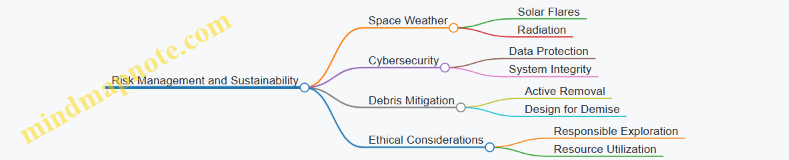
Integrative Example: Preparing a Startup for the Next Decade
Imagine a startup focused on developing autonomous satellite servicing drones. To prepare for the next decade, the team:
- Leverages AI and autonomy for in-orbit operations.
- Designs modular drones using additive manufacturing.
- Navigates evolving regulatory frameworks for servicing missions.
- Partners with established launch providers to access launch infrastructure.
- Builds a diverse, cross-disciplinary team trained through virtual collaboration platforms.
- Implements comprehensive risk management plans addressing cybersecurity and debris mitigation.
This holistic approach exemplifies how integrating best practices across technological, business, regulatory, and human factors prepares organizations to thrive in the new space economy.
Conclusion
Preparing for the next decade of space exploration and commercialization demands a multi-faceted strategy. By embracing innovation, adapting to evolving markets, engaging with regulatory developments, building resilient infrastructure, investing in workforce development, and managing risks sustainably, aerospace engineers, systems engineers, and space startup founders can position themselves for success in this dynamic era.
13.4 Final Example: Integrating Lessons Learned into Future Missions
In the rapidly evolving New Space Economy, the ability to systematically capture and integrate lessons learned from past missions is critical to the success of future space endeavors. This section presents a comprehensive example illustrating how a space startup incorporated lessons learned from a CubeSat constellation mission to improve design, operations, and project management for their next-generation satellite system.
Case Study: From CubeSat Constellation to Next-Gen Modular Satellites
Background: A startup launched a constellation of 12 CubeSats aimed at Earth observation. While the mission met many objectives, several challenges emerged:
- Communication link dropouts during eclipse periods
- Thermal control issues leading to sensor degradation
- Delays in subsystem integration due to interface mismatches
- Limited ground station coverage causing data latency
Using a structured lessons learned approach, the team systematically analyzed these issues to inform their next mission.
Mind Map: Capturing Lessons Learned
Step 1: Root Cause Analysis
The team performed root cause analysis on each issue:
- Communication Link Dropouts: Insufficient power during eclipse caused transmitter power reduction.
- Thermal Issues: Passive thermal control design was inadequate for prolonged sun exposure.
- Integration Delays: Lack of standardized interface control documents (ICDs) led to mismatches.
- Ground Station Coverage: Limited number of ground stations increased data latency.
Mind Map: Root Cause Analysis

Step 2: Implementing Best Practices Based on Lessons
- Enhanced Power System Design: Incorporate higher-capacity batteries and solar arrays with real-time power monitoring.
- Active Thermal Control: Add heaters and deployable radiators; perform thermal simulations early in design.
- Standardized Interfaces: Develop comprehensive ICDs and adopt Model-Based Systems Engineering (MBSE) tools to validate interfaces.
- Expanded Ground Segment: Partner with commercial ground station networks and implement automated scheduling software.
Mind Map: Best Practices for Next Mission
Step 3: Applying Lessons to Next-Gen Modular Satellite Design
The startup designed a modular satellite bus with plug-and-play subsystems:
- Power Module: Scalable battery packs and solar panels with telemetry feedback.
- Thermal Module: Active thermal control elements integrated with sensors.
- Communication Module: Redundant transceivers to mitigate link dropouts.
- Payload Module: Easily swappable sensors with standardized electrical/mechanical interfaces.
This modularity allowed parallel development and testing, reducing integration delays.
Example: Modular Satellite Integration Workflow
Step 4: Operational Improvements
- Expanded ground station network reduced data latency from hours to minutes.
- Automated mission operations software improved command responsiveness.
- Real-time telemetry enabled proactive anomaly detection.
Summary Mind Map: Integrating Lessons Learned into Future Missions
Conclusion
This example underscores the importance of a structured lessons learned process in space systems engineering. By capturing mission insights, performing root cause analysis, and applying best practices such as modular design and MBSE, space startups and engineering teams can significantly improve mission success rates, reduce costs, and accelerate development cycles in the New Space Economy.
Embracing continuous learning and integration of past experiences is not just beneficial but essential for thriving in the dynamic and competitive space industry.
13.5 Call to Action: Empowering the Next Generation of Space Engineers and Entrepreneurs
The future of the New Space Economy depends heavily on the passion, creativity, and dedication of the next generation of aerospace engineers, systems engineers, and space entrepreneurs. To empower these future leaders, it is essential to foster an environment that encourages continuous learning, collaboration, innovation, and practical experience.
Mind Map: Empowering the Next Generation
Practical Examples
Example 1: Student Satellite Program
A university aerospace department partnered with a local space startup to develop a CubeSat mission. Students gained hands-on experience in systems engineering, from requirements gathering to integration and testing. The startup provided mentorship and access to their facilities, while the students contributed fresh ideas and technical skills. This collaboration resulted in a successful launch and valuable lessons for all parties.
Example 2: Space Startup Accelerator
An accelerator program focused on space startups offers seed funding, mentorship, and workshops on regulatory compliance, business development, and technical challenges. One cohort included a team developing an AI-powered satellite constellation management platform. Through the program, they refined their business model, connected with investors, and prepared for their first commercial contracts.
Example 3: Online Collaborative Platforms
Platforms like GitHub and dedicated space engineering forums enable young engineers worldwide to collaborate on open-source space projects. For instance, a global team developed a modular satellite bus design repository, allowing startups and students to customize and build upon proven designs, accelerating innovation and reducing costs.
Actionable Steps for Individuals
- Pursue Continuous Learning: Enroll in specialized courses on space systems engineering, satellite design, and project management.
- Engage in Mentorship: Seek mentors in the aerospace industry and participate in professional societies like AIAA or IEEE Aerospace.
- Participate in Competitions: Join challenges such as NASA’s CubeSat Launch Initiative or the European Space Agency’s Fly Your Satellite!
- Build Practical Experience: Contribute to open-source projects, internships, or university satellite programs.
- Network Actively: Attend conferences, webinars, and hackathons to build connections and exchange ideas.
- Explore Entrepreneurship: Learn the basics of startup formation, funding, and regulatory compliance to transform ideas into viable ventures.
Final Thoughts
Empowering the next generation is not just about imparting knowledge but creating ecosystems where curiosity meets opportunity. By embracing collaboration, leveraging technology, and fostering an entrepreneurial mindset, we can ensure that the New Space Economy thrives with innovative solutions and sustainable growth.
Together, aerospace engineers, systems engineers, and space startup founders can build a future where space is accessible, beneficial, and inspiring for all.