Real World Assets (RWA) Tokenization For Beginners
1. What RWA Tokenization Means in Practice
1.1 Defining Real World Assets and Tokenization in Plain Language
Real World Assets (RWAs): what they are, without the fog
A real world asset is something that exists in the physical or legal world and has value because of rights attached to it. That could be a building, a car fleet, a receivable (money owed), a bond, or even a claim on cash held by a custodian. The key point is that the asset’s value is tied to real-world rights and obligations, not just to a number on a screen.
To keep it concrete, think in terms of three ingredients:
- The underlying asset: the thing (or claim) that has value.
- The rights: what you can do with it (receive payments, vote, redeem, transfer, etc.).
- The legal wrapper: the structure that makes those rights enforceable (for example, a trust, fund, or issuer).
A token is not the asset by itself. A token is a representation of rights to an asset or to the cash flows from an asset. If the rights are unclear, the token is just a fancy label.
Tokenization: what it means in practice
Tokenization is the process of issuing a digital token that represents specific rights and restrictions related to an underlying asset. Those rights are defined in legal documents and enforced through a combination of:
- Off-chain systems (identity checks, custody, recordkeeping, legal notices)
- On-chain systems (a ledger of token balances and transfer permissions)
A helpful way to picture it: tokenization is like turning a paper certificate into a digital receipt that can be transferred more easily—while still requiring a real-world process to verify what the receipt corresponds to.
A simple mental model: “token = receipt, not the vault”
If you’ve ever used a ticket stub, you already understand the idea. The ticket doesn’t power the event; it proves your right to enter. Similarly, an RWA token doesn’t create the asset. It proves your right to a share of it, under rules that are written down and followed.
Mind map: RWAs and tokenization
Mind map: Real World Assets and Tokenization
Examples that show the difference between “asset” and “token”
Example 1: Tokenized bond exposure (rights to cash flows)
- Underlying asset: a bond held by a custodian.
- Rights: token holders receive coupon payments and principal at maturity (according to the terms).
- Token: a digital unit representing a proportional claim on those cash flows.
If the bond is not actually held (or the custodian records don’t match), the token’s value claim becomes meaningless. The token is only as good as the rights and custody behind it.
Example 2: Tokenized real estate receivables (money owed)
- Underlying asset: a pool of invoices or loan repayments.
- Rights: token holders receive distributions as payments are collected.
- Token: a share of the distribution stream, often with rules for defaults and timing.
Here, the “real world” part is the collection process: who collects, how delinquencies are handled, and what happens when payments arrive late or not at all.
Example 3: Tokenized fund shares (ownership in a pool)
- Underlying asset: a portfolio of investments inside a fund structure.
- Rights: token holders are entitled to the fund’s net asset value (NAV) and may have redemption terms.
- Token: a representation of fund share ownership.
The important nuance: redemption terms are usually not “instant” just because transfers are fast. Redemption is governed by the fund’s rules, liquidity of the underlying portfolio, and operational processes.
What tokenization is trying to improve (and what it doesn’t)
Tokenization often aims to make ownership records and transfer mechanics more efficient. But it does not automatically solve:
- custody and reconciliation,
- legal enforceability,
- eligibility rules,
- or the need for accurate reporting.
A token can move quickly on a ledger, but the real-world processes still have to keep up. That mismatch is where many beginner mistakes happen.
A quick “check yourself” checklist
When you hear “RWA token,” ask:
- What is the underlying asset or claim? (bond, receivable pool, property, cash held)
- What rights does the token represent? (payments, redemption, voting)
- Who holds or controls the underlying asset? (custodian, escrow, fund)
- How are transfers restricted or verified? (eligibility, whitelists, permissions)
- How is accounting reconciled? (statements, NAV, reserve proofs)
If you can answer these five questions, you’re no longer guessing. You’re reading the system.
Mini example: mapping rights to a token in plain terms
Suppose a token represents “$1 of monthly rent distributions from a specific property pool.” Then the token’s rights should specify:
- distribution timing (monthly, quarterly, after expenses),
- what counts as “rent” and what gets deducted,
- what happens if tenants miss payments,
- and how token holders are identified for receiving distributions.
The token itself is the ledger entry; the rights come from the legal and operational design.
Summary in one paragraph
Real World Assets are valuable things (or enforceable claims) in the legal or physical world, such as bonds, receivables, property, or cash held by a custodian. Tokenization is the issuance of a digital token that represents defined rights to those assets, with transfers recorded on a ledger and rights enforced through a mix of on-chain rules and off-chain custody, identity, and reconciliation. The practical goal is clearer accounting and easier transfer of rights—provided the underlying rights, custody, and restrictions are real and verifiable.
1.2 Asset Backed Tokens vs Utility Tokens vs Payment Tokens
Token names can be misleading. Two tokens can both be “on-chain,” yet represent very different legal rights and operational behaviors. A practical way to sort them is by asking: What does the token entitle you to? and what is the token used for in the system?
Quick definitions (with concrete anchors)
-
Asset Backed Tokens (ABTs): Tokens that represent a claim on an underlying asset or pool of assets. The key idea is that the token’s value is tied to something held off-chain (or represented by a legally recognized wrapper). Example: a token that represents beneficial interest in a pool of government bills held by a custodian.
-
Utility Tokens: Tokens that grant access to a service or network feature. The token’s “reason to exist” is usage rights, not a direct claim on a specific asset pool. Example: a token required to pay for compute credits inside a platform.
-
Payment Tokens: Tokens designed to be used as a medium of exchange for transferring value. The token’s primary function is payment, settlement, or remittance. Example: a stablecoin used to pay invoices and settle trades on a specific ledger.
Mind map: how to classify tokens
Token Classification Mind Map
Asset Backed Tokens: what “backed” usually means
ABTs typically come with a structure that separates the asset from the token while still linking them through enforceable rights. The asset might be held by a custodian, and the token might represent beneficial ownership or a contractual claim.
A beginner-friendly example: imagine a pool of short-term invoices. The issuer transfers the invoices into a legally defined vehicle. Token holders receive tokens that entitle them to a share of collections after fees. If collections arrive monthly, token holders receive distributions according to a stated waterfall.
What to look for in an ABT description:
- Asset identification: Are the underlying assets specified (e.g., “a pool of invoices from named merchants”) or generic (“a portfolio of receivables”)?
- Custody and segregation: Who holds the assets, and are they segregated from the issuer’s operating assets?
- Rights and remedies: If the issuer fails to remit collections, what rights do token holders have?
- Redemption or distribution rules: Are there scheduled payments, redemption windows, or both?
A useful mental model: ABTs behave like “a claim on a basket,” even if the claim is represented by a token.
Utility Tokens: access rights, not asset claims
Utility tokens are about permission to do something. They often function like a key, a ticket, or a prepaid balance for a service.
Example: a platform offers data labeling services. Users buy utility tokens to pay for labeling jobs. The platform charges tokens per job based on complexity. If you hold tokens, you can submit jobs; if you don’t, you can’t use the service.
Important nuance: utility tokens can still have economic value, but that value comes from how much people want the service, not from a direct claim on a specific asset pool.
What to look for:
- Service dependency: Is the token required for access, or is it just tradable?
- Consumption mechanics: Are tokens burned, locked, or converted into service fees?
- Pricing logic: How does the platform decide token cost per unit of service?
- Governance of the service: Who controls the rules that determine token usage?
A practical check: if the token’s “main job” is paying for internal services, it’s usually utility.
Payment Tokens: the token as a settlement instrument
Payment tokens are designed to move value between parties. They may be pegged (like a stablecoin) or float (like a volatile asset), but the operational focus is on transferring value.
Example: a business receives payment in a token that is accepted by its suppliers. The business uses the token to pay an invoice. The token’s role is to settle obligations on a ledger.
A key nuance: payment tokens can be backed by reserves, but that doesn’t automatically make them asset backed in the ABT sense. The classification depends on what holders are entitled to.
Consider two scenarios:
- Scenario A (ABT-like): Token holders have a right to redeem tokens for a defined share of reserve assets under specified conditions.
- Scenario B (payment-like): Token holders can transfer tokens to others, but there is no clear redemption right tied to a specific reserve claim; the token is primarily used for payments.
What to look for in payment token descriptions:
- Settlement purpose: Is the token primarily used to pay or settle?
- Redemption and backing rights: Are holders entitled to redeem for reserves, or is the token simply transferable?
- Operational rules: Are transfers restricted, and are there compliance checks tied to transfers?
Side-by-side comparison (simple but precise)
| Feature | Asset Backed Tokens | Utility Tokens | Payment Tokens |
|---|---|---|---|
| Primary entitlement | Claim on underlying assets/pool | Access to a service/feature | Ability to transfer/settle value |
| Value driver (typically) | Asset performance + custody | Usage demand + service pricing | Payment acceptance + token mechanics |
| Common mechanics | Distributions, redemption, NAV-style accounting | Credits, quotas, fee consumption | Transfers, settlement, sometimes pegs |
| Best “classification question” | What assets are held and what rights exist? | What service does the token let you use? | What does the token do in transactions? |
Common confusion: “backed” vs “used to pay”
People often see a reserve mention and assume it’s automatically asset backed. The missing piece is holder rights.
Example: a token issuer says, “We keep reserves.” If token holders have no enforceable right to those reserves (or the reserves are not segregated and not linked to token holder claims), the token may still function mainly as a payment instrument. Conversely, a token can be asset backed even if it is traded on a venue, because trading doesn’t change the underlying entitlement.
Mini practice: classify three hypothetical tokens
-
Token A: Represents beneficial interest in a custodied portfolio of government bills. Holders receive monthly distributions and can redeem during set windows.
- Likely type: Asset Backed Token.
-
Token B: Required to submit transactions to a platform’s compute service. Tokens are consumed per job; unused tokens have no claim on any pool.
- Likely type: Utility Token.
-
Token C: Used to pay merchants on a ledger. Transfers are the main function; holders can transfer to others, but redemption for reserves is not described as a holder right.
- Likely type: Payment Token.
Summary in one sentence
If the token’s core job is claiming an underlying asset, it’s asset backed; if it’s accessing a service, it’s utility; if it’s settling payments, it’s payment—sometimes with overlap, but the entitlement and operational role usually make the classification clear.
1.3 How Tokenization Works End to End: From Asset to Token to Ownership
Tokenization is easiest to understand as a chain of responsibilities. Each link answers a simple question: What asset is involved? Who legally owns it? What exactly does the token represent? How do transfers change who is entitled to benefits? The “magic” is mostly paperwork plus software doing the boring parts consistently.
Step 1: Choose the asset and define the rights
Start with a specific asset (or pool of assets) and write down the rights that matter. For example, a token backed by a bond might entitle holders to coupon payments and principal redemption. A token backed by a receivables pool might entitle holders to collections after fees.
A common beginner mistake is to describe the token as “ownership of the asset” without clarifying what that means legally. Ownership can be direct, beneficial, or contractual. The token’s job is to represent a defined set of rights that can be enforced.
Concrete example (bond):
- Asset: a $1,000,000 bond held by a custodian.
- Rights: token holders receive pro-rata coupon payments and a pro-rata share of redemption proceeds.
- Token promise: each token represents a fraction of the beneficial interest in the bond’s cash flows.
Step 2: Put the asset into a legal wrapper
Assets usually need a structure that can hold them and distribute benefits according to the defined rights. This is where a trust, fund, or special purpose vehicle (SPV) often appears.
The wrapper answers: Who holds the asset, and how are token holders connected to it?
Concrete example (bond):
- The SPV holds the bond.
- Token holders hold beneficial interests in the SPV (or a contractual claim against the SPV).
- The SPV’s governing documents specify distribution rules, fees, and what happens if the bond defaults.
Step 3: Decide what the token is (and isn’t)
Now map rights to token mechanics. A token is not the asset itself; it’s a representation of rights that are enforced off-chain and/or on-chain.
You typically decide:
- Token supply (how many units exist).
- Token-to-rights conversion (e.g., 1 token = 0.001% of the beneficial interest).
- Transfer rules (who can hold and trade).
- Redemption rules (if tokens can be redeemed, how and when).
Concrete example (fraction mapping):
- Total tokens: 1,000,000.
- Each token represents 0.0001% of the SPV’s beneficial interest.
- If the SPV distributes \( 10,000 in coupons, each token holder receives: \[ \text{payout per token} = \frac{10{,}000}{1{,}000{,}000} = 0.01 \]
Step 4: Issue tokens and link them to the wrapper
Issuance is where the system becomes real. The issuer creates tokens on-chain (or in a token system) and ensures the wrapper receives the asset (or the wrapper already holds it).
A clean issuance flow looks like:
- Investor subscribes.
- Funds are transferred to the issuer/SPV.
- The SPV buys/holds the asset.
- Tokens are minted to the investor’s address.
- A ledger of entitlements is established (on-chain, off-chain, or both).
Concrete example (subscription):
- Alice buys 5,000 tokens.
- The SPV receives Alice’s subscription funds.
- The SPV allocates the corresponding beneficial interest.
- Tokens are minted to Alice’s wallet.
Step 5: Maintain the entitlement ledger (the “who is entitled” truth)
Blockchains track token balances, but entitlement often depends on compliance and legal eligibility. That means the system needs a reliable way to answer: Is this wallet allowed to receive benefits?
Common approaches:
- On-chain restrictions (smart contract checks before transfers).
- Off-chain eligibility registry (a list of approved holders).
- Hybrid (on-chain transfer permissions plus off-chain eligibility for distributions).
Concrete example (eligibility):
- Only accredited investors can hold the token.
- If Bob receives tokens without eligibility, the system may block transfers or mark him as ineligible for distributions.
Step 6: Handle distributions and redemptions
When cash flows occur, the system must distribute them according to the rights mapping. This usually involves:
- Calculating distributable amounts.
- Determining eligible holders.
- Sending payouts off-chain (bank transfers) or on-chain (stablecoin transfers), depending on the design.
Concrete example (coupon distribution):
- The bond pays \)10,000 in coupons.
- The SPV calculates net distributable amount after fees.
- The distribution agent queries the entitlement ledger for eligible token holders.
- Payouts are sent proportionally.
If tokens are redeemable, redemption adds another layer:
- Tokens are burned or locked.
- The SPV releases the corresponding share of proceeds.
- The ledger updates to reflect reduced beneficial interest.
Step 7: Enforce transfers without breaking the legal story
Transfers are where technical and legal requirements meet. Even if tokens move freely on-chain, the legal wrapper still needs to ensure that benefits go to the correct people.
A robust transfer design includes:
- Transfer restrictions aligned with eligibility.
- Recordkeeping so the SPV can reconcile who should receive distributions.
- Operational controls for edge cases (failed payouts, address changes, lost keys).
Concrete example (transfer restriction):
- The smart contract allows transfers only to whitelisted addresses.
- The whitelist is updated after KYC/eligibility checks.
- If a holder becomes ineligible, the system defines what happens next (e.g., forced transfer to a permitted holder or redemption).
Mind map: End-to-end tokenization flow
A single end-to-end example (realistic but simplified)
Imagine a tokenized cash-equivalent instrument backed by short-term notes.
- Rights definition: Each token entitles the holder to a share of interest payments and principal at maturity.
- Wrapper: An SPV holds the notes and issues tokens representing beneficial interests.
- Token design: 2,000,000 tokens exist; each token equals 1/2,000,000 of the SPV’s beneficial interest.
- Issuance: Investors pay $2,000,000 total; the SPV buys notes; tokens are minted to investors.
- Entitlement: Only eligible investors can receive distributions; the system maintains an eligibility registry.
- Distribution: At month-end, the notes pay $30,000 interest. The SPV pays eligible holders $30,000 × (tokens held / 2,000,000).
- Transfer: If a non-eligible wallet tries to receive tokens, the transfer is blocked or the holder is excluded from distributions according to the rules.
The key point is that token balances alone are not the whole story. The system needs a consistent mapping from token holders to legal entitlement, and it must keep that mapping correct as tokens move.
1.4 A Complete Walkthrough Example: Tokenizing a Bond or Treasury Note
Let’s walk through a concrete, beginner-friendly example: tokenizing a single bond (or treasury note) so that investors can hold “asset backed tokens” that represent a claim on the bond’s cash flows. The goal is not to pretend the token magically creates legal rights; it’s to show how the rights, custody, and compliance pieces fit together.
The scenario
- Asset: One bond with face value $1,000,000.
- Coupon: 5% annual, paid semiannually.
- Maturity: 2 years.
- Issuer: A government or corporate issuer (the tokenization structure doesn’t change the bond’s underlying payment schedule).
- Token goal: Create 10,000 tokens, each representing a $100 share of the bond’s economic interest.
A key beginner point: the token supply is a convenience for fractional ownership. The bond still pays coupons and principal according to its original terms.
Step 1: Decide what the token legally represents
There are two common patterns.
-
Direct representation (less common in practice for beginners): the token is intended to be the legal instrument that tracks ownership of the bond.
-
Indirect representation (common): the token represents a beneficial interest in a legal wrapper that holds the bond.
For this walkthrough, use the indirect pattern:
- A special purpose vehicle (SPV) holds the bond.
- Investors receive tokens that represent their pro rata beneficial interest in the SPV.
- Coupon and principal flows are distributed by the SPV according to the token holders’ entitlements.
Step 2: Map rights to token mechanics
You need a clear mapping from “what investors are entitled to” to “what the token does.”
Rights investors receive (economic)
- Entitlement to coupon payments.
- Entitlement to principal at maturity.
- Entitlement to any proceeds from permitted actions (for example, if the SPV sells the bond).
Token mechanics that must match those rights (technical/operational)
- Token holder registry (who is entitled right now).
- Distribution schedule (when cash is allocated).
- Transfer restrictions (who is allowed to become a token holder).
If you skip this mapping, you’ll end up with a token that moves on-chain but doesn’t match real-world entitlements. That mismatch is where most beginner projects get stuck.
Step 3: Set up custody and segregation
The SPV must hold the bond in a way that supports auditability.
- Custodian: A regulated custodian holds the bond.
- Segregation: The bond is held in an account identified for the SPV (not mixed with unrelated assets).
- Reconciliation: The custodian provides statements; the SPV maintains its own records.
Example reconciliation check
- Custodian statement shows bond face value: $1,000,000.
- SPV ledger shows bond face value: $1,000,000.
- Any difference triggers an investigation before distributions.
Step 4: Create the token supply and the entitlement unit
Let’s define the token unit.
- Total tokens: 10,000.
- Token unit value: $1,000,000 / 10,000 = $100.
Coupon math (semiannual):
- Annual coupon = 5% of $1,000,000 = $50,000.
- Semiannual coupon = $25,000.
If the SPV distributes coupon pro rata:
- Each token receives: $25,000 / 10,000 = $2.50 per coupon period.
This is the kind of simple arithmetic that should appear in your offering materials and your internal controls. It’s also the kind of arithmetic that helps you test your distribution logic.
Step 5: Build the distribution process (off-chain to on-chain)
A token contract alone can’t conjure cash. The cash comes from the bond, and the token system needs to reflect that.
Operational flow
- Coupon payment arrives to the SPV bank account.
- SPV calculates the distribution amount and confirms the bond payment details.
- SPV determines the eligible token holders for the distribution date.
- SPV triggers a distribution event.
- Investors receive fiat (or stablecoin) distributions through the agreed payment rails.
Eligibility timing example Suppose the SPV uses a record date: token holders as of 5:00 PM UTC on the record date receive the coupon.
- If someone buys tokens after the record date, they don’t receive that coupon.
- The next coupon distribution will reflect their new ownership.
This prevents “coupon sniping” and keeps the process consistent.
Step 6: Enforce transfer restrictions (because rights are permissioned)
If the token is offered under a regulatory framework that restricts who can hold it, the token system must enforce eligibility.
A beginner-friendly approach is a permissioned transfer model:
- Only addresses that pass onboarding checks can hold tokens.
- Transfers between eligible addresses are allowed.
- Transfers to non-eligible addresses are blocked.
Example rule set
- Allowed holders: accredited investors in a specific jurisdiction.
- Disallowed: non-eligible retail accounts.
Practical example
- Investor A passes onboarding and receives 1,000 tokens.
- Investor B is not eligible.
- If A tries to transfer tokens to B, the transfer is rejected.
This is not about being difficult; it’s about ensuring the token’s ownership aligns with the legal offering.
Step 7: Smart contract responsibilities (what it should and shouldn’t do)
For this walkthrough, the token contract should focus on:
- Tracking balances.
- Enforcing transfer restrictions.
- Emitting events for distributions.
It should not be the only place where truth lives. The SPV’s records and the custodian’s statements remain critical.
Mind map: the walkthrough in one view
Mind map: Tokenizing a Bond with an SPV
Step 8: A full numeric walkthrough for one coupon period
Assume the bond pays its first coupon after 6 months.
- Cash received by SPV: $25,000.
- Token balances at record date:
- Investor A: 1,200 tokens
- Investor B: 3,500 tokens
- Investor C: 5,300 tokens
- Total: 10,000 tokens
- Entitlement per token: $25,000 / 10,000 = $2.50.
- Payouts:
- Investor A: 1,200 × $2.50 = $3,000
- Investor B: 3,500 × $2.50 = $8,750
- Investor C: 5,300 × $2.50 = $13,250
- Validation: Sum payouts = $3,000 + $8,750 + $13,250 = $25,000.
If the sums don’t match, you don’t “fix it with code.” You trace whether the cash amount, token supply, or record-date snapshot is wrong.
Step 9: What the investor actually experiences
From an investor’s perspective:
- They hold tokens in a wallet or account.
- They receive distributions on the agreed schedule.
- They can view transparency artifacts: token balance, distribution events, and the SPV’s distribution statements.
The token is the interface, but the SPV and custody arrangements are the foundation.
Step 10: Checklist of deliverables for this example
- SPV agreement defining beneficial interest and distribution rules.
- Custody agreement and segregation plan.
- Token contract with balance tracking and transfer restrictions.
- Distribution policy: record date, pro rata calculation, payout rails.
- Reconciliation and audit trail procedures.
- Investor onboarding and eligibility enforcement.
That’s the full walkthrough: a bond stays a bond, the SPV holds it, the token represents a claim, and the operational controls ensure the on-chain state and real-world cash flows agree.
2. Core Building Blocks of Asset Backed Tokens
2.1 Token Types and Rights: Ownership, Beneficial Interest, and Claim
When people say “token,” they often mean “a transferable unit on a blockchain.” Regulators and lawyers mean something else: what legal right that unit represents. In RWA tokenization, the token’s value comes from the underlying asset and from the rights attached to the token. Those rights usually fall into three buckets: ownership, beneficial interest, and claim.
The three right types (and why they matter)
1) Ownership
Ownership means the token holder is the legal owner of the underlying asset (or of a direct legal interest in it). If the asset is sold, the owner is the party who benefits from the sale proceeds, subject to any contractual terms.
Practical implication: ownership rights are typically simpler to explain, but they can be harder to structure when the asset must be held by a custodian or in a regulated vehicle.
Example (ownership): A token represents shares in a company that owns a warehouse. If the company sells the warehouse, the token holders (as shareholders) receive proceeds according to the share terms.
2) Beneficial interest
Beneficial interest means the token holder benefits from the asset economically, even if another party holds legal title. A common pattern is: an entity (or trustee) holds the asset, while token holders have rights to distributions and redemption, as defined in the governing documents.
Practical implication: beneficial interest often appears in trust-like structures. The token holder’s rights are real, but they are exercised through the vehicle’s rules.
Example (beneficial interest): A trust holds a pool of government bonds. Token holders receive periodic interest distributions and may redeem for bond proceeds when permitted by the trust deed.
3) Claim
A claim is a right to receive something from an issuer or counterparty, such as repayment of principal, interest, or other contractual payments. The token holder is not necessarily an owner of the asset; instead, they have a contractual right.
Practical implication: claims are often easier to model technically (a payment obligation), but they raise questions about credit risk, priority of payments, and what happens in insolvency.
Example (claim): A token represents a note issued by a company. The company owes token holders principal and interest, and the company may use proceeds to buy assets, but token holders are still creditors.
Rights are more than labels: map the “who gets what”
A token’s right type is determined by the documents and the mechanics, not by the marketing name. To avoid confusion, teams typically map rights to these questions:
- Who holds legal title? (owner vs trustee vs issuer)
- Who receives cash flows? (distributions, coupons, redemption proceeds)
- What triggers payments? (scheduled payments, performance events, redemption windows)
- What happens on default or insolvency? (priority, recourse, and whether token holders can access the underlying asset)
- How is transfer restricted? (eligibility rules that match the right type)
Mind map: rights and their typical token representations
A concrete comparison: same asset, different rights
Consider the same underlying asset: a pool of invoices from a business.
Structure A: Ownership-like participation
- Token holders are treated as owners of a special pool entity.
- If invoices are collected, token holders receive distributions.
- If the pool is liquidated, token holders receive remaining proceeds.
Why it’s different: token holders are tied to the asset pool’s economics through ownership of the pool vehicle.
Structure B: Beneficial interest in a trust
- A trustee holds the invoices.
- Token holders have beneficial rights to collections and redemption.
- The trustee follows a distribution waterfall defined in the trust documents.
Why it’s different: token holders benefit economically, but legal title sits with the trustee.
Structure C: Claim against an issuer
- An issuer buys invoices and issues tokens as notes.
- Token holders receive scheduled payments from the issuer.
- If invoice collections fall short, token holders may still be paid only to the extent the issuer can pay.
Why it’s different: token holders are creditors of the issuer, not direct beneficiaries of the invoice pool.
How rights show up in token mechanics
Even if the legal documents define rights, the token’s behavior should reflect them. Common mechanics include:
- Redemption: Ownership and beneficial interest often include redemption for underlying value; claims may include maturity repayment rather than redemption.
- Distributions: Beneficial interest structures often distribute periodic cash flows; claims distribute interest as contract payments.
- Transfer restrictions: Eligibility rules may be tied to the right type (for example, only certain investors may hold beneficial interests or certain creditor positions).
- Voting and governance: Ownership-like structures may include shareholder-style voting; beneficial interest may include trustee-directed voting; claims may include creditor consent rights.
Example: three tokens for the same “cash equivalent” instrument
Assume an issuer sets aside a cash-equivalent portfolio (e.g., short-term instruments) in a segregated account.
- Ownership token: Token holders own shares in a company that holds the portfolio.
- Rights: dividends/distributions, liquidation proceeds.
- Risk focus: the company’s asset value.
- Beneficial interest token: A trust holds the portfolio; token holders receive distributions.
- Rights: interest distributions and redemption per trust terms.
- Risk focus: trust protections and how the trust handles insolvency.
- Claim token: The issuer owes token holders repayment and interest.
- Rights: contractual payments at maturity.
- Risk focus: issuer credit risk and payment priority.
Notice the pattern: the same underlying portfolio can produce different token rights, and the risk profile changes accordingly.
Quick checklist: identify the right type in practice
Use this checklist when reviewing a proposed RWA token:
- Does the token holder hold legal title to the asset or a direct ownership interest? If yes, it’s likely ownership.
- If legal title sits with a trustee/vehicle, do token holders have distribution and redemption rights under a trust or fund document? If yes, it’s likely beneficial interest.
- If token holders have a contractual right to payments from an issuer, without direct ownership of the asset, it’s likely a claim.
A token’s name can be creative; the rights cannot. The right type is the part that determines what you can demand, what you can’t, and who you stand in line behind if things go wrong.
2.2 Legal Wrappers: Trusts, Funds, Issuers, and Special Purpose Vehicles
Tokenization usually starts with a simple idea: “the token represents rights in something real.” The legal wrapper is what turns that idea into enforceable rights, with clear responsibilities for custody, administration, and investor protections. Think of it as the paperwork equivalent of a seatbelt: not exciting, but it matters when things get messy.
Why wrappers exist (and why they’re not optional)
A wrapper answers four practical questions:
- Who owns the underlying assets? If the assets are held in the wrong name, the token’s promised rights can become hard to enforce.
- Who owes what to token holders? The wrapper defines obligations like redemption, distributions, reporting, and voting.
- Who can act on the assets? Administration, transfers, and corporate actions need a defined decision-maker.
- How are risks contained? A wrapper can isolate asset-specific risks from the broader business.
The main wrapper types
1) Trusts
A trust is a legal arrangement where a trustee holds assets for the benefit of beneficiaries. In tokenized structures, the beneficiaries are often token holders (directly or through a contractual mapping).
Concrete example (cash-backed tokens):
- A trust holds a portfolio of short-term, cash-like instruments.
- Token holders receive distributions according to the trust’s terms.
- The trustee is responsible for custody arrangements and for enforcing the trust deed’s rules.
Best-practice mechanics:
- Use a trust deed that clearly states: what assets qualify, how they’re valued, and what happens on default or termination.
- Define trustee powers and limits so the trustee can act without improvising.
Common beginner pitfall: If the trust deed is vague on valuation or redemption timing, the token’s on-chain logic can’t fix the legal ambiguity.
2) Funds (investment funds and pooled vehicles)
A fund pools investor capital and invests according to a stated strategy. Token holders typically hold shares/units in the fund or an interest that tracks fund economics.
Concrete example (tokenized real estate receivables fund):
- Investors buy fund units represented by tokens.
- The fund collects payments from borrowers.
- Distributions follow a waterfall: expenses first, then principal and interest allocations.
Best-practice mechanics:
- Define the valuation policy (how often, what inputs, and who approves pricing).
- Specify subscription and redemption procedures (cut-off times, notice periods, and settlement steps).
Why funds are popular for RWA: They naturally match “many investors, one pool of assets,” and they provide a familiar governance and reporting structure.
3) Issuers (the entity that issues the token rights)
An issuer is the legal entity that creates the token offering and is responsible for the token’s legal rights. Depending on the jurisdiction and structure, the issuer may also be the operator of the wrapper.
Concrete example (issuer-led program):
- An issuer creates tokens that represent beneficial interests in a segregated pool.
- The issuer signs the offering documents and manages investor eligibility processes.
- The issuer coordinates with the custodian and administrator.
Best-practice mechanics:
- Separate “token issuance” responsibilities from “asset custody” responsibilities.
- Ensure the issuer’s authority is consistent across documents: offering materials, governance documents, and operational policies.
Common beginner pitfall: Confusing the issuer (who promises rights) with the custodian (who holds assets). When those roles blur, regulators and auditors ask uncomfortable questions.
4) Special Purpose Vehicles (SPVs)
An SPV is created for a specific purpose, often to isolate a particular asset pool or transaction. The SPV can be a company, limited partnership, or other entity type.
Concrete example (single-asset SPV):
- An SPV buys a specific portfolio of invoices.
- The SPV issues tokens that entitle holders to the cash flows from those invoices.
- The SPV’s assets and liabilities are ring-fenced to that transaction.
Best-practice mechanics:
- Draft covenants that prevent the SPV from taking on unrelated obligations.
- Define triggers for replacement of service providers and procedures for asset recovery.
Why SPVs matter: They help keep the token’s asset pool legally distinct from the sponsor’s other activities.
How wrappers connect to token rights
A wrapper is only useful if the token’s rights map cleanly to the wrapper’s legal rights. In practice, teams create a “rights mapping” document that links:
- Token events (mint, transfer, redemption request)
- Legal rights (beneficial interest, share/unit rights, contractual claims)
- Operational steps (eligibility checks, settlement, distribution calculations)
Concrete example (redemption):
- On-chain: a token holder submits a redemption request.
- Off-chain: the administrator verifies eligibility and calculates the redemption amount.
- Legal: the wrapper’s governing documents authorize the redemption and define timing.
If any link is missing, the system becomes a collection of rules rather than enforceable rights.
Mind map: wrapper roles and responsibilities
Legal Wrappers for RWA Tokens (Mind Map)
A simple end-to-end example (same assets, different wrappers)
Imagine a portfolio of government bonds held to generate periodic income.
- Trust wrapper: the trustee holds the bonds; token holders are beneficiaries entitled to income and principal on termination.
- Fund wrapper: token holders hold units in a fund; income is distributed per fund rules; redemptions follow dealing procedures.
- SPV wrapper: an SPV holds the bonds for a defined transaction; token holders have claims to cash flows under transaction documents.
The underlying bonds are the same, but the legal relationships differ. That difference affects investor rights, reporting expectations, and how disputes are handled.
Practical checklist for choosing a wrapper (beginner-friendly)
- What rights do token holders need? Income only, principal return, voting, or redemption.
- How will assets be held and protected? Custody and segregation requirements.
- What happens when something goes wrong? Termination, default, and service-provider replacement.
- How will transactions be processed? Subscriptions, redemptions, and distributions.
- Who is accountable for what? Clear allocation between issuer, administrator, trustee/fund manager, and custodian.
A good wrapper doesn’t just “exist.” It provides a consistent chain from legal rights to operational execution, so the token’s promises match what the documents actually support.
2.3 Custody and Control: Custodian, Escrow, and Segregation of Assets
In RWA tokenization, “custody” is not a vague promise that someone is holding something. It’s a set of operational facts: who has legal possession or control, where the assets sit, how they’re separated from other assets, and what evidence exists that the token holders’ underlying rights are actually backed.
What custody is trying to prevent
A good custody setup reduces three common failure modes:
- Misappropriation risk: assets are used for someone else’s purposes.
- Commingling risk: token-backed assets get mixed with other funds or the issuer’s own assets.
- Control mismatch: the token contract assumes one control model, while the real-world custody model is different.
If you can’t clearly answer “who can move the assets, from where, under what conditions, and with what records,” you don’t yet have custody—you have a story.
Custodian roles: legal possession vs operational control
Custody arrangements often split responsibilities:
- Legal custody / title: who holds the asset under law (varies by asset type).
- Operational control: who can instruct transfers, sign settlement instructions, or access accounts.
- Recordkeeping: who maintains ledgers, statements, and reconciliation evidence.
A practical best practice is to map these roles explicitly. For example, a custodian might hold securities in an account, while a separate administrator calculates entitlements and a transfer agent enforces eligibility. The key is that each role has documented boundaries.
Custody models you’ll actually see
1) Direct custody (custodian holds the assets for the issuer or trust)
Here, the custodian maintains accounts that contain the underlying assets. Token holders’ rights are supported by the legal wrapper (trust, fund, or similar structure).
Example (cash-like instrument):
- Underlying: a portfolio of short-term government bills.
- Custody: a regulated custodian holds the securities in a segregated account.
- Token: each token represents beneficial interest in that portfolio.
Control check: the custodian can move assets only under instructions that match the wrapper’s rules (e.g., redemption requests, scheduled rebalancing, or maturity proceeds).
2) Escrow custody (assets held pending issuance or specific events)
Escrow is custody with a purpose and a release condition. Assets sit in escrow until predefined triggers occur.
Example (real estate token issuance):
- Underlying: purchase funds collected from investors.
- Escrow: funds are held until the property purchase closes.
- Release: escrow releases funds to the seller only when closing documents are verified.
Control check: escrow instructions must be tied to objective conditions (e.g., receipt of closing confirmation), not “trust me” approvals.
3) Segregated custody (ring-fenced assets within a custodian)
Segregation means the assets are kept separate from other customers’ assets and from the issuer’s own holdings. Segregation can be implemented at the account level, sub-ledger level, or both.
Example (tokenized receivables):
- Underlying: a pool of invoices.
- Segregation: invoices are recorded in a dedicated pool ledger, and collections are deposited to a dedicated account.
Control check: the pool ledger must reconcile to the custodian account and to the token’s entitlement logic.
Segregation: what “separate” must mean
Segregation is often described as “kept separate,” but operationally it needs measurable properties:
- Separate legal or beneficial ownership: the wrapper defines who the assets belong to.
- Separate accounts: custody accounts are not shared with unrelated assets.
- Separate accounting: the pool’s ledger tracks balances, collections, and expenses.
- Separate access: permissions to move assets are limited to authorized actions.
A simple test: if you remove the token system from the picture, could you still identify the pool’s assets and explain how they’re protected? If not, segregation is incomplete.
Evidence and reconciliation: custody without proof is just paperwork
Custody should produce evidence that can be reconciled:
- Statements from the custodian (holdings, balances, transaction history).
- Pool ledger (what the token system says the pool contains).
- Reconciliation reports (how the two match, including timing differences).
Example (monthly reconciliation):
- Custodian statement shows $10,000,000 in securities at month-end.
- Pool ledger shows $9,995,000 due to settlement timing.
- Reconciliation explains the $5,000 difference as pending settlement and confirms it clears within a defined window.
This is where “control” becomes real: not by claiming accuracy, but by documenting how discrepancies are handled.
Mind map: custody and control components
Mind map: control boundaries (who can do what)
Concrete example: a permissioned RWA token with segregated custody
Consider a token representing shares in a receivables pool.
- Custodian holds the collection account where payments from debtors are deposited.
- Administrator maintains the pool ledger: invoice balances, collections, and allocation of fees.
- Transfer restrictions ensure only eligible investors can hold tokens.
Operational flow (simplified):
- Invoices are originated and assigned to the pool wrapper.
- Debtors pay collections to the dedicated collection account.
- Custodian reports deposits and account activity.
- Administrator updates the pool ledger and calculates distributions.
- Token contract reflects entitlements via an off-chain-to-on-chain update process (with documented controls).
Segregation check: the collection account is not used for the issuer’s operating cash, and the pool ledger reconciles to custodian statements each reporting cycle.
Common mistakes to avoid
- Single account for everything: if the issuer’s cash and the pool’s cash share an account, segregation is mostly a label.
- Unclear release conditions in escrow: if release depends on subjective approvals, you’ve replaced custody with negotiation.
- No reconciliation loop: if there’s no routine comparison between custodian records and pool accounting, control becomes guesswork.
- Token logic assumes the wrong custody model: if the token contract treats assets as segregated but the custody arrangement is commingled, the mismatch is structural.
Practical checklist for beginners
When reviewing a custody and control design, confirm these items:
- The custodian’s role is documented (possession, access, records).
- Escrow, if used, has objective release triggers.
- Segregation is defined at both account and accounting levels.
- There is a recurring reconciliation process with exception handling.
- Responsibilities are mapped so that token holders’ rights align with real-world custody.
If you can walk through those points with a specific asset type and a specific reporting cycle, you’re not just “doing custody.” You’re operating control.
2.4 On Chain vs Off Chain: What Must Be Verified and What Must Be Audited
RWA tokenization usually splits reality into two layers. The on-chain layer records certain facts in a way that can be checked by anyone with the chain data. The off-chain layer holds the legal and operational truth: who owns what, who is allowed to act, and whether the underlying assets actually exist and match the token supply. A common beginner mistake is to treat the blockchain as the source of truth for everything. It isn’t. It’s a source of truth for what it records, and a tool for enforcing some rules.
On-chain: what you can verify directly
On-chain verification is strongest when the question is about state and transitions.
Typical on-chain facts to verify
- Token supply and balances: total supply, balances per address, and whether mint/burn events match issuance/redemption.
- Transfer permissions: whether transfers are blocked or allowed based on eligibility rules.
- Custody references: pointers to off-chain custody accounts, vault identifiers, or registry entries (not the assets themselves).
- Event logs: issuance, redemption requests, settlement completions, and any parameter changes.
- Contract configuration: admin roles, upgrade status, and whether critical functions can be called by unauthorized parties.
Concrete example (transfer eligibility) Imagine an RWA token where only approved investors can hold it. The smart contract might implement a rule like: transfers are allowed only if both sender and receiver are in a whitelist. On-chain you can verify:
- the whitelist is stored in contract state,
- the transfer function checks membership,
- and the contract emits an event when an address is added.
What you cannot verify on-chain is whether the whitelist was built using correct KYC or whether the investor’s documents are still valid. That’s off-chain.
Off-chain: what must be audited because it’s not fully on-chain
Off-chain truth is usually about assets, legal rights, and operational controls. The blockchain can reference these facts, but it rarely proves them.
Typical off-chain facts to audit
- Existence and custody of underlying assets: bank statements, custody reports, account ownership, and segregation controls.
- Valuation and pricing methodology: how NAV or reference values are calculated and who approves changes.
- Legal structure and rights: trust/fund documents, redemption terms, and what the token represents.
- Eligibility and compliance processes: KYC/AML procedures, sanctions screening, and ongoing monitoring.
- Reconciliation procedures: how token supply is matched to asset holdings and how discrepancies are handled.
- Operational execution: who performs settlements, how exceptions are resolved, and how records are retained.
Concrete example (proof of reserves) Suppose the token represents a claim on a pool of cash equivalents held by a custodian. On-chain you can verify the token supply and that redemptions burn tokens. Off-chain you must verify:
- the custodian’s account balances,
- whether those balances correspond to the pool,
- and whether the custodian’s reporting is consistent with the reconciliation schedule.
If the custodian account is correct but the reconciliation process is sloppy, the token supply might drift from the pool. On-chain won’t catch that drift by itself.
The boundary: what each layer should do
A useful way to think about the boundary is: on-chain enforces and records; off-chain proves and governs.
- On-chain should enforce: transfer restrictions, mint/burn rules, settlement sequencing, and access control.
- On-chain should record: the fact that an action occurred (e.g., “redemption completed”).
- Off-chain should prove: that the action was justified (e.g., “assets were available and transferred”).
- Off-chain should govern: compliance decisions, custody operations, and legal interpretations.
Mind map: verification vs audit
A practical checklist: mapping questions to layers
Use questions to decide where evidence must come from.
| Question you need answered | Best evidence layer | Example of what “good” looks like |
|---|---|---|
| “Did tokens mint when assets were deposited?” | On-chain + off-chain | On-chain mint event timestamp matches off-chain deposit confirmation and reconciliation entry |
| “Can an ineligible address receive tokens?” | On-chain | Transfer function rejects receiver not in eligibility set; events show eligibility changes |
| “Is the eligibility set built correctly?” | Off-chain | KYC records exist, approvals are documented, and eligibility is updated when status changes |
| “Do the underlying assets exist?” | Off-chain | Custodian reports and account statements confirm holdings; segregation is documented |
| “Is the contract upgrade controlled?” | On-chain | Admin role is restricted; upgrade events are logged; upgrade actions follow policy |
| “Is valuation consistent with the prospectus?” | Off-chain | Pricing policy is followed; approvals and calculations are retained |
Example: end-to-end flow with explicit evidence points
Consider a redemption cycle for a tokenized fund.
-
Investor submits a redemption request
- On-chain: request is recorded (or an off-chain request is linked to an on-chain identifier).
- Off-chain: eligibility and redemption eligibility checks are performed using investor records.
-
Fund determines redemption amount
- On-chain: may store the redemption amount and the time of valuation reference.
- Off-chain: valuation is calculated using the approved methodology.
-
Settlement occurs
- On-chain: tokens are burned or transferred according to the contract rules.
- Off-chain: the custodian transfers the underlying value to the investor or to the settlement account.
-
Reconciliation and reporting
- On-chain: events show completion.
- Off-chain: reconciliation confirms that the asset reduction matches the token reduction, and reporting is issued.
If any step is missing evidence, you should treat it as a control gap. The blockchain can show that a function ran, but it cannot prove that the underlying operational step was correct.
Common failure modes (and what evidence would have prevented them)
- “We have events, so we’re fine.” Events prove execution, not correctness. Audit the underlying justification and reconciliation.
- “The contract enforces eligibility, so KYC is solved.” On-chain checks can only enforce a list or rule. Audit how the list is maintained.
- “Custody is outsourced, so we don’t need to look.” Outsourcing shifts responsibility. Audit custody reports, segregation, and reconciliation processes.
- “Token supply matches today’s assets.” Matching at one time doesn’t guarantee ongoing alignment. Audit schedules and exception handling.
Summary: how to decide what must be verified vs audited
- If the question is about what the contract did (state changes, permissions, event history), you can usually verify on-chain.
- If the question is about whether the real-world claim is true (assets exist, rights are valid, compliance was performed), you need off-chain audit evidence.
- The best systems make the boundary explicit: on-chain enforces rules and records outcomes; off-chain proves the underlying facts and governs the processes that feed those rules.
2.5 A Practical Example of Rights Mapping for an Asset Backed Token
Rights mapping is the step where you translate “what the token is” into a precise list of legal and operational rights. The goal is simple: if someone asks, “What exactly do I own, and what can I do with it?”, you should be able to answer without hand-waving.
The scenario: tokenized invoices with a redemption path
Assume a company (the issuer) tokenizes a pool of short-term invoices. Each invoice is owed by a business customer to the issuer. The issuer deposits the invoices into a segregated trust (or fund) and issues tokens that represent beneficial interests in the cash flows from those invoices.
For beginners, it helps to separate three layers:
- Economic rights (cash flows, distributions, redemption proceeds)
- Governance/administrative rights (voting, consent, reporting rights)
- Control and enforcement rights (who can sue, who can replace a manager, how defaults are handled)
Step 1: Start with the asset-level rights
At the invoice level, the trust holds contractual rights against invoice debtors. Those rights include:
- Payment obligation from the debtor
- Interest/late fees (if any)
- Ability to enforce collection through legal action
- Priority in the trust’s waterfall (if multiple claims exist)
Practical example:
- Invoice principal: $10,000
- Due date: 60 days
- Late fee: 2% per month after due date
- If the debtor pays early, the trust receives the principal plus any accrued amounts
These invoice-level rights are the “source code” for what the token holders ultimately receive.
Step 2: Map asset-level rights to token-level economic rights
Now translate invoice rights into token rights. Suppose the token contract defines that token holders are entitled to a pro-rata share of net collections.
A clear mapping might look like this:
- Right to distributions: token holders receive pro-rata distributions from collections
- Right to redemption: token holders receive a final redemption amount after the invoice pool matures and is liquidated
- Right to residuals: if collections exceed expected losses and expenses, token holders receive the remainder
- Right to shortfalls: if collections are insufficient, token holders bear the loss according to the waterfall
Concrete numbers:
- Total invoice pool: $1,000,000
- Tokens outstanding: 1,000,000 tokens (1 token = 1 unit)
- Expected expenses (servicing + trust costs): $20,000
- Collections received by maturity: $960,000
Net available for token holders: $960,000 − $20,000 = $940,000
If there are no other classes of claims, each token holder receives $940,000 / 1,000,000 = $0.94 per token as final redemption.
Step 3: Identify non-economic rights (and keep them narrow)
Non-economic rights often cause confusion because they sound “optional” until something goes wrong. For beginners, list them explicitly and tie them to operational reality.
Common token-holder rights in this example:
- Information rights: periodic reports on collections, delinquency, and expenses
- Meetings/consents: token holders may vote on replacing the servicer if a defined trigger occurs
- No direct control over collections: token holders do not contact debtors directly; the servicer handles it
Practical example:
- Trigger: servicer fails to remit collections to the trust within 5 business days of receipt
- Remedy: token holders holding at least 25% can vote to replace the servicer
This is a rights mapping detail that matters operationally: it tells you who can act, when they can act, and what evidence supports the trigger.
Step 4: Map enforcement rights and default mechanics
Economic rights are only as good as enforcement. In a tokenized structure, enforcement rights usually sit with the trust/fund and its administrator, not with each token holder individually.
For the invoice pool, enforcement mapping might include:
- Who can enforce invoice claims: the trust (through the servicer/manager)
- Who can initiate litigation: the trust administrator under defined instructions
- What happens on default: collections continue to flow; enforcement actions may increase; expenses may rise
- How token holders participate: token holders receive reports and may vote on certain remedies
Concrete example:
- If 10% of invoices become delinquent beyond 30 days, the servicer must begin a defined escalation plan (additional reminders, then legal action for eligible invoices)
- Token holders do not individually sue debtors; they rely on the trust’s enforcement process
Step 5: Translate the mapping into a “rights matrix”
A rights matrix is a compact way to show: asset → trust → token → contract behavior.
| Layer | Entity/Document | Rights/Obligations | Example detail |
|---|---|---|---|
| Asset | Invoice contract | Debtor must pay; trust can enforce | $10,000 due in 60 days |
| Custody/Legal wrapper | Trust/fund | Holds invoice claims; manages enforcement | Segregated trust account |
| Token | Token terms | Pro-rata beneficial interest; distributions; redemption | $0.94 per token at maturity |
| Operations | Servicing agreement | Collects payments; remits to trust; reports | Remit within 5 business days |
| Technical | Token smart contract | Transfer restrictions; eligibility checks | Only whitelisted holders can receive tokens |
This table is not just documentation; it becomes a checklist for implementation and audits.
Mind map: rights mapping for the invoice-backed token
Rights Mapping Mind Map (Invoice-Backed Token)
Step 6: Validate the mapping with “who does what” questions
A rights map should survive practical questions. Here are four that often reveal gaps:
-
If a token holder asks for redemption, who calculates the amount?
- Answer should point to the trust administrator using the defined waterfall and verified collections.
-
If the servicer misses a remittance deadline, what evidence proves it?
- Answer should specify timestamps, bank statements, and reconciliation reports.
-
If a token holder is ineligible due to jurisdiction, what happens to distributions?
- Answer should specify whether distributions are withheld, routed to a custodian, or handled via a transfer restriction mechanism.
-
If enforcement is needed, who can initiate it?
- Answer should point to the trust’s authority and the conditions under which it must act.
Practical example of a gap: If the token terms say “token holders may vote to replace the servicer,” but the operational agreement never defines the voting threshold or the timeline for transition, then the right exists on paper but fails in execution. Rights mapping forces you to connect the legal sentence to a working process.
Step 7: Produce a beginner-friendly “rights summary”
Finally, convert the matrix into a short summary that matches the real structure.
Rights summary (example):
- You hold a beneficial interest in the trust’s net collections from the invoice pool.
- You receive periodic reports and pro-rata distributions.
- At maturity, you receive final redemption based on verified collections minus trust and servicing expenses.
- You can vote to replace the servicer only if a defined remittance or performance trigger occurs.
- You do not directly enforce invoice claims; enforcement is handled by the trust through the servicer.
That summary is the end product of rights mapping: it aligns legal rights, operational behavior, and technical constraints into one coherent story.
3. Tokenization Models and Common Market Structures
3.1 Direct Tokenization of Assets: When the token represents the asset itself
Direct tokenization means the token is designed to track and represent a specific underlying asset (or a clearly defined portion of it) rather than representing a separate claim like “shares in a fund.” In practice, the token’s legal and operational role is to stand in for ownership or beneficial ownership of the underlying asset, with the token transfer reflecting changes in who has rights to that asset.
A useful way to think about it: with direct tokenization, the token is not merely a receipt for something else. It is the portable representation of the asset’s rights—so the system must be able to prove that each token maps to a particular asset and that transfers are restricted to eligible parties.
What “represents the asset itself” really means
Direct tokenization can still be implemented in different legal structures, but the core requirement is consistent: there must be a one-to-one (or well-defined) mapping between tokens and underlying asset units.
Common mapping patterns include:
- Token per asset unit: One token corresponds to one bond, one invoice, one property share certificate, or one warehouse receipt.
- Token per fraction: A token corresponds to a fixed fraction of an asset (e.g., 1/1,000 of a receivable pool), with clear rules for how fractions are valued and redeemed.
- Token as a wrapper over a segregated asset: The underlying asset is held in a way that is segregated per token series or per issuance batch, so ownership can be traced.
If the mapping is fuzzy, you end up with a system that behaves like indirect tokenization even if the marketing says otherwise. Regulators and auditors care about the actual rights and the traceability.
Mind map: Direct tokenization design
The rights model: what the token transfer is supposed to do
Direct tokenization typically aims for this behavior: when Token A is transferred from Alice to Bob, Bob becomes the person entitled to the underlying asset’s rights (or the beneficial interest in those rights), subject to any legal restrictions.
That means the system needs to answer three practical questions:
- What exactly is being transferred? Ownership of the asset, beneficial interest, or a contractual right that mirrors ownership.
- Where is the asset held? In custody, in a trust, in a fund structure, or in a segregated account.
- How is the transfer reflected? Through a token transfer on-chain plus an off-chain update (e.g., custodian records, register entries, or legal title transfer), or through a structure where the token itself is the register.
A direct token that is technically transferable but legally ineffective is a common design mistake. The token should not be able to move without the underlying rights moving in a way that is consistent with the legal structure.
Example 1: Tokenizing a single invoice (token per invoice)
Imagine a company issues a token that represents a specific invoice worth $50,000, due in 90 days. The invoice is held by a custodian or in a segregated account.
Setup
- Invoice ID: INV-2026-001
- Token: INV-2026-001-TKN
- Token supply: 1,000 tokens, each representing $50 of invoice proceeds (fixed fraction)
Direct mapping
- Each token unit corresponds to a fixed fraction of the invoice’s proceeds.
- The system records that the invoice is the sole source of repayment for that token series.
Transfer behavior
- If Alice transfers 200 tokens to Bob, Bob becomes entitled to 200/1,000 of the invoice proceeds.
Controls you need
- Eligibility: only permitted investors can hold the token.
- Reconciliation: the custodian must confirm the invoice is still outstanding and that proceeds are tracked.
- Settlement: at maturity, proceeds are distributed according to token balances (or according to a snapshot mechanism).
This is direct tokenization because the token’s economic and legal purpose is tied to a specific invoice and its repayment.
Example 2: Tokenizing a bond with a register-backed structure
Suppose a government bond is held by a custodian, and the token represents beneficial ownership of that bond.
Setup
- Underlying asset: Bond ISIN XYZ123, face value $1,000,000
- Token series: 10,000 tokens, each representing 1/10,000 of the bond’s beneficial interest
Direct mapping
- The token series is linked to a specific bond lot.
- The register (on-chain or off-chain) ties token balances to beneficial entitlements.
Why “direct” still needs careful wording
- The token may not transfer legal title if the bond is held in custody under a trust or nominee arrangement.
- However, the token transfer must still result in a change in beneficial entitlement consistent with the custody and register records.
If the custodian’s records do not align with token transfers, you get a mismatch: the token says Bob owns it, but the custodian says Alice does.
Operational checklist: what to verify for direct tokenization
- Token-to-asset mapping is explicit: token IDs or series IDs correspond to a named asset or a defined asset fraction.
- Segregation is enforceable: the underlying asset is held in a way that prevents mixing with other assets.
- Transfer restrictions are applied at the right layer: eligibility checks happen before or during token transfers, not only after.
- Custody and reconciliation are defined: there is a routine to confirm that the backing asset still exists and that balances match entitlements.
- Settlement rules are deterministic: coupon payments, principal, or proceeds distribution follow a clear method tied to token balances or snapshots.
Common pitfalls (and how to spot them)
- “One token, many assets” without rules: If the token can be backed by different assets over time, the token no longer represents a stable asset unit.
- No clear redemption mechanics: Direct tokenization often implies a straightforward path from asset proceeds to token holders; vague settlement rules create disputes.
- Eligibility checks that don’t affect reality: If the token can be transferred to ineligible holders but the underlying rights are not updated accordingly, the system is inconsistent.
Summary
Direct tokenization is about representing a specific asset (or a defined fraction of it) through a token whose transfers correspond to changes in rights to that asset. The design succeeds when mapping, rights, custody, and transfer controls all agree—so the token is not just a convenient label, but a reliable representation of the underlying asset’s entitlements.
3.2 Indirect Tokenization: Tokens representing shares or beneficial interests
Indirect tokenization means the token does not directly “stand for” a specific physical asset. Instead, it represents a legal right in something that holds assets—often a fund, trust, or company. The token is the receipt; the underlying assets live in the wrapper.
What “indirect” really means
In direct tokenization, the token is tied to a specific asset (for example, a particular bond or a specific property unit). In indirect tokenization, the token is tied to an interest in a pool or vehicle. That vehicle owns the assets, and token holders share in the vehicle’s economics and rights.
A helpful mental model:
- Direct: “This token corresponds to that asset.”
- Indirect: “This token corresponds to a share of the vehicle that owns assets.”
This distinction matters because the legal rights usually come from the vehicle’s governing documents (trust deed, fund agreement, articles of association), not from the token’s existence alone.
The typical structure
Most beginner-friendly indirect tokenization designs follow a pattern:
- Assets are placed into a vehicle (fund, trust, SPV, or similar).
- The vehicle issues interests (shares, units, beneficial interests).
- Tokens represent those interests and track ownership of the vehicle interests.
- A custodian/administrator maintains off-chain records that map token ownership to vehicle ownership.
- Distributions and redemption happen at the vehicle level, then flow to token holders according to the token-to-interest mapping.
Even when tokens are transferable on-chain, the vehicle may restrict who can hold the interests. The token transfer layer and the vehicle eligibility layer must agree.
Mind map: components and responsibilities
Mind map: Indirect tokenization (token = vehicle interest)
Rights: what token holders usually get
Indirect tokenization typically grants rights that look like fund or trust rights:
- Economic rights: a share of income and proceeds when assets are sold.
- Redemption rights: the ability to withdraw under specified conditions (often with notice periods or gates).
- Information rights: access to reports, statements, and periodic valuations.
- Governance rights: sometimes voting on major actions, depending on the vehicle.
A key nuance: the token itself may be technically transferable, but the vehicle’s rights may be conditional. For example, a token holder might be able to transfer tokens to another wallet, yet the vehicle may refuse to recognize the new holder for redemption until eligibility checks pass.
Example 1: Tokenized fund shares (simple income sharing)
Imagine a fund that buys a portfolio of commercial receivables. The fund issues units to investors. Those units entitle holders to a share of collections after expenses.
- The fund owns the receivables.
- The token represents a fractional unit in the fund.
- Each month, the fund calculates net collections and distributes them proportionally.
How the indirect link works in practice:
- The fund administrator maintains the official unit register.
- The token contract reflects unit ownership by updating balances based on the administrator’s instructions.
- When distributions occur, the administrator uses the unit register to compute each holder’s payout, then sends funds to the corresponding token holders.
Why this is indirect: if a token holder wants to claim “that specific receivable,” they can’t. Their claim is against the fund’s assets and cash flows through their unit interest.
Example 2: Beneficial interest in a trust (custody and nominee mechanics)
Consider a trust that holds a pool of government bonds. Investors receive beneficial interests under the trust.
- The trust holds the bonds with a custodian.
- The trust issues beneficial interests to investors.
- Tokens represent those beneficial interests.
A common operational approach is to use a nominee or administrator that interfaces between the token ledger and the trust’s beneficial interest register. This avoids forcing the trust to interpret every on-chain transfer event directly.
Practical consequence: if the token is transferred to an ineligible wallet, the trust may still treat the beneficial interest as held by the nominee until the transfer is recognized and the new holder is approved.
Example 3: Redemption terms and “who gets paid”
Suppose the fund allows redemption only quarterly and requires a 30-day notice. Token holders can transfer tokens at any time, but redemption is processed based on the unit register at the redemption cut-off.
- Token transfer happens on-chain.
- Redemption eligibility is determined off-chain at the cut-off date.
Beginner takeaway: secondary market trading does not automatically change redemption rights. The token transfer may change who holds the token, but the vehicle’s redemption process uses its own record of recognized holders.
Mind map: token-to-vehicle mapping and controls
Mind map: mapping and control points
Best-practice checklist for indirect tokenization (with concrete examples)
-
Define the token’s legal meaning in one sentence.
- Example: “Each token represents one unit of beneficial interest in the Fund, subject to the Fund’s terms.”
-
Separate “transferability” from “recognition.”
- Example: a token can move between wallets, but the fund recognizes only holders who pass eligibility checks.
-
Use a clear reconciliation process between on-chain and off-chain records.
- Example: daily reconciliation compares token balances to the administrator’s unit register; mismatches trigger a hold on affected transfers.
-
Make distribution logic match the vehicle’s accounting.
- Example: if the fund distributes net income after fees, the token distribution should follow the same net figure, not a simplified on-chain estimate.
-
Document redemption mechanics so they don’t depend on guesswork.
- Example: “Redemption cut-off is the unit register as of the 15th day of the notice period.”
Common beginner mistakes (and what to do instead)
-
Mistake: assuming token ownership equals direct asset ownership.
- Fix: explain that token holders have rights in the vehicle, not a claim on a specific asset.
-
Mistake: ignoring eligibility at the vehicle level.
- Fix: ensure the vehicle’s recognition rules are enforced even if tokens are transferable.
-
Mistake: treating on-chain transfers as automatically effective for payouts.
- Fix: payouts should follow the vehicle’s recognized register and cut-off rules.
Indirect tokenization can be straightforward when you keep the chain of responsibility clear: the vehicle owns the assets, the token represents an interest in that vehicle, and the operational layer ensures token transfers and vehicle rights stay aligned.
3.3 Fractionalization and Redemption Mechanics for Beginners
Fractionalization means splitting one asset into many smaller units so more people can participate. Redemption mechanics explain how those units can be converted back into cash or the underlying asset when investors want out. In RWA tokenization, the key is that the token’s “fraction” must map to a real, enforceable right in the legal wrapper (trust, fund, SPV, or similar). The math is simple; the paperwork and operational steps are not.
Fractionalization: what “fraction” actually represents
A beginner-friendly way to think about fractionalization is to separate three layers:
- The underlying asset (for example, a bond, a pool of receivables, or a property).
- The investor right (for example, a share of cash flows, a beneficial interest, or a claim against a fund).
- The token units (for example, 1 token = 0.001 of the fund’s beneficial interest).
If you skip layer 2, you get a token that looks fractional but may not be redeemable in a real-world sense. Best practice is to define the conversion ratio and redemption eligibility in the offering documents and the operational procedures.
Example: fractionalizing a $1,000,000 bond
- Underlying bond face value: $1,000,000
- Token supply: 1,000,000 tokens
- Token price at issuance: $1.00
If the legal wrapper states that each token represents $1.00 of beneficial interest (or an equivalent proportional claim), then:
- 10 tokens represent $10 of the claim.
- 250,000 tokens represent $250,000 of the claim.
The important nuance: the token supply and the claim mapping must stay consistent with how the wrapper values the asset and calculates investor entitlements.
Redemption mechanics: how investors exit
Redemption is the process of converting token units back into value. Redemption can be structured in several ways, and each one changes the investor experience and the operational workflow.
Common redemption patterns
A) Redemption for cash at a set schedule
- Investors request redemption on specific dates.
- The wrapper calculates the redemption amount using a reference value (often NAV or a valuation method).
- Investors receive cash after settlement.
B) Redemption for underlying asset (less common for beginners)
- Investors redeem tokens for a pro-rata slice of the underlying asset.
- This requires custody and transfer logistics for the asset itself.
C) Redemption with notice periods and liquidity limits
- Investors can request redemption anytime, but processing happens later.
- The wrapper may cap redemptions to available liquidity.
D) Redemption only at maturity
- Tokens are effectively “locked” until the asset matures.
- Investors exit when the asset is liquidated or distributed.
For beginners, the most understandable is cash redemption at scheduled intervals, because it separates valuation from transfer mechanics.
The redemption workflow (end-to-end)
A typical cash redemption workflow has these steps:
- Eligibility check: confirm the investor is allowed to redeem (KYC/eligibility status, transfer restrictions, and any holding period).
- Request submission: investor submits a redemption request through the platform or transfer agent.
- Token burn or lock: tokens are removed from circulation (burned) or locked so the investor cannot double-claim.
- Valuation: the wrapper calculates the redemption value using a defined method.
- Settlement: cash is paid to the investor’s designated account.
- Accounting and reporting: the wrapper updates investor records and publishes required statements.
A practical best practice is to document which step is the “commit point.” For example, does the redemption amount use the NAV at request time or at the redemption date? That single decision affects investor outcomes and dispute handling.
Simple redemption math
Assume a tokenized fund with:
- Total tokens outstanding: 1,000,000
- Fund value at valuation date: \( 2,500,000
- Therefore NAV per token:
\[ \text{NAV per token} = \frac{2{,}500{,}000}{1{,}000{,}000} = 2.50 \]
If an investor redeems 40,000 tokens, the redemption amount is:
\[ \text{Redemption amount} = 40{,}000 \times 2.50 = 100{,}000 \]
In real implementations, you also account for fees, redemption charges, or timing adjustments. The documents should specify whether fees are deducted before or after valuation.
Example: scheduled cash redemption with a notice period
Imagine a tokenized receivables pool that redeems monthly.
- Redemption dates: the 15th of each month
- Notice period: redemption requests must be submitted by the 5th
- Valuation method: NAV based on expected collections, updated monthly
- Settlement: cash paid within 5 business days after valuation
Investor actions:
- On March 3: investor holds 20,000 tokens and submits a redemption request.
- On March 5: eligibility is confirmed and tokens are locked.
- On March 15: NAV is calculated.
- On March 20: cash is paid.
Operationally, the token lock prevents the investor from transferring tokens elsewhere after the redemption request. Legally, the wrapper ensures the investor’s claim is satisfied through the redemption pool.
Mind map: fractionalization and redemption
Mind Map: Fractionalization & Redemption Mechanics
Redemption constraints beginners often miss
- Liquidity is not the same as ownership. An investor can own tokens, but the wrapper may not have cash available to redeem immediately. That’s why redemption schedules and caps exist.
- Valuation timing creates winners and losers. If NAV is taken at request time, price moves between request and valuation can change outcomes. If NAV is taken at valuation time, the investor bears that timing risk.
- Transfer restrictions affect redemption. If tokens are transferable but redemption eligibility depends on who holds them at a cutoff date, the system needs a clear rule for how ownership is determined.
A second example: partial redemption due to liquidity cap
Suppose the wrapper can redeem only up to ** \)500,000** worth of tokens on a given redemption date.
- Investor A requests: $300,000
- Investor B requests: $400,000
- Total requests: $700,000, but available: $500,000
A simple pro-rata rule would allocate:
- Investor A receives: $300,000 / $700,000 × $500,000 = $214,285.71
- Investor B receives: $400,000 / $700,000 × $500,000 = $285,714.29
The remaining amounts are either queued for the next date or canceled, depending on the documented policy. The policy must be explicit, because “we’ll figure it out later” is not a redemption mechanic.
Putting it together: the beginner checklist
When you see a fractional RWA token, check whether the redemption story answers these questions:
- What does one token represent in legal terms?
- Can investors redeem for cash, and on what schedule?
- What is the valuation rule and the timing rule?
- Are tokens locked or burned when a redemption request is made?
- What happens if redemption demand exceeds available liquidity?
- Who performs the steps: issuer, custodian, transfer agent, or platform?
Fractionalization makes participation easier; redemption mechanics make exit possible. Together, they turn a token from a unit of accounting into a unit of enforceable rights.
3.4 Issuance and Distribution Flows: Primary issuance to secondary trading
Primary issuance is where the token is created and allocated under the rules set by the issuer and the asset’s legal structure. Secondary trading is where ownership changes hands, usually under transfer restrictions and eligibility checks. The key beginner-friendly idea: the token’s “life” is not just technical; it is a sequence of permissions, validations, and record updates.
Primary issuance: from asset to tokens
A typical primary issuance flow has five concrete steps.
- Asset is identified and legally bound
- Example: A special purpose vehicle (SPV) acquires a pool of invoices worth $1,000,000.
- The SPV’s documents define what token holders are entitled to (e.g., pro-rata beneficial interest in collections) and how redemptions work.
- Token rights are defined and mapped
- Example: The token contract (or a token registry) must reflect the rights: who can hold, how distributions are calculated, and what happens on redemption.
- Best practice: keep a rights matrix that links “legal right” → “token behavior” → “off-chain record.” If the matrix is missing, teams often end up with a token that transfers but doesn’t match the legal promise.
- Issuance is authorized and funded
- Example: Investors subscribe for 10,000 tokens at $100 each, totaling $1,000,000.
- The issuer confirms subscription eligibility (KYC/KYB, investor type, jurisdiction) before minting or allocating tokens.
- Tokens are minted/allocated and recorded
- Example: Tokens are minted to investor wallets only after funds settle.
- If the system uses a permissioned ledger, the “mint” may be an internal allocation rather than a public mint. Either way, the record must be consistent with the cap table or register.
- Settlement and distribution setup
- Example: The SPV sets a distribution schedule (monthly collections) and defines the calculation method (e.g., collections minus servicing fees, then pro-rata distribution).
- Best practice: publish the calculation inputs and the reconciliation approach so investors can understand how token balances translate into cash flows.
Secondary trading: transfers with guardrails
Secondary trading usually happens on a venue that can enforce eligibility and transfer restrictions. Even if trading is “permissionless” at the network level, regulated token systems often behave like “permissioned” at the identity and transfer-rule level.
A beginner mistake is assuming that “the token is on-chain, so transfers are automatic.” In RWA setups, transfers often require additional checks.
Common secondary trading flow:
- A trade is proposed
- Example: Investor A wants to sell 2,000 tokens to Investor B.
- The venue (or a transfer service) collects the buyer’s eligibility status.
- Eligibility and restrictions are verified
- Example: The token is restricted to accredited investors in certain jurisdictions.
- The system checks: Is Investor B approved? Is the transfer allowed under current restrictions? Is there a lockup period?
- Settlement is executed with transfer controls
- Example: Once the trade is matched and settled, the system triggers a transfer that either:
- updates an on-chain balance via a contract that enforces rules, or
- updates an off-chain register and then mirrors balances on-chain.
- Recordkeeping and distribution continuity
- Example: Token ownership changes on the settlement date, so the next distribution uses the updated ownership snapshot.
- Best practice: define the “ownership effective time” (block timestamp, ledger version, or settlement date) so distributions don’t become a dispute.
Mind maps: the moving parts
Primary issuance mind map
Secondary trading mind map
Example 1: Bond-like instrument with redemption
Assume a tokenized note backed by a $10,000,000 pool of government bonds held by a custodian. Tokens represent beneficial interest in coupon and principal payments.
Primary issuance
- Investors subscribe for 100,000 tokens at $100.
- The issuer verifies eligibility and confirms funds.
- After settlement, the issuer allocates tokens and records them in a token register.
- The custodian confirms the bond pool is in place.
Secondary trading
- Investor A sells 5,000 tokens to Investor B.
- The venue checks Investor B eligibility.
- The transfer is executed only if allowed (e.g., no transfer restrictions during a defined redemption notice period).
- On the coupon date, the system uses the ownership snapshot at the defined effective time.
Concrete best practice: define whether coupon entitlement follows ownership at “record date” or “settlement date.” If you don’t, you end up with manual adjustments.
Example 2: Real estate receivables with partial redemptions
Assume an SPV buys receivables from property managers. Token holders receive collections as they arrive, and there is a redemption mechanism when collections reach thresholds.
Primary issuance
- The SPV purchases receivables worth $2,000,000.
- Tokens are issued in a fixed supply, representing beneficial interest.
- Investors subscribe and are allocated tokens after funds settle.
- The SPV sets a waterfall: servicing fees first, then principal collections, then any residual.
Secondary trading
- Investor A sells tokens to Investor B.
- The system checks whether Investor B is eligible and whether the token is currently in a “restricted” state due to ongoing redemption processing.
- Transfer is allowed, but distribution calculations use the ownership snapshot for the next collection period.
Concrete best practice: keep the “waterfall inputs” and “ownership snapshot rule” consistent across primary and secondary operations. Primary issuance sets the expectations; secondary trading must not silently change them.
Example 3: Permissioned transfer with a simple eligibility gate
Consider a token contract that blocks transfers unless the recipient is on an approved list.
Primary issuance
- Approved investors are added to the list after onboarding.
- Tokens are minted to approved wallets.
Secondary trading
- When Investor A transfers to Investor B, the contract checks whether Investor B is approved.
- If not approved, the transfer reverts and the trade fails.
This is a clean beginner model: the “trade” can be matched, but settlement only completes when the transfer rule passes. The operational implication is straightforward: the venue must surface eligibility status early enough to avoid repeated failed settlements.
Putting it together: a practical end-to-end checklist
- Before issuance: rights matrix exists; asset is legally bound; investor eligibility rules are defined.
- During issuance: mint/allocation happens after funds settlement; token register matches legal allocation.
- Before secondary settlement: buyer eligibility is checked; lockups and restriction states are known.
- During transfer: transfer rules enforce eligibility; failed transfers are handled cleanly.
- After transfer: distribution snapshots use a defined effective time; records are updated for auditability.
Primary issuance creates the token’s economic and legal meaning. Secondary trading moves that meaning from one holder to another without breaking the rules that make the token trustworthy. When those flows are designed together, the system behaves like a single process rather than two disconnected ones.
3.5 Example Playbook: Choosing a Model for a Real Estate or Receivables Case
Choosing the “right” RWA tokenization model is mostly about matching three things: (1) what legal rights investors should have, (2) how assets are held and verified, and (3) how transfers should be restricted. The token is the visible part; the model is the machinery behind it.
Step 1: Start with the asset’s cash-flow and control reality
Before thinking about tokens, write down two plain statements:
- Where does the money come from? (rent, interest, principal repayments, fees)
- Who controls the underlying asset and collections? (property manager, servicer, trustee, issuer)
Example A: Real estate
- Cash-flow: monthly rent, plus a sale or refinance event.
- Control: a property manager collects rent; a trustee or SPV holds title.
Example B: Receivables
- Cash-flow: scheduled payments from obligors; sometimes early repayments.
- Control: a servicer manages collections and delinquencies; an SPV holds the receivables.
This step matters because it determines whether investors need direct exposure to asset performance or exposure to a pool’s net cash flows.
Step 2: Choose the rights model (what the token actually represents)
Most beginner confusion comes from treating “token ownership” as if it automatically means “asset ownership.” In practice, the token usually represents a legal claim.
Common rights models:
- Direct asset representation: token holders are owners of the asset (or a direct interest in it).
- Beneficial interest in a pool: token holders have a claim on cash flows from a pool held by a wrapper.
- Debt-like claim: token holders are creditors of the issuer or SPV.
Example A (Real estate):
- If you want investors to share in rent and sale proceeds, a pool beneficial interest model is often clearer than trying to make each token holder a co-owner of a property.
Example B (Receivables):
- If you want investors to receive payments from a defined receivables pool, a beneficial interest in the pool model aligns naturally with how collections work.
Step 3: Pick the wrapper and custody model (where the asset lives)
A wrapper is the legal container that holds assets and issues the token-linked rights. Custody is the operational layer that keeps assets safe and verifiable.
Key decisions:
- Who holds legal title or ownership? (SPV, trust, fund)
- Who performs custody? (custodian, trustee, escrow agent)
- How are assets segregated? (by series, by property, by receivables pool)
Example A (Real estate):
- Wrapper: SPV owns the property.
- Custody: title and property documents are held/controlled by the SPV and managed by a trustee/agent.
- Segregation: one SPV per property or per offering series.
Example B (Receivables):
- Wrapper: SPV purchases receivables.
- Custody: receivables records and servicing arrangements are controlled by the SPV; servicer is operationally responsible.
- Segregation: separate SPVs per pool to avoid mixing cash flows.
Step 4: Decide the token structure (how transfers and redemption work)
Token structure should reflect the rights model and the regulatory constraints.
A) Permissioned transfer token (common for beginners)
- Transfers are allowed only to eligible participants.
- A transfer restriction list (whitelist) is enforced off-chain and/or on-chain.
Example:
- A token representing beneficial interests in a real estate SPV is transferable only to investors who pass eligibility checks.
B) Redemption-enabled token (when you need liquidity without open trading)
- Tokens can be redeemed under defined conditions.
- Redemption rules must match the underlying asset’s liquidity.
Example:
- Receivables pool token: redemption occurs monthly based on collections, not instantly.
C) Tradeable token with venue controls (more complex)
- Secondary transfers may occur on approved venues with compliance controls.
Example:
- Real estate token: secondary trading is allowed only where eligibility and reporting requirements are enforced.
Step 5: Map compliance obligations to the model
Regulatory requirements don’t attach to “token tech.” They attach to who is offering, what rights are being offered, and how transfers occur.
A practical way to do this is to create a checklist that links each model choice to a compliance task:
- Rights model → securities classification analysis, disclosure content
- Wrapper and custody → custody disclosures, asset verification procedures
- Transfer model → eligibility checks, transfer restrictions, reporting triggers
- Redemption model → valuation approach, redemption eligibility, operational controls
Mind map: Model selection for a real estate or receivables case
Step 6: Use a concrete comparison matrix
Below is a beginner-friendly way to compare models without pretending there’s a single “best” answer.
| Decision | Real estate example | Receivables example | Why it matters |
|---|---|---|---|
| Rights exposure | Rent + sale proceeds | Collections + principal repayments | Determines disclosure and investor expectations |
| Wrapper | SPV owning property | SPV holding receivables pool | Prevents mixing assets and cash flows |
| Transfer approach | Permissioned transfers to eligible holders | Permissioned transfers; redemption based on collections | Controls who can hold the token and when value can be realized |
| Verification | Property valuation + rent reports | Pool schedule + delinquency/collections reports | Regulators and investors need consistent evidence |
| Redemption | Usually event-based (refi/sale) | Often periodic (monthly/quarterly) | Redemption must match underlying liquidity |
Step 7: Failure tests (the part people skip)
A model is only “chosen” when you can answer operational questions.
Failure test 1: Ineligible transfer attempt
- Question: If an ineligible wallet tries to receive tokens, what stops it?
- Beginner-friendly answer: The system blocks transfers unless the recipient is verified and approved. If the token is permissioned, the transfer restriction is enforced before value changes hands.
Failure test 2: Collections underperform
- Question: If rent drops or obligors miss payments, how do you handle distributions?
- Beginner-friendly answer: Distributions follow defined waterfall rules tied to verified cash collections, not token price.
Failure test 3: Missing or inconsistent reference data
- Question: If valuation inputs are delayed, do you pause distributions or use a fallback?
- Beginner-friendly answer: Predefine a valuation policy and a pause/override mechanism so operations don’t improvise.
Worked example: Two models for the same goal
Goal: “Investors receive returns from a specific pool, with controlled eligibility.”
Model 1: Beneficial interest token with permissioned transfers
- Wrapper holds the asset pool.
- Token represents a claim on net cash flows.
- Transfers require eligibility checks.
- Distributions follow a defined waterfall.
Model 2: Debt-like claim token with redemption schedule
- Wrapper issues a debt instrument-like token.
- Investors receive interest-like payments and principal per schedule.
- Transfers are permissioned.
- Redemption is tied to collections and servicing performance.
How to choose between them:
- If investors should share in asset performance (including losses), beneficial interest is usually more direct.
- If you want a clearer payment schedule and a creditor-style structure, debt-like claims can be a better fit.
In both cases, the “token” is not the decision-maker. The decision is the rights and the operational rules that keep those rights true.
Step 8: Final selection checklist (use it like a pre-flight)
Before you lock the model, confirm:
- The token’s rights match the cash-flow reality.
- The wrapper and custody arrangements keep assets segregated.
- Transfer restrictions match eligibility requirements.
- Distribution and redemption rules match underlying liquidity.
- Verification and reporting procedures are defined for normal operations and exceptions.
When these boxes are checked, you’ve chosen a model that can be explained clearly, operated consistently, and supported with evidence—without relying on hope or clever wording.
4. Legal and Regulatory Foundations You Must Understand
4.1 Why Tokenization Triggers Legal Analysis: Securities, payments, and custody
Tokenization sounds technical, but the legal questions show up immediately because token ownership can change who has rights, who has obligations, and who can move value. In most real-world asset (RWA) projects, the token is not just a “label” on a database. It often represents a claim on something: cash flows, redemption proceeds, collateral, or voting rights. That is exactly the kind of situation regulators analyze.
What changes when you tokenize
When you issue a token, you typically create three things at once:
- A rights instrument (what the token holder can claim).
- A transfer mechanism (how ownership changes hands).
- A custody and settlement story (where the underlying asset is held and how it is reconciled).
Legal analysis starts because each of those can trigger different regulatory regimes.
Mind map: the legal triggers
Securities: the token can look like an investment
Securities analysis is triggered when the token functions like an investment contract or another regulated security type. The key is not the word “token” but the economic deal.
Concrete example: tokenized bond coupon rights
- Suppose a company issues tokens that entitle holders to monthly coupon payments and principal at maturity.
- If the tokens are sold to the public and the issuer (or an operator) manages the underlying bond portfolio, regulators may treat the token as a security because investors are buying exposure to an enterprise’s efforts and cash flows.
- Even if the underlying bond is real and held by a custodian, the token still represents a claim on that cash flow. The token’s transferability can also matter because it changes how investors access that claim.
Concrete example: “it’s just a receipt”
- A project claims the token is merely a receipt for a deposit.
- If the issuer controls the deposit, pools funds, and uses them to generate returns, the receipt can still be analyzed as a security-like instrument.
- The legal question becomes: are token holders relying on the issuer’s actions to realize returns, or do they have direct, independent control over the underlying asset and its performance?
Why marketing and sales mechanics matter Securities classification often depends on how tokens are offered and sold. If the offering materials emphasize expected yield, management strategy, or a pathway to profit, that can strengthen the case that the token is an investment product rather than a simple pass-through.
Payments: token transfers can resemble regulated money movement
Payments analysis shows up when the token is used to move value, redeem for value, or function like stored value.
Concrete example: token used to pay for invoices
- A platform issues tokens representing the right to receive payment from specific invoices.
- If token holders can use tokens to pay other merchants, or if the token is accepted as consideration in transactions, regulators may examine whether the token is functioning as a payment instrument.
- Even if the token is backed by invoices, the behavior of the token in commerce can matter.
Concrete example: redemption at par
- Imagine a token that can be redeemed for cash at a fixed rate (for example, 1 token = $1) on demand.
- That redemption feature can make the token resemble stored value or a cash-like instrument, depending on jurisdiction and structure.
- The analysis focuses on what the token holder can do: can they effectively convert the token into money through a mechanism controlled by the issuer or operator?
Transfer mechanics and settlement Payments rules can also be triggered by how transfers settle. If transfers require intermediaries to verify eligibility, handle settlement instructions, or manage balances in a way similar to payment rails, legal obligations may follow.
Custody: who controls the underlying asset, and how is it protected?Custody analysis is triggered because token holders typically expect that the underlying assets exist, are controlled appropriately, and are not commingled in a way that harms token holders.
Concrete example: pooled real estate receivables
- A fund pools receivables and issues tokens representing beneficial interests.
- The underlying receivables are held by a custodian or trustee, and cash collections are distributed according to a waterfall.
- Legal analysis asks: is the custodian independent, are assets segregated, and is there a contractual structure that prevents the pooled assets from being treated as general assets of the operator?
Concrete example: “we hold it in a wallet”
- If the underlying asset is crypto collateral or tokenized collateral, custody questions become sharper.
- Regulators may ask who holds keys, whether there is segregation between customer assets and operational assets, and what controls exist to prevent unauthorized movement.
- Even when technical custody is strong, legal custody can still be weak if the contractual rights and segregation protections are missing.
Proof and reconciliation Custody is not only about where assets sit; it is also about how you prove balances and ownership. A token system needs a reconciliation story that can be audited: what is held, what is owed, and how token balances map to underlying holdings.
Putting it together: one token, three legal lenses
A single RWA token can trigger all three areas at once.
Integrated example: tokenized fund share with redemption
- Securities lens: token holders own shares in a fund managed by an operator; returns depend on management.
- Payments lens: redemption converts tokens into cash through a defined process; subscriptions and redemptions involve value movement.
- Custody lens: the fund’s assets are held by a custodian or trustee with segregation and reconciliation.
If you design only the technical token logic and ignore the rights, transfer, and custody story, you end up with a system that may work in a demo but fails in legal review.
Practical takeaway for beginners
Tokenization triggers legal analysis because it changes the legal meaning of ownership and the operational path of value. The token’s rights, transfer behavior, and custody/control are the three axes that determine which regulatory questions appear first—and which documents and controls you will need to answer them.
4.2 Key Regulatory Concepts: Registration, exemptions, and licensing
Tokenization often looks like software plus a database. Regulators usually see something else: a legal instrument being offered, sold, transferred, or held. That difference drives the three big concepts in this section—registration, exemptions, and licensing.
The core question: “What are you doing, legally?”
Before you pick a regulatory path, you map the activity to a legal category. The same token can trigger different rules depending on who issues it, what rights it represents, how it’s marketed, and how transfers work.
A practical way to reason about it:
- Issuance: Are you selling new tokens to investors?
- Distribution: Are you offering to the public or only to eligible participants?
- Secondary transfers: Are you enabling trading or restricting transfers?
- Custody: Who holds the underlying assets, and how are they segregated?
- Intermediation: Are you acting like a broker, exchange, or platform with matching/ordering?
Each answer changes whether you need registration, can rely on an exemption, or must obtain a license.
Registration: the “full disclosure + compliance” route
Registration generally means you file an offering registration with the regulator and provide standardized disclosures. In return, you get broader ability to offer or sell, subject to ongoing reporting and compliance.
What registration typically requires in practice:
- Detailed disclosures: rights, risks, fees, custody arrangements, and how redemptions work.
- Ongoing reporting: periodic updates and event-driven disclosures.
- Governance and controls: policies for conflicts, valuation, and investor communications.
A beginner-friendly example:
- You tokenize a pool of invoices and sell tokens to a wide audience.
- If the offering is treated as a securities offering and no exemption applies, you may need registration.
- The “work” is not only the initial filing; it’s the ongoing reporting and control environment that keeps the disclosures accurate.
Registration is often slower and more expensive, but it creates a predictable compliance baseline.
Exemptions: “limited scope” paths that avoid registration
Exemptions let you offer or sell without full registration when specific conditions are met. Exemptions are not “free passes”; they are rule sets with eligibility, limits, and documentation requirements.
Common exemption themes (expressed generically):
- Investor eligibility: only accredited/professional or otherwise qualified investors.
- Offer limitations: no broad public solicitation, or limited marketing channels.
- Transaction limits: caps on number of investors or size of the offering.
- Information requirements: even if registration is avoided, you may still need disclosure sufficient for the exemption.
Concrete example: “Eligible buyers only”
- You issue tokenized notes backed by a custodied cash reserve.
- You restrict purchases to investors who meet eligibility criteria and you document that eligibility.
- You also limit marketing to direct outreach rather than public ads.
- If you follow the exemption conditions, you can avoid registration for that offering.
What can go wrong (and why it matters):
- If you accidentally market broadly, you may lose the exemption.
- If you cannot prove eligibility checks were performed, the exemption may not hold.
- If token transfer rules allow ineligible investors to acquire tokens, the exemption can be undermined.
Licensing: permissions for regulated activities
Licensing is different from registration. Registration is about an offering; licensing is about being allowed to operate in a regulated capacity.
Licensing questions often include:
- Are you acting as an intermediary (broker/dealer/agent)?
- Are you operating a trading venue or facilitating matching/ordering?
- Are you providing custody or managing client assets?
- Are you running a fund or managing pooled investment vehicles?
Beginner example: “Platform vs issuer”
- Company A issues tokenized real estate shares.
- Company B runs a website where investors can buy and sell those tokens.
- If Company B’s role resembles a regulated intermediary or trading venue, it may need a license even if Company A handled the issuance under an exemption.
In other words: you can be compliant as an issuer and still be non-compliant as a platform.
How to choose among registration, exemptions, and licensing
A useful decision flow is to separate three layers: offering, participants, and operations.
Mind map: Regulatory path selection
A mini “regulatory checklist” you can apply to an RWA token
Use this checklist to avoid the classic beginner mistake: assuming one regulatory decision covers everything.
- Offering characterization: Are the tokens sold as investment instruments, or something else?
- Scope of distribution: Who is targeted, and how are they reached?
- Eligibility and transfer: If an exemption depends on investor status, how do you prevent ineligible transfers?
- Intermediation: Does your platform facilitate trading in a way that triggers licensing?
- Custody and segregation: Who holds the underlying assets, and are they segregated from operational funds?
- Documentation: Can you show what you did—eligibility checks, disclosures provided, and marketing controls?
Example: invoice token with an exemption and a licensing split
Scenario:
- Issuer tokenizes invoice receivables and sells tokens to eligible investors.
- The issuer uses an exemption that requires investor eligibility and limited solicitation.
- A separate exchange-like platform lists the tokens and enables secondary trading.
Integrated compliance reasoning:
- Issuer layer: The exemption governs the primary sale. The issuer must document eligibility checks and ensure marketing stays within the exemption rules.
- Platform layer: Secondary trading may trigger licensing requirements for the platform, regardless of the issuer’s exemption.
- Transfer layer: Even if the platform is licensed, the system must enforce eligibility-based transfer restrictions if the exemption depends on who holds the tokens.
This is why teams often build a “control map” that links legal conditions to operational steps: eligibility checks, transfer permissions, custody arrangements, and reporting.
Key takeaway
Registration, exemptions, and licensing are three different levers. Registration is about how you offer; exemptions are about staying within specific conditions to avoid registration; licensing is about permission to perform regulated activities. For RWA tokenization, the most reliable approach is to treat the offering, the holders, and the platform operations as separate compliance layers that must all line up.
4.3 Roles and Responsibilities: Issuer, platform, broker dealer, and custodian
Tokenized asset products usually involve multiple parties, each with a specific job and a specific set of legal and operational obligations. When those responsibilities are clear, compliance becomes a checklist instead of a guessing game.
The four roles in one sentence each
- Issuer: Creates the tokenized offering and is responsible for the rights, disclosures, and legal structure.
- Platform (token platform / trading & transfer interface): Provides the technical and operational layer for issuance, transfer, and (sometimes) trading.
- Broker-dealer (or equivalent intermediary): Facilitates transactions for customers under securities rules, including suitability and order handling.
- Custodian: Holds the underlying assets (or has them held) and maintains safekeeping, segregation, and reconciliation.
Mind map: who does what
Issuer: rights, documents, and the “source of truth”
The issuer is the party that defines what the token represents. That sounds obvious, but in practice it means the issuer must ensure the token’s economic and legal behavior matches the offering documents.
Key responsibilities
- Define the token’s rights clearly. If the token represents beneficial ownership in a pool, the issuer must specify how cash flows, expenses, and redemption work.
- Publish and maintain offering documentation. Terms like transfer restrictions, redemption windows, and fees need to be consistent across the legal documents and the platform configuration.
- Set eligibility and transfer rules at the product level. The issuer decides who can hold the token and under what conditions, then coordinates with the platform and intermediaries to enforce those rules.
- Coordinate with custodians and service providers. The issuer should ensure custody arrangements match the legal structure (for example, who has control, who can instruct transfers, and what happens during corporate actions).
Easy example (issuer side) A tokenized note pays monthly interest and allows redemption only on the last business day of each quarter. The issuer drafts the terms so that:
- the interest entitlement is tied to the record date,
- redemption is only permitted during the redemption window,
- any early redemption is either prohibited or explicitly priced. Then the issuer ensures the platform’s transfer restrictions and redemption workflow reflect those terms. If the platform allows redemption on random days, the issuer has a compliance problem even if the smart contract “technically works.”
Platform: technical enforcement and operational glue
The platform is where rules meet reality. It typically manages token issuance, transfer permissions, and the operational processes that keep the system consistent with legal requirements.
Key responsibilities
- Implement transfer restrictions. If only certain investor categories can hold the token, the platform must block transfers that would violate eligibility.
- Connect off-chain identity to on-chain actions. The platform often uses an allowlist or permissioned transfer mechanism tied to verified identities.
- Provide issuance and redemption workflows. Even when the underlying asset is held elsewhere, the platform must coordinate the timing and status updates so investors see correct balances and redemption eligibility.
- Maintain audit-ready operational records. Logs should show who requested what, when it happened, and what checks were performed.
- Support compliance monitoring hooks. The platform should expose data needed for surveillance and reporting, such as transfer events, blocked attempts, and status changes.
Easy example (platform side) Suppose the issuer restricts the token to accredited investors in a specific jurisdiction. The platform maintains a whitelist of eligible wallet addresses. When a transfer is requested:
- the platform checks whether the recipient address is eligible,
- if not, it rejects the transfer and records the reason,
- if yes, it allows the transfer and updates balances. This prevents “compliance by hope,” where the system relies on users to self-police.
Broker-dealer: customer-facing transaction handling
A broker-dealer (or similar regulated intermediary) is responsible for how customers are onboarded and how orders are handled. Even if the token is issued and transferred through a platform, the broker-dealer’s obligations often apply to the customer relationship.
Key responsibilities
- Onboard customers under securities rules. This includes collecting required information and verifying eligibility.
- Perform suitability and eligibility checks. The broker-dealer must ensure the customer can participate in the offering and understands the product’s basic risk profile.
- Handle orders and confirmations. The broker-dealer coordinates the customer’s intent with the platform’s execution and ensures confirmations are accurate.
- Maintain required records. Regulators expect traceable records of customer communications, orders, and confirmations.
Easy example (broker-dealer side) A customer wants to buy tokens in a restricted offering. The broker-dealer verifies the customer’s eligibility and records the basis for that decision. Only then does the broker-dealer submit the order through the platform. If the platform later blocks the transfer due to a mismatch in eligibility status, the broker-dealer can reconcile what the customer was told and what actually happened.
Custodian: safekeeping, segregation, and reconciliation
The custodian’s job is to keep the underlying assets safe and verifiable. In tokenized products, custody is not just “holding”; it includes segregation, reconciliation, and operational readiness for asset events.
Key responsibilities
- Safekeeping of underlying assets. The custodian holds assets directly or through approved sub-custodians.
- Segregation and ring-fencing. Assets backing one tokenized pool should be separated from other assets to reduce cross-contamination risk.
- Reconciliation and reporting support. The custodian provides statements and data needed to reconcile token supply with asset balances.
- Corporate action handling. If the underlying assets have events (interest payments, maturities, distributions), the custodian coordinates processing and provides the data needed for token accounting.
- Control over instructions. Custody agreements define who can instruct transfers, who approves movements, and what approvals are required.
Easy example (custodian side) A tokenized fund issues 10,000 tokens backed by a portfolio held at the custodian. Each month, the custodian provides a statement showing the portfolio value and holdings. The issuer and platform reconcile:
- token supply (10,000),
- underlying holdings (as per custodian statement),
- any differences (timing, settlement lags, fees). If the platform shows 10,000 tokens but the custodian statement shows only 9,800 tokens worth of assets, the product needs an investigation before any investor reporting is finalized.
How responsibilities connect (a practical workflow)
A common workflow looks like this:
- Issuer sets terms (rights, eligibility, redemption rules) and selects service providers.
- Custodian holds assets and provides reconciliation data.
- Platform enforces eligibility and manages token lifecycle operations.
- Broker-dealer handles customer onboarding and order flow under securities rules.
Responsibility boundaries: where confusion usually happens
- Issuer vs platform: The issuer defines the rules; the platform enforces them. If the platform “interprets” terms differently, compliance breaks.
- Platform vs broker-dealer: The platform may execute transfers; the broker-dealer manages customer eligibility and suitability. Both need consistent eligibility criteria.
- Issuer vs custodian: The issuer is accountable for product design and investor reporting; the custodian is accountable for safekeeping and reconciliation inputs. Each should have documented interfaces.
Mind map: interfaces and handoffs
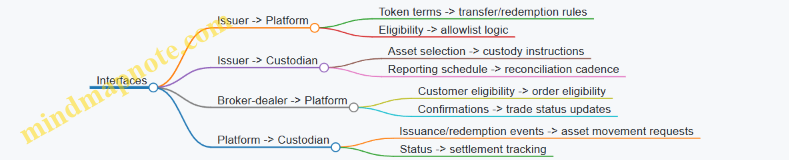
A compact checklist for role clarity
- Issuer: Are token rights and restrictions consistent across legal docs and platform configuration?
- Platform: Can the system block ineligible transfers and produce audit logs?
- Broker-dealer: Are customer eligibility and order handling documented and recordable?
- Custodian: Is asset segregation and reconciliation supported with reliable statements?
When these questions have clear answers, the product becomes easier to operate and easier to explain—both to investors and to regulators.
4.4 Documentation Basics: Offering documents, disclosures, and risk factors
Offering documents are where the “what you’re buying” story becomes precise enough for a regulator, a custodian, and a cautious investor to agree on the same facts. For RWA tokenization, the documents must connect three worlds: (1) the legal rights in the underlying asset, (2) the token’s on-chain behavior, and (3) the operational reality of custody, valuation, and transfers.
What offering documents typically include
Think of the package as a set of answers to recurring questions.
- What is the asset and what rights do token holders receive? This is the core. If the token represents a beneficial interest, the document should say so plainly and describe the chain of rights from the asset to the holder.
- Who is responsible for what? Investors need to know who issues the token, who holds the assets, who calculates value, and who handles redemptions or distributions.
- How does money move? The document should describe subscription/issuance flows, payment timing, and what happens if settlement fails.
- How do transfers work? If transfers are permissioned, the document should explain the eligibility checks and the consequences of failing them.
- What are the costs? Fees are not just numbers; they affect net returns and liquidity.
- What are the key operational controls? Custody arrangements, segregation, reconciliation, and reporting cadence should be described at a level that supports due diligence.
A useful practice is to maintain a rights-to-document map: every statement about rights in the offering document should point to the relevant legal instrument (e.g., trust deed, fund agreement, or note terms). When a statement cannot be mapped, it often signals a gap.
Disclosures: clarity, consistency, and “no surprises” mechanics
Disclosures are the parts of the documents that prevent misunderstandings. In RWA tokenization, the most common misunderstandings come from mismatched expectations between the token’s interface and the legal reality.
Key disclosure areas:
-
Token mechanics vs legal rights
- Example: “Token holders can redeem monthly” is not enough. The disclosure should specify redemption eligibility, redemption windows, settlement timing, and whether redemption depends on liquidity of the underlying assets.
-
Valuation and pricing
- Example: If NAV is calculated monthly, the disclosure should state the valuation date, the pricing methodology at a high level, and how pricing errors are handled.
-
Custody and asset segregation
- Example: If assets are held by a custodian under a segregated account, the disclosure should state what “segregated” means operationally (e.g., separate accounts, separate ledgers, reconciliation frequency).
-
Transfer restrictions and eligibility
- Example: If only accredited investors can hold the token, the disclosure should explain how eligibility is checked and what happens to transfers initiated by ineligible parties.
-
Distributions and tax-related statements
- Example: If distributions depend on cash receipts from the underlying asset, the disclosure should explain the timing mismatch between cash receipts and token distributions.
A practical best practice is to run a consistency check across documents: the same term should mean the same thing everywhere. For instance, if “redemption” is defined in one place, the document should not use a different term elsewhere to describe a similar action.
Risk factors: how to write them so they’re actually useful
Risk factors should be specific enough to guide a reader’s questions. Vague risks (“technology risks may occur”) don’t help. Good risk factors describe the mechanism: what could go wrong, why it matters, and what the investor might experience.
A helpful structure for each risk factor:
- Risk statement: what could happen.
- Mechanism: how it could happen.
- Impact: what the investor could lose or experience.
- Mitigations (if any): what controls exist, without overstating certainty.
Example risk factor (token transfer restrictions)
- Risk: Token transfers may be delayed or blocked.
- Mechanism: Transfers require eligibility checks and compliance approvals; if information is incomplete or a transfer is flagged, the transfer may not complete.
- Impact: An investor may be unable to sell or may face timing differences between attempted transfers and actual settlement.
- Mitigation: The issuer/platform may maintain whitelisting and automated screening, but these controls cannot guarantee instant completion.
Example risk factor (custody and reconciliation)
- Risk: Asset reconciliation errors could affect token holder entitlements.
- Mechanism: Valuation and reconciliation depend on data from custodians and administrators; discrepancies can arise from reporting delays, operational mistakes, or system outages.
- Impact: Distributions or redemption amounts could be calculated incorrectly until corrected.
- Mitigation: Reconciliation procedures and exception handling exist, but errors can still occur.
Example risk factor (underlying asset performance)
- Risk: The underlying asset may underperform or default.
- Mechanism: Cash flows from the underlying instrument may be delayed, reduced, or interrupted.
- Impact: Token distributions and redemption proceeds may be lower than expected.
- Mitigation: Diversification or credit protections may exist, but they do not eliminate loss.
Mind maps for documentation planning
Mind map: offering document content checklist
Mind map: risk factor writing workflow
A cohesive example: turning facts into disclosures
Suppose an RWA token represents beneficial interests in a pool of short-term receivables. The offering document should align these statements:
- Rights: “Token holders are entitled to a pro rata share of net collections after fees.”
- Mechanics: “Collections are received by the custodian and allocated monthly.”
- Valuation: “Net collections are calculated using an agreed methodology and reported monthly.”
- Transfers: “Transfers are permissioned; only eligible holders can receive tokens.”
- Risk factors:
- “Collections may be delayed due to debtor payment timing,” with the impact described as delayed distributions.
- “Reconciliation errors could affect allocation,” with the impact described as corrected statements and potential timing changes.
- “Transfers may be blocked if eligibility cannot be verified,” with the impact described as inability to sell immediately.
Notice how each risk factor points back to a specific operational mechanism described elsewhere. That linkage is what makes the document coherent rather than a collection of disconnected paragraphs.
Practical formatting and review habits
- Define terms once, use them everywhere. If “custodian” and “administrator” are distinct roles, define both and keep the distinction.
- Use consistent timelines. If reporting is monthly, redemption is monthly, and reconciliation is monthly, state the dates and sequence.
- Avoid contradictions. If one section says transfers are permissioned and another implies free transfers, fix it before legal review.
- Keep a trace log. For each major disclosure, record the source of truth (legal agreement, policy, or operational procedure). This reduces last-minute edits that accidentally change meaning.
Good documentation doesn’t just inform; it reduces the number of plausible misunderstandings. In RWA tokenization, that’s the difference between a token that “looks like ownership” and one that actually is ownership, with the paperwork and controls to match.
4.5 Practical Example: Building a Regulatory Checklist for a Token Offering
A regulatory checklist is not a formality; it’s a way to force clarity about what the token represents, who can hold it, and which rules apply to the issuer and the platform. Below is a practical example you can reuse.
Scenario (kept simple on purpose)
You plan to issue an asset-backed token representing beneficial interests in a pool of short-term invoices. The pool is managed by an operating company. Token holders receive distributions from collections, and the issuer may redeem tokens at set intervals based on pool liquidity. Transfers on the platform are permissioned: only eligible investors can receive tokens.
Step 1: Start with “what is the token, legally?”
Your checklist should begin with classification inputs, because most regulatory work follows from them.
Checklist items
- Rights summary: What exactly does the holder own or control (beneficial interest, claim on cash flows, voting rights, redemption rights)?
- Economic expectations: Are returns tied to issuer performance, asset performance, or both?
- Transferability: Are transfers restricted by design (smart contract) and by offering terms (legal documents)?
- Marketing posture: What claims will be made about returns, risk, and use of proceeds?
Example reasoning If the token entitles holders to a pro-rata share of collections, you document that the holder’s return depends on the underlying invoice cash flows. If the issuer also provides credit support or guarantees, you document that additional factor because it can change how regulators view the arrangement.
Step 2: Map roles and responsibilities
Regulators care who does what. A checklist should name the parties and attach responsibilities.
Checklist items
- Issuer: Who issues the tokens and signs the offering documents?
- Asset originator/servicer: Who collects invoice payments and handles defaults?
- Custodian/escrow: Who holds the underlying assets or cash, and how are they segregated?
- Platform/operator: Who runs the token transfer system and enforces eligibility?
- Intermediaries: Are there brokers, dealers, or investment advisers involved?
Example reasoning If the platform enforces eligibility but the issuer controls investor onboarding, you still document both responsibilities. Otherwise, you end up with gaps like “who blocks transfers when onboarding fails?”
Step 3: Identify the regulatory “buckets” you must satisfy
Instead of listing dozens of laws, structure the checklist around operational buckets.
Bucket A: Offering and investor eligibility
- Investor eligibility criteria: Who can buy (accredited/professional/other categories, jurisdiction limits)?
- Suitability checks: What evidence is required to confirm eligibility?
- Offering documents: What disclosures are required for the token’s rights and risks?
- Transfer restrictions: How are restrictions communicated and enforced?
Bucket B: Ongoing compliance and reporting
- Periodic reporting: What data is produced (pool performance, distributions, NAV-like metrics if applicable)?
- Event reporting: What triggers immediate disclosure (material default, custodian change, servicing failure)?
- Recordkeeping: What logs are kept (KYC status, transfer approvals, reconciliation reports)?
Bucket C: AML and transaction controls
- KYC/KYB: What checks are performed and how often are they refreshed?
- Sanctions screening: What lists are used and where is screening applied?
- Transfer monitoring: What patterns trigger review (large transfers, unusual routing, repeated failed transfers)?
Bucket D: Custody, segregation, and proof
- Segregation: Are underlying assets held separately from operating assets?
- Reconciliation: How often do you reconcile token supply to underlying pool assets?
- Valuation policy: How are invoice values determined and updated?
Example reasoning If you promise distributions based on collections, your checklist must include how you handle disputes about invoice amounts. Without a documented dispute process, reporting becomes inconsistent and eligibility enforcement becomes harder.
Step 4: Turn buckets into a checklist with “evidence”
A good checklist has two columns in spirit: requirement and proof. Proof can be a document, a policy, a system control, or a log.
Mind map: Regulatory checklist structure
Regulatory Checklist Mind Map (Token Offering)
Step 5: Concrete checklist (with easy examples)
Use this as a template. Each item includes what “done” looks like.
A. Token rights and documentation
- Rights statement drafted: A one-page holder rights summary exists and matches the token’s smart contract behavior.
- Example: If the contract allows redemption only at quarter-end, the rights summary says redemption is quarterly, not monthly.
- Offering documents consistent: The offering memorandum, token terms, and website content use the same definitions for distributions, defaults, and redemption.
- Example: If “distribution” excludes recoveries from litigation, the documents say so.
B. Investor eligibility and transfer restrictions
- Eligibility criteria defined: A written policy lists who can hold tokens and under what conditions.
- Example: “Eligible investor” includes entities that pass KYB and meet the required category.
- Onboarding evidence captured: KYC/KYB results are stored with timestamps and reviewer identifiers.
- Example: If a KYB expires after 12 months, the system blocks transfers until re-verification.
- Transfer approval workflow: Transfers require an approval step or an automated eligibility check.
- Example: A transfer request from an ineligible wallet is rejected with a reason code stored in logs.
C. AML and sanctions controls
- Sanctions screening at onboarding and transfer: Screening is applied to investors and counterparties.
- Example: If a wallet is associated with a flagged entity, the system prevents onboarding and blocks transfers.
- Escalation rules: A documented process defines what happens when screening or monitoring flags an issue.
- Example: “High-risk match” triggers manual review within one business day.
D. Custody, segregation, and proof
- Segregated custody confirmed: A custody agreement specifies segregation and permitted uses.
- Example: Operating funds cannot be used to cover invoice shortfalls without documented authorization.
- Reconciliation schedule: A monthly reconciliation matches token supply to pool assets.
- Example: If token supply exceeds pool assets by more than a threshold, distributions are paused until corrected.
- Valuation policy documented: Invoice valuation rules are written and applied consistently.
- Example: Invoices are valued at face value minus an agreed haircut for disputed amounts.
E. Reporting and disclosures
- Distribution calculation method documented: The formula for distributions is written in plain language and tested.
- Example: “Collections net of servicing fees are distributed pro-rata to token holders.”
- Reporting cadence set: A calendar lists what is reported monthly/quarterly and who signs off.
- Example: Pool performance report is published within 15 days after month-end.
- Event triggers defined: A list of events requires immediate disclosure.
- Example: A material default threshold triggers an event report within 48 hours.
Step 6: Add a “gap check” section
After filling the checklist, run a gap check that asks whether the system and documents agree.
Gap check prompts
- Does the smart contract enforce the same transfer restrictions described in the offering documents?
- Does the reporting output match the promised distribution mechanics?
- Are eligibility checks applied at both onboarding and transfer time?
- Is custody segregation verifiable through reconciliation and custody statements?
Example reasoning If the documents say transfers are restricted, but the platform allows transfers between wallets without eligibility checks, you have a mismatch. Regulators typically view that as a control failure, not a minor technical issue.
Step 7: Final checklist format (ready to use)
This example checklist keeps the work grounded: you define rights, assign responsibilities, and then attach evidence to each compliance bucket. When the documents, systems, and logs line up, the regulatory picture becomes much easier to explain and much harder to get wrong.
5. Understanding Securities Law and Token Classification
5.1 The Practical Goal of Classification: Determining the right regulatory path
Classification is the boring part that saves you from the expensive part. In RWA tokenization, “classification” means figuring out what legal category the token falls into and which rules apply to the people who issue, distribute, trade, and custody the underlying assets. The practical goal is simple: map the token’s rights and mechanics to the correct regulatory framework so you can design compliant processes instead of patching them later.
Start with the question regulators actually care about
Most regulatory analysis begins with two inputs:
- What does the token represent? (ownership, beneficial interest, debt claim, redemption right, or something else)
- How is the token offered and used? (who can buy, what marketing says, whether transfers are restricted, and whether returns depend on others)
A useful mental model is: rights + expectations + distribution + custody. Change any one of those, and the classification can change.
A mind map for classification work
Classification Mind Map (RWA Token)
The “rights mapping” step: translate legal language into token behavior
Before you look for the right rulebook, you translate the asset’s legal reality into token terms.
Example: tokenized bond vs tokenized fund share
- If the token gives holders a pro rata claim on interest and principal under a bond indenture, the token’s rights track a debt instrument or a claim on debt cash flows.
- If the token gives holders shares in a fund that invests in multiple assets and distributes net returns, the token’s rights track a collective investment structure.
Both can be “backed by real assets,” but the rights differ. That difference drives classification.
A practical checklist for rights mapping:
- Does the token holder have a direct claim against an issuer or trustee?
- Are returns fixed (like coupon payments) or variable (like net asset value)?
- Is there a redemption right and who controls it?
- Are holders entitled to voting or only economic exposure?
- Are fees taken from the asset pool before distributions?
The “expectations” step: how the token is presented and what holders reasonably expect
Even when rights are drafted carefully, classification can be influenced by how the offering is conducted.
Example: same cash flows, different presentation
- Scenario A: The issuer describes the token as a pass-through of cash flows with clear operational details and emphasizes that holders bear the credit risk.
- Scenario B: The issuer markets the token as an investment opportunity where returns depend on the issuer’s active management, with fewer details about risks and mechanics.
If the token’s economic outcome is tied to the efforts of a promoter or manager, regulators may treat it differently than a straightforward pass-through claim. The point is not to “say the right marketing words.” The point is that classification analysis considers the overall offering context.
The “distribution and trading” step: who can transfer and where
A token that is freely transferable to the public often triggers a different compliance posture than one that is restricted to eligible holders.
Example: permissioned transfers for eligibility
- If only accredited or otherwise eligible investors can receive the token, and transfers are blocked for ineligible wallets, the compliance design can align with an exemption-based approach.
- If the token is designed for broad secondary trading without eligibility controls, the issuer may face a higher burden because the token effectively reaches a wider audience.
This is why classification is not just a legal label. It determines whether you need robust transfer gating, how you handle secondary market activity, and what disclosures must be available.
The “custody and control” step: who actually holds the assets
Custody affects classification indirectly by shaping whether the token represents a claim on assets held by a custodian, a trustee, or the issuer.
Example: segregated custody vs commingled custody
- If assets are held in segregated accounts under a custodian with clear segregation and reconciliation, holders’ rights are easier to evidence.
- If assets are commingled without clear segregation, regulators may view the arrangement as less protective, which can change how the token’s rights are characterized.
Classification analysis often asks: can you show, with documentation and operational controls, that the token’s “backing” is real and enforceable?
A practical decision flow (with concrete checkpoints)
    flowchart TD
  A[1) Identify token rights] --> B{2) Are returns fixed or variable?}
  B -->|Fixed cash flows| C[Assess as debt/claim-like rights]
  B -->|Variable cash flows| D[Assess as fund/share-like rights]
  C --> E[3) Check redemption/buyback terms]
  D --> E
  E --> F{4) Who controls outcomes?}
  F -->|Issuer/manager efforts are central| G[Expect securities-style analysis]
  F -->|Holders bear risk; pass-through| H[Expect claim/pass-through analysis]
  G --> I[5) Review offering & marketing context]
  H --> I
  I --> J{6) How are transfers handled?}
  J -->|Permissioned/eligible| K[Design eligibility + transfer controls]
  J -->|Open transfers| L[Higher compliance burden; broader access]
  K --> M[7) Map custody/segregation evidence]
  L --> M
  M --> N[8) Determine regulatory path: category + required permissions]
What “right regulatory path” means as deliverables
Once classification is done, you should be able to produce concrete outputs:
- A token category statement (what the token is, in regulatory terms)
- A list of required permissions (registration vs exemption, and which intermediaries need licensing)
- A compliance obligations map (KYC/KYB, AML monitoring, disclosures, reporting, recordkeeping)
- A design alignment checklist (how the legal structure, custody, and transfer controls support the chosen path)
Example deliverable: a one-page classification memo outline
- Token rights summary in plain language
- Rights mapping table (asset terms → token terms)
- Offering context summary (eligibility, communications approach)
- Transfer and custody controls summary
- Conclusion: regulatory category and compliance posture
Common beginner mistakes (and what to do instead)
- Starting with the technology. The chain is not the classification. Rights and processes are.
- Assuming “asset-backed” automatically means “safe.” Backing helps, but it does not determine the legal category by itself.
- Skipping transfer mechanics. Secondary market behavior can change the compliance requirements.
- Treating classification as a one-time legal opinion. If you change redemption terms, custody, or eligibility, you revisit the analysis.
Classification is essentially a structured translation exercise: from asset documents and token rules into a regulatory category, then into operational requirements you can actually run.
5.2 Common Classification Factors: How rights, marketing, and expectations matter
When regulators classify a token, they usually start with a simple question: what does the holder actually get, and what does the holder reasonably expect to get? The answer comes from a mix of legal rights, how the token is presented, and how the system is operated. Three factors show up again and again: rights, marketing, and expectations.
1) Rights: what the token holder can claim
Rights are the most concrete classification factor because they describe enforceable outcomes. In practice, you map rights into categories and then ask whether those rights look like an investment in a business or something else.
Common right categories to identify
- Economic rights: entitlement to cash flows, distributions, interest, redemption proceeds, or residual value.
- Control rights: voting, consent, appointment of managers, or the ability to direct key decisions.
- Transfer rights: whether transfers are restricted, whether the issuer can refuse transfers, and whether eligibility is required.
- Recourse rights: what happens if the asset underperforms, defaults, or is missing—who bears the loss.
Easy example (rights):
- Token A represents a claim to monthly rent collected from a specific property. If rent is short, holders receive less cash; there is no guarantee. The token’s documents describe the property, the cash waterfall, and the payment schedule.
- Token B is “membership access” to a platform. It has no claim to rent, no cash waterfall, and no redemption.
Even if both tokens trade on the same website, the rights in Token A look like a claim on an underlying pool of value, while Token B looks like access to a service.
2) Marketing: what the issuer emphasizes and how it frames outcomes
Marketing matters because it shapes what a reasonable buyer understands the token to be. Regulators look at statements, materials, and the overall presentation—not just the fine print.
Marketing signals that often matter
- Language about profits or returns: even if the issuer avoids guarantees, repeated references to expected yield can influence expectations.
- Attribution of performance to a managerial effort: if materials describe how a team will “manage the assets” to generate returns, that can point toward investment-like expectations.
- Clarity about the underlying asset: marketing that ties the token to a specific cash-flow source tends to reinforce rights-based classification.
- Use of comparisons: “like a bond,” “like a fund,” or “like shares” can be treated as interpretive cues.
Easy example (marketing):
- Issuer of Token A posts: “Monthly payments come from rent collected from the property. Payments are distributed according to the cash waterfall.”
- Issuer of Token B posts: “Use the token to access features. No payments are promised.”
The first set of statements points buyers toward economic rights and a cash-flow mechanism. The second set points toward utility/access.
3) Expectations: what a reasonable holder would think they’re buying
Expectations are not mind-reading. They’re inferred from the combination of rights and presentation. A holder’s expectation is often shaped by:
- How the token is described (rights and purpose).
- How the system behaves (does the issuer actually pay, redeem, or manage?).
- Whether the holder relies on others to generate value.
A practical way to test expectations: Ask, “If I bought this token today, what would I reasonably plan to happen next?” Then check whether the documents and operations match that plan.
Easy example (expectations):
- Token C is sold with a promise that the issuer will buy assets, manage them, and distribute proceeds quarterly. Holders don’t have voting power over asset selection.
- Token D is sold as a direct claim on a specific asset with a fixed redemption date, and the issuer’s role is limited to custody and administrative processing.
Both might involve an issuer. But Token C creates an expectation that value depends on ongoing managerial actions. Token D creates an expectation that value depends more on the underlying asset’s terms.
Putting it together: a classification mind map
Mind Map: Token Classification Factors (Rights, Marketing, Expectations)
A concrete comparison: three tokens, three outcomes
Token E: “Asset claim with admin”
- Rights: holders have a claim to cash flows from a defined pool; redemption is scheduled.
- Marketing: materials explain the cash waterfall and redemption process.
- Expectations: holders plan for payments based on the pool’s performance, not on discretionary management.
Token F: “Asset claim with active management”
- Rights: holders have a claim to proceeds, but the issuer can swap assets, adjust strategies, and decide when to sell.
- Marketing: materials emphasize the team’s ability to source and manage assets.
- Expectations: holders plan for returns because the issuer will actively manage.
Token G: “Service access”
- Rights: no claim to cash flows; no redemption.
- Marketing: focuses on usage and access.
- Expectations: holders plan to use the platform, not to receive investment-like payments.
The classification difference often comes down to whether the token’s structure and presentation point to a claim on value and whether that value depends on others’ efforts.
Common pitfalls to avoid when mapping factors
- Ignoring operational behavior: if the issuer consistently pays distributions and markets them as performance, that can reinforce investment-like expectations.
- Overpromising in plain language: even without guarantees, repeated “expected returns” framing can be treated as meaningful.
- Rights that don’t match the story: if documents say holders have no economic claim but marketing implies they do, regulators may treat the marketing as evidence of what buyers were led to expect.
Quick checklist for beginners
- What economic rights exist (cash flows, redemption, residual value)?
- Who controls key decisions (asset selection, strategy, timing of sales)?
- What does the issuer emphasize in public materials?
- What would a reasonable buyer plan to happen after purchase?
- Do the documents and operations match the buyer’s likely expectation?
5.3 Utility and Governance Tokens: What typically changes in classification
When a token is marketed or structured as “utility” or “governance,” the legal question usually shifts from “does it represent an investment claim?” to “what rights does the holder actually have, and what expectations are being created?” The classification can still end up as a security, but the reasoning path changes.
What “utility” usually means in practice
Utility tokens are commonly described as access rights: the holder can use a network feature, pay for services, or participate in a product workflow. In classification analysis, the key is whether the token’s value is tied to an expectation of profit from the efforts of others.
A useful way to think about it: utility rights can be real and still not be securities. But if the token is primarily bought for price appreciation, and the network’s success depends on a promoter’s work, regulators may treat it like an investment.
Concrete example (utility that stays utility): A token grants discounted fees on a platform that processes invoices. The discount is automatic and does not depend on the issuer making discretionary decisions. The platform’s usage drives demand because businesses need the service, not because the issuer promises returns. If the token can be used immediately for the intended service and the issuer does not market it as an investment, the “utility” framing is more consistent.
Concrete example (utility that drifts toward investment): Same token, but the issuer sells it with a narrative that “token price will rise as the platform grows,” and the issuer controls key parameters that determine whether the platform becomes successful. Even if the token can be used for fees, the dominant reason buyers purchase may be profit expectation. That mismatch can push classification toward securities.
What “governance” usually means in practice
Governance tokens are described as voting rights: holders can propose changes, vote on parameters, or influence how a system is run. The classification analysis focuses on whether governance is meaningful and whether it is tied to profit.
Governance can be purely procedural (e.g., choosing between two technical options) or economic (e.g., deciding how revenue is distributed). The more governance resembles control over economic outcomes, the more likely the token resembles an investment instrument.
Concrete example (governance that looks procedural): Token holders vote on the fee schedule between two fixed options that are already published, and the vote only affects operational details. There is no promise of profit, no distribution mechanism, and no link between voting and a holder’s share of cash flows. The token may still be regulated, but governance alone is less likely to create a securities-like profile.
Concrete example (governance that looks economic): Token holders vote on how to allocate a pool of collected service fees, including whether to distribute them to holders or reinvest them to increase token value. If holders can reasonably expect that their votes will affect economic returns, governance starts to look like a mechanism for profit participation.
What typically changes in classification
Below are the most common classification shifts when moving from “plain utility” to “utility with value drivers” and from “governance with real control” to “governance that is mostly symbolic.”
1) The “value source” changes
For utility tokens, the value source is ideally usage: people need the service, so they buy tokens to access it. For governance tokens, the value source is ideally control: people buy tokens to influence outcomes.
In classification terms, the question becomes: is token value primarily driven by network adoption and consumption, or by expectations about how others (often the issuer or a core team) will manage the system?
Example: If token demand spikes only when the issuer announces partnerships or milestones, that pattern can indicate the token behaves like an investment. If demand tracks actual usage metrics (e.g., transactions, fee payments, active users), it supports a utility narrative.
2) The “efforts of others” analysis shifts
Utility and governance tokens often still depend on someone doing work: maintaining infrastructure, developing features, enforcing rules, or managing treasury assets.
The classification shift is not “efforts of others disappear.” It’s that the analysis becomes more granular: which efforts matter, who performs them, and whether holders can realistically influence them.
Example: A governance token allows voting on upgrades, but the issuer retains unilateral control over security-critical changes. If holders cannot affect the decisions that determine whether the system works, the token may still be treated as relying on others’ efforts.
3) Holder control becomes a focal point
Governance tokens are evaluated based on whether voting rights are substantive.
Substantive governance usually has:
- Clear decision scope (what can be changed)
- Enforceable outcomes (votes actually change system behavior)
- Reasonable participation (holders can vote without barriers that make voting meaningless)
Symbolic governance often has:
- Advisory votes only
- Veto power held by a small group
- Parameter changes that do not affect economic outcomes
Example: If token holders vote to reduce fees, but the issuer can override the result without a holder vote, the governance right may be treated as limited. That limitation can affect classification.
4) Economic rights creep in
Utility and governance tokens sometimes include features that look like economic participation: revenue sharing, buybacks, staking rewards funded from issuer-controlled sources, or treasury distributions.
Even if the token is labeled “governance,” adding economic rights can pull the analysis toward security-like characteristics.
Example: A governance token that lets holders vote on how to distribute treasury earnings to all holders can resemble a profit-sharing arrangement. The presence of distributions is a strong signal that classification may not be purely “utility.”
Mind map: classification changes for utility vs governance
Mind map: Utility/Governance tokens and classification shifts
A practical checklist for beginners
Use this checklist to reason about classification without guessing.
- What does the token holder get, specifically? Access, voting, distributions, or something else.
- What causes token demand? Usage metrics vs announcements vs promises.
- Who performs the critical work? Issuer/team vs holder-controlled processes.
- Are governance outcomes enforceable? Votes that change behavior vs advisory signals.
- Are there economic rights? Profit participation, revenue sharing, or treasury payouts.
Example checklist application: A token provides voting on fee changes and also receives a share of collected fees. Even if holders can vote, the fee-share mechanism creates economic rights. That combination typically increases the chance the token is classified like a security rather than a pure utility.
In short: utility and governance labels change the story, but classification depends on the actual rights, the real value drivers, and whether holders are relying on others to generate economic results.
5.4 Redemption, Buybacks, and Profit Participation: Why they matter legally
Redemption, buybacks, and profit participation are the parts of an asset-backed token deal that turn “we hold assets” into “you get paid, and here’s how.” Regulators care because these features determine what rights token holders actually have, how those rights are exercised, and whether the arrangement behaves like a security.
Redemption: the legal meaning of “getting your money back”
Redemption is the mechanism that lets a token holder exchange tokens for value (cash, proceeds, or another asset) under defined conditions. Legally, redemption terms can create a promise of repayment, a claim on cash flows, or a structured exit right.
Key legal questions to answer in plain terms:
- Who can redeem? If only the issuer can redeem, the token may look more like an investment instrument than a freely transferable claim.
- When can redemption happen? Fixed redemption dates can resemble maturity on a debt-like product.
- What is redeemed for? Redemption for a stated amount can be treated differently than redemption for a variable share of proceeds.
- What happens if there’s not enough value? If redemption is subject to asset performance or liquidity, the token holder’s rights may be framed as participation in a pool rather than a guaranteed payout.
A concrete example: a tokenized short-term receivables pool issues tokens representing beneficial interests. The terms say token holders can redeem monthly for their pro rata share of collections, but only after the pool’s servicing fees and charge-offs are applied. That structure usually reads as a claim on a pool’s cash flows, not a simple “return of principal on demand.” The legal documents must clearly state the waterfall and the conditions for redemption.
Buybacks: when the issuer becomes the market
A buyback is when the issuer (or a designated party) repurchases tokens from holders. Buybacks matter legally because they can:
- Create an expectation of price support (even if the contract says “not guaranteed”).
- Change the economic reality from “token represents a claim” to “token is managed like a product with an exit.”
- Affect classification by strengthening the argument that holders are relying on the issuer’s efforts to realize value.
A concrete example: an issuer states that it will repurchase tokens at “the net asset value” each quarter. If NAV is calculated using a valuation policy controlled by the issuer, the buyback effectively ties token value to issuer-controlled decisions. Even if the repurchase is technically optional, the presence of a regular buyback program can influence how regulators view the arrangement.
Practical drafting detail: define the buyback price calculation, the valuation inputs, the timing, and the circumstances where buybacks can be suspended (for example, if custody statements are delayed or if underlying asset liquidity is insufficient). If the issuer can suspend buybacks at will, the contract should explain the objective triggers; otherwise, the terms can look like a discretionary promise.
Profit participation: rights to distributions and the “who gets what” problem
Profit participation is about how token holders share in gains, income, or residual value. Legally, it’s often the clearest signal that token holders have an economic interest in the performance of an underlying enterprise.
Three common profit participation patterns:
- Fixed coupon-like distributions (e.g., monthly interest). This can resemble debt-like economics.
- Variable distributions based on collections, net operating income, or realized gains. This can resemble equity-like economics.
- Residual participation after expenses, fees, and losses. This is often the most “equity-shaped” because token holders benefit last.
A concrete example: a tokenized rental property structure distributes net rent monthly, after property management fees and reserves. If the token terms guarantee a minimum distribution regardless of occupancy, that guarantee can shift the legal characterization toward a repayment promise. If distributions are explicitly “subject to net cash available,” the rights are tied to asset performance.
Mind map: how these features map to legal risk
Redemption / Buybacks / Profit Participation — Legal Impact Mind Map
The “alignment test”: contracts, custody, and code must agree
A common legal problem is mismatch. The offering document might say redemption is based on pro rata proceeds, but the smart contract might allow redemption for a fixed amount, or might ignore reserve deductions. Regulators look for consistency because inconsistent terms can indicate that token holders are being sold an economic outcome that the custody and operational reality cannot support.
A practical checklist for legal alignment:
- Waterfall consistency: the same fee and loss order appears in the legal documents and in any on-chain accounting logic.
- Eligibility consistency: the same KYC/transfer restrictions that limit who can redeem are reflected in the operational process.
- Valuation consistency: NAV or distribution calculations use the same valuation policy and timing across documents.
- Suspension consistency: if redemption or buybacks can pause, the triggers are defined the same way everywhere.
Example: three token term sets and how they read legally
Set A: Redemption for a fixed amount on a date
- Tokens redeem for a stated cash amount at maturity.
- Distributions are fixed.
- Shortfalls are covered by an issuer backstop.
Legal effect: the structure reads like a repayment promise with limited variability, which can push classification toward debt-like securities economics.
Set B: Redemption for pro rata collections with loss allocation
- Tokens redeem monthly for pro rata net collections.
- Charge-offs reduce the pool before distributions.
- No issuer backstop.
Legal effect: token holders are participating in the performance of the underlying asset pool, with rights defined by the waterfall.
Set C: Buyback program tied to issuer-controlled NAV
- Issuer repurchases quarterly at NAV.
- NAV uses valuations approved by the issuer or its agent.
- Buybacks can be suspended if valuations are delayed.
Legal effect: the issuer’s role in setting NAV can increase the importance of issuer actions in token holder outcomes, which matters for securities analysis.
Why these features matter for classification and compliance
Redemption, buybacks, and profit participation are not just product mechanics. They define the economic bargain: whether token holders have a claim to cash flows, a right to an exit, and how much discretion the issuer retains. When those rights are clear and consistent across legal documents, custody arrangements, and technical controls, the token’s legal characterization is easier to justify. When they are vague or mismatched, regulators have more room to treat the token as an investment product rather than a straightforward representation of underlying assets.
5.5 Example Walkthrough: Classifying a Token Backed by Cash Flows
Let’s classify a token that is backed by cash flows, using a practical, beginner-friendly approach. The goal is not to guess a legal label from a token’s name, but to map the token’s rights and the issuer’s promises to the regulatory categories that typically drive classification.
The scenario
An issuer creates “CashFlow Token (CFT).” Investors pay $10,000 each to buy CFT. The issuer uses the money to purchase a portfolio of short-term invoices from businesses. Each month, the invoice payments are collected and distributed.
Key terms (simplified):
- Token holder right: Token holders receive monthly distributions equal to a pro-rata share of net cash collected.
- Redemption: Token holders can redeem tokens after 12 months for the remaining net cash after fees.
- Issuer role: The issuer selects invoices, manages collections, and handles defaults.
- Transferability: Tokens are transferable only to whitelisted addresses that pass eligibility checks.
- Marketing: The issuer’s website emphasizes steady monthly income and describes the issuer’s expertise in managing the portfolio.
Now we classify. In many jurisdictions, the classification hinges on whether the token represents an investment contract or a security-like instrument. The exact test varies, but the reasoning pattern is similar: rights + expectations + reliance on others.
Step 1: Identify what the token actually represents
Start by writing down the token’s economic rights and legal rights.
Economic rights in this scenario:
- Monthly cash distributions.
- Pro-rata share of net collections.
- Redemption at maturity for remaining net cash.
Legal rights in this scenario (typical structure):
- Token holders have a beneficial interest in a pool or trust that owns the invoice portfolio.
- The issuer (or an appointed manager) has authority to manage the portfolio and distribute proceeds.
Beginner practice: If you can’t clearly state whether token holders own the underlying assets, have a beneficial interest, or only have a claim against the issuer, you’re not ready to classify.
Step 2: Map the “cash flow chain”
A cash-flow-backed token can be structured in ways that change classification. The critical question is: who bears the economic risk and who controls the cash flows?
Here’s the cash-flow chain for CFT:
- Investors contribute funds.
- Issuer buys invoices (or funds a vehicle that buys invoices).
- Debtors pay invoices.
- Collections are netted for fees and expenses.
- Net cash is distributed to token holders.
- At maturity, remaining net cash is used for redemption.
If token holders receive distributions from a pool they have a beneficial interest in, that often looks more like a security-like claim than a simple payment instrument.
Step 3: Check the “reliance” and “efforts” factors
Even if token holders receive cash, classification often depends on whether the issuer’s managerial efforts are essential to generating returns.
In CFT:
- The issuer selects invoices.
- The issuer manages collections.
- The issuer handles defaults.
Those are not passive tasks. They are the work that determines whether cash flows arrive on time and in the expected amounts.
Beginner practice: Make a two-column list.
- Column A: “What token holders do.”
- Column B: “What the issuer does.”
If Column B dominates the outcome, classification risk increases.
Step 4: Evaluate marketing and expectations
Marketing is not the only factor, but it can be evidence of how investors are expected to view the token.
CFT’s marketing emphasizes:
- steady monthly income
- issuer expertise in managing the portfolio
That language supports an expectation that returns depend on the issuer’s efforts, which aligns with security-like reasoning.
Beginner practice: Rewrite the marketing claims as neutral statements.
- Instead of “steady income,” use “distributions depend on invoice collections.”
- Instead of “issuer expertise,” use “issuer performs portfolio management under the governing documents.”
If the issuer can’t make those neutral statements without losing the pitch, that’s a signal for classification analysis.
Step 5: Consider redemption and whether it resembles a debt-like promise
Redemption after 12 months for remaining net cash can look like a maturity-based instrument. But it’s not automatically “debt.” The key is whether token holders have a fixed obligation from the issuer or a variable claim tied to asset performance.
In CFT:
- Redemption amount is “remaining net cash after fees,” which is variable.
- Distributions are “pro-rata share of net cash collected,” also variable.
Variable payouts tied to underlying cash flows often support security-like classification rather than a pure payment token.
Step 6: Identify the role of transfer restrictions
Transfer restrictions don’t usually change the underlying classification by themselves. However, they can affect how regulators view distribution and secondary market behavior.
CFT uses whitelisting and eligibility checks. That helps with compliance operations, but the token’s rights still matter.
Beginner practice: Treat transfer restrictions as a “distribution control,” not a “classification escape hatch.”
Mind map: classification logic for a cash-flow token
A concrete “rights vs. promises” checklist
Use this checklist to structure your classification memo.
-
What is the token holder’s claim?
- Claim on a pool’s cash flows? Beneficial interest?
- Or a claim against the issuer for a fixed amount?
-
Are payouts variable or fixed?
- Variable payouts tied to collections usually point toward security-like analysis.
- Fixed payouts can point toward debt-like analysis (still may be regulated).
-
Who performs the essential managerial work?
- If the issuer’s ongoing efforts are required to generate returns, reliance is stronger.
-
Is there a meaningful role for token holders?
- If token holders have no practical ability to influence outcomes, reliance increases.
-
Does marketing describe returns as dependent on the issuer?
- If yes, that supports an investment-expectations narrative.
Example classification conclusion (reasoned, not guessed)
Based on the scenario terms, CFT would typically be analyzed as a security-like token because:
- Token holders receive variable cash distributions and variable redemption tied to an underlying pool.
- The issuer performs ongoing managerial efforts (selection, collections, default handling) that materially affect cash flows.
- Marketing emphasizes income and issuer expertise, supporting investor expectations of returns driven by others.
A beginner-friendly way to phrase the conclusion in a memo is:
- “The token grants holders rights to participate in cash flows from an underlying pool, while the issuer’s ongoing efforts are central to generating and maintaining those cash flows; therefore, the token is likely to fall within security-like regulatory frameworks.”
Quick variation to test understanding
Change one fact: suppose token holders can independently verify each invoice, and the token is structured so that token holders can directly trigger collections and enforce remedies without issuer discretion. Also, marketing avoids income promises and describes only factual portfolio mechanics.
In that variation, reliance weakens because token holders have more practical control. Classification might still be regulated, but the reasoning shifts. This is why classification is not about “cash flows” alone; it’s about rights, control, and expectations working together.
6. Compliance for Token Issuers and Platforms
6.1 KYC and KYB for Token Participants: What to collect and why
KYC (Know Your Customer) and KYB (Know Your Business) are the practical steps that let an issuer and platform answer one question: “Who is on the other side of this token transfer, and are they eligible to participate?” For RWA tokens, the goal is not just identity. It’s also eligibility, risk screening, and the ability to prove what you did later.
What you collect (and the reason behind each item)
1) Identity basics (KYC for people)
Collect enough information to uniquely identify a person and verify it.
- Full legal name: matches official records and reduces mix-ups.
- Date of birth: helps distinguish people with similar names.
- Residential address: supports eligibility checks and helps with recordkeeping.
- Government ID (passport, national ID, driver’s license): provides a verifiable identity anchor.
- Selfie or liveness check (where used): reduces the risk of someone using another person’s documents.
Example: A buyer named “Alex Kim” registers. Two Alex Kims exist in the same country. Date of birth and document verification narrow it to the correct person.
2) Business basics (KYB for organizations)
Organizations need a clear map of who controls them and who benefits from the activity.
- Legal entity name and registration number: confirms the entity exists.
- Jurisdiction of incorporation and registered address: ties the entity to a legal system.
- Business type and purpose: helps determine whether the token offering fits the entity’s activities.
- Proof of authority for signatories: ensures the person acting for the company is actually authorized.
Example: A company submits a form signed by “Jordan Lee.” KYB checks confirm Jordan is an authorized director or officer, not just an employee.
3) Beneficial ownership (the “who really controls this?” layer)
For many jurisdictions, you must identify individuals who ultimately own or control the entity.
- Beneficial owner names and IDs: enables screening and accountability.
- Ownership/control percentages or explanation of control: clarifies why those individuals are included.
- Chain of ownership (high level): shows how control flows.
Example: A fund manager uses a holding company. KYB identifies the individuals who control the holding company, not just the holding company itself.
4) Eligibility and restrictions (KYC/KYB is not only identity)
Token transfers often require permissioning. Collect data that supports those rules.
- Country of residence/incorporation: used for jurisdiction-based eligibility.
- Investor status indicators (where applicable): helps determine whether someone meets eligibility thresholds.
- Accreditation or suitability inputs (if required by the offering): supports the issuer’s obligations.
Example: A token is restricted to certain jurisdictions. The platform uses the address and incorporation jurisdiction to block ineligible participants before they can buy.
5) Screening and risk signals
Screening is typically done using the collected identity data.
- Sanctions screening inputs: name, DOB (for people), and entity identifiers (for businesses).
- Adverse media screening inputs (if used): supports risk-based decisions.
- PEP status (if required): identifies politically exposed persons for enhanced checks.
Example: A match occurs because “Maria Garcia” shares a name with a listed individual. DOB and address help resolve whether it’s the same person.
6) Contact and operational details
These fields support communication and compliance operations.
- Email and phone: used for notices and account verification.
- Preferred communication language (optional): helps ensure disclosures are understood.
- Tax residency and tax identifiers (where required): supports reporting obligations.
Example: A participant changes address. The platform uses the contact details to request updated documentation and keeps an audit trail.
How to structure the data: a mind map
KYC/KYB Data Collection Mind Map (RWA Token Participants)
Practical workflow: from submission to decision
- Collect: Gather documents and fields in a single onboarding form.
- Verify: Check document authenticity and consistency (name spelling, DOB, addresses).
- Screen: Run sanctions/PEP checks using the verified identity data.
- Assess eligibility: Apply token-specific restrictions (jurisdictions, investor type).
- Decide: Approve, reject, or request additional information.
- Record: Store the decision, the reason, and the evidence used.
Example: A company applies to buy. KYB verifies registration, identifies beneficial owners, screens all relevant names, then checks whether the company’s jurisdiction is allowed. If beneficial ownership details are missing, the system requests them instead of approving.
What “good enough” looks like (without being sloppy)
- Consistency checks matter: If the ID says one address and the form says another, you either verify the change or request an updated document.
- Don’t stop at the entity: For KYB, beneficial owners are where many compliance obligations land.
- Keep decisions explainable: If you approve a participant, you should be able to point to the specific evidence and checks that supported the decision.
Common pitfalls and how to avoid them
- Pitfall: collecting too little → Fix: Ensure you capture the fields needed for screening and eligibility, not just “identity basics.”
- Pitfall: collecting too much without purpose → Fix: Tie each field to a compliance use case (verification, screening, eligibility, reporting).
- Pitfall: ignoring updates → Fix: Define triggers for re-checks, such as address changes or ownership changes.
Example: A beneficial owner sells their stake. The entity remains the same, but control changes. A re-check ensures the beneficial ownership list stays accurate.
Example onboarding checklist (condensed)
KYC and KYB are easiest to manage when they’re treated as a set of concrete data needs tied to specific compliance outcomes: identity verification, screening, eligibility enforcement, and defensible recordkeeping.
6.2 AML Controls for Token Transfers: Monitoring and escalation basics
Asset-backed tokens often move between wallets that look anonymous, even when the underlying participants are not. AML controls for token transfers aim to connect those on-chain movements to real-world identities, then spot patterns that don’t fit the expected story.
What “monitoring token transfers” actually means
Monitoring is not just watching transfers. It’s a chain of checks:
- Eligibility gating (before transfer): confirm the sender and receiver are onboarded, not blocked, and permitted to hold the token.
- Transaction screening (during transfer): evaluate the transfer against AML rules and risk signals.
- Post-transfer verification (after transfer): confirm the transfer was executed as intended and record the outcome for audit.
A practical way to think about it: eligibility prevents obvious mistakes; screening catches suspicious behavior; post-transfer verification ensures you can explain what happened.
Core AML signals for token transfers
You typically combine several signal types so you don’t rely on one noisy indicator.
- Counterparty risk: high-risk jurisdictions, high-risk entities (KYB flags), or wallets linked to prior suspicious activity.
- Behavioral patterns: rapid in-and-out transfers, repeated small transfers to many addresses, or transfers that don’t match the participant’s stated activity.
- Flow structure: “peel chains” (splitting amounts across many wallets), round-number clustering, or transfers that route through intermediaries.
- Sanctions and watchlists: direct matches and indirect matches via linked entities.
- Operational anomalies: unusual gas/fee patterns, repeated failed transfers, or transfers that bypass expected permissioning.
A mind map of transfer monitoring
Building a simple risk score (without making it mystical)
A risk score helps route alerts to the right level of attention. Keep it explainable.
Example scoring model (illustrative):
- Base risk: 0–30 based on participant profile (e.g., entity type, jurisdiction).
- Sanctions/watchlist: if matched, set to 100 (hard stop).
- Behavioral signals: +10 for rapid in-and-out, +10 for many recipients, +10 for peel-chain-like splitting.
- Amount/frequency: +5 to +20 depending on how far the activity deviates from the participant’s expected range.
Then define actions:
- Score < 40: no alert; log for trend.
- 40–79: generate an alert for review.
- ≥ 80: escalate to compliance for immediate review.
- 100: block transfer and open a case.
This approach prevents “everything is urgent” and “nothing is urgent.”
Monitoring architecture: where controls live
You generally need three layers that work together:
- Identity layer (off chain): KYC/KYB status, sanctions screening results, and token eligibility rules.
- Rules layer (policy): thresholds, risk scoring logic, and permitted transfer rules.
- Evidence layer (audit trail): immutable logs of what was checked, what was found, and what action was taken.
If you only implement the rules layer, you’ll struggle to prove you checked the right people. If you only implement identity, you’ll miss suspicious behavior.
Example: monitoring a regulated token transfer
Assume a permissioned RWA token where only eligible wallets can hold it.
Scenario A: normal activity
- Alice (onboarded entity, low-risk jurisdiction) transfers 25,000 tokens to Bob (onboarded, same jurisdiction).
- Transfer frequency matches Alice’s history.
- No sanctions/watchlist hits.
Controls outcome:
- Eligibility gating passes.
- Screening score stays at 20.
- No alert is created, but the transfer is recorded for reporting.
Scenario B: suspicious routing
- Alice transfers 10,000 tokens to Wallet X.
- Wallet X is newly created, not onboarded, and appears to forward funds within minutes.
- The pattern resembles splitting into multiple recipients.
Controls outcome:
- Eligibility gating blocks direct transfer to Wallet X if your model requires onboarded receivers.
- If your system allows transfers to non-holders (for example, escrow mechanics), then screening triggers an alert due to behavioral signals.
- The case is escalated because the activity deviates from Alice’s expected behavior.
Escalation basics: from alert to decision
Escalation is a workflow, not a feeling. Use a consistent sequence.
- Triage (first review): confirm the alert is real (not a data mismatch), then categorize it.
- Case creation: attach evidence: sender/receiver identifiers, timestamps, amounts, and the specific rules that triggered.
- Compliance review: decide whether the activity is consistent with the participant’s profile and documentation.
- Disposition: close, request additional information, or escalate to enforcement actions (including blocking).
- Documentation: record the rationale so someone else can understand the decision later.
A mind map of escalation
Concrete escalation example with clear reasoning
A platform receives an alert with risk score 85 for a transfer from an onboarded entity.
Evidence gathered:
- Sender is onboarded and not on any watchlist.
- Receiver wallet is onboarded, but the transfer amount is 6× above the sender’s typical monthly range.
- The transfer is immediately followed by three outgoing transfers to multiple new wallets.
Decision logic:
- Sanctions are not matched, so this is not a hard stop.
- The combination of deviation from expected range and peel-chain-like behavior indicates elevated risk.
- The reviewer requests supporting documentation for the transaction purpose.
- If documentation is insufficient, the platform blocks further transfers for that sender until the case is resolved.
The key is that the decision ties back to specific evidence and specific rules, not a vague sense that “something feels off.”
Practical control checklist for transfer monitoring
- Every transfer check has an outcome: pass, block, or alert.
- Alerts include the “why”: which signals triggered and the risk score components.
- Eligibility and AML are not the same: eligibility prevents unauthorized holders; AML reviews suspicious behavior.
- Escalation has a deadline: triage within a defined window so cases don’t pile up.
- Audit evidence is captured automatically: transaction identifiers, rule versions, and reviewer actions.
When these pieces are consistent, monitoring becomes a repeatable process rather than a series of one-off investigations.
6.3 Sanctions Screening and Transaction Filtering in Real Workflows
Sanctions screening is the process of checking parties and transactions against restricted lists. Transaction filtering is what you do after screening: you decide whether to block, allow, or route a transaction for review based on the results and on your internal rules.
What you screen (and what you don’t)
In real workflows, you usually screen three categories:
- Counterparties: issuers, custodians, investors, brokers, and any intermediary that touches the flow of assets.
- Beneficial owners and controllers: the people behind entities, especially when ownership is indirect.
- Transaction details: sometimes the asset identifier, payment reference, or destination account can matter even when names look clean.
You typically don’t screen every field blindly. Screening too much creates noise, and noise creates delays. A practical approach is to screen the fields that are most likely to map to list entries: legal name, aliases, and key identifiers (tax IDs, registration numbers, and sometimes addresses).
The core workflow: from onboarding to transfer
A sanctions program works best when it’s consistent across time. The same logic should apply to onboarding, periodic checks, and transfer-time checks.
-
Onboarding screening (pre-transaction)
- Collect identity data (name variants, entity type, registration number, country of incorporation).
- Run screening against sanctions lists.
- Record the match decision and the evidence used.
-
Ongoing screening (periodic and event-driven)
- Re-screen at defined intervals.
- Re-screen when there is a material change (new beneficial owner, new jurisdiction, name change).
-
Transfer-time screening (transaction filtering)
- Screen the sender and receiver at the moment of transfer.
- Apply transaction rules (e.g., block if either party is a confirmed match; route to review if it’s a potential match).
-
Decision and disposition
- Allow: no match or match below your threshold.
- Review: potential match requiring human confirmation.
- Block: confirmed match or match above a strict threshold.
A key detail: you should treat “potential match” as a state with a defined next step, not as a vague “maybe.”
Mind map: sanctions screening and filtering
Match logic: thresholds, evidence, and why names alone fail
Most systems use fuzzy matching because names vary: “LLC” vs “L.L.C.”, transliterations, and missing middle names. Fuzzy matching can produce false positives, especially for common names.
A practical rule set looks like this:
- High-confidence match: strong name similarity plus matching identifier (e.g., registration number) → treat as confirmed.
- Medium-confidence match: name similarity but identifiers missing or inconsistent → treat as potential and route to review.
- Low-confidence match: weak similarity and no supporting identifiers → allow, but log it.
Evidence matters. If your case file includes only “the names look similar,” you’ll struggle to justify decisions later. Evidence can include:
- registration number match
- country of incorporation match
- address match
- ownership chain match (for beneficial owners)
Example 1: onboarding an investor with a common name
Scenario: An investor signs up as “Global Trading Holdings” in a tokenized receivables program.
- Screening returns a potential match to a restricted entity with a similar name.
- Your data shows:
- Investor registration number: present
- Restricted entity registration number: present
- Country of incorporation: differs
Decision approach:
- If registration numbers differ, you can often downgrade to no match or keep it as review depending on your policy.
- If your policy requires human review when any potential match appears, route to review but include the identifier mismatch as the primary evidence.
Outcome: the investor is either approved after review or blocked if the identifiers align.
Example 2: transfer-time filtering with a wallet-to-account linkage
Scenario: A holder requests a transfer of RWA tokens to another wallet address. Your system links wallets to off-chain settlement accounts.
- Screening at transfer-time checks both parties.
- The recipient wallet is associated with a settlement account in a jurisdiction that appears on a restricted list.
Important nuance: you don’t automatically block solely because of jurisdiction. You block when the screening result is a match to a restricted party or when your policy defines jurisdiction-based restrictions for that specific product.
A clean workflow:
- If the recipient name is a confirmed match → block the transfer.
- If the recipient name is potential → route to review.
- If the recipient name is no match, but the settlement account triggers a policy rule (e.g., account belongs to a restricted intermediary) → block or review based on that rule.
Outcome: the decision is consistent with both the screening result and the product’s operational constraints.
Example 3: beneficial owner screening in an entity investor
Scenario: An entity investor holds tokens through a corporate structure.
- The entity name screens cleanly.
- Beneficial owner screening returns a potential match.
Filtering decision:
- If your policy treats beneficial owner matches as decisive for eligibility, you route to review.
- If the beneficial owner is a confirmed match, you block.
Operational detail: you should store the beneficial owner evidence used for the decision, including how you identified the beneficial owner (ownership percentage, control rights, or declared controller).
Transaction filtering rules that prevent accidental bypass
Screening is only useful if it’s enforced. Common enforcement points include:
- Transfer authorization: the transfer function checks eligibility before signing or broadcasting.
- Settlement gating: if off-chain settlement is required, block settlement when screening is unresolved.
- Manual override controls: any override should require a case ID and a reason.
A simple decision table helps teams stay aligned:
| Screening outcome | Sender | Recipient | Decision |
|---|---|---|---|
| Confirmed match | Any | Any | Block |
| Potential match | Potential | No match | Review |
| Potential match | No match | Potential | Review |
| No match | No match | No match | Allow |
Case management: what to record so the audit trail makes sense
When a transaction is blocked or reviewed, your system should capture:
- which parties were screened
- which fields were used (name, aliases, identifiers)
- the match score or confidence category
- the disposition (allow/review/block)
- the evidence supporting the final decision
- the user or role that made the decision
This prevents the classic problem where the decision is recorded, but the reasoning is missing.
Mind map: evidence and decision flow
Practical tips that reduce false positives without weakening controls
- Normalize inputs: trim whitespace, standardize punctuation, and keep original values for audit.
- Use identifiers when available: registration numbers reduce guesswork.
- Keep alias lists current: people and entities change how they write their names.
- Define what “review” means: a review should have a time window and a clear checklist.
Sanctions screening and transaction filtering are not just a vendor checkbox. In a tokenized asset workflow, they’re the difference between “we checked” and “we enforced,” and the difference shows up in both operations and compliance evidence.
6.4 Recordkeeping and Audit Trails: What regulators expect to see
Recordkeeping is where “we followed the rules” becomes something an independent reviewer can verify. For RWA tokenization, regulators typically look for three things: (1) you can reconstruct what happened, (2) you can show who did it and when, and (3) you can explain why it was allowed.
What “good” records look like
A record is only useful if it answers a specific question. In practice, regulators expect records that support the full lifecycle of a token: issuance, custody/asset handling, investor onboarding, transfers, and redemptions.
Reconstruction: If an auditor asks, “Who owned token X on March 10, and what assets backed it?” you should be able to produce the chain of evidence without guessing.
Attribution: If a compliance decision was made—such as allowing a transfer to a specific investor—you should be able to identify the decision maker (person or system), the basis for the decision, and the timestamp.
Integrity: Records should be protected against silent changes. Regulators do not require magic; they require controls that prevent or detect tampering.
The mind map: recordkeeping scope for RWA
Evidence categories regulators expect
1) Asset custody and balance evidence
Regulators want to see that the backing assets exist, are held appropriately, and match the token supply.
Common record types:
- Custodian confirmations and statements showing holdings and account identifiers.
- Segregation documentation (for example, evidence that assets are ring-fenced from other customer assets).
- Reconciliation reports that tie token supply to asset balances using a defined reference date and method.
Example: A tokenized cash instrument issues 10,000 tokens. Your reconciliation report for month-end should show: token supply = 10,000; underlying account balance = $10,000 (or the agreed valuation basis); and any differences (fees, timing, FX) with documented explanations.
2) Token lifecycle records
Token lifecycle events must be traceable to operational actions.
Common record types:
- Issuance records: investor eligibility confirmation, allocation details, and settlement confirmation.
- Redemption records: redemption request logs, eligibility checks, redemption approvals, and settlement/burn records.
- Smart contract event logs: mint/burn/transfer events with identifiers that match off-chain records.
Example: If a redemption is processed, you should be able to show the investor’s eligibility status at the time of approval, the redemption terms applied, and the resulting token burn event.
3) Investor eligibility and permissions
For regulated transfers, regulators expect evidence that eligibility checks were performed and that only permitted transfers occurred.
Common record types:
- KYC/KYB status snapshots (not just “completed,” but the date and scope).
- Approval decisions for eligibility categories (for example, “eligible for restricted transfers” with an effective date).
- Transfer permission lists or rules used at the time of the transfer.
Example: An investor is onboarded on January 5 and becomes eligible for transfers on January 20. If they transfer tokens on January 18, your records should show the system blocked it (or the manual exception process was followed, with documented justification).
4) Transfer activity and exception handling
Transfers are where operational reality meets compliance requirements.
Common record types:
- On-chain transaction identifiers (hashes) and timestamps.
- Off-chain authorization decisions tied to those identifiers.
- Exception logs: failed transfers, mismatches, manual overrides, and the resolution steps.
Example: A transfer request is initiated, but the investor’s eligibility expires before execution. Your audit trail should show: eligibility expiry time, the transfer attempt, the system’s decision (blocked or queued), and the final outcome.
5) Compliance operations: AML and sanctions evidence
Regulators expect records that show monitoring occurred and that alerts were handled according to policy.
Common record types:
- AML monitoring alert logs with the rule or scenario that triggered the alert.
- Case notes showing investigation steps, decision outcomes, and escalation.
- Sanctions screening results with the screening date and the data fields used.
Example: If a transfer triggers an AML scenario, the record should include the scenario name/version, the investigation outcome (for example, “no action” or “filed for review”), and the date the decision was made.
Audit trail qualities: what to enforce in practice
Completeness and consistency
Use consistent identifiers across systems: investor ID, token ID, asset account ID, and event IDs. If your reconciliation uses “Account A” but your custodian statements label it “Custody-17,” auditors will spend time reconciling your reconcilers.
Traceability (who/what/when)
Every meaningful action should have:
- Actor: person or system component.
- Timestamp: with timezone and source.
- Input basis: what data was used.
- Output: what decision or state change occurred.
Tamper resistance
Regulators generally expect access controls and immutable logging for audit-relevant events. That means:
- restricted write access to logs,
- audit logs that cannot be edited by normal operators,
- and alerts or monitoring for unusual access patterns.
A practical example: end-to-end audit trail for a transfer
- Investor submits a transfer request for token ID T-100 from Wallet A to Wallet B.
- System checks investor eligibility status snapshot for Wallet B’s linked identity.
- System runs sanctions screening for the counterparty identity and relevant fields.
- System records an authorization decision with timestamp, decision basis, and references to the screening results.
- On-chain transfer occurs; the transaction hash is recorded.
- If the transfer fails, the exception log records the failure reason and the next action.
An auditor should be able to start from the on-chain transaction hash and work backward to the authorization decision, or start from the authorization decision and confirm the on-chain outcome.
Retention and legal holds (the unglamorous part)
Regulators expect you to retain records for the required period and to handle legal holds so records are not deleted during investigations or disputes. The key is having a retention schedule that matches record type and jurisdiction, plus a process that stops deletion when a hold is triggered.
Example: If you retain AML case files for seven years but operational logs for two years, your system should enforce those different timelines automatically, and legal holds should override deletion for the relevant categories.
6.5 Example Workflow: From Onboarding to Transfer Monitoring for an RWA Token
This example assumes an asset-backed token where transfers must be restricted to eligible participants. The goal is simple: only the right people can hold the token, and the system can prove it did the right checks.
Mind map: the workflow at a glance
Actors and data you need
- Issuer/Compliance team: defines eligibility rules and approves exceptions.
- Custodian: holds the underlying assets and provides balance and valuation inputs.
- Compliance service: stores KYC/KYB outcomes and sanctions results, and exposes “isEligible” checks.
- Token smart contract / transfer module: enforces transfer restrictions at the protocol level.
- Monitoring system: watches transfers and produces evidence for audits.
You also need two kinds of data:
- Identity data (off chain): legal name, jurisdiction, beneficial ownership, and screening results.
- Eligibility state (off chain + on chain reference): a status like
APPROVED,RESTRICTED, orREVOKED, plus the reason codes used for audit.
Step-by-step workflow
1) Onboarding: from “new participant” to “approved wallet”
Example scenario: A fund manager wants to buy tokenized notes backed by a cash pool.
-
Collect KYC/KYB
- Individual or entity submits identity documents.
- The compliance team verifies beneficial owners for entities.
- The system records the date of verification and the reviewer.
-
Sanctions and adverse media screening
- The compliance service runs sanctions screening for the entity and key individuals.
- If there is a match, the case is routed to manual review.
-
Eligibility decision
- Eligibility rules might include: allowed jurisdictions, minimum sophistication, and “no sanctions hits.”
- The compliance service outputs a decision:
APPROVEDorRESTRICTED.
-
Wallet binding
- The participant provides a wallet address (or multiple addresses).
- The compliance service links each wallet to the participant’s eligibility decision.
- A common best practice is to require a proof step (for example, a signed message) so the wallet is not just typed in from a form.
-
Write permission reference
- The token contract (or transfer module) needs a way to enforce restrictions.
- One practical approach is to store an on-chain mapping of
wallet => statusHash, wherestatusHashreferences an off-chain eligibility record. - The contract does not need to store sensitive identity data; it only needs a verifiable permission indicator.
Concrete outcome: the fund manager’s wallet is marked APPROVED with an effective date and an audit reference.
2) Issuance: mint only to eligible holders
Example scenario: The issuer sells 10,000 tokens representing beneficial interests in a note pool.
-
Allocation and settlement instructions
- The issuer creates an issuance batch with allocations tied to participant records.
-
Pre-mint eligibility check
- Before minting, the issuance process queries the compliance service: “Is wallet X eligible right now?”
- If the wallet is not eligible, the mint is blocked and the allocation is held.
-
Mint and record evidence
- The contract mints tokens to the approved wallet.
- The monitoring system logs: batch ID, wallet address, amount, timestamp, and the eligibility decision reference.
Why this matters: if you mint first and restrict later, you create a “wrong holder” problem that is harder to unwind.
3) Transfer monitoring: detect, check, enforce, and log
Example scenario: The fund manager transfers 1,250 tokens to another wallet owned by the same fund.
There are two layers: protocol enforcement and operational monitoring.
A) Protocol enforcement (prevents bad transfers)
-
Transfer attempt occurs
- Someone calls
transfer(from, to, amount).
- Someone calls
-
Contract checks sender eligibility
- The contract verifies
fromhas an active permission.
- The contract verifies
-
Contract checks recipient eligibility
- The contract verifies
tohas an active permission.
- The contract verifies
-
Contract checks amount and balance
- Standard checks prevent underflow and ensure sufficient balance.
-
If checks fail, revert
- The transaction fails before balances change.
Concrete outcome: if the recipient wallet is RESTRICTED, the transfer reverts and no token balance changes.
B) Operational monitoring (creates audit evidence)
Even with contract enforcement, you still need monitoring for audit trails and exception handling.
-
Event ingestion
- The monitoring system listens for transfer events and transaction receipts.
-
Cross-check eligibility state
- For each attempted transfer, the monitoring system records the eligibility state used by the contract (or the referenced status hash).
-
Log evidence
- Store: transaction hash, from/to, amount, contract result (success/failure), and the eligibility reference IDs.
-
Detect patterns
- For example, repeated failed transfers to the same recipient wallet can indicate a misconfiguration or an onboarding gap.
-
Exception workflow
- If the contract allows a transfer only when a specific permission exists, but the recipient should be eligible, the compliance team investigates and updates eligibility.
Concrete outcome: the system produces an audit record showing that the transfer was blocked because the recipient wallet lacked APPROVED status at the time of the attempt.
A practical “eligibility check” example
Assume eligibility rules are stored as a record:
walletStatus:APPROVEDeffectiveFrom:2026-03-01effectiveTo:null(no expiry)reasonCodes:KYC_VERIFIED,SANCTIONS_CLEAR
When a transfer is attempted on 2026-03-25, the contract logic effectively answers:
- Is
walletStatus == APPROVED? - Is
effectiveFrom <= now? - Is
effectiveToeither null ornow <= effectiveTo?
If any condition fails, the transfer is rejected.
Handling revocations and re-onboarding
Example scenario: The compliance team receives a sanctions alert for the fund manager.
-
Update eligibility state
- The compliance service changes the wallet status to
REVOKEDwith a timestamp and reason.
- The compliance service changes the wallet status to
-
Enforcement behavior
- New transfers from that wallet are blocked by the contract.
- Existing balances remain, but the holder cannot move them until eligibility is restored.
-
Monitoring and audit
- The monitoring system logs the revocation event and correlates it with any subsequent transfer attempts.
-
Operational resolution
- The compliance team reviews the alert and either reinstates eligibility or keeps it revoked.
This approach keeps the system consistent: eligibility changes affect future transfers immediately, and every decision is traceable.
Mind map: evidence you should be able to produce
Summary of the workflow in one pass
- Onboard participant, run KYC/KYB and sanctions screening, decide eligibility.
- Bind eligibility to wallet addresses with a proof step.
- Mint tokens only to eligible wallets and record the eligibility reference.
- Enforce transfer restrictions in the contract using eligibility status.
- Monitor every transfer attempt and log evidence for audits.
- Update eligibility on revocations and handle exceptions with documented approvals.
If you implement these steps with clear separation between sensitive identity data (off chain) and enforceable permission checks (on chain reference), you get a workflow that is both practical and defensible.
7. Custody, Asset Segregation, and Proof of Reserves
7.1 Custody Models: Self custody, third party custody, and escrow arrangements
Custody is the boring part that keeps everything else from becoming a story. In RWA tokenization, custody answers a simple question: who physically or legally controls the underlying assets that back the tokens? The answer changes operational risk, compliance workload, and how you prove that the backing exists.
What “custody” means in RWA
Custody can be:
- Physical control (e.g., bearer instruments, physical certificates).
- Legal control (e.g., title held by a trustee or fund).
- Operational control (e.g., who can move assets, redeem, or instruct transfers).
- Record control (e.g., who maintains the authoritative ledger of holdings and entitlements).
A common beginner mistake is treating custody as “where the keys are.” For many RWA structures, the critical control is legal and operational, not cryptographic.
Mind map: custody models and what they control
A practical comparison (what changes day-to-day)
- Self custody tends to require stronger internal controls: segregation of duties, reconciliation, and incident response.
- Third party custody shifts many controls to the custodian: you still own the compliance design, but you rely on their operational discipline.
- Escrow adds a timing and condition layer: assets may be held safely, but the real work is defining and testing release triggers.
1) Self custody
Self custody means the issuer (or its operator) holds the underlying assets directly, either in its own name or through an internal account structure.
When self custody can work
Self custody is most straightforward when:
- The asset type is operationally manageable (e.g., certain cash-like instruments).
- The issuer can maintain strong internal controls.
- The structure clearly separates custody from token issuance and from trading/transfer operations.
Core best practices
- Segregate duties: the team that issues tokens should not be the same team that can move or redeem the backing assets.
- Independent reconciliation: someone other than the custodian operator must reconcile holdings against authoritative records on a fixed schedule.
- Documented transfer procedures: every movement of backing assets should have a written checklist and approvals.
- Operational incident handling: define what happens if a transfer fails, a reconciliation mismatch appears, or a counterparty disputes a settlement.
Easy example: tokenized short-term cash instrument
Imagine an issuer tokenizes a pool of short-term deposits. In self custody:
- The issuer holds the deposits in its own custody accounts.
- A separate compliance team runs daily reconciliations between deposit statements and the token ledger.
- If the deposit balance drops unexpectedly, the issuer pauses new token redemptions until the mismatch is resolved.
Notice what’s happening: the issuer isn’t just “holding assets,” it is running a control system around holding assets.
Common failure mode
Self custody often fails when “custody” becomes a convenience label. If the same people can both move assets and update the token ledger without oversight, you lose the ability to detect mistakes and prevent unauthorized actions.
2) Third party custody
Third party custody means a separate custodian holds the underlying assets under a custody agreement. The custodian may be regulated and typically provides statements, confirmations, and operational controls.
When third party custody is a good fit
This model is common when:
- The issuer wants stronger segregation of custody from token operations.
- The asset requires specialized handling.
- The issuer needs credible third-party proof of holdings.
Core best practices
- Define instruction pathways: specify who can send instructions to the custodian and what approvals are required.
- Reconciliation ownership: decide whether reconciliation is performed by the custodian, the issuer, or both, and how discrepancies are handled.
- Segregation of client assets: confirm that the custodian segregates assets by client or by structure, not just by account name.
- Statement cadence: agree on how often you receive holdings reports and how quickly you get confirmations for movements.
- Dispute and exception handling: write down what happens if the custodian reports a different balance than your records.
Easy example: tokenized bond portfolio
Suppose a token represents beneficial interests in a bond portfolio held by a custodian.
- The custodian holds the bonds in a segregated account.
- The issuer calculates entitlements and issues tokens, but the custodian performs settlement and safekeeping.
- Monthly, the issuer reconciles bond holdings and coupon events against custodian statements.
If a bond is redeemed early or a corporate action occurs, the custodian provides confirmations, and the issuer updates token entitlements using a pre-agreed corporate action process.
Common failure mode
Third party custody can fail when the issuer assumes “the custodian will handle everything.” The issuer still needs to manage entitlement logic, reconciliation processes, and the operational steps that connect custody events to token rights.
3) Escrow arrangements
Escrow is a conditional custody model. An escrow agent holds assets until specific conditions are met, at which point assets are released according to the escrow agreement.
When escrow is useful
Escrow is especially helpful when:
- Token issuance depends on asset transfer completion.
- Redemption depends on verification steps.
- You need a buffer between “agreement signed” and “assets actually transferred.”
Core best practices
- Release conditions must be testable: define objective triggers (e.g., “funds received and confirmed by custodian statement”).
- Define evidence sources: specify which documents or system outputs count as proof.
- Time limits and fallback paths: include what happens if conditions are not met within a defined period.
- Partial releases: decide whether conditions allow partial release and how that affects token supply.
- Auditability: ensure the escrow agent can provide release logs and confirmations.
Easy example: escrow for token issuance funding
A project issues tokens backed by a receivables pool. Before tokens are minted:
- Investors send funds to an escrow account.
- The escrow agent releases funds to the asset acquisition account only after confirmation that the receivables have been transferred to the designated custody structure.
- If confirmation never arrives, escrow returns funds to investors per the agreement.
This prevents a mismatch where tokens exist but the backing assets never arrive.
Common failure mode
Escrow fails when release conditions are vague. If the agreement says “upon verification,” but does not define who verifies, what evidence is acceptable, and how quickly verification must occur, you create a dispute factory.
Mind map: choosing the right custody model
Putting it together: a simple decision checklist
Use this checklist when designing custody for a new RWA token:
- Who can move the backing assets? List the roles and approval steps.
- What evidence proves holdings? Specify the authoritative reports and reconciliation schedule.
- What happens on mismatch? Define escalation and temporary controls (e.g., pause redemptions).
- Are token rights tied to custody events? Ensure entitlement logic updates only after confirmed custody changes.
- If using escrow, what are the release triggers? Make them objective and time-bounded.
Custody models are not interchangeable labels. They are control systems with different failure modes. When you choose a model, you are also choosing what you must prove, how quickly you must detect problems, and who is responsible for fixing them.
7.2 Asset Segregation: Ring fencing and operational separation
Asset segregation is the practical discipline that keeps the token’s backing assets from mixing with other money, other accounts, or other people’s risk. In tokenized RWA systems, segregation is not just a legal promise; it is an operational routine with specific controls, specific records, and specific failure modes.
What “segregation” means in practice
Segregation usually has three layers:
- Legal ring fencing: the asset is held in a structure that limits claims from unrelated creditors.
- Operational separation: the asset sits in accounts and custody arrangements that are distinct from other funds.
- Accounting and reconciliation separation: the system can prove which token supply corresponds to which underlying assets.
A common beginner mistake is treating these layers as interchangeable. If the legal structure exists but the operational accounts are shared, segregation fails at the first reconciliation dispute.
Ring fencing: separating claims, not just bank balances
Ring fencing aims to ensure that if something goes wrong elsewhere—another product line, another customer, or the platform’s own finances—the backing assets remain protected.
Concrete example (simple):
- A tokenized money-market product holds $10,000,000 in a dedicated custody account.
- The custody agreement states that the account belongs to the product vehicle, not to the platform.
- If the platform later faces a lawsuit unrelated to the product, the product vehicle’s assets are still identifiable and claimable under the custody and trust documents.
Operational implication: you need account-level traceability. “We intended to keep it separate” is not evidence. You want a custody account identifier, a product identifier, and a mapping to the token issuance records.
Operational separation: who can touch what
Operational separation is about limiting access and preventing accidental mixing. It covers custody, payments, internal transfers, and even who is allowed to initiate a movement.
Key controls typically include:
- Dedicated custody accounts for each tokenized pool or issuance series.
- Segregated payment rails for subscriptions, redemptions, and fees.
- Role-based permissions so that the team that reconciles cannot also move funds.
- Dual control for transfers that affect backing assets.
- No commingling rules that are enforced by process, not only policy.
Concrete example (commingling prevention):
- Subscriptions arrive at a “Product Subscriptions” account.
- Before any purchase of underlying instruments, the funds are moved to the “Product Custody” account.
- If the system detects that subscription funds are landing in the wrong account, the process halts and triggers an investigation.
This is not about perfection; it’s about making the wrong thing hard to complete.
Segregation of fees and expenses
Fees are where segregation often gets messy. If fees are deducted from the same account that holds backing assets without clear rules, you can end up with a moving target.
A clean approach is to separate:
- Backing assets (principal and any reinvested amounts)
- Fee accounts (management fees, custody fees, platform fees)
- Tax or withholding accounts (where applicable)
Concrete example (fee separation):
- The product earns interest on $10,000,000.
- At month-end, the fee is calculated as a percentage of the average balance.
- The fee is transferred to a fee account under dual control.
- The custody account remains the source of truth for backing assets until the transfer is executed and recorded.
Segregation of operational workflows
Even if accounts are separate, workflows can still mix responsibilities. Operational separation means designing the process so that each step has a clear owner and a clear record.
A practical workflow often looks like this:
- Subscription received (off-chain): funds enter the subscriptions account.
- Eligibility check (off-chain): the investor is verified for that product.
- Purchase/settlement (custody): funds are used to acquire the underlying instruments.
- Token issuance (on-chain/off-chain): tokens are minted only after settlement confirmation.
- Reconciliation (off-chain): the system matches token supply to custody holdings.
- Redemption (reverse flow): tokens are burned or locked, then underlying assets are sold/returned.
If step 4 happens before step 3 is confirmed, you have a segregation gap: tokens exist without verified backing.
Evidence: what you should be able to show
Segregation is easiest to maintain when it is easy to prove. Teams typically prepare a “segregation evidence pack” for each product:
- Custody account list: product → account identifiers → custodian.
- Signatory and permission matrix: who can initiate transfers and who can approve.
- Transaction logs: subscription, purchase, redemption, fee transfers.
- Reconciliation reports: token supply vs. underlying holdings.
- Exception reports: what happened when something didn’t match.
Concrete example (reconciliation exception):
- Token supply corresponds to $10,000,000.
- Custody shows $9,990,000 due to a settlement delay.
- The system flags the mismatch, prevents new issuance for that product until the gap is resolved, and records the reason.
This keeps segregation from becoming a “best effort” story.
Mind map: Asset segregation controls
Mind Map: Asset Segregation (Ring fencing + Operational separation)
A small end-to-end example: segregated issuance and redemption
Assume a tokenized receivables pool with a dedicated custody account.
Issuance day:
- Investor funds arrive at the subscriptions account.
- After eligibility checks, the operations team initiates purchase/settlement using dual control.
- The custodian confirms the receivables purchase and updates the custody holdings.
- Only then does the system mint tokens equal to the settled amount.
Redemption day:
- Investor submits redemption request.
- Tokens are locked or burned according to the product rules.
- The system sells or transfers the underlying receivables according to the redemption schedule.
- Custody confirms the reduction in holdings.
- The redemption proceeds are paid from the redemption account, not from the custody account.
At each step, segregation is maintained by ensuring that the backing asset state and the token state move together only when the underlying change is confirmed.
Common failure points to design around
- Shared accounts: one bank account used for multiple products or for platform funds.
- Unclear fee handling: fees deducted in a way that obscures backing asset balances.
- Weak reconciliation: token supply tracked in one system, custody holdings in another, with no consistent mapping.
- Premature minting: tokens issued before settlement confirmation.
- Overbroad permissions: one role can both reconcile and move funds.
Segregation is not a single control; it is a set of constraints that keep the system honest under normal operations and under stress.
7.3 Proof of Reserves and Reconciliation: What it means and how to do it
Tokenized assets only work if the off-chain reality matches the on-chain story. “Proof of Reserves” and “reconciliation” are the two practical habits that make that matching auditable. Proof of Reserves answers: Do you actually hold the assets you say you hold? Reconciliation answers: Do your records agree with each other, and do they explain any differences? Together, they turn “trust me” into “here’s the evidence, and here’s how we checked it.”
What Proof of Reserves means (in plain terms)
Proof of Reserves is a repeatable process that produces evidence of asset holdings. In an RWA setup, the evidence typically includes:
- A snapshot of holdings from the custodian or escrow (or a bank statement, depending on structure).
- A mapping from each reserve asset to the token’s underlying claims (e.g., which pool, which tranche, which currency).
- A method to show that the snapshot corresponds to the period and scope of the token supply.
A key nuance: Proof of Reserves is not the same as “proof of solvency.” It usually focuses on assets held versus tokenized claims, not on every liability and expense. If your token structure includes fees, redemption timing, or operational payables, reconciliation must account for them.
What reconciliation means (and why it’s not optional)
Reconciliation is the process of aligning multiple records so they agree or, if they don’t, the differences are explained and tracked. Typical reconciliation inputs include:
- Custodian balances (what the custodian reports).
- Issuer accounting (what the issuer records in its ledger).
- Token supply and eligibility records (what the platform tracks on-chain/off-chain).
- Corporate actions and movements (subscriptions, redemptions, interest payments, fees, transfers).
Reconciliation is where “close enough” becomes “not acceptable.” If balances differ, you need a reason that can be documented: timing differences, pending settlements, FX conversions, accrued interest, or accounting classification.
Mind map: Proof of Reserves and reconciliation
The core workflow (a practical checklist)
1) Define scope and period
Start with a written scope: which token(s), which reserve pool(s), which asset types, and the exact time window. A common mistake is mixing “end-of-day custodian balances” with “end-of-blockchain supply” without defining the cutover time.
Example: If the custodian statement is dated 2026-03-31, but token transfers settle continuously, you need a rule like: “Token supply is measured at 23:59:59 UTC on 2026-03-31.” That rule must be consistent every reporting cycle.
2) Map reserves to claims
You need a mapping from each reserve asset to the token claims. This mapping can be simple or detailed depending on the structure.
Example (simple pool):
- Token: RWA-CASH-USD
- Reserve: USD cash at custodian
- Claim: 1 token = 1 USD (or 1 token = 0.01 USD, etc.)
Example (multi-asset pool):
- Token: RWA-BOND-FUND
- Reserves: US Treasury bills + cash buffer
- Claims: token holders receive pro-rata exposure to both, but redemption uses a specific valuation rule
The mapping should state whether reserves are held for all holders or for a specific tranche.
3) Choose a valuation method and stick to it
Reconciliation requires numbers that can be compared. If the custodian reports market value, but the issuer ledger uses amortized cost, you must either:
- Convert both to the same basis, or
- Reconcile on the basis each system uses and explain the conversion.
Example: If a bond is reported at $99.20 by the custodian (market value) but the issuer ledger shows $100.00 (amortized cost), you can reconcile by recording a “valuation adjustment” line with the exact method used.
4) Reconcile movements and timing differences
Most differences are not fraud; they’re logistics. Reconciliation should include a difference log with categories such as:
- Pending settlement (assets in transit)
- Accrued income (interest earned but not yet received)
- Fees (management fees deducted or payable)
- FX conversion (rate differences between trade date and statement date)
Example: On 2026-03-31, the custodian shows $10,000.00 cash. The issuer ledger shows $9,950.00 because $50.00 of interest was accrued but not yet received. The reconciliation entry explains the \( 50.00 timing difference.
5) Compare reserves to token claims
Now you compute the comparison metric. A simple version for a 1:1 claim token is:
\[ \text{Reserve Coverage} = \frac{\text{Total Reserve Value}}{\text{Total Token Claims Value}} \]
If the token is designed so that each token represents a fixed claim, then coverage should be at or above 1.00, after accounting for defined buffers and timing rules.
Example: Total reserve value = ** \)1,000,500**. Total token claims value = $1,000,000. Coverage = 1.0005. If the structure includes a 0.1% buffer, that explains the extra \( 500.
If the token is a fund share with variable NAV, you compare using NAV per token:
\[ \text{NAV per Token} = \frac{\text{Net Asset Value}}{\text{Total Token Supply}} \]
Then you reconcile NAV components (assets, liabilities, accrued fees) so the NAV is consistent with the reserve snapshot.
6) Produce an evidence package
A good evidence package is boring in the best way: it’s complete and reproducible. It typically includes:
- Custodian statement identifiers (account IDs, statement dates)
- The asset-to-token mapping used for that period
- The valuation method and any conversion inputs
- A reconciliation report with a difference log
- Signatures/approvals and timestamps
If you use cryptographic commitments for on-chain verification, the reconciliation still needs the off-chain evidence. Cryptography can prove integrity of a snapshot; it doesn’t replace the need to show what the snapshot represents.
Mind map: Reconciliation details that prevent surprises
Worked example: cash-backed token with a small mismatch
Assume:
- Token: RWA-CASH-USD
- Token supply: 1,000,000 tokens
- Claim: 1 token = \)1.00
- Custodian statement date: 2026-03-31
Custodian reports:
- USD cash: $999,900.00
Issuer ledger shows:
- USD cash: $1,000,000.00
- Accrued interest receivable: $100.00
- Pending fee payable: $0.00
Reconciliation:
- Total reserve value for coverage rule (cash only) = $999,900.00
- Total token claims value = 1,000,000 tokens × $1.00 = $1,000,000.00
- Coverage (cash-only) = 0.9999
But the structure defines that accrued interest receivable is included in reserves for coverage. So you adjust:
- Reserve value including receivable = $999,900.00 + $100.00 = $1,000,000.00
- Coverage = 1.00
Difference log entry:
- Category: timing/receivable inclusion
- Explanation: interest accrued but not yet received by statement cutover
- Evidence: ledger line item + custodian accrual support (or internal accrual calculation)
This example shows why reconciliation must be explicit about what counts as “reserve” for the token’s claim.
Common pitfalls (and how to avoid them)
- Comparing different cutover times: Fix by defining a supply snapshot time and sticking to it.
- Mixing valuation bases: Fix by documenting the valuation method and applying it consistently.
- Uncategorized differences: Fix by using a structured difference log with categories and evidence.
- No mapping versioning: Fix by versioning the asset-to-token mapping used for each reporting period.
Summary
Proof of Reserves provides evidence that reserves exist and are attributable to the token structure. Reconciliation ensures the numbers line up across custodian reports, issuer accounting, and token supply records, with every mismatch explained in a documented difference log. When both are done with clear scope, consistent valuation, and repeatable evidence, the token’s backing becomes something you can check, not something you hope is true.
7.4 Valuation and Pricing: Ensuring consistent reference values
Valuation and pricing are where “the token” meets “the real asset.” If the reference value is inconsistent, everything built on top of it—subscriptions, redemptions, reporting, and transfer eligibility—starts to drift. The goal is not to find a perfect price; it’s to use a consistent reference value with a clear method, clear inputs, and clear timing.
What “reference value” means in an RWA context
A reference value is the number used to price token-related events. Depending on the structure, it might be:
- NAV per token for a pooled vehicle.
- Clean price / dirty price for a debt instrument.
- Appraised value for real estate exposure (often with discounts and periodic updates).
- Outstanding receivables value for invoice or receivables-backed tokens.
A reference value should have three properties:
- A defined calculation method (what goes into the number).
- A defined valuation date/time (when the number applies).
- A defined source of truth (where the inputs come from and who signs off).
The consistency problem: same asset, different numbers
Even when everyone agrees on the asset, different teams can produce different reference values because of timing and input differences. Common causes include:
- Different valuation dates (end-of-day vs. intraday).
- Different data sources (custodian statements vs. market data feeds).
- Different conventions (gross vs. net of fees, accrued vs. not accrued).
- Different rounding rules (which can matter when you multiply by large quantities).
A simple example: a tokenized fund calculates NAV using “market value of holdings minus liabilities.” If one process subtracts accrued expenses and another doesn’t, the NAV per token will differ. The token contract might still function, but investor reporting and redemption pricing won’t match.
A practical mind map: valuation and pricing controls
Mind Map: Valuation & Pricing Consistency
Step-by-step: building a reference value pipeline
A consistent pipeline is mostly about discipline. Here’s a beginner-friendly sequence that works for many RWA structures.
1) Lock the valuation date and event timing
Decide what “as of” means. For example:
- Daily NAV: NAV is calculated using holdings valued at 23:59:59 in the relevant timezone.
- Redemption windows: redemption requests submitted before a cutoff use the NAV from the next valuation date.
Then document it in plain terms: “If you submit at 15:00 UTC on Tuesday, you redeem at the NAV calculated for Wednesday.” That single sentence prevents a lot of disputes.
2) Define the calculation formula in versioned form
Write the formula once, then treat it like a controlled document. For a pooled vehicle, a typical structure is:
\[ \text{NAV} = \frac{\text{Market Value of Assets} - \text{Liabilities} - \text{Accrued Fees}}{\text{Number of Tokens Outstanding}} \]
Two details matter immediately:
- Accrued fees: include them or exclude them, but be consistent.
- Token count: use the token supply at a specific time (often just after issuance/redemption processing for that cycle).
3) Standardize input sources and conventions
For each input, specify:
- Source (custodian statement, independent pricing service, appraisal provider, internal ledger).
- Convention (clean vs dirty price; gross vs net; valuation haircut).
- Currency and FX source if conversion is needed.
If you use appraisals for real estate, define how you translate an appraisal into a pricing input. A common approach is to apply a conservative haircut or a valuation band. The key is that the haircut rule is written down and applied the same way every time.
4) Reconcile and set variance thresholds
Before publishing the reference value, reconcile key components:
- Cash balances match the custodian.
- Asset identifiers match the ledger.
- Liabilities and fee accruals match the accounting records.
Then set variance thresholds. For example:
- If a single asset’s price input changes by more than X% versus the prior valuation, flag it.
- If total NAV changes by more than Y%, require approval by a second person.
This doesn’t stop errors; it makes them visible while they’re still fixable.
5) Publish with a snapshot and evidence package
A reference value should be published with:
- The valuation date/time.
- The formula version.
- The input values used.
- The approvals.
Even if the token contract doesn’t store all details on-chain, the off-chain evidence should be retained in a way that can be audited.
Example 1: Daily NAV for a tokenized cash-equivalent pool
Assume a pool holds short-term instruments and maintains a stable accounting approach.
Inputs (as of valuation date):
- Market value of instruments: 100,000,000
- Cash: 2,000,000
- Liabilities (accrued expenses): 150,000
- Accrued management fee: 50,000
- Tokens outstanding: 10,000,000
Compute: \[ \text{NAV} = \frac{(100,000,000 + 2,000,000) - 150,000 - 50,000}{10,000,000} = \frac{101,800,000}{10,000,000} = 10.18 \]
Now the consistency checks:
- If the custodian reports cash as 1,950,000 instead of 2,000,000, you either reconcile the difference or document why it’s expected.
- If tokens outstanding are counted before a redemption batch, you’ll price redemptions using the wrong denominator.
A small mismatch here can create a systematic gain or loss that shows up repeatedly.
Example 2: Redemption pricing tied to a reference value
Suppose the token terms say: “Redemptions are priced at the NAV per token calculated on the next valuation date after the redemption request cutoff.”
If a redemption request arrives after the cutoff, it uses the next cycle’s NAV. That means the system must:
- Record the request timestamp.
- Map it to the correct valuation date.
- Use the published NAV snapshot for that date.
If instead the system recalculates NAV at redemption time using current inputs, you lose the “same reference value for everyone in the cycle” property. That’s how you end up with different redemption prices for requests that should have been treated identically.
Rounding and unit rules: the quiet source of disputes
Rounding rules should be explicit. Decide:
- NAV per token rounding (e.g., to 4 decimal places).
- Token quantity rounding (e.g., to 6 decimals).
- Fee calculations rounding (often to the smallest currency unit).
Then apply the same rules across:
- Subscription pricing.
- Redemption pricing.
- Reporting.
If subscriptions round up while redemptions round down, the pool slowly transfers value to one side. That’s not a “math problem”; it’s a policy problem.
A compact checklist for consistent reference values
- Method: one documented formula, versioned.
- Timing: one valuation date/time rule, enforced.
- Inputs: standardized sources and conventions.
- Reconciliation: variance thresholds and exception handling.
- Snapshot: publish the inputs and approvals used.
- Rounding: consistent unit and rounding policy across events.
When these are in place, valuation becomes boring in the best way: repeatable, explainable, and consistent enough that token events line up with the underlying asset reality.
7.5 Practical Example: Monthly Reconciliation for a Tokenized Fund
A tokenized fund typically holds a basket of off-chain assets (for example, invoices, bonds, or cash equivalents) and issues tokens that represent investor interests. Monthly reconciliation is the routine that proves three things: (1) the assets you think you hold are actually held, (2) the token ledger matches the investor entitlement logic, and (3) the reported value is consistent with the custody and accounting records.
What “monthly reconciliation” covers
- Asset custody reality check: confirm holdings with the custodian or escrow agent.
- Accounting truth: confirm the fund’s accounting records (cost, amortization, accrued income, fees).
- Token entitlement logic: confirm how token balances map to investor rights (shares, beneficial interest, or redemption units).
- Valuation and NAV calculation: compute the fund value using the same reference prices and rules every month.
- Reconciliation outputs: produce a clear set of reports and a log of exceptions.
A good reconciliation is not just “numbers that add up.” It also includes a trail showing why they add up.
Mind map: reconciliation flow and artifacts
Example scenario: a simple tokenized fund
Assume a fund issues tokens representing shares in a segregated pool. At month-end, the fund holds:
- $8,000,000 in a segregated bank account
- $5,000,000 in short-term notes (held in custody)
- $200,000 in accrued interest receivable
- $150,000 in accrued management fees payable
The fund has no other liabilities for simplicity. Tokens are fully fungible and represent proportional beneficial interest.
Step 1: Reconcile custody holdings to accounting
You start with the custodian statement for the month-end date. It lists each note with an identifier (for example, ISIN + maturity date) and the market value or quantity.
- Custodian reports notes: $5,000,000
- Accounting trial balance shows notes at $4,980,000
That $20,000 gap is not automatically “wrong.” It could be:
- pricing source mismatch (custodian uses one reference, accounting uses another),
- timing mismatch (trade settled after month-end),
- or a posting delay.
Control action: compare the last trade date and the pricing timestamp used in accounting. If the accounting used stale prices, update the valuation inputs according to the valuation policy and document the reason.
Result after applying the policy: notes value becomes $5,000,000.
Step 2: Reconcile cash
Next, reconcile bank cash.
- Bank statement (month-end): $8,000,000
- Fund cash ledger: $7,940,000
The $60,000 difference might be outstanding payments (for example, a fee payment initiated but not cleared). You list each outstanding item:
- $40,000: management fee payment pending clearance
- $20,000: investor redemption settlement pending
Control action: confirm whether these items are liabilities/receivables at month-end or should be treated as post-period movements. If they are still owed at month-end, they belong in liabilities/receivables; if they are already settled, they should be reflected in cash.
For this example, assume the $60,000 is already reflected in liabilities/receivables through the accounting entries, so cash ledger should match \( 8,000,000 after reclassification.
Step 3: Reconcile token ledger to entitlement logic
Now you check that token balances align with the fund’s share accounting.
Assume:
- Total shares in accounting: 13,000,000 shares
- Token ledger total supply: 13,000,000 tokens
You also check a sample of investors:
- Investor A token balance: 1,300,000
- Investor A share record: 1,300,000
If there is a mismatch, the reconciliation should identify whether it’s:
- a transfer that occurred but was not reflected in the share ledger,
- a burn/mint event missing from the token export,
- or an eligibility restriction that prevented a transfer from being recognized.
Control action: reconcile transfer events by transaction ID and timestamp, then correct the share ledger only if the underlying transfer was valid under the rules.
Step 4: Calculate NAV and unit value
Using the example values:
- Total assets = cash + notes + accrued interest \[ \text{Total Assets} = 8{,}000{,}000 + 5{,}000{,}000 + 200{,}000 = 13{,}200{,}000 \]
- Total liabilities = accrued fees payable \[ \text{Total Liabilities} = 150{,}000 \]
- Net asset value (NAV) \[ \text{NAV} = 13{,}200{,}000 - 150{,}000 = 13{,}050{,}000 \]
- NAV per token (assuming 1 token = 1 share) \[ \text{NAV per Token} = \frac{13{,}050{,}000}{13{,}000{,}000} = 1.003846\ldots \]
You round consistently (for example, to 6 decimals) and keep the unrounded value in internal calculations.
Step 5: Produce the reconciliation report and exception log
A reconciliation report should be readable by someone who is not living inside the spreadsheets. It includes:
- the valuation inputs used,
- the reconciliation totals (cash, notes, accrued income, liabilities),
- the computed NAV,
- and a list of exceptions.
Example exception log entries:
| Item | What didn’t match | Difference | Root cause | Resolution | Owner | Status |
|---|---|---|---|---|---|---|
| Notes valuation | Accounting notes value vs custodian | \)20,000 | Pricing timestamp mismatch | Updated pricing inputs per policy | Finance | Closed |
| Cash | Bank vs cash ledger | $60,000 | Reclassification of pending items | Reclassified to match month-end accounting | Ops | Closed |
| Token ledger | None | $0 | — | — | Compliance | Closed |
A practical checklist you can reuse
- Date alignment: confirm every input uses the same month-end cut-off.
- Identifier matching: match assets by stable IDs (ISIN, invoice ID, account number).
- Policy enforcement: valuation rules are applied consistently, not “by judgment.”
- Ledger mapping: token totals match share totals before NAV per token is computed.
- Exception discipline: every exception has an owner, a resolution, and a closure date.
Monthly reconciliation is the boring part that keeps the rest of the system honest. When it’s done well, the fund can explain its numbers without improvising.
8. Smart Contracts and Technical Controls for Compliance
8.1 Smart Contract Responsibilities: Enforcing transfer rules and permissions
Asset-backed tokens usually represent rights that are not freely transferable to everyone. Smart contracts are the “bouncer” at the door: they can’t decide who is eligible under law, but they can enforce the rules that the legal and compliance team has already defined. In practice, the contract must (1) know which transfers are allowed, (2) verify the right conditions at the moment of transfer, and (3) fail safely when information is missing or inconsistent.
What the contract must enforce
1) Transfer eligibility (who may receive). The contract should restrict transfers to addresses that are eligible under the offering terms. Eligibility can be represented on-chain as a status flag (e.g., EligibleInvestor) or as a role token minted by an authorized compliance operator. The key is that the contract checks eligibility at transfer time, not at some later “settlement” step.
2) Transfer restrictions (how transfers may happen). Many offerings allow transfers only under certain conditions: permissioned transfers, lockups, whitelists, or transfers only to specific jurisdictions. The contract should encode these conditions as explicit checks.
3) Redemption and special flows (if applicable). If the token supports redemption, buybacks, or conversion, the contract must ensure only the correct parties can trigger those actions and that the token supply changes match the legal structure.
4) Supply and accounting integrity. Even when the transfer is allowed, the contract must preserve token balances and any linked accounting (e.g., shares-to-token ratios, fee deductions, or tranche identifiers). A permissioned token that breaks accounting is worse than a permissioned token that blocks transfers.
A practical mental model: “Rules in, transfers out”
Think of the transfer function as a pipeline with checkpoints:
- Identify the sender and receiver. The contract reads
fromandto. - Confirm the token is the right class. If multiple tranches exist, the contract checks the tranche or token ID.
- Check compliance status. The contract verifies that
tois eligible and thatfromis allowed to transfer. - Check time-based or event-based constraints. Lockups and redemption windows are validated using timestamps or state variables.
- Execute the transfer. Only after all checks pass does the contract update balances.
- Emit events for auditability. Events should include enough data for reconciliation without exposing sensitive personal data.
Mind map: Transfer rules and permissions
Enforcing eligibility: two common patterns
Pattern A: On-chain allowlist (simple, explicit). A compliance operator adds addresses to an allowlist. The token contract checks isAllowed[to] during transfers.
- Example: An offering restricts transfers to investors who completed KYC. The compliance operator calls
setAllowed(0xA1..., true)for each approved investor. When 0xB2… tries to transfer to 0xA1…, the contract checks the allowlist and proceeds. - Failure mode: If 0xA1… is not yet allowlisted, the transfer reverts. This is usually desirable because it prevents accidental distribution to an ineligible holder.
Pattern B: Role tokens or badges (more composable). Instead of a boolean mapping, the contract checks whether the receiver holds a specific role token or badge.
- Example: The compliance system mints a non-transferable badge
KYC_OKto eligible addresses. The RWA token contract requiresbadge.balanceOf(to) == 1(or> 0) before allowing transfers. - Why it helps: The badge can be revoked by burning it, and the token contract doesn’t need to know the details of the compliance process.
Enforcing lockups and time windows
Lockups are often the easiest rules to misunderstand. A contract should treat them as deterministic conditions.
- Example: A token has a 90-day lockup after issuance. The contract stores
unlockTime. The transfer check includesrequire(block.timestamp >= unlockTime, "LOCKED"). - Nuance: If redemption is allowed during a lockup, the contract should distinguish between “transfer” and “redemption” paths. Otherwise, you end up blocking legitimate redemptions because they look like transfers.
Enforcing transfer restrictions beyond eligibility
Eligibility alone doesn’t cover all restrictions.
1) Tranche or series restrictions. Some structures separate assets into tranches with different rights.
- Example: Token ID 1 represents senior notes; token ID 2 represents junior notes. Transfers of token ID 1 must remain within the senior class. The contract checks the token ID and applies the correct rule set.
2) Permissioned transfers only. Some offerings allow transfers only when initiated by an approved operator.
- Example: Transfers must go through a regulated platform. The contract requires
msg.senderto be the platform contract address for transfers, while still checking receiver eligibility.
3) Preventing bypasses via approvals. Many token standards include approve and transferFrom. If you only restrict transfer, users can bypass rules using transferFrom.
- Example: If the contract restricts transfers, it must also restrict
transferFromwith the same eligibility and lockup checks.
Safety principles: fail closed, not open
A permissioned token should generally fail closed. If the contract cannot confirm eligibility (e.g., missing badge, allowlist not updated, or rule set not initialized), it should revert.
- Example: Suppose the compliance operator is responsible for setting eligibility. If
isAllowed[to]is false by default, then new addresses cannot receive tokens until explicitly approved. - Why this matters: “Unknown” should not be treated as “allowed,” because that turns compliance gaps into distribution.
Example: Transfer checks in plain language
Consider a token with these rules:
- Transfers are allowed only to allowlisted addresses.
- Transfers are blocked until
unlockTime. - Transfers must use
transferFromandtransferwith identical checks.
A correct transfer flow looks like this:
- Confirm
block.timestamp >= unlockTime. - Confirm
tois allowlisted. - Confirm the sender is not frozen (if you support freezing).
- Update balances.
- Emit an event.
Minimal pseudo-logic (illustrative)
require(block.timestamp >= unlockTime, "LOCKED");
require(allowlisted[to], "NOT_ELIGIBLE");
require(!frozen[from], "SENDER_FROZEN");

// proceed with balance updates
_balances[from] -= amount;
_balances[to] += amount;

emit Transfer(from, to, amount);
Operational responsibilities: who can change what
Smart contracts also need to manage the “rules of the bouncer.”
- Admin roles should be narrow. The compliance operator should be able to update eligibility status, but not arbitrarily mint or change token economics.
- Rule updates should be controlled and auditable. If you change lockup parameters or eligibility logic, the contract should emit events and ideally version the rule set so off-chain systems can reconcile behavior.
- Revocation must work. If eligibility is revoked (e.g., due to a compliance event), the contract should prevent future transfers to that address. If you allow transfers already in progress, you need a clear operational policy; otherwise, you risk inconsistent outcomes.
Mind map: Operational controls for permissions
A final checklist for transfer enforcement
- Every transfer entry point (
transfer,transferFrom, and any custom transfer function) applies the same eligibility and restriction checks. - Eligibility is represented in a way the contract can verify at execution time.
- Lockups and special windows are deterministic and stored as explicit state.
- The contract fails closed when eligibility information is missing.
- Admin powers are limited, and changes are evented for later verification.
When these responsibilities are implemented consistently, the contract becomes a reliable enforcement layer that matches the legal and compliance intent—without pretending it can replace that intent.
8.2 Identity and Access Controls: Linking off chain identity to on chain actions
Asset-backed token systems usually have a split personality: the token transfer happens on chain, but the right to transfer depends on off-chain facts like who the investor is, whether they’re eligible, and whether they’re allowed to hold the token under the relevant rules. Identity and access controls are the bridge between those worlds.
The core idea: identity is off chain; permissions are enforced on chain
Off-chain identity answers questions such as: “Is this person who they claim to be?” and “Are they allowed to receive this token?” On-chain logic answers: “Given this wallet address, can this action be executed?” The system must connect the two without letting the on-chain side “guess” eligibility.
A practical pattern is:
- Verify identity off chain (KYC/KYB, sanctions screening, eligibility checks).
- Issue an authorization artifact (often a signed credential or a permission record).
- Store only what’s needed on chain (e.g., a permission flag, a role assignment, or a whitelist entry).
- Enforce transfer rules in the smart contract using that on-chain authorization.
Mind map: where identity and access controls live
Linking methods: three common approaches
1) Whitelist by wallet address (simple, common, easy to reason about)
The issuer maintains a list of wallet addresses that are eligible to hold or receive the token. Off-chain checks determine eligibility, then the issuer (or a permissioned admin) updates the smart contract.
Example:
- Alice completes KYC with the issuer.
- She provides her wallet address
0xA.... - The issuer adds
0xA...to the contract’seligibleHoldersmapping. - When Alice tries to receive tokens, the contract checks
eligibleHolders[to] == true.
Best-practice details:
- Use a dedicated admin role for whitelist updates, not the same key used for other operations.
- Require a second approval for whitelist changes (two-person rule) for high-value deployments.
- Define what happens when eligibility changes: revocation should be explicit, and the contract should specify whether transfers out remain allowed.
2) Signed authorization tied to identity (more flexible, still enforceable)
Instead of storing a long-lived whitelist, the system can require a cryptographic proof that the wallet is authorized. The proof is generated off chain after eligibility checks and verified on chain.
Example:
- Bob passes eligibility checks.
- The issuer signs a message: “Wallet
0xB...is authorized for Token X until date D.” - Bob submits the signature when calling
transferWithAuthorization. - The contract verifies the signature and checks expiry.
Best-practice details:
- Keep the signed payload minimal: wallet address, token identifier, and expiry.
- Use replay protection (e.g., include a nonce or require a one-time use mechanism).
- Make revocation possible by shortening expiry or by maintaining a revocation list.
3) Role-based access for operational actions (separate from investor eligibility)
Not every permission is about investor eligibility. Some actions are operational: minting, pausing, updating compliance parameters, or managing custody.
Example:
- The custodian role can trigger
releaseFromEscrow. - The issuer role can trigger
mintduring primary issuance. - A compliance admin can update transfer rules.
- Investors cannot call these functions.
Best-practice details:
- Separate roles so one compromised key doesn’t grant everything.
- Use time-locked changes for critical parameters like transfer restrictions.
What to store on chain (and what not to)
On chain, you want enforcement inputs that are stable and small. Off chain, you keep the sensitive data.
Store on chain:
- Wallet eligibility flags or permission records.
- Token identifiers and rule parameters required for enforcement.
- Revocation markers (if applicable).
Avoid on chain:
- Full identity documents.
- Detailed personal data.
- Anything that would require frequent updates and would bloat the contract state.
Example: If eligibility depends on “investor is accredited” and that status can change, you can store an authorization expiry date rather than storing the entire accreditation record.
Revocation and edge cases: the part people forget
Eligibility is not static. A robust design specifies behavior for:
- Revocation (eligibility removed).
- Wallet changes (same person uses a new wallet).
- Partial eligibility (allowed to hold but not allowed to receive).
- Contract upgrades or parameter changes.
Example policy choices:
- Allowed-to-hold, not allowed-to-receive: Revoked wallets can still transfer out but cannot receive new tokens.
- Hard stop: Revoked wallets cannot transfer at all. This is stricter and can create operational friction.
A good practice is to document these rules in the contract comments and in the operational runbook so the issuer and platform teams apply them consistently.
A concrete end-to-end flow (permissioned transfer)
-
Onboarding:
- The investor submits identity documents to the issuer.
- The issuer runs KYC/KYB and sanctions screening.
- The issuer determines eligibility for Token X.
-
Wallet linking:
- The investor provides a wallet address.
- The investor signs a message proving control of that wallet.
- The issuer records the mapping “identity → wallet address” off chain.
-
Authorization update:
- The issuer calls the smart contract to add the wallet to eligibility.
- The contract emits an event like
EligibilityGranted(wallet, tokenId, timestamp).
-
Transfer enforcement:
- When a transfer is attempted, the contract checks eligibility for the recipient.
- If not eligible, the transaction reverts with a clear reason.
-
Ongoing operations:
- Periodic re-checks update eligibility.
- Revocations are applied through the same controlled admin mechanism.
Mind map: the “linking” checklist
Practical example: preventing a common failure mode
A frequent mistake is treating “wallet address provided during onboarding” as automatically trustworthy. Without wallet control proof, someone could claim another person’s wallet.
Fix: Require a signature step.
- The issuer sends a challenge message: “Authorize wallet
0xA...for Token X, nonce N.” - The investor signs it with the private key.
- The issuer verifies the signature before granting eligibility.
This step doesn’t replace KYC; it prevents the system from binding eligibility to the wrong wallet.
Summary
Identity and access controls for RWA tokenization work best when off-chain teams handle identity facts and on-chain contracts enforce permissions using small, verifiable inputs. The system should clearly define how eligibility is granted, how wallet control is proven, how transfers are restricted, and what revocation means in practice.
8.3 Upgradeability and Change Management: Avoiding unsafe contract modifications
Upgradeability is where “it works on testnet” meets “it still works when people rely on it.” For regulated RWA tokenization, the goal is not maximum flexibility; it’s controlled change with predictable behavior. Unsafe upgrades usually come from one of three places: changing token rights, breaking transfer restrictions, or introducing new failure modes (like stuck funds or bypassable permissions).
What can go wrong (and why it matters)
- Rights drift: The token contract still transfers, but the legal meaning of ownership changes because the contract now points to a different rights model (e.g., redemption rules or cash-flow entitlements).
- Restriction bypass: A new version accidentally removes or weakens checks that enforce eligibility (KYC/whitelists/lockups), allowing transfers that should be blocked.
- State incompatibility: Upgrades that change storage layout can corrupt balances, allowances, or role assignments.
- Operational lockups: A bug in the upgrade path can prevent transfers or redemptions, leaving investors unable to act.
- Governance confusion: If multiple parties can upgrade, it becomes unclear who approved what, and when.
A practical way to think about it: upgrades should be treated like amendments to the offering documents—small, reviewed, and traceable.
Upgradeability patterns: choose the least dangerous option
For beginners, the safest mental model is: if you can avoid upgrades, do so. When upgrades are necessary, prefer patterns that make unauthorized changes hard.
- Immutable contract (no upgrade): Best for contracts whose logic is stable and whose compliance rules are enforced via external modules.
- Proxy with strict upgrade authority: Logic can change, but only through a controlled mechanism and with strong access control.
- Modular compliance checks: Keep token transfer logic stable while compliance rules live in a separate contract or registry. This reduces the surface area of upgrades.
Even with proxies, the upgrade authority must be narrow. If the same key can both manage compliance and upgrade logic, you’ve created a single point of failure.
Change management: a workflow that prevents “surprise upgrades”
A good upgrade process is mostly paperwork and boring steps. That’s the point.
Step 1: Define the change category
Classify each change before touching code:
- Category A (no behavior change): e.g., adding events for monitoring.
- Category B (behavior change within defined boundaries): e.g., fixing a bug in transfer restriction logic.
- Category C (rights or economic change): e.g., changing redemption terms, fee logic, or how cash flows map to token holders.
Category C should require the most stringent controls, because it can affect investor expectations and regulatory posture.
Step 2: Freeze the “rights mapping”
Create a short, explicit mapping document that states what the token contract guarantees. Examples:
- “A token holder can redeem for Asset X under conditions Y.”
- “Transfers are allowed only when the recipient is eligible and not in a lockup period.”
During upgrades, you verify that these guarantees remain true. If a change touches rights mapping, treat it like a major release.
Step 3: Use a two-layer approval model
- Technical approval: engineering signs off that the upgrade is correct and compatible.
- Compliance approval: legal/compliance signs off that the upgrade does not enable prohibited transfers or alter disclosures.
This split prevents the classic failure mode: code is correct, but the operational meaning is wrong.
Step 4: Run upgrade rehearsals on a fork
Before mainnet, simulate the upgrade using a state snapshot:
- Confirm balances and roles remain intact.
- Confirm transfer restrictions still block ineligible recipients.
- Confirm redemption paths still work.
A rehearsal catches storage layout issues and permission mistakes that unit tests often miss.
Step 5: Add “upgrade observability”
Upgrades should emit clear events and update a version registry. That way, monitoring systems and auditors can answer: “Which logic version governed this transfer?”
Mind map: upgrade safety and change control
Mind map: Upgradeability and Change Management
Concrete examples
Example 1: Fixing a bug without changing restrictions
Suppose the token contract has a transfer function that checks eligibility via an external registry. A bug report says the function rejects transfers when the recipient is eligible but the sender is not whitelisted.
A safe upgrade plan:
- Keep the eligibility check logic in the same place.
- Fix only the conditional expression that determines when the check runs.
- Add an event like
TransferRestrictionCheckResult(sender, recipient, allowed)for auditability. - Rehearse on a fork with accounts in all eligibility states.
What you avoid:
- Removing the eligibility check to “make transfers work.” That would be a Category C mistake in practice, even if the code change looks small.
Example 2: Storage layout mismatch in a proxy
A team upgrades a proxy implementation and adds a new state variable in the middle of the storage layout. The result is that balances read from the wrong slots.
How change management prevents it:
- Maintain a storage layout spec that lists variables in order.
- Require a storage compatibility check as part of technical approval.
- Run a fork rehearsal and verify invariants:
- Sum of balances equals expected total supply.
- Role assignments match the pre-upgrade snapshot.
- Transfers behave identically for a set of known accounts.
Even if the upgrade “deploys successfully,” the fork rehearsal should fail the invariants.
Example 3: Upgrade authority misconfiguration
Imagine the proxy admin key is stored in a single hot wallet. A compromised key could upgrade the logic to remove transfer restrictions.
Safer control:
- Use a dedicated upgrade authority contract or multisig.
- Require multiple approvals for upgrades.
- Separate keys: one for compliance registry updates, another for logic upgrades.
This doesn’t stop all mistakes, but it makes unauthorized upgrades harder and makes authorized upgrades more traceable.
Verification checklist for every upgrade
Before an upgrade is executed, verify these items:
- Compatibility: storage layout is compatible with the proxy pattern.
- Permissions: role checks for upgrade and transfer remain intact.
- Restriction enforcement: eligibility/lockup checks still run on every relevant transfer path.
- Redemption path: redemption functions still reference the correct asset pool and rules.
- No bypass routes: functions like
transferFrom,batchTransfer, and any admin transfer helpers still enforce restrictions. - Observability: events and version identifiers reflect the new implementation.
A simple rule: if a change affects who can move tokens or what tokens represent, it’s not a “minor update.” Treat it like a controlled release with explicit approvals.
8.4 Security Best Practices: Audits, test coverage, and incident response basics
Security for RWA tokenization is mostly about boring, repeatable controls: proving what you built, proving it still behaves the same way, and having a plan for when something goes wrong. Because RWA systems usually connect on-chain tokens to off-chain rights, custody, and compliance checks, a security failure can create both technical and legal mess.
What you are protecting (and why it matters)
Think in terms of assets and trust boundaries.
- Token transfer rules: who can move tokens, when, and under what eligibility checks.
- Asset custody integrity: ensuring the off-chain assets backing the tokens remain correctly held and reconciled.
- Accounting and reporting correctness: preventing mismatches between token supply, NAV/valuation inputs, and redemption eligibility.
- Compliance enforcement: ensuring the system blocks transfers or redemptions that should not be allowed.
A useful mental model is: smart contracts enforce technical rules, while compliance and custody systems enforce operational rules. Security work should cover both.
Mind map: security controls for RWA tokenization
Audits: how to get value, not just a report
An audit is only as good as the scope and the questions you ask. Start with a short, written scope that lists exactly what will be reviewed.
Scope checklist (practical):
- The exact contract addresses (or code versions) deployed.
- Any upgrade mechanism (proxy, admin-controlled upgrades, migration scripts).
- Any off-chain components that affect on-chain behavior (eligibility service, custody reconciliation jobs, allowlist management).
- Any privileged roles and how they can change system behavior.
Threat modeling for RWA specifics:
- Transfer bypass: Can an attacker move tokens without passing eligibility checks?
- Admin misuse: Can a privileged account change rules in a way that breaks investor restrictions?
- Redemption manipulation: Can someone redeem more than their eligible share, or redeem when custody is insufficient?
- State desynchronization: Can on-chain token state and off-chain custody ledger drift?
Remediation discipline:
- Treat findings as engineering tasks with owners and deadlines.
- For each fix, add a test that would have failed before the fix.
- If a finding is “informational,” still record why it doesn’t matter for your threat model.
Example: audit finding turned into a control Suppose an audit notes that an admin function can update a transfer restriction contract address. If that address is wrong or malicious, transfers could become unrestricted. A practical remediation is:
- Restrict updates to a governance process with explicit timelocks.
- Add a two-step change: propose new restriction logic, then activate after a delay.
- Add tests that verify transfers fail while the new restriction is only proposed.
Test coverage: what to test so you catch real failures
Coverage is not a number; it’s a set of behaviors you can trust. For RWA tokenization, focus on invariants and the edges where compliance logic meets token logic.
Unit tests (fast and targeted)
Unit tests should cover:
- Access control: only the right roles can mint, burn, pause, or update restriction logic.
- Transfer restrictions: transfers revert or are blocked when eligibility is not satisfied.
- Redemption rules: redemption amount is capped by eligibility and available backing.
Example unit test scenario:
- Create two identities: one eligible, one not.
- Attempt a transfer from eligible to ineligible.
- Verify the transfer is rejected (or routed to a compliant path) and that balances remain unchanged.
Integration tests (prove the system works as a system)
Integration tests should include:
- Contract calls plus the compliance/eligibility service.
- Contract calls plus custody reconciliation inputs.
- End-to-end flows: issuance → transfer → redemption.
Example integration test scenario:
- Issue tokens backed by a custody ledger entry.
- Run reconciliation to update the “available backing” value.
- Attempt redemption.
- Verify redemption succeeds only when custody state and eligibility state agree.
Property-based tests (invariants under messy sequences)
Property-based testing generates many sequences of actions to find edge cases. Define invariants that must always hold.
Common invariants for beginners:
- Conservation of balances: sum of balances for all holders equals total supply (minus any explicitly modeled fees).
- No unauthorized state changes: only permitted roles can change restriction logic.
- Redemption cannot exceed backing: total redeemed value never exceeds available backing.
Example invariant: If your system models a fixed total supply per issuance tranche, then after any sequence of transfers and failed transfers, the total supply should remain constant.
Regression tests (make fixes stick)
When you fix a bug, write a test that reproduces it. Then keep that test forever. A good regression test is specific: it sets up the exact preconditions and asserts the exact failure mode.
Incident response basics: the minimum plan that prevents chaos
Incident response doesn’t need a novel. It needs clear steps, clear ownership, and clear criteria for when to stop.
Detection and alerting
At minimum, alert on:
- Privileged actions: admin role changes, restriction logic updates, pause/unpause events.
- Transfer anomalies: sudden spikes in failed transfers, repeated attempts by the same identity, or transfers that bypass expected checks.
- Reconciliation anomalies: custody ledger mismatches, reconciliation job failures, or large valuation jumps.
Example alert rule (conceptual): If more than a threshold number of transfers fail due to eligibility in a short window, trigger an investigation. That pattern often indicates a misconfiguration rather than an attacker.
Containment
Containment should be fast and reversible when possible.
- Pause mechanisms: pause transfers or redemptions while you investigate.
- Permission revocation: disable or revoke access to components that feed eligibility or custody data.
- Freeze or quarantine paths: route affected operations into a safe state rather than letting them proceed.
Example containment flow:
- Pause transfers.
- Disable the eligibility service endpoint used by the contract.
- Verify custody reconciliation status.
- Resume only after checks pass.
Investigation and reconciliation
Your first job is to answer two questions:
- What changed? (code, configuration, data inputs)
- What is impacted? (which tranches, which holders, which time window)
For RWA, reconciliation is central. Compare:
- On-chain token balances and total supply.
- Off-chain custody records.
- Compliance logs for eligibility decisions.
Recovery and communication (internal first)
Recovery decisions often include whether to roll forward (preferred when state is already widely used) or to roll back (rare and risky). Regardless of approach, document:
- The exact incident timeline.
- The scope of affected operations.
- The reason the system is safe to resume.
A compact “security readiness” checklist
- Audits: scope is written, threat model is documented, fixes have owners, and each fix has a test.
- Tests: unit + integration + invariants + regression, with coverage focused on transfer and redemption correctness.
- Incident response: detection signals exist, pause/containment is defined, and reconciliation steps are ready before an incident happens.
When these pieces work together, security becomes less about heroic troubleshooting and more about predictable control—exactly what regulated token systems need.
8.5 Example Implementation: A Transfer Restriction Pattern for Regulated Tokens
A regulated RWA token usually needs a simple promise: only eligible holders can receive transfers, and eligibility must be checked using off-chain identity and compliance rules. The transfer restriction pattern below shows one practical way to enforce that promise without turning your smart contract into a compliance department.
Goal and constraints
Goal: Prevent transfers to non-eligible addresses.
Constraints:
- Eligibility is determined off-chain (KYC/KYB, sanctions, jurisdiction, investor status).
- On-chain logic should be deterministic and auditable.
- Transfers must fail safely when eligibility is unknown or revoked.
A good default is: if you can’t prove eligibility on-chain, the transfer does not happen. That keeps the system conservative and predictable.
The pattern: “Permissioned receiver” with an eligibility registry
Instead of trying to encode every compliance rule in Solidity, you maintain an Eligibility Registry contract (or module) that stores a boolean flag per address: isEligible(address). The registry is updated by an authorized compliance operator (often via a multisig).
Your token contract then checks the registry during transfers.
Mind map: transfer restriction components
Minimal contract interfaces (conceptual)
You typically need two pieces:
- A registry that compliance updates.
- A token that consults the registry before allowing a transfer.
Below is a compact example using a generic ERC-20-like structure. The key idea is the beforeTokenTransfer hook (or equivalent override) that blocks transfers when the recipient is not eligible.
contract EligibilityRegistry {
  mapping(address => bool) public isEligible;
  address public admin;

  event EligibilityUpdated(address indexed who, bool eligible);

  modifier onlyAdmin() { require(msg.sender == admin, "not admin"); _; }

  constructor(address admin_) { admin = admin_; }

  function setEligible(address who, bool eligible) external onlyAdmin {
    isEligible[who] = eligible;
    emit EligibilityUpdated(who, eligible);
  }
}
This registry is intentionally boring. It stores flags and emits events, which makes it easy to audit “who was eligible when.”
Now the token side.
contract RegulatedToken {
  EligibilityRegistry public registry;
  bool public paused;

  event Paused(bool paused);

  constructor(address registry_) { registry = EligibilityRegistry(registry_); }

  function pause(bool p) external { /* restrict in real code */ paused = p; emit Paused(p); }

  function beforeTokenTransfer(address from, address to, uint256 amount) internal view {
    if (paused) revert("paused");
    if (to == address(0)) return; // mint/burn path
    if (!registry.isEligible(to)) revert("recipient not eligible");
  }
}
In a real token, you would wire beforeTokenTransfer into the actual transfer/mint/burn functions. The logic is simple: recipient must be eligible.
Handling minting, burning, and self-transfers
A common beginner mistake is applying eligibility checks to every address involved in a transfer. You usually want different behavior for:
- Minting: the recipient should be eligible (or minted to a treasury address that is eligible by design).
- Burning:
to == address(0)should bypass eligibility checks. - Self-transfers: if
to == from, the recipient check still works, because the sender is also the recipient.
If you only check the recipient, you avoid accidentally blocking transfers out of eligible accounts.
Revocation and “what happens to existing holders?”
Revocation is where the pattern earns its keep. Suppose compliance revokes eligibility for an address due to a sanctions match. You can update the registry flag to false. That prevents future incoming transfers to that address.
But what about tokens already held?
- If your rule is “no new incoming transfers to ineligible addresses,” then existing balances can remain.
- If your rule is “ineligible addresses cannot transfer out either,” you add a sender check:
registry.isEligible(from).
For many regulated products, allowing transfers out can be operationally helpful (people can exit), while blocking new inflows reduces risk. The choice should match the legal framework and the token’s terms.
Mind map: revocation policy choices
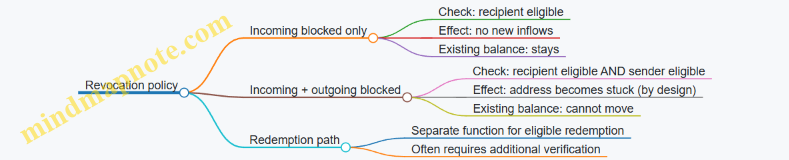
Example: end-to-end flow for a transfer
Assume:
Aliceis eligible.Bobis not eligible.- The registry currently has
isEligible[Alice]=true,isEligible[Bob]=false.
- Alice tries to transfer 100 tokens to Bob.
- Token contract calls
beforeTokenTransfer(Alice, Bob, 100). - The contract checks
registry.isEligible(Bob). - The registry returns
false. - The transfer reverts with
recipient not eligible.
This failure is deterministic. Wallets and integrators can treat it as a compliance gate, not a random technical error.
Example: eligibility update and audit trail
Compliance approves a new investor, Carol.
- Off-chain process completes KYC/KYB and sanctions checks.
- Compliance operator calls
registry.setEligible(Carol, true). - The registry emits
EligibilityUpdated(Carol, true). - Carol can now receive transfers.
If later Carol is revoked:
- Operator calls
registry.setEligible(Carol, false). - Future transfers to Carol revert.
- The event log provides an on-chain record of the change.
Operational best practices embedded in the pattern
1) Use a multisig or role-based admin. A single compromised key can flip eligibility flags. Even for beginners, the “admin is a single address” version is a teaching scaffold, not a production plan.
2) Reconcile off-chain and on-chain state. Eligibility flags should match the compliance system. A simple daily job that compares “approved investors” to “registry true addresses” prevents silent drift.
3) Make failure reasons consistent. recipient not eligible should be stable so clients can display a meaningful message.
4) Prefer conservative defaults. If an address has no registry entry, treat it as ineligible. That is what the boolean mapping already does.
5) Consider a pause switch. If something goes wrong operationally (for example, a registry admin misconfiguration), pausing transfers gives you time to correct it.
Mind map: what to test
A small design decision that matters
Checking only the recipient is the simplest version of the pattern. Adding a sender check changes the user experience and can trap balances. The clean approach is to align the on-chain checks with the token’s legal terms: whether “ineligible” means “cannot receive,” “cannot send,” or both.
This is one of those rare cases where the smart contract stays simple, and the real work happens in the eligibility rules and their operational discipline.
9. Token Issuance, Distribution, and Investor Communications
9.1 Offering Mechanics: Primary issuance, allocations, and settlement
Primary issuance is the part where the token is created for investors under the issuer’s rules, and where the issuer receives consideration (cash or other agreed value) in exchange for tokens. In RWA tokenization, the mechanics matter because they connect three things that must line up: (1) investor eligibility, (2) the legal rights being granted, and (3) the custody and accounting of the underlying assets.
What “primary issuance” means in practice
Primary issuance usually includes these steps:
- Set the offering terms: token rights, denomination, minimum investment, redemption or distribution rules, fees, and transfer restrictions.
- Prepare the investor eligibility process: KYC/KYB, suitability checks, and jurisdiction-based restrictions.
- Collect subscriptions: investors submit orders during the subscription window.
- Allocate tokens: the issuer decides how many tokens each eligible investor receives.
- Settle: investors pay, the issuer (or its agent) receives funds, and tokens are minted or transferred to investor wallets.
- Reconcile and report: match subscriptions, payments, minted supply, and asset movements.
A useful mental model: issuance is not “minting tokens.” Minting is the last mile. The earlier steps determine who is allowed to receive tokens and what rights those tokens represent.
A mind map of primary issuance mechanics
Allocations: deciding who gets what
Allocations are where “fairness” meets “paperwork.” The issuer needs a deterministic method so the same inputs lead to the same allocations.
Common allocation approaches:
- Fixed allocation: each investor receives a pre-agreed amount if eligible. Simple, but it can leave unused capacity.
- Pro-rata allocation: if demand exceeds the offering size, everyone gets a proportional share. This is often easier to justify when oversubscription happens.
- Tiered allocation: different investor categories receive different allocation rules (for example, minimums for certain classes). This requires careful documentation because it can affect regulatory treatment.
Concrete example: pro-rata allocation with a cap
Assume an offering targets 1,000,000 tokens. Eligible subscriptions total 1,600,000 tokens worth of orders.
- Investor A subscribes for 200,000 tokens
- Investor B subscribes for 300,000 tokens
- Investor C subscribes for 1,100,000 tokens
Pro-rata factor (f) is: \[ f = \frac{1{,}000{,}000}{1{,}600{,}000} = 0.625 \] Allocated tokens:
- A: \(200{,}000 \times 0.625 = 125{,}000\)
- B: \(300{,}000 \times 0.625 = 187{,}500\)
- C: \(1{,}100{,}000 \times 0.625 = 687{,}500\)
If the token uses whole units only, the issuer must define rounding rules (e.g., round down and allocate remaining units to the largest fractional remainders). That rounding rule should be written down before the subscription window closes.
Settlement: aligning money, tokens, and assets
Settlement is the sequence that ensures the issuer receives consideration and the investor receives tokens only when conditions are met.
A typical settlement flow:
- Payment received (or payment confirmed): the issuer’s bank account receives funds or a payment processor confirms receipt.
- Custody funding (off-chain): the underlying assets are purchased or transferred into the custody structure (trust, fund, or escrow) according to the offering terms.
- Token issuance (on-chain): tokens are minted or transferred to investor wallets.
- Post-settlement reconciliation: the issuer verifies that minted supply equals the sum of allocations and that custody records reflect the funded assets.
Concrete example: “mint after payment” with a cut-off
Offering cut-off is 5:00 PM UTC on Friday.
- Investor A’s subscription is approved for 125,000 tokens.
- The issuer’s settlement rule is: mint only after funds are credited.
- If A’s bank transfer credits on Monday, A’s tokens are minted on Monday, even though the subscription was approved on Friday.
This avoids the common mismatch where tokens exist on-chain but the underlying asset purchase hasn’t happened yet.
Handling exceptions without breaking the process
Primary issuance should define what happens when reality doesn’t match the plan.
Common exception cases:
- Ineligible investor discovered after approval: tokens should not be minted; the issuer should cancel the allocation and return funds.
- Partial payment: either reject the subscription or allocate proportionally, but the rule must be consistent.
- Payment timing mismatch: if funds arrive after the settlement window, the issuer should define whether the allocation still holds.
- Wallet issues: if an investor’s wallet address is invalid or not whitelisted, the issuer should have a remediation path before minting.
A practical control is to treat settlement as a checklist with explicit pass/fail gates:
- Eligibility gate (approved status)
- Payment gate (funds credited)
- Custody gate (asset movement recorded)
- Mint gate (mint/transfer executed)
- Reconciliation gate (numbers match)
A compact settlement checklist (example)
Putting it together: a full mini-walkthrough
Consider a tokenized cash-equivalent instrument with monthly distributions. The issuer sets a subscription window, uses KYC/KYB to approve eligibility, and uses pro-rata allocation if demand exceeds the target.
- Investors submit subscriptions with wallet addresses and identity details.
- The issuer runs eligibility checks and marks each investor as approved or rejected.
- At cut-off, the issuer calculates pro-rata allocations based on total eligible demand.
- Settlement occurs in two stages: funds are credited first, then the issuer funds the custody structure, then tokens are minted.
- After minting, the issuer reconciles totals:
- sum of allocations equals minted token supply for the tranche
- custody records show the funded underlying assets
- Investors receive confirmations that match their allocation and settlement status.
When these steps are explicit, the token’s existence on-chain becomes a consequence of the same facts that govern the legal and financial position off-chain. That alignment is the whole point of doing primary issuance carefully.
9.2 Investor Suitability and Eligibility: How restrictions are applied in practice
Investor eligibility is where the theory meets the boring parts of operations: collecting the right information, checking it consistently, and applying transfer or participation restrictions without accidentally letting the wrong people in. In RWA tokenization, this matters because the token often represents a regulated financial interest, and the rules usually depend on who the holder is, where they live, and what they’re allowed to do.
What “eligibility” usually means
Eligibility is a set of conditions that determine whether a person or entity can:
- Subscribe or purchase the token at issuance.
- Hold the token on an ongoing basis.
- Transfer the token on the secondary market.
- Receive distributions, notices, or redemption proceeds.
Suitability is related but slightly different: it focuses on whether the investor’s profile fits the offering’s risk and complexity level. Eligibility is typically binary (“allowed” vs “not allowed”), while suitability can be more graded (“allowed with conditions” vs “not appropriate”). Many token programs implement eligibility first, then add suitability checks for certain investor categories.
A practical eligibility model: three layers
A workable approach is to apply restrictions in layers so that failure in one layer doesn’t automatically become a compliance incident.
- Eligibility at onboarding
- Collect identity and jurisdiction information.
- Confirm investor status (for example, accredited vs non-accredited, or professional vs retail, depending on the jurisdiction).
- Confirm whether the investor is on restricted lists (sanctions screening is usually separate but often integrated into the same workflow).
- Eligibility at issuance
- Match the investor’s eligibility status to the allocation rules.
- Ensure the investor receives the correct disclosures and subscription documents.
- Record the eligibility outcome so it can be referenced later.
- Eligibility at transfer
- Enforce transfer restrictions so that ineligible holders cannot keep transferring tokens to new holders.
- Apply whitelisting or permissioned transfer logic where required.
This layered model reduces the chance that a holder becomes ineligible later (for example, due to a jurisdiction change) without the system noticing.
Mind map: eligibility and suitability workflow
How restrictions are applied in practice
The key is to translate legal restrictions into operational checks that are repeatable.
1) Define the “allowed actions” per investor category
Start by writing a simple matrix that maps investor categories to actions. For example:
| Investor category | Subscribe at issuance | Hold token | Transfer token | Receive distributions |
|---|---|---|---|---|
| Category A (eligible) | Yes | Yes | Yes (to eligible) | Yes |
| Category B (conditionally eligible) | Yes | Yes | Yes (with limits) | Yes |
| Category C (ineligible) | No | No | No | No |
Even if your legal team uses different labels, the operational idea stays the same: decisions must be tied to specific actions.
2) Use eligibility outcomes as system flags
Instead of re-running complex checks every time someone interacts with the token, store an eligibility outcome as a controlled data field. For example:
subscription_eligible = true/falseholding_eligible = true/falsetransfer_eligible = true/falsetransfer_destination_allowed = list or rule set
These flags should be derived from documented checks and stored with timestamps and evidence references.
3) Enforce transfer restrictions with a permissioning approach
In many RWA setups, the most important moment is a transfer. A common pattern is:
- Only allow transfers to addresses that are linked to approved investors.
- Block transfers to addresses that are not yet verified.
- Optionally require the recipient to complete onboarding before receiving.
This can be implemented with a registry of approved addresses (or identities) maintained off-chain, with the token contract enforcing “permission to transfer” based on that registry.
Concrete example: whitelisting with a recipient check
Assume a token offering restricts holding to investors in Jurisdiction X and Category A.
Onboarding:
- Investor Mia (Category A, Jurisdiction X) completes onboarding.
- The platform marks Mia as
holding_eligible = trueand adds Mia’s wallet to an approved list.
Secondary transfer attempt:
- Mia tries to transfer tokens to a new wallet controlled by Noah.
- The system checks whether Noah’s wallet is linked to an approved investor.
- If Noah is not approved, the transfer is blocked.
If Noah wants to receive:
- Noah completes onboarding.
- Once approved, Noah’s wallet becomes eligible.
- The transfer can proceed.
This approach prevents “accidental” transfers to ineligible holders. It also makes the rule visible to users: if you can’t receive, it’s because the eligibility check hasn’t been satisfied.
Concrete example: conditional eligibility with limits
Some offerings allow certain investors to participate but impose limits (for example, maximum subscription size or restrictions on redemption timing).
Scenario:
- Investor Lee is Category B.
- Lee can subscribe, but only up to $50,000 equivalent.
Operational steps:
- During issuance, the platform calculates Lee’s requested amount.
- If the request exceeds the limit, the platform rejects the subscription or reduces the allocation.
- The eligibility record stores
subscription_eligible = truebut also storessubscription_limit_remaining.
Why this matters: Eligibility isn’t just “yes/no.” When limits exist, the system needs to track remaining capacity so the same investor doesn’t exceed the cap through multiple transactions.
Suitability checks: when they show up in token programs
Suitability checks often appear when the offering is structured so that only investors who can understand the risks should participate, even if they meet basic eligibility.
A practical suitability workflow might include:
- A short questionnaire about investment experience.
- A risk acknowledgment tied to the offering documents.
- A confirmation that the investor understands liquidity and redemption mechanics.
Operational rule: suitability outcomes should be recorded and tied to the specific offering. If the investor later purchases a different tranche or a different token, you should not reuse the old suitability result without re-checking.
Handling edge cases without making compliance fragile
- Jurisdiction changes: If an investor’s residence changes, eligibility may need re-validation. Store the last validation date and require re-checking when risk indicators change.
- Wallet changes: If a holder uses a new wallet, treat it as a new receiving address until it’s linked to the approved investor profile.
- Corporate actions: If the token’s rights change (for example, redemption terms), eligibility and suitability may need to be re-applied for distributions.
Mind map: eligibility data and evidence
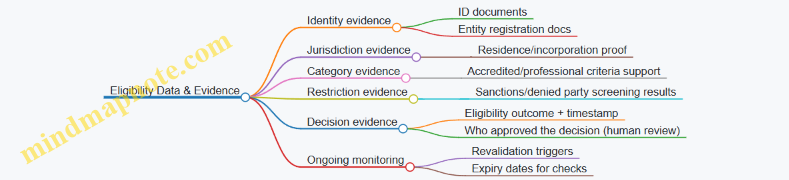
Summary: the “no surprises” principle
In practice, investor eligibility and suitability work best when you:
- Translate legal restrictions into a clear action matrix.
- Store eligibility outcomes as auditable flags.
- Enforce transfer restrictions at the point of transfer.
- Record evidence and timestamps so decisions can be explained later.
If the system can’t answer “why was this transfer allowed or blocked?” in a straightforward way, it’s not ready for real investors.
9.3 Marketing and Communications: Avoiding misleading claims in token promotions
Token promotions often fail for a simple reason: the words describe the token, but the legal and operational reality lives elsewhere. Your job is to make the promotion accurate, consistent, and easy to verify—without turning every sentence into a legal disclaimer.
What “misleading” usually looks like (in plain terms)
Misleading claims typically fall into a few repeatable patterns:
- Confusing the token with the asset. Example: “This token is backed by $10 million in cash.” If the cash sits in a custodian account under a trust, and the token holders have beneficial interests rather than direct ownership of the cash, the wording should reflect the actual right.
- Implying guaranteed outcomes. Example: “Expected annual return: 8%.” If returns depend on collections, defaults, or fees, you can describe historical performance or scenarios only with clear boundaries and assumptions.
- Using certainty where there is discretion. Example: “Redemption is always available within 30 days.” If redemption depends on liquidity, eligibility checks, or issuer discretion, the promotion must say what triggers delays.
- Mixing marketing metrics with investor rights. Example: “Our token is liquid.” Liquidity depends on trading venue, transfer restrictions, and settlement mechanics. If transfers are permissioned, “liquid” should be replaced with concrete details (e.g., “trades on X venue under Y eligibility rules”).
- Omitting key conditions. Example: “No fees.” If there are custody, servicing, or platform fees, the promotion should state that fees exist and where they come from.
A useful rule: if a reasonable reader could make an investment decision based on your statement, then your statement must match the actual rights, risks, and mechanics.
A mind map for promotion accuracy
Concrete examples: rewrite the claim, not just the tone
Example A: Backing language
- Risky: “Each token is backed by $1,000 of cash.”
- Better: “The token represents a beneficial interest in a pool that holds cash and/or cash equivalents. The pool’s value and the timing of distributions depend on the pool’s assets and operating expenses.”
Reasoning: “backed by” can imply direct ownership or a fixed collateral amount per token. The revision ties the claim to the actual structure and removes the implied certainty.
Example B: Redemption timing
- Risky: “Redeem anytime within 30 days.”
- Better: “Redemptions are subject to eligibility checks and available liquidity. Requests are processed on a defined schedule, and timing may vary based on pool cash flows and operational cutoffs.”
Reasoning: redemption is often operationally constrained. The revised version describes the gating factors without promising a universal timeline.
Example C: Returns
- Risky: “Earn 8% annually.”
- Better: “The token’s distributions depend on underlying cash flows after fees. Past distribution rates do not guarantee future results, and actual outcomes may differ due to defaults, prepayments, and expenses.”
Reasoning: the better version explains what drives distributions and avoids presenting a single number as a promise.
Example D: Liquidity
- Risky: “Highly liquid token.”
- Better: “Secondary transfers are permitted only for eligible participants and may be restricted by venue rules. Trading activity varies, and transfer approvals can affect settlement timing.”
Reasoning: liquidity is not just a market label; it’s access, eligibility, and settlement behavior.
A practical checklist for every promotional piece
Use this checklist before publishing a landing page, brochure, email, or slide deck.
- Rights check: Every “backed by,” “supported by,” “entitled to,” and “secured by” statement must map to the actual legal rights.
- Numbers check: Any numeric claim must include the basis (e.g., per token, per pool, net of fees) and the time period.
- Mechanics check: If you mention redemption, distributions, or transfers, you must state the conditions that control timing.
- Risk check: For each benefit claim, confirm the promotion also includes the main risks that could contradict the implied comfort.
- Consistency check: The same term should mean the same thing across documents. If one page says “cash,” another should not quietly switch to “cash equivalents” without explanation.
- Source check: If a claim depends on a document (offering memorandum, trust agreement, risk factors), the promotion should point readers to the controlling terms and avoid summarizing in a way that changes meaning.
How to communicate clearly without burying readers
Good communication is specific, not verbose. Instead of adding more disclaimers, tighten the statement.
- Replace vague certainty with conditional language: “may,” “subject to,” “depends on,” and “subject to eligibility.”
- Prefer operational facts over emotional framing: “transfer requires approval” beats “designed for safety.”
- Use consistent units and definitions: “net of fees” should be defined once and reused.
Example: turning a marketing paragraph into an accurate one
Original (too broad):
“Our token offers stable returns backed by real assets. Investors can redeem quickly and enjoy strong liquidity.”
Rewritten (more concrete):
“The token represents beneficial interests in a pool of real-world assets. Distributions depend on the pool’s cash flows after fees and operating expenses. Secondary transfers are permitted only for eligible participants, and redemption requests are processed according to the pool’s schedule and available liquidity.”
Reasoning: the rewrite removes implied guarantees, clarifies what “backed” means, and replaces “quick” and “strong liquidity” with mechanics that readers can verify.
Review workflow that prevents accidental overpromising
A lightweight internal process helps. Assign three reviewers:
- Legal/compliance reviewer: checks rights, securities classification implications, and required risk framing.
- Operations/custody reviewer: verifies custody, valuation, redemption cutoffs, and reconciliation claims.
- Platform/transfer reviewer: confirms eligibility rules, transfer restrictions, and settlement behavior.
If any reviewer cannot confirm a statement with a documented source, the statement gets rewritten or removed. This keeps promotions from drifting into “sounds right” territory, which is where misleading claims usually begin.
9.4 Disclosures and Reporting: What to publish and how often
Disclosures and reporting are the “paper trail” that helps token holders understand what they own, what backs it, and what changes over time. For RWA tokens, the goal is not to publish everything; it’s to publish the right facts in a consistent format so people can compare periods and reconcile what they see on-chain with what exists off-chain.
What to publish (by category)
1) Asset and backing information
Publish information that answers: “What is the token backed by?” and “Is the backing still there?”
Include:
- Asset description: type (bond, receivable pool, property interest), issuer/originator, and key terms.
- Custody and segregation: where assets are held, how they are separated from other assets, and who has custody.
- Valuation basis: how values are calculated (cost, mark-to-market, independent appraisal, or waterfall-based NAV).
- Concentration: exposure by obligor, property, geography, or counterparty.
Example (cash-equivalent token):
- “The tokens are backed by short-term government bills held in segregated custody. Valuation uses end-of-day prices from a specified pricing source, with a documented fallback if prices are unavailable.”
2) Rights, restrictions, and redemption mechanics
Publish information that answers: “What do token holders get, and what can’t they do?”
Include:
- Token rights: income entitlement, redemption rights, voting rights (if any), and priority in a waterfall.
- Transfer restrictions: eligibility rules, whitelisting approach, and consequences of holding while ineligible.
- Redemption terms: eligibility window, notice period, redemption frequency, settlement timeline, and fees (if any).
Example (real estate receivables):
- “Redemptions are permitted quarterly for eligible holders. Requests must be submitted by the 10th business day of the quarter. Settlement occurs within 15 business days after the redemption date, subject to available cash flow.”
3) Performance and risk reporting
Publish information that answers: “How is the backing performing, and what could go wrong?”
Include:
- Period performance: income received, expenses, net cash available, and how it was allocated.
- Delinquencies and defaults (for receivables): aging buckets, recovery rates, and write-off policy.
- Liquidity and operational constraints: delays in cash collection, appraisal timing, or custody events.
- Key risks: a concise list tied to the actual asset type and structure.
Example (receivables pool):
- “Collections for the quarter were $X. Delinquency increased from 1.2% to 2.0% of outstanding principal, primarily in two obligors. Recoveries were $Y, and the servicer’s policy allows write-offs after Z days past due.”
4) Compliance and operational updates
Publish information that answers: “What changed in the compliance setup?”
Include:
- Material policy changes: updates to eligibility criteria, transfer restriction logic, or custody arrangements.
- Incident reporting: what happened, impact, and remediation steps (without oversharing irrelevant technical details).
- Audit and assurance status: whether reports were completed and any exceptions.
Example (transfer restriction update):
- “The platform updated the eligibility verification workflow on March 3. Transfers to non-eligible addresses are now blocked at the permissioning step, and the change was reflected in the control testing report.”
How often to publish (a practical cadence)
A good cadence balances timeliness with accuracy. Use the “decision frequency” of your token: if holders need information to make redemption or transfer decisions, reporting should arrive before those decisions.
Common cadence patterns:
- Daily/weekly (operational, not full reporting)
- Token supply changes (mint/burn), custody status confirmations, and any immediate exceptions.
- Monthly (reconciliation and baseline metrics)
- Proof-of-assets reconciliation summary, valuation snapshot, and concentration updates.
- Quarterly (investor-grade reporting)
- Performance report, cash flow waterfall summary, and risk metrics.
- Annually (full review)
- Audited financials (or equivalent assurance), full asset inventory summary, and governance/compliance attestation.
- Event-driven (immediate or within a defined window)
- Material defaults, custody disruptions, redemption suspensions, or changes to key service providers.
Example cadence for a tokenized fund:
- Monthly: reconciliation statement and NAV calculation inputs.
- Quarterly: investor report with income, fees, and redemption activity.
- Event-driven: if NAV cannot be calculated due to missing pricing, publish the reason and the alternative method used.
What “good” looks like: a reporting checklist
Use a consistent checklist so different periods don’t drift.
- Backed-by statement: what assets back the tokens at period end.
- Reconciliation summary: assets held vs. assets required, with variance explanation.
- Valuation: method, pricing sources (or appraisal approach), and any adjustments.
- Cash flows: inflows, outflows, fees, and net amounts allocated.
- Redemptions and transfers: counts and settlement outcomes (where applicable).
- Eligibility and restrictions: any changes and how they were applied.
- Exceptions: missing data, delayed custody reports, or control failures.
Mind map: disclosures and reporting
Concrete examples of reporting artifacts
Example 1: Monthly reconciliation summary (short form)
- Period: March 2026
- Tokens outstanding: 10,000,000
- Assets required: $10,000,000 (based on reference value)
- Assets held in custody: $10,012,450
- Variance: +$12,450 explained as accrued interest not yet settled
- Valuation method: end-of-day pricing; fallback applied on March 12 due to missing quotes
- Exceptions: none
Why this works: it gives holders the reconciliation numbers and a plain-language reason for variance, so they can spot whether the difference is routine (accruals) or concerning (missing assets).
Example 2: Quarterly investor report (structured narrative)
Sections:
- Executive summary (5–8 bullets): token supply, backing value, income received, redemptions, and any exceptions.
- Backing performance: what changed in the asset pool and why.
- Cash flow waterfall: inflows, fees, distributions, and remaining cash.
- Risk metrics: delinquency/default stats (if applicable) and concentration.
- Operational notes: custody confirmations, servicing changes, and control testing outcomes.
- Definitions: brief definitions for terms used in tables.
Why this works: it separates “what happened” from “how it was measured,” which reduces confusion when numbers move.
Practical writing rules (so disclosures are usable)
- Use consistent units and dates: “as of” dates should match the valuation date.
- Define terms once: if you say “available cash,” define it and keep the definition stable.
- Explain variances: a variance without a reason is just a number with anxiety.
- Keep templates stable: changing the structure every period makes comparisons harder.
- Tie disclosures to rights: if redemption is quarterly, the report should include enough detail to understand redemption capacity.
Summary
Publish disclosures that map directly to (1) what backs the token, (2) what holders are entitled to, and (3) how performance and compliance change over time. Use a cadence aligned to holder decisions, and keep templates consistent so people can reconcile period-to-period without guesswork.
9.5 Example Package: Drafting a Beginner Friendly Investor Summary for an RWA Token
An investor summary is not a substitute for legal documents. It is a plain-language map of what the token represents, how value is generated, what can go wrong, and what the investor must do to stay eligible. Below is an example package you can adapt.
Investor Summary (Example Draft)
Token Name: HarborCash Token (HCT)
Issuer: Harbor Assets Ltd.
Asset Type: Tokenized cash-equivalent instrument backed by segregated bank deposits and short-term government bills
Token Purpose: The token represents a beneficial interest in a pool of eligible assets held by the custodian.
1) What you are buying
HCT is a token that gives you a claim on the pool’s net assets, after fees and expenses. Your token does not give you direct ownership of the underlying bank accounts or bills. Instead, your rights come from the legal structure described in the offering documents.
Example (simple): If the pool holds $10,000,000 of eligible assets and $200,000 of expenses are accrued for the period, then the pool’s net assets for that period are $9,800,000. Each HCT represents a proportional share of that net amount, subject to the pool’s terms.
2) How value is generated
The pool earns income from the underlying eligible assets. That income is reflected in the pool’s net asset value (NAV) after expenses.
Example (simple): If the pool earns $50,000 of interest during a month and expenses are $5,000, then the net increase is $45,000. If there are 1,000,000 HCT outstanding, the NAV per token increases by $0.045 (before any rounding and operational adjustments).
3) Fees and expenses
The issuer and/or service providers charge fees as described in the offering documents. Fees may be deducted from pool assets or paid from pool income.
Example (simple): If the management fee is 0.50% per year and the pool’s average net assets during the month are \( 20,000,000, then the monthly fee estimate is: \[ \text{Monthly fee} \approx 20{,}000{,}000 \times 0.005 / 12 \approx 8{,}333 \] Actual fees follow the precise calculation method in the documents.
4) Redemption and liquidity
HCT may be redeemable under specified conditions, such as redemption windows, minimum amounts, and settlement timelines. Redemption is not guaranteed on demand unless the terms explicitly say so.
Example (simple): If redemptions are processed monthly and settlement takes 5 business days after the redemption date, then an investor who submits a redemption request on Day 3 will typically receive proceeds after the next processing date plus settlement time.
5) Transfer restrictions (important)
HCT transfers may be restricted to eligible investors. Transfers can be blocked if the recipient does not meet eligibility requirements.
Example (simple): If a token holder transfers HCT to an address associated with an ineligible jurisdiction, the platform may reject the transfer or freeze it until eligibility is verified, depending on the control design.
6) Custody and asset segregation
The underlying assets are held by a custodian under a custody agreement. Assets are intended to be segregated from the issuer’s operational assets.
Example (simple): If the issuer has other business lines, the custodian agreement is designed so that the pool’s assets are not used to satisfy unrelated liabilities.
7) How NAV is calculated
NAV is calculated using the pool’s eligible assets minus liabilities and accrued expenses, divided by the number of tokens outstanding.
Example (simple): If eligible assets are \)100,000,000, liabilities are $1,000,000, and 10,000,000 HCT are outstanding, then: \[ \text{NAV per HCT} = (100{,}000{,}000 - 1{,}000{,}000) / 10{,}000{,}000 = 9.90 \] NAV calculation uses the valuation methodology described in the offering documents.
8) Reporting you can expect
The issuer provides periodic reporting on pool composition, NAV, and key events as described in the offering documents.
Example (simple): A monthly report might include: total eligible assets by category, NAV per token, and a summary of fees charged during the period.
9) Key risks (plain language)
You should understand these risks before investing:
- Asset risk: Underlying assets can lose value or underperform.
- Custody and operational risk: Errors, delays, or failures can affect timing of NAV updates or redemptions.
- Liquidity risk: Secondary trading may be limited, and redemption terms may impose delays.
- Regulatory and eligibility risk: If you become ineligible, transfers and redemptions may be restricted.
- Smart contract and technical risk: Token transfers depend on technical systems; failures can disrupt access.
Example (simple): If a redemption request is submitted but settlement is delayed due to operational processing, the investor may receive proceeds later than expected.
10) What you must do to remain eligible
Maintain accurate identity and compliance information. If your status changes, notify the issuer or follow the platform’s process.
Example (simple): If an investor’s jurisdiction changes, the eligibility checks may need to be rerun before transfers or redemptions are allowed.
11) Where rights are defined
Your rights are defined in the offering documents and the legal structure governing the pool. The investor summary is a simplified explanation.
Example (simple): If the summary says “redemptions are processed monthly,” the exact cut-off time, notice requirements, and settlement mechanics are in the legal terms.
12) Plain-language glossary
- Custodian: The party holding the underlying assets.
- NAV: Net asset value of the pool per token.
- Eligible assets: Specific asset types allowed in the pool.
- Redemption: Converting tokens back into cash or other proceeds under stated terms.
- Eligibility: Conditions an investor must meet to hold or transfer the token.
Mind Map: Investor Summary Content Map
Investor Summary Mind Map (HCT Example)
Mind Map: “Do I need to say this?” Checklist
Micro-Examples to Improve Clarity (Drop-in Paragraphs)
-
Eligibility and transfer blocking (short):
If you attempt to transfer HCT to an address that fails eligibility checks, the platform may prevent the transfer until eligibility is confirmed. -
NAV timing (short):
NAV is calculated using the pool’s valuation methodology and is published on the schedule stated in the offering documents. -
Fees (short):
Fees reduce the pool’s net assets, which can lower NAV even if the underlying assets remain stable. -
Custody (short):
The custodian holds the eligible assets under a custody agreement intended to keep them separate from the issuer’s other assets.
Practical Writing Rules (Applied to the Example)
- Use one sentence to state the mechanism, then one sentence to show a simple numeric example.
- When you mention a process (redemption, transfers, reporting), include the “what triggers it” and “how long it takes.”
- Keep risks tied to outcomes: money, timing, or access—not just generic categories.
- Avoid legal jargon in the summary, but point to where legal definitions live.
This example package is designed so a beginner can answer five questions quickly: what the token represents, how returns are produced, what it costs, when they can exit, and what restrictions apply to transfers and eligibility.
10. Trading, Liquidity, and Transfer Restrictions Under Regulation
10.1 Trading Venues: OTC, regulated exchanges, and alternative trading systems
Tokenized real-world assets (RWAs) don’t trade in a single “token market.” They trade in venues that decide who can interact, how orders are matched, and what rules apply when something goes wrong. For beginners, the key is to map venue mechanics to compliance mechanics: eligibility checks, transfer restrictions, settlement, and audit trails.
What a “trading venue” controls (and why it matters)
A venue typically governs four practical layers:
- Access: who can place orders (public, permissioned, or restricted by eligibility).
- Order handling: how orders are collected, matched, and published (or not).
- Execution and settlement: when trades become final and how assets move.
- Operational controls: monitoring, error handling, and recordkeeping.
For RWA tokens, the venue layer must align with the legal layer. If the token is restricted (for example, only certain investors), the venue must prevent ineligible counterparties from trading or receiving tokens.
Mind map: choosing a venue by control points
OTC (Over-the-Counter): bilateral trades with controlled counterparties
OTC trading is usually negotiated directly between two parties (often through intermediaries). For RWA tokens, OTC is common when the issuer or platform wants tighter control over counterparties and settlement steps.
How OTC typically works (practical flow):
- A buyer and seller agree on price and quantity.
- The intermediary (or platform) runs eligibility checks for the buyer and seller.
- The trade is recorded, and settlement instructions are created.
- The token transfer occurs only if the transfer restriction rules pass.
Example: OTC trade in a tokenized bond coupon right
- The token represents a beneficial interest in cash flows.
- Only investors meeting suitability requirements can hold it.
- A broker receives an order from an investor.
- Before confirming the trade, the broker verifies eligibility.
- After the trade is agreed, the platform attempts the token transfer.
- If the buyer’s wallet is not whitelisted, the transfer fails and the trade is marked as unsettled until corrected.
Why OTC can be a good fit:
- It supports permissioned participation without forcing a public market.
- It can handle complex settlement logic (for example, partial redemptions or specific custody arrangements).
What to watch:
- Liquidity can be thinner because fewer participants are actively trading.
- Operational risk shifts to the intermediary: if eligibility checks are inconsistent, restricted tokens can end up in the wrong hands.
Regulated exchanges: standardized trading with venue-level rules
A regulated exchange (or exchange-like venue) provides standardized market structure: defined trading hours, order types, and a matching mechanism. For RWA tokens, the exchange’s role is not just matching; it also shapes compliance through admission rules and surveillance.
How exchange trading changes the compliance picture:
- Access is controlled through listing and admission rules.
- Orders may be visible to participants depending on the venue.
- The exchange typically provides market surveillance and standardized reporting.
Example: exchange listing for a tokenized fund share
- The fund issues tokens representing shares in a fund vehicle.
- The exchange lists the token under a specific product category.
- Only approved participants can trade, and the exchange requires identity verification for account opening.
- When an order is placed, the exchange ensures the account is eligible to trade the instrument.
- After execution, the platform or issuer enforces transfer restrictions so that token ownership remains consistent with the fund’s rules.
Why exchanges can be a good fit:
- Standardization makes it easier to reason about execution and reporting.
- Surveillance and recordkeeping are often more systematic.
What to watch:
- Even if the exchange blocks ineligible accounts from trading, the token transfer layer still needs enforcement. A wallet can be eligible to trade on an exchange account yet still fail transfer restrictions if the token contract or registry requires additional checks.
Alternative Trading Systems (ATS): flexible matching with regulated oversight
An ATS is a trading venue that may use different matching or execution models than a traditional exchange. It can support RFQ-style trading, periodic auctions, or other mechanisms while still operating under a regulatory framework.
Common ATS patterns for RWA tokens:
- RFQ: a buyer requests quotes from selected counterparties.
- Periodic auctions: orders are collected and matched at set times.
- Dark or limited visibility: fewer details are shared publicly, depending on rules.
Example: ATS RFQ for tokenized receivables
- The receivables token has transfer restrictions tied to eligibility and settlement windows.
- A buyer submits an RFQ for a specific tranche.
- The ATS routes the RFQ to eligible sellers.
- Sellers respond with quotes.
- The ATS matches the trade based on quote priority and rules.
- Settlement then triggers the platform’s transfer restriction checks and custody reconciliation.
Why ATS can be a good fit:
- It can balance controlled access with more structured execution than pure OTC.
- It often supports venue-level reporting while allowing tailored matching.
What to watch:
- The ATS may not fully replace issuer/platform transfer controls. Think of the ATS as the “order traffic manager,” not the final authority on who can hold the token.
Comparing venues with a beginner-friendly checklist
Use this checklist when evaluating where an RWA token trades:
| Control area | OTC | Regulated exchange | ATS |
|---|---|---|---|
| Who can place orders | Often permissioned via intermediaries | Typically admission-controlled | Often permissioned via venue rules |
| Matching | Bilateral negotiation | Centralized matching (e.g., order book) | RFQ, auctions, or other models |
| Pre-trade eligibility | Intermediary-driven | Venue/account-driven | Venue-driven plus routing rules |
| Transfer restriction enforcement | Platform/issuer-driven | Platform/issuer-driven (still required) | Platform/issuer-driven (still required) |
| Settlement and reconciliation | Intermediary + platform | Venue + platform | ATS + platform |
| Audit trail | Negotiation + execution logs | Standardized order/execution logs | Standardized venue logs + platform settlement logs |
A cohesive example: same token, three venues
Imagine a token backed by a pool of invoices with a rule: only eligible investors can hold it.
- OTC: the broker checks eligibility, agrees price, then the platform attempts transfer. If the buyer isn’t eligible in the token registry, the transfer fails.
- Exchange: the exchange blocks ineligible accounts from trading. After execution, the platform still checks transfer permissions before finalizing ownership.
- ATS: the ATS routes RFQs only to eligible counterparties. After matching, the platform performs the same transfer restriction enforcement as in the other venues.
The takeaway is simple: venue mechanics affect how orders are handled, but transfer eligibility and settlement correctness still depend on the token’s legal and technical enforcement.
10.2 Transfer Restrictions: Whitelists, lockups, and permissioned transfers
Transfer restrictions are the practical bridge between “the token exists” and “only the right people can hold it.” In regulated RWA setups, the restriction logic usually combines (1) eligibility rules, (2) a way to identify who is eligible, and (3) an enforcement mechanism that prevents restricted transfers from completing.
What you are restricting (and what you are not)
A common beginner mistake is treating transfer restrictions as a single feature. In reality, you restrict at least three different things:
- Who can receive tokens (investor eligibility).
- When transfers can happen (lockups, redemption windows, settlement timing).
- How transfers are executed (permissioned transfers, broker-mediated flows, or whitelisted counterparties).
You also need to decide what you are not restricting. For example, you might allow transfers between eligible holders but restrict transfers to non-eligible addresses. Or you might allow transfers at any time but restrict transfers to addresses that have passed onboarding.
Mind map: the restriction stack
Whitelists: allowed recipients, not just “allowed people”
A whitelist is a set of addresses (or address groups) that are permitted to receive tokens. The key design choice is what the whitelist represents.
- Address whitelist: “This specific wallet address can receive.”
- Identity-linked whitelist: “Any address associated with an approved identity can receive.”
For beginners, address whitelists are easier to implement but harder to manage. If a holder changes wallets, you must update the whitelist. Identity-linked whitelists reduce operational churn, but require a reliable mapping from identity to addresses.
Example: whitelisting with a simple rule
Assume an RWA token represents beneficial interests in a cash-flow pool. The issuer only allows investors from approved jurisdictions.
- Off-chain onboarding collects jurisdiction and eligibility.
- The compliance system marks the investor as eligible.
- The token contract only allows transfers to whitelisted recipient addresses.
Concrete flow:
- Investor A completes onboarding.
- Compliance adds A’s wallet address to the whitelist.
- Investor B attempts to transfer tokens to A.
- The contract checks
recipient ∈ whitelist. - If not, the transfer reverts and no state changes occur.
This approach prevents restricted recipients from receiving tokens, but it does not stop a restricted holder from sending tokens. That’s fine if your goal is “no restricted holder can receive,” not “no restricted holder can ever touch the token.”
Lockups: restricting time, not identity
Lockups prevent transfers during a defined period or until a condition is met. Lockups are usually tied to issuance mechanics, redemption schedules, or settlement constraints.
A lockup can be:
- Global: applies to all transfers.
- Per-holder: applies only to certain investors.
- Per-transaction: applies when a transfer is part of a redemption or rebalancing flow.
Example: a 90-day issuance lockup
Suppose tokens are issued in a primary offering, and investors cannot transfer for 90 days.
- The contract stores a
globalLockEndTimestamp. - Transfers are allowed only when
block.timestamp ≥ globalLockEndTimestamp.
Concrete flow:
- Day 0: tokens are minted to investors.
- Day 30: an investor tries to transfer to a friend.
- The contract checks the timestamp and rejects the transfer.
- Day 91: the same transfer succeeds.
Lockups are straightforward, but you must define what happens to transfers that are attempted during the lockup. The cleanest beginner-friendly behavior is: revert the transfer so balances remain consistent.
Permissioned transfers: who is allowed to execute transfers
Permissioned transfers restrict the operator or caller who can initiate a transfer. This is different from whitelisting recipients.
- Whitelist answers: “Can the recipient hold this token?”
- Permissioned transfers answer: “Can this transfer be executed by this party?”
Permissioned transfers are useful when transfers must go through a regulated intermediary (for example, a broker, a transfer agent, or a venue that performs eligibility checks).
Example: broker-mediated transfers
Assume the issuer requires that transfers only occur through a specific transfer agent contract.
- The token contract allows transfers only when
msg.senderis the approved transfer agent. - The transfer agent verifies eligibility off-chain and then calls the token contract to move tokens.
Concrete flow:
- Investor A wants to sell to Investor C.
- The transfer agent confirms Investor C is eligible.
- The transfer agent calls the token contract to transfer tokens from A to C.
- The token contract checks
caller == transferAgentand proceeds.
This design reduces the chance that eligibility checks are skipped, because the token contract refuses to process transfers initiated outside the approved path.
Combining the three: a practical enforcement pattern
In real deployments, you often combine all three:
- Whitelist blocks restricted recipients.
- Lockup blocks transfers during restricted periods.
- Permissioned transfers ensures transfers go through the correct operational process.
Example: “eligible recipient + lockup + transfer agent”
Rules:
- Transfers are allowed only after the lockup ends.
- Recipients must be whitelisted.
- Only the transfer agent can initiate transfers.
Concrete flow:
- Investor B tries to transfer during lockup: rejected by lockup check.
- After lockup, Investor B tries to transfer to a non-whitelisted wallet: rejected by whitelist check.
- After lockup, Investor B tries to transfer directly without the transfer agent: rejected by permissioned transfer check.
The order of checks matters for user experience and debugging. A common approach is to check the cheapest conditions first (like timestamp), then eligibility, then caller authorization.
Mind map: common restriction rules and their effects
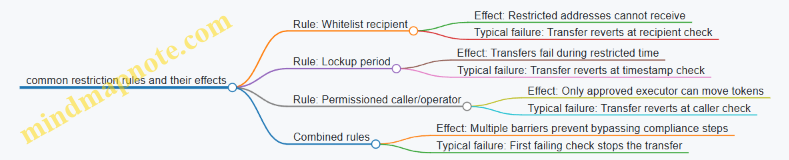
Operational details that prevent “it works on paper” problems
- Whitelist updates must be auditable. When an address is added or removed, record who approved it and why. Otherwise, you cannot explain failures.
- Define the behavior for edge cases. For example, what happens if an investor becomes ineligible after receiving tokens? Many systems restrict future transfers but do not forcibly revoke existing balances.
- Avoid ambiguous mappings. If you use identity-linked whitelists, define how address changes are handled (for example, a new wallet requires re-approval).
- Emit clear events. When a transfer is rejected, the contract should revert with a reason string or an error code so operators can diagnose the cause.
Example: a simple rule set you can implement cleanly
Here is a beginner-friendly set of checks for a regulated token transfer function.
// Pseudocode (not production-ready)
function transfer(from, to, amount) {
  require(block.timestamp >= lockEnd, "LOCKED");
  require(msg.sender == transferAgent, "NOT_AUTHORIZED");
  require(whitelist[to] == true, "RECIPIENT_NOT_ELIGIBLE");
  require(balance[from] >= amount, "INSUFFICIENT_BALANCE");
  balances[from] -= amount;
  balances[to] += amount;
  emit Transfer(from, to, amount);
}
A real implementation will also handle decimals, allowances (if applicable), and role management. The important part for beginners is the logic separation: time restriction, caller restriction, and recipient eligibility are distinct checks with distinct failure reasons.
Summary
Whitelists control who can receive, lockups control when transfers can happen, and permissioned transfers control how transfers are executed. When you combine them with auditable operational processes, you get restrictions that are enforceable, explainable, and consistent with regulated asset-backed token expectations.
10.3 Market Integrity: Preventing Manipulation and Ensuring Fair Execution
Market integrity in RWA token trading is mostly about making sure the market you think you have is the market you actually get. That means controlling who can trade, what information they see, how orders are matched, and how settlement failures are handled. In regulated settings, “fair execution” also means you can explain the process after the fact without guessing.
What manipulation looks like in RWA token markets
Manipulation usually isn’t a single trick; it’s a pattern that exploits gaps between (1) the token’s legal rights, (2) the trading venue’s mechanics, and (3) the compliance rules that restrict who may hold or transfer the token.
Common manipulation patterns include:
- Eligibility gaming: A participant trades while not meeting transfer eligibility, then relies on delays or manual overrides to keep the appearance of liquidity.
- Wash-like behavior: Orders are placed and canceled to create misleading price signals, especially when spreads are wide and liquidity is thin.
- Information asymmetry: One party receives material information earlier (or in a more complete form) and trades before others can react.
- Venue fragmentation effects: If the same token trades across multiple venues with different rules, price can be “managed” by exploiting the weakest enforcement path.
- Settlement-driven distortions: If failed transfers are common and not handled consistently, trades can appear to clear while ownership rights don’t actually move.
The key idea: integrity failures often come from operational mismatches, not from clever math.
Fair execution: define it operationally
Fair execution is easiest to enforce when you define it in concrete terms that map to system behavior.
A practical checklist:
- Order handling is consistent: Orders are time-stamped, validated, and either accepted or rejected using the same rules for everyone.
- Matching is deterministic: Given the same inputs, the venue produces the same matching outcome.
- Eligibility checks happen before execution: If a buyer cannot legally receive the token, the trade should not execute.
- Price formation is transparent: The venue records the data needed to reconstruct how a trade price was produced.
- Settlement outcomes are reliable: Trades that fail settlement are flagged and handled in a way that doesn’t silently convert “no trade” into “trade.”
Mind map: integrity controls for RWA token trading
Market Integrity Controls (Mind Map)
Pre-trade controls: stop bad trades before they happen
For RWA tokens, the most important integrity gate is eligibility. If the token is restricted (for example, only certain jurisdictions or accredited investors), the venue must check eligibility before matching.
Example: eligibility check before execution
- A buyer submits an order for 100 tokens.
- The system checks the buyer’s status against the latest eligibility dataset.
- If the buyer is not eligible, the order is rejected with a reason code like
NOT_ELIGIBLE_TRANSFEROR(or equivalent). - The order never enters the matching engine, so there’s no “trade” that later gets unwound.
This approach prevents a common failure mode: trades that appear to clear but cannot be settled due to transfer restrictions.
Order handling: fairness is mostly about timestamps and rules
Fair execution depends on consistent order lifecycle management.
Example: deterministic matching with cancellation rules
- Orders are time-stamped at receipt.
- If two orders arrive in the same second, the system uses a tie-breaker such as sequence number.
- Cancellations are processed in order of receipt.
- If an order is canceled after matching begins, the system either rejects the cancellation or applies it only to unmatched quantity—whichever is defined in the venue rules.
The point isn’t the exact policy; it’s that the policy is consistent and recorded.
Price integrity: detect patterns that create misleading signals
You can’t eliminate all manipulation, but you can reduce it by monitoring for behaviors that don’t match genuine trading.
Example: quote sanity checks
- Suppose a token trades around $100 with typical daily range $98–$102.
- A participant posts a large bid at $70 and a large ask at $130 simultaneously.
- If the venue allows both, the order book can look “busy” while the quotes are far from realistic.
- A sanity rule can require quotes to fall within a configurable band relative to recent trades, or require additional justification for large deviations.
This doesn’t block legitimate price discovery; it blocks obviously disconnected quotes from dominating the display.
Example: anti-wash monitoring using simple signals A basic monitoring rule can flag suspicious activity when:
- The same participant places buy and sell orders that match within a short window.
- The net position change is near zero.
- The participant’s orders are heavily canceled and re-posted.
When flagged, the venue can require enhanced review or temporarily restrict that participant’s order size.
Information controls: keep “who knew what when” consistent
If material information affects token value, the integrity risk is trading on uneven access.
Example: publication timing and trading pauses
- An issuer publishes a report that changes expected cash flows.
- The venue enforces a rule: trading continues, but only after the report is marked as “published” in the system.
- The system logs the publication timestamp and the first trade timestamp after publication.
Even if the venue doesn’t pause trading, it can still ensure that everyone sees the same information at the same time from the venue’s perspective.
Settlement integrity: “executed” must mean “transferable”
A trade that cannot be settled is not a fair trade; it’s a bookkeeping problem waiting to become a dispute.
Example: settlement-linked execution
- When a match occurs, the system triggers the transfer process.
- The transfer is only marked complete if the token transfer succeeds and the custody/ownership records update.
- If the transfer fails due to eligibility or custody issues, the trade is marked as failed and handled according to a defined policy (for example, reversing the trade state and notifying both parties).
This prevents a situation where the market shows fills that never actually moved ownership.
Auditability: make the process explainable
Integrity controls must be provable. That means event logs that show:
- order receipt and time-stamp
- eligibility check results
- matching inputs and outputs
- settlement attempt outcomes
- reconciliation results
Example: reconstructing a trade After a complaint, an auditor should be able to answer:
- Was the buyer eligible at the time of execution?
- What orders were matched and why?
- Did the transfer succeed, and what records confirm it?
- If it failed, what policy applied and who was notified?
If the system can’t answer these questions from logs, the market integrity story is mostly vibes, and regulators tend to dislike vibes.
Practical mini-scenario: end-to-end integrity for a restricted token
- A restricted RWA token trades on a permissioned venue.
- A buyer tries to purchase while not eligible.
- The venue rejects the order at pre-trade validation.
- Another buyer submits an eligible order.
- Matching occurs deterministically.
- Settlement triggers a transfer that succeeds.
- The venue records the full chain of events so the trade can be audited.
Notice what’s missing: there’s no manual “fix it later” step that could create a fairness gap.
Summary
Market integrity in RWA token trading comes from aligning legal eligibility, trading mechanics, and settlement outcomes. Fair execution is not a slogan; it’s a set of operational rules that are applied consistently, logged thoroughly, and enforced before execution whenever possible.
10.4 Settlement and Operational Risk: Handling failed transfers and mismatches
Settlement is where “ownership on the ledger” meets “assets in the real world.” For RWA tokens, the operational risk is rarely about cryptography; it’s about the boring stuff: timing differences, mismatched identifiers, partial failures, and people pressing the wrong button at 2:00 p.m. The goal of this section is to show how to handle failed transfers and mismatches without creating a second problem while fixing the first.
What can go wrong (and why it matters)
A transfer can fail in multiple layers:
- On-chain transfer fails: the transaction reverts, runs out of gas, or is rejected by a permissioning rule.
- Off-chain step fails: eligibility checks, custody instructions, or reconciliation jobs fail.
- Both succeed, but don’t agree: the token moved on-chain, but the off-chain ledger didn’t record the corresponding asset movement (or vice versa).
- Identifiers don’t match: the token transfer references one investor ID, while the custody system expects another.
- Timing mismatch: the system assumes “finality” too early, or processes events out of order.
Each failure mode creates a different operational response. Treating all failures the same is how you end up with double-crediting or stuck assets.
A practical mind map: settlement failure handling
The core principle: define source of truth per step
In RWA tokenization, you usually have at least three “truths”:
- On-chain state (token balances and transfer events)
- Off-chain custody/asset ledger (what assets actually moved)
- Operational reconciliation records (what your systems believe happened)
When something fails, you need to decide which truth governs the correction.
- If the on-chain transfer failed, you generally treat the on-chain state as unchanged and focus on why the off-chain step didn’t complete (or why it was attempted at all).
- If the on-chain transfer succeeded but the custody instruction failed, you typically hold the token transfer as “pending settlement” in your operational records and prevent further actions that assume settlement is complete.
- If both succeeded but reconciliation disagrees, you correct the mismatch by aligning the operational record and, if needed, initiating compensating actions.
This is not philosophical; it’s procedural. Without it, teams “fix” the wrong system and create a loop.
A two-phase workflow that reduces mismatches
A common beginner-friendly approach is to separate the workflow into prepare and commit.
Prepare
- Validate eligibility and permissions.
- Create a custody instruction draft.
- Create an internal transfer record with a unique reference.
Commit
- Execute the on-chain transfer (or record it if it’s already executed).
- Execute the custody instruction.
- Mark the internal record as settled only after both sides confirm.
If commit fails halfway, the internal record tells you exactly what happened. The key is that the system must be able to retry safely.
Idempotency: retries without double-crediting
Retries are inevitable. The trick is making them safe.
- Use a unique transfer reference (e.g.,
transferRef = investorA|investorB|assetId|amount|timestampBucket|nonce). - Store a status per reference:
prepared,onchain_done,custody_done,settled,failed_with_reason. - When retrying, check the stored status first.
If your system doesn’t track status by reference, a retry can repeat the same action twice. That’s how “failed transfers” become “mysteriously duplicated balances.”
Example 1: On-chain succeeds, custody fails
Scenario: Alice transfers 10 token units to Bob.
- On-chain transaction confirms.
- Custody instruction to move the underlying asset fails due to a custody system timeout.
- Reconciliation runs and detects that token balances changed, but custody balances did not.
Operational response
- Hold further settlement-dependent actions for the affected transfer reference (and optionally for the involved accounts, depending on your risk tolerance).
- Classify: this is a “token moved, asset not moved” mismatch.
- Check custody retry eligibility: if the custody instruction can be retried, retry it using the same instruction reference.
- If custody remains unavailable: decide whether to reverse the token transfer (if your token design supports it) or to keep it in a “pending settlement” state with strict restrictions.
Why this works: the system doesn’t assume settlement just because the chain moved. It waits for custody confirmation before marking the transfer as settled.
Example 2: On-chain fails, custody instruction was already sent
Scenario: A permissioning rule rejects the on-chain transfer.
- The custody instruction was sent earlier in the workflow.
- Custody moves the underlying asset anyway (or marks it as reserved).
Operational response
- Detect: on-chain tx status is
reverted. - Classify: “asset moved/reserved without token movement.”
- Stop: prevent any further token issuance tied to that custody movement.
- Correct:
- If custody movement was only a reservation, cancel it.
- If custody actually moved the asset, you need a compensating action: either reverse the custody movement (if possible) or create a controlled re-issuance path that preserves investor eligibility rules.
Why this works: you treat the custody action as real and reconcile it, rather than pretending the chain failure makes the off-chain step irrelevant.
Example 3: Identifier mismatch causes reconciliation drift
Scenario: Bob’s wallet address maps to investor profile B-102 in the token system, but custody expects B-210.
- On-chain transfer succeeds.
- Custody instruction succeeds, but it credits the asset to the wrong internal profile.
- Reconciliation flags a mismatch between expected and actual recipient.
Operational response
- Detect: reconciliation compares expected recipient ID vs custody recipient ID.
- Classify: “recipient mapping mismatch.”
- Correct mapping: update the deterministic mapping rules and re-run eligibility checks.
- Compensate: move the asset to the correct recipient in custody (or reverse and re-execute the custody instruction).
- Lock the mapping: prevent the same mismatch from recurring by enforcing a single mapping source and validating it before every transfer.
Why this works: you fix the root cause (mapping determinism), not just the symptom (the one-off mismatch).
Reconciliation: what to check and how often
A reconciliation job should compare:
- Expected token balance changes vs observed token events
- Expected custody movements vs observed custody ledger entries
- Reference IDs across systems
For beginners, the simplest useful approach is a daily reconciliation plus an event-driven reconciliation for high-value transfers. The event-driven part catches problems early; the daily part ensures nothing slips through.
Runbook essentials: what your team needs in the moment
A good runbook for failed transfers includes:
- The transfer reference and how to find it.
- The current status in each system (on-chain, custody, internal record).
- The classification (token moved only, custody moved only, both moved but mismatch, identifier mismatch).
- The allowed actions for each classification (retry, cancel, reverse, restrict, escalate).
- The evidence checklist: tx hash, custody instruction ID, reconciliation report ID.
When the runbook is clear, you reduce “interpretation time,” which is where operational mistakes breed.
Summary checklist
- Use a prepare/commit workflow.
- Track every transfer by a unique reference and make processing idempotent.
- Define source of truth per failure mode.
- Reconcile by events + reference IDs, not by assumptions.
- Maintain a runbook that classifies failures and prescribes specific corrective actions.
Settlement failures are inevitable. The difference between a manageable incident and a messy one is whether your system can explain what happened and correct it without guessing.
10.5 Example Scenario: Enforcing Eligibility During Secondary Market Transfers
Imagine an asset-backed token (the “RWA Token”) that represents beneficial interests in a pool of cash-like receivables. The issuer restricts transfers so only eligible investors can hold the token. Eligibility is based on jurisdiction, investor type, and whether the investor has completed onboarding.
In the secondary market, tokens move between wallets. The platform’s job is to prevent ineligible holders from ending up with tokens, even if they receive them via a peer-to-peer transfer. The trick is that “eligibility” is not a property of the token itself; it’s a property of the current holder and the transfer context. So the system needs a repeatable eligibility check at transfer time.
The scenario setup
- Token:
RWA-POOL-01 - Eligibility rules (simplified):
- Holder must be in an approved jurisdiction.
- Holder must be an approved investor type (e.g., professional vs retail).
- Holder must have completed KYC/KYB onboarding.
- Transfer restriction goal: A transfer should succeed only if the recipient is eligible.
- Operational constraint: Eligibility status can change (e.g., onboarding expires, sanctions status changes), so checks must be based on current records.
Mind map: eligibility enforcement during transfers
Step-by-step flow (what happens when someone tries to transfer)
- User initiates transfer from Wallet A to Wallet B.
- Smart contract intercepts the transfer request.
- Contract queries an eligibility source (typically via an on-chain registry updated by the compliance system, or via a permissioned oracle pattern).
- Eligibility verdict is computed for Wallet B using the latest compliance records.
- Transfer is allowed or blocked:
- If Wallet B is eligible, the transfer proceeds.
- If Wallet B is not eligible, the transaction reverts.
- Events are emitted so the platform can audit why transfers were blocked.
The key design choice is where the “truth” lives. If the smart contract relies on stale data, you get either false rejections (annoying but safer) or, worse, false acceptances (riskier). Many systems choose a conservative approach: eligibility data used by the contract is updated frequently enough to reflect meaningful changes, and the contract blocks transfers when it cannot confirm eligibility.
Concrete example with three wallets
Assume the platform maintains an eligibility registry keyed by wallet address.
- Wallet A (sender):
0xA...Eligible holder. - Wallet B (recipient):
0xB...In approved jurisdiction, KYC complete. - Wallet C (recipient):
0xC...Approved jurisdiction, but KYC not completed.
Attempt 1: Eligible recipient
- Wallet A transfers
100tokens to Wallet B. - The eligibility registry returns:
eligible = truefor Wallet B. - The smart contract allows the transfer.
- The platform logs an event: transfer succeeded with recipient eligibility confirmed.
Result: Wallet B now holds tokens.
Attempt 2: Ineligible recipient (missing KYC)
- Wallet A transfers
100tokens to Wallet C. - The eligibility registry returns:
eligible = falsefor Wallet C. - The smart contract reverts the transfer.
- The platform logs an event: transfer blocked due to recipient not eligible.
Result: Wallet C never receives tokens.
Attempt 3: Eligibility becomes invalid between attempts
Now suppose Wallet B’s onboarding expires after a compliance review cycle, and the eligibility registry is updated.
- Wallet A tries again to transfer
50tokens to Wallet B. - The eligibility registry returns:
eligible = falsefor Wallet B. - The smart contract reverts.
Result: Wallet B remains eligible only while the registry says so. The system behaves consistently with the latest compliance state.
What the eligibility registry must support
A practical eligibility registry needs more than a boolean. At minimum, it should support:
- Eligibility status: eligible / not eligible / unknown.
- Reason codes: e.g.,
JURISDICTION_NOT_ALLOWED,KYC_INCOMPLETE,SANCTIONS_FLAGGED. - Timestamp: when the status was last updated.
- Scope: which token(s) or pool(s) the eligibility applies to.
This matters because “unknown” is different from “not eligible.” If the contract treats unknown as eligible, you risk accidental permission. If it treats unknown as not eligible, you may block legitimate transfers until compliance data is refreshed. For regulated tokens, blocking on unknown is usually the safer default.
Mind map: data and decision points
Example: transfer restriction logic (conceptual)
The contract’s transfer rule can be summarized as:
- Allow transfer only if the recipient is eligible for that token.
- Revert otherwise.
Here is a conceptual pseudocode sketch (not tied to any specific chain):
onTransfer(from, to, tokenId, amount):
  if from == to:
    revert("No-op transfer")
  status = eligibilityRegistry.get(to, tokenId)
  if status.eligible == true:
    proceedTransfer(from, to, tokenId, amount)
    emit TransferAllowed(from, to, tokenId, amount, status.reason)
  else:
    emit TransferBlocked(from, to, tokenId, amount, status.reason)
    revert("Recipient not eligible")
The important nuance is that the contract emits an event even when it blocks. That event becomes the operational breadcrumb for compliance and support teams.
Handling marketplace settlement and batch transfers
Secondary trading often uses intermediaries. A marketplace might settle trades by transferring tokens from a seller to a buyer in one transaction, sometimes batched.
Eligibility enforcement still applies, but the recipient in the contract call is what matters. If the marketplace uses a custody wallet as the recipient, eligibility must be defined for that custody wallet (or the marketplace must route transfers so the final buyer is the recipient at the contract level).
A common mistake is assuming that “the marketplace did the checks.” The token contract only sees addresses. If the final recipient is not eligible, the contract should block the transfer regardless of who initiated it.
Failure modes and how to keep them understandable
When a transfer fails, users need a reason that helps them fix the issue without exposing sensitive details.
- If the reason is
KYC_INCOMPLETE, the user can complete onboarding. - If the reason is
JURISDICTION_NOT_ALLOWED, the user knows the limitation is structural. - If the reason is
UNKNOWN, the platform can refresh eligibility data.
The platform should also record the eligibility verdict used for the decision, so later disputes don’t turn into “it worked yesterday” arguments.
Summary of the example scenario
In this scenario, eligibility enforcement during secondary transfers is achieved by:
- Checking recipient eligibility at transfer time.
- Using a registry that is updated from compliance records.
- Blocking transfers when eligibility is false or unknown.
- Emitting auditable events that capture the reason for each block.
This approach keeps the system consistent: tokens only move to wallets that the compliance layer currently recognizes as eligible, and the smart contract ensures the rule is enforced even when transfers happen peer-to-peer or through intermediaries.
11. Audits, Reporting, and Ongoing Compliance Operations
11.1 Types of Audits: Financial, operational, and smart contract assurance
Audits for RWA tokenization are not one-size-fits-all. A good audit plan matches the audit type to the risk: money movement and reporting (financial), day-to-day process failures (operational), and code behavior (smart contract assurance). Think of it as three different flashlights aimed at three different corners of the same room.
1) Financial audits: “Are the numbers right, and can we prove it?”
A financial audit focuses on whether the issuer’s financial statements and key financial disclosures are prepared in accordance with the applicable framework and whether they fairly present the underlying position.
What auditors typically test
- Asset existence and ownership: Are the underlying assets actually held by the custodian or issuer entity, and are they recorded correctly?
- Valuation: Are prices or NAV inputs consistent with the stated methodology (for example, amortized cost vs mark-to-market)?
- Income recognition: Are interest, rent, or other cash flows allocated to token holders according to the governing documents?
- Reconciliations: Do custody statements match internal ledgers, and are differences explained and resolved?
- Disclosure completeness: Do reports describe material risks, fees, and restrictions that affect token holders?
Easy example Suppose a tokenized cash instrument pays monthly interest. The issuer reports that $50,000 of interest was received in March. A financial audit checks:
- the custodian statement showing $50,000 received,
- the ledger entry allocating that interest to the correct token series,
- the investor report showing the same amount after fees,
- and the disclosure that fees are deducted before distribution. If the custodian statement shows $49,200 instead, the audit doesn’t just “flag it”; it traces where the missing $800 went (timing, FX, fees, or an accounting error).
Common deliverables
- Audited financial statements (or review/limited assurance, depending on scope)
- Auditor’s report and management letter (if applicable)
- Findings related to controls over financial reporting
2) Operational audits: “Do the processes work when people are tired?”
Operational audits examine whether the organization’s processes and controls operate effectively to meet compliance, custody, and service requirements.
What operational auditors typically test
- Custody operations: Are assets segregated, access is controlled, and transfers follow documented procedures?
- Onboarding and eligibility: Are KYC/KYB checks completed before tokens are issued or transferred to restricted parties?
- Transfer and settlement operations: Are exceptions handled consistently (failed transfers, mismatched addresses, rejected eligibility)?
- Reconciliation and incident handling: Are breaks in reconciliation investigated within defined timeframes?
- Vendor management: Are third parties monitored for performance and control effectiveness?
Easy example A permissioned token requires that only eligible addresses can receive transfers. Operational controls include:
- a daily eligibility list update,
- a process to remove addresses when status changes,
- and a documented exception workflow. Operational audit testing might pick a random week and verify that:
- the eligibility list was updated on time,
- addresses were removed after a status change,
- and any “manual override” cases were logged with approvals. If an address stayed eligible for three extra days, the audit ties it to the process failure (missed job, unclear ownership, or missing approval).
Common deliverables
- Control effectiveness report (often aligned to a recognized framework)
- Process walkthrough documentation and test results
- Recommendations with prioritized remediation
3) Smart contract assurance: “Does the code do what the documents say?”
Smart contract assurance evaluates whether the on-chain components behave as intended, are secure against known classes of issues, and align with the legal and operational model.
What smart contract assurance typically covers
- Code review: Logic correctness, access control, and edge cases (rounding, time-based conditions, paused states).
- Security testing: Threat modeling and testing for vulnerabilities such as reentrancy, improper authorization, and unsafe upgrade patterns.
- Configuration and deployment checks: Verifying constructor parameters, role assignments, and upgrade admin controls.
- Test coverage and invariants: Ensuring critical properties hold (for example, total supply equals sum of balances under defined rules).
- Audit trail alignment: Confirming that events emitted by the contract match what off-chain systems rely on.
Easy example A token contract enforces transfer restrictions using a registry contract. The legal documents say transfers are allowed only to eligible holders. Smart contract assurance checks that:
- the registry lookup is used consistently in every transfer path,
- exemptions (like minting/burning or operator transfers) cannot bypass eligibility,
- and the contract cannot be upgraded in a way that disables restrictions without proper governance. If the contract has a “rescue” function that can move tokens without eligibility checks, the assurance flags it and tests whether it is restricted to a role that is tightly governed.
Common deliverables
- Security review report and findings list
- Evidence of testing and remediation status
- Summary of verified properties and limitations
Mind maps
Financial vs Operational vs Smart Contract assurance
How evidence usually flows
Putting it together: a practical audit “stack”
For many beginner-friendly RWA setups, a sensible baseline is:
- Financial audit for the issuer’s reporting and asset-backed position.
- Operational audit for custody, eligibility, and reconciliation processes.
- Smart contract assurance for the token’s transfer rules, mint/burn logic, and upgrade controls.
Integrated example Imagine a tokenized receivables pool.
- Financial audit confirms the pool’s outstanding receivables and valuation approach.
- Operational audit checks that collections are recorded, fees are applied, and investor eligibility is enforced.
- Smart contract assurance verifies that distributions and transfer restrictions follow the same rules the documents describe. If the smart contract emits a “distribution complete” event before the off-chain system posts the investor statement, operational audit catches the mismatch, and smart contract assurance confirms whether the event timing is correct. The point is not to blame one area; it’s to make sure the system’s behavior matches the promised workflow.
11.2 Ongoing Reporting: NAV style reporting, statements, and event disclosures
Ongoing reporting is where “we tokenized it” becomes “we can prove it.” For RWA token holders, the goal is consistent, comparable information over time, plus clear notices when something changes. For regulators and auditors, the goal is traceability: the report should tie back to custody records, valuation inputs, and the rules in the offering documents.
What “NAV-style” reporting means for tokenized assets
NAV (Net Asset Value) style reporting is a periodic calculation that summarizes the value of the underlying asset pool and converts it into a per-token figure. Even when the legal structure is not a fund, the mechanics are similar: you need (1) a reference value for the underlying assets, (2) liabilities and fees, and (3) a per-unit allocation method.
A beginner-friendly way to think about it:
- Step 1: Value the assets using a defined method (e.g., amortized cost for certain instruments, or market price with a fallback).
- Step 2: Subtract obligations (custody fees, servicing fees, accrued expenses, and any known liabilities).
- Step 3: Divide by the token units that represent the economic interest.
A simple template formula looks like this:
\[ \text{NAV per token} = \frac{\text{Total Asset Value} - \text{Total Liabilities and Accrued Expenses}}{\text{Number of Tokens Outstanding}} \]
In practice, you also document what happens when inputs are missing (e.g., a price source is unavailable) and how you handle rounding and timing (e.g., valuation at 4:00pm local time).
The reporting package: what to publish and when
A typical ongoing package includes three layers:
-
Periodic NAV-style report (e.g., monthly or quarterly)
- Reporting date and valuation time
- Asset list summary and valuation method used
- Liabilities/fees summary
- NAV per token and total NAV
- Reconciliation notes (what changed since last period)
-
Investor statements (often per period or per quarter)
- Token balance at statement date
- Distributions received or accrued (if applicable)
- Fees charged to the pool (and how they affect NAV)
- Any corporate actions affecting token rights
-
Event disclosures (as they occur)
- Material changes to underlying assets or counterparties
- Custody or administrator changes
- Changes to valuation methodology
- Breaches of covenants (if the underlying instruments have them)
- Suspension of redemptions or transfers (when permitted by the rules)
The cadence should match the offering documents and the operational reality of your data sources. If your custody provider sends reconciliations weekly, you can’t honestly promise daily NAV updates without a different process.
Example: monthly NAV report for a tokenized cash-equivalent pool
Assume a pool holds short-term government bills and receives interest monthly. The token represents a beneficial interest in the pool.
Valuation inputs (end of month):
- Government bills: valued using an approved pricing source
- Accrued interest: included in asset value
- Cash: included at bank statement value
Liabilities and expenses (end of month):
- Custody fee accrued for the month
- Servicing fee accrued for the month
- Any known outstanding expenses
NAV calculation (illustrative):
- Total asset value: $10,000,000.00
- Total liabilities and accrued expenses: \( 12,500.00
- Tokens outstanding: 9,987,500
\[ \text{NAV per token} = \frac{10,000,000.00 - 12,500.00}{9,987,500} \approx 0.99875 \]
Reconciliation note (what changed):
- “Asset value increased by \)X due to interest accrual; liabilities increased by $Y due to monthly fees; no redemptions occurred during the period.”
This note matters because it prevents investors from treating every NAV movement as a mystery. It also helps auditors confirm that the movement is consistent with the ledger.
Example: investor statement for a holder
An investor statement should connect the holder’s balance to pool-level reporting.
For a holder with 2,000 tokens at the statement date:
- Opening balance: 1,500 tokens
- Transfers during period: +500 tokens (net)
- Distributions: $1,250.00 received during the period (or $1,250.00 accrued, depending on the distribution policy)
- Ending balance: 2,000 tokens
If distributions are paid from the pool, the statement should also clarify whether the distribution reduced NAV at the payment date or whether it was already reflected through accrued interest. That one detail prevents confusion when NAV drops on distribution day.
Event disclosures: what counts as “material” in plain terms
Event disclosures should be triggered by rules you define in advance. “Material” usually means the event could reasonably affect token holders’ economic interest or the reliability of the reported NAV.
Common triggers include:
- A custody arrangement change that affects segregation or access
- A counterparty default or missed payment on underlying instruments
- A valuation methodology change (even if the change seems minor)
- A suspension of redemptions or transfer restrictions being tightened
- A significant discrepancy between expected and actual asset balances
Example event disclosure (custody reconciliation discrepancy):
- “On [date], reconciliation between custodian records and pool ledger showed a $25,000 difference. We initiated an investigation the same day. Until resolved, new subscriptions are accepted but NAV calculations exclude any unverified amounts pending confirmation.”
This is concrete enough for holders to understand impact, and structured enough for auditors to follow.
Mind maps
Ongoing Reporting Mind Map
Practical checklist for a reporting workflow
- Define the valuation time and stick to it.
- Use consistent asset identifiers so the asset list can be reconciled period to period.
- Document assumptions (pricing source, fallback rules, and how you treat missing data).
- Reconcile before publishing: custody balances to ledger balances, then ledger to NAV.
- Write event disclosures with an impact statement: what holders should expect next (e.g., subscriptions paused, NAV excluded for unverified amounts).
- Keep version control for reports so corrections are traceable.
Ongoing reporting is not just a document; it’s a repeatable process that turns operational records into holder-friendly numbers. When the process is consistent, the reports become boring in the best way: reliable, comparable, and easy to audit.
11.3 Governance Controls: Policies, approvals, and responsibility assignment
Governance controls answer three practical questions: Who is allowed to do what? What rules must they follow? How do you prove it later? For RWA tokenization, the “later” part matters because regulators and auditors care about consistency, not just good intentions.
Define the control objectives (before writing policies)
Start by translating legal and operational requirements into control objectives. A control objective is specific enough that you can test it.
- Eligibility control objective: Only eligible participants can hold or transfer tokens.
- Asset control objective: Tokenized assets are held, valued, and reconciled according to the custody and accounting model.
- Transfer control objective: Transfers follow the token’s restrictions (e.g., whitelists, lockups, jurisdiction limits).
- Disclosure control objective: Investor communications match the actual asset status and token terms.
Example: If the token terms say “redemptions occur monthly subject to liquidity,” the objective is not “be transparent.” It’s “publish redemption availability and process eligibility using the same criteria every month.”
Write policies as decision rules, not essays
Policies should read like instructions for a busy operator. Each policy should include: scope, triggers, required actions, evidence to keep, and escalation paths.
Policy components that prevent confusion:
- Scope: Which token(s), which jurisdictions, which counterparties.
- Trigger: What event starts the process (e.g., new investor onboarding, failed transfer, asset substitution).
- Decision rule: The exact criteria used to approve or deny.
- Evidence: What records must be stored (screenshots are rarely enough; logs and signed documents usually are).
- Owner and approver: Who performs the work and who signs off.
- Review cadence: How often the policy is reviewed and updated.
Example: Transfer restriction policy (short version):
- Trigger: A transfer request is initiated.
- Rule: Allow only if sender and receiver are both eligible under the current whitelist and jurisdiction rules.
- Evidence: Store eligibility check results, timestamps, and the reason code.
- Escalation: If eligibility data is missing, reject and open an exception ticket.
Set approval levels and keep them consistent
Approvals should match risk. A common mistake is treating every change like a minor update. Instead, define approval tiers.
A practical approval ladder:
- Operator approval (low risk): Routine actions that follow existing rules, like onboarding within a pre-approved checklist.
- Compliance approval (medium risk): Exceptions, deviations, or anything affecting eligibility, disclosures, or transfer permissions.
- Legal approval (medium-to-high risk): Changes that affect token terms, rights, or contractual obligations.
- Board or risk committee approval (high risk): Material changes to custody arrangements, asset eligibility criteria, or governance structure.
Example: Adding a new asset type to the pool
- Operator drafts the asset eligibility criteria.
- Compliance reviews eligibility, KYC/KYB implications, and disclosure requirements.
- Legal confirms the rights mapping and documentation.
- Risk committee approves the final criteria and the operational plan.
Assign responsibilities with a RACI that matches reality
RACI clarifies roles without pretending one person can do everything.
- R (Responsible): Performs the work.
- A (Accountable): Owns the outcome and signs off.
- C (Consulted): Provides input.
- I (Informed): Receives updates.
Example RACI for a token transfer:
- R: Transfer operations team (submits/executes transfer request)
- A: Compliance (final eligibility decision)
- C: Custody team (confirms custody status if needed)
- I: Investor relations (notified if the transfer triggers a disclosure event)
Example RACI for a smart contract change:
- R: Engineering (implements)
- A: Security lead (approves technical readiness)
- C: Legal (confirms terms alignment)
- C: Compliance (confirms restrictions enforcement)
- I: Operations (informed of rollout timing)
Use an approval record that auditors can follow
An approval record should be traceable from decision to evidence. Keep a consistent structure: request, rationale, policy reference, approvals, and stored artifacts.
Approval record checklist:
- Request ID and timestamp
- Description of the change or decision
- Relevant policy and control objective
- Risk classification (low/medium/high)
- Approvers and their sign-off
- Evidence links (documents, logs, reconciliation outputs)
- Implementation steps and completion confirmation
Example: If compliance approves an eligibility exception for a specific investor, the record should include the exact criteria used, the supporting documents, and the expiration date (if applicable).
Manage policy changes with a controlled workflow
Policy updates should not be “version by vibes.” Use a change workflow with review, approval, effective dates, and communication.
Workflow:
- Draft update with a summary of what changed and why.
- Review by the policy owner and relevant functions.
- Approval by the tier required for the risk level.
- Publish with an effective date.
- Train or notify impacted teams.
- Retain prior versions for auditability.
Example: If the AML escalation threshold changes, compliance approves the update, operations confirms the new threshold is reflected in monitoring alerts, and the system owner confirms the configuration is updated.
Mind maps
Mind map: Governance control stack
Mind map: Example—eligibility exception handling
Concrete example: end-to-end governance for a monthly redemption
Assume the token terms require monthly redemptions subject to liquidity, and eligibility depends on investor status.
- Policy: “Redemption eligibility and processing.” It specifies the cutoff time, the eligibility criteria, and the evidence to store (eligibility snapshot, redemption request list, settlement confirmation).
- Approvals:
- Operator prepares the redemption list.
- Compliance approves the eligibility snapshot and any exceptions.
- Legal is consulted only if redemption terms are interpreted differently than the written terms.
- RACI:
- Responsible: Redemption operations team.
- Accountable: Compliance.
- Consulted: Custody team for settlement readiness.
- Informed: Investor relations for investor notices.
- Audit trail: The approval record includes the policy reference, the snapshot timestamp, and the final redemption instruction set.
This approach keeps governance practical: the team knows what to do, who signs off, and what proof to keep—without turning every step into a meeting.
11.4 Handling Changes: New assets, new jurisdictions, and updated compliance controls
RWA programs rarely stay still. A new underlying asset shows up, a new country gets added to the permitted investor list, or a compliance control needs a tweak because an operational bottleneck was discovered. The goal of this section is simple: handle change without breaking the legal rights, the custody story, or the compliance workflow.
Change categories you should treat differently
Not every change is equal. A good starting point is to classify changes by what they affect:
- Asset change (same jurisdiction, same token rights): Example: switching from one bond issuer to another within the same permitted asset category.
- Jurisdiction change (same asset type, new legal environment): Example: allowing investors from a new country.
- Control change (same assets and jurisdictions, different process): Example: updating transfer monitoring thresholds or adding a new sanctions screening step.
- Rights change (token economics or investor entitlements): Example: changing redemption terms or profit participation.
A practical rule: the more the change touches investor rights and eligibility, the more formal the review should be.
A repeatable change-management workflow
Use a consistent workflow so teams don’t rely on memory.
- Change intake: Capture what changes, why it’s needed, and what systems are impacted (legal docs, custody, token smart contracts, investor onboarding, reporting).
- Impact mapping: Identify which controls must be updated: eligibility rules, KYC/KYB scope, AML monitoring logic, custody instructions, and disclosures.
- Decision gate: Approve, request revisions, or reject. Keep a written record of the decision.
- Implementation plan: Assign owners, deadlines, and verification steps.
- Verification: Confirm that the on-chain behavior matches the off-chain legal intent and that operational processes still work.
- Post-change monitoring: Watch for mismatches (e.g., transfers blocked incorrectly, custody reports not reconciling).
This workflow is boring on purpose. Boring is reliable.
Mind map: what changes touch
Mind map: Change impact areas
Handling new assets (asset change)
When you add a new underlying asset, the biggest risk is not the asset itself—it’s the mismatch between what the token claims and what the custody and reporting actually support.
Example: switching the underlying from Asset A to Asset B
- Asset A: a short-term note with monthly interest.
- Asset B: a similar note but with quarterly interest and different maturity dates.
What must be checked:
- Rights mapping: Does the token still represent the same claim type (e.g., beneficial interest in the note’s cash flows)? If the token’s documentation assumes monthly cash flows, update it.
- Valuation approach: If pricing uses a reference rate or frequency, confirm it matches Asset B.
- Custody and settlement: Ensure the custodian can receive, hold, and report Asset B in the same segregation structure.
- Operational reporting cadence: If investors expect monthly statements, decide whether to keep monthly reporting (by interpolating or using interim valuation) or revise the reporting schedule.
Concrete practice: create an “Asset Change Checklist” with fields like: instrument terms summary, cash flow schedule, valuation source, custody handling notes, and disclosure deltas. The checklist becomes the evidence trail.
Handling new jurisdictions (jurisdiction change)
Adding a jurisdiction affects eligibility, documentation, and sometimes the mechanics of distribution and reporting.
Example: allowing investors from Country X Assume the token is already offered in Country Y under a specific regulatory pathway.
Key steps:
- Eligibility rules: Country X may require different investor qualification criteria (e.g., professional status, minimum investment, or restrictions on transferability).
- Onboarding workflow: Update KYB/KYC requirements and ensure the platform can capture the right investor attributes.
- Offering disclosures: The risk disclosures and permitted use of proceeds may need jurisdiction-specific wording.
- Transfer restrictions: If Country X investors are allowed but only under certain conditions, the transfer permissioning logic must reflect that.
Concrete practice: maintain a “Jurisdiction Matrix” that links each jurisdiction to: (1) allowed investor categories, (2) required disclosures, (3) reporting obligations, and (4) transfer rules. When a new jurisdiction is added, the matrix drives the updates instead of scattered emails.
Updating compliance controls (control change)
Control changes are often operational, but they still require careful alignment with legal intent.
Example: tightening AML monitoring thresholds Suppose the team reduces the threshold for enhanced due diligence triggers.
What to verify:
- False positives vs. investor experience: Lower thresholds may block legitimate transfers more often. Decide whether the workflow includes a timely review and release mechanism.
- Recordkeeping: Ensure the system logs the reason for escalation and the outcome.
- Consistency with eligibility: If a transfer is blocked due to AML review, confirm it doesn’t conflict with eligibility rules (e.g., a transfer might be allowed under eligibility but blocked under AML).
- Smart contract vs. off-chain controls: If the token contract enforces transfer restrictions, confirm the off-chain decisioning feeds into the on-chain permissioning correctly.
Concrete practice: run a “control change dry run” using historical transfer data (where lawful) to estimate how many transfers would have been escalated and whether the operational team can handle the volume.
Rights and economics changes: treat as the highest-risk category
If the change modifies investor entitlements—redemption timing, fees, distribution waterfall, voting rights—assume you need a more formal review and potentially updated legal documentation.
Example: changing redemption from monthly to quarterly Even if the underlying assets remain the same, investors’ expectations and contractual rights change. That can affect classification, disclosures, and transfer restrictions. The smart contract may also need parameter updates to reflect the new redemption schedule.
Concrete practice: require a “Rights Impact Review” that explicitly lists: what changed, who approved it, which documents were updated, and how investor communications were handled.
Mind map: the change review checklist
Mind map: Change review checklist
Putting it together: a mini scenario
A program adds a new asset type and also expands to Country Z.
- Asset change: The new asset has different cash flow timing, so the valuation and reporting cadence must be updated.
- Jurisdiction change: Country Z requires stricter investor eligibility and different disclosures.
- Control change: Transfer monitoring must incorporate the new eligibility rules so that Country Z investors are handled correctly.
The workflow keeps these updates from drifting apart: the intake identifies both changes, the impact mapping links them to legal, operations, compliance, and technology, and verification confirms the token’s behavior matches the updated rights and eligibility.
When change is handled this way, the program stays understandable: investors see consistent disclosures, operations can reconcile what they hold, and compliance can explain why a transfer was allowed or blocked.
11.5 Example Operating Calendar: Compliance and Reporting for a Tokenized Asset Pool
A tokenized asset pool usually has three recurring needs: (1) confirm what assets are held, (2) compute what investors should receive or see, and (3) prove to regulators and auditors that the process is controlled. The calendar below assumes a permissioned RWA token representing beneficial interests in a pooled portfolio, with monthly valuation and periodic distributions.
Mind map: Compliance and reporting flow
The monthly calendar (example)
Assume the pool’s accounting month ends on the last calendar day. Use business days for deadlines so weekends don’t become a compliance event.
Day -5 to -3 (before month-end close)
- Confirm data feeds: Verify that pricing inputs (for valuation) and custodian feeds (for holdings) are still current and complete.
- Run a “data completeness” check: Ensure every required field exists for each asset line item (identifier, quantity, currency, custody location, valuation input).
- Prepare the reconciliation template: Lock the structure for the month’s reconciliation so the team isn’t improvising under time pressure.
Example: If an asset line item is missing an ISIN or internal identifier, you can’t reliably match it to the custodian statement. Catching that on Day -4 prevents a week of “close-time detective work.”
Day 0 to Day +2 (month-end close)
- Collect custodian holdings: Obtain the official holdings report for the month-end timestamp.
- Freeze reference data: Record the valuation reference date/time and the pricing source rules used.
- Start reconciliation: Match custodian holdings to the pool’s internal ledger.
Example: If the custodian reports 1,000 units but the internal ledger shows 990, you don’t guess. You create an exception ticket: “missing 10 units—pending corporate action or settlement.”
Day +3 to Day +7 (valuation and accounting)
- Valuation run: Apply pricing rules consistently (e.g., last available price, or a specified hierarchy of sources).
- Accrue fees and expenses: Calculate management fees, custody fees, and any pool-level costs using the contract schedule.
- Compute NAV and per-token metrics: Produce NAV, per-share/per-token value, and any distribution entitlement basis.
Example: If fees are charged daily but reported monthly, the daily accrual must be summed using the same day-count convention each month. A one-line change in convention can shift NAV enough to matter.
Day +8 to Day +10 (compliance checks and approvals)
- Compliance evidence pack: Assemble the reconciliation summary, valuation methodology notes, and exception log.
- KYC/KYB refresh cycle: For investors due for review this month, confirm status and update eligibility flags.
- AML and sanctions review: Review alerts generated during the month and document resolutions.
- Governance approval: Have the designated approver sign off on NAV and reporting outputs.
Example: If an investor’s eligibility status changes mid-month, you document the effective date and ensure transfer eligibility checks use the correct status snapshot.
Day +11 to Day +13 (investor reporting)
- Generate investor statements: Include holdings summary (or entitlement summary), NAV/per-token value, and any distribution information.
- Publish distribution notices (if applicable): Specify record date, entitlement basis, and payment date.
- Deliver required disclosures: Provide any required risk or operational notices tied to the month’s events.
Example: A distribution notice should not just say “distribution will occur.” It should state the record date and the calculation basis so investors can reconcile their entitlement.
Day +14 to Day +20 (operational cleanup)
- Resolve exceptions: Close reconciliation gaps, confirm settlement outcomes, and update the ledger.
- Re-run controls for exceptions: If an exception changed holdings or valuation, re-check the compliance controls that depend on those values.
- Archive evidence: Store signed approvals, reconciliation outputs, and reporting artifacts in the audit trail system.
Example: If a reconciliation exception is resolved after investor statements are sent, you document whether it affects reported NAV. If it does, you issue a correction process with a clear reason.
Ongoing weekly rhythm (lightweight but consistent)
- Transfer monitoring: Review transfer events for eligibility compliance and unusual patterns.
- Custody confirmation: Spot-check that custody reports are arriving on schedule.
- Exception triage: Meet briefly to decide which issues block month-end and which can wait.
Mind map: Evidence and accountability
Example templates (what “good” looks like)
1) Reconciliation exception log (mini example)
- Exception ID: REC-042
- Month: 2026-02
- Asset: Bond X (ISIN …)
- Difference: Custodian 1,000 units vs ledger 990 units
- Suspected cause: Settlement timing / corporate action
- Owner: Operations
- Status: Open
- Target resolution date: Day +6
- Impact assessment: “Potential NAV impact if unresolved by valuation run.”
2) Reporting approval checklist (mini example)
- NAV calculation completed using approved pricing rules
- Reconciliation exceptions reviewed and either resolved or assessed as non-material
- Fee accruals match contract schedule and day-count convention
- Compliance evidence pack assembled (KYC/KYB, AML, sanctions)
- Approver signature recorded with timestamp
Practical tips that prevent recurring headaches
- Use fixed cutoffs: Define when “month-end holdings” are considered final for reconciliation and valuation.
- Separate methodology from results: Store the pricing rules and calculation logic as documents, and store the outputs as generated artifacts.
- Track effective dates: Eligibility and compliance status changes should carry effective dates so transfer checks are consistent.
- Make exceptions measurable: Every exception should state whether it can affect NAV, distributions, or investor eligibility.
This calendar is intentionally operational: it turns compliance from a last-minute scramble into a sequence of verifiable steps, each with a clear output and an evidence trail.
12. End to End Case Studies for Beginners
12.1 Case Study: Tokenized Treasury or Cash Equivalent Instrument with Custody
This case study walks through a simple, realistic setup: a token that represents a claim on a custody-held portfolio of short-term, cash-equivalent instruments (for example, U.S. Treasury bills). The goal is not to make the token “do everything,” but to keep the rights, custody, and compliance story consistent.
The asset and the rights (what the token actually means)
Assume the issuer creates a special purpose vehicle (SPV) that holds a custody account containing eligible instruments. Investors receive tokens that represent a beneficial interest in the SPV’s assets.
Key design choice: the token is not the instrument itself. The SPV owns the instruments; the token holder has a claim on the SPV’s net asset value (NAV) and any distributions.
Rights mapping example (plain language):
- Right to economic value: token holders receive pro-rata distributions from interest and any other permitted cash flows.
- Right to redemption: token holders can redeem for cash at defined intervals (e.g., monthly) subject to eligibility rules.
- No discretionary control: token holders do not manage the custody account; the custodian and SPV manager follow written procedures.
Mind map: roles, assets, and controls
The custody model (how assets stay separated from token logic)
Use a custody arrangement where the custodian holds the instruments in a segregated account for the SPV. The token contract should not be treated as custody. Instead, the token contract is a ledger of claims, while the custodian is the source of truth for the underlying assets.
Concrete example:
- The SPV opens a segregated account at a custodian.
- When investors subscribe, the issuer sends fiat to the SPV bank account.
- The SPV purchases eligible instruments and instructs the custodian to record them under the SPV’s segregated holdings.
- The custodian provides periodic holdings reports (e.g., daily or weekly).
NAV and redemption mechanics (keeping math and process aligned)
To redeem, the SPV must convert instruments to cash (or use available cash) according to a defined schedule. The token holder receives cash based on NAV per token at a specified cut-off time.
Simple NAV formula: \[ \text{NAV per token} = \frac{\text{Market value of eligible assets} - \text{Permitted liabilities}}{\text{Total token supply entitled to NAV}} \]
Example with numbers:
- Eligible assets market value: $10,000,000
- Permitted liabilities (e.g., custody fees accrued): $20,000
- Total entitled tokens: 1,000,000
\[ \text{NAV per token} = \frac{10,000,000 - 20,000}{1,000,000} = 9.98 \]
If an investor holds 5,000 tokens, redemption cash is: \[ 5,000 \times 9.98 = 49,900 \]
Process detail that matters:
- The NAV calculation uses the custodian’s reported market values and the SPV’s liabilities ledger.
- The redemption request is recorded off-chain, but the token burn (or lock) is tied to redemption settlement.
- If redemption windows exist, the issuer must define cut-off times and document how stale or missing pricing is handled.
Transfer restrictions (secondary market without eligibility chaos)
Even if the token trades on a venue, transfers must respect eligibility rules. In this case, assume the token is restricted to investors who pass onboarding checks.
Practical approach:
- Maintain an allowlist of eligible token holders (off-chain identity mapped to on-chain addresses).
- The token contract enforces that transfers only occur between eligible addresses.
Example scenario:
- Investor A is eligible and holds 2,000 tokens.
- Investor B is not yet onboarded.
- A attempts to transfer 500 tokens to B.
- The transfer is rejected because B’s address is not on the allowlist.
- After B completes KYC/KYB, the issuer updates the allowlist, and transfers become possible.
This keeps the “who can hold” rule consistent across primary issuance and secondary transfers.
Compliance stack (what you do every day)
For a cash-equivalent token, compliance still matters because transfers can move restricted interests between parties.
Operational checklist example:
- Onboarding: collect KYC/KYB, verify identity, and screen against sanctions lists.
- AML monitoring: monitor transfers for unusual patterns (for example, rapid in-and-out flows that don’t match expected behavior).
- Recordkeeping: store onboarding evidence, allowlist changes, NAV calculation inputs, and redemption settlement records.
Concrete example of recordkeeping:
- Each NAV run stores: custodian holdings report ID, pricing source reference (as provided by custodian or internal pricing policy), liabilities entries, and the resulting NAV per token.
- Each redemption stores: request timestamp, investor eligibility confirmation, token burn/lock transaction ID, and settlement confirmation.
Smart contract responsibilities (what the code should and should not do)
The smart contract should focus on token mechanics and restrictions, not on asset custody.
Recommended responsibilities:
- Mint tokens on verified subscription events.
- Burn or lock tokens on verified redemption events.
- Enforce transfer restrictions via allowlist/permission checks.
- Emit events that the administrator uses to reconcile off-chain processes.
What to avoid:
- Using on-chain data as the sole source for asset values.
- Allowing unrestricted upgrades without a documented governance and security process.
End-to-end flow (subscription to redemption)
- Subscription request (off-chain): Investor submits application and funding instructions.
- Eligibility decision: Issuer completes KYC/KYB and sanctions screening; if approved, adds investor address to allowlist.
- Funding and purchase: Investor funds SPV; SPV buys eligible instruments; custodian records holdings.
- Minting: Administrator verifies subscription settlement and mints tokens to the investor’s address.
- Ongoing custody: Custodian reports holdings; administrator runs NAV calculations on schedule.
- Redemption request (off-chain): Investor requests redemption during the window.
- Settlement: SPV converts instruments to cash as needed; administrator calculates redemption amount using NAV.
- Token burn/lock: Contract burns or locks tokens tied to the redemption; administrator confirms settlement.
- Reporting: Investor receives redemption statement; records are stored for audit.
Mind map: data flow and reconciliation
What “good” looks like in this case
A beginner-friendly way to judge the design is to ask three questions:
- If the token contract disappeared tomorrow, could you still prove who owns the underlying instruments? Custody reports and SPV ownership should answer this.
- If the custodian report is delayed, can you explain what happens to NAV and redemptions? The process must define the fallback.
- Can you show that only eligible investors held tokens during the period? Allowlist enforcement plus logs should provide evidence.
This case study keeps the system understandable: tokens represent claims, custody holds assets, and compliance controls who can hold and transfer those claims.
12.2 Case Study: Tokenized Real Estate Receivables with Redemption Terms
Imagine a company that owns a portfolio of rental properties and has issued leases that generate monthly rent. Instead of waiting for rent to arrive over time, the company wants to raise cash today by selling the right to receive those future rent payments. In this case study, those rights are tokenized, and token holders can redeem under defined conditions.
The deal in plain terms
- Underlying assets: A pool of lease receivables (future rent payments) tied to specific properties.
- Token holders receive: Payment rights to the cash flows from the receivables.
- Redemption terms: Token holders can redeem tokens for cash (or receive proceeds) according to a schedule and eligibility rules.
- Key constraint: The token must not promise something the legal structure cannot deliver.
Step 1: Define what the token actually represents
A common beginner mistake is treating the token as “the receivable” itself. In practice, the token represents contractual rights to a pool’s cash flows.
Example rights mapping (simplified):
- Each token corresponds to a pro-rata share of a receivables pool.
- Cash collected from tenants is applied in a defined order (fees, servicing costs, then token holder distributions).
- Redemption is allowed only when the pool has sufficient available cash or when a scheduled redemption date arrives.
This mapping matters because regulators and courts look at the rights and obligations, not the token’s label.
Step 2: Choose a structure that supports segregation
To keep the receivables from mixing with the originator’s other assets, the deal uses a special purpose vehicle (SPV).
Example structure (conceptual):
- The originator transfers lease receivables to an SPV.
- The SPV issues tokens to investors.
- A servicer collects rent from tenants and reports collections.
- A custodian or escrow arrangement holds documents and collection instructions.
The practical goal is simple: if the originator has financial trouble, the receivables pool should still be identifiable and usable for token holder payments.
Step 3: Set redemption terms that match real cash
Redemption terms are where beginners often overpromise. The token can’t redeem for cash that hasn’t been collected (unless there is a credit enhancement or liquidity facility).
A workable set of redemption terms for beginners:
- Redemption frequency: Monthly or quarterly.
- Redemption amount: Limited to available distributable cash after priority payments.
- Redemption eligibility: Token holders must be on an approved list (if required by jurisdiction).
- Settlement timing: Redemption requests are processed on a cut-off date; cash is paid after reconciliation.
Concrete example:
- Pool receives $100,000 in rent during the month.
- Servicing fees and priority costs total $5,000.
- Distributable cash is $95,000.
- If 10,000 tokens are outstanding, each token has a redemption capacity of $9.50 for that period (before any rounding rules).
If redemption requests exceed capacity, the deal specifies a pro-rata reduction or a queue. The token contract should reflect the same logic as the SPV’s cash waterfall.
Step 4: Define the cash waterfall (the order of payments)
A cash waterfall prevents confusion and reduces disputes.
Example waterfall:
- Tenant collections received by the servicer.
- Transfer to SPV collection account.
- Pay servicing fees and operating expenses.
- Pay token holder distributions.
- If redemption is requested, redeem tokens using the same distributable cash pool.
Notice the subtlety: redemption is not a separate pot of money. It is typically funded from the same distributable cash.
Step 5: Build the compliance and operational controls
Even a “simple” receivables token needs controls that connect off-chain reality to on-chain permissions.
Operational controls (practical):
- Tenant payment verification: Servicer provides collection reports with supporting statements.
- Reconciliation: Compare expected collections vs received amounts.
- Dispute handling: Define what happens if a tenant payment is reversed.
- Eligibility enforcement: If transfers must be restricted, the platform checks eligibility before allowing transfers.
Example transfer restriction logic:
- Token transfers are allowed only to addresses linked to eligible investors.
- If an investor becomes ineligible, transfers are paused or blocked according to policy.
Mind map: Tokenized real estate receivables with redemption
Mind Map: Tokenized Real Estate Receivables (RWA) with Redemption
Step 6: Example end-to-end redemption cycle
Assume the following timeline:
- Day 1–10: Tenants pay rent.
- Day 12: Servicer submits collection report.
- Day 13: SPV reconciles collections and calculates distributable cash.
- Day 14: Redemption window closes.
- Day 15–16: Redemption amounts are finalized.
- Day 17: Cash is paid to eligible redeemers; tokens are burned or marked redeemed.
Concrete numbers:
- Outstanding tokens: 10,000.
- Distributable cash after fees: $95,000.
- Redemption requests received: 8,000 tokens.
- If redemption is fully funded for requested tokens, each token redeems at $95,000 / 10,000 = $9.50.
- Redeemers receive: 8,000 × $9.50 = $76,000.
- Remaining tokens (2,000) continue to participate in future cash flows.
If redemption requests were 12,000 tokens (more than outstanding), the deal would cap requests at 10,000 and apply pro-rata logic. If requests were 9,500 tokens but cash was only $80,000 distributable, the per-token redemption capacity becomes $80,000 / 10,000 = $8.00, and redeemers receive 9,500 × $8.00 = $76,000.
Step 7: Where the token contract fits (and where it doesn’t)
The smart contract should handle state and permissions, not replace legal and accounting reality.
- It can record redemption requests, eligibility checks, and redemption outcomes.
- It should not invent cash availability; it should use parameters provided by the SPV after reconciliation.
- It should emit events that match the SPV’s reporting so auditors and investors can trace outcomes.
Practical best practice: keep the contract’s redemption logic aligned with the SPV’s waterfall and reconciliation outputs. If the contract assumes one number and the SPV uses another, you get disputes that no amount of code can fix.
Summary of the case study
This receivables tokenization case works when three things line up: (1) the token represents clearly defined contractual rights to a segregated receivables pool, (2) redemption terms are funded by actual available cash and follow a defined waterfall, and (3) operational controls connect tenant collections and reconciliation to on-chain permissions and redemption outcomes.
12.3 Case Study: Tokenized Fund Shares with Fractional Ownership and Valuation
This case study walks through a tokenized fund that issues “fund share tokens” representing fractional interests in a pool of real-world assets. The goal is simple: investors should be able to buy and sell tokens, while the fund’s valuation and investor rights remain consistent with the legal structure.
The setup: what the fund owns and what the token represents
Fund assets (off-chain):
- A portfolio of short-term, income-generating instruments (e.g., secured receivables and cash equivalents).
- A custodian holds the underlying assets.
Tokenized instrument (on-chain):
- Each token represents a fractional beneficial interest in the fund.
- Token transfers are permissioned based on eligibility rules (for example, only investors who pass onboarding can hold tokens).
Key design choice:
- The token is not the asset itself. The fund owns the assets; the token represents a claim on the fund’s net value.
Rights mapping: from legal terms to token behavior
A fund share token usually needs three categories of rights:
- Economic rights: entitlement to distributions and redemption proceeds.
- Governance rights (optional): voting or consent rights tied to share ownership.
- Transfer rights: whether tokens can move freely or only among eligible holders.
A practical mapping example:
- Economic rights: “Token holder receives pro-rata distributions based on token balance at record date.”
- Governance rights: “Voting power equals token balance at snapshot time.”
- Transfer rights: “Transfers allowed only if both sender and receiver are eligible under the fund’s rules.”
Fractional ownership mechanics: how “shares” become tokens
Assume the fund issues 1,000,000 tokens representing 100% of the fund’s beneficial interest. If an investor buys 12,500 tokens, they own:
\[ \text{Ownership fraction} = \frac{12{,}500}{1{,}000{,}000} = 1.25\% \]
That fraction is used for:
- Distributions: Investor receives 1.25% of the distribution amount.
- Redemptions: Investor receives 1.25% of the redemption proceeds (subject to redemption terms).
Valuation: turning off-chain asset values into a token price
Token price is typically derived from the fund’s Net Asset Value (NAV).
Step 1: Valuate underlying assets (off-chain).
- Each asset has a valuation method (market price, model price, or appraised value).
- The custodian or valuation agent provides valuations on a schedule.
Step 2: Compute NAV. Let:
- \(V_{assets}\) = total value of fund assets
- \(V_{liabilities}\) = total liabilities (fees, accrued expenses, etc.)
- \(S\) = number of tokens outstanding
\[ \text{NAV per token} = \frac{V_{assets} - V_{liabilities}}{S} \]
Step 3: Publish NAV per token (on-chain or in a verifiable feed).
- The fund publishes NAV per token for the relevant valuation date.
- Token holders use that NAV for distribution and redemption calculations.
Concrete example (valuation date):
- \(V_{assets} = 25{,}000{,}000\)
- \(V_{liabilities} = 250{,}000\)
- \(S = 1{,}000{,}000\)
\[ \text{NAV per token} = \frac{25{,}000{,}000 - 250{,}000}{1{,}000{,}000} = 24.75 \]
So each token is worth $24.75 on that date, before any distribution-specific adjustments.
Distributions: record dates and pro-rata payouts
A distribution event has three important dates:
- Record date: which token balances count.
- Payment date: when funds are paid.
- Ex-distribution date: when the token price no longer includes that distribution (depending on the fund’s accounting).
Example distribution:
- Total distributable amount for the period: \( 500,000.
- Investor holds 12,500 tokens.
- Their pro-rata share:
\[ \text{Investor payout} = 500{,}000 \times \frac{12{,}500}{1{,}000{,}000} = 6{,}250 \]
Operational best practice:
- Use a snapshot at the record date, not “current balance,” to avoid disputes from transfers happening during the distribution window.
Redemption: how investors exit without breaking valuation
Redemption terms define:
- Eligibility: only certain holders can redeem.
- Timing: redemption requests processed on a schedule.
- Settlement: how proceeds are paid and when.
- Liquidity constraints: whether redemptions are pro-rata, capped, or delayed.
Example redemption window:
- Investors submit redemption requests during days 1–10.
- NAV is calculated on day 15.
- Redemptions settle on day 25.
Example redemption calculation:
- Investor requests redemption of 20,000 tokens.
- NAV per token on valuation date is ** \)24.75**.
- Redemption proceeds:
\[ \text{Proceeds} = 20{,}000 \times 24.75 = 495{,}000 \]
Important nuance:
- If the fund charges redemption fees or applies liquidity adjustments, those must be reflected in the redemption formula and disclosed in the offering documents.
Permissioned transfers: keeping eligibility consistent
Even if the token is transferable, the fund must ensure holders remain eligible.
Simple rule example:
- Only addresses linked to onboarded investors may receive tokens.
- Transfers from eligible holders to ineligible addresses are blocked.
On-chain control pattern (conceptual):
- The smart contract checks whether the recipient is on an allowlist.
- The allowlist is updated by an authorized compliance operator after KYC/KYB.
This prevents “paper ownership” from drifting into accounts that the fund cannot legally recognize.
Mind maps
Mind map: Tokenized fund shares (rights, valuation, operations)
Mind map: A single event lifecycle (distribution or redemption)
Putting it together: a full mini-walkthrough
- Issue: The fund issues 1,000,000 tokens to investors.
- Onboard: Investors complete KYC/KYB; their addresses are allowlisted.
- Valuate: On valuation date, the fund calculates NAV per token as $24.75.
- Distribute: The fund declares a $500,000 distribution and uses a record-date snapshot.
- Redeem (optional): An investor redeems 20,000 tokens; proceeds are computed using the NAV reference date.
- Transfer: Secondary transfers are permitted only among eligible holders, preserving the fund’s legal recognition of token ownership.
Common pitfalls (and how this case avoids them)
- Pitfall: using live balances for distributions. If balances change mid-window, payouts become disputable. Snapshotting at a record date fixes that.
- Pitfall: mixing valuation dates. If NAV is computed on one date but used for another event, calculations drift. Aligning NAV reference dates prevents inconsistencies.
- Pitfall: treating tokens as the underlying assets. The fund’s legal obligations attach to the fund’s assets and rights, not to the token contract alone. Rights mapping keeps the token’s behavior aligned with the legal wrapper.
This case study shows that “fractional ownership” is not just a math exercise. It’s a chain of consistency: rights mapping, valuation discipline, snapshot rules, and transfer eligibility controls all have to agree, or the numbers stop matching the legal reality.
12.4 Case Study: Building the Compliance Stack for a Permissioned RWA Token
This case study builds a compliance stack for a permissioned token that represents beneficial interests in a pool of short-term, cash-like receivables. The goal is simple: only eligible participants can hold and transfer the token, and the system can prove it did what it claimed.
Scenario and constraints
- Token right: Each token entitles the holder to a pro-rata beneficial interest in the pool’s net cash flows.
- Transfer rule: Transfers are allowed only between addresses tied to eligible identities.
- Jurisdictions: The issuer restricts participation to approved countries and excludes sanctioned persons.
- Operational reality: Eligibility can change (e.g., a participant becomes ineligible), so the system needs ongoing checks.
Compliance stack overview (what you need, in what order)
A practical stack has four layers that support each other:
- Identity layer (who is this?): KYC/KYB onboarding, sanctions screening, and eligibility status.
- Policy layer (what are they allowed to do?): transfer permissions, holding limits, and jurisdiction rules.
- Execution layer (how is it enforced?): smart contract transfer restrictions plus off-chain authorization.
- Evidence layer (how do you prove it?): logs, audit trails, reconciliation, and reporting.
If you skip evidence, you can still run the system, but you lose the ability to demonstrate control when something goes wrong. If you skip policy, you can enforce transfers technically, but you may enforce the wrong rules.
Mind map: compliance stack for a permissioned RWA token
Compliance Stack Mind Map (Permissioned RWA Token)
Step 1: Define eligibility as a concrete data model
Eligibility should be represented as data, not vibes. A common approach is an Eligibility Record keyed by a participant ID.
Example fields:
participantIdstatus(e.g.,approved,suspended,rejected)allowedJurisdictionssanctionsCheckDatekycExpiryDateallowedTransferTypes(e.g.,standard,restricted)maxHoldingTokens
Example rule set for this case:
- Approved participants may hold up to 100,000 tokens.
- Suspended participants cannot receive transfers.
- Sanctions checks must be refreshed every 30 days.
This is where many teams accidentally create “compliance by spreadsheet.” The fix is to make the spreadsheet fields match what the system can enforce.
Step 2: Bind identity to addresses (and keep it auditable)
A permissioned token needs a reliable mapping from identity to blockchain addresses.
Example flow:
- Participant completes onboarding and receives
participantId. - Participant submits a list of addresses they control.
- The system verifies address ownership using a signature challenge.
- The system stores
participantId -> address -> status.
Operational best practice: store who approved the binding and when. If a participant later claims an address was never authorized, you can show the record.
Step 3: Enforce transfer restrictions with a two-part gate
You typically need both:
- On-chain enforcement: the token contract blocks transfers unless the recipient is marked eligible.
- Off-chain authorization: a compliance service updates eligibility flags and provides proofs to the contract.
A clean pattern is to have the contract consult an Eligibility Registry controlled by authorized operators.
// Pseudocode-level sketch (not production code)
function transfer(from, to, amount) {
  require(balance[from] >= amount, "insufficient");
  require(isEligible(to), "recipient not eligible");
  require(!isFrozen(from), "sender frozen");
  require(balance[to] + amount <= maxHolding(to), "limit");
  // proceed with transfer
}
Why the two-part gate matters: the contract can enforce the rule at the moment of transfer, but the eligibility decision comes from off-chain processes (KYC, sanctions, jurisdiction). The contract should not try to “understand” KYC; it should only enforce eligibility flags.
Step 4: Handle eligibility changes without breaking transfers
Eligibility can change after onboarding. In this case, the system supports three states:
approved: recipient can receive transfers.suspended: recipient cannot receive transfers, but existing holders may keep tokens.frozen: sender cannot transfer out.
Example operational rule:
- If a participant becomes suspended, the compliance service updates the registry within one business day.
- Transfers to suspended addresses are rejected by the contract.
This avoids a messy situation where the system accepts transfers and only later discovers the recipient should not have received them.
Step 5: AML and sanctions controls for transfers (practical, not theoretical)
For a permissioned token, AML is still relevant because transfers can be used to move value between identities.
Example controls:
- Sanctions screening: run at onboarding and refresh periodically.
- Transfer monitoring: flag transfers that exceed typical behavior thresholds.
- Escalation: if flagged, the compliance service can set
suspendedfor the recipient before the next transfer.
A simple example threshold:
- If a participant’s monthly received amount exceeds 3× their onboarding-declared expected range, flag for review.
The key is that monitoring produces an action the system can take. “Flagged” should lead to either “no change,” “review,” or “suspend/freeze.”
Step 6: Evidence and audit trails that match the controls
Evidence should answer: Who did what, when, and based on which data?
Minimum evidence set for this case:
- On-chain logs: transfer events, registry updates (who changed eligibility), freeze actions.
- Off-chain logs: onboarding decisions, sanctions screening results, address binding approvals.
- Reconciliation reports: token supply vs pool interest accounting.
Example reconciliation check:
- Total tokens outstanding should equal the sum of beneficial interests recorded in the pool ledger.
- If there is a mismatch, the system should block new issuance or redemption until resolved.
Mind map: evidence and operations
Evidence & Operations Mind Map
Example: end-to-end transfer scenario
- Alice is approved (
participantId=A1) and has address0xA.... - Bob is approved (
participantId=B2) and has address0xB.... - Alice transfers 5,000 tokens to Bob.
- The contract checks
isEligible(0xB...)andmaxHolding(0xB...). - The transfer succeeds and emits a
Transferevent. - Later, Bob is suspended due to a sanctions refresh.
- The compliance service updates the registry to
suspended. - A subsequent transfer to Bob’s address is rejected on-chain.
Notice the sequence: the system blocks the bad transfer at the time it matters, and it keeps a record of why it blocked it.
Implementation checklist (tight and testable)
- Eligibility registry supports
approved/suspended/frozenstates. - Contract enforces recipient eligibility and sender freeze.
- Compliance service updates eligibility with operator authorization.
- Address binding requires signature verification and logs approver + timestamp.
- Monitoring produces actions (suspend/freeze) with documented thresholds.
- Reconciliation checks token supply vs pool ledger and defines exception handling.
This case study shows that “permissioned” is not just a UI toggle. It’s a chain of decisions and enforcement points that stay consistent under real operational change.
12.5 Case Study Wrap Up: Mapping Legal, Technical, and Operational Controls Together
In the three case studies, the same pattern shows up: the legal structure defines what rights exist, the technical design enforces who can do what, and the operations prove that the system actually follows the rules. The easiest way to keep everything consistent is to map controls to specific failure modes. If you can name the failure, you can assign a control.
The control map: “Right → Action → Control”
A useful way to summarize the whole book is to connect each layer to a concrete chain:
- Legal layer (what is true): The token represents a defined right under a specific wrapper (trust, fund, note, or SPV). This layer also defines transfer eligibility and redemption terms.
- Technical layer (what the system allows): Smart contracts and platform services restrict actions based on eligibility, permissions, and settlement status.
- Operational layer (what humans verify): Custody, reconciliation, onboarding, and reporting confirm that the off-chain reality matches the on-chain representation.
When these layers agree, you get predictable behavior. When they disagree, you get disputes, failed transfers, or regulatory trouble.
Mind map: end-to-end mapping for an RWA token
Mind Map: Legal ↔ Technical ↔ Operational Controls
A concrete example: permissioned transfers that match legal eligibility
Assume the case study uses a permissioned transfer model for a tokenized fund share. The legal terms say only eligible investors may hold the token. The technical system must therefore prevent transfers to ineligible addresses, and operations must ensure eligibility data is current.
Legal definition (the source of truth):
- Eligibility is determined by investor status (e.g., accredited/qualified) and jurisdiction.
- Transfer restrictions apply to secondary market transfers.
Technical enforcement (the system behavior):
- The contract does not allow a transfer unless the recipient is marked eligible.
- Eligibility is updated only by an authorized compliance service.
Operational execution (the human process):
- When a new investor is onboarded, compliance verifies documents, approves eligibility, and records the eligible status.
- If eligibility expires or changes, operations revoke eligibility and the system blocks future transfers.
Failure mode and control:
- Failure mode: An ineligible holder receives tokens via a transfer.
- Control: Technical transfer checks block the transfer; operational monitoring flags any attempted transfers and confirms eligibility records.
This is not “trust the code” or “trust the paperwork.” It’s “the code enforces the paperwork, and the paperwork is maintained by operations.”
A concrete example: custody and supply reconciliation
In the cash-equivalent or receivables case study, the token supply must correspond to the underlying assets held in custody. The legal wrapper defines the custody arrangement and the reconciliation obligation.
Legal definition:
- Custodian holds assets under a custody agreement.
- The issuer must maintain records showing asset backing.
Technical evidence:
- The system records issuance/redemption events with timestamps.
- It stores references to reconciliation reports (for example, a hash of a monthly statement) so the evidence can be tied to a specific period.
Operational reconciliation:
- Each month, the team compares:
- total token supply (or share count),
- custody balances by asset type,
- adjustments for fees, defaults, or settlement timing.
- Any mismatch triggers an exception workflow.
Failure mode and control:
- Failure mode: Token supply increases but custody does not reflect the purchase.
- Control: Operational settlement checks prevent minting until custody confirms receipt; reconciliation then verifies the final state.
A concrete example: redemption mechanics that don’t contradict eligibility
Redemption is where legal terms, technical flows, and operational timing often collide.
Legal definition:
- Redemption may require eligibility confirmation at the time of redemption.
- Redemption may have notice periods, settlement windows, and fee rules.
Technical enforcement:
- The redemption function checks that the caller is an eligible holder.
- The contract uses a redemption schedule (or a controlled process) to avoid immediate settlement when the legal terms require a delay.
Operational execution:
- The redemption desk verifies investor eligibility and calculates redemption amounts using the agreed valuation reference.
- If valuation data is delayed, operations follow the documented fallback method.
Failure mode and control:
- Failure mode: A holder who is no longer eligible redeems.
- Control: Technical eligibility checks at redemption time plus operational eligibility verification.
How to keep the mapping consistent across teams
A practical wrap-up rule: every control should have an owner and an evidence artifact.
- Owner: Who performs the control (compliance, custody ops, engineering, finance)?
- Evidence: What record proves it happened (approval logs, reconciliation report, custody statement, event logs)?
- Trigger: When does it run (on onboarding, on transfer attempt, monthly, per redemption window)?
If you can’t answer those three items for a control, it’s usually too vague to be reliable.
One-page checklist: “Are we aligned?”
Use this checklist to verify alignment between layers.
- Legal → Technical: For every transfer or redemption restriction in the documents, there is a corresponding technical rule.
- Technical → Operational: For every technical rule that depends on external data (eligibility, balances, valuation), operations maintain that data with defined cadence.
- Operational → Legal: Operational reports and reconciliation outputs match the legal wrapper’s required disclosures and custody obligations.
- Evidence: Each control produces an artifact that can be audited later.
Final takeaway
RWA tokenization isn’t one system. It’s a coordinated set of truths: legal rights define the boundaries, technical controls enforce those boundaries, and operational processes verify that the boundaries remain true as time passes. When you map controls to failure modes and assign evidence, the whole system becomes easier to reason about—and harder to break.