Accounting for Intangible Assets
1. Introduction to Intangible Assets
1.1 Definition and Characteristics of Intangible Assets
Definition
Intangible assets are non-physical assets that provide long-term value to a business. Unlike tangible assets such as machinery or buildings, intangible assets lack a physical form but can be critical drivers of competitive advantage and revenue generation. They represent legal rights, intellectual property, or other non-monetary resources controlled by the company.
Key points:
- Non-monetary assets without physical substance
- Provide future economic benefits
- Controlled by the entity as a result of past events
Characteristics of Intangible Assets
Intangible assets have several defining characteristics that distinguish them from other asset types:
- Identifiability: The asset can be separated from the business and sold, transferred, licensed, rented, or exchanged, either individually or together with a related contract, identifiable asset, or liability.
- Control: The company has the power to obtain future economic benefits and restrict others’ access to those benefits.
- Future Economic Benefits: The asset is expected to generate cash flows or contribute to revenue generation in the future.
- Lack of Physical Substance: Unlike physical assets, intangible assets do not have a physical form.
Mind Map: Characteristics of Intangible Assets
Examples of Intangible Assets
| Asset Type | Description | Example Scenario |
|---|---|---|
| Patents | Exclusive rights to inventions | A tech company patents a new software algorithm |
| Trademarks | Brand names, logos, slogans | A startup registers its brand logo for protection |
| Copyrights | Rights over creative works | A software firm owns copyrights on its code |
| Customer Lists | Information about customers | A consulting firm’s database of clients |
| Goodwill | Excess paid over fair value in acquisitions | Purchase of a competitor with strong brand loyalty |
| Software | Internally developed or purchased software | Capitalized development costs for an app |
Practical Example
Consider a tech startup developing an innovative mobile app. The company files a patent for a unique algorithm embedded in the app. This patent is an intangible asset because:
- It is identifiable and separable (can be sold or licensed).
- The company controls the patent rights.
- It is expected to generate future economic benefits through licensing or exclusive use.
- It has no physical form.
Mind Map: Example - Patent as Intangible Asset
Summary
Understanding the definition and characteristics of intangible assets is fundamental for accountants and financial analysts. Recognizing these assets accurately ensures proper valuation, reporting, and strategic management within the finance and tech sectors.
1.2 Importance of Intangible Assets in Modern Business
Intangible assets have become a cornerstone of value creation in modern businesses, especially within the finance and technology sectors. Unlike tangible assets such as machinery or buildings, intangible assets are non-physical but often represent the most significant portion of a company’s market value.
Why Intangible Assets Matter
- Value Drivers: Intangible assets like intellectual property, brand reputation, and proprietary technology often drive competitive advantage and revenue growth.
- Market Differentiation: They help companies differentiate their products and services in crowded markets.
- Investor Perception: Investors increasingly focus on intangible assets when evaluating company potential, especially in tech-driven industries.
- Mergers & Acquisitions: Intangible assets frequently represent a large portion of acquisition premiums, such as goodwill and patents.
Mind Map: Key Roles of Intangible Assets in Business
Examples Demonstrating Importance
-
Tech Startup Example:
- A software startup develops a unique algorithm that significantly improves data processing speed.
- This algorithm is protected by patents (intangible asset) and forms the core product offering.
- Despite minimal physical assets, the startup’s valuation is driven by this intangible asset.
-
Brand Value in Consumer Tech:
- Apple Inc.’s brand is one of its most valuable intangible assets.
- The brand loyalty and recognition allow premium pricing and sustained revenue.
-
Pharmaceutical Industry:
- Patents on drugs provide exclusive rights, enabling companies to recoup R&D investments.
- The intangible asset of a patent can be worth billions and is critical in financial reporting.
Mind Map: Impact Areas of Intangible Assets
Practical Insight
For accountants and financial analysts, understanding the importance of intangible assets helps in:
- Accurately valuing companies, especially in tech and finance sectors where intangibles dominate.
- Advising on investment decisions by assessing the quality and sustainability of intangible assets.
- Ensuring compliance with accounting standards that govern recognition, measurement, and disclosure.
In summary, intangible assets are not just abstract concepts but vital components that shape business success and financial health in the modern economy.
1.3 Types of Intangible Assets: Identifiable vs. Unidentifiable
Intangible assets are non-physical assets that provide long-term value to a company. Understanding the distinction between identifiable and unidentifiable intangible assets is crucial for proper accounting treatment.
Identifiable Intangible Assets
An intangible asset is considered identifiable if it meets either of the following criteria:
- It is separable, meaning it can be separated or divided from the entity and sold, transferred, licensed, rented, or exchanged.
- It arises from contractual or other legal rights, regardless of whether those rights are transferable or separable.
Examples of Identifiable Intangible Assets:
- Patents
- Trademarks
- Copyrights
- Customer lists
- Software licenses
- Franchise agreements
Mind Map: Identifiable Intangible Assets
Example:
A tech company purchases a patent for a new algorithm. Since the patent is a legal right and can be sold or licensed, it is an identifiable intangible asset and should be recognized on the balance sheet.
Unidentifiable Intangible Assets
Unidentifiable intangible assets cannot be separated from the business and do not arise from contractual or legal rights. These assets are often internally generated and are typically recognized as goodwill during business combinations.
Examples of Unidentifiable Intangible Assets:
- Goodwill
- Brand reputation (when not legally protected)
- Workforce expertise
- Customer loyalty (when not separately identifiable)
Mind Map: Unidentifiable Intangible Assets
Example:
When a company acquires another business for a price higher than the fair value of its identifiable net assets, the excess amount is recorded as goodwill. This goodwill reflects unidentifiable assets such as brand reputation and employee expertise.
Summary Table
| Feature | Identifiable Intangible Assets | Unidentifiable Intangible Assets |
|---|---|---|
| Separability | Yes | No |
| Legal/Contractual Rights | Yes | No |
| Examples | Patents, Trademarks, Customer Lists | Goodwill, Brand Reputation, Workforce |
| Recognition on Balance Sheet | Yes | Only as Goodwill during acquisition |
Practical Example: Differentiating Intangible Assets in a Tech Startup
Imagine a tech startup that develops proprietary software and has a strong brand presence but no registered trademarks yet.
- The proprietary software code, if capitalized, is an identifiable intangible asset because it can be separated and licensed.
- The brand reputation, while valuable, is unidentifiable because it is not legally protected and cannot be sold separately.
This distinction affects how the startup reports these assets in its financial statements.
By clearly distinguishing between identifiable and unidentifiable intangible assets, accountants and financial analysts can apply the correct recognition, measurement, and disclosure principles, ensuring compliance with accounting standards and providing transparent financial information.
1.4 Overview of Accounting Standards Governing Intangibles (IAS 38, ASC 350)
Intangible assets are governed by specific accounting standards that provide guidance on recognition, measurement, amortization, and disclosure. The two primary frameworks are IAS 38 under IFRS and ASC 350 under US GAAP. Understanding these standards is essential for accountants and financial analysts to ensure compliance and accurate financial reporting.
IAS 38 - Intangible Assets (IFRS)
IAS 38 provides comprehensive guidance on accounting for intangible assets except those covered by other standards (e.g., goodwill, financial assets).
Key Points of IAS 38:
-
Recognition Criteria:
- Identifiability (separable or arising from contractual/legal rights)
- Control over the asset
- Future economic benefits expected
- Cost can be reliably measured
-
Measurement:
- Initially measured at cost
- Subsequent measurement can be either:
- Cost model (cost less accumulated amortization and impairment)
- Revaluation model (fair value less accumulated amortization and impairment, if fair value can be reliably measured)
-
Amortization:
- Finite life intangibles amortized over useful life
- Indefinite life intangibles not amortized but tested annually for impairment
-
Impairment:
- Tested for impairment whenever there is an indication of impairment
-
Disclosures:
- Useful lives or amortization rates
- Amortization methods
- Gross carrying amount and accumulated amortization
- Reconciliation of carrying amount at beginning and end of period
ASC 350 - Intangibles - Goodwill and Other (US GAAP)
ASC 350 focuses on goodwill and other intangible assets, providing guidance on recognition, measurement, amortization, and impairment.
Key Points of ASC 350:
-
Recognition:
- Intangible assets acquired in a business combination are recognized separately from goodwill if they are identifiable
-
Measurement:
- Initially measured at fair value
- Subsequent measurement generally at cost less accumulated amortization and impairment
-
Amortization:
- Intangibles with finite lives amortized over useful life
- Indefinite-lived intangibles (including goodwill) not amortized but tested annually for impairment
-
Impairment:
- Two-step impairment test for goodwill (simplified in recent updates)
- Other intangibles tested for impairment when indicators exist
-
Disclosures:
- Description of intangible assets
- Amortization expense
- Remaining amortization period
- Impairment losses recognized
Mind Map: IAS 38 Overview
Mind Map: ASC 350 Overview
Practical Example: Applying IAS 38 and ASC 350
Scenario: A tech company acquires a patent and a trademark as part of a business combination.
-
Under IAS 38:
- The patent and trademark are identifiable intangible assets.
- They are initially recognized at cost (fair value at acquisition).
- The patent has a finite life of 15 years and will be amortized on a straight-line basis.
- The trademark is considered to have an indefinite life and is not amortized but tested annually for impairment.
-
Under ASC 350:
- Both patent and trademark are recognized at fair value at acquisition.
- The patent is amortized over its useful life.
- The trademark is classified as indefinite-lived and tested annually for impairment.
Best Practice: Maintain detailed documentation of the acquisition, valuation methods, useful life assessments, and impairment testing assumptions to ensure transparency and audit readiness.
Summary
Understanding IAS 38 and ASC 350 is critical for proper accounting of intangible assets. While both standards share common principles such as recognition criteria and impairment testing, differences exist in measurement and disclosure requirements. Accountants and financial analysts should stay updated with amendments and apply these standards consistently to reflect the true value of intangible assets in financial statements.
1.5 Practical Example: Identifying Intangible Assets in a Tech Startup
In this section, we will explore how a tech startup can identify its intangible assets, using clear examples and mind maps to visualize the process. Intangible assets are non-physical assets that provide future economic benefits to the company. For a tech startup, these assets are often critical to its value and competitive advantage.
Step 1: Understand the Business Model and Key Value Drivers
Before identifying intangible assets, it’s essential to understand what drives value in the startup. Typically, tech startups rely on innovation, intellectual property, user base, and proprietary technology.
Mind Map: Key Value Drivers in a Tech Startup
Step 2: Identify Potential Intangible Assets
Based on the value drivers, the startup should list all potential intangible assets. Here are common examples:
- Patents: If the startup has developed a novel technology or process and filed for patents.
- Trademarks: The startup’s brand name or logo that distinguishes its products.
- Copyrights: Software source code or original content created by the startup.
- Customer Lists/User Base: Databases of users or customers that have value.
- Domain Names: Unique website addresses owned by the startup.
- Proprietary Software: Custom-built software platforms or applications.
Mind Map: Potential Intangible Assets in a Tech Startup
Step 3: Apply Recognition Criteria
To recognize an intangible asset on the balance sheet, the startup must ensure that the asset:
- Is identifiable (can be separated or arises from contractual/legal rights)
- Is controlled by the company
- Will generate probable future economic benefits
- Has a measurable cost or value
Example: Identifying a Patent as an Intangible Asset
- The startup has filed a patent for a unique algorithm.
- The patent is legally protected (identifiable and controlled).
- The patent is expected to generate revenue through licensing or product sales.
- The costs incurred in filing and developing the patent are documented.
Conclusion: The patent qualifies as an intangible asset and should be recognized.
Example: User Base as an Intangible Asset
- The startup has a large user base acquired through marketing efforts.
- The user base is not legally protected or separable from the business.
- Future economic benefits are probable but difficult to measure reliably.
Conclusion: The user base may not qualify for recognition as an intangible asset but should be disclosed if material.
Step 4: Document the Identification Process
Maintaining clear documentation helps in audits and financial reporting.
Mind Map: Documentation for Intangible Asset Identification
Summary Table: Examples of Intangible Assets in a Tech Startup
| Intangible Asset | Recognition Criteria Met? | Example Details | Accounting Treatment |
|---|---|---|---|
| Patent | Yes | Patent filed for a unique algorithm | Capitalize development costs |
| Trademark | Yes | Brand name registered | Capitalize registration costs |
| Proprietary Software | Yes | Custom software developed in-house | Capitalize development costs |
| User Base | No | Large user database, no separable rights | Disclose, no capitalization |
| Domain Name | Yes | Purchased domain name with clear ownership | Capitalize purchase cost |
By following these steps and using the mind maps and examples above, accountants and financial analysts can systematically identify intangible assets in a tech startup, ensuring accurate recognition and reporting aligned with accounting standards.
2. Recognition Criteria for Intangible Assets
2.1 Identifiability and Control: Key Recognition Principles
Intangible assets are non-physical assets that provide future economic benefits to a company. However, not all intangible items qualify for recognition on the balance sheet. Two fundamental principles guide the recognition of intangible assets: Identifiability and Control. Understanding these principles is crucial for accountants and financial analysts to ensure accurate and compliant financial reporting.
Identifiability
An intangible asset is identifiable if it meets either of the following criteria:
- Separability: The asset can be separated or divided from the entity and sold, transferred, licensed, rented, or exchanged, either individually or together with a related contract, identifiable asset, or liability.
- Arises from contractual or legal rights: The asset results from contractual or other legal rights, regardless of whether those rights are transferable or separable from the entity or from other rights and obligations.
Mind Map: Identifiability of Intangible Assets
Example:
A software company develops a proprietary algorithm. If the algorithm can be licensed to other companies independently of the business, it is separable and thus identifiable. Conversely, if the algorithm is embedded in the company’s overall technology and cannot be separated, it may not meet the separability criterion but could still be identifiable if protected by legal rights such as patents.
Control
Control refers to the company’s ability to obtain the future economic benefits flowing from the intangible asset and to restrict others’ access to those benefits. Control is typically established through legal rights but can also arise from other means.
Mind Map: Control Over Intangible Assets
Example:
A tech firm holds a patent for a unique data compression technology. This patent legally restricts competitors from using the technology, giving the firm control over the economic benefits derived from it. Alternatively, a customer list developed through internal efforts might be controlled through confidentiality agreements and access restrictions, even if not legally protected.
Integrating Identifiability and Control
For an intangible asset to be recognized, it must be both identifiable and controlled by the entity. Without identifiability, the asset cannot be reliably measured or separated from goodwill. Without control, the entity cannot guarantee future economic benefits.
Mind Map: Recognition Principles for Intangible Assets
Practical Example: Recognizing a Customer List
A software-as-a-service (SaaS) company acquires another firm and obtains its customer list.
- Identifiability: The customer list can be separated from the acquired business and sold or licensed independently.
- Control: The company has exclusive rights to use the customer data and restrict others from accessing it.
Therefore, the customer list qualifies as an intangible asset and should be recognized separately from goodwill.
Best Practice Tips
- Document the basis for identifiability: Maintain clear evidence on whether the intangible asset is separable or arises from contractual/legal rights.
- Assess control carefully: Review legal agreements, patents, licenses, and internal policies to confirm control.
- Use examples and analogies: When training teams, use relatable examples such as trademarks or software licenses to illustrate these principles.
- Coordinate with legal teams: Collaborate closely with legal counsel to understand the scope of rights and control.
By thoroughly applying the principles of identifiability and control, accountants and financial analysts can ensure that intangible assets are recognized accurately, enhancing the reliability and transparency of financial statements.
2.2 Future Economic Benefits: Assessing Probable Cash Flows
Understanding and assessing the future economic benefits of intangible assets is a cornerstone of their recognition and valuation in accounting. This section explores how accountants and financial analysts can evaluate the probable cash flows that an intangible asset is expected to generate, ensuring compliance with accounting standards such as IAS 38 and ASC 350.
What Are Future Economic Benefits?
Future economic benefits refer to the potential inflows of cash or other assets that an entity expects to derive from the use or sale of an intangible asset. These benefits justify the capitalization of the asset rather than expensing the cost immediately.
Key Considerations in Assessing Future Economic Benefits
- Probability of Cash Flows: The expected cash inflows must be probable, meaning more likely than not to occur.
- Direct Link to the Asset: Cash flows should be directly attributable to the intangible asset.
- Time Frame: Consider the period over which the benefits will be realized.
- Market and Industry Factors: External conditions affecting the asset’s ability to generate benefits.
Mind Map: Assessing Future Economic Benefits
Practical Example 1: Assessing Future Benefits of a Software License
A tech company acquires a software license for $500,000. To assess future economic benefits, the financial analyst:
- Projects incremental revenue from new clients using the software.
- Estimates cost savings from improved operational efficiency.
- Considers the license term of 5 years.
- Evaluates market demand for the software.
The company forecasts annual incremental cash inflows of $150,000, which is probable based on existing contracts and market analysis. Hence, the license meets the recognition criteria.
Mind Map: Example 1 - Software License Cash Flow Assessment
Practical Example 2: Evaluating a Trademark’s Economic Benefits
A retail company develops a new trademark expected to enhance brand recognition. To assess probable cash flows:
- The marketing team forecasts a 10% increase in sales attributable to the trademark.
- The finance team estimates the incremental profit margin on increased sales.
- The expected useful life of the trademark is 10 years.
- Market research supports sustained brand loyalty.
Based on these, the company capitalizes the trademark cost, anticipating future economic benefits.
Mind Map: Example 2 - Trademark Economic Benefit Assessment
Best Practices for Assessing Future Economic Benefits
- Use Reliable and Supportable Data: Base forecasts on verifiable market data and historical trends.
- Document Assumptions Clearly: Maintain transparency for auditors and stakeholders.
- Involve Cross-Functional Teams: Collaborate with marketing, sales, and finance for comprehensive insights.
- Regularly Review Estimates: Update cash flow projections as market conditions evolve.
- Apply Conservative Judgments: Avoid over-optimistic forecasts to mitigate impairment risks.
Summary
Assessing probable future economic benefits involves a careful, evidence-based evaluation of expected cash flows directly attributable to the intangible asset. By integrating quantitative forecasts with qualitative market insights and maintaining thorough documentation, accountants and financial analysts can ensure accurate recognition and valuation aligned with accounting standards.
2.3 Cost Measurement: Initial Recognition at Cost
When accounting for intangible assets, the initial recognition is crucial because it sets the foundation for all subsequent accounting treatments. The fundamental principle is that intangible assets should be recognized initially at cost.
What Constitutes Cost?
Cost includes all expenditures directly attributable to preparing the asset for its intended use. This can be broken down into:
- Purchase price (including import duties and non-refundable taxes)
- Costs of preparing the asset for use (e.g., legal fees, registration costs)
- Directly attributable costs necessary to bring the asset to working condition
Mind Map: Components of Initial Cost
Practical Example 1: Acquiring a Patent
A tech company purchases a patent from another firm for $150,000. Additional costs include:
- Legal fees for registration: $5,000
- Patent search and valuation fees: $3,000
- Training employees on the patent technology: $2,000
Accounting Treatment:
- Initial cost = Purchase price + Legal fees + Valuation fees
- Training costs are expensed as incurred and not capitalized.
Calculation:
$150,000 + $5,000 + $3,000 = $158,000
The patent is recognized at $158,000 on the balance sheet.
Mind Map: Example Breakdown for Patent Acquisition
Practical Example 2: Internally Developed Software
A software company develops a new application internally. Costs incurred:
- Research phase costs: $50,000
- Development phase costs: $200,000
- Testing costs before launch: $30,000
Accounting Treatment:
- Research costs are expensed as incurred.
- Development and testing costs that meet recognition criteria are capitalized.
Calculation:
Capitalized cost = $200,000 + $30,000 = $230,000
The intangible asset is recognized at $230,000.
Mind Map: Cost Recognition for Internally Developed Software
Best Practices for Cost Measurement
- Maintain detailed documentation: Track all costs related to acquisition or development separately.
- Distinguish between research and development: Only capitalize development costs meeting recognition criteria.
- Exclude non-qualifying costs: Advertising, training, and general overhead should be expensed.
- Review contracts carefully: Ensure all directly attributable costs are captured.
- Use consistent policies: Apply uniform cost recognition policies across the organization.
Summary
Initial recognition at cost ensures that intangible assets are recorded based on the actual resources expended to acquire or prepare them for use. Understanding which costs to include or exclude is essential for accurate financial reporting and compliance with accounting standards such as IAS 38 and ASC 350.
2.4 Practical Example: Recognizing a Patent Acquired Through Purchase
When a company acquires a patent through purchase, it must recognize the patent as an intangible asset on its balance sheet, provided it meets the recognition criteria under accounting standards such as IAS 38 or ASC 350. This section walks through the step-by-step process of recognizing such a patent, supported by mind maps and practical examples.
Step 1: Identify the Asset
- The patent is an identifiable intangible asset because it is separable and arises from legal rights granted by a government authority.
- The company has control over the patent, meaning it can restrict others from using the invention.
Patent Recognition Mind Map
Step 2: Determine the Cost of the Patent
- The cost includes the purchase price and any directly attributable costs necessary to prepare the patent for use (e.g., legal fees, registration fees).
Example:
- Purchase price: $500,000
- Legal fees for transfer: $20,000
- Registration fees: $5,000
Total cost to capitalize: $525,000
Cost Components Mind Map
Step 3: Recognition Criteria Check
- Identifiability: Patent is identifiable.
- Control: Company has exclusive rights.
- Future Economic Benefits: Expected licensing fees or cost savings.
- Reliable Measurement of Cost: Purchase price and fees are documented.
Since all criteria are met, the patent can be recognized as an intangible asset.
Step 4: Initial Recognition in Financial Statements
- Record the patent as an intangible asset at $525,000.
- Debit: Intangible Assets – Patents $525,000
- Credit: Cash/Payable $525,000
Step 5: Subsequent Measurement and Amortization
- Determine useful life (e.g., 10 years).
- Amortize cost over useful life using straight-line method.
Example:
- Annual amortization expense = $525,000 / 10 = $52,500
Summary Mind Map
Additional Example
Scenario: A tech company acquires a patent for a new software algorithm for $300,000, with $15,000 legal fees.
- Total capitalized cost: $315,000
- Estimated useful life: 8 years
- Annual amortization: $315,000 / 8 = $39,375
This example illustrates how to apply the recognition and measurement principles practically.
Best Practice Tips
- Always document purchase agreements and related costs meticulously.
- Confirm the useful life with technical experts to ensure accurate amortization.
- Review impairment indicators regularly to assess if the patent’s carrying amount remains recoverable.
By following these steps and using the examples and mind maps above, accountants and financial analysts can confidently recognize patents acquired through purchase in compliance with accounting standards.
2.5 Best Practice: Documenting the Recognition Process for Audit Trail
Proper documentation of the recognition process for intangible assets is critical to ensure transparency, compliance, and ease of audit. This best practice helps accountants and financial analysts provide clear evidence that recognition criteria have been met, supports internal controls, and facilitates external audits.
Why Documenting Recognition Matters
- Audit Readiness: Clear documentation provides auditors with a traceable path to verify the recognition of intangible assets.
- Regulatory Compliance: Ensures adherence to accounting standards such as IAS 38 and ASC 350.
- Internal Controls: Supports management in monitoring and validating intangible asset recognition.
- Decision Support: Helps stakeholders understand the rationale behind capitalization decisions.
Key Elements to Document in the Recognition Process
Step-by-Step Documentation Workflow
- Identify the Asset: Document the nature and description of the intangible asset.
- Assess Recognition Criteria: Record how identifiability, control, and future economic benefits are evaluated.
- Measure Cost: Detail the cost components included and the valuation method used.
- Gather Supporting Documents: Attach contracts, invoices, legal rights, and valuation reports.
- Management Review: Obtain formal approval from responsible personnel.
- Record Accounting Entries: Log journal entries with references to supporting documentation.
- Store Documentation: Maintain all records in a centralized, accessible system.
Practical Example: Documenting Recognition of a Purchased Patent
- Asset Description: Patent for a new software algorithm acquired from a third party.
- Recognition Criteria:
- Identifiability: Patent is legally registered and separable.
- Control: Company holds exclusive rights.
- Future Economic Benefits: Expected to generate licensing revenue.
- Cost Measurement: Purchase price of $500,000 plus legal fees of $20,000.
- Supporting Documents: Purchase agreement, patent registration certificate, legal invoices.
- Approvals: CFO and Head of Accounting sign-off on recognition.
- Accounting Entry: Debit Intangible Assets $520,000; Credit Cash/Payables $520,000.
- Storage: All documents saved in the company’s financial document management system with audit trail enabled.
Mind Map: Documentation Components for Patent Recognition
Tips for Effective Documentation
- Use standardized templates to ensure consistency.
- Include version control to track changes.
- Link electronic documents directly to accounting entries.
- Train staff on the importance and methods of documentation.
- Periodically review documentation practices for improvements.
By thoroughly documenting the recognition process, organizations not only comply with accounting standards but also build a robust audit trail that supports reliable financial reporting and enhances stakeholder confidence.
3. Valuation and Measurement of Intangible Assets
3.1 Initial Measurement: Cost Components and Capitalization
When accounting for intangible assets, the initial measurement is a critical step that determines how the asset will be recorded on the balance sheet. According to IAS 38 and ASC 350, intangible assets should be initially recognized at cost if certain recognition criteria are met. Understanding the components of cost and the rules around capitalization ensures accuracy and compliance.
What Constitutes the Cost of an Intangible Asset?
The cost of an intangible asset includes all expenditures directly attributable to preparing the asset for its intended use. This typically encompasses:
- Purchase price (including import duties and non-refundable taxes)
- Professional fees (legal, consulting, valuation)
- Costs of preparing the asset for use (e.g., testing, installation)
- Borrowing costs (if capitalization criteria are met)
Costs that are not directly attributable, such as general administrative expenses or training costs, should be expensed as incurred.
Mind Map: Components of Initial Cost
Capitalization vs. Expense
Capitalization means recording the cost as an asset on the balance sheet, while expensing means recognizing the cost immediately in the income statement. Only costs that meet the recognition criteria and are directly attributable to bringing the intangible asset to working condition should be capitalized.
Practical Example 1: Acquiring a Patent
A tech company purchases a patent for $100,000. Additional costs include legal fees of $5,000 and registration fees of $2,000. The company also incurs $3,000 in training costs for employees to use the technology.
- Purchase price: $100,000
- Legal fees: $5,000
- Registration fees: $2,000
- Training costs: $3,000 (expensed)
Capitalized cost: $100,000 + $5,000 + $2,000 = $107,000
Expensed: $3,000
Mind Map: Example Breakdown for Patent Acquisition
Practical Example 2: Internally Developed Software
A software company develops a new application. The development costs include:
- Salaries of developers during development phase: $200,000
- Costs of testing the software: $20,000
- Research phase costs: $50,000
- Marketing costs: $30,000
According to accounting standards, research costs are expensed immediately, while development costs that meet capitalization criteria can be capitalized.
- Capitalized costs: $200,000 + $20,000 = $220,000
- Expensed costs: $50,000 + $30,000 = $80,000
Mind Map: Software Development Cost Components
Best Practices for Initial Measurement and Capitalization
- Maintain detailed documentation: Keep clear records of all costs incurred and their nature to support capitalization decisions.
- Separate research and development phases: Properly distinguish these phases to comply with capitalization rules.
- Review contracts and invoices carefully: Ensure all directly attributable costs are identified and included.
- Consult accounting standards regularly: Stay updated on changes in IAS 38 and ASC 350.
- Use expert valuations when necessary: For complex intangibles, professional valuation can help determine cost components.
By carefully identifying and measuring the cost components of intangible assets, accountants and financial analysts can ensure accurate capitalization, leading to more reliable financial statements and better decision-making.
3.2 Subsequent Measurement Models: Cost Model vs. Revaluation Model
When accounting for intangible assets after initial recognition, companies must choose an appropriate subsequent measurement model. The two primary models are the Cost Model and the Revaluation Model. Understanding the differences, applications, and implications of each model is critical for accurate financial reporting and compliance with accounting standards such as IAS 38.
Cost Model
Under the cost model, intangible assets are carried at their initial cost less any accumulated amortization and any accumulated impairment losses.
-
Key Features:
- Simplicity and ease of application.
- No revaluation to fair value after initial recognition.
- Amortization and impairment losses reduce the carrying amount.
-
When to Use:
- Most intangible assets are accounted for using the cost model.
- Especially when fair value is not reliably measurable.
-
Example:
- A software license purchased for $100,000 is amortized over its 5-year useful life. After 2 years, the carrying amount is $60,000 ($100,000 - 2 x $20,000 amortization).
Revaluation Model
The revaluation model allows intangible assets to be carried at a revalued amount, being its fair value at the date of revaluation less any subsequent amortization and impairment losses.
-
Key Features:
- Fair value must be reliably measurable.
- Revaluations must be done regularly to ensure carrying amount does not differ materially from fair value.
- Increases in value are credited to other comprehensive income and accumulated in equity under revaluation surplus.
- Decreases are recognized in profit or loss unless reversing a previous revaluation surplus.
-
When to Use:
- Intangible assets with active markets (rare).
- Examples include certain trademarks or licenses with observable market prices.
-
Example:
- A trademark initially recognized at $500,000 is revalued after 3 years to $600,000 based on market evidence. The $100,000 increase is credited to revaluation surplus.
Mind Map: Subsequent Measurement Models
Practical Considerations and Best Practices
-
Reliable Fair Value Measurement:
- For the revaluation model, ensure access to active markets or use valuation techniques like discounted cash flows.
- Engage valuation experts when necessary.
-
Frequency of Revaluation:
- Conduct revaluations regularly (e.g., annually) to avoid material discrepancies.
-
Consistency:
- Apply the chosen model consistently to the entire class of intangible assets.
-
Disclosure:
- Disclose the measurement model used, revaluation methods, and effects on financial statements.
Example Scenario: Choosing Between Cost and Revaluation Models
Company A owns a patent with no active market but expects significant cash flows. They choose the cost model because fair value is not reliably measurable.
Company B owns a trademark actively traded in a market. They opt for the revaluation model to reflect current market values, enhancing transparency.
Mind Map: Decision Factors for Subsequent Measurement Model
By understanding and applying these models appropriately, accountants and financial analysts can ensure that intangible assets are reported accurately, reflecting their economic value and providing meaningful information to stakeholders.
3.3 Fair Value Measurement Techniques and Challenges
Fair value measurement is a critical aspect of accounting for intangible assets, especially when companies opt for the revaluation model or during impairment testing. Fair value represents the price that would be received to sell an asset or paid to transfer a liability in an orderly transaction between market participants at the measurement date.
Key Fair Value Measurement Techniques
There are three primary approaches to measuring the fair value of intangible assets:
Mind Map: Fair Value Measurement Techniques
Detailed Explanation and Examples
-
Market Approach
- This approach relies on observable market data. It is often the preferred method when active markets exist.
- Example: A tech company wants to value its brand name. The accountant researches recent sales of similar brands in the same sector and adjusts for differences in market reach and brand strength.
-
Income Approach
- This approach estimates the present value of expected future economic benefits.
- Example: For a patented technology, the company estimates future cash flows generated by the patent and discounts them using an appropriate discount rate.
- Relief-from-Royalty Method: Commonly used for trademarks and brands. The company estimates the royalty payments it would have to pay if it did not own the trademark and discounts these savings.
-
Cost Approach
- This approach estimates the cost to replace or reproduce the asset.
- Example: A software development company estimates the cost to recreate a proprietary software application, including labor, materials, and overhead.
Challenges in Fair Value Measurement
Mind Map: Challenges in Fair Value Measurement
Practical Example: Valuing a Trademark Using Relief-from-Royalty Method
A software company owns a trademark for its flagship product. To estimate the fair value:
- The company estimates annual sales attributable to the trademark: $10 million
- Industry royalty rate for similar trademarks: 5%
- Expected useful life of the trademark: 10 years
- Discount rate: 12%
Steps:
- Calculate annual royalty savings: $10 million * 5% = $500,000
- Discount these savings over 10 years at 12%
- Sum the present values to arrive at the fair value
This method helps quantify the economic benefit of owning the trademark rather than licensing it.
Best Practice Tips
- Use multiple valuation approaches when possible to cross-verify results.
- Document all assumptions and methodologies clearly for audit and regulatory review.
- Engage qualified valuation experts for complex or high-value intangible assets.
- Regularly update valuations to reflect market changes and new information.
By understanding and applying these fair value measurement techniques and recognizing the associated challenges, accountants and financial analysts can ensure more accurate and reliable intangible asset valuations that enhance financial reporting quality.
3.4 Practical Example: Valuing a Trademark Using Relief-from-Royalty Method
The Relief-from-Royalty (RFR) method is a widely accepted valuation technique for intangible assets such as trademarks. It estimates the value of a trademark based on the royalties a company would have to pay if it did not own the trademark and instead licensed it from a third party.
Step-by-Step Process to Value a Trademark Using the Relief-from-Royalty Method
Step 1: Estimate Forecasted Revenues
Forecast the future revenues generated by the product or service associated with the trademark. These revenues form the base on which the royalty rate will be applied.
Example:
- Year 1 Revenue: $10 million
- Year 2 Revenue: $12 million
- Year 3 Revenue: $14 million
- Year 4 Revenue: $16 million
- Year 5 Revenue: $18 million
Step 2: Determine Appropriate Royalty Rate
Identify a reasonable royalty rate based on industry benchmarks, licensing agreements, or comparable transactions.
Example:
- Industry average royalty rate for similar trademarks: 5%
Step 3: Calculate Royalty Savings
Multiply forecasted revenues by the royalty rate to estimate the royalty payments saved by owning the trademark.
Example:
| Year | Revenue ($ million) | Royalty Rate | Royalty Savings ($ million) |
|---|---|---|---|
| 1 | 10 | 5% | 0.5 |
| 2 | 12 | 5% | 0.6 |
| 3 | 14 | 5% | 0.7 |
| 4 | 16 | 5% | 0.8 |
| 5 | 18 | 5% | 0.9 |
Step 4: Apply Discount Rate
Discount the royalty savings to present value using an appropriate discount rate that reflects the risk profile of the trademark and the business.
Example:
- Discount rate: 10%
Step 5: Calculate Trademark Value
Sum the discounted royalty savings to arrive at the estimated trademark value.
Calculation:
- Present value of royalty savings = 0.45 + 0.50 + 0.53 + 0.55 + 0.56 = $2.59 million
Summary Mind Map
Best Practice Tips:
- Use Reliable Revenue Projections: Base forecasts on historical data, market research, and realistic growth assumptions.
- Benchmark Royalty Rates: Use industry-specific royalty rates from licensing databases or comparable agreements.
- Select Appropriate Discount Rate: Reflect the trademark’s risk, industry volatility, and company-specific factors.
- Document Assumptions: Maintain clear documentation for all inputs and rationale to support audit and review processes.
- Review Periodically: Update valuations regularly to reflect changes in market conditions or business performance.
This example demonstrates how the Relief-from-Royalty method provides a practical and intuitive approach to valuing trademarks, helping accountants and financial analysts accurately reflect intangible asset values on the balance sheet.
3.5 Best Practice: Engaging Valuation Experts for Complex Intangibles
When dealing with complex intangible assets, such as patents, trademarks, customer relationships, or proprietary technology, engaging valuation experts is a best practice that ensures accuracy, compliance, and credibility in financial reporting. These experts bring specialized knowledge, methodologies, and market insights that internal accounting teams may lack.
Why Engage Valuation Experts?
- Specialized Knowledge: Valuation experts understand industry-specific factors and intangible asset nuances.
- Methodological Rigor: They apply accepted valuation approaches (income, market, cost) with precision.
- Regulatory Compliance: Experts ensure valuations meet IFRS, US GAAP, and local regulatory standards.
- Audit Readiness: Independent valuations strengthen audit defense and stakeholder confidence.
Key Steps When Working with Valuation Experts
Common Valuation Approaches for Intangible Assets
Practical Example: Valuing a Patent Using a Valuation Expert
Scenario: A tech company acquires a patent related to a novel software algorithm. The patent is complex, with uncertain future cash flows and no direct market comparables.
Process:
- Engage Expert: The company hires a valuation specialist with experience in software patents.
- Data Collection: The expert collaborates with R&D and finance teams to gather projected revenue, market potential, and legal status of the patent.
- Method Selection: The expert chooses the Relief-from-Royalty method, estimating the royalties saved by owning the patent.
- Valuation Execution: Using industry royalty rates and projected revenues, the expert calculates the patent’s fair value.
- Reporting: The expert delivers a detailed report explaining assumptions, methodology, and conclusions.
- Accounting Integration: The company records the patent at the expert’s valuation, documenting the process for audit purposes.
Additional Example: Valuing Customer Relationships in a SaaS Company
- Challenge: Customer relationships are intangible and lack direct market comparables.
- Expert Role: The valuation expert applies the Multi-Period Excess Earnings Method (MPEEM) to estimate the value based on expected future cash flows from existing customers.
- Outcome: The valuation supports the purchase price allocation in an acquisition and informs amortization schedules.
Tips for Maximizing the Value of Valuation Experts
- Involve experts early in the acquisition or asset recognition process.
- Provide comprehensive and accurate data to reduce assumptions.
- Maintain open communication to clarify business context and strategic plans.
- Review valuation reports critically with internal finance and legal teams.
- Keep documentation thorough to support audit and regulatory reviews.
By integrating valuation experts into the accounting process for complex intangible assets, companies enhance the reliability and defensibility of their financial statements, ultimately supporting better decision-making and stakeholder trust.
4. Internally Generated Intangible Assets
4.1 Research vs. Development Phases: Accounting Distinctions
Understanding the distinction between the research and development (R&D) phases is crucial for accountants and financial analysts when accounting for internally generated intangible assets. This distinction determines whether costs can be capitalized or must be expensed immediately.
Definitions:
- Research Phase: The original and planned investigation undertaken with the prospect of gaining new scientific or technical knowledge and understanding.
- Development Phase: The application of research findings or other knowledge to a plan or design for the production of new or substantially improved materials, devices, products, processes, systems, or services before commercial production or use.
Key Accounting Distinctions:
| Aspect | Research Phase | Development Phase |
|---|---|---|
| Objective | Discovery of new knowledge | Applying knowledge to create a product |
| Accounting Treatment | Costs expensed as incurred | Costs capitalized if criteria met |
| Capitalization Criteria | Not capitalized | Capitalize if all recognition criteria are fulfilled (technical feasibility, intention to complete, ability to use or sell, probable future economic benefits, availability of resources, ability to measure costs reliably) |
Mind Map: Research vs. Development Phases
Practical Example 1: Software Development in a Tech Firm
Scenario: A tech company is developing a new software product.
-
Research Phase: The company spends 6 months investigating new algorithms and conducting feasibility studies. These costs include salaries of researchers and costs of experiments.
- Accounting Treatment: All research costs are expensed as incurred.
-
Development Phase: After confirming technical feasibility, the company begins coding, testing, and preparing the software for launch.
- Accounting Treatment: Development costs such as coding salaries, testing, and software licenses are capitalized as intangible assets, provided the company expects to generate probable future economic benefits.
Mind Map: Capitalization Criteria for Development Costs
Practical Example 2: Pharmaceutical Company
Scenario: A pharmaceutical company incurs costs in discovering a new drug.
-
Research Phase: Initial laboratory research and clinical trials to discover new compounds.
- Accounting Treatment: All research costs are expensed immediately.
-
Development Phase: After successful trials, the company begins regulatory approval processes and manufacturing setup.
- Accounting Treatment: Development costs related to regulatory approval and manufacturing setup can be capitalized once the company meets the recognition criteria.
Best Practices
- Clear Documentation: Maintain detailed records distinguishing research activities from development activities.
- Regular Review: Periodically assess projects to determine phase transitions.
- Cross-Functional Collaboration: Work closely with R&D and legal teams to understand technical feasibility and patent status.
- Consistent Application: Apply capitalization criteria consistently to avoid misstatements.
Summary
The accounting distinction between research and development phases significantly impacts financial reporting. Research costs are always expensed, reflecting uncertainty and lack of guaranteed future benefits. Development costs, however, can be capitalized if strict criteria are met, recognizing the asset’s future economic value. Proper classification ensures compliance with accounting standards such as IAS 38 and ASC 350, and provides stakeholders with transparent and reliable financial information.
4.2 Criteria for Capitalizing Development Costs
Capitalizing development costs is a critical accounting decision that impacts the balance sheet and profit & loss statements. Unlike research costs, which are expensed as incurred, development costs can be capitalized if certain criteria are met. This section explains these criteria in detail, supported by mind maps and practical examples to help accountants and financial analysts apply them effectively.
Understanding Development Costs
Development costs refer to expenditures incurred in the application of research findings or other knowledge to a plan or design for the production of new or substantially improved products, processes, systems, or services before the start of commercial production or use.
Criteria for Capitalization (According to IAS 38 / ASC 350)
The main criteria that must be met to capitalize development costs are:
- Technical Feasibility: The project must demonstrate that it is technically feasible to complete the intangible asset so it will be available for use or sale.
- Intention to Complete and Use or Sell: Management must intend to complete the asset and either use it internally or sell it.
- Ability to Use or Sell: The company must have the ability to use or sell the asset once completed.
- Probable Future Economic Benefits: The asset is expected to generate probable future economic benefits, such as increased revenue or cost savings.
- Availability of Resources: Adequate technical, financial, and other resources must be available to complete the development and use or sell the asset.
- Reliable Measurement of Costs: The costs attributable to the asset during its development can be reliably measured.
Mind Map: Criteria for Capitalizing Development Costs
Practical Example 1: Software Development in a Tech Firm
Scenario: A software company is developing a new SaaS platform.
- Technical Feasibility: The development team has completed a working prototype and passed internal testing.
- Intention to Complete: The management has approved the project roadmap and allocated budget.
- Ability to Use or Sell: The platform will be launched commercially to customers.
- Probable Future Economic Benefits: Market research forecasts significant subscription revenue.
- Availability of Resources: The company has dedicated developers and financial resources.
- Reliable Cost Measurement: All development hours and related costs are tracked through project management software.
Conclusion: The company can capitalize the development costs incurred from the point technical feasibility is established.
Practical Example 2: Pharmaceutical Drug Development
Scenario: A pharmaceutical company is developing a new drug.
- Technical Feasibility: Clinical trials have successfully passed Phase II.
- Intention to Complete: Management plans to complete Phase III and seek regulatory approval.
- Ability to Use or Sell: The drug will be marketed upon approval.
- Probable Future Economic Benefits: Forecasted sales indicate strong profitability.
- Availability of Resources: Funding secured for remaining trials.
- Reliable Cost Measurement: Costs are tracked by clinical trial phases.
Conclusion: Development costs from Phase III onward can be capitalized.
Best Practices for Capitalizing Development Costs
- Maintain Detailed Documentation: Keep records of feasibility studies, management approvals, and resource allocation.
- Use Project Management Tools: Track costs and progress to ensure reliable measurement.
- Regularly Review Criteria: Reassess capitalization eligibility at each reporting period.
- Coordinate with Auditors: Ensure compliance with accounting standards and transparency.
By applying these criteria and best practices, accountants and financial analysts can accurately capitalize development costs, improving financial reporting and providing stakeholders with a clearer picture of the company’s intangible asset value.
4.3 Expense Recognition for Research Costs
In accounting for intangible assets, distinguishing between research and development costs is crucial because research costs are expensed as incurred, while certain development costs may be capitalized. This section focuses on the principles and best practices for recognizing research costs as expenses.
Understanding Research Costs
Research costs refer to the original and planned investigation undertaken with the prospect of gaining new scientific or technical knowledge and understanding. These costs are incurred before the entity can demonstrate the technical feasibility and commercial viability of the project.
Why Are Research Costs Expensed?
- Uncertainty of Future Benefits: Research activities are exploratory and may not lead to a commercially viable product.
- Conservatism Principle: Accounting standards require a cautious approach, avoiding capitalization of costs without assured future economic benefits.
- Accounting Standards Guidance: IAS 38 and ASC 730 mandate expensing research costs immediately.
Key Accounting Standards
- IAS 38 (Intangible Assets): Paragraph 54 states research costs shall be recognized as an expense when incurred.
- ASC 730 (Research and Development): Requires research and development costs to be expensed as incurred.
Mind Map: Expense Recognition for Research Costs
Examples of Research Costs Expensed
-
Laboratory Research on New Materials: A tech company spends $100,000 on experimenting with new semiconductor materials. Since the outcome is uncertain, this cost is expensed immediately.
-
Market Research for Product Viability: A financial services firm conducts a $50,000 survey to understand customer demand for a new app feature. This cost is expensed as it relates to research.
-
Feasibility Studies: A software company investigates the feasibility of a new algorithm. The $75,000 cost is expensed because it is part of research.
Best Practices for Expense Recognition of Research Costs
- Segregate Research from Development: Maintain detailed project accounting to clearly separate research activities from development.
- Document Decision Criteria: Keep records explaining why costs are classified as research.
- Regular Review: Periodically review projects to reassess classification as they progress.
- Use Mind Maps and Flowcharts: Visual tools help teams understand and communicate expense recognition policies.
Mind Map: Best Practices for Research Cost Expense Recognition
Practical Scenario
Scenario: A tech startup is developing an innovative AI-driven analytics platform. The initial phase involves researching new machine learning models.
- Costs incurred: $120,000 on experiments and data collection.
- Accounting treatment: These costs are expensed immediately as research costs.
- Documentation: The finance team maintains detailed records separating these costs from later development costs, which may be capitalized once feasibility is demonstrated.
Summary
Recognizing research costs as expenses ensures compliance with accounting standards and reflects the inherent uncertainty of research activities. Proper documentation, segregation, and periodic review are essential to maintain clarity and accuracy in financial reporting.
4.4 Practical Example: Capitalizing Software Development Costs in a Tech Firm
Capitalizing software development costs is a critical accounting practice for tech firms, enabling them to recognize internally generated intangible assets on their balance sheets. This section walks through a detailed example illustrating how a tech company can identify, measure, and capitalize software development costs in compliance with accounting standards such as IAS 38 and ASC 350.
Understanding the Phases: Research vs. Development
Before capitalizing costs, it’s essential to distinguish between the research phase (costs expensed) and the development phase (costs potentially capitalized).
Example:
A tech firm, “Innovatech,” is developing a new SaaS platform. The initial feasibility study and prototyping (research phase) cost $200,000 and are expensed immediately. Once the project moves into detailed design and coding (development phase), costs incurred can be capitalized if certain criteria are met.
Criteria for Capitalization
According to IAS 38 and ASC 350, development costs can be capitalized if the company can demonstrate:
- Technical feasibility of completing the software
- Intention and ability to complete and use or sell the software
- Ability to generate probable future economic benefits
- Availability of adequate resources to complete development
- Ability to reliably measure the costs attributable to the software
Step-by-Step Capitalization Example
- Project Overview: Innovatech starts detailed development on January 1, 2024.
- Costs Incurred: Salaries of developers ($500,000), software licenses ($50,000), and testing expenses ($30,000).
- Assessment: Innovatech confirms technical feasibility, has committed resources, and expects to launch in 12 months.
- Capitalization: The $580,000 development costs are capitalized as an intangible asset.
- Amortization: The software has an estimated useful life of 5 years; amortization begins upon product launch.
Mind Map: Capitalization Process
Additional Examples
-
Example 1: Innovatech incurs $100,000 on market research for the software concept. This cost is expensed immediately as it falls under the research phase.
-
Example 2: After product launch, Innovatech spends $40,000 on routine maintenance and bug fixes. These costs are expensed as incurred because they do not enhance the software’s functionality.
-
Example 3: Innovatech purchases a third-party software module for $150,000 to integrate into their platform. This cost is capitalized as a separately identifiable intangible asset.
Best Practices for Capitalizing Software Development Costs
- Maintain detailed documentation segregating research and development activities.
- Track costs by project and phase to ensure accurate capitalization.
- Regularly review the project’s progress and reassess capitalization criteria.
- Collaborate with technical teams to confirm technical feasibility.
- Ensure amortization schedules reflect the software’s expected useful life.
By following these guidelines and examples, accountants and financial analysts can accurately capitalize software development costs, enhancing the transparency and reliability of financial statements for tech firms.
4.5 Best Practice: Establishing Clear Policies for Internal Intangibles
Establishing clear and comprehensive policies for accounting internal intangible assets is critical for ensuring consistency, compliance, and accurate financial reporting. Internal intangible assets, such as internally developed software, trademarks, or proprietary processes, often pose challenges due to the difficulty in distinguishing research from development phases and measuring costs reliably.
Why Clear Policies Matter
- Consistency: Uniform treatment across projects and departments.
- Compliance: Alignment with accounting standards like IAS 38 and ASC 350.
- Audit Readiness: Clear documentation supports audit trails.
- Financial Accuracy: Proper capitalization avoids misstating expenses or assets.
Key Components of Internal Intangible Asset Policies
Mind Map: Components of Internal Intangible Asset Policies
Practical Example: Policy for Software Development Costs
Scenario: A technology company develops a new software product internally.
- Research Phase: Activities like feasibility studies, prototyping, and concept formulation are expensed as incurred.
- Development Phase: Once technical feasibility is established, costs such as coding, testing, and implementation are capitalized.
- Costs Included: Salaries of developers, software licenses used in development, and allocated overhead.
- Costs Excluded: General administrative costs and training expenses.
- Documentation: Timesheets linked to development tasks, project approval forms, and cost tracking reports.
- Approval: Capitalization decisions reviewed quarterly by finance and project management teams.
Mind Map: Software Development Cost Policy
Additional Examples
- Trademark Creation: Costs related to designing and registering a trademark are capitalized once the trademark is legally registered.
- Customer Lists: Costs to acquire customer lists internally are capitalized if they meet identifiability and control criteria.
- Proprietary Processes: Documented development costs of unique manufacturing processes can be capitalized if future economic benefits are probable.
Tips for Implementing Clear Policies
- Train Employees: Ensure project managers and finance staff understand capitalization criteria.
- Use Templates: Standardize documentation forms for cost tracking and approvals.
- Regular Reviews: Periodically revisit policies to incorporate regulatory updates or business changes.
- Cross-Department Collaboration: Encourage communication between R&D, finance, and legal teams.
Summary
Establishing clear policies for internal intangible assets helps organizations accurately capture the value of their innovations while maintaining compliance with accounting standards. Well-defined criteria, thorough documentation, and consistent review processes are the pillars of effective intangible asset management.
For more detailed guidance, refer to IAS 38 “Intangible Assets” and ASC 350 “Intangibles—Goodwill and Other.”
5. Amortization of Intangible Assets
5.1 Determining Useful Life: Finite vs. Indefinite
Understanding the useful life of intangible assets is a critical step in their accounting treatment. The useful life determines how the asset will be amortized or tested for impairment, impacting both the balance sheet and income statement.
What is Useful Life?
Useful life is the period over which an intangible asset is expected to contribute to the cash flows of the entity. It can be either finite or indefinite.
Finite Useful Life
- Definition: The intangible asset has a limited period during which it is expected to generate economic benefits.
- Accounting Treatment: Amortized systematically over its useful life.
- Examples: Patents, copyrights, customer contracts, software licenses.
Indefinite Useful Life
- Definition: No foreseeable limit to the period over which the asset is expected to generate economic benefits.
- Accounting Treatment: Not amortized but tested annually for impairment.
- Examples: Goodwill, certain trademarks, brand names.
Mind Map: Determining Useful Life of Intangible Assets
Factors Influencing Useful Life Determination
- Legal, Regulatory, or Contractual Provisions: For example, a patent’s legal life is 20 years, but technological obsolescence might shorten its useful life.
- Expected Usage: How long the company expects to use the asset.
- Obsolescence: Technological or market changes that reduce the asset’s value.
- Maintenance and Renewal: Ability to extend the asset’s life through maintenance or renewal.
- Other Economic Factors: Competition, demand, and economic environment.
Example 1: Finite Useful Life - Patent
A tech company acquires a patent with a legal life of 20 years. Due to rapid technological changes, the company estimates the patent will generate economic benefits for 10 years.
- Useful life: 10 years (finite)
- Accounting: Amortize the patent cost over 10 years using straight-line amortization.
Example 2: Indefinite Useful Life - Trademark
A well-established brand owns a trademark with no legal expiration and a strong market presence expected to last indefinitely.
- Useful life: Indefinite
- Accounting: No amortization; perform annual impairment tests to ensure carrying value is recoverable.
Practical Best Practices
- Document Assumptions: Clearly record the rationale behind useful life estimates.
- Regular Review: Reassess useful life annually or when significant events occur.
- Cross-Functional Input: Collaborate with legal, marketing, and R&D teams to understand asset longevity.
- Use Industry Benchmarks: Compare with similar companies or industry standards.
Mind Map: Best Practices for Determining Useful Life
Summary
Determining whether an intangible asset has a finite or indefinite useful life is foundational for correct accounting treatment. Finite-life assets are amortized over their useful life, while indefinite-life assets require annual impairment testing. Applying a structured approach with clear documentation and regular reviews ensures compliance and accurate financial reporting.
5.2 Amortization Methods: Straight-Line and Other Approaches
Amortization is the systematic allocation of the cost of an intangible asset over its useful life. Choosing the appropriate amortization method is crucial for accurately reflecting the consumption of economic benefits derived from the asset.
Common Amortization Methods
- Straight-Line Method
- Units of Production Method
- Declining Balance Method
- Sum-of-the-Years’-Digits Method
Straight-Line Method
This is the most commonly used amortization method due to its simplicity and consistency. It allocates an equal amount of amortization expense each accounting period over the asset’s useful life.
Formula:
\[ \text{Amortization Expense} = \frac{\text{Cost of Intangible Asset} - \text{Residual Value}}{\text{Useful Life}} \]
Example:
A company acquires a patent for $120,000 with a useful life of 10 years and no residual value.
- Annual amortization expense = $120,000 / 10 = $12,000
Each year, the company will expense $12,000 until the patent is fully amortized.
Mind Map:
Units of Production Method
This method allocates amortization based on the actual usage or output related to the intangible asset, making it useful when the asset’s economic benefits vary with usage.
Formula:
\[ \text{Amortization Expense} = \frac{\text{Cost} - \text{Residual Value}}{\text{Total Estimated Units}} \times \text{Units Used in Period} \]
Example:
A software license costing $50,000 is expected to be used for 100,000 user sessions. In the first year, 20,000 sessions occur.
- Amortization expense = ($50,000 / 100,000) * 20,000 = $10,000
Mind Map:
Declining Balance Method
An accelerated amortization method where higher amortization expenses are recognized in the earlier years of the asset’s life, decreasing over time.
Formula:
\[ \text{Amortization Expense} = \text{Book Value at Beginning of Period} \times \text{Declining Rate} \]
Example:
An intangible asset costing $100,000 with a 5-year useful life uses a double declining balance rate of 40%.
- Year 1: $100,000 * 40% = $40,000
- Year 2: ($100,000 - $40,000) * 40% = $24,000
Mind Map:
Sum-of-the-Years’-Digits Method
Another accelerated amortization method that allocates amortization based on a fraction that decreases each year.
Formula:
\[ \text{Amortization Expense} = (\text{Cost} - \text{Residual Value}) \times \frac{\text{Remaining Life}}{\text{Sum of the Years’ Digits}} \]
Where sum of the years’ digits for n years = n(n+1)/2
Example:
An intangible asset costing $90,000 with a 5-year useful life and no residual value.
- Sum of digits = 5+4+3+2+1 = 15
- Year 1 expense = $90,000 * (5/15) = $30,000
- Year 2 expense = $90,000 * (4/15) = $24,000
Mind Map:
Choosing the Right Method: Best Practices
- Match amortization method to asset usage: Use straight-line for consistent benefits; use units of production or accelerated methods when usage or benefit consumption varies.
- Review useful life and residual value regularly: Adjust amortization if estimates change.
- Document assumptions and rationale: Maintain clear records for audit and compliance.
Summary Mind Map
5.3 Practical Example: Amortizing Customer Lists Over Contract Period
Amortization of intangible assets like customer lists is a critical accounting practice to systematically allocate the cost of the asset over its useful life. Customer lists typically have a finite useful life, often linked to contract durations or expected customer retention periods.
Understanding Amortization of Customer Lists
- Customer List as an Intangible Asset: Represents the value of a company’s existing customer relationships.
- Finite Useful Life: Usually determined by the length of contracts or historical customer retention data.
- Amortization Purpose: To match the expense recognition with the economic benefits derived from the customer list.
Step-by-Step Example
Scenario:
A tech company acquires a customer list for $120,000. The contract period associated with these customers is 4 years. The company decides to amortize the customer list over the 4-year contract period using the straight-line method.
Step 1: Determine Useful Life
- Useful life = 4 years (contract period)
Step 2: Select Amortization Method
- Straight-line amortization (equal expense each year)
Step 3: Calculate Annual Amortization Expense
- Annual amortization = Cost of asset / Useful life
- Annual amortization = $120,000 / 4 = $30,000
Step 4: Record Amortization Expense
- Each year, the company records $30,000 as amortization expense.
Journal Entry:
Dr Amortization Expense $30,000
   Cr Accumulated Amortization - Customer List $30,000
Step 5: Review and Adjust
- At the end of each year, review the useful life and adjust if necessary.
Mind Map: Amortizing Customer Lists
Additional Example: Variable Amortization
If the customer list is expected to generate more benefits in the first two years, the company might choose an accelerated amortization method, such as the double-declining balance.
- Cost: $120,000
- Useful life: 4 years
- Year 1 amortization: $120,000 x 2/4 = $60,000
- Year 2 amortization: ($120,000 - $60,000) x 2/4 = $30,000
- Year 3 amortization: Remaining balance amortized accordingly
This approach better matches expenses with economic benefits when customer value declines over time.
Best Practice Tips
- Align Useful Life with Contract Terms: Use contract periods or historical data to estimate useful life accurately.
- Choose Appropriate Amortization Method: Straight-line is simple; accelerated methods may better reflect economic reality.
- Regularly Review Asset Life: Adjust amortization schedules if customer retention or contract terms change.
- Document Assumptions: Maintain clear records of useful life estimates and amortization methods for audit purposes.
By following these steps and considerations, accountants and financial analysts can ensure that the amortization of customer lists is accurate, compliant, and reflective of the asset’s economic value.
5.4 Best Practice: Regular Review and Adjustment of Useful Lives
Intangible assets often have estimated useful lives that can change over time due to technological advances, market conditions, or changes in business strategy. Regularly reviewing and adjusting these useful lives ensures that amortization expense reflects the asset’s actual economic benefits, maintaining accurate financial reporting and compliance with accounting standards.
Why Regular Review is Important
- Reflects Current Economic Reality: Useful life estimates made at acquisition may become outdated.
- Ensures Accurate Amortization: Prevents over- or under-amortization, which can distort profit and asset values.
- Compliance with Standards: IAS 38 and ASC 350 require periodic reassessment of useful lives.
- Supports Better Decision-Making: Provides management and analysts with reliable financial data.
Key Factors to Consider When Reviewing Useful Lives
Step-by-Step Process for Reviewing and Adjusting Useful Lives
Practical Example: Adjusting Useful Life of a Software License
Scenario: A tech company initially estimated the useful life of a software license at 5 years. After 3 years, due to rapid technological advancements and a new product launch, the software is expected to be obsolete in 1 more year instead of 2.
- Original amortization: Straight-line over 5 years
- Amortization taken: 3 years
- Remaining amortization period: Adjusted from 2 years to 1 year
Adjustment:
- Recalculate the remaining amortizable amount and amortize over the revised 1-year period.
- Update financial records and disclose the change in useful life and its impact on amortization expense.
Additional Example: Patent Useful Life Extension
Scenario: A pharmaceutical company holds a patent initially amortized over 10 years. After regulatory approval for extended use, the patent’s economic life is extended by 3 years.
- Action: Increase the useful life to 13 years.
- Effect: Decrease annual amortization expense going forward.
Best Practice: Document the regulatory change and update amortization schedules accordingly.
Best Practice Tips
- Establish a formal policy for periodic review of intangible asset useful lives.
- Use cross-functional teams including finance, legal, and technical experts.
- Maintain thorough documentation of assumptions, data sources, and decisions.
- Communicate changes transparently in financial statements to stakeholders.
- Leverage software tools to automate reminders and recalculations.
By embedding regular reviews and adjustments of useful lives into your accounting processes, your organization can ensure more accurate financial reporting, better reflect the economic realities of intangible assets, and maintain compliance with evolving accounting standards.
5.5 Disclosures Related to Amortization in Financial Statements
Disclosures related to the amortization of intangible assets are critical for providing transparency and insight into a company’s financial health. These disclosures help users of financial statements—such as investors, analysts, and regulators—understand how intangible assets are being expensed over time and the impact on profitability and asset valuation.
Key Disclosure Requirements
According to IFRS (IAS 38) and US GAAP (ASC 350), companies must disclose the following information related to amortization:
- Amortization methods used (e.g., straight-line, units of production)
- Useful lives or amortization rates of intangible assets
- Gross carrying amount and accumulated amortization at the beginning and end of the period
- Amortization expense recognized during the period
- Reconciliation of the carrying amount at the beginning and end of the period
- Any changes in estimates of useful lives or amortization methods
- Impairment losses recognized related to amortized intangibles
Mind Map: Disclosures Related to Amortization
Practical Example: Disclosures for Amortization of Software Intangibles
Company ABC has internally developed software with a finite useful life of 5 years, amortized on a straight-line basis. Below is an example disclosure excerpt from their financial statements:
Intangible Assets – Software
The company capitalizes costs related to software development and amortizes these costs over their estimated useful life of 5 years using the straight-line method.
The gross carrying amount of software assets as of December 31, 2023, was $2,000,000, with accumulated amortization of $800,000. Amortization expense for the year ended December 31, 2023, was $400,000.
There were no changes in the estimated useful life or amortization method during the reporting period.
Best Practices for Disclosures Related to Amortization
- Clarity and Transparency: Use clear language to explain amortization policies and any changes.
- Consistent Presentation: Present amortization expense and accumulated amortization consistently across periods.
- Detailed Reconciliation: Provide a reconciliation table showing movements in intangible assets and accumulated amortization.
- Highlight Significant Judgments: Disclose any significant assumptions or estimates affecting amortization.
- Link to Financial Impact: Explain how amortization affects profit or loss and key financial ratios.
Mind Map: Best Practices for Amortization Disclosures
Example Reconciliation Table for Amortization Disclosures
| Description | Gross Carrying Amount | Accumulated Amortization | Net Carrying Amount |
|---|---|---|---|
| Balance at January 1, 2023 | $1,500,000 | $600,000 | $900,000 |
| Additions | $500,000 | $0 | $500,000 |
| Amortization Expense | $0 | $400,000 | -$400,000 |
| Disposals | -$50,000 | -$20,000 | -$30,000 |
| Balance at December 31, 2023 | $1,950,000 | $980,000 | $970,000 |
Summary
Disclosures related to amortization provide essential information about how intangible assets are expensed over time. By clearly communicating amortization methods, useful lives, expense amounts, and changes in estimates, companies enhance transparency and support better financial analysis. Incorporating detailed reconciliations and practical examples further strengthens the quality of financial reporting.
6. Impairment Testing for Intangible Assets
6.1 Indicators of Impairment: When to Test
Impairment testing is a critical process in accounting for intangible assets to ensure that the carrying amount of an asset does not exceed its recoverable amount. Identifying the right time to test for impairment helps maintain accurate financial statements and prevents overstated asset values.
What is Impairment?
Impairment occurs when the carrying value of an intangible asset exceeds its recoverable amount, which is the higher of its fair value less costs to sell and its value in use.
Key Indicators of Impairment
Impairment indicators can be external or internal. When any of these indicators are present, an entity must perform an impairment test.
External Indicators
- Market Value Decline: Significant and prolonged decline in the market value of the asset or the company.
- Adverse Economic Changes: Deterioration in the economic environment or legal framework affecting the asset.
- Technological Obsolescence: New technologies reduce the asset’s usefulness or demand.
- Increased Competition: Market share loss or increased competition impacting future cash flows.
- Interest Rate Changes: Increase in market interest rates that affect discount rates and asset valuation.
Internal Indicators
- Physical Damage: Asset is physically damaged or no longer usable.
- Obsolescence or Discontinuation: Asset is no longer used or planned to be disposed of.
- Underperformance: Asset generates lower than expected cash flows or losses.
- Restructuring: Plans to restructure or discontinue operations involving the asset.
- Internal Reporting: Evidence from internal budgets or forecasts indicating reduced asset value.
Mind Map: Indicators of Impairment
When to Test for Impairment?
- Annual Testing: Goodwill and intangible assets with indefinite useful lives require at least annual impairment testing, regardless of indicators.
- Trigger-Based Testing: For other intangible assets, testing is required only when indicators of impairment are present.
Practical Examples
Example 1: Market Value Decline
A software company owns a patent for a data compression algorithm. Due to a new competing technology, the market value of similar patents has dropped by 40% over six months. This external indicator triggers an impairment test.
Example 2: Internal Underperformance
A tech firm has capitalized development costs for a mobile app. Internal reports show the app’s revenue is 30% below projections for two consecutive quarters, indicating potential impairment.
Example 3: Physical Damage
A manufacturing company’s proprietary machinery design (an intangible asset) is rendered obsolete after a fire damages the production plant, prompting an impairment review.
Best Practice Tips
- Establish a regular review process to identify impairment indicators early.
- Maintain clear documentation of all indicators and decisions to test or not test.
- Use cross-functional teams including finance, operations, and legal to assess impairment risks.
- Leverage technology such as dashboards to monitor market and internal performance indicators.
Summary
Recognizing when to test for impairment is essential to ensure intangible assets are not overstated on the balance sheet. Both external and internal indicators provide valuable signals. Annual testing is mandatory for certain assets, while others require trigger-based assessments. Applying these principles with practical vigilance helps maintain financial integrity and compliance.
6.2 Impairment Testing Procedures Under IAS 36 and ASC 350
Impairment testing is a critical process in accounting for intangible assets, ensuring that the carrying amount of an asset does not exceed its recoverable amount. Both IAS 36 (Impairment of Assets) and ASC 350 (Intangibles — Goodwill and Other) provide frameworks for conducting impairment tests, though there are nuances between the two standards.
Overview of Impairment Testing
- Purpose: To verify whether an intangible asset’s carrying value is recoverable.
- Trigger: Annual test for goodwill and indefinite-lived intangibles; other intangibles tested when impairment indicators exist.
Mind Map: Impairment Testing Process
Step 1: Identify the Unit of Account
- IAS 36: Impairment tests are performed at the CGU level — the smallest identifiable group of assets generating independent cash inflows.
- ASC 350: Testing is done at the reporting unit level for goodwill; other intangibles may be tested individually or as part of a group.
Example: A tech company with multiple product lines groups intangible assets by product line CGUs for IAS 36 testing, while ASC 350 requires testing goodwill at the reporting unit level (e.g., entire subsidiary).
Step 2: Determine Carrying Amount
- Includes the intangible asset’s book value plus any allocated goodwill (if applicable).
Example: A patent recorded at $5 million with accumulated amortization of $1 million has a carrying amount of $4 million.
Step 3: Estimate Recoverable Amount
-
IAS 36: Recoverable amount is the higher of:
- Fair Value Less Costs of Disposal (FVLCD): Market price minus costs to sell.
- Value in Use (VIU): Present value of future cash flows expected from the asset.
-
ASC 350: Fair value is the primary measure, often estimated using discounted cash flow models or market comparables.
Mind Map: Estimating Recoverable Amount
Step 4: Compare and Recognize Impairment
- If carrying amount > recoverable amount, recognize impairment loss.
- IAS 36: Loss recognized in profit or loss; carrying amount reduced to recoverable amount.
- ASC 350: For goodwill, impairment loss is the excess of carrying amount over fair value; for other intangibles, similar approach.
Example:
- Carrying amount of a trademark: $3 million
- Recoverable amount (VIU): $2.2 million
- Impairment loss: $0.8 million recognized in the income statement.
Step 5: Disclosures
- Both standards require detailed disclosures including:
- Description of the asset or CGU
- Impairment loss amount
- Methodologies and key assumptions used
- Sensitivity analyses
Practical Example: Impairment Testing of a Software Patent
A software company owns a patent with a carrying amount of $6 million. Due to technological advances, management suspects impairment.
- Step 1: Identify CGU — patent is tested individually.
- Step 2: Carrying amount = $6 million.
- Step 3: Estimate recoverable amount:
- FVLCD based on recent sale of similar patents = $5 million.
- VIU calculated using discounted cash flows = $4.5 million.
- Recoverable amount = $5 million (higher of the two).
- Step 4: Compare carrying amount ($6M) with recoverable amount ($5M).
- Impairment loss = $1 million.
- Step 5: Recognize $1 million loss and disclose assumptions.
Best Practices for Impairment Testing
- Maintain updated and realistic cash flow forecasts.
- Use appropriate discount rates reflecting asset-specific risks.
- Document all assumptions and methodologies thoroughly.
- Engage valuation specialists for complex assets.
- Perform sensitivity analysis to understand impact of key assumptions.
Summary Table: Key Differences Between IAS 36 and ASC 350
| Aspect | IAS 36 | ASC 350 |
|---|---|---|
| Unit of Account | Cash-Generating Unit (CGU) | Reporting Unit (goodwill), individual or group (other intangibles) |
| Recoverable Amount | Higher of FVLCD and VIU | Fair Value |
| Frequency of Testing | Annual for goodwill and indefinite-lived; triggered for others | Annual for goodwill; triggered for others |
| Impairment Loss Recognition | Carrying amount reduced to recoverable amount | Loss = Carrying amount - Fair value |
This comprehensive approach ensures that intangible assets are not overstated on the balance sheet, providing stakeholders with a true and fair view of the company’s financial position.
6.3 Practical Example: Impairment of Goodwill After Market Downturn
Goodwill impairment is a critical area in accounting, especially after significant market changes that may affect the value of acquired businesses. This section walks through a detailed example of goodwill impairment triggered by a market downturn, illustrating the step-by-step process and key considerations.
Background Scenario
Company A acquired Company B two years ago for $50 million. At acquisition, the fair value of Company B’s net identifiable assets was $35 million, resulting in goodwill of $15 million ($50M - $35M).
Due to a recent market downturn impacting Company B’s industry, Company A suspects that the goodwill may be impaired and needs to perform an impairment test.
Step 1: Identify the Cash-Generating Unit (CGU)
Goodwill is allocated to the CGU expected to benefit from the acquisition. Here, Company B operates as a standalone segment, so the CGU is Company B itself.
Step 2: Determine the Recoverable Amount
The recoverable amount is the higher of:
- Fair value less costs of disposal (FVLCD)
- Value in use (VIU)
Company A estimates:
- FVLCD: $40 million
- VIU: $38 million
Recoverable amount = $40 million (higher of the two)
Step 3: Calculate the Carrying Amount
Carrying amount of CGU = Net identifiable assets + Goodwill
= $35 million + $15 million = $50 million
Step 4: Compare Carrying Amount and Recoverable Amount
- Carrying amount: $50 million
- Recoverable amount: $40 million
Since carrying amount > recoverable amount, goodwill impairment exists.
Step 5: Measure the Impairment Loss
Impairment loss = Carrying amount - Recoverable amount = $50M - $40M = $10 million
Goodwill impairment loss = $10 million (entirely allocated to goodwill since goodwill is the residual asset)
Step 6: Accounting Entries
| Account | Debit ($) | Credit ($) |
|---|---|---|
| Impairment Loss on Goodwill | 10,000,000 | |
| Goodwill | 10,000,000 |
This reduces goodwill on the balance sheet and recognizes an impairment loss in the income statement.
Mind Map: Goodwill Impairment Process
Additional Example: Partial Goodwill Impairment
Suppose instead the recoverable amount was $48 million.
- Carrying amount: $50 million
- Recoverable amount: $48 million
Impairment loss = $2 million
Accounting entry:
| Account | Debit ($) | Credit ($) |
|---|---|---|
| Impairment Loss on Goodwill | 2,000,000 | |
| Goodwill | 2,000,000 |
This shows that impairment can be partial, reducing goodwill by the loss amount.
Best Practices Highlighted
- Regular Monitoring: Conduct impairment tests annually or when indicators arise (e.g., market downturns).
- Documentation: Maintain detailed records of assumptions, valuation methods, and calculations.
- Use of Experts: Engage valuation specialists for fair value assessments.
- Transparency: Disclose impairment losses and assumptions in financial statements.
Summary
Goodwill impairment after a market downturn involves:
- Identifying the relevant CGU
- Calculating recoverable amount
- Comparing with carrying amount
- Recognizing impairment loss if necessary
This example demonstrates the practical application of accounting standards and underscores the importance of timely impairment testing to ensure accurate financial reporting.
6.4 Best Practice: Documenting Impairment Reviews and Assumptions
Impairment reviews are critical to ensure that intangible assets are not carried at amounts exceeding their recoverable value. Proper documentation of impairment reviews and the underlying assumptions is essential for transparency, audit readiness, and informed decision-making. This section outlines best practices for documenting impairment reviews, supported by mind maps and practical examples.
Why Document Impairment Reviews and Assumptions?
- Audit Trail: Provides evidence to auditors and regulators that impairment assessments are thorough and compliant.
- Transparency: Enhances clarity for stakeholders on how asset values are assessed.
- Consistency: Ensures uniform application of impairment testing methodologies across periods.
- Decision Support: Facilitates management decisions regarding asset utilization and potential write-downs.
Key Elements to Document
- Asset Identification: Specify which intangible asset or cash-generating unit (CGU) is being tested.
- Trigger Events: Document events or changes in circumstances that prompted the impairment test.
- Valuation Methodology: Describe the approach used (e.g., discounted cash flow, relief-from-royalty).
- Assumptions: Clearly state assumptions such as discount rates, growth rates, useful life, and market conditions.
- Data Sources: Reference internal data, market studies, or expert valuations used.
- Calculation Details: Include step-by-step calculations or models used to arrive at recoverable amounts.
- Conclusion: Summarize whether impairment loss was recognized or not, with rationale.
- Review Dates and Approvals: Record dates of review and sign-offs by responsible personnel.
Mind Map: Documenting Impairment Reviews
Practical Example: Documenting an Impairment Review for a Software Patent
Scenario: A technology company performs an annual impairment test on a software patent following a recent competitor product launch that could reduce future cash flows.
Documentation Sample:
- Asset Identification: Software Patent “X-123” used in flagship product.
- Trigger Event: Competitor released similar software with advanced features.
- Valuation Methodology: Discounted Cash Flow (DCF) approach based on projected revenue from patent licensing.
- Assumptions:
- Discount Rate: 10% (based on company WACC)
- Revenue Growth Rate: 3% per annum
- Useful Life Remaining: 5 years
- Market Conditions: Stable with moderate competition
- Data Sources: Internal sales forecasts, industry market analysis report (Q1 2024), and third-party valuation expert report.
- Calculation Details:
- Projected cash flows for 5 years discounted at 10%
- Sensitivity analysis performed with discount rates from 8% to 12%
- Conclusion: No impairment loss recognized; recoverable amount exceeds carrying value by 15%.
- Review Dates and Approvals: Reviewed by Finance Manager on 2024-05-15; approved by CFO on 2024-05-20.
Mind Map: Example Documentation for Software Patent Impairment
Additional Tips for Effective Documentation
- Use standardized templates to ensure completeness and consistency.
- Maintain version control for impairment reports to track changes over time.
- Include graphical representations (charts, tables) to illustrate assumptions and results.
- Archive supporting documents such as market reports and expert opinions.
- Train accounting and finance teams on documentation requirements and best practices.
By rigorously documenting impairment reviews and assumptions, finance professionals can enhance the reliability and credibility of intangible asset valuations, ultimately supporting stronger financial reporting and strategic decision-making.
6.5 Impact of Impairment on Financial Ratios and Reporting
Impairment of intangible assets can significantly affect a company’s financial statements and key financial ratios, which in turn influence stakeholders’ perceptions and decision-making. Understanding these impacts is crucial for accountants and financial analysts to provide accurate insights and maintain transparent reporting.
Key Areas Affected by Impairment
- Balance Sheet: Reduction in asset carrying value
- Income Statement: Recognition of impairment loss as an expense
- Equity: Decrease due to reduced retained earnings
- Financial Ratios: Changes in profitability, leverage, and efficiency ratios
Mind Map: Impact of Impairment on Financial Statements and Ratios
Impact on the Balance Sheet
When an intangible asset is impaired, its carrying amount is written down to its recoverable amount. This reduces the total assets reported on the balance sheet.
Example:
- A company has a trademark valued at $5 million.
- An impairment test reveals the recoverable amount is $3 million.
- An impairment loss of $2 million is recorded.
- The intangible asset value on the balance sheet decreases by $2 million.
This reduction affects asset-based ratios and the company’s financial position.
Impact on the Income Statement
The impairment loss is recognized as an expense, reducing net income for the period.
Example:
- Using the previous example, the $2 million impairment loss appears as an expense.
- If the company’s pre-impairment net income was $10 million, post-impairment net income becomes $8 million.
This affects profitability ratios and earnings per share (EPS).
Impact on Equity
The impairment loss reduces retained earnings, decreasing total equity.
Example:
- Retained earnings before impairment: $50 million
- Impairment loss: $2 million
- Retained earnings after impairment: $48 million
Lower equity impacts leverage ratios and shareholder value.
Impact on Financial Ratios
a) Profitability Ratios
-
Return on Assets (ROA) = Net Income / Total Assets
- Both net income and total assets decrease, but net income usually decreases more proportionally, causing ROA to decline.
-
Return on Equity (ROE) = Net Income / Shareholders’ Equity
- Net income and equity both decrease, typically leading to a lower ROE.
b) Leverage Ratios
- Debt to Asset Ratio = Total Debt / Total Assets
- With assets reduced and debt unchanged, this ratio increases, indicating higher leverage.
c) Efficiency Ratios
- Asset Turnover Ratio = Sales / Total Assets
- With lower assets, this ratio may increase if sales remain stable, but if impairment reflects operational issues, sales might drop, causing ratio to decline.
Mind Map: Changes in Key Financial Ratios Post-Impairment
Reporting and Disclosure Considerations
Accounting standards require detailed disclosures about impairment losses:
- Nature and amount of impairment losses
- Events or changes in circumstances leading to impairment
- Methodologies and assumptions used in impairment testing
- Impact on financial statements and ratios
Best Practice:
- Provide transparent notes explaining the impairment’s effect on financial health.
- Include comparative ratios pre- and post-impairment for clarity.
Practical Example: Impairment Impact on a Software Company
Scenario:
- A software company records a $4 million impairment on a proprietary software asset.
- Pre-impairment financials:
- Total Assets: $50 million
- Net Income: $12 million
- Equity: $30 million
- Debt: $15 million
Post-impairment adjustments:
- Total Assets = $50M - $4M = $46M
- Net Income = $12M - $4M = $8M
- Equity = $30M - $4M = $26M
Ratio changes:
-
ROA pre = 12M / 50M = 24%
-
ROA post = 8M / 46M ≈ 17.4%
-
ROE pre = 12M / 30M = 40%
-
ROE post = 8M / 26M ≈ 30.8%
-
Debt to Asset pre = 15M / 50M = 30%
-
Debt to Asset post = 15M / 46M ≈ 32.6%
This example illustrates how impairment reduces profitability and equity while increasing leverage, potentially affecting investor confidence.
Summary
Impairment of intangible assets has a multi-faceted impact on financial reporting and key ratios. Accountants and financial analysts must carefully assess these changes, communicate them transparently, and consider their implications for business valuation and decision-making.
7. Accounting for Goodwill
7.1 Definition and Recognition of Goodwill in Business Combinations
Goodwill is an intangible asset that arises when one company acquires another for a price higher than the fair value of its identifiable net assets. It represents non-identifiable assets such as brand reputation, customer relationships, employee expertise, and synergies expected from the acquisition.
What is Goodwill?
- Definition: The excess of the purchase price over the fair value of identifiable net assets acquired in a business combination.
- Nature: Non-separable and not individually identifiable.
- Components: Reputation, customer loyalty, workforce skills, proprietary technology, and expected synergies.
Recognition Criteria for Goodwill
Goodwill is recognized only in a business combination and not in asset purchases or internal growth.
- Occurs in: Business combinations (acquisitions, mergers).
- Measured as: Purchase consideration minus fair value of identifiable net assets.
- Not amortized: Instead, tested annually for impairment.
Mind Map: Understanding Goodwill
Mind Map: Steps to Recognize Goodwill
Practical Example: Calculating Goodwill in a Tech Acquisition
Scenario:
- Company A acquires Company B.
- Purchase price (consideration transferred): $10 million.
- Fair value of Company B’s identifiable assets: $8 million.
- Fair value of Company B’s liabilities: $2 million.
Calculation:
- Net identifiable assets = $8 million - $2 million = $6 million
- Goodwill = $10 million - $6 million = $4 million
Interpretation:
Company A recognizes $4 million as goodwill on its balance sheet, representing intangible benefits such as Company B’s strong customer base and innovative technology.
Best Practices for Goodwill Recognition
- Thorough Valuation: Ensure accurate fair value measurement of identifiable assets and liabilities.
- Documentation: Maintain detailed records of valuation methods and assumptions.
- Due Diligence: Conduct comprehensive due diligence to identify all assets and liabilities.
- Cross-Functional Collaboration: Involve finance, legal, and operational teams for holistic assessment.
Summary
Goodwill is a critical intangible asset arising from business combinations, reflecting value beyond identifiable assets. Proper recognition requires careful valuation and documentation to ensure compliance and accurate financial reporting.
7.2 Measurement of Goodwill at Acquisition
Goodwill is an intangible asset that arises when a company acquires another business for a price higher than the fair value of its identifiable net assets. Measuring goodwill accurately at acquisition is critical for financial reporting and subsequent impairment testing.
What is Goodwill?
Goodwill represents the future economic benefits arising from assets that are not individually identified and separately recognized. It reflects factors such as brand reputation, customer relationships, employee expertise, and synergies expected from the acquisition.
Step-by-Step Process to Measure Goodwill at Acquisition
-
Identify the Acquisition Date
- The date when the acquirer obtains control of the acquiree.
-
Determine the Purchase Consideration
- Total amount paid by the acquirer, including cash, shares, contingent consideration, and liabilities assumed.
-
Measure the Fair Value of Identifiable Assets Acquired and Liabilities Assumed
- Tangible assets (e.g., property, equipment)
- Intangible assets (e.g., patents, trademarks)
- Liabilities (e.g., debts, legal obligations)
-
Calculate Goodwill
-
Formula:
Goodwill = Purchase Consideration - Fair Value of Net Identifiable Assets
-
Mind Map: Goodwill Measurement at Acquisition
Example 1: Simple Acquisition Scenario
Scenario:
- Company A acquires Company B.
- Purchase Consideration: $10 million (cash).
- Fair Value of Identifiable Assets: $7 million.
- Fair Value of Liabilities Assumed: $2 million.
Calculation:
- Net Identifiable Assets = $7 million - $2 million = $5 million
- Goodwill = $10 million - $5 million = $5 million
Interpretation: Company A recognizes $5 million as goodwill on its balance sheet, representing intangible benefits such as customer loyalty and brand value.
Mind Map: Example 1 Breakdown
Example 2: Acquisition with Contingent Consideration
Scenario:
- Company X acquires Company Y.
- Purchase Consideration:
- Cash: $8 million
- Contingent Consideration: $2 million (based on future performance)
- Fair Value of Identifiable Assets: $9 million
- Fair Value of Liabilities Assumed: $1 million
Calculation:
- Net Identifiable Assets = $9 million - $1 million = $8 million
- Total Purchase Consideration = $8 million + $2 million = $10 million
- Goodwill = $10 million - $8 million = $2 million
Interpretation: The contingent consideration increases the purchase price, thereby increasing goodwill. It’s important to estimate contingent consideration at fair value at acquisition.
Mind Map: Example 2 Breakdown
Best Practices for Measuring Goodwill at Acquisition
- Perform a thorough valuation of all identifiable assets and liabilities: Engage valuation experts for complex intangibles.
- Include all forms of consideration: Cash, shares, contingent payments, and liabilities assumed.
- Document assumptions and methodologies: Maintain clear records for audit and future impairment testing.
- Review acquisition agreements carefully: To identify any hidden liabilities or assets.
- Use consistent valuation methods: To ensure comparability across acquisitions.
Summary
Measuring goodwill at acquisition involves calculating the excess of the purchase consideration over the fair value of net identifiable assets. This process requires careful valuation, consideration of all payment forms, and detailed documentation. Accurate goodwill measurement is essential for compliance with accounting standards and for providing stakeholders with transparent financial information.
7.3 Subsequent Accounting: Impairment Testing vs. Amortization
When accounting for goodwill after its initial recognition in a business combination, two primary subsequent accounting treatments are critical: amortization and impairment testing. Understanding the distinction and application of these treatments is essential for accurate financial reporting.
Overview
- Amortization: Systematic allocation of the cost of an intangible asset over its useful life.
- Impairment Testing: Periodic assessment to determine if the carrying amount of goodwill exceeds its recoverable amount, requiring a write-down.
Goodwill: Indefinite Life Asset
Goodwill is considered to have an indefinite useful life because it is expected to generate economic benefits indefinitely. Therefore, under IFRS and US GAAP, goodwill is not amortized but tested annually for impairment or more frequently if indicators arise.
Mind Map: Subsequent Accounting for Goodwill
Impairment Testing Process
- Identify CGUs: Goodwill is allocated to the smallest identifiable group of assets that generate cash inflows independently.
- Determine Recoverable Amount: The higher of fair value less costs to sell or value in use.
- Compare Carrying Amount and Recoverable Amount: If carrying amount exceeds recoverable amount, impairment loss is recognized.
- Recognize Impairment Loss: Recorded in profit or loss and reduces goodwill’s carrying amount.
Mind Map: Impairment Testing Steps
Example 1: Impairment Testing of Goodwill
Scenario: A tech company acquired a smaller competitor for $10 million, recording $3 million as goodwill. One year later, due to market downturn, the CGU’s recoverable amount is estimated at $7 million, while the carrying amount (including goodwill) is $9 million.
Calculation:
- Carrying Amount: $9 million
- Recoverable Amount: $7 million
- Impairment Loss = $9 million - $7 million = $2 million
Accounting Entry:
- Debit Impairment Loss $2 million
- Credit Goodwill $2 million
This reduces goodwill on the balance sheet to $1 million ($3 million - $2 million).
Amortization of Other Intangible Assets vs. Goodwill
| Aspect | Goodwill | Other Intangible Assets |
|---|---|---|
| Useful Life | Indefinite | Finite |
| Amortization | No | Yes |
| Impairment Testing | Annual or when triggered | When impairment indicators exist |
| Accounting Standard | IAS 36, ASC 350 | IAS 38, ASC 350 |
Mind Map: Amortization vs. Impairment
Best Practice Tips
- Regularly review CGU definitions to ensure goodwill is properly allocated.
- Document impairment indicators such as market declines, legal changes, or operational losses.
- Use consistent valuation methods for recoverable amount estimation.
- Maintain clear audit trails for impairment testing assumptions and calculations.
Summary
While amortization systematically allocates the cost of finite-lived intangible assets, goodwill requires a different approach due to its indefinite life. Instead of amortization, goodwill undergoes rigorous annual impairment testing to ensure its carrying amount reflects economic reality. This approach aligns with IFRS and US GAAP standards and supports transparent financial reporting.
7.4 Practical Example: Goodwill Calculation in a Tech Acquisition
When a tech company acquires another company, goodwill often arises as the excess of the purchase price over the fair value of identifiable net assets acquired. This section walks through a detailed example of calculating goodwill in a tech acquisition, supported by mind maps and step-by-step illustrations.
Step 1: Understand the Acquisition Scenario
Scenario:
- Acquirer: Tech Innovators Inc.
- Target: Cloud Solutions Ltd.
- Purchase Price (Consideration Transferred): $150 million
Step 2: Identify and Measure Fair Value of Identifiable Assets and Liabilities
| Asset/Liability | Fair Value (in $ million) |
|---|---|
| Tangible Assets (e.g., equipment) | 30 |
| Intangible Assets (e.g., patents, customer relationships) | 50 |
| Liabilities (e.g., debt, payables) | (40) |
Net Identifiable Assets = $30M + $50M - $40M = $40M
Step 3: Calculate Goodwill
Goodwill = Purchase Price - Fair Value of Net Identifiable Assets
Goodwill = $150M - $40M = $110M
Mind Map: Goodwill Calculation Process
Step 4: Explanation of Components
- Purchase Price: Total consideration paid by the acquirer, including cash, stock, or other assets.
- Tangible Assets: Physical assets like servers, office equipment.
- Intangible Assets: Patents, trademarks, customer lists, proprietary software.
- Liabilities: Debts and obligations assumed.
- Goodwill: Represents future economic benefits from assets that are not individually identified and separately recognized.
Step 5: Best Practices in Goodwill Calculation
- Valuation Accuracy: Ensure fair value measurements are supported by independent appraisals or market data.
- Documentation: Maintain detailed records of assumptions and valuation methods.
- Cross-functional Collaboration: Engage finance, legal, and valuation experts.
- Regular Review: Post-acquisition, monitor goodwill for impairment indicators.
Additional Example: Adjusting Purchase Price for Contingent Consideration
Suppose Tech Innovators Inc. agrees to pay an additional $10 million contingent on Cloud Solutions Ltd. achieving revenue targets.
- Adjusted Purchase Price = $150M + $10M = $160M
- Goodwill = $160M - $40M = $120M
Mind Map: Contingent Consideration Impact
Summary
Goodwill calculation in a tech acquisition involves careful identification and valuation of tangible and intangible assets and liabilities. The excess of the purchase price over these net assets represents goodwill, reflecting synergies, brand value, and other unquantifiable benefits. Proper documentation and valuation rigor are essential for accurate financial reporting and compliance.
7.5 Best Practice: Monitoring Goodwill and Managing Impairment Risks
Goodwill represents the premium paid over the fair value of identifiable net assets during a business acquisition. Because goodwill is not amortized but tested annually for impairment, diligent monitoring and management of impairment risks are critical to ensure accurate financial reporting and to avoid unexpected write-downs that can impact investor confidence.
Key Components of Goodwill Monitoring and Impairment Management
Goodwill Monitoring & Impairment Management Mind Map
Regular and Trigger-Based Impairment Testing
Best Practice: Conduct the mandatory annual goodwill impairment test and additional tests whenever triggering events occur. Triggering events include significant adverse changes in the business environment, unexpected losses, or a decline in market capitalization.
Example: A financial analyst at a software company monitors quarterly market capitalization. When the market value falls below the carrying amount of net assets including goodwill, an immediate impairment test is initiated.
Identification and Segmentation of Cash-Generating Units (CGUs)
Goodwill must be allocated to CGUs or groups of CGUs that are expected to benefit from the acquisition. Accurate identification ensures impairment tests are relevant and precise.
Example: A multinational tech firm segments goodwill by product lines and geographic regions to isolate underperforming units for focused impairment analysis.
Monitoring Market and Operational Indicators
Track external and internal indicators such as:
- Market capitalization relative to book value
- Industry trends and competitor performance
- Internal financial metrics like revenue decline or margin compression
Example: A financial analyst uses dashboard tools to monitor key performance indicators (KPIs) and flags any significant deviations that could signal impairment risk.
Robust Documentation and Audit Trail
Maintain detailed records of assumptions, valuation methods, and decisions made during impairment testing to support transparency and audit readiness.
Example: During an impairment review, the accounting team documents all cash flow forecasts, discount rates, and sensitivity analyses, facilitating smooth external audit processes.
Early Warning Systems and Scenario Analysis
Implement financial ratio monitoring and competitor benchmarking to detect early signs of goodwill impairment. Use scenario and sensitivity analyses to understand the impact of changes in key assumptions.
Example: A financial analyst runs sensitivity tests on discount rates and growth assumptions to evaluate the robustness of goodwill valuations under different economic scenarios.
Stakeholder Communication and Governance
Ensure clear communication with management, auditors, and the board regarding goodwill valuation and impairment risks. Establish governance frameworks to oversee the impairment process.
Example: Quarterly reports include goodwill impairment risk assessments, and the audit committee reviews impairment testing outcomes to ensure compliance and risk mitigation.
Summary Table: Goodwill Monitoring Best Practices and Examples
| Best Practice | Description | Example Scenario |
|---|---|---|
| Annual & Trigger-Based Testing | Perform mandatory and event-driven impairment tests | Market cap drop triggers immediate test |
| CGU Identification | Allocate goodwill to relevant cash-generating units | Segment by product line and region |
| Monitor Market & Operational KPIs | Track financial and industry indicators | Use KPI dashboards to flag risks |
| Documentation | Maintain detailed records for audit and transparency | Document assumptions and valuation methods |
| Early Warning & Scenario Analysis | Use ratios and sensitivity tests to anticipate risks | Sensitivity testing on discount rates |
| Governance & Communication | Engage stakeholders and establish oversight | Audit committee reviews impairment results |
By integrating these best practices, accountants and financial analysts can proactively manage goodwill impairment risks, ensuring more reliable financial statements and fostering stakeholder confidence.
8. Disclosures and Reporting Requirements
8.1 Required Disclosures for Intangible Assets Under IFRS and US GAAP
Accounting for intangible assets requires transparent and comprehensive disclosures to ensure users of financial statements understand the nature, valuation, and risks associated with these assets. Both IFRS (IAS 38) and US GAAP (ASC 350) set out specific disclosure requirements. This section breaks down these requirements with practical examples and mind maps to clarify the concepts.
Key Disclosure Areas for Intangible Assets
IFRS (IAS 38) Disclosure Requirements
IAS 38 requires entities to disclose detailed information to provide transparency about intangible assets. Key disclosures include:
- Carrying amount by class: Separate disclosure for each class of intangible assets (e.g., patents, trademarks, software).
- Reconciliation of carrying amount: Movement during the period including additions, disposals, amortization, impairment losses, and revaluations.
- Amortization methods and useful lives: Description of amortization methods used and the useful lives or amortization rates.
- Impairment losses and reversals: Amounts recognized or reversed during the period.
- Restrictions on title and contractual commitments: Any legal or contractual restrictions on intangible assets.
- Internally generated intangible assets: Explanation of expenditures recognized as assets.
Example: IFRS Disclosure Extract for a Software Company
| Description | Amount (USD) |
|---|---|
| Opening balance | 5,000,000 |
| Additions (internally generated) | 1,200,000 |
| Additions (acquired) | 800,000 |
| Amortization expense | (600,000) |
| Impairment losses | (100,000) |
| Closing balance | 6,300,000 |
Amortization method: Straight-line over 5 years.
US GAAP (ASC 350) Disclosure Requirements
US GAAP requires disclosures focused on goodwill and other intangible assets, emphasizing impairment and amortization:
- Carrying amount and accumulated amortization: For each major class of intangible assets.
- Amortization expense: Total amortization expense for the period.
- Estimated amortization expense for future periods: Typically disclosed for the next five years.
- Impairment losses: Amounts recognized during the period.
- Qualitative information: About the nature of intangible assets and significant assumptions used.
Example: US GAAP Disclosure Extract for a Pharmaceutical Company
| Intangible Asset Class | Gross Carrying Amount | Accumulated Amortization | Net Carrying Amount |
|---|---|---|---|
| Patents | 10,000,000 | (4,000,000) | 6,000,000 |
| Customer Relationships | 5,000,000 | (1,500,000) | 3,500,000 |
Amortization expense for the year: $1,200,000.
Estimated amortization expense for next 5 years: $1,000,000, $800,000, $600,000, $400,000, $200,000.
Comparative Mind Map: IFRS vs US GAAP Disclosures
Best Practices for Disclosure
- Consistency: Use consistent classification and terminology across periods.
- Clarity: Provide clear explanations of amortization methods and useful lives.
- Transparency: Disclose significant judgments, estimates, and assumptions.
- Reconciliation: Always include a reconciliation of intangible asset balances.
- Future Outlook: For US GAAP, provide estimated amortization expense for upcoming years.
Practical Example: Preparing Disclosures for a SaaS Company
A SaaS company capitalizes internally developed software and acquired customer lists. The accountant prepares disclosures as follows:
- Classify intangible assets into “Software” and “Customer Lists.”
- Provide opening and closing balances with detailed movement reconciliation.
- Disclose amortization methods (straight-line) and useful lives (software: 3 years, customer lists: 5 years).
- Report amortization expense and any impairment losses.
- Note no restrictions on title or contractual commitments.
This approach ensures compliance with IFRS and US GAAP while providing stakeholders with a clear understanding of intangible assets.
Summary
Disclosures for intangible assets under IFRS and US GAAP are critical for transparency and informed decision-making. While IFRS emphasizes detailed reconciliation and qualitative information, US GAAP focuses more on amortization expense and impairment disclosures. Understanding these requirements and applying best practices with clear examples helps accountants and financial analysts maintain compliance and enhance financial reporting quality.
8.2 Presentation in the Balance Sheet and Notes
Proper presentation of intangible assets in the financial statements is crucial for transparency, compliance, and providing stakeholders with meaningful insights into a company’s value drivers. This section explores how intangible assets should be presented on the balance sheet and disclosed in the accompanying notes, supported by practical examples and mind maps to clarify concepts.
Presentation in the Balance Sheet
Intangible assets are typically presented as non-current (long-term) assets on the balance sheet. Depending on their nature and accounting treatment, they may be shown:
- Gross carrying amount (cost)
- Accumulated amortization
- Accumulated impairment losses
The net book value (carrying amount) is the amount reported on the balance sheet.
Mind Map: Balance Sheet Presentation of Intangible Assets
Key Points:
- Intangible assets with finite useful lives are amortized and shown net of amortization.
- Intangible assets with indefinite useful lives (e.g., goodwill) are not amortized but tested annually for impairment.
- Separate line items may be used for significant intangible asset categories (e.g., patents, trademarks, goodwill).
Example:
A technology company reports the following intangible assets:
| Asset Type | Cost (USD) | Accumulated Amortization (USD) | Accumulated Impairment (USD) | Net Carrying Amount (USD) |
|---|---|---|---|---|
| Patents | 5,000,000 | 1,000,000 | 0 | 4,000,000 |
| Trademarks | 3,000,000 | 500,000 | 0 | 2,500,000 |
| Goodwill | 10,000,000 | 0 | 1,000,000 | 9,000,000 |
On the balance sheet, the company may present:
Non-current assets:
- Intangible assets, net: $15,500,000
Optionally, a breakdown can be provided in the notes for clarity.
Presentation in the Notes to Financial Statements
The notes provide detailed disclosures that complement the balance sheet presentation. They enhance transparency and help users understand the nature, valuation, and risks associated with intangible assets.
Mind Map: Key Disclosures in Notes for Intangible Assets
Example Disclosure Extract:
Note X: Intangible Assets
| Category | Cost (USD) | Accumulated Amortization (USD) | Accumulated Impairment (USD) | Net Carrying Amount (USD) |
|---|---|---|---|---|
| Patents | 5,000,000 | 1,000,000 | 0 | 4,000,000 |
| Trademarks | 3,000,000 | 500,000 | 0 | 2,500,000 |
| Goodwill | 10,000,000 | 0 | 1,000,000 | 9,000,000 |
Reconciliation of carrying amounts:
| Description | Patents (USD) | Trademarks (USD) | Goodwill (USD) |
|---|---|---|---|
| Opening balance | 4,500,000 | 2,800,000 | 9,500,000 |
| Additions | 500,000 | 200,000 | 0 |
| Amortization expense | (1,000,000) | (500,000) | 0 |
| Impairment losses | 0 | 0 | (500,000) |
| Closing balance | 4,000,000 | 2,500,000 | 9,000,000 |
Accounting Policies:
- Patents and trademarks are amortized on a straight-line basis over 5 to 10 years.
- Goodwill is tested annually for impairment and is not amortized.
Impairment Testing:
- Goodwill impairment was recognized due to a decline in the recoverable amount of the cash-generating unit, based on discounted cash flow projections.
Practical Tips for Presentation
- Use clear and consistent terminology to avoid confusion.
- Provide breakdowns by category to help users understand asset composition.
- Include reconciliation schedules to show movements during the reporting period.
- Disclose significant judgments and estimates related to useful lives and impairment.
- Highlight any restrictions or pledges on intangible assets.
Additional Mind Map: Summary of Presentation Requirements
By following these presentation guidelines, accountants and financial analysts can ensure that intangible assets are reported transparently and in compliance with IFRS and US GAAP standards, enabling better decision-making and analysis.
8.3 Practical Example: Preparing Disclosures for a Software Portfolio
When preparing financial disclosures for a software portfolio, it is essential to provide clear, transparent, and comprehensive information that aligns with accounting standards such as IAS 38 (Intangible Assets) and ASC 350 (Intangibles – Goodwill and Other). This example will walk through the key components of disclosures, supported by mind maps and practical illustrations.
Key Disclosure Components for a Software Portfolio
Software Portfolio Disclosure Mind Map
Example Disclosure Narrative
Nature and Use: The company’s software portfolio comprises both licensed software acquired from third parties and internally developed software used to support core business operations and customer-facing applications.
Recognition and Measurement: Software costs are capitalized when they meet the criteria of IAS 38/ASC 350, including technical feasibility and intention to complete the software for use or sale. Costs incurred during the research phase are expensed as incurred.
Amortization: Capitalized software costs are amortized on a straight-line basis over their estimated useful lives, which range from 3 to 7 years, reflecting the expected period of economic benefit.
Impairment: The software portfolio is reviewed for impairment indicators annually or when events suggest the carrying amount may not be recoverable. No impairment losses were recognized during the reporting period.
Changes During the Period: Additions of $2 million relate primarily to internally developed software projects completed during the year. Disposals of $0.3 million relate to obsolete software licenses.
Carrying Amount: The gross carrying amount of software assets is $10 million, with accumulated amortization of $4 million, resulting in a net carrying amount of $6 million as of the reporting date.
Significant Judgments: Management has determined the useful lives based on historical experience and expected technological changes. Impairment assessments involve estimates of future cash flows and discount rates.
Mind Map: Disclosure Example Structure
Example Table: Software Portfolio Summary
| Description | Amount (USD) |
|---|---|
| Gross carrying amount | 10,000,000 |
| Accumulated amortization | (4,000,000) |
| Net carrying amount | 6,000,000 |
| Additions during period | 2,000,000 |
| Disposals during period | (300,000) |
| Amortization expense | 1,200,000 |
| Impairment losses | 0 |
Practical Tips for Preparing Software Portfolio Disclosures
- Be Transparent: Clearly explain the nature of software assets and the company’s capitalization policies.
- Use Quantitative and Qualitative Information: Combine numerical data with narrative explanations.
- Highlight Significant Judgments: Disclose estimates and assumptions related to useful life and impairment.
- Update Regularly: Reflect any changes in the portfolio, such as new projects or disposals.
- Align with Standards: Ensure compliance with relevant accounting frameworks.
By integrating these elements, accountants and financial analysts can prepare disclosures that provide stakeholders with a clear understanding of the software portfolio’s value, risks, and management approach.
8.4 Best Practice: Enhancing Transparency Through Detailed Notes
Transparency in financial reporting is crucial for stakeholders to understand the true value and risks associated with intangible assets. Detailed notes accompanying financial statements provide clarity on recognition, measurement, amortization, impairment, and other relevant aspects of intangible assets. This section explores best practices for preparing comprehensive disclosures, supported by mind maps and practical examples.
Why Detailed Notes Matter
- Improves Stakeholder Confidence: Investors, analysts, and auditors rely on detailed notes to assess asset quality.
- Facilitates Compliance: Meets IFRS (IAS 38) and US GAAP (ASC 350) disclosure requirements.
- Supports Decision-Making: Enables better valuation and risk assessment.
Key Components of Detailed Notes for Intangible Assets
Best Practices for Enhancing Transparency
-
Clear Description of Intangible Assets
- Specify asset types (patents, trademarks, software, goodwill).
- Example: “The company holds a portfolio of 15 patents related to AI algorithms acquired in 2023.”
-
Detailed Recognition Criteria Explanation
- Explain how assets meet identifiability, control, and future economic benefit criteria.
- Example: “Development costs capitalized after meeting technological feasibility and probable future economic benefits.”
-
Comprehensive Valuation Methodology Disclosure
- Describe initial cost components and any revaluation models used.
- Example: “Trademark valued using the relief-from-royalty method with a discount rate of 8%.”
-
Amortization Policies and Useful Life
- State amortization method and estimated useful life.
- Example: “Customer relationships amortized on a straight-line basis over 5 years.”
-
Impairment Testing Details
- Disclose impairment indicators, testing frequency, and assumptions.
- Example: “Goodwill impairment tested annually using discounted cash flow projections with a 10% discount rate.”
-
Quantitative and Qualitative Disclosures
- Provide carrying amounts, accumulated amortization, and changes during the period.
- Include narrative on significant judgments and estimates.
-
Use of Visual Aids
- Incorporate tables, charts, and mind maps to summarize complex information.
Mind Map: Structuring Detailed Notes
Practical Example: Detailed Notes for a Software Company
Note X: Intangible Assets
-
Description: The company’s intangible assets primarily consist of internally developed software, acquired patents, and customer relationships.
-
Recognition: Software development costs are capitalized once technological feasibility is established, and future economic benefits are probable.
-
Valuation: Internally developed software is measured at cost less accumulated amortization and impairment losses. Patents were acquired at a cost of $2 million and are amortized over 10 years.
-
Amortization: Software is amortized on a straight-line basis over 5 years. Customer relationships are amortized over 7 years.
-
Impairment: Annual impairment tests are conducted using discounted cash flow models. No impairment losses were recognized in the current year.
-
Changes During the Year: Additions of $500,000 in software development costs; amortization expense totaled $300,000.
| Asset Type | Cost (USD) | Accumulated Amortization | Carrying Amount |
|---|---|---|---|
| Internally Developed Software | 3,000,000 | 1,200,000 | 1,800,000 |
| Patents | 2,000,000 | 400,000 | 1,600,000 |
| Customer Relationships | 1,500,000 | 600,000 | 900,000 |
Summary
- Detailed notes enhance transparency and provide stakeholders with a clear understanding of intangible assets.
- Use structured disclosures covering recognition, measurement, amortization, impairment, and changes.
- Support notes with quantitative data, qualitative explanations, and visual aids like mind maps and tables.
- Regularly update notes to reflect changes in accounting policies, asset values, and regulatory requirements.
By adopting these best practices, accountants and financial analysts can significantly improve the clarity and usefulness of intangible asset disclosures, fostering trust and informed decision-making.
8.5 Role of Disclosures in Investor Decision-Making
Disclosures related to intangible assets play a pivotal role in shaping investor perceptions and decisions. Because intangible assets often represent significant value yet lack physical substance, transparent and detailed disclosures help investors assess the true worth and risk profile of a company.
Why Disclosures Matter to Investors
- Transparency: Investors need clear insight into what intangible assets a company holds, how they are valued, and their expected useful lives.
- Risk Assessment: Intangibles like goodwill or patents can be subject to impairment, affecting future earnings.
- Comparability: Standardized disclosures allow investors to compare companies within the same industry.
- Forecasting: Understanding amortization and impairment schedules helps investors forecast cash flows and profitability.
Key Disclosure Elements Impacting Investor Decisions
- Nature and description of intangible assets
- Measurement basis and valuation methods
- Useful lives and amortization policies
- Impairment testing procedures and results
- Changes in carrying amounts during the period
Mind Map: Investor Decision-Making Influenced by Intangible Asset Disclosures
Example 1: Impact of Goodwill Impairment Disclosure
A technology company reports $500 million in goodwill from a recent acquisition. The disclosure notes a significant impairment loss of $100 million due to market downturns.
Investor Impact:
- Investors reassess the company’s future profitability.
- Stock price may react negatively due to perceived overpayment or reduced asset value.
- Analysts adjust earnings forecasts and valuation models.
Example 2: Disclosing Amortization Policies for Software Intangibles
A SaaS firm discloses that internally developed software costs are capitalized and amortized over 5 years using the straight-line method.
Investor Impact:
- Investors understand the timing of expense recognition.
- Enables better cash flow and profit margin forecasting.
- Provides insight into investment in innovation and R&D effectiveness.
Mind Map: How Investors Use Disclosure Information
Best Practices for Enhancing Disclosure Quality
- Use clear, jargon-free language.
- Provide quantitative data alongside qualitative explanations.
- Highlight assumptions and estimation uncertainties.
- Update disclosures regularly to reflect changes.
- Include illustrative examples or scenarios.
Summary
Robust intangible asset disclosures empower investors to make informed decisions by revealing the underlying value, risks, and accounting policies associated with these assets. This transparency fosters trust, improves market efficiency, and ultimately supports better capital allocation.
9. Tax Considerations for Intangible Assets
9.1 Tax Treatment of Intangible Asset Acquisitions and Amortization
Understanding the tax treatment of intangible asset acquisitions and amortization is crucial for accountants and financial analysts to optimize tax benefits and ensure compliance. This section explores key tax principles, relevant regulations, and practical examples to illustrate best practices.
Overview of Tax Treatment for Intangible Assets
When a company acquires intangible assets, the tax treatment often differs from accounting treatment. Tax authorities typically allow amortization deductions over specified periods, which may not align with the accounting useful life.
Key Concepts
- Acquisition Cost Basis: The amount paid to acquire the intangible asset, including purchase price, legal fees, and other directly attributable costs.
- Tax Amortization Period: The timeframe over which the tax code permits amortization deductions.
- Section 197 Intangibles (U.S. Context): A specific tax provision that governs amortization of certain acquired intangibles over 15 years.
- Capitalization vs. Expense: Differentiating costs that must be capitalized and amortized versus those that can be expensed immediately.
Mind Map: Tax Treatment of Intangible Asset Acquisitions
Tax Amortization Periods
| Intangible Asset Type | Typical Tax Amortization Period | Notes |
|---|---|---|
| Purchased Patents | 15 years (Section 197) | U.S. tax code standard |
| Trademarks | 15 years (Section 197) | Can be indefinite for accounting, but 15 years for tax amortization |
| Customer Lists | 15 years (Section 197) | Often amortized over 15 years for tax |
| Internally Generated Software | Varies (often expensed) | Usually expensed, but some costs capitalized |
| Goodwill | 15 years (Section 197) | Tax amortized, but not amortized for accounting purposes |
Practical Example 1: Tax Amortization of a Patent Acquisition
Scenario: A tech company acquires a patent for $1,500,000, including legal fees of $100,000.
Tax Treatment:
- Total capitalized cost = $1,600,000
- Amortization period = 15 years (per Section 197)
- Annual tax amortization deduction = $1,600,000 / 15 = $106,667
Accounting Treatment:
- Useful life may be different (e.g., 10 years), so accounting amortization differs.
Mind Map:
Practical Example 2: Amortization of Goodwill in a Business Acquisition
Scenario: A company acquires another business for $10 million. The fair value of identifiable net assets is $7 million, so goodwill is $3 million.
Tax Treatment:
- Goodwill amortized over 15 years for tax purposes.
- Annual tax amortization deduction = $3,000,000 / 15 = $200,000.
Accounting Treatment:
- Goodwill is not amortized but tested annually for impairment.
Mind Map:
Best Practices for Tax Treatment
- Maintain Detailed Documentation: Keep records of acquisition costs, legal fees, and valuation reports to support tax basis.
- Coordinate Accounting and Tax Teams: Align on amortization schedules to optimize tax benefits and ensure compliance.
- Review Jurisdictional Rules: Tax amortization periods and rules vary internationally; stay updated on local regulations.
- Use Tax Software Tools: Leverage software to track amortization schedules and generate tax deductions accurately.
Summary
Tax treatment of intangible asset acquisitions and amortization is a critical area that impacts a company’s tax liabilities and financial reporting. Understanding the differences between accounting and tax amortization, adhering to relevant tax codes such as Section 197 in the U.S., and applying best practices ensures accurate tax planning and compliance.
For further reading, consult IRS Publication 535 (Business Expenses) and IAS 38 for accounting standards.
9.2 Transfer Pricing and Intangible Assets
Transfer pricing refers to the pricing of transactions between related entities within a multinational enterprise (MNE). When intangible assets are involved, transfer pricing becomes particularly complex due to the unique nature of intangibles, their valuation challenges, and the potential for profit shifting.
Understanding Transfer Pricing in the Context of Intangible Assets
Intangible assets such as patents, trademarks, copyrights, proprietary technology, and know-how often cross borders within an MNE. Proper transfer pricing ensures that profits are allocated fairly and tax liabilities are appropriately recognized in each jurisdiction.
Mind Map: Key Concepts in Transfer Pricing for Intangible Assets
Transfer Pricing Methods Applied to Intangible Assets
-
Comparable Uncontrolled Price (CUP) Method
- Compares the price charged in a controlled transaction to the price charged in a comparable uncontrolled transaction.
- Example: A subsidiary licenses a trademark from the parent company. The royalty rate is benchmarked against similar trademark licenses between independent parties.
-
Resale Price Method
- Starts with the resale price to an independent party and subtracts an appropriate gross margin.
- Example: A distributor subsidiary resells patented products and pays royalties to the parent. The royalty is set based on the distributor’s resale price minus a standard margin.
-
Cost Plus Method
- Adds an appropriate markup to the costs incurred by the supplier of the intangible.
- Example: A development center creates software for the group and charges a cost plus markup to the marketing subsidiary.
-
Profit Split Method
- Splits combined profits from controlled transactions based on relative contributions.
- Example: Two related companies co-develop a technology and share profits according to their R&D investments and IP ownership.
-
Transactional Net Margin Method (TNMM)
- Examines net profit relative to an appropriate base (e.g., costs, sales).
- Example: A subsidiary licenses software and the royalty is set to ensure its net margin aligns with comparable companies.
Mind Map: Transfer Pricing Documentation Requirements
Practical Example: Licensing of a Patent within a Tech MNE
Scenario: A US-based parent company owns a patent for a cutting-edge software algorithm. It licenses this patent to its Indian subsidiary, which uses the technology to develop customized software solutions.
Transfer Pricing Considerations:
- Determine an arm’s length royalty rate.
- Select the most appropriate transfer pricing method (e.g., CUP or Profit Split).
- Document the valuation process and benchmarking analysis.
- Consider risks and functions performed by each party.
Example Calculation:
- Comparable uncontrolled transactions show royalty rates between 5% - 7% of net sales.
- The Indian subsidiary’s net sales from products using the patent are $10 million.
- Applying a 6% royalty rate results in a $600,000 royalty payment to the US parent.
Best Practice: Maintain detailed benchmarking reports and functional analyses to support the royalty rate in case of tax audits.
Mind Map: Challenges and Best Practices
Summary
Transfer pricing for intangible assets requires a nuanced approach combining robust valuation techniques, thorough documentation, and adherence to international guidelines such as the OECD Transfer Pricing Guidelines. By applying appropriate methods and maintaining transparent records, MNEs can mitigate tax risks and ensure compliance.
Additional Example: Cost Sharing Arrangement (CSA)
In a CSA, multiple related entities share the costs and risks of developing intangible assets, such as software or patents, and share the benefits accordingly.
- Example: A European parent and its Asian subsidiary enter into a CSA to develop a new software platform. Both parties contribute R&D costs proportional to expected benefits.
- Transfer pricing ensures that cost contributions and eventual income allocations reflect economic reality.
Best Practice: Document the CSA terms clearly, including expected benefits, cost contributions, and usage rights to avoid disputes.
By integrating these concepts, examples, and mind maps, accountants and financial analysts can better navigate the complexities of transfer pricing related to intangible assets.
9.3 Practical Example: Tax Amortization of Patents in a Multinational Company
Tax amortization of patents is a critical aspect for multinational companies holding intellectual property across different tax jurisdictions. Understanding how to apply tax amortization rules correctly can significantly impact a company’s taxable income and cash flow.
Overview of Tax Amortization for Patents
- Tax amortization allows companies to deduct the cost of patents over a specified period for tax purposes.
- Different countries have varying rules on amortization periods, methods, and eligibility.
- Multinational companies must navigate these differences to optimize tax benefits and ensure compliance.
Mind Map: Key Considerations in Tax Amortization of Patents
Example Scenario: Multinational Tech Company “TechGlobal Inc.” Patent Amortization
Background:
TechGlobal Inc., headquartered in the US, acquired a patent for a cutting-edge software algorithm for $3 million. The patent has a legal life of 20 years. The company also has subsidiaries in Germany and Japan, each holding rights to use the patent.
Tax Amortization Rules:
- United States: Patent amortization allowed over 15 years (180 months) using straight-line method under IRS Section 197.
- Germany: Patent amortization over the legal life of the patent (20 years) using straight-line method.
- Japan: Patent amortization over 10 years, accelerated method allowed.
Step-by-Step Tax Amortization Calculation
| Country | Patent Cost Allocation | Amortization Period | Annual Amortization Expense | Method |
|---|---|---|---|---|
| USA | $1,500,000 | 15 years | $100,000 | Straight-line |
| Germany | $900,000 | 20 years | $45,000 | Straight-line |
| Japan | $600,000 | 10 years | $90,000 (straight-line) | Accelerated* |
*Note: For simplicity, assume accelerated equals straight-line here.
Mind Map: Tax Amortization Calculation Flow
Practical Implications for TechGlobal Inc.
- Tax Savings: Each jurisdiction’s amortization expense reduces taxable income, lowering tax liabilities.
- Transfer Pricing: Allocation of patent costs must align with transfer pricing policies to avoid disputes.
- Currency Effects: Fluctuations in exchange rates impact the translated amortization expense in consolidated financial statements.
- Documentation: Maintaining detailed records of acquisition costs, allocation methods, and amortization schedules is essential for audits.
Best Practices for Multinational Patent Tax Amortization
- Centralize Intellectual Property Management: To streamline cost allocation and compliance.
- Regularly Review Tax Laws: As amortization rules can change, impacting tax planning.
- Coordinate Accounting and Tax Teams: To ensure consistency between book and tax amortization.
- Use Tax Technology Tools: For tracking amortization schedules across jurisdictions.
- Prepare for Audits: Keep thorough documentation and rationale for amortization methods.
Summary
Tax amortization of patents in a multinational setting requires careful consideration of local tax laws, cost allocation, and compliance requirements. By applying structured approaches and leveraging best practices, companies like TechGlobal Inc. can optimize their tax positions while maintaining transparent and compliant accounting records.
9.4 Best Practice: Coordinating Accounting and Tax Teams for Compliance
Effective coordination between accounting and tax teams is crucial for ensuring compliance in the accounting of intangible assets. Given the complexity and differing objectives of financial reporting and tax regulations, collaboration helps to mitigate risks, optimize tax benefits, and maintain accurate financial records.
Why Coordination Matters
- Different Objectives: Accounting teams focus on presenting a true and fair view of financials under IFRS or GAAP, while tax teams aim to comply with tax laws and optimize tax positions.
- Complex Regulations: Intangible assets often have varying treatments for amortization, valuation, and impairment between accounting standards and tax codes.
- Risk Mitigation: Misalignment can lead to compliance issues, penalties, or restatements.
Key Areas for Coordination
Practical Steps to Enhance Coordination
-
Establish Cross-Functional Teams: Create a working group with representatives from accounting, tax, legal, and finance.
-
Develop Unified Policies: Draft policies that address both accounting and tax requirements for intangible assets.
-
Implement Shared Documentation: Use collaborative tools (e.g., cloud-based platforms) to maintain consistent records and audit trails.
-
Schedule Regular Meetings: Monthly or quarterly sessions to discuss ongoing issues, regulatory updates, and upcoming transactions.
-
Leverage Technology: Utilize integrated ERP and tax software to synchronize data and reduce manual errors.
-
Training and Knowledge Sharing: Conduct joint training sessions on changes in accounting standards and tax laws.
Example: Coordinating Amortization for a Patent Acquisition
Scenario: A tech company acquires a patent for $2 million.
- Accounting Team: Plans to amortize the patent over its estimated useful life of 10 years using straight-line amortization.
- Tax Team: Notes that tax law allows amortization over 15 years.
Coordination Outcome:
- Both teams agree to maintain separate amortization schedules—one for financial reporting and one for tax purposes.
- Deferred tax liabilities are calculated and recorded to reflect the timing differences.
- Regular reconciliation meetings ensure both teams update assumptions if the patent’s useful life changes.
Example: Coordinating Documentation for Internally Developed Software
Scenario: A software company incurs significant development costs.
- Accounting Team: Capitalizes development costs meeting IAS 38 criteria.
- Tax Team: Requires detailed documentation to support capitalization and amortization for tax deductions.
Coordination Outcome:
- Teams collaborate to create a standardized documentation template capturing project phases, costs, and justification.
- Documentation is reviewed jointly before audits.
- This reduces risk of disallowed deductions and financial restatements.
Summary Checklist for Coordination
By fostering a culture of collaboration and transparency between accounting and tax teams, organizations can ensure compliance, optimize tax benefits, and enhance the accuracy and reliability of intangible asset accounting.
9.5 Impact of Tax Law Changes on Intangible Asset Accounting
Tax law changes can significantly influence how intangible assets are accounted for, valued, amortized, and disclosed. Understanding these impacts is crucial for accountants and financial analysts to ensure compliance, optimize tax benefits, and provide accurate financial reporting.
Key Areas Affected by Tax Law Changes
Recognition and Capitalization Changes
Tax authorities may revise rules on what qualifies as a capitalizable intangible asset versus an immediate expense. For example, certain development costs previously deductible may now require capitalization, affecting taxable income and deferred tax calculations.
Example:
A software company previously expensed all internal development costs. New tax legislation mandates capitalization of development costs exceeding $50,000, changing the timing of expense recognition and tax deductions.
Amortization Period Adjustments
Tax law changes often modify the allowable amortization periods for intangible assets, which can differ from accounting amortization schedules.
Example:
The U.S. Tax Cuts and Jobs Act (TCJA) standardized the amortization period for most acquired intangible assets to 15 years (straight-line), regardless of their useful life for accounting purposes. This can create temporary differences between book and tax amortization.
Valuation and Impairment Considerations
Changes in tax laws can affect valuation methods used for tax purposes, sometimes requiring revaluation or adjustment of intangible assets on tax returns.
Example:
A multinational company must revalue its trademarks for tax reporting due to new transfer pricing regulations, potentially leading to increased taxable income if the fair value rises.
Reporting and Disclosure Enhancements
Tax authorities may introduce stricter disclosure requirements related to intangible assets, especially concerning transfer pricing and intercompany transactions.
Example:
New tax regulations require detailed disclosures of intangible asset transactions between related parties, including valuations and royalty rates, to combat base erosion and profit shifting (BEPS).
Transfer Pricing and Cross-Border Intangibles
Tax law changes often focus on transfer pricing rules for intangibles, impacting how companies price intercompany transactions and allocate profits.
Example:
A tech firm revises its intercompany licensing agreements to align with updated OECD BEPS guidelines, adjusting royalty rates and documentation to avoid tax penalties.
Summary Table: Tax Law Changes and Their Accounting Impacts
| Tax Law Change | Accounting Impact | Example Scenario |
|---|---|---|
| Capitalization criteria revised | Change in asset recognition and deferred taxes | Software development costs capitalization |
| Standardized amortization period | Temporary differences in amortization expense | 15-year amortization under TCJA |
| Transfer pricing regulations | Adjusted valuation and documentation requirements | Intercompany royalty rate adjustments |
| Enhanced disclosure mandates | More detailed notes and compliance efforts | BEPS-related intangible disclosures |
Best Practices for Navigating Tax Law Changes
- Stay Informed: Regularly monitor tax authority updates and guidance.
- Collaborate: Coordinate between accounting, tax, and legal teams.
- Document Thoroughly: Maintain detailed records of assumptions, valuations, and tax treatments.
- Use Technology: Implement software tools to track changes and automate compliance.
- Engage Experts: Consult tax advisors and valuation specialists when necessary.
By proactively adapting intangible asset accounting to evolving tax laws, finance professionals can optimize tax positions, ensure compliance, and provide transparent financial reporting.
10. Emerging Trends and Challenges in Intangible Asset Accounting
10.1 Accounting for Digital and Data-Driven Intangibles
In the evolving landscape of finance and technology, digital and data-driven intangible assets have become critical components of a company’s value. These assets include digital platforms, user databases, proprietary algorithms, and data sets that drive business insights and competitive advantage.
Understanding Digital and Data-Driven Intangibles
Digital and data-driven intangibles are non-physical assets derived from digital technologies and data collection, processing, and utilization. Unlike traditional intangibles such as patents or trademarks, these assets often have unique challenges in recognition, measurement, and valuation.
Key Characteristics
- Intangibility: No physical form but provide economic benefits.
- Dynamic Nature: Constantly evolving with technology and data updates.
- Difficult to Measure: Valuation often requires advanced techniques.
- Control and Ownership: Legal rights and control can be complex, especially with user-generated data.
Mind Map: Components of Digital and Data-Driven Intangibles
Recognition Challenges
Accounting standards like IAS 38 and ASC 350 provide guidance on intangible assets but often lack specificity for digital assets. Key challenges include:
- Identifiability: Determining if the asset is separable or arises from contractual/legal rights.
- Control: Establishing control over data or digital platforms, especially when data is user-generated.
- Future Economic Benefits: Estimating the probable inflows attributable to the asset.
Example: Recognizing a User Database
A tech company develops a proprietary user database collected through its mobile app. To recognize this as an intangible asset, the company must demonstrate:
- Control over the database (e.g., ownership of data, rights to use and monetize it).
- Ability to measure the cost reliably (e.g., costs of data acquisition, cleaning, and structuring).
- Expectation of future economic benefits (e.g., targeted marketing leading to increased sales).
If these criteria are met, the database costs can be capitalized; otherwise, they should be expensed.
Valuation Techniques
Valuing digital and data-driven intangibles often requires specialized approaches:
- Cost Approach: Summation of costs incurred to develop or acquire the asset.
- Market Approach: Comparing similar assets in the market (often difficult due to uniqueness).
- Income Approach: Discounted cash flow (DCF) models based on expected future benefits.
Mind Map: Valuation Approaches
Example: Valuing a Proprietary Algorithm
A financial tech firm develops a machine learning algorithm that improves credit risk assessment. Using the income approach, the firm estimates the incremental cash flows generated by improved loan approvals and discounts them to present value, establishing the algorithm’s fair value.
Best Practices for Accounting Digital and Data-Driven Intangibles
- Document Ownership and Control: Maintain clear records of data rights and platform ownership.
- Separate Research and Development Costs: Capitalize development costs only when criteria are met.
- Engage Valuation Experts: Use specialists for complex valuation models.
- Regularly Review Useful Life: Digital assets may have shorter useful lives due to rapid tech changes.
- Implement Robust Data Governance: Ensure data quality and compliance with privacy laws.
Summary
Accounting for digital and data-driven intangible assets requires a nuanced understanding of their unique characteristics and challenges. By applying established recognition criteria, leveraging appropriate valuation techniques, and following best practices, finance professionals can accurately reflect these assets’ value on the balance sheet, enhancing financial analysis and decision-making.
Additional Example: Capitalizing Software Development Costs
A software company invests in developing a new cloud-based platform. During the development phase, costs related to coding, testing, and implementation are capitalized once technological feasibility is established. Marketing and training costs are expensed. This approach aligns with IAS 38 and ensures accurate asset recognition.
This section equips accountants and financial analysts with a comprehensive framework to navigate the complexities of digital and data-driven intangible asset accounting in the tech-driven economy.
10.2 Impact of Artificial Intelligence and Blockchain on Intangible Valuation
The rapid advancement of Artificial Intelligence (AI) and Blockchain technologies is reshaping how intangible assets are identified, valued, and managed. These technologies introduce new types of intangible assets and transform traditional valuation methods, creating both opportunities and challenges for accountants and financial analysts.
Artificial Intelligence (AI) and Intangible Asset Valuation
AI-driven tools enable more precise data analysis, predictive modeling, and automation in intangible asset valuation.
Key Impacts of AI:
- Enhanced Data Analytics: AI algorithms analyze vast datasets to identify patterns and trends that affect the value of intangible assets such as customer relationships, brand equity, or proprietary algorithms.
- Predictive Valuation Models: Machine learning models forecast future cash flows and risk factors more accurately, improving the estimation of fair value.
- Automation of Routine Tasks: AI automates repetitive valuation tasks, reducing human error and increasing efficiency.
- Dynamic Valuation: AI enables real-time valuation updates as new data becomes available, supporting agile decision-making.
Mind Map: AI Impact on Intangible Valuation
Practical Example: AI Valuation of Customer Data
A tech company uses AI-powered sentiment analysis on social media and customer feedback to quantify brand reputation, an intangible asset. The AI model predicts future revenue impact based on brand sentiment trends, allowing the finance team to assign a dynamic value to the brand asset.
Blockchain and Intangible Asset Valuation
Blockchain technology offers transparency, security, and traceability, which are critical for validating and managing intangible assets.
Key Impacts of Blockchain:
- Provenance and Ownership Verification: Blockchain provides immutable records proving ownership and history of intangible assets like patents, copyrights, and trademarks.
- Smart Contracts: Automate licensing agreements and royalty payments, ensuring accurate and timely revenue recognition.
- Tokenization of Intangibles: Intangible assets can be tokenized as digital assets, enabling fractional ownership and easier transferability.
- Enhanced Auditability: Blockchain’s transparent ledger simplifies audit trails and compliance verification.
Mind Map: Blockchain Impact on Intangible Valuation
Practical Example: Blockchain for Patent Management
A pharmaceutical company records its patents on a blockchain platform. This immutable record verifies patent ownership and expiration dates. Smart contracts automatically trigger royalty payments to inventors when the patent is licensed, improving accuracy and reducing administrative overhead.
Integrated Impact: AI + Blockchain
Combining AI and blockchain can further enhance intangible asset valuation:
- AI analyzes blockchain-verified data to improve valuation accuracy.
- Blockchain ensures data integrity for AI models, reducing risks of manipulation.
- Together, they enable automated, transparent, and dynamic valuation systems.
Mind Map: Combined AI and Blockchain Benefits
Practical Example: Dynamic Royalty Valuation
A music streaming platform uses blockchain to track song ownership and smart contracts for royalty distribution. AI analyzes streaming data and market trends to dynamically adjust royalty valuations, ensuring artists are compensated fairly based on real-time consumption.
Challenges and Considerations
- Valuation Complexity: AI models require high-quality data and expert oversight to avoid biased or inaccurate valuations.
- Regulatory Uncertainty: Blockchain applications in intangible assets are still evolving, with unclear regulatory frameworks.
- Integration Costs: Implementing AI and blockchain solutions can be costly and require specialized skills.
- Data Privacy: Handling sensitive intangible asset data requires compliance with privacy laws.
Best Practices
- Collaborate with technology experts to design AI and blockchain solutions tailored for intangible asset accounting.
- Maintain transparent documentation of AI model assumptions and blockchain transaction records.
- Regularly review and update valuation models to reflect technological and market changes.
- Ensure compliance with evolving accounting standards and regulatory guidance.
Summary
AI and blockchain are transforming intangible asset valuation by enhancing accuracy, transparency, and automation. Accountants and financial analysts should embrace these technologies while carefully managing associated risks to unlock the full potential of intangible assets in financial reporting and strategic decision-making.
10.3 Practical Example: Valuing User Data as an Intangible Asset
User data has become one of the most valuable intangible assets for companies, especially in the tech sector. Properly valuing user data requires understanding its characteristics, potential economic benefits, and the challenges involved in measurement.
Understanding User Data as an Intangible Asset
User data refers to information collected from users through various digital platforms, including demographics, behavior, preferences, and transaction history. This data can drive targeted marketing, product development, and monetization strategies.
Key Characteristics:
- Non-physical and non-monetary
- Provides future economic benefits
- Controlled by the company (data ownership and usage rights)
Mind Map: Components of User Data Value
Valuation Approaches for User Data
-
Cost Approach
- Measures the cost incurred to collect, process, and maintain the data.
- Example: A company spent $500,000 developing its data infrastructure and collecting user data.
-
Market Approach
- Based on comparable market transactions involving similar data assets.
- Example: A competitor sold a user data portfolio for $2 million.
-
Income Approach
- Estimates the present value of future economic benefits derived from the data.
- Example: Projected incremental revenue from targeted advertising is $300,000 annually for 5 years.
Mind Map: Income Approach to Valuing User Data
Practical Example: Valuing User Data Using the Income Approach
Scenario: A social media company wants to value its user data for financial reporting. The company forecasts that targeted advertising enabled by this data will generate incremental revenues over the next 5 years as follows:
| Year | Projected Revenue ($) |
|---|---|
| 1 | 300,000 |
| 2 | 350,000 |
| 3 | 400,000 |
| 4 | 450,000 |
| 5 | 500,000 |
The company applies a discount rate of 10% to reflect the risk and time value of money.
Calculation:
\[ PV = \sum_{t=1}^{5} \frac{CF_t}{(1 + r)^t} \]
Where:
- \(CF_t\) = Cash flow in year t
- \(r\) = Discount rate (10%)
| Year | Cash Flow ($) | Discount Factor (10%) | Present Value ($) |
|---|---|---|---|
| 1 | 300,000 | 0.909 | 272,700 |
| 2 | 350,000 | 0.826 | 289,100 |
| 3 | 400,000 | 0.751 | 300,400 |
| 4 | 450,000 | 0.683 | 307,350 |
| 5 | 500,000 | 0.621 | 310,500 |
Total Present Value: $1,480,050
This amount represents the estimated value of the user data asset based on expected future economic benefits.
Best Practices When Valuing User Data
- Document Assumptions Clearly: Include rationale for revenue forecasts, discount rates, and useful life.
- Consider Legal Constraints: Ensure compliance with data privacy laws (e.g., GDPR, CCPA) which may limit data usage.
- Engage Valuation Experts: Complex data assets often require specialized knowledge.
- Regularly Update Valuations: Reflect changes in market conditions, user base, and technology.
- Integrate with Financial Reporting: Align valuation with accounting standards (e.g., IFRS, US GAAP).
Mind Map: Challenges in Valuing User Data
By carefully applying these valuation techniques and best practices, accountants and financial analysts can better capture the value of user data as an intangible asset, enhancing financial transparency and strategic decision-making.
10.4 Best Practice: Staying Updated with Regulatory Changes and Technology
In the rapidly evolving landscape of intangible asset accounting, staying current with regulatory changes and technological advancements is critical for accountants and financial analysts. This ensures compliance, accuracy in reporting, and leveraging new tools for enhanced valuation and management.
Why Staying Updated Matters
- Regulatory Compliance: Accounting standards such as IFRS, US GAAP, and local regulations frequently update guidance on intangible assets.
- Technological Innovation: Emerging technologies like AI, blockchain, and big data analytics are transforming how intangible assets are identified, valued, and monitored.
- Competitive Advantage: Early adoption of new standards and technologies can improve decision-making and financial transparency.
Key Strategies to Stay Updated
Detailed Breakdown
Monitor Regulatory Bodies
- IASB & FASB: Regularly review updates from the International Accounting Standards Board (IASB) and Financial Accounting Standards Board (FASB).
- Example: The IASB’s amendments to IAS 38 on intangible assets require enhanced disclosure on fair value measurement techniques.
Leverage Technology to Track Changes
- Use automated tools and subscriptions that alert you to new accounting pronouncements.
- Example: Platforms like CCH Accounting Research Manager or Deloitte’s IAS Plus provide real-time updates.
Engage in Continuous Learning
- Attend webinars and workshops focused on intangible asset accounting.
- Join professional bodies such as AICPA or ACCA for access to specialized resources.
Participate in Industry Forums and Networks
- Collaborate with peers to discuss practical implications of changes.
- Example: LinkedIn groups or specialized forums like the Financial Executives International (FEI) community.
Adopt Emerging Technologies
- Explore AI-powered valuation models for intangible assets.
- Implement blockchain for secure and transparent tracking of intangible asset ownership.
Practical Example: Implementing a Regulatory Update Process
Scenario: A tech company discovers that the IASB has introduced new guidance on capitalizing development costs. The accounting team assigns a compliance officer to monitor updates, reviews the changes monthly, assesses the impact on current projects, updates internal policies, and trains the development and finance teams accordingly.
Summary Checklist for Staying Updated
- Subscribe to key regulatory update services
- Schedule regular team reviews of accounting standards
- Invest in training and professional development
- Utilize technology tools for monitoring and implementation
- Engage with professional networks and forums
- Document all changes and update internal controls
By embedding these best practices into your workflow, you can ensure your intangible asset accounting remains compliant, accurate, and forward-looking, harnessing the power of both regulatory knowledge and technological innovation.
10.5 Future Outlook: Integrating ESG Factors into Intangible Asset Reporting
As Environmental, Social, and Governance (ESG) considerations become increasingly central to corporate strategy and investor decision-making, their integration into intangible asset reporting is emerging as a critical frontier. Intangible assets—such as brand reputation, intellectual property, and human capital—are deeply influenced by ESG factors, which can affect their valuation, risk profile, and long-term sustainability.
Understanding the Intersection of ESG and Intangible Assets
ESG factors can enhance or impair the value of intangible assets. For example, a company with strong governance and social responsibility may enjoy enhanced brand loyalty and customer goodwill, which are key intangible assets. Conversely, poor environmental practices can damage reputation and lead to impairment risks.
Mind Map: ESG Integration in Intangible Asset Reporting
Practical Example 1: ESG Impact on Brand Value
A technology company known for its commitment to renewable energy and ethical labor practices experiences increased brand loyalty and customer retention. When preparing intangible asset reports, the finance team incorporates ESG metrics such as carbon neutrality certification and employee satisfaction scores into brand valuation models. This leads to a more accurate reflection of the brand’s sustainable competitive advantage.
Mind Map: ESG Metrics Influencing Brand Valuation
Practical Example 2: Human Capital Reporting with Social Factors
A financial services firm integrates diversity and inclusion metrics into its human capital reporting. By tracking workforce diversity, employee turnover rates, and training programs, the firm quantifies the strength of its human capital intangible asset. This ESG-informed approach helps analysts better assess the firm’s innovation potential and resilience.
Mind Map: Social Factors in Human Capital Reporting
Best Practices for Integrating ESG into Intangible Asset Reporting
- Identify Relevant ESG Factors: Tailor ESG considerations to the specific intangible assets and industry context.
- Quantify ESG Impact: Use measurable ESG metrics that can be linked to asset valuation or risk.
- Enhance Disclosure: Provide transparent narratives on how ESG factors influence intangible assets.
- Collaborate Across Departments: Engage ESG, finance, and strategy teams to ensure cohesive reporting.
- Leverage Technology: Utilize data analytics and reporting tools to track ESG and intangible asset data.
Future Trends
- Standardization of ESG-Intangible Reporting: Emerging frameworks may formalize how ESG factors are incorporated into intangible asset accounting.
- Increased Investor Demand: Stakeholders will expect more detailed ESG-related disclosures tied to asset valuations.
- Integration with Financial Models: ESG data will increasingly feed into predictive models for intangible asset impairment and growth.
Summary
Integrating ESG factors into intangible asset reporting represents a transformative opportunity for finance professionals. By recognizing the interplay between sustainability and asset value, accountants and financial analysts can provide deeper insights, support long-term value creation, and meet evolving stakeholder expectations.
11. Case Studies and Industry Examples
11.1 Case Study: Accounting for Intangibles in a SaaS Company
Introduction
Software as a Service (SaaS) companies heavily rely on intangible assets such as software platforms, customer relationships, and proprietary technology. Proper accounting for these intangibles is crucial for accurate financial reporting and valuation.
Key Intangible Assets in a SaaS Company
Recognition and Initial Measurement
-
Software Development Costs:
- Research phase costs are expensed as incurred.
- Development phase costs can be capitalized if certain criteria are met (technical feasibility, intention to complete, ability to use or sell, etc.).
-
Customer Contracts and Relationships:
- Recognized when acquired in a business combination.
- Measured at fair value.
-
Goodwill:
- Arises from acquisition when purchase price exceeds fair value of net identifiable assets.
Example:
A SaaS company acquires a smaller competitor for $10 million. The fair value of the acquired net assets (including identifiable intangibles like customer contracts and software) is $7 million. The $3 million difference is recorded as goodwill.
Mind Map: Recognition Process
Subsequent Measurement and Amortization
-
Software Platforms:
- Capitalized development costs are amortized over their estimated useful life (typically 3-5 years).
-
Customer Relationships:
- Amortized over the expected life of the customer contracts (e.g., subscription period).
-
Goodwill:
- Not amortized but tested annually for impairment.
Example:
The capitalized software development cost of $1 million is amortized straight-line over 4 years, resulting in an annual amortization expense of $250,000.
Mind Map: Amortization and Impairment
Impairment Testing
-
Goodwill:
- Tested at the cash-generating unit (CGU) level.
- If carrying amount exceeds recoverable amount, impairment loss is recognized.
-
Other Intangibles:
- Tested when indicators of impairment exist.
Example:
Due to increased competition, the SaaS company’s market value declines. An impairment test reveals the recoverable amount of the CGU is $8 million, but carrying amount is $10 million. A $2 million impairment loss on goodwill is recognized.
Disclosure Requirements
- Description of intangible assets recognized.
- Useful lives and amortization methods.
- Impairment losses recognized.
- Reconciliation of carrying amounts.
Example Disclosure Excerpt:
“Capitalized software development costs of $1 million are amortized over 4 years using the straight-line method. Goodwill of $3 million is tested annually for impairment. During the year, an impairment loss of $2 million was recognized due to market conditions.”
Summary
Accounting for intangibles in a SaaS company requires careful distinction between research and development costs, proper valuation during acquisitions, and ongoing amortization and impairment testing. Clear documentation and disclosure ensure transparency and compliance.
Additional Example: Capitalizing Development Costs
A SaaS company spends $500,000 on developing a new feature. The first $200,000 is research (expensed), and the remaining $300,000 meets capitalization criteria (capitalized). The $300,000 is amortized over 3 years, resulting in $100,000 annual amortization.
Mind Map: Full Lifecycle of SaaS Intangible Assets
11.2 Case Study: Valuation and Impairment of Pharmaceutical Patents
Pharmaceutical patents represent a significant portion of intangible assets for companies in the healthcare and biotech sectors. These patents protect proprietary drugs and formulations, providing exclusive rights to market and sell the product for a defined period, typically 20 years from the filing date. Proper valuation and impairment assessment of these patents are critical for accurate financial reporting and strategic decision-making.
Overview of Pharmaceutical Patent Valuation
Pharmaceutical patents are valued based on their ability to generate future economic benefits. The valuation process considers factors such as remaining patent life, expected cash flows from the drug, regulatory approvals, market competition, and potential risks.
Mind Map: Key Factors in Pharmaceutical Patent Valuation
Valuation Methods
-
Income Approach (Discounted Cash Flow - DCF)
- Projects future cash flows from the patented drug and discounts them to present value using an appropriate discount rate.
-
Cost Approach
- Considers the cost to develop or replace the patent, less depreciation or obsolescence.
-
Market Approach
- Uses comparable transactions or market data to estimate value.
Practical Example: Valuing a Pharmaceutical Patent Using DCF
Scenario: A pharmaceutical company holds a patent for a drug with 10 years of remaining patent life. The company projects annual net cash flows of $50 million for the next 10 years. The discount rate reflecting the risk profile is 12%.
Calculation:
The present value (PV) of an annuity formula is used:
\[ PV = C \times \frac{1 - (1 + r)^{-n}}{r} \]
Where:
- \( C = 50,000,000 \) (annual cash flow)
- \( r = 0.12 \) (discount rate)
- \( n = 10 \) (years)
\[ PV = 50,000,000 \times \frac{1 - (1 + 0.12)^{-10}}{0.12} = 50,000,000 \times 5.65 = 282,500,000 \]
Interpretation: The patent is valued at approximately $282.5 million.
Impairment Testing of Pharmaceutical Patents
Pharmaceutical patents must be tested for impairment whenever there is an indication that their carrying amount may not be recoverable. Common impairment indicators include:
- Regulatory setbacks (e.g., FDA rejection)
- Market competition from generics
- Negative clinical trial results
- Changes in market demand or pricing pressure
Mind Map: Impairment Indicators for Pharmaceutical Patents
Practical Example: Impairment of a Pharmaceutical Patent
Scenario: Two years after initial valuation, the company faces a generic competitor entering the market, causing projected annual cash flows to drop from $50 million to $20 million for the remaining 8 years of patent life. The discount rate remains at 12%.
Revised Valuation:
\[ PV = 20,000,000 \times \frac{1 - (1 + 0.12)^{-8}}{0.12} = 20,000,000 \times 4.968 = 99,360,000 \]
Carrying Amount: $282,500,000
Recoverable Amount: $99,360,000
Impairment Loss:
\[ 282,500,000 - 99,360,000 = 183,140,000 \]
The company must recognize an impairment loss of $183.14 million.
Best Practices for Valuation and Impairment
- Regular Review: Conduct annual impairment tests or more frequently if indicators arise.
- Documentation: Maintain detailed records of assumptions, cash flow projections, and discount rates.
- Use of Experts: Engage valuation specialists familiar with pharmaceutical markets.
- Scenario Analysis: Evaluate multiple scenarios to understand potential risks.
- Cross-Functional Collaboration: Work closely with R&D, legal, and commercial teams to gather relevant data.
Summary
Valuation and impairment of pharmaceutical patents require a deep understanding of the drug lifecycle, market dynamics, and regulatory environment. Applying robust valuation methods like DCF, combined with vigilant impairment testing, ensures that financial statements reflect the true economic value of these critical intangible assets.
Additional Mind Map: Workflow for Pharmaceutical Patent Valuation and Impairment
11.3 Case Study: Goodwill and Intangible Asset Management in M&A
Mergers and Acquisitions (M&A) often involve significant intangible assets, with goodwill being one of the most critical components on the balance sheet post-transaction. This case study explores the accounting treatment, challenges, and best practices for managing goodwill and other intangible assets during and after an M&A transaction.
Understanding Goodwill in M&A
Goodwill arises when the purchase price paid for an acquired company exceeds the fair value of its identifiable net assets (both tangible and intangible). It represents future economic benefits arising from assets that are not individually identified and separately recognized.
Key Points:
- Goodwill is an intangible asset but differs from other intangibles because it is not separable or identifiable.
- It reflects synergies, brand reputation, workforce, customer relationships, and other unquantifiable benefits.
Mind Map: Components of Purchase Price Allocation (PPA) in M&A
Step-by-Step Example: Accounting for Goodwill in an M&A Transaction
Scenario: Company A acquires Company B for $100 million.
- Fair value of Company B’s identifiable net assets:
- Tangible assets: $40 million
- Identifiable intangible assets: $30 million
- Liabilities assumed: $10 million
Calculation:
-
Calculate net identifiable assets:
- $40M (tangible) + $30M (intangible) - $10M (liabilities) = $60M
-
Goodwill = Purchase Price - Net Identifiable Assets
- $100M - $60M = $40M
Accounting Entries:
- Debit: Tangible Assets $40M
- Debit: Intangible Assets $30M
- Debit: Goodwill $40M
- Credit: Cash/Payable $100M
Mind Map: Post-M&A Intangible Asset Management
Practical Challenges and Best Practices
Challenge 1: Accurate Valuation of Intangibles
- Intangible assets like customer lists or proprietary technology require expert valuation.
- Best Practice: Use multiple valuation methods (income, market, cost approaches) to triangulate value.
Challenge 2: Determining Useful Life
- Some intangibles have indefinite lives (e.g., trademarks), others finite.
- Best Practice: Regularly review useful life assumptions based on market and legal factors.
Challenge 3: Goodwill Impairment Testing
- Goodwill is not amortized but tested annually or when impairment indicators arise.
- Best Practice: Document assumptions and use discounted cash flow models for impairment testing.
Challenge 4: Integration of Intangible Asset Systems
- Post-acquisition, disparate asset management systems can cause data inconsistencies.
- Best Practice: Consolidate asset registers and standardize accounting policies early.
Example: Goodwill Impairment Trigger and Testing
Scenario: Two years after acquisition, Company A notices a significant decline in Company B’s market segment.
Action:
- Perform impairment test on goodwill.
- Estimate recoverable amount using discounted cash flows.
Outcome:
- Recoverable amount is $25M less than carrying amount.
- Recognize impairment loss of $25M.
Accounting Entry:
- Debit: Impairment Loss $25M
- Credit: Goodwill $25M
Summary
Managing goodwill and intangible assets in M&A requires meticulous valuation, clear documentation, and ongoing monitoring. By following best practices such as engaging valuation experts, maintaining transparent disclosures, and conducting regular impairment testing, accountants and financial analysts can ensure accurate financial reporting and support strategic decision-making.
Additional Mind Map: Best Practices Checklist for Goodwill and Intangible Asset Management in M&A
11.4 Best Practice: Lessons Learned from Real-World Accounting Challenges
Accounting for intangible assets presents unique challenges that require careful attention to detail, adherence to standards, and practical judgment. Below, we explore key lessons learned from real-world scenarios, supported by examples and mind maps to clarify complex concepts.
Lesson 1: Clear Documentation is Crucial
Challenge: Companies often struggle to provide sufficient documentation to support the recognition and valuation of intangible assets, leading to audit issues and restatements.
Example: A technology firm capitalized development costs for a new software platform without documenting the development phase criteria, causing auditors to question the validity of the capitalization.
Best Practice: Maintain detailed records of project phases, costs incurred, and management’s rationale for capitalization decisions.
Lesson 2: Distinguish Between Research and Development Phases
Challenge: Misclassification of research costs as development costs leads to premature capitalization and misstated earnings.
Example: A biotech company capitalized early-stage research expenses as development, inflating intangible assets and profits.
Best Practice: Apply strict criteria to differentiate research (expense immediately) from development (capitalize if criteria met).
Lesson 3: Regularly Review Useful Lives and Impairment Indicators
Challenge: Failure to reassess useful lives and impairment indicators can result in outdated amortization schedules and undetected asset impairment.
Example: A software company continued amortizing a customer list over 10 years despite contract terminations reducing its value, leading to overstatement.
Best Practice: Conduct annual reviews of useful life assumptions and impairment triggers to ensure accurate asset valuation.
Lesson 4: Engage Valuation Experts for Complex Intangibles
Challenge: In-house teams may lack expertise to accurately value complex intangible assets such as trademarks, patents, or customer relationships.
Example: A manufacturing firm undervalued a trademark due to simplistic valuation methods, affecting acquisition accounting.
Best Practice: Collaborate with external valuation specialists to apply appropriate methodologies and ensure compliance.
Lesson 5: Transparent Disclosures Enhance Stakeholder Trust
Challenge: Insufficient or unclear disclosures about intangible assets can confuse investors and analysts, impacting company valuation.
Example: A SaaS company provided minimal notes on internally generated software assets, leading to questions during earnings calls.
Best Practice: Provide detailed disclosures covering recognition policies, amortization methods, impairment losses, and valuation techniques.
Summary Table of Lessons Learned
| Challenge | Real-World Example | Best Practice |
|---|---|---|
| Insufficient Documentation | Tech firm lacked development phase documentation | Maintain detailed project and cost records |
| Research vs Development Confusion | Biotech capitalized research costs prematurely | Strictly differentiate and apply capitalization criteria |
| Outdated Useful Lives | Software company amortized obsolete customer list | Annual review of useful lives and impairment triggers |
| Complex Valuation | Manufacturing undervalued trademark | Engage valuation experts for complex assets |
| Poor Disclosures | SaaS company’s minimal intangible asset notes | Provide transparent, detailed disclosures |
By learning from these challenges and applying the best practices outlined, accountants and financial analysts can improve the accuracy, reliability, and transparency of intangible asset accounting, ultimately supporting better financial decision-making and compliance.
11.5 Interactive Example: Preparing an Intangible Asset Schedule
Preparing an intangible asset schedule is a critical task for accountants and financial analysts to ensure proper tracking, amortization, impairment testing, and disclosure of intangible assets. This interactive example will guide you through creating a comprehensive intangible asset schedule, integrating best practices and practical examples.
Step 1: Identify Intangible Assets to Include
Start by listing all intangible assets owned or controlled by the company. These typically include:
- Patents
- Trademarks
- Copyrights
- Customer lists
- Software (internally developed or purchased)
- Goodwill
Example: A tech company has the following intangible assets:
- Patent on a new algorithm
- Trademark for company logo
- Internally developed software
- Customer database
- Goodwill from recent acquisition
Step 2: Define Key Columns for the Schedule
A well-structured intangible asset schedule should include the following columns:
- Asset Description
- Asset Type
- Acquisition Date
- Cost / Fair Value at Acquisition
- Useful Life (Years)
- Amortization Method
- Accumulated Amortization
- Net Book Value
- Impairment Losses
- Notes / Comments
Step 3: Populate the Schedule with Data
| Asset Description | Asset Type | Acquisition Date | Cost/Fair Value | Useful Life (Years) | Amortization Method | Accumulated Amortization | Net Book Value | Impairment Losses | Notes |
|---|---|---|---|---|---|---|---|---|---|
| Algorithm Patent | Patent | 2022-01-15 | $500,000 | 10 | Straight-Line | $50,000 | $450,000 | $0 | Purchased from external firm |
| Company Logo Trademark | Trademark | 2020-06-30 | $100,000 | Indefinite | N/A | $0 | $100,000 | $0 | Registered trademark |
| Internal Software | Software | 2023-03-01 | $300,000 | 5 | Straight-Line | $30,000 | $270,000 | $0 | Capitalized development costs |
| Customer Database | Customer List | 2021-11-10 | $200,000 | 4 | Straight-Line | $100,000 | $100,000 | $0 | Contractual customer list |
| Goodwill | Goodwill | 2023-01-01 | $1,000,000 | Indefinite | N/A | $0 | $1,000,000 | $0 | From acquisition of XYZ Corp |
Step 4: Mind Map - Components of an Intangible Asset Schedule
Step 5: Best Practices While Preparing the Schedule
- Consistency: Use consistent amortization methods and useful life estimates aligned with accounting policies.
- Documentation: Attach supporting documents such as purchase agreements, valuation reports, and impairment test results.
- Regular Updates: Update the schedule periodically to reflect amortization, impairment, disposals, or additions.
- Segregation: Separate intangible assets with indefinite lives (e.g., goodwill) from those with finite lives.
- Review: Conduct periodic reviews for impairment indicators and adjust values accordingly.
Step 6: Example - Amortization Calculation
For the Algorithm Patent:
- Cost: $500,000
- Useful Life: 10 years
- Amortization Method: Straight-Line
Annual Amortization Expense:
\[ \frac{500,000}{10} = 50,000 \]
If the asset was acquired on 2022-01-15 and the current date is 2024-01-15, accumulated amortization is $100,000 (2 years × $50,000).
Step 7: Mind Map - Amortization and Impairment Tracking
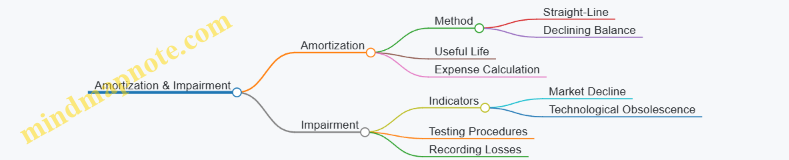
Step 8: Interactive Exercise
Try creating your own intangible asset schedule using the template below. Populate it with assets relevant to your organization or a hypothetical company.
| Asset Description | Asset Type | Acquisition Date | Cost/Fair Value | Useful Life (Years) | Amortization Method | Accumulated Amortization | Net Book Value | Impairment Losses | Notes |
|---|---|---|---|---|---|---|---|---|---|
Summary
An intangible asset schedule is a vital tool for accurate accounting and financial reporting. By systematically documenting each asset’s details, amortization, and impairment, accountants and analysts can ensure compliance and provide valuable insights for decision-making.
Use the mind maps and examples provided here as a guide to build and maintain your intangible asset schedules effectively.
12. Tools and Software for Intangible Asset Accounting
12.1 Overview of Accounting Software Supporting Intangible Asset Management
Managing intangible assets effectively requires specialized accounting software that can handle the unique challenges of recognition, valuation, amortization, impairment testing, and disclosure. This section provides a comprehensive overview of key software solutions and their features tailored to intangible asset management, supported by mind maps and practical examples.
Key Features of Intangible Asset Accounting Software
Popular Accounting Software for Intangible Asset Management
-
SAP S/4HANA Finance
- Integrated ERP solution with modules for asset accounting.
- Supports detailed tracking of intangible assets, amortization schedules, and impairment testing.
- Example: A multinational tech company uses SAP to manage its global portfolio of software licenses and patents, automating amortization and impairment workflows.
-
Oracle NetSuite
- Cloud-based financial management system.
- Provides customizable asset management features including intangible asset tracking.
- Example: A SaaS provider leverages NetSuite to track internally developed software costs and automate expense recognition.
-
Intangible Asset Management (IAM) Software by CPA Global
- Specialized software focusing on intellectual property and intangible assets.
- Offers valuation tools, renewal management, and compliance tracking.
- Example: A pharmaceutical company uses IAM software to manage patent portfolios, ensuring timely renewals and valuation updates.
-
Workiva
- Reporting and compliance platform with strong disclosure management.
- Facilitates preparation of financial statements including intangible asset notes.
- Example: Financial analysts use Workiva to streamline intangible asset disclosures for quarterly reports.
-
Fixed Asset Pro
- Asset management software supporting both tangible and intangible assets.
- Features include amortization tracking, impairment alerts, and customizable reports.
- Example: An accounting firm uses Fixed Asset Pro to maintain client intangible asset schedules and generate audit-ready reports.
Mind Map: Integration of Intangible Asset Software with Business Processes
Practical Example: Using Software to Manage Software Development Costs
Scenario: A tech company develops a new software product internally. The accounting team needs to track development costs, capitalize qualifying expenditures, amortize the asset over its useful life, and prepare disclosures.
Using Oracle NetSuite:
- Set up a dedicated intangible asset category for internally developed software.
- Record all development costs with appropriate project codes.
- Use the software’s amortization module to schedule straight-line amortization over 5 years.
- Generate reports showing capitalized costs, amortization expense, and net book value.
- Export data for inclusion in financial statements and audit documentation.
This streamlined process reduces errors, ensures compliance with IAS 38/ASC 350, and improves visibility for financial analysts.
Best Practices When Selecting Intangible Asset Accounting Software
In conclusion, selecting the right accounting software for intangible asset management is critical for finance and accounting professionals. The software should not only automate complex accounting processes but also provide robust reporting and integration capabilities to support strategic financial analysis and compliance. By leveraging these tools, accountants and financial analysts can enhance accuracy, efficiency, and transparency in managing intangible assets.
12.2 Features to Look for: Valuation, Amortization, and Impairment Modules
When selecting accounting software or tools specifically designed to manage intangible assets, it is crucial to ensure that the system includes robust modules for valuation, amortization, and impairment. These features help accountants and financial analysts maintain accuracy, compliance, and efficiency in intangible asset accounting.
Key Features Overview
Valuation Module Features
- Cost Tracking: Automatically capture all costs related to acquisition or internal development, including purchase price, legal fees, and development expenses.
- Fair Value Assessment: Tools to perform fair value calculations using accepted valuation methods such as relief-from-royalty, income, or market approaches.
- Valuation Method Selection: Ability to select and switch between valuation methods depending on asset type and regulatory requirements.
- Expert Valuation Integration: Capability to incorporate external valuation reports and expert inputs directly into the system.
Example: A tech company acquires a trademark and uses the relief-from-royalty method to value it. The software allows them to input projected royalty rates and discount rates, then automatically calculates the fair value.
Amortization Module Features
- Useful Life Management: Define and adjust the useful life of intangible assets based on company policy or updated estimates.
- Multiple Amortization Methods: Support for straight-line, declining balance, or other amortization methods to reflect the asset’s consumption pattern.
- Schedule Automation: Automatically generate amortization schedules and post amortization expenses to the general ledger.
- Adjustment Capabilities: Easily update amortization schedules if useful life or residual values change.
Example: An accounting firm capitalizes software development costs with a 5-year useful life. The software automatically calculates straight-line amortization expenses monthly and adjusts if the useful life is revised to 7 years.
Impairment Module Features
- Trigger Event Detection: Automated alerts based on financial indicators or market changes that may suggest impairment.
- Impairment Testing Workflow: Step-by-step guided process to perform impairment tests in compliance with IAS 36 or ASC 350.
- Recoverable Amount Calculation: Tools to calculate the higher of fair value less costs to sell and value in use.
- Documentation & Audit Trail: Maintain detailed records of assumptions, calculations, and decisions for audit purposes.
Example: Following a market downturn, a financial analyst receives an alert to test goodwill for impairment. The software guides through the impairment test, calculates recoverable amount, and generates a report for the audit file.
Combined Mind Map: Features and Benefits
Best Practices When Using These Modules
- Regularly Update Assumptions: Ensure discount rates, useful lives, and other inputs reflect current market and company conditions.
- Maintain Clear Documentation: Use the software’s audit trail features to keep detailed records for internal and external audits.
- Train Staff Thoroughly: Ensure accountants and analysts understand how to use each module effectively.
- Integrate with ERP Systems: Seamless integration reduces manual errors and improves data consistency.
By focusing on these features in valuation, amortization, and impairment modules, finance professionals can better manage intangible assets, ensure compliance, and provide more insightful financial analysis.
12.3 Practical Example: Using ERP Systems to Track Intangible Assets
Enterprise Resource Planning (ERP) systems have become indispensable tools for organizations to efficiently manage their intangible assets. These systems integrate various accounting, financial, and operational processes into a single platform, enabling real-time tracking, valuation, amortization, and reporting of intangible assets.
Why Use ERP Systems for Intangible Assets?
- Centralized data management
- Automated amortization schedules
- Streamlined impairment testing
- Enhanced compliance with accounting standards
- Improved audit trails and documentation
Key Features of ERP Systems for Intangible Asset Management
Step-by-Step Example: Tracking a Patent Using an ERP System
Scenario: A tech company acquires a patent for $500,000 and wants to track its amortization over 10 years using their ERP system.
-
Asset Creation:
- Enter patent details: acquisition date, cost, useful life (10 years), residual value (usually zero).
- Assign asset category: “Intangible Assets > Patents”.
-
Amortization Setup:
- Select amortization method: straight-line.
- Define amortization start date and frequency (monthly/quarterly).
-
Integration:
- Link asset to general ledger accounts for cost and amortization expense.
-
Monitoring:
- ERP automatically calculates monthly amortization: $500,000 / 10 years / 12 months = $4,166.67.
- Generates amortization journal entries.
-
Reporting:
- Generate reports showing net book value, accumulated amortization, and remaining useful life.
-
Impairment Testing:
- Schedule periodic impairment reviews.
- Record impairment losses directly in the system if needed.
Mind Map: Patent Tracking Workflow in ERP
Additional Examples of Intangible Assets Managed via ERP
| Asset Type | Key Tracking Elements | Example Use Case |
|---|---|---|
| Trademarks | Registration date, renewal fees, amortization | Tracking trademark renewal costs and amortization schedules |
| Software Licenses | License period, cost, usage metrics | Managing software subscriptions and capitalized development costs |
| Customer Lists | Acquisition cost, contract duration | Amortizing customer lists over contract life |
Best Practices When Using ERP Systems for Intangible Assets
- Consistent Data Entry: Ensure all intangible assets are entered with complete and accurate information.
- Regular Updates: Update useful life and impairment indicators regularly.
- User Training: Train accounting and finance teams on ERP functionalities related to intangible assets.
- Audit Trails: Utilize ERP audit logs to maintain compliance and facilitate external audits.
- Integration: Ensure ERP modules for accounting, tax, and asset management are well integrated.
Summary
Using ERP systems to track intangible assets like patents, trademarks, and software licenses streamlines accounting processes, improves accuracy, and enhances compliance. By automating amortization, facilitating impairment testing, and centralizing data, ERP solutions empower accountants and financial analysts to maintain up-to-date and transparent intangible asset records.
For organizations in the finance and tech sectors, leveraging ERP capabilities is a best practice that supports robust intangible asset management and insightful financial reporting.
12.4 Best Practice: Integrating Accounting Tools with Financial Reporting
Integrating accounting tools with financial reporting systems is essential for ensuring accuracy, efficiency, and compliance in intangible asset accounting. This integration streamlines data flow, reduces manual errors, and provides real-time insights, enabling accountants and financial analysts to make informed decisions.
Key Benefits of Integration
- Automated Data Synchronization: Eliminates manual data entry and ensures consistency across systems.
- Real-Time Reporting: Enables up-to-date financial statements reflecting current intangible asset values.
- Improved Audit Trails: Maintains comprehensive records for compliance and audit purposes.
- Enhanced Decision-Making: Provides timely insights through dashboards and analytics.
Mind Map: Integration Workflow
Practical Example: Integrating ERP with Financial Reporting for Intangible Assets
Scenario: A mid-sized tech company uses an ERP system to manage its intangible assets, including software licenses and patents. The finance team integrates the ERP with their financial reporting software to automate amortization schedules and impairment testing results.
Process:
- Data Capture: The ERP system records acquisition costs, useful lives, and amortization methods.
- Automated Calculations: Amortization expenses and impairment indicators are calculated within the ERP.
- Data Export: Monthly amortization and impairment data are automatically exported to the financial reporting system.
- Financial Statement Update: The reporting system updates the balance sheet and income statement accordingly.
- Audit Trail: All transactions and adjustments are logged for audit purposes.
Outcome: The integration reduces manual reconciliation time by 40%, minimizes errors, and ensures compliance with IFRS and US GAAP disclosures.
Mind Map: Best Practices for Integration
Additional Example: Using Cloud-Based Accounting Tools
A financial analyst at a SaaS company leverages cloud-based accounting software integrated with their reporting platform. This setup allows:
- Multi-User Access: Teams across departments update intangible asset data simultaneously.
- Version Control: Changes are tracked and reversible.
- Custom Reporting: Automated reports tailored to intangible asset KPIs.
This integration supports dynamic decision-making and timely investor reporting.
Summary
Integrating accounting tools with financial reporting systems is a critical best practice for managing intangible assets effectively. It ensures data integrity, enhances reporting accuracy, and supports compliance with accounting standards. By adopting robust integration strategies, finance professionals can deliver more reliable financial insights and streamline their workflows.
12.5 Future Innovations: AI and Automation in Intangible Asset Accounting
The rapid advancement of Artificial Intelligence (AI) and automation technologies is transforming the landscape of intangible asset accounting. These innovations promise to enhance accuracy, efficiency, and insight, enabling accountants and financial analysts to better manage complex intangible assets.
Key Areas Where AI and Automation Impact Intangible Asset Accounting
Automated Recognition and Classification
AI-powered tools can scan contracts, patents, trademarks, and other legal documents to automatically identify and classify intangible assets. For example, a financial analyst can upload a batch of acquisition agreements, and the system will highlight intangible assets such as customer lists, software licenses, or brand names, tagging them with relevant accounting treatment suggestions.
Example:
- A tech company uses an AI contract analysis tool that flags a newly acquired software license as an intangible asset, automatically extracting the acquisition cost and useful life for accounting entries.
Enhanced Valuation Models
Machine learning algorithms can analyze historical data, market trends, and industry benchmarks to provide more accurate and dynamic valuations of intangible assets. These models can adapt to new information, improving over time.
Example:
- An AI valuation model uses historical royalty rates, market growth data, and competitor analysis to estimate the fair value of a trademark, updating the valuation quarterly.
Automated Amortization and Impairment Testing
Automation tools can schedule amortization based on predefined useful lives and automatically adjust calculations when changes occur. AI can monitor financial and operational indicators to suggest impairment tests proactively.
Example:
- An accounting system automatically recalculates amortization schedules when a patent’s useful life is revised and triggers an AI alert when revenue from a related product declines, indicating potential impairment.
Streamlined Compliance and Reporting
AI-driven platforms can generate required disclosures and financial statement notes by pulling data directly from accounting systems, ensuring consistency and reducing manual errors.
Example:
- A financial analyst uses an AI-powered reporting tool that compiles intangible asset schedules and generates IFRS-compliant disclosure notes in minutes.
Risk Management and Fraud Detection
AI can analyze transaction patterns and flag unusual activities related to intangible asset acquisitions or valuations, helping prevent fraud and ensuring data integrity.
Example:
- An AI system detects an abnormal spike in intangible asset valuations during an acquisition, prompting further investigation.
Mind Map: AI-Driven Workflow for Intangible Asset Accounting
Practical Example: Implementing AI in a SaaS Company’s Intangible Asset Accounting
Scenario: A SaaS company acquires a competitor, gaining multiple intangible assets including software licenses, customer contracts, and brand names.
Traditional Approach: Manual review of acquisition documents, spreadsheets for valuation, and manual amortization schedules.
AI-Enabled Approach:
- Upload acquisition documents into an AI-powered contract analysis tool.
- Automatically extract and classify intangible assets.
- Use AI valuation models to estimate fair values based on market data.
- Automate amortization schedules and impairment monitoring.
- Generate IFRS-compliant disclosures with minimal manual input.
Outcome: Significant time savings, improved accuracy, and enhanced ability to focus on strategic financial analysis.
Best Practices for Leveraging AI and Automation
- Start Small: Pilot AI tools on specific processes like contract analysis before full-scale implementation.
- Data Quality: Ensure high-quality, structured data inputs for AI accuracy.
- Cross-Functional Collaboration: Involve IT, finance, and legal teams to align AI capabilities with accounting requirements.
- Continuous Learning: Regularly update AI models with new data and regulatory changes.
- Maintain Human Oversight: Use AI as an aid, not a replacement, ensuring expert review of critical judgments.
Conclusion
AI and automation are revolutionizing intangible asset accounting by enabling faster, more accurate, and insightful processes. Accountants and financial analysts who embrace these technologies will be better equipped to handle the complexities of intangible assets, drive compliance, and provide strategic value to their organizations.
13. Summary and Best Practices Checklist
13.1 Recap of Key Accounting Principles for Intangible Assets
Accounting for intangible assets requires a clear understanding of their unique characteristics and the relevant accounting standards. This section summarizes the core principles that accountants and financial analysts must keep in mind.
Key Accounting Principles Mind Map
Recognition of Intangible Assets
Principle: An intangible asset should be recognized if it is identifiable, the entity controls it, it is probable that future economic benefits will flow to the entity, and its cost can be measured reliably.
Example:
- A software company acquires a patent for a new algorithm. Since the patent is identifiable, controlled by the company, expected to generate future revenue, and purchased at a known cost, it qualifies for recognition as an intangible asset.
Measurement of Intangible Assets
Initial Measurement:
- Intangible assets are initially measured at cost, which includes purchase price and any directly attributable costs necessary to prepare the asset for use.
Subsequent Measurement:
- Cost Model: Asset carried at cost less accumulated amortization and impairment losses.
- Revaluation Model: Asset carried at fair value less subsequent amortization and impairment (only if fair value can be reliably measured).
Example:
- A company purchases a trademark for $500,000. It incurs $20,000 in legal fees to register it. Initial cost = $520,000.
- Later, if the company opts for the cost model, it amortizes this amount over the trademark’s useful life.
Internally Generated Intangible Assets
Research Phase: Costs are expensed as incurred.
Development Phase: Costs can be capitalized only if specific criteria are met (technical feasibility, intention to complete, ability to use or sell, probable future economic benefits, availability of resources, ability to measure costs reliably).
Example:
- A tech firm spends $1 million on R&D. The first $600,000 is research (expensed). The remaining $400,000 meets capitalization criteria and is recorded as an intangible asset.
Amortization
Useful Life:
- Determined based on expected usage, legal or contractual limits, and obsolescence.
- Can be finite or indefinite (indefinite-life assets are not amortized but tested for impairment).
Methods:
- Straight-line is most common.
Example:
- Customer list purchased for $200,000 with a 5-year contract life is amortized straight-line at $40,000 per year.
Impairment
Indicators:
- Significant decline in market value
- Adverse changes in business environment
- Legal or regulatory changes
Testing:
- Compare carrying amount with recoverable amount; recognize impairment loss if carrying amount exceeds recoverable amount.
Example:
- After a market downturn, a company tests goodwill acquired in an acquisition and recognizes a $1 million impairment loss.
Disclosures
Entities must disclose:
- Nature and useful lives of intangible assets
- Amortization methods and periods
- Impairment losses recognized or reversed
- Reconciliation of carrying amounts at beginning and end of period
Example:
- A financial analyst reviewing a tech company’s financial statements notes detailed disclosures on software development costs, amortization schedules, and impairment tests, aiding in valuation.
Summary Table of Key Principles and Examples
| Principle | Description | Example |
|---|---|---|
| Recognition | Identifiable, controlled, probable benefits, measurable cost | Patent acquired by software company |
| Initial Measurement | Cost includes purchase price + directly attributable costs | Trademark purchase + legal fees |
| Internally Generated Intangibles | Research expensed, development capitalized if criteria met | R&D costs split between research and development |
| Amortization | Based on useful life; straight-line method common | Customer list amortized over contract period |
| Impairment | Test when indicators present; recognize loss if impaired | Goodwill impairment after market downturn |
| Disclosures | Nature, useful life, amortization, impairment, reconciliation | Detailed notes on software assets |
This recap serves as a foundational reference to ensure consistent and compliant accounting treatment of intangible assets, enabling accurate financial analysis and reporting.
13.2 Comprehensive Best Practices for Recognition, Measurement, and Reporting
Accounting for intangible assets requires a structured approach to ensure accuracy, compliance, and transparency. Below is a detailed guide on best practices across recognition, measurement, and reporting, enriched with mind maps and practical examples.
Recognition Best Practices
-
Identify and Document Intangibles Clearly
- Ensure assets meet the criteria of identifiability, control, and future economic benefits.
- Maintain detailed documentation supporting recognition decisions.
-
Distinguish Between Internally Generated and Acquired Intangibles
- Capitalize development costs only when strict criteria are met.
- Expense research costs immediately.
-
Apply Relevant Accounting Standards Consistently
- Use IAS 38 or ASC 350 as applicable.
Mind Map: Recognition Process
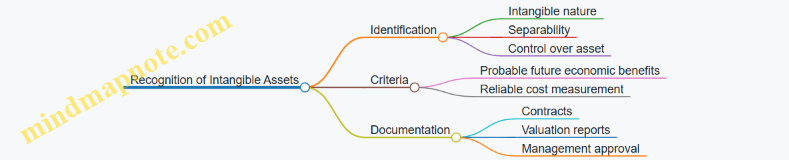
Example: A software company develops a new proprietary algorithm. During the research phase, all costs are expensed. Once the project moves to development and meets capitalization criteria (technical feasibility, intention to complete, ability to use or sell, etc.), costs are capitalized as an intangible asset.
Measurement Best Practices
-
Initial Measurement at Cost
- Include purchase price, directly attributable costs, and any costs to prepare the asset for use.
-
Choose Appropriate Subsequent Measurement Model
- Cost model: asset carried at cost less amortization and impairment.
- Revaluation model: asset carried at fair value less subsequent amortization and impairment (only if fair value can be reliably measured).
-
Engage Valuation Experts for Complex Assets
- Particularly for trademarks, customer lists, or data-related intangibles.
-
Regularly Review Useful Lives and Residual Values
- Adjust amortization schedules as necessary.
Mind Map: Measurement Workflow
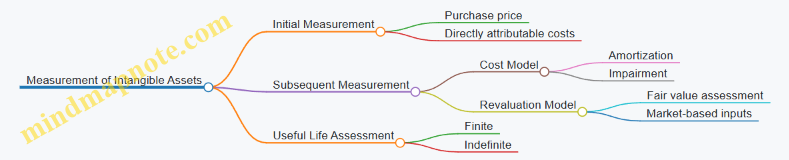
Example: A company acquires a trademark for $500,000. Direct costs related to registration and legal fees amount to $20,000. Initial recognition is $520,000. The company opts for the cost model and amortizes the trademark over 10 years using straight-line amortization.
Reporting Best Practices
-
Disclose Key Information Transparently
- Nature and carrying amounts of intangible assets.
- Amortization methods and useful lives.
- Impairment losses recognized.
-
Provide Reconciliation of Carrying Amounts
- Opening balance, additions, disposals, amortization, impairment, and closing balance.
-
Highlight Judgments and Estimates
- Useful life determination.
- Impairment assumptions.
-
Use Clear and Consistent Presentation Formats
- Align disclosures with regulatory requirements.
Mind Map: Reporting Components
Example: In the annual report, a tech company discloses its intangible assets schedule showing a $2 million software portfolio. It explains the straight-line amortization over 5 years and notes an impairment loss of $200,000 due to market changes. The company also details assumptions used in impairment testing.
Summary Table of Best Practices
| Area | Best Practice | Example |
|---|---|---|
| Recognition | Document control and future benefits clearly | Capitalizing development costs for software |
| Measurement | Use cost or revaluation model appropriately | Trademark acquisition and amortization |
| Reporting | Disclose detailed reconciliations and assumptions | Annual report with impairment notes |
By following these comprehensive best practices, accountants and financial analysts can ensure intangible assets are recognized, measured, and reported accurately, enhancing financial statement reliability and decision-making.
13.3 Practical Tips for Maintaining Compliance and Accuracy
Maintaining compliance and accuracy in accounting for intangible assets is crucial for ensuring reliable financial reporting and meeting regulatory requirements. Below are practical tips, supported by mind maps and examples, to help accountants and financial analysts navigate this complex area effectively.
Tip 1: Establish Clear Policies and Procedures
- Develop comprehensive accounting policies aligned with IFRS (IAS 38) and US GAAP (ASC 350).
- Define criteria for recognition, measurement, amortization, and impairment.
- Ensure policies are documented and regularly updated.
Mind Map: Establish Clear Policies
Example: A mid-sized software company formalized its intangible asset policy, specifying that all internally developed software costs meeting development phase criteria are capitalized, while research costs are expensed immediately. This clarity helped reduce audit queries and improved consistency.
Tip 2: Maintain Detailed Documentation and Audit Trails
- Record all relevant supporting documents for recognition and valuation decisions.
- Keep contracts, purchase agreements, valuation reports, and impairment test results.
- Document assumptions and methodologies used.
Mind Map: Documentation and Audit Trails
Example: When acquiring a patent, a technology firm attached the purchase agreement, independent valuation report, and management approval memo to the intangible asset record. This thorough documentation facilitated smooth external audits.
Tip 3: Regularly Review Useful Lives and Amortization Methods
- Conduct periodic assessments of the useful life estimates based on market conditions and technological changes.
- Adjust amortization schedules accordingly to reflect realistic consumption of economic benefits.
Mind Map: Useful Life Review
Example: A financial analyst at a tech company noticed rapid obsolescence in a software product line and recommended shortening the amortization period from 10 to 5 years, reflecting the asset’s economic reality and improving financial statement accuracy.
Tip 4: Perform Timely and Thorough Impairment Testing
- Identify impairment indicators such as declining market value, adverse legal changes, or poor financial performance.
- Follow prescribed impairment testing procedures and document findings.
Mind Map: Impairment Testing Process
Example: After a competitor launched a superior product, a company performed an impairment test on its customer list intangible asset and recognized a $2 million impairment loss, ensuring the financial statements reflected current asset values.
Tip 5: Leverage Technology and Accounting Software
- Use ERP and specialized accounting software to track intangible assets, automate amortization, and schedule impairment tests.
- Ensure software is configured to comply with relevant accounting standards.
Mind Map: Technology Utilization
Example: A multinational corporation implemented an ERP module dedicated to intangible asset management, which automated amortization calculations and generated alerts for impairment testing deadlines, reducing manual errors and improving compliance.
Tip 6: Continuous Training and Staying Updated
- Provide regular training sessions for accounting and finance teams on evolving standards and best practices.
- Monitor regulatory updates and industry trends affecting intangible asset accounting.
Mind Map: Training and Updates

Example: An accounting firm held quarterly workshops to update its staff on new guidance related to digital assets and data valuation, enabling them to advise clients accurately and maintain compliance.
Summary Table of Practical Tips
| Tip Number | Practical Tip | Key Action Points | Example Context |
|---|---|---|---|
| 1 | Establish Clear Policies | Document recognition & measurement criteria | Software capitalization policy |
| 2 | Maintain Documentation | Keep contracts, valuations, assumptions | Patent acquisition documentation |
| 3 | Review Useful Lives Regularly | Adjust amortization based on market changes | Shortening software amortization |
| 4 | Perform Impairment Testing Timely | Identify indicators, document tests | Impairment on customer list |
| 5 | Leverage Technology | Use ERP/software for tracking & automation | ERP intangible asset module |
| 6 | Continuous Training & Updates | Regular training, monitor standards | Quarterly workshops on digital assets |
By following these practical tips, accountants and financial analysts can enhance the accuracy, transparency, and compliance of intangible asset accounting, ultimately supporting better financial decision-making and reporting integrity.
13.4 Example Checklist: Steps to Ensure Proper Intangible Asset Accounting
Proper accounting for intangible assets is critical for accurate financial reporting and compliance. Below is a detailed checklist designed to guide accountants and financial analysts through the key steps, supplemented with mind maps and practical examples.
Step 1: Identification of Intangible Assets
- Confirm the asset is non-physical and identifiable.
- Determine if the asset is separable or arises from contractual/legal rights.
Example: A software license purchased by a tech company is identifiable and separable, qualifying as an intangible asset.
Step 2: Assess Control and Future Economic Benefits
- Verify the company has control over the asset.
- Evaluate if the asset is expected to generate probable future economic benefits.
Example: A patent owned by a pharmaceutical firm grants exclusive rights, ensuring control and expected future cash flows.
Step 3: Determine Recognition Criteria
- Confirm the asset meets recognition criteria under relevant accounting standards (IAS 38, ASC 350).
- Ensure reliable measurement of cost.
Example: Development costs for a new app are capitalized only after technological feasibility is established.
Step 4: Initial Measurement and Cost Capitalization
- Identify all directly attributable costs (purchase price, legal fees, development costs).
- Capitalize costs that meet criteria; expense others.
Example: Legal fees incurred to register a trademark are capitalized as part of the asset cost.
Step 5: Determine Useful Life and Amortization Method
- Assess whether the asset has a finite or indefinite useful life.
- Select an appropriate amortization method (straight-line commonly).
Example: Customer lists are amortized over the expected contract period of 5 years using straight-line amortization.
Step 6: Perform Regular Impairment Testing
- Identify indicators of impairment (market decline, obsolescence).
- Conduct impairment tests annually or when triggered.
Example: After a competitor releases superior technology, a software patent’s recoverable amount is tested and found impaired.
Step 7: Maintain Detailed Documentation and Disclosures
- Keep records of recognition, measurement, amortization, and impairment decisions.
- Prepare disclosures as required by IFRS/US GAAP.
Example: Disclose the carrying amount, amortization expense, and impairment losses related to intangible assets in the annual report.
Step 8: Coordinate with Tax and Legal Teams
- Align accounting treatment with tax regulations.
- Ensure compliance with intellectual property laws.
Example: Collaborate with tax advisors to apply appropriate tax amortization schedules for acquired patents.
Step 9: Review and Update Policies Regularly
- Update accounting policies to reflect changes in standards or business environment.
- Train staff on best practices.
Example: After IFRS updates, revise internal policies to incorporate new guidance on intangible asset revaluation.
Summary Checklist Table
| Step | Action Item | Example |
|---|---|---|
| 1 | Identify intangible assets | Software license purchase |
| 2 | Assess control & benefits | Patent ownership in pharma |
| 3 | Confirm recognition criteria | Capitalize post-feasibility development costs |
| 4 | Measure and capitalize costs | Legal fees for trademark registration |
| 5 | Determine useful life & amortize | Amortize customer lists over 5 years |
| 6 | Conduct impairment testing | Test software patent after market changes |
| 7 | Document & disclose | Annual report notes on intangibles |
| 8 | Coordinate tax & legal | Tax amortization for patents |
| 9 | Review policies regularly | Update for IFRS changes |
By following this checklist, accountants and financial analysts can ensure comprehensive, compliant, and transparent accounting for intangible assets, enhancing the reliability of financial statements and supporting informed decision-making.
13.5 Final Thoughts: Enhancing Financial Analysis Through Intangible Asset Insights
Intangible assets have become a cornerstone of value creation in today’s knowledge-driven economy, especially within the finance and tech sectors. For accountants and financial analysts, understanding and effectively analyzing these assets is crucial not only for accurate financial reporting but also for strategic decision-making and valuation.
Why Intangible Asset Insights Matter in Financial Analysis
- Value Recognition: Intangible assets often represent a significant portion of a company’s market value, especially in tech firms where intellectual property, software, and brand equity drive competitive advantage.
- Risk Assessment: Proper accounting and impairment testing reveal potential risks related to asset obsolescence or market changes.
- Investment Decisions: Investors rely on transparent intangible asset disclosures to assess future growth prospects.
- Performance Measurement: Amortization and impairment impact earnings and cash flow, influencing financial ratios.
Mind Map: Key Areas of Financial Analysis Enhanced by Intangible Asset Insights
Practical Example: Enhancing Valuation with Intangible Asset Analysis
Consider a tech company, TechNova, with significant intangible assets including patents, proprietary software, and customer relationships. Traditional financial analysis focusing only on tangible assets undervalues the company’s worth.
- Step 1: Identify and classify intangible assets separately in the balance sheet.
- Step 2: Apply appropriate valuation methods (e.g., relief-from-royalty for trademarks).
- Step 3: Adjust cash flow projections to incorporate the economic benefits derived from these assets.
- Step 4: Analyze amortization schedules and impairment risks to forecast earnings accurately.
Outcome: Investors and analysts gain a clearer picture of TechNova’s intrinsic value and growth potential, leading to better-informed investment and strategic decisions.
Mind Map: Integrating Intangible Asset Insights into Financial Models
Best Practices for Leveraging Intangible Asset Insights in Financial Analysis
- Maintain Detailed Asset Registers: Track all intangible assets with relevant valuation and amortization data.
- Regularly Review Useful Lives and Impairment Indicators: Ensure assumptions reflect current market and technological conditions.
- Collaborate with Valuation Experts: For complex assets, expert input enhances accuracy.
- Incorporate Intangible Asset Data into Forecasting Models: Reflect their impact on revenue and cost structures.
- Enhance Disclosure Quality: Provide transparent, detailed notes to support analysis.
Summary
By integrating intangible asset insights into financial analysis, accountants and financial analysts can unlock a deeper understanding of a company’s true economic value and risk profile. This holistic approach supports more accurate valuations, better risk management, and informed strategic decisions, ultimately driving stronger financial performance and stakeholder confidence.