Financial Ratio Analysis
1. Introduction to Financial Ratio Analysis
1.1 Understanding Financial Ratios: Definition and Importance
Financial ratios are quantitative measures derived from a company’s financial statements, used to evaluate various aspects of its performance and financial health. They provide critical insights into profitability, liquidity, solvency, efficiency, and market valuation, enabling accountants and financial analysts to make informed decisions.
What Are Financial Ratios?
Financial ratios are calculated by dividing one financial metric by another, typically using figures from the balance sheet, income statement, or cash flow statement. These ratios standardize financial data, making it easier to compare companies of different sizes or analyze trends over time.
Why Are Financial Ratios Important?
- Simplify Complex Data: Ratios distill large volumes of financial data into understandable metrics.
- Benchmarking: They allow comparison against industry standards or competitors.
- Trend Analysis: Ratios help track performance changes over multiple periods.
- Decision-Making: They support investment, credit, and management decisions.
- Risk Assessment: Ratios identify financial strengths and vulnerabilities.
Mind Map: Core Concepts of Financial Ratios
Example 1: Basic Ratio Calculation
Consider the following simplified financial data for Company A:
| Metric | Amount (USD) |
|---|---|
| Current Assets | 150,000 |
| Current Liabilities | 100,000 |
| Net Income | 50,000 |
| Total Equity | 200,000 |
-
Current Ratio = Current Assets / Current Liabilities = 150,000 / 100,000 = 1.5
- Interpretation: Company A has $1.50 in current assets for every $1 of current liabilities, indicating reasonable short-term liquidity.
-
Return on Equity (ROE) = Net Income / Total Equity = 50,000 / 200,000 = 0.25 or 25%
- Interpretation: Company A generates a 25% return on shareholders’ equity, reflecting strong profitability.
Mind Map: Example 1 Breakdown
Best Practices When Using Financial Ratios
- Use Multiple Ratios: Avoid relying on a single ratio; analyze a combination to get a holistic view.
- Compare Within Industry: Ratios vary by industry; benchmark against relevant peers.
- Analyze Trends Over Time: Look at ratios across multiple periods to identify patterns.
- Understand Context: Consider external factors like economic conditions or company strategy.
- Verify Data Accuracy: Ensure financial statements are accurate and consistent.
Example 2: Contextualizing Ratios
Suppose Company B has a current ratio of 0.8, which might seem low. However, if Company B operates in an industry with fast inventory turnover and strong cash flows, this ratio might be acceptable.
Mind Map: Best Practices Summary
In summary, understanding financial ratios is foundational for accountants and financial analysts. They transform raw financial data into actionable insights, enabling better evaluation of a company’s financial condition and guiding strategic decisions.
1.2 Types of Financial Ratios: An Overview
Financial ratios are essential tools that help accountants and financial analysts evaluate the financial health, performance, and stability of a company. These ratios are broadly categorized into several types, each focusing on a different aspect of the business. Understanding these categories and their applications is critical for effective financial analysis.
Major Types of Financial Ratios
Below is a mind map that summarizes the primary categories of financial ratios:
Liquidity Ratios
Purpose: Measure a company’s ability to meet short-term obligations.
- Current Ratio = Current Assets / Current Liabilities
- Quick Ratio = (Current Assets - Inventory) / Current Liabilities
- Cash Ratio = Cash and Cash Equivalents / Current Liabilities
Example:
A company has current assets of $150,000, inventory of $50,000, and current liabilities of $100,000.
- Current Ratio = 150,000 / 100,000 = 1.5
- Quick Ratio = (150,000 - 50,000) / 100,000 = 1.0
- Cash Ratio (assume cash = $30,000) = 30,000 / 100,000 = 0.3
This indicates the company has enough assets to cover its short-term debts, but the cash ratio suggests limited immediate cash availability.
Solvency Ratios
Purpose: Assess long-term financial stability and debt management.
- Debt to Equity Ratio = Total Debt / Shareholders’ Equity
- Interest Coverage Ratio = EBIT / Interest Expense
- Debt Ratio = Total Debt / Total Assets
Example:
If a company has total debt of $200,000, shareholders’ equity of $400,000, EBIT of $80,000, and interest expense of $20,000:
- Debt to Equity Ratio = 200,000 / 400,000 = 0.5
- Interest Coverage Ratio = 80,000 / 20,000 = 4
- Debt Ratio (assume total assets = $600,000) = 200,000 / 600,000 = 0.33
This suggests moderate leverage and a comfortable ability to cover interest payments.
Profitability Ratios
Purpose: Evaluate the company’s ability to generate profit relative to sales, assets, or equity.
- Gross Profit Margin = (Revenue - Cost of Goods Sold) / Revenue
- Operating Profit Margin = Operating Income / Revenue
- Net Profit Margin = Net Income / Revenue
- Return on Assets (ROA) = Net Income / Total Assets
- Return on Equity (ROE) = Net Income / Shareholders’ Equity
Example:
A company reports revenue of $500,000, COGS of $300,000, operating income of $100,000, net income of $70,000, total assets of $700,000, and equity of $350,000.
- Gross Profit Margin = (500,000 - 300,000) / 500,000 = 0.4 or 40%
- Operating Profit Margin = 100,000 / 500,000 = 0.2 or 20%
- Net Profit Margin = 70,000 / 500,000 = 0.14 or 14%
- ROA = 70,000 / 700,000 = 0.1 or 10%
- ROE = 70,000 / 350,000 = 0.2 or 20%
These ratios indicate the company is profitable and efficiently using its assets and equity.
Efficiency Ratios
Purpose: Measure how well the company utilizes its assets and manages liabilities.
- Inventory Turnover = Cost of Goods Sold / Average Inventory
- Accounts Receivable Turnover = Net Credit Sales / Average Accounts Receivable
- Accounts Payable Turnover = Cost of Goods Sold / Average Accounts Payable
- Asset Turnover = Revenue / Average Total Assets
Example:
If COGS is $400,000, average inventory is $80,000, net credit sales are $450,000, average accounts receivable is $50,000, average accounts payable is $40,000, and average total assets are $600,000:
- Inventory Turnover = 400,000 / 80,000 = 5 times
- Accounts Receivable Turnover = 450,000 / 50,000 = 9 times
- Accounts Payable Turnover = 400,000 / 40,000 = 10 times
- Asset Turnover = 500,000 / 600,000 = 0.83 times
Higher turnover ratios generally indicate efficient management.
Market Ratios
Purpose: Reflect market perceptions and valuation of the company.
- Earnings Per Share (EPS) = Net Income / Number of Outstanding Shares
- Price to Earnings (P/E) Ratio = Market Price per Share / EPS
- Dividend Yield = Annual Dividends per Share / Market Price per Share
- Market to Book Ratio = Market Value per Share / Book Value per Share
Example:
A company has net income of $1,000,000, 500,000 shares outstanding, market price per share of $40, and annual dividends of $2 per share.
- EPS = 1,000,000 / 500,000 = $2
- P/E Ratio = 40 / 2 = 20
- Dividend Yield = 2 / 40 = 0.05 or 5%
- Market to Book Ratio (assume book value per share is $25) = 40 / 25 = 1.6
These ratios help investors assess the attractiveness and valuation of the stock.
Summary Mind Map: Types of Financial Ratios with Examples
By mastering these types of financial ratios and understanding their practical applications through examples, accountants and financial analysts can provide insightful evaluations that drive informed decision-making and strategic planning.
1.3 Best Practices for Conducting Ratio Analysis
Financial ratio analysis is a powerful tool for accountants and financial analysts to evaluate a company’s financial health, performance, and trends. However, to maximize its effectiveness, certain best practices should be followed. Below, we explore these best practices with detailed explanations, mind maps, and practical examples.
Best Practices Overview Mind Map
Understand the Context
Before diving into ratio calculations, it’s essential to understand the environment in which the company operates.
- Industry Norms: Different industries have different financial structures. For example, retail companies often have lower profit margins but higher inventory turnover compared to manufacturing firms.
- Economic Environment: Economic cycles impact ratios like liquidity and solvency. During recessions, liquidity ratios may tighten.
Example: A financial analyst comparing the current ratio of a tech startup to a traditional manufacturing company should recognize that tech firms often maintain lower current ratios due to different working capital needs.
Use Reliable and Consistent Data
Financial ratios are only as good as the data behind them.
- Ensure financial statements are audited or reviewed.
- Use consistent accounting policies across periods to maintain comparability.
Example: If a company changes its inventory valuation method from FIFO to LIFO, the inventory turnover ratio will be affected. Analysts should adjust or note this change when comparing periods.
Compare Against Benchmarks
Ratios alone have limited meaning without a benchmark.
- Use historical company data to identify trends.
- Compare with industry averages or competitors to gauge relative performance.
Example: A current ratio of 1.5 might seem healthy, but if the industry average is 2.5, it may indicate potential liquidity concerns.
Analyze Trends Over Time
Single-period analysis can be misleading. Trend analysis reveals the direction and sustainability of financial performance.
- Track ratios over multiple periods.
- Adjust for seasonal effects if applicable.
Example: A declining gross profit margin over three years may signal rising costs or pricing pressure.
Combine Multiple Ratios
No single ratio tells the whole story. Combining ratios provides a more comprehensive view.
- Pair liquidity ratios with solvency ratios to assess both short-term and long-term financial health.
- Combine profitability ratios with efficiency ratios to understand how well assets generate profit.
Example: A company with a strong ROE but poor liquidity ratios might be profitable but at risk of short-term cash flow problems.
Consider Limitations
Be aware of the inherent limitations in ratio analysis.
- Differences in accounting policies can distort comparisons.
- One-time events (e.g., asset sales) can skew ratios temporarily.
Example: A spike in net profit margin due to a one-time gain should be adjusted or noted when analyzing profitability.
Communicate Findings Clearly
Present ratio analysis results in an understandable and actionable manner.
- Use charts and graphs to visualize trends.
- Summarize key insights and recommendations.
Example: A dashboard showing liquidity and solvency ratios side-by-side over five years helps management quickly grasp financial stability.
Mind Map: Combining Best Practices in Workflow
Practical Example: Applying Best Practices
Scenario: An analyst is evaluating Company ABC’s financial health using the current ratio.
- Step 1: Collect ABC’s financial statements for the past 3 years.
- Step 2: Note that ABC operates in the retail industry, where the average current ratio is 1.8.
- Step 3: Calculate current ratios:
- Year 1: 1.6
- Year 2: 1.7
- Year 3: 1.5
- Step 4: Compare with industry average (1.8) and observe a downward trend.
- Step 5: Investigate reasons — ABC increased short-term liabilities to finance expansion.
- Step 6: Communicate findings with a line chart showing the trend and a recommendation to monitor liquidity closely.
This example illustrates how understanding context, benchmarking, trend analysis, and clear communication come together to create insightful ratio analysis.
By following these best practices, accountants and financial analysts can enhance the accuracy, relevance, and impact of their financial ratio analyses.
1.4 Example: Basic Ratio Calculation Using a Sample Financial Statement
To understand financial ratio analysis, let’s walk through a simple example using a sample company’s financial statement. This will help illustrate how to calculate and interpret basic financial ratios.
Sample Financial Statement (Simplified)
| Account | Amount (USD) |
|---|---|
| Current Assets | 150,000 |
| Inventory | 50,000 |
| Current Liabilities | 100,000 |
| Total Assets | 500,000 |
| Total Liabilities | 200,000 |
| Shareholders’ Equity | 300,000 |
| Net Sales | 600,000 |
| Cost of Goods Sold | 400,000 |
| Operating Expenses | 100,000 |
| Interest Expense | 10,000 |
| Net Income | 50,000 |
Step 1: Calculate Liquidity Ratios
Current Ratio
Formula:
\[ \text{Current Ratio} = \frac{\text{Current Assets}}{\text{Current Liabilities}} \]
Calculation:
\[ \frac{150,000}{100,000} = 1.5 \]
Interpretation:
A current ratio of 1.5 means the company has $1.50 in current assets for every $1 of current liabilities, indicating reasonable short-term financial health.
Quick Ratio (Acid-Test Ratio)
Formula:
\[ \text{Quick Ratio} = \frac{\text{Current Assets} - \text{Inventory}}{\text{Current Liabilities}} \]
Calculation:
\[ \frac{150,000 - 50,000}{100,000} = \frac{100,000}{100,000} = 1.0 \]
Interpretation:
A quick ratio of 1.0 suggests the company can cover its current liabilities without relying on inventory sales, which is a more conservative liquidity measure.
Step 2: Calculate Solvency Ratios
Debt to Equity Ratio
Formula:
\[ \text{Debt to Equity} = \frac{\text{Total Liabilities}}{\text{Shareholders’ Equity}} \]
Calculation:
\[ \frac{200,000}{300,000} = 0.67 \]
Interpretation:
This means the company has $0.67 of debt for every $1 of equity, indicating moderate leverage.
Step 3: Calculate Profitability Ratios
Gross Profit Margin
Formula:
\[ \text{Gross Profit Margin} = \frac{\text{Net Sales} - \text{Cost of Goods Sold}}{\text{Net Sales}} \times 100 \]
Calculation:
\[ \frac{600,000 - 400,000}{600,000} \times 100 = \frac{200,000}{600,000} \times 100 = 33.33\% \]
Interpretation:
The company retains 33.33% of sales revenue after covering the cost of goods sold.
Net Profit Margin
Formula:
\[ \text{Net Profit Margin} = \frac{\text{Net Income}}{\text{Net Sales}} \times 100 \]
Calculation:
\[ \frac{50,000}{600,000} \times 100 = 8.33\% \]
Interpretation:
An 8.33% net profit margin indicates the company earns about 8 cents profit for every dollar of sales.
Step 4: Calculate Efficiency Ratio
Inventory Turnover Ratio
Formula:
\[ \text{Inventory Turnover} = \frac{\text{Cost of Goods Sold}}{\text{Average Inventory}} \]
Assuming average inventory equals ending inventory here for simplicity.
Calculation:
\[ \frac{400,000}{50,000} = 8 \]
Interpretation:
The company sells and replaces its inventory 8 times per year, indicating efficient inventory management.
Mind Map: Basic Financial Ratios Overview
Mind Map: Calculation Process
Summary
This example demonstrates how to calculate and interpret fundamental financial ratios using a simplified financial statement. These ratios provide valuable insights into a company’s liquidity, solvency, profitability, and operational efficiency. As a best practice, always compare these ratios against industry benchmarks and historical company data to make informed financial decisions.
2. Liquidity Ratios: Measuring Short-Term Financial Health
2.1 Current Ratio: Concept, Calculation, and Interpretation
Concept of Current Ratio
The Current Ratio is a key liquidity ratio that measures a company’s ability to pay off its short-term liabilities with its short-term assets. It reflects the financial health of a company in the short term and indicates whether the company has enough resources to cover its debts due within one year.
Formula: \[ \text{Current Ratio} = \frac{\text{Current Assets}}{\text{Current Liabilities}} \]
Why is the Current Ratio Important?
- Liquidity Assessment: Helps assess if the company can meet its short-term obligations.
- Creditworthiness: Lenders and creditors often use it to evaluate risk.
- Operational Efficiency: Indicates how well the company manages working capital.
Mind Map: Understanding Current Ratio
Calculation of Current Ratio
Let’s consider a simplified balance sheet excerpt for Company ABC:
| Account | Amount (USD) |
|---|---|
| Cash and Cash Equivalents | 50,000 |
| Accounts Receivable | 80,000 |
| Inventory | 70,000 |
| Prepaid Expenses | 10,000 |
| Total Current Assets | 210,000 |
| Accounts Payable | 60,000 |
| Short-term Debt | 40,000 |
| Accrued Expenses | 10,000 |
| Total Current Liabilities | 110,000 |
Current Ratio Calculation:
\[ \text{Current Ratio} = \frac{210,000}{110,000} = 1.91 \]
Interpretation
- A current ratio of 1.91 means Company ABC has $1.91 in current assets for every $1 of current liabilities.
- This suggests the company is in a strong position to cover its short-term debts.
Best Practices for Using Current Ratio
- Compare with Industry Benchmarks: Different industries have different norms. For example, retail companies might operate with lower current ratios due to faster inventory turnover.
- Analyze Trends Over Time: A declining current ratio might signal liquidity problems.
- Consider Quality of Current Assets: Not all current assets are equally liquid. For example, inventory might be harder to convert to cash quickly.
Mind Map: Best Practices
Example: Comparing Two Companies
| Company | Current Assets (USD) | Current Liabilities (USD) | Current Ratio |
|---|---|---|---|
| XYZ Corp | 150,000 | 100,000 | 1.5 |
| LMN Inc | 120,000 | 90,000 | 1.33 |
- XYZ Corp has a higher current ratio, indicating better liquidity.
- However, if LMN Inc’s current assets are mostly cash and receivables, while XYZ Corp’s are mostly inventory, LMN Inc might actually be more liquid.
Mind Map: Example Analysis
Summary
The Current Ratio is a fundamental liquidity metric that provides insight into a company’s short-term financial health. While a ratio above 1 generally indicates good liquidity, it is essential to analyze it in context with industry standards, asset composition, and trends over time to make informed financial decisions.
2.2 Quick Ratio (Acid-Test): Best Practices and Practical Example
Understanding the Quick Ratio
The Quick Ratio, also known as the Acid-Test Ratio, is a stringent measure of a company’s short-term liquidity. It evaluates a company’s ability to meet its short-term obligations using its most liquid assets, excluding inventory.
Formula:
\[ \text{Quick Ratio} = \frac{\text{Cash and Cash Equivalents} + \text{Marketable Securities} + \text{Accounts Receivable}}{\text{Current Liabilities}} \]
Why Use the Quick Ratio?
- Provides a more conservative liquidity measure than the Current Ratio by excluding inventory, which may not be easily converted to cash.
- Helps financial analysts and accountants assess whether a company can cover immediate liabilities without relying on inventory sales.
Best Practices for Using the Quick Ratio
- Exclude Inventory and Prepaid Expenses: Only include assets that can be quickly converted into cash.
- Compare Within Industry: Liquidity norms vary by industry; always benchmark against peers.
- Analyze Trends Over Time: A declining quick ratio may signal liquidity issues.
- Consider the Nature of Receivables: Evaluate the quality and collectability of accounts receivable.
- Use Alongside Other Ratios: Combine with Current Ratio and Cash Ratio for a comprehensive liquidity picture.
Mind Map: Quick Ratio Best Practices
Practical Example: Calculating and Interpreting the Quick Ratio
Company ABC’s Financial Snapshot (in $ thousands):
| Item | Amount |
|---|---|
| Cash and Cash Equivalents | 150 |
| Marketable Securities | 50 |
| Accounts Receivable | 200 |
| Inventory | 300 |
| Prepaid Expenses | 40 |
| Current Liabilities | 400 |
Step 1: Calculate Quick Assets
Quick Assets = Cash + Marketable Securities + Accounts Receivable
= 150 + 50 + 200 = 400
Step 2: Calculate Quick Ratio
Quick Ratio = Quick Assets / Current Liabilities
= 400 / 400 = 1.0
Interpretation:
- A quick ratio of 1.0 means Company ABC has exactly enough liquid assets to cover its current liabilities without relying on inventory sales.
- This suggests a balanced liquidity position but leaves little margin for unexpected cash needs.
Mind Map: Quick Ratio Calculation Example
Additional Example: Comparing Two Companies
| Company | Quick Assets ($k) | Current Liabilities ($k) | Quick Ratio |
|---|---|---|---|
| XYZ | 300 | 600 | 0.5 |
| DEF | 500 | 400 | 1.25 |
- Company XYZ (0.5): May face liquidity challenges, as it only has half the liquid assets needed to cover current liabilities.
- Company DEF (1.25): Strong liquidity position, able to cover current liabilities 1.25 times over.
This comparison highlights the importance of the quick ratio in assessing liquidity risk.
Summary
The Quick Ratio is a vital tool for accountants and financial analysts to gauge a company’s immediate liquidity. By following best practices—such as excluding inventory, benchmarking within industries, and analyzing trends—professionals can derive meaningful insights. Practical examples demonstrate how to calculate and interpret the ratio effectively, ensuring informed financial decision-making.
2.3 Cash Ratio: When and How to Use It Effectively
What is the Cash Ratio?
The Cash Ratio is a stringent liquidity ratio that measures a company’s ability to pay off its short-term liabilities using only its most liquid assets — cash and cash equivalents. Unlike the current ratio or quick ratio, the cash ratio excludes receivables and inventory, focusing solely on cash resources.
Formula:
Cash Ratio = (Cash + Cash Equivalents) / Current Liabilities
Why Use the Cash Ratio?
- Conservative Measure: It provides the most conservative view of liquidity.
- Risk Assessment: Useful for creditors and investors to assess immediate solvency.
- Crisis Management: Helps evaluate whether a company can cover liabilities without relying on asset sales or receivables collection.
When to Use the Cash Ratio Effectively
- During Financial Distress: To assess if the company can meet obligations immediately.
- For Highly Seasonal Businesses: Where receivables and inventory fluctuate significantly.
- In Credit Risk Analysis: Lenders use it to evaluate short-term creditworthiness.
- Comparing Companies in the Same Industry: Especially where cash management practices differ.
Best Practices for Using the Cash Ratio
- Combine with Other Liquidity Ratios: Use alongside current and quick ratios for a fuller picture.
- Analyze Trends Over Time: Look at how the cash ratio changes quarterly or annually.
- Consider Industry Norms: Some industries naturally hold more cash than others.
- Contextualize with Cash Flow Statements: Confirm cash availability aligns with cash flow.
Mind Map: Understanding the Cash Ratio
Example 1: Calculating the Cash Ratio
Company ABC’s Financial Snapshot:
- Cash: $50,000
- Cash Equivalents: $20,000
- Current Liabilities: $100,000
Calculation:
Cash Ratio = (50,000 + 20,000) / 100,000 = 70,000 / 100,000 = 0.7
Interpretation: Company ABC has $0.70 in cash and equivalents for every $1 of current liabilities, indicating it can cover 70% of its short-term obligations immediately with cash on hand.
Example 2: Using the Cash Ratio in Decision-Making
Scenario: A lender is evaluating two companies for a short-term loan.
| Company | Cash | Cash Equivalents | Current Liabilities | Cash Ratio |
|---|---|---|---|---|
| XYZ | $30,000 | $10,000 | $80,000 | 0.50 |
| DEF | $60,000 | $15,000 | $100,000 | 0.75 |
Analysis:
- Company DEF has a higher cash ratio (0.75) than XYZ (0.50), indicating better immediate liquidity.
- The lender may view DEF as less risky for short-term lending.
Mind Map: Applying the Cash Ratio in Practice
Limitations of the Cash Ratio
- Overly Conservative: May underestimate liquidity by ignoring receivables.
- Industry Variance: Not all industries need high cash ratios.
- Snapshot in Time: Cash levels can fluctuate daily.
Conclusion
The cash ratio is a powerful tool for assessing a company’s immediate liquidity and short-term financial health. When used alongside other ratios and contextualized within industry norms and cash flow realities, it provides valuable insights for accountants, financial analysts, and lenders to make informed decisions.
Summary Checklist for Effective Use of Cash Ratio
- Calculate accurately using latest financial data
- Compare with current and quick ratios
- Analyze trends over multiple periods
- Benchmark against industry peers
- Use in conjunction with cash flow analysis
- Consider business context and seasonality
2.4 Case Study: Analyzing Liquidity Ratios of a Mid-Sized Corporation
Introduction
Liquidity ratios are crucial indicators of a company’s ability to meet its short-term obligations. In this case study, we will analyze the liquidity ratios of “MidCorp Ltd.”, a mid-sized manufacturing company, using its latest financial statements. We will calculate and interpret the Current Ratio, Quick Ratio, and Cash Ratio to understand the company’s short-term financial health.
Step 1: Understanding MidCorp Ltd.’s Financial Data
| Item | Amount (USD) |
|---|---|
| Current Assets | 1,200,000 |
| - Cash and Cash Equivalents | 300,000 |
| - Accounts Receivable | 500,000 |
| - Inventory | 400,000 |
| Current Liabilities | 800,000 |
Step 2: Calculating Liquidity Ratios
Current Ratio
Formula:
\[ \text{Current Ratio} = \frac{\text{Current Assets}}{\text{Current Liabilities}} \]
Calculation:
\[ \frac{1,200,000}{800,000} = 1.5 \]
Interpretation: A current ratio of 1.5 means MidCorp Ltd. has $1.50 in current assets for every $1.00 of current liabilities, indicating a comfortable liquidity position.
Quick Ratio (Acid-Test Ratio)
Formula:
\[ \text{Quick Ratio} = \frac{\text{Current Assets} - \text{Inventory}}{\text{Current Liabilities}} \]
Calculation:
\[ \frac{1,200,000 - 400,000}{800,000} = \frac{800,000}{800,000} = 1.0 \]
Interpretation: A quick ratio of 1.0 indicates MidCorp Ltd. can cover its current liabilities with its most liquid assets, excluding inventory, which may not be quickly convertible to cash.
Cash Ratio
Formula:
\[ \text{Cash Ratio} = \frac{\text{Cash and Cash Equivalents}}{\text{Current Liabilities}} \]
Calculation:
\[ \frac{300,000}{800,000} = 0.375 \]
Interpretation: A cash ratio of 0.375 means MidCorp Ltd. has $0.375 in cash for every $1.00 of current liabilities. While lower than the other ratios, it is typical since companies rarely keep large cash reserves.
Step 3: Mind Map - Liquidity Ratio Analysis Framework
Step 4: Best Practices Highlighted in This Case Study
-
Use Multiple Ratios: Relying on just one liquidity ratio can be misleading. Combining current, quick, and cash ratios gives a fuller picture.
-
Contextual Benchmarking: Compare ratios against industry norms and historical company data to assess performance accurately.
-
Consider Asset Quality: Not all current assets are equally liquid; inventory may take time to convert to cash.
-
Trend Analysis: Analyze ratios over multiple periods to identify improving or deteriorating liquidity.
Step 5: Additional Example - Impact of Inventory Changes
Suppose MidCorp Ltd. reduces inventory by $100,000 to $300,000 by improving supply chain efficiency.
- New Quick Ratio:
\[ \frac{1,200,000 - 300,000}{800,000} = \frac{900,000}{800,000} = 1.125 \]
- Interpretation:
Quick ratio improves from 1.0 to 1.125, indicating better liquidity excluding inventory, reflecting positively on working capital management.
Step 6: Summary
MidCorp Ltd.’s liquidity ratios suggest it is in a solid position to meet short-term obligations, with a current ratio of 1.5 and a quick ratio of 1.0. The cash ratio is lower but typical. Monitoring these ratios regularly and benchmarking against peers will help maintain financial stability.
Visual Summary Mind Map
This case study demonstrates how liquidity ratios provide actionable insights into a company’s short-term financial health, guiding accountants and financial analysts in making informed decisions.
3. Solvency Ratios: Assessing Long-Term Financial Stability
3.1 Debt to Equity Ratio: Calculation and Strategic Insights
What is Debt to Equity Ratio?
The Debt to Equity (D/E) ratio is a key solvency metric that compares a company’s total liabilities to its shareholders’ equity. It measures the degree to which a company is financing its operations through debt versus wholly owned funds.
Formula:
\[ \text{Debt to Equity Ratio} = \frac{\text{Total Debt}}{\text{Shareholders’ Equity}} \]
Where:
- Total Debt includes both short-term and long-term liabilities.
- Shareholders’ Equity is the residual interest in the assets of the company after deducting liabilities.
Why is Debt to Equity Ratio Important?
- Indicates financial leverage and risk.
- Helps assess the company’s ability to meet long-term obligations.
- Guides investors and creditors on the company’s capital structure.
Best Practices for Calculating and Interpreting Debt to Equity Ratio
- Use consistent definitions: Ensure total debt and equity are defined consistently across periods or companies.
- Consider industry benchmarks: Different industries have varying acceptable D/E ranges.
- Analyze trend over time: A rising D/E ratio may signal increasing risk.
- Combine with other ratios: Use interest coverage and liquidity ratios for a comprehensive view.
Mind Map: Understanding Debt to Equity Ratio
Example 1: Calculating Debt to Equity Ratio
Company ABC’s Financial Data:
- Total Debt: $500,000
- Shareholders’ Equity: $1,000,000
Calculation:
\[ \text{D/E Ratio} = \frac{500,000}{1,000,000} = 0.5 \]
Interpretation:
- ABC has $0.50 of debt for every $1 of equity.
- This indicates moderate leverage, which might be acceptable depending on the industry.
Strategic Insights
- Leverage and Growth: Companies may increase debt to finance expansion, potentially increasing returns but also risk.
- Cost of Capital: Debt is often cheaper than equity but increases financial risk.
- Creditworthiness: A very high D/E ratio can signal potential solvency issues, affecting borrowing costs.
Mind Map: Strategic Insights of Debt to Equity Ratio
Example 2: Comparing Two Companies
| Company | Total Debt | Shareholders’ Equity | Debt to Equity Ratio |
|---|---|---|---|
| XYZ | $2,000,000 | $1,000,000 | 2.0 |
| DEF | $500,000 | $2,000,000 | 0.25 |
- XYZ has a high D/E ratio of 2.0, indicating it relies heavily on debt financing. This could mean higher risk but also higher potential returns.
- DEF has a low D/E ratio of 0.25, suggesting conservative financing with less risk but possibly slower growth.
Summary
- Debt to Equity Ratio is a fundamental solvency ratio.
- It provides insights into financial leverage and risk.
- Best interpreted in context with industry standards and other financial metrics.
- Regular monitoring helps in strategic capital structure decisions.
By mastering the calculation and strategic implications of the Debt to Equity Ratio, accountants and financial analysts can better advise stakeholders on financial health and risk management.
3.2 Interest Coverage Ratio: Best Practices for Risk Assessment
What is Interest Coverage Ratio?
The Interest Coverage Ratio (ICR) measures a company’s ability to meet its interest payment obligations on outstanding debt. It is a critical solvency ratio that indicates financial stability and risk level.
Formula: \[ \text{Interest Coverage Ratio} = \frac{\text{EBIT (Earnings Before Interest and Taxes)}}{\text{Interest Expense}} \]
A higher ratio suggests that the company comfortably covers interest payments, while a lower ratio signals potential financial distress.
Best Practices for Using Interest Coverage Ratio in Risk Assessment
- Use EBIT, Not Net Income: EBIT excludes interest and taxes, providing a clear picture of operating earnings available to cover interest.
- Analyze Trends Over Time: Look at the ratio over multiple periods to identify improving or deteriorating financial health.
- Compare with Industry Benchmarks: Different industries have varying capital structures; benchmark against peers for meaningful insights.
- Consider Absolute Interest Expense: A company might have a high ratio but still face large absolute interest payments that strain cash flow.
- Combine with Other Solvency Ratios: Use alongside Debt to Equity and Debt Ratio for a comprehensive risk assessment.
- Adjust for Non-Recurring Items: Remove one-time gains or losses from EBIT to avoid distorted ratios.
Mind Map: Interest Coverage Ratio Best Practices
Example 1: Calculating Interest Coverage Ratio
Company ABC’s Financials:
- EBIT: $500,000
- Interest Expense: $100,000
Calculation: \[ ICR = \frac{500,000}{100,000} = 5.0 \]
Interpretation: Company ABC earns 5 times its interest expense, indicating strong ability to cover interest payments and low default risk.
Example 2: Trend Analysis for Risk Assessment
| Year | EBIT ($) | Interest Expense ($) | Interest Coverage Ratio |
|---|---|---|---|
| 2021 | 400,000 | 80,000 | 5.0 |
| 2022 | 350,000 | 90,000 | 3.89 |
| 2023 | 300,000 | 100,000 | 3.0 |
Insight: The declining ratio from 5.0 to 3.0 over three years signals increasing risk. Management should investigate causes such as rising debt costs or declining operating earnings.
Example 3: Industry Benchmarking
| Company | Industry Average ICR | Company ICR |
|---|---|---|
| Company XYZ | 4.5 | 2.5 |
| Company DEF | 4.5 | 6.0 |
Interpretation: Company XYZ’s ICR is below the industry average, indicating higher risk. Company DEF exceeds the average, suggesting stronger financial health.
Integrating Interest Coverage Ratio with Other Ratios
Scenario:
- Company GHI has an ICR of 2.5 (low but above 1.5 threshold)
- Debt to Equity Ratio is 3.0 (high leverage)
Risk Assessment: Despite a moderate ICR, high leverage increases financial risk. The company might struggle if earnings decline, emphasizing the importance of multi-ratio analysis.
Summary
The Interest Coverage Ratio is a vital tool for assessing a company’s ability to service debt interest. Best practices include using EBIT, analyzing trends, benchmarking against industry peers, adjusting for anomalies, and integrating with other solvency measures. Proper application helps accountants and financial analysts identify financial risks early and support informed decision-making.
3.3 Debt Ratio: Understanding Leverage and Financial Risk
What is the Debt Ratio?
The Debt Ratio is a financial metric that measures the proportion of a company’s total assets that are financed by debt. It provides insight into the company’s leverage and financial risk by indicating how much of the assets are funded through liabilities.
Formula:
Debt Ratio = Total Liabilities / Total Assets
- A higher debt ratio means more leverage and potentially higher financial risk.
- A lower debt ratio indicates a more conservative capital structure with less reliance on debt.
Why is Debt Ratio Important?
- Assess Financial Risk: High debt levels increase the risk of insolvency during downturns.
- Creditworthiness: Lenders and investors use this ratio to evaluate the risk of lending or investing.
- Capital Structure Decisions: Helps management balance debt and equity financing.
Best Practices for Using Debt Ratio
- Compare within Industry: Different industries have different acceptable debt levels.
- Analyze Trends Over Time: Look for increasing or decreasing leverage trends.
- Use Alongside Other Ratios: Combine with interest coverage ratio and debt-to-equity ratio for a fuller picture.
- Consider Economic Environment: During low interest rate periods, higher debt might be manageable.
Mind Map: Key Concepts of Debt Ratio
Example 1: Calculating Debt Ratio
Company A’s Financials:
- Total Assets: $1,000,000
- Total Liabilities: $400,000
Calculation:
Debt Ratio = 400,000 / 1,000,000 = 0.4 or 40%
Interpretation:
- 40% of Company A’s assets are financed by debt.
- This indicates moderate leverage.
Example 2: Comparing Two Companies
| Metric | Company B | Company C |
|---|---|---|
| Total Assets | $2,000,000 | $2,000,000 |
| Total Liabilities | $1,200,000 | $600,000 |
Debt Ratios:
Company B Debt Ratio = 1,200,000 / 2,000,000 = 0.6 (60%)
Company C Debt Ratio = 600,000 / 2,000,000 = 0.3 (30%)
Analysis:
- Company B is more leveraged, potentially higher risk.
- Company C uses less debt, possibly more financially stable.
Mind Map: Debt Ratio Analysis Workflow
Limitations of Debt Ratio
- Does not distinguish between short-term and long-term debt.
- Does not account for off-balance-sheet liabilities.
- Asset valuation methods can distort the ratio.
Practical Tips for Financial Analysts and Accountants
- Always contextualize the debt ratio with industry norms.
- Use rolling periods to smooth out seasonal fluctuations.
- Communicate findings clearly to stakeholders, emphasizing risk implications.
Summary
The Debt Ratio is a fundamental leverage indicator that helps accountants and financial analysts understand how much of a company’s assets are financed through debt. By applying best practices such as benchmarking, trend analysis, and integrating with other ratios, professionals can provide insightful evaluations of financial risk and capital structure.
3.4 Example: Solvency Ratio Analysis for a Manufacturing Firm
Solvency ratios are critical indicators of a company’s long-term financial stability and its ability to meet long-term obligations. In this section, we will analyze solvency ratios for a hypothetical manufacturing firm, “ABC Manufacturing Co.”, using real-world style examples and mind maps to illustrate the concepts clearly.
Company Overview: ABC Manufacturing Co.
- Industry: Manufacturing (Automotive parts)
- Fiscal Year: 2023
- Key Financial Data (in $ millions):
- Total Debt: 120
- Long-term Debt: 90
- Shareholders’ Equity: 180
- EBIT (Earnings Before Interest and Taxes): 50
- Interest Expense: 10
- Total Assets: 350
Step 1: Calculate Key Solvency Ratios
Debt to Equity Ratio
Formula: \( \text{Debt to Equity} = \frac{\text{Total Debt}}{\text{Shareholders’ Equity}} \)
Calculation: \( \frac{120}{180} = 0.67 \)
Interpretation: A ratio of 0.67 means ABC Manufacturing has $0.67 of debt for every $1 of equity, indicating moderate leverage.
Interest Coverage Ratio
Formula: \( \text{Interest Coverage} = \frac{\text{EBIT}}{\text{Interest Expense}} \)
Calculation: \( \frac{50}{10} = 5.0 \)
Interpretation: The firm earns 5 times its interest expense, suggesting it comfortably covers interest payments.
Debt Ratio
Formula: \( \text{Debt Ratio} = \frac{\text{Total Debt}}{\text{Total Assets}} \)
Calculation: \( \frac{120}{350} \approx 0.34 \)
Interpretation: 34% of the firm’s assets are financed through debt, indicating a relatively low risk from asset financing.
Step 2: Mind Map - Solvency Ratio Analysis Breakdown
Step 3: Best Practices Illustrated
-
Use Multiple Ratios: Relying on just one solvency ratio can be misleading. ABC Manufacturing’s combined ratios provide a comprehensive view.
-
Benchmark Against Industry: The debt to equity ratio of 0.67 fits within typical manufacturing industry ranges (0.5 to 1.0), indicating acceptable leverage.
-
Consider Interest Coverage Carefully: A ratio of 5.0 shows strong ability to meet interest obligations, reducing default risk.
-
Analyze Trends Over Time: While this example is static, best practice involves comparing these ratios over multiple years to detect improving or deteriorating solvency.
Step 4: Extended Example - What if Interest Expense Increases?
Suppose interest expense rises to $20 million due to refinancing at higher rates.
New Interest Coverage Ratio: \( \frac{50}{20} = 2.5 \)
Interpretation:
- Coverage drops below the comfortable threshold of 3.0.
- This signals increased risk in meeting interest payments.
- Management should consider cost control or debt restructuring.
Mind Map Update:
Summary
Through this example, ABC Manufacturing Co. demonstrates solid solvency with manageable debt levels and strong interest coverage. By calculating and interpreting multiple solvency ratios, accountants and financial analysts can assess the firm’s long-term financial health effectively. Incorporating best practices such as benchmarking, trend analysis, and scenario testing ensures a robust solvency analysis framework.
End of Section 3.4
4. Profitability Ratios: Evaluating Operational Efficiency
4.1 Gross Profit Margin: Calculation and Industry Benchmarks
What is Gross Profit Margin?
Gross Profit Margin (GPM) is a key profitability ratio that measures the percentage of revenue that exceeds the cost of goods sold (COGS). It indicates how efficiently a company produces and sells its products before accounting for operating expenses, taxes, and interest.
Formula: \[ \text{Gross Profit Margin} = \left( \frac{\text{Revenue} - \text{COGS}}{\text{Revenue}} \right) \times 100\% \]
Where:
- Revenue = Total sales or turnover
- COGS = Direct costs attributable to the production of goods sold
Why is Gross Profit Margin Important?
- Measures production efficiency: Shows how well a company controls production costs relative to sales.
- Pricing strategy insight: Helps assess if pricing covers costs adequately.
- Benchmarking: Enables comparison with industry peers to identify competitive positioning.
Mind Map: Components of Gross Profit Margin
Example 1: Calculating Gross Profit Margin
Company A’s Financials:
- Revenue: $500,000
- COGS: $300,000
Calculation: \[ \text{Gross Profit} = 500,000 - 300,000 = 200,000 \] \[ \text{Gross Profit Margin} = \left( \frac{200,000}{500,000} \right) \times 100 = 40\% \]
Interpretation: Company A retains 40 cents from each dollar of sales after covering production costs.
Industry Benchmarks for Gross Profit Margin
| Industry | Typical Gross Profit Margin Range |
|---|---|
| Retail | 20% - 50% |
| Manufacturing | 25% - 35% |
| Technology | 60% - 80% |
| Food & Beverage | 30% - 40% |
Note: These ranges vary based on company size, market conditions, and business model.
Mind Map: Factors Influencing Gross Profit Margin
Example 2: Comparing Gross Profit Margins Across Companies
| Company | Revenue ($) | COGS ($) | Gross Profit Margin (%) |
|---|---|---|---|
| Company B (Retail) | 1,000,000 | 700,000 | 30% |
| Company C (Tech) | 1,000,000 | 300,000 | 70% |
Analysis:
- Company C’s higher GPM reflects the technology sector’s typical margin due to lower direct costs and higher value products.
- Company B’s margin aligns with retail industry norms where COGS is higher relative to revenue.
Best Practices for Using Gross Profit Margin
- Use consistent accounting methods to ensure comparability.
- Compare with industry peers rather than standalone numbers.
- Analyze trends over time to detect improvements or deteriorations.
- Consider product mix changes that might affect margins.
- Combine with other ratios (e.g., net profit margin) for holistic analysis.
Mind Map: Best Practices in Gross Profit Margin Analysis
Summary
Gross Profit Margin is a fundamental financial ratio that provides insight into a company’s production efficiency and pricing strategy. By calculating and benchmarking GPM against industry standards, accountants and financial analysts can identify strengths and weaknesses in cost management and profitability. Integrating best practices and contextual understanding ensures meaningful and actionable financial insights.
4.2 Operating Profit Margin: Best Practices and Real-World Example
What is Operating Profit Margin?
Operating Profit Margin is a key profitability ratio that measures the percentage of revenue left after covering operating expenses, excluding interest and taxes. It reflects the efficiency of a company’s core business operations.
Formula:
Operating Profit Margin = (Operating Income / Revenue) × 100
Where Operating Income (also called Operating Profit or EBIT) = Revenue - Cost of Goods Sold (COGS) - Operating Expenses
Why is Operating Profit Margin Important?
- Indicates operational efficiency
- Helps compare profitability across companies and industries
- Useful for internal performance benchmarking
- Assists in identifying cost control effectiveness
Best Practices for Calculating and Using Operating Profit Margin
Mind Map: Best Practices for Operating Profit Margin
Step-by-Step Example: Calculating Operating Profit Margin
Company ABC’s Financial Data (in $ millions):
- Revenue: 500
- Cost of Goods Sold (COGS): 300
- Operating Expenses (SG&A, R&D, etc.): 120
- Interest Expense: 20
- Taxes: 15
Calculation:
- Calculate Operating Income:
Operating Income = Revenue - COGS - Operating Expenses
Operating Income = 500 - 300 - 120 = 80
- Calculate Operating Profit Margin:
Operating Profit Margin = (80 / 500) × 100 = 16%
Interpretation: Company ABC retains 16 cents as operating profit for every dollar of revenue, indicating its operational efficiency before financing and tax costs.
Real-World Example: Operating Profit Margin Analysis of a Retail Company
Scenario: Retailer XYZ wants to evaluate its operational efficiency over the past three years and benchmark against industry peers.
| Year | Revenue ($M) | COGS ($M) | Operating Expenses ($M) | Operating Income ($M) | Operating Profit Margin (%) |
|---|---|---|---|---|---|
| 2021 | 1,200 | 720 | 360 | 120 | 10.0 |
| 2022 | 1,350 | 810 | 405 | 135 | 10.0 |
| 2023 | 1,500 | 900 | 450 | 150 | 10.0 |
Analysis:
- Operating Profit Margin remained stable at 10% over three years.
- Revenue and operating income grew proportionally, indicating consistent operational efficiency.
Benchmarking:
- Industry average operating margin is 8.5%.
- Retailer XYZ outperforms peers, suggesting strong cost control and pricing strategy.
Mind Map: Interpreting Operating Profit Margin in Context
Tips to Improve Operating Profit Margin
- Optimize supply chain and reduce COGS
- Streamline operating expenses without compromising quality
- Invest in technology to improve efficiency
- Review pricing strategies regularly
- Eliminate non-value-added activities
Summary
Operating Profit Margin is a vital metric for accountants and financial analysts to assess a company’s operational profitability. By following best practices—accurate data, consistent calculation, benchmarking, and contextual interpretation—professionals can derive actionable insights. Real-world examples, like Retailer XYZ, demonstrate how stable margins combined with revenue growth signal operational strength.
4.3 Net Profit Margin: Interpretation and Practical Application
What is Net Profit Margin?
Net Profit Margin (NPM) is a key profitability ratio that measures the percentage of revenue that remains as net income after all expenses, taxes, and costs have been deducted. It reflects the overall efficiency of a company in converting sales into actual profit.
Formula:
Net Profit Margin = (Net Profit / Revenue) × 100
Where:
- Net Profit = Revenue - (Cost of Goods Sold + Operating Expenses + Interest + Taxes)
- Revenue = Total sales or income generated
Why is Net Profit Margin Important?
- Indicates overall profitability and cost management efficiency.
- Helps compare companies within the same industry.
- Assists in evaluating pricing strategies and expense control.
- Useful for investors and analysts to assess financial health.
Mind Map: Key Components of Net Profit Margin
Interpreting Net Profit Margin
- High Net Profit Margin: Indicates strong control over costs and expenses, good pricing power, and efficient operations.
- Low Net Profit Margin: May signal high operating costs, weak pricing strategy, or inefficiencies.
- Negative Net Profit Margin: The company is operating at a loss.
Industry Context: Net profit margins vary widely by industry. For example, grocery stores typically have low margins (~1-3%), while software companies may have high margins (20%+).
Practical Example 1: Calculating Net Profit Margin
Company ABC Financials:
- Revenue: $1,000,000
- Cost of Goods Sold: $600,000
- Operating Expenses: $250,000
- Interest Expense: $20,000
- Taxes: $30,000
Step 1: Calculate Net Profit
Net Profit = Revenue - COGS - Operating Expenses - Interest - Taxes
Net Profit = 1,000,000 - 600,000 - 250,000 - 20,000 - 30,000 = $100,000
Step 2: Calculate Net Profit Margin
Net Profit Margin = (100,000 / 1,000,000) × 100 = 10%
Interpretation: Company ABC retains 10 cents as profit for every dollar of sales, indicating moderate profitability.
Practical Example 2: Comparing Net Profit Margins
| Company | Revenue | Net Profit | Net Profit Margin |
|---|---|---|---|
| XYZ Inc | $2,000,000 | $400,000 | 20% |
| DEF Ltd | $2,000,000 | $100,000 | 5% |
Analysis: Although both companies have equal revenue, XYZ Inc has a much higher net profit margin, indicating better cost control or pricing strategy.
Mind Map: Practical Applications of Net Profit Margin
Best Practices for Using Net Profit Margin
- Always compare NPM with industry peers for meaningful insights.
- Analyze trends over multiple periods rather than a single snapshot.
- Combine with other ratios (e.g., gross margin, operating margin) for a comprehensive view.
- Consider external factors like economic conditions and regulatory changes.
Summary
Net Profit Margin is a vital metric for accountants and financial analysts to evaluate a company’s profitability after all expenses. By understanding and applying NPM effectively, professionals can make informed decisions about operational efficiency, pricing, and investment potential.
Additional Example: Visualizing Net Profit Margin Trend
Insight: The company improved its net profit margin from 10% to 15% over four years, indicating better profitability and cost management.
4.4 Return on Assets (ROA): How to Measure Asset Efficiency
What is Return on Assets (ROA)?
Return on Assets (ROA) is a key profitability ratio that measures how efficiently a company uses its assets to generate net income. It indicates the amount of profit earned for each dollar of assets owned by the company.
Formula:
\[ \text{ROA} = \frac{\text{Net Income}}{\text{Average Total Assets}} \times 100\% \]
- Net Income: Profit after all expenses, taxes, and interest.
- Average Total Assets: Typically calculated as (Beginning Assets + Ending Assets) / 2 to smooth out fluctuations.
Why is ROA Important?
- Helps assess management’s effectiveness in using assets.
- Useful for comparing companies within the same industry.
- Indicates how well assets are being converted into profits.
Best Practices for Calculating and Interpreting ROA
- Use Average Total Assets: This accounts for asset changes during the period.
- Compare Within Industry: Asset intensity varies by industry; comparing across industries can be misleading.
- Analyze Trends Over Time: Look for improving or declining ROA to identify operational changes.
- Combine with Other Ratios: Use ROA alongside profitability and efficiency ratios for a holistic view.
Mind Map: Understanding ROA
Example 1: Calculating ROA for a Retail Company
Company XYZ has the following data for 2023:
- Net Income: $500,000
- Total Assets at the beginning of the year: $3,000,000
- Total Assets at the end of the year: $3,500,000
Step 1: Calculate Average Total Assets
\[ \text{Average Total Assets} = \frac{3,000,000 + 3,500,000}{2} = 3,250,000 \]
Step 2: Calculate ROA
\[ \text{ROA} = \frac{500,000}{3,250,000} \times 100\% = 15.38\% \]
Interpretation: Company XYZ generates approximately 15.38 cents of profit for every dollar of assets, indicating efficient asset utilization.
Mind Map: ROA Calculation Example
Example 2: Comparing ROA Between Two Companies in Manufacturing
| Metric | Company A | Company B |
|---|---|---|
| Net Income | $1,200,000 | $900,000 |
| Beginning Assets | $8,000,000 | $5,000,000 |
| Ending Assets | $9,000,000 | $6,000,000 |
Calculations:
-
Company A Average Assets = (8,000,000 + 9,000,000) / 2 = 8,500,000
-
Company B Average Assets = (5,000,000 + 6,000,000) / 2 = 5,500,000
-
Company A ROA = (1,200,000 / 8,500,000) × 100% = 14.12%
-
Company B ROA = (900,000 / 5,500,000) × 100% = 16.36%
Interpretation: Although Company A has higher net income, Company B is more efficient in using its assets to generate profit.
Mind Map: ROA Comparison Example
Limitations to Keep in Mind
- Asset Valuation Differences: Book value of assets may not reflect market value.
- Non-Operating Income: Can inflate net income and distort ROA.
- Industry Variations: Capital-intensive industries naturally have lower ROA.
Summary
Return on Assets is a vital metric for accountants and financial analysts to evaluate how effectively a company uses its assets to generate profits. By following best practices, using clear examples, and combining ROA with other financial ratios, professionals can gain deep insights into operational efficiency and guide strategic financial decisions.
4.5 Return on Equity (ROE): Best Practices and Case Example
Understanding Return on Equity (ROE)
Return on Equity (ROE) is a key profitability ratio that measures how effectively a company uses shareholders’ equity to generate net income. It reflects the return that investors are earning on their invested capital.
Formula: \[ \text{ROE} = \frac{\text{Net Income}}{\text{Shareholders’ Equity}} \times 100\% \]
Why ROE Matters
- Indicates management’s efficiency in using equity capital
- Helps investors compare profitability across companies and industries
- A higher ROE generally suggests better financial performance
Best Practices for Analyzing ROE
Mind Map: Best Practices for ROE Analysis
-
Decompose ROE Using DuPont Analysis:
- Break ROE into three components to understand what drives changes:
- Profit Margin: Net Income / Sales
- Asset Turnover: Sales / Total Assets
- Equity Multiplier: Total Assets / Shareholders’ Equity
- Break ROE into three components to understand what drives changes:
-
Benchmark Against Peers and Industry:
- Compare ROE with competitors and industry averages to assess relative performance.
-
Analyze Trends Over Time:
- Look at ROE over multiple periods to identify sustainable growth or decline.
-
Watch for High Leverage:
- A very high ROE might be driven by excessive debt, which increases financial risk.
-
Adjust for One-Time Items:
- Exclude extraordinary gains or losses to get a clearer picture of operational performance.
Example: Calculating and Interpreting ROE for ABC Corp
Financial Data for ABC Corp (FY 2023):
- Net Income: $5,000,000
- Shareholders’ Equity: $25,000,000
- Sales: $50,000,000
- Total Assets: $40,000,000
Step 1: Calculate ROE \[ ROE = \frac{5,000,000}{25,000,000} \times 100 = 20\% \]
Step 2: DuPont Analysis
- Profit Margin = Net Income / Sales = 5,000,000 / 50,000,000 = 10%
- Asset Turnover = Sales / Total Assets = 50,000,000 / 40,000,000 = 1.25
- Equity Multiplier = Total Assets / Shareholders’ Equity = 40,000,000 / 25,000,000 = 1.6
ROE (DuPont) = Profit Margin × Asset Turnover × Equity Multiplier \[ 10\% \times 1.25 \times 1.6 = 20\% \]
This confirms our ROE calculation and shows that ABC Corp’s ROE is driven by a balanced combination of profitability, asset efficiency, and moderate leverage.
Mind Map: ROE Case Example - ABC Corp
Additional Example: Comparing ROE Between Two Companies
| Metric | Company X | Company Y |
|---|---|---|
| Net Income | $3,000,000 | $4,500,000 |
| Shareholders’ Equity | $10,000,000 | $30,000,000 |
- ROE Company X = (3,000,000 / 10,000,000) × 100 = 30%
- ROE Company Y = (4,500,000 / 30,000,000) × 100 = 15%
Interpretation:
- Company X has a higher ROE, indicating it generates more profit per dollar of equity.
- However, further analysis is needed to check if Company X’s ROE is driven by high leverage or operational efficiency.
Summary
- ROE is a vital indicator of shareholder value creation.
- Best practices include using DuPont analysis, benchmarking, trend analysis, and adjusting for leverage and one-time items.
- Practical examples illustrate how to calculate, interpret, and compare ROE effectively.
By integrating these best practices, accountants and financial analysts can provide deeper insights into a company’s financial performance and guide strategic decisions.
4.6 Example: Profitability Ratio Analysis for a Retail Company
Profitability ratios are essential in evaluating how effectively a retail company generates profit relative to its sales, assets, and equity. In this example, we will analyze the profitability ratios of a hypothetical retail company, “RetailCo,” using its financial data for the fiscal year.
RetailCo Financial Highlights (in $ millions)
| Metric | Amount |
|---|---|
| Net Sales | 500 |
| Cost of Goods Sold | 350 |
| Operating Expenses | 80 |
| Interest Expense | 10 |
| Taxes | 12 |
| Net Income | 48 |
| Total Assets | 400 |
| Shareholders’ Equity | 200 |
Step 1: Calculate Gross Profit Margin
Formula:
\[ \text{Gross Profit Margin} = \frac{\text{Net Sales} - \text{Cost of Goods Sold}}{\text{Net Sales}} \times 100 \]
Calculation:
\[ \frac{500 - 350}{500} \times 100 = 30\% \]
Interpretation: RetailCo retains 30 cents as gross profit for every dollar of sales, indicating the efficiency of production and purchasing.
Step 2: Calculate Operating Profit Margin
Formula:
\[ \text{Operating Profit} = \text{Gross Profit} - \text{Operating Expenses} \]
\[ \text{Operating Profit Margin} = \frac{\text{Operating Profit}}{\text{Net Sales}} \times 100 \]
Calculation:
Operating Profit = 150 (Gross Profit) - 80 = 70
Operating Profit Margin = (70 / 500) x 100 = 14%
Interpretation: RetailCo earns 14 cents as operating profit per dollar of sales after covering operating expenses.
Step 3: Calculate Net Profit Margin
Formula:
\[ \text{Net Profit Margin} = \frac{\text{Net Income}}{\text{Net Sales}} \times 100 \]
Calculation:
(48 / 500) x 100 = 9.6%
Interpretation: After all expenses, including interest and taxes, RetailCo retains 9.6 cents per dollar of sales as net profit.
Step 4: Calculate Return on Assets (ROA)
Formula:
\[ \text{ROA} = \frac{\text{Net Income}}{\text{Total Assets}} \times 100 \]
Calculation:
(48 / 400) x 100 = 12%
Interpretation: RetailCo generates a 12% return on its assets, reflecting efficient asset utilization.
Step 5: Calculate Return on Equity (ROE)
Formula:
\[ \text{ROE} = \frac{\text{Net Income}}{\text{Shareholders’ Equity}} \times 100 \]
Calculation:
(48 / 200) x 100 = 24%
Interpretation: RetailCo delivers a 24% return to its shareholders, indicating strong profitability relative to equity.
Mind Map: Profitability Ratios Analysis for RetailCo
Best Practices Highlighted in This Example
- Use consistent time periods: All ratios are based on the same fiscal year data.
- Compare with industry benchmarks: RetailCo’s gross margin of 30% is healthy compared to typical retail industry averages (usually 25-35%).
- Analyze trends over time: While this example is a snapshot, tracking these ratios over multiple years helps identify performance trends.
- Integrate multiple ratios: Looking at margins alongside ROA and ROE provides a comprehensive profitability picture.
Additional Example: Impact of Cost Reduction on Profitability
If RetailCo reduces its Cost of Goods Sold from $350M to $320M, let’s see the effect on gross profit margin:
New Gross Profit = 500 - 320 = 180
New Gross Profit Margin = (180 / 500) x 100 = 36%
This 6% increase in gross margin would likely improve operating and net margins, demonstrating how cost control impacts profitability.
Summary
Through this detailed example, accountants and financial analysts can see how to calculate and interpret key profitability ratios for a retail company. These ratios provide actionable insights into operational efficiency, cost management, and shareholder returns, enabling informed financial decision-making.
5. Efficiency Ratios: Optimizing Asset and Liability Management
5.1 Inventory Turnover Ratio: Calculation and Best Practices
What is Inventory Turnover Ratio?
Inventory Turnover Ratio is a key efficiency ratio that measures how many times a company’s inventory is sold and replaced over a specific period, typically a year. It reflects how well a company manages its inventory and is crucial for understanding operational efficiency.
Formula for Inventory Turnover Ratio
\[ \text{Inventory Turnover Ratio} = \frac{\text{Cost of Goods Sold (COGS)}}{\text{Average Inventory}} \]
- Cost of Goods Sold (COGS): The direct costs attributable to the production of the goods sold by a company.
- Average Inventory: Usually calculated as \( \frac{\text{Beginning Inventory} + \text{Ending Inventory}}{2} \).
Why is Inventory Turnover Important?
- Indicates liquidity of inventory.
- Helps identify slow-moving or obsolete stock.
- Impacts cash flow and storage costs.
- Provides insights into sales performance and purchasing efficiency.
Best Practices for Calculating and Using Inventory Turnover Ratio
Use Accurate and Consistent Data
- Ensure COGS and inventory values come from the same accounting period.
- Use average inventory to smooth out seasonal fluctuations.
Compare Against Industry Benchmarks
- Different industries have different norms (e.g., grocery stores typically have higher turnover than luxury goods).
Analyze Trends Over Time
- Look for increasing or decreasing turnover to identify operational changes.
Combine with Other Ratios
- Pair with Days Inventory Outstanding (DIO) for deeper insights.
Consider Inventory Valuation Methods
- FIFO, LIFO, or weighted average methods impact inventory values and thus the ratio.
Mind Map: Inventory Turnover Ratio Overview
Example 1: Basic Calculation
Company ABC has:
- COGS for the year: $500,000
- Beginning Inventory: $80,000
- Ending Inventory: $120,000
Calculate the Inventory Turnover Ratio.
Step 1: Calculate Average Inventory
\[ \frac{80,000 + 120,000}{2} = 100,000 \]
Step 2: Calculate Inventory Turnover Ratio
\[ \frac{500,000}{100,000} = 5 \]
Interpretation: Company ABC turns over its inventory 5 times a year.
Mind Map: Example 1 Breakdown
Example 2: Using Inventory Turnover to Identify Issues
Company XYZ has:
- COGS: $300,000
- Beginning Inventory: $150,000
- Ending Inventory: $180,000
Calculate the Inventory Turnover Ratio and analyze.
Step 1: Average Inventory
\[ \frac{150,000 + 180,000}{2} = 165,000 \]
Step 2: Inventory Turnover Ratio
\[ \frac{300,000}{165,000} \approx 1.82 \]
Interpretation: Inventory turns over less than twice a year, which may indicate overstocking or slow sales.
Best Practice Application:
- Investigate slow-moving inventory.
- Consider discounting or improving sales strategies.
Mind Map: Example 2 Analysis
Additional Tips
- Seasonality: For seasonal businesses, consider quarterly or monthly turnover calculations.
- Inventory Types: Differentiate between raw materials, work-in-progress, and finished goods for granular analysis.
- Cash Flow Impact: High turnover generally improves cash flow but must be balanced against stockouts.
Summary
Inventory Turnover Ratio is a vital metric for accountants and financial analysts to monitor inventory efficiency and operational health. By following best practices such as using accurate data, benchmarking, and trend analysis, professionals can leverage this ratio to make informed decisions that optimize inventory management and improve profitability.
5.2 Accounts Receivable Turnover: Practical Example and Insights
What is Accounts Receivable Turnover?
Accounts Receivable Turnover (ART) is a financial ratio that measures how efficiently a company collects revenue from its credit sales. It indicates how many times, on average, receivables are collected during a period.
Formula:
\[ \text{Accounts Receivable Turnover} = \frac{\text{Net Credit Sales}}{\text{Average Accounts Receivable}} \]
- Net Credit Sales: Total sales made on credit, excluding cash sales.
- Average Accounts Receivable: Average of opening and closing accounts receivable balances.
Why is Accounts Receivable Turnover Important?
- Liquidity Insight: Higher turnover means faster collection, improving cash flow.
- Credit Policy Effectiveness: Indicates how well the company manages credit risk.
- Operational Efficiency: Helps identify potential collection issues early.
Best Practices for Calculating and Interpreting ART
- Use net credit sales rather than total sales to focus on receivables.
- Calculate average accounts receivable to smooth out fluctuations.
- Compare ART against industry benchmarks for context.
- Analyze trends over multiple periods to spot improvements or deteriorations.
Practical Example
Company ABC’s Financial Data for 2023:
- Net Credit Sales: $1,200,000
- Accounts Receivable at Jan 1, 2023: $100,000
- Accounts Receivable at Dec 31, 2023: $140,000
Step 1: Calculate Average Accounts Receivable
\[ \text{Average Accounts Receivable} = \frac{100,000 + 140,000}{2} = 120,000 \]
Step 2: Calculate Accounts Receivable Turnover
\[ \text{ART} = \frac{1,200,000}{120,000} = 10 \]
Interpretation:
- The company collects its receivables 10 times a year.
- On average, it takes about 36.5 days to collect (365 days / 10).
Mind Map: Accounts Receivable Turnover Overview
Insights from Accounts Receivable Turnover
-
High Turnover Ratio:
- Indicates efficient collection.
- May suggest strict credit policies.
- Could risk losing customers if policies are too rigid.
-
Low Turnover Ratio:
- Suggests slow collection.
- May indicate credit risk or collection issues.
- Could impact cash flow negatively.
-
Industry Context:
- Some industries naturally have longer collection periods.
- Compare with peers for accurate assessment.
Mind Map: Interpreting ART Results
Additional Example: Improving ART
Scenario: Company XYZ has an ART of 6 (collections every ~60 days). Management wants to improve cash flow.
Actions:
- Tighten credit terms (reduce payment period from 60 to 30 days).
- Implement early payment discounts.
- Strengthen collection follow-up processes.
Expected Outcome:
- ART increases to 9 (collections every ~40 days).
- Improved cash flow and reduced bad debts.
Mind Map: Strategies to Improve ART
Summary
Accounts Receivable Turnover is a vital ratio for accountants and financial analysts to monitor the efficiency of receivables management. By applying best practices in calculation and interpretation, and using practical examples, professionals can gain actionable insights to optimize working capital and improve overall financial health.
5.3 Accounts Payable Turnover: Managing Payables Efficiently
Understanding Accounts Payable Turnover Ratio
The Accounts Payable Turnover Ratio measures how quickly a company pays off its suppliers and creditors. It reflects the efficiency and liquidity of the company in managing its short-term obligations.
Formula:
Accounts Payable Turnover = Cost of Goods Sold (COGS) / Average Accounts Payable
- Cost of Goods Sold (COGS): Total cost of inventory sold during the period.
- Average Accounts Payable: (Beginning Accounts Payable + Ending Accounts Payable) / 2
A higher turnover ratio indicates that the company is paying its suppliers quickly, which can be a sign of strong liquidity but may also mean less favorable credit terms. Conversely, a lower ratio may indicate slower payments, which might improve cash flow but risk supplier relationships.
Best Practices for Managing Accounts Payable Turnover
- Maintain a Balance: Aim for an optimal turnover ratio that balances good supplier relationships with effective cash management.
- Monitor Payment Terms: Regularly review supplier payment terms and negotiate where possible to improve cash flow.
- Use Aging Reports: Track outstanding payables by age to prioritize payments and avoid late fees.
- Automate Payables: Implement automated systems to ensure timely payments and reduce errors.
- Communicate with Suppliers: Transparent communication can help negotiate better terms or payment plans.
Mind Map: Key Components of Accounts Payable Turnover
Practical Example: Calculating Accounts Payable Turnover
Company XYZ’s Financial Data:
| Item | Amount (USD) |
|---|---|
| Cost of Goods Sold (COGS) | 1,200,000 |
| Beginning Accounts Payable | 150,000 |
| Ending Accounts Payable | 170,000 |
Step 1: Calculate Average Accounts Payable
Average Accounts Payable = (150,000 + 170,000) / 2 = 160,000
Step 2: Calculate Accounts Payable Turnover
Accounts Payable Turnover = 1,200,000 / 160,000 = 7.5 times
Interpretation:
Company XYZ pays its suppliers approximately 7.5 times per year, or roughly every 48.7 days (365 / 7.5). This indicates a moderate payment speed, balancing cash flow management and supplier relationships.
Mind Map: Interpreting the Turnover Ratio
Example Scenario: Improving Accounts Payable Turnover
Situation: Company ABC has an accounts payable turnover of 4 times per year, meaning it pays suppliers every 91 days on average. This slow payment cycle is causing supplier dissatisfaction and missed early payment discounts.
Action Steps:
- Negotiate payment terms to 60 days.
- Implement automated invoice processing to reduce delays.
- Prioritize payments based on supplier importance and discount opportunities.
Result: After 6 months, the turnover ratio improved to 6 times per year, reducing the payment period to 60 days, improving supplier relations and capturing early payment discounts.
Mind Map: Strategies to Improve Accounts Payable Turnover
Summary
Efficient management of accounts payable turnover is critical for maintaining healthy supplier relationships while optimizing cash flow. By understanding the ratio, applying best practices, and regularly monitoring performance, accountants and financial analysts can help their organizations strike the right balance between paying suppliers promptly and preserving working capital.
5.4 Asset Turnover Ratio: Measuring Revenue Generation
What is Asset Turnover Ratio?
The Asset Turnover Ratio is a financial metric that measures how efficiently a company uses its assets to generate sales revenue. It indicates the amount of revenue generated for every dollar invested in assets.
Formula:
\[ \text{Asset Turnover Ratio} = \frac{\text{Net Sales}}{\text{Average Total Assets}} \]
- Net Sales: Total revenue from sales minus returns, allowances, and discounts.
- Average Total Assets: Usually calculated as \((\text{Beginning Assets} + \text{Ending Assets}) / 2\).
Why is Asset Turnover Ratio Important?
- Efficiency Indicator: Shows how well management is utilizing assets.
- Comparative Tool: Helps compare companies within the same industry.
- Trend Analysis: Tracks operational improvements or declines over time.
Best Practices for Using Asset Turnover Ratio
- Use Industry Benchmarks: Asset intensity varies by industry; compare with peers.
- Calculate Average Assets: Use average total assets to smooth out fluctuations.
- Combine with Other Ratios: Pair with profitability ratios for a holistic view.
- Consider Asset Age and Type: Older or intangible assets may affect turnover.
Mind Map: Understanding Asset Turnover Ratio
Example 1: Calculating Asset Turnover Ratio
Company ABC’s Financials:
- Net Sales for 2023: $1,200,000
- Total Assets at beginning of 2023: $800,000
- Total Assets at end of 2023: $1,000,000
Step 1: Calculate Average Total Assets
\[ \frac{800,000 + 1,000,000}{2} = 900,000 \]
Step 2: Calculate Asset Turnover Ratio
\[ \frac{1,200,000}{900,000} = 1.33 \]
Interpretation: Company ABC generates $1.33 in sales for every $1 of assets, indicating efficient use of assets.
Mind Map: Example Calculation
Example 2: Comparing Asset Turnover Ratios Across Companies
| Company | Net Sales | Average Assets | Asset Turnover Ratio |
|---|---|---|---|
| XYZ | $2,500,000 | $2,000,000 | 1.25 |
| DEF | $3,000,000 | $3,500,000 | 0.86 |
Analysis:
- Company XYZ has a higher asset turnover ratio (1.25) compared to DEF (0.86), indicating XYZ is more efficient at generating sales from its assets.
Mind Map: Comparative Analysis
Integrating Asset Turnover Ratio with Other Metrics
- Return on Assets (ROA): Combines profitability and asset efficiency.
- Profit Margin: Helps understand if high turnover translates to profits.
Example: If Company ABC has an ROA of 8% and an asset turnover of 1.33, its profit margin can be approximated as:
\[ \text{Profit Margin} = \frac{ROA}{Asset Turnover} = \frac{8\%}{1.33} \approx 6.02\% \]
This means ABC earns about 6.02 cents profit on every dollar of sales.
Summary
- Asset Turnover Ratio is a key efficiency metric.
- Always use average assets and industry benchmarks.
- Combine with profitability ratios for deeper insights.
- Regularly track trends to identify operational changes.
For accountants and financial analysts, mastering the asset turnover ratio helps in evaluating how well a company is leveraging its asset base to drive revenue, enabling better financial decision-making and strategic planning.
5.5 Example: Efficiency Ratio Analysis for a Service-Based Business
Efficiency ratios are crucial for service-based businesses as they help evaluate how effectively the company utilizes its assets and manages its liabilities to generate revenue. Unlike manufacturing or retail businesses, service companies often have fewer tangible assets, so analyzing efficiency ratios provides insights into operational effectiveness and working capital management.
Key Efficiency Ratios for Service-Based Businesses
- Accounts Receivable Turnover: Measures how quickly the company collects payments from clients.
- Accounts Payable Turnover: Indicates how fast the company pays its suppliers or vendors.
- Asset Turnover Ratio: Shows how efficiently the company uses its assets to generate revenue.
Sample Company Overview: “ConsultPro Services”
- Annual Revenue: $5,000,000
- Accounts Receivable (Beginning of Year): $400,000
- Accounts Receivable (End of Year): $600,000
- Cost of Services Rendered: $3,000,000
- Accounts Payable (Beginning of Year): $200,000
- Accounts Payable (End of Year): $250,000
- Total Assets (Average): $2,500,000
Step 1: Calculate Accounts Receivable Turnover
Formula:
\[ \text{Accounts Receivable Turnover} = \frac{\text{Net Credit Sales}}{\text{Average Accounts Receivable}} \]
Assuming all sales are on credit for this example:
- Net Credit Sales = $5,000,000
- Average Accounts Receivable = (400,000 + 600,000) / 2 = $500,000
\[ \text{Accounts Receivable Turnover} = \frac{5,000,000}{500,000} = 10 \]
Interpretation:
ConsultPro collects its receivables 10 times a year, or roughly every 36.5 days (365 / 10). This indicates efficient collection practices.
Step 2: Calculate Accounts Payable Turnover
Formula:
\[ \text{Accounts Payable Turnover} = \frac{\text{Cost of Services}}{\text{Average Accounts Payable}} \]
- Cost of Services = $3,000,000
- Average Accounts Payable = (200,000 + 250,000) / 2 = $225,000
\[ \text{Accounts Payable Turnover} = \frac{3,000,000}{225,000} = 13.33 \]
Interpretation:
ConsultPro pays its suppliers approximately 13.33 times a year, or every 27.4 days (365 / 13.33), reflecting prompt payment behavior.
Step 3: Calculate Asset Turnover Ratio
Formula:
\[ \text{Asset Turnover} = \frac{\text{Net Sales}}{\text{Average Total Assets}} \]
- Net Sales = $5,000,000
- Average Total Assets = $2,500,000
\[ \text{Asset Turnover} = \frac{5,000,000}{2,500,000} = 2.0 \]
Interpretation:
ConsultPro generates $2 in revenue for every $1 of assets, indicating efficient asset utilization.
Mind Map: Efficiency Ratio Analysis for ConsultPro Services
Best Practices Highlighted in This Example
- Use Average Balances: Using average accounts receivable and payable balances smooths out fluctuations and gives a more accurate turnover ratio.
- Interpret Days Outstanding: Converting turnover ratios into days provides intuitive insights into cash flow cycles.
- Compare to Industry Benchmarks: For service businesses, typical accounts receivable turnover ranges from 8 to 12; ConsultPro’s 10 is healthy.
- Monitor Trends Over Time: Tracking these ratios quarterly or annually helps identify improvements or deteriorations in efficiency.
Additional Example: Impact of Improving Receivables Collection
If ConsultPro reduces its average accounts receivable to $400,000 through better credit policies:
\[ \text{New Accounts Receivable Turnover} = \frac{5,000,000}{400,000} = 12.5 \]
Days Sales Outstanding:
\[ \frac{365}{12.5} = 29.2 \text{ days} \]
Result: Faster cash collection improves liquidity and reduces working capital needs.
Summary
Efficiency ratios provide actionable insights for service-based businesses like ConsultPro Services. By calculating and interpreting accounts receivable turnover, accounts payable turnover, and asset turnover, financial analysts and accountants can evaluate operational efficiency, optimize working capital, and support strategic decision-making.
6. Market Ratios: Understanding Market Perception and Valuation
6.1 Earnings Per Share (EPS): Calculation and Best Practices
What is Earnings Per Share (EPS)?
Earnings Per Share (EPS) is a key financial metric that indicates the profitability of a company on a per-share basis. It represents the portion of a company’s profit allocated to each outstanding share of common stock, providing investors with a measure of the company’s profitability relative to its equity.
Why is EPS Important?
- Investor Insight: EPS helps investors understand how much profit they are earning per share owned.
- Valuation Metric: EPS is a fundamental input in valuation ratios like Price-to-Earnings (P/E) ratio.
- Performance Tracking: Companies and analysts use EPS to track profitability trends over time.
EPS Calculation Formula
\[ \text{EPS} = \frac{\text{Net Income} - \text{Preferred Dividends}}{\text{Weighted Average Shares Outstanding}} \]
- Net Income: Profit after all expenses and taxes.
- Preferred Dividends: Dividends paid to preferred shareholders, subtracted because EPS focuses on common shareholders.
- Weighted Average Shares Outstanding: Average number of common shares during the reporting period, adjusted for any share issuances or buybacks.
Types of EPS
- Basic EPS: Uses weighted average shares outstanding without considering potential dilution.
- Diluted EPS: Accounts for all convertible securities, options, and warrants that could dilute earnings per share.
Best Practices for EPS Calculation and Analysis
- Use Weighted Average Shares: Always calculate EPS using weighted average shares outstanding to reflect changes during the period.
- Adjust for Preferred Dividends: Subtract preferred dividends to focus on earnings available to common shareholders.
- Consider Dilution: Analyze diluted EPS to understand the potential impact of convertible securities.
- Compare Consistently: Use EPS figures consistently across periods and companies for valid comparisons.
- Contextualize with Industry: Benchmark EPS against industry averages and peers.
- Watch for One-Time Items: Exclude extraordinary or non-recurring items when assessing core profitability.
Mind Map: EPS Calculation and Best Practices
Example 1: Basic EPS Calculation
Company ABC Financials:
- Net Income: $1,200,000
- Preferred Dividends: $100,000
- Weighted Average Shares Outstanding: 500,000 shares
Calculation:
\[ \text{EPS} = \frac{1,200,000 - 100,000}{500,000} = \frac{1,100,000}{500,000} = 2.20 \]
Interpretation: Each common share earned $2.20 during the period.
Example 2: Diluted EPS Calculation
Additional Data for Company ABC:
- Convertible bonds could convert into 50,000 shares
- Stock options outstanding: 20,000 shares
Adjusted Weighted Average Shares: 500,000 + 50,000 + 20,000 = 570,000 shares
Diluted EPS:
\[ \text{Diluted EPS} = \frac{1,100,000}{570,000} \approx 1.93 \]
Interpretation: When considering potential dilution, EPS decreases to $1.93, indicating the impact of convertible securities.
Example 3: EPS Trend Analysis
| Year | Net Income ($) | Preferred Dividends ($) | Weighted Avg Shares | Basic EPS ($) | Diluted EPS ($) |
|---|---|---|---|---|---|
| 2021 | 900,000 | 50,000 | 400,000 | 2.13 | 2.00 |
| 2022 | 1,100,000 | 50,000 | 450,000 | 2.33 | 2.20 |
| 2023 | 1,200,000 | 100,000 | 500,000 | 2.20 | 1.93 |
Insight: Although net income increased in 2023, basic EPS slightly decreased due to higher preferred dividends and share dilution.
Summary
EPS is a vital profitability metric that must be calculated carefully using weighted average shares and adjusted for preferred dividends. Analysts should consider both basic and diluted EPS to get a full picture of earnings per share. Using EPS in conjunction with other financial metrics and benchmarking against industry peers ensures sound financial analysis and decision-making.
6.2 Price to Earnings (P/E) Ratio: Interpretation and Industry Comparisons
Understanding the P/E Ratio
The Price to Earnings (P/E) ratio is one of the most widely used financial metrics to evaluate a company’s valuation relative to its earnings. It is calculated as:
\[ \text{P/E Ratio} = \frac{\text{Market Price per Share}}{\text{Earnings per Share (EPS)}} \]
This ratio indicates how much investors are willing to pay for each dollar of earnings. A higher P/E suggests that investors expect higher growth in the future, while a lower P/E might indicate undervaluation or potential issues.
Mind Map: Components and Interpretation of P/E Ratio
Best Practices for Interpreting P/E Ratio
- Use Both Trailing and Forward P/E: Trailing P/E uses historical earnings, while Forward P/E uses forecasted earnings. Comparing both gives a more complete picture.
- Compare Within Industry: Different industries have different average P/E ranges. Comparing a company’s P/E to industry peers is essential.
- Consider Growth Rates: A high P/E may be justified if the company has strong earnings growth prospects.
- Beware of Negative Earnings: Companies with negative earnings have undefined or misleading P/E ratios.
- Look at Market Conditions: Overall market sentiment can affect P/E ratios broadly.
Mind Map: Best Practices for P/E Ratio Analysis
Industry Comparisons: Why They Matter
P/E ratios vary significantly across industries due to differences in growth potential, capital intensity, and risk profiles. For example:
| Industry | Typical P/E Range |
|---|---|
| Technology | 25 - 40 |
| Utilities | 10 - 20 |
| Consumer Staples | 15 - 25 |
| Financial Services | 10 - 18 |
| Energy | 8 - 15 |
Comparing a tech company with a P/E of 30 to a utility company with a P/E of 18 is not meaningful without context.
Example: Comparing P/E Ratios Across Industries
Consider three companies:
| Company | Industry | Market Price per Share | EPS | P/E Ratio |
|---|---|---|---|---|
| TechCo | Technology | $150 | $5 | 30 |
| UtilityCorp | Utilities | $50 | $3 | 16.67 |
| RetailMart | Consumer Staples | $40 | $2 | 20 |
- TechCo’s P/E of 30 indicates high growth expectations.
- UtilityCorp’s P/E of 16.67 reflects stable but slower growth.
- RetailMart’s P/E of 20 suggests moderate growth.
Interpreting these ratios requires understanding industry norms and company-specific factors.
Mind Map: Industry Comparison Example
Additional Example: Forward vs Trailing P/E
| Company | Trailing EPS | Forward EPS | Market Price | Trailing P/E | Forward P/E |
|---|---|---|---|---|---|
| GrowthInc | $4 | $5 | $100 | 25 | 20 |
- Trailing P/E = 100 / 4 = 25
- Forward P/E = 100 / 5 = 20
The lower forward P/E suggests expected earnings growth, making the stock potentially more attractive.
Summary
- The P/E ratio is a key valuation tool but must be interpreted carefully.
- Always compare P/E ratios within the same industry.
- Use both trailing and forward P/E for a balanced view.
- Consider growth prospects and market conditions.
- Avoid relying solely on P/E when earnings are negative or volatile.
By following these best practices and using industry comparisons, accountants and financial analysts can make more informed decisions and provide clearer insights to stakeholders.
6.3 Dividend Yield and Dividend Payout Ratio: Practical Examples
Financial analysts and accountants often use dividend-related ratios to assess a company’s dividend policy, sustainability, and attractiveness to investors. Two key ratios in this domain are the Dividend Yield and the Dividend Payout Ratio. This section explains these ratios, best practices for their use, and provides practical examples with mind maps to enhance understanding.
Dividend Yield
Definition: Dividend Yield measures the return on investment from dividends alone, expressed as a percentage of the current share price.
Formula: \[ \text{Dividend Yield} = \frac{\text{Annual Dividends per Share}}{\text{Market Price per Share}} \times 100 \]
Best Practices:
- Use the most recent annual dividend data for accuracy.
- Compare dividend yield to industry averages to assess competitiveness.
- Consider the yield in context with company growth prospects; very high yields may indicate risk.
Mind Map: Dividend Yield
Example 1: Calculating Dividend Yield
Company ABC pays an annual dividend of $2.50 per share. The current market price of the stock is $50.
\[ \text{Dividend Yield} = \frac{2.50}{50} \times 100 = 5\% \]
Interpretation: Investors receive a 5% return from dividends alone, which can be attractive compared to fixed income investments.
Dividend Payout Ratio
Definition: The Dividend Payout Ratio shows what portion of net earnings is paid out as dividends to shareholders.
Formula: \[ \text{Dividend Payout Ratio} = \frac{\text{Dividends per Share}}{\text{Earnings per Share (EPS)}} \times 100 \]
Best Practices:
- Use consistent time periods for dividends and earnings.
- A moderate payout ratio (e.g., 30%-60%) often indicates a balance between rewarding shareholders and retaining earnings for growth.
- Extremely high payout ratios (>100%) may signal unsustainable dividends.
Mind Map: Dividend Payout Ratio
Example 2: Calculating Dividend Payout Ratio
Company XYZ reports earnings per share of $4.00 and pays dividends of $1.20 per share.
\[ \text{Dividend Payout Ratio} = \frac{1.20}{4.00} \times 100 = 30\% \]
Interpretation: XYZ distributes 30% of its earnings as dividends, retaining 70% for reinvestment, indicating a sustainable dividend policy.
Combined Practical Example
Let’s analyze Company DEF with the following data:
- Annual Dividends per Share: $3.00
- Market Price per Share: $60
- Earnings per Share (EPS): $5.00
Step 1: Calculate Dividend Yield \[ \frac{3.00}{60} \times 100 = 5\% \]
Step 2: Calculate Dividend Payout Ratio \[ \frac{3.00}{5.00} \times 100 = 60\% \]
Interpretation:
- A 5% dividend yield is attractive for income-focused investors.
- A 60% payout ratio suggests the company distributes a significant portion of earnings but retains enough for growth.
Mind Map: Combined Dividend Ratios Analysis
Summary
- Dividend Yield helps investors understand income return relative to stock price.
- Dividend Payout Ratio reveals how much profit is returned to shareholders versus retained.
- Both ratios should be analyzed together and benchmarked against industry standards.
- Practical examples demonstrate straightforward calculations and interpretations.
By integrating these dividend ratios into your financial analysis toolkit, you can provide deeper insights into a company’s dividend policy and its implications for investors.
6.4 Market to Book Ratio: Understanding Company Valuation
What is Market to Book Ratio?
The Market to Book Ratio (also called Price to Book Ratio or P/B Ratio) is a financial metric used to compare a company’s current market price to its book value. It reflects how the market values the company relative to its accounting value.
Formula:
Market to Book Ratio = Market Price per Share / Book Value per Share
- Market Price per Share: The current trading price of one share of the company’s stock.
- Book Value per Share: The net asset value of the company divided by the number of outstanding shares.
Why is Market to Book Ratio Important?
- It helps investors assess whether a stock is undervalued or overvalued compared to its net assets.
- It provides insight into market expectations about the company’s growth prospects and intangible assets.
- Useful in industries where asset values are significant, such as manufacturing, banking, and real estate.
Mind Map: Components of Market to Book Ratio
How to Calculate Market to Book Ratio: Step-by-Step Example
Example Company: ABC Manufacturing Ltd.
- Market Price per Share: $50
- Total Assets: $500 million
- Total Liabilities: $300 million
- Number of Outstanding Shares: 10 million
Step 1: Calculate Book Value (Shareholders’ Equity)
Book Value = Total Assets - Total Liabilities
Book Value = $500 million - $300 million = $200 million
Step 2: Calculate Book Value per Share
Book Value per Share = Book Value / Number of Outstanding Shares
Book Value per Share = $200 million / 10 million = $20
Step 3: Calculate Market to Book Ratio
Market to Book Ratio = Market Price per Share / Book Value per Share
Market to Book Ratio = $50 / $20 = 2.5
Interpretation:
- ABC Manufacturing Ltd. has a Market to Book Ratio of 2.5, meaning the market values the company at 2.5 times its book value.
- This suggests investors expect strong future growth or value intangible assets not reflected on the balance sheet.
Best Practices When Using Market to Book Ratio
- Compare within the same industry: Different industries have varying asset intensities and intangible asset values.
- Analyze trends over time: Look at how the ratio changes to identify shifts in market perception.
- Combine with other ratios: Use alongside Price to Earnings (P/E), Return on Equity (ROE), and Debt Ratios for a holistic view.
- Consider accounting policies: Book values can be affected by depreciation methods, asset write-downs, and goodwill impairments.
Mind Map: Interpretation and Use Cases
Example: Comparing Two Companies Using Market to Book Ratio
| Company | Market Price per Share | Book Value per Share | Market to Book Ratio | Interpretation |
|---|---|---|---|---|
| XYZ Tech Inc. | $120 | $30 | 4.0 | High ratio due to intangible assets and growth expectations. |
| DEF Steel Corp. | $40 | $50 | 0.8 | Market values below book, possible undervaluation or distress. |
Insight:
- XYZ Tech Inc. is valued highly by the market, reflecting strong investor confidence in its innovation and future prospects.
- DEF Steel Corp.’s ratio below 1 may indicate undervaluation or concerns about its asset utilization or profitability.
Limitations of Market to Book Ratio
- Book value may not reflect current market value of assets.
- Intangible assets like brand value or intellectual property might be understated.
- Market price can be volatile and influenced by market sentiment.
- Less useful for companies with few tangible assets (e.g., software firms).
Summary
The Market to Book Ratio is a vital tool for understanding how the market values a company relative to its net assets. By combining this ratio with other financial metrics and qualitative analysis, accountants and financial analysts can make more informed decisions about company valuation, investment potential, and financial health.
Additional Resources
- Investopedia: Price to Book Ratio (P/B Ratio)
- CFA Institute: Understanding valuation multiples
6.5 Case Study: Market Ratio Analysis of a Publicly Traded Company
In this case study, we will analyze the market ratios of TechNova Inc., a publicly traded technology company listed on the NASDAQ. The goal is to understand how market ratios provide insights into the company’s valuation, investor expectations, and dividend policies.
Company Overview:
- Name: TechNova Inc.
- Industry: Technology (Software & Services)
- Stock Ticker: TNVA
- Market Price per Share: $120
- Earnings per Share (EPS): $6.00
- Dividend per Share: $1.80
- Book Value per Share: $40
Step 1: Calculate Key Market Ratios
Earnings Per Share (EPS)
- Formula: EPS = Net Income / Number of Outstanding Shares
- Given: EPS = $6.00 (already provided)
Price to Earnings (P/E) Ratio
- Formula: P/E = Market Price per Share / EPS
- Calculation: 120 / 6 = 20
Dividend Yield
- Formula: Dividend Yield = Dividend per Share / Market Price per Share
- Calculation: 1.80 / 120 = 0.015 or 1.5%
Dividend Payout Ratio
- Formula: Dividend Payout Ratio = Dividend per Share / EPS
- Calculation: 1.80 / 6 = 0.30 or 30%
Market to Book Ratio
- Formula: Market to Book = Market Price per Share / Book Value per Share
- Calculation: 120 / 40 = 3
Step 2: Interpretation of Ratios
- P/E Ratio (20): Indicates investors are willing to pay 20 times the earnings for each share. This suggests moderate growth expectations compared to industry peers.
- Dividend Yield (1.5%): Relatively low, indicating the company reinvests most earnings rather than distributing them.
- Dividend Payout Ratio (30%): Shows a balanced approach between rewarding shareholders and retaining earnings for growth.
- Market to Book Ratio (3): The market values the company at three times its book value, reflecting strong intangible assets or growth potential.
Mind Map: Market Ratio Analysis Framework
Step 3: Comparative Analysis with Industry Peers
| Company | P/E Ratio | Dividend Yield | Dividend Payout Ratio | Market to Book Ratio |
|---|---|---|---|---|
| TechNova Inc. | 20 | 1.5% | 30% | 3 |
| SoftWorks Co. | 25 | 1.0% | 20% | 4 |
| CodeCraft Ltd. | 18 | 2.0% | 40% | 2.5 |
Insights:
- TechNova’s P/E is slightly lower than SoftWorks, indicating a more conservative valuation.
- Dividend yield is moderate, balancing growth and shareholder returns.
- Market to book ratio suggests TechNova is valued fairly within its sector.
Step 4: Practical Example - Investment Decision
An investor looking for growth might prefer SoftWorks due to higher P/E and lower payout, signaling reinvestment. Conversely, an income-focused investor might favor CodeCraft for its higher dividend yield and payout ratio.
TechNova offers a balanced profile, suitable for investors seeking moderate growth with some income.
Mind Map: Using Market Ratios for Investment Decisions
Summary
This case study demonstrates how market ratios provide a multi-dimensional view of a publicly traded company’s valuation and shareholder return policies. By calculating and interpreting EPS, P/E, dividend yield, payout ratio, and market to book ratio, financial analysts and accountants can make informed recommendations aligned with investor goals and market conditions.
Key Takeaways
- Always compare ratios against industry benchmarks.
- Understand the company’s dividend policy in the context of growth strategy.
- Use multiple ratios together for a comprehensive valuation picture.
- Market ratios reflect both financial performance and market sentiment.
This integrated approach to market ratio analysis equips finance professionals with practical tools to evaluate and communicate company performance effectively.
7. Integrating Ratio Analysis into Financial Decision-Making
7.1 Combining Multiple Ratios for Comprehensive Analysis
Financial ratio analysis gains its true power when multiple ratios are combined to provide a holistic view of a company’s financial health. Relying on a single ratio can be misleading, as it may not capture the full picture. By integrating liquidity, solvency, profitability, and efficiency ratios, accountants and financial analysts can make more informed decisions.
Why Combine Multiple Ratios?
- Cross-Verification: One ratio can validate or question the insights from another.
- Balanced Perspective: Different ratios focus on different financial aspects.
- Trend Identification: Combined ratios over time reveal patterns and potential risks.
Mind Map: Combining Multiple Ratios for Comprehensive Analysis
Step-by-Step Example: Combining Ratios for a Retail Company
Company ABC - Financial Snapshot:
- Current Assets: $500,000
- Current Liabilities: $250,000
- Inventory: $150,000
- Total Debt: $400,000
- Shareholders’ Equity: $600,000
- EBIT (Earnings Before Interest and Taxes): $120,000
- Interest Expense: $30,000
- Net Income: $80,000
- Sales: $1,200,000
- Total Assets: $1,200,000
1. Liquidity Ratios:
- Current Ratio = Current Assets / Current Liabilities = 500,000 / 250,000 = 2.0
- Quick Ratio = (Current Assets - Inventory) / Current Liabilities = (500,000 - 150,000) / 250,000 = 1.4
Interpretation: Company ABC has a comfortable liquidity position, with enough liquid assets to cover short-term obligations.
2. Solvency Ratios:
- Debt to Equity Ratio = Total Debt / Shareholders’ Equity = 400,000 / 600,000 = 0.67
- Interest Coverage Ratio = EBIT / Interest Expense = 120,000 / 30,000 = 4.0
Interpretation: The company has moderate leverage and can cover interest expenses 4 times over, indicating manageable long-term debt risk.
3. Profitability Ratios:
- Net Profit Margin = Net Income / Sales = 80,000 / 1,200,000 = 6.67%
- Return on Equity (ROE) = Net Income / Shareholders’ Equity = 80,000 / 600,000 = 13.33%
Interpretation: The company is profitable, generating a decent return on equity, though the profit margin suggests room for operational improvement.
4. Efficiency Ratios:
- Inventory Turnover = Cost of Goods Sold (assume 70% of sales) / Inventory = (0.7 * 1,200,000) / 150,000 = 840,000 / 150,000 = 5.6 times
- Asset Turnover = Sales / Total Assets = 1,200,000 / 1,200,000 = 1.0
Interpretation: Inventory turns over 5.6 times a year, which is healthy for retail, and asset utilization is efficient.
Integrated Insight:
- The strong liquidity ratios combined with moderate solvency ratios suggest ABC is financially stable in both short and long term.
- Profitability ratios indicate the company is generating reasonable returns but could optimize margins.
- Efficiency ratios show good management of inventory and assets.
This combined analysis helps stakeholders understand that ABC is well-positioned but should focus on improving operational efficiency and profit margins.
Mind Map: Integrated Financial Insights
Best Practices When Combining Ratios:
- Contextualize Ratios: Always compare ratios against industry benchmarks and historical data.
- Look for Consistency: Confirm that ratios tell a coherent story about the company’s financial health.
- Use Trend Analysis: Analyze ratios over multiple periods to detect improvements or deteriorations.
- Consider Qualitative Factors: Financial ratios should be complemented with qualitative insights such as market conditions and management quality.
By combining multiple financial ratios, accountants and financial analysts can derive nuanced insights that support strategic decision-making, risk assessment, and performance evaluation.
7.2 Benchmarking and Trend Analysis: Best Practices
Introduction
Benchmarking and trend analysis are essential components of financial ratio analysis that help accountants and financial analysts understand a company’s performance relative to peers and over time. These techniques enable informed decision-making by highlighting strengths, weaknesses, and emerging patterns.
What is Benchmarking?
Benchmarking involves comparing a company’s financial ratios against industry standards, competitors, or historical performance to gauge relative performance.
What is Trend Analysis?
Trend analysis examines financial ratios over multiple periods to identify patterns, growth trajectories, or warning signs.
Best Practices for Benchmarking and Trend Analysis
Select Relevant Benchmarks
- Use industry averages or direct competitors with similar size and business models.
- Consider geographic and economic factors.
Use Consistent Data Sources
- Ensure financial statements and ratios are calculated using consistent accounting policies.
Analyze Multiple Ratios Together
- Avoid relying on a single ratio; combine liquidity, profitability, and solvency ratios for a holistic view.
Consider Time Frames
- Use at least 3-5 years of data for trend analysis to capture meaningful patterns.
Adjust for One-Time Events
- Normalize data to exclude extraordinary items that could skew ratios.
Visualize Data
- Use charts and graphs to better interpret trends and comparisons.
Document Assumptions and Limitations
- Clearly note any assumptions or data limitations to maintain transparency.
Mind Map: Benchmarking and Trend Analysis Best Practices
Example 1: Benchmarking Current Ratio
Scenario: A retail company has a current ratio of 1.2 in 2023.
Industry average: 1.5
Competitor A: 1.7
Competitor B: 1.3
Interpretation: The company’s liquidity is slightly below the industry average and competitors, indicating potential short-term liquidity risk.
Action: Investigate working capital management and consider improving cash or receivables collection.
Mind Map: Benchmarking Example - Current Ratio
Example 2: Trend Analysis of Net Profit Margin
Data:
| Year | Net Profit Margin (%) |
|---|---|
| 2019 | 8.0 |
| 2020 | 7.5 |
| 2021 | 6.0 |
| 2022 | 5.5 |
| 2023 | 4.8 |
Interpretation: The declining net profit margin over five years signals deteriorating profitability, possibly due to rising costs or pricing pressures.
Action: Conduct a detailed cost analysis and review pricing strategy.
Mind Map: Trend Analysis Example - Net Profit Margin
Combining Benchmarking and Trend Analysis
By integrating benchmarking and trend analysis, analysts can better contextualize performance. For example, if a company’s return on equity (ROE) is trending downward but remains above industry average, the concern may be less urgent than if it falls below peers.
Example 3: Combined Analysis of Return on Equity (ROE)
| Year | Company ROE (%) | Industry Average ROE (%) |
|---|---|---|
| 2019 | 15.0 | 12.0 |
| 2020 | 14.0 | 12.5 |
| 2021 | 13.0 | 13.0 |
| 2022 | 11.5 | 13.5 |
| 2023 | 10.0 | 14.0 |
Interpretation: ROE is declining and has recently fallen below the industry average, signaling a potential competitive disadvantage.
Action: Investigate causes such as increased debt, lower profit margins, or asset inefficiencies.
Mind Map: Combined Benchmarking & Trend Analysis - ROE
Summary
Benchmarking and trend analysis provide powerful insights when applied thoughtfully. By following best practices such as selecting relevant benchmarks, analyzing multiple ratios, visualizing data, and combining both techniques, financial professionals can deliver actionable insights that drive better financial decisions.
Additional Resources
- Investopedia: Benchmarking
- Investopedia: Trend Analysis
- Corporate Finance Institute: Financial Ratio Analysis
7.3 Using Ratio Analysis for Credit Risk Assessment
Credit risk assessment is a critical process for financial analysts and accountants when evaluating the likelihood that a borrower or counterparty will default on their financial obligations. Financial ratio analysis provides a quantitative foundation to assess creditworthiness by examining a company’s liquidity, solvency, and profitability.
Key Ratios for Credit Risk Assessment
- Liquidity Ratios: Indicate the company’s ability to meet short-term obligations.
- Current Ratio
- Quick Ratio
- Solvency Ratios: Measure long-term financial stability and debt burden.
- Debt to Equity Ratio
- Interest Coverage Ratio
- Profitability Ratios: Reflect the company’s ability to generate earnings to service debt.
- Net Profit Margin
- Return on Assets (ROA)
Mind Map: Core Ratios in Credit Risk Assessment
Best Practices in Using Ratios for Credit Risk
- Use Multiple Ratios Together: No single ratio gives a complete picture. Combining liquidity, solvency, and profitability ratios provides a holistic view.
- Benchmark Against Industry Standards: Compare ratios with industry averages or direct competitors to contextualize risk.
- Analyze Trends Over Time: Look for improving or deteriorating financial health rather than a one-time snapshot.
- Consider Qualitative Factors: Financial ratios should be complemented with qualitative assessments such as management quality and market conditions.
Example: Credit Risk Assessment for XYZ Manufacturing Co.
Financial Data Extract (in $ millions):
- Current Assets: 150
- Current Liabilities: 100
- Quick Assets (Current Assets - Inventory): 90
- Total Debt: 200
- Shareholders’ Equity: 250
- EBIT (Earnings Before Interest and Taxes): 60
- Interest Expense: 15
- Net Profit: 40
- Total Assets: 600
Step 1: Calculate Key Ratios
| Ratio | Formula | Calculation | Result |
|---|---|---|---|
| Current Ratio | Current Assets / Current Liabilities | 150 / 100 | 1.5 |
| Quick Ratio | (Current Assets - Inventory) / Current Liabilities | 90 / 100 | 0.9 |
| Debt to Equity Ratio | Total Debt / Shareholders’ Equity | 200 / 250 | 0.8 |
| Interest Coverage Ratio | EBIT / Interest Expense | 60 / 15 | 4.0 |
| Net Profit Margin | Net Profit / Revenue (assume 500) | 40 / 500 | 8% |
| Return on Assets (ROA) | Net Profit / Total Assets | 40 / 600 | 6.67% |
Step 2: Interpretation
- Current Ratio (1.5): Indicates adequate liquidity; company can cover short-term liabilities 1.5 times.
- Quick Ratio (0.9): Slightly below 1, suggesting reliance on inventory to meet short-term obligations.
- Debt to Equity Ratio (0.8): Moderate leverage; company uses some debt but not excessively.
- Interest Coverage Ratio (4.0): EBIT covers interest expense 4 times, indicating comfortable ability to meet interest payments.
- Net Profit Margin (8%) & ROA (6.67%): Reasonable profitability supporting debt servicing.
Step 3: Credit Risk Conclusion XYZ Manufacturing Co. demonstrates moderate credit risk with sufficient liquidity and solvency ratios. The interest coverage ratio suggests the company can comfortably meet debt interest payments, but the quick ratio below 1 signals some liquidity caution. Trend analysis and industry benchmarking would further refine this assessment.
Mind Map: Credit Risk Assessment Workflow
Additional Example: Quick Ratio Impact on Credit Decision
Imagine two companies, A and B, both with a current ratio of 1.5. However, Company A has a quick ratio of 1.2 while Company B’s quick ratio is 0.7.
- Company A: Strong liquidity without relying heavily on inventory, lower credit risk.
- Company B: Relies on inventory to cover short-term liabilities, higher credit risk especially if inventory is not easily liquidated.
This example highlights why the quick ratio is crucial in credit risk assessment.
Summary
Using financial ratio analysis for credit risk assessment enables accountants and financial analysts to quantify a company’s ability to meet its financial obligations. By applying best practices such as using multiple ratios, benchmarking, and trend analysis, professionals can make informed credit decisions supported by clear, data-driven insights.
7.4 Example: Decision-Making Based on Ratio Trends in a Corporate Setting
Financial ratio trends provide invaluable insights for corporate decision-making by highlighting changes in a company’s financial health over time. This example demonstrates how accountants and financial analysts can leverage ratio trends to make informed strategic decisions.
Scenario Overview:
Imagine a mid-sized manufacturing company, “ABC Manufacturing,” has been experiencing fluctuating financial performance over the past 5 years. The CFO requests an analysis of key financial ratios over this period to guide decisions on investment, cost control, and financing.
Step 1: Collecting and Analyzing Ratio Trends
The following key ratios were tracked annually:
- Current Ratio (Liquidity)
- Debt to Equity Ratio (Solvency)
- Gross Profit Margin (Profitability)
- Inventory Turnover (Efficiency)
- Return on Equity (ROE) (Profitability)
| Year | Current Ratio | Debt to Equity | Gross Profit Margin | Inventory Turnover | ROE (%) |
|---|---|---|---|---|---|
| 2019 | 1.8 | 0.5 | 40% | 6 | 15 |
| 2020 | 1.6 | 0.7 | 38% | 5.5 | 14 |
| 2021 | 1.4 | 1.0 | 35% | 4.8 | 12 |
| 2022 | 1.3 | 1.2 | 33% | 4.5 | 10 |
| 2023 | 1.2 | 1.5 | 30% | 4.2 | 8 |
Step 2: Mind Map of Ratio Trends and Their Implications
Step 3: Detailed Example of Decision-Making
Liquidity Concern
- Observation: Current ratio steadily declines, nearing the critical threshold of 1.0.
- Decision: The finance team recommends renegotiating payment terms with suppliers to extend payables and accelerating receivables collection.
Leverage and Solvency
- Observation: Debt to equity ratio triples over five years, increasing risk.
- Decision: Management opts to issue new equity shares to reduce debt reliance and improve solvency.
Profitability and Efficiency
- Observation: Declining gross margin and ROE signal profitability issues; inventory turnover reduction points to excess stock.
- Decision: Implement lean manufacturing techniques and optimize pricing strategies to improve margins.
Step 4: Visualizing Ratio Trends (Charts)
| Ratio | 2019 | 2020 | 2021 | 2022 | 2023 |
|---|---|---|---|---|---|
| Current Ratio | ████ | ███ | ██ | ██ | █ |
| Debt to Equity | ██ | ███ | ████ | █████ | ██████ |
| Gross Profit Margin | ████ | ████ | ███ | ██ | ██ |
| Inventory Turnover | ████ | ███ | ██ | ██ | █ |
| ROE (%) | ████ | ████ | ███ | ██ | █ |
Note: Bars represent relative magnitude for quick visual comparison.
Summary
By systematically analyzing ratio trends, ABC Manufacturing’s finance team identified liquidity tightening, increased leverage, declining profitability, and efficiency challenges. These insights enabled targeted decisions such as improving working capital management, restructuring capital, and operational improvements. This integrated approach exemplifies best practices in financial ratio analysis for effective corporate decision-making.
8. Limitations and Challenges of Financial Ratio Analysis
8.1 Common Pitfalls and Misinterpretations
Financial ratio analysis is a powerful tool for accountants and financial analysts, but it is prone to several common pitfalls and misinterpretations that can lead to incorrect conclusions. Understanding these pitfalls is essential to ensure accurate and meaningful financial insights.
Mind Map: Common Pitfalls in Financial Ratio Analysis
Overreliance on Single Ratios
Relying on a single ratio to make financial decisions can be misleading. For example, a company might have a strong current ratio indicating good liquidity, but if its accounts receivable turnover is very low, it may face cash flow problems.
Example:
- Company A has a current ratio of 2.5 (which seems healthy).
- However, its quick ratio is 0.8, indicating inventory is inflating the current assets.
- Without considering both ratios, one might falsely assume strong liquidity.
Ignoring Industry Differences
Financial ratios vary significantly across industries. Comparing a retail company’s inventory turnover with that of a software firm is not meaningful.
Example:
- Retail company inventory turnover: 8 times/year (normal)
- Software company inventory turnover: 0 (software has no inventory)
- Misinterpreting this difference can lead to wrong conclusions about efficiency.
Using Outdated or Inconsistent Data
Using financial data from different reporting periods or inconsistent accounting standards can distort ratio analysis.
Example:
- Comparing a company’s 2023 ratios with 2021 data without adjusting for accounting changes.
- Changes in revenue recognition policies can inflate or deflate profit margins.
Neglecting Qualitative Factors
Ratios provide quantitative insights but ignoring qualitative factors such as management quality, market trends, or regulatory changes can lead to incomplete analysis.
Example:
- A company shows strong profitability ratios but is facing a major lawsuit that could impact future earnings.
Misinterpreting Ratios Without Trend Analysis
Analyzing ratios at a single point in time ignores the company’s performance trend.
Example:
- A company’s debt to equity ratio spikes in one year due to a one-time acquisition.
- Without trend analysis, this might be seen as a long-term risk rather than a strategic move.
Failing to Adjust for Non-Recurring Items
Non-recurring gains or losses can skew profitability ratios.
Example:
- A company reports a large one-time gain from asset sale, inflating net profit margin.
- Analysts should adjust earnings to reflect ongoing operations.
Ignoring Inflation and Seasonal Effects
Inflation can distort financial ratios over time, and seasonal businesses may have fluctuating ratios throughout the year.
Example:
- Retailers typically have higher sales and turnover ratios during holiday seasons.
- Comparing ratios across quarters without seasonal adjustment can mislead.
Overlooking Currency and Exchange Rate Effects
For multinational companies, currency fluctuations can affect financial statements and ratios.
Example:
- A company with significant foreign operations may show volatile profit margins due to exchange rate movements.
Summary Mind Map: Avoiding Misinterpretations

Final Example: Comprehensive Pitfall Avoidance
Consider a financial analyst evaluating Company B:
- Initial analysis shows a high debt to equity ratio (3.5), suggesting high leverage.
- However, trend analysis reveals the ratio has been stable for 3 years.
- Industry benchmark shows average debt to equity is 4.0, so Company B is less leveraged than peers.
- Adjusting for a recent one-time asset sale improves profitability ratios.
- Qualitative review reveals strong management and favorable market conditions.
Conclusion: By avoiding common pitfalls and integrating multiple perspectives, the analyst forms a balanced, accurate view of Company B’s financial health.
This section emphasizes the importance of a holistic approach to financial ratio analysis, combining quantitative data with qualitative insights and contextual understanding to avoid misinterpretations.
8.2 Impact of Accounting Policies on Ratio Comparability
Financial ratio analysis is a powerful tool for assessing a company’s financial health, but its effectiveness depends heavily on the comparability of financial data. One critical factor that affects this comparability is the accounting policies adopted by different companies. Variations in accounting policies can lead to significant differences in financial ratios, even among companies in the same industry.
Understanding Accounting Policies
Accounting policies refer to the specific principles, bases, conventions, rules, and practices applied by an entity in preparing and presenting financial statements. These include choices related to:
- Revenue recognition
- Inventory valuation
- Depreciation methods
- Treatment of leases
- Provisions and contingencies
Each choice impacts the financial statements and, consequently, the financial ratios derived from them.
Why Accounting Policies Affect Ratio Comparability
Differences in accounting policies can distort ratio analysis by:
- Inflating or deflating asset values
- Changing expense recognition timing
- Affecting reported profits
- Altering liabilities and equity balances
This makes it challenging to perform apples-to-apples comparisons across companies or periods.
Mind Map: Accounting Policies Impact on Financial Ratios
Examples Illustrating Impact on Ratios
Example 1: Inventory Valuation Impact on Gross Profit Margin
| Company | Inventory Method | Ending Inventory | COGS | Sales | Gross Profit Margin |
|---|---|---|---|---|---|
| A | FIFO | $120,000 | $480,000 | $700,000 | (700,000 - 480,000)/700,000 = 31.4% |
| B | LIFO | $100,000 | $500,000 | $700,000 | (700,000 - 500,000)/700,000 = 28.6% |
Insight: Company A reports a higher gross profit margin due to FIFO during inflation, which can mislead analysts about true operational efficiency.
Example 2: Depreciation Method Impact on Net Profit Margin
| Company | Depreciation Method | Depreciation Expense | Operating Income | Net Profit Margin |
|---|---|---|---|---|
| X | Straight-Line | $50,000 | $200,000 | 10% |
| Y | Accelerated | $80,000 | $170,000 | 8.5% |
Insight: Company Y shows lower profitability initially due to accelerated depreciation, which affects net profit margin comparisons.
Example 3: Lease Accounting Impact on Debt Ratios
| Company | Lease Type | Reported Liabilities | Total Assets | Debt to Asset Ratio |
|---|---|---|---|---|
| M | Operating Lease | $300,000 (off-balance sheet) | $1,000,000 | 0.30 |
| N | Finance Lease | $500,000 (on-balance sheet) | $1,200,000 | 0.42 |
Insight: Company N appears more leveraged, which may affect solvency ratio analysis.
Best Practices to Manage Accounting Policy Differences
- Disclose Accounting Policies: Always review the notes to financial statements to understand the accounting policies used.
- Adjust Ratios if Possible: Normalize financial statements by adjusting for major policy differences.
- Use Industry Benchmarks Carefully: Compare companies with similar accounting policies.
- Trend Analysis: Analyze ratios over time within the same company to reduce comparability issues.
- Supplement with Qualitative Analysis: Consider management discussion and other qualitative factors.
Mind Map: Best Practices for Accounting Policy Impact
Summary
Accounting policies significantly impact financial ratios and their comparability. Analysts must be vigilant in identifying these differences and applying best practices to ensure meaningful and accurate financial ratio analysis.
Further Reading
- IAS 2 Inventories
- IAS 16 Property, Plant and Equipment
- IFRS 16 Leases
- Revenue Recognition Standards (IFRS 15 / ASC 606)
8.3 Handling Inflation and Seasonal Effects in Ratio Analysis
Financial ratio analysis is a powerful tool for assessing a company’s performance and financial health. However, external factors such as inflation and seasonal variations can distort ratio interpretations if not properly accounted for. This section explores best practices for handling these effects to ensure more accurate and meaningful analysis.
Understanding Inflation Impact on Financial Ratios
Inflation refers to the general increase in prices over time, which affects the purchasing power of money. When inflation is significant, financial statements prepared under historical cost accounting may not reflect the true economic value of assets, liabilities, revenues, and expenses.
Key Effects of Inflation on Ratios:
- Asset values: Fixed assets recorded at historical cost may be understated.
- Depreciation: Calculated on historical cost, leading to lower expense compared to replacement cost.
- Revenues and expenses: Nominal increases may reflect inflation rather than real growth.
Mind Map: Inflation Effects on Financial Ratios
Example: Inflation Impact on Profitability Ratios
Consider a company with the following simplified data:
| Year | Revenue | Cost of Goods Sold | Net Income |
|---|---|---|---|
| 2022 | $1,000,000 | $700,000 | $150,000 |
| 2023 | $1,100,000 | $770,000 | $160,000 |
At first glance, revenue and costs increased by 10%, and net income by 6.7%. But if inflation was 8%, the real growth in revenue is only about 2%, and net income growth is negative in real terms.
Adjusted Profitability Ratio Calculation:
- Gross Profit Margin (2022): (1,000,000 - 700,000) / 1,000,000 = 30%
- Gross Profit Margin (2023): (1,100,000 - 770,000) / 1,100,000 = 30%
Although nominal revenue and costs increased, the margin remained flat, indicating no real improvement.
Adjusting Financial Statements for Inflation
To mitigate inflation effects, analysts can:
- Use constant currency or inflation-adjusted financial statements.
- Apply price indices (e.g., Consumer Price Index) to restate historical figures.
- Use replacement cost accounting for fixed assets.
Mind Map: Inflation Adjustment Techniques
Example: Using CPI to Adjust Asset Values
If a fixed asset was purchased for $500,000 five years ago, and cumulative inflation over that period is 20%, the inflation-adjusted value is:
$500,000 × 1.20 = $600,000
This adjustment affects ratios like Return on Assets (ROA) and Debt to Asset Ratio.
Understanding Seasonal Effects in Financial Ratios
Seasonality refers to predictable fluctuations in business activity during certain periods within a year, such as holidays, weather changes, or industry-specific cycles.
Common Seasonal Effects:
- Retail companies often see higher sales in Q4 due to holidays.
- Agricultural businesses have harvest seasons affecting inventory and revenue.
Ignoring seasonality can lead to misleading ratio interpretations.
Mind Map: Seasonal Effects on Ratios
Example: Seasonal Impact on Liquidity Ratios
A retail company’s current ratio might be 1.8 at year-end (peak season) but drop to 1.2 in Q2 (off-peak). Without considering seasonality, an analyst might incorrectly conclude liquidity is deteriorating.
Best Practices for Handling Seasonal Effects
- Use trailing twelve months (TTM) data to smooth out seasonal fluctuations.
- Compare ratios on a same-period basis year-over-year (e.g., Q1 2023 vs. Q1 2022).
- Analyze monthly or quarterly trends instead of relying solely on annual data.
- Adjust forecasts and budgets to reflect seasonal patterns.
Mind Map: Best Practices for Seasonal Adjustments
Example: Year-over-Year Comparison
If Q3 sales are $2 million in 2023 and $1.8 million in Q3 2022, the 11% increase is meaningful because it compares the same seasonal period, unlike comparing Q3 2023 to Q4 2022.
Summary Checklist for Analysts
- Adjust financial data for inflation using relevant price indices.
- Use inflation-adjusted figures for asset valuation and profitability ratios.
- Identify and understand seasonal patterns specific to the industry.
- Use TTM and same-period comparisons to mitigate seasonal distortions.
- Communicate adjustments clearly in reports to provide context.
By integrating these practices, accountants and financial analysts can enhance the accuracy and reliability of financial ratio analysis, leading to better-informed decision-making.
8.4 Example: Identifying and Avoiding Ratio Analysis Errors
Financial ratio analysis is a powerful tool, but it can be misleading if errors are not identified and avoided. This section provides practical examples and mind maps to help accountants and financial analysts recognize common pitfalls and apply best practices.
Common Errors in Ratio Analysis
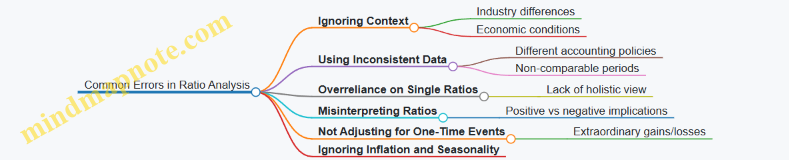
Mind Map: Identifying Ratio Analysis Errors
Example 1: Ignoring Industry Context
Scenario: A financial analyst compares the current ratio of a tech startup (0.8) with a well-established manufacturing firm (2.5) and concludes the startup is in poor liquidity condition.
Error: Different industries have different working capital needs. Tech startups often operate with lower current ratios due to rapid cash flows and minimal inventory.
Best Practice: Always benchmark ratios against industry peers.
Example 2: Using Non-Comparable Data
Scenario: An analyst compares the debt-to-equity ratio of Company A using IFRS financials with Company B using US GAAP without adjustments.
Error: Different accounting standards can affect reported liabilities and equity, skewing ratios.
Best Practice: Adjust financial statements or use notes to ensure comparability.
Mind Map: Avoiding Ratio Analysis Errors

Example 3: Overreliance on a Single Ratio
Scenario: A financial analyst recommends investment solely based on a high ROE (25%) without considering the company’s high debt levels.
Error: High ROE driven by excessive leverage can increase financial risk.
Best Practice: Combine ROE with solvency ratios like debt-to-equity and interest coverage.
Example 4: Not Adjusting for One-Time Events
Scenario: Net profit margin spikes due to a one-time asset sale, misleading the analyst about operational profitability.
Error: One-time gains distort profitability ratios.
Best Practice: Exclude extraordinary items to analyze core business performance.
Summary Table: Errors and Solutions
| Error Type | Description | Solution | Example Scenario |
|---|---|---|---|
| Ignoring Industry Context | Comparing ratios across different industries | Benchmark against industry peers | Comparing tech startup liquidity to manufacturing firm |
| Inconsistent Data | Using financials from different accounting standards | Adjust for accounting differences | IFRS vs US GAAP debt-to-equity comparison |
| Overreliance on Single Ratio | Making decisions based on one ratio only | Use a combination of ratios | High ROE ignoring high debt levels |
| Not Adjusting One-Time Items | Including extraordinary gains/losses in ratios | Exclude one-time events | Profit margin inflated by asset sale |
By carefully identifying these common errors and applying the best practices illustrated above, financial analysts and accountants can enhance the accuracy and reliability of their ratio analyses, leading to better-informed financial decisions.
9. Advanced Ratio Analysis Techniques
9.1 DuPont Analysis: Breaking Down Return on Equity
DuPont Analysis is a powerful financial tool that breaks down the Return on Equity (ROE) into its component parts to help accountants and financial analysts understand the underlying drivers of a company’s profitability. By dissecting ROE, professionals can identify strengths and weaknesses in operational efficiency, asset use, and financial leverage.
What is Return on Equity (ROE)?
ROE measures the profitability of a company relative to shareholders’ equity. It answers the question: How effectively is the company using shareholders’ funds to generate profit?
\[ \text{ROE} = \frac{\text{Net Income}}{\text{Shareholders’ Equity}} \]
While ROE is a useful metric on its own, it doesn’t reveal why a company is achieving a particular ROE. This is where DuPont Analysis comes in.
The DuPont Formula
The traditional DuPont formula breaks ROE into three components:
\[ \text{ROE} = \text{Net Profit Margin} \times \text{Asset Turnover} \times \text{Equity Multiplier} \]
Where:
- Net Profit Margin = \( \frac{\text{Net Income}}{\text{Sales}} \) — measures profitability per dollar of sales.
- Asset Turnover = \( \frac{\text{Sales}}{\text{Total Assets}} \) — measures efficiency in using assets to generate sales.
- Equity Multiplier = \( \frac{\text{Total Assets}}{\text{Shareholders’ Equity}} \) — measures financial leverage.
This decomposition helps analysts understand whether ROE is driven by operational efficiency, asset use efficiency, or leverage.
Mind Map: Components of DuPont Analysis
Step-by-Step Example
Let’s analyze Company ABC with the following data:
| Metric | Value (in $ millions) |
|---|---|
| Net Income | 50 |
| Sales | 500 |
| Total Assets | 250 |
| Shareholders’ Equity | 125 |
Step 1: Calculate Net Profit Margin
\[ \frac{50}{500} = 0.10 \quad \text{or} \quad 10\% \]
Step 2: Calculate Asset Turnover
\[ \frac{500}{250} = 2.0 \]
Step 3: Calculate Equity Multiplier
\[ \frac{250}{125} = 2.0 \]
Step 4: Calculate ROE using DuPont Formula
\[ 0.10 \times 2.0 \times 2.0 = 0.40 \quad \text{or} \quad 40\% \]
Step 5: Verify ROE directly
\[ \frac{50}{125} = 0.40 \quad \text{or} \quad 40\% \]
The DuPont analysis confirms that Company ABC’s 40% ROE is driven by a 10% profit margin, efficient asset use (2x turnover), and moderate leverage (2x equity multiplier).
Best Practices for Using DuPont Analysis
- Use consistent accounting periods: Ensure all data points are from the same fiscal period.
- Compare over time: Analyze trends in each component to identify operational improvements or risks.
- Benchmark against peers: Understand industry norms for profit margins, asset turnover, and leverage.
- Watch for leverage risk: High equity multipliers can inflate ROE but increase financial risk.
Mind Map: Best Practices in DuPont Analysis
Extended DuPont Model (Five-Step)
For deeper insight, the DuPont model can be expanded to five components:
\[ \text{ROE} = \text{Tax Burden} \times \text{Interest Burden} \times \text{EBIT Margin} \times \text{Asset Turnover} \times \text{Equity Multiplier} \]
Where:
- Tax Burden = \( \frac{\text{Net Income}}{\text{EBT}} \)
- Interest Burden = \( \frac{\text{EBT}}{\text{EBIT}} \)
- EBIT Margin = \( \frac{\text{EBIT}}{\text{Sales}} \)
This breakdown helps separate effects of tax and interest expenses.
Example: Five-Step DuPont Calculation
Given:
| Metric | Value (in $ millions) |
|---|---|
| Net Income | 50 |
| EBT (Earnings Before Tax) | 70 |
| EBIT (Earnings Before Interest and Tax) | 90 |
| Sales | 500 |
| Total Assets | 250 |
| Shareholders’ Equity | 125 |
Calculate:
- Tax Burden = 50 / 70 = 0.714
- Interest Burden = 70 / 90 = 0.778
- EBIT Margin = 90 / 500 = 0.18
- Asset Turnover = 500 / 250 = 2.0
- Equity Multiplier = 250 / 125 = 2.0
ROE = 0.714 × 0.778 × 0.18 × 2.0 × 2.0 ≈ 0.40 or 40%
This detailed breakdown highlights the impact of taxes and interest on ROE.
Summary
DuPont Analysis is an invaluable technique for breaking down ROE into actionable components. By understanding the interplay between profitability, efficiency, and leverage, accountants and financial analysts can provide deeper insights and make more informed recommendations.
Additional Mind Map: Summary of DuPont Analysis
9.2 Cash Flow Ratios: Linking Profitability to Cash Generation
Financial ratio analysis often focuses heavily on profitability metrics such as net profit margin or return on equity. However, profitability alone does not guarantee a company’s ability to sustain operations or grow. Cash flow ratios bridge this gap by linking profitability to actual cash generation, providing a clearer picture of financial health.
What Are Cash Flow Ratios?
Cash flow ratios measure the relationship between cash generated by the business and various financial metrics, such as sales, liabilities, or assets. These ratios help assess liquidity, operational efficiency, and the quality of earnings.
Why Are Cash Flow Ratios Important?
- Cash is king: Profit on paper may not translate to cash in hand.
- Liquidity assessment: Helps determine if the company can meet short-term obligations.
- Quality of earnings: Indicates if profits are backed by cash inflows.
- Investment decisions: Investors and analysts use these ratios to evaluate risk.
Key Cash Flow Ratios
Below is a mind map summarizing the primary cash flow ratios:
Cash Flow Ratios Mind Map
Operating Cash Flow Ratio
Definition: This ratio measures the company’s ability to pay off its current liabilities using cash generated from operations.
Formula:
\[ \text{Operating Cash Flow Ratio} = \frac{\text{Operating Cash Flow}}{\text{Current Liabilities}} \]
Example:
- Operating Cash Flow: $500,000
- Current Liabilities: $400,000
Calculation:
\[ \frac{500,000}{400,000} = 1.25 \]
Interpretation: A ratio above 1 indicates the company generates enough cash to cover its short-term obligations, which is a positive sign.
Free Cash Flow to Sales Ratio
Definition: This ratio shows the proportion of revenue that is converted into free cash flow (cash available after capital expenditures).
Formula:
\[ \text{Free Cash Flow to Sales} = \frac{\text{Free Cash Flow}}{\text{Net Sales}} \]
Example:
- Free Cash Flow: $150,000
- Net Sales: $1,000,000
Calculation:
\[ \frac{150,000}{1,000,000} = 0.15 \text{ or } 15\% \]
Interpretation: A 15% ratio means 15 cents of every sales dollar is converted into free cash flow, indicating strong cash generation efficiency.
Cash Flow Margin
Definition: This ratio measures how much cash is generated from sales revenue.
Formula:
\[ \text{Cash Flow Margin} = \frac{\text{Operating Cash Flow}}{\text{Net Sales}} \]
Example:
- Operating Cash Flow: $300,000
- Net Sales: $1,200,000
Calculation:
\[ \frac{300,000}{1,200,000} = 0.25 \text{ or } 25\% \]
Interpretation: For every dollar of sales, the company generates 25 cents in operating cash flow, which is a healthy margin.
Cash Return on Assets (Cash ROA)
Definition: This ratio measures how efficiently a company uses its assets to generate cash.
Formula:
\[ \text{Cash ROA} = \frac{\text{Operating Cash Flow}}{\text{Total Assets}} \]
Example:
- Operating Cash Flow: $400,000
- Total Assets: $2,000,000
Calculation:
\[ \frac{400,000}{2,000,000} = 0.20 \text{ or } 20\% \]
Interpretation: The company generates 20 cents of cash for every dollar invested in assets, reflecting good asset utilization.
Cash Flow Coverage Ratios
These ratios assess the ability to cover debt and interest expenses with operating cash flow.
-
Debt Coverage Ratio:
\[ \frac{\text{Operating Cash Flow}}{\text{Total Debt}} \]
-
Interest Coverage Ratio (Cash Basis):
\[ \frac{\text{Operating Cash Flow}}{\text{Interest Expense}} \]
Example:
- Operating Cash Flow: $600,000
- Total Debt: $1,200,000
- Interest Expense: $100,000
Calculations:
-
Debt Coverage Ratio:
\[ \frac{600,000}{1,200,000} = 0.5 \]
-
Interest Coverage Ratio:
\[ \frac{600,000}{100,000} = 6 \]
Interpretation:
- The company covers 50% of its total debt with operating cash flow annually.
- It can cover interest expenses 6 times over with cash generated, indicating low risk of default.
Best Practices for Using Cash Flow Ratios
- Use alongside profitability ratios: Cash flow ratios complement profit metrics to provide a fuller picture.
- Analyze trends over time: Look for improving or declining cash flow ratios to detect financial shifts.
- Benchmark against industry peers: Different industries have varying cash flow dynamics.
- Adjust for one-time items: Exclude unusual cash flows to avoid skewed ratios.
Integrated Example: Linking Profitability and Cash Flow
Consider Company ABC with the following data:
| Metric | Amount ($) |
|---|---|
| Net Income | 250,000 |
| Operating Cash Flow | 300,000 |
| Net Sales | 1,200,000 |
| Current Liabilities | 400,000 |
| Total Assets | 2,000,000 |
-
Net Profit Margin:
\[ \frac{250,000}{1,200,000} = 20.83\% \]
-
Cash Flow Margin:
\[ \frac{300,000}{1,200,000} = 25\% \]
Interpretation:
Although the net profit margin is 20.83%, the cash flow margin is higher at 25%, indicating strong cash collection and operational efficiency. This suggests that profits are well supported by cash inflows, reducing concerns about earnings quality.
Summary Mind Map
By integrating cash flow ratios into your financial analysis toolkit, you gain a more robust understanding of a company’s true financial performance and sustainability. These ratios are indispensable for accountants and financial analysts aiming to make informed, data-driven decisions.
9.3 Z-Score and Bankruptcy Prediction Models
Financial ratio analysis is a powerful tool not only for assessing a company’s current financial health but also for predicting its future viability. One of the most widely recognized models for bankruptcy prediction is the Altman Z-Score model. This section explores the Z-Score and other bankruptcy prediction models, illustrating best practices with clear examples and mind maps to enhance understanding.
What is the Z-Score?
The Altman Z-Score is a formula that combines five key financial ratios to estimate the likelihood of a company going bankrupt within two years. It was developed by Edward Altman in 1968 and remains a benchmark in credit risk analysis.
Formula:
\[ Z = 1.2 \times (A) + 1.4 \times (B) + 3.3 \times (C) + 0.6 \times (D) + 1.0 \times (E) \]
Where:
- A = Working Capital / Total Assets
- B = Retained Earnings / Total Assets
- C = Earnings Before Interest and Taxes (EBIT) / Total Assets
- D = Market Value of Equity / Book Value of Total Liabilities
- E = Sales / Total Assets
Mind Map: Components of the Altman Z-Score
Interpretation of Z-Score
- Z > 2.99: Safe Zone – Low risk of bankruptcy
- 1.81 < Z < 2.99: Grey Zone – Some risk, requires monitoring
- Z < 1.81: Distress Zone – High risk of bankruptcy
Example: Calculating Z-Score for XYZ Corporation
| Financial Metric | Value (in $ millions) |
|---|---|
| Working Capital | 50 |
| Total Assets | 200 |
| Retained Earnings | 30 |
| EBIT | 40 |
| Market Value of Equity | 150 |
| Book Value of Total Liabilities | 100 |
| Sales | 300 |
Step 1: Calculate each ratio
- A = 50 / 200 = 0.25
- B = 30 / 200 = 0.15
- C = 40 / 200 = 0.20
- D = 150 / 100 = 1.5
- E = 300 / 200 = 1.5
Step 2: Calculate Z-Score
\[ Z = 1.2(0.25) + 1.4(0.15) + 3.3(0.20) + 0.6(1.5) + 1.0(1.5) \] \[ Z = 0.3 + 0.21 + 0.66 + 0.9 + 1.5 = 3.57 \]
Interpretation: With a Z-Score of 3.57, XYZ Corporation is in the Safe Zone, indicating a low probability of bankruptcy.
Other Bankruptcy Prediction Models
-
Ohlson O-Score
- Uses logistic regression with nine variables including size, financial structure, and performance.
- More complex but can be applied to a wider range of companies.
-
ZETA Model
- Developed by Altman as an extension for private firms.
- Incorporates additional variables for better accuracy.
-
Springate Model
- Uses four ratios focusing on liquidity, profitability, and efficiency.
Mind Map: Bankruptcy Prediction Models Overview

Best Practices for Using Bankruptcy Prediction Models
- Use multiple models: Cross-validate results to improve reliability.
- Update data regularly: Financial conditions change, so frequent recalculations are necessary.
- Consider industry context: Different industries have different risk profiles.
- Combine with qualitative analysis: Management quality, market conditions, and competitive landscape matter.
Example: Applying Multiple Models to ABC Ltd.
| Metric / Model | Altman Z-Score | Ohlson O-Score (Probability) | Springate Score |
|---|---|---|---|
| Result | 1.75 (Grey Zone) | 0.45 (45% bankruptcy risk) | 0.85 (Distress) |
Interpretation:
- Altman Z-Score indicates moderate risk.
- Ohlson O-Score shows a 45% probability of bankruptcy.
- Springate Score suggests distress.
Action: ABC Ltd. should be closely monitored, and management should consider corrective actions.
Summary
The Altman Z-Score and other bankruptcy prediction models provide valuable quantitative insights into a company’s financial distress risk. When combined with best practices and qualitative factors, these models empower accountants and financial analysts to make informed decisions and proactively manage credit risk.
9.4 Example: Applying DuPont Analysis to Improve Financial Insights
DuPont Analysis is a powerful tool that breaks down Return on Equity (ROE) into three key components, allowing accountants and financial analysts to identify the drivers behind a company’s financial performance. This section will provide a detailed example of how to apply DuPont Analysis, supported by mind maps and practical calculations.
What is DuPont Analysis?
DuPont Analysis decomposes ROE into three parts:
- Profit Margin (Net Income / Sales): Measures operating efficiency.
- Asset Turnover (Sales / Assets): Measures asset use efficiency.
- Equity Multiplier (Assets / Equity): Measures financial leverage.
The formula:
ROE = Profit Margin × Asset Turnover × Equity Multiplier
Mind Map: Components of DuPont Analysis
Step-by-Step Example
Let’s analyze the financials of XYZ Corporation for the fiscal year:
| Metric | Value (in $ millions) |
|---|---|
| Net Income | 50 |
| Sales | 500 |
| Total Assets | 400 |
| Shareholders’ Equity | 200 |
Step 1: Calculate Profit Margin
\[ \text{Profit Margin} = \frac{\text{Net Income}}{\text{Sales}} = \frac{50}{500} = 0.10 \ (10\%) \]
Step 2: Calculate Asset Turnover
\[ \text{Asset Turnover} = \frac{\text{Sales}}{\text{Total Assets}} = \frac{500}{400} = 1.25 \]
Step 3: Calculate Equity Multiplier
\[ \text{Equity Multiplier} = \frac{\text{Total Assets}}{\text{Shareholders’ Equity}} = \frac{400}{200} = 2.0 \]
Step 4: Calculate ROE using DuPont Formula
\[ \text{ROE} = 0.10 \times 1.25 \times 2.0 = 0.25 \ (25\%) \]
Interpretation
- Profit Margin (10%): Indicates that XYZ Corporation earns 10 cents for every dollar of sales.
- Asset Turnover (1.25): The company generates $1.25 in sales for every $1 of assets, showing efficient asset use.
- Equity Multiplier (2.0): The company uses $2 of assets for every $1 of equity, indicating moderate financial leverage.
- ROE (25%): A strong return on equity, driven by a balanced combination of profitability, efficiency, and leverage.
Mind Map: Interpretation and Insights
Best Practices When Applying DuPont Analysis
- Use consistent accounting periods to ensure comparability.
- Benchmark against industry peers to contextualize ratios.
- Analyze trends over multiple periods to identify performance changes.
- Combine with other ratios for a comprehensive financial view.
Extended Example: Improving ROE
Suppose XYZ Corporation wants to improve its ROE from 25% to 30%. Let’s explore two scenarios:
-
Increase Profit Margin from 10% to 12%
\[ ROE = 0.12 \times 1.25 \times 2.0 = 0.30 \ (30\%) \]
-
Increase Asset Turnover from 1.25 to 1.5
\[ ROE = 0.10 \times 1.5 \times 2.0 = 0.30 \ (30\%) \]
Both approaches can achieve the target ROE, but the company must evaluate which is more feasible based on operational capabilities.
Mind Map: Strategies to Improve ROE
Summary
DuPont Analysis provides a granular view of ROE by linking profitability, efficiency, and leverage. By applying this method, financial analysts and accountants can pinpoint strengths and weaknesses, enabling targeted strategies to enhance financial performance.
This example demonstrates how breaking down ROE helps in making informed decisions and communicating financial insights effectively.
10. Tools and Software for Financial Ratio Analysis
10.1 Spreadsheet Models: Building Custom Ratio Analysis Tools
Financial ratio analysis is a cornerstone of financial decision-making for accountants and financial analysts. While there are many off-the-shelf software solutions available, building custom spreadsheet models offers flexibility, transparency, and the ability to tailor analysis to specific business needs. This section will guide you through best practices for creating effective spreadsheet models for ratio analysis, supported by mind maps and practical examples.
Why Build Custom Spreadsheet Models?
- Flexibility: Customize ratios and inputs to reflect unique business scenarios.
- Transparency: Understand every calculation step, improving auditability.
- Cost-Effective: Leverage existing tools like Microsoft Excel or Google Sheets.
- Integration: Easily combine with other financial data and reports.
Key Components of a Custom Ratio Analysis Spreadsheet
Step-by-Step Guide to Building Your Model
-
Gather and Organize Financial Data
- Import or manually enter financial statements.
- Ensure data accuracy and consistency.
-
Define Inputs and Assumptions
- Create a dedicated sheet/tab for inputs.
- Include industry benchmarks or forecast assumptions.
-
Set Up Ratio Calculations
- Use clear, labeled formulas referencing input data.
- Separate ratios by category for clarity.
-
Create Output Summary
- Summarize all calculated ratios in one sheet.
- Include trend analysis by comparing multiple periods.
-
Add Visualizations
- Use charts (bar, line, radar) to visualize ratios.
- Build dashboards for quick insights.
-
Implement Validation and Error Checks
- Use conditional formatting to flag unusual values.
- Add formula checks to catch data inconsistencies.
Example: Building a Basic Liquidity Ratio Model
Suppose you have the following simplified balance sheet data for two years:
| Item | Year 1 ($) | Year 2 ($) |
|---|---|---|
| Current Assets | 150,000 | 180,000 |
| Inventory | 50,000 | 60,000 |
| Current Liabilities | 100,000 | 120,000 |
Step 1: Input Data Sheet
| Description | Year 1 | Year 2 |
|---|---|---|
| Current Assets | 150000 | 180000 |
| Inventory | 50000 | 60000 |
| Current Liabilities | 100000 | 120000 |
Step 2: Calculate Ratios
- Current Ratio = Current Assets / Current Liabilities
- Quick Ratio = (Current Assets - Inventory) / Current Liabilities
| Ratio | Year 1 Calculation | Year 1 Result | Year 2 Calculation | Year 2 Result |
|---|---|---|---|---|
| Current Ratio | 150,000 / 100,000 | 1.5 | 180,000 / 120,000 | 1.5 |
| Quick Ratio | (150,000 - 50,000) / 100,000 | 1.0 | (180,000 - 60,000) / 120,000 | 1.0 |
Step 3: Visualization
Create a line chart plotting the Current and Quick Ratios over the two years to visualize stability.
Best Practices for Spreadsheet Ratio Models
- Use Named Ranges: Improves formula readability and reduces errors.
- Document Assumptions: Include comments or a dedicated assumptions tab.
- Avoid Hardcoding: Reference input cells instead of embedding numbers in formulas.
- Use Consistent Formatting: Helps differentiate inputs, calculations, and outputs.
- Protect Key Cells: Prevent accidental changes to formulas.
- Version Control: Keep track of changes and maintain backups.
Advanced Tips
- Dynamic Period Selection: Use drop-down menus to select periods for analysis.
- Scenario Analysis: Build scenarios (best case, worst case) to test ratio sensitivity.
- Automate Data Import: Link spreadsheets to accounting software or databases.
Summary
Building custom spreadsheet models for financial ratio analysis empowers accountants and financial analysts to tailor insights to their unique business contexts. By following structured steps, leveraging mind maps for planning, and applying best practices, you can create robust, transparent, and actionable financial analysis tools.
For further learning, consider exploring Excel functions like INDEX, MATCH, OFFSET, and data visualization tools such as PivotTables and slicers to enhance your models.
10.2 Financial Analysis Software: Features and Best Practices
Financial analysis software has become an indispensable tool for accountants and financial analysts aiming to streamline the process of financial ratio analysis. These tools not only automate complex calculations but also provide visualization, benchmarking, and reporting capabilities that enhance decision-making.
Key Features of Financial Analysis Software
-
Automated Ratio Calculations
- Instantly compute a wide range of financial ratios (liquidity, solvency, profitability, efficiency, market ratios).
- Reduce human error and save time.
-
Data Integration and Import
- Import financial statements directly from ERP systems, accounting software, or Excel spreadsheets.
- Support for multiple file formats (CSV, XLSX, XML).
-
Customizable Dashboards and Reports
- Visualize ratios through charts, graphs, and heatmaps.
- Create tailored reports for different stakeholders.
-
Benchmarking and Industry Comparisons
- Compare company ratios against industry averages or competitors.
- Identify performance gaps and opportunities.
-
Trend Analysis and Forecasting
- Analyze ratio trends over multiple periods.
- Use predictive analytics to forecast future financial health.
-
Scenario Analysis and What-If Modeling
- Test the impact of changes in financial variables on ratios.
- Support strategic planning and risk assessment.
-
Collaboration and Sharing
- Allow multiple users to access and edit analysis.
- Export reports in various formats (PDF, PPT, Excel).
-
Security and Compliance
- Ensure data privacy and compliance with financial regulations.
- Role-based access controls.
Mind Map: Core Features of Financial Analysis Software
Best Practices for Using Financial Analysis Software
-
Ensure Data Accuracy Before Importing
- Validate financial statements for completeness and correctness.
- Example: Before importing a company’s balance sheet into the software, cross-check totals and classifications to avoid skewed ratio results.
-
Customize Ratio Sets Based on Industry and Business Needs
- Not all ratios are equally relevant; tailor the software settings to focus on key performance indicators.
- Example: For a retail company, emphasize inventory turnover and gross margin ratios.
-
Leverage Visualization Tools to Communicate Insights
- Use charts and dashboards to highlight trends and anomalies.
- Example: A heatmap showing liquidity ratios below industry benchmarks can quickly alert management to potential cash flow issues.
-
Regularly Update Data and Perform Trend Analysis
- Schedule periodic data refreshes to monitor financial health over time.
- Example: Monthly updates enable tracking of debt-to-equity ratio fluctuations and timely corrective actions.
-
Use Scenario Analysis to Support Strategic Decisions
- Model the financial impact of potential business moves.
- Example: Simulate the effect of increased borrowing on interest coverage ratio to assess risk.
-
Maintain Security and Access Controls
- Restrict sensitive financial data to authorized personnel.
- Example: Set role-based permissions so junior analysts can view but not modify reports.
-
Train Users to Maximize Software Capabilities
- Provide training sessions and documentation.
- Example: Conduct workshops demonstrating how to customize dashboards and generate automated reports.
Example: Using Financial Analysis Software to Analyze a Mid-Sized Company
Scenario: An accounting team uses a popular financial analysis software to evaluate the financial health of a mid-sized manufacturing firm.
- Step 1: Import the firm’s latest financial statements (balance sheet, income statement, cash flow) via Excel.
- Step 2: Select relevant ratios: current ratio, quick ratio, debt-to-equity, gross profit margin, ROA, and inventory turnover.
- Step 3: Generate a dashboard displaying these ratios alongside industry benchmarks.
- Step 4: Identify that the debt-to-equity ratio is higher than the industry average, signaling potential solvency risk.
- Step 5: Use scenario modeling to simulate reducing debt by 20% and observe improvements in interest coverage ratio.
- Step 6: Export the findings into a PDF report for presentation to senior management.
This example demonstrates how software features and best practices combine to deliver actionable financial insights efficiently.
Mind Map: Best Practices for Financial Analysis Software Usage
In conclusion, financial analysis software empowers accountants and financial analysts by automating complex calculations, enhancing visualization, and supporting strategic decision-making. Adhering to best practices ensures the software’s full potential is realized, leading to more accurate, insightful, and timely financial ratio analysis.
10.3 Automating Ratio Analysis for Large Data Sets
Automating financial ratio analysis is essential when dealing with large volumes of financial data, especially for accountants and financial analysts working in corporate finance environments. Manual calculations become impractical and error-prone as data complexity and size increase. Automation not only speeds up the process but also improves accuracy, consistency, and the ability to perform real-time analysis.
Why Automate Ratio Analysis?
- Efficiency: Quickly process thousands of financial statements.
- Accuracy: Reduce human errors in calculations.
- Consistency: Standardize ratio definitions and formulas.
- Scalability: Easily handle expanding data sets.
- Real-time Insights: Enable timely decision-making.
Key Components of Automating Ratio Analysis
Step-by-Step Example: Automating Current Ratio Calculation Using Python
Scenario: You have a dataset containing balance sheets of 1,000 companies and want to calculate the Current Ratio for each automatically.
Step 1: Data Preparation
- Ensure the dataset includes
Current AssetsandCurrent Liabilitiescolumns.
Step 2: Define the Calculation
- Current Ratio = Current Assets / Current Liabilities
Step 3: Automate with Python (Pandas)
import pandas as pd

# Load dataset
financials = pd.read_csv('financial_statements.csv')

# Calculate Current Ratio
financials['Current_Ratio'] = financials['Current_Assets'] / financials['Current_Liabilities']

# Handle division by zero or missing data
financials['Current_Ratio'].replace([float('inf'), -float('inf')], pd.NA, inplace=True)
financials['Current_Ratio'].fillna(0, inplace=True)

# Save results
financials.to_csv('financials_with_ratios.csv', index=False)
Step 4: Review & Visualize
- Use Excel or BI tools to visualize the distribution of Current Ratios.
Automating Multiple Ratios
You can extend automation to calculate multiple ratios simultaneously:
# Define ratio calculations
financials['Quick_Ratio'] = (financials['Current_Assets'] - financials['Inventory']) / financials['Current_Liabilities']
financials['Debt_to_Equity'] = financials['Total_Debt'] / financials['Shareholders_Equity']
financials['ROA'] = financials['Net_Income'] / financials['Total_Assets']

# Handle missing or infinite values as before
ratios = ['Quick_Ratio', 'Debt_to_Equity', 'ROA']
for ratio in ratios:
    financials[ratio].replace([float('inf'), -float('inf')], pd.NA, inplace=True)
    financials[ratio].fillna(0, inplace=True)

financials.to_csv('financials_with_multiple_ratios.csv', index=False)
Mind Map: Automating Multiple Ratio Calculations
Best Practices for Automation
- Data Validation: Always validate input data for completeness and accuracy before calculations.
- Modular Code: Write reusable functions for each ratio to simplify updates.
- Error Handling: Gracefully handle division by zero, missing values, and outliers.
- Documentation: Document formulas and assumptions clearly.
- Version Control: Use version control systems (e.g., Git) to track changes.
- Integration: Connect automation scripts with accounting or ERP systems for seamless data flow.
Example: Automating Ratio Alerts
Set up automated alerts when ratios breach thresholds:
# Example: Flag companies with Current Ratio below 1
financials['Liquidity_Flag'] = financials['Current_Ratio'].apply(lambda x: 'Low' if x < 1 else 'Healthy')

# Export flagged companies
low_liquidity = financials[financials['Liquidity_Flag'] == 'Low']
low_liquidity.to_csv('low_liquidity_companies.csv', index=False)
This enables analysts to focus on companies needing attention.
Summary
Automating ratio analysis for large datasets empowers financial professionals to handle complex data efficiently, reduce errors, and generate actionable insights quickly. Leveraging tools like Python, R, and BI platforms combined with best practices ensures scalable, accurate, and timely financial analysis.
10.4 Example: Using Excel and Financial Software to Streamline Analysis
Financial ratio analysis can be significantly streamlined and enhanced by leveraging Excel and specialized financial software. This section demonstrates practical examples and mind maps to help accountants and financial analysts efficiently perform ratio analysis.
Using Excel for Financial Ratio Analysis
Excel remains one of the most accessible and powerful tools for financial analysis. Below is a step-by-step example of how to set up a basic financial ratio analysis model in Excel.
Step 1: Organize Financial Data
Start by inputting key financial statement data (Balance Sheet and Income Statement) into a structured Excel sheet.
| Account | Year 1 (USD) | Year 2 (USD) |
|---|---|---|
| Current Assets | 150,000 | 180,000 |
| Inventory | 50,000 | 60,000 |
| Current Liabilities | 100,000 | 110,000 |
| Total Debt | 200,000 | 220,000 |
| Shareholders’ Equity | 300,000 | 320,000 |
| Net Income | 50,000 | 60,000 |
| Sales Revenue | 500,000 | 550,000 |
Step 2: Define Ratio Formulas
Create a separate section where formulas for key ratios are defined using Excel cell references.
| Ratio | Formula in Excel | Description |
|---|---|---|
| Current Ratio | =B2/B4 | Current Assets / Current Liabilities |
| Quick Ratio | =(B2-B3)/B4 | (Current Assets - Inventory) / Current Liabilities |
| Debt to Equity Ratio | =B5/B6 | Total Debt / Shareholders’ Equity |
| Net Profit Margin | =B7/B8 | Net Income / Sales Revenue |
Step 3: Automate Ratio Calculations
Input the formulas referencing the financial data cells. For example, if Current Assets are in B2 and Current Liabilities in B4, the Current Ratio formula in Excel would be =B2/B4.
Step 4: Visualize Results
Use Excel charts to visualize trends over multiple years. For example, line charts for Current Ratio and Debt to Equity Ratio over several years can highlight financial health trends.
Mind Map: Excel-Based Financial Ratio Analysis Workflow
Using Financial Software for Ratio Analysis
While Excel is versatile, financial software can automate data import, calculation, and reporting, saving time and reducing errors.
Example Software: QuickBooks, SAP Financials, or specialized tools like Fathom and Tableau
Step 1: Import Financial Data
Most financial software allows direct integration with accounting systems to pull financial statements automatically.
Step 2: Pre-Built Ratio Calculators
These tools come with built-in ratio calculators covering liquidity, solvency, profitability, and efficiency ratios.
Step 3: Automated Trend Analysis and Benchmarking
Software often provides benchmarking against industry standards and historical trends with minimal manual input.
Step 4: Interactive Dashboards
Users can create interactive dashboards that update in real-time as new financial data is imported.
Mind Map: Financial Software-Driven Ratio Analysis
Practical Example: Streamlining Ratio Analysis with Excel and Software
Scenario: A financial analyst needs to prepare monthly liquidity and profitability reports for management.
-
Using Excel:
- Analyst sets up a template with linked financial data.
- Automates ratio calculations with formulas.
- Uses conditional formatting to highlight ratios outside acceptable ranges.
- Creates charts to show trends.
-
Using Financial Software:
- Connects software to accounting system for automatic data import.
- Uses dashboard to monitor key ratios in real-time.
- Sets alerts for ratios breaching thresholds.
- Generates reports with one click.
This hybrid approach allows analysts to customize detailed analysis in Excel while leveraging software for automation and visualization.
Tips for Best Practices
- Always validate imported data before analysis.
- Use named ranges in Excel for easier formula management.
- Regularly update software and templates to reflect accounting changes.
- Combine software dashboards with Excel for customized deep dives.
By integrating Excel’s flexibility with the power of financial software, financial analysts and accountants can streamline ratio analysis workflows, improve accuracy, and deliver timely insights to stakeholders.
11. Industry-Specific Ratio Analysis
11.1 Financial Ratios in Banking and Financial Services
Financial ratio analysis in the banking and financial services sector is crucial due to the unique nature of their operations, regulatory environment, and risk exposures. Unlike manufacturing or retail industries, banks primarily deal with financial assets and liabilities, making certain ratios more relevant for assessing their performance, stability, and profitability.
Key Financial Ratios for Banking and Financial Services
Liquidity Ratios
Liquidity Coverage Ratio (LCR)
- Measures the bank’s ability to cover short-term obligations with high-quality liquid assets.
- Formula: \( LCR = \frac{High\text{-}Quality\ Liquid\ Assets}{Total\ Net\ Cash\ Outflows\ over\ 30\ days} \times 100\% \)
Example: If a bank holds $120 million in high-quality liquid assets and expects $100 million in net cash outflows over the next 30 days, then:
\( LCR = \frac{120}{100} \times 100\% = 120\% \)
This indicates the bank has a comfortable liquidity buffer above the regulatory minimum (usually 100%).
Loan to Deposit Ratio (LDR)
- Indicates the proportion of loans funded by customer deposits.
- Formula: \( LDR = \frac{Total\ Loans}{Total\ Deposits} \times 100\% \)
Example: A bank with $500 million in loans and $600 million in deposits has:
\( LDR = \frac{500}{600} \times 100\% = 83.3\% \)
An LDR between 80%-90% is often considered healthy, balancing profitability and liquidity.
Asset Quality Ratios
Non-Performing Loans (NPL) Ratio
- Measures the percentage of loans that are in default or close to being in default.
- Formula: \( NPL\ Ratio = \frac{Non\text{-}Performing\ Loans}{Total\ Loans} \times 100\% \)
Example: If a bank has $20 million in non-performing loans out of $500 million total loans:
\( NPL\ Ratio = \frac{20}{500} \times 100\% = 4\% \)
Lower NPL ratios indicate better asset quality.
Loan Loss Provision Ratio
- Reflects the bank’s preparedness for potential loan losses.
- Formula: \( Loan\ Loss\ Provision\ Ratio = \frac{Loan\ Loss\ Provisions}{Total\ Loans} \times 100\% \)
Example: With $10 million in loan loss provisions and $500 million in loans:
\( Loan\ Loss\ Provision\ Ratio = \frac{10}{500} \times 100\% = 2\% \)
Profitability Ratios
Net Interest Margin (NIM)
- Shows the difference between interest income generated and interest paid, relative to earning assets.
- Formula: \( NIM = \frac{Interest\ Income - Interest\ Expense}{Average\ Earning\ Assets} \times 100\% \)
Example: If interest income is $40 million, interest expense is $15 million, and average earning assets are $1 billion:
\( NIM = \frac{40 - 15}{1000} \times 100\% = 2.5\% \)
Return on Assets (ROA)
- Measures profitability relative to total assets.
- Formula: \( ROA = \frac{Net\ Income}{Total\ Assets} \times 100\% \)
Return on Equity (ROE)
- Measures profitability relative to shareholders’ equity.
- Formula: \( ROE = \frac{Net\ Income}{Shareholders’\ Equity} \times 100\% \)
Example: A bank with $50 million net income, $5 billion total assets, and $500 million equity has:
\( ROA = \frac{50}{5000} \times 100\% = 1\% \)
\( ROE = \frac{50}{500} \times 100\% = 10\% \)
Capital Adequacy Ratios
Capital Adequacy Ratio (CAR)
- Measures the bank’s capital relative to its risk-weighted assets, ensuring solvency.
- Formula: \( CAR = \frac{Tier\ 1\ Capital + Tier\ 2\ Capital}{Risk\ Weighted\ Assets} \times 100\% \)
Example: If a bank has $600 million in capital and $5 billion in risk-weighted assets:
\( CAR = \frac{600}{5000} \times 100\% = 12\% \)
Regulatory minimums typically range from 8% to 12.5%, depending on jurisdiction.
Efficiency Ratios
Cost to Income Ratio
- Measures operating costs as a percentage of operating income.
- Formula: \( Cost\ to\ Income = \frac{Operating\ Expenses}{Operating\ Income} \times 100\% \)
Example: If operating expenses are $30 million and operating income is $60 million:
\( Cost\ to\ Income = \frac{30}{60} \times 100\% = 50\% \)
Lower ratios indicate higher efficiency.
Integrated Example: Analyzing a Hypothetical Bank
| Ratio | Value | Interpretation |
|---|---|---|
| Liquidity Coverage Ratio | 115% | Adequate liquidity buffer |
| Loan to Deposit Ratio | 85% | Balanced loan funding |
| Non-Performing Loans Ratio | 3.5% | Moderate asset quality risk |
| Net Interest Margin | 2.8% | Healthy interest income margin |
| Return on Equity | 12% | Good profitability for shareholders |
| Capital Adequacy Ratio | 13% | Strong capital position |
| Cost to Income Ratio | 48% | Efficient cost management |
Best Practices for Financial Ratio Analysis in Banking
- Contextual Benchmarking: Always compare ratios against industry averages, regulatory requirements, and peer banks.
- Trend Analysis: Analyze ratios over multiple periods to identify improvements or deteriorations.
- Regulatory Awareness: Understand specific regulatory frameworks (e.g., Basel III) that impact ratio targets.
- Holistic View: Combine liquidity, asset quality, profitability, and capital adequacy ratios for a comprehensive assessment.
- Qualitative Factors: Consider management quality, economic environment, and market conditions alongside ratios.
By mastering these ratios and their interpretations, accountants and financial analysts can provide valuable insights into the health and performance of banks and financial institutions, supporting better decision-making and risk management.
11.2 Ratio Analysis for Manufacturing Companies
Manufacturing companies operate in a capital-intensive environment where efficient management of assets, inventory, and costs is critical. Financial ratio analysis tailored to this sector helps accountants and financial analysts evaluate operational efficiency, profitability, and financial stability.
Key Financial Ratios for Manufacturing Companies
Inventory Turnover Ratio
- Definition: Measures how many times inventory is sold and replaced over a period.
- Formula: Inventory Turnover = Cost of Goods Sold (COGS) / Average Inventory
- Best Practice: A higher ratio indicates efficient inventory management but extremely high values may suggest stockouts.
Days Inventory Outstanding (DIO)
- Definition: Average number of days inventory is held before being sold.
- Formula: DIO = 365 / Inventory Turnover
- Best Practice: Lower DIO is generally better, indicating faster inventory movement.
Gross Profit Margin
- Definition: Indicates the percentage of revenue remaining after deducting COGS.
- Formula: Gross Profit Margin = (Revenue - COGS) / Revenue
- Best Practice: Monitor for trends; declining margins may signal rising production costs or pricing pressure.
Asset Turnover Ratio
- Definition: Measures how efficiently assets generate sales.
- Formula: Asset Turnover = Revenue / Average Total Assets
- Best Practice: Manufacturing firms typically have lower asset turnover due to heavy asset bases; compare with industry benchmarks.
Debt to Equity Ratio
- Definition: Indicates the proportion of debt financing relative to shareholders’ equity.
- Formula: Debt to Equity = Total Debt / Total Equity
- Best Practice: Manufacturing companies often carry higher debt; prudent management is essential to avoid solvency risks.
Mind Map: Core Manufacturing Ratios
Example: Inventory Turnover Calculation
Scenario:
- Cost of Goods Sold (COGS): $5,000,000
- Beginning Inventory: $800,000
- Ending Inventory: $1,200,000
Step 1: Calculate Average Inventory:
\[(800,000 + 1,200,000) / 2 = 1,000,000\]
Step 2: Calculate Inventory Turnover:
\[5,000,000 / 1,000,000 = 5\]
Interpretation: The company turns over its inventory 5 times per year, meaning inventory is sold and replaced every ~73 days (365/5).
Mind Map: Profitability and Efficiency Focus
Example: Gross Profit Margin Analysis
Scenario:
- Revenue: $10,000,000
- COGS: $7,000,000
Calculation:
\[(10,000,000 - 7,000,000) / 10,000,000 = 0.3 = 30\%\]
Interpretation: For every dollar of sales, the company retains 30 cents after covering production costs.
Best Practices for Manufacturing Ratio Analysis
- Use Industry Benchmarks: Manufacturing sectors vary widely (automotive, electronics, textiles). Always compare ratios to relevant industry peers.
- Analyze Trends Over Time: Single-period ratios can be misleading; track ratios quarterly or annually to identify operational improvements or deteriorations.
- Combine Ratios for Holistic View: For example, pairing inventory turnover with DIO and gross margin provides insight into both efficiency and profitability.
- Consider Seasonality: Many manufacturing companies experience seasonal demand; adjust analysis accordingly.
- Integrate Operational Data: Link financial ratios with production metrics like capacity utilization for deeper insights.
Example: Comprehensive Ratio Snapshot for a Manufacturing Company
| Ratio | Value | Interpretation |
|---|---|---|
| Current Ratio | 1.8 | Adequate short-term liquidity |
| Inventory Turnover | 6 | Good inventory management, ~61 days turnover |
| Gross Profit Margin | 28% | Healthy margin, but monitor cost trends |
| Asset Turnover | 0.9 | Typical for capital-intensive industry |
| Debt to Equity Ratio | 1.2 | Moderate leverage, manageable debt levels |
This snapshot helps financial analysts identify strengths and risks, guiding operational and strategic decisions.
Summary
Financial ratio analysis for manufacturing companies requires a focus on inventory management, asset utilization, profitability, and leverage. By applying best practices and using clear examples, accountants and financial analysts can provide actionable insights that drive efficiency and long-term financial health.
11.3 Retail Industry: Key Ratios and Best Practices
Financial ratio analysis in the retail industry requires a nuanced approach due to the sector’s unique characteristics such as high inventory turnover, seasonal fluctuations, and thin profit margins. This section explores the key financial ratios most relevant to retail businesses and outlines best practices for their interpretation, supported by practical examples and mind maps to aid understanding.
Key Ratios for Retail Industry
Retailers rely heavily on ratios that reflect liquidity, inventory management, profitability, and operational efficiency. Below is a mind map summarizing the key ratios:
Liquidity Ratios
Current Ratio and Quick Ratio are essential to assess a retailer’s ability to meet short-term obligations, especially given the high volume of current assets like inventory.
- Best Practice: Since inventory can be less liquid, the Quick Ratio is often more telling for retail businesses.
Example:
A retail company has:
-
Current Assets = $500,000
-
Inventory = $300,000
-
Current Liabilities = $250,000
-
Current Ratio = 500,000 / 250,000 = 2.0
-
Quick Ratio = (500,000 - 300,000) / 250,000 = 0.8
Interpretation: While the Current Ratio suggests good liquidity, the Quick Ratio below 1 indicates potential short-term liquidity risk if inventory cannot be quickly converted to cash.
Inventory Management Ratios
Inventory is a critical asset for retailers. Efficient inventory management improves cash flow and reduces holding costs.
Inventory Turnover Ratio
Measures how many times inventory is sold and replaced over a period.
- Formula: Inventory Turnover = Cost of Goods Sold (COGS) / Average Inventory
Best Practice: Compare turnover against industry averages; a very high turnover may indicate stockouts, while a low turnover suggests overstocking.
Example:
- COGS = $1,200,000
- Average Inventory = $200,000
Inventory Turnover = 1,200,000 / 200,000 = 6 times
Interpretation: The company sells and replaces its inventory 6 times a year, which may be typical for its retail segment.
Days Inventory Outstanding (DIO)
Indicates the average number of days inventory is held before sale.
- Formula: DIO = 365 / Inventory Turnover
Using the example above:
DIO = 365 / 6 ≈ 61 days
This means inventory is held for about two months on average.
Inventory Management Mind Map
Profitability Ratios
Retailers typically operate on thin margins, so understanding profitability at various levels is crucial.
Gross Profit Margin
Shows the percentage of revenue remaining after deducting COGS.
- Formula: (Revenue - COGS) / Revenue
Example:
- Revenue = $2,000,000
- COGS = $1,200,000
Gross Profit Margin = (2,000,000 - 1,200,000) / 2,000,000 = 0.4 or 40%
Interpretation: The retailer retains 40% of sales revenue after covering the cost of goods.
Operating Profit Margin
Considers operating expenses beyond COGS.
- Formula: Operating Income / Revenue
If Operating Income = $200,000,
Operating Profit Margin = 200,000 / 2,000,000 = 10%
Net Profit Margin
Reflects the bottom-line profitability after all expenses and taxes.
- Formula: Net Income / Revenue
If Net Income = $120,000,
Net Profit Margin = 120,000 / 2,000,000 = 6%
Profitability Ratios Mind Map
Efficiency Ratios
Accounts Receivable Turnover
Measures how efficiently the retailer collects receivables.
- Formula: Net Credit Sales / Average Accounts Receivable
Example:
- Net Credit Sales = $1,500,000
- Average Accounts Receivable = $150,000
Accounts Receivable Turnover = 1,500,000 / 150,000 = 10 times
Interpretation: The company collects its receivables 10 times per year, or roughly every 36.5 days.
Asset Turnover Ratio
Shows how efficiently assets generate revenue.
- Formula: Revenue / Average Total Assets
If Average Total Assets = $1,000,000,
Asset Turnover = 2,000,000 / 1,000,000 = 2.0
Interpretation: For every dollar invested in assets, the company generates $2 in sales.
Best Practices for Retail Ratio Analysis
- Contextual Benchmarking: Always compare ratios to industry averages and direct competitors.
- Seasonality Adjustment: Account for seasonal sales spikes and inventory fluctuations.
- Trend Analysis: Monitor ratios over multiple periods to identify patterns.
- Integrated Approach: Use multiple ratios together for a holistic view.
- Inventory Valuation Consistency: Ensure consistent accounting methods (FIFO, LIFO) for comparability.
Integrated Example: Retailer “ShopEase” Financial Snapshot
| Metric | Value |
|---|---|
| Revenue | $3,000,000 |
| COGS | $1,800,000 |
| Average Inventory | $250,000 |
| Average Accounts Receivable | $200,000 |
| Current Assets | $600,000 |
| Inventory | $250,000 |
| Current Liabilities | $400,000 |
| Operating Income | $300,000 |
| Net Income | $180,000 |
| Average Total Assets | $1,200,000 |
Calculations:
- Current Ratio = 600,000 / 400,000 = 1.5
- Quick Ratio = (600,000 - 250,000) / 400,000 = 0.875
- Inventory Turnover = 1,800,000 / 250,000 = 7.2
- DIO = 365 / 7.2 ≈ 51 days
- Gross Profit Margin = (3,000,000 - 1,800,000) / 3,000,000 = 40%
- Operating Profit Margin = 300,000 / 3,000,000 = 10%
- Net Profit Margin = 180,000 / 3,000,000 = 6%
- Accounts Receivable Turnover = 3,000,000 / 200,000 = 15
- Asset Turnover = 3,000,000 / 1,200,000 = 2.5
Interpretation:
- Liquidity is adequate but quick ratio below 1 suggests some reliance on inventory liquidity.
- Inventory turnover and DIO indicate efficient inventory management.
- Profit margins are healthy and consistent with retail norms.
- High accounts receivable turnover reflects effective credit management.
- Asset turnover shows good utilization of assets to generate sales.
Summary
Retail financial ratio analysis hinges on understanding inventory dynamics, liquidity nuances, and tight profit margins. By applying best practices such as benchmarking, seasonality adjustments, and integrated ratio interpretation, accountants and financial analysts can deliver actionable insights that drive operational improvements and strategic decision-making.
11.4 Technology Sector: Unique Ratio Considerations
The technology sector is characterized by rapid innovation, high growth potential, and often significant investment in intangible assets such as intellectual property and R&D. These unique features influence how financial ratios should be interpreted and which ratios are most relevant for financial analysts and accountants working within this industry.
Key Characteristics Influencing Ratio Analysis in Technology Sector
- High R&D expenditure impacting profitability and asset valuation
- Rapid revenue growth but often volatile earnings
- Significant intangible assets not always fully captured on balance sheets
- Capital structure often includes venture capital or equity financing
- Cash flow patterns influenced by subscription models or licensing
Mind Map: Unique Financial Ratio Considerations in Technology Sector
Profitability Ratios: Adjusted Interpretation
Example: A software company reports the following for the fiscal year:
- Revenue: $150 million
- Gross Profit: $90 million
- R&D Expense: $40 million
- Operating Income: $10 million (includes $15 million stock-based compensation)
Best Practice: Adjust gross margin by excluding R&D if capitalized or consider R&D as an investment rather than an expense to better reflect core profitability.
-
Adjusted Gross Margin = (Gross Profit + R&D Expense) / Revenue = ($90M + $40M) / $150M = 86.7%
-
Adjusted Operating Income = Operating Income + Stock-based Compensation = $10M + $15M = $25M
-
Adjusted Operating Margin = $25M / $150M = 16.7%
This adjustment provides a clearer picture of operational efficiency by accounting for non-cash expenses and heavy R&D investment.
Liquidity Ratios: Cash is King
Technology companies often have minimal inventory, so liquidity ratios focus heavily on cash and receivables.
Example:
-
Current Assets: $80 million (Cash: $50 million, Receivables: $25 million, Inventory: $5 million)
-
Current Liabilities: $40 million
-
Current Ratio = $80M / $40M = 2.0
-
Quick Ratio = (Cash + Receivables) / Current Liabilities = ($50M + $25M) / $40M = 1.875
Best Practice: Given low inventory levels, quick ratio is often a better liquidity indicator.
Efficiency Ratios: Measuring Innovation Investment
R&D expense to revenue ratio is a critical efficiency metric in tech.
Example:
-
R&D Expense: $40 million
-
Revenue: $150 million
-
R&D to Revenue Ratio = $40M / $150M = 26.7%
Interpretation: A high ratio indicates strong investment in innovation but requires balancing with profitability and cash flow.
Asset turnover ratios may be lower due to intangible-heavy balance sheets.
Market Ratios: Navigating High Growth and Volatility
Many tech firms have high or negative earnings, making P/E ratios less useful.
Example:
- Market Price per Share: $50
- Earnings per Share (EPS): -$1.50 (negative)
- Revenue per Share: $10
Best Practice: Use Price to Sales (P/S) ratio:
- P/S Ratio = Market Price per Share / Revenue per Share = $50 / $10 = 5.0
A P/S ratio of 5 indicates investors are paying $5 for every $1 of sales, reflecting growth expectations.
Cash Flow Ratios: Focus on Free Cash Flow
Free cash flow is vital for tech companies to sustain R&D and growth.
Example:
-
Operating Cash Flow: $20 million
-
Capital Expenditures: $5 million
-
Revenue: $150 million
-
Free Cash Flow = Operating Cash Flow - Capital Expenditures = $15 million
-
Free Cash Flow to Revenue Ratio = $15M / $150M = 10%
Best Practice: Positive free cash flow indicates the company can fund growth internally.
Summary Mind Map: Applying Ratios in Technology Sector
Final Thoughts
Financial ratio analysis in the technology sector requires adapting traditional metrics to reflect the unique business models and financial structures. Analysts should incorporate adjustments for intangible investments, focus on cash flow health, and use alternative market ratios to gain meaningful insights.
By integrating these best practices and examples, accountants and financial analysts can provide more accurate and actionable financial assessments tailored to the dynamic technology industry.
11.5 Example: Comparative Ratio Analysis Across Industries
Financial ratio analysis is a powerful tool, but its true value emerges when ratios are compared across industries to understand sector-specific financial dynamics. This section demonstrates how to perform a comparative ratio analysis using key financial ratios from three distinct industries: Banking, Manufacturing, and Retail.
Key Ratios for Comparison
| Ratio | Banking Industry | Manufacturing Industry | Retail Industry |
|---|---|---|---|
| Current Ratio | 1.2 | 2.5 | 1.8 |
| Debt to Equity Ratio | 12.0 | 1.8 | 0.9 |
| Gross Profit Margin | 45% | 30% | 25% |
| Inventory Turnover | N/A | 6 times | 10 times |
| Return on Equity (ROE) | 15% | 18% | 12% |
Mind Map: Comparative Ratio Analysis Framework
Example 1: Liquidity Ratios
Current Ratio measures a company’s ability to meet short-term obligations.
- Banking: 1.2 (Lower than other industries)
- Banks maintain lower current ratios due to high-quality liquid assets and regulatory requirements.
- Manufacturing: 2.5 (Higher)
- Reflects the need to hold more current assets like inventory and receivables.
- Retail: 1.8 (Moderate)
- Balances inventory management with short-term liabilities.
Best Practice: Always interpret liquidity ratios relative to industry norms. A current ratio of 1.2 might be concerning in manufacturing but acceptable in banking.
Example 2: Solvency Ratios
Debt to Equity Ratio indicates financial leverage.
- Banking: 12.0 (Very high)
- Banks operate with high leverage, funded largely by deposits.
- Manufacturing: 1.8 (Moderate)
- Uses a balanced mix of debt and equity.
- Retail: 0.9 (Low)
- Retailers often prefer lower leverage to maintain flexibility.
Best Practice: Understand industry capital structure norms before making credit or investment decisions.
Example 3: Profitability Ratios
Gross Profit Margin reflects production efficiency and pricing power.
- Banking: 45%
- High margin due to interest income and fee-based services.
- Manufacturing: 30%
- Margins affected by raw material costs and production efficiency.
- Retail: 25%
- Lower margins due to competitive pricing and inventory costs.
Return on Equity (ROE) shows how effectively equity is used.
- Banking: 15%
- Manufacturing: 18%
- Retail: 12%
Best Practice: Compare profitability ratios with peers to identify operational strengths or weaknesses.
Example 4: Efficiency Ratios
Inventory Turnover measures how quickly inventory is sold.
- Banking: N/A (Banks do not hold inventory)
- Manufacturing: 6 times per year
- Retail: 10 times per year
Interpretation: Retailers typically have higher turnover due to fast-moving consumer goods, while manufacturers have slower turnover reflecting production cycles.
Mind Map: Industry-Specific Ratio Insights
Summary and Recommendations
- Context is Key: Ratios must be interpreted within the industry context.
- Benchmarking: Use industry averages and peer comparisons to assess performance.
- Holistic View: Combine multiple ratios to get a comprehensive picture.
- Actionable Insights: Use findings to guide investment, lending, or operational decisions.
By integrating these comparative analyses and best practices, accountants and financial analysts can provide nuanced insights tailored to the unique financial characteristics of each industry.
12. Reporting and Communicating Ratio Analysis Results
12.1 Best Practices for Presenting Ratio Analysis to Stakeholders
Presenting financial ratio analysis effectively to stakeholders is crucial for ensuring that the insights derived from the data are understood, appreciated, and actionable. Stakeholders may include executives, board members, investors, creditors, and department heads, each with varying levels of financial expertise and interest.
Key Best Practices for Presentation
-
Know Your Audience
- Tailor the depth and technicality of your presentation based on the financial literacy and interests of your audience.
- For executives, focus on strategic implications; for financial analysts, include detailed calculations.
-
Start with Clear Objectives
- Define what the analysis aims to achieve: risk assessment, performance evaluation, investment decisions, etc.
-
Use Simple and Clear Language
- Avoid jargon where possible or explain terms clearly.
-
Highlight Key Ratios and Insights
- Focus on the most relevant ratios that tell the story.
- Use benchmarks and trends to provide context.
-
Visualize Data Effectively
- Use charts, graphs, and dashboards to make complex data more digestible.
-
Provide Context and Benchmarks
- Compare ratios against industry standards, historical performance, or competitor data.
-
Tell a Story
- Connect ratios to business outcomes and strategic goals.
-
Be Transparent About Limitations
- Acknowledge any assumptions, data limitations, or external factors affecting ratios.
-
Encourage Questions and Discussion
- Engage stakeholders to ensure clarity and buy-in.
Mind Map: Best Practices for Presenting Ratio Analysis
Example: Presenting Liquidity Ratios to a Board of Directors
Scenario: You are presenting the liquidity position of a company to the board to assess short-term financial health.
Step 1: Start with a summary
- “Our current ratio stands at 1.8, indicating that the company has $1.80 in current assets for every $1 of current liabilities. This is above the industry average of 1.5, suggesting a strong liquidity position.”
Step 2: Visualize the data
- Present a bar chart comparing the company’s current ratio over the last 5 years alongside the industry average.
Step 3: Explain implications
- “A current ratio above 1.5 generally indicates good short-term financial health, but an excessively high ratio might suggest underutilized assets. Our ratio is within an optimal range, balancing liquidity and efficiency.”
Step 4: Highlight trends and benchmarks
- “The quick ratio is 1.2, slightly lower than the current ratio, reflecting some inventory holdings. Compared to competitors, we maintain a healthier quick ratio, which reduces liquidity risk.”
Step 5: Address limitations
- “Note that seasonal fluctuations may temporarily impact these ratios, particularly in Q4 due to inventory build-up.”
Step 6: Invite questions
- “Are there any concerns or areas you’d like us to explore further regarding liquidity management?”
Mind Map: Example Presentation Flow
Additional Tips
- Use consistent formatting for all ratio presentations to build familiarity.
- Provide handouts or executive summaries for stakeholders to review post-presentation.
- Leverage storytelling techniques by linking ratios to real business scenarios (e.g., “Our improved ROE reflects successful cost management initiatives launched last year.”)
- Practice active listening during Q&A to address concerns effectively.
By following these best practices, accountants and financial analysts can ensure their financial ratio analysis presentations are clear, impactful, and drive informed decision-making among stakeholders.
12.2 Visualizing Ratios: Charts, Graphs, and Dashboards
Effective visualization of financial ratios is crucial for accountants and financial analysts to communicate insights clearly and facilitate decision-making. Visual tools transform complex numerical data into intuitive formats, allowing stakeholders to quickly grasp trends, comparisons, and anomalies.
Why Visualize Financial Ratios?
- Enhance comprehension of financial health
- Identify trends and outliers quickly
- Support data-driven decision-making
- Facilitate communication with non-financial stakeholders
Common Visualization Types for Financial Ratios
| Visualization Type | Purpose | Example Ratios |
|---|---|---|
| Bar Charts | Compare ratios across companies or periods | Current Ratio, Debt to Equity Ratio |
| Line Graphs | Show trends over time | Net Profit Margin, ROE |
| Pie Charts | Display composition or proportion | Expense Ratios, Asset Allocation |
| Radar (Spider) Charts | Compare multiple ratios simultaneously | Liquidity, Profitability, Efficiency Ratios |
| Dashboards | Aggregate multiple visualizations for holistic view | Mixed ratios with KPIs |
Best Practices for Visualizing Financial Ratios
- Choose the right chart type: Match the visualization to the data story.
- Use consistent scales: Avoid misleading interpretations.
- Highlight key insights: Use colors or annotations.
- Keep it simple: Avoid clutter to maintain clarity.
- Provide context: Include benchmarks or industry averages.
Mind Map: Visualization Techniques for Financial Ratios
Example 1: Bar Chart for Liquidity Ratios
Scenario: Comparing Current Ratio and Quick Ratio for three companies in the same industry.
| Company | Current Ratio | Quick Ratio |
|---|---|---|
| Alpha | 1.8 | 1.2 |
| Beta | 1.5 | 1.0 |
| Gamma | 2.0 | 1.5 |
Visualization:
- A grouped bar chart with companies on the x-axis and ratio values on the y-axis.
- Bars grouped by ratio type (Current vs. Quick).
Insight:
- Gamma has the strongest liquidity position.
- Beta lags behind, potentially indicating liquidity risk.
Example 2: Line Graph for Profitability Trends
Scenario: Tracking Net Profit Margin over 5 years for a retail company.
| Year | Net Profit Margin (%) |
|---|---|
| 2019 | 8.5 |
| 2020 | 7.2 |
| 2021 | 9.0 |
| 2022 | 10.5 |
| 2023 | 11.0 |
Visualization:
- Line graph with years on the x-axis and margin percentage on the y-axis.
- Data points connected to show trend.
Insight:
- Profitability improved steadily after a dip in 2020, signaling recovery and operational efficiency.
Mind Map: Dashboard Components for Financial Ratio Analysis
Example 3: Interactive Dashboard Overview
Scenario: A CFO dashboard displaying key ratios for quarterly review.
Components:
- Bar charts comparing current quarter ratios to previous quarters.
- Line graphs showing trends over the last 8 quarters.
- Radar chart summarizing liquidity, profitability, and efficiency.
- Color-coded alerts (green/yellow/red) for ratios outside target ranges.
Tools: Excel, Power BI, Tableau
Benefit: Enables quick assessment of financial health and identification of areas needing attention.
Summary
Visualizing financial ratios through charts, graphs, and dashboards empowers accountants and financial analysts to present data-driven insights effectively. By leveraging best practices and appropriate visualization types, complex financial information becomes accessible, actionable, and compelling for diverse stakeholders.
12.3 Writing Clear and Actionable Financial Analysis Reports
Writing effective financial analysis reports is crucial for accountants and financial analysts to communicate insights clearly and drive informed decision-making. A well-crafted report not only presents data but also interprets it, highlights key findings, and recommends actionable steps.
Key Components of a Financial Analysis Report
- Executive Summary: Concise overview of the report’s purpose, key findings, and recommendations.
- Introduction: Context, objectives, and scope of the analysis.
- Methodology: Explanation of data sources, time periods, and ratio calculations.
- Analysis: Detailed interpretation of financial ratios and trends.
- Conclusions: Summary of financial health and performance.
- Recommendations: Clear, actionable steps based on the analysis.
- Appendices: Supporting data, charts, and detailed calculations.
Mind Map: Structure of a Financial Analysis Report
Best Practices for Writing Clear Reports
- Use Simple, Jargon-Free Language: Avoid overly technical terms unless necessary; explain concepts clearly.
- Be Concise and Focused: Stick to relevant information; avoid unnecessary details.
- Use Visual Aids: Incorporate charts, graphs, and tables to illustrate key points.
- Highlight Key Insights: Use bullet points, bold text, or call-out boxes to emphasize important findings.
- Provide Context: Compare ratios against industry benchmarks or historical data.
- Make Recommendations Actionable: Suggest specific steps or strategies.
- Ensure Logical Flow: Organize content so that it builds a coherent narrative.
Mind Map: Best Practices for Report Writing
Example: Excerpt from a Financial Analysis Report
Executive Summary:
This report analyzes XYZ Corporation’s financial performance for FY2023 using key financial ratios. Liquidity ratios indicate strong short-term financial health, with a current ratio of 2.1 exceeding the industry average of 1.5. However, the debt to equity ratio of 1.8 suggests higher leverage risk compared to peers. Profitability margins have improved, with a net profit margin rising to 12%, driven by cost optimization initiatives.
Analysis:
- Liquidity Ratios: The current ratio of 2.1 and quick ratio of 1.6 demonstrate adequate liquidity to cover short-term obligations. This is supported by a stable cash ratio of 0.5.
- Solvency Ratios: The debt to equity ratio of 1.8 is above the industry benchmark of 1.2, indicating a higher reliance on debt financing. Interest coverage ratio remains healthy at 5.2, suggesting manageable interest expenses.
- Profitability Ratios: Gross profit margin improved from 40% to 43%, reflecting better cost control. Return on equity increased to 15%, signaling enhanced shareholder value.
Recommendations:
- Consider strategies to reduce debt levels to mitigate financial risk.
- Continue cost optimization to sustain profitability improvements.
- Monitor liquidity ratios quarterly to ensure ongoing short-term stability.
Mind Map: Example Report Flow
Tips for Making Reports Actionable
- Link findings directly to business objectives.
- Prioritize recommendations based on impact and feasibility.
- Use clear timelines and responsible parties if possible.
- Follow up with stakeholders to ensure implementation.
By following these guidelines and structuring your financial analysis reports thoughtfully, you can ensure your insights are not only understood but also effectively drive business decisions.
12.4 Example: Sample Financial Ratio Analysis Report for Management
Executive Summary
This report provides a comprehensive financial ratio analysis of XYZ Corporation for the fiscal year ending 2023. The analysis covers liquidity, solvency, profitability, efficiency, and market ratios to offer management actionable insights into the company’s financial health and operational performance.
Liquidity Ratios
| Ratio | Formula | Value | Interpretation |
|---|---|---|---|
| Current Ratio | Current Assets / Current Liabilities | 2.1 | Strong liquidity; company can cover short-term obligations comfortably. |
| Quick Ratio | (Current Assets - Inventory) / Current Liabilities | 1.5 | Adequate immediate liquidity without relying on inventory sales. |
Mind Map: Liquidity Ratios
Solvency Ratios
| Ratio | Formula | Value | Interpretation |
|---|---|---|---|
| Debt to Equity | Total Debt / Shareholders’ Equity | 0.6 | Moderate leverage; balanced use of debt and equity financing. |
| Interest Coverage | EBIT / Interest Expense | 8.5 | Strong ability to cover interest payments. |
Example:
- XYZ’s debt to equity ratio of 0.6 indicates prudent financial leverage, reducing risk of insolvency.
- Interest coverage ratio of 8.5 shows the company earns 8.5 times its interest expense, signaling low default risk.
Mind Map: Solvency Ratios
Profitability Ratios
| Ratio | Formula | Value | Interpretation |
|---|---|---|---|
| Gross Profit Margin | (Gross Profit / Revenue) * 100 | 42% | Healthy margin indicating efficient production and pricing. |
| Net Profit Margin | (Net Income / Revenue) * 100 | 12% | Solid profitability after all expenses. |
| Return on Assets (ROA) | Net Income / Total Assets | 8% | Effective use of assets to generate profits. |
| Return on Equity (ROE) | Net Income / Shareholders’ Equity | 15% | Strong return for shareholders. |
Example:
- The 42% gross margin suggests XYZ maintains good control over cost of goods sold.
- ROE of 15% exceeds industry average, indicating efficient equity utilization.
Mind Map: Profitability Ratios
Efficiency Ratios
| Ratio | Formula | Value | Interpretation |
|---|---|---|---|
| Inventory Turnover | Cost of Goods Sold / Average Inventory | 6 times | Efficient inventory management. |
| Accounts Receivable Turnover | Net Credit Sales / Average Accounts Receivable | 8 times | Effective collection process. |
| Asset Turnover | Revenue / Total Assets | 1.2 | Good utilization of assets to generate sales. |
Example:
- Inventory turnover of 6 times indicates the company sells and replaces inventory every two months on average.
- Accounts receivable turnover of 8 times suggests prompt customer payments.
Mind Map: Efficiency Ratios
Market Ratios
| Ratio | Formula | Value | Interpretation |
|---|---|---|---|
| Earnings Per Share (EPS) | Net Income / Number of Shares | $3.50 | Indicates profitability on a per-share basis. |
| Price to Earnings (P/E) Ratio | Market Price per Share / EPS | 18 | Reflects market expectations of growth. |
| Dividend Yield | Dividend per Share / Market Price per Share | 2.5% | Provides income return to shareholders. |
Example:
- EPS of $3.50 shows solid earnings generation.
- P/E ratio of 18 is within industry norms, suggesting fair market valuation.
Mind Map: Market Ratios
Recommendations
- Maintain current liquidity levels but monitor inventory levels to avoid excess stock.
- Continue prudent debt management to sustain solvency.
- Explore opportunities to improve net profit margin through cost control.
- Enhance receivables collection to improve cash flow.
- Communicate strong profitability and market ratios to investors to support stock valuation.
Conclusion
The financial ratio analysis indicates XYZ Corporation is in a strong financial position with healthy liquidity, manageable debt levels, solid profitability, and efficient operations. Management should leverage these insights to sustain growth and shareholder value.
Appendix: Visual Summary Mind Map
This sample report demonstrates how financial ratios can be synthesized into a clear, actionable document for management, combining best practices with easy-to-understand examples and visual mind maps to facilitate comprehension and decision-making.
13. Future Trends in Financial Ratio Analysis
13.1 Impact of Big Data and AI on Ratio Analysis
Financial ratio analysis has traditionally relied on historical financial statements and manual calculations. However, the advent of Big Data and Artificial Intelligence (AI) is revolutionizing how accountants and financial analysts approach ratio analysis, enabling deeper insights, faster processing, and predictive capabilities.
Understanding the Role of Big Data and AI in Ratio Analysis
- Big Data refers to the massive volume of structured and unstructured data generated daily from various sources such as financial transactions, social media, market feeds, and IoT devices.
- Artificial Intelligence (AI) involves machine learning algorithms, natural language processing, and advanced analytics that can process and interpret Big Data to uncover patterns and trends.
Mind Map: Big Data and AI Integration in Financial Ratio Analysis
How Big Data Enhances Ratio Analysis
-
Volume and Variety of Data: Analysts can incorporate non-traditional data such as customer reviews, competitor performance, and macroeconomic trends alongside financial statements.
-
Real-Time Data Processing: Instead of relying on quarterly or annual reports, ratio analysis can be updated continuously, reflecting the most current financial health.
-
Contextual Analysis: Big Data allows ratios to be analyzed within broader market and economic contexts, improving decision-making.
AI-Driven Best Practices in Ratio Analysis
-
Automated Data Extraction: Use AI-powered tools to extract financial data from reports, reducing manual errors.
-
Predictive Modeling: Employ machine learning models to forecast future ratios based on historical trends and external factors.
-
Anomaly Detection: AI algorithms can flag unusual ratio movements that may indicate financial distress or fraud.
-
Sentiment Analysis: Integrate NLP to analyze market sentiment and correlate it with ratio trends for better market valuation insights.
Example 1: AI-Powered Predictive Ratio Analysis
Scenario: A financial analyst uses machine learning to predict a company’s future Debt to Equity ratio based on historical financial data, industry trends, and macroeconomic indicators.
- Input Data: Past 5 years of financial statements, interest rate trends, GDP growth rates.
- AI Model: Regression analysis combined with time-series forecasting.
- Output: Predicted Debt to Equity ratios for the next 4 quarters with confidence intervals.
Benefit: Enables proactive risk management by anticipating leverage changes before they occur.
Mind Map: AI Workflow for Predictive Ratio Analysis
Example 2: Big Data and AI for Real-Time Liquidity Monitoring
Scenario: A corporate treasury team integrates AI-driven dashboards that continuously monitor liquidity ratios like Current Ratio and Quick Ratio using live transactional data.
- Data Sources: Bank transactions, accounts receivable/payable systems, market data.
- AI Application: Real-time anomaly detection to alert on sudden liquidity drops.
Benefit: Immediate visibility into liquidity risks, enabling faster corrective actions.
Challenges to Consider
-
Data Quality and Consistency: Big Data sources may have inconsistencies; AI models require clean, reliable data.
-
Model Transparency: Financial analysts must understand AI outputs to trust and explain decisions.
-
Integration Costs: Implementing AI and Big Data solutions requires investment in technology and skills.
-
Privacy and Compliance: Handling sensitive financial data demands strict adherence to regulations.
Summary
The integration of Big Data and AI into financial ratio analysis transforms traditional practices by enabling dynamic, predictive, and more comprehensive insights. Accountants and financial analysts who adopt these technologies can enhance accuracy, speed, and strategic value in their financial assessments.
Additional Resources
- McKinsey on AI in Finance
- Harvard Business Review: Big Data and Financial Analysis
- Example AI Tools for Financial Analysis
13.2 Integrating ESG Metrics with Traditional Ratios
Environmental, Social, and Governance (ESG) metrics have become increasingly important in financial analysis as investors, regulators, and stakeholders demand more transparency and accountability regarding sustainable and ethical business practices. Integrating ESG metrics with traditional financial ratios allows accountants and financial analysts to gain a more holistic view of a company’s performance, risks, and long-term value creation.
Why Integrate ESG Metrics with Traditional Financial Ratios?
- Enhanced Risk Assessment: ESG factors can reveal risks not captured by traditional financial metrics, such as regulatory fines, reputational damage, or supply chain disruptions.
- Long-Term Value Creation: Companies with strong ESG performance often demonstrate better operational efficiencies, innovation, and stakeholder trust.
- Investor Demand: ESG integration aligns with the growing trend of responsible investing and can influence stock valuation and cost of capital.
Mind Map: ESG Integration with Financial Ratios
Methods to Integrate ESG Metrics with Financial Ratios
-
Adjusted Financial Ratios: Modify traditional ratios by incorporating ESG-related costs or benefits.
- Example: Adjusting operating profit margin by factoring in carbon tax liabilities or energy savings from sustainability initiatives.
-
ESG-Weighted Ratios: Assign weights to ESG scores and combine them with financial ratios to create a balanced performance indicator.
- Example: Combining Return on Equity (ROE) with an ESG score to produce an ESG-adjusted ROE.
-
Composite Scoring Models: Develop composite indices that include both financial ratios and ESG metrics for benchmarking.
- Example: Creating a scorecard that ranks companies based on liquidity, profitability, and ESG compliance.
-
Scenario and Sensitivity Analysis: Use ESG scenarios to evaluate how changes in ESG factors impact financial ratios.
- Example: Assessing how stricter environmental regulations might affect debt ratios or interest coverage.
Practical Example: ESG-Adjusted Return on Equity (ROE)
Traditional ROE Calculation:
\[ \text{ROE} = \frac{\text{Net Income}}{\text{Shareholders’ Equity}} \]
Step 1: Calculate ESG Score (scale 0-100) based on environmental, social, and governance criteria.
| ESG Component | Score (out of 100) |
|---|---|
| Environmental | 85 |
| Social | 78 |
| Governance | 90 |
Step 2: Compute weighted ESG score (weights: E=40%, S=30%, G=30%)
\[ ESG_{weighted} = (85 \times 0.4) + (78 \times 0.3) + (90 \times 0.3) = 34 + 23.4 + 27 = 84.4 \]
Step 3: Adjust ROE by ESG factor (normalized to 1 scale: 84.4/100 = 0.844)
If traditional ROE = 15%, then:
\[ ESG\text{-}Adjusted\ ROE = 15\% \times 0.844 = 12.66\% \]
This adjusted ROE reflects ESG performance impact, providing a more comprehensive view of shareholder returns.
Mind Map: ESG-Adjusted Financial Ratio Workflow
Additional Example: Incorporating Carbon Emissions into Debt Ratio
Traditional Debt Ratio:
\[ \text{Debt Ratio} = \frac{\text{Total Debt}}{\text{Total Assets}} \]
Scenario: A company faces potential carbon emission penalties estimated at $10 million.
- Total Debt: $100 million
- Total Assets: $250 million
Step 1: Adjust debt to include potential ESG liabilities:
\[ \text{Adjusted Debt} = 100 + 10 = 110 \text{ million} \]
Step 2: Calculate adjusted debt ratio:
\[ \text{Adjusted Debt Ratio} = \frac{110}{250} = 44\% \]
Interpretation: The adjusted debt ratio is higher, signaling increased financial risk due to ESG liabilities.
Summary
Integrating ESG metrics with traditional financial ratios enriches financial analysis by embedding sustainability and ethical considerations into performance evaluation. This approach helps accountants and financial analysts provide deeper insights, anticipate risks, and support more informed decision-making aligned with evolving market expectations.
References & Tools
- SASB (Sustainability Accounting Standards Board) Framework
- GRI (Global Reporting Initiative) Standards
- MSCI ESG Ratings
- Bloomberg ESG Data
- Excel templates for ESG-weighted ratio calculations
13.3 Real-Time Ratio Analysis and Continuous Monitoring
In today’s fast-paced corporate finance environment, real-time ratio analysis and continuous monitoring have become essential tools for accountants and financial analysts. These approaches allow organizations to make timely decisions, respond quickly to financial changes, and maintain a competitive edge.
What is Real-Time Ratio Analysis?
Real-time ratio analysis refers to the process of calculating and evaluating financial ratios continuously or at very frequent intervals using up-to-date financial data. Unlike traditional periodic analysis (monthly, quarterly, or annually), real-time analysis provides instant insights into a company’s financial health.
Why Continuous Monitoring Matters
- Early Warning System: Detect financial distress or opportunities as they arise.
- Improved Decision-Making: Enables proactive rather than reactive management.
- Enhanced Accuracy: Reduces errors from outdated or incomplete data.
- Better Stakeholder Communication: Provides up-to-date financial snapshots for investors, lenders, and management.
Mind Map: Components of Real-Time Ratio Analysis
How to Implement Real-Time Ratio Analysis
- Integrate Data Sources: Connect ERP, accounting platforms, and bank feeds to a centralized financial data warehouse.
- Automate Data Processing: Use ETL (Extract, Transform, Load) tools to clean and prepare data continuously.
- Set Up Real-Time Dashboards: Visualize key ratios with tools like Power BI, Tableau, or custom-built dashboards.
- Define Thresholds and Alerts: Establish ratio benchmarks that trigger notifications when breached.
- Train Teams: Ensure accountants and analysts understand how to interpret and act on real-time data.
Example: Real-Time Liquidity Monitoring
Scenario: A retail company wants to monitor its liquidity ratios daily to avoid cash crunches during peak sales seasons.
- Current Ratio: Automatically updated daily using latest current assets and liabilities from ERP.
- Quick Ratio: Calculated excluding inventory to assess immediate liquidity.
Implementation:
- Data from sales, payables, receivables, and inventory systems feed into a dashboard.
- If the current ratio drops below 1.2, an alert is sent to the finance manager.
Outcome: The company can quickly adjust payment schedules or arrange short-term financing, preventing liquidity issues.
Mind Map: Continuous Monitoring Workflow
Best Practices for Real-Time Ratio Analysis
- Ensure Data Accuracy: Regularly audit data sources to maintain integrity.
- Customize Alerts: Avoid alert fatigue by prioritizing critical ratios and thresholds.
- Combine Ratios with Qualitative Data: Use real-time ratios alongside market news or operational insights.
- Leverage AI: Use machine learning to detect unusual patterns or predict future ratio trends.
Example: Continuous Monitoring in Action
A financial analyst at a manufacturing firm uses a cloud-based dashboard that updates every hour. The system tracks:
- Debt to Equity Ratio: To monitor leverage changes as new loans are taken or repaid.
- Inventory Turnover: To detect slow-moving stock that could impact cash flow.
- Return on Assets: To assess asset utilization efficiency.
When the debt to equity ratio spikes unexpectedly, the system sends an alert. The analyst investigates and discovers a new loan was taken without prior notice. This early detection allows the CFO to review the financing strategy promptly.
Summary
Real-time ratio analysis and continuous monitoring transform traditional financial analysis by providing instant, actionable insights. By integrating technology, automating data flows, and establishing clear alert mechanisms, finance professionals can enhance risk management, improve decision-making, and maintain organizational agility.
Next Steps: Consider piloting real-time ratio dashboards for your key financial metrics and gradually expand as your team gains confidence with the technology and processes.
13.4 Example: Using AI-Driven Tools for Enhanced Financial Insights
Artificial Intelligence (AI) is revolutionizing financial ratio analysis by enabling faster, more accurate, and deeper insights into corporate financial health. In this section, we explore how AI-driven tools enhance traditional ratio analysis, supported by practical examples and mind maps to visualize the process.
What AI Brings to Financial Ratio Analysis
- Automation: AI automates data collection, cleaning, and ratio calculations, reducing manual errors.
- Pattern Recognition: Machine learning models detect trends and anomalies in financial ratios over time.
- Predictive Analytics: AI forecasts future financial performance based on historical ratio data.
- Natural Language Processing (NLP): Converts complex financial data into understandable narratives.
Mind Map: AI-Driven Financial Ratio Analysis Workflow
Practical Example: AI Tool Analyzing a Company’s Financial Ratios
Scenario: A financial analyst uses an AI-powered platform to analyze the financial health of “TechNova Inc.”, a publicly traded technology company.
Step 1: Data Upload
- Uploads the latest 5 years of TechNova’s financial statements.
Step 2: Automated Ratio Calculation
- The AI tool calculates key ratios: Liquidity (Current Ratio, Quick Ratio), Profitability (ROE, Net Profit Margin), Efficiency (Asset Turnover), and Market Ratios (P/E, EPS).
Step 3: Pattern Recognition & Trend Analysis
- AI identifies a declining trend in the Current Ratio over 3 years, signaling potential liquidity concerns.
- Detects an improving ROE trend, indicating better profitability management.
Step 4: Anomaly Detection
- The tool flags an unusual spike in Inventory Turnover ratio in the latest year, prompting further investigation.
Step 5: Predictive Insights
- Forecasts a potential dip in Net Profit Margin next fiscal year based on historical patterns and market conditions.
Step 6: Automated Reporting
- Generates a comprehensive report summarizing findings with visual charts and actionable recommendations.
Mind Map: AI-Driven Insights for TechNova Inc.
Example: AI-Generated Narrative Summary
“TechNova Inc. shows a concerning decline in liquidity as evidenced by a decreasing Current Ratio over the past three years, suggesting potential short-term financial stress. However, profitability is on the rise, with Return on Equity improving steadily. An anomaly in Inventory Turnover indicates possible inventory management issues that require immediate attention. Predictive models warn of a likely decrease in Net Profit Margin next year, urging proactive cost management. Overall, while the company demonstrates operational strengths, liquidity and inventory controls need enhanced focus.”
Benefits of Using AI-Driven Tools in Ratio Analysis
- Speed: Instantaneous calculation and interpretation of complex ratios.
- Accuracy: Minimizes human errors in data handling and computations.
- Depth: Uncovers hidden patterns and relationships not easily visible through manual analysis.
- Proactivity: Enables forward-looking insights rather than just historical analysis.
Summary
AI-driven tools transform financial ratio analysis from a static, manual process into a dynamic, insightful, and predictive practice. By integrating AI, financial analysts can deliver more value, uncover deeper insights, and support better strategic decision-making.