Revenue Recognition Mastery
1. Revenue Recognition Foundations for Practical Application
1.1 Scope and Core Principles Under ASC 606 And IFRS 15
Revenue recognition is less about “when to be optimistic” and more about “when the customer gets what they paid for.” ASC 606 and IFRS 15 are built on the same five-step model, but they live in different rule ecosystems. This section sets the boundary lines so you know what the model covers, what it does not, and how the core principles guide judgment when contracts get messy.
What the Standards Cover
Both standards apply to contracts with customers, meaning an agreement that creates enforceable rights and obligations. The standards focus on revenue from ordinary activities, not on gains from selling nonrecurring items like property held for investment.
A practical way to test scope is to ask three questions:
- Is there a contract? If the agreement is not enforceable, the model may not apply.
- Is the counterparty a customer? A customer is a party that has contracted to obtain goods or services that are an output of the entity’s ordinary activities.
- Is the transaction revenue? If it is outside the revenue definition, you do not force it into the model.
Example: Scope Triage for a Service Agreement
A software company signs a contract to provide subscription access and implementation support. The customer can enforce delivery of access and support, and the company’s ordinary activities include providing these services. The contract is in scope.
If the same company sells an old server as scrap, that sale is not an output of ordinary activities. Even if cash is received, it is not revenue from contracts with customers under the model.
The Core Principles That Drive the Model
Both ASC 606 and IFRS 15 revolve around a single idea: recognize revenue to depict the transfer of promised goods or services to the customer in an amount that reflects the consideration the entity expects to be entitled to.
That idea becomes three practical principles.
Principle 1: Identify the Promised Goods or Services
Revenue is not recognized for “having a contract.” It is recognized for delivering specific promises. If a contract includes multiple promises, each promise may be a separate performance obligation depending on whether it is distinct.
Principle 2: Measure Revenue Based on Consideration Expected
Transaction price is not automatically the invoice amount. Variable consideration, constraints, and noncash consideration can change the amount you recognize.
Principle 3: Recognize Revenue When Control Transfers
The timing depends on whether the customer controls the asset as it is created or delivered. Control is broader than physical possession; it includes the ability to direct use and obtain benefits.
How the Standards Treat Judgment
Both frameworks require judgment, but they also require discipline. Judgment is used to determine what the contract promises, how much consideration is expected, and whether control transfers over time or at a point in time.
A helpful mindset is to separate contract interpretation from accounting mechanics:
- Contract interpretation answers: What did we promise and what can the customer enforce?
- Accounting mechanics answers: How does that promise translate into revenue timing and measurement?
Example: Contract Interpretation Before Numbers
A consulting contract states: “We will provide training and a final report.” The customer can enforce delivery of both training sessions and the final report. Even if the report is delivered at the end, you still identify it as a promised service. Only after that identification do you decide whether revenue is recognized over time or at a point in time.
Mind Map: Scope and Core Principles
A Quick Integrated Walkthrough
Consider a contract signed on 2026-03-15 to deliver a customized analytics dashboard plus ongoing data updates for one year.
- Scope check: The customer is obtaining outputs of the entity’s ordinary activities, and the contract is enforceable.
- Promises: The customized dashboard and the data updates are typically separate promises because the updates provide ongoing service benefits.
- Transaction price: If the contract includes a usage-based component, you estimate variable consideration and apply the constraint so you do not recognize amounts that may reverse.
- Timing: The dashboard may be recognized over time if the customer controls the asset as it is built; updates are recognized as the service is provided.
At the end of the day, ASC 606 and IFRS 15 ask you to connect contract promises to customer control, and connect customer control to the amount you expect to be entitled to. That connection is the core principle, and everything else is implementation detail.
1.2 The Five Step Model and How to Apply It to Real Contracts
The five-step model is easiest to use when you treat it like a checklist with evidence requirements. You start with what the contract promises, then you decide how much consideration you expect, then you match that amount to the promises, and finally you decide when revenue is recognized.
Step 1: Identify the Contract with a Customer
A contract exists when there are enforceable rights and obligations. In practice, you look for (1) approval and commitment, (2) identifiable rights for each party, (3) payment terms, (4) commercial substance, and (5) collectability.
Example: A software vendor signs an agreement with a customer for a 12-month subscription. The customer pays within 30 days of invoice. The vendor has a history of collecting from this customer and the contract is enforceable. This passes Step 1.
If collectability is uncertain, you don’t “recognize revenue anyway.” Instead, you reassess whether the arrangement qualifies as a contract under the standard and adjust your accounting accordingly.
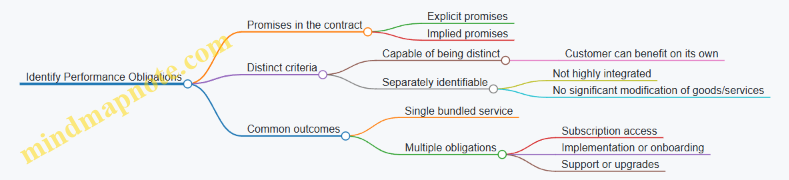
Step 2: Identify the Performance Obligations
Performance obligations are promises to transfer distinct goods or services. A promise is distinct if the customer can benefit from it on its own and it is separately identifiable from other promises.
Example: The subscription includes (a) access to the platform and (b) onboarding sessions. If the customer can use the platform without the onboarding and the onboarding is not highly integrated with the platform access, onboarding is likely distinct. If the onboarding is essentially a setup activity that does not provide a separate benefit, it may be part of the platform service.
Step 3: Determine the Transaction Price
Transaction price is the amount of consideration you expect to receive. It includes fixed amounts and variable consideration, and it excludes amounts collected on behalf of third parties.
Variable consideration is estimated using either the expected value method or the most likely amount method, depending on which better predicts the amount.
Example: A construction-related contract has a fixed fee of $500,000 plus a performance bonus of $100,000 if milestones are met. The vendor estimates a 60% chance of meeting milestones. Using the expected value approach, the variable consideration estimate is $60,000 (60% × $100,000). The transaction price estimate becomes $560,000, subject to the constraint.
Constraint in plain terms: you include variable consideration only to the extent it is highly probable that a significant reversal will not occur when uncertainty resolves.
Step 4: Allocate the Transaction Price to Performance Obligations
You allocate based on relative standalone selling prices. If standalone selling prices are observable, use them. If not, estimate them using methods such as adjusted market assessment or expected cost plus margin.
Example: The contract includes platform access (standalone $300,000) and onboarding (standalone $50,000). Total standalone selling price is $350,000. If the transaction price is $280,000, allocation is:
- Platform access: $280,000 × (300,000 / 350,000) = $240,000
- Onboarding: $280,000 × (50,000 / 350,000) = $40,000
If a discount relates specifically to one obligation, you allocate it to that obligation first, as long as the criteria are met.
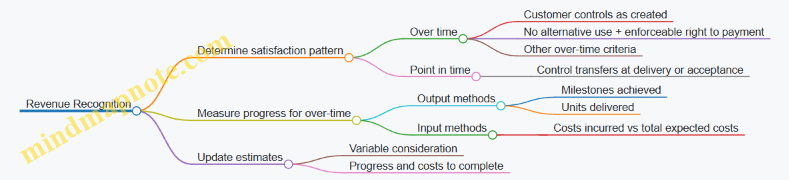
Step 5: Recognize Revenue When (Or As) Performance Obligations Are Satisfied
Revenue timing depends on whether control transfers over time or at a point in time.
Over time recognition is used when one of the over-time criteria is met, such as when the customer controls the asset as it is created or when the asset has no alternative use and the entity has an enforceable right to payment for performance completed to date.
Example: A managed service contract requires the vendor to provide continuous support over 12 months. The customer receives and consumes benefits as the service is performed, so revenue is recognized over time.
To measure progress, you use an output method (such as milestones or units delivered) or an input method (such as costs incurred relative to total expected costs). You update estimates as facts change.
Putting It Together with One Integrated Walkthrough
Consider a contract dated 2026-03-15 for $500,000 fixed consideration for platform access plus $50,000 for implementation. Implementation is distinct because the customer can benefit from platform access immediately, and implementation is separately identifiable. The transaction price is $550,000. Standalone selling prices are $480,000 for access and $120,000 for implementation, totaling $600,000.
Allocation:
- Access: $550,000 × (480,000 / 600,000) = $440,000
- Implementation: $550,000 × (120,000 / 600,000) = $110,000
Timing:
- Access is recognized over the subscription period.
- Implementation is recognized over time if the customer controls the work as it is performed; otherwise, it may be recognized at a point in time upon acceptance.
The model works best when you keep the evidence trail tight: contract terms for Step 1 and 2, estimation support for Step 3, standalone selling price logic for Step 4, and control/progress evidence for Step 5.
1.3 Identifying a Contract with a Customer and Assessing Collectability
Identifying A Contract With A Customer
A “contract” for revenue recognition purposes is not just a signed document. It’s an agreement that creates enforceable rights and obligations. In practice, you’re looking for four things: (1) approval and commitment, (2) identifiable rights and payment terms, (3) commercial substance, and (4) collectability is probable. If any of these are missing, you don’t get to start recognizing revenue just because work has begun.
Approval and Commitment
Approval can be explicit (signed master agreement) or implicit (a purchase order accepted by the supplier, or a customer’s order that the supplier fulfills without objection). The key is that both parties are committed to the arrangement. For example, if a customer emails “Please quote,” and you respond with a price, that’s not yet a contract. If the customer then issues a purchase order and you accept it, the commitment is clearer.
Identifiable Rights and Payment Terms
You need enough detail to determine what each party must do and what the customer must pay. Rights and obligations include delivery timing, service scope, acceptance criteria, and how changes are handled. Payment terms include the amount, due dates, and whether payment is contingent on something.
Example: A contract states “Implementation services for Customer X” but never specifies deliverables or acceptance. If the scope is so vague that you can’t identify what the customer is entitled to, you may not have a contract for revenue recognition purposes.
Commercial Substance
Commercial substance exists when the arrangement is expected to change the entity’s future cash flows in a meaningful way. If the “deal” is effectively a wash—no real economic effect—then revenue recognition is not appropriate.
Example: A customer requests a “swap” where you deliver nothing new and receive nothing of value beyond reimbursement of costs with no margin. Even if paperwork exists, you may struggle to show commercial substance.
Collectability Assessment
Collectability is the probability that the entity will collect substantially all of the consideration to which it expects to be entitled. This is assessed at contract inception and updated when facts change.
Collectability is not “will we eventually get paid?” It’s “are we likely to collect substantially all of what we’re entitled to?” The assessment should consider the customer’s ability and intent to pay, including past payment history, credit risk, and whether amounts are disputed.
Practical Mindset for Collectability
Treat collectability as a decision gate. If collectability is not probable, you generally do not recognize revenue for the expected consideration. Instead, you may recognize consideration only when it is received or when collectability becomes probable, depending on the facts and the nature of the arrangement.
Mind Map: Contract Identification and Collectability
Assessing Collectability Systematically
A good collectability assessment is repeatable. Start with a checklist, then document the reasoning.
Step 1: Gather Credit and Payment Evidence
Use information available at inception: credit ratings, internal credit scores, payment history with the customer, and whether the customer has a track record of paying invoices on time. If the customer is new, rely more heavily on available credit indicators and any guarantees or collateral.
Example: A long-standing customer with consistent on-time payments typically supports a “probable” conclusion, assuming no new adverse facts.
Step 2: Identify Contractual Barriers to Collection
Look for terms that make payment uncertain. Common examples include customer rights to withhold payment for reasons unrelated to performance, broad refund rights, or pricing that is heavily contingent on events controlled by the customer.
Example: A contract requires payment only after the customer’s internal acceptance process, and the customer can delay acceptance indefinitely without objective criteria. That can weaken collectability.
Step 3: Evaluate Disputes and Offsets
If the customer has a history of disputing invoices or if there is an active dispute about amounts already billed, collectability may not be probable for the disputed portion. The assessment should focus on whether you expect to collect substantially all of the consideration.
Example: You bill $100,000 for services delivered. The customer disputes $40,000 and has not paid any portion. If you expect to collect only part of the disputed amount, collectability may fail for the unpaid consideration.
Step 4: Consider Mitigating Factors
Some arrangements include credit enhancements such as guarantees, letters of credit, or prepayments. These can support collectability because they reduce the risk of nonpayment.
Example: If a customer pays 50% upfront and the remaining 50% is due upon delivery, and the customer has a reasonable payment history, collectability for the remaining consideration may be probable even if the customer’s credit is not perfect.
Integrated Example: When a Contract Exists and When It Doesn’t
A software vendor signs a master agreement with a customer. The customer issues a purchase order for a subscription and implementation. The vendor accepts the order. The agreement specifies the subscription term, implementation deliverables, and payment schedule. The customer has paid prior invoices on time. Collectability is probable because the vendor expects to collect substantially all consideration.
Now change one fact: the customer’s credit deteriorates sharply, and the customer informs the vendor it will not pay unless acceptance occurs, but acceptance criteria are subjective and the customer can delay indefinitely. Even with a signed agreement, collectability may not be probable at inception. In that case, revenue recognition should be constrained until collectability improves or the arrangement is structured to support it.
Documentation That Holds Up Under Review
Document the conclusion on collectability and the evidence used. Include: the assessment date, key facts about the customer, any contractual terms affecting payment, and the rationale for “probable” or “not probable.” If the conclusion changes, document the trigger and the updated assessment. This turns a judgment call into a traceable process—less guesswork, fewer surprises.
1.4 Determining the Contract Term and Accounting for Contract Modifications
Contract Term Basics That Drive Revenue Timing
The contract term is the period over which the parties have enforceable rights and obligations. In practice, it matters because it determines when performance is required, when consideration is due, and what happens if the customer changes plans. Start by separating three time concepts: (1) the stated contract period, (2) the period of enforceable rights and obligations, and (3) the period over which you expect to perform. Revenue accounting uses the enforceable rights and obligations, not the marketing-friendly “term” on the signature page.
A common example is a one-year master agreement with purchase orders issued as needed. The master agreement may set pricing and ordering rules, but the enforceable obligation to deliver specific goods or services often exists only when a purchase order is issued. If the master agreement does not create enforceable delivery obligations for future orders, then the contract term for revenue recognition is effectively tied to each purchase order’s enforceable scope.
When Contract Term Includes Renewal Options
Renewal options can extend the contract term, but only if they create enforceable rights and obligations. The key question is whether the option is within the customer’s control and whether the supplier has a substantive right to prevent renewal. If the customer can renew without paying an additional amount that reflects the supplier’s expected costs and risks, the renewal may be part of the enforceable term.
Example: A software hosting agreement runs for 12 months and includes an automatic renewal unless the customer gives notice 30 days before the end of the term. If the customer can avoid renewal by giving notice, the renewal is not automatically enforceable. However, if the supplier has a substantive right to charge a penalty or otherwise prevent the customer from avoiding renewal, the renewal period may be included in the contract term.
Contract Modifications That Change the Accounting
A contract modification is a change in scope and/or price (or both) that is approved by the parties. The accounting depends on whether the modification adds distinct goods or services and whether those goods or services are priced separately from the original contract.
Think of modifications as one of three outcomes:
- Separate addition: The modification adds distinct goods or services at a price that reflects what the customer would pay on a standalone basis.
- Cumulative adjustment: The modification does not add distinct goods or services, so you update the accounting for the remaining performance.
- No meaningful change: The change is administrative or clarifies terms without changing scope or price.
Step-by-Step Decision Process for Modifications
Use a consistent sequence so the conclusion is defensible:
- Confirm it is a modification: Is there an approved change in scope and/or price? If it’s just a timing change for delivery with no scope or price impact, it may not be a modification.
- Identify the added goods or services: What exactly is changing? Break the change into deliverables, not just “more work.”
- Assess distinctness: Are the added goods or services separately identifiable and capable of being distinct? A deliverable is distinct if the customer can benefit from it on its own or with readily available resources.
- Determine whether the modification is priced separately: If the added goods or services are priced at a standalone selling price (or close enough using your allocation approach), that supports separate accounting.
- Apply the correct accounting model:
- If distinct and priced separately: treat as a separate contract for the added portion.
- Otherwise: treat as part of the existing contract and adjust revenue prospectively (or as required for the remaining performance).
Practical Example: Modification During Performance
Assume a managed services contract begins January 1. The original contract includes monthly service for 12 months at $120,000, with revenue recognized over time.
- Original scope: 12 months of service.
- Modification: On April 1, the customer requests an additional security monitoring module starting July 1.
- Distinctness: The module is separately identifiable and the customer can benefit from it with its existing systems.
- Pricing: The module is priced at $30,000, which aligns with its standalone selling price.
Result: Account for the added module as a separate contract for the July 1 onward period, while continuing to recognize the original contract’s revenue based on the original performance obligations.
Now change one fact: suppose the module is not separately identifiable because it requires reconfiguring the entire service and cannot be used independently. Even if the customer pays an additional amount, the modification likely does not add distinct goods or services. In that case, you adjust the remaining performance obligation accounting for the existing contract, using updated estimates of progress and total consideration.
Mind Map: Contract Term and Modifications
Documentation That Makes the Conclusion Hold Up
To keep the accounting consistent across quarters, document three items for every modification: (1) the approval evidence and what changed, (2) the distinctness rationale tied to customer benefit, and (3) the pricing basis used to judge whether the added goods or services are priced separately. When these are clear, the modification accounting becomes less of a debate and more of a repeatable process—like assembling furniture with the right screws, not guessing which pile is “probably the right one.”
1.5 Common Data Inputs and Documentation Requirements for Audit Readiness
Audit readiness starts with boring inputs and ends with traceable conclusions. In revenue recognition, “traceable” means you can start at a contract term, follow it to a policy decision, and land on a journal entry (or a disclosure) with supporting calculations.
Data Inputs You Need Before You Touch Accounting
Contract and Commercial Terms
Collect the contract itself and the commercial terms that drive the five-step model: customer identity, contract start and end dates, pricing, payment terms, delivery terms, renewal rights, and any change-control language. If the contract is silent on something that affects performance obligations or timing, document the gap and how you resolved it (for example, through standard terms, correspondence, or internal approvals).
Performance Obligation Details
For each promised good or service, capture what is delivered, when it is delivered, and what makes it distinct. If the contract includes setup, implementation, training, or ongoing support, record whether these are separate promises or part of a combined deliverable. The audit trail should show the “distinctness” reasoning and the evidence used.
Transaction Price Components
Variable consideration requires more than a number. Capture the type of variability (rebates, refunds, performance bonuses, usage-based fees), the estimation method you used, and the constraint rationale. Also capture any consideration payable to a customer and whether it is treated as a reduction of transaction price.
Standalone Selling Prices and Allocation Inputs
If you estimate standalone selling prices, store the method and the inputs. For example, if you use an adjusted market assessment, keep the market data sources and the adjustments. If you use expected cost plus margin, keep cost assumptions and margin logic.
Contract Balances and Billing Data
Revenue accounting depends on what has been billed and what has been recognized. Capture billing schedules, invoice dates, amounts, and any credit memos. Also capture contract assets and contract liabilities movements so the reconciliation is not a guessing game.
Documentation Requirements That Make Auditors Happy
A Contract Review Memo That Connects Terms to Accounting
Create a standardized memo per contract that includes: (1) identified performance obligations, (2) transaction price components, (3) allocation approach, (4) revenue recognition pattern and progress measurement, and (5) key judgments. Keep it short enough to be used, but complete enough to stand alone.
Evidence Packs for Key Judgments
Auditors typically focus on judgments, not the mechanics. Build an evidence pack for each judgment area: contract enforceability, distinctness, variable consideration estimation, and over-time measurement. Evidence can include signed agreements, amendments, emails that confirm scope, and internal approval records.
Calculation Workpapers with Version Control
Workpapers should show the calculation steps, not just the final number. Include assumptions, intermediate outputs, and the date of preparation. Version control matters because variable consideration and progress estimates change as facts update.
Reconciliation Between Subledger and General Ledger
Maintain a reconciliation that ties contract-level activity to GL postings. The reconciliation should explain differences such as timing, rounding, tax handling, and write-offs. If you cannot reconcile within a reasonable tolerance, you do not have audit readiness—you have a mystery.
Systematic Mind Map of Audit-Ready Inputs
Mind Map: Audit-Ready Revenue Recognition Inputs
Integrated Examples That Show the Trail
Example: Variable Consideration with a Constraint
A software contract includes a $100,000 base fee plus a $20,000 performance bonus if uptime exceeds a threshold. You estimate the bonus using the expected value of likely outcomes based on historical performance and current implementation status. You then apply the constraint by documenting why it is not probable that a significant reversal will occur. In the workpaper, you store: the probability inputs, the expected value calculation, and the constraint conclusion tied to the specific facts.
Example: Allocation When Standalone Selling Prices Are Uncertain
A customer buys a bundled package: implementation ($60,000 list) and ongoing support ($30,000 list). The contract grants a $20,000 discount for the bundle. If standalone selling prices are not directly observable, you estimate them using adjusted market assessment for implementation and expected cost plus margin for support. You document the discount allocation method and show the allocated amounts per performance obligation, then link those allocations to the revenue recognition schedule.
Example: Over-Time Progress with Cost Updates
A construction-related service is recognized over time using an input method based on labor hours. You capture the labor rate assumptions, the estimated total hours, and the current period hours. When estimates update, you document the change in total hours and the reason (for example, scope clarification). The journal entry is supported by the updated progress calculation and the reconciliation to contract balances.
Practical Documentation Checklist for Audit Readiness
- Contract terms mapped to accounting judgments
- Performance obligations and distinctness evidence stored per contract
- Variable consideration estimation method and constraint rationale documented
- Standalone selling price method and inputs saved with calculations
- Progress measurement method and cost-to-complete assumptions retained
- Workpapers with assumptions, intermediate steps, and version dates
- Subledger-to-GL reconciliation completed and reviewed
- Approval trail for exceptions and policy deviations
A good audit trail is like a well-labeled file cabinet: it does not make the work exciting, but it makes the work finishable.
2. Contract Identification and Customer Agreements in Complex Environments
2.1 Contract Combination Rules and When to Treat Agreements as One
Revenue standards often start with a simple question: “What is the contract?” In practice, companies sign multiple documents that look separate but behave like one deal. Contract combination rules prevent companies from recognizing revenue too early by splitting what is economically one arrangement.
Foundational Concept: One Customer, One Economic Arrangement
A “contract” is an agreement that creates enforceable rights and obligations. When multiple agreements are entered with the same customer (or related parties) around the same time, you evaluate whether they should be combined. The key idea is whether the agreements are linked in a way that changes the substance of the arrangement.
Step 1: Identify the Agreements to Evaluate
Start by listing all agreements with the customer that are signed or modified within the relevant timeframe. Include:
- Master agreements and statements of work
- Purchase orders and acceptance confirmations
- Side letters that change pricing, scope, or delivery terms
- Renewal or extension documents that modify the original deal
If the documents are clearly independent—different customers, different pricing logic, and no shared performance terms—combination is usually unnecessary.
Step 2: Apply the Combination Criteria
Combine agreements when they are negotiated as a package with a single commercial objective, or when the consideration in one agreement depends on the other. Also consider whether the goods or services promised in one agreement are effectively part of the same overall performance.
A practical way to test this is to ask two questions:
- If you removed Agreement B, would Agreement A still make commercial sense on its own?
- Do the documents reference each other’s pricing, scope, or delivery conditions?
If both answers are “no” or “yes, they reference each other,” you likely have one combined contract.
Step 3: Evaluate the Timing and Negotiation Link
Even when documents are signed on different dates, they can still be negotiated as a package. Look for evidence such as:
- A single bid or proposal covering multiple documents
- One set of commercial terms that gets split into separate paperwork
- Delivery schedules that interlock across documents
If the company can show that the later document was negotiated after the earlier one was fully priced and committed independently, combination becomes less likely.
Step 4: Consider Contract Modifications Separately
Combination is not the same as modification. If a later document changes the scope or price of an existing contract, you may need modification accounting instead of combining contracts from the start. A helpful rule of thumb:
- Combination: agreements are linked from the outset as one package.
- Modification: the original contract exists, and later changes alter it.
Mind Map: Contract Combination Decision Flow
Example: Two Documents That Should Be Combined
Company A signs a master services agreement with Customer C for “implementation and ongoing support.” Two weeks later, it issues a statement of work for implementation. The statement of work states that the monthly support fee in the master agreement is reduced by 20% if implementation milestones are missed, and it references the same milestone schedule.
Even though the documents are separate, the support consideration depends on implementation performance. Removing the statement of work would change how the support fee works. Under the combination criteria, treat them as one contract so the performance obligations and revenue timing reflect the interdependent deal.
Example: Two Documents That Should Not Be Combined
Company B enters a one-year software license agreement with Customer D. Three months later, Customer D purchases additional training under a separate order with a separate price and a separate delivery schedule. The training order does not reference the license pricing, does not change the license scope, and does not affect any enforceable rights under the license.
Here, the later agreement does not appear negotiated as a package and the consideration does not depend on the earlier contract. Treat the training order as a separate contract unless other facts show interdependence.
Example: When Cross-References Are the Tie That Binds
Company E signs a framework agreement for “future modules.” It also signs a specific module agreement that sets delivery dates and a fixed price. The framework agreement states that the fixed price applies only if the customer commits to purchasing at least two modules under the framework.
The customer’s commitment under the framework affects the economics of the specific module agreement. That dependency is a strong indicator to combine the agreements into a single contract for revenue recognition purposes.
Practical Takeaway: Document the Reasoning
For audit-ready work, record:
- Which agreements were evaluated
- The specific facts supporting “package” or “dependency”
- Why the agreements are interdependent or independent
- Whether later documents are combinations or modifications
When the paperwork looks messy, the substance usually isn’t. The combination rules are essentially a consistency check: the revenue pattern should match the commercial reality of how the customer and company actually bargained.
2.2 Contract Segmentation for Multiple Performance Obligations
Contract segmentation is the step where you decide whether a customer agreement contains one performance obligation or several. The goal is practical: you want revenue to reflect what the customer actually receives, not just what the contract happens to say.
Foundational Idea: Promises Become Performance Obligations
A performance obligation is a promise to transfer a distinct good or service. Segmentation starts by listing the promises in the contract. Then you test each promise for distinctness. If multiple promises are distinct, you segment the contract into multiple performance obligations and account for them separately.
A useful mental model is “what the customer can benefit from on its own.” If the customer can use a promised item without relying on other promises, that item is a strong candidate for being distinct.
Step 1: Inventory Promises and Group Them Intentionally
Begin with a promise inventory, not a revenue schedule. Create a list of each deliverable and each service activity that the contract commits you to perform. Examples include software licenses, implementation services, training, ongoing support, and hardware delivery.
Then group promises into clusters that are likely to be distinct. For instance, “license + implementation” might be one cluster if the implementation is required to make the license functional. “Training + support” might be separate if training is optional or can be delivered independently.
Step 2: Apply Distinctness Criteria to Each Promise
A promise is distinct if both of the following are true:
- The customer can benefit from the good or service on its own or together with other readily available resources.
- The promise is separately identifiable from other promises in the contract.
The first criterion is about usefulness. The second is about separateness in the contract’s structure.
Readily Available Resources in Plain Terms
Readily available resources are things the customer already has or can obtain without your help. For example, a customer that purchases a standard software license and already has IT staff can often benefit from the license without your implementation.
Separately Identifiable in Plain Terms
Separately identifiable means the promise is not highly integrated with other promises such that it effectively becomes one combined output. If the contract is written so that you are delivering a single combined result, segmentation may be limited.
Mind Map: Contract Segmentation Logic
Example: Bundled Software License and Setup
Assume a contract states:
- You provide a software license for $120,000.
- You provide “setup” for $30,000.
- Setup includes configuration and data migration.
If the customer can use the license immediately with its own resources, the license is distinct. Now consider setup: if setup is required to make the license functional and the configuration is highly dependent on the license, setup may be separately identifiable only if it does not significantly modify the license into a combined output.
A practical way to decide is to ask: “Is setup a service the customer could reasonably buy from someone else, or is it part of delivering a single combined system?” If setup is a standard service and can be performed independently, segmentation into two performance obligations is more likely.
Example: Managed Service with Integrated Reporting
Now assume:
- You provide a managed service for $200,000.
- The contract includes monthly reporting and ongoing monitoring.
If the reporting is not a separate deliverable the customer can benefit from without the monitoring, and the monitoring activities are what generate the reporting, then reporting is likely not separately identifiable. In that case, the managed service and reporting may be one performance obligation.
This is where segmentation prevents a common mistake: treating every named deliverable as separate when the contract is really promising one continuous service outcome.
Common Segmentation Pitfalls and How to Avoid Them
- Treating every line item as distinct: A named deliverable can still be part of a combined output.
- Ignoring customer benefit: If the customer cannot benefit from a promise without other promises, distinctness is weaker.
- Overlooking integration language: Contract wording about a single system, single outcome, or interdependence often signals limited separability.
- Forgetting practical delivery reality: If your delivery process shows one combined output, that supports treating promises as one performance obligation.
Practical Output: What You Should Document
For each promise, document:
- The promise description in plain language.
- The distinctness conclusion for each criterion.
- The key facts supporting that conclusion.
- The resulting performance obligation grouping.
When segmentation is done well, the next steps—price allocation and revenue timing—become straightforward because each performance obligation has a clear “what” and “when.”
2.3 Handling Framework Agreements and Purchase Orders
Framework agreements set the rules of the relationship, while purchase orders (POs) are the specific orders that trigger delivery and payment. The accounting question is whether each PO is a separate contract or whether the framework agreement already contains enforceable rights and obligations for specific goods or services. The answer affects when revenue begins, how performance obligations are identified, and how contract modifications are recognized.
Foundational Concept: What Makes Something a Contract
A contract exists when there are enforceable rights and obligations. In practice, framework agreements often include pricing, general terms, and ordering procedures, but they may not specify the exact goods or services until a PO is issued. Collectability and approval rights matter too: if the supplier can refuse orders without penalty, the “obligation” may not be enforceable until the PO is accepted.
Practical rule of thumb: treat the framework as the “container” for terms, then determine whether the PO creates enforceable rights for specific performance.
Step 1: Read the Framework Like a Contract Lawyer with a Spreadsheet
Focus on five areas:
- Ordering mechanics: Are POs binding when issued, or only after acceptance?
- Pricing and payment terms: Are they fixed or subject to later negotiation?
- Delivery and acceptance: Are delivery dates and acceptance criteria defined per PO?
- Customer obligations: Does the customer commit to minimum quantities or pay for cancellations?
- Supplier obligations: Is the supplier required to fulfill each PO?
If the framework states that each PO is a binding order and the supplier has no substantive right to avoid performance, the PO typically creates enforceable rights and obligations for the specific goods or services.
Step 2: Decide Whether to Combine or Separate
Under the contract combination concept, you combine agreements only when they are entered into at or near the same time with the same customer and meet the criteria for being negotiated as a package. Framework agreements and POs are usually not “negotiated as a package” each time; instead, the framework sets baseline terms and the PO specifies the transaction.
Common outcome: the framework is not a contract by itself for revenue purposes; each PO is the contract for the goods or services ordered, unless the framework already creates enforceable rights for specific items.
Step 3: Determine the Contract Term for Each PO
Even if each PO is a separate contract, the framework can still affect the contract term by defining:
- how long orders can be placed,
- how long the supplier must deliver,
- and how changes are handled.
If a PO includes a delivery schedule spanning months, the PO contract term drives the timing of revenue recognition and the measurement of progress (if over-time criteria apply).
Step 4: Identify Performance Obligations Within the PO
Framework agreements often bundle multiple items or service levels across POs. For each PO, identify promised goods or services that are distinct. If the PO includes a product plus installation, you assess whether installation is separately identifiable and whether the customer can benefit from the product on its own.
Step 5: Handle Changes Without Creating Accidental Modifications
Changes can occur at two levels:
- Framework-level changes that affect future POs (usually not modifications of already-issued POs).
- PO-level changes that alter scope, price, or delivery for that specific order.
A PO modification is accounted for based on whether the change adds distinct goods or services and whether the remaining goods or services are accounted for as a continuation of the original contract.
Mind Map: Framework Agreements and Purchase Orders
Example: Framework Sets Terms, PO Creates the Contract
A supplier signs a framework agreement with a customer on 2026-03-15. The framework states that the customer may issue POs for specific equipment, and each PO is binding upon issuance. The supplier must fulfill accepted POs and cannot cancel without a contractual penalty. Pricing is fixed by a rate card in the framework.
When the customer issues PO-1001 for 10 units delivered in April, the PO specifies the goods and delivery dates. Revenue for PO-1001 begins based on the PO’s performance obligations and timing. The framework merely provides the enforceable terms that make the PO binding.
Example: PO Not Binding Until Acceptance
Same facts, except the framework says the supplier may reject any PO without penalty and only accepted POs are binding. In this case, enforceable rights and obligations for the specific goods generally arise upon acceptance. Revenue recognition should not start merely because a PO is issued; it starts when the supplier has an enforceable obligation.
Example: Framework-Level Change Does Not Modify Prior POs
The framework includes a clause allowing the supplier to update service rates for future POs with 30 days’ notice. The supplier issues the update on 2026-03-30. POs already issued before the update keep their original rates unless the PO terms incorporate the updated rates. Accounting treats the update as affecting future contracts, not modifications of completed or in-progress POs.
Example: PO-Level Change Creates a Modification
A PO for a managed service includes a monthly fee and a defined scope. Midway through the quarter, the customer requests additional reporting dashboards under the same service. If the dashboards are distinct services, the change is accounted for as an added performance obligation. If they are not distinct and represent a change to the existing service pattern, the modification is treated as a continuation with updated estimates and allocation as required.
Documentation That Prevents Confusion Later
For each PO type, document:
- whether the PO is binding on issuance or acceptance,
- which framework clauses establish enforceable rights,
- how you conclude the contract is formed,
- and how PO revisions map to modification accounting.
This keeps the accounting consistent across months of orders, instead of turning each PO into a mini debate with the same facts.
2.4 Assessing Enforceable Rights and Obligations in Contract Terms
Enforceable rights and obligations are the backbone of the “contract” concept in revenue recognition. If the parties can’t enforce key terms, you may have something closer to a plan than an agreement—and the accounting can change. The goal is not to predict behavior; it’s to determine what each party can legally demand and what each party must legally perform.
Step 1: Start with What Is Actually Promised
Read the contract as if you were drafting a checklist for a dispute. Identify the promised goods or services, the delivery timing, and the consideration. Then mark which terms are operational (what gets delivered) and which are conditional (what must happen for delivery or payment).
Example: A software vendor signs an agreement to provide “implementation services.” The contract states the customer will pay $120,000 “upon completion of milestones.” If the contract also says either party may terminate “at any time without cause,” the enforceability of the milestones and payment triggers becomes a central question.
Step 2: Determine Whether Each Party’s Rights Are Enforceable
Enforceability is about legal rights, not business expectations. Look for terms that give one party the ability to compel performance or demand payment.
Key indicators to evaluate:
- Payment rights: Is the customer required to pay, or is payment optional?
- Performance rights: Can the vendor be required to deliver, or can it walk away without consequence?
- Remedies: Are there consequences for nonperformance that suggest enforceable obligations (for example, damages, refund obligations, or specific performance clauses)?
- Termination and cancellation: Does termination require a substantive reason, or is it freely exercisable?
Example: A customer signs a one-year service agreement but the contract allows the customer to cancel monthly “for convenience” with no penalty. If the vendor has no enforceable right to continued service or payment beyond the cancellation date, the agreement may not meet the contract criteria for the full term.
Step 3: Evaluate Consideration That Is Not Yet Due
Contracts often include amounts that depend on future events. The question is whether the parties have enforceable rights to those amounts.
Consider whether the consideration is:
- Unconditional (due regardless of future events),
- Conditional (due only if specified conditions occur), or
- At the discretion of one party (for example, amounts the vendor can decide not to invoice).
Example: A contract includes a $50,000 “success fee” if the customer’s project reaches a defined outcome. If the outcome definition is objective and the vendor has a right to the fee when achieved, the right is enforceable. If the vendor can decide whether the outcome is “satisfactory” without objective criteria, enforceability is weaker.
Step 4: Assess Whether the Contract Has Substance
Even if terms exist on paper, enforceability can be undermined by practical barriers. Evaluate whether the contract is effectively executable.
Common issues:
- No clear approval process for pricing or scope changes,
- Ambiguous acceptance criteria that allow one party to avoid performance,
- Unilateral change rights that let one party alter key terms without the other’s agreement.
Example: A purchase order references “rates per attached schedule,” but the schedule is missing and the vendor can later set rates unilaterally. If the customer cannot enforce the rates and the vendor cannot enforce delivery at known prices, the enforceable rights and obligations are not sufficiently defined.
Step 5: Use a Consistent Evidence Approach
Document your reasoning using contract excerpts and a short conclusion for each enforceability area: payment, performance, termination, and remedies. Consistency matters because teams often interpret the same clause differently.
A practical way to structure your assessment:
- Quote the clause.
- State the enforceable right or obligation it creates.
- Identify the counterparty’s ability to avoid that obligation.
- Conclude whether the contract criteria are met for the relevant portion.
Mind Map: Enforceable Rights and Obligations Assessment
Example: Putting It Together with a Clause-by-Clause Conclusion
Assume a contract includes: (1) a $200,000 base fee, (2) monthly service delivery, and (3) a termination-for-convenience clause allowing the customer to cancel with 30 days’ notice and no penalty.
- Payment: If the contract requires payment for services performed up to the cancellation date, payment for that period is enforceable.
- Performance: The vendor is obligated to provide services during the notice period, but not beyond cancellation.
- Termination: The customer’s free cancellation limits enforceable rights for the remaining months.
Result: You treat the enforceable portion as the period through the cancellation notice, because beyond that point the parties lack enforceable rights and obligations.
Quick Self-Check Before You Move On
If you can’t point to a clause that gives each party enforceable rights and obligations for the relevant period, pause. Revenue recognition depends on what the parties can compel, not what they hope will happen.
2.5 Practical Checklist for Contract Review and Evidence Collection
A contract review is only as good as the evidence behind it. The goal is to reach defensible conclusions about (1) what the customer and company promised, (2) how much consideration is expected, and (3) when and how those promises are satisfied. Use this checklist to move from basic contract facts to the specific judgments required by the revenue model.
Step 1: Capture the Contract Record
Start by building a clean contract “source file” so you can trace every accounting conclusion back to wording.
- Contract identifiers: legal entity, counterparty name, contract number, effective date, and any amendments.
- Document set: master agreement, statements of work, order forms, pricing schedules, and side letters.
- Version control: record the latest executed version and list superseded documents.
- Evidence of approval: signatures, email approvals, or documented authority.
Example: If a master agreement exists but pricing is only in a separate rate card, store both in the same source file and note which document controls pricing.
Step 2: Confirm Contract Existence and Enforceability
Revenue accounting depends on whether the agreement creates enforceable rights and obligations.
- Identify the parties and scope of the agreement.
- Verify enforceability indicators: payment terms, delivery terms, and remedies for nonperformance.
- Assess collectability: document the basis for concluding the company expects to collect consideration.
- Note termination rights: whether termination is at the customer’s option, the company’s option, or mutual.
Example: If the contract allows the customer to cancel without penalty, document whether the company has enforceable rights to payment for work performed or only for delivered items.
Step 3: Identify Performance Obligations
This step turns contract language into a structured list of promises.
- List each promised good or service explicitly stated.
- Scan for implicit promises: setup, implementation, onboarding, training, and ongoing support.
- Determine whether promises are distinct by documenting:
- The customer can benefit from the item on its own or with readily available resources.
- The item is separately identifiable in the contract.
- Record any “series” or bundling logic if multiple deliverables are treated as a single performance obligation.
Example: A contract may bundle “installation” with “software subscription.” If installation is required to make the software functional and is not separately identifiable, you may treat it as part of the subscription promise. Capture the exact clauses supporting that conclusion.
Step 4: Determine Transaction Price and Variable Consideration
Judgments here are often the audit focus, so evidence must be specific.
- Extract consideration terms: fixed fees, usage fees, milestones, rebates, credits, and refunds.
- Identify variable consideration triggers: performance bonuses, penalties, service-level credits, and customer acceptance provisions.
- Document estimation method: expected value or most likely amount, and why it fits the contract.
- Apply the constraint: document the reason the company expects it will not reverse revenue significantly.
- Capture payment terms and timing: due dates, invoicing cadence, and dispute processes.
Example: If service-level credits reduce consideration when uptime falls below a threshold, document how historical performance and the contract’s credit mechanism support the estimate and constraint.
Step 5: Allocate Transaction Price to Performance Obligations
Allocation requires standalone selling prices and a defensible method.
- Determine standalone selling price (SSP) method for each performance obligation:
- Observable prices, adjusted market assessment, or expected cost plus margin.
- Document discount allocation logic: confirm whether discounts relate to specific performance obligations.
- Record allocation outcomes and rounding approach.
Example: If a discount is granted for a bundle of subscription plus implementation, document whether the discount is specifically attributable to one or both promises based on contract terms.
Step 6: Determine Revenue Recognition Pattern
This step links performance obligation nature to timing.
- For each performance obligation, decide point in time vs over time.
- If over time, document which criterion is met:
- Customer controls the asset as created.
- Asset has no alternative use and the company has an enforceable right to payment.
- Customer simultaneously receives and consumes benefits.
- Document progress measurement method:
- Output measures (deliverables, milestones) or input measures (costs, labor hours).
- Capture how estimates are updated and who approves changes.
Example: For a managed service, if progress is measured by labor hours, keep a schedule showing how hours are tracked and reconciled to billing.
Step 7: Collect Evidence for Contract Costs and Presentation
Even if the contract review is “revenue-first,” evidence should cover related accounting.
- Incremental costs of obtaining a contract: document why they qualify and the amortization period.
- Costs to fulfill: document capitalization criteria and amortization basis.
- Principal vs agent: document control indicators such as responsibility for fulfillment and pricing latitude.
- Presentation: ensure revenue and related expenses are presented consistently with principal/agent conclusions.
Example: If the company pays a sales commission only when a contract is signed, store the policy and the contract clause that triggers payment.
Step 8: Build the Audit-Ready Evidence Pack
Evidence should be organized so a reviewer can follow the logic without hunting.
- Create a one-page summary per contract: promises, transaction price components, allocation, timing, and key judgments.
- Attach supporting schedules:
- Variable consideration estimate worksheet.
- SSP calculation or rationale.
- Progress measurement and update log.
- Contract modification log if applicable.
- Maintain a judgment log with:
- The judgment.
- The specific contract language or data supporting it.
- The accounting conclusion.
- The approver and date of approval.
Example: A contract with milestones and service credits should have (a) a milestone schedule, (b) a service-level credit calculation, (c) an allocation worksheet, and (d) a progress update log. If any of these are missing, the accounting may still be correct, but the evidence trail is incomplete—like having the right destination without the map.
3. Performance Obligations and Bundled Promises
3.1 Identifying Promises in Contracts and Distinguishing Goods from Services
Revenue recognition starts with a simple question: what exactly did the customer promise to buy, and what did the company promise to deliver? The contract may look like one deal, but it can contain multiple promises. The accounting answer depends on whether each promise is a good or a service, and whether the promise is distinct.
Core Concept of a Promise
A promise is a unit of performance that the company has committed to the customer. In practice, promises come from explicit contract language, but they can also arise from implied commitments created by customary business practices, published policies, or specific statements made during sales.
A useful way to test whether something is a promise is to ask: if the company did not perform it, would the customer still receive what it bargained for? If the customer would not, the item is likely a promise.
Goods Versus Services
A good is generally something the customer can control as an asset, such as a product, software delivered in a way that the customer can use, or a physical deliverable. A service is generally a performance obligation to provide an activity or access over time, such as implementation, ongoing support, or hosting.
The distinction matters because it often drives the timing of revenue recognition. Goods frequently lead to point-in-time recognition, while services often lead to over-time recognition, though the final timing depends on the “over time” criteria.
Systematic Steps to Identify Promises
- List deliverables and activities stated in the contract. Start with the obvious: products, licenses, installation, training, support, and any reporting.
- Identify what the customer can reasonably expect. Consider marketing materials only if they are incorporated into the contract or create specific commitments.
- Separate deliverables from administrative tasks. Internal steps like project management, invoicing, or internal approvals are usually not promises.
- Assess whether each promise is capable of being distinct. Even if something is a promise, it may not be distinct from other promises.
- Classify each promise as a good or a service. Use the control and nature of performance as the guide.
Mind Map: Promises and Goods Versus Services
Examples That Show the Reasoning
Example 1: Hardware Plus Setup
A contract states: “We will deliver 10 servers and provide installation.” The servers are goods because the customer can control the servers as an asset once delivered. Installation is a service because it is an activity performed to bring the servers into working condition.
If the contract instead says: “We will deliver servers preconfigured and ready to run,” installation may be minimal and could be part of delivering the servers as a good. The key is whether the customer is buying a separate activity or simply receiving a configured item.
Example 2: Software License with Implementation
A company licenses software “for use by the customer.” The license itself is typically a good if the customer receives a right to use the software as an asset. Implementation is a service if it involves configuring, integrating, or training to enable the customer to use the software.
If implementation is purely technical assistance that does not change the customer’s ability to use the software, it may still be a service promise, but it could be not distinct from the license depending on how tightly it is integrated.
Example 3: Hosting and Support
A contract provides “cloud hosting and help desk support.” Hosting is usually a service because the customer receives access to an activity over time rather than an asset delivered at a point in time. Help desk support is also a service because it is ongoing performance.
A common mistake is to treat “support” as a warranty. If the contract promises to fix defects only to assure the product meets specifications, that may be assurance-type. If it promises ongoing assistance, it is a service promise.
Practical Classification Checklist
- Does the customer control an item or right at delivery? Likely a good.
- Is the company performing an activity or providing access over time? Likely a service.
- Is the deliverable an internal step with no customer benefit? Usually not a promise.
- Would nonperformance deprive the customer of the benefit of the contract? Likely a promise.
Once promises are identified and classified, the next step is to determine which promises are distinct and how that affects the timing and measurement of revenue. For now, the goal is to be precise about what the contract requires the company to do—and whether that requirement looks like delivering an asset or performing an activity.
3.2 Determining Whether Promises Are Distinct Under The Practical Criteria
A performance obligation is “distinct” when (1) the customer can benefit from the good or service on its own, and (2) the promise is separately identifiable from other promises in the contract. The practical criteria are designed to prevent over-splitting (creating too many obligations) and under-splitting (bundling unrelated promises). Think of it as asking two questions in order: “Would the customer still want it?” and “Is it really a separate deliverable?”
Step 1: Customer Can Benefit from the Promise
A customer can benefit if the good or service is capable of being used or consumed on its own, or together with other readily available resources. “Readily available” means the customer can obtain the resources without the seller needing to provide a custom integration service.
Example 1: Standalone software license
A contract includes a one-year software license and a separate training session. The license can be used immediately without the training, and the customer can access user guides and support materials. Even if training improves results, the license is capable of being used on its own. The training may or may not be distinct depending on the second criterion, but the license clearly passes the first.
Example 2: Custom installation that is not required
A contract sells a piece of equipment plus optional installation. If the equipment can be installed by the customer’s technicians (or third parties) without the seller’s involvement, the equipment promise can benefit on its own. If the contract requires the seller to perform a unique installation that cannot be replicated easily, the analysis shifts toward whether the promises are separately identifiable.
Step 2: Promise Is Separately Identifiable
Separately identifiable is assessed using indicators that look at how the promises interact. The goal is to determine whether the seller is, in substance, providing a combined item rather than multiple deliverables.
Indicator A: The seller does not provide a combined output
If the promises result in a single integrated deliverable, they may not be distinct. For instance, a “turnkey” system where hardware, software, and configuration are interdependent can be one combined service.
Example 3: Managed service with integrated reporting
A contract includes ongoing data processing and a customized dashboard. The dashboard is not functional without the ongoing processing, and the processing is tailored to the dashboard’s design. The customer cannot benefit from the dashboard without the processing service. Even if the dashboard could be viewed as a separate item, the interdependence suggests the promises may not be separately identifiable.
Indicator B: The good or service is not highly interdependent or interrelated
Interdependence is about whether one promise significantly affects the other. If the seller must substantially modify one deliverable to make the other work, that is a strong sign they are not distinct.
Example 4: Implementation that materially changes the product
A SaaS vendor sells a base subscription plus “implementation” that configures workflows unique to the customer and changes the subscription’s functionality. If the implementation is required to make the subscription usable and the subscription cannot operate as sold without it, the promises may be one performance obligation.
Indicator C: The promise is not significantly modifying or customizing another promise
Customization can be a clue that the promises are linked. The key is whether the customization is so substantial that it effectively merges the promises into a single combined output.
Example 5: Setup that is routine
A contract includes a subscription and a standard onboarding package that configures default settings and provides basic access. If the onboarding does not materially alter the subscription’s functionality and the subscription remains usable without it (even if less efficient), the onboarding may still be distinct.
Practical Decision Flow
    flowchart TD
A[Start: Identify each promise] --> B{Can the customer benefit from the promise on its own or with readily available resources?}
B -- Yes --> C{Is the promise separately identifiable from other promises?}
B -- No --> D[Not distinct: combine with related promises]
C -- Yes --> E[Distinct performance obligation]
C -- No --> F[Not distinct: combine with related promises]
Use a structured approach to avoid “gut feel” conclusions.
Mind Map: Distinctness Under the Practical Criteria
Integrated Example: Multi-Element Contract
A vendor sells a cloud subscription, a data migration service, and a custom analytics module. The subscription can be used immediately, but the analytics module requires migrated data and specific configuration. The migration service is tailored to the analytics module, and the module is not functional without it.
- Subscription: passes Criterion 1 because it is usable on its own. Separately identifiable is likely supported if the analytics module does not significantly modify the subscription.
- Migration and Analytics Module: likely fail distinctness together because the analytics module cannot benefit without migration, and the migration is customized to enable the module. In substance, the customer is buying a combined capability.
The practical takeaway is simple: remove one promise in your mind and ask whether the remaining promises still provide a usable outcome to the customer without the seller’s additional work. If the answer is “no,” you probably have a combined performance obligation rather than separate ones.
3.3 Series Guidance and When Multiple Deliverables Are Treated as One
Some contracts look like a menu: “Deliver A, then B, then C.” Others look like a subscription: “Deliver ongoing updates until the customer stops paying.” Revenue recognition needs a consistent answer to one question: are these promised items a single performance obligation (a series) or separate performance obligations?
A series is not a “vibe.” It’s a specific pattern: multiple promised goods or services that are substantially the same and transferred to the customer in the same way over time. When the pattern fits, the accounting can treat the promises as one performance obligation, which simplifies timing and measurement.
Core Series Criteria in Plain Language
A series exists when all of the following are true:
- The promises are substantially the same. The customer is getting the same type of deliverable repeatedly. Differences in size or timing don’t automatically break “substantially the same,” but major differences in nature usually do.
- The pattern of transfer is the same. Each deliverable is transferred to the customer in a similar manner—often over time as the service is performed.
- Each deliverable meets the “over time” requirement. If the contract includes deliverables that are point-in-time while others are over-time, you generally cannot treat everything as one series.
If any deliverable is materially different in nature, or transferred differently, you split the contract into separate performance obligations.
How to Think About “Substantially the Same”
Use a practical test: ask whether the customer would reasonably view each deliverable as the same “thing,” just delivered at different times.
- Usually substantially the same: monthly software updates, recurring managed service tickets, periodic compliance reports with the same scope.
- Often not substantially the same: one deliverable is a basic report, another is a full implementation project; one is a license grant, another is a custom build.
A helpful internal check is to compare the deliverables’ inputs and outputs. If the outputs are the same type and the inputs follow the same process, the deliverables are likely substantially the same.
How to Think About “Same Pattern of Transfer”
The pattern of transfer is about how the customer obtains control. If each deliverable is transferred as it is performed (for example, the customer receives and consumes the service as the vendor performs), that supports a series.
If control transfers only when a milestone is reached—say, when a final report is accepted—then each milestone may be point-in-time, which usually prevents series treatment across the board.
Measuring Progress When It’s One Series
When you treat the series as a single performance obligation, you measure progress for the entire series, not each individual deliverable separately.
- Output method example: “We deliver 1,000 hours of support; we recognize revenue based on hours provided.”
- Input method example: “We recognize based on labor costs incurred relative to total expected labor.”
The key is consistency: the measurement method should reflect the transfer of control for the series as a whole.
Example: Monthly Updates Under a Managed Service Contract
A vendor provides “Security Updates” each month for 12 months. Each month includes the same update package, delivered through the customer’s environment as the vendor completes it. The contract states the customer can benefit from each month’s update as received.
- Deliverables are substantially the same: same type of update.
- Transfer pattern is the same: updates are delivered over time as performed.
- Each month’s update meets the over-time requirement.
Result: treat the 12 monthly updates as a single series performance obligation and measure progress over the contract term.
Example: Implementation Milestones Mixed with Ongoing Support
Now the contract includes:
- Phase 1: implementation (a custom build) delivered at acceptance (point-in-time).
- After acceptance, ongoing support delivered monthly over time.
The implementation phase is not over time, and it’s not substantially the same as the monthly support.
Result: split into at least two performance obligations: one for the implementation milestone and one series for the monthly support.
Mind Map: Series Guidance Decision Path
Practical Documentation Tips That Prevent Rework
When you conclude “series,” document the reasoning in three bullets: (1) what makes deliverables substantially the same, (2) how control transfers in the same way, and (3) why each deliverable qualifies over time. When you conclude “not a series,” document the specific criterion that fails, such as a point-in-time acceptance milestone or a deliverable with a different nature.
That’s the whole game: series treatment is a structured conclusion, not a shortcut. It reduces complexity only when the contract’s deliverables truly behave as one continuous pattern.
3.4 Explicit and Implicit Promises Including Setup and Implementation
Revenue recognition starts with what you promised, not with what you delivered. In practice, contracts often include a mix of explicit promises (stated clearly) and implicit promises (reasonable expectations created by your conduct, customary practices, or specific contract language). The goal is to identify each promised good or service that is distinct, then decide whether it is satisfied over time or at a point in time.
Explicit Promises in Plain Language
Explicit promises are the easiest to spot because they are written or stated directly. They can appear as line items, service descriptions, or milestones.
Example 1: Explicit setup service
A software vendor signs a contract for a subscription plus “implementation services including configuration and user training.” The contract lists “Implementation” as a deliverable with a defined scope. That is an explicit promise.
Practical accounting habit: when you read the contract, highlight every verb that implies performance—“configure,” “install,” “train,” “migrate,” “support,” “deliver.” If the contract ties those verbs to the vendor’s obligations, treat them as candidates for performance obligations.
Implicit Promises That Customers Reasonably Expect
Implicit promises arise when the contract context and the vendor’s established practices create a valid expectation that the vendor will perform a service, even if the contract does not list it as a separate deliverable.
Example 2: Implicit implementation from past practice
A company sells an equipment warranty that includes “preventive maintenance.” The contract does not mention installation support, but the vendor’s standard operating procedure for this equipment always includes site readiness checks and commissioning assistance. If customers typically rely on that practice to make the equipment operational, commissioning assistance can be an implicit promise.
Reasoning rule: an implicit promise must be grounded in evidence. Evidence can include consistent historical behavior, published service descriptions, or specific contract language that references “implementation” without detailing every step.
Setup and Implementation as a Promise, Not a Cost Bucket
Setup and implementation are common sources of confusion because they are often treated as internal activities. Under the revenue model, the question is whether those activities result in a promised good or service to the customer.
Step 1: Map Setup Activities to Customer Benefits
Ask what the customer receives because of your setup work.
- If setup produces a deliverable the customer can benefit from (for example, a configured system, migrated data, or trained users), it is likely a promised service.
- If setup is merely internal preparation with no separate customer benefit, it may not be a promised service.
Example 3: Setup that is a promised service
A cloud provider sells “Managed onboarding” for $20,000. The onboarding includes data mapping, configuration, and a go-live checklist. The customer can point to a completed configuration and a defined onboarding outcome. Treat onboarding as a promised service.
Example 4: Setup that is internal preparation
A vendor’s contract says the subscription begins on the contract start date, and the vendor will “perform internal setup to enable service.” There is no customer deliverable, no acceptance milestone, and no separate scope. The internal setup may be part of fulfilling the subscription rather than a separate performance obligation.
Step 2: Determine Whether Setup Is Distinct
Even if setup is a promised service, it must be distinct to be a separate performance obligation.
Distinct criteria in practice:
- The customer can benefit from the setup on its own or with other readily available resources.
- The setup is not highly integrated with the subscription such that it significantly modifies or customizes the subscription.
Example 5: Integrated implementation
A contract for a customized manufacturing system states that implementation is required to tailor the system and that the subscription cannot function as promised without the implementation work. The implementation is highly integrated, so it may not be distinct from the overall system service.
Example 6: Distinct training
A contract includes a subscription and a separate “training session” with a scheduled agenda and attendance list. The training can be used by the customer’s staff immediately, and it does not significantly modify the subscription. Training is likely distinct.
Mind Map: Promises and Setup/Implementation
Putting It Together with a Mini Walkthrough
Consider a contract: “Subscription for 12 months” plus “implementation assistance.” The contract also states that the vendor will “configure the customer’s environment and complete data migration prior to go-live.”
- Explicit promise check: “configure” and “data migration” are explicit verbs tied to vendor obligations.
- Implicit promise check: if the vendor’s standard onboarding materials show a consistent go-live checklist and the contract references “implementation assistance,” the checklist steps can be implicit promises.
- Setup as a promised service: configuration and migration create a customer-ready environment, so they are promised services.
- Distinctness: if the customer can benefit from the configuration and migration with other resources and they are not highly integrated into the subscription’s ongoing service, treat them as separate performance obligations.
The practical payoff is cleaner revenue patterns: setup-related revenue aligns with when the customer receives configuration and migration, while subscription revenue aligns with ongoing access or service.
3.5 Practical Examples for Bundled Offerings and Customer Options
Bundled offerings and customer options are where contracts stop looking like neat checklists and start behaving like real life. The accounting question stays the same: which promises are distinct, how do you treat customer choices, and how do you keep variable outcomes from turning into accounting chaos.
Mind Map: Bundled Offerings and Customer Options
Example: Bundled Hardware, Setup, and Support
Assume a vendor sells a machine plus installation and one year of remote support for $120,000. The contract states the customer must use the machine for production immediately after installation, and the vendor’s installation includes configuration, safety testing, and training.
-
Identify promises: the machine (good), installation (service), and remote support (service).
-
Assess distinctness:
- Machine: the customer can benefit from the machine on its own if it can be used after installation. If the machine is not functional without the vendor’s configuration, that affects distinctness of installation, not the machine.
- Installation: installation is distinct if the customer can benefit from the machine with another provider’s installation. If the vendor’s configuration is highly specialized and the customer cannot easily obtain a substitute, installation may not be separately identifiable from the machine.
- Remote support: support is typically distinct because it provides ongoing services after the machine is operational.
A practical approach is to test separately identifiable criteria using observable facts: whether the vendor’s installation materially changes the machine’s functionality for the customer, whether the vendor provides a service that could be performed by others, and whether the customer can obtain the machine without the installation.
- Determine accounting outcome:
- If installation is not distinct from the machine, treat machine and installation as one combined performance obligation.
- If installation is distinct, treat it separately and recognize revenue for installation when the service is performed.
-
Allocate transaction price:
Suppose standalone selling prices are $100,000 for the machine, $15,000 for installation, and $10,000 for support. Total SSP is $125,000, but the contract price is $120,000, so there is an implicit discount of $5,000. Allocate proportionally unless the discount relates specifically to one obligation. -
Recognize revenue:
- Machine plus installation combined: recognize at the point in time when control transfers after installation is complete.
- Support: recognize over time as services are provided, typically straight-line if the support pattern is even.
Example: Customer Option for a Discounted Upgrade
Now consider a software vendor that sells an initial license and implementation for $60,000. The contract includes an option to purchase an upgrade within 12 months for $20,000. The vendor’s standalone selling price for the upgrade is $30,000.
-
Identify the option: it is a customer option to acquire additional goods or services.
-
Determine whether it is a material right:
Because the option price ($20,000) is below standalone selling price ($30,000), the customer is effectively receiving a discount for choosing the upgrade. That discount is usually a material right. -
Accounting implication:
- If the option is a material right, it is treated as a separate performance obligation.
- Revenue for the material right is recognized when the option is exercised or when it expires, depending on the contract’s terms.
-
Practical allocation:
Allocate part of the $60,000 transaction price to the material right based on relative standalone selling prices. If the option is the only additional element, the allocation can be straightforward: compute relative weights using SSPs for the initial license/implementation and the upgrade option. -
Example numbers:
Assume standalone selling prices are $50,000 for the initial license/implementation and $30,000 for the upgrade. Total SSP is $80,000. The option is priced at $20,000, but allocation uses SSPs, not option price. The material right receives $60,000 × ($30,000/$80,000) = $22,500. The remaining $37,500 supports the initial license/implementation.
If the customer exercises the option, the $22,500 is recognized as revenue for the upgrade at the time the upgrade is delivered. If the option expires unexercised, recognize the remaining allocated amount as revenue when the right expires.
Example: Option for Additional Services at Standalone Price
Finally, suppose the same vendor offers an option to buy additional training sessions for $5,000 each, and the standalone selling price for training is also $5,000 each.
Because the option price equals standalone selling price, the option does not provide a discount. In that case, it is usually not a material right. The option is treated as a future purchase right, and no separate performance obligation is recognized until the customer actually orders the training.
Integrated Mindset for Judgment
Across these examples, the consistent workflow is: identify promises, test distinctness, then evaluate whether customer options create a material right. When you can point to observable differences in what the customer receives and when they receive it, the accounting follows more cleanly. When the contract includes choices, treat the choice as part of the transaction only if the customer is paying for something beyond a normal purchase opportunity.
4. Determining Transaction Price with Variable Consideration
4.1 Components of Transaction Price Including Fixed and Variable Amounts
Transaction price is the amount of consideration an entity expects to be entitled to in exchange for transferring promised goods or services. In practice, it’s easiest to think of it as a “menu” of amounts: some are fixed and predictable, while others depend on events, usage, performance, or customer behavior. The accounting challenge is not identifying that a contract has both types—it’s deciding which amounts belong in the transaction price and how to measure them consistently.
Fixed Consideration and What Makes It Fixed
Fixed consideration is an amount the contract specifies without requiring estimation. Common examples include a stated invoice price for a service period or a fixed fee for implementation.
Example: A software vendor signs a contract for $120,000 to implement and configure a system. The contract states the fee is $120,000, payable in monthly installments. Even if payment timing varies, the transaction price component is still fixed at $120,000 because the amount is not contingent on future events.
Practical point: Payment terms affect receivables and contract assets, not the transaction price itself. If the contract price is fixed, you don’t “re-estimate” it just because cash collection is uncertain.
Variable Consideration and Why It Exists
Variable consideration is consideration where the amount depends on something that could change. It often appears as discounts, rebates, refunds, performance bonuses, penalties, usage-based fees, or price concessions.
Example: The same vendor offers a $120,000 base fee plus a $20,000 bonus if the customer goes live by a specific date. The bonus is contingent on performance, so the $20,000 is variable.
Another example: A telecom contract charges $0.10 per unit of usage. Usage is not known at contract inception, so the per-unit amounts create variable consideration.
Measuring Variable Consideration Without Guessing Randomly
Variable consideration is measured using either the expected value method or the most likely amount method, depending on which better predicts the amount of consideration.
Example using expected value: A contract includes a rebate of 5% if defects are below 1%, 10% if defects are between 1% and 2%, and 15% if defects exceed 2%. If the entity estimates probabilities of 60%, 30%, and 10% for each outcome, the estimated rebate is:
- 0.60 × 5% + 0.30 × 10% + 0.10 × 15% of the invoice amount.
Example using most likely amount: A contract provides a single performance bonus of $30,000 if a milestone is achieved; otherwise, no bonus. If the entity believes achievement is more likely than not, the most likely amount is either $30,000 or $0, whichever outcome is more probable.
The Constraint on Variable Consideration
Even after estimating variable consideration, you don’t automatically include the full estimated amount. You apply a constraint to include only the amount for which it is highly probable that a significant revenue reversal will not occur when uncertainty is resolved.
Example: A vendor expects a $50,000 refund risk due to customer acceptance criteria that are still under negotiation. If the uncertainty is significant and resolution could easily change the amount, the entity may include only a portion of the expected refund in the transaction price estimate, with the remainder constrained.
Practical point: The constraint is about avoiding large swings in revenue. It forces you to connect your estimate to the facts that will resolve the uncertainty.
Consideration Payable to a Customer
Sometimes the contract includes amounts the entity pays to the customer (or credits the customer). These payments generally reduce the transaction price unless they are for distinct goods or services the customer provides.
Example: A manufacturer pays a retailer $10,000 as a marketing allowance that is not tied to any distinct service from the retailer. This is consideration payable to a customer and reduces transaction price.
If the retailer provides a distinct advertising service at market rates, then the payment is accounted for as a purchase of that service rather than a reduction of revenue.
Noncash Consideration and Timing of Measurement
If consideration is noncash (for example, equity instruments or goods received), the transaction price is measured at fair value at contract inception, subject to the same fixed/variable and constraint logic.
Example: A consultant agrees to accept a machine valued at $80,000 in exchange for services. The fair value of the machine becomes the transaction price component, and any contingent elements (like additional units if performance targets are met) are treated as variable consideration.
Mind Map: Transaction Price Components
Putting It Together in One Integrated Example
A contract includes: (1) a fixed implementation fee of $100,000, (2) a $25,000 go-live bonus if the customer starts using the system by a date, and (3) a 10% refund if the customer rejects the system during the first 30 days.
At inception, the fixed $100,000 is included in transaction price. The go-live bonus is variable and estimated using the most likely amount method if there are two main outcomes. The refund is variable and estimated based on expected outcomes. Then the constraint is applied to each variable component so that only amounts with high probability of no significant reversal are included. The resulting transaction price becomes the basis for allocating amounts to performance obligations and determining revenue timing.
In short, fixed amounts are straightforward, variable amounts require disciplined estimation, and the constraint is the guardrail that keeps revenue from doing unnecessary backflips when uncertainties resolve.
4.2 Estimating Variable Consideration Using Expected Value or Most Likely Amount
Variable consideration shows up when the contract price depends on something uncertain, such as performance bonuses, rebates, refunds, penalties, or usage-based fees. The goal is not to guess wildly; it is to estimate the amount of consideration the entity expects to be entitled to, using a method that fits the pattern of possible outcomes.
Core Decision: Choose Expected Value or Most Likely Amount
Use expected value when you can reasonably estimate multiple possible consideration amounts and the outcomes have different probabilities. Think of it as a probability-weighted average.
Use most likely amount when there are only a few plausible outcomes and one outcome is clearly more probable than the others. Think of it as picking the single most probable result.
A practical way to decide: if your uncertainty looks like a distribution with several meaningful points, expected value usually fits. If your uncertainty looks like a single “winner” with minor alternatives, most likely amount usually fits.
Mind Map: Estimation Method Selection
Expected Value Method with a Concrete Example
Example: A software services contract includes a performance bonus of either $100,000 if uptime is at least 99.9%, or $0 if it is not. The company estimates probabilities based on historical performance and current monitoring.
- Probability of meeting target: 70%
- Probability of missing target: 30%
Expected value estimate of variable consideration:
- $100,000 × 70% + $0 × 30% = $70,000
Why this works: there are two outcomes, but the probabilities are meaningful and the estimate reflects the uncertainty rather than forcing a single pick.
Now add a third outcome to see when expected value becomes even more natural. Suppose the bonus schedule is:
- $120,000 if uptime ≥ 99.95% (20%)
- $100,000 if uptime 99.9%–99.95% (50%)
- $0 if uptime < 99.9% (30%)
Expected value:
- $120,000×20% + $100,000×50% + $0×30% = $94,000
Most Likely Amount Method with a Concrete Example
Example: A manufacturing contract includes a penalty of $50,000 if delivery is late, otherwise $0. Management believes late delivery is unlikely, and the company’s best estimate is that the contract will be on time.
- Most likely outcome: on-time delivery → $0
- Alternative outcome: late delivery → $50,000
If on-time delivery is clearly more probable than late delivery, the most likely amount estimate is $0.
This method is especially useful when the uncertainty is not evenly spread across outcomes. If your analysis points to one dominant result, expected value can still be computed, but most likely amount is often simpler and more faithful to the uncertainty pattern.
Handling Rebates and Refunds Without Overcomplicating It
Variable consideration often involves customer behavior. Example: A distributor contract offers a rebate of $200,000 if annual purchases exceed a threshold. Based on current orders and seasonality, the company estimates:
- 60% chance threshold will be exceeded
- 40% chance it will not
If the only meaningful outcomes are “rebate” or “no rebate,” expected value gives:
- $200,000×60% + $0×40% = $120,000
If instead there are several rebate tiers with different amounts, expected value becomes more appropriate because there are multiple plausible consideration amounts.
Mind Map: Building a Defensible Estimate
Common Pitfalls to Avoid
- Using the wrong method because it feels easier. If you have multiple plausible amounts with reasonable probabilities, expected value is usually the better fit.
- Ignoring the nature of uncertainty. Most likely amount is not just “pick the lowest risk number.” It is about the probability structure of outcomes.
- Skipping documentation. Auditors do not need your entire spreadsheet, but they do need a clear trail from contract terms to assumptions to the estimate.
Quick Worked Summary
- If you can list multiple possible variable consideration amounts and estimate probabilities, compute expected value.
- If one outcome is clearly more probable than the others, use most likely amount.
- In both cases, the estimate is later subject to a constraint that limits amounts that could reverse, but the estimation method comes first.
That sequence matters: method selection shapes the estimate; the constraint shapes how much of that estimate you can recognize.
4.3 Applying The Constraint On Variable Consideration
Variable consideration is the part of the transaction price that can change because of things like rebates, refunds, performance bonuses, penalties, or price concessions. The constraint is the rule that prevents recognizing revenue for amounts that might later reverse. In plain terms: you can estimate, but you should not get ahead of uncertainty.
The Constraint in One Sentence
Recognize variable consideration only to the extent it is highly probable that a significant revenue reversal will not occur when the uncertainty is resolved.
Step 1: Identify What Is Variable and Why It Might Change
Start by listing each variable component and the event that would change it.
- Example: A software vendor sells a subscription for $120,000 with a $20,000 performance bonus if uptime exceeds 99.9% for the year. The bonus is variable because it depends on future system performance.
- Example: A manufacturer offers a 10% rebate if the customer purchases at least 500 units. The rebate is variable because it depends on future purchasing volume.
For each item, note the “resolution trigger” (what happens, when, and what evidence will exist).
Step 2: Estimate Variable Consideration Using a Method That Fits the Facts
Use either expected value (probability-weighted outcomes) or most likely amount (single outcome with the highest probability), depending on which better predicts the amount.
- Expected value example: Three possible rebate outcomes are $0 (20%), $10,000 (50%), and $20,000 (30%). Expected value is $0×20% + $10,000×50% + $20,000×30% = $10,000.
- Most likely example: If there are only two outcomes and one is clearly more probable, use the more likely amount.
The constraint comes after estimation, not before.
Step 3: Apply “Highly Probable” Using Evidence, Not Hope
Assess whether it is highly probable that a significant reversal will not occur. This assessment is judgmental, but it should be grounded in observable factors.
Use a practical checklist:
- Magnitude of potential reversal: If the variable amount could swing revenue materially, be more conservative.
- Length of time until resolution: Longer uncertainty usually increases the chance of reversal.
- Susceptibility to factors outside the entity’s influence: If the customer controls the outcome (like purchasing volume), uncertainty is harder to manage.
- Past experience and current trends: If similar contracts historically settle near one outcome, that supports recognition.
- Whether the estimate is stable: If the estimate keeps changing week to week, treat it as less reliable.
Step 4: Decide the Recognized Amount Using a “Conservative Cap” Logic
A common way to operationalize the constraint is to set a recognized amount that you can support with evidence, then treat the remainder as unrecognized until the uncertainty resolves.
Example: Performance Bonus with Gradual Evidence
Facts: A vendor expects the uptime bonus to be $20,000. Based on monitoring data at quarter-end, the vendor estimates a 70% chance of meeting the threshold.
- Estimated variable consideration: 20,000 × 70% = $14,000.
- Constraint assessment: The vendor believes it is highly probable that meeting the threshold will not reverse significantly because uptime is already trending above the required level and the remaining period is short.
Result: Recognize $14,000 (or a slightly lower amount if evidence is mixed), and do not recognize the full $20,000 unless the constraint supports it.
Example: Rebate Tied to Customer Purchases
Facts: A rebate of $50,000 is available if the customer buys 1,000 units by year-end. At midyear, the customer has purchased 400 units. The vendor estimates the customer will likely reach 1,000 units, but the customer’s purchasing decisions are not fully controllable.
- Estimated variable consideration: Suppose the vendor estimates a 60% chance of reaching the threshold, giving $30,000.
- Constraint assessment: Because the outcome depends on customer behavior and the remaining time is long, it is not highly probable that recognizing $30,000 will avoid a significant reversal.
Result: Recognize a smaller amount supported by current evidence, such as $10,000, and recognize the remainder only as purchase activity and forecasts become more reliable.
Mind Map: Constraint on Variable Consideration
Step 5: Reassess at Each Reporting Date Without Rewriting History
The constraint is not a one-time gate. Each reporting date, update the estimate and reapply the constraint based on new evidence. If the uncertainty resolves or evidence improves, previously unrecognized variable consideration may become eligible for recognition.
Example: Moving from Unrecognized to Recognized
Facts: A refund right exists for 90 days after delivery. At delivery date, the entity estimates refunds are unlikely but cannot support “highly probable” no significant reversal.
- At delivery: Recognize $0 of the variable consideration.
- At day 60: Customer returns are minimal, and the estimate becomes more stable.
Result: Recognize the variable consideration only to the extent the constraint is now met, reflecting the improved evidence.
Practical Takeaway
Estimation tells you what the variable consideration could be; the constraint tells you how much of that estimate is safe to recognize. When uncertainty is large, time is long, or outcomes depend on others, the recognized amount should be the part you can defend with evidence—yes, even if it feels slightly conservative.
4.4 Accounting for Discounts Rebates Credits and Refund Rights
Discounts, rebates, credits, and refund rights all affect the transaction price, but they do it in different ways. The key is to decide whether the customer is receiving a reduction of what they owe, a payment back to them, or a right to get money back if something goes wrong. Once you classify the promise, you apply the variable consideration rules and the constraint in a consistent way.
Foundational Distinctions That Drive Accounting
Start with the contract’s economic substance:
- Discounts reduce the amount the customer pays for goods or services. They often look like a price reduction, not a separate payment.
- Rebates typically depend on future performance or volume (for example, “5% rebate if you buy at least 1,000 units in the quarter”). They are usually variable consideration.
- Credits can be either a reduction of future amounts the customer owes (a “credit memo”) or a separate payment obligation (less common, but possible). The accounting depends on whether the credit is effectively a refund or a settlement of consideration.
- Refund rights create a customer right to receive money back. They are usually treated as variable consideration or as a refund liability, depending on how the right is structured.
A practical way to keep this straight is to ask: “Is the customer paying less for the same promised goods or services, or is the customer getting money back because the contract didn’t meet expectations?”
Discounts That Reduce Transaction Price
If a discount is available at the time of sale and does not depend on uncertain future events, it generally reduces the transaction price immediately.
Example: A software license is listed at $100,000. The contract states a 10% discount if the customer signs by a specific date. The customer signs on time. The transaction price is $90,000 because the discount is not contingent on uncertain future events.
If the discount depends on future behavior (for example, “additional 5% discount if you pay within 30 days”), you treat it as variable consideration because the final amount depends on what the customer does.
Rebates That Depend on Volume or Performance
Rebates are usually variable consideration because the amount is uncertain until the rebate condition is met.
Example: The contract price is $200 per unit. The customer is promised a 10% rebate if total purchases exceed 500 units in a quarter. At contract inception, you estimate the customer will buy 520 units, so expected rebate is 10% × (520 − 500) × $200 = $4,000. You include the estimated rebate in the transaction price only to the extent it is highly probable that a significant reversal will not occur when the uncertainty resolves.
If your estimate is sensitive to factors outside your control (for example, customer demand volatility), you may constrain the rebate amount and recognize it later as the condition becomes more certain.
Credits That Settle Future Amounts
Credits often appear as “credit memos” applied against future invoices. The accounting depends on whether the credit represents a reduction of consideration for the original performance.
Example: After delivery, the contract grants a $2,000 credit toward future services if the customer completes an implementation milestone. If the credit is effectively a reduction of what the customer will pay for the services, you treat it as variable consideration and apply the constraint.
If the credit is issued because of a refund-like obligation (for example, “we will refund $2,000 if the customer reports a defect”), you treat it like a refund right and consider whether to recognize a refund liability.
Refund Rights and Refund Liabilities
Refund rights are customer rights to receive money back. The practical accounting question is whether the refund right creates a refund liability (because you have received consideration and may need to refund it) and how it interacts with revenue recognition.
Example: A subscription is sold for $12,000, paid upfront. The customer can cancel within 30 days for a full refund. At inception, you recognize revenue only for the portion that is not expected to be refunded. If you expect 15% of customers will cancel, you estimate refund exposure and record a refund liability for the expected refund amount, while recognizing revenue for the remainder.
As cancellations occur, you update the estimate and adjust the refund liability. If actual cancellations differ from expectations, the transaction price estimate changes, and the revenue recognized to date is adjusted accordingly.
Mind Map: Discounts, Rebates, Credits, and Refund Rights
Integrated Decision Flow for Practice
Use this sequence to avoid common mistakes:
- Identify the economic effect: reduction of consideration vs refund-like payment.
- Assess uncertainty: is the final amount known at contract inception?
- Estimate variable amounts: use expected value or most likely amount when appropriate.
- Apply the constraint: include only amounts that are highly probable not to reverse.
- Track settlement: when refunds or credits are issued, update estimates and adjust balances.
Example: A contract includes a 5% rebate if quarterly usage exceeds a threshold, plus a 10-day refund right for dissatisfaction. At inception, you estimate both uncertainties. You include the rebate only if constrained, and you record a refund liability for expected refunds. When the quarter ends and cancellations occur, you update both estimates and adjust revenue and liabilities accordingly.
The result is a consistent approach: discounts reduce price when they are effectively known, rebates and conditional credits behave like variable consideration, and refund rights require careful estimation and, when appropriate, a refund liability.
4.5 Practical Example: Walkthrough for Variable Consideration Scenarios
Variable consideration shows up when the contract price depends on something that is not fully known at inception. The five-step model still applies, but this section focuses on the transaction price mechanics: estimate the variable amount, apply the constraint, and then update as facts change.
Mind Map: Variable Consideration Workflow
Scenario Setup
Assume a software vendor signs a contract on 2026-03-15 with a customer for a platform subscription plus implementation services.
- Subscription: $100,000, billed monthly in advance, service period 12 months.
- Implementation: $30,000, delivered at start.
- Variable consideration: a performance bonus of $20,000 if the customer’s go-live occurs by a target date. If the go-live is late, the customer receives a $10,000 credit.
- The contract states the bonus and credit are netted in the final settlement.
At contract inception, the vendor estimates:
- Probability of on-time go-live: 60%
- Probability of late go-live: 40%
If on-time: net variable consideration is +$20,000.
If late: net variable consideration is -$10,000.
Step 1: Identify Variable Components
The bonus and credit are both variable because the final amount depends on an outcome that is not guaranteed. Even though the contract nets them, you still estimate the variable consideration as a single net amount for transaction price purposes.
Step 2: Estimate Transaction Price
Because there are two possible outcomes with probabilities, the expected value method is straightforward.
Expected value of net variable consideration:
- +$20,000 × 60% = $12,000
- -$10,000 × 40% = -$4,000
- Estimated net variable consideration = $8,000
So the initial transaction price estimate is:
- Fixed consideration: $130,000 ($100,000 + $30,000)
- Plus estimated net variable: $8,000
- Total estimated transaction price: $138,000
Step 3: Apply the Constraint
The constraint asks whether including the estimated variable amount would create a significant risk of reversal when uncertainty resolves.
Here’s a practical way to reason it out without hand-waving:
- The go-live date depends on both vendor delivery and customer readiness.
- The vendor has limited visibility into customer internal testing progress.
- However, the vendor has strong evidence that implementation is on track and that the remaining work is mostly within its control.
To keep the example concrete, assume the vendor concludes that including the full $8,000 would be at significant risk of reversal because customer readiness is uncertain. The vendor therefore includes only $4,000 in the transaction price.
Initial constrained transaction price:
- $130,000 + $4,000 = $134,000
Step 4: Allocate to Performance Obligations
Assume standalone selling prices:
- Subscription SSP: $110,000
- Implementation SSP: $40,000
- Total SSP: $150,000
Allocation percentages:
- Subscription: 110/150 = 73.33%
- Implementation: 40/150 = 26.67%
Allocate the constrained variable amount ($4,000):
- Subscription allocated variable: $4,000 × 73.33% = $2,933
- Implementation allocated variable: $4,000 × 26.67% = $1,067
Then allocate fixed amounts similarly:
- Implementation fixed: $30,000 × (40/150) = $8,000 (for illustration, you can also allocate fixed and variable together using total transaction price; the mechanics are the same)
The key point: variable consideration affects revenue timing through allocation, not just through the final settlement.
Step 5: Update Each Reporting Period
At the end of the first quarter, new facts emerge:
- Customer testing is ahead of schedule.
- The vendor’s project plan indicates a high likelihood of on-time go-live.
Update probabilities:
- Probability on-time now: 80%
- Probability late now: 20%
Re-estimate net variable consideration:
- +$20,000 × 80% = $16,000
- -$10,000 × 20% = -$2,000
- New expected net variable = $14,000
Reassess the constraint:
- With customer readiness now more reliable, the vendor concludes that including the full estimate is not at significant reversal risk.
New constrained variable included: $14,000.
Change in included variable consideration from $4,000 to $14,000 is +$10,000.
Allocate the incremental $10,000 using the same relative SSP percentages:
- Subscription: $10,000 × 73.33% = $7,333
- Implementation: $10,000 × 26.67% = $2,667
Because implementation was delivered at the start, the $2,667 adjustment increases revenue recognized earlier in the period (or adjusts the contract asset/liability balance depending on your system design). The subscription portion increases revenue over time as the service is provided.
Quick Reference: Common Pitfalls
- Netting outcomes does not remove the need to estimate and constrain; it just simplifies the arithmetic.
- The constraint decision should be tied to specific uncertainty drivers, like customer readiness, not to general optimism.
- Updates are not optional. Each reporting period requires re-estimation and re-application of the constraint.
Mind Map: How Updates Flow Through Financial Statements
5. Allocating Transaction Price to Performance Obligations
5.1 Standalone Selling Price Determination Methods
Standalone selling price (SSP) is the price at which an entity would sell a promised good or service separately to a customer. In practice, you rarely have a perfect “sell it alone” price for every contract. The goal is to estimate SSP using observable inputs when possible, then use reasonable estimation methods when not.
Core Decision Logic
Start with a simple question: do you have observable evidence of the price for the same or similar item sold separately?
- If yes, use that observable price as SSP (or adjust it for differences that would change pricing).
- If no, estimate SSP using methods that reflect how the entity sets prices, not how the customer negotiates.
A useful mental model is to separate “what the market pays” from “what we charge.” SSP estimation should be anchored to the entity’s pricing practices, but it must still represent the price for the specific promised good or service.
Mind Map: SSP Methods and When to Use Them
Observable Inputs Method
When a company sells the same service separately, the standalone price is usually the best SSP. Example: a software vendor sells “Basic Support” for $5,000 per year and “Premium Support” for $9,000 per year. In a contract that bundles both with a total price of $12,500, SSP for each support type is directly observable: $5,000 and $9,000. The allocation is then straightforward.
Adjustments matter when the standalone price differs from the bundled context. Suppose the standalone price includes annual training, but the bundled version omits it. You would adjust the observable price to reflect the promised service actually included in the contract.
Adjusted Market Assessment Method
Use this method when you can identify market prices for similar goods or services, but your exact standalone price is not directly observable. Example: a logistics provider offers “Temperature-Controlled Warehousing.” It does not sell that exact package separately, but it sells comparable warehousing services in the market.
A practical approach:
- Identify observable market prices for similar warehousing arrangements.
- Adjust for differences in duration, capacity, and compliance requirements.
- Select an SSP estimate that reflects the entity’s pricing position.
Example numbers: market prices for comparable warehousing are $120 per pallet-month and $140 per pallet-month. Your contract includes stricter compliance and longer duration, so you adjust upward and estimate SSP at $135 per pallet-month.
Expected Cost Plus Margin Method
This method is useful when market prices are hard to observe, but the entity’s cost structure and pricing margin are stable. The key is to use costs expected to deliver the promised good or service, then add a margin that is consistent with how the entity prices.
Example: a managed services provider estimates expected costs of $800,000 to deliver an implementation service. Historical pricing indicates a typical margin of 20% on similar work. SSP estimate becomes $800,000 / (1 − 0.20) = $1,000,000.
Two common pitfalls to avoid:
- Using costs that are not specific to the promised service.
- Adding a margin that is arbitrary or inconsistent with past pricing decisions.
Residual Approach Method
The residual approach is the method of last resort. It is appropriate only when SSP is highly variable or uncertain. The logic is: estimate SSP for the other performance obligations first, then treat the remaining consideration as SSP for the uncertain item.
Example: a telecom contract includes a device, a service plan, and an “activation” activity. The activation SSP is highly variable because it depends on customer-specific onboarding complexity. The device SSP is observable at $300, and the service plan SSP is observable at $500. Total contract consideration is $900.
Residual SSP for activation = $900 − $300 − $500 = $100.
This method requires careful documentation. You must show why SSP for the activation activity is highly variable or uncertain and why other methods were not more appropriate.
Practical Integration into Allocation
Once SSPs are determined, allocate the transaction price to performance obligations based on relative SSPs. Example: if SSPs are $1,000, $500, and $250 for three performance obligations, their relative weights are 1,000/1,750, 500/1,750, and 250/1,750. Multiply each weight by the total transaction price to compute allocated amounts.
The allocation step is where estimation quality shows up. If SSP estimates are biased, revenue timing and amounts can shift. That is why method selection, input evidence, and update discipline are part of the SSP process, not an afterthought.
5.2 Estimating Standalone Selling Price Using Adjusted Market Assessment and Expected Cost Plus Margin
Standalone selling price (SSP) is the price a seller would charge for a promised good or service on its own. When observable standalone prices are missing or unreliable, you estimate SSP using either an adjusted market assessment approach or an expected cost plus margin approach. The goal is the same in both methods: produce an amount that reflects what the market would pay, not what the seller hopes to earn.
Adjusted Market Assessment Approach
Start with market evidence, then adjust it to match the contract’s specific features.
- Gather market benchmarks. Use publicly available pricing, competitor quotes, or internal price lists for similar offerings. If you have multiple benchmarks, keep them separate by customer segment, geography, and delivery terms.
- Normalize for differences. Adjust for variations such as contract length, service level, bundling, delivery timing, and customer-specific discounts. A benchmark that includes extra services is not a like-for-like SSP.
- Translate to the contract’s promised unit. If the market price is for a broader package, remove the value of components that are not part of the promised good or service.
- Select an estimated SSP range. Use a range when uncertainty is real, then pick a point estimate that is supportable. Document why that point is reasonable.
- Apply consistency. Use the same estimation logic across similar contracts so allocation outcomes are comparable.
Example: Adjusting a Market Benchmark
A software vendor sells “Implementation” as a standalone service. The vendor’s website lists implementation at $120,000 for a standard 12-week rollout. In a particular contract, implementation includes only configuration and training, not data migration.
- Market benchmark: $120,000 for full rollout.
- Difference identified: data migration excluded.
- Adjustment: internal evidence shows data migration is typically priced at $30,000 when sold separately.
- Estimated SSP for this implementation promise: $120,000 − $30,000 = $90,000.
This method works best when you can identify which parts of the market price correspond to the promised performance.
Expected Cost Plus Margin Approach
When market data is thin, estimate SSP from expected costs to deliver the promised good or service, then add a margin that reflects what the seller would require in the market.
- Estimate expected costs. Include direct labor, materials, subcontractors, and a reasonable allocation of overhead that would be incurred to fulfill the promise.
- Choose the margin basis. Use historical gross margin for similar services, or a target margin derived from pricing practices. The margin should be consistent with the risks and effort required.
- Avoid double counting. Costs used for SSP estimation should not already include amounts that represent separate performance obligations.
- Consider efficiency and variability. If costs vary significantly by customer, use expected values and document how you handle outliers.
- Reconcile to pricing reality. Even in cost-plus, the margin should not contradict known market pricing for comparable offerings.
Example: Cost Plus Margin for a Service
A managed service provider expects to deliver a monthly monitoring service for a customer. For the contract’s promised scope, expected costs for the first month are:
- Direct labor: $18,000
- Subcontracted tooling: $6,000
- Allocated overhead: $4,000
- Total expected cost: $28,000
Historical pricing for similar monitoring services shows a typical gross margin of 25% on cost.
- Margin amount: $28,000 × 25% = $7,000
- Estimated SSP: $28,000 + $7,000 = $35,000
If the contract includes additional tasks that are separate performance obligations, you must estimate SSP for each promise separately rather than inflating the margin for the wrong unit.
Choosing Between the Two Methods
Use both when you can, but don’t blend them without a rationale. A common pattern is:
- Use adjusted market assessment as the primary method when you have credible market benchmarks.
- Use expected cost plus margin when market evidence is limited or not comparable.
- Use the second method as a reasonableness check, not as a random averaging exercise.
Mind Map: Estimating SSP with Market Assessment and Cost Plus
Practical Documentation Checklist
To keep the estimate audit-ready, document:
- The specific promised unit being valued.
- The market benchmarks or cost inputs used.
- Every adjustment and the evidence supporting it.
- The margin basis for cost-plus, including how it maps to similar services.
- The final SSP point estimate and why it is the best representation of market value.
If you can explain the estimate in a few clear steps—what you started with, what you changed, and why—you’re already doing the hard part.
5.3 Allocating Discounts and Variable Consideration to Specific Performance Obligations
When a contract includes a discount or variable amount, the allocation question is simple to ask and tricky to answer: which performance obligations does the discount actually relate to? The goal is not to “spread the pain” evenly. The goal is to allocate the transaction price in a way that reflects the economics of the contract.
Foundational Rule for Targeted Allocation
A discount (or variable consideration) is allocated to specific performance obligations if the entity can reasonably conclude it relates to those obligations. If that conclusion cannot be supported, the discount is allocated proportionally based on standalone selling prices.
A practical way to reason about “reasonably conclude” is to look for evidence that the customer is effectively paying less for particular deliverables. That evidence often appears in pricing schedules, negotiation notes, or the way the discount is triggered.
Step 1: Separate the Discount from the Variable Consideration
Discounts are typically fixed reductions from the stated price (for example, “10% off list price if you sign by June 15”). Variable consideration is an amount that can change due to performance, usage, milestones, or refunds.
Why separate them? Because the allocation logic differs in how you test the relationship to performance obligations. A discount might be tied to a bundle, while variable consideration might be tied to a specific outcome.
Step 2: Identify the Performance Obligations the Discount or Variable Amount Relates To
Use contract terms and commercial intent to map the discount or variable amount to obligations.
- If the contract states the discount applies to a particular good or service, that’s strong evidence.
- If the discount is conditional on delivering a specific item, that’s also strong evidence.
- If the discount is only described as applying to the overall contract without further detail, you usually cannot support targeted allocation.
Step 3: Allocate Targeted Amounts First, Then Allocate the Remainder
If targeted allocation is supported, allocate the discount or variable consideration to the related performance obligations. Then allocate any remaining transaction price using the normal allocation method based on standalone selling prices.
Mind Map: Discount and Variable Consideration Allocation Logic
Example 1: Discount Tied to a Specific Performance Obligation
Assume a software vendor sells two items in one contract:
- License (PO1): standalone selling price (SSP) $80,000
- Implementation services (PO2): SSP $20,000 Total list price is $100,000.
The contract offers a $15,000 discount, but the contract states: “Discount applies to the license fee only.”
Because the discount is explicitly tied to PO1, allocate $15,000 to PO1.
- Adjusted transaction price for PO1: $80,000 − $15,000 = $65,000
- PO2 receives the remaining $20,000
No proportional allocation is needed for the discount portion because the relationship is clear.
Example 2: Discount Not Tied to a Specific Obligation
Same facts, but the contract says: “10% discount applies to the overall arrangement.” No further detail is provided.
Targeted allocation is harder to support because the contract does not indicate which deliverables drive the discount. In that case, allocate the $10,000 discount proportionally by SSP.
- PO1 share: $80,000 / $100,000 = 80%
- PO2 share: $20,000 / $100,000 = 20%
Discount allocation:
- PO1: $10,000 × 80% = $8,000
- PO2: $10,000 × 20% = $2,000
Then allocate the remaining transaction price accordingly.
Example 3: Variable Consideration Tied to a Specific Obligation
A construction services contract includes:
- Base service (PO1): SSP $300,000
- Optional maintenance (PO2): SSP $100,000
The customer pays a $60,000 bonus only if the base service is completed by a specific date. The bonus is therefore linked to PO1.
If the entity concludes the bonus is within the variable consideration estimate and is constrained appropriately, the portion of the transaction price related to the bonus is allocated to PO1 because the contract ties the payment to that performance.
A common pitfall is allocating the bonus to both PO1 and PO2 because they are in the same contract. The contract trigger is what matters: the bonus is paid for the base service outcome.
Example 4: Variable Consideration with Partial Linkage
Suppose the contract includes a refund right if the license fails to meet specified performance metrics, but the refund amount is capped and also depends on whether implementation was completed.
Here, you may not be able to cleanly say the variable consideration relates entirely to one obligation. The allocation decision should reflect the best supported relationship:
- If the refund mechanics primarily track license performance, allocate mostly to PO1.
- If the refund mechanics clearly depend on implementation completion, allocate the remainder to PO2.
If the relationship cannot be supported with reasonable conclusions, allocate the variable consideration proportionally by SSP.
Documentation That Keeps Auditors Calm
For each discount or variable component, document:
- The specific contract language or pricing mechanics that support targeted allocation.
- The standalone selling prices used for proportional allocation when targeted allocation is not supported.
- The reasoning for any split allocation when the linkage is partial.
A good rule of thumb: if a third party could read the contract and understand why the discount or variable amount belongs to particular obligations, your allocation approach is usually defensible.
5.4 Allocation When Standalone Selling Prices Are Highly Variable or Uncertain
When standalone selling prices (SSPs) are highly variable or uncertain, the allocation step still has to produce a rational outcome. The goal is not to guess the “true” SSP; it is to allocate the transaction price in a way that reflects the relative value of each performance obligation, using information that is available and supportable.
Core Idea for Uncertain SSPs
Start with the five-step model’s allocation requirement: allocate based on relative SSPs. If SSPs are uncertain, you need a method that (1) uses observable inputs where possible, (2) limits the impact of unreliable estimates, and (3) stays consistent across similar contracts.
A practical way to think about this is: you are building a relative-value map, not a pricing fantasy. The map can be approximate, but it must be coherent.
Step 1: Diagnose why SSPs are uncertain
Uncertainty usually comes from one of three sources:
- Market volatility: the product or service is priced differently across customers or periods.
- Limited data: the item is new, rarely sold, or sold only in bundles.
- Complex pricing mechanics: discounts, rebates, or usage-based components make “list price” misleading.
For each source, document what you know and what you do not. If the uncertainty is mainly market volatility, you may rely on a range of recent sales. If it is limited data, you may use adjusted estimates. If it is pricing mechanics, you may need to separate the SSP into components that are easier to estimate.
Step 2: Choose an Allocation Method That Matches the Uncertainty
Use one of these approaches, depending on what is supportable.
A. Range-based allocation
If SSPs are uncertain but you can bound them (for example, “typically between $900 and $1,200”), allocate using a midpoint or weighted average, then show how the allocation would change across the range. This helps demonstrate that the allocation is not arbitrary.
B. Expected value allocation
If SSPs depend on outcomes (for example, performance-based service tiers), estimate SSPs using expected values. The allocation then reflects the probability-weighted relative values.
C. Residual allocation with constraints
Residual allocation is appropriate only when SSPs are highly variable or uncertain and you can estimate SSPs for some items reliably. You allocate the remaining transaction price to the item with the most uncertain SSP, but you must ensure the residual does not create an implausible result.
Step 3: Apply a Constraint Mindset to Avoid “Allocation Whiplash”
Even though the constraint on variable consideration is a separate step, the same discipline helps here. When SSPs are uncertain, small changes in assumptions can cause large allocation swings. To reduce whiplash:
- Use consistent estimation windows (for example, the same lookback period for similar contracts).
- Prefer observable pricing for each component before estimating anything.
- Use sensitivity analysis to confirm that the allocation is stable enough to be explainable.
Mind Map: Allocation Under Highly Variable or Uncertain SSPs
Example: Two Performance Obligations with Volatile SSPs
A software vendor sells a contract with:
- License: SSP varies by customer segment; recent standalone sales suggest $80k–$120k.
- Implementation: SSP is relatively stable; standalone sales suggest $30k.
Total transaction price is $150k.
Range-based allocation
- License SSP estimate: midpoint $100k.
- Total estimated SSP: $100k + $30k = $130k.
- Allocation ratios: License 100/130 = 76.92%, Implementation 30/130 = 23.08%.
- Allocated revenue: License $150k × 76.92% = $115.38k; Implementation $150k × 23.08% = $34.62k.
Sensitivity check
If license SSP were $80k, total SSP would be $110k, making license ratio 72.73% and implementation ratio 27.27%. Allocations would become $109.09k and $40.91k. If the allocation swings materially, you should revisit whether the midpoint is appropriate or whether you need a weighted approach based on customer segment.
Example: Residual Allocation When One SSP Is Unreliable
A telecom provider bundles:
- Handset: observable standalone price $600.
- Service plan: SSP is highly uncertain because customers receive different credits tied to usage.
Transaction price is $900. The provider can estimate handset SSP reliably but cannot estimate service plan SSP directly.
Residual allocation approach:
- Allocate $600 to the handset.
- Allocate remaining $300 to the service plan.
This works because the handset is reliable and the residual is the only remaining amount. The key is to confirm that $300 is not inconsistent with how the service plan is priced in practice (for example, it should not imply a service plan price that contradicts observable credit mechanics).
Practical Documentation Points
To make the allocation defensible, record:
- The uncertainty source and why it affects SSP estimation.
- The specific method chosen (range-based, expected value, or residual) and the reason it fits.
- The inputs used, including any lookback period or segmentation.
- A brief sensitivity or plausibility check showing the allocation is explainable, not accidental.
When SSPs are uncertain, the best allocation is the one you can explain with consistent logic and evidence. The numbers matter, but the reasoning is what keeps the allocation from turning into guesswork.
5.5 Practical Allocation Templates for Multi Element Arrangements
Multi element arrangements get messy fast when you mix variable consideration, discounts, and deliverables that don’t have obvious standalone selling prices. The goal of the templates below is simple: produce an allocation that is supportable, repeatable, and consistent with the allocation rules.
Allocation Template Mindset
Use one consistent workflow for every contract:
- Identify performance obligations and the transaction price.
- Determine standalone selling prices (SSPs) for each obligation.
- Allocate the transaction price to obligations using the relative SSP method.
- Apply targeted allocation when discounts or variable consideration relate specifically to one or more obligations.
- Document assumptions, calculations, and the “why” behind each estimate.
A practical way to keep this from turning into spreadsheet archaeology is to separate inputs from outputs. Inputs include SSPs, discount logic, and variable consideration estimates. Outputs include allocated revenue per obligation, contract asset/liability impacts, and the journal-ready totals.
Mind Map: Allocation Templates
Template 1: Relative Standalone Selling Price Allocation
Use this when there is no clear reason to believe a discount or variable amount relates specifically to one obligation.
Template structure
- Columns: Obligation, SSP, Relative Weight, Allocated Amount.
- Step A: Sum all SSPs.
- Step B: Compute each obligation’s weight = SSP ÷ total SSP.
- Step C: Allocate = weight × transaction price.
Example:
A contract includes:
- Software license: SSP $600
- Implementation service: SSP $400 Transaction price is $900 (no discount linkage identified). Total SSP = $1,000.
- License weight = 600/1000 = 0.60 → allocated $540
- Implementation weight = 400/1000 = 0.40 → allocated $360
This template is straightforward, but the support work is not. You still need evidence for the SSPs and a clear statement that no targeted allocation criteria were met.
Template 2: Targeted Discount Allocation Then Relative Allocation
Use this when the contract states a discount is specifically for one obligation or when pricing evidence shows the discount is tied to a particular deliverable.
Template structure
- Step A: Identify the portion of the discount that relates specifically to obligation(s).
- Step B: Allocate that portion directly.
- Step C: Subtract the directly allocated discount from the transaction price.
- Step D: Allocate the remaining consideration using relative SSPs for the remaining obligations.
Example:
Same obligations and SSPs as above.
- License SSP $600
- Implementation SSP $400 Contract price is $850. Assume the contract provides a $100 discount that is specifically for the software license.
Direct allocation:
- License gets $100 discount allocation benefit, so license allocated amount = transaction price portion tied to license. A clean way to compute it is to start from the undiscounted relative allocation baseline.
Compute remaining consideration after targeted discount:
- Total transaction price $850 includes the targeted discount.
- Remaining consideration to allocate by relative SSP = $850 + $100 = $950? Not quite—this is where teams often slip.
Use a safer method:
- Allocate the targeted discount directly by reducing the license’s allocated amount relative to its relative SSP share.
- Compute relative allocation on the full transaction price first, then adjust.
Relative allocation on $850:
- Total SSP $1,000
- License allocated = 600/1000 × 850 = $510
- Implementation allocated = 400/1000 × 850 = $340
Now apply targeted adjustment:
- Targeted discount benefit of $100 for license means license allocated increases by $100 relative to the baseline? Actually the discount reduces what the customer pays, so the allocation should shift revenue toward the obligation the discount relates to.
- Therefore, license allocated becomes $510 + $100 = $610
- Implementation allocated becomes $340 − $100 = $240
Check: $610 + $240 = $850. The arithmetic ties, and the logic matches the discount linkage.
Template 3: Variable Consideration Allocation with Constraint
When variable consideration exists, you estimate it, apply the constraint, and then allocate the resulting transaction price.
Example:
A contract includes:
- License SSP $500
- Support service SSP $500 Fixed consideration $800. Variable consideration: a $200 performance bonus, estimated at $120, but constrained to $100 based on uncertainty. Transaction price = $800 + $100 = $900.
Relative allocation:
- Total SSP $1,000
- License allocated = 500/1000 × 900 = $450
- Support allocated = 500/1000 × 900 = $450
The key nuance: the constraint affects the transaction price before allocation. You do not allocate the unconstrained estimate and then “constrain” per obligation.
Template 4: Rounding and Reconciliation Controls
Even good allocations fail when rounding breaks totals. Add a reconciliation row:
- Allocated amounts sum must equal transaction price.
- If rounding causes a $1 difference, assign the difference to the obligation with the largest SSP or the one specified in policy.
Example:
Transaction price $999.
Computed allocations produce $599.50 and $399.49 due to rounding.
Policy: round to nearest dollar and assign residual to the largest SSP.
- License $600
- Implementation $399 Sum = $999.
Practical Documentation Checklist
For each template, keep a short “allocation memo” with:
- SSP method used for each obligation.
- Discount or variable consideration linkage conclusion.
- Constraint rationale for variable amounts.
- Rounding policy and reconciliation result.
These templates are designed to be repeated. When the inputs change, the logic stays the same, and the audit trail stays readable—like a spreadsheet that learned manners.
6. Revenue Recognition Timing and Measuring Progress
6.1 Recognizing Revenue Over Time Versus At A Point In Time
Revenue timing is where contracts stop being paperwork and start becoming numbers. Under the five-step model, the key question is not “when do we invoice?” but “when does the customer obtain control of the promised goods or services?” The answer determines whether revenue is recognized over time or at a point in time.
Core Decision Logic
Start with two foundational ideas:
- Control drives timing. If the customer controls the performance as it happens, revenue is typically recognized over time. If control transfers only when a specific event occurs, revenue is typically recognized at a point in time.
- Over-time is the exception that must be earned. You do not choose over-time because it smooths earnings. You choose it only when the contract meets the over-time criteria.
Mind Map: Over Time Versus Point in Time
Over-Time Recognition Criteria
There are three over-time criteria. If any is met for a performance obligation, revenue is recognized over time.
Customer Controls Performance as It Occurs
This is common in services where the customer receives benefits during performance. Example: a company provides monthly IT monitoring services. The customer can observe the monitoring results and directs remediation during the month. Because the customer controls the service as it is performed, revenue is recognized over time.
Practical test: ask whether the customer can direct the work or benefit from it without waiting for a final deliverable.
Entity Creates or Enhances an Asset Controlled by Customer
Here, the entity’s work produces or improves an asset that the customer controls. Example: a contractor installs equipment at the customer’s facility. The customer controls the site and the asset being built or enhanced. Even if the contractor is doing the physical work, revenue is recognized over time because the asset is controlled by the customer as it is created.
Practical test: focus on who controls the asset during construction, not who owns it on the invoice date.
No Alternative Use and Enforceable Right to Payment
This criterion is often the most misunderstood. It requires both:
- the promised good or service has no alternative use to the entity, and
- the entity has an enforceable right to payment for performance completed to date.
Example: a manufacturer builds a custom component designed to the customer’s specifications with no viable substitute. The contract also requires the customer to pay for work performed if the customer cancels, based on costs plus a reasonable margin. If both conditions are met, revenue is recognized over time.
Practical test: “no alternative use” is about realistic substitution, and “enforceable right to payment” is about contract enforceability, not internal expectations.
Measuring Progress When Revenue Is over Time
Once over-time is selected, you must measure progress using an output or input method.
- Output methods track results delivered (for example, milestones achieved or units completed).
- Input methods track efforts (for example, labor hours or costs incurred).
Example: in a managed services contract, the entity measures progress based on labor hours incurred relative to total expected labor hours. If actual hours increase, the estimate updates, and revenue to date adjusts accordingly.
Key discipline: progress measurement should reflect performance, not just spending.
Point in Time Recognition
If none of the over-time criteria is met, revenue is recognized at a point in time. That point is when control transfers.
Indicators of Control Transfer
Use a set of indicators rather than a single checkbox:
- Present right to payment
- Legal title transfer
- Physical possession transfer
- Significant risks and rewards transfer
- Customer acceptance
Example: a standard product shipment with no installation. The customer receives the goods, takes possession, and becomes responsible for risks. Even if the contract allows returns for defects, control often transfers at shipment or delivery depending on the return terms and whether the customer can benefit from the goods.
Practical test: if the customer can use the goods immediately and bears the risks, point-in-time recognition is usually appropriate.
Integrated Example: Choosing the Right Timing
Consider two contracts for the same company:
- Custom software implementation for a customer that can use the system outputs as they are produced and can direct changes during the build. Over-time recognition is likely because the customer controls performance as it occurs.
- License of a finished software package delivered as a single download with no ongoing service. Over-time recognition is unlikely because the customer typically receives control at delivery.
In both cases, the decision is driven by control and the contract’s promised performance—not by whether revenue would be easier to recognize earlier.
Documentation That Holds Up
For each performance obligation, document:
- which over-time criterion was evaluated (or why none were met),
- the specific contract terms supporting the conclusion,
- the progress measurement method if over-time applies,
- the point-in-time event and the indicators supporting control transfer.
A good rule of thumb: if a reviewer can trace your conclusion from contract language to accounting entries without guessing, you’re doing it right.
6.2 Over Time Criteria Including Customer Control and Asset Creation
Revenue is recognized over time when the customer controls the asset as it is created or enhanced, or when the entity’s performance creates an asset the customer controls. The key idea is control, not just delivery. If the customer can direct the use of the work-in-progress or benefits from it as it is produced, over-time recognition usually follows.
Customer Control over Work in Progress
Customer control means the customer has the ability to obtain benefits from the work as it is performed and can direct that work. In practice, you look for evidence that the customer can control the asset being created, not merely the final product.
A simple way to test this is to ask: if the entity stops tomorrow, does the customer have a right to the partially completed work and can it benefit from it? If the contract gives the customer enforceable rights to the work-in-progress, that’s a strong indicator of control.
Example: Custom Build with Customer Rights
A manufacturer builds a custom machine for a customer. The contract states that the customer owns the machine as it is built and can take possession of the partially completed machine if the manufacturer defaults. The customer also approves key design changes during production.
Accounting implication: because the customer controls the asset as it is created, the entity recognizes revenue over time using an appropriate measure of progress.
Example: Standard Product with No Work-In-Progress Rights
A software vendor provides a standard subscription service. The customer receives access only when releases are deployed, and the contract does not grant rights to any intermediate code or work-in-progress. If the vendor stops, the customer cannot direct the partially completed work to a usable outcome.
Accounting implication: the customer does not control the asset as it is created, so over-time recognition is less likely. Revenue may be recognized at a point in time when access is delivered.
Asset Creation That the Customer Controls
Even when the customer does not control the work-in-progress in a day-to-day sense, over-time recognition can still apply if the entity’s performance creates an asset with no alternative use and the customer controls the asset as it is created.
Two conditions matter:
- The asset has no alternative use to the entity.
- The entity has an enforceable right to payment for performance completed to date.
The “no alternative use” assessment is about practical ability, not theoretical possibility. If the entity can readily redirect the asset to other customers without significant cost or delay, alternative use exists.
The “enforceable right to payment” is about contract enforceability. A right to payment that is only theoretical or subject to ongoing disputes usually does not support over-time recognition.
Example: Specialized Equipment with Enforceable Payment
An entity builds specialized equipment for a customer’s plant. The design is highly specific, and the contract prohibits the entity from redirecting the equipment to other customers without major redesign. The contract also requires the customer to pay for work performed up to termination, based on measurable milestones.
Accounting implication: the asset has no alternative use, and the entity has an enforceable right to payment for completed performance. Revenue is recognized over time.
Example: Specialized Equipment Without Enforceable Payment
Same facts as above, but the contract allows the customer to terminate and pay only a negotiated settlement with no formula tied to completed work. The entity cannot reliably claim payment for performance to date.
Accounting implication: without an enforceable right to payment, over-time recognition based on asset creation criteria is not supported.
Measuring Progress When over Time Applies
Once over-time criteria are met, you select a progress measure that faithfully depicts performance. Output methods (like units delivered or milestones achieved) work when they reflect transfer of control. Input methods (like costs incurred relative to total expected costs) can be appropriate when costs correlate with performance.
A practical control point: ensure the measure is updated regularly and that estimates are supported by evidence. If progress is based on costs, you must also consider whether costs are efficient and whether they reflect performance rather than inefficiencies.
Mind Map: Over Time Criteria Logic
Practical Checklist for Applying the Criteria
- Identify what asset is being created and whether it is distinct from other work.
- Review contract terms for customer rights to work-in-progress and termination outcomes.
- Assess alternative use using practical ability to redirect the asset.
- Confirm enforceable right to payment for performance completed to date.
- Select a progress measure that matches the way control transfers.
- Document judgments and update estimates as facts change.
When these steps are applied consistently, the over-time conclusion becomes a structured reasoning exercise rather than a last-minute accounting guess. The contract language matters, but so does how the parties actually behave during performance.
6.3 Measuring Progress Using Output Methods and Input Methods
When revenue is recognized over time, you need a method to measure how much of the promised performance has been satisfied. The goal is simple: match revenue to the customer’s receipt of benefits as the work progresses. Two families of approaches do that—output methods and input methods. Both can be correct; the difference is what you treat as the best proxy for progress.
Output Methods as a Progress Proxy
Output methods measure progress by looking at the results of performance. Common examples include units delivered, milestones achieved, surveys of work performed, or time elapsed with a direct linkage to deliverables. Output methods tend to be intuitive because they rely on observable outcomes.
A practical rule of thumb: use an output method when you can reliably identify what has been delivered or completed and when that completion corresponds to the transfer of control to the customer.
Example: Managed Service With Monthly Deliverables
A contract requires the vendor to provide a monthly reporting package and related support. The customer receives the package each month and can use it immediately. The vendor recognizes revenue over time using an output method based on the number of monthly packages delivered.
- Contract price: $120,000 for 12 months
- Delivered packages as of month 6: 6
- Revenue recognized to date: $120,000 × 6/12 = $60,000
If a package is delayed, the output method naturally slows revenue recognition. That’s helpful, but it also means you must define what counts as a delivered package and document acceptance criteria.
Input Methods as a Progress Proxy
Input methods measure progress by the resources consumed to satisfy the performance obligation. Typical inputs include labor hours, costs incurred, or machine time. Input methods can work well when outputs are difficult to observe directly, but they require careful handling of estimates and exclusions.
A key constraint: input methods must exclude inputs that do not depict performance. For instance, wasted materials, abnormal rework, or inefficiencies that do not contribute to satisfying the contract should not be included in the progress measure.
Example: Construction-Style Software Implementation
A vendor implements a system over 18 months. The contract price is $900,000. The vendor uses an input method based on labor costs incurred relative to total expected labor costs.
- Costs incurred to date: $250,000
- Total expected costs at the reporting date: $600,000
- Progress percentage: 250,000 / 600,000 = 41.67%
- Revenue recognized to date: 900,000 × 41.67% ≈ $375,000
If the vendor later revises total expected costs to $650,000 due to scope changes or better information, the progress percentage updates prospectively. The cumulative revenue recognized should reflect the revised measure, not the original estimate.
Choosing Between Output and Input Methods
You usually select the method that best depicts performance. Consider three questions:
- Is the output observable and reliably measurable? If yes, output methods often fit naturally.
- Do inputs correlate with performance? If costs or hours track progress, input methods can be appropriate.
- Are there inputs that inflate progress without transferring value? If so, you need exclusions and tighter controls.
Sometimes you may use a hybrid approach, such as output for completed milestones and input for the work between milestones, as long as the overall measure consistently depicts performance and avoids double counting.
Mind Map: Measuring Progress Methods
Advanced Details That Prevent Common Errors
Milestone Methods Need Clear Definitions
A milestone is not just a date or a vague target. It should represent a completed performance outcome that the customer controls or can benefit from. If a milestone is merely internal sign-off without customer benefit, it may not depict progress.
Input Methods Need Consistent Cost Treatment
If you use costs incurred, you must decide which costs are included in the numerator and denominator. Costs that relate to future activities should not be included in progress. Also, if contract costs are capitalized under a separate guidance area, you still need to ensure the progress measure reflects the satisfaction of the performance obligation, not just accounting classification.
Revisions Affect Cumulative Revenue
When estimates change, you don’t “start over.” You update the cumulative progress measure and adjust revenue recognized in the current period to bring the cumulative total in line with the revised measure.
Example: Switching from Output to Input Mid-Contract
A contract starts with well-defined deliverables, then moves into a phase where outputs are not separately identifiable. The vendor initially recognizes revenue using output milestones for the first phase. For the later phase, the vendor uses an input method based on labor hours, because the work is integrated and the customer receives benefits continuously.
The transition is not a reset. The vendor applies the chosen method consistently within each phase and ensures the cumulative revenue recognized reflects the best depiction of performance for each period.
Summary of the Method Logic
Output methods measure progress by what has been delivered or completed. Input methods measure progress by what has been consumed, with exclusions for inputs that do not depict performance. Either method can produce a faithful revenue pattern, but the method must be supported by clear measurement rules, reliable data, and disciplined updates when estimates change.
6.4 Estimating Costs to Complete and Updating Estimates
When revenue is recognized over time, the “how far along are we?” question is answered using progress measures. For input methods, that progress depends on costs incurred relative to total expected costs. Estimating costs to complete is therefore not a one-time exercise; it’s a living model that gets updated as facts change.
Foundational Idea: Total Expected Costs Drive Progress
An input method often uses the ratio:
- Progress = Costs incurred to date ÷ Total estimated costs to complete
If your total estimate is too low, progress looks faster than reality and revenue runs ahead. If your total estimate is too high, revenue lags. The goal is not perfect forecasting; it’s consistent, supportable estimates that reflect current conditions.
Step 1: Define the Cost Universe for the Contract
Start by specifying what costs are included in the denominator. A common approach is to include costs that are directly tied to fulfilling the performance obligation and that are expected to be incurred to complete the work.
Practical example: A managed service contract includes labor, subcontractors, and hosting fees. You might exclude general overhead that is not contract-specific, unless your policy consistently allocates it and you can justify the allocation basis.
A useful control is a “cost mapping” worksheet that ties each cost category in your accounting system to one of these buckets:
- Included in costs to complete
- Excluded from costs to complete
- Included only if contract-specific criteria are met
Step 2: Build a Bottom-Up Estimate for Remaining Work
For costs to complete, a bottom-up estimate is usually more defensible than a single top-line number. Break remaining performance into work packages (for example, design, implementation, testing, and transition). For each package, estimate:
- Quantity or effort drivers
- Unit costs (labor rates, subcontractor quotes, third-party invoices expected)
- Timing assumptions that affect when costs will be incurred
Concrete example: Suppose the remaining work is 2,000 hours of engineering. If the team expects 1,200 hours at $120/hour and 800 hours at $140/hour due to specialized tasks, your labor estimate is $144,000. Add subcontractor testing at $18,000 and expected cloud usage of $6,000. Total costs to complete become $168,000 for the remaining portion.
Step 3: Reconcile Estimate Inputs to Actuals
Estimates should connect to what you already incurred. If your cost model uses labor hours, compare estimated hours by role to actual hours patterns. If the contract has a learning curve, update productivity assumptions based on recent performance.
Example: Early in the contract, engineering averaged 10 hours per feature. In the last month, it averaged 8 hours per feature. If the remaining work is similar, you may update the productivity factor. You should also check whether the change is due to scope differences; otherwise you risk “improving” the estimate for the wrong reason.
Step 4: Apply Consistent Estimation Methods and Constraints
Use the same estimation method each reporting period unless you can explain why the method no longer fits. Consistency matters because changes in revenue should come from changes in facts, not from shifting estimation techniques.
Also ensure the estimate is not double-counting. For instance, if a subcontractor quote includes project management, don’t separately add internal project management costs unless they are truly additional.
Step 5: Update Estimates and Adjust Revenue Prospectively
At each reporting date, update costs incurred and revise the remaining cost estimate. The key accounting behavior is that the revised total estimate changes the cumulative progress, and the difference between prior recognized revenue and revised cumulative revenue is recognized in the current period.
Example: Assume total estimated costs were $200,000 at the prior period end, and costs incurred were $80,000. Progress was 40%, so cumulative revenue recognized was 40% of the transaction price. Now costs incurred are $95,000 and the updated total estimated costs are $210,000. Revised progress is 95,000 ÷ 210,000 = 45.24%. If the transaction price is $300,000, revised cumulative revenue is $143,520. If $120,000 was recognized previously, the current period recognizes $23,520.
Step 6: Handle Estimation Uncertainty with Disciplined Documentation
Uncertainty is normal, but it needs structure. Document:
- The estimation method used
- The sources of unit costs and quantities
- Why assumptions changed or stayed the same
- The link between contract scope and cost categories
A practical way to keep this tidy is to maintain an “assumption log” with three columns: assumption, current value, and evidence. When auditors ask “why,” you can point to evidence rather than opinions.
Mind Map: Costs to Complete Estimation Workflow
Quick Example: Estimating Remaining Costs for a Software Implementation
A software implementation contract is expected to be completed in phases. At period end, 60% of the implementation tasks are done. Costs incurred are $240,000. The remaining tasks are estimated as:
- Phase 2 labor: 900 hours at $130/hour = $117,000
- Phase 3 labor: 600 hours at $140/hour = $84,000
- Subcontracted security testing: $22,000
- Expected third-party usage fees: $9,000
Total estimated costs to complete for the remaining portion are $232,000, so total expected costs are $240,000 + $232,000 = $472,000. If the transaction price is $650,000, revised progress is $240,000 ÷ $472,000 = 50.85%, and cumulative revenue becomes $330,475. The current period revenue is the difference between this cumulative amount and what was recognized previously.
Common Pitfalls to Avoid
- Updating only the remaining estimate without re-checking the cost universe.
- Changing the estimation method without explaining why the old method no longer fits.
- Letting scope assumptions drift, especially when change orders are pending.
- Treating productivity improvements as automatic when they may be tied to learning, staffing changes, or reduced complexity.
With a clear cost universe, a bottom-up remaining estimate, and disciplined updates tied to evidence, costs to complete become a reliable engine for measuring progress—rather than a moving target that invites surprises.
6.5 Practical Examples for Construction Software and Managed Services
Construction software and managed services often look similar on the surface—both involve contracts, deliverables, and ongoing work—but the revenue timing can differ sharply. The key is to apply the over-time versus point-in-time logic using customer control, asset creation, and a faithful measure of progress.
Foundational Setup for Both Examples
Assume a contract under ASC 606 or IFRS 15 with these shared facts:
- The customer signs a contract for a fixed price.
- The vendor performs work over time.
- The contract includes acceptance criteria and a defined scope.
- The vendor bills monthly based on milestones or usage.
In both examples, you still need to identify performance obligations, determine whether revenue is recognized over time, and measure progress. Billing is not the same thing as revenue.
Example: Construction Software Implementation Recognized over Time
Scenario. A vendor implements a construction management software platform for a contractor. The contract price is $600,000, payable in monthly installments. The vendor will configure the system, integrate it with the customer’s existing tools, and train users. The customer controls the project site data and can use the configured system as it is built.
Step 1: Identify performance obligations. The configuration, integration, and training are not separate “standalone” promises from the customer’s perspective because the customer cannot benefit from partial configuration without the integrated solution. Treat the implementation as one performance obligation.
Step 2: Determine over-time criteria. The vendor’s work creates or enhances an asset the customer controls as it is built. The customer can direct the use of the evolving system and benefits from it during development. That supports over-time recognition.
Step 3: Measure progress. Use an input method such as costs-to-costs, updated each reporting period. Suppose estimated total costs are $420,000. At month-end, incurred costs are $105,000.
- Percentage complete = 105,000 / 420,000 = 25%
- Revenue to date = 600,000 × 25% = 150,000
- Revenue recognized this period depends on prior revenue; assume none yet, so $150,000 is recognized.
Step 4: Handle acceptance and change orders. Acceptance provisions matter, but they do not automatically force point-in-time recognition. If acceptance is mainly to confirm the work meets specifications, and the customer already controls the asset during development, over-time still holds. If a change order adds distinct functionality, treat it as a contract modification and account for it based on whether it adds distinct goods or services.
Example: Managed Services Recognized over Time
Scenario. A vendor provides managed hosting and operational support for a customer’s production system. The contract is $300,000 for 12 months, billed monthly. The vendor monitors performance, applies security patches, and provides incident response. The customer can benefit from the service each month as it is performed.
Step 1: Identify performance obligations. The service is a single continuous obligation: the customer receives access to ongoing operations and support.
Step 2: Determine over-time criteria. The customer simultaneously receives and consumes the benefits as the vendor performs. That supports over-time recognition.
Step 3: Measure progress. For a stand-ready or service-type obligation, time elapsed is often a faithful measure. Recognize revenue straight-line unless evidence shows uneven performance.
If the contract starts April 1 and ends March 31, then by April 30 (one month), revenue recognized is $300,000 × (1/12) = $25,000.
Step 4: Handle variable consideration and credits. Suppose the contract includes service credits if uptime falls below a threshold. Estimate expected credits using the most likely amount or expected value, apply the constraint, and reduce revenue accordingly. If historical performance suggests credits are usually $2,000 per month but can spike, you estimate and update each period.
Mind Map: Decision Path for Timing and Measurement
Practical Reconciliation Notes
For both examples, keep a simple link between work performed and revenue recognized. If billing is ahead of revenue, you typically have a contract liability. If revenue is recognized before billing, you typically have a contract asset. In construction software, costs-to-costs updates can cause revenue to “catch up” or “slow down” as estimates change; in managed services, time-based recognition usually keeps entries steady unless the contract scope changes.
Quick Integrated Wrap-Up
Construction software often hinges on whether the customer controls the evolving system during implementation, which then drives over-time recognition and an input-based progress measure. Managed services usually hinge on simultaneous receipt and consumption, which often makes time elapsed a practical measure. Both require disciplined handling of modifications, acceptance terms, and variable consideration so that revenue reflects performance, not invoices.
7. Contract Costs and Capitalization Under Revenue Standards
7.1 Incremental Costs of Obtaining a Contract and When to Capitalize
Revenue standards treat some costs as part of the effort to win a contract rather than as costs of fulfilling it. The practical question is whether those “getting-the-deal” costs create an asset that will be recovered through future revenue.
Core Idea for Incremental Costs
Incremental costs of obtaining a contract are costs that the entity would not have incurred if the contract had not been obtained. The key is not whether the cost is related to sales, but whether it is specifically tied to winning that contract.
A simple test helps: if you remove the contract from the scenario, would the cost still exist? If the answer is yes, it is usually not incremental for that contract.
What Counts as Incremental
Common examples include:
- Sales commissions paid only when a contract is signed.
- Fees paid to a broker or agent that are triggered by contract execution.
- Contract-specific bid costs that are incurred only because the customer requested a proposal.
Example: A software vendor pays a 5% commission on contract value, but only for contracts signed during the quarter. The commission is incremental because the vendor would not pay it without signing the contract.
What Does Not Count as Incremental
Costs that are generally incurred regardless of whether a particular contract is won are typically not incremental. Examples include:
- Salaries of sales staff that are paid regardless of contract outcomes.
- General marketing spend that supports brand awareness rather than a specific contract.
- Overhead costs allocated to sales activities without a direct link to obtaining a specific contract.
Example: A company runs monthly advertising campaigns. The campaigns continue even if a specific customer does not sign. Those costs are not incremental for that customer contract.
Capitalization Conditions
Incremental costs are capitalized only when all of the following are met:
- The costs are incremental to obtaining the contract.
- The entity expects to recover the costs.
- The costs are not already accounted for under another standard as an asset (for example, certain inventory or other specialized treatments).
The “expected to recover” condition is usually supported by evidence such as pricing structure, historical win rates, and the contract’s expected margin. You do not need a crystal ball; you need a reasonable basis.
Example: A consultant pays a contract-specific finder’s fee of $40,000. The contract is priced to generate a positive contribution margin after expected fulfillment costs. The entity expects recovery and capitalizes the fee.
When Capitalization Is Required Versus Optional
Many entities apply a practical expedient: if the amortization period of the capitalized cost would be one year or less, they expense the incremental costs as incurred. This is a timing convenience, not a change in the underlying logic.
Example: A one-year service agreement is signed, and the commission will be amortized over the same one-year period. The entity may expense the commission immediately.
How to Measure the Asset
The asset is measured as the amount of incremental costs incurred to obtain the contract. It is not reduced for expected refunds unless the contract terms or payment structure create a refund obligation.
Example: A commission is paid at signing but is clawed back if the customer cancels within 60 days. If the clawback is probable and measurable, the entity should consider whether the recoverability assessment changes and whether the amount capitalized should reflect the net expected payment.
Amortization and Impairment Logic
Once capitalized, the cost is amortized in a systematic way consistent with the pattern of transfer of the related goods or services. If the contract revenue is recognized over time, amortization generally follows that revenue pattern.
If circumstances change and the entity no longer expects to recover the asset, impairment is recognized. The impairment assessment focuses on whether the remaining carrying amount will be recovered through future revenue.
Example: A contract includes implementation services recognized over 18 months. The entity capitalizes $120,000 of incremental commissions and amortizes it over the same 18-month period, aligned with progress toward completion.
Mind Map: Incremental Costs and Capitalization Decision
Practical Mini-Walkthrough
Assume a company signs a managed services contract on March 1, 2026. It pays a $60,000 commission only upon signature. The contract is expected to generate revenue over 24 months, and expected fulfillment costs support recovery.
- Incremental test: without the contract, no commission is paid.
- Recoverability: expected margin supports recovery.
- Capitalize: record an asset for $60,000.
- Amortize: recognize expense over 24 months in line with service delivery.
- Review: if the contract is terminated early and recovery is no longer expected, impair the remaining asset.
This approach keeps the accounting tied to the economics of winning the contract and matching the cost to the revenue it helps generate.
7.2 Amortization Periods and Impairment Considerations for Capitalized Costs
Capitalized contract costs are amortized in a way that matches the pattern of benefit the costs provide. If the cost helps you satisfy performance obligations, it generally gets expensed as those obligations are satisfied. If the cost no longer provides benefit, you stop amortizing and recognize impairment. Think of it as matching expense timing to the “use” of the asset, not to when you paid cash.
Amortization Periods That Match Benefit
Start by identifying what the capitalized cost relates to. For example, incremental costs of obtaining a contract might relate to a bundle of goods or services, or to a specific term of service. Then determine the amortization period:
- If the cost relates to a specific performance obligation, amortize over the period you expect to satisfy that obligation.
- If the cost relates to multiple performance obligations, allocate the asset to those obligations on a rational basis and amortize accordingly.
- If the cost relates to a contract term, amortize over the expected contract term, updating the estimate when contract expectations change.
A practical example: A company pays a sales commission of $120,000 to win a three-year managed service contract. The service is delivered evenly each month. The commission is capitalized and amortized straight-line over 36 months, resulting in $3,333 per month of expense. If delivery is not even, amortize using a pattern that reflects the actual satisfaction of the service.
When Estimates Change During Amortization
Amortization is not a one-time decision. If your expected timing or pattern of satisfaction changes, you adjust the amortization prospectively. For instance, if the managed service starts two months late due to customer readiness, you do not “rewind” prior expense; you revise the remaining amortization schedule based on the updated delivery pattern.
Impairment Considerations for Capitalized Costs
Impairment is triggered when the carrying amount of the capitalized cost asset is not recoverable. The key idea is simple: if you no longer expect to benefit from the costs, you recognize an impairment loss.
Common impairment triggers include:
- Contract cancellation or termination where the cost asset no longer relates to expected future performance.
- Significant changes in expected consideration that indicate the contract will not be profitable or will not be completed as expected.
- Failure to meet conditions needed to satisfy performance obligations.
- Indicators that the asset will not be recovered through future revenue from the contract.
A straightforward example: You capitalized $80,000 of implementation costs for a software deployment expected to be completed in six months. After a change in scope, the project is expected to be completed in two months with reduced service revenue. If the remaining expected revenue will not cover the remaining unamortized capitalized costs, you impair the asset to the recoverable amount.
Measuring Impairment Without Overcomplication
Impairment measurement should be grounded in recoverability from future performance. A practical approach is to compare:
- Carrying amount of the capitalized cost asset
- Expected future cash flows or expected future revenue and related costs that will be incurred to satisfy the contract
If the expected recoverable amount is lower than the carrying amount, recognize an impairment loss and reduce the asset. After impairment, amortize the reduced carrying amount over the remaining period of benefit.
Mind Map: Amortization and Impairment Flow
Integrated Example: Commission with a Modification
Assume a company capitalizes $150,000 of sales commissions for a contract that originally included a one-year service term. The company expects to satisfy the service evenly, so it amortizes $12,500 per month.
After four months, the customer exercises an option to extend the service by another year, but the extension is priced lower and delivery is expected to be more front-loaded. The company updates its estimate of the pattern of benefit for the remaining capitalized asset. It continues amortization prospectively using the revised satisfaction pattern.
Now add an impairment twist: suppose the customer also requests a termination of a key module, and the remaining service revenue will not cover the remaining unamortized commission asset plus the costs required to deliver the remaining services. The company recognizes impairment for the portion that will not be recovered, then amortizes the reduced carrying amount over the remaining service period.
Practical Controls to Keep the Logic Audit-Ready
To make amortization and impairment consistent, document three items for each capitalized cost asset:
- What it relates to (specific obligation, multiple obligations, or contract term).
- The amortization pattern (straight-line, output-based, or another rational method).
- The impairment assessment (what triggers were considered and how recoverability was measured).
When these are clear, the accounting follows a clean line: amortize as benefit is consumed, impair when benefit is no longer expected to be recovered.
7.3 Costs to Fulfill a Contract and the Scope of Capitalization
When you capitalize contract costs, you’re not “saving money”; you’re matching costs to the revenue they help generate. The key question is whether the costs are in the scope of capitalization and whether they will be recovered through future revenue.
Foundational Rule for Capitalization
Capitalize costs to fulfill a contract when all of the following are true:
- The costs relate directly to a contract (or a specific anticipated contract).
- The costs generate or enhance resources that will be used to satisfy performance obligations.
- The costs are expected to be recovered.
A practical way to test the logic: if you stop performing the contract, would you still have something useful (or at least something that can be used) that you wouldn’t have otherwise? If yes, capitalization is more likely. If the cost is mostly consumed as you go, expensing is usually the better fit.
What “Costs to Fulfill” Typically Include
Costs to fulfill are often tied to production, service delivery, or implementation activities. Common examples include:
- Direct labor for building or delivering the promised goods or services.
- Materials used to produce goods.
- Certain setup and implementation costs that create an asset used during performance.
- Costs of activities that create a resource the company will use to satisfy the contract.
A common pitfall is treating every project cost as “fulfillment.” If a cost is primarily administrative, general, or for activities that don’t create a usable resource for the contract, it usually falls outside capitalization.
What Is Usually Outside the Scope
Costs are generally not capitalized when they are:
- General and administrative overhead not directly tied to the contract.
- Costs of wasted materials or inefficiencies that do not enhance resources.
- Costs that relate to obtaining the contract rather than fulfilling it (those are handled under the separate “incremental costs to obtain” concept).
Think of it like this: capitalization is for costs that behave like an investment in contract-specific performance, not for costs that behave like consumption of effort.
Mind Map: Scope of Capitalization for Fulfillment Costs
Recoverability and Amortization Logic
Once capitalized, the asset is amortized on a systematic basis that matches the pattern of transfer of the related goods or services. If the contract is recognized over time, amortization typically follows the same “over time” logic. If revenue is recognized at a point in time, amortization often occurs in a way that aligns with that point.
Recoverability matters because capitalization without recoverability is just prepaying expenses without a reason. Companies often assess recoverability using expected margins, remaining performance obligations, and the likelihood of completing the contract.
Example: Capitalize Direct Implementation Costs
Assume a software company signs a contract to implement a customer’s system. The company incurs $120,000 in implementation labor and $30,000 in specialized configuration work during the first three months. The configuration is reused only for this customer’s environment and will be used to deliver the service over the next nine months.
- Directly related: yes, the work is customer-specific.
- Resource enhancement: yes, the configuration becomes a usable input to deliver the service.
- Expected to be recovered: yes, the contract margin supports recovery.
Result: capitalize $150,000 as a contract fulfillment asset and amortize it over the nine-month service period as revenue is recognized.
Example: Expense Costs That Don’t Create a Usable Resource
Now assume the same company spends $40,000 on project management meetings, internal reporting, and general coordination that supports multiple customers. These activities don’t create a customer-specific resource used to satisfy the contract.
- Directly related: not sufficiently, because the costs are general.
- Resource enhancement: no clear contract-specific asset is created.
- Expected to be recovered: even if revenue is expected, the scope criteria aren’t met.
Result: expense these costs as incurred.
Example: Wasted Effort and Inefficiencies
Suppose $25,000 of the implementation labor is due to rework caused by avoidable errors. The rework does not enhance resources beyond what would have been created with efficient performance.
Result: treat the wasted portion as an expense. The capitalization focus is on costs that improve or create resources used for performance, not on correcting preventable inefficiencies.
Practical Documentation Checklist
To keep capitalization defensible, document:
- The contract linkage: which contract and which performance obligation the costs relate to.
- The resource logic: what resource is created or enhanced and how it will be used.
- The recoverability basis: why future revenue is expected to cover the capitalized amount.
- The amortization method: how the amortization pattern aligns with revenue recognition.
This approach keeps the accounting consistent: capitalization is reserved for costs that behave like an asset supporting contract performance, and expensing is used when costs behave like consumption.
7.4 Practical Treatment of Sales Commissions and Implementation Costs
Sales commissions and implementation costs often sit right at the boundary between “cost to get the contract” and “cost to fulfill the contract.” The practical goal is to apply the capitalization rules consistently, then amortize in a way that matches how the related revenue is recognized.
Foundational Split Between Obtaining and Fulfilling
Start by sorting costs into two buckets:
- Incremental costs of obtaining a contract: costs that would not be incurred if the contract were not obtained (for example, a sales commission paid only when a customer signs).
- Costs to fulfill a contract: costs that relate to performing under the contract (for example, onboarding labor that creates or enhances the service the customer will receive).
A common mistake is treating all sales-related spend as “fulfillment.” If the cost is triggered by signing rather than by performing, it usually belongs in the obtaining bucket.
Sales Commissions Incremental Costs
If a commission is incremental and expected to be recovered, capitalize it as a contract cost asset. Then amortize it systematically on a basis that matches the pattern of revenue recognition for the related performance obligations.
Example 1: Straightforward commission amortization
A company pays a 5% commission on the first year of a subscription contract. The customer is billed monthly, and revenue is recognized evenly over the 12-month service period. The commission is incremental and expected to be recovered.
- Capitalize the commission at contract inception.
- Amortize monthly over 12 months, matching the even revenue pattern.
Example 2: Commission tied to a multi-year service
A commission is paid at signing for a three-year managed service. Revenue is recognized over time using an input method based on labor hours, which results in a roughly steady pattern but with seasonal variations.
- Capitalize the commission.
- Amortize using the same input-based pattern (or a close systematic proxy) so the expense timing tracks revenue timing.
Practical shortcut that still needs discipline
Some entities apply a practical expedient to expense incremental costs if the amortization period would be one year or less. If you use it, document why the period is short and ensure the policy is applied consistently across contract types.
Implementation Costs and Capitalization Logic
Implementation costs are usually fulfillment costs, but not every implementation expense qualifies for capitalization. The key question is whether the costs create or enhance resources that will be used to satisfy performance obligations.
Typical candidates for capitalization include costs that are directly related to setting up the service the customer will receive, such as:
- Configuration and setup labor that is performed specifically for the customer.
- Costs of preparing a deliverable that the customer controls or that is used to provide the service.
Costs that are generally expensed include:
- Training costs that are not specific to the customer contract.
- General overhead not directly tied to fulfilling the contract.
Example 3: Customer-specific onboarding
A software-as-a-service provider charges a customer for a one-time onboarding package included in the contract. The onboarding team performs customer-specific configuration that will be used throughout the subscription term.
- Capitalize the customer-specific onboarding labor as a contract cost asset.
- Amortize it over the period the related subscription revenue is recognized.
Example 4: Setup that does not create an asset used to fulfill
A provider performs a one-time training session for the customer’s staff. The training does not create a resource that the provider will use to deliver future services; it is an activity that occurs at the start.
- Expense the training costs as incurred if they do not meet the capitalization criteria.
- If the training is a distinct performance obligation, consider whether any portion should be capitalized and then expensed as that obligation is satisfied.
Mind Map: Sales Commissions and Implementation Costs
Mind Map: After Capitalization and Practical Expedient
Amortization and Impairment in Practice
Once capitalized, amortization should be systematic and tied to the related revenue. If revenue is recognized over time, amortize over the same time horizon. If revenue timing varies, use a method that tracks that variation rather than a blunt straight-line approach.
Impairment is not optional housekeeping. If the contract is terminated early, if the customer is unlikely to pay, or if the expected service delivery changes, reassess whether the capitalized cost asset will be recovered. Write down the asset when recovery is no longer probable.
Implementation Costs That Overlap with Commissions
Sometimes the same sales motion triggers both a commission and implementation work. Treat them separately:
- Commission: typically obtaining cost, capitalized and amortized to match the revenue pattern.
- Implementation: typically fulfillment cost, capitalized only if it creates or enhances resources used to satisfy performance obligations.
Example 5: One contract, two cost types
A contract includes a signing bonus commission and a customer-specific implementation phase that occurs in the first two months, after which the service continues for 24 months.
- Capitalize the commission and amortize over 24 months.
- Capitalize implementation labor that creates resources used for the service and amortize over 24 months.
- If implementation is purely a one-time activity with no ongoing resource, expense it as incurred.
The result is a clean, auditable story: each cost is classified based on what it does in the contract, then amortized based on how the related revenue is recognized.
7.5 Documentation and System Design for Contract Cost Accounting
Contract cost accounting is where “the numbers” meet “the evidence.” A good system design makes it hard to lose support for capitalization decisions, and it makes recurring estimates consistent across contracts, entities, and periods. The goal is not to document everything; it is to document the right things in the right places, with traceable logic.
Foundational Documentation Requirements
Start with three decisions that drive most contract cost accounting outcomes:
- Whether a cost is in scope for capitalization (incremental to obtaining a contract, or costs to fulfill).
- Whether capitalization criteria are met at the time the cost is incurred.
- How the cost is amortized and when impairment indicators require reassessment.
For each decision, documentation should answer: what the cost is, why it qualifies, how it was measured, and what changed (if anything). A practical approach is to maintain a “cost memo” template tied to the contract, with fields that map directly to your accounting policy.
Example: A sales commission is paid when a contract is signed. The cost memo records the contract date, the commission plan terms, the incremental nature of the payment (e.g., it is not paid for renewals under a different plan), and the amortization period based on the expected transfer of services.
System Design Principles That Prevent Rework
A system should reduce manual interpretation. Design it so that policy logic is reflected in workflows and data structures.
1. Contract master data as the anchor
- Store contract start and end dates, performance obligation structure, and the revenue recognition pattern.
- Link cost records to the contract and, when relevant, to a specific performance obligation.
2. Cost classification at capture
- Use controlled categories such as “incremental to obtain,” “cost to fulfill,” “non-capitalizable,” and “already expensed.”
- Require a reason code for each classification so the accounting rationale is not trapped in emails.
3. Estimation inputs stored with versioning
- For amortization and impairment, store the estimate basis (e.g., expected service period, expected costs to complete, and allocation method).
- Keep an audit trail of updates, including the period of change and the driver.
4. Controls around key judgments
- Variable consideration and progress estimates are often discussed elsewhere, but contract cost accounting has its own judgment points: incremental nature, fulfillment scope, and impairment triggers.
- Implement approvals for classification and amortization period selection.
Mind Map: Contract Cost Accounting Documentation and System Design
Integrated Example: Sales Commissions and Implementation Costs
Assume a company sells a managed service contract for 24 months. The contract includes onboarding and ongoing support.
Step 1: Capture and classify costs
- Sales commission: recorded at contract signing. Classification is “incremental to obtain.” The system requires the commission plan reference and a reason code confirming it is not paid for non-contract activities.
- Implementation labor: recorded during onboarding. Classification is “cost to fulfill.” The system requires a link to the onboarding work package and the expected service period.
Step 2: Build the capitalization memo automatically from fields
The memo pulls:
- Contract ID and dates
- Cost type and amount
- Policy criterion selected
- Amortization period basis
- Approval user and timestamp
Step 3: Set amortization schedules tied to revenue
If revenue is recognized over time evenly, amortization can follow the same pattern. The system generates an amortization schedule that starts when the related services begin and allocates monthly expense.
Step 4: Period-end impairment check with traceability
If updated cost-to-complete estimates indicate the remaining costs will exceed expected economic benefits, the system flags the contract for impairment review. The impairment workpaper records:
- The updated estimate inputs
- The calculation method
- The resulting impairment amount
- The approval outcome
Documentation That Stays Useful at Audit Time
A common failure mode is documentation that exists, but not where auditors expect to find it. Keep artifacts consistent:
- The cost memo should be contract-scoped and include a direct mapping to the cost records.
- Supporting evidence should be referenced by identifier (plan version, contract clause number, or work package ID).
- Estimate updates should show what changed and why, not just the new number.
When the system is designed this way, the accounting entries become the final output of a controlled process, not a separate story told after the fact.
8. Principal Versus Agent and Gross Versus Net Presentation
8.1 Identifying the Promised Goods or Services in a Chain of Transactions
Revenue recognition starts with a simple question: what exactly did the customer promise to receive? In a chain of transactions, the answer gets messy because multiple parties touch the same outcome. The goal here is to identify the promised goods or services in the contract, then map them to what the customer can reasonably expect to receive.
Step 1: Read the Contract Like a Customer
Begin with the contract’s stated promises, not the company’s internal process. Look for explicit deliverables (software modules, installation, support hours, training sessions) and also for implied promises created by customary business practices. If the contract says “implementation included,” the customer’s expectation is that implementation is part of what they are buying, even if the company performs it through subcontractors.
Example: A SaaS vendor signs a contract for “platform access and onboarding.” The vendor’s internal team handles onboarding, but a partner performs certain training sessions. The promised services include onboarding and training as described in the contract, regardless of who performs them.
Step 2: Separate Promises from Activities
Not every activity is a promised good or service. Activities that support performance—project management, internal approvals, quality checks—may be necessary, but they are not necessarily promised to the customer.
A practical test: if the customer would reasonably expect the activity to be performed as part of the deliverable, it is likely a promised service. If the activity is primarily for the company’s own execution, it is usually not.
Example: A contract requires the vendor to “provide monthly status reports.” The reports are a promised service because the customer receives information. By contrast, “internal governance meetings” are not promised because the customer does not receive them.
Step 3: Identify the “Chain” and the Customer’s Perspective
In a chain of transactions, the company may not control every step. Still, the customer’s contract is with the company, so the promised goods or services are what the company commits to provide to the customer.
To keep this grounded, document three items for each deliverable:
- What the customer receives (deliverable description)
- When the customer receives it (timing or milestones)
- What the company is responsible for (commitment language)
Example: A logistics provider contracts to “deliver goods to the customer’s warehouse by a specified date.” The provider hires a carrier. The promised service is delivery to the customer’s warehouse by the specified date, not the carrier’s transportation service.
Step 4: Distinguish Between Goods and Services
A promised good is typically a tangible item or a right to a good. A promised service is an activity performed for the customer. This classification matters because it affects how you later determine whether revenue is recognized over time or at a point in time.
Example: A company sells a license to use a database and also provides ongoing updates. The license is a promised good (a right), while updates are a promised service if they require performance over time.
Step 5: Use Contract Language to Avoid “Hidden” Promises
Contracts often contain phrases that create additional promised services:
- “Included,” “provided,” “as part of,” “will be delivered”
- “We will support,” “we will maintain,” “we will monitor”
- Service levels tied to remedies (credits, re-performance)
These phrases can indicate that the company promised more than the headline deliverable.
Example: A contract for equipment includes “preventive maintenance for 12 months.” Even if maintenance is not separately priced, it is still a promised service because the customer expects maintenance during the term.
Step 6: Confirm Promises with Practical Evidence
After identifying promises from the contract, validate them with evidence:
- Statements in proposals or order forms incorporated into the contract
- Customer-facing documentation (scope of work, onboarding plan)
- Past practice that the customer could reasonably rely on
If the contract is silent, past practice can still create an implied promise, but only when it is consistent and communicated enough that the customer would expect it.
Mind Map: Promised Goods or Services in a Chain of Transactions
Integrated Example: Multi-Party Implementation with Support
A company sells a “managed implementation and support package.” The contract states:
- Implementation of system configuration
- Training for customer staff
- 12 months of help desk support
- Response-time commitments with service credits
The company uses a partner for configuration and a separate vendor for the help desk. The promised goods or services are still:
- Configuration implementation (promised service)
- Training (promised service)
- Help desk support (promised service)
- Service-level performance tied to remedies (supports later measurement and allocation)
The partner and help desk vendor are execution resources. They do not change what the customer contracted to receive.
Quick Output Checklist
For each deliverable in the contract, record:
- Deliverable description in customer terms
- Whether it is a good or service
- Whether it is a promised item versus internal activity
- Who performs it versus who is committed to the customer
When this is done consistently, the next steps—distinguishing performance obligations and allocating consideration—start from a reliable foundation.
8.2 Indicators of Control Including Responsibility for Fulfillment and Pricing Latitude
Control is the key idea behind whether an entity is a principal or an agent. In practice, you rarely start with a blank page; you start with contract language, commercial behavior, and who actually bears the risk of getting the job done. The indicators below focus on two common drivers: responsibility for fulfillment and pricing latitude. Together, they help explain who controls the promised goods or services before they transfer to the customer.
Responsibility for Fulfillment
Responsibility for fulfillment asks a simple question: who is on the hook for making the promised service happen as promised? This is not about who performs tasks day-to-day; it’s about who directs the overall delivery and is accountable for meeting the customer’s requirements.
What to Look For
- Primary obligation to deliver: The contract states that the entity is responsible for providing the service to the customer, even if subcontractors are used.
- Customer-facing accountability: The entity handles customer complaints, service failures, and re-performance.
- Ability to substitute or re-perform: If the contracted provider fails, the entity must fix it without requiring the customer to contract with someone else.
- Who manages the service outcome: The entity sets the service approach, staffing model, and delivery standards that determine whether the service is satisfied.
Easy Example
A software firm contracts to implement an ERP system for a customer. It hires a subcontractor for configuration work. If the software firm must ensure the system goes live, resolves issues, and provides replacement resources when the subcontractor underperforms, it is likely responsible for fulfillment. The subcontractor is performing parts, but the entity is controlling the overall delivery.
Common Pitfall
If the subcontractor contract says the subcontractor is responsible to the customer and the entity only passes through invoices, responsibility for fulfillment may shift. The accounting conclusion should follow the customer’s perspective and the entity’s contractual accountability, not just internal job titles.
Pricing Latitude
Pricing latitude measures whether the entity can meaningfully affect the amount it charges the customer. If the entity can set or vary pricing based on its own judgment, it often indicates control. If pricing is largely fixed by the supplier and the entity earns a predetermined margin, it often indicates agency.
What to Look For
- Ability to set price or negotiate terms: The entity can adjust pricing, discounts, or service levels to win or retain the customer.
- Economic exposure to pricing outcomes: The entity bears the risk if the customer price is too low to cover costs, or benefits if it negotiates favorable terms.
- Constraints that remove discretion: If the supplier dictates the customer price and the entity cannot change it, pricing latitude is limited.
- Margin structure: A fixed fee or predetermined markup can still be consistent with principal status if the entity controls the service and bears fulfillment risk. Margin alone is not the deciding factor.
Easy Example
A logistics platform sells shipping services to customers. The platform can choose carrier options, set delivery fees, and offer discounts based on service commitments. If it can decide which carriers to use and the customer price changes with those choices, pricing latitude is present. That supports principal accounting.
Another Example with a Twist
A reseller sells a maintenance plan. The manufacturer sets the customer price and the reseller receives a fixed commission per contract. Even if the reseller handles customer inquiries, the lack of pricing discretion and limited economic exposure often points toward agency.
Integrating Both Indicators Systematically
Use responsibility for fulfillment and pricing latitude as a pair, not a checklist of isolated facts. A practical way to reason is: who controls the service outcome, and who controls the economics of delivering it.
- Principal-leaning pattern: The entity is accountable for delivery and can influence pricing based on its own decisions.
- Agent-leaning pattern: The supplier is accountable for delivery and the entity’s pricing is constrained, with limited economic exposure.
Mind Map: Indicators of Control
Mini Decision Workflow
- Confirm the promised service: Identify what the customer expects to receive.
- Map accountability: Determine who must fix failures and who is contractually responsible.
- Test discretion: Identify whether pricing can be meaningfully changed by the entity.
- Check economic exposure: Assess whether the entity’s returns vary with delivery and pricing decisions.
- Conclude with both indicators: Weight responsibility for fulfillment and pricing latitude together.
Practical Documentation Notes
When you document your conclusion, include two short narratives: one describing who is responsible for making the service work, and another describing how pricing decisions are made. If either narrative is thin, the control assessment is likely incomplete. This is the part auditors tend to ask about—because it’s where the contract facts meet the accounting judgment.
8.3 Accounting for Fees and Service Arrangements with Third Party Providers
Many revenue arrangements include a third party that performs part of the work. The accounting question is simple to ask and easy to get wrong: are you the party that controls the promised goods or services, or are you arranging for someone else to provide them? The answer drives both gross versus net presentation and the timing of revenue.
Core Concept: Identify What You Promised
Start by reading the contract the way a customer experiences it. If the contract says the customer is buying a service from you, but you outsource delivery, you may still be the principal. If the contract says the customer is buying a service from the third party, you may be an agent. The practical test is control of the service before it transfers to the customer.
Control is not a vibe; it’s evidence. Look for who is responsible for fulfilling the service, who can direct the third party’s work, and who bears the risk if the service fails.
Principal Versus Agent Indicators That Actually Matter
Use indicators as a checklist, not a coin flip.
- Responsibility for fulfillment: If you remain responsible to the customer for the service outcome, that points toward principal.
- Pricing latitude: If you set the price you charge the customer and can change it without the third party’s approval, that points toward principal.
- Inventory and service substitution: For goods, inventory is obvious. For services, ask whether you can substitute the provider or re-perform the service.
- Credit and collectability: If the third party’s performance is not the main driver of whether you get paid, you may be principal.
- Discretion over how the service is performed: If you can direct the third party’s activities to meet the customer’s requirements, that supports principal.
A common trap is focusing only on who invoices the customer. In many outsourcing models, the third party invoices you, but you still control the service you promise to the customer.
Fees Paid to Third Parties: Separate “Cost” from “Consideration”
Fees to third parties can be either:
- Consideration payable to a customer (a reduction of transaction price), or
- A cost of fulfilling your promise (an expense or a cost capitalized under the contract cost guidance, depending on facts).
To distinguish them, ask whether the payment is tied to the customer’s purchase of your goods or services. If the fee is paid because the customer buys from you, it may be consideration payable to a customer. If the fee is paid because you hired a provider to perform the service you promised, it is typically a fulfillment cost.
Mind Map: Principal Versus Agent with Third Party Providers
Example: Managed Service with a Third Party Provider
Assume you sell “managed IT monitoring” to a customer for $120,000 per year. You contract with a third party to perform monitoring activities. The third party charges you $70,000 per year. Your contract with the customer says you are responsible for service levels, you handle customer support, and you can replace the provider if needed.
Assessment: You promise a managed service outcome. You are responsible for fulfillment and can direct or replace the provider. Pricing latitude exists because you set the customer price.
Presentation: You are the principal.
- Revenue recognized: $120,000
- Related cost recognized: $70,000 (and any other fulfillment costs)
If instead the contract states the customer is effectively purchasing the third party’s monitoring service, and the third party controls performance details while you only arrange access, you would likely be an agent.
Example: Referral Fee That Looks Like Consideration Payable to a Customer
You charge a customer $10,000 for a service. Separately, you pay the customer’s affiliate $2,000 for introducing you to the customer. The payment is triggered by the customer’s purchase.
Assessment: The payment is linked to the customer’s purchase and functions like a reduction of what the customer effectively pays.
Accounting effect: Treat the $2,000 as consideration payable to a customer, reducing the transaction price. Your revenue is based on the net amount.
Practical Documentation Checklist
To keep the accounting consistent across contracts, document:
- The exact promised service wording and who the customer holds responsible
- Evidence of responsibility for fulfillment and service failure handling
- Pricing latitude facts and who approves changes
- Whether you can direct, substitute, or re-perform the service
- The purpose of third party payments and whether they are linked to customer purchase
When these items are clear, gross versus net becomes a conclusion supported by contract evidence rather than a guess. And yes, your auditors will appreciate that you made the decision before the numbers started multiplying.
8.4 Practical Examples for Marketplaces Resellers and Platform Arrangements
Marketplaces, resellers, and platform operators often look similar on the surface: a customer places an order, the platform coordinates delivery, and money moves through the platform. Revenue recognition hinges on one question: who controls the promised goods or services before they transfer to the customer? The answer drives principal versus agent presentation, which then affects gross versus net revenue.
Core Decision Path for Principal Versus Agent
Start with the promised goods or services. Then test whether the platform is the principal by assessing control indicators. A practical way to keep this systematic is to map each indicator to a concrete contract fact.
- Responsibility for fulfillment: Who is on the hook if delivery is late or defective?
- Inventory or service ownership: Does the platform procure and hold the goods or is it merely arranging?
- Pricing latitude: Can the platform set the price to the customer without the supplier’s approval?
- Credit risk: Who bears the risk of uncollectible amounts?
- Discretion in selecting suppliers: Does the platform choose the provider or is it fixed?
If the platform controls the promised service or goods, it recognizes revenue gross. If it does not, it recognizes net as a commission or fee.
Mind Map: Principal Versus Agent in Platform Arrangements
Example 1: Marketplace Reseller That Controls Fulfillment
Assume a marketplace sells refurbished laptops. The contract says the marketplace is responsible for delivery and warranty handling. The marketplace purchases laptops from a refurbisher, inspects them, and ships them to the customer. The marketplace sets the customer price and can decide which refurbisher to use for each order.
Facts that matter:
- The marketplace is responsible if a laptop arrives defective.
- The marketplace has pricing latitude.
- The marketplace selects suppliers.
Revenue presentation outcome: The marketplace is the principal. It recognizes gross revenue for the laptop sale and recognizes the cost of purchasing the laptops.
Simple journal logic:
- When the customer is billed: record contract asset/receivable and gross revenue.
- When the marketplace incurs supplier costs: record cost of sales.
Even if the marketplace never physically touches the laptop, the combination of fulfillment responsibility, pricing latitude, and supplier discretion supports control.
Example 2: Marketplace Agent That Arranges a Fixed Supplier Service
Now assume the platform hosts a booking system for a specific ride provider. The customer selects a ride time, but the ride provider is predetermined by the platform’s rules. The provider sets the fare, and the platform charges a fixed booking fee. If the ride is late or canceled, the provider handles refunds and service recovery.
Facts that matter:
- The provider is responsible for fulfillment and refunds.
- The platform’s pricing is limited to a fee.
- The platform does not select suppliers.
Revenue presentation outcome: The platform is the agent. It recognizes net revenue equal to the booking fee.
Simple journal logic:
- Record receivable for the total amount collected.
- Recognize revenue only for the booking fee.
- Record the remainder as a payable to the ride provider.
Example 3: Platform with Mixed Roles in One Contract
Consider a platform that sells two promised services in one order: (1) a managed cybersecurity monitoring service and (2) a third-party vulnerability scanning report. The platform performs the monitoring itself and can change monitoring coverage and response workflows. For scanning reports, the platform simply orders the report from a third-party provider and passes it to the customer without changing the report content.
Facts that matter:
- Monitoring: platform controls the service it performs.
- Scanning reports: platform arranges a service it does not control.
Revenue presentation outcome: The platform presents revenue gross for monitoring and net for the scanning report arrangement.
This is where many teams stumble: they apply one presentation approach to the entire contract. The correct approach is to evaluate control for each promised good or service.
Practical Checklist for These Examples
- Confirm who is responsible for refunds, defects, and service recovery.
- Identify whether the platform can set or influence the customer price beyond a fee.
- Check whether suppliers are fixed or selected by the platform.
- Match contract terms to operational behavior, not just the paper.
- Apply principal versus agent at the level of promised goods or services, not the level of the customer order.
Quick Summary of Outcomes
- Example 1: Principal → gross revenue for the laptop sale.
- Example 2: Agent → net revenue for the booking fee.
- Example 3: Mixed → gross for platform-performed service, net for arranged third-party service.
8.5 Presentation Considerations for Revenue and Related Expenses
Presentation is where good revenue accounting meets practical reporting. The goal is to show revenue in a way that matches how performance obligations are satisfied, while keeping related costs from confusing users. This section focuses on how to present revenue and related expenses when you are determining principal versus agent, gross versus net, and when you have contract assets, contract liabilities, and refund-related balances.
Revenue Presentation: Gross Versus Net
Start with the basic question: are you presenting the full consideration you expect to receive, or only the amount you keep? When you are the principal, you present revenue gross. When you are the agent, you present revenue net, typically the fee or commission.
A simple example helps. Suppose a company arranges a customer’s travel through a third-party provider. The customer pays $1,000. The provider charges $850, and the company’s fee is $150. If the company controls the service before transfer to the customer, it is principal and reports $1,000 revenue and $850 cost of services (or a similar expense line). If the company does not control the service and acts as an intermediary, it is agent and reports $150 revenue, with no $850 gross revenue line.
Why this matters: gross presentation implies you are responsible for fulfilling the promised service, while net presentation implies you are responsible for arranging it. Users often interpret the difference as a signal about risk and operational control, so the presentation should align with the principal versus agent conclusion.
Expense Presentation: Matching and Avoiding Double Counting
Once revenue is presented gross or net, related expenses should follow the same logic. If you present revenue gross, you generally present the costs of fulfilling the promised goods or services as expenses in the same period those goods or services are recognized as revenue. If you present revenue net, you usually present only the expenses that relate to your own performance as the agent.
Consider a software reseller model. The reseller purchases licenses from a distributor and sells to customers. If the reseller is principal, it recognizes revenue for the license and related services and includes the distributor’s cost in cost of revenue or a similar line. If the reseller is agent, it recognizes only its margin as revenue, and the distributor’s invoice is not presented as cost of revenue because it is not part of the reseller’s promised performance.
A practical control: ensure your accounting system does not accidentally feed both gross revenue and net revenue into the same reporting line. Many teams prevent this by tagging transactions with a principal/agent flag and using it in the consolidation mapping.
Contract Balances Presentation
Revenue presentation is closely tied to balance sheet presentation. Contract assets and contract liabilities should be shown separately from receivables and payables.
Example: A construction services contract recognizes revenue over time. At month-end, the company has performed $300,000 of work but has billed only $240,000. The unbilled amount is a contract asset. If the customer has paid $50,000 upfront before performance, that amount is a contract liability until the company performs.
A common reporting mistake is netting contract assets and contract liabilities within the same contract without a clear policy. Instead, present them consistently with your accounting policy and ensure the netting is only done when legally and contractually appropriate.
Refund Rights and Consideration Payable to Customers
Presentation also covers amounts that may reverse revenue. Refund liabilities and assets for consideration payable to a customer should be presented in a way that does not obscure the underlying economics.
Example: A subscription includes a service credit if the company fails to meet a service level. If the credit is expected to be provided, the company recognizes a refund liability (or a reduction of revenue, depending on the fact pattern and accounting model) and presents it as a liability rather than offsetting it against revenue.
If the company pays consideration to a customer, such as a marketing allowance, it may reduce revenue or recognize an asset depending on whether the payment is for a distinct good or service from the customer. The key presentation principle is that the line item should reflect the nature of the payment, not just the cash movement.
Mind Map: Presentation of Revenue and Related Expenses
Integrated Example: From Contract Terms to Financial Statement Lines
Assume a company sells a bundled service: implementation (a service) and ongoing support (a service). The company uses a subcontractor for implementation. The company determines it is principal for the overall implementation service because it controls the service before transfer. It therefore presents gross revenue for the implementation and support.
At the same time, the company determines it is agent for a third-party add-on that the customer can select. For that add-on, it presents net revenue as the service fee.
On the income statement, the implementation and support revenue appear in revenue, with subcontractor costs included in cost of revenue. The third-party add-on fee appears in revenue, while the subcontractor’s pass-through cost does not inflate cost of revenue.
On the balance sheet, any unbilled work recognized over time is a contract asset, and any customer prepayment is a contract liability. Any expected service-level credits are reflected through the appropriate refund-related balance, presented so users can see the amounts that may reduce future revenue.
The practical takeaway is simple: presentation should mirror the underlying performance and control conclusions, and related expenses should follow the same gross or net logic so the financial statements tell one consistent story.
9. Special Topics for Complex Contract Structures
9.1 Customer Options for Additional Goods or Services
Customer options are promises that give the customer a right to acquire additional goods or services. The key question is whether that option provides the customer with a material right. If it does, the option is a performance obligation and you account for it like revenue you earn over time or at delivery, not like a freebie you ignore.
Foundational Concepts That Drive the Accounting
An option exists when the contract gives the customer a choice that they can exercise without the entity having the ability to prevent it. The option can be explicit, such as “you may purchase additional units at a stated price,” or implicit, such as a renewal or add-on right embedded in the commercial terms.
A material right exists when the customer receives a benefit they would not receive without exercising the option. The benefit is usually created by pricing that is favorable compared with what the entity would charge for the same goods or services in a standalone sale.
A practical way to think about it: if the customer is effectively paying for the option through the original contract economics, you should recognize revenue for that option when it is satisfied.
Step 1: Identify the Option in the Contract
Start by listing every customer right that could lead to additional goods or services. Then classify each right:
- Option to purchase additional goods or services (most common)
- Renewal option that extends access to services
- Right to buy at a discount or at a fixed price
- Right to choose among alternatives that affect what is delivered
Example: A software contract includes a base license for $120,000 plus an option for the customer to add 50 users for $1,500 per month during the next year. The customer can exercise the option at any time during that period. That is an option to purchase additional services.
Step 2: Determine Whether the Option Provides a Material Right
You assess materiality by comparing the option’s economics to standalone pricing.
Standalone Pricing Comparison
If the option price is the same as the entity’s standalone selling price, the customer generally is not receiving a material right. If the option price is meaningfully lower, the customer likely has a material right.
Example: Standalone pricing for 50 users is typically $2,000 per month. The contract option price is $1,500 per month. The $500 per month difference is a benefit that the customer would not get without the option.
Practical Indicators Beyond Price
Even when the option price is not obviously discounted, the option can still be a material right if the customer receives something else of value, such as:
- A guaranteed capacity allocation that would otherwise be unavailable
- A right to obtain services without re-qualifying or re-pricing
- A bundled benefit that effectively reduces the cost of future purchases
Step 3: Decide How to Account for the Option
If the Option Is Not a Material Right
If the option does not provide a material right, you treat it as a future purchase. Revenue is recognized when the customer exercises the option and the related goods or services are delivered.
Example: A contract offers the customer the right to buy additional maintenance at the entity’s then-current list price. Because the price is not favorable and there is no other benefit, the option is not a material right.
If the Option Is a Material Right
If the option is a material right, it is a performance obligation. You allocate part of the transaction price to the option based on relative standalone selling prices, then recognize revenue when the option is exercised or when the option expires.
Example: Using the earlier 50-user option, assume the contract transaction price is $120,000 and the standalone selling price of the option benefit is estimated at $18,000. You allocate $18,000 to the material right. If the customer exercises and adds users, you recognize that allocated revenue as the additional service is provided. If the customer never exercises, you recognize revenue when the option expires.
Mind Map: Customer Options for Additional Goods or Services
Worked Example with Clear Numbers
Assume a contract includes:
- Base service: $100,000
- Customer option: add-on analytics module for 12 months
- Option price: $30,000 if exercised within 6 months
- Standalone selling price for the module: $40,000
Because the option price is lower than standalone pricing, the customer receives a benefit. You treat the option as a material right.
If the total transaction price is $100,000 and the standalone selling price of the material right is $40,000, you allocate based on relative standalone selling prices. If the base service standalone selling price is $120,000, total standalone selling price is $160,000. Allocation to the option is $100,000 × ($40,000 / $160,000) = $25,000.
You then recognize $25,000 as revenue when the customer exercises the option and the module is provided, or when the option expires if it is not exercised.
Common Pitfalls to Avoid
First, do not treat every “discounted future purchase” as automatically material. You still need a benefit assessment against standalone pricing and other economics.
Second, do not forget expiration mechanics. The contract’s exercise window determines when the option’s performance obligation is satisfied if the customer never exercises.
Third, keep the standalone selling price evidence consistent. If your standalone pricing is updated, document how that affects the material right assessment for the specific contract.
9.2 Material Rights and Accounting for Renewal Options
Material rights are customer options that provide the customer with an additional good or service, or a renewal of an existing arrangement, at a price that is lower than what the customer would pay if the option were not available. The key idea is simple: if the option gives the customer something they would not realistically get elsewhere for the same price, it is usually a separate performance obligation.
What Counts as a Material Right
A renewal option is a material right when the customer receives a benefit that is not just a normal market discount. Consider a software subscription that renews automatically unless the customer opts out. If the renewal price is fixed and clearly below expected standalone pricing, the customer is effectively paying for future access now. That future access is the “good or service” embedded in the option.
A practical way to test this is to compare the renewal price to an estimated standalone selling price for the renewal period. If the renewal price is meaningfully lower, the difference is the benefit that makes the right “material.” If the renewal price is at or above expected standalone pricing, the option often represents a customer’s right to continue the relationship rather than a separate promised good.
Identifying the Option in the Contract
Start by listing every customer option related to renewal or extension:
- Renewal periods and their length
- Whether renewal is automatic or requires action
- The renewal price and how it is set
- Any conditions that must be met to exercise the option
Then assess whether the option provides a material right. Conditions matter because they can change the economics. For example, a renewal option that requires the customer to commit to a minimum spend may still be a material right, but the benefit must be evaluated based on what the customer actually receives.
Accounting Logic for Material Rights
If the renewal option is a material right, treat it as a separate performance obligation. Allocate part of the transaction price to it using the same allocation approach used for other performance obligations. Revenue for the material right is recognized when the option is exercised or when the entity’s obligation is satisfied, depending on whether the option provides a distinct service over time.
If the renewal option is not a material right, it is generally accounted for as an option for future services with no separate performance obligation. In that case, revenue is recognized only when the renewal occurs under the terms that apply at that time.
Mind Map: Material Rights Decision Flow
Example: Renewal Option with a Meaningful Discount
Assume a customer signs a 12-month cloud hosting contract for $120,000. The contract includes an option to renew for another 12 months at $90,000. The entity expects the standalone selling price for a 12-month renewal to be $110,000.
The renewal option provides a benefit of $20,000 ($110,000 expected standalone selling price minus $90,000 renewal price). Because the renewal price is meaningfully lower, the option is a material right.
Accounting outcome:
- Treat the renewal period as a separate performance obligation.
- Allocate part of the $120,000 transaction price to the material right.
- Recognize revenue for the initial 12-month service as it is provided, and recognize the allocated amount related to the renewal when the renewal service is provided (or when the entity’s obligation is satisfied).
Example: Renewal Option Priced at Expected Standalone
Now assume the renewal option price is $112,000 while the expected standalone selling price is $110,000. The option does not provide a meaningful discount. The customer is not receiving a benefit that they would not pay for in the market.
Accounting outcome:
- The renewal option is not a material right.
- No separate performance obligation is created.
- Revenue is recognized for the initial 12-month service over time, and any renewal revenue is recognized only when the renewal occurs under the renewal terms.
Common Pitfalls and How to Avoid Them
First, don’t focus only on whether the renewal price is “lower” in absolute terms. What matters is whether it is lower relative to expected standalone pricing for that renewal period.
Second, don’t ignore the contract’s structure. If the contract already includes a discount that is fully explained by other performance obligations, the renewal option may not be an additional benefit. The analysis should isolate the incremental benefit of the option.
Third, don’t treat every extension as a material right. An option that is priced at market, or one that is only exercisable under conditions that remove the economic benefit, often fails the material-right test.
Quick Checklist for Renewal Options
- Is there a customer option to renew or extend?
- Is the renewal price fixed or determinable?
- What is the expected standalone selling price for the renewal period?
- Is the renewal price meaningfully lower than standalone?
- If yes, treat the option as a material right and allocate consideration accordingly.
- If no, account for renewal only when it occurs.
9.3 Licenses of Intellectual Property and Usage Based Consideration
Licenses of intellectual property (IP) are often the trickiest part of revenue recognition because the “right to use” can look similar to “a promise to provide ongoing access.” The key is to treat the license as a performance obligation and then decide whether revenue is recognized at a point in time or over time based on how the customer benefits from the license.
Core Concepts for IP Licenses
A license grants a customer rights to IP. Those rights can be:
- Right to access IP as it exists over the license period (the customer can benefit from the IP as it is created or updated).
- Right to use IP as it exists at the point the license is granted (the customer can benefit from the IP without the licensor needing to perform ongoing activities).
A practical way to test this is to ask: if the licensor stopped doing anything after contract inception, would the customer still be able to use the IP to obtain value? If yes, the license is usually “use” oriented. If no, it is usually “access” oriented.
Usage Based Consideration
Usage based consideration is variable consideration tied to the customer’s actual usage of the IP (for example, per-unit royalties, per-transaction fees, or revenue share based on sales generated using the IP). The accounting focus is on when the variable amount can be recognized without creating a risk of significant revenue reversal.
For usage based royalties, revenue is generally recognized when the later of:
- the subsequent usage occurs, and
- the related performance obligation is satisfied.
In plain terms: you don’t book the royalty just because the contract says it will happen; you book it when the usage happens and the license obligation has been satisfied for that usage.
Systematic Decision Flow
- Identify the license promise: Is the customer receiving a right to use or a right to access? Are there other promises bundled with the license (like implementation or hosting)?
- Determine the performance obligation: Is the license itself the obligation, or is it one component of a broader service?
- Assess whether consideration is usage based: Is the payment tied to actual usage metrics rather than time passage?
- Choose the revenue pattern:
- Use-oriented licenses often lead to revenue recognized at a point in time (when the license is granted).
- Access-oriented licenses often lead to revenue recognized over time (as the customer receives access).
- Apply the variable consideration rule for usage based amounts: Recognize royalties when usage occurs and the related obligation is satisfied.
Mind Map: IP Licenses and Usage Based Royalties
Example: Use Oriented License with a Fixed Fee
A software company licenses a database to a customer for a one-year term. The contract states the customer receives a copy of the database and can use it during the term. The licensor is not required to provide updates or new versions.
- License type: right to use.
- Revenue pattern: recognize revenue when the license is granted (point in time), because the customer can benefit from the IP without ongoing licensor performance.
If the contract also includes a separate support service, that support is typically accounted for separately over the service period.
Example: Access Oriented License with Usage Based Royalties
A streaming platform licenses a library of content to a reseller. The contract requires the licensor to make new content available during the term and to maintain the platform so the reseller can access the library.
The reseller pays royalties equal to $0.10 per stream of licensed content.
- License type: right to access (ongoing availability matters).
- Usage based consideration: royalties are variable based on streams.
- Revenue timing: recognize royalty revenue when streams occur (and the related access obligation is satisfied for that usage).
This means the reseller’s royalty liability grows as usage happens, not as estimates of future streams.
Example: Bundled License and Service with Distinct Treatment
A manufacturer licenses a patented process and also provides training sessions. The contract clearly states the training is optional or can be purchased separately, and the training does not change the nature of the license rights.
- License: account for the license based on use vs access.
- Training: recognize as services are delivered.
Even if the contract includes a single invoice, the accounting splits the promises so the license revenue and service revenue follow their own patterns.
Practical Controls for Usage Based Royalties
To keep usage based accounting clean, track three items consistently:
- Usage measurement: the system that records streams, units sold, or transactions.
- Royalty rate and calculation: the contract terms that define the metric and rate.
- Cutoff and reconciliation: a process to ensure usage in the period is captured and tied to the revenue entries.
When these are stable, the accounting becomes less about judgment calls and more about reliable measurement—an outcome everyone involved can live with.
9.4 Warranties Distinguishing Assurance From Service Type Warranties
Warranties can look similar in a contract, but they behave differently in revenue accounting. The key question is whether the warranty provides assurance that the product complies with agreed specifications at the time of sale, or whether it provides an additional service beyond that assurance. In practice, the distinction determines whether the warranty is accounted for under the revenue model or under other guidance for provisions and service-type obligations.
Core Concept: Assurance Versus Service
An assurance-type warranty is essentially a promise that the delivered good meets requirements. If it does not, the seller is expected to repair or replace at no additional charge, and the obligation is tied to the condition of the product when control transfers.
A service-type warranty is a promise to provide a service in addition to the assurance. It often covers maintenance, extended coverage, or services that continue after the product has met specifications. If the customer is effectively buying ongoing coverage, that promise is a performance obligation.
A practical way to test this: ask what the customer would reasonably expect to receive. If the customer expects help only when the product fails to meet specs, it’s usually assurance. If the customer expects coverage for performance over time regardless of whether the product met specs at delivery, it’s usually service.
Mind Map: Warranty Classification Logic
Assurance-Type Warranties: What They Usually Look Like
Assurance warranties commonly include standard repair or replacement for manufacturing defects. Example: A manufacturer sells a machine for $100,000 with a one-year warranty that covers defects in materials and workmanship. If the machine fails at month six due to a component defect, the seller repairs it at no charge. The customer’s expectation is that the machine will meet specifications when delivered; the warranty is a backstop if it does not.
Accounting implication: the seller recognizes a provision for expected costs of fulfilling assurance obligations, rather than deferring revenue for a service promise.
A common pitfall is treating every “warranty period” as a service. Duration alone does not decide classification. A one-year assurance warranty can be accounted for as assurance even though it spans time, because the underlying promise is compliance with specifications at delivery.
Service-Type Warranties: What They Usually Look Like
Service-type warranties often resemble maintenance contracts. Example: A software vendor sells a subscription for $60,000 and also offers a three-year “performance warranty” that includes quarterly optimization reviews and priority remediation. The contract states that the vendor will perform specified activities to keep the system operating within agreed performance levels. Even if the system met specifications at launch, the customer is paying for ongoing services.
Accounting implication: the service-type warranty is a performance obligation. Revenue is recognized as the service is provided, typically over time, based on the pattern of delivery.
Another pitfall is assuming that “no separate fee” automatically means assurance. If the contract grants the customer a distinct service benefit, the absence of a separate line item does not eliminate the performance obligation.
Mixed Warranties: When Both Assurance and Service Exist
Some contracts include both. Example: A consumer electronics seller provides a one-year standard warranty (assurance) and a separate two-year “extended coverage” that includes replacement regardless of whether the issue is a defect in materials and workmanship, plus optional diagnostic services. The standard portion is assurance; the extended portion is service.
In practice, you separate the promises based on the contract terms and the nature of the coverage. Then you account for each portion appropriately.
Evidence and Documentation That Actually Helps
Classification should be supported by more than a single sentence in the contract. Useful evidence includes:
- Contract language describing what triggers coverage and what remedies are provided.
- Sales materials that explain what the customer is buying.
- Claims history showing whether costs primarily relate to defects at delivery or to ongoing service activities.
- Operational evidence of whether the seller performs ongoing tasks (for service-type) or simply processes defect repairs (for assurance).
Quick Example Walkthrough
A telecom provider sells a router for $1,200 with a one-year warranty covering defects in hardware. It also offers an optional second-year plan for $180 that includes remote diagnostics and scheduled firmware updates.
- First year: assurance-type warranty because it addresses defects and compliance with specifications.
- Second year: service-type warranty because it includes ongoing diagnostics and updates.
If the $180 is included in the contract price, the service portion is recognized as revenue over the second-year coverage period, while the assurance portion is handled through the provision approach.
Practical Decision Checklist
- Does coverage depend on the product failing to meet agreed specifications at delivery? If yes, lean assurance.
- Does the seller promise ongoing activities or services over a period, even when the product initially meets specs? If yes, lean service.
- Are there distinct remedies or distinct coverage periods that map to different promises? If yes, split the warranty promises.
- Can you support the conclusion with contract terms and operational evidence? If not, classification is likely to be challenged.
9.5 Nonrefundable Upfront Fees and Consideration Payable to a Customer
Nonrefundable upfront fees and consideration payable to a customer both show up in contracts as “money that moves early.” Revenue recognition depends on what those payments actually buy: a distinct good or service from the customer’s perspective, or a reduction of the transaction price.
Foundational Distinction Between Fees and Price Reductions
Start by classifying the arrangement:
- Nonrefundable upfront fee: often paid at contract inception. Ask whether the fee is for a distinct performance obligation (something the customer receives) or for access to future goods or services.
- Consideration payable to a customer: amounts the entity pays the customer (or credits the customer) to induce a contract or to compensate the customer. Ask whether the payment is in exchange for a distinct good or service received from the customer.
A practical rule of thumb: if the customer is not providing something you can identify and measure as a separate deliverable, the payment usually behaves like a price adjustment.
Nonrefundable Upfront Fees
A nonrefundable upfront fee is treated as revenue only when the entity satisfies the related performance obligation. If the fee relates to a distinct service (for example, onboarding that the customer can benefit from on its own), recognize revenue as that service is provided.
If the fee is not for a distinct service, it is typically allocated to the other performance obligations in the contract and recognized as those obligations are satisfied. This prevents “front-loading” revenue for cash received before the entity has done the work.
Example:
A software vendor charges a $10,000 nonrefundable setup fee plus $120,000 for a 12-month subscription. The setup consists of configuring the customer’s environment and is not separately sold. The customer cannot benefit from the setup on its own and the subscription is the primary value.
- If the setup is not distinct, the $10,000 is allocated across the subscription performance obligation(s).
- Revenue is recognized over the subscription term, not at contract start.
If the setup were separately sold and the customer could use it independently, you would likely treat it as a distinct performance obligation and recognize the setup fee over the period the setup service is performed.
Consideration Payable to a Customer
Consideration payable to a customer includes cash payments, credits, or other benefits provided to the customer. The key question is whether the entity receives a distinct good or service from the customer.
- If the customer provides a distinct good or service: account for it as a purchase of that good or service.
- If not distinct: treat it as a reduction of transaction price, which generally reduces revenue recognized for the related performance obligations.
This treatment matters because it aligns revenue with what the entity expects to retain after paying the customer.
Example:
A manufacturer sells equipment for $500,000. The contract also provides a $50,000 credit to the customer if the customer signs by a certain date. The credit is not tied to any distinct service the customer provides.
- The $50,000 is consideration payable to the customer.
- Revenue is recognized net of the credit, typically reducing the transaction price allocated to the equipment and any other performance obligations.
If the credit were instead for the customer to provide a distinct marketing service (for example, a measurable deliverable the entity can identify and benefit from), you would account for it as a service purchase rather than a price reduction.
Integrated Decision Flow
Use a consistent sequence so teams don’t argue about labels.
- Identify the payment type: upfront fee received vs consideration payable.
- Identify what the customer (or entity) is doing: is there a distinct deliverable?
- Decide the accounting model:
- Upfront fee: revenue timing depends on whether it relates to a distinct performance obligation.
- Payable to customer: reduction of transaction price unless the customer provides a distinct good or service.
- Allocate and recognize: allocate non-distinct upfront fees across performance obligations; reduce transaction price for customer payables.
Mind Map: Nonrefundable Upfront Fees and Customer Payables
Practical Documentation Points
To keep audit conversations short and calm, document:
- The contract language describing the upfront fee or customer credit.
- The rationale for distinctness (or lack of it), including what the customer can benefit from independently.
- The allocation approach used for non-distinct upfront fees.
- The basis for concluding whether the customer provides a distinct good or service when consideration is payable.
Example:
A contract includes a $5,000 “implementation fee” and a $2,000 “customer participation credit.” The implementation fee covers internal configuration and training that the customer receives only as part of the ongoing service, while the participation credit is simply a signing incentive.
- Implementation fee: likely allocated to the ongoing service and recognized over time with that service.
- Participation credit: reduction of transaction price because the customer is not providing a distinct service in exchange.
When these decisions are documented consistently, the accounting follows the economics instead of the invoice timing.
10. Contract Modifications and Restructuring of Existing Agreements
10.1 Identifying Contract Modifications And Determining Whether They Are Separate
Contract modifications are changes to the terms and conditions of an existing contract. The accounting question is not whether the commercial relationship changed, but whether the change creates additional distinct goods or services—or whether it simply changes what you already promised. A good starting point is to treat every modification as a “new fact pattern” that must be mapped back to the original contract’s performance obligations.
Foundational Concepts You Need First
A contract modification can be written or implied. Common triggers include change orders, amendments, scope clarifications, pricing updates, and extensions. Before you decide whether the modification is separate, confirm three basics:
- What exactly changed: scope, price, delivery timing, or both.
- Which original promises are affected: identify the performance obligations in the original contract that the change touches.
- Whether the modification is enforceable: there should be identifiable rights and obligations.
If the modification is just an administrative update (for example, correcting a billing address) and does not change rights or obligations, it is usually not a modification for revenue purposes.
Step 1: Identify the Modification and Its Scope
Start by restating the modification in plain language. For example: “Customer requests additional units and agrees to pay $120 per unit; delivery will occur in the next quarter.” Then link that statement to the original contract’s structure.
A practical way to avoid confusion is to create a “scope impact grid” with two columns:
- Affected Original Performance Obligations
- New Or Changed Promises
If the modification changes only timing of delivery for the same goods or services, the promises may not be new. If it adds new goods or services, the promises may be distinct.
Step 2: Determine Whether the Modification Adds Distinct Goods or Services
A modification is separate if it adds distinct goods or services. Distinct means:
- Capable of being distinct: the customer can benefit from the goods or services on their own or together with other readily available resources.
- Distinct within the context of the contract: the promise is separately identifiable from the original promises.
A quick test for “capable of being distinct” is to ask whether the customer could use the added item without needing you to also redo the original deliverable.
For “distinct within the context,” consider whether the added item effectively changes the original deliverable into something else, or whether it stands as an additional deliverable.
Step 3: Determine Whether the Modification Is Accounted for as a Separate Contract
If the modification adds distinct goods or services, you generally account for it as a separate contract (or as a separate performance obligation set) for the added portion. That means you apply the standard five-step model to the added goods or services using the consideration and allocation relevant to that added portion.
If the modification does not add distinct goods or services, you do not treat it as separate. Instead, you account for it as part of the existing contract’s performance obligations, which can require updating the transaction price and measuring progress.
Mind Map: Modification Identification and Separation Decision
Example: Separate Modification Adding Distinct Services
Original contract: $300,000 for a software implementation delivered over six months, with monthly milestones. Customer later requests an additional training program for new users.
Modification: Customer signs an amendment for $30,000 for training sessions scheduled after the implementation milestones.
Reasoning:
- The training is capable of being distinct because the customer can benefit from training without needing you to change the implementation deliverable.
- It is distinct within the context because it is separately identifiable from the implementation milestones.
Result:
- Treat the training as a separate contract portion. Recognize revenue for training based on its own pattern of transfer (often over time if training is delivered over multiple sessions).
Example: Not Separate Modification Changing the Existing Deliverable
Original contract: $500,000 for constructing a facility where the design and build are integrated. The contract includes a single over-time performance obligation measured by progress.
Modification: Midway through construction, the customer changes the facility design and requires rework of the existing build to match a new specification. The price increases by $80,000.
Reasoning:
- The change does not add a separately identifiable good or service. It changes the nature of what you are building.
- The customer cannot benefit from the added work without the revised integrated facility.
Result:
- Do not account for the $80,000 as a separate contract. Instead, incorporate the modification into the existing performance obligation and update the transaction price and progress measurement.
Practical Documentation Checklist
To support the separation conclusion, document:
- The exact modification language and effective date.
- Which original performance obligations are affected.
- The distinctness analysis using the two criteria.
- The accounting outcome chosen and why it follows from the distinctness conclusion.
When the analysis is consistent and well documented, the later steps—updating transaction price, allocating consideration, and measuring progress—become mechanical rather than mysterious.
10.2 Accounting for Modifications That Add Distinct Goods or Services
A contract modification is an event that changes the scope or price (or both) of an existing agreement. When the modification adds distinct goods or services, the accounting is usually straightforward: treat the added items as if they were part of a new contract, while keeping the original revenue pattern intact for what was already delivered.
Core Logic for Distinct Additions
First, confirm the modification adds distinct goods or services. “Distinct” means the customer can benefit from the added items on their own (or with other readily available resources), and the promise to transfer those items is separately identifiable from the other promises in the contract.
If the added items are distinct, you do not reallocate revenue for the remaining performance of the original contract. Instead, you recognize revenue for the added distinct items using the same five-step model, but with the modification’s incremental transaction price and the performance obligations created by the added promises.
Step 1: Confirm Distinct Goods or Services
Start with the contract language and commercial intent. For example, a software services agreement might originally include implementation and training. A later change order adds an additional module and a separate training session. If the module can be used independently and the training is not just a continuation of the original training, the added promises are likely distinct.
A practical test: ask whether the added item would still be valuable if the original implementation were delayed. If yes, that supports distinctness.
Step 2: Identify the Incremental Transaction Price
Next, determine the price change attributable to the added distinct goods or services. This is often the invoice amount for the change order, but not always. Consider whether the modification includes a discount, a credit, or a change in payment terms that affects more than the added items.
Example: Original contract is $100,000 for a system rollout over 12 months. A modification adds a separate analytics module for $30,000, with no change to the original module scope. The incremental transaction price is $30,000.
If the modification changes the overall price without clear separation, you may need to estimate the incremental amount based on observable standalone prices or other reasonable methods.
Step 3: Allocate the Incremental Price to the Added Performance Obligations
Allocate the incremental transaction price to the added distinct performance obligations using standalone selling prices. If standalone selling prices are not directly observable, estimate them using adjusted market assessment, expected cost plus margin, or another consistent approach.
Example: The modification adds two distinct items: an analytics module ($24,000 standalone) and an additional support package ($6,000 standalone). The modification price is $27,000. Total standalone selling price is $30,000, so allocation percentages are 80% and 20%. The module gets $21,600 and support gets $5,400.
Step 4: Determine Revenue Timing for the Added Obligations
Now apply the over-time versus point-in-time assessment to each added performance obligation. The modification does not change the nature of the added promises, so you evaluate timing based on the added items’ characteristics.
Example: The analytics module is delivered as a functional capability transferred over time because the customer controls the work-in-progress as it is created. The support package is a stand-ready service, recognized over time as the service period progresses.
Step 5: Account for the Modification Without Revising Prior Revenue
For distinct additions, you keep prior revenue measurements for the original performance obligations unchanged. You start recognizing revenue for the added obligations from the modification effective date (or from when the added performance begins, depending on contract terms).
A useful mental model: the modification creates a new “slice” of performance obligations. You measure that slice using the modification’s incremental price and your normal revenue mechanics.
Mind Map: Distinct Additions in Contract Modifications
Example Walkthrough with Numbers
Assume an original contract: $120,000 for a managed service recognized over time. Revenue to date is already recorded based on progress.
On 2026-03-15, the customer requests a distinct add-on: a separate data migration service for $40,000. The migration service is distinct because it can be completed independently and is separately identifiable from the managed service.
Standalone selling prices for allocation: migration $35,000; additional onboarding support $10,000. Total standalone is $45,000. Allocate $40,000 as follows: migration gets $31,111 (35/45 × 40,000) and onboarding support gets $8,889.
If migration is recognized over time and onboarding support is recognized over time over its service period, you record revenue for these added obligations starting 2026-03-15 using the appropriate progress measurement for each.
Meanwhile, the original managed service revenue continues using the original contract’s remaining performance obligations and progress measurement, with no recalculation caused by the modification.
Common Pitfalls to Avoid
- Treating non-distinct changes as distinct additions, which can lead to incorrect “new slice” accounting.
- Allocating the entire modification price to the added items when the change also affects existing promises.
- Recasting historical revenue for the original performance obligations when the added items are distinct.
When you keep the focus on distinctness, incremental price, and allocation to the added performance obligations, the accounting stays consistent and audit-friendly.
10.3 Accounting for Modifications That Do Not Add Distinct Goods or Services
When a contract modification does not add distinct goods or services, the accounting question is simple to state and fiddly to execute: are you changing the price and scope of the existing performance obligations, or are you adding new ones? Under the revenue model, you treat the modification as either (a) a separate contract only when it adds distinct goods or services, or (b) an adjustment to the existing contract when it does not. This section focuses on the second path.
Foundational Logic for Non-Distinct Modifications
Start by confirming the modification’s effect on the performance obligations already identified. If the added items are not distinct, they are not separate performance obligations. Instead, they typically change the measure of progress, the total transaction price allocated to the existing obligations, or both.
A practical way to think about it: if the customer is effectively paying for “more of the same” work that is already being performed under an existing obligation, you usually adjust the existing obligation rather than create a new one.
Step-by-Step Accounting Approach
-
Reassess the contract and the performance obligations affected. Identify which existing performance obligations the modification relates to. If the modification changes only part of a larger obligation, you still adjust the obligation(s) it affects.
-
Determine the transaction price change attributable to the modification. This includes any revised consideration, credits, penalties, or refunds tied to the modification.
-
Allocate the revised transaction price to the affected performance obligations. Use the same allocation principles as the original contract, but apply them to the revised total consideration for the affected obligations.
-
Update revenue recognized to date using the revised allocation. The key is to compute what revenue should have been recognized based on the revised transaction price and the measure of progress.
-
Record the cumulative catch-up adjustment. If revenue recognized to date is lower than the revised amount, you increase revenue; if higher, you decrease revenue. The adjustment is cumulative, not a “new line item” for the modification.
Mind Map: Non-Distinct Modifications Accounting Flow
Example: Scope Change That Does Not Add Distinct Services
Assume a software implementation contract accounted for over time. The entity identified one performance obligation: “implement and configure the customer’s system.” The original contract price is $1,000,000, and the entity expects total costs of $700,000. At the end of Year 1, the entity measures progress using an input method based on costs incurred.
- Costs incurred to date: $350,000
- Expected total costs: $700,000
- Original expected margin: $300,000
- Original transaction price: $1,000,000
So, progress is 50%, and revenue recognized to date is $500,000.
Now the customer requests an additional set of configuration changes, but the changes are not distinct because they are integrated into the same implementation work already underway. The modification increases consideration by $200,000, bringing the revised transaction price to $1,200,000.
Revised allocation: there is still one performance obligation, so the revised price is allocated entirely to it.
Updated revenue to date: using the same 50% progress (assume the cost-to-complete estimate is unchanged for simplicity), revenue that should have been recognized is 50% × $1,200,000 = $600,000.
Cumulative catch-up: revenue recognized to date must increase by $100,000. In Year 2, you continue recognizing revenue based on updated progress and remaining transaction price.
Example: Modification Changes Estimates and Progress Measurement
Using the same facts, suppose the modification increases consideration by $200,000, but also increases expected total costs from $700,000 to $760,000 because the new configuration requires more effort. At the modification date, costs incurred remain $350,000.
Revised progress at the modification date becomes $350,000 / $760,000 ≈ 46.05%. The revised transaction price is $1,200,000, so revenue that should have been recognized to date is 46.05% × $1,200,000 ≈ $552,600.
If revenue previously recognized to date was $500,000, you record a cumulative catch-up increase of about $52,600. The logic is consistent: you update the measure of progress and the revised allocation, then adjust cumulative revenue.
Common Pitfalls to Avoid
- Treating non-distinct additions as separate performance obligations. If the added work is not distinct, you do not create a new revenue stream.
- Recognizing the modification only prospectively. The model requires a cumulative catch-up to reflect revised transaction price and progress.
- Forgetting contract balance impacts. The catch-up changes contract assets or liabilities, not just revenue.
Practical Mini-Checklist
- Confirm the modification does not add distinct goods or services.
- Identify the affected existing performance obligations.
- Compute the revised transaction price change.
- Allocate revised consideration to affected obligations.
- Recalculate revenue to date using revised allocation and updated progress.
- Record the cumulative catch-up and update contract balances.
10.4 Handling Changes in Scope Pricing and Performance Terms
Contract modifications are where revenue accounting stops being a tidy checklist and starts being a careful story about what changed, when it changed, and what the customer actually received. The goal is to determine whether the modification is accounted for as a separate contract, as part of the existing contract, or as a termination with a new contract. The accounting follows the same five-step logic, but the “starting point” shifts based on the modification’s effect.
Modification Basics and Decision Path
Start by classifying the modification:
- Add distinct goods or services at a price that reflects their standalone selling prices: treat as a separate contract.
- Add distinct goods or services at a price that does not reflect standalone selling prices: treat as part of the existing contract, with a reallocation of consideration.
- Change the scope in a way that does not add distinct goods or services: treat as part of the existing contract, typically by updating the measure of progress and the cumulative revenue.
- Terminate and replace: account for termination of the old contract and creation of a new one.
A practical way to avoid confusion is to ask two questions in order: (1) Did the modification add distinct goods or services? (2) If yes, does the pricing reflect standalone selling prices? If either answer is “no,” you’re almost certainly in “part of the existing contract” territory.
Distinct Goods or Services in Modification Context
“Distinct” is not just about whether something is separately identifiable. It also depends on whether the customer can benefit from it on its own and whether it is separately identifiable from other promises. For modifications, this means you should look at how the added work interacts with the existing work.
Example: A software vendor sells a platform subscription plus implementation. Midway, the customer requests an additional integration module. If the module can be used with the platform without materially changing the original implementation plan, it is likely distinct. If the integration requires redesigning the core implementation so the module cannot function without the updated system, it may not be distinct.
Pricing That Reflects Standalone Selling Prices
When distinct goods or services are added, the modification is separate only if the price for the added items reflects their standalone selling prices. “Reflects” matters: a discount or premium can still qualify if it is consistent with how the company would price those items in similar circumstances.
Example: A contractor adds extra training sessions. The standalone selling price for training is $2,000 per session. The modification price is $2,100 per session, and the company’s pricing policy shows that small variances occur due to scheduling and travel. That is consistent with standalone pricing and supports separate contract accounting.
If the modification price is $1,200 per session without a pricing rationale that matches standalone patterns, it likely does not reflect standalone selling prices, so the modification is accounted for as part of the existing contract.
Accounting When Modification Is Part of the Existing Contract
When the modification is not accounted for as a separate contract, you update the existing contract accounting from the modification effective date.
Key mechanics depend on whether revenue is recognized over time or at a point in time:
- Over time: update the measure of progress and recognize cumulative revenue based on the revised transaction price and revised performance obligations.
- At a point in time: reassess the transaction price allocation and recognize revenue when control transfers for the relevant goods or services.
Example: A managed services contract recognizes revenue over time using input costs. The contract originally covers 12 months of support for $600,000. At month 4, the customer adds a new support scope that is not distinct from the existing services because it requires the same team and the same service configuration. The price increases by $120,000. The company updates its estimate of total costs to complete and recalculates progress. Revenue recognized to date becomes the revised cumulative amount, and the difference is recorded in the current period.
Handling Changes in Performance Terms
Performance term changes often affect estimates rather than the underlying promise structure. Examples include:
- Changes to service levels or response times
- Adjustments to delivery schedules
- Revisions to acceptance criteria
- Changes to who bears certain costs
If the performance terms change the nature of the promised goods or services, you may have a scope change. If they mainly change the way performance is carried out, you typically update estimates and progress rather than treat the modification as a separate contract.
Example: A construction contract includes milestones with liquidated damages. Midway, the parties revise the milestone dates but do not change the underlying construction scope. Revenue is still recognized over time. The revised dates affect the expected timing of costs and progress measurements, but the promised asset creation remains the same.
Practical Mind Map for Modification Accounting
Mind Map: Handling Changes in Scope, Pricing, and Performance Terms
Documentation That Holds Up Under Review
For each modification, document:
- The exact contractual language describing what changed.
- The distinctness conclusion and the reasoning tied to how the customer benefits.
- The standalone selling price comparison method used for pricing.
- The accounting outcome and the period of effect.
- The recalculation logic for cumulative revenue or allocation.
A simple internal template works well: “What changed?” “What did the customer get?” “Is it distinct?” “Does pricing reflect standalone?” “How does revenue timing change?” If you can answer those five questions clearly, the accounting usually follows without surprises.
10.5 Practical Example Walkthrough for Modifications During Performance
A software company, Northwind Systems, enters into a contract on March 12, 2026 with a customer, Contoso Manufacturing. The contract price is $1,200,000 for (1) a software license and (2) implementation services. The license is transferred at the start of the project; implementation is performed over time.
Northwind’s initial contract terms:
- License: $600,000 standalone selling price (SSP), transferred on day 1.
- Implementation: $900,000 SSP, performed over 12 months.
- Total SSP: $1,500,000.
- Transaction price: $1,200,000.
Allocation at inception:
- License share: $600,000 / $1,500,000 × $1,200,000 = $480,000.
- Implementation share: $900,000 / $1,500,000 × $1,200,000 = $720,000.
Revenue timing at inception:
- License revenue: $480,000 recognized at day 1.
- Implementation revenue: recognized over time using an input method based on costs incurred relative to total expected costs.
After three months, Contoso requests a modification: add an extra module and extend support by three months. Northwind agrees on June 30, 2026. The parties sign a written amendment and the additional consideration is $180,000.
Step 1: Determine whether the modification is a separate contract
Northwind asks two questions:
- Does the added module and extended support create distinct goods or services?
- Is the consideration for those distinct goods or services commensurate with their standalone selling prices?
Facts:
- The extra module is sold separately in the market and can be used on its own.
- Extended support is also sold separately.
- Northwind’s SSPs for the added items total $200,000, and the amendment price is $180,000.
Because the added items are distinct and the price is broadly commensurate, Northwind treats the modification as a separate contract.
Accounting consequence:
- Recognize revenue for the added module and extended support prospectively as the new performance obligations are satisfied.
- Do not adjust revenue already recognized for the original implementation.
Step 2: Identify performance obligations in the modification
The amendment includes:
- Extra module license: transferred when installed, expected in month 4.
- Extended support: over three additional months.
Allocate the $180,000 transaction price within the modification using SSPs:
- Extra module SSP: $120,000
- Extended support SSP: $80,000
- Total SSP: $200,000
Allocation:
- Extra module: $180,000 × ($120,000 / $200,000) = $108,000
- Extended support: $180,000 × ($80,000 / $200,000) = $72,000
Step 3: Apply the over-time measurement for the original contract without revision
Northwind continues measuring progress for the original implementation using updated costs to complete. Suppose by June 30, 2026, Northwind has incurred $210,000 of costs out of total expected costs of $900,000 for the original implementation.
Original implementation revenue recognized to date:
- Total allocated to implementation at inception: $720,000
- Progress = $210,000 / $900,000 = 23.33%
- Revenue to date = $720,000 × 23.33% = $168,000
Assume Northwind already recognized $165,000 through month 3. The month 4 entry updates revenue to $168,000, with the difference recognized in the current period. No catch-up is recorded for the modification because it is separate.
Step 4: Recognize modification revenue when obligations are satisfied
- Extra module license: recognized at installation (month 4) for $108,000.
- Extended support: recognized over the three-month period. If support is delivered evenly, Northwind recognizes $72,000 / 3 = $24,000 per month.
Mind Map: Modification Decision Flow
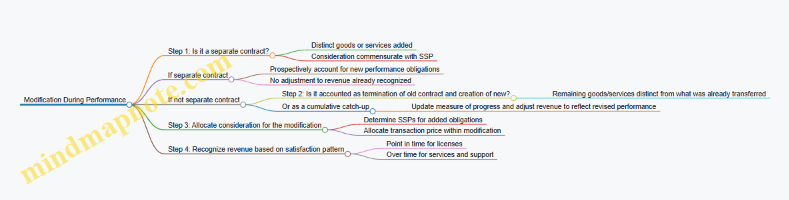
Example: What Would Change If The Modification Were Not Separate
If the extra module were not distinct because it is highly integrated with the existing implementation and cannot function without the original work, Northwind would likely treat the modification as not separate. In that case, Northwind would update the accounting for the remaining implementation and determine whether to apply a cumulative catch-up or a prospective approach based on whether the remaining goods or services are distinct.
In practice, the key operational difference is where the adjustment lands: separate contracts keep the past stable; non-separate modifications require revisiting the revenue pattern for the remaining performance, which can create a catch-up effect in the period of agreement.
This example shows the practical logic: first classify the modification, then allocate within the modification, and finally apply the correct revenue recognition pattern—while keeping the original contract’s recognized revenue intact when the amendment is separate.
11. Disclosures and Reporting for Revenue Recognition Compliance
11.1 Disclosure Objectives and Required Information Under ASC 606 And IFRS 15
The disclosure objective is simple: help users understand how an entity recognizes revenue, what affects the timing and amount, and what remains to be delivered. The standards achieve this by requiring information that connects contract terms to the accounting model. Think of disclosures as a map from “what we promised” to “what we recognized,” with enough detail to explain the major judgments.
Disclosure Objectives That Drive What You Must Explain
Start with the three core outcomes. First, users should be able to understand the nature of revenue and how it arises from contracts. Second, users should understand the timing of revenue recognition and the reasons it changes. Third, users should understand how uncertainty in consideration and estimates affects revenue.
A practical way to test your disclosures is to ask whether a reader could answer these questions without reading your accounting policy note twice: What are the main contract types? How do you determine when performance obligations are satisfied? What judgments affect variable consideration, progress measurement, and contract costs?
Required Information Under ASC 606 and IFRS 15
Most required disclosures fall into five buckets. Each bucket has a purpose, and each purpose links to a specific part of the five-step model.
Revenue Disaggregation
Disaggregate revenue into categories that depict how the nature, amount, timing, and uncertainty of revenue are affected by economic factors. The goal is not to list every product SKU. Instead, group by meaningful drivers such as contract type, geography, or service period. For example, a software company might present revenue as subscription, implementation, and support, because those categories have different satisfaction patterns and different estimation risks.
Contract Balances and Remaining Performance Obligations
Disclose contract assets, contract liabilities, and the movements between them. Contract assets often represent revenue recognized before billing; contract liabilities often represent customer consideration received before performance. Then disclose remaining performance obligations, typically by explaining the expected timing of revenue recognition for unsatisfied or partially unsatisfied performance obligations.
A useful example: if customers pay annually in advance for managed services, you may have contract liabilities at the start of the year. As services are delivered, the liability decreases and revenue increases. Explaining this pattern helps users interpret the balance sheet.
Significant Judgments
Disclose judgments that materially affect the determination of the amount and timing of revenue. Common examples include:
- Identifying performance obligations in bundled arrangements
- Determining whether revenue is recognized over time or at a point in time
- Estimating variable consideration and applying the constraint
- Measuring progress using output or input methods
- Determining whether a contract modification is accounted for as separate or combined
Keep the focus on the “why,” not the “what.” For instance, if you recognize over time because the customer controls the asset as it is created, explain the control mechanism in plain language.
Variable Consideration and Constraint
Provide information about how variable consideration affects revenue. You typically disclose the methods used to estimate variable amounts and how you apply the constraint. If the contract includes rebates, refunds, performance bonuses, or penalties, users need to understand the nature of the variability and the accounting response.
Example: A logistics provider offers a service fee plus a monthly incentive based on delivery performance. The incentive is variable because it depends on future performance. The entity estimates the incentive using expected value and includes only amounts that are not likely to result in a significant reversal when the uncertainty resolves.
Licenses, Warranties, and Other Topic-Specific Disclosures
Where relevant, disclosures should address topic-specific areas that affect timing and pattern of revenue recognition. Licenses may require explanation of whether they provide a right to access or a right to use. Warranties may require clarification of whether they provide assurance or an additional service. Nonrefundable upfront fees may require explanation of whether they relate to a distinct good or service.
Mind Map: Disclosure Content
Integrated Example of How Disclosures Connect to Accounting
Consider a company that sells a three-part contract: an implementation service, a subscription, and a support add-on. Implementation is recognized over time because the customer controls the work-in-progress. Subscription is recognized over time as services are provided. Support is a distinct service satisfied over time.
In disclosures, you would disaggregate revenue into implementation, subscription, and support. You would explain contract liabilities if customers pay upfront for subscription and support. You would disclose remaining performance obligations by showing expected revenue timing for unsatisfied services. You would highlight judgments about whether the implementation and support are distinct and about how progress is measured for implementation. If the contract includes a performance bonus tied to milestones, you would describe how you estimate the bonus and apply the constraint to avoid significant reversals.
The result is a coherent story: the balance sheet shows where billing and recognition differ, the income statement shows how revenue timing follows performance, and the notes explain the judgments that make those outcomes credible.
11.2 Disaggregation of Revenue and How to Choose Meaningful Categories
Disaggregation means splitting total revenue into categories that explain how revenue is earned. The goal is not to create a spreadsheet that looks busy; it is to help users understand the nature, timing, and uncertainty of cash flows. In practice, you choose categories that reflect how contracts behave, how performance obligations are satisfied, and how risks differ across revenue streams.
Start with What Users Need to Understand
Begin by asking what varies across your revenue. Three common drivers are:
- Type of goods or services: software subscriptions behave differently from professional services.
- Timing of recognition: some revenue is recognized over time, while other revenue is recognized at a point in time.
- Nature of customer relationships: one-time sales differ from renewals and usage-based arrangements.
If two revenue streams have similar economics and similar recognition patterns, forcing them into separate categories usually adds noise rather than insight.
Build Categories from Your Revenue Drivers
A practical approach is to map revenue into candidate categories, then test whether each category is meaningful.
- Identify revenue streams you already track operationally (billing types, product lines, service lines).
- Link each stream to recognition behavior (over time vs point in time; output vs input measurement).
- Check whether uncertainty differs (variable consideration, refund rights, collectability constraints).
- Confirm that categories can be supported with consistent data capture and controls.
A category is meaningful when it helps explain differences in performance obligations and cash flow variability.
Mind Map: Category Selection Logic
Choose a Category Basis That Matches Your Business
Many companies start with product or service type, then refine using timing and customer contract structure.
Example 1: Service Company With Over-Time and Point-in-Time Revenue
Assume a firm has two major offerings:
- Managed services: recognized over time using an input method based on labor hours.
- Hardware sales: recognized at a point in time when control transfers.
A meaningful disaggregation could be:
- Managed services revenue, recognized over time
- Hardware sales revenue, recognized at a point in time
Even if both are billed monthly, the recognition pattern and risk profile differ, so combining them would hide important information.
Example 2: Subscription With Usage-Based Components
A SaaS provider sells:
- Base subscription fees (fixed, recognized over time).
- Usage fees (variable, recognized as usage occurs, subject to constraint).
A meaningful disaggregation could separate:
- Subscription revenue
- Usage-based revenue
This helps users understand that one portion is more predictable and the other depends on customer consumption.
Avoid Common Pitfalls
- Over-disaggregation: splitting categories until each one is too small to be informative makes disclosures hard to interpret.
- Category drift: changing category definitions each period undermines comparability. If your business changes, update definitions with clear internal governance.
- Using geography when it does not matter: geography can be meaningful only if it reflects different contract terms, pricing, or recognition patterns.
Ensure the Categories Can Be Reconciled
Disaggregation should reconcile cleanly to total revenue. Build a simple mapping rule from your accounting system to disclosure categories.
Example 3: Mapping Rule for a Multi-Element Contract
A contract includes:
- Implementation service (over time)
- Subscription license (over time)
- Support (over time)
If your disclosure categories are “Implementation” and “Subscription and Support,” you must ensure each performance obligation’s revenue is consistently classified. The mapping rule can be based on performance obligation type, not on how the invoice is labeled.
Practical Disclosure Structure
A typical disclosure table presents categories and amounts for the reporting period, followed by a short explanation of what each category represents. Keep the explanation tied to recognition behavior and contract characteristics.
Example 4: Simple Disclosure Narrative
- “Managed services” includes services recognized over time based on labor hours.
- “Hardware sales” includes products recognized at a point in time when control transfers.
- “Usage-based fees” includes variable consideration recognized as usage occurs, subject to the constraint on variable consideration.
This style keeps the disclosure grounded in how revenue is actually earned and recognized, which is the whole point of disaggregation.
11.3 Contract Balances Including Contract Assets Receivables and Contract Liabilities
Revenue standards track timing differences between (1) when you perform and (2) when you bill or collect. The three main balances—contract assets, receivables, and contract liabilities—are not different “types of revenue.” They are different ways the same contract activity shows up on the balance sheet.
Core Definitions and How They Move
A contract asset arises when you have transferred goods or services to the customer but your right to consideration is conditional on something other than the passage of time. A receivable arises when you have an unconditional right to consideration; only time is needed. A contract liability arises when the customer pays (or you bill) before you transfer the related goods or services.
A simple way to remember it: contract asset = “we did it, but you’re not paying yet because a condition remains.” Contract liability = “you paid, but we haven’t done it yet.” Receivable = “we did it enough that payment is due, and time is the only remaining step.”
Mind Map: Contract Balance Drivers
Integrated Example: One Contract, Three Balances
Assume a software implementation contract with two performance obligations: (1) setup services and (2) ongoing configuration support. The customer pays $120,000 upfront on signing. Setup is delivered in month 2; support runs months 3–6. The contract also includes a $30,000 milestone payment due upon customer acceptance of setup.
At signing (before any delivery):
- Cash received: $120,000
- You have not transferred setup or support.
- Balance sheet shows a contract liability of $120,000.
During month 2 while delivering setup:
- As you satisfy the setup obligation, you recognize revenue.
- The contract liability decreases as the related performance is delivered.
- If you recognize revenue over time, the contract liability reduces proportionally.
After setup is delivered but before acceptance:
- You have performed, but the $30,000 is not yet due because acceptance is required.
- You record a contract asset for the portion of consideration tied to the acceptance condition.
- No receivable yet, because the right to consideration is still conditional.
Upon acceptance and invoice issuance:
- The condition is satisfied.
- The contract asset converts to a receivable (unconditional right).
During months 3–6 for support:
- Revenue continues to be recognized as support is provided.
- Any remaining prepaid amounts from the upfront payment are released from contract liability to revenue.
This example shows the balances as a timeline tool: contract liability tracks “payment ahead of performance,” contract asset tracks “performance ahead of billing,” and receivable tracks “billing due.”
Practical Mechanics for Tracking and Reconciliation
- Map each billing event to a balance outcome. Upfront payments usually create contract liabilities; milestone invoices often create receivables once acceptance occurs.
- Tie contract assets to specific conditions. If your contract asset is supported by “we’ll invoice soon,” that’s usually a red flag. The condition should be explicit in the contract terms.
- Use consistent satisfaction logic. If revenue is recognized over time, contract balances should move in step with the measure of progress.
- Reconcile subledger to general ledger. Billing systems often post invoices and cash, while revenue engines post satisfaction-based entries. A reconciliation should explain every movement between contract balances and revenue.
Common Pitfalls and How to Avoid Them
- Mistaking receivables for contract assets. If the invoice is issued and only time remains, it’s a receivable, even if collection is uncertain.
- Treating acceptance as a formality. If acceptance is required for the right to consideration, it drives contract asset classification until satisfied.
- Netting balances incorrectly. Contract assets and contract liabilities are typically presented separately by contract or by portfolio policy, depending on your reporting framework and materiality.
Quick Reference: When Each Balance Appears
| Situation | Typical Balance | Why |
|---|---|---|
| Customer pays before you deliver | Contract Liability | You owe performance |
| You deliver but invoice is conditional on acceptance | Contract Asset | Right to consideration is conditional |
| Invoice issued and only time remains | Receivable | Right is unconditional |
| You deliver and invoice simultaneously | Receivable or Revenue with no interim asset | No remaining condition |
Closing the Loop with Disclosure Logic
Contract balances feed disclosures: contract assets and contract liabilities explain timing differences, while remaining performance obligations connect to what you still must deliver. The goal is coherence: the same contract terms that justify classification should also support the movements you report.
11.4 Remaining Performance Obligations and Practical Calculation Methods
Remaining performance obligations (RPOs) are the portion of promised goods or services that you have not yet transferred to the customer. Under ASC 606 and IFRS 15, you disclose RPOs by describing the amount of consideration you expect to recognize as revenue for performance obligations that are unsatisfied (or partially unsatisfied) at the reporting date. The key practical challenge is turning contract terms, estimates, and allocation decisions into a clean, auditable number.
What You Start With
Begin with the contract-level work you already do for revenue recognition: (1) identify performance obligations, (2) determine transaction price including variable consideration, (3) allocate transaction price to performance obligations, and (4) determine the revenue pattern for each performance obligation. RPOs then use the same building blocks, but with a different lens: instead of asking “what revenue is recognized this period,” you ask “what revenue is still expected to be recognized later.”
For each performance obligation, compute:
- Total allocated consideration for that performance obligation (including amounts constrained from variable consideration only to the extent they are included in transaction price).
- Revenue recognized to date for that performance obligation.
- RPO amount = total allocated consideration − revenue recognized to date.
If a performance obligation is satisfied at a point in time, revenue recognized to date is typically either zero (not yet delivered) or the full allocated amount (delivered). If satisfied over time, revenue recognized to date is based on your progress measure, so RPOs change as estimates and progress update.
Practical Calculation Methods That Hold Up in Audit
There are two common ways to calculate RPOs in practice. Both can be correct; the right choice depends on how your systems track progress and how variable consideration is estimated.
Method 1: Performance Obligation Ledger Rollforward
This method is the most direct and usually the easiest to reconcile.
- Create a ledger line per performance obligation with the allocated transaction price.
- Record revenue recognized to date using the same journal logic you use for revenue.
- Compute RPO as the remaining balance.
Example: A contract has two performance obligations: implementation (allocated $40,000) and managed services (allocated $60,000). At period end, implementation is complete, so revenue recognized to date is $40,000. Managed services are 30% complete, so revenue recognized to date is $18,000. RPOs are:
- Implementation: $40,000 − $40,000 = $0
- Managed services: $60,000 − $18,000 = $42,000
Total RPO disclosed is $42,000.
This method is robust because it mirrors your revenue accounting entries. It also makes it easier to explain changes between periods: the RPO moves when progress updates, when estimates change, or when contract modifications reallocate consideration.
Method 2: Remaining Revenue Using Progress Percent and Updated Estimates
This method is useful when you track progress at a summary level rather than at the performance obligation ledger level.
For over-time performance obligations, compute remaining revenue as:
- RPO = (allocated transaction price) × (1 − percent complete)
Then adjust for any changes in estimates that affect the percent complete or the amount included in transaction price.
Example: The same managed services performance obligation has allocated consideration of $60,000. At period end, percent complete is 30%, so remaining revenue is $60,000 × 70% = $42,000. If your progress estimate changes to 35% complete due to updated inputs, remaining revenue becomes $60,000 × 65% = $39,000. The $3,000 reduction in RPO is explainable as a progress update.
This method works best when percent complete is consistently calculated and when variable consideration is either already constrained into the allocated amount or tracked separately with clear inclusion rules.
Handling Variable Consideration Without Making a Mess
Variable consideration affects RPOs only to the extent it is included in the transaction price at the reporting date. That means your RPO calculation should follow the same constraint logic you used for revenue.
Example: A contract includes a $10,000 performance bonus that is included in transaction price only up to an amount of $6,000 because of the constraint. If the bonus is tied to a performance obligation that is 50% complete, then the RPO includes the remaining half of the included amount: $6,000 × 50% = $3,000. If later you change the estimate and the constrained amount becomes $7,000, the RPO updates accordingly.
The practical point: don’t compute RPOs using “best case” or “full stated bonus” amounts. Use the amount you actually included in transaction price for that reporting date.
Mind Map: Remaining Performance Obligations Calculation Flow
Common Reconciliation Checks That Prevent Surprises
- RPO equals remaining allocated consideration for each performance obligation, not remaining contract value.
- RPO movement ties to drivers: progress updates, estimate changes, and modifications.
- No double counting across performance obligations when contracts include bundles or series.
- Consistency with revenue journals: if your revenue recognized to date is correct, RPO computed from it should reconcile.
Example: If your managed services RPO decreases by $5,000, confirm whether that $5,000 came from (a) a higher percent complete, (b) a reduction in constrained variable consideration included in transaction price, or (c) a modification that changed allocation. If none of those occurred, the calculation likely used the wrong allocated amount or the wrong progress basis.
Putting It Together in One Clean Workflow
At each reporting date, you can calculate RPOs by repeating the same chain used for revenue: start from performance obligations and allocated transaction price, apply the same revenue recognized to date logic, and compute the remainder. The result is a number that is not just “disclosed,” but also explainable down to the performance obligation and the estimation assumptions used at that date.
11.5 Building a Disclosure Package with Supporting Schedules and Controls
A good revenue disclosure package does two things at once: it tells the story required by the standard, and it proves the story is grounded in the same numbers used for recognition. Treat disclosures like a mini financial statement—prepared from controlled inputs, reconciled to the general ledger, and reviewed by people who can explain the “why,” not just the “what.”
Disclosure Package Blueprint
Start with a disclosure map that links each required disclosure to a data source, a calculation method, and a control owner.
- Disaggregation of revenue: tie revenue by category to the billing system’s product/service taxonomy and to the revenue recognition subledger.
- Contract balances: reconcile contract assets and contract liabilities to the subledger and then to the GL control accounts.
- Remaining performance obligations: build a schedule that separates recognized-to-date from expected future revenue, then roll it into the disclosure table.
- Significant judgments: document the specific judgments used in timing, variable consideration, and performance obligation identification, with references to contract examples.
A practical rule: every disclosure line item should have a “trace path” back to a contract population and forward to the final table.
Supporting Schedules That Make Review Easy
Use schedules that mirror the disclosure structure. Reviewers should be able to start at the disclosure and land on the exact schedule row without hunting.
-
Revenue Disaggregation Schedule
- Columns: category, contract type, geography (if used), and recognized revenue.
- Include a reconciliation to total revenue in the income statement.
- Example: If “Managed Services” and “Implementation” are separate categories, show revenue totals for each and confirm they sum to the disclosed totals.
-
Contract Balances Schedule
- Columns: contract asset, contract liability, and net movement.
- Reconcile beginning balance + activity - settlements = ending balance.
- Example: A contract liability might increase when customers pay upfront for future services; show the cash receipt date and the related performance obligation start.
-
Remaining Performance Obligations Schedule
- Columns: total remaining, expected timing buckets, and exemptions applied.
- Track whether amounts relate to variable consideration constraints and whether they are included or excluded.
- Example: For a contract with a usage-based component, include only the fixed portion if variable amounts are constrained from being included in the estimate.
-
Significant Judgments Schedule
- Columns: judgment area, conclusion, evidence, and contract sample IDs.
- Example: For “over time” recognition, list the over-time criterion used and attach a short summary of how customer control or asset creation was assessed.
Controls That Prevent Disclosure Drift
Disclosure drift happens when the disclosure package is prepared from a different dataset than the recognition model. Prevent it with controls that are specific, not generic.
- Data completeness control: confirm all active contract populations in the subledger are represented in the disclosure schedules.
- Calculation control: require sign-off on key estimation methods, such as variable consideration constraint logic and progress measurement updates.
- Reconciliation control: perform a three-way tie between disclosure totals, subledger totals, and GL totals.
- Review control: require a reviewer to explain variances beyond a threshold (for example, large changes in contract liabilities or remaining performance obligations).
A simple variance template helps. For each major disclosure table, include a row for “difference vs prior period” with drivers such as contract starts, modifications, settlements, and estimate updates.
Mind Map: the Disclosure Workflow
Integrated Example: One Contract, Four Disclosure Outputs
Consider a contract for a one-year managed service with an upfront fee and a monthly service component.
- Disaggregation: classify upfront and monthly components into “Implementation” and “Managed Services” categories based on the performance obligations.
- Contract balances: if the upfront fee is received before service begins, it creates a contract liability that releases over time.
- Remaining performance obligations: include the remaining fixed monthly service revenue expected to be recognized in future periods; exclude constrained variable amounts if they cannot be included reliably.
- Significant judgments: document why the service is recognized over time and how progress is measured (for example, time elapsed as a proxy for service delivery).
When these outputs are built from the same contract population and the same estimation logic, the disclosure package becomes coherent rather than a set of disconnected tables.
Final Assembly Checklist
Before sign-off, cross-foot every disclosure table to its supporting schedule, and cross-foot the supporting schedule to the subledger and GL. Then confirm that the significant judgments narrative matches the schedules’ assumptions. If a reviewer can trace any number in the disclosure to a contract sample and a calculation method, the package is ready.
12. End-to-End Implementation for Audit Ready Revenue Accounting
12.1 Designing a Revenue Accounting Policy Framework and Governance
A revenue accounting policy framework is the set of rules, roles, and evidence standards that turn the five-step model into repeatable accounting. Governance makes sure the rules are followed consistently, even when contracts get messy—because contracts always get messy.
Policy Foundations That Prevent Inconsistent Accounting
Start with a clear policy scope: which entities, contract types, and revenue streams are covered. Then define the accounting “decision points” that drive outcomes, such as contract identification, performance obligation separation, transaction price estimation, allocation, timing of revenue, and contract cost capitalization. Each decision point should map to:
- The standard’s requirement in plain language
- The company’s chosen approach where judgment is allowed
- The required inputs and how they are obtained
- The evidence expected during review
Example: If you estimate variable consideration, your policy should specify the estimation method you use (expected value or most likely amount), when you switch methods, and how you apply the constraint. Without those details, two teams can reach different answers from the same contract facts.
Governance Roles That Make Reviews Real
Assign ownership for policy interpretation, accounting execution, and review. A practical structure is:
- Policy owner: accountable for maintaining the policy and resolving technical questions
- Accounting preparer: responsible for applying the policy to contracts
- Reviewer: independent check for completeness, math, and documentation
- Internal control owner: ensures controls operate as designed
To keep governance from becoming a meeting hobby, define service-level expectations: how quickly questions are answered, what triggers escalation, and what constitutes “resolved” versus “not yet resolved.”
Decision Workflow That Connects Contracts to Journal Entries
A good framework links contract intake to accounting outputs. The workflow should require specific data before revenue can be recognized.
Evidence Standards That Survive Audit Questions
Policies should state what “good evidence” looks like. For each decision point, specify the minimum documentation:
- Contract terms: executed agreement, amendments, and side letters
- Customer communications that clarify enforceability or options
- Pricing schedules and standalone selling price support
- Estimation rationale for variable consideration and progress measures
- Cost support for capitalization decisions
Example: For over-time recognition, require documentation of the over-time criteria assessment and the method used to measure progress. If you use an input method, the policy should specify how you estimate costs to complete and how often you update them.
Integrated Controls for Consistency
Controls should be designed around the highest-risk judgments. Common control themes include:
- Completeness checks: all performance obligations identified and all contract modifications captured
- Calculation controls: allocation math, constraint application, and progress updates
- Review controls: reviewer sign-off on key judgments and assumptions
- System controls: mapping of contract attributes to revenue schedules
A simple way to operationalize this is a standardized contract accounting checklist that must be completed before revenue is booked.
Example checklist items for a multi-element contract:
- Identify distinct goods or services and why they are distinct
- Determine standalone selling prices and method used
- Confirm allocation basis and discount allocation approach
- Determine whether revenue is recognized over time or at a point in time for each obligation
- Confirm whether any contract costs qualify for capitalization
Change Management That Keeps Policies Current
Policies inevitably need updates when contracts evolve or when internal learnings show gaps. Establish a change process that records:
- What changed in the policy
- Why the change was needed
- Which contract types are affected
- Effective application date for new contracts and how to treat existing ones
Example: If you discover that certain implementation activities are consistently bundled with a service obligation, update the policy to clarify how to evaluate distinct promises. Then require preparers to apply the updated guidance to new contracts and document the transition approach.
Practical Output Artifacts
A policy framework should produce tangible artifacts:
- A policy manual organized by decision point
- A contract intake form that captures required inputs
- A standardized accounting memo template for complex judgments
- A disclosure mapping worksheet that ties contract facts to required disclosures
When these artifacts are consistent, governance becomes less about arguing and more about verifying. That’s the goal: fewer surprises, cleaner documentation, and accounting that matches the contract facts without heroic interpretation.
12.2 Building Contract Intake Workflows and Standardized Data Capture
A reliable revenue close starts before accounting entries exist. Contract intake is where you capture the facts that later drive the five-step model, so the workflow should be designed to reduce missing information, inconsistent wording, and “we’ll figure it out later” decisions.
Define the Intake Goal and the Decision Points
Start by mapping intake fields to the decisions the accounting team must make: contract existence, performance obligations, transaction price, allocation, and timing. For example, if the contract includes a renewal option, you need enough detail to decide whether it creates a material right. If the contract includes service levels, you need enough detail to decide whether those promises are distinct and whether variable consideration exists.
A practical approach is to create a short “decision checklist” that intake must support. Each checklist item should point to one or more required data fields. If a field is not needed for any decision, it should not be required in intake.
Establish Roles and Handoffs
Use a simple RACI-style workflow: Sales or Legal captures the contract, Finance validates accounting-critical terms, and Billing/Operations confirms operational details.
Example handoff:
- Sales uploads the executed agreement and amendment history.
- Legal confirms enforceability language and identifies any side letters.
- Finance reviews accounting-critical terms and flags gaps.
- Operations confirms delivery milestones, acceptance rules, and any usage measurement method.
This prevents a common failure mode: finance receives a contract that looks complete but omits the operational details that determine progress and variable consideration.
Standardize the Contract Intake Package
Require a consistent set of documents and artifacts. At minimum:
- Executed contract and all amendments
- Pricing schedules and rate cards
- Statement of work or scope document
- Delivery and acceptance terms
- Any customer correspondence that changes scope or price
Then standardize the “source of truth” for each accounting-critical topic. For instance, if pricing is in a schedule, the intake form should reference that schedule explicitly rather than relying on contract narrative.
Build a Structured Intake Form Tied to the Five-Step Model
Design the intake form so each field has a clear purpose and validation rules. Use controlled vocabularies where possible.
Core fields that typically matter:
- Customer and contract identifiers
- Contract start and end dates
- Contract type and delivery model
- Payment terms and due dates
- Consideration components including discounts, rebates, credits, and refunds
- Variable consideration indicators and measurement method
- Promised goods or services and delivery milestones
- Acceptance criteria and remedies
- Warranty terms and whether they are assurance or service-type
- Renewal options and whether they are optional or mandatory
- License or usage terms if applicable
- Modification history and effective dates
Validation rules reduce rework. For example, if “over time” is selected as the expected revenue pattern, require at least one measurable progress method (output or input) and the basis for estimating costs to complete.
Use a Gap-Flagging Workflow Instead of a Perfect-Data Fantasy
Not every contract arrives with clean information. The workflow should support “known unknowns” without stalling the entire process.
A useful pattern is a two-pass intake:
- Pass 1 captures what is known and marks missing items.
- Pass 2 resolves gaps through targeted questions to the right owner.
Example gap resolution questions:
- “How is usage measured and reported monthly?”
- “What triggers acceptance, and is acceptance required before invoicing?”
- “Are rebates contingent on achieving a threshold, and how is the threshold defined?”
Mind Map: Contract Intake Workflow and Standardized Data Capture
Example Intake Scenario with Standardized Capture
Consider a software contract with implementation services and a one-year subscription. The intake form captures:
- Promised items: implementation (milestone-based) and subscription (access over time)
- Transaction price: fixed subscription fee plus a rebate if annual usage exceeds a threshold
- Variable consideration method: expected value based on historical usage distributions
- Constraint trigger: rebate is only paid if threshold is met, and the contract specifies a measurement period
- Timing inputs: implementation acceptance occurs at go-live; subscription access begins on the contract start date
The workflow then produces an evidence trail: each field references the schedule or clause where it was found. If the rebate threshold is defined in a separate exhibit, the intake form links to that exhibit so finance does not rely on memory or informal notes.
Standardize Outputs for Downstream Accounting
Finally, ensure intake outputs are usable without re-interpretation. The intake package should include:
- A summarized “accounting-critical terms” section
- A list of performance promises with delivery milestones
- A variable consideration summary with measurement method and constraint basis
- A progress measurement selection with the supporting clause references
When these outputs are standardized, the revenue team can focus on judgment where it belongs, not on hunting for the same facts in different places like a scavenger hunt with spreadsheets.
12.3 Controls for Estimation Processes Including Variable Consideration and Progress
Estimation is where revenue accounting stops being a checklist and starts being a judgment process. Controls should make that judgment repeatable, traceable, and consistent across contracts, people, and time. The goal is not to eliminate judgment; it’s to ensure the judgment is supported by evidence, applied consistently, and updated when facts change.
Estimation Controls That Actually Work
Define Estimation Inputs and Ownership
Start by listing every input used in variable consideration and progress measurement. For each input, assign an owner and a source system. For example, if you estimate expected refunds, the owner might be the customer service lead, and the source might be returns history and credit memo logs. Controls should also specify what happens when a source is missing or stale: you either use a documented fallback or you stop the estimate and escalate.
Establish Estimation Methods and When They Change
Document the method selection rules. For variable consideration, the method might be “expected value” when there are multiple possible outcomes, or “most likely amount” when there is one dominant outcome. For progress, the method might be output-based when units delivered are measurable, or input-based when costs are a reliable proxy for performance. A control should require a method re-evaluation when contract facts change, such as a shift from delivering milestones to delivering continuous services.
Require Evidence for Assumptions
Assumptions are not guesses; they are claims supported by data. If you assume a certain probability of a performance bonus being earned, you need a basis such as historical attainment rates, current project status, or signed change orders. Evidence can be simple: a table of historical outcomes with a short explanation of why the current period is similar or different.
Build a Review Trail
Every estimate should have a trail that answers three questions: What was estimated, why it was estimated that way, and what changed since the prior period. A practical control is a “delta note” in the workpaper: list the top drivers of change and link each driver to a specific input update.
Variable Consideration Controls
Apply the Constraint with a Clear Test
The constraint prevents recognizing revenue for amounts that are not highly probable to not reverse. A control should require the team to document the reversal risk and the mitigating factors. For instance, if a contract includes a rebate if service levels are missed, the team should consider whether service-level performance is currently trending toward or away from the threshold.
Example: A software services contract includes a $200,000 rebate if uptime falls below 99.9%. Historical data shows rebates occur in 20% of similar contracts. In the current period, monitoring shows uptime at 99.85% and the remaining work is in a stable environment with no known outages. The estimate might use expected value for the rebate amount, but the constraint review should conclude that reversal risk is low enough to recognize a portion. The workpaper should show: (1) probability basis, (2) current performance evidence, and (3) why the constraint test is satisfied.
Reconcile Estimates to Subsequent Outcomes
Controls should include a post-period check. After the contract outcome becomes known, compare the estimate to actuals and record differences. This is not for blame; it’s for improving the estimation model and tightening assumptions.
Progress Measurement Controls
Choose the Progress Metric Based on Contract Reality
Progress measurement controls start with method selection. Output methods require reliable measurement of performance (for example, units delivered). Input methods require reliable cost tracking and a reasonable relationship between costs and performance.
Example: A managed service contract measures progress using hours of service delivered. The control should verify that hours are captured consistently, billed consistently, and mapped to the contract period. If timekeeping is updated late, the control should specify a cut-off date and an adjustment process.
Validate Cost-to-Complete Inputs
Input-based progress depends on estimates of total costs. Controls should require periodic re-forecasting and validation of major cost categories. A good control is to require variance explanations for material cost categories and to ensure that cost estimates are consistent with approved budgets and change orders.
Example: For a construction-related implementation, total estimated cost changes from $1.8M to $2.0M due to additional subcontractor work. The control should require linking the increase to approved change orders or documented scope changes, not to general optimism or pessimism.
Mind Map: Estimation Controls for Variable Consideration and Progress
Practical Control Checklist for the Workpaper
- List each estimate and its method.
- Identify every input, its owner, and its source.
- Document assumptions with evidence.
- Show the constraint conclusion for variable consideration.
- Show the progress calculation and the cost-to-complete logic.
- Include a delta note explaining period changes.
- Record review and approval, including any escalations.
When these controls are in place, the estimate becomes a controlled process rather than a recurring debate. The numbers still require judgment, but the judgment is supported, repeatable, and auditable.
12.4 Reconciliation Between Subledger Billing and Revenue Recognition Entries
Reconciliation is the habit of making two systems tell the same story: the billing subledger records what you invoiced, while the revenue recognition process records what you earned. The goal is not to force identical numbers at every moment; it is to ensure every difference has a documented reason and a predictable accounting path.
Foundational Concepts That Drive the Reconciliation
Start by naming the moving parts. Billing typically creates invoices, cash application expectations, and sometimes contract liability balances. Revenue recognition creates journal entries based on performance obligations, transaction price allocation, and timing rules. Between them sit contract balances: contract assets (unbilled revenue) and contract liabilities (deferred revenue). If your organization uses a revenue subledger, it may also track deferred revenue by performance obligation.
A clean reconciliation uses three principles:
- Match by contract and period: reconcile at the contract level first, then roll up to the general ledger.
- Reconcile balances, not just totals: compare contract assets and contract liabilities, not only revenue.
- Explain every bridge item: each difference must map to a specific accounting driver such as billing timing, revenue timing, or estimate updates.
The Reconciliation Workflow
- Extract billing activity for the period: invoices issued, credit memos, and any billing adjustments.
- Extract revenue recognition activity for the period: revenue recognized, contract asset changes, and contract liability changes.
- Build a bridge from billing to revenue using a standard set of line items.
- Tie to the general ledger: ensure the subledger totals reconcile to the GL accounts for revenue, contract assets, and contract liabilities.
- Investigate and resolve: for each bridge item, confirm the underlying contract logic and supporting calculations.
Mind Map: Reconciliation Logic and Evidence
Example: One Contract, Two Timelines
Assume a managed service contract with a single performance obligation. The contract starts January 1 and runs for 12 months. Billing is monthly in advance at $120,000 per month. Revenue recognition occurs evenly over time.
- January billing: invoice issued for $120,000.
- January revenue recognized: $120,000 (even timing), so revenue and billing align.
Now add a common twist: the contract is signed mid-month.
- Contract begins January 15.
- January billing: invoice issued for the full month’s amount of $120,000.
- January revenue recognized: only 17 days of service, say $60,000.
The reconciliation bridge for January looks like this:
- Billing subledger shows $120,000 of invoiced consideration.
- Revenue recognition shows $60,000 of revenue.
- The difference $60,000 is explained as a contract liability (deferred revenue) because the invoice was issued for service not yet performed.
In February, revenue recognized catches up:
- February billing: another $120,000 invoice.
- February revenue recognized: $120,000.
- February contract liability movement: the prior deferred amount is released as performance occurs.
The reconciliation should confirm that contract liability decreases in February by the amount that was deferred in January, assuming no modifications.
Example: Credit Memo and Revenue True-Up
Consider a contract with variable consideration. A customer receives a credit memo in the period for a service level adjustment. Billing issues a credit of $10,000.
If the credit relates to performance already recognized, revenue recognition should reduce revenue in the same period (or adjust prior period balances if your policy requires it). The reconciliation bridge item is:
- Billing credit memo: reduces invoiced amounts.
- Revenue reduction: reduces recognized revenue or updates contract asset/liability depending on whether the underlying performance was already satisfied.
A good reconciliation records the credit memo’s reason code and links it to the revenue adjustment logic used in the revenue subledger or calculation workbook.
Bridge Template for Systematic Tie-Out
Use a consistent bridge structure so exceptions are easy to spot. A practical bridge includes:
- Revenue recognized this period
- Less revenue included in invoices for future performance (contract liability increase)
- Plus revenue for performance completed but not yet billed (contract asset increase)
- Plus or minus estimate and modification impacts
- Equals net change in contract balances consistent with billing activity
When the bridge balances, you have evidence that timing, estimates, and contract changes are being handled coherently across systems.
Exception Handling That Stays Grounded
When a difference remains unexplained, resist the urge to “net it out.” Instead, classify the exception:
- Cut-off issue: invoice date or service date mismatch.
- Contract mapping issue: billing lines not linked to the correct contract or performance obligation.
- Allocation issue: standalone selling price or discount allocation differs between subledgers.
- Estimate update issue: variable consideration constraint applied differently.
Each category points to a specific fix and a specific control to prevent recurrence.
12.5 Practical Case Study: Style Workpapers for Multi Element Contracts
A good workpaper set does two things at once: it proves the accounting conclusion and it makes the path from contract terms to journal entries easy to re-walk. The trick is to standardize the “story” you tell for every multi-element contract—without forcing every contract into the same box.
Case Setup and Contract Facts
Assume a software vendor signs a contract on 2024-03-15 for a customer that includes:
- A license to use software (standalone price: $120,000)
- Implementation services (standalone price: $60,000)
- A one-year support service (standalone price: $30,000)
Total consideration is $180,000, paid as follows: $30,000 upfront and $150,000 at month 6. The contract also includes a $10,000 performance bonus if implementation is completed by a target date. The vendor expects a 70% chance of earning the bonus and applies the variable consideration constraint.
The vendor’s standalone selling prices are observable for the license and implementation, but support is estimated using expected cost plus margin. The vendor concludes the license is transferred at a point in time, while implementation and support are satisfied over time.
Workpaper Style Principles
Use a consistent order in every workpaper:
- Identify performance obligations and the basis for “distinct.”
- Determine transaction price including variable consideration and the constraint.
- Allocate transaction price using standalone selling prices.
- Determine revenue timing for each obligation and the measurement method.
- Reconcile to contract balances and show the journal entry logic.
If any step changes, the workpaper should show exactly what changed and why.
Mind Map: Multi Element Contract Workpaper Flow
Example: Transaction Price and Allocation
Variable consideration estimate. Expected value of the bonus is $10,000 × 70% = $7,000. The constraint is applied because the vendor has a history of meeting the target date and can estimate completion likelihood with reasonable confidence. The workpaper conclusion: include $7,000 in transaction price.
Total transaction price. $180,000 + $7,000 = $187,000.
Standalone selling price total. $120,000 + $60,000 + $30,000 = $210,000.
Allocation.
- License: $187,000 × (120,000 / 210,000) = $106,857
- Implementation: $187,000 × (60,000 / 210,000) = $53,429
- Support: $187,000 × (30,000 / 210,000) = $26,714
Write the allocation workpaper so it can be re-run: show inputs, formulas, and a one-line conclusion for each obligation.
Example: Revenue Timing and Progress Measurement
- License: point in time at go-live. Recognize $106,857 when the customer obtains control.
- Implementation: over time using an input method based on labor hours incurred relative to total expected labor hours. If month 3 shows 40% completion, recognize 40% of $53,429 = $21,372.
- Support: over time on a straight-line basis over 12 months. If month 3 is the third month, recognize 3/12 of $26,714 = $6,679.
Each workpaper section should include a “measurement update rule.” For example: if total expected labor hours change, update the cumulative percentage and catch up the revenue in the current period.
Style Workpaper Layout for Journal Entry Mapping
A practical layout is a two-column bridge: Revenue recognized to contract balances.
- Contract asset increases when revenue exceeds billings.
- Contract liability increases when billings exceed revenue.
For the upfront payment of $30,000, assume billing occurs immediately but license revenue is not recognized until go-live. The workpaper should show the initial contract liability and then the reclassification as revenue is recognized.
Mind Map: Contract Balance Bridge
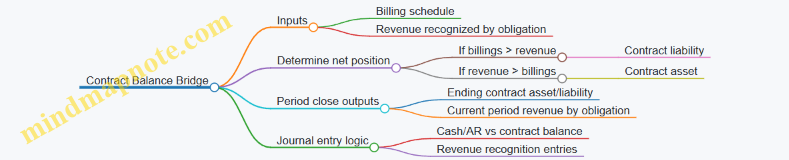
Final Workpaper Checkpoints
Before sign-off, verify three things on one page:
- Performance obligations tie to allocation totals (no missing lines).
- Revenue timing ties to the measurement method (no “percentage” without a basis).
- Contract balances reconcile to billings (no unexplained residuals).
This style keeps the workpapers audit-ready because the conclusion is never floating; it is always traceable to contract terms, calculations, and period-end balances.