Accounting for Lease Agreements
1. Introduction to Lease Accounting
1.1 Understanding Lease Agreements: Definition and Types
What is a Lease Agreement?
A lease agreement is a contractual arrangement where one party, the lessor, grants the other party, the lessee, the right to use an asset for a specified period in exchange for periodic payments. This arrangement is common in both finance and real estate sectors, covering assets such as property, equipment, and vehicles.
Key Components of a Lease Agreement
Types of Lease Agreements
Lease agreements are generally classified into two main types based on the nature of the lease and accounting treatment:
-
Operating Lease
- The lessor retains substantially all the risks and rewards of ownership.
- The lessee uses the asset for a period but does not record the asset or liability on the balance sheet (under previous standards; IFRS 16 changed this for lessees).
- Common for short-term or low-value assets.
-
Finance Lease (Capital Lease)
- The lessee assumes substantially all the risks and rewards of ownership.
- The asset and corresponding liability are recognized on the lessee’s balance sheet.
- Typically used for long-term leases or high-value assets.
Mind Map: Types of Lease Agreements
Examples to Illustrate Lease Types
Example 1: Operating Lease
- A company rents office space for 2 years with monthly payments.
- The lessor maintains the building and bears the risk of obsolescence.
- The lessee uses the space but does not own it.
Example 2: Finance Lease
- A manufacturing firm leases machinery for 7 years, which is close to the machinery’s useful life.
- The lease agreement transfers ownership at the end of the term.
- The lessee records the machinery as an asset and the lease obligation as a liability.
Best Practice Tip
When reviewing lease agreements, always identify the type of lease by analyzing the terms and conditions carefully. This classification impacts how leases are accounted for and reported in financial statements.
Summary
Understanding the definition and types of lease agreements is foundational for accurate lease accounting. Recognizing whether a lease is operating or finance influences the measurement, recognition, and disclosure requirements under accounting standards.
1.2 Importance of Accurate Lease Accounting in Finance and Real Estate
Accurate lease accounting is a cornerstone for financial transparency and operational efficiency in both the finance and real estate sectors. Lease agreements often represent significant liabilities and assets on the balance sheet, impacting key financial metrics, decision-making, and regulatory compliance.
Why Accurate Lease Accounting Matters
- Financial Reporting Integrity: Ensures that financial statements reflect the true economic impact of lease agreements.
- Regulatory Compliance: Meets the requirements of accounting standards such as IFRS 16 and ASC 842.
- Risk Management: Identifies and manages lease-related risks including obligations and potential penalties.
- Investor Confidence: Provides stakeholders with reliable information for investment decisions.
- Operational Efficiency: Facilitates better lease portfolio management and budgeting.
Mind Map: Importance of Accurate Lease Accounting
Example 1: Impact on Financial Statements
A real estate company enters into a 10-year lease for office space with annual payments of $100,000. Without accurate lease accounting, the company might only record lease payments as expenses when paid, understating liabilities and assets.
Accurate Accounting:
- Recognize a right-of-use asset and lease liability at the present value of lease payments.
- Depreciate the asset and amortize the liability over the lease term.
Outcome:
- Balance sheet reflects the lease liability of approximately $850,000 (assuming a discount rate).
- Profit and loss shows depreciation and interest expenses, providing a clearer picture of financial health.
Mind Map: Financial Statement Impact Example
Example 2: Regulatory Compliance and Audit Readiness
An auditor reviews a finance company’s lease portfolio and finds inconsistent lease classifications and missing disclosures. This leads to audit adjustments and delayed financial reporting.
Best Practice:
- Maintain detailed lease documentation.
- Apply consistent classification criteria.
- Prepare comprehensive disclosures as per standards.
Outcome:
- Smooth audit process.
- Timely financial reporting.
- Reduced risk of regulatory penalties.
Mind Map: Compliance and Audit
Summary
Accurate lease accounting is essential for portraying a true and fair view of a company’s financial position, ensuring compliance with evolving accounting standards, and supporting strategic decision-making in finance and real estate. By integrating best practices and leveraging detailed examples, accountants and auditors can enhance the reliability and transparency of lease-related financial information.
1.3 Overview of Lease Accounting Standards (IFRS 16 and ASC 842)
Lease accounting has undergone significant changes with the introduction of IFRS 16 and ASC 842, which aim to increase transparency and comparability in financial reporting by bringing most leases onto the balance sheet.
Key Objectives of IFRS 16 and ASC 842
- Provide a faithful representation of lease transactions.
- Enhance comparability between companies that lease assets and those that purchase assets.
- Improve transparency through detailed disclosures.
Mind Map: Core Principles of IFRS 16 and ASC 842
Comparison Table: IFRS 16 vs ASC 842
| Feature | IFRS 16 | ASC 842 |
|---|---|---|
| Lessee Accounting | Single model: recognize ROU asset & lease liability for almost all leases | Dual model: finance leases & operating leases with different expense recognition |
| Lessor Accounting | Similar to IAS 17: operating & finance leases | Finance, operating, and sales-type leases |
| Lease Term Definition | Non-cancellable period + options reasonably certain to be exercised | Similar to IFRS 16 |
| Exemptions | Short-term leases & low-value assets | Short-term leases only |
| Measurement of Lease Liability | Present value of lease payments using incremental borrowing rate or rate implicit in lease | Same as IFRS 16 |
Example 1: Lessee Accounting under IFRS 16
Scenario: A company leases office equipment for 3 years with annual lease payments of $10,000, payable at the end of each year. The incremental borrowing rate is 5%.
Accounting Treatment:
- Calculate lease liability as the present value of lease payments:
PV = $10,000 / (1.05)^1 + $10,000 / (1.05)^2 + $10,000 / (1.05)^3 ≈ $27,234
- Recognize right-of-use asset at $27,234.
- Record lease liability of $27,234.
- Subsequent accounting involves interest expense on lease liability and depreciation of right-of-use asset.
Example 2: Lessee Accounting under ASC 842
Scenario: A company enters into a 5-year lease for machinery classified as an operating lease. Annual lease payments are $20,000, paid at the beginning of each year. The discount rate is 6%.
Accounting Treatment:
- Recognize right-of-use asset and lease liability at present value of lease payments.
- Lease liability calculation (annuity due):
PV = $20,000 + $20,000 / (1.06)^1 + $20,000 / (1.06)^2 + $20,000 / (1.06)^3 + $20,000 / (1.06)^4 ≈ $85,000
- Expense recognition differs from finance leases: lease expense is recognized on a straight-line basis over lease term.
Mind Map: Lessee Accounting Workflow
Best Practice Tips for Accountants and Auditors
- Thorough Contract Review: Carefully analyze lease contracts to identify embedded leases and lease components.
- Accurate Determination of Lease Term: Assess options to extend or terminate leases with reasonable certainty.
- Consistent Discount Rate Application: Use appropriate incremental borrowing rates or implicit rates.
- Detailed Documentation: Maintain clear records of judgments and calculations for audit trails.
- Regular Reassessment: Update lease liabilities and right-of-use assets when lease terms or payments change.
By understanding the nuances of IFRS 16 and ASC 842, accountants and auditors can ensure compliance, improve financial reporting accuracy, and provide valuable insights for decision-making.
1.4 Common Challenges in Lease Accounting for Accountants and Auditors
Lease accounting has become increasingly complex with the introduction of new standards such as IFRS 16 and ASC 842. Accountants and auditors face several challenges when ensuring compliance and accuracy in financial reporting. Below, we explore these challenges with detailed explanations, mind maps, and practical examples.
Challenge 1: Identifying Lease Components within Contracts
Many contracts include both lease and non-lease components (e.g., service agreements bundled with lease payments). Separating these components accurately is critical but often difficult.
Mind Map: Identifying Lease Components
Example: A company leases office space but also pays for cleaning services included in the same contract. The lease payments must be separated from service fees to correctly account for the lease liability and right-of-use asset.
Challenge 2: Determining the Lease Term and Renewal Options
Assessing the lease term, including renewal or termination options, requires judgment and can significantly impact lease liability.
Mind Map: Lease Term Determination
Example: An auditor reviews a 5-year lease with an option to renew for another 5 years. The lessee has historically renewed similar leases and benefits significantly from staying. The lease term should include the renewal period based on reasonable certainty.
Challenge 3: Measuring Lease Liability with Variable Payments
Variable lease payments linked to indexes, rates, or usage complicate the measurement of lease liabilities.
Mind Map: Variable Lease Payments
Example: A retail company leases a store and pays a base rent plus 5% of monthly sales. The variable payment portion requires estimation and periodic reassessment, impacting the lease liability and expense recognition.
Challenge 4: Lease Modifications and Reassessments
Changes to lease terms or conditions require reassessment of lease liabilities and right-of-use assets, often leading to complex accounting adjustments.
Mind Map: Lease Modifications
Example: A company extends a warehouse lease by 2 years mid-term. The lease liability must be recalculated using the revised lease term and updated discount rate, with corresponding adjustments to the right-of-use asset.
Challenge 5: Ensuring Accurate Disclosures
Lease accounting standards require extensive disclosures, which can be overlooked or improperly prepared.
Mind Map: Lease Disclosures
Example: An auditor finds that a company’s financial statements lack detailed maturity analysis of lease liabilities, which is required under ASC 842. This omission can mislead stakeholders about future cash outflows.
Summary Table of Common Challenges
| Challenge | Description | Example Scenario |
|---|---|---|
| Identifying Lease Components | Separating lease and non-lease elements | Office lease with cleaning services |
| Determining Lease Term | Judging renewal and termination options | Lease with renewal option and economic incentives |
| Measuring Variable Payments | Estimating payments linked to sales or indexes | Retail store rent with percentage of sales |
| Lease Modifications | Accounting for changes in lease terms | Extension of warehouse lease |
| Accurate Disclosures | Providing comprehensive and compliant disclosures | Missing maturity analysis in financial statements |
By understanding and addressing these challenges with clear processes, documentation, and professional judgment, accountants and auditors can ensure compliance and accuracy in lease accounting.
1.5 Best Practice: Initial Assessment of Lease Contracts with Practical Examples
The initial assessment of lease contracts is a critical step in lease accounting, ensuring that leases are identified correctly and accounted for in compliance with applicable standards such as IFRS 16 and ASC 842. This section outlines best practices for performing this assessment, supported by practical examples and mind maps to enhance understanding.
Key Steps in Initial Lease Assessment
Step 1: Identify if the Contract Contains a Lease
Best Practice: Carefully review the contract to determine if it conveys the right to control the use of an identified asset for a period of time in exchange for consideration.
-
Example: A company signs a contract to rent office space in a building. The contract specifies the exact floor and area (identified asset) and grants exclusive use for 3 years. This is a lease.
-
Non-Example: A contract for cloud computing services where no specific server is identified and the customer does not control the use of any specific asset is not a lease.
Step 2: Determine the Lease Term
Best Practice: Identify the non-cancellable period plus any periods covered by options to extend or terminate if it is reasonably certain the lessee will exercise or not exercise those options.
-
Example: A lease agreement for equipment has a 2-year non-cancellable term with an option to extend for 1 additional year. The lessee has historically renewed similar leases and plans to continue using the equipment, so the lease term is 3 years.
-
Example: A lease includes a termination option after 1 year with a penalty. The lessee plans to terminate early, so the lease term is 1 year.
Step 3: Separate Lease and Non-Lease Components
Best Practice: Identify payments related to lease components (right to use asset) and non-lease components (e.g., maintenance, service fees) and allocate payments accordingly.
-
Example: A lease contract includes monthly rent of $5,000 and a maintenance fee of $500. The $5,000 is the lease payment; $500 is a non-lease component.
-
Best Practice: When practical, separate components; otherwise, account for the entire payment as a lease.
Step 4: Assess Lease Classification
Best Practice: Evaluate whether the lease transfers substantially all risks and rewards of ownership to the lessee (finance lease) or not (operating lease).
-
Example: Lease of a machine for most of its useful life with an option to purchase at a bargain price is a finance lease.
-
Example: Lease of office space for 3 years with no transfer of ownership rights is an operating lease.
Practical Example: Initial Assessment Walkthrough
Scenario:
Company ABC enters into a contract to lease a delivery truck.
- Contract term: 4 years non-cancellable
- Option to extend for 2 years, reasonably certain to be exercised
- Monthly payment: $2,000 (includes $200 maintenance fee)
- Option to purchase at end of lease for $5,000 (fair value $30,000)
Assessment:
- Lease Identification: The contract conveys the right to control use of an identified asset (the truck).
- Lease Term: 4 years + 2 years extension (reasonably certain) = 6 years.
- Separate Components: $2,000 total payment includes $200 maintenance (non-lease), $1,800 lease payment.
- Classification: Option to purchase at $5,000 (much lower than fair value), lease term covers majority of asset life — finance lease.
Summary Mind Map
Final Tips
- Maintain thorough documentation of all assumptions and judgments.
- Engage cross-functional teams (legal, operations) to understand contract terms.
- Use checklists to ensure all aspects of the lease are reviewed.
- Regularly update assessments if contract terms or circumstances change.
By following these best practices and using practical examples, accountants and auditors can ensure accurate and compliant initial lease assessments, laying a strong foundation for subsequent lease accounting.
2. Classification of Leases
2.1 Finance Lease vs Operating Lease: Key Differences
Understanding the distinction between finance leases and operating leases is fundamental for accountants and auditors working within the finance and real estate sectors. This section breaks down the key differences, supported by mind maps and practical examples to ensure clarity.
What is a Finance Lease?
A finance lease (also known as a capital lease) is a lease that transfers substantially all the risks and rewards incidental to ownership of an asset to the lessee. Essentially, the lessee treats the leased asset as if they own it.
What is an Operating Lease?
An operating lease is a lease that does not transfer substantially all the risks and rewards of ownership. The lessor retains ownership and the asset is treated as a rental by the lessee.
Key Differences Mind Map
Detailed Comparison Mind Map
Practical Examples
Example 1: Finance Lease
Company A leases a piece of equipment for 8 years. The equipment’s useful life is 10 years. The lease agreement includes a bargain purchase option at the end of the lease term. The present value of lease payments is 95% of the equipment’s fair value.
Analysis:
- Lease term (8 years) is 80% of useful life (10 years) > 75% threshold.
- Bargain purchase option exists.
- Present value of payments is 95% of fair value > 90% threshold.
Conclusion: This lease is classified as a finance lease.
Accounting Treatment:
- Recognize right-of-use asset and lease liability at present value.
- Depreciate the asset over 10 years or lease term.
- Recognize interest expense on lease liability.
Example 2: Operating Lease
Company B leases office space for 3 years. The building’s useful life is 30 years. There is no transfer of ownership or bargain purchase option. The present value of lease payments is 20% of the building’s fair value.
Analysis:
- Lease term (3 years) is 10% of useful life (30 years) < 75% threshold.
- No bargain purchase option.
- Present value of payments is 20% of fair value < 90% threshold.
Conclusion: This lease is classified as an operating lease.
Accounting Treatment:
- Recognize lease expense on a straight-line basis over 3 years.
- No asset or liability recognized on balance sheet.
Summary Table of Key Differences
| Feature | Finance Lease | Operating Lease |
|---|---|---|
| Ownership Transfer | Usually transfers | No transfer |
| Lease Term | Major part of asset’s life | Shorter than asset’s life |
| Present Value of Payments | Approximately equal to asset value | Significantly less |
| Recognition on Balance Sheet | Asset and liability recognized | No asset or liability recognized |
| Expense Recognition | Depreciation + Interest Expense | Lease Expense (straight-line) |
Best Practice Tips
- Document lease terms carefully: Ensure all options and purchase rights are clearly identified.
- Use present value calculations: Accurately discount lease payments using the appropriate discount rate.
- Review lease classification regularly: Changes in lease terms or circumstances may require reclassification.
- Maintain clear audit trails: Keep supporting documentation for classification decisions.
By understanding these distinctions and applying best practices, accountants and auditors can ensure compliance with lease accounting standards and provide accurate financial reporting.
2.2 Criteria for Lease Classification under IFRS 16 and ASC 842
Lease classification is a critical step in lease accounting as it determines how leases are recognized, measured, and presented in financial statements. Both IFRS 16 and ASC 842 provide guidance on lease classification, though ASC 842 retains the operating vs finance lease distinction for lessees, while IFRS 16 eliminates operating lease classification for lessees but retains classification for lessors.
Lease Classification Overview
| Standard | Lessee Classification | Lessor Classification |
|---|---|---|
| IFRS 16 | Single model: Right-of-use asset and lease liability recognized for all leases (except short-term and low-value leases) | Finance lease or operating lease |
| ASC 842 | Finance lease or operating lease | Sales-type lease, direct financing lease, or operating lease |
Mind Map: Key Criteria for Lease Classification
Detailed Criteria Explanation
Transfer of Ownership
- Definition: Does the lease transfer ownership of the underlying asset to the lessee by the end of the lease term?
- Example: A lease agreement for office equipment states that ownership transfers to the lessee after 5 years.
- Classification Impact: If yes, classify as finance lease (ASC 842) or finance lease (IFRS 16 lessor).
Purchase Option (Bargain Purchase Option)
- Definition: Does the lease grant the lessee an option to purchase the asset at a price expected to be sufficiently lower than fair value, making exercise reasonably certain?
- Example: A vehicle lease includes an option to buy the vehicle at $5,000 when fair value is $15,000.
- Classification Impact: If reasonably certain, classify as finance lease.
Lease Term (Major Part of Economic Life)
- Definition: Is the lease term for the major part of the asset’s economic life, even if title is not transferred?
- Thresholds: Typically, 75% or more of economic life is considered a major part.
- Example: A 7-year lease on machinery with an economic life of 8 years.
- Classification Impact: If yes, classify as finance lease.
Present Value of Lease Payments (Substantially All of Fair Value)
- Definition: Does the present value of lease payments amount to substantially all of the fair value of the asset?
- Thresholds: Usually 90% or more is considered substantially all.
- Example: Lease payments discounted at the incremental borrowing rate total 95% of the asset’s fair value.
- Classification Impact: If yes, classify as finance lease.
Specialized Asset (No Alternative Use)
- Definition: Is the asset so specialized that it has no alternative use to the lessor at the end of the lease term?
- Example: A custom-built manufacturing machine leased to a single lessee.
- Classification Impact: If yes, classify as finance lease.
Mind Map: Applying Lease Classification Criteria
Practical Example 1: Classifying a Lease Under ASC 842
Scenario:
- Asset: Manufacturing equipment
- Economic life: 10 years
- Lease term: 8 years
- Lease payments present value: 85% of asset fair value
- No transfer of ownership
- No bargain purchase option
- Asset is not specialized
Analysis:
- Transfer of ownership? No
- Purchase option? No
- Lease term major part of economic life? 8/10 = 80% → Yes
- Present value of payments? 85% < 90% threshold → No
- Specialized asset? No
Conclusion: Classified as a finance lease because lease term is a major part of economic life.
Practical Example 2: Classifying a Lease Under IFRS 16 (Lessor Perspective)
Scenario:
- Asset: Office building
- Lease term: 5 years
- Ownership does not transfer
- No purchase option
- Asset has alternative use
Analysis:
- Transfer of ownership? No
- Purchase option? No
- Specialized asset? No
Conclusion: Operating lease for lessor.
Summary Table of Criteria and Classification
| Criterion | Finance Lease (Yes) | Operating Lease (No) |
|---|---|---|
| Transfer of Ownership | Yes | No |
| Purchase Option (Reasonably Certain) | Yes | No |
| Lease Term (Major Part of Economic Life) | Yes | No |
| Present Value (Substantially All Fair Value) | Yes | No |
| Specialized Asset (No Alternative Use) | Yes | No |
Best Practice Tips
- Document each criterion assessment clearly with supporting evidence.
- Use consistent thresholds aligned with accounting standards and company policy.
- Reassess classification if lease terms or conditions change.
- Coordinate with legal and operational teams to understand lease terms fully.
This detailed understanding of lease classification criteria ensures accurate accounting treatment and compliance with IFRS 16 and ASC 842 standards.
2.3 Practical Example: Classifying a Lease Agreement Step-by-Step
Lease classification is a critical step in lease accounting, determining how a lease is recognized and reported in financial statements. This section walks through a detailed example of classifying a lease agreement under IFRS 16 / ASC 842 standards, using clear criteria and practical illustrations.
Step 1: Understand the Lease Agreement
Example: A company enters into a 5-year lease agreement for office equipment. The lease requires fixed monthly payments of $2,000. The equipment has a useful life of 7 years.
Step 2: Identify Lease Classification Criteria
Under IFRS 16 and ASC 842, leases are classified as either Finance (Capital) Lease or Operating Lease based on specific criteria. The key indicators include:
- Transfer of ownership at the end of the lease term?
- Option to purchase the asset at a bargain price?
- Lease term covers the major part of the asset’s economic life?
- Present value of lease payments amounts to substantially all of the asset’s fair value?
- Asset is specialized and has no alternative use to the lessor?
Step 3: Analyze Each Criterion with the Example
Mind Map: Lease Classification Criteria Analysis
Step 4: Calculate Present Value of Lease Payments
Using the formula for present value of an annuity:
\[ PV = Pmt \times \frac{1 - (1 + r)^{-n}}{r} \]
Where:
- Pmt = $2,000
- r = 5% / 12 = 0.004167 (monthly rate)
- n = 60 months
Calculation:
\[ PV = 2000 \times \frac{1 - (1 + 0.004167)^{-60}}{0.004167} \approx 2000 \times 52.99 = 105,980 \]
Since the PV ($105,980) is significantly higher than the fair value ($12,000), this indicates the lease payments cover substantially all of the asset’s value.
Step 5: Make the Classification Decision
Based on the analysis:
- No transfer of ownership
- No bargain purchase option
- Lease term covers approximately 71% of economic life (often threshold is 75%, so borderline)
- Present value of lease payments substantially exceeds fair value
- Asset not specialized
Conclusion: This lease is classified as a Finance Lease because the present value of lease payments covers substantially all of the asset’s fair value, despite the lease term being slightly below 75%.
Step 6: Document the Classification
Best Practice: Maintain clear documentation of the analysis and rationale for classification decisions, including:
- Lease agreement summary
- Calculations of present value
- Assessment against classification criteria
- Final classification decision
Additional Mind Map: Summary of Classification Process
Summary Table: Criteria vs Example Outcome
| Criterion | Threshold / Condition | Example Outcome | Meets Criterion? |
|---|---|---|---|
| Transfer of Ownership | Yes / No | No | No |
| Bargain Purchase Option | Yes / No | No | No |
| Lease Term as % of Economic Life | ≥ 75% | ~71% | No (borderline) |
| Present Value of Payments vs FV | ≥ 90% (substantially all) | > 800% (105,980/12,000) | Yes |
| Specialized Asset | Yes / No | No | No |
This example demonstrates the importance of a holistic approach, considering all criteria and using accurate calculations to classify leases correctly.
Final Notes:
- When classification is borderline, professional judgment and company policy may influence the decision.
- Always align with the applicable accounting standards and consult with auditors if uncertain.
This step-by-step example provides accountants and auditors with a clear framework and practical tools to confidently classify lease agreements.
2.4 Best Practice: Documentation and Justification of Lease Classification
Accurate documentation and clear justification of lease classification are critical steps in lease accounting. This ensures compliance with accounting standards such as IFRS 16 and ASC 842, facilitates audit processes, and supports transparent financial reporting.
Why Documentation and Justification Matter
- Provides evidence for auditors and regulators
- Supports management decisions and internal controls
- Helps avoid misclassification risks and potential restatements
- Facilitates consistent application across lease portfolios
Key Elements to Document for Lease Classification
- Lease Contract Summary: Key terms including lease term, payment schedule, renewal/termination options
- Lease Classification Criteria Assessment: Detailed evaluation against finance lease or operating lease criteria
- Judgment and Assumptions: Any management estimates or assumptions used
- Supporting Calculations: Present value computations, asset ownership transfer considerations
- Approval and Review Records: Sign-offs from responsible personnel
Mind Map: Documentation Components for Lease Classification
Step-by-Step Example: Documenting Lease Classification
Scenario: A company leases office equipment for 4 years. The lease term is 4 years, the equipment’s economic life is 5 years, and there is no transfer of ownership or purchase option.
-
Lease Contract Summary:
- Lease term: 4 years
- Annual lease payments: $10,000
- No transfer of ownership
- No purchase option
-
Classification Criteria Assessment:
- Ownership transfer? No
- Purchase option? No
- Lease term (4 years) is 80% of asset life (5 years) → Meets finance lease criterion
- Present value of payments vs asset fair value: Calculate present value (PV) of payments using incremental borrowing rate of 5%
-
Supporting Calculation:
- PV = $10,000 / (1+0.05)^1 + $10,000 / (1+0.05)^2 + $10,000 / (1+0.05)^3 + $10,000 / (1+0.05)^4
- PV ≈ $34,545
- Asset fair value = $40,000
- PV is approximately 86% of asset fair value → Meets finance lease criterion
-
Judgment and Assumptions:
- Assumed incremental borrowing rate is 5%
- No renewal options considered as lease term is fixed
-
Conclusion:
- Lease classified as a finance lease based on lease term and present value criteria
-
Approvals:
- Prepared by: Lease Accounting Team
- Reviewed by: Finance Manager
- Approved by: CFO
Mind Map: Example Documentation for Lease Classification
Additional Best Practices
- Use standardized templates: Develop lease classification checklists and templates to ensure consistency.
- Maintain version control: Keep track of lease contract versions and amendments.
- Regularly update documentation: Reflect changes due to lease modifications or reassessments.
- Train staff: Ensure accounting and audit teams understand classification criteria and documentation requirements.
- Leverage technology: Use lease accounting software to automate classification workflows and store documentation securely.
Summary
Proper documentation and justification of lease classification not only support compliance but also enhance transparency and audit readiness. By systematically capturing contract details, applying classification criteria with clear assumptions, and maintaining thorough approvals, accountants and auditors can confidently classify leases and mitigate risks associated with misclassification.
2.5 Impact of Lease Classification on Financial Statements
Lease classification—whether a lease is classified as a finance lease or an operating lease—has a significant impact on how lease transactions are reported in the financial statements. Understanding these impacts is critical for accountants and auditors to ensure accurate financial reporting and compliance with accounting standards such as IFRS 16 and ASC 842.
Overview of Financial Statement Impact
| Aspect | Finance Lease | Operating Lease |
|---|---|---|
| Balance Sheet | Recognize right-of-use (ROU) asset and lease liability | Recognize right-of-use asset and lease liability (IFRS 16 requires both on balance sheet; ASC 842 requires operating lease liability and ROU asset) |
| Income Statement | Interest expense on lease liability + depreciation of ROU asset | Lease expense recognized on a straight-line basis over lease term |
| Cash Flow Statement | Principal portion of lease payments classified as financing activities; interest portion as operating activities | Entire lease payment classified as operating activities |
Mind Map: Financial Statement Impact of Lease Classification
Detailed Explanation
Balance Sheet
- Finance Lease: The lessee records both a right-of-use asset and a lease liability at the present value of lease payments. This increases both assets and liabilities, impacting financial ratios such as debt-to-equity.
- Operating Lease: Under IFRS 16, operating leases also appear on the balance sheet similarly to finance leases. However, under ASC 842, the lease liability and ROU asset are recognized but the income statement treatment differs.
Income Statement
-
Finance Lease: The lessee recognizes interest expense on the lease liability and depreciation expense on the right-of-use asset separately. This results in a front-loaded expense pattern because interest expense decreases over time as the liability is paid down.
-
Operating Lease: Lease expense is recognized on a straight-line basis over the lease term, resulting in a consistent expense amount each period.
Cash Flow Statement
-
Finance Lease: Lease payments are split into principal and interest. The principal portion is classified under financing activities, while the interest portion is classified under operating activities.
-
Operating Lease: Lease payments are classified entirely as operating activities.
Practical Example
Scenario: A company leases office equipment for 3 years with annual lease payments of $10,000 payable at year-end. The incremental borrowing rate is 5%.
Step 1: Calculate Present Value of Lease Payments
PV = $10,000 / (1.05)^1 + $10,000 / (1.05)^2 + $10,000 / (1.05)^3
= $9,523.81 + $9,070.29 + $8,638.37 = $27,232.47
Finance Lease Treatment:
- Initial recognition: ROU asset = $27,232.47; Lease liability = $27,232.47
- Year 1 interest expense = $27,232.47 * 5% = $1,361.62
- Year 1 lease payment = $10,000
- Year 1 principal repayment = $10,000 - $1,361.62 = $8,638.38
- Depreciation expense (straight-line over 3 years) = $27,232.47 / 3 = $9,077.49
Operating Lease Treatment:
- Lease expense each year = $10,000 (straight-line)
Income Statement Impact Year 1:
| Item | Finance Lease ($) | Operating Lease ($) |
|---|---|---|
| Interest Expense | 1,361.62 | 0 |
| Depreciation Expense | 9,077.49 | 0 |
| Lease Expense Total | 10,439.11 | 10,000 |
Cash Flow Statement Year 1:
| Item | Finance Lease ($) | Operating Lease ($) |
|---|---|---|
| Principal Repayment | 8,638.38 | 0 |
| Interest Payment | 1,361.62 | 0 |
| Lease Payment Total | 10,000 | 10,000 |
- Principal repayment is financing cash outflow.
- Interest payment is operating cash outflow.
- Operating lease payment is fully operating cash outflow.
Mind Map: Example Breakdown
Key Takeaways for Accountants and Auditors
- Lease classification affects not only the presentation but also the timing and pattern of expenses.
- Finance leases typically increase reported liabilities and assets, affecting leverage ratios.
- Operating leases under IFRS 16 are now on balance sheet, but income statement treatment differs from finance leases.
- Accurate classification and calculation ensure compliance and provide stakeholders with transparent financial information.
- Auditors should verify lease classification judgments and test calculations of lease liabilities and ROU assets.
By integrating these best practices and examples, accountants and auditors can confidently navigate the complexities of lease classification and its impact on financial statements.
3. Initial Recognition and Measurement
3.1 Identifying the Lease Term and Lease Components
Understanding the lease term and lease components is fundamental to accurately accounting for lease agreements. This section breaks down these concepts with clear explanations, mind maps, and practical examples to help accountants and auditors navigate this critical step.
What is the Lease Term?
The lease term is the non-cancellable period for which a lessee has the right to use an underlying asset, together with:
- Periods covered by an option to extend the lease if the lessee is reasonably certain to exercise that option.
- Periods covered by an option to terminate the lease if the lessee is reasonably certain not to exercise that option.
Why is the lease term important?
- It determines the duration over which lease liabilities and right-of-use assets are recognized.
- It affects the measurement of lease payments and depreciation.
Mind Map: Components of Lease Term
Identifying Lease Components
Lease agreements often include multiple components, which can be lease or non-lease components:
- Lease Components: Rights to use an asset.
- Non-Lease Components: Services or other goods (e.g., maintenance, insurance).
Why separate components?
- Lease payments must be allocated between lease and non-lease components.
- Accurate allocation ensures compliance with accounting standards.
Mind Map: Lease Components Breakdown
Best Practice: Step-by-Step Identification
- Review the Lease Contract Thoroughly: Identify all clauses related to the duration, renewal, termination, and services included.
- Determine the Non-Cancellable Period: Identify the minimum period the lessee is committed to.
- Assess Options to Extend or Terminate: Evaluate whether exercising these options is reasonably certain based on business context.
- Identify Lease vs Non-Lease Components: Separate payments related to asset use from services.
- Document Your Assessment: Maintain clear records for audit trails.
Practical Example 1: Determining Lease Term
Scenario: A company signs a lease for office space with a 3-year non-cancellable period and an option to extend for 2 additional years. The company expects to stay for 5 years due to business expansion plans.
Analysis:
- Non-cancellable period = 3 years
- Extension option = 2 years
- Reasonably certain to exercise extension = Yes
Lease Term = 5 years
Accounting Impact: Lease liability and right-of-use asset are recognized over 5 years.
Practical Example 2: Identifying Lease and Non-Lease Components
Scenario: A lease agreement includes monthly rent for equipment ($1,000) and a maintenance service fee ($200).
Analysis:
- Lease component = $1,000 (right to use equipment)
- Non-lease component = $200 (maintenance service)
Best Practice: Allocate payments accordingly, recognizing lease liability only for the $1,000.
Mind Map: Example Workflow for Lease Term and Components Identification
By carefully identifying the lease term and components, accountants and auditors can ensure accurate measurement and reporting of lease agreements, supporting compliance and financial transparency.
3.2 Calculating the Lease Liability: Present Value of Lease Payments
Lease liability represents the present value of future lease payments that a lessee is obligated to make over the lease term. Accurately calculating this liability is critical for proper lease accounting under IFRS 16 and ASC 842.
Understanding Lease Liability Calculation
The lease liability is initially measured at the present value of the lease payments that are not yet paid, discounted using the interest rate implicit in the lease, or if that rate cannot be readily determined, the lessee’s incremental borrowing rate.
Components of Lease Payments Included in Lease Liability
- Fixed payments (including in-substance fixed payments)
- Variable lease payments that depend on an index or a rate
- Amounts expected to be payable under residual value guarantees
- Exercise price of a purchase option if the lessee is reasonably certain to exercise that option
- Payments of penalties for terminating the lease, if the lease term reflects the lessee exercising an option to terminate the lease
Mind Map: Lease Liability Calculation Components
Step-by-Step Calculation Process
- Identify the lease term: Determine the non-cancellable period plus any periods covered by extension or termination options if reasonably certain.
- Determine lease payments: Sum all fixed payments, variable payments linked to an index or rate, and other relevant payments.
- Select the discount rate: Use the interest rate implicit in the lease or the lessee’s incremental borrowing rate.
- Calculate the present value: Discount the future lease payments to their present value using the selected discount rate.
Example 1: Basic Lease Liability Calculation
Scenario:
- Lease term: 5 years
- Annual fixed lease payment: $20,000 payable at the end of each year
- Discount rate (incremental borrowing rate): 5%
Calculation:
The lease liability is the present value of 5 annual payments of $20,000 discounted at 5%.
Formula for present value of an annuity:
\[ PV = Pmt \times \frac{1 - (1 + r)^{-n}}{r} \]
Where:
- Pmt = $20,000
- r = 5% or 0.05
- n = 5
\[ PV = 20,000 \times \frac{1 - (1 + 0.05)^{-5}}{0.05} = 20,000 \times 4.32948 = 86,589.60 \]
So, the initial lease liability is $86,589.60.
Mind Map: Present Value Calculation Workflow
Example 2: Lease with Variable Payments Linked to CPI
Scenario:
- Lease term: 3 years
- Annual fixed lease payment: $15,000
- Variable payment linked to Consumer Price Index (CPI): 2% increase per year
- Payments at year-end
- Discount rate: 6%
Calculation:
Year 1 payment = $15,000
Year 2 payment = $15,000 × 1.02 = $15,300
Year 3 payment = $15,300 × 1.02 = $15,606
Calculate present value:
\[ PV = \frac{15,000}{(1+0.06)^1} + \frac{15,300}{(1+0.06)^2} + \frac{15,606}{(1+0.06)^3} \]
\[ PV = \frac{15,000}{1.06} + \frac{15,300}{1.1236} + \frac{15,606}{1.1910} \]
\[ PV = 14,150.94 + 13,616.40 + 13,103.86 = 40,871.20 \]
Initial lease liability is $40,871.20.
Best Practice Tips
- Always verify the discount rate used is appropriate and documented.
- Confirm the lease term includes all periods where renewal or termination options are reasonably certain.
- Include all relevant payments in the calculation, not just fixed payments.
- Use spreadsheet models or lease accounting software to automate present value calculations and reduce errors.
- Maintain clear documentation of assumptions and calculations for audit purposes.
Summary
Calculating the lease liability involves discounting all relevant future lease payments to their present value using an appropriate discount rate. This calculation forms the foundation for recognizing lease liabilities on the balance sheet and impacts subsequent accounting for interest expense and lease payments.
3.3 Recognizing the Right-of-Use Asset: Components and Valuation
When accounting for lease agreements, one of the key steps is recognizing the Right-of-Use (ROU) asset. The ROU asset represents the lessee’s right to use the leased asset over the lease term. Proper recognition and valuation of this asset are crucial for accurate financial reporting.
Components of the Right-of-Use Asset
The ROU asset includes several components that must be considered during initial recognition:
- Initial Lease Liability: The present value of lease payments that the lessee is obligated to make.
- Lease Payments Made at or Before Commencement: Any lease payments made before or at the lease commencement date, such as prepaid rent.
- Initial Direct Costs: Incremental costs that would not have been incurred if the lease had not been obtained (e.g., commissions, legal fees).
- Lease Incentives Received: Any incentives received from the lessor, such as rent-free periods, reduce the ROU asset.
Mind Map: Components of Right-of-Use Asset
Valuation of the Right-of-Use Asset
The valuation of the ROU asset at lease commencement is calculated as follows:
\[ \text{ROU Asset} = \text{Lease Liability} + \text{Lease Payments Made at or Before Commencement} + \text{Initial Direct Costs} - \text{Lease Incentives Received} \]
This valuation ensures that the asset reflects the total economic benefits the lessee expects to obtain from the leased asset.
Practical Example 1: Calculating the Right-of-Use Asset
Scenario:
- Lease liability (present value of lease payments): $100,000
- Lease payments made before commencement: $5,000
- Initial direct costs: $2,000
- Lease incentives received: $3,000
Calculation:
\[ \text{ROU Asset} = 100,000 + 5,000 + 2,000 - 3,000 = 104,000 \]
Journal Entry:
| Account | Debit | Credit |
|---|---|---|
| Right-of-Use Asset | $104,000 | |
| Lease Liability | $100,000 | |
| Cash (Lease Payments) | $5,000 | |
| Cash (Initial Direct Costs) | $2,000 | |
| Lease Incentive Receivable* | $3,000 |
*Lease incentives reduce the ROU asset; depending on accounting policy, this may be recorded differently.
Mind Map: Valuation Process for ROU Asset
Best Practice Tips
- Document all components clearly: Keep detailed records of initial direct costs and lease incentives to support valuation.
- Use consistent discount rates: The discount rate used to calculate lease liability should be consistently applied.
- Review lease payments timing: Ensure all payments made before or at commencement are included.
- Coordinate with auditors: Provide clear explanations and supporting documentation for all components.
Practical Example 2: Handling Lease Incentives
Scenario: A company leases office space with a lease term of 5 years. The lessor offers 3 months rent-free as an incentive. Annual lease payments are $24,000, payable monthly.
- Calculate lease liability (excluding incentives): Present value of 5 years of payments.
- Recognize lease incentives as a reduction in the ROU asset.
Step 1: Calculate monthly lease payment = $24,000 / 12 = $2,000
Step 2: Total payments without incentives = $2,000 × 60 months = $120,000
Step 3: Lease incentives = 3 months × $2,000 = $6,000
Step 4: Lease liability = Present value of $114,000 (payments over 57 months)
Step 5: ROU asset = Lease liability + any initial direct costs - $6,000 lease incentives
This example demonstrates how lease incentives reduce the ROU asset value, impacting both the balance sheet and subsequent depreciation.
Summary
Recognizing the Right-of-Use asset accurately involves identifying all relevant components and applying the correct valuation formula. By carefully considering initial lease liabilities, payments made, direct costs, and incentives, accountants and auditors can ensure compliance with accounting standards and provide transparent financial reporting.
3.4 Best Practice: Handling Lease Incentives and Initial Direct Costs with Examples
Lease incentives and initial direct costs are critical components in lease accounting that can significantly impact the measurement of the right-of-use (ROU) asset and lease liability. Properly identifying, measuring, and accounting for these elements ensures compliance with accounting standards such as IFRS 16 and ASC 842.
Understanding Lease Incentives
Lease incentives are benefits provided by the lessor to the lessee to enter into a lease agreement. These can include rent-free periods, cash payments, or reimbursement of leasehold improvements.
Mind Map: Lease Incentives
Example 1: Rent-Free Period
A company signs a 5-year lease with annual rent of $100,000. The lessor grants a 6-month rent-free period at the start of the lease.
Accounting Treatment:
- Total lease payments = $100,000 x 5 = $500,000
- Rent-free period reduces the total payments effectively paid.
- The lease liability is calculated based on the present value of lease payments, excluding the rent-free period.
- The right-of-use asset is adjusted accordingly.
Understanding Initial Direct Costs
Initial direct costs are incremental costs directly attributable to negotiating and arranging a lease that would not have been incurred if the lease had not been obtained.
Mind Map: Initial Direct Costs
Example 2: Legal Fees and Commissions
A lessee incurs $10,000 in legal fees and $5,000 in broker commissions directly related to securing a lease.
Accounting Treatment:
- These costs are capitalized as part of the right-of-use asset.
- They are not included in the lease liability calculation.
Integrated Best Practices for Handling Lease Incentives and Initial Direct Costs
Mind Map: Best Practices
Practical Example: Combined Treatment
Scenario:
A company enters a 4-year lease with annual rent of $120,000. The lessor provides a 3-month rent-free period at the start and reimburses $8,000 for leasehold improvements. The lessee incurs $7,000 in broker commissions.
Step 1: Calculate Lease Payments
- Total annual rent: $120,000 x 4 = $480,000
- Rent-free period: 3 months = $30,000 (excluded from payments)
- Adjusted lease payments = $480,000 - $30,000 = $450,000
Step 2: Calculate Lease Liability
- Present value of $450,000 lease payments discounted at appropriate rate.
Step 3: Calculate Right-of-Use Asset
- Lease liability amount
- Plus initial direct costs: $7,000 (broker commissions)
- Less lease incentives: $8,000 (reimbursement reduces ROU asset)
Journal Entry on Lease Commencement:
| Account | Debit | Credit |
|---|---|---|
| Right-of-Use Asset | $449,000* | |
| Lease Liability | $442,000** | |
| Cash (Broker Commission) | $7,000 |
*ROU Asset = Lease Liability + Initial Direct Costs - Lease Incentives
**Lease Liability = Present value of lease payments ($450,000 discounted)
Summary
- Always separate lease incentives from initial direct costs.
- Lease incentives reduce the right-of-use asset and are excluded from lease liability.
- Initial direct costs increase the right-of-use asset but do not affect lease liability.
- Maintain thorough documentation and clear disclosures.
- Use practical examples to train accounting teams and auditors.
This approach ensures accurate lease accounting, compliance with standards, and transparent financial reporting.
3.5 Practical Example: Journal Entries for Initial Lease Recognition
When a lease agreement is initially recognized, the lessee must record both a lease liability and a right-of-use (ROU) asset on the balance sheet. This section provides a detailed example with journal entries to illustrate the process.
Scenario:
ABC Corporation enters into a 5-year lease for office equipment. The lease requires annual payments of $10,000 at the end of each year. The interest rate implicit in the lease is 6%. There are no initial direct costs or lease incentives.
Step 1: Calculate the Lease Liability
The lease liability is the present value (PV) of the lease payments over the lease term.
- Lease term: 5 years
- Annual lease payment: $10,000
- Interest rate: 6%
Using the present value of an annuity formula or a financial calculator:
PV = $10,000 × [1 - (1 + 0.06)^-5] / 0.06 = $42,169.81
Step 2: Recognize the Right-of-Use Asset
The ROU asset is initially measured at the amount of the lease liability, adjusted for any prepaid lease payments, lease incentives, or initial direct costs. In this example, none apply, so:
ROU Asset = $42,169.81
Mind Map: Initial Lease Recognition Process
Journal Entries at Lease Commencement
| Account | Debit ($) | Credit ($) |
|---|---|---|
| Right-of-Use Asset | 42,169.81 | |
| Lease Liability | 42,169.81 |
Explanation:
- Debit the ROU asset to recognize the right to use the leased asset.
- Credit the lease liability to recognize the obligation to make lease payments.
Step 3: Record the First Lease Payment (End of Year 1)
The first payment includes interest expense and principal repayment.
- Interest expense = Lease liability × interest rate = $42,169.81 × 6% = $2,530.19
- Payment = $10,000
- Principal repayment = Payment - Interest = $10,000 - $2,530.19 = $7,469.81
Journal Entry for Lease Payment:
| Account | Debit ($) | Credit ($) |
|---|---|---|
| Interest Expense | 2,530.19 | |
| Lease Liability | 7,469.81 | |
| Cash | 10,000.00 |
Explanation:
- Debit interest expense to record the cost of borrowing.
- Debit lease liability to reduce the outstanding obligation.
- Credit cash for the payment made.
Mind Map: Lease Payment Accounting
Additional Example: Lease with Initial Direct Costs
Suppose ABC Corporation incurred $1,000 in initial direct costs related to the lease.
- ROU Asset = Lease Liability + Initial Direct Costs = $42,169.81 + $1,000 = $43,169.81
Journal Entry:
| Account | Debit ($) | Credit ($) |
|---|---|---|
| Right-of-Use Asset | 43,169.81 | |
| Lease Liability | 42,169.81 | |
| Cash (or Accounts Payable) | 1,000.00 |
Explanation:
- The initial direct costs increase the ROU asset.
- The lease liability remains the present value of lease payments.
- The initial direct costs are paid or accrued separately.
Summary
| Step | Action |
|---|---|
| 1. Calculate Lease Liability | Present value of lease payments discounted at implicit rate |
| 2. Measure ROU Asset | Lease liability adjusted for prepaid amounts, incentives, and direct costs |
| 3. Record Initial Entry | Debit ROU asset, credit lease liability (and cash/AP for direct costs) |
| 4. Subsequent Payments | Split payments into interest expense and principal reduction |
This practical example demonstrates how accountants and auditors can accurately record the initial recognition of leases, ensuring compliance with IFRS 16 and ASC 842 standards while maintaining clear and auditable records.
4. Subsequent Measurement of Lease Liabilities and Right-of-Use Assets
4.1 Accounting for Lease Payments: Interest and Principal Components
Lease payments under lease agreements typically consist of two components: the principal repayment portion and the interest expense portion. Properly accounting for these components is crucial for accurate financial reporting and compliance with accounting standards such as IFRS 16 and ASC 842.
Understanding Lease Payment Components
- Principal Component: This reduces the lease liability on the balance sheet.
- Interest Component: This represents the finance cost related to the lease liability and is recognized in the income statement.
Mind Map: Lease Payment Components
Effective Interest Rate Method
Lease liabilities are measured at the present value of lease payments, discounted using the interest rate implicit in the lease or the lessee’s incremental borrowing rate.
Each lease payment is split into:
- Interest Expense = Carrying Amount of Lease Liability × Discount Rate
- Principal Repayment = Lease Payment - Interest Expense
Example 1: Calculating Interest and Principal Components
Scenario:
- Lease liability at lease commencement: $100,000
- Annual lease payment: $22,000 payable at year-end
- Lease term: 5 years
- Discount rate: 8%
Year 1 Calculation:
- Interest Expense = $100,000 × 8% = $8,000
- Principal Repayment = $22,000 - $8,000 = $14,000
- Lease Liability at end of Year 1 = $100,000 - $14,000 = $86,000
Journal Entry at Year-End:
| Account | Debit | Credit |
|---|---|---|
| Interest Expense | 8,000 | |
| Lease Liability | 14,000 | |
| Cash | 22,000 |
Mind Map: Effective Interest Calculation Process
Best Practice: Maintaining an Amortization Schedule
Creating and maintaining a detailed amortization schedule helps accountants and auditors track the split between interest and principal over the lease term, ensuring accuracy and transparency.
Sample Amortization Table (First 3 Years):
| Year | Opening Lease Liability | Interest Expense (8%) | Lease Payment | Principal Repayment | Closing Lease Liability |
|---|---|---|---|---|---|
| 1 | 100,000 | 8,000 | 22,000 | 14,000 | 86,000 |
| 2 | 86,000 | 6,880 | 22,000 | 15,120 | 70,880 |
| 3 | 70,880 | 5,670 | 22,000 | 16,330 | 54,550 |
Practical Example 2: Lease Payment Made in Advance
If lease payments are made at the beginning of the period (annuity due), the interest calculation adjusts accordingly.
Scenario:
- Lease liability: $50,000
- Annual lease payment: $12,000 (paid at the beginning of each year)
- Lease term: 4 years
- Discount rate: 6%
Year 1 Calculation:
- Since payment is at beginning, first payment reduces principal immediately.
- Principal Repayment Year 1 = $12,000
- Remaining Lease Liability = $50,000 - $12,000 = $38,000
- Interest Expense for Year 1 = $38,000 × 6% = $2,280
Journal Entry at Payment Date:
| Account | Debit | Credit |
|---|---|---|
| Lease Liability | 12,000 | |
| Cash | 12,000 |
Journal Entry for Interest Expense (end of Year 1):
| Account | Debit | Credit |
|---|---|---|
| Interest Expense | 2,280 | |
| Lease Liability | 2,280 |
Mind Map: Lease Payment Timing Impact
Summary
- Lease payments are split into interest expense and principal repayment.
- The effective interest rate method ensures accurate allocation over the lease term.
- Maintaining an amortization schedule is a best practice for transparency and audit readiness.
- Payment timing affects interest calculation and should be carefully considered.
This detailed approach helps accountants and auditors ensure compliance, accuracy, and clarity in lease payment accounting.
4.2 Depreciation of Right-of-Use Assets: Methods and Examples
When accounting for leases under IFRS 16 and ASC 842, the right-of-use (ROU) asset is recognized on the balance sheet and subsequently depreciated over the lease term or useful life, whichever is shorter. Depreciation of the ROU asset reflects the consumption of economic benefits from the leased asset.
Key Concepts of ROU Asset Depreciation
- Depreciation Period: Generally, the lease term unless ownership transfers or there is a purchase option expected to be exercised.
- Depreciation Method: Typically straight-line unless another systematic basis better reflects usage.
- Impairment Considerations: ROU assets are subject to impairment testing similar to other non-financial assets.
Mind Map: Depreciation of Right-of-Use Assets
Depreciation Methods Explained
| Method | Description | Typical Use Case |
|---|---|---|
| Straight-Line | Equal depreciation expense over the lease term | Most common for ROU assets |
| Usage-Based | Depreciation based on actual usage or output | Rare, when usage varies significantly |
Example 1: Straight-Line Depreciation of ROU Asset
Scenario:
- Lease term: 5 years
- Initial ROU asset value: $100,000
- No residual value
Calculation:
- Annual depreciation = $100,000 / 5 = $20,000
Journal Entry each year:
Dr Depreciation Expense $20,000
   Cr Accumulated Depreciation - ROU Asset $20,000
This reduces the carrying amount of the ROU asset on the balance sheet and records an expense on the income statement.
Example 2: Depreciation with Ownership Transfer Option
Scenario:
- Lease term: 4 years
- Ownership transfers at end of lease
- ROU asset value: $80,000
Depreciation Period: Useful life of asset (assume 10 years)
Calculation:
- Annual depreciation = $80,000 / 10 = $8,000
Journal Entry each year:
Dr Depreciation Expense $8,000
   Cr Accumulated Depreciation - ROU Asset $8,000
Since ownership transfers, depreciation is over the useful life rather than lease term.
Mind Map: Journal Entries for Depreciation
Best Practice Tips
- Consistent Methodology: Use straight-line unless a different method better reflects asset usage.
- Review Lease Terms: Confirm if ownership transfer or purchase options affect depreciation period.
- Impairment Testing: Regularly test ROU assets for impairment and adjust depreciation accordingly.
- Clear Documentation: Maintain detailed records of depreciation calculations and assumptions.
Summary
Depreciation of right-of-use assets is a critical component of lease accounting that impacts both the balance sheet and income statement. Understanding when to apply different depreciation periods and methods ensures compliance and accurate financial reporting.
4.3 Reassessment of Lease Terms and Modifications
Lease agreements are not always static; changes in business circumstances, negotiations, or external factors may require reassessment of lease terms or modifications to the lease contract. Understanding when and how to reassess lease terms and account for modifications is critical for accurate financial reporting.
What Triggers a Reassessment or Modification?
- Change in lease term (e.g., exercising or not exercising renewal or termination options)
- Changes in lease payments (e.g., variable payments, rent increases)
- Changes in the scope of the lease (e.g., adding or removing leased assets)
- Contract renegotiations or amendments
Key Definitions
- Reassessment: Re-evaluating the lease term or lease payments due to changes in circumstances.
- Modification: A change to the lease contract that was not part of the original terms, which may create a new lease or change the existing lease.
Mind Map: Reassessment and Modification Process
Step-by-Step Guide to Reassessment
- Identify the Trigger: Determine if a reassessment event has occurred (e.g., tenant decides to extend lease).
- Recalculate Lease Term: Include or exclude periods based on renewal or termination options if reasonably certain.
- Recalculate Lease Payments: Adjust for changes in fixed or variable payments.
- Re-measure Lease Liability: Discount revised lease payments using the original or revised discount rate.
- Adjust Right-of-Use Asset: Increase or decrease the asset based on the lease liability change.
- Recognize Impact: Record any gain or loss if the modification reduces the scope or consideration.
Practical Example 1: Lease Term Reassessment
Scenario: A company leases office space for 5 years with an option to extend for 3 more years. Initially, the company was not reasonably certain to extend. After 3 years, the company decides to exercise the extension option.
Accounting Impact:
- Reassess lease term to 8 years.
- Recalculate lease liability based on remaining payments for 5 years plus 3 years extension.
- Adjust right-of-use asset accordingly.
Journal Entry:
- Debit Right-of-Use Asset (increase)
- Credit Lease Liability (increase)
Practical Example 2: Lease Modification - Adding Equipment
Scenario: A finance company leases office space and later adds leased equipment under the same contract.
Accounting Treatment:
- Determine if the modification adds a separate lease.
- If yes, account for the equipment lease separately.
- If not, remeasure lease liability and adjust right-of-use asset for combined lease.
Example Mind Map:
Best Practices for Reassessment and Modifications
- Maintain clear documentation of all lease amendments and reassessments.
- Use consistent and transparent assumptions for lease term and payment reassessments.
- Communicate changes promptly to auditors and stakeholders.
- Leverage lease accounting software to automate recalculations and maintain audit trails.
Summary Mind Map: Reassessment & Modification Best Practices
By thoroughly understanding and applying these reassessment and modification principles, accountants and auditors can ensure lease accounting remains accurate, compliant, and reflective of the true economic substance of lease agreements.
4.4 Best Practice: Handling Lease Modifications with Real-World Scenarios
Lease modifications are common in both finance and real estate sectors, and proper accounting treatment is crucial to maintain accurate financial statements and compliance with standards like IFRS 16 and ASC 842. This section outlines best practices for handling lease modifications, supported by detailed mind maps and practical examples.
What is a Lease Modification?
A lease modification is a change in the scope or consideration of a lease that was not part of the original terms. This can include changes in lease term, lease payments, or leased assets.
Best Practice Mind Map: Handling Lease Modifications
Step 1: Identify the Type of Modification
- Change in Lease Term: Extension or reduction of the lease period.
- Change in Lease Payments: Increase or decrease in fixed or variable payments.
- Change in Leased Asset: Adding or removing leased assets.
Step 2: Determine if the Modification is a Separate Lease
- If the modification grants the lessee an additional right of use not included in the original lease and the lease payments increase commensurately, treat it as a separate lease.
- Otherwise, treat as a modification to the existing lease.
Step 3: Re-measure Lease Liability and Adjust Right-of-Use Asset
- Recalculate the present value of remaining lease payments using a revised discount rate if applicable.
- Adjust the right-of-use asset accordingly.
Mind Map: Accounting Treatment Flow
Real-World Scenario 1: Lease Term Extension
Background: A company leases office space for 5 years. After 3 years, the lease is extended by 2 years with increased monthly payments.
Best Practice Steps:
- Identify modification: Lease term extended + payments increased.
- Assess if separate lease: Since extension is for the same asset and payments are increased but not commensurate with standalone lease, treat as modification.
- Re-measure lease liability using revised lease term and discount rate.
- Adjust right-of-use asset by the difference.
- Document modification agreement and update accounting records.
Example Calculation:
- Original lease liability at year 3: $200,000
- Revised lease payments for 4 years (remaining 2 original + 2 extension): $50,000/year
- Discount rate: 5%
- New lease liability (PV of $50,000 for 4 years at 5%): approx. $181,000
- Right-of-use asset adjusted by $19,000 (decrease)
Real-World Scenario 2: Change in Lease Payments Due to Market Adjustment
Background: A retail store lease includes fixed rent plus a variable payment based on sales. The landlord and tenant agree to reduce fixed rent for 1 year due to market conditions.
Best Practice Steps:
- Identify modification: Temporary reduction in fixed payments.
- Determine if modification is separate lease: No, it relates to existing lease.
- Re-measure lease liability for the period of reduced payments.
- Adjust right-of-use asset accordingly.
- Maintain detailed documentation of the temporary agreement.
Example:
- Original fixed rent: $10,000/month
- Reduced rent for 12 months: $7,000/month
- Lease liability reduced by PV of $3,000 x 12 months
Real-World Scenario 3: Addition of Leased Equipment
Background: A finance company leases office space and later adds leased office equipment under the same contract.
Best Practice Steps:
- Identify modification: Addition of leased asset.
- Assess if separate lease: If payments for equipment are commensurate with standalone lease, treat as separate lease.
- If not separate, re-measure lease liability and adjust right-of-use asset.
- Document the modification and update accounting systems.
Example:
- Equipment lease payments: $1,000/month
- Treated as separate lease; accounted for independently.
Summary of Best Practices
- Always review lease contracts carefully for modifications.
- Determine whether modifications qualify as separate leases.
- Re-measure lease liabilities promptly and adjust right-of-use assets.
- Maintain thorough documentation and audit trails.
- Communicate changes to relevant stakeholders and update financial systems.
By following these best practices and using the provided mind maps and examples, accountants and auditors can ensure accurate and compliant accounting for lease modifications.
4.5 Practical Example: Adjusting Lease Liabilities and Assets Post-Modification
When a lease modification occurs, accountants must reassess and adjust the lease liability and right-of-use (ROU) asset accordingly. This section provides a detailed, step-by-step example, supported by mind maps, to illustrate the process clearly.
Understanding Lease Modifications
A lease modification is a change to the scope or consideration of a lease that was not part of the original terms. Examples include extending the lease term, changing lease payments, or adding/removing leased assets.
Mind Map: Lease Modification Assessment Process
Step-by-Step Practical Example
Scenario:
Company ABC has a 5-year lease on office space with annual lease payments of $50,000, payable at year-end. After 2 years, the company negotiates a modification extending the lease by 3 additional years with annual payments increasing to $60,000.
Initial Lease Details:
- Lease term: 5 years
- Annual payment: $50,000
- Discount rate: 5%
Modification Details:
- Extended lease term: 3 more years (total 8 years)
- New annual payment: $60,000 starting from year 3
Step 1: Calculate Original Lease Liability
Calculate the present value (PV) of the original lease payments (5 years at $50,000, discount rate 5%).
PV = $50,000 × (PV Annuity Factor for 5 years @ 5%)
PV Annuity Factor (5 years, 5%) ≈ 4.329
Original Lease Liability = $50,000 × 4.329 = $216,450
Step 2: Calculate Lease Liability After 2 Years (Before Modification)
After 2 years of payments, calculate the remaining lease liability.
Remaining term: 3 years
PV Annuity Factor (3 years, 5%) ≈ 2.723
Remaining Lease Liability = $50,000 × 2.723 = $136,150
Step 3: Calculate Modified Lease Liability
New lease payments: $60,000 for 6 years (3 remaining original years + 3 extension years)
PV Annuity Factor (6 years, 5%) ≈ 5.076
Modified Lease Liability = $60,000 × 5.076 = $304,560
Step 4: Determine Lease Liability Adjustment
Adjustment = Modified Lease Liability - Remaining Lease Liability
Adjustment = $304,560 - $136,150 = $168,410 (increase)
Step 5: Adjust Right-of-Use Asset
Increase the ROU asset by the lease liability adjustment amount, unless the asset is impaired or other conditions apply.
New ROU Asset = Previous ROU Asset + $168,410
Step 6: Journal Entries for Modification
| Date | Account | Debit | Credit |
|---|---|---|---|
| Modification Date | Right-of-Use Asset | $168,410 | |
| Modification Date | Lease Liability | $168,410 |
Mind Map: Journal Entry Flow for Lease Modification
Additional Considerations
- If the modification decreases lease payments or term, the lease liability and ROU asset are decreased accordingly.
- If the modification adds a separate lease, account for it separately.
- Disclosures must reflect the nature and financial impact of the modification.
Summary
This example demonstrates how to:
- Recalculate lease liability based on modified terms
- Adjust the ROU asset accordingly
- Record appropriate journal entries
By following these steps, accountants and auditors ensure compliance with lease accounting standards and maintain accurate financial reporting.
For further reading, refer to IFRS 16 paragraphs 44-47 and ASC 842-10-35-4 to 35-9.
5. Lease Term and Renewal Options
5.1 Determining the Lease Term: Non-cancellable Period and Options
Determining the lease term is a critical step in lease accounting as it directly affects the measurement of lease liabilities and right-of-use assets. The lease term includes the non-cancellable period of the lease, along with any periods covered by options to extend or terminate the lease if the lessee is reasonably certain to exercise those options.
Key Components of Lease Term
- Non-cancellable Period: The fixed period during which the lessee has the right to use the asset and cannot cancel the lease without significant penalty.
- Extension Options: Periods covered by options to extend the lease if the lessee is reasonably certain to exercise them.
- Termination Options: Periods covered by options to terminate the lease early if the lessee is reasonably certain not to exercise the termination option.
Mind Map: Determining Lease Term
Understanding “Reasonably Certain”
The concept of “reasonably certain” is a higher threshold than “more likely than not.” It requires a strong conviction that the lessee will exercise or not exercise an option. This assessment must consider all relevant facts and circumstances, including:
- Economic benefits or penalties associated with exercising or not exercising the option
- Importance of the asset to the lessee’s operations
- Past history of exercising similar options
- Market conditions and alternative options available
Example 1: Non-cancellable Period
Scenario: A company signs a lease for office space with a fixed term of 5 years. The lease contract states that the lease cannot be terminated by the lessee during this period without paying a penalty equal to 3 months’ rent.
Determination: The non-cancellable period is 5 years because the lessee cannot cancel the lease without a significant penalty.
Example 2: Extension Option Reasonably Certain to be Exercised
Scenario: The same company has an option to extend the lease for an additional 3 years at a below-market rent. The company’s business strategy is to maintain a long-term presence in the area.
Determination: Because of the economic incentive (below-market rent) and business strategy, the company is reasonably certain to exercise the extension option. Therefore, the lease term is 8 years (5 years non-cancellable + 3 years extension).
Example 3: Termination Option Reasonably Certain Not to be Exercised
Scenario: A company leases manufacturing equipment for 4 years but has an option to terminate after 2 years without penalty. However, the equipment is critical to production, and replacing it would be costly.
Determination: Given the importance of the equipment and high replacement costs, the company is reasonably certain not to exercise the termination option. The lease term is therefore 4 years.
Mind Map: Factors Affecting Reasonable Certainty
Best Practice Tips
- Document the rationale for including or excluding option periods in the lease term.
- Regularly reassess the lease term if facts or circumstances change.
- Collaborate with operational teams to understand business strategies impacting lease decisions.
- Use clear examples and scenarios in audit documentation to support judgments.
Determining the lease term accurately ensures compliance with accounting standards and provides a true reflection of lease obligations on financial statements.
5.2 Accounting for Renewal and Termination Options
Lease agreements often include renewal and termination options that can significantly impact the accounting treatment of the lease. Properly accounting for these options is crucial for accurate financial reporting and compliance with standards such as IFRS 16 and ASC 842.
Understanding Renewal and Termination Options
- Renewal Options: Clauses allowing the lessee to extend the lease beyond the original term.
- Termination Options: Clauses allowing either party to end the lease earlier than the original term.
These options affect the lease term, which in turn influences the measurement of the lease liability and right-of-use asset.
Key Accounting Principles
- The lease term includes the non-cancellable period plus periods covered by renewal options if the lessee is reasonably certain to exercise them.
- Similarly, periods covered by termination options are excluded if the lessee is reasonably certain to terminate early.
Mind Map: Factors Influencing Lease Term Assessment
Best Practice: Assessing Reasonable Certainty
Accountants and auditors should consider all relevant facts and circumstances, including:
- Economic Incentives: Is the renewal financially beneficial?
- Contractual Penalties: Are there significant costs to terminate early?
- Business Strategy: Does the lessee plan to continue using the asset?
- Historical Behavior: Has the lessee renewed similar leases before?
Documenting the rationale behind the assessment is essential for audit trails.
Practical Example 1: Renewal Option
Scenario: A company leases office space for 5 years with an option to renew for an additional 3 years. The renewal rent is at market rate.
- The company plans to stay due to strategic location and has renewed similar leases in the past.
- No significant penalties for renewal.
Accounting Treatment:
- The lease term includes the initial 5 years plus the 3-year renewal period because the company is reasonably certain to exercise the option.
- Lease liability and right-of-use asset are measured based on 8 years of payments.
Journal Entry:
- Recognize lease liability and right-of-use asset for 8 years of lease payments discounted to present value.
Practical Example 2: Termination Option
Scenario: A manufacturing company leases equipment for 7 years but has the option to terminate after 4 years with a penalty equal to 2 months’ rent.
- The company is considering new technology that may make the equipment obsolete.
- The penalty is relatively small compared to the benefits of terminating early.
Accounting Treatment:
- The lease term is considered 4 years because the company is reasonably certain to terminate early.
- Lease liability and right-of-use asset are measured based on 4 years of lease payments.
Journal Entry:
- Recognize lease liability and right-of-use asset for 4 years of lease payments discounted to present value.
Mind Map: Accounting Workflow for Renewal and Termination Options
Important Considerations
- Reassess lease term if significant events or changes in circumstances occur.
- Changes in lease term affect lease liability and right-of-use asset, requiring remeasurement.
- Disclose the nature and effect of renewal and termination options in financial statements.
By integrating these best practices and examples, accountants and auditors can ensure accurate and compliant accounting for renewal and termination options in lease agreements.
5.3 Best Practice: Assessing Reasonable Certainty with Illustrative Examples
Assessing “reasonable certainty” is a critical step in determining the lease term, especially when lease agreements include renewal or termination options. This assessment directly impacts the measurement of lease liabilities and right-of-use assets under IFRS 16 and ASC 842.
What is Reasonable Certainty?
Reasonable certainty refers to the likelihood that a lessee will exercise (or not exercise) an option to extend or terminate a lease. If it is reasonably certain that the option will be exercised, the lease term includes the option period; if not, it is excluded.
Why is Assessing Reasonable Certainty Important?
- Financial Impact: Inclusion or exclusion of option periods affects lease liability and asset values.
- Compliance: Proper assessment ensures adherence to accounting standards.
- Transparency: Accurate disclosures and audit trails.
Key Factors to Consider When Assessing Reasonable Certainty
- Economic incentives (e.g., favorable lease terms, penalties for termination)
- Business needs and strategic plans
- Historical practice and past behavior
- Market conditions and availability of alternatives
- Legal or contractual constraints
Mind Map: Factors Influencing Reasonable Certainty Assessment
Step-by-Step Best Practice Approach
- Review Lease Contract Terms: Identify all renewal and termination options.
- Gather Relevant Data: Collect internal business plans, market data, and historical lease activity.
- Evaluate Economic Incentives: Analyze financial benefits or costs associated with exercising options.
- Consider External Factors: Market trends, competitor actions, and regulatory environment.
- Document the Assessment: Clearly record rationale and supporting evidence.
- Reassess Regularly: Update the assessment if circumstances change.
Illustrative Example 1: Renewal Option with Favorable Terms
Scenario: A company leases office space for 5 years with an option to renew for an additional 5 years at a rent 20% below market rate.
Assessment:
- Economic incentive to renew is strong due to below-market rent.
- Business plans indicate stable operations in the location.
- Historical behavior shows the company typically renews leases.
Conclusion: It is reasonably certain the company will exercise the renewal option. The lease term includes the additional 5 years.
Accounting Impact: Lease liability and right-of-use asset are measured over 10 years.
Illustrative Example 2: Termination Option with No Penalty
Scenario: A retail company leases a store with a 3-year term and an option to terminate after 2 years without penalty.
Assessment:
- No economic disincentive to terminate.
- Business plans are uncertain due to market volatility.
- Market conditions suggest potential relocation.
Conclusion: It is not reasonably certain the company will continue beyond 2 years. The lease term is 2 years.
Accounting Impact: Lease liability and right-of-use asset are measured over 2 years.
Illustrative Example 3: Renewal Option with Mixed Factors
Scenario: A manufacturing firm leases equipment for 4 years with a renewal option for 2 years at market rent.
Assessment:
- No financial incentive to renew (market rent is standard).
- Business forecasts suggest possible expansion.
- Past practice shows mixed renewal decisions.
Conclusion: Reasonable certainty is not clearly established. Management decides to exclude the renewal period but will reassess annually.
Accounting Impact: Initial lease term is 4 years; reassessment may adjust lease term later.
Mind Map: Decision Tree for Reasonable Certainty
Tips for Accountants and Auditors
- Maintain clear documentation of judgments and assumptions.
- Use cross-functional inputs (legal, operations, finance) for comprehensive assessment.
- Regularly review lease terms and business environment.
- Ensure disclosures reflect the basis of reasonable certainty assessments.
By following these best practices and using illustrative examples, accountants and auditors can confidently assess reasonable certainty, ensuring accurate lease accounting and compliance with standards.
5.4 Practical Example: Impact of Lease Term Changes on Financial Reporting
Lease term changes can significantly affect the accounting treatment of lease agreements, impacting both the balance sheet and income statement. This section provides a detailed practical example illustrating how changes in lease term influence financial reporting, accompanied by mind maps to visualize the process.
Understanding Lease Term Changes
Lease term changes occur when there is a modification in the non-cancellable period of the lease, including the exercise or non-exercise of renewal or termination options that were previously considered reasonably certain or not.
Key impacts include:
- Reassessment of lease liability
- Adjustment of right-of-use (ROU) asset
- Changes in depreciation and interest expense
- Disclosure updates
Mind Map: Lease Term Change Impact Overview
Practical Example Scenario
Initial Lease Details:
- Lease term: 5 years
- Annual lease payment: $50,000 (paid at year-end)
- Discount rate: 5%
After 2 years, the lessee decides to extend the lease by 3 more years (total 8 years).
Step 1: Initial Lease Liability and ROU Asset Calculation
Calculate the present value (PV) of lease payments for 5 years:
\[ PV = 50,000 \times \frac{1 - (1 + 0.05)^{-5}}{0.05} = 50,000 \times 4.3295 = 216,475 \]
- Initial lease liability = $216,475
- Initial ROU asset = $216,475
Step 2: Lease Liability After 2 Years (Before Extension)
Payments made: 2 payments of $50,000
Calculate the carrying amount of lease liability after 2 years:
- Remaining lease payments: 3 payments of $50,000
Calculate PV of remaining payments:
\[ PV = 50,000 \times \frac{1 - (1 + 0.05)^{-3}}{0.05} = 50,000 \times 2.7232 = 136,160 \]
Assuming interest accrued and payments made, the lease liability balance is approximately $136,160.
Step 3: Lease Term Extension to 8 Years
New remaining lease payments: 6 payments of $50,000 (3 original remaining + 3 extension years)
Calculate new lease liability:
\[ PV = 50,000 \times \frac{1 - (1 + 0.05)^{-6}}{0.05} = 50,000 \times 5.0757 = 253,785 \]
Step 4: Adjusting Lease Liability and ROU Asset
-
Increase in lease liability = $253,785 - $136,160 = $117,625
-
Increase ROU asset by $117,625
Step 5: Update Depreciation
- Original ROU asset depreciated over 5 years
- New ROU asset depreciated over 8 years from lease commencement
Assuming straight-line depreciation:
- Annual depreciation before extension: $216,475 / 5 = $43,295
- Annual depreciation after extension: $334,100 / 8 = $41,762.50
(Note: $334,100 = original ROU asset + increase)
Step 6: Income Statement Impact
- Interest expense increases due to higher lease liability
- Depreciation expense slightly decreases due to longer lease term
Mind Map: Accounting Steps After Lease Term Extension
Summary
| Aspect | Before Extension | After Extension |
|---|---|---|
| Lease Term | 5 years | 8 years |
| Lease Liability (PV) | $216,475 (initial) | $253,785 (revised) |
| ROU Asset | $216,475 | $334,100 |
| Annual Depreciation | $43,295 | $41,762.50 |
| Interest Expense | Lower | Higher |
This example demonstrates how extending the lease term increases the lease liability and ROU asset, affects depreciation schedules, and impacts interest expense, thereby influencing the financial statements.
Best Practice Tips
- Always reassess lease term when renewal or termination options are exercised.
- Document assumptions and rationale for lease term changes.
- Update lease liability and ROU asset promptly to reflect changes.
- Communicate impacts clearly in financial disclosures.
- Use lease accounting software to automate recalculations and reduce errors.
This detailed example and mind maps provide accountants and auditors with a clear understanding of how lease term changes affect financial reporting, ensuring compliance and accuracy in lease accounting.
5.5 Disclosure Requirements Related to Lease Terms
Lease disclosures are a critical component of transparent financial reporting, ensuring stakeholders understand the nature, amount, timing, and uncertainty of lease-related cash flows. For accountants and auditors in finance and real estate sectors, mastering these disclosures is essential to comply with IFRS 16 and ASC 842 standards.
Key Disclosure Requirements
Both IFRS 16 and ASC 842 require entities to disclose detailed information about lease terms, including:
- Lease term definitions: Explanation of how lease terms are determined, including options to extend or terminate.
- Significant judgments: Judgments made in determining lease terms, especially regarding renewal and termination options.
- Lease liabilities maturity analysis: A maturity schedule of lease liabilities showing undiscounted cash flows.
- Variable lease payments: Description and amounts of variable payments not included in lease liabilities.
- Extension and termination options: Information about options reasonably certain to be exercised or not.
Mind Map: Disclosure Requirements Related to Lease Terms
Example 1: Lease Term Disclosure Narrative
“The lease term for our office building includes a non-cancellable period of 5 years with an option to extend for an additional 3 years. Management has assessed that it is reasonably certain the extension option will be exercised based on historical occupancy and strategic plans. This judgment affects the measurement of the lease liability and right-of-use asset.”
Mind Map: Significant Judgments in Lease Term
Example 2: Lease Liability Maturity Analysis Table
| Period | Undiscounted Lease Payments (USD) |
|---|---|
| Within 1 year | 150,000 |
| 1 to 5 years | 600,000 |
| More than 5 years | 200,000 |
| Total | 950,000 |
This table discloses the maturity analysis of lease liabilities, helping users understand timing and amounts of future cash outflows.
Best Practice: Preparing Lease Term Disclosures
- Clearly describe how lease terms are determined, including assumptions and judgments.
- Provide quantitative data such as maturity analyses in tabular format for clarity.
- Disclose the nature and amounts of variable lease payments excluded from lease liabilities.
- Explain the impact of extension and termination options on lease accounting.
- Use consistent terminology aligned with accounting standards.
Example 3: Variable Lease Payments Disclosure
“Variable lease payments not included in the measurement of lease liabilities amounted to $50,000 for the year, primarily related to usage-based charges for leased equipment. These payments are recognized as expenses in the period incurred.”
Mind Map: Variable Lease Payments Disclosure
Summary
Disclosures related to lease terms provide transparency on how lease liabilities and right-of-use assets are measured and the judgments involved. Incorporating detailed narratives, maturity analyses, and explanations of variable payments ensures compliance and enhances the usefulness of financial statements for decision-makers.
For accountants and auditors, integrating these disclosures with clear examples and structured formats supports audit readiness and stakeholder confidence.
6. Lease Payments and Variable Considerations
6.1 Fixed vs Variable Lease Payments: Definitions and Examples
Lease payments are a fundamental component in lease accounting, and understanding the distinction between fixed and variable lease payments is crucial for accurate measurement and reporting. This section provides clear definitions, practical examples, and mind maps to help accountants and auditors grasp these concepts effectively.
Definitions
Fixed Lease Payments:
- Payments that are specified in the lease contract and do not change over the lease term.
- These payments are typically made at regular intervals (e.g., monthly or annually).
- They include amounts such as base rent, fixed escalation clauses, and any amounts that are unavoidable regardless of usage.
Variable Lease Payments:
- Payments that vary based on factors other than the passage of time.
- These can depend on usage, performance, sales, or other indices.
- Examples include payments based on:
- Usage metrics (e.g., hours of equipment use)
- Sales volume or revenue percentages
- Changes in an index or rate (e.g., CPI adjustments)
Mind Map: Overview of Lease Payments
Detailed Explanation and Examples
-
Fixed Lease Payments
These payments are predictable and form the basis for calculating the lease liability and right-of-use asset.
Example 1: A company leases office space with a contract that requires $5,000 per month for 3 years. The $5,000 monthly payment is fixed and does not change.
Accounting Implication: The lease liability is calculated as the present value of these fixed payments.
-
Variable Lease Payments
Variable payments introduce complexity because they depend on future events or performance and may not be included in the initial lease liability measurement unless linked to an index or rate.
Example 2: A retailer leases a store and agrees to pay $4,000 per month plus 5% of monthly sales exceeding $100,000.
- The $4,000 is a fixed payment.
- The 5% sales-based payment is variable and recognized as an expense when incurred.
Example 3: A company leases machinery with payments adjusted annually based on the Consumer Price Index (CPI).
- Payments linked to CPI are considered variable but are included in lease liability measurement using the index at lease commencement.
Mind Map: Accounting Treatment of Lease Payments
Best Practice Tips
- Identify and Separate Payment Components: Carefully review lease contracts to distinguish fixed and variable components.
- Include Index-Linked Variable Payments in Lease Liability: Use the index or rate at lease commencement for initial measurement.
- Recognize Other Variable Payments as Expenses: Payments based on usage or sales should be expensed in the period incurred.
- Document Assumptions Clearly: Maintain clear documentation for judgments about variable payments.
Practical Example: Calculating Lease Liability with Fixed and Variable Payments
Scenario: A company leases equipment for 5 years with the following terms:
- Fixed annual payment: $20,000
- Additional payment: 2% of annual sales exceeding $500,000
- Payments linked to CPI with an initial index of 100
Step 1: Calculate present value of fixed payments.
Step 2: Include CPI adjustments based on initial index for lease liability.
Step 3: Recognize variable payments based on sales as expenses when incurred.
This approach ensures compliance with lease accounting standards and accurate financial reporting.
By mastering the distinction and accounting treatment of fixed versus variable lease payments, accountants and auditors can enhance accuracy in lease accounting and provide clearer financial insights.
6.2 Accounting for Variable Lease Payments Linked to Indexes or Rates
Variable lease payments linked to indexes or rates are a common feature in lease agreements, especially in real estate and finance sectors. These payments fluctuate based on changes in an underlying index or rate, such as the Consumer Price Index (CPI), a benchmark interest rate, or inflation rates.
Understanding Variable Lease Payments Linked to Indexes or Rates
Variable lease payments linked to an index or rate are payments that change over the lease term based on the movement of a specified index or rate. Unlike fixed payments, these are not predetermined amounts but vary according to external economic factors.
Key Accounting Principles
- Initial Measurement: At lease commencement, variable lease payments linked to indexes or rates are included in the lease liability measurement using the index or rate at that date.
- Subsequent Measurement: The lease liability is remeasured when there is a change in the index or rate, affecting future lease payments.
- Recognition: Changes in lease payments due to index or rate changes are recognized as an adjustment to the lease liability and corresponding right-of-use (ROU) asset.
Mind Map: Variable Lease Payments Linked to Indexes or Rates
Example 1: Lease with CPI-Linked Rent Escalation
Scenario: A company leases office space with a 5-year lease. The annual lease payment is $100,000, adjusted each year based on the Consumer Price Index (CPI) at the start of the year. At lease commencement, CPI is 200. At the start of year 2, CPI increases to 210.
Accounting Treatment:
- Initial Measurement: Lease liability is calculated using the initial payment of $100,000.
- Year 2 Adjustment: The lease payment for year 2 is adjusted to $100,000 * (210 / 200) = $105,000.
- The lease liability is remeasured to reflect the increased payment, and the ROU asset is adjusted accordingly.
Journal Entry for Year 2 Adjustment:
Dr Right-of-Use Asset 5,000
   Cr Lease Liability 5,000
This reflects the increase in lease payments due to CPI change.
Example 2: Lease with Interest Rate-Linked Payments
Scenario: A finance company leases equipment with monthly payments linked to the LIBOR rate plus a fixed margin. At lease commencement, LIBOR is 1%, and the monthly payment is $10,000. After 6 months, LIBOR rises to 1.5%, increasing the monthly payment to $10,500.
Accounting Treatment:
- Initial lease liability is based on the expected payments using the LIBOR rate at commencement.
- When LIBOR changes, the lease liability is remeasured to reflect the new payment amount.
- The ROU asset is adjusted accordingly.
Journal Entry for Reassessment:
Dr Right-of-Use Asset 3,000
   Cr Lease Liability 3,000
(Assuming the cumulative increase in payments results in a $3,000 increase in lease liability)
Best Practices for Accounting Variable Lease Payments Linked to Indexes or Rates
- Regular Monitoring: Continuously track changes in the relevant indexes or rates to ensure timely remeasurement.
- Clear Lease Documentation: Ensure lease agreements clearly specify the index/rate and the method of adjustment.
- Timely Remeasurement: Promptly adjust lease liabilities and ROU assets when index/rate changes occur.
- Disclosure: Transparently disclose the nature of variable lease payments and their impact on financial statements.
Summary Mind Map: Best Practices
By understanding and applying these principles and best practices, accountants and auditors can ensure accurate and compliant accounting for variable lease payments linked to indexes or rates.
6.3 Best Practice: Estimating and Updating Variable Lease Payments
Variable lease payments can significantly impact lease liabilities and expenses, making their accurate estimation and timely updating critical for accountants and auditors. This section outlines best practices for estimating and updating variable lease payments, supported by clear examples and mind maps to enhance understanding.
Understanding Variable Lease Payments
Variable lease payments are lease payments that vary based on factors other than the passage of time. Common examples include payments linked to:
- Usage or consumption (e.g., number of hours, units produced)
- Indexes or rates (e.g., CPI, LIBOR)
- Performance targets
Best Practice Mind Map: Estimating Variable Lease Payments
Step 1: Identify Variable Payment Components
- Review lease contracts carefully to identify all variable payment clauses.
- Determine if payments depend on usage, indexes, or other variables.
Example: A lease agreement states that monthly rent includes a base amount plus 5% of monthly sales.
Step 2: Collect Relevant Data
- Gather historical data related to the variable factors (e.g., past sales, usage statistics).
- Obtain current index values if payments are linked to inflation or interest rates.
Example: For the sales-based rent, collect the last 12 months of sales data.
Step 3: Estimate Variable Payments
- Use historical data and forecasting methods to estimate future variable payments over the lease term.
- Apply statistical methods or scenario analysis to account for uncertainty.
Example: If average monthly sales are $100,000, estimated variable rent = 5% × $100,000 = $5,000 per month.
Step 4: Update Estimates Regularly
- Variable payments should be reassessed at each reporting period.
- Update estimates based on actual data and revised forecasts.
Example: If sales increase to $120,000, variable rent estimate updates to $6,000.
Best Practice Mind Map: Updating Variable Lease Payments
Step 5: Reflect Changes in Lease Accounting
- Adjust the lease liability and right-of-use asset if variable payments change the expected cash flows.
- Recognize the impact in profit or loss as per applicable standards.
Example: An increase in estimated variable payments leads to an increase in lease liability and corresponding expense recognition.
Example Scenario: Estimating and Updating Variable Lease Payments
Scenario: A company leases office space with monthly rent comprising a fixed $10,000 plus 2% of monthly electricity consumption costs.
- Month 1 electricity cost: $5,000 → Variable payment = 2% × $5,000 = $100
- Month 2 electricity cost forecasted to increase to $6,000 → Variable payment estimate updated to $120
Accounting Treatment:
- Initial lease liability includes estimated variable payments based on forecast.
- At each month-end, actual electricity costs are reviewed.
- Lease liability is adjusted to reflect actual variable payments.
Summary of Best Practices
- Thoroughly review lease agreements to identify all variable payment clauses.
- Use reliable historical data and robust forecasting methods.
- Document assumptions, methodologies, and updates clearly.
- Update estimates regularly and adjust lease accounting accordingly.
- Maintain strong internal controls and audit trails for changes.
By following these best practices, accountants and auditors can ensure accurate and compliant accounting for variable lease payments, reducing risks of misstatements and enhancing financial statement transparency.
6.4 Practical Example: Calculating Lease Liability with Variable Payments
Lease agreements often include variable lease payments that depend on factors such as usage, sales, or indexes. Accurately calculating the lease liability requires understanding how to estimate these payments and incorporate them into the present value calculation.
Mind Map: Key Concepts for Variable Lease Payments
Step-by-Step Example
Scenario: A company enters into a 3-year lease for office equipment. The lease payments include:
- Fixed annual payments of $10,000, payable at the end of each year.
- Variable payments based on usage: $2 per unit used.
- Estimated usage is 3,000 units in Year 1, 3,500 units in Year 2, and 4,000 units in Year 3.
- The incremental borrowing rate is 5% per annum.
Objective: Calculate the initial lease liability including variable payments that depend on usage.
Step 1: Identify Fixed and Variable Payments
- Fixed payments: $10,000 per year
- Variable payments (estimated):
- Year 1: 3,000 units × $2 = $6,000
- Year 2: 3,500 units × $2 = $7,000
- Year 3: 4,000 units × $2 = $8,000
Step 2: Calculate Total Estimated Lease Payments per Year
| Year | Fixed Payment | Variable Payment | Total Payment |
|---|---|---|---|
| 1 | $10,000 | $6,000 | $16,000 |
| 2 | $10,000 | $7,000 | $17,000 |
| 3 | $10,000 | $8,000 | $18,000 |
Step 3: Discount Lease Payments to Present Value
Using the formula for present value of a single payment:
\[ PV = \frac{Payment}{(1 + r)^n} \]
Where:
- \( r = 5\% = 0.05 \)
- \( n \) = year number
| Year | Total Payment | Present Value Calculation | Present Value |
|---|---|---|---|
| 1 | $16,000 | $16,000 / (1.05)^1 = $15,238.10 | $15,238.10 |
| 2 | $17,000 | $17,000 / (1.05)^2 = $15,422.54 | $15,422.54 |
| 3 | $18,000 | $18,000 / (1.05)^3 = $15,544.20 | $15,544.20 |
Step 4: Sum Present Values to Determine Lease Liability
\[ Lease\ Liability = 15,238.10 + 15,422.54 + 15,544.20 = 46,204.84 \]
Step 5: Journal Entry for Initial Recognition
| Account | Debit | Credit |
|---|---|---|
| Right-of-Use Asset | $46,204.84 | |
| Lease Liability | $46,204.84 |
Best Practice Tips
- Estimate variable payments carefully: Use historical data or reasonable forecasts.
- Reassess estimates regularly: Changes in usage or indexes require lease liability adjustments.
- Separate non-lease components: Variable payments not related to the lease should be expensed as incurred.
- Document assumptions: Maintain clear records of how variable payments were estimated.
Mind Map: Reassessment and Adjustments
Additional Example: Variable Payments Linked to an Index
Scenario: A 5-year lease has fixed annual payments of $20,000, adjusted yearly by the Consumer Price Index (CPI). CPI increases are estimated as follows:
| Year | CPI Increase (%) | Adjusted Payment |
|---|---|---|
| 1 | 2% | $20,400 |
| 2 | 3% | $21,012 |
| 3 | 2.5% | $21,537 |
| 4 | 2% | $22,000 |
| 5 | 1.5% | $22,330 |
Approach:
- Use estimated adjusted payments to calculate present value.
- Update lease liability annually based on actual CPI changes.
This example demonstrates how variable payments, whether usage-based or index-linked, are incorporated into lease liability calculations, emphasizing the importance of estimation, reassessment, and clear documentation for accountants and auditors.
6.5 Handling Non-Lease Components in Lease Payments
When accounting for lease agreements, it is crucial to distinguish between lease components and non-lease components embedded within lease payments. Non-lease components typically include services or goods provided alongside the leased asset, such as maintenance, insurance, or utilities. Properly identifying and accounting for these components ensures compliance with accounting standards like IFRS 16 and ASC 842 and provides accurate financial reporting.
What are Non-Lease Components?
Non-lease components refer to contractual obligations that are not related to the right to use the leased asset. Examples include:
- Maintenance and repair services
- Property taxes
- Insurance premiums
- Common area maintenance (CAM) charges
- Utilities
These components are often bundled with lease payments but must be accounted for separately.
Why Separate Non-Lease Components?
- Accurate Measurement: Lease liability and right-of-use asset should reflect only lease-related payments.
- Compliance: Both IFRS 16 and ASC 842 require separation to avoid overstating lease liabilities.
- Transparency: Provides clearer financial statements for users.
Mind Map: Components of Lease Payments
Approaches to Handling Non-Lease Components
Separate Accounting Approach
- Identify and separate non-lease components from lease payments.
- Allocate the total contract consideration between lease and non-lease components based on their relative standalone prices.
- Recognize lease liability and right-of-use asset only for lease components.
- Account for non-lease components as expenses or assets depending on their nature.
Practical Expedient (IFRS 16)
- Lessees may elect not to separate non-lease components and instead account for the entire contract as a lease.
- This expedient simplifies accounting but may overstate lease liabilities.
Mind Map: Steps to Separate Non-Lease Components
Example 1: Separating Non-Lease Components
Scenario: A company leases office space for $10,000 per month. The lease agreement includes $1,500 monthly for janitorial services.
Step 1: Identify total monthly payment = $10,000
Step 2: Determine standalone prices:
- Office lease: $8,500
- Janitorial services: $1,500
Step 3: Allocate payments:
- Lease component = $8,500
- Non-lease component = $1,500
Accounting Treatment:
- Recognize lease liability and right-of-use asset based on $8,500 monthly payment.
- Expense janitorial services ($1,500) as incurred.
Example 2: Using Practical Expedient
Scenario: Same as Example 1, but the company elects the practical expedient.
Accounting Treatment:
- Recognize lease liability and right-of-use asset based on the full $10,000 monthly payment.
- No separate accounting for janitorial services.
Note:
- This simplifies accounting but may inflate lease liabilities and assets.
Best Practices for Handling Non-Lease Components
- Thorough Contract Review: Carefully analyze lease agreements to identify embedded non-lease components.
- Obtain Standalone Prices: Use vendor quotes, market prices, or internal estimates to determine standalone prices.
- Document Allocation Methodology: Maintain clear documentation for audit purposes.
- Evaluate Practical Expedient Use: Consider materiality and impact before electing expedients.
- Coordinate with Auditors: Ensure alignment on treatment and disclosures.
Mind Map: Best Practices Summary
Summary
Handling non-lease components correctly is essential for accurate lease accounting. By separating these components or judiciously applying practical expedients, accountants and auditors can ensure compliance, transparency, and reliability in financial reporting.
7. Lease Modifications and Terminations
7.1 Identifying Lease Modifications: When and How to Account
Lease modifications are changes to the terms and conditions of a lease agreement that were not part of the original contract. Proper identification and accounting for these modifications are crucial for accurate financial reporting and compliance with lease accounting standards such as IFRS 16 and ASC 842.
What Constitutes a Lease Modification?
A lease modification occurs when there is a change in one or more of the following:
- Lease scope (e.g., adding or removing leased assets)
- Lease consideration (e.g., changes in lease payments)
- Lease term (e.g., extension or shortening of lease duration)
When to Account for a Lease Modification?
According to IFRS 16 and ASC 842, a lease modification should be accounted for as a separate lease if:
- The modification increases the scope of the lease by adding the right to use one or more underlying assets;
- The lease payments increase commensurate with the standalone price for the increase in scope.
If these conditions are not met, the modification is accounted for as a remeasurement of the existing lease liability and right-of-use asset.
Mind Map: Identifying Lease Modifications
How to Account for Lease Modifications
-
Determine if the modification is a separate lease:
- If yes, account for it as a new lease from the modification date.
-
If not a separate lease, remeasure the lease liability:
- Calculate the present value of the remaining lease payments using a revised discount rate (if applicable).
- Adjust the right-of-use asset accordingly.
-
Recognize any gain or loss if the right-of-use asset is reduced below zero.
-
Update lease term and payment schedules as necessary.
Mind Map: Accounting Process for Lease Modifications
Practical Example 1: Lease Modification as a Separate Lease
Scenario: A company leases office space and decides to lease an additional adjacent floor under the same landlord. The additional floor is a separate asset with a standalone lease payment.
Accounting Treatment:
- The increase in scope (additional floor) and lease payments reflect a standalone price.
- The company accounts for the additional floor as a separate lease starting from the modification date.
Journal Entry:
- Recognize new right-of-use asset and lease liability for the additional floor.
Practical Example 2: Lease Modification as Remeasurement
Scenario: A tenant negotiates a rent reduction for the remaining lease term due to market conditions.
Accounting Treatment:
- Since the scope of the lease remains unchanged, and the payment changes do not reflect a standalone price, the modification is a remeasurement.
- The lease liability is recalculated using the revised lease payments and discount rate.
- The right-of-use asset is adjusted accordingly.
Journal Entry:
- Debit Lease Liability (to reduce it)
- Credit Right-of-Use Asset (to reduce it)
Key Best Practices
- Maintain detailed documentation of all lease modifications, including the rationale and calculations.
- Review lease contracts carefully to identify modifications promptly.
- Collaborate with legal and operational teams to understand the nature of modifications.
- Use lease accounting software to track and automate remeasurement calculations.
- Ensure clear disclosure of lease modifications in financial statements to maintain transparency.
Summary
Identifying lease modifications requires a thorough understanding of changes in lease scope, payments, and terms. Proper classification between separate leases and remeasurements ensures compliance and accurate financial reporting. Using structured processes and examples helps accountants and auditors navigate these complexities effectively.
7.2 Accounting Treatment for Lease Terminations
Lease terminations occur when either the lessee or lessor ends the lease agreement before the originally agreed lease term expires. Proper accounting treatment is critical to ensure financial statements reflect the economic reality of the termination.
Key Considerations in Lease Terminations
- Identify the type of termination: Is it a mutual agreement, early termination by lessee, or termination due to breach?
- Determine the impact on lease liability and right-of-use (ROU) asset
- Assess any termination penalties or settlement payments
- Evaluate the timing of termination and related disclosures
Mind Map: Lease Termination Accounting Overview
Step-by-Step Accounting Treatment
- Derecognize Lease Liability: Remove the present value of remaining lease payments from liabilities.
- Derecognize Right-of-Use Asset: Remove the carrying amount of the ROU asset related to the terminated lease.
- Recognize any Termination Penalties or Settlement Payments: Include any payments made or received as part of the termination.
- Recognize Gain or Loss: The difference between the derecognized lease liability, ROU asset, and any termination payments results in a gain or loss on termination.
Mind Map: Accounting Entries for Lease Termination
Practical Example 1: Early Lease Termination with Penalty
Scenario: A company has a lease with a remaining liability of $50,000 and a ROU asset carrying amount of $48,000. The company terminates the lease early and pays a termination penalty of $5,000.
Accounting Treatment:
- Derecognize lease liability: Debit Lease Liability $50,000
- Derecognize ROU asset: Credit ROU Asset $48,000
- Record termination penalty: Debit Termination Expense $5,000, Credit Cash $5,000
- Recognize loss on termination: Debit Loss on Lease Termination $7,000 (calculated as $50,000 - $48,000 + $5,000)
Journal Entries:
| Account | Debit | Credit |
|---|---|---|
| Lease Liability | 50,000 | |
| Right-of-Use Asset | 48,000 | |
| Termination Expense | 5,000 | |
| Cash | 5,000 | |
| Loss on Lease Termination | 7,000 |
Practical Example 2: Mutual Termination Without Penalty
Scenario: A lessee and lessor mutually agree to terminate a lease. The lease liability and ROU asset both have a carrying amount of $30,000. No termination penalty is paid.
Accounting Treatment:
- Derecognize lease liability: Debit Lease Liability $30,000
- Derecognize ROU asset: Credit ROU Asset $30,000
- No penalty or settlement payment
- No gain or loss recognized since amounts offset
Journal Entries:
| Account | Debit | Credit |
|---|---|---|
| Lease Liability | 30,000 | |
| Right-of-Use Asset | 30,000 |
Best Practice Tips
- Maintain detailed documentation of termination agreements and any penalties.
- Reassess lease terms promptly to reflect termination in accounting records.
- Communicate with auditors early to ensure clarity on termination impacts.
- Disclose material lease terminations in financial statements with clear explanations.
Mind Map: Best Practices for Lease Terminations
Proper accounting for lease terminations ensures transparency, compliance, and accurate financial reporting, helping accountants and auditors manage lease portfolios effectively.
7.3 Best Practice: Documentation and Audit Trail for Modifications
Effective documentation and maintaining a clear audit trail for lease modifications are critical for ensuring compliance, transparency, and ease of audit. This section outlines best practices for accountants and auditors to manage lease modifications efficiently.
Why Documentation and Audit Trails Matter
- Ensures compliance with IFRS 16 / ASC 842 requirements
- Provides evidence for audit and regulatory review
- Supports accurate financial reporting and disclosures
- Helps track changes and rationale behind lease modifications
Key Elements to Document for Lease Modifications
- Description of the Modification: What changed (e.g., lease term, payments, scope)
- Date of Modification: When the modification was agreed and effective
- Reason for Modification: Business rationale or external factors
- Impact Assessment: Effect on lease liability, right-of-use asset, and expenses
- Accounting Treatment: How the modification was accounted (e.g., remeasurement, separate lease)
- Approvals and Authorizations: Sign-offs from relevant stakeholders
- Supporting Documents: Amended contracts, correspondence, board minutes
Mind Map: Documentation Components for Lease Modifications
Best Practices for Maintaining an Audit Trail
- Centralized Lease Modification Log: Maintain a register or database capturing all modifications with key details.
- Version Control: Track versions of lease agreements and related documents to show changes over time.
- Consistent Naming Conventions: Use clear, consistent file names and document titles.
- Electronic Document Management: Utilize secure digital storage with access controls and audit logs.
- Link Documentation to Accounting Entries: Cross-reference modification documents with journal entries and ledger postings.
- Regular Review and Reconciliation: Periodically review lease modification records against accounting records.
Mind Map: Audit Trail Best Practices
Practical Example: Documenting a Lease Modification
Scenario: A company has a lease for office space originally for 5 years. After 2 years, the landlord agrees to reduce the lease term by 1 year and lower monthly payments.
Documentation Steps:
- Modification Description: Lease term shortened from 5 to 4 years; monthly rent reduced from $10,000 to $8,500.
- Modification Date: Agreement signed on March 1, 2024; effective April 1, 2024.
- Reason: Landlord restructuring office space and market conditions.
- Impact Assessment:
- Lease liability recalculated using revised payments and term.
- Right-of-use asset adjusted accordingly.
- Reduction in lease expense recognized prospectively.
- Accounting Treatment: Remeasurement of lease liability and right-of-use asset per IFRS 16 guidance.
- Approvals: CFO and Legal Department sign-off documented.
- Supporting Documents: Amended lease contract, email correspondence, board meeting minutes.
Audit Trail:
- Entry in centralized lease modification log with all above details.
- Updated lease agreement saved with version control.
- Journal entries linked to modification documentation.
Mind Map: Example of Lease Modification Documentation Process
Summary
Maintaining thorough documentation and a robust audit trail for lease modifications not only ensures compliance but also facilitates smoother audits and enhances the reliability of financial statements. Adopting centralized logs, version control, and linking documentation to accounting entries are essential best practices for accountants and auditors managing lease agreements.
7.4 Practical Example: Accounting Entries for Lease Termination
When a lease agreement is terminated before the end of its lease term, accountants must carefully account for the financial impact of this termination. This section provides a detailed practical example with step-by-step accounting entries, supported by mind maps to clarify the process.
Understanding Lease Termination Accounting
Lease termination can occur due to mutual agreement, breach, or other reasons. The key accounting considerations include:
- Derecognizing the right-of-use (ROU) asset and lease liability
- Recognizing any termination penalties or settlement payments
- Recording any gain or loss on termination
Mind Map: Key Accounting Steps for Lease Termination
Practical Example Scenario
Company: ABC Real Estate Ltd.
Lease Details:
- Lease term: 5 years
- Annual lease payments: $50,000
- Lease commencement: Jan 1, 2020
- Right-of-use asset and lease liability recognized at $220,000 (present value)
Termination:
- Lease terminated on Dec 31, 2022 (after 3 years)
- Termination penalty paid: $30,000
- Remaining lease liability balance: $90,000
- Right-of-use asset carrying amount: $100,000
Step 1: Remove Lease Liability
The lease liability balance of $90,000 must be derecognized.
Journal Entry:
| Account | Debit | Credit |
|---|---|---|
| Lease Liability | $90,000 | |
| Cash (or Payable) | $30,000 | |
| Gain/Loss on Termination | $60,000 |
Note: The $30,000 credit to Cash represents the termination penalty payment.
Step 2: Remove Right-of-Use Asset
The carrying amount of the ROU asset ($100,000) is derecognized.
Journal Entry:
| Account | Debit | Credit |
|---|---|---|
| Accumulated Depreciation (if any) | (Assume $0 for simplicity) | |
| Loss on Termination | $10,000 | |
| Right-of-Use Asset | $100,000 |
Note: The loss of $10,000 arises because the ROU asset carrying amount exceeds the net lease liability and penalty paid.
Step 3: Recognize Total Gain or Loss
Calculate the net effect:
- Lease liability derecognized: $90,000 (debit)
- Penalty paid: $30,000 (credit)
- ROU asset derecognized: $100,000 (credit)
Net loss = $100,000 (ROU asset) + $30,000 (penalty) - $90,000 (liability) = $40,000 loss
Combined Journal Entry:
| Account | Debit | Credit |
|---|---|---|
| Lease Liability | $90,000 | |
| Loss on Termination | $40,000 | |
| Cash | $30,000 | |
| Right-of-Use Asset | $100,000 |
Mind Map: Lease Termination Journal Entry Breakdown
Additional Considerations
- Accrued Interest: If interest on lease liability has accrued, it must be settled.
- Prepaid Lease Payments: Any prepaid amounts should be adjusted.
- Disclosure: Clearly disclose termination reason, financial impact, and any contingent liabilities.
Summary
Accounting for lease termination involves derecognizing lease assets and liabilities, recognizing any penalties or settlements, and calculating the resulting gain or loss. Proper documentation and clear journal entries ensure compliance and transparency.
For auditors and accountants, understanding these steps with practical examples helps in accurate financial reporting and audit assurance related to lease terminations.
7.5 Impact of Modifications on Financial Ratios and Covenants
Lease modifications can significantly influence a company’s financial statements and, consequently, key financial ratios and debt covenants. Understanding these impacts is crucial for accountants and auditors to ensure accurate reporting and compliance.
Understanding Lease Modifications
A lease modification occurs when there is a change in the scope of a lease, lease term, or lease payments after the commencement date. Examples include extending the lease term, changing rental amounts, or adding/removing leased assets.
How Modifications Affect Financial Statements
- Lease Liability: Adjusted to reflect revised lease payments.
- Right-of-Use (ROU) Asset: Re-measured based on the modification.
- Lease Expense: Changes in operating lease expense or depreciation and interest expense for finance leases.
These changes affect the balance sheet, income statement, and cash flow statement, which in turn impact financial ratios.
Key Financial Ratios Affected
Detailed Impact Analysis
-
Liquidity Ratios
- Current Ratio = Current Assets / Current Liabilities
- Lease modifications that increase current lease liabilities (e.g., due to shorter payment terms) can reduce the current ratio, signaling lower liquidity.
-
Leverage Ratios
- Debt to Equity = Total Debt / Shareholders’ Equity
- Increased lease liabilities post-modification raise total debt, potentially breaching debt covenants.
-
Profitability Ratios
- Changes in lease expense affect operating income and EBITDA.
- For example, an increase in lease payments raises expenses, lowering EBITDA margin.
-
Efficiency Ratios
- Adjustments to ROU assets impact total assets, influencing asset turnover and return on assets.
Example: Lease Modification Impact on Ratios
Scenario:
- Original lease liability: $500,000
- Modification increases lease payments, raising liability to $600,000
- ROU asset adjusted accordingly
- Equity: $1,000,000
- Current liabilities before mod: $300,000
- Current liabilities after mod (increase in current portion of lease liability): $350,000
Calculations Before Modification:
- Current Ratio = Current Assets / $300,000
- Debt to Equity = $500,000 / $1,000,000 = 0.5
Calculations After Modification:
- Current Ratio = Current Assets / $350,000 (decreases)
- Debt to Equity = $600,000 / $1,000,000 = 0.6 (increases)
Interpretation:
- The company’s liquidity position worsens.
- Leverage increases, possibly triggering debt covenant breaches.
Impact on Debt Covenants
Debt covenants often include thresholds for ratios like debt to equity, interest coverage, or current ratio. Lease modifications can inadvertently cause covenant breaches, leading to:
- Increased borrowing costs
- Requirement to renegotiate loan terms
- Potential default
Best Practices for Managing Impact
Practical Example: Mitigating Covenant Breach
Company XYZ modifies a lease, increasing liabilities and risking a debt covenant breach (max debt to equity ratio of 0.55).
- Post-modification debt to equity ratio: 0.6
- Action: Company negotiates with lender to temporarily relax covenant or repays part of debt to reduce ratio.
This proactive approach prevents default and maintains lender confidence.
Summary
Lease modifications can materially affect financial ratios and debt covenants. Accountants and auditors must:
- Carefully remeasure lease liabilities and ROU assets.
- Analyze impacts on key financial ratios.
- Communicate with stakeholders and lenders.
- Document all changes and assessments.
This ensures transparency, compliance, and financial stability.
8. Disclosures and Reporting Requirements
8.1 Key Disclosure Requirements under IFRS 16 and ASC 842
Lease accounting standards IFRS 16 and ASC 842 have introduced comprehensive disclosure requirements to enhance transparency and provide users of financial statements with relevant information about lease arrangements. These disclosures help stakeholders understand the amount, timing, and uncertainty of cash flows arising from leases.
Overview of Disclosure Objectives
- Provide qualitative and quantitative information about leases
- Explain the nature of lease arrangements
- Show the financial impact of leases on the entity’s financial position, performance, and cash flows
Mind Map: Key Disclosure Areas under IFRS 16 and ASC 842
Detailed Disclosure Requirements
Nature of Lease Arrangements
Entities must describe the nature of their leasing activities, including:
- Types of assets leased (e.g., property, plant, equipment)
- Typical lease terms and renewal options
- Restrictions or covenants imposed by leases
Example:
“The company leases office buildings under non-cancellable lease terms ranging from 5 to 10 years, with renewal options exercisable at the company’s discretion. Variable lease payments are linked to inflation indices.”
Quantitative Information
Entities must disclose quantitative information including:
- Carrying amount of right-of-use assets by class of underlying asset
- Lease liabilities, split between current and non-current
- Depreciation charge for right-of-use assets
- Interest expense on lease liabilities
- Total cash outflow for leases
Example Table:
| Description | Amount (USD) |
|---|---|
| Right-of-use assets - Buildings | 1,200,000 |
| Right-of-use assets - Equipment | 350,000 |
| Lease liabilities - Current | 150,000 |
| Lease liabilities - Non-current | 1,400,000 |
| Depreciation expense | 250,000 |
| Interest expense | 45,000 |
| Cash paid for leases | 300,000 |
Maturity Analysis of Lease Liabilities
Entities must provide a maturity analysis showing the undiscounted cash flows to be paid in each of the following periods:
- Less than one year
- Between one and five years
- More than five years
Example:
| Period | Undiscounted Lease Payments (USD) |
|---|---|
| Less than 1 year | 180,000 |
| 1 to 5 years | 720,000 |
| More than 5 years | 600,000 |
Practical Expedients and Judgments
Entities should disclose:
- Whether they have applied any practical expedients such as exemption for short-term leases or low-value assets
- Significant judgments made in applying the lease accounting standards, such as determining lease terms or discount rates
Example:
“The company has elected the short-term lease exemption for leases with a term of 12 months or less. The discount rate used for lease liabilities is based on the incremental borrowing rate ranging from 3.5% to 5.0%.”
Lease Modifications
Disclose the nature and financial effects of any lease modifications during the reporting period, including:
- Changes in lease term
- Changes in lease payments
- Adjustments to right-of-use assets and lease liabilities
Example:
“During the year, the company modified its lease agreement for warehouse space, extending the lease term by 3 years and increasing monthly payments by 5%. The lease liability was remeasured accordingly.”
Other Required Disclosures
- Information about subleases, if any
- Sale and leaseback transactions
- Variable lease payments not included in lease liabilities
Example:
“Variable lease payments based on sales performance amounting to $50,000 were recognized as expenses during the year and are not included in lease liabilities.”
Mind Map: Example Disclosure Narrative for a Real Estate Lease
Summary
Disclosures under IFRS 16 and ASC 842 are designed to provide a comprehensive view of an entity’s leasing activities. Accountants and auditors should ensure disclosures are:
- Complete and transparent
- Supported by appropriate documentation
- Reflective of significant judgments and estimates
By integrating clear examples and structured narratives, organizations can enhance the clarity and usefulness of their lease disclosures for stakeholders.
8.2 Best Practice: Preparing Transparent and Compliant Lease Disclosures
Lease disclosures are critical for providing stakeholders with clear, comprehensive insights into an entity’s lease obligations and their impact on financial statements. Transparent and compliant disclosures not only fulfill regulatory requirements but also enhance trust and decision-making.
Key Principles for Lease Disclosures
- Completeness: Disclose all material lease information.
- Clarity: Use clear, concise language avoiding jargon.
- Consistency: Ensure disclosures align with financial statement figures.
- Relevance: Focus on information useful for users’ decision-making.
Mind Map: Core Elements of Lease Disclosures
Detailed Best Practices with Examples
-
Present a Lease Portfolio Overview
- Summarize the number and types of leases (e.g., office space, equipment).
- Example: “As of December 31, 2023, the company holds 15 lease contracts primarily for office premises and manufacturing equipment, with lease terms ranging from 3 to 10 years.”
-
Disclose Quantitative Financial Information
- Right-of-use assets and lease liabilities at period end.
- Expenses related to leases (depreciation, interest, variable payments).
- Example Table:
Description Amount (USD) Right-of-use assets 2,500,000 Lease liabilities 2,700,000 Depreciation expense 300,000 Interest expense 120,000 -
Explain Significant Judgments and Estimates
- How lease terms and renewal options were determined.
- Discount rate selection process.
- Example: “Management assessed renewal options based on historical exercise rates and current business strategy, concluding a reasonable certainty to renew the lease for an additional 5 years.”
-
Disclose Lease Term and Variable Payments
- Clearly state lease term assumptions and any variable payment components.
- Example: “Variable lease payments include maintenance fees indexed to CPI, estimated at $50,000 annually.”
-
Describe Lease Modifications and Their Effects
- Nature of modifications and accounting treatment.
- Example: “During the year, the company modified a lease agreement extending the term by 2 years, resulting in an increase of lease liability by $200,000.”
-
Highlight Practical Expedients Used
- If short-term or low-value lease exemptions were applied.
- Example: “The company elected the short-term lease exemption for leases with terms less than 12 months, resulting in lease expenses recognized on a straight-line basis.”
-
Provide Risk Disclosures and Sensitivity Analysis
- Discuss risks related to lease commitments and discount rate sensitivity.
- Example Mind Map:
Example Disclosure Extract (Narrative)
"The company’s lease portfolio primarily consists of office and manufacturing facility leases with terms ranging from 3 to 10 years. Right-of-use assets and lease liabilities amounted to $2.5 million and $2.7 million respectively as of the reporting date. Lease liabilities are measured using discount rates between 4% and 6%, determined based on incremental borrowing rates reflective of the lease term and asset type.
Management has exercised judgment in assessing lease terms, including renewal options, based on current operational needs and market conditions. Variable lease payments linked to the Consumer Price Index are estimated at $50,000 annually and are recognized in profit or loss as incurred.
During the year, a lease modification extended the term of a key manufacturing facility lease by 2 years, increasing the lease liability by $200,000. The company applies the short-term lease exemption for leases under 12 months, recognizing these expenses on a straight-line basis.
Sensitivity analysis indicates that a 1% increase in discount rates would reduce the lease liability by approximately $150,000, highlighting the importance of accurate rate selection."
Summary Checklist for Transparent Lease Disclosures
- Provide a clear overview of lease portfolio
- Quantify right-of-use assets and lease liabilities
- Disclose lease-related expenses separately
- Explain significant judgments and assumptions
- Detail lease terms, including renewal and variable payments
- Describe lease modifications and their effects
- State any practical expedients applied
- Include risk disclosures and sensitivity analysis
- Use tables and narrative for clarity
By following these best practices, accountants and auditors can ensure lease disclosures are transparent, compliant, and valuable to financial statement users.
8.3 Practical Example: Sample Disclosure Notes for Lease Agreements
Lease disclosures are critical for transparency and compliance with accounting standards such as IFRS 16 and ASC 842. Below is a detailed example of how to prepare comprehensive lease disclosure notes, including key elements, explanations, and illustrative figures.
Sample Lease Disclosure Note
Note X: Lease Agreements
1. Lease Portfolio Overview
- The company has entered into multiple lease agreements for office premises, equipment, and vehicles.
- Lease terms range from 3 to 10 years, with various renewal options.
2. Right-of-Use Assets and Lease Liabilities
- The carrying amount of right-of-use assets as of the reporting date is $4,500,000.
- Lease liabilities recognized on the balance sheet amount to $4,750,000.
3. Lease Expense Breakdown
- Depreciation expense on right-of-use assets: $600,000
- Interest expense on lease liabilities: $150,000
- Short-term lease expense: $50,000
- Variable lease payments not included in lease liabilities: $30,000
4. Maturity Analysis of Lease Liabilities
| Year | Lease Payments ($) |
|---|---|
| 1 | 1,200,000 |
| 2 | 1,100,000 |
| 3 | 900,000 |
| 4 | 800,000 |
| 5 and beyond | 750,000 |
5. Significant Judgments and Estimates
- Determination of lease term considering renewal options based on reasonable certainty.
- Estimation of variable lease payments linked to CPI adjustments.
6. Lease Modifications
- During the year, the company modified a lease agreement extending the term by 2 years, resulting in an increase of $300,000 in lease liabilities.
Mind Maps for Lease Disclosure Notes
Mind Map 1: Key Components of Lease Disclosures
Mind Map 2: Maturity Analysis Disclosure
Mind Map 3: Judgments and Estimates
Additional Example: Disclosure for Variable Lease Payments
Variable Lease Payments
The company has lease agreements where payments vary based on sales volume and CPI adjustments. These variable payments are excluded from the lease liability measurement and recognized as an expense in the period incurred.
- Variable lease payments recognized in the income statement for the year: $45,000
- Estimated future variable payments are not reliably measurable and hence not included in lease liabilities.
Tips for Preparing Lease Disclosure Notes
- Clearly separate amounts related to finance leases and operating leases (if applicable).
- Provide a maturity analysis table to help users understand timing of cash outflows.
- Explain significant judgments, especially around lease term and variable payments.
- Disclose the impact of any lease modifications during the reporting period.
- Use consistent terminology aligned with accounting standards.
By following this detailed example and structure, accountants and auditors can ensure lease disclosures are comprehensive, clear, and compliant with relevant standards.
8.4 Role of Auditors in Verifying Lease Disclosures
Auditors play a critical role in ensuring that lease disclosures in financial statements are accurate, complete, and compliant with applicable accounting standards such as IFRS 16 and ASC 842. Their verification process helps maintain transparency and reliability, which is essential for stakeholders relying on financial reports.
Key Responsibilities of Auditors in Lease Disclosure Verification
- Assess Completeness: Ensure all lease agreements are identified and included in disclosures.
- Evaluate Accuracy: Verify calculations of lease liabilities, right-of-use assets, and related expenses.
- Compliance Check: Confirm disclosures meet the requirements of relevant accounting standards.
- Test Controls: Review internal controls over lease accounting and disclosure processes.
- Review Judgments and Estimates: Examine management’s assumptions, such as lease term, discount rates, and variable payments.
- Confirm Consistency: Check that disclosures are consistent with the underlying lease accounting entries.
Mind Map: Auditor’s Verification Process for Lease Disclosures
Practical Example: Auditor Verifying Lease Disclosure Completeness
Scenario: A real estate company has multiple lease agreements, including office space leases and equipment leases. The auditor obtains the lease register and selects a sample of leases to verify.
- The auditor compares the lease register to the general ledger and lease agreements.
- Finds one lease agreement for a warehouse that was omitted from the lease register.
- Recommends management update the lease register and disclosures to include this lease.
Outcome: This ensures the disclosures reflect all material leases, preventing underreporting of lease liabilities.
Mind Map: Common Audit Procedures for Lease Disclosures
Example: Verifying Management’s Judgment on Lease Term
Scenario: Management includes renewal options in the lease term based on reasonable certainty.
- Auditor reviews lease contracts for renewal clauses.
- Assesses management’s rationale and supporting evidence (e.g., historical renewal patterns, business strategy).
- Tests sensitivity by recalculating lease liabilities excluding renewal options.
Result: Auditor evaluates whether the inclusion of renewal options is justified and properly disclosed.
Best Practices for Auditors
- Maintain a detailed lease disclosure checklist aligned with accounting standards.
- Use data analytics to identify unusual lease transactions or omissions.
- Collaborate closely with management to understand lease portfolio complexities.
- Document all audit procedures and findings thoroughly.
- Stay updated on changes in lease accounting standards and guidance.
By following these steps and leveraging structured audit procedures, auditors can effectively verify lease disclosures, enhancing the reliability and transparency of financial statements.
8.5 Common Disclosure Pitfalls and How to Avoid Them
Accurate and transparent disclosures in lease accounting are critical for compliance and for providing stakeholders with a clear understanding of an entity’s lease obligations. However, several common pitfalls can undermine the quality of disclosures. This section explores these pitfalls and offers practical guidance, supported by mind maps and examples, to help accountants and auditors avoid them.
Common Disclosure Pitfalls
How to Avoid These Pitfalls
-
Ensure Completeness of Disclosures
- Provide detailed information on lease terms, including renewal and termination options.
- Clearly disclose variable lease payments and how they are estimated.
-
Maintain Consistency Across Reports
- Cross-check figures in lease notes with balance sheet and income statement amounts.
- Use consistent terminology and classification throughout the financial statements.
-
Enhance Clarity and Understandability
- Use plain language and avoid unnecessary jargon.
- Explain complex lease modifications with examples or illustrations.
-
Provide Reconciliations and Maturity Analyses
- Include a reconciliation of lease liabilities from the beginning to the end of the reporting period.
- Present maturity analysis showing undiscounted lease payments due in each of the next five years and thereafter.
-
Stay Updated and Disclose Judgements
- Keep abreast of changes in lease accounting standards.
- Disclose key judgements, assumptions, and estimates made in applying lease accounting policies.
Mind Map: Best Practices for Lease Disclosure
Practical Example: Disclosure Note Before and After Correction
Before Correction (Pitfall: Incomplete and unclear disclosure):
“The company has lease agreements for office space and equipment. Lease liabilities are recognized in the balance sheet. Lease payments vary based on usage.”
Issues:
- No details on lease terms or renewal options.
- Variable payments are mentioned but not quantified or explained.
- No reconciliation or maturity analysis.
After Correction (Best Practice Applied):
"The company has lease agreements for office premises and equipment with non-cancellable lease terms ranging from 3 to 7 years, including options to renew for an additional 2 years, which management has assessed as reasonably certain to exercise.
Lease liabilities recognized as of December 31, 2023, amount to $1.2 million. Variable lease payments, primarily based on equipment usage, are estimated at $150,000 for the upcoming year and are excluded from the lease liability measurement.
A reconciliation of the lease liabilities is as follows:
| Description | Amount ($) |
|---|---|
| Opening balance | 1,000,000 |
| Additions (new leases) | 300,000 |
| Payments made | (100,000) |
| Interest expense | 20,000 |
| Closing balance | 1,220,000 |
Maturity analysis of undiscounted lease payments:
| Year | Amount ($) |
|---|---|
| 2024 | 400,000 |
| 2025 | 350,000 |
| 2026 | 300,000 |
| 2027 and thereafter | 200,000 |
Significant judgements include the assessment of lease term renewal options and estimation of variable lease payments based on historical usage patterns."
Summary
Avoiding common disclosure pitfalls requires diligence, clarity, and adherence to standards. By ensuring completeness, consistency, clarity, reconciliation, and compliance, accountants and auditors can produce lease disclosures that enhance transparency and stakeholder confidence.
9. Tax Implications of Lease Accounting
9.1 Differences Between Accounting and Tax Treatment of Leases
Lease accounting and tax treatment of leases often diverge due to differing objectives and regulatory frameworks. Understanding these differences is crucial for accountants and auditors to ensure compliance and optimize financial and tax reporting.
Key Differences Overview
- Accounting Treatment focuses on providing a true and fair view of the financial position and performance of an entity.
- Tax Treatment aims to determine taxable income and ensure compliance with tax laws.
Mind Map: Differences Between Accounting and Tax Treatment of Leases
Recognition and Measurement
| Aspect | Accounting Treatment | Tax Treatment |
|---|---|---|
| Asset Recognition | Recognizes ROU asset and lease liability on balance sheet | Often no asset/liability recognition for operating leases |
| Lease Classification | Classifies leases as finance or operating leases | Classification may differ; some jurisdictions do not distinguish |
| Expense Recognition | Depreciation of ROU asset + interest on lease liability | Lease payments may be deductible as incurred or capitalized |
Example:
A company leases office equipment for 5 years.
- Accounting: Recognizes ROU asset and lease liability, depreciates asset over lease term, and records interest expense.
- Tax: May treat lease payments as operating expenses deductible when paid, no asset/liability recorded.
Depreciation and Interest vs Lease Payments Deduction
- Accounting: Depreciation expense on ROU asset + interest expense on lease liability.
- Tax: Lease payments may be fully deductible as operating expenses or capitalized and depreciated differently.
Example:
A lease payment of $10,000 per year.
- Accounting records depreciation of $9,000 and interest of $1,000.
- Tax allows full $10,000 deduction as lease expense.
Lease Term and Renewal Options
- Accounting: Includes reasonably certain renewal periods in lease term.
- Tax: May only consider non-cancellable period or have different rules for renewal options.
Example:
A lease with a 3-year non-cancellable term and option to renew for 2 years.
- Accounting includes 5 years if renewal is reasonably certain.
- Tax may only allow 3 years for deduction purposes.
Impact on Financial Ratios and Taxable Income
| Impact Area | Accounting Impact | Tax Impact |
|---|---|---|
| Balance Sheet | Higher assets and liabilities due to ROU asset and lease liability | Often no impact; leases may not appear on balance sheet |
| Income Statement | Depreciation + interest expenses | Lease payments deducted as expenses |
| Taxable Income | May differ from accounting profit due to timing differences | Taxable income calculated per tax rules |
Mind Map: Practical Implications for Accountants and Auditors
Summary Example: Lease Accounting vs Tax Treatment
| Year | Lease Payment | Accounting Expense (Depreciation + Interest) | Tax Deduction (Lease Payment) |
|---|---|---|---|
| 1 | $10,000 | $9,000 (Depreciation) + $1,000 (Interest) | $10,000 |
| 2 | $10,000 | $9,000 + $800 | $10,000 |
| 3 | $10,000 | $9,000 + $600 | $10,000 |
This timing difference creates deferred tax implications that accountants must recognize.
Conclusion
Understanding the differences between accounting and tax treatment of leases helps accountants and auditors manage compliance, optimize tax positions, and provide accurate financial reporting. Clear documentation, ongoing communication with tax professionals, and awareness of jurisdiction-specific rules are best practices to navigate these complexities.
9.2 Best Practice: Coordinating Lease Accounting with Tax Reporting
Coordinating lease accounting with tax reporting is essential to ensure compliance, optimize tax benefits, and maintain consistency between financial statements and tax returns. Lease agreements often have different treatments under accounting standards (such as IFRS 16 or ASC 842) and tax regulations, which can lead to timing differences and deferred tax implications.
Key Considerations for Coordination
- Understand Differences in Lease Definitions: Tax authorities may have different criteria for what constitutes a lease versus a service arrangement.
- Timing Differences: Lease expenses recognized for accounting purposes may differ from those deductible for tax purposes.
- Capitalization vs Expense: Accounting standards often require capitalization of right-of-use assets and lease liabilities, while tax rules might allow immediate expensing or different depreciation methods.
- Lease Incentives and Initial Direct Costs: Treatment of incentives and costs can vary between accounting and tax.
- Deferred Tax Accounting: Differences in lease asset and liability recognition create deferred tax assets or liabilities.
Mind Map: Coordinating Lease Accounting with Tax Reporting
Practical Example 1: Lease Expense Timing Differences
Scenario: A company enters into a 5-year lease for office space. Under IFRS 16, the company recognizes a right-of-use asset and lease liability, depreciating the asset on a straight-line basis and recognizing interest on the lease liability.
Accounting Treatment:
- Annual depreciation: $20,000
- Annual interest expense (declining balance): Year 1: $5,000, Year 2: $4,000, etc.
Tax Treatment:
- Tax authorities allow lease payments to be deducted as incurred.
Impact:
- Accounting expense in Year 1 = $20,000 (depreciation) + $5,000 (interest) = $25,000
- Tax deduction in Year 1 = $30,000 (lease payment)
Result:
- Timing difference creates deferred tax liability.
Best Practice:
- Maintain detailed schedules reconciling accounting lease expenses with tax deductions.
- Prepare deferred tax calculations reflecting these differences.
Mind Map: Managing Timing Differences
Practical Example 2: Lease Incentives Treatment
Scenario: A lessor provides a rent-free period of 6 months as an incentive.
Accounting Treatment:
- Lease payments are spread evenly over the lease term, reducing the lease expense recognized each year.
Tax Treatment:
- Tax authorities require recognizing rental income/expense based on actual cash flow (no spreading).
Impact:
- Accounting expense is lower in early years; tax expense is higher.
Best Practice:
- Document the differences clearly.
- Adjust deferred tax calculations accordingly.
Mind Map: Lease Incentives Coordination
Additional Best Practices
- Regular Cross-Functional Meetings: Facilitate communication between accounting and tax teams to discuss lease contracts and implications.
- Lease Contract Review: Involve tax experts during lease negotiations to anticipate tax impacts.
- Use of Lease Accounting Software: Employ tools that can generate reports tailored for both accounting and tax purposes.
- Maintain Audit Trail: Keep detailed documentation of assumptions, calculations, and reconciliations.
- Stay Updated on Tax Law Changes: Monitor changes in tax regulations affecting lease treatment.
Summary
Coordinating lease accounting with tax reporting requires a thorough understanding of both accounting standards and tax regulations. By proactively managing timing differences, lease incentives, and deferred tax implications, accountants and auditors can ensure accurate reporting and optimize tax outcomes.
Clear documentation, regular communication, and leveraging technology are key enablers of best practice in this area.
9.3 Practical Example: Lease Accounting Impact on Deferred Taxes
Lease accounting under IFRS 16 and ASC 842 often creates temporary differences between the carrying amounts of lease assets and liabilities for accounting purposes and their tax bases. These differences lead to deferred tax assets or liabilities.
Understanding Deferred Taxes in Lease Accounting
- Temporary Differences: Arise because lease liabilities and right-of-use (ROU) assets are measured differently for accounting and tax purposes.
- Deferred Tax Liability (DTL): Occurs if the accounting carrying amount of the lease asset exceeds its tax base.
- Deferred Tax Asset (DTA): Occurs if the tax base exceeds the accounting carrying amount.
Mind Map: Lease Accounting and Deferred Taxes
Example Scenario
Company ABC enters into a 5-year lease for office equipment with the following details:
| Item | Amount |
|---|---|
| Lease term | 5 years |
| Annual lease payment | $20,000 |
| Discount rate | 5% |
| Initial Right-of-Use Asset | $86,000 (PV of lease payments) |
| Tax base of ROU asset | $0 (tax deduction on lease payments as incurred) |
Accounting treatment:
- Recognize ROU asset of $86,000.
- Recognize lease liability of $86,000.
Tax treatment:
- Lease payments are expensed as incurred ($20,000 per year).
Step 1: Calculate Temporary Difference
- Carrying amount of ROU asset at inception: $86,000
- Tax base of ROU asset: $0
- Temporary difference = $86,000 - $0 = $86,000 (taxable temporary difference)
Step 2: Calculate Deferred Tax Liability
Assuming a tax rate of 30%,
- Deferred Tax Liability = Temporary Difference × Tax Rate
- DTL = $86,000 × 30% = $25,800
Step 3: Subsequent Measurement and Reversals
Over the lease term, the carrying amount of the ROU asset is depreciated, and the lease liability is reduced by lease payments.
| Year | Carrying Amount ROU Asset (Accounting) | Tax Base (Cumulative Lease Payments) | Temporary Difference | Deferred Tax Liability (30%) |
|---|---|---|---|---|
| 0 | $86,000 | $0 | $86,000 | $25,800 |
| 1 | $68,800 (Depreciated $17,200) | $20,000 | $48,800 | $14,640 |
| 2 | $51,600 | $40,000 | $11,600 | $3,480 |
| 3 | $34,400 | $60,000 | -$25,600 | -$7,680 (Deferred Tax Asset) |
| 4 | $17,200 | $80,000 | -$62,800 | -$18,840 (Deferred Tax Asset) |
| 5 | $0 | $100,000 | -$100,000 | -$30,000 (Deferred Tax Asset) |
Note: Negative temporary difference indicates a deductible temporary difference, creating a deferred tax asset.
Mind Map: Deferred Tax Lifecycle Over Lease Term
Best Practice Tips for Accountants and Auditors
- Accurately track the carrying amounts and tax bases of lease assets and liabilities each reporting period.
- Apply the correct tax rate consistent with the jurisdiction and timing of reversals.
- Document assumptions and calculations clearly for audit trails.
- Review lease modifications as they may impact deferred tax calculations.
- Coordinate with tax professionals to understand tax treatment of lease payments.
Summary
Lease accounting creates timing differences between accounting and tax treatments, resulting in deferred tax assets or liabilities. Understanding these differences and their evolution over the lease term is critical for accurate financial reporting and compliance.
For further reading, see sections 3 and 4 on initial recognition and subsequent measurement, which directly impact deferred tax calculations.
9.4 Handling Lease Incentives and Tax Deductions
Lease incentives and tax deductions are critical components in lease accounting that can significantly impact both financial reporting and tax obligations. Proper understanding and handling of these elements ensure compliance and optimize tax benefits.
What are Lease Incentives?
Lease incentives are benefits provided by the lessor to the lessee to enter into a lease agreement. These can include rent-free periods, cash payments, or contributions towards leasehold improvements.
Common Types of Lease Incentives:
- Rent-free periods
- Cash payments or reimbursements
- Contributions to fit-out or improvements
Tax Deductions Related to Lease Incentives
Tax authorities often allow lessees to deduct lease-related expenses, but the treatment of incentives can vary:
- Lease Incentives Received: Usually treated as a reduction of lease expense over the lease term.
- Leasehold Improvements: Costs may be capitalized and depreciated or expensed depending on tax rules.
Mind Map: Lease Incentives and Tax Deductions
Best Practices for Handling Lease Incentives and Tax Deductions
-
Identify and Document Incentives Clearly:
- Maintain detailed records of all incentives received.
- Example: A tenant receives 3 months rent-free on a 3-year lease; document the exact terms.
-
Amortize Lease Incentives Over Lease Term:
- Spread the benefit evenly to reflect the true cost of the lease.
- Example: For a $9,000 rent-free incentive on a 36-month lease, amortize $250 per month as a reduction in rent expense.
-
Align Accounting and Tax Treatment:
- Understand differences between financial reporting and tax regulations.
- Example: Some tax jurisdictions may require immediate recognition of incentives, while accounting standards require amortization.
-
Capitalize and Depreciate Leasehold Improvements:
- When incentives are used for improvements, capitalize and depreciate over useful life.
- Example: A $15,000 contribution towards office fit-out is capitalized and depreciated over 5 years.
-
Consult Tax Advisors:
- Tax laws vary; professional advice ensures compliance and optimization.
Practical Example 1: Rent-Free Period Incentive
Scenario: A company leases office space for 3 years with monthly rent $3,000. The lessor grants 3 months rent-free at the start.
Accounting Treatment:
- Total lease payments: $3,000 x 36 = $108,000
- Incentive: 3 months x $3,000 = $9,000
- Net lease payments: $99,000
- Monthly rent expense recognized: $99,000 / 36 = $2,750
Journal Entry (Monthly):
Dr Rent Expense 2,750
   Cr Cash/Lease Liability 3,000
   Cr Lease Incentive Liability 250
Tax Treatment:
- Depending on jurisdiction, the $9,000 incentive may be recognized immediately or amortized.
Practical Example 2: Leasehold Improvement Contribution
Scenario: A lessor contributes $20,000 towards tenant improvements.
Accounting Treatment:
- Lessee capitalizes $20,000 as leasehold improvements.
- Depreciate over useful life (e.g., 5 years).
Journal Entry:
Dr Leasehold Improvements 20,000
   Cr Lease Incentive Liability 20,000
Depreciation (Annual):
Dr Depreciation Expense 4,000
   Cr Accumulated Depreciation 4,000
Tax Treatment:
- Deduct depreciation expense as per tax rules.
Summary
Handling lease incentives and tax deductions requires careful documentation, appropriate amortization, and alignment between accounting and tax treatments. Using clear examples and mind maps helps accountants and auditors navigate these complexities effectively.
9.5 Auditing Lease-Related Tax Positions
Auditing lease-related tax positions is a critical task for auditors and accountants, especially given the complexities arising from differences between accounting standards and tax regulations. This section provides a detailed guide on how to effectively audit these positions, supported by mind maps and practical examples.
Key Objectives in Auditing Lease-Related Tax Positions
- Verify the accuracy and completeness of tax-related lease accounting entries.
- Ensure compliance with relevant tax laws and regulations.
- Identify and assess risks related to lease tax positions.
- Evaluate the adequacy of disclosures related to lease tax treatments.
Mind Map: Auditing Lease-Related Tax Positions
Step-by-Step Audit Procedures
-
Understand the Lease Agreements and Tax Framework
- Review lease contracts to identify tax-relevant clauses.
- Understand local tax laws affecting lease payments, incentives, and deductions.
- Example: A lease includes a rent holiday for the first 3 months; verify how this is treated for tax purposes.
-
Identify Differences Between Accounting and Tax Treatments
- Determine if the lease is classified differently for tax purposes.
- Identify timing differences that create deferred tax assets or liabilities.
- Example: Lease payments expensed immediately for tax but capitalized as right-of-use assets in accounting.
-
Test Lease Payment Calculations and Tax Deductions
- Recalculate lease payments and verify their treatment in tax returns.
- Confirm that tax deductions claimed align with lease terms.
- Example: Variable lease payments linked to sales volume should be supported by sales reports.
-
Evaluate Deferred Tax Accounting
- Verify the recognition and measurement of deferred tax assets/liabilities related to leases.
- Confirm that temporary differences are accurately identified.
- Example: Deferred tax liability arising from difference in depreciation methods for right-of-use assets.
-
Review Lease Modifications and Their Tax Impact
- Assess how lease modifications affect tax positions.
- Ensure that any changes are properly documented and reflected in tax filings.
- Example: Extension of lease term leading to increased lease liability and tax depreciation.
-
Assess Disclosure and Documentation
- Confirm that tax-related lease disclosures comply with regulatory requirements.
- Check for adequate documentation supporting tax positions.
Practical Example: Auditing Deferred Tax on Lease Right-of-Use Asset
Scenario: A company leases office space under a finance lease. For accounting purposes, the right-of-use asset is depreciated on a straight-line basis over 5 years. For tax purposes, the asset is depreciated using an accelerated method over 3 years.
Audit Steps:
- Recalculate accounting depreciation expense.
- Recalculate tax depreciation expense.
- Determine the temporary difference each year.
- Calculate deferred tax liability using the applicable tax rate.
- Verify that deferred tax is correctly recorded in the financial statements.
Example Calculation:
- Right-of-use asset cost: $500,000
- Accounting depreciation: $100,000/year (straight-line over 5 years)
- Tax depreciation: $166,667/year (accelerated over 3 years)
- Temporary difference in Year 1: $166,667 - $100,000 = $66,667
- Tax rate: 30%
- Deferred tax liability Year 1: $66,667 * 30% = $20,000
Mind Map: Deferred Tax Audit Focus Areas
Common Audit Challenges and Tips
-
Challenge: Complex lease modifications affecting tax positions.
- Tip: Maintain a clear audit trail and request detailed explanations from management.
-
Challenge: Variable lease payments difficult to estimate.
- Tip: Use historical data and corroborate with external evidence.
-
Challenge: Differences in international tax laws for multinational companies.
- Tip: Collaborate with local tax experts.
-
Challenge: Inadequate documentation supporting tax deductions.
- Tip: Emphasize documentation requirements during audit planning.
Summary
Auditing lease-related tax positions requires a thorough understanding of both accounting standards and tax regulations. By following structured audit procedures, leveraging mind maps for clarity, and applying practical examples, auditors can effectively identify risks, verify accuracy, and ensure compliance. Close coordination with tax advisors and clear documentation are essential for a successful audit outcome.
10. Technology and Tools for Lease Accounting
10.1 Overview of Lease Accounting Software Solutions
Lease accounting has become increasingly complex due to evolving standards such as IFRS 16 and ASC 842. To manage these complexities efficiently, organizations rely on specialized lease accounting software solutions. These tools help automate calculations, maintain compliance, and streamline reporting processes.
Why Use Lease Accounting Software?
- Compliance: Ensures adherence to current lease accounting standards.
- Automation: Automates lease classification, measurement, and journal entry generation.
- Accuracy: Reduces human errors in calculations and data entry.
- Efficiency: Speeds up lease data management and reporting.
- Audit Readiness: Maintains comprehensive audit trails and documentation.
Key Features of Lease Accounting Software
Popular Lease Accounting Software Solutions
| Software | Key Strengths | Example Use Case |
|---|---|---|
| LeaseQuery | User-friendly, strong compliance | Real estate companies managing multiple leases with complex terms |
| CoStar Real Estate Manager | Comprehensive real estate lease management | Large corporations with extensive property portfolios |
| Nakisa Lease Administration | Advanced analytics and reporting | Multinational firms needing multi-GAAP compliance |
| Visual Lease | Integration with ERP and accounting systems | Companies seeking seamless data flow between lease and financial systems |
Example: Automating Lease Liability Calculation
Consider a company with a 5-year lease, annual payments of $50,000, and an incremental borrowing rate of 5%. Manually calculating the present value of lease payments can be time-consuming and error-prone.
Using Lease Accounting Software:
- Input lease details (term, payment schedule, discount rate).
- Software automatically calculates the lease liability using present value formulas.
- Generates journal entries to recognize lease liability and right-of-use asset.
Example Journal Entry Generated:
| Account | Debit | Credit |
|---|---|---|
| Right-of-Use Asset | $215,473 | |
| Lease Liability | $215,473 |
Note: $215,473 is the present value of 5 annual payments of $50,000 discounted at 5%.
Mind Map: Benefits of Lease Accounting Software
Best Practice Example: Selecting the Right Software
Scenario: An accounting team in a mid-size real estate firm needs software to manage 200+ leases across different regions.
Steps:
- Assess Needs: Multi-GAAP compliance, integration with existing ERP, user-friendly interface.
- Evaluate Options: Compare LeaseQuery, Visual Lease, and Nakisa based on features and cost.
- Pilot Testing: Run a pilot with sample leases to test automation and reporting.
- Implementation: Train staff and migrate lease data.
- Ongoing Review: Regularly update software and review compliance features.
This approach ensures the software aligns with organizational needs and enhances lease accounting accuracy.
Summary
Lease accounting software solutions are essential tools for accountants and auditors managing lease agreements. By automating complex calculations, ensuring compliance, and improving reporting accuracy, these tools help finance professionals focus on strategic decision-making rather than manual processes. When selecting software, consider features, integration capabilities, and scalability to meet your organization’s unique lease portfolio requirements.
10.2 Best Practice: Integrating Lease Accounting Systems with ERP
Integrating lease accounting systems with Enterprise Resource Planning (ERP) platforms is a critical best practice for accountants and auditors working in finance and real estate sectors. This integration ensures seamless data flow, reduces manual errors, enhances compliance with accounting standards like IFRS 16 and ASC 842, and improves overall efficiency in lease management.
Why Integrate Lease Accounting with ERP?
- Centralized Data Management: Consolidates lease data with other financial and operational data.
- Automation: Automates lease calculations, journal entries, and reporting.
- Real-Time Reporting: Provides up-to-date financial insights and compliance status.
- Audit Trail: Maintains comprehensive records for auditing purposes.
Key Components of Integration
Step-by-Step Integration Process
-
Assessment & Planning
- Identify lease accounting requirements.
- Map lease data points to ERP modules (e.g., General Ledger, Fixed Assets).
-
System Selection & Compatibility
- Choose lease accounting software compatible with existing ERP.
- Ensure API or middleware support for data exchange.
-
Data Migration & Mapping
- Import existing lease contracts and schedules.
- Map lease components to ERP chart of accounts.
-
Automation Setup
- Configure automated lease liability and asset calculations.
- Set up recurring journal entries and payment schedules.
-
Testing & Validation
- Perform end-to-end testing of data flow and calculations.
- Validate compliance with accounting standards.
-
Training & Documentation
- Train accounting and audit teams on integrated system usage.
- Document processes and controls.
-
Go-Live & Monitoring
- Launch integrated system.
- Monitor for discrepancies and optimize workflows.
Practical Example: Integrating Lease Accounting with SAP ERP
Scenario: A real estate company uses a dedicated lease accounting software to manage its portfolio of office leases. The company wants to integrate this system with SAP ERP to automate financial reporting.
- Data Flow: Lease contracts and payment schedules are exported from the lease system and imported into SAP’s Financial Accounting (FI) and Asset Accounting (AA) modules.
- Automation: Lease liabilities and right-of-use assets are automatically calculated in the lease system and journal entries are posted directly into SAP.
- Compliance: The system generates IFRS 16 compliant disclosures, which are consolidated in SAP’s reporting tools.
Example Journal Entry Automation:
| Date | Account | Debit (USD) | Credit (USD) |
|---|---|---|---|
| 2024-06-30 | Right-of-Use Asset | 50,000 | |
| 2024-06-30 | Lease Liability | 50,000 |
This entry is automatically created in SAP based on lease data from the lease accounting system.
Mind Map: Benefits of Integration
Tips for Successful Integration
- Engage Stakeholders Early: Include finance, IT, and audit teams in planning.
- Maintain Data Quality: Cleanse lease data before migration.
- Leverage Middleware: Use integration platforms to bridge systems smoothly.
- Regularly Update Systems: Keep both ERP and lease accounting software current with latest standards.
- Document Controls: Establish clear policies for data access and changes.
By following these best practices, accountants and auditors can ensure that lease accounting integration with ERP systems not only meets compliance requirements but also drives operational excellence and reliable financial reporting.
10.3 Practical Example: Automating Lease Calculations and Reporting
Automating lease calculations and reporting can significantly reduce manual errors, improve efficiency, and ensure compliance with accounting standards such as IFRS 16 and ASC 842. This section provides a detailed example of how to automate these processes using lease accounting software or spreadsheet models, complemented by mind maps to visualize the workflow.
Mind Map: Automating Lease Calculations Workflow
Step 1: Data Input and Setup
Start by gathering all relevant lease agreement data:
- Lease term: 5 years
- Annual fixed lease payment: $50,000
- Discount rate: 5%
- Initial direct costs: $2,000
- No variable payments or renewal options in this example
Using a spreadsheet or lease accounting software, input these values into designated fields.
Step 2: Lease Liability Calculation
Calculate the present value (PV) of lease payments using the discount rate.
Formula:
\[ \text{Lease Liability} = \sum_{t=1}^{n} \frac{Payment_t}{(1 + r)^t} \]
Where:
- \(n = 5\) years
- \(Payment_t = 50,000\)
- \(r = 5\%\)
Calculation example in Excel:
=PV(5%, 5, -50000, 0, 0)
Result:
\[ \text{Lease Liability} = 216,347.52 \]
Step 3: Right-of-Use Asset Calculation
Initial measurement of the right-of-use asset includes:
- Lease liability: $216,347.52
- Initial direct costs: $2,000
\[ \text{Right-of-Use Asset} = 216,347.52 + 2,000 = 218,347.52 \]
Step 4: Automating Journal Entries
The system generates the following initial journal entry:
| Account | Debit | Credit |
|---|---|---|
| Right-of-Use Asset | $218,347.52 | |
| Lease Liability | $216,347.52 | |
| Cash (Initial Direct Costs) | $2,000 |
Subsequent monthly or annual entries can be automated to split lease payments into interest expense and principal repayment using an amortization schedule.
Mind Map: Lease Payment Amortization Schedule
Step 5: Reporting Automation
Automated reports can include:
- Lease liability and right-of-use asset balances
- Depreciation expense schedules
- Interest expense schedules
- Disclosure notes summarizing lease terms and accounting policies
Example of a generated disclosure snippet:
“The company has recognized a right-of-use asset of $218,347.52 and a corresponding lease liability of $216,347.52 as of the lease commencement date. Lease payments are fixed at $50,000 annually over five years, discounted at 5%.”
Benefits of Automation
- Accuracy: Reduces manual calculation errors.
- Efficiency: Saves time on repetitive tasks.
- Compliance: Ensures adherence to IFRS 16 and ASC 842.
- Audit Readiness: Maintains clear audit trails and documentation.
Summary
By automating lease calculations and reporting, accountants and auditors can streamline the lease accounting process, maintain compliance, and provide timely, accurate financial information. Using tools such as spreadsheets with built-in formulas or specialized lease accounting software enables consistent application of best practices with clear audit trails.
For further reading, consider exploring lease accounting software options that offer built-in automation features tailored for finance and real estate professionals.
10.4 Data Management and Controls for Lease Accounting
Effective data management and robust internal controls are critical for accurate lease accounting. Given the complexity and volume of lease agreements in finance and real estate sectors, accountants and auditors must ensure that lease data is reliable, complete, and secure throughout the lease lifecycle.
Key Components of Data Management in Lease Accounting
- Data Collection: Gathering all relevant lease documents and contract details.
- Data Validation: Ensuring accuracy and completeness of lease data.
- Data Storage: Secure and organized storage of lease information.
- Data Integration: Linking lease data with accounting and ERP systems.
- Data Reporting: Generating accurate reports and disclosures.
Mind Map: Data Management Workflow
Internal Controls for Lease Accounting
Implementing strong internal controls helps prevent errors, fraud, and non-compliance. Key control activities include:
- Segregation of Duties: Different personnel handle lease data entry, approval, and reconciliation.
- Approval Processes: Lease agreements and modifications require formal approval before processing.
- Access Controls: Restrict access to lease data based on roles.
- Reconciliation Procedures: Regularly reconcile lease data with general ledger and payment records.
- Audit Trails: Maintain detailed logs of data changes and user activities.
Mind Map: Internal Controls Framework
Practical Example: Implementing Data Controls in a Real Estate Firm
Scenario: A real estate company manages over 200 lease agreements across multiple properties. They experienced discrepancies between lease liabilities recorded and actual payments.
Solution Steps:
- Centralized Lease Repository: All lease contracts and amendments were digitized and stored in a secure cloud-based system.
- Automated Data Validation: The system flagged missing data fields and inconsistencies such as mismatched lease terms or payment amounts.
- Role-Based Access: Only authorized accountants could modify lease data, while auditors had read-only access.
- Monthly Reconciliation: Lease liabilities were reconciled monthly against payment records and bank statements.
- Audit Trail Implementation: Every change to lease data was logged with user ID and timestamp.
Outcome: Improved accuracy of lease accounting entries, timely identification of discrepancies, and enhanced audit readiness.
Best Practices for Data Management and Controls
- Maintain a single source of truth for all lease data to avoid duplication and errors.
- Use automated tools to validate and reconcile lease information regularly.
- Establish clear policies and procedures for lease data handling and approvals.
- Conduct periodic training for staff on lease accounting standards and data controls.
- Perform internal audits focusing on lease data integrity and control effectiveness.
Summary
Robust data management and internal controls form the backbone of reliable lease accounting. By implementing structured workflows, leveraging technology, and enforcing strict controls, accountants and auditors can ensure compliance, reduce risks, and deliver accurate financial reporting.
10.5 Role of Accountants and Auditors in System Implementation and Testing
Implementing and testing lease accounting systems is a critical phase that ensures compliance, accuracy, and efficiency in lease accounting processes. Accountants and auditors play a pivotal role throughout this lifecycle, from system selection to post-implementation validation.
Key Responsibilities of Accountants and Auditors
- Requirements Gathering: Define accounting and reporting needs based on IFRS 16 / ASC 842 standards.
- System Evaluation: Assess software capabilities to handle lease data, calculations, and disclosures.
- Data Migration: Ensure accurate transfer of lease contracts and historical data.
- System Configuration: Customize settings for lease terms, payment schedules, variable payments, and classification rules.
- Testing: Perform functional, integration, and user acceptance testing (UAT).
- Training & Documentation: Train users and document processes for ongoing compliance.
- Audit Trail & Controls: Establish controls to maintain data integrity and support audit requirements.
Mind Map: Role of Accountants and Auditors in System Implementation and Testing
Example 1: Requirements Gathering and System Evaluation
Scenario: A mid-sized real estate firm is selecting a lease accounting software.
-
Accountants list key requirements:
- Support for IFRS 16 and ASC 842.
- Ability to handle multiple lease types and complex variable payments.
- Automated journal entry generation.
- Comprehensive disclosure report templates.
-
Auditors review vendor demos focusing on:
- Accuracy of lease liability and right-of-use asset calculations.
- Flexibility in lease modification handling.
- Audit trail features.
Best Practice: Document all requirements and evaluation results to justify vendor selection.
Mind Map: Testing Phases and Activities
Example 2: Data Migration and Testing
Scenario: During system implementation, accountants migrate 500 lease contracts from spreadsheets.
-
Steps taken:
- Data cleansing to remove duplicates and errors.
- Mapping spreadsheet fields to system fields.
- Running test imports and reconciling totals.
-
Testing:
- Functional tests to confirm lease terms and payments are correctly imported.
- Auditors perform sample checks comparing source data to system records.
Best Practice: Maintain detailed reconciliation reports and resolve discrepancies before go-live.
Mind Map: Audit Trail and Controls
Example 3: Post-Implementation Review
Scenario: After go-live, auditors conduct a review to ensure system integrity.
- Activities:
- Verify that lease modifications are logged with user IDs and timestamps.
- Check that access rights align with job roles.
- Test automated reports for accuracy and completeness.
Best Practice: Schedule periodic audits and system health checks to maintain compliance.
Summary
Accountants and auditors must collaborate closely during lease accounting system implementation and testing to ensure:
- Compliance with accounting standards.
- Accuracy and completeness of lease data.
- Robust controls and audit trails.
- Smooth transition and minimal disruption to reporting processes.
Their proactive involvement reduces risks of errors, facilitates regulatory compliance, and enhances the reliability of lease accounting outputs.
11. Case Studies and Real-World Examples
11.1 Case Study 1: Lease Accounting in Commercial Real Estate
Overview
This case study explores lease accounting for a commercial real estate company leasing office space to multiple tenants. It highlights the application of IFRS 16 / ASC 842 standards, focusing on lease classification, initial recognition, subsequent measurement, and disclosure.
Scenario
Greenfield Properties Ltd. owns a commercial office building and enters into a 5-year lease agreement with TechCorp Ltd. for office space. The lease includes fixed monthly payments, an option to renew for an additional 3 years, and variable lease payments based on a percentage of TechCorp’s sales.
Step 1: Lease Identification and Classification
- Lease term: 5 years + renewal option (management assesses renewal as reasonably certain, so total 8 years)
- Lease payments: Fixed monthly rent of $50,000 plus 2% of monthly sales exceeding $500,000
- Lease type: Finance lease or operating lease?
Mind Map: Lease Classification Criteria
Application:
- No transfer of ownership or bargain purchase option
- Lease term (8 years) covers significant portion of asset life (estimated 20 years)
- Present value of lease payments is 85% of fair value
Conclusion: Lease classified as a finance lease.
Step 2: Initial Recognition
- Calculate Lease Liability:
- Fixed payments: $50,000 x 12 months x 8 years = $4,800,000
- Variable payments: Estimated based on expected sales
- Discount rate: 5%
Example Calculation:
| Year | Fixed Payment | Estimated Variable Payment | Total Payment | Present Value Factor (5%) | Present Value |
|---|---|---|---|---|---|
| 1 | $600,000 | $24,000 | $624,000 | 0.9524 | $594,976 |
| 2 | $600,000 | $25,000 | $625,000 | 0.9070 | $566,875 |
| … | … | … | … | … | … |
| 8 | $600,000 | $30,000 | $630,000 | 0.6768 | $426,384 |
- Right-of-Use Asset: Initially measured at lease liability plus initial direct costs and lease incentives.
Mind Map: Initial Recognition Components
Step 3: Subsequent Measurement
- Lease Liability: Increased by interest expense, reduced by lease payments.
- Right-of-Use Asset: Depreciated over lease term (8 years).
Example Journal Entries:
| Date | Account | Debit | Credit |
|---|---|---|---|
| Lease start | Right-of-Use Asset | $4,500,000 | |
| Lease Liability | $4,500,000 | ||
| Month 1 | Interest Expense (5%/12) | $18,750 | |
| Lease Liability | $18,750 | ||
| Month 1 | Lease Liability | $50,000 | |
| Cash | $50,000 | ||
| Month 1 | Depreciation Expense | $46,875 | |
| Accumulated Depreciation | $46,875 |
Step 4: Handling Variable Lease Payments
- Variable payments based on sales are expensed as incurred (unless linked to an index/rate).
Example:
- If TechCorp’s sales in Month 1 are $600,000, variable payment = 2% x ($600,000 - $500,000) = $2,000
Journal Entry:
| Date | Account | Debit | Credit |
|---|---|---|---|
| Month 1 | Lease Expense | $2,000 | |
| Cash | $2,000 |
Step 5: Disclosure
- Lease term and renewal options
- Lease payments (fixed and variable)
- Right-of-use asset and lease liability balances
- Depreciation and interest expenses
Mind Map: Key Disclosure Elements
Summary
This case study demonstrates the practical application of lease accounting standards in commercial real estate, emphasizing the importance of accurate classification, measurement, and disclosure. Accountants and auditors should carefully evaluate lease terms, variable payments, and renewal options to ensure compliance and transparent reporting.
11.2 Case Study 2: Lease Accounting for Equipment in Finance Sector
Overview
In this case study, we explore the lease accounting process for a finance company leasing critical equipment used in its operations. The focus is on applying IFRS 16 / ASC 842 standards to recognize, measure, and report lease liabilities and right-of-use assets accurately.
Company Background
- Company: FinServe Ltd.
- Industry: Financial Services
- Lease Type: Equipment lease (IT servers and networking hardware)
- Lease Term: 5 years
- Payment Terms: Annual fixed payments of $100,000
- Discount Rate: 5%
Step 1: Identifying the Lease
- Equipment lease contract grants FinServe Ltd. the right to use IT servers exclusively for 5 years.
- Lease payments are fixed and non-cancellable.
Mind Map: Identifying a Lease
Step 2: Lease Classification
- Under IFRS 16 / ASC 842, equipment leases are typically finance leases if ownership transfers or lease term covers major part of asset life.
- Here, no ownership transfer, but lease term is significant.
- Classified as a finance lease due to lease term covering majority of economic life.
Mind Map: Lease Classification Criteria
Step 3: Initial Measurement
- Calculate present value of lease payments (lease liability):
| Year | Payment | Present Value Factor (5%) | Present Value |
|---|---|---|---|
| 1 | 100,000 | 0.9524 | 95,240 |
| 2 | 100,000 | 0.9070 | 90,700 |
| 3 | 100,000 | 0.8638 | 86,380 |
| 4 | 100,000 | 0.8227 | 82,270 |
| 5 | 100,000 | 0.7835 | 78,350 |
| Total | 433,940 |
- Right-of-use asset initially recognized at $433,940.
Mind Map: Initial Measurement
Step 4: Subsequent Measurement
- Lease liability amortized over 5 years with interest expense.
- Right-of-use asset depreciated on a straight-line basis over lease term.
Example: Year 1 Journal Entries
| Account | Debit | Credit |
|---|---|---|
| Right-of-use Asset | 433,940 | |
| Lease Liability | 433,940 | |
| Interest Expense (5% * 433,940) | 21,697 | |
| Lease Liability | 21,697 | |
| Lease Liability | 100,000 | |
| Cash | 100,000 | |
| Depreciation Expense (433,940 / 5) | 86,788 | |
| Accumulated Depreciation | 86,788 |
Mind Map: Subsequent Measurement
Step 5: Disclosure and Reporting
- FinServe Ltd. discloses:
- Lease term and payment schedule
- Discount rate used
- Carrying amounts of right-of-use assets and lease liabilities
- Expense recognized in profit or loss (interest and depreciation)
Best Practice Tips
- Maintain detailed schedules for lease payments and discounting.
- Document assumptions for discount rates and lease term.
- Regularly reassess lease modifications or renewals.
- Use lease accounting software to automate calculations.
Summary
This case study demonstrates the practical application of lease accounting standards for equipment leases in the finance sector. By following a structured approach—identifying leases, classifying them correctly, measuring initial and subsequent values, and ensuring transparent disclosures—accountants and auditors can enhance accuracy and compliance.
Additional Mind Map: Full Process Overview
11.3 Best Practice: Lessons Learned from Lease Accounting Errors
Lease accounting is complex and prone to errors that can significantly impact financial statements, compliance, and audit outcomes. Understanding common pitfalls and learning from past mistakes is essential for accountants and auditors to improve accuracy and reliability.
Common Lease Accounting Errors and Their Impact
-
Misclassification of Leases
- Treating a finance lease as an operating lease or vice versa.
- Impact: Misstated assets, liabilities, and expenses.
-
Incorrect Lease Term Assessment
- Ignoring renewal or termination options that affect lease term.
- Impact: Under or overstated lease liabilities and right-of-use assets.
-
Improper Measurement of Lease Liability
- Using incorrect discount rates or failing to include all lease payments.
- Impact: Distorted present value calculations affecting balance sheet and P&L.
-
Failure to Account for Lease Modifications
- Not reassessing lease terms or remeasuring liabilities after changes.
- Impact: Outdated financial information and non-compliance.
-
Inadequate Disclosure
- Omitting required notes or providing incomplete lease information.
- Impact: Reduced transparency, audit issues, and regulatory penalties.
Mind Map: Common Lease Accounting Errors
Best Practices to Avoid Lease Accounting Errors
-
Thorough Contract Review
- Carefully analyze lease agreements to identify all terms, options, and obligations.
- Example: A lease includes a 3-year term with a 2-year renewal option. Properly assess whether renewal is reasonably certain.
-
Accurate Lease Classification
- Apply IFRS 16/ASC 842 criteria systematically.
- Example: Equipment lease transferring ownership at end of term should be classified as a finance lease.
-
Consistent Use of Discount Rates
- Use the appropriate incremental borrowing rate or rate implicit in the lease.
- Example: For a real estate lease, use the lessee’s incremental borrowing rate if the implicit rate is unknown.
-
Regular Reassessment and Monitoring
- Update lease terms and payments when modifications or changes occur.
- Example: A tenant exercises a lease extension option; remeasure lease liability accordingly.
-
Comprehensive Documentation and Audit Trail
- Maintain detailed records of judgments, calculations, and assumptions.
- Example: Document rationale for lease term determination and discount rate selection.
-
Robust Disclosure Practices
- Ensure all required disclosures are complete and clear.
- Example: Disclose maturity analysis of lease liabilities and significant judgments.
Mind Map: Best Practices to Prevent Errors
Real-World Example: Correcting a Lease Classification Error
Scenario: A company initially classified a leased office building as an operating lease. Upon audit, it was identified that the lease transferred ownership at the end of the term, meeting finance lease criteria.
Error Impact:
- Understated right-of-use asset and lease liability.
- Incorrect expense recognition (rent expense vs depreciation and interest).
Correction Steps:
- Reclassify the lease as a finance lease.
- Calculate lease liability at present value of remaining payments.
- Recognize right-of-use asset equal to lease liability.
- Adjust prior period financial statements if material.
Lesson Learned:
- Importance of detailed contract analysis.
- Early involvement of accounting experts in lease evaluation.
Real-World Example: Handling Lease Modifications Properly
Scenario: A tenant negotiated a rent reduction for the last two years of a 5-year lease due to market conditions.
Common Error: Failure to remeasure lease liability and right-of-use asset after modification.
Best Practice:
- Recalculate lease liability using revised lease payments.
- Adjust right-of-use asset accordingly.
- Recognize gain or loss if applicable.
Lesson Learned:
- Lease modifications require immediate reassessment.
- Proper documentation and communication with auditors are critical.
Summary
Learning from lease accounting errors enhances compliance, financial accuracy, and audit readiness. By implementing best practices such as thorough contract review, consistent application of standards, and robust documentation, accountants and auditors can mitigate risks and improve lease accounting quality.
11.4 Practical Example: Correcting Prior Period Lease Accounting Mistakes
Correcting prior period lease accounting mistakes is a critical task for accountants and auditors to ensure financial statements are accurate and compliant with accounting standards such as IFRS 16 and ASC 842. Mistakes can arise from incorrect lease classification, miscalculation of lease liabilities, or failure to properly account for lease modifications.
Common Types of Prior Period Lease Accounting Mistakes
Step-by-Step Approach to Correcting Mistakes
- Identify the Mistake: Review lease agreements and accounting records to pinpoint the error.
- Assess Materiality: Determine if the error is material enough to warrant restatement.
- Quantify the Impact: Calculate the effect on lease liabilities, right-of-use assets, and related expenses.
- Adjust Financial Statements: Prepare correcting journal entries and restate prior period figures if necessary.
- Disclose Corrections: Provide clear disclosures explaining the nature of the error and the corrections made.
Practical Example: Incorrect Lease Classification Correction
Scenario: A company classified a 5-year lease of office equipment as an operating lease in the prior year. Upon review, it was determined that the lease meets the criteria for a finance lease under IFRS 16. The lease payments are $10,000 annually, and the incremental borrowing rate is 6%.
Step 1: Calculate Lease Liability (Present Value of Lease Payments)
Using the formula for present value of an annuity:
\[ PV = Pmt \times \frac{1 - (1 + r)^{-n}}{r} \]
Where:
- Pmt = $10,000
- r = 6% or 0.06
- n = 5 years
\[ PV = 10,000 \times \frac{1 - (1 + 0.06)^{-5}}{0.06} = 10,000 \times 4.21236 = 42,123.60 \]
Step 2: Adjust Right-of-Use Asset
Right-of-use asset is initially recognized at the same amount as lease liability: $42,123.60.
Step 3: Prepare Correcting Journal Entry
| Account | Debit | Credit |
|---|---|---|
| Right-of-Use Asset | $42,123.60 | |
| Lease Liability | $42,123.60 | |
| Operating Lease Expense* | $10,000 |
*Reverse prior operating lease expense recognized.
Step 4: Restate Prior Period Financial Statements
- Remove operating lease expenses previously recognized.
- Recognize depreciation expense on right-of-use asset.
- Recognize interest expense on lease liability.
Mind Map: Correcting Lease Classification Mistake
Additional Example: Miscalculated Discount Rate Correction
Scenario: A company used a discount rate of 4% instead of the correct incremental borrowing rate of 7% when measuring lease liability.
Impact: The lease liability was overstated, leading to higher right-of-use asset and interest expense.
Correction Steps:
- Recalculate lease liability using 7%.
- Adjust right-of-use asset accordingly.
- Reverse excess interest expense.
Example Calculation:
Assuming lease payments of $20,000 annually for 4 years.
At 4%:
\[ PV = 20,000 \times \frac{1 - (1 + 0.04)^{-4}}{0.04} = 20,000 \times 3.6299 = 72,598 \]
At 7%:
\[ PV = 20,000 \times \frac{1 - (1 + 0.07)^{-4}}{0.07} = 20,000 \times 3.3872 = 67,744 \]
Adjustment:
| Account | Debit | Credit |
|---|---|---|
| Lease Liability | $4,854 | |
| Right-of-Use Asset | $4,854 | |
| Retained Earnings* | $9,708 |
*Assuming cumulative effect adjustment to retained earnings.
Key Takeaways
- Always verify lease classification and discount rates during initial recognition.
- Maintain comprehensive documentation to support corrections.
- Communicate corrections transparently in financial disclosures.
- Collaborate with auditors early to ensure compliance.
By following these steps and examples, accountants and auditors can effectively correct prior period lease accounting mistakes, enhancing the accuracy and reliability of financial reporting.
11.5 Audit Insights: Common Findings and Recommendations
Lease accounting audits often reveal recurring issues that can impact the accuracy of financial statements and compliance with accounting standards. Understanding these common findings and implementing best practice recommendations is crucial for accountants and auditors in the finance and real estate sectors.
Common Audit Findings
Incomplete Lease Identification
- Failure to identify all lease contracts, especially embedded leases within service agreements.
- Overlooking short-term leases or low-value leases that may still require disclosure.
Incorrect Lease Classification
- Misclassifying finance leases as operating leases or vice versa.
- Inadequate documentation supporting lease classification decisions.
Errors in Lease Term Assessment
- Ignoring renewal or termination options that are reasonably certain to be exercised.
- Incorrectly estimating lease term leading to misstated lease liabilities and right-of-use assets.
Inaccurate Measurement of Lease Liabilities
- Using incorrect discount rates or failing to update discount rates upon lease modifications.
- Omitting variable lease payments that depend on indexes or rates.
Improper Accounting for Lease Modifications
- Not recognizing lease modifications promptly or accounting for them as new leases.
- Failing to adjust lease liabilities and right-of-use assets appropriately.
Insufficient Disclosures
- Omitting required qualitative and quantitative disclosures.
- Lack of transparency around significant judgments and assumptions.
Recommendations for Accountants and Auditors
A. Comprehensive Lease Inventory
- Maintain a centralized lease register capturing all lease contracts.
- Regularly review contracts for embedded leases.
B. Robust Lease Classification Process
- Apply standard criteria consistently and document all judgments.
- Use decision trees to support classification decisions.
C. Accurate Lease Term Evaluation
- Assess renewal and termination options based on reasonable certainty.
- Document rationale for lease term assumptions.
D. Precise Measurement and Reassessment
- Use appropriate discount rates reflecting the lessee’s incremental borrowing rate.
- Reassess lease liabilities upon modifications or changes in lease terms.
E. Timely and Correct Accounting for Modifications
- Identify lease modifications early and apply correct accounting treatment.
- Adjust right-of-use assets and lease liabilities promptly.
F. Enhanced Disclosure Practices
- Prepare clear, comprehensive disclosures as per IFRS 16 / ASC 842.
- Highlight significant estimates, judgments, and changes in lease portfolios.
Mind Maps
Mind Map 1: Common Audit Findings in Lease Accounting
Mind Map 2: Recommendations for Lease Accounting Audits
Practical Examples
Example 1: Embedded Lease Identification
A real estate company entered into a service contract for building maintenance that included exclusive use of a storage space for 5 years. The lease was not separately identified, leading to omission from lease accounting records. During audit, this embedded lease was uncovered, requiring restatement.
Recommendation: Implement a contract review checklist to identify embedded leases.
Example 2: Lease Term Misestimation
An auditor found that a finance company excluded a 3-year renewal option in a 5-year lease, despite management’s reasonable certainty to renew. This underestimated the lease term, understating liabilities.
Recommendation: Evaluate renewal options carefully and document the basis for lease term assumptions.
Example 3: Variable Lease Payments Omission
A lease agreement included payments linked to CPI index increases. The lessee failed to include these variable payments in lease liability calculations.
Recommendation: Regularly update lease liabilities to reflect changes in variable payments tied to indexes.
Example 4: Late Lease Modification Accounting
A lease modification extending the lease term was accounted for as a new lease after several months, causing discrepancies in financial reporting.
Recommendation: Establish procedures for timely identification and accounting of lease modifications.
Summary
By proactively addressing these common audit findings through robust processes, thorough documentation, and ongoing training, accountants and auditors can enhance the accuracy and compliance of lease accounting. Leveraging mind maps and practical examples helps teams internalize best practices and avoid pitfalls.
12. Future Trends and Updates in Lease Accounting
12.1 Emerging Changes in Lease Accounting Standards
Lease accounting standards continue to evolve to address complexities in lease transactions and improve transparency and comparability across industries. Staying updated on these emerging changes is critical for accountants and auditors in the finance and real estate sectors.
Key Emerging Changes
IFRS 16 Amendments
The International Accounting Standards Board (IASB) periodically issues amendments to IFRS 16 to clarify and improve lease accounting. Recent and upcoming amendments include:
- Lease Term and Renewal Options: Clarifications on assessing lease term when renewal options exist.
- Variable Lease Payments: Enhanced guidance on accounting for variable payments linked to an index or rate.
- Lease Modifications: More detailed criteria on when a modification should be accounted for as a separate lease.
Example:
A company has a lease with an option to extend for 3 years. Under the amended IFRS 16, the company must reassess the lease term if there is a significant event or change in circumstances affecting the likelihood of exercising the option.
ASC 842 Updates
The Financial Accounting Standards Board (FASB) continues to refine ASC 842 with focus on:
- Practical Expedients: Simplifying transition and ongoing accounting for lessees.
- Disclosure Requirements: Expanding disclosures to improve transparency about lease terms and risks.
- Short-term Lease Recognition: Clarifying criteria and accounting treatment.
Example:
An auditor reviewing a client’s lease portfolio notes the client applied the practical expedient to not separate lease and non-lease components. Under updated guidance, auditors must ensure disclosures clearly explain this election.
Technology Integration
Emerging standards emphasize leveraging technology to enhance lease accounting accuracy and efficiency.
Example:
A real estate firm uses AI-powered software to analyze lease contracts, automatically identifying renewal options and variable payments, reducing manual errors and improving compliance.
Sustainability Considerations
With growing focus on Environmental, Social, and Governance (ESG) factors, lease accounting is adapting to include:
- Green Leases: Incorporating sustainability clauses affecting lease terms and payments.
- ESG Reporting: Enhanced disclosures related to environmental impacts of leased assets.
Example:
A company enters a green lease requiring energy efficiency upgrades. Accountants must evaluate how these obligations affect lease liabilities and right-of-use assets.
Practical Impacts on Accounting and Auditing
Emerging changes affect several practical areas:
- Lease Modifications: More frequent reassessment and remeasurement.
- Variable Lease Payments: Increased complexity in estimating and updating lease liabilities.
- Disclosure Enhancements: Greater detail required in financial statements.
Example:
An auditor identifies that a lessee failed to update lease liabilities after a significant change in variable lease payments tied to sales performance, leading to misstated financials.
Summary
Emerging changes in lease accounting standards reflect a trend towards greater clarity, transparency, and integration with technology and sustainability goals. Accountants and auditors must proactively adapt to these changes by:
- Regularly reviewing standard updates from IASB and FASB.
- Leveraging technology to manage lease data and calculations.
- Incorporating ESG considerations into lease accounting.
- Enhancing disclosures to meet evolving requirements.
Staying ahead of these trends ensures compliance, improves financial reporting quality, and supports strategic decision-making in finance and real estate sectors.
12.2 Impact of Sustainability and ESG on Lease Agreements
Sustainability and Environmental, Social, and Governance (ESG) considerations are increasingly influencing lease agreements, especially within the finance and real estate sectors. Accountants and auditors need to understand how these factors affect lease terms, valuation, reporting, and compliance.
Understanding ESG in Lease Agreements
ESG factors refer to:
- Environmental: Energy efficiency, carbon footprint, waste management
- Social: Community impact, tenant well-being, diversity and inclusion
- Governance: Transparency, ethical practices, compliance
In lease agreements, ESG can influence clauses related to building standards, tenant responsibilities, and incentives for sustainable practices.
Mind Map: ESG Components Affecting Lease Agreements
How ESG Influences Lease Accounting
-
Lease Terms and Conditions:
- Inclusion of sustainability clauses (e.g., energy use limits, waste management responsibilities).
- Incentives or penalties tied to ESG performance.
-
Valuation of Right-of-Use Assets:
- Buildings with green certifications may have higher valuations.
- Lease liabilities might be adjusted if lease terms include ESG-linked variable payments.
-
Disclosure Requirements:
- Enhanced disclosures on ESG-related lease risks and commitments.
-
Lease Modifications:
- Amendments to incorporate ESG improvements or compliance updates.
Mind Map: ESG Impact on Lease Accounting

Practical Example 1: Incorporating Energy Efficiency Clauses
Scenario: A commercial real estate lease includes a clause requiring the tenant to maintain energy consumption below a specified threshold. If exceeded, additional lease payments apply.
Accounting Implication:
- The variable lease payments linked to energy consumption must be estimated and included in the lease liability measurement.
- Accountants should reassess lease liabilities periodically as actual energy usage data becomes available.
Example Journal Entry:
- Initial recognition includes estimated variable payments.
- Adjustments made at each reporting period based on actual consumption.
Practical Example 2: Lease Incentives for Green Building Certifications
Scenario: A landlord offers a rent reduction incentive if the tenant achieves a LEED certification within the first year.
Accounting Implication:
- The lease incentive reduces the lease payments and thus the lease liability and right-of-use asset.
- Accountants must carefully document the conditions and timing of the incentive.
Best Practices for Accountants and Auditors
- Integrate ESG Clauses Review: Ensure lease agreements are reviewed for ESG-related clauses during initial recognition and modifications.
- Estimate Variable Payments Accurately: Use historical data and forecasts to estimate ESG-linked variable lease payments.
- Monitor Compliance: Track tenant and lessor compliance with ESG terms to adjust lease accounting accordingly.
- Enhance Disclosures: Include ESG risks and commitments related to leases in financial statement notes.
- Collaborate with Sustainability Teams: Work closely with ESG specialists to understand implications and data requirements.
Mind Map: Best Practices for ESG in Lease Accounting
Summary
Sustainability and ESG considerations are reshaping lease agreements by embedding environmental and social responsibilities into contractual terms. For accountants and auditors, this means adapting lease accounting processes to incorporate ESG-linked variable payments, incentives, and disclosures. Proactive engagement with ESG factors ensures compliance, accurate financial reporting, and supports broader organizational sustainability goals.
12.3 Best Practice: Preparing for Future Lease Accounting Challenges
As lease accounting standards continue to evolve, accountants and auditors must proactively prepare to address upcoming challenges. Staying ahead ensures compliance, accuracy, and efficiency in financial reporting. This section outlines best practices to prepare for future lease accounting challenges, supported by detailed mind maps and practical examples.
Key Areas to Focus On
Example 1: Scenario Planning for Lease Term Changes
Situation: A company anticipates changes in lease term definitions under upcoming standards, potentially extending lease terms.
Best Practice:
- Use spreadsheet models to simulate extended lease terms.
- Calculate impact on lease liabilities and right-of-use assets.
- Assess effect on depreciation and interest expenses.
- Prepare management reports illustrating potential financial outcomes.
Mind Map:
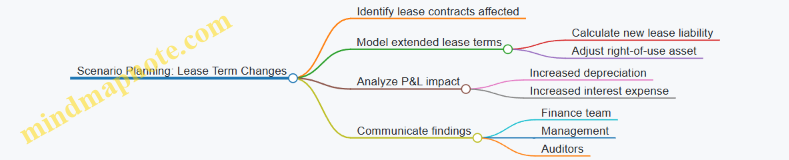
Example 2: Implementing Lease Accounting Software
Situation: A real estate firm struggles with manual lease accounting processes leading to errors and inefficiencies.
Best Practice:
- Select a lease accounting software compliant with IFRS 16 and ASC 842.
- Migrate all lease contracts into a centralized system.
- Automate lease classification, measurement, and reporting.
- Schedule regular training sessions for accounting staff.
Mind Map:
Example 3: Strengthening Internal Controls
Situation: An auditor identifies inconsistent lease modification documentation causing audit delays.
Best Practice:
- Develop standardized templates for lease modifications.
- Implement approval workflows requiring multiple sign-offs.
- Maintain detailed audit trails for all lease changes.
- Conduct periodic internal reviews to ensure compliance.
Mind Map:

Summary
Preparing for future lease accounting challenges requires a proactive, structured approach combining education, technology, data management, and collaboration. By implementing scenario planning, adopting suitable software, and strengthening internal controls, accountants and auditors can navigate evolving standards with confidence and precision.
Remember: The key to success lies in continuous improvement and staying informed about regulatory developments to minimize risks and optimize lease accounting processes.
12.4 Practical Example: Scenario Analysis for Upcoming Standard Changes
As lease accounting standards evolve, accountants and auditors must proactively analyze potential impacts on their organizations. Scenario analysis helps anticipate changes, assess financial and operational effects, and prepare for smooth transitions.
Understanding the Scenario Analysis Framework
A scenario analysis involves evaluating different possible future states based on upcoming standard changes. For lease accounting, this includes:
- Changes in lease term definitions
- Modifications in lease payment recognition
- New disclosure requirements
- Adjustments in lease classification criteria
Mind Map: Key Areas Affected by Upcoming Lease Accounting Changes
Step-by-Step Scenario Analysis Example
Scenario: A company currently applies IFRS 16 but anticipates changes that require stricter assessment of lease renewal options and inclusion of certain variable lease payments previously excluded.
Step 1: Identify Affected Lease Contracts
- Review all active lease agreements.
- Flag leases with renewal options and variable payments.
Step 2: Quantify Impact on Lease Term
- For leases with renewal options, reassess lease term assuming higher likelihood of renewal.
- Example: Lease with 3-year non-cancellable term + 2-year renewal option.
- Current lease term: 3 years
- New assessment: 5 years (due to stricter renewal certainty)
Step 3: Recalculate Lease Liability and Right-of-Use Asset
- Use updated lease term to compute present value of lease payments.
- Example Calculation:
- Annual lease payment: $100,000
- Discount rate: 5%
| Year | Payment | Present Value Factor (5%) | Present Value |
|---|---|---|---|
| 1 | 100,000 | 0.9524 | 95,240 |
| 2 | 100,000 | 0.9070 | 90,700 |
| 3 | 100,000 | 0.8638 | 86,380 |
| 4 | 100,000 | 0.8227 | 82,270 |
| 5 | 100,000 | 0.7835 | 78,350 |
| Total | 433,940 |
- Previous lease liability (3 years): $272,320
- New lease liability (5 years): $433,940
Step 4: Assess Impact on Financial Statements
- Increased right-of-use asset and lease liability.
- Higher depreciation and interest expense over extended term.
Step 5: Evaluate Disclosure Changes
- Prepare enhanced disclosures explaining changes in lease term assumptions.
Mind Map: Scenario Analysis Workflow
Additional Example: Inclusion of Variable Lease Payments
Scenario: New standards require including variable lease payments based on usage, previously excluded.
- Lease agreement includes base rent $50,000 + variable payment $10 per unit.
- Expected usage: 5,000 units/year.
Current Treatment: Only base rent recognized.
New Treatment: Variable payments estimated and included in lease liability.
Calculation:
- Variable payment per year: 5,000 units * $10 = $50,000
- Total annual lease payment: $50,000 (base) + $50,000 (variable) = $100,000
Recalculate lease liability using total payments, increasing recognized lease liability and right-of-use asset.
Best Practices for Scenario Analysis
- Maintain a centralized lease database for easy data extraction.
- Collaborate with legal and operational teams to understand lease terms.
- Use lease accounting software capable of modeling different scenarios.
- Document assumptions and methodologies clearly.
- Communicate findings to management and auditors early.
By conducting thorough scenario analyses like these, accountants and auditors can anticipate the impacts of upcoming lease accounting changes, ensuring compliance and minimizing surprises during implementation.
12.5 Continuous Professional Development for Accountants and Auditors
Continuous Professional Development (CPD) is essential for accountants and auditors to stay current with evolving lease accounting standards, regulatory changes, and industry best practices. Given the complexity and frequent updates in lease accounting (such as IFRS 16 and ASC 842), ongoing education ensures accuracy, compliance, and enhanced professional competence.
Why CPD is Critical in Lease Accounting
- Regulatory Updates: Lease accounting standards are periodically revised. Staying informed prevents misapplication.
- Technological Advancements: New software and automation tools require updated skills.
- Complex Transactions: Real estate and finance sectors often have intricate lease agreements needing expert interpretation.
- Audit Quality: Auditors must maintain high standards to identify risks and ensure transparent disclosures.
Key Areas for CPD Focus
Methods for Effective CPD
-
Formal Training and Workshops
- Example: Attending an IFRS 16 update seminar hosted by a professional accounting body.
- Benefit: Structured learning with expert guidance.
-
Online Courses and Webinars
- Example: Enrolling in a course on lease accounting software implementation.
- Benefit: Flexible learning tailored to specific needs.
-
Professional Certifications
- Example: Obtaining a Certified Lease Accounting Specialist credential.
- Benefit: Recognition of expertise and career advancement.
-
Reading and Research
- Example: Subscribing to journals like the Journal of Accountancy or industry newsletters.
- Benefit: Staying updated on emerging trends and case studies.
-
Peer Learning and Networking
- Example: Participating in forums or local accounting groups discussing lease accounting challenges.
- Benefit: Sharing practical experiences and solutions.
Practical Example: Implementing CPD in a Mid-Sized Accounting Firm
Scenario: A mid-sized firm wants to improve its lease accounting accuracy and audit quality.
Steps Taken:
- Conducted a skills gap analysis focusing on IFRS 16 and ASC 842.
- Organized quarterly workshops featuring lease accounting experts.
- Subscribed to a lease accounting software and trained staff via online modules.
- Encouraged auditors to join professional bodies and attend annual conferences.
- Established a knowledge-sharing platform for internal case studies and updates.
Outcome:
- Reduced lease accounting errors by 30% within a year.
- Improved audit report quality, leading to higher client satisfaction.
- Enhanced staff confidence and retention.
Mind Map: CPD Implementation Strategy
Tips for Maximizing CPD Benefits
- Set clear learning objectives aligned with job roles.
- Track CPD hours and maintain records for professional bodies.
- Apply new knowledge immediately to real lease accounting tasks.
- Seek feedback from supervisors and peers to identify improvement areas.
- Stay curious and proactive about emerging lease accounting developments.
Summary
Continuous Professional Development is not just a regulatory requirement but a strategic investment in the professional growth of accountants and auditors. By embracing diverse learning methods and focusing on critical lease accounting competencies, professionals can ensure compliance, improve accuracy, and add value to their organizations.
13. Summary and Best Practice Checklist
13.1 Recap of Key Concepts in Lease Accounting
Lease accounting is a critical area for accountants and auditors in the finance and real estate sectors. This section summarizes the essential concepts covered throughout the blog, reinforced with mind maps and practical examples to solidify understanding.
Mind Map: Overview of Lease Accounting
Lease Types and Classification
Lease agreements are primarily classified into Finance Leases and Operating Leases based on control and risk transfer.
- Finance Lease: Transfers substantially all risks and rewards of ownership to the lessee.
- Operating Lease: Does not transfer significant risks or rewards.
Example:
A company leases office equipment for 5 years, which is 90% of the asset’s useful life. This lease would likely be classified as a finance lease because the lease term covers most of the asset’s life.
Mind Map: Lease Classification Criteria
Initial Recognition and Measurement
At lease commencement, lessees recognize:
- Lease Liability: Present value of lease payments over the lease term.
- Right-of-Use (ROU) Asset: Initially measured at the amount of the lease liability plus any initial direct costs, prepaid lease payments, and restoration costs.
Example:
A company signs a 3-year lease with annual fixed payments of $10,000. Using a discount rate of 5%, the lease liability is calculated as the present value of these payments, and the ROU asset is recorded accordingly.
Mind Map: Initial Recognition
Subsequent Measurement
- Lease Liability: Increased by interest expense and reduced by lease payments.
- ROU Asset: Depreciated over the lease term or useful life.
Example:
Continuing the previous example, each year the lease liability is adjusted for interest and payments, while the ROU asset is depreciated on a straight-line basis over 3 years.
Mind Map: Subsequent Measurement
Lease Term and Renewal Options
The lease term includes the non-cancellable period plus periods covered by options to extend or terminate if reasonably certain.
Example:
A 2-year lease with an option to renew for 1 additional year. If the lessee is reasonably certain to renew, the lease term is 3 years for accounting purposes.
Lease Payments and Variable Considerations
Lease payments can be fixed or variable. Variable payments linked to an index or rate are included in lease liability measurement; others are expensed as incurred.
Example:
A lease requires monthly payments of $1,000 plus a variable amount based on inflation. The fixed payments are included in the lease liability; the variable portion is recognized when incurred.
Mind Map: Lease Payments
Lease Modifications
Changes to lease terms or payments require reassessment of lease liability and ROU asset.
Example:
If the lease term is extended from 3 to 5 years, the lease liability and ROU asset are remeasured to reflect the new term.
Disclosures
Lessee disclosures include:
- Lease terms and conditions
- Lease liabilities and ROU assets
- Expense recognition
- Maturity analysis
Example:
A company discloses a table showing lease liabilities due in each of the next five years, enhancing transparency.
Final Summary Mind Map
This recap provides a structured overview of lease accounting fundamentals, supported by clear examples and visual mind maps to aid comprehension and practical application.
13.2 Comprehensive Best Practice Checklist for Accountants and Auditors
To ensure accuracy, compliance, and efficiency in lease accounting, accountants and auditors should follow a structured best practice checklist. This section provides a detailed guide, supported by mind maps and practical examples, to help professionals navigate the complexities of lease agreements.
Best Practice Checklist Mind Map
Detailed Checklist Items with Examples
Initial Assessment
-
Identify Lease Components: Review contracts carefully to separate lease and non-lease components.
- Example: A lease agreement includes maintenance services; separate the lease payment from service fees.
-
Determine Lease Term: Consider non-cancellable periods plus options reasonably certain to be exercised.
- Example: A 3-year lease with a 2-year renewal option; if renewal is reasonably certain, use 5 years.
-
Classify Lease Type: Apply IFRS 16/ASC 842 criteria to classify as finance or operating lease.
- Example: Lease transfers ownership at end; classify as finance lease.
Measurement
-
Calculate Lease Liability: Discount lease payments using appropriate discount rate.
- Example: Lease payments of $10,000 annually for 4 years, discount rate 5%; calculate present value.
-
Recognize Right-of-Use Asset: Include initial direct costs, lease incentives, and restoration costs.
- Example: Initial direct costs of $2,000 added to right-of-use asset.
Subsequent Accounting
-
Lease Payments Allocation: Split payments into interest expense and principal repayment.
- Example: Use effective interest method to allocate $10,000 payment.
-
Depreciation: Depreciate right-of-use asset over lease term or useful life.
- Example: Straight-line depreciation over 5 years.
-
Reassess Lease Modifications: Adjust lease liability and asset for changes in lease terms or payments.
- Example: Lease term extended by 1 year; recalculate liability.
Documentation & Disclosure
-
Maintain Audit Trail: Keep detailed records of judgments, assumptions, and calculations.
- Example: Document rationale for lease term assessment.
-
Prepare Compliant Disclosures: Include qualitative and quantitative information as per standards.
- Example: Disclose total lease liabilities and maturity analysis.
-
Document Assumptions and Judgments: Clearly state basis for renewal options and variable payments.
Tax Coordination
-
Align Accounting and Tax Treatments: Understand differences and reconcile deferred taxes.
- Example: Lease incentives treated differently for tax and accounting purposes.
-
Monitor Deferred Tax Impacts: Track timing differences arising from lease accounting.
Technology & Controls
-
Use Lease Accounting Software: Implement tools to automate calculations and reporting.
- Example: Software that integrates with ERP to pull lease data automatically.
-
Implement Data Controls: Ensure data accuracy and completeness.
-
Automate Calculations: Reduce manual errors by automating discounting and amortization.
Continuous Review
-
Monitor Lease Term Changes: Regularly reassess lease terms for renewals or terminations.
-
Update Variable Payments: Adjust lease liability for changes in index-linked payments.
-
Conduct Periodic Audits: Perform internal audits to ensure compliance and accuracy.
Mind Map: Documentation & Disclosure Focus
Practical Example: Applying the Checklist
Scenario: An auditor reviews a 5-year office lease with a 3-year renewal option.
- Initial assessment confirms the lease term as 8 years due to reasonable certainty of renewal.
- Lease liability calculated using the incremental borrowing rate of 4.5%.
- Right-of-use asset includes $3,000 initial direct costs.
- Lease payments split into interest and principal using effective interest method.
- Lease modification occurs in year 3, extending lease by 2 years; liability and asset recalculated.
- Disclosures include maturity analysis and variable payment explanations.
- Tax team reconciles differences between accounting and tax treatments.
- Lease accounting software used to automate calculations and generate reports.
- Documentation maintained for all judgments and assumptions.
By following this checklist, accountants and auditors can ensure thorough, compliant, and transparent lease accounting processes.
13.3 Practical Tips for Efficient Lease Accounting Processes
Efficient lease accounting is critical for maintaining accurate financial records, ensuring compliance, and streamlining audit processes. Below are practical tips that accountants and auditors can implement to optimize lease accounting workflows.
Centralize Lease Data Management
Maintaining all lease agreements and related documents in a centralized, digital repository reduces errors and improves accessibility.
Example: A real estate firm implemented a cloud-based lease repository allowing accountants to access lease contracts instantly, reducing data retrieval time by 40%.
Automate Lease Calculations
Use lease accounting software or ERP modules that automatically calculate lease liabilities, right-of-use assets, and depreciation schedules.
Example: An auditor noted that a finance company reduced manual errors by 85% after integrating lease accounting software that auto-updated lease modifications and recalculated balances.
Implement Regular Lease Reviews and Reassessments
Schedule periodic reviews to reassess lease terms, renewal options, and variable payments to ensure accounting reflects current realities.

Example: A commercial real estate accountant conducts quarterly lease reassessments, identifying early lease modifications that improved financial statement accuracy.
Maintain Clear Documentation and Audit Trails
Document all judgments, assumptions, and calculations related to lease accounting to facilitate audits and internal reviews.
Example: During an audit, an accounting team provided detailed notes on lease term assumptions, which helped auditors quickly validate lease classifications.
Train Staff on Lease Accounting Standards and Tools
Continuous education ensures the accounting team stays updated on IFRS 16, ASC 842, and software functionalities.
Example: A finance company held monthly training sessions on lease accounting updates, resulting in a 30% reduction in accounting errors related to lease modifications.
Leverage Checklists and Standardized Templates
Use checklists for lease recognition, classification, and disclosure to ensure consistency and completeness.
Example: An auditor provided a lease accounting checklist that helped the accounting team systematically verify all lease components before financial reporting.
Coordinate with Tax and Legal Teams
Collaborate to understand the tax implications and legal nuances of lease agreements, ensuring alignment between accounting and tax treatments.
Example: A real estate company’s accounting and tax teams jointly reviewed lease incentives, ensuring proper recognition and tax treatment, avoiding potential penalties.
Summary Mind Map: Efficient Lease Accounting Process
By implementing these practical tips, accountants and auditors can significantly improve the accuracy, efficiency, and compliance of lease accounting processes, ultimately supporting better financial decision-making and reporting.
13.4 Common Mistakes to Avoid in Lease Accounting
Lease accounting can be complex, and even experienced accountants and auditors can fall into common pitfalls. Avoiding these mistakes is crucial to ensure accurate financial reporting and compliance with standards like IFRS 16 and ASC 842. Below, we explore frequent errors, supported by mind maps and practical examples.
Common Mistakes Mind Map
Misclassification of Leases
Mistake: Treating an operating lease as a finance lease or vice versa.
Example: A company leases office equipment for 5 years with a purchase option at the end. The lease meets criteria for a finance lease but is incorrectly recorded as an operating lease.
Impact: This leads to understated liabilities and assets, distorting financial ratios.
Best Practice: Carefully evaluate lease classification criteria, including transfer of ownership, lease term, and present value of payments.
Incorrect Lease Term Determination
Mistake: Ignoring renewal options or termination clauses when determining the lease term.
Example: A retail chain signs a 3-year lease with an option to renew for 2 additional years. The company excludes the renewal period from the lease term despite high likelihood of renewal.
Impact: Underreporting lease liabilities and right-of-use assets.
Best Practice: Assess the likelihood of exercising options based on reasonable certainty and include those periods accordingly.
Errors in Lease Liability Measurement
Mistake: Using an incorrect discount rate or excluding variable lease payments linked to an index.
Example: A company uses its incremental borrowing rate without considering the rate implicit in the lease, resulting in overestimated lease liability.
Impact: Misstated lease liabilities affect interest expense and amortization.
Best Practice: Determine the appropriate discount rate and include all fixed and variable lease payments as per standards.
Inaccurate Right-of-Use Asset Recognition
Mistake: Omitting initial direct costs or failing to adjust for lease incentives.
Example: A company receives a rent-free period but does not adjust the right-of-use asset accordingly.
Impact: Overstated asset value and depreciation expense.
Best Practice: Include initial direct costs and deduct lease incentives from the right-of-use asset.
Poor Documentation and Disclosure
Mistake: Insufficient documentation of lease terms and incomplete disclosures in financial statements.
Example: Lease contracts lack clarity on variable payments, leading to inadequate disclosure.
Impact: Non-compliance with accounting standards and audit issues.
Best Practice: Maintain detailed lease files and prepare comprehensive disclosures covering lease terms, payments, and judgments.
Neglecting Lease Modifications
Mistake: Failing to reassess lease terms or adjust lease liabilities after modifications.
Example: A lease term is extended, but the company continues accounting under original terms.
Impact: Financial statements do not reflect current lease obligations.
Best Practice: Reassess lease classification and measurement upon modifications and update accounting accordingly.
Ignoring Tax Implications
Mistake: Overlooking differences between accounting and tax treatments of leases.
Example: A company recognizes a right-of-use asset for accounting but does not consider tax depreciation rules.
Impact: Deferred tax misstatements and potential tax compliance issues.
Best Practice: Coordinate lease accounting with tax teams to align reporting and identify deferred tax effects.
Technology and Process Failures
Mistake: Relying on manual calculations or poorly integrated systems.
Example: Manual spreadsheets lead to inconsistent lease data and errors in lease liability calculations.
Impact: Increased risk of errors and inefficiencies.
Best Practice: Implement lease accounting software integrated with ERP systems and establish strong internal controls.
Summary Table of Mistakes and Solutions
| Mistake | Example Scenario | Best Practice Summary |
|---|---|---|
| Misclassification of leases | Equipment lease misclassified as operating lease | Evaluate classification criteria thoroughly |
| Incorrect lease term | Ignoring renewal option in retail lease | Assess reasonable certainty for options |
| Lease liability measurement | Using wrong discount rate | Use correct discount rate and include variable payments |
| Right-of-use asset recognition | Omitting lease incentives | Adjust asset for incentives and direct costs |
| Documentation and disclosure | Incomplete lease contract details | Maintain detailed records and disclosures |
| Lease modifications | Not updating lease after extension | Reassess and adjust accounting post-modification |
| Tax implications | Ignoring tax depreciation differences | Coordinate accounting and tax reporting |
| Technology failures | Manual spreadsheets causing errors | Use automated lease accounting tools |
By recognizing and proactively addressing these common mistakes, accountants and auditors can ensure more accurate lease accounting, reduce audit risks, and maintain compliance with evolving standards.
13.5 Final Thoughts: Enhancing Accuracy and Compliance in Lease Accounting
Lease accounting is a complex but critical area for accountants and auditors within the finance and real estate sectors. Ensuring accuracy and compliance not only supports transparent financial reporting but also mitigates risks related to regulatory scrutiny and financial misstatements. This section consolidates key strategies, practical tips, and illustrative examples to help professionals excel in lease accounting.
Mind Map: Key Pillars for Accuracy and Compliance in Lease Accounting
Best Practices Summary with Examples
-
Deep Understanding of Standards
- Stay current with IFRS 16 and ASC 842 updates.
- Example: A real estate firm updated its lease accounting policy immediately after an IFRS amendment, avoiding restatement.
-
Comprehensive Lease Contract Review
- Analyze all lease terms including renewal and termination clauses.
- Example: An auditor discovered an unaccounted-for renewal option that extended the lease term, impacting the lease liability.
-
Accurate Lease Classification
- Apply classification criteria consistently.
- Example: A finance company used a checklist to classify leases, reducing misclassification errors by 30%.
-
Meticulous Documentation and Audit Trail
- Maintain records of judgments and assumptions.
- Example: Documenting the rationale for excluding certain variable payments helped during audit queries.
-
Leverage Technology
- Use specialized lease accounting software for calculations and reporting.
- Example: Automation reduced manual errors in lease liability calculations for a multi-entity corporation.
-
Regular Training and Updates
- Conduct workshops and refresher courses.
- Example: Quarterly training sessions improved team confidence in handling complex lease modifications.
-
Strong Internal Controls
- Implement segregation of duties and approval workflows.
- Example: A layered approval process prevented unauthorized lease modifications.
-
Cross-Department Collaboration
- Engage legal, tax, and audit teams early.
- Example: Collaboration uncovered tax implications of lease incentives that were initially overlooked.
Example Scenario: Avoiding Common Pitfalls
Scenario: A company entered into a lease with variable payments linked to sales volume but failed to reassess payments quarterly.
Issue: Lease liability was understated, leading to inaccurate financial statements.
Resolution: Implemented a quarterly review process with automated alerts in the lease accounting system.
Outcome: Improved accuracy and compliance, with auditors commending the proactive approach.
Mind Map: Continuous Improvement Cycle in Lease Accounting
Final Takeaway
Accuracy and compliance in lease accounting require a proactive, well-documented, and technology-enabled approach. By embedding best practices into daily workflows and fostering continuous learning, accountants and auditors can confidently navigate the complexities of lease agreements, ensuring robust financial reporting and regulatory adherence.