Internal Audit Best Practices
1. Introduction to Internal Auditing
1.1 Understanding the Role of Internal Audit in Finance and Real Estate
Internal audit plays a crucial role in ensuring that organizations within the finance and real estate sectors operate efficiently, comply with regulations, and manage risks effectively. Its primary function is to provide independent assurance that an organization’s risk management, governance, and internal control processes are operating effectively.
Key Functions of Internal Audit in Finance and Real Estate
- Risk Management: Identifying, assessing, and mitigating risks that could impact financial performance or asset value.
- Compliance: Ensuring adherence to laws, regulations, and internal policies.
- Operational Efficiency: Evaluating processes to improve efficiency and reduce waste.
- Financial Accuracy: Verifying the accuracy and reliability of financial reporting.
- Fraud Prevention: Detecting and preventing fraudulent activities.
Mind Map: Role of Internal Audit
Why Internal Audit is Vital in Finance and Real Estate
- Complex Regulatory Environment: Both sectors face stringent regulations (e.g., SOX, SEC regulations for finance; local property laws for real estate).
- High-Value Transactions: Large sums and assets require thorough oversight to prevent errors and fraud.
- Market Volatility: Economic fluctuations impact asset values and financial stability.
- Stakeholder Assurance: Investors, regulators, and management rely on audit findings for decision-making.
Example: Internal Audit in a Real Estate Firm
A real estate company managing multiple commercial properties implemented an internal audit function to review lease agreements and rent collection processes. The audit identified inconsistencies in lease documentation and delayed rent payments. By recommending standardized lease templates and improved tracking systems, the firm reduced revenue leakage by 15% within six months.
Mind Map: Benefits of Internal Audit in Real Estate
Example: Internal Audit in a Finance Company
A mid-sized finance company used internal audit to assess its loan approval process. The audit revealed gaps in credit risk assessment and documentation. By introducing stricter credit checks and automated workflow approvals, the company reduced default rates by 10% and improved regulatory compliance.
Mind Map: Internal Audit Impact in Finance
Summary
Internal audit serves as a backbone for governance, risk management, and control in finance and real estate sectors. By systematically evaluating processes and controls, internal auditors help organizations safeguard assets, enhance operational efficiency, and maintain stakeholder confidence. Practical examples from both industries illustrate how internal audit not only identifies issues but also drives meaningful improvements.
1.2 Key Objectives and Benefits of Internal Auditing
Internal auditing plays a pivotal role in ensuring the robustness, transparency, and efficiency of an organization’s operations, particularly within the finance and real estate sectors. Understanding its key objectives and benefits helps accountants and auditors appreciate its value and apply best practices effectively.
Key Objectives of Internal Auditing
Internal auditing is designed to achieve several critical objectives that align with organizational goals and regulatory requirements:
- Risk Management: Identify, assess, and mitigate risks that could impact financial performance or compliance.
- Internal Control Evaluation: Assess the effectiveness and adequacy of internal controls to safeguard assets and ensure accurate financial reporting.
- Compliance Assurance: Verify adherence to laws, regulations, policies, and contractual obligations.
- Operational Efficiency: Evaluate processes and recommend improvements to enhance productivity and cost-effectiveness.
- Fraud Prevention and Detection: Detect irregularities and implement controls to prevent fraudulent activities.
- Governance Support: Provide assurance to management and the board on governance processes and ethical standards.
Benefits of Internal Auditing
Implementing a strong internal audit function offers numerous benefits, especially in complex industries like finance and real estate:
- Enhanced Risk Awareness: Organizations gain a clearer understanding of potential risks, enabling proactive management.
- Improved Financial Integrity: Accurate and reliable financial reporting builds stakeholder confidence.
- Regulatory Compliance: Avoid costly penalties and reputational damage by ensuring compliance.
- Operational Improvements: Identifying inefficiencies leads to streamlined processes and reduced waste.
- Fraud Reduction: Early detection and prevention mechanisms minimize financial losses.
- Strategic Decision Support: Auditors provide insights that inform strategic planning and resource allocation.
- Strengthened Corporate Governance: Transparent reporting and accountability foster trust among investors and regulators.
Practical Example: Real Estate Company Enhancing Compliance and Efficiency
A mid-sized real estate firm faced challenges with inconsistent lease contract management and regulatory compliance. The internal audit team was tasked with evaluating these areas.
- Objective: Ensure lease agreements comply with new local regulations and improve contract management efficiency.
- Approach: Conducted a risk assessment focusing on lease documentation and compliance controls.
- Findings: Identified gaps in contract approval workflows and missing documentation.
- Recommendations: Implemented a centralized lease management system with automated alerts for renewals and compliance deadlines.
- Outcome: Reduced compliance risks by 40% within six months and improved process efficiency, saving 15 hours per week in administrative tasks.
This example underscores how internal auditing objectives—risk management, compliance assurance, and operational efficiency—translate into tangible business benefits.
Summary
Internal auditing is not just a compliance exercise but a strategic function that drives risk mitigation, operational excellence, and governance. By clearly understanding and applying its key objectives and benefits, auditors in finance and real estate can add significant value to their organizations.
1.3 Overview of Regulatory and Compliance Requirements
Internal auditors in the finance and real estate sectors must have a comprehensive understanding of the regulatory landscape to ensure that their organizations remain compliant and avoid penalties. This section provides an overview of key regulatory and compliance requirements, illustrated with mind maps and practical examples.
Key Regulatory Frameworks in Finance and Real Estate
-
Finance Sector:
- Sarbanes-Oxley Act (SOX)
- Dodd-Frank Act
- Anti-Money Laundering (AML) Regulations
- Basel III
- Securities and Exchange Commission (SEC) Rules
-
Real Estate Sector:
- Fair Housing Act
- Real Estate Settlement Procedures Act (RESPA)
- Anti-Money Laundering (AML) in Real Estate
- Local Zoning and Environmental Regulations
- Financial Accounting Standards Board (FASB) Guidelines
Mind Map: Regulatory Requirements Overview
Practical Example 1: Sarbanes-Oxley Act (SOX) Compliance in a Finance Company
A mid-sized financial services firm implemented SOX compliance by establishing a robust internal control framework. The internal audit team conducted quarterly walkthroughs of financial reporting processes, tested controls such as segregation of duties and authorization protocols, and reported findings to the audit committee. This proactive approach helped identify control gaps early, reducing the risk of financial misstatements.
Practical Example 2: RESPA Compliance in a Real Estate Firm
A real estate company faced challenges ensuring compliance with RESPA, particularly in disclosing closing costs to clients. The internal audit team designed a checklist to verify that all disclosures were timely and accurate. They also reviewed contracts for prohibited kickbacks. As a result, the company improved transparency, reduced regulatory risk, and enhanced client trust.
Mind Map: Compliance Process Flow
Importance of Staying Updated
Regulatory requirements frequently evolve. Internal auditors should subscribe to regulatory updates, participate in industry forums, and maintain strong relationships with legal and compliance teams. For example, recent changes in lease accounting standards (ASC 842) require auditors in real estate to reassess lease classification and disclosure practices.
Summary
Understanding regulatory and compliance requirements is foundational for internal auditors. By integrating this knowledge into audit planning and execution, auditors can help their organizations mitigate risks, ensure legal compliance, and promote operational excellence.
1.4 Example: How a Real Estate Firm Improved Compliance Through Internal Audit
Internal audits play a critical role in ensuring compliance within real estate firms, where regulatory requirements and operational complexities are high. This example illustrates how a mid-sized real estate company leveraged internal auditing to enhance compliance, reduce risks, and streamline processes.
Background
The firm managed a diverse portfolio of commercial and residential properties across multiple states. Due to varying local regulations and internal policy gaps, compliance issues were frequent, leading to fines and reputational risks.
Objectives of the Internal Audit
- Identify compliance gaps across property management and leasing operations.
- Evaluate effectiveness of existing controls.
- Recommend actionable improvements to reduce regulatory risks.
Mind Map: Compliance Improvement Process
Step 1: Risk Assessment and Audit Planning
The audit team began by mapping out all relevant regulatory requirements, including local housing laws, tenant rights, environmental regulations, and financial reporting standards. They then assessed internal policies to identify gaps or outdated procedures.
Example: They discovered that lease agreements in some states did not fully comply with recent tenant protection laws, exposing the firm to legal risks.
Step 2: Conducting Fieldwork
The auditors conducted detailed document reviews, including lease contracts, maintenance logs, and financial records. They also interviewed property managers and compliance officers to understand day-to-day practices.
Example: Sampling of lease agreements revealed inconsistent application of rent increase clauses, which conflicted with state regulations.
Step 3: Reporting Findings
The audit report clearly outlined compliance gaps, categorized by risk level. For example, high-risk findings included non-compliant lease clauses and inadequate documentation of property inspections.
Example: The report highlighted that 30% of properties lacked timely safety inspections, violating local ordinances.
Step 4: Recommendations and Implementation
Recommendations were practical and prioritized:
- Policy Updates: Revise lease templates to align with current laws.
- Training: Conduct workshops for property managers on compliance requirements.
- Automation: Implement a digital tracking system for inspections and lease renewals.
Example: After implementing an automated alert system, the firm reduced missed inspection deadlines by 90% within six months.
Step 5: Follow-Up and Continuous Improvement
The internal audit function established quarterly follow-ups to monitor progress and ensure sustained compliance.
Example: Quarterly reviews showed continuous improvement, with fewer compliance incidents reported.
Mind Map: Benefits Realized
Summary
This example demonstrates how a structured internal audit approach can significantly improve compliance in a real estate firm. By integrating risk assessment, thorough fieldwork, clear reporting, and actionable recommendations, internal auditors helped the firm mitigate risks and foster a culture of compliance.
Such practices are essential for accountants and auditors working in finance and real estate sectors to ensure that organizations not only meet regulatory demands but also operate efficiently and ethically.
2. Planning the Internal Audit
2.1 Establishing the Audit Universe and Risk Assessment
Internal auditing begins with a clear understanding of the audit universe and a thorough risk assessment. These foundational steps ensure that audit resources are focused on the areas of highest risk and greatest importance to the organization.
What is the Audit Universe?
The audit universe is a comprehensive list of all auditable entities within an organization. These entities can include departments, processes, systems, projects, subsidiaries, and controls. In finance and real estate sectors, the audit universe might cover areas such as:
- Financial reporting processes
- Lease and property management
- Investment portfolios
- Compliance with regulatory requirements
- IT systems supporting financial transactions
Example: A real estate company’s audit universe might include property acquisition, lease administration, tenant billing, and property maintenance.
Mind Map: Components of an Audit Universe
Risk Assessment: Prioritizing Audit Focus
Risk assessment involves identifying and evaluating risks that could impact the achievement of organizational objectives. It helps auditors prioritize which areas to audit based on the likelihood and impact of risks.
Key steps in risk assessment include:
- Identify Risks: Gather information from management, previous audits, industry trends, and regulatory changes.
- Assess Risks: Evaluate the likelihood (probability) and impact (consequence) of each risk.
- Prioritize Risks: Rank risks to determine audit priorities.
- Develop Risk-Based Audit Plan: Align audit activities with high-priority risks.
Example: In a finance company, risks such as fraud in accounts payable or inaccurate financial reporting may be rated high priority due to their potential financial impact.
Mind Map: Risk Assessment Process
Practical Example: Risk-Based Audit Planning in a Finance Company
Scenario: A mid-sized finance company wants to optimize its internal audit plan for the upcoming year.
-
The audit team compiles an audit universe including departments like Treasury, Accounts Payable, Compliance, and IT.
-
Through interviews and data analysis, they identify key risks such as:
- Treasury: Unauthorized transactions (High likelihood, High impact)
- Accounts Payable: Duplicate payments (Medium likelihood, Medium impact)
- Compliance: Regulatory non-compliance (Low likelihood, High impact)
- IT: Cybersecurity vulnerabilities (Medium likelihood, High impact)
-
Using this risk assessment, the audit team prioritizes Treasury and IT audits for the next cycle, ensuring resources are allocated effectively.
Best Practices for Establishing Audit Universe and Conducting Risk Assessment
- Engage Stakeholders: Collaborate with management and key personnel to gain insights.
- Use Data Analytics: Leverage data to identify unusual patterns or emerging risks.
- Regularly Update: The audit universe and risk assessment should be dynamic, reflecting organizational changes.
- Document Clearly: Maintain transparent records of how risks were identified and prioritized.
- Align with Strategic Objectives: Ensure audit priorities support the organization’s goals.
By carefully establishing the audit universe and conducting a thorough risk assessment, internal auditors in finance and real estate can focus their efforts where they matter most, enhancing audit effectiveness and organizational value.
2.2 Setting Audit Objectives and Scope
Setting clear audit objectives and defining the scope are critical steps in ensuring an internal audit is focused, efficient, and delivers value. This section explores how to establish meaningful objectives and appropriately limit the scope to align with organizational goals and risk priorities.
What Are Audit Objectives?
Audit objectives specify what the audit aims to achieve. They guide the audit process by defining the key questions to answer and the outcomes expected. Objectives should be SMART: Specific, Measurable, Achievable, Relevant, and Time-bound.
Example:
- Objective: “Evaluate the effectiveness of the lease approval process controls within the real estate division to ensure compliance with company policy and regulatory requirements by Q3 2024.”
Why Define Audit Scope?
The audit scope determines the boundaries of the audit, including the departments, processes, time periods, and types of transactions to be reviewed. Defining scope helps avoid audit creep and ensures resource optimization.
Example:
- Scope: “Review lease contracts signed between January 2023 and June 2024, focusing on approval workflows, documentation completeness, and compliance with internal policies.”
Mind Map: Setting Audit Objectives
Mind Map: Defining Audit Scope
Practical Example: Finance Sector
Scenario: An internal audit team in a financial services company plans to audit the loan approval process.
- Objective: Assess the adequacy and effectiveness of controls over loan approvals to mitigate credit risk and ensure compliance with lending policies.
- Scope: Review loan applications processed between January 2023 and December 2023, focusing on credit checks, approval limits, and documentation.
This clear objective and scope help auditors focus on critical risk areas and provide actionable insights.
Practical Example: Real Estate Sector
Scenario: An audit is planned for the property acquisition process in a real estate firm.
- Objective: Verify that property acquisitions comply with internal policies and regulatory requirements, and that financial approvals are properly documented.
- Scope: Examine all property acquisitions completed in the last 18 months, including contract reviews, approval workflows, and payment authorizations.
This scope ensures the audit covers relevant transactions while avoiding unrelated activities.
Tips for Effective Objective and Scope Setting
- Collaborate with management and process owners to understand priorities.
- Use risk assessments to focus on high-risk areas.
- Keep objectives concise but comprehensive.
- Avoid overly broad scopes that dilute audit effectiveness.
- Revisit and adjust objectives and scope if new risks emerge during the audit.
Summary
Setting audit objectives and scope is foundational to a successful internal audit. Clear, focused objectives aligned with organizational risks and a well-defined scope ensure efficient use of resources and meaningful audit outcomes.
2.3 Developing an Audit Plan and Schedule
Developing a comprehensive audit plan and schedule is a critical step in ensuring that the internal audit process is efficient, focused, and aligned with organizational goals. A well-structured plan helps auditors allocate resources effectively, manage time, and address the highest risks within the finance and real estate sectors.
Key Components of an Audit Plan
- Audit Objectives: Define what the audit aims to achieve.
- Scope: Specify the boundaries of the audit, including departments, processes, or systems.
- Risk Assessment: Prioritize areas based on risk levels.
- Resources: Identify the audit team, tools, and budget.
- Timeline: Establish start and end dates, milestones, and deadlines.
- Methodology: Outline the techniques and procedures to be used.
Mind Map: Components of an Audit Plan
Steps to Develop an Effective Audit Plan and Schedule
- Gather Preliminary Information: Understand the business environment, regulatory requirements, and previous audit findings.
- Perform Risk Assessment: Use risk matrices or scoring models to prioritize audit areas.
- Define Audit Objectives and Scope: Clearly articulate what will be audited and to what extent.
- Allocate Resources: Assign auditors with the right expertise and determine necessary tools.
- Develop the Schedule: Create a timeline considering resource availability and organizational priorities.
- Communicate the Plan: Share the plan with stakeholders for feedback and approval.
Mind Map: Steps to Develop Audit Plan and Schedule
Example: Developing an Audit Plan for a Real Estate Company
Scenario: A real estate firm wants to audit its lease management and property acquisition processes.
- Risk Assessment: Identified high risk in lease compliance and property valuation accuracy.
- Objectives: Ensure compliance with lease terms and verify accuracy of property valuations.
- Scope: Audit lease contracts from the last 2 years and recent property acquisitions.
- Resources: Two auditors with real estate expertise, data analytics software.
- Schedule: 6-week audit starting July 1st, with weekly progress reviews.
Result: The plan allowed the audit team to focus on critical areas, uncovering several lease compliance issues and recommending process improvements.
Mind Map: Real Estate Audit Plan Example
Tips for Scheduling Audits
- Balance Workload: Avoid overloading auditors; distribute audits evenly.
- Consider Business Cycles: Schedule audits during less busy periods to minimize disruption.
- Allow Flexibility: Build buffer time for unexpected issues or extended testing.
- Coordinate with Other Functions: Align with external audits or compliance checks when possible.
Example: Scheduling Audit in a Finance Department
A finance company schedules its internal audits around quarterly financial reporting periods to ensure findings can be incorporated before external audits. They allocate 3 weeks for each audit, with a 1-week buffer for follow-up.
Mind Map: Audit Scheduling Best Practices
By integrating these best practices and examples, internal auditors in finance and real estate can develop robust audit plans and schedules that optimize resources, mitigate risks, and add significant value to their organizations.
2.4 Example: Risk-Based Audit Planning in a Finance Company
Risk-based audit planning is a strategic approach that prioritizes audit resources on areas with the highest risk to the organization. This ensures that the internal audit function adds maximum value by focusing on critical business processes and controls.
Scenario Overview
A mid-sized finance company, FinSecure Inc., decided to adopt risk-based audit planning to improve the effectiveness of its internal audit function. The company operates in lending, investment advisory, and asset management.
Step 1: Establishing the Audit Universe
FinSecure first compiled a comprehensive list of auditable units and processes, including:
- Loan origination and approval
- Investment portfolio management
- Regulatory compliance
- IT systems and cybersecurity
- Financial reporting
- Customer onboarding and KYC (Know Your Customer)
Step 2: Conducting Risk Assessment
The audit team gathered input from management, reviewed past audit reports, and analyzed external factors such as regulatory changes and market conditions. They assessed risks based on:
- Likelihood of occurrence
- Potential financial impact
- Reputational damage
- Regulatory penalties
Mind Map: Risk Assessment Factors
Example: The loan origination process was identified as high risk due to increased default rates and regulatory scrutiny.
Step 3: Prioritizing Audit Areas
Based on the risk scores, the audit team prioritized areas for the upcoming audit cycle:
| Audit Area | Risk Level | Priority |
|---|---|---|
| Loan Origination | High | 1 |
| IT Systems and Cybersecurity | High | 2 |
| Investment Portfolio Management | Medium | 3 |
| Customer Onboarding (KYC) | Medium | 4 |
| Financial Reporting | Low | 5 |
Mind Map: Audit Prioritization
Step 4: Developing the Audit Plan
The audit plan was developed with clear objectives, scope, and resource allocation:
- Loan Origination Audit: Focus on credit approval controls, documentation completeness, and compliance with lending policies.
- IT Systems Audit: Evaluate cybersecurity controls, access management, and data integrity.
Example: For the loan origination audit, the team planned to sample 50 loan files from the last quarter to test adherence to approval workflows.
Step 5: Continuous Monitoring and Adjustment
The audit plan was reviewed quarterly to incorporate emerging risks such as changes in regulatory environment or market volatility.
Mind Map: Continuous Audit Planning
Key Takeaways from FinSecure’s Risk-Based Audit Planning
- Focus on High-Risk Areas: Prioritizing audits where risks are greatest improves resource efficiency.
- Engage Stakeholders: Involving management and using multiple data sources enriches risk assessment.
- Dynamic Planning: Regular updates to the audit plan ensure responsiveness to changing risk landscapes.
- Clear Documentation: Maintaining detailed audit plans and risk assessments supports transparency and accountability.
This example demonstrates how a finance company can implement risk-based audit planning to enhance its internal audit effectiveness, ensuring that critical risks are managed proactively.
2.5 Tools and Techniques for Effective Audit Planning
Effective audit planning is foundational to a successful internal audit. Leveraging the right tools and techniques not only streamlines the process but also enhances the accuracy and relevance of the audit outcomes. Below, we explore key tools and techniques with practical examples and mind maps to illustrate their application.
Key Tools and Techniques
-
Risk Assessment Matrices
- Helps prioritize audit areas based on risk impact and likelihood.
- Example: A real estate firm uses a risk matrix to identify high-risk lease contracts requiring detailed audit.
-
Audit Universe Mapping
- Visual representation of all auditable units/processes.
- Example: A finance company maps its departments and processes to ensure comprehensive coverage.
-
Stakeholder Analysis
- Identifies key stakeholders and their influence on audit scope.
- Example: Auditors engage with compliance officers to understand regulatory priorities.
-
Data Analytics Tools
- Software like ACL, IDEA, or Excel for analyzing large datasets.
- Example: Using data analytics to detect unusual transaction patterns in accounts payable.
-
Project Management Software
- Tools like MS Project, Trello, or Asana to track audit tasks and timelines.
- Example: Scheduling audit fieldwork and deliverables with clear deadlines.
-
Brainstorming and Workshops
- Collaborative sessions to identify risks and audit focus areas.
- Example: Conducting a workshop with finance and real estate teams to uncover emerging risks.
-
Mind Mapping
- Visual tool to organize audit planning thoughts and link related concepts.
- Example: Creating a mind map to break down audit scope into manageable components.
Mind Maps Examples in
Mind Map 1: Audit Universe Mapping
Mind Map 2: Risk Assessment Process
Mind Map 3: Audit Planning Workflow
Practical Example: Applying Tools in a Real Estate Audit Planning
A real estate company plans an internal audit focusing on lease compliance and asset valuation. The audit team begins by mapping the audit universe, listing all relevant departments and processes. Using a risk assessment matrix, they score lease contracts based on value and complexity, identifying high-risk leases for detailed review.
They organize a brainstorming workshop with property managers and finance staff to uncover potential risks such as inaccurate valuations or missed lease renewals. Data analytics tools are employed to analyze lease payment histories and detect anomalies.
Project management software is used to assign tasks, set deadlines, and monitor progress. Throughout, mind maps help the team visualize the audit scope and workflow, ensuring clarity and alignment.
This integrated approach results in a focused, efficient audit plan that addresses the most critical risks with clear timelines and responsibilities.
Summary
Utilizing a combination of risk assessment matrices, audit universe mapping, stakeholder analysis, data analytics, project management tools, brainstorming, and mind mapping enables auditors to develop comprehensive and effective audit plans. These tools facilitate prioritization, collaboration, and clarity, ultimately enhancing audit quality and impact.
3. Conducting Fieldwork and Evidence Collection
3.1 Gathering and Documenting Audit Evidence
Gathering and documenting audit evidence is a cornerstone of the internal audit process. It ensures that auditors have sufficient, reliable, and relevant information to support their findings and conclusions. This section will explore best practices for collecting audit evidence, the types of evidence commonly used, and effective documentation techniques, all illustrated with practical examples.
What is Audit Evidence?
Audit evidence consists of all the information collected by auditors to evaluate the adequacy and effectiveness of controls, compliance, and risk management processes.
Types of Audit Evidence
- Physical Evidence: Tangible assets or documents (e.g., contracts, invoices, property deeds).
- Documentary Evidence: Records such as financial statements, policies, and reports.
- Testimonial Evidence: Information obtained through interviews or inquiries.
- Analytical Evidence: Data analysis, trends, and ratios.
Best Practices for Gathering Audit Evidence
- Plan Evidence Collection: Define what evidence is needed based on audit objectives.
- Use Multiple Sources: Corroborate findings by collecting evidence from different sources.
- Maintain Objectivity: Collect evidence impartially without bias.
- Ensure Timeliness: Gather evidence promptly to reflect current conditions.
- Secure Evidence: Protect confidentiality and integrity of evidence.
Mind Map: Key Steps in Gathering Audit Evidence
Methods of Collecting Audit Evidence
-
Inspection: Examining records, documents, or tangible assets.
- Example: Reviewing lease agreements in a real estate portfolio to verify terms.
-
Observation: Watching processes or procedures being performed.
- Example: Observing cash handling procedures at a finance department.
-
Inquiry: Asking questions of personnel to gain understanding.
- Example: Interviewing property managers about maintenance schedules.
-
Confirmation: Obtaining direct verification from third parties.
- Example: Confirming bank balances with financial institutions.
-
Recalculation: Verifying mathematical accuracy.
- Example: Recalculating depreciation expenses on fixed assets.
-
Analytical Procedures: Comparing financial data and ratios.
- Example: Analyzing trends in rental income over several quarters.
Mind Map: Methods of Evidence Collection
Documenting Audit Evidence
Proper documentation is essential to create a clear audit trail and support audit conclusions.
- Use Workpapers: Structured templates to record evidence, procedures, and findings.
- Detail Source Information: Include origin, date, and collector of evidence.
- Link Evidence to Objectives: Clearly connect evidence to audit criteria.
- Maintain Confidentiality: Store documentation securely.
Example: Documenting Evidence in a Real Estate Audit
An auditor reviewing lease compliance collects the following evidence:
- Copies of lease contracts (Inspection)
- Interview notes from tenant meetings (Inquiry)
- Maintenance logs (Observation)
- Rent payment confirmations from bank statements (Confirmation)
Each piece of evidence is logged in workpapers with dates, source names, and relevance notes, ensuring a comprehensive audit trail.
Practical Example: Detecting Anomalies Through Evidence Collection
In a finance company, auditors noticed discrepancies in vendor payments. Using a combination of inspection (reviewing invoices), confirmation (contacting vendors), and recalculation (verifying payment amounts), they uncovered duplicate payments caused by weak internal controls.
Summary
Gathering and documenting audit evidence requires a structured approach that combines multiple collection methods, ensures objectivity, and maintains thorough records. Applying these best practices enables auditors in finance and real estate sectors to produce credible, actionable audit results.
3.2 Interview Techniques and Stakeholder Engagement
Internal audits rely heavily on effective communication with stakeholders to gather accurate information, understand processes, and identify risks. Mastering interview techniques and stakeholder engagement is essential for auditors in finance and real estate sectors to ensure comprehensive and insightful audits.
Key Interview Techniques
- Preparation: Research the stakeholder’s role, background, and relevant processes before the interview.
- Open-Ended Questions: Encourage detailed responses to gain deeper insights.
- Active Listening: Show engagement through verbal and non-verbal cues; clarify and summarize to confirm understanding.
- Neutrality: Maintain an unbiased stance to foster honest communication.
- Documentation: Take clear notes or record (with permission) to capture critical information.
- Follow-Up Questions: Probe deeper based on initial answers to uncover hidden risks or controls.
Mind Map: Interview Techniques
Stakeholder Engagement Strategies
- Identify Key Stakeholders: Include finance managers, auditors, compliance officers, property managers, and external consultants.
- Build Rapport: Establish trust by explaining audit purpose and ensuring confidentiality.
- Tailor Communication: Adjust language and detail level based on stakeholder expertise.
- Schedule Convenient Meetings: Respect stakeholders’ time to encourage cooperation.
- Provide Feedback: Share preliminary findings to validate information and encourage collaboration.
Mind Map: Stakeholder Engagement
Example 1: Interviewing a Finance Manager in a Real Estate Firm
Scenario: An auditor is assessing lease revenue recognition controls.
- Preparation: Auditor reviews lease contracts and prior audit reports.
- Interview Approach: Uses open-ended questions like “Can you walk me through the process of recognizing lease revenue?” and probes with “How do you ensure that lease modifications are accurately reflected in the financial statements?”
- Engagement: Builds rapport by acknowledging the manager’s expertise and explaining the audit’s goal to improve controls.
- Outcome: The manager reveals a manual step prone to errors, which becomes a key audit finding.
Example 2: Engaging External Auditors During an Internal Audit
Scenario: Coordination between internal and external auditors to avoid duplication.
- Stakeholder Identification: External audit team lead.
- Engagement Strategy: Schedule a joint meeting to discuss scope and share preliminary findings.
- Communication: Use clear, jargon-free language and share timelines.
- Result: Enhanced cooperation reduces audit fatigue on finance staff and improves overall audit quality.
Best Practices Summary
- Always prepare thoroughly before interviews.
- Use open-ended and probing questions to uncover detailed information.
- Engage stakeholders respectfully and transparently.
- Document interviews meticulously for audit trail and follow-up.
- Foster ongoing communication to build trust and collaboration.
Mastering interview techniques and stakeholder engagement empowers internal auditors to collect accurate, relevant information and build strong relationships, ultimately enhancing audit effectiveness in the finance and real estate sectors.
3.3 Sampling Methods and Data Analysis
Internal auditors often face large volumes of data and transactions, making it impractical to review every item. Sampling methods and data analysis techniques help auditors efficiently and effectively gather evidence to form conclusions about the entire population.
Sampling Methods
Sampling is the process of selecting a subset of items from a population to draw conclusions about the whole. Choosing the right sampling method is critical to ensure the audit results are reliable and representative.
Common Sampling Methods:
- Random Sampling: Every item in the population has an equal chance of being selected.
- Systematic Sampling: Selecting every nth item from a list after a random start.
- Stratified Sampling: Dividing the population into subgroups (strata) and sampling from each subgroup.
- Judgmental (Non-Statistical) Sampling: Auditor selects items based on experience or risk assessment.
Mind Map: Sampling Methods Overview
Example: Applying Sampling in a Real Estate Audit
A real estate company has 5,000 lease contracts. Auditing all contracts is not feasible within the time frame. The auditor uses stratified sampling by dividing contracts into three strata based on lease value:
- High-value leases (top 10%)
- Medium-value leases (next 40%)
- Low-value leases (remaining 50%)
The auditor then selects a higher proportion of samples from the high-value stratum to focus on higher risk areas, ensuring efficient use of audit resources.
Data Analysis in Internal Auditing
Data analysis enhances the auditor’s ability to identify anomalies, trends, and risks by examining large datasets systematically.
Key Data Analysis Techniques:
- Descriptive Analytics: Summarizing data using means, medians, frequencies.
- Trend Analysis: Identifying patterns over time.
- Ratio Analysis: Comparing financial ratios to benchmarks.
- Outlier Detection: Spotting unusual transactions or values.
- Data Visualization: Using charts and graphs to interpret data.
Mind Map: Data Analysis Techniques
Example: Using Data Analytics to Detect Anomalies in Real Estate Transactions
An auditor analyzes payment data for property management fees over the past year. Using outlier detection, they identify several unusually large payments made to a vendor outside the normal payment cycle. Further investigation reveals duplicate payments due to a system glitch, allowing the company to recover funds and improve controls.
Integrating Sampling and Data Analysis
Combining sampling with data analysis maximizes audit effectiveness. For example, auditors can use data analytics to identify high-risk transactions or unusual patterns and then apply targeted sampling to those areas.
Mind Map: Integrating Sampling and Data Analysis
Summary
- Sampling methods help auditors efficiently select representative data subsets.
- Data analysis techniques uncover trends, anomalies, and risks.
- Combining both approaches enhances audit quality and resource allocation.
- Real-world examples from finance and real estate illustrate practical application.
By mastering sampling and data analysis, internal auditors can provide deeper insights and more reliable assurance to stakeholders.
3.4 Example: Using Data Analytics to Detect Anomalies in Real Estate Transactions
Internal auditors in the real estate sector increasingly rely on data analytics to identify irregularities and potential fraud in transactions. By leveraging data-driven techniques, auditors can efficiently sift through large volumes of transaction data to pinpoint anomalies that warrant further investigation.
Understanding the Role of Data Analytics in Real Estate Audits
- Real estate transactions generate vast datasets including property details, buyer/seller information, pricing, payment schedules, and contractual terms.
- Manual review of these records is time-consuming and prone to oversight.
- Data analytics enables auditors to automate detection of unusual patterns, outliers, and inconsistencies.
Key Steps in Using Data Analytics for Anomaly Detection
Practical Example: Detecting Anomalies in Property Sale Prices
Scenario: An internal audit team is reviewing property sales over the last fiscal year to identify transactions that may indicate inflated prices or potential kickbacks.
Step 1: Data Gathering
- Extract all property sales data including sale price, property size, location, date of sale, and buyer/seller details.
Step 2: Data Cleaning
- Ensure all prices are in the same currency and format.
- Remove incomplete or duplicate records.
Step 3: Analytical Techniques
- Calculate average price per square foot for properties in each neighborhood.
- Identify transactions where price per square foot significantly exceeds the neighborhood average (e.g., 2 standard deviations above the mean).
Step 4: Visualization and Mind Mapping
Step 5: Example Findings
- Transaction #452: Sold at $750/sq ft in a neighborhood averaging $450/sq ft.
- Buyer and seller share common addresses, indicating potential conflict of interest.
Step 6: Reporting
- Document findings with supporting data and visualizations.
- Recommend further investigation or control improvements.
Additional Examples of Data Analytics Applications
-
Payment Pattern Analysis: Detecting unusual payment schedules or repeated late payments that may indicate financial distress or manipulation.
-
Duplicate Vendor Detection: Using fuzzy matching algorithms to identify duplicate or fictitious vendors in payment records.
-
Contract Compliance Checks: Comparing contract terms with actual transaction data to ensure adherence.
Best Practices for Effective Use of Data Analytics
- Collaborate with IT and data specialists to ensure data integrity.
- Use a combination of automated tools and auditor judgment.
- Continuously update analytical models to reflect market changes.
- Document assumptions, methodologies, and findings clearly.
By integrating data analytics into internal audit processes, auditors in the real estate sector can significantly enhance their ability to detect anomalies early, reduce risk exposure, and improve overall audit quality.
3.5 Maintaining Objectivity and Professional Skepticism
Maintaining objectivity and professional skepticism is fundamental to the integrity and effectiveness of internal auditing. These principles ensure that auditors remain impartial, unbiased, and critically evaluative throughout the audit process, which is especially crucial in the Finance and Real Estate sectors where complex transactions and regulatory requirements abound.
What is Objectivity?
Objectivity refers to the auditor’s ability to perform audit work without bias, conflict of interest, or undue influence from others. It requires auditors to base their conclusions solely on evidence and facts.
What is Professional Skepticism?
Professional skepticism is an attitude that includes a questioning mind and a critical assessment of audit evidence. It involves being alert to conditions that may indicate possible misstatement due to error or fraud and critically evaluating the sufficiency and reliability of audit evidence.
Mind Map: Maintaining Objectivity and Professional Skepticism
Practical Examples
Example 1: Detecting Unusual Real Estate Transaction Patterns An internal auditor noticed a series of property sales occurring at prices significantly above market value within a short period. Instead of accepting explanations at face value, the auditor applied professional skepticism by:
- Requesting additional documentation such as appraisal reports and contracts.
- Comparing transactions with independent market data.
- Interviewing involved parties to understand the rationale.
This approach uncovered potential related-party transactions intended to inflate asset values, prompting further investigation.
Example 2: Verifying Financial Data Beyond Face Value During an audit of a finance department, an auditor observed that reported revenue growth was unusually high compared to industry benchmarks. Maintaining objectivity, the auditor:
- Examined underlying contracts and payment schedules.
- Tested revenue recognition policies for compliance with accounting standards.
- Used data analytics to identify irregular revenue spikes.
This led to identifying premature revenue recognition, allowing management to correct financial statements.
Example 3: Challenging Optimistic Revenue Forecasts In a real estate company, management presented optimistic forecasts for rental income growth. The auditor, applying professional skepticism,:
- Reviewed historical performance against forecasts.
- Assessed market trends and economic indicators.
- Requested sensitivity analyses to understand forecast assumptions.
This critical evaluation helped highlight overly optimistic assumptions, resulting in more realistic budgeting.
Techniques to Maintain Objectivity and Professional Skepticism
- Rotate Audit Assignments: Regularly changing audit areas to avoid familiarity threats.
- Document Judgments: Clearly record the basis for conclusions to provide transparency.
- Seek Corroborative Evidence: Always look for multiple sources to support findings.
- Engage in Peer Reviews: Obtain feedback from colleagues to challenge assumptions.
- Stay Informed: Keep up-to-date with industry trends and emerging risks to better identify anomalies.
Summary
Maintaining objectivity and professional skepticism is essential for internal auditors to provide reliable and credible assurance. By fostering a questioning mindset, avoiding biases, and critically evaluating evidence, auditors can effectively identify risks and contribute to stronger governance and control environments in Finance and Real Estate organizations.
4. Evaluating Internal Controls
4.1 Frameworks for Assessing Internal Controls (COSO, COBIT)
Internal controls are the backbone of effective risk management and governance in any organization, especially within the finance and real estate sectors. To systematically assess these controls, auditors rely on established frameworks that provide structured guidance and best practices. Two of the most widely recognized frameworks are COSO (Committee of Sponsoring Organizations of the Treadway Commission) and COBIT (Control Objectives for Information and Related Technologies).
COSO Framework Overview
COSO is primarily focused on enterprise risk management and internal control over financial reporting. It helps organizations design, implement, and evaluate internal controls to achieve objectives related to operations, reporting, and compliance.
The COSO Framework consists of five interrelated components:
- Control Environment
- Sets the tone of the organization
- Influences control consciousness
- Risk Assessment
- Identifies and analyzes risks to achieving objectives
- Control Activities
- Policies and procedures to mitigate risks
- Information and Communication
- Supports the identification, capture, and exchange of information
- Monitoring Activities
- Ongoing evaluations to ensure controls are effective
Mind Map: COSO Framework Components
Example: A real estate company used the COSO framework to evaluate its lease approval process. By assessing the control environment, they identified a lack of segregation of duties between lease approval and payment processing. Implementing control activities such as dual approvals and regular reconciliations helped reduce errors and potential fraud.
COBIT Framework Overview
COBIT is a comprehensive framework for IT governance and management, particularly useful for auditing IT controls within organizations. It aligns IT goals with business objectives and provides detailed control objectives for IT processes.
COBIT’s core components include:
- Governance System and Components
- Governance and Management Objectives
- Performance Management
- Processes and Activities
COBIT organizes IT processes into domains such as:
- Evaluate, Direct and Monitor (EDM)
- Align, Plan and Organize (APO)
- Build, Acquire and Implement (BAI)
- Deliver, Service and Support (DSS)
- Monitor, Evaluate and Assess (MEA)
Mind Map: COBIT Domains and Key Processes
Example: In a finance company, the internal audit team used COBIT to assess IT controls related to financial reporting systems. They focused on DSS05 (Manage Security Services) to evaluate access controls and data protection measures. By identifying gaps in user access reviews, they recommended implementing automated periodic access certification, which enhanced system security and compliance.
Integrating COSO and COBIT in Internal Audits
While COSO provides a broad framework for internal controls across the enterprise, COBIT offers detailed guidance on IT-specific controls. For auditors in finance and real estate sectors, combining both frameworks ensures comprehensive coverage of financial, operational, and IT risks.
Mind Map: Integration of COSO and COBIT
Example: A real estate firm conducting an internal audit on its property management software applied COSO to evaluate overall control environment and risk assessment, while using COBIT to drill down into IT governance, security, and system development lifecycle controls. This integrated approach uncovered both process and IT control gaps, leading to a robust remediation plan.
Summary of Best Practices for Using Frameworks
- Tailor frameworks to organizational context: Adapt COSO and COBIT components to fit the size, complexity, and risk profile of the organization.
- Use risk-based approach: Prioritize controls based on risk assessment outcomes.
- Document findings clearly: Map audit observations to specific framework components.
- Leverage technology: Use audit management tools to track controls and testing results.
- Continuous monitoring: Implement ongoing evaluation mechanisms aligned with framework monitoring activities.
By mastering COSO and COBIT frameworks, internal auditors in finance and real estate can systematically assess controls, identify weaknesses, and provide actionable recommendations that enhance organizational resilience and compliance.
4.2 Identifying Control Weaknesses and Risks
Identifying control weaknesses and risks is a critical step in the internal audit process. It allows auditors to pinpoint areas where the organization’s internal controls may fail to prevent or detect errors, fraud, or inefficiencies. This section will guide you through practical approaches, supported by examples and mind maps, to effectively identify these vulnerabilities within finance and real estate sectors.
Understanding Control Weaknesses
Control weaknesses occur when controls are missing, improperly designed, or not operating effectively. These weaknesses can be categorized as:
- Design Weaknesses: Controls that are inadequately designed to mitigate risks.
- Operational Weaknesses: Controls that are well designed but not implemented or followed correctly.
Mind Map: Types of Control Weaknesses
Risk Identification Process
-
Understand the Business Processes: Gain a thorough understanding of the processes under audit. For example, in real estate lease management, understand how leases are approved, recorded, and monitored.
-
Perform Risk Assessment: Identify risks that could impact financial reporting, compliance, or operational efficiency.
-
Evaluate Existing Controls: Assess whether current controls address identified risks adequately.
-
Test Controls: Perform walkthroughs and sample testing to verify control effectiveness.
-
Document Findings: Clearly document any control gaps or failures.
Mind Map: Risk Identification Steps
Example: Identifying Control Weaknesses in a Real Estate Lease Management Process
Scenario: An internal auditor is reviewing the lease approval process in a real estate company.
- Observation: The auditor finds that lease agreements are sometimes approved verbally without formal documentation.
- Risk: This may lead to unauthorized leases, financial losses, or compliance breaches.
- Control Weakness: Lack of a formal approval control (design weakness) and inconsistent enforcement of approval procedures (operational weakness).
Action: Recommend implementing a mandatory written approval workflow with electronic signatures and periodic review of lease approvals.
Common Risks and Associated Control Weaknesses in Finance and Real Estate
| Risk Area | Example Risk | Typical Control Weakness |
|---|---|---|
| Financial Reporting | Misstatement of revenue | Inadequate reconciliation controls |
| Compliance | Non-adherence to regulatory requirements | Lack of updated policies and training |
| Fraud | Unauthorized transactions | Weak segregation of duties |
| Asset Management | Misappropriation of property assets | Poor physical access controls |
| IT Systems | Data breaches or system downtime | Insufficient IT access controls and monitoring |
Mind Map: Common Risks and Control Weaknesses
Practical Tips for Auditors
- Use process flowcharts to visualize controls and identify gaps.
- Conduct interviews with process owners to uncover informal practices.
- Leverage data analytics to detect anomalies indicating control failures.
- Prioritize risks based on impact and likelihood to focus audit efforts.
Example: Using Data Analytics to Identify Risks in Finance
An auditor uses transaction data to identify duplicate payments in accounts payable. By applying filters and pattern recognition, the auditor uncovers multiple instances where invoices were paid twice due to weak invoice matching controls.
Result: The auditor recommends implementing automated three-way matching controls and periodic data reviews to prevent recurrence.
By systematically identifying control weaknesses and associated risks, internal auditors can provide valuable insights that strengthen organizational controls, reduce risk exposure, and enhance overall governance.
4.3 Testing Control Effectiveness
Testing control effectiveness is a critical step in the internal audit process to ensure that internal controls are functioning as intended and mitigating risks effectively. This section will guide you through the methodologies, best practices, and practical examples to test controls within finance and real estate sectors.
What is Control Effectiveness Testing?
Control effectiveness testing evaluates whether the control activities are operating as designed and are capable of preventing or detecting errors or fraud in a timely manner.
Key Steps in Testing Control Effectiveness
Mind Map: Testing Control Effectiveness Steps
Common Testing Techniques
Mind Map: Control Testing Techniques
Example: Testing Control Effectiveness in Lease Approval Process (Real Estate)
Control Objective: Ensure all lease agreements are properly authorized before execution.
Testing Approach:
- Inquiry: Interview lease managers to understand the approval workflow.
- Inspection: Review a sample of lease agreements for signatures and approval stamps.
- Reperformance: Select a few lease agreements and verify if the approval process was followed by tracing back through system logs or email trails.
Findings:
- 95% of sampled leases had proper approvals.
- 5% lacked documented authorization, indicating a control gap.
Action: Recommend reinforcing approval documentation and periodic refresher training for lease managers.
Example: Testing Control Effectiveness in Expense Reimbursement (Finance)
Control Objective: Ensure all employee expense reimbursements are valid, approved, and comply with company policy.
Testing Approach:
- Observation: Observe the process of submitting and approving expense reports.
- Inspection: Examine a random sample of expense reports for receipts, approval signatures, and policy compliance.
- Reperformance: Recalculate expense totals and verify approval dates.
Findings:
- All sampled reports had valid receipts.
- Two instances of late approvals were noted, which could delay detection of errors.
Action: Suggest implementing automated reminders for timely approvals.
Best Practices for Testing Control Effectiveness
Mind Map: Best Practices
Tips for Sample Selection
- Use statistical sampling for large populations to ensure unbiased results.
- For smaller populations, consider 100% testing if feasible.
- Focus on high-risk transactions or controls with past deficiencies.
Common Pitfalls to Avoid
- Relying solely on inquiry without corroborating evidence.
- Testing too few samples, leading to unreliable conclusions.
- Ignoring the design of the control and focusing only on execution.
By integrating these testing methodologies and examples, internal auditors in finance and real estate can confidently assess control effectiveness, identify gaps, and contribute to stronger risk management frameworks.
4.4 Example: Control Evaluation in Lease Management Processes
Internal audit plays a critical role in evaluating controls within lease management processes, especially in the real estate sector where lease agreements, payments, and compliance are complex and high-value. This example demonstrates how auditors can assess controls effectively, identify weaknesses, and recommend improvements.
Understanding Lease Management Controls
Lease management involves multiple control points to ensure accuracy, compliance, and risk mitigation. Typical controls include:
- Lease agreement approval and documentation
- Rent calculation and invoicing
- Payment collection and reconciliation
- Lease renewal and termination procedures
- Compliance with regulatory and accounting standards (e.g., IFRS 16 / ASC 842)
Mind Map: Key Control Areas in Lease Management
Step-by-Step Control Evaluation Example
-
Review Lease Documentation Controls:
- Verify that all lease agreements are properly authorized by management.
- Check for completeness and accuracy of contract terms.
- Example: An auditor found that 15% of lease contracts lacked proper signature approvals, indicating a control gap.
-
Assess Rent Calculation and Invoicing Controls:
- Test the accuracy of rent calculations against contract terms.
- Evaluate automated invoicing systems for consistency.
- Example: In one audit, discrepancies in rent escalation clauses led to underbilling by 8%, highlighting the need for better system controls.
-
Evaluate Payment Collection and Reconciliation:
- Confirm that payments are recorded timely and reconciled with bank statements.
- Review procedures for handling late or missed payments.
- Example: An auditor discovered delays in payment posting, causing cash flow forecasting issues.
-
Examine Lease Renewal and Termination Controls:
- Check if lease renewals are reviewed and approved before expiry.
- Verify that terminations are documented and financial impacts accounted for.
- Example: A real estate firm improved lease renewal tracking after auditors identified lapses causing revenue loss.
-
Test Compliance with Regulatory and Accounting Standards:
- Ensure lease accounting complies with IFRS 16 or ASC 842.
- Review audit trails for changes in lease terms.
- Example: Auditors recommended enhanced controls after finding inconsistent lease classification affecting financial statements.
Mind Map: Control Weaknesses and Recommendations
Practical Example: Improving Controls in a Real Estate Company
Scenario: A mid-sized real estate company faced recurring issues with lease renewals being overlooked, resulting in lost rental income and tenant dissatisfaction.
Audit Findings:
- No formal tracking system for lease expiration dates.
- Renewal approvals were often delayed or undocumented.
- Manual processes led to inconsistent rent adjustments.
Actions Taken:
- Implemented a lease management software with automated alerts for upcoming renewals.
- Established a formal approval workflow requiring documented sign-offs.
- Integrated rent escalation clauses into the system to automate recalculations.
Outcome:
- Lease renewals increased by 25% within six months.
- Revenue leakage reduced significantly.
- Improved tenant relationships due to proactive communication.
Summary
Evaluating controls in lease management processes requires a thorough understanding of the lease lifecycle, associated risks, and regulatory requirements. By systematically assessing documentation, rent management, payment processes, renewals, and compliance, internal auditors can identify control gaps and recommend practical improvements. Using mind maps helps visualize complex control areas and focus audit efforts effectively.
This example highlights the importance of integrating technology, formalizing workflows, and continuous monitoring to strengthen lease management controls and safeguard organizational assets.
4.5 Best Practices for Reporting Control Deficiencies
Reporting control deficiencies effectively is critical to ensuring that management understands the risks and takes appropriate corrective actions. Clear, concise, and actionable reports help bridge the gap between auditors and stakeholders, fostering transparency and continuous improvement.
Key Best Practices for Reporting Control Deficiencies
Reporting Control Deficiencies Mind Map
Detailed Explanation with Examples
-
Clarity & Conciseness
- Use straightforward language to describe the deficiency.
- Example: Instead of “The internal control environment exhibits weaknesses in segregation of duties,” say “The same employee approves and processes vendor payments, increasing risk of error or fraud.”
-
Prioritization
- Categorize deficiencies by severity to help management focus on the most critical issues first.
- Example: Label a missing approval on a $1 million transaction as “High Risk,” while a minor documentation lapse could be “Low Risk.”
-
Evidence-Based Findings
- Support your findings with concrete evidence such as transaction samples, screenshots, or audit logs.
- Example: “Out of 50 lease agreements reviewed, 12 lacked proper authorization signatures, as shown in Appendix A.”
-
Actionable Recommendations
- Provide clear steps to remediate the deficiency.
- Example: “Implement a dual-approval process for all vendor payments exceeding $10,000 by Q3 2024. Assign responsibility to the Finance Manager.”
-
Impact Explanation
- Explain why the deficiency matters.
- Example: “Without proper segregation of duties, there is an increased risk of unauthorized payments leading to financial loss.”
-
Balanced Tone
- Maintain professionalism to encourage cooperation.
- Example: Use phrases like “Opportunity for improvement” instead of “Failure to comply.”
-
Follow-Up Mechanism
- Define how and when the issue will be re-evaluated.
- Example: “A follow-up audit will be conducted in six months to verify implementation of recommended controls.”
-
Stakeholder Communication
- Tailor the report to the audience’s level of understanding.
- Example: Provide a high-level summary for the Audit Committee and detailed findings for operational managers.
Example Report Snippet
Control Deficiency: Lack of Segregation of Duties in Vendor Payment Process
Description: The same employee is responsible for both approving and processing vendor payments, which increases the risk of unauthorized or fraudulent transactions.
Risk Level: High
Evidence: Review of 30 payment transactions showed 100% were approved and processed by the same individual (see Appendix B).
Impact: This control weakness could lead to financial loss and reputational damage if fraudulent payments occur.
Recommendation: Implement a dual-approval process where one employee approves payments and another processes them. Assign the Finance Manager to oversee implementation by September 30, 2024.
Follow-Up: A follow-up audit will be conducted in Q4 2024 to assess compliance.
Tone: This presents an opportunity to strengthen internal controls and reduce risk exposure.
By integrating these best practices, internal auditors can deliver reports that not only highlight deficiencies but also drive meaningful improvements within finance and real estate organizations.
5. Reporting Audit Findings
5.1 Structuring Clear and Concise Audit Reports
An effective audit report is a critical communication tool that conveys the results of the internal audit in a clear, concise, and actionable manner. For accountants and auditors in finance and real estate sectors, structuring the audit report properly ensures that stakeholders understand the findings, risks, and recommendations, facilitating timely decision-making and corrective actions.
Key Components of a Clear and Concise Audit Report
Detailed Explanation of Each Component
-
Introduction
- Clearly state the purpose of the audit (e.g., compliance, operational efficiency).
- Define the scope and boundaries (departments, processes, time frame).
- Example: “This audit covers lease management processes from January to June 2024 to assess compliance with internal controls and regulatory requirements.”
-
Executive Summary
- Provide a snapshot of the most critical findings.
- Summarize the overall audit opinion (e.g., satisfactory, needs improvement).
- Highlight key recommendations.
- Example: “The audit identified significant control gaps in rent collection processes, exposing the company to potential revenue leakage. Immediate corrective actions are recommended.”
-
Detailed Findings
- Present each observation with clarity.
- Use a consistent format: Observation, Criteria, Cause, Effect, Recommendation.
- Include management’s response and action plans.
- Example:
- Observation: Inadequate segregation of duties in payment processing.
- Criteria: Company policy requires separation of payment initiation and approval.
- Cause: Limited staffing led to overlapping responsibilities.
- Effect: Increased risk of unauthorized payments.
- Recommendation: Assign distinct roles to different employees to strengthen controls.
-
Conclusion
- Recap audit objectives and whether they were met.
- Provide final thoughts on the audit’s impact.
-
Appendices
- Attach relevant documents, data analysis, or definitions.
Best Practices for Writing Audit Reports
Example: Clear and Concise Audit Report Excerpt
Executive Summary:
The internal audit of the accounts payable process revealed that while invoice approvals are generally timely, there is a lack of formal documentation for vendor verification, increasing the risk of fraudulent payments. We recommend implementing a standardized vendor onboarding checklist and periodic vendor audits.
Detailed Finding:
- Observation: Vendor verification procedures are informal and inconsistent.
- Criteria: Company policy mandates documented verification for all new vendors.
- Cause: Absence of a formal checklist and training.
- Effect: Potential exposure to fraudulent or unqualified vendors.
- Recommendation: Develop and enforce a vendor onboarding checklist; train staff accordingly.
- Management Response: Agreed. The procurement team will implement the checklist by Q3 2024.
Tips for Enhancing Readability
- Use bullet points and numbered lists for clarity.
- Break long paragraphs into smaller sections.
- Highlight key terms in bold or italics.
- Use consistent formatting throughout the report.
By following these structured guidelines and incorporating real-world examples, auditors can produce reports that not only inform but also drive meaningful improvements within finance and real estate organizations.
5.2 Prioritizing Findings Based on Risk and Impact
Prioritizing audit findings is a critical step in ensuring that internal audit efforts are focused on the most significant risks and issues that could affect the organization’s objectives. By assessing the risk and impact associated with each finding, auditors can help management allocate resources effectively and address vulnerabilities that pose the greatest threat.
Why Prioritize Findings?
- Efficient Resource Allocation: Focus on high-risk areas that could cause significant financial loss or reputational damage.
- Effective Risk Mitigation: Address critical control weaknesses before they escalate.
- Clear Communication: Help management understand which issues require immediate attention.
Key Factors in Prioritization
- Risk Likelihood: How probable is the risk event?
- Impact Severity: What is the potential consequence if the risk materializes?
- Control Environment: Are there existing controls mitigating the risk?
- Regulatory and Compliance Implications: Does the finding relate to legal or regulatory requirements?
- Financial Impact: Potential monetary loss or cost.
- Operational Impact: Effect on business processes or service delivery.
Mind Map: Prioritizing Audit Findings
Step-by-Step Approach to Prioritization
- Identify and Document Findings: Collect all audit observations with detailed descriptions.
- Assess Risk Likelihood: Evaluate how often the risk might occur based on historical data or expert judgment.
- Evaluate Impact Severity: Determine the potential damage or loss if the risk occurs.
- Consider Control Effectiveness: Review if existing controls reduce the risk.
- Assign Priority Levels: Categorize findings into High, Medium, or Low priority.
- Communicate Priorities: Clearly present prioritized findings in the audit report.
Example: Prioritizing Findings in a Real Estate Audit
Scenario: During an internal audit of a real estate company’s lease management process, several findings were identified:
| Finding ID | Description | Risk Likelihood | Impact Severity | Control Effectiveness | Priority |
|---|---|---|---|---|---|
| F1 | Missing lease agreement documentation | Medium | High | Low | High |
| F2 | Delayed rent payment tracking | High | Medium | Medium | Medium |
| F3 | Minor discrepancies in utility expense reports | Low | Low | High | Low |
Explanation:
- F1 is prioritized as High because missing documentation can lead to legal disputes and financial loss.
- F2 is Medium priority due to frequent delays but partially mitigated by existing controls.
- F3 is Low priority as discrepancies are minor and controls are effective.
Mind Map: Example Prioritization for Real Estate Audit Findings
Best Practices for Prioritizing Findings
- Use a Risk Matrix to visually map likelihood vs. impact.
- Engage with stakeholders to understand business context.
- Regularly update priorities as new information emerges.
- Document the rationale behind prioritization decisions.
- Integrate prioritization with audit follow-up to track remediation.
Example: Risk Matrix for Prioritization
| Impact \ Likelihood | Low | Medium | High |
|---|---|---|---|
| High | Medium Priority | High Priority | High Priority |
| Medium | Low Priority | Medium Priority | High Priority |
| Low | Low Priority | Low Priority | Medium Priority |
Summary
Prioritizing audit findings based on risk and impact ensures that internal audit resources are directed towards the most critical issues. This approach not only enhances the value of the audit function but also supports management in making informed decisions to strengthen controls and mitigate risks effectively.
5.3 Communicating with Management and the Audit Committee
Effective communication with management and the audit committee is a cornerstone of successful internal auditing. It ensures that audit findings are understood, risks are appropriately addressed, and recommendations are implemented. This section explores best practices for communication, supported by mind maps and practical examples.
Key Objectives of Communication
- Ensure transparency and clarity of audit findings
- Facilitate timely decision-making and corrective actions
- Build trust and credibility between auditors, management, and the audit committee
- Promote a culture of continuous improvement and risk awareness
Mind Map: Communication Flow in Internal Audit
Best Practices for Communicating with Management
-
Know Your Audience
- Tailor communication style and detail level based on the management role.
- Example: Senior executives prefer high-level summaries with key risks, while operational managers need detailed findings.
-
Be Clear and Concise
- Use straightforward language avoiding jargon.
- Highlight key risks, impacts, and recommended actions.
-
Use Visual Aids
- Incorporate charts, graphs, and dashboards to illustrate trends and control gaps.
- Example: A heat map showing risk severity across departments.
-
Engage in Two-Way Dialogue
- Encourage questions and clarifications.
- Schedule follow-up meetings to discuss progress.
-
Provide Actionable Recommendations
- Recommendations should be specific, measurable, achievable, relevant, and time-bound (SMART).
Mind Map: Effective Communication with Management
Best Practices for Communicating with the Audit Committee
-
Provide Executive Summaries
- Summarize audit scope, key findings, and risk implications.
- Example: A one-page dashboard highlighting top 3 risks and their mitigation status.
-
Be Objective and Balanced
- Present both strengths and areas for improvement.
- Avoid overly technical language.
-
Highlight Strategic Risks
- Link audit findings to organizational objectives and strategic risks.
-
Prepare for Questions
- Anticipate concerns and have supporting data ready.
-
Ensure Timely Reporting
- Deliver reports aligned with the audit committee’s meeting schedule.
Mind Map: Communicating with the Audit Committee
Example Scenario: Communicating a Significant Control Deficiency
Context: During an audit of lease management processes in a real estate firm, auditors identified a significant control deficiency related to unauthorized lease modifications.
Communication to Management:
- Delivered a detailed report outlining the deficiency, potential financial impact, and risk of regulatory non-compliance.
- Included a heat map showing the frequency and severity of unauthorized changes.
- Recommended implementing automated approval workflows and periodic reconciliations.
- Scheduled a workshop with the lease management team to discuss findings and action plans.
Communication to Audit Committee:
- Presented an executive summary highlighting the risk to revenue recognition and compliance.
- Emphasized the strategic importance of strengthening controls to protect company assets.
- Provided a timeline for remediation and follow-up audit plans.
- Addressed committee questions regarding resource allocation and monitoring.
Summary
Effective communication with management and the audit committee requires clarity, relevance, and engagement. By tailoring messages, using visual tools, and fostering dialogue, auditors can ensure their findings lead to meaningful improvements and strengthen organizational governance.
5.4 Example: Crafting Actionable Recommendations for a Finance Department
Crafting actionable recommendations is a critical step in the internal audit process. It ensures that audit findings translate into practical improvements that management can implement effectively. Below is a detailed guide, supported by mind maps and examples, to help auditors develop clear, concise, and actionable recommendations for a finance department.
Understanding the Problem
Before crafting recommendations, fully understand the root cause of the issue identified during the audit.
Mind Map: Understanding the Problem
Example:
Finding: Delays in monthly financial close process causing late reporting.
Root Cause: Manual data consolidation from multiple systems without standardized procedures.
Characteristics of Actionable Recommendations
Recommendations should be:
- Specific: Clearly define what needs to be done.
- Measurable: Include criteria to assess completion.
- Achievable: Realistic given resources and constraints.
- Relevant: Directly address the root cause.
- Time-bound: Specify deadlines or timeframes.
Mind Map: Characteristics of Actionable Recommendations
Structuring Recommendations
A well-structured recommendation typically includes:
- Action: What should be done?
- Responsible Party: Who should do it?
- Timeline: When should it be completed?
- Expected Outcome: What improvement will result?
Mind Map: Structuring Recommendations
Example Recommendation Based on the Finding
Finding: Delays in monthly financial close due to manual data consolidation.
Recommendation:
- Action: Implement an automated data integration tool to consolidate financial data from all systems.
- Responsible Party: Finance IT Team in collaboration with Finance Operations.
- Timeline: Within 3 months.
- Expected Outcome: Reduce data consolidation time by 50%, enabling timely financial close and reporting.
Additional Examples of Actionable Recommendations
| Finding | Recommendation | Responsible Party | Timeline | Expected Outcome |
|---|---|---|---|---|
| Inadequate segregation of duties in accounts payable | Introduce role-based access controls and periodic review of user permissions | Finance Manager & IT Security | 2 months | Reduce risk of fraud and errors in payments |
| Lack of documented procedures for expense approvals | Develop and distribute a formal expense approval policy and train staff | Finance Director | 1 month | Ensure consistent and compliant expense processing |
Tips for Effective Communication
- Use clear, jargon-free language.
- Prioritize recommendations by risk and impact.
- Link recommendations to business objectives.
- Provide examples or references to best practices.
Mind Map: Tips for Effective Communication
Summary
Crafting actionable recommendations requires a deep understanding of audit findings, clarity in communication, and alignment with organizational goals. By following the structured approach and using examples, auditors can ensure their recommendations lead to meaningful improvements in the finance department.
5.5 Ensuring Follow-Up and Closure of Audit Issues
Ensuring timely follow-up and closure of audit issues is a critical step in the internal audit process. It guarantees that identified risks are mitigated, controls are improved, and organizational objectives are safeguarded. Without effective follow-up, audit findings may remain unresolved, leading to recurring problems and potential financial or reputational damage.
Key Steps in Follow-Up and Closure
- Assign Responsibility: Clearly designate owners for each audit finding.
- Set Deadlines: Establish realistic timelines for remediation.
- Monitor Progress: Regularly track the status of corrective actions.
- Verify Effectiveness: Confirm that implemented actions address the root cause.
- Document Closure: Maintain records of actions taken and approvals.
Mind Map: Follow-Up and Closure Process
Best Practices for Effective Follow-Up
- Integrate Follow-Up into Audit Management Software: Use tools that automate reminders and status tracking.
- Establish a Follow-Up Calendar: Schedule periodic reviews aligned with risk severity.
- Engage Stakeholders Continuously: Maintain open communication with process owners.
- Use Risk-Based Prioritization: Focus on high-impact issues first.
- Conduct Root Cause Analysis: Ensure corrective actions address underlying problems, not just symptoms.
Example: Follow-Up in a Real Estate Lease Compliance Audit
During an internal audit of lease compliance, several issues were identified including missing documentation and inconsistent rent escalation calculations. The audit team:
- Assigned the property management team as responsible owners.
- Set deadlines within 30 days for document submission and 45 days for recalculating escalations.
- Scheduled bi-weekly progress meetings.
- Verified corrections by reviewing updated lease files and recalculated rent schedules.
- Documented closure with sign-off from both audit and property management leaders.
This structured follow-up ensured all issues were resolved before the next audit cycle, reducing compliance risks.
Mind Map: Example Follow-Up for Lease Compliance Audit
Tips to Overcome Common Follow-Up Challenges
- Delayed Responses: Escalate unresolved issues to senior management.
- Insufficient Resources: Collaborate with management to allocate necessary support.
- Lack of Documentation: Emphasize the importance of evidence in closure.
- Changing Priorities: Reassess and adjust timelines as needed, communicating changes clearly.
Summary
Effective follow-up and closure of audit issues transform audit findings into actionable improvements. By assigning clear responsibilities, setting deadlines, monitoring progress, verifying effectiveness, and documenting closure, internal auditors help organizations strengthen controls and reduce risks.
6. Leveraging Technology in Internal Auditing
6.1 Using Audit Management Software for Efficiency
Internal audit functions in finance and real estate sectors face increasing complexity and volume of data. Audit management software (AMS) offers a powerful solution to streamline audit processes, improve collaboration, and enhance overall efficiency. This section explores how AMS can transform internal auditing, supported by practical examples and mind maps to visualize key concepts.
What is Audit Management Software?
Audit Management Software is a digital platform designed to automate and manage the entire audit lifecycle—from planning and scheduling to execution, reporting, and follow-up. It centralizes documentation, facilitates real-time communication, and provides analytics to support data-driven decisions.
Key Benefits of Using Audit Management Software
- Centralized Audit Repository: All audit documentation, evidence, and reports stored in one secure location.
- Automated Workflow: Streamlines audit steps, assigns tasks, and tracks progress.
- Improved Collaboration: Enables auditors, management, and stakeholders to communicate seamlessly.
- Real-Time Reporting: Dashboards and analytics provide instant insights into audit status and findings.
- Compliance Tracking: Helps ensure audits align with regulatory standards and internal policies.
Mind Map: Core Features of Audit Management Software
How AMS Enhances Efficiency in Internal Audits
-
Planning and Scheduling: AMS allows auditors to create risk-based audit plans, schedule audits, and allocate resources efficiently.
-
Evidence Collection and Documentation: Auditors can upload and organize evidence digitally, reducing paper usage and minimizing errors.
-
Task Automation: Automated reminders and task assignments reduce manual follow-ups and ensure deadlines are met.
-
Audit Trail and Version Control: Every change is logged, maintaining transparency and accountability.
-
Reporting and Analytics: Customizable dashboards help auditors and management monitor key performance indicators (KPIs) and audit outcomes.
Example: Streamlining Audit Processes in a Real Estate Firm
A mid-sized real estate company implemented an AMS to manage their internal audits across multiple property portfolios. Before AMS adoption, auditors relied on spreadsheets and emails, leading to delays and miscommunication.
Improvements observed:
- Audit planning time reduced by 40% due to automated scheduling and risk assessment tools.
- Centralized document management eliminated lost files and improved evidence traceability.
- Real-time dashboards enabled management to track audit progress and quickly address high-risk findings.
This transformation resulted in faster audit cycles and enhanced regulatory compliance.
Mind Map: Workflow Automation with AMS
Selecting the Right Audit Management Software
When choosing AMS, consider:
- Integration capabilities: Ability to connect with existing ERP, accounting, or risk management systems.
- User-friendliness: Intuitive interface to encourage adoption by auditors and stakeholders.
- Customization: Flexibility to tailor workflows and reports to organizational needs.
- Security: Robust data protection and access controls.
Example: Integration of AMS with Financial Systems
A finance company integrated their AMS with their accounting software to automatically import transaction data for audit sampling. This reduced manual data entry errors and allowed auditors to focus on analyzing exceptions rather than gathering data.
Best Practices for Implementing AMS
- Conduct thorough needs assessment involving audit team and management.
- Provide comprehensive training to ensure smooth adoption.
- Start with pilot projects before full-scale rollout.
- Continuously gather user feedback to optimize system usage.
Conclusion
Audit Management Software is a vital tool for internal auditors in finance and real estate sectors aiming to boost efficiency, accuracy, and collaboration. By automating routine tasks and centralizing audit information, AMS empowers auditors to focus on higher-value activities such as risk analysis and strategic advisory.
For accountants and auditors, embracing AMS is not just a technological upgrade but a strategic step towards modernizing internal audit functions and driving organizational excellence.
6.2 Incorporating Data Analytics and Continuous Auditing
Incorporating data analytics and continuous auditing into the internal audit function can significantly enhance the effectiveness, efficiency, and scope of audits within finance and real estate sectors. These approaches allow auditors to analyze large volumes of data in real-time or near-real-time, identify anomalies, trends, and risks faster, and provide more timely insights to management.
What is Data Analytics in Internal Auditing?
Data analytics involves the systematic computational analysis of data or statistics. In internal auditing, it is used to extract meaningful patterns, identify risk areas, and support audit conclusions with data-driven evidence.
What is Continuous Auditing?
Continuous auditing is an automated process that enables auditors to perform audit-related activities on a more frequent or ongoing basis, rather than at discrete intervals. It leverages technology to continuously monitor transactions and controls.
Benefits of Incorporating Data Analytics and Continuous Auditing
- Increased Audit Coverage: Ability to analyze 100% of transactions instead of samples.
- Early Risk Detection: Real-time identification of anomalies and control failures.
- Improved Audit Quality: Data-driven insights reduce human error and bias.
- Efficiency Gains: Automation reduces manual testing and speeds up audit cycles.
- Enhanced Reporting: Visual analytics help communicate findings clearly.
Mind Map: Key Components of Data Analytics and Continuous Auditing
Practical Examples in Finance and Real Estate
Example 1: Detecting Anomalies in Real Estate Transactions
A real estate company implemented data analytics to continuously monitor property sales and lease agreements. By analyzing transaction data such as sale prices, dates, and client details, the audit team identified unusual patterns like repeated sales below market value or leases with unusual terms.
-
Approach:
- Extracted transaction data from the property management system.
- Applied anomaly detection algorithms to flag outliers.
- Investigated flagged transactions for potential fraud or compliance issues.
-
Outcome:
- Early detection of potential fraudulent activities.
- Strengthened internal controls around transaction approvals.
Example 2: Continuous Monitoring of Expense Claims in a Finance Department
A finance company used continuous auditing to monitor employee expense claims. Automated scripts reviewed claims daily, checking for duplicates, policy violations, and unusual spending patterns.
-
Approach:
- Integrated expense management system data with audit software.
- Set up rules and thresholds for flagging suspicious claims.
- Generated real-time alerts for audit review.
-
Outcome:
- Reduced processing time for audits.
- Improved compliance with company policies.
Steps to Implement Data Analytics and Continuous Auditing
- Identify Key Data Sources: Determine which systems hold relevant data (e.g., ERP, accounting software).
- Define Audit Objectives: Align data analytics goals with audit risk areas.
- Select Appropriate Tools: Choose software that supports data extraction, analysis, and visualization.
- Develop Analytical Models: Create algorithms or queries to detect anomalies, trends, or control exceptions.
- Automate Data Collection: Set up automated data feeds for continuous auditing.
- Train Audit Staff: Build skills in data analytics and interpretation.
- Pilot and Refine: Test the approach on a small scale, gather feedback, and improve.
- Integrate into Audit Workflow: Embed analytics into regular audit cycles.
Mind Map: Implementation Roadmap
Best Practices
- Ensure data quality and completeness before analysis.
- Collaborate with IT and data teams for seamless integration.
- Start small with pilot projects to demonstrate value.
- Maintain auditor skepticism; analytics support but do not replace professional judgment.
- Regularly update analytical models to reflect changing risks.
- Document methodologies and assumptions clearly.
Summary
Incorporating data analytics and continuous auditing transforms internal audit from a periodic, sample-based process into a dynamic, data-driven function. For accountants and auditors in finance and real estate, leveraging these techniques leads to more comprehensive risk coverage, timely insights, and stronger assurance over controls and transactions.
6.3 Cybersecurity Audits and IT Controls
In today’s digital landscape, cybersecurity audits and IT controls have become critical components of internal auditing, especially within finance and real estate sectors where sensitive financial data and client information are at high risk. This section explores best practices for conducting cybersecurity audits, assessing IT controls, and provides practical examples to help auditors effectively safeguard organizational assets.
Understanding Cybersecurity Audits
Cybersecurity audits evaluate an organization’s information security policies, procedures, and controls to ensure they adequately protect against cyber threats and comply with regulatory requirements.
Key Objectives:
- Identify vulnerabilities in IT infrastructure
- Assess effectiveness of security controls
- Ensure compliance with standards like GDPR, HIPAA, or industry-specific regulations
- Provide actionable recommendations to mitigate risks
Core IT Controls in Cybersecurity Audits
IT controls are mechanisms put in place to ensure the confidentiality, integrity, and availability of data. They can be categorized as:
- Preventive Controls: Firewalls, access controls, encryption
- Detective Controls: Intrusion detection systems, log monitoring
- Corrective Controls: Patch management, incident response plans
Mind Map: Cybersecurity Audit Components
Best Practices for Conducting Cybersecurity Audits
-
Perform a Comprehensive Risk Assessment: Begin by identifying all potential cyber threats relevant to the organization’s operations. For example, a real estate firm may face risks related to unauthorized access to client property data.
-
Review Access Controls: Verify that user access is granted based on the principle of least privilege. Example: Ensure that only authorized finance team members can approve payments or access sensitive financial reports.
-
Evaluate Network Security Measures: Check firewalls, VPN configurations, and intrusion detection systems. Example: A finance company might use multi-factor authentication (MFA) for remote access to financial systems.
-
Assess Data Protection Mechanisms: Confirm encryption of sensitive data both in transit and at rest. Example: Real estate firms should encrypt client contracts stored in cloud repositories.
-
Test Incident Response Plans: Review how the organization detects, reports, and recovers from security incidents. Example: Simulate a phishing attack to evaluate employee awareness and response.
-
Ensure Compliance with Relevant Regulations: Audit adherence to frameworks like SOX, GDPR, or industry-specific standards.
-
Leverage Automated Tools: Use vulnerability scanners and log analysis software to enhance audit efficiency.
Mind Map: IT Controls Assessment Checklist
Example: Cybersecurity Audit in a Real Estate Company
Scenario: A mid-sized real estate company wants to ensure its IT environment is secure against increasing cyber threats, especially since it handles sensitive client financial information and property documents.
Audit Steps:
- Conducted risk assessment focusing on client data confidentiality.
- Reviewed user access controls and found several employees had unnecessary admin privileges.
- Tested network security and discovered outdated firewall rules allowing excessive inbound traffic.
- Verified data encryption policies and found that backups were not encrypted.
- Evaluated incident response plan and noted lack of formal phishing simulation exercises.
Recommendations:
- Implement role-based access control and conduct quarterly access reviews.
- Update firewall configurations and apply strict inbound traffic rules.
- Encrypt backup data and regularly test restore procedures.
- Introduce regular cybersecurity awareness training including phishing simulations.
Outcome: Within six months, the company reduced unauthorized access incidents by 40% and improved overall security posture.
Example: IT Controls Audit in a Finance Firm
Scenario: A finance company is preparing for a regulatory audit and wants to proactively assess its IT controls.
Audit Focus Areas:
- Password policies and multi-factor authentication
- Patch management and system updates
- Monitoring and logging of critical systems
Findings:
- Password complexity requirements were inconsistent across systems.
- Patch management was delayed due to lack of automation.
- Log reviews were infrequent and lacked formal documentation.
Recommendations:
- Standardize password policies and enforce MFA for all critical systems.
- Implement automated patch management tools.
- Establish a formal log review schedule with documented findings.
Result: The finance firm passed the regulatory audit with commendations on its strengthened IT controls.
Summary
Cybersecurity audits and IT controls are indispensable for protecting sensitive data and ensuring operational continuity in finance and real estate sectors. By following structured audit methodologies, leveraging technology, and applying practical examples, internal auditors can significantly enhance their organization’s security posture.
6.4 Example: Implementing Automated Controls Testing in Real Estate Accounting
Automated controls testing is a powerful approach to enhance the efficiency, accuracy, and consistency of internal audits, especially in complex sectors like real estate accounting. This example illustrates how a mid-sized real estate firm implemented automated controls testing to streamline their audit process, reduce manual errors, and ensure compliance with financial regulations.
Background
The real estate firm managed a diverse portfolio of properties, including residential, commercial, and mixed-use developments. Their accounting processes involved lease management, revenue recognition, expense tracking, and asset valuation. Manual controls testing was time-consuming and prone to oversight, leading to delayed audit cycles and increased risk exposure.
Objectives of Automation
- Increase audit coverage and frequency without adding resources
- Improve accuracy and reduce human error in controls testing
- Provide real-time insights into control effectiveness
- Ensure compliance with regulatory standards such as GAAP and IFRS
Implementation Steps
-
Identify Key Controls for Automation
- Lease payment verification
- Revenue recognition controls
- Expense approval workflows
- Asset depreciation calculations
-
Select Appropriate Tools
- Audit management software with scripting capabilities
- Data analytics platforms for continuous monitoring
- Integration with existing ERP/accounting systems
-
Develop Automated Testing Scripts
- Scripts to validate lease payment dates against contracts
- Automated matching of revenue entries with bank deposits
- Workflow triggers for expense approvals exceeding thresholds
-
Pilot Testing and Validation
- Run automated tests parallel to manual audits
- Compare results and adjust scripts for accuracy
-
Full Deployment and Continuous Monitoring
- Schedule automated tests at regular intervals
- Generate dashboards for real-time control status
Mind Map: Automated Controls Testing Workflow
Example Scenario: Lease Payment Verification
Manual Process:
- Auditor reviews lease agreements and payment records manually.
- Checks for missed or late payments.
- Flags discrepancies for follow-up.
Automated Process:
- Script extracts lease payment schedules and actual payment data from ERP.
- Automatically compares due dates with payment dates.
- Flags any late or missing payments.
- Generates exception reports for auditor review.
Benefits:
- Reduced time from days to hours.
- Increased accuracy by eliminating manual data entry errors.
- Enables more frequent testing, improving risk mitigation.
Mind Map: Lease Payment Automated Testing
Lessons Learned and Best Practices
- Start Small: Begin with high-risk controls to demonstrate value.
- Collaborate with IT: Ensure seamless integration with accounting systems.
- Maintain Flexibility: Scripts should be adaptable to process changes.
- Train Auditors: Equip audit teams with skills to interpret automated results.
- Continuous Improvement: Regularly update automated tests to reflect evolving risks.
Conclusion
Implementing automated controls testing in real estate accounting significantly enhances the internal audit function’s effectiveness. By leveraging technology, auditors can focus on higher-value activities such as risk analysis and strategic advisory, while routine control testing becomes faster, more accurate, and more consistent.
This example demonstrates a practical pathway for real estate firms aiming to modernize their internal audit processes and strengthen financial governance.
6.5 Challenges and Mitigation Strategies in Technology Adoption
Adopting new technologies in internal auditing, especially within the finance and real estate sectors, can significantly enhance audit efficiency, accuracy, and insight. However, it also introduces a set of challenges that auditors and organizations must be prepared to address. This section explores common challenges faced during technology adoption and provides practical mitigation strategies, supported by illustrative examples and mind maps.
Common Challenges in Technology Adoption
Mitigation Strategies
Example: Overcoming Resistance in a Real Estate Audit Team
A mid-sized real estate firm introduced an audit management software to streamline workflows. Initially, auditors were reluctant, fearing the software would replace their roles. To mitigate this, leadership organized interactive sessions demonstrating how the tool would reduce mundane tasks, allowing auditors to focus on higher-value analysis. They also provided tailored training and recognized early adopters publicly. Within six months, the team reported a 30% reduction in audit cycle time and improved job satisfaction.
Example: Addressing Data Security in Finance Audits
A finance company faced concerns about client data privacy when adopting cloud-based audit analytics. The internal audit team collaborated with IT to implement multi-factor authentication, data encryption, and strict role-based access. They also scheduled quarterly security audits and ensured compliance with industry standards like SOX and GDPR. This proactive approach minimized breaches and built stakeholder trust.
Mind Map: Challenges and Mitigation Strategies Overview
Mind Map: Change Management Focus
Summary
Technology adoption in internal auditing is a transformative journey that requires careful navigation of challenges. By proactively addressing resistance, ensuring data security, planning system integration, investing in skill development, managing costs, and maintaining data quality, audit teams can harness technology’s full potential. Combining these strategies with real-world examples provides a roadmap for successful and sustainable technology integration in finance and real estate internal audit functions.
7. Enhancing Auditor Skills and Competencies
7.1 Essential Technical Skills for Internal Auditors in Finance and Real Estate
Internal auditors operating within the finance and real estate sectors require a robust set of technical skills to effectively evaluate risks, controls, and compliance. These skills enable auditors to identify vulnerabilities, assess financial integrity, and ensure regulatory adherence.
Key Technical Skills Overview
Financial Analysis
Understanding financial statements and performing detailed analyses is fundamental. Auditors should be proficient in:
- Ratio Analysis: Assessing liquidity, profitability, and solvency ratios to detect financial health or distress.
- Trend Analysis: Comparing financial data over periods to identify unusual patterns.
- Variance Analysis: Investigating deviations between actual and budgeted figures.
Example: An auditor at a real estate firm noticed a sudden spike in maintenance expenses through variance analysis. Upon further investigation, it was discovered that some costs were misclassified, leading to inaccurate budgeting.
Risk Assessment
Identifying and prioritizing risks ensures audit efforts focus on high-impact areas.
- Risk Identification: Recognizing financial, operational, and compliance risks.
- Risk Prioritization: Using risk matrices to rank risks by likelihood and impact.
- Risk Mitigation: Understanding controls or processes that reduce risk exposure.
Example: In a finance company, auditors used a risk heat map to prioritize audits on loan portfolios with high default rates, ensuring resources were allocated effectively.
Regulatory Knowledge
Staying current with regulations is critical, especially in heavily regulated sectors like finance and real estate.
- GAAP / IFRS: Understanding accounting standards for accurate financial reporting.
- Real Estate Compliance: Knowledge of property laws, lease accounting standards (ASC 842 / IFRS 16), and zoning regulations.
- Anti-Money Laundering (AML): Recognizing red flags and ensuring compliance with AML laws.
Example: An auditor detected non-compliance with lease accounting standards in a real estate portfolio, prompting corrective adjustments and improved disclosures.
Internal Controls Evaluation
Evaluating the design and effectiveness of controls safeguards assets and ensures reliable reporting.
- Control Frameworks: Familiarity with COSO and COBIT frameworks.
- Control Testing: Performing walkthroughs, inspections, and re-performance.
- Control Documentation: Maintaining clear records of control assessments.
Example: During an audit, an internal auditor identified weak segregation of duties in the accounts payable process, recommending process redesign to prevent fraud.
Data Analytics
Leveraging data analytics enhances audit precision and efficiency.
- Data Extraction: Using tools like SQL or Excel to gather relevant data.
- Statistical Analysis: Applying statistical methods to identify trends and outliers.
- Anomaly Detection: Spotting unusual transactions or patterns.
Example: An auditor used data analytics to identify duplicate vendor payments in a finance company, recovering significant funds.
IT Auditing
With increasing reliance on technology, auditors must understand IT controls.
- System Access Controls: Reviewing user access rights to prevent unauthorized activities.
- Cybersecurity Basics: Awareness of common cyber threats and controls.
- ERP Systems Auditing: Understanding how enterprise systems process financial data.
Example: An auditor evaluated the access controls in a real estate firm’s ERP system and found excessive privileges granted to junior staff, recommending tighter access management.
Summary Mind Map
Mastering these technical skills empowers internal auditors in finance and real estate to deliver insightful, risk-focused audits that enhance organizational governance and compliance.
7.2 Developing Soft Skills: Communication, Negotiation, and Critical Thinking
Internal auditors in the finance and real estate sectors must complement their technical expertise with strong soft skills. These skills enable auditors to effectively communicate findings, negotiate with stakeholders, and critically analyze complex situations to provide valuable insights.
Communication
Clear and concise communication is essential for internal auditors to convey audit findings, recommendations, and risks to diverse audiences, including management, audit committees, and external stakeholders.
Key aspects of effective communication:
- Active Listening: Understanding stakeholder concerns and perspectives.
- Clarity and Brevity: Presenting information in a straightforward manner.
- Tailoring the Message: Adjusting language and detail level based on the audience.
- Non-Verbal Communication: Using body language and tone to reinforce messages.
Example:
A real estate auditor identified discrepancies in lease agreements. Instead of overwhelming management with technical jargon, the auditor summarized key issues and potential impacts in a simple presentation, enabling swift decision-making.
Mind Map: Communication Skills for Internal Auditors
Negotiation
Negotiation skills help auditors reach mutually acceptable solutions when addressing audit findings, especially when recommendations may impact operational processes or budgets.
Best practices in negotiation:
- Preparation: Understand the facts, objectives, and possible objections.
- Building Rapport: Establish trust and respect with stakeholders.
- Active Listening: Identify underlying interests and concerns.
- Win-Win Approach: Seek solutions that satisfy both audit objectives and business needs.
- Flexibility: Be willing to adjust recommendations without compromising audit integrity.
Example:
During an audit of a finance department, an auditor recommended stricter controls on expense approvals. The finance manager was concerned about workflow delays. Through negotiation, they agreed on a streamlined approval process that enhanced control without sacrificing efficiency.
Mind Map: Negotiation Skills for Internal Auditors
Critical Thinking
Critical thinking enables auditors to analyze information objectively, identify root causes of issues, and evaluate the effectiveness of controls beyond surface-level symptoms.
Components of critical thinking:
- Analysis: Breaking down complex information into manageable parts.
- Evaluation: Assessing the credibility and relevance of data.
- Inference: Drawing logical conclusions based on evidence.
- Problem-Solving: Developing practical solutions to identified risks.
- Reflection: Reviewing assumptions and biases.
Example:
An auditor reviewing financial transactions noticed unusual patterns. Instead of assuming errors, they applied critical thinking to investigate further, uncovering a control gap that allowed unauthorized payments.
Mind Map: Critical Thinking Skills for Internal Auditors
Integrating Soft Skills in Daily Audit Work
- Use clear communication when drafting audit reports and presenting findings.
- Apply negotiation techniques during exit meetings to agree on remediation plans.
- Employ critical thinking throughout the audit lifecycle to enhance risk identification and control evaluation.
Summary
Developing communication, negotiation, and critical thinking skills empowers internal auditors to be more effective influencers and problem solvers. These soft skills complement technical knowledge, enabling auditors to add greater value within finance and real estate organizations.
7.3 Continuous Professional Development and Certifications
Continuous Professional Development (CPD) is essential for internal auditors, especially those working in the dynamic fields of finance and real estate. Staying updated with the latest regulations, auditing techniques, and industry trends ensures auditors maintain their effectiveness and credibility.
Why CPD Matters for Internal Auditors
- Keeps auditors current with evolving standards and regulations.
- Enhances technical skills and soft skills.
- Builds professional credibility and trust with stakeholders.
- Opens opportunities for career advancement.
Key Components of CPD
Popular Certifications for Internal Auditors in Finance and Real Estate
-
Certified Internal Auditor (CIA)
- Globally recognized certification.
- Focuses on internal audit principles, risk management, and governance.
- Example: An auditor at a real estate investment firm used CIA knowledge to redesign audit procedures, improving risk detection by 30%.
-
Certified Information Systems Auditor (CISA)
- Ideal for auditors focusing on IT and cybersecurity.
- Example: A finance company auditor leveraged CISA skills to identify cybersecurity gaps, preventing potential data breaches.
-
Certified Public Accountant (CPA)
- Strong foundation in accounting and financial reporting.
- Example: A CPA-certified auditor in a real estate firm enhanced the accuracy of financial statement audits.
-
Certification in Risk Management Assurance (CRMA)
- Focuses on risk management and control assurance.
- Example: An auditor used CRMA training to implement a more effective risk assessment framework in a finance company.
Effective CPD Strategies
Example: Implementing a CPD Program in a Real Estate Audit Team
Scenario: A mid-sized real estate company wanted to improve its internal audit team’s capabilities.
Action Steps:
- Conducted a skills assessment to identify gaps.
- Encouraged auditors to pursue CIA and CRMA certifications.
- Organized monthly knowledge-sharing sessions.
- Subscribed to industry webinars and e-learning platforms.
Outcome:
- Audit quality improved with more insightful risk assessments.
- Team morale increased due to professional growth opportunities.
- The company reduced compliance issues by 25% within a year.
Summary
Continuous Professional Development and certifications are vital for internal auditors to remain effective and relevant. By combining formal certifications with ongoing learning and practical application, auditors in finance and real estate can significantly enhance their contribution to organizational success.
7.4 Example: Training Programs That Improved Audit Quality in a Real Estate Firm
In the competitive and highly regulated real estate sector, continuous improvement of internal audit quality is essential. One mid-sized real estate firm, “Prime Properties Ltd.”, successfully enhanced its internal audit function by implementing a comprehensive training program tailored specifically to the unique challenges of real estate auditing.
Background
Prime Properties Ltd. faced challenges such as inconsistent audit documentation, limited understanding of complex lease agreements, and difficulties in assessing valuation risks. To address these, the firm designed a multi-faceted training initiative aimed at elevating auditor skills and standardizing audit processes.
Training Program Components
-
Technical Skill Enhancement
- Deep dives into real estate accounting standards (e.g., IFRS 16 for leases)
- Workshops on property valuation methodologies
- Hands-on sessions on audit software and data analytics tools
-
Soft Skills Development
- Communication and report writing workshops
- Negotiation and stakeholder management training
- Critical thinking and professional skepticism exercises
-
Regulatory and Compliance Updates
- Regular briefings on changing real estate regulations
- Case studies on compliance failures and lessons learned
-
On-the-Job Learning and Mentorship
- Pairing junior auditors with experienced mentors
- Real-time feedback during audit engagements
Mind Map: Training Program Structure
Example: Workshop on Lease Accounting
During the lease accounting workshop, auditors were presented with a complex lease contract involving multiple embedded leases and variable lease payments. The training included:
- Step-by-step walkthrough of identifying lease components
- Calculating lease liabilities and right-of-use assets
- Practical exercises using sample contracts
This hands-on approach helped auditors better understand IFRS 16 application, reducing errors in lease audits by 30% in subsequent engagements.
Example: Data Analytics Training
Auditors were trained to use data analytics tools to identify anomalies in rental income streams and lease payments. For instance, by analyzing payment patterns across properties, auditors detected irregular late payments that indicated potential revenue leakage.
This proactive approach enabled early identification of control weaknesses, leading to timely management interventions.
Outcomes and Impact
- Improved Audit Quality: Standardized audit procedures and enhanced technical knowledge led to more thorough and accurate audit findings.
- Increased Auditor Confidence: Auditors reported higher confidence in handling complex real estate transactions.
- Better Stakeholder Communication: Enhanced soft skills improved interactions with management and audit committees.
- Reduced Audit Cycle Time: Efficient use of technology and clearer processes shortened audit durations by 15%.
Summary
Prime Properties Ltd.’s targeted training program demonstrates how investing in both technical and interpersonal skills, combined with practical examples and mentorship, can significantly improve internal audit quality in the real estate sector.
This example underscores the importance of continuous learning and adaptation to industry-specific challenges for auditors aiming to add value and ensure compliance.
7.5 Building a Culture of Ethics and Integrity
Building a culture of ethics and integrity within an organization is fundamental to the success of internal audit functions, especially in the finance and real estate sectors where trust and transparency are paramount. This section explores practical steps, mind maps, and real-world examples to help auditors foster and promote ethical behavior and integrity.
Why Ethics and Integrity Matter in Internal Audit
- Ensures compliance with laws and regulations
- Builds stakeholder trust and confidence
- Prevents fraud and unethical behavior
- Enhances decision-making and accountability
Key Components of an Ethical Culture
Best Practices to Build and Sustain an Ethical Culture
-
Leadership Commitment
- Senior management must demonstrate ethical behavior consistently.
- Example: A CFO in a real estate firm publicly shares stories of ethical dilemmas and how they were resolved, setting a transparent tone.
-
Develop and Enforce a Robust Code of Conduct
- Clearly outline expected behaviors and consequences for violations.
- Example: A finance company revises its code of conduct annually and integrates it into employee onboarding.
-
Regular Ethics Training and Workshops
- Use real-life scenarios relevant to finance and real estate.
- Example: An internal audit team conducts quarterly workshops on conflicts of interest in property acquisitions.
-
Encourage Open Communication and Reporting
- Establish confidential channels for reporting unethical behavior.
- Example: An audit department implements an anonymous hotline monitored by an independent third party.
-
Recognize and Reward Ethical Behavior
- Celebrate employees who demonstrate integrity.
- Example: A finance firm awards an “Integrity Champion” monthly, boosting morale and awareness.
-
Integrate Ethics into Performance Evaluations
- Include ethical behavior as a key metric.
- Example: Auditors’ annual reviews assess adherence to ethical standards alongside technical skills.
Mind Map: Steps to Foster Ethics in Internal Audit Teams
Example Scenario: Ethics in Action
Situation: An internal auditor discovers that a real estate asset manager is manipulating lease terms to inflate property values.
Ethical Response:
- The auditor documents evidence objectively.
- Reports findings through established confidential channels.
- Engages with compliance and legal teams to ensure proper investigation.
- Maintains confidentiality and professional skepticism throughout.
Outcome: The firm corrects the lease terms, improves controls, and the auditor’s ethical conduct is recognized by leadership.
Tips for Auditors to Promote Ethics Daily
- Lead by example in all interactions.
- Speak up when witnessing unethical behavior.
- Stay informed about industry regulations and ethical standards.
- Encourage peers to participate in ethics training.
- Use ethical frameworks to guide decision-making.
By embedding ethics and integrity into the fabric of internal audit practices, auditors not only protect their organizations but also enhance their own professional credibility and effectiveness.
8. Managing Audit Quality and Performance
8.1 Establishing Quality Assurance and Improvement Programs
Quality Assurance and Improvement Programs (QAIPs) are essential for maintaining and enhancing the effectiveness, efficiency, and professionalism of internal audit functions. For accountants and auditors in finance and real estate sectors, implementing a robust QAIP ensures that audit activities consistently meet regulatory requirements, stakeholder expectations, and industry best practices.
What is a Quality Assurance and Improvement Program?
A QAIP is a systematic process designed to evaluate and improve the internal audit function’s performance. It encompasses ongoing monitoring, periodic assessments, and continuous improvement initiatives.
Key Components of a QAIP
Step-by-Step Guide to Establishing a QAIP
-
Define Objectives and Scope
- Align QAIP goals with organizational strategy and audit charter.
- Example: A real estate firm sets a QAIP objective to reduce audit cycle time by 15% while maintaining compliance.
-
Develop Policies and Procedures
- Document QAIP processes, responsibilities, and timelines.
- Example: Finance department drafts a QAIP manual outlining quarterly self-assessments.
-
Implement Ongoing Monitoring
- Use checklists and dashboards to track audit quality indicators.
- Example: An auditor uses a checklist to verify documentation completeness during each audit.
-
Conduct Periodic Assessments
- Schedule internal and external reviews to evaluate audit practices.
- Example: A peer review team assesses audit reports and methodology every two years.
-
Report Findings and Recommendations
- Communicate results to audit leadership and stakeholders.
- Example: Presenting QAIP findings at the quarterly audit committee meeting.
-
Drive Continuous Improvement
- Implement training sessions, process re-engineering, and technology upgrades based on QAIP insights.
- Example: Introducing data analytics training after identifying gaps in audit data handling.
Example: Real Estate Audit QAIP in Action
A mid-sized real estate company implemented a QAIP to address inconsistencies in lease compliance audits. The program included:
- Ongoing Monitoring: Auditors completed a standardized checklist during each audit to ensure all compliance areas were reviewed.
- Periodic Assessments: An internal team reviewed audit reports quarterly to identify recurring issues.
- Continuous Improvement: Based on findings, the company introduced targeted training on lease regulations and adopted audit management software.
Result: Within one year, the company reduced audit errors by 30% and improved stakeholder confidence.
Mind Map: Benefits of QAIP
Best Practices for QAIP Implementation
- Engage Leadership: Secure commitment from senior management and the audit committee.
- Customize to Context: Tailor QAIP elements to the specific risks and complexities of finance and real estate sectors.
- Leverage Technology: Use audit management tools to automate monitoring and reporting.
- Foster a Culture of Quality: Encourage auditors to embrace feedback and continuous learning.
- Document Everything: Maintain clear records of QAIP activities and improvements.
Summary
Establishing a Quality Assurance and Improvement Program is a strategic investment that elevates the internal audit function’s value. By systematically monitoring, assessing, and enhancing audit processes, accountants and auditors in finance and real estate can ensure high-quality audits that support organizational goals and regulatory compliance.
8.2 Peer Reviews and External Assessments
Overview
Peer reviews and external assessments are critical components of maintaining and enhancing the quality and credibility of an internal audit function. They provide an objective evaluation of the audit processes, methodologies, and outcomes, ensuring alignment with professional standards and organizational goals.
Importance of Peer Reviews and External Assessments
- Quality Assurance: Ensures audits are performed consistently and effectively.
- Compliance: Confirms adherence to regulatory requirements and internal policies.
- Continuous Improvement: Identifies areas for enhancement in audit techniques and reporting.
- Credibility: Builds trust with stakeholders, including management, audit committees, and regulators.
Types of Reviews
- Internal Peer Reviews: Conducted by auditors within the same organization but outside the audit team.
- External Assessments: Performed by independent third parties, often required every few years as per standards like IIA’s QAIP (Quality Assurance and Improvement Program).
Mind Map: Components of Peer Reviews and External Assessments
The Peer Review Process
-
Planning the Review
- Define scope and objectives.
- Select qualified reviewers with relevant experience.
- Schedule review activities to minimize disruption.
-
Conducting the Review
- Examine audit documentation and working papers.
- Interview audit team members and stakeholders.
- Assess compliance with internal audit standards and policies.
-
Reporting Findings
- Prepare a detailed report highlighting strengths, weaknesses, and recommendations.
- Discuss findings with the internal audit leadership and management.
-
Follow-up Actions
- Develop an action plan to address identified gaps.
- Monitor implementation and effectiveness of corrective measures.
Example: Peer Review in a Real Estate Audit Department
Scenario: A real estate company’s internal audit department schedules a peer review to evaluate their recent audits of property acquisition and lease management.
- Planning: The review team includes senior auditors from the finance department.
- Fieldwork: Reviewers analyze audit plans, risk assessments, and testing procedures.
- Findings: They identify strong risk identification but note inconsistent documentation of control testing.
- Recommendations: Standardize documentation templates and provide training.
- Outcome: Improved audit consistency and enhanced stakeholder confidence.
Mind Map: Benefits of Peer Reviews
Best Practices for Effective Peer Reviews and External Assessments
- Select Experienced Reviewers: Ensure reviewers have relevant industry and audit expertise.
- Maintain Objectivity: Reviewers should be independent from the audit teams they assess.
- Communicate Transparently: Keep open channels for feedback and discussion.
- Document Thoroughly: Maintain clear records of review findings and actions taken.
- Schedule Regular Reviews: Establish a routine cadence to promote continuous improvement.
- Incorporate Feedback: Act promptly on recommendations to enhance audit quality.
Example: External Assessment in a Finance Firm
A mid-sized finance company engages an external audit consulting firm to perform a comprehensive assessment of its internal audit function as required by regulatory guidelines.
- Scope: Evaluation of audit planning, execution, reporting, and follow-up.
- Process: The consultants review documentation, conduct interviews, and benchmark practices against industry standards.
- Findings: The assessment highlights excellent risk-based audit planning but recommends enhanced use of data analytics.
- Action: The company invests in audit software and training, leading to more insightful audits and improved risk detection.
Challenges and Mitigation
| Challenge | Mitigation Strategy |
|---|---|
| Resistance to Feedback | Foster a culture of openness and learning. |
| Resource Constraints | Plan reviews efficiently; prioritize key areas. |
| Maintaining Objectivity | Use external reviewers or cross-department peers. |
Summary
Peer reviews and external assessments are indispensable tools for ensuring the internal audit function remains robust, effective, and aligned with best practices. By embracing these evaluations with transparency and commitment, audit teams in finance and real estate sectors can significantly enhance their value proposition and contribute to stronger organizational governance.
8.3 Metrics and KPIs for Measuring Audit Effectiveness
Measuring the effectiveness of an internal audit function is crucial to ensure that audit activities add value, mitigate risks, and improve organizational controls. Key Performance Indicators (KPIs) and metrics provide quantifiable data that help audit leaders assess performance, identify areas for improvement, and demonstrate audit value to stakeholders.
Key Metrics and KPIs for Internal Audit Effectiveness
-
Audit Coverage Ratio: Measures the percentage of the audit universe covered within a specific period.
- Example: If a real estate firm has 50 business units and internal audit covers 40 units in a year, the coverage ratio is 80%.
-
Audit Cycle Time: The average time taken to complete an audit from planning to reporting.
- Example: A finance company aims to reduce audit cycle time from 90 days to 60 days to increase responsiveness.
-
Number of High-Risk Findings: Tracks the count of critical or high-risk issues identified during audits.
- Example: Identifying 5 high-risk control weaknesses in lease management processes signals areas needing urgent attention.
-
Percentage of Recommendations Accepted: Measures how many audit recommendations management agrees to implement.
- Example: If 90 out of 100 recommendations are accepted, the acceptance rate is 90%, indicating strong management buy-in.
-
Implementation Rate of Recommendations: Tracks the percentage of accepted recommendations that are actually implemented within agreed timelines.
- Example: A 75% implementation rate within 6 months reflects effective follow-up and remediation.
-
Customer Satisfaction Score: Feedback from auditees on audit professionalism, communication, and value added.
- Example: Post-audit surveys in a finance department yield an average satisfaction score of 4.5 out of 5.
-
Cost per Audit: Evaluates the efficiency of audit resource utilization.
- Example: Comparing cost per audit across departments helps identify opportunities for process improvements.
-
Repeat Findings Rate: Percentage of issues recurring from previous audits, indicating persistent control weaknesses.
- Example: A 10% repeat findings rate suggests the need for stronger corrective actions.
Mind Map: Metrics and KPIs for Audit Effectiveness
Example Scenario: Using KPIs to Improve Audit Performance in a Real Estate Firm
A real estate company’s internal audit team implemented a dashboard tracking the following KPIs:
- Audit Coverage Ratio: 85%
- Average Audit Cycle Time: 70 days
- High-Risk Findings: 8 per quarter
- Recommendations Accepted: 92%
- Implementation Rate: 80% within 3 months
- Customer Satisfaction Score: 4.3/5
- Repeat Findings Rate: 12%
By analyzing these metrics, the team identified that although recommendation acceptance was high, the repeat findings rate was above target. They enhanced follow-up procedures and collaborated with management to address root causes, reducing repeat findings to 5% within six months.
Best Practices for Tracking and Reporting KPIs
- Align KPIs with Organizational Goals: Ensure metrics reflect what matters most to the business and risk environment.
- Use Visual Dashboards: Present KPIs through interactive dashboards for real-time monitoring.
- Regular Review and Update: Periodically reassess KPIs to keep them relevant.
- Benchmarking: Compare performance against industry standards or peer organizations.
- Engage Stakeholders: Share KPI results with audit committees and management to foster transparency and continuous improvement.
By systematically measuring audit effectiveness through well-defined metrics and KPIs, internal audit functions in finance and real estate sectors can demonstrate their value, drive improvements, and support organizational resilience.
8.4 Example: Using Feedback Loops to Enhance Audit Processes
Feedback loops are essential mechanisms that enable internal audit teams to continuously improve their processes, methodologies, and outcomes. By systematically collecting, analyzing, and acting on feedback from various stakeholders, auditors can refine their approach, increase efficiency, and enhance the overall quality of audits.
What is a Feedback Loop in Internal Auditing?
A feedback loop in the context of internal auditing refers to the cyclical process of gathering input from audit clients, team members, and other stakeholders after an audit engagement, analyzing this information, and implementing improvements based on the insights gained.
Why Use Feedback Loops?
- Identify gaps and inefficiencies in audit processes
- Enhance communication and collaboration
- Increase stakeholder satisfaction
- Foster a culture of continuous improvement
- Reduce repeat findings and errors
Mind Map: Components of an Effective Feedback Loop
Step-by-Step Example: Implementing a Feedback Loop in a Real Estate Audit
-
Collection: After completing an audit of lease management controls, the audit team sends a short survey to the property management team and finance department to gather feedback on the audit process, communication clarity, and perceived value.
-
Analysis: The audit manager reviews survey responses and notes recurring comments about unclear timelines and insufficient preliminary communication.
-
Implementation: The audit team revises their communication protocol to include an initial kickoff meeting outlining timelines and expectations. They also update the audit plan to incorporate more frequent status updates.
-
Monitoring: In the next audit cycle, the team sends follow-up surveys and tracks improvements in stakeholder satisfaction scores, confirming that the changes positively impacted the audit experience.
Mind Map: Feedback Loop Applied to Audit Process Improvement
Real-World Example: Finance Company Enhances Audit Efficiency
A mid-sized finance company implemented quarterly feedback loops involving audit clients and audit team members. After each audit, clients completed a standardized questionnaire rating aspects such as audit thoroughness, communication, and timeliness. Concurrently, auditors held internal debrief sessions to discuss challenges and lessons learned.
Outcomes:
- Reduced average audit cycle time by 15% within one year.
- Improved client satisfaction scores by 20%.
- Identified training needs that led to targeted workshops on data analytics.
This continuous feedback mechanism helped the internal audit function become more agile and responsive to stakeholder needs.
Tips for Successful Feedback Loops in Internal Audit
- Keep feedback mechanisms simple and easy to complete.
- Ensure anonymity to encourage honest responses.
- Act promptly on feedback to demonstrate commitment.
- Communicate changes made as a result of feedback to stakeholders.
- Integrate feedback loops into the audit lifecycle, not as an afterthought.
By embedding feedback loops into internal audit processes, auditors in finance and real estate sectors can drive meaningful improvements, foster stronger relationships with stakeholders, and ultimately deliver higher value assurance services.
8.5 Addressing Common Audit Challenges and Pitfalls
Internal auditing, especially within the finance and real estate sectors, faces a variety of challenges that can impact the effectiveness and credibility of the audit function. Recognizing these common pitfalls and proactively addressing them is essential for auditors to deliver value and maintain stakeholder trust.
Common Audit Challenges and How to Address Them
Insufficient Planning
Challenge: Poor planning can lead to missed risks and inefficient audits.
Best Practice: Conduct a thorough risk assessment and clearly define the audit scope and objectives upfront.
Example: A real estate company initially conducted audits without a formal risk assessment, resulting in overlooked lease compliance issues. After adopting a risk-based planning approach, auditors prioritized high-risk properties, uncovering significant contract deviations.
Lack of Communication
Challenge: Ineffective communication can cause misunderstandings and reduce audit impact.
Best Practice: Engage stakeholders early and maintain open communication channels throughout the audit.
Example: In a finance firm, auditors scheduled regular check-ins with department heads, which helped clarify expectations and facilitated smoother evidence gathering.
Inadequate Evidence Collection
Challenge: Collecting insufficient or irrelevant evidence weakens audit conclusions.
Best Practice: Use diverse evidence sources, apply appropriate sampling techniques, and leverage data analytics.
Example: During an audit of financial transactions, auditors used data analytics to identify unusual payment patterns, supplementing traditional document reviews and interviews.
Bias and Lack of Objectivity
Challenge: Personal biases or conflicts of interest can compromise audit integrity.
Best Practice: Maintain professional skepticism, rotate audit assignments, and implement peer reviews.
Example: An auditor assigned repeatedly to the same real estate division was found to be less critical. The firm introduced rotation policies, improving audit objectivity.
Technology Limitations
Challenge: Using outdated tools or lacking technical skills can hinder audit efficiency.
Best Practice: Invest in modern audit management software and train auditors in data analytics and cybersecurity.
Example: A finance company upgraded to an integrated audit platform, reducing manual work and enabling continuous auditing.
Resistance to Change
Challenge: Management or staff resistance can obstruct audit processes and implementation of recommendations.
Best Practice: Foster a culture of collaboration, communicate audit benefits clearly, and involve management in the audit process.
Example: In a real estate firm, auditors held workshops to explain audit goals, which improved cooperation and acceptance of findings.
Reporting Inefficiencies
Challenge: Reports that are unclear or lack actionable insights reduce the audit’s value.
Best Practice: Structure reports with clear findings, prioritize issues by risk, and provide practical recommendations.
Example: An audit team revamped their reporting format to include executive summaries and risk ratings, leading to faster management responses.
Summary Mind Map
By systematically addressing these common challenges, internal auditors in finance and real estate can enhance audit quality, increase stakeholder confidence, and contribute more effectively to organizational governance and risk management.
9. Specialized Audits in Finance and Real Estate
9.1 Auditing Financial Statements and Reporting Accuracy
Auditing financial statements is a cornerstone of internal audit functions within finance and real estate sectors. Accurate financial reporting ensures stakeholders receive reliable information, supports regulatory compliance, and aids in strategic decision-making.
Key Objectives of Auditing Financial Statements
- Verify the accuracy and completeness of financial data
- Ensure compliance with applicable accounting standards (e.g., GAAP, IFRS)
- Detect and prevent fraud or misstatements
- Assess the effectiveness of internal controls over financial reporting
Mind Map: Core Areas of Financial Statement Audit
Best Practices for Auditing Financial Statements
-
Understand the Business and Industry
- Gain insight into the company’s operations, market conditions, and regulatory environment.
- Example: An auditor reviewing a real estate firm studies recent market trends affecting property valuations.
-
Risk Assessment and Materiality Determination
- Identify areas with higher risk of misstatement.
- Set materiality thresholds to focus audit efforts effectively.
- Example: Prioritizing revenue recognition in a finance company where complex loan products exist.
-
Testing Internal Controls
- Evaluate controls related to financial reporting.
- Perform walkthroughs and control testing to validate design and operating effectiveness.
-
Substantive Testing
- Perform detailed testing of transactions and account balances.
- Use sampling techniques and analytical procedures.
-
Use of Data Analytics
- Leverage software tools to analyze large datasets for anomalies or trends.
- Example: Using data analytics to identify unusual spikes in expenses in a real estate management company.
-
Review of Estimates and Judgments
- Assess reasonableness of management’s estimates (e.g., allowance for doubtful accounts, depreciation).
-
Clear Documentation and Reporting
- Document findings comprehensively.
- Communicate discrepancies and recommendations effectively.
Mind Map: Audit Procedures for Financial Statement Accuracy
Example: Auditing Revenue Recognition in a Finance Company
A finance company offers multiple loan products with varying interest recognition methods. The internal auditor:
- Reviews the revenue recognition policies for compliance with accounting standards.
- Tests a sample of loan contracts to verify interest income calculations.
- Uses data analytics to compare monthly revenue trends against loan portfolio growth.
- Identifies an inconsistency where interest income was recognized prematurely on certain loans.
- Recommends strengthening controls around loan data entry and revenue recognition approvals.
Example: Ensuring Reporting Accuracy in a Real Estate Firm
In a real estate firm, property valuations significantly impact the balance sheet. The auditor:
- Examines appraisal reports and valuation methodologies.
- Tests a sample of property transactions for proper recording.
- Reviews disclosures related to contingent liabilities from pending litigations.
- Finds that some properties were undervalued due to outdated appraisals.
- Suggests implementing periodic revaluation policies and enhanced review processes.
Summary
Auditing financial statements requires a comprehensive approach combining risk assessment, control evaluation, substantive testing, and use of technology. By applying these best practices with real-world examples, internal auditors in finance and real estate can enhance reporting accuracy, support compliance, and add value to their organizations.
9.2 Real Estate Property Valuation and Asset Management Audits
Overview
Real estate property valuation and asset management audits are critical components within the internal audit function for organizations operating in the real estate sector. These audits ensure that property valuations are accurate, asset management practices are effective, and risks related to property holdings are properly identified and mitigated.
Internal auditors play a key role in verifying that valuation methods comply with industry standards and regulatory requirements, and that asset management strategies align with organizational goals.
Key Objectives of Real Estate Property Valuation and Asset Management Audits
- Verify accuracy and reliability of property valuations
- Assess compliance with relevant accounting standards (e.g., IFRS, GAAP)
- Evaluate effectiveness of asset management policies and procedures
- Identify risks related to property holdings, including market, operational, and legal risks
- Ensure proper documentation and approval processes for valuation and asset decisions
Mind Map: Core Components of Real Estate Property Valuation and Asset Management Audits
Best Practices with Examples
Validating Valuation Methodologies
Best Practice: Ensure that the valuation methods used are appropriate for the property type and market conditions. Auditors should verify that the chosen approach (market, income, or cost) is consistently applied and supported by relevant data.
Example: In a recent audit of a commercial real estate portfolio, auditors found that the income approach was used for rental properties, supported by detailed lease income data and market rental rates. The audit team recommended enhanced documentation of assumptions used in discount rates to improve transparency.
Confirming Independent Appraisals
Best Practice: Regularly obtain independent third-party appraisals to validate internal valuations and reduce bias.
Example: An internal audit at a real estate investment trust (REIT) revealed that independent appraisals were conducted annually for all major properties, which helped identify discrepancies in internal valuations and prompted timely adjustments.
Reviewing Asset Management Policies
Best Practice: Evaluate whether asset management policies are comprehensive, up-to-date, and effectively implemented, covering areas such as lease administration, maintenance schedules, and capital expenditure approvals.
Example: During an audit of a property management company, auditors discovered that lease renewals were not consistently tracked, leading to missed revenue opportunities. The audit report recommended implementing an automated lease management system.
Assessing Risk Management Practices
Best Practice: Verify that risks related to property holdings, such as market volatility, tenant defaults, and regulatory changes, are identified and mitigated through formal risk management processes.
Example: An audit of a real estate developer highlighted the absence of a formal risk register for asset holdings. The audit team suggested establishing a risk framework to monitor and address emerging risks proactively.
Mind Map: Audit Procedures for Property Valuation
Example: Audit Walkthrough for Asset Management
- Planning: Define scope to include lease management, maintenance, and capital expenditures.
- Fieldwork: Review lease agreements, maintenance logs, and capital expenditure approvals.
- Testing: Sample lease renewals to verify timely execution; check maintenance schedules against actual work orders.
- Evaluation: Identify gaps such as delayed maintenance impacting asset value.
- Reporting: Provide recommendations to improve lease tracking and maintenance planning.
Conclusion
Real estate property valuation and asset management audits are essential for ensuring accurate financial reporting and effective asset stewardship. By applying best practices such as validating valuation methodologies, confirming independent appraisals, reviewing asset management policies, and assessing risk management, internal auditors can add significant value and safeguard organizational assets.
Integrating these audit activities with clear documentation, stakeholder communication, and follow-up mechanisms enhances overall audit effectiveness and supports strategic decision-making in the real estate sector.
9.3 Compliance Audits for Regulatory Requirements
Compliance audits are critical in ensuring that organizations within the finance and real estate sectors adhere to relevant laws, regulations, and internal policies. These audits help mitigate legal risks, avoid penalties, and maintain stakeholder trust.
Understanding Compliance Audits
Compliance audits systematically evaluate whether an organization follows external regulatory requirements and internal standards. In finance and real estate, these may include regulations such as:
- Sarbanes-Oxley Act (SOX)
- Anti-Money Laundering (AML) laws
- Fair Housing Act (FHA)
- Local real estate licensing laws
- Tax regulations
Example: A real estate company conducting a compliance audit to verify adherence to the Fair Housing Act ensures that no discriminatory practices occur in tenant selection.
Key Steps in Conducting Compliance Audits
- Identify Applicable Regulations: Determine which laws and regulations apply based on the organization’s operations and jurisdiction.
- Define Audit Scope and Objectives: Focus on high-risk areas and compliance requirements.
- Gather Documentation: Collect policies, procedures, licenses, contracts, and transaction records.
- Perform Testing: Verify transactions and processes against regulatory requirements.
- Report Findings: Highlight compliance gaps, risks, and recommend corrective actions.
Mind Map: Compliance Audit Process
Common Compliance Audit Areas in Finance and Real Estate
- Licensing and Registration: Ensuring all agents, brokers, and financial advisors hold valid licenses.
- Anti-Money Laundering (AML): Verifying customer due diligence and transaction monitoring.
- Contract Compliance: Checking lease agreements, loan documents, and sales contracts for regulatory adherence.
- Financial Reporting: Confirming accurate disclosures and adherence to accounting standards.
- Environmental Regulations: Compliance with local environmental laws in property management.
Example: In a finance firm, auditors may review client onboarding processes to ensure AML compliance by verifying KYC (Know Your Customer) documentation.
Mind Map: Compliance Areas in Real Estate
Best Practices for Compliance Audits
- Stay Updated: Regularly monitor changes in laws and regulations.
- Risk-Based Approach: Prioritize audits based on risk assessments.
- Use Technology: Employ audit management software and data analytics to identify compliance issues efficiently.
- Engage Stakeholders: Collaborate with legal, compliance, and operational teams.
- Clear Documentation: Maintain thorough records of audit procedures and findings.
Example: A finance company implemented a quarterly compliance audit schedule focusing on AML controls, using data analytics to flag suspicious transactions, which reduced regulatory breaches by 30%.
Mind Map: Best Practices in Compliance Audits
Example Scenario: Compliance Audit in a Real Estate Leasing Department
Context: A real estate firm wants to ensure its leasing department complies with local tenant protection laws.
Audit Steps:
- Review tenant application and screening procedures.
- Verify lease agreements for required disclosures.
- Test a sample of leases for compliance with rent control regulations.
- Interview leasing agents about compliance training.
Findings:
- Some leases lacked mandatory lead paint disclosures.
- Tenant screening procedures were inconsistent.
Recommendations:
- Implement standardized lease templates including all disclosures.
- Conduct regular compliance training for leasing agents.
Outcome: After implementing recommendations, the firm reduced tenant complaints and avoided potential fines.
Conclusion
Compliance audits are essential for mitigating legal risks and ensuring ethical operations in finance and real estate sectors. By following structured processes, leveraging technology, and engaging relevant stakeholders, auditors can effectively identify compliance gaps and help organizations maintain regulatory adherence.
9.4 Fraud Detection and Prevention Audits
Fraud detection and prevention audits are critical components of an internal audit function, especially within the finance and real estate sectors where large transactions and asset management create opportunities for fraudulent activities. This section explores best practices, methodologies, and practical examples to help auditors effectively identify and mitigate fraud risks.
Understanding Fraud in Finance and Real Estate
Fraud can take many forms, including financial statement manipulation, asset misappropriation, bribery, and corruption. In real estate, common fraud risks include inflated property valuations, fictitious leases, and kickbacks.
Mind Map: Types of Fraud in Finance and Real Estate
Best Practices for Fraud Detection Audits
-
Risk Assessment and Fraud Risk Profiling
- Identify high-risk areas by analyzing past incidents, industry trends, and internal controls.
- Example: A finance company used historical data to identify departments with frequent cash handling as higher risk.
-
Data Analytics and Continuous Monitoring
- Use data analytics tools to detect unusual patterns such as duplicate payments, round-dollar transactions, or sudden changes in vendor activity.
- Example: A real estate firm implemented continuous monitoring of lease payments to detect phantom tenants.
-
Whistleblower Programs and Confidential Reporting Channels
- Encourage employees to report suspicious activities anonymously.
- Example: An audit uncovered a bribery scheme after an anonymous tip was received through the company’s hotline.
-
Detailed Transaction Testing and Sampling
- Perform targeted testing on high-risk transactions.
- Example: Auditors reviewed all transactions above a certain threshold for unusual approval patterns.
-
Collaboration with Forensic Experts
- Engage forensic accountants when complex fraud schemes are suspected.
Mind Map: Fraud Detection Audit Process
Prevention Strategies in Internal Auditing
-
Strengthening Internal Controls
- Segregation of duties, approval hierarchies, and access controls.
- Example: A finance firm reduced fraud risk by separating cash handling and reconciliation duties.
-
Regular Training and Awareness Programs
- Educate employees on fraud risks and ethical behavior.
- Example: A real estate company conducted quarterly fraud awareness workshops.
-
Implementing Automated Controls
- Use software to flag exceptions and enforce controls.
- Example: Automated alerts for lease contract modifications without proper authorization.
Mind Map: Fraud Prevention Techniques
Example: Detecting Fraud in a Real Estate Lease Management System
Scenario: During an internal audit, the team noticed multiple lease payments being made to the same vendor with slightly different names.
Approach:
- Used data analytics to identify duplicate vendor records.
- Conducted interviews with lease management staff.
- Reviewed vendor onboarding and payment approval processes.
Findings:
- Several fictitious vendors were created to divert lease payments.
- Lack of proper vendor verification controls.
Outcome:
- Recommendations included implementing stricter vendor validation and automated duplicate detection.
- Management took corrective action, recovering misappropriated funds.
Summary
Fraud detection and prevention audits require a proactive approach combining risk assessment, data analytics, strong internal controls, and a culture of transparency. By integrating these best practices, internal auditors in finance and real estate can safeguard assets, ensure compliance, and maintain stakeholder trust.
9.5 Example: Conducting a Fraud Risk Assessment in a Finance Company
Fraud risk assessment is a critical component of internal auditing, especially in finance companies where large volumes of transactions and sensitive financial data create multiple opportunities for fraudulent activities. This example will walk through a step-by-step approach to conducting a fraud risk assessment, integrating best practices and practical examples.
Step 1: Establish the Context and Objectives
- Define the scope of the fraud risk assessment (e.g., financial reporting, transaction processing, asset management).
- Identify key stakeholders including audit team, finance management, compliance officers, and external auditors.
Example: A mid-sized finance company wants to assess fraud risks related to loan disbursement and approval processes.
Step 2: Identify Potential Fraud Risks
- Brainstorm and list possible fraud schemes relevant to the company’s operations.
- Use historical data, industry reports, and regulatory guidance.
Mind Map: Potential Fraud Risks in Finance Company
Example: The company identifies risks such as unauthorized loan approvals, fake vendor payments, and manipulation of interest rates.
Step 3: Assess the Likelihood and Impact of Each Risk
- Rate each risk on a scale (e.g., Low, Medium, High) for likelihood and impact.
- Use qualitative and quantitative data.
Mind Map: Risk Assessment Matrix
Example: Unauthorized loan approvals are rated as medium likelihood but high impact due to potential financial loss and reputational damage.
Step 4: Evaluate Existing Controls
- Identify current controls designed to mitigate fraud risks.
- Evaluate their design and operating effectiveness.
Example: Controls include multi-level loan approval workflows, vendor verification processes, and periodic payroll audits.
Mind Map: Controls for Fraud Risks
Step 5: Identify Control Gaps and Residual Risks
- Highlight areas where controls are weak or missing.
- Determine residual risk after controls.
Example: The audit finds that while loan approvals require multiple signatures, the system lacks automated alerts for unusually large loans, creating a gap.
Step 6: Develop Recommendations and Action Plans
- Propose enhancements such as implementing automated fraud detection tools or strengthening approval thresholds.
- Assign responsibility and timelines.
Example: Recommend integrating AI-based anomaly detection in loan processing to flag suspicious transactions.
Step 7: Communicate Findings and Monitor
- Present findings to management and audit committee.
- Establish follow-up mechanisms.
Example: Quarterly reviews of flagged transactions and periodic updates on control improvements.
Summary Mind Map: Fraud Risk Assessment Process
Additional Practical Tips:
- Leverage data analytics to detect unusual patterns in transactions.
- Encourage a strong ethical culture and anonymous reporting channels.
- Regularly update fraud risk assessments to reflect evolving threats.
By following this structured approach, finance companies can proactively identify and mitigate fraud risks, protecting assets and maintaining stakeholder trust.
10. Future Trends and Innovations in Internal Auditing
10.1 The Impact of Artificial Intelligence and Machine Learning
Artificial Intelligence (AI) and Machine Learning (ML) are transforming the internal audit landscape, especially within the finance and real estate sectors. These technologies enable auditors to analyze vast amounts of data quickly, identify patterns, predict risks, and automate routine tasks, thereby increasing audit efficiency, accuracy, and insight.
Understanding AI and ML in Internal Auditing
- Artificial Intelligence (AI): The simulation of human intelligence processes by machines, especially computer systems.
- Machine Learning (ML): A subset of AI that enables systems to learn from data, identify patterns, and make decisions with minimal human intervention.
Mind Map: AI & ML Applications in Internal Audit
Key Benefits of AI and ML in Internal Auditing
- Enhanced Data Processing: AI can analyze millions of transactions in seconds, uncovering hidden risks.
- Improved Fraud Detection: ML algorithms learn from historical fraud patterns to flag suspicious activities.
- Continuous Auditing: Automated tools enable real-time monitoring rather than periodic checks.
- Reduced Human Error: Automation minimizes manual errors in data handling and analysis.
- Better Resource Allocation: AI helps prioritize high-risk areas, optimizing audit efforts.
Example: AI-Powered Anomaly Detection in Real Estate Transactions
A real estate company implemented an AI-driven audit tool that scanned all property sales transactions. The system used ML algorithms to detect unusual patterns such as:
- Transactions with inconsistent pricing compared to market trends.
- Multiple sales involving the same buyer or seller within a short period.
- Discrepancies between recorded property conditions and inspection reports.
This enabled auditors to focus investigations on high-risk transactions, leading to the identification of potential fraud and compliance breaches early.
Mind Map: AI-Driven Fraud Detection Workflow
Practical Considerations for Implementing AI and ML
- Data Quality: AI effectiveness depends on the quality and completeness of data.
- Skill Requirements: Auditors need training in data science and AI tools.
- Ethical Use: Transparency in AI decision-making to avoid biases.
- Integration: Seamless integration with existing audit management systems.
Example: Machine Learning for Predictive Risk Scoring in Finance
A financial services firm used ML models to predict the likelihood of loan defaults by analyzing customer financial behavior, payment history, and external economic indicators. Internal auditors leveraged these predictive scores to focus audits on portfolios with the highest risk, improving audit efficiency and reducing financial exposure.
Summary
AI and ML are powerful enablers for modern internal audit functions. By automating data-intensive tasks, enhancing risk detection, and providing actionable insights, these technologies help auditors in finance and real estate sectors deliver higher value and stronger assurance.
10.2 Blockchain and Its Implications for Audit Trails
Blockchain technology is rapidly transforming how organizations maintain and verify records, offering unprecedented transparency, security, and immutability. For internal auditors in finance and real estate sectors, understanding blockchain’s impact on audit trails is essential to enhance audit quality and efficiency.
What is Blockchain?
Blockchain is a decentralized, distributed ledger technology that records transactions across multiple computers in a way that ensures the data cannot be altered retroactively without altering all subsequent blocks and the consensus of the network.
Key Characteristics of Blockchain Relevant to Auditing
- Immutability: Once recorded, transactions cannot be changed, ensuring a tamper-proof audit trail.
- Transparency: Transactions are visible to authorized participants, enhancing traceability.
- Decentralization: No single point of control reduces risk of data manipulation.
- Cryptographic Security: Ensures data integrity and authenticity.
Mind Map: Blockchain Features Impacting Audit Trails
How Blockchain Enhances Audit Trails
- Automated and Real-Time Recording: Transactions are recorded instantly and automatically, reducing manual errors.
- Enhanced Traceability: Every transaction is linked to previous ones, creating a clear chain of custody.
- Reduced Fraud Risk: The immutable ledger deters fraudulent alterations.
- Improved Compliance: Transparent records simplify regulatory reporting and audits.
Example: Blockchain in Real Estate Property Transactions
A real estate company implemented a blockchain-based system to record property ownership transfers. Each transaction was timestamped and cryptographically secured on the blockchain. During an internal audit, auditors could easily verify ownership history without relying on paper documents, reducing verification time from weeks to hours.
Mind Map: Benefits of Blockchain for Real Estate Audits
Challenges and Considerations for Auditors
- Understanding Blockchain Architecture: Auditors need to familiarize themselves with blockchain platforms and consensus mechanisms.
- Data Privacy: Balancing transparency with confidentiality requirements.
- Integration with Existing Systems: Ensuring blockchain data aligns with traditional accounting records.
- Regulatory Uncertainty: Navigating evolving legal frameworks around blockchain usage.
Example: Auditing Cryptocurrency Transactions in Finance
A finance firm adopted cryptocurrencies for payments. Internal auditors used blockchain explorers and analytics tools to trace transaction flows and verify balances. They identified discrepancies caused by wallet mismanagement, enabling timely corrective actions.
Mind Map: Auditing Considerations for Blockchain Transactions
Best Practices for Auditors Working with Blockchain
- Gain foundational knowledge of blockchain technology.
- Use specialized tools to analyze blockchain data.
- Collaborate with IT and blockchain experts.
- Update audit procedures to include blockchain-specific risks.
- Document audit trails both on and off the blockchain.
Summary
Blockchain technology offers transformative potential for audit trails by providing immutable, transparent, and secure records. Internal auditors in finance and real estate must adapt their skills and methodologies to leverage blockchain’s benefits while addressing its challenges. Through practical examples and structured approaches, auditors can enhance the reliability and efficiency of their audit processes in a blockchain-enabled environment.
10.3 Remote Auditing and Virtual Collaboration Tools
In today’s fast-evolving business environment, remote auditing has become an essential practice, especially within the finance and real estate sectors. The rise of virtual collaboration tools enables internal auditors to perform comprehensive audits without the need for physical presence, increasing efficiency, reducing costs, and maintaining audit quality.
What is Remote Auditing?
Remote auditing refers to the process of conducting audit activities from a location different from the auditee’s site, using digital communication and collaboration technologies. This approach has gained prominence due to global events such as the COVID-19 pandemic and the increasing globalization of businesses.
Benefits of Remote Auditing
- Cost Efficiency: Reduces travel and accommodation expenses.
- Flexibility: Allows auditors to work across multiple locations seamlessly.
- Time Savings: Speeds up audit processes by enabling instant communication and document sharing.
- Access to Expertise: Facilitates involvement of specialists regardless of geographic location.
Challenges in Remote Auditing
- Ensuring data security and confidentiality.
- Maintaining effective communication and engagement.
- Verifying authenticity of documents and evidence remotely.
- Managing time zone differences.
Key Virtual Collaboration Tools for Remote Auditing
Mind Map: Virtual Collaboration Tools for Remote Auditing
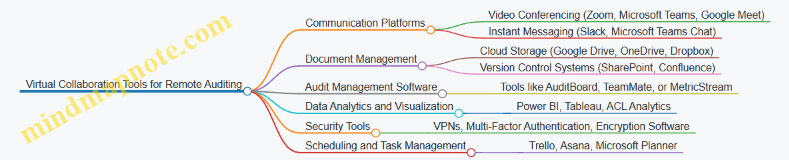
Best Practices for Remote Auditing
- Establish Clear Communication Protocols: Define how and when communication will occur to keep everyone aligned.
- Use Secure Platforms: Always use encrypted and secure tools to protect sensitive financial and real estate data.
- Plan for Time Zones: Schedule meetings and deadlines considering the different time zones of team members.
- Leverage Video Calls for Interviews: Video helps build rapport and allows auditors to pick up non-verbal cues.
- Document Everything Digitally: Maintain audit trails by saving all communications, evidence, and reports in centralized repositories.
- Conduct Virtual Walkthroughs: Use video streaming or recorded walkthroughs of physical sites or processes.
Example: Remote Audit in a Real Estate Company
Scenario: An internal audit team needed to verify compliance with lease agreements across multiple properties during a period when site visits were restricted.
Approach:
- The audit team used Microsoft Teams for video calls with property managers.
- Lease documents and payment records were shared via SharePoint with version control.
- Virtual walkthroughs were conducted using live video streaming from on-site staff.
- Data analytics tools were employed to analyze payment patterns and identify anomalies.
Outcome: The audit was completed on schedule with no compromise on quality, and several control improvements were recommended based on findings.
Mind Map: Remote Auditing Workflow
Tips for Successful Virtual Collaboration
- Encourage active participation during virtual meetings.
- Use screen sharing to review documents in real time.
- Record sessions (with permission) for reference.
- Set clear deadlines and reminders within project management tools.
- Provide training on new tools to all audit team members.
Conclusion
Remote auditing and virtual collaboration tools have transformed the internal audit landscape, especially in finance and real estate sectors. By embracing these technologies and best practices, auditors can maintain high standards of audit quality while adapting to the demands of modern work environments.
10.4 Example: Using AI to Predict Risk Patterns in Real Estate Portfolios
In the fast-evolving real estate sector, internal auditors are increasingly leveraging Artificial Intelligence (AI) to enhance risk prediction and management. AI-powered tools can analyze vast datasets to identify hidden risk patterns, enabling auditors to proactively address potential issues before they escalate.
Understanding AI in Real Estate Risk Prediction
AI algorithms, particularly machine learning models, can process historical and real-time data from multiple sources such as property valuations, market trends, tenant payment histories, and economic indicators. By detecting correlations and anomalies, AI helps auditors forecast risks related to portfolio performance, compliance, and asset management.
Mind Map: AI-Driven Risk Prediction in Real Estate Portfolios
Practical Example: AI Predicting Tenant Default Risk
A real estate investment firm implemented an AI system to analyze tenant payment histories combined with external economic data such as unemployment rates and local market conditions. The AI model assigned risk scores to each tenant, highlighting those with a higher likelihood of default.
How This Helps Internal Audit:
- Auditors focused their efforts on high-risk tenants, verifying lease compliance and payment terms.
- Early identification of potential defaults allowed management to take preemptive action, such as renegotiating leases or increasing monitoring.
Mind Map: Tenant Default Risk Prediction Workflow
Example: Market Risk Forecasting Using AI
By feeding AI models with historical property prices, rental yields, interest rates, and demographic trends, auditors can predict potential market downturns or bubbles in specific regions.
Audit Application:
- Internal audit teams use these forecasts to assess the adequacy of risk mitigation strategies.
- They verify whether contingency plans and reserves are sufficient to cover potential losses.
Mind Map: Market Risk Forecasting Process
Best Practices for Integrating AI in Internal Audit
- Data Quality: Ensure data used for AI models is accurate, complete, and up-to-date.
- Model Transparency: Understand AI algorithms to interpret results effectively and explain findings to stakeholders.
- Continuous Monitoring: Regularly update models with new data to maintain predictive accuracy.
- Collaboration: Work closely with data scientists and IT teams to align AI tools with audit objectives.
Summary
Using AI to predict risk patterns in real estate portfolios empowers internal auditors to move from reactive to proactive risk management. By integrating AI insights into audit planning and execution, auditors can enhance the precision and impact of their work, ultimately safeguarding organizational assets and supporting strategic decision-making.
10.5 Preparing Internal Audit Functions for Emerging Risks
As the finance and real estate sectors evolve, internal audit functions must proactively prepare for emerging risks that could impact organizational resilience and compliance. This section explores strategies to anticipate, identify, and manage these risks effectively.
Understanding Emerging Risks
Emerging risks are new or evolving threats that are difficult to quantify but have the potential to significantly impact an organization. Examples include technological disruptions, regulatory changes, geopolitical instability, and climate-related risks.
Example: A real estate firm faces emerging risks from climate change regulations affecting property valuations and insurance costs.
Mind Map: Key Emerging Risks for Internal Audit Functions
Best Practices to Prepare Internal Audit for Emerging Risks
-
Continuous Environmental Scanning
- Regularly monitor industry trends, regulatory updates, and technological advancements.
- Example: An audit team subscribes to regulatory bulletins and participates in industry forums to stay ahead.
-
Integrate Risk Intelligence into Audit Planning
- Use risk assessment frameworks that incorporate emerging risk indicators.
- Example: A finance company updates its risk matrix quarterly to include risks related to AI-driven financial products.
-
Enhance Auditor Skillsets
- Train auditors on new technologies, data analytics, and regulatory changes.
- Example: Offering workshops on blockchain implications for audit trails in real estate transactions.
-
Leverage Advanced Technologies
- Adopt AI-powered tools for predictive risk analysis and continuous auditing.
- Example: Using machine learning models to detect unusual transaction patterns in real estate sales.
-
Foster Cross-Functional Collaboration
- Work closely with IT, compliance, and risk management teams to gain comprehensive insights.
- Example: Joint risk workshops between audit and cybersecurity teams to address data breach risks.
-
Scenario Planning and Stress Testing
- Conduct simulations to evaluate the impact of emerging risks on business processes.
- Example: Simulating the effect of sudden regulatory changes on loan portfolio valuations.
Mind Map: Strategies to Prepare Internal Audit for Emerging Risks
Practical Example: Preparing a Real Estate Audit Team for Climate-Related Risks
A real estate company recognized the growing impact of climate change on property values and insurance liabilities. The internal audit team took the following steps:
- Conducted workshops on environmental regulations and climate risk assessment.
- Integrated climate risk indicators into their audit planning process.
- Collaborated with sustainability officers to understand ESG reporting requirements.
- Used data analytics tools to assess vulnerability of property portfolios to climate events.
- Presented findings and recommendations to senior management for proactive risk mitigation.
This proactive approach helped the company avoid potential financial losses and ensured compliance with emerging regulations.
Summary
Preparing internal audit functions for emerging risks requires a forward-looking mindset, continuous learning, and leveraging technology. By embedding these practices, auditors in finance and real estate sectors can safeguard their organizations against uncertainties and contribute to sustainable growth.
11. Case Studies and Practical Applications
11.1 Case Study: Successful Internal Audit Transformation in a Finance Firm
Background
A mid-sized finance firm, FinTrust Capital, faced challenges with its internal audit function. The audits were often reactive, lacked depth, and failed to provide actionable insights. Management was concerned about increasing regulatory scrutiny and operational risks, prompting a need for transformation.
Objectives of the Transformation
- Shift from a compliance-focused to a risk-based audit approach
- Enhance audit planning and execution efficiency
- Improve communication and reporting with stakeholders
- Leverage technology for data analytics and continuous auditing
Steps Taken in the Transformation
Mind Map: Internal Audit Transformation at FinTrust Capital
Detailed Example: Risk-Based Audit Planning
FinTrust Capital moved away from a calendar-based audit schedule to a risk-based model. They started by:
- Mapping their audit universe including lending, compliance, treasury, and IT systems.
- Conducting a risk assessment workshop involving senior management to prioritize audit areas based on financial impact, regulatory risk, and past audit findings.
Example:
| Audit Area | Risk Level | Priority | Planned Audit Frequency |
|---|---|---|---|
| Loan Portfolio | High | 1 | Quarterly |
| Regulatory Compliance | Medium | 2 | Bi-Annual |
| IT Security | High | 1 | Quarterly |
| Treasury | Low | 3 | Annual |
This allowed the audit team to focus resources on high-risk areas, improving coverage and relevance.
Technology Integration
FinTrust adopted an audit management system that centralized documentation, scheduling, and reporting. They also integrated data analytics tools to automate transaction testing and identify anomalies.
Example:
- Automated detection of duplicate payments in accounts payable
- Continuous monitoring of loan approval limits against policy
Mind Map: Technology Benefits
Team Development and Culture Change
Recognizing that technology alone wouldn’t suffice, FinTrust invested in upskilling auditors:
- Training on data analytics and risk assessment techniques
- Workshops on communication skills to improve stakeholder engagement
- Encouraging a proactive mindset focused on adding value rather than just compliance
Example:
An auditor used newly acquired data analytics skills to identify unusual patterns in loan disbursements, leading to early detection of potential fraud.
Results and Impact
- Audit cycle time reduced by 30%
- Increased identification of high-risk issues before they escalated
- Enhanced management confidence in audit findings
- Positive feedback from regulators on audit rigor
Mind Map: Outcomes of Transformation
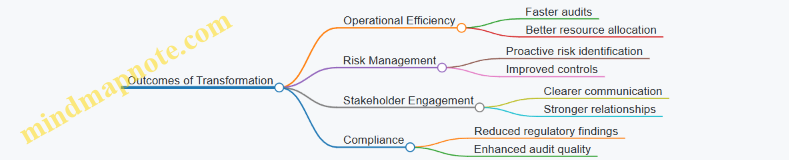
Key Takeaways
- A structured risk-based approach aligns audit efforts with organizational priorities.
- Technology adoption enhances audit efficiency and depth but must be complemented by skilled auditors.
- Continuous training and culture change are critical for sustainable transformation.
- Clear communication and stakeholder involvement drive audit impact.
This case study exemplifies how a finance firm can successfully transform its internal audit function by integrating best practices, technology, and people development to create a robust, value-adding audit process.
11.2 Case Study: Improving Lease Compliance Through Targeted Audits
Introduction
Lease compliance is a critical area for real estate companies, as non-compliance can lead to financial losses, legal penalties, and damaged relationships with tenants and stakeholders. This case study explores how a targeted internal audit approach helped a mid-sized real estate firm improve lease compliance, streamline processes, and mitigate risks.
Background
The firm managed a diverse portfolio of commercial and residential properties. Recent internal reviews had identified inconsistencies in lease administration, including missed rent escalations, undocumented lease amendments, and inadequate tracking of tenant obligations.
The internal audit team was tasked with conducting a focused audit on lease compliance to identify gaps and recommend improvements.
Audit Objectives
- Verify accuracy and completeness of lease documentation.
- Assess adherence to lease terms, including rent payments, escalations, and tenant responsibilities.
- Evaluate controls around lease amendments and renewals.
- Identify risks of financial leakage or legal exposure.
Audit Approach
The audit team adopted a risk-based, targeted audit approach focusing on high-value leases and those with complex terms.
Mind Map: Audit Approach Overview
Key Findings
- Incomplete Lease Documentation: 15% of leases lacked signed amendments or had missing pages.
- Missed Rent Escalations: Automated escalation triggers were not consistently applied, resulting in revenue loss.
- Inadequate Tracking of Tenant Obligations: Maintenance and insurance responsibilities were not systematically monitored.
- Weak Controls Over Lease Amendments: Amendments were sometimes processed without proper approvals.
Examples of Issues Found
- A commercial lease with a 3% annual rent escalation had no evidence of escalation applied for two years, causing a $50,000 revenue shortfall.
- Several leases had verbal agreements modifying payment terms, but these were not documented or approved.
Recommendations and Best Practices
- Implement a Centralized Lease Management System: To store all lease documents, track key dates, and automate escalations.
- Standardize Amendment Procedures: Require documented approvals and version control for all lease changes.
- Regular Compliance Monitoring: Schedule quarterly reviews of rent payments and tenant obligations.
- Training for Lease Administrators: Enhance awareness of compliance requirements and audit findings.
Mind Map: Recommendations
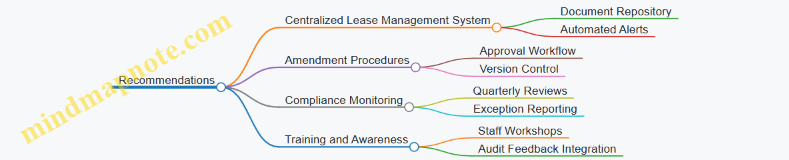
Implementation and Results
The firm implemented a cloud-based lease management platform integrating automated escalation calculations and alert notifications. Lease administrators received targeted training on compliance and documentation standards.
Within six months:
- Lease documentation completeness improved to 98%.
- Revenue leakage from missed escalations was eliminated.
- Tenant obligation tracking became proactive, reducing disputes.
Lessons Learned
- Targeted audits focusing on high-risk areas yield actionable insights.
- Combining technology with process improvements enhances compliance.
- Continuous training and communication are vital for sustaining improvements.
Summary
This case study demonstrates how a focused internal audit on lease compliance, supported by clear recommendations and technology adoption, can significantly reduce risks and improve financial performance in real estate management.
Additional Example: Sample Audit Checklist for Lease Compliance
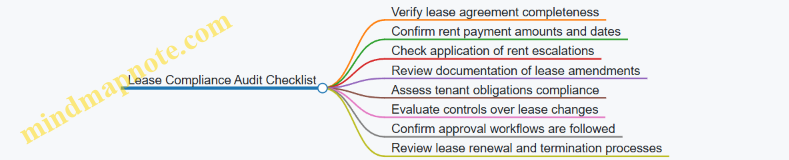
This integrated approach combining practical examples, mind maps, and clear audit steps provides accountants and auditors with a comprehensive guide to improving lease compliance through targeted audits.
11.3 Lessons Learned from Audit Failures and How to Avoid Them
Internal audits are critical for ensuring compliance, risk management, and operational efficiency. However, audit failures can occur, often leading to significant financial losses, reputational damage, and regulatory penalties. Understanding these failures and learning how to avoid them is essential for auditors in the finance and real estate sectors.
Common Causes of Audit Failures
- Inadequate Planning: Poor risk assessment and unclear audit scope.
- Insufficient Evidence Collection: Relying on incomplete or inaccurate data.
- Lack of Auditor Independence: Conflicts of interest affecting objectivity.
- Poor Communication: Ineffective reporting and stakeholder engagement.
- Ignoring Emerging Risks: Failure to update audit procedures with new industry risks.
Mind Map: Causes of Audit Failures
Real-World Example: Audit Failure in a Real Estate Firm
A mid-sized real estate company experienced significant losses due to undetected lease fraud. The internal audit team failed to perform adequate sampling and relied heavily on management-provided data without independent verification. This resulted in missed red flags and delayed corrective action.
Lessons Learned and How to Avoid Audit Failures
-
Comprehensive Planning and Risk Assessment
- Develop a detailed audit plan based on a thorough risk assessment.
- Example: A finance company implemented a risk-based audit plan that prioritized high-risk areas such as loan approvals and investment portfolios, reducing audit blind spots.
-
Robust Evidence Collection and Verification
- Use multiple data sources and independent verification techniques.
- Example: Auditors in a real estate firm cross-checked lease agreements with third-party registries to validate authenticity.
-
Maintain Auditor Independence and Objectivity
- Rotate audit assignments and enforce strict conflict-of-interest policies.
- Example: An audit department introduced mandatory rotation every two years to prevent familiarity threats.
-
Effective Communication and Reporting
- Provide clear, concise, and actionable audit reports.
- Engage stakeholders regularly to ensure understanding and buy-in.
- Example: A finance audit team used executive summaries and risk heat maps to communicate findings effectively to senior management.
-
Continuous Monitoring of Emerging Risks
- Update audit procedures to include new risks such as cybersecurity and regulatory changes.
- Example: Incorporating IT audit specialists to assess cybersecurity controls in real estate asset management systems.
Mind Map: Strategies to Avoid Audit Failures
Practical Tips for Auditors
- Conduct regular training to stay updated on industry trends and audit techniques.
- Use technology such as data analytics to enhance evidence gathering and anomaly detection.
- Foster a culture of transparency and ethical behavior within the audit team.
- Schedule periodic peer reviews to identify potential weaknesses early.
Summary
Audit failures often stem from preventable issues such as poor planning, inadequate evidence, and weak communication. By learning from past mistakes and implementing best practices, internal auditors in finance and real estate can significantly enhance audit quality, reduce risks, and add value to their organizations.
11.4 Example: Integrating Best Practices Across Multiple Audit Cycles
Integrating best practices across multiple audit cycles is essential for building a robust internal audit function that continuously improves and adapts to emerging risks. This approach ensures that lessons learned from previous audits are embedded into future audits, creating a cycle of ongoing enhancement and value addition.
Why Integration Matters
- Consistency: Applying proven methodologies ensures uniformity in audit quality.
- Efficiency: Reusing templates, checklists, and tools reduces redundant work.
- Risk Mitigation: Identifying recurring issues helps prioritize high-risk areas.
- Continuous Improvement: Feedback loops enable refinement of audit processes.
Step-by-Step Integration Process
Detailed Breakdown with Examples
Planning Phase
- Best Practice: Update the audit universe and risk assessment based on previous findings.
- Example: A finance company noticed recurring control weaknesses in vendor payments. For the next cycle, they expanded the scope to include a deeper review of procurement controls.
Execution Phase
- Best Practice: Use standardized testing procedures and leverage data analytics to identify anomalies.
- Example: In a real estate firm, auditors developed a data analytics script to automatically flag lease agreements with unusual terms, improving detection efficiency over multiple cycles.
Reporting Phase
- Best Practice: Employ consistent report templates that highlight risk levels and actionable recommendations.
- Example: An audit team introduced a color-coded risk matrix in reports, making it easier for management to prioritize remediation efforts.
Follow-Up Phase
- Best Practice: Implement a tracking system for audit issues and gather feedback to refine audit approaches.
- Example: After each audit cycle, an auditor-led workshop was held to discuss challenges and update audit programs accordingly.
Mind Map: Continuous Improvement Loop
Practical Tips for Integration
- Maintain a centralized knowledge repository of audit findings and best practices.
- Schedule periodic training sessions to share lessons learned.
- Use audit management software to track recurring issues and monitor remediation.
- Encourage collaboration between audit teams across cycles to share insights.
Summary
Integrating best practices across multiple audit cycles transforms internal auditing from a series of isolated events into a strategic, evolving process. By systematically applying lessons learned, standardizing procedures, and leveraging technology, auditors in finance and real estate can enhance audit quality, reduce risks, and deliver greater value to their organizations.
11.5 Summary of Key Takeaways and Actionable Insights
Internal auditing is a critical function within finance and real estate sectors, ensuring compliance, risk management, and operational efficiency. This summary consolidates the best practices covered throughout the blog and provides actionable insights to enhance your internal audit processes.
Key Takeaways
- Risk-Based Planning is Essential: Prioritize audits based on risk assessments to focus resources where they matter most.
- Effective Communication: Clear, concise reporting and stakeholder engagement improve audit impact.
- Leverage Technology: Utilize data analytics, audit management software, and AI to increase efficiency and accuracy.
- Continuous Skill Development: Invest in both technical and soft skills to maintain high audit quality.
- Strong Internal Controls: Regular evaluation and testing of controls prevent financial misstatements and fraud.
- Quality Assurance: Implement peer reviews and KPIs to monitor and improve audit performance.
- Adapt to Emerging Trends: Stay ahead by integrating innovations like blockchain and remote auditing.
Actionable Insights
-
Implement a Risk-Based Audit Universe
- Regularly update your risk assessment matrix.
- Focus audits on high-risk areas such as lease compliance or financial reporting.
-
Enhance Reporting Practices
- Use executive summaries highlighting key risks and recommendations.
- Tailor communication style to your audience, whether management or audit committees.
-
Adopt Data Analytics Tools
- Start with simple anomaly detection in transaction data.
- Progress to predictive analytics for fraud risk.
-
Invest in Training Programs
- Schedule quarterly workshops on emerging audit technologies.
- Encourage certifications like CIA or CISA.
-
Establish a Quality Assurance Program
- Conduct annual peer reviews.
- Track audit cycle times and issue resolution rates.
-
Pilot Emerging Technologies
- Test AI tools on sample audit areas.
- Explore blockchain for immutable audit trails.
Mind Maps
Mind Map 1: Internal Audit Best Practices Overview
Mind Map 2: Actionable Steps for Audit Improvement
Mind Map 3: Leveraging Technology in Internal Auditing
Examples Recap
- Risk-Based Audit Planning: A finance company reduced audit cycle time by 20% by focusing on high-risk loan portfolios.
- Data Analytics: A real estate firm detected unusual lease payment patterns using automated data analysis, preventing potential fraud.
- Training Programs: Quarterly workshops on emerging audit tools increased auditor efficiency and report quality.
- Quality Assurance: Peer reviews identified gaps in control testing, leading to improved audit coverage.
- AI Implementation: Predictive analytics flagged potential financial irregularities before year-end closing.
By integrating these best practices and insights, internal auditors in finance and real estate can significantly enhance the effectiveness, efficiency, and impact of their audit functions.