Revenue Recognition Principles
1. Introduction to Revenue Recognition
1.1 Understanding Revenue Recognition: Definition and Importance
Revenue recognition is a fundamental accounting principle that determines the specific conditions under which income becomes realized as revenue. It dictates when and how much revenue a company should record in its financial statements, ensuring that financial reporting is accurate, consistent, and comparable across organizations.
What is Revenue Recognition?
Revenue recognition refers to the process of recording revenue in the accounting books when it is earned and realizable, rather than when cash is received. This principle ensures that revenue is matched with the expenses incurred to generate it, providing a clear picture of a company’s financial performance during a specific period.
Why is Revenue Recognition Important?
- Accuracy in Financial Reporting: Ensures that revenue figures reflect the true economic activity.
- Compliance: Aligns with accounting standards such as ASC 606 (US GAAP) and IFRS 15.
- Investor Confidence: Provides transparency and reliability, helping investors make informed decisions.
- Performance Measurement: Helps management assess business performance and profitability.
- Audit and Regulatory Requirements: Facilitates proper auditing and regulatory compliance.
Mind Map: Core Concepts of Revenue Recognition
The Five-Step Model (Overview)
- Identify the contract with a customer
- Identify the performance obligations in the contract
- Determine the transaction price
- Allocate the transaction price to the performance obligations
- Recognize revenue when (or as) the entity satisfies a performance obligation
This model forms the backbone of modern revenue recognition practices under ASC 606 and IFRS 15.
Example 1: Software Subscription Service
Scenario: A company sells a 12-month software subscription for $1,200, payable upfront.
-
When to recognize revenue?
- Instead of recognizing $1,200 immediately, the company recognizes $100 per month over the subscription period.
-
Why?
- The performance obligation (access to software) is satisfied over time.
-
Impact:
- Provides a more accurate reflection of revenue earned each month.
Example 2: Consulting Services
Scenario: A consulting firm signs a contract to deliver a project over 6 months for $60,000.
-
Revenue Recognition:
- If progress can be measured reliably, revenue is recognized over time based on the percentage of completion.
- For example, if 50% of the work is completed, $30,000 revenue is recognized.
-
Benefit:
- Matches revenue with the work performed, providing stakeholders with timely financial information.
Mind Map: Importance of Revenue Recognition in Business
Summary
Understanding revenue recognition is critical for accountants and auditors as it ensures that revenue is reported accurately and consistently. By adhering to established principles and standards, finance professionals help maintain the integrity of financial statements, support compliance, and foster trust among stakeholders.
This foundational knowledge sets the stage for deeper exploration into the detailed steps and best practices of revenue recognition.
1.2 Overview of Accounting Standards: ASC 606 and IFRS 15
Revenue recognition is governed primarily by two major accounting standards globally: ASC 606 (Accounting Standards Codification Topic 606) issued by the Financial Accounting Standards Board (FASB) in the United States, and IFRS 15 (International Financial Reporting Standard 15) issued by the International Accounting Standards Board (IASB). Both standards were developed jointly to create a consistent framework for revenue recognition across industries and geographies.
Key Objectives of ASC 606 and IFRS 15
- Establish principles to report useful information to users of financial statements about the nature, amount, timing, and uncertainty of revenue and cash flows arising from contracts with customers.
- Provide a comprehensive, industry-neutral revenue recognition model.
Core Similarities Between ASC 606 and IFRS 15
Both standards share the same core principles and follow the Five-Step Model for revenue recognition:
Differences Between ASC 606 and IFRS 15
While largely converged, some differences exist:
Example: Applying ASC 606 and IFRS 15 in Practice
Scenario: A software company sells a bundled contract consisting of a software license and one year of technical support.
- Step 1: Identify the contract — The signed agreement with the customer qualifies as a contract.
- Step 2: Identify performance obligations — Two distinct obligations: software license and support service.
- Step 3: Determine transaction price — Total contract price is $12,000.
- Step 4: Allocate transaction price — Allocate based on standalone selling prices: $10,000 for license, $2,000 for support.
- Step 5: Recognize revenue — License revenue recognized at point in time (delivery), support revenue recognized over time (12 months).
Best Practices for Accountants and Auditors
- Understand the five-step model thoroughly to ensure consistent application.
- Document judgments and estimates clearly, especially around transaction price and performance obligations.
- Stay updated on amendments and interpretations issued by FASB and IASB.
- Use practical examples from your industry to train teams and improve accuracy.
By mastering ASC 606 and IFRS 15, finance professionals can ensure transparent, consistent, and compliant revenue reporting that meets stakeholder expectations and regulatory requirements.
1.3 The Five-Step Model for Revenue Recognition Explained
Revenue recognition under ASC 606 and IFRS 15 follows a structured five-step model designed to provide a consistent framework for recognizing revenue across industries. This model ensures that revenue is recognized in a way that reflects the transfer of goods or services to customers in amounts that reflect the consideration to which the entity expects to be entitled.
The Five Steps Overview
Step 1: Identify the Contract with a Customer
A contract is an agreement between two or more parties that creates enforceable rights and obligations. To identify a contract, it must meet certain criteria:
- Approval and commitment of the parties
- Rights to goods or services identified
- Payment terms identified
- Commercial substance
- Collectability is probable
Example:
A software company signs a subscription agreement with a customer for a 12-month service. The signed agreement with payment terms and defined services constitutes a contract.
Step 2: Identify the Performance Obligations in the Contract
Performance obligations are promises to transfer distinct goods or services to the customer. A good or service is distinct if:
- The customer can benefit from it on its own or with other readily available resources
- It is separately identifiable from other promises in the contract
Example:
A tech company sells a bundle of hardware and installation services. The hardware and installation are distinct performance obligations because the customer can use the hardware independently and installation is a separate service.
Step 3: Determine the Transaction Price
The transaction price is the amount the entity expects to receive in exchange for transferring goods or services. It includes:
- Fixed amounts
- Variable consideration (bonuses, penalties, discounts)
- Significant financing components
- Non-cash consideration
Example:
A software vendor agrees to sell licenses for $100,000 but offers a volume discount if the customer purchases more than 500 licenses. The transaction price includes the estimated discount based on expected volume.
Step 4: Allocate the Transaction Price to the Performance Obligations
If the contract has multiple performance obligations, the transaction price must be allocated based on standalone selling prices (SSP) of each obligation.
Example:
A contract includes a $10,000 hardware sale and $5,000 installation service. The standalone selling prices are $9,000 for hardware and $6,000 for installation. The transaction price is allocated proportionally:
- Hardware: (9,000 / 15,000) * 10,000 = $6,000
- Installation: (6,000 / 15,000) * 10,000 = $4,000
Step 5: Recognize Revenue When (or As) Performance Obligations Are Satisfied
Revenue is recognized when control of the promised goods or services is transferred to the customer. This can happen:
- At a point in time (e.g., delivery of goods)
- Over time (e.g., services rendered continuously)
Example:
A software company recognizes revenue for a 12-month subscription ratably over the contract period because the customer receives and consumes the benefits over time.
Summary Table of the Five-Step Model with Examples
| Step | Description | Example |
|---|---|---|
| 1 | Identify contract | Signed 12-month software subscription agreement |
| 2 | Identify performance obligations | Hardware and installation services in a bundled sale |
| 3 | Determine transaction price | $100,000 license sale with volume discount |
| 4 | Allocate transaction price | Allocate $10,000 total price between hardware and installation based on SSP |
| 5 | Recognize revenue | Recognize subscription revenue monthly over 12 months |
By following this five-step model, accountants and auditors can ensure revenue is recognized consistently and transparently, reflecting the true economic activity of the business.
1.4 Common Challenges Accountants and Auditors Face
Revenue recognition is a critical area in accounting that often presents numerous challenges for accountants and auditors alike. These challenges stem from the complexity of contracts, evolving standards, and the need for accurate judgment and estimation. Below, we explore the most common hurdles encountered, supported by mind maps and practical examples to clarify each point.
Challenge 1: Complex Contract Structures
Many contracts include multiple goods and services bundled together, making it difficult to identify distinct performance obligations.
Example: A technology company sells a package including hardware, software licenses, and ongoing maintenance. Determining when and how to recognize revenue for each component requires careful analysis.
Challenge 2: Estimating Variable Consideration
Variable consideration such as discounts, rebates, or performance bonuses must be estimated and constrained to avoid revenue overstatement.
Example: An enterprise offers volume discounts that increase as customers purchase more units. Accountants must estimate expected discounts and apply constraints to ensure revenue is not overstated.
Challenge 3: Timing of Revenue Recognition
Deciding whether revenue should be recognized at a point in time or over time can be complex, especially for long-term contracts.
Example: A software development firm delivers custom software over 12 months. Recognizing revenue over time requires selecting an appropriate method to measure progress, such as input or output methods.
Challenge 4: Allocating Transaction Price
Allocating the transaction price to multiple performance obligations requires reliable standalone selling prices, which may not always be directly observable.
Example: A bundled sale includes a product and a service contract. The standalone selling price of the service is not directly available, so the accountant must estimate it using market data.
Challenge 5: Contract Modifications
Changes to contracts during their term can affect revenue recognition, requiring reassessment of performance obligations and transaction price.
Example: A client upgrades their software license mid-contract, adding new features. The accountant must determine if this constitutes a new contract or a modification and adjust revenue recognition accordingly.
Challenge 6: Disclosure and Compliance
Ensuring that revenue recognition disclosures meet regulatory requirements can be challenging due to the complexity and volume of information.
Example: An auditor reviews a company’s financial statements and finds incomplete disclosures about significant judgments made in revenue recognition, posing a compliance risk.
Summary
Navigating these challenges requires a deep understanding of revenue recognition principles, strong judgment, and effective communication between accountants, auditors, and management. Utilizing structured approaches like mind maps helps visualize complex issues, while real-world examples ground these concepts in practical application.
1.5 Practical Example: Recognizing Revenue in a Software Subscription Business
Revenue recognition in a software subscription business is a common scenario that illustrates the application of the core principles under ASC 606 and IFRS 15. This example will walk through the five-step revenue recognition model with clear explanations and mind maps to help accountants and auditors understand how to apply these principles effectively.
Step 1: Identify the Contract with the Customer
In a software subscription business, the contract is typically the subscription agreement signed by the customer. This contract outlines the subscription period, pricing, and services provided.
- Example: A customer subscribes to a cloud-based accounting software for 12 months at $1200, billed annually.
Mind Map:
Step 2: Identify the Performance Obligations
The main performance obligation is providing access to the software service over the subscription period. Additional obligations might include customer support or periodic updates.
- Example: The software company promises:
- Continuous access to the software
- Regular updates and maintenance
- Customer support
Mind Map:
Step 3: Determine the Transaction Price
The transaction price is the amount the company expects to receive in exchange for providing the software service.
- Example: $1200 for the 12-month subscription.
- No variable consideration or discounts in this simple example.
Mind Map:
Step 4: Allocate the Transaction Price to the Performance Obligations
Since the subscription service is a single performance obligation (continuous access), the entire transaction price is allocated to this obligation.
- Example: $1200 allocated to software access over 12 months.
Mind Map:
- Allocate Transaction Price
- Single Performance Obligation
- Software Access: $1200
- Single Performance Obligation
Step 5: Recognize Revenue When (or As) the Entity Satisfies a Performance Obligation
Revenue is recognized over time, as the customer receives and consumes the benefits of the software service.
- Example: Recognize $100 per month ($1200/12 months) as revenue each month.
Mind Map:
Summary Table
| Step | Description | Example Application |
|---|---|---|
| 1 | Identify Contract | 12-month subscription agreement |
| 2 | Identify Performance Obligations | Software access, updates, support |
| 3 | Determine Transaction Price | Fixed fee of $1200 |
| 4 | Allocate Transaction Price | Entire $1200 to software access |
| 5 | Recognize Revenue | $100 per month over 12 months |
Additional Considerations and Examples
-
Example with Variable Consideration: If the subscription includes usage-based fees (e.g., extra charges for exceeding data limits), estimate variable consideration using the expected value method and apply constraints to avoid revenue reversal.
-
Example with Contract Modifications: If the customer upgrades the subscription mid-term, treat the modification as a separate contract or part of the existing contract depending on the terms.
-
Auditor’s Perspective: Verify that revenue is recognized ratably over the subscription period and that any upfront payments are deferred appropriately.
Visual Summary Mind Map
This practical example demonstrates how the revenue recognition principles are applied in a straightforward software subscription business, providing a clear framework for accountants and auditors to follow and adapt to more complex scenarios.
2. Identifying the Contract with a Customer
2.1 Criteria for a Valid Contract
A valid contract is the foundational element in revenue recognition under ASC 606 and IFRS 15. Recognizing revenue accurately hinges on the existence of a contract that meets specific criteria. Understanding these criteria helps accountants and auditors ensure compliance and avoid misstatements.
What is a Contract?
A contract is an agreement between two or more parties that creates enforceable rights and obligations. In revenue recognition, it specifically refers to an agreement between an entity and a customer.
The Five Essential Criteria for a Valid Contract
- Approval and Commitment
- Both parties must approve the contract and be committed to fulfilling their obligations.
- Identification of Rights
- Each party’s rights regarding goods or services to be transferred must be clearly identified.
- Payment Terms
- The payment terms for the goods or services must be identifiable.
- Commercial Substance
- The contract must have commercial substance, meaning the risk, timing, or amount of the entity’s future cash flows is expected to change as a result of the contract.
- Collectability
- It must be probable that the entity will collect the consideration to which it is entitled.
Mind Map: Criteria for a Valid Contract
Detailed Explanation with Examples
Approval and Commitment
Both parties must have agreed to the contract terms. This can be a written contract, oral agreement, or implied by customary business practices.
Example: A software company signs a written agreement with a client to provide a one-year subscription. Both parties sign the contract, demonstrating approval and commitment.
Identification of Rights
The contract must clearly specify what goods or services the customer will receive.
Example: A tech hardware vendor agrees to deliver 100 laptops and provide installation services. The contract explicitly states these deliverables.
Payment Terms
The contract should specify how and when the customer will pay.
Example: A consulting firm agrees to receive $50,000 payable in three installments over six months.
Commercial Substance
The contract should affect the entity’s cash flows.
Example: A cloud service provider enters a contract that changes its expected revenue stream by adding a new monthly fee, impacting cash flows.
Collectability
The entity must assess whether it is probable that it will collect payment.
Example: A startup evaluates a new customer’s credit history before entering a contract to ensure collectability.
Mind Map: Practical Considerations for Valid Contracts
Best Practices for Accountants and Auditors
- Document Review: Ensure contracts are signed or otherwise approved.
- Rights Verification: Confirm all promised goods/services are clearly defined.
- Payment Terms Analysis: Verify payment schedules and amounts.
- Assess Commercial Substance: Evaluate whether the contract changes expected cash flows.
- Collectability Assessment: Review customer creditworthiness and payment history.
Example Scenario: Valid vs. Invalid Contract
| Scenario | Valid Contract? | Reason |
|---|---|---|
| Signed agreement with clear deliverables and payment terms | Yes | Meets all five criteria |
| Oral agreement with no payment terms specified | No | Missing identifiable payment terms |
| Contract with a customer who has a history of non-payment | No | Collectability is not probable |
| Agreement pending regulatory approval | No | Lacks commercial substance until approval |
By thoroughly understanding and applying these criteria, finance professionals can ensure that revenue is recognized only when a valid contract exists, thereby maintaining compliance and improving financial reporting accuracy.
2.2 Handling Contract Modifications and Amendments
Understanding Contract Modifications
A contract modification occurs when the parties to a contract approve a change that either creates new or changes existing enforceable rights and obligations of the parties. Modifications can affect the scope, price, or both, and they must be carefully evaluated to determine how they impact revenue recognition.
Types of Contract Modifications
There are generally three ways to account for contract modifications under ASC 606 and IFRS 15:
- Separate Contract: Treat the modification as a new contract if it adds distinct goods or services and the price increases by an amount that reflects the standalone selling price of those goods or services.
- Termination of Existing Contract and Creation of New Contract: If the remaining goods or services are distinct from those already transferred and the modification includes a price adjustment, the existing contract is considered terminated and a new contract is created.
- Part of the Existing Contract: If the modification does not add distinct goods or services or the price change does not reflect standalone selling prices, the modification is accounted for as part of the existing contract.
Mind Map: Contract Modification Types
Evaluating Contract Modifications: Step-by-Step
- Identify the modification and its terms: Understand what changes have been made to the contract.
- Determine if the modification adds distinct goods or services: Are the new deliverables separate from those already promised?
- Assess the price change: Does the price increase reflect the standalone selling price of the additional goods or services?
- Decide the accounting treatment: Based on the above, decide whether to treat as a separate contract, termination and new contract, or part of the existing contract.
Mind Map: Contract Modification Evaluation Process
Practical Example 1: Separate Contract Treatment
Scenario: A software company has a contract to deliver a software license and maintenance for one year at $10,000. Midway, the customer requests an additional module, priced at $4,000, which is distinct and separately sold.
Analysis: Since the additional module is distinct and the price increase reflects its standalone selling price, the modification is treated as a separate contract.
Revenue Recognition: The original contract continues as is, and the additional module’s revenue is recognized separately when delivered.
Practical Example 2: Part of Existing Contract Treatment
Scenario: A consulting firm has a contract to provide 100 hours of consulting at $200 per hour ($20,000 total). The client requests an additional 20 hours at a discounted rate of $150 per hour.
Analysis: The additional hours are not distinct from the original service (same type of consulting), and the price change does not reflect standalone selling price.
Revenue Recognition: The modification is accounted for as part of the existing contract. The total transaction price is adjusted, and revenue is recognized over the total 120 hours.
Practical Example 3: Termination and New Contract
Scenario: A construction company has a contract to build a facility for $1 million. Halfway through, the client cancels the original contract and signs a new contract for a different facility at $1.2 million.
Analysis: The remaining goods/services are distinct, and the original contract is effectively terminated.
Revenue Recognition: The original contract is closed out, and the new contract is accounted for separately.
Best Practices for Accountants and Auditors
- Document all contract modifications thoroughly, including approvals and terms.
- Evaluate modifications promptly to determine their impact on revenue recognition.
- Use consistent criteria to assess whether modifications are separate contracts or part of existing ones.
- Communicate with sales and legal teams to understand the nature of modifications.
- Maintain clear audit trails for modifications and related revenue adjustments.
Mind Map: Best Practices for Handling Contract Modifications
By understanding and correctly applying the principles for handling contract modifications and amendments, accountants and auditors can ensure accurate revenue recognition that complies with accounting standards and reflects the economic reality of transactions.
2.3 Best Practices for Documenting Contracts
Proper documentation of contracts is crucial for accurate revenue recognition and audit readiness. Clear, thorough, and well-organized contract documentation helps accountants and auditors verify the terms, performance obligations, and pricing, ensuring compliance with ASC 606 and IFRS 15.
Key Best Practices for Documenting Contracts
- Clarity and Completeness: Ensure all contract terms are clearly stated, including scope, deliverables, pricing, payment terms, and timelines.
- Consistent Terminology: Use consistent language throughout the contract to avoid ambiguity.
- Version Control: Maintain records of all contract versions and amendments with dates and approval signatures.
- Signatures and Approvals: Obtain signatures from authorized parties to validate the contract.
- Supporting Documentation: Attach relevant documents such as statements of work, change orders, and correspondence.
- Digital Storage and Accessibility: Store contracts in a centralized, secure digital repository with easy retrieval capabilities.
- Audit Trail: Keep a detailed log of contract creation, modifications, and approvals.
Mind Map: Best Practices for Documenting Contracts
Practical Example: Documenting a Software Licensing Contract
Scenario: A tech company enters into a contract to license software to a client with annual maintenance and support services.
Documentation Steps:
- Contract Scope: Clearly define the software modules licensed, number of users, and duration.
- Pricing: Specify license fees, payment schedule, and any volume discounts.
- Performance Obligations: Detail the maintenance and support services included.
- Amendments: Record any changes such as additional users or extended support.
- Signatures: Obtain signatures from both parties with dates.
- Supporting Docs: Attach the statement of work outlining service levels.
- Storage: Save the contract and related documents in the company’s contract management system.
Mind Map: Example - Software Licensing Contract Documentation
Additional Tips for Accountants and Auditors
- Cross-Reference: Link contract terms to revenue recognition schedules.
- Highlight Key Clauses: Use annotations or summaries for critical terms affecting revenue.
- Regular Reviews: Periodically review contract documentation for accuracy and completeness.
- Training: Ensure staff involved in contract management understand revenue recognition requirements.
By following these best practices, finance professionals can ensure contracts are well-documented, facilitating accurate revenue recognition and smoother audit processes.
2.4 Example: Contract Identification in a Multi-Element Sales Agreement
Understanding Multi-Element Sales Agreements
A multi-element sales agreement is a contract that includes multiple deliverables or goods and services bundled together but potentially accounted for separately. Correctly identifying the contract and its components is critical to ensure proper revenue recognition.
Step 1: Confirm the Existence of a Contract
A contract must meet the following criteria:
- Approval and commitment of the parties
- Identification of each party’s rights
- Payment terms
- Commercial substance
- Collectability is probable
Step 2: Identify the Distinct Goods or Services (Performance Obligations)
Each element in the contract must be assessed to determine if it is distinct and should be treated as a separate performance obligation.
Mind Map: Contract Identification Process
Example Scenario: Tech Solutions Inc.
Background: Tech Solutions Inc. sells a bundled package consisting of:
- Hardware (server equipment)
- Software license
- Installation services
- One-year maintenance and support
Contract Details:
- Customer agrees to pay $100,000 upfront.
- Delivery of hardware and software license within 30 days.
- Installation services to be completed within 60 days.
- Maintenance and support provided over 12 months.
Step 3: Applying Contract Identification Criteria
| Criteria | Application to Tech Solutions Inc. Contract |
|---|---|
| Approval & Commitment | Signed contract by both parties |
| Rights Identification | Clear rights to hardware, software, installation, and support |
| Payment Terms | $100,000 upfront payment |
| Commercial Substance | Customer receives value from each element |
| Collectability | Customer has strong credit history |
Since all criteria are met, the contract is valid.
Step 4: Identifying Performance Obligations
Each element is evaluated for distinctness:
- Hardware: Distinct, can be used on its own.
- Software License: Distinct, separately identifiable.
- Installation Services: Related to hardware/software but typically distinct if customer can benefit from hardware/software without installation.
- Maintenance and Support: Distinct service over time.
Mind Map: Performance Obligations Identification
Step 5: Contract Modifications and Amendments
If the customer later requests additional services or upgrades, these are treated as contract modifications and must be evaluated to determine if they create new contracts or modify existing ones.
Practical Tips for Accountants and Auditors
- Documentation: Ensure contracts clearly outline deliverables and payment terms.
- Review Bundling: Assess if elements are distinct or should be bundled.
- Evaluate Modifications: Track amendments carefully to apply correct revenue recognition.
Summary
Identifying contracts in multi-element sales agreements requires a thorough understanding of contract terms and deliverables. By applying the criteria for contract validity and carefully assessing each element’s distinctness, accountants and auditors can ensure accurate revenue recognition aligned with ASC 606 / IFRS 15.
Additional Example: Software Company with Training Services
Scenario: A software company sells a license and offers optional training.
- Contract price: $50,000
- License delivered immediately
- Training scheduled within 3 months
Contract Identification:
- Both license and training are distinct performance obligations.
- Contract is valid with clear payment terms.
Revenue Recognition:
- License revenue recognized at delivery.
- Training revenue recognized when training is delivered.
This example highlights the importance of separating performance obligations and recognizing revenue accordingly.
2.5 Auditing Tips: Verifying Contract Authenticity and Completeness
Auditing contracts is a critical step in ensuring accurate revenue recognition. Verifying the authenticity and completeness of contracts helps prevent revenue misstatements and ensures compliance with accounting standards such as ASC 606 and IFRS 15. This section provides practical auditing tips, mind maps to visualize the process, and real-world examples to guide accountants and auditors.
Key Objectives When Auditing Contracts
- Confirm the contract is valid and enforceable.
- Ensure all terms and conditions are fully documented.
- Identify any amendments or modifications.
- Verify signatures and authorization.
- Confirm completeness of contract deliverables and obligations.
Mind Map: Contract Verification Process
Auditing Tips for Verifying Contract Authenticity
-
Verify Signatures and Authorization:
- Confirm that all required parties have signed the contract.
- Cross-check signatures against authorized signatory lists.
- Example: In a tech company, contracts above $50,000 require CFO approval; verify CFO’s signature presence.
-
Confirm Contract Dates and Validity:
- Ensure contract dates align with the period under audit.
- Check for backdated or postdated contracts that may affect revenue timing.
-
Validate Parties Involved:
- Confirm the contracting parties are legitimate and authorized entities.
- Example: Verify vendor registration and customer identity through official databases.
-
Review Contract Amendments:
- Identify any modifications or addendums.
- Ensure amendments are signed and properly documented.
Auditing Tips for Verifying Contract Completeness
-
Review Scope and Deliverables:
- Confirm the contract clearly defines goods or services to be delivered.
- Example: For a software implementation contract, ensure milestones and deliverables are explicitly stated.
-
Identify Performance Obligations:
- Check if all distinct performance obligations are documented.
- Example: A bundled sale of hardware and installation services should list both as separate obligations.
-
Check Payment Terms and Conditions:
- Verify payment schedules, milestones, and penalties for late payments.
- Example: A contract with milestone payments should have clear criteria for each payment.
-
Ensure Supporting Documentation is Complete:
- Collect related emails, change orders, and legal reviews.
- Example: An email confirming a scope change should be attached to the contract file.
Example Scenario: Auditing a Multi-Element Technology Contract
Context: A tech company sells a package including hardware, software licenses, and ongoing support.
Steps:
- Verify the master contract and all amendments for signatures from both parties.
- Confirm that the contract includes detailed descriptions of each deliverable.
- Check that payment terms specify amounts and timing for hardware, licenses, and support separately.
- Review emails and change orders to identify any scope changes.
- Confirm that the contract dates align with the revenue recognition period.
Outcome: By following these steps, the auditor ensures the contract is authentic, complete, and supports proper revenue recognition.
Mind Map: Common Red Flags in Contract Audits
Summary
Verifying contract authenticity and completeness is essential to reliable revenue recognition. Auditors should systematically check signatures, dates, parties, amendments, and documentation. Utilizing mind maps can help visualize the audit process and identify potential risks. Real-world examples, such as multi-element technology contracts, illustrate how these principles apply in practice.
By adhering to these auditing tips, accountants and auditors can enhance the accuracy and integrity of financial reporting related to revenue.
3. Identifying Performance Obligations
3.1 Defining Performance Obligations in Contracts
What is a Performance Obligation?
A performance obligation is a promise in a contract with a customer to transfer a distinct good or service (or a bundle of goods or services) to the customer. Identifying performance obligations is critical because revenue is recognized when these obligations are satisfied.
Key Characteristics of Performance Obligations:
- Distinct: The good or service can be used on its own or together with other readily available resources.
- Separately Identifiable: The good or service is not highly interdependent or highly interrelated with other promises in the contract.
Mind Map: Understanding Performance Obligations
How to Identify Performance Obligations in a Contract
- Review the Contract Terms: Analyze the contract to understand all promises made to the customer.
- Assess if Goods/Services are Distinct: Determine if the customer can benefit from the good/service on its own or with other resources.
- Evaluate Interdependence: Check if goods/services are highly interrelated or interdependent.
- Consider Contract Modifications: Identify if changes affect performance obligations.
Example 1: Software License with Installation and Support
A company sells a software license that includes:
- Software license (right to use software)
- Installation services
- One year of technical support
Analysis:
- The software license is distinct because the customer can use it independently.
- Installation services are distinct if they can be separately purchased or used.
- Technical support is a separate service provided over time.
Performance Obligations:
- Software license
- Installation
- Technical support
Mind Map: Example 1 Breakdown
Example 2: Construction Contract
A construction company agrees to build a custom facility including:
- Design services
- Construction
- Post-construction maintenance
Analysis:
- Design and construction are highly interrelated; often combined as one performance obligation.
- Post-construction maintenance is a separate service.
Performance Obligations:
- Construction (including design)
- Maintenance service
Mind Map: Example 2 Breakdown
Best Practices for Accountants and Auditors
- Document the Identification Process: Clearly record how performance obligations were identified.
- Use Consistent Criteria: Apply the same principles across similar contracts.
- Engage Cross-Functional Teams: Collaborate with legal and sales teams to understand contract promises.
- Review Contract Modifications: Reassess performance obligations when contracts change.
Summary
Defining performance obligations accurately ensures that revenue is recognized in the correct amount and at the right time. By focusing on the distinctness and separability of goods and services, accountants and auditors can apply the revenue recognition principles effectively.
For further reading, consider exploring the full five-step revenue recognition model and how performance obligations fit into the broader framework.
3.2 Distinguishing Between Distinct Goods and Services
In revenue recognition, correctly identifying whether goods or services are “distinct” is crucial for proper allocation of the transaction price and timing of revenue recognition. A performance obligation is considered distinct if both the following criteria are met:
- Capable of being distinct: The customer can benefit from the good or service on its own or together with other readily available resources.
- Distinct within the context of the contract: The promise to transfer the good or service is separately identifiable from other promises in the contract.
Mind Map: Criteria for Distinct Goods and Services
Mind Map: Examples of Distinct vs. Not Distinct
Practical Examples
Example 1: Software License and Implementation Services
A tech company sells a software license bundled with implementation services.
- Are the goods/services distinct?
- The software license is capable of being distinct because the customer can use it independently.
- The implementation service is distinct if it does not significantly modify or customize the software.
If the implementation customizes the software heavily, the license and service are not distinct and should be combined as one performance obligation.
Example 2: Hardware and Warranty
A company sells a hardware device with a two-year warranty.
- The hardware device is distinct.
- The warranty can be either a separate service (if it provides additional coverage beyond standard warranty) or part of the hardware sale (if it is a standard assurance-type warranty).
Best Practice: Evaluate the nature of the warranty to determine if it is a separate performance obligation.
Example 3: Consulting and Training Services
A consulting firm offers both consulting and training services in a contract.
- If the training can be used independently and is not highly integrated with consulting, they are distinct.
- If training is customized and inseparable from consulting, they may be combined.
Summary of Best Practices
- Analyze each promised good or service carefully to determine if it is distinct.
- Document your assessment with clear reasoning and contract references.
- Use examples from similar contracts to support your conclusions.
- Collaborate with legal and sales teams to understand contract terms and product/service functionality.
Auditor’s Perspective
- Verify that the entity has correctly identified distinct goods and services.
- Review contract terms and customer communications.
- Test management’s judgments with examples and historical contract performance.
By mastering the distinction between goods and services, accountants and auditors can ensure accurate revenue allocation and compliance with ASC 606 and IFRS 15 standards.
3.3 Bundling and Unbundling: When to Separate Performance Obligations
Revenue recognition under ASC 606 and IFRS 15 requires careful identification of performance obligations within a contract. One critical aspect is determining when to bundle goods or services together as a single performance obligation or unbundle them into separate obligations. This decision impacts the timing and amount of revenue recognized.
Understanding Bundling and Unbundling
- Bundling refers to combining multiple goods or services into one performance obligation because they are not distinct from each other.
- Unbundling means separating goods or services into distinct performance obligations when they are capable of being distinct and separately identifiable.
Criteria for Separating Performance Obligations
According to ASC 606 / IFRS 15, a good or service is distinct and should be accounted for separately if both of the following criteria are met:
- Capable of being distinct: The customer can benefit from the good or service on its own or together with other readily available resources.
- Distinct within the context of the contract: The promise to transfer the good or service is separately identifiable from other promises in the contract.
Mind Map: Decision Process for Bundling vs. Unbundling
Practical Examples
Example 1: Software License with Installation and Support
-
A company sells a software license, installation services, and one year of technical support.
-
Are these distinct?
- Software license: Can be used independently.
- Installation: Often necessary to make software operational but can be distinct if customer can benefit from it separately.
- Support: Provides ongoing service.
-
Assessment:
- Software license and support are distinct.
- Installation may be distinct if it is a separately identifiable service and customer can benefit from it separately.
-
Conclusion:
- Unbundle into three performance obligations: software license, installation service, and support.
Example 2: Smartphone with a Free Case and One-Year Warranty
-
A smartphone is sold with a free protective case and a standard warranty.
-
Are these distinct?
- Smartphone: Core product.
- Case: Typically not sold separately and is a low-value accessory.
- Warranty: Standard warranty is often considered part of the product sale.
-
Conclusion:
- Bundle smartphone and case as one performance obligation.
- Warranty may be accounted for separately if it provides a service beyond assurance.
Mind Map: Example 1 Breakdown
Best Practices for Accountants and Auditors
- Review contracts carefully to identify all promised goods and services.
- Gather evidence on whether goods/services are sold separately or can be used independently.
- Document rationale for bundling or unbundling decisions.
- Use standalone selling prices to allocate transaction price when unbundling.
- For auditors, verify the company’s assessment and test the allocation methodology.
Summary
Bundling and unbundling performance obligations is a nuanced process that requires understanding the nature of goods and services promised in a contract. Proper identification ensures accurate revenue recognition aligned with the transfer of control to the customer.
3.4 Example: Performance Obligations in a Technology Implementation Project
In a technology implementation project, identifying performance obligations accurately is crucial for proper revenue recognition. Such projects often involve multiple deliverables, including software licenses, customization, training, and ongoing support. Each deliverable may represent a distinct performance obligation that must be accounted for separately.
Step 1: Understanding the Contract Components
Consider a contract where a technology company agrees to implement an enterprise resource planning (ERP) system for a client. The contract includes:
- Software license granting the client the right to use the ERP system
- Customization services to tailor the software to the client’s specific needs
- Training sessions for client employees
- One year of technical support and maintenance
Step 2: Identifying Distinct Performance Obligations
According to revenue recognition principles, a good or service is distinct if:
- The customer can benefit from the good or service on its own or together with other resources readily available to the customer.
- The promise to transfer the good or service is separately identifiable from other promises in the contract.
Let’s analyze each component:
- Software License: Provides standalone value; client can use it independently.
- Customization Services: Tailors the software; not separately sold by the vendor; may be combined with the license if highly interdependent.
- Training: Can be provided separately and benefits the client independently.
- Support and Maintenance: Typically distinct as it provides ongoing benefits.
Mind Map: Identifying Performance Obligations
Step 3: Evaluating Interdependencies
Customization services may be highly interrelated with the software license, making them a single combined performance obligation if:
- The customization significantly modifies or customizes the software.
- The customization is essential for the software to function as intended.
If customization is minor or optional, it could be considered a separate performance obligation.
Step 4: Final Performance Obligations Determination
Based on the above:
- Performance Obligation 1: Software license combined with customization services (if customization is significant).
- Performance Obligation 2: Training services.
- Performance Obligation 3: Support and maintenance services.
Example Allocation
| Performance Obligation | Description | Standalone Selling Price (SSP) | Allocation Basis |
|---|---|---|---|
| Software License + Customization | Right to use + tailored software | $100,000 | Combined SSP if bundled |
| Training | Employee training sessions | $15,000 | SSP |
| Support and Maintenance (1 year) | Technical support and updates | $20,000 | SSP |
Mind Map: Revenue Recognition Flow
Step 5: Revenue Recognition Timing
- License + Customization: Recognize revenue when control transfers, often at a point in time (e.g., upon delivery and acceptance).
- Training: Recognize revenue as training is delivered.
- Support and Maintenance: Recognize revenue ratably over the support period.
Practical Example
If the total contract price is $120,000, allocate based on SSP:
- License + Customization: $100,000 / $135,000 * $120,000 = $88,889
- Training: $15,000 / $135,000 * $120,000 = $13,333
- Support: $20,000 / $135,000 * $120,000 = $17,778
Revenue recognition schedule:
| Performance Obligation | Revenue Recognition Timing | Amount Recognized |
|---|---|---|
| License + Customization | Upon delivery (point in time) | $88,889 |
| Training | As training is delivered | $13,333 |
| Support and Maintenance | Over 12 months (ratably) | $17,778 (spread monthly) |
Summary
In technology implementation projects, carefully dissecting the contract to identify distinct performance obligations ensures compliance with revenue recognition principles. Using clear examples and mind maps helps accountants and auditors visualize the process and apply best practices effectively.
3.5 Practical Guidance for Auditors: Testing Performance Obligation Identification
Auditors play a critical role in ensuring that companies correctly identify performance obligations within contracts, as this step directly impacts the timing and amount of revenue recognized. Misidentification can lead to misstated financial statements and compliance issues.
Key Objectives for Auditors
- Verify that all distinct goods and services promised in the contract are identified as separate performance obligations.
- Ensure that bundled goods or services are appropriately unbundled or bundled based on distinctness criteria.
- Confirm that management’s judgments and estimates are reasonable and supported by evidence.
Step-by-Step Approach to Testing Performance Obligation Identification
Detailed Procedures
-
Review Contract Terms Thoroughly
- Obtain and analyze the full contract and any amendments.
- Identify all promised goods and services explicitly stated or implied.
- Example: In a software implementation contract, the contract might include software licenses, customization services, training, and support.
-
Evaluate Whether Each Promised Good or Service is Distinct
- Apply the two criteria from ASC 606/IFRS 15:
- Capable of being distinct: Can the customer benefit from the good or service on its own or with readily available resources?
- Separately identifiable: Is the good or service distinct within the context of the contract?
- Example: Training services bundled with software licenses might be distinct if the customer can use the training independently.
- Apply the two criteria from ASC 606/IFRS 15:
-
Assess Management’s Judgments and Estimates
- Review documentation supporting how management identified performance obligations.
- Check for consistency with prior periods and industry practices.
- Example: Management might treat ongoing support as a single performance obligation or multiple, depending on contract terms.
-
Perform Substantive Testing on a Sample of Contracts
- Select a representative sample of contracts.
- Verify that performance obligations identified in the accounting records match the contract terms.
- Trace related revenue recognition to ensure alignment.
- Example: For a multi-element technology sale, confirm that hardware, software, and installation services are separately accounted for if distinct.
-
Report Findings and Recommend Adjustments
- Document any discrepancies or inconsistencies.
- Suggest adjustments to performance obligation identification if necessary.
- Communicate findings with management and those charged with governance.
Mind Map: Distinctness Criteria for Performance Obligations
Example Scenario
Scenario: A technology company enters into a contract to sell a hardware device, install the device, provide a one-year maintenance service, and offer optional training.
Audit Testing Steps:
- Review the contract to identify all promised goods and services.
- Evaluate if installation is distinct or part of the hardware sale (e.g., if installation is integral to the hardware’s functionality, it may not be distinct).
- Confirm that maintenance service is a separate performance obligation as it provides ongoing benefit.
- Check if training is optional and separately priced, indicating a distinct obligation.
- Test revenue recognition aligns with the satisfaction of these obligations.
Common Pitfalls and How to Detect Them
| Pitfall | Detection Method | Example |
|---|---|---|
| Bundling distinct goods/services incorrectly | Compare contract terms with accounting treatment | Treating software license and customization as one obligation when customization is separately priced |
| Overlooking implied promises | Review contract and communications with customer | Missing a service obligation implied by contract language |
| Inconsistent application of criteria | Review multiple contracts for consistency | Different treatment of similar contracts without justification |
Auditor’s Checklist for Performance Obligation Identification
- Have all contracts been obtained and reviewed?
- Are all promised goods and services identified?
- Has management applied distinctness criteria appropriately?
- Is there sufficient documentation supporting judgments?
- Have sample contracts been tested for accuracy?
- Are revenue recognition patterns consistent with identified obligations?
- Have discrepancies been communicated and resolved?
By following this structured approach, auditors can confidently assess whether performance obligations are correctly identified, ensuring compliance with revenue recognition standards and enhancing the reliability of financial reporting.
4. Determining the Transaction Price
4.1 Components of the Transaction Price
The transaction price is a fundamental concept in revenue recognition, representing the amount of consideration a company expects to be entitled to in exchange for transferring promised goods or services to a customer. Understanding its components is essential for accountants and auditors to ensure accurate revenue reporting.
Key Components of the Transaction Price
- Fixed Consideration: The agreed-upon amount stated in the contract.
- Variable Consideration: Amounts that can vary due to discounts, rebates, performance bonuses, penalties, or other factors.
- Significant Financing Component: Interest income or expense arising if payment timing differs significantly from delivery.
- Non-cash Consideration: Goods or services received instead of cash.
- Consideration Payable to Customer: Amounts paid or credited back to the customer.
Mind Map: Components of the Transaction Price
Detailed Explanation and Examples
-
Fixed Consideration
- This is the baseline price agreed upon in the contract.
- Example: A software license sold for $10,000 with no conditions.
-
Variable Consideration
- Can increase or decrease the transaction price based on future events.
- Requires estimation techniques such as the expected value method or the most likely amount method.
- Example: A volume rebate where a customer receives a 5% rebate if purchases exceed $50,000 annually.
-
Significant Financing Component
- Arises when payment timing is significantly different from the transfer of goods or services.
- Interest must be recognized separately.
- Example: A customer pays $12,000 for a service delivered today but agrees to pay in 12 months. The $2,000 difference is considered interest.
-
Non-cash Consideration
- Consideration received in forms other than cash, such as barter transactions.
- Must be measured at fair value.
- Example: A tech company receives advertising services in exchange for software licenses.
-
Consideration Payable to Customer
- Includes discounts, refunds, coupons, or credits given back to the customer.
- These reduce the transaction price.
- Example: A customer receives a $500 coupon redeemable on future purchases.
Mind Map: Estimating Variable Consideration
Practical Example: Calculating Transaction Price with Variable Consideration
Scenario: A software company sells a subscription for $1,000 per year. The contract includes a clause that if the customer uses more than 1,000 user licenses, they pay an additional $10 per extra license. The company estimates there is a 60% chance the customer will use 1,200 licenses (200 extra) and a 40% chance they will use only 1,000 licenses.
Calculation:
- Base price: $1,000
- Variable consideration expected value: (60% * 200 licenses * $10) + (40% * 0) = $1,200
- Total estimated transaction price: $1,000 + $1,200 = $2,200
The company must assess whether including the $1,200 variable consideration meets the constraint to avoid significant revenue reversal.
Summary
Understanding the components of the transaction price ensures that revenue is recognized accurately and in compliance with ASC 606 and IFRS 15. Accountants and auditors should carefully evaluate each component, apply appropriate estimation methods, and document their judgments thoroughly.
4.2 Variable Consideration: Estimation Techniques and Constraints
Variable consideration refers to the portion of the transaction price that can vary due to discounts, rebates, refunds, credits, performance bonuses, penalties, or other similar items. Accurately estimating variable consideration is critical for accountants and auditors to ensure revenue is recognized appropriately and in compliance with ASC 606 and IFRS 15.
Understanding Variable Consideration
Variable consideration arises when the amount of revenue is not fixed at the outset of a contract. Examples include:
- Volume discounts
- Performance bonuses or penalties
- Refunds or returns
- Price concessions
Recognizing revenue without properly estimating variable consideration can lead to misstated financials.
Estimation Techniques
ASC 606 and IFRS 15 recommend two primary methods for estimating variable consideration:
- Expected Value Method
- Most Likely Amount Method
Mind Map: Variable Consideration Estimation Techniques
Expected Value Method
This method involves calculating the sum of probability-weighted amounts in a range of possible consideration amounts. It is useful when there are multiple potential outcomes.
Example:
A software company offers volume discounts:
| Sales Volume | Discount | Probability |
|---|---|---|
| 0-100 units | 0% | 40% |
| 101-200 units | 5% | 35% |
| 201+ units | 10% | 25% |
If the contract price is $1,000 per unit, the expected discount is:
- (40% x 0%) + (35% x 5%) + (25% x 10%) = 0 + 1.75% + 2.5% = 4.25%
Estimated variable consideration = 4.25% x total contract value.
Most Likely Amount Method
This method selects the single most likely amount from the range of possible outcomes. It is best suited when there are only two possible outcomes.
Example:
A consulting firm may receive a $10,000 bonus if a project is completed ahead of schedule, otherwise no bonus.
- Probability of early completion: 70%
- Probability of no bonus: 30%
Using the most likely amount method, the company estimates $10,000 as the variable consideration if early completion is the most likely outcome.
Constraints on Variable Consideration
To avoid overstatement of revenue, companies must apply constraints to variable consideration estimates. Revenue is recognized only to the extent that it is probable that a significant reversal will not occur when uncertainties are resolved.
Mind Map: Constraints on Variable Consideration
Applying Constraints: Example
A technology company estimates a $50,000 performance bonus based on projected milestones. However, due to uncertain customer acceptance and a six-month waiting period, the company assesses a high risk of reversal.
Action:
The company recognizes only $20,000 of the bonus as revenue, the amount deemed unlikely to reverse.
Best Practices for Accountants and Auditors
- Use historical data and experience to inform estimates.
- Document assumptions and rationale for chosen estimation method.
- Regularly update estimates as new information becomes available.
- Evaluate the likelihood of significant reversals conservatively.
- Collaborate with operational teams to understand contract nuances.
Summary
Estimating variable consideration requires careful judgment and adherence to accounting standards. By applying the expected value or most likely amount methods and imposing appropriate constraints, accountants and auditors can ensure revenue is recognized accurately and transparently.
Additional Example: Retail Returns
A retailer sells goods with a right of return. Based on past experience, 5% of sales are returned. The retailer estimates variable consideration for returns using the expected value method, reducing recognized revenue accordingly.
This section provides a foundation for understanding and applying variable consideration estimation techniques and constraints, essential for accurate revenue recognition in complex contracts.
4.3 Impact of Financing Components on Transaction Price
When recognizing revenue, it is crucial to understand how financing components embedded within a contract can affect the transaction price. Financing components arise when there is a significant time difference between when a good or service is transferred to the customer and when the customer pays for it. This section explores the impact of these financing components, how to identify them, and how to adjust the transaction price accordingly.
What is a Financing Component?
A financing component exists when either the customer or the entity effectively provides financing to the other party by paying significantly earlier or later than the transfer of goods or services.
- Customer Financing: Customer pays in advance before receiving the goods or services.
- Entity Financing: Customer pays after receiving the goods or services.
When to Consider a Financing Component?
According to ASC 606 and IFRS 15, a financing component should be considered if:
- The timing of payments provides either party with a significant benefit of financing.
- The difference between payment and transfer of goods/services exceeds one year (usually a practical threshold).
Adjusting the Transaction Price for Financing Components
If a significant financing component exists, the transaction price must be adjusted to reflect the time value of money. This means:
- The promised amount is discounted using an appropriate discount rate.
- Revenue is recognized at the present value of the consideration expected.
- Interest income or expense is recognized separately over the financing period.
Mind Map: Financing Component Impact on Transaction Price
Example 1: Advance Payment for Software License
Scenario: A company sells a software license for $120,000, payable upfront. The license is delivered immediately, but the payment is made 18 months in advance.
Analysis:
- Since payment is made well before delivery, the customer is effectively financing the company.
- The transaction price must be adjusted to reflect the present value of $120,000 at delivery date.
Calculation:
- Assume an annual discount rate of 5%.
- Present Value (PV) = $120,000 / (1 + 0.05)^(18/12) ≈ $112,680
Accounting Treatment:
- Recognize revenue of $112,680 at delivery.
- Recognize interest income of $7,320 over 18 months as financing revenue.
Example 2: Deferred Payment for Equipment Sale
Scenario: A tech company sells equipment for $50,000, delivered immediately, with payment due in 2 years.
Analysis:
- The customer is effectively receiving financing from the company.
- The transaction price must be discounted to present value.
Calculation:
- Assume an annual discount rate of 6%.
- PV = $50,000 / (1 + 0.06)^2 ≈ $44,490
Accounting Treatment:
- Recognize revenue of $44,490 at delivery.
- Recognize interest income of $5,510 over 2 years.
Practical Tips for Accountants and Auditors
- Determine if financing component exists: Review payment terms and timing.
- Select appropriate discount rate: Use market rates that reflect credit risk and currency.
- Document assumptions: Clearly record discount rates and rationale.
- Separate interest income: Avoid inflating revenue by recognizing interest separately.
- Audit focus: Verify discount calculations and timing of revenue recognition.
Mind Map: Practical Steps for Handling Financing Components
Understanding and properly accounting for financing components ensures that revenue recognition reflects the economic reality of the transaction, providing accurate financial statements and compliance with accounting standards.
4.4 Example: Calculating Transaction Price with Volume Discounts and Rebates
When determining the transaction price under ASC 606 or IFRS 15, it is essential to consider all components that affect the amount of consideration an entity expects to receive. This includes variable considerations such as volume discounts and rebates, which can significantly impact the transaction price.
Understanding Volume Discounts and Rebates
- Volume Discounts: Price reductions granted based on the quantity of goods or services purchased.
- Rebates: Post-sale incentives or refunds given to customers based on sales volume or other criteria.
Both are forms of variable consideration and must be estimated and included in the transaction price if it is probable that a significant reversal of revenue will not occur.
Step-by-Step Example
Scenario:
A technology company sells software licenses to a corporate client. The contract states:
- Base price per license: $1,000
- The client commits to purchasing 100 licenses.
- Volume discount: 5% discount if more than 50 licenses are purchased.
- Rebate: 3% rebate on total purchases if annual purchases exceed $90,000.
Objective: Calculate the transaction price considering volume discounts and rebates.
Step 1: Identify the Base Price
- 100 licenses × $1,000 = $100,000
Step 2: Apply Volume Discount
- Since 100 licenses > 50, a 5% discount applies.
- Discount amount: $100,000 × 5% = $5,000
- Price after discount: $100,000 - $5,000 = $95,000
Step 3: Estimate Rebate
- The rebate applies if annual purchases exceed $90,000.
- Since $95,000 > $90,000, rebate is probable.
- Rebate amount: $95,000 × 3% = $2,850
Step 4: Calculate Transaction Price
- Transaction price = Price after discount - Rebate
- $95,000 - $2,850 = $92,150
Mind Map: Calculating Transaction Price with Variable Consideration
Considerations for Accountants and Auditors
- Estimating Variable Consideration: Use either the expected value method (probability-weighted) or the most likely amount method.
- Constraint on Variable Consideration: Include only amounts where it is probable that a significant revenue reversal will not occur.
- Documentation: Maintain clear documentation of assumptions and estimation methods.
Additional Example: Tiered Volume Discounts
Scenario:
- 0-50 licenses: no discount
- 51-100 licenses: 5% discount
- 101+ licenses: 10% discount
If the client purchases 120 licenses:
- First 50 licenses: 50 × $1,000 = $50,000 (no discount)
- Next 50 licenses: 50 × $1,000 × 95% = $47,500
- Remaining 20 licenses: 20 × $1,000 × 90% = $18,000
Transaction price: $50,000 + $47,500 + $18,000 = $115,500
Mind Map: Tiered Volume Discounts
Summary
Calculating the transaction price with volume discounts and rebates requires a thorough understanding of the contract terms and careful estimation of variable consideration. By applying the five-step revenue recognition model and using practical examples like the ones above, accountants and auditors can ensure accurate revenue measurement and compliance with accounting standards.
4.5 Best Practices for Documentation and Audit Evidence
Proper documentation and robust audit evidence are critical components in ensuring accurate revenue recognition and compliance with accounting standards such as ASC 606 and IFRS 15. This section outlines best practices for maintaining thorough documentation and gathering reliable audit evidence, accompanied by practical examples and mind maps to facilitate understanding.
Key Principles for Documentation and Audit Evidence
- Completeness: Ensure all relevant documents related to contracts, performance obligations, and transaction prices are collected.
- Accuracy: Verify that the documentation reflects the actual terms and conditions agreed upon.
- Timeliness: Maintain documentation contemporaneously with revenue transactions.
- Traceability: Enable clear linkage between contracts, accounting entries, and audit evidence.
- Consistency: Use standardized formats and templates for documentation.
Mind Map: Documentation and Audit Evidence Best Practices
Best Practices Explained with Examples
-
Maintain a Centralized Contract Repository
- Store all customer contracts, including amendments and side agreements, in a secure, centralized system.
- Example: A technology firm uses a cloud-based contract management system where all sales contracts are uploaded and tagged by customer and date, enabling quick retrieval during audits.
-
Document Performance Obligations Clearly
- Break down contracts into distinct performance obligations with detailed descriptions.
- Example: For a bundled software and consulting service, the contract documentation explicitly separates the software license from the consulting hours, specifying deliverables and timelines.
-
Record Transaction Price Calculations Transparently
- Include detailed worksheets or schedules showing how the transaction price was determined, including estimates of variable consideration.
- Example: A company provides a discount schedule and volume rebate calculations as part of the supporting documents for the transaction price.
-
Use Checklists and Standardized Forms
- Implement checklists for revenue recognition steps to ensure no critical documentation is missed.
- Example: An accounting team uses a revenue recognition checklist that includes verifying contract validity, performance obligation identification, transaction price determination, and revenue allocation.
-
Maintain Audit Trails for Adjustments
- Document any changes made to revenue figures, including rationale and approvals.
- Example: When a contract modification changes the transaction price, the accounting system logs the change with user ID, date, and reason.
-
Retain Correspondence and Communication Records
- Keep emails and communication that clarify contract terms or changes.
- Example: An auditor reviews email exchanges between sales and legal teams to confirm the interpretation of a contract clause affecting revenue recognition.
-
Ensure Timely Documentation Updates
- Update documentation promptly when contracts are modified or when new information arises.
- Example: Upon receiving a contract amendment extending delivery deadlines, the accounting team updates the performance obligation schedule immediately.
Mind Map: Audit Evidence Types and Sources
Practical Example: Audit Evidence Collection for a Software Subscription Sale
-
Scenario: A company sells annual software subscriptions with volume discounts and variable rebates based on usage.
-
Documentation Collected:
- Signed subscription contract with detailed pricing and discount terms.
- Usage reports to estimate variable consideration.
- Invoice copies reflecting billed amounts.
- Payment receipts confirming cash collection.
- Email correspondence clarifying contract terms.
- Internal calculation worksheets for transaction price and revenue allocation.
-
Audit Evidence Procedures:
- Verify contract terms match recorded revenue.
- Recalculate transaction price using usage data and discount schedules.
- Confirm timing of revenue recognition aligns with subscription period.
- Review system logs for invoice generation dates.
Summary Checklist for Documentation and Audit Evidence
- Contracts and amendments are complete and accessible.
- Performance obligations are clearly documented.
- Transaction price calculations are transparent and supported.
- Communication records related to revenue terms are retained.
- Adjustments and modifications are logged with approvals.
- Documentation is updated timely and consistently.
- Audit trails exist for all revenue-related entries.
- Evidence covers documentary, analytical, physical, confirmation, and electronic sources.
By adhering to these best practices, accountants and auditors can ensure that revenue recognition is well-supported, transparent, and compliant with applicable standards, thereby reducing the risk of misstatements and enhancing the reliability of financial reporting.
5. Allocating the Transaction Price to Performance Obligations
5.1 Methods for Allocating Transaction Price
Allocating the transaction price to the various performance obligations in a contract is a critical step in revenue recognition. This allocation ensures that revenue is recognized in a manner that reflects the transfer of goods or services to the customer. The primary goal is to assign the transaction price to each performance obligation based on the relative standalone selling prices (SSP) of those obligations.
Key Methods for Allocating Transaction Price
There are several methods and approaches to allocate the transaction price effectively:
- Relative Standalone Selling Price Method
- Adjusted Market Assessment Approach
- Expected Cost Plus Margin Approach
- Residual Approach
Mind Map: Methods for Allocating Transaction Price
Relative Standalone Selling Price Method
This is the most common method used. The transaction price is allocated to each performance obligation based on the proportion of its standalone selling price relative to the total standalone selling prices of all performance obligations in the contract.
Formula:
\[ \text{Allocated Price} = \frac{\text{Standalone Selling Price of Obligation}}{\sum \text{Standalone Selling Prices}} \times \text{Transaction Price} \]
Example:
A software company sells a bundle consisting of a software license and a one-year maintenance service for $1,200. The standalone selling price of the license is $1,000, and the maintenance service is $400.
- Total SSP = $1,000 + $400 = $1,400
- Allocation to license = (1000 / 1400) * 1200 = $857.14
- Allocation to maintenance = (400 / 1400) * 1200 = $342.86
Revenue is recognized based on these allocated amounts as each obligation is satisfied.
Adjusted Market Assessment Approach
When standalone selling prices are not directly observable, companies estimate them by evaluating the market in which the goods or services are sold and considering the prices that customers in that market would be willing to pay.
Example:
A tech firm provides a customized software solution and related training. The standalone selling price for training is not directly observable. The company researches competitors’ pricing and customer willingness to pay and estimates the training’s standalone price at $500.
Using this estimate, the transaction price is allocated accordingly.
Expected Cost Plus Margin Approach
This method estimates the standalone selling price by forecasting the expected costs of satisfying a performance obligation and adding an appropriate margin.
Example:
A hardware vendor sells a device with installation services. Installation costs are expected to be $300, and the company applies a 20% margin.
- Estimated SSP for installation = $300 + (20% of $300) = $360
This estimate is then used to allocate the transaction price.
Residual Approach
The residual approach is used only when the standalone selling price of one or more performance obligations is highly variable or uncertain and cannot be reasonably estimated.
Under this approach, the transaction price is first allocated to the performance obligations with observable standalone selling prices, and the residual amount is allocated to the remaining obligations.
Example:
A company sells a product bundle where the standalone selling price of one element is unknown. The total transaction price is $2,000. The known standalone selling price of the other element is $1,500.
- Allocation to known element = $1,500
- Allocation to unknown element = $2,000 - $1,500 = $500
Mind Map: Allocation Approaches with Examples
Best Practices for Accountants and Auditors
- Document assumptions and estimation methods: Clearly record how standalone selling prices are determined.
- Use consistent methods: Apply the same allocation approach consistently across similar contracts.
- Review market data regularly: Update estimates based on current market conditions.
- Test allocation accuracy: Auditors should verify that allocation aligns with contract terms and observable data.
By understanding and applying these methods, accountants and auditors can ensure revenue is allocated accurately, reflecting the economic substance of the contract and maintaining compliance with ASC 606 and IFRS 15.
5.2 Using Standalone Selling Prices: Estimation Approaches
When allocating the transaction price to multiple performance obligations, the standalone selling price (SSP) is a critical concept. SSP represents the price at which an entity would sell a promised good or service separately to a customer. However, in many cases, the SSP is not directly observable, requiring estimation.
What is Standalone Selling Price?
- The price charged when the good or service is sold separately.
- Used to allocate transaction price proportionally among performance obligations.
- Ensures revenue reflects the value transferred to the customer.
Why Estimation is Needed?
- Bundled sales where components are not sold separately.
- New products or services without historical pricing.
- Customized contracts with unique deliverables.
Common Estimation Approaches for SSP
Mind Map: Estimation Approaches for Standalone Selling Price
Adjusted Market Assessment Approach
This approach estimates SSP based on the price that customers in the market would be willing to pay for the good or service.
Example:
A software company sells a bundled package including software license and training. The training is not sold separately, but competitors offer similar training at $1,000 per session. Adjusting for differences in quality and duration, the company estimates the SSP of its training at $900.
Expected Cost Plus Margin Approach
Here, SSP is estimated by forecasting the expected cost to fulfill the obligation plus an appropriate margin.
Example:
A tech consulting firm provides a bundled service of system installation and ongoing support. The support service is not sold separately. The company estimates the cost of providing support over the contract term at $5,000 and applies a 20% margin, resulting in an SSP of $6,000.
Residual Approach
Used only when SSP is highly variable or uncertain and no observable SSP exists. The residual SSP is the transaction price minus the sum of SSPs of other goods or services in the contract.
Example:
A hardware vendor sells a device bundled with a one-year warranty and installation. The device’s SSP is $1,000, and installation’s SSP is $200. The total contract price is $1,500. The SSP of the warranty is estimated as $1,500 - ($1,000 + $200) = $300.
Practical Tips for Accountants and Auditors
- Document the rationale and method used for SSP estimation.
- Use consistent approaches across similar contracts.
- Reassess SSP estimates periodically as market conditions change.
- Validate estimated SSPs against actual standalone sales when possible.
Summary Mind Map
Mind Map: Standalone Selling Price Estimation Summary
By understanding and applying these estimation approaches, accountants and auditors can ensure revenue is allocated accurately and in compliance with ASC 606 and IFRS 15, providing transparent and reliable financial reporting.
5.3 Handling Discounts and Variable Consideration in Allocation
When allocating the transaction price to performance obligations, handling discounts and variable consideration correctly is crucial to ensure accurate revenue recognition. Discounts and variable consideration can significantly impact the allocation process, and understanding their treatment under ASC 606 and IFRS 15 is essential for accountants and auditors.
Understanding Discounts and Variable Consideration
- Discounts: Price reductions offered to customers, which can be explicit (e.g., volume discounts, promotional discounts) or implicit (e.g., pricing below standalone selling price).
- Variable Consideration: Amounts in the transaction price that can vary due to rebates, refunds, performance bonuses, penalties, or other contingent payments.
Key Principles for Allocation
- Discounts should generally be allocated proportionally to all performance obligations unless there is observable evidence that the discount relates to one or more specific obligations.
- Variable Consideration is estimated at contract inception using either the expected value method or the most likely amount method.
- Variable consideration is included in the transaction price only to the extent that it is probable that a significant reversal of revenue will not occur (the constraint).
Mind Map: Handling Discounts and Variable Consideration in Allocation
Practical Example 1: Volume Discount Allocation
Scenario: A technology company sells hardware and software as a bundled package. The contract price is $100,000 with a volume discount of 10% if the customer purchases more than 50 units.
- Standalone selling price (SSP) of hardware: $70,000
- SSP of software: $40,000
Step 1: Calculate the total SSP without discount = $70,000 + $40,000 = $110,000
Step 2: Apply the 10% volume discount to the total contract price:
- Discounted transaction price = $100,000 * 90% = $90,000
Step 3: Allocate the discounted price proportionally:
- Hardware allocation = ($70,000 / $110,000) * $90,000 = $57,273
- Software allocation = ($40,000 / $110,000) * $90,000 = $32,727
Conclusion: The discount is allocated proportionally because it relates to the entire contract, not a specific performance obligation.
Practical Example 2: Variable Consideration with Performance Bonus
Scenario: A software development company enters into a contract to deliver a custom application for $200,000. The contract includes a $20,000 performance bonus if the project is completed two months early.
Step 1: Estimate the likelihood of earning the bonus using the most likely amount method.
- Probability of early completion: 70%
Step 2: Calculate the expected variable consideration:
- Expected bonus = $20,000 * 70% = $14,000
Step 3: Apply the constraint to ensure no significant revenue reversal:
- If the company believes it is probable that including the $14,000 will not result in significant reversal, include it in the transaction price.
Step 4: Total transaction price = $200,000 + $14,000 = $214,000
Step 5: Allocate based on SSP of performance obligations.
Mind Map: Variable Consideration Estimation and Constraint
Best Practices for Accountants and Auditors
- Documentation: Maintain clear documentation of assumptions and methods used to estimate variable consideration.
- Regular Updates: Reassess estimates of variable consideration at each reporting period.
- Disclosure: Ensure transparent disclosure of significant judgments related to discounts and variable consideration.
- Audit Focus: Verify the reasonableness of estimates and the application of the constraint to prevent premature revenue recognition.
By carefully handling discounts and variable consideration during transaction price allocation, accountants and auditors can ensure compliance with revenue recognition standards and provide accurate financial reporting.
5.4 Example: Allocation in a Bundled Hardware and Software Sale
When a company sells a bundled product that includes both hardware and software components, revenue recognition requires allocating the transaction price to each distinct performance obligation based on their standalone selling prices. This ensures that revenue is recognized accurately for each component as it is delivered or fulfilled.
Scenario:
A tech company sells a bundled package consisting of:
- A hardware device (e.g., a smart thermostat)
- Software license for the device
- One year of software updates and support
The total contract price is $1,200.
Standalone selling prices (SSP):
- Hardware device: $800
- Software license: $300
- One year of updates/support: $200
Step 1: Identify Performance Obligations
- Hardware device (delivered at point in time)
- Software license (delivered at point in time)
- Updates and support (delivered over time)
Step 2: Determine Transaction Price
- Total contract price: $1,200
Step 3: Allocate Transaction Price Based on SSP
Calculate the total SSP:
- $800 + $300 + $200 = $1,300
Allocation percentage:
- Hardware: 800 / 1300 = 61.54%
- Software license: 300 / 1300 = 23.08%
- Updates/support: 200 / 1300 = 15.38%
Allocated revenue:
- Hardware: 61.54% × $1,200 = $738.46
- Software license: 23.08% × $1,200 = $276.92
- Updates/support: 15.38% × $1,200 = $184.62
Step 4: Recognize Revenue According to Performance Obligation Satisfaction
- Hardware and software license: Recognize $738.46 + $276.92 = $1,015.38 at point of sale.
- Updates and support: Recognize $184.62 ratably over the one-year period.
Mind Map: Allocation Process for Bundled Sale
Additional Example: Discount Impact on Allocation
Suppose the company offers a 10% discount on the bundled price, making the contract price $1,080 instead of $1,200.
- Total SSP remains $1,300.
Allocation percentages remain the same.
Allocated revenue:
- Hardware: 61.54% × $1,080 = $664.62
- Software license: 23.08% × $1,080 = $249.23
- Updates/support: 15.38% × $1,080 = $166.15
This shows that discounts are allocated proportionally to each performance obligation based on SSP.
Mind Map: Impact of Discounts on Allocation
Key Takeaways:
- Always identify distinct performance obligations in bundled sales.
- Use standalone selling prices to allocate the transaction price fairly.
- Allocate discounts proportionally unless specific guidance dictates otherwise.
- Recognize revenue according to when each performance obligation is satisfied.
- Document assumptions and methods used for allocation to support audit and compliance.
This example demonstrates a practical approach to revenue allocation in bundled hardware and software sales, helping accountants and auditors ensure compliance with ASC 606 and IFRS 15 standards.
5.5 Auditor’s Perspective: Verifying Allocation Accuracy
Introduction
For auditors, verifying the accuracy of transaction price allocation to performance obligations is critical to ensure that revenue is recognized correctly and in compliance with ASC 606 and IFRS 15. Misallocation can lead to misstated revenue, impacting financial statements and stakeholder trust.
Key Audit Objectives
- Confirm that the transaction price is allocated based on standalone selling prices (SSP) or reasonable estimates.
- Evaluate the methods and assumptions used to estimate SSPs.
- Ensure discounts and variable considerations are allocated appropriately.
- Verify consistency in allocation methods across similar contracts.
Mind Map: Auditor’s Approach to Allocation Verification
Practical Example: Allocation in a Bundled Hardware and Software Sale
Scenario: A tech company sells a bundled package consisting of a hardware device and a one-year software subscription. The contract price is $1,200.
- Standalone selling price of hardware: $900
- Standalone selling price of software subscription: $400
Step 1: Calculate total SSP:
- $900 (hardware) + $400 (software) = $1,300
Step 2: Allocate transaction price proportionally:
- Hardware allocation: ($900 / $1,300) * $1,200 = $830.77
- Software allocation: ($400 / $1,300) * $1,200 = $369.23
Audit Focus:
- Verify SSP sources (e.g., price lists, market data).
- Confirm proportional allocation calculations.
- Check for any discounts or variable considerations affecting allocation.
Mind Map: Common Audit Procedures for Allocation Accuracy
Additional Example: Allocation with Variable Consideration
Scenario: A software company offers a volume discount: if the customer purchases more than 100 licenses, a 10% discount applies.
- Contract price before discount: $50,000
- Estimated licenses to be delivered: 120
- Discount applied: 10%
Step 1: Calculate transaction price after discount:
- $50,000 - 10% = $45,000
Step 2: Allocate to performance obligations (e.g., software license and support):
- SSP software license: $40,000
- SSP support services: $10,000
- Total SSP: $50,000
Step 3: Proportional allocation:
- Software license: ($40,000 / $50,000) * $45,000 = $36,000
- Support services: ($10,000 / $50,000) * $45,000 = $9,000
Audit Focus:
- Verify the volume discount policy and its application.
- Confirm the estimation of licenses delivered.
- Review allocation calculations and assumptions.
Best Practices for Auditors
- Understand the business model: Deep knowledge helps evaluate if allocation methods are reasonable.
- Use professional skepticism: Question management estimates and assumptions.
- Leverage technology: Use data analytics to identify unusual allocation patterns.
- Collaborate with specialists: Engage valuation experts when SSP estimation is complex.
- Document thoroughly: Maintain clear records of audit procedures and conclusions.
Summary
Verifying allocation accuracy is a multi-step process involving understanding contracts, evaluating SSPs, recalculating allocations, and assessing management’s assumptions. Through detailed testing and professional judgment, auditors can provide assurance that revenue is allocated and recognized appropriately, reducing the risk of material misstatement.
6. Recognizing Revenue When Performance Obligations Are Satisfied
6.1 Point in Time vs. Over Time Recognition Criteria
Revenue recognition hinges on when control of goods or services transfers to the customer. The accounting standards ASC 606 and IFRS 15 provide two primary criteria for recognizing revenue: Point in Time and Over Time. Understanding these criteria is crucial for accountants and auditors to ensure accurate financial reporting.
Point in Time Recognition
Revenue is recognized at a specific moment when control of the promised goods or services transfers to the customer. This is often the case for tangible goods or services delivered in a single event.
Key Indicators of Control Transfer at a Point in Time:
- The entity has a present right to payment.
- The customer has legal title to the asset.
- The entity has transferred physical possession.
- The customer has significant risks and rewards of ownership.
- The customer has accepted the asset.
Mind Map: Point in Time Recognition Criteria
Example:
A tech company sells a laptop to a customer. Revenue is recognized when the laptop is delivered and the customer accepts it. At this point, the customer has legal title, physical possession, and bears the risks of ownership.
Over Time Recognition
Revenue is recognized progressively over the contract period as the entity satisfies performance obligations. This method applies when control transfers continuously or the customer simultaneously receives and consumes the benefits.
Criteria for Over Time Recognition (any one of the following):
- The customer simultaneously receives and consumes the benefits as the entity performs.
- The entity’s performance creates or enhances an asset controlled by the customer.
- The entity’s performance does not create an asset with an alternative use and the entity has an enforceable right to payment for performance completed to date.
Mind Map: Over Time Recognition Criteria
Example:
A software development firm enters a 12-month contract to build a custom application. The firm recognizes revenue over time based on the percentage of completion, measured by costs incurred relative to total estimated costs. This reflects the continuous transfer of control and benefits to the customer.
Comparison Table
| Aspect | Point in Time Recognition | Over Time Recognition |
|---|---|---|
| When to Recognize Revenue | At a specific moment of control transfer | Continuously over the contract period |
| Control Transfer | Occurs once, at delivery or acceptance | Occurs progressively as performance occurs |
| Examples | Sale of goods, one-time services | Construction, subscriptions, long-term services |
| Measurement Methods | Usually straightforward (delivery date) | Output or input methods to measure progress |
Practical Tips for Accountants and Auditors
- Evaluate contract terms carefully: Understand when control passes.
- Document judgments: Especially for over time recognition, document the rationale and measurement method.
- Use consistent measurement methods: Ensure input/output methods are appropriate and consistently applied.
- Review customer acceptance clauses: These can affect timing of revenue recognition.
Summary
Choosing between point in time and over time recognition depends on when control transfers to the customer. Proper application ensures compliance with ASC 606/IFRS 15 and accurate financial reporting.
6.2 Measuring Progress Toward Completion
Measuring progress toward completion is a critical step in recognizing revenue over time, especially for contracts where performance obligations are satisfied continuously rather than at a single point in time. This measurement determines how much revenue can be recognized at any given reporting period based on the extent of work completed.
Why Measure Progress?
Revenue recognition over time requires a reliable method to estimate how much of the contract has been fulfilled. Without accurate progress measurement, revenue could be either under-recognized or overstated, leading to financial misstatements.
Common Methods to Measure Progress
There are primarily two categories of methods used to measure progress toward completion:
- Output Methods: Measure progress based on the value of goods or services transferred to the customer.
- Input Methods: Measure progress based on the efforts or inputs put into fulfilling the contract.
Mind Map: Overview of Progress Measurement Methods
Output Methods Explained
Output methods focus on the results achieved or goods/services delivered to the customer. These methods are generally preferred when outputs can be objectively measured.
Examples of Output Methods:
- Units Delivered: Recognizing revenue based on the number of units shipped to the customer.
- Milestones Achieved: Revenue recognized when specific contractual milestones are reached.
- Surveys of Work Performed: Using customer or third-party surveys to estimate completion.
- Appraisal of Results: Independent assessment of work completed.
Example 1: Units Delivered
A company sells 1,000 custom-made devices under a contract. If 400 devices have been delivered by the end of the reporting period, revenue recognized would be 40% of the total contract price.
Example 2: Milestones Achieved
A software development contract includes 3 milestones: design, development, and deployment. If the design and development milestones are completed, the company can recognize revenue for 2/3 of the contract value.
Input Methods Explained
Input methods measure progress based on resources consumed or efforts expended to fulfill the contract. These methods are useful when outputs are difficult to measure directly.
Examples of Input Methods:
- Costs Incurred: Percentage of total estimated costs incurred to date.
- Labor Hours Expended: Ratio of labor hours used to total estimated labor hours.
- Machine Hours Used: Machine time consumed relative to total expected.
- Materials Consumed: Quantity of materials used compared to total materials budgeted.
Example 3: Costs Incurred
A construction company estimates a project cost of $1,000,000. By the end of the period, $300,000 of costs have been incurred. Revenue recognized would be 30% of the contract price.
Example 4: Labor Hours Expended
A consulting firm estimates 1,000 labor hours for a project. After 400 hours worked, 40% of the revenue can be recognized.
Mind Map: Choosing Between Output and Input Methods
Best Practices for Measuring Progress
- Consistency: Use the same method throughout the contract unless a change is justified.
- Reliability: Ensure the method provides a faithful depiction of performance.
- Documentation: Maintain detailed records supporting the progress measurement.
- Review and Adjust: Periodically reassess estimates and adjust revenue recognition accordingly.
Practical Example: Measuring Progress in a Software Implementation Project
A tech firm enters a $500,000 contract to implement a custom software solution over 10 months. The contract specifies deliverables at months 3, 6, and 10.
-
Output Method: Revenue recognized based on milestones achieved.
- Month 3: Requirements and design completed — recognize $150,000 (30%)
- Month 6: Development completed — recognize $200,000 (40%)
- Month 10: Deployment and training completed — recognize $150,000 (30%)
-
Input Method: Alternatively, the firm tracks labor hours.
- Estimated total labor hours: 2,000
- Hours worked by month 6: 1,200
- Revenue recognized by month 6: (1,200/2,000) * $500,000 = $300,000
The firm chooses the milestone method as it aligns better with contract terms and customer acceptance.
Auditor Considerations
- Verify the reasonableness and consistency of the progress measurement method.
- Confirm that estimates (total costs, labor hours, milestones) are updated and supported.
- Review documentation such as delivery records, timesheets, and customer confirmations.
- Assess whether the method chosen faithfully represents transfer of control to the customer.
Summary
Measuring progress toward completion is essential for accurate revenue recognition over time. Selecting the appropriate method—output or input—depends on the nature of the contract and the ability to reliably measure performance. Clear documentation and consistent application ensure compliance and reduce audit risks.
6.3 Common Methods: Output vs. Input Methods
In revenue recognition, especially when performance obligations are satisfied over time, measuring progress toward completion is critical. Two primary methods are used to determine how much revenue to recognize as work progresses: Output Methods and Input Methods. Each has its own advantages, applications, and challenges.
Output Methods
Output methods recognize revenue based on the value of goods or services transferred to the customer to date. Essentially, revenue is recognized according to the results or outcomes achieved.
Key Characteristics:
- Focuses on measurable results or milestones.
- Easy to understand and communicate.
- Often used when outputs are directly observable.
Common Output Methods:
- Units delivered
- Milestones reached
- Surveys of work performed
- Appraisals of results achieved
Mind Map: Output Methods
Example: Milestone-Based Revenue Recognition
A software development company has a contract to deliver a custom application in three phases: design, development, and testing. Each phase represents a milestone:
- Design completion: 30% of total contract value
- Development completion: 50% of total contract value
- Testing completion: 20% of total contract value
As each milestone is achieved and accepted by the customer, the company recognizes the corresponding percentage of revenue.
Input Methods
Input methods recognize revenue based on the inputs or efforts expended to satisfy a performance obligation. This approach measures progress by quantifying resources used or time spent.
Key Characteristics:
- Focuses on efforts or resources consumed.
- Useful when outputs are difficult to measure.
- Requires reliable measurement of inputs.
Common Input Methods:
- Costs incurred
- Labor hours expended
- Machine hours used
- Materials consumed
Mind Map: Input Methods
Example: Cost-to-Cost Method
A construction company enters a contract to build a facility for $2 million. At the end of the first quarter, the company has incurred $500,000 in costs out of an estimated total cost of $1.8 million.
Progress toward completion = $500,000 / $1,800,000 = 27.78%
Revenue recognized to date = 27.78% × $2,000,000 = $555,556
Comparing Output vs. Input Methods
| Aspect | Output Methods | Input Methods |
|---|---|---|
| Basis of Measurement | Results achieved (deliverables, milestones) | Efforts or resources consumed (costs, hours) |
| Advantages | Easy to communicate; aligns with customer perception | Useful when outputs are hard to measure; objective input data |
| Challenges | May be subjective if milestones are vague | Requires accurate tracking of inputs; risk of inefficiency |
| Suitable For | Service contracts with clear milestones | Long-term contracts with measurable input data |
Mind Map: Output vs. Input Methods Comparison
Practical Considerations
- Select the method that best depicts transfer of control: The chosen method should faithfully represent how the customer receives and consumes benefits.
- Consistency: Apply the method consistently throughout the contract unless circumstances change.
- Documentation: Maintain clear records supporting the measurement of progress.
- Auditor Review: Auditors will evaluate the reasonableness and accuracy of the method and related estimates.
Summary
Understanding when to apply output versus input methods is essential for accurate revenue recognition over time. Output methods focus on tangible results, while input methods emphasize the resources invested. Both require careful judgment, documentation, and alignment with contract terms.
6.4 Example: Revenue Recognition in Long-Term Construction Contracts
Long-term construction contracts often span multiple accounting periods, making revenue recognition complex. The key challenge is determining when and how much revenue to recognize as the project progresses.
Key Concepts
- Performance Obligation: Delivering a completed construction project.
- Over Time Recognition: Revenue is recognized over the life of the contract as work is performed.
- Measurement of Progress: Typically done using input or output methods.
Mind Map: Revenue Recognition in Long-Term Construction Contracts
Practical Example
Scenario: A construction company signs a 24-month contract to build a commercial office building for $12 million. The contract specifies progress payments based on milestones but revenue is recognized over time using the cost-to-cost method.
Step 1: Identify Performance Obligation
- Single performance obligation: completion of the building.
Step 2: Determine Transaction Price
- Fixed price: $12 million.
Step 3: Measure Progress
- Using cost-to-cost method: progress is measured by comparing costs incurred to total estimated costs.
| Month | Costs Incurred (USD) | Total Estimated Costs (USD) | % of Completion | Revenue Recognized (USD) | Cumulative Revenue |
|---|---|---|---|---|---|
| 6 | 2,400,000 | 10,000,000 | 24% | 2,880,000 | 2,880,000 |
| 12 | 5,200,000 | 10,000,000 | 52% | 6,240,000 | 6,240,000 |
| 18 | 8,000,000 | 10,000,000 | 80% | 9,600,000 | 9,600,000 |
| 24 | 10,000,000 | 10,000,000 | 100% | 12,000,000 | 12,000,000 |
Step 4: Recognize Revenue and Costs
- At each reporting period, revenue is recognized proportionally to the % of completion.
- Costs incurred are recognized as expenses.
Journal Entry Example (Month 6):
| Account | Debit (USD) | Credit (USD) |
|---|---|---|
| Construction in Progress | 2,400,000 | |
| Expense - Construction | 2,400,000 | |
| Revenue | 2,880,000 | |
| Billings on Contract | 2,880,000 |
Mind Map: Cost-to-Cost Method Calculation
Additional Example: Variable Consideration and Change Orders
Suppose during month 12, a change order adds $1 million to the contract price, increasing total contract value to $13 million. The company revises total estimated costs to $11 million.
| Month | Costs Incurred (USD) | Total Estimated Costs (USD) | % of Completion | Revenue Recognized (USD) | Cumulative Revenue |
|---|---|---|---|---|---|
| 12 | 5,200,000 | 11,000,000 | 47.27% | 6,145,455 | 6,145,455 |
The revenue recognized at month 12 is recalculated based on the updated contract price and costs.
Auditor’s Perspective
- Verify contract terms and amendments.
- Review the reasonableness of total estimated costs.
- Test the accuracy of cost accumulation.
- Confirm that revenue recognition aligns with progress measurement.
- Evaluate disclosures related to long-term contracts.
Summary
Revenue recognition in long-term construction contracts requires careful application of the over-time recognition principle, accurate measurement of progress, and continuous reassessment of estimates. Using practical examples like the cost-to-cost method helps accountants and auditors ensure compliance and transparency.
6.5 Practical Audit Procedures for Revenue Recognition Testing
Revenue recognition is a critical area of audit focus due to its susceptibility to misstatement and fraud. Auditors must design and perform procedures that validate whether revenue is recognized in accordance with applicable accounting standards such as ASC 606 or IFRS 15. This section outlines practical audit procedures, supported by mind maps and examples, to help auditors effectively test revenue recognition.
Key Audit Objectives for Revenue Recognition Testing
- Verify that revenue is recognized only when performance obligations are satisfied.
- Confirm that the transaction price is correctly determined and allocated.
- Ensure timing of revenue recognition aligns with contract terms and delivery.
- Detect any potential manipulation or premature revenue recognition.
Mind Map: Overview of Revenue Recognition Audit Procedures
Step 1: Understand the Revenue Process and Identify Risks
- Obtain and review contracts and agreements.
- Map out the revenue cycle, including invoicing, delivery, and collection.
- Identify complex arrangements (e.g., multi-element contracts).
- Assess risk of material misstatement related to revenue.
Example: A software company sells bundled licenses and support services. The auditor reviews contracts to identify distinct performance obligations and assesses risks related to allocation and timing.
Step 2: Evaluate and Test Internal Controls
- Review design and implementation of controls over contract approval, pricing, and revenue recognition.
- Test controls such as:
- Contract review and approval processes.
- System controls that automate revenue recognition.
- Controls over amendments and cancellations.
Example: Test a control where all contracts must be approved by the finance department before revenue is recognized.
Step 3: Perform Substantive Analytical Procedures
- Compare current period revenue to prior periods and budgets.
- Analyze revenue trends by product line, geography, or customer.
- Investigate unusual fluctuations or patterns.
Example: Analytical review shows a sudden spike in revenue at quarter-end. Auditor investigates to ensure revenue was not prematurely recognized.
Step 4: Detailed Transaction Testing
- Select a sample of revenue transactions for detailed testing.
- Verify:
- Existence of valid contracts.
- Proper identification of performance obligations.
- Correct transaction price and allocation.
- Timing of revenue recognition matches delivery or service completion.
Example: For a construction contract, auditor tests progress measurement methods and compares recognized revenue to physical completion.
Step 5: Cut-off Testing
- Verify revenue transactions recorded near period-end are recognized in the correct accounting period.
- Review shipping documents, service completion evidence, and invoices.
Example: For a hardware sale, auditor reviews shipping logs to confirm goods were shipped before period-end to justify revenue recognition.
Step 6: Review Disclosures
- Ensure disclosures meet the requirements of ASC 606 / IFRS 15.
- Confirm completeness and transparency about revenue recognition policies, contract balances, and significant judgments.
Example: Auditor reviews financial statement notes to verify disclosure of performance obligations and transaction price allocation methods.
Mind Map: Detailed Transaction Testing Workflow
Example Walkthrough: Revenue Recognition Testing for SaaS Company
- Contract Review: Auditor obtains subscription agreements outlining monthly service fees and contract duration.
- Performance Obligations: Identified as continuous access to software over subscription period.
- Transaction Price: Fixed monthly fee with no variable consideration.
- Revenue Recognition: Revenue recognized ratably over subscription term (over time).
- Testing: Auditor selects sample invoices and verifies revenue recognized monthly matches contract terms.
- Cut-off: Checks that revenue for services provided after period-end is not recognized prematurely.
- Disclosure: Reviews notes to confirm clear explanation of revenue recognition policy.
Summary
Effective audit procedures for revenue recognition require a combination of understanding the entity’s contracts, evaluating controls, performing analytical reviews, and detailed transaction testing. Mind maps help visualize the audit approach, while real-world examples provide practical context to ensure revenue is recognized accurately and in compliance with standards.
7. Special Topics in Revenue Recognition
7.1 Handling Licensing and Intellectual Property Revenue
Licensing and intellectual property (IP) revenue recognition is a critical and often complex area for accountants and auditors, especially within the technology sector where software, patents, trademarks, and copyrights are frequently licensed. Properly recognizing revenue from these arrangements ensures compliance with accounting standards such as ASC 606 and IFRS 15, while providing transparent financial reporting.
Key Concepts in Licensing and IP Revenue Recognition
- License Types: Exclusive vs. Non-exclusive licenses
- Rights Granted: Right to use IP vs. Right to access IP
- Performance Obligations: Identifying distinct promises in the contract
- Revenue Recognition Timing: Point in time vs. over time
Mind Map: Licensing and IP Revenue Recognition Overview
Understanding License Types and Their Impact
Exclusive Licenses grant the licensee sole rights to use the IP, often restricting the licensor from granting similar rights to others. These licenses typically represent a distinct performance obligation and revenue is often recognized at a point in time when control transfers.
Non-exclusive Licenses allow the licensor to grant similar rights to multiple licensees. Depending on the contract, revenue recognition may be at a point in time or over time, especially if ongoing access or updates are provided.
Mind Map: License Types and Revenue Recognition
Rights Granted: Right to Use vs. Right to Access
-
Right to Use: Licensee obtains control of the IP and can use it as they see fit within the contract terms. Revenue is generally recognized at the point in time when the license is granted.
-
Right to Access: Licensee receives ongoing access to the IP (e.g., software as a service). Revenue is recognized over time, reflecting the continuous transfer of access.
Example 1: Recognizing Revenue for a Software License (Right to Use)
Scenario: A tech company grants a non-exclusive, perpetual software license to a customer for a one-time fee of $100,000.
Recognition: Since the customer obtains the right to use the software immediately and control transfers at contract inception, the company recognizes the $100,000 revenue at a point in time.
Example 2: Recognizing Revenue for a SaaS License (Right to Access)
Scenario: A company provides cloud-based software access for $10,000 annually.
Recognition: Revenue is recognized ratably over the 12-month service period, reflecting the continuous transfer of access.
Mind Map: Revenue Recognition Based on Rights Granted
Performance Obligations in Licensing Contracts
Licensing contracts may include multiple promises such as:
- License grant
- Updates and upgrades
- Technical support
Each promise should be evaluated to determine if it is distinct and accounted for as a separate performance obligation.
Example 3: Multi-Element Licensing Arrangement
Scenario: A company sells a software license for $80,000, including 1 year of free updates and support valued at $20,000.
Recognition: The transaction price ($100,000) is allocated between the license and support based on standalone selling prices. The license revenue is recognized at a point in time, while support revenue is recognized over the service period.
Mind Map: Multi-Element Licensing Contracts
Best Practices for Accountants and Auditors
- Contract Review: Carefully analyze licensing agreements to identify all performance obligations.
- Determine License Type: Assess whether the license grants a right to use or right to access.
- Allocate Transaction Price: Use observable standalone selling prices or estimate when necessary.
- Document Judgments: Maintain thorough documentation for estimates and judgments.
- Monitor Contract Modifications: Adjust revenue recognition accordingly.
Summary
Handling licensing and intellectual property revenue requires a nuanced understanding of the nature of the license, the rights granted, and the performance obligations involved. By applying the five-step revenue recognition model thoughtfully and documenting all judgments, accountants and auditors can ensure compliance and provide clear, accurate financial reporting.
Additional Resources
- ASC 606 Revenue from Contracts with Customers
- IFRS 15 Revenue from Contracts with Customers
- AICPA Revenue Recognition Guides
7.2 Revenue Recognition for SaaS and Cloud-Based Services
Revenue recognition for Software as a Service (SaaS) and cloud-based services presents unique challenges compared to traditional software licensing due to the subscription-based model, ongoing service delivery, and bundled offerings. Understanding how to properly recognize revenue in these environments is critical for accountants and auditors to ensure compliance with ASC 606 and IFRS 15.
Key Characteristics of SaaS and Cloud-Based Services
- Subscription-based pricing (monthly, quarterly, annual)
- Continuous delivery of service over the contract term
- Often includes multiple performance obligations (software access, support, updates)
- Variable consideration elements such as discounts, usage fees, or refunds
Mind Map: Core Revenue Recognition Concepts for SaaS
Step-by-Step Revenue Recognition Process for SaaS
-
Identify the Contract with the Customer
- Example: A customer signs a 12-month SaaS subscription agreement for $12,000.
- Contract includes access to the software platform, customer support, and periodic updates.
-
Identify Performance Obligations
- Access to the software platform (primary obligation)
- Customer support services
- Software updates and maintenance
-
Determine the Transaction Price
- Fixed subscription fee: $12,000
- No variable consideration in this example
-
Allocate the Transaction Price
- If standalone selling prices are known, allocate accordingly.
- Example: Software access valued at $10,000, support at $1,500, updates at $500.
-
Recognize Revenue When (or as) Performance Obligations Are Satisfied
- Revenue is recognized over time, typically on a straight-line basis over 12 months.
- Monthly revenue recognized: $1,000 for software access, $125 for support, $41.67 for updates.
Example: SaaS Subscription with Variable Usage Fees
- Contract: Customer pays $1,000/month plus $0.10 per transaction processed.
- In March, 5,000 transactions processed.
Revenue Recognition:
- Fixed fee: Recognize $1,000 ratably over the month.
- Variable fee: Estimate transaction fees ($0.10 x 5,000 = $500).
- Apply constraint to variable consideration to avoid over-recognition.
- Recognize $500 variable fee revenue in March if it is probable that a significant reversal will not occur.
Mind Map: Handling Variable Consideration in SaaS
Best Practices for Accountants and Auditors
- Document contract terms thoroughly: Ensure all performance obligations and pricing components are clearly identified.
- Use standalone selling prices: When multiple services are bundled, allocate transaction price based on observable or estimated standalone prices.
- Monitor variable consideration: Regularly update estimates and apply constraints to avoid premature revenue recognition.
- Recognize revenue over time: SaaS services are typically delivered continuously; revenue should be recognized ratably unless evidence suggests otherwise.
- Review contract modifications: Changes in subscription terms or pricing should be evaluated for impact on revenue recognition.
Auditing Example: Testing SaaS Revenue
- Select a sample of subscription contracts.
- Verify contract existence and terms.
- Confirm allocation of transaction price to performance obligations.
- Recalculate monthly revenue recognized based on contract terms.
- Evaluate estimates of variable consideration and related constraints.
- Review disclosures related to revenue recognition policies.
Summary
Revenue recognition for SaaS and cloud-based services requires a clear understanding of the subscription model, identification of multiple performance obligations, and careful estimation of variable consideration. By following the five-step model and applying best practices, accountants and auditors can ensure accurate and compliant revenue reporting.
7.3 Accounting for Bill-and-Hold Arrangements
Bill-and-hold arrangements present unique challenges in revenue recognition because the seller invoices the customer but retains physical possession of the goods until a later date. Understanding the principles and criteria for recognizing revenue in such cases is critical for accountants and auditors to ensure compliance with ASC 606 and IFRS 15.
What is a Bill-and-Hold Arrangement?
A bill-and-hold arrangement occurs when:
- The seller bills the customer for goods
- The goods are ready for delivery
- The customer requests the seller to hold the goods for future delivery
These arrangements often arise due to customer-specific reasons such as lack of storage space or timing requirements.
Key Criteria for Revenue Recognition in Bill-and-Hold Arrangements
According to ASC 606 and IFRS 15, revenue can only be recognized if all the following criteria are met:
- Reason for Bill-and-Hold: The customer must have a substantive business reason for requesting the arrangement.
- Goods are Identified and Ready: The goods must be complete, identified separately, and ready for physical transfer.
- Seller Cannot Use the Goods: The seller cannot have the ability to use the goods or direct them to another customer.
- Control Transfer: Control of the goods must have effectively transferred to the customer.
Mind Map: Bill-and-Hold Revenue Recognition Criteria
Practical Example 1: Manufacturing Company
Scenario: A manufacturing company produces custom machinery. The customer is billed and requests the company to hold the machinery for 30 days due to site readiness delays.
Application:
- The machinery is complete and ready for shipment.
- The customer has a valid business reason (site not ready).
- The machinery is identified and segregated.
- The company cannot use or sell the machinery to others.
Revenue Recognition: The company recognizes revenue at the billing date because control has transferred, and all criteria are met.
Mind Map: Example 1 Walkthrough
Practical Example 2: Software Hardware Sale
Scenario: A tech company sells hardware bundled with software licenses. The customer is billed for the hardware but requests it be held for 60 days due to installation scheduling.
Application:
- Hardware is complete and ready.
- Customer’s request is valid.
- Hardware is segregated.
- The seller cannot use the hardware.
Revenue Recognition: Revenue for the hardware can be recognized at billing if control has transferred. However, the software license revenue is recognized separately based on its own performance obligations.
Mind Map: Example 2 Walkthrough
Auditor Considerations
- Verify the customer’s substantive business reason for the bill-and-hold arrangement.
- Confirm goods are separately identified and ready for delivery.
- Ensure the seller cannot use or redirect the goods.
- Review contract terms and customer communications.
- Evaluate evidence that control has transferred (e.g., risk of loss, acceptance).
Best Practices
- Maintain clear documentation of customer requests and reasons.
- Segregate and track bill-and-hold inventory separately.
- Regularly review arrangements to ensure ongoing compliance.
- Train accounting and sales teams on revenue recognition criteria.
Summary
Bill-and-hold arrangements require careful evaluation of control transfer and customer intent. When all criteria are met, revenue recognition at billing is appropriate, but failure to meet any criteria delays recognition until delivery. Proper documentation and internal controls are essential to support revenue recognition decisions and audit readiness.
7.4 Example: Recognizing Revenue for a Software License with Updates
When a company sells a software license bundled with periodic updates, revenue recognition can become complex. This example will walk through how to apply revenue recognition principles to such arrangements, ensuring compliance with ASC 606 / IFRS 15.
Scenario Overview
A software company sells a perpetual software license for $1,000, which includes 1 year of free updates and technical support. After the first year, customers can purchase an annual update and support package for $200.
The contract terms:
- Software license: $1,000 (one-time, perpetual)
- Updates and support: included free for 1 year, then $200/year
Step 1: Identify the Contract
The contract is the sale agreement between the software company and the customer for the license and updates.
Step 2: Identify Performance Obligations
- Performance Obligation 1: Deliver the software license.
- Performance Obligation 2: Provide updates and technical support for 1 year.
These are distinct because the license can be used independently, and updates/support are a separate service.
Step 3: Determine the Transaction Price
Total transaction price = $1,000 (license) + implicit value of 1 year updates/support (estimated)
Since updates/support are included free for 1 year, the company estimates the standalone selling price (SSP) of updates/support as $200.
Total transaction price = $1,000 + $200 = $1,200
Step 4: Allocate the Transaction Price
Allocate $1,200 based on SSP:
- License: $1,000 / $1,200 = 83.33%
- Updates/support: $200 / $1,200 = 16.67%
Allocated amounts:
- License: $1,000
- Updates/support: $200
Step 5: Recognize Revenue When Performance Obligations Are Satisfied
- License: Recognize $1,000 immediately at contract inception since control transfers upon delivery.
- Updates/support: Recognize $200 ratably over 1 year as updates and support are provided.
Mind Map: Revenue Recognition for Software License with Updates
Additional Example: Multi-Year Support Contract
If the customer purchases a 3-year updates/support package for $600 upfront (instead of $200 per year), the revenue recognition would be:
- Updates/support recognized over 3 years ratably ($600 / 3 = $200 per year).
This ensures revenue matches the period over which services are delivered.
Practical Tips for Accountants and Auditors
- Documentation: Ensure contracts clearly specify license terms and update/support periods.
- Standalone Selling Prices: Use market data or historical pricing to estimate SSP for updates/support.
- Revenue Allocation: Confirm allocation percentages are consistent with SSP estimates.
- Revenue Timing: Verify revenue for updates/support is recognized over the service period.
- Audit Focus: Review timing of revenue recognition and check for any premature recognition.
Summary
Recognizing revenue for software licenses bundled with updates requires:
- Identifying distinct performance obligations.
- Estimating standalone selling prices.
- Allocating transaction price accordingly.
- Recognizing revenue at the point of license delivery and over time for updates/support.
This approach ensures compliance with accounting standards and provides transparent financial reporting.
7.5 Auditing Considerations for Complex Revenue Streams
Auditing complex revenue streams requires a deep understanding of the underlying contracts, industry-specific nuances, and the application of revenue recognition principles. Complex revenue streams often arise in industries like technology, software, telecommunications, and finance, where multiple performance obligations, variable considerations, and evolving contracts are common.
Key Auditing Considerations
-
Understanding the Contractual Terms
- Review all contract documents thoroughly.
- Identify all performance obligations and any amendments.
- Assess the impact of contract modifications on revenue recognition.
-
Evaluating Management’s Estimates and Judgments
- Scrutinize estimates related to variable consideration (e.g., discounts, rebates, penalties).
- Evaluate the reasonableness of standalone selling price allocations.
- Assess assumptions used in measuring progress toward completion.
-
Testing Internal Controls
- Verify controls over contract approval and modification.
- Test controls over revenue calculation and recognition.
- Evaluate controls related to data integrity in billing and invoicing systems.
-
Substantive Testing
- Perform detailed transaction testing, especially for bundled arrangements.
- Confirm timing of revenue recognition aligns with performance obligation satisfaction.
- Use data analytics to identify unusual patterns or anomalies.
-
Disclosure Review
- Ensure disclosures comply with ASC 606 / IFRS 15 requirements.
- Verify transparency around judgments, estimates, and contract balances.
Mind Map: Auditing Complex Revenue Streams
Example 1: Auditing a SaaS Company with Multiple Performance Obligations
Scenario: A SaaS company sells a bundled contract including software licenses, implementation services, and ongoing support.
Audit Focus:
- Verify that the contract is properly segmented into distinct performance obligations.
- Evaluate the allocation of the transaction price based on standalone selling prices.
- Confirm revenue is recognized over time for support services and at a point in time for licenses.
- Review management’s estimates for variable consideration such as usage-based fees.
Audit Procedures:
- Inspect contracts and amendments.
- Test the methodology for estimating standalone selling prices.
- Perform cut-off testing around period ends.
- Recalculate revenue recognition for a sample of contracts.
Mind Map: SaaS Revenue Audit Focus
Example 2: Auditing a Telecommunications Company with Variable Consideration
Scenario: A telecom company offers bundled plans with monthly fees, usage-based charges, and promotional discounts.
Audit Focus:
- Assess how variable consideration (e.g., discounts, rebates) is estimated and constrained.
- Test the accuracy of usage data feeding into revenue calculations.
- Verify that revenue is recognized in the correct accounting period.
Audit Procedures:
- Review policies on variable consideration estimation.
- Test controls over data collection systems.
- Perform substantive testing on billing records and customer contracts.
Mind Map: Telecom Revenue Audit Focus
Best Practices for Auditors
- Maintain continuous communication with management to understand complex contracts.
- Leverage technology and data analytics to handle large volumes of transactions.
- Document all judgments and audit evidence meticulously.
- Stay updated on industry-specific guidance and evolving standards.
By integrating these auditing considerations and practical examples, auditors can effectively navigate the complexities of revenue recognition in challenging scenarios, ensuring compliance and accuracy in financial reporting.
8. Disclosures and Reporting Requirements
8.1 Required Disclosures under ASC 606 and IFRS 15
Revenue recognition standards ASC 606 (U.S. GAAP) and IFRS 15 (International Financial Reporting Standards) both emphasize transparency and consistency in financial reporting. To achieve this, they require entities to provide detailed disclosures that help users of financial statements understand the nature, amount, timing, and uncertainty of revenue and cash flows arising from contracts with customers.
Key Disclosure Requirements
Both ASC 606 and IFRS 15 require disclosures in the following key areas:
- Disaggregation of Revenue
- Contract Balances
- Performance Obligations
- Significant Judgments and Estimates
- Assets Recognized from Costs to Obtain or Fulfill a Contract
Below is a mind map summarizing these areas:
Detailed Explanation with Examples
Disaggregation of Revenue
Entities must break down revenue into categories that depict how the nature, amount, timing, and uncertainty of revenue and cash flows are affected by economic factors. This helps stakeholders understand revenue sources better.
Example:
A software company discloses revenue from:
- Software licenses
- SaaS subscriptions
- Professional services
They further disclose revenue recognized at a point in time (software licenses) versus over time (SaaS subscriptions and services).
Contract Balances
Disclose opening and closing balances of contract assets, contract liabilities, and receivables to provide insight into the timing differences between revenue recognition and cash collection.
Example:
A construction firm reports:
- Contract assets representing work performed but not yet invoiced
- Contract liabilities representing advance payments received
They explain movements in these balances during the reporting period.
Performance Obligations
Describe the nature of performance obligations, when they are typically satisfied, and significant payment terms.
Example:
An IT consulting firm identifies two main performance obligations:
- Delivering a software solution (satisfied over time)
- Providing training services (satisfied at a point in time)
They disclose how they allocate transaction price between these obligations.
Significant Judgments and Estimates
Entities must disclose judgments made in applying revenue recognition principles, such as estimating variable consideration or determining standalone selling prices.
Example:
A telecommunications company estimates variable consideration related to volume discounts and discloses the method and rationale behind the estimation.
Assets from Costs to Obtain or Fulfill a Contract
Disclose capitalized costs related to obtaining or fulfilling contracts, amortization methods, and periods.
Example:
A subscription-based service provider capitalizes sales commissions and amortizes them over the average customer contract term, disclosing these policies.
Mind Map: Example Disclosure Structure for a SaaS Company
Tips for Accountants and Auditors
- Ensure disclosures are clear, consistent, and tailored to the entity’s specific contracts and business model.
- Use qualitative and quantitative information to provide a complete picture.
- Regularly review and update disclosures as contracts or business practices evolve.
- Cross-reference disclosures with financial statement line items for coherence.
By providing comprehensive disclosures as required under ASC 606 and IFRS 15, accountants and auditors enhance the transparency and usefulness of financial statements, enabling stakeholders to make better-informed decisions.
8.2 Best Practices for Transparent Revenue Reporting
Transparent revenue reporting is crucial for maintaining stakeholder trust, ensuring compliance with accounting standards, and providing a clear picture of a company’s financial health. For accountants and auditors, adopting best practices in revenue reporting not only supports accurate financial statements but also mitigates risks of misstatements and regulatory scrutiny.
Key Best Practices for Transparent Revenue Reporting
Clear and Detailed Disclosures
- Breakdown of Revenue Streams: Disaggregate revenue by categories such as product lines, geographic regions, or customer types to provide stakeholders with a granular view.
- Significant Judgments and Estimates: Disclose key assumptions, such as methods used to estimate variable consideration or timing of revenue recognition.
Example:
A tech company discloses that 60% of its revenue comes from SaaS subscriptions recognized over time, while 40% is from one-time hardware sales recognized at a point in time. It also explains how it estimates rebates offered to customers.
Consistency in Application and Presentation
- Apply revenue recognition policies consistently across reporting periods to enable comparability.
- Use consistent terminology and formats in financial statements and notes.
Example:
An auditor notes that a software firm consistently applies the input method to measure progress for its implementation services, ensuring comparability between quarters.
Timeliness of Recognition and Reporting
- Recognize revenue promptly when performance obligations are satisfied.
- Ensure disclosures are made in the same reporting period to avoid misleading stakeholders.
Example:
A subscription service recognizes revenue monthly as services are delivered rather than upfront, and discloses this policy clearly in its financial notes.
Comprehensive Documentation
- Maintain detailed records of contracts, amendments, and correspondence.
- Document the rationale behind significant estimates and judgments.
Example:
An auditor reviews the contract files of a technology vendor and finds well-documented evidence supporting the allocation of transaction price to multiple performance obligations.
Strict Compliance with Standards
- Regularly review ASC 606 and IFRS 15 updates.
- Train accounting teams on new guidance and interpretations.
Example:
A finance team conducts quarterly training sessions to stay updated on revenue recognition changes, reducing risk of non-compliance.
Clear Communication in Financial Statements
- Use straightforward language avoiding overly technical jargon.
- Incorporate charts or tables to illustrate revenue composition and recognition timing.
Example:
A company includes a pie chart in its annual report showing revenue by segment and a timeline graphic explaining when revenue is recognized.
Mind Map: Steps to Enhance Transparency in Revenue Reporting
Summary
Transparent revenue reporting is a multifaceted process that requires clear disclosures, consistent application of policies, timely recognition, thorough documentation, strict compliance, and effective communication. By embedding these best practices, accountants and auditors can enhance the reliability and clarity of financial statements, ultimately supporting better decision-making by stakeholders.
8.3 Example: Preparing Revenue Notes for Financial Statements
Revenue notes in financial statements are critical disclosures that provide transparency and clarity about how a company recognizes revenue. These notes help users of financial statements understand the nature, timing, and uncertainty of revenue and cash flows arising from contracts with customers.
Key Components of Revenue Notes
- Revenue Recognition Policy: Description of the accounting policies applied.
- Disaggregation of Revenue: Breakdown of revenue by categories such as product lines, geography, or timing.
- Contract Balances: Details on receivables, contract assets, and liabilities.
- Performance Obligations: Explanation of when and how revenue is recognized.
- Significant Judgments and Estimates: Areas requiring management judgment.
Mind Map: Structure of Revenue Notes
Example: Revenue Note Disclosure for a SaaS Company
Note X: Revenue Recognition
The Company recognizes revenue in accordance with ASC 606, Revenue from Contracts with Customers. Revenue is recognized when control of promised services is transferred to customers, in an amount that reflects the consideration expected to be received.
Disaggregation of Revenue:
| Revenue Category | 2023 (USD) | 2022 (USD) |
|---|---|---|
| Subscription Services | 5,200,000 | 4,500,000 |
| Professional Services | 1,100,000 | 900,000 |
| Total Revenue | 6,300,000 | 5,400,000 |
Contract Balances:
As of December 31, 2023, the Company had contract assets of $300,000 related to unbilled services and contract liabilities of $150,000 related to deferred revenue.
Performance Obligations:
The Company’s contracts typically include subscription services delivered over time and professional services recognized at the point in time when services are completed.
Significant Judgments:
Management applies judgment in estimating variable consideration related to volume discounts and in determining standalone selling prices for bundled services.
Mind Map: Example Revenue Note Breakdown
Tips for Accountants and Auditors Preparing Revenue Notes
- Be Clear and Concise: Use plain language to explain complex revenue recognition policies.
- Use Tables and Breakdowns: Present disaggregated revenue data in tables for clarity.
- Explain Judgments: Clearly disclose areas where management judgment impacts revenue.
- Align with Standards: Ensure disclosures comply with ASC 606 or IFRS 15 requirements.
- Update Regularly: Reflect any changes in contracts, policies, or estimates promptly.
Additional Example: Manufacturing Company Revenue Note
Note Y: Revenue Recognition
Revenue is recognized when control of goods transfers to the customer, typically at the point of shipment or delivery, in accordance with IFRS 15.
Disaggregation of Revenue:
| Product Line | 2023 (USD) | 2022 (USD) |
|---|---|---|
| Consumer Electronics | 10,000,000 | 9,500,000 |
| Industrial Equipment | 7,500,000 | 7,000,000 |
Contract Balances:
As of December 31, 2023, trade receivables totaled $2,000,000 and contract liabilities amounted to $500,000.
Performance Obligations:
The Company’s contracts generally include delivery of goods as a single performance obligation.
Significant Judgments:
Management evaluates the timing of control transfer and estimates warranty obligations related to sales.
By integrating clear policies, disaggregated data, contract balances, performance obligations, and significant judgments into revenue notes, accountants and auditors can provide comprehensive and transparent disclosures that enhance financial statement users’ understanding and confidence.
8.4 Auditor’s Role in Evaluating Revenue Disclosures
Revenue disclosures are critical for providing transparency and clarity to financial statement users about an entity’s revenue recognition policies, judgments, and estimates. As auditors, evaluating these disclosures thoroughly ensures compliance with accounting standards such as ASC 606 and IFRS 15, and helps mitigate risks of material misstatement.
Key Responsibilities of Auditors in Evaluating Revenue Disclosures
- Assess Completeness: Verify that all required disclosures related to revenue recognition are included.
- Evaluate Accuracy: Confirm that the disclosures accurately reflect the entity’s revenue recognition policies and practices.
- Test Consistency: Ensure disclosures are consistent with the underlying accounting records and financial statements.
- Review Judgments and Estimates: Scrutinize management’s significant judgments, estimates, and assumptions related to revenue recognition.
- Identify Risks: Detect any potential risks of misstatement or omission in revenue disclosures.
Mind Map: Auditor’s Role in Revenue Disclosure Evaluation
Detailed Steps in Evaluating Revenue Disclosures
-
Review the Entity’s Revenue Recognition Policies:
- Confirm that the policies disclosed align with ASC 606/IFRS 15.
- Example: A SaaS company should disclose how it recognizes subscription revenue over time.
-
Verify Disclosure of Significant Judgments and Estimates:
- Check if management has disclosed judgments such as identifying performance obligations or estimating variable consideration.
- Example: A hardware vendor offering volume discounts must disclose how it estimates and constrains variable consideration.
-
Examine Contract Balances and Their Presentation:
- Ensure disclosures include contract assets, liabilities, and receivables.
- Example: A construction company should disclose contract assets related to work-in-progress.
-
Test Numerical Accuracy and Consistency:
- Cross-verify disclosed amounts with accounting records.
- Example: Confirm that revenue recognized matches the amounts allocated to satisfied performance obligations.
-
Assess Adequacy of Disclosure Narrative:
- The narrative should explain the nature, timing, and uncertainty of revenue.
- Example: A licensing company should describe how it recognizes revenue from intellectual property licenses.
-
Evaluate Presentation and Format:
- Disclosures should be clear, understandable, and comply with regulatory requirements.
-
Identify Potential Risks and Red Flags:
- Look for inconsistencies, vague language, or missing disclosures that could indicate risk.
Example: Evaluating Revenue Disclosures for a Technology Company
Scenario: A technology company sells bundled hardware and software with post-sale support.
- Disclosure Review: The company discloses its policy to allocate transaction price based on standalone selling prices and recognizes revenue for hardware at point of sale and software over time.
- Judgment Assessment: The auditor evaluates the estimation method for standalone selling prices and the rationale for timing of revenue recognition.
- Contract Balances: The auditor verifies contract liabilities related to deferred revenue for support services.
- Narrative Clarity: The auditor checks that the disclosures explain the nature of bundled arrangements and variable consideration (e.g., discounts).
Outcome: The auditor confirms disclosures are complete, accurate, and consistent with the accounting records.
Mind Map: Example Evaluation Process
Best Practices for Auditors
- Use a detailed disclosure checklist aligned with ASC 606/IFRS 15.
- Engage in discussions with management to understand complex judgments.
- Perform substantive testing on key estimates impacting disclosures.
- Document findings and communicate any deficiencies promptly.
In summary, the auditor’s role in evaluating revenue disclosures is pivotal to ensuring transparent, accurate, and compliant financial reporting. Through comprehensive review, testing, and communication, auditors help uphold the integrity of revenue recognition disclosures.
8.5 Common Disclosure Pitfalls and How to Avoid Them
Revenue recognition disclosures are critical for transparency and compliance with accounting standards such as ASC 606 and IFRS 15. However, many organizations encounter pitfalls that can lead to incomplete or misleading financial statements. This section highlights the most common disclosure pitfalls and provides practical guidance on how to avoid them, supported by mind maps and real-world examples.
Common Disclosure Pitfalls
Mind Map: Avoiding Disclosure Pitfalls
How to Avoid These Pitfalls: Best Practices
-
Perform a Thorough Revenue Stream Analysis
- Identify and disclose all revenue sources.
- Example: A tech company selling both hardware and SaaS must separately disclose revenue from each stream.
-
Document and Explain Significant Judgments and Estimates
- Clearly describe how variable consideration is estimated.
- Example: If volume discounts are applied, explain the estimation method and constraints.
-
Maintain Consistency and Transparency in Reporting
- Disclose any changes in accounting policies or estimates.
- Provide comparative figures for prior periods.
-
Disclose Contract Balances and Changes
- Include contract assets and liabilities in notes.
- Explain material fluctuations.
-
Detail Contract Modifications and Their Effects
- Describe how modifications impact transaction price and performance obligations.
-
Clearly State Practical Expedients Used
- For example, if the company uses the practical expedient to not separate non-distinct goods/services, disclose this.
-
Explain Timing and Methods of Revenue Recognition
- Specify whether revenue is recognized at a point in time or over time.
- Link this to how performance obligations are satisfied.
-
Provide Detailed Information on Performance Obligations
- Describe the nature of goods/services and timing.
Example Disclosure Excerpt Avoiding Pitfalls
Revenue Recognition
The Company recognizes revenue in accordance with ASC 606, applying the five-step model. Revenue is segmented into two primary streams: hardware sales and SaaS subscriptions.
Judgments and Estimates: Variable consideration related to volume discounts is estimated using the expected value method and constrained to avoid significant revenue reversal.
Contract Balances: Contract assets primarily relate to unbilled receivables for SaaS services and are disclosed separately in the balance sheet. Contract liabilities include deferred revenue from advance payments.
Contract Modifications: Modifications are assessed to determine if they create a new contract or modify the existing one. For example, a change in subscription terms is accounted for as a contract modification, adjusting the transaction price accordingly.
Practical Expedients: The Company applies the practical expedient to combine contracts entered into at or near the same time with the same customer.
Timing of Revenue Recognition: Hardware sales revenue is recognized at the point in time when control transfers to the customer. SaaS subscription revenue is recognized over time, ratably over the subscription period.
Performance Obligations: The Company’s performance obligations include delivery of hardware and provision of SaaS services. Revenue is recognized as each obligation is satisfied.
Summary
Avoiding common disclosure pitfalls requires meticulous attention to detail, clear communication of judgments and estimates, and consistent presentation. By following best practices and learning from examples, accountants and auditors can ensure disclosures provide a true and fair view of revenue recognition practices, enhancing stakeholder confidence and compliance.
9. Internal Controls and Compliance
9.1 Designing Effective Internal Controls over Revenue Recognition
Effective internal controls over revenue recognition are critical for ensuring the accuracy, completeness, and compliance of financial reporting. For accountants and auditors in the finance and tech sectors, designing these controls requires a deep understanding of the revenue recognition principles, the specific business model, and the risks involved.
Key Objectives of Internal Controls in Revenue Recognition
- Ensure revenue is recognized in accordance with applicable accounting standards (ASC 606 / IFRS 15).
- Prevent and detect errors or fraud in revenue transactions.
- Maintain proper documentation and audit trails.
- Support timely and accurate financial reporting.
Mind Map: Components of Effective Internal Controls over Revenue Recognition
Designing Authorization Controls
Authorization controls ensure that all revenue-related transactions are properly approved before recognition.
Example: In a software company, all sales contracts must be reviewed and approved by the sales manager and finance department before any revenue is recorded. Discounts greater than 10% require CFO approval.
Segregation of Duties
Separating responsibilities reduces the risk of errors and fraud.
Example: The team that negotiates and signs contracts is different from the billing department and the team responsible for recording revenue in the accounting system.
Documentation Controls
Maintaining comprehensive documentation supports the identification of performance obligations and transaction prices.
Example: For a bundled hardware and software sale, contracts must clearly specify deliverables, pricing, and delivery schedules. This documentation is stored in a centralized system accessible to auditors.
System Controls
Leveraging technology to automate and control revenue recognition processes.
Example: An ERP system configured to automatically recognize revenue when a performance obligation milestone is met, such as delivery confirmation or service completion.
Access controls restrict who can modify revenue data.
Monitoring Controls
Ongoing monitoring helps detect anomalies and ensures controls are functioning.
Example: Monthly reconciliation between sales orders, invoices, and revenue recognized. Any discrepancies trigger investigation.
Compliance Controls
Ensuring the organization stays up-to-date with revenue recognition standards and internal policies.
Example: Quarterly training sessions for accounting and sales teams on ASC 606 updates and company policies.
Mind Map: Example Control Workflow for Revenue Recognition
Summary
Designing effective internal controls over revenue recognition involves a combination of authorization, segregation of duties, documentation, system automation, monitoring, and compliance activities. By integrating these controls thoughtfully, organizations can enhance the reliability of their revenue reporting and reduce the risk of misstatements.
Additional Practical Example
Scenario: A SaaS company recognizes revenue over time as customers use the service.
- Controls include automated tracking of customer usage data.
- Monthly reports are generated showing usage vs. revenue recognized.
- Any significant deviations from expected usage patterns trigger a review.
- Contracts are reviewed quarterly to ensure performance obligations remain correctly identified.
This example highlights how controls must be tailored to the business model and revenue recognition method.
9.2 Monitoring and Testing Controls Regularly
Effective monitoring and testing of internal controls over revenue recognition is essential to ensure compliance with accounting standards and to mitigate risks of misstatements or fraud. Regular evaluation helps organizations identify control weaknesses early and implement corrective actions promptly.
Why Monitor and Test Controls Regularly?
- Ensure ongoing compliance with ASC 606 and IFRS 15.
- Detect errors or irregularities in revenue recognition processes.
- Maintain reliability of financial reporting.
- Support audit readiness and reduce audit findings.
Key Steps in Monitoring and Testing Controls
Types of Controls to Monitor
- Preventive Controls: Designed to prevent errors before they occur (e.g., system access restrictions).
- Detective Controls: Identify errors or irregularities after they occur (e.g., reconciliations).
- Manual Controls: Performed by personnel (e.g., approval of contracts).
- Automated Controls: Embedded in IT systems (e.g., automated revenue calculations).
Example: Monitoring Controls in a SaaS Company
Scenario: A SaaS company recognizes revenue monthly based on subscription usage.
| Control Type | Control Description | Monitoring Approach | Testing Example |
|---|---|---|---|
| Preventive | User access limited to revenue team only | Review user access logs quarterly | Verify access rights against HR records |
| Detective | Monthly reconciliation of billed vs. recognized revenue | Perform monthly reconciliation review | Test sample of reconciliations for accuracy |
| Manual | Contract approval by finance manager | Review approval workflows periodically | Inspect sample contracts for proper approvals |
| Automated | System calculates revenue based on usage data | Monitor system update logs and error reports | Test system-generated revenue reports for accuracy |
Best Practices for Testing Controls
- Use a risk-based approach: Focus on controls with higher risk impact.
- Leverage technology: Use data analytics and automated testing tools.
- Perform walkthroughs: Understand control design and operation.
- Sample testing: Select representative samples for detailed testing.
- Document thoroughly: Keep clear records of tests and results.
Mind Map: Control Testing Techniques
Example: Testing Revenue Cutoff Controls
Context: Ensuring revenue is recognized in the correct accounting period.
Test Steps:
- Select a sample of sales transactions occurring near period-end.
- Verify supporting documents (invoices, shipping records).
- Confirm that revenue recognition aligns with delivery or service completion dates.
- Investigate any discrepancies or unusual timing.
Outcome: Helps prevent premature or delayed revenue recognition.
Continuous Improvement
Regular monitoring and testing should feed into a continuous improvement cycle:
Summary
Monitoring and testing controls regularly is a cornerstone of sound revenue recognition practices. By combining structured approaches, leveraging technology, and applying practical examples, accountants and auditors can ensure controls remain effective and financial statements reliable.
9.3 Case Study: Implementing Controls in a Tech Startup
Implementing effective internal controls over revenue recognition is critical for tech startups, especially as they scale rapidly and handle complex revenue streams such as subscriptions, licensing, and multi-element arrangements. This case study explores how a hypothetical tech startup, “Innovatech Solutions,” successfully designed and implemented internal controls to ensure accurate and compliant revenue recognition.
Background
Innovatech Solutions is a SaaS company offering cloud-based project management tools. The company recently secured Series A funding and is preparing for its first external audit. Prior to this, revenue recognition was informal, leading to inconsistencies and audit risks.
Objectives of Control Implementation
- Ensure compliance with ASC 606 / IFRS 15 revenue recognition standards.
- Establish clear policies and procedures for revenue transactions.
- Automate controls where possible to reduce manual errors.
- Provide audit trails and documentation for all revenue-related activities.
Mind Map: Key Areas of Internal Controls Implementation
Step 1: Contract Management Controls
Best Practice: Use standardized contract templates with clearly defined terms to minimize ambiguity.
Example: Innovatech implemented a digital contract management system where all contracts must be approved by legal and finance before execution. This system enforces mandatory fields related to performance obligations and pricing.
Control: Contracts cannot be uploaded or entered into the revenue system without approval stamps.
Step 2: Identifying Performance Obligations
Best Practice: Conduct cross-departmental training to ensure consistent identification of distinct goods and services.
Example: Sales and accounting teams at Innovatech use a checklist that helps determine whether software licenses, implementation services, and support are separate performance obligations.
Control: Each contract entered into the system requires a signed checklist confirming performance obligations have been identified.
Step 3: Determining Transaction Price
Best Practice: Establish policies for estimating variable consideration such as discounts, rebates, and refunds.
Example: Innovatech uses historical data and a conservative approach to estimate volume discounts, with monthly reviews to adjust estimates.
Control: Automated pricing tools flag any unusual pricing deviations for manual review.
Step 4: Revenue Recognition Process
Best Practice: Integrate billing, CRM, and accounting systems to automate revenue schedules and reduce manual errors.
Example: Innovatech’s ERP system automatically recognizes revenue over the subscription period based on contract terms.
Control: Monthly revenue reports are reviewed by the finance team and discrepancies are investigated.
Step 5: Documentation and Audit Trail
Best Practice: Maintain electronic records with version control and restricted access.
Example: All contracts, amendments, and revenue recognition calculations are stored in a secure cloud repository with audit logs.
Control: Access to revenue recognition data is limited to authorized personnel only.
Step 6: Monitoring and Continuous Improvement
Best Practice: Establish an internal audit function to periodically test controls and recommend improvements.
Example: Innovatech’s internal audit team performs quarterly reviews of revenue recognition controls and reports findings to senior management.
Control: KPIs such as “percentage of contracts with complete documentation” and “number of revenue recognition errors” are tracked.
Mind Map: Control Workflow Example
Summary
By implementing these controls, Innovatech Solutions improved the accuracy and reliability of its revenue recognition process, reduced audit risks, and ensured compliance with accounting standards. This case study highlights that even fast-growing tech startups can establish robust internal controls through a combination of technology, clear policies, and cross-functional collaboration.
Key Takeaways
- Standardization and automation are critical to control effectiveness.
- Cross-departmental communication ensures consistent application of revenue principles.
- Continuous monitoring and internal audits help maintain control integrity.
- Documentation and audit trails provide transparency and support external audits.
This case study provides a practical roadmap for accountants and auditors working with tech startups to design and implement effective revenue recognition controls.
9.4 Best Practices for Compliance with Revenue Standards
Compliance with revenue recognition standards such as ASC 606 and IFRS 15 is critical for ensuring accurate financial reporting and maintaining stakeholder trust. Below are detailed best practices designed to help accountants and auditors maintain compliance effectively.
Thorough Understanding of Standards
- Stay Updated: Regularly review updates and guidance issued by standard-setting bodies.
- Training: Conduct ongoing training sessions for accounting and finance teams.
Comprehensive Contract Review
- Detailed Analysis: Examine all customer contracts to identify performance obligations and terms.
- Documentation: Maintain clear records of contract terms, amendments, and communications.
Robust Internal Controls
- Segregation of Duties: Separate responsibilities for contract approval, revenue recognition, and financial reporting.
- Automated Systems: Use ERP or specialized revenue recognition software to reduce manual errors.
Consistent Application of the Five-Step Model
- Step 1: Identify the contract with the customer.
- Step 2: Identify performance obligations.
- Step 3: Determine the transaction price.
- Step 4: Allocate the transaction price to performance obligations.
- Step 5: Recognize revenue when (or as) performance obligations are satisfied.
Detailed Documentation and Audit Trails
- Record Judgments: Document key estimates and assumptions, especially for variable consideration.
- Audit Trail: Ensure all revenue recognition decisions are traceable and supported by evidence.
Regular Internal and External Audits
- Internal Reviews: Conduct periodic internal audits focusing on revenue processes.
- External Audits: Facilitate external auditor reviews and promptly address findings.
Transparent Disclosures
- Financial Statements: Provide clear and comprehensive disclosures as required by standards.
- Stakeholder Communication: Ensure management and stakeholders understand revenue recognition policies.
Mind Map: Best Practices for Compliance with Revenue Standards
Example 1: Implementing Automated Controls in a SaaS Company
Scenario: A SaaS company offers subscription services with monthly billing and variable discounts based on usage.
Best Practice Application:
- The company implements an automated revenue recognition system integrated with its billing platform.
- Contracts are digitized and linked to the system to automatically identify performance obligations.
- Variable consideration (usage discounts) is estimated using historical data and updated monthly.
- The system generates audit trails for all revenue entries, facilitating internal and external audits.
- Regular training is provided to finance staff on interpreting system outputs and handling exceptions.
Outcome: Enhanced accuracy, reduced manual errors, and improved compliance with ASC 606.
Example 2: Documenting Judgments in a Construction Contract
Scenario: A construction firm recognizes revenue over time based on percentage of completion.
Best Practice Application:
- The firm documents the method used to measure progress (input method based on costs incurred).
- Estimates for total contract costs and variable considerations (e.g., penalties for delays) are clearly recorded.
- Changes in estimates are updated in the accounting system with supporting documentation.
- All contract modifications are reviewed and approved by a dedicated team.
Outcome: Clear audit trail and defensible revenue recognition decisions, minimizing risk of misstatements.
By integrating these best practices, accountants and auditors can ensure strong compliance frameworks that support accurate, transparent, and timely revenue recognition aligned with current accounting standards.
9.5 Auditor’s Checklist for Internal Control Evaluation
Auditors play a critical role in evaluating the effectiveness of internal controls over revenue recognition. A thorough checklist ensures that all key areas are reviewed systematically, helping to identify risks, control gaps, and areas for improvement.
Auditor’s Checklist for Internal Control Evaluation
Mind Map: Internal Control Evaluation Areas
Internal Control Evaluation Mind Map
Example: Applying the Checklist in a Technology Company Audit
Scenario: A tech company sells bundled hardware and software with a subscription service.
- Contract Review: Auditor verifies that contracts include clear terms on hardware delivery, software licenses, and subscription periods.
- Performance Obligations: Auditor confirms that hardware, software license, and subscription are identified as separate performance obligations.
- Transaction Price: Auditor checks that discounts are allocated proportionally and variable considerations (e.g., volume rebates) are estimated conservatively.
- Revenue Recognition: Auditor ensures hardware revenue is recognized at delivery (point in time), while subscription revenue is recognized over the subscription period (over time).
- System Controls: Auditor reviews access logs to the revenue recognition system and confirms segregation of duties between sales and accounting.
- Documentation: Auditor inspects contract files and revenue journals for completeness and traceability.
- Monitoring: Auditor evaluates management’s periodic control testing reports and follow-up on identified exceptions.
- Disclosure: Auditor reviews financial statement notes to confirm compliance with ASC 606 disclosure requirements.
This comprehensive approach helps auditors provide assurance that internal controls over revenue recognition are designed and operating effectively, reducing the risk of material misstatements.
By using this checklist and mind maps, auditors can systematically evaluate internal controls, identify weaknesses, and recommend improvements that align with best practices and regulatory standards.
10. Revenue Recognition in Emerging Technologies
10.1 Challenges in Recognizing Revenue for Blockchain and Cryptocurrency
Revenue recognition in the blockchain and cryptocurrency space presents unique challenges due to the novel nature of these technologies, regulatory uncertainties, and the complexity of transactions. Accountants and auditors in finance and tech sectors must understand these intricacies to apply revenue recognition principles effectively.
Key Challenges Overview
Regulatory Uncertainty
Blockchain and cryptocurrency regulations differ widely across countries and are continuously evolving. This creates challenges in determining the appropriate accounting treatment.
-
Example: A company issuing tokens in an Initial Coin Offering (ICO) may face different revenue recognition rules depending on whether the token is classified as a security, utility, or currency.
-
Best Practice: Stay updated with guidance from regulatory bodies like the SEC, IASB, and FASB, and consult legal experts to classify tokens correctly.
Transaction Complexity
Blockchain transactions often involve smart contracts, multiple parties, and layered obligations.
-
Smart Contracts: These self-executing contracts automatically enforce terms, but determining when performance obligations are satisfied can be complex.
-
Example: A decentralized finance (DeFi) platform may provide lending, staking, and yield farming services bundled into one contract.
-
Best Practice: Break down contracts into distinct performance obligations and recognize revenue as each obligation is fulfilled.
Valuation Issues
Cryptocurrency prices are highly volatile, complicating the measurement of transaction prices and fair value.
-
Example: A company accepting Bitcoin as payment must decide whether to recognize revenue at the Bitcoin’s value at the point of sale or at the settlement date.
-
Best Practice: Use the fair value of the cryptocurrency at the transaction date and disclose volatility risks in financial statements.
Timing of Revenue Recognition
Determining when control of goods or services transfers is challenging in blockchain contexts.
-
Mining Revenue: Should revenue from cryptocurrency mining be recognized when coins are mined or when they are sold?
-
Example: A mining company may recognize revenue upon successful mining (when control is obtained) or upon conversion to fiat currency.
-
Best Practice: Recognize revenue when control of the mined asset transfers to the company, and consider impairment if the asset’s value fluctuates.
Identification of Performance Obligations
Blockchain projects often bundle multiple services like development, hosting, and maintenance.
-
Example: A blockchain-as-a-service (BaaS) provider offers infrastructure, software updates, and customer support in one contract.
-
Best Practice: Identify and separate each distinct service as a performance obligation and allocate the transaction price accordingly.
Internal Controls & Auditability
Blockchain’s decentralized nature can complicate audit trails and internal controls.
-
Example: Tracking revenue from token sales requires verifying blockchain transactions and smart contract execution.
-
Best Practice: Implement robust IT controls, use blockchain analytics tools, and ensure transparency in transaction recording.
Practical Example: Recognizing Revenue from an ICO
A tech startup launches an ICO to raise funds by selling utility tokens that grant access to its platform.
- Step 1: Identify the contract — the token sale agreement.
- Step 2: Identify performance obligations — providing platform access and ongoing updates.
- Step 3: Determine transaction price — proceeds from token sales in cryptocurrency, converted to fair value at sale date.
- Step 4: Allocate price — between platform access and future updates.
- Step 5: Recognize revenue — platform access revenue recognized at token delivery; updates recognized over time.
Summary Mind Map
By understanding these challenges and applying best practices with clear examples, accountants and auditors can navigate the complexities of revenue recognition in blockchain and cryptocurrency environments effectively.
10.2 Revenue Recognition in AI and Machine Learning Services
Artificial Intelligence (AI) and Machine Learning (ML) services have become integral to many technology companies’ offerings. However, recognizing revenue from these services can be complex due to the nature of the deliverables, ongoing service components, and evolving contracts. This section explores how to apply revenue recognition principles specifically to AI and ML services, supported by detailed examples and mind maps.
Key Considerations for Revenue Recognition in AI and ML Services
- Nature of Deliverables: AI/ML services often include software licenses, data processing, model training, customization, and ongoing support.
- Performance Obligations: Identifying distinct performance obligations can be challenging when services are bundled or iterative.
- Variable Consideration: Outcomes may depend on model accuracy or usage metrics, leading to variable pricing.
- Contract Modifications: AI projects often evolve, requiring careful tracking of contract changes.
Mind Map: Revenue Recognition Factors in AI and ML Services
Example 1: Recognizing Revenue for an AI Model Development Contract
Scenario: A tech company contracts with a client to develop a custom AI model for fraud detection. The contract includes:
- Initial model development (fixed fee)
- Monthly data processing and model retraining (variable fee based on data volume)
- Ongoing technical support (fixed monthly fee)
Step 1: Identify Performance Obligations
- Custom AI model development
- Data processing and retraining service
- Technical support
Step 2: Determine Transaction Price
- Fixed fee for development: $100,000
- Variable fee for data processing: estimated $5,000/month, subject to volume
- Fixed support fee: $2,000/month
Step 3: Allocate Transaction Price
- Use standalone selling prices or estimate if not directly observable.
Step 4: Recognize Revenue
- AI model development recognized over time as work progresses (input method based on labor hours).
- Data processing fees recognized monthly as services are delivered (variable consideration estimated and constrained).
- Support fees recognized monthly on a straight-line basis.
Mind Map: Revenue Recognition Process for AI Model Development
Example 2: SaaS AI Platform with Usage-Based Pricing
Scenario: A company offers an AI-powered analytics platform on a subscription basis. Pricing includes:
- Base subscription fee: $1,000/month
- Additional fees based on number of API calls processed
Revenue Recognition Approach:
- Base subscription fee recognized ratably over the subscription period.
- Usage-based fees recognized as the API calls occur (variable consideration).
- Estimate variable consideration using the expected value method but apply constraint to avoid significant revenue reversal.
Mind Map: SaaS AI Platform Revenue Recognition
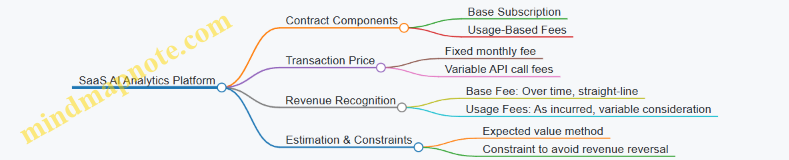
Best Practices for Accountants and Auditors
- Thorough Contract Review: Ensure all AI/ML service components and modifications are clearly identified.
- Separate Performance Obligations: Distinguish between software licenses, services, and support.
- Estimate Variable Consideration Carefully: Use historical data and conservative estimates.
- Document Judgments and Estimates: Maintain detailed records to support revenue recognition decisions.
- Implement Strong Internal Controls: Monitor contract changes and revenue recognition processes.
- Audit Focus: Test allocation methods, timing of recognition, and variable consideration estimates.
Summary
Revenue recognition in AI and Machine Learning services requires careful application of the five-step model, with particular attention to the nature of performance obligations and variable consideration. By using clear examples and structured approaches, accountants and auditors can ensure compliance with ASC 606 and IFRS 15 while providing transparent financial reporting.
10.3 Example: Revenue Recognition for IoT Device Subscriptions
Revenue recognition for IoT (Internet of Things) device subscriptions presents unique challenges due to the combination of hardware sales, ongoing service subscriptions, and often bundled software updates or data analytics. This section explores how to apply revenue recognition principles to IoT device subscriptions with detailed examples and mind maps to clarify the process.
Understanding the Components of an IoT Device Subscription
An IoT device subscription typically includes:
- Hardware Device: The physical IoT device sold to the customer.
- Subscription Service: Ongoing connectivity, data transmission, and cloud services.
- Software Updates & Maintenance: Periodic updates to device firmware or software.
- Data Analytics & Insights: Optional services providing data analysis.
Mind Map: Components of IoT Device Subscription
Step 1: Identify the Contract with the Customer
The contract may be a single agreement covering the device sale and subscription or separate agreements. For revenue recognition, it is critical to determine if these components are bundled or sold separately.
Step 2: Identify Performance Obligations
Each distinct good or service promised in the contract is a performance obligation. In IoT subscriptions, typical performance obligations include:
- Delivery of the IoT device (hardware)
- Provision of subscription services over the contract term
- Delivery of software updates
- Provision of data analytics services (if applicable)
Mind Map: Performance Obligations in IoT Subscriptions
Step 3: Determine the Transaction Price
The total transaction price includes:
- Upfront payment for the device (if any)
- Recurring subscription fees
- Variable consideration (e.g., usage-based charges)
Example:
- Device cost: $200 (paid upfront)
- Monthly subscription fee: $30
- Contract length: 12 months
- No variable consideration
Total transaction price = $200 + ($30 * 12) = $560
Step 4: Allocate the Transaction Price to Performance Obligations
Allocation is based on the standalone selling prices (SSP) of each obligation.
Example SSPs:
- Device: $200
- Subscription service (12 months): $360 ($30 x 12)
Allocation:
- Device: $200 / $560 = 35.7%
- Subscription: $360 / $560 = 64.3%
Revenue allocated:
- Device: $560 * 35.7% = $200
- Subscription: $560 * 64.3% = $360
Step 5: Recognize Revenue When Performance Obligations Are Satisfied
- Device Revenue: Recognize $200 at the point in time when the device is delivered to the customer.
- Subscription Revenue: Recognize $30 monthly over the 12-month subscription period as services are rendered.
Mind Map: Revenue Recognition Timeline
Practical Example
Scenario:
A company sells an IoT thermostat with a 12-month service subscription.
- Customer pays $200 upfront for the thermostat.
- Subscription fee is $30/month.
- The contract includes free firmware updates.
Revenue Recognition:
- On delivery date, recognize $200 revenue for the thermostat.
- Each month, recognize $30 revenue for the subscription service.
- Firmware updates are included in the subscription service and recognized over time.
Journal Entries:
-
At delivery:
- Dr. Accounts Receivable $200
- Cr. Revenue - Hardware $200
-
Each month:
- Dr. Accounts Receivable $30
- Cr. Revenue - Subscription $30
Additional Considerations
-
Variable Consideration: If the subscription fee varies based on usage (e.g., data consumption), estimate variable consideration using the expected value or most likely amount method, applying constraints to avoid revenue reversal.
-
Contract Modifications: If the customer upgrades or changes the subscription, reassess the contract and performance obligations.
-
Bundled Discounts: If discounts are applied to the bundled contract, allocate the discount proportionally based on SSP.
Mind Map: Key Considerations for IoT Revenue Recognition

By following these steps and carefully analyzing the contract components, accountants and auditors can ensure accurate revenue recognition aligned with ASC 606 and IFRS 15 standards in the evolving IoT landscape.
10.4 Adapting Traditional Principles to New Business Models
As technology evolves, new business models emerge that challenge traditional revenue recognition frameworks. Accountants and auditors must adapt the core principles of revenue recognition to fit these innovative models while ensuring compliance and accuracy.
Understanding the Challenge
Traditional revenue recognition principles were designed with straightforward sales transactions in mind—goods delivered or services rendered for a fixed price. However, new business models often involve:
- Subscription-based services
- Usage-based billing
- Bundled offerings with evolving deliverables
- Platform and marketplace revenue sharing
- Digital assets and tokenized transactions
These complexities require a flexible yet principled approach to revenue recognition.
Mind Map: Key Considerations for Adapting Revenue Recognition
Example 1: Subscription-Based Streaming Service
Scenario: A company offers a monthly subscription for access to a streaming platform. Customers pay a fixed fee monthly but can also purchase premium content on-demand.
Adaptation:
- Identify Performance Obligations: Access to the streaming platform (service) and premium content (separate performance obligation).
- Transaction Price: Fixed monthly fee plus variable consideration from premium content purchases.
- Allocation: Allocate the monthly fee to the access service; allocate premium content fees as separate revenue when content is delivered.
- Revenue Recognition: Recognize subscription revenue over time (monthly access), and premium content revenue at the point in time when content is accessed.
Mind Map:
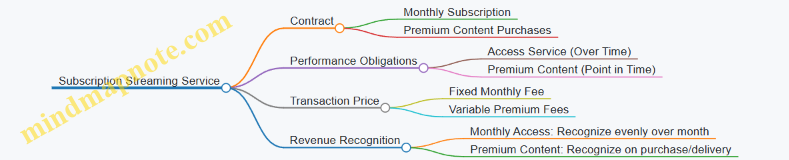
Example 2: Usage-Based Cloud Computing Services
Scenario: A cloud provider charges customers based on actual usage of computing resources rather than a fixed fee.
Adaptation:
- Identify Contract: Usage-based contract with variable consideration.
- Performance Obligations: Continuous delivery of computing resources.
- Transaction Price: Estimated based on usage; may vary monthly.
- Revenue Recognition: Recognize revenue over time as usage occurs, estimating variable consideration with constraints to avoid overstatement.
Mind Map:
Best Practices for Adapting Principles
- Thorough Contract Analysis: Carefully review contracts to identify all performance obligations, especially in complex or bundled offerings.
- Use Estimates and Judgments Wisely: Apply reasonable and supportable methods to estimate variable consideration and standalone selling prices.
- Leverage Technology: Use automated systems to track usage, progress, and billing to support accurate revenue recognition.
- Maintain Clear Documentation: Document all judgments, estimates, and methodologies to support audit trails.
- Regularly Review and Update Policies: As business models evolve, update revenue recognition policies to reflect current practices and standards.
Mind Map: Best Practices Summary
By integrating traditional revenue recognition principles with a flexible, informed approach, accountants and auditors can successfully navigate the complexities of new business models, ensuring compliance and providing reliable financial information.
10.5 Auditing New Technology Revenue Streams: Key Considerations
Auditing revenue streams derived from new and emerging technologies presents unique challenges that require auditors to adapt traditional auditing approaches. This section explores key considerations when auditing revenue from blockchain, AI, IoT, and other cutting-edge tech solutions.
Key Considerations Mind Map
Understanding the Technology
Before auditing revenue, auditors must gain a solid understanding of the underlying technology driving the revenue streams. For instance, blockchain-based platforms may generate revenue through transaction fees or token sales, while AI services might bill based on usage or performance outcomes.
Example: A company offers AI-driven analytics as a subscription service with additional fees for customized reports. Auditors need to understand how usage is tracked and billed to verify revenue accuracy.
Contract and Performance Obligations
New technology contracts often include multiple deliverables such as software licenses, cloud hosting, and ongoing support. Identifying distinct performance obligations and how they are satisfied is crucial.
Example: An IoT device manufacturer sells hardware bundled with a 12-month data subscription. Revenue recognition must separate hardware sales (point in time) from subscription services (over time).
Transaction Price Determination
Variable consideration is common in new tech revenue streams, especially with token-based payments or revenue-sharing models. Auditors must evaluate estimation methods and constraints carefully.
Example: A blockchain startup receives payment partly in volatile cryptocurrency tokens. Auditors assess how the company measures the fair value of tokens at contract inception and subsequent reporting periods.
Revenue Recognition Timing
Determining when performance obligations are satisfied can be complex with new technologies, especially when delivery is continuous or usage-based.
Example: For a cloud computing service charging based on data processed, revenue is recognized over time as usage occurs, requiring reliable measurement systems.
Internal Controls and IT Systems
Automated systems often handle revenue recognition in tech companies. Auditors should evaluate the design and operating effectiveness of these controls, including cybersecurity measures.
Example: Auditors review blockchain transaction logs to verify completeness and accuracy of recorded revenue events, ensuring no unauthorized modifications.
Regulatory and Compliance Risks
Emerging technologies may face uncertain or evolving regulatory frameworks, affecting revenue recognition policies.
Example: A fintech firm operating across multiple jurisdictions must comply with varying revenue recognition requirements and disclose related risks.
Documentation and Evidence
Digital contracts, smart contracts, and system-generated logs serve as critical audit evidence.
Example: Auditors examine smart contract code to confirm automated revenue triggers align with contractual terms.
Auditor Skills and Tools
Auditors need to develop technical expertise and leverage data analytics tools to effectively audit new technology revenue streams.
Example: Using blockchain explorers and analytics software to trace and verify transaction flows supporting revenue recognition.
Summary
Auditing revenue from new technology streams demands a blend of traditional auditing principles and innovative approaches tailored to the unique characteristics of emerging business models. Understanding technology, evaluating complex contracts, assessing variable consideration, and leveraging digital evidence are essential for a robust audit.
Additional Mind Map: Auditor’s Approach Workflow
This structured approach helps auditors navigate the complexities of new technology revenue streams with confidence and accuracy.
11. Case Studies and Practical Examples
11.1 Case Study: Revenue Recognition in a SaaS Company
Overview
This case study explores revenue recognition principles applied to a Software-as-a-Service (SaaS) company, “CloudTech Solutions,” which offers subscription-based cloud software services. The goal is to illustrate how ASC 606 / IFRS 15 principles are implemented in practice, including contract identification, performance obligations, transaction price determination, allocation, and revenue recognition.
Company Profile
- Name: CloudTech Solutions
- Business Model: Monthly subscription for cloud-based project management software
- Contract Term: 12 months
- Pricing: $1,200 per year per user, billed annually upfront
- Additional Services: Optional onboarding training and premium support
Step 1: Identify the Contract with the Customer
- Contract: Annual subscription agreement signed by customer
- Contract terms specify service access for 12 months
- Payment terms: Full payment upfront
Example: A customer signs a contract on January 1st, paying $12,000 for 10 users for the full year.
Step 2: Identify Performance Obligations
- Performance Obligation 1: Access to cloud software service over 12 months
- Performance Obligation 2: Optional onboarding training (if purchased)
- Performance Obligation 3: Premium support (if purchased)
Mind Map:
Example: Customer opts for software access and onboarding training but not premium support.
Step 3: Determine the Transaction Price
- Base subscription fee: $12,000
- Onboarding training fee: $1,500
- Premium support: $2,000 (not purchased in this example)
Total Transaction Price: $13,500
Step 4: Allocate the Transaction Price to Performance Obligations
- Using standalone selling prices (SSP):
- Software access: $12,000
- Onboarding training: $1,500
- Premium support: $2,000
Allocation:
- Software access: $12,000 / $13,500 = 88.89%
- Onboarding training: $1,500 / $13,500 = 11.11%
Mind Map:
Step 5: Recognize Revenue When Performance Obligations Are Satisfied
- Software Access: Recognize revenue ratably over 12 months (service period)
- Onboarding Training: Recognize revenue at point in time when training is delivered
Example:
- Software access revenue recognized monthly: $12,000 / 12 = $1,000 per month
- Onboarding training revenue recognized fully in January when training is completed
Mind Map:
Practical Considerations and Best Practices
- Contract Modifications: If customer adds users mid-term, update contract and reallocate transaction price accordingly.
- Variable Consideration: Discounts or refunds must be estimated and constrained.
- Documentation: Maintain clear records of contract terms, delivery dates, and customer communications.
Auditing Tips
- Verify contract existence and terms.
- Confirm allocation based on documented standalone selling prices.
- Test revenue recognized monthly matches service delivery.
- Review onboarding training completion records.
Summary Table
| Step | Description | Example Application |
|---|---|---|
| 1 | Identify Contract | Signed 12-month subscription contract |
| 2 | Identify Performance Obligations | Software access + onboarding training |
| 3 | Determine Transaction Price | $13,500 total fee |
| 4 | Allocate Price | $12,000 software, $1,500 training |
| 5 | Recognize Revenue | Software monthly, training at delivery |
This case study demonstrates how SaaS companies apply revenue recognition principles to ensure compliance and accurate financial reporting, providing clear examples and mind maps to aid accountants and auditors in understanding the process.
11.2 Case Study: Multi-Element Arrangements in a Tech Hardware Sale
Overview
In the technology sector, sales often involve multiple elements bundled into a single contract. For example, a company might sell hardware devices bundled with software licenses, installation services, and ongoing maintenance. Proper revenue recognition in such multi-element arrangements is critical for accountants and auditors to ensure compliance with ASC 606 / IFRS 15.
Step 1: Identify the Contract
A contract is established when the customer and seller agree on the terms and conditions. In this case, the contract includes:
- Hardware (e.g., servers or networking equipment)
- Software license (for proprietary software)
- Installation and configuration services
- Maintenance and support for 1 year
Step 2: Identify Performance Obligations
Each distinct good or service promised in the contract is a performance obligation. Here, the performance obligations are:
- Delivery of hardware
- Granting the software license
- Performing installation services
- Providing maintenance and support
Step 3: Determine the Transaction Price
Suppose the total contract price is $100,000. This price includes all elements bundled together.
Step 4: Allocate the Transaction Price
Allocation is based on the standalone selling price (SSP) of each element. Assume the following SSPs:
| Element | Standalone Selling Price (SSP) |
|---|---|
| Hardware | $70,000 |
| Software License | $15,000 |
| Installation Services | $8,000 |
| Maintenance & Support | $12,000 |
Total SSP: $105,000
Allocation percentage:
- Hardware: 70,000 / 105,000 = 66.67%
- Software License: 15,000 / 105,000 = 14.29%
- Installation Services: 8,000 / 105,000 = 7.62%
- Maintenance & Support: 12,000 / 105,000 = 11.43%
Allocated transaction price:
- Hardware: $100,000 * 66.67% = $66,670
- Software License: $100,000 * 14.29% = $14,290
- Installation Services: $100,000 * 7.62% = $7,620
- Maintenance & Support: $100,000 * 11.43% = $11,430
Step 5: Recognize Revenue When Performance Obligations Are Satisfied
- Hardware: Recognize revenue at the point in time when control transfers to the customer (e.g., delivery).
- Software License: Recognize revenue at the point in time when the license is granted.
- Installation Services: Recognize revenue over time as services are performed.
- Maintenance & Support: Recognize revenue ratably over the 1-year support period.
Mind Map: Multi-Element Arrangement Revenue Recognition
Practical Example
Scenario: A tech company sells 10 servers bundled with a proprietary software license, installation, and one year of maintenance for $100,000.
- The company delivers the servers on January 10.
- Software license is granted immediately upon delivery.
- Installation services are performed over 2 weeks.
- Maintenance services run from January 10 to January 9 of the following year.
Revenue Recognition Schedule:
| Date Range | Performance Obligation | Revenue Recognized | Explanation |
|---|---|---|---|
| January 10 | Hardware | $66,670 | Recognized at delivery (point in time) |
| January 10 | Software License | $14,290 | Recognized at license grant (point in time) |
| January 10 - Jan 24 | Installation Services | $7,620 | Recognized over installation period (over time) |
| Jan 10 - Next Jan 9 | Maintenance & Support | $11,430 | Recognized ratably over 12 months (over time) |
Auditor’s Perspective: Key Considerations
- Verify the contract clearly defines each element and pricing.
- Confirm standalone selling prices are reasonable and supported by market data.
- Ensure revenue recognition aligns with transfer of control criteria.
- Review timing and completeness of installation and maintenance services.
- Check disclosures for multi-element arrangements are transparent.
Summary
Multi-element arrangements require careful identification of performance obligations, accurate allocation of transaction price based on standalone selling prices, and appropriate timing of revenue recognition. Using this structured approach helps accountants and auditors maintain compliance and provide clear financial reporting.
Additional Mind Map: Auditor Checklist for Multi-Element Arrangements
11.3 Example Walkthrough: Revenue Recognition for Consulting Services
Revenue recognition in consulting services can be complex due to the nature of service delivery, contract terms, and performance obligations. This section provides a detailed walkthrough using a practical example, supported by mind maps to visualize key concepts.
Scenario Overview
ABC Consulting enters into a contract with a client to provide business process improvement consulting over a 6-month period. The contract value is $120,000, payable in monthly installments of $20,000. The contract includes:
- Initial assessment and report delivery (Month 1)
- Ongoing advisory services (Months 2-5)
- Final implementation support (Month 6)
The consulting firm must recognize revenue according to the five-step model under ASC 606 / IFRS 15.
Step 1: Identify the Contract with the Customer
- Contract is valid and enforceable.
- Payment terms are clear: $20,000 monthly.
Mind Map:
Step 2: Identify the Performance Obligations
- Initial assessment and report (distinct deliverable)
- Ongoing advisory services (continuous service)
- Final implementation support (distinct deliverable)
Mind Map:
Step 3: Determine the Transaction Price
- Total contract price: $120,000
- Fixed consideration, no variable components
Mind Map:
Step 4: Allocate the Transaction Price to Performance Obligations
Allocation based on standalone selling prices (SSP):
| Performance Obligation | Estimated SSP | Allocation % | Allocated Price |
|---|---|---|---|
| Initial Assessment & Report | $30,000 | 25% | $30,000 |
| Ongoing Advisory Services | $60,000 | 50% | $60,000 |
| Final Implementation Support | $30,000 | 25% | $30,000 |
Mind Map:
Step 5: Recognize Revenue When (or As) Performance Obligations Are Satisfied
- Initial Assessment & Report: Recognize $30,000 at completion (Month 1)
- Ongoing Advisory Services: Recognize $60,000 over 4 months (Months 2-5) on a straight-line basis ($15,000 per month)
- Final Implementation Support: Recognize $30,000 at completion (Month 6)
Mind Map:
Example Journal Entries
| Date | Description | Debit | Credit |
|---|---|---|---|
| Month 1 | Accounts Receivable | $20,000 | |
| Month 1 | Revenue - Initial Assessment | $20,000 | |
| Month 2-5 | Accounts Receivable (each month) | $20,000 | |
| Month 2-5 | Revenue - Advisory Services (each) | $15,000 | |
| Month 6 | Accounts Receivable | $20,000 | |
| Month 6 | Revenue - Final Implementation | $20,000 |
Note: The revenue recognized each month matches the allocated amounts and timing of performance obligations.
Key Best Practices
- Clear Contract Documentation: Ensure all deliverables and payment terms are explicitly stated.
- Accurate SSP Estimation: Use market data or historical pricing to estimate standalone selling prices.
- Consistent Revenue Recognition Methods: Apply point-in-time or over-time recognition appropriately.
- Regular Monitoring: Track progress and update revenue recognition if contract terms change.
Summary Mind Map of the Walkthrough
This example demonstrates how consulting firms can apply the revenue recognition principles systematically, ensuring compliance and accurate financial reporting.
11.4 Common Errors and How to Correct Them
Revenue recognition is a critical area where errors can significantly impact financial statements and audit outcomes. Understanding common pitfalls and how to address them is essential for accountants and auditors in the finance and tech sectors.
Common Errors in Revenue Recognition
Detailed Examples and Corrections
Missing or Incomplete Contracts
Error: Revenue is recognized without a valid, enforceable contract.
Example: A software company begins recognizing revenue for a multi-year subscription before the customer has signed the contract.
Correction: Ensure that all contracts meet the criteria under ASC 606/IFRS 15 before recognizing revenue. Document contract terms clearly and verify customer approval.
Misidentifying Performance Obligations
Error: Treating bundled goods and services as a single performance obligation when they should be separated.
Example: A tech firm sells hardware with a one-year maintenance service but recognizes all revenue at delivery.
Correction: Identify distinct goods and services. Allocate transaction price accordingly and recognize revenue over time for the maintenance service.
Ignoring Variable Consideration
Error: Not estimating or constraining variable consideration such as discounts, rebates, or returns.
Example: An e-commerce platform recognizes full sales revenue without accounting for expected returns.
Correction: Use the expected value or most likely amount method to estimate variable consideration and apply the constraint to avoid overstating revenue.
Incorrect Allocation of Transaction Price
Error: Allocating discounts disproportionately or using inaccurate standalone selling prices.
Example: A bundled sale of software and training services allocates the entire discount to the software, overstating revenue for training.
Correction: Determine standalone selling prices based on observable data or estimation techniques and allocate discounts proportionally.
Premature Revenue Recognition
Error: Recognizing revenue before performance obligations are satisfied.
Example: A consulting company recognizes full revenue at contract signing rather than as services are delivered.
Correction: Apply criteria for point-in-time or over-time recognition. Use methods such as output or input measures to recognize revenue appropriately.
Insufficient Disclosures
Error: Omitting key judgments, estimates, or contract details in financial statement disclosures.
Example: A company fails to disclose significant variable consideration estimates affecting revenue.
Correction: Follow ASC 606/IFRS 15 disclosure requirements, including qualitative and quantitative information about contracts, performance obligations, and judgments.
Mind Map: Corrective Actions for Revenue Recognition Errors
Summary
Avoiding common revenue recognition errors requires a thorough understanding of the standards, careful contract analysis, and diligent application of the five-step model. Regular training, robust internal controls, and detailed documentation help ensure compliance and accurate financial reporting.
By integrating these corrective practices, accountants and auditors can mitigate risks and enhance the reliability of revenue figures in financial statements.
11.5 Lessons Learned from Real-World Audits
Revenue recognition is a complex area that often presents challenges during audits. Drawing from real-world audit experiences, several key lessons emerge that can help accountants and auditors improve accuracy, compliance, and transparency.
Key Lessons Learned
-
Thorough Understanding of Contracts is Crucial
- Auditors frequently encounter contracts with ambiguous terms or multiple amendments.
- Lesson: Always obtain the latest contract version and understand all modifications before assessing revenue recognition.
-
Performance Obligations Must Be Clearly Identified and Documented
- Misidentification leads to incorrect revenue timing and amounts.
- Lesson: Collaborate with management to ensure all distinct goods and services are properly separated.
-
Variable Consideration Requires Careful Estimation and Documentation
- Discounts, rebates, and penalties can significantly affect transaction price.
- Lesson: Use consistent estimation methods and maintain detailed support for assumptions.
-
Allocation of Transaction Price Needs Robust Support
- Standalone selling prices are often estimated, which can introduce subjectivity.
- Lesson: Use market data or internal pricing policies and document rationale thoroughly.
-
Revenue Recognition Timing Must Align with Performance Completion
- Over-recognition or under-recognition can distort financial results.
- Lesson: Verify progress measurement methods and ensure they reflect actual performance.
-
Internal Controls Over Revenue Recognition Are Essential
- Weak controls increase risk of errors or fraud.
- Lesson: Evaluate and test controls regularly, focusing on contract management and revenue calculations.
-
Disclosure Completeness and Transparency Should Not Be Overlooked
- Insufficient disclosures can mislead stakeholders.
- Lesson: Ensure disclosures meet ASC 606/IFRS 15 requirements and clearly explain policies and judgments.
Mind Map: Lessons Learned from Revenue Recognition Audits
Real-World Example 1: Software Licensing Company
Issue: The auditor found that the company recognized revenue upfront for software licenses bundled with ongoing support services.
Lesson: The software license and support services are separate performance obligations. Revenue for support should be recognized over time, not upfront.
Action: The company revised its revenue recognition policy to allocate transaction price appropriately and recognize support revenue over the contract term.
Real-World Example 2: Construction Tech Firm
Issue: The firm used input methods based on costs incurred to measure progress but failed to adjust for inefficiencies and delays.
Lesson: Input methods must reflect actual progress toward completion, not just costs incurred.
Action: Auditors recommended incorporating output measures and adjusting for performance issues to better reflect revenue recognition timing.
Mind Map: Common Pitfalls and Corrective Actions
Practical Tips for Accountants and Auditors
- Maintain a checklist for contract review to ensure no amendments are missed.
- Use cross-functional teams (legal, sales, finance) to clarify contract terms.
- Document all judgments and assumptions related to variable consideration.
- Regularly update standalone selling price databases.
- Test internal controls over revenue recognition frequently.
- Review disclosures against the latest standards and peer disclosures.
By integrating these lessons into your audit and accounting processes, you can enhance the reliability and compliance of revenue recognition practices, ultimately supporting better financial reporting and stakeholder confidence.
12. Future Trends and Updates in Revenue Recognition
12.1 Upcoming Changes in Revenue Recognition Standards
Revenue recognition standards are continuously evolving to address new business models, emerging technologies, and to improve clarity and consistency in financial reporting. Staying ahead of these changes is crucial for accountants and auditors to ensure compliance and maintain the integrity of financial statements.
Key Areas of Upcoming Changes
Enhancements to ASC 606 and IFRS 15
Both ASC 606 (US GAAP) and IFRS 15 (International) form the backbone of current revenue recognition practices. Regulators and standard setters are proposing refinements to address areas where implementation challenges have been noted.
- Clarifications on Variable Consideration: More explicit guidance on estimating and constraining variable consideration to reduce diversity in practice.
- Contract Modifications: Enhanced rules on accounting for contract changes, especially in long-term and complex contracts.
- Licensing Revenue: Additional examples and criteria to distinguish between right-to-use and right-to-access licenses.
Example: A software company revising its licensing agreements mid-contract will need to apply the updated contract modification guidance to determine whether to account for the change as a separate contract or as part of the existing one.
Industry-Specific Guidance
Certain industries face unique revenue recognition challenges. Upcoming standards aim to provide tailored guidance.
- Technology & SaaS: Clearer rules on recognizing revenue from cloud-based services, including bundled offerings.
- Construction: More detailed criteria for measuring progress and handling contract modifications.
- Telecommunications: Addressing multiple-element arrangements common in telecom service contracts.
Example: A telecom provider bundling internet service with a handset sale will benefit from updated guidance on allocating transaction price and recognizing revenue for each component.
New Revenue Models
The rise of subscription-based and digital business models demands updated recognition principles.
- Subscription Economy: Guidance on recognizing revenue over time as services are delivered.
- Bundled Arrangements: Improved methods for identifying performance obligations and allocating transaction prices.
- Licensing & Intellectual Property: Differentiating revenue recognition based on the nature of IP rights granted.
Example: A SaaS company offering tiered subscription plans with add-on features will apply refined rules to allocate revenue appropriately and recognize it as customers consume services.
Enhanced Disclosure Requirements
Transparency is a growing focus area, with upcoming standards emphasizing more detailed disclosures.
- Contract Balances: Reporting opening and closing balances of contract assets and liabilities.
- Segment Reporting: Disaggregated revenue information by product lines or geographic regions.
- Judgments and Estimates: Clearer disclosure of significant judgments in revenue recognition.
Example: An auditor reviewing financial statements will look for detailed notes explaining how management estimates variable consideration and the impact on revenue.
Implementation Challenges and Transition Guidance
Transitioning to updated standards requires careful planning.
- Practical Expedients: Options to simplify transition accounting and reduce operational burden.
- System & Process Updates: Organizations must upgrade accounting systems to handle new recognition and disclosure requirements.
- Training & Education: Continuous professional development to keep teams informed.
Example: A mid-sized tech firm implementing updated revenue recognition standards may choose the full retrospective method or the modified retrospective method, weighing the pros and cons of each.
Summary Mind Map
Final Thoughts
For accountants and auditors, proactively understanding and preparing for these upcoming changes is essential. Early adoption of best practices, continuous education, and leveraging real-world examples will ensure smooth transitions and maintain compliance.
Example: An audit team conducting a readiness assessment six months before a new standard effective date can identify gaps in revenue recognition processes and recommend timely improvements.
References & Resources
- FASB and IASB official updates
- Industry-specific accounting bodies
- Professional training webinars and workshops
By integrating these upcoming changes into your revenue recognition framework, you can enhance accuracy, transparency, and stakeholder confidence.
12.2 Impact of Digital Transformation on Revenue Processes
Digital transformation is reshaping how organizations manage and recognize revenue. For accountants and auditors in the finance and tech sectors, understanding these changes is critical to ensure compliance, accuracy, and efficiency in revenue recognition processes.
Key Areas Affected by Digital Transformation
Automation: Enhancing Accuracy and Efficiency
Automation tools reduce manual data entry and errors, enabling faster recognition of revenue. For example, automated billing systems can trigger revenue recognition events immediately upon delivery confirmation or contract milestone achievement.
Example:
A SaaS company uses an automated subscription management platform that recognizes revenue monthly as customers use the service. The system automatically adjusts for upgrades or cancellations, ensuring revenue is recognized accurately without manual intervention.
Data Analytics: Smarter Revenue Forecasting and Variable Consideration
Advanced analytics help estimate variable consideration such as discounts, rebates, or performance bonuses more accurately. This leads to more precise transaction price determination and allocation.
Example:
An e-commerce platform leverages machine learning models to predict customer returns and refunds, adjusting revenue recognition accordingly to avoid overstatement.
Cloud Computing: Real-Time Revenue Insights
Cloud-based systems centralize revenue data across departments and geographies, facilitating real-time visibility and faster financial close processes.
Example:
A multinational tech firm uses a cloud ERP system that consolidates contracts and billing data from various subsidiaries, enabling consistent revenue recognition practices globally.
Integration: Seamless Revenue Process Flow
Integrating ERP, CRM, and contract management systems ensures that contract terms, billing events, and revenue recognition are synchronized, reducing discrepancies.
Example:
A hardware manufacturer integrates its CRM with its ERP system so that once a sales order is marked as shipped, the revenue recognition module automatically records revenue based on the contract terms.
Compliance: Automated Controls and Audit Trails
Digital tools provide automated compliance checks and maintain detailed audit trails, simplifying internal controls and external audits.
Example:
An auditor reviews a company’s revenue recognition process and finds that the system automatically flags contracts with unusual terms for manual review, ensuring compliance with ASC 606.
Mind Map: Benefits and Challenges of Digital Transformation on Revenue Processes
Summary
Digital transformation offers powerful tools to improve revenue recognition processes, from automation and analytics to cloud computing and system integration. However, organizations must carefully manage implementation challenges to fully realize these benefits. Accountants and auditors should stay abreast of these technological advances to effectively oversee and adapt revenue recognition practices.
Additional Example: Transitioning to Digital Revenue Recognition
A mid-sized software company previously recognized revenue manually based on paper contracts and spreadsheets. After implementing a cloud-based revenue recognition platform integrated with their CRM and billing systems, they achieved:
- 50% reduction in month-end close time
- Real-time revenue reporting dashboards
- Automated handling of contract modifications
- Improved audit readiness with detailed logs
This digital transformation enabled the finance team to focus more on analysis and compliance rather than data processing.
12.3 Preparing for Regulatory Changes: Best Practices
Regulatory changes in revenue recognition standards can significantly impact accounting processes, financial reporting, and audit procedures. Staying ahead of these changes is crucial for accountants and auditors to ensure compliance, maintain accuracy, and avoid costly restatements or penalties.
Understanding the Scope of Regulatory Changes
Before implementing any changes, it’s important to fully understand the scope and implications of new regulations.
- Review official guidance from standard-setting bodies (e.g., FASB, IASB).
- Assess how changes affect current revenue recognition policies.
- Identify impacted contracts, systems, and reporting frameworks.
Best Practices for Preparing for Regulatory Changes
-
Early Awareness and Training
- Conduct training sessions and workshops for accounting and audit teams.
- Subscribe to updates from regulatory bodies and professional organizations.
-
Gap Analysis and Impact Assessment
- Perform a detailed gap analysis comparing current practices with upcoming requirements.
- Identify affected revenue streams and contracts.
- Evaluate system capabilities to handle new data and reporting needs.
-
Cross-Functional Collaboration
- Engage finance, legal, IT, and operations teams.
- Ensure contract terms and systems support new recognition criteria.
-
Update Policies and Procedures
- Revise accounting policies to align with new standards.
- Document changes and communicate them internally.
-
System and Process Enhancements
- Upgrade ERP and accounting software to accommodate new data fields and calculations.
- Automate revenue recognition processes where possible to reduce errors.
-
Pilot Testing and Parallel Runs
- Run parallel accounting processes using both old and new standards.
- Identify discrepancies and refine processes before full implementation.
-
Continuous Monitoring and Feedback
- Establish monitoring mechanisms to track compliance.
- Collect feedback from users to improve processes.
Example: Preparing for ASC 606 Transition in a SaaS Company
A SaaS company anticipating ASC 606 adoption took the following steps:
- Held workshops to educate the finance and sales teams on the five-step revenue recognition model.
- Conducted a contract review to identify performance obligations in subscription agreements.
- Updated their billing system to capture variable consideration such as discounts and usage-based fees.
- Ran parallel revenue recognition reports for six months to compare results.
- Adjusted internal controls to ensure accurate recognition and disclosure.
This proactive approach minimized disruptions and ensured a smooth transition.
Mind Maps
Mind Map 1: Preparing for Regulatory Changes
Mind Map 2: Steps in Gap Analysis
Mind Map 3: Cross-Functional Collaboration

Additional Example: Auditing Considerations During Regulatory Changes
An audit firm preparing for new revenue recognition standards implemented the following best practices:
- Updated audit programs to include new risk areas related to revenue.
- Trained audit staff on identifying performance obligations and variable consideration.
- Increased focus on testing internal controls around contract modifications.
- Used data analytics to detect unusual revenue patterns during transition periods.
This ensured that audits remained effective and compliant despite evolving standards.
Summary
Preparing for regulatory changes requires a structured, proactive approach involving education, assessment, collaboration, and continuous improvement. By following these best practices, accountants and auditors can navigate transitions smoothly, maintain compliance, and uphold the integrity of financial reporting.
12.4 Example: Transitioning from Legacy Standards to ASC 606
Transitioning from legacy revenue recognition standards (such as ASC 605 or IAS 18) to ASC 606 (Revenue from Contracts with Customers) can be complex but essential for compliance and improved financial reporting. This section provides a detailed example, practical steps, and mind maps to help accountants and auditors understand and implement the transition effectively.
Understanding the Key Differences
Before diving into the example, it’s important to grasp the fundamental differences between legacy standards and ASC 606:
- Legacy Standards: Often focused on risk and rewards transfer, completed contract method, or percentage-of-completion with less emphasis on contract specifics.
- ASC 606: Introduces a five-step model emphasizing contract-based revenue recognition, performance obligations, and transaction price allocation.
Mind Map: Legacy Standards vs. ASC 606 Transition Overview
Practical Example: Transitioning a Software Company from ASC 605 to ASC 606
Scenario: A software company sells a bundled contract including:
- Software license
- Installation services
- One year of technical support
Legacy Approach (ASC 605):
- Revenue recognized when software is delivered (license) and installation completed.
- Support revenue recognized ratably over the support period.
ASC 606 Approach:
- Step 1: Identify the contract — The sales agreement with the customer.
- Step 2: Identify performance obligations — Separate software license, installation service, and support as distinct obligations.
- Step 3: Determine transaction price — Total contract price $120,000.
- Step 4: Allocate transaction price — Based on standalone selling prices:
- Software license: $80,000
- Installation: $20,000
- Support: $20,000
- Step 5: Recognize revenue:
- Software license: Recognize at point in time (delivery).
- Installation: Recognize over time as installation progresses.
- Support: Recognize ratably over 12 months.
Mind Map: ASC 606 Five-Step Model Applied to Software Contract
Transition Steps for Accountants and Auditors
- Data Gathering: Collect all existing contracts and revenue recognition policies.
- Gap Analysis: Compare legacy policies with ASC 606 requirements.
- Training: Educate accounting and audit teams on ASC 606 principles.
- System Updates: Modify ERP and accounting systems to capture necessary data.
- Pilot Testing: Apply ASC 606 to select contracts to identify issues.
- Full Implementation: Transition all contracts and update financial statements.
- Disclosure Preparation: Prepare detailed disclosures about the transition impact.
Example Journal Entries Comparison
| Transaction | Legacy Standard Entry | ASC 606 Entry |
|---|---|---|
| Software License Delivery | Debit Accounts Receivable $100,000<br>Credit Revenue $100,000 | Debit Accounts Receivable $80,000<br>Credit Revenue $80,000 |
| Installation Service Progress | Debit Accounts Receivable $20,000<br>Credit Revenue $20,000 (upon completion) | Debit Accounts Receivable $20,000<br>Credit Revenue (over time as progress) |
| Support Service (12 months) | Debit Accounts Receivable $12,000 (monthly)<br>Credit Revenue $12,000 | Debit Accounts Receivable $20,000<br>Credit Deferred Revenue $20,000 (initial)<br>Then monthly:<br>Debit Deferred Revenue $1,667<br>Credit Revenue $1,667 |
Tips for a Smooth Transition
- Maintain detailed documentation of judgments made during transition.
- Engage cross-functional teams including legal, sales, and IT.
- Use technology tools for contract management and revenue tracking.
- Communicate changes clearly to stakeholders and auditors.
By following this example and utilizing the mind maps, finance professionals can better navigate the complexities of transitioning from legacy revenue recognition standards to ASC 606, ensuring compliance and enhancing the quality of financial reporting.
12.5 Continuous Learning and Professional Development Resources
Staying current with revenue recognition principles is essential for accountants and auditors working in the finance and tech sectors. Given the evolving nature of accounting standards like ASC 606 and IFRS 15, continuous learning ensures accuracy, compliance, and professional growth.
Key Areas for Continuous Learning
- Updates on Accounting Standards
- Industry-Specific Revenue Recognition Challenges
- Emerging Technologies Impacting Revenue
- Audit Techniques and Best Practices
- Regulatory and Compliance Changes
Recommended Learning Resources
-
Professional Organizations & Certifications
- AICPA (American Institute of CPAs): Offers webinars, courses, and publications on revenue recognition.
- IFRS Foundation: Provides updates, guides, and training on IFRS 15.
- CPE (Continuing Professional Education): Many providers offer specialized courses on ASC 606 and IFRS 15.
- Certified Revenue Cycle Professional (CRCP): Certification focused on revenue cycle management.
-
Online Learning Platforms
- LinkedIn Learning: Courses on revenue recognition principles and practical applications.
- Coursera & edX: University-led courses on accounting standards and financial reporting.
- Accounting Today & Journal of Accountancy: Regular articles and case studies.
-
Books and Publications
- “Revenue Recognition: Principles and Practices” by Steven M. Bragg
- “Applying IFRS Standards” by Ruth Picker et al.
- Industry-specific guides published by Big Four accounting firms.
-
Workshops and Conferences
- Annual conferences by AICPA and IFRS Foundation.
- Industry-specific seminars focusing on tech and finance sectors.
Practical Example: Creating a Personal Learning Plan
Step 1: Assess current knowledge gaps in revenue recognition.
Step 2: Identify relevant courses and certifications.
Step 3: Schedule regular learning sessions (e.g., 2 hours/week).
Step 4: Apply learnings through case studies or real-world projects.
Step 5: Participate in forums and discussion groups for peer learning.
Mind Map 1: Continuous Learning Framework for Revenue Recognition
Mind Map 2: Key Topics to Master in Revenue Recognition
Example: Applying Continuous Learning in Practice
Scenario: An auditor encounters a new SaaS client with complex subscription models.
Action Plan:
- Review latest ASC 606 guidance on SaaS revenue.
- Enroll in a specialized online course covering cloud service revenue recognition.
- Analyze recent case studies published by professional bodies.
- Discuss challenges with peers in accounting forums.
- Document findings and update audit procedures accordingly.
Tips for Effective Continuous Learning
- Set SMART learning goals (Specific, Measurable, Achievable, Relevant, Time-bound).
- Leverage microlearning: short, focused learning sessions.
- Engage in knowledge sharing within your organization.
- Stay updated with newsletters from authoritative sources.
- Use technology such as apps and podcasts for learning on-the-go.
By integrating these continuous learning strategies and resources, accountants and auditors can confidently navigate the complexities of revenue recognition, ensuring compliance and enhancing their professional expertise.