Introduction to Accounting Standards
1. Understanding Accounting Standards: Foundations and Importance
1.1 What Are Accounting Standards? Definition and Purpose
Accounting standards are a set of principles, rules, and guidelines established to govern how financial transactions and events are recorded, reported, and presented in financial statements. They ensure consistency, transparency, comparability, and reliability of financial information across different organizations and industries.
Definition
Accounting Standards: Formalized rules and guidelines issued by recognized standard-setting bodies that dictate how financial statements should be prepared and presented.
Purpose of Accounting Standards
- Consistency: Ensures that financial statements are prepared in a uniform manner across periods and entities.
- Comparability: Allows stakeholders to compare financial information between different organizations and time periods.
- Transparency: Provides clear and understandable financial information to users.
- Reliability: Enhances the trustworthiness of financial reports.
- Regulatory Compliance: Helps organizations comply with legal and regulatory requirements.
Mind Map: Understanding Accounting Standards
Example 1: Small Business Implementing Accounting Standards
Scenario: A small educational consultancy firm wants to prepare its financial statements to attract investors.
- Without standards: The firm records revenue inconsistently—sometimes when cash is received, sometimes when services are promised.
- With standards: The firm follows the revenue recognition principle, recording revenue when services are delivered.
Result: Investors can clearly understand the firm’s financial health and make informed decisions.
Mind Map: Purpose Illustrated Through Example
Example 2: Auditor’s Role in Ensuring Standards
An auditor reviews the financial statements of a university to ensure compliance with accounting standards.
- Checks if tuition fees are recognized properly.
- Verifies asset valuations for campus buildings.
- Confirms liabilities like loans are accurately reported.
This process ensures stakeholders receive trustworthy financial information.
Summary
Accounting standards form the backbone of reliable financial reporting. They guide accountants and auditors in preparing and reviewing financial statements, ensuring that users such as investors, regulators, and management can trust and compare financial data effectively.
1.2 Historical Evolution of Accounting Standards Globally
Accounting standards have evolved over centuries, shaped by economic, legal, and social changes worldwide. Understanding this evolution helps accountants and auditors appreciate the rationale behind current standards and anticipate future developments.
Early Beginnings: The Roots of Accounting
- Ancient Civilizations:
- Mesopotamia and Egypt used basic record-keeping for trade and taxation.
- Clay tablets and papyrus recorded transactions.
- Medieval Period:
- Double-entry bookkeeping emerged in 15th-century Italy, credited to Luca Pacioli (1494).
- This system laid the groundwork for modern accounting.
Example: A merchant in Renaissance Italy used double-entry bookkeeping to track sales and expenses, enabling better financial control.
Industrial Revolution and the Need for Standardization
- Rapid industrial growth increased business complexity.
- Companies raised capital from public investors, requiring transparent financial information.
- Early 20th century: Different countries developed their own accounting rules, leading to inconsistencies.
Example: A British manufacturing firm and a US competitor reported profits differently due to varying local accounting practices, confusing investors.
Formation of Professional Bodies and Early Standard-Setting
- Late 19th to early 20th century:
- Professional accounting organizations formed (e.g., AICPA in 1887).
- Voluntary guidelines and ethical codes introduced.
- 1930s:
- The Great Depression highlighted the need for formal standards.
- The U.S. established the Securities and Exchange Commission (SEC) in 1934, promoting standardized reporting.
Example: Following the 1929 stock market crash, the SEC required publicly traded companies to follow consistent accounting rules to protect investors.
Post-War Globalization and International Efforts
- Economic globalization increased cross-border investments.
- Need for harmonized accounting standards to facilitate comparability.
- 1973: The International Accounting Standards Committee (IASC) was formed.
- 2001: IASC restructured into the International Accounting Standards Board (IASB), issuing IFRS.
Example: A multinational corporation preparing consolidated financial statements for subsidiaries in different countries adopted IFRS to ensure uniform reporting.
Modern Era: Convergence and Technological Impact
- Efforts to converge IFRS and US GAAP to reduce differences.
- Increasing focus on transparency, sustainability, and digital reporting.
- Technology enables real-time compliance and automated disclosures.
Example: An accounting firm uses cloud-based software to automatically update financial reports according to the latest IFRS amendments.
Summary Mind Map
Best Practice Highlight:
- Stay informed about historical context to better interpret standards.
- Use historical examples to train junior accountants on why standards exist.
Practical Example:
- When explaining revenue recognition, reference how industrial revolution-era businesses struggled without consistent rules, emphasizing the importance of clear criteria today.
1.3 The Role of Accounting Standards in Financial Reporting
Accounting standards serve as the backbone of financial reporting, ensuring that financial statements are consistent, transparent, and comparable across different organizations and periods. Their role is critical in fostering trust among stakeholders such as investors, regulators, creditors, and management.
Why Accounting Standards Matter in Financial Reporting
- Consistency: They provide a uniform framework that companies must follow, making it easier to compare financial data across different entities and time periods.
- Transparency: Standards require clear disclosures, reducing ambiguity and enhancing the clarity of financial statements.
- Reliability: By enforcing strict guidelines, accounting standards ensure that financial information is accurate and dependable.
- Accountability: They hold organizations accountable by defining how transactions and events should be recorded and reported.
Mind Map: The Role of Accounting Standards in Financial Reporting
Practical Examples Illustrating the Role of Accounting Standards
Example 1: Consistency in Revenue Recognition
A university offering online courses must recognize revenue consistently each semester. By following IFRS 15 or ASC 606 (Revenue from Contracts with Customers), the university recognizes revenue when control of the educational service is transferred to the student, rather than when cash is received. This ensures that revenue is reported in the correct period, allowing stakeholders to accurately assess the university’s financial performance over time.
Example 2: Transparency in Asset Reporting
A finance company owns several investment properties. According to IAS 40 (Investment Property), the company must disclose the fair value of these properties and any changes during the reporting period. This transparency allows investors to understand the true value of the company’s assets and the risks involved.
Example 3: Reliability Through Audit and Compliance
An educational non-profit organization follows GAAP standards for its financial statements. Auditors verify that the organization’s financial reports comply with these standards, providing assurance to donors and grant providers that funds are used appropriately and reported accurately.
Best Practice: Embedding Accounting Standards into Financial Reporting Processes
- Regular Training: Ensure accounting and finance teams are up-to-date with current standards.
- Standardized Templates: Use reporting templates aligned with accounting standards to maintain consistency.
- Internal Controls: Implement checks to verify compliance before external reporting.
- Audit Readiness: Prepare documentation and disclosures in line with standards to facilitate smooth audits.
Summary
Accounting standards play a pivotal role in shaping financial reporting by promoting consistency, transparency, reliability, and accountability. They help create financial statements that stakeholders can trust and use to make informed decisions. By integrating these standards into everyday accounting practices, organizations in finance and education sectors can enhance the quality and credibility of their financial reports.
1.4 Key Regulatory Bodies and Standard-Setting Organizations
Accounting standards are developed, maintained, and enforced by various regulatory bodies and standard-setting organizations worldwide. Understanding these entities is crucial for accountants and auditors to ensure compliance and maintain the integrity of financial reporting.
Major Regulatory Bodies and Standard-Setting Organizations
Detailed Descriptions and Examples
International Accounting Standards Board (IASB)
- The IASB is an independent body responsible for developing IFRS, which are used in over 140 countries.
- Example: A multinational education company preparing consolidated financial statements uses IFRS to ensure comparability across its global operations.
Financial Accounting Standards Board (FASB)
- FASB issues US GAAP, which is the primary accounting framework in the United States.
- Example: A US-based finance firm follows FASB standards for revenue recognition and lease accounting.
Securities and Exchange Commission (SEC)
- The SEC enforces accounting standards for publicly traded companies in the US, ensuring transparency and investor protection.
- Example: A publicly listed auditing firm must file financial reports compliant with SEC regulations.
Governmental Accounting Standards Board (GASB)
- GASB sets accounting standards for US state and local governments.
- Example: A municipal education department follows GASB standards for budgeting and financial reporting.
Best Practice: Staying Updated with Regulatory Bodies
- Regularly visit official websites of IASB, FASB, SEC, and other relevant bodies.
- Subscribe to newsletters and updates on standard changes.
- Participate in webinars and training sessions offered by these organizations.
Mind Map: Overview of Key Regulatory Bodies
Mind Map: Key Regulatory Bodies
Example Scenario: Applying Knowledge of Regulatory Bodies
Scenario: An auditor working for a multinational finance company must prepare audit reports that comply with both IFRS and US GAAP due to the company’s dual listing.
Application:
- The auditor references IASB materials for IFRS compliance.
- Consults FASB pronouncements for US GAAP requirements.
- Reviews SEC regulations for disclosure requirements applicable to the US market.
- Uses PCAOB guidelines to ensure audit quality and compliance.
This integrated approach ensures the audit meets all regulatory expectations, minimizing risks of non-compliance.
By understanding the roles and scopes of these key regulatory bodies and standard-setting organizations, accountants and auditors can confidently navigate the complex landscape of accounting standards and ensure accurate, compliant financial reporting.
1.5 Best Practice: Aligning Accounting Processes with Standards from Day One
Aligning accounting processes with established accounting standards from the very beginning of an organization’s financial operations is crucial for ensuring accuracy, compliance, and transparency. This proactive approach minimizes costly adjustments later and builds trust with stakeholders such as auditors, investors, and regulatory bodies.
Why Align from Day One?
- Compliance Assurance: Early alignment helps avoid non-compliance penalties.
- Consistency: Establishes uniform accounting treatment across transactions.
- Efficiency: Streamlines reporting and auditing processes.
- Transparency: Enhances credibility with stakeholders.
Key Steps to Align Accounting Processes with Standards
Detailed Breakdown
-
Understand Applicable Standards:
- Identify which accounting standards apply to your organization (e.g., IFRS for multinational entities, GAAP for US-based companies).
- Stay informed about industry-specific guidelines.
-
Design the Chart of Accounts Accordingly:
- Structure accounts to reflect standard classifications (assets, liabilities, equity, income, expenses).
- Example: For an educational institution, separate accounts for tuition fees, grants, and donations to comply with revenue recognition standards.
-
Document Accounting Policies and Procedures:
- Create clear policy manuals referencing relevant standards.
- Include guidelines on revenue recognition, asset capitalization, depreciation, and lease accounting.
-
Implement Internal Controls:
- Segregate duties to prevent errors and fraud.
- Establish approval workflows aligned with accounting policies.
-
Train Accounting Staff:
- Conduct onboarding sessions focused on applicable standards.
- Provide continuous education on updates and interpretations.
-
Leverage Technology:
- Use accounting software configured to comply with standards.
- Automate routine compliance checks where possible.
-
Regular Monitoring and Review:
- Schedule periodic internal audits.
- Use checklists to ensure ongoing adherence.
Example: Small Educational Startup Aligning from Day One
-
Scenario: A new private tutoring company wants to ensure its accounting complies with IFRS.
-
Actions Taken:
- Selected IFRS as the reporting framework.
- Designed a chart of accounts separating tuition revenue, grants, and operational expenses.
- Documented revenue recognition policy recognizing tuition fees over the course duration.
- Trained the finance team on IFRS 15 (Revenue from Contracts with Customers).
- Implemented accounting software with IFRS templates.
- Established monthly internal reviews to verify compliance.
-
Outcome: Smooth audit process in the first year, accurate financial statements, and increased investor confidence.
Additional Mind Map: Training and Continuous Learning
Summary
Aligning accounting processes with standards from day one is a foundational best practice that pays dividends in compliance, efficiency, and stakeholder trust. By understanding applicable standards, designing processes thoughtfully, training staff, leveraging technology, and continuously monitoring compliance, organizations set themselves up for long-term financial integrity and success.
1.6 Example: How a Small Business Implements Basic Accounting Standards
Implementing accounting standards in a small business might seem daunting at first, but by breaking down the process into manageable steps and applying best practices, it becomes straightforward and highly beneficial. This example will guide you through how a small retail business, “Green Leaf Books,” applies basic accounting standards to ensure accurate and compliant financial reporting.
Step 1: Understanding Applicable Accounting Standards
Green Leaf Books decides to follow the local Generally Accepted Accounting Principles (GAAP) which emphasize the accrual basis of accounting, consistency, and prudence.
Step 2: Setting Up Accounting Policies
The business documents its accounting policies, including revenue recognition, inventory valuation, and expense recording, aligning with GAAP principles.
Step 3: Recording Transactions Using the Accrual Principle
- Revenue Recognition: Sales are recorded when books are delivered, not when cash is received.
- Expense Recognition: Expenses like rent and utilities are recorded in the period they relate to, not when paid.
Step 4: Maintaining Consistency
Green Leaf Books applies the same inventory valuation method (FIFO) every accounting period to ensure comparability.
Step 5: Applying Prudence
The business records potential bad debts conservatively, estimating doubtful accounts to avoid overstating assets.
Mind Map: Implementing Basic Accounting Standards in a Small Business
Example Transactions and Their Accounting Treatment
| Transaction Description | Accounting Treatment | Explanation |
|---|---|---|
| Sold 100 books worth $1,000 on credit | Record $1,000 revenue and accounts receivable | Revenue recognized when books delivered, not when cash received |
| Paid $500 rent for the month | Record $500 rent expense for the month | Expense recognized in the period it relates to, matching principle |
| Estimated $100 doubtful accounts from receivables | Record allowance for doubtful accounts of $100 | Prudence principle to avoid overstating assets |
Mind Map: Example Transactions and Principles Applied
Best Practice Tips for Small Businesses
- Maintain Clear Documentation: Keep detailed records of accounting policies and transaction evidence.
- Use Simple Accounting Software: Tools like QuickBooks or Xero help automate compliance with standards.
- Regular Reconciliation: Monthly bank and accounts reconciliation to ensure accuracy.
- Train Staff: Basic training on accounting principles for employees handling financial data.
Summary
By systematically applying accounting standards such as accrual accounting, consistency, and prudence, Green Leaf Books ensures its financial statements are reliable and compliant. This approach not only supports better decision-making but also prepares the business for audits and potential growth.
This example illustrates that even small businesses can successfully implement fundamental accounting standards with clear policies, consistent application, and practical tools.
2. Overview of Major Accounting Frameworks
2.1 International Financial Reporting Standards (IFRS): Scope and Application
Introduction to IFRS
International Financial Reporting Standards (IFRS) are a set of accounting principles developed and maintained by the International Accounting Standards Board (IASB). They provide a global framework for how public companies prepare and disclose their financial statements, ensuring transparency, accountability, and efficiency in financial markets worldwide.
Scope of IFRS
IFRS is designed to be applied by entities that prepare financial statements for external users, such as investors, creditors, regulators, and other stakeholders. It is widely adopted across more than 140 jurisdictions, including the European Union, Australia, Canada, and many countries in Asia, Africa, and South America.
Key Areas Covered by IFRS:
- Recognition, measurement, presentation, and disclosure of transactions and events in financial statements
- Specific standards for assets, liabilities, equity, income, and expenses
- Industry-specific guidance where applicable
Mind Map: IFRS Scope Overview
Application of IFRS
Applying IFRS involves adhering to the principles and detailed guidance laid out in the standards to prepare financial statements that faithfully represent the entity’s financial position and performance.
Best Practices in Applying IFRS:
- Understand the Entity’s Business Model: Tailor IFRS application to the specific nature of the business.
- Consistent Policy Selection: Choose accounting policies that comply with IFRS and apply them consistently.
- Comprehensive Documentation: Maintain detailed records supporting judgments and estimates.
- Regular Training: Keep accounting and audit teams updated on IFRS changes.
Example: Applying IFRS 15 in an Educational Institution
An educational institution offers semester-based courses and receives tuition fees upfront. Under IFRS 15 (Revenue from Contracts with Customers), revenue recognition depends on the transfer of control of educational services.
- Step 1: Identify the contract with the student.
- Step 2: Identify performance obligations (e.g., delivery of lectures, access to resources).
- Step 3: Determine the transaction price (tuition fee).
- Step 4: Allocate the transaction price to performance obligations.
- Step 5: Recognize revenue as the institution delivers the educational services over the semester.
This means revenue is recognized over time, not just when fees are received, ensuring compliance with IFRS and reflecting the true economic activity.
Mind Map: IFRS 15 Application Example
Summary
IFRS provides a comprehensive framework that promotes consistency and comparability in financial reporting globally. Understanding its scope and correct application is essential for accountants and auditors to ensure compliance and provide stakeholders with reliable financial information.
For further reading, refer to the official IASB website and IFRS Foundation publications.
2.2 Generally Accepted Accounting Principles (GAAP): US and Other Variants
Generally Accepted Accounting Principles (GAAP) represent a set of accounting standards, principles, and procedures that companies and organizations follow when compiling their financial statements. While GAAP is often associated with the United States, many countries have their own versions or variants of GAAP tailored to their regulatory environments and business practices.
What is GAAP?
GAAP is a framework that ensures consistency, transparency, and comparability of financial reporting. It provides guidelines on how to recognize revenue, value assets, disclose liabilities, and present financial information.
US GAAP Overview
- Developed and maintained by the Financial Accounting Standards Board (FASB).
- Highly detailed and rules-based.
- Widely used by public companies in the United States.
Other GAAP Variants
- Canadian GAAP: Historically similar to US GAAP but evolving towards IFRS.
- Indian GAAP: Prescribed by the Institute of Chartered Accountants of India (ICAI), with gradual convergence to IFRS.
- Japanese GAAP: Overseen by the Accounting Standards Board of Japan (ASBJ), with some convergence efforts.
Mind Map: Overview of GAAP Variants
Key Differences Between US GAAP and Other Variants
| Aspect | US GAAP | Other GAAP Variants |
|---|---|---|
| Standard Setter | FASB | Various (e.g., ICAI, ASBJ) |
| Approach | Rules-based | Often principles-based or mixed |
| Revenue Recognition | Detailed guidance (ASC 606) | Varies; some follow IFRS principles |
| Financial Instruments | Complex classification rules | May be simpler or IFRS-aligned |
Best Practice: Understanding Local GAAP Requirements
When working internationally, accountants and auditors should:
- Familiarize themselves with the local GAAP variant.
- Identify key differences from US GAAP or IFRS.
- Adjust reporting and auditing procedures accordingly.
Example 1: Revenue Recognition under US GAAP vs Indian GAAP
Scenario: An education company in India offers subscription-based online courses.
- US GAAP: Revenue is recognized following ASC 606, focusing on the transfer of control and performance obligations.
- Indian GAAP: Revenue recognition may be based on the completion of services or receipt of payment, with less detailed guidance.
Implication: The company must carefully evaluate the timing and amount of revenue recognized to comply with the applicable GAAP.
Mind Map: Revenue Recognition Comparison
Example 2: Asset Valuation Differences
A Japanese manufacturing firm values its inventory.
- US GAAP: Inventory is valued at the lower of cost or market, with specific rules for cost flow assumptions (FIFO, LIFO, weighted average).
- Japanese GAAP: Similar valuation but LIFO is generally not permitted.
Implication: The firm must select an inventory costing method allowed under its local GAAP and disclose it properly.
Summary
Understanding the nuances of GAAP variants is essential for accountants and auditors working across borders. While US GAAP remains one of the most detailed and widely recognized frameworks, other countries maintain their own GAAP versions that may differ in principles, detail, and application.
Final Best Practice
Maintain a GAAP comparison checklist when preparing or auditing financial statements for entities operating under different GAAP systems. This checklist should include:
- Revenue recognition criteria
- Asset and liability measurement rules
- Disclosure requirements
- Recent updates or changes
This approach ensures compliance, reduces errors, and enhances the reliability of financial reporting.
2.3 Comparing IFRS and GAAP: Key Differences and Similarities
Understanding the differences and similarities between IFRS (International Financial Reporting Standards) and GAAP (Generally Accepted Accounting Principles) is crucial for accountants and auditors working in multinational environments or transitioning between frameworks. Both frameworks aim to provide transparent, consistent, and comparable financial information but differ in approach, detail, and application.
Key Similarities Between IFRS and GAAP
- Objective: Both frameworks aim to provide useful financial information to investors, creditors, and other stakeholders.
- Qualitative Characteristics: Emphasis on relevance, reliability, comparability, and understandability.
- Basic Accounting Principles: Both use accrual accounting and the going concern assumption.
- Financial Statements: Both require a balance sheet, income statement, statement of cash flows, and statement of changes in equity.
Key Differences Between IFRS and GAAP
| Aspect | IFRS | GAAP |
|---|---|---|
| Standard Setting Body | International Accounting Standards Board (IASB) | Financial Accounting Standards Board (FASB) |
| Approach | Principles-based | Rules-based |
| Inventory Valuation | Prohibits LIFO (Last In, First Out) method | Allows LIFO method |
| Revenue Recognition | Single comprehensive standard (IFRS 15) | Multiple industry-specific standards |
| Development Costs | Capitalized if criteria met | Generally expensed |
| Revaluation of Assets | Allowed for property, plant, and equipment | Generally prohibited |
| Extraordinary Items | Not recognized separately | Recognized separately |
| Financial Statement Presentation | Statement of comprehensive income can be combined or separate | Requires separate statements for income and comprehensive income |
Mind Map: IFRS vs GAAP Overview
Detailed Comparison with Examples
Inventory Valuation
- IFRS: Does not allow LIFO because it can distort the actual flow of inventory and financial position.
- GAAP: Permits LIFO, which can reduce taxable income during inflationary periods.
Example: A manufacturing company in the education sector uses LIFO under GAAP to manage tax liabilities. If it switches to IFRS, it must adopt FIFO or weighted average, potentially increasing reported profits.
Revenue Recognition
- IFRS 15: Provides a five-step model for recognizing revenue from contracts with customers, focusing on transfer of control.
- GAAP: Uses multiple standards depending on the industry, which can lead to inconsistencies.
Example: A financial services firm recognizing revenue from subscription services must apply the five-step IFRS model, ensuring revenue is recognized as services are delivered, whereas under GAAP, different rules might apply depending on contract terms.
Development Costs
- IFRS: Allows capitalization of development costs if certain criteria (technical feasibility, intention to complete, ability to use or sell) are met.
- GAAP: Generally requires expensing development costs as incurred.
Example: An educational software company developing a new learning platform can capitalize development costs under IFRS, improving asset base and profitability, but must expense these costs under GAAP, reducing short-term profits.
Asset Revaluation
- IFRS: Permits revaluation of property, plant, and equipment to fair value.
- GAAP: Revaluation is generally not allowed; assets are carried at historical cost less depreciation.
Example: A university owning land can revalue its property under IFRS to reflect current market value, enhancing balance sheet strength, but under GAAP, the land remains at historical cost.
Mind Map: Revenue Recognition Comparison
Best Practice Tips for Accountants and Auditors
- Stay Informed: Regularly update knowledge on both IFRS and GAAP changes.
- Documentation: Maintain clear documentation when transitioning between frameworks.
- Training: Conduct training sessions for finance teams on key differences.
- Use Technology: Leverage accounting software that supports multi-framework reporting.
Summary
While IFRS and GAAP share a common goal of transparent financial reporting, their differences in approach, detail, and application require accountants and auditors to carefully consider the framework applicable to their organization. Understanding these nuances ensures accurate financial statements and compliance across jurisdictions.
2.4 Other Regional and Industry-Specific Standards
Accounting standards are not only defined by global frameworks like IFRS and US GAAP but also by numerous regional and industry-specific standards tailored to meet local regulations and sectoral needs. Understanding these standards is crucial for accountants and auditors working in diverse environments, especially in finance and education sectors where compliance and reporting requirements can vary significantly.
Regional Accounting Standards
Different countries and regions have developed their own accounting standards to address local economic, legal, and cultural contexts. These standards often coexist with or complement IFRS or GAAP frameworks.
-
Examples of Regional Standards:
- Indian Accounting Standards (Ind AS): Converged with IFRS but with carve-outs to suit Indian economic conditions.
- Chinese Accounting Standards (CAS): Aligned closely with IFRS but include specific rules for state-owned enterprises.
- Japanese GAAP: Traditional standards with gradual IFRS adoption.
- Canadian GAAP: Transitioning towards IFRS but still used in some sectors.
Industry-Specific Accounting Standards
Certain industries require specialized accounting treatments due to their unique transactions, regulatory environments, or operational models. These standards ensure transparency and comparability within the industry.
-
Finance Sector:
- Banking and Financial Institutions: Standards like Basel III for capital adequacy and IFRS 9 for financial instruments.
- Insurance: IFRS 17 for insurance contracts, addressing recognition and measurement of insurance liabilities.
-
Education Sector:
- Non-Profit Accounting Standards: Such as FASB ASC 958 in the US, focusing on fund accounting and donor restrictions.
- Governmental Accounting Standards: GASB standards for public educational institutions.
Mind Map: Regional Accounting Standards
Mind Map: Industry-Specific Standards
Best Practice: Navigating Regional and Industry-Specific Standards
- Stay Updated: Regularly review updates from local standard-setting bodies.
- Integrate with Global Standards: Understand how regional standards interact with IFRS or GAAP.
- Customize Training: Provide industry-specific training for accounting teams.
- Use Checklists: Develop compliance checklists tailored to regional and industry requirements.
Examples
Example 1: Applying Ind AS in an Indian Educational Institution
An Indian university transitioning from Indian GAAP to Ind AS needs to recognize revenue differently, especially for government grants and student fees. Ind AS 115 (Revenue from Contracts with Customers) requires detailed contract analysis, which differs from previous practices. The accounting team implemented a step-by-step revenue recognition process aligned with Ind AS, ensuring compliance and transparency.
Example 2: Insurance Company Adopting IFRS 17
A finance company specializing in insurance products adopted IFRS 17 to better reflect the timing and uncertainty of insurance contract cash flows. The accounting department worked closely with actuaries to estimate liabilities and used new software tools to comply with the complex measurement models.
Example 3: Non-Profit Educational Organization Using FASB ASC 958
A non-profit school in the US follows FASB ASC 958 to manage donor-restricted funds separately from operational funds. This ensures clear reporting to donors and regulators, maintaining trust and eligibility for grants.
By understanding and effectively applying regional and industry-specific accounting standards, accountants and auditors can ensure accurate financial reporting, regulatory compliance, and enhanced stakeholder confidence across diverse sectors.
2.5 Best Practice: Choosing the Right Framework for Your Organization
Selecting the appropriate accounting framework is a critical decision that can significantly impact the accuracy, transparency, and comparability of your organization’s financial statements. This choice influences regulatory compliance, stakeholder trust, and operational efficiency. Below, we explore a structured approach to making this decision, supported by mind maps and practical examples.
Key Considerations When Choosing an Accounting Framework
Step 1: Understand Regulatory and Legal Requirements
Most jurisdictions mandate specific accounting frameworks. For example, public companies in the European Union must use IFRS, while U.S. companies typically follow US GAAP. Understanding these requirements ensures compliance and avoids penalties.
Example: A U.S.-based educational institution receiving federal funding must comply with US GAAP to meet audit requirements.
Step 2: Assess Organizational Size and Complexity
- SMEs: Often benefit from simplified frameworks like IFRS for SMEs or local GAAP variants designed to reduce complexity.
- Large Organizations: Typically require full IFRS or US GAAP to address complex transactions and provide detailed disclosures.
Example: A small accounting firm serving local clients might adopt IFRS for SMEs for streamlined reporting, while a multinational finance company would implement full IFRS.
Step 3: Evaluate Stakeholder Expectations
Consider who will use your financial statements:
- Investors may prefer internationally recognized standards like IFRS.
- Local banks might require compliance with local GAAP.
Example: An educational institution seeking international donors may choose IFRS to enhance credibility.
Step 4: Define Reporting Objectives
Clarify whether the focus is on external reporting, tax compliance, or internal management reporting. Different frameworks may better support these objectives.
Example: A finance company prioritizing detailed external reporting may select US GAAP, while an educational nonprofit focused on grant compliance might use local GAAP.
Step 5: Consider Cost and Resource Availability
Implementing complex frameworks requires trained staff and compatible software.
Example: A small auditor’s office might avoid full IFRS due to training costs and instead use a simplified framework.
Step 6: Plan for Future Growth
If expansion or cross-border operations are anticipated, adopting globally accepted standards like IFRS can ease future transitions.
Example: A regional finance firm planning to open offices abroad may adopt IFRS early to streamline consolidation.
Integrated Mind Map: Decision Flow for Selecting Accounting Framework
Practical Example: Choosing a Framework for an Educational Institution
Scenario: A mid-sized private university in Canada is evaluating whether to adopt IFRS or Canadian GAAP.
- Regulatory: Canadian public institutions must follow ASPE (Accounting Standards for Private Enterprises) or IFRS.
- Size & Complexity: Medium complexity with some international collaborations.
- Stakeholders: International students and donors expect IFRS-based reporting.
- Resources: Moderate budget for training and software.
- Growth: Plans to expand partnerships internationally.
Decision: Adopt IFRS to meet stakeholder expectations and support future growth.
Summary Checklist for Choosing the Right Framework
- Verify legal and regulatory requirements.
- Analyze organizational size and transaction complexity.
- Identify key stakeholders and their reporting expectations.
- Define primary reporting objectives.
- Assess resource availability and costs.
- Consider future expansion and international operations.
- Make an informed decision and plan implementation.
By following this structured approach and leveraging the mind maps provided, accountants and auditors can confidently select the accounting framework that best aligns with their organization’s needs, ensuring compliance, clarity, and operational efficiency.
2.6 Example: Transitioning from Local GAAP to IFRS in an Education Sector Entity
Transitioning from Local Generally Accepted Accounting Principles (GAAP) to International Financial Reporting Standards (IFRS) can be a complex but rewarding process for education sector entities. This example will walk through the key steps, challenges, and best practices involved in this transition, supported by mind maps and practical illustrations.
Understanding the Transition Context
Education sector entities, such as universities or private schools, often have unique financial reporting needs, including handling tuition fees, government grants, donations, and fixed assets like campus buildings. Transitioning to IFRS requires a thorough understanding of how these items are treated differently compared to Local GAAP.
Mind Map: Key Areas of Transition
Step 1: Assess Differences in Financial Statement Presentation
Local GAAP: May have different formats and line item classifications.
IFRS: Requires a clear distinction between current and non-current assets and liabilities, and presents comprehensive income.
Example: Under IFRS, the education entity must separate tuition fees receivable (current asset) from long-term receivables, if any.
Step 2: Revenue Recognition
Local GAAP: Tuition fees might be recognized on a cash basis or when invoiced.
IFRS (IFRS 15): Revenue is recognized when control of the promised service is transferred to the student, often over time.
Example: Tuition fees paid upfront for a semester are recognized proportionally over the semester rather than immediately.
Mind Map:
Step 3: Accounting for Government Grants
Local GAAP: Grants may be recognized as income when received.
IFRS (IAS 20): Grants related to assets are recognized as deferred income and amortized over the life of the asset.
Example: A government grant to build a new library is initially recorded as deferred income and recognized in profit or loss over the useful life of the library.
Step 4: Asset Valuation and Depreciation
Local GAAP: May use historical cost or revaluation models inconsistently.
IFRS (IAS 16): Allows either cost model or revaluation model but requires consistency and detailed disclosures.
Example: The university opts to revalue its campus buildings every 3 years to reflect fair value.
Step 5: Lease Accounting
Local GAAP: Operating leases might not be capitalized.
IFRS (IFRS 16): Most leases are recognized on the balance sheet as right-of-use assets and lease liabilities.
Example: Leasing of classroom equipment is recognized as an asset and liability, impacting financial ratios.
Step 6: Employee Benefits
Local GAAP: May have simplified accounting for pensions and other benefits.
IFRS (IAS 19): Requires detailed actuarial valuations and recognition of defined benefit obligations.
Example: The education entity commissions an actuarial report to measure pension liabilities accurately.
Step 7: Disclosure Requirements
IFRS requires extensive disclosures to provide transparency.
Example: The entity prepares detailed notes on revenue recognition policies, grant accounting, and lease commitments.
Step 8: Reconciliation and Adjustments
Prepare reconciliations from Local GAAP equity and profit or loss to IFRS figures at the transition date.
Example: Adjustments for deferred revenue recognition on tuition fees and capitalization of leases are documented.
Mind Map: Transition Workflow
Best Practices for a Smooth Transition
- Engage Experts: Consult IFRS specialists familiar with the education sector.
- Staff Training: Conduct workshops to familiarize accounting and finance teams with IFRS requirements.
- Documentation: Maintain detailed records of all judgments and estimates made during transition.
- Communication: Keep stakeholders informed about changes and impacts.
- Phased Approach: Implement changes in stages to manage complexity.
Summary Example: Tuition Fee Revenue Recognition
| Period | Tuition Fee Invoiced | Revenue Recognized (IFRS) | Revenue Recognized (Local GAAP) |
|---|---|---|---|
| Month 1 | $12,000 | $2,000 | $12,000 |
| Month 2 | $0 | $2,000 | $0 |
| Month 3 | $0 | $2,000 | $0 |
| Month 4 | $0 | $2,000 | $0 |
| Month 5 | $0 | $2,000 | $0 |
| Month 6 | $0 | $2,000 | $0 |
IFRS spreads revenue evenly over the semester, whereas Local GAAP recognizes it immediately.
By following these steps and best practices, education sector entities can successfully transition from Local GAAP to IFRS, ensuring compliance, improved transparency, and enhanced comparability of financial statements.
3. Fundamental Accounting Principles Embedded in Standards
3.1 The Accrual Principle and Its Practical Implications
The Accrual Principle is one of the fundamental accounting concepts that requires revenues and expenses to be recorded when they are earned or incurred, regardless of when the cash is actually received or paid. This principle ensures that financial statements reflect the true financial position and performance of an organization during a specific period.
What is the Accrual Principle?
- Revenues are recognized when earned, not necessarily when cash is received.
- Expenses are recognized when incurred, not necessarily when cash is paid.
This contrasts with the cash basis of accounting, where transactions are recorded only when cash changes hands.
Why is the Accrual Principle Important?
- Provides a more accurate picture of financial health.
- Matches revenues with related expenses in the same period (matching principle).
- Helps stakeholders make better-informed decisions.
Mind Map: Overview of the Accrual Principle
Practical Implications of the Accrual Principle
- Revenue Recognition: Revenue must be recorded when the service is performed or goods delivered, even if payment is received later.
- Expense Recognition: Expenses must be recorded when they contribute to earning revenue, even if payment is made later.
- Adjusting Entries: At the end of accounting periods, accountants make adjusting entries to record accrued revenues and expenses.
Mind Map: Practical Steps for Applying the Accrual Principle
Example 1: Revenue Recognition in an Educational Institution
An online education platform delivers a 6-month course starting January 1st. The total fee is $1,200, paid upfront.
- Under accrual accounting, the platform recognizes $200 revenue each month (1/6 of $1,200), not the full $1,200 in January.
- This matches the revenue to the period when the service is actually delivered.
Adjusting Entry at Month-End:
- Debit Unearned Revenue $200
- Credit Revenue $200
Example 2: Expense Recognition for Utilities in a Finance Firm
A finance firm receives a utility bill of $900 for December, but the bill is paid in January.
- Under accrual accounting, the $900 expense is recorded in December when the utilities were consumed.
Adjusting Entry at Year-End:
- Debit Utilities Expense $900
- Credit Utilities Payable $900
Example 3: Accrued Salaries in an Educational Sector Entity
Employees earn $5,000 in salaries during the last week of December, but payment is scheduled for January 5th.
- Salaries expense must be recorded in December to reflect the period when employees provided their services.
Adjusting Entry:
- Debit Salaries Expense $5,000
- Credit Salaries Payable $5,000
Best Practices for Accountants and Auditors
- Regularly review contracts and service delivery timelines to accurately recognize revenue.
- Maintain detailed records of incurred expenses even if payment is pending.
- Implement a robust system for making adjusting entries at period-end.
- Train accounting teams on the importance and application of the accrual principle.
By adhering to the accrual principle, accountants and auditors ensure that financial statements present a true and fair view of an organization’s financial performance and position, which is critical for transparency and compliance with accounting standards.
3.2 The Consistency Principle: Ensuring Comparability Over Time
The Consistency Principle is a fundamental accounting concept that requires organizations to apply the same accounting methods and principles from one accounting period to the next. This principle ensures that financial statements are comparable over time, allowing stakeholders such as accountants, auditors, investors, and management to analyze trends, make informed decisions, and assess the financial health of an entity accurately.
Why is the Consistency Principle Important?
- Comparability: Enables users to compare financial data across different periods.
- Reliability: Builds trust in financial reports by maintaining uniformity.
- Transparency: Reduces confusion caused by frequent changes in accounting policies.
- Decision-Making: Assists management and external users in making sound financial decisions.
When Can Changes Be Made?
While consistency is critical, changes in accounting methods are allowed only when:
- Required by new accounting standards or regulations.
- The new method provides more reliable and relevant information.
In such cases, changes must be:
- Disclosed clearly in the financial statements.
- Explained in notes to the accounts.
- Adjusted retrospectively if applicable.
Mind Map: Core Concepts of the Consistency Principle
Best Practice: Documenting Accounting Policies
Maintain a comprehensive accounting policy manual that:
- Clearly states the chosen accounting methods.
- Records any changes and the rationale behind them.
- Ensures all team members and auditors are aware of the policies.
Example 1: Depreciation Method Consistency in an Educational Institution
Scenario: A university has been using the straight-line method to depreciate its computer equipment for the past five years.
- Application: The university continues using the straight-line method to ensure comparability of asset values and expenses over time.
- Change: If the university decides to switch to the declining balance method for better matching of expenses with usage, it must disclose this change in the financial statements and adjust prior periods retrospectively.
Result: Stakeholders can compare depreciation expenses year-over-year and understand the impact of the change.
Mind Map: Example - Depreciation Method Consistency
Example 2: Revenue Recognition in a Finance Firm
Scenario: A finance company recognizes revenue when cash is received (cash basis).
- Consistency: The company applies the cash basis consistently for all contracts.
- Change: To comply with IFRS 15, the company switches to accrual basis revenue recognition.
- Action: The company discloses the change, explains the reasons, and adjusts previous financial statements to reflect the accrual basis.
Result: Financial reports become more comparable and aligned with international standards.
Mind Map: Example - Revenue Recognition Consistency
Summary
The Consistency Principle is vital for maintaining the integrity and usefulness of financial statements. By applying accounting methods consistently and transparently managing any changes, accountants and auditors ensure that financial information remains reliable and comparable over time, ultimately supporting better financial analysis and decision-making.
3.3 The Going Concern Assumption in Financial Statements
The Going Concern Assumption is a fundamental accounting principle that assumes a company will continue its operations into the foreseeable future and has no intention or need to liquidate or significantly curtail its business activities. This assumption underpins the preparation of financial statements, allowing assets and liabilities to be recorded on the basis that the business will remain operational.
Why is the Going Concern Assumption Important?
- It justifies the use of historical cost accounting rather than liquidation values.
- It impacts asset valuation, depreciation, and amortization schedules.
- It influences the classification of liabilities as current or long-term.
Mind Map: Going Concern Assumption Overview
Indicators That May Threaten Going Concern
Accountants and auditors must evaluate whether there are any signs that a business might not continue as a going concern. Common indicators include:
- Recurring operating losses or negative cash flows
- Inability to meet debt obligations
- Loss of major customers or suppliers
- Legal or regulatory issues
- Plans to liquidate or cease operations
Best Practice: Assessing Going Concern Status
- Conduct regular financial health checks focusing on liquidity and solvency ratios.
- Review management’s forecasts and plans for future operations.
- Document all findings and judgments clearly.
- Communicate concerns promptly to stakeholders.
Example 1: Going Concern Assessment for a University
A mid-sized private university has experienced declining enrollment over the past three years, resulting in operating losses and increased reliance on short-term borrowing. The finance team prepares the financial statements assuming the university will continue operating but notes the following:
- Cash flow projections show potential liquidity issues in the next 12 months.
- Management has a plan to increase enrollment and reduce costs.
- There is no intention to close or sell the university.
Application: The accountants disclose a going concern uncertainty note in the financial statements, explaining the risks and management’s mitigation plans. They continue to prepare the statements on a going concern basis but highlight the potential risks.
Mind Map: Going Concern Assessment Process
Example 2: Auditor’s Role in Going Concern Evaluation
An accounting firm audits a small finance company facing significant losses and overdue debts. The auditor:
- Reviews management’s assessment of going concern.
- Examines cash flow forecasts and debt covenants.
- Identifies material uncertainties about the company’s ability to continue.
Outcome: The auditor includes an emphasis of matter paragraph in the audit report to highlight the going concern uncertainty, ensuring users of the financial statements are aware of the risks.
Practical Tips for Accountants and Auditors
- Always question assumptions behind management’s going concern evaluation.
- Use both quantitative data (financial ratios, forecasts) and qualitative factors (market trends, legal issues).
- Keep communication transparent with management and audit committees.
- Update assessments regularly, especially during volatile economic conditions.
Summary
The going concern assumption is critical for accurate financial reporting. Accountants and auditors must vigilantly assess whether this assumption remains valid and disclose any uncertainties to maintain transparency and trust in financial statements.
3.4 The Prudence (Conservatism) Principle: Balancing Optimism and Caution
The Prudence Principle, also known as the Conservatism Principle, is a fundamental accounting concept that guides accountants to exercise caution when faced with uncertainty. It emphasizes that potential expenses and liabilities should be recognized promptly, while gains should only be recorded when they are assured. This principle helps prevent the overstatement of financial health and ensures that financial statements provide a realistic and reliable picture of an organization’s financial position.
Key Concepts of the Prudence Principle
- Cautious Recognition: Recognize losses and liabilities as soon as they are foreseeable.
- Delayed Recognition of Gains: Record revenues and gains only when they are realized or virtually certain.
- Avoid Over-Optimism: Prevent overestimating assets or income.
- Ensuring Reliability: Financial statements should not mislead stakeholders by presenting an overly optimistic view.
Mind Map: Prudence Principle Overview
Practical Examples of the Prudence Principle
Example 1: Provision for Bad Debts
An education services company has several outstanding tuition fee payments. Some students have delayed payments beyond the due date, and there is uncertainty about their ability to pay. Applying the prudence principle, the accountant estimates a provision for bad debts to cover potential losses rather than waiting until the debts are confirmed as uncollectible.
- Best Practice: Use historical data and current economic conditions to estimate the provision conservatively.
Example 2: Inventory Valuation
A finance firm holds technology equipment as inventory. Due to rapid technological changes, some equipment may become obsolete. The prudence principle requires the firm to write down the value of inventory to the lower of cost or net realizable value, reflecting potential losses early.
- Best Practice: Regularly review inventory for obsolescence and adjust valuations accordingly.
Example 3: Litigation Contingency
An auditor is aware of a pending lawsuit against a client that may result in a financial penalty. Although the outcome is uncertain, the prudence principle dictates recognizing a provision if the loss is probable and can be reasonably estimated.
- Best Practice: Collaborate with legal advisors to assess the likelihood and estimate the potential loss conservatively.
Mind Map: Applying Prudence in Financial Reporting
Balancing Prudence with Other Principles
While prudence encourages caution, it must be balanced with the Faithful Representation and Relevance principles to avoid excessive conservatism that could distort financial information.
-
Example: Over-provisioning for bad debts might understate profits and mislead stakeholders.
-
Best Practice: Regularly review estimates and provisions to ensure they remain reasonable and reflect current conditions.
Summary
The Prudence Principle is essential for maintaining trust and reliability in financial reporting. By recognizing potential losses early and gains only when certain, accountants and auditors help present a balanced and cautious view of an organization’s financial health.
Additional Mind Map: Summary of Prudence Principle Benefits
3.5 Best Practice: Documenting Accounting Policies to Reflect Principles
Documenting accounting policies is a critical best practice that ensures consistency, transparency, and compliance with fundamental accounting principles. Well-documented policies serve as a reference for accountants, auditors, and stakeholders, helping to maintain uniformity in financial reporting and facilitating easier audits.
Why Document Accounting Policies?
- Consistency: Ensures that accounting treatments are applied uniformly across periods.
- Transparency: Provides clear guidance on how transactions are recognized and measured.
- Compliance: Demonstrates adherence to accounting standards and principles.
- Training: Acts as a resource for onboarding new accounting staff.
Key Elements to Include in Accounting Policy Documentation
- Policy Objective: What the policy aims to achieve.
- Scope: Which transactions or accounts the policy covers.
- Accounting Principle: The fundamental principle(s) the policy is based on (e.g., accrual, prudence).
- Measurement Basis: How values are measured (e.g., historical cost, fair value).
- Recognition Criteria: When and how transactions are recognized.
- Disclosure Requirements: Information to be disclosed in financial statements.
- Examples: Practical illustrations to clarify application.
Mind Map: Components of Accounting Policy Documentation
Mind Map: Benefits of Documenting Accounting Policies
Example 1: Documenting Revenue Recognition Policy for an Educational Institution
Policy Objective: To recognize revenue from tuition fees in accordance with the accrual principle and IFRS 15.
Scope: Applies to all tuition fee income from students.
Accounting Principle: Accrual principle — revenue recognized when earned, not when cash is received.
Measurement Basis: Transaction price agreed in enrollment contracts.
Recognition Criteria: Revenue is recognized over the period of instruction delivery.
Disclosure Requirements: Total tuition revenue recognized, deferred revenue balances.
Example: If a student pays $12,000 for a 12-month course upfront, the institution recognizes $1,000 revenue each month.
Example 2: Documenting Asset Depreciation Policy
Policy Objective: To systematically allocate the cost of tangible fixed assets over their useful lives.
Scope: Applies to all tangible fixed assets such as computers, furniture, and vehicles.
Accounting Principle: Matching principle — expenses recognized in the same period as related revenues.
Measurement Basis: Historical cost less residual value.
Recognition Criteria: Depreciation expense recognized monthly using the straight-line method.
Disclosure Requirements: Depreciation methods, useful lives, accumulated depreciation.
Example: A computer purchased for $1,200 with a useful life of 3 years and no residual value will be depreciated at $33.33 per month.
Practical Tips for Effective Documentation
- Use clear, simple language avoiding jargon.
- Include flowcharts or diagrams where helpful.
- Regularly review and update policies to reflect changes in standards.
- Involve cross-functional teams (finance, audit, operations) to ensure completeness.
- Store policies in an accessible digital repository.
Mind Map: Steps to Create Accounting Policy Documentation
By thoroughly documenting accounting policies aligned with fundamental principles, organizations empower their accounting and audit teams to produce reliable, consistent, and compliant financial reports. This practice reduces ambiguity, supports training, and strengthens internal controls, ultimately enhancing stakeholder confidence.
3.6 Example: Applying the Accrual Principle in Revenue Recognition for Educational Services
The accrual principle is fundamental in accounting, requiring that revenue be recognized when it is earned, regardless of when the cash is received. In the context of educational services, this means recognizing tuition fees and other revenues in the period the educational services are delivered, not necessarily when the payment is made.
Mind Map: Accrual Principle in Educational Revenue Recognition
Scenario 1: Tuition Fees Paid in Advance
Situation: A university charges $12,000 for a semester-long course. A student pays the full amount upfront on January 1st, but the semester runs from February 1st to June 30th.
Accrual Principle Application:
- The university should recognize revenue monthly from February through June, $2,400 per month ($12,000 / 5 months).
- Even though cash was received in January, revenue is not recognized until the service is delivered.
Journal Entries:
| Date | Account | Debit | Credit |
|---|---|---|---|
| Jan 1 | Cash | 12,000 | |
| Jan 1 | Unearned Revenue (Liability) | 12,000 | |
| Feb 28 | Unearned Revenue | 2,400 | |
| Feb 28 | Tuition Revenue | 2,400 | |
| Mar 31 | Unearned Revenue | 2,400 | |
| Mar 31 | Tuition Revenue | 2,400 | |
| … | … | … | … |
Scenario 2: Monthly Payment Plan
Situation: Another student opts to pay $2,400 monthly for the same semester, paying at the beginning of each month.
Accrual Principle Application:
- Revenue is recognized each month as the service is provided.
- Since payment coincides with service delivery, revenue recognition and cash receipt align.
Journal Entries (Monthly):
| Date | Account | Debit | Credit |
|---|---|---|---|
| Feb 1 | Cash | 2,400 | |
| Feb 1 | Tuition Revenue | 2,400 |
Scenario 3: Conditional Grants for Educational Programs
Situation: An educational institution receives a $50,000 grant on March 1st to develop a new online course. The grant is conditional upon delivering the course by August 31st.
Accrual Principle Application:
- The grant revenue is recognized only when the condition is met (i.e., course delivery).
- Until then, the grant is recorded as deferred income.
Journal Entries:
| Date | Account | Debit | Credit |
|---|---|---|---|
| Mar 1 | Cash | 50,000 | |
| Mar 1 | Deferred Grant Income | 50,000 | |
| Aug 31 | Deferred Grant Income | 50,000 | |
| Aug 31 | Grant Revenue | 50,000 |
Summary Table: Revenue Recognition Timing
| Revenue Type | Payment Timing | Revenue Recognition Timing | Accrual Principle Impact |
|---|---|---|---|
| Tuition Paid in Advance | Before service | Over service period | Recognize revenue as service is delivered |
| Tuition Monthly Plan | During service | Monthly as service is delivered | Revenue recognition aligns with cash receipt |
| Conditional Grants | Before condition met | After condition fulfillment | Revenue deferred until conditions are met |
Best Practices for Accountants and Auditors
- Maintain clear schedules of service delivery periods to accurately match revenue recognition.
- Use deferred revenue accounts to track payments received before service delivery.
- Document all conditions attached to grants or donations to determine proper recognition timing.
- Regularly review contracts and payment terms to ensure compliance with the accrual principle.
By applying the accrual principle carefully, educational institutions can produce financial statements that accurately reflect their financial performance and position, providing stakeholders with reliable and timely information.
4. Detailed Exploration of Key Accounting Standards
4.1 Revenue Recognition Standards: Criteria and Timing
Revenue recognition is a fundamental aspect of accounting standards that determines when and how revenue should be recorded in the financial statements. Proper revenue recognition ensures that financial reports accurately reflect an entity’s financial performance and position.
Key Principles of Revenue Recognition
The most widely adopted framework for revenue recognition is IFRS 15 / ASC 606, which follows a five-step model to recognize revenue from contracts with customers.
Five-Step Revenue Recognition Model Mind Map
Criteria for Revenue Recognition
- Contract Existence: There must be a valid contract with enforceable rights.
- Identification of Performance Obligations: Distinct goods or services must be identified.
- Transaction Price Determination: The amount expected to be received must be measurable.
- Allocation of Price: The transaction price must be allocated to each performance obligation.
- Satisfaction of Performance Obligations: Revenue is recognized when control of goods or services transfers to the customer.
Timing of Revenue Recognition
Revenue can be recognized:
- At a point in time: When control of the asset transfers to the customer (e.g., delivery of goods).
- Over time: When the customer simultaneously receives and consumes the benefits (e.g., services rendered over a period).
Mind Map: Timing of Revenue Recognition
Best Practices for Revenue Recognition
- Document Contracts Clearly: Ensure contracts specify performance obligations and payment terms.
- Use Consistent Methods: Apply the same recognition method consistently across similar contracts.
- Regularly Review Estimates: Update variable consideration and progress measurements as new information arises.
- Train Staff: Keep accounting and sales teams informed about revenue recognition rules.
Examples
Example 1: Educational Services Subscription
An online education platform sells annual subscriptions for access to courses.
- Contract: One year subscription.
- Performance Obligation: Access to educational content over 12 months.
- Transaction Price: $1,200.
- Recognition: Revenue is recognized ratably over the subscription period as the service is delivered.
Example 2: Sale of Accounting Software License
A finance firm sells a software license with a one-time fee.
- Contract: One-time sale.
- Performance Obligation: Delivery of software license.
- Transaction Price: $5,000.
- Recognition: Revenue recognized at the point in time when the license is delivered and control transfers.
Example 3: Customized Financial Consulting Services
An auditor provides a customized consulting service over 6 months.
- Contract: Consulting engagement.
- Performance Obligation: Delivery of consulting services.
- Transaction Price: $60,000.
- Recognition: Revenue recognized over time based on milestones or percentage of completion.
Summary
Understanding the criteria and timing for revenue recognition is critical for accurate financial reporting. Following the five-step model ensures compliance with accounting standards and provides transparency to stakeholders.
For accountants and auditors in finance and education sectors, mastering revenue recognition standards helps in avoiding misstatements and supports better decision-making.
4.2 Standards on Asset Valuation and Impairment
Asset valuation and impairment are critical components of accounting standards, ensuring that the financial statements reflect a true and fair view of an entity’s financial position. This section explores the key principles, methodologies, and examples to help accountants and auditors accurately apply these standards.
Understanding Asset Valuation
Asset valuation refers to the process of determining the monetary value of an asset at a given point in time. Accounting standards provide guidance on how to measure assets initially and subsequently.
Key Valuation Bases:
- Historical Cost: The original purchase price of the asset.
- Fair Value: The price that would be received to sell an asset in an orderly transaction between market participants.
- Net Realizable Value: The estimated selling price in the ordinary course of business minus costs to complete and sell.
- Value in Use: The present value of future cash flows expected from the asset.
Mind Map: Asset Valuation Methods
Impairment of Assets
Impairment occurs when the carrying amount of an asset exceeds its recoverable amount, indicating that the asset’s value has declined.
Key Concepts:
- Carrying Amount: The value at which an asset is recognized on the balance sheet.
- Recoverable Amount: The higher of an asset’s fair value less costs to sell and its value in use.
- Indicators of Impairment: External (market decline, legal changes) and internal (obsolescence, physical damage).
Mind Map: Asset Impairment Process
Best Practices for Asset Valuation and Impairment
- Regular Review: Conduct periodic impairment tests, especially when indicators are present.
- Use Reliable Data: Base valuations on observable market data whenever possible.
- Document Assumptions: Clearly record assumptions used in value in use calculations.
- Collaborate with Experts: Engage valuation specialists for complex assets.
- Consistent Application: Apply valuation methods consistently across reporting periods.
Example 1: Valuing a Building for an Educational Institution
An educational institution purchased a building for $2,000,000 five years ago. The building is recorded at historical cost less accumulated depreciation. Due to changes in the local real estate market, the fair value of the building is now estimated at $1,500,000.
- Step 1: Determine carrying amount (historical cost minus depreciation).
- Step 2: Assess indicators of impairment (market value decline).
- Step 3: Calculate recoverable amount (higher of fair value less costs to sell and value in use).
- Step 4: If carrying amount > recoverable amount, recognize impairment loss.
Outcome: The institution recognizes an impairment loss of $X, reducing the carrying amount to the recoverable amount.
Example 2: Impairment Testing for Financial Instruments in a Finance Firm
A finance firm holds bonds classified as financial assets. Due to a downgrade in the issuer’s credit rating, the fair value of the bonds has declined significantly.
- Step 1: Identify impairment indicators (credit rating downgrade).
- Step 2: Measure recoverable amount (fair value less costs to sell).
- Step 3: Compare with carrying amount.
- Step 4: Recognize impairment loss if applicable.
Outcome: The firm records an impairment loss in the income statement, reflecting the reduced recoverable amount.
Summary
Understanding and applying asset valuation and impairment standards ensures that financial statements provide accurate and reliable information. Regular reviews, proper documentation, and adherence to best practices help accountants and auditors maintain compliance and support sound financial decision-making.
4.3 Accounting for Liabilities and Provisions
Accounting for liabilities and provisions is a critical aspect of financial reporting that ensures organizations accurately represent their obligations and potential future outflows. This section will cover the definitions, recognition criteria, measurement, and disclosure requirements for liabilities and provisions, along with best practices and practical examples tailored for accountants and auditors in the finance and education sectors.
Understanding Liabilities and Provisions
- Liabilities: Present obligations arising from past events, the settlement of which is expected to result in an outflow of resources.
- Provisions: A type of liability of uncertain timing or amount, recognized when a present obligation exists but the exact amount or timing is uncertain.
Mind Map: Classification of Liabilities
Recognition Criteria for Provisions (IAS 37 / Relevant GAAP Guidance)
- There must be a present obligation (legal or constructive) as a result of a past event.
- It is probable (more likely than not) that an outflow of resources will be required to settle the obligation.
- A reliable estimate can be made of the amount of the obligation.
Best Practice: Maintain detailed documentation of the events leading to the obligation and the rationale for recognizing provisions.
Measurement of Liabilities and Provisions
- Liabilities are generally measured at the amount expected to be paid to settle the obligation.
- Provisions are measured at the best estimate of the expenditure required to settle the present obligation at the reporting date.
- When the effect of the time value of money is material, provisions should be discounted to present value.
Mind Map: Steps to Account for Provisions
Example 1: Warranty Provision in an Educational Equipment Supplier
An educational equipment supplier sells devices with a 1-year warranty. Based on past experience, 3% of devices sold require repairs costing an average of $200 each.
- Scenario: 1,000 devices sold in the year.
- Calculation: 1,000 devices * 3% failure rate = 30 devices expected to require repair.
- Provision Amount: 30 devices * $200 = $6,000.
Accounting Entry:
| Account | Debit | Credit |
|---|---|---|
| Warranty Expense | $6,000 | |
| Provision for Warranty | $6,000 |
Best Practice: Regularly update the provision based on actual warranty claims and revise estimates accordingly.
Example 2: Legal Provision for a Pending Lawsuit at a University
A university is involved in a lawsuit related to a contractual dispute. Legal counsel estimates a 70% chance the university will have to pay damages estimated between $50,000 and $80,000.
- Since the outflow is probable and estimable, a provision should be recognized.
- Use the best estimate or the midpoint: ($50,000 + $80,000) / 2 = $65,000.
Accounting Entry:
| Account | Debit | Credit |
|---|---|---|
| Legal Expense | $65,000 | |
| Provision for Lawsuit | $65,000 |
Best Practice: Disclose the nature of the provision and uncertainties in the notes to the financial statements.
Handling Contingent Liabilities
- Contingent liabilities are possible obligations that arise from past events but whose existence will be confirmed only by uncertain future events.
- They are not recognized but disclosed unless the possibility of outflow is remote.
Mind Map: Distinguishing Provisions vs Contingent Liabilities
Best Practices Summary
- Documentation: Keep thorough records of all assumptions, estimates, and judgments.
- Regular Review: Update provisions at each reporting date to reflect new information.
- Communication: Work closely with legal and operational teams to assess obligations.
- Disclosure: Provide transparent notes explaining the nature, timing, and uncertainties of liabilities and provisions.
Example 3: Provision for Restructuring in a Finance Firm
A finance firm plans to close a branch office, incurring employee termination costs estimated at $120,000.
- The firm has communicated the plan to employees and has a detailed formal plan.
- Recognition of a restructuring provision is appropriate.
Accounting Entry:
| Account | Debit | Credit |
|---|---|---|
| Restructuring Expense | $120,000 | |
| Provision for Restructuring | $120,000 |
Best Practice: Ensure the provision only includes direct costs related to the restructuring.
By integrating these concepts, mind maps, and examples, accountants and auditors can confidently apply accounting standards related to liabilities and provisions, ensuring accurate and compliant financial reporting.
4.4 Standards Governing Leases and Lease Accounting
Lease accounting has undergone significant changes with the introduction of new standards such as IFRS 16 and ASC 842. These standards aim to increase transparency and comparability by requiring lessees to recognize most leases on their balance sheets.
Key Concepts in Lease Accounting
- Lease Definition: A contract that conveys the right to use an asset for a period of time in exchange for consideration.
- Lessor vs Lessee: The lessor owns the asset; the lessee obtains the right to use it.
- Types of Leases: Finance (capital) leases and operating leases.
- Recognition: Lessees recognize a right-of-use (ROU) asset and lease liability.
Mind Map: Overview of Lease Accounting Standards
IFRS 16 and ASC 842: Core Requirements
| Aspect | IFRS 16 | ASC 842 |
|---|---|---|
| Lessee Accounting | Recognize ROU asset and lease liability for almost all leases | Same as IFRS 16, with some exceptions for short-term leases |
| Lease Classification | No distinction for lessees; all leases capitalized | Operating vs Finance leases classification retained |
| Lessor Accounting | Similar to IAS 17; operating and finance leases | Similar to previous standards |
| Lease Term Definition | Non-cancellable period + options likely to be exercised | Similar approach |
Best Practice: Assessing Lease Contracts Thoroughly
- Review lease terms carefully to identify embedded leases.
- Determine lease term including renewal and termination options.
- Use consistent discount rates for lease liability measurement.
- Document judgments and assumptions clearly.
Example 1: University Campus Building Lease
Scenario: A university leases a campus building for 10 years with an option to extend for 5 years. Annual lease payments are $500,000, payable at the beginning of each year. The discount rate is 5%.
Steps:
- Determine lease term: 10 years + likely extension (assumed exercised) = 15 years.
- Calculate present value of lease payments (annuity due) over 15 years at 5%.
- Recognize ROU asset and lease liability on balance sheet.
- Amortize ROU asset and recognize interest on lease liability over lease term.
Outcome: The university records a significant asset and liability, improving transparency of lease obligations.
Mind Map: Lease Accounting Process for Lessees
Example 2: Accounting Firm’s Equipment Lease
Scenario: An accounting firm leases office equipment for 3 years, with annual payments of $20,000 at year-end. The discount rate is 6%. The lease does not transfer ownership.
Accounting:
- Calculate present value of lease payments over 3 years.
- Recognize ROU asset and lease liability at inception.
- Expense lease payments over time as amortization and interest.
This example demonstrates how even short-term equipment leases impact financial statements.
Common Challenges and Solutions
| Challenge | Solution |
|---|---|
| Determining lease term with options | Use historical data and management intent to assess likelihood of exercising options |
| Estimating discount rate | Use incremental borrowing rate if implicit rate unavailable |
| Embedded leases in service contracts | Separate lease components from service components carefully |
| System implementation for tracking | Use lease accounting software with compliance features |
Summary
Lease accounting standards require lessees to recognize most leases on their balance sheets, enhancing transparency. Understanding the definitions, measurement techniques, and disclosure requirements is essential for accountants and auditors. Applying best practices and using examples like university building leases or equipment rentals helps illustrate the practical application of these standards.
4.5 Financial Instruments: Recognition and Measurement
Financial instruments are contracts that give rise to a financial asset of one entity and a financial liability or equity instrument of another. Understanding their recognition and measurement is crucial for accurate financial reporting and compliance with accounting standards such as IFRS 9 and US GAAP.
Key Concepts in Financial Instruments
- Financial Assets: Cash, equity instruments of another entity, contractual rights to receive cash or another financial asset.
- Financial Liabilities: Contractual obligations to deliver cash or another financial asset.
- Equity Instruments: Contracts that evidence residual interest in the assets of an entity after deducting liabilities.
Recognition of Financial Instruments
Financial instruments should be recognized on the balance sheet when the entity becomes a party to the contractual provisions of the instrument.
-
Initial Recognition: Measured at fair value plus or minus transaction costs (except for instruments measured at fair value through profit or loss).
-
Subsequent Recognition: Depends on the classification of the instrument (amortized cost, fair value through other comprehensive income (FVOCI), or fair value through profit or loss (FVTPL)).
Measurement Categories (IFRS 9 Framework)
Measurement Details
- Amortized Cost: Measured using the effective interest method. Interest revenue recognized over time.
- FVOCI: Changes in fair value recognized in other comprehensive income; equity instruments’ gains/losses never recycled to profit or loss.
- FVTPL: Changes in fair value recognized immediately in profit or loss.
Example 1: Recognition and Measurement of a Loan (Amortized Cost)
A finance company issues a loan of $100,000 at 5% interest, repayable over 5 years.
- Initial Recognition: Loan recorded at $100,000.
- Subsequent Measurement: Interest income recognized using effective interest rate method; loan balance adjusted for repayments.
Example 2: Equity Investment Designated at FVOCI
An educational institution invests $50,000 in shares of a technology company and elects to classify it as FVOCI.
- Initial Recognition: Investment recorded at fair value ($50,000).
- Subsequent Measurement: Changes in fair value recorded in other comprehensive income; dividends recognized in profit or loss.
Example 3: Derivative Instrument Measured at FVTPL
A finance firm enters into an interest rate swap to hedge variable interest payments.
- Initial Recognition: Swap recorded at fair value.
- Subsequent Measurement: Changes in fair value recognized in profit or loss each reporting period.
Best Practices for Accountants and Auditors
- Maintain clear documentation of classification decisions and rationale.
- Regularly update fair value measurements using reliable market data.
- Implement controls to monitor changes in financial instruments’ classification.
- Train staff on effective interest method calculations and fair value techniques.
Mind Map: Recognition and Measurement Workflow
Summary
Recognition and measurement of financial instruments require a thorough understanding of the contractual terms and the entity’s business model. Applying the correct classification ensures accurate financial reporting and compliance with accounting standards. Using real-world examples helps clarify these concepts and supports best practices in accounting and auditing.
4.6 Best Practice: Regular Training on Updates to Key Standards
Keeping up with frequent updates and amendments to accounting standards is crucial for accountants and auditors to maintain compliance and ensure accurate financial reporting. Regular training programs help professionals stay informed, reduce errors, and enhance the overall quality of financial statements.
Why Regular Training is Essential
- Dynamic Nature of Standards: Accounting standards such as IFRS and GAAP evolve regularly to address new business models, regulatory requirements, and economic realities.
- Risk Mitigation: Staying updated minimizes the risk of non-compliance, financial misstatements, and audit issues.
- Professional Growth: Continuous learning supports career development and expertise in specialized areas.
Key Components of an Effective Training Program
Practical Steps to Implement Regular Training
- Establish a Training Calendar: Schedule quarterly sessions aligned with major updates from standard-setting bodies.
- Leverage Multiple Formats: Combine live workshops, recorded webinars, and self-paced e-learning to accommodate different learning preferences.
- Use Real-Life Examples: Incorporate recent case studies and practical scenarios relevant to your sector, such as finance or education.
- Engage Experts: Invite external consultants or senior auditors to provide insights on complex changes.
- Assess Understanding: Use quizzes and practical exercises to reinforce learning and identify areas needing further clarification.
- Document and Track: Maintain records of training attendance and performance to ensure compliance and continuous improvement.
Example: Quarterly Training Session on IFRS 16 Lease Accounting Update
- Objective: Update accounting team on recent amendments to IFRS 16 affecting lease term assessments.
- Format: 90-minute webinar with presentation, Q&A, and case study discussion.
- Content:
- Overview of IFRS 16 changes
- Impact on lease classification and measurement
- Practical example: University campus lease reassessment
- Interactive quiz on lease term determination
- Outcome: Team applies updated principles in next financial reporting cycle, reducing errors in lease accounting.
Example Mind Map: Training Session Structure
Additional Example: E-learning Module on Revenue Recognition (IFRS 15)
- Module Features:
- Video lectures explaining five-step revenue recognition model
- Interactive exercises with scenarios from educational service contracts
- Self-assessment quizzes with instant feedback
- Benefit: Enables auditors to confidently evaluate revenue streams and identify potential recognition issues.
Summary
Regular training on updates to key accounting standards is a best practice that ensures accountants and auditors remain competent and compliant. By combining structured programs, engaging content, and practical examples, organizations can foster a knowledgeable workforce capable of navigating the complexities of evolving standards effectively.
4.7 Example: Correct Lease Accounting for a University Campus Building
Lease accounting can be complex, especially for large assets like a university campus building. This example will walk through the correct application of lease accounting standards (IFRS 16 / ASC 842) to such a scenario, illustrating best practices and practical steps.
Scenario Overview:
- Lessee: University XYZ
- Asset: Campus building leased for 15 years
- Lease Type: Operating lease transitioning to finance lease under new standards
- Lease Payments: $500,000 annually, payable at the beginning of each year
- Discount Rate: 5% (incremental borrowing rate)
- Initial Direct Costs: $50,000
Step 1: Identify the Lease
- The contract conveys the right to control the use of the building for 15 years.
- Payments are fixed and non-cancellable.
Step 2: Recognize Right-of-Use Asset and Lease Liability
Calculate Present Value of Lease Payments (Lease Liability):
Using Present Value of an annuity formula for years 2 to 15:
PV = Pmt × [(1 - (1 + r)^-n) / r]
Where:
- Pmt = $500,000
- r = 5% = 0.05
- n = 14 (years 2 through 15)
PV = 500,000 × [(1 - (1 + 0.05)^-14) / 0.05] ≈ 500,000 × 10.3797 = $5,189,850
Total Lease Liability = $500,000 (Year 1) + $5,189,850 = $5,689,850
Step 3: Initial Measurement of Right-of-Use Asset
Right-of-use asset = Lease liability + Initial direct costs + Any prepaid lease payments - Lease incentives received
Here:
- Lease liability = $5,689,850
- Initial direct costs = $50,000
- No prepaid lease payments or incentives
Right-of-use asset = $5,689,850 + $50,000 = $5,739,850
Step 4: Subsequent Measurement
- Lease Liability: Increase by interest expense, decrease by lease payments.
- Right-of-Use Asset: Depreciate over lease term (15 years).
Mind Map: Lease Accounting Process for University Campus Building
Step 5: Journal Entries Example
| Date | Account | Debit ($) | Credit ($) |
|---|---|---|---|
| Lease inception | Right-of-Use Asset | 5,739,850 | |
| Lease inception | Lease Liability | 5,689,850 | |
| Lease inception | Cash (Initial Direct Costs) | 50,000 | |
| Year 1, Payment Date | Lease Liability | 500,000 | |
| Year 1, Payment Date | Cash | 500,000 | |
| Year-end (Interest) | Interest Expense | 284,493 | |
| Year-end (Interest) | Lease Liability | 284,493 | |
| Year-end (Depreciation) | Depreciation Expense | 382,657 | |
| Year-end (Depreciation) | Accumulated Depreciation | 382,657 |
Note: Interest Expense = Lease Liability at start × 5% = 5,689,850 × 0.05 = 284,493
Depreciation = Right-of-Use Asset / Lease Term = 5,739,850 / 15 = 382,657 per year
Step 6: Best Practices
- Maintain detailed schedules of lease payments and discount rates.
- Regularly review lease terms for modifications or reassessments.
- Coordinate with auditors to ensure compliance with IFRS 16 / ASC 842.
- Use lease accounting software to automate calculations and journal entries.
- Document assumptions and judgments clearly, especially discount rates and lease term.
Step 7: Additional Example - Impact on Financial Statements
| Financial Statement | Impact |
|---|---|
| Balance Sheet | Right-of-use asset and lease liability recognized, increasing both assets and liabilities |
| Income Statement | Interest expense and depreciation expense recognized separately, replacing previous lease rental expense |
| Cash Flow Statement | Lease payments split between financing outflows (principal) and operating outflows (interest) |
This example demonstrates how a university correctly applies lease accounting standards to a significant leased asset, ensuring transparency, compliance, and accurate financial reporting.
5. Implementing Accounting Standards in Practice
5.1 Integrating Standards into Accounting Software and Systems
Integrating accounting standards into software and systems is a critical step for organizations aiming to ensure accuracy, consistency, and compliance in their financial reporting. For accountants and auditors, leveraging technology to embed standards reduces manual errors, enhances efficiency, and facilitates real-time compliance monitoring.
Why Integration Matters
- Consistency: Automated application of accounting rules ensures uniform treatment across transactions.
- Efficiency: Reduces time spent on manual adjustments and reconciliations.
- Audit Trail: Systems can maintain detailed logs supporting audit requirements.
- Adaptability: Easier to update processes when standards evolve.
Key Considerations When Integrating Accounting Standards
Steps to Integrate Standards into Accounting Software
- Assess Your Requirements: Identify which accounting standards (e.g., IFRS, GAAP) apply to your organization and the complexity of transactions.
- Choose the Right Software: Select accounting software that supports your required standards or can be customized accordingly.
- Configure Accounting Rules: Set up the software to apply relevant recognition, measurement, and disclosure rules automatically.
- Implement Validation Controls: Ensure data entered complies with standards through built-in validation checks.
- Train Your Team: Provide comprehensive training on how the software enforces standards and how to handle exceptions.
- Test Thoroughly: Run parallel reporting to verify that outputs meet standard requirements before full deployment.
- Maintain and Update: Regularly update the system to reflect changes in accounting standards.
Example: Automating Revenue Recognition under IFRS 15 in Accounting Software
A mid-sized educational institution uses accounting software configured to comply with IFRS 15 “Revenue from Contracts with Customers.” The software is set up to:
- Identify performance obligations in contracts (e.g., tuition fees, course materials).
- Allocate transaction price to each obligation.
- Recognize revenue as each obligation is satisfied (e.g., monthly as courses are delivered).
This automation eliminates manual calculations and ensures revenue is recognized accurately and timely.
Best Practices for Integration
- Use Modular Systems: Choose software with modular architecture to easily update specific accounting rules.
- Leverage APIs: Integrate accounting software with other enterprise systems (e.g., ERP, CRM) to ensure data consistency.
- Implement Role-Based Access: Control who can modify accounting rules or data to maintain integrity.
- Regularly Review System Outputs: Periodic reconciliations and reviews help catch discrepancies early.
Example: Handling Lease Accounting under IFRS 16 with Software
An accounting firm managing multiple client accounts uses software that automatically calculates lease liabilities and right-of-use assets per IFRS 16. The system:
- Captures lease terms and payment schedules.
- Calculates present value of lease payments.
- Generates journal entries for lease recognition.
This reduces manual workload and ensures compliance across diverse lease contracts.
Summary
Integrating accounting standards into software and systems empowers accountants and auditors to maintain compliance efficiently. By automating complex calculations, enforcing validation rules, and providing real-time reporting, organizations can reduce risk and improve financial transparency. Careful selection, configuration, and ongoing maintenance of these systems are essential to keep pace with evolving standards.
5.2 Internal Controls to Ensure Compliance with Standards
Internal controls are essential mechanisms within an organization that help ensure accounting standards are consistently applied and financial reporting is accurate, reliable, and compliant. For accountants and auditors in the finance and education sectors, establishing robust internal controls is a cornerstone of good governance and regulatory adherence.
What Are Internal Controls?
Internal controls are policies, procedures, and activities designed to:
- Safeguard assets
- Ensure the accuracy and completeness of accounting records
- Promote operational efficiency
- Encourage adherence to prescribed accounting standards and regulations
Key Components of Internal Controls for Accounting Standards Compliance
Best Practices for Internal Controls
-
Clear Documentation and Policies
- Develop detailed accounting policies aligned with applicable standards (e.g., IFRS, GAAP).
- Maintain an up-to-date accounting manual accessible to all relevant staff.
-
Segregation of Duties
- Separate responsibilities among different employees to reduce the risk of errors or fraud.
- Example: The person who approves invoices should not be the one recording payments.
-
Regular Monitoring and Internal Audits
- Conduct periodic internal audits focusing on compliance with accounting standards.
- Use checklists to verify adherence to revenue recognition, asset valuation, and lease accounting rules.
-
IT and Automated Controls
- Implement software controls that enforce accounting rules automatically (e.g., system flags for unusual transactions).
- Restrict system access based on roles to prevent unauthorized changes.
-
Continuous Training and Communication
- Provide ongoing training sessions for accounting and audit teams on new or updated standards.
- Encourage open communication channels for reporting discrepancies or uncertainties.
Example: Internal Controls in an Educational Institution
Context: A university needs to ensure compliance with IFRS 15 (Revenue from Contracts with Customers) for tuition fee recognition.
Internal Controls Implemented:
- Policy Documentation: Clear guidelines on when tuition fees are recognized (e.g., over the academic term).
- Segregation of Duties: Finance team members responsible for invoicing are different from those recording revenue.
- Automated System Checks: The accounting software automatically defers revenue until the term progresses.
- Monthly Reviews: Internal audit team reviews revenue recognition entries monthly for accuracy.
- Training: Regular workshops for finance staff on IFRS 15 updates.
Mind Map: Internal Controls Workflow Example
Example: Segregation of Duties in a Finance Firm
- Scenario: To prevent misstatements in financial reporting, the firm assigns:
- One team to approve and process vendor payments.
- Another team to reconcile bank statements and verify payment accuracy.
- A separate internal audit function to review compliance quarterly.
This segregation reduces risk and ensures compliance with standards related to liabilities and expenses.
Summary
Implementing strong internal controls tailored to the organization’s size and complexity is vital for ensuring compliance with accounting standards. These controls not only reduce errors and fraud but also build confidence among stakeholders about the integrity of financial reports.
By combining clear policies, segregation of duties, automated systems, continuous monitoring, and staff training, accountants and auditors can create a resilient framework that supports accurate and compliant financial reporting.
5.3 Role of Accountants and Auditors in Enforcing Standards
Accounting standards are the backbone of transparent, consistent, and reliable financial reporting. Accountants and auditors play a pivotal role in ensuring these standards are properly enforced within organizations. This section explores their responsibilities, best practices, and real-world examples to illustrate their critical function.
The Role of Accountants
Accountants are the first line of defense in applying accounting standards. Their responsibilities include:
- Accurate Recording: Ensuring all financial transactions are recorded in compliance with relevant standards.
- Policy Implementation: Developing and maintaining accounting policies that align with current standards.
- Continuous Education: Staying updated with changes and interpretations of accounting standards.
- Internal Reporting: Preparing financial statements that reflect true and fair views.
- Advisory Role: Guiding management on the implications of standards for decision-making.
Mind Map: Accountant’s Responsibilities in Enforcing Standards
Example:
An accountant at a university ensures that tuition fee revenues are recognized according to IFRS 15, recognizing revenue over the period the educational services are delivered rather than upfront at payment receipt. This prevents revenue misstatement and aligns with accrual accounting principles.
The Role of Auditors
Auditors provide an independent review and assurance that financial statements comply with accounting standards. Their key roles include:
- Verification: Examining financial records and transactions for compliance.
- Risk Assessment: Identifying areas where standards may be misapplied or financial misstatements may occur.
- Testing Controls: Evaluating the effectiveness of internal controls related to accounting standards.
- Reporting: Issuing audit opinions that reflect the adherence to standards.
- Recommendations: Suggesting improvements to accounting practices and controls.
Mind Map: Auditor’s Role in Enforcing Standards
Example:
An auditor reviewing a finance company’s lease contracts verifies that the organization has correctly applied IFRS 16 by recognizing right-of-use assets and lease liabilities on the balance sheet. The auditor tests lease agreements and accounting entries to ensure compliance and highlights any deviations in the audit report.
Best Practices for Accountants and Auditors
- Collaborative Approach: Accountants and auditors should maintain open communication to address potential compliance issues early.
- Regular Training: Both roles must engage in continuous professional development focused on evolving standards.
- Use of Technology: Leveraging accounting and audit software to automate compliance checks and reduce human error.
- Documentation: Maintaining thorough documentation to support accounting decisions and audit trails.
- Ethical Standards: Upholding integrity and objectivity to foster trust in financial reporting.
Mind Map: Best Practices for Enforcing Standards
Integrated Example: Enforcing Standards in an Educational Finance Department
In a college finance department, accountants prepare monthly financial reports following GAAP. They recognize grant income only when conditions are met, adhering to revenue recognition principles. Auditors conduct quarterly reviews, testing samples of grant contracts and verifying that revenue recognition aligns with standards. They identify a few instances where revenue was prematurely recognized and recommend enhanced training and updated internal controls. The accountants implement these recommendations, improving compliance and reducing future risks.
In conclusion, accountants and auditors serve complementary but distinct roles in enforcing accounting standards. Accountants apply standards in day-to-day financial recording and reporting, while auditors provide independent assurance and identify areas for improvement. Together, their efforts ensure financial transparency, reliability, and stakeholder confidence.
5.4 Handling Complex Transactions Under Accounting Standards
Handling complex transactions is one of the most challenging aspects for accountants and auditors, especially when ensuring compliance with evolving accounting standards. Complex transactions often involve multiple elements, contingencies, or unusual terms that require careful analysis and judgment.
Key Considerations When Handling Complex Transactions
- Identify the nature of the transaction: Understand all components, parties involved, and contractual terms.
- Determine applicable accounting standards: Different standards may apply depending on transaction type (e.g., IFRS 15 for revenue, IFRS 16 for leases).
- Assess recognition and measurement criteria: When and how to recognize revenue, expenses, assets, or liabilities.
- Evaluate disclosures: Ensure transparency in financial statements regarding assumptions and judgments.
Mind Map: Steps to Handle Complex Transactions
Common Types of Complex Transactions
- Multiple-element arrangements: Contracts involving delivery of goods and services over time.
- Business combinations and acquisitions: Accounting for goodwill, fair value adjustments.
- Lease modifications and embedded leases: Changes in lease terms or identifying lease components within contracts.
- Financial instruments with embedded derivatives: Separating and measuring components.
- Revenue with variable consideration: Discounts, rebates, or performance bonuses affecting revenue recognition.
Example 1: Multiple-Element Arrangement in an Educational Software Sale
Scenario: A company sells an educational software license bundled with one year of technical support and training services.
Accounting Approach:
- Identify separate performance obligations: software license, support, and training.
- Allocate the transaction price based on standalone selling prices.
- Recognize revenue for the software license at the point in time when control transfers.
- Recognize support and training revenue over the service period.
Best Practice: Maintain detailed contracts and pricing schedules to support allocation.
Mind Map: Revenue Recognition for Multiple-Element Arrangements
Example 2: Lease Modification for a University Campus Building
Scenario: A university modifies a lease agreement to extend the lease term and add new facilities.
Accounting Approach:
- Assess whether modification adds a new lease or changes existing lease terms.
- Re-measure lease liability using revised lease payments and discount rate.
- Adjust right-of-use asset accordingly.
Best Practice: Use lease management software to track modifications and recalculate liabilities promptly.
Mind Map: Lease Modification Accounting
Tips for Accountants and Auditors
- Collaborate with legal and operational teams to fully understand transaction terms.
- Stay updated on standard amendments and interpretations relevant to complex transactions.
- Use detailed checklists and templates to ensure all aspects are considered.
- Document judgments and assumptions clearly to support audit trails.
- Leverage technology tools for scenario analysis and calculations.
Handling complex transactions requires a structured approach, thorough understanding of standards, and clear documentation. By following best practices and using practical examples, accountants and auditors can ensure accurate, compliant financial reporting even in the most challenging scenarios.
5.5 Best Practice: Developing a Compliance Checklist for Monthly and Annual Reporting
Ensuring compliance with accounting standards during monthly and annual reporting is critical for accountants and auditors. A well-structured compliance checklist acts as a safeguard, helping teams systematically verify that all financial statements and disclosures adhere to relevant standards and organizational policies.
Why Use a Compliance Checklist?
- Consistency: Ensures uniform application of accounting standards across reporting periods.
- Accuracy: Minimizes errors and omissions in financial reports.
- Efficiency: Streamlines the review process by focusing on key compliance areas.
- Audit Readiness: Facilitates smoother internal and external audits.
Key Components of a Compliance Checklist
Compliance Checklist Mind Map
Example: Monthly Reporting Compliance Checklist (Excerpt)
| Checklist Item | Description | Status (Y/N) | Comments |
|---|---|---|---|
| Revenue recognized according to IFRS 15 | Confirm contracts reviewed and revenue timing | ||
| Asset impairment review completed | Check for any indicators of impairment | ||
| Lease liabilities updated | Verify lease payments and classification | ||
| Provisions reviewed for accuracy | Review contingent liabilities and estimates | ||
| Disclosures updated | Ensure notes reflect current period changes | ||
| Internal controls checklist completed | Confirm all controls executed as planned | ||
| Management review and approval obtained | Sign-off on financial statements |
Example: Annual Reporting Compliance Checklist (Excerpt)
| Checklist Item | Description | Status (Y/N) | Comments |
|---|---|---|---|
| Full IFRS/GAAP compliance review | Comprehensive review of all standards applied | ||
| Audit adjustments incorporated | Confirm all audit findings addressed | ||
| Fair value measurements verified | Validate valuation techniques and inputs | ||
| Related party transactions disclosed | Confirm completeness and accuracy | ||
| ESG and sustainability disclosures included | Ensure new reporting requirements are met | ||
| Board and audit committee approvals obtained | Document approvals and meeting minutes |
Tips for Developing Your Checklist
- Customize by Industry: Tailor checklist items to reflect sector-specific standards (e.g., education sector grants and tuition revenue recognition).
- Update Regularly: Incorporate changes in accounting standards and regulatory requirements.
- Collaborate Across Teams: Engage finance, audit, and compliance teams to ensure comprehensive coverage.
- Use Digital Tools: Leverage spreadsheet templates or compliance software to track checklist progress and store documentation.
Example Mind Map: Steps to Create a Compliance Checklist
By integrating a compliance checklist into your monthly and annual reporting processes, accountants and auditors can significantly reduce risks of non-compliance, improve accuracy, and enhance the overall quality of financial reporting. This proactive approach supports transparency and builds stakeholder confidence.
5.6 Example: Auditing Compliance with Revenue Recognition Standards in a Finance Firm
Auditing revenue recognition is a critical task to ensure that a finance firm complies with applicable accounting standards such as IFRS 15 or ASC 606. This example will guide you through the key steps, best practices, and practical considerations when auditing revenue recognition.
Step 1: Understand the Revenue Streams
Finance firms often have multiple revenue streams such as advisory fees, management fees, performance bonuses, and interest income. Understanding these streams is essential to apply the correct recognition criteria.
Mind Map: Revenue Streams in a Finance Firm
Step 2: Review the Contract Terms
Revenue recognition depends heavily on contract terms with clients. Key points to review include:
- Identification of performance obligations
- Timing of transfer of control
- Variable consideration and its estimation
- Contract modifications
Example:
A finance firm receives a management fee monthly but earns a performance bonus only if the portfolio exceeds a benchmark. The management fee is recognized over time, while the performance bonus is recognized when the condition is met and can be reliably measured.
Mind Map: Contract Terms Review
Step 3: Test Revenue Recognition Policies
Verify that the firm’s policies align with the accounting standards:
- Are revenue recognition policies documented?
- Do they reflect the five-step model of IFRS 15 / ASC 606?
- Are estimates for variable consideration reasonable?
Best Practice: Use checklists to ensure all elements of the revenue recognition model are addressed.
Example:
The firm recognizes advisory fees on a straight-line basis over the contract period. Auditors verify that the fee amount and period match the contract.
Step 4: Perform Substantive Testing
Select samples of transactions and verify:
- Invoices issued match contract terms
- Revenue is recorded in the correct period
- Adjustments for refunds or rebates are properly accounted for
Example:
For a sample of management fees, auditors check invoices and bank statements to confirm revenue was recognized when earned.
Mind Map: Substantive Testing Areas
Step 5: Evaluate Disclosures
Ensure that the financial statements include required disclosures:
- Revenue disaggregated by type
- Significant judgments and estimates
- Contract balances (receivables, contract assets/liabilities)
Example:
The firm discloses management fees and performance bonuses separately and explains the estimation process for bonuses.
Step 6: Identify and Address Risks of Material Misstatement
Common risks include:
- Early or late revenue recognition
- Misclassification of revenue types
- Inadequate estimation of variable consideration
Best Practice: Use risk assessment matrices to prioritize audit focus.
Mind Map: Risks in Revenue Recognition Audit
Summary Table: Audit Procedures for Revenue Recognition
| Audit Step | Procedure | Example Application |
|---|---|---|
| Understand Revenue Streams | Map out all revenue sources | Identify advisory vs performance fees |
| Review Contracts | Analyze contract terms and obligations | Confirm timing and conditions for bonuses |
| Test Policies | Check documented policies against standards | Verify adherence to IFRS 15 five-step model |
| Substantive Testing | Sample transactions and verify documentation | Match invoices to contracts and bank records |
| Evaluate Disclosures | Review financial statement notes | Check for detailed revenue breakdowns |
| Assess Risks | Identify areas prone to misstatement | Focus on variable consideration estimation |
Final Thoughts
Auditing revenue recognition in a finance firm requires a detailed understanding of both the business model and the applicable accounting standards. Using structured approaches like mind maps and checklists ensures thorough coverage and helps auditors provide valuable assurance on compliance.
This example illustrates how best practices and clear examples can be integrated into audit procedures to enhance accuracy and reliability.
6. Common Challenges and Solutions in Applying Accounting Standards
6.1 Navigating Ambiguities and Interpretations in Standards
Accounting standards are designed to provide clear guidance for financial reporting; however, ambiguities and varying interpretations often arise due to the complexity and evolving nature of business transactions. This section explores strategies to effectively navigate these ambiguities, supported by practical examples and mind maps to visualize the decision-making process.
Understanding Ambiguities in Accounting Standards
Ambiguities occur when standards leave room for judgment or when the guidance is not explicit for certain transactions or industries. These can stem from:
- Vague wording or general principles
- Emerging or complex transactions not directly addressed
- Differences in regulatory environments
- Conflicting interpretations by different stakeholders
Mind Map: Sources of Ambiguity in Accounting Standards
Best Practices for Navigating Ambiguities
-
Refer to the Framework and Objectives: Always start by revisiting the conceptual framework and the objective of the standard to understand the underlying intent.
-
Consult Official Interpretations and Guidance: Use IFRIC (IFRS Interpretations Committee) or FASB ASC guidance where available.
-
Engage with Professional Networks: Discuss ambiguous issues with peers, auditors, or industry groups to gain insights.
-
Document Judgments and Rationale: Maintain clear documentation of the interpretation applied and the reasoning behind it.
-
Apply Consistency: Once an interpretation is chosen, apply it consistently across periods and similar transactions.
-
Seek Expert Advice: When in doubt, consult accounting experts or legal counsel.
Mind Map: Steps to Resolve Ambiguities
Example 1: Ambiguity in Revenue Recognition for Educational Services
Scenario: An educational institution offers bundled services including tuition, accommodation, and meal plans. The accounting standard IFRS 15 requires revenue to be allocated to distinct performance obligations, but the contract does not explicitly separate these.
Approach:
- Refer to IFRS 15 guidance on identifying performance obligations.
- Analyze whether accommodation and meals are distinct or part of a single service.
- Consult IFRIC interpretations and industry practice.
- Decide to allocate revenue based on standalone selling prices estimated from market data.
- Document the rationale and apply consistently.
Example 2: Interpretation of Lease Term in a University Campus Lease
Scenario: A university leases a building with an option to extend the lease term at a favorable rate, but it is uncertain if the option will be exercised.
Approach:
- Refer to IFRS 16 guidance on lease term and options.
- Evaluate the likelihood of exercising the extension based on past behavior and strategic plans.
- Engage with auditors to agree on the interpretation.
- Document the decision and assumptions.
Mind Map: Example Decision Process for Lease Term Ambiguity
Summary
Navigating ambiguities in accounting standards requires a structured approach that combines understanding the framework, consulting authoritative guidance, engaging with professional communities, and thorough documentation. By applying these best practices, accountants and auditors can ensure transparent, consistent, and justifiable financial reporting even in complex or unclear scenarios.
6.2 Managing Changes and Updates in Accounting Standards
Accounting standards are dynamic and evolve to reflect new business realities, regulatory requirements, and economic environments. For accountants and auditors, effectively managing these changes is crucial to maintain compliance, ensure accurate financial reporting, and uphold stakeholder trust.
Understanding the Nature of Changes in Accounting Standards
-
Types of Changes:
- New standards introduced
- Amendments to existing standards
- Interpretations and clarifications
- Withdrawal or replacement of standards
-
Drivers of Change:
- Economic developments
- Technological advancements
- Regulatory demands
- Stakeholder feedback
Mind Map: Managing Changes in Accounting Standards
Best Practice: Establish a Structured Change Management Process
- Stay Informed: Regularly monitor updates from IASB, FASB, and other relevant bodies.
- Assess Impact Early: Quickly analyze how changes affect your organization’s financial reporting.
- Engage Stakeholders: Collaborate with finance, IT, legal, and audit teams.
- Train Your Team: Ensure all relevant staff understand the changes and their implications.
- Update Systems: Modify accounting software and reporting tools accordingly.
- Document Everything: Keep detailed records of changes and decisions for audit trails.
Example: Managing the Adoption of IFRS 16 (Leases) in an Educational Institution
Scenario: A university needs to adopt IFRS 16, which changes lease accounting by recognizing most leases on the balance sheet.
- Step 1: Awareness – The finance team subscribes to IFRS updates and attends a dedicated IFRS 16 webinar.
- Step 2: Impact Assessment – They identify all lease contracts for classrooms, offices, and equipment.
- Step 3: Training – Conduct workshops explaining the new lease recognition and measurement rules.
- Step 4: Implementation Planning – Create a timeline to collect lease data, update accounting policies, and configure the ERP system.
- Step 5: Monitoring – After initial implementation, review financial statements for accuracy and compliance.
- Step 6: Documentation – Maintain detailed records of the transition approach and management judgments.
Mind Map: Steps to Adopt a New Accounting Standard
Example: Handling Frequent Updates to Revenue Recognition Standards in a Finance Firm
Scenario: A finance company faces quarterly updates to revenue recognition guidance under IFRS 15.
- The accounting team sets up a monthly review meeting to discuss any new interpretations or amendments.
- They maintain a centralized repository of all updates and related internal memos.
- Each update is assessed for material impact on ongoing contracts.
- The firm updates its revenue recognition checklists and trains sales and accounting staff accordingly.
- Internal auditors verify adherence during quarterly audits.
Tips for Effective Change Management
- Leverage Technology: Use compliance management software to track changes and deadlines.
- Foster Communication: Keep open channels between accounting, audit, and operational teams.
- Build Flexibility: Design accounting processes that can adapt quickly to changes.
- Engage External Experts: Consult with auditors or advisors for complex updates.
By proactively managing changes and updates in accounting standards, accountants and auditors can ensure their organizations remain compliant, reduce risk, and enhance the reliability of financial information.
6.3 Dealing with Industry-Specific Accounting Issues
Accounting standards provide a broad framework, but each industry often faces unique challenges that require tailored accounting treatments. Understanding these industry-specific accounting issues is crucial for accountants and auditors to ensure accurate financial reporting and compliance.
Key Industry-Specific Accounting Challenges
Industry-Specific Accounting Issues Mind Map
Education Sector: Tuition Revenue Recognition
Issue: Educational institutions often receive tuition fees upfront for courses spanning multiple periods. Recognizing revenue accurately over the course duration is essential.
Best Practice: Apply the accrual principle by recognizing tuition revenue proportionally over the period the educational services are delivered.
Example:
- A university receives $12,000 tuition for a 12-month program paid in advance.
- Recognize $1,000 revenue each month rather than all at once.
Tuition Revenue Recognition Mind Map
Finance Sector: Loan Loss Provisions
Issue: Financial institutions must estimate potential loan losses to comply with accounting standards and regulatory requirements.
Best Practice: Use historical data and forward-looking information to estimate expected credit losses and record provisions accordingly.
Example:
- A bank has a loan portfolio of $10 million.
- Based on risk assessment, it estimates 2% expected credit loss.
- Records a provision of $200,000 to reflect potential losses.
Loan Loss Provisions Mind Map
Non-Profit Organizations: Fund Accounting
Issue: Non-profits must track and report funds based on donor restrictions, which affects how resources are allocated and reported.
Best Practice: Maintain separate accounts for restricted and unrestricted funds and ensure expenditures align with donor-imposed conditions.
Example:
- A charity receives a $50,000 grant restricted for educational programs.
- Funds are tracked separately and only used for approved educational expenses.
Fund Accounting Mind Map
Manufacturing: Inventory Valuation
Issue: Manufacturing companies face complexities in valuing inventory due to raw materials, work-in-progress, and finished goods.
Best Practice: Use consistent inventory valuation methods (FIFO, LIFO, Weighted Average) and apply standard costing where appropriate.
Example:
- A manufacturer uses FIFO to value inventory.
- Raw materials purchased at different prices are accounted for based on the order of acquisition.
Inventory Valuation Mind Map
Real Estate: Revenue Recognition on Property Sales
Issue: Real estate transactions can be complex, involving multiple stages and long-term contracts.
Best Practice: Recognize revenue based on the stage of completion or upon transfer of control, depending on contract terms.
Example:
- A developer sells a property with a 2-year construction period.
- Revenue is recognized progressively as construction milestones are achieved.
Real Estate Revenue Recognition Mind Map
Summary
Dealing with industry-specific accounting issues requires a deep understanding of both the accounting standards and the operational nuances of the sector. Accountants and auditors should:
- Stay informed about industry regulations and best practices.
- Customize accounting policies to reflect industry realities.
- Use clear documentation and examples to support accounting judgments.
- Engage in continuous learning and training tailored to their industry.
By integrating these approaches, professionals can ensure compliance, accuracy, and transparency in financial reporting across diverse industries.
6.4 Addressing Cross-Border Reporting and Currency Translation
Cross-border reporting and currency translation are critical challenges faced by accountants and auditors working in multinational finance and education organizations. Proper handling ensures accurate financial statements, compliance with accounting standards, and meaningful comparisons across different jurisdictions.
Key Concepts in Cross-Border Reporting and Currency Translation
- Functional Currency: The primary currency of the entity’s operating environment.
- Presentation Currency: The currency in which financial statements are presented.
- Foreign Currency Transactions: Transactions denominated in a currency other than the functional currency.
- Exchange Rates: Spot rates, average rates, and closing rates used for translation.
- Translation Methods: Temporal method and current rate method.
Mind Map: Overview of Cross-Border Reporting
Best Practices for Currency Translation
-
Identify the Functional Currency Correctly
- Analyze primary economic environment.
- Consider cash flows, sales, expenses.
-
Use Appropriate Exchange Rates
- Spot rate for transaction date.
- Average rate for income statement items when appropriate.
- Closing rate for balance sheet items.
-
Apply Consistent Translation Methods
- Temporal method for entities with functional currency different from presentation currency but transactions in local currency.
- Current rate method for translating foreign operations.
-
Disclose Translation Effects Clearly
- Present exchange differences in OCI or profit and loss as per standards.
-
Maintain Detailed Documentation
- Document assumptions, rates used, and methods applied.
Mind Map: Currency Translation Process
Example 1: Currency Translation for a University with Foreign Campus
Scenario: A university based in the US (functional currency: USD) operates a campus in the UK (functional currency: GBP). The university consolidates financial statements in USD.
- Step 1: Identify functional currencies (USD for parent, GBP for UK campus).
- Step 2: Translate UK campus financial statements from GBP to USD.
- Assets and liabilities translated at closing rate (e.g., 1 GBP = 1.25 USD).
- Income and expenses translated at average rate during the period (e.g., 1 GBP = 1.23 USD).
- Step 3: Recognize translation differences in Other Comprehensive Income (OCI).
Best Practice: Maintain consistent exchange rates and document assumptions. Use software tools to automate rate updates.
Example 2: Handling Foreign Currency Transactions in an Accounting Firm
Scenario: An accounting firm in Canada (functional currency: CAD) provides services to a client in the US and invoices in USD.
- Transaction Date: Invoice issued on March 1 at 1 USD = 1.25 CAD.
- Payment Date: Payment received on March 15 at 1 USD = 1.27 CAD.
Accounting Treatment:
- Record revenue at transaction date exchange rate (1.25 CAD).
- Recognize foreign exchange gain/loss on payment date due to rate change (difference between 1.25 and 1.27).
Best Practice: Separate recognition of transaction and settlement effects to reflect true financial position.
Mind Map: Foreign Currency Transaction Example
Challenges and Solutions
| Challenge | Solution |
|---|---|
| Volatile exchange rates | Use average rates for income statement items |
| Complex group structures | Establish clear policies on functional currency determination |
| Multiple currencies in one entity | Use accounting software with multi-currency support |
| Regulatory differences across countries | Stay updated with local GAAP and IFRS convergence efforts |
Summary
Addressing cross-border reporting and currency translation requires a clear understanding of functional and presentation currencies, appropriate use of exchange rates, and consistent application of translation methods. By following best practices and leveraging examples like multinational universities and accounting firms, accountants and auditors can ensure compliance and accuracy in financial reporting.
For further reading, refer to IAS 21 “The Effects of Changes in Foreign Exchange Rates” and ASC 830 under US GAAP.
6.5 Best Practice: Establishing a Continuous Learning Culture for Accounting Teams
In the rapidly evolving world of accounting standards, fostering a continuous learning culture within accounting teams is essential to maintain compliance, improve accuracy, and enhance professional growth. This section explores practical strategies, benefits, and examples to help accounting and auditing professionals embed lifelong learning into their daily workflows.
Why Continuous Learning Matters in Accounting
- Keeping Up with Regulatory Changes: Accounting standards frequently update to reflect economic realities and regulatory requirements.
- Improving Accuracy and Compliance: Well-informed teams reduce errors and audit risks.
- Enhancing Career Development: Continuous learning supports professional certifications and career advancement.
- Boosting Team Morale and Engagement: Learning opportunities increase job satisfaction and retention.
Key Components of a Continuous Learning Culture
Strategies to Establish Continuous Learning
-
Regular Training Sessions and Workshops
- Schedule monthly or quarterly workshops on recent updates in accounting standards.
- Example: A quarterly IFRS update seminar where team members discuss practical impacts.
-
Encourage Knowledge Sharing and Peer Learning
- Create forums or chat groups for discussing complex accounting issues.
- Example: A Slack channel dedicated to IFRS and GAAP queries where senior accountants mentor juniors.
-
Leverage Technology and E-Learning Platforms
- Use platforms like Coursera, LinkedIn Learning, or specialized accounting courses.
- Example: Assign team members to complete a course on lease accounting and present key takeaways.
-
Mentorship and Coaching Programs
- Pair less experienced accountants with senior auditors for guidance.
- Example: A mentorship program focusing on audit standards and real-life case studies.
-
Create an Open Environment for Questions and Feedback
- Promote a culture where asking questions is encouraged without fear of judgment.
- Example: Weekly “Ask Me Anything” sessions with the Chief Accountant.
-
Recognize and Reward Learning Efforts
- Acknowledge certifications earned or contributions to knowledge sharing.
- Example: Awarding “Learner of the Month” based on participation and course completions.
Example: Implementing a Continuous Learning Program in an Educational Institution’s Finance Department
Context: A university finance team struggled to keep up with frequent changes in accounting standards related to grants and donations.
Actions Taken:
- Introduced monthly lunch-and-learn sessions focused on new standards.
- Established a shared internal wiki documenting interpretations and examples.
- Encouraged team members to attend external webinars and share summaries.
- Launched a mentorship program pairing junior accountants with experienced auditors.
Outcomes:
- Improved accuracy in financial reporting for grants.
- Increased team confidence in handling complex accounting issues.
- Enhanced collaboration and knowledge retention within the team.
Mind Map: Continuous Learning Program Implementation Steps
Tips for Sustaining the Learning Culture
- Make learning a part of performance goals.
- Allocate dedicated time during work hours for learning activities.
- Keep content relevant and practical to daily tasks.
- Foster leadership support to champion learning initiatives.
By embedding continuous learning into the DNA of accounting teams, organizations can ensure adaptability, compliance, and professional excellence in an ever-changing financial landscape.
6.6 Example: Resolving Revenue Recognition Disputes in an Educational Institution
Revenue recognition disputes can be particularly challenging in educational institutions due to the variety of revenue streams such as tuition fees, grants, donations, and auxiliary services. This example demonstrates how an educational institution can resolve disputes by applying accounting standards effectively.
Scenario Overview
An educational institution received tuition fees for a semester upfront but faced a dispute regarding when to recognize this revenue. The finance team initially recognized the entire amount at the time of receipt, but auditors raised concerns citing IFRS 15 / ASC 606 principles.
Step 1: Identify the Contract and Performance Obligations
- Contract: Enrollment agreement with students for educational services.
- Performance Obligations: Delivering educational services over the semester.
Mind Map:
Step 2: Determine the Transaction Price
- Tuition fees paid upfront.
- Consider any discounts, scholarships, or refunds.
Example:
| Item | Amount (USD) |
|---|---|
| Tuition Fee | 10,000 |
| Scholarship Discount | 1,000 |
| Net Transaction Price | 9,000 |
Step 3: Allocate the Transaction Price to Performance Obligations
- Since the main obligation is educational services over the semester, the entire net price is allocated here.
Mind Map:
Step 4: Recognize Revenue When (or As) Performance Obligations Are Satisfied
- Revenue should be recognized over time as the institution delivers educational services.
- Use a systematic method such as time elapsed or milestones.
Example:
| Month | Revenue Recognized (USD) | Cumulative Revenue (USD) |
|---|---|---|
| 1 | 1,500 | 1,500 |
| 2 | 1,500 | 3,000 |
| 3 | 1,500 | 4,500 |
| 4 | 1,500 | 6,000 |
| 5 | 1,500 | 7,500 |
| 6 | 1,500 | 9,000 |
Step 5: Address the Dispute
- The auditors’ concern was premature revenue recognition.
- The institution corrected the accounting treatment to recognize revenue over the semester.
- Adjusting journal entries were made to defer revenue initially recognized.
Journal Entry Example:
| Date | Account | Debit (USD) | Credit (USD) |
|---|---|---|---|
| Start Date | Cash | 9,000 | |
| Start Date | Deferred Revenue (Liability) | 9,000 | |
| Monthly | Deferred Revenue | 1,500 | |
| Monthly | Revenue | 1,500 |
Best Practices Illustrated
- Clear Contract Analysis: Understanding the nature of agreements.
- Performance Obligation Identification: Breaking down services provided.
- Systematic Revenue Recognition: Using time-based recognition for ongoing services.
- Transparent Communication: Working with auditors to resolve disputes.
- Documentation: Maintaining detailed records of revenue recognition policies.
Summary Mind Map
By following these steps and best practices, educational institutions can effectively resolve revenue recognition disputes and ensure compliance with accounting standards, thereby enhancing the reliability and transparency of their financial reporting.
7. Case Studies: Real-World Applications of Accounting Standards
7.1 Case Study 1: Implementing IFRS 15 Revenue from Contracts with Customers in a Finance Company
Introduction
IFRS 15, “Revenue from Contracts with Customers,” provides a comprehensive framework for recognizing revenue. For finance companies, which often deal with complex contracts involving multiple performance obligations, implementing IFRS 15 can be challenging but essential for transparent and consistent financial reporting.
Overview of IFRS 15 Core Principle
The core principle of IFRS 15 is that an entity should recognize revenue to depict the transfer of promised goods or services to customers in an amount that reflects the consideration to which the entity expects to be entitled.
Five-Step Model of IFRS 15:
Mind Map: IFRS 15 Five-Step Model
Case Context: Finance Company Scenario
A finance company offers a bundled service contract to corporate clients, including:
- Loan origination and disbursement
- Ongoing loan servicing
- Advisory services related to financial planning
The contract is for 3 years with a fixed fee plus a variable performance bonus based on loan portfolio growth.
Step 1: Identify the Contract
- The contract is a signed agreement with clear terms.
- It includes payment terms, rights, and obligations.
Best Practice: Ensure all contracts are documented and reviewed for completeness.
Step 2: Identify Performance Obligations
- Loan origination and disbursement: distinct service, delivered at contract start.
- Loan servicing: ongoing service over 3 years.
- Advisory services: periodic consultations.
Example: The finance company separates these as three distinct performance obligations because each service is distinct and separately identifiable.
Step 3: Determine the Transaction Price
- Fixed fee: $300,000 over 3 years.
- Variable consideration: up to $50,000 bonus based on portfolio growth.
Best Practice: Use the expected value method to estimate variable consideration and apply the constraint to avoid revenue reversal.
Step 4: Allocate Transaction Price
-
Standalone selling prices estimated as:
- Loan origination: $100,000
- Loan servicing: $150,000
- Advisory services: $100,000
-
Total standalone prices: $350,000
-
Allocation:
- Loan origination: (100,000 / 350,000) * 350,000 = $100,000
- Loan servicing: (150,000 / 350,000) * 350,000 = $150,000
- Advisory services: (100,000 / 350,000) * 350,000 = $100,000
Example: The transaction price ($350,000) is allocated proportionally to each obligation based on standalone prices.
Step 5: Recognize Revenue
- Loan origination: Recognized at a point in time when loan is disbursed.
- Loan servicing: Recognized over time, monthly over 3 years.
- Advisory services: Recognized over time as services are delivered.
Example: Monthly revenue for loan servicing = $150,000 / 36 months = $4,166.67
Mind Map: Revenue Recognition Timing
Handling Variable Consideration
- The $50,000 bonus is estimated using the expected value approach.
- Only recognized when it is highly probable that a significant reversal will not occur.
Example: If the company estimates a 70% chance of achieving the bonus, it may recognize $35,000 as variable revenue, adjusting as actual results become clearer.
Challenges and Solutions
-
Challenge: Estimating variable consideration accurately.
- Solution: Implement robust forecasting models and update estimates regularly.
-
Challenge: Separating performance obligations in bundled contracts.
- Solution: Detailed contract analysis and consultation with legal and sales teams.
-
Challenge: Tracking revenue recognition over long-term contracts.
- Solution: Use accounting software with IFRS 15 modules for automation.
Summary Table: Implementation Highlights
| IFRS 15 Step | Finance Company Application | Best Practice Example |
|---|---|---|
| Identify Contract | Signed 3-year bundled service contract | Maintain documented contracts |
| Identify Obligations | Loan origination, servicing, advisory | Analyze contract to separate distinct services |
| Determine Price | Fixed fee + variable bonus | Use expected value method for variable amounts |
| Allocate Price | Based on standalone selling prices | Use market data to estimate standalone prices |
| Recognize Revenue | Point in time & over time methods | Automate recognition with accounting software |
Final Thoughts
Implementing IFRS 15 in a finance company requires careful contract analysis, clear identification of performance obligations, and accurate estimation of transaction prices. By following the five-step model and applying best practices, finance companies can ensure compliance and provide transparent financial information to stakeholders.
Additional Example: Simplified Revenue Recognition Calculation
A finance company signs a contract with a fixed fee of $120,000 for loan servicing over 1 year.
- Revenue recognized monthly = $120,000 / 12 = $10,000
If a $10,000 variable bonus is expected with 80% probability:
- Recognized variable revenue = $10,000 * 80% = $8,000 (subject to constraint)
This example demonstrates straightforward application of IFRS 15 principles in a finance context.
7.2 Case Study 2: Asset Impairment Testing in an Educational Non-Profit
Introduction
Asset impairment testing is a critical process to ensure that the carrying amount of an asset does not exceed its recoverable amount. For educational non-profits, this process helps maintain accurate financial reporting and ensures transparency for donors, regulators, and stakeholders.
Background
An educational non-profit organization owns several assets, including buildings, computer equipment, and specialized educational software. Due to changes in technology and reduced funding, the organization suspects that some assets may be impaired.
Objective
To perform an impairment test on selected assets and adjust the financial statements accordingly, following relevant accounting standards such as IAS 36 (Impairment of Assets) under IFRS.
Step 1: Identifying Indicators of Impairment
- Significant decline in asset market value
- Physical damage to assets
- Obsolescence due to technological changes
- Changes in the way the asset is used
Mind Map: Indicators of Asset Impairment
Step 2: Selecting Assets for Testing
The organization selects:
- Computer equipment purchased 5 years ago
- Educational software licenses
- A classroom building
Step 3: Measuring Recoverable Amount
Recoverable amount is the higher of:
- Fair value less costs of disposal
- Value in use (discounted future cash flows)
Example: Calculating Value in Use for Computer Equipment
- Expected remaining useful life: 3 years
- Estimated future cash inflows (cost savings, usage benefits): $10,000 per year
- Discount rate: 5%
Calculation:
\[ \text{Value in Use} = \sum_{t=1}^{3} \frac{10,000}{(1+0.05)^t} = \frac{10,000}{1.05} + \frac{10,000}{1.1025} + \frac{10,000}{1.1576} \approx 9,524 + 9,070 + 8,638 = 27,232 \]
Step 4: Comparing Carrying Amount with Recoverable Amount
| Asset | Carrying Amount | Recoverable Amount | Impairment Loss |
|---|---|---|---|
| Computer Equipment | $30,000 | $27,232 | $2,768 |
| Educational Software | $15,000 | $18,000 | $0 |
| Classroom Building | $500,000 | $480,000 | $20,000 |
Step 5: Recording the Impairment Loss
- Debit: Impairment Loss Expense
- Credit: Asset Account (or Accumulated Impairment Loss)
Best Practice: Documentation and Review
- Maintain detailed records of assumptions and calculations
- Review impairment indicators annually or when triggering events occur
- Engage external experts if necessary
Mind Map: Asset Impairment Testing Process
Additional Example: Impairment of Classroom Building
Due to a new campus opening nearby, the old classroom building’s usage has declined, reducing its value.
- Carrying amount: $500,000
- Fair value less costs of disposal: $470,000
- Value in use (discounted cash flows): $480,000
Recoverable amount = $480,000 (higher of the two)
Impairment loss = $500,000 - $480,000 = $20,000
Conclusion
Asset impairment testing is essential for educational non-profits to ensure assets are not overstated on the balance sheet. By following systematic steps and documenting thoroughly, organizations can maintain compliance with accounting standards and provide accurate financial information.
Summary Checklist for Asset Impairment Testing
- Identify impairment indicators regularly
- Select assets for testing based on indicators
- Calculate recoverable amounts accurately
- Compare with carrying amounts
- Record impairment losses promptly
- Document assumptions and methodology
- Review and update impairment assessments annually or as needed
This case study demonstrates practical application of asset impairment testing with clear examples and best practices tailored for accountants and auditors in the education sector.
7.3 Case Study 3: Lease Accounting Transition for a Multi-Location Accounting Firm
Introduction
Lease accounting underwent significant changes with the introduction of IFRS 16 and ASC 842, requiring organizations to recognize most leases on their balance sheets. This case study explores how a multi-location accounting firm successfully transitioned to the new lease accounting standards, highlighting challenges, best practices, and practical examples.
Background
The firm operates in five cities, leasing office spaces and equipment. Previously, operating leases were off-balance-sheet items, but the new standards require recognizing right-of-use assets and lease liabilities.
Key Challenges
- Identifying all lease contracts across multiple locations
- Gathering accurate lease data (terms, payments, renewal options)
- Calculating lease liabilities and right-of-use assets
- Updating accounting systems and processes
- Training staff on new accounting treatments
Step-by-Step Transition Process
-
Lease Inventory and Data Collection
- Created a centralized lease register
- Included lease start/end dates, payment schedules, renewal/cancellation options
-
Lease Classification and Assessment
- Distinguished between finance and operating leases
- Evaluated lease terms for extension or termination options
-
Calculation of Lease Liabilities and Right-of-Use Assets
- Discounted future lease payments using incremental borrowing rate
- Recognized right-of-use assets equal to lease liabilities adjusted for prepaid or accrued lease payments
-
System and Process Updates
- Integrated lease accounting software with existing ERP
- Automated journal entries for lease recognition and subsequent measurement
-
Training and Communication
- Conducted workshops for accounting and audit teams
- Developed user guides and FAQs
Mind Map: Lease Accounting Transition Workflow
Practical Example: Calculating Lease Liability and Right-of-Use Asset
Scenario:
- Office lease for 3 years
- Annual lease payment: $100,000, payable at year-end
- Incremental borrowing rate: 5%
Step 1: Calculate Present Value of Lease Payments (Lease Liability)
| Year | Payment ($) | Discount Factor (5%) | Present Value ($) |
|---|---|---|---|
| 1 | 100,000 | 0.9524 | 95,240 |
| 2 | 100,000 | 0.9070 | 90,700 |
| 3 | 100,000 | 0.8638 | 86,380 |
| Total | 272,320 |
Step 2: Recognize Right-of-Use Asset
- Initial measurement = Lease liability = $272,320
Journal Entry at Lease Commencement:
| Account | Debit ($) | Credit ($) |
|---|---|---|
| Right-of-Use Asset | 272,320 | |
| Lease Liability | 272,320 |
Best Practices Highlighted
- Comprehensive Lease Register: Ensures no lease is overlooked.
- Use of Incremental Borrowing Rate: Reflects the firm’s cost of borrowing for discounting.
- System Automation: Reduces manual errors and improves efficiency.
- Continuous Training: Keeps staff updated on evolving standards.
Lessons Learned
- Early engagement with lease owners across locations is critical.
- Clear documentation of lease terms simplifies classification.
- Collaboration between accounting, IT, and legal teams enhances transition success.
Summary
The multi-location accounting firm’s structured approach to lease accounting transition ensured compliance with IFRS 16/ASC 842, improved financial transparency, and streamlined reporting. This case study serves as a practical guide for similar firms navigating lease accounting changes.
7.4 Case Study 4: Handling Provisions and Contingent Liabilities in Auditing
Introduction
In auditing, provisions and contingent liabilities are critical areas that require careful evaluation due to their impact on financial statements and the uncertainty involved. This case study explores best practices for identifying, measuring, and disclosing provisions and contingent liabilities, illustrated with practical examples.
Understanding Provisions and Contingent Liabilities
- Provisions: Liabilities of uncertain timing or amount, recognized when a present obligation exists, and a reliable estimate can be made.
- Contingent Liabilities: Possible obligations depending on the outcome of future events, not recognized but disclosed unless the possibility of outflow is remote.
Mind Map: Key Concepts of Provisions and Contingent Liabilities
Best Practices in Auditing Provisions and Contingent Liabilities
- Thorough Risk Assessment: Identify areas with potential provisions or contingent liabilities by reviewing contracts, legal correspondence, and management discussions.
- Engage Legal Experts: Collaborate with legal counsel to assess the likelihood and potential financial impact of claims or disputes.
- Evaluate Management Estimates: Scrutinize assumptions and methodologies used by management to estimate provisions.
- Test Completeness: Verify that all potential obligations have been considered.
- Assess Disclosure Adequacy: Ensure disclosures meet relevant accounting standards (e.g., IAS 37 or ASC 450).
Example 1: Warranty Provision in a Manufacturing Company
Scenario: A manufacturing company offers a 12-month warranty on its products. Based on historical data, management estimates warranty costs at 2% of sales.
Audit Approach:
- Review historical warranty claims to validate the 2% estimate.
- Test the accuracy of sales figures used in the calculation.
- Confirm the provision is recorded at the reporting date.
- Check disclosures regarding the nature and timing of warranty obligations.
Outcome: The auditor confirms the provision is reasonable and disclosures are adequate.
Example 2: Contingent Liability from a Pending Lawsuit in an Educational Institution
Scenario: An educational institution is involved in a lawsuit alleging breach of contract. Legal counsel assesses the likelihood of loss as possible but not probable.
Audit Approach:
- Obtain legal letters detailing the case status and potential outcomes.
- Confirm that no provision is recognized, but the contingent liability is disclosed.
- Review disclosure notes for completeness and clarity.
Outcome: The auditor verifies compliance with disclosure requirements and no provision is recorded.
Mind Map: Auditing Workflow for Provisions and Contingent Liabilities
Summary
Handling provisions and contingent liabilities in auditing requires a blend of technical knowledge, professional skepticism, and collaboration with legal experts. By following best practices and using thorough documentation, auditors can ensure that financial statements present a true and fair view.
Additional Example: Provision for Restructuring Costs in a Finance Firm
Scenario: A finance firm plans to restructure its operations, incurring employee termination costs and lease exit penalties.
Audit Approach:
- Verify existence of a detailed formal plan.
- Confirm that the restructuring has been communicated to affected parties.
- Evaluate the measurement of the provision based on reliable estimates.
- Ensure disclosures explain the nature and timing of the restructuring.
Outcome: The provision is appropriately recognized and disclosed, reflecting the firm’s obligations.
This case study demonstrates how integrated auditing procedures and clear examples help accountants and auditors effectively manage provisions and contingent liabilities in compliance with accounting standards.
7.5 Best Practice: Learning from Case Studies to Improve Internal Processes
Case studies serve as invaluable tools for accountants and auditors to glean practical insights and identify areas for improvement within their own organizations. By analyzing real-world scenarios, professionals can adapt proven strategies, avoid common pitfalls, and enhance compliance with accounting standards.
Why Use Case Studies?
- Contextual Learning: Understand how standards apply in complex, real-life situations.
- Problem-Solving: Identify challenges and effective solutions.
- Benchmarking: Compare your processes against industry best practices.
- Continuous Improvement: Foster a culture of learning and adaptation.
Mind Map: Benefits of Learning from Case Studies
Steps to Leverage Case Studies for Internal Process Improvement
- Select Relevant Case Studies: Choose examples that closely align with your industry, size, and accounting challenges.
- Analyze the Scenario: Break down the case study to understand the problem, applied standards, and resolution.
- Identify Key Learnings: Extract best practices, common errors, and innovative approaches.
- Map to Your Processes: Compare findings with your current workflows and controls.
- Develop Action Plans: Create targeted initiatives to address gaps or adopt improvements.
- Implement Changes: Update policies, train staff, and adjust systems accordingly.
- Monitor and Review: Track the impact and refine processes continuously.
Mind Map: Process for Using Case Studies
Example 1: Improving Revenue Recognition Controls
Case Study Insight: A finance company struggled with inconsistent revenue recognition, leading to audit adjustments. The case study revealed that implementing a detailed revenue recognition checklist aligned with IFRS 15 significantly reduced errors.
Application: The accounting team introduced a monthly revenue checklist, requiring sign-offs at each stage of contract fulfillment.
Result: Enhanced accuracy and audit readiness, with fewer compliance issues.
Example 2: Streamlining Lease Accounting Processes
Case Study Insight: An educational institution faced challenges transitioning to IFRS 16 lease accounting. The case study highlighted the benefits of centralized lease data management and cross-department collaboration.
Application: The institution developed a centralized lease register and formed a cross-functional team involving finance, legal, and operations.
Result: Improved data accuracy, timely reporting, and smoother audit processes.
Mind Map: Applying Case Study Learnings to Internal Processes
Tips for Maximizing Case Study Benefits
- Encourage Team Discussions: Use case studies as training material to stimulate dialogue and knowledge sharing.
- Document Lessons Learned: Maintain a repository of case studies and key takeaways for future reference.
- Customize Solutions: Adapt case study insights to fit your organization’s unique context.
- Engage External Experts: When possible, consult auditors or consultants who have handled similar cases.
By systematically learning from case studies, accountants and auditors can transform theoretical accounting standards into actionable, effective internal processes that enhance accuracy, compliance, and operational efficiency.
8. Future Trends and Developments in Accounting Standards
8.1 Emerging Standards on Sustainability and ESG Reporting
Sustainability and Environmental, Social, and Governance (ESG) reporting have become critical components of modern financial reporting. As stakeholders increasingly demand transparency on non-financial performance, accounting standards are evolving to incorporate these dimensions.
What Are Sustainability and ESG Reporting?
Sustainability reporting focuses on an organization’s environmental impact, social responsibility, and governance practices. ESG reporting is a subset that specifically measures performance in these three areas to provide investors and stakeholders with a holistic view of long-term value creation.
Mind Map: Key Components of ESG Reporting
Emerging Standards and Frameworks
Several new standards and frameworks are shaping how organizations report on sustainability and ESG factors:
- IFRS Sustainability Disclosure Standards (IFRS S1 & S2): Developed by the International Sustainability Standards Board (ISSB), these standards aim to create a global baseline for sustainability disclosures.
- Global Reporting Initiative (GRI): One of the most widely used frameworks for sustainability reporting, focusing on stakeholder impact.
- Sustainability Accounting Standards Board (SASB): Industry-specific standards focusing on financially material sustainability information.
- Task Force on Climate-related Financial Disclosures (TCFD): Provides recommendations for climate-related financial risk disclosures.
Mind Map: Emerging ESG Reporting Standards
Best Practice: Integrating ESG Reporting into Financial Statements
- Start Early: Incorporate ESG metrics into accounting systems alongside financial data.
- Materiality Assessment: Identify ESG factors that are most relevant to your organization and stakeholders.
- Cross-Functional Collaboration: Work with sustainability teams, legal, and investor relations to ensure comprehensive reporting.
- Use Established Frameworks: Align disclosures with recognized standards such as IFRS S1/S2 or GRI.
- Regular Updates: Keep ESG data current and consistent with financial reporting cycles.
Example: ESG Reporting in an Educational Institution
A university wants to enhance transparency on its sustainability efforts. It applies the following approach:
- Environmental: Tracks energy consumption across campus buildings and reports on carbon footprint reductions due to solar panel installations.
- Social: Reports on diversity statistics among faculty and student body, and community outreach programs.
- Governance: Discloses board diversity, ethics policies, and risk management related to data privacy.
The university uses the GRI framework to structure its sustainability report, integrating ESG disclosures into its annual financial report to provide stakeholders with a comprehensive view of performance.
Mind Map: Example ESG Reporting for Education Sector
Challenges and Considerations
- Data Quality and Availability: ESG data can be less standardized and harder to verify than financial data.
- Evolving Standards: Organizations must stay agile as ESG reporting frameworks continue to develop.
- Balancing Detail and Clarity: Reports should be comprehensive yet understandable for diverse stakeholders.
Summary
Emerging sustainability and ESG reporting standards represent a significant shift in accounting practices, emphasizing transparency and long-term value creation beyond traditional financial metrics. Accountants and auditors in finance and education sectors should proactively integrate these standards to meet stakeholder expectations and regulatory requirements.
8.2 The Impact of Technology and Automation on Accounting Standards Compliance
In today’s fast-evolving financial landscape, technology and automation play a pivotal role in ensuring compliance with accounting standards. For accountants and auditors, leveraging these tools not only enhances accuracy but also improves efficiency, reduces errors, and facilitates real-time reporting.
Key Areas Where Technology Impacts Compliance
Software Solutions
ERP Systems & Cloud Accounting: Enterprise Resource Planning (ERP) systems and cloud-based accounting platforms integrate various financial processes into a single system, ensuring that transactions comply with relevant accounting standards from the point of entry.
Example: A university using a cloud accounting system can automatically apply IFRS-compliant revenue recognition rules to tuition fees, reducing manual adjustments and errors.
AI-Powered Tools: Artificial Intelligence can analyze large datasets to detect anomalies or inconsistencies that may violate accounting standards.
Example: An AI tool flags unusual expense entries that do not align with the organization’s standard policies, prompting auditors to investigate.
Data Management
Real-time Data Capture: Technology enables instantaneous recording of financial transactions, ensuring that data is always up-to-date and compliant.
Data Analytics: Advanced analytics help identify trends, risks, and compliance gaps.
Blockchain: Blockchain provides immutable ledgers that enhance transparency and auditability.
Example: A finance firm uses blockchain to track asset ownership and valuation changes, ensuring compliance with asset impairment standards.
Process Automation
Automated Journal Entries: Automation reduces manual input errors by generating journal entries based on predefined rules aligned with accounting standards.
Workflow Automation: Automated workflows ensure that approvals and reviews happen systematically, maintaining compliance.
Compliance Monitoring: Automated alerts notify teams of non-compliance or upcoming regulatory changes.
Example: An educational institution automates monthly accrual entries for grant revenues, ensuring consistent application of the accrual principle.
Reporting & Auditing
Automated Financial Reports: Systems can generate reports that adhere strictly to required formats and disclosures.
Continuous Auditing: Technology enables ongoing audit processes rather than periodic checks, improving compliance assurance.
Regulatory Updates Integration: Automated updates ensure accounting policies reflect the latest standards.
Example: An accounting firm uses software that automatically updates its reporting templates when new GAAP amendments are released.
Best Practices for Leveraging Technology in Compliance
- Invest in Scalable Systems: Choose platforms that can adapt to evolving standards.
- Train Staff Regularly: Ensure accountants and auditors understand how to use technology effectively.
- Integrate Compliance Checks: Embed accounting standards rules directly into software workflows.
- Maintain Data Security: Protect sensitive financial data within automated systems.
Summary Mind Map
By embracing technology and automation, finance and education sector professionals can not only meet but exceed compliance requirements, turning accounting standards from a challenge into a strategic advantage.
8.3 Global Convergence Efforts and Their Implications
Global convergence in accounting standards refers to the process of harmonizing accounting principles and practices across different countries to create a unified, high-quality set of standards. This effort aims to improve comparability, transparency, and efficiency in financial reporting worldwide.
Why Global Convergence Matters
- Enhances comparability: Investors and stakeholders can compare financial statements across borders more easily.
- Reduces costs: Multinational companies avoid the complexity and expense of preparing multiple reports.
- Improves transparency: Consistent standards increase trust and reduce information asymmetry.
Key Organizations Driving Convergence
- International Accounting Standards Board (IASB): Develops IFRS, leading global standards.
- Financial Accounting Standards Board (FASB): Develops US GAAP, collaborates with IASB.
- International Organization of Securities Commissions (IOSCO): Supports adoption of high-quality standards.
Mind Map: Global Convergence Efforts
Major Convergence Initiatives
-
IFRS and US GAAP Convergence Projects:
- Joint efforts to reduce differences, such as revenue recognition (IFRS 15 / ASC 606).
- Example: Both frameworks now follow similar principles for recognizing revenue from contracts with customers, simplifying reporting for multinational firms.
-
Joint Conceptual Framework:
- IASB and FASB working together to create a unified conceptual basis for accounting standards.
-
Memorandums of Understanding (MoUs):
- Agreements outlining collaboration goals and timelines between standard setters.
Example: Impact on a Multinational Accounting Firm
A multinational accounting firm operating in both the US and Europe previously had to prepare separate financial reports under US GAAP and IFRS. With convergence efforts, the firm now benefits from:
- Reduced reconciliation work between standards.
- Streamlined training programs for accountants and auditors.
- Enhanced ability to advise clients on cross-border transactions.
Challenges in Achieving Full Convergence
- Legal and Regulatory Differences: Some countries embed accounting standards into law, complicating changes.
- Economic and Political Factors: National interests may slow harmonization.
- Cultural Differences: Variations in business practices affect adoption.
Mind Map: Implications of Global Convergence
Best Practice: Staying Ahead in a Converging Environment
- Regularly update knowledge on both IFRS and US GAAP developments.
- Participate in international accounting forums and training.
- Implement flexible accounting systems capable of handling multiple standards.
Example: Education Sector Adaptation
A university with campuses in multiple countries adopted IFRS as part of its financial reporting to align with global donors and partners. The finance team:
- Trained staff on IFRS principles.
- Updated accounting policies and systems.
- Improved transparency, attracting more international funding.
In summary, global convergence efforts are reshaping the accounting landscape by fostering unified standards that benefit all stakeholders. While challenges remain, proactive adaptation and continuous learning are key for accountants and auditors to thrive in this evolving environment.
8.4 Preparing for Upcoming Changes: A Roadmap for Accountants and Auditors
Accounting standards are continuously evolving to keep pace with economic, technological, and regulatory developments. For accountants and auditors, staying ahead of these changes is crucial to maintaining compliance, ensuring accurate financial reporting, and providing valuable insights to stakeholders. This section outlines a practical roadmap to prepare for upcoming changes, supported by mind maps and real-world examples.
Understanding the Nature of Upcoming Changes
Before preparing, it’s important to grasp the types of changes that may arise:
- New Standards Introduction: Entirely new accounting standards (e.g., IFRS 17 on insurance contracts).
- Amendments to Existing Standards: Updates or clarifications to current standards.
- Technological Impact: Integration of AI, blockchain, and automation affecting accounting processes.
- Regulatory Changes: Government or industry-specific regulations influencing accounting practices.
Roadmap Mind Map: Preparing for Upcoming Changes
Step 1: Awareness
Best Practice: Subscribe to newsletters from IASB, FASB, and local standard bodies. Join professional groups like AICPA or ACCA.
Example: An accounting team in a university subscribes to IFRS Foundation updates and attends quarterly webinars to stay informed about IFRS 17 developments.
Step 2: Education & Training
Best Practice: Conduct regular training sessions tailored to the specific changes expected.
Example: A finance department in an educational institution organizes a workshop explaining the impact of new lease accounting standards (IFRS 16) on their asset management.
Step 3: Impact Assessment
Best Practice: Map out which accounting processes, financial statements, and IT systems will be affected.
Example: An audit firm reviews how the upcoming amendments to revenue recognition standards will affect their client engagements in the finance sector.
Step 4: Implementation Planning
Best Practice: Create a detailed project plan with milestones and assign responsibilities.
Example: A corporate accounting team drafts a timeline to implement changes related to financial instruments accounting, coordinating with IT to update software.
Step 5: Testing & Simulation
Best Practice: Use real or simulated data to test the new accounting treatments before full adoption.
Example: An educational nonprofit runs a pilot test on how to report provisions under new standards, adjusting their approach based on results.
Step 6: Continuous Monitoring
Best Practice: Establish a monitoring committee or assign roles to track ongoing compliance and new updates.
Example: A finance firm appoints a standards compliance officer who reviews monthly reports and regulatory news.
Step 7: Communication
Best Practice: Maintain transparent communication with internal teams, auditors, and external stakeholders.
Example: A university finance team prepares a detailed memo for the board explaining the impact of upcoming ESG reporting standards on financial disclosures.
Additional Mind Map: Key Roles in Preparing for Changes
Real-World Example: Preparing for IFRS 17 Implementation in a Finance Company
Scenario: A finance company anticipates the adoption of IFRS 17 (Insurance Contracts) which significantly changes revenue recognition and liability measurement.
Approach:
- Awareness: The accounting team subscribes to IFRS Foundation newsletters and attends specialized IFRS 17 seminars.
- Education: They organize internal training sessions with external consultants.
- Impact Assessment: The team maps out all insurance contracts and evaluates system capabilities.
- Implementation Planning: A phased plan is created, including software upgrades and policy revisions.
- Testing: Pilot runs with historical contract data are conducted.
- Monitoring: A dedicated IFRS 17 task force is established.
- Communication: Regular updates are shared with senior management and auditors.
Outcome: The company successfully transitions to IFRS 17 with minimal disruption and improved reporting accuracy.
Summary
Preparing for upcoming changes in accounting standards requires a structured, proactive approach involving awareness, education, assessment, planning, testing, monitoring, and communication. By following this roadmap, accountants and auditors can ensure smooth transitions, maintain compliance, and add value to their organizations.
8.5 Best Practice: Proactive Adaptation to Future Accounting Requirements
In the rapidly evolving landscape of accounting standards, proactive adaptation is essential for accountants and auditors to maintain compliance, ensure accuracy, and add value to their organizations. This section outlines best practices for anticipating and preparing for future accounting requirements, supported by illustrative mind maps and practical examples.
Why Proactive Adaptation Matters
- Regulatory Changes: Accounting standards frequently update to reflect economic realities, technological advances, and stakeholder expectations.
- Competitive Advantage: Early adoption of new standards can improve financial transparency and stakeholder trust.
- Risk Mitigation: Proactive adaptation reduces the risk of non-compliance penalties and audit issues.
Key Strategies for Proactive Adaptation
Mind Map: Proactive Adaptation to Future Accounting Requirements
Continuous Education and Awareness
- Example: An accounting team subscribes to IFRS Foundation newsletters and attends quarterly webinars on upcoming IFRS amendments. This ensures they receive timely insights and can prepare training materials ahead of implementation deadlines.
Early Impact Assessment
- Example: A university finance department reviews the proposed IFRS Sustainability Disclosure Standards. They map out which financial statement areas and disclosures will be affected, identifying gaps in current reporting.
Technology Integration
- Example: A mid-sized audit firm integrates AI-powered tools that scan financial data for compliance with new lease accounting standards, flagging potential discrepancies before audits.
Cross-Functional Collaboration
- Example: An education sector organization forms a cross-departmental committee including finance, legal, and IT to oversee the transition to new revenue recognition rules, ensuring all operational impacts are addressed.
Documentation and Training
- Example: After identifying changes required by updated asset impairment standards, an accounting team revises their internal manuals and conducts workshops to train staff on new procedures.
Scenario Planning
- Example: A finance company models the impact of upcoming changes in financial instrument classification on their balance sheet and income statement, preparing alternative accounting treatments to discuss with auditors.
Additional Mind Map: Steps to Implement Proactive Adaptation
Final Thoughts
Proactive adaptation is not a one-time event but an ongoing commitment. By embedding these best practices into daily workflows, accountants and auditors can confidently navigate future accounting requirements, minimize disruption, and enhance the reliability of financial reporting.
8.6 Example: Integrating ESG Metrics into Financial Reporting for Educational Institutions
Environmental, Social, and Governance (ESG) metrics are becoming increasingly important in financial reporting, even within educational institutions. Integrating ESG factors helps these institutions demonstrate accountability, sustainability, and social responsibility to stakeholders such as students, parents, regulators, and donors.
Why Integrate ESG Metrics in Educational Institutions?
- Transparency: Show commitment to sustainable practices.
- Stakeholder Trust: Build confidence among students, staff, and funding bodies.
- Regulatory Compliance: Prepare for evolving reporting requirements.
- Long-term Value: Enhance institutional reputation and operational efficiency.
Step-by-Step Approach to Integrate ESG Metrics
Environmental Metrics
Example:
- Measure electricity and water usage across campus buildings.
- Track waste recycling rates.
- Calculate carbon emissions from transportation and facilities.
Best Practice: Implement energy-efficient lighting and HVAC systems, and report reductions annually.
Social Metrics
Example:
- Report on student and staff diversity statistics.
- Track community outreach programs and volunteer hours.
- Monitor student satisfaction and mental health support services.
Best Practice: Conduct annual surveys and publish results to demonstrate commitment to social well-being.
Governance Metrics
Example:
- Disclose board composition and diversity.
- Outline anti-corruption and ethical policies.
- Report on transparency initiatives and audit results.
Best Practice: Maintain an independent audit committee and publish governance reports.
Developing KPIs and Reporting Framework
- Define clear, measurable KPIs aligned with institutional goals.
- Use frameworks like GRI (Global Reporting Initiative) or SASB (Sustainability Accounting Standards Board) adapted for education.
- Integrate ESG data into annual financial reports.
Example KPIs:
- % Reduction in energy consumption year-over-year.
- Number of community service hours per student.
- Percentage of board members from underrepresented groups.
Example: Sample ESG Integration for a University
| ESG Category | Metric | Data Source | Reporting Frequency | Target/Goal |
|---|---|---|---|---|
| Environmental | Electricity consumption (kWh) | Facilities management system | Quarterly | 10% reduction in 2 years |
| Social | Student diversity (% minority) | Admissions office | Annually | 30% minority enrollment |
| Governance | Board diversity (% women) | Board records | Annually | 40% women on board |
Practical Tips for Accountants and Auditors
- Collaborate with sustainability officers to gather accurate data.
- Ensure ESG metrics are verifiable and consistent.
- Incorporate ESG disclosures in audit plans.
- Use software tools that support ESG data tracking and reporting.
Summary
Integrating ESG metrics into financial reporting helps educational institutions demonstrate their commitment to sustainability and social responsibility. By systematically measuring and reporting on environmental, social, and governance factors, these institutions can enhance transparency, meet stakeholder expectations, and prepare for future regulatory demands.
9. Resources and Tools for Mastering Accounting Standards
9.1 Recommended Reading and Official Guidance Documents
Understanding and mastering accounting standards requires continuous learning and reference to authoritative materials. This section provides a curated list of essential reading materials and official guidance documents, along with illustrative mind maps and practical examples to help accountants and auditors navigate the complex landscape of accounting standards.
Essential Books and Publications
-
IFRS Foundation Publications
- IFRS Standards (full set): The official compilation of all IFRS standards.
- Conceptual Framework for Financial Reporting: Offers foundational principles behind IFRS.
- IFRS for SMEs: Simplified standards for small and medium-sized entities.
-
US GAAP Resources
- FASB Accounting Standards Codification (ASC): The single source of authoritative US GAAP.
- FASB Concepts Statements: Provides the conceptual basis for US GAAP.
-
General Reference Books
- Wiley IFRS 2024: Interpretation and Application of IFRS Standards by PKF International.
- Financial Accounting and Reporting by Barry Elliott and Jamie Elliott.
- Auditing and Assurance Services by Alvin A. Arens et al.
Official Guidance Documents and Websites
-
IFRS Foundation Website: https://www.ifrs.org
- Access to standards, interpretations, and updates.
- Educational materials and implementation guidance.
-
FASB Website: https://www.fasb.org
- Access to ASC, updates, and educational resources.
-
International Auditing and Assurance Standards Board (IAASB): https://www.iaasb.org
- Auditing standards and guidance relevant to auditors.
-
Local Regulatory Bodies
- For example, the Financial Accounting Standards Board (FASB) in the US, the Accounting Standards Board (ASB) in the UK, or respective national bodies.
Mind Map: Navigating Accounting Standards Resources
Example: Using Official Guidance to Resolve a Revenue Recognition Question
Scenario: An auditor is reviewing revenue recognition for a software subscription service in an education technology company. The client recognizes revenue upon contract signing.
Step 1: Refer to IFRS 15 - Revenue from Contracts with Customers or ASC 606 for US GAAP.
Step 2: Consult the official implementation guidance and illustrative examples on the IFRS Foundation or FASB websites.
Step 3: Identify that revenue should be recognized over time as the service is delivered, not upfront.
Step 4: Recommend adjusting the revenue recognition policy to comply with the standard.
This example highlights the importance of consulting official documents to ensure accurate application of standards.
Mind Map: Steps to Use Official Guidance Effectively
Tips for Accountants and Auditors
- Always use the latest version of standards and updates.
- Subscribe to newsletters from IFRS Foundation and FASB for timely alerts.
- Use official implementation guides and Q&A documents.
- Participate in webinars and training sessions offered by standard setters.
- Maintain a personal library of key documents for quick reference.
By integrating these recommended readings and official guidance documents into daily practice, accountants and auditors can ensure compliance, improve accuracy, and enhance their professional expertise.
9.2 Online Platforms and Courses for Continuous Learning
In the rapidly evolving field of accounting, continuous learning is essential to stay current with new standards, regulations, and best practices. Online platforms and courses provide flexible, accessible, and often cost-effective ways for accountants and auditors to deepen their knowledge and sharpen their skills. This section explores some of the top online resources, highlights their features, and provides examples of how professionals can integrate these into their learning routines.
Why Continuous Learning Matters
- Accounting standards frequently update to reflect economic changes, regulatory demands, and technological advances.
- Staying informed helps avoid compliance risks and improves the quality of financial reporting.
- Enhances career growth opportunities and professional credibility.
Top Online Platforms for Accounting Standards Learning
Examples of Popular Courses and Their Benefits
| Platform | Course Name | Focus Area | Format | Certification | Example Use Case |
|---|---|---|---|---|---|
| Coursera | IFRS Fundamentals | IFRS Standards | Video lectures | Yes | An auditor preparing for IFRS adoption |
| edX | Financial Accounting | Basic to Intermediate | Self-paced | Yes | New accountants learning foundational concepts |
| LinkedIn Learning | Accounting Foundations | Practical accounting skills | Short videos | No | Busy professionals needing quick refreshers |
| ACCA | Diploma in IFRS | Advanced IFRS knowledge | Online classes | Yes | Finance teams in multinational companies |
| AICPA | Revenue Recognition under ASC 606 | US GAAP Revenue Standards | Webinar & tests | Yes | Accountants auditing revenue streams |
| Udemy | Mastering GAAP Principles | GAAP Standards | Video tutorials | No | Self-learners seeking affordable options |
How to Choose the Right Course
- Relevance: Ensure the course covers the standards and topics pertinent to your industry and role.
- Certification: Consider if you need formal certification or continuing professional education (CPE) credits.
- Level: Match the course difficulty to your current knowledge—beginner, intermediate, or advanced.
- Format: Choose between self-paced, instructor-led, or blended learning based on your schedule.
- Reviews and Reputation: Check feedback from past learners and the credibility of the provider.
Integrating Online Learning into Your Routine
Example: Using Coursera to Learn IFRS
Scenario: An auditor in an education sector firm needs to understand IFRS for upcoming financial reporting changes.
Steps:
- Enroll in “Introduction to IFRS” on Coursera.
- Allocate 3 hours per week for video lectures and quizzes.
- Join the course discussion forums to clarify doubts.
- Apply learned concepts by reviewing recent financial statements.
- Complete the course and obtain certification to demonstrate competence.
Summary
Online platforms and courses are invaluable tools for accountants and auditors aiming to maintain expertise in accounting standards. By selecting appropriate resources and integrating learning into daily routines, professionals can ensure compliance, improve reporting quality, and advance their careers effectively.
9.3 Software Tools Supporting Standards Compliance and Reporting
In today’s fast-paced financial environment, leveraging software tools to support accounting standards compliance and reporting is essential for accountants and auditors. These tools not only automate complex calculations and data consolidation but also help ensure accuracy, consistency, and timely reporting aligned with regulatory requirements.
Key Benefits of Using Software Tools for Compliance
- Automation of Routine Tasks: Reduces manual errors and saves time.
- Real-Time Data Access: Enables up-to-date financial insights.
- Standardized Reporting Formats: Ensures reports meet regulatory standards.
- Audit Trail Maintenance: Facilitates transparency and easier audits.
- Integration Capabilities: Connects with other enterprise systems (ERP, CRM).
Categories of Software Tools
Popular Software Tools and Their Features
| Software | Key Features | Example Use Case |
|---|---|---|
| SAP S/4HANA Finance | Real-time financial processing, IFRS and GAAP compliance modules, automated consolidation | A multinational finance firm uses SAP to consolidate global financials under IFRS standards efficiently. |
| Oracle Financials Cloud | Comprehensive compliance management, audit trail, regulatory reporting templates | An educational institution automates grant accounting and reporting to meet government standards. |
| QuickBooks Online | User-friendly interface, automated bookkeeping, tax compliance support | Small accounting firms use QuickBooks to maintain GAAP-compliant records with minimal training. |
| BlackLine | Account reconciliation, compliance monitoring, workflow automation | Auditors use BlackLine to streamline month-end close and ensure compliance with revenue recognition standards. |
| Workiva | Integrated reporting platform, ESG and financial reporting, collaboration tools | Finance teams in education sectors prepare combined financial and sustainability reports. |
Example: Automating Revenue Recognition Compliance with BlackLine
A mid-sized finance company struggled with manual revenue recognition processes leading to delays and errors. By implementing BlackLine:
- They automated account reconciliations related to revenue accounts.
- Established workflows to flag exceptions and discrepancies.
- Generated compliant revenue reports aligned with IFRS 15.
This resulted in a 30% reduction in closing time and improved audit readiness.
Mind Map: Workflow for Software-Enabled Compliance Reporting
Best Practices for Using Software Tools
- Regularly Update Software: Ensure compliance with the latest accounting standards.
- Train Staff Thoroughly: Maximize tool capabilities and reduce errors.
- Customize Reports: Tailor outputs to meet specific organizational and regulatory needs.
- Maintain Data Security: Protect sensitive financial information.
- Leverage Integration: Connect accounting software with other business systems for seamless data flow.
Example: Using QuickBooks for Tax Compliance in an Accounting Firm
An accounting firm serving small businesses uses QuickBooks Online to:
- Automatically categorize transactions according to tax codes.
- Generate quarterly tax reports compliant with local GAAP.
- Set reminders for tax filing deadlines.
This approach minimizes compliance risks and improves client satisfaction.
In conclusion, adopting the right software tools is a strategic move for accountants and auditors aiming to uphold accounting standards efficiently. These tools not only simplify compliance but also enhance accuracy, transparency, and collaboration across finance teams.
9.4 Networking and Professional Bodies for Accountants and Auditors
Networking and joining professional bodies are essential steps for accountants and auditors aiming to stay current with accounting standards, enhance their skills, and expand their professional opportunities. These organizations provide access to resources, training, certifications, and a community of peers.
Importance of Networking and Professional Bodies
- Continuous Learning: Access to seminars, webinars, and workshops on latest accounting standards and industry trends.
- Certification and Credentials: Opportunities to earn recognized certifications that boost credibility.
- Career Advancement: Networking can open doors to job opportunities and collaborations.
- Knowledge Sharing: Forums and discussion groups to solve complex accounting issues.
Key Professional Bodies for Accountants and Auditors
| Organization | Focus Area | Region | Example Benefits |
|---|---|---|---|
| AICPA (American Institute of CPAs) | Accounting, Auditing, Ethics | USA | CPA certification, technical resources, conferences |
| ACCA (Association of Chartered Certified Accountants) | Global Accounting and Auditing Standards | Global | Global recognition, continuous professional development (CPD), networking events |
| ICAEW (Institute of Chartered Accountants in England and Wales) | Chartered Accountancy | UK | Training, technical guidance, professional support |
| IFAC (International Federation of Accountants) | Global Accounting Standards and Ethics | Global | Advocacy, global standards promotion, resources |
| IIA (Institute of Internal Auditors) | Internal Auditing | Global | Certifications (CIA), audit frameworks, networking |
Mind Map: Benefits of Joining Professional Bodies
Mind Map: Popular Professional Bodies and Their Focus
Example: Leveraging ACCA Membership for Career Growth
Scenario: Jane is an auditor working in an international finance firm. She joins ACCA to gain global recognition and access to continuous professional development.
- Step 1: Jane completes ACCA certification, enhancing her technical knowledge of IFRS and auditing standards.
- Step 2: She attends ACCA webinars on recent changes in revenue recognition standards.
- Step 3: Jane participates in local ACCA chapter meetings, expanding her professional network.
- Step 4: Through ACCA’s job board, she applies for and secures a senior auditor role in a multinational company.
This example illustrates how professional bodies not only provide education but also tangible career benefits.
Best Practices for Networking and Professional Body Engagement
- Be Active: Attend events regularly and participate in discussions.
- Volunteer: Engage in committees or working groups to deepen involvement.
- Leverage Online Platforms: Use LinkedIn groups and official forums.
- Stay Updated: Subscribe to newsletters and alerts from professional bodies.
- Mentorship: Seek mentors within these organizations to guide your career.
Mind Map: Best Practices for Networking
By actively engaging with professional bodies and building a strong network, accountants and auditors can enhance their expertise, stay compliant with evolving accounting standards, and open doors to new professional opportunities.
9.5 Best Practice: Creating a Personal Development Plan Focused on Accounting Standards
A Personal Development Plan (PDP) tailored to accounting standards is essential for accountants and auditors to stay current, enhance expertise, and ensure compliance with evolving regulations. This section guides you through creating an effective PDP with practical examples and mind maps to visualize your learning journey.
Why Create a Personal Development Plan?
- Keeps you updated with the latest accounting standards and interpretations.
- Helps identify knowledge gaps and areas for improvement.
- Supports career growth and professional credibility.
- Enhances the quality and accuracy of financial reporting.
Step 1: Self-Assessment
Evaluate your current knowledge and skills related to accounting standards.
Mind Map: Self-Assessment Focus Areas
Example: Maria, an auditor in the education sector, realizes she is less confident in IFRS 16 (Leases) and recent ESG reporting standards.
Step 2: Set Clear Learning Objectives
Define specific, measurable, achievable, relevant, and time-bound (SMART) goals.
Mind Map: Setting Learning Objectives
Example: Maria sets a goal: “Complete an online IFRS 16 course and apply the knowledge in the next audit cycle by September.”
Step 3: Identify Learning Resources
Gather relevant materials and tools to support your objectives.
Mind Map: Learning Resources
Example: Maria enrolls in an IFRS 16 course on LinkedIn Learning and subscribes to the IASB newsletter.
Step 4: Plan Activities and Timeline
Schedule study sessions, practical applications, and review periods.
Mind Map: Activity Planning & Timeline
Example: Maria dedicates every Tuesday evening to study IFRS 16 and applies concepts during client audits.
Step 5: Monitor Progress and Reflect
Regularly assess your progress and adjust your plan as needed.
Mind Map: Monitoring & Reflection
Example: After three months, Maria reviews her progress with her mentor and adjusts her plan to include ESG reporting.
Step 6: Apply and Share Knowledge
Put your learning into practice and share insights with colleagues.
Mind Map: Application & Sharing
Example: Maria leads a workshop on lease accounting for her team, reinforcing her knowledge and helping others.
Sample Personal Development Plan Template
| Objective | Resources | Activities | Timeline | Progress Indicators |
|---|---|---|---|---|
| Master IFRS 16 | LinkedIn Learning, IFRS Foundation | Weekly study, apply in audits | 6 months | Course completion, audit reports |
| Learn ESG Reporting | Webinars, Articles | Attend webinars, write summary | 4 months | Webinar certificates, summary report |
| Improve Excel Skills | Online tutorials | Practice exercises, modeling | 3 months | Completed exercises, feedback |
Final Tips
- Keep your PDP flexible to adapt to new standards and personal circumstances.
- Engage with professional networks to stay informed.
- Celebrate milestones to maintain motivation.
By systematically creating and following a Personal Development Plan focused on accounting standards, accountants and auditors can ensure continuous growth, compliance, and excellence in their profession.
9.6 Example: Using Accounting Software Features to Automate Compliance Checks
Automating compliance checks through accounting software is a game-changer for accountants and auditors. It reduces manual errors, saves time, and ensures that financial statements adhere strictly to accounting standards. Below, we explore how to leverage common software features, illustrated with practical examples and mind maps to visualize the process.
Key Accounting Software Features for Compliance Automation
- Rule-Based Validation Engines: Automatically verify transactions against predefined accounting rules.
- Workflow Automation: Streamline approval processes and compliance reviews.
- Real-Time Alerts and Notifications: Notify users of potential compliance breaches immediately.
- Audit Trail and Logging: Maintain detailed records of changes and approvals for audit purposes.
- Standardized Templates and Checklists: Ensure consistent application of accounting policies.
- Integration with Regulatory Updates: Automatically update compliance rules as standards evolve.
Mind Map: Automating Compliance Checks Using Accounting Software
Practical Example 1: Automating Revenue Recognition Compliance
Scenario: A finance team at an educational institution needs to ensure revenue from course enrollments is recognized according to IFRS 15.
Software Implementation:
- Configure the software’s rule engine to check that revenue is only recognized when the performance obligation is satisfied (e.g., course completion or attendance milestones).
- Set up workflows requiring approval before revenue entries are posted.
- Use alerts to flag any revenue recognized prematurely or inconsistently.
Outcome:
- Automated validation prevents premature revenue recognition.
- Approvers receive notifications for review, ensuring compliance.
- Audit trail captures all changes and approvals for transparency.
Mind Map: Revenue Recognition Compliance Automation

Practical Example 2: Lease Accounting Compliance
Scenario: An accounting firm managing multiple office leases must comply with IFRS 16.
Software Implementation:
- Input lease contract details into the system.
- Automate calculation of right-of-use assets and lease liabilities.
- Set reminders for lease modifications and remeasurements.
- Generate compliance reports for auditors automatically.
Outcome:
- Accurate and timely lease accounting entries.
- Reduced risk of non-compliance due to missed lease modifications.
- Simplified audit process with ready-to-use reports.
Mind Map: Lease Accounting Automation

Best Practices for Maximizing Automation Benefits
- Regularly Update Rule Sets: Ensure the software reflects the latest accounting standards.
- Train Staff: Make sure users understand how to interpret alerts and workflows.
- Customize Templates: Tailor checklists and reports to your organization’s specific policies.
- Integrate Systems: Connect accounting software with ERP and audit tools for seamless data flow.
Summary
Using accounting software to automate compliance checks empowers accountants and auditors to maintain high standards with less manual effort. By leveraging features like rule-based validations, workflows, alerts, and audit trails, organizations can ensure consistent application of accounting standards, reduce errors, and enhance audit readiness.
This approach is especially valuable in complex sectors like finance and education, where regulatory requirements are stringent and evolving.
For further learning, explore software-specific tutorials on compliance automation or attend workshops focusing on integrating accounting standards into digital workflows.
10. Summary and Practical Takeaways
10.1 Recap of Key Concepts and Standards Covered
In this section, we revisit the essential accounting standards and principles discussed throughout the blog, consolidating your understanding with clear mind maps and practical examples.
Mind Map: Overview of Accounting Standards
Mind Map: Fundamental Accounting Principles
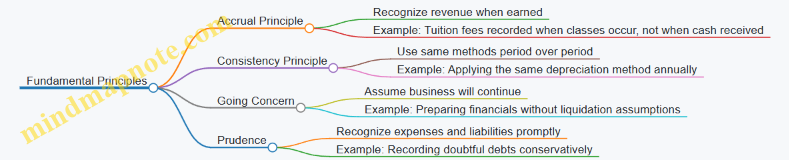
Mind Map: Key Accounting Standards Explored
Practical Example Recap: Applying Accrual Principle in Education Sector
Scenario: A university receives tuition payments in advance for the upcoming semester.
- According to the accrual principle, revenue should be recognized as the semester progresses, not when cash is received.
- This means initially recording the cash as a liability (deferred revenue) and gradually recognizing it as income.
Benefit: This ensures financial statements accurately reflect the period in which services are delivered.
Practical Example Recap: Lease Accounting for a University Campus Building
- Under IFRS 16, the university recognizes a right-of-use asset and a corresponding lease liability on the balance sheet.
- Lease payments are split between interest expense and liability reduction.
Best Practice: Maintain detailed lease agreements and update accounting systems to automate calculations.
Summary Table: Key Concepts and Examples
| Concept | Description | Example |
|---|---|---|
| Accrual Principle | Recognize revenue/expenses when earned/incurred | Tuition fees recognized over the semester |
| Consistency Principle | Use consistent accounting methods | Same depreciation method applied yearly |
| Revenue Recognition | Recognize revenue when control transfers | Multi-year education contract revenue recognition |
| Asset Valuation | Measure assets at cost or revalued amount | Impairment of obsolete equipment |
| Lease Accounting | Recognize right-of-use assets and liabilities | Accounting for leased campus building |
This recap consolidates the foundational knowledge and practical applications of accounting standards critical for accountants and auditors in finance and education sectors. Applying these concepts consistently ensures compliance, accuracy, and transparency in financial reporting.
10.2 Checklist for Implementing Accounting Standards Effectively
Implementing accounting standards effectively requires a systematic approach that ensures compliance, accuracy, and transparency in financial reporting. Below is a comprehensive checklist designed to guide accountants and auditors through the essential steps, accompanied by mind maps and practical examples to facilitate understanding.
Checklist for Implementing Accounting Standards
-
Understand Applicable Standards
- Identify the relevant accounting framework (e.g., IFRS, GAAP).
- Stay updated on recent amendments and interpretations.
-
Assess Organizational Impact
- Evaluate how standards affect current accounting policies.
- Identify areas requiring changes or new disclosures.
-
Develop or Update Accounting Policies
- Document policies aligned with standards.
- Ensure policies are clear and accessible to accounting staff.
-
Train Accounting and Audit Teams
- Conduct regular training sessions.
- Use real-life examples to illustrate application.
-
Integrate Standards into Systems
- Configure accounting software to reflect standards.
- Automate calculations and reporting where possible.
-
Implement Internal Controls
- Establish review and approval workflows.
- Monitor compliance through periodic audits.
-
Prepare Financial Statements
- Apply standards consistently in financial reports.
- Include all required disclosures.
-
Review and Quality Assurance
- Conduct internal and external audits.
- Address identified gaps promptly.
-
Maintain Documentation
- Keep records of judgments and estimates.
- Archive training materials and policy updates.
-
Continuous Improvement
- Solicit feedback from users.
- Update processes as standards evolve.
Mind Map: Steps to Implement Accounting Standards
Mind Map: Internal Controls for Compliance
Practical Examples
Example 1: Applying the Checklist in an Educational Institution
- Understand Applicable Standards: The finance team identifies IFRS as the required framework.
- Assess Organizational Impact: They review how IFRS 15 affects tuition fee revenue recognition.
- Develop Policies: A new policy is documented to recognize revenue over the academic period.
- Train Teams: Workshops are held explaining the new revenue recognition approach.
- Integrate Systems: The accounting software is configured to defer tuition fees received in advance.
- Implement Controls: Monthly reconciliations verify deferred revenue balances.
- Prepare Statements: Financial reports reflect tuition revenue accurately with disclosures.
- Review & QA: Internal audit confirms compliance.
- Maintain Documentation: All policy changes and training attendance are recorded.
- Continuous Improvement: Feedback leads to refining the revenue recognition process.
Example 2: Checklist Use in a Finance Firm Auditing Process
- The audit team uses the checklist to verify client compliance with lease accounting standards.
- They confirm the client has updated policies per IFRS 16.
- They check system configurations and internal controls related to lease data.
- The audit includes testing sample lease contracts for correct recognition.
- Findings are documented, and recommendations are provided for improvement.
Summary
This checklist serves as a practical tool to ensure that accounting standards are implemented thoroughly and consistently. By combining clear steps, visual mind maps, and relatable examples, accountants and auditors can enhance their compliance efforts and contribute to high-quality financial reporting.
10.3 Tips for Staying Updated and Ensuring Ongoing Compliance
Staying current with evolving accounting standards and ensuring ongoing compliance is critical for accountants and auditors. This section provides practical tips, supported by mind maps and examples, to help finance professionals maintain accuracy, reliability, and regulatory adherence in their work.
Establish a Structured Learning Routine
- Subscribe to Official Updates: Follow regulatory bodies like IASB, FASB, and local standard setters.
- Schedule Regular Training: Monthly or quarterly sessions to review recent changes.
- Leverage Online Resources: Use webinars, newsletters, and professional forums.

Example: An accounting team at a university subscribes to IASB newsletters and holds quarterly review meetings to discuss new IFRS updates, ensuring all members understand implications for grant accounting.
Implement a Compliance Calendar
- Track Deadlines: Financial reporting, audit schedules, and standard updates.
- Assign Responsibilities: Designate team members to monitor specific standards.
- Automate Reminders: Use calendar tools integrated with accounting software.
Example: A finance firm uses Microsoft Outlook calendar with automated reminders for upcoming IFRS 16 lease accounting compliance deadlines, assigning the lease specialist to lead preparations.
Foster a Culture of Continuous Communication
- Regular Team Meetings: Discuss challenges and share knowledge.
- Create Internal Newsletters: Summarize key updates and best practices.
- Encourage Feedback: Open channels for questions and clarifications.
Example: An educational institution circulates a monthly newsletter highlighting recent changes in accounting standards and invites staff to submit questions, which are addressed in the next meeting.
Utilize Technology and Tools
- Accounting Software Updates: Ensure software reflects latest standards.
- Compliance Management Systems: Track adherence and generate reports.
- Knowledge Management Platforms: Centralize documentation and training materials.
Example: A finance department uses an ERP system with built-in IFRS compliance modules and a SharePoint site where updated accounting policies and training videos are stored.
Engage with Professional Networks and Bodies
- Join Accounting Associations: Access resources and expert insights.
- Attend Conferences and Workshops: Stay informed on trends and interpretations.
- Participate in Peer Groups: Share experiences and solutions.
Example: An auditor regularly attends ACCA webinars and local chapter meetings, gaining early insights into upcoming IFRS amendments relevant to audit procedures.
Maintain Comprehensive Documentation
- Record Policy Changes: Document updates and rationale.
- Keep Audit Trails: Track decisions and compliance checks.
- Prepare Standard Operating Procedures (SOPs): Ensure consistency.
Example: A finance team maintains a version-controlled document repository where all changes to revenue recognition policies are logged, facilitating smooth audits and internal reviews.
Summary Table of Tips and Examples
| Tip | Description | Example Scenario |
|---|---|---|
| Structured Learning Routine | Regularly update knowledge via official sources and training | University team reviews IFRS updates quarterly |
| Compliance Calendar | Track deadlines and assign responsibilities | Finance firm uses calendar reminders for IFRS 16 |
| Continuous Communication | Share updates and encourage feedback | Educational institution circulates monthly newsletter |
| Technology & Tools | Use software and platforms for compliance | ERP system with IFRS modules and SharePoint docs |
| Professional Engagement | Join associations and attend events | Auditor attends ACCA webinars and local meetings |
| Documentation | Maintain records and SOPs for transparency | Finance team logs policy changes with version control |
By integrating these tips into daily workflows, accountants and auditors can confidently navigate the dynamic landscape of accounting standards, ensuring accuracy, compliance, and professional excellence.
10.4 Final Best Practices for Accountants and Auditors
As accountants and auditors, adhering to best practices ensures accuracy, compliance, and trustworthiness in financial reporting. Below is a comprehensive guide to final best practices, supported by mind maps and practical examples to help embed these principles into your daily work.
Maintain Continuous Professional Education
- Stay updated with the latest changes in accounting standards and regulations.
- Participate in webinars, workshops, and certification courses.
Example: An auditor subscribes to IFRS Foundation updates and attends quarterly refresher courses, ensuring they are aware of new amendments like IFRS 17.
Implement Robust Internal Controls
- Establish clear policies and procedures aligned with accounting standards.
- Regularly review and update internal controls to mitigate risks.
Example: A finance team implements segregation of duties in revenue recognition processes to prevent errors and fraud.
Document Accounting Policies Clearly
- Create comprehensive documentation for all accounting policies.
- Ensure policies reflect current standards and are accessible to all relevant staff.
Example: An educational institution documents its revenue recognition policy for tuition fees, referencing IFRS 15 criteria.
Foster Collaboration Between Accountants and Auditors
- Encourage open communication to resolve ambiguities and improve compliance.
- Share insights on complex transactions and interpretations.
Example: During an audit, the auditor and accounting team jointly review lease contracts to ensure correct application of IFRS 16.
Use Technology to Enhance Accuracy and Efficiency
- Leverage accounting software with built-in compliance features.
- Automate routine checks and reconciliations.
Example: An accounting firm uses software that flags inconsistencies in financial statements based on GAAP rules.
Conduct Regular Compliance Reviews and Audits
- Schedule periodic internal audits focusing on adherence to standards.
- Use findings to improve processes and training.
Example: A finance department performs quarterly reviews of asset impairment calculations to ensure compliance with IAS 36.
Embrace Ethical Standards and Professional Skepticism
- Uphold integrity and objectivity in all accounting and auditing activities.
- Question unusual transactions and seek evidence.
Example: An auditor investigates a sudden spike in revenue, requesting additional documentation before signing off.
Mind Maps
Mind Map 1: Continuous Professional Development
Mind Map 2: Internal Controls and Documentation
Mind Map 3: Collaboration and Communication
Mind Map 4: Technology and Automation
Mind Map 5: Ethical Practices
Practical Example: Monthly Compliance Review Template
| Area | Checklist Item | Status | Notes |
|---|---|---|---|
| Revenue Recognition | Verify revenue matches contract terms | ✅ | |
| Asset Valuation | Confirm impairment tests completed | ✅ | |
| Lease Accounting | Review lease classification and calculations | ✅ | New lease added this month |
| Internal Controls | Segregation of duties maintained | ✅ | |
| Documentation | Policies updated and accessible | ✅ | Updated for latest IFRS 15 |
| Training | Team attended recent standards update webinar | ✅ |
By integrating these best practices, accountants and auditors can ensure compliance, improve financial accuracy, and uphold the highest professional standards in their work.
10.5 Example: Sample Monthly Compliance Review Template for Finance Teams
A Monthly Compliance Review Template is an essential tool for finance teams to ensure ongoing adherence to accounting standards and internal controls. This example provides a structured approach to reviewing compliance, identifying issues early, and maintaining accurate financial reporting.
Monthly Compliance Review Template
| Section | Description | Responsible Person | Status (Complete/In Progress/Not Started) | Notes/Actions Required |
|---|---|---|---|---|
| 1. Revenue Recognition | Verify revenue recorded aligns with applicable standards (e.g., IFRS 15). | Revenue Accountant | ||
| 2. Asset Valuation | Confirm asset valuations and impairment tests are up to date. | Asset Manager | ||
| 3. Liabilities & Provisions | Review all liabilities and provisions for accuracy and completeness. | Finance Controller | ||
| 4. Lease Accounting | Check lease agreements and accounting treatment per IFRS 16/ASC 842. | Lease Specialist | ||
| 5. Financial Instruments | Ensure correct recognition and measurement of financial instruments. | Treasury Accountant | ||
| 6. Internal Controls | Assess effectiveness of internal controls related to accounting processes. | Internal Auditor | ||
| 7. Regulatory Updates | Review any new or updated accounting standards applicable this month. | Compliance Officer | ||
| 8. Documentation Review | Confirm all accounting policies and procedures are documented and updated. | Finance Manager | ||
| 9. Training & Awareness | Check if team members have completed required training on standards. | HR/Training Lead | ||
| 10. Audit Findings | Review and address any outstanding audit findings or recommendations. | Audit Lead |
Mind Map: Monthly Compliance Review Workflow
Example: Completed Monthly Compliance Review Entry
| Section | Description | Responsible Person | Status | Notes/Actions Required |
|---|---|---|---|---|
| 1. Revenue Recognition | Verified revenue recognition for all contracts signed in March. | Revenue Accountant | Complete | No discrepancies found. |
| 2. Asset Valuation | Conducted impairment test on machinery; no impairment identified. | Asset Manager | Complete | Schedule next test in 6 months. |
| 3. Liabilities & Provisions | Reviewed provisions for legal claims; estimates updated based on new info. | Finance Controller | Complete | Document assumptions in notes. |
| 4. Lease Accounting | Updated lease schedule for new office lease starting April 1. | Lease Specialist | Complete | Ensure correct entries in April financials. |
| 5. Financial Instruments | Confirmed classification of new bonds purchased. | Treasury Accountant | Complete | Monitor market value monthly. |
| 6. Internal Controls | Tested segregation of duties controls; no issues found. | Internal Auditor | Complete | Maintain current control environment. |
| 7. Regulatory Updates | Reviewed IFRS 17 updates; no immediate impact on current reporting. | Compliance Officer | Complete | Monitor for future implementation guidance. |
| 8. Documentation Review | Updated revenue recognition policy to include recent clarifications. | Finance Manager | Complete | Distribute updated policy to team. |
| 9. Training & Awareness | 90% of team completed refresher training on lease accounting. | HR/Training Lead | In Progress | Schedule makeup sessions for remaining staff. |
| 10. Audit Findings | Addressed all prior audit recommendations related to asset valuation. | Audit Lead | Complete | Prepare report for next audit cycle. |
Tips for Effective Monthly Compliance Reviews
- Assign Clear Responsibilities: Ensure each section has a designated owner.
- Use Checklists: Standardize review items to avoid omissions.
- Document Findings: Keep detailed notes for audit trails and continuous improvement.
- Schedule Regular Training: Keep the team updated on evolving standards.
- Leverage Technology: Use accounting software features to automate compliance checks.
This template and approach help finance teams maintain robust compliance with accounting standards, reduce risk of errors, and prepare for audits efficiently.