Accounting for Leasing Transactions
1. Introduction to Leasing Transactions
1.1 Definition and Types of Leases
Definition of a Lease
A lease is a contractual agreement where the lessor (owner) grants the lessee (user) the right to use an asset for a specified period in exchange for periodic payments. Leasing is a common financing method used in both finance and real estate sectors, allowing businesses to use assets without owning them outright.
Key Elements of a Lease:
- Identified Asset: The asset must be explicitly or implicitly specified.
- Right to Control: The lessee must have the right to control the use of the asset.
- Lease Term: The duration over which the lessee has the right to use the asset.
- Lease Payments: Consideration paid by the lessee to the lessor.
Types of Leases
Leases are primarily classified into two broad categories based on accounting standards such as IFRS 16 and ASC 842:
- Finance Lease (Capital Lease)
- Operating Lease
Each type has distinct accounting treatments and implications.
Mind Map: Overview of Lease Types
Finance Lease (Capital Lease)
A finance lease effectively transfers substantially all the risks and rewards of ownership to the lessee, even if legal ownership is not transferred.
Characteristics:
- Lease term covers the majority of the asset’s useful life.
- Option to purchase the asset at a bargain price.
- Present value of lease payments approximates the asset’s fair value.
Example: A company leases a piece of machinery for 8 years, while the machinery’s useful life is 10 years. The lease agreement includes an option to purchase the machinery at the end of the lease for a nominal price.
Accounting Implication: The lessee recognizes the leased asset as a right-of-use asset and a corresponding lease liability on the balance sheet.
Operating Lease
An operating lease does not transfer substantially all risks and rewards of ownership. The lessee uses the asset for a shorter period and does not capitalize the asset.
Characteristics:
- Lease term is shorter relative to asset life.
- No transfer of ownership or bargain purchase option.
- Lease payments are recognized as an expense on a straight-line basis.
Example: A retail company leases office space for 3 years with no option to purchase. The lease payments are made monthly.
Accounting Implication: Under IFRS 16, lessees recognize a right-of-use asset and lease liability even for operating leases, but the expense recognition pattern differs from finance leases.
Mind Map: Lease Classification Criteria
Additional Lease Types (Contextual)
- Sales-Type Lease: Used by lessors when the lease is a finance lease and the lessor recognizes a selling profit.
- Direct Financing Lease: Lessor finances the asset without recognizing selling profit.
These are more relevant from the lessor’s perspective but important for auditors and accountants to understand.
Practical Example: Identifying Lease Types in Real Estate and Equipment
Scenario 1: Real Estate Lease A company leases a warehouse for 10 years. The warehouse has an estimated useful life of 40 years. The lease does not include a purchase option.
- Lease term is 25% of asset life (10/40).
- No transfer of ownership.
- This lease is classified as an Operating Lease.
Scenario 2: Equipment Lease A firm leases manufacturing equipment for 7 years. The equipment’s useful life is 8 years. The lease includes an option to buy the equipment at a nominal price at the end.
- Lease term is 87.5% of asset life (7/8).
- Purchase option at bargain price.
- This lease is classified as a Finance Lease.
Summary
Understanding the definition and types of leases is fundamental for accurate accounting and compliance. Proper classification impacts financial statements, tax treatment, and audit procedures. Using clear criteria and examples helps accountants and auditors apply standards consistently.
1.2 Importance of Accurate Lease Accounting
Accurate lease accounting is critical for organizations, especially within the finance and real estate sectors, as it directly impacts financial reporting, compliance, decision-making, and stakeholder trust. Below, we explore the key reasons why precise lease accounting is indispensable, supported by mind maps and practical examples.
Why Accurate Lease Accounting Matters
- Financial Statement Integrity: Ensures assets and liabilities are correctly reported, reflecting the true financial position.
- Regulatory Compliance: Meets the requirements of accounting standards such as IFRS 16 and ASC 842.
- Risk Management: Identifies lease obligations to avoid unexpected financial burdens.
- Investor Confidence: Transparent reporting fosters trust and supports investment decisions.
- Operational Efficiency: Helps in budgeting, forecasting, and lease portfolio management.
Mind Map: Core Benefits of Accurate Lease Accounting
Example 1: Impact on Financial Statements
Scenario: A real estate company leases multiple office buildings but has not accurately accounted for lease liabilities.
- Without Accurate Accounting: Lease obligations are understated, leading to inflated equity and understated liabilities.
- Result: Financial statements mislead investors about the company’s leverage and risk exposure.
Best Practice: Recognize right-of-use assets and lease liabilities at the commencement date, using the present value of lease payments.
Mind Map: Consequences of Inaccurate Lease Accounting
Example 2: Compliance and Audit Considerations
Scenario: An auditor reviews a company’s lease portfolio and finds inconsistencies in lease classification.
- Issue: Operating leases are incorrectly classified as finance leases, affecting depreciation and interest expense recognition.
- Impact: The company faces audit adjustments and potential restatements.
Best Practice: Implement robust lease review processes and maintain clear documentation to support lease classification decisions.
Mind Map: Best Practices to Ensure Accurate Lease Accounting
Example 3: Operational Benefits
Scenario: A finance team uses lease accounting software to track lease terms, payment schedules, and renewals.
- Outcome: Improved forecasting accuracy and timely recognition of lease modifications.
- Benefit: Enables proactive lease portfolio management and cost control.
Summary
Accurate lease accounting is foundational to reliable financial reporting, regulatory compliance, and effective business management. By understanding its importance and applying best practices, accountants and auditors can safeguard their organizations against financial misstatements and operational risks.
1.3 Overview of Lease Accounting Standards (IFRS 16 and ASC 842)
Lease accounting has undergone significant changes with the introduction of IFRS 16 and ASC 842, aiming to increase transparency and comparability by bringing most leases onto the balance sheet. This section provides a detailed overview of these standards, highlighting their key principles, differences, and practical implications.
Key Objectives of IFRS 16 and ASC 842
- Eliminate off-balance sheet financing for lessees by recognizing lease liabilities and right-of-use (ROU) assets.
- Provide more relevant and faithful representation of leasing transactions.
- Enhance disclosures to improve financial statement users’ understanding.
Mind Map: Core Principles of IFRS 16 and ASC 842
Scope and Exemptions
| Aspect | IFRS 16 | ASC 842 |
|---|---|---|
| Lease Types Covered | All leases except short-term (<12 months) and low-value assets | All leases except short-term (<12 months) and certain intangible assets |
| Exemptions | Low-value assets (e.g., tablets, small office equipment) | Similar exemptions, but definitions may vary |
Recognition and Measurement
-
Initial Recognition:
- Both standards require lessees to recognize a lease liability (present value of lease payments) and a right-of-use asset.
-
Subsequent Measurement:
- IFRS 16 uses a single model for all leases.
- ASC 842 distinguishes between finance and operating leases, affecting expense recognition.
Mind Map: Lease Classification and Expense Recognition Under ASC 842
Practical Example 1: Lease Recognition Under IFRS 16
Scenario: A company leases office space for 5 years with annual lease payments of $100,000 payable at the end of each year. The discount rate is 5%.
-
Lease Liability Calculation:
- Present value of 5 payments of $100,000 discounted at 5%.
- PV = $100,000 * [1 - (1 + 0.05)^-5] / 0.05 = $432,947 (approx.)
-
Right-of-Use Asset: Initially recognized at $432,947.
-
Subsequent Accounting:
- Depreciate ROU asset over 5 years ($432,947 / 5 = $86,589 per year).
- Interest expense on lease liability reduces as payments are made.
Practical Example 2: Lease Classification and Expense Under ASC 842
Scenario: Same lease as above.
-
Lease Classification: Assume criteria for finance lease are met.
-
Accounting:
- Recognize lease liability and ROU asset at $432,947.
- Expense recognition:
- Interest on lease liability (declining over time).
- Amortization of ROU asset (straight-line over lease term).
-
If classified as Operating Lease:
- Recognize single lease expense of $100,000 per year on a straight-line basis.
Disclosure Requirements
Both standards require detailed disclosures including:
- Nature and terms of leases
- Maturity analysis of lease liabilities
- Expense recognized in profit or loss
- Cash flow information related to leases
Summary Table: IFRS 16 vs ASC 842
| Feature | IFRS 16 | ASC 842 |
|---|---|---|
| Lessee Model | Single model | Dual model (Finance & Operating) |
| Lease Classification | Not required for lessees | Required |
| Expense Recognition | Depreciation + Interest | Finance: Depreciation + Interest; Operating: Straight-line expense |
| Exemptions | Short-term & low-value leases | Short-term leases & some intangibles |
| Lessor Accounting | Similar to IAS 17 | Similar to previous guidance |
Best Practice Tips
- Maintain a detailed lease register capturing all lease terms.
- Use consistent discount rates aligned with incremental borrowing rates.
- Regularly review lease modifications and reassess classification.
- Coordinate with tax and legal teams to understand implications.
This comprehensive understanding of IFRS 16 and ASC 842 equips accountants and auditors to accurately apply lease accounting principles, ensuring compliance and enhancing financial reporting quality.
1.4 Common Challenges in Lease Accounting
Lease accounting has evolved significantly with the introduction of new standards such as IFRS 16 and ASC 842. While these standards aim to increase transparency and comparability, they also introduce several challenges for accountants and auditors. This section explores the most common challenges encountered in lease accounting, supported by mind maps and practical examples to facilitate understanding.
Mind Map: Common Challenges in Lease Accounting
Lease Identification Challenges
Challenge: Determining whether a contract contains a lease can be complex, especially when leases are embedded within service agreements.
Example: A company signs a contract for IT services that includes the use of specific servers. The servers are physically distinct and the company controls their use. Identifying this as a lease embedded in a service contract requires careful analysis.
Best Practice: Develop a checklist to identify embedded leases and train staff to recognize control and right-to-use indicators.
Lease Classification Difficulties
Challenge: Applying the criteria to classify leases as finance or operating can be subjective, particularly when lease terms or asset values are borderline.
Example: A lease for office equipment with a term close to the asset’s economic life requires judgment to determine classification.
Best Practice: Use decision trees and documented policies to ensure consistent classification.
Mind Map: Lease Classification Decision Process
Initial Measurement and Discount Rate Determination
Challenge: Calculating the lease liability requires selecting an appropriate discount rate, which may not always be readily available.
Example: A company leasing machinery must decide between using the incremental borrowing rate or the rate implicit in the lease, which is often undisclosed.
Best Practice: Establish a consistent approach to estimate discount rates, possibly involving finance teams or external benchmarks.
Managing Lease Modifications and Reassessments
Challenge: Lease modifications can be frequent and complex, requiring reassessment of lease terms and remeasurement of liabilities and assets.
Example: A retail chain extends the lease term of a store and negotiates a rent reduction. Accounting for this modification involves recalculating lease liability and adjusting the right-of-use asset.
Best Practice: Maintain a centralized lease management system to track modifications and automate recalculations.
Data Collection and Record-Keeping
Challenge: Gathering complete and accurate lease data across multiple departments and locations is difficult.
Example: A multinational company struggles to consolidate lease information from various subsidiaries, leading to incomplete lease registers.
Best Practice: Implement standardized lease data templates and conduct regular audits of lease records.
Mind Map: Lease Data Management Best Practices
Disclosure and Reporting Complexities
Challenge: Meeting the detailed disclosure requirements can be resource-intensive and impact financial statement presentation.
Example: An auditor identifies missing disclosures related to lease maturity analysis, requiring restatement.
Best Practice: Develop disclosure checklists aligned with standards and integrate disclosure preparation into the accounting cycle.
Reconciling Accounting and Tax Treatments
Challenge: Differences between lease accounting standards and tax regulations can cause timing differences and deferred tax complexities.
Example: Lease payments may be deductible for tax purposes when paid, but recognized differently in accounting, leading to deferred tax assets or liabilities.
Best Practice: Coordinate closely with tax professionals to align accounting and tax reporting.
System Integration and Automation
Challenge: Integrating lease accounting processes with existing ERP systems and automating calculations can be technically challenging.
Example: A finance team implements lease accounting software that does not fully integrate with their general ledger, causing reconciliation issues.
Best Practice: Evaluate software compatibility early and involve IT teams in implementation.
Summary
Lease accounting presents multiple challenges from identification to reporting. Addressing these requires a combination of clear policies, robust systems, and ongoing training. Using practical tools like mind maps and checklists can help accountants and auditors navigate complexities effectively.
1.5 Practical Example: Identifying Lease Types in Real Estate and Equipment
Understanding the classification of leases is fundamental for accurate accounting under IFRS 16 and ASC 842. This section provides practical examples and mind maps to help accountants and auditors identify lease types in real estate and equipment.
Mind Map: Lease Classification Criteria
Example 1: Real Estate Lease - Office Space
Scenario: A company leases an office space for 8 years. The economic life of the building is 40 years. The lease does not transfer ownership, nor does it include a bargain purchase option. The lease term is 20% of the asset’s economic life.
Analysis:
- Lease term (8 years) is not a major part of economic life (40 years).
- No transfer of ownership or bargain purchase option.
- Present value of lease payments is 60% of asset’s fair value.
Classification: Operating Lease
Reasoning: The lease term is less than the major part of the asset’s economic life, and other finance lease criteria are not met.
Mind Map: Real Estate Lease Decision Tree
Example 2: Equipment Lease - Manufacturing Machine
Scenario: A manufacturing company leases a machine for 5 years. The machine’s economic life is 6 years. The lease includes a bargain purchase option at the end of the term.
Analysis:
- Lease term (5 years) is approximately 83% of the economic life (6 years).
- Bargain purchase option exists.
Classification: Finance Lease
Reasoning: The lease term covers substantially all of the economic life, and the bargain purchase option indicates transfer of ownership benefits.
Mind Map: Equipment Lease Decision Tree
Summary Table: Lease Classification Examples
| Asset Type | Lease Term | Economic Life | Bargain Purchase Option | Present Value of Payments | Classification |
|---|---|---|---|---|---|
| Office Space | 8 years | 40 years | No | 60% | Operating Lease |
| Manufacturing Machine | 5 years | 6 years | Yes | 90% | Finance Lease |
Best Practices for Identifying Lease Types
- Gather Complete Lease Information: Ensure lease term, purchase options, payment schedules, and asset economic life are well documented.
- Use Decision Trees and Flowcharts: Visual tools help standardize classification decisions.
- Consult Accounting Standards: Regularly review IFRS 16 and ASC 842 criteria.
- Collaborate with Legal and Operations Teams: Confirm lease terms and asset usage.
- Document Rationale: Keep clear records of classification decisions for audit purposes.
By applying these examples and mind maps, accountants and auditors can confidently classify leases in both real estate and equipment contexts, ensuring compliance and accuracy in financial reporting.
2. Lease Classification and Initial Recognition
2.1 Criteria for Lease Classification: Finance vs Operating Leases
Lease classification is a critical step in lease accounting, determining how leases are recognized, measured, and presented in financial statements. The classification impacts both the balance sheet and income statement, influencing key financial metrics.
Overview
Under current accounting standards (IFRS 16 and ASC 842), leases are classified primarily into two categories:
- Finance Lease (also called Capital Lease under ASC 842): A lease that transfers substantially all the risks and rewards incidental to ownership of the underlying asset to the lessee.
- Operating Lease: A lease that does not transfer substantially all the risks and rewards incidental to ownership.
Key Criteria for Lease Classification
The classification depends on whether the lease meets one or more of the following criteria:
Lease Classification Mind Map
Transfer of Ownership
- Does the lease transfer ownership of the asset to the lessee by the end of the lease term?
- Example: A company leases office equipment with a clause that ownership transfers after 3 years.
Purchase Option (Bargain Purchase Option)
- Does the lease grant the lessee an option to purchase the asset at a price significantly lower than fair value?
- Example: A vehicle lease includes an option to buy the vehicle at 20% below market value at lease end.
Lease Term (Major Part of Economic Life)
- Is the lease term for the major part (typically 75% or more) of the asset’s economic life?
- Example: A 7-year lease on machinery with an estimated economic life of 8 years (87.5% of life).
Present Value of Lease Payments
- Does the present value of lease payments amount to substantially all (typically 90% or more) of the fair value of the asset?
- Example: Lease payments discounted at the incremental borrowing rate equal 95% of the asset’s fair value.
Specialized Asset
- Is the asset so specialized that only the lessee can use it without major modifications?
- Example: A custom-built manufacturing line leased to a single lessee.
Mind Map: Detailed Criteria with Examples
Practical Example
Scenario: ABC Corp leases a piece of equipment with the following details:
- Lease term: 6 years
- Economic life of equipment: 8 years
- Lease payments total: $480,000
- Fair value of equipment: $500,000
- Present value of lease payments (discounted): $460,000
- No transfer of ownership or purchase option
Analysis:
- Lease term is 75% of economic life (6/8 = 75%) → meets lease term criterion
- Present value of payments is 92% of fair value (460,000/500,000) → meets present value criterion
- No transfer of ownership or bargain purchase option
Conclusion: This lease qualifies as a Finance Lease because it meets two criteria.
Best Practices for Lease Classification
- Document all lease terms clearly: Ensure all clauses related to ownership, purchase options, and lease term are captured.
- Use consistent thresholds: Apply the 75% and 90% thresholds consistently but consider materiality and judgment.
- Perform present value calculations carefully: Use the appropriate discount rate (incremental borrowing rate or rate implicit in the lease).
- Review specialized asset criteria: Assess whether the asset’s nature limits its use to the lessee.
- Maintain a classification checklist: Helps ensure all criteria are evaluated systematically.
Summary
Lease classification determines the accounting treatment and financial reporting impact. Understanding and applying the criteria with practical examples ensures compliance and accuracy in financial statements.
2.2 Step-by-Step Approach to Lease Classification
Lease classification is a critical step in accounting for leasing transactions, as it determines how leases are recognized and measured on the financial statements. Both IFRS 16 and ASC 842 require leases to be classified primarily as either finance (capital) leases or operating leases (ASC 842) / all leases recognized on balance sheet (IFRS 16). This section breaks down the classification process into clear, actionable steps with practical examples and mind maps to aid understanding.
Step 1: Identify the Lease
- Definition: A lease is a contract that conveys the right to control the use of an identified asset for a period of time in exchange for consideration.
- Key considerations: Is there an identified asset? Does the lessee have the right to control its use?
Mind Map: Identifying a Lease
Example:
A company leases a specific office space in a building for 5 years. The office space is explicitly identified, and the company controls its use during the lease term. This contract qualifies as a lease.
Step 2: Determine Lease Term
- Lease term includes: Non-cancellable period + periods covered by options to extend or terminate if reasonably certain to be exercised or not exercised.
Mind Map: Lease Term Determination
Example:
A lease agreement is for 3 years with an option to extend for 2 more years. The lessee is reasonably certain to extend due to favorable market conditions. Lease term = 5 years.
Step 3: Identify Lease Classification Criteria (ASC 842)
Under ASC 842, leases are classified as finance leases if any of the following criteria are met; otherwise, they are operating leases:
- Transfer of ownership by end of lease term.
- Option to purchase the asset at a price expected to be sufficiently lower than fair value (bargain purchase option).
- Lease term is for the major part of the asset’s remaining economic life.
- Present value of lease payments equals or exceeds substantially all of the fair value of the asset.
- The asset is specialized and has no alternative use to the lessor.
Mind Map: Finance Lease Criteria (ASC 842)
Step 4: Apply the Criteria to Classify the Lease
Go through each criterion and evaluate if it applies.
Example:
A company leases machinery for 7 years. The machinery’s economic life is 10 years. Lease payments’ present value is 85% of the machinery’s fair value. There is no transfer of ownership or bargain purchase option.
- Ownership transfer? No
- Bargain purchase option? No
- Major part of economic life? 7/10 = 70% (typically >75% is major part, so No)
- PV of payments >= substantially all fair value? 85% (Yes)
- Specialized asset? No
Conclusion: Lease classified as a finance lease because PV of payments criterion is met.
Step 5: Consider IFRS 16 Approach
IFRS 16 requires lessees to recognize almost all leases on the balance sheet as right-of-use assets and lease liabilities. Lease classification primarily affects lessor accounting.
For lessors, classification is similar to previous IAS 17 rules:
- Finance lease if substantially all risks and rewards are transferred.
- Operating lease otherwise.
Mind Map: IFRS 16 Lessee Classification
Step 6: Document and Review Classification
- Maintain detailed documentation of the classification process.
- Review assumptions such as lease term and discount rate regularly.
- Update classification if lease modifications occur.
Summary Mind Map: Lease Classification Process
Additional Practical Example
Scenario: A retail company leases a store location for 8 years. The store’s estimated useful life is 15 years. Lease payments total $1,000,000, and the fair value of the store is $1,200,000. There is no transfer of ownership or purchase option.
- Ownership transfer? No
- Bargain purchase option? No
- Lease term as major part of economic life? 8/15 = 53% (No)
- PV of payments vs fair value? $1,000,000 / $1,200,000 = 83% (Yes, typically >90% is considered substantially all, so borderline)
- Specialized asset? No
Decision: Since the lease term is not a major part and no ownership transfer or bargain purchase option exists, and PV is slightly below typical threshold, this lease is likely classified as an operating lease under ASC 842.
By following this step-by-step approach with clear criteria and examples, accountants and auditors can confidently classify leases in compliance with current standards, ensuring accurate financial reporting and compliance.
2.3 Initial Measurement of Lease Liability and Right-of-Use Asset
When accounting for leasing transactions, the initial measurement of the lease liability and the right-of-use (ROU) asset is a critical step that sets the foundation for subsequent accounting. This section breaks down the process into clear, manageable steps, supported by mind maps and practical examples.
Initial Measurement Overview
- Lease Liability: Present value of lease payments not yet paid, discounted using the appropriate discount rate.
- Right-of-Use Asset: Initially measured at the amount of the lease liability, adjusted for any prepaid lease payments, lease incentives received, initial direct costs, and restoration obligations.
Mind Map: Initial Measurement Process
Step 1: Calculate Lease Liability
Lease liability is the present value of future lease payments. These payments include:
- Fixed payments (less any lease incentives)
- Variable lease payments based on an index or rate
- Amounts expected to be payable under residual value guarantees
- Exercise price of purchase options if reasonably certain to be exercised
- Penalties for terminating the lease if the lease term reflects exercising an option to terminate
Example:
A company leases office equipment with fixed monthly payments of $1,000 for 3 years. The lease does not include variable payments or purchase options. The incremental borrowing rate is 5% annually.
Calculation:
- Number of payments: 36 (monthly)
- Monthly discount rate: 5% / 12 = 0.4167%
Present value of an annuity formula:
PV = Pmt × [(1 - (1 + r)^-n) / r]
PV = $1,000 × [(1 - (1 + 0.004167)^-36) / 0.004167] ≈ $31,645
The lease liability is $31,645.
Step 2: Determine the Discount Rate
- Use the rate implicit in the lease if it can be readily determined.
- If not, use the lessee’s incremental borrowing rate.
Best Practice: Document how the discount rate was determined and maintain supporting calculations.
Step 3: Measure the Right-of-Use Asset
The ROU asset is initially measured as:
\[\text{Lease Liability} + \text{Initial Direct Costs} + \text{Prepaid Lease Payments} - \text{Lease Incentives Received} + \text{Restoration Costs} \]
Example:
Continuing the previous example, assume:
- Initial direct costs: $500 (broker fees)
- Prepaid lease payments: $1,000
- Lease incentives received: $0
- Restoration costs: $2,000 (estimated cost to restore equipment condition at lease end)
Calculation:
ROU Asset = $31,645 + $500 + $1,000 + $0 + $2,000 = $35,145
Mind Map: Components of Right-of-Use Asset
Practical Example: Office Space Lease
Scenario:
- Lease term: 5 years
- Annual fixed lease payments: $50,000 payable at year-end
- Incremental borrowing rate: 6%
- Initial direct costs: $2,000
- Prepaid lease payment: $10,000 (paid at lease commencement)
- Lease incentives received: $5,000
- Estimated restoration cost: $8,000
Step 1: Calculate Lease Liability
PV of lease payments:
PV = $50,000 × [1 - (1 + 0.06)^-5] / 0.06 = $50,000 × 4.21236 = $210,618
Step 2: Calculate ROU Asset
ROU Asset = $210,618 + $2,000 + $10,000 - $5,000 + $8,000 = $225,618
Summary of Best Practices
- Comprehensive Identification: Ensure all lease payments and related costs are identified.
- Accurate Discount Rate: Use the most appropriate discount rate and document assumptions.
- Detailed Documentation: Maintain clear records of calculations, assumptions, and supporting evidence.
- Consistent Application: Apply the same principles across similar leases for comparability.
This structured approach ensures that accountants and auditors can confidently measure lease liabilities and right-of-use assets, providing a solid foundation for accurate lease accounting and reporting.
2.4 Best Practices for Lease Data Collection and Documentation
Accurate and comprehensive data collection is the foundation of effective lease accounting. Proper documentation ensures compliance with accounting standards such as IFRS 16 and ASC 842, facilitates audit readiness, and supports transparent financial reporting. This section outlines best practices for lease data collection and documentation, illustrated with practical examples and mind maps to help accountants and auditors streamline the process.
Key Components of Lease Data Collection
- Lease Identification Details
- Lease contract reference
- Parties involved (lessor and lessee)
- Lease commencement and expiration dates
- Lease Terms and Conditions
- Lease term (including renewal and termination options)
- Payment schedule and amounts
- Variable lease payments
- Lease incentives
- Asset Information
- Description of the leased asset
- Location and usage
- Financial Information
- Discount rate or incremental borrowing rate
- Initial direct costs
- Residual value guarantees
Mind Map: Lease Data Collection Framework
Best Practices
-
Centralize Lease Documentation
- Maintain a centralized digital repository for all lease contracts and related documents.
- Use standardized naming conventions and version control.
-
Standardize Data Collection Templates
- Develop comprehensive lease data collection templates capturing all necessary fields.
- Ensure templates are aligned with accounting standards requirements.
-
Regularly Update Lease Data
- Schedule periodic reviews to capture lease modifications, renewals, or terminations.
- Track changes in lease terms promptly to reflect accurate accounting.
-
Collaborate Across Departments
- Engage legal, procurement, and facilities teams to gather complete and accurate lease information.
- Establish clear communication channels for updates and clarifications.
-
Leverage Technology Solutions
- Utilize lease accounting software with integrated data capture and validation features.
- Automate reminders for lease reviews and data updates.
-
Ensure Audit Trail and Compliance
- Keep records of all communications and approvals related to lease agreements.
- Document assumptions and judgments made during lease classification and measurement.
Practical Example: Implementing Lease Data Collection for a Real Estate Lease
Scenario: An accounting team is onboarding a new office lease for a 5-year term with an option to renew for 3 additional years.
- Step 1: Collect lease contract and verify parties involved.
- Step 2: Extract key dates: lease commencement, expiration, and renewal option deadlines.
- Step 3: Document payment schedule, including fixed monthly rent and variable maintenance charges.
- Step 4: Identify any lease incentives such as rent-free periods.
- Step 5: Determine the appropriate discount rate based on the company’s incremental borrowing rate.
- Step 6: Store all documents in a centralized lease management system with version control.
- Step 7: Schedule quarterly reviews to capture any amendments or changes.
Mind Map: Lease Data Update and Review Process
By following these best practices, accountants and auditors can ensure that lease data is accurate, complete, and well-documented, enabling reliable lease accounting and facilitating smoother audits.
2.5 Practical Example: Classifying a Lease for Office Space
When accountants and auditors classify a lease for office space, the key is to determine whether the lease is a finance lease or an operating lease under the applicable accounting standards (IFRS 16 or ASC 842). This classification affects how the lease is recognized on the balance sheet and how expenses are recorded.
Step 1: Understand the Lease Terms
- Lease term: 5 years
- Annual lease payments: $100,000
- Economic life of the office building: 20 years
- Ownership transfer: No
- Purchase option: No
- Lease includes options to extend for 2 additional years (not reasonably certain to be exercised)
Step 2: Apply Lease Classification Criteria
Mind Map: Lease Classification Criteria
Step 3: Analyze Each Criterion
- Transfer of Ownership: No transfer of ownership at lease end.
- Purchase Option: No purchase option included.
- Lease Term vs Economic Life:
- Lease term = 5 years
- Economic life = 20 years
- 5/20 = 25% (not a major part, typically >75% considered major)
- Present Value of Lease Payments:
- Discount rate (incremental borrowing rate) assumed at 5%
- Present Value (PV) of lease payments:
PV = $100,000 × [1 - (1 + 0.05)^-5] / 0.05
PV = $100,000 × 4.3295 = $432,950
- Assume fair value of office space is $2,000,000
- $432,950 is about 21.6% of fair value (not substantially all)
Step 4: Classification Decision
Since none of the finance lease criteria are met, this lease is classified as an operating lease.
Step 5: Accounting Treatment Overview
-
Operating Lease:
- Recognize right-of-use asset and lease liability at present value of lease payments.
- Lease expense recognized on a straight-line basis over lease term.
-
Finance Lease (if it had qualified):
- Recognize right-of-use asset and lease liability.
- Interest expense on lease liability and depreciation on right-of-use asset separately recognized.
Additional Example: Lease with Purchase Option
Suppose the same lease includes a purchase option at the end of 5 years for $1,900,000, and the lessee is reasonably certain to exercise it.
- This triggers finance lease classification because the purchase option is reasonably certain to be exercised.
Mind Map: Impact of Purchase Option
Summary Table: Lease Classification for Office Space Example
| Criterion | Lease Terms | Meets Finance Lease Criteria? |
|---|---|---|
| Transfer of Ownership | No | No |
| Purchase Option | No | No |
| Lease Term / Economic Life | 25% | No |
| Present Value / Fair Value | 21.6% | No |
| Overall Classification | Operating Lease |
Best Practices for Accountants and Auditors
- Gather Complete Lease Details: Ensure all lease terms, options, and economic life data are documented.
- Use Accurate Discount Rates: Reflect the lessee’s incremental borrowing rate or rate implicit in the lease.
- Document Judgments: Clearly document assumptions about options and lease term.
- Review Regularly: Reassess lease classification if lease terms or circumstances change.
This example demonstrates how to methodically apply lease classification criteria with clear calculations and practical judgment, ensuring compliance and accurate financial reporting.
2.6 Common Pitfalls in Initial Recognition and How to Avoid Them
Accurate initial recognition of leasing transactions is critical for compliance and financial clarity. However, accountants and auditors often encounter several pitfalls during this stage. This section highlights these common pitfalls and provides actionable strategies to avoid them, supported by clear examples and mind maps for better understanding.
Common Pitfalls in Initial Recognition
Misclassification of Leases
Pitfall: Confusing operating leases with finance leases or failing to separate lease and non-lease components.
How to Avoid:
- Carefully apply classification criteria from IFRS 16/ASC 842.
- Separate lease components (e.g., service fees) from lease payments.
- Use decision trees or flowcharts to guide classification.
Example: A company leases office equipment bundled with maintenance services. Treating the entire payment as a lease payment inflates the lease liability. Instead, separate the maintenance service as a non-lease component.
Incorrect Lease Term Determination
Pitfall: Overestimating or underestimating the lease term by ignoring renewal or termination options.
How to Avoid:
- Review lease contracts thoroughly for extension/cancellation clauses.
- Assess the likelihood of exercising options based on business context.
- Document assumptions clearly.
Example: A retail company signs a 3-year lease with an option to renew for 2 additional years. Assuming only 3 years without considering renewal leads to understated liabilities.
Discount Rate Errors
Pitfall: Using an inappropriate discount rate, such as ignoring the implicit rate or incorrectly estimating the incremental borrowing rate.
How to Avoid:
- Use the rate implicit in the lease if readily determinable.
- If not, use the incremental borrowing rate specific to the lessee and lease term.
- Consult with treasury or finance teams for accurate rates.
Example: An auditor finds a lessee applied a generic corporate borrowing rate instead of the lease-specific incremental borrowing rate, resulting in misstated lease liabilities.
Incomplete Data Collection
Pitfall: Missing lease payments, variable lease payments, or non-lease components during initial measurement.
How to Avoid:
- Maintain a comprehensive lease register.
- Review contracts carefully for variable payments linked to indices or usage.
- Separate non-lease components explicitly.
Example: A company overlooks variable lease payments tied to sales volume, leading to under-recognition of lease liabilities.
Poor Documentation
Pitfall: Failing to document key assumptions, judgments, and data sources.
How to Avoid:
- Keep detailed records of lease terms, assumptions on lease term and discount rate.
- Document rationale for judgments.
- Use standardized templates for lease data capture.
Example: During an audit, missing documentation on the lease term assumptions causes delays and potential adjustments.
Summary Table of Pitfalls and Avoidance Strategies
| Pitfall | How to Avoid | Example Scenario |
|---|---|---|
| Misclassification | Apply classification criteria; separate components | Bundled lease with maintenance service |
| Incorrect Lease Term | Review options; document assumptions | Ignoring renewal options on retail lease |
| Discount Rate Errors | Use implicit rate or correct incremental rate | Using generic corporate borrowing rate |
| Incomplete Data Collection | Maintain lease register; review contracts | Missing variable payments tied to sales |
| Poor Documentation | Document assumptions and approvals | Missing lease term assumptions during audit |
By understanding and addressing these common pitfalls, accountants and auditors can ensure accurate initial recognition of leasing transactions, leading to compliant and reliable financial reporting.
3. Measurement and Subsequent Accounting of Lease Liabilities
3.1 Calculating Lease Liability Using Present Value Techniques
Lease liability represents the present value of future lease payments that a lessee is obligated to make over the lease term. Calculating this liability accurately is crucial for compliance with lease accounting standards such as IFRS 16 and ASC 842.
Understanding Present Value in Lease Liability
Present value (PV) is the current worth of a future sum of money or stream of cash flows given a specified rate of return (discount rate). In lease accounting, the lease liability is the PV of lease payments discounted using the appropriate discount rate.
Key Components for Calculating Lease Liability
- Lease Payments: Fixed payments, variable payments based on an index or rate, purchase options, penalties for termination, etc.
- Lease Term: Non-cancellable period plus optional periods if reasonably certain to be exercised.
- Discount Rate: Rate implicit in the lease or, if not readily determinable, the lessee’s incremental borrowing rate.
Mind Map: Components of Lease Liability Calculation
Step-by-Step Calculation Process
- Identify Lease Payments: Determine all payments the lessee is obligated to make.
- Determine Lease Term: Assess the lease period including options likely to be exercised.
- Select Discount Rate: Use the rate implicit in the lease or incremental borrowing rate.
- Calculate Present Value: Discount the lease payments over the lease term.
Mind Map: Calculation Process
Example 1: Calculating Lease Liability for Office Equipment
Scenario:
- Lease term: 5 years
- Annual lease payment: $10,000 payable at year-end
- Discount rate (incremental borrowing rate): 6%
Calculation:
We calculate the present value of an annuity of $10,000 for 5 years at 6% discount rate.
Formula for Present Value of Annuity:
\[ PV = Pmt \times \frac{1 - (1 + r)^{-n}}{r} \]
Where:
- \(Pmt = 10,000\)
- \(r = 0.06\)
- \(n = 5\)
Calculation:
\[ PV = 10,000 \times \frac{1 - (1 + 0.06)^{-5}}{0.06} = 10,000 \times 4.21236 = 42,123.6 \]
Lease liability = $42,123.60
Example 2: Lease Liability with Variable Payments and Purchase Option
Scenario:
- Lease term: 3 years
- Annual fixed lease payment: $15,000
- Variable payment: $500 per year tied to an index (assumed fixed for calculation)
- Purchase option at end of lease: $5,000
- Discount rate: 5%
Step 1: Calculate total annual payment:
$15,000 + $500 = $15,500
Step 2: Calculate PV of lease payments:
\[ PV = 15,500 \times \frac{1 - (1 + 0.05)^{-3}}{0.05} = 15,500 \times 2.72325 = 42,221.38 \]
Step 3: Calculate PV of purchase option:
\[ PV = \frac{5,000}{(1 + 0.05)^3} = \frac{5,000}{1.15763} = 4,318.55 \]
Total Lease Liability:
$42,221.38 + $4,318.55 = $46,539.93
Mind Map: Example 2 Breakdown
Best Practices for Calculating Lease Liability
- Use accurate and updated discount rates: Reflect current borrowing costs.
- Include all relevant payments: Don’t omit variable or contingent payments if reasonably estimable.
- Document assumptions: Especially around lease term and discount rate.
- Leverage technology: Use lease accounting software to automate calculations and reduce errors.
- Review periodically: Reassess lease liability when lease terms or payments change.
By mastering present value techniques and understanding the components involved, accountants and auditors can ensure accurate lease liability measurement that complies with accounting standards and supports transparent financial reporting.
3.2 Determining the Appropriate Discount Rate
Determining the appropriate discount rate is a critical step in lease accounting, as it directly impacts the measurement of lease liabilities and right-of-use assets. The discount rate reflects the rate of interest implicit in the lease or, if that rate cannot be readily determined, the lessee’s incremental borrowing rate.
Key Concepts:
- Rate Implicit in the Lease: The rate that causes the present value of lease payments and unguaranteed residual value to equal the fair value of the leased asset plus any initial direct costs.
- Incremental Borrowing Rate (IBR): The rate a lessee would have to pay to borrow over a similar term, and with similar security, the funds necessary to obtain an asset of similar value in a similar economic environment.
Mind Map: Determining the Discount Rate
Step-by-Step Approach to Determine Discount Rate
-
Check for Rate Implicit in the Lease
- Review lease agreement and lessor disclosures.
- If available and reliably determinable, use this rate.
-
If Rate Implicit is Not Available, Determine Incremental Borrowing Rate
- Assess lessee’s creditworthiness.
- Identify comparable borrowing rates for similar terms and security.
- Adjust for lease term and currency.
-
Document Assumptions and Methodology
- Maintain transparency for audit and compliance.
Example 1: Using Rate Implicit in the Lease
A company leases a piece of equipment. The lessor provides the following information:
- Fair value of equipment: $100,000
- Lease payments: $20,000 annually for 6 years
- Initial direct costs: $2,000
The lessor states the implicit rate is 6%. The lessee uses this rate to discount lease payments.
Calculation:
- Present value of lease payments at 6% = $20,000 * PV annuity factor (6%, 6 years) ≈ $94,917
- Add initial direct costs: $2,000
- Total right-of-use asset = $96,917
This rate is used as the discount rate for lease liability measurement.
Example 2: Determining Incremental Borrowing Rate
A retail company leases a store but the implicit rate is not disclosed. The company’s credit rating is BBB, and it can borrow funds at 5.5% for 7 years.
- Lease term: 7 years
- Currency: USD
The company uses 5.5% as its incremental borrowing rate to discount lease payments.
Mind Map: Factors Influencing Incremental Borrowing Rate
Best Practices
- Consistency: Use consistent methodology across leases to ensure comparability.
- Documentation: Keep detailed records of assumptions and sources for discount rate determination.
- Regular Review: Reassess discount rates periodically, especially when lease terms or economic conditions change.
- Collaboration: Work with treasury or finance teams to obtain accurate borrowing rates.
Summary
Determining the appropriate discount rate requires careful evaluation of lease-specific data and lessee borrowing conditions. Using the rate implicit in the lease is preferred when available; otherwise, the incremental borrowing rate serves as a practical alternative. Accurate discount rate determination ensures proper measurement of lease liabilities and compliance with accounting standards.
3.3 Subsequent Measurement: Interest Expense and Lease Payments
After the initial recognition of the lease liability and right-of-use asset, subsequent measurement focuses on how to account for interest expense on the lease liability and the lease payments made over the lease term. This section will break down the concepts, calculations, and best practices with clear examples and mind maps to aid understanding.
Key Concepts
- Lease Liability: Initially measured at the present value of lease payments, it is subsequently increased by interest expense and decreased by lease payments.
- Interest Expense: Calculated on the lease liability using the discount rate determined at lease commencement.
- Lease Payments: Payments made to the lessor reduce the lease liability.
Mind Map: Subsequent Measurement Components
Step-by-Step Process
- Calculate Interest Expense
- Multiply the carrying amount of the lease liability at the beginning of the period by the discount rate.
- Record Lease Payment
- Reduce the lease liability by the amount of the lease payment made during the period.
- Update Lease Liability
- Lease liability increases by interest expense and decreases by lease payments.
Practical Example: Vehicle Lease
Scenario:
- Lease term: 3 years
- Annual lease payment: $10,000, payable at year-end
- Discount rate: 5%
- Initial lease liability: $27,234 (present value of lease payments)
| Year | Lease Liability (Start) | Interest Expense (5%) | Lease Payment | Lease Liability (End) |
|---|---|---|---|---|
| 1 | $27,234 | $1,362 | $10,000 | $18,596 |
| 2 | $18,596 | $930 | $10,000 | $9,526 |
| 3 | $9,526 | $476 | $10,000 | $1,002 (final adjustment) |
Explanation:
- At the start of Year 1, the lease liability is $27,234.
- Interest expense for Year 1 is $27,234 * 5% = $1,362.
- After paying $10,000, the lease liability reduces to $18,596.
- This process repeats for subsequent years.
Mind Map: Lease Liability Movement Over Time
Best Practices
- Consistent Application: Apply the discount rate consistently over the lease term unless reassessment is required.
- Accurate Payment Tracking: Ensure all lease payments, including fixed, variable, and in-substance fixed payments, are accounted for.
- Regular Reassessment: Monitor for lease modifications or changes in lease term that require remeasurement.
- Clear Documentation: Maintain detailed schedules showing interest expense calculations and lease payment applications.
Additional Example: Office Space Lease with Monthly Payments
Scenario:
- Lease term: 2 years
- Monthly lease payment: $2,000
- Discount rate: 6% annually (0.5% monthly)
- Initial lease liability: $45,000
Month 1 Calculation:
- Interest expense = $45,000 * 0.5% = $225
- Lease payment = $2,000
- Lease liability end of month = $45,000 + $225 - $2,000 = $43,225
This process repeats monthly, with the lease liability decreasing over time as payments are made and interest accrues.
Mind Map: Monthly Lease Payment Impact
Summary
Subsequent measurement of lease liabilities requires careful calculation of interest expense and application of lease payments to reduce the liability. Understanding this flow ensures accurate financial reporting and compliance with accounting standards.
By using detailed schedules, clear documentation, and consistent methodologies, accountants and auditors can effectively manage lease accounting throughout the lease term.
3.4 Reassessment of Lease Liabilities: Modifications and Revisions
Lease accounting standards such as IFRS 16 and ASC 842 require lessees to reassess lease liabilities when certain events occur. These reassessments ensure that the lease liability accurately reflects the present value of remaining lease payments based on updated terms or circumstances.
When to Reassess Lease Liabilities?
Lease liabilities must be reassessed in the following scenarios:
- Lease modifications that change the scope or consideration of the lease
- Changes in lease term (e.g., exercising or not exercising an extension or termination option)
- Changes in the assessment of an option to purchase the underlying asset
- Changes in future lease payments due to index or rate changes
Mind Map: Triggers for Lease Liability Reassessment
Accounting Treatment for Reassessment
-
Recalculate the lease liability using the revised lease payments discounted at the original discount rate (unless the modification includes a change in the lease term or scope that requires a new discount rate).
-
Adjust the right-of-use (ROU) asset by the amount of the change in the lease liability.
-
If the modification decreases the lease liability, the ROU asset is reduced accordingly. If the decrease exceeds the carrying amount of the ROU asset, the excess is recognized in profit or loss.
-
For modifications that add new leased assets or extend the lease term, a new discount rate may be applied.
Mind Map: Accounting Steps for Lease Liability Reassessment
Practical Example 1: Lease Modification Increasing Lease Payments
Scenario: A company leases office equipment for 5 years with annual payments of $10,000. After 2 years, the lessor and lessee agree to add an additional piece of equipment to the lease, increasing annual payments to $15,000 for the remaining 3 years.
Steps:
- Recalculate lease liability based on revised payments ($15,000 for 3 years).
- Use the original discount rate from the initial lease.
- Increase the ROU asset by the increase in lease liability.
Illustration:
- Original lease liability at year 2: Present value of $10,000 payments for 3 years.
- Revised lease liability: Present value of $15,000 payments for 3 years.
- Difference added to ROU asset.
Practical Example 2: Lease Term Extension
Scenario: A retail company leases a store for 3 years with an option to extend for 2 more years. Initially, the company did not expect to exercise the option. After 2 years, the company decides to extend the lease for the additional 2 years.
Steps:
- Reassess lease term to include the extension.
- Recalculate lease liability for the remaining 3 years plus extension period (total 5 years).
- Apply a revised discount rate reflecting the new lease term.
- Adjust the ROU asset accordingly.
Practical Example 3: Decrease in Lease Payments Due to Index Change
Scenario: A company leases a warehouse with lease payments indexed to inflation. Due to a decrease in the inflation index, lease payments reduce from $20,000 to $18,000 annually for the remaining 4 years.
Steps:
- Recalculate lease liability using revised payments ($18,000 annually).
- Discount using the original discount rate.
- Decrease the ROU asset by the amount of reduction in lease liability.
Best Practices for Reassessment
- Maintain detailed documentation of all lease modifications and reassessment triggers.
- Use lease accounting software to automate recalculations and adjustments.
- Communicate changes promptly with finance and audit teams.
- Review lease contracts regularly to identify potential reassessment events early.
Summary
Reassessment of lease liabilities is a critical process to ensure financial statements reflect the current obligations accurately. Understanding when and how to reassess, combined with clear documentation and practical application, helps accountants and auditors maintain compliance and provide transparent reporting.
3.5 Practical Example: Calculating Lease Liability for a Vehicle Lease
In this section, we will walk through a detailed example of how to calculate the lease liability for a vehicle lease, integrating best practices and clear explanations to help accountants and auditors understand the process thoroughly.
Scenario Overview
ABC Corporation enters into a 3-year lease agreement for a company vehicle. The lease payments are $500 per month, payable at the end of each month. The lease does not transfer ownership at the end of the term, and there is no purchase option. The interest rate implicit in the lease is not readily determinable, so ABC uses its incremental borrowing rate of 6% per annum.
Step 1: Identify Lease Term and Payments
- Lease term: 3 years (36 months)
- Monthly lease payment: $500
- Payment timing: End of each month
- Discount rate: 6% per annum (0.5% per month)
Step 2: Calculate Present Value of Lease Payments
The lease liability is the present value (PV) of future lease payments, discounted using the incremental borrowing rate.
Formula:
\[ \text{PV} = \sum_{t=1}^{n} \frac{Payment}{(1 + r)^t} \]
Where:
- \(n = 36\) months
- \(Payment = 500\)
- \(r = 0.5\%\) monthly discount rate (6% / 12)
Mind Map: Lease Liability Calculation Process
Step 3: Using the Present Value of an Annuity Formula
Since payments are equal and periodic, we can use the present value of an annuity formula:
\[ \text{PV} = P \times \frac{1 - (1 + r)^{-n}}{r} \]
Where:
- \(P = 500\)
- \(r = 0.005\) (0.5%)
- \(n = 36\)
Calculating:
\[ \text{PV} = 500 \times \frac{1 - (1 + 0.005)^{-36}}{0.005} \]
\[ (1 + 0.005)^{-36} = (1.005)^{-36} \approx 0.835645 \]
\[ 1 - 0.835645 = 0.164355 \]
\[ \frac{0.164355}{0.005} = 32.871 \]
\[ \text{PV} = 500 \times 32.871 = 16,435.50 \]
Step 4: Record Initial Lease Liability
ABC Corporation will recognize a lease liability of $16,435.50 at the commencement date.
Step 5: Recognize Right-of-Use Asset
The right-of-use asset is initially measured at the same amount as the lease liability, adjusted for any prepaid lease payments, lease incentives, or initial direct costs (assumed zero in this example).
Mind Map: Journal Entry at Lease Commencement
Step 6: Subsequent Measurement (Optional Preview)
Each month, ABC will:
- Pay $500 lease payment
- Recognize interest expense on lease liability
- Reduce lease liability by the principal portion of the payment
Additional Example: Effect of Payment Timing
If payments were made at the beginning of each month (annuity due), the lease liability would be higher because payments are discounted for one less period.
Adjusted PV formula for annuity due:
\[ \text{PV}_{due} = \text{PV}_{ordinary} \times (1 + r) \]
\[ 16,435.50 \times 1.005 = 16,517.68 \]
Summary Table
| Parameter | Value |
|---|---|
| Lease Term | 36 months |
| Monthly Payment | $500 |
| Discount Rate (monthly) | 0.5% |
| Present Value of Lease Liability | $16,435.50 |
Best Practices Highlight
- Use appropriate discount rate: When implicit rate is unknown, use incremental borrowing rate.
- Confirm payment timing: End vs beginning of period affects PV calculation.
- Document assumptions: Clearly record discount rate, lease term, and payment schedule.
- Use software tools: For complex leases, lease accounting software can automate calculations and reduce errors.
This example demonstrates a clear, step-by-step approach to calculating lease liability for a vehicle lease, providing a practical framework for accountants and auditors to apply in real-world scenarios.
3.6 Best Practices for Maintaining Accurate Lease Liability Records
Maintaining accurate lease liability records is crucial for ensuring compliance with accounting standards such as IFRS 16 and ASC 842, as well as for providing reliable financial information to stakeholders. Below are best practices that accountants and auditors can implement to keep lease liability records precise, up-to-date, and audit-ready.
Centralize Lease Data Management
- Maintain a centralized lease repository that consolidates all lease agreements, amendments, and related documents.
- Use lease management software or a dedicated database to track lease terms, payment schedules, and discount rates.
Example: A real estate company uses a cloud-based lease management system where all office space leases are uploaded. This system automatically calculates lease liabilities and flags upcoming lease renewals.
Regularly Reassess Lease Terms and Modifications
- Periodically review leases for changes such as extensions, terminations, or rent escalations.
- Update lease liability calculations promptly to reflect modifications.
Example: An equipment lease is extended by 2 years. The accounting team recalculates the lease liability using the updated lease term and discount rate, adjusting the right-of-use asset accordingly.
Use Consistent Discount Rates and Assumptions
- Apply the appropriate incremental borrowing rate or implicit rate consistently across similar leases.
- Document assumptions clearly for audit trail purposes.
Example: A finance team decides to use the company’s incremental borrowing rate for all new vehicle leases and documents the rationale and source of the rate in the lease file.
Maintain Detailed Payment Schedules
- Record all scheduled lease payments, including fixed payments, variable payments linked to an index, and expected residual value guarantees.
- Track actual payments against schedules to identify discrepancies early.
Example: An auditor reviews the payment schedule for a leased warehouse and confirms that all variable lease payments tied to CPI adjustments are updated quarterly and reflected in the liability.
Implement Strong Internal Controls and Segregation of Duties
- Separate responsibilities for lease data entry, review, and approval to reduce errors and fraud.
- Conduct periodic reconciliations between lease records and general ledger balances.
Example: The accounting department assigns one team to input lease data and another independent team to review calculations and reconcile lease liabilities monthly.
Automate Calculations and Reporting Where Possible
- Use software tools to automate present value calculations, amortization schedules, and disclosure reports.
- Automate alerts for lease renewals, modifications, and payment due dates.
Example: A company uses lease accounting software that automatically recalculates lease liabilities when lease terms change and generates monthly reports for management review.
Keep Comprehensive Documentation for Audit Readiness
- Document all assumptions, judgments, and calculations related to lease liabilities.
- Retain copies of lease agreements, amendments, and correspondence.
Example: During an audit, the finance team provides detailed working papers showing how lease liabilities were calculated, including discount rates and payment schedules, facilitating a smooth audit process.
Summary Table of Best Practices
| Best Practice | Description | Example Scenario |
|---|---|---|
| Centralize Lease Data Management | Use a single system to store and manage lease information | Cloud-based lease repository for office leases |
| Regularly Reassess Lease Terms | Update records for lease modifications | Lease extension recalculation |
| Use Consistent Discount Rates | Apply and document discount rates uniformly | Using incremental borrowing rate for vehicle leases |
| Maintain Detailed Payment Schedules | Track all payment types and actual payments | CPI-adjusted warehouse lease payments |
| Implement Internal Controls | Segregate duties and reconcile regularly | Separate teams for data entry and review |
| Automate Calculations and Reporting | Utilize software for accuracy and efficiency | Automated lease liability recalculations |
| Keep Comprehensive Documentation | Maintain audit-ready records of all lease accounting details | Detailed working papers for audit |
By following these best practices, accountants and auditors can ensure that lease liability records remain accurate, compliant, and transparent, ultimately supporting better financial decision-making and reporting.
4. Accounting for Right-of-Use Assets
4.1 Initial Measurement and Recognition of Right-of-Use Assets
The initial measurement and recognition of Right-of-Use (ROU) assets is a fundamental step in lease accounting under IFRS 16 and ASC 842. This process ensures that lessees properly recognize the leased asset on their balance sheet, reflecting their right to use the underlying asset during the lease term.
What is a Right-of-Use Asset?
A Right-of-Use asset represents a lessee’s right to use an identified asset for the lease term. It is recognized at the commencement date of the lease and measured initially at cost.
Components of Initial Measurement
The initial measurement of the ROU asset includes the following components:
- Lease Liability: The present value of lease payments that the lessee is obligated to make over the lease term.
- Lease Payments Made at or Before Commencement: Any lease payments made to the lessor before or at the commencement date, less any lease incentives received.
- Initial Direct Costs: Incremental costs directly attributable to negotiating and arranging the lease.
- Restoration Costs: Estimated costs to dismantle, remove, or restore the underlying asset or the site, if applicable.
Mind Map: Initial Measurement of Right-of-Use Asset
Step-by-Step Process
- Determine the Lease Term: Identify the non-cancellable period plus options to extend or terminate if reasonably certain.
- Calculate Lease Liability: Discount future lease payments using the appropriate discount rate (incremental borrowing rate or rate implicit in the lease).
- Identify Prepaid Lease Payments: Include any payments made before or at commencement.
- Add Initial Direct Costs: Include costs directly related to securing the lease.
- Estimate Restoration Costs: Include any obligations to restore the asset or site.
- Sum All Components: The total forms the initial measurement of the ROU asset.
Practical Example: Office Space Lease
Scenario: A company leases office space for 5 years with annual lease payments of $50,000 payable at the end of each year. The incremental borrowing rate is 6%. The company paid $5,000 in legal fees to negotiate the lease and made a $10,000 security deposit at lease commencement. There are no lease incentives or restoration costs.
Step 1: Calculate Lease Liability
-
Present value of lease payments:
\[ PV = \sum_{t=1}^{5} \frac{50,000}{(1 + 0.06)^t} \]
Calculated PV ≈ $210,685
Step 2: Add Prepaid Lease Payments
- Security deposit: $10,000
Step 3: Add Initial Direct Costs
- Legal fees: $5,000
Step 4: Calculate Initial ROU Asset
- ROU Asset = Lease Liability + Prepaid Payments + Initial Direct Costs
- ROU Asset = $210,685 + $10,000 + $5,000 = $225,685
Journal Entry at Commencement:
| Account | Debit | Credit |
|---|---|---|
| Right-of-Use Asset | $225,685 | |
| Lease Liability | $210,685 | |
| Security Deposit (Asset) | $10,000 | |
| Cash (Legal Fees) | $5,000 |
Mind Map: Practical Example Breakdown
Best Practices
- Accurate Identification of Lease Term: Carefully evaluate extension and termination options to avoid misstating the ROU asset.
- Use Appropriate Discount Rate: Prefer the rate implicit in the lease; if unavailable, use the incremental borrowing rate.
- Include All Relevant Costs: Don’t overlook initial direct costs or restoration obligations.
- Maintain Detailed Documentation: Keep records of assumptions, calculations, and supporting documents for audit purposes.
- Leverage Technology: Use lease accounting software to automate calculations and ensure compliance.
Summary
The initial measurement and recognition of the Right-of-Use asset require a comprehensive approach that combines lease liability calculation, inclusion of prepaid payments, initial direct costs, and restoration obligations. Proper application of these principles ensures accurate financial reporting and compliance with lease accounting standards.
4.2 Depreciation Methods and Useful Life Considerations
When accounting for right-of-use (ROU) assets in leasing transactions, depreciation plays a crucial role in reflecting the asset’s consumption over time. Understanding the appropriate depreciation methods and determining the useful life of the ROU asset ensures accurate financial reporting and compliance with accounting standards.
Depreciation Methods for Right-of-Use Assets
The most commonly used depreciation methods for ROU assets include:
- Straight-Line Depreciation
- Reducing Balance (Declining Balance) Depreciation
- Units of Production Depreciation
However, IFRS 16 and ASC 842 generally recommend the straight-line method unless another method better reflects the pattern of consumption.
Mind Map: Depreciation Methods Overview
Straight-Line Depreciation
Definition: Allocates the cost of the ROU asset evenly over its useful life.
Formula:
\[ \text{Depreciation Expense} = \frac{\text{Cost of ROU Asset} - \text{Residual Value}}{\text{Useful Life}} \]
Example:
A company leases office space with an initial ROU asset value of $120,000. The lease term (useful life) is 5 years, and the residual value is zero.
- Annual Depreciation = $120,000 / 5 = $24,000
Each year, the company records $24,000 depreciation expense.
Reducing Balance Depreciation
Definition: Applies a fixed depreciation rate to the carrying amount of the asset each year, resulting in higher expenses initially.
Example:
Using the same $120,000 ROU asset with a depreciation rate of 40%:
- Year 1: $120,000 x 40% = $48,000
- Year 2: ($120,000 - $48,000) x 40% = $28,800
This method is less common for ROU assets but may be appropriate if usage is front-loaded.
Units of Production Depreciation
Definition: Depreciates the asset based on actual usage or output.
Example:
A company leases machinery with an ROU asset value of $100,000. The estimated total usage is 10,000 hours.
- Depreciation per hour = $100,000 / 10,000 = $10
- If the machine is used 1,200 hours in Year 1, depreciation = 1,200 x $10 = $12,000
Useful Life Considerations for ROU Assets
Determining the useful life of the ROU asset is critical and depends on:
- Lease Term: The non-cancellable period plus any renewal options reasonably certain to be exercised.
- Economic Life of the Underlying Asset: If ownership transfers or purchase options exist, the useful life may extend beyond the lease term.
- Residual Value: Usually zero for ROU assets, but if there is a residual value, it affects depreciation.
Mind Map: Useful Life Determination
Practical Example: Useful Life Determination
A company leases a vehicle for 4 years with an option to purchase at the end. The vehicle’s economic life is 8 years.
- Since the purchase option is reasonably certain to be exercised, the useful life of the ROU asset is 8 years.
- Depreciation is calculated over 8 years, not 4.
Best Practices
- Document assumptions clearly: Especially regarding lease term and renewal options.
- Review useful life annually: Adjust if circumstances change.
- Use straight-line depreciation unless justified otherwise: It aligns with most lease consumption patterns.
- Coordinate with tax and audit teams: To ensure consistency and compliance.
By carefully selecting the depreciation method and accurately determining the useful life, accountants and auditors can ensure that the financial statements reflect the true economic impact of leasing transactions.
4.3 Impairment Testing for Right-of-Use Assets
Impairment testing for Right-of-Use (ROU) assets is a critical step in lease accounting to ensure that the asset’s carrying amount does not exceed its recoverable amount. This section will guide accountants and auditors through the impairment process with clear explanations, mind maps, and practical examples.
What is Impairment of ROU Assets?
Impairment occurs when the carrying amount of the ROU asset exceeds its recoverable amount, meaning the asset is no longer expected to generate sufficient economic benefits.
Why is Impairment Testing Important?
- Ensures accurate financial reporting.
- Complies with accounting standards (IAS 36 / ASC 360).
- Prevents overstated asset values.
Mind Map: Impairment Testing Process for ROU Assets
Step-by-Step Impairment Testing
Step 1: Identify Indicators of Impairment
Accountants should regularly review ROU assets for indicators such as:
- Market value drops for leased property.
- Lease modifications reducing asset utility.
- Obsolescence or physical damage.
Step 2: Determine the Cash-Generating Unit (CGU)
The CGU is the smallest identifiable group of assets generating cash inflows independently. For leased assets, this is often the leased asset itself or the business unit using it.
Step 3: Calculate Recoverable Amount
- Fair Value Less Costs to Sell (FVLCTS): Market price minus selling costs.
- Value in Use (VIU): Present value of expected future cash flows from the asset.
Step 4: Compare Carrying Amount and Recoverable Amount
If carrying amount > recoverable amount, impairment loss must be recognized.
Step 5: Recognize and Measure Impairment Loss
- Reduce the carrying amount of the ROU asset.
- Recognize impairment loss in profit or loss.
- Adjust related lease liability if necessary.
Practical Example: Impairment Testing of a Leased Office Space
Scenario: A company leases office space with a ROU asset initially recognized at $1,000,000. Due to a downturn in the commercial real estate market, the fair value of the leased space drops.
- Carrying amount of ROU asset: $1,000,000
- Fair value less costs to sell: $850,000
- Value in use (discounted cash flows): $900,000
Step 1: Indicators present (market decline).
Step 2: CGU is the leased office space.
Step 3: Recoverable amount = higher of $850,000 and $900,000 = $900,000.
Step 4: Compare carrying amount ($1,000,000) to recoverable amount ($900,000).
Step 5: Impairment loss = $1,000,000 - $900,000 = $100,000.
Accounting Entry:
- Debit Impairment Loss $100,000
- Credit ROU Asset $100,000
Mind Map: Accounting Entries for Impairment
Best Practices for Impairment Testing
- Regular Review: Schedule impairment assessments annually or when triggers occur.
- Documentation: Maintain detailed records of assumptions, calculations, and judgments.
- Collaboration: Work with valuation experts for fair value assessments.
- Consistency: Apply consistent discount rates and cash flow projections.
- Communication: Inform auditors and management about impairment findings.
Additional Example: Equipment Lease Impairment
A company leases manufacturing equipment with a ROU asset of $500,000. Due to technological advances, the equipment becomes less useful.
- Carrying amount: $500,000
- Fair value less costs to sell: $400,000
- Value in use: $350,000
Recoverable amount = $400,000 (higher of the two)
Impairment loss = $500,000 - $400,000 = $100,000
Accounting entry:
- Debit Impairment Loss $100,000
- Credit ROU Asset $100,000
By following these steps and best practices, accountants and auditors can ensure that ROU assets are accurately reported, reflecting their true economic value.
4.4 Lease Modifications Impact on Right-of-Use Assets
Lease modifications are changes to the terms and conditions of a lease contract that were not part of the original agreement. These modifications can significantly impact the accounting for the right-of-use (ROU) asset. Understanding how to account for these changes is crucial for accurate financial reporting.
What Constitutes a Lease Modification?
- Change in lease term (extension or reduction)
- Change in lease payments (increase or decrease)
- Change in leased asset scope (e.g., additional space or equipment)
- Change in options to purchase or renew
Mind Map: Lease Modifications and ROU Asset Impact
Accounting Treatment of Lease Modifications on ROU Assets
-
Reassessment of Lease Liability:
- The lease liability must be remeasured using a revised discount rate if the modification changes the lease term or payments.
-
Adjustment of the ROU Asset:
- The ROU asset is adjusted by the amount of the remeasurement of the lease liability.
- If the modification decreases the scope of the lease, the ROU asset may be reduced, and a gain or loss may be recognized.
-
Recognition of Gains or Losses:
- If the modification results in a reduction of the lease term or scope, any difference between the reduction in lease liability and the ROU asset adjustment is recognized in profit or loss.
Mind Map: Steps to Account for Lease Modifications
Practical Example 1: Extension of Office Lease Term
Scenario: A company leases office space for 5 years. After 3 years, the lease is extended by 2 additional years with increased monthly payments.
Accounting Steps:
- Recalculate the lease liability using the revised lease term (5 years + 2 years = 7 years) and updated payments.
- Adjust the ROU asset by the difference between the new and old lease liability.
- Depreciate the ROU asset over the new lease term.
Outcome: The ROU asset increases to reflect the extended right to use the office space, and the lease liability increases due to additional payments.
Practical Example 2: Reduction in Equipment Lease Scope
Scenario: A company leases manufacturing equipment but decides to return one piece of equipment early, reducing the leased asset scope.
Accounting Steps:
- Reduce the lease liability to reflect the decreased lease payments.
- Decrease the ROU asset by the carrying amount related to the returned equipment.
- Recognize any difference as a gain or loss in the income statement.
Outcome: The ROU asset and lease liability decrease, and the company recognizes a gain or loss depending on the carrying value of the returned equipment.
Best Practices for Managing Lease Modifications Impact on ROU Assets
- Maintain detailed lease documentation to track modifications.
- Regularly review lease contracts for potential modifications.
- Use lease accounting software to automate recalculations.
- Collaborate with legal and operational teams to understand modification terms.
- Train accounting staff on updated lease accounting standards.
Summary
Lease modifications require careful reassessment of both lease liabilities and right-of-use assets. Proper accounting ensures that financial statements accurately reflect the economic realities of the lease agreements.
4.5 Practical Example: Depreciation Calculation for a Leased Property
When accounting for a leased property under IFRS 16 or ASC 842, the lessee recognizes a Right-of-Use (ROU) asset, which is subsequently depreciated over the lease term or the useful life of the asset, whichever is shorter. This section walks through a detailed example of how to calculate depreciation for a leased property, integrating best practices and visual mind maps to clarify the process.
Step 1: Identify Key Lease Terms
- Lease term: 5 years
- Annual lease payments: $50,000 (paid at the beginning of each year)
- Discount rate: 5%
- Useful life of the property: 20 years
- Initial direct costs: $2,000
Step 2: Calculate the Initial Right-of-Use Asset
The ROU asset is initially measured as the sum of:
- Lease liability (present value of lease payments)
- Initial direct costs
- Any lease incentives received (assumed none here)
Present Value of Lease Payments Calculation:
Using the formula for present value of an annuity due (payments at beginning of period):
\[ PV = Pmt \times \frac{1 - (1 + r)^{-n}}{r} \times (1 + r) \]
Where:
- Pmt = $50,000
- r = 5% or 0.05
- n = 5
\[ PV = 50,000 \times \frac{1 - (1 + 0.05)^{-5}}{0.05} \times 1.05 = 50,000 \times 4.32948 \times 1.05 \approx 50,000 \times 4.545 \approx 227,250 \]
Add initial direct costs:
\[ ROU\ Asset = 227,250 + 2,000 = 229,250 \]
Step 3: Determine Depreciation Method and Period
- Depreciation method: Straight-line (most common for leased properties)
- Depreciation period: Lease term (5 years), since it is shorter than useful life (20 years)
Step 4: Calculate Annual Depreciation Expense
\[ Annual\ Depreciation = \frac{ROU\ Asset}{Lease\ Term} = \frac{229,250}{5} = 45,850 \]
Step 5: Journal Entries for Depreciation
| Date | Account | Debit | Credit |
|---|---|---|---|
| Year-End 1 | Depreciation Expense | 45,850 | |
| Accumulated Depreciation | 45,850 |
Repeat annually for 5 years.
Mind Map: Depreciation Calculation for Leased Property
Additional Example: Lease with Renewal Option
Scenario:
- Lease term: 3 years with an option to renew for 2 more years
- Management expects to exercise renewal
- Annual lease payments: $40,000
- Discount rate: 6%
- Useful life: 10 years
Approach:
- Include renewal period in lease term (5 years)
- Calculate PV of lease payments for 5 years
- Depreciate ROU asset over 5 years
PV Calculation:
\[ PV = 40,000 \times \frac{1 - (1 + 0.06)^{-5}}{0.06} = 40,000 \times 4.21236 = 168,494 \]
Annual Depreciation:
\[ \frac{168,494}{5} = 33,699 \]
Best Practices Summary
- Always verify lease term including renewal options if reasonably certain to be exercised.
- Use the shorter of lease term or useful life for depreciation.
- Document assumptions clearly, especially discount rate and initial direct costs.
- Use straight-line depreciation unless another method better reflects usage.
- Maintain detailed schedules to reconcile lease liability and ROU asset.
This example demonstrates how to integrate lease terms, discounting, and asset depreciation in a clear, stepwise manner, ensuring compliance and clarity for accountants and auditors managing leased property accounting.
4.6 Best Practices for Asset Tracking and Reporting
Effective asset tracking and reporting are critical components in lease accounting, especially for right-of-use (ROU) assets. Proper management ensures accuracy in financial statements, compliance with accounting standards, and supports audit readiness. Below are best practices, supported by mind maps and practical examples to help accountants and auditors excel in this area.
Best Practices for Asset Tracking
-
Centralized Lease Repository: Maintain a centralized digital repository for all lease contracts and related documents. This ensures easy access and reduces the risk of missing lease data.
-
Unique Asset Identification: Assign unique identifiers to each ROU asset to track them individually. This facilitates monitoring of asset location, depreciation, and modifications.
-
Regular Reconciliation: Periodically reconcile lease records with physical assets and accounting entries to detect discrepancies early.
-
Use of Lease Accounting Software: Implement specialized lease accounting software that integrates asset tracking with financial reporting.
-
Automated Alerts and Reminders: Set up automated notifications for lease renewals, modifications, and impairment reviews.
-
Cross-Department Collaboration: Foster collaboration between accounting, legal, and operations teams to ensure all lease-related changes are captured promptly.
Best Practices for Reporting
-
Consistent Reporting Framework: Follow a consistent format for reporting ROU assets, including asset description, lease term, depreciation method, and carrying amount.
-
Disclosure Compliance: Ensure reports meet IFRS 16 or ASC 842 disclosure requirements, including maturity analysis and lease liabilities.
-
Transparent Modifications Reporting: Clearly report any lease modifications and their impact on asset values.
-
Variance Analysis: Regularly perform variance analysis between budgeted and actual lease expenses to identify anomalies.
-
Audit Trail Maintenance: Maintain detailed audit trails for all asset-related transactions to support audit processes.
Mind Map: Asset Tracking Best Practices
Mind Map: Asset Reporting Best Practices
Practical Example 1: Implementing Asset Tracking for a Leased Office Building
Scenario: A company leases an office building with a 10-year term. The accounting team assigns a unique asset ID “ROU-Office-001” and stores the lease contract in a centralized digital repository.
Steps Taken:
- Lease contract scanned and uploaded to the lease management system.
- Asset tagged with ID “ROU-Office-001” in the accounting software.
- Depreciation schedule set up using the straight-line method over 10 years.
- Automated alerts configured to notify the team 6 months before lease expiry.
- Quarterly reconciliation performed comparing physical asset status with accounting records.
Outcome: Accurate tracking of the ROU asset ensures timely reporting and readiness for audits.
Practical Example 2: Reporting Lease Modifications for Equipment Lease
Scenario: A company modifies its equipment lease by extending the lease term from 5 to 7 years.
Reporting Actions:
- Update the lease term and recalculate the right-of-use asset and lease liability.
- Document the modification impact in the lease accounting software.
- Reflect changes in the financial statements with updated depreciation schedules.
- Disclose the modification details in the notes to financial statements, explaining the reason and financial impact.
Outcome: Transparent reporting maintains compliance and informs stakeholders of significant lease changes.
By integrating these best practices with robust tracking systems and clear reporting protocols, accountants and auditors can ensure lease assets are managed efficiently, accurately, and in compliance with relevant standards.
5. Lease Modifications and Terminations
5.1 Identifying Lease Modifications Under Current Standards
Lease modifications are changes to the terms and conditions of a lease contract that were not part of the original agreement. Under current accounting standards such as IFRS 16 and ASC 842, correctly identifying lease modifications is crucial because it determines how the lease is subsequently accounted for.
What Constitutes a Lease Modification?
A lease modification occurs when there is a change in the scope of the lease, the consideration for the lease, or both. Examples include:
- Adding or terminating the right to use one or more underlying assets
- Changing the lease term
- Changing the lease payments (e.g., rent increases or decreases)
Mind Map: Key Factors to Identify Lease Modifications
Step-by-Step Approach to Identifying Lease Modifications
- Review the Lease Contract: Examine the contract for any amendments or addenda.
- Determine if the Change is a Separate Lease: If the modification grants the lessee an additional right of use at a price commensurate with standalone price, treat as a separate lease.
- Assess Changes in Lease Payments or Term: Identify if the lease payments or lease term have changed.
- Evaluate Impact on Lease Liability and Right-of-Use Asset: Decide if remeasurement or reassessment is required.
Mind Map: Decision Tree for Lease Modification
Practical Example 1: Lease Term Extension
Scenario: A company leases office space for 5 years. After 3 years, the company and lessor agree to extend the lease term by 2 additional years.
Analysis:
- The lease term has changed.
- This is a lease modification.
- The company must remeasure the lease liability using a revised discount rate and adjust the right-of-use asset accordingly.
Practical Example 2: Addition of Equipment to Lease
Scenario: A lessee has a lease for manufacturing equipment. The lessor agrees to add an additional machine to the lease for an additional payment.
Analysis:
- This increases the scope of the lease.
- If the additional machine’s lease payments are commensurate with standalone price, treat as a separate lease.
- Otherwise, treat as a lease modification and remeasure lease liability.
Mind Map: Examples of Lease Modifications
Best Practices for Identifying Lease Modifications
- Maintain detailed records of all lease amendments.
- Collaborate with legal and operational teams to understand contract changes.
- Use lease accounting software to track modifications and automate reassessment.
- Train accounting staff regularly on current standards and interpretations.
Correct identification of lease modifications ensures compliance and accurate financial reporting, avoiding misstatements in lease liabilities and right-of-use assets.
5.2 Accounting Treatment for Lease Modifications
Lease modifications occur when there is a change in the scope or consideration of a lease that was not part of the original terms and conditions. Proper accounting treatment ensures that financial statements accurately reflect the updated lease terms.
Understanding Lease Modifications
A lease modification can involve:
- Change in lease term (extension or reduction)
- Change in lease payments (increase or decrease)
- Change in leased assets (adding or removing leased assets)
Mind Map: Key Considerations for Lease Modifications
Step-by-Step Accounting Treatment
-
Determine if the modification is a separate lease
- If the modification grants the lessee an additional right-of-use not previously included, and the lease payments reflect standalone pricing, treat as a new lease.
-
If not a separate lease, remeasure the lease liability
- Recalculate lease liability by discounting revised lease payments using a revised discount rate if the modification changes the lease term or scope.
-
Adjust the right-of-use asset
- Increase or decrease the right-of-use asset by the amount of the remeasurement.
- If the right-of-use asset is reduced below zero, recognize any excess as a gain in profit or loss.
-
Recognize any difference in profit or loss
- If the modification results in a reduction of lease liability greater than the carrying amount of the right-of-use asset, recognize the difference immediately.
-
Update lease disclosures
- Disclose the nature and effect of modifications in financial statements.
Mind Map: Lease Modification Accounting Flow
Practical Example 1: Lease Term Extension
Scenario: A company leases office space for 5 years with annual payments of $100,000. After 3 years, the lease is extended by 2 years with the same annual payment.
Accounting Treatment:
- Reassess lease liability by discounting the remaining lease payments (now 4 years instead of 2).
- Use a revised discount rate reflecting the extension.
- Increase the right-of-use asset by the amount of the increase in lease liability.
Example Calculation:
- Original lease liability after 3 years: Present value of 2 payments = $190,000
- Revised lease liability after extension: Present value of 4 payments = $360,000
- Increase in lease liability = $170,000
- Right-of-use asset increased by $170,000
Practical Example 2: Lease Payment Reduction
Scenario: A company leases equipment with monthly payments of $2,000 for 3 years. Due to market conditions, the lessor agrees to reduce payments to $1,500 per month for the remaining term.
Accounting Treatment:
- Remeasure lease liability using revised payments.
- Adjust right-of-use asset downward.
- If right-of-use asset falls below zero, recognize gain.
Example Calculation:
- Original lease liability: $60,000
- Revised lease liability: $45,000
- Decrease in lease liability: $15,000
- Right-of-use asset reduced by $15,000
Best Practices
- Maintain detailed documentation of all lease modifications.
- Collaborate with legal and operational teams to understand modification terms.
- Use lease accounting software to automate recalculations.
- Communicate changes clearly to auditors and stakeholders.
Summary
Accounting for lease modifications requires careful evaluation to determine whether the modification constitutes a separate lease or a change to an existing lease. The lease liability and right-of-use asset must be remeasured accordingly, with any differences recognized in profit or loss. Proper documentation and disclosure are essential for compliance and transparency.
5.3 Handling Lease Terminations and Early Buyouts
Lease terminations and early buyouts are critical events in lease accounting that require careful handling to ensure compliance with accounting standards and accurate financial reporting. This section provides a comprehensive guide on how to account for these transactions, supported by practical examples and mind maps to visualize the process.
Understanding Lease Terminations and Early Buyouts
- Lease Termination: The ending of a lease contract before its originally agreed-upon expiration date, either by mutual agreement or due to breach.
- Early Buyout: When the lessee opts to purchase the leased asset before the lease term ends, effectively terminating the lease early.
Key Accounting Considerations
- Recognition of any gain or loss arising from termination or buyout.
- Derecognition of the right-of-use (ROU) asset and lease liability.
- Impact on profit or loss and balance sheet.
- Disclosure requirements.
Mind Map: Lease Termination and Early Buyout Accounting Process
Step-by-Step Accounting Treatment
-
Identify the Event: Confirm whether the lease termination or early buyout has occurred.
-
Measure Lease Liability: Calculate the lease liability at the date of termination or buyout, which typically involves discounting any remaining lease payments.
-
Derecognize Lease Liability and ROU Asset: Remove both the lease liability and the carrying amount of the right-of-use asset from the balance sheet.
-
Calculate Gain or Loss: The difference between the derecognized lease liability and ROU asset, adjusted for any termination penalties or buyout payments, results in a gain or loss.
-
Record Journal Entries: Reflect the derecognition and gain/loss in the accounting records.
-
Disclose: Provide transparent disclosures about the termination or buyout in the financial statements.
Practical Example 1: Lease Termination
Scenario: A company leases office equipment with a right-of-use asset carrying amount of $50,000 and a lease liability of $48,000. The company decides to terminate the lease early and pays a termination penalty of $5,000.
Accounting Treatment:
- Derecognize lease liability: Debit lease liability $48,000
- Derecognize ROU asset: Credit ROU asset $50,000
- Record termination penalty: Debit loss on termination $5,000
- Calculate gain/loss: $50,000 (ROU asset) - $48,000 (liability) + $5,000 (penalty) = $7,000 loss
Journal Entry:
Dr Lease Liability 48,000
Dr Loss on Termination 7,000
    Cr Right-of-Use Asset 50,000
    Cr Cash (Termination Penalty) 5,000
Practical Example 2: Early Buyout
Scenario: A lessee has a leased vehicle with a lease liability of $30,000 and a ROU asset of $28,000. The lessee exercises an early buyout option by paying $32,000 to purchase the vehicle.
Accounting Treatment:
- Derecognize lease liability: Debit lease liability $30,000
- Derecognize ROU asset: Credit ROU asset $28,000
- Record payment for buyout: Credit cash $32,000
- Calculate gain/loss: $28,000 (ROU asset) - $30,000 (liability) + $32,000 (buyout payment) = $2,000 loss
Journal Entry:
Dr Lease Liability 30,000
Dr Loss on Buyout 2,000
    Cr Right-of-Use Asset 28,000
    Cr Cash 32,000
Mind Map: Journal Entry Components
Best Practices for Handling Lease Terminations and Early Buyouts
- Maintain detailed documentation of termination or buyout agreements.
- Reassess lease liabilities and ROU assets promptly upon event occurrence.
- Collaborate with legal and tax teams to understand implications.
- Ensure transparent communication with auditors.
- Update lease schedules and disclosures accordingly.
This structured approach ensures that lease terminations and early buyouts are accounted for accurately, minimizing risk and enhancing financial statement reliability.
5.4 Practical Example: Accounting for a Lease Extension in Commercial Real Estate
When a commercial real estate lease is extended, accountants must carefully evaluate the lease modification to determine the appropriate accounting treatment under IFRS 16 or ASC 842. This example walks through the process step-by-step, illustrating best practices and key considerations.
Scenario Overview
- Original Lease Term: 5 years
- Lease Commencement Date: January 1, 2020
- Lease Extension: Additional 3 years starting January 1, 2025
- Annual Lease Payments: $100,000, paid at the beginning of each year
- Discount Rate: 5%
- Right-of-Use Asset and Lease Liability initially recognized at lease commencement
Step 1: Identify if the Lease Extension is a Lease Modification
A lease extension generally qualifies as a lease modification if it changes the scope or consideration of the lease.
Mind Map: Lease Extension Assessment
In this case, the lease term is extended by 3 years, increasing the right-of-use asset and lease liability, so it is a lease modification.
Step 2: Reassess Lease Liability
The lease liability must be remeasured to reflect the modified lease payments over the new lease term, discounted using a revised discount rate if applicable.
Calculation:
- Remaining lease payments at extension date (Jan 1, 2025): 3 payments of $100,000 each
- Present value of lease payments = $100,000 + $100,000 / (1.05) + $100,000 / (1.05)^2
Calculations:
- Year 1 payment (2025): $100,000 (no discount as payment at start)
- Year 2 payment (2026): $100,000 / 1.05 = $95,238
- Year 3 payment (2027): $100,000 / (1.05)^2 = $90,702
Total Lease Liability after modification: $100,000 + $95,238 + $90,702 = $285,940
Mind Map: Lease Liability Reassessment
Step 3: Adjust Right-of-Use Asset
The right-of-use asset is adjusted by the amount of the change in lease liability, considering any prepaid or accrued lease payments.
- Previous Lease Liability (at extension date): Assume $180,000 (example figure for remaining 1 year)
- New Lease Liability: $285,940
- Increase in Lease Liability: $285,940 - $180,000 = $105,940
Right-of-Use Asset Adjustment: Increase by $105,940
Mind Map: Right-of-Use Asset Adjustment
Step 4: Accounting Entries
| Date | Account | Debit ($) | Credit ($) |
|---|---|---|---|
| Jan 1, 2025 | Right-of-Use Asset | 105,940 | |
| Jan 1, 2025 | Lease Liability | 105,940 |
This entry reflects the increase in both the lease liability and right-of-use asset due to the lease extension.
Step 5: Subsequent Accounting
- Lease payments continue to reduce the lease liability.
- Right-of-use asset is depreciated over the new lease term (3 years for extension period).
Depreciation Calculation:
- Right-of-use asset related to extension: $105,940
- Depreciation per year = $105,940 / 3 = $35,313
Mind Map: Subsequent Accounting
Summary Table
| Step | Action | Key Considerations |
|---|---|---|
| 1. Identify Modification | Lease extension qualifies as modification | Change in lease term and payments |
| 2. Reassess Liability | Calculate PV of new lease payments | Use appropriate discount rate |
| 3. Adjust ROU Asset | Increase asset by change in liability | Account for prepaid/accrued payments |
| 4. Record Journal Entries | Debit ROU asset, credit lease liability | Reflect modification impact |
| 5. Subsequent Accounting | Depreciate asset, reduce liability | Follow lease term and payment schedule |
Additional Example: Lease Extension with Rent Increase
If the lease extension includes increased annual rent, say $110,000 instead of $100,000, the lease liability would be recalculated accordingly:
- Year 1 payment: $110,000
- Year 2 payment: $110,000 / 1.05 = $104,762
- Year 3 payment: $110,000 / (1.05)^2 = $99,772
New Lease Liability: $110,000 + $104,762 + $99,772 = $314,534
This increases the right-of-use asset adjustment and subsequent depreciation.
Best Practices
- Maintain detailed lease schedules to track original and modified terms.
- Document the rationale and calculations for lease modifications.
- Communicate changes promptly with auditors and stakeholders.
- Use lease accounting software to automate recalculations and journal entries.
This comprehensive example demonstrates how to approach lease extensions in commercial real estate, ensuring compliance and accuracy in accounting treatment.
5.5 Best Practices for Documentation and Communication with Stakeholders
Effective documentation and clear communication with stakeholders are critical components in managing lease modifications and terminations. Proper practices ensure compliance, reduce misunderstandings, and facilitate smoother audit processes. Below is a detailed guide with mind maps and examples to help accountants and auditors excel in this area.
Key Elements of Documentation
- Lease Modification Agreements: Clearly outline the terms of any changes, including revised payment schedules, lease term extensions, or changes in leased asset scope.
- Approval Records: Document internal approvals from relevant departments or management to validate modifications.
- Correspondence Logs: Maintain records of communications with lessors or lessees, including emails, meeting notes, and formal letters.
- Financial Impact Analysis: Provide detailed calculations showing how modifications affect lease liabilities, right-of-use assets, and expenses.
- Supporting Legal Documents: Include any legal amendments or addenda to the original lease contract.
Mind Map: Documentation Components
Communication Best Practices
- Early Notification: Inform all relevant stakeholders (finance, legal, operations, auditors) as soon as a lease modification or termination is proposed.
- Clear and Concise Updates: Use straightforward language to explain the nature and impact of lease changes.
- Regular Status Meetings: Schedule periodic meetings to discuss ongoing lease modifications and address concerns.
- Use Visual Aids: Employ charts, tables, and mind maps to illustrate financial impacts and timelines.
- Centralized Information Repository: Maintain a shared platform (e.g., cloud-based document management system) for all lease-related documents accessible to stakeholders.
Mind Map: Communication Strategies
Practical Example: Lease Extension in Commercial Real Estate
Scenario: A company extends its office lease by 3 years with revised monthly payments.
Documentation Steps:
- Draft and sign a lease modification agreement detailing the new term and payment schedule.
- Obtain internal approvals from finance and legal departments.
- Record all email exchanges with the landlord confirming the extension.
- Prepare a financial impact analysis showing updated lease liability and right-of-use asset values.
- Store all documents in the company’s lease management system.
Communication Steps:
- Notify the accounting, legal, and audit teams immediately upon agreement.
- Share a summary report with visual charts showing the impact on financial statements.
- Schedule a meeting to review the changes and answer questions.
- Provide ongoing updates if further adjustments occur.
Example Mind Map: Lease Extension Process
Additional Tips
- Version Control: Use version control for all documents to track changes over time.
- Audit Trail: Ensure every step is traceable to support audit requirements.
- Stakeholder Roles: Clearly define roles and responsibilities for lease management within the organization.
- Training: Provide regular training sessions for staff on lease documentation standards and communication protocols.
By integrating these best practices, accountants and auditors can enhance transparency, improve compliance, and foster trust among all parties involved in leasing transactions.
6. Disclosure Requirements and Reporting
6.1 Key Disclosure Requirements under IFRS 16 and ASC 842
Lease accounting standards IFRS 16 and ASC 842 have introduced comprehensive disclosure requirements to enhance transparency and provide users of financial statements with relevant information about leasing activities. These disclosures help stakeholders understand the amount, timing, and uncertainty of cash flows arising from leases.
Overview of Disclosure Objectives
- Provide qualitative and quantitative information about leases
- Explain the nature of leasing arrangements
- Show the impact of leases on financial position, performance, and cash flows
Mind Map: Key Disclosure Areas
IFRS 16 Specific Disclosure Requirements
IFRS 16 requires entities to disclose information that enables users to assess the amount, timing, and uncertainty of cash flows arising from leases. Key disclosures include:
- Right-of-Use Assets: Separate disclosures by class of underlying asset.
- Lease Liabilities: Current and non-current split.
- Depreciation and Interest Expense: Amounts recognized in profit or loss.
- Variable Lease Payments: Amounts not included in lease liabilities.
- Extension and Termination Options: Description and impact on lease term.
- Lease Modifications: Nature and financial effect.
- Practical Expedients Used: For example, short-term lease exemption.
Example: IFRS 16 Disclosure Note for a Retail Company
Right-of-use assets: $5,000,000 (Retail stores), $1,200,000 (Office premises)
Lease liabilities: $3,000,000 current, $3,200,000 non-current
Lease expenses: Depreciation $1,000,000; Interest expense $150,000
Variable lease payments: $200,000 (based on sales performance)
Lease term: Includes extension options exercisable up to 5 years
Practical expedients: Short-term lease exemption applied to leases under 12 months
ASC 842 Specific Disclosure Requirements
ASC 842 requires lessees and lessors to disclose qualitative and quantitative information about leasing arrangements, including:
- Lease Cost Components: Operating lease cost, finance lease cost (amortization and interest), variable lease cost.
- Cash Flow Information: Cash paid for amounts included in lease liabilities.
- Maturity Analysis: Remaining lease payments for each of the next five years and thereafter.
- Lease Term and Discount Rate: Significant judgments and assumptions.
- Lease Assets and Liabilities: Balance sheet presentation.
Example: ASC 842 Disclosure for an Equipment Leasing Company
Lease cost: Operating lease cost $500,000; Finance lease amortization $300,000; Interest on lease liabilities $100,000
Cash paid for leases: $850,000
Maturity analysis: Year 1: $400,000; Year 2: $350,000; Year 3: $300,000; Years 4-5: $200,000; Thereafter: $100,000
Discount rate: Weighted average incremental borrowing rate of 5.5%
Mind Map: Disclosure Comparison IFRS 16 vs ASC 842
Best Practices for Lease Disclosures
- Maintain detailed lease schedules categorized by asset class and lease type.
- Document significant judgments and assumptions clearly.
- Reconcile lease liabilities and right-of-use assets regularly.
- Use consistent presentation formats for comparability.
- Coordinate with auditors early to ensure compliance.
Practical Example: Preparing Lease Disclosures
Scenario: An auditor is reviewing disclosures for a company with multiple leases, including office space and equipment.
Steps:
- Gather lease schedules with classification, term, payment amounts, and discount rates.
- Calculate right-of-use assets and lease liabilities, split into current and non-current.
- Identify lease expenses: depreciation, interest, and variable payments.
- Prepare maturity analysis for lease liabilities.
- Document any practical expedients or significant judgments (e.g., lease term extensions).
- Draft disclosure notes including quantitative data and qualitative explanations.
This approach ensures comprehensive, transparent, and compliant lease disclosures under both IFRS 16 and ASC 842.
6.2 Preparing Lease Schedules and Reconciliation Statements
Lease schedules and reconciliation statements are critical tools for accountants and auditors to ensure accuracy, transparency, and compliance in lease accounting. This section covers the step-by-step process to prepare these documents, supported by mind maps and practical examples.
What is a Lease Schedule?
A lease schedule is a detailed summary of all lease agreements held by an entity. It includes essential information such as lease term, payment amounts, discount rates, lease classification, and key dates.
What is a Reconciliation Statement?
A reconciliation statement links the lease schedule figures to the amounts reported in the financial statements, ensuring consistency and accuracy.
Step 1: Collect and Organize Lease Data
- Lease identification (contract number, asset description)
- Lease commencement and expiration dates
- Lease term (including renewal options)
- Lease payments (fixed, variable, escalation clauses)
- Discount rate used
- Lease classification (finance or operating)
- Initial recognition values (right-of-use asset, lease liability)
Mind Map: Lease Schedule Components
Step 2: Calculate Lease Liability and Right-of-Use Asset
Using the lease payments and discount rate, calculate the present value of lease liabilities. This forms the basis for the right-of-use asset initial measurement.
Example:
A company leases office space for 5 years with annual fixed payments of $50,000, payable at year-end. The discount rate is 6%.
- Present Value of Lease Liability = $50,000 / (1.06)^1 + $50,000 / (1.06)^2 + … + $50,000 / (1.06)^5
- Calculated PV = $211,637 (rounded)
This amount is recorded as both the lease liability and the right-of-use asset initially.
Step 3: Prepare the Lease Schedule Table
| Lease ID | Asset Description | Lease Term | Payment Frequency | Payment Amount | Discount Rate | Lease Classification | Lease Liability (PV) | Right-of-Use Asset |
|---|---|---|---|---|---|---|---|---|
| L001 | Office Space | 5 years | Annual | $50,000 | 6% | Finance Lease | $211,637 | $211,637 |
Step 4: Prepare the Reconciliation Statement
The reconciliation statement links the opening balance, additions, payments, interest expense, and closing balance of lease liabilities and right-of-use assets.
Mind Map: Reconciliation Statement Elements
Example Reconciliation for Lease Liability (L001):
| Description | Amount ($) |
|---|---|
| Opening Balance | 0 |
| Additions | 211,637 |
| Lease Payment (Year 1) | (50,000) |
| Interest Expense (6% on Opening Balance) | 12,698 |
| Closing Balance (End of Year 1) | 174,335 |
This process continues for each year of the lease term.
Step 5: Review and Cross-Check
- Verify lease schedule totals match general ledger balances.
- Confirm reconciliation statement balances roll forward correctly.
- Ensure classification and discount rates are consistently applied.
Best Practices
- Maintain an up-to-date centralized lease register.
- Use automated tools to calculate present values and generate schedules.
- Regularly reconcile lease schedules with financial statements.
- Document assumptions and judgments clearly.
Summary
Preparing lease schedules and reconciliation statements involves detailed data collection, precise calculations, and thorough documentation. Using structured mind maps and examples helps accountants and auditors maintain accuracy and compliance in lease accounting.
6.3 Impact of Lease Accounting on Financial Ratios and Covenants
Lease accounting changes, especially under IFRS 16 and ASC 842, have a significant impact on a company’s financial statements. This, in turn, affects key financial ratios and debt covenants that stakeholders use to assess financial health and compliance.
Understanding the Impact
When leases are capitalized, companies recognize a right-of-use (ROU) asset and a corresponding lease liability on the balance sheet. This leads to:
- Increase in total assets and liabilities
- Change in expense recognition pattern (interest + depreciation vs operating lease expense)
These changes affect ratios related to leverage, liquidity, profitability, and coverage.
Mind Map: Key Financial Ratios Affected by Lease Accounting
Leverage Ratios
- Debt to Equity Ratio: Lease liabilities increase total debt, raising this ratio.
- Debt to Assets Ratio: Both assets and liabilities increase, but liabilities often increase proportionally more, increasing leverage.
- Debt to EBITDA Ratio: EBITDA increases because lease expenses are replaced by depreciation and interest, which are below EBITDA, potentially lowering this ratio.
Example:
| Before Lease Capitalization | After Lease Capitalization |
|---|---|
| Debt = $500,000 | Debt = $700,000 (includes lease liability) |
| Equity = $1,000,000 | Equity = $1,000,000 |
| Assets = $2,000,000 | Assets = $2,200,000 (includes ROU asset) |
| EBITDA = $400,000 | EBITDA = $450,000 |
-
Debt to Equity Before = 0.5
-
Debt to Equity After = 0.7
-
Debt to EBITDA Before = 1.25
-
Debt to EBITDA After = 1.56
Liquidity Ratios
- Current Ratio: Operating lease payments were often classified as operating expenses, but now lease liabilities include current portion of lease payments, increasing current liabilities and potentially lowering the current ratio.
- Quick Ratio: Similar effect as current ratio; increased current liabilities reduce quick ratio.
Example:
| Before Lease Capitalization | After Lease Capitalization |
|---|---|
| Current Assets = $600,000 | Current Assets = $600,000 |
| Current Liabilities = $300,000 | Current Liabilities = $400,000 (includes current lease liability) |
- Current Ratio Before = 2.0
- Current Ratio After = 1.5
Profitability Ratios
- EBITDA Margin: EBITDA increases because lease expenses are replaced by depreciation and interest, which are below EBITDA, improving EBITDA margin.
- Net Profit Margin: Net profit may decrease due to higher interest expense and depreciation compared to previous lease expense.
Example:
| Before Lease Capitalization | After Lease Capitalization |
|---|---|
| Revenue = $2,000,000 | Revenue = $2,000,000 |
| Operating Lease Expense = $200,000 | Depreciation + Interest = $250,000 |
| EBITDA = $400,000 | EBITDA = $450,000 |
| Net Profit = $150,000 | Net Profit = $130,000 |
-
EBITDA Margin Before = 20%
-
EBITDA Margin After = 22.5%
-
Net Profit Margin Before = 7.5%
-
Net Profit Margin After = 6.5%
Coverage Ratios
- Interest Coverage Ratio: Interest expense increases due to lease liabilities, potentially reducing this ratio.
- Debt Service Coverage Ratio: Higher lease liabilities may increase debt service requirements, affecting this ratio.
Example:
| Before Lease Capitalization | After Lease Capitalization |
|---|---|
| EBIT = $350,000 | EBIT = $350,000 |
| Interest Expense = $50,000 | Interest Expense = $80,000 |
- Interest Coverage Before = 7.0
- Interest Coverage After = 4.4
Impact on Debt Covenants
Many loan agreements include covenants based on financial ratios such as debt to equity, interest coverage, or current ratio. Lease capitalization can cause covenant breaches if not anticipated.
Best Practices:
- Review existing debt covenants before adopting new lease standards.
- Communicate with lenders proactively about the impact.
- Negotiate covenant amendments if necessary.
- Use pro forma financials to assess covenant compliance.
Mind Map: Managing Lease Accounting Impact on Covenants
Summary
Lease accounting changes have a profound effect on financial ratios and covenants. Accountants and auditors must understand these impacts to ensure accurate reporting, maintain compliance, and communicate effectively with stakeholders. Using clear examples and proactive management can help mitigate risks associated with these accounting changes.
6.4 Practical Example: Preparing Lease Disclosures for Annual Financial Statements
Lease disclosures are a critical component of annual financial statements, ensuring transparency and compliance with accounting standards such as IFRS 16 and ASC 842. This section walks through a practical example of preparing lease disclosures, integrating best practices and clear explanations.
Step 1: Gather Lease Data
Before preparing disclosures, collect all relevant lease information:
- Lease term and renewal options
- Lease classification (finance or operating)
- Right-of-use (ROU) asset balances
- Lease liability balances
- Lease payments (fixed, variable, and contingent)
- Discount rates used
- Lease modifications during the period
Step 2: Understand Disclosure Requirements
Key disclosure requirements typically include:
- Nature of leases (types of assets leased, lease terms)
- Carrying amounts of ROU assets by class
- Lease liabilities maturity analysis
- Expense related to leases (interest, depreciation, variable lease payments)
- Cash outflows related to leases
- Significant judgments and assumptions
Step 3: Prepare Disclosure Notes
Example Company: ABC Real Estate Ltd.
Nature of Leases:
ABC Real Estate Ltd. leases office buildings and equipment under non-cancellable leases ranging from 3 to 10 years. Some leases include renewal options exercisable at the company’s discretion.
Right-of-Use Assets:
| Asset Class | 2023 (USD) | 2022 (USD) |
|---|---|---|
| Office Buildings | 5,200,000 | 5,500,000 |
| Equipment | 1,100,000 | 1,250,000 |
| Total | 6,300,000 | 6,750,000 |
Lease Liabilities:
| Maturity Period | 2023 (USD) | 2022 (USD) |
|---|---|---|
| Less than 1 year | 1,200,000 | 1,150,000 |
| 1-5 years | 4,000,000 | 4,300,000 |
| More than 5 years | 1,500,000 | 1,600,000 |
| Total | 6,700,000 | 7,050,000 |
Lease Expenses:
- Depreciation of ROU assets: $1,200,000
- Interest on lease liabilities: $350,000
- Variable lease payments not included in lease liabilities: $50,000
Cash Outflows:
- Total cash paid for leases during the year: $1,600,000
Significant Judgments:
Management has determined the incremental borrowing rate for discounting lease liabilities ranges between 4.5% and 6.0%, based on lease term and asset type.
Mind Map: Lease Disclosure Components
Step 4: Presenting the Disclosure in Financial Statements
The disclosure note should be clear, concise, and structured logically. Here is a sample narrative:
Note X: Leases
ABC Real Estate Ltd. leases various office buildings and equipment under operating and finance leases. Lease terms vary from 3 to 10 years, with options to renew.
The carrying amount of right-of-use assets and lease liabilities as of December 31, 2023, are detailed in the tables below. Lease liabilities are measured at the present value of future lease payments discounted using the company’s incremental borrowing rates.
During the year, lease expenses recognized in the income statement include depreciation of right-of-use assets amounting to $1,200,000 and interest on lease liabilities of $350,000. Variable lease payments not included in lease liabilities totaled $50,000.
Total cash outflows for leases during the year were $1,600,000.
Management applies judgment in determining the lease term and discount rates, reflecting the company’s incremental borrowing rates ranging from 4.5% to 6.0%.
Additional Example: Lease Modification Disclosure
If ABC Real Estate Ltd. modified a lease during the year, the disclosure might include:
During 2023, ABC Real Estate Ltd. extended the lease term for one office building by 3 years. The lease liability was remeasured, resulting in an increase of $500,000 in both the lease liability and right-of-use asset.
Summary Best Practices for Lease Disclosures
- Use tables for clarity and comparability
- Clearly explain assumptions and judgments
- Separate finance and operating lease disclosures if applicable
- Include narrative to contextualize numbers
- Update disclosures promptly to reflect modifications
- Coordinate with auditors to ensure compliance
This practical example demonstrates how accountants and auditors can prepare comprehensive, transparent lease disclosures that meet regulatory requirements and provide valuable insights to stakeholders.
6.5 Best Practices for Transparent and Compliant Reporting
Transparent and compliant reporting of leasing transactions is essential to maintain stakeholder trust, meet regulatory requirements, and provide a clear financial picture. This section outlines best practices that accountants and auditors should follow to ensure lease disclosures are accurate, comprehensive, and easy to understand.
Key Principles for Transparent Lease Reporting
- Completeness: Ensure all leases, including embedded leases, are identified and reported.
- Accuracy: Use precise calculations for lease liabilities, right-of-use assets, and related expenses.
- Consistency: Apply accounting policies consistently across reporting periods.
- Clarity: Present disclosures in a clear, concise manner avoiding jargon.
- Timeliness: Provide disclosures in accordance with reporting deadlines.
Mind Map: Core Elements of Lease Disclosure
Best Practices Detailed
-
Comprehensive Lease Identification and Tracking
- Maintain a centralized lease register capturing all lease agreements.
- Regularly update the register with new leases, modifications, and terminations.
-
Accurate Classification and Measurement
- Reassess lease classification when terms or conditions change.
- Use appropriate discount rates reflecting the lessee’s incremental borrowing rate or the rate implicit in the lease.
-
Clear and Consistent Presentation
- Use standardized formats for lease disclosures to facilitate comparability.
- Separate finance and operating lease disclosures clearly.
-
Detailed Maturity Analysis
- Provide a maturity schedule showing undiscounted lease payments for each of the next five years and thereafter.
- Highlight any significant lease commitments beyond the reporting period.
-
Disclosure of Significant Judgments and Estimates
- Explain assumptions used in determining lease terms, renewal options, and discount rates.
- Describe the impact of these judgments on the financial statements.
-
Disclose Lease Modifications and Terminations
- Report the nature and financial impact of any lease modifications or early terminations during the period.
-
Reconciliation of Lease Liabilities
- Provide a reconciliation from opening to closing balances of lease liabilities, including additions, payments, interest expense, and modifications.
-
Use of Technology for Accuracy and Efficiency
- Implement lease accounting software to automate calculations and generate disclosure reports.
Practical Example: Lease Disclosure Extract for Annual Financial Statements
Note X: Leases
- The company leases office space and equipment under non-cancellable lease agreements.
- As at December 31, 2023, the right-of-use assets amounted to $5,000,000 (2022: $4,500,000).
- Lease liabilities total $5,200,000 (current: $1,000,000; non-current: $4,200,000).
Maturity Analysis of Lease Liabilities (Undiscounted):
| Year | Amount ($) |
|---|---|
| 2024 | 1,100,000 |
| 2025 | 1,050,000 |
| 2026 | 1,000,000 |
| 2027 | 1,000,000 |
| 2028+ | 1,200,000 |
Expenses Recognized:
- Interest on lease liabilities: $250,000
- Depreciation on right-of-use assets: $450,000
Significant Judgments:
- The lease term includes a 3-year renewal option which management expects to exercise based on historical usage and market conditions.
- The incremental borrowing rate used to discount lease payments is 5.2%.
Lease Modifications:
- During 2023, the company extended the lease term for one office location by 2 years, resulting in an increase of $300,000 in lease liabilities.
Mind Map: Steps to Prepare Compliant Lease Disclosures
By following these best practices, accountants and auditors can ensure that lease disclosures are transparent, compliant with accounting standards, and provide valuable insights to users of financial statements.
7. Tax Implications of Leasing Transactions
7.1 Differences Between Accounting and Tax Treatment of Leases
Leases present unique challenges because the accounting treatment under financial reporting standards often differs significantly from tax treatment. Understanding these differences is critical for accountants and auditors to ensure compliance, optimize tax positions, and accurately reflect financial performance.
Key Differences Overview
Lease Recognition and Classification
- Accounting: Under IFRS 16 and ASC 842, most leases are recognized on the balance sheet as a right-of-use (ROU) asset and a lease liability.
- Tax: Tax authorities often maintain the traditional distinction between operating leases (off-balance sheet) and capital leases (on-balance sheet). Many tax jurisdictions do not require recognition of ROU assets.
Example: A company leases office equipment for 5 years.
- Accounting: Recognizes ROU asset and lease liability.
- Tax: If classified as an operating lease, lease payments are deducted as expenses when paid.
Measurement of Lease Assets and Liabilities
- Accounting: Lease liability is measured at the present value of lease payments using the incremental borrowing rate or the rate implicit in the lease.
- Tax: Lease payments are generally expensed as paid; present value calculations are rarely used.
Example: A lease requires annual payments of $10,000 for 5 years with a 5% discount rate.
- Accounting: Lease liability recorded as the present value (~$43,295).
- Tax: Deduct $10,000 each year when paid.
Depreciation and Interest Expense vs Lease Expense
- Accounting: The ROU asset is depreciated over the lease term; lease liability accrues interest expense.
- Tax: Lease payments are typically fully deductible as lease or rental expenses in the period paid.
Example: For a finance lease:
- Accounting: Depreciation of ROU asset + interest expense.
- Tax: Lease payments deducted as a rental expense.
Lease Modifications and Reassessments
- Accounting: Modifications often require remeasurement of lease liabilities and adjustment of ROU assets.
- Tax: Modifications may be treated as new leases or adjustments to existing deductions depending on tax rules.
Timing Differences and Deferred Tax Implications
Because accounting and tax treatments differ, timing differences arise, leading to deferred tax assets or liabilities.
Example: Accounting recognizes interest expense upfront; tax deducts lease payments evenly. This creates a temporary difference.
Practical Example: Comparing Accounting vs Tax Treatment
| Aspect | Accounting Treatment (IFRS 16 / ASC 842) | Tax Treatment (Typical US Tax Code) |
|---|---|---|
| Lease Recognition | ROU asset and lease liability on balance sheet | Lease payments deducted as incurred (operating lease) |
| Measurement | Present value of lease payments | Lease payments expensed as paid |
| Expense Recognition | Depreciation + interest expense | Lease payment expense |
| Impact on Financial Ratios | Increases assets and liabilities | No impact on balance sheet |
Summary
Understanding the differences between accounting and tax treatment of leases helps accountants and auditors:
- Ensure accurate financial reporting and tax compliance.
- Identify timing differences and properly account for deferred taxes.
- Optimize tax benefits while adhering to accounting standards.
For further reading, refer to the specific tax code guidance in your jurisdiction and the latest lease accounting standards.
7.2 Lease Payments and Tax Deductibility
Lease payments play a crucial role in both accounting and tax reporting. Understanding how lease payments are treated for tax purposes is essential for accountants and auditors to ensure compliance and optimize tax benefits.
Overview of Lease Payments
Lease payments typically include:
- Fixed lease payments
- Variable lease payments (depending on usage or performance)
- Lease incentives
- Residual value guarantees
Tax Deductibility of Lease Payments
For tax purposes, the deductibility of lease payments depends on the nature of the lease and the jurisdiction’s tax laws. Generally:
- Operating leases: Lease payments are usually fully deductible as an operating expense in the period they are incurred.
- Finance leases: Interest portion of the lease payment is deductible as interest expense, while the principal repayment is not deductible but affects asset depreciation.
Mind Map: Lease Payments and Tax Deductibility
Example 1: Tax Deductibility in an Operating Lease
Company A leases office equipment under an operating lease agreement with monthly payments of $2,000. For tax purposes, the entire $2,000 monthly payment is deductible as a business expense in the month paid.
Tax Journal Entry Example:
| Date | Account | Debit | Credit |
|---|---|---|---|
| Monthly | Lease Expense | $2,000 | |
| Monthly | Cash/Bank | $2,000 |
This straightforward treatment simplifies tax reporting and reduces taxable income immediately.
Example 2: Tax Treatment in a Finance Lease
Company B leases machinery under a finance lease with monthly payments of $5,000. The payment includes $1,500 interest and $3,500 principal repayment.
For tax purposes:
- The $1,500 interest portion is deductible as interest expense.
- The $3,500 principal repayment is not deductible.
- The company can claim depreciation on the leased asset.
Tax Journal Entry Example:
| Date | Account | Debit | Credit |
|---|---|---|---|
| Monthly | Interest Expense | $1,500 | |
| Monthly | Lease Liability | $3,500 | |
| Monthly | Cash/Bank | $5,000 |
Additionally, depreciation is recorded:
| Date | Account | Debit | Credit |
|---|---|---|---|
| Monthly | Depreciation Expense | $X | |
| Monthly | Accumulated Depreciation | $X |
Mind Map: Finance Lease Payment Breakdown
Best Practices for Accountants and Auditors
- Review Lease Agreements Carefully: Identify lease classification and payment terms.
- Separate Interest and Principal Components: Ensure correct tax treatment.
- Maintain Detailed Documentation: Support deductions with clear records.
- Stay Updated on Tax Laws: Jurisdictional differences can impact deductibility.
- Coordinate with Tax Advisors: Align accounting and tax reporting strategies.
Summary
Understanding the tax deductibility of lease payments requires a clear grasp of lease classification and payment components. Operating leases generally allow full deduction of lease payments, while finance leases require splitting payments into interest and principal, with only the interest portion deductible. Proper documentation and adherence to local tax regulations are essential to optimize tax benefits and ensure compliance.
7.3 Impact of Lease Classification on Tax Reporting
Lease classification plays a crucial role not only in financial accounting but also in tax reporting. The classification of a lease as either a finance (capital) lease or an operating lease affects how lease payments, asset recognition, and related expenses are treated for tax purposes. Understanding these differences helps accountants and auditors ensure compliance and optimize tax positions.
Mind Map: Lease Classification Impact on Tax Reporting
Detailed Explanation
Finance Lease (Capital Lease) Tax Implications
- Asset and Liability Recognition: For tax purposes, a finance lease is often treated as if the lessee has purchased the asset. This means the lessee can capitalize the leased asset on their tax balance sheet.
- Depreciation: The lessee can claim depreciation deductions on the leased asset according to tax regulations, which reduces taxable income over the asset’s useful life.
- Interest Expense: Lease payments are split into principal and interest components. The interest portion is deductible as an interest expense.
- Example:
- A company leases machinery under a finance lease with a lease term of 5 years.
- The machinery is capitalized at $100,000.
- The company claims depreciation of $20,000 per year (straight-line) and deducts interest expense on lease liability.
Operating Lease Tax Implications
- Expense Treatment: Lease payments are treated as operating expenses and are fully deductible in the period they are incurred.
- No Asset or Liability Recognition: Typically, the lessee does not recognize the leased asset or lease liability on the tax balance sheet.
- Example:
- A company leases office space under an operating lease.
- Lease payments of $5,000 per month are deducted as rental expenses.
- No depreciation or interest deductions are claimed.
Hybrid or Other Lease Types
- Some leases may have mixed characteristics or be treated differently depending on local tax laws.
- It is essential to consult jurisdiction-specific tax regulations to determine the correct tax treatment.
Impact on Tax Reporting
- Timing Differences: Differences between accounting and tax treatments can create temporary differences, leading to deferred tax assets or liabilities.
- Compliance: Proper documentation and clear lease classification are critical to withstand tax audits.
Practical Example
Scenario:
- Company ABC leases a fleet of vehicles.
- Lease term: 4 years.
- Lease classification: Finance lease under accounting standards.
Tax Reporting:
- Company ABC capitalizes the vehicles at $200,000.
- Depreciates the vehicles over 4 years for tax purposes.
- Deducts interest portion of lease payments separately.
Contrast:
- If the lease were classified as an operating lease, Company ABC would deduct the entire lease payment as an operating expense each year, with no depreciation or interest deductions.
Summary
Understanding the impact of lease classification on tax reporting is vital for accurate tax compliance and financial planning. Finance leases generally allow capitalization and depreciation deductions, while operating leases permit immediate expensing of lease payments. Accountants and auditors should carefully analyze lease terms, apply relevant tax laws, and maintain thorough documentation to optimize tax outcomes and ensure regulatory compliance.
7.4 Practical Example: Tax Treatment of a Lease in Real Estate Investment
Understanding the tax treatment of leases in real estate investment is crucial for accountants and auditors to ensure compliance and optimize tax benefits. This section provides a detailed example, supported by mind maps and practical illustrations.
Scenario Overview:
A real estate investment company, GreenField Properties, enters into a 10-year lease agreement for an office building. The lease is classified as a finance lease under accounting standards. The annual lease payment is $500,000, payable at the beginning of each year. The company wants to understand the tax implications of this lease.
Mind Map: Tax Treatment of Real Estate Lease
Step 1: Lease Classification Impact on Tax
- Finance Lease: Treated similar to asset purchase for tax purposes.
- Operating Lease: Lease payments generally deductible as operating expenses.
Example:
- GreenField Properties’ lease is a finance lease, so for tax purposes, the right-of-use asset is capitalized and depreciated.
Step 2: Deductibility of Lease Payments
| Lease Type | Tax Treatment of Payments |
|---|---|
| Operating Lease | Lease payments fully deductible as expense |
| Finance Lease | Payments split into interest and principal |
Example:
- Annual payment: $500,000
- Interest portion deductible as interest expense.
- Principal portion reduces lease liability, no immediate tax deduction.
Mind Map: Lease Payment Breakdown
Step 3: Depreciation of Right-of-Use Asset
- The right-of-use asset is depreciated over the lease term.
- Tax depreciation methods may differ from accounting depreciation.
Example:
- Right-of-use asset value: Present value of lease payments, say $4,000,000.
- Depreciated straight-line over 10 years: $400,000 per year.
- Tax depreciation may follow Modified Accelerated Cost Recovery System (MACRS), allowing accelerated depreciation.
Step 4: Interest Expense Deduction
- Interest on lease liability is deductible.
- Calculated using the incremental borrowing rate.
Example:
- Lease liability at start: $4,000,000
- Interest rate: 5%
- Interest expense first year: $200,000 (5% of $4,000,000)
- Deductible for tax purposes.
Mind Map: Tax Deductions Summary
Step 5: Deferred Tax Considerations
- Differences between accounting and tax depreciation create temporary differences.
- Deferred tax assets or liabilities must be recognized.
Example:
- Accounting depreciation: $400,000/year
- Tax depreciation (MACRS): $600,000 in year 1
- Temporary difference: $200,000
- Deferred tax liability arises due to accelerated tax depreciation.
Summary Table: Tax Treatment Comparison
| Aspect | Accounting Treatment | Tax Treatment |
|---|---|---|
| Lease Classification | Finance Lease | Finance Lease |
| Lease Payments | Split into interest & principal | Interest deductible, principal not deductible |
| Depreciation | Straight-line over lease term | Accelerated (MACRS) or straight-line |
| Interest Expense | Recognized on lease liability | Deductible expense |
| Deferred Taxes | Recognized for temporary differences | Recognized for timing differences |
Final Practical Tips for Accountants and Auditors
- Always verify lease classification for tax purposes.
- Maintain detailed schedules separating interest and principal.
- Coordinate with tax advisors to apply correct depreciation methods.
- Monitor deferred tax implications and update financial statements accordingly.
- Document all assumptions and calculations for audit trails.
This example illustrates the complexity and importance of understanding tax treatment in leasing transactions within real estate investments. By following these best practices and leveraging clear breakdowns, accountants and auditors can ensure accurate tax reporting and compliance.
7.5 Best Practices for Coordinating Accounting and Tax Teams
Effective coordination between accounting and tax teams is critical for accurate lease accounting and compliance with both financial reporting and tax regulations. Misalignment can lead to errors, missed deductions, or non-compliance penalties. Below are best practices, supported by mind maps and practical examples, to foster collaboration and streamline lease transaction management.
Establish Clear Communication Channels
- Regular meetings (weekly/biweekly) to discuss lease transactions and updates.
- Shared documentation platforms (e.g., cloud-based systems) for real-time data access.
- Designate liaison roles within each team to facilitate information flow.
Example: A real estate firm schedules biweekly cross-departmental meetings where accountants and tax specialists review new leases and modifications, ensuring both teams understand the implications on financial statements and tax filings.
Align on Lease Classification and Treatment
- Joint review of lease classification (finance vs operating) to ensure consistency.
- Agree on assumptions like discount rates and lease terms.
- Document rationale for classifications to support both accounting and tax positions.
Example: For a fleet vehicle lease, the accounting team classifies it as a finance lease due to ownership transfer at term end. The tax team confirms the classification aligns with tax depreciation rules, documenting the decision to avoid future disputes.
Synchronize Lease Data and Systems
- Use integrated lease accounting and tax software or ensure data exports/imports are seamless.
- Maintain a centralized lease register accessible to both teams.
- Automate updates for lease modifications, payments, and reassessments.
Example: An accounting system flags lease modifications automatically, triggering alerts to the tax team to reassess tax implications, ensuring timely adjustments in tax filings.
Coordinate on Tax Impact Analysis
- Collaborate early to identify tax deductions, credits, or deferred tax assets/liabilities arising from leases.
- Review differences between book and tax depreciation or interest expense recognition.
- Prepare reconciliations explaining variances for auditors and regulators.
Example: For a leased office building, the accounting team calculates right-of-use asset depreciation, while the tax team applies accelerated depreciation methods. Both teams jointly prepare a reconciliation schedule for the tax return.
Develop Joint Training and Knowledge Sharing
- Conduct cross-training sessions on lease accounting standards and tax regulations.
- Share updates on regulatory changes impacting leases.
- Create a shared knowledge base or FAQ repository.
Example: Quarterly workshops are held where tax and accounting teams review recent lease accounting amendments and tax law changes, ensuring both teams stay informed and aligned.
Implement Robust Documentation and Audit Trails
- Maintain comprehensive documentation for lease agreements, assumptions, and decisions.
- Record communication logs between teams regarding lease treatments.
- Ensure audit trails for all lease accounting and tax adjustments.
Example: When a lease term is extended, both teams document the modification impact on accounting and tax positions, including emails and meeting notes, to support audit inquiries.
Summary Table of Best Practices
| Best Practice | Description | Example Scenario |
|---|---|---|
| Clear Communication Channels | Regular meetings, shared platforms, liaisons | Biweekly meetings reviewing lease updates |
| Align Lease Classification | Joint review and documented assumptions | Classifying a vehicle lease as finance lease |
| Synchronize Data and Systems | Integrated software and centralized lease register | Automated alerts for lease modifications |
| Coordinate Tax Impact Analysis | Early collaboration on deductions and reconciliations | Reconciling depreciation differences for tax |
| Joint Training and Knowledge Sharing | Cross-training and shared updates | Quarterly workshops on lease accounting changes |
| Robust Documentation and Audit Trails | Comprehensive records and communication logs | Documenting lease term extensions for audits |
By implementing these best practices, accounting and tax teams can work cohesively to ensure lease transactions are accurately accounted for, compliant with regulations, and optimized for tax benefits.
8. Technology and Tools for Lease Accounting
8.1 Overview of Lease Accounting Software Solutions
Lease accounting has become increasingly complex due to evolving standards like IFRS 16 and ASC 842. To manage these complexities efficiently, organizations rely on specialized lease accounting software solutions. These tools automate calculations, maintain compliance, and streamline reporting, significantly reducing manual errors and audit risks.
Why Use Lease Accounting Software?
- Compliance: Automatically apply the latest lease accounting standards.
- Automation: Calculate lease liabilities, right-of-use assets, and depreciation.
- Centralization: Store all lease contracts and related data in one platform.
- Reporting: Generate comprehensive disclosures and audit-ready reports.
- Scalability: Manage portfolios ranging from a few leases to thousands.
Mind Map: Key Features of Lease Accounting Software
Popular Lease Accounting Software Solutions
| Software | Key Strengths | Example Use Case |
|---|---|---|
| LeaseQuery | User-friendly, strong reporting capabilities | Mid-sized companies managing real estate leases |
| CoStar Real Estate Manager | Comprehensive real estate lease management | Large real estate portfolios with complex leases |
| Nakisa Lease Administration | Advanced automation and integration | Multinational corporations with equipment leases |
| Visual Lease | Cloud-based, scalable, strong audit support | Companies needing centralized lease data access |
Practical Example: Using LeaseQuery for a Commercial Office Lease
Scenario: An accounting team at a mid-sized firm leases office space for 5 years. They need to classify the lease, calculate lease liability, and generate monthly journal entries.
Steps in LeaseQuery:
- Upload the lease contract and input key terms (lease term, payment schedule, discount rate).
- The software automatically classifies the lease as finance or operating.
- Lease liability and right-of-use asset are calculated using present value methods.
- Monthly amortization schedules and journal entries are generated.
- Reports are exported for financial statement disclosures.
This automation saves time and reduces errors compared to manual spreadsheet calculations.
Mind Map: Benefits of Automating Lease Accounting
Best Practices When Choosing Lease Accounting Software
- Assess Portfolio Complexity: Choose software that fits the size and complexity of your lease portfolio.
- Integration Capabilities: Ensure compatibility with existing ERP and financial systems.
- User Training and Support: Opt for vendors offering comprehensive training and responsive support.
- Customization: Ability to tailor reports and workflows to your organization’s needs.
- Security: Strong data protection and access controls.
Summary
Lease accounting software solutions are essential tools for accountants and auditors managing leasing transactions. They provide automation, ensure compliance with standards, and improve accuracy and efficiency. By leveraging these tools, finance professionals can focus more on analysis and decision-making rather than manual calculations and data management.
8.2 Integrating Lease Accounting Systems with ERP and Financial Reporting
Integrating lease accounting systems with Enterprise Resource Planning (ERP) and financial reporting platforms is essential for streamlining lease management, ensuring data accuracy, and enhancing compliance with accounting standards such as IFRS 16 and ASC 842. This integration facilitates seamless data flow, reduces manual errors, and provides real-time insights into leasing obligations and asset management.
Why Integration Matters
- Data Consistency: Synchronizes lease data across systems to avoid discrepancies.
- Efficiency: Automates lease calculations, journal entries, and reporting.
- Compliance: Ensures adherence to accounting standards with up-to-date data.
- Transparency: Provides comprehensive lease information for stakeholders.
Key Components of Integration
Integration Approaches
-
Direct API Integration
- Lease accounting software connects directly to ERP via APIs.
- Enables real-time data exchange.
- Example: Lease payment schedules automatically update ERP accounts payable.
-
Middleware Solutions
- Use of third-party middleware to bridge systems.
- Facilitates data transformation and validation.
- Example: Middleware extracts lease data, formats it, and uploads to ERP.
-
Batch Data Uploads
- Periodic export/import of lease data files (CSV, XML).
- Suitable for smaller organizations or less frequent updates.
- Example: Monthly lease liability reports imported into ERP for journal entries.
Practical Example: Integrating Lease Accounting with ERP
Scenario: A real estate company uses a lease accounting system to manage multiple commercial property leases. They want to integrate this system with their ERP (SAP) to automate financial reporting.
Steps:
- Step 1: Configure the lease accounting system to export journal entries for lease liabilities and right-of-use assets.
- Step 2: Establish API connection between lease system and SAP ERP’s General Ledger module.
- Step 3: Automate the posting of lease-related journal entries on a monthly basis.
- Step 4: Set up dashboards in ERP to monitor lease obligations and asset depreciation.
Outcome:
- Reduced manual data entry by 80%.
- Improved accuracy of lease financial data.
- Enhanced ability to generate compliant financial statements.
Best Practices for Integration
- Data Mapping: Clearly define how lease data fields correspond to ERP accounts.
- Validation Rules: Implement checks to prevent incorrect or incomplete data transfer.
- User Training: Ensure accounting and IT teams understand the integration workflows.
- Regular Reconciliation: Periodically reconcile lease accounting system data with ERP balances.
- Audit Trail Maintenance: Keep detailed logs of data transfers for audit purposes.
Mind Map: Best Practices for Integration
Additional Example: Lease Payment Automation
A manufacturing company leases equipment and uses Oracle ERP. By integrating their lease accounting software with Oracle’s accounts payable module:
- Lease payment schedules are automatically pushed to accounts payable.
- Payments are processed on due dates without manual intervention.
- Lease expenses and liabilities are updated in real-time.
This reduces late payments and improves cash flow management.
Summary
Integrating lease accounting systems with ERP and financial reporting tools is a critical step for accountants and auditors to ensure accurate, efficient, and compliant lease management. By leveraging APIs, middleware, or batch uploads, organizations can automate data flows, reduce errors, and generate timely financial insights.
Effective integration requires careful planning, clear data mapping, robust validation, and ongoing reconciliation to maintain data integrity and support audit readiness.
8.3 Automating Lease Data Collection and Calculations
Automation in lease accounting has become essential for accountants and auditors managing complex lease portfolios. Automating lease data collection and calculations not only reduces manual errors but also enhances efficiency, compliance, and real-time reporting.
Why Automate Lease Data Collection and Calculations?
- Accuracy: Minimizes human errors in data entry and complex calculations.
- Efficiency: Saves time by automating repetitive tasks.
- Compliance: Ensures adherence to IFRS 16 and ASC 842 standards.
- Real-Time Insights: Provides up-to-date lease information for decision-making.
Key Components of Automation
Automating Lease Data Collection
-
Lease Agreement Extraction:
- Use Optical Character Recognition (OCR) combined with AI to extract key lease terms such as lease term, payment amounts, renewal options, and discount rates directly from scanned contracts.
- Example: A real estate firm uses AI-powered software to scan hundreds of lease agreements, automatically populating the lease database with critical data points.
-
System Integration:
- Connect lease accounting software with ERP and property management systems to import payment schedules, amendments, and other relevant data.
- Example: An equipment leasing company integrates its lease management platform with its accounting ERP, ensuring that lease payments and modifications flow seamlessly into the accounting system.
-
Data Validation:
- Automated rule-based checks flag inconsistencies or missing data for review.
- Example: The system alerts the accountant if the extracted lease term conflicts with the payment schedule.
Automating Lease Calculations
-
Lease Liability Present Value Calculation:
- Automatically calculate the present value of future lease payments using the appropriate discount rate.
- Example: Software calculates the lease liability for a 5-year office lease with escalating payments, applying the incremental borrowing rate.
-
Right-of-Use Asset Amortization:
- Automate depreciation schedules based on lease term and asset useful life.
- Example: The system generates monthly amortization entries for a leased vehicle, adjusting for lease modifications.
-
Lease Modifications and Reassessments:
- Automatically recalculate lease liabilities and right-of-use assets when lease terms change.
- Example: Upon lease extension, the software recalculates the updated lease liability and adjusts the asset balance accordingly.
Practical Example: Automating Lease Accounting for a Commercial Property Lease
- A finance team uploads a scanned lease contract into the lease accounting software.
- The software uses OCR and AI to extract lease start/end dates, payment amounts, and renewal clauses.
- Automated validation checks confirm all necessary data is present and accurate.
- The system calculates the lease liability using the incremental borrowing rate and generates the right-of-use asset amortization schedule.
- Monthly journal entries and disclosure reports are automatically prepared, ready for review and posting.
Best Practices for Automation
- Choose Scalable Software: Select tools that can handle your portfolio size and complexity.
- Regularly Update Discount Rates: Ensure discount rates reflect current borrowing costs.
- Maintain Data Integrity: Periodically audit automated data extraction for accuracy.
- Train Staff: Ensure accountants and auditors understand how to use automation tools effectively.
- Integrate Systems: Seamless integration reduces manual intervention and errors.
Automation transforms lease accounting from a manual, error-prone process into a streamlined, accurate, and compliant function. By leveraging technology for data collection and calculations, finance professionals can focus on analysis and strategic decision-making rather than routine tasks.
8.4 Practical Example: Using Software to Manage a Portfolio of Equipment Leases
Managing a portfolio of equipment leases can be complex and time-consuming without the right tools. Lease accounting software streamlines the process by automating calculations, tracking lease terms, and ensuring compliance with accounting standards like IFRS 16 and ASC 842.
Scenario Overview
Imagine an accounting team responsible for managing 50 equipment leases across multiple locations. These leases vary in terms, payment schedules, and renewal options. The team decides to implement lease accounting software to improve accuracy and efficiency.
Step 1: Centralizing Lease Data
The first step is to input all lease contracts into the software. This includes:
- Lease start and end dates
- Payment amounts and frequency
- Renewal and termination options
- Discount rates
- Asset details
Mind Map: Centralizing Lease Data
Step 2: Automating Lease Classification
The software automatically classifies leases as finance or operating leases based on input data and accounting standards.
Example:
- Lease A: Equipment leased for 5 years with a purchase option at the end — classified as a finance lease.
- Lease B: Equipment leased for 2 years without purchase option — classified as an operating lease.
Mind Map: Lease Classification Automation
Step 3: Calculating Lease Liabilities and Right-of-Use Assets
The software calculates the present value of lease payments using the appropriate discount rate and recognizes the right-of-use asset.
Example Calculation:
- Lease payments: $2,000 monthly for 36 months
- Discount rate: 5% annually
- Present value calculated automatically by software
Mind Map: Lease Liability Calculation
Step 4: Managing Lease Modifications and Renewals
When lease terms change, the software tracks modifications and recalculates liabilities accordingly.
Example:
- Lease C originally for 24 months is extended by 12 months.
- Software updates lease term and recalculates the liability.
Mind Map: Lease Modification Management
Step 5: Generating Reports and Ensuring Compliance
The software generates required disclosures and reports for financial statements, including lease schedules and reconciliations.
Example Reports:
- Lease Liability Rollforward
- Right-of-Use Asset Depreciation Schedule
- Lease Expense Summary
Mind Map: Reporting and Compliance
Benefits Realized
- Accuracy: Automated calculations reduce errors.
- Efficiency: Centralized data saves time.
- Compliance: Ensures adherence to accounting standards.
- Audit Readiness: Detailed audit trails and documentation.
Summary
Using lease accounting software to manage a portfolio of equipment leases transforms a complex manual process into a streamlined, accurate, and compliant workflow. By centralizing data, automating classification and calculations, managing modifications, and generating reports, accountants and auditors can focus on analysis and decision-making rather than administrative tasks.
8.5 Best Practices for System Implementation and User Training
Implementing a lease accounting system and ensuring effective user training are critical steps to achieving accurate, efficient, and compliant lease accounting processes. This section outlines best practices supported by practical examples and mind maps to help accountants and auditors navigate system implementation and training smoothly.
Best Practices for System Implementation
-
Define Clear Objectives and Requirements
- Identify key business needs, compliance requirements (IFRS 16, ASC 842), and reporting goals.
- Example: A real estate company needs a system that can handle multiple lease types and generate disclosures per IFRS 16.
-
Engage Stakeholders Early
- Include finance, IT, legal, and audit teams to ensure all perspectives are considered.
- Example: The finance team collaborates with IT to ensure system integration with ERP.
-
Select the Right Software
- Evaluate software based on scalability, ease of use, integration capabilities, and compliance features.
- Example: Choosing a cloud-based lease accounting solution with automated lease classification.
-
Plan Data Migration Carefully
- Cleanse and validate lease data before migration.
- Example: Removing duplicate leases and verifying lease terms to avoid errors.
-
Pilot Testing and Iterative Feedback
- Run pilot tests with a subset of leases to identify issues.
- Example: Testing lease liability calculations on equipment leases before full rollout.
-
Establish Robust Controls and Security
- Ensure data access controls and audit trails are in place.
- Example: Restricting user permissions to prevent unauthorized changes.
-
Develop Comprehensive Documentation
- Document workflows, system configurations, and troubleshooting guides.
- Example: Creating a user manual tailored to the company’s lease portfolio.
Best Practices for User Training
-
Tailor Training to User Roles
- Differentiate training for accountants, auditors, and managers.
- Example: Accountants focus on data entry and lease classification; auditors on report verification.
-
Use Hands-On Training and Real Examples
- Incorporate actual lease scenarios from the company’s portfolio.
- Example: Training users on how to input a lease modification for a retail store.
-
Provide Ongoing Support and Refresher Sessions
- Schedule periodic training updates and Q&A sessions.
- Example: Quarterly webinars addressing common user questions.
-
Leverage E-Learning and Interactive Tools
- Use videos, quizzes, and simulations to enhance engagement.
- Example: Interactive modules on lease classification criteria.
-
Encourage Feedback and Continuous Improvement
- Collect user feedback to improve training materials and system usability.
- Example: Post-training surveys to identify knowledge gaps.
Mind Maps
Mind Map 1: System Implementation Workflow
Mind Map 2: User Training Strategy
Practical Example: Implementing a Lease Accounting System at a Mid-Sized Real Estate Firm
Scenario: The firm manages 150 commercial leases and needs to comply with ASC 842.
Implementation Steps:
- Defined objectives focusing on automated lease classification and reporting.
- Engaged finance, IT, and audit teams to map current processes.
- Selected a cloud-based lease accounting software with ERP integration.
- Cleaned lease data by verifying lease terms and removing duplicates.
- Conducted pilot testing on 20 leases covering different asset types.
- Established user roles and access controls.
- Developed detailed user manuals and quick reference guides.
Training Approach:
- Delivered role-specific training sessions.
- Used actual lease data for hands-on exercises.
- Provided e-learning modules for refresher training.
- Collected feedback through surveys and adjusted training accordingly.
Outcome:
- Smooth system rollout with minimal errors.
- Improved lease data accuracy and compliance.
- Enhanced user confidence and efficiency.
By following these best practices, accountants and auditors can ensure a successful lease accounting system implementation and empower users with the knowledge and tools needed for accurate lease management.
9. Auditing Leasing Transactions
9.1 Key Audit Risks and Areas of Focus in Lease Accounting
Lease accounting presents unique challenges and risks that auditors must carefully evaluate to ensure accurate financial reporting. This section explores the primary audit risks and critical areas of focus, supported by mind maps and practical examples to enhance understanding.
Key Audit Risks in Lease Accounting
- Lease Identification Risk: Failure to identify all leases within contracts can lead to incomplete financial statements.
- Lease Classification Risk: Incorrect classification between finance (capital) and operating leases affects expense recognition and asset/liability reporting.
- Measurement Risk: Errors in calculating lease liabilities and right-of-use (ROU) assets, including discount rates and lease term assumptions.
- Modification and Termination Risk: Inadequate accounting for lease modifications or early terminations can misstate liabilities and expenses.
- Disclosure Risk: Insufficient or inaccurate disclosures can lead to non-compliance with accounting standards.
Mind Map: Key Audit Risks in Lease Accounting
Areas of Focus for Auditors
-
Lease Identification Procedures
- Review contracts for embedded leases.
- Verify completeness by comparing lease schedules to vendor contracts and payment records.
-
Lease Classification Testing
- Assess management’s classification rationale.
- Test assumptions such as transfer of ownership, lease term, and present value of lease payments.
-
Measurement Verification
- Recalculate lease liabilities using appropriate discount rates.
- Evaluate assumptions on lease term, renewal options, and variable lease payments.
-
Lease Modifications and Reassessments
- Inspect documentation for lease modifications.
- Verify correct accounting treatment and recalculations.
-
Disclosure Review
- Confirm disclosures meet IFRS 16 / ASC 842 requirements.
- Check for completeness of qualitative and quantitative information.
Practical Example: Audit Risk in Lease Identification
Scenario: A company has multiple service agreements with embedded leases for office equipment and real estate.
Audit Focus:
- The auditor reviews contracts and identifies embedded leases that management initially overlooked.
- This leads to adjustments in the lease liability and ROU asset balances.
Outcome:
- Enhanced completeness of lease accounting.
- Reduced risk of material misstatement.
Mind Map: Audit Procedures for Lease Identification
Practical Example: Measurement Risk
Scenario: Management uses a discount rate based on incremental borrowing rate assumptions that are not well-supported.
Audit Focus:
- Auditor recalculates discount rate using market data.
- Tests sensitivity of lease liability to different discount rates.
Outcome:
- Identification of potential overstatement or understatement of lease liabilities.
- Recommendations for improved documentation and assumptions.
Summary
Auditors must maintain a skeptical mindset and perform thorough procedures in lease accounting due to its complexity and the significant judgment involved. Focusing on lease identification, classification, measurement, modifications, and disclosures helps mitigate audit risks and ensures compliance with accounting standards.
For accountants and auditors, understanding these risks and areas of focus is critical to delivering accurate and reliable financial statements related to leasing transactions.
9.2 Audit Procedures for Lease Identification and Classification
Overview
Auditing lease transactions begins with correctly identifying and classifying leases. This step is critical because misclassification can lead to significant misstatements in financial statements, impacting lease liabilities, right-of-use assets, and related disclosures.
Key Objectives of Audit Procedures
- Verify completeness and accuracy of lease identification.
- Confirm correct classification between finance (capital) leases and operating leases.
- Ensure compliance with relevant accounting standards (IFRS 16 / ASC 842).
Mind Map: Audit Procedures for Lease Identification and Classification
Detailed Audit Procedures
Review Lease Contracts and Agreements
- Obtain all lease agreements and related documents.
- Identify whether the contract conveys the right to control the use of an identified asset for a period in exchange for consideration.
- Look for embedded leases within service contracts (e.g., equipment embedded in a service agreement).
Example: A company has a service contract with a vendor for IT support, which includes dedicated servers exclusively for the company’s use. The auditor reviews the contract to determine if the servers constitute an identified asset and if the company controls their use.
Confirm Lease Term and Renewal Options
- Verify lease term including non-cancellable periods and options to extend or terminate.
- Assess whether renewal or termination options are reasonably certain to be exercised.
Example: A retail chain leases store locations with an initial 5-year term and two 3-year renewal options. Auditor evaluates management’s assumptions on exercising renewal options based on past behavior and market conditions.
Assess Control Over the Asset
- Determine if the lessee has the right to direct the use of the asset and obtain substantially all economic benefits.
- Review operational control clauses and usage restrictions.
Example: A company leases specialized manufacturing equipment but cannot decide how the equipment is used during the lease term. The auditor assesses whether this indicates lack of control, affecting lease classification.
Evaluate Lease Classification Criteria
- Test management’s application of classification criteria:
- Does ownership transfer at the end of the lease?
- Is the lease term a major part of the asset’s economic life?
- Are lease payments substantially equal to the asset’s fair value?
- Is the asset specialized such that only the lessee can use it without major modifications?
Example: An auditor reviews a lease where the term is 8 years, and the asset’s useful life is 10 years. The auditor recalculates the lease term percentage and confirms classification as a finance lease.
Test Calculations Supporting Classification
- Recalculate present value of lease payments using appropriate discount rates.
- Verify assumptions used in calculations (e.g., discount rate, lease term).
Example: Management uses the incremental borrowing rate of 5% to discount lease payments. Auditor verifies this rate against market data and recalculates present value to confirm classification.
Review Management’s Judgments and Estimates
- Evaluate reasonableness of judgments on renewal options, purchase options, and lease term.
- Assess consistency with prior periods and industry practice.
Confirm Completeness of Lease Population
- Perform inquiries with procurement and legal departments.
- Review subsequent events for new leases.
- Use data analytics to identify potential unrecorded leases (e.g., recurring payments).
Mind Map: Common Audit Evidence for Lease Identification and Classification
Practical Example: Audit Walkthrough for Lease Identification and Classification
Scenario: A company leases office space and IT equipment. The auditor performs the following:
- Obtains lease agreements for both assets.
- Reviews terms and identifies lease periods, renewal options.
- Confirms office lease term is 10 years with an option to renew for 5 years; renewal option is reasonably certain to be exercised.
- IT equipment lease is for 3 years with no renewal.
- Evaluates whether office lease transfers ownership or covers major part of asset life (office building life ~40 years).
- Calculates present value of lease payments using incremental borrowing rate.
- Concludes office lease is a finance lease due to lease term being a major part of asset life and renewal option certainty.
- Classifies IT equipment lease as operating lease.
Best Practices for Auditors
- Maintain a comprehensive lease inventory.
- Use standardized checklists to ensure all leases are reviewed.
- Collaborate with legal and procurement teams for contract insights.
- Document all judgments and evidence thoroughly.
- Stay updated with changes in lease accounting standards.
By following these audit procedures, auditors can effectively identify and classify leases, ensuring accurate financial reporting and compliance with accounting standards.
9.3 Testing Lease Liability and Right-of-Use Asset Calculations
Accurate testing of lease liability and right-of-use (ROU) asset calculations is critical to ensure compliance with accounting standards such as IFRS 16 and ASC 842. This section provides a comprehensive approach to testing these calculations, supported by mind maps and practical examples.
Key Objectives in Testing Lease Liability and ROU Asset Calculations:
- Verify accuracy of initial measurement
- Confirm correct discount rate application
- Validate lease term and payment assumptions
- Ensure proper subsequent measurement
- Identify and test lease modifications
Mind Map: Testing Lease Liability and ROU Asset Calculations
Step-by-Step Testing Approach
-
Obtain Lease Agreement and Payment Schedule
- Review contract terms for lease payments, renewal options, and termination clauses.
-
Verify Lease Term
- Confirm non-cancellable period and assess any extension or termination options.
- Example: A 5-year lease with a 3-year renewal option that the lessee is reasonably certain to exercise.
-
Confirm Lease Payments
- Identify fixed payments, variable payments linked to an index, and any residual value guarantees.
- Example: Monthly rent of $10,000 plus annual CPI adjustments.
-
Validate Discount Rate
- Check whether the discount rate used is the rate implicit in the lease or the lessee’s incremental borrowing rate.
- Example: Lessee uses a 5% incremental borrowing rate consistent with market data.
-
Recalculate Lease Liability
- Use present value techniques to discount future lease payments.
- Example Calculation:
- Lease term: 5 years
- Annual lease payment: $120,000
- Discount rate: 5%
- Present Value = $120,000 × [1 - (1 + 0.05)^-5] / 0.05 = $518,000 (approx.)
-
Test ROU Asset Measurement
- Confirm initial ROU asset equals lease liability adjusted for prepaid or accrued lease payments, initial direct costs, and incentives.
- Example: Lease liability $518,000 + initial direct costs $10,000 - lease incentives $5,000 = ROU asset $523,000
-
Review Subsequent Measurement
- Test interest expense calculation: Lease liability × discount rate.
- Test lease payment allocation between principal and interest.
- Verify ROU asset depreciation over lease term.
-
Assess Lease Modifications
- Identify any changes to lease terms or payments.
- Recalculate lease liability and adjust ROU asset accordingly.
-
Check Documentation and Disclosures
- Ensure all calculations are supported by schedules and reconciliations.
- Verify disclosures comply with relevant standards.
Practical Example: Testing Lease Liability and ROU Asset
Scenario:
A company leases office space for 6 years with annual fixed payments of $100,000, payable at year-end. The incremental borrowing rate is 6%. The lease includes an option to extend for 2 additional years, which the company is reasonably certain to exercise.
Testing Steps:
- Lease Term: 6 + 2 = 8 years
- Lease Payments: $100,000 annually for 8 years
- Discount Rate: 6%
Calculation:
Present Value of Lease Liability = $100,000 × [1 - (1 + 0.06)^-8] / 0.06 ≈ $582,000
ROU Asset:
Assuming no initial direct costs or incentives, ROU asset = $582,000
Testing:
- Recalculate PV independently to confirm $582,000
- Verify lease term includes extension
- Confirm discount rate is appropriate
- Check depreciation of ROU asset over 8 years
Additional Mind Map: Subsequent Measurement Testing
Summary
Testing lease liability and ROU asset calculations requires a thorough understanding of lease terms, discounting principles, and accounting standards. Using structured mind maps and practical examples helps auditors and accountants systematically verify accuracy and compliance, reducing risk of misstatements.
For further reading, refer to the official IFRS 16 and ASC 842 implementation guides and consider leveraging lease accounting software to automate complex calculations.
9.4 Practical Example: Audit Checklist for Leasing Transactions
Conducting an audit of leasing transactions requires a structured approach to ensure compliance with accounting standards and accuracy in financial reporting. Below is a detailed audit checklist designed specifically for accountants and auditors to systematically review leasing transactions.
Audit Checklist for Leasing Transactions
Mind Map: Key Audit Areas for Leasing Transactions
Example: Applying the Audit Checklist to a Commercial Property Lease
Scenario: A company leases office space under a 5-year non-cancellable lease with an option to extend for 3 years. The lease payments are fixed, and the company has recognized a right-of-use asset and lease liability in its books.
Audit Steps:
-
Lease Identification:
- Obtain the lease contract and confirm the lease term and payment schedule.
- Verify no embedded leases exist in related service agreements.
-
Lease Classification:
- Confirm that the lease does not transfer ownership or contain a bargain purchase option.
- Evaluate whether the lease term including extension options is reasonably certain.
-
Initial Recognition:
- Recalculate the present value of lease payments using the incremental borrowing rate.
- Verify the initial right-of-use asset equals the lease liability plus initial direct costs.
-
Subsequent Measurement:
- Review amortization of lease liability and depreciation of ROU asset over the lease term.
- Check if any lease modifications occurred and if they were accounted for correctly.
-
Disclosures:
- Confirm that the lease disclosures include maturity analysis, expense recognition, and any variable lease payments.
-
Tax and Regulatory Compliance:
- Review tax treatment of lease payments and confirm compliance with local tax laws.
-
Documentation and Controls:
- Verify that lease assumptions and judgments are documented and approved.
-
Analytical Procedures:
- Compare lease expenses with prior periods and budget forecasts.
-
Management Representations:
- Obtain management’s written confirmation on the completeness and accuracy of lease data.
Summary
This audit checklist, combined with the mind map and practical example, provides a comprehensive framework for auditors and accountants to effectively evaluate leasing transactions. By following these steps, professionals can ensure compliance, accuracy, and transparency in lease accounting and reporting.
9.5 Best Practices for Collaborating with Auditors and Preparing Documentation
Effective collaboration with auditors and thorough preparation of documentation are critical to ensuring a smooth audit process for leasing transactions. This section outlines best practices, supported by practical examples and mind maps to help accountants and auditors work cohesively.
Key Best Practices:
-
Early Engagement and Communication
- Initiate discussions with auditors early in the lease accounting cycle.
- Share preliminary lease schedules and assumptions.
- Clarify expectations and audit timelines.
-
Comprehensive Lease Documentation
- Maintain a centralized lease repository including contracts, amendments, and correspondence.
- Document key judgments such as lease classification, discount rates, and lease term assessments.
-
Accurate and Transparent Lease Schedules
- Prepare detailed lease schedules showing lease liabilities, right-of-use assets, payment schedules, and modifications.
- Include reconciliations between general ledger balances and lease schedules.
-
Consistent Application of Accounting Policies
- Ensure accounting policies for leases are consistently applied and documented.
- Provide auditors with policy manuals and relevant internal control documentation.
-
Proactive Issue Resolution
- Address auditor queries promptly.
- Document responses and any agreed-upon adjustments.
-
Use of Technology
- Leverage lease accounting software to generate audit-ready reports.
- Provide auditors access to systems or export data as needed.
Mind Map: Collaborating with Auditors
Mind Map: Preparing Lease Documentation
Practical Example 1: Early Engagement and Documentation
Scenario: An accounting team for a real estate firm begins preparing for the annual audit.
Actions:
- They schedule a kickoff meeting with auditors two months before year-end.
- Share draft lease schedules including all active leases and recent modifications.
- Provide a summary of key judgments such as lease term renewals and discount rates.
- Upload all lease contracts and amendments to a shared secure folder.
Outcome: Auditors identify potential areas of focus early, reducing last-minute queries and delays.
Practical Example 2: Responding to Auditor Queries
Scenario: During the audit, auditors question the treatment of a lease modification.
Actions:
- The accounting team reviews the lease modification documentation.
- Provides a detailed memo explaining the accounting treatment referencing IFRS 16 / ASC 842.
- Updates the lease schedule to reflect the modification and shares reconciliations.
Outcome: The auditor is satisfied with the explanation and documentation, avoiding a potential audit adjustment.
Practical Example 3: Leveraging Technology
Scenario: A company uses lease accounting software to manage a portfolio of equipment leases.
Actions:
- Generates audit-ready reports directly from the system including lease liabilities, right-of-use assets, and payment schedules.
- Provides auditors with read-only access to the system for real-time data validation.
Outcome: The audit process is expedited with minimal manual data requests and reduced risk of errors.
Summary
Collaborating effectively with auditors and preparing thorough documentation requires proactive communication, organized record-keeping, and leveraging technology. By following these best practices, accountants and auditors can ensure transparency, accuracy, and efficiency in the audit of leasing transactions.
10. Emerging Trends and Future Developments in Lease Accounting
10.1 Recent Updates and Amendments to Lease Accounting Standards
Lease accounting standards have evolved significantly in recent years to improve transparency, comparability, and relevance of financial reporting. This section explores the latest updates and amendments to IFRS 16 and ASC 842, highlighting their implications for accountants and auditors.
Key Recent Updates
-
IFRS 16 Amendments:
- COVID-19-Related Rent Concessions (Amendment issued in 2020)
- Lease Liability in a Sale and Leaseback
- Annual Improvements to IFRS Standards 2018–2020
-
ASC 842 Updates:
- Practical Expedients for COVID-19 Rent Concessions
- Clarifications on Lease Classification
- Improvements to Disclosure Requirements
Mind Map: Overview of Recent Amendments to Lease Accounting Standards
COVID-19-Related Rent Concessions
Background: The pandemic caused many lessees to receive rent concessions such as rent holidays, deferrals, or reductions.
Amendment Highlights:
- Lessees can elect a practical expedient to account for qualifying rent concessions as if they were not lease modifications.
- This expedient simplifies accounting by avoiding remeasurement of lease liabilities.
Example: A retail company leases a store with monthly rent of $10,000. Due to COVID-19, the landlord grants a 3-month rent waiver.
- Without the expedient, the company would need to remeasure the lease liability.
- With the expedient, the company simply recognizes the rent waiver as a reduction in lease expense.
Best Practice:
- Document the election of the practical expedient clearly.
- Confirm that concessions meet the criteria (e.g., reduction in lease payments originally due).
Sale and Leaseback Clarifications (IFRS 16)
Update: Clarifies how to measure lease liability in sale and leaseback transactions when the transfer of the asset qualifies as a sale.
Key Point:
- The lease liability is measured at the present value of lease payments agreed in the leaseback, adjusted for any difference between the sale price and the asset’s fair value.
Example: A company sells a building for $1 million and leases it back for 5 years with annual lease payments of $200,000.
- The lease liability is calculated based on the present value of these payments.
- Any gain or loss on sale is adjusted for the leaseback terms.
Best Practice:
- Carefully assess whether the transaction qualifies as a sale.
- Ensure correct measurement of lease liability and right-of-use asset.
Annual Improvements to IFRS Standards 2018–2020
Highlights:
- Clarification on assessing lease term when there is an option to extend or terminate.
- Guidance on accounting for lease incentives.
Example: A lessee has a lease with a 3-year term and an option to extend for 2 more years. The lessee reasonably expects to exercise the option.
- The lease term includes the extension period.
- Lease payments during the extension are included in lease liability measurement.
Best Practice:
- Regularly reassess lease terms as circumstances change.
- Document judgments and assumptions used.
ASC 842 Clarifications and Enhancements
Lease Classification
- Additional guidance helps distinguish between leases and service contracts.
- Emphasizes control of the identified asset.
Example: A company contracts for IT equipment with maintenance included.
- If the contract conveys the right to control the equipment, it is a lease.
- If the company only receives a service, it is not a lease.
Disclosure Requirements
- Expanded disclosures on qualitative and quantitative information about leases.
- Includes maturity analysis of lease liabilities and expense breakdown.
Best Practice:
- Maintain detailed lease schedules.
- Prepare disclosures early to avoid last-minute adjustments.
Mind Map: Practical Implications for Accountants and Auditors
Summary
Recent amendments to lease accounting standards primarily aim to provide relief during extraordinary events like COVID-19 and clarify complex areas such as sale and leaseback transactions and lease term assessments. Accountants and auditors should stay updated, apply practical expedients judiciously, and ensure transparent disclosures.
Additional Example: Applying COVID-19 Rent Concession Expedient
Scenario: A logistics company leases warehouse space with monthly rent of $50,000. Due to the pandemic, the landlord offers a 2-month rent deferral with no penalty.
Accounting Treatment:
- Using the practical expedient, the company does not remeasure the lease liability.
- The deferred rent is recognized as a reduction in lease expense when due.
Impact:
- Simplifies accounting and reduces administrative burden.
- Ensures financial statements reflect the economic reality without complex adjustments.
This comprehensive overview equips finance professionals with the knowledge to navigate recent lease accounting changes confidently.
10.2 Impact of Sustainability and ESG Reporting on Lease Accounting
Introduction
Sustainability and Environmental, Social, and Governance (ESG) reporting have become critical components of corporate transparency and responsibility. These frameworks influence various accounting areas, including lease accounting. As organizations strive to meet ESG goals, lease transactions are increasingly scrutinized for their environmental impact, social responsibility, and governance practices.
Mind Map: Sustainability & ESG Impact on Lease Accounting
Environmental Considerations in Lease Accounting
Organizations leasing real estate or equipment are increasingly prioritizing energy efficiency and sustainability. For example, a company leasing office space in a LEED-certified building may negotiate lease terms that incentivize energy-saving measures or renewable energy usage.
Example: A retail company leases a warehouse that has solar panels installed. The lease agreement includes a clause where the landlord shares energy cost savings with the tenant. This arrangement impacts the lease payments and must be accounted for accordingly.
Best Practice: Accountants should carefully review lease agreements for sustainability-linked incentives or clauses and reflect these in lease liability and right-of-use asset calculations.
Social Considerations in Lease Accounting
Leases can affect social responsibility goals, such as ensuring leased properties are accessible and contribute positively to communities.
Example: A healthcare provider leases clinic space in a building designed with accessibility features exceeding legal requirements. This may influence the lease term or renewal options as part of the organization’s social responsibility strategy.
Best Practice: Incorporate social impact factors when evaluating lease terms and renewal options, ensuring alignment with corporate ESG objectives.
Governance Considerations in Lease Accounting
Governance focuses on transparency and ethical practices in lease transactions.
Example: A company adopts a policy to disclose all lease-related ESG impacts in its annual report, including carbon emissions from leased assets.
Best Practice: Ensure lease disclosures meet both financial reporting and ESG transparency requirements. Maintain thorough documentation of lease negotiations and decisions reflecting governance standards.
Accounting Implications
Sustainability and ESG factors can influence key lease accounting judgments:
- Lease Term: Companies may extend or shorten lease terms based on sustainability goals, such as moving to greener facilities.
- Lease Classification: ESG-related incentives or penalties might affect lease classification under IFRS 16 or ASC 842.
- Lease Payments: Variable lease payments linked to sustainability performance must be carefully evaluated.
Example: A company enters a 10-year lease with an option to renew for 5 years if the building maintains a certain energy efficiency rating. This conditional renewal option affects the lease term determination.
Best Practice: Regularly reassess lease terms and payments in light of evolving ESG criteria and update accounting records accordingly.
Reporting and Compliance
Integrating lease accounting with ESG reporting frameworks is essential for comprehensive corporate disclosures.
Example: A real estate investment trust (REIT) includes detailed lease-related environmental impact data in its Sustainability Accounting Standards Board (SASB) disclosures.
Best Practice: Coordinate between accounting, sustainability, and compliance teams to ensure lease data supports ESG reporting requirements. Use technology solutions to streamline data collection and reporting.
Summary
Sustainability and ESG reporting are reshaping lease accounting by introducing new considerations around environmental impact, social responsibility, and governance transparency. Accountants and auditors must adapt their practices to capture these factors accurately, ensuring compliance and supporting corporate sustainability goals.
Additional Mind Map: Practical Steps for Accountants
10.3 The Role of Artificial Intelligence and Machine Learning in Lease Management
Artificial Intelligence (AI) and Machine Learning (ML) are transforming lease management by automating complex processes, improving accuracy, and enabling predictive insights. For accountants and auditors in finance and real estate, leveraging AI/ML can streamline lease accounting tasks, reduce errors, and enhance compliance.
How AI and ML Impact Lease Management
- Automation of Lease Data Extraction: AI-powered Optical Character Recognition (OCR) tools can automatically extract lease terms, payment schedules, and clauses from contracts, reducing manual data entry.
- Lease Classification and Risk Assessment: ML algorithms analyze lease contract features to classify leases accurately (finance vs operating) and flag potential risks or unusual terms.
- Predictive Analytics for Lease Renewals and Modifications: AI models predict lease renewal likelihood and estimate financial impacts of modifications, aiding proactive decision-making.
- Continuous Monitoring and Compliance: AI systems monitor lease portfolios in real-time, alerting accountants to upcoming lease expirations, payment anomalies, or compliance breaches.
Mind Map: AI and ML Applications in Lease Management
Practical Example 1: Automating Lease Data Extraction
A real estate company manages hundreds of lease contracts across multiple properties. Traditionally, accountants manually extract key data such as lease start/end dates, payment terms, and escalation clauses, which is time-consuming and error-prone.
By implementing an AI-powered OCR and NLP system, the company automatically scans lease documents and populates their lease accounting software with accurate data. This reduces processing time by 70% and improves data accuracy, enabling timely and compliant financial reporting.
Practical Example 2: Predictive Analytics for Lease Renewals
An auditor is reviewing a portfolio of equipment leases. Using ML models trained on historical lease renewal data, the system predicts which leases are likely to be renewed or terminated early. This insight helps the auditor assess the impact on lease liabilities and right-of-use assets more accurately.
For instance, the model indicates a 90% probability that a key equipment lease will be renewed, prompting the auditor to recommend adjusting the lease term assumptions accordingly.
Mind Map: Benefits of AI/ML for Accountants and Auditors
Best Practices for Integrating AI/ML in Lease Management
- Start with Clean Data: Ensure lease documents and historical data are digitized and standardized for effective AI training.
- Collaborate Across Teams: Engage IT, finance, and audit teams to align AI tools with accounting standards and audit requirements.
- Validate AI Outputs: Regularly review AI-generated data and predictions to maintain accuracy and trust.
- Train Users: Provide training for accountants and auditors to effectively use AI-powered lease management tools.
- Stay Updated: Monitor advancements in AI/ML and evolving lease accounting regulations to continuously improve systems.
Summary
AI and ML are powerful enablers in lease management, offering automation, predictive capabilities, and enhanced compliance monitoring. For accountants and auditors, adopting these technologies means improved efficiency, accuracy, and strategic insights, ultimately leading to more reliable lease accounting and reporting.
10.4 Practical Example: Adapting Lease Accounting Processes for Future Compliance
As lease accounting standards continue to evolve, organizations must proactively adapt their lease accounting processes to ensure ongoing compliance. This practical example illustrates how a mid-sized real estate company can update its lease accounting framework to align with anticipated regulatory changes and technological advancements.
Step 1: Assess Current Lease Accounting Processes
- Review existing lease contracts and accounting policies
- Identify gaps relative to upcoming standard amendments
- Evaluate current systems and data management capabilities
Step 2: Anticipate Future Compliance Requirements
- Monitor updates from IASB and FASB regarding lease accounting
- Understand implications of ESG (Environmental, Social, Governance) reporting on leases
- Prepare for integration of AI/ML tools in lease data analysis
Step 3: Redesign Lease Accounting Workflow
- Incorporate automated lease identification and classification tools
- Implement dynamic lease liability recalculation processes
- Enhance documentation and audit trail capabilities
Step 4: Train Accounting and Audit Teams
- Conduct workshops on new standards and tools
- Provide hands-on sessions with updated software
- Establish continuous learning programs
Step 5: Monitor and Review Implementation
- Set KPIs to track compliance and process efficiency
- Schedule periodic internal audits focused on lease accounting
- Gather feedback for continuous improvement
Example Scenario
Company: GreenField Properties
Context: GreenField Properties manages a portfolio of commercial leases and anticipates new IFRS 16 amendments requiring enhanced disclosure on lease-related environmental impacts.
Actions Taken:
- Implemented lease accounting software with ESG data tagging capabilities.
- Automated lease classification using AI to handle complex contract terms.
- Trained staff on interpreting ESG-related lease disclosures.
- Established quarterly reviews to ensure data accuracy and compliance.
Outcome:
- Reduced manual errors by 40%.
- Improved transparency in financial reporting.
- Positioned the company ahead of regulatory deadlines.
Summary
Adapting lease accounting processes for future compliance involves a structured approach: assessing current practices, anticipating regulatory and technological changes, redesigning workflows, training teams, and continuously monitoring implementation. Leveraging technology and fostering a culture of continuous learning are critical to staying compliant and efficient.
This example underscores the importance of proactive planning and illustrates practical steps accountants and auditors can take to future-proof their lease accounting functions.
10.5 Best Practices for Staying Current with Regulatory Changes
Staying current with regulatory changes in lease accounting is critical for accountants and auditors to ensure compliance, accurate reporting, and to avoid costly errors or restatements. The landscape of lease accounting standards such as IFRS 16 and ASC 842 is continuously evolving, making it essential to adopt proactive strategies.
Key Best Practices
-
Subscribe to Official Standard-Setting Bodies and Regulatory Updates
- Follow IFRS Foundation, FASB, and IASB websites.
- Sign up for newsletters and alerts.
-
Participate in Professional Development and Training
- Attend webinars, workshops, and conferences focused on lease accounting.
- Engage in continuing professional education (CPE) courses.
-
Leverage Industry Publications and Thought Leadership
- Read journals, whitepapers, and blogs from reputable accounting firms.
- Follow industry experts on social media platforms.
-
Implement a Regulatory Change Management Process
- Establish an internal team or designate a compliance officer.
- Regularly review and assess the impact of new standards.
- Update accounting policies and procedures accordingly.
-
Utilize Technology and Tools
- Use lease accounting software with built-in compliance updates.
- Employ automated alerts for regulatory changes.
-
Network and Collaborate with Peers
- Join professional groups and forums.
- Share insights and practical experiences.
-
Maintain Documentation and Audit Trails
- Document how changes are assessed and implemented.
- Keep records for audit and review purposes.
Mind Map: Staying Current with Regulatory Changes
Mind Map: Regulatory Change Management Process
Practical Examples
Example 1: Subscription and Alert Setup
An accounting firm subscribes to the FASB and IFRS newsletters. When a new exposure draft on lease modifications is released, the firm receives an alert. The compliance officer reviews the draft, summarizes the key points, and circulates a memo to the accounting team outlining potential impacts.
Example 2: Training and Knowledge Sharing
A real estate company organizes quarterly training sessions on lease accounting updates. After attending a webinar on ASC 842 amendments, the accounting manager conducts an internal workshop demonstrating how to apply the new guidance using recent lease contracts.
Example 3: Technology Integration
A finance department implements a lease accounting software that automatically updates to reflect new regulatory changes. When IFRS 16 amendments are published, the software prompts users to review affected leases and assists in recalculating lease liabilities.
Example 4: Change Management Process in Action
Upon release of a new lease accounting standard, an equipment leasing company forms a cross-functional team including accounting, legal, and IT. They assess the impact on financial statements, update internal policies, communicate changes to auditors, and document all steps for compliance verification.
By embedding these best practices into daily workflows, accountants and auditors can confidently navigate the complexities of lease accounting regulations, ensuring their organizations remain compliant and well-prepared for future changes.
11. Case Studies and Practical Applications
11.1 Case Study 1: Lease Accounting for a Multi-Location Retail Chain
Overview
This case study explores the lease accounting challenges and best practices for a multi-location retail chain operating across several states. The company leases multiple retail outlets, warehouses, and office spaces, each with varying lease terms, renewal options, and escalation clauses.
Objectives
- Understand lease identification and classification across diverse locations.
- Apply lease liability and right-of-use (ROU) asset calculations.
- Manage lease modifications and renewals.
- Ensure accurate disclosures and compliance with IFRS 16 / ASC 842.
Step 1: Lease Identification and Classification
Mind Map: Lease Identification Process
Example:
The retail chain has a 5-year lease for a flagship store with an option to renew for 3 additional years. The lease includes fixed monthly payments plus annual escalation of 2%.
- Lease Term: 5 years + 3 years renewal option (management expects to renew)
- Classification: Operating lease (under ASC 842) because ownership does not transfer and no bargain purchase option.
Step 2: Initial Measurement of Lease Liability and ROU Asset
Mind Map: Initial Measurement Workflow
Example Calculation:
- Annual lease payment: $120,000 (monthly $10,000)
- Lease term: 5 years (assumed renewal)
- Discount rate: 6%
Present value of lease payments (5 years):
\[ PV = 10,000 \times \frac{1 - (1 + 0.06/12)^{-60}}{0.06/12} \approx 10,000 \times 51.16 = 511,600 \]
Initial lease liability = $511,600
ROU asset = $511,600 + any initial direct costs (e.g., $5,000) = $516,600
Step 3: Subsequent Measurement and Accounting
Mind Map: Subsequent Accounting
Example:
- Monthly lease payment: $10,000
- Interest expense for first month: $511,600 * (6%/12) = $2,558
- Lease liability reduction: $10,000 - $2,558 = $7,442
The ROU asset is depreciated on a straight-line basis over the lease term:
\[ Depreciation = \frac{516,600}{60} = 8,610 \text{ per month} \]
Step 4: Lease Modifications and Renewals
Mind Map: Handling Lease Modifications
Example:
After 3 years, the retail chain decides to extend the lease by 2 years with a 3% annual increase in payments.
- Reassess lease term: now 4 years remaining (2 original + 2 extension)
- Recalculate lease liability using revised payments and discount rate
- Adjust ROU asset accordingly
Step 5: Disclosure and Reporting
Mind Map: Disclosure Requirements
Example Disclosure Extract:
“The company has operating leases for 25 retail locations with remaining lease terms ranging from 1 to 7 years. Total lease liabilities as of the reporting date amount to $12 million, with ROU assets of $12.5 million. Lease payments include fixed monthly amounts with annual escalations averaging 2.5%.”
Summary of Best Practices Demonstrated
- Comprehensive contract review to identify all lease components.
- Consistent application of discount rates and lease term assumptions.
- Detailed documentation of management’s renewal intentions.
- Regular reassessment of lease modifications and their accounting impact.
- Transparent and thorough disclosures aligned with standards.
Visual Summary: End-to-End Lease Accounting for Retail Chain
This case study highlights the complexity and critical nature of lease accounting in multi-location retail operations, emphasizing the need for robust processes, clear documentation, and adherence to accounting standards.
11.2 Case Study 2: Managing Lease Modifications in Commercial Real Estate
Introduction
Lease modifications are common in commercial real estate due to changing business needs, market conditions, or tenant requests. Proper accounting treatment of these modifications is critical to ensure compliance with lease accounting standards such as IFRS 16 and ASC 842.
This case study explores a real-world scenario where a commercial real estate company manages lease modifications for a large office building. We will walk through identifying the modification, assessing its impact, and applying best practices with clear examples.
Scenario Overview
ABC Properties owns a commercial office building leased to XYZ Corp. The original lease term was 10 years with fixed annual lease payments. After 5 years, XYZ Corp requests to extend the lease by 3 years and reduce the annual rent by 10% for the extended period.
ABC Properties needs to account for this lease modification properly.
Step 1: Identify the Lease Modification
-
Definition: A lease modification is a change in the scope of a lease, or the consideration for a lease, that was not part of the original terms.
-
In this case: Extension of lease term + reduction in lease payments.
Step 2: Determine Accounting Treatment
According to IFRS 16 / ASC 842, the accounting treatment depends on whether the modification grants the lessee an additional right of use:
- If modification adds a new right of use: Account for as a separate lease.
- If not: Reassess the lease liability and right-of-use asset.
Here, the lease extension grants additional right of use, so it is treated as a separate lease for the extended period.
Step 3: Reassess Lease Liability and Right-of-Use Asset
For the original lease term (first 5 years), the accounting remains unchanged.
For the extension:
- Calculate the present value of the new lease payments over the 3-year extension.
- Use the discount rate at the modification date.
- Recognize a new right-of-use asset and lease liability for the extension.
Mind Map: Lease Modification Process
Example Calculation
Original Lease:
- Lease term: 10 years
- Annual lease payment: $1,000,000
- Discount rate: 5%
At Year 5:
- Lease extended by 3 years
- New annual lease payment for extension: $900,000 (10% reduction)
Calculate Present Value (PV) of extension payments:
PV = $900,000 × [1 - (1 + 0.05)^-3] / 0.05
PV = $900,000 × 2.7232 = $2,450,880
Accounting entries:
- Recognize new lease liability of $2,450,880
- Recognize right-of-use asset of $2,450,880
Best Practices for Managing Lease Modifications
- Maintain thorough documentation: Keep signed modification agreements and updated lease schedules.
- Regularly review lease portfolios: Identify potential modifications early.
- Use lease accounting software: Automate reassessment calculations and maintain audit trails.
- Collaborate with legal and tax teams: Ensure modifications comply with contractual and tax requirements.
- Communicate with auditors: Provide clear explanations and documentation.
Mind Map: Best Practices for Lease Modifications
Summary
Managing lease modifications in commercial real estate requires a clear understanding of accounting standards and a structured approach. By identifying the nature of the modification, applying the correct accounting treatment, and following best practices, accountants and auditors can ensure accurate financial reporting and compliance.
This case study demonstrated the process with practical examples and mind maps to aid comprehension and application.
11.3 Case Study 3: Lease Accounting Challenges in Equipment Leasing
Introduction
Equipment leasing is a common practice in many industries, allowing companies to use machinery or technology without the upfront capital expenditure. However, accounting for these leases presents unique challenges due to the variety of lease terms, modifications, and the nature of equipment usage.
Key Challenges in Equipment Leasing Accounting
- Lease Classification Complexity: Distinguishing between finance and operating leases can be difficult, especially when leases include renewal options or variable payments.
- Estimating Lease Term and Useful Life: Equipment often has a different useful life than the lease term, complicating depreciation and amortization.
- Variable Lease Payments: Maintenance fees, usage-based charges, and other variable components require careful assessment.
- Lease Modifications and Reassessments: Changes in lease terms or equipment upgrades impact accounting treatment.
- Impairment Considerations: Equipment may become obsolete or impaired during the lease term.
Mind Map: Equipment Leasing Accounting Challenges
Practical Example: Accounting for a Copier Equipment Lease
Scenario: A company leases a copier machine for 4 years with an option to renew for 2 additional years. The lease payments are fixed at $1,000 per month, but there is an additional usage charge of $0.05 per copy. The equipment’s estimated useful life is 6 years.
Step 1: Lease Classification
- The lease term is initially 4 years, with an option to extend.
- The company expects to use the copier for the full 6 years.
- Since the lease term is less than the useful life and the lease does not transfer ownership, it is classified as an operating lease.
Step 2: Initial Measurement
- Calculate the present value of fixed lease payments ($1,000 x 48 months).
- Usage charges are variable and expensed as incurred.
Step 3: Subsequent Accounting
- Lease payments are recognized on a straight-line basis.
- Usage charges are recorded as operating expenses monthly.
Step 4: Lease Modification
- After 2 years, the company decides to upgrade the copier, increasing monthly payments to $1,200.
- This modification requires reassessment of the lease liability and right-of-use asset.
Step 5: Impairment Consideration
- If the copier is damaged and cannot be used, impairment testing is required.
Mind Map: Step-by-Step Equipment Lease Accounting
Best Practices for Equipment Leasing Accounting
- Maintain Detailed Lease Documentation: Track lease terms, renewal options, and payment schedules meticulously.
- Regularly Review Lease Terms: Reassess lease classification and measurements upon modifications or renewals.
- Separate Variable and Fixed Payments: Ensure variable payments are expensed appropriately and not capitalized.
- Monitor Equipment Condition: Conduct impairment reviews periodically, especially for technology-related equipment.
- Utilize Lease Accounting Software: Automate calculations and maintain compliance with accounting standards.
Summary
Equipment leasing requires careful attention to lease classification, measurement, and ongoing reassessment. By applying best practices and leveraging technology, accountants and auditors can navigate the complexities and ensure accurate financial reporting.
Additional Example: Variable Lease Payments Impact
A construction company leases heavy machinery with a fixed monthly payment of $5,000 plus a variable fee based on hours used ($50/hour). The variable fee must be expensed as incurred, while the fixed payment is capitalized as part of the lease liability and right-of-use asset. This distinction affects both the balance sheet and income statement, highlighting the importance of correctly identifying payment types.
11.4 Lessons Learned and Best Practices from Real-World Examples
In this section, we distill key lessons learned from various real-world lease accounting scenarios and outline best practices that accountants and auditors can apply to ensure accuracy, compliance, and efficiency.
Key Lessons Learned
-
Thorough Lease Identification is Crucial
- Many organizations initially overlook embedded leases or service contracts containing lease components.
- Early identification prevents misclassification and ensures proper accounting treatment.
-
Accurate Lease Classification Avoids Financial Misstatements
- Misclassifying leases as operating instead of finance (or vice versa) can distort financial ratios and tax implications.
- Applying classification criteria meticulously is essential.
-
Consistent Use of Discount Rates Enhances Comparability
- Using inconsistent or inappropriate discount rates leads to unreliable lease liability measurements.
- Establishing a clear policy for discount rate selection improves consistency.
-
Documentation and Audit Trails Facilitate Smooth Audits
- Maintaining detailed lease agreements, modification records, and calculation workpapers reduces audit queries.
-
Technology Adoption Streamlines Lease Management
- Leveraging lease accounting software reduces manual errors and improves reporting efficiency.
-
Regular Reassessment and Monitoring Prevents Compliance Gaps
- Lease modifications, renewals, or terminations require timely reassessment to reflect accurate balances.
Best Practices Mind Map
Example 1: Embedded Lease Identification in Equipment Maintenance Contract
Scenario: A manufacturing company signed a maintenance contract that included the use of specialized equipment for a fixed period.
Lesson: Initially, the company treated the contract purely as a service agreement, missing the embedded lease.
Best Practice Applied: Upon review, the accounting team identified the embedded lease component, separated it, and accounted for it as a right-of-use asset and lease liability, ensuring compliance.
Mind Map:
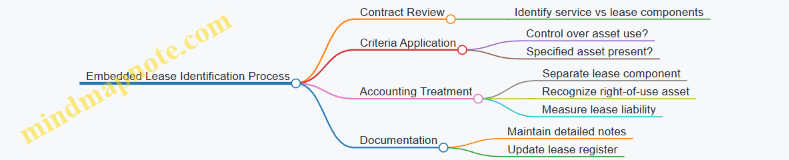
Example 2: Lease Modification Handling in Commercial Real Estate
Scenario: A retail chain negotiated a lease extension with revised payment terms.
Lesson: The accounting team initially failed to reassess the lease liability, leading to understated liabilities.
Best Practice Applied: After training, the team implemented a process to identify lease modifications promptly, reassess lease liabilities using revised terms, and update right-of-use assets accordingly.
Mind Map:
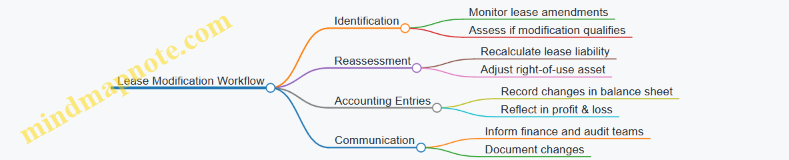
Example 3: Technology Integration for Equipment Lease Portfolio
Scenario: An accounting firm managing multiple equipment leases struggled with manual tracking and calculations.
Lesson: Manual processes caused errors and delayed reporting.
Best Practice Applied: The firm implemented lease accounting software integrated with their ERP system, automating lease data capture, calculations, and disclosures, significantly improving accuracy and efficiency.
Mind Map:
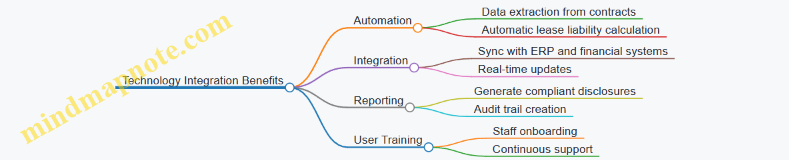
Summary
By learning from these real-world examples, accountants and auditors can adopt a proactive approach to lease accounting. Emphasizing thorough lease identification, precise classification, robust documentation, and leveraging technology will lead to improved compliance, reduced errors, and streamlined audit processes.
11.5 Practical Exercises: Applying Concepts to Sample Lease Scenarios
In this section, we will apply the core concepts of lease accounting through practical exercises, helping you solidify your understanding and prepare for real-world scenarios. Each exercise includes a detailed scenario, step-by-step accounting treatment, and visual mind maps to guide your thought process.
Exercise 1: Classifying a Lease for Office Equipment
Scenario: A company leases a high-end printer for 4 years. The lease term is 4 years, and the equipment’s economic life is 5 years. The lease agreement does not transfer ownership, nor does it have a bargain purchase option. Annual lease payments are $10,000, payable at the end of each year. The incremental borrowing rate is 6%.
Tasks:
- Determine if the lease is a finance or operating lease.
- Calculate the initial lease liability and right-of-use (ROU) asset.
- Prepare the journal entries for the first year.
Solution:
-
Lease Classification: Since the lease term (4 years) is 80% of the economic life (5 years), it meets the criterion for a finance lease.
-
Lease Liability Calculation: Present value of 4 payments of $10,000 discounted at 6%.
\[ PV = 10,000 \times \frac{1 - (1 + 0.06)^{-4}}{0.06} = 10,000 \times 3.4651 = 34,651 \]
-
Initial Recognition: Debit ROU asset $34,651; Credit Lease liability $34,651.
-
First Year Journal Entries:
- Interest expense = $34,651 * 6% = $2,079
- Lease payment = $10,000
- Lease liability reduction = $10,000 - $2,079 = $7,921
Account Debit Credit Interest Expense 2,079 Lease Liability 7,921 Cash 10,000
Mind Map:
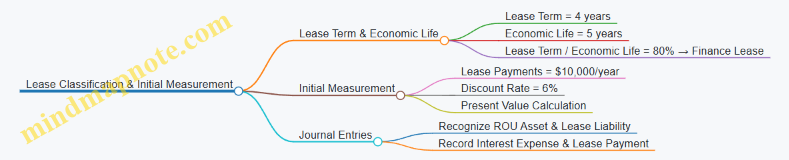
Exercise 2: Accounting for a Lease Modification
Scenario: A company has a 5-year lease on a warehouse with annual payments of $50,000. After 2 years, the lease term is extended by 3 years with an increased annual payment of $60,000. The incremental borrowing rate remains at 5%.
Tasks:
- Identify the accounting treatment for the lease modification.
- Calculate the revised lease liability.
- Explain how to adjust the ROU asset.
Solution:
-
Lease Modification: Since the lease term is extended and payments increased, this is a lease modification requiring remeasurement.
-
Remaining Lease Term Before Modification: 3 years
-
Revised Lease Term: 3 + 3 = 6 years
-
Calculate Present Value of Revised Payments:
\[ PV = 60,000 \times \frac{1 - (1 + 0.05)^{-6}}{0.05} = 60,000 \times 5.0757 = 304,542 \]
-
Adjust Lease Liability: Increase or decrease the lease liability to $304,542.
-
Adjust ROU Asset: Increase or decrease by the difference between revised lease liability and carrying amount.
Mind Map:
Exercise 3: Lease Termination Before Expiry
Scenario: A company leases office space for 10 years with annual payments of $100,000. After 6 years, the company terminates the lease early and pays a termination penalty of $150,000.
Tasks:
- Determine the accounting treatment for the lease termination.
- Calculate the impact on lease liability and ROU asset.
- Prepare the journal entries related to termination.
Solution:
-
Lease Termination: Derecognize lease liability and ROU asset.
-
Calculate Carrying Amounts: Assume carrying amounts of lease liability and ROU asset are both $400,000 at termination.
-
Recognize Loss: Termination penalty $150,000 plus any difference between carrying amounts.
-
Journal Entries:
- Debit Lease Liability $400,000
- Debit Loss on Termination $150,000
- Credit ROU Asset $400,000
- Credit Cash $150,000
Mind Map:
Exercise 4: Operating Lease Expense Recognition
Scenario: A company leases a vehicle under an operating lease for 3 years with annual payments of $15,000 payable at the beginning of each year. The discount rate is 4%.
Tasks:
- Calculate the lease expense recognized each year.
- Prepare the journal entries for the first two years.
Solution:
-
Lease Liability: Calculate present value of payments.
\[ PV = 15,000 + 15,000 \times \frac{1 - (1 + 0.04)^{-2}}{0.04} = 15,000 + 15,000 \times 1.886 = 15,000 + 28,290 = 43,290 \]
-
Lease Expense: Recognized on a straight-line basis = Total payments / lease term = $45,000 / 3 = $15,000 per year.
-
Journal Entries Year 1:
- Debit Lease Expense $15,000
- Credit Cash $15,000
-
Journal Entries Year 2:
- Debit Lease Expense $15,000
- Credit Cash $15,000
Mind Map:
Summary Mind Map: Applying Lease Accounting Concepts
These exercises provide a hands-on approach to mastering lease accounting. By working through these scenarios, accountants and auditors can confidently apply standards to diverse leasing transactions.
12. Summary and Best Practice Checklist
12.1 Recap of Key Concepts in Lease Accounting
Lease accounting is a critical area for accountants and auditors, especially with the introduction of new standards like IFRS 16 and ASC 842. This section summarizes the essential concepts to ensure clarity and compliance.
Key Concepts Mind Map
Detailed Recap with Examples
-
Lease Identification
- A lease exists when a contract conveys the right to control the use of an identified asset for a period of time in exchange for consideration.
- Example: A company leases a specific office space for 5 years. This contract contains a lease because the company controls the use of the identified asset (office space).
-
Lease Classification
- Finance leases transfer substantially all risks and rewards of ownership to the lessee.
- Operating leases do not transfer these risks and rewards.
- Example: Leasing machinery for 90% of its useful life with an option to purchase at a bargain price is a finance lease.
-
Initial Recognition
- Lease Liability: Present value of future lease payments discounted at the rate implicit in the lease or incremental borrowing rate.
- ROU Asset: Initially measured at lease liability plus initial direct costs, prepaid lease payments, and restoration costs.
- Example: A vehicle lease with annual payments of $10,000 for 3 years, discounted at 5%, results in a lease liability of approximately $27,230.
-
Subsequent Measurement
- Lease liability increases with interest and decreases with lease payments.
- ROU asset is depreciated over the lease term or useful life.
- Example: Depreciating a leased office building ROU asset on a straight-line basis over 10 years.
-
Lease Modifications
- Modifications may require remeasurement of lease liability and adjustment of ROU asset.
- Example: Extending a lease term by 2 years triggers reassessment and increases lease liability.
-
Disclosure Requirements
- Entities must disclose lease terms, amounts recognized in financial statements, and maturity analysis.
- Example: Disclosing total lease liabilities due within 1 year and beyond 5 years.
-
Tax Implications
- Tax treatment may differ; lease payments might be deductible differently than accounting expenses.
- Example: Operating lease payments are fully deductible for tax, whereas finance leases may require depreciation and interest deductions.
-
Audit Considerations
- Focus on lease identification completeness, classification accuracy, and measurement correctness.
- Example: Auditors verify lease contracts and recalculate lease liabilities.
-
Technology & Tools
- Lease accounting software helps automate calculations, maintain schedules, and generate disclosures.
- Example: Using a lease management system to track 50+ equipment leases efficiently.
Summary Table of Key Terms and Examples
| Concept | Definition/Action | Example Scenario |
|---|---|---|
| Lease Identification | Right to control use of asset | Office space lease contract |
| Finance Lease | Transfers risks and rewards | Machinery lease for 90% of useful life |
| Operating Lease | Does not transfer risks and rewards | Short-term vehicle lease |
| Lease Liability | PV of lease payments | $27,230 vehicle lease liability |
| ROU Asset | Asset recognized for right to use leased asset | Depreciated office building ROU asset |
| Lease Modification | Change in lease terms requiring remeasurement | Lease term extension by 2 years |
| Disclosure | Financial statement notes on leases | Maturity analysis of lease liabilities |
| Tax Treatment | Differences in accounting vs tax expense | Deductibility of operating lease payments |
| Audit Focus | Verification of lease completeness and accuracy | Auditing lease contracts and calculations |
| Technology | Software tools for lease accounting | Lease management system for equipment leases |
This recap provides a solid foundation for accountants and auditors to approach lease accounting confidently, ensuring compliance and accuracy in financial reporting.
12.2 Comprehensive Best Practice Checklist for Accountants and Auditors
Accounting for leasing transactions requires meticulous attention to detail and adherence to standards. This checklist consolidates best practices to ensure accuracy, compliance, and efficiency.
Best Practice Checklist
Lease Identification
- Thoroughly review all contracts to identify embedded leases.
- Confirm whether the contract conveys the right to control the use of an identified asset.
Lease Classification
- Apply criteria to distinguish between finance (capital) and operating leases.
- Document the rationale for classification decisions.
Initial Measurement
- Calculate lease liabilities using the present value of lease payments.
- Determine the appropriate discount rate (incremental borrowing rate or rate implicit in the lease).
- Measure right-of-use (ROU) assets including initial direct costs and lease incentives.
Subsequent Measurement
- Accurately record interest expense on lease liabilities and depreciation on ROU assets.
- Monitor lease modifications and reassess lease terms and payments accordingly.
Disclosure and Reporting
- Prepare comprehensive disclosures as required by IFRS 16 or ASC 842.
- Reconcile lease liabilities and ROU assets in financial statements.
Documentation and Controls
- Maintain organized lease files with all relevant contracts, amendments, and correspondence.
- Implement internal controls to track lease data and changes.
Coordination with Tax and Legal Teams
- Align accounting treatment with tax implications.
- Ensure lease agreements comply with legal requirements.
Use of Technology
- Leverage lease accounting software to automate calculations and reporting.
- Regularly update systems to reflect changes in standards.
Audit Preparation
- Prepare detailed working papers supporting lease calculations.
- Anticipate common audit queries and prepare responses.
Mind Maps
Mind Map 1: Lease Accounting Workflow
Mind Map 2: Key Considerations for Lease Classification
Mind Map 3: Common Lease Modifications
Practical Examples
Example 1: Lease Identification
A company signs a 5-year contract for office space with an option to renew. The contract specifies the exact floor space and the company controls access. This is identified as a lease because it conveys the right to use an identified asset.
Example 2: Lease Classification
A lease for machinery has a term of 8 years, which is 80% of the machinery’s useful life (10 years). The present value of lease payments is 90% of the machinery’s fair value. This lease meets finance lease criteria.
Example 3: Initial Measurement
Calculate the lease liability for a 3-year equipment lease with annual payments of $10,000, using a discount rate of 5%:
- Present Value = $10,000 / (1.05)^1 + $10,000 / (1.05)^2 + $10,000 / (1.05)^3 = $27,386
The ROU asset is initially recognized at $27,386 plus any initial direct costs.
Example 4: Lease Modification
A tenant extends the lease term by 2 years beyond the original 5 years. The lease liability and ROU asset must be remeasured to reflect the new lease term and updated payments.
Example 5: Disclosure
Prepare a note disclosing:
- Total lease liabilities at period end
- Maturity analysis of lease payments
- Expense recognized for operating leases
By following this comprehensive checklist, accountants and auditors can ensure robust lease accounting processes that comply with standards and withstand audit scrutiny.
12.3 Common Mistakes and How to Avoid Them
Lease accounting is complex and prone to errors that can impact financial reporting and compliance. Below, we explore some of the most common mistakes accountants and auditors make in lease accounting, paired with practical strategies to avoid them. Mind maps are included to visualize key points.
Common Mistakes in Lease Accounting
Classification Errors
Mistake: Misclassifying leases can lead to incorrect balance sheet and income statement presentation.
Example: A company leases office space with a renewal option that is likely to be exercised but classifies it as an operating lease without considering the renewal term.
How to Avoid:
- Carefully evaluate lease terms, including options to extend or terminate.
- Use decision trees or checklists aligned with IFRS 16 / ASC 842 criteria.
Incomplete Lease Identification
Mistake: Failing to identify all leases, especially embedded leases within service contracts.
Example: An IT service contract includes the use of servers, but the lease component is not separated and accounted for.
How to Avoid:
- Review all contracts for embedded leases.
- Collaborate with legal and procurement teams.
- Maintain a centralized lease register.
Incorrect Measurement
Mistake: Using incorrect discount rates or failing to include all relevant lease payments.
Example: Applying the incremental borrowing rate incorrectly or excluding variable lease payments that depend on an index.
How to Avoid:
- Confirm appropriate discount rates with treasury or finance.
- Include all fixed and variable payments as per standards.
- Use lease accounting software to automate calculations.
Poor Documentation
Mistake: Insufficient documentation of lease terms and accounting judgments.
Example: Not documenting the rationale for lease term assumptions or discount rate selection.
How to Avoid:
- Maintain detailed working papers.
- Document assumptions and judgments clearly.
- Retain copies of lease agreements and amendments.
Failure to Reassess
Mistake: Not updating lease accounting for modifications, reassessments, or changes in lease terms.
Example: A lease extension is agreed upon but not reflected in lease liability and right-of-use asset calculations.
How to Avoid:
- Regularly review lease portfolio for changes.
- Implement controls to capture lease modifications promptly.
- Train staff on reassessment triggers.
Disclosure Omissions
Mistake: Omitting required disclosures or providing incomplete lease information in financial statements.
Example: Not disclosing maturity analysis of lease liabilities or significant lease terms.
How to Avoid:
- Use disclosure checklists aligned with IFRS 16 / ASC 842.
- Prepare comprehensive lease schedules.
- Coordinate with auditors early in the reporting process.
Summary Table of Common Mistakes and Remedies
| Mistake Category | Example Scenario | How to Avoid |
|---|---|---|
| Classification Errors | Misclassifying lease with renewal option | Evaluate lease term options carefully |
| Incomplete Identification | Missing embedded lease in service contract | Thorough contract review and cross-team collaboration |
| Incorrect Measurement | Using wrong discount rate | Confirm rates, include all payments, automate |
| Poor Documentation | Not documenting assumptions | Maintain detailed working papers and audit trails |
| Failure to Reassess | Ignoring lease extension | Regular lease reviews and modification tracking |
| Disclosure Omissions | Incomplete maturity analysis | Use checklists and prepare detailed disclosures |
By understanding these common pitfalls and implementing the recommended best practices, accountants and auditors can ensure accurate, compliant, and transparent lease accounting that withstands scrutiny and supports sound financial decision-making.
12.4 Resources for Continuing Education and Support
Staying current with lease accounting standards and best practices is essential for accountants and auditors working in the finance and real estate sectors. This section provides a curated list of resources, including professional organizations, online courses, publications, and software tools that can help deepen your knowledge and support your day-to-day lease accounting tasks.
Professional Organizations & Standard Setters
-
International Accounting Standards Board (IASB)
- Official source for IFRS 16 updates and guidance.
- Website: www.ifrs.org
-
Financial Accounting Standards Board (FASB)
- Provides updates and detailed guidance on ASC 842.
- Website: www.fasb.org
-
American Institute of CPAs (AICPA)
- Offers resources, webinars, and continuing professional education (CPE) credits.
- Website: www.aicpa.org
-
Chartered Institute of Management Accountants (CIMA)
- Provides global accounting resources and certifications.
- Website: www.cimaglobal.com
Online Courses & Webinars
-
Coursera: IFRS 16 Leases - Practical Application
- Comprehensive course covering lease identification, measurement, and disclosures.
- Example: Interactive exercises on lease classification.
-
LinkedIn Learning: Lease Accounting under ASC 842
- Focused on US GAAP lease accounting with real-world examples.
-
Deloitte Lease Accounting Webinars
- Regularly updated webinars addressing latest standards and implementation tips.
-
EY Lease Accounting Academy
- Offers detailed modules and case studies.
Books & Publications
-
“Leases: Practical Guide to IFRS 16” by PwC
- Includes step-by-step examples and checklists.
-
“Lease Accounting: Principles and Practice” by Steven M. Bragg
- Deep dive into accounting principles with practical illustrations.
-
Journal of Accountancy
- Regular articles and updates on lease accounting.
Software Tools & Platforms
-
LeaseQuery
- Lease accounting software designed for compliance with IFRS 16 and ASC 842.
- Example: Automated lease classification and reporting.
-
CoStar Real Estate Manager
- Integrated lease management and accounting platform.
-
SAP Lease Administration by Nakisa
- Enterprise-grade solution with audit-ready reporting.
Mind Maps for Continuing Education and Support
Lease Accounting Continuing Education Mind Map
Practical Examples for Resource Utilization Mind Map
Example: Applying Resources in Practice
Scenario: An auditor is tasked with reviewing lease accounting for a client with multiple leased office locations and equipment.
-
Initial Preparation: The auditor reviews the latest IFRS 16 guidance on the IASB website and enrolls in a Deloitte webinar focused on lease modifications.
-
Hands-On Learning: Completes Coursera’s IFRS 16 practical course, practicing lease classification and measurement through interactive exercises.
-
Software Utilization: Uses LeaseQuery to import lease data and generate lease liability schedules, ensuring accuracy and compliance.
-
Ongoing Support: Joins an AICPA lease accounting LinkedIn group to discuss complex scenarios and share insights.
-
Documentation: References PwC’s practical guide to cross-check disclosures and prepares audit documentation accordingly.
By leveraging these resources, accountants and auditors can maintain expertise, ensure compliance, and enhance the quality of lease accounting and auditing processes.
12.5 Final Practical Example: End-to-End Lease Accounting Walkthrough
This section provides a comprehensive, step-by-step walkthrough of accounting for a lease transaction from inception to reporting. We will use a practical example involving a company leasing office space.
Scenario Overview:
Company: ABC Consulting Ltd.
Lease: ABC Consulting enters into a 5-year lease for office space starting January 1, 2024.
Lease Details:
- Annual lease payment: $100,000, payable at the end of each year.
- Lease term: 5 years.
- Discount rate: 6% (incremental borrowing rate).
- No purchase option or renewal.
- Initial direct costs: $5,000.
- Lease incentives: $10,000 rent-free period in the first year.
Step 1: Identify the Lease and Classification
- The lease conveys the right to control the use of the office space for a period.
- No transfer of ownership or purchase option.
- Lease term is fixed at 5 years.
Classification: Operating lease under ASC 842 / IFRS 16 (since no ownership transfer or bargain purchase option).
Step 2: Calculate Lease Liability
- Lease payments adjusted for lease incentives.
- Payments: $100,000 annually, but first year effectively reduced by $10,000 rent-free incentive.
Lease Payment Schedule:
| Year | Payment | Adjusted Payment (net of incentive) |
|---|---|---|
| 1 | $100,000 | $90,000 |
| 2 | $100,000 | $100,000 |
| 3 | $100,000 | $100,000 |
| 4 | $100,000 | $100,000 |
| 5 | $100,000 | $100,000 |
Present Value Calculation:
Using discount rate 6%, present value (PV) of lease payments:
Lease Liability at commencement: $411,755
Step 3: Calculate Right-of-Use (ROU) Asset
ROU Asset initial measurement includes:
- Lease liability: $411,755
- Initial direct costs: $5,000
- Less lease incentives: $10,000
ROU Asset = $411,755 + $5,000 - $10,000 = $406,755
Step 4: Journal Entries at Lease Commencement (Jan 1, 2024)
| Account | Debit | Credit |
|---|---|---|
| Right-of-Use Asset | $406,755 | |
| Lease Liability | $411,755 | |
| Cash (Initial Direct Costs) | $5,000 | |
| Prepaid Rent (Incentive) | $10,000 |
Note: The $5,000 initial direct costs are capitalized as part of the ROU asset; the $10,000 incentive reduces the ROU asset.
Step 5: Subsequent Measurement - Year 1
Lease Payment: $100,000 at year-end
Interest Expense: Lease liability * discount rate
Interest for Year 1 = $411,755 * 6% = $24,705
Lease Liability Reduction: Payment - Interest = $100,000 - $24,705 = $75,295
New Lease Liability: $411,755 - $75,295 = $336,460
Depreciation of ROU Asset:
Straight-line over 5 years = $406,755 / 5 = $81,351 per year
Step 6: Journal Entries at Year-End (Dec 31, 2024)
| Account | Debit | Credit |
|---|---|---|
| Interest Expense | $24,705 | |
| Lease Liability | $75,295 | |
| Cash | $100,000 | |
| Depreciation Expense | $81,351 | |
| Accumulated Depreciation | $81,351 |
Step 7: Repeat for Subsequent Years
| Year | Opening Lease Liability | Interest (6%) | Payment | Principal Reduction | Closing Lease Liability |
|---|---|---|---|---|---|
| 2024 | $411,755 | $24,705 | $100,000 | $75,295 | $336,460 |
| 2025 | $336,460 | $20,188 | $100,000 | $79,812 | $256,648 |
| 2026 | $256,648 | $15,399 | $100,000 | $84,601 | $172,047 |
| 2027 | $172,047 | $10,323 | $100,000 | $89,677 | $82,370 |
| 2028 | $82,370 | $4,942 | $100,000 | $95,058 | $0 |
Depreciation continues at $81,351 per year.
Step 8: Disclosure and Reporting
- Lease liability and ROU asset balances reported on balance sheet.
- Interest expense and depreciation expense reported separately in income statement.
- Lease commitments and maturity analysis disclosed in notes.
Summary Mind Map
This example demonstrates the full cycle of lease accounting, integrating best practices such as:
- Accurate identification and classification of leases.
- Detailed present value calculations using appropriate discount rates.
- Proper capitalization of initial direct costs and adjustment for lease incentives.
- Systematic recording of journal entries.
- Clear disclosure and reporting for transparency.
Accountants and auditors can use this walkthrough as a template to handle similar leasing transactions effectively.