IFRS and GAAP Reporting
1. Introduction to IFRS and GAAP
1.1 Overview of IFRS and GAAP Frameworks
Understanding the foundational frameworks of IFRS (International Financial Reporting Standards) and GAAP (Generally Accepted Accounting Principles) is essential for accountants, auditors, and compliance officers working in finance and government sectors. Both frameworks guide the preparation and presentation of financial statements but differ in origin, structure, and application.
What is IFRS?
- Developed and maintained by the International Accounting Standards Board (IASB).
- Used in over 140 countries worldwide, including the European Union, Canada, and many Asian countries.
- Principles-based framework emphasizing transparency, comparability, and global consistency.
What is GAAP?
- Established by the Financial Accounting Standards Board (FASB) in the United States.
- Rules-based framework primarily used in the U.S.
- Focuses on detailed rules and guidelines to ensure consistency and comparability within the U.S. market.
Mind Map: IFRS Framework
Mind Map: GAAP Framework
Key Differences Between IFRS and GAAP
| Aspect | IFRS | GAAP |
|---|---|---|
| Origin | International Accounting Standards Board (IASB) | Financial Accounting Standards Board (FASB) |
| Approach | Principles-based | Rules-based |
| Inventory Valuation | Prohibits LIFO method | Allows LIFO method |
| Revenue Recognition | Single model (IFRS 15) | Detailed industry-specific guidance |
| Development Stage | Continuously evolving with global input | More established with detailed rules |
Practical Example: Basic Financial Statement Comparison
Consider a company recognizing revenue from a long-term contract.
- Under IFRS: Revenue is recognized based on the transfer of control over time or at a point in time, using a five-step model.
- Under GAAP: Revenue recognition follows similar principles but may include more prescriptive guidance depending on the industry.
Example: A software company sells a 12-month subscription for $12,000.
| Month | IFRS Revenue Recognition | GAAP Revenue Recognition |
|---|---|---|
| 1 | $1,000 | $1,000 |
| 6 | $6,000 | $6,000 |
| 12 | $12,000 | $12,000 |
Both frameworks recognize revenue evenly over the subscription period, demonstrating convergence in this area.
Summary
Understanding the IFRS and GAAP frameworks provides a foundation for accurate and compliant financial reporting. While IFRS offers a globally accepted, principles-based approach, GAAP provides detailed, rules-based guidance primarily for U.S. entities. Awareness of these frameworks’ characteristics helps finance professionals navigate reporting requirements effectively.
1.2 Key Differences Between IFRS and GAAP
Understanding the key differences between IFRS (International Financial Reporting Standards) and GAAP (Generally Accepted Accounting Principles) is essential for accountants, auditors, and compliance officers working in multinational environments or transitioning between frameworks. Below, we explore the primary distinctions with clear examples and mind maps to aid comprehension.
Overview Mind Map: IFRS vs GAAP Key Differences
Conceptual Approach
IFRS is principles-based, focusing on the spirit and intent of accounting standards, allowing more judgment and flexibility.
GAAP is rules-based, providing detailed rules and guidelines, which can limit flexibility but reduce ambiguity.
Example:
- Under IFRS, an accountant might apply judgment to classify a complex financial instrument based on its substance.
- Under GAAP, the classification might be strictly dictated by detailed rules, leaving less room for interpretation.
Financial Statement Presentation
| Aspect | IFRS | GAAP |
|---|---|---|
| Statement Format | Flexible; allows presentation choices | Prescribed formats (e.g., classified balance sheet) |
| Statement of OCI | Includes items like revaluation surplus | More limited OCI items |
Example:
- IFRS allows presenting expenses by nature (e.g., depreciation, raw materials) or by function (e.g., cost of sales, administrative expenses).
- GAAP generally requires presentation by function.
Revenue Recognition
Both IFRS 15 and GAAP ASC 606 follow a 5-step model but differ in application nuances.
Example:
- IFRS allows recognizing revenue when control transfers, which may happen over time or at a point in time.
- GAAP may have more detailed guidance on contract modifications and variable consideration.
Mind Map:
Inventory Accounting
| Aspect | IFRS | GAAP |
|---|---|---|
| Cost Formulas Allowed | FIFO, Weighted Average; LIFO prohibited | FIFO, Weighted Average, LIFO allowed |
| Write-downs | Reversal of write-downs allowed if value recovers | No reversal allowed |
Example:
- A company using LIFO inventory costing under GAAP must switch to FIFO or weighted average if reporting under IFRS.
- If inventory value recovers after a write-down, IFRS permits reversal, GAAP does not.
Lease Accounting
IFRS 16 requires lessees to recognize nearly all leases on the balance sheet as right-of-use assets and lease liabilities.
GAAP ASC 842 distinguishes between finance leases and operating leases, with different recognition and expense patterns.
Example:
- Under IFRS, a 3-year office lease must be capitalized on the balance sheet.
- Under GAAP, an operating lease may still be off-balance sheet with straight-line rent expense.
Impairment of Assets
| Aspect | IFRS | GAAP |
|---|---|---|
| Test Method | One-step: compare carrying amount to recoverable amount (higher of fair value less costs to sell and value in use) | Two-step: compare carrying amount to undiscounted cash flows, then measure impairment loss |
Example:
- IFRS impairment test may result in earlier recognition of impairment losses.
- GAAP requires an initial test before measuring impairment.
Development Costs
| Aspect | IFRS | GAAP |
|---|---|---|
| Treatment | Capitalize development costs if criteria met | Expense all development costs as incurred |
Example:
- IFRS allows capitalizing costs for developing a new product if technical feasibility and future economic benefits are demonstrated.
- GAAP requires expensing these costs immediately.
Summary Example: Inventory Accounting Comparison
Scenario: A company has 1,000 units of inventory purchased at $10 each, and 1,000 units purchased later at $12 each. The market value drops to $9 per unit.
-
Under IFRS:
- LIFO is not allowed; company uses FIFO.
- Inventory value is written down to $9 per unit.
- If market value recovers to $11, reversal of write-down is allowed.
-
Under GAAP:
- Company can use LIFO.
- Inventory is valued at the lower of cost or market.
- No reversal of write-down allowed if market value recovers.
Final Mind Map: Practical Impact on Reporting
This section equips finance professionals with a clear understanding of the fundamental differences between IFRS and GAAP, supported by practical examples and visual mind maps to enhance retention and application.
1.3 Importance of Compliance for Accountants and Auditors
Compliance with IFRS (International Financial Reporting Standards) and GAAP (Generally Accepted Accounting Principles) is critical for accountants and auditors to ensure the accuracy, transparency, and reliability of financial statements. Non-compliance can lead to legal penalties, loss of stakeholder trust, and financial misstatements that could severely impact an organization’s reputation and operations.
Why Compliance Matters
- Legal and Regulatory Requirements: Many jurisdictions mandate adherence to either IFRS or GAAP. Failure to comply can result in fines, sanctions, or legal action.
- Investor Confidence: Accurate and compliant financial reporting builds trust with investors, creditors, and other stakeholders.
- Audit Quality: Auditors rely on compliance to assess the fairness of financial statements and issue unqualified opinions.
- Internal Decision-Making: Management depends on compliant reports for strategic planning and operational control.
Mind Map: Importance of Compliance for Accountants and Auditors
Practical Example: Consequences of Non-Compliance
Scenario: An auditor discovers that a company has not properly recognized revenue according to IFRS 15, leading to overstated income.
- Impact:
- The financial statements are misleading.
- The auditor issues a qualified opinion.
- The company faces regulatory scrutiny and potential fines.
- Investor confidence drops, affecting stock price.
Best Practice: Accountants should ensure revenue recognition policies align with IFRS 15, and auditors should verify these policies during audits.
Mind Map: Compliance Process for Accountants and Auditors
Example: Compliance in Action – Revenue Recognition
Step 1: Accountant reviews contract terms to identify performance obligations.
Step 2: Applies IFRS 15 five-step model to recognize revenue appropriately.
Step 3: Auditor tests sample transactions to ensure revenue is recognized in the correct period.
Outcome: Financial statements reflect true economic activity, satisfying both IFRS and auditor requirements.
Summary
For accountants and auditors, compliance is not just about following rules but ensuring the integrity and usefulness of financial information. It safeguards the organization from risks and supports sound financial decision-making.
1.4 Practical Example: Comparing a Basic Financial Statement Under IFRS and GAAP
In this section, we will explore a practical example comparing a simple financial statement prepared under IFRS and GAAP. This will help accountants, auditors, and compliance officers understand the nuances and best practices when preparing financial reports under both frameworks.
Scenario:
A company, ABC Ltd., prepares a statement of financial position (balance sheet) as of December 31, 2023. We will compare how certain line items are presented and measured under IFRS and GAAP.
Key Differences Mind Map
Example Financial Statement Comparison
| Line Item | IFRS Presentation | GAAP Presentation | Notes/Best Practices |
|---|---|---|---|
| Cash and Cash Equivalents | Reported as current asset | Reported as current asset | Both frameworks treat similarly |
| Property, Plant and Equipment | Can be reported at cost or revalued amount | Reported at historical cost less depreciation | IFRS allows revaluation model; GAAP does not |
| Intangible Assets | Recognized if probable future benefits exist | Similar recognition criteria | IFRS more flexible on development costs |
| Deferred Tax Assets | Reported as non-current asset | Reported as non-current asset | Both require recognition of deferred taxes |
| Equity | Share capital, reserves, retained earnings | Common stock, additional paid-in capital, retained earnings | Terminology differs but concepts align |
Practical Example: Property, Plant and Equipment (PPE) Valuation
IFRS Approach:
- ABC Ltd. chooses the revaluation model.
- Original cost: $1,000,000
- Accumulated depreciation: $200,000
- Fair value at reporting date: $900,000
Calculation:
- Carrying amount under cost model = $1,000,000 - $200,000 = $800,000
- Carrying amount under revaluation model = $900,000 (fair value)
Presentation:
- PPE reported at $900,000
- Revaluation surplus recognized in Other Comprehensive Income (OCI)
GAAP Approach:
- PPE reported at historical cost less accumulated depreciation
- Carrying amount = $800,000
Best Practice:
- Clearly disclose the valuation method used.
- Provide reconciliation of carrying amounts.
Mind Map: Preparing Financial Statements Under IFRS and GAAP
Summary of Best Practices with Examples
| Best Practice | Example Scenario |
|---|---|
| Use consistent classification of assets/liabilities | Classify inventory as current asset under both IFRS and GAAP |
| Disclose accounting policies clearly | Note explaining use of revaluation model for PPE under IFRS |
| Reconcile differences when transitioning | Provide reconciliation schedule when moving from GAAP to IFRS |
| Use clear terminology for stakeholders | Use “Statement of Financial Position” for IFRS reports |
| Ensure fair value measurements are supported | Obtain independent valuation for PPE revaluation |
By integrating these examples and mind maps, professionals can better grasp the practical implications of preparing financial statements under IFRS and GAAP, ensuring accuracy, compliance, and clarity in reporting.
2. Financial Statement Presentation
2.1 IFRS Financial Statement Structure and Requirements
Overview
IFRS (International Financial Reporting Standards) provides a globally accepted framework for preparing financial statements. The structure and presentation requirements are designed to ensure transparency, comparability, and relevance of financial information.
Core Financial Statements under IFRS
IFRS requires the preparation of the following primary financial statements:
- Statement of Financial Position (Balance Sheet)
- Statement of Profit or Loss and Other Comprehensive Income
- Statement of Changes in Equity
- Statement of Cash Flows
- Notes to the Financial Statements
Mind Map: IFRS Financial Statement Components
Detailed Requirements
Statement of Financial Position
- Must classify assets and liabilities as current and non-current.
- Equity is presented separately from liabilities.
- IFRS does not prescribe a specific format but requires clear presentation.
Statement of Profit or Loss and Other Comprehensive Income
- Can be presented as a single statement or two separate statements.
- Must include all income and expenses recognized during the period.
- Other comprehensive income items include unrealized gains/losses, foreign exchange differences, etc.
Statement of Changes in Equity
- Shows movements in equity components during the reporting period.
- Includes transactions with owners (e.g., dividends, share issuance).
Statement of Cash Flows
- Must classify cash flows into operating, investing, and financing activities.
- IFRS allows the indirect or direct method for operating activities.
Notes to the Financial Statements
- Provide additional detail and explanation.
- Include significant accounting policies, judgments, and estimates.
Best Practices
- Use clear and consistent classification to enhance comparability.
- Provide reconciliations where necessary (e.g., equity changes).
- Ensure notes are comprehensive but concise.
Example: Simplified Statement of Financial Position (IFRS)
| Assets | Amount (USD) | Liabilities and Equity | Amount (USD) |
|---|---|---|---|
| Current Assets | 150,000 | Current Liabilities | 80,000 |
| Non-current Assets | 350,000 | Non-current Liabilities | 120,000 |
| Equity | 300,000 | ||
| Total Assets | 500,000 | Total Liabilities & Equity | 500,000 |
Example: Presentation of Other Comprehensive Income
| Description | Amount (USD) |
|---|---|
| Profit for the Year | 50,000 |
| Other Comprehensive Income: | |
| - Foreign Currency Translation | 5,000 |
| - Revaluation Surplus | 10,000 |
| Total Comprehensive Income | 65,000 |
Summary
Understanding the IFRS financial statement structure is crucial for compliance and effective communication of financial results. The flexibility in presentation allows entities to tailor disclosures to their circumstances while maintaining transparency and comparability.
For accountants and auditors, mastering these requirements ensures accurate reporting and facilitates smoother audits and reviews.
2.2 GAAP Financial Statement Structure and Requirements
Under Generally Accepted Accounting Principles (GAAP), financial statements follow a structured format designed to provide clear, consistent, and comparable financial information to users such as investors, creditors, and regulators. Understanding the structure and requirements of GAAP financial statements is essential for accountants, auditors, and compliance officers to ensure accuracy and compliance.
Key GAAP Financial Statements
GAAP requires the preparation of the following primary financial statements:
- Balance Sheet (Statement of Financial Position)
- Income Statement (Statement of Earnings or Profit & Loss Statement)
- Statement of Cash Flows
- Statement of Shareholders’ Equity
- Notes to the Financial Statements
Mind Map: GAAP Financial Statement Components
Balance Sheet (Statement of Financial Position)
The balance sheet presents an entity’s financial position at a specific point in time, showing what it owns (assets), what it owes (liabilities), and the residual interest of shareholders (equity).
GAAP Requirements:
- Assets and liabilities are classified as current or non-current.
- Assets are generally listed in order of liquidity.
- Liabilities are listed in order of maturity.
- Equity section includes common stock, additional paid-in capital, retained earnings, and treasury stock.
Example:
| Balance Sheet (As of Dec 31, 2023) | Amount (USD) |
|---|---|
| Assets | |
| Current Assets | 150,000 |
| Property, Plant & Equipment (net) | 350,000 |
| Total Assets | 500,000 |
| Liabilities | |
| Current Liabilities | 100,000 |
| Long-term Debt | 200,000 |
| Total Liabilities | 300,000 |
| Shareholders’ Equity | |
| Common Stock | 50,000 |
| Retained Earnings | 150,000 |
| Total Equity | 200,000 |
| Total Liabilities & Equity | 500,000 |
Income Statement (Statement of Earnings)
The income statement summarizes revenues, expenses, gains, and losses over a reporting period, culminating in net income or loss.
GAAP Requirements:
- Must follow the accrual basis of accounting.
- Expenses are matched with revenues.
- Presentation can be single-step or multi-step.
Example (Multi-step format):
| Income Statement (Year Ended Dec 31, 2023) | Amount (USD) |
|---|---|
| Revenues | 600,000 |
| Cost of Goods Sold | 350,000 |
| Gross Profit | 250,000 |
| Operating Expenses | 100,000 |
| Operating Income | 150,000 |
| Other Income and Expenses | (10,000) |
| Net Income Before Taxes | 140,000 |
| Income Tax Expense | 40,000 |
| Net Income | 100,000 |
Statement of Cash Flows
This statement reports cash inflows and outflows classified into operating, investing, and financing activities.
GAAP Requirements:
- Must use either direct or indirect method for operating activities (indirect is more common).
- Must separately report cash flows from investing and financing activities.
Example (Indirect Method):
| Cash Flows from Operating Activities | Amount (USD) |
|---|---|
| Net Income | 100,000 |
| Adjustments for Non-cash Items | 20,000 |
| Changes in Working Capital | (15,000) |
| Net Cash Provided by Operating Activities | 105,000 |
| Cash Flows from Investing Activities | Amount (USD) |
|---|---|
| Purchase of Equipment | (50,000) |
| Sale of Investments | 10,000 |
| Net Cash Used in Investing Activities | (40,000) |
| Cash Flows from Financing Activities | Amount (USD) |
|---|---|
| Proceeds from Issuance of Debt | 30,000 |
| Dividends Paid | (20,000) |
| Net Cash Provided by Financing Activities | 10,000 |
| Net Increase in Cash | 75,000 |
Statement of Shareholders’ Equity
This statement reconciles the beginning and ending balances of equity accounts.
GAAP Requirements:
- Must disclose changes in common stock, retained earnings, treasury stock, and other equity components.
Example:
| Statement of Shareholders’ Equity (Year Ended Dec 31, 2023) | Amount (USD) |
|---|---|
| Beginning Retained Earnings | 120,000 |
| Add: Net Income | 100,000 |
| Less: Dividends | (20,000) |
| Ending Retained Earnings | 200,000 |
Notes to the Financial Statements
Notes provide essential disclosures about accounting policies, contingencies, commitments, and other relevant information.
GAAP Requirements:
- Must disclose significant accounting policies.
- Must provide details on contingencies, legal matters, and subsequent events.
Example:
Note 1: Summary of Significant Accounting Policies
The company prepares its financial statements in accordance with GAAP. Revenue is recognized when earned and realizable. Property, plant, and equipment are recorded at cost and depreciated over their useful lives using the straight-line method.
Best Practices for GAAP Financial Statement Preparation
- Consistency: Maintain consistent classification and presentation across periods.
- Clarity: Use clear headings and subheadings to improve readability.
- Disclosure: Provide comprehensive notes to explain judgments and estimates.
- Reconciliation: Ensure that totals and subtotals reconcile across statements.
- Review: Conduct thorough reviews and audits to ensure compliance.
Integrated Example: Preparing a GAAP Balance Sheet with Notes
Suppose a government finance department is preparing its year-end financial statements. They classify assets and liabilities carefully, ensuring current assets like cash and receivables are separated from long-term assets such as infrastructure.
Balance Sheet Snapshot:
| Assets | Amount (USD) |
|---|---|
| Cash and Cash Equivalents | 200,000 |
| Accounts Receivable | 150,000 |
| Infrastructure Assets | 1,000,000 |
| Total Assets | 1,350,000 |
| Liabilities | Amount (USD) |
|---|---|
| Accounts Payable | 100,000 |
| Bonds Payable | 500,000 |
| Total Liabilities | 600,000 |
| Equity | Amount (USD) |
|---|---|
| Fund Balance | 750,000 |
| Total Liabilities & Equity | 1,350,000 |
Note:
The infrastructure assets are valued at historical cost less accumulated depreciation. Bonds payable represent long-term debt issued to finance capital projects.
This detailed understanding of GAAP financial statement structure and requirements, combined with practical examples and mind maps, equips finance professionals to prepare compliant, transparent, and useful financial reports.
2.3 Best Practices for Preparing Comparative Financial Statements
Preparing comparative financial statements under IFRS and GAAP requires meticulous attention to detail, consistency, and clarity to ensure stakeholders can easily understand the financial position and performance across periods. Below are best practices integrated with practical examples and mind maps to guide accountants, auditors, and compliance officers.
Best Practices Overview
-
Consistent Presentation Format
- Use the same format and classification for each period presented.
- Align line items and headings to facilitate easy comparison.
-
Reconciliation and Restatement
- Clearly disclose any restatements or reclassifications made to prior period figures.
- Provide reconciliations between IFRS and GAAP figures if both are presented.
-
Clear Disclosure of Accounting Policies
- Include notes explaining any changes in accounting policies affecting comparability.
-
Use of Comparative Periods
- Present at least two periods side-by-side (current and prior) as required by IFRS and GAAP.
-
Highlight Material Changes and Variances
- Use variance analysis to explain significant differences between periods.
-
Ensure Compliance with Regulatory Requirements
- Follow specific disclosure and presentation requirements under IFRS IAS 1 and GAAP ASC 205.
-
Leverage Technology for Accuracy
- Use accounting software to automate comparative reporting and reduce errors.
Mind Map: Preparing Comparative Financial Statements
Practical Example: Comparative Statement of Financial Position
Scenario: A company prepares its balance sheet under both IFRS and GAAP for the years ended 2023 and 2022.
| Account | 2023 IFRS (USD) | 2022 IFRS (USD) | 2023 GAAP (USD) | 2022 GAAP (USD) |
|---|---|---|---|---|
| Cash and Cash Equivalents | 150,000 | 120,000 | 150,000 | 120,000 |
| Property, Plant & Equipment (PPE) | 500,000 | 480,000 | 490,000 | 470,000 |
| Lease Liabilities | 80,000 | 85,000 | 75,000 | 80,000 |
| Equity | 570,000 | 515,000 | 565,000 | 510,000 |
Best Practice Application:
- The company uses the same line items and order for both IFRS and GAAP statements.
- Notes disclose that PPE valuation differs due to IFRS revaluation model vs GAAP cost model.
- Lease liabilities reflect differences in lease classification standards.
- Prior year figures are restated to reflect new lease accounting under IFRS 16 and ASC 842.
Mind Map: Variance Analysis in Comparative Statements
Example: Explaining Variance in Lease Liabilities
Observation: Lease liabilities decreased from $85,000 in 2022 to $80,000 in 2023 under IFRS.
Explanation:
- The decrease is due to lease term modifications and early lease payments.
- Disclosed in notes with a reconciliation of opening and closing lease liability balances.
Additional Tips
- Always cross-check comparative figures for consistency.
- Use footnotes to explain any differences in measurement or presentation.
- Train staff regularly on updates to IFRS and GAAP standards affecting comparative reporting.
By following these best practices, professionals can ensure that comparative financial statements are accurate, transparent, and useful for decision-making.
2.4 Example: Preparing a Statement of Financial Position Under Both Standards
Preparing a Statement of Financial Position (also known as the Balance Sheet) under IFRS and GAAP involves understanding the structural and presentation differences between the two frameworks. This section will walk you through a detailed example, supported by mind maps, to clarify these differences and best practices.
Key Structural Differences Mind Map
Example Company Data
| Item | Amount (USD) |
|---|---|
| Cash and Cash Equivalents | 50,000 |
| Accounts Receivable | 40,000 |
| Inventory | 30,000 |
| Property, Plant & Equipment | 120,000 |
| Intangible Assets | 25,000 |
| Accounts Payable | 35,000 |
| Short-term Debt | 20,000 |
| Long-term Debt | 70,000 |
| Share Capital | 50,000 |
| Retained Earnings | 90,000 |
Step 1: Classify Assets and Liabilities
- IFRS Approach: Separate current and non-current assets/liabilities.
- GAAP Approach: Similar classification, but GAAP is more prescriptive on order.
Classification Mind Map
Step 2: Prepare IFRS Statement of Financial Position
| IFRS Statement of Financial Position | Amount (USD) |
|---|---|
| Assets | |
| Current Assets | 120,000 |
| - Cash and Cash Equivalents | 50,000 |
| - Accounts Receivable | 40,000 |
| - Inventory | 30,000 |
| Non-current Assets | 145,000 |
| - Property, Plant & Equipment | 120,000 |
| - Intangible Assets | 25,000 |
| Total Assets | 265,000 |
| Equity and Liabilities | |
| Equity | 140,000 |
| - Share Capital | 50,000 |
| - Retained Earnings | 90,000 |
| Non-current Liabilities | 70,000 |
| - Long-term Debt | 70,000 |
| Current Liabilities | 55,000 |
| - Accounts Payable | 35,000 |
| - Short-term Debt | 20,000 |
| Total Equity and Liabilities | 265,000 |
Step 3: Prepare GAAP Statement of Financial Position
| GAAP Statement of Financial Position | Amount (USD) |
|---|---|
| Assets | |
| Current Assets | 120,000 |
| - Cash and Cash Equivalents | 50,000 |
| - Accounts Receivable | 40,000 |
| - Inventory | 30,000 |
| Property, Plant & Equipment (Net) | 120,000 |
| Intangible Assets | 25,000 |
| Total Assets | 265,000 |
| Liabilities and Stockholders’ Equity | |
| Current Liabilities | 55,000 |
| - Accounts Payable | 35,000 |
| - Short-term Debt | 20,000 |
| Long-term Liabilities | 70,000 |
| - Long-term Debt | 70,000 |
| Stockholders’ Equity | 140,000 |
| - Common Stock | 50,000 |
| - Retained Earnings | 90,000 |
| Total Liabilities and Equity | 265,000 |
Step 4: Best Practices for Preparation
- Consistency: Use consistent classification year over year.
- Disclosure: Clearly disclose accounting policies related to asset classification.
- Presentation: Follow the prescribed order but tailor presentation to user needs.
- Reconciliation: When transitioning between IFRS and GAAP, provide reconciliations.
Visual Comparison Mind Map
Summary
This example demonstrates that while IFRS and GAAP share many similarities in preparing the Statement of Financial Position, subtle differences in classification and presentation exist. Accountants and auditors should apply best practices such as consistent classification, clear disclosures, and reconciliation to ensure compliance and transparency.
By using the example data and mind maps, professionals can better visualize and implement the requirements of both standards effectively.
3. Revenue Recognition Principles
3.1 IFRS 15 Revenue from Contracts with Customers Overview
IFRS 15, titled “Revenue from Contracts with Customers,” establishes the principles that an entity shall apply to report useful information to users of financial statements about the nature, amount, timing, and uncertainty of revenue and cash flows arising from a contract with a customer.
Key Objectives of IFRS 15
- Provide a comprehensive framework for revenue recognition.
- Align revenue recognition with the transfer of control of goods or services.
- Improve comparability across industries and capital markets.
The Five-Step Model of IFRS 15
IFRS 15 introduces a five-step model to recognize revenue:
-
Step 1: Identify the contract(s) with a customer
- Contract must create enforceable rights and obligations.
- Example: A signed sales agreement for delivery of goods.
-
Step 2: Identify the performance obligations in the contract
- Distinct goods or services promised.
- Example: A software license and ongoing support counted as separate obligations.
-
Step 3: Determine the transaction price
- Amount of consideration expected.
- Consider variable consideration, discounts, rebates.
-
Step 4: Allocate the transaction price to the performance obligations
- Based on standalone selling prices.
-
Step 5: Recognize revenue when (or as) the entity satisfies a performance obligation
- Revenue recognized over time or at a point in time.
Mind Map: IFRS 15 Five-Step Model
Important Concepts in IFRS 15
- Contract: An agreement between two or more parties that creates enforceable rights and obligations.
- Performance Obligation: A promise to transfer a distinct good or service.
- Transaction Price: The amount of consideration an entity expects to be entitled to.
- Control: The ability to direct the use of and obtain substantially all of the remaining benefits from the asset.
Example: Software Subscription Service
A company sells a 12-month software subscription for $1,200, which includes:
- Access to the software (performance obligation 1)
- Customer support (performance obligation 2)
Step 1: Contract exists with customer.
Step 2: Two performance obligations identified: software access and support.
Step 3: Transaction price is $1,200.
Step 4: Allocate price based on standalone selling prices:
- Software access: $1,000
- Support: $200
Step 5: Recognize revenue over time:
- Software access: $83.33 per month
- Support: $16.67 per month
This ensures revenue is recognized in line with service delivery.
Best Practices for Applying IFRS 15
- Thoroughly review contracts to identify all performance obligations.
- Use reliable methods to estimate standalone selling prices.
- Document judgments made in determining transaction price and timing.
- Implement systems to track performance obligations and revenue recognition over time.
Mind Map: Best Practices for IFRS 15 Implementation
By understanding and applying the five-step model of IFRS 15, accountants, auditors, and compliance officers can ensure accurate, transparent, and consistent revenue recognition aligned with global standards.
3.2 GAAP ASC 606 Revenue Recognition Guidelines
The GAAP ASC 606 standard, titled “Revenue from Contracts with Customers,” provides a comprehensive framework for recognizing revenue in a consistent and transparent manner. It was introduced to align revenue recognition practices across industries and improve comparability of financial statements.
Core Principle
The core principle of ASC 606 is that an entity should recognize revenue to depict the transfer of promised goods or services to customers in an amount that reflects the consideration to which the entity expects to be entitled in exchange for those goods or services.
Five-Step Model for Revenue Recognition under ASC 606
Detailed Explanation of Each Step
-
Identify the contract(s) with a customer: A contract must create enforceable rights and obligations. Contracts can be written, oral, or implied by customary business practices.
-
Identify the performance obligations: These are promises to transfer distinct goods or services. If goods or services are highly interrelated or significantly modified, they may be combined into a single performance obligation.
-
Determine the transaction price: This is the amount the entity expects to receive. It includes fixed amounts, variable amounts (e.g., discounts, rebates, performance bonuses), and adjustments for the time value of money if the contract includes a significant financing component.
-
Allocate the transaction price: When there are multiple performance obligations, the total transaction price is allocated to each based on their relative standalone selling prices.
-
Recognize revenue when (or as) the entity satisfies a performance obligation: Revenue is recognized either over time (e.g., services rendered continuously) or at a point in time (e.g., delivery of a product) when control transfers to the customer.
Best Practices for Applying ASC 606
- Document contracts thoroughly to ensure clarity on performance obligations and pricing.
- Use consistent methods to estimate variable consideration and standalone selling prices.
- Evaluate contracts regularly for modifications that may affect revenue recognition.
- Implement robust internal controls to track performance obligations and revenue recognition timing.
Example: Software Subscription Service
A company sells a 12-month software subscription for $1,200, billed upfront. The subscription includes access to the software and ongoing customer support.
- Step 1: Contract exists with the customer for 12 months.
- Step 2: Two performance obligations identified: (1) access to software, (2) customer support.
- Step 3: Transaction price is $1,200 fixed.
- Step 4: Allocate price based on standalone selling prices: software access $1,000, support $200.
- Step 5: Recognize revenue over time as services are provided.
Revenue recognized monthly:
- Software access: $1,000 / 12 = $83.33 per month
- Customer support: $200 / 12 = $16.67 per month
Example: Construction Contract
A construction company enters into a contract to build a facility for $5 million. The contract specifies payments based on milestones.
- Step 1: Contract is enforceable.
- Step 2: Single performance obligation: completion of the facility.
- Step 3: Transaction price is $5 million fixed.
- Step 4: No allocation needed (single obligation).
- Step 5: Revenue recognized over time using input method (cost-to-cost) as work progresses.
If costs incurred to date are $2 million and total estimated costs are $4 million, revenue recognized to date = ($2M / $4M) * $5M = $2.5 million.
This structured approach ensures revenue is recognized in a manner that reflects the actual transfer of goods or services, providing transparency and consistency for stakeholders.
3.3 Step-by-Step Best Practices for Revenue Recognition
Revenue recognition is a critical area in both IFRS (IFRS 15) and GAAP (ASC 606) frameworks. Proper adherence ensures accurate financial reporting and compliance. Below is a detailed step-by-step guide with best practices, accompanied by mind maps and practical examples to facilitate understanding.
Step 1: Identify the Contract with the Customer
- Best Practice: Ensure the contract is legally enforceable and clearly defines the rights and obligations of both parties.
- Key Considerations: Written, oral, or implied contracts; collectability of consideration.
Example: A software company signs a written agreement with a client for a 12-month subscription. The contract specifies payment terms and service deliverables.
Step 2: Identify the Performance Obligations in the Contract
- Best Practice: Break down the contract into distinct goods or services promised to the customer.
- Key Considerations: Distinct goods/services, bundled offerings.
Example: The software subscription includes access to the platform and periodic updates. These are considered separate performance obligations if they are distinct.
Step 3: Determine the Transaction Price
- Best Practice: Calculate the amount the entity expects to receive, considering variable considerations, discounts, rebates, and financing components.
- Key Considerations: Fixed vs variable consideration, time value of money.
Example: The subscription fee is $1,200 annually, but the customer may receive a 10% rebate if usage exceeds a threshold.
Step 4: Allocate the Transaction Price to Performance Obligations
- Best Practice: Allocate based on standalone selling prices of each distinct good or service.
- Key Considerations: Estimation methods if standalone prices are not directly observable.
Example: Access to the platform is valued at $1,000, updates at $200; allocate the $1,200 accordingly.
Step 5: Recognize Revenue When (or As) Performance Obligations Are Satisfied
- Best Practice: Recognize revenue when control of the good or service transfers to the customer, either over time or at a point in time.
- Key Considerations: Indicators of transfer of control, input vs output methods for measuring progress.
Example: Revenue for the software subscription is recognized ratably over the 12-month period, reflecting continuous access.
Practical Example: Recognizing Revenue for a Software Subscription Service
Scenario:
- Contract: 12-month subscription for $1,200
- Performance Obligations: Access to software platform + Updates
- Standalone Prices: Platform access $1,000, Updates $200
- Payment: Upfront payment
Application:
- Contract identified and enforceable.
- Two performance obligations identified.
- Transaction price is $1,200 fixed.
- Allocate $1,000 to platform access and $200 to updates.
- Recognize revenue over time, $100/month for platform access and $16.67/month for updates.
Summary Mind Map
By following these structured steps and applying the best practices, accountants, auditors, and compliance officers can ensure accurate and compliant revenue recognition under both IFRS and GAAP standards.
3.4 Example: Recognizing Revenue for a Software Subscription Service
Revenue recognition for software subscription services is a common and practical scenario where both IFRS 15 and GAAP ASC 606 standards apply the five-step model to recognize revenue. This example will break down the process with clear explanations, mind maps, and illustrative examples.
Step 1: Identify the Contract with the Customer
- A subscription agreement is signed between the software provider and the customer.
- The contract specifies the subscription period, pricing, and services included.
Step 2: Identify the Performance Obligations
- The software provider promises to deliver access to the software over the subscription period.
- Additional services like customer support or updates may be separate performance obligations if distinct.
Step 3: Determine the Transaction Price
- The total subscription fee agreed upon (e.g., $1,200 for a 12-month subscription).
Step 4: Allocate the Transaction Price to Performance Obligations
- If the contract includes multiple obligations (software access + support), allocate price based on standalone selling prices.
- In a simple subscription, the entire fee is allocated to software access.
Step 5: Recognize Revenue When (or As) the Entity Satisfies a Performance Obligation
- Revenue is recognized over time, typically on a straight-line basis over the subscription period.
Mind Map: Revenue Recognition Process for Software Subscription
Practical Example
Scenario:
- Company ABC sells a 12-month software subscription for $1,200.
- The subscription includes software access and email support.
- Standalone selling price: Software access $1,000, Email support $200.
Step-by-step recognition:
- Identify contract: Signed 12-month subscription agreement.
- Performance obligations: Software access and email support are distinct.
- Transaction price: $1,200 total.
- Allocate price:
- Software access: ($1,000 / $1,200) * $1,200 = $1,000
- Email support: ($200 / $1,200) * $1,200 = $200
- Recognize revenue:
- Software access revenue recognized evenly over 12 months: $1,000 / 12 = $83.33 per month.
- Email support revenue recognized evenly over 12 months: $200 / 12 = $16.67 per month.
Journal entries example for month 1:
| Account | Debit | Credit |
|---|---|---|
| Accounts Receivable | 100 | |
| Revenue - Software Access | 83.33 | |
| Revenue - Email Support | 16.67 |
Mind Map: Allocation and Recognition Example
Additional Considerations and Best Practices
- Contract Modifications: If the subscription is extended or upgraded, reassess the contract and performance obligations.
- Variable Consideration: Discounts or refunds should be estimated and included in the transaction price.
- Disclosure: Clearly disclose revenue recognition policies and significant judgments in financial statements.
- Automation: Use accounting software to automate revenue recognition schedules and reduce errors.
This example demonstrates how to apply IFRS 15 and GAAP ASC 606 principles in a straightforward subscription service context, ensuring compliance and transparency in revenue reporting.
4. Lease Accounting
4.1 IFRS 16 Lease Accounting Model
Overview
IFRS 16, effective from January 1, 2019, introduced a single lessee accounting model, eliminating the previous distinction between operating and finance leases for lessees. Under IFRS 16, lessees recognize assets and liabilities for almost all leases, providing greater transparency about lease obligations.
Key Principles of IFRS 16
- Right-of-Use Asset (ROU Asset): Represents the lessee’s right to use the leased asset during the lease term.
- Lease Liability: Represents the lessee’s obligation to make lease payments.
- Lease Term: Includes non-cancellable periods, renewal options if reasonably certain to be exercised, and termination options if reasonably certain not to be exercised.
- Measurement: Initial measurement of lease liability is the present value of lease payments; ROU asset is initially measured at cost.
Mind Map: IFRS 16 Lease Accounting Model
Recognition and Measurement
Initial Recognition
- Lease Liability: Calculate the present value of lease payments over the lease term discounted using the interest rate implicit in the lease or the lessee’s incremental borrowing rate.
- Right-of-Use Asset: Initially measured at the amount of the lease liability, adjusted for lease prepayments, initial direct costs, and restoration costs.
Subsequent Measurement
- Lease Liability: Increase by interest expense and decrease by lease payments made.
- ROU Asset: Depreciated over the lease term or useful life if ownership transfers.
Example: Lessee Accounting for Office Lease
Scenario: A company leases office space for 5 years. Annual lease payments are $50,000, payable at the end of each year. The incremental borrowing rate is 5%.
Step 1: Calculate Lease Liability (Present Value of Lease Payments)
| Year | Payment ($) | PV Factor @5% | Present Value ($) |
|---|---|---|---|
| 1 | 50,000 | 0.9524 | 47,620 |
| 2 | 50,000 | 0.9070 | 45,350 |
| 3 | 50,000 | 0.8638 | 43,190 |
| 4 | 50,000 | 0.8227 | 41,135 |
| 5 | 50,000 | 0.7835 | 39,175 |
| Total | 216,470 |
Step 2: Initial Recognition
- Lease Liability = $216,470
- Right-of-Use Asset = $216,470 (assuming no initial direct costs or prepayments)
Step 3: Subsequent Measurement
- Depreciate ROU asset on a straight-line basis: $216,470 / 5 = $43,294 per year
- Interest expense for Year 1: $216,470 * 5% = $10,824
- Lease payment reduces liability: $50,000 - $10,824 = $39,176
- Lease liability at end of Year 1: $216,470 - $39,176 = $177,294
Mind Map: Lease Liability Amortization Example
Practical Best Practices
- Identify Lease Components: Carefully review contracts to identify lease and non-lease components.
- Determine Lease Term: Assess options to extend or terminate leases based on reasonable certainty.
- Select Appropriate Discount Rate: Use the interest rate implicit in the lease if known; otherwise, use incremental borrowing rate.
- Document Judgments and Assumptions: Maintain clear documentation for estimates such as lease term and discount rate.
- Use Lease Accounting Software: Automate calculations and disclosures to reduce errors.
Common Challenges and Solutions
- Variable Lease Payments: Only payments linked to an index or rate are included in lease liability; others are expensed as incurred.
- Lease Modifications: Reassess lease liability and ROU asset when lease terms change.
- Short-term and Low-value Leases: Consider exemptions to simplify accounting.
Summary
IFRS 16 requires lessees to bring most leases onto the balance sheet, enhancing transparency and comparability. Understanding the recognition, measurement, and presentation requirements, supported by practical examples and clear documentation, is essential for compliance and accurate financial reporting.
4.2 GAAP ASC 842 Lease Accounting Model
Overview
ASC 842, issued by the Financial Accounting Standards Board (FASB), represents the updated lease accounting standard under US GAAP. It requires lessees to recognize most leases on the balance sheet, improving transparency and comparability.
Key Components of ASC 842
- Lease Definition: A contract that conveys the right to control the use of identified property, plant, or equipment (an identified asset) for a period of time in exchange for consideration.
- Lease Classification: Leases are classified as either finance leases or operating leases.
- Recognition: Lessees recognize a right-of-use (ROU) asset and a lease liability for virtually all leases.
- Measurement: Lease liability is measured at the present value of lease payments; ROU asset is based on the lease liability adjusted for prepaid or accrued lease payments, initial direct costs, and lease incentives.
Mind Map: ASC 842 Lease Accounting Model
Detailed Explanation
Lease Classification Criteria
ASC 842 classifies leases into two categories:
-
Finance Lease: Similar to capital leases under ASC 840, these leases transfer substantially all risks and rewards of ownership to the lessee.
-
Operating Lease: Leases that do not meet finance lease criteria.
Finance Lease Criteria (Any one of the following):
- Ownership transfers to lessee by end of lease term.
- Lease contains a purchase option reasonably certain to be exercised.
- Lease term is for the major part (generally 75% or more) of the asset’s economic life.
- Present value of lease payments equals or exceeds substantially all (generally 90% or more) of the fair value of the asset.
- The asset is specialized and has no alternative use to the lessor.
Initial Recognition and Measurement
At lease commencement, lessees recognize:
-
Lease Liability: Measured as the present value of lease payments not yet paid, discounted using the rate implicit in the lease or the lessee’s incremental borrowing rate.
-
Right-of-Use Asset: Initially measured at the amount of the lease liability, adjusted for lease payments made at or before commencement, initial direct costs, and lease incentives received.
Subsequent Measurement
-
Finance Lease: Interest on lease liability is recognized using the effective interest method; ROU asset is amortized generally on a straight-line basis.
-
Operating Lease: Single lease expense recognized on a straight-line basis over the lease term, combining interest on lease liability and amortization of ROU asset.
Disclosure Requirements
Lessees must disclose qualitative and quantitative information about leases, including:
- Lease terms and conditions
- Maturity analysis of lease liabilities
- Expense related to leases
Example: Accounting for an Operating Lease under ASC 842
Scenario:
Company ABC enters into a 5-year lease for office equipment. Annual lease payments are $20,000, payable at the end of each year. The incremental borrowing rate is 6%. The lease does not transfer ownership, nor does it contain a purchase option.
Step 1: Lease Classification
- Lease term = 5 years
- Asset economic life = 10 years
- Lease term is 50% of asset life (less than 75%)
- No ownership transfer or purchase option
- Present value of payments (PV) calculation:
\[ PV = 20,000 \times \frac{1 - (1 + 0.06)^{-5}}{0.06} = 20,000 \times 4.21236 = 84,247 \]
Assuming fair value of asset is $100,000, PV is 84.2% of fair value (less than 90%).
Conclusion: Operating lease.
Step 2: Initial Recognition
- Lease Liability = $84,247
- ROU Asset = $84,247 (assuming no prepaid payments or initial direct costs)
Step 3: Subsequent Measurement
- Lease expense each year = $20,000 (straight-line)
Journal Entries at commencement:
| Account | Debit | Credit |
|---|---|---|
| Right-of-Use Asset | 84,247 | |
| Lease Liability | 84,247 |
Year 1 Lease Payment:
| Account | Debit | Credit |
|---|---|---|
| Lease Liability | 14,093 | |
| Interest Expense | 5,054 | |
| Cash | 20,000 |
Note: Interest Expense = 6% × $84,247 = $5,054; Lease Liability reduction = $20,000 - $5,054 = $14,946 (rounded here as $14,093 for illustration; actual amortization schedule needed).
Lease Expense Recognition:
- Recognized on a straight-line basis: $20,000 per year.
Mind Map: Operating Lease Accounting Example
Best Practices for Compliance with ASC 842
- Thorough Contract Review: Identify all lease components and embedded leases.
- Accurate Discount Rate Determination: Use implicit rate if known; otherwise, incremental borrowing rate.
- Lease Term Assessment: Consider renewal and termination options reasonably certain to be exercised.
- Consistent Classification: Apply criteria uniformly across leases.
- Robust Systems: Use lease accounting software to track and calculate lease liabilities and ROU assets.
- Comprehensive Disclosures: Ensure all required qualitative and quantitative information is included.
Summary
ASC 842 significantly changes lease accounting by requiring lessees to bring most leases onto the balance sheet, improving financial statement transparency. Understanding classification criteria, measurement principles, and disclosure requirements is essential for compliance. Practical examples and structured mind maps help clarify the application of these complex rules.
4.3 Best Practices for Lease Classification and Measurement
Lease accounting under IFRS 16 and GAAP ASC 842 requires careful classification and measurement to ensure accurate financial reporting. Below are best practices to help accountants, auditors, and compliance officers navigate this complex area effectively.
Best Practices Overview
- Understand the Lease Definition Clearly: Confirm whether a contract contains a lease by assessing the right to control the use of an identified asset.
- Accurate Lease Classification: Distinguish between finance (IFRS) / capital (GAAP) leases and operating leases based on criteria such as transfer of ownership, lease term, and present value of lease payments.
- Comprehensive Data Collection: Gather all relevant lease terms, including lease term, renewal options, variable payments, and discount rates.
- Use Appropriate Discount Rates: Apply the rate implicit in the lease or the lessee’s incremental borrowing rate consistently.
- Regularly Review Lease Modifications: Assess modifications for reclassification or remeasurement.
- Maintain Detailed Documentation: Keep clear records of judgments, assumptions, and calculations.
Mind Map: Lease Classification Process
Mind Map: Lease Measurement Steps
Practical Example 1: Lease Classification
Scenario: A company leases a machine for 6 years. The machine’s economic life is 8 years. The lease agreement does not transfer ownership, and there is no purchase option. The present value of lease payments is 85% of the machine’s fair value.
Analysis:
- Lease term (6 years) is 75% of economic life (8 years) → meets threshold.
- Present value of payments (85%) exceeds 90% threshold? No.
- Ownership transfer? No.
- Purchase option? No.
Conclusion: Under IFRS 16 and GAAP ASC 842, this lease would likely be classified as a finance/capital lease because the lease term criterion is met, despite the present value being slightly below 90%. Judgment is required.
Practical Example 2: Lease Measurement
Scenario: Company ABC enters into a 5-year lease for office space with annual fixed payments of $50,000 payable at the end of each year. The incremental borrowing rate is 6%.
Step 1: Calculate Lease Liability
Using present value of an annuity formula:
PV = Pmt × [(1 - (1 + r)^-n) / r]
PV = $50,000 × [(1 - (1 + 0.06)^-5) / 0.06] ≈ $50,000 × 4.21236 = $210,618
Step 2: Recognize Right-of-Use Asset
Initial ROU asset = Lease liability = $210,618 (assuming no initial direct costs or incentives)
Step 3: Subsequent Measurement
- Lease liability amortized using effective interest method.
- ROU asset amortized on a straight-line basis over 5 years.
Mind Map: Common Pitfalls and Controls
Summary
Adhering to these best practices ensures compliance with IFRS and GAAP lease accounting standards, reduces risk of misstatement, and enhances transparency. Using clear classification criteria, precise measurement techniques, and thorough documentation supported by practical examples helps finance professionals maintain accuracy and confidence in lease reporting.
4.4 Example: Accounting for Operating vs Finance Leases
Understanding the distinction between operating leases and finance leases is critical for accurate financial reporting under both IFRS 16 and GAAP ASC 842. This section provides a detailed example, supported by mind maps, to clarify the accounting treatment for each lease type.
Mind Map: Lease Classification Criteria
Example Scenario
Company ABC enters into a 5-year lease agreement for machinery with the following terms:
- Fair value of machinery: $100,000
- Lease term: 5 years
- Economic life of machinery: 7 years
- Annual lease payment: $22,000, payable at year-end
- Interest rate implicit in lease: 6%
- No transfer of ownership or bargain purchase option
Step 1: Determine Lease Classification
- Lease term (5 years) is approximately 71% of economic life (7 years), which is considered a major part.
- Present value of lease payments calculation:
\[ PV = 22,000 \times \left(1 - (1 + 0.06)^{-5}\right) / 0.06 \approx 22,000 \times 4.21236 = 92,691 \]
- Present value ($92,691) is about 93% of fair value ($100,000), close to the asset’s fair value.
Conclusion: Under IFRS and GAAP, this lease qualifies as a Finance Lease (or Capital Lease).
Accounting Treatment Under IFRS 16 / GAAP ASC 842
| Aspect | Finance Lease (Capital Lease) | Operating Lease |
|---|---|---|
| Recognition | Recognize Right-of-Use (ROU) asset and lease liability | Recognize ROU asset and lease liability |
| Initial Measurement | ROU asset and liability measured at present value of lease payments | Same as finance lease |
| Subsequent Measurement | ROU asset depreciated; lease liability amortized with interest expense | Lease expense recognized on straight-line basis |
Mind Map: Accounting Entries for Finance vs Operating Lease
Detailed Journal Entries for Year 1 (Finance Lease)
| Date | Account | Debit ($) | Credit ($) |
|---|---|---|---|
| Lease start | Right-of-Use Asset | 92,691 | |
| Lease start | Lease Liability | 92,691 | |
| Year-end | Interest Expense | 5,561 | |
| Year-end | Lease Liability | 16,439 | |
| Year-end | Cash | 22,000 | |
| Year-end | Depreciation Expense | 18,538 | |
| Year-end | Accumulated Depreciation | 18,538 |
Note: Lease liability amortization = Lease payment - Interest expense = 22,000 - 5,561 = 16,439
Detailed Journal Entries for Year 1 (Operating Lease)
| Date | Account | Debit ($) | Credit ($) |
|---|---|---|---|
| Lease start | Right-of-Use Asset | 92,691 | |
| Lease start | Lease Liability | 92,691 | |
| Year-end | Lease Expense | 22,000 | |
| Year-end | Cash | 22,000 |
Note: Lease expense is recognized on a straight-line basis; no separate interest or depreciation expense is recorded.
Summary Table: Key Differences in Accounting
| Feature | Finance Lease | Operating Lease |
|---|---|---|
| Asset Recognition | ROU asset capitalized | ROU asset capitalized |
| Liability Recognition | Lease liability at PV of payments | Lease liability at PV of payments |
| Expense Recognition | Interest + Depreciation expenses | Single lease expense (straight-line) |
| Balance Sheet Impact | Higher initial liabilities and assets | Similar initial recognition but different expense pattern |
Practical Tips for Compliance Officers and Auditors
- Verify lease classification by carefully assessing lease terms against criteria.
- Confirm accuracy of present value calculations using correct discount rates.
- Ensure proper segregation of interest and depreciation expenses for finance leases.
- Review lease disclosures to confirm transparency about lease commitments and accounting policies.
This example demonstrates how understanding the nuances of lease classification directly impacts financial reporting and compliance under IFRS and GAAP frameworks.
5. Financial Instruments and Fair Value Measurement
5.1 IFRS 9 Classification and Measurement of Financial Instruments
IFRS 9 Financial Instruments is a comprehensive standard that addresses the classification, measurement, impairment, and hedge accounting of financial instruments. This section focuses on the classification and measurement aspects, which are critical for accountants, auditors, and compliance officers in ensuring accurate financial reporting.
Overview of IFRS 9 Classification
IFRS 9 classifies financial assets into three main categories based on the entity’s business model for managing the financial assets and the contractual cash flow characteristics of the financial asset:
- Amortized Cost
- Fair Value Through Other Comprehensive Income (FVOCI)
- Fair Value Through Profit or Loss (FVTPL)
Financial liabilities are generally measured at amortized cost, with some exceptions measured at fair value.
Mind Map: IFRS 9 Classification of Financial Assets
Step 1: Assess the Business Model
The business model assessment determines how the financial asset is managed to generate cash flows:
- Hold to Collect: The objective is to hold financial assets to collect contractual cash flows.
- Hold to Collect and Sell: The objective is both to collect contractual cash flows and sell financial assets.
- Other: Financial assets held for trading or other purposes.
Step 2: Assess the Contractual Cash Flow Characteristics (SPPI Test)
The cash flows must consist solely of payments of principal and interest on the principal amount outstanding. If the cash flows include other elements (e.g., equity-like features), the asset fails the SPPI test.
Classification Outcomes
| Business Model | SPPI Test Result | Classification | Measurement Basis |
|---|---|---|---|
| Hold to Collect | Pass | Amortized Cost | Amortized Cost |
| Hold to Collect and Sell | Pass | FVOCI | Fair Value Through OCI |
| Any Other | Fail or Any | FVTPL | Fair Value Through P&L |
Mind Map: Measurement Basis
Practical Example 1: Classification of a Corporate Bond
Scenario: A company purchases a corporate bond with fixed interest payments and principal repayment at maturity. The company’s business model is to hold the bond to collect contractual cash flows.
- Business Model: Hold to collect
- SPPI Test: Pass (fixed interest and principal)
- Classification: Amortized Cost
Measurement: The bond is measured at amortized cost using the effective interest method.
Practical Example 2: Classification of Equity Investment
Scenario: A company invests in equity shares of another company and intends to actively trade these shares.
- Business Model: Other (trading)
- SPPI Test: Not applicable (equity instruments do not have contractual cash flows of principal and interest)
- Classification: FVTPL
Measurement: The investment is measured at fair value with changes recognized in profit or loss.
Practical Example 3: Debt Instrument Held for Both Collecting and Selling
Scenario: A company holds government bonds to collect interest and occasionally sells them to manage liquidity.
- Business Model: Hold to collect and sell
- SPPI Test: Pass
- Classification: FVOCI
Measurement: Fair value changes are recognized in OCI, with interest income recognized in profit or loss.
Summary of Best Practices
- Document Business Model: Maintain clear documentation of the business model for managing financial assets.
- Perform SPPI Testing Thoroughly: Analyze contractual terms carefully to determine SPPI compliance.
- Regularly Review Classification: Reassess classification if business models change.
- Use Examples to Train Teams: Incorporate practical examples in training to enhance understanding.
By following these guidelines and understanding the classification criteria, finance professionals can ensure compliance with IFRS 9 and enhance the accuracy and transparency of financial reporting.
5.2 GAAP ASC 320 and ASC 825 Overview
Under U.S. GAAP, accounting for financial instruments is primarily governed by two key Accounting Standards Codification (ASC) topics:
- ASC 320: Investments—Debt and Equity Securities
- ASC 825: Financial Instruments
These standards provide guidance on classification, measurement, impairment, and disclosure requirements for financial instruments.
ASC 320: Investments—Debt and Equity Securities
ASC 320 focuses on the accounting and reporting for investments in debt and equity securities. It classifies securities into three categories based on management’s intent and ability:
- Held-to-Maturity (HTM)
- Trading Securities
- Available-for-Sale (AFS) Securities
Mind Map: ASC 320 Classification and Measurement
Example: Classification of a Corporate Bond
Company A purchases a corporate bond with a maturity of 5 years.
- If Company A intends and is able to hold the bond until maturity, classify as HTM and measure at amortized cost.
- If Company A buys the bond to actively trade, classify as Trading and measure at fair value with changes in earnings.
- If Company A neither intends to hold to maturity nor actively trade, classify as AFS and measure at fair value with changes in OCI.
ASC 825: Financial Instruments
ASC 825 provides guidance on the recognition and measurement of financial instruments not covered by other specific standards, including the option to measure certain financial assets and liabilities at fair value.
Key aspects include:
- Fair Value Option (FVO): Permits entities to elect fair value measurement for eligible financial instruments to reduce accounting mismatches.
- Disclosure Requirements: Requires extensive disclosures about fair value measurements, risks, and methods.
Mind Map: ASC 825 Key Provisions
Example: Using the Fair Value Option
Company B holds a loan receivable that is not classified under ASC 320. To better reflect economic reality and reduce volatility, Company B elects the fair value option under ASC 825 at initial recognition.
- The loan is measured at fair value on the balance sheet.
- Changes in fair value are recognized in earnings each reporting period.
Integrated Best Practices for ASC 320 and ASC 825
- Classification Accuracy: Ensure securities are classified based on management’s intent and ability, documented clearly.
- Consistent Application: Apply measurement methods consistently across reporting periods.
- Fair Value Measurement: Use reliable valuation techniques and document inputs for fair value measurements.
- Disclosure Transparency: Provide clear disclosures about classification, measurement methods, and risks.
Mind Map: Best Practices for GAAP Financial Instruments
Summary
ASC 320 and ASC 825 together provide a comprehensive framework for accounting for financial instruments under GAAP. Understanding the classification criteria, measurement bases, and disclosure requirements is essential for accountants, auditors, and compliance officers to ensure accurate and transparent financial reporting.
By integrating practical examples and mind maps, professionals can better visualize and apply these standards in real-world scenarios.
5.3 Best Practices for Fair Value Measurement and Disclosure
Fair value measurement is a critical aspect of financial reporting under both IFRS and GAAP. Proper measurement and transparent disclosure ensure that financial statements reflect the true economic value of financial instruments and other assets, enhancing decision-making for stakeholders.
Key Principles of Fair Value Measurement
- Market-Based Measurement: Use observable market data whenever available rather than entity-specific inputs.
- Hierarchy of Inputs: Follow the three-level fair value hierarchy:
- Level 1: Quoted prices in active markets for identical assets or liabilities.
- Level 2: Inputs other than quoted prices that are observable either directly or indirectly.
- Level 3: Unobservable inputs based on the entity’s own assumptions.
- Consistency: Apply consistent valuation techniques and assumptions over reporting periods.
- Documentation: Maintain comprehensive documentation supporting valuation methods, inputs, and judgments.
Mind Map: Fair Value Measurement Best Practices
Best Practices in Disclosure
- Disclose the fair value hierarchy level for each class of assets and liabilities measured at fair value.
- Explain the valuation techniques and inputs used, especially for Level 2 and Level 3 measurements.
- Provide reconciliation of Level 3 measurements from the beginning to the end of the period, including gains/losses recognized.
- Include sensitivity analysis showing how changes in unobservable inputs affect fair value.
- Describe any changes in valuation techniques or inputs from prior periods and the reasons for those changes.
Mind Map: Fair Value Disclosure Requirements
Practical Example: Valuing Equity Securities at Fair Value
Scenario: A government entity holds equity securities in a publicly traded company.
- Level 1 Measurement: The securities are traded on an active stock exchange.
- Valuation: Use the quoted closing price on the reporting date.
- Disclosure:
- State that Level 1 inputs were used.
- Provide the fair value amount.
- No significant judgment or estimation uncertainty involved.
Example Disclosure Extract:
“Equity securities are measured at fair value using quoted prices in active markets (Level 1 inputs). As of December 31, 2023, the fair value of these securities was $5 million. There were no transfers between levels during the period.”
Practical Example: Valuing Complex Derivative Instruments
Scenario: A financial institution holds over-the-counter (OTC) derivatives with no active market.
- Level 2 or Level 3 Measurement: Use valuation models incorporating observable inputs such as interest rates and credit spreads (Level 2), and unobservable inputs like counterparty credit risk adjustments (Level 3).
- Best Practice:
- Use multiple valuation techniques for cross-validation.
- Document all assumptions and model inputs.
- Perform sensitivity analysis on unobservable inputs.
- Disclosure:
- Describe the valuation models and inputs.
- Reconcile Level 3 balances.
- Present sensitivity analysis results.
Example Disclosure Extract:
“Derivative financial instruments are measured at fair value using discounted cash flow models incorporating observable market data (Level 2 inputs) and adjustments for counterparty credit risk (Level 3 inputs). The Level 3 fair value balance at December 31, 2023, was $12 million, with a sensitivity analysis indicating a $1 million increase/decrease in fair value for a 10% change in credit risk assumptions.”
Summary Checklist for Fair Value Measurement and Disclosure
- Identify appropriate valuation technique based on asset/liability type.
- Determine the correct fair value hierarchy level.
- Use observable market data where available.
- Document all assumptions, inputs, and methodologies.
- Consistently apply valuation methods across periods.
- Disclose hierarchy levels and valuation techniques clearly.
- Provide reconciliations and sensitivity analyses for Level 3 inputs.
- Update disclosures to reflect any changes in valuation approaches.
By following these best practices, accountants, auditors, and compliance officers can ensure that fair value measurements are accurate, reliable, and transparent, thereby enhancing the credibility and usefulness of financial reports.
5.4 Example: Valuing Equity Securities at Fair Value
Valuing equity securities at fair value is a critical task under both IFRS and GAAP, especially for financial instruments classified as available-for-sale or held-for-trading. This section provides a detailed example, illustrating best practices and the application of fair value measurement principles.
Understanding Fair Value Measurement
Fair value is defined as the price that would be received to sell an asset or paid to transfer a liability in an orderly transaction between market participants at the measurement date.
Key considerations:
- Use of market data when available
- Hierarchy of inputs (Level 1, Level 2, Level 3)
- Consistency and transparency in valuation methods
Mind Map: Fair Value Measurement Process
Example Scenario
Company A holds 10,000 shares of Company B’s publicly traded stock as of December 31, 2023. The shares are classified as financial assets at fair value through profit or loss (IFRS 9) or trading securities (GAAP).
- Market price on December 31, 2023: $50 per share
- No significant transaction costs
Objective: Determine the fair value of the equity securities and record the appropriate journal entries.
Step 1: Identify the Fair Value
Since Company B’s shares are actively traded on a stock exchange, the fair value is based on the quoted market price (Level 1 input).
Fair value calculation:
Fair Value = Number of Shares × Market Price
Fair Value = 10,000 × $50 = $500,000
Step 2: Journal Entries for Initial Recognition
Assuming the shares were purchased at $45 per share:
Dr Equity Securities (Asset)          $450,000
    Cr Cash                          $450,000
Step 3: Adjusting to Fair Value at Reporting Date
At December 31, 2023, the fair value is $500,000, so an unrealized gain of $50,000 must be recognized.
- Under IFRS 9 (fair value through profit or loss):
Dr Equity Securities (Asset)          $50,000
    Cr Unrealized Gain on Investments (P&L)    $50,000
- Under GAAP (trading securities):
Dr Equity Securities (Asset)          $50,000
    Cr Unrealized Gain on Investments (Income Statement)    $50,000
Step 4: Disclosure Best Practices
- Disclose the fair value hierarchy level (Level 1 in this case).
- Describe valuation techniques and inputs.
- Provide sensitivity analysis if Level 3 inputs are used.
Mind Map: Disclosure Requirements for Fair Value of Equity Securities
Additional Example: Valuing Equity Securities Without Active Market
Scenario: Company A holds 5,000 shares of a private company (Company C) with no active market.
- Recent transaction price: $30 per share six months ago
- Adjustments for changes in financial performance and market conditions
Valuation approach: Use Level 3 inputs with an income approach (discounted cash flow).
Steps:
- Estimate future cash flows of Company C.
- Determine appropriate discount rate.
- Calculate present value.
- Adjust for lack of marketability.
Example calculation:
- Estimated fair value per share: $28
- Total fair value = 5,000 × $28 = $140,000
Journal entry to adjust carrying amount:
If carrying amount was $150,000:
Dr Unrealized Loss on Investments (P&L)   $10,000
    Cr Equity Securities (Asset)          $10,000
Summary
Valuing equity securities at fair value requires:
- Identifying the appropriate input level
- Applying consistent valuation techniques
- Recognizing unrealized gains or losses appropriately
- Providing transparent disclosures
By following these best practices, accountants and auditors can ensure compliance with IFRS and GAAP while providing stakeholders with reliable financial information.
6. Impairment of Assets
6.1 IFRS IAS 36 Impairment Testing Procedures
IFRS IAS 36 outlines the procedures for impairment testing to ensure that assets are carried at no more than their recoverable amount. When an asset’s carrying amount exceeds its recoverable amount, an impairment loss must be recognized.
Key Concepts of IAS 36
- Carrying Amount: The amount at which an asset is recognized in the balance sheet after deducting accumulated depreciation and accumulated impairment losses.
- Recoverable Amount: The higher of an asset’s fair value less costs of disposal and its value in use.
- Impairment Loss: The amount by which the carrying amount of an asset exceeds its recoverable amount.
When to Perform Impairment Testing?
- Indicators of impairment include significant decline in market value, adverse changes in the business environment, physical damage, or underperformance compared to expectations.
- Annual impairment testing is mandatory for intangible assets with indefinite useful lives and goodwill.
Step-by-Step Impairment Testing Procedure
Detailed Explanation of Each Step
-
Identify Indicators of Impairment
- Review both external and internal sources for signs that the asset may be impaired.
-
Calculate Recoverable Amount
- Fair Value Less Costs of Disposal (FVLCD): The price obtainable from selling the asset in an arm’s length transaction minus costs associated with disposal.
- Value in Use (VIU): Present value of estimated future cash flows expected to arise from the asset.
-
Compare Carrying Amount and Recoverable Amount
- If carrying amount > recoverable amount, impairment loss exists.
-
Recognize and Measure Impairment Loss
- Impairment loss = Carrying amount - Recoverable amount.
- Charge the loss to profit or loss immediately.
-
Disclosure Requirements
- Nature of asset impaired.
- Events leading to impairment.
- Amount of impairment loss.
- Method of calculating recoverable amount.
Example: Impairment Testing for Machinery
Scenario: A company owns machinery with a carrying amount of $500,000. Due to a new technology, the machinery’s market value has dropped significantly.
Step 1: Identify Indicators
- External indicator: Market value decline due to technological obsolescence.
Step 2: Calculate Recoverable Amount
- Fair Value Less Costs of Disposal: $420,000
- Value in Use: Estimated future cash flows discounted to present value = $450,000
Recoverable Amount = higher of $420,000 and $450,000 = $450,000
Step 3: Compare Carrying Amount and Recoverable Amount
- Carrying Amount = $500,000
- Recoverable Amount = $450,000
Step 4: Recognize Impairment Loss
- Impairment Loss = $500,000 - $450,000 = $50,000
Step 5: Disclosure
- The company discloses the impairment loss of $50,000 in the financial statements, explaining the technological obsolescence as the cause.
Additional Mind Map: Value in Use Calculation
Best Practices for IAS 36 Impairment Testing
- Regularly monitor for impairment indicators throughout the reporting period.
- Use realistic and supportable assumptions for cash flow estimates.
- Document all assumptions, methodologies, and judgments thoroughly.
- Coordinate with auditors and compliance officers to ensure accuracy and completeness.
By following the IAS 36 impairment testing procedures carefully, accountants and auditors can ensure that asset values are not overstated, thereby providing reliable and transparent financial information.
6.2 GAAP ASC 360 Impairment Guidelines
GAAP ASC 360, “Property, Plant, and Equipment,” provides the framework for accounting for impairment or disposal of long-lived assets. Understanding these guidelines is critical for accountants, auditors, and compliance officers to ensure accurate reporting and compliance.
Key Concepts of ASC 360 Impairment
- Long-lived assets: Tangible assets held for use in operations, such as property, plant, and equipment.
- Impairment: Occurs when the carrying amount of an asset is not recoverable and exceeds its fair value.
- Recoverability test: Determines if an impairment loss should be recognized.
Step-by-Step Impairment Testing Process under ASC 360
- Identify the asset or asset group to be tested for impairment.
- Perform the recoverability test:
- Compare the asset’s carrying amount to the sum of the expected future undiscounted cash flows.
- If carrying amount > undiscounted cash flows, impairment exists.
- Measure the impairment loss:
- Calculate the difference between the carrying amount and the asset’s fair value.
- Recognize the impairment loss in the income statement.
- Adjust the asset’s carrying amount on the balance sheet.
Mind Map: ASC 360 Impairment Testing Process
Important Considerations
- Asset Groups: Assets are tested for impairment at the lowest level for which identifiable cash flows are largely independent.
- Cash Flow Estimates: Must be based on reasonable and supportable assumptions.
- Fair Value Measurement: Typically determined by market price, discounted cash flow models, or appraisals.
- No Reversal: Unlike IFRS, impairment losses under ASC 360 cannot be reversed.
Example: Impairment Testing for Manufacturing Equipment
Scenario: A company owns a piece of manufacturing equipment with a carrying amount of $500,000. Due to market changes, the equipment’s future cash flows are expected to be lower.
Step 1: Estimate Undiscounted Future Cash Flows
- Year 1: $100,000
- Year 2: $120,000
- Year 3: $130,000
- Year 4: $110,000
- Year 5: $80,000
Total undiscounted cash flows = $540,000
Step 2: Compare carrying amount to undiscounted cash flows
- Carrying amount ($500,000) < Undiscounted cash flows ($540,000)
- Result: No impairment loss recognized because carrying amount is recoverable.
Alternate Scenario: If the undiscounted cash flows were only $450,000:
- Carrying amount ($500,000) > Undiscounted cash flows ($450,000)
- Impairment exists.
Step 3: Measure Impairment Loss
- Fair value of equipment (determined via appraisal): $400,000
- Impairment loss = Carrying amount - Fair value = $500,000 - $400,000 = $100,000
Step 4: Recognize Loss
- Record $100,000 impairment loss on income statement.
- Reduce equipment carrying amount to $400,000 on balance sheet.
Mind Map: Example Walkthrough
Best Practices for Compliance Officers and Auditors
- Regularly review asset groups for indicators of impairment such as obsolescence, physical damage, or adverse market conditions.
- Document assumptions and methodologies used for estimating future cash flows and fair value.
- Ensure consistency in impairment testing procedures across reporting periods.
- Coordinate with valuation experts when determining fair value.
- Monitor disclosures related to impairment losses in the financial statements.
Summary
GAAP ASC 360 impairment guidelines require a two-step approach: first testing for recoverability using undiscounted cash flows, then measuring impairment based on fair value if necessary. This method ensures that long-lived assets are not overstated on the balance sheet and that losses are recognized promptly. Using clear examples and mind maps helps professionals grasp the practical application of these guidelines effectively.
6.3 Best Practices for Identifying and Measuring Impairment
Impairment of assets is a critical area in both IFRS and GAAP reporting, requiring careful assessment to ensure that assets are not carried at amounts exceeding their recoverable amounts. Identifying and measuring impairment accurately helps maintain the integrity of financial statements and provides stakeholders with reliable information.
Best Practices Overview
- Regular Impairment Testing: Conduct impairment reviews at least annually or whenever there is an indication that an asset may be impaired.
- Trigger Identification: Monitor for internal and external indicators such as significant declines in market value, adverse changes in technology, or economic downturns.
- Cash-Generating Units (CGUs): When individual asset values cannot be estimated reliably, test impairment at the CGU level.
- Use of Discounted Cash Flow (DCF) Models: Estimate recoverable amounts using present value techniques where appropriate.
- Documentation and Audit Trail: Maintain detailed documentation of assumptions, methodologies, and calculations.
- Cross-Standard Consistency: Understand differences between IFRS IAS 36 and GAAP ASC 360 to ensure compliance.
Mind Map: Impairment Identification and Measurement Process
Step-by-Step Best Practices with Examples
-
Identify Indicators of Impairment
- Regularly review financial and operational data.
- Example: A government agency notices a sudden drop in the market value of its specialized equipment due to new technology.
-
Determine the Asset or CGU to Test
- If the asset generates independent cash flows, test individually; otherwise, group into CGUs.
- Example: A finance department groups several software licenses as a CGU because they collectively generate revenue.
-
Estimate Recoverable Amount
- IFRS requires the higher of fair value less costs to sell and value in use.
- GAAP focuses on undiscounted future cash flows to test recoverability, then fair value for impairment measurement.
- Example: An auditor calculates the present value of expected cash flows from a leased building to estimate value in use.
-
Compare Carrying Amount to Recoverable Amount
- If carrying amount exceeds recoverable amount, recognize impairment loss.
- Example: A compliance officer finds that the carrying amount of a fleet vehicle is $100,000, but recoverable amount is $75,000, leading to a $25,000 impairment loss.
-
Recognize and Disclose Impairment Loss
- Record impairment loss in the income statement.
- Disclose assumptions and methods used.
- Example: The notes to financial statements explain the impairment loss on equipment due to technological obsolescence.
-
Monitor for Possible Reversals (IFRS only)
- Review impairment losses periodically for potential reversal.
- Example: After market recovery, the value of an asset increases, prompting a partial reversal of impairment.
Example: Impairment Testing for Property, Plant, and Equipment (PPE)
Scenario: A government entity owns a specialized machine used in public infrastructure projects. Due to new environmental regulations, the machine’s usage is restricted, reducing its expected cash flows.
Step 1: Identify Impairment Indicator
- Regulatory change limiting use is a clear trigger.
Step 2: Determine CGU
- The machine is tested individually as it generates independent cash flows.
Step 3: Estimate Recoverable Amount
- Fair value less costs to sell: $500,000
- Value in use (discounted cash flows): $450,000
- Recoverable amount = $500,000 (higher of the two)
Step 4: Compare Carrying Amount
- Carrying amount on books: $600,000
- Recoverable amount: $500,000
- Impairment loss = $600,000 - $500,000 = $100,000
Step 5: Recognize Impairment Loss
- Record $100,000 loss in the income statement.
Step 6: Disclosure
- Disclose the nature of impairment, assumptions used, and impact on financials.
Summary Table: IFRS vs GAAP Impairment Measurement
| Aspect | IFRS (IAS 36) | GAAP (ASC 360) |
|---|---|---|
| Trigger for Testing | Indicators of impairment | Indicators of impairment |
| Test Level | Asset or CGU | Asset group |
| Recoverable Amount | Higher of fair value less costs to sell and value in use | Undiscounted cash flows for recoverability test; fair value for impairment measurement |
| Recognition of Loss | Carrying amount > recoverable amount | Carrying amount > undiscounted cash flows |
| Reversal of Impairment | Allowed if conditions improve | Not allowed |
By following these best practices, accountants, auditors, and compliance officers can ensure accurate identification and measurement of impairment, enhancing financial statement reliability and regulatory compliance.
6.4 Example: Impairment Testing for Property, Plant, and Equipment (PPE)
Impairment testing is a critical process to ensure that the carrying amount of Property, Plant, and Equipment (PPE) does not exceed its recoverable amount. Both IFRS (IAS 36) and GAAP (ASC 360) require entities to perform impairment tests when there are indicators that an asset may be impaired.
Step-by-Step Impairment Testing Process
Impairment Testing Mind Map
Practical Example
Company Background:
ABC Manufacturing owns a machine used in production, originally purchased for $1,000,000. The machine has accumulated depreciation of $400,000, so its carrying amount is $600,000.
Situation:
Due to a recent technological advancement, the machine’s market value has dropped significantly. The company suspects impairment and initiates an impairment test.
Step 1: Identify Indicators
- External: Market value decline due to new technology.
- Internal: Machine usage has dropped by 30%.
Step 2: Determine CGU
- The machine is a standalone asset and the CGU.
Step 3: Measure Recoverable Amount
- Fair Value Less Costs to Sell (FVLCTS): $450,000
- Value in Use (VIU): Present value of future cash flows expected from the machine is $480,000
Recoverable Amount = Higher of $450,000 and $480,000 = $480,000
Step 4: Compare Carrying Amount to Recoverable Amount
- Carrying Amount = $600,000
- Recoverable Amount = $480,000
- Since $600,000 > $480,000, impairment loss exists.
Step 5: Recognize Impairment Loss
- Impairment Loss = $600,000 - $480,000 = $120,000
- New carrying amount = $480,000
- Record $120,000 impairment loss in profit or loss.
Step 6: Disclosures
- Nature of impairment: Technological obsolescence
- Amount: $120,000
- Method used: Value in Use calculation
Value in Use Calculation Mind Map
Example of Value in Use Calculation (Simplified)
| Year | Expected Net Cash Flow | Present Value Factor (10%) | Present Value |
|---|---|---|---|
| 1 | $150,000 | 0.909 | $136,350 |
| 2 | $150,000 | 0.826 | $123,900 |
| 3 | $150,000 | 0.751 | $112,650 |
| Total | $372,900 |
Assuming the machine will be used for 3 more years, and the discount rate is 10%, the total present value of future cash flows is $372,900.
If this is lower than the fair value less costs to sell ($450,000), the recoverable amount would be $450,000 instead.
Key Best Practices for Impairment Testing
- Regularly review assets for impairment indicators, especially after significant market or operational changes.
- Use reliable and supportable data for estimating future cash flows and discount rates.
- Document assumptions and methodologies clearly for audit and compliance purposes.
- Coordinate with auditors and compliance officers to ensure consistent application of standards.
- Update impairment tests annually for assets with indefinite useful lives or when indicators exist.
This example demonstrates how accountants and auditors can apply impairment testing principles in a practical context, ensuring compliance with IFRS and GAAP while providing transparent and accurate financial reporting.
7. Inventory Accounting
7.1 IFRS IAS 2 Inventory Valuation and Cost Formulas
Overview: IAS 2 Inventories is the IFRS standard that governs the accounting treatment for inventories. It provides guidance on determining the cost of inventories, subsequent recognition as an expense, and the write-down to net realizable value.
Key Principles of IAS 2:
- Inventories should be measured at the lower of cost and net realizable value (NRV).
- Cost includes all costs of purchase, conversion, and other costs incurred in bringing the inventories to their present location and condition.
- Cost formulas such as FIFO (First-In, First-Out) and weighted average cost are permitted; LIFO is prohibited under IFRS.
Mind Map: IAS 2 Inventory Valuation
Detailed Explanation:
Measurement of Inventory Cost
IAS 2 requires that inventories be measured at cost. Cost includes:
- Cost of purchase: This includes the purchase price, import duties, non-refundable taxes, transport, handling, and other costs directly attributable to the acquisition of finished goods, materials, and services.
- Cost of conversion: This includes costs directly related to units of production, such as direct labor and production overheads (both fixed and variable).
- Other costs: Only those costs necessary to bring the inventories to their present location and condition are included. Selling costs are excluded.
Cost Formulas
IAS 2 allows two main formulas to assign costs to inventories:
- FIFO (First-In, First-Out): Assumes that the earliest goods purchased are the first to be sold. Ending inventory consists of the most recent purchases.
- Weighted Average Cost: Calculates an average cost of all inventory available during the period and assigns this average cost to both cost of goods sold and ending inventory.
Note: LIFO (Last-In, First-Out) is not permitted under IFRS.
Net Realizable Value (NRV)
NRV is the estimated selling price in the ordinary course of business, less the estimated costs of completion and the estimated costs necessary to make the sale.
Inventories are written down to NRV when NRV is lower than cost, reflecting potential losses.
Write-downs and Reversals
If circumstances that caused the write-down no longer exist, the amount of the write-down can be reversed, but only up to the original cost.
Practical Examples:
Example 1: Calculating Inventory Cost Using FIFO
| Date | Purchase Quantity | Unit Cost | Total Cost |
|---|---|---|---|
| Jan 1 | 100 units | $10 | $1,000 |
| Jan 15 | 200 units | $12 | $2,400 |
| Feb 1 | 150 units | $11 | $1,650 |
Sales: 250 units sold by Feb 10.
Calculation:
- Cost of goods sold (COGS):
- 100 units @ $10 = $1,000
- 150 units @ $12 = $1,800
- Total COGS = $2,800
- Ending inventory:
- 50 units @ $12 = $600
- 150 units @ $11 = $1,650
- Total ending inventory = $2,250
Example 2: Weighted Average Cost Calculation
Using the same purchases as above, calculate weighted average cost per unit:
- Total units purchased = 100 + 200 + 150 = 450 units
- Total cost = $1,000 + $2,400 + $1,650 = $5,050
- Weighted average cost per unit = $5,050 / 450 = $11.22
COGS for 250 units: 250 x $11.22 = $2,805
Ending inventory: 200 units x $11.22 = $2,244
Example 3: Write-down to Net Realizable Value
- Inventory cost: $50,000
- Estimated selling price: $48,000
- Estimated costs to complete and sell: $5,000
NRV = $48,000 - $5,000 = $43,000
Since NRV ($43,000) < Cost ($50,000), inventory must be written down by $7,000.
Summary Best Practices:
- Always include all directly attributable costs when determining inventory cost.
- Choose a consistent cost formula (FIFO or weighted average) and apply it consistently.
- Regularly review inventory for impairment and write down to NRV when necessary.
- Document assumptions and calculations clearly to support audit and compliance.
- Avoid LIFO as it is not permitted under IFRS.
This section equips accountants and auditors with a clear understanding of IAS 2 requirements, practical application of cost formulas, and how to handle inventory valuation challenges with concrete examples and mind maps for clarity.
7.2 GAAP ASC 330 Inventory Accounting Rules
GAAP ASC 330 governs the accounting for inventory, providing detailed guidance on how inventory should be measured, reported, and disclosed in financial statements. This section will explore the key principles of ASC 330, best practices for compliance, and illustrative examples to help accountants, auditors, and compliance officers understand and apply these rules effectively.
Key Principles of GAAP ASC 330
- Definition of Inventory: Assets held for sale in the ordinary course of business, in the process of production for such sale, or materials and supplies to be consumed in the production process.
- Measurement Basis: Inventory is generally measured at the lower of cost or net realizable value (NRV).
- Cost Methods Allowed: FIFO (First-In, First-Out), LIFO (Last-In, First-Out), and weighted average cost.
- Write-Downs: Inventory must be written down to NRV if cost exceeds NRV.
- Reversals: Unlike IFRS, GAAP does not permit reversal of inventory write-downs.
- Disclosure Requirements: Description of inventory, cost formulas used, amount of any write-downs, and circumstances leading to write-downs.
Mind Map: Overview of GAAP ASC 330 Inventory Accounting
Detailed Explanation of Cost Methods
-
FIFO (First-In, First-Out): Assumes the oldest inventory items are sold first. Ending inventory consists of the most recent purchases.
-
LIFO (Last-In, First-Out): Assumes the newest inventory items are sold first. Ending inventory consists of the oldest items.
-
Weighted Average Cost: Computes an average cost of all inventory available during the period and applies it to units sold and remaining.
Mind Map: Cost Methods Under ASC 330
Lower of Cost or Net Realizable Value (NRV)
- Cost: Determined by the selected cost method.
- Net Realizable Value: Estimated selling price in the ordinary course of business, less reasonably predictable costs of completion, disposal, and transportation.
If NRV is lower than cost, inventory must be written down to NRV.
Example 1: Applying Lower of Cost or NRV
A company has inventory with a cost of $100,000. The estimated selling price is $110,000, and costs to complete and sell are $15,000.
- NRV = $110,000 - $15,000 = $95,000
- Since NRV ($95,000) < cost ($100,000), inventory must be written down by $5,000.
Journal Entry:
Dr. Loss on Inventory Write-Down 5,000
    Cr. Inventory 5,000
Write-Downs and No Reversal Policy
- Once inventory is written down under ASC 330, the write-down cannot be reversed if the NRV subsequently increases.
- This contrasts with IFRS, which allows reversals.
Example 2: Inventory Write-Down and No Reversal
Inventory originally cost $50,000 is written down to $40,000 due to NRV decline.
If later NRV increases to $45,000, under GAAP ASC 330, the inventory remains at $40,000; no reversal is permitted.
Disclosure Best Practices
- Clearly disclose the inventory valuation method(s) used.
- Report the amount of any inventory write-downs during the period.
- Explain the circumstances or events that led to write-downs.
- Disclose the carrying amount of inventory by classification (e.g., raw materials, work-in-progress, finished goods).
Example 3: Sample Disclosure Note
“Inventory is stated at the lower of cost or net realizable value. Cost is determined using the FIFO method. During the year, inventory was written down by $20,000 due to obsolescence and market price declines. The write-down is included in cost of goods sold.”
Summary
GAAP ASC 330 provides a comprehensive framework for inventory accounting emphasizing conservative measurement through the lower of cost or NRV rule, multiple cost flow assumptions, and strict policies on write-down reversals. Understanding these rules ensures accurate financial reporting and compliance.
For further reading, refer to the FASB Accounting Standards Codification Topic 330 and related implementation guides.
7.3 Best Practices for Inventory Costing and Write-downs
Inventory accounting is a critical area where accuracy and compliance with IFRS and GAAP can significantly impact financial statements. Proper costing methods and timely write-downs ensure that inventory is reported at the lower of cost and net realizable value (NRV), reflecting the true economic value.
Best Practices for Inventory Costing
-
Choose the Appropriate Costing Method
- FIFO (First-In, First-Out): Assumes the oldest inventory items are sold first.
- Weighted Average Cost: Calculates an average cost for all inventory items.
- Specific Identification: Tracks the actual cost of each specific item (used for unique or high-value items).
-
Consistency in Application
- Apply the chosen costing method consistently across reporting periods to ensure comparability.
-
Regular Inventory Counts and Reconciliation
- Conduct physical inventory counts periodically to verify quantities.
- Reconcile physical counts with recorded inventory balances to identify discrepancies.
-
Accurate Allocation of Costs
- Include all costs necessary to bring inventory to its present location and condition (purchase price, import duties, handling, and storage).
-
Documentation and Controls
- Maintain detailed records of inventory transactions.
- Implement internal controls to prevent errors and fraud.
Best Practices for Inventory Write-downs
-
Identify Obsolete or Slow-Moving Inventory
- Regularly review inventory aging reports.
- Monitor market trends and demand changes.
-
Apply Lower of Cost and Net Realizable Value (NRV) Rule
- Write down inventory when NRV is lower than cost.
- NRV is the estimated selling price less estimated costs to complete and sell.
-
Document the Write-down Process
- Record the rationale and calculations supporting the write-down.
- Ensure approvals from appropriate management levels.
-
Reversal of Write-downs (IFRS Only)
- IFRS allows reversal of previous write-downs if NRV recovers.
- GAAP prohibits reversal of inventory write-downs.
-
Disclose Write-downs Transparently
- Include details of write-downs in financial statement notes.
- Explain the impact on profitability and inventory valuation.
Mind Maps
Inventory Costing Methods
Inventory Write-down Process
Controls for Inventory Accuracy
Examples
Example 1: Applying FIFO and Weighted Average Cost Methods
A company purchases 100 units of product at $10 each in January and 100 units at $12 each in February. In March, it sells 150 units.
-
FIFO Calculation:
- Cost of goods sold (COGS): 100 units @ $10 + 50 units @ $12 = $1000 + $600 = $1600
- Ending inventory: 50 units @ $12 = $600
-
Weighted Average Cost Calculation:
- Average cost per unit = [(100 x $10) + (100 x $12)] / 200 = ($1000 + $1200) / 200 = $11
- COGS: 150 units x $11 = $1650
- Ending inventory: 50 units x $11 = $550
Example 2: Inventory Write-down Due to Obsolescence
A retailer has 500 units of a gadget costing $20 each. Due to technological advances, the estimated selling price drops to $15, and selling costs are $2 per unit.
- NRV = $15 - $2 = $13
- Since NRV ($13) < Cost ($20), write-down is necessary.
- Write-down amount = (Cost - NRV) x Quantity = ($20 - $13) x 500 = $7 x 500 = $3,500
The company records a $3,500 expense to reduce inventory value.
Example 3: Reversal of Inventory Write-down (IFRS Only)
In the following year, the market improves, and the NRV of the gadget rises to $18.
- New NRV = $18 - $2 = $16
- Since $16 > previous NRV $13, IFRS allows reversal of write-down up to original cost.
- Reversal amount = ($16 - $13) x 500 = $3 x 500 = $1,500
The company increases inventory value by $1,500 and recognizes this as income.
By following these best practices, accountants, auditors, and compliance officers can ensure inventory is accurately valued and reported, minimizing risks of misstatements and enhancing financial statement reliability.
7.4 Example: Applying FIFO and Weighted Average Cost Methods
In inventory accounting, choosing the right cost flow assumption is crucial for accurate financial reporting. Two widely used methods under both IFRS and GAAP are FIFO (First-In, First-Out) and Weighted Average Cost. This section provides detailed examples and mind maps to help you understand and apply these methods effectively.
Understanding FIFO and Weighted Average Cost Methods
- FIFO assumes that the oldest inventory items are sold first. The cost of goods sold (COGS) is based on the earliest purchase costs, while ending inventory reflects the most recent costs.
- Weighted Average Cost calculates an average cost for all inventory items available during the period and applies this average to both COGS and ending inventory.
Mind Map: Inventory Costing Methods Overview
Example Scenario
A company purchases inventory over three periods and then sells some units. Let’s analyze how FIFO and Weighted Average Cost methods affect the financial statements.
| Date | Transaction | Units Purchased | Unit Cost | Units Sold |
|---|---|---|---|---|
| Jan 1 | Beginning Inventory | 100 | $10 | 0 |
| Jan 10 | Purchase | 200 | $12 | 0 |
| Jan 20 | Purchase | 150 | $14 | 0 |
| Jan 25 | Sale | 300 | - | 300 |
Step 1: Calculate Ending Inventory and COGS Using FIFO
Inventory Flow:
- First 100 units sold come from beginning inventory at $10
- Next 200 units sold come from Jan 10 purchase at $12
COGS Calculation:
- (100 units x $10) + (200 units x $12) = $1,000 + $2,400 = $3,400
Ending Inventory:
- Remaining units = 150 (from Jan 20 purchase)
- Valued at $14 each = 150 x $14 = $2,100
Step 2: Calculate Ending Inventory and COGS Using Weighted Average Cost
Calculate Weighted Average Cost per Unit:
- Total cost of inventory = (100 x $10) + (200 x $12) + (150 x $14) = $1,000 + $2,400 + $2,100 = $5,500
- Total units = 100 + 200 + 150 = 450
- Weighted average cost = $5,500 / 450 ≈ $12.22 per unit
COGS Calculation:
- Units sold = 300
- COGS = 300 x $12.22 = $3,666
Ending Inventory:
- Remaining units = 150
- Ending inventory = 150 x $12.22 = $1,833
Mind Map: FIFO vs Weighted Average Cost Calculation
Practical Insights and Best Practices
-
FIFO Advantages:
- Reflects current replacement costs in inventory.
- Often results in higher net income during inflationary periods.
- Simple to apply when inventory items are clearly identifiable.
-
Weighted Average Cost Advantages:
- Smooths out price fluctuations, reducing volatility in COGS.
- Useful when inventory items are interchangeable.
-
Best Practice:
- Ensure consistent application of the chosen method for comparability.
- Disclose the inventory costing method used in financial statement notes.
- Regularly review inventory for obsolescence or impairment regardless of costing method.
Summary Table
| Method | COGS | Ending Inventory |
|---|---|---|
| FIFO | $3,400 | $2,100 |
| Weighted Average Cost | $3,666 | $1,833 |
By understanding and applying these methods with clear examples and mind maps, accountants and auditors can ensure accurate inventory reporting aligned with IFRS and GAAP standards.
8. Employee Benefits and Pension Accounting
8.1 IFRS IAS 19 Employee Benefits Overview
IFRS IAS 19 governs the accounting and disclosure requirements for employee benefits. It ensures that companies accurately reflect the cost and obligations related to employee compensation in their financial statements. Employee benefits under IAS 19 are classified into four main categories:
- Short-term employee benefits
- Post-employment benefits
- Other long-term employee benefits
- Termination benefits
Mind Map: Classification of Employee Benefits under IAS 19
Short-term Employee Benefits
These are benefits expected to be settled within 12 months after the end of the reporting period. Examples include salaries, wages, bonuses, and paid leave.
Example: A company pays monthly salaries and bonuses at year-end. The bonus is estimated at $50,000 for the current year but will be paid next year. Under IAS 19, the company must recognize the $50,000 as a liability and expense in the current year.
Post-employment Benefits
These benefits are payable after employment ends, typically pensions or other retirement benefits.
-
Defined Contribution Plans: The company pays fixed contributions to a separate fund. The company’s obligation is limited to these contributions.
Example: A company contributes 10% of employee salaries to a pension fund. The company recognizes pension expense equal to the contributions made during the year.
-
Defined Benefit Plans: The company promises specific benefits based on salary and years of service. The company bears the actuarial risk.
Example: A company promises to pay retirees 60% of their final salary. IAS 19 requires actuarial valuation to measure the present value of the obligation and recognize the related expense.
Mind Map: Defined Benefit Plan Accounting
Other Long-term Employee Benefits
These benefits are not expected to be settled within 12 months but are not post-employment benefits.
Example: An employee earns long service leave that can be taken after 5 years. The company estimates the obligation and recognizes it over the employee’s service period.
Termination Benefits
Benefits payable as a result of termination of employment, either voluntary or involuntary.
Example: A company offers severance pay of $20,000 to employees laid off due to restructuring. The company recognizes the liability and expense when the offer is communicated and the obligation is unavoidable.
Best Practices for Compliance with IAS 19
- Accurate Actuarial Valuations: Engage qualified actuaries to estimate defined benefit obligations.
- Timely Recognition: Recognize liabilities and expenses in the correct accounting period.
- Clear Disclosures: Provide detailed notes on plan types, assumptions, and risks.
- Regular Updates: Review assumptions annually to reflect current economic conditions.
Integrated Example: Accounting for a Defined Benefit Plan
A government agency sponsors a defined benefit pension plan. At year-end:
- Present value of obligation (PVO): $5 million
- Fair value of plan assets: $4 million
- Service cost for the year: $300,000
- Net interest expense: $50,000
- Remeasurement loss: $100,000
Accounting Entries:
- Recognize net defined benefit liability: $1 million ($5M - $4M)
- Record service cost and net interest ($350,000) in profit or loss
- Recognize remeasurement loss ($100,000) in other comprehensive income
This approach ensures transparent and compliant reporting of employee benefits under IAS 19.
8.2 GAAP ASC 715 Pension and Other Postretirement Benefits
Overview of GAAP ASC 715
GAAP ASC 715, titled “Compensation—Retirement Benefits,” provides the accounting guidance for pension plans and other postretirement benefits (OPEB) such as healthcare and life insurance benefits provided to retirees. This standard outlines how entities should recognize, measure, and disclose these obligations and expenses in their financial statements.
Key Components of ASC 715
- Defined Benefit Plans: Plans where the employer promises a specified monthly benefit upon retirement, often based on salary and years of service.
- Defined Contribution Plans: Plans where the employer contributes a fixed amount to the employee’s account, with no promise of specific benefits.
- Other Postretirement Benefits (OPEB): Benefits other than pensions, typically healthcare, life insurance, and other welfare benefits.
Mind Map: ASC 715 Pension and OPEB Accounting
Recognition and Measurement
Projected Benefit Obligation (PBO)
The PBO is the actuarial present value of all benefits attributed to employee service rendered to the measurement date, based on expected future salary increases.
Plan Assets
These are the assets held in trust to pay pension benefits. They are measured at fair value.
Net Pension Liability or Asset
Calculated as the difference between the PBO and the fair value of plan assets.
Components of Pension Expense
- Service Cost: Present value of benefits earned by employees during the period.
- Interest Cost: Interest on the PBO during the period.
- Expected Return on Plan Assets: Estimated earnings on plan assets.
- Amortization of Prior Service Cost: Cost of plan amendments recognized over time.
- Actuarial Gains and Losses: Differences between actual and expected experience, amortized or recognized immediately.
Example: Calculating Pension Expense
Scenario:
- Service Cost: $500,000
- Interest Cost: $300,000
- Expected Return on Plan Assets: $250,000
- Amortization of Prior Service Cost: $50,000
- Recognized Actuarial Loss: $40,000
Pension Expense Calculation:
Pension Expense = Service Cost + Interest Cost - Expected Return on Plan Assets + Amortization of Prior Service Cost + Recognized Actuarial Loss

Pension Expense = 500,000 + 300,000 - 250,000 + 50,000 + 40,000 = $640,000
Accounting for Other Postretirement Benefits (OPEB)
OPEB accounting under ASC 715 follows a similar approach to pension accounting but requires additional assumptions for healthcare cost trends and participant demographics.
Mind Map: OPEB Specific Considerations
Example: OPEB Expense Calculation
Scenario:
- Service Cost: $200,000
- Interest Cost: $120,000
- Expected Return on Plan Assets: $80,000
- Amortization of Prior Service Cost: $20,000
- Recognized Actuarial Gain: $10,000 (reduces expense)
OPEB Expense Calculation:
OPEB Expense = Service Cost + Interest Cost - Expected Return on Plan Assets + Amortization of Prior Service Cost - Recognized Actuarial Gain

OPEB Expense = 200,000 + 120,000 - 80,000 + 20,000 - 10,000 = $250,000
Best Practices for Compliance with ASC 715
- Engage Qualified Actuaries: Ensure accurate actuarial valuations and assumptions.
- Regularly Update Assumptions: Reflect changes in discount rates, mortality, and healthcare trends.
- Maintain Detailed Documentation: For assumptions, plan amendments, and funding policies.
- Implement Robust Internal Controls: Over data collection and calculation processes.
- Transparent Disclosures: Provide clear notes on plan status, risks, and assumptions.
Practical Example: Journal Entries for Pension Expense
Assuming the pension expense calculated is $640,000 and employer contributions during the period are $500,000.
| Account | Debit ($) | Credit ($) |
|---|---|---|
| Pension Expense | 640,000 | |
| Cash (Employer Contributions) | 500,000 | |
| Pension Liability (Net) | 140,000 |
Explanation: The pension expense is recognized in the income statement. Employer contributions reduce cash and pension liability. The net pension liability increases by $140,000 representing the unfunded portion.
Summary
GAAP ASC 715 provides comprehensive guidance on pension and other postretirement benefits accounting. Understanding the components of pension expense, measurement of obligations, and proper disclosures are critical for accountants, auditors, and compliance officers to ensure accurate and transparent financial reporting.
8.3 Best Practices for Accounting and Disclosures in Employee Benefits and Pension Accounting
Employee benefits and pension accounting require meticulous attention to detail and transparent disclosures to ensure compliance with IFRS IAS 19 and GAAP ASC 715. Below are best practices that accountants, auditors, and compliance officers should follow to maintain accuracy and clarity.
Best Practices Mind Map
Detailed Explanation of Best Practices
-
Accurate Measurement
- Engage qualified actuaries to perform valuations of defined benefit obligations regularly (at least annually).
- Review key actuarial assumptions such as discount rates, mortality rates, salary growth, and employee turnover to reflect current economic conditions.
- Example: If the discount rate changes from 3.5% to 4%, recalculate the present value of pension obligations to reflect the updated rate.
-
Consistent Application
- Document accounting policies clearly, including recognition and measurement principles.
- Apply policies consistently across reporting periods to ensure comparability.
- Update actuarial assumptions and accounting estimates regularly and disclose changes.
-
Comprehensive Disclosures
- Disclose the components of pension expense: service cost, interest cost, expected return on plan assets, and actuarial gains or losses.
- Provide detailed reconciliation of opening and closing balances of defined benefit obligations and plan assets.
- Explain the risks related to the pension plan such as investment risk, longevity risk, and regulatory risk.
- Example: A note might state, “The defined benefit obligation decreased by $2 million due to an increase in the discount rate from 3.5% to 4.0%.”
-
Clear Presentation
- Present pension liabilities and assets separately on the balance sheet.
- Include detailed notes explaining the nature of the plans, funding status, and assumptions used.
- Provide sensitivity analyses showing the impact of changes in key assumptions.
-
Internal Controls
- Establish controls to verify the accuracy of employee data used in actuarial calculations.
- Ensure actuaries are independent and their reports are reviewed by senior finance personnel.
- Conduct periodic compliance reviews to ensure adherence to IFRS and GAAP requirements.
-
Communication
- Keep management and stakeholders informed about pension plan status and risks.
- Provide training sessions for finance and HR teams on pension accounting updates.
- Coordinate with HR to ensure employee data is accurate and timely.
Example Scenario
Scenario: XYZ Corporation sponsors a defined benefit pension plan. During the year, the discount rate used in actuarial valuations increased from 3.5% to 4.0%. The plan assets grew due to favorable investment returns.
Application of Best Practices:
- The actuary recalculates the defined benefit obligation using the updated discount rate.
- The finance team documents the change in assumptions and its impact on the pension liability.
- In the financial statements, XYZ Corporation discloses:
- The decrease in pension liability due to the higher discount rate.
- The components of pension expense, including service cost and interest cost.
- A reconciliation of the opening and closing balances of the pension obligation and plan assets.
- Sensitivity analysis showing how a 0.5% change in discount rate affects the obligation.
- Internal controls verify the accuracy of employee data and actuarial reports.
- Management is briefed on the impact of these changes and the associated risks.
By following these best practices, finance professionals can ensure that employee benefits and pension accounting is accurate, transparent, and compliant with both IFRS and GAAP standards.
8.4 Example: Calculating Defined Benefit Pension Obligations
Defined benefit pension plans promise a specified monthly benefit at retirement, often based on salary and years of service. Calculating the pension obligation requires actuarial assumptions and careful accounting under IFRS IAS 19 and GAAP ASC 715.
Step-by-Step Calculation Process
Mind Map: Defined Benefit Pension Obligation Calculation
Example Scenario
Company ABC offers a defined benefit pension plan to its employees. The company needs to calculate the pension obligation as of December 31, 2023.
Employee Data:
- Employee: John Doe
- Current Age: 45 years
- Retirement Age: 65 years
- Current Annual Salary: $80,000
- Expected Salary Growth Rate: 3% per year
- Years of Service: 20 years
- Expected Remaining Service: 20 years
Actuarial Assumptions:
- Discount Rate: 5%
- Mortality Rate: Based on standard life tables
- Employee Turnover: Negligible for this example
Step 1: Estimate Future Salary at Retirement
Using the salary growth rate:
\[ \text{Future Salary} = \text{Current Salary} \times (1 + \text{Salary Growth Rate})^{\text{Years to Retirement}} \]
\[ = 80,000 \times (1 + 0.03)^{20} = 80,000 \times 1.8061 = 144,488 \]
Step 2: Calculate Annual Pension Benefit
Assuming the pension benefit is 1.5% of final salary per year of service:
\[ \text{Annual Pension} = 1.5\% \times \text{Years of Service} \times \text{Future Salary} \]
\[ = 0.015 \times 20 \times 144,488 = 43,346 \]
Step 3: Calculate Present Value of Annuity (Pension Benefit)
Assuming pension payments start at retirement and last for 20 years, discounting at 5%:
Using the Present Value of Annuity formula:
\[ PV = P \times \frac{1 - (1 + r)^{-n}}{r} \]
Where:
- \(P = 43,346\) (annual pension)
- \(r = 5\% = 0.05\)
- \(n = 20\) years
\[ PV = 43,346 \times \frac{1 - (1 + 0.05)^{-20}}{0.05} = 43,346 \times 12.4622 = 539,988 \]
Step 4: Calculate Present Value of Obligation Today
Discount the amount back 20 years to present value:
\[ DBO = \frac{PV}{(1 + r)^{20}} = \frac{539,988}{(1.05)^{20}} = \frac{539,988}{2.6533} = 203,516 \]
Step 5: Record Journal Entries (Simplified)
| Date | Account | Debit ($) | Credit ($) |
|---|---|---|---|
| 31-Dec-23 | Pension Expense | 203,516 | |
| 31-Dec-23 | Defined Benefit Obligation | 203,516 |
Additional Considerations
Mind Map: Additional Factors in Pension Obligation
Summary
This example illustrates the core steps to calculate the defined benefit pension obligation:
- Project future salary at retirement.
- Calculate annual pension benefit based on formula.
- Compute present value of pension annuity.
- Discount back to present value to find the obligation.
By following these steps and incorporating actuarial assumptions, accountants and auditors can ensure accurate pension liability reporting under IFRS and GAAP.
References
- IFRS IAS 19 Employee Benefits
- US GAAP ASC 715 Compensation—Retirement Benefits
- Actuarial valuation textbooks and pension accounting guides
9. Income Taxes Accounting
9.1 IFRS IAS 12 Income Taxes Principles
IFRS IAS 12 governs the accounting treatment for income taxes, ensuring that entities recognize the tax effects of transactions and events in the same period as the related transactions are recognized in the financial statements. This standard covers both current tax and deferred tax accounting.
Key Concepts of IAS 12
- Current Tax: Tax payable (or recoverable) on the taxable profit (or loss) for the current period.
- Deferred Tax: Tax effects of temporary differences between the carrying amount of assets and liabilities in the statement of financial position and their tax bases.
- Tax Base: The amount attributed to an asset or liability for tax purposes.
- Temporary Differences: Differences between the carrying amount of an asset or liability in the financial statements and its tax base that will result in taxable or deductible amounts in future periods.
Mind Map: Overview of IAS 12 Principles
Recognition of Current Tax
Current tax liabilities or assets are recognized based on the taxable profit or loss for the period, calculated using tax rates enacted or substantively enacted by the end of the reporting period.
Example:
A company reports accounting profit before tax of $100,000. Taxable profit calculated under tax law is $90,000. The enacted tax rate is 25%.
- Current tax expense = $90,000 * 25% = $22,500
- This amount is recognized as a current tax liability in the financial statements.
Deferred Tax: Temporary Differences and Recognition
Deferred tax arises from temporary differences:
- Taxable Temporary Differences: Lead to deferred tax liabilities (DTL).
- Deductible Temporary Differences: Lead to deferred tax assets (DTA).
Deferred tax assets are recognized only to the extent that it is probable that taxable profit will be available against which the deductible temporary differences can be utilized.
Example:
- Carrying amount of equipment: $120,000
- Tax base of equipment: $100,000
- Temporary difference = $20,000 (taxable temporary difference)
- Tax rate: 30%
Deferred tax liability = $20,000 * 30% = $6,000
This DTL is recognized in the balance sheet.
Mind Map: Deferred Tax Recognition Process
Measurement of Deferred Tax
Deferred tax assets and liabilities are measured using the tax rates expected to apply when the asset is realized or the liability settled, based on tax laws enacted or substantively enacted at the reporting date.
Example:
If a deferred tax liability relates to a temporary difference expected to reverse in the next year, and the tax rate is expected to decrease from 30% to 25%, the deferred tax liability should be measured using the 25% rate.
Exceptions to Deferred Tax Recognition
IAS 12 provides exceptions where deferred tax assets or liabilities are not recognized:
- Initial recognition of goodwill.
- Initial recognition of an asset or liability in a transaction that is not a business combination and affects neither accounting profit nor taxable profit.
- Temporary differences related to investments in subsidiaries, associates, and joint ventures where reversal timing is controlled by the entity and it is probable they will not reverse in the foreseeable future.
Presentation and Disclosure
- Income tax expense or income includes current tax and deferred tax.
- Deferred tax assets and liabilities are presented separately from current tax assets and liabilities.
- Disclosures include reconciliation of tax expense to accounting profit, details of deferred tax assets and liabilities, and unrecognized deferred tax assets.
Example:
A company reports:
- Current tax expense: $50,000
- Deferred tax expense: $5,000
Total income tax expense reported in the income statement: $55,000
Practical Example: Accounting for Deferred Tax on a Revaluation
A company revalues its land from $200,000 to $300,000. The tax base remains $200,000. Tax rate is 20%.
- Temporary difference = $300,000 - $200,000 = $100,000
- Deferred tax liability = $100,000 * 20% = $20,000
This DTL is recognized in other comprehensive income if the revaluation is recognized there, reflecting the tax effect of the revaluation surplus.
Summary
IAS 12 ensures that tax effects are accounted for in the same period as the related transactions, providing a clear picture of an entity’s tax obligations and benefits. Understanding the recognition, measurement, and presentation of current and deferred taxes is essential for compliance and accurate financial reporting.
For further reading and examples, refer to the official IFRS IAS 12 documentation and practical case studies on deferred tax accounting.
9.2 GAAP ASC 740 Income Taxes Framework
GAAP ASC 740, titled “Income Taxes,” provides the comprehensive guidance for accounting and reporting income taxes in financial statements. It covers the recognition, measurement, presentation, and disclosure of income taxes, including current and deferred tax assets and liabilities.
Key Concepts of ASC 740
- Current Tax Expense or Benefit: Taxes payable or refundable for the current year based on taxable income.
- Deferred Tax Assets and Liabilities: Future tax consequences of temporary differences between the financial statement carrying amounts and the tax bases of assets and liabilities.
- Valuation Allowance: A reduction of deferred tax assets if it is more likely than not that some portion or all of the deferred tax assets will not be realized.
- Uncertain Tax Positions: Positions taken in tax returns that may be challenged by tax authorities, requiring recognition thresholds and measurement criteria.
Mind Map: Overview of ASC 740 Framework
Recognition and Measurement
ASC 740 requires recognition of deferred tax assets and liabilities for the expected future tax consequences of events that have been recognized in the financial statements or tax returns.
- Temporary Differences: Differences between the tax basis and the reported amounts of assets and liabilities that will result in taxable or deductible amounts in future years.
- Measurement: Deferred tax assets and liabilities are measured using enacted tax rates expected to apply when the asset is realized or the liability settled.
Mind Map: Recognition and Measurement Process
Valuation Allowance
If it is more likely than not (greater than 50% likelihood) that some or all of the deferred tax assets will not be realized, a valuation allowance must be recorded to reduce the deferred tax assets to the amount expected to be realized.
Uncertain Tax Positions
ASC 740-10 requires entities to evaluate tax positions taken or expected to be taken in a tax return. Recognition of a tax benefit requires that it is more likely than not that the position will be sustained upon examination.
- If recognized, the tax benefit is measured as the largest amount of benefit that is greater than 50% likely to be realized.
Example 1: Deferred Tax Asset and Valuation Allowance
Scenario: A company has a deferred tax asset of $100,000 related to net operating loss carryforwards. However, based on recent losses and projections, the company estimates only a 60% chance of realizing $70,000 of the deferred tax asset.
Accounting Treatment:
- Recognize deferred tax asset: $100,000
- Apply valuation allowance: $30,000 (to reduce asset to $70,000)
Journal Entry:
Dr. Income Tax Expense 30,000
    Cr. Valuation Allowance on Deferred Tax Asset 30,000
Example 2: Uncertain Tax Position
Scenario: A company claims a tax deduction of $50,000 for a business expense that the tax authority may disallow. The company believes there is a 60% chance the deduction will be sustained.
Accounting Treatment:
- Recognize tax benefit related to the deduction since it meets the “more likely than not” threshold.
- Measure the benefit as the largest amount with >50% likelihood of realization, which in this case is the full $50,000.
Journal Entry:
Dr. Income Tax Receivable 15,000
    Cr. Income Tax Benefit 15,000
(Assuming a 30% tax rate: $50,000 x 30% = $15,000)
Disclosure Requirements
ASC 740 requires disclosures including:
- Components of income tax expense (current and deferred)
- Significant temporary differences and carryforwards
- Valuation allowance details
- Unrecognized tax benefits and related interest/penalties
- Tax rate reconciliation
Best Practices for Compliance Officers and Auditors
- Maintain detailed documentation of temporary differences and tax bases.
- Regularly assess the realizability of deferred tax assets and update valuation allowances.
- Evaluate uncertain tax positions with input from tax advisors.
- Ensure disclosures are complete and transparent.
- Use software tools to track tax positions and changes in tax laws.
Summary Mind Map: ASC 740 Key Elements
This detailed understanding and practical application of ASC 740 enable accountants, auditors, and compliance officers to accurately report income taxes and manage related risks effectively.
9.3 Best Practices for Deferred Tax Asset and Liability Recognition
Deferred tax assets (DTAs) and deferred tax liabilities (DTLs) arise due to temporary differences between the carrying amounts of assets and liabilities in the financial statements and their tax bases. Proper recognition and measurement are critical for compliance with both IFRS (IAS 12) and GAAP (ASC 740).
Key Best Practices
-
Identify Temporary Differences Accurately
- Review all assets and liabilities for differences between book and tax bases.
- Common examples: depreciation methods, warranty provisions, accrued expenses.
-
Assess Realizability of Deferred Tax Assets
- Evaluate whether sufficient taxable profits will be available to utilize DTAs.
- Consider historical profitability, future forecasts, and tax planning strategies.
-
Use Appropriate Tax Rates
- Apply enacted or substantively enacted tax rates expected to apply when the asset is realized or the liability settled.
-
Consistent Classification
- Classify deferred tax assets and liabilities as non-current in IFRS.
- Under GAAP, deferred taxes are classified as non-current.
-
Regularly Review and Adjust
- Update deferred tax balances at each reporting date to reflect changes in tax laws or estimates.
-
Disclose Adequately
- Provide clear disclosures on the nature of temporary differences, unused tax losses, and valuation allowances.
Mind Map: Deferred Tax Asset and Liability Recognition
Example 1: Recognizing a Deferred Tax Liability on Depreciation
Scenario: A company uses straight-line depreciation for accounting purposes but accelerated depreciation for tax purposes. The carrying amount of equipment is $100,000, and the tax base is $70,000.
Calculation:
- Temporary difference = $100,000 - $70,000 = $30,000
- Tax rate = 25%
- Deferred tax liability = $30,000 × 25% = $7,500
Journal Entry:
Dr Income Tax Expense $7,500
   Cr Deferred Tax Liability $7,500
This reflects the future tax payable when the temporary difference reverses.
Example 2: Recognizing a Deferred Tax Asset with Valuation Allowance (GAAP)
Scenario: A company has a tax loss carryforward of $50,000 with a tax rate of 30%. However, due to recent losses, management is uncertain about future profitability.
Calculation:
- Potential deferred tax asset = $50,000 × 30% = $15,000
- Management estimates only 60% realizability.
- Valuation allowance = $15,000 × 40% = $6,000
Journal Entry:
Dr Deferred Tax Asset $15,000
   Cr Valuation Allowance $6,000
   Cr Income Tax Benefit $9,000
This reflects the recognition of the deferred tax asset net of the valuation allowance.
Example 3: IFRS Approach to Deferred Tax Asset Recognition
Under IFRS, no separate valuation allowance account is used. Instead, deferred tax assets are recognized only to the extent that it is probable that taxable profit will be available.
Scenario: Same as Example 2, but under IFRS, the company recognizes only $9,000 of deferred tax asset (60% realizability).
Journal Entry:
Dr Deferred Tax Asset $9,000
   Cr Income Tax Benefit $9,000
No valuation allowance is recorded; the asset is recognized only to the extent probable.
Summary Table: Key Differences in Recognition
| Aspect | IFRS (IAS 12) | GAAP (ASC 740) |
|---|---|---|
| Valuation Allowance | No separate allowance; recognize only probable DTAs | Use valuation allowance for DTAs not expected to be realized |
| Classification | Non-current assets and liabilities | Non-current assets and liabilities |
| Tax Rate Application | Enacted or substantively enacted rates | Enacted tax rates only |
| Disclosure | Detailed disclosures on temporary differences and tax losses | Detailed disclosures including valuation allowance |
By following these best practices, accountants, auditors, and compliance officers can ensure accurate, transparent, and compliant recognition of deferred tax assets and liabilities, reducing risk and enhancing financial statement reliability.
9.4 Example: Accounting for Temporary Differences and Tax Losses
Understanding how to account for temporary differences and tax losses is crucial for accurate income tax accounting under both IFRS (IAS 12) and GAAP (ASC 740). This section provides detailed examples and mind maps to clarify these concepts.
What are Temporary Differences?
Temporary differences arise when the carrying amount of an asset or liability in the financial statements differs from its tax base, leading to taxable or deductible amounts in future periods.
What are Tax Losses?
Tax losses occur when deductible expenses exceed taxable income, creating a loss that can be carried forward or backward to reduce taxable income in other periods.
Mind Map: Temporary Differences and Tax Losses Overview
Example 1: Temporary Difference on Depreciation
Scenario:
- Company A purchases equipment for $100,000.
- Accounting depreciation (financial statements): Straight-line over 5 years = $20,000/year.
- Tax depreciation: Accelerated, $40,000 in year 1.
Year 1:
- Carrying amount (financial statements) after depreciation = $80,000.
- Tax base after depreciation = $60,000.
Temporary Difference:
- $80,000 (carrying amount) - $60,000 (tax base) = $20,000 (taxable temporary difference).
Deferred Tax Liability Calculation:
- Tax rate = 30%
- Deferred tax liability = $20,000 * 30% = $6,000
Accounting Treatment:
- Recognize deferred tax liability of $6,000 on the balance sheet.
Mind Map: Depreciation Temporary Difference
Example 2: Tax Loss Carryforward
Scenario:
- Company B incurs a tax loss of $50,000 in Year 1.
- Tax rate: 25%
- Company expects future taxable profits.
Deferred Tax Asset Recognition:
- Deferred tax asset = $50,000 * 25% = $12,500
Recognition Criteria:
- Under IFRS, recognize deferred tax asset if it is probable that future taxable profits will be available.
- Under GAAP, recognize deferred tax asset but assess valuation allowance if realization is uncertain.
Accounting Treatment:
- Recognize deferred tax asset of $12,500.
- If uncertainty exists, GAAP requires a valuation allowance reducing the deferred tax asset.
Mind Map: Tax Loss Carryforward
Combined Example: Temporary Differences and Tax Losses
Scenario:
- Company C has:
- Equipment with a carrying amount of $120,000 and tax base of $100,000 (taxable temporary difference of $20,000).
- Tax loss carryforward of $30,000.
- Tax rate: 30%
Calculations:
- Deferred tax liability on equipment = $20,000 * 30% = $6,000
- Deferred tax asset on tax loss = $30,000 * 30% = $9,000
Net Deferred Tax Asset/Liability:
- Net deferred tax asset = $9,000 - $6,000 = $3,000
Accounting Treatment:
- Recognize net deferred tax asset of $3,000 if future taxable profits are probable.
- If not probable, recognize deferred tax liability and consider valuation allowance on deferred tax asset.
Mind Map: Combined Temporary Differences and Tax Losses
Best Practices for Accounting Temporary Differences and Tax Losses
- Maintain Detailed Schedules: Track carrying amounts and tax bases for all assets and liabilities.
- Assess Realizability: Regularly evaluate the probability of future taxable profits to support deferred tax asset recognition.
- Use Clear Documentation: Document assumptions and judgments related to deferred tax assets and liabilities.
- Coordinate with Tax Professionals: Ensure tax loss carryforwards and temporary differences are accurately reflected.
- Update for Changes: Reflect changes in tax rates or laws promptly in deferred tax calculations.
By integrating these examples and mind maps, accountants, auditors, and compliance officers can better grasp the practical application of accounting for temporary differences and tax losses under IFRS and GAAP frameworks.
10. Consolidation and Business Combinations
10.1 IFRS 10 Consolidated Financial Statements
Overview
IFRS 10 establishes principles for the presentation and preparation of consolidated financial statements when an entity controls one or more other entities. The core principle is that a parent entity must consolidate its subsidiaries when it has control, providing a single set of financial statements that present the financial position and performance of the parent and its subsidiaries as a single economic entity.
Key Concepts of IFRS 10
- Control: The power to govern the financial and operating policies of an entity to obtain benefits from its activities.
- Power: Ability to direct relevant activities.
- Exposure or rights to variable returns: The parent’s exposure to changes in returns from the subsidiary.
- Ability to use power to affect returns: The parent’s ability to influence returns through its power.
Mind Map: IFRS 10 Control Assessment
Consolidation Procedures
- Combine like items of assets, liabilities, equity, income, expenses, and cash flows of the parent with those of its subsidiaries.
- Eliminate the carrying amount of the parent’s investment in each subsidiary and the parent’s portion of equity of each subsidiary.
- Eliminate intragroup balances, transactions, income, and expenses.
Best Practices for Preparing Consolidated Financial Statements
- Perform a thorough control assessment: Regularly evaluate whether control exists, especially when rights or circumstances change.
- Maintain detailed subsidiary records: Keep comprehensive records of subsidiaries’ financials for accurate consolidation.
- Use consistent accounting policies: Align accounting policies across the group to ensure comparability.
- Automate consolidation processes: Leverage consolidation software to reduce errors and improve efficiency.
Example: Control Assessment and Consolidation
Scenario: Company A owns 60% of Company B’s voting shares. Company A also has the power to appoint the majority of the board members and is exposed to variable returns through dividends and other economic benefits.
Step 1: Assess Control
- Power: Yes, through majority voting rights and board control.
- Exposure to variable returns: Yes, via dividends and economic benefits.
- Ability to use power to affect returns: Yes, through board decisions.
Conclusion: Company A controls Company B and must consolidate its financial statements.
Step 2: Consolidation Process
- Combine Company A and Company B’s financial statements line by line.
- Eliminate Company A’s investment in Company B against Company B’s equity.
- Eliminate any intercompany transactions, e.g., sales between Company A and B.
Mind Map: Consolidation Process
Practical Tips
- Document all control assessments and decisions for audit trails.
- Review changes in ownership interests regularly to determine if consolidation status changes.
- Consider potential voting rights and other contractual rights that may give control.
Summary
IFRS 10 requires entities to consolidate subsidiaries when control exists, ensuring transparent and comprehensive financial reporting. Understanding the control model and applying consistent consolidation procedures are critical for compliance and accurate financial representation.
10.2 GAAP ASC 805 Business Combinations
Overview of ASC 805
ASC 805, “Business Combinations,” provides the accounting guidance for transactions or other events in which an acquirer obtains control of one or more businesses. The standard aims to improve the relevance, representational faithfulness, and comparability of the information that a reporting entity provides in its financial statements about a business combination and its effects.
Key Principles of ASC 805
- Acquisition Method: All business combinations must be accounted for using the acquisition method.
- Identifying the Acquirer: The entity that obtains control of the acquiree.
- Determining the Acquisition Date: The date the acquirer gains control.
- Recognizing and Measuring Identifiable Assets Acquired, Liabilities Assumed, and Noncontrolling Interest: Measured at fair value.
- Recognizing and Measuring Goodwill or a Gain from a Bargain Purchase: Goodwill is the excess of consideration transferred over net assets acquired.
Mind Map: ASC 805 Business Combinations Core Steps
Step 1: Identify the Acquirer
The acquirer is usually the entity that obtains control of the acquiree. Control is defined as the power to govern the financial and operating policies of an entity to obtain benefits from its activities.
Example: Company A acquires 80% of Company B’s voting shares and gains control. Company A is the acquirer.
Step 2: Determine the Acquisition Date
The acquisition date is the date the acquirer obtains control of the acquiree, which affects the measurement of assets and liabilities.
Example: Company A signs the purchase agreement on March 1 but obtains control on April 15. April 15 is the acquisition date.
Step 3: Recognize and Measure Identifiable Assets and Liabilities
All identifiable assets acquired and liabilities assumed must be recognized at their acquisition-date fair values.
Example: Company A acquires Company B. At acquisition date, Company B’s equipment has a book value of $500,000 but a fair value of $600,000. Company A recognizes the equipment at $600,000.
Step 4: Measure Consideration Transferred
Consideration transferred includes cash, equity instruments, liabilities incurred, and contingent consideration.
Example: Company A pays $1 million cash and issues shares valued at $500,000 to acquire Company B.
Step 5: Recognize Goodwill or Gain from Bargain Purchase
Goodwill = Consideration transferred + Noncontrolling interest + Fair value of previously held equity interest – Fair value of net identifiable assets acquired.
If this calculation results in a negative amount, it is recognized as a gain from a bargain purchase.
Example:
- Consideration transferred: $1.5 million
- Fair value of net assets acquired: $1.2 million
- Goodwill = $1.5M - $1.2M = $300,000
Mind Map: Components of Goodwill Calculation
Goodwill Calculation
- Consideration Transferred
- Plus: Noncontrolling Interest
- Plus: Fair Value of Previously Held Equity Interest
- Minus: Fair Value of Net Identifiable Assets Acquired
= Goodwill (or Gain if negative)
Example: Accounting for a Business Combination
Scenario: Company X acquires 100% of Company Y for $5 million cash. The fair value of Company Y’s identifiable net assets is $4.2 million. There is no noncontrolling interest.
Accounting Treatment:
- Recognize identifiable assets and liabilities at $4.2 million (fair value).
- Consideration transferred is $5 million.
- Goodwill = $5 million - $4.2 million = $0.8 million.
Journal Entry:
Dr. Identifiable Assets (at fair value) 4,200,000
Dr. Goodwill 800,000
    Cr. Cash 5,000,000
Best Practices for Applying ASC 805
- Perform thorough due diligence to identify all assets and liabilities.
- Engage valuation experts for fair value measurements.
- Document the acquisition date clearly to ensure proper timing.
- Consider contingent consideration carefully and update its fair value at each reporting date.
- Disclose all relevant information including the nature and financial effect of the acquisition.
Mind Map: Best Practices for ASC 805 Compliance
Summary
ASC 805 requires a systematic approach to accounting for business combinations, emphasizing fair value measurement and transparency. By following the acquisition method and applying best practices, accountants and auditors can ensure accurate and compliant financial reporting that reflects the economic realities of the transaction.
10.3 Best Practices for Acquisition Accounting and Goodwill
Acquisition accounting and goodwill recognition are critical components in business combinations under both IFRS (IFRS 3) and GAAP (ASC 805). Proper application ensures accurate financial reporting, compliance, and meaningful disclosures.
Key Best Practices for Acquisition Accounting and Goodwill
Detailed Explanation and Examples
1. Pre-Acquisition Planning
-
Identify the Acquirer: Determine which entity obtains control over the acquiree. This is crucial as it sets the basis for consolidation.
-
Determine Acquisition Date: The date when control is transferred. All measurements are based on this date.
-
Example: Company A acquires Company B on July 1, 2023. July 1 is the acquisition date for accounting purposes.
2. Measure Consideration Transferred
-
Include all forms of payment such as cash, equity instruments, and contingent consideration.
-
Example: Company A pays $5 million cash and issues shares worth $2 million to acquire Company B.
3. Recognize and Measure Identifiable Assets and Liabilities
-
Measure all identifiable assets and liabilities at fair value.
-
Recognize intangible assets like patents, trademarks separately from goodwill.
-
Example: Company B’s machinery is valued at $3 million fair value, patents at $1 million, liabilities at $2 million.
4. Calculate Goodwill
-
Goodwill = Consideration transferred + fair value of non-controlling interest + fair value of previously held equity interest (if any) - fair value of net identifiable assets.
-
Example Calculation:
- Consideration transferred: $7 million ($5M cash + $2M shares)
- Fair value of net assets: $3M (machinery) + $1M (patents) - $2M (liabilities) = $2M
- Goodwill = $7M - $2M = $5M
5. Post-Acquisition Accounting
-
Allocate goodwill to CGUs expected to benefit from the acquisition.
-
Perform impairment tests annually or more frequently if indicators exist.
-
Example: Goodwill of $5M allocated to CGU “Product Line X”.
6. Disclosure and Documentation
-
Disclose the nature and financial effect of the acquisition.
-
Provide details on goodwill recognized and impairment testing methods.
-
Document key assumptions such as discount rates, growth rates.
7. Continuous Monitoring
-
Monitor for impairment indicators such as changes in market conditions.
-
Update fair value measurements as necessary.
Mind Map: Acquisition Accounting Workflow
Example Scenario: Acquisition Accounting in Practice
Scenario:
Company X acquires 100% of Company Y for $10 million. The fair value of Company Y’s identifiable net assets is $7 million. The purchase consideration includes $6 million cash and $4 million in Company X shares.
Step-by-step:
- Consideration transferred = $10 million
- Fair value of net identifiable assets = $7 million
- Goodwill = $10 million - $7 million = $3 million
Accounting Entries:
- Debit identifiable assets at fair value
- Credit liabilities at fair value
- Debit goodwill $3 million
- Credit cash $6 million
- Credit equity (shares issued) $4 million
Post-Acquisition:
- Allocate goodwill to CGUs
- Perform annual impairment tests
By following these best practices, accountants, auditors, and compliance officers can ensure accurate, transparent, and compliant acquisition accounting and goodwill reporting under both IFRS and GAAP frameworks.
10.4 Example: Preparing Consolidated Statements Post-Acquisition
When a parent company acquires a subsidiary, preparing consolidated financial statements is essential to present the financial position and results of the combined entity as a single economic unit. This example will guide you through the key steps and considerations in preparing consolidated statements post-acquisition under IFRS 10 and GAAP ASC 805.
Step 1: Identify the Acquisition Date
The acquisition date is the date when the parent obtains control over the subsidiary. This date is critical because it determines the point at which the parent consolidates the subsidiary’s assets, liabilities, and results.
Step 2: Measure the Consideration Transferred
Calculate the fair value of the consideration paid by the parent, which may include cash, equity instruments, or other assets.
Step 3: Recognize and Measure Identifiable Assets and Liabilities
At acquisition date, recognize the subsidiary’s identifiable assets and liabilities at their fair values.
Step 4: Recognize Goodwill or Gain from a Bargain Purchase
Goodwill = Consideration transferred + Non-controlling interest + Fair value of previously held equity interest – Fair value of net identifiable assets acquired.
Step 5: Eliminate Intra-group Balances and Transactions
Remove all balances and transactions between the parent and subsidiary to avoid double counting.
Step 6: Prepare Consolidated Financial Statements
Combine the financial statements line by line, adjusting for acquisition accounting and eliminating intra-group items.
Mind Map: Consolidation Process Post-Acquisition
Practical Example
Scenario:
ParentCo acquires 80% of SubsidiaryCo on January 1, 2024, for $1,200,000 in cash. The fair value of the non-controlling interest (NCI) is $300,000. SubsidiaryCo’s identifiable net assets have a fair value of $1,300,000 at acquisition.
Step 1: Acquisition Date
- January 1, 2024
Step 2: Consideration Transferred
- $1,200,000 cash
Step 3: Recognize Identifiable Assets and Liabilities
- Fair value of net assets: $1,300,000
Step 4: Calculate Goodwill
Goodwill = Consideration transferred + NCI + Fair value of previously held interest – Fair value of net assets
= $1,200,000 + $300,000 + $0 – $1,300,000 = $200,000
Step 5: Eliminate Intra-group Balances
- Assume no intra-group balances at acquisition.
Step 6: Prepare Consolidated Statement of Financial Position (Simplified)
| Account | ParentCo | SubsidiaryCo | Adjustments | Consolidated |
|---|---|---|---|---|
| Cash | 500,000 | 200,000 | 0 | 700,000 |
| Identifiable Net Assets | 2,000,000 | 1,300,000 | 0 | 3,300,000 |
| Goodwill | 0 | 0 | 200,000 | 200,000 |
| Total Assets | 2,500,000 | 1,500,000 | 200,000 | 4,200,000 |
| Liabilities | 1,000,000 | 0 | 0 | 1,000,000 |
| Equity (Parent) | 1,500,000 | 0 | 200,000 | 1,700,000 |
| Non-controlling Interest | 0 | 0 | 300,000 | 300,000 |
| Total Liabilities & Equity | 2,500,000 | 0 | 500,000 | 4,200,000 |
Notes:
- Goodwill is recognized as an adjustment.
- Non-controlling interest is recognized at fair value.
Mind Map: Example Breakdown
Best Practices for Preparing Consolidated Statements Post-Acquisition
- Accurate Fair Value Measurement: Engage valuation experts to ensure assets and liabilities are measured correctly.
- Timely Identification of Acquisition Date: Ensure control is clearly established to determine consolidation start date.
- Clear Documentation: Maintain detailed records of acquisition agreements and valuation reports.
- Consistent Elimination Entries: Systematically eliminate intra-group transactions and balances.
- Disclosure Compliance: Provide transparent disclosures about acquisition, goodwill, and NCI in notes.
This example illustrates the fundamental steps and calculations involved in preparing consolidated financial statements after an acquisition, integrating best practices and clear examples to aid accountants, auditors, and compliance officers in the Finance and Government sectors.
11. Disclosure Requirements and Notes to Financial Statements
11.1 IFRS Disclosure Requirements Overview
IFRS (International Financial Reporting Standards) emphasizes transparency, comparability, and completeness in financial reporting. Disclosure requirements under IFRS are designed to provide users of financial statements with sufficient information to understand the financial position, performance, and cash flows of an entity.
Key Objectives of IFRS Disclosures
- Enhance transparency and accountability
- Provide relevant and reliable information
- Ensure comparability across entities and periods
- Support informed decision-making by users
Core Areas of IFRS Disclosure Requirements
Detailed Breakdown
-
Financial Statements Presentation
- IFRS requires a complete set of financial statements including:
- Statement of Financial Position (Balance Sheet)
- Statement of Profit or Loss and Other Comprehensive Income
- Statement of Changes in Equity
- Statement of Cash Flows
- Notes to the Financial Statements
- Each statement must be clearly labeled and presented with comparative information.
- IFRS requires a complete set of financial statements including:
-
Significant Accounting Policies
- Entities must disclose the measurement bases used for preparing the financial statements.
- Policies related to revenue recognition, depreciation, amortization, and impairment must be clearly explained.
- Example: “Revenue is recognized when control of the goods or services is transferred to the customer, in accordance with IFRS 15.”
-
Notes to Financial Statements
- Provide detailed information on line items such as property, plant and equipment, financial instruments, and provisions.
- Disclose key judgments and estimates made by management, such as impairment assumptions or useful life of assets.
- Example: “Management has estimated the useful life of machinery to be 10 years based on historical usage and maintenance records.”
-
Other Disclosures
- Related party transactions must be disclosed with nature and amount.
- Events after the reporting period that could impact the financial position must be reported.
- Segment reporting is required for entities with multiple business lines or geographic areas.
Example: Disclosure of Significant Accounting Policies
Sample Disclosure:
“The Company recognizes revenue when control of the promised goods or services is transferred to customers, measured at the transaction price, net of discounts and returns. Property, plant, and equipment are measured using the cost model and depreciated on a straight-line basis over their estimated useful lives. Financial instruments are classified and measured in accordance with IFRS 9, with impairment assessed using the expected credit loss model.”
Best Practices for IFRS Disclosures
- Use clear, concise language avoiding jargon.
- Provide quantitative and qualitative information.
- Ensure consistency in disclosures year over year.
- Highlight significant changes in accounting policies or estimates.
- Use tables and schedules to enhance clarity.
Practical Example: Disclosure of Judgments and Estimates
“The preparation of financial statements requires management to make judgments, estimates, and assumptions that affect the application of accounting policies and reported amounts. Significant estimates include the determination of the recoverable amount of goodwill and other intangible assets, which is based on discounted cash flow projections. Changes in these estimates could materially affect the financial statements.”
By adhering to these IFRS disclosure requirements, accountants and auditors ensure that financial statements provide a true and fair view, enhancing stakeholder confidence and supporting regulatory compliance.
11.2 GAAP Disclosure Requirements Overview
Under Generally Accepted Accounting Principles (GAAP), disclosures are a critical component of financial reporting. They provide transparency, enhance the usefulness of financial statements, and ensure compliance with regulatory requirements. This section explores the core GAAP disclosure requirements, best practices, and illustrative examples to help accountants, auditors, and compliance officers effectively prepare and review disclosures.
Key GAAP Disclosure Categories
- Significant Accounting Policies
- Contingencies and Commitments
- Fair Value Measurements
- Related Party Transactions
- Subsequent Events
- Segment Reporting
- Income Taxes
- Leases
Mind Map: GAAP Disclosure Requirements Overview
Detailed Overview and Examples
Significant Accounting Policies
Description: Disclose the specific accounting principles and methods used in preparing financial statements.
Best Practice: Clearly describe policies such as revenue recognition, inventory costing, depreciation, and amortization.
Example:
“Revenue is recognized when persuasive evidence of an arrangement exists, delivery has occurred, the sales price is fixed or determinable, and collectability is reasonably assured, consistent with ASC 606.”
Contingencies and Commitments
Description: Disclose potential liabilities or obligations that may impact the financial position.
Best Practice: Provide detailed descriptions of ongoing legal proceedings, guarantees, and contractual commitments.
Example:
“The Company is involved in a lawsuit related to patent infringement. Management believes the outcome will not have a material adverse effect on the financial statements.”
Fair Value Measurements
Description: Disclose the methods and assumptions used to measure fair value of assets and liabilities.
Best Practice: Categorize inputs into Level 1 (quoted prices), Level 2 (observable inputs), and Level 3 (unobservable inputs), and disclose valuation techniques.
Example:
“Equity securities are measured at fair value using quoted market prices (Level 1 inputs). For certain derivatives, fair value is determined using valuation models incorporating Level 2 inputs such as interest rates and credit spreads.”
Related Party Transactions
Description: Disclose transactions with parties related to the entity, including terms and balances.
Best Practice: Identify the relationship, nature of transactions, and any outstanding balances.
Example:
“During the year, the Company purchased services totaling $500,000 from an entity controlled by a key management personnel. Outstanding payable balance at year-end was $50,000.”
Subsequent Events
Description: Disclose events occurring after the balance sheet date but before issuance of financial statements.
Best Practice: Differentiate between Type 1 (adjusting events) and Type 2 (non-adjusting events) and disclose accordingly.
Example:
“On February 15, 2024, the Company settled a lawsuit for $1 million. This event is recognized in the financial statements as it provides additional evidence about conditions existing at the balance sheet date.”
Segment Reporting
Description: Disclose financial information about operating segments.
Best Practice: Report revenue, profit or loss, assets, and liabilities for each segment.
Example:
“The Company operates in two segments: Consumer Products and Industrial Solutions. Consumer Products contributed $100 million in revenue and $15 million in operating profit.”
Income Taxes
Description: Disclose components of income tax expense, deferred tax assets and liabilities, and valuation allowances.
Best Practice: Provide reconciliation of statutory tax rate to effective tax rate.
Example:
“Deferred tax assets of $2 million relate primarily to net operating loss carryforwards. A valuation allowance of $500,000 has been recorded due to uncertainty of realization.”
Leases
Description: Disclose lease terms, classification, and related assets and liabilities.
Best Practice: Include maturity analysis and description of significant lease terms.
Example:
“The Company has operating leases with remaining terms ranging from 1 to 10 years. Right-of-use assets totaled $3 million as of December 31, 2023.”
Summary
GAAP disclosure requirements are comprehensive and designed to provide users with a clear understanding of the financial statements and underlying assumptions. Adhering to best practices and using clear, concise language supported by relevant examples ensures compliance and enhances the credibility of financial reports.
11.3 Best Practices for Transparent and Compliant Disclosures
Transparent and compliant disclosures are essential to ensure that financial statements provide a true and fair view of an entity’s financial position and performance. They build trust with stakeholders, satisfy regulatory requirements, and reduce the risk of misinterpretation or non-compliance penalties.
Key Principles of Transparent and Compliant Disclosures
- Clarity: Use clear, concise, and unambiguous language.
- Completeness: Include all material information relevant to users.
- Consistency: Follow consistent formats and terminology across reporting periods.
- Relevance: Disclose information that impacts decision-making.
- Timeliness: Provide disclosures promptly in accordance with reporting deadlines.
Mind Map: Components of Effective Disclosures
Best Practice 1: Detailed Description of Significant Accounting Policies
- Clearly explain the accounting policies adopted for key areas (e.g., revenue recognition, leases, financial instruments).
- Highlight any changes in policies compared to prior periods and the reasons for such changes.
Example:
“The Company recognizes revenue from software licenses at the point in time when control is transferred to the customer, consistent with IFRS 15. During the current year, the Company adopted IFRS 16 for lease accounting, resulting in recognition of right-of-use assets and lease liabilities on the balance sheet.”
Best Practice 2: Disclosure of Judgments, Estimates, and Assumptions
- Disclose areas requiring significant management judgment or estimation uncertainty.
- Explain the nature of these judgments and their potential impact on the financial statements.
Example:
“Management has assessed the impairment of goodwill by estimating the recoverable amount based on discounted future cash flows. Key assumptions include revenue growth rates of 5% annually and a discount rate of 8%. Changes in these assumptions could materially affect the impairment assessment.”
Mind Map: Disclosure of Judgments and Estimates
Best Practice 3: Quantitative and Qualitative Disclosures
- Provide numerical data alongside narrative explanations.
- Use tables, charts, or graphs to enhance understanding.
Example:
"The carrying amount of financial instruments at fair value through profit or loss was $10 million as of December 31, 2023. The fair value hierarchy classification is as follows:
Level 1 Level 2 Level 3 $6M $3M $1M Level 3 valuations are based on unobservable inputs and involve significant management judgment."
Best Practice 4: Disclosure of Risks and Uncertainties
- Highlight risks related to financial instruments, credit, liquidity, and market conditions.
- Explain how these risks are managed.
Example:
“The Company is exposed to foreign currency risk primarily through sales denominated in USD. To mitigate this risk, forward contracts are used to hedge forecasted cash flows. At year-end, outstanding forward contracts totaled $2 million.”
Mind Map: Risk Disclosures
Best Practice 5: Use of Comparative Information and Cross-Referencing
- Present prior period disclosures for context and trend analysis.
- Cross-reference related notes to improve navigation and understanding.
Example:
“Refer to Note 5 for detailed lease disclosures, including comparative figures for 2022. Changes in lease liabilities reflect new contracts and modifications during the year.”
Summary Checklist for Transparent and Compliant Disclosures
- Clearly state significant accounting policies
- Disclose key judgments and estimates
- Provide quantitative data with qualitative context
- Explain risks and risk management approaches
- Include comparative information and cross-references
- Use clear, consistent, and timely language
By adhering to these best practices, accountants, auditors, and compliance officers can ensure that disclosures meet both IFRS and GAAP requirements, enhancing the reliability and usefulness of financial reports.
11.4 Example: Drafting Notes on Significant Accounting Policies
Drafting notes on significant accounting policies is a critical part of financial statement disclosures under both IFRS and GAAP. These notes provide transparency and help users understand the basis on which the financial statements have been prepared.
What are Significant Accounting Policies?
Significant accounting policies are the specific principles, bases, conventions, rules, and practices applied by an entity in preparing and presenting financial statements.
Mind Map: Key Components of Significant Accounting Policies
Example Note on Significant Accounting Policies
Note X: Significant Accounting Policies
Basis of Preparation The financial statements have been prepared in accordance with International Financial Reporting Standards (IFRS) as issued by the International Accounting Standards Board (IASB). The measurement basis used is historical cost, except for certain financial instruments and investment properties which are measured at fair value.
Revenue Recognition Revenue is recognized when control of the goods or services is transferred to the customer, in accordance with IFRS 15. The Company applies the five-step model: identifying contracts, performance obligations, transaction price, allocation, and recognition.
Property, Plant, and Equipment Property, plant, and equipment are stated at cost less accumulated depreciation and impairment losses. Depreciation is calculated on a straight-line basis over the estimated useful lives of the assets, ranging from 3 to 20 years.
Inventory Valuation Inventories are valued at the lower of cost and net realizable value. Cost is determined using the weighted average cost method.
Financial Instruments Financial assets and liabilities are classified and measured in accordance with IFRS 9. Impairment of financial assets is recognized based on the expected credit loss model.
Leases Leases are accounted for under IFRS 16. The Company recognizes a right-of-use asset and a lease liability at the lease commencement date.
Employee Benefits The Company operates a defined contribution pension plan. Contributions are recognized as an expense when incurred.
Income Taxes Income tax expense comprises current and deferred tax. Deferred tax is recognized on temporary differences using the balance sheet liability method.
Foreign Currency Translation The functional currency is the currency of the primary economic environment. Transactions in foreign currencies are translated at the exchange rates prevailing at the transaction dates.
Mind Map: Example Structure of a Note on Significant Accounting Policies
Tips for Drafting Effective Notes
- Clarity and Conciseness: Use clear language avoiding jargon.
- Consistency: Align policies with the financial statement line items.
- Relevance: Include policies that significantly affect the financial statements.
- Updates: Reflect any changes in accounting policies or standards.
Additional Example: Revenue Recognition Policy for a SaaS Company
Revenue Recognition The Company recognizes revenue from subscription services over the subscription period on a straight-line basis, reflecting the continuous transfer of services to the customer. Setup fees are recognized upfront when the service is made available.
Summary
Drafting notes on significant accounting policies is essential for compliance and transparency. Using structured formats and clear examples helps stakeholders understand the financial statements better and supports audit and compliance processes.
12. Internal Controls and Compliance in Reporting
12.1 Importance of Internal Controls in IFRS and GAAP Reporting
Internal controls are the backbone of reliable financial reporting under both IFRS and GAAP frameworks. They ensure accuracy, completeness, and compliance with applicable accounting standards, thereby safeguarding the integrity of financial statements. For accountants, auditors, and compliance officers, understanding and implementing robust internal controls is essential to mitigate risks such as errors, fraud, and misstatements.
What Are Internal Controls?
Internal controls are processes and procedures designed to provide reasonable assurance that an organization’s financial reporting is accurate and compliant with regulatory requirements. They encompass policies, segregation of duties, authorization protocols, reconciliations, and monitoring activities.
Why Are Internal Controls Critical in IFRS and GAAP Reporting?
- Accuracy and Reliability: Controls help ensure that transactions are recorded correctly and financial statements reflect true financial position.
- Compliance: They help organizations adhere to IFRS and GAAP requirements, avoiding penalties and reputational damage.
- Fraud Prevention: Effective controls reduce the risk of fraudulent activities by establishing checks and balances.
- Audit Facilitation: Strong controls simplify the audit process by providing clear documentation and traceability.
- Timely Reporting: Controls help streamline processes, enabling timely preparation and submission of financial reports.
Mind Map: Key Components of Internal Controls in Financial Reporting
Example: Implementing Internal Controls for Revenue Recognition
Scenario: A company recognizes revenue from multiple contracts with customers under IFRS 15 and GAAP ASC 606.
Control Activities:
- Contract Review: All contracts are reviewed and approved by the finance team before revenue recognition.
- Segregation of Duties: The sales team records contracts, while the finance team approves revenue recognition entries.
- Automated System Checks: The ERP system flags revenue entries that deviate from contract terms.
- Reconciliation: Monthly reconciliation of recognized revenue against contract terms and cash receipts.
Outcome: These controls ensure revenue is recognized accurately and in compliance with both IFRS and GAAP, reducing the risk of misstatements.
Mind Map: Benefits of Strong Internal Controls in Reporting
Practical Tips for Strengthening Internal Controls
- Regularly update control procedures to reflect changes in IFRS and GAAP standards.
- Train staff on the importance of controls and how to execute them effectively.
- Use technology to automate control activities where possible.
- Conduct periodic internal audits to assess control effectiveness.
- Establish clear documentation and evidence trails for all financial transactions.
In conclusion, internal controls are indispensable for ensuring the integrity and compliance of financial reporting under IFRS and GAAP. By embedding strong controls into daily processes, finance professionals can confidently produce accurate, transparent, and reliable financial statements.
12.2 Best Practices for Designing Effective Controls
Designing effective internal controls is critical for ensuring the accuracy, completeness, and compliance of financial reporting under both IFRS and GAAP. Effective controls help prevent errors, detect fraud, and ensure that financial statements reflect the true financial position of the organization.
Key Principles for Designing Controls
- Segregation of Duties: Divide responsibilities among different individuals to reduce risk of error or fraud.
- Authorization and Approval: Ensure transactions are authorized by appropriate personnel before processing.
- Documentation and Record Keeping: Maintain clear, complete, and accessible records for all transactions.
- Reconciliation and Verification: Regularly reconcile accounts and verify data accuracy.
- Access Controls: Restrict access to financial systems and sensitive data.
- Monitoring and Review: Continuously monitor control effectiveness and perform periodic reviews.
Mind Map: Core Components of Effective Controls
Best Practice 1: Segregation of Duties (SoD)
Explanation: Separating duties among different employees ensures no single individual controls all aspects of a financial transaction.
Example: In revenue recognition, one employee should handle order entry, another should approve invoices, and a third should record payments. This reduces risk of misstatement or fraud.
Best Practice 2: Authorization and Approval Controls
Explanation: Transactions should be authorized by personnel with the appropriate level of authority before processing.
Example: A compliance officer must approve any contract modifications that affect revenue recognition under IFRS 15 or ASC 606 before the changes are recorded.
Mind Map: Authorization Process Flow
Best Practice 3: Documentation and Record Keeping
Explanation: Maintain thorough documentation to support all financial transactions and accounting judgments.
Example: When recognizing revenue, keep copies of contracts, delivery receipts, and customer acceptance documents to support timing and amount of revenue recognized.
Best Practice 4: Reconciliation and Verification
Explanation: Regular reconciliations help identify discrepancies early and ensure data integrity.
Example: Monthly reconcile accounts receivable subsidiary ledger with the general ledger to detect and correct errors promptly.
Mind Map: Reconciliation Workflow
Best Practice 5: Access Controls
Explanation: Limit access to financial systems and sensitive data to authorized personnel only.
Example: Use role-based access controls where only the finance team can modify accounting records, while auditors have read-only access.
Best Practice 6: Monitoring and Continuous Improvement
Explanation: Regularly monitor control effectiveness through internal audits and management reviews, and update controls as needed.
Example: Schedule quarterly internal audits focused on revenue recognition controls to ensure compliance with IFRS 15 and ASC 606, and implement corrective actions for any deficiencies found.
Summary Table: Best Practices with Examples
| Best Practice | Description | Example |
|---|---|---|
| Segregation of Duties | Divide responsibilities to reduce risk | Different employees handle order entry, invoice approval, and payment recording |
| Authorization and Approval | Ensure proper authorization before transactions | Compliance officer approves contract changes affecting revenue recognition |
| Documentation and Record Keeping | Maintain supporting documents for transactions | Keep contracts and delivery receipts for revenue recognition |
| Reconciliation and Verification | Regularly reconcile accounts to detect errors | Monthly reconcile accounts receivable ledger with general ledger |
| Access Controls | Restrict system access based on roles | Finance team has write access; auditors have read-only access |
| Monitoring and Review | Continuous evaluation and improvement of controls | Quarterly internal audits on revenue recognition controls |
By integrating these best practices into your internal control design, compliance officers, accountants, and auditors can significantly enhance the reliability and compliance of IFRS and GAAP financial reporting.
12.3 Role of Compliance Officers in Ensuring Accurate Reporting
Compliance officers play a pivotal role in ensuring that financial reporting under both IFRS and GAAP is accurate, transparent, and compliant with regulatory requirements. Their responsibilities extend beyond mere oversight to actively shaping processes, educating teams, and mitigating risks associated with financial misstatements.
Key Responsibilities of Compliance Officers in Financial Reporting
- Regulatory Monitoring: Staying updated with the latest IFRS and GAAP standards and regulatory changes.
- Policy Development: Designing and implementing internal policies that align with reporting standards.
- Training & Awareness: Conducting training sessions for accountants, auditors, and finance teams.
- Risk Assessment: Identifying areas prone to errors or fraud in financial reporting.
- Internal Controls: Collaborating with internal audit and finance teams to establish robust controls.
- Reporting Review: Reviewing financial reports for compliance before external submission.
- Liaison Role: Acting as a bridge between regulatory bodies, auditors, and the organization.
Mind Map: Core Functions of Compliance Officers in Reporting
Example 1: Implementing a Compliance Training Program
Scenario: A government finance department is transitioning from GAAP to IFRS reporting.
Compliance Officer Actions:
- Develop a comprehensive training schedule covering IFRS key principles.
- Organize interactive workshops illustrating differences with GAAP using real-life examples.
- Create quick reference guides for accountants to use during daily reporting.
Outcome:
- Improved understanding among finance staff.
- Reduced errors in the first IFRS financial reports.
Mind Map: Compliance Training Program Structure
Example 2: Risk Assessment and Internal Controls Enhancement
Scenario: An auditor flagged inconsistencies in lease accounting disclosures.
Compliance Officer Actions:
- Conduct a risk assessment focusing on lease accounting processes.
- Collaborate with finance to strengthen controls around lease data collection and review.
- Introduce mandatory checklist reviews before report finalization.
Outcome:
- Enhanced accuracy in lease disclosures.
- Streamlined process reducing compliance risks.
Mind Map: Risk Assessment and Controls for Lease Accounting
Best Practices for Compliance Officers
- Proactive Engagement: Engage early with finance teams during policy changes or new standard adoptions.
- Continuous Education: Keep abreast of evolving IFRS and GAAP standards through seminars and professional bodies.
- Clear Communication: Translate complex standards into understandable guidance for non-expert staff.
- Documentation: Maintain thorough records of compliance activities and decisions.
- Collaboration: Work closely with auditors and regulators to preempt issues.
Summary
Compliance officers are essential guardians of financial reporting integrity. By combining regulatory knowledge, risk management, training, and process oversight, they ensure that organizations meet IFRS and GAAP requirements accurately and consistently. Their proactive role not only safeguards compliance but also enhances the overall quality and reliability of financial information.
12.4 Example: Implementing Controls for Revenue Recognition Accuracy
Revenue recognition is a critical area prone to errors and fraud, making robust internal controls essential for ensuring accuracy and compliance with IFRS 15 and GAAP ASC 606. This section provides a detailed example of how to implement effective controls, supported by mind maps and practical examples.
Step 1: Understand the Revenue Recognition Process
Before implementing controls, it is vital to map out the revenue recognition process to identify key control points.
Revenue Recognition Process Mind Map
Step 2: Design Key Controls
Based on the process, design controls to mitigate risks at each stage.
Step 3: Example Scenario
Scenario: A software company sells annual subscriptions with optional add-ons. Revenue is recognized over the subscription period.
Control Implementation:
-
Contract Approval: All subscription agreements, including add-on options, are reviewed by legal and finance before customer signature.
-
Performance Obligations: The subscription and add-ons are identified as separate performance obligations.
-
Transaction Price: Pricing is validated in the billing system, including discounts.
-
Revenue Recognition: Revenue is recognized monthly over the subscription term using an automated system.
-
Reconciliation: Monthly, finance reconciles the billed revenue against contracts and system reports.
-
Review: Senior accountant reviews revenue recognition reports and investigates anomalies.
Step 4: Mind Map of Controls in Practice
Controls Implementation Mind Map
Step 5: Monitoring and Continuous Improvement
- Internal Audit: Periodic audits to test control effectiveness.
- Feedback Loop: Use audit findings to refine controls.
- Technology Integration: Implement ERP modules with built-in compliance features.
Summary
Implementing controls for revenue recognition accuracy involves understanding the process, designing targeted controls, applying them in real scenarios, and continuously monitoring their effectiveness. Using mind maps helps visualize the process and control points, making it easier for compliance officers and auditors to ensure robust revenue recognition practices aligned with IFRS and GAAP standards.
13. Common Reporting Challenges and How to Overcome Them
13.1 Challenges in Transitioning Between IFRS and GAAP
Transitioning between IFRS (International Financial Reporting Standards) and GAAP (Generally Accepted Accounting Principles) presents a variety of challenges for accountants, auditors, and compliance officers. These challenges stem from fundamental differences in recognition, measurement, presentation, and disclosure requirements. Understanding these challenges is critical to ensuring accurate financial reporting and maintaining compliance.
Key Challenges Overview
Differences in Conceptual Framework
IFRS and GAAP are based on different conceptual frameworks which influence how transactions and events are recognized and measured.
- Recognition Criteria: IFRS tends to be more principles-based, allowing more judgment, while GAAP is more rules-based with detailed guidance.
- Measurement Bases: IFRS often uses fair value measurement more extensively, whereas GAAP may rely more on historical cost.
- Presentation Formats: The structure and terminology of financial statements differ, requiring adjustments in reporting.
Example: A company transitioning from GAAP to IFRS may need to reclassify certain expenses and revenues due to IFRS’s different presentation requirements, such as separating finance costs from operating expenses.
Complexity of Adjustments
Transitioning requires detailed adjustments to financial statements, including reclassification and restatement of prior periods to ensure comparability.
- Reclassification of Accounts: Accounts may be grouped differently; for example, certain liabilities classified as current under GAAP might be non-current under IFRS.
- Restatement of Prior Periods: Comparative financial statements must be restated, which can be resource-intensive.
Example: A lease previously classified as an operating lease under GAAP may need to be recognized on the balance sheet as a right-of-use asset and lease liability under IFRS 16, requiring restatement of prior years.
System and Process Changes
Accounting systems and reporting processes often need modification to accommodate the different data requirements and reporting formats.
- ERP System Adaptations: Chart of accounts, data capture, and reporting modules may require updates.
- Reporting Templates: Financial reports and disclosures must be redesigned to align with the new standards.
Example: An organization may need to implement new software modules to track lease liabilities separately when moving from GAAP to IFRS, impacting IT and finance collaboration.
Training and Expertise
Staff must be trained on the nuances of the new standards to ensure accurate application and reporting.
- Staff Education: Continuous training programs are essential.
- External Consultant Support: Engaging experts can ease the transition and reduce errors.
Example: A compliance officer organizes workshops to educate the accounting team on IFRS revenue recognition principles, highlighting differences from GAAP.
Regulatory and Compliance Risks
Different jurisdictions may have varying requirements for IFRS or GAAP compliance, increasing the risk of non-compliance during transition.
- Local Jurisdiction Requirements: Some countries mandate IFRS, others GAAP, and some allow both.
- Audit Scrutiny: Auditors may require additional evidence and explanations for adjustments.
Example: A multinational company must reconcile IFRS financials for its European operations with GAAP financials for its US reporting requirements, ensuring compliance with both regulators.
Summary Example: Transitioning Lease Accounting from GAAP to IFRS
Scenario: A company currently reports leases under GAAP ASC 842, distinguishing operating and finance leases. Transitioning to IFRS 16 requires recognizing nearly all leases on the balance sheet.
Challenges:
- Identifying all lease contracts.
- Measuring right-of-use assets and lease liabilities.
- Restating prior period financials.
- Updating ERP systems to capture new data.
- Training staff on IFRS 16 requirements.
Best Practice:
- Conduct a comprehensive lease inventory.
- Use transition relief options where applicable.
- Engage external consultants for technical guidance.
- Develop detailed transition project plans.
This example illustrates the multifaceted nature of transitioning between IFRS and GAAP and highlights the importance of a structured approach.
By anticipating and addressing these challenges through detailed planning, training, and system updates, finance professionals can ensure a smoother transition and maintain the integrity and compliance of financial reporting.
13.2 Handling Complex Transactions and Estimates
Handling complex transactions and estimates is a critical skill for accountants, auditors, and compliance officers working within IFRS and GAAP frameworks. These transactions often involve significant judgment and require a deep understanding of accounting principles to ensure accurate and compliant financial reporting.
Understanding Complex Transactions
Complex transactions may include mergers and acquisitions, revenue arrangements with multiple components, derivative instruments, leases with embedded options, and contingent liabilities. Each type demands careful analysis and application of relevant accounting standards.
Mind Map: Types of Complex Transactions
Estimation Challenges in Accounting
Estimates are inherent in accounting and involve assumptions about future events, such as impairment losses, allowance for doubtful accounts, warranty obligations, and pension obligations. The accuracy of these estimates impacts the reliability of financial statements.
Mind Map: Common Accounting Estimates
Best Practices for Handling Complex Transactions and Estimates
-
Thorough Documentation: Maintain detailed documentation of assumptions, methodologies, and data sources used in estimates and transaction analysis.
-
Use of Specialists: Engage valuation experts, actuaries, or legal advisors when necessary to support complex valuations or interpretations.
-
Consistent Application: Apply accounting policies consistently across periods and entities to ensure comparability.
-
Regular Review and Update: Periodically reassess estimates and assumptions to reflect new information or changes in circumstances.
-
Robust Internal Controls: Implement controls to review and approve complex transaction accounting and estimates.
-
Transparent Disclosures: Clearly disclose the nature, assumptions, and uncertainties related to estimates and complex transactions in financial statements.
Example 1: Accounting for a Revenue Arrangement with Multiple Performance Obligations
Scenario: A software company sells a bundled package including software licenses, installation services, and a one-year support contract.
IFRS and GAAP Approach: Both IFRS 15 and ASC 606 require identifying distinct performance obligations and allocating the transaction price based on standalone selling prices.
Step-by-Step:
- Identify performance obligations: software license, installation, support.
- Determine standalone selling prices for each component.
- Allocate total contract price proportionally.
- Recognize revenue as each obligation is satisfied.
Mind Map: Revenue Recognition for Bundled Contracts
Example 2: Estimating Warranty Obligations
Scenario: A manufacturer provides a 2-year warranty on its products. Historical data shows 3% of products require repairs costing an average of $200.
Accounting Treatment:
- Estimate warranty liability = Number of units sold × 3% × $200
- Record warranty expense and liability at the time of sale.
- Adjust estimates in subsequent periods as actual costs become known.
Mind Map: Warranty Obligation Estimation
Example 3: Impairment Testing for Goodwill
Scenario: A company acquired a subsidiary and recorded goodwill. Due to market downturn, management suspects impairment.
Process:
- Determine the cash-generating unit (CGU).
- Estimate recoverable amount (higher of fair value less costs to sell and value in use).
- Compare recoverable amount with carrying amount.
- Recognize impairment loss if carrying amount exceeds recoverable amount.
Mind Map: Goodwill Impairment Testing
Tips for Compliance Officers and Auditors
- Verify Assumptions: Challenge management’s assumptions and test their reasonableness.
- Cross-Functional Collaboration: Work closely with finance, legal, and operational teams to gather relevant information.
- Use Analytical Procedures: Employ trend analysis and ratio analysis to detect anomalies.
- Stay Updated: Keep abreast of changes in IFRS and GAAP standards affecting complex transactions and estimates.
Summary
Handling complex transactions and estimates requires a combination of technical knowledge, professional skepticism, and effective communication. By applying best practices, documenting thoroughly, and using clear examples, finance professionals can enhance the accuracy and transparency of financial reporting under both IFRS and GAAP.
13.3 Best Practices for Continuous Training and Updates
Continuous training and staying updated with the latest IFRS and GAAP standards are critical for accountants, auditors, and compliance officers to ensure accurate and compliant financial reporting. Given the dynamic nature of accounting standards, organizations must adopt structured approaches to knowledge enhancement and regulatory updates.
Why Continuous Training Matters
- Accounting standards evolve frequently.
- New interpretations and guidance emerge from standard-setting bodies.
- Ensures compliance and reduces risk of misstatements.
- Enhances professional competence and confidence.
Key Best Practices
-
Establish a Structured Training Program
- Schedule regular training sessions (quarterly or bi-annually).
- Include both IFRS and GAAP updates.
- Use a mix of internal experts and external trainers.
-
Leverage Technology and E-Learning Platforms
- Use online courses, webinars, and virtual workshops.
- Maintain a digital repository of training materials.
-
Encourage Cross-Functional Knowledge Sharing
- Organize internal discussion forums.
- Promote collaboration between accounting, audit, and compliance teams.
-
Subscribe to Regulatory and Industry Updates
- Follow IASB, FASB, and other relevant bodies.
- Use newsletters, alerts, and official publications.
-
Implement Practical Case Studies and Simulations
- Apply new standards to real-world scenarios.
- Conduct mock audits and reporting exercises.
-
Track and Assess Training Effectiveness
- Use quizzes, assessments, and feedback forms.
- Adjust training content based on assessment results.
Mind Map: Continuous Training Framework
Example 1: Implementing a Quarterly IFRS/GAAP Update Webinar
Scenario: A mid-sized accounting firm wants to keep its staff updated on the latest IFRS and GAAP changes.
Approach:
- Schedule a 1-hour webinar every quarter.
- Invite subject matter experts to present recent standard changes.
- Include a Q&A session to clarify doubts.
- Record sessions and upload to the firm’s learning portal.
- Follow up with a short quiz to reinforce learning.
Outcome:
- Staff remain current on standards.
- Improved accuracy in financial reporting.
- Enhanced engagement and knowledge retention.
Example 2: Using Case Studies to Apply New Lease Accounting Standards
Scenario: After the introduction of IFRS 16 and ASC 842, a government agency needs to train its compliance officers.
Approach:
- Develop case studies illustrating operating vs finance leases.
- Conduct group workshops where participants classify leases and prepare journal entries.
- Discuss common pitfalls and best practices.
Outcome:
- Practical understanding of lease accounting.
- Reduced errors in lease reporting.
- Increased confidence in handling complex transactions.
Tips for Sustaining Continuous Learning Culture
- Recognize and reward participation in training.
- Encourage certification and professional development.
- Foster a culture where questions and learning are welcomed.
- Integrate training goals into performance reviews.
By embedding continuous training and updates into the organizational culture, finance and compliance professionals can confidently navigate the complexities of IFRS and GAAP reporting, ensuring accuracy, compliance, and professional growth.
13.4 Example: Resolving Differences in Lease Accounting Treatment
Lease accounting is one of the most significant areas where IFRS and GAAP differ, particularly after the introduction of IFRS 16 and ASC 842. Understanding how to resolve these differences is crucial for accountants, auditors, and compliance officers to ensure accurate and compliant financial reporting.
Key Differences Between IFRS 16 and ASC 842 Lease Accounting
Lease Accounting Differences Mind Map
Scenario Example
Company ABC has a 5-year office lease agreement starting January 1, 2023, with annual lease payments of $100,000 payable at the beginning of each year. The lease includes an option to extend for 2 additional years, which management is reasonably certain to exercise.
Objective: Prepare the lease accounting entries and disclosures under both IFRS 16 and ASC 842, and resolve differences.
Step 1: Determine Lease Term
- IFRS 16: Includes the 5-year term + 2-year extension (7 years total) because extension is reasonably certain.
- ASC 842: Same approach; lease term includes extension if reasonably certain.
Step 2: Calculate Lease Liability
Assuming a discount rate of 5%, calculate the present value (PV) of lease payments over 7 years.
- Annual payment: $100,000
- Payments at beginning of each year (annuity due)
PV formula for annuity due:
\[ PV = Pmt \times \frac{1 - (1 + r)^{-n}}{r} \times (1 + r) \]
\[ PV = 100,000 \times \frac{1 - (1 + 0.05)^{-7}}{0.05} \times 1.05 = 100,000 \times 5.7864 = 578,640 \]
Step 3: Accounting Treatment
| Aspect | IFRS 16 | ASC 842 Operating Lease | ASC 842 Finance Lease |
|---|---|---|---|
| Lease Classification | No classification; all leases recognized on balance sheet | Operating lease classification | Finance lease classification |
| Initial Recognition | ROU asset = Lease liability = $578,640 | ROU asset = Lease liability = $578,640 | ROU asset = Lease liability = $578,640 |
| Expense Recognition | Depreciation of ROU asset + Interest on lease liability | Single lease expense (straight-line) | Interest expense + Depreciation expense |
| Expense Pattern | Front-loaded expense due to interest component | Straight-line expense over lease term | Front-loaded expense due to interest component |
Step 4: Journal Entries Example (Year 1)
IFRS 16 and ASC 842 Finance Lease:
-
Initial recognition (Jan 1, 2023):
- Dr. Right-of-Use Asset $578,640
- Cr. Lease Liability $578,640
-
Lease payment (Jan 1, 2023):
- Dr. Lease Liability $100,000
- Cr. Cash $100,000
-
Interest expense (end of year):
- Interest = Lease liability balance after payment * discount rate
- Interest = ($578,640 - 100,000) * 5% = $23,932
- Dr. Interest Expense $23,932
- Cr. Lease Liability $23,932
-
Depreciation expense (straight-line over 7 years):
- $578,640 / 7 = $82,663
- Dr. Depreciation Expense $82,663
- Cr. Accumulated Depreciation - ROU Asset $82,663
ASC 842 Operating Lease:
-
Initial recognition same as above.
-
Lease expense recognized on a straight-line basis:
- Total lease payments = $100,000 * 7 = $700,000
- Annual expense = $700,000 / 7 = $100,000
-
Lease payment (Jan 1, 2023):
- Dr. Lease Liability $100,000
- Cr. Cash $100,000
-
Lease expense recognition throughout the year:
- Dr. Lease Expense $100,000
- Cr. Lease Liability $100,000
Step 5: Resolving Differences
-
Understand the classification impact: Under IFRS 16, lessees do not distinguish between operating and finance leases, simplifying the balance sheet but potentially increasing front-loaded expenses.
-
Adjust financial analysis: When comparing companies reporting under different standards, adjust EBITDA and operating income metrics to account for differences in expense recognition.
-
Disclosures: Ensure clear disclosures explaining the lease accounting policy, lease term assumptions, discount rates, and reconciliation of lease liabilities.
-
Internal controls: Implement controls to verify lease term assessments and payment schedules to ensure consistency.
Mind Map: Resolving Lease Accounting Differences
Summary
Resolving differences in lease accounting treatment requires a thorough understanding of both IFRS 16 and ASC 842 requirements. By carefully assessing lease terms, calculating lease liabilities accurately, and applying the appropriate classification and expense recognition methods, finance professionals can ensure compliant and transparent reporting. Clear disclosures and robust internal controls further support the resolution of these differences, enabling stakeholders to make informed decisions.
This example demonstrates practical application and reconciliation of lease accounting differences, providing a clear roadmap for accountants, auditors, and compliance officers navigating the complexities of IFRS and GAAP lease standards.
14. Emerging Trends and Future Developments
14.1 Recent Updates in IFRS and GAAP Standards
The landscape of financial reporting is continuously evolving as standard-setting bodies update and refine their guidelines to improve transparency, comparability, and relevance. Staying current with these updates is crucial for accountants, auditors, and compliance officers to ensure accurate and compliant financial statements.
Key Recent Updates in IFRS
-
IFRS 17 - Insurance Contracts
- Effective from January 1, 2023
- Introduces a consistent accounting model for insurance contracts
- Focuses on current estimates of future cash flows and risk adjustments
-
Amendments to IFRS 16 - Lease Liability in a Sale and Leaseback
- Clarifies how to measure lease liabilities after a sale and leaseback transaction
-
IFRS 9 - Financial Instruments Updates
- Clarifications on the classification and measurement of financial assets
-
IFRS Practice Statement on Management Commentary
- Provides updated guidance on narrative reporting
Key Recent Updates in GAAP
-
ASU 2022-03 - Fair Value Measurement (Topic 820): Fair Value Measurement of Equity Securities Subject to Contractual Sale Restrictions
- Provides guidance on measuring fair value when equity securities have sale restrictions
-
ASU 2021-05 - Leases (Topic 842): Lessors - Certain Leases with Variable Lease Payments
- Clarifies accounting for variable lease payments by lessors
-
ASU 2021-08 - Business Combinations (Topic 805): Accounting for Contract Assets and Contract Liabilities from Contracts with Customers
- Addresses recognition and measurement of contract assets and liabilities in acquisitions
-
ASU 2020-06 - Debt - Debt with Conversion and Other Options (Subtopic 470-20) and Derivatives and Hedging - Contracts in Entity’s Own Equity (Subtopic 815-40)
- Simplifies accounting for convertible instruments
Mind Map: Recent IFRS Updates
Mind Map: Recent GAAP Updates
Example 1: Applying IFRS 17 to an Insurance Contract
Scenario: An insurance company issues a 5-year life insurance contract starting January 1, 2023.
Under IFRS 17:
- The company estimates future cash inflows (premiums) and outflows (claims, expenses).
- Applies a discount rate to calculate the present value of these cash flows.
- Recognizes a risk adjustment to reflect uncertainty.
- Reports a Contractual Service Margin (CSM) representing unearned profit.
Best Practice: Maintain detailed actuarial assumptions and document all estimates clearly to support audit and compliance.
Example 2: Accounting for Sale and Leaseback under IFRS 16 Amendments
Scenario: A company sells an asset for $1 million and leases it back for 5 years.
Under IFRS 16 Amendment:
- The lease liability is measured based on the present value of lease payments.
- The seller-lessee recognizes a right-of-use asset.
- The gain or loss on sale is adjusted for the leaseback terms.
Best Practice: Use lease calculators and document assumptions on discount rates and lease terms.
Example 3: GAAP ASU 2022-03 on Fair Value Measurement
Scenario: A company holds equity securities restricted from sale for 6 months.
Under ASU 2022-03:
- The fair value measurement excludes the effect of the contractual sale restriction.
- The restriction is disclosed separately.
Best Practice: Separate valuation specialists should assess fair value, and disclosures should clearly explain restrictions.
Summary
Staying updated with IFRS and GAAP changes is essential for accurate financial reporting. Leveraging structured documentation, clear assumptions, and collaboration with specialists ensures compliance and enhances the quality of financial statements.
14.2 Impact of Technology and Automation on Reporting
The rapid advancement of technology and automation is transforming the landscape of financial reporting under both IFRS and GAAP frameworks. For accountants, auditors, and compliance officers, understanding how these tools enhance accuracy, efficiency, and compliance is critical.
Key Areas Where Technology Impacts Reporting
- Data Collection and Integration
- Automated Calculations and Adjustments
- Real-time Reporting and Analytics
- Enhanced Compliance and Audit Trails
- Artificial Intelligence and Machine Learning Applications
Mind Map: Technology and Automation in Financial Reporting
Data Collection and Integration
Modern Enterprise Resource Planning (ERP) systems and cloud-based platforms allow seamless integration of financial data from multiple sources. This reduces manual entry errors and ensures consistency across IFRS and GAAP reports.
Example: A multinational company uses an ERP system that consolidates data from subsidiaries operating under different accounting standards. The system automatically maps local GAAP accounts to IFRS accounts, enabling streamlined consolidated reporting.
Automated Calculations and Adjustments
Automation tools like Robotic Process Automation (RPA) can perform repetitive tasks such as journal entry generation, depreciation calculations, and impairment testing, reducing human error and saving time.
Example: An auditor uses RPA bots to automatically extract lease contract data and apply IFRS 16 lease accounting calculations, ensuring consistent classification and measurement across all leases.
Real-time Reporting and Analytics
Technology enables real-time financial reporting, allowing stakeholders to access up-to-date financial statements and key performance indicators (KPIs). Advanced analytics help identify trends and anomalies quickly.
Example: A compliance officer uses a dashboard that updates financial metrics in real-time, highlighting any deviations from expected revenue recognition patterns under ASC 606, enabling prompt investigation.
Enhanced Compliance and Audit Trails
Automation enhances compliance by embedding regulatory rules into reporting processes and generating detailed audit trails. This facilitates easier internal and external audits.
Example: A government finance department implements software that automatically flags transactions not compliant with IFRS disclosure requirements and logs all changes made to financial data for audit purposes.
Artificial Intelligence and Machine Learning Applications
AI and ML can analyze large datasets to detect anomalies, forecast financial outcomes, and assist in complex decision-making processes such as impairment testing or tax provision estimation.
Example: An accounting firm uses machine learning algorithms to predict potential asset impairments based on historical data trends and market conditions, supporting IAS 36 compliance.
Mind Map: Benefits of Automation in IFRS and GAAP Reporting
Practical Tips for Leveraging Technology
- Invest in Integrated ERP Systems: Ensure your financial systems support both IFRS and GAAP requirements.
- Implement RPA for Routine Tasks: Automate repetitive accounting processes to reduce errors.
- Use Real-time Dashboards: Monitor compliance and financial performance continuously.
- Adopt AI Tools Carefully: Use AI to augment, not replace, professional judgment.
- Maintain Strong IT Controls: Safeguard data integrity and security in automated environments.
Summary
Technology and automation are reshaping IFRS and GAAP reporting by improving accuracy, speeding up processes, and enhancing compliance. Accountants, auditors, and compliance officers who embrace these tools can deliver more reliable financial information and add greater value to their organizations.
14.3 Best Practices for Staying Ahead of Regulatory Changes
Staying ahead of regulatory changes in IFRS and GAAP reporting is crucial for accountants, auditors, and compliance officers to ensure accurate, timely, and compliant financial statements. Regulatory environments evolve frequently, and proactive adaptation is key to minimizing risks and maintaining stakeholder trust.
Key Best Practices
- Continuous Education and Training
- Subscription to Authoritative Updates
- Active Participation in Professional Networks
- Leveraging Technology and Automation
- Establishing a Regulatory Change Management Process
- Regular Internal Audits and Compliance Reviews
Mind Map: Staying Ahead of Regulatory Changes
Continuous Education and Training
Regular training sessions and educational programs help finance professionals stay updated on the latest IFRS and GAAP amendments. This includes attending webinars, workshops, and pursuing relevant certifications.
Example:
A government finance department schedules quarterly IFRS/GAAP update webinars for its accounting team, inviting external experts to explain recent changes and practical implications.
Subscription to Authoritative Updates
Subscribe to newsletters and bulletins from authoritative bodies such as the International Accounting Standards Board (IASB), Financial Accounting Standards Board (FASB), and local regulatory agencies.
Example:
An auditor subscribes to the IASB’s monthly update emails and FASB’s Accounting Standards Updates (ASUs) to receive timely alerts on new standards or amendments.
Active Participation in Professional Networks
Engage with peers and industry groups to share insights and discuss challenges related to new standards.
Example:
A compliance officer joins a LinkedIn group focused on government accounting standards, where members discuss real-world application issues and solutions.
Leveraging Technology and Automation
Utilize compliance management software that provides automated alerts on regulatory changes and integrates with financial reporting systems.
Example:
A finance team implements a software solution that automatically flags changes in lease accounting standards and generates a checklist for required adjustments.
Establishing a Regulatory Change Management Process
Create a formal process to identify, analyze, implement, and monitor regulatory changes.
Mind Map: Regulatory Change Management Process
Example:
A government agency forms a cross-functional team responsible for reviewing new IFRS pronouncements, assessing impacts on current reporting, updating internal manuals, and training staff accordingly.
Regular Internal Audits and Compliance Reviews
Conduct periodic audits to ensure that financial reporting aligns with the latest standards and identify gaps.
Example:
An auditor schedules biannual internal reviews focusing on revenue recognition policies to verify compliance with the latest IFRS 15 updates.
Summary Table: Best Practices with Examples
| Best Practice | Description | Example Scenario |
|---|---|---|
| Continuous Education and Training | Ongoing learning through courses and seminars | Quarterly IFRS update webinars for accounting teams |
| Subscription to Authoritative Updates | Receiving official updates from IASB, FASB, regulators | Subscribing to IASB monthly newsletters |
| Professional Networks | Engaging with peers for knowledge sharing | Joining LinkedIn groups on government accounting |
| Technology and Automation | Using software tools for alerts and compliance | Implementing compliance software for lease accounting changes |
| Regulatory Change Management Process | Formal process to handle changes systematically | Cross-functional team managing IFRS pronouncement impacts |
| Internal Audits and Compliance Reviews | Regular checks to ensure adherence to standards | Biannual internal audits on revenue recognition policies |
By integrating these best practices, finance professionals in government and finance sectors can maintain robust compliance frameworks, reduce risks associated with non-compliance, and ensure their reporting remains accurate and trustworthy in a constantly evolving regulatory landscape.
14.4 Example: Leveraging Software Tools for IFRS and GAAP Compliance
In today’s fast-evolving financial landscape, leveraging software tools is essential for ensuring accurate, efficient, and compliant reporting under both IFRS and GAAP standards. These tools help accountants, auditors, and compliance officers automate complex calculations, maintain audit trails, and generate reports that meet regulatory requirements.
Why Use Software Tools for IFRS and GAAP Compliance?
- Accuracy: Minimize human errors in complex calculations such as lease accounting, revenue recognition, and impairment testing.
- Efficiency: Automate repetitive tasks, reducing time spent on manual data entry and reconciliations.
- Consistency: Ensure uniform application of accounting policies across periods and entities.
- Audit Readiness: Maintain detailed audit trails and documentation.
- Regulatory Updates: Many tools update automatically to reflect the latest IFRS and GAAP standards.
Mind Map: Benefits of Software Tools for Compliance
Key Features to Look for in Compliance Software
- Multi-Standard Support: Ability to handle both IFRS and GAAP reporting requirements within the same platform.
- Real-Time Data Integration: Connect with ERP systems, general ledger, and other financial data sources.
- Automated Calculations: Built-in logic for revenue recognition, lease accounting, impairment, and tax calculations.
- Customizable Reporting: Generate financial statements and disclosures tailored to jurisdictional requirements.
- Collaboration Tools: Facilitate teamwork among accountants, auditors, and compliance officers.
- Audit Trail and Security: Track changes and secure sensitive financial data.
Mind Map: Essential Features of IFRS & GAAP Compliance Software
Practical Example: Using Software to Automate Lease Accounting
Scenario: A company has multiple leases, including operating and finance leases, and needs to comply with IFRS 16 and GAAP ASC 842.
Manual Challenges:
- Calculating lease liabilities and right-of-use assets.
- Differentiating lease types.
- Updating amortization schedules.
- Preparing disclosures.
Software Solution Workflow:
- Data Input: Import lease contracts and payment schedules into the software.
- Lease Classification: Software automatically classifies leases based on input parameters.
- Calculation Automation: Calculates lease liabilities, right-of-use assets, interest expense, and amortization.
- Reporting: Generates compliant financial statements and detailed disclosure notes.
- Audit Trail: Maintains logs of all changes and assumptions.
Mind Map: Lease Accounting Automation Workflow
Additional Example: Revenue Recognition for a Subscription Business
Scenario: A SaaS company recognizes revenue monthly over the subscription period under IFRS 15 and GAAP ASC 606.
Challenges:
- Allocating transaction price to performance obligations.
- Recognizing revenue over time accurately.
- Handling contract modifications.
Software Benefits:
- Automates allocation of transaction price.
- Tracks performance obligations and revenue schedules.
- Adjusts revenue recognition dynamically for contract changes.
- Provides detailed reports for auditors and compliance officers.
Mind Map: Revenue Recognition Automation
Final Tips for Leveraging Software Tools
- Training: Ensure all users are trained on the software’s IFRS and GAAP functionalities.
- Customization: Tailor the software to your organization’s specific accounting policies.
- Regular Updates: Keep the software updated to reflect new standards and regulations.
- Integration: Connect with existing financial systems for seamless data flow.
- Validation: Regularly validate software outputs against manual calculations during initial implementation.
By effectively leveraging software tools, finance professionals can significantly enhance the accuracy, efficiency, and compliance of their IFRS and GAAP reporting processes, enabling better decision-making and regulatory adherence.
15. Summary and Practical Takeaways
15.1 Recap of Key Differences and Similarities Between IFRS and GAAP
Understanding the core differences and similarities between IFRS (International Financial Reporting Standards) and GAAP (Generally Accepted Accounting Principles) is crucial for accountants, auditors, and compliance officers working in finance and government sectors. This section summarizes these points with clear examples and mind maps to aid comprehension.
Mind Map: Overview of IFRS vs GAAP
Key Differences Explained with Examples
Framework Approach
- IFRS is principles-based, focusing on the spirit of the standards and professional judgment.
- GAAP is rules-based, with detailed rules and exceptions.
Example: A company assessing revenue recognition under IFRS might rely more on judgment about when control transfers, while under GAAP, they follow detailed criteria for each revenue type.
Financial Statement Presentation
- IFRS requires a statement of financial position, statement of profit or loss and other comprehensive income, statement of changes in equity, and cash flows.
- GAAP requires a balance sheet, income statement, statement of comprehensive income (can be combined or separate), statement of cash flows, and statement of shareholders’ equity.
Example: Under IFRS, “Other Comprehensive Income” is presented in a single statement or combined with profit or loss, whereas GAAP allows more flexibility.
Revenue Recognition
Both IFRS 15 and GAAP ASC 606 use a 5-step model:
- Identify contract
- Identify performance obligations
- Determine transaction price
- Allocate price to obligations
- Recognize revenue when performance obligations are satisfied
Example: A software company selling licenses with ongoing support recognizes revenue over time under both standards, but the timing and measurement nuances may differ.
Lease Accounting
- IFRS 16 uses a single lease accounting model treating most leases as finance leases.
- GAAP ASC 842 distinguishes between operating and finance leases with different expense recognition.
Example: A company leasing office space will recognize a right-of-use asset and lease liability under both, but expense patterns differ.
Inventory Valuation
- IFRS prohibits LIFO (Last In, First Out) method.
- GAAP permits LIFO.
Example: A retailer using LIFO under GAAP must switch to FIFO or weighted average if reporting under IFRS.
Impairment of Assets
- IFRS uses a one-step impairment test comparing carrying amount with recoverable amount (higher of fair value less costs to sell and value in use).
- GAAP uses a two-step test: first comparing carrying amount to undiscounted future cash flows, then measuring impairment loss.
Example: A manufacturing plant showing signs of impairment will be tested differently, potentially leading to different impairment losses.
Financial Instruments
- IFRS 9 classifies financial assets into amortized cost, fair value through profit or loss, or fair value through other comprehensive income.
- GAAP has multiple standards depending on instrument type.
Example: An equity investment may be classified differently, affecting how gains and losses are recognized.
Income Taxes
- Both use deferred tax accounting but differ in recognition and measurement details.
Example: Temporary differences such as depreciation methods may lead to different deferred tax asset/liability balances.
Mind Map: Similarities Between IFRS and GAAP
Summary Table: Key Differences and Similarities
| Topic | IFRS | GAAP | Example Highlight |
|---|---|---|---|
| Framework | Principles-based | Rules-based | Revenue recognition judgment vs rules |
| Statement Presentation | Statement of Financial Position | Balance Sheet | OCI presentation differences |
| Revenue Recognition | IFRS 15 (5-step) | ASC 606 (5-step) | Software subscription revenue timing |
| Lease Accounting | Single model (finance leases) | Dual model (operating & finance) | Office lease expense recognition |
| Inventory | No LIFO allowed | LIFO allowed | Inventory costing method |
| Impairment | One-step test | Two-step test | Impairment loss measurement |
| Financial Instruments | IFRS 9 classification | Multiple standards | Equity securities valuation |
| Income Taxes | IAS 12 | ASC 740 | Deferred tax asset recognition |
By mastering these key differences and similarities, finance professionals can ensure accurate, compliant, and transparent financial reporting across jurisdictions.
Practical Tip: When preparing reports, always document the accounting policies applied and reconcile differences when transitioning between IFRS and GAAP to maintain audit readiness and regulatory compliance.
15.2 Best Practices Checklist for Accountants and Auditors
To ensure accuracy, compliance, and efficiency in IFRS and GAAP reporting, accountants and auditors should adhere to a comprehensive set of best practices. Below is a detailed checklist organized by key focus areas, complemented by mind maps and practical examples to facilitate understanding and implementation.
Understanding and Staying Current with Standards
- Regularly review updates from IASB (for IFRS) and FASB (for GAAP).
- Attend training sessions and webinars on new pronouncements.
- Subscribe to authoritative newsletters and guidance.
Example: An auditor subscribes to the IFRS Foundation newsletter and schedules quarterly team training sessions to discuss recent amendments like IFRS 17 for insurance contracts.
Accurate Financial Statement Preparation
- Follow prescribed formats for financial statements under both IFRS and GAAP.
- Ensure consistency in presentation and classification.
- Reconcile differences when preparing comparative statements.
Example: Preparing a balance sheet where IFRS allows presentation of expenses by nature or function, while GAAP typically requires function of expense; the accountant documents the chosen method clearly.
Revenue Recognition Compliance
- Apply the five-step model consistently (Identify contract, performance obligations, transaction price, allocate price, recognize revenue).
- Document judgments and estimates thoroughly.
- Review contracts carefully for embedded terms.

Example: For a software subscription, revenue is recognized ratably over the subscription period rather than upfront, reflecting performance obligations.
Lease Accounting Accuracy
- Classify leases correctly as operating or finance (IFRS) / operating or capital (GAAP).
- Measure right-of-use assets and lease liabilities accurately.
- Disclose lease terms and assumptions transparently.
Example: An auditor verifies that a lease with a purchase option reasonably certain to be exercised is classified as a finance lease under IFRS 16.
Fair Value Measurement and Disclosure
- Use appropriate valuation techniques (market, income, cost approaches).
- Classify fair value hierarchy levels correctly (Level 1, 2, 3).
- Provide detailed disclosures on valuation methods and inputs.

Example: Equity securities traded on active markets are Level 1; unobservable inputs for private equity investments require Level 3 disclosures.
Impairment Testing
- Identify indicators of impairment regularly.
- Calculate recoverable amounts using value-in-use or fair value less costs to sell.
- Document assumptions and sensitivity analyses.
Example: An auditor reviews management’s cash flow forecasts and discount rates used in impairment testing of machinery.
Inventory Valuation and Controls
- Apply consistent costing methods (FIFO, weighted average, specific identification).
- Perform regular physical counts and reconcile to records.
- Write down obsolete or slow-moving inventory promptly.
Example: An accountant applies FIFO for raw materials and documents rationale for any inventory write-downs due to damage.
Employee Benefits and Pension Accounting
- Measure defined benefit obligations using actuarial valuations.
- Recognize pension costs and remeasurements appropriately.
- Disclose plan characteristics and funding status.
Example: The auditor confirms that the discount rate used in pension obligation measurement reflects high-quality corporate bonds.
Income Tax Accounting
- Identify temporary differences and calculate deferred tax assets/liabilities.
- Assess realizability of deferred tax assets.
- Disclose tax uncertainties and reconciliation of effective tax rate.
Example: An accountant documents the rationale for recognizing a deferred tax asset on carryforward losses based on forecasted taxable profits.
Consolidation and Business Combinations
- Identify control and consolidation scope accurately.
- Allocate purchase price and recognize goodwill properly.
- Disclose acquisition details and non-controlling interests.
Example: After acquiring a subsidiary, the accountant prepares consolidated financial statements eliminating intercompany transactions.
Disclosure and Transparency
- Provide clear, complete, and understandable notes.
- Highlight significant judgments and estimates.
- Ensure disclosures meet both IFRS and GAAP requirements.
Example: Notes include detailed explanations of revenue recognition policies and key assumptions used in impairment testing.
Internal Controls and Documentation
- Implement controls to prevent and detect errors or fraud.
- Maintain thorough documentation for audit trails.
- Regularly review and update control procedures.
Example: A compliance officer designs a control requiring dual approval for journal entries above a certain threshold.
Summary Mind Map
By following this checklist, accountants, auditors, and compliance officers can enhance the reliability, transparency, and compliance of IFRS and GAAP financial reporting, ultimately supporting sound decision-making and regulatory adherence.
15.3 Practical Tips for Effective IFRS and GAAP Reporting
Effective reporting under IFRS and GAAP requires a blend of technical knowledge, attention to detail, and practical strategies to ensure accuracy, compliance, and clarity. Below are actionable tips, supported by mind maps and examples, to help accountants, auditors, and compliance officers excel in their reporting duties.
Tip 1: Understand the Core Differences and Similarities
Before preparing reports, ensure a clear grasp of the fundamental differences and similarities between IFRS and GAAP. This helps avoid misapplication of standards.
Mind Map: Core Differences and Similarities
Example: When recognizing revenue for a multi-element contract, both standards follow a five-step model, but subtle differences in contract modifications treatment may arise. Knowing this upfront prevents errors.
Tip 2: Maintain Comprehensive Documentation
Document assumptions, judgments, and methodologies clearly to support audit trails and regulatory reviews.
Mind Map: Documentation Best Practices
Example: For impairment testing, document the discount rates used, cash flow projections, and rationale for assumptions. This transparency aids auditors and compliance officers.
Tip 3: Leverage Technology and Automation
Use specialized accounting software that supports both IFRS and GAAP frameworks to reduce manual errors and improve efficiency.
Mind Map: Technology in Reporting
Example: Implementing an ERP system with built-in IFRS and GAAP modules can automate lease classification and generate compliant disclosures instantly.
Tip 4: Regular Training and Updates
Stay current with ongoing changes in standards through continuous education and professional development.
Mind Map: Continuous Learning
Example: Schedule quarterly training sessions focusing on recent amendments like IFRS 17 (Insurance Contracts) or GAAP updates on credit losses.
Tip 5: Implement Strong Internal Controls
Design controls specifically targeting areas prone to judgment or complexity, such as revenue recognition and lease accounting.
Mind Map: Internal Controls
Example: For revenue recognition, implement a control where contract modifications are reviewed by a senior accountant before adjustments are posted.
Tip 6: Use Clear and Consistent Disclosures
Ensure disclosures are transparent, consistent, and tailored to the audience, highlighting key accounting policies and estimates.
Mind Map: Disclosure Practices
Example: When reporting leases, clearly disclose the lease term, discount rates, and right-of-use asset balances, with comparative figures for prior periods.
Tip 7: Perform Reconciliations Between IFRS and GAAP
When reporting under both standards, reconcile differences systematically to provide clarity and support decision-making.
Mind Map: Reconciliation Process
Example: Reconciling goodwill impairment differences due to varying impairment models helps management understand the financial impact and regulatory implications.
Summary Table of Practical Tips
| Tip Number | Practical Tip | Key Benefit | Example Scenario |
|---|---|---|---|
| 1 | Understand Core Differences | Avoid misapplication | Multi-element revenue contracts |
| 2 | Maintain Documentation | Audit readiness | Impairment testing documentation |
| 3 | Leverage Technology | Efficiency and accuracy | ERP system for lease accounting |
| 4 | Regular Training | Stay updated | Quarterly IFRS/GAAP update sessions |
| 5 | Implement Internal Controls | Reduce errors and fraud | Review of contract modifications |
| 6 | Clear Disclosures | Transparency and compliance | Lease disclosures |
| 7 | Perform Reconciliations | Clarity in dual reporting | Goodwill impairment differences |
By integrating these practical tips into daily workflows, finance professionals can enhance the quality, reliability, and compliance of their IFRS and GAAP reporting processes.
15.4 Example: Sample Reporting Workflow Integrating Both Standards
Integrating IFRS and GAAP reporting workflows can be challenging due to differences in recognition, measurement, and disclosure requirements. However, a structured approach helps accountants, auditors, and compliance officers ensure accuracy, consistency, and compliance across both frameworks.
Step 1: Understand the Reporting Requirements
- Identify which entities require IFRS, GAAP, or dual reporting.
- Review key differences relevant to the reporting period (e.g., revenue recognition, leases).

Step 2: Data Collection and Transaction Analysis
- Gather source data from accounting systems.
- Analyze transactions for differences in treatment under IFRS and GAAP.
Example:
- A company sells software subscriptions with bundled services.
- Under IFRS 15 and ASC 606, revenue must be allocated based on standalone selling prices.
Step 3: Prepare Dual Accounting Entries
- Create journal entries reflecting IFRS and GAAP adjustments separately.
- Maintain a clear audit trail.
Example:
- Lease classification differs: IFRS treats a lease as a finance lease, GAAP as an operating lease.
- Prepare separate lease liability and right-of-use asset calculations.
Step 4: Financial Statement Preparation
- Draft financial statements according to each framework’s presentation requirements.
- Use reconciliations to explain differences.
Example:
- Statement of Financial Position shows different asset and liability balances due to lease treatment.
- Notes disclose reconciliation of net income under IFRS and GAAP.
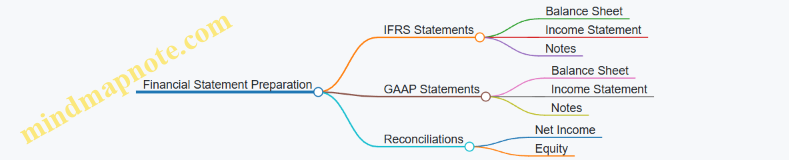
Step 5: Review and Compliance Checks
- Perform internal controls and compliance reviews.
- Validate disclosures meet regulatory requirements.
Example:
- Compliance officer verifies that lease disclosures meet both IFRS 16 and ASC 842 standards.
Step 6: Reporting and Filing
- Submit financial reports to relevant regulatory bodies.
- Provide management and stakeholders with reconciled financial information.
Example:
- Submit IFRS-based reports to international regulators.
- Submit GAAP-based reports to SEC or other local authorities.
Integrated Workflow Example Summary Table
| Step | IFRS Focus | GAAP Focus | Key Example |
|---|---|---|---|
| 1. Reporting Requirements | IFRS 15, IFRS 16 | ASC 606, ASC 842 | Identify revenue and lease rules |
| 2. Data Collection | Contract terms, lease data | Contract terms, lease data | Software subscription revenue |
| 3. Accounting Entries | Finance lease recognition | Operating lease recognition | Lease liability calculation |
| 4. Statement Preparation | IFRS presentation and disclosures | GAAP presentation and disclosures | Balance sheet and notes |
| 5. Review & Compliance | IFRS disclosure checklist | GAAP disclosure checklist | Lease disclosure verification |
| 6. Reporting & Filing | IFRS regulatory filings | GAAP regulatory filings | Submit to IFRS and GAAP regulators |
Final Notes
- Maintaining parallel ledgers or using integrated accounting software can streamline this workflow.
- Regular training and updates on IFRS and GAAP changes are critical.
- Clear documentation and communication between accounting, audit, and compliance teams ensure smooth reporting.
This sample workflow, supported by mind maps and practical examples, provides a comprehensive approach to managing IFRS and GAAP reporting requirements effectively.