Financial Statement Error Detection
1. Introduction to Financial Statement Errors
1.1 Understanding Financial Statements and Their Importance
Financial statements are formal records of the financial activities and position of a business, person, or other entity. They provide a structured and comprehensive summary of financial performance and financial position over a specific period, enabling stakeholders such as accountants, auditors, management, investors, and regulators to make informed decisions.
Key Financial Statements
- Balance Sheet (Statement of Financial Position): Shows the entity’s assets, liabilities, and equity at a specific point in time.
- Income Statement (Profit & Loss Statement): Reports revenues, expenses, and profits or losses over a period.
- Cash Flow Statement: Details the inflows and outflows of cash, categorized into operating, investing, and financing activities.
- Statement of Changes in Equity: Explains changes in owners’ equity over the reporting period.
Why Financial Statements Are Important
- Decision Making: They provide critical data for internal management decisions and external stakeholders.
- Compliance: Ensure adherence to accounting standards and regulatory requirements.
- Performance Measurement: Help evaluate profitability, liquidity, and solvency.
- Transparency and Accountability: Enhance trust among investors, creditors, and regulators.
Mind Map: Components of Financial Statements
Example 1: Understanding a Balance Sheet Snapshot
Imagine a company, ABC Corp, with the following simplified balance sheet:
| Assets | Amount ($) | Liabilities & Equity | Amount ($) |
|---|---|---|---|
| Cash | 50,000 | Accounts Payable | 20,000 |
| Accounts Receivable | 30,000 | Long-Term Debt | 40,000 |
| Inventory | 20,000 | Equity | 40,000 |
| Total Assets | 100,000 | Total Liabilities & Equity | 100,000 |
This snapshot helps accountants and auditors verify that the accounting equation (Assets = Liabilities + Equity) holds true and assess liquidity and financial structure.
Mind Map: Importance of Financial Statements
Example 2: Using Financial Statements for Decision Making
An auditor reviewing XYZ Ltd notices that the cash flow statement shows consistent negative cash flows from operating activities despite positive net income on the income statement. This discrepancy signals a potential issue such as revenue recognition errors or uncollected receivables, prompting further investigation.
Best Practice Integrated Example
When preparing or auditing financial statements, always cross-reference the income statement with the cash flow statement and balance sheet. For instance, if net income increases but cash from operations decreases, investigate possible causes such as increased accounts receivable or inventory buildup.
Understanding financial statements and their importance lays the foundation for effective error detection, ensuring accuracy, reliability, and compliance in financial reporting.
1.2 Common Types of Errors in Financial Statements
Financial statements are critical documents that reflect the financial health of an organization. However, errors can occur during their preparation, which may mislead stakeholders and affect decision-making. Understanding the common types of errors helps accountants and auditors detect and correct them efficiently.
Mind Map: Common Types of Financial Statement Errors
Clerical Errors
These are simple mistakes often caused by human error during data entry or calculation.
Example:
- A payment of $1,250 is mistakenly entered as $12,500 in the ledger.
- Transposition error where $345 is recorded as $435.
Best Practice: Use automated data validation tools and double-entry bookkeeping to minimize clerical errors.
Errors of Principle
These errors occur when accounting principles or standards are incorrectly applied.
Example:
- Recording a capital expenditure as an expense, thereby understating assets and overstating expenses.
- Using cash basis accounting for revenue recognition instead of accrual basis.
Best Practice: Regular training on accounting standards (e.g., IFRS, GAAP) and thorough review of accounting policies.
Errors of Omission
Transactions or events are completely left out of the financial statements.
Example:
- Failing to record a supplier invoice, resulting in understated liabilities and expenses.
- Omitting accrued interest payable.
Best Practice: Implement comprehensive checklists and reconciliation procedures to ensure completeness.
Errors of Commission
Transactions are recorded but with incorrect details such as wrong amounts or accounts.
Example:
- Recording a $500 purchase in the office supplies account instead of the equipment account.
- Posting a payment to the wrong customer account.
Best Practice: Cross-check transactions with source documents and use accounting software with built-in controls.
Compensating Errors
Two or more errors that offset each other, resulting in a balanced trial balance but incorrect financial statements.
Example:
- Overstating revenue by $1,000 and overstating expenses by $1,000.
Best Practice: Detailed transaction testing and analytical review to detect inconsistencies.
Errors of Duplication
Transactions are recorded more than once.
Example:
- Recording the same sales invoice twice, inflating revenue.
Best Practice: Use unique transaction identifiers and perform periodic reconciliations.
Errors in Classification
Transactions are recorded in the wrong category, affecting financial statement presentation.
Example:
- Classifying a long-term loan as a current liability.
- Recording repairs and maintenance as capital expenditure.
Best Practice: Clear chart of accounts and regular review of account classifications.
Errors in Valuation
Assets or liabilities are recorded at incorrect amounts.
Example:
- Overvaluing inventory by not accounting for obsolete stock.
- Understating depreciation expense by using an incorrect useful life.
Best Practice: Regular physical inventories and adherence to valuation standards.
Summary
Detecting these common errors requires a combination of strong internal controls, thorough understanding of accounting principles, and the use of analytical and technological tools. By recognizing the nature of each error type, accountants and auditors can apply targeted best practices to ensure accuracy and reliability in financial reporting.
1.3 Impact of Errors on Financial Reporting and Decision Making
Financial statement errors can significantly distort the true financial position and performance of an organization. These inaccuracies not only undermine the reliability of financial reports but also adversely affect the decisions made by various stakeholders. Understanding the impact of these errors is crucial for accountants and auditors to prioritize error detection and correction.
Key Areas Affected by Financial Statement Errors
Distortion of Financial Position and Performance
Errors such as misclassification, omission, or incorrect valuation can lead to misstated assets, liabilities, revenues, or expenses. For example, overstating inventory inflates assets and net income, potentially misleading users about the company’s liquidity and profitability.
Example: A manufacturing company accidentally records obsolete inventory at full cost instead of net realizable value. This error inflates current assets by $500,000 and overstates net income by $100,000, causing management to believe the company is more profitable and liquid than it actually is.
Erosion of Stakeholder Trust
Investors, creditors, and regulators rely on accurate financial statements to make informed decisions. Errors can erode trust, leading to loss of investment, higher borrowing costs, or increased regulatory scrutiny.
Example: An auditor discovers that a retail chain has been recognizing revenue prematurely. Once disclosed, the company’s stock price drops by 15%, and creditors demand stricter loan covenants.
Poor Management Decisions
Management depends on financial data for budgeting, forecasting, and strategic planning. Errors can lead to misguided decisions, such as overexpansion, underinvestment, or inappropriate cost-cutting.
Example: A tech startup underreports expenses due to data entry errors. Based on inflated profit figures, management decides to increase R&D spending aggressively, which later causes cash flow problems when the true expenses surface.
Regulatory and Compliance Risks
Financial errors can result in non-compliance with accounting standards (e.g., IFRS, GAAP), leading to legal consequences, fines, or restatements.
Example: A publicly traded company fails to disclose contingent liabilities properly. Regulatory authorities impose fines, and the company must restate its financials, damaging its reputation.
Mind Map: Consequences of Financial Statement Errors
Summary
Financial statement errors have far-reaching consequences that extend beyond mere numbers. They compromise the integrity of financial reporting, shake stakeholder confidence, impair management’s ability to make sound decisions, and expose the organization to regulatory risks. Accountants and auditors must therefore employ rigorous error detection and correction practices to safeguard the reliability of financial information.
Best Practice Tip
Implement regular reconciliations and analytical reviews to catch discrepancies early. For instance, comparing current period ratios with historical trends can highlight unusual variances that may indicate errors.
1.4 Overview of Error Detection Techniques
Detecting errors in financial statements is a critical task for accountants and auditors to ensure the accuracy and reliability of financial reporting. This section provides a comprehensive overview of the most effective error detection techniques, illustrated with clear examples and mind maps to enhance understanding.
Key Error Detection Techniques
-
Analytical Procedures
- Involves evaluating financial information through analysis of plausible relationships among both financial and non-financial data.
- Helps identify unusual transactions or events that may indicate errors.
-
Transaction Testing
- Detailed examination of individual transactions and supporting documents.
- Useful for verifying the accuracy and validity of recorded amounts.
-
Reconciliation
- Comparing two sets of records to ensure they are in agreement.
- Commonly used for bank reconciliations, accounts receivable, and payable.
-
Ratio and Trend Analysis
- Examining financial ratios and trends over time to spot inconsistencies.
- Can reveal errors such as revenue overstatements or expense misclassifications.
-
Use of Technology and Automated Tools
- Leveraging software for data analytics, anomaly detection, and continuous monitoring.
- Enhances efficiency and accuracy in error detection.
-
Internal Controls Review
- Assessing the design and effectiveness of internal controls to prevent and detect errors.
Mind Map: Overview of Error Detection Techniques
Detailed Explanation with Examples
1. Analytical Procedures
- Example: An auditor notices that the gross profit margin for the current quarter is significantly higher than previous quarters without a corresponding increase in sales volume. This anomaly triggers further investigation, revealing that some sales were recorded prematurely, causing revenue overstatement.
2. Transaction Testing
- Example: Sampling 30 purchase invoices from the accounts payable ledger reveals that 3 invoices were recorded twice, leading to inflated expenses. Correcting these duplicate entries adjusts the financial statements accordingly.
3. Reconciliation
- Example: A bank reconciliation reveals a $5,000 deposit recorded in the company’s books but missing from the bank statement, indicating a timing difference or a possible error in recording.
4. Ratio and Trend Analysis
- Example: The current ratio drops drastically compared to the previous year. Upon review, it is found that a large short-term liability was misclassified as a long-term liability, impacting liquidity ratios.
5. Use of Technology and Automated Tools
- Example: Using data analytics software, an auditor identifies several journal entries posted on weekends and holidays, which are unusual and warrant further review for potential errors or fraud.
6. Internal Controls Review
- Example: Weakness in segregation of duties allows one employee to both approve and record transactions, increasing the risk of errors or fraud. Strengthening controls reduces this risk.
Mind Map: Analytical Procedures Breakdown
Summary
By combining these techniques, accountants and auditors can systematically detect errors in financial statements. Employing a mix of manual review and technology-driven tools ensures a thorough and efficient error detection process, ultimately safeguarding the integrity of financial reporting.
1.5 Best Practice: Establishing a Culture of Accuracy with Real-World Examples
Establishing a culture of accuracy within an organization is foundational to effective financial statement error detection. This culture emphasizes precision, accountability, and continuous improvement, ensuring that errors are minimized and promptly addressed when they occur.
Why Establish a Culture of Accuracy?
- Enhances reliability of financial statements.
- Builds stakeholder trust including investors, regulators, and management.
- Reduces risk of material misstatements and fraud.
- Improves efficiency by catching errors early.
Key Components of a Culture of Accuracy
Practical Steps to Foster Accuracy
-
Define Clear Roles and Responsibilities
- Assign ownership for each financial statement area.
- Example: A company designates a dedicated revenue accountant responsible for reviewing all sales entries monthly.
-
Regular Training and Updates
- Conduct workshops on common errors and new accounting standards.
- Example: Quarterly training sessions on IFRS 15 revenue recognition updates help accountants stay current.
-
Encourage Open Communication and Error Reporting
- Create a non-punitive environment where employees can report errors.
- Example: An audit firm implemented an anonymous error reporting tool, increasing early detection by 30%.
-
Leverage Technology for Accuracy
- Use automated reconciliation and validation tools.
- Example: A corporation integrated AI-powered software that flags unusual journal entries in real-time.
-
Leadership and Tone at the Top
- Senior management must emphasize accuracy as a core value.
- Example: The CFO regularly discusses the importance of data integrity in company-wide meetings.
Real-World Examples
Example 1: TechCo’s Error Reduction Initiative
- Problem: Frequent misclassifications in expense accounts leading to misstated financials.
- Solution: TechCo introduced monthly cross-departmental reviews and implemented a shared checklist.
- Outcome: Errors dropped by 40% within six months.
Example 2: RetailCorp’s Training Program
- Problem: New accounting staff struggled with complex inventory valuation.
- Solution: RetailCorp launched a mentorship program and bi-monthly training on inventory accounting.
- Outcome: Inventory errors detected during audits reduced significantly.
Example 3: FinServe’s Leadership Commitment
- Problem: Inconsistent application of accounting policies across subsidiaries.
- Solution: The CEO mandated quarterly financial accuracy audits and personally reviewed summary reports.
- Outcome: Consistency improved, and material errors were identified early.
Summary
Establishing a culture of accuracy is not a one-time effort but a continuous journey. It requires commitment from leadership, clear communication, ongoing education, and the smart use of technology. By embedding these principles into daily operations, organizations can significantly reduce financial statement errors and enhance overall reporting quality.
2. Preliminary Steps in Error Detection
2.1 Gathering and Organizing Financial Data
Effective financial statement error detection begins with the foundational step of gathering and organizing financial data. Without accurate, complete, and well-structured data, even the most sophisticated detection techniques may fail. This section explores best practices for collecting and structuring financial information, supported by practical examples and visual mind maps to enhance understanding.
Importance of Gathering and Organizing Financial Data
- Ensures completeness and accuracy of information.
- Facilitates efficient error detection and analysis.
- Provides a clear audit trail for verification.
Key Sources of Financial Data
- General Ledger (GL)
- Subsidiary Ledgers (Accounts Receivable, Accounts Payable)
- Trial Balance
- Bank Statements
- Invoices and Receipts
- Payroll Records
- Fixed Asset Registers
Mind Map: Sources and Types of Financial Data
Best Practice: Systematic Data Collection
- Identify Required Data: Define the scope of the financial statements and identify all relevant data sources.
- Access Data Sources: Coordinate with accounting, finance, and operations teams to obtain data.
- Verify Completeness: Cross-check data against prior periods and supporting documentation.
- Standardize Formats: Convert data into consistent formats for easier analysis.
- Organize Chronologically and by Account: Arrange data to reflect the accounting periods and account classifications.
Example: Organizing Trial Balance Data
Suppose an auditor receives a trial balance in a spreadsheet with accounts listed randomly. To detect errors effectively, the auditor reorganizes the data:
| Account Code | Account Name | Debit | Credit |
|---|---|---|---|
| 1000 | Cash | 50,000 | |
| 2000 | Accounts Payable | 30,000 | |
| 4000 | Revenue | 80,000 | |
| 3000 | Inventory | 20,000 |
The auditor sorts accounts by type (Assets, Liabilities, Equity, Revenue, Expenses) and verifies that total debits equal total credits. This organization helps quickly identify discrepancies such as missing or misclassified accounts.
Mind Map: Steps to Organize Financial Data
Tips for Effective Data Organization
- Use accounting software exports where possible to reduce manual errors.
- Maintain version control to track changes in data files.
- Utilize spreadsheets with filters and pivot tables for dynamic data analysis.
- Document assumptions and data sources clearly.
Example: Using a Checklist for Data Gathering
| Task | Completed (Y/N) | Notes |
|---|---|---|
| Obtain General Ledger for period | Y | Received from accounting dept. |
| Collect bank statements | Y | Verified with bank portal |
| Gather payroll records | N | Awaiting HR department |
| Retrieve fixed asset register | Y | Updated as of last quarter |
This checklist ensures no critical data source is overlooked before proceeding to error detection.
Summary
Gathering and organizing financial data is a critical first step that sets the stage for effective error detection. By systematically collecting data from all relevant sources, verifying its completeness, and organizing it logically, accountants and auditors can significantly improve the accuracy and efficiency of their review processes.
2.2 Understanding the Entity’s Business and Accounting Policies
Understanding the entity’s business and accounting policies is a crucial step in detecting financial statement errors. This foundational knowledge allows accountants and auditors to contextualize financial data, identify unusual transactions, and assess whether accounting treatments align with the entity’s operations and applicable accounting standards.
Why is Understanding the Business Important?
- Contextual Analysis: Knowing the nature of the business helps in recognizing what financial transactions are typical and which are outliers.
- Risk Identification: Certain industries have unique risks and common error types.
- Appropriate Application of Accounting Policies: Different businesses may apply accounting standards differently based on their operations.
Key Areas to Understand
Mind Map: Understanding the Entity’s Business
Accounting Policies: What to Review
Accounting policies dictate how transactions are recorded and reported. Understanding these policies helps detect inconsistencies or deviations that may indicate errors.
Mind Map: Key Accounting Policies to Understand
Example 1: Understanding Business Helps Detect Revenue Errors
A software company sells both licenses and subscription services. If an auditor is unaware that subscription revenue should be recognized over time, they might mistakenly accept revenue recognized upfront, leading to an overstatement.
Best Practice: Review the entity’s revenue recognition policy and compare it to the business model to ensure compliance.
Example 2: Accounting Policy Review Reveals Inventory Valuation Errors
A retail company uses FIFO for inventory valuation. During a period of rising prices, an auditor notices unusually low cost of goods sold. Upon reviewing the policy and inventory records, it was found that LIFO was mistakenly applied in the system, causing errors.
Best Practice: Confirm that the accounting policies documented match the actual practices and system configurations.
Steps to Effectively Understand Business and Policies
- Read the Entity’s Financial Statement Notes: These usually contain detailed accounting policies.
- Interview Management and Accounting Staff: Gain insights into business operations and policy applications.
- Review Industry Publications: Understand common practices and regulatory requirements.
- Analyze Prior Period Financials: Identify any changes in policies or business operations.
Example Mind Map: Process to Understand Business and Accounting Policies
Mind Map: Process Flow
Summary
Understanding the entity’s business and accounting policies is not a one-time task but an ongoing process that enhances the accuracy and reliability of financial statement error detection. By integrating this understanding with analytical procedures and testing, accountants and auditors can better identify anomalies and ensure compliance.
This section demonstrated how deep knowledge of business operations and accounting policies forms the backbone of effective financial statement error detection, supported by mind maps and practical examples.
2.3 Best Practice: Creating a Comprehensive Checklist for Initial Review
A comprehensive checklist is an essential tool for accountants and auditors during the initial review of financial statements. It ensures consistency, thoroughness, and helps in systematically identifying potential errors or omissions early in the process. Below, we explore how to create an effective checklist, supported by mind maps and practical examples.
Why Use a Checklist?
- Standardizes the review process across different financial statements and teams.
- Helps prevent oversight of critical areas prone to errors.
- Facilitates documentation and accountability.
- Serves as a training tool for new accountants and auditors.
Components of a Comprehensive Checklist
Initial Review Checklist Mind Map
Step-by-Step Guide to Creating Your Checklist
- Identify Key Financial Statement Areas: Start by listing all major components of the financial statements that need review.
- Incorporate Accounting Standards: Include checks to ensure compliance with relevant accounting frameworks.
- Highlight Common Error Zones: Focus on areas historically prone to errors or fraud.
- Add Analytical Review Steps: Incorporate ratio and trend analysis to flag unusual items.
- Include Documentation and Communication Steps: Ensure findings are recorded and communicated properly.
Example Checklist Items
Mind Map: Example of an Initial Review Checklist Focused on Revenue Recognition
Revenue Recognition Checklist Mind Map
Practical Example: Using a Checklist to Detect Missing Disclosures
During an initial review, an auditor uses a checklist that includes a section on disclosures. The checklist prompts verification of related party transactions disclosure. Upon review, the auditor notices the absence of this disclosure despite significant transactions with a subsidiary. This triggers a deeper investigation, uncovering an omission that could materially impact the financial statements.
Tips for Effective Checklist Use
- Customize: Tailor checklists to specific industries and company sizes.
- Update Regularly: Reflect changes in accounting standards and regulatory requirements.
- Train Staff: Ensure all team members understand checklist items and their importance.
- Integrate with Software: Use digital checklists linked to financial systems for efficiency.
By embedding a comprehensive checklist into the initial review process, accountants and auditors can significantly reduce the risk of overlooking errors, ensuring higher quality and reliability in financial reporting.
2.4 Example: Using Checklists to Identify Missing Disclosures
In financial statement preparation and auditing, missing disclosures can lead to incomplete or misleading financial reports. Using checklists is a best practice that helps accountants and auditors systematically verify that all required disclosures are present and accurate.
What is a Disclosure Checklist?
A disclosure checklist is a structured list of all required disclosures based on applicable accounting standards (e.g., IFRS, GAAP). It serves as a guide to ensure that financial statements include all necessary notes and explanations.
Why Use Checklists?
- Consistency: Ensures uniform application of disclosure requirements across periods and entities.
- Completeness: Helps avoid omissions that could lead to regulatory issues or misinterpretation.
- Efficiency: Streamlines the review process by focusing on key areas.
Mind Map: Key Components of a Disclosure Checklist
Step-by-Step Example: Using a Checklist to Identify Missing Disclosures
Scenario: An auditor is reviewing the financial statements of a manufacturing company preparing IFRS-compliant reports.
-
Prepare the Checklist: Based on IFRS disclosure requirements, the auditor compiles a checklist covering all relevant notes.
-
Cross-Reference Financial Statements: The auditor reviews each section of the financial statements and matches disclosures against the checklist.
-
Identify Gaps: For example, the checklist requires disclosure of “Leases” under IFRS 16. The auditor notes the absence of this disclosure.
-
Investigate: The auditor queries management and reviews lease contracts to confirm whether leases exist.
-
Document Findings: The missing disclosure is documented, and management is advised to include it in the notes.
Mind Map: Process Flow for Using Checklists in Disclosure Review
Example Checklist Extract (Simplified)
| Disclosure Area | Required? | Present? | Comments |
|---|---|---|---|
| Revenue Recognition | Yes | Yes | Properly disclosed |
| Leases | Yes | No | Missing; leases identified in contracts |
| Related Party Transactions | Yes | Yes | Adequate disclosure |
| Contingent Liabilities | Yes | No | No contingencies reported; verified |
Practical Tips
- Customize checklists to the industry and entity specifics.
- Update checklists regularly to reflect changes in accounting standards.
- Use electronic checklists integrated with audit software for efficiency.
Summary
Using checklists to identify missing disclosures is a practical and effective method to enhance the accuracy and completeness of financial statements. By systematically verifying each required disclosure, accountants and auditors reduce the risk of oversight and improve stakeholder confidence.
2.5 Setting Materiality Thresholds for Error Identification
Setting materiality thresholds is a critical step in the financial statement error detection process. Materiality helps accountants and auditors determine which errors or misstatements are significant enough to influence the decisions of users of financial statements. This section explores how to set these thresholds effectively, supported by mind maps and practical examples.
What is Materiality?
Materiality refers to the magnitude of an omission or misstatement of accounting information that, in the light of surrounding circumstances, makes it probable that the judgment of a reasonable person relying on the information would have been changed or influenced.
Why Set Materiality Thresholds?
- To focus efforts on errors that matter
- To optimize audit resources
- To ensure compliance with accounting standards
- To provide clear guidance for error evaluation
Mind Map: Factors Influencing Materiality Thresholds
Quantitative Approaches to Setting Materiality
Common benchmarks include:
- 5% of pre-tax income
- 1% of total assets
- 0.5% to 1% of revenue
Example: A company has a net income before tax of $2,000,000. Using 5% as the threshold, errors above $100,000 would be considered material.
Qualitative Considerations
Some errors, even if small in amount, may be material due to their nature.
Example: An error involving a related party transaction of $10,000 may be material due to potential conflicts of interest, despite being below quantitative thresholds.
Mind Map: Steps to Set Materiality Thresholds
Example Scenario: Applying Materiality in Error Detection
Company Profile: Mid-sized manufacturing firm
- Total assets: $50 million
- Revenue: $80 million
- Pre-tax income: $5 million
Materiality Thresholds:
- 1% of total assets = $500,000
- 0.5% of revenue = $400,000
- 5% of pre-tax income = $250,000
Decision: Use the lowest threshold ($250,000) as the materiality limit for error detection.
Outcome: Errors below $250,000 may be considered immaterial unless qualitative factors suggest otherwise.
Best Practice: Documenting Materiality Thresholds
- Clearly state the quantitative basis
- Explain qualitative judgments
- Update thresholds annually or when significant changes occur
Mind Map: Materiality Threshold Documentation
Summary
Setting materiality thresholds is a blend of quantitative calculations and qualitative judgment. By carefully considering both aspects and documenting decisions, accountants and auditors can effectively prioritize error detection efforts and enhance the reliability of financial reporting.
3. Analytical Procedures for Detecting Errors
3.1 Ratio Analysis: Identifying Anomalies in Financial Ratios
Ratio analysis is a fundamental technique used by accountants and auditors to evaluate the financial health of an organization and to detect potential errors or irregularities in financial statements. By comparing key financial ratios against historical data, industry benchmarks, or expected norms, professionals can identify anomalies that may indicate errors, misstatements, or fraud.
What is Ratio Analysis?
Ratio analysis involves calculating and interpreting various financial ratios derived from the figures reported in the financial statements. These ratios provide insights into liquidity, profitability, efficiency, and solvency.
Key Categories of Financial Ratios
How Ratio Analysis Helps Detect Errors
- Unusual Fluctuations: Sudden spikes or drops in ratios may signal errors in recording transactions.
- Inconsistencies with Industry Norms: Ratios significantly deviating from industry averages can indicate misclassifications or omissions.
- Trend Breaks: Breaks in historical trends may reflect data entry errors or incorrect adjustments.
Best Practice: Establishing Ratio Benchmarks
- Use multiple periods of historical data to establish normal ranges.
- Compare ratios against industry peers.
- Set tolerance thresholds to flag ratios for further investigation.
Example 1: Detecting Revenue Recognition Errors Using Gross Profit Margin
Scenario: A company reports a sudden increase in revenue for Q4. The gross profit margin, however, drops significantly compared to previous quarters.
Analysis:
- Calculate Gross Profit Margin = (Revenue - Cost of Goods Sold) / Revenue
- Historical average: 40%
- Current quarter: 25%
Interpretation: The decline suggests either revenue is overstated or COGS is understated. This anomaly prompts a detailed review of sales contracts and inventory costing.
Example 2: Identifying Inventory Overstatements Through Inventory Turnover Ratio
Scenario: Inventory turnover ratio declines sharply, indicating inventory is not being sold as quickly.
Calculation:
- Inventory Turnover = Cost of Goods Sold / Average Inventory
- Previous year: 8 times
- Current year: 3 times
Interpretation: A significant drop may indicate inventory overstatement or obsolete stock not properly written down.
Mind Map: Steps to Perform Ratio Analysis for Error Detection
Tips for Effective Ratio Analysis
- Always consider the context: seasonality, one-time events, or changes in accounting policies.
- Use ratio analysis as a preliminary tool; follow up with detailed transaction testing if anomalies are found.
- Combine ratio analysis with other analytical procedures for comprehensive error detection.
Summary
Ratio analysis is a powerful and accessible tool for accountants and auditors to detect financial statement errors. By systematically calculating and interpreting financial ratios, professionals can pinpoint unusual patterns and investigate underlying causes, enhancing the accuracy and reliability of financial reporting.
3.2 Trend Analysis: Spotting Irregularities Over Time
Trend analysis is a powerful technique used by accountants and auditors to detect errors and inconsistencies in financial statements by examining data patterns over multiple periods. By comparing financial metrics across months, quarters, or years, one can identify unusual fluctuations or deviations that may indicate errors or misstatements.
What is Trend Analysis?
Trend analysis involves evaluating financial data over time to observe patterns, growth rates, or declines. It helps in understanding whether financial figures are moving in a logical and consistent direction based on the company’s operations and market conditions.
Why Use Trend Analysis for Error Detection?
- Identify Unexpected Fluctuations: Sudden spikes or drops in revenue, expenses, or assets can signal errors.
- Detect Inconsistent Accounting Treatments: Changes in accounting policies or estimates may cause irregular trends.
- Highlight Data Entry or Classification Errors: Repeated or missing entries over time can be spotted.
- Support Analytical Review Procedures: Provides a basis for further investigation.
Mind Map: Key Components of Trend Analysis
Step-by-Step Approach to Trend Analysis
- Gather Historical Data: Collect financial statements for multiple periods (e.g., last 3-5 years).
- Select Key Financial Metrics: Focus on revenue, cost of goods sold, operating expenses, net income, assets, and liabilities.
- Calculate Period-to-Period Changes: Compute absolute and percentage changes between periods.
- Visualize Trends: Use line graphs or bar charts to observe patterns.
- Identify Irregularities: Look for unexpected spikes, drops, or flat trends inconsistent with business activity.
- Investigate Causes: Review supporting documentation, accounting policies, or external factors.
Example 1: Detecting Revenue Recognition Errors
Scenario: A company’s revenue shows a steady 5-7% growth over four years but suddenly jumps 40% in the latest year without any new product launches or market expansion.
Trend Analysis Steps:
- Calculate yearly revenue growth percentages.
- Visualize revenue over the five years.
- Identify the abnormal spike in the latest year.
Investigation: Upon review, it was discovered that revenue from a large contract was prematurely recognized before delivery, violating revenue recognition principles.
Best Practice: Use trend analysis to flag such anomalies early and cross-check with contract terms.
Mind Map: Investigating Revenue Spikes
Example 2: Spotting Expense Misclassification
Scenario: Operating expenses have been relatively stable, but a sudden drop in maintenance expenses is observed over two consecutive quarters.
Trend Analysis Steps:
- Analyze quarterly expense trends.
- Compare maintenance expenses with prior periods.
- Check for corresponding increases in other expense categories.
Investigation: It was found that some maintenance costs were incorrectly capitalized as assets, causing an understatement of expenses.
Best Practice: Regularly perform trend analysis on expense categories and reconcile with asset additions.
Visualization Example (Table)
| Year | Revenue ($) | % Change | Operating Expenses ($) | % Change |
|---|---|---|---|---|
| 2019 | 1,000,000 | - | 400,000 | - |
| 2020 | 1,050,000 | 5% | 420,000 | 5% |
| 2021 | 1,100,000 | 4.76% | 430,000 | 2.38% |
| 2022 | 1,540,000 | 40% | 440,000 | 2.33% |
Notice the 40% revenue increase in 2022 which warrants further investigation.
Tips for Effective Trend Analysis
- Use consistent time intervals (monthly, quarterly, annually).
- Adjust for seasonality where applicable.
- Combine trend analysis with ratio analysis for deeper insights.
- Document findings and hypotheses for irregularities.
- Collaborate with operational teams to understand business context.
Summary
Trend analysis is an essential tool for accountants and auditors to detect financial statement errors by monitoring changes over time. By systematically analyzing trends, spotting irregularities, and investigating their causes, professionals can enhance the accuracy and reliability of financial reporting.
3.3 Common-Size Financial Statements for Comparative Analysis
Common-size financial statements are a powerful tool for accountants and auditors to detect errors and inconsistencies by expressing each line item as a percentage of a base figure. This standardization allows for easier comparison across periods, companies, or industries, helping to highlight unusual trends or discrepancies that may indicate errors.
What Are Common-Size Financial Statements?
- Definition: Financial statements where each item is presented as a percentage of a total figure (e.g., total assets for balance sheet, total revenue for income statement).
- Purpose: Normalize financial data to facilitate comparison and identify anomalies.
Types of Common-Size Statements
- Common-Size Balance Sheet: Each asset, liability, and equity item is expressed as a percentage of total assets.
- Common-Size Income Statement: Each revenue and expense item is expressed as a percentage of total sales or revenue.
Why Use Common-Size Statements for Error Detection?
- Helps identify unusual fluctuations or outliers that may indicate errors.
- Facilitates benchmarking against industry averages or competitors.
- Simplifies trend analysis over multiple periods.
Mind Map: Key Concepts of Common-Size Financial Statements
How to Prepare a Common-Size Financial Statement
- Select the base figure:
- Balance Sheet: Total assets
- Income Statement: Total revenue or sales
- Calculate percentages: Divide each line item by the base figure and multiply by 100.
- Analyze the percentages: Look for significant deviations from prior periods or industry norms.
Example 1: Common-Size Income Statement
| Income Statement Item | Amount (USD) | % of Total Revenue |
|---|---|---|
| Total Revenue | 1,000,000 | 100% |
| Cost of Goods Sold | 600,000 | 60% |
| Gross Profit | 400,000 | 40% |
| Operating Expenses | 250,000 | 25% |
| Net Income | 100,000 | 10% |
Analysis: If in the previous year, Cost of Goods Sold was 50% of revenue but suddenly jumps to 60%, this could indicate an error in inventory valuation or revenue recognition.
Mind Map: Steps to Analyze Common-Size Statements
Example 2: Detecting Errors Using Common-Size Balance Sheet
| Balance Sheet Item | Amount (USD) | % of Total Assets |
|---|---|---|
| Total Assets | 2,000,000 | 100% |
| Cash and Cash Equivalents | 300,000 | 15% |
| Accounts Receivable | 700,000 | 35% |
| Inventory | 800,000 | 40% |
| Property, Plant & Equipment | 200,000 | 10% |
Analysis: If inventory suddenly represents 60% of total assets compared to an industry average of 30-40%, this could suggest overstatement or counting errors in inventory.
Best Practice: Integrate Common-Size Analysis with Other Techniques
- Use alongside ratio analysis and trend analysis for a comprehensive review.
- Combine with transaction testing when anomalies are detected.
- Document findings and follow up with management for clarification.
Summary
Common-size financial statements are an essential best practice for accountants and auditors. They provide a clear, standardized view of financial data that simplifies error detection through comparative analysis. By regularly preparing and analyzing these statements, professionals can proactively identify irregularities and ensure the accuracy and reliability of financial reporting.
3.4 Best Practice: Integrating Analytical Procedures with Automated Tools
In the modern accounting and auditing environment, combining traditional analytical procedures with automated tools significantly enhances the accuracy and efficiency of financial statement error detection. This integration allows accountants and auditors to quickly identify anomalies, reduce human error, and focus their expertise on complex judgment areas.
Why Integrate Analytical Procedures with Automated Tools?
- Speed and Efficiency: Automated tools can process large volumes of data rapidly, enabling timely identification of unusual transactions or trends.
- Consistency: Automated systems apply the same criteria uniformly, reducing the risk of oversight.
- Depth of Analysis: Advanced algorithms can detect subtle patterns or outliers that might be missed manually.
- Resource Optimization: Frees up professional time to focus on interpretation and decision-making rather than data crunching.
Key Components of Integration
Step-by-Step Integration Process
-
Automated Data Extraction and Preparation: Use tools to pull financial data directly from accounting systems, ensuring accuracy and reducing manual entry errors.
-
Apply Analytical Procedures via Software: Implement ratio, trend, and variance analyses using automated tools that can flag deviations beyond predefined thresholds.
-
Set Up Alerts and Dashboards: Configure systems to notify accountants/auditors of anomalies in real-time, facilitating prompt investigation.
-
Human Review and Contextualization: Professionals analyze flagged items, considering business context, accounting policies, and external factors.
-
Document Findings and Adjust Procedures: Record outcomes to refine thresholds and improve future detection accuracy.
Example: Detecting Revenue Recognition Errors
Scenario: A company’s revenue suddenly spikes in the last quarter, raising suspicion of premature revenue recognition.
Traditional Approach: Manually compare quarterly revenues and investigate unusual increases.
Integrated Approach:
- Automated tools extract quarterly revenue data.
- Trend analysis algorithms detect a 40% increase compared to previous quarters, exceeding the 15% threshold.
- An alert is generated and displayed on the auditor’s dashboard.
- Auditor reviews supporting contracts and delivery records to confirm if revenue recognition complies with accounting standards.
Outcome: Early detection of potential revenue recognition error, allowing timely correction before financial statements are finalized.
Mind Map: Automated Analytical Procedure Workflow
Tips for Successful Integration
- Customize Thresholds: Tailor anomaly detection thresholds to the company’s size, industry, and historical data to reduce false positives.
- Continuous Learning: Use machine learning tools that improve detection accuracy over time based on feedback.
- Cross-Functional Collaboration: Involve IT, finance, and audit teams to ensure data integrity and tool effectiveness.
- Training: Equip accountants and auditors with skills to interpret automated outputs critically.
By integrating analytical procedures with automated tools, finance professionals can elevate the quality of financial statement reviews, uncover hidden errors faster, and contribute to more reliable financial reporting.
3.5 Example: Detecting Revenue Recognition Errors Using Ratio Analysis
Revenue recognition is a critical area in financial reporting where errors can significantly distort a company’s financial health. Ratio analysis provides a powerful tool to detect anomalies that may indicate revenue recognition errors.
Understanding Revenue Recognition Errors
Revenue recognition errors occur when revenue is recorded in the wrong period, overstated, understated, or recognized without proper evidence. These errors can arise from:
- Premature recognition of revenue
- Failure to record returns or allowances
- Incorrect application of revenue recognition policies
Key Ratios to Detect Revenue Recognition Errors
- Revenue Growth Rate
- Sudden spikes or drops may indicate improper revenue recognition.
- Accounts Receivable Turnover Ratio
- Unusual changes may suggest fictitious sales or delayed collections.
- Days Sales Outstanding (DSO)
- Increasing DSO could signal revenue recorded without actual cash collection.
- Gross Profit Margin
- Significant fluctuations may indicate errors in revenue or cost recognition.
Mind Map: Revenue Recognition Error Detection via Ratio Analysis
Step-by-Step Example
Scenario: A company reports a 40% increase in revenue in Q4 compared to Q3, while the industry average growth is 5%. At the same time, the accounts receivable balance has increased by 70%, and DSO has risen from 45 days to 75 days.
Analysis:
- Revenue Growth Rate: 40% spike is unusually high compared to the industry.
- Accounts Receivable Turnover: Decreased turnover indicates slower collection.
- DSO: Increase from 45 to 75 days suggests revenue may have been recognized prematurely.
- Gross Profit Margin: If margin remains constant or improves despite higher revenue, it might indicate inflated sales.
Conclusion: These ratio anomalies suggest potential revenue recognition errors, prompting further investigation.
Mind Map: Investigative Actions Following Ratio Anomalies
Additional Example: Detecting Revenue Overstatement
Company A reports a steady revenue increase over six months, but the gross profit margin has declined sharply from 40% to 25%. Simultaneously, accounts receivable turnover has increased, indicating faster collections.
Interpretation:
- Declining gross margin with rising revenue may indicate revenue is overstated or costs are understated.
- Increased turnover suggests aggressive collection or possible channel stuffing.
Action: Perform detailed transaction testing and verify if revenue was recognized before goods were delivered or services rendered.
Summary
Using ratio analysis to detect revenue recognition errors involves:
- Monitoring key financial ratios over time and against industry benchmarks.
- Identifying unusual patterns or inconsistencies.
- Conducting targeted investigations based on ratio anomalies.
This approach, combined with professional judgment and corroborative evidence, enhances the accuracy and reliability of financial statements.
4. Detailed Transaction Testing and Reconciliation
4.1 Sampling Techniques for Transaction Testing
Transaction testing is a critical step in detecting errors within financial statements. Due to the large volume of transactions, it is often impractical to test every single transaction. Sampling techniques allow accountants and auditors to select a representative subset of transactions to evaluate, ensuring efficiency while maintaining accuracy.
Why Sampling is Important
- Efficiency: Saves time and resources by focusing on a manageable number of transactions.
- Effectiveness: When done correctly, sampling provides a reliable basis for conclusions about the entire population.
- Risk Management: Helps identify areas with higher risk of errors or misstatements.
Common Sampling Techniques
Random Sampling
- Description: Every transaction has an equal chance of being selected.
- Best Practice: Use random number generators or software tools to avoid bias.
- Example: Selecting 50 transactions out of 1,000 sales invoices by generating 50 random numbers.
Systematic Sampling
- Description: Selects every nth transaction from a sorted list.
- Best Practice: Ensure the list is not ordered in a way that introduces bias.
- Example: If testing 100 transactions from 1,000, select every 10th transaction.
Stratified Sampling
- Description: Divides transactions into subgroups (strata) and samples from each.
- Best Practice: Useful when population has distinct categories with different risk levels.
- Example: Separating transactions by amount (small, medium, large) and sampling proportionally.
Monetary Unit Sampling (MUS)
- Description: Focuses on monetary value, giving larger transactions a higher chance of selection.
- Best Practice: Effective for detecting overstatements.
- Example: Sampling transactions weighted by their dollar amounts to catch large errors.
Judgmental Sampling
- Description: Selection based on auditor’s professional judgment.
- Best Practice: Use when specific risk areas are known.
- Example: Selecting transactions from a new supplier due to higher fraud risk.
Haphazard Sampling
- Description: Selecting transactions without a structured method but aiming to avoid bias.
- Best Practice: Less reliable, should be supplemented with other techniques.
- Example: Picking transactions randomly from different dates without a formal process.
Practical Example: Applying Sampling in Transaction Testing
Scenario: An auditor needs to test the accuracy of 5,000 sales transactions for the fiscal year.
- Step 1: Determine materiality and risk to decide sample size.
- Step 2: Choose sampling technique. Here, stratified sampling is selected to ensure coverage across transaction sizes.
- Step 3: Divide transactions into three strata:
- Small (< $1,000): 3,000 transactions
- Medium ($1,000 - $10,000): 1,500 transactions
- Large (> $10,000): 500 transactions
- Step 4: Sample proportionally: 30 from small, 15 from medium, 10 from large.
- Step 5: Test selected transactions for accuracy, supporting documentation, and compliance.
Outcome: Errors found in large transactions prompt increased focus on that stratum in future audits.
Best Practices for Sampling in Transaction Testing
- Define clear objectives and understand the population.
- Use software tools to generate unbiased samples.
- Combine sampling techniques if needed to address different risks.
- Document the sampling methodology and rationale thoroughly.
- Reassess sampling approach if initial results indicate higher error rates.
Summary
Sampling techniques are indispensable for efficient and effective transaction testing. Understanding the strengths and limitations of each method, combined with practical application and professional judgment, enables accountants and auditors to detect errors reliably and maintain the integrity of financial statements.
4.2 Verifying Supporting Documentation
Verifying supporting documentation is a critical step in detecting errors within financial statements. It involves examining the original documents that back up recorded transactions to ensure accuracy, completeness, and legitimacy. This process helps accountants and auditors confirm that the financial data presented is reliable and free from misstatements.
Why Verify Supporting Documentation?
- Accuracy: Ensures that recorded amounts match the original documents.
- Completeness: Confirms that all transactions have proper documentation.
- Authorization: Checks that transactions were approved by the appropriate personnel.
- Legitimacy: Detects potential fraud or fictitious transactions.
Types of Supporting Documentation
- Invoices and Receipts
- Contracts and Agreements
- Purchase Orders
- Bank Statements and Cancelled Checks
- Payroll Records
- Shipping and Receiving Documents
Mind Map: Key Steps in Verifying Supporting Documentation
Best Practice: Systematic Documentation Review
- Create a Documentation Checklist: Develop a checklist tailored to the company’s transaction types to ensure no document is overlooked.
- Use Sampling Techniques: For large volumes, select representative samples to verify thoroughly.
- Leverage Technology: Use document management systems to track and retrieve documents efficiently.
- Maintain Audit Trails: Keep records of verification steps and findings for accountability.
Example 1: Verifying a Purchase Transaction
Scenario: An auditor is reviewing a $15,000 purchase recorded in the accounts payable ledger.
Steps:
- Obtain the purchase order (PO) to confirm the order details.
- Review the supplier invoice to verify the billed amount matches the PO.
- Check the receiving report to ensure goods were received.
- Match the payment record with the bank statement to confirm payment.
- Verify that the PO, invoice, and payment have appropriate approvals.
Outcome: If all documents align and approvals are valid, the transaction is considered properly supported. Discrepancies such as missing receiving reports or mismatched amounts would flag potential errors.
Mind Map: Example Workflow for Purchase Verification
Example 2: Detecting Duplicate Payments
Scenario: An auditor suspects duplicate payments to a vendor.
Steps:
- Review payment vouchers and bank statements.
- Identify invoices with identical amounts and invoice numbers.
- Check dates to see if payments were made multiple times for the same invoice.
- Verify supporting documents to confirm if multiple payments were authorized.
Outcome: Discovery of duplicate payments indicates an error or control weakness, requiring correction and process improvement.
Tips for Effective Documentation Verification
- Always verify original documents, not copies, when possible.
- Look for signs of document alteration such as erasures or inconsistent fonts.
- Confirm that electronic documents have proper audit trails.
- Communicate with relevant departments if discrepancies arise.
Summary
Verifying supporting documentation is essential for ensuring the integrity of financial statements. By systematically reviewing and cross-checking original documents, accountants and auditors can detect errors early, prevent fraud, and provide stakeholders with confidence in financial reporting.
4.3 Bank Reconciliations and Cash Verification
Bank reconciliations and cash verification are critical components of financial statement error detection. They ensure that the cash balances reported in the financial statements accurately reflect the actual cash position of the company. This process helps identify discrepancies caused by timing differences, errors, or fraudulent activities.
What is Bank Reconciliation?
Bank reconciliation is the process of comparing the company’s cash records (cash book) with the bank statement to identify and explain differences.
Key Objectives:
- Verify the accuracy of cash balances
- Detect errors or omissions in recording transactions
- Identify unauthorized transactions or fraud
Steps in Bank Reconciliation
Common Causes of Differences
- Timing Differences: Deposits in transit or outstanding checks not yet processed by the bank.
- Errors: Mistakes in recording amounts either in the cash book or by the bank.
- Bank Charges and Interest: Fees or interest recorded by the bank but not yet entered in the cash book.
Example: Bank Reconciliation
Scenario:
- Company’s cash book shows a balance of $10,000.
- Bank statement shows a balance of $9,200.
Reconciliation:
- Outstanding checks: $1,500
- Deposits in transit: $700
- Bank service charges not recorded in cash book: $100
Reconciliation Statement:
| Description | Amount ($) |
|---|---|
| Balance as per bank statement | 9,200 |
| Add: Deposits in transit | 700 |
| Less: Outstanding checks | (1,500) |
| Adjusted bank balance | 8,400 |
| Balance as per cash book | 10,000 |
| Less: Bank service charges | (100) |
| Adjusted cash book balance | 9,900 |
Analysis:
- The adjusted balances do not match, indicating a possible error.
- Further investigation reveals a $100 deposit recorded twice in the cash book.
- Correcting this error aligns both balances at $9,900.
Cash Verification
Cash verification involves physically counting cash on hand and reconciling it with the recorded cash balance.
Best Practice Mindmap:
Example: Cash Verification
Scenario:
- Cash book shows $5,000 cash on hand.
- Physical count reveals $4,800.
Investigation:
- Review recent cash receipts and payments.
- Discover $200 cash payment recorded but not yet physically disbursed.
Resolution:
- Adjust cash book to reflect actual cash on hand.
- Implement controls to ensure timely recording of cash movements.
Best Practices for Bank Reconciliations and Cash Verification
- Regular Frequency: Perform reconciliations monthly or more frequently depending on transaction volume.
- Segregation of Duties: Separate responsibilities for cash handling and reconciliation to reduce fraud risk.
- Use of Technology: Employ accounting software with bank feed integration to automate reconciliation.
- Documentation: Maintain detailed records of reconciliation and verification processes.
- Follow-up on Discrepancies: Investigate and resolve differences promptly.
Summary
Bank reconciliations and cash verification are essential controls that help detect errors such as duplicate entries, omitted transactions, or fraudulent activities. By systematically comparing records and verifying physical cash, accountants and auditors can ensure the integrity of financial statements.
For accountants and auditors, mastering these processes with a combination of manual review and technology integration is key to effective financial statement error detection.
4.4 Best Practice: Using Technology to Streamline Reconciliation Processes
Reconciliation is a critical step in the financial statement error detection process. It involves verifying that two sets of records (usually the balances of two accounts) are in agreement. Traditionally, reconciliation has been a manual, time-consuming, and error-prone task. However, leveraging technology can significantly streamline this process, improve accuracy, and free up valuable time for accountants and auditors to focus on higher-value activities.
Why Use Technology for Reconciliation?
- Efficiency: Automates repetitive tasks, reducing time spent.
- Accuracy: Minimizes human errors in matching and calculations.
- Visibility: Provides real-time dashboards and reports.
- Audit Trail: Maintains detailed logs for compliance and review.
Key Technologies in Reconciliation
- Robotic Process Automation (RPA): Automates rule-based matching of transactions.
- Artificial Intelligence (AI) & Machine Learning (ML): Learns patterns to identify exceptions and anomalies.
- Cloud-Based Platforms: Enable collaboration and centralized data access.
- Data Analytics Tools: Provide insights and highlight discrepancies.
Mind Map: Technology-Driven Reconciliation Process
Example 1: Automating Bank Reconciliation with RPA
Scenario: A mid-sized company manually reconciles hundreds of bank transactions monthly, leading to delays and occasional mismatches.
Technology Application: Implementing an RPA bot that extracts bank statements and ERP ledger entries, performs rule-based matching, and generates exception reports.
Outcome:
- Time spent on reconciliation reduced by 70%.
- Errors due to manual data entry eliminated.
- Faster month-end closing process.
Mind Map: RPA in Bank Reconciliation
Example 2: Using AI for Complex Transaction Matching
Scenario: A multinational corporation faces challenges reconciling intercompany transactions due to inconsistent descriptions and currencies.
Technology Application: Deploying an AI-powered reconciliation tool that uses natural language processing (NLP) to interpret transaction descriptions and machine learning to match transactions across currencies.
Outcome:
- Improved matching accuracy by 85%.
- Reduced manual investigation of exceptions.
- Enhanced compliance with intercompany accounting policies.
Mind Map: AI-Powered Reconciliation Workflow
Best Practices for Implementing Technology in Reconciliation
- Assess Current Processes: Identify bottlenecks and error-prone areas.
- Choose the Right Tools: Align technology capabilities with business needs.
- Integrate Systems: Ensure seamless data flow between ERP, banking, and reconciliation platforms.
- Train Staff: Equip accountants and auditors with skills to use new tools effectively.
- Maintain Controls: Regularly review automated processes to ensure compliance and accuracy.
- Iterate and Improve: Use feedback and analytics to refine reconciliation workflows.
Summary
Using technology to streamline reconciliation processes not only enhances accuracy and efficiency but also empowers finance professionals to focus on strategic analysis rather than manual data matching. By adopting RPA, AI, and cloud-based solutions, organizations can transform reconciliation from a tedious chore into a value-adding activity that supports robust financial statement error detection.
4.5 Example: Identifying Duplicate Payments Through Transaction Testing
Duplicate payments are a common error in financial statements that can lead to overstated expenses and cash outflows. Detecting these errors early helps maintain accurate financial records and prevents financial losses.
What Are Duplicate Payments?
Duplicate payments occur when the same invoice or payment is processed and paid more than once. This can happen due to manual errors, system glitches, or inadequate internal controls.
Why Detect Duplicate Payments?
- Prevent financial loss
- Maintain accurate expense reporting
- Improve cash flow management
- Strengthen internal controls
Step-by-Step Approach to Detect Duplicate Payments Using Transaction Testing
-
Data Extraction: Extract payment transaction data from the accounting system, including invoice numbers, payment dates, amounts, vendor names, and payment references.
-
Sorting and Grouping: Sort transactions by vendor and invoice number to identify potential duplicates.
-
Filtering Criteria: Apply filters to identify transactions with identical or very similar payment amounts and invoice numbers within a specific timeframe.
-
Manual Review: Review flagged transactions to confirm whether they are true duplicates or legitimate multiple payments.
-
Verification: Cross-check supporting documents such as invoices, purchase orders, and payment authorizations.
-
Reporting: Document findings and communicate with management for corrective action.
Mind Map: Duplicate Payment Detection Process
Example Scenario
Company ABC suspects duplicate payments in their accounts payable. They extracted the following payment data:
| Payment ID | Vendor | Invoice Number | Payment Date | Amount |
|---|---|---|---|---|
| 1001 | Vendor X | INV-12345 | 2024-04-01 | $1,000 |
| 1002 | Vendor X | INV-12345 | 2024-04-03 | $1,000 |
| 1003 | Vendor Y | INV-54321 | 2024-04-02 | $500 |
| 1004 | Vendor X | INV-12346 | 2024-04-05 | $1,200 |
Step 1 & 2: Sorting by Vendor and Invoice Number reveals two payments for invoice INV-12345 by Vendor X.
Step 3: Filter identifies payments 1001 and 1002 as potential duplicates due to identical invoice numbers and amounts.
Step 4: Manual review checks payment dates and supporting documents.
Step 5: Verification confirms both payments were processed separately but only one invoice was issued.
Step 6: Reporting flags payment 1002 as a duplicate payment requiring reversal.
Mind Map: Example Case of Duplicate Payment
Best Practices for Detecting Duplicate Payments
- Automate Detection: Use software tools that automatically flag duplicate invoice numbers or amounts.
- Implement Controls: Require invoice approval and matching purchase orders before payment.
- Regular Reconciliations: Conduct periodic reviews of accounts payable transactions.
- Training: Educate staff on common causes of duplicate payments and how to avoid them.
Additional Example: Using Excel Formulas to Detect Duplicates
- Use the COUNTIFS function to identify duplicate invoice numbers with the same amount:
=COUNTIFS(A:A, A2, D:D, D2) > 1
Where column A contains invoice numbers and column D contains payment amounts. This formula returns TRUE if duplicates exist.
- Conditional formatting can highlight these duplicates for easy review.
By systematically applying transaction testing with these steps and tools, accountants and auditors can effectively identify and prevent duplicate payments, ensuring financial statement accuracy and safeguarding company assets.
5. Common Error Categories and How to Detect Them
5.1 Errors in Revenue Recognition
Revenue recognition is a critical area in financial statements where errors frequently occur, often due to the complexity of transactions and varying accounting standards. Detecting these errors is essential because revenue figures directly impact profitability, investor confidence, and compliance with regulations.
Common Types of Revenue Recognition Errors
Best Practices to Detect Revenue Recognition Errors
-
Understand the Revenue Recognition Policy
- Review the company’s accounting policy for revenue recognition.
- Ensure compliance with applicable standards (e.g., IFRS 15, ASC 606).
-
Perform Analytical Procedures
- Compare current period revenue with prior periods and budgets.
- Analyze unusual spikes or drops in revenue.
-
Test Cut-off Procedures
- Verify that revenue is recorded in the correct accounting period.
- Review sales transactions near period-end.
-
Examine Contract Terms
- Review contracts to understand performance obligations.
- Confirm that revenue is recognized only when obligations are satisfied.
-
Use Data Analytics
- Identify duplicate invoices or unusual transaction patterns.
- Detect round-dollar or repetitive amounts that may indicate manipulation.
-
Reconcile Revenue to Cash Receipts
- Check consistency between recorded revenue and cash inflows.
Example 1: Early Revenue Recognition
Scenario: A software company recognizes revenue upon signing a contract, even though the service delivery is scheduled over 12 months.
Detection:
- Analytical review shows revenue spikes immediately after contract signing.
- Contract review reveals performance obligations extend beyond the reporting period.
Correction:
- Revenue should be recognized on a straight-line basis over the service period.
Example 2: Cut-off Error at Period-End
Scenario: A retailer records sales made in the first week of January as December revenue to meet targets.
Detection:
- Testing sales transactions around year-end reveals invoices dated January but recorded in December.
Correction:
- Adjust revenue to reflect the correct period.
Mind Map: Detecting Revenue Recognition Errors
Example 3: Misclassification of Revenue
Scenario: A manufacturing company incorrectly classifies income from the sale of scrap materials as main revenue.
Detection:
- Review of income statement line items shows unusual growth in revenue.
- Detailed transaction testing reveals scrap sales recorded under revenue instead of other income.
Correction:
- Reclassify scrap sales to other income to reflect true operating revenue.
Summary
Errors in revenue recognition can arise from timing, amount, classification, cut-off, or intentional manipulation. A combination of understanding policies, analytical review, transaction testing, and leveraging technology can effectively detect these errors. Real-world examples highlight the importance of vigilance and adherence to standards to ensure accurate financial reporting.
5.2 Inventory Valuation and Counting Errors
Inventory valuation and counting errors are among the most common and impactful mistakes in financial statements. These errors can distort the cost of goods sold, gross profit, and ultimately the net income, leading to misleading financial results and poor decision-making.
Understanding Inventory Valuation Errors
Inventory valuation errors occur when the recorded value of inventory does not reflect its true cost or net realizable value. Common causes include:
- Incorrect costing methods (FIFO, LIFO, Weighted Average)
- Failure to write down obsolete or damaged inventory
- Misapplication of lower of cost or market rule
Understanding Inventory Counting Errors
Counting errors happen during physical inventory counts and can include:
- Omissions (missing items)
- Duplications (counting items twice)
- Misclassification of inventory items
- Errors in recording quantities
Mind Map: Causes and Effects of Inventory Valuation and Counting Errors
Best Practice: Conducting Accurate Inventory Counts
- Use a well-planned physical count schedule: Regularly scheduled counts reduce errors.
- Segregate duties: Different personnel for counting and recording to minimize bias.
- Use barcode/RFID technology: Automates counting and reduces human error.
- Reconcile physical counts with accounting records: Investigate discrepancies immediately.
Example: Detecting Inventory Counting Errors
A company performed a year-end physical inventory count and recorded 10,000 units of product A. However, the perpetual inventory system showed 9,500 units. Upon investigation, it was found that a recent shipment of 600 units was counted twice due to poor labeling.
Impact: Inventory was overstated by 600 units, inflating assets and understating cost of goods sold.
Best Practice: Applying Correct Inventory Valuation Methods
- Consistently apply the chosen costing method: FIFO, LIFO, or Weighted Average should be applied consistently.
- Regularly review inventory for obsolescence: Write down slow-moving or damaged goods promptly.
- Apply lower of cost or net realizable value: Ensure inventory is not overstated.
Example: Inventory Valuation Error Due to Obsolete Stock
A retailer had $50,000 worth of winter clothing inventory at cost. Due to a mild winter, the net realizable value dropped to $30,000. The company failed to write down the inventory.
Impact: Inventory was overstated by $20,000, leading to inflated profits.
Mind Map: Steps to Detect and Correct Inventory Errors
Analytical Techniques to Identify Inventory Errors
- Inventory Turnover Ratio: A sudden drop may indicate overstatement.
- Gross Margin Analysis: Unexpected margin changes can signal inventory misstatements.
Example: Using Inventory Turnover to Detect Errors
A manufacturing company’s inventory turnover ratio dropped from 8 to 4 in one quarter without a change in sales volume. This prompted a review revealing that obsolete inventory was not written down.
Action Taken: Inventory was adjusted downwards, correcting the financial statements.
Summary
Inventory valuation and counting errors can significantly impact financial statements. Best practices include regular physical counts, use of technology, consistent valuation methods, and analytical reviews. Detecting these errors early helps maintain accurate financial reporting and supports sound business decisions.
5.3 Misclassification of Expenses and Liabilities
Misclassification of expenses and liabilities is a common financial statement error that can significantly distort an organization’s financial health and performance. This error occurs when expenses or liabilities are recorded in incorrect accounts, leading to misleading financial reports and potentially impacting decision-making by management, investors, and auditors.
Understanding Misclassification
Misclassification can take several forms, including:
- Recording operating expenses as capital expenditures
- Classifying short-term liabilities as long-term liabilities or vice versa
- Misallocating expenses to incorrect departments or cost centers
- Recording accrued liabilities as accounts payable or vice versa
Such errors can affect key financial ratios, tax calculations, and compliance with accounting standards.
Mind Map: Types and Causes of Misclassification
Best Practice: Cross-Functional Review to Detect Classification Errors
To effectively detect misclassification errors, accountants and auditors should implement a cross-functional review process involving multiple departments such as finance, operations, and legal. This helps ensure that expenses and liabilities are classified correctly according to their nature and timing.
Steps include:
- Review supporting documentation: Verify invoices, contracts, and agreements to understand the nature of the transaction.
- Confirm with relevant departments: Engage with department heads to clarify the purpose and timing of expenses.
- Apply accounting standards: Use frameworks like IFRS or GAAP to guide classification decisions.
- Use analytical procedures: Compare expense and liability accounts against budgets and prior periods to identify unusual variances.
- Leverage technology: Utilize accounting software with built-in classification rules and alerts.
Example 1: Misclassification of Operating Expense as Capital Expenditure
Scenario: A company purchases office furniture costing $15,000 and records it as an operating expense instead of capitalizing it as a fixed asset.
Impact:
- Operating expenses are overstated, reducing net income.
- Assets and equity are understated.
Detection:
- Review of invoices and purchase orders during audit.
- Cross-checking with fixed asset register.
Correction:
- Reclassify the $15,000 from expense to asset account.
- Adjust depreciation schedules accordingly.
Mind Map: Detection and Correction Process
Example 2: Misclassification of Current Liability as Long-Term Liability
Scenario: A company records a loan repayment due within six months as a long-term liability instead of a current liability.
Impact:
- Current liabilities are understated, overstating working capital.
- Financial ratios like current ratio and quick ratio are distorted.
Detection:
- Review loan agreements and repayment schedules.
- Analytical review of liability accounts.
Correction:
- Reclassify the loan portion due within one year to current liabilities.
- Disclose the change in notes to financial statements if material.
Additional Tips for Accountants and Auditors
- Maintain clear and updated accounting policies that define classifications.
- Conduct periodic training sessions to keep staff aware of classification standards.
- Use detailed coding in accounting systems to reduce manual errors.
- Implement segregation of duties to minimize misclassification risks.
By understanding the nature, causes, and detection methods of misclassification errors, accountants and auditors can significantly improve the accuracy and reliability of financial statements, ensuring compliance and fostering stakeholder confidence.
5.4 Errors in Depreciation and Amortization Calculations
Depreciation and amortization are critical accounting processes that allocate the cost of tangible and intangible assets over their useful lives. Errors in these calculations can significantly distort financial statements, affecting asset values, expenses, and ultimately net income. This section explores common errors, best practices for detection, and practical examples.
Common Errors in Depreciation and Amortization
- Incorrect Useful Life Estimation: Overestimating or underestimating the asset’s useful life leads to incorrect expense recognition.
- Wrong Depreciation Method: Applying an inappropriate method (e.g., straight-line vs. declining balance) can misstate expenses.
- Failure to Account for Residual Value: Ignoring or miscalculating salvage value affects the depreciable base.
- Omission of Amortization for Intangible Assets: Neglecting amortization schedules for intangible assets like patents or software.
- Improper Capitalization: Capitalizing expenses that should be expensed immediately, affecting depreciation calculations.
- Errors in Asset Disposal or Impairment: Not properly removing disposed assets or recognizing impairment losses.
Mind Map: Common Errors in Depreciation and Amortization
Best Practices for Detecting Errors
- Review Asset Registers: Ensure all assets have accurate acquisition dates, costs, useful lives, and residual values.
- Verify Depreciation Methods: Confirm that the method applied aligns with company policy and asset nature.
- Recalculate Depreciation and Amortization: Perform independent recalculations on a sample basis.
- Check for Asset Additions and Disposals: Verify that disposals are removed and impairments recorded timely.
- Use Analytical Procedures: Compare depreciation expense trends year-over-year and against industry benchmarks.
- Leverage Technology: Utilize accounting software reports and automated alerts for unusual depreciation patterns.
Mind Map: Best Practices for Detection
Example 1: Incorrect Useful Life Estimation
Scenario: A company purchased machinery for $100,000 with an estimated useful life of 10 years but mistakenly recorded it as 20 years.
Impact: Annual depreciation expense is understated, inflating net income.
Calculation:
- Correct depreciation (Straight-Line): $100,000 / 10 = $10,000 per year
- Recorded depreciation: $100,000 / 20 = $5,000 per year
Detection: Reviewing asset register and recalculating depreciation revealed the discrepancy.
Correction: Adjust useful life to 10 years and restate depreciation expense accordingly.
Example 2: Failure to Account for Residual Value
Scenario: An intangible asset costing $50,000 with a useful life of 5 years and a residual value of $5,000 was amortized without considering residual value.
Impact: Amortization expense overstated, reducing net income.
Calculation:
- Correct amortization: ($50,000 - $5,000) / 5 = $9,000 per year
- Recorded amortization: $50,000 / 5 = $10,000 per year
Detection: Analytical review of amortization schedules highlighted the inconsistency.
Correction: Adjust amortization expense to reflect residual value.
Example 3: Incorrect Depreciation Method
Scenario: A delivery vehicle was depreciated using the straight-line method, but company policy and asset usage require the declining balance method.
Impact: Depreciation expense pattern does not match asset usage, potentially misleading stakeholders.
Detection: Policy review and comparison of depreciation methods identified the error.
Correction: Recalculate depreciation using the declining balance method and adjust financial statements.
Summary
Errors in depreciation and amortization calculations can materially affect financial reporting. By understanding common pitfalls, applying rigorous detection methods, and leveraging technology, accountants and auditors can ensure accurate and reliable financial statements.
5.5 Best Practice: Cross-Functional Review to Detect Classification Errors
Classification errors in financial statements occur when transactions or balances are recorded in incorrect accounts or categories, which can distort financial analysis and reporting. A robust best practice to mitigate these errors is implementing a cross-functional review process. This approach leverages the expertise of multiple departments to ensure accurate classification and enhances the overall reliability of financial data.
Why Cross-Functional Review?
- Different departments have unique perspectives and knowledge about transactions.
- Collaboration helps identify misclassifications that may be overlooked by a single function.
- Encourages accountability and transparency across the organization.
Key Components of a Cross-Functional Review Process
Mind Map: Cross-Functional Review Process
Step-by-Step Cross-Functional Review Workflow
Mind Map: Workflow for Cross-Functional Review
Example: Detecting Misclassification in Expense Accounts
Scenario: The accounting team notices unusually high expenses recorded under “Office Supplies”. A cross-functional review is initiated involving the procurement and operations teams.
- Procurement confirms that some purchases recorded as office supplies were actually for maintenance services.
- Operations provides service contracts supporting the maintenance classification.
- The accounting team reclassifies these expenses from “Office Supplies” to “Maintenance Expense,” improving accuracy.
This example highlights how cross-functional insights prevent misclassification that could mislead expense analysis.
Example: Revenue Classification Review
Scenario: Sales and finance teams collaborate to review revenue streams. Sales identifies certain customer rebates that were incorrectly recorded as revenue instead of contra-revenue.
- Finance adjusts entries to reflect rebates as reductions to revenue.
- This correction ensures compliance with revenue recognition standards and improves financial statement transparency.
Benefits of Cross-Functional Reviews
- Improved Accuracy: Multiple perspectives reduce the risk of errors.
- Enhanced Compliance: Ensures adherence to accounting standards.
- Process Improvement: Identifies gaps and drives better internal controls.
- Team Collaboration: Fosters communication and shared responsibility.
Tips for Effective Cross-Functional Reviews
- Establish clear roles and responsibilities.
- Use standardized templates and checklists.
- Schedule regular review meetings, especially during month-end or quarter-end close.
- Leverage technology for real-time collaboration.
- Document all findings and corrective actions thoroughly.
By embedding cross-functional reviews into the financial close process, organizations can significantly reduce classification errors, leading to more reliable financial statements and better decision-making.
5.6 Example: Correcting Inventory Overstatements Using Physical Counts
Inventory overstatement is a common error that can significantly distort a company’s financial position, leading to inflated asset values and misleading profitability metrics. Detecting and correcting such errors is critical for accountants and auditors to ensure accurate financial reporting.
Understanding Inventory Overstatement
Inventory overstatement occurs when the recorded inventory quantity or value exceeds the actual physical inventory on hand. This can happen due to errors in counting, data entry mistakes, timing differences, or even fraud.
Step-by-Step Process to Detect and Correct Inventory Overstatement Using Physical Counts
-
Planning the Physical Inventory Count
- Schedule the count to minimize business disruption.
- Define clear procedures and assign responsibilities.
- Prepare count sheets and ensure proper training.
-
Conducting the Physical Count
- Perform a comprehensive count of all inventory items.
- Use barcode scanners or manual tallying as appropriate.
- Record discrepancies immediately.
-
Reconciling Physical Counts with Book Records
- Compare physical counts to recorded inventory balances.
- Identify variances and investigate causes.
-
Adjusting the Inventory Records
- Make journal entries to correct inventory balances.
- Document the adjustments with supporting evidence.
-
Review and Approval
- Have adjustments reviewed by management or auditors.
- Ensure compliance with accounting standards.
Mind Map: Inventory Overstatement Detection and Correction
Example Scenario
Company ABC maintains an inventory of electronic components. At the end of the fiscal year, the book inventory shows 10,000 units valued at $50 each, totaling $500,000.
During the physical count, the team discovers only 9,500 units on hand.
Step 1: Calculate the Overstatement
- Book Inventory Quantity: 10,000 units
- Physical Count Quantity: 9,500 units
- Quantity Overstatement: 500 units
Step 2: Calculate the Value of Overstatement
- Unit Cost: $50
- Overstatement Value: 500 units * $50 = $25,000
Step 3: Adjusting Journal Entry
| Account | Debit | Credit |
|---|---|---|
| Inventory | $25,000 | |
| Inventory Adjustment Expense | $25,000 |
This entry reduces the inventory balance to reflect the actual physical count and recognizes the loss due to overstatement.
Mind Map: Inventory Adjustment Journal Entry
Best Practices for Preventing Inventory Overstatements
- Conduct regular and surprise physical counts.
- Use technology such as barcode scanners and inventory management software.
- Implement segregation of duties to reduce fraud risk.
- Train staff thoroughly on inventory procedures.
- Reconcile inventory records frequently.
Additional Example: Detecting Overstatement Through Analytical Procedures
Suppose Company ABC notices that its inventory turnover ratio has decreased significantly compared to prior periods, despite stable sales. This anomaly prompts a physical count, revealing the overstatement.
Inventory Turnover Ratio Calculation:
- Inventory Turnover = Cost of Goods Sold / Average Inventory
- An inflated inventory balance lowers the turnover ratio, signaling potential overstatement.
By integrating physical counts with analytical review and proper adjustments, accountants and auditors can effectively detect and correct inventory overstatements, ensuring the integrity of financial statements.
6. Use of Technology and Software in Error Detection
6.1 Overview of Financial Statement Auditing Software
Financial statement auditing software has revolutionized the way accountants and auditors detect errors, streamline audits, and ensure accuracy in financial reporting. These tools provide automation, data analytics, and enhanced visualization capabilities that help professionals identify discrepancies quickly and efficiently.
What is Financial Statement Auditing Software?
Financial statement auditing software refers to specialized applications designed to assist auditors and accountants in examining financial data, verifying compliance with accounting standards, and detecting potential errors or fraud. These tools range from simple spreadsheet add-ons to comprehensive audit management platforms.
Key Features of Auditing Software
- Data Import and Integration: Ability to import data from various accounting systems and ERP platforms.
- Automated Risk Assessment: Identifies high-risk areas based on predefined criteria.
- Sampling and Testing: Supports statistical and judgmental sampling for transaction testing.
- Analytical Procedures: Performs ratio analysis, trend analysis, and variance analysis automatically.
- Exception Reporting: Flags anomalies or outliers for further investigation.
- Documentation and Workflow Management: Tracks audit progress and maintains audit trails.
Mind Map: Core Components of Auditing Software
Popular Financial Statement Auditing Software Examples
-
CaseWare IDEA
- Description: A powerful data analytics tool that enables auditors to perform in-depth data analysis and identify anomalies.
- Example Use: An auditor uses IDEA to scan an entire population of sales transactions to detect duplicate invoices, reducing the risk of revenue overstatement.
-
ACL Analytics (Galvanize)
- Description: Provides automated audit workflows and advanced analytics to detect errors and fraud.
- Example Use: Using ACL, an auditor runs continuous monitoring scripts to flag unusual journal entries posted outside normal business hours.
-
TeamMate+
- Description: An audit management system that integrates planning, risk assessment, and reporting.
- Example Use: A corporate audit team uses TeamMate+ to manage audit schedules and document findings, ensuring no error goes untracked.
-
SAP Audit Management
- Description: Embedded within SAP ERP, it facilitates real-time auditing and error detection.
- Example Use: Auditors leverage SAP Audit Management to automatically reconcile financial data across modules, identifying mismatches in intercompany transactions.
Mind Map: Benefits of Using Auditing Software
Example Scenario: Detecting Errors Using Auditing Software
Scenario: An auditor is tasked with verifying the accuracy of the accounts receivable balance in a mid-sized manufacturing company.
Traditional Approach: Manually sampling invoices and matching them with payments, which is time-consuming and prone to oversight.
Using Auditing Software:
- The auditor imports the entire accounts receivable ledger into IDEA.
- Runs a duplicate invoice detection script that flags 5 suspicious entries.
- Performs aging analysis to identify overdue receivables that may be misstated.
- Generates exception reports highlighting inconsistencies.
Outcome: The auditor identifies two invoices that were recorded twice, preventing an overstatement of $50,000 in receivables.
Best Practice Tips
- Always ensure software is updated to comply with the latest accounting standards.
- Combine automated analysis with professional judgment for best results.
- Use software-generated reports as a starting point for deeper investigation.
- Train audit teams regularly on new features and tools.
In conclusion, financial statement auditing software is an indispensable tool for modern auditors, enabling more thorough, efficient, and accurate error detection. By leveraging these technologies, accountants and auditors can enhance the reliability of financial statements and uphold stakeholder trust.
6.2 Data Analytics and Artificial Intelligence in Error Detection
In the evolving landscape of financial auditing and accounting, data analytics and artificial intelligence (AI) have become indispensable tools for detecting errors in financial statements. These technologies enable accountants and auditors to analyze vast amounts of data efficiently, identify anomalies, and uncover patterns that may indicate errors or fraud.
What is Data Analytics in Financial Error Detection?
Data analytics involves examining raw financial data to draw conclusions about the information they contain. It uses statistical and computational techniques to detect inconsistencies, trends, and outliers that might signal errors.
Role of Artificial Intelligence
AI leverages machine learning algorithms, natural language processing, and pattern recognition to automate and enhance the error detection process. AI systems can learn from historical data to predict and flag potential errors with increasing accuracy over time.
Mind Map: Components of Data Analytics and AI in Error Detection
Key Techniques in Data Analytics and AI for Error Detection
-
Anomaly Detection: AI models identify transactions or balances that deviate significantly from historical patterns or peer benchmarks.
-
Predictive Modeling: Machine learning algorithms predict the likelihood of errors based on past data, helping prioritize audit focus areas.
-
Text Analytics: Natural Language Processing (NLP) analyzes notes, disclosures, and unstructured data to detect inconsistencies or missing information.
-
Pattern Recognition: AI identifies repetitive error patterns that may not be obvious through manual review.
Example 1: Using Machine Learning to Detect Unusual Journal Entries
Scenario: An auditor is reviewing thousands of journal entries for a multinational corporation. Manually checking each entry is impractical.
Solution: Implement a machine learning model trained on historical journal entries labeled as “normal” or “erroneous.” The model analyzes attributes such as transaction amount, timing, account codes, and user IDs.
Outcome: The AI flags entries with unusual characteristics, such as unusually large amounts posted outside normal business hours or entries made by unauthorized personnel.
Best Practice: Combine AI flags with auditor judgment to investigate and confirm errors.
Mind Map: Workflow for AI-Powered Journal Entry Review
Example 2: Text Analytics to Detect Disclosure Omissions
Scenario: Financial statement notes are lengthy and complex, making it easy to overlook required disclosures.
Solution: Use NLP tools to scan notes for key phrases and compare them against regulatory disclosure checklists.
Outcome: The system highlights missing or incomplete disclosures, enabling auditors to address these gaps before finalizing reports.
Best Practice: Regularly update the NLP models to reflect changes in accounting standards and regulations.
Challenges and Considerations
- Data Quality: AI effectiveness depends on clean, accurate, and comprehensive data.
- Model Transparency: Auditors must understand AI decision-making to trust and explain findings.
- Integration: Seamless integration with existing accounting and auditing software is critical.
- Continuous Learning: Models require ongoing training with new data to maintain accuracy.
Summary
Data analytics and AI are transforming financial statement error detection by enabling faster, more accurate, and scalable reviews. By combining these technologies with professional expertise, accountants and auditors can significantly enhance the reliability of financial reporting.
Further Reading and Tools
- ACL Analytics
- IDEA Data Analysis Software
- IBM Watson Analytics
- Microsoft Azure AI for Financial Services
6.3 Best Practice: Combining Human Judgment with Automated Analysis
In the realm of financial statement error detection, leveraging technology alone is insufficient. While automated tools and AI can process vast amounts of data quickly and flag anomalies, human judgment remains essential to interpret results, understand context, and make informed decisions. Combining both approaches creates a robust, efficient, and accurate error detection process.
Why Combine Human Judgment with Automated Analysis?
- Contextual Understanding: Automated systems may flag unusual transactions, but humans understand business nuances, industry-specific practices, and regulatory requirements.
- False Positives Reduction: AI can generate false alarms; human review filters these out, focusing on genuine concerns.
- Ethical Considerations: Humans assess ethical implications and intent behind anomalies.
- Continuous Improvement: Feedback from humans helps improve AI algorithms over time.
Mind Map: Integration of Human Judgment and Automated Analysis
Practical Example 1: Detecting Unusual Journal Entries
Scenario: An AI-powered tool flags a series of large journal entries posted late on a Friday.
- Automated Analysis: The system highlights these entries as anomalies due to timing and amount.
- Human Judgment: The accountant investigates and discovers these entries relate to legitimate month-end accruals approved by management.
Outcome: The human review prevents unnecessary escalation of non-errors, saving time and maintaining focus on real issues.
Mind Map: Workflow for Journal Entry Review
Practical Example 2: Revenue Recognition Analysis
Scenario: AI detects a spike in revenue in the last quarter inconsistent with historical trends.
- Automated Analysis: Flags the spike as a potential revenue recognition error.
- Human Judgment: Auditor reviews contracts and delivery schedules, confirming a new product launch justifies the increase.
Outcome: Human insight prevents misclassification of legitimate revenue growth as an error.
Tips for Effective Combination
- Train staff to understand AI outputs and limitations.
- Develop clear protocols for when human review is required.
- Use dashboards that integrate AI findings with manual notes.
- Encourage collaboration between IT, finance, and audit teams.
Mind Map: Best Practices for Combining Human and Automated Efforts
By thoughtfully combining automated analysis with human expertise, accountants and auditors can significantly enhance the accuracy and efficiency of financial statement error detection, ensuring both speed and reliability in their work.
6.4 Example: Using AI to Detect Unusual Journal Entries
Artificial Intelligence (AI) has revolutionized the way accountants and auditors detect errors and anomalies in financial statements. One of the most impactful applications is the detection of unusual journal entries, which can be indicators of errors, fraud, or misstatements.
What Are Unusual Journal Entries?
Unusual journal entries are those that deviate significantly from normal patterns in terms of amount, timing, account types, or user behavior. Detecting these entries manually can be time-consuming and prone to oversight.
How AI Detects Unusual Journal Entries
AI leverages machine learning algorithms and pattern recognition to analyze large volumes of journal entries and flag anomalies based on learned behavior.
Mind Map: AI Detection Process for Unusual Journal Entries
Example Scenario
A mid-sized corporation uses an AI-powered auditing tool to scan its general ledger. The system analyzes thousands of journal entries monthly.
Step 1: Data Input
- Journal Entry #1: Debit Office Supplies $500, Credit Cash $500
- Journal Entry #2: Debit Consulting Expense $50,000, Credit Accounts Payable $50,000
- Journal Entry #3: Debit Revenue $1,000,000, Credit Accounts Receivable $1,000,000
- Journal Entry #4: Debit Miscellaneous Expense $200,000, Credit Cash $200,000
Step 2: AI Analysis
- The AI model recognizes that entries with Miscellaneous Expense over $10,000 are rare.
- It flags Journal Entry #4 as unusual due to the large amount and uncommon account usage.
Step 3: Auditor Review
- The auditor investigates Journal Entry #4.
- Finds that the entry was incorrectly classified and should have been split across multiple expense accounts.
Mind Map: Features AI Uses to Detect Unusual Entries
Best Practices When Using AI for Journal Entry Detection
- Integrate AI with Human Expertise: AI flags anomalies, but human judgment is essential for interpretation.
- Continuously Train Models: Update AI models with new data to adapt to changing business patterns.
- Ensure Data Quality: Garbage in, garbage out – accurate data is critical.
- Set Appropriate Thresholds: Balance sensitivity to avoid too many false positives.
Additional Example: Detecting Fraudulent Entries
An AI system detects a pattern where a particular user consistently posts large round-number journal entries late at night. This pattern is flagged as suspicious.
- Auditor investigates and discovers fictitious vendor payments.
- Early detection prevents significant financial loss.
Summary
Using AI to detect unusual journal entries enhances the efficiency and effectiveness of financial statement error detection. By combining AI’s analytical power with auditors’ expertise, organizations can better safeguard against errors and fraud.
6.5 Cybersecurity Considerations When Using Financial Software
In today’s digital age, financial software is indispensable for accountants and auditors to efficiently detect errors in financial statements. However, the increased reliance on technology introduces cybersecurity risks that can compromise the integrity, confidentiality, and availability of financial data. This section explores key cybersecurity considerations, best practices, and examples to help finance professionals safeguard their systems and data.
Why Cybersecurity Matters in Financial Software
- Financial data is highly sensitive and a prime target for cyberattacks.
- Breaches can lead to data manipulation, financial loss, reputational damage, and regulatory penalties.
- Ensuring cybersecurity helps maintain trust in financial reporting and compliance with laws such as GDPR, SOX, and others.
Key Cybersecurity Considerations
Best Practices with Examples
Implement Strong Access Controls
- Practice: Use Multi-Factor Authentication (MFA) and Role-Based Access Control (RBAC) to limit software access.
- Example: An accounting firm requires MFA for all users accessing the financial software. Only auditors have permission to approve journal entries, reducing the risk of unauthorized changes.
Encrypt Sensitive Financial Data
- Practice: Encrypt data both at rest and in transit to prevent interception or unauthorized access.
- Example: A corporation uses end-to-end encryption when transmitting financial reports between subsidiaries and encrypts databases storing sensitive financial information.
Keep Software Up to Date
- Practice: Regularly apply patches and updates to financial software to fix vulnerabilities.
- Example: After a critical vulnerability is disclosed in a popular accounting software, the IT team promptly applies the patch, preventing potential exploitation.
Conduct Regular Security Training
- Practice: Train accountants and auditors to recognize phishing attempts and social engineering.
- Example: Quarterly cybersecurity workshops help staff identify suspicious emails that attempt to steal login credentials for financial systems.
Maintain Secure Backup and Recovery Procedures
- Practice: Regularly back up financial data securely and test recovery processes.
- Example: A company performs daily encrypted backups of its financial database and conducts monthly disaster recovery drills to ensure data integrity.
Example Scenario: Cybersecurity Breach Impacting Financial Reporting
Situation: A mid-sized company’s financial software was compromised due to weak password policies and lack of MFA. Attackers altered revenue figures to inflate earnings.
Detection: Auditors noticed unusual journal entries during error detection procedures and traced them back to unauthorized access.
Resolution: The company implemented MFA, enforced strong password policies, and conducted cybersecurity awareness training. Financial statements were restated, and controls were strengthened.
Summary Mind Map
Final Thoughts
Cybersecurity is a critical component of financial statement error detection when using software tools. By integrating robust security measures, continuous training, and proactive monitoring, accountants and auditors can protect financial data from cyber threats and ensure the accuracy and reliability of financial reporting.
7. Internal Controls and Their Role in Preventing Errors
7.1 Understanding Internal Control Frameworks (COSO, etc.)
Internal control frameworks provide structured approaches to designing, implementing, and evaluating controls within an organization. These frameworks help accountants and auditors ensure the accuracy, reliability, and integrity of financial statements by preventing and detecting errors or fraud.
What is an Internal Control Framework?
An internal control framework is a set of principles and guidelines that organizations use to establish effective controls over financial reporting and operational processes. It helps create a system of checks and balances that safeguards assets, ensures compliance with laws and regulations, and promotes efficient operations.
The COSO Framework
The Committee of Sponsoring Organizations of the Treadway Commission (COSO) framework is the most widely adopted internal control framework globally. It was developed to help organizations design and implement effective internal controls.
COSO’s Internal Control Integrated Framework consists of five interrelated components:
-
Control Environment: Sets the tone of the organization, influencing the control consciousness of its people. It includes integrity, ethical values, management philosophy, and organizational structure.
-
Risk Assessment: The process of identifying and analyzing risks that may prevent the achievement of objectives.
-
Control Activities: Policies and procedures that help ensure management directives are carried out (e.g., approvals, verifications, reconciliations).
-
Information & Communication: Systems that support the identification, capture, and exchange of information in a timely manner.
-
Monitoring Activities: Ongoing evaluations to ascertain whether controls are present and functioning.
Example: Applying COSO Components in a Corporate Finance Department
- Control Environment: The CFO emphasizes ethical behavior and requires all finance staff to complete annual ethics training.
- Risk Assessment: The team identifies risks such as misstatement of revenue due to manual entry errors.
- Control Activities: Implementation of dual approval for journal entries above a certain threshold.
- Information & Communication: Use of an integrated ERP system that provides real-time financial data.
- Monitoring Activities: Internal audit performs quarterly reviews of financial processes.
Other Frameworks to Know
- COBIT (Control Objectives for Information and Related Technologies): Focuses on IT governance and controls, often used alongside COSO for technology-related financial controls.
-
IFAC’s International Framework: Developed by the International Federation of Accountants, focusing on risk management and control for public sector entities.
-
ISO 31000: A risk management framework that complements internal control frameworks by providing principles and guidelines for risk management.
Best Practice: Integrating COSO with Other Frameworks
Many organizations integrate COSO with IT frameworks like COBIT to ensure controls cover both financial and technological risks.
Mind Map: Key Elements of Internal Control Frameworks
Example: Detecting Errors Using Internal Controls
Consider a scenario where a company experienced repeated errors in accounts payable due to unauthorized invoice payments.
- Using the Control Activities component, the company implements a policy requiring segregation of duties: the person approving invoices cannot process payments.
- Monitoring Activities include periodic audits of payment transactions.
This internal control framework application helps detect and prevent errors and potential fraud.
Summary
Understanding internal control frameworks like COSO equips accountants and auditors with a structured approach to evaluate and strengthen controls. This reduces the risk of financial statement errors and enhances the reliability of financial reporting.
For further reading, consider reviewing the official COSO 2013 Internal Control - Integrated Framework documentation and exploring practical case studies on internal control failures and successes.
7.2 Designing Controls to Prevent and Detect Errors
Designing effective internal controls is essential for preventing and detecting errors in financial statements. Controls act as safeguards that ensure accuracy, completeness, and reliability of financial data. This section explores key principles for designing these controls, supported by practical examples and mind maps to visualize the process.
Key Principles in Designing Controls
- Segregation of Duties (SoD): Splitting responsibilities among different individuals to reduce risk of error or fraud.
- Authorization and Approval: Ensuring transactions are reviewed and approved by appropriate personnel.
- Reconciliation and Verification: Regular comparison of records to identify discrepancies.
- Access Controls: Restricting system and data access to authorized users only.
- Documentation and Record Keeping: Maintaining clear and complete records for audit trails.
- Automated Controls: Using software to enforce rules and flag anomalies.
Mind Map: Designing Controls Framework
Example 1: Segregation of Duties in Accounts Payable
Scenario: In a mid-sized company, the same person is responsible for entering vendor invoices, approving payments, and reconciling bank statements.
Risk: This concentration of duties increases the risk of errors or fraudulent payments going undetected.
Control Design:
- Assign invoice entry to the accounts payable clerk.
- Require payment approval by the finance manager.
- Have the internal auditor or a different employee perform bank reconciliations.
Result: This division reduces risk by creating checks and balances.
Mind Map: Segregation of Duties Example
Example 2: Automated Controls in Revenue Recognition
Scenario: A software company recognizes revenue upon delivery but sometimes invoices prematurely.
Risk: Premature revenue recognition inflates financial results.
Control Design:
- Implement an ERP system validation that requires delivery confirmation before invoice generation.
- Set up automated alerts for invoices generated without delivery confirmation.
Result: Errors are prevented at the source and detected immediately.
Mind Map: Automated Controls for Revenue Recognition
Best Practices for Designing Controls
- Tailor Controls to Business Risks: Understand specific risks unique to the organization.
- Keep Controls Simple and Practical: Overly complex controls may be bypassed or ignored.
- Regularly Review and Update Controls: Adapt to changes in processes or regulations.
- Involve Cross-Functional Teams: Collaboration improves control design and buy-in.
- Document Controls Clearly: Ensure everyone understands their roles.
Example 3: Reconciliation Controls in Inventory Management
Scenario: A retail company experiences discrepancies between inventory records and physical counts.
Control Design:
- Schedule monthly physical inventory counts.
- Assign independent staff to perform counts.
- Reconcile physical counts with system records and investigate variances.
Result: Errors such as theft, miscounting, or data entry mistakes are detected and corrected promptly.
Mind Map: Reconciliation Controls in Inventory
Designing controls with these principles and examples in mind helps accountants and auditors build robust systems that minimize errors and enhance financial statement reliability.
7.3 Best Practice: Regular Testing and Updating of Controls
Regular testing and updating of internal controls is a critical best practice to ensure the ongoing effectiveness of error prevention and detection mechanisms within financial reporting processes. Controls that are not periodically reviewed can become outdated, ineffective, or circumvented, leading to increased risk of financial statement errors.
Why Regular Testing and Updating is Essential
- Detect Control Failures Early: Identifies weaknesses before they lead to material misstatements.
- Adapt to Changing Environments: Business processes, systems, and regulations evolve, requiring controls to be updated.
- Maintain Compliance: Ensures alignment with internal policies and external regulatory requirements.
- Enhance Stakeholder Confidence: Demonstrates commitment to accuracy and transparency.
Key Components of Regular Testing and Updating
Testing Techniques Explained with Examples
-
Walkthroughs:
- Definition: Step-by-step review of a control process to verify design and operation.
- Example: An auditor traces the approval process for expense reports to ensure all expenses are authorized before payment.
-
Sampling:
- Definition: Selecting a representative subset of transactions to test control effectiveness.
- Example: Testing 30 out of 300 purchase orders to verify that each has proper authorization and supporting documentation.
-
Automated Testing:
- Definition: Using software tools to continuously monitor controls, such as automated matching of invoices to purchase orders.
- Example: A system flags any invoice payments made without a corresponding purchase order for further review.
Updating Controls: When and How
-
Trigger Events:
- Introduction of new accounting standards impacting financial reporting.
- Implementation of new IT systems affecting transaction processing.
- Findings from internal or external audits highlighting control weaknesses.
-
Process:
- Control owners review current controls in light of trigger events.
- Proposed updates are documented and submitted for management approval.
- Updated controls are communicated to all relevant personnel.
- Training sessions are conducted to ensure understanding and compliance.
Example Scenario: Updating Controls After a System Upgrade
A company upgrades its ERP system to a cloud-based solution. During testing, the finance team discovers that the automated three-way match control (invoice, purchase order, and receipt) is not functioning correctly due to integration issues.
Actions Taken:
- Immediate manual controls are implemented to verify transactions.
- IT and finance collaborate to fix the integration.
- Control documentation is updated to reflect new procedures.
- Staff receive training on temporary manual controls and the updated automated process.
- Follow-up testing is scheduled to confirm control effectiveness post-fix.
Mind Map: Control Update Workflow
Tips for Effective Regular Testing and Updating
- Schedule testing activities in advance and align with financial reporting cycles.
- Use a risk-based approach to prioritize controls that have the highest impact.
- Maintain clear and detailed documentation of all testing and updates.
- Engage cross-functional teams to provide diverse perspectives.
- Leverage technology to automate repetitive testing tasks.
By embedding regular testing and updating of controls into your financial reporting processes, accountants and auditors can significantly reduce the risk of undetected errors, ensuring the integrity and reliability of financial statements.
7.4 Example: Control Failures Leading to Financial Statement Errors
Financial statement errors often stem from weaknesses or failures in internal controls. Understanding these failures through concrete examples helps accountants and auditors recognize vulnerabilities and implement stronger safeguards.
Mind Map: Common Control Failures Leading to Financial Statement Errors
Real-World Example 1: Segregation of Duties Failure
Scenario: In a mid-sized manufacturing company, the accounts payable clerk was responsible for both approving vendor invoices and processing payments.
Control Failure: Lack of segregation of duties allowed the clerk to approve and pay fictitious invoices.
Resulting Error: Overstated expenses and liabilities due to payments made for non-existent goods.
Detection: An auditor noticed unusually high payments to a new vendor without corresponding purchase orders. Further investigation revealed the vendor was fictitious.
Best Practice Highlighted: Implement segregation of duties by separating invoice approval from payment processing.
Mind Map: Segregation of Duties Failure Example
Real-World Example 2: Inadequate Authorization Controls
Scenario: A retail company allowed department managers to approve large capital expenditures without oversight.
Control Failure: No upper management review or formal approval process for capital purchases.
Resulting Error: Capital assets were overstated due to unauthorized purchases being capitalized instead of expensed.
Detection: During an audit, the finance team found several capital asset additions lacking proper approval documentation.
Best Practice Highlighted: Establish clear authorization limits and require multiple levels of approval for significant expenditures.
Mind Map: Authorization Control Failure Example
Real-World Example 3: Ineffective Reconciliation Processes
Scenario: A service company did not perform monthly bank reconciliations regularly.
Control Failure: Delayed or missing reconciliations allowed errors and unauthorized transactions to go unnoticed.
Resulting Error: Cash balances were misstated due to uncleared fraudulent checks.
Detection: An external auditor identified discrepancies between bank statements and the general ledger during year-end audit.
Best Practice Highlighted: Perform timely and thorough bank reconciliations with independent review.
Mind Map: Reconciliation Failure Example
Summary
Control failures are a primary source of financial statement errors. By studying these examples, accountants and auditors can better understand how lapses in segregation of duties, authorization, and reconciliation can lead to material misstatements. Implementing robust internal controls and continuously monitoring their effectiveness is critical to maintaining the integrity of financial reporting.
7.5 Role of Accountants and Auditors in Evaluating Controls
Accountants and auditors play a pivotal role in evaluating internal controls to ensure the accuracy, reliability, and integrity of financial statements. Their responsibilities extend beyond mere verification; they assess whether controls are designed effectively and operating as intended to prevent or detect errors and fraud.
Key Responsibilities of Accountants and Auditors in Control Evaluation
- Understanding the Control Environment: Gain a comprehensive understanding of the organization’s control environment, including management’s attitude, ethical values, and organizational structure.
- Risk Assessment: Identify and assess risks that could lead to material misstatements in financial statements.
- Testing Controls: Design and perform tests of controls to evaluate their effectiveness.
- Reporting Findings: Communicate control deficiencies and recommend improvements.
- Follow-up: Monitor remediation efforts and reassess controls as necessary.
Mind Map: Role of Accountants and Auditors in Control Evaluation
Detailed Explanation with Examples
1. Understanding the Control Environment
Accountants and auditors start by evaluating the tone at the top and organizational culture. For example, if management emphasizes ethical behavior and accountability, controls are more likely to be effective.
Example: An auditor reviews the company’s code of conduct and interviews senior management to assess their commitment to ethical financial reporting.
2. Risk Assessment
They identify areas where errors or fraud are more likely. For instance, revenue recognition is often a high-risk area.
Example: During risk assessment, an accountant notes that the company has complex revenue streams with multiple contracts, increasing the risk of misstatements.
3. Testing Controls
Accountants and auditors test whether controls are properly designed and operating effectively. This includes walkthroughs, inquiries, observation, and reperformance.
Example: To test the control over cash disbursements, an auditor selects a sample of transactions and verifies that each was properly authorized and supported by documentation.
4. Reporting Findings
When deficiencies are found, they must be communicated clearly.
Example: An auditor discovers that monthly reconciliations of inventory accounts are not performed consistently and reports this as a significant deficiency to management.
5. Follow-up
Accountants and auditors ensure that corrective actions are implemented.
Example: After reporting control weaknesses, the auditor schedules a follow-up review to confirm that reconciliations are now performed monthly and documented properly.
Mind Map: Control Testing Process
Best Practice Example: Collaborative Evaluation
Accountants and auditors should work collaboratively with management and internal audit teams to evaluate controls. This partnership helps in understanding the control environment better and facilitates timely remediation.
Example: In a manufacturing company, the external auditor collaborates with the internal audit team to review controls over inventory management, combining their findings to provide a comprehensive assessment.
Summary
The role of accountants and auditors in evaluating controls is critical to safeguarding the integrity of financial reporting. By thoroughly understanding, testing, and reporting on controls, they help organizations detect errors early and maintain stakeholder confidence.
For further reading, consider exploring frameworks such as COSO Internal Control Framework, which provides detailed guidance on control evaluation.
8. Communication and Documentation of Detected Errors
8.1 Proper Documentation Practices for Error Findings
Proper documentation of error findings is a critical step in the financial statement error detection process. It ensures transparency, facilitates communication, supports audit trails, and provides a basis for corrective actions. Below is a detailed guide on best practices for documenting errors, supported by mind maps and practical examples.
Key Elements of Proper Documentation
- Description of the Error: Clearly define the nature and type of error detected.
- Source of the Error: Identify where and how the error originated (e.g., transaction, system, manual entry).
- Impact Assessment: Quantify the financial impact and materiality of the error.
- Supporting Evidence: Attach or reference documents, calculations, or data supporting the finding.
- Date and Time: Record when the error was detected and documented.
- Responsible Parties: Note individuals or departments involved or responsible.
- Recommended Actions: Suggest corrective measures or adjustments.
Mind Map: Components of Error Documentation
Best Practices for Documentation
- Be Clear and Concise: Use straightforward language avoiding ambiguity.
- Use Standardized Templates: Employ consistent formats to ensure completeness.
- Maintain Chronological Order: Document findings in the order they were discovered.
- Include Visual Aids: Charts, tables, or mind maps can clarify complex errors.
- Ensure Accessibility: Store documentation in a secure but accessible location.
- Maintain Confidentiality: Protect sensitive information according to company policies.
Example 1: Documenting a Revenue Recognition Error
Error Description: Revenue from a major client was recognized prematurely before delivery.
Source: Manual entry in the revenue ledger on 2024-05-10.
Impact: Overstated revenue by $150,000, affecting Q1 financial results.
Supporting Evidence: Sales contract dated 2024-05-15; delivery confirmation email dated 2024-05-20.
Date Detected: 2024-06-01
Responsible Party: Sales Department and Accounting Clerk
Recommended Action: Reverse premature revenue entry and adjust financial statements.
Mind Map: Example Documentation for Revenue Error
Example 2: Documenting an Inventory Valuation Error
Error Description: Inventory overstated due to obsolete stock not written down.
Source: Inventory system valuation as of 2024-04-30.
Impact: Overstatement of inventory by $75,000.
Supporting Evidence: Physical inventory count report; obsolete stock list.
Date Detected: 2024-06-05
Responsible Party: Warehouse Manager and Inventory Accountant
Recommended Action: Write down obsolete inventory and adjust cost of goods sold.
Mind Map: Example Documentation for Inventory Error
Summary
Proper documentation of error findings is essential for accountability and effective resolution. By incorporating clear descriptions, evidence, impact analysis, and recommended actions, accountants and auditors can ensure that errors are addressed systematically and transparently. Utilizing mind maps and standardized templates enhances clarity and communication across teams.
8.2 Communicating Errors to Management and Stakeholders
Effective communication of detected financial statement errors to management and stakeholders is critical to maintaining transparency, trust, and ensuring timely corrective actions. This section explores best practices, communication strategies, and provides practical examples along with mind maps to visualize the communication process.
Key Objectives When Communicating Errors
- Clearly explain the nature and impact of the error
- Provide evidence and documentation supporting the findings
- Recommend corrective actions and timelines
- Maintain professionalism and objectivity
- Ensure compliance with regulatory and organizational policies
Mind Map: Communication Flow for Financial Statement Errors
Best Practices for Communicating Errors
-
Tailor the Message to the Audience:
- Management may require detailed technical explanations.
- Board or audit committees may prefer high-level summaries with risk implications.
-
Use Clear, Concise Language: Avoid jargon where possible and explain technical terms.
-
Provide Context and Impact: Explain how the error affects financial results, compliance, and decision-making.
-
Support with Evidence: Attach reconciliations, audit trails, or other documentation.
-
Recommend Practical Solutions: Suggest corrective journal entries, process improvements, or control enhancements.
-
Maintain Objectivity: Present facts without assigning blame.
-
Document the Communication: Keep records of reports and correspondence for audit trails.
Example 1: Email Summary to CFO
Subject: Identification of Revenue Recognition Error in Q2 Financial Statements
Dear [CFO Name],
During our review of the Q2 financial statements, we identified an error related to premature revenue recognition amounting to $150,000. This occurred due to recognizing revenue before delivery confirmation.
Attached is a detailed report outlining the transactions involved, the impact on net income, and recommended adjustments.
We suggest adjusting the revenue figures in the upcoming restatement and reviewing the revenue recognition policy to prevent recurrence.
Please let us know if you require a meeting to discuss this further.
Best regards,
[Your Name]
Mind Map: Components of an Effective Error Communication Email
Example 2: Presentation to Audit Committee
Slide 1: Overview of Detected Errors
- Summary of errors detected during audit
- Materiality and risk assessment
Slide 2: Detailed Error Analysis
- Nature of errors (e.g., misclassification, omission)
- Quantitative impact on financial statements
Slide 3: Root Cause and Control Weaknesses
- Explanation of how errors occurred
- Identified control gaps
Slide 4: Recommended Corrective Actions
- Adjusting journal entries
- Process improvements
- Control enhancements
Slide 5: Next Steps and Timeline
- Management response
- Follow-up audit procedures
Mind Map: Audit Committee Communication Structure
Handling Sensitive or Material Errors
- Engage legal and compliance teams when necessary
- Maintain confidentiality until official disclosure
- Prepare for potential external communication (e.g., press releases, regulatory filings)
Summary
Communicating financial statement errors effectively requires a structured approach tailored to the audience, supported by clear evidence and actionable recommendations. Using mind maps helps visualize the communication process, ensuring no critical element is overlooked. Examples such as email summaries and audit committee presentations demonstrate practical application of these principles.
For accountants and auditors, mastering this communication skill is essential to uphold financial integrity and foster collaborative resolution of errors.
8.3 Best Practice: Clear and Concise Reporting with Supporting Evidence
Effective communication of detected financial statement errors is crucial for ensuring timely remediation and maintaining stakeholder trust. Clear and concise reporting not only highlights the issue but also provides sufficient evidence to support the findings, facilitating informed decision-making by management and auditors.
Key Elements of Clear and Concise Reporting
- Objective Summary: Begin with a brief, objective description of the error detected.
- Impact Assessment: Quantify the financial impact and explain implications on financial statements.
- Supporting Evidence: Attach or reference relevant documentation, calculations, or data.
- Recommendations: Suggest corrective actions or further investigations.
- Follow-Up Plan: Outline next steps and responsible parties.
Mind Map: Components of Effective Error Reporting
Mind Map: Supporting Evidence Types
Example 1: Reporting a Revenue Recognition Error
Objective Summary: During the review of Q2 financials, it was identified that $150,000 of revenue was recognized prematurely before delivery of goods.
Impact Assessment: This overstatement inflates revenue by 5% and misrepresents net income by $150,000.
Supporting Evidence:
- Sales invoice #INV-2023-045 dated July 15, 2023 (post quarter-end).
- Delivery confirmation documents showing shipment on July 20, 2023.
- Revenue recognition policy excerpt highlighting criteria.
Recommendations:
- Adjust revenue figures to defer recognition until delivery.
- Review and reinforce revenue recognition controls.
Follow-Up Plan:
- Finance team to prepare adjustment entries by next reporting cycle.
- Internal audit to monitor compliance in subsequent quarters.
Example 2: Reporting an Inventory Valuation Discrepancy
Objective Summary: Physical inventory count revealed a discrepancy of 500 units in finished goods compared to recorded balances.
Impact Assessment: Inventory is overstated by $25,000, affecting cost of goods sold and gross margin.
Supporting Evidence:
- Physical count sheets dated March 31, 2023.
- Inventory ledger reports.
- Purchase and sales transaction records for the period.
Recommendations:
- Adjust inventory balances to reflect physical count.
- Investigate causes of discrepancy (e.g., theft, miscount).
Follow-Up Plan:
- Warehouse and accounting teams to reconcile discrepancies within 10 business days.
- Implement cycle counting procedures to prevent recurrence.
Tips for Writing Clear and Concise Reports
- Use plain language avoiding jargon.
- Be specific and avoid ambiguity.
- Use bullet points and headings for readability.
- Include visual aids like tables or charts where helpful.
- Keep the report focused on key facts and evidence.
By integrating these best practices, accountants and auditors can ensure that error reports are not only informative but also actionable, fostering transparency and accountability in financial reporting.
8.4 Example: Drafting an Error Report for a Revenue Misstatement
Drafting an error report is a critical step in communicating financial statement errors effectively to management and stakeholders. This section provides a detailed example of how to draft an error report specifically for a revenue misstatement, incorporating best practices and clear, structured communication.
Purpose of the Error Report
- Clearly identify the nature and scope of the revenue misstatement.
- Explain the impact on financial statements.
- Recommend corrective actions.
Structure of the Error Report
Mind Map: Key Components of a Revenue Misstatement Error Report
Example: Drafted Error Report Excerpt
Error Report: Revenue Misstatement Detected in Q2 Financial Statements
Executive Summary
During the review of Q2 financial statements, it was identified that revenue amounting to $250,000 was recognized prematurely for sales contracts that had not met the delivery criteria as per company policy. This misstatement overstates revenue and net income for the quarter.
Background
The company recognizes revenue upon delivery of goods to customers. The audit team performed a detailed transaction review focusing on revenue cutoff procedures.
Description of the Error
Several sales transactions dated in Q2 were recorded as revenue despite delivery occurring in Q3. This premature recognition violates the revenue recognition principle and accounting standards (ASC 606 / IFRS 15).
Quantification of the Error
The total revenue overstated is $250,000, which results in an overstatement of net income by approximately $175,000 after tax effects.
Impact Analysis
This misstatement could mislead stakeholders about the company’s financial performance and may result in non-compliance with regulatory requirements.
Recommendations
- Adjust the financial statements to defer the $250,000 revenue to Q3.
- Implement stricter cutoff controls and staff training.
Supporting Evidence
- Sample invoice #12345 dated June 30, delivery confirmed on July 5.
- Analytical review showing unusual revenue spike in late June.
Conclusion
Prompt correction is necessary to ensure accurate financial reporting. Management should review and approve the adjustments and strengthen internal controls.
Mind Map: Recommendations and Next Steps
Tips for Effective Error Reporting
- Use clear, non-technical language where possible.
- Quantify the error precisely.
- Provide concrete examples and evidence.
- Suggest actionable recommendations.
- Maintain a professional and objective tone.
By following this structured approach, accountants and auditors can ensure that revenue misstatements are communicated clearly and effectively, facilitating timely correction and improved financial integrity.
8.5 Handling Disagreements and Escalations
In the process of detecting and reporting financial statement errors, disagreements between accountants, auditors, and management can arise. Handling these disagreements professionally and effectively is crucial to maintaining the integrity of financial reporting and ensuring compliance with accounting standards.
Understanding the Sources of Disagreement
Disagreements typically stem from:
- Interpretation of Accounting Standards: Different views on how to apply complex accounting rules.
- Materiality Judgments: Divergent opinions on whether an error is material enough to warrant adjustment.
- Impact on Financial Statements: Concerns about how corrections affect reported results.
- Communication Gaps: Misunderstandings or incomplete information sharing.
Best Practices for Handling Disagreements
- Open and Respectful Communication: Foster a collaborative environment where concerns can be expressed without judgment.
- Refer to Authoritative Guidance: Use accounting standards (e.g., IFRS, GAAP) and regulatory frameworks as objective references.
- Document All Discussions: Keep detailed records of points raised, evidence presented, and decisions made.
- Engage a Third Party if Needed: Involve internal audit, compliance officers, or external experts to provide an unbiased opinion.
- Escalate Appropriately: Follow the organization’s escalation protocols when disagreements cannot be resolved at the working level.
Mind Map: Handling Disagreements and Escalations
Escalation Process Flow
- Identify Disagreement
- Attempt Resolution at Working Level
- Discuss with involved parties
- Present supporting evidence
- Escalate to Immediate Supervisor
- Supervisor reviews and mediates
- Involve Internal Audit or Compliance
- Independent review of facts
- Seek External Expert Opinion (if necessary)
- Final Decision by Senior Management or Audit Committee
- Document Outcome and Actions Taken
Example 1: Revenue Recognition Dispute
Scenario: An auditor identifies a potential premature revenue recognition issue. Management believes the revenue recognition complies with company policy.
Handling:
- The auditor presents detailed evidence, including contract terms and delivery dates.
- Management explains their interpretation of the policy.
- Both parties reference IFRS 15 (Revenue from Contracts with Customers) to clarify the criteria.
- Unable to reach consensus, the issue is escalated to the audit committee.
- The audit committee consults an external accounting expert.
- Based on expert advice, management agrees to adjust the revenue recognition.
Example 2: Inventory Valuation Conflict
Scenario: Accountants find discrepancies in inventory valuation methods used by the warehouse team.
Handling:
- Initial discussions reveal differing views on applying FIFO vs. weighted average cost.
- Documentation of inventory records and valuation methods is reviewed.
- The disagreement is escalated to the finance director.
- Finance director arranges a meeting with warehouse, accounting, and external consultant.
- Consensus is reached to standardize on FIFO, with adjustments made accordingly.
Tips for Accountants and Auditors
- Always maintain professionalism and objectivity.
- Use clear, jargon-free language when communicating findings.
- Be patient and open to alternative viewpoints.
- Keep the focus on accuracy and compliance, not blame.
By following these structured approaches to handling disagreements and escalations, accountants and auditors can ensure that financial statement errors are addressed effectively, preserving trust and transparency in financial reporting.
9. Correcting Errors and Adjusting Financial Statements
9.1 Procedures for Error Correction and Restatement
Correcting errors in financial statements is a critical process that ensures the accuracy, reliability, and transparency of financial reporting. This section outlines the step-by-step procedures for error correction and restatement, supported by clear examples and mind maps to facilitate understanding.
Step 1: Identify and Classify the Error
- Determine the nature of the error: Is it a clerical mistake, misapplication of accounting principles, or fraud?
- Classify the error: Is it a prior period error or a current period error?
Example: A company discovers that depreciation expense was understated in the previous year due to incorrect asset life assumptions.
Step 2: Assess Materiality and Impact
- Evaluate whether the error is material to the financial statements.
- Consider quantitative and qualitative factors.
Example: An error that affects net income by 2% may be considered material depending on stakeholder expectations.
Step 3: Determine the Appropriate Correction Method
- For prior period errors: Restate prior financial statements or adjust opening balances.
- For current period errors: Adjust the current period financial statements.
Example: Correcting an inventory valuation error from last year requires restating prior year financials.
Step 4: Prepare the Journal Entries for Correction
- Calculate the correct amounts.
- Prepare adjusting journal entries with clear explanations.
Example: To correct understated depreciation:
| Account | Debit | Credit |
|---|---|---|
| Depreciation Expense | $10,000 | |
| Accumulated Depreciation | $10,000 |
Step 5: Restate Financial Statements (if applicable)
- Update prior period financial statements with corrected figures.
- Include disclosures explaining the nature and impact of the restatement.
Example: The company restates last year’s balance sheet and income statement to reflect corrected depreciation.
Step 6: Communicate with Stakeholders
- Inform management, auditors, and regulatory bodies as required.
- Provide transparent disclosures in notes to the financial statements.
Example: The company issues a note explaining the restatement and its effect on earnings per share.
Step 7: Implement Controls to Prevent Recurrence
- Review and strengthen internal controls related to the error.
- Train staff and update procedures.
Example: After discovering the depreciation error, the company implements a review process for asset lives.
Integrated Example: Correcting a Prior Period Inventory Error
Scenario: A company finds that inventory was overstated by $50,000 in the prior year’s financial statements due to counting errors.
Procedure:
- Identify Error: Inventory overstatement (prior period).
- Assess Materiality: $50,000 is material relative to net income.
- Correction Method: Restate prior period financials.
- Journal Entry:
| Account | Debit | Credit |
|---|---|---|
| Retained Earnings | $50,000 | |
| Inventory | $50,000 |
- Restate Financials: Adjust prior year balance sheet and income statement.
- Communicate: Disclose restatement in notes.
- Prevent Recurrence: Implement cycle counts and inventory controls.
By following these structured procedures, accountants and auditors can effectively correct errors and maintain the integrity of financial statements, ensuring compliance with accounting standards and fostering stakeholder trust.
9.2 Accounting Standards for Error Corrections (IAS 8, ASC 250)
Correcting errors in financial statements is a critical task that ensures the accuracy and reliability of financial reporting. Two primary accounting standards provide guidance on how to handle these corrections: IAS 8 (International Accounting Standard 8) and ASC 250 (Accounting Standards Codification Topic 250) under US GAAP.
Overview of IAS 8 - Accounting Policies, Changes in Accounting Estimates and Errors
IAS 8 defines an error as a “misstatement in financial statements due to omission or misapplication of accounting policies, mistakes in gathering or processing data, or oversight or misinterpretation of facts.”
Key Points:
- Errors discovered in the current period that relate to prior periods require restatement of prior period financial statements.
- Material prior period errors must be corrected retrospectively by restating comparative amounts for prior periods presented.
- If retrospective restatement is impracticable, the error should be corrected prospectively from the earliest date practicable.
Mind Map: IAS 8 Error Correction Process
Example under IAS 8:
Scenario: A company discovers that depreciation expense was understated in the previous year due to an incorrect useful life estimate of machinery.
Correction:
- Restate prior year financial statements to reflect correct depreciation.
- Adjust opening retained earnings for the earliest period presented.
- Disclose the nature of the error, the impact on financial statements, and the fact that prior periods have been restated.
Overview of ASC 250 - Accounting Changes and Error Corrections
ASC 250 provides guidance for US GAAP entities on accounting changes and error corrections.
Key Points:
- Errors are corrected by restating prior period financial statements, similar to IAS 8.
- If restatement is impracticable, the correction is made in the current period.
- Requires disclosure of the nature of the error, the impact on financial statements, and the fact that prior periods have been restated.
Mind Map: ASC 250 Error Correction Framework
Example under ASC 250:
Scenario: An auditor finds that revenue was recognized prematurely in the prior year due to incorrect interpretation of contract terms.
Correction:
- Restate prior year financial statements to defer revenue recognition.
- Adjust opening retained earnings accordingly.
- Provide detailed disclosures about the nature of the error and its financial impact.
Comparative Summary of IAS 8 and ASC 250
| Aspect | IAS 8 | ASC 250 |
|---|---|---|
| Definition of Error | Misstatements due to omission/misapplication | Misstatements in previously issued financial statements |
| Correction Method | Retrospective restatement if material | Retrospective restatement if material |
| Impracticability Handling | Prospective correction from earliest practicable date | Adjustment in current period if impracticable |
| Disclosure Requirements | Nature, impact, restatement details | Nature, impact, restatement details |
Best Practice Tips for Applying IAS 8 and ASC 250
- Early Detection: Implement robust internal controls to detect errors early, minimizing restatement impact.
- Documentation: Maintain detailed records of error identification, analysis, and correction steps.
- Clear Disclosures: Provide transparent and comprehensive disclosures to maintain stakeholder trust.
- Consultation: Engage accounting experts or auditors when assessing materiality and correction methods.
Additional Example: Impracticability of Retrospective Restatement
Scenario: A company discovers an error in inventory valuation from three years ago, but the original data and records are no longer available.
Application:
- Under IAS 8 and ASC 250, retrospective restatement is impracticable.
- The company adjusts the financial statements prospectively from the earliest date possible.
- Disclosures explain the nature of the error, why retrospective restatement was impracticable, and the impact of the correction.
By understanding and applying the guidance in IAS 8 and ASC 250, accountants and auditors can ensure that financial statement errors are corrected in a manner that upholds the integrity and comparability of financial reporting.
9.3 Best Practice: Ensuring Transparency and Compliance in Adjustments
When correcting errors in financial statements, ensuring transparency and compliance is paramount to maintain stakeholder trust and adhere to regulatory requirements. This section outlines best practices to achieve these goals, supported by illustrative mind maps and practical examples.
Key Principles for Transparency and Compliance
- Full Disclosure: Clearly disclose the nature, cause, and impact of the error.
- Timely Communication: Inform stakeholders promptly about adjustments.
- Adherence to Standards: Follow relevant accounting standards such as IAS 8 or ASC 250.
- Documentation: Maintain detailed records of the error detection and correction process.
- Consistent Application: Apply correction policies uniformly across periods and accounts.
Mind Map: Transparency and Compliance Framework
Step-by-Step Best Practice Approach
- Identify the Error Clearly: Document the error type, affected accounts, and periods.
- Assess Materiality: Determine if the error is material and requires restatement.
- Refer to Applicable Standards: Use IAS 8 or ASC 250 to guide correction treatment.
- Prepare Adjustment Entries: Calculate and record the necessary corrections.
- Disclose in Financial Statements: Include detailed notes explaining the error and adjustments.
- Communicate with Stakeholders: Notify auditors, management, and regulators as required.
- Maintain Documentation: Archive all supporting documents and approvals.
Mind Map: Disclosure Components for Error Corrections
Practical Example 1: Correcting a Prior Period Error in Fixed Asset Depreciation
Scenario: An accountant discovers that depreciation expense for a building was understated in the prior year by $50,000 due to incorrect useful life estimation.
Best Practice Application:
- Identify & Assess: Error identified during current year review; material to prior year financials.
- Refer to IAS 8: Treat as prior period error requiring restatement.
- Prepare Adjustment: Increase accumulated depreciation by $50,000 and reduce retained earnings accordingly.
- Disclose: In notes, explain the nature of the error, impact on prior year net income, and effect on current equity.
- Communicate: Inform auditors and management promptly.
- Document: Maintain all calculations, correspondence, and approvals.
Practical Example 2: Transparency in Revenue Recognition Adjustment
Scenario: A company realizes it recognized revenue prematurely by $100,000 in the last quarter.
Best Practice Application:
- Identify & Assess: Determine materiality and periods affected.
- Refer to ASC 250: Correct error in current period if immaterial; restate if material.
- Prepare Adjustment: Reverse the revenue recognized prematurely.
- Disclose: Provide detailed notes on the error, reasons, and financial impact.
- Communicate: Notify external auditors and key stakeholders.
- Document: Keep detailed records of the error detection and correction process.
Summary
Ensuring transparency and compliance in financial statement adjustments is essential for accurate reporting and maintaining stakeholder confidence. By following structured best practices—rooted in full disclosure, adherence to standards, timely communication, and thorough documentation—accountants and auditors can effectively manage error corrections with integrity and professionalism.
9.4 Example: Correcting Prior Period Errors in Fixed Asset Records
Correcting prior period errors in fixed asset records is a critical task that ensures the accuracy and reliability of financial statements. These errors may arise due to incorrect asset valuation, misclassification, omission of assets, or errors in depreciation calculations. Addressing these errors promptly and transparently is essential for compliance with accounting standards such as IAS 8 and ASC 250.
Understanding Prior Period Errors in Fixed Assets
Prior period errors refer to mistakes or omissions in financial statements of one or more prior periods that are discovered in the current period. For fixed assets, common errors include:
- Incorrect asset cost recording
- Failure to capitalize certain costs
- Errors in useful life or depreciation method
- Omissions of asset disposals or impairments
Step-by-Step Correction Process
-
Identify the Error
- Review fixed asset ledger and supporting documents
- Compare asset records with physical inventory and purchase invoices
-
Quantify the Impact
- Calculate the financial effect on asset cost, accumulated depreciation, and net book value
- Determine the impact on prior period financial statements
-
Adjust the Financial Statements
- Restate prior period figures if material
- Adjust opening balances of retained earnings or other equity accounts
-
Disclose the Correction
- Provide clear disclosure in the notes to financial statements
- Explain the nature of the error, impact, and correction method
Mind Map: Correcting Prior Period Errors in Fixed Asset Records
Practical Example
Scenario:
A company discovered that an office building purchased three years ago was recorded at $500,000 instead of the actual purchase price of $600,000. Depreciation was calculated on the incorrect cost over a 20-year useful life using the straight-line method.
Step 1: Identify the Error
- Asset cost understated by $100,000
Step 2: Quantify the Impact
- Annual depreciation on incorrect cost: $500,000 / 20 = $25,000
- Annual depreciation on correct cost: $600,000 / 20 = $30,000
- Difference in annual depreciation: $5,000
- Depreciation recorded over 3 years: $25,000 x 3 = $75,000
- Correct depreciation over 3 years: $30,000 x 3 = $90,000
- Accumulated depreciation understated by $15,000 ($90,000 - $75,000)
Step 3: Adjust Financial Statements
- Increase asset cost by $100,000
- Increase accumulated depreciation by $15,000
- Decrease retained earnings by $85,000 (net impact: $100,000 cost increase - $15,000 accumulated depreciation)
Step 4: Disclosure
- Note explaining the prior period error, its impact on asset cost, depreciation, and retained earnings
Mind Map: Example Correction Workflow
Best Practices for Avoiding and Correcting Fixed Asset Errors
- Maintain thorough documentation for all asset purchases and disposals
- Perform regular physical asset counts and reconciliations
- Use reliable fixed asset management software with audit trails
- Train accounting staff on depreciation methods and capitalization policies
- Review and update useful life estimates periodically
By following these steps and best practices, accountants and auditors can effectively detect and correct prior period errors in fixed asset records, ensuring financial statements are accurate and compliant.
9.5 Impact of Corrections on Financial Ratios and Stakeholder Perception
Correcting errors in financial statements can significantly influence key financial ratios and, consequently, the perception of stakeholders such as investors, creditors, management, and regulators. Understanding these impacts is crucial for accountants and auditors to communicate effectively and manage expectations.
Mind Map: Impact of Financial Statement Corrections
How Corrections Affect Financial Ratios
-
Liquidity Ratios
- Example: An overstatement of current assets due to an uncorrected error inflates the current ratio. Correcting this error lowers the current ratio, indicating reduced short-term liquidity.
- Impact: May affect creditors’ perception of the company’s ability to meet short-term obligations.
-
Profitability Ratios
- Example: If revenue was previously overstated and corrected downward, net profit margin and ROA will decrease.
- Impact: Investors may view the company as less profitable, potentially affecting stock price and investment attractiveness.
-
Leverage Ratios
- Example: Misclassification of liabilities can understate debt, resulting in a lower debt-to-equity ratio. Correction increases leverage ratios, signaling higher financial risk.
- Impact: Creditors might reassess lending terms or require additional covenants.
-
Efficiency Ratios
- Example: Inventory overstatement correction reduces inventory turnover ratio, indicating slower movement of stock.
- Impact: Management may need to investigate operational inefficiencies.
Example Scenario: Correcting a Prior Period Error in Fixed Asset Records
- Background: A company discovered that depreciation expense was understated in the previous year due to incorrect asset useful life estimates.
- Correction: Adjusting depreciation expense upward for the prior period.
| Ratio | Before Correction | After Correction | Impact Description |
|---|---|---|---|
| Net Profit Margin | 12% | 9% | Lower profit margin due to higher expenses |
| Return on Assets (ROA) | 8% | 6.5% | Reduced asset profitability |
| Debt-to-Equity Ratio | 0.5 | 0.5 | No change as liabilities unaffected |
- Stakeholder Reaction:
- Investors may question management’s accuracy and forecasting.
- Management might face pressure to improve asset management.
- Auditors will emphasize the importance of accurate estimates.
Best Practices for Managing Stakeholder Perception
- Transparent Disclosure: Clearly disclose the nature, cause, and financial impact of corrections in notes to financial statements.
- Timely Communication: Inform stakeholders promptly to maintain trust.
- Contextual Explanation: Provide context on how corrections affect financial health and future outlook.
Mind Map: Communication Strategy for Corrections
By understanding and effectively communicating the impact of financial statement corrections on ratios and stakeholder perception, accountants and auditors can help maintain confidence and support informed decision-making.
10. Case Studies and Real-World Examples
10.1 Case Study: Detecting Fraudulent Financial Reporting
Fraudulent financial reporting is one of the most challenging errors to detect due to its intentional nature. This case study explores how auditors and accountants can identify signs of fraud through a combination of analytical procedures, transaction testing, and professional skepticism.
Background
A mid-sized manufacturing company reported a significant increase in revenue and net income over two consecutive quarters, despite industry trends indicating a slowdown. The auditors were engaged to perform a detailed review of the financial statements to assess their accuracy.
Step 1: Initial Analytical Review
- Revenue Growth vs. Industry Trends: The company’s revenue grew by 25% in Q1 and 30% in Q2, whereas the industry average was 5% growth.
- Gross Margin Analysis: Gross margins increased from 40% to 55%, which was unusual given rising raw material costs.
Mind Map: Initial Analytical Review
Example: The auditors used ratio analysis to compare the company’s revenue growth with competitors and found a significant deviation.
Step 2: Detailed Transaction Testing
- Sampling Sales Transactions: Selected a sample of sales invoices from the peak growth period.
- Verification of Supporting Documents: Checked contracts, shipping documents, and customer confirmations.
Mind Map: Transaction Testing
Example: Several sales invoices were missing corresponding shipping documents, and some contracts were signed after the invoice dates, indicating possible fictitious sales.
Step 3: Journal Entry Analysis
- Unusual Journal Entries: Reviewed journal entries around period-end.
- Look for Round Numbers and Manual Adjustments
Mind Map: Journal Entry Analysis
Example: Multiple manual journal entries increased revenue by large round amounts on the last day of the quarter, lacking proper approval.
Step 4: Interview and Inquiry
- Interviewed key personnel in sales, finance, and internal audit.
- Asked about unusual transactions and controls.
Mind Map: Interview and Inquiry
Example: Sales managers admitted to pressure from senior management to meet aggressive targets, which may have motivated fraudulent reporting.
Step 5: Conclusion and Reporting
- Confirmed existence of fraudulent revenue recognition.
- Recommended restatement of financial statements.
- Suggested strengthening internal controls.
Mind Map: Conclusion and Reporting
Summary of Best Practices Demonstrated
- Use of analytical procedures to identify anomalies.
- Sampling and verification of transactions to detect missing or falsified documents.
- Detailed journal entry review focusing on unusual patterns.
- Conducting interviews to understand the context and pressures.
- Clear documentation and communication of findings.
Additional Example: Detecting Fraud in Expense Reporting
In a similar scenario, auditors detected fraudulent expense reimbursements by analyzing expense patterns, identifying duplicate claims, and verifying receipts, demonstrating the importance of cross-checking and skepticism.
This case study highlights the critical role of combining multiple detection techniques and maintaining professional skepticism to uncover fraudulent financial reporting effectively.
10.2 Case Study: Errors Caused by System Implementation Failures
Introduction
System implementation failures can lead to significant errors in financial statements, often stemming from incorrect data migration, improper configuration, or lack of adequate testing. This case study explores how such failures impacted a mid-sized corporation’s financial reporting and the lessons learned.
Background
A mid-sized manufacturing company decided to upgrade its Enterprise Resource Planning (ERP) system to streamline operations and improve financial reporting accuracy. The new system promised automation of journal entries, real-time inventory tracking, and integrated financial consolidation.
However, during the implementation phase, several critical issues were overlooked:
- Incomplete data migration from the legacy system
- Misconfigured account mappings
- Insufficient user training
- Lack of comprehensive testing before go-live
Manifestation of Errors
Post-implementation, the finance team noticed discrepancies in the financial statements:
- Inventory balances were overstated by 15%, due to duplicated entries and missing adjustments.
- Revenue figures were inconsistent with sales reports, caused by incorrect revenue recognition rules configured in the new system.
- Depreciation expenses were understated because asset useful lives were not properly set.
These errors led to misstated profits and misinformed management decisions.
Mind Map: Causes of System Implementation Failures Leading to Financial Errors
Best Practices Highlighted
-
Comprehensive Data Migration Planning:
- Conduct detailed data mapping and validation before migration.
- Example: The company should have run parallel reports comparing legacy and new system balances.
-
Accurate System Configuration:
- Engage accounting experts during setup to ensure correct account and rule configurations.
- Example: Cross-functional workshops involving IT and finance teams to verify settings.
-
Robust Testing Procedures:
- Implement multiple testing phases: unit, system, integration, and user acceptance testing.
- Example: Simulate month-end closing processes in the test environment to catch errors.
-
User Training and Documentation:
- Provide comprehensive training sessions and easy-to-follow manuals.
- Example: Hands-on workshops for finance staff on new revenue recognition workflows.
Example: Detecting Errors Through Reconciliation
After identifying discrepancies, the finance team performed a reconciliation exercise:
- Compared inventory ledger balances in the new system against physical counts and legacy system reports.
- Matched revenue recorded in the ERP with sales invoices and contracts.
- Reviewed depreciation schedules against fixed asset registers.
This process revealed:
- Duplicate inventory entries caused by data migration scripts running twice.
- Revenue recognition rules incorrectly recognizing revenue at shipment rather than delivery.
- Asset useful lives defaulted to system presets instead of company policy.
Mind Map: Steps to Correct System Implementation Errors
Outcome and Lessons Learned
- The company delayed the official financial close to allow time for corrections.
- External auditors were engaged to validate the adjustments and ensure compliance.
- Post-correction, the company established a cross-departmental implementation team for future projects.
- Emphasis was placed on continuous monitoring and periodic system audits.
Summary
System implementation failures can severely affect financial statement accuracy. This case study underscores the importance of meticulous planning, thorough testing, and ongoing training to mitigate risks. Accountants and auditors should proactively participate in system changes to safeguard financial integrity.
10.3 Case Study: Impact of Human Error on Financial Statements
Human error remains one of the most common and challenging sources of inaccuracies in financial statements. Despite technological advancements, manual processes and human judgment continue to play a critical role in accounting and auditing, making error detection essential.
Understanding Human Error in Financial Reporting
Human errors can arise from simple mistakes such as data entry errors, misinterpretation of accounting policies, or omission of transactions. These errors can lead to misstated financial results, affecting stakeholders’ decisions.
Mind Map: Types of Human Errors in Financial Statements
Real-World Example 1: Data Entry Error Leading to Revenue Overstatement
A mid-sized manufacturing company recorded a sales invoice amounting to $150,000 as $1,500,000 due to a misplaced decimal point. This inflated revenue figure caused the quarterly financial statements to show a 10% higher revenue than actual.
Detection: During the audit, analytical procedures showed an unusual spike in sales compared to previous quarters. Transaction testing revealed the entry error.
Best Practice: Implement double-entry verification and automated validation rules to flag unusually high amounts.
Mind Map: Error Detection Techniques for Human Errors
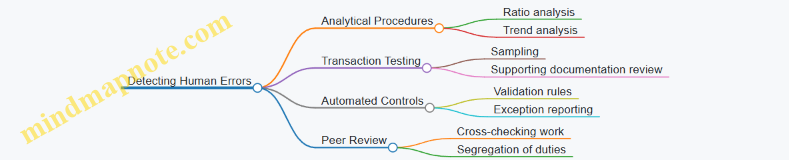
Real-World Example 2: Misclassification of Expenses
An accounting clerk mistakenly recorded a capital expenditure of $50,000 as a routine repair expense. This misclassification understated assets and overstated expenses, impacting profitability and asset base.
Detection: During a fixed asset reconciliation, auditors noticed discrepancies between asset registers and expense accounts.
Best Practice: Regular reconciliation of asset accounts and training on classification standards.
Mind Map: Consequences of Human Errors on Financial Statements
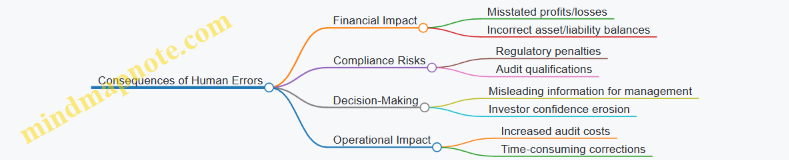
Real-World Example 3: Omission of Liability
A company failed to record an accrued expense of $30,000 for utilities used but not yet billed at the period end. This omission overstated net income and understated liabilities.
Detection: Analytical review showed unusually low utility expenses for the period. Subsequent inquiry and document review confirmed the omission.
Best Practice: Implement cut-off procedures and accrual checklists to ensure completeness.
Summary
Human errors, ranging from simple data entry mistakes to complex judgment errors, can significantly distort financial statements. Detecting these errors requires a combination of analytical procedures, transaction testing, automated controls, and strong internal review processes.
By understanding common error types and their impacts, accountants and auditors can better design controls and detection methods to enhance financial statement accuracy and reliability.
10.4 Best Practice: Lessons Learned from High-Profile Financial Errors
Financial statement errors in high-profile companies often serve as critical learning points for accountants and auditors. Understanding these errors, their causes, and the aftermath can help professionals implement stronger controls and improve error detection techniques.
Key Lessons from High-Profile Financial Errors
Example 1: Enron Corporation
Error Type: Fraudulent Revenue Recognition and Off-Balance Sheet Entities
What Happened: Enron used complex special purpose entities (SPEs) to hide debt and inflate profits, misleading investors and auditors.
Lesson Learned:
- Importance of transparency in disclosures
- Need for auditors to critically evaluate related-party transactions
- Strengthening of regulations like Sarbanes-Oxley Act (SOX) to improve corporate governance
Mind Map:
Example 2: WorldCom
Error Type: Capitalizing Operating Expenses
What Happened: WorldCom improperly capitalized routine operating expenses as capital expenditures, artificially boosting assets and profits.
Lesson Learned:
- Importance of understanding accounting policies and their correct application
- Need for detailed transaction testing and reconciliation
- Auditor vigilance in reviewing large or unusual adjustments
Mind Map:
Example 3: Toshiba Corporation
Error Type: Overstating Profits through Improper Accounting
What Happened: Toshiba overstated profits by delaying the recording of losses and understating costs over several years.
Lesson Learned:
- Importance of ethical culture and management tone at the top
- Necessity for auditors to challenge management assumptions
- Continuous monitoring and surprise audits
Mind Map:
Integrated Best Practices from High-Profile Cases
Summary
High-profile financial errors underscore the need for a multi-faceted approach to error detection and prevention. By learning from these cases, accountants and auditors can adopt best practices that combine strong internal controls, advanced analytical techniques, ethical vigilance, and continuous professional development to safeguard financial statement integrity.
10.5 Example: Applying Error Detection Techniques in Small and Medium Enterprises (SMEs)
Small and Medium Enterprises (SMEs) often face unique challenges in financial statement error detection due to limited resources, less formalized processes, and sometimes less sophisticated accounting systems. However, implementing effective error detection techniques is crucial for maintaining financial accuracy, ensuring compliance, and supporting sound business decisions.
Key Challenges for SMEs in Error Detection
- Limited accounting staff and expertise
- Use of manual or basic accounting software
- Informal internal controls
- Time constraints and resource limitations
Mind Map: Common Financial Statement Errors in SMEs
Step-by-Step Example: Detecting Errors in an SME’s Financial Statements
Scenario: A small manufacturing company uses basic accounting software and manual spreadsheets. The accountant suspects errors in revenue and inventory reporting.
Step 1: Analytical Review
- Compare monthly sales trends over the past year.
- Identify any unusual spikes or drops.
Example: Sales in June are 40% higher than average months without a corresponding increase in production.
Step 2: Ratio Analysis
- Calculate gross profit margin monthly.
- Check for inconsistencies.
Example: Gross profit margin in June is 70%, unusually higher than the typical 50%, indicating possible revenue overstatement or inventory undervaluation.
Step 3: Transaction Testing
- Select a sample of sales invoices from June.
- Verify supporting documents such as delivery notes and customer confirmations.
Example: One invoice was recorded twice due to manual entry error.
Step 4: Inventory Count and Valuation
- Conduct a physical inventory count.
- Compare with recorded inventory balances.
Example: Physical count shows 10% less inventory than recorded, indicating possible overstatement.
Step 5: Reconciliation
- Perform bank reconciliations for June.
- Investigate any outstanding items.
Example: Several deposits in transit are older than 30 days, suggesting recording delays.
Mind Map: Error Detection Workflow for SMEs
Best Practices for SMEs in Error Detection
- Standardize Processes: Use checklists and templates to ensure consistency.
- Leverage Technology: Even basic accounting software often has built-in reports and reconciliation tools.
- Regular Reconciliations: Monthly bank and account reconciliations help catch errors early.
- Training: Provide basic accounting and error detection training to staff.
- Segregation of Duties: Even in small teams, separate responsibilities where possible.
- Documentation: Maintain clear records to support transactions.
Additional Example: Detecting Payroll Errors in an SME
- Issue: Employees complain about incorrect pay.
- Detection Technique: Compare payroll register against employment contracts and timesheets.
- Finding: Overtime hours were not recorded correctly due to manual entry errors.
- Correction: Adjust payroll entries and implement automated time tracking.
By applying these practical error detection techniques tailored to the SME environment, accountants and auditors can significantly reduce the risk of material misstatements, improve financial reliability, and support sustainable business growth.
11. Continuous Improvement and Professional Development
11.1 Staying Updated with Accounting Standards and Regulations
Staying current with accounting standards and regulations is critical for accountants and auditors to ensure the accuracy and compliance of financial statements. The dynamic nature of financial reporting standards, such as IFRS, GAAP, and other regulatory frameworks, means professionals must continuously educate themselves to detect errors effectively and apply the latest guidelines.
Why Staying Updated Matters
- Compliance: Avoid penalties and legal issues by adhering to the latest standards.
- Accuracy: Ensure financial statements reflect true and fair views.
- Efficiency: Streamline audit and review processes by applying current best practices.
- Credibility: Enhance trustworthiness with stakeholders through up-to-date reporting.
Key Sources for Updates
- Official standard-setting bodies (e.g., IASB, FASB)
- Professional accounting organizations (e.g., AICPA, ACCA)
- Regulatory agencies (e.g., SEC, PCAOB)
- Industry newsletters and journals
- Continuing Professional Education (CPE) programs
Mind Map: Staying Updated with Accounting Standards and Regulations
Best Practice: Establish a Structured Update Routine
- Daily: Review accounting news websites or newsletters.
- Weekly: Attend webinars or read detailed articles on recent changes.
- Monthly: Participate in professional group discussions or forums.
- Quarterly: Complete CPE courses focused on new standards.
- Annually: Attend conferences or seminars for comprehensive updates.
Example 1: Implementing IFRS 16 Leases
When IFRS 16 was introduced, many accountants initially struggled with the new lease accounting requirements. By subscribing to IASB newsletters and attending targeted webinars, an accounting team was able to:
- Understand the recognition and measurement criteria.
- Identify common errors such as incorrect lease term calculations.
- Update internal checklists to include IFRS 16 compliance points.
This proactive approach prevented misstatements and ensured smooth audit processes.
Example 2: Adapting to Revenue Recognition Changes (ASC 606)
A corporate auditor noticed recurring errors in revenue recognition due to outdated policies. By leveraging professional organization resources and attending ACCA training sessions, the auditor:
- Gained clarity on the five-step model under ASC 606.
- Detected improper timing of revenue recognition in client financials.
- Recommended policy revisions and staff training.
This led to improved accuracy and reduced risk of regulatory scrutiny.
Mind Map: Example Workflow for Staying Updated
Summary
Maintaining up-to-date knowledge of accounting standards and regulations is a continuous process that requires discipline, access to reliable resources, and active engagement with the professional community. By integrating structured routines and leveraging multiple information channels, accountants and auditors can effectively detect errors and ensure compliance in financial statements.
11.2 Training and Skill Development for Error Detection
Effective error detection in financial statements requires continuous training and skill development tailored to the evolving complexities of accounting standards, technologies, and business environments. This section explores essential training areas, skill-building strategies, and practical examples to empower accountants and auditors in identifying and addressing financial statement errors.
Key Areas for Training and Skill Development
Accounting Standards and Regulatory Updates
Staying current with accounting standards such as IFRS, GAAP, and local regulations is fundamental. Training sessions should focus on:
- Understanding recent amendments and their impact on financial reporting.
- Practical workshops on applying standards to complex transactions.
Example: A training module on IFRS 15 (Revenue from Contracts with Customers) helps auditors recognize common revenue recognition errors, such as premature revenue recording.
Analytical Skills Enhancement
Developing strong analytical skills enables professionals to spot anomalies and inconsistencies effectively.
Training components:
- Ratio and trend analysis workshops.
- Case studies on interpreting financial data.
Example: Using a case where an unusual spike in accounts receivable is detected through trend analysis, trainees learn to investigate potential revenue overstatements.
Technology and Software Training
Modern error detection heavily relies on technology. Training should cover:
- Use of auditing software (e.g., ACL, IDEA).
- Data analytics and visualization tools.
- Introduction to AI-driven anomaly detection.
Example: A hands-on session where auditors use data analytics software to identify duplicate payments and unusual journal entries.
Internal Controls and Risk Assessment
Understanding and evaluating internal controls is critical for error prevention and detection.
Training focus:
- COSO framework principles.
- Designing and testing controls.
- Risk-based auditing approaches.
Example: Simulated exercises where participants assess control weaknesses that could lead to inventory misstatements.
Communication and Documentation Skills
Clear communication ensures that detected errors are properly reported and understood by stakeholders.
Training includes:
- Writing concise error reports.
- Presenting findings to management.
- Handling difficult conversations professionally.
Example: Role-playing scenarios where auditors explain the implications of a discovered misclassification error to non-financial managers.
Ethical Awareness and Professional Skepticism
Training must reinforce ethical standards and encourage a questioning mindset.
Topics:
- Fraud indicators and red flags.
- Maintaining independence and objectivity.
- Regulatory compliance.
Example: Analyzing a case study of fraudulent financial reporting and discussing how skepticism could have uncovered the issue earlier.
Integrated Example: Training Program Outline
Best Practice: Continuous Learning and Peer Collaboration
Encourage ongoing learning through:
- Webinars and workshops.
- Peer review sessions to share insights and challenges.
- Access to updated resources and industry publications.
Example: Monthly peer review meetings where auditors discuss recent error detection experiences and exchange tips on emerging risks.
Summary
Training and skill development for error detection is a multifaceted process combining technical knowledge, analytical capabilities, technology proficiency, communication skills, and ethical awareness. By investing in comprehensive, practical training programs, finance professionals can significantly enhance their ability to detect and correct financial statement errors, ultimately improving the reliability of financial reporting.
11.3 Best Practice: Implementing Feedback Loops for Process Improvement
Implementing feedback loops is a critical best practice for continuous process improvement in financial statement error detection. Feedback loops enable accountants and auditors to systematically capture insights from past reviews, audits, and error detections, and use this information to refine procedures, reduce recurring mistakes, and enhance overall accuracy.
What is a Feedback Loop?
A feedback loop is a cyclical process where outputs or results from a process are fed back as inputs to improve the same process. In the context of financial statement error detection, this means using findings from audits, error reports, and reviews to improve detection methods and internal controls.
Why Implement Feedback Loops?
- Identify recurring errors: Understand patterns and root causes.
- Enhance detection methods: Adapt and refine analytical procedures.
- Improve training: Tailor education based on common pitfalls.
- Boost efficiency: Reduce time spent on known issues.
- Increase accuracy: Minimize financial misstatements.
Mind Map: Feedback Loop Components in Financial Statement Error Detection
Step-by-Step Implementation
-
Data Collection: Gather detailed information from error detections, audit results, and stakeholder feedback.
-
Analysis: Perform root cause analysis to identify why errors occurred. Look for trends or recurring issues.
-
Action: Based on analysis, update financial statement review procedures, strengthen internal controls, and provide targeted training to staff.
-
Monitoring: Conduct follow-up audits or reviews to assess if changes have reduced errors.
-
Communication: Share findings and improvements with the accounting and audit teams to foster a culture of continuous learning.
Example 1: Using Feedback Loops to Reduce Revenue Recognition Errors
- Scenario: An audit team notices recurring errors in revenue recognition due to inconsistent application of timing rules.
- Feedback Loop Application:
- Data Collection: Documented errors and audit notes.
- Analysis: Root cause identified as lack of clarity in revenue recognition policy.
- Action: Policy updated with clearer guidelines; training sessions conducted.
- Monitoring: Subsequent audits show a 60% reduction in related errors.
- Communication: Results shared in monthly team meetings to reinforce best practices.
Mind Map: Example - Revenue Recognition Feedback Loop
Example 2: Feedback Loop to Improve Inventory Valuation Accuracy
- Scenario: Frequent discrepancies found between physical inventory counts and reported amounts.
- Feedback Loop Application:
- Data Collection: Inventory count reports and error notifications.
- Analysis: Root cause traced to inconsistent counting procedures and lack of staff training.
- Action: Standardized counting procedures introduced; refresher training provided.
- Monitoring: Inventory discrepancies reduced by 45% over next quarter.
- Communication: Lessons learned documented and shared across departments.
Mind Map: Example - Inventory Valuation Feedback Loop
Tips for Effective Feedback Loops
- Encourage open communication and a no-blame culture.
- Use technology to track errors and improvements systematically.
- Involve cross-functional teams to gain diverse perspectives.
- Regularly review and update feedback mechanisms.
- Document all changes and lessons learned for future reference.
By embedding feedback loops into your financial statement error detection processes, accountants and auditors can foster continuous improvement, reduce errors over time, and enhance the reliability of financial reporting.
11.4 Example: Using Peer Reviews to Enhance Error Detection Accuracy
Peer reviews are a powerful tool in the accountant’s and auditor’s arsenal to improve the accuracy and reliability of financial statement error detection. By involving colleagues to critically evaluate work, organizations can uncover errors that might have been overlooked by a single reviewer. This section explores how peer reviews can be structured, their benefits, and practical examples demonstrating their effectiveness.
What is a Peer Review?
A peer review is a systematic evaluation of work performed by one professional by one or more others of similar competence. In the context of financial statement error detection, it involves reviewing accounting records, reconciliations, journal entries, and audit findings to identify potential mistakes or inconsistencies.
Benefits of Peer Reviews in Error Detection
- Increased Accuracy: Multiple sets of eyes reduce the chance of overlooking errors.
- Knowledge Sharing: Reviewers can learn new techniques and approaches.
- Improved Compliance: Ensures adherence to accounting standards and internal controls.
- Enhanced Accountability: Encourages thoroughness and diligence.
Mind Map: Components of an Effective Peer Review Process
Practical Example: Peer Review in Detecting Revenue Recognition Errors
Scenario: An accounting team prepares quarterly financial statements for a mid-sized manufacturing company. During the peer review, a colleague notices that certain sales transactions have been recorded before the actual shipment date, potentially violating revenue recognition principles.
Steps Taken:
- The reviewer cross-checks sales invoices with shipping documents.
- Identifies transactions recorded prematurely.
- Flags these entries and discusses with the preparer.
- Adjustments are made to defer revenue recognition until shipment confirmation.
- Documentation is updated to reflect the correction.
Outcome: The peer review prevented an overstatement of revenue, ensuring compliance with accounting standards and providing more accurate financial information to stakeholders.
Mind Map: Example Workflow for Peer Review Detecting Errors
Tips for Maximizing Peer Review Effectiveness
- Select Diverse Reviewers: Different perspectives can catch different types of errors.
- Use Checklists: Standardized checklists ensure consistency.
- Encourage Open Communication: Foster a non-judgmental environment for feedback.
- Schedule Regular Reviews: Frequent peer reviews prevent error accumulation.
- Leverage Technology: Use collaborative tools to track comments and changes.
Additional Example: Peer Review Catching Classification Errors
In another instance, during a peer review of expense accounts, a reviewer notices that a large repair cost was incorrectly classified as a capital expenditure. This misclassification would have inflated asset values and understated expenses.
The reviewer:
- Examines invoices and work orders.
- Confirms the nature of the expense.
- Reclassifies the cost correctly as an expense.
- Documents the rationale for the change.
This correction improves the accuracy of both the balance sheet and income statement.
Summary
Peer reviews are an essential best practice for enhancing error detection accuracy in financial statements. By systematically involving multiple professionals in the review process, organizations can reduce errors, improve compliance, and foster continuous learning.
Implementing structured peer review processes, supported by clear workflows and open communication, ensures that financial statements are reliable and trustworthy.
For accountants and auditors, integrating peer reviews into routine financial statement preparation and audit procedures is a practical and effective way to elevate the quality of financial reporting.
11.5 Leveraging Industry Networks and Resources
In the fast-evolving world of finance and accounting, staying connected with industry networks and utilizing available resources is crucial for accountants and auditors aiming to enhance their financial statement error detection capabilities. These networks provide access to the latest best practices, regulatory updates, technological advancements, and peer insights that can significantly improve accuracy and efficiency.
Why Leverage Industry Networks?
- Access to Expertise: Connect with seasoned professionals who share real-world experiences and solutions.
- Continuous Learning: Stay updated with changes in accounting standards, auditing techniques, and emerging risks.
- Resource Sharing: Gain access to tools, templates, checklists, and case studies.
- Collaboration Opportunities: Participate in forums, webinars, and workshops to discuss challenges and innovations.
Key Industry Networks and Resources
| Network / Resource | Description | Benefits for Error Detection |
|---|---|---|
| AICPA (American Institute of CPAs) | Leading professional organization for CPAs in the US | Access to auditing standards, peer review programs, and technical guidance |
| IFAC (International Federation of Accountants) | Global organization for the accountancy profession | International standards, ethics guidance, and global best practices |
| Institute of Internal Auditors (IIA) | Professional association for internal auditors | Frameworks for internal controls, risk assessment, and fraud detection |
| Accounting Today & Journal of Accountancy | Industry publications | Latest news, case studies, and expert columns on error detection and compliance |
| LinkedIn Groups & Professional Forums | Online communities such as “Accounting Professionals Network” | Peer discussions, Q&A, and resource sharing |
| Continuing Professional Education (CPE) Providers | Providers of courses and certifications | Specialized training on error detection techniques and tools |
Mind Map: Leveraging Industry Networks for Error Detection
Practical Examples
Example 1: Using AICPA Peer Review to Detect Errors
An accounting firm subscribes to the AICPA peer review program, which involves an independent evaluation of their audit work. During the review, a peer identifies inconsistent application of revenue recognition policies in client financial statements. The firm uses this feedback to refine their audit procedures, reducing the risk of similar errors in the future.
Example 2: Participating in LinkedIn Accounting Groups for Real-Time Problem Solving
An auditor encounters a complex issue related to inventory valuation adjustments. By posting the query in a LinkedIn group dedicated to accounting professionals, they receive multiple responses highlighting common pitfalls and recommended testing methods. This collaborative approach helps the auditor identify and correct a subtle error that might have been overlooked.
Example 3: Attending Webinars on AI in Error Detection
A corporate accountant attends a webinar hosted by a CPE provider on integrating AI tools for anomaly detection in financial data. The session includes demonstrations of software that flags unusual journal entries. Inspired by this, the accountant pilots the software in their organization, leading to early detection of misclassifications and data entry errors.
Tips for Maximizing Network Benefits
- Be Active: Regularly participate in discussions and share your own experiences.
- Curate Resources: Maintain a personal library of useful articles, templates, and case studies obtained from networks.
- Attend Events: Engage in conferences and workshops to build relationships and deepen knowledge.
- Follow Thought Leaders: Identify and follow experts in financial statement auditing and error detection.
- Leverage Technology: Use apps and platforms that facilitate networking and resource sharing.
By strategically leveraging industry networks and resources, accountants and auditors can significantly enhance their ability to detect and correct financial statement errors, ensuring higher quality financial reporting and stronger stakeholder confidence.
12. Conclusion and Future Trends in Financial Statement Error Detection
12.1 Summary of Key Best Practices and Techniques
Financial statement error detection is a critical responsibility for accountants and auditors to ensure accuracy, transparency, and compliance. This section summarizes the essential best practices and techniques discussed throughout the blog, reinforced with clear examples and mind maps to facilitate understanding.
Mind Map: Overview of Key Best Practices in Financial Statement Error Detection
Establish a Strong Foundation: Preliminary Steps
Best Practice: Begin with thorough data gathering and understanding the entity’s business environment and accounting policies.
Example: Using a detailed checklist to ensure all disclosures are included prevents omission errors. For instance, a checklist helped an auditor identify missing lease disclosures in a retail company’s financials.
Employ Analytical Procedures
Best Practice: Use ratio and trend analysis to spot anomalies that may indicate errors.
Example: An unexpected spike in the accounts receivable turnover ratio led to the discovery of prematurely recognized revenue in a software company.
Conduct Detailed Transaction Testing and Reconciliation
Best Practice: Apply sampling techniques and verify supporting documents to detect errors at the transaction level.
Example: Sampling vendor payments revealed duplicate payments in a manufacturing firm, which were corrected before finalizing statements.
Focus on Common Error Categories
Best Practice: Pay special attention to areas prone to errors such as revenue recognition, inventory valuation, and expense classification.
Example: Physical inventory counts uncovered overstatements caused by unrecorded obsolete stock in a wholesale distributor.
Leverage Technology and Software
Best Practice: Combine automated tools and AI with professional judgment to enhance error detection efficiency.
Example: AI-powered software flagged unusual journal entries late on a Friday, prompting further review that uncovered a misposted accrual.
Strengthen Internal Controls
Best Practice: Regularly test and update internal controls to prevent and detect errors early.
Example: A failure in segregation of duties allowed unauthorized adjustments; strengthening controls prevented recurrence.
Communicate and Document Clearly
Best Practice: Maintain clear, concise documentation and communicate findings effectively to management and stakeholders.
Example: A well-documented error report on revenue misstatement helped management understand the issue and implement corrective actions promptly.
Correct Errors Transparently
Best Practice: Follow accounting standards (e.g., IAS 8, ASC 250) for restatements and ensure transparency.
Example: Correcting prior period depreciation errors with clear disclosure improved stakeholder confidence.
Commit to Continuous Improvement
Best Practice: Stay updated on standards, engage in training, and use peer reviews to enhance error detection skills.
Example: A peer review process helped an audit team identify overlooked errors, improving overall audit quality.
Mind Map: Integrated Approach to Financial Statement Error Detection
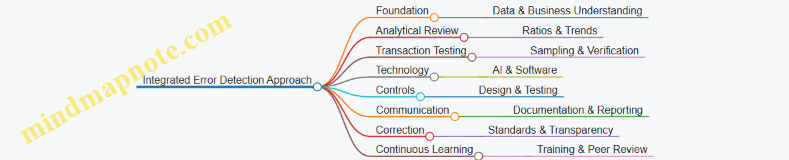
By systematically applying these best practices and techniques, accountants and auditors can significantly reduce the risk of financial statement errors, thereby enhancing the reliability and credibility of financial reporting.
12.2 Emerging Technologies and Their Potential Impact
The landscape of financial statement error detection is rapidly evolving with the advent of emerging technologies. These innovations are transforming how accountants and auditors identify, analyze, and correct errors, making processes more efficient, accurate, and insightful. In this section, we explore key technologies shaping the future of error detection, their potential impact, and practical examples demonstrating their use.
Key Emerging Technologies in Financial Statement Error Detection
Artificial Intelligence (AI) and Machine Learning (ML)
AI and ML algorithms analyze vast amounts of financial data to detect patterns and anomalies that may indicate errors or fraud. These technologies learn from historical data, improving their accuracy over time.
Example: A multinational corporation uses an AI-powered system to scan thousands of journal entries daily. The system flags unusual entries such as round-dollar amounts or entries posted outside normal business hours. This enables auditors to focus on high-risk transactions efficiently.
Best Practice: Integrate AI tools with existing accounting software to augment human judgment rather than replace it. Regularly train models with updated data to maintain accuracy.
Robotic Process Automation (RPA)
RPA automates repetitive, rule-based tasks such as data entry, reconciliations, and report generation. This reduces human error and frees up accountants to focus on complex analysis.
Example: An accounting firm implements RPA bots to automatically reconcile bank statements with ledger entries daily. The bots generate exception reports highlighting discrepancies for manual review.
Best Practice: Map out processes thoroughly before automation to ensure bots handle exceptions correctly and escalate issues when needed.
Blockchain Technology
Blockchain provides a decentralized and immutable ledger, enhancing transparency and traceability in financial transactions. It can revolutionize audit trails and error detection by ensuring data integrity.
Example: A company adopts blockchain for recording fixed asset purchases. Each transaction is time-stamped and cannot be altered, simplifying verification and reducing errors related to asset misstatements.
Best Practice: Combine blockchain with smart contracts to automate compliance checks and trigger alerts for unusual activities.
Cloud Computing
Cloud platforms offer scalable storage and processing power, enabling real-time collaboration and access to financial data from anywhere.
Example: An audit team uses a cloud-based platform to collaborate on financial statement reviews. Changes and error findings are updated live, improving communication and reducing delays.
Best Practice: Ensure robust cybersecurity measures and access controls to protect sensitive financial information.
Advanced Data Analytics and Visualization
Sophisticated analytics tools enable accountants to create interactive dashboards that highlight trends, outliers, and potential errors visually.
Example: An auditor uses a visualization tool to map expense trends across departments. Sudden spikes in certain categories trigger deeper investigation, uncovering misclassified expenses.
Best Practice: Combine quantitative data with qualitative insights for comprehensive error detection.
Summary
Emerging technologies offer powerful tools to enhance financial statement error detection. When combined with professional expertise and sound judgment, they can significantly improve accuracy, efficiency, and transparency.
Final Example: A mid-sized enterprise implements an integrated system combining AI-driven anomaly detection, RPA for reconciliations, and cloud-based collaboration. This hybrid approach reduces error rates by 40% and accelerates the audit cycle, demonstrating the transformative potential of these technologies.
By embracing these innovations, accountants and auditors can stay ahead of evolving challenges and deliver greater assurance in financial reporting.
12.3 Preparing for Increasing Regulatory Scrutiny
As regulatory bodies worldwide tighten their oversight on financial reporting, accountants and auditors must proactively prepare to meet these evolving demands. Increasing regulatory scrutiny aims to enhance transparency, accuracy, and reliability in financial statements, thereby protecting investors and stakeholders.
Key Areas of Regulatory Focus

Best Practices to Prepare for Regulatory Scrutiny
-
Stay Updated on Regulatory Changes
- Regularly review updates from bodies such as the SEC, FASB, IASB, PCAOB, and local regulators.
- Subscribe to newsletters and attend relevant webinars.
-
Strengthen Internal Controls and Governance
- Implement robust internal controls aligned with frameworks like COSO.
- Conduct periodic control self-assessments and audits.
-
Enhance Documentation and Audit Trails
- Maintain comprehensive records of all financial transactions and adjustments.
- Use digital tools to create immutable audit trails.
-
Leverage Technology for Compliance
- Adopt data analytics and AI tools to detect anomalies and potential errors early.
- Automate compliance reporting to reduce manual errors.
-
Train and Develop Staff Continuously
- Conduct regular training on new regulations and compliance requirements.
- Encourage a culture of ethical financial reporting.
Example: Preparing for New Revenue Recognition Standards
When the ASC 606 / IFRS 15 revenue recognition standards were introduced, many organizations faced challenges adapting their financial reporting processes. A multinational corporation implemented the following steps:
- Created a cross-functional team including finance, legal, and IT to interpret the new standards.
- Updated their accounting policies and internal controls to align with the new requirements.
- Used data analytics software to review contracts and identify revenue streams affected.
- Conducted training sessions for accountants and auditors to ensure consistent application.
- Documented all changes and rationale to provide clear audit trails.
This proactive approach helped the company pass regulatory reviews without significant findings.
Mind Map: Steps to Prepare for Regulatory Scrutiny
Example: Handling Increased Disclosure Requirements
A publicly traded company faced new disclosure requirements related to environmental liabilities. To comply, the finance team:
- Collaborated with environmental experts to quantify liabilities accurately.
- Revised financial statement notes to include detailed disclosures.
- Implemented a new review process to ensure disclosures were complete and accurate.
- Used document management systems to track changes and approvals.
This thorough preparation minimized regulatory risks and enhanced stakeholder confidence.
Summary
Preparing for increasing regulatory scrutiny requires a multifaceted approach combining up-to-date knowledge, strong internal controls, technology adoption, thorough documentation, and continuous staff development. By embedding these best practices into daily operations, accountants and auditors can ensure compliance, reduce errors, and maintain trust in financial reporting.
12.4 Best Practice: Building a Proactive Error Detection Culture
A proactive error detection culture within finance and accounting teams is essential to ensure the integrity and reliability of financial statements. Rather than reacting to errors after they occur, organizations that foster a proactive mindset can identify and mitigate risks early, reducing the likelihood of material misstatements and enhancing overall financial reporting quality.
Key Elements of a Proactive Error Detection Culture
Leadership Commitment and Accountability
Leadership must champion accuracy and transparency. When senior management demonstrates a commitment to error prevention and detection, it sets a tone that prioritizes quality over speed or convenience.
Example: A CFO who regularly reviews error reports and encourages open discussion about mistakes fosters an environment where employees feel safe to report potential issues without fear of punishment.
Training and Education
Ongoing education ensures that accountants and auditors are up-to-date with the latest accounting standards, regulatory requirements, and error detection techniques.
Example: Conducting quarterly workshops where teams analyze real-life error scenarios helps embed practical knowledge. For instance, reviewing a case where revenue was prematurely recognized and discussing how it could have been detected earlier.
Technology Integration
Leveraging technology accelerates error detection and reduces human oversight.
Example: Implementing AI-powered software that flags unusual journal entries based on historical patterns can alert auditors to investigate anomalies promptly.
Robust Internal Controls
Strong internal controls act as the first line of defense against errors.
Example: Regularly testing controls such as approval workflows for expense reports ensures that unauthorized or incorrect entries are caught early.
Collaboration and Peer Reviews
Encouraging collaboration across departments and peer reviews helps catch errors that might be overlooked by individuals working in silos.
Example: An accounts payable team collaborates with the procurement department to cross-verify vendor invoices, reducing the risk of duplicate payments.
Continuous Improvement
Analyzing error trends and learning from past mistakes helps refine processes and prevent recurrence.
Example: After identifying recurring errors in inventory valuation, the finance team revises the physical count procedures and enhances staff training.
Mind Map: Steps to Build a Proactive Error Detection Culture
By embedding these practices into the organizational fabric, accountants and auditors can transition from a reactive stance to a proactive approach, significantly enhancing the accuracy and reliability of financial statements.
Additional Example: Proactive Culture in Action
A mid-sized corporation noticed frequent adjustments during quarterly close related to accrued expenses. Instead of waiting for the errors to surface, the accounting manager initiated a cross-functional team involving finance, operations, and procurement to review the accrual process. They introduced a monthly reconciliation routine and trained staff on proper documentation. As a result, the number of adjustments dropped by 70% in the following two quarters, demonstrating the power of a proactive culture.
12.5 Final Example: Integrating Traditional and Modern Methods for Optimal Results
In the evolving landscape of financial statement error detection, combining time-tested traditional methods with cutting-edge modern technologies offers the most robust approach. This integration leverages the strengths of both worlds, ensuring accuracy, efficiency, and comprehensive coverage.
Traditional Methods Overview
- Manual transaction testing
- Analytical procedures (ratio and trend analysis)
- Internal control evaluations
- Physical inventory counts
- Detailed reconciliations
Modern Methods Overview
- Automated data analytics
- Artificial intelligence (AI) and machine learning (ML) algorithms
- Continuous monitoring systems
- Cloud-based auditing software
- Real-time anomaly detection
Mind Map: Integrating Traditional and Modern Methods
Practical Example: Detecting Revenue Recognition Errors
Scenario: A mid-sized corporation suspects inconsistencies in revenue recognition across multiple product lines.
Traditional Approach:
- Accountants manually review contracts and invoices.
- Perform ratio analysis comparing revenue to previous periods.
- Conduct detailed transaction testing on a sample basis.
Challenges:
- Time-consuming and labor-intensive.
- Potential for human oversight.
Modern Approach:
- Deploy AI-driven software to scan all sales transactions.
- Use anomaly detection algorithms to flag unusual revenue patterns.
- Automate reconciliation between sales orders and recognized revenue.
Integrated Approach:
- Use AI tools to generate a list of flagged transactions.
- Accountants perform targeted manual reviews on flagged items.
- Combine AI insights with professional judgment to confirm errors.
- Document findings and adjust financial statements accordingly.
Outcome:
- Faster identification of errors.
- Reduced workload on auditors.
- Higher confidence in financial accuracy.
Mind Map: Workflow for Integrated Revenue Error Detection
Additional Example: Inventory Valuation
Traditional: Physical inventory counts and manual reconciliation.
Modern: RFID tracking and real-time inventory management systems.
Integrated: Use RFID data to identify discrepancies automatically, then conduct targeted physical counts on flagged items.
Key Takeaways
- Traditional methods provide deep contextual understanding and professional skepticism.
- Modern technologies offer speed, scalability, and pattern recognition beyond human capability.
- Integration ensures comprehensive error detection, balancing efficiency with accuracy.
- Continuous feedback loops improve both AI models and manual processes over time.
By embracing this hybrid approach, accountants and auditors can significantly enhance their error detection capabilities, ultimately leading to more reliable financial statements and stronger stakeholder trust.