Accounting for Digital Assets
1. Introduction to Digital Assets and Their Accounting Implications
1.1 Defining Digital Assets: Cryptocurrencies, Tokens, and Beyond
Digital assets represent a broad category of assets that exist in digital form and are secured using cryptographic technologies. They have transformed the financial landscape by enabling new forms of value transfer, ownership, and utility on decentralized networks.
What Are Digital Assets?
Digital assets are intangible assets that are created, stored, and transferred electronically. They include cryptocurrencies, tokens, digital representations of real-world assets, and other blockchain-based instruments.
Mind Map: Types of Digital Assets
Cryptocurrencies
Cryptocurrencies are digital currencies that use cryptography for security and operate on decentralized blockchain networks. They serve primarily as a medium of exchange, store of value, or unit of account.
Example:
- Bitcoin (BTC) is the first and most widely recognized cryptocurrency, often referred to as digital gold.
- Ethereum (ETH) powers decentralized applications and smart contracts beyond just currency use.
Tokens
Tokens are digital assets issued on existing blockchains, representing various rights or utilities.
-
Utility Tokens: Provide access to a product or service within a blockchain ecosystem.
- Example: Basic Attention Token (BAT) is used to reward users and advertisers in the Brave browser ecosystem.
-
Security Tokens: Represent ownership or investment contracts in real-world assets, subject to securities regulations.
- Example: tZERO issues security tokens representing equity stakes.
-
Stablecoins: Pegged to stable assets like fiat currencies to reduce volatility.
- Example: USDC is a USD-backed stablecoin widely used for trading and payments.
Non-Fungible Tokens (NFTs)
NFTs are unique digital assets representing ownership of a specific item or piece of content, often used in art, gaming, and collectibles.
Example:
- Digital artwork sold on platforms like OpenSea.
- Virtual land parcels in metaverse projects like Decentraland.
Beyond Cryptocurrencies and Tokens
Digital assets also include emerging categories such as:
- DeFi Assets: Tokens representing participation in decentralized finance protocols (e.g., liquidity pool tokens).
- Digital Certificates: Blockchain-based certificates for education, property, or identity verification.
- Digital Rights and Licenses: Rights management for digital content and intellectual property.
Mind Map: Characteristics of Digital Assets
Practical Example: Differentiating Between Bitcoin and an NFT
- Bitcoin (Cryptocurrency): Fungible, divisible, used as a currency or store of value.
- NFT (Non-Fungible Token): Unique, indivisible, represents ownership of a specific digital item.
This distinction is critical for accounting because fungible assets like cryptocurrencies are often accounted for differently from unique assets like NFTs.
Summary
Understanding the definitions and categories of digital assets is foundational for accurate accounting. Each type carries distinct characteristics and use cases that influence recognition, measurement, and reporting.
By grasping these concepts, accountants and crypto analysts can better navigate the complexities of digital asset accounting and apply best practices effectively.
1.2 Overview of Digital Asset Ecosystem and Market Trends
The digital asset ecosystem is a rapidly evolving landscape encompassing various types of assets, platforms, participants, and technologies. Understanding this ecosystem is critical for accountants and crypto analysts to accurately assess, value, and report digital assets.
Key Components of the Digital Asset Ecosystem
Explanation of Components
-
Types of Digital Assets:
- Cryptocurrencies like Bitcoin and Ethereum serve as digital money or store of value.
- Tokens represent assets or utilities on blockchain platforms; for example, utility tokens grant access to services, security tokens represent ownership in an asset, and NFTs represent unique digital collectibles.
- Digital Commodities include assets like tokenized gold or carbon credits.
-
Platforms & Infrastructure:
- Blockchain Networks are the underlying technology enabling digital assets. Public blockchains like Ethereum are open to all, while private blockchains are permissioned.
- Exchanges facilitate trading. Centralized exchanges act as intermediaries, whereas decentralized exchanges enable peer-to-peer trading.
- Wallets store private keys; hot wallets are connected to the internet, cold wallets are offline for security.
-
Participants: From retail investors to regulators, each plays a role in shaping the ecosystem.
-
Use Cases: Digital assets are used beyond investment, including payments, DeFi applications, gaming, and supply chain management.
Market Trends Impacting Accounting
Examples Illustrating Market Trends
-
Institutional Adoption: Tesla’s purchase of $1.5 billion in Bitcoin in 2021 exemplifies corporate treasury adoption, impacting how companies report digital assets on their balance sheets.
-
Regulatory Developments: The IRS in the U.S. issued updated guidance on cryptocurrency tax reporting, requiring detailed transaction records, which accountants must incorporate into compliance processes.
-
Technological Innovations: The rise of Layer 2 solutions like the Lightning Network for Bitcoin improves transaction speed and cost, influencing how transactions are recorded and reconciled.
-
Market Volatility: The rapid price swings of cryptocurrencies require frequent revaluation and impairment testing, a critical accounting consideration.
-
DeFi and NFTs Growth: Platforms like OpenSea for NFTs and Aave for DeFi lending introduce new asset types and revenue streams, requiring specialized accounting treatments.
Best Practice Example: Mapping the Ecosystem for Accounting Policy Development
A mid-sized crypto fund developed an internal mind map of their digital asset holdings and related platforms to tailor their accounting policies. This included categorizing assets by type, identifying custody solutions, and tracking regulatory compliance requirements, enabling streamlined reporting and audit readiness.
Understanding the digital asset ecosystem and market trends equips accountants and crypto analysts to apply appropriate accounting treatments, anticipate regulatory changes, and manage risks effectively.
1.3 Regulatory Landscape Affecting Digital Asset Accounting
Understanding the regulatory landscape is crucial for accountants and crypto analysts as it directly impacts how digital assets are recorded, reported, and disclosed in financial statements. Regulations vary widely across jurisdictions and are evolving rapidly as governments and standard-setting bodies seek to address the unique challenges posed by digital assets.
Key Regulatory Bodies and Frameworks
- Financial Accounting Standards Board (FASB)
- International Financial Reporting Standards (IFRS) Foundation / IASB
- Securities and Exchange Commission (SEC) - USA
- Internal Revenue Service (IRS) - USA
- Financial Crimes Enforcement Network (FinCEN) - USA
- European Securities and Markets Authority (ESMA)
- Other National Regulators (e.g., FCA UK, MAS Singapore)
Mind Map: Regulatory Landscape Overview
Accounting Standards and Their Impact
US GAAP (FASB):
- Currently, no dedicated standard for digital assets.
- Most entities classify cryptocurrencies as indefinite-lived intangible assets.
- This classification means digital assets are not amortized but tested for impairment.
Example: A company purchases 100 Bitcoin at $30,000 each. Under US GAAP, it records the asset at $3,000,000 as an intangible asset. If the market price drops to $25,000, an impairment loss of $500,000 must be recognized.
IFRS (IASB):
- Similar to US GAAP, IAS 38 is commonly applied.
- IFRS allows either cost model or revaluation model, but revaluation is rarely used due to market volatility.
- The IFRS Interpretations Committee is actively reviewing whether new guidance is needed.
Example: A European firm holds Ethereum tokens classified as intangible assets. They choose the cost model and recognize impairment losses when fair value drops below cost.
Securities Regulations and Their Accounting Implications
Tokens may be classified as securities, commodities, or utility tokens, affecting disclosure and accounting treatment.
- SEC Enforcement:
- SEC has pursued cases where tokens are deemed securities, requiring compliance with securities laws.
- This impacts how companies report token issuance and revenue.
Example: A startup issues tokens that the SEC classifies as securities. The company must disclose this in financial statements and may need to account for them as financial liabilities or equity instruments.
Tax Regulations
Tax authorities treat digital assets differently, influencing accounting for tax purposes.
- IRS:
- Treats cryptocurrencies as property.
- Requires tracking cost basis, gains, and losses.
- Mining income is taxable as ordinary income.
Example: An accountant calculates capital gains for a client who sold Bitcoin. Using FIFO method, the cost basis is determined, and gains are reported accordingly.
AML and KYC Regulations
Regulations require exchanges and custodians to implement AML/KYC procedures.
- This affects accounting by requiring detailed transaction records and audit trails.
Example: An exchange implements multi-factor authentication and transaction monitoring to comply with FinCEN rules, ensuring accurate accounting records.
Mind Map: Example of Regulatory Impact on Accounting Decisions
Summary
The regulatory landscape for digital asset accounting is complex and evolving. Accountants and crypto analysts must stay informed about updates from accounting standard setters, securities regulators, tax authorities, and AML bodies. Applying best practices such as documenting classification rationale, maintaining detailed transaction records, and regularly reviewing regulatory guidance will help ensure compliance and accurate financial reporting.
Additional Example: Applying Regulatory Guidance
A multinational corporation holding various cryptocurrencies establishes an internal policy:
- Classifies all digital assets as intangible assets per IAS 38.
- Uses cost model for initial measurement.
- Performs impairment testing quarterly.
- Maintains detailed logs for all transactions to comply with tax and AML regulations.
- Discloses regulatory risks and accounting policies in financial statements.
This approach aligns with current regulatory expectations and provides transparency to stakeholders.
1.4 Key Challenges in Accounting for Digital Assets
Accounting for digital assets introduces a unique set of challenges due to their novel nature, rapid evolution, and the complexity of underlying technologies. Understanding these challenges is crucial for accountants and crypto analysts to implement accurate and compliant accounting practices.
Mind Map: Key Challenges in Accounting for Digital Assets
Classification Ambiguity
One of the primary challenges is determining how to classify digital assets. Are they inventory, intangible assets, financial instruments, or something else? Different jurisdictions and accounting standards offer varying guidance, leading to inconsistent treatment.
Example: A company holds Bitcoin for long-term investment. Under IFRS, Bitcoin is often classified as an intangible asset, but if the company actively trades Bitcoin, it might be treated as inventory. This affects how gains and losses are recognized.
Valuation Difficulties
Digital assets are highly volatile, and some tokens lack active markets, making it difficult to establish a reliable fair value.
Example: A startup holds a new utility token that is not yet listed on major exchanges. Without an active market, the company struggles to determine a fair value, complicating balance sheet reporting.
Recognition and Measurement
Determining the exact point to recognize digital assets and how to measure transaction costs is complex.
Example: When purchasing Ethereum, should the transaction fees paid to miners be capitalized as part of the asset cost or expensed immediately? Best practice is to capitalize these fees as part of the acquisition cost.
Impairment and Subsequent Measurement
Fluctuating prices require frequent impairment testing, but distinguishing between temporary volatility and permanent impairment is challenging.
Example: A company’s token holdings drop 30% in value within a quarter. Should this trigger an impairment loss? Accountants must assess if the decline is temporary or indicative of a permanent impairment.
Revenue Recognition
Revenue from digital assets can come from mining, staking, or token sales, each with different recognition criteria.
Example: A crypto miner receives newly minted coins as rewards. Recognizing revenue requires determining the fair value of coins at the time they are earned.
Internal Controls and Security
Digital assets are susceptible to theft and hacking. Ensuring proper custody and internal controls is critical.
Example: A company implements multi-signature wallets and cold storage to secure assets, but must also ensure accounting systems reconcile with blockchain records.
Tax Compliance
Tracking cost basis and gains/losses is complicated by forks, airdrops, and token swaps.
Example: An investor receives an airdrop of new tokens. Determining the taxable event and fair value at receipt is necessary for accurate tax reporting.
Audit and Disclosure
Auditors face challenges verifying ownership and existence of digital assets due to their decentralized nature.
Example: Using blockchain explorers and wallet addresses, auditors verify the client’s holdings but must also assess valuation and disclosure completeness.
Summary
Accounting for digital assets requires navigating classification ambiguity, valuation volatility, recognition complexities, security risks, tax nuances, and audit challenges. By understanding these key challenges and applying best practices, accountants and crypto analysts can ensure accurate, transparent, and compliant financial reporting.
1.5 Best Practice: Establishing a Digital Asset Accounting Framework with Real-World Examples
Establishing a robust digital asset accounting framework is essential for accountants and crypto analysts to ensure accurate financial reporting, compliance, and risk management. This section outlines best practices for building such a framework, supported by practical examples and mind maps to visualize the process.
Key Components of a Digital Asset Accounting Framework
Step 1: Governance and Policy Development
- Define clear policies regarding the recognition, measurement, and reporting of digital assets.
- Stay updated on evolving regulations (e.g., SEC, IRS, IFRS, FASB guidance).
- Example: A mid-sized crypto fund establishes a policy that all digital assets held for investment are classified as intangible assets under IFRS and measured at cost less impairment.
Step 2: Classification and Recognition
- Identify asset types: cryptocurrencies, utility tokens, security tokens, NFTs.
- Apply appropriate accounting standards: e.g., IFRS IAS 38 for intangible assets, or IFRS 9 for financial instruments.
- Example: A company holding Bitcoin for operational use classifies it as inventory, while Ethereum held for long-term investment is classified as an intangible asset.
Step 3: Valuation Methodology
- Initial measurement: typically at cost including transaction fees.
- Subsequent measurement: cost model or fair value model depending on classification.
- Use reliable market data sources such as CoinMarketCap, Binance, or Coinbase Pro.
- Example: Recording the purchase of 10 BTC at $30,000 each plus $200 transaction fees, total cost basis $302,000.
Step 4: Transaction Recording and Management
- Maintain detailed logs of all transactions with timestamps, amounts, counterparties, and wallet addresses.
- Record conversions and exchanges carefully to capture gains/losses.
- Example: When converting 5 ETH to USD, record the fair value of ETH at conversion date and recognize any gain or loss.
Step 5: Security and Custody Controls
- Implement multi-signature wallets and cold storage for safeguarding assets.
- Segregate duties to prevent fraud.
- Example: A crypto exchange uses cold wallets for 90% of holdings and requires 3-of-5 signatures for withdrawals.
Step 6: Reporting, Disclosure, and Audit Preparation
- Prepare financial statements reflecting digital asset holdings accurately.
- Disclose valuation methods, risks, and policies in notes.
- Maintain audit trails with blockchain evidence.
- Example: Annual report includes a note explaining the use of the cost model for Bitcoin holdings and impairment testing procedures.
Real-World Example: Startup “CryptoTech Solutions”
CryptoTech Solutions, a blockchain startup, implemented the following framework:
- Governance: Created a digital asset policy aligned with IFRS and local tax laws.
- Classification: Classified utility tokens as intangible assets and security tokens as financial instruments.
- Valuation: Used cost basis for initial measurement and fair value for subsequent measurement, updated monthly using Binance data.
- Transaction Management: Automated transaction imports via API integration with their wallets.
- Security: Adopted multi-signature wallets and restricted access to finance team.
- Reporting: Provided detailed disclosures in quarterly reports and prepared for external audits with blockchain transaction proofs.
This framework enabled CryptoTech Solutions to maintain compliance, reduce errors, and build investor confidence.
Summary
Establishing a digital asset accounting framework involves integrating governance, classification, valuation, transaction management, security, and reporting. Using real-world examples and structured mind maps helps professionals visualize and implement best practices effectively.
2. Classification and Recognition of Digital Assets
2.1 Accounting Standards Relevant to Digital Assets (IFRS, GAAP, and Others)
Digital assets, including cryptocurrencies, tokens, and other blockchain-based instruments, present unique challenges for accountants due to their novel nature and evolving regulatory landscape. To properly account for these assets, it is essential to understand the relevant accounting standards that govern their recognition, measurement, and disclosure.
Overview of Key Accounting Frameworks
| Framework | Applicability | Treatment Focus | Status on Digital Assets |
|---|---|---|---|
| IFRS (International Financial Reporting Standards) | Global | Intangible assets, financial instruments, inventory | No specific standard; guidance derived from IAS 38, IFRS 9, IAS 2 |
| US GAAP (Generally Accepted Accounting Principles) | United States | Intangible assets, financial instruments, inventory | No specific standard; guidance from ASC 350, ASC 820, ASC 330 |
| Other Jurisdictions | Varies | Varies | Emerging and evolving guidance |
Mind Map: Accounting Standards Overview
IFRS Perspective
-
IAS 38 Intangible Assets
- Digital assets are often classified as intangible assets because they lack physical substance and are identifiable.
- Recognition criteria: control over the asset, probable future economic benefits, and reliable measurement of cost.
- Example: A company purchasing Bitcoin for investment purposes records it as an intangible asset at cost.
-
IFRS 9 Financial Instruments
- Typically not applied to cryptocurrencies as they do not represent a contractual right to receive cash or another financial asset.
-
IAS 2 Inventory
- Applicable if digital assets are held for sale in the ordinary course of business (e.g., a crypto exchange or trading firm).
- Valuation at the lower of cost and net realizable value.
Example under IFRS:
A crypto trading company buys 100 Ethereum tokens at $2,000 each intending to sell them within a short period. The tokens are classified as inventory under IAS 2.
- Initial recognition: 100 x $2,000 = $200,000
- At reporting date, market price drops to $1,800 per token.
- Inventory is written down to net realizable value: 100 x $1,800 = $180,000
- Loss of $20,000 recognized in profit or loss.
US GAAP Perspective
-
ASC 350 Intangibles - Goodwill and Other
- Digital assets are generally accounted for as indefinite-lived intangible assets.
- No amortization; tested annually for impairment.
-
ASC 820 Fair Value Measurement
- Provides guidance on measuring fair value when applicable.
-
ASC 330 Inventory
- Similar to IFRS, if digital assets are held for sale in the ordinary course of business, they may be classified as inventory.
Example under US GAAP:
A company purchases 50 Bitcoin at $30,000 each as a long-term investment.
- Initially recorded at cost: 50 x $30,000 = $1,500,000
- At year-end, fair value drops to $25,000 per Bitcoin.
- No amortization, but impairment testing is required.
- If impairment is identified, write-down is recognized; however, subsequent recoveries are not recognized.
Other Jurisdictions and Emerging Guidance
- Many countries are still developing specific guidance for digital assets.
- Some tax authorities provide clarifications on treatment for tax purposes.
- Professional accounting bodies often issue discussion papers or practice notes.
Mind Map: Classification and Standards Application
Best Practice Recommendations
- Assess the nature and intended use of the digital asset before classification.
- Document the rationale for classification referencing applicable standards.
- Use consistent valuation methods aligned with accounting frameworks.
- Stay updated with evolving guidance from standard setters and regulators.
Summary Table: Key Differences Between IFRS and US GAAP
| Aspect | IFRS | US GAAP |
|---|---|---|
| Classification | Intangible assets or inventory | Intangible assets or inventory |
| Amortization | Amortization allowed if finite life | No amortization for indefinite-lived intangibles |
| Impairment | Reversal of impairment losses allowed | No reversal of impairment losses |
| Fair Value Option | Allowed under certain conditions | Limited fair value option |
This foundational understanding of accounting standards relevant to digital assets equips accountants and crypto analysts to apply appropriate accounting treatments, ensuring accurate financial reporting and compliance.
2.2 Classification: Inventory, Intangible Assets, Financial Instruments, or Other?
Classifying digital assets correctly is a crucial step in their accounting treatment. The classification determines how these assets are measured, reported, and disclosed in financial statements. Given the unique nature of digital assets, accountants must carefully evaluate their characteristics and intended use to assign the appropriate category.
Key Classification Categories for Digital Assets
- Inventory
- Intangible Assets
- Financial Instruments
- Other Classifications
Inventory
Definition: Assets held for sale in the ordinary course of business or in the process of production for such sale.
When to classify digital assets as inventory:
- If a company is engaged in cryptocurrency trading or acts as a broker/dealer.
- Digital assets held primarily for resale.
Accounting treatment: Measured at the lower of cost or net realizable value (NRV).
Example:
A crypto trading firm holds 1,000 Bitcoin purchased at $30,000 each intending to sell them within the next quarter. These Bitcoins are classified as inventory.
Mind Map:
Intangible Assets
Definition: Non-monetary assets without physical substance that are identifiable and controlled by the entity.
When to classify digital assets as intangible assets:
- When digital assets are held for long-term use or investment.
- Not held primarily for sale in the ordinary course of business.
- Examples include cryptocurrencies held as investments or tokens used for access rights.
Accounting treatment: Initially measured at cost; subsequently measured using cost or revaluation model (depending on applicable standards). Amortization is generally not applicable for indefinite-lived intangible assets.
Example:
A corporation purchases 500 Ethereum tokens to hold as a long-term investment. These tokens are classified as intangible assets.
Mind Map:
Financial Instruments
Definition: Contracts that give rise to a financial asset of one entity and a financial liability or equity instrument of another.
When to classify digital assets as financial instruments:
- If the digital asset represents a contractual right to receive cash or another financial asset.
- Certain security tokens or stablecoins pegged to fiat currency may qualify.
Accounting treatment: Depends on classification as amortized cost, fair value through profit or loss (FVTPL), or fair value through other comprehensive income (FVOCI).
Example:
A company holds a stablecoin pegged 1:1 to the US dollar, redeemable on demand. This stablecoin may be classified as a financial asset.
Mind Map:
Other Classifications
Examples:
- Property, Plant, and Equipment (PPE): Rarely applicable but possible if digital assets are used in operations (e.g., mining hardware).
- Prepaid Expenses or Other Assets: In some cases, tokens may represent prepaid services.
Integrated Classification Mind Map
Practical Examples Summary
| Scenario | Classification | Reasoning |
|---|---|---|
| Crypto exchange holding Bitcoin for resale | Inventory | Held for sale in ordinary course |
| Company holding Bitcoin as a long-term investment | Intangible Asset | Held for investment, not for sale |
| Holding a USD-pegged stablecoin redeemable on demand | Financial Instrument | Contractual right to receive cash |
| Mining hardware used in operations | Property, Plant & Equipment | Tangible asset used in production |
Best Practice Tips
- Assess the primary purpose: Determine whether the asset is held for sale, investment, or operational use.
- Review applicable accounting standards: IFRS and GAAP may have different guidance.
- Document classification rationale: Maintain clear records to support classification decisions.
- Stay updated: Classification rules may evolve as regulators and standard-setters provide new guidance.
By carefully evaluating the nature and use of digital assets, accountants can ensure accurate classification, leading to appropriate measurement and disclosure in financial statements.
2.3 Recognition Criteria for Digital Assets on the Balance Sheet
Recognition of digital assets on the balance sheet is a critical step in ensuring accurate financial reporting and compliance with accounting standards. This section explores the criteria that must be met for digital assets to be recognized as assets, supported by clear mind maps and practical examples.
What is Recognition?
Recognition in accounting means incorporating an item into the financial statements when it meets the definition of an asset and satisfies specific recognition criteria.
Mind Map: Recognition Criteria for Digital Assets
Meets the Definition of an Asset
According to IFRS Conceptual Framework and US GAAP, an asset is a resource controlled by the entity as a result of past events and from which future economic benefits are expected.
- Control: The entity must have the ability to direct the use of the digital asset and obtain benefits.
- Past Event: Acquisition, mining, or receipt of the digital asset.
- Future Economic Benefits: Potential appreciation, utility in operations, or revenue generation.
Example:
A company purchases 10 BTC on January 1st. The company controls the private keys (control), acquired the BTC (past event), and expects to use or sell them for profit (future economic benefits). Thus, the BTC meets the asset definition.
Reliable Measurement of Cost or Fair Value
The digital asset must be measurable at cost or fair value with reasonable reliability.
- Cost Measurement: Purchase price plus any directly attributable costs.
- Fair Value Measurement: Market price on an active exchange or valuation techniques if no active market exists.
Example:
A firm receives 500 tokens as payment for services. The fair value of tokens at receipt is $2,000 based on an active exchange. This value can be reliably measured and recognized.
Probability of Future Economic Benefits
There should be a high probability that the digital asset will generate future economic benefits.
- This is often evidenced by market demand, utility, or potential for appreciation.
Example:
A startup holds utility tokens that grant access to its platform. The tokens are expected to generate benefits through platform usage or resale, satisfying this criterion.
Mind Map: Step-by-Step Recognition Process
Practical Examples of Recognition
| Scenario | Recognition Outcome | Explanation |
|---|---|---|
| Purchased Bitcoin for investment | Recognize as an intangible asset or inventory | Meets asset definition, cost reliably measured, future benefits expected |
| Mining cryptocurrency | Recognize mined coins at fair value when control is established | Control obtained upon mining completion, fair value measurable |
| Receiving tokens as payment for services | Recognize revenue and asset at fair value | Tokens received have measurable fair value and represent economic benefit |
| Holding tokens with uncertain market value | Do not recognize or disclose as contingent asset | Fair value not reliably measurable, recognition criteria not met |
Summary
To recognize digital assets on the balance sheet, accountants must ensure that the asset meets the definition of an asset, can be reliably measured, and is expected to generate future economic benefits. Documenting these assessments with supporting evidence is a best practice to maintain transparency and audit readiness.
Additional Tips
- Maintain detailed records of acquisition dates, costs, and control evidence.
- Use reputable market data sources for fair value measurements.
- Regularly review recognition criteria as regulations and standards evolve.
2.4 Practical Example: Classifying Bitcoin Held for Investment vs. Operational Use
When accounting for Bitcoin, the classification depends heavily on the intent and use case within the organization. This section explores how to differentiate between Bitcoin held as an investment asset versus Bitcoin held for operational purposes, such as payment or liquidity management.
Key Considerations for Classification
- Investment Asset: Held primarily for capital appreciation or as a store of value.
- Operational Use: Held to facilitate business operations, such as paying suppliers, employees, or as part of treasury management.
Mind Map: Classification Decision Factors
Bitcoin Classification Mind Map
Example 1: Bitcoin Held for Investment
Scenario: A company purchases 100 BTC intending to hold it for long-term appreciation.
- Classification: Intangible asset (under IFRS IAS 38) or financial asset (under some GAAP interpretations).
- Initial Measurement: Recorded at cost, including transaction fees.
- Subsequent Measurement: Could be cost less impairment or fair value through profit or loss, depending on accounting policy.
Journal Entry at Purchase:
| Account | Debit | Credit |
|---|---|---|
| Digital Assets (BTC) | $4,000,000 | |
| Cash | $4,000,000 |
Note: Transaction fees included in the cost.
Example 2: Bitcoin Held for Operational Use
Scenario: A retailer accepts Bitcoin payments and holds BTC to pay suppliers and employees.
- Classification: Inventory or cash equivalent depending on frequency and purpose.
- Initial Measurement: Recorded at fair value on receipt.
- Subsequent Measurement: Measured at fair value or cost, depending on policy.
Journal Entry on Receipt of Bitcoin Payment:
| Account | Debit | Credit |
|---|---|---|
| Digital Assets (BTC) | $50,000 | |
| Revenue | $50,000 |
Journal Entry When Using Bitcoin to Pay Supplier:
| Account | Debit | Credit |
|---|---|---|
| Accounts Payable | $10,000 | |
| Digital Assets (BTC) | $10,000 |
Mind Map: Accounting Treatment Comparison
Best Practice Tips
- Document Intent Clearly: Maintain formal policies outlining the purpose of Bitcoin holdings.
- Consistent Classification: Apply classification consistently across reporting periods.
- Regular Review: Reassess classification if the use or intent changes.
- Detailed Record-Keeping: Track acquisition dates, costs, and transaction purposes.
By understanding the intent behind Bitcoin holdings and applying appropriate classification, accountants and crypto analysts can ensure accurate financial reporting and compliance with accounting standards.
2.5 Best Practice: Documenting Classification Decisions with Supporting Evidence
Proper documentation of classification decisions for digital assets is critical for transparency, audit readiness, and regulatory compliance. This section outlines best practices for maintaining clear, comprehensive records that justify how digital assets are classified under applicable accounting standards.
Why Document Classification Decisions?
- Audit Trail: Provides verifiable evidence for auditors and regulators.
- Consistency: Ensures uniform treatment across reporting periods.
- Transparency: Facilitates internal and external stakeholder understanding.
- Risk Mitigation: Reduces risk of misclassification and related financial misstatements.
Key Elements to Document
- Asset Description: Type of digital asset (e.g., Bitcoin, utility token, NFT).
- Intended Use: Investment, operational use, inventory for sale, etc.
- Applicable Accounting Standards: Reference to IFRS, GAAP, or other relevant frameworks.
- Classification Rationale: Clear explanation of why the asset fits a particular category.
- Supporting Evidence: Market data, contracts, internal policies, transaction history.
- Valuation Method: Cost, fair value, or other basis.
- Review Date and Approver: Date of decision and responsible personnel.
Mind Map: Documenting Classification Decisions
Example 1: Classifying Bitcoin Held for Investment
Scenario: A company holds 10 BTC purchased for long-term investment.
- Asset Description: Bitcoin (cryptocurrency)
- Intended Use: Held for capital appreciation
- Accounting Standard: IFRS IAS 38 (Intangible Assets)
- Classification Rationale: Classified as an intangible asset because it is not held for sale in the ordinary course of business and does not meet financial instrument criteria.
- Supporting Evidence: Purchase invoices, wallet transaction logs, investment policy document.
- Valuation Method: Initially recorded at cost; subsequent measurement using cost model.
- Review Date & Approver: 2024-05-15, CFO Jane Doe
Example 2: Classifying Utility Tokens Held for Operational Use
Scenario: A company holds 5,000 utility tokens used to access a blockchain-based service integral to its operations.
- Asset Description: Utility tokens
- Intended Use: Operational use to access services
- Accounting Standard: GAAP Intangible Assets guidance
- Classification Rationale: Classified as intangible assets used in operations, not held for investment or resale.
- Supporting Evidence: Service agreements, token purchase records, internal usage policies.
- Valuation Method: Recorded at cost; impairment tested periodically.
- Review Date & Approver: 2024-05-20, Controller John Smith
Example 3: Classifying Cryptocurrency Inventory for a Trading Business
Scenario: A crypto exchange holds various cryptocurrencies intended for resale.
- Asset Description: Multiple cryptocurrencies (Bitcoin, Ethereum, etc.)
- Intended Use: Inventory held for sale
- Accounting Standard: IFRS IAS 2 (Inventories)
- Classification Rationale: Classified as inventory because assets are held for sale in the ordinary course of business.
- Supporting Evidence: Trading platform records, purchase and sale contracts, inventory management system logs.
- Valuation Method: Measured at the lower of cost and net realizable value.
- Review Date & Approver: 2024-05-22, Head of Accounting Lisa Chen
Tips for Effective Documentation
- Use standardized templates for consistency.
- Include screenshots or extracts from blockchain explorers as evidence.
- Maintain version control for policy documents.
- Schedule periodic reviews to update classifications as business use or regulations evolve.
- Store documentation securely with restricted access to preserve integrity.
By following these best practices and maintaining thorough documentation, accountants and crypto analysts can ensure their digital asset classifications are defensible, transparent, and aligned with evolving standards and regulations.
3. Initial Measurement and Valuation Techniques
3.1 Cost Basis vs. Fair Value: Understanding Measurement Options
When accounting for digital assets, one of the foundational decisions is how to measure these assets initially and subsequently. Two primary measurement bases are commonly used: Cost Basis and Fair Value. Understanding the nuances, advantages, and challenges of each method is crucial for accountants and crypto analysts.
What is Cost Basis?
Cost basis refers to the original purchase price of the digital asset, including any transaction fees or costs directly attributable to acquiring the asset. This method records the asset at its historical cost and does not adjust for market fluctuations unless impairment occurs.
Example:
- You purchase 2 Bitcoin at $30,000 each, paying a $200 transaction fee.
- Cost basis = (2 x $30,000) + $200 = $60,200.
- This amount is recorded on the balance sheet.
What is Fair Value?
Fair value represents the price that would be received to sell an asset in an orderly transaction between market participants at the measurement date. It reflects current market conditions and can fluctuate frequently, especially in volatile crypto markets.
Example:
- You hold 2 Bitcoin originally purchased at $30,000 each.
- At the reporting date, the market price is $35,000 per Bitcoin.
- Fair value = 2 x $35,000 = $70,000.
- The asset is recorded at $70,000, reflecting the current market price.
Mind Map: Key Differences Between Cost Basis and Fair Value
When to Use Cost Basis
- Entities holding digital assets for operational purposes (e.g., as payment method or inventory).
- When accounting standards or regulatory guidance require historical cost measurement.
- When market prices are not readily available or reliable.
Example: A company accepts Bitcoin as payment for services and holds it temporarily before converting to fiat currency. The company records Bitcoin at cost basis to avoid volatility in financial results.
When to Use Fair Value
- Investment entities or funds holding digital assets for trading or investment purposes.
- When accounting frameworks permit or require fair value measurement (e.g., IFRS 13, ASC 820).
- When market prices are active and reliable.
Example: A crypto hedge fund holds various tokens and revalues its portfolio daily at fair value to provide accurate performance reporting to investors.
Mind Map: Factors Influencing Measurement Choice
Practical Example: Recording a Purchase Using Both Methods
| Date | Transaction | Cost Basis Accounting | Fair Value Accounting |
|---|---|---|---|
| Jan 1, 2024 | Purchase 5 ETH at $2,000 each + $50 fee | Debit Digital Assets $10,050 (5x2000 + 50) | Debit Digital Assets $10,050 (initial cost) |
| Jan 31, 2024 | Market price of ETH rises to $2,500 | No change in asset value | Adjust asset to $12,500 (5x2500) and recognize unrealized gain $2,450 |
Best Practice Tips
- Clearly document the chosen measurement basis in accounting policies.
- Use reliable and consistent data sources for fair value measurements.
- Consider the impact of volatility on financial statements and stakeholder communication.
- Regularly review whether the chosen method remains appropriate as business models and regulations evolve.
By understanding the distinctions between cost basis and fair value, accountants and crypto analysts can make informed decisions that align with their organization’s objectives and regulatory environment, ensuring accurate and transparent financial reporting for digital assets.
3.2 Valuation Challenges Due to Market Volatility
Valuing digital assets presents unique challenges primarily due to their inherent market volatility. Unlike traditional assets, cryptocurrencies and tokens can experience rapid and significant price fluctuations within short periods, complicating the accounting process.
Key Valuation Challenges
- Price Volatility: Digital assets can swing wildly in value, sometimes by double-digit percentages in a single day.
- Lack of Centralized Pricing: Prices vary across exchanges, leading to discrepancies in valuation.
- Illiquidity and Market Depth: Some tokens have low trading volumes, making price discovery difficult.
- Regulatory Uncertainty: Changes in regulations can impact market sentiment and asset prices abruptly.
- Limited Historical Data: Many digital assets are relatively new, limiting the availability of reliable historical pricing data.
Mind Map: Valuation Challenges Due to Market Volatility
Practical Example 1: Valuing Bitcoin Amidst Volatility
Imagine an accountant needs to value a Bitcoin holding on the balance sheet date. On that day, Bitcoin’s price ranged from $28,000 to $32,000 across different exchanges.
- Challenge: Which price should be used for valuation?
- Best Practice: Use a volume-weighted average price (VWAP) from multiple reputable exchanges to smooth out volatility and avoid bias from outliers.
Example Calculation:
| Exchange | Price (USD) | Volume (BTC) |
|---|---|---|
| Exchange A | 30,500 | 100 |
| Exchange B | 31,000 | 50 |
| Exchange C | 29,800 | 150 |
VWAP = ((30,500 * 100) + (31,000 * 50) + (29,800 * 150)) / (100 + 50 + 150) = (3,050,000 + 1,550,000 + 4,470,000) / 300 = 9,070,000 / 300 = $30,233.33
The accountant records Bitcoin at $30,233.33 per coin.
Mind Map: Approaches to Handle Volatility in Valuation
Practical Example 2: Impact of Intraday Volatility on Reporting
A company holds Ethereum tokens and reports quarterly financials. On the reporting date, Ethereum’s price dropped 15% within hours after market close.
- Challenge: Should the company use the closing price or an average price?
- Best Practice: Define a clear policy in the accounting manual specifying the valuation time (e.g., market close price on the reporting date) to ensure consistency.
Summary
Market volatility introduces significant complexity in valuing digital assets. Accountants should adopt systematic approaches such as using VWAP, referencing multiple data sources, and establishing clear valuation policies to mitigate risks and ensure reliable financial reporting.
Additional Resources
- IFRS Guidance on Fair Value Measurement
- Accounting for Cryptocurrency: A Guide for Accountants
3.3 Practical Example: Recording Purchase of Ethereum at Acquisition Cost
When an entity purchases Ethereum (ETH), the acquisition cost forms the basis for initial recognition on the balance sheet. This section walks through the accounting entries, considerations, and best practices using a detailed example.
Step 1: Understanding Acquisition Cost
Acquisition cost includes:
- Purchase price of Ethereum
- Transaction fees (exchange fees, network/gas fees)
- Any other directly attributable costs necessary to bring the asset to its intended use
Step 2: Example Scenario
Company: CryptoTech Ltd.
Transaction: Purchased 10 ETH on March 1, 2024.
Purchase price: $1,800 per ETH
Exchange fee: $50
Network (gas) fee: $20
Total cost calculation:
- Purchase price = 10 ETH * $1,800 = $18,000
- Fees = $50 + $20 = $70
- Total acquisition cost = $18,070
Step 3: Journal Entry
| Account | Debit | Credit |
|---|---|---|
| Digital Assets (ETH) | $18,070 | |
| Cash/Bank | $18,070 |
Explanation: The digital asset account is debited with the total acquisition cost, including fees, while cash or bank is credited for the payment made.
Step 4: Mind Map - Recording Purchase of Ethereum
Step 5: Additional Considerations
- Currency Conversion: If purchase is made in cryptocurrency or foreign currency, convert to functional currency at the transaction date exchange rate.
- Multiple Purchases: Use weighted average or specific identification for subsequent valuation.
- Record Keeping: Maintain detailed records of transaction date, amount, fees, and counterparties.
Step 6: Extended Example - Partial Payment with Fiat and Crypto
Suppose CryptoTech Ltd. pays $10,000 in USD and 2 ETH (valued at $3,600) for an additional 5 ETH.
- Purchase price for 5 ETH = $9,000 (5 * $1,800)
- Payment: $10,000 (cash) + 2 ETH (valued at $3,600)
- Exchange fee: $30
- Network fee: $15
Total acquisition cost: $9,000 + $30 + $15 = $9,045
Journal Entry:
| Account | Debit | Credit |
|---|---|---|
| Digital Assets (ETH) | $9,045 | |
| Cash/Bank | $10,000 | |
| Digital Assets (ETH) | $3,600 |
Note: The 2 ETH given as partial payment are credited at their fair value at the transaction date.
Step 7: Summary
Recording the purchase of Ethereum at acquisition cost requires careful inclusion of all costs directly attributable to the acquisition. Proper documentation and clear journal entries ensure compliance and ease of future valuation or audit.
For accountants and crypto analysts, following these steps and maintaining detailed records is essential for accurate financial reporting and audit readiness.
3.4 Best Practice: Using Reliable Market Data Sources for Valuation
Accurate valuation of digital assets is critical for proper accounting, financial reporting, and compliance. Given the volatility and fragmentation of cryptocurrency markets, relying on trustworthy and consistent market data sources ensures that valuations reflect true economic value.
Why Reliable Market Data Matters
- Consistency: Ensures valuations are comparable over time and across reporting periods.
- Accuracy: Reduces risk of misstated asset values due to erroneous or manipulated data.
- Auditability: Provides verifiable sources for auditors and regulators.
- Transparency: Enhances stakeholder confidence in financial statements.
Key Criteria for Selecting Market Data Sources
Common Reliable Market Data Sources
Mind Map: Selecting Market Data Sources for Valuation
Practical Example 1: Valuing Ethereum Holdings
Scenario: A company holds 500 ETH and needs to record the fair value as of the reporting date.
Step-by-step:
- Identify reliable sources: Use CoinGecko and Coinbase Pro API.
- Retrieve closing price of ETH in USD on reporting date from both sources.
- Compare prices to check for anomalies.
- Use the average of both prices if consistent; if discrepancy >5%, investigate further.
- Record valuation: 500 ETH × $2,000 (example price) = $1,000,000.
Best Practice: Document the data sources, retrieval time, and method of price selection in accounting records.
Practical Example 2: Handling Illiquid Token Valuation
Scenario: The company holds 10,000 units of a newly launched token with low trading volume.
Step-by-step:
- Check multiple exchanges and aggregators for price data.
- Note wide bid-ask spreads and inconsistent prices.
- Use the most recent trade price from the most liquid exchange.
- Supplement with recent transaction data from blockchain explorers if available.
- Consider applying a discount or impairment if liquidity risk is high.
Best Practice: Maintain detailed notes on valuation assumptions and consider consulting with valuation experts.
Mind Map: Steps for Valuing Digital Assets Using Market Data
Additional Tips
- Regularly review and update approved data sources.
- Automate data retrieval where possible to reduce manual errors.
- Stay informed about market disruptions or exchange outages.
- Use multiple sources to mitigate risks of data manipulation.
By integrating reliable market data sources into your valuation process, accountants and crypto analysts can enhance the accuracy and credibility of digital asset accounting, ultimately supporting better financial decision-making and compliance.
3.5 Handling Transaction Fees and Costs in Initial Measurement
When accounting for digital assets, transaction fees and associated costs play a crucial role in determining the initial measurement of the asset. Properly capturing these fees ensures accurate valuation and compliance with accounting standards.
Understanding Transaction Fees and Costs
Transaction fees are charges paid to blockchain networks or intermediaries to facilitate the transfer or acquisition of digital assets. These may include:
- Network (miner) fees
- Exchange fees
- Custodial fees
- Conversion fees
Costs can also include ancillary expenses such as legal fees or commissions related to acquiring the digital asset.
Accounting Treatment of Transaction Fees
Key principle: Transaction fees and costs directly attributable to acquiring the digital asset should be included in the initial cost basis of the asset.
- According to IFRS and GAAP, the initial measurement of an asset includes purchase price plus any costs necessary to bring the asset to its intended use.
- Transaction fees paid to acquire the asset are capitalized as part of the asset’s cost.
Mind Map: Components of Initial Measurement Including Fees
Example 1: Purchasing Bitcoin with Transaction Fees
Scenario:
- Company A purchases 2 BTC at $30,000 each.
- Network fee paid: $100
- Exchange fee: $50
Accounting treatment:
- Purchase price = 2 * $30,000 = $60,000
- Transaction fees = $100 + $50 = $150
- Total initial cost basis = $60,000 + $150 = $60,150
Journal Entry:
| Account | Debit | Credit |
|---|---|---|
| Digital Assets (BTC) | $60,150 | |
| Cash/Bank | $60,150 |
Mind Map: Journal Entry for Asset Acquisition Including Fees
Example 2: Acquiring Ethereum via Exchange with Custodial Fees
Scenario:
- Company B buys 10 ETH at $2,000 each.
- Exchange fee: 0.5% of purchase price
- Custodial setup fee: $200
Calculations:
- Purchase price = 10 * $2,000 = $20,000
- Exchange fee = 0.5% * $20,000 = $100
- Custodial fee = $200
- Total initial cost basis = $20,000 + $100 + $200 = $20,300
Journal Entry:
| Account | Debit | Credit |
|---|---|---|
| Digital Assets (ETH) | $20,300 | |
| Cash/Bank | $20,300 |
Best Practices for Handling Transaction Fees
- Track all fees separately: Maintain detailed records of all fees paid during acquisition.
- Include only directly attributable costs: Only costs necessary to acquire and prepare the asset for use should be capitalized.
- Use consistent valuation sources: For fees paid in cryptocurrency, convert to fiat currency using reliable exchange rates at the transaction date.
- Document assumptions and methods: Clearly document how fees are treated in accounting policies.
Mind Map: Best Practices Summary
Additional Considerations
-
Fees paid in cryptocurrency: When fees are paid in digital assets rather than fiat, the fair value of the fees at the time of payment should be included in the cost basis.
-
Non-acquisition related fees: Fees related to subsequent transactions, such as transfers between wallets, are generally expensed and not capitalized.
-
Impact on tax basis: Including transaction fees in the asset’s cost basis can affect gain/loss calculations for tax purposes.
Example 3: Paying Network Fee in Cryptocurrency
Scenario:
- Company C buys 5 LTC at $150 each.
- Network fee paid: 0.01 LTC (fair value $1.50 at transaction date)
Accounting treatment:
- Purchase price = 5 * $150 = $750
- Network fee = $1.50
- Total initial cost basis = $751.50
Journal Entry:
| Account | Debit | Credit |
|---|---|---|
| Digital Assets (LTC) | $751.50 | |
| Digital Assets (LTC) | 0.01 LTC | |
| Cash/Bank | $750 |
Note: The network fee paid in LTC reduces the amount of LTC held but is recognized at fair value.
By carefully incorporating transaction fees and costs into the initial measurement of digital assets, accountants and crypto analysts can ensure accurate financial reporting and compliance with accounting standards.
4. Subsequent Measurement and Impairment Considerations
4.1 Approaches to Subsequent Measurement: Cost Model vs. Fair Value Model
When accounting for digital assets after their initial recognition, companies must decide on an appropriate subsequent measurement approach. The two primary models are the Cost Model and the Fair Value Model. Each has distinct implications for how digital assets are reported on financial statements and how gains or losses are recognized.
Cost Model
The Cost Model measures digital assets at their initial acquisition cost less any accumulated impairment losses. Under this model, the asset’s carrying amount remains stable unless impaired.
-
Advantages:
- Simplicity and ease of application.
- Avoids volatility in profit or loss due to market fluctuations.
- Suitable when fair value is not reliably measurable.
-
Disadvantages:
- May not reflect the current market value of the asset.
- Potentially understates asset value in rising markets.
Example:
A company purchases 10 Bitcoin at $30,000 each (total $300,000). After 6 months, the market price rises to $40,000 per Bitcoin.
- Under the Cost Model, the asset remains recorded at $300,000.
- No unrealized gains are recognized.
If the market price drops to $20,000, the company must assess impairment:
- If impairment is identified, the carrying amount is reduced to the recoverable amount.
Mind Map (Cost Model):
Fair Value Model
The Fair Value Model measures digital assets at their fair value at each reporting date, with changes recognized in profit or loss (or other comprehensive income depending on the accounting framework).
-
Advantages:
- Reflects current market conditions.
- Provides more relevant and timely information.
-
Disadvantages:
- Introduces volatility into financial statements.
- Requires reliable valuation methods and market data.
Example:
Using the same purchase of 10 Bitcoin at $30,000 each:
- After 6 months, market price is $40,000 per Bitcoin.
- The asset is remeasured to $400,000.
- An unrealized gain of $100,000 is recognized in profit or loss.
If the price falls to $20,000:
- The asset is remeasured to $200,000.
- An unrealized loss of $100,000 is recognized.
Mind Map (Fair Value Model):
Key Considerations for Choosing a Model
- Regulatory and Accounting Standards: Some frameworks (e.g., IFRS) allow both models for intangible assets but may have restrictions for financial instruments.
- Market Liquidity: Fair value measurement requires active markets and reliable pricing.
- Volatility Tolerance: Entities must consider how earnings volatility affects stakeholders.
- Impairment Testing: Cost model requires regular impairment assessment, while fair value model inherently reflects changes.
Mind Map (Decision Factors):
Integrated Best Practice Example
Scenario: A crypto asset manager holds Ethereum tokens acquired at different times and prices. The company opts for the Fair Value Model due to the availability of reliable market data.
- At each quarter-end, the company revalues its holdings using prices from a reputable exchange.
- Unrealized gains and losses are recorded in profit or loss, providing transparent insight into portfolio performance.
- The company documents valuation sources and methodologies to support audit and compliance.
This approach ensures financial statements reflect current market realities while maintaining robust documentation and controls.
Summary Table
| Aspect | Cost Model | Fair Value Model |
|---|---|---|
| Measurement Basis | Historical cost less impairment | Market value at reporting date |
| Earnings Impact | Only on impairment or disposal | On every revaluation |
| Volatility | Low | High |
| Complexity | Lower | Higher |
| Suitability | Illiquid markets, no reliable prices | Active markets, reliable pricing |
Understanding these approaches and their implications helps accountants and crypto analysts make informed decisions that align with regulatory requirements and business objectives, ensuring accurate and transparent reporting of digital assets.
4.2 Impairment Testing for Digital Assets: When and How
Impairment testing is a critical accounting process to ensure that digital assets are not carried at amounts exceeding their recoverable value. Given the high volatility and unique characteristics of digital assets such as cryptocurrencies and tokens, impairment assessment requires careful consideration.
When to Perform Impairment Testing
Impairment testing should be conducted:
- At each reporting date to assess whether there is any indication that a digital asset may be impaired.
- When there is a significant or prolonged decline in the fair value of the digital asset below its carrying amount.
- Upon triggering events such as regulatory changes, technological obsolescence, or market disruptions.
How to Perform Impairment Testing
The impairment process generally involves the following steps:
-
Identify the Asset or Cash-Generating Unit (CGU)
- For digital assets, this is usually the individual asset or a portfolio of similar assets.
-
Determine the Carrying Amount
- The value at which the asset is recorded in the books (e.g., cost less any accumulated impairment losses).
-
Estimate the Recoverable Amount
- The higher of the asset’s fair value less costs to sell or its value in use.
- For digital assets, fair value less costs to sell is typically used due to the absence of cash flow projections.
-
Compare Carrying Amount and Recoverable Amount
- If carrying amount > recoverable amount, recognize an impairment loss.
-
Recognize and Measure the Impairment Loss
- The difference is recorded as an expense in the income statement.
Mind Map: Impairment Testing Process for Digital Assets
Practical Example 1: Recognizing Impairment Loss on Bitcoin Holding
Scenario:
A company purchased 10 BTC at $50,000 each (total cost $500,000). At the reporting date, the fair value of BTC has dropped to $35,000 each. Transaction costs to sell are estimated at $500.
Step-by-step:
- Carrying Amount = $500,000
- Fair Value Less Costs to Sell = (10 × $35,000) - $500 = $349,500
- Since $500,000 > $349,500, impairment loss = $150,500
Journal Entry:
Dr. Impairment Loss on Digital Assets $150,500
    Cr. Digital Assets (Bitcoin) $150,500
This reduces the carrying amount of the Bitcoin holding to its recoverable amount.
Practical Example 2: No Impairment Despite Price Drop
Scenario:
A company holds 5 ETH purchased at $4,000 each (total cost $20,000). The market price drops to $3,900 each, with selling costs of $100.
- Carrying Amount = $20,000
- Fair Value Less Costs to Sell = (5 × $3,900) - $100 = $19,400
Since $20,000 > $19,400, but the decline is not significant or prolonged, management may consider this a temporary fluctuation and not recognize impairment immediately, depending on accounting policy.
Best Practices for Impairment Testing
- Regular Monitoring: Continuously monitor market prices and news affecting digital assets.
- Use Reliable Data Sources: Obtain fair value data from reputable exchanges or pricing services.
- Document Judgments: Keep detailed records of assumptions, valuation methods, and decisions.
- Consider Volatility: Differentiate between temporary price fluctuations and sustained declines.
- Coordinate with Tax and Legal Teams: Understand implications of impairment on tax reporting and compliance.
Mind Map: Best Practices in Impairment Testing
Summary
Impairment testing for digital assets is essential to present a true and fair view of financial statements. Given the volatile nature of cryptocurrencies and tokens, accountants and crypto analysts must apply rigorous, well-documented procedures to identify impairment indicators, measure recoverable amounts accurately, and recognize impairment losses appropriately.
4.3 Practical Example: Recognizing Impairment Loss on a Token Holding
When accounting for digital assets classified as intangible assets or investments, impairment recognition is crucial due to the high volatility and potential for value declines. This section walks through a practical example of recognizing an impairment loss on a token holding, illustrating the process step-by-step.
Understanding Impairment in Digital Assets
Impairment occurs when the carrying amount of a digital asset exceeds its recoverable amount (the higher of fair value less costs to sell or value in use). Since many digital assets lack a clear value in use, fair value less costs to sell is commonly used.
Mind Map: Impairment Recognition Process
Example Scenario
Company: CryptoTech Ltd.
Asset: 1,000 XYZ Tokens
Initial Recognition:
- Purchase price: $50 per token
- Total cost: $50,000
Current Market Situation:
- Market price dropped to $30 per token
- Estimated costs to sell: $1,000 total
Step 1: Determine Carrying Amount
- Carrying amount = $50,000 (cost basis)
Step 2: Calculate Recoverable Amount
- Fair value less costs to sell = (1,000 tokens * $30) - $1,000 = $29,000
Step 3: Compare and Recognize Impairment
- Carrying amount ($50,000) > Recoverable amount ($29,000)
- Impairment loss = $50,000 - $29,000 = $21,000
Step 4: Journal Entry
| Account | Debit | Credit |
|---|---|---|
| Impairment Loss Expense | $21,000 | |
| Digital Asset (XYZ Token) | $21,000 |
Mind Map: Journal Entry Breakdown
Additional Considerations
-
Reversals: Under IFRS, impairment losses on intangible assets can be reversed if the recoverable amount increases in the future, but under US GAAP, reversals are generally prohibited.
-
Disclosure: The company should disclose the nature of the impairment, the method used to determine recoverable amount, and the financial impact.
-
Frequency: Regular impairment reviews should be conducted, especially during periods of high market volatility.
Summary
Recognizing impairment loss on digital assets requires careful assessment of market conditions and asset values. By following a structured approach and documenting assumptions, accountants and crypto analysts can ensure accurate financial reporting and compliance.
For more detailed guidance, refer to accounting standards such as IAS 36 (Impairment of Assets) and ASC 350 (Intangibles – Goodwill and Other).
4.4 Best Practice: Implementing Regular Valuation Reviews and Impairment Testing
Accounting for digital assets requires diligent and ongoing valuation reviews and impairment testing due to the inherent volatility and evolving nature of the crypto markets. This section outlines best practices to ensure accurate financial reporting and compliance.
Why Regular Valuation Reviews Are Essential
- Market Volatility: Digital asset prices can fluctuate dramatically within short periods.
- Regulatory Compliance: Accounting standards (e.g., IFRS, GAAP) require assets to be reported at fair value or cost less impairment.
- Financial Accuracy: Ensures balance sheet and income statement reflect true economic value.
Key Steps in Implementing Valuation Reviews and Impairment Testing
Practical Example: Quarterly Valuation Review for Ethereum Holdings
Scenario: A company holds 1,000 ETH acquired at $2,000 each (total cost $2,000,000). At quarter-end, the market price drops to $1,500.
Step 1: Determine Carrying Amount
- Carrying amount = $2,000,000 (cost basis)
Step 2: Obtain Fair Value
- Fair value = 1,000 ETH × $1,500 = $1,500,000
Step 3: Impairment Test
- Since fair value ($1,500,000) < carrying amount ($2,000,000), impairment loss = $500,000
Step 4: Accounting Entry
- Debit: Impairment Loss $500,000
- Credit: Digital Assets $500,000
Step 5: Disclosure
- Note impairment loss in financial statements with explanation of market conditions.
Mind Map: Impairment Testing Workflow
Best Practice Tips
- Frequency: Conduct valuation reviews at least quarterly or more frequently during volatile periods.
- Data Sources: Use multiple reputable exchanges and price aggregators to determine fair value.
- Documentation: Keep detailed records of valuation methods, data sources, and impairment decisions.
- Cross-Functional Collaboration: Coordinate with treasury, risk management, and audit teams.
- Policy Updates: Regularly update accounting policies to reflect evolving standards and market conditions.
Additional Example: Handling a Sudden Market Crash
Scenario: A company holds 500 tokens of a newly launched cryptocurrency purchased at $100 each. Due to a regulatory announcement, the token price plunges to $20 within days.
Action Steps:
- Immediately perform an impairment test.
- Recognize impairment loss of $40,000 (500 × ($100 - $20)).
- Adjust financial statements accordingly.
- Document the regulatory event as an impairment indicator.
By embedding regular valuation reviews and impairment testing into the accounting cycle, finance professionals can ensure transparency, accuracy, and compliance in reporting digital assets.
4.5 Disclosure Requirements Related to Impairment
When accounting for digital assets, impairment disclosures are critical to provide transparency and ensure stakeholders understand the financial impact of asset value fluctuations. Impairment occurs when the carrying amount of a digital asset exceeds its recoverable amount, necessitating a write-down.
Key Disclosure Requirements
-
Nature and Extent of Impairment Losses
- Amount of impairment losses recognized during the period.
- Whether impairment losses are reversed in subsequent periods.
-
Measurement Basis
- The method used to determine the recoverable amount (e.g., fair value less costs to sell).
- Sources of valuation inputs (market prices, third-party appraisals).
-
Accounting Policies
- Description of policies applied for impairment testing.
- Frequency of impairment reviews.
-
Impact on Financial Statements
- Line items affected by impairment losses.
- Effects on profit or loss and other comprehensive income.
-
Uncertainties and Judgments
- Significant assumptions and estimates used in impairment calculations.
- Sensitivity analysis if applicable.
Mind Map: Disclosure Requirements for Digital Asset Impairment
Example 1: Disclosure Note for Impairment Loss
Note X: Impairment of Digital Assets
During the fiscal year, the company recognized an impairment loss of $150,000 on its holdings of Token XYZ due to a significant and prolonged decline in market value below the carrying amount. The impairment was measured based on the fair value less costs to sell, using quoted market prices from a reputable exchange as of the reporting date.
The company reviews digital asset values quarterly and applies a cost model for subsequent measurement. No reversals of impairment losses were recorded during the period.
Management applied significant judgment in determining the recoverable amount, considering market volatility and liquidity. A sensitivity analysis indicated that a 10% further decline in market prices would increase impairment losses by approximately $15,000.
Mind Map: Example Disclosure Note Breakdown
Example 2: Integrated Disclosure in Financial Statements
| Disclosure Item | Description |
|---|---|
| Asset Category | Digital assets classified as intangible assets |
| Impairment Loss Recognized | $200,000 impairment on Bitcoin holdings |
| Measurement Basis | Fair value less costs to sell, based on exchange prices |
| Accounting Policy | Annual impairment review, with interim reviews if indicators arise |
| Impact on Income Statement | Impairment loss recorded under ‘Other expenses’ |
| Significant Estimates and Judgments | Estimation of fair value considering market liquidity and price volatility |
Best Practice Tips
- Always clearly state the impairment recognition policy and measurement basis.
- Use reliable and observable market data to support valuations.
- Provide quantitative and qualitative disclosures to enhance transparency.
- Include sensitivity analyses to illustrate the impact of key assumptions.
- Maintain consistency in disclosure format to facilitate comparability.
By adhering to these disclosure requirements, accountants and crypto analysts can ensure that impairment of digital assets is reported transparently, enabling better decision-making by investors, regulators, and other stakeholders.
5. Revenue Recognition and Digital Asset Transactions
5.1 Recognizing Revenue from Digital Asset Sales and Services
Recognizing revenue from digital asset sales and services is a critical aspect of accounting in the cryptocurrency space. Due to the unique nature of digital assets, accountants and crypto analysts must carefully apply revenue recognition principles to ensure compliance with accounting standards such as IFRS 15 and ASC 606.
Key Concepts in Revenue Recognition for Digital Assets
- Revenue Recognition Principle: Revenue should be recognized when control of the asset or service is transferred to the customer, reflecting the amount expected to be received.
- Performance Obligations: Identify the distinct goods or services promised in a contract.
- Transaction Price: The amount of consideration expected in exchange for the asset or service.
- Timing of Revenue Recognition: At a point in time (e.g., sale of a digital asset) or over time (e.g., subscription services involving digital assets).
Mind Map: Revenue Recognition from Digital Asset Sales and Services
Recognizing Revenue from Digital Asset Sales
When a company sells digital assets such as cryptocurrencies or tokens, revenue is recognized when control of the asset passes to the buyer. This typically occurs at the point of transfer on the blockchain or exchange platform.
Example 1: Spot Sale of Bitcoin
- A company sells 10 BTC to a customer at $30,000 per BTC.
- Control transfers immediately upon transaction confirmation.
- Revenue recognized = 10 BTC * $30,000 = $300,000.
Journal Entry:
| Account | Debit | Credit |
|---|---|---|
| Cash/Bank | $300,000 | |
| Revenue from Crypto Sale | $300,000 |
Recognizing Revenue from Services Involving Digital Assets
Services such as mining, staking, or consulting related to digital assets generate revenue that must be recognized based on the completion of performance obligations.
Example 2: Mining Service Revenue
- A mining company provides mining services and earns 5 ETH as a reward over a month.
- The fair value of ETH at the time of receipt is $2,000 per ETH.
- Revenue recognized over the period as mining services are performed.
Journal Entry (monthly):
| Account | Debit | Credit |
|---|---|---|
| Digital Assets (ETH) | $10,000 | |
| Revenue from Mining | $10,000 |
Mind Map: Revenue Recognition Process for Digital Asset Sales and Services
Best Practices for Recognizing Revenue from Digital Assets
- Document Contracts Clearly: Ensure contracts specify the nature of digital assets or services, pricing, and delivery terms.
- Use Reliable Market Data: For fair value measurement, use reputable exchange rates at the transaction date.
- Track Transaction Dates Precisely: Revenue recognition depends on the exact timing of control transfer.
- Separate Multiple Performance Obligations: If a contract includes both digital asset sales and services, recognize revenue separately.
- Monitor Regulatory Updates: Stay informed about evolving guidance on digital asset revenue recognition.
Example 3: Combined Sale and Service Contract
- A company sells 100 utility tokens and provides ongoing access to a platform for 12 months.
- Sale price: $50,000 for tokens; service fee: $12,000 annually.
- Tokens delivered immediately; service delivered over time.
Revenue Recognition:
- Recognize $50,000 at token delivery (point in time).
- Recognize $1,000 monthly for service revenue over 12 months.
Journal Entries:
| Date | Account | Debit | Credit |
|---|---|---|---|
| At Delivery | Cash | $62,000 | |
| Revenue - Token Sale | $50,000 | ||
| Deferred Revenue (Service) | $12,000 | ||
| Monthly | Deferred Revenue (Service) | $1,000 | |
| Revenue - Service | $1,000 |
By integrating these principles and examples, accountants and crypto analysts can accurately recognize revenue from digital asset sales and services, ensuring compliance and clarity in financial reporting.
5.2 Accounting for Mining Revenue and Staking Rewards
Mining and staking are two primary methods by which entities earn digital assets as rewards. Proper accounting for these revenues is crucial for accurate financial reporting and compliance.
Understanding Mining Revenue and Staking Rewards
- Mining Revenue: Income generated by validating transactions and adding them to a blockchain, typically rewarded in cryptocurrency.
- Staking Rewards: Earnings received by holding and “staking” certain cryptocurrencies to support network operations like transaction validation.
Key Accounting Considerations
- Recognition Timing: When to recognize mining or staking rewards as revenue.
- Measurement: How to value the rewards at initial recognition.
- Costs: Treatment of expenses related to mining or staking activities.
- Tax Implications: How these rewards are treated for tax purposes.
Mind Map: Accounting for Mining Revenue and Staking Rewards
Revenue Recognition
Mining and staking rewards are generally recognized as revenue when:
- The entity has control over the digital asset (i.e., the asset is received and accessible).
- The fair value of the reward can be reliably measured.
Example:
A mining company receives 2 BTC as a reward on June 1st. The fair market value of 1 BTC on that date is $30,000.
Journal Entry:
| Date | Account | Debit | Credit |
|---|---|---|---|
| June 1 | Digital Assets (BTC) | $60,000 | |
| June 1 | Mining Revenue | $60,000 |
Measurement of Rewards
- Initial measurement is at the fair value of the digital asset at the time of receipt.
- Subsequent measurement depends on the accounting policy (cost model or fair value model).
Example:
A staking reward of 500 ADA is received when ADA trades at $2 per token.
Initial recognition:
| Account | Debit | Credit |
|---|---|---|
| Digital Assets (ADA) | $1,000 | |
| Staking Revenue | $1,000 |
Treatment of Costs
- Direct costs such as electricity, mining hardware depreciation, and network fees should be capitalized or expensed depending on the accounting policy.
- Overhead costs may be allocated to mining or staking activities.
Example:
Monthly electricity cost for mining operations is $5,000.
| Account | Debit | Credit |
|---|---|---|
| Mining Expense | $5,000 | |
| Cash/Accounts Payable | $5,000 |
Practical Example: Accounting for Mining Revenue and Related Costs
A company mines 3 ETH on July 15th. The fair value of ETH on that date is $2,000 per ETH. The company incurs $1,000 in electricity and $500 in hardware depreciation for the month.
Journal Entries:
- Recognize mining revenue:
| Date | Account | Debit | Credit |
|---|---|---|---|
| July 15 | Digital Assets (ETH) | $6,000 | |
| July 15 | Mining Revenue | $6,000 |
- Record mining expenses:
| Date | Account | Debit | Credit |
|---|---|---|---|
| July 31 | Mining Expense | $1,500 | |
| July 31 | Cash/Accounts Payable | $1,500 |
Best Practices
- Maintain detailed logs of mining and staking activities, including dates, quantities, and fair values.
- Use reliable market data sources to determine fair value at the time of reward receipt.
- Separate direct and indirect costs clearly for accurate expense recognition.
- Regularly review accounting policies to align with evolving standards and regulations.
Summary
Accounting for mining revenue and staking rewards requires careful consideration of recognition timing, valuation, and related costs. By applying consistent policies and documenting transactions thoroughly, accountants and crypto analysts can ensure transparent and compliant financial reporting.
5.3 Practical Example: Recording Revenue from Cryptocurrency Mining Operations
Cryptocurrency mining involves validating transactions and adding them to the blockchain ledger, for which miners receive rewards in the form of newly minted coins and transaction fees. Properly accounting for this revenue is crucial for accurate financial reporting.
Key Accounting Considerations for Mining Revenue
- Revenue Recognition Timing: Revenue is recognized when the miner gains control over the mined coins, typically when the coins are credited to the miner’s wallet.
- Measurement Basis: Revenue should be measured at the fair value of the cryptocurrency at the time of receipt.
- Costs to Consider: Mining equipment depreciation, electricity, and other operational costs should be accounted for separately.
Mind Map: Accounting for Cryptocurrency Mining Revenue
Example Scenario
Company: CryptoMiner Inc.
Date: June 15, 2024
Event: CryptoMiner Inc. successfully mines 2 BTC.
Market Price of BTC on June 15, 2024: $30,000 per BTC
Mining Costs for June:
- Electricity: $1,200
- Equipment Depreciation: $800
Step 1: Recognize Mining Revenue
At the time the 2 BTC are credited to CryptoMiner Inc.’s wallet, the company recognizes revenue based on the fair value of the coins.
- Revenue = 2 BTC × $30,000 = $60,000
Journal Entry:
| Account | Debit | Credit |
|---|---|---|
| Cryptocurrency Asset | $60,000 | |
| Mining Revenue | $60,000 |
Step 2: Record Mining Costs
Mining costs are recorded as expenses in the period incurred.
Journal Entry:
| Account | Debit | Credit |
|---|---|---|
| Electricity Expense | $1,200 | |
| Equipment Depreciation | $800 | |
| Cash / Accumulated Depreciation | $2,000 |
Mind Map: Journal Entries for Mining Operations
Additional Notes
- Fair Value Fluctuations: If the value of the cryptocurrency changes after recognition, subsequent measurement depends on the accounting policy (cost model or fair value model).
- Inventory vs. Intangible Asset: Some companies may classify mined coins as inventory if held for sale, affecting cost flow assumptions.
- Tax Reporting: Mining revenue is generally treated as ordinary income at fair value on receipt.
By following these steps and maintaining detailed records of mining rewards and associated costs, accountants and crypto analysts can ensure transparent and compliant financial reporting for cryptocurrency mining operations.
5.4 Best Practice: Tracking Transaction Dates and Fair Value at Recognition
Accurate tracking of transaction dates and determining the fair value of digital assets at the point of recognition are critical components of sound accounting practices. These elements ensure compliance with accounting standards and provide transparency and reliability in financial reporting.
Why Track Transaction Dates?
- Establishes the timing of recognition: The transaction date determines when the asset or revenue should be recorded.
- Supports audit trails: Clear date records help auditors verify transactions.
- Facilitates tax reporting: Tax authorities often require precise dates for gains/losses calculations.
Why Determine Fair Value at Recognition?
- Compliance with accounting standards: IFRS and GAAP often require assets to be recorded at fair value.
- Reflects true economic value: Market prices can fluctuate rapidly; fair value captures the asset’s worth at the time of transaction.
- Impacts subsequent measurement and impairment testing.
Mind Map: Tracking Transaction Dates and Fair Value at Recognition
Practical Examples
Example 1: Recording Purchase of Bitcoin
Scenario: A company purchases 2 BTC on March 15, 2024, at 14:30 UTC from a cryptocurrency exchange.
- Transaction Date: March 15, 2024, 14:30 UTC (exchange timestamp)
- Fair Value at Recognition: $28,000 per BTC (spot price at transaction time)
Accounting Entry:
| Date | Account | Debit | Credit |
|---|---|---|---|
| 2024-03-15 | Digital Assets (BTC) | $56,000 | |
| 2024-03-15 | Cash | $56,000 |
Best Practice Applied:
- Use exchange timestamp to record transaction date.
- Obtain spot price from multiple exchanges to confirm fair value.
- Document source and method of valuation.
Example 2: Recognizing Revenue from Token Sale
Scenario: A company sells utility tokens on April 10, 2024, at 09:00 UTC.
- Transaction Date: April 10, 2024, 09:00 UTC
- Fair Value at Recognition: $5 per token (average price from top 3 exchanges)
Accounting Entry:
| Date | Account | Debit | Credit |
|---|---|---|---|
| 2024-04-10 | Cash / Crypto Receivable | $50,000 | |
| 2024-04-10 | Revenue | $50,000 |
Best Practice Applied:
- Capture exact transaction timestamp from sales platform.
- Use aggregated market data for fair value.
- Maintain records for audit and tax purposes.
Additional Tips
- Automate Data Capture: Integrate APIs from exchanges and wallets to automatically record timestamps and prices.
- Maintain a Valuation Policy: Define how fair value is determined, including preferred data sources and frequency of updates.
- Reconcile Regularly: Compare blockchain transaction timestamps with accounting records to identify discrepancies.
- Document Everything: Keep detailed logs of valuation sources, methods, and any assumptions made.
By rigorously tracking transaction dates and applying consistent fair value measurement at recognition, accountants and crypto analysts can ensure accurate, compliant, and transparent financial reporting for digital assets.
5.5 Handling Barter Transactions and Token Swaps
Barter transactions and token swaps are common in the cryptocurrency ecosystem, where digital assets are exchanged directly without involving fiat currency. Proper accounting for these transactions is essential to ensure accurate financial reporting and compliance with applicable standards.
Understanding Barter Transactions and Token Swaps
- Barter Transactions: Exchange of goods or services without using money. In crypto, this often means exchanging one digital asset for another.
- Token Swaps: Specific type of barter where one cryptocurrency token is exchanged for another, often during platform migrations or upgrades.
Key Accounting Considerations
- Recognition of revenue or gain/loss at fair value
- Determining the fair value of assets exchanged
- Recording the disposal of the original asset and acquisition of the new asset
- Documentation and audit trail for transparency
Mind Map: Accounting Workflow for Barter Transactions and Token Swaps
Practical Example 1: Token Swap During Platform Migration
Scenario: A company holds 1,000 ABC tokens (carrying amount $10,000). The ABC platform migrates to a new blockchain, issuing 1,000 XYZ tokens in exchange. The fair value of XYZ tokens at swap date is $12,000.
Accounting Treatment:
- Derecognize ABC tokens at $10,000
- Recognize XYZ tokens at $12,000
- Recognize a gain of $2,000 ($12,000 - $10,000)
Journal Entries:
Dr. Digital Assets - XYZ Tokens 12,000
    Cr. Digital Assets - ABC Tokens 10,000
    Cr. Gain on Token Swap 2,000
Practical Example 2: Barter Transaction Exchanging Crypto for Services
Scenario: A crypto analyst provides consulting services to a blockchain startup and receives 5,000 DEF tokens as payment. The fair value of DEF tokens on the service date is $7,500.
Accounting Treatment:
- Recognize revenue at fair value of tokens received ($7,500)
- Record digital asset at the same amount
Journal Entries:
Dr. Digital Assets - DEF Tokens 7,500
    Cr. Consulting Revenue 7,500
Mind Map: Challenges and Best Practices
Summary
Handling barter transactions and token swaps requires careful determination of fair value, accurate recording of disposal and acquisition, and thorough documentation. By following best practices and maintaining transparency, accountants and crypto analysts can ensure compliance and reliable financial reporting.
6. Accounting for Digital Asset Exchanges and Conversions
6.1 Recording Cryptocurrency-to-Cryptocurrency Trades
Cryptocurrency-to-cryptocurrency trades occur when one digital asset is exchanged directly for another without converting to fiat currency. These transactions present unique accounting challenges because they involve recognizing gains or losses based on the fair value of the assets exchanged at the time of the trade.
Key Concepts
- Fair Value Measurement: Each asset exchanged must be recorded at its fair value in a common currency (usually the entity’s functional currency) at the trade date.
- Realization of Gains or Losses: The difference between the asset’s cost basis and its fair value at the time of trade results in a realized gain or loss.
- Transaction Fees: Fees paid in cryptocurrency or fiat must be accounted for as part of the cost or proceeds.
Mind Map: Cryptocurrency-to-Cryptocurrency Trade Accounting
Step-by-Step Example
Scenario:
Company ABC trades 1 Bitcoin (BTC) for 15 Ethereum (ETH) on March 1, 2024.
- Cost basis of 1 BTC: $40,000
- Fair value of 15 ETH on trade date: $45,000
- Transaction fee paid in ETH equivalent to $500
Accounting Treatment:
-
Calculate Gain:
- Proceeds (fair value of ETH received): $45,000
- Cost basis of BTC given up: $40,000
- Gain on trade: $45,000 - $40,000 = $5,000
-
Record Transaction Fees:
- Fees reduce the net proceeds or increase cost basis. Here, fees are deducted from proceeds.
-
Journal Entries:
| Account | Debit | Credit |
|---|---|---|
| Cryptocurrency - Ethereum (15 ETH) | $45,000 | |
| Transaction Fees Expense | $500 | |
| Cryptocurrency - Bitcoin (1 BTC) | $40,000 | |
| Gain on Cryptocurrency Trade | $5,500 |
Note: Gain includes $5,000 realized gain plus $500 fee expense recognized separately.
Practical Tips and Best Practices
- Use Reliable Market Data: Always source fair values from reputable exchanges or pricing services at the exact trade timestamp.
- Maintain Detailed Records: Document trade details including timestamps, amounts, fees, and valuation sources.
- Consistent Functional Currency: Convert all values into the entity’s functional currency for uniformity.
- Automate Where Possible: Use accounting software or blockchain analytics tools that support crypto-to-crypto trade tracking.
Additional Example: Partial Trade with Multiple Assets
Company XYZ exchanges 2,000 ADA (Cardano) for 0.05 BTC and 100 SOL (Solana).
- Cost basis of 2,000 ADA: $2,500
- Fair value of 0.05 BTC: $1,800
- Fair value of 100 SOL: $900
- No transaction fees
Accounting Treatment:
- Total proceeds = $1,800 + $900 = $2,700
- Gain = $2,700 - $2,500 = $200
Journal Entry:
| Account | Debit | Credit |
|---|---|---|
| Cryptocurrency - Bitcoin (0.05 BTC) | $1,800 | |
| Cryptocurrency - Solana (100 SOL) | $900 | |
| Cryptocurrency - Cardano (2,000 ADA) | $2,500 | |
| Gain on Cryptocurrency Trade | $200 |
By following these principles and examples, accountants and crypto analysts can accurately record cryptocurrency-to-cryptocurrency trades, ensuring compliance and transparency in financial reporting.
6.2 Accounting for Digital Asset Exchanges to Fiat Currency
When digital assets such as cryptocurrencies are exchanged for fiat currency, accountants must carefully record the transaction to reflect accurate financial reporting and compliance with relevant accounting standards. This section covers the key accounting principles, journal entries, and practical examples to ensure clarity and precision.
Key Concepts
- Recognition of Disposal: Exchanging digital assets for fiat currency is treated as a disposal of the digital asset.
- Realized Gain or Loss: The difference between the carrying amount (book value) of the digital asset and the fair value of fiat currency received results in a realized gain or loss.
- Transaction Fees: Any fees paid during the exchange should be accounted for separately and reduce the proceeds from the sale.
Mind Map: Accounting Process for Digital Asset to Fiat Exchange
Accounting Treatment
-
Determine Carrying Amount:
- The carrying amount is the value at which the digital asset is recorded on the balance sheet prior to disposal.
-
Measure Proceeds:
- The amount of fiat currency received, net of any transaction fees, measured at fair value on the transaction date.
-
Calculate Gain or Loss:
- Gain/Loss = Proceeds (net of fees) - Carrying Amount
-
Record Journal Entries:
- Debit: Cash/Bank (fiat currency received)
- Debit: Loss on Disposal (if applicable)
- Credit: Digital Asset (carrying amount)
- Credit: Gain on Disposal (if applicable)
Practical Example 1: Simple Exchange with Gain
Scenario:
- Company ABC holds 2 BTC with a carrying amount of $30,000 each (total $60,000).
- On the exchange date, 2 BTC are sold for $35,000 each, totaling $70,000.
- Transaction fee charged by the exchange is $1,000.
Calculation:
- Proceeds net of fees = $70,000 - $1,000 = $69,000
- Realized gain = $69,000 - $60,000 = $9,000
Journal Entry:
| Account | Debit | Credit |
|---|---|---|
| Cash/Bank | $69,000 | |
| Digital Asset (BTC) | $60,000 | |
| Gain on Disposal | $9,000 | |
| Transaction Expense | $1,000 |
Note: Transaction Expense can be recorded separately or netted against proceeds depending on policy.
Practical Example 2: Exchange Resulting in a Loss
Scenario:
- Company XYZ holds 5 ETH with a carrying amount of $4,000 each (total $20,000).
- On the exchange date, 5 ETH are sold for $3,500 each, totaling $17,500.
- Transaction fee is $500.
Calculation:
- Proceeds net of fees = $17,500 - $500 = $17,000
- Realized loss = $20,000 - $17,000 = $3,000
Journal Entry:
| Account | Debit | Credit |
|---|---|---|
| Cash/Bank | $17,000 | |
| Loss on Disposal | $3,000 | |
| Digital Asset (ETH) | $20,000 | |
| Transaction Expense | $500 |
Mind Map: Journal Entry Breakdown
Best Practices
- Maintain Detailed Records: Keep transaction confirmations, exchange receipts, and fee invoices.
- Use Reliable Market Data: Confirm fair value of digital assets and fiat currency at the transaction timestamp.
- Separate Fees Clearly: Distinguish between transaction fees and asset value to avoid misstatements.
- Consistent Accounting Policies: Apply the same method for recognizing gains/losses across all exchanges.
- Reconcile Blockchain Data: Verify the amounts exchanged against blockchain transaction records.
Summary
Accounting for digital asset exchanges to fiat currency requires careful measurement of carrying amounts, proceeds, and fees to accurately capture realized gains or losses. Proper documentation and consistent application of accounting policies ensure transparency and compliance.
6.3 Practical Example: Journal Entries for Converting Bitcoin to USD
When an entity converts Bitcoin (BTC) to USD, it is essential to accurately record the transaction in the accounting records to reflect the disposal of the digital asset and the receipt of fiat currency. This process involves recognizing the Bitcoin at its carrying amount, recording the proceeds from the sale, and recognizing any resulting gain or loss.
Step-by-Step Breakdown
- Determine the carrying amount of Bitcoin: The value at which Bitcoin is recorded on the balance sheet before conversion (usually cost or fair value depending on the accounting policy).
- Record the proceeds from the sale: The amount of USD received from the conversion.
- Calculate gain or loss: Difference between proceeds and carrying amount.
- Make journal entries: Reflect disposal of Bitcoin, receipt of cash, and gain/loss recognition.
Mind Map: Journal Entry Process for Bitcoin to USD Conversion
Example Scenario
- Carrying amount of Bitcoin: 2 BTC at $30,000 each = $60,000
- Conversion: Sold 2 BTC for $65,000 USD
- Transaction fees: $500 USD (deducted from proceeds)
Step 1: Calculate Net Proceeds
- Gross proceeds: $65,000
- Less transaction fees: $500
- Net proceeds: $64,500
Step 2: Calculate Gain
- Net proceeds: $64,500
- Carrying amount: $60,000
- Gain on disposal: $4,500
Step 3: Journal Entries
| Account | Debit (USD) | Credit (USD) |
|---|---|---|
| Cash | 64,500 | |
| Transaction Fees Expense | 500 | |
| Bitcoin Asset | 60,000 | |
| Gain on Disposal of Bitcoin | 4,500 |
Explanation:
- Debit Cash for net proceeds received.
- Debit Transaction Fees Expense to record fees paid.
- Credit Bitcoin Asset to remove the asset from the books.
- Credit Gain on Disposal to recognize profit.
Alternative Scenario: Loss on Disposal
If the 2 BTC were sold for $55,000 with $500 fees:
- Net proceeds: $54,500
- Carrying amount: $60,000
- Loss: $5,500
Journal Entries:
| Account | Debit (USD) | Credit (USD) |
|---|---|---|
| Cash | 54,500 | |
| Transaction Fees Expense | 500 | |
| Loss on Disposal of Bitcoin | 5,500 | |
| Bitcoin Asset | 60,000 |
Mind Map: Accounting Impact Summary
Best Practices
- Maintain detailed transaction records: Date, amount, exchange rates, fees.
- Use reliable market data: For fair value measurements and gain/loss calculations.
- Separate transaction fees: Record fees as expenses, not deducted from asset cost.
- Reconcile blockchain records with accounting entries: Ensure accuracy.
This example illustrates the fundamental accounting treatment for converting Bitcoin to USD, integrating best practices and clear journal entries to maintain transparent and compliant financial records.
6.4 Best Practice: Maintaining Detailed Transaction Logs and Audit Trails
Maintaining detailed transaction logs and audit trails is a cornerstone of robust accounting practices for digital assets. Given the decentralized and often pseudonymous nature of blockchain transactions, having comprehensive records ensures transparency, accuracy, and compliance with regulatory requirements.
Why Detailed Transaction Logs Matter
- Verification and Reconciliation: Enables accountants and auditors to verify transactions against blockchain records and internal systems.
- Regulatory Compliance: Supports tax reporting, anti-money laundering (AML), and know-your-customer (KYC) requirements.
- Fraud Prevention: Helps detect unauthorized or suspicious activities.
- Audit Readiness: Facilitates smooth audits by providing clear, chronological evidence of all digital asset movements.
Components of Effective Transaction Logs
- Transaction Date and Time: Timestamp of when the transaction was initiated and confirmed.
- Transaction ID (TxID): Unique identifier on the blockchain.
- Type of Transaction: Purchase, sale, transfer, conversion, mining reward, staking reward, etc.
- Asset Details: Cryptocurrency/token name, amount, and wallet addresses involved.
- Counterparty Information: Where applicable, details of the other party involved.
- Transaction Value: Fair market value in fiat currency at the time of transaction.
- Fees and Costs: Network fees, exchange fees, or other associated costs.
- Purpose/Notes: Reason for transaction or any relevant internal references.
Mind Map: Key Elements of Transaction Logs
Mind Map: Audit Trail Workflow for Digital Asset Transactions
Practical Example 1: Logging a Bitcoin Purchase
| Field | Entry |
|---|---|
| Transaction Date | 2024-05-10 14:32 UTC |
| Transaction ID | 4b8e3f7a9c2d1e5f6b7a8c9d0e1f2a3b4c5d6e7f8a9b0c1d |
| Type | Purchase |
| Asset | Bitcoin (BTC) |
| Amount | 0.5 BTC |
| Wallet Addresses | From: Exchange Wallet 12345 |
| To: Company Cold Wallet abcde12345 | |
| Fiat Value | $15,000 USD |
| Fees | $50 USD (Exchange Fee) |
| Purpose/Notes | Treasury investment purchase |
This log entry would be stored in the accounting system and cross-checked against the blockchain transaction with the given TxID.
Practical Example 2: Recording a Crypto-to-Crypto Exchange
| Field | Entry |
|---|---|
| Transaction Date | 2024-05-15 09:20 UTC |
| Transaction ID | 9f7a3b2c1d4e5f6a7b8c9d0e1f2a3b4c5d6e7f8a9b0c1d2e |
| Type | Exchange (ETH to USDC) |
| Asset Sold | Ethereum (ETH) - 10 ETH |
| Asset Acquired | USD Coin (USDC) - 18,000 USDC |
| Wallet Addresses | From: Company Wallet xyz987 |
| To: Company Wallet xyz987 | |
| Fiat Value | $18,000 USD (value of USDC acquired) |
| Fees | $30 USD (Network Fee) |
| Purpose/Notes | Portfolio rebalancing |
This detailed log supports accurate gain/loss calculation and audit verification.
Best Practices Summary
- Automate Logging: Use accounting software or blockchain analytics tools that automatically capture transaction details.
- Standardize Data Entry: Create templates or forms to ensure consistency.
- Secure Storage: Protect logs with encryption and access controls.
- Regular Reconciliation: Periodically match logs with blockchain data and exchange statements.
- Comprehensive Documentation: Include contextual notes explaining the nature and purpose of transactions.
By maintaining detailed transaction logs and audit trails as outlined above, accountants and crypto analysts can ensure integrity, transparency, and compliance in digital asset accounting, ultimately supporting better financial decision-making and regulatory adherence.
6.5 Tax Implications of Digital Asset Conversions
Digital asset conversions—such as exchanging one cryptocurrency for another or converting cryptocurrency into fiat currency—trigger important tax considerations that accountants and crypto analysts must carefully navigate. Understanding these implications ensures compliance with tax laws and accurate reporting.
Key Tax Implications
- Taxable Event Creation: Converting digital assets is generally considered a taxable event in many jurisdictions.
- Capital Gains and Losses: The difference between the fair market value at conversion and the asset’s cost basis determines gains or losses.
- Determining Cost Basis: Proper tracking of acquisition costs is essential.
- Recordkeeping Requirements: Detailed transaction records must be maintained.
- Tax Treatment Variations: Different countries have varying rules on how conversions are taxed.
Mind Map: Tax Implications of Digital Asset Conversions
Example 1: Crypto-to-Crypto Conversion Tax Calculation
Scenario:
- Alice bought 1 Bitcoin (BTC) for $10,000.
- She later exchanges 1 BTC for 15 Ethereum (ETH) when BTC is worth $40,000.
Tax Implication:
- The exchange is a taxable event.
- Alice realizes a capital gain of $30,000 ($40,000 - $10,000).
- The cost basis of the 15 ETH received is $40,000.
Accounting Entry:
| Date | Account | Debit | Credit |
|---|---|---|---|
| Conversion | Digital Asset - Ethereum | $40,000 | |
| Conversion | Digital Asset - Bitcoin | $10,000 | |
| Conversion | Capital Gain (Income) | $30,000 |
Example 2: Crypto-to-Fiat Conversion Tax Reporting
Scenario:
- Bob acquired 5 Litecoin (LTC) at $100 each.
- He sells all 5 LTC for $150 each, receiving $750 in fiat.
Tax Implication:
- Bob realizes a capital gain of $250 (($150 - $100) * 5).
- The sale is a taxable event and must be reported.
Best Practice:
- Maintain detailed records of acquisition and sale dates, amounts, and values.
- Use reliable market data to establish fair market values at transaction times.
Mind Map: Recordkeeping for Digital Asset Conversions
Jurisdictional Considerations
- United States: IRS treats crypto-to-crypto trades as taxable events; capital gains tax applies.
- European Union: Varies by country; some treat conversions as taxable, others have exemptions.
- Other Countries: Rules differ widely; some classify crypto as property, others as currency.
Best Practices Summary
- Treat every digital asset conversion as a potential taxable event.
- Calculate gains or losses using consistent, accepted accounting methods.
- Maintain comprehensive and auditable transaction records.
- Stay informed about jurisdiction-specific tax regulations.
- Use specialized accounting software to automate tracking and reporting.
By integrating these tax considerations into your accounting practices, you can ensure compliance and provide accurate financial insights related to digital asset conversions.
7. Internal Controls and Security in Digital Asset Accounting
7.1 Importance of Internal Controls for Digital Asset Custody
Digital assets, including cryptocurrencies and tokens, represent a new frontier in finance but also introduce unique risks related to custody and security. Internal controls are critical to safeguarding these assets, ensuring accurate accounting, and maintaining stakeholder trust.
Why Internal Controls Matter for Digital Asset Custody
- Protection Against Theft and Fraud: Digital assets are highly susceptible to hacking, phishing, and insider fraud. Without strong controls, assets can be irretrievably lost.
- Ensuring Accurate Financial Reporting: Proper custody controls help ensure that digital assets are correctly recorded and valued in financial statements.
- Regulatory Compliance: Many jurisdictions require demonstrable controls over digital assets to meet audit and compliance standards.
- Operational Continuity: Controls reduce the risk of operational errors, such as sending assets to incorrect addresses or losing private keys.
Key Components of Internal Controls for Digital Asset Custody
Examples of Internal Controls in Practice
-
Multi-Signature Wallets
- Example: A crypto exchange requires 3 out of 5 authorized signatures to approve any withdrawal. This prevents a single compromised key from enabling unauthorized transfers.
-
Cold Storage Solutions
- Example: A corporate treasury stores 95% of its Bitcoin holdings in offline cold wallets, disconnected from the internet, reducing exposure to hacking.
-
Segregation of Duties
- Example: One team manages private keys, another team approves transactions, and a third team performs reconciliations, minimizing risk of collusion or error.
-
Real-Time Monitoring and Alerts
- Example: Automated systems flag any transaction exceeding preset thresholds or transfers to new wallet addresses for immediate review.
-
Blockchain Reconciliation
- Example: Daily reconciliation of on-chain balances with internal accounting records ensures discrepancies are promptly identified and investigated.
Mind Map: Example Workflow of Internal Controls
Summary
Implementing robust internal controls for digital asset custody is essential for mitigating risks inherent in the digital asset space. By combining technological solutions like multi-signature wallets and cold storage with rigorous procedural controls such as segregation of duties and transaction monitoring, organizations can protect their assets, ensure accurate accounting, and comply with regulatory expectations.
Accountants and crypto analysts should collaborate closely with IT and security teams to design, implement, and continuously improve these controls, adapting to evolving threats and regulatory developments.
7.2 Best Practice: Multi-Signature Wallets and Cold Storage Examples
Introduction
In the realm of digital asset accounting, safeguarding assets is paramount. Multi-signature wallets and cold storage solutions are two of the most effective best practices to enhance security and reduce risks associated with theft, loss, or unauthorized access. This section explores these concepts in detail, supported by mind maps and practical examples.
Multi-Signature Wallets (Multi-Sig)
A multi-signature wallet requires multiple private keys to authorize a transaction, rather than a single signature. This adds layers of security by distributing control among multiple parties.
Key Benefits:
- Enhanced Security: Reduces risk of single point of failure.
- Shared Control: Useful for organizations where multiple approvals are needed.
- Fraud Prevention: Difficult for one compromised key to initiate unauthorized transfers.
Mind Map: Multi-Signature Wallet Overview
Example: 2-of-3 Multi-Sig Wallet Setup
Imagine a crypto asset held by a finance team with three executives: CFO, CTO, and Head of Accounting. A 2-of-3 multi-sig wallet requires any two of these three to sign off on a transaction.
- Scenario: CFO and Head of Accounting approve a payment.
- Result: Transaction is authorized and executed.
- Benefit: If one key is lost or compromised, assets remain secure.
Cold Storage
Cold storage refers to keeping digital assets completely offline, away from internet access, to protect against hacking and cyber threats.
Types of Cold Storage:
- Hardware Wallets: Physical devices storing private keys offline.
- Paper Wallets: Printed QR codes or keys stored physically.
- Air-Gapped Computers: Computers never connected to the internet.
Mind Map: Cold Storage Essentials
Example: Using a Hardware Wallet for Corporate Treasury
A company stores 80% of its Bitcoin holdings in a Ledger Nano S hardware wallet kept in a bank vault. Only two authorized personnel have access to the vault and the PIN codes.
- Process: When assets need to be moved, the hardware wallet is connected to an air-gapped computer for transaction signing.
- Benefit: The private keys never touch an internet-connected device, minimizing exposure.
Integrating Multi-Sig and Cold Storage
Combining multi-signature wallets with cold storage further strengthens security.
Mind Map: Combining Multi-Sig and Cold Storage
Example: Multi-Sig Cold Storage Workflow
- Three executives each hold a hardware wallet (cold storage) with one key each.
- To approve a transaction, at least two executives must connect their hardware wallets to an air-gapped device to sign.
- The signed transaction is then broadcast from a secure online device.
Summary of Best Practices
- Use multi-signature wallets to distribute control and reduce single points of failure.
- Store private keys offline using cold storage methods like hardware wallets or paper wallets.
- Combine multi-sig with cold storage for maximum security.
- Maintain clear documentation of key holders, approval processes, and access controls.
- Regularly review and test security protocols to ensure resilience.
Additional Practical Tips
- Backup: Always keep encrypted backups of keys in secure, geographically separated locations.
- Access Controls: Limit access to keys and storage locations to trusted personnel only.
- Audit Trails: Maintain logs of all key usage and transaction approvals for accountability.
By implementing these best practices, accountants and crypto analysts can significantly mitigate risks and ensure the integrity of digital asset accounting and custody.
7.3 Reconciling Blockchain Records with Accounting Systems
Reconciling blockchain records with traditional accounting systems is a critical step to ensure accuracy, completeness, and integrity of digital asset accounting. Given that blockchain transactions are immutable and publicly verifiable, they provide a reliable source of truth. However, integrating these records with internal accounting requires systematic processes and controls.
Why Reconciliation is Important
- Accuracy: Ensures that the digital asset balances recorded in accounting software match the actual blockchain holdings.
- Fraud Prevention: Detects unauthorized transactions or discrepancies early.
- Audit Readiness: Provides verifiable evidence for auditors.
- Regulatory Compliance: Meets reporting standards and tax obligations.
Key Steps in Reconciling Blockchain Records with Accounting Systems
Detailed Process
-
Data Collection:
- Export transaction history directly from blockchain explorers or wallet providers.
- Obtain statements from exchanges or custodians.
- Extract transaction logs from accounting software.
-
Data Matching:
- Match blockchain transaction IDs (hashes) with accounting entries.
- Verify dates and timestamps to ensure transactions are recorded in the correct period.
- Confirm amounts, including transaction fees and network costs.
-
Discrepancy Identification:
- Identify any transactions present on the blockchain but missing in accounting records.
- Detect duplicate or incorrectly recorded transactions.
- Check for timing differences due to network confirmation delays.
-
Adjustment & Correction:
- Record missing transactions via journal entries.
- Correct any misclassifications or wrong amounts.
- Document reasons for adjustments for audit purposes.
-
Reporting & Documentation:
- Prepare reconciliation reports summarizing the process and findings.
- Maintain audit trails linking blockchain data to accounting entries.
- Ensure documentation complies with regulatory and internal policies.
Example: Reconciling Bitcoin Wallet Transactions
| Step | Blockchain Record (BTC) | Accounting Entry (BTC) | Action Needed |
|---|---|---|---|
| Transaction 1 | Received 0.5 BTC on 2024-05-01, TXID: abc123 | Recorded 0.5 BTC on 2024-05-01 | No action needed |
| Transaction 2 | Sent 0.2 BTC on 2024-05-03, TXID: def456 | Missing entry | Create journal entry for 0.2 BTC out |
| Transaction 3 | Received 0.1 BTC on 2024-05-04, TXID: ghi789 | Recorded 0.15 BTC (incorrect amount) | Adjust entry to 0.1 BTC |
Journal Entry Example for Missing Transaction:
Date: 2024-05-03
Debit: Cryptocurrency Wallet (BTC) 0.2 BTC
Credit: Accounts Payable / Other relevant account 0.2 BTC
Description: Recording missing BTC transfer based on blockchain TXID def456
Best Practices
- Automate Data Extraction: Use APIs or blockchain analytics tools to pull transaction data regularly.
- Use Unique Identifiers: Always track blockchain transaction hashes in accounting records.
- Maintain Separate Wallet Records: For different purposes (e.g., operational vs. investment) to simplify reconciliation.
- Schedule Regular Reconciliations: Monthly or quarterly to catch discrepancies early.
- Train Staff: Ensure accounting and finance teams understand blockchain basics and reconciliation techniques.
Mind Map: Tools & Technologies Supporting Reconciliation
Reconciling blockchain records with accounting systems bridges the gap between decentralized transaction data and centralized financial reporting. By following structured reconciliation processes and leveraging appropriate tools, accountants and crypto analysts can ensure transparency, accuracy, and compliance in digital asset accounting.
7.4 Practical Example: Implementing Segregation of Duties in Crypto Asset Management
Segregation of Duties (SoD) is a fundamental internal control designed to reduce the risk of errors and fraud by dividing responsibilities among different individuals or teams. In the context of crypto asset management, SoD is critical due to the irreversible nature of blockchain transactions and the high value of digital assets.
Why Segregation of Duties Matters in Crypto Asset Management
- Mitigates Risk of Unauthorized Transactions: Prevents a single individual from initiating, approving, and recording transactions.
- Enhances Accountability: Clear roles and responsibilities make it easier to track actions.
- Improves Security: Limits access to private keys and wallets to reduce theft or loss.
Key Roles to Segregate

Example Scenario: Mid-Sized Crypto Hedge Fund
| Role | Responsibility | Example Controls |
|---|---|---|
| Custodian | Holds and manages private keys in cold storage | Multi-signature wallets; hardware security modules (HSMs) |
| Transaction Initiator | Requests transfers or trades | Requires documented approval workflows |
| Approver | Reviews and authorizes transactions | Dual approvals required for transfers over threshold |
| Accountant | Records transactions in accounting system | Independent reconciliation with blockchain records |
| Auditor | Performs periodic audits and compliance checks | Reviews logs, access controls, and transaction history |
Mind Map: Workflow with Segregation of Duties
Step-by-Step Example
-
Transaction Initiation: Trader requests to transfer 10 BTC from the fund’s cold wallet to an exchange wallet for liquidity.
- Trader submits a transfer request form including purpose and amount.
-
Approval Process: Compliance officer and CFO review and approve the request.
- Both approvals are required before proceeding.
-
Execution: Custodian accesses the multi-signature cold wallet.
- Custodian and an additional authorized signer co-sign the transaction.
- Transaction is broadcast to the blockchain.
-
Recording: Accountant receives transaction confirmation.
- Records the transfer in the accounting system at fair value.
- Performs reconciliation with blockchain explorer data.
-
Audit: Internal auditor reviews transaction logs monthly.
- Checks for compliance with SoD policies.
- Verifies no single person had control over all steps.
Best Practices Illustrated
- Multi-Signature Wallets: Require multiple private keys to authorize transactions, preventing unilateral asset movement.
- Documented Approval Workflows: Maintain clear records of who approved what and when.
- Role-Based Access Controls (RBAC): Limit system and wallet access based on job function.
- Regular Reconciliation: Match accounting records with blockchain data to detect discrepancies.
- Periodic Audits: Independent reviews to ensure controls are effective and followed.
Additional Mind Map: Risks Mitigated by SoD
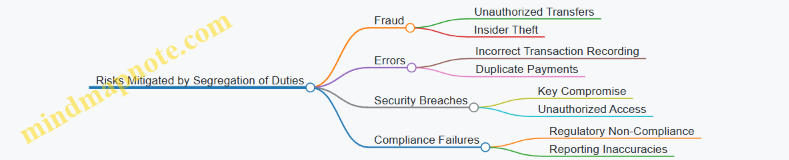
Implementing segregation of duties in crypto asset management is not only a best practice but a necessity to safeguard digital assets and maintain trust with stakeholders. By clearly defining roles, enforcing multi-layered approvals, and leveraging technology such as multi-signature wallets, organizations can significantly reduce operational risks.
7.5 Addressing Fraud Risks and Cybersecurity Measures
In the rapidly evolving world of digital assets, fraud risks and cybersecurity threats represent significant challenges for accountants and crypto analysts. Given the irreversible nature of blockchain transactions and the high value of digital assets, robust fraud prevention and cybersecurity measures are essential to protect assets and maintain trust.
Understanding Fraud Risks in Digital Asset Accounting
Fraud risks in digital assets can arise from various sources, including insider threats, phishing attacks, unauthorized access to wallets, and manipulation of transaction records. Recognizing these risks early is crucial for implementing effective controls.
Common Fraud Risks:
- Unauthorized Access: Hackers gaining control over private keys or wallets.
- Phishing and Social Engineering: Deceptive tactics to extract sensitive credentials.
- Transaction Manipulation: Altering transaction records or double-spending attempts.
- Insider Fraud: Employees misappropriating digital assets or falsifying records.
Example: A crypto exchange employee with access to the company’s hot wallet transfers funds to a personal wallet without authorization. Without proper segregation of duties and monitoring, this fraud could go unnoticed for months.
Cybersecurity Measures to Mitigate Fraud Risks
Implementing layered cybersecurity strategies is vital to safeguard digital assets. Below is a mind map illustrating key cybersecurity measures:
Example: A company uses multi-signature wallets requiring approval from three separate executives before any transaction is executed. This reduces the risk of unauthorized transfers and insider fraud.
Best Practices for Fraud Prevention and Cybersecurity
-
Implement Multi-Factor Authentication (MFA): Require MFA for all access to wallets, exchanges, and accounting systems.
-
Use Cold Storage for Long-Term Holdings: Store the majority of digital assets offline to minimize exposure to hacks.
-
Segregate Duties: Separate responsibilities among employees to prevent any single individual from having full control over digital asset transactions.
-
Maintain Detailed Logs: Keep comprehensive records of all access and transactions for audit trails.
-
Regularly Update Software and Firmware: Ensure wallets, security tools, and accounting software are up to date to patch vulnerabilities.
-
Conduct Periodic Security Audits: Engage internal or external auditors to assess cybersecurity posture.
-
Train Employees Continuously: Educate staff on emerging threats and safe practices.
-
Establish Incident Response Plans: Prepare clear procedures to respond swiftly to security breaches.
Mind Map: Fraud Risk Management Workflow
Example: A crypto fund performs quarterly risk assessments identifying phishing as a high-risk threat. They respond by implementing mandatory phishing simulation training and deploying email filtering solutions.
Real-World Example: Preventing Fraud in a Crypto Accounting Firm
Scenario: An accounting firm managing multiple client wallets implements the following measures:
- Uses hardware wallets stored in a secure vault (cold storage) for client assets.
- Requires multi-signature approval for any asset movement.
- Employs blockchain analytics software to monitor unusual transaction patterns.
- Conducts monthly internal audits to reconcile blockchain records with accounting entries.
- Trains staff quarterly on cybersecurity awareness and fraud detection.
Outcome: These measures have significantly reduced unauthorized access attempts and improved early detection of suspicious activities, enhancing client trust and regulatory compliance.
Summary
Addressing fraud risks and implementing strong cybersecurity measures are non-negotiable for professionals handling digital assets. By combining technical controls, process improvements, and continuous education, accountants and crypto analysts can safeguard assets, ensure accurate accounting, and maintain stakeholder confidence.
8. Tax Considerations and Reporting for Digital Assets
8.1 Overview of Tax Treatment for Digital Assets Globally
Digital assets, including cryptocurrencies, tokens, and other blockchain-based instruments, have introduced new complexities in tax treatment worldwide. Tax authorities are continuously evolving their guidance to address these challenges, but significant variation remains across jurisdictions.
Key Tax Treatment Categories for Digital Assets
- Capital Gains Tax (CGT): Most countries treat digital assets as property or capital assets, subjecting gains from sales or exchanges to capital gains tax.
- Income Tax: Digital assets received as payment, mining rewards, staking rewards, or airdrops may be treated as ordinary income.
- Value Added Tax (VAT) / Goods and Services Tax (GST): Some jurisdictions apply VAT/GST on digital asset transactions, while others exempt them.
- Corporate Tax: Businesses holding or transacting in digital assets must consider corporate income tax implications.
Mind Map: Global Tax Treatment of Digital Assets
Examples by Region
United States
- The IRS treats cryptocurrencies as property.
- Capital gains tax applies when crypto is sold or exchanged.
- Mining rewards are taxable as ordinary income at fair market value when received.
Example: Jane buys 1 Bitcoin for $10,000 and sells it later for $15,000. She must report a $5,000 capital gain.
United Kingdom
- HMRC treats crypto as an asset subject to capital gains tax on disposal.
- Income tax applies to mining and airdrops.
Example: Tom receives 2 ETH from mining, valued at £2,000 each at receipt. He must report £4,000 as income.
Germany
- Crypto held for over one year is exempt from capital gains tax.
- Income from mining is taxable.
Example: Anna holds Bitcoin for 14 months before selling; no capital gains tax applies.
Australia
- Crypto is treated as property.
- Mining and staking rewards are income at fair market value when received.
- GST was removed on crypto exchanges in 2017.
Example: Mark receives 5 tokens from staking worth AUD 500 each; he reports AUD 2,500 as income.
Best Practice Tips for Accountants and Crypto Analysts
- Maintain detailed records of acquisition dates, cost basis, and disposal dates.
- Track fair market value at the time of receipt for income recognition.
- Stay updated on jurisdiction-specific guidance as regulations evolve.
- Use specialized tax software to automate calculations and reporting.
Summary
Tax treatment of digital assets varies widely, but common themes include capital gains taxation on disposals and income tax on rewards or payments received in crypto. Understanding local regulations and maintaining robust documentation are critical for compliance and accurate reporting.
8.2 Calculating Gains and Losses: FIFO, LIFO, and Specific Identification
When accounting for digital assets, accurately calculating gains and losses is critical for both financial reporting and tax compliance. The method chosen to track the cost basis of digital assets directly impacts the reported profit or loss. The three primary methods are FIFO (First-In, First-Out), LIFO (Last-In, First-Out), and Specific Identification.
Understanding Cost Basis Methods
- FIFO (First-In, First-Out): Assumes the earliest acquired assets are sold first.
- LIFO (Last-In, First-Out): Assumes the most recently acquired assets are sold first.
- Specific Identification: Tracks the exact asset units sold, allowing precise matching of purchase and sale.
Mind Map: Overview of Cost Basis Methods
Example Scenario
Imagine an accountant managing the following Bitcoin (BTC) transactions for a client:
| Date | Transaction Type | Amount (BTC) | Price per BTC (USD) |
|---|---|---|---|
| 2023-01-10 | Buy | 2 | 20,000 |
| 2023-03-15 | Buy | 1 | 25,000 |
| 2023-06-20 | Buy | 3 | 22,000 |
| 2023-09-10 | Sell | 4 | 30,000 |
The client sold 4 BTC on September 10, 2023, at $30,000 each. Let’s calculate the gains using each method.
FIFO Calculation
- Step 1: Sell the first 2 BTC bought on 2023-01-10 at $20,000 each.
- Step 2: Sell the next 1 BTC bought on 2023-03-15 at $25,000.
- Step 3: Sell 1 BTC from the 3 BTC bought on 2023-06-20 at $22,000.
| BTC Sold | Purchase Date | Cost per BTC | Total Cost | Sale Price per BTC | Gain per BTC | Total Gain |
|---|---|---|---|---|---|---|
| 2 | 2023-01-10 | $20,000 | $40,000 | $30,000 | $10,000 | $20,000 |
| 1 | 2023-03-15 | $25,000 | $25,000 | $30,000 | $5,000 | $5,000 |
| 1 | 2023-06-20 | $22,000 | $22,000 | $30,000 | $8,000 | $8,000 |
| Total | $87,000 | $33,000 |
LIFO Calculation
- Step 1: Sell 3 BTC bought on 2023-06-20 at $22,000 each.
- Step 2: Sell 1 BTC bought on 2023-03-15 at $25,000.
| BTC Sold | Purchase Date | Cost per BTC | Total Cost | Sale Price per BTC | Gain per BTC | Total Gain |
|---|---|---|---|---|---|---|
| 3 | 2023-06-20 | $22,000 | $66,000 | $30,000 | $8,000 | $24,000 |
| 1 | 2023-03-15 | $25,000 | $25,000 | $30,000 | $5,000 | $5,000 |
| Total | $91,000 | $29,000 |
Specific Identification Calculation
Assuming the client specifically identifies the 1 BTC bought on 2023-01-10 and 3 BTC bought on 2023-06-20 for sale:
| BTC Sold | Purchase Date | Cost per BTC | Total Cost | Sale Price per BTC | Gain per BTC | Total Gain |
|---|---|---|---|---|---|---|
| 1 | 2023-01-10 | $20,000 | $20,000 | $30,000 | $10,000 | $10,000 |
| 3 | 2023-06-20 | $22,000 | $66,000 | $30,000 | $8,000 | $24,000 |
| Total | $86,000 | $34,000 |
Mind Map: Impact of Cost Basis Methods on Gains
Best Practices for Accountants and Crypto Analysts
- Maintain Detailed Records: Track acquisition dates, amounts, and prices for every digital asset purchase.
- Choose Method Consistently: Apply the selected cost basis method consistently for reporting periods.
- Leverage Technology: Use accounting software or blockchain analytics tools that support cost basis tracking.
- Communicate with Clients: Ensure clients understand how different methods affect their tax liabilities and financial statements.
- Document Specific Identification: When using specific identification, document the selection process clearly to satisfy auditors and tax authorities.
By understanding and applying FIFO, LIFO, and Specific Identification methods with clear examples and structured record-keeping, accountants and crypto analysts can accurately calculate gains and losses, ensuring compliance and optimized financial reporting.
8.3 Practical Example: Tax Reporting for a Crypto Trader Using FIFO Method
When it comes to tax reporting for cryptocurrency transactions, one of the most commonly used inventory accounting methods is FIFO (First-In, First-Out). This method assumes that the earliest acquired digital assets are sold or disposed of first.
What is FIFO?
- FIFO means the first coins or tokens you bought are the first ones you sell.
- This impacts the calculation of gains or losses because the cost basis is determined by the purchase price of the earliest assets.
Why FIFO?
- Simplifies record-keeping.
- Often preferred or required by tax authorities.
- Provides a consistent method for cost basis calculation.
Mind Map: FIFO Tax Reporting Workflow
Example Scenario
| Transaction | Date | Quantity (BTC) | Price per BTC (USD) | Total Cost (USD) |
|---|---|---|---|---|
| Purchase 1 | 2023-01-10 | 1.0 | $20,000 | $20,000 |
| Purchase 2 | 2023-03-15 | 0.5 | $25,000 | $12,500 |
| Purchase 3 | 2023-05-20 | 0.3 | $30,000 | $9,000 |
| Sale 1 | 2023-06-10 | 1.2 | $35,000 | ? |
Step-by-Step FIFO Calculation
- Identify the assets sold: 1.2 BTC on 2023-06-10.
- Match to earliest purchases:
- 1.0 BTC from Purchase 1 (2023-01-10) at $20,000 each
- 0.2 BTC from Purchase 2 (2023-03-15) at $25,000 each
- Calculate cost basis:
- (1.0 BTC x $20,000) + (0.2 BTC x $25,000) = $20,000 + $5,000 = $25,000
- Calculate proceeds:
- 1.2 BTC x $35,000 = $42,000
- Calculate gain:
- $42,000 - $25,000 = $17,000
Journal Entry Example
| Date | Account | Debit (USD) | Credit (USD) |
|---|---|---|---|
| 2023-06-10 | Cash | 42,000 | |
| 2023-06-10 | Digital Assets (BTC) | 25,000 | |
| 2023-06-10 | Gain on Sale of Assets | 17,000 |
Mind Map: Tax Reporting Considerations
Additional Tips for Crypto Traders
- Maintain detailed transaction logs: Use spreadsheets or specialized software.
- Reconcile exchange reports with your own records: To avoid discrepancies.
- Consider tax software integration: Many platforms support FIFO calculations.
- Stay updated on tax law changes: Cryptocurrency tax treatment evolves rapidly.
By applying the FIFO method carefully and maintaining thorough documentation, crypto traders can accurately report taxable events and comply with regulatory requirements, minimizing audit risks and ensuring clarity in their financial reporting.
8.4 Best Practice: Maintaining Comprehensive Records for Tax Audits
Maintaining comprehensive and accurate records is crucial for tax audits involving digital assets. Given the complexity and evolving nature of cryptocurrency taxation, having well-organized documentation can significantly ease the audit process and help avoid penalties.
Why Comprehensive Records Matter
- Proof of Ownership: Demonstrates legal possession of digital assets.
- Transaction History: Details every buy, sell, exchange, or transfer.
- Cost Basis Tracking: Essential for calculating gains or losses.
- Compliance: Meets regulatory requirements and supports tax filings.
Key Components of Comprehensive Records
Practical Example 1: Organizing Records for a Crypto Trader
John is an active cryptocurrency trader who buys and sells multiple tokens across different exchanges. To prepare for a potential tax audit, John maintains:
- A master spreadsheet listing every transaction with columns for date, asset, quantity, price, fees, and transaction hash.
- Exported CSV files from each exchange showing monthly statements.
- Screenshots and email confirmations of large trades or transfers.
- Wallet backups with clear labels and timestamps.
This organized approach allows John to quickly produce evidence for any queried transaction.
Practical Example 2: Documenting Mining and Staking Rewards
Sarah operates a mining rig and also participates in staking. She records:
- Daily logs of mined coins with timestamps.
- Fair market value of coins at the time of receipt.
- Transaction IDs for coin transfers from mining pools to her wallets.
- Records of electricity and operational expenses related to mining.
This detailed documentation supports her income reporting and expense deductions.
Mind Map: Steps to Maintain Comprehensive Records
Tools and Tips for Effective Record-Keeping
- Use specialized crypto tax software (e.g., CoinTracker, Koinly) that automatically imports and categorizes transactions.
- Maintain a chronological ledger that includes blockchain transaction hashes for audit trail verification.
- Keep records for at least 7 years, as some jurisdictions require extended retention.
- Document your accounting policies for digital assets, including valuation and recognition methods.
Summary
Maintaining comprehensive records for digital asset tax audits is not just about compliance but also about ensuring transparency and accuracy in financial reporting. By systematically collecting, verifying, and securing transaction data, accountants and crypto analysts can confidently navigate audits and support their clients or organizations effectively.
8.5 Handling Airdrops, Forks, and Hard Forks for Tax Purposes
Digital asset events such as airdrops, forks, and hard forks present unique challenges for tax reporting and accounting. Understanding how to properly recognize, value, and report these events is critical for accountants and crypto analysts to ensure compliance and accurate financial statements.
What Are Airdrops, Forks, and Hard Forks?
- Airdrops: Distribution of free tokens or coins to holders of an existing cryptocurrency, often used as marketing or to decentralize ownership.
- Forks: Changes to a blockchain’s protocol that result in a split; can be soft forks (backward compatible) or hard forks (non-backward compatible).
- Hard Forks: A permanent divergence in the blockchain creating two separate chains and potentially two separate cryptocurrencies.
Tax Treatment Overview
| Event Type | Taxable Event | Tax Basis | Recognition Timing |
|---|---|---|---|
| Airdrops | Usually taxable as ordinary income upon receipt | Fair market value (FMV) at receipt | When tokens are received and controlled |
| Hard Forks | Taxable when new coins are received and controlled | FMV of new coins at receipt | Upon receipt of new coins |
| Soft Forks | Generally no taxable event | N/A | N/A |
Mind Map: Tax Implications of Airdrops, Forks, and Hard Forks
Detailed Explanation and Examples
Airdrops
Accounting and Tax Treatment:
- When an airdrop occurs, recipients typically recognize the fair market value of the tokens received as ordinary income at the time they gain control over the tokens.
- The tokens received become part of the taxpayer’s cost basis for future capital gains calculations.
Example:
- Alice holds 500 ABC tokens.
- ABC project airdrops 100 XYZ tokens to Alice.
- On the day Alice receives the XYZ tokens, the FMV is $2 per token.
Accounting Entry:
- Record $200 (100 tokens x $2) as ordinary income.
- The cost basis for XYZ tokens is $200.
Mind Map for Airdrop Example:
Hard Forks
Accounting and Tax Treatment:
- When a hard fork occurs, holders of the original cryptocurrency may receive new tokens on the new blockchain.
- The receipt of new tokens is generally considered a taxable event, with income recognized equal to the FMV of the new tokens at the time of receipt.
- The new tokens’ cost basis is their FMV at receipt.
Example:
- Bob holds 1 Bitcoin (BTC).
- Bitcoin Cash (BCH) hard fork occurs, and Bob receives 1 BCH token.
- The FMV of BCH at receipt is $300.
Accounting Entry:
- Recognize $300 as ordinary income.
- Set BCH cost basis at $300.
Mind Map for Hard Fork Example:
Soft Forks
- Soft forks are backward-compatible protocol upgrades.
- Typically, no new tokens are created or received.
- Therefore, no taxable event occurs.
Example:
- Carol’s blockchain undergoes a soft fork to improve transaction speed.
- Carol’s holdings remain unchanged.
Tax Impact:
- No income recognized.
Best Practices for Handling Airdrops and Forks
- Maintain Detailed Records: Document dates, amounts, FMV, and control status of tokens received.
- Determine Control: Income recognition generally occurs when the taxpayer has control over the tokens, not necessarily when the event is announced.
- Use Reliable Market Data: For FMV, use reputable exchanges or pricing sources at the time of receipt.
- Consult Local Regulations: Tax treatment may vary by jurisdiction; stay updated on local guidance.
- Integrate with Accounting Systems: Automate tracking of these events to ensure accurate income recognition and cost basis assignment.
Summary Mind Map
By thoroughly understanding and applying these principles, accountants and crypto analysts can ensure accurate tax reporting and compliance for digital asset events such as airdrops and forks.
9. Auditing Digital Assets: Procedures and Challenges
9.1 Audit Planning for Digital Asset Holdings
Auditing digital asset holdings requires meticulous planning due to the unique characteristics of blockchain technology, market volatility, and evolving regulatory frameworks. Effective audit planning ensures that auditors can verify the existence, valuation, ownership, and completeness of digital assets while addressing risks specific to this asset class.
Key Objectives in Audit Planning for Digital Assets
- Understand the nature and types of digital assets held by the client.
- Identify relevant accounting and regulatory frameworks.
- Assess inherent and control risks related to digital asset custody and transactions.
- Plan substantive procedures tailored to blockchain verification and valuation.
- Ensure compliance with disclosure requirements.
Mind Map: Audit Planning for Digital Asset Holdings
Step 1: Understanding the Client’s Digital Asset Profile
Before designing audit procedures, auditors must gather detailed information about the client’s digital asset holdings:
- Types of Digital Assets: Identify whether the client holds cryptocurrencies (e.g., Bitcoin, Ethereum), utility/security tokens, NFTs, or other blockchain-based assets.
- Purpose of Holdings: Determine if assets are held for investment, operational use (e.g., payments), trading, or mining/staking rewards.
- Custody Arrangements: Understand whether assets are stored in self-custody wallets, with third-party custodians, or on exchanges.
Example: A client holds 500 BTC for long-term investment and 200 ETH for operational payments, stored partly in a cold wallet and partly on a custodial platform.
Step 2: Risk Assessment
Auditors evaluate risks that could lead to material misstatements:
- Inherent Risks: Volatility in asset prices, susceptibility to hacking, and unclear regulatory guidance.
- Control Risks: Weaknesses in wallet access controls, inadequate transaction authorization, or poor reconciliation between blockchain records and accounting systems.
Example: The client uses a multi-signature wallet but lacks formal policies for key management, increasing risk of unauthorized access.
Step 3: Regulatory and Accounting Frameworks
Auditors must identify applicable standards such as IFRS or US GAAP and understand tax implications. This guides the recognition, measurement, and disclosure requirements.
Example: Under IFRS, cryptocurrencies are typically classified as intangible assets, affecting impairment testing procedures.
Step 4: Planning Audit Procedures
Based on the risk assessment, auditors design procedures including:
- Existence and Ownership Verification: Confirm balances through blockchain explorers, third-party confirmations, and wallet address reconciliations.
- Valuation and Impairment Testing: Verify valuation methods and test for impairment considering market prices.
- Transaction Completeness and Cut-off: Ensure all transactions within the period are recorded accurately.
- Disclosure Review: Check compliance with financial statement disclosure requirements.
Example: Auditor uses a blockchain explorer to verify the client’s Bitcoin wallet balance matches the ledger and confirms the client’s control over private keys.
Step 5: Documentation and Reporting
Maintain comprehensive audit documentation including:
- Risk assessments and rationale for audit approach.
- Evidence gathered from blockchain and custodial confirmations.
- Communication records with management regarding digital asset controls.
- Findings and recommendations for improving controls or disclosures.
Practical Example: Audit Planning Checklist for Digital Asset Holdings
| Audit Area | Key Considerations | Planned Procedures |
|---|---|---|
| Asset Identification | Types and quantities of digital assets | Obtain detailed asset register; verify wallet addresses |
| Custody and Controls | Storage methods and access controls | Review custody agreements; test multi-sig controls |
| Valuation | Market price sources and valuation methods | Compare prices from multiple exchanges; test impairment calculations |
| Transaction Completeness | Recording of all asset movements | Reconcile blockchain transactions with ledger entries |
| Regulatory Compliance | Applicable accounting and tax standards | Review relevant standards; verify tax filings |
| Disclosure | Adequacy of financial statement disclosures | Review notes for compliance with standards |
By following this structured audit planning approach, auditors can effectively address the complexities of digital asset holdings and provide reasonable assurance on the financial statements.
9.2 Verifying Existence and Ownership on the Blockchain
Verifying the existence and ownership of digital assets on the blockchain is a critical step in the audit process for accountants and crypto analysts. Unlike traditional assets, digital assets are recorded on decentralized ledgers, which require unique verification methods leveraging blockchain technology.
Understanding Blockchain Verification
- Existence: Confirming that the digital asset actually exists on the blockchain.
- Ownership: Confirming that the entity claiming the asset controls the associated private keys or addresses.
Mind Map: Key Components of Blockchain Verification
Step 1: Verifying Existence
-
Locate the Asset on the Blockchain
- Use blockchain explorers (e.g., Etherscan for Ethereum, Blockchain.com for Bitcoin).
- Search by transaction hash, wallet address, or token ID.
-
Confirm Transaction History
- Trace the asset’s transaction history to ensure it was minted or received.
- Verify the number of confirmations to ensure finality.
-
Example:
- An auditor is verifying a client’s Bitcoin holding.
- The client provides a wallet address.
- Using Blockchain.com, the auditor confirms the balance and transaction history.
- The auditor notes that the latest transaction has 12 confirmations, indicating it is securely recorded.
Step 2: Verifying Ownership
-
Proof of Control Over Wallet Address
- Ownership is demonstrated by control of the private key linked to the wallet address.
- The auditor may request the client to sign a message using their private key.
-
Message Signing Process
- The client uses wallet software to sign a unique message provided by the auditor.
- The auditor verifies the signature against the public address.
-
Example:
- The auditor sends the message “Audit Verification 2024” to the client.
- The client signs the message with their wallet.
- The auditor uses a verification tool to confirm the signature matches the wallet address.
-
Multi-Signature Wallets
- For wallets requiring multiple signatures, verification involves confirming the participation of all required signatories.
Mind Map: Ownership Verification Process
Additional Considerations
-
Custodial vs Non-Custodial Assets
- For custodial wallets (e.g., held by exchanges), auditors should obtain confirmation letters or statements from the custodian.
- Non-custodial wallets require direct verification via blockchain and message signing.
-
Off-Chain Assets
- Some digital assets may represent off-chain rights; auditors must understand the underlying agreements.
-
Reconciliation
- Reconcile blockchain records with internal accounting records to ensure completeness and accuracy.
Summary Table: Verification Techniques
| Verification Aspect | Method | Example | Tools |
|---|---|---|---|
| Existence | Blockchain explorer lookup | Confirm Bitcoin balance at address 1A1zP1… | Blockchain.com, Etherscan |
| Ownership | Message signing | Client signs “Audit Verification 2024” message | Wallet software (MetaMask, Ledger Live) |
| Custodial Assets | Custodian confirmation letter | Exchange confirms client’s holdings | Custodian reports |
| Multi-Sig Wallets | Verify all required signatures | Confirm 2-of-3 signatures on wallet | Multi-sig wallet interfaces |
By combining these verification methods, auditors and crypto analysts can confidently confirm the existence and ownership of digital assets, ensuring the integrity of financial statements and compliance with auditing standards.
9.3 Practical Example: Using Blockchain Explorers for Audit Evidence
Blockchain explorers are essential tools for auditors verifying the existence, ownership, and transaction history of digital assets. They provide transparent, immutable, and publicly accessible records directly from the blockchain, which can serve as reliable audit evidence.
What is a Blockchain Explorer?
- A web-based tool that allows users to search and view transactions, addresses, blocks, and other data on a blockchain network.
- Examples include Etherscan for Ethereum, Blockchain.com Explorer for Bitcoin, and BscScan for Binance Smart Chain.
Why Use Blockchain Explorers in Audits?
- Verify existence: Confirm that the digital assets exist on the blockchain.
- Confirm ownership: Check wallet addresses and balances.
- Trace transactions: Follow the flow of assets to detect unusual activity.
- Validate timestamps: Confirm transaction dates and times.
Mind Map: Using Blockchain Explorers for Audit Evidence
Step-by-Step Example: Auditing Bitcoin Holdings Using Blockchain.com Explorer
-
Obtain Wallet Address from Client:
- Example:
1A1zP1eP5QGefi2DMPTfTL5SLmv7DivfNa
- Example:
-
Search the Address on Blockchain Explorer:
- Navigate to Blockchain.com Explorer.
- Input the wallet address in the search bar.
-
Review Wallet Balance and Transaction History:
- Confirm the current balance matches client records.
- Review incoming and outgoing transactions.
-
Verify Specific Transactions:
- Select a transaction hash (TxID) to view details.
- Confirm transaction amount, date, and involved addresses.
-
Document Evidence:
- Take screenshots of wallet balance and transaction details.
- Export transaction history if available.
-
Cross-Reference with Client’s Accounting Records:
- Match blockchain data with ledger entries.
Example Transaction Details (Bitcoin)
| Field | Description |
|---|---|
| TxID | b6f6991d... (unique transaction ID) |
| Date | 2024-05-15 14:32 UTC |
| From Address | 1BoatSLRHtKNngkdXEeobR76b53LETtpyT |
| To Address | 1A1zP1eP5QGefi2DMPTfTL5SLmv7DivfNa |
| Amount | 0.5 BTC |
| Confirmations | 12 (number of blocks confirming transaction) |
Mind Map: Documentation and Reporting
Additional Tips and Best Practices
- Use multiple explorers: For cross-verification, especially on blockchains with several explorers.
- Timestamp verification: Confirm transaction timestamps align with accounting periods.
- Watch for mixing services: Transactions involving mixers or tumblers may require additional scrutiny.
- Leverage analytics tools: Some explorers offer advanced analytics to detect suspicious patterns.
Summary
Using blockchain explorers provides auditors with transparent and verifiable evidence of digital asset holdings and transactions. By systematically verifying wallet addresses, transaction histories, and timestamps, auditors can enhance the reliability of their audit conclusions while maintaining comprehensive documentation.
For accountants and crypto analysts, mastering blockchain explorer tools is a critical skill in the evolving landscape of digital asset auditing.
9.4 Best Practice: Integrating Technology Tools in Audit Processes
Auditing digital assets presents unique challenges due to the decentralized and pseudonymous nature of blockchain technology. Integrating advanced technology tools into the audit process not only enhances accuracy and efficiency but also strengthens the reliability of audit evidence. This section explores best practices for leveraging technology in auditing digital assets, supported by mind maps and practical examples.
Why Integrate Technology Tools?
- Enhanced Data Accuracy: Automated data extraction reduces human error.
- Improved Traceability: Blockchain explorers and analytics provide transparent transaction trails.
- Efficiency Gains: Automation accelerates reconciliation and verification.
- Risk Mitigation: Advanced tools help detect anomalies and potential fraud.
Key Technology Tools for Digital Asset Audits
Mind Map: Integrating Technology Tools in Audit Processes
Practical Example 1: Using Blockchain Explorers for Transaction Verification
Scenario: An auditor needs to verify a client’s Bitcoin transactions recorded in the ledger.
Process:
- Obtain the wallet addresses from the client.
- Use a blockchain explorer (e.g., Blockstream.info) to look up transaction history.
- Cross-check transaction dates, amounts, and counterparties with the client’s accounting records.
- Flag any discrepancies for further investigation.
Outcome: This method provides independent verification directly from the blockchain, increasing audit reliability.
Practical Example 2: Automated Reconciliation Software
Scenario: A crypto exchange auditor needs to reconcile thousands of daily transactions.
Process:
- Import transaction data from the exchange’s wallet and internal ledger into reconciliation software.
- The software automatically matches deposits, withdrawals, and trades.
- Exceptions are highlighted for manual review.
Outcome: Significant time savings and reduced risk of missed discrepancies.
Mind Map: Audit Workflow Enhanced by Technology
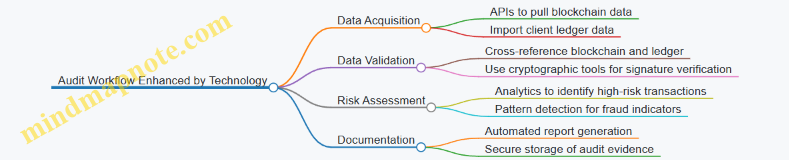
Best Practice Tips
- Stay Updated: Blockchain technology evolves rapidly; regularly update tools and skills.
- Use Multiple Tools: Combining explorers, analytics, and cryptographic verification enhances audit quality.
- Maintain Audit Trails: Ensure all tool outputs and steps are documented for transparency.
- Train Audit Teams: Provide training on blockchain fundamentals and tool usage.
By thoughtfully integrating technology tools into audit processes, auditors can overcome the complexities of digital asset verification, delivering more accurate and efficient audits.
9.5 Addressing Valuation and Disclosure Risks in Audits
Auditing digital assets presents unique valuation and disclosure risks due to their volatile nature, evolving regulatory environment, and technological complexity. Accountants and auditors must carefully assess these risks to ensure accurate financial reporting and compliance.
Key Valuation Risks in Digital Asset Audits
- Market Volatility: Rapid price fluctuations can lead to significant valuation differences between reporting periods.
- Lack of Standardized Valuation Models: Diverse asset types (cryptocurrencies, tokens, NFTs) require different valuation approaches.
- Illiquid Markets: Some digital assets trade on limited exchanges, making fair value determination challenging.
- Manipulation and Fraud Risks: Potential for price manipulation on smaller exchanges or through wash trading.
Disclosure Risks
- Incomplete or Inaccurate Reporting: Failure to disclose holdings, valuation methods, or impairment losses.
- Regulatory Non-Compliance: Omitting disclosures required by evolving accounting standards or jurisdictional regulations.
- Complex Transactions: Insufficient explanation of token swaps, staking rewards, or DeFi activities.
Mind Map: Valuation Risks in Digital Asset Audits
Mind Map: Disclosure Risks in Digital Asset Audits
Best Practices to Address Valuation and Disclosure Risks
-
Use Reliable Market Data Sources:
- Obtain pricing from multiple reputable exchanges.
- Cross-verify prices to mitigate manipulation risks.
-
Document Valuation Methodologies Clearly:
- Specify whether cost, fair value, or hybrid models are used.
- Explain assumptions and inputs for fair value measurements.
-
Perform Regular Impairment Testing:
- Assess for indicators of impairment at each reporting date.
- Recognize impairment losses promptly.
-
Enhance Disclosure Transparency:
- Disclose types and quantities of digital assets held.
- Explain valuation methods and any changes.
- Detail risks related to market volatility and liquidity.
-
Leverage Technology Tools:
- Utilize blockchain analytics for transaction verification.
- Employ automated reconciliation tools to ensure data integrity.
-
Engage Specialists When Needed:
- Consult valuation experts for complex or illiquid assets.
- Involve legal advisors for regulatory compliance.
Practical Example: Valuation and Disclosure in Audit
Scenario: A company holds 10,000 units of a lesser-known cryptocurrency traded on a low-volume exchange.
-
Valuation Challenge: The exchange shows wide bid-ask spreads and sporadic trades.
-
Audit Approach:
- Obtain price quotes from multiple exchanges where the asset is listed.
- Use volume-weighted average price (VWAP) over a defined period to smooth volatility.
- Document the chosen valuation approach and rationale.
-
Disclosure:
- Clearly disclose the valuation method and sources.
- Highlight the illiquidity risk and potential impact on asset value.
-
Outcome: The auditor is satisfied that the valuation is reasonable and disclosures are adequate, reducing audit risk.
Summary
Addressing valuation and disclosure risks in digital asset audits requires a combination of robust methodologies, transparent communication, and leveraging technology. By understanding the unique challenges posed by digital assets and applying best practices, auditors can enhance the reliability and credibility of financial statements.
10. Emerging Trends and Future Outlook in Digital Asset Accounting
10.1 Impact of Decentralized Finance (DeFi) on Accounting Practices
Decentralized Finance (DeFi) represents a paradigm shift in how financial services are delivered, leveraging blockchain technology to create open, permissionless, and transparent financial ecosystems. For accountants and crypto analysts, DeFi introduces unique challenges and opportunities that require adapting traditional accounting frameworks and controls.
Understanding DeFi: Key Components and Features
- Smart Contracts: Self-executing contracts with terms directly written into code.
- Decentralized Exchanges (DEXs): Platforms enabling peer-to-peer trading without intermediaries.
- Lending & Borrowing Protocols: Platforms allowing users to lend or borrow assets with collateral.
- Yield Farming & Staking: Earning rewards by providing liquidity or locking assets.
- Stablecoins: Cryptocurrencies pegged to stable assets like fiat currencies.
Mind Map: DeFi Components Affecting Accounting
Accounting Challenges Introduced by DeFi
-
Transaction Complexity and Volume
- High frequency of micro-transactions complicates bookkeeping.
- Example: A user providing liquidity to a DEX pool may receive multiple reward tokens daily.
-
Valuation Difficulties
- Volatility and lack of centralized pricing sources.
- Example: Yield farming rewards may be paid in new or illiquid tokens.
-
Recognition of Income and Expenses
- Timing and measurement of staking rewards or interest income.
- Example: Should staking rewards be recognized when earned or when claimed?
-
Smart Contract Risks and Control Environment
- Automated execution without human intervention challenges traditional internal controls.
- Example: Errors in smart contract code leading to unintended transactions.
-
Regulatory and Tax Uncertainty
- Varying jurisdictional guidance on DeFi activities.
Mind Map: Accounting Challenges in DeFi
Best Practices for Accounting in DeFi
-
Implement Real-Time Transaction Tracking: Use blockchain analytics tools to capture and categorize DeFi transactions automatically.
- Example: Integrating APIs from platforms like Etherscan or The Graph to feed transaction data into accounting software.
-
Adopt Fair Value Measurement with Reliable Data Sources: Use multiple market data feeds to value tokens, especially for yield farming rewards.
- Example: Averaging prices from decentralized oracles like Chainlink and centralized exchanges.
-
Establish Clear Income Recognition Policies: Define when staking rewards or interest income are recognized, considering the smart contract terms.
- Example: Recognizing staking rewards on an accrual basis as they are earned per block.
-
Strengthen Internal Controls Around Smart Contract Use: Conduct code audits and monitor contract interactions to mitigate risks.
- Example: Engaging third-party auditors to review DeFi protocol contracts before use.
-
Maintain Detailed Documentation and Audit Trails: Record all DeFi transactions with supporting blockchain evidence.
- Example: Exporting transaction hashes and timestamps for each DeFi activity.
Practical Example: Accounting for Yield Farming Rewards
Scenario: An entity provides liquidity to a DeFi protocol’s liquidity pool and earns reward tokens daily.
- Step 1: Record initial liquidity provision at cost.
- Step 2: Each day, recognize staking rewards as income at fair value based on market prices at the time earned.
- Step 3: Revalue liquidity pool tokens periodically to reflect market value changes.
- Step 4: Document all transactions with blockchain transaction IDs.
Journal Entry Example:
| Date | Account | Debit (USD) | Credit (USD) |
|---|---|---|---|
| 2024-05-01 | Digital Assets (Liquidity Pool Tokens) | 10,000 | |
| Cash | 10,000 | ||
| 2024-05-10 | Digital Assets (Reward Tokens) | 200 | |
| Staking Income | 200 |
Mind Map: Best Practices for DeFi Accounting
Summary
DeFi is reshaping financial services and demands that accounting professionals evolve their practices. By understanding DeFi’s components, embracing technology for transaction tracking, and applying rigorous valuation and control measures, accountants and crypto analysts can accurately reflect DeFi activities in financial statements, ensuring transparency and compliance.
10.2 Accounting for NFTs and Other Emerging Digital Asset Classes
Introduction
Non-Fungible Tokens (NFTs) represent a unique and rapidly growing segment of digital assets. Unlike cryptocurrencies such as Bitcoin or Ethereum, NFTs are indivisible and unique, often representing ownership of digital art, collectibles, music, virtual real estate, or intellectual property. This uniqueness introduces new complexities in accounting, valuation, and reporting.
Emerging digital asset classes beyond NFTs include metaverse assets, decentralized identity tokens, and tokenized real-world assets, each with distinct accounting considerations.
Key Accounting Considerations for NFTs
- Classification: NFTs are generally classified as intangible assets due to their non-physical nature and uniqueness.
- Recognition: Recognition occurs when control and ownership transfer to the entity.
- Valuation: Valuation challenges arise due to lack of active markets and high volatility.
- Impairment: Regular impairment testing is essential given the speculative nature.
- Revenue Recognition: Sales of NFTs may generate revenue, requiring clear recognition criteria.
Mind Map: NFT Accounting Framework
Example 1: Accounting for an NFT Purchased as an Investment
Scenario: A company purchases a digital artwork NFT for $50,000 to hold as a long-term investment.
Accounting Treatment:
- Initial Recognition: Record as an intangible asset at cost.
- Subsequent Measurement: Choose cost or fair value model. If cost model is chosen, test for impairment annually.
- Impairment Example: After 6 months, market interest in the NFT drops, and a similar NFT sells for $30,000. An impairment loss of $20,000 should be recognized.
Journal Entries:
-
At purchase:
- Dr. Intangible Asset (NFT) $50,000
- Cr. Cash $50,000
-
At impairment:
- Dr. Impairment Loss $20,000
- Cr. Intangible Asset (NFT) $20,000
Mind Map: Valuation Challenges for NFTs
Example 2: Minting and Selling an NFT
Scenario: A digital artist mints an NFT representing a piece of digital art and sells it for 10 ETH (equivalent to $25,000 at sale date).
Accounting Treatment:
- Minting Costs: Capitalize direct costs related to minting (e.g., gas fees).
- Revenue Recognition: Recognize revenue at the fair value of consideration received (10 ETH at $25,000).
- Tax Considerations: Recognize any gain or loss if the artist holds cryptocurrencies as inventory or intangible assets.
Journal Entries:
-
Minting costs:
- Dr. Intangible Asset (NFT) $500 (gas fees)
- Cr. Cash $500
-
Sale of NFT:
- Dr. Cash / Crypto Asset $25,000
- Cr. Revenue $25,000
Accounting for Other Emerging Digital Asset Classes
| Asset Type | Description | Accounting Considerations |
|---|---|---|
| Metaverse Assets | Virtual land, buildings, avatars | Intangible assets; valuation based on market activity |
| Decentralized Identity | Tokens representing identity credentials | May be intangible assets or service contracts |
| Tokenized Real-World Assets | Digital tokens backed by physical assets | May require dual accounting for underlying asset and token |
Mind Map: Emerging Digital Asset Classes
Best Practices Summary
- Establish clear policies for classification and recognition of NFTs and emerging assets.
- Use multiple valuation methods and document assumptions thoroughly.
- Monitor market developments and regulatory guidance continuously.
- Maintain detailed records of transactions, provenance, and related costs.
- Collaborate with legal and tax experts to address ownership and compliance issues.
Accounting for NFTs and emerging digital assets requires a flexible yet rigorous approach, balancing evolving market realities with established accounting principles. By integrating best practices and real-world examples, accountants and crypto analysts can navigate this dynamic landscape effectively.
10.3 Practical Example: Valuing and Accounting for an NFT Purchase
Introduction
Non-Fungible Tokens (NFTs) represent unique digital assets stored on a blockchain, often linked to digital art, collectibles, or intellectual property. Accounting for NFTs requires understanding their valuation, recognition, and subsequent measurement.
Step 1: Understanding the NFT Purchase
- Scenario: A company purchases a digital artwork NFT for $50,000 using cryptocurrency (Ethereum).
- Objective: Record the initial acquisition and subsequent accounting treatment.
Step 2: Valuation at Acquisition
- NFTs are typically recorded at cost, which includes:
- Purchase price (fair value of consideration given)
- Transaction fees (e.g., gas fees on Ethereum network)
Example:
- Purchase price: $50,000
- Gas fees: $500
- Total cost basis: $50,500
Step 3: Accounting Entries at Purchase
| Account | Debit | Credit |
|---|---|---|
| Digital Assets (NFT) | $50,500 | |
| Cryptocurrency (Ethereum) | $50,000 | |
| Transaction Fees Expense | $500 | |
| Cash / Crypto Wallet | $500 |
Note: If the company uses cryptocurrency to pay, the fair value of the crypto at transaction date is used to measure the cost.
Step 4: Classification
- NFTs are generally classified as intangible assets unless held for sale in the ordinary course of business (then inventory).
- Determine useful life: Often indefinite, but management judgment applies.
Step 5: Subsequent Measurement
- Cost model: Carry at cost less impairment.
- Revaluation model: Rarely applied due to lack of active markets.
Step 6: Impairment Considerations
- If the NFT’s market value drops significantly and is not expected to recover, test for impairment.
Example:
- Market value drops to $30,000
- Impairment loss = $50,500 - $30,000 = $20,500
Journal Entry:
| Account | Debit | Credit |
|---|---|---|
| Impairment Loss Expense | $20,500 | |
| Accumulated Impairment | $20,500 |
Step 7: Disclosure
- Disclose:
- Nature and description of NFTs held
- Valuation methods
- Impairment losses recognized
Mind Map: NFT Purchase Accounting Process
Additional Example: Paying with Cryptocurrency
- Company pays 10 ETH for an NFT.
- ETH fair value at purchase date: $5,000 per ETH.
- Gas fees: 0.1 ETH ($500).
Cost Basis:
- NFT = 10 ETH * $5,000 = $50,000
- Gas fees = 0.1 ETH * $5,000 = $500
- Total = $50,500
Journal Entry:
| Account | Debit | Credit |
|---|---|---|
| Digital Assets (NFT) | $50,500 | |
| Cryptocurrency (ETH) | $50,500 |
Note: Cryptocurrency is derecognized at fair value.
Summary
Accounting for NFT purchases involves:
- Measuring cost including purchase price and transaction fees
- Proper classification (usually intangible assets)
- Recognizing impairment losses when applicable
- Maintaining clear disclosures
This approach ensures transparency and compliance with accounting standards while reflecting the unique nature of NFTs.
10.4 Best Practice: Staying Updated with Regulatory and Standard-Setting Developments
In the rapidly evolving world of digital assets, staying current with regulatory changes and accounting standards is crucial for accountants and crypto analysts. Regulatory bodies and standard-setters frequently update guidance to address new challenges posed by innovations such as DeFi, NFTs, and evolving tax treatments. Failure to keep up-to-date can lead to misstatements, compliance risks, and missed opportunities.
Why Staying Updated Matters
- Compliance: Ensures adherence to legal and regulatory requirements.
- Accuracy: Improves the accuracy of financial reporting and valuation.
- Risk Management: Helps identify and mitigate emerging risks.
- Competitive Advantage: Enables proactive adaptation to new standards.
Key Areas to Monitor
Mind Map: Key Areas to Monitor for Regulatory and Standard-Setting Updates
Effective Strategies to Stay Updated
Mind Map: Strategies to Stay Updated
Practical Example: How a Crypto Analyst Stays Current
Scenario: Sarah, a crypto analyst at a mid-sized accounting firm, needs to ensure her team complies with the latest IFRS guidance on digital assets.
- Sarah subscribes to the IFRS Foundation newsletter and sets Google Alerts for keywords like “digital asset accounting” and “IFRS crypto updates.”
- She attends quarterly webinars hosted by the AICPA focused on cryptocurrency accounting.
- Sarah uses a RegTech platform that aggregates regulatory changes globally and flags relevant updates.
- She participates in a LinkedIn group dedicated to blockchain accounting professionals, sharing insights and discussing challenges.
- When IFRS issues a new exposure draft on digital asset classification, Sarah organizes an internal workshop to review and adapt the firm’s accounting policies.
Example Mind Map: Sarah’s Update Workflow
Mind Map: Sarah’s Workflow for Staying Updated
Additional Tips
- Document Updates: Maintain a log of regulatory and standard changes reviewed and actions taken.
- Cross-Functional Collaboration: Work with legal, tax, and compliance teams to interpret and implement changes.
- Scenario Planning: Consider how upcoming standards might impact current accounting treatments.
- Feedback Loop: Encourage team members to share insights from external events and training.
By embedding these best practices into daily workflows, accountants and crypto analysts can confidently navigate the complexities of digital asset accounting and ensure their organizations remain compliant and well-prepared for future developments.
10.5 Preparing for Integration of Digital Assets in Enterprise Financial Systems
Integrating digital assets into enterprise financial systems is a critical step for organizations aiming to leverage blockchain technology and cryptocurrencies in their operations. This process ensures accurate accounting, compliance, and efficient management of digital assets alongside traditional financial instruments.
Key Considerations for Integration
- System Compatibility: Ensure existing ERP and accounting software can support digital asset data or can be upgraded.
- Data Accuracy and Real-Time Updates: Integration should allow real-time or near-real-time transaction recording to reflect market volatility.
- Security and Access Controls: Protect private keys and sensitive data through robust cybersecurity measures.
- Regulatory Compliance: Systems must support reporting requirements and tax calculations.
- Auditability and Transparency: Maintain immutable records and audit trails for all digital asset transactions.
Mind Map: Preparing for Digital Asset Integration
Step-by-Step Example: Integrating Bitcoin Transactions into an ERP System
Scenario: A mid-sized enterprise wants to integrate its Bitcoin transactions into its existing ERP system (e.g., SAP or Oracle Financials).
- Assessment: Confirm ERP supports custom asset classes or can integrate with third-party plugins.
- Data Feed Setup: Connect to a reliable Bitcoin price API (e.g., CoinGecko, CoinMarketCap) for real-time valuation.
- Transaction Recording: Develop or deploy middleware that captures Bitcoin transactions from wallets or exchanges and formats them into ERP-compatible journal entries.
- Security Implementation: Use hardware security modules (HSMs) or cold storage solutions for private key management.
- Compliance Configuration: Configure tax codes and reporting templates to handle gains/losses and transaction fees.
- Testing & Validation: Run parallel accounting cycles to validate accuracy.
- Training: Educate accounting and treasury teams on new workflows.
Mind Map: Example Integration Workflow
Best Practices
- Modular Integration: Use APIs and middleware to keep digital asset modules loosely coupled with core financial systems, enabling easier updates.
- Automate Valuation Updates: Automate fetching and updating of asset prices to reflect fair value accurately.
- Implement Robust Controls: Segregate duties and implement multi-factor authentication for transaction approvals.
- Maintain Detailed Logs: Ensure every digital asset transaction is logged with timestamps, wallet addresses, and transaction hashes.
- Regular Audits: Schedule periodic audits of integrated systems to verify data integrity and compliance.
Additional Example: NFT Accounting Integration
For enterprises dealing with NFTs, integration involves:
- Tracking unique asset metadata (token ID, smart contract address).
- Valuing NFTs based on market sales or appraisals.
- Recording purchases, sales, and royalties within financial systems.
Example: A media company integrates an NFT marketplace API to automatically import NFT sales data into their accounting software, tagging each transaction with relevant project codes and calculating royalties payable.
Summary
Preparing for digital asset integration requires a holistic approach encompassing technology, security, compliance, and training. By following structured workflows and leveraging automation, enterprises can seamlessly incorporate digital assets into their financial ecosystem, ensuring accuracy, transparency, and regulatory adherence.
11. Case Studies and Practical Applications
11.1 Case Study: Accounting for a Cryptocurrency Exchange’s Asset Portfolio
Introduction
Cryptocurrency exchanges hold vast and diverse portfolios of digital assets, including cryptocurrencies, tokens, and sometimes fiat currencies. Proper accounting for these assets is critical for transparency, regulatory compliance, and accurate financial reporting. This case study explores how a mid-sized cryptocurrency exchange manages the accounting of its digital asset portfolio, highlighting best practices, challenges, and practical examples.
Exchange Profile
- Name: CryptoXchange Ltd.
- Assets Held: Bitcoin (BTC), Ethereum (ETH), stablecoins (USDT, USDC), various altcoins, and proprietary tokens.
- Volume: Approximately 100,000 transactions monthly.
- Accounting Framework: IFRS with adaptations for digital assets.
Mind Map: Overview of CryptoXchange’s Asset Portfolio Accounting
Asset Classification
CryptoXchange classifies its digital assets primarily as intangible assets under IFRS, except for stablecoins pegged to fiat currencies, which are treated as cash equivalents.
Example:
- Bitcoin and Ethereum are recorded as intangible assets.
- USDT and USDC stablecoins are treated as cash equivalents due to their stable value and liquidity.
Best Practice: Clearly document classification rationale and update as regulations evolve.
Initial Measurement
Assets are initially recorded at cost, which includes purchase price plus any directly attributable transaction fees.
Example:
- CryptoXchange purchases 10 BTC at $30,000 each with a $500 transaction fee.
- Initial cost recorded = (10 x $30,000) + $500 = $300,500.
Mind Map: Initial Measurement Components
Subsequent Measurement
CryptoXchange uses the fair value model for subsequent measurement, recognizing unrealized gains and losses in other comprehensive income (OCI).
Example:
- At reporting date, the fair value of 10 BTC is $320,000.
- Unrealized gain = $320,000 - $300,500 = $19,500.
- This gain is recorded in OCI, not profit or loss.
Best Practice: Use reliable market data sources such as CoinMarketCap or exchange APIs.
Transaction Accounting
The exchange processes various transactions including customer deposits, withdrawals, and internal transfers.
Example:
-
Customer deposits 5 ETH valued at $2,000 each.
-
Entry: Debit Crypto Asset Wallet $10,000; Credit Customer Liability Account $10,000.
-
Customer withdraws 2 ETH when price is $2,100 each.
-
Entry: Debit Customer Liability $4,200; Credit Crypto Asset Wallet $4,200.
Mind Map: Transaction Types and Accounting Entries
Internal Controls and Reconciliation
CryptoXchange implements multi-signature wallets and cold storage for security. Daily reconciliation between blockchain records and internal accounting systems is performed.
Example:
- Reconciliation identifies a discrepancy of 0.5 BTC due to a delayed transaction.
- Investigation confirms timing difference; adjustment made in next period.
Best Practice: Maintain detailed audit trails and implement segregation of duties.
Disclosure and Reporting
The exchange discloses the composition of its digital asset portfolio, valuation methods, and risks in its financial statements.
Example Disclosure Extract:
“CryptoXchange’s digital assets are measured at fair value with changes recognized in OCI. The portfolio includes BTC, ETH, and stablecoins. The company employs robust security measures including multi-signature wallets and cold storage.”
Summary Table: Key Accounting Entries for CryptoXchange
| Transaction Type | Debit Account | Credit Account | Notes |
|---|---|---|---|
| Purchase of BTC | Crypto Asset Wallet | Cash/Bank | Include transaction fees |
| Customer Deposit (ETH) | Crypto Asset Wallet | Customer Liability | Recognize customer funds held |
| Customer Withdrawal (ETH) | Customer Liability | Crypto Asset Wallet | Reflect asset outflow |
| Trading Fee Revenue | Cash/Bank | Revenue | Recognize fees earned |
| Unrealized Gain on BTC | OCI (Equity) | Crypto Asset Valuation | Fair value adjustment |
Conclusion
Accounting for a cryptocurrency exchange’s asset portfolio requires a structured approach to classification, measurement, transaction recording, and internal controls. CryptoXchange’s example demonstrates the importance of clear policies, reliable valuation methods, and robust reconciliation processes to ensure accurate and compliant financial reporting.
This case study serves as a practical guide for accountants and crypto analysts managing digital asset portfolios within exchange environments.
11.2 Case Study: Corporate Treasury Management of Digital Assets
Overview
Corporate treasury management of digital assets involves the strategic handling, accounting, and reporting of cryptocurrencies and tokens held by a company as part of its treasury operations. This case study explores how a mid-sized technology company, TechInnovate Inc., integrated digital assets into its treasury portfolio, the accounting challenges faced, and best practices implemented.
Company Background
TechInnovate Inc. is a technology firm that decided to diversify its treasury holdings by acquiring Bitcoin (BTC) and Ethereum (ETH) as part of its cash management strategy. The company views digital assets as a hedge against inflation and a potential store of value.
Treasury Objectives with Digital Assets
- Diversification: Reduce reliance on fiat currency holdings.
- Liquidity Management: Maintain assets that can be quickly converted to cash.
- Risk Management: Monitor volatility and regulatory risks.
Mind Map: Corporate Treasury Management of Digital Assets
Step 1: Acquisition and Custody
TechInnovate purchased 50 BTC and 1,000 ETH over a 3-month period. The treasury team chose a reputable third-party custodian offering multi-signature wallets and insurance coverage.
Example:
- Purchase of 10 BTC at $45,000 each on Jan 15
- Purchase of 500 ETH at $3,000 each on Feb 10
Best Practice: Maintain detailed purchase records including date, quantity, price, and transaction fees.
Step 2: Accounting Classification
The treasury team classified digital assets as intangible assets under IFRS due to lack of physical substance and absence of contractual rights to receive cash flows.
Example:
- Bitcoin and Ethereum recorded as intangible assets at cost.
Best Practice: Document rationale for classification and consult accounting standards regularly.
Step 3: Valuation and Subsequent Measurement
TechInnovate adopted the cost model for subsequent measurement, recognizing impairment losses when fair value dropped below carrying amount.
Example:
- On March 31, BTC market price dropped to $40,000.
- An impairment loss was recognized for the difference between cost and market price.
Best Practice: Conduct quarterly impairment testing and maintain market data from reliable exchanges.
Step 4: Internal Controls and Security
The company implemented strict internal controls:
- Dual approval for all digital asset transactions.
- Segregation of duties between treasury and accounting teams.
- Regular reconciliation between custodian statements and internal records.
Mind Map: Internal Controls for Digital Asset Treasury

Example:
- A treasury manager initiates a transfer request.
- A CFO or controller approves before execution.
Step 5: Risk Management
The treasury team monitored market volatility using real-time dashboards and set thresholds for maximum exposure.
Example:
- If BTC value drops by more than 15% in a week, a review is triggered.
They also stayed updated on regulatory changes affecting digital asset holdings.
Best Practice: Maintain a risk register and update policies accordingly.
Step 6: Tax Reporting
TechInnovate tracked each acquisition and disposition event to calculate gains or losses for tax purposes.
Example:
- Sold 5 BTC at $50,000 each on April 10 (original cost $45,000).
- Recognized a taxable gain of $25,000.
Best Practice: Use accounting software that supports FIFO, LIFO, or specific identification methods to track cost basis.
Step 7: Technology Integration
The company integrated blockchain analytics tools with its ERP system to automate transaction imports and reconciliation.
Example:
- Automated import of wallet transactions reduces manual errors.
Best Practice: Regularly update software and train staff on new features.
Summary Table: Key Accounting Entries
| Transaction Type | Debit Account | Credit Account | Notes |
|---|---|---|---|
| Purchase of BTC/ETH | Intangible Assets | Cash/Bank | Recorded at acquisition cost including fees |
| Impairment Loss | Impairment Expense | Intangible Assets | When fair value < carrying amount |
| Sale of Digital Assets | Cash/Bank | Intangible Assets | Remove asset at cost |
| Gain on Sale of Assets | Recognize gain if sale price > cost |
Conclusion
TechInnovate’s approach to corporate treasury management of digital assets highlights the importance of clear policies, robust internal controls, and adherence to accounting standards. By integrating technology and maintaining detailed records, the company effectively manages risks and ensures accurate financial reporting.
Additional Resources
- IFRS Interpretations on Digital Assets
- Treasury Management Best Practices for Crypto
- Blockchain Analytics Tools for Accounting
This case study serves as a practical guide for accountants and crypto analysts managing digital assets in corporate treasury functions.
11.3 Case Study: Startup Issuing Utility Tokens and Accounting Implications
Background
A blockchain startup, “TechToken Inc.”, launches a new platform that offers digital services accessed via utility tokens. These tokens are sold in a public token sale to raise funds for platform development. The startup needs to account for the issuance, sale, and subsequent use of these utility tokens in compliance with accounting standards.
Key Accounting Considerations
- Classification of Utility Tokens: Are they financial instruments, intangible assets, or revenue?
- Revenue Recognition: When and how to recognize revenue from token sales.
- Measurement: Initial measurement of tokens issued and received.
- Liability vs. Equity: Determining if tokens represent a liability (deferred revenue) or equity.
- Use of Tokens: Accounting for tokens when customers redeem them for services.
Mind Map: Accounting for Utility Token Issuance
Step 1: Classification of Utility Tokens
Utility tokens typically grant access to a company’s future services rather than representing ownership or financial claims. Therefore, they are often accounted for as deferred revenue (liability) until the service is delivered.
Example:
- TechToken Inc. sells 1,000,000 utility tokens at $1 each.
- The tokens give buyers the right to access platform services in the future.
- Since the service is not yet delivered, the proceeds are recorded as deferred revenue.
Journal Entry on Token Sale:
| Account | Debit ($) | Credit ($) |
|---|---|---|
| Cash | 1,000,000 | |
| Deferred Revenue (Liability) | 1,000,000 |
Step 2: Revenue Recognition on Token Redemption
Revenue is recognized when the customer redeems tokens for services.
Example:
- A customer redeems 10,000 tokens to access services worth $10,000.
Journal Entry on Redemption:
| Account | Debit ($) | Credit ($) |
|---|---|---|
| Deferred Revenue | 10,000 | |
| Revenue | 10,000 |
Step 3: Measurement and Transaction Costs
- Initial measurement is at the fair value of consideration received.
- Transaction costs related to the token sale should be expensed or deducted from proceeds based on applicable accounting policies.
Example:
- TechToken Inc. incurs $50,000 in fees for the token sale.
Journal Entry:
| Account | Debit ($) | Credit ($) |
|---|---|---|
| Token Sale Expense | 50,000 | |
| Cash | 50,000 |
Alternatively, if deducted from proceeds:
| Account | Debit ($) | Credit ($) |
|---|---|---|
| Cash | 950,000 | |
| Deferred Revenue | 950,000 | |
| Token Sale Expense | 50,000 | |
| Cash | 50,000 |
Step 4: Accounting for Unsold Tokens
If tokens remain unsold, they are not recognized as revenue or liability. They may be held as inventory or remain unissued.
Mind Map: Token Lifecycle Accounting
Additional Example: Partial Redemption and Expiry
- Customer redeems 5,000 tokens ($5,000 worth) in Q1.
- Remaining 5,000 tokens expire unused at year-end.
Journal Entries:
On redemption:
| Account | Debit ($) | Credit ($) |
|---|---|---|
| Deferred Revenue | 5,000 | |
| Revenue | 5,000 |
On expiry of unused tokens:
| Account | Debit ($) | Credit ($) |
|---|---|---|
| Deferred Revenue | 5,000 | |
| Revenue | 5,000 |
Note: Expiry recognition depends on terms and applicable accounting standards.
Best Practices for Startups Issuing Utility Tokens
- Clearly define token rights and obligations.
- Maintain detailed records of token sales, redemptions, and expiries.
- Establish policies for revenue recognition aligned with service delivery.
- Consult regulatory guidance to determine classification and disclosures.
- Use accounting software capable of tracking token transactions and balances.
Summary
This case study illustrates that utility tokens are generally accounted for as deferred revenue liabilities until the underlying service is delivered. Proper classification, measurement, and revenue recognition are critical to ensure compliance and provide transparent financial reporting. Startups should integrate robust accounting controls and documentation to manage the complexities of digital asset accounting effectively.
11.4 Best Practice: Lessons Learned from Real-World Accounting Challenges
Accounting for digital assets presents unique challenges that require adaptive strategies and continuous learning. Drawing from real-world experiences, this section highlights key lessons learned and best practices to help accountants and crypto analysts navigate complexities effectively.
Mind Map: Key Accounting Challenges & Lessons Learned
Classification Ambiguity
Challenge: Many organizations struggle to classify digital assets correctly due to the absence of explicit guidance in traditional accounting standards.
Lesson Learned: Develop and document a clear internal policy for classification based on the asset’s intended use (e.g., held for sale, investment, operational use).
Example:
- A company holding Bitcoin as a long-term investment classified it as an intangible asset under IAS 38.
- Conversely, Bitcoin held for active trading was treated as inventory under IAS 2.
This distinction affected how gains and losses were recognized and disclosed.
Valuation Volatility
Challenge: Digital asset prices fluctuate rapidly, complicating valuation and financial reporting.
Lesson Learned: Use reliable, consistent market data sources and perform regular revaluations or impairment tests.
Example:
- A crypto fund used multiple exchange prices to calculate a weighted average fair value daily.
- When prices dropped significantly, impairment losses were recognized promptly, avoiding overstated asset values.
Transaction Complexity
Challenge: Transactions such as token swaps, forks, and airdrops introduce complexity in recognizing revenue and recording costs.
Lesson Learned: Maintain detailed transaction logs with timestamps, amounts, and counterparties to ensure accurate accounting.
Example:
- During a hard fork, a company received new tokens. They recorded the fair value of the new tokens as income at the fork date, supported by blockchain transaction evidence.
Regulatory Uncertainty
Challenge: Rapidly evolving regulations create uncertainty in accounting and tax treatment.
Lesson Learned: Stay informed through professional networks, regulatory updates, and continuous education.
Example:
- After the IRS issued updated guidance on crypto taxation, a firm revised its tax reporting process to include detailed gain/loss tracking per transaction.
Internal Controls & Security
Challenge: Digital assets are vulnerable to theft and mismanagement.
Lesson Learned: Implement multi-signature wallets, cold storage solutions, and regular reconciliations between blockchain records and accounting ledgers.
Example:
- A company segregated duties by requiring multiple approvals for asset transfers and conducted monthly reconciliations using blockchain explorers.
Tax Reporting Challenges
Challenge: Determining the correct cost basis and tracking taxable events is complex.
Lesson Learned: Adopt a consistent cost basis method (FIFO, LIFO, or specific identification) and maintain comprehensive records.
Example:
- A crypto trader used FIFO to calculate gains and losses, supported by automated software that imported exchange data and generated tax reports.
Summary Mind Map: Best Practices from Lessons Learned
By integrating these lessons and best practices, accountants and crypto analysts can enhance accuracy, compliance, and transparency in digital asset accounting.
11.5 Developing Customized Accounting Policies for Digital Assets
Developing customized accounting policies for digital assets is essential for organizations to ensure consistent, compliant, and transparent financial reporting. Given the unique characteristics and rapid evolution of digital assets, a one-size-fits-all approach rarely works. Instead, companies must tailor their accounting policies to reflect their specific business models, regulatory environments, and operational realities.
Key Considerations When Developing Policies
- Asset Classification: Define how different types of digital assets (cryptocurrencies, tokens, NFTs) will be classified (e.g., intangible assets, inventory, financial instruments).
- Valuation Methodology: Decide on initial and subsequent measurement bases (cost, fair value, impairment approach).
- Revenue Recognition: Establish clear criteria for recognizing revenue from digital asset transactions, mining, staking, or token sales.
- Internal Controls: Outline controls for custody, transaction authorization, and reconciliation.
- Tax Treatment: Integrate tax compliance requirements relevant to jurisdictions.
- Disclosure Requirements: Specify the extent and format of disclosures in financial statements.
Mind Map: Components of Customized Digital Asset Accounting Policies
Step-by-Step Example: Crafting a Policy for a Crypto Mining Company
-
Asset Classification:
- Treat mined cryptocurrencies as inventory since they are held for sale.
-
Valuation:
- Initial measurement at fair value on receipt (market price at mining date).
- Subsequent measurement at lower of cost or net realizable value.
-
Revenue Recognition:
- Recognize mining revenue at fair value when coins are mined.
-
Internal Controls:
- Use multi-signature wallets for custody.
- Daily reconciliation of mined coins with blockchain records.
-
Tax Treatment:
- Recognize income at fair value on mining date.
- Track cost basis for future sales.
-
Disclosure:
- Disclose accounting policies, valuation methods, and risks related to price volatility.
Mind Map: Example Policy Flow for Crypto Mining Company
Practical Tips for Policy Development
- Engage Cross-Functional Teams: Collaborate with finance, legal, tax, and IT to cover all aspects.
- Stay Current: Regularly update policies to reflect regulatory changes and emerging best practices.
- Document Thoroughly: Maintain detailed documentation for audit readiness and transparency.
- Leverage Technology: Use blockchain analytics and accounting software to support policy enforcement.
Example: Customized Policy Clause on Valuation
“The Company measures digital assets initially at fair value on the acquisition date. Subsequent measurement follows the cost model, adjusted for impairment losses. Fair value is determined using quoted prices from active exchanges where available. In the absence of active markets, valuation techniques such as discounted cash flow or market comparables will be applied. Impairment is assessed quarterly, and any losses are recognized immediately in profit or loss.”
By developing tailored accounting policies, organizations can effectively manage the complexities of digital assets, ensure compliance, and provide stakeholders with reliable financial information.
12. Tools, Software, and Resources for Digital Asset Accounting
12.1 Overview of Accounting Software Supporting Digital Assets
Accounting for digital assets requires specialized software capable of handling the unique characteristics of cryptocurrencies and tokens. These tools help accountants and crypto analysts track transactions, value assets accurately, and generate compliant reports. Below is a detailed overview of popular accounting software solutions tailored for digital assets, along with mind maps and practical examples.
Key Features to Look for in Digital Asset Accounting Software
Popular Digital Asset Accounting Software
-
CoinTracking
- Supports over 8,000 cryptocurrencies
- Imports transactions from 70+ exchanges
- Provides detailed tax reports for multiple jurisdictions
- Example: An accountant uses CoinTracking to import a client’s Binance and Coinbase transaction history, automatically calculating realized gains and losses for tax filing.
-
TokenTax
- Focuses on tax reporting and compliance
- Supports DeFi and NFT transactions
- Integrates with major exchanges and wallets
- Example: A crypto analyst leverages TokenTax to generate IRS-compliant tax reports, including income from staking rewards.
-
Koinly
- User-friendly interface
- Supports automatic syncing with wallets and exchanges
- Generates capital gains reports and income statements
- Example: An accountant uses Koinly to reconcile a client’s multiple wallet holdings and generate a comprehensive tax report.
-
CryptoTrader.Tax
- Automates tax form generation
- Supports FIFO, LIFO, and specific identification methods
- Example: A tax professional uses CryptoTrader.Tax to prepare Schedule D and Form 8949 for a client with frequent crypto trades.
-
QuickBooks with Crypto Add-Ons
- Traditional accounting software enhanced with plugins
- Enables integration of crypto transactions into general ledger
- Example: A finance team integrates QuickBooks with a crypto plugin to manage both fiat and digital asset accounting seamlessly.
Mind Map: Comparing Popular Digital Asset Accounting Software
Practical Example: Using Koinly for a Crypto Portfolio
Scenario: An accountant needs to prepare tax reports for a client who trades Bitcoin, Ethereum, and participates in staking.
Steps:
- Connect client’s wallets and exchange accounts to Koinly via API.
- Koinly imports all transaction data, including buys, sells, transfers, and staking rewards.
- The software automatically calculates capital gains using FIFO method.
- Generate a tax report compatible with the client’s country tax authority.
- Export reports for client review and filing.
Outcome: The accountant saves time, reduces errors, and ensures compliance with tax regulations.
Best Practice Tips
- Always verify imported transaction data for completeness and accuracy.
- Use software that supports your jurisdiction’s tax rules.
- Maintain backups of all reports and transaction histories.
- Stay updated on software updates that address new asset types like NFTs or DeFi tokens.
This overview highlights the importance of selecting the right accounting software to handle the complexities of digital asset accounting efficiently and accurately.
12.2 Best Practice: Integrating Blockchain Analytics Tools with Accounting Systems
Integrating blockchain analytics tools with accounting systems is a crucial best practice for accountants and crypto analysts managing digital assets. This integration enhances accuracy, efficiency, and transparency in tracking, reconciling, and reporting cryptocurrency transactions.
Why Integrate Blockchain Analytics with Accounting Systems?
- Real-time Data Synchronization: Automatically import transaction data from blockchain networks to accounting software.
- Improved Accuracy: Minimize manual entry errors by leveraging automated data feeds.
- Enhanced Transparency: Gain clear audit trails and transaction histories.
- Regulatory Compliance: Facilitate adherence to tax reporting and financial disclosure requirements.
- Efficiency Gains: Save time on reconciliation and reporting.
Key Components of Integration
Step-by-Step Integration Process
- Identify Data Sources: Connect to blockchain nodes, exchanges, and wallets via APIs or direct node access.
- Select Analytics Tools: Choose tools capable of parsing blockchain data (e.g., Chainalysis, CoinTracker, CipherTrace).
- Map Data Fields: Align blockchain transaction data fields with accounting system requirements.
- Automate Data Import: Set up scheduled imports or real-time feeds to accounting software.
- Implement Reconciliation Rules: Define rules for matching blockchain transactions with accounting entries.
- Monitor & Audit: Use dashboards and alerts to monitor discrepancies and compliance.
Practical Example: Integrating CoinTracker with QuickBooks
-
Scenario: A crypto analyst needs to track multiple wallet transactions and reflect them in QuickBooks for monthly financial reporting.
-
Process:
- Connect CoinTracker to all wallets and exchanges via API.
- CoinTracker aggregates and categorizes transactions automatically.
- Export transaction reports in CSV format compatible with QuickBooks.
- Use QuickBooks import functionality to upload transactions.
- Set up rules in QuickBooks to classify transactions (e.g., mining income, trading gains).
- Perform monthly reconciliation to ensure accuracy.
-
Outcome: Reduced manual data entry, improved accuracy, and timely financial reports.
Mind Map: Integration Workflow
Additional Examples
-
Example 1: Using Chainalysis KYT with ERP System
- Chainalysis KYT (Know Your Transaction) flags suspicious transactions.
- ERP system imports flagged transactions for compliance review.
- Automated alerts trigger internal audit processes.
-
Example 2: CipherTrace Integration for Tax Reporting
- CipherTrace aggregates transaction history across wallets.
- Data feeds into tax software like TurboTax or TaxBit.
- Automatically calculates gains/losses and generates tax forms.
Best Practices Summary
- Choose blockchain analytics tools that support your specific digital assets and accounting software.
- Ensure secure API connections with encryption and access controls.
- Maintain detailed logs of data imports and transformations.
- Regularly update integration configurations to accommodate new tokens or blockchain forks.
- Train accounting staff on interpreting blockchain analytics data.
By integrating blockchain analytics tools with accounting systems, accountants and crypto analysts can streamline digital asset management, reduce errors, and ensure compliance with evolving regulatory standards.
12.3 Practical Example: Automating Transaction Imports and Reconciliations
Automating transaction imports and reconciliations is a critical best practice for accountants and crypto analysts managing digital assets. Manual entry of cryptocurrency transactions is time-consuming, error-prone, and inefficient given the high volume and complexity of trades, transfers, and other activities. Leveraging technology to automate these processes ensures accuracy, saves time, and improves audit readiness.
Why Automate?
- Volume and Complexity: Hundreds or thousands of transactions per day can occur across multiple wallets and exchanges.
- Accuracy: Manual data entry risks errors in amounts, dates, or wallet addresses.
- Real-Time Updates: Automation enables near real-time tracking of asset balances and valuations.
- Audit Trail: Automated systems maintain detailed logs, improving transparency and compliance.
Step-by-Step Example: Automating Transaction Imports and Reconciliations
Step 1: Choose a Compatible Accounting Software or Platform
- Select software that supports API integrations with major exchanges and wallets (e.g., QuickBooks with crypto plugins, CoinTracking, CryptoTrader.Tax).
- Ensure the platform can handle multiple asset types and supports customizable chart of accounts.
Step 2: Connect Exchange and Wallet Accounts via API
- Generate API keys from exchanges (e.g., Binance, Coinbase Pro) with read-only permissions.
- Link wallets using public addresses or third-party wallet integrations.
Step 3: Import Transactions Automatically
- The software fetches transaction history including buys, sells, transfers, staking rewards, and fees.
- Transactions are categorized automatically based on predefined rules.
Step 4: Map Imported Transactions to Accounting Categories
- Income (e.g., mining rewards, staking)
- Expenses (e.g., transaction fees)
- Assets (e.g., crypto holdings)
- Liabilities (e.g., loans collateralized by crypto)
Step 5: Reconcile Imported Data with Blockchain Records
- Use blockchain explorers or integrated tools to verify transaction hashes and amounts.
- Match imported transactions against wallet balances and exchange statements.
Step 6: Generate Reports and Review Discrepancies
- Produce trial balances, profit & loss statements, and tax reports.
- Investigate and resolve any mismatches or missing transactions.
Mind Map: Automating Transaction Imports and Reconciliations
Example Scenario: Importing and Reconciling Transactions from Coinbase Pro
-
Background: A crypto analyst manages a portfolio on Coinbase Pro with daily trades and staking rewards.
-
Process:
- Generate API key with read-only access from Coinbase Pro.
- Connect API key to accounting software (e.g., CoinTracking).
- Software imports all transactions from the last 30 days automatically.
- Transactions are categorized: buys as asset acquisitions, sells as disposals, staking rewards as income, and fees as expenses.
- Analyst reviews imported data and cross-checks with Coinbase Pro monthly statements.
- Any missing transactions are flagged and manually added or investigated.
- Final reconciled data is exported to the general ledger for financial reporting.
-
Outcome:
- Time spent on data entry reduced by 90%.
- Improved accuracy and completeness of transaction records.
- Faster preparation of tax reports and financial statements.
Additional Tips for Effective Automation
- Regularly Update API Credentials: To maintain uninterrupted data flow.
- Set Up Alerts: For failed imports or suspicious transactions.
- Use Multiple Data Sources: Cross-verify data from exchanges, wallets, and blockchain explorers.
- Customize Categorization Rules: Tailor to specific business models and accounting policies.
By implementing automated transaction imports and reconciliations, accountants and crypto analysts can streamline digital asset accounting workflows, reduce errors, and maintain robust, audit-ready records.
12.4 Resources for Continuous Learning and Updates in Crypto Accounting
Staying updated in the rapidly evolving field of crypto accounting is crucial for accountants and crypto analysts. This section provides a curated list of resources, platforms, and strategies to ensure continuous learning and timely updates.
Professional Organizations & Standard-Setting Bodies
-
AICPA (American Institute of CPAs)
- Offers guidance on cryptocurrency accounting and auditing.
- Regular webinars and whitepapers.
-
IFRS Foundation
- Updates on international accounting standards related to digital assets.
-
FASB (Financial Accounting Standards Board)
- Monitoring developments in GAAP related to crypto.
-
Blockchain Accounting Alliance
- Community-driven resources and best practices.
Online Learning Platforms & Courses
-
Coursera & edX
- Courses on blockchain technology, crypto fundamentals, and accounting.
-
LinkedIn Learning
- Short courses on cryptocurrency tax and accounting.
-
Crypto Tax Academy
- Specialized courses focusing on tax implications.
Industry News & Analysis Websites
-
CoinDesk
- Daily news on crypto markets and regulatory changes.
-
The Block
- In-depth research and reports.
-
CryptoSlate
- Market data and educational content.
Forums, Communities & Social Media
-
Reddit (r/Accounting, r/CryptoCurrency)
- Peer discussions, Q&A, and shared experiences.
-
Twitter
- Follow thought leaders, accounting firms, and regulators.
-
LinkedIn Groups
- Professional networking and knowledge sharing.
Regulatory & Tax Authority Websites
-
IRS Cryptocurrency Guidance
- Official tax treatment and updates.
-
SEC (Securities and Exchange Commission)
- Regulatory announcements affecting digital assets.
-
FinCEN
- Compliance and anti-money laundering guidelines.
Mind Map: Continuous Learning Resources for Crypto Accounting
Example: Using a Multi-Source Approach for Staying Updated
Scenario: An accountant working at a crypto fund needs to stay current on tax regulations and accounting standards.
Approach:
- Subscribes to AICPA newsletters for professional guidance.
- Takes quarterly courses on LinkedIn Learning about crypto tax.
- Monitors IRS and SEC websites weekly for regulatory updates.
- Participates in Reddit discussions to understand peer challenges.
- Follows crypto accounting influencers on Twitter for real-time insights.
Outcome: This multi-channel strategy ensures the accountant is well-informed, compliant, and able to advise clients effectively.
Tips for Effective Continuous Learning
- Schedule Regular Learning Time: Dedicate weekly slots for reading and courses.
- Engage Actively: Participate in forums and webinars to deepen understanding.
- Document Learnings: Maintain a knowledge repository or journal.
- Network: Build relationships with professionals in crypto accounting.
By leveraging these resources and strategies, accountants and crypto analysts can confidently navigate the complexities of digital asset accounting and remain at the forefront of industry developments.
12.5 Building a Knowledge Network: Forums, Communities, and Professional Groups
In the rapidly evolving world of digital assets, staying informed and connected is crucial for accountants and crypto analysts. Building a robust knowledge network through forums, communities, and professional groups enables continuous learning, sharing of best practices, and timely updates on regulatory changes and technological advancements.
Why Build a Knowledge Network?
- Stay Updated: Digital asset regulations and accounting standards evolve quickly.
- Share Best Practices: Learn from peers’ experiences and case studies.
- Access Expert Insights: Engage with industry leaders and specialists.
- Problem Solving: Get help on complex accounting or tax issues.
- Professional Growth: Expand your network and career opportunities.
Key Types of Knowledge Networks
Popular Forums and Online Communities
-
BitcoinTalk
- One of the oldest and largest crypto forums.
- Sub-forums dedicated to mining, trading, and technical discussions.
- Example: An accountant can join the “Economics” section to discuss valuation and tax implications.
-
Reddit r/CryptoAccounting
- A niche subreddit focused on accounting and tax issues related to crypto.
- Users share practical tips, regulatory updates, and software recommendations.
- Example: Posting a question about handling staking rewards for tax purposes.
-
Stack Exchange (Bitcoin & Cryptocurrency)
- Q&A platform where professionals ask technical and accounting questions.
- Example: Detailed answers on how to record token swaps in accounting systems.
Professional Communities on Social Platforms
-
LinkedIn Groups:
- “Cryptocurrency Accounting & Tax Professionals”
- “Blockchain & Crypto Finance Network”
- Example: Participating in discussions on IFRS interpretations for digital assets.
-
Telegram Channels:
- Channels like “Crypto Tax & Accounting Insights” provide real-time updates.
- Example: Receiving alerts about new IRS guidance on crypto taxation.
-
Discord Servers:
- Servers such as “Crypto Accountants Hub” offer voice chats, webinars, and resource sharing.
- Example: Attending a live session on auditing blockchain transactions.
Professional Groups and Associations
-
AICPA Cryptocurrency Task Force
- Provides guidance, whitepapers, and best practices.
- Example: Accessing detailed frameworks for digital asset valuation.
-
Chartered Professional Accountants (CPA) Crypto Committees
- Regional groups focusing on local regulatory compliance.
- Example: Joining webinars on Canadian crypto tax regulations.
-
International Blockchain Accounting Forums
- Cross-border collaboration on standards and audit techniques.
- Example: Sharing case studies on multi-jurisdictional crypto accounting.
Example: Building Your Personal Knowledge Network
Best Practices for Engaging in Knowledge Networks
- Be Active: Regularly participate by asking questions and sharing insights.
- Verify Information: Cross-check advice with official sources and standards.
- Contribute Case Studies: Share anonymized examples from your work.
- Attend Events: Join webinars, workshops, and conferences.
- Build Relationships: Connect with experts and peers for mentorship and collaboration.
By strategically building and nurturing your knowledge network, you can enhance your expertise, stay ahead of industry changes, and contribute meaningfully to the evolving field of digital asset accounting.