Financial Statement Consolidation
1. Introduction to Financial Statement Consolidation
1.1 Understanding Consolidation: Definition and Importance
Definition of Financial Statement Consolidation: Financial statement consolidation is the process of combining the financial results of a parent company and its subsidiaries into a single set of financial statements. This unified report presents the financial position, performance, and cash flows of the entire corporate group as if it were a single economic entity.
Why is Consolidation Important?
- Provides a holistic view: Enables stakeholders to understand the overall financial health of the group rather than isolated entities.
- Regulatory compliance: Required by accounting standards such as IFRS (International Financial Reporting Standards) and GAAP (Generally Accepted Accounting Principles).
- Investment decisions: Helps investors and creditors assess the group’s consolidated risk and profitability.
- Internal management: Facilitates better decision-making by management through a comprehensive financial overview.
Mind Map: Core Concepts of Financial Statement Consolidation
Example 1: Simple Consolidation Scenario
Scenario:
- Parent Company A owns 100% of Subsidiary B.
- Parent A’s standalone net income: $1,000,000
- Subsidiary B’s standalone net income: $400,000
Without consolidation:
- Investors see two separate reports.
With consolidation:
- Combined net income reported as $1,400,000 (assuming no intercompany eliminations).
This consolidated figure gives a clearer picture of the entire group’s profitability.
Mind Map: Benefits of Consolidation for Stakeholders
Example 2: Importance of Eliminations in Consolidation
Scenario:
- Parent Company X sells inventory worth $100,000 to Subsidiary Y.
- Subsidiary Y has not sold the inventory to external parties by the reporting date.
Without elimination:
- Revenue and expenses are overstated by $100,000 in consolidated statements.
With proper elimination:
- Intercompany sales and purchases are removed to avoid double counting.
This example highlights why consolidation is critical to present accurate financials.
Summary
Financial statement consolidation is essential for presenting a true and fair view of a corporate group’s financial health. It ensures compliance, aids decision-making, and provides transparency to all stakeholders. Understanding its definition and importance lays the foundation for mastering more complex consolidation processes.
1.2 Key Stakeholders: Accountants and Financial Controllers’ Roles
Financial statement consolidation is a complex process that requires collaboration among various stakeholders. Among these, Accountants and Financial Controllers play pivotal roles in ensuring accuracy, compliance, and timely reporting. Understanding their responsibilities helps streamline consolidation and improve financial transparency.
Accountants: The Foundation of Consolidation
Accountants are responsible for the detailed preparation and recording of financial data from individual entities within a corporate group. Their tasks include:
- Data Collection: Gathering trial balances, journal entries, and supporting documents from subsidiaries.
- Reconciliation: Ensuring intercompany transactions and balances are accurately recorded.
- Adjustments: Making necessary consolidation adjustments such as eliminations and currency translations.
- Compliance: Applying relevant accounting standards (IFRS, GAAP) consistently.
Example:
An accountant at Subsidiary A identifies an intercompany sale to Subsidiary B. They record the sale and the corresponding receivable. During consolidation, this transaction must be eliminated to avoid double counting revenue.
Financial Controllers: Oversight and Strategic Management
Financial Controllers oversee the consolidation process, ensuring that the financial statements present a true and fair view. Their responsibilities include:
- Process Coordination: Managing timelines and communication between subsidiaries and the consolidation team.
- Review and Validation: Verifying the accuracy of consolidated figures and adjustments.
- Reporting: Preparing consolidated financial statements and disclosures for management and external stakeholders.
- Risk Management: Identifying and mitigating risks related to consolidation errors or compliance breaches.
Example:
A financial controller reviews the consolidated balance sheet and notices discrepancies in minority interest calculations. They coordinate with the accountants to correct the entries before finalizing the report.
Mind Maps Illustrating Roles and Responsibilities
Mind Map 1: Accountants’ Role in Consolidation
Mind Map 2: Financial Controllers’ Role in Consolidation
Mind Map 3: Collaboration Between Accountants and Financial Controllers
Integrated Example: Month-End Consolidation Cycle
Scenario: A corporate group with three subsidiaries is closing their books for the month.
- Accountants at each subsidiary prepare their financial data, ensuring all intercompany transactions are recorded.
- They submit trial balances to the consolidation team.
- The consolidation accountant performs eliminations and currency translation adjustments.
- Financial Controller reviews the consolidated data, checks for inconsistencies, and requests clarifications.
- After validation, the controller finalizes the consolidated financial statements and presents them to senior management.
This example highlights the continuous interaction and complementary roles of accountants and financial controllers in the consolidation process.
Summary
- Accountants focus on accurate data preparation, adjustments, and compliance.
- Financial Controllers oversee the consolidation process, ensuring accuracy, timeliness, and regulatory adherence.
- Effective consolidation requires strong collaboration between these roles.
- Utilizing clear communication channels and defined responsibilities enhances consolidation efficiency and reliability.
1.3 Overview of Consolidation Standards and Regulations (IFRS, GAAP)
Financial statement consolidation is governed by various accounting standards and regulations designed to ensure transparency, consistency, and comparability across entities. The two primary frameworks that accountants and financial controllers encounter globally are the International Financial Reporting Standards (IFRS) and the Generally Accepted Accounting Principles (GAAP) in the United States.
Key Objectives of Consolidation Standards
- Ensure that the financial position and performance of a group of entities are presented as a single economic entity.
- Eliminate intercompany transactions and balances to avoid double counting.
- Provide clear guidance on when and how to consolidate subsidiaries, associates, and joint ventures.
Mind Map: Consolidation Standards Overview
IFRS Consolidation Standards
IFRS 10 - Consolidated Financial Statements is the cornerstone standard for consolidation under IFRS. It defines “control” as the power to govern the financial and operating policies of an entity to obtain benefits from its activities.
Example:
Company A owns 55% of Company B’s voting shares and has the ability to appoint the majority of the board members. Under IFRS 10, Company A controls Company B and must consolidate its financial statements.
Key Points:
- Control is assessed based on power, exposure to variable returns, and the ability to use power to affect returns.
- Consolidation involves combining assets, liabilities, income, and expenses line by line.
- Non-controlling interests (minority shareholders) are presented separately in equity.
IAS 28 covers accounting for investments in associates and joint ventures using the equity method, which is not full consolidation but a proportional recognition of net assets and profits.
US GAAP Consolidation Standards
Under US GAAP, ASC 810 - Consolidation provides guidance on consolidation, focusing on two main models:
- Voting Interest Model: Similar to IFRS control concept, where majority voting rights lead to consolidation.
- Variable Interest Entity (VIE) Model: Consolidation is required if an entity has a controlling financial interest, even without majority voting rights.
Example:
Company X holds 40% voting rights in Company Y but is the primary beneficiary of Company Y’s variable interests (e.g., guarantees, significant exposure to losses/gains). Under ASC 810, Company X consolidates Company Y despite not having majority voting rights.
Key Points:
- Identification of VIEs is critical.
- Primary beneficiary consolidates the VIE.
- Similar elimination of intercompany balances and transactions.
Mind Map: Control Assessment Comparison (IFRS vs US GAAP)
Practical Example: Applying IFRS 10 vs US GAAP ASC 810
| Scenario | IFRS 10 Consolidation | US GAAP ASC 810 Consolidation |
|---|---|---|
| Majority voting rights (60%) | Consolidate | Consolidate |
| 40% voting rights + primary beneficiary status | Consolidate | Consolidate |
| 40% voting rights, no control | Equity method | Equity method |
Best Practice for Accountants and Financial Controllers
- Understand the control criteria thoroughly: Control definitions differ subtly but importantly between IFRS and US GAAP.
- Document control assessments clearly: Maintain detailed records of judgments made for consolidation decisions.
- Stay updated with standard changes: Both IFRS and US GAAP periodically update consolidation guidance.
- Use examples and case studies: Apply real-world scenarios to test consolidation decisions.
Summary
Understanding the consolidation standards and regulations is fundamental for accurate financial reporting. IFRS 10 and ASC 810 provide comprehensive frameworks but differ in control definitions and consolidation triggers. Accountants and financial controllers must carefully evaluate control, document their assessments, and apply the appropriate consolidation method to ensure compliance and reliable financial statements.
1.4 Common Challenges in Consolidation Processes
Financial statement consolidation is a complex task that involves combining financial data from multiple entities into a single set of financial statements. This process often presents several challenges that accountants and financial controllers must navigate carefully to ensure accuracy and compliance. Below, we explore the most common challenges encountered during consolidation, supported by mind maps and practical examples.
Challenge 1: Data Inconsistency and Quality Issues
One of the primary challenges is dealing with inconsistent or poor-quality data from subsidiaries or affiliated entities. Differences in accounting policies, reporting periods, or data formats can lead to errors or delays.
Mind Map: Data Inconsistency Issues
Example: A parent company consolidates financials from two subsidiaries. Subsidiary A uses straight-line depreciation, while Subsidiary B uses declining balance. Without adjusting these differences, the consolidated depreciation expense will be inaccurate.
Challenge 2: Intercompany Transactions and Eliminations
Intercompany transactions such as sales, loans, or dividends between group entities must be identified and eliminated to avoid double counting.
Mind Map: Intercompany Eliminations
Example: Subsidiary X sells inventory to Subsidiary Y for $100,000. Subsidiary Y still holds $20,000 of this inventory at period-end. The unrealized profit on this inventory must be eliminated from consolidated profit.
Challenge 3: Currency Translation and Exchange Rate Fluctuations
When consolidating foreign subsidiaries, financial statements must be translated into the parent company’s reporting currency. Exchange rate fluctuations can impact reported results.
Mind Map: Currency Translation Challenges
Example: A US parent consolidates a European subsidiary reporting in euros. The euro weakens against the dollar during the reporting period, causing translation losses that affect consolidated equity.
Challenge 4: Complex Group Structures
Groups with multiple layers of subsidiaries, joint ventures, and associates can complicate consolidation.
Mind Map: Complex Group Structures
Example: A parent owns 80% of Subsidiary A, which owns 60% of Subsidiary B. Consolidation requires proper treatment of non-controlling interests and correct elimination of intercompany transactions across multiple levels.
Challenge 5: Timing and Reporting Deadlines
Consolidation often involves tight deadlines, especially during month-end or year-end closing. Delays in receiving subsidiary data can jeopardize timely reporting.
Mind Map: Timing Challenges
Example: A subsidiary submits its financial data late due to system issues. The consolidation team must either delay the entire group reporting or proceed with estimates, risking inaccuracies.
Challenge 6: Regulatory and Compliance Differences
Different jurisdictions may have varying accounting standards and regulatory requirements, complicating consolidation.
Mind Map: Regulatory Challenges
Example: A multinational group consolidates entities reporting under IFRS and local GAAP. Reconciling these differences requires adjustments and thorough documentation to satisfy auditors.
Summary
| Challenge | Key Issue | Practical Example |
|---|---|---|
| Data Inconsistency | Different accounting policies | Depreciation methods vary across subsidiaries |
| Intercompany Eliminations | Double counting | Unrealized profit on intercompany inventory |
| Currency Translation | Exchange rate impact | Translation losses from weakening foreign currency |
| Complex Group Structures | Multi-level ownership and interests | Non-controlling interests in layered subsidiaries |
| Timing and Reporting Deadlines | Late data submission | Delayed subsidiary data affects group reporting |
| Regulatory Differences | Conflicting accounting standards | IFRS vs. local GAAP reconciliation |
By understanding these challenges and applying best practices such as early data validation, clear communication, automation of eliminations, and thorough training, accountants and financial controllers can significantly improve the efficiency and accuracy of the consolidation process.
1.5 Best Practice: Establishing a Consolidation Framework with a Real-World Example
Establishing a robust consolidation framework is a critical first step in ensuring accurate, timely, and compliant financial statement consolidation. This framework acts as the backbone for all consolidation activities, providing structure, clarity, and consistency across the group’s financial reporting.
Why Establish a Consolidation Framework?
- Consistency: Ensures uniform application of accounting policies across subsidiaries.
- Efficiency: Streamlines data collection, validation, and consolidation processes.
- Compliance: Helps meet regulatory requirements (IFRS, GAAP).
- Transparency: Facilitates clear communication between subsidiaries and corporate finance teams.
Key Components of a Consolidation Framework
Consolidation Framework Mind Map
Step-by-Step Process to Establish the Framework
-
Define Governance Structure:
- Assign clear roles for consolidation tasks (e.g., data collection, review, approval).
- Establish a consolidation committee or steering group.
-
Standardize Chart of Accounts:
- Align accounts across subsidiaries to a common structure.
- Example: All subsidiaries use “4000 - Sales Revenue” for sales to avoid confusion.
-
Implement Uniform Accounting Policies:
- Develop a policy manual covering revenue recognition, depreciation, intercompany transactions, etc.
- Example: All entities recognize revenue on delivery date.
-
Select and Configure Consolidation Tools:
- Choose software that supports multi-entity consolidation and eliminations.
- Example: Implementing SAP BPC or Oracle FCCS.
-
Develop Data Collection and Validation Procedures:
- Define timelines and formats for subsidiaries to submit financial data.
- Use automated validation checks to flag inconsistencies.
-
Design Reporting Templates and Timelines:
- Create standardized templates for consolidated financial statements.
- Set deadlines aligned with statutory reporting requirements.
-
Train Staff and Document Processes:
- Conduct workshops for subsidiaries’ finance teams.
- Maintain a consolidation manual accessible to all stakeholders.
Real-World Example: Consolidation Framework at “GlobalTech Inc.”
Background: GlobalTech Inc. is a multinational technology company with 10 subsidiaries across 5 countries. They faced challenges with inconsistent reporting timelines, misaligned charts of accounts, and frequent intercompany reconciliation issues.
Framework Implementation:
-
Governance: Established a central consolidation team with representatives from each subsidiary. Monthly consolidation committee meetings were scheduled.
-
Chart of Accounts Alignment: Rolled out a standardized chart of accounts template. Subsidiaries mapped their local accounts to the global structure.
-
Accounting Policies: Created a comprehensive policy manual. For example, all subsidiaries adopted the policy to eliminate intercompany sales and profits before consolidation.
-
Systems: Deployed Oracle FCCS for consolidation, integrated with subsidiaries’ ERP systems.
-
Data Collection: Introduced a cloud-based portal for subsidiaries to upload trial balances and supporting schedules. Automated validation rules checked for missing data and inconsistencies.
-
Reporting: Developed standardized consolidated financial statement templates with clear disclosure checklists.
-
Training: Conducted quarterly training sessions and maintained an online knowledge base.
Outcome:
- Reduced consolidation closing cycle from 15 days to 7 days.
- Improved accuracy with fewer post-close adjustments.
- Enhanced transparency and audit readiness.
Mind Map: GlobalTech Inc. Consolidation Framework
Summary
Establishing a consolidation framework is foundational for effective financial statement consolidation. By defining governance, standardizing accounts and policies, leveraging technology, and investing in training, organizations can significantly improve the accuracy, efficiency, and compliance of their consolidated financial reporting. The GlobalTech Inc. example illustrates how these best practices translate into tangible business benefits.
Quick Tips
- Start with clear roles and responsibilities.
- Align charts of accounts early.
- Automate data validation to reduce errors.
- Maintain open communication channels across subsidiaries.
- Regularly update policies and training materials.
2. Preparing for Consolidation
2.1 Gathering Financial Data from Subsidiaries and Affiliates
Gathering accurate and timely financial data from subsidiaries and affiliates is the foundational step in the consolidation process. Without reliable data, the consolidated financial statements will be flawed, potentially leading to incorrect business decisions and regulatory non-compliance.
Importance of Data Gathering
- Ensures completeness and accuracy of consolidated financial statements.
- Facilitates timely closing and reporting.
- Supports compliance with accounting standards (IFRS, GAAP).
Key Challenges
- Diverse accounting systems and formats across subsidiaries.
- Different fiscal year-ends.
- Currency differences.
- Data quality and completeness issues.
Mind Map: Components of Financial Data to Gather
Step-by-Step Best Practice for Gathering Data
-
Establish Clear Data Requirements
- Define the exact data needed (trial balances, sub-ledgers, schedules).
- Specify formats and templates to standardize submissions.
-
Set Deadlines and Communication Protocols
- Agree on submission deadlines aligned with consolidation timelines.
- Use centralized communication channels (e.g., collaboration platforms).
-
Use Standardized Templates
- Provide subsidiaries with pre-designed Excel or software templates.
- Example: A trial balance template with mandatory fields and validation rules.
-
Leverage Technology
- Employ consolidation software or ERP modules that allow direct data uploads.
- Example: Subsidiaries upload trial balances directly into a cloud platform.
-
Validate and Reconcile Data
- Perform initial checks for completeness and accuracy.
- Follow up with subsidiaries on discrepancies.
-
Document and Archive
- Keep records of received data and communications for audit trails.
Example: Gathering Data from a Subsidiary Using a Standardized Template
Scenario: A multinational corporation requires its European subsidiary to submit monthly financial data for consolidation.
Process:
- The parent company sends a standardized Excel template with predefined columns: Account Code, Account Description, Debit, Credit, Currency.
- The subsidiary fills in the trial balance and supporting schedules.
- The subsidiary submits the file via a secure cloud portal by the 5th of each month.
- The parent company’s consolidation team runs automated validation checks (e.g., debits equal credits, no missing accounts).
- Any errors trigger an automatic notification to the subsidiary for correction.
Outcome: This process reduces errors, accelerates data collection, and ensures consistency across periods.
Mind Map: Communication Workflow for Data Gathering
Tips for Accountants and Financial Controllers
- Build strong relationships with subsidiary finance teams to encourage cooperation.
- Provide training on the use of templates and data submission tools.
- Implement periodic reviews of the data gathering process to identify bottlenecks.
- Encourage transparency by sharing consolidation timelines and the impact of delays.
Summary
Gathering financial data from subsidiaries and affiliates is a critical, detail-oriented task that requires clear communication, standardized processes, and technology support. By implementing best practices such as standardized templates, defined deadlines, and validation procedures, accountants and financial controllers can ensure the consolidation process starts on a solid foundation, leading to accurate and timely consolidated financial statements.
2.2 Data Validation and Quality Checks: Practical Techniques
Ensuring the accuracy and reliability of financial data before consolidation is critical for producing trustworthy consolidated financial statements. Data validation and quality checks help identify discrepancies, errors, and inconsistencies early in the process, reducing the risk of misstatements and costly restatements.
Importance of Data Validation in Consolidation
- Prevents propagation of errors across consolidated reports.
- Ensures compliance with accounting standards.
- Enhances confidence for stakeholders relying on consolidated financials.
Practical Techniques for Data Validation and Quality Checks
Reconciliation of Trial Balances
- Compare subsidiary trial balances against the consolidated trial balance.
- Identify and investigate any variances.
Cross-Entity Data Consistency Checks
- Verify uniformity in account classifications and balances.
- Check for consistent currency usage and exchange rates.
Intercompany Transaction Validation
- Ensure intercompany sales, purchases, receivables, and payables match between entities.
- Confirm elimination of intercompany balances.
Analytical Review Procedures
- Perform ratio analysis (e.g., gross margin, current ratio) across entities to spot anomalies.
- Compare current period data with prior periods and budgets.
Automated Data Validation Rules
- Set validation rules in consolidation software (e.g., mandatory fields, range limits).
- Use exception reports to highlight data outside expected parameters.
Manual Spot Checks
- Randomly sample transactions or account balances for detailed review.
- Validate supporting documentation.
Mind Map: Data Validation Techniques
Example 1: Intercompany Transaction Validation
Scenario: Subsidiary A reports intercompany sales of $500,000 to Subsidiary B, but Subsidiary B reports intercompany purchases of only $480,000.
Validation Steps:
- Identify the $20,000 discrepancy.
- Investigate invoice records and payment confirmations.
- Correct the data in Subsidiary B’s system to reflect $500,000.
Best Practice: Implement automated matching of intercompany transactions to flag mismatches before consolidation.
Mind Map: Intercompany Transaction Validation Process
Example 2: Automated Validation Rule Implementation
Scenario: A financial controller sets up a rule in the consolidation software that flags any account balance exceeding $1 million without supporting documentation.
Outcome: During consolidation, the system flags a $1.2 million balance in a subsidiary’s account payable.
Action: The controller requests supporting invoices, discovers a data entry error, and corrects the balance to $120,000.
Benefit: Early detection prevents incorrect consolidation and potential audit issues.
Mind Map: Automated Validation Rules
Summary
Data validation and quality checks are foundational to reliable financial statement consolidation. Combining automated tools with manual review techniques ensures data integrity and minimizes errors. Accountants and financial controllers should embed these practices into their consolidation workflows to maintain accuracy and compliance.
Additional Tips
- Maintain a centralized data repository to ease validation.
- Schedule periodic training for staff on validation best practices.
- Document validation procedures for audit trails and continuous improvement.
2.3 Chart of Accounts Alignment Across Entities: Example and Best Practice
Introduction
Aligning the Chart of Accounts (CoA) across multiple entities is a critical step in the financial statement consolidation process. Without a standardized CoA, consolidating financial data becomes cumbersome, error-prone, and time-consuming. This section explores best practices for CoA alignment, supported by practical examples and mind maps to visualize the process.
Why Align the Chart of Accounts?
- Ensures consistency in financial reporting
- Simplifies consolidation and eliminates reconciliation issues
- Facilitates accurate intercompany eliminations
- Enables meaningful comparative analysis across entities
Best Practice Steps for Chart of Accounts Alignment
-
Assess Existing Charts of Accounts
- Collect CoA from all subsidiaries and affiliates
- Identify differences in account codes, naming conventions, and account groupings
-
Define a Standardized Chart of Accounts
- Create a master CoA template reflecting the parent company’s reporting requirements
- Include account codes, descriptions, and grouping hierarchy
-
Map Entity-Specific Accounts to the Master CoA
- Develop a mapping table linking local accounts to the master accounts
- Address any gaps or unique accounts with clear guidelines
-
Implement Consistent Coding and Naming Conventions
- Use uniform account numbering schemes (e.g., 1000 for Assets, 2000 for Liabilities)
- Standardize account names to avoid ambiguity
-
Test and Validate the Alignment
- Perform trial consolidations to verify mapping accuracy
- Adjust mappings based on feedback and discrepancies
-
Maintain and Update the CoA Alignment
- Establish governance for ongoing updates and changes
- Communicate changes promptly across entities
Mind Map: Chart of Accounts Alignment Process
Example: Aligning CoA for Two Entities
Entity A CoA Sample:
| Account Code | Account Name |
|---|---|
| 101 | Cash |
| 201 | Accounts Payable |
| 301 | Sales Revenue |
| 401 | Cost of Goods Sold |
Entity B CoA Sample:
| Account Code | Account Name |
|---|---|
| 1001 | Cash on Hand |
| 2001 | Payables |
| 3001 | Revenue from Sales |
| 4001 | COGS |
Master CoA Template:
| Master Code | Master Account Name |
|---|---|
| 1000 | Cash |
| 2000 | Accounts Payable |
| 3000 | Sales Revenue |
| 4000 | Cost of Goods Sold |
Mapping Table:
| Entity | Local Account Code | Local Account Name | Master Code | Master Account Name |
|---|---|---|---|---|
| A | 101 | Cash | 1000 | Cash |
| A | 201 | Accounts Payable | 2000 | Accounts Payable |
| A | 301 | Sales Revenue | 3000 | Sales Revenue |
| A | 401 | Cost of Goods Sold | 4000 | Cost of Goods Sold |
| B | 1001 | Cash on Hand | 1000 | Cash |
| B | 2001 | Payables | 2000 | Accounts Payable |
| B | 3001 | Revenue from Sales | 3000 | Sales Revenue |
| B | 4001 | COGS | 4000 | Cost of Goods Sold |
Practical Tips
- Use software tools that support CoA mapping and consolidation workflows.
- Engage finance teams from all entities early to ensure buy-in and accuracy.
- Document all mappings and changes thoroughly for audit trails.
Mind Map: Benefits of CoA Alignment
Conclusion
Aligning the Chart of Accounts across entities is foundational for efficient and accurate financial statement consolidation. By following a structured approach, leveraging mapping tables, and standardizing codes and names, accountants and financial controllers can significantly reduce consolidation complexity and improve reporting quality.
2.4 Setting Up Consolidation Software and Tools: Case Study
Setting up consolidation software and tools is a critical step in streamlining the financial statement consolidation process. This section explores a detailed case study illustrating how a mid-sized corporate finance team successfully implemented a consolidation software solution, highlighting best practices, challenges, and practical examples.
Case Study Overview: ABC Corporation
ABC Corporation is a mid-sized enterprise with 5 subsidiaries operating across different regions. The finance team faced challenges with manual consolidation, including data inconsistencies, time-consuming eliminations, and delayed reporting. To address these issues, they decided to implement a dedicated consolidation software.
Step 1: Needs Assessment and Software Selection
The team started by identifying key requirements:
- Multi-entity consolidation capability
- Intercompany eliminations automation
- Currency translation features
- Integration with existing ERP systems
- User-friendly interface for accountants and controllers
After evaluating multiple options, they selected ConsoliPro, a cloud-based consolidation tool.
Step 2: Data Preparation and Integration
The team mapped the chart of accounts across subsidiaries to ensure alignment.
Mind Map: Data Preparation Workflow
Example: Subsidiary A used account code 4001 for “Sales Revenue,” while Subsidiary B used 5001. Both were mapped to the parent company’s standard account 4000.
Step 3: Software Configuration
The team configured ConsoliPro to reflect their organizational structure:
- Defined entities and ownership percentages
- Set up intercompany transaction rules
- Configured currency translation settings
Mind Map: Software Configuration Elements
Example: Subsidiary C operates in EUR, while the parent company reports in USD. The software was set to use the current rate method for balance sheet translation and temporal method for income statement.
Step 4: Testing and Validation
Before going live, the team ran multiple test consolidations:
- Verified elimination of intercompany sales and receivables
- Checked currency translation accuracy
- Ensured minority interest calculations were correct
Mind Map: Testing Checklist
Example: A test revealed that intercompany loan interest was not eliminated properly. The team adjusted elimination rules and re-tested.
Step 5: Training and Go-Live
The finance team conducted training sessions:
- Hands-on workshops for accountants
- Detailed user manuals
- Support channels for troubleshooting
The software was then deployed for the monthly close process.
Results and Benefits
- Consolidation cycle time reduced from 10 days to 4 days
- Significant reduction in manual errors
- Improved transparency and audit trail
- Real-time consolidation reports available to management
Summary of Best Practices from the Case Study
- Conduct thorough needs assessment before software selection
- Standardize chart of accounts across entities
- Configure intercompany and currency rules carefully
- Perform rigorous testing before full deployment
- Invest in user training and support
Additional Example: Simple Consolidation Setup Mind Map
This mind map can serve as a quick reference for accountants and financial controllers when setting up consolidation software.
By following the structured approach demonstrated in this case study, finance teams can effectively implement consolidation software, improving accuracy, efficiency, and compliance in their financial reporting processes.
2.5 Best Practice: Creating a Consolidation Timeline and Checklist
Creating a well-structured consolidation timeline and checklist is essential for ensuring accuracy, efficiency, and compliance in the financial statement consolidation process. This best practice helps accountants and financial controllers manage deadlines, coordinate tasks across multiple entities, and reduce the risk of errors.
Why a Consolidation Timeline and Checklist Matter
- Improves Coordination: Aligns activities across subsidiaries and departments.
- Enhances Accuracy: Ensures all necessary steps are completed before finalizing statements.
- Facilitates Compliance: Helps meet regulatory deadlines and reporting standards.
- Reduces Stress: Provides a clear roadmap, minimizing last-minute rushes.
Key Components of a Consolidation Timeline
- Data Collection Phase
- Request financial data from subsidiaries
- Validate and reconcile data
- Preliminary Consolidation
- Align chart of accounts
- Perform initial eliminations
- Adjustments and Eliminations
- Eliminate intercompany transactions
- Adjust for minority interests
- Currency Translation
- Translate foreign subsidiaries’ financials
- Record translation adjustments
- Review and Validation
- Internal review by accounting teams
- External audit preparation
- Final Reporting
- Prepare consolidated financial statements
- Submit reports to stakeholders
Sample Consolidation Timeline (Monthly Close Cycle)
Consolidation Checklist Example
| Task | Responsible Party | Deadline | Status |
|---|---|---|---|
| Collect financial data from all subsidiaries | Subsidiary Controllers | Day 3 post-month-end | Pending |
| Validate and reconcile data | Group Accounting Team | Day 5 | Pending |
| Align chart of accounts | Financial Controller | Day 6 | Pending |
| Perform intercompany eliminations | Consolidation Specialist | Day 7 | Pending |
| Adjust for minority interests | Financial Controller | Day 8 | Pending |
| Translate foreign currency balances | Treasury Team | Day 8 | Pending |
| Internal review of consolidated statements | CFO and Controllers | Day 10 | Pending |
| Prepare final consolidated financial statements | Group Accounting Team | Day 11 | Pending |
| Submit consolidated reports to management | CFO | Day 12 | Pending |
Example Scenario: Applying the Timeline and Checklist
Company XYZ operates with three subsidiaries across different countries. The financial controller creates a timeline that starts immediately after month-end (Day 1) and ends with report submission on Day 12. Each subsidiary is assigned specific deadlines for data submission, and the group accounting team follows the checklist to track progress.
By following this timeline and checklist, Company XYZ reduces errors caused by late data submission and missed eliminations. The structured approach also helps the team prepare for the external audit smoothly.
Tips for Effective Timeline and Checklist Management
- Use project management tools (e.g., Microsoft Planner, Trello) to assign tasks and track progress.
- Schedule regular status meetings during the consolidation period.
- Build in buffer days for unexpected delays or corrections.
- Continuously update the checklist based on past consolidation cycles.
- Train all involved parties on their responsibilities and deadlines.
Mind Map: Checklist Workflow
By integrating a detailed timeline and checklist into your consolidation process, accountants and financial controllers can significantly improve the accuracy and timeliness of consolidated financial statements, ultimately supporting better decision-making and regulatory compliance.
3. Consolidation Methods and Their Applications
3.1 Full Consolidation Method Explained with Step-by-Step Example
What is the Full Consolidation Method?
The Full Consolidation Method is the most common approach used when a parent company owns more than 50% of a subsidiary, giving it control over the subsidiary’s financial and operating policies. Under this method, the parent company combines 100% of the subsidiary’s assets, liabilities, income, and expenses with its own, regardless of the percentage of ownership.
Key Features:
- 100% of subsidiary’s financials are consolidated.
- Non-controlling interests (minority interests) are recognized separately.
- Intercompany transactions and balances are eliminated.
Step-by-Step Process for Full Consolidation
Step 1: Identify Control
Control is assumed when the parent owns more than 50% of voting rights or has the power to govern the financial and operating policies of the subsidiary.
Example:
Company A owns 80% of Company B. Company A has control and must consolidate Company B’s financials fully.
Step 2: Combine Financial Statements
Add together the assets, liabilities, income, and expenses of the parent and subsidiary line by line.
Example:
| Account | Company A (Parent) | Company B (Subsidiary) | Combined Total |
|---|---|---|---|
| Cash | $500,000 | $200,000 | $700,000 |
| Accounts Payable | $300,000 | $150,000 | $450,000 |
| Revenue | $1,000,000 | $600,000 | $1,600,000 |
| Expenses | $600,000 | $400,000 | $1,000,000 |
Step 3: Eliminate Intercompany Transactions
Remove transactions between the parent and subsidiary to avoid double counting.
Example:
- Company A sold inventory worth $50,000 to Company B.
- Company B still holds $10,000 of this inventory at year-end.
Eliminate:
- Intercompany sales: $50,000
- Intercompany purchases: $50,000
- Unrealized profit on ending inventory: $10,000 * (Profit margin)
Step 4: Adjust for Non-controlling Interests (NCI)
Since the parent owns 80%, the remaining 20% belongs to minority shareholders. Their share of net assets and net income must be shown separately.
Example:
- Total equity of subsidiary: $500,000
- Net income of subsidiary: $100,000
Calculate NCI:
- Equity NCI = 20% * $500,000 = $100,000
- Income NCI = 20% * $100,000 = $20,000
Step 5: Prepare Consolidated Financial Statements
Present the combined financials after eliminations and adjustments.
Example: Consolidated Balance Sheet Extract
| Account | Amount |
|---|---|
| Cash | $700,000 |
| Accounts Payable | $450,000 |
| Equity (Parent) | $1,200,000 |
| Non-controlling Int. | $100,000 |
Example: Consolidated Income Statement Extract
| Account | Amount |
|---|---|
| Revenue | $1,550,000* |
| Expenses | $1,000,000 |
| Net Income | $550,000 |
| Less: NCI Share | $20,000 |
| Net Income Attributable to Parent | $530,000 |
*Revenue adjusted after eliminating intercompany sales.
Summary Mind Map
Practical Tips for Accountants and Financial Controllers
- Maintain detailed schedules of intercompany transactions.
- Use consolidation software to automate eliminations and NCI calculations.
- Regularly reconcile subsidiary trial balances with consolidation inputs.
- Document assumptions and ownership percentages clearly.
By following these steps and best practices, accountants and financial controllers can ensure accurate and compliant consolidated financial statements that provide a clear picture of the group’s financial health.
3.2 Equity Method: When and How to Apply with Illustrative Example
What is the Equity Method?
The equity method is an accounting technique used to record investments in associates or joint ventures where the investor has significant influence but not full control, typically defined as ownership of 20% to 50% of voting shares.
Under this method, the investment is initially recorded at cost and subsequently adjusted to recognize the investor’s share of the investee’s profits or losses, dividends received, and other comprehensive income.
When to Apply the Equity Method
- Ownership interest between 20% and 50%
- Significant influence over financial and operating policies (e.g., board representation, participation in policy decisions)
- Joint ventures where control is shared
Key Features of the Equity Method
- Investment initially recorded at cost
- Investor’s share of investee’s net income increases the carrying amount
- Dividends received reduce the carrying amount
- Adjustments for other comprehensive income and impairment losses
Mind Map: Equity Method Overview
Step-by-Step Application of the Equity Method
-
Initial Investment Recognition
- Record the investment at purchase cost.
-
Recognize Share of Investee’s Profit or Loss
- Adjust the carrying amount by the investor’s proportionate share of the investee’s net income or loss.
-
Record Dividends Received
- Dividends reduce the carrying amount of the investment.
-
Adjust for Other Comprehensive Income
- Include investor’s share of investee’s OCI items.
-
Impairment Testing
- Assess if the investment is impaired and adjust accordingly.
Illustrative Example
Scenario: Company A acquires a 30% stake in Company B for $1,000,000. During the year, Company B reports net income of $200,000 and pays dividends of $50,000.
Step 1: Initial Investment
- Debit Investment in Company B: $1,000,000
Step 2: Recognize Share of Net Income
- 30% of $200,000 = $60,000
- Increase investment by $60,000
Step 3: Record Dividends Received
- 30% of $50,000 = $15,000
- Reduce investment by $15,000
Journal Entries:
| Date | Account | Debit | Credit |
|---|---|---|---|
| Purchase | Investment in Company B | 1,000,000 | |
| Cash | 1,000,000 | ||
| Share of Income | Investment in Company B | 60,000 | |
| Equity Income (P&L) | 60,000 | ||
| Dividends | Cash | 15,000 | |
| Investment in Company B | 15,000 |
Ending Investment Balance: $1,000,000 + $60,000 - $15,000 = $1,045,000
Mind Map: Equity Method Example Flow
Best Practices for Applying the Equity Method
- Confirm Significant Influence: Evaluate qualitative and quantitative factors before applying the equity method.
- Maintain Accurate Records: Track investee’s financial results and dividends regularly.
- Timely Adjustments: Update investment carrying amounts promptly after investee’s reporting.
- Disclosure: Clearly disclose the nature of investments and method used in financial statements.
Common Pitfalls and How to Avoid Them
| Pitfall | Solution |
|---|---|
| Misclassifying investments | Assess ownership and influence carefully |
| Failing to adjust for dividends | Always reduce investment by dividends received |
| Ignoring impairment indicators | Perform regular impairment tests |
| Delayed recognition of income | Align reporting periods with investee |
Summary
The equity method is essential for accurately reflecting an investor’s share in an associate’s financial performance. By following the step-by-step process and applying best practices, accountants and financial controllers can ensure compliance and provide transparent financial reporting.
3.3 Proportionate Consolidation: Practical Use Cases
Proportionate consolidation is a method used to consolidate a company’s share of assets, liabilities, income, and expenses of a jointly controlled entity or joint venture, in proportion to its ownership interest. Unlike full consolidation, where 100% of the subsidiary’s figures are consolidated, proportionate consolidation only includes the investor’s share.
When to Use Proportionate Consolidation
- Joint ventures where control is shared equally or proportionally.
- Entities where the investor has joint control but not full control.
- Situations where IFRS 11 (Joint Arrangements) or similar standards apply.
Mind Map: Proportionate Consolidation Overview
Practical Example 1: Joint Venture in Manufacturing
Scenario: Company A owns 40% of a joint venture, JV Manufacturing Ltd., which produces automotive parts. The joint venture’s financials for the year are:
- Total Assets: $5,000,000
- Total Liabilities: $2,000,000
- Revenue: $8,000,000
- Expenses: $6,000,000
Proportionate Consolidation for Company A:
- Assets to include: 40% of $5,000,000 = $2,000,000
- Liabilities to include: 40% of $2,000,000 = $800,000
- Revenue to include: 40% of $8,000,000 = $3,200,000
- Expenses to include: 40% of $6,000,000 = $2,400,000
Company A will report these amounts in its consolidated financial statements, reflecting its economic interest in the joint venture.
Mind Map: Practical Example 1 Breakdown
Practical Example 2: Real Estate Joint Venture
Scenario: Company B holds a 50% interest in a joint venture that owns and manages commercial real estate. The joint venture’s year-end financials are:
- Assets: $10,000,000
- Liabilities: $4,000,000
- Rental Income: $1,200,000
- Operating Expenses: $400,000
Proportionate Consolidation for Company B:
- Assets: 50% of $10,000,000 = $5,000,000
- Liabilities: 50% of $4,000,000 = $2,000,000
- Rental Income: 50% of $1,200,000 = $600,000
- Operating Expenses: 50% of $400,000 = $200,000
This approach ensures Company B’s consolidated statements reflect only its share of the joint venture’s financial position and performance.
Mind Map: Practical Example 2 Breakdown
Best Practices for Proportionate Consolidation
- Accurate Ownership Percentage: Always verify the exact ownership interest to ensure correct proportional amounts.
- Consistent Data Collection: Obtain timely and accurate financial data from joint ventures.
- Intercompany Transactions: Identify and eliminate intercompany transactions between the parent and joint venture to avoid double counting.
- Clear Disclosure: Disclose the nature of joint arrangements and the consolidation method used in financial statements.
- Use of Technology: Employ consolidation software that supports proportionate consolidation to automate calculations and reduce errors.
Summary
Proportionate consolidation is a valuable method for reflecting a company’s economic interest in joint ventures. By including only the proportional share of assets, liabilities, income, and expenses, financial controllers can present a more accurate and fair view of the group’s financial position. Practical examples, like manufacturing and real estate joint ventures, illustrate how this method works in real-world scenarios.
3.4 Combining Different Methods in One Consolidated Report
In complex corporate groups, it is common to apply different consolidation methods within the same consolidated financial statement. This happens because subsidiaries, associates, and joint ventures may require different accounting treatments based on ownership percentage, control, and influence.
Why Combine Different Methods?
- Varied Ownership Structures: Some entities are fully controlled (requiring full consolidation), others are significant but not controlling interests (equity method), and some are jointly controlled (proportionate consolidation).
- Regulatory Compliance: Accounting standards such as IFRS and GAAP specify different treatments depending on the nature of the relationship.
- Accurate Financial Representation: Combining methods ensures the consolidated financial statements reflect the economic reality of the group.
Common Consolidation Methods in One Report
Step-by-Step Example
Scenario:
- Parent Company A owns 80% of Subsidiary B (full consolidation).
- Parent Company A owns 30% of Associate C (equity method).
- Parent Company A has a 50% interest in Joint Venture D (proportionate consolidation).
Step 1: Full Consolidation of Subsidiary B
- Combine 100% of B’s assets, liabilities, income, and expenses.
- Eliminate intercompany transactions between A and B.
- Recognize non-controlling interest for 20% of B’s equity and profit.
Step 2: Equity Method for Associate C
- Record initial investment at cost.
- Adjust investment value by A’s share of C’s net income or loss.
- Do not consolidate C’s individual assets or liabilities.
Step 3: Proportionate Consolidation for Joint Venture D
- Include A’s 50% share of D’s assets, liabilities, income, and expenses directly in the consolidated statements.
- Eliminate intercompany transactions between A and D.
Mind Map: Workflow for Combining Methods
Best Practices When Combining Methods
- Clear Identification of Entity Types: Maintain an updated register of subsidiaries, associates, and joint ventures.
- Consistent Application of Accounting Policies: Ensure uniform accounting principles across entities to avoid discrepancies.
- Robust Intercompany Elimination Procedures: Automate elimination entries to reduce errors.
- Transparent Disclosures: Clearly disclose the methods applied to each entity in the notes.
- Use of Consolidation Software: Leverage tools that support multiple consolidation methods within one reporting framework.
Practical Example: Consolidated Income Statement Extract
| Description | Amount (in $) |
|---|---|
| Revenue (Full Consolidation) | 5,000,000 |
| Share of Profit from Associate (Equity Method) | 300,000 |
| Share of Profit from Joint Venture (Proportionate Consolidation) | 400,000 |
| Less: Intercompany Eliminations | (200,000) |
| Consolidated Revenue | 5,500,000 |
Combining different consolidation methods in one report requires careful planning, clear documentation, and a thorough understanding of the group’s structure. By following best practices and leveraging examples like the above, accountants and financial controllers can produce accurate and compliant consolidated financial statements that truly reflect the group’s financial position.
3.5 Best Practice: Selecting the Appropriate Consolidation Method
Selecting the appropriate consolidation method is a critical step in preparing accurate and compliant consolidated financial statements. The choice depends on the nature of the relationship between the parent company and its investees, the level of control or influence, and applicable accounting standards such as IFRS or GAAP.
Key Factors to Consider When Selecting a Consolidation Method
- Control Level: Does the parent have control, joint control, or significant influence?
- Ownership Percentage: What percentage of voting rights does the parent hold?
- Nature of the Investee: Is it a subsidiary, associate, or joint venture?
- Regulatory Requirements: Which accounting standards apply?
- Purpose of the Investment: Strategic control vs. passive investment.
Mind Map: Consolidation Method Selection Criteria
Overview of Consolidation Methods
| Method | When to Use | Example Scenario |
|---|---|---|
| Full Consolidation | Parent controls >50% voting rights | Parent owns 80% of Subsidiary A |
| Equity Method | Significant influence (20%-50%) | Parent owns 30% of Associate B |
| Proportionate Consolidation | Joint control in joint ventures | Parent and Partner each own 50% of Joint Venture C |
Example 1: Full Consolidation
Scenario: ParentCo owns 75% of SubCo.
Application:
- ParentCo consolidates 100% of SubCo’s assets, liabilities, income, and expenses.
- Non-controlling interest (25%) is reported separately.
Best Practice:
- Ensure elimination of intercompany transactions.
- Adjust for minority interests.
Example 2: Equity Method
Scenario: ParentCo owns 35% of AssociateCo and has significant influence but not control.
Application:
- ParentCo records its share of AssociateCo’s net income as a single line item.
- Investment is adjusted for dividends received and share of profits/losses.
Best Practice:
- Regularly assess the level of influence.
- Monitor changes in ownership percentage.
Example 3: Proportionate Consolidation
Scenario: ParentCo and PartnerCo each own 50% of JointVentureCo.
Application:
- ParentCo includes its proportionate share (50%) of assets, liabilities, income, and expenses.
Best Practice:
- Consistently apply the method across reporting periods.
- Disclose joint control arrangements clearly.
Mind Map: Step-by-Step Decision Process
Tips for Accountants and Financial Controllers
- Maintain Documentation: Keep clear records of ownership percentages and control assessments.
- Regularly Review Relationships: Changes in ownership or agreements may require method changes.
- Use Software Tools: Leverage consolidation software to automate method application.
- Train Teams: Ensure accounting teams understand criteria and implications of each method.
By following these best practices and using structured decision-making tools like mind maps, accountants and financial controllers can confidently select the appropriate consolidation method, ensuring compliance and accuracy in financial reporting.
4. Eliminations and Adjustments in Consolidation
4.1 Intercompany Transactions: Identification and Elimination Techniques
Intercompany transactions occur when two or more entities within the same corporate group engage in financial exchanges. These transactions can include sales, loans, services, or transfers of assets. Identifying and eliminating these transactions is crucial to avoid double counting and to present a true and fair view of the consolidated financial statements.
Why Identify Intercompany Transactions?
- Prevents overstatement of revenue and expenses.
- Avoids inflated asset and liability balances.
- Ensures compliance with accounting standards (IFRS 10, ASC 810).
Types of Intercompany Transactions
Step 1: Identification Techniques
-
Review Intercompany Accounts:
- Check accounts such as “Due to/from Affiliates,” “Intercompany Payables/Receivables,” and “Intercompany Revenue/Expenses.”
-
Analyze Transaction Patterns:
- Look for repetitive transactions between group companies.
-
Use Analytical Tools:
- Employ software filters to flag intercompany transactions.
-
Cross-Entity Confirmation:
- Match transactions recorded by both entities involved.
Step 2: Elimination Techniques
-
Eliminate Intercompany Sales and Purchases:
- Remove sales revenue recorded by the selling entity and the corresponding purchase expense recorded by the buying entity.
-
Eliminate Intercompany Balances:
- Remove receivables and payables between group companies to avoid double counting.
-
Eliminate Intercompany Profits:
- Adjust for unrealized profits on inventory or fixed assets sold within the group.
-
Eliminate Intercompany Interest and Loans:
- Remove interest income and expense, and eliminate loan balances.
Practical Example
Scenario: Subsidiary A sells goods worth $100,000 to Subsidiary B. The cost of goods sold (COGS) for Subsidiary A is $70,000. At the end of the reporting period, Subsidiary B has sold only half of the inventory purchased from Subsidiary A.
Step 1: Identify Intercompany Sales and Purchases
- Subsidiary A records $100,000 as sales revenue.
- Subsidiary B records $100,000 as purchase expense.
Step 2: Eliminate Intercompany Sales and Purchases
- Eliminate $100,000 from consolidated revenue and expenses.
Step 3: Adjust for Unrealized Profit
- Inventory remaining with Subsidiary B = $50,000 (half of $100,000).
- Unrealized profit = $50,000 - (COGS proportion) = $50,000 - ($70,000 * 0.5) = $50,000 - $35,000 = $15,000.
- Reduce consolidated inventory by $15,000 to eliminate unrealized profit.
Summary:
- Revenue and expenses reduced by $100,000.
- Inventory reduced by $15,000.
Best Practice Tips
- Maintain a detailed intercompany transaction register.
- Use automated reconciliation tools to match intercompany balances.
- Perform regular intercompany confirmations between entities.
- Document all elimination entries clearly for audit trails.
Additional Mind Map: Intercompany Transaction Workflow
By systematically identifying and eliminating intercompany transactions, accountants and financial controllers ensure the integrity and accuracy of consolidated financial statements, providing stakeholders with a clear and reliable financial picture.
4.2 Intercompany Profit and Loss Adjustments with Practical Example
Understanding Intercompany Profit and Loss Adjustments
When consolidating financial statements, one critical step is eliminating intercompany profits and losses to avoid overstating the group’s financial performance. These arise when one group entity sells goods or services to another at a profit, but from the consolidated perspective, this profit is unrealized until the goods are sold to an external party.
Why Are These Adjustments Necessary?
- To prevent double counting of profits within the group.
- To ensure the consolidated financial statements reflect only profits earned from external transactions.
- To comply with accounting standards such as IFRS and GAAP.
Mind Map: Intercompany Profit and Loss Adjustments
Step-by-Step Example: Intercompany Profit Elimination
Scenario:
- Parent Company (P) sells goods to Subsidiary (S) for $150,000.
- The cost to Parent Company for these goods was $100,000.
- At the end of the reporting period, Subsidiary still holds 40% of these goods in inventory.
Goal: Eliminate unrealized profit embedded in Subsidiary’s ending inventory.
Step 1: Calculate Unrealized Profit
- Profit on sale = Selling price - Cost = $150,000 - $100,000 = $50,000
- Ending inventory held by Subsidiary = 40% of $150,000 = $60,000
- Unrealized profit in ending inventory = 40% × $50,000 = $20,000
Step 2: Adjust Consolidated Financial Statements
- Reduce Subsidiary’s inventory by $20,000 to remove unrealized profit.
- Reduce consolidated profit by $20,000 to eliminate unrealized profit from income.
Journal Entry for Elimination:
Dr. Sales Revenue (Intercompany) 150,000
Cr. Cost of Goods Sold (Intercompany) 100,000
Cr. Inventory (to eliminate unrealized profit) 20,000
Dr. Cost of Goods Sold (to adjust profit) 20,000
This entry eliminates the intercompany sales and cost of goods sold and adjusts inventory and profit to exclude unrealized profit.
Mind Map: Practical Example Breakdown
Additional Example: Intercompany Service Profit Adjustment
Scenario:
- Subsidiary provides consulting services to Parent for $30,000.
- The cost incurred by Subsidiary is $20,000.
- At period-end, services are partially completed, and $10,000 revenue is unrealized.
Adjustment:
- Eliminate unrealized revenue of $10,000 from consolidated income.
- Adjust expenses accordingly to avoid overstating profit.
Journal Entry:
Dr. Service Revenue (Intercompany) 10,000
Cr. Service Expense (Intercompany) 10,000
Best Practices for Intercompany Profit and Loss Adjustments
- Maintain Detailed Records: Track all intercompany transactions with clear documentation.
- Regular Reconciliation: Periodically reconcile intercompany accounts to identify unrealized profits.
- Automation: Use consolidation software to automate elimination entries and reduce errors.
- Clear Policies: Establish group-wide policies for intercompany pricing and profit recognition.
- Training: Ensure accounting teams understand the impact of intercompany profits on consolidation.
Summary
Intercompany profit and loss adjustments are essential to present a true and fair view of the group’s financial performance. By identifying unrealized profits and eliminating them through proper journal entries, accountants and financial controllers ensure compliance and accuracy in consolidated financial statements.
4.3 Eliminating Intercompany Balances: Step-by-Step Process
Intercompany balances arise when entities within the same corporate group transact with each other, resulting in receivables and payables that must be eliminated during consolidation to avoid double counting. Proper elimination ensures the consolidated financial statements present the group as a single economic entity.
Why Eliminate Intercompany Balances?
- Prevents inflation of assets and liabilities.
- Ensures accurate representation of the group’s financial position.
- Complies with accounting standards such as IFRS and GAAP.
Step-by-Step Process for Eliminating Intercompany Balances
Step 1: Identify Intercompany Transactions and Balances
- Collect trial balances from all subsidiaries.
- Highlight intercompany receivables and payables.
- Confirm matching balances between entities.
Example:
- Subsidiary A shows an intercompany receivable of $100,000 from Subsidiary B.
- Subsidiary B shows an intercompany payable of $100,000 to Subsidiary A.
Step 2: Verify the Accuracy and Completeness of Balances
- Reconcile intercompany accounts.
- Investigate discrepancies (e.g., timing differences, currency translation).
Example:
- Subsidiary A reports $100,000 receivable, Subsidiary B reports $98,000 payable.
- Investigate and adjust for exchange rate differences or unrecorded transactions.
Step 3: Prepare Elimination Journal Entries
- Debit intercompany payables.
- Credit intercompany receivables.
Example Journal Entry:
Dr. Intercompany Payables (Subsidiary B)  $100,000
    Cr. Intercompany Receivables (Subsidiary A)  $100,000
Step 4: Post Elimination Entries in Consolidation Worksheet or Software
- Use consolidation tools to input elimination entries.
- Ensure entries do not affect individual entity books but adjust consolidated figures.
Step 5: Review and Validate Consolidated Balances
- Confirm intercompany balances net to zero.
- Perform analytical review to ensure no residual intercompany balances remain.
Mind Map: Eliminating Intercompany Balances
Practical Example
Scenario:
Company X owns two subsidiaries: Alpha and Beta.
- Alpha has an intercompany receivable of $50,000 from Beta.
- Beta has an intercompany payable of $50,000 to Alpha.
Step 1: Identify balances.
Step 2: Confirm both balances match exactly.
Step 3: Prepare elimination entry:
Dr. Intercompany Payables (Beta)  $50,000
    Cr. Intercompany Receivables (Alpha)  $50,000
Step 4: Post in consolidation worksheet.
Step 5: Review consolidated balance sheet to ensure no intercompany receivables or payables remain.
Tips and Best Practices
- Maintain a detailed intercompany reconciliation schedule updated monthly.
- Use automation tools to flag mismatches early.
- Communicate regularly with subsidiaries to resolve discrepancies promptly.
- Document all elimination entries clearly for audit trails.
Additional Mind Map: Common Issues and Solutions
By following this structured approach, accountants and financial controllers can ensure accurate elimination of intercompany balances, leading to reliable consolidated financial statements that truly reflect the financial position of the entire group.
4.4 Handling Minority Interests and Non-Controlling Interests
Introduction
In financial statement consolidation, Minority Interests (MI) or Non-Controlling Interests (NCI) represent the portion of equity ownership in a subsidiary not attributable to the parent company. Properly accounting for these interests is essential to present an accurate picture of the group’s financial position and performance.
What Are Minority Interests / Non-Controlling Interests?
- Minority Interests refer to shareholders who own less than 50% of a subsidiary but still hold equity.
- Non-Controlling Interests is the preferred term under IFRS, emphasizing that these shareholders do not control the subsidiary.
Why Are They Important?
- They reflect the economic interest of outside investors in subsidiaries.
- They ensure that consolidated financial statements fairly represent both the parent’s and the minority shareholders’ stakes.
Accounting Treatment Overview
- MI/NCI is reported within equity but separately from the parent shareholders’ equity.
- Profit or loss attributable to MI/NCI is shown separately in the consolidated income statement.
- Adjustments for MI/NCI are made during consolidation to reflect their share of net assets and net income.
Mind Map: Key Concepts in Handling Minority Interests
Measurement of Minority Interests
There are two main approaches to measure NCI at acquisition:
- Fair Value Method: NCI is measured at its fair value, including goodwill attributable to NCI.
- Proportionate Share Method: NCI is measured as their proportionate share of the subsidiary’s identifiable net assets.
Example: Calculating Minority Interest at Acquisition
Scenario:
- Parent acquires 80% of Subsidiary for $800,000.
- Subsidiary’s net identifiable assets fair value: $900,000.
- Fair value of NCI (20%) estimated at $250,000.
Calculations:
- Using Proportionate Share Method:
- NCI = 20% × $900,000 = $180,000
- Using Fair Value Method:
- NCI = $250,000 (given fair value)
Implication:
- The choice affects goodwill calculation and consolidated equity.
Mind Map: Minority Interest Measurement Methods
Reporting Minority Interests in Consolidated Financial Statements
- Balance Sheet:
- NCI is presented within equity, separately from parent equity.
- Income Statement:
- Profit or loss is split between parent and NCI.
- Statement of Changes in Equity:
- Changes in NCI due to transactions or profit allocation are reflected.
Example: Reporting Minority Interests
Subsidiary’s Net Income: $100,000
- Parent owns 80%
- NCI owns 20%
Income Statement Presentation:
- Profit attributable to Parent: $80,000
- Profit attributable to NCI: $20,000
Balance Sheet Presentation:
- Total Equity = Parent Equity + NCI Equity
Mind Map: Reporting Minority Interests
Common Challenges and Best Practices
- Challenge: Correctly identifying and measuring NCI at acquisition.
- Challenge: Properly allocating profit and loss between parent and NCI.
- Challenge: Handling changes in ownership without loss of control.
Best Practices:
- Maintain detailed records of ownership percentages and changes.
- Use consolidation software to automate allocation and reporting.
- Regularly reconcile subsidiary equity with consolidated NCI.
Example: Ownership Change Without Loss of Control
Scenario:
- Parent owns 75% initially.
- Sells 10% to outside investors, now owns 65%.
Accounting Treatment:
- Recognize difference between consideration received and carrying amount of NCI as equity transaction.
- No gain or loss recognized in profit or loss.
Summary
Handling Minority Interests and Non-Controlling Interests correctly ensures transparency and accuracy in consolidated financial statements. Understanding measurement methods, proper allocation of profit and loss, and clear presentation are critical for accountants and financial controllers.
Additional Resources
- IFRS 10 – Consolidated Financial Statements
- ASC 810 – Consolidation (US GAAP)
- Practical guides on consolidation software features for NCI handling
4.5 Best Practice: Using Automation to Streamline Eliminations
Financial statement consolidation involves numerous elimination entries, especially intercompany transactions and balances. Manual processing of these eliminations can be time-consuming, error-prone, and inefficient. Automation offers a powerful solution to streamline this critical step, improving accuracy, reducing closing time, and enabling financial controllers and accountants to focus on analysis rather than data correction.
Why Automate Eliminations?
- Accuracy: Automation reduces human errors in identifying and eliminating intercompany transactions.
- Efficiency: Speeds up the consolidation process by handling repetitive tasks.
- Consistency: Ensures uniform application of elimination rules across periods and entities.
- Audit Trail: Automated systems maintain logs and documentation, facilitating audits.
Key Components of Automation in Eliminations
Step-by-Step Example: Automating Intercompany Eliminations
Scenario: A corporate group has multiple subsidiaries with intercompany sales and receivables/payables that need elimination.
-
Data Extraction: Automated data connectors pull trial balances and transaction details from each subsidiary’s ERP system daily.
-
Matching Engine: The automation tool applies matching algorithms to identify intercompany transactions based on counterparty codes, invoice numbers, and amounts.
-
Elimination Entry Generation: Once matched, the system automatically generates elimination journal entries to remove intercompany sales and balances.
-
Exception Handling: Transactions that do not match perfectly are flagged for manual review with detailed discrepancy reports.
-
Approval Workflow: Financial controllers review and approve elimination entries through an integrated workflow before posting.
-
Posting & Reporting: Approved entries are posted to the consolidation ledger, and detailed reports are generated for audit and compliance.
Practical Mind Map: Automation Workflow for Eliminations
Example: Automation Tool Impact
| Metric | Before Automation | After Automation |
|---|---|---|
| Time to Complete Eliminations | 5 days | 1 day |
| Number of Errors | 15 per period | 2 per period |
| Manual Review Effort | 40 hours | 10 hours |
This example demonstrates how automation can drastically reduce the time and errors associated with eliminations.
Tips for Successful Automation Implementation
- Define Clear Rules: Establish precise intercompany matching criteria to minimize exceptions.
- Data Standardization: Ensure consistent data formats and chart of accounts across subsidiaries.
- Pilot Testing: Start with a small group of entities to refine the automation process.
- Training: Equip accounting teams with knowledge on using automation tools effectively.
- Continuous Improvement: Regularly update rules and workflows based on feedback and evolving business needs.
Summary
Automation in the elimination process of financial consolidation is a best practice that enhances accuracy, efficiency, and transparency. By leveraging technology such as rule-based engines, workflow automation, and integration with ERP systems, accountants and financial controllers can significantly reduce manual workload and focus on strategic financial analysis.
Embracing automation not only accelerates the close process but also strengthens internal controls and audit readiness, making it an indispensable tool in modern corporate finance.
5. Currency Translation and Foreign Subsidiaries
5.1 Understanding Currency Translation in Consolidation
When consolidating financial statements of multinational corporations, one of the critical challenges is dealing with subsidiaries that operate in different currencies. Currency translation is the process of converting the financial statements of foreign subsidiaries into the parent company’s reporting currency to present a unified consolidated financial statement.
Why is Currency Translation Important?
- Ensures comparability of financial data across different countries.
- Reflects the true financial position and performance of the group.
- Complies with accounting standards such as IFRS and US GAAP.
Key Concepts in Currency Translation
- Functional Currency: The primary currency of the subsidiary’s operating environment.
- Reporting Currency: The currency in which the parent company prepares consolidated financial statements.
- Exchange Rate: The rate at which one currency is converted into another.
Mind Map: Currency Translation Overview
Common Currency Translation Methods
-
Current Rate Method
- Assets and liabilities are translated at the current exchange rate at the reporting date.
- Income statement items are translated at the average exchange rate for the period.
- Translation differences are recorded in Other Comprehensive Income (OCI).
-
Temporal Method
- Monetary assets and liabilities are translated at the current exchange rate.
- Non-monetary items are translated at historical exchange rates.
- Income statement items are translated at the rates in effect when the transactions occurred.
- Translation differences are recognized in profit or loss.
Mind Map: Currency Translation Methods
Practical Example 1: Current Rate Method
Scenario:
- Parent company currency: USD
- Subsidiary currency: EUR
- Reporting date exchange rate: 1 EUR = 1.10 USD
- Average exchange rate for the period: 1 EUR = 1.08 USD
Subsidiary Financials (EUR):
- Assets: 1,000,000 EUR
- Liabilities: 400,000 EUR
- Revenue: 500,000 EUR
- Expenses: 300,000 EUR
Translation:
- Assets = 1,000,000 EUR * 1.10 = 1,100,000 USD
- Liabilities = 400,000 EUR * 1.10 = 440,000 USD
- Revenue = 500,000 EUR * 1.08 = 540,000 USD
- Expenses = 300,000 EUR * 1.08 = 324,000 USD
Translation Adjustment:
- The difference between translated equity and net assets is recorded in OCI.
Practical Example 2: Temporal Method
Scenario:
- Same as above, but assume inventory (non-monetary) was purchased at historical rate 1 EUR = 1.05 USD.
Subsidiary Financials (EUR):
- Monetary Assets: 600,000 EUR
- Non-Monetary Assets (Inventory): 400,000 EUR
- Liabilities: 400,000 EUR
Translation:
- Monetary Assets = 600,000 EUR * 1.10 = 660,000 USD
- Non-Monetary Assets = 400,000 EUR * 1.05 = 420,000 USD
- Liabilities = 400,000 EUR * 1.10 = 440,000 USD
Translation Adjustment:
- Differences flow through profit or loss, impacting net income.
Best Practice Tips for Accountants and Financial Controllers
- Identify the functional currency accurately for each subsidiary before translation.
- Consistently apply the chosen translation method across reporting periods.
- Document exchange rates used and source them from reliable providers.
- Monitor exchange rate fluctuations and assess their impact on consolidated financials.
- Use automation tools to reduce manual errors in currency translation.
Summary
Currency translation is a fundamental step in consolidating financial statements for multinational groups. Understanding the differences between the current rate and temporal methods, and applying them correctly, ensures accurate and compliant consolidated financial reporting.
For further reading, see section 5.2 for detailed examples of translation methods and their application.
5.2 Translation Methods: Current Rate vs. Temporal Method with Examples
When consolidating financial statements of foreign subsidiaries, currency translation is a critical step. The choice of translation method affects how financial data is reported and can impact the consolidated financial results. Two primary methods are commonly used: the Current Rate Method and the Temporal Method.
Overview of Translation Methods
| Aspect | Current Rate Method | Temporal Method |
|---|---|---|
| Use Case | Subsidiaries operating independently | Subsidiaries closely integrated with parent |
| Functional Currency | Foreign currency is the functional currency | Parent’s currency is the functional currency |
| Balance Sheet Items | Assets and liabilities translated at current rate | Monetary items at current rate, non-monetary at historical rate |
| Income Statement Items | Translated at average rate during period | Translated at rates used when transactions occurred |
| Translation Gains/Losses | Reported in Other Comprehensive Income (OCI) | Reported in Net Income |
Mind Map: Currency Translation Methods
Current Rate Method Explained
The Current Rate Method translates all assets and liabilities at the exchange rate prevailing at the balance sheet date (current rate). Income statement items are translated at the average exchange rate for the period.
Example:
- A subsidiary in Europe reports €1,000,000 in assets and €600,000 in liabilities as of December 31.
- The exchange rate on December 31 is 1 EUR = 1.10 USD.
- Average exchange rate for the year is 1 EUR = 1.15 USD.
Translation:
- Assets: €1,000,000 × 1.10 = $1,100,000
- Liabilities: €600,000 × 1.10 = $660,000
- Equity: Translated as balancing figure
- Income Statement Revenue (e.g., €500,000): €500,000 × 1.15 = $575,000
Translation Adjustment:
- The difference arising from translating equity and net assets at different rates is recorded in Other Comprehensive Income (OCI).
Temporal Method Explained
The Temporal Method translates monetary assets and liabilities at the current rate, but non-monetary assets and liabilities (e.g., inventory, fixed assets) at historical rates. Income statement items are translated at the rates in effect when the transactions occurred.
Example:
- Monetary assets: €200,000 cash (translated at current rate 1.10)
- Non-monetary assets: €800,000 equipment purchased at historical rate 1.20
- Liabilities: €600,000 (monetary, current rate 1.10)
- Income Statement Revenue: €500,000, half earned when rate was 1.10, half when rate was 1.15
Translation:
- Monetary Assets: €200,000 × 1.10 = $220,000
- Non-Monetary Assets: €800,000 × 1.20 = $960,000
- Liabilities: €600,000 × 1.10 = $660,000
- Revenue: (€250,000 × 1.10) + (€250,000 × 1.15) = $275,000 + $287,500 = $562,500
Translation Adjustment:
- Gains or losses from translation are recognized in Net Income, affecting profit or loss directly.
Mind Map: Translation Rate Application
Practical Best Practices for Accountants and Financial Controllers
- Determine Functional Currency Correctly: The choice between methods depends on the functional currency of the subsidiary.
- Consistent Application: Apply the chosen method consistently across reporting periods.
- Document Exchange Rates Used: Keep detailed records of rates applied for audit and review.
- Use Automation Tools: Leverage consolidation software to automate rate application and translation adjustments.
- Review Impact on Financial Ratios: Understand how translation differences affect key metrics.
Summary Table with Example Values
| Item | Amount (EUR) | Current Rate (1.10) | Historical Rate (1.20) | Average Rate (1.15) | Current Rate Method (USD) | Temporal Method (USD) |
|---|---|---|---|---|---|---|
| Cash (Monetary Asset) | 200,000 | 1.10 | 1.20 | 1.15 | 220,000 | 220,000 |
| Equipment (Non-Monetary) | 800,000 | 1.10 | 1.20 | 1.15 | 880,000 | 960,000 |
| Liabilities (Monetary) | 600,000 | 1.10 | 1.20 | 1.15 | 660,000 | 660,000 |
| Revenue | 500,000 | 1.10 / 1.15 avg | 1.10 / 1.15 | 1.15 | 575,000 | 562,500 |
By understanding and correctly applying the Current Rate and Temporal Methods, accountants and financial controllers can ensure accurate and compliant consolidation of foreign subsidiaries’ financial statements.
5.3 Handling Exchange Rate Differences and Translation Adjustments
When consolidating financial statements of foreign subsidiaries, exchange rate differences and translation adjustments play a critical role in ensuring the accuracy and compliance of the consolidated financials. These differences arise due to fluctuations in currency exchange rates between the subsidiary’s functional currency and the parent company’s reporting currency.
Understanding Exchange Rate Differences
Exchange rate differences occur when monetary items (such as receivables, payables, loans) are translated at different exchange rates at the balance sheet date compared to the transaction date. These differences can lead to foreign exchange gains or losses.
Example:
- A subsidiary records a receivable of 100,000 EUR when the exchange rate was 1 EUR = 1.10 USD.
- At the balance sheet date, the exchange rate changes to 1 EUR = 1.15 USD.
- The receivable’s USD value increases from $110,000 to $115,000, resulting in a $5,000 foreign exchange gain.
Translation Adjustments in Consolidation
Translation adjustments arise when translating the entire financial statements of a foreign subsidiary from its functional currency to the parent company’s reporting currency. These adjustments are recognized in other comprehensive income (OCI) under equity, not in profit or loss.
Key Points:
- Assets and liabilities are translated at the closing rate.
- Income and expenses are translated at the average rate for the period.
- Equity items (except retained earnings) are translated at historical rates.
Mind Map: Exchange Rate Differences vs. Translation Adjustments
Best Practice: Systematic Tracking and Reporting
- Use dedicated consolidation software to automatically capture exchange rate fluctuations.
- Maintain a schedule of exchange rates (transaction date, average, closing) for accuracy.
- Regularly reconcile foreign currency monetary items to identify realized and unrealized gains/losses.
Example: Translation Adjustment Calculation
Scenario:
- Functional currency: EUR
- Reporting currency: USD
| Item | Amount (EUR) | Translation Rate | Amount (USD) |
|---|---|---|---|
| Assets | 500,000 | 1.20 (closing) | 600,000 |
| Liabilities | 200,000 | 1.20 (closing) | 240,000 |
| Revenue | 300,000 | 1.15 (average) | 345,000 |
| Expenses | 150,000 | 1.15 (average) | 172,500 |
| Equity (excluding RE) | 100,000 | 1.10 (historical) | 110,000 |
Translation Adjustment Calculation:
- Net assets in EUR = Assets - Liabilities = 500,000 - 200,000 = 300,000 EUR
- Net assets in USD at closing rate = 300,000 * 1.20 = 360,000 USD
- Equity translated at historical rate = 110,000 USD
- Retained earnings (RE) is a plug figure.
The difference between net assets translated at closing rate and equity translated at historical rates results in a translation adjustment recorded in OCI.
Mind Map: Steps to Handle Exchange Rate Differences and Translation Adjustments
Practical Tips for Accountants and Financial Controllers
- Maintain updated exchange rate tables within consolidation systems.
- Regularly review foreign currency monetary items for unrealized gains/losses.
- Ensure clear segregation of exchange differences impacting profit or loss versus those impacting OCI.
- Document assumptions and methodologies used for translation to support audit trails.
By following these guidelines and leveraging automation, accountants and financial controllers can effectively manage exchange rate differences and translation adjustments, ensuring transparent and compliant consolidated financial statements.
5.4 Best Practice: Managing Foreign Currency Risk in Consolidated Statements
Managing foreign currency risk is a critical aspect of preparing consolidated financial statements, especially for multinational corporations with subsidiaries operating in different currency zones. Effective risk management ensures that currency fluctuations do not distort the financial health and performance of the consolidated group.
Understanding Foreign Currency Risk
Foreign currency risk arises from the possibility that exchange rate fluctuations will affect the value of assets, liabilities, revenues, or expenses denominated in foreign currencies. This risk can impact consolidated financial statements in two primary ways:
- Transaction Risk: Arises from actual foreign currency transactions (e.g., sales, purchases, loans) that will be settled in the future.
- Translation Risk: Arises when consolidating financial statements of foreign subsidiaries into the parent company’s reporting currency.
Mind Map: Components of Foreign Currency Risk Management
Best Practices for Managing Foreign Currency Risk in Consolidated Statements
-
Identify and Classify Currency Exposures Clearly
- Maintain detailed records of all foreign currency transactions and balances.
- Classify exposures into transaction, translation, and economic categories.
-
Use Appropriate Translation Methods Consistently
- Apply the current rate method for assets and liabilities.
- Use historical rates for equity items.
- Recognize translation adjustments in other comprehensive income (OCI) or profit and loss as per applicable accounting standards.
-
Implement Natural Hedging Techniques
- Match foreign currency revenues with expenses in the same currency to reduce net exposure.
- Example: A subsidiary earning revenue in EUR should also incur expenses in EUR where possible.
-
Utilize Financial Hedging Instruments
- Employ forward contracts, currency options, and swaps to lock in exchange rates.
- Example: A company expecting to receive USD 1 million in 3 months can enter a forward contract to sell USD for the parent company’s reporting currency at a fixed rate.
-
Regularly Monitor and Reassess Exposure
- Conduct periodic sensitivity analyses to understand potential impacts of exchange rate movements.
- Adjust hedging strategies accordingly.
-
Ensure Transparent Disclosure in Consolidated Statements
- Disclose the nature and extent of foreign currency risks.
- Explain hedging policies and the impact of currency fluctuations on financial results.
Example: Managing Foreign Currency Risk in Practice
Scenario:
A US-based parent company consolidates a German subsidiary whose functional currency is the Euro (EUR). The parent’s reporting currency is USD.
- The German subsidiary has EUR 5 million in net assets.
- The current EUR/USD exchange rate is 1.10.
- The subsidiary expects to receive EUR 1 million in revenue next quarter.
Step 1: Translation Exposure
- At consolidation, the EUR 5 million net assets are translated at the current rate: USD 5.5 million.
- If the EUR weakens to 1.05, the net assets translate to USD 5.25 million, reducing consolidated equity.
Step 2: Transaction Exposure and Hedging
- To mitigate revenue risk, the parent enters a forward contract to sell EUR 1 million at 1.10 in three months.
- This locks in USD 1.1 million revenue regardless of exchange rate fluctuations.
Step 3: Reporting
- Translation differences are recorded in OCI.
- Gains or losses from the forward contract are recognized in profit or loss.
Mind Map: Example Workflow for Managing Currency Risk
Summary
Managing foreign currency risk in consolidated statements requires a structured approach combining identification, measurement, mitigation, and transparent reporting. By applying best practices such as consistent translation methods, natural and financial hedging, and ongoing monitoring, accountants and financial controllers can safeguard the consolidated financial position from adverse currency movements while providing clear, reliable information to stakeholders.
5.5 Case Study: Consolidation of a Multinational Corporation
Overview
This case study explores the consolidation process of GlobalTech Inc., a multinational corporation with subsidiaries in the US, Germany, and Japan. The goal is to demonstrate best practices in handling currency translation, intercompany eliminations, and reporting under IFRS standards.
Company Structure
- Parent Company: GlobalTech Inc. (Headquartered in USA, functional currency: USD)
- Subsidiaries:
- GlobalTech Germany GmbH (functional currency: EUR)
- GlobalTech Japan KK (functional currency: JPY)
Step 1: Data Collection and Preparation
- Each subsidiary provides trial balances in their local currency.
- Chart of accounts is aligned to the parent company’s structure.
- Data validation checks are performed to ensure accuracy.
Example:
- Germany subsidiary reports revenue of €5,000,000.
- Japan subsidiary reports revenue of ¥600,000,000.
Step 2: Currency Translation
- Use the Current Rate Method for balance sheet items (assets, liabilities) translated at the closing rate.
- Use the Average Rate for income statement items (revenues, expenses).
Exchange Rates:
- Closing rate: 1 EUR = 1.10 USD, 1 JPY = 0.009 USD
- Average rate: 1 EUR = 1.12 USD, 1 JPY = 0.0088 USD
Example Calculation:
- Germany revenue in USD = €5,000,000 * 1.12 = $5,600,000
- Japan revenue in USD = ¥600,000,000 * 0.0088 = $5,280,000
Step 3: Intercompany Eliminations
- Identify intercompany sales and balances.
- Eliminate intercompany sales to avoid double counting.
Example:
- Germany sold inventory worth €500,000 to Japan.
- Japan still holds inventory worth ¥55,000,000 from Germany.
Elimination entries:
- Eliminate intercompany sales revenue and cost of goods sold.
- Adjust inventory values to remove unrealized profit.
Step 4: Minority Interest and Non-Controlling Interest
- GlobalTech Inc. owns 80% of Japan subsidiary.
- Calculate non-controlling interest (NCI) on net assets and profit.
Example:
- Japan net assets (translated) = $10,000,000
- NCI = 20% * $10,000,000 = $2,000,000
Step 5: Consolidated Financial Statement Presentation
- Combine translated financials of subsidiaries with the parent.
- Present consolidated income statement, balance sheet, and cash flow statement.
- Include notes on currency translation methods and intercompany eliminations.
Mind Maps
Mind Map 1: Consolidation Process Overview
Mind Map 2: Currency Translation Steps
Mind Map 3: Intercompany Eliminations
Summary
This case study highlights the importance of meticulous data preparation, correct application of currency translation methods, and thorough intercompany eliminations in consolidating financial statements for a multinational corporation. By following these best practices, accountants and financial controllers can ensure accurate and compliant consolidated financial reporting.
6. Consolidation of Complex Group Structures
6.1 Dealing with Joint Ventures and Associates
Understanding Joint Ventures and Associates
In financial statement consolidation, joint ventures and associates represent investments where the parent company does not have full control but exercises significant influence or joint control. Proper accounting treatment is crucial for accurate consolidated financial statements.
- Joint Ventures (JVs): Entities where control is shared between two or more parties, typically requiring unanimous consent for key decisions.
- Associates: Entities over which the investor has significant influence but not control, generally indicated by ownership of 20% to 50% of voting rights.
Accounting Methods
| Investment Type | Accounting Method | Key Characteristics |
|---|---|---|
| Joint Ventures | Equity Method or Proportionate Consolidation (depending on standards) | Share of JV’s profits/losses recognized proportionally |
| Associates | Equity Method | Share of associate’s profits/losses recognized |
Best Practice: Applying the Equity Method
The equity method is the most widely accepted approach for both joint ventures and associates under IFRS and US GAAP. It involves recognizing the investor’s share of the investee’s net assets and profits/losses.
Mind Map: Key Concepts in Accounting for Joint Ventures and Associates
Step-by-Step Example: Equity Method for an Associate
Scenario:
Company A owns 30% of Company B, an associate. Company B reports a net income of $1,000,000 and pays dividends of $200,000.
Accounting Entries for Company A:
- Initial Investment: Assume Company A purchases the stake for $2,500,000.
- Recognize Share of Profit: 30% of $1,000,000 = $300,000 increase in investment.
- Dividends Received: 30% of $200,000 = $60,000 dividend reduces investment.
Journal Entries:
| Date | Account | Debit ($) | Credit ($) |
|---|---|---|---|
| Initial | Investment in Associate | 2,500,000 | |
| Cash | 2,500,000 | ||
| Profit | Investment in Associate | 300,000 | |
| Share of Profit (P&L) | 300,000 | ||
| Dividend | Cash | 60,000 | |
| Investment in Associate | 60,000 |
Result: The carrying amount of the investment after these transactions is $2,740,000.
Mind Map: Equity Method Accounting Flow
Handling Joint Ventures: Proportionate Consolidation vs. Equity Method
-
Proportionate Consolidation:
- Combine the investor’s share of each line item of the JV’s financial statements with the parent’s.
- Example: If JV has $1,000,000 in revenue and investor owns 40%, $400,000 is included in consolidated revenue.
-
Equity Method:
- Recognize only the investor’s share of net profit/loss and adjust investment balance.
Note: IFRS allows both methods for JVs, but US GAAP requires equity method.
Example: Proportionate Consolidation for a Joint Venture
Scenario:
Company X owns 40% of Joint Venture Y. JV Y reports:
- Revenue: $5,000,000
- Expenses: $3,000,000
- Net Income: $2,000,000
Consolidation Entries:
- Include 40% of each line item:
- Revenue: $2,000,000
- Expenses: $1,200,000
- Net Income: $800,000
This approach shows the JV’s operational impact more transparently in the consolidated statements.
Mind Map: Joint Venture Accounting Methods
Practical Tips for Accountants and Financial Controllers
- Verify Ownership Percentages: Confirm significant influence or joint control thresholds.
- Consistent Application: Apply the chosen accounting method consistently across periods.
- Intercompany Transactions: Eliminate intercompany transactions between parent and JV/associate where applicable.
- Disclosure: Clearly disclose the nature of investments, accounting methods used, and carrying amounts.
- Use Software Tools: Leverage consolidation software to automate equity method calculations and adjustments.
Summary
Dealing with joint ventures and associates requires a clear understanding of control and influence, appropriate application of accounting methods, and meticulous record-keeping. Using mind maps and examples helps clarify complex concepts and ensures accurate consolidation.
For further reading, refer to IAS 28 (Investments in Associates and Joint Ventures) and ASC Topic 323 (Investments—Equity Method and Joint Ventures).
6.2 Consolidating Special Purpose Entities (SPEs)
Special Purpose Entities (SPEs), also known as Special Purpose Vehicles (SPVs), are separate legal entities created by a parent company to isolate financial risk, manage specific assets, or achieve particular business objectives. Understanding how to consolidate SPEs correctly is crucial for accountants and financial controllers to ensure accurate financial reporting and compliance with accounting standards.
What is an SPE?
- Definition: A legally separate entity created for a narrow and well-defined purpose.
- Common Uses: Asset securitization, project financing, risk isolation, off-balance-sheet financing.
Why Consolidate SPEs?
- To provide a true and fair view of the group’s financial position.
- To comply with IFRS 10 and ASC 810 consolidation standards.
- To avoid misleading financial statements due to off-balance-sheet entities.
Mind Map: Key Considerations in SPE Consolidation
Step 1: Identify the SPE
An SPE is typically identified by its:
- Legal separation from the parent company.
- Specific, limited purpose.
- Restrictions on its activities and financing.
Example:
A parent company creates an SPE to securitize a portfolio of receivables. The SPE issues bonds to investors and uses the receivables as collateral.
Step 2: Assess Control Over the SPE
Control is the key factor in consolidation. According to IFRS 10, control exists when the parent has:
- Power over the SPE (ability to direct relevant activities).
- Exposure or rights to variable returns from involvement.
- The ability to use power to affect returns.
Example:
The parent company appoints the SPE’s board members and has rights to the residual returns after debt servicing. Even if the parent owns less than 50%, it controls the SPE and must consolidate it.
Step 3: Consolidation Process
Once control is established, the SPE’s financials are consolidated line-by-line with the parent company’s financials.
- Combine assets, liabilities, income, and expenses.
- Eliminate intercompany transactions.
- Adjust for non-controlling interests if applicable.
Example:
The SPE holds assets worth $10 million and liabilities of $7 million. The parent company consolidates these figures into its balance sheet, eliminating any intercompany loans.
Mind Map: Consolidation Workflow for SPEs
Best Practice: Documentation and Disclosure
- Maintain detailed documentation of control assessment.
- Disclose the nature, purpose, and risks of SPEs in notes.
- Regularly review SPE arrangements for changes in control.
Example Disclosure:
“The Group consolidates SPE XYZ, which was established to securitize trade receivables. The Group controls the SPE through board appointment rights and exposure to variable returns. The SPE’s assets and liabilities are included in the consolidated financial statements.”
Example Scenario: Consolidating a Project Finance SPE
Scenario:
A construction company forms an SPE to finance a new infrastructure project. The SPE obtains debt financing and contracts with the parent for construction services.
Consolidation Steps:
- Identify SPE: The SPE is legally separate and created solely for the project.
- Assess Control: The parent company has the power to direct activities via contractual arrangements and is exposed to variable returns.
- Consolidate: The SPE’s assets (project assets), liabilities (project debt), revenues (construction contracts), and expenses are consolidated.
- Eliminate: Intercompany revenues and expenses between the parent and SPE are eliminated.
Summary
Consolidating SPEs requires a thorough understanding of control principles and the specific purpose of the SPE. By following a structured approach—identifying the SPE, assessing control, consolidating financials, and ensuring transparent disclosures—accountants and financial controllers can ensure compliance and provide stakeholders with an accurate financial picture.
Additional Resources
- IFRS 10 Consolidated Financial Statements
- US GAAP ASC 810 Consolidation
- Practical Guides on SPE Accounting
For further reading and templates, visit IFRS Foundation and FASB.
6.3 Handling Cross-Holdings and Circular Ownership
Cross-holdings and circular ownership structures present unique challenges in financial statement consolidation. These occur when subsidiaries or entities within a group own shares in each other, creating loops or reciprocal ownership. Properly addressing these complexities is crucial to avoid double counting of equity, assets, liabilities, and income.
Understanding Cross-Holdings and Circular Ownership
- Cross-Holdings: When two or more companies within a group hold shares in each other.
- Circular Ownership: A more complex form where ownership loops back through multiple entities, forming a cycle.
These structures can distort the consolidated financial statements if not eliminated correctly.
Why It Matters
- Prevents double counting of equity and profits.
- Ensures accurate representation of group financial position.
- Complies with accounting standards such as IFRS 10 and ASC 810.
Mind Map: Overview of Cross-Holdings and Circular Ownership
Example 1: Simple Cross-Holding
Scenario:
- Company A owns 60% of Company B.
- Company B owns 10% of Company A.
Issue:
- The 10% ownership by B in A is treasury stock from the group perspective and must be eliminated.
Consolidation Approach:
- Eliminate the reciprocal investment and corresponding equity.
- Adjust non-controlling interest accordingly.
Illustration:
- Company A (Parent)
- Owns 60% of Company B
- Company B (Subsidiary)
- Owns 10% of Company A (Parent)
- Consolidation Steps
- Eliminate Company B’s 10% investment in A
- Adjust Company A’s equity to remove this cross-holding
Mind Map: Simple Cross-Holding Elimination Process
Example 2: Circular Ownership Loop
Scenario:
- Company X owns 50% of Company Y.
- Company Y owns 40% of Company Z.
- Company Z owns 30% of Company X.
Issue:
- Ownership forms a loop, complicating the calculation of effective ownership and equity.
Consolidation Approach:
- Calculate the effective ownership percentages by unraveling the loop.
- Eliminate intercompany investments and equity recursively.
Step-by-Step:
- Calculate effective ownership:
- X’s effective ownership in Z = 50% (X→Y) * 40% (Y→Z) = 20%
- Z owns 30% of X, creating a circular loop.
- Use matrix algebra or iterative methods to solve ownership percentages.
- Eliminate intercompany investments and equity based on effective ownership.
Mind Map: Circular Ownership Handling
Best Practices for Handling Cross-Holdings and Circular Ownership
- Detailed Ownership Mapping: Create comprehensive diagrams or ownership trees to visualize relationships.
- Use Consolidation Software: Leverage tools that can handle complex ownership structures and automate elimination.
- Apply Recursive Calculations: Use matrix methods or iterative algorithms to accurately compute effective ownership.
- Regular Reconciliation: Continuously update ownership data to reflect changes and ensure accuracy.
- Clear Documentation: Maintain detailed records of elimination entries and assumptions.
Example Mind Map: Best Practices Summary
Summary
Handling cross-holdings and circular ownership requires careful analysis and elimination to ensure consolidated financial statements reflect the true economic reality of the group. By combining clear ownership mapping, mathematical approaches, and technology, accountants and financial controllers can effectively manage these complexities.
For further reading, consider exploring matrix algebra techniques for ownership calculations and consolidation software tutorials that specialize in complex group structures.
6.4 Best Practice: Mapping Complex Group Structures for Accurate Consolidation
Accurately mapping complex group structures is a critical best practice for ensuring precise financial statement consolidation. Complex groups often include multiple subsidiaries, joint ventures, associates, special purpose entities, and cross-holdings. Without a clear and detailed map of these relationships, consolidation errors can occur, leading to misstated financials and regulatory non-compliance.
Why Mapping is Essential
- Clarity of Ownership: Understand percentage ownership, control, and influence.
- Identification of Intercompany Relationships: Detect intercompany transactions and balances.
- Accurate Application of Consolidation Methods: Apply full consolidation, equity method, or proportionate consolidation appropriately.
- Elimination of Redundancies: Avoid double counting or omission of entities.
Step-by-Step Approach to Mapping Complex Group Structures
- Gather Corporate Structure Data: Obtain organizational charts, ownership documents, and legal entity details.
- Identify Entity Types: Classify subsidiaries, associates, joint ventures, SPEs.
- Determine Ownership Percentages and Control: Note voting rights, board representation, and contractual agreements.
- Document Intercompany Relationships: List loans, sales, services, and other transactions.
- Visualize the Structure: Create mind maps or diagrams to represent the hierarchy and relationships.
- Update Regularly: Reflect acquisitions, disposals, or restructuring.
Mind Map Example: Complex Group Structure
Group Structure Mind Map
Detailed Mind Map with Relationships
Practical Example: Mapping a Conglomerate
Scenario: A conglomerate owns 75% of Subsidiary X, which in turn owns 60% of Subsidiary Y. The conglomerate also holds 40% in Joint Venture Z. Additionally, Subsidiary X and the conglomerate have cross-holdings in Entity W (Subsidiary X owns 30%, conglomerate owns 25%).
Mapping Steps:
- Parent Company (Conglomerate)
- Subsidiary X (75%)
- Subsidiary Y (60%)
- Joint Venture Z (40%)
- Entity W
- Subsidiary X (30%)
- Parent Company (25%)
- Subsidiary X (75%)
Mind Map:
Best Practice:
- Identify circular ownership in Entity W and apply elimination entries accordingly.
- Use full consolidation for Subsidiary X and Y.
- Apply equity method for Joint Venture Z.
Tools and Techniques for Mapping
- Organizational Chart Software: Microsoft Visio, Lucidchart
- Mind Mapping Tools: MindMeister, XMind
- Spreadsheet Templates: Custom Excel sheets with entity details and ownership percentages
- Consolidation Software: Many have built-in group structure visualization modules
Summary Checklist for Mapping Complex Groups
- Collect updated ownership and control data
- Classify entities by type and consolidation method
- Visualize the group structure with mind maps or diagrams
- Identify and document intercompany relationships
- Highlight cross-holdings and circular ownership
- Regularly update the map to reflect changes
By following these mapping best practices, accountants and financial controllers can ensure accurate, transparent, and efficient consolidation processes even in the most complex corporate groups.
6.5 Example: Consolidation of a Conglomerate with Multiple Subsidiaries
In this section, we will walk through a detailed example of consolidating financial statements for a conglomerate with multiple subsidiaries operating in different industries. This example will illustrate best practices, common challenges, and practical solutions.
Background:
Parent Company: Global Holdings Ltd.
Subsidiaries:
- Tech Innovators Inc. (Technology sector, 100% owned)
- Green Energy Solutions (Renewable energy, 80% owned)
- Foodie Delights Co. (Food & Beverage, 60% owned)
Step 1: Understanding the Group Structure
Best Practice: Create a clear organizational chart or mind map to visualize ownership percentages and industry sectors. This helps in deciding consolidation methods and identifying minority interests.
Step 2: Selecting the Consolidation Method
- Tech Innovators Inc.: Full consolidation (100% ownership)
- Green Energy Solutions: Full consolidation with minority interest (80% ownership)
- Foodie Delights Co.: Full consolidation with minority interest (60% ownership)
Best Practice: Use full consolidation for subsidiaries where the parent has control (>50%). Recognize minority interests accordingly.
Step 3: Gathering Financial Data
Each subsidiary provides:
- Balance Sheet
- Income Statement
- Cash Flow Statement
Example (simplified):
| Entity | Total Assets | Total Liabilities | Equity | Revenue | Net Income |
|---|---|---|---|---|---|
| Global Holdings Ltd. | 500,000 | 200,000 | 300,000 | 0 | 0 |
| Tech Innovators Inc. | 1,000,000 | 400,000 | 600,000 | 2,000,000 | 300,000 |
| Green Energy Solutions | 800,000 | 350,000 | 450,000 | 1,500,000 | 200,000 |
| Foodie Delights Co. | 600,000 | 250,000 | 350,000 | 1,200,000 | 150,000 |
Step 4: Eliminating Intercompany Transactions
Assume the following intercompany transactions:
- Tech Innovators sold equipment to Green Energy for $100,000 (with a $20,000 unrealized profit)
- Foodie Delights provided marketing services to Tech Innovators for $50,000
Elimination Entries:
- Remove intercompany sales and related profits
- Eliminate intercompany receivables/payables
Best Practice: Maintain detailed schedules of intercompany transactions to ensure accurate eliminations.
Step 5: Calculating Minority Interests
Minority interest applies to Green Energy (20%) and Foodie Delights (40%).
- Green Energy Minority Interest = 20% × Equity of Green Energy = 20% × $450,000 = $90,000
- Foodie Delights Minority Interest = 40% × Equity of Foodie Delights = 40% × $350,000 = $140,000
Best Practice: Calculate minority interests on the equity portion after adjustments.
Step 6: Consolidated Financial Statement Preparation
Consolidated Balance Sheet (simplified):
| Item | Amount ($) |
|---|---|
| Total Assets | 2,900,000 (sum of all assets) |
| Less: Intercompany Eliminations | (150,000) (equipment sale + receivables) |
| Adjusted Total Assets | 2,750,000 |
| Total Liabilities | 1,200,000 (sum of all liabilities) |
| Equity (Parent + Minority) | 1,550,000 |
Consolidated Income Statement (simplified):
| Item | Amount ($) |
|---|---|
| Revenue | 4,700,000 (sum of subsidiaries’ revenue minus intercompany sales) |
| Net Income | 650,000 (sum minus unrealized profit and intercompany eliminations) |
| Minority Interest | (90,000 + 60,000) = 150,000 |
| Net Income Attributable to Parent | 500,000 |
Step 7: Presenting the Consolidated Statements
Best Practice: Clearly disclose minority interests and intercompany eliminations in notes to the financial statements.
Summary
This example demonstrates the critical steps in consolidating a conglomerate’s financial statements:
- Mapping group structure and ownership
- Selecting appropriate consolidation methods
- Collecting and validating financial data
- Eliminating intercompany transactions
- Calculating minority interests
- Preparing and presenting consolidated financial statements
By following these best practices and using clear visual aids like mind maps, accountants and financial controllers can ensure accurate, transparent, and compliant consolidation processes.
7. Financial Statement Presentation and Disclosure
7.1 Preparing Consolidated Balance Sheets and Income Statements
Preparing consolidated financial statements is a critical step in presenting the financial position and performance of a corporate group as a single economic entity. This section focuses on how accountants and financial controllers can effectively prepare consolidated balance sheets and income statements, ensuring accuracy, compliance, and clarity.
Key Steps in Preparing Consolidated Balance Sheets
-
Aggregation of Financial Data
- Combine the individual balance sheets of the parent company and its subsidiaries.
- Align accounts by ensuring uniform chart of accounts and accounting policies.
-
Elimination of Intercompany Transactions and Balances
- Remove intercompany receivables/payables.
- Eliminate intercompany investments and equity accounts.
-
Adjustments for Minority Interests (Non-controlling Interests)
- Reflect the portion of equity and net income not owned by the parent.
-
Currency Translation Adjustments (if applicable)
- Translate foreign subsidiaries’ financials into the parent’s reporting currency.
-
Final Presentation
- Present consolidated totals with appropriate classification.
Key Steps in Preparing Consolidated Income Statements
-
Combine Revenues and Expenses
- Aggregate revenues and expenses from all entities.
-
Eliminate Intercompany Sales and Expenses
- Remove sales between group companies to avoid double counting.
-
Adjust for Unrealized Profits in Inventory or Fixed Assets
- Eliminate profits from intercompany transactions that are not yet realized externally.
-
Account for Minority Interests
- Deduct the share of net income attributable to non-controlling interests.
-
Present Consolidated Net Income
- Show the net income attributable to the parent company.
Mind Map: Preparing Consolidated Balance Sheets
Mind Map: Preparing Consolidated Income Statements
Practical Example: Consolidated Balance Sheet Preparation
Scenario: ParentCo owns 80% of SubsidiaryCo. Both companies have the following simplified balance sheets (in $ thousands):
| Account | ParentCo | SubsidiaryCo |
|---|---|---|
| Cash | 500 | 200 |
| Accounts Receivable | 300 | 150 |
| Inventory | 400 | 250 |
| Investment in Subsidiary | 1,000 | - |
| Property, Plant & Equip. | 2,000 | 1,000 |
| Accounts Payable | 600 | 300 |
| Long-term Debt | 1,500 | 700 |
| Equity | 2,100 | 600 |
Step 1: Aggregate Assets and Liabilities
- Cash: 500 + 200 = 700
- Accounts Receivable: 300 + 150 = 450
- Inventory: 400 + 250 = 650
- Property, Plant & Equip.: 2,000 + 1,000 = 3,000
- Accounts Payable: 600 + 300 = 900
- Long-term Debt: 1,500 + 700 = 2,200
Step 2: Eliminate Investment in Subsidiary and Equity of Subsidiary
- Eliminate ParentCo’s investment ($1,000) against SubsidiaryCo’s equity ($600) and recognize Non-controlling Interest (NCI) for 20% of SubsidiaryCo’s equity:
- NCI = 20% × $600 = $120
- Remaining elimination = $600 - $120 = $480
Step 3: Prepare Consolidated Equity
- Parent Equity: $2,100
- Add: NCI: $120
Step 4: Final Consolidated Balance Sheet Summary
| Account | Consolidated Amount |
|---|---|
| Cash | 700 |
| Accounts Receivable | 450 |
| Inventory | 650 |
| Property, Plant & Equip. | 3,000 |
| Accounts Payable | 900 |
| Long-term Debt | 2,200 |
| Equity (Parent + NCI) | 2,220 |
Practical Example: Consolidated Income Statement Preparation
Scenario: ParentCo and SubsidiaryCo report the following simplified income statements (in $ thousands):
| Account | ParentCo | SubsidiaryCo |
|---|---|---|
| Revenue | 5,000 | 2,000 |
| Cost of Goods Sold | 3,000 | 1,200 |
| Operating Expenses | 1,200 | 400 |
| Net Income | 800 | 400 |
Step 1: Aggregate Revenues and Expenses
- Revenue: 5,000 + 2,000 = 7,000
- COGS: 3,000 + 1,200 = 4,200
- Operating Expenses: 1,200 + 400 = 1,600
Step 2: Eliminate Intercompany Sales
- Assume $300 of SubsidiaryCo’s sales were to ParentCo.
- Eliminate $300 from consolidated revenue and corresponding COGS.
Step 3: Adjust for Minority Interest
- NCI share of SubsidiaryCo’s net income: 20% × $400 = $80
Step 4: Calculate Consolidated Net Income
- Net Income before NCI = ParentCo net income + SubsidiaryCo net income - intercompany profit elimination
- = 800 + 400 - (assumed $50 unrealized profit elimination) = 1,150
- Net Income attributable to ParentCo = 1,150 - 80 = 1,070
Summary
Preparing consolidated balance sheets and income statements requires careful aggregation, elimination of intercompany transactions, and appropriate adjustments for minority interests and currency translation. Using structured steps and examples helps ensure accuracy and compliance.
For financial controllers and accountants, mastering these processes with practical examples and mind maps can significantly improve the quality and efficiency of consolidated financial reporting.
7.2 Disclosure Requirements for Consolidated Financial Statements
Financial statement consolidation is not only about aggregating financial data from various entities but also about providing transparent, comprehensive disclosures that allow stakeholders to understand the consolidated financial position and performance. Proper disclosure ensures compliance with accounting standards such as IFRS (International Financial Reporting Standards) and GAAP (Generally Accepted Accounting Principles) and enhances the credibility of the financial statements.
Key Disclosure Areas in Consolidated Financial Statements
Below is a mind map outlining the primary disclosure requirements:
Detailed Explanations and Examples
Group Structure
Best Practice: Provide a clear list of all entities included in the consolidation, including ownership percentages and any changes during the reporting period.
Example:
“The consolidated financial statements include the parent company and its 5 subsidiaries as of December 31, 2023. Subsidiary A was acquired on July 1, 2023, with a 75% ownership interest. Subsidiary B was disposed of on October 15, 2023, and is excluded from consolidation as of that date.”
Basis of Consolidation
Disclose the consolidation method used for each entity and the rationale behind it.
Example:
“Subsidiaries where the Group has control are fully consolidated using the acquisition method. Investments in associates where the Group has significant influence are accounted for using the equity method.”
Accounting Policies
Explain policies related to consolidation, including how intercompany transactions are eliminated and how foreign currency translation is handled.
Example:
“Intercompany sales and balances have been eliminated in full. Foreign currency financial statements of subsidiaries are translated using the closing rate method for assets and liabilities and average rate for income and expenses.”
Intercompany Transactions and Balances
Describe significant intercompany transactions and how they are eliminated.
Example:
“Intercompany sales amounted to $10 million and were eliminated in consolidation. Intercompany receivables and payables totaling $2 million were also eliminated.”
Non-controlling Interests (NCI)
Disclose the share of profit or loss and equity attributable to non-controlling interests.
Example:
“Non-controlling interests represent 25% ownership in Subsidiary A and accounted for $500,000 of the consolidated profit.”
Goodwill and Intangible Assets
Disclose goodwill recognized on acquisition and any impairment losses.
Example:
“Goodwill of $3 million arising from the acquisition of Subsidiary A has been tested for impairment. No impairment loss was recognized during the year.”
Contingent Liabilities and Commitments
Disclose any group-level contingent liabilities.
Example:
“The Group is contingently liable for $1 million related to a legal claim involving Subsidiary C.”
Segment Reporting
If applicable, disclose financial information by operating segments.
Example:
“The Group operates in two segments: manufacturing and services. Segment revenue and profit are disclosed in Note 12.”
Subsequent Events
Disclose events after the reporting period that affect consolidation.
Example:
“On January 15, 2024, the Group acquired Subsidiary D, which will be consolidated from that date.”
Other Disclosures
Include related party transactions and changes in accounting estimates.
Example:
“Related party transactions amounted to $500,000 and are disclosed in Note 15.”
Mind Map: Example of Disclosure Flow for a Consolidated Financial Statement
Summary
Disclosures in consolidated financial statements are critical for transparency, compliance, and informed decision-making. Accountants and financial controllers should ensure that disclosures cover all relevant areas, are clear, and supported by examples or notes. Using structured mind maps and checklists can help maintain consistency and completeness in disclosures.
Additional Example: Sample Disclosure Extract
Note X: Group Structure and Basis of Consolidation
The consolidated financial statements include the parent company and its subsidiaries listed below:
Entity Name Ownership % Consolidation Method Subsidiary A 75% Full Consolidation Subsidiary B 60% Full Consolidation Associate C 30% Equity Method Subsidiary A was acquired on July 1, 2023. Subsidiary B was disposed of on October 15, 2023, and excluded from consolidation thereafter.
Intercompany transactions and balances have been eliminated in full. Foreign currency translation uses the closing rate method for assets and liabilities and average rate for income and expenses.
This detailed approach ensures that financial controllers and accountants can confidently prepare consolidated financial statements that meet regulatory requirements and provide stakeholders with a clear understanding of the group’s financial health.
7.3 Best Practice: Clear and Transparent Notes to Consolidated Statements
Financial statement notes are essential for providing context, explanations, and additional details that enhance the understanding of the consolidated financial statements. Clear and transparent notes help stakeholders, including accountants, financial controllers, investors, and auditors, to interpret the numbers accurately and make informed decisions.
Why Are Notes Important?
- Explain accounting policies and methods used in consolidation
- Disclose assumptions, estimates, and judgments
- Provide details on intercompany eliminations and adjustments
- Clarify complex transactions and group structures
- Enhance transparency and compliance with regulatory requirements
Key Elements of Effective Notes
Best Practices for Writing Clear and Transparent Notes
- Use Plain Language: Avoid jargon and overly technical terms where possible.
- Be Concise but Comprehensive: Provide enough detail without overwhelming the reader.
- Consistent Formatting: Use headings, bullet points, and tables for readability.
- Cross-Reference: Link notes to relevant line items in the financial statements.
- Provide Examples: Illustrate complex concepts with simple examples.
- Update Regularly: Reflect changes in accounting standards or group structure.
Example: Note on Intercompany Eliminations
Note X: Intercompany Transactions and Eliminations
During consolidation, all intercompany transactions and balances between group entities have been eliminated to avoid double counting. This includes:
- Intercompany sales and purchases amounting to $5 million.
- Intercompany receivables and payables totaling $3 million.
- Unrealized profits on intercompany inventory sales of $0.5 million, which have been eliminated to reflect the group’s true profit.
Example: If Subsidiary A sold goods worth $1 million to Subsidiary B, this transaction is eliminated in consolidation to prevent inflating revenues and expenses.
Example: Note on Currency Translation
Note Y: Foreign Currency Translation
The financial statements of foreign subsidiaries are translated into the presentation currency using the current rate method. Assets and liabilities are translated at the closing exchange rate as of the reporting date, while income and expenses are translated at average rates for the period.
Exchange differences arising from translation are recognized in other comprehensive income and accumulated in a separate component of equity.
Example: Subsidiary C operates in EUR, and its financials are translated to USD. An exchange rate fluctuation from 1 EUR = 1.10 USD to 1 EUR = 1.15 USD results in a translation gain recorded in equity.
Mind Map: Structuring Notes for Transparency
Additional Tips for Accountants and Financial Controllers
- Collaborate with auditors early to ensure notes meet expectations.
- Use standardized templates to maintain consistency across reporting periods.
- Incorporate visual aids such as tables and flowcharts where helpful.
- Review notes for clarity from the perspective of a non-financial reader.
By following these best practices, financial controllers and accountants can produce notes that not only comply with accounting standards but also provide meaningful insights, enhancing the credibility and usability of consolidated financial statements.
7.4 Example: Drafting Consolidated Financial Statements for Stakeholders
Drafting consolidated financial statements is a critical step in communicating the financial health of a corporate group to its stakeholders. This section provides a detailed example to illustrate how accountants and financial controllers can prepare clear, accurate, and stakeholder-friendly consolidated financial statements.
Step 1: Understand the Stakeholders’ Needs
Before drafting, identify the primary stakeholders and their interests:
- Investors: Interested in profitability, growth, and risk.
- Lenders: Focus on liquidity and solvency.
- Regulators: Require compliance and transparency.
- Management: Needs actionable insights.
Step 2: Structure of Consolidated Financial Statements
Typically includes:
- Consolidated Balance Sheet
- Consolidated Income Statement
- Consolidated Statement of Cash Flows
- Notes to the Financial Statements
Step 3: Example Mind Map of Consolidated Financial Statements
Step 4: Practical Example - Drafting a Consolidated Balance Sheet
Scenario:
Parent Company A owns 80% of Subsidiary B.
| Item | Parent A (in $) | Subsidiary B (in $) | Eliminations (in $) | Consolidated (in $) |
|---|---|---|---|---|
| Current Assets | 500,000 | 200,000 | (50,000) | 650,000 |
| Non-Current Assets | 1,000,000 | 300,000 | (100,000) | 1,200,000 |
| Current Liabilities | 300,000 | 100,000 | (40,000) | 360,000 |
| Non-Current Liabilities | 400,000 | 150,000 | (50,000) | 500,000 |
| Equity | 800,000 | 250,000 | (0) | 1,050,000 |
Notes:
- Eliminations remove intercompany balances (e.g., receivables/payables).
- Non-controlling interest (20% of Subsidiary B’s equity) is separately disclosed.
Step 5: Example Mind Map - Equity Section Breakdown
Step 6: Drafting Notes to the Financial Statements
Example note on Intercompany Eliminations:
“Intercompany balances and transactions between Parent Company A and Subsidiary B have been eliminated in full. This includes receivables, payables, sales, and purchases amounting to $50,000 and $40,000 respectively.”
Example note on Non-Controlling Interest:
“Non-controlling interest represents 20% ownership in Subsidiary B and is reported separately in the equity section. The carrying amount of non-controlling interest as of the reporting date is $210,000.”
Step 7: Tips for Clear Presentation
- Use consistent terminology and formatting.
- Highlight key figures with tables and charts.
- Provide explanations for significant adjustments.
- Tailor disclosures to stakeholder needs.
Summary
Drafting consolidated financial statements involves careful aggregation, elimination, and disclosure to provide a transparent view of the group’s financial position. Using structured mind maps and clear examples helps accountants and financial controllers produce statements that meet stakeholder expectations effectively.
7.5 Using Visual Aids and Dashboards for Financial Controllers
Financial controllers play a pivotal role in interpreting consolidated financial data and communicating insights to stakeholders. Visual aids and dashboards are powerful tools that simplify complex financial information, enhance decision-making, and improve reporting efficiency. This section explores best practices for using visual aids and dashboards, supported by practical examples and mind maps to illustrate key concepts.
Why Use Visual Aids and Dashboards?
- Simplify Complexity: Consolidated financial statements can be dense and difficult to interpret. Visual aids break down data into digestible formats.
- Improve Communication: Visuals help financial controllers convey key messages clearly to executives, auditors, and board members.
- Enhance Monitoring: Dashboards provide real-time insights, enabling proactive management of financial performance.
- Increase Efficiency: Automated dashboards reduce manual reporting effort and minimize errors.
Key Components of Effective Financial Dashboards
Mind Map: Components of an Effective Financial Dashboard
Best Practices for Creating Visual Aids and Dashboards
-
Focus on Relevant KPIs: Tailor dashboards to highlight the most critical metrics for consolidation, such as intercompany eliminations, minority interests, and currency translation impacts.
-
Use Clear and Consistent Visuals: Choose chart types that best represent the data (e.g., line charts for trends, pie charts for composition).
-
Enable Drill-Down Capabilities: Allow users to explore underlying data behind summarized figures for deeper analysis.
-
Maintain Data Accuracy and Timeliness: Ensure dashboards update automatically with the latest consolidated data.
-
Design for the Audience: Customize dashboards for different stakeholders, such as detailed views for accountants and high-level summaries for executives.
Example: Consolidated Financial Performance Dashboard
Imagine a dashboard designed for a financial controller overseeing a multinational group. The dashboard includes:
- Revenue and Profit Trends: Line charts showing consolidated revenue and net profit over the last 12 months.
- Intercompany Eliminations Summary: Bar chart displaying the value of eliminated transactions by subsidiary.
- Currency Impact Heat Map: Visual representation of currency translation gains and losses by region.
- Minority Interest Breakdown: Pie chart illustrating ownership percentages and their impact on net income.
Mind Map: Consolidated Financial Performance Dashboard Example
Practical Example: Creating a Dashboard Using Excel
Step 1: Collect consolidated data including revenue, profit, intercompany eliminations, currency adjustments, and minority interests.
Step 2: Use Excel tables and pivot tables to organize data by subsidiary, period, and metric.
Step 3: Insert charts:
- Line chart for revenue and profit trends.
- Clustered bar chart for intercompany eliminations.
- Conditional formatting with color scales for currency impact.
- Pie chart for minority interest distribution.
Step 4: Add slicers to filter data by time period and business unit.
Step 5: Design the dashboard layout for clarity and ease of use.
This approach allows financial controllers to update the dashboard monthly with minimal effort, providing a dynamic tool for monitoring consolidated financial health.
Tips for Implementing Dashboard Solutions
- Leverage Specialized Software: Tools like Power BI, Tableau, or SAP Analytics Cloud offer advanced visualization and integration capabilities.
- Automate Data Feeds: Connect dashboards directly to consolidation systems or ERP platforms to reduce manual data entry.
- Train Users: Ensure financial controllers and stakeholders understand how to interpret and interact with dashboards.
Summary
Visual aids and dashboards transform complex consolidated financial data into actionable insights. By focusing on relevant KPIs, using clear visuals, and enabling interactive features, financial controllers can enhance reporting accuracy and stakeholder communication. Incorporating mind maps during the design phase helps organize dashboard components logically, ensuring comprehensive coverage of consolidation metrics.
8. Common Pitfalls and How to Avoid Them
8.1 Incomplete Data Collection and Its Impact
Incomplete data collection is one of the most critical issues that accountants and financial controllers face during the financial statement consolidation process. Missing or inaccurate data can lead to incorrect consolidated financial statements, misinformed decision-making, compliance risks, and ultimately damage to the organization’s credibility.
What Constitutes Incomplete Data Collection?
- Missing subsidiary financial reports
- Partial or outdated trial balances
- Unreconciled intercompany transactions
- Inconsistent chart of accounts mapping
- Lack of supporting documentation for adjustments
Mind Map: Causes of Incomplete Data Collection
Impact of Incomplete Data Collection
- Inaccurate Consolidated Financial Statements
- Example: Missing intercompany loan balances leads to overstated assets and liabilities.
- Delayed Closing Process
- Example: Waiting for late subsidiary reports extends the financial close by several days.
- Non-Compliance with Reporting Standards
- Example: Omitting minority interest disclosures due to incomplete ownership data.
- Poor Decision Making
- Example: Management receives misleading profitability data, affecting budgeting.
- Increased Audit Risks and Costs
- Example: Auditors require additional testing due to incomplete supporting documents.
Mind Map: Consequences of Incomplete Data
Real-World Example: The Case of Missing Intercompany Data
A multinational corporation consolidated financial statements for Q4 but failed to collect complete intercompany transaction data from one subsidiary operating in Asia. As a result:
- Intercompany sales of $5 million were not eliminated.
- The consolidated revenue was overstated by $5 million.
- The error was discovered during the external audit, causing a restatement of financials and delaying the annual report.
Lesson: Establishing strict data submission deadlines and automated reminders can prevent such oversights.
Best Practices to Avoid Incomplete Data Collection
- Standardize Data Submission Templates: Ensure all subsidiaries use uniform formats.
- Implement Automated Data Collection Tools: Reduce manual errors and track submissions.
- Set Clear Deadlines and Escalation Procedures: Communicate timelines and consequences.
- Conduct Regular Data Quality Reviews: Identify gaps early in the process.
- Train Subsidiary Finance Teams: Improve understanding of consolidation requirements.
Mind Map: Best Practices for Complete Data Collection
By proactively addressing incomplete data collection, accountants and financial controllers can significantly improve the accuracy, timeliness, and reliability of consolidated financial statements, thereby supporting better financial governance and strategic decision-making.
8.2 Misapplication of Consolidation Methods: Examples and Corrections
Financial statement consolidation requires selecting and applying the correct consolidation method based on the nature of the relationship between the parent company and its investees. Misapplication of these methods can lead to inaccurate financial reporting, misrepresentation of financial position, and regulatory non-compliance. This section explores common mistakes in applying consolidation methods, provides clear examples, and outlines corrective actions.
Common Consolidation Methods Overview
Typical Misapplications and Their Consequences
Using Full Consolidation Instead of Equity Method
Scenario: Parent company holds 30% of an associate and applies full consolidation.
Consequence: Overstates assets, liabilities, revenues, and expenses by including 100% of associate’s financials instead of reflecting only the investment share.
Example:
- Parent owns 30% of Company A (associate).
- Company A reports $1,000,000 net income.
- Correct treatment: Parent recognizes $300,000 (30%) as income.
- Misapplication: Parent consolidates full $1,000,000 income, inflating earnings.
Correction: Apply the equity method by recognizing investment income proportionally and disclosing the investment as a single line item.
Applying Equity Method to Subsidiaries
Scenario: Parent owns 80% of a subsidiary but uses the equity method.
Consequence: Understates assets and liabilities by not fully consolidating subsidiary’s financials.
Example:
- Parent owns 80% of Subsidiary B.
- Subsidiary B has $5,000,000 in assets.
- Correct treatment: Consolidate 100% assets ($5,000,000).
- Misapplication: Recognize only 80% of net income as investment income, ignoring full asset consolidation.
Correction: Use full consolidation method, combining 100% of subsidiary’s financials and recognizing non-controlling interest.
Incorrect Use of Proportionate Consolidation
Scenario: Parent company applies proportionate consolidation to an associate.
Consequence: Overstates financials by including proportional share of associate’s financials instead of equity method treatment.
Example:
- Parent owns 40% of Associate C.
- Associate C reports $2,000,000 revenue.
- Correct treatment: Recognize $800,000 as investment income (equity method).
- Misapplication: Include 40% of revenues and expenses directly, distorting consolidated revenue.
Correction: Switch to equity method for associates, avoid proportionate consolidation unless joint control exists.
Step-by-Step Correction Process
- Identify the nature of the relationship: Control (>50%), significant influence (20%-50%), or joint control.
- Select the appropriate consolidation method: Full consolidation, equity method, or proportionate consolidation.
- Review existing financial statements: Detect misapplications by comparing ownership and applied methods.
- Adjust financial statements: Restate prior periods if necessary, apply correct consolidation method.
- Disclose corrections: Transparently report changes and reasons in notes.
Practical Example: Correcting Misapplication
Background:
- Parent P owns 45% of Company X (associate).
- Previously, Parent P fully consolidated Company X.
Issue: Overstated assets and revenues.
Correction:
- Remove Company X’s full financials from consolidation.
- Record investment in Company X as a single line item using equity method.
- Recognize 45% share of Company X’s net income in Parent P’s income statement.
Impact: More accurate representation of Parent P’s financial position and performance.
Summary Mindmap
By understanding these common misapplications and following the corrective steps, accountants and financial controllers can ensure accurate, compliant, and transparent consolidated financial statements.
8.3 Overlooking Intercompany Eliminations: Real-Life Consequences
Intercompany eliminations are a critical step in the financial statement consolidation process. Failing to properly identify and eliminate intercompany transactions can lead to inflated revenues, expenses, assets, and liabilities, ultimately distorting the consolidated financial position and performance of the group.
What Are Intercompany Eliminations?
Intercompany eliminations involve removing transactions and balances between entities within the same corporate group to avoid double counting. These typically include:
- Intercompany sales and purchases
- Intercompany loans and interest
- Intercompany dividends
- Intercompany receivables and payables
Why Are They Important?
Without proper elimination:
- Revenues and expenses are overstated.
- Assets and liabilities are duplicated.
- Profit margins may appear artificially inflated.
- Financial ratios become misleading.
Mind Map: Consequences of Overlooking Intercompany Eliminations
Real-Life Example 1: Inflated Revenue Due to Uneliminated Intercompany Sales
Scenario: Company A sells goods worth $1 million to its subsidiary, Company B. Company B records this as a purchase, and Company A records it as revenue.
What happens if not eliminated?
- Consolidated revenue is overstated by $1 million.
- Inventory on Company B’s books includes the goods purchased from Company A.
Impact:
- The consolidated income statement shows higher revenue and cost of goods sold.
- Profit margins appear higher than actual.
Best Practice:
- Identify and eliminate intercompany sales and corresponding cost of goods sold.
Real-Life Example 2: Intercompany Loan Not Eliminated Leading to Inflated Assets and Liabilities
Scenario: Company X lends $500,000 to its subsidiary, Company Y.
If not eliminated:
- Consolidated balance sheet shows $500,000 as both an asset (loan receivable) and a liability (loan payable).
Impact:
- Total assets and liabilities are overstated.
- Debt ratios and leverage appear worse than reality.
Best Practice:
- Eliminate intercompany loan balances during consolidation.
Mind Map: Steps to Ensure Proper Intercompany Eliminations
Additional Example: Impact on Financial Ratios
Suppose a group’s consolidated EBITDA is $10 million, but $2 million of this comes from uneliminated intercompany sales.
- Without elimination: EBITDA margin appears higher.
- After elimination: EBITDA is correctly reported as $8 million.
This affects:
- Investor perception
- Credit rating assessments
Summary
Overlooking intercompany eliminations can severely distort consolidated financial statements, leading to poor decision-making and compliance risks. Accountants and financial controllers must implement rigorous processes, supported by technology and regular reviews, to ensure accurate eliminations.
References & Tools
- Use of consolidation software with built-in elimination modules (e.g., Oracle Hyperion, SAP BPC)
- Regular intercompany reconciliation meetings
- Training sessions focused on intercompany accounting
By integrating these best practices and understanding the real-life consequences, finance professionals can safeguard the integrity of consolidated financial statements.
8.4 Best Practice: Regular Training and Updates for Accounting Teams
In the dynamic field of financial statement consolidation, continuous learning and regular updates are critical for maintaining accuracy, compliance, and efficiency. Accounting teams, especially accountants and financial controllers, must stay abreast of evolving standards, new technologies, and best practices to avoid costly errors and streamline consolidation processes.
Why Regular Training Matters
- Regulatory Changes: Accounting standards such as IFRS and GAAP frequently update rules around consolidation. Staying current ensures compliance.
- Process Improvements: New tools and methodologies can significantly reduce closing times and improve data accuracy.
- Error Reduction: Regular refreshers help prevent common pitfalls like misapplication of consolidation methods or overlooking intercompany eliminations.
- Team Alignment: Ensures all team members follow consistent procedures, reducing discrepancies.
Key Components of an Effective Training Program
- Scheduled Workshops: Monthly or quarterly sessions focusing on recent changes and practical exercises.
- E-Learning Modules: On-demand courses covering consolidation basics, advanced topics, and software training.
- Case Study Reviews: Analyzing real-life consolidation errors and successes to contextualize learning.
- Updates on Regulatory Changes: Summaries and discussions on new pronouncements or amendments.
- Hands-On Software Training: Practical sessions on consolidation tools and automation platforms.
Mind Map: Components of Regular Training and Updates
Example 1: Quarterly Workshop on Intercompany Eliminations
Scenario: A mid-sized corporate group noticed recurring errors in eliminating intercompany transactions, leading to overstated revenues.
Training Approach:
- Conducted a quarterly workshop focused solely on intercompany eliminations.
- Included a step-by-step walkthrough of elimination entries with sample data.
- Used a case study where improper eliminations caused financial restatements.
- Provided hands-on exercises using the consolidation software.
Outcome:
- Error rate in eliminations dropped by 70% within two quarters.
- Team confidence and efficiency improved significantly.
Mind Map: Workshop Structure Example
Example 2: Monthly E-Learning Module on Currency Translation
Scenario: A financial controller managing multiple foreign subsidiaries struggled with applying the correct currency translation methods.
Training Approach:
- Developed a monthly e-learning module explaining current rate and temporal methods.
- Included interactive quizzes and scenario-based questions.
- Provided downloadable quick-reference guides.
Outcome:
- Improved accuracy in currency translation adjustments.
- Reduced reliance on external consultants for technical questions.
Mind Map: E-Learning Module Content
Tips for Implementing Regular Training
- Leverage Technology: Use LMS platforms for easy access and tracking.
- Encourage Knowledge Sharing: Promote peer-to-peer learning and internal forums.
- Customize Content: Tailor training to team roles and experience levels.
- Measure Effectiveness: Use assessments and feedback to continuously improve.
- Schedule Consistently: Make training a regular, non-negotiable part of the calendar.
Final Thought
Regular training and updates are not just a compliance necessity but a strategic advantage. By investing in continuous education, accounting teams can enhance accuracy, reduce closing cycles, and build confidence in their financial consolidation processes.
8.5 Case Study: Lessons Learned from Consolidation Errors
In this case study, we explore a real-world scenario where a mid-sized multinational corporation faced significant challenges due to consolidation errors. The lessons learned highlight the importance of meticulous data handling, method application, and intercompany eliminations.
Background
The company, “GlobalTech Inc.”, operates in three continents with multiple subsidiaries. During their year-end consolidation, they encountered discrepancies in reported profits and asset values, which led to restatements and delayed financial reporting.
Key Errors Identified
-
Incomplete Intercompany Eliminations
- Intercompany sales and receivables were not fully eliminated, inflating revenue and assets.
-
Misapplication of Consolidation Method
- Equity method was incorrectly applied to a subsidiary where full consolidation was required.
-
Currency Translation Mistakes
- Exchange rates from different dates were inconsistently applied, causing translation differences.
-
Data Quality Issues
- Inconsistent chart of accounts across subsidiaries led to misclassification of expenses.
Mind Map: Consolidation Errors Breakdown

Detailed Examples
Example 1: Intercompany Sales Not Eliminated
- Subsidiary A sold goods worth $500,000 to Subsidiary B.
- Both recorded the sale and purchase, inflating consolidated revenue by $500,000.
- Without elimination, consolidated revenue was overstated, misleading stakeholders.
Best Practice: Always perform a detailed intercompany transaction reconciliation before consolidation.
Example 2: Misapplication of Equity Method
- Subsidiary C was 80% owned, requiring full consolidation.
- The finance team applied the equity method, only reflecting their share of net income.
- Resulted in understated assets and liabilities.
Best Practice: Confirm ownership percentages and applicable consolidation methods early in the process.
Example 3: Currency Translation Inconsistency
- Subsidiary D’s financials were translated using exchange rates from different dates for assets and liabilities.
- Caused artificial gains/losses in the consolidated statement.
Best Practice: Use consistent exchange rates as per accounting standards (e.g., closing rate for balance sheet items).
Example 4: Chart of Accounts Misalignment
- Subsidiaries used different account codes for similar expenses.
- Led to misclassification and inaccurate expense reporting at the consolidated level.
Best Practice: Harmonize chart of accounts or map accounts accurately before consolidation.
Mind Map: Lessons Learned and Best Practices
Conclusion
This case study underscores the critical need for rigorous consolidation processes. By learning from these errors, accountants and financial controllers can implement robust controls, improve accuracy, and ensure timely financial reporting.
Summary Checklist for Avoiding Consolidation Errors
- Conduct thorough intercompany transaction reconciliations
- Confirm and apply appropriate consolidation methods
- Use consistent and documented currency translation rates
- Harmonize or map charts of accounts across entities
- Automate elimination and validation processes where possible
- Provide ongoing training for consolidation teams
- Perform regular internal audits of consolidation procedures
By integrating these lessons and best practices, finance professionals can significantly reduce consolidation errors and enhance the reliability of consolidated financial statements.
9. Leveraging Technology in Financial Consolidation
9.1 Overview of Consolidation Software Solutions
Financial statement consolidation is a complex, multi-step process that benefits greatly from specialized software solutions designed to streamline and automate many of the manual tasks involved. For accountants and financial controllers, choosing the right consolidation software can improve accuracy, reduce closing times, and ensure compliance with accounting standards.
What is Consolidation Software?
Consolidation software is a financial application designed to aggregate financial data from multiple subsidiaries, affiliates, or business units into a single, unified set of financial statements. These tools handle data collection, intercompany eliminations, currency translation, adjustments, and reporting.
Key Features of Consolidation Software
Consolidation Software Features Mind Map
Popular Consolidation Software Solutions
-
Oracle Hyperion Financial Management (HFM)
- Enterprise-grade solution with strong integration capabilities.
- Example: A multinational corporation used HFM to reduce their monthly close cycle from 15 days to 7 days by automating intercompany eliminations and currency translation.
-
SAP BPC (Business Planning and Consolidation)
- Combines planning, budgeting, and consolidation in one platform.
- Example: A global manufacturing company integrated SAP BPC with their ERP to streamline data collection from 30 subsidiaries, improving data accuracy.
-
OneStream XF
- Unified platform for financial consolidation, planning, and reporting.
- Example: A financial services firm implemented OneStream to consolidate data from joint ventures and affiliates, reducing manual adjustments by 40%.
-
BlackLine Financial Close Suite
- Focuses on automating financial close and reconciliation processes.
- Example: An energy company used BlackLine to automate intercompany reconciliations, significantly reducing errors.
-
CCH Tagetik
- Cloud-based solution with strong compliance and reporting features.
- Example: A retail group leveraged CCH Tagetik to handle complex group structures and multi-currency consolidation efficiently.
Example: How Consolidation Software Simplifies the Process
Consider a company with 5 subsidiaries operating in different countries, each using different ERP systems and currencies. Without consolidation software, accountants manually collect data, adjust for intercompany transactions, translate currencies, and prepare reports — a process prone to errors and delays.
Using consolidation software:
- Data is automatically imported from each subsidiary’s ERP.
- Intercompany transactions are flagged and eliminated automatically.
- Currency translation is applied using up-to-date exchange rates.
- Consolidated financial statements are generated with compliance to IFRS.
This automation reduces the risk of errors, accelerates the closing process, and provides real-time visibility into consolidated financials.
Mind Map: Benefits of Using Consolidation Software
Best Practice Example
Scenario: A mid-sized corporation struggled with manual consolidation using spreadsheets, leading to frequent errors and delayed reporting.
Solution: They implemented a cloud-based consolidation software with built-in workflow management and reporting templates.
Outcome: The finance team reduced the consolidation process from 10 days to 4 days, improved data accuracy, and enhanced collaboration through task assignments and approval workflows.
Summary
Consolidation software solutions are essential tools for modern finance teams managing complex corporate structures. By automating data integration, eliminations, currency translation, and reporting, these tools empower accountants and financial controllers to deliver timely, accurate, and compliant consolidated financial statements.
Choosing the right software depends on the organization’s size, complexity, existing systems, and specific consolidation requirements.
9.2 Automating Data Collection and Validation: Practical Examples
Automation in financial statement consolidation is a game-changer for accountants and financial controllers. It reduces manual errors, accelerates the closing process, and ensures data integrity. This section explores practical examples of automating data collection and validation, supported by mind maps to visualize the workflows.
Why Automate Data Collection and Validation?
- Efficiency: Reduces time spent on manual data entry.
- Accuracy: Minimizes human errors and inconsistencies.
- Consistency: Ensures uniform data formats across subsidiaries.
- Auditability: Creates traceable data trails for compliance.
Mind Map: Automation Workflow for Data Collection and Validation
Practical Example 1: API-Based Data Collection from Subsidiary ERPs
Scenario: A multinational corporation has subsidiaries using different ERP systems. Manual data collection is slow and error-prone.
Automation Approach:
- Use APIs to connect directly to each subsidiary’s ERP.
- Schedule nightly data pulls to extract trial balances and financial transactions.
- Automatically map subsidiary accounts to the parent company’s chart of accounts.
- Validate data formats and flag missing or inconsistent entries.
Benefits:
- Near real-time data availability.
- Reduced manual intervention.
- Early detection of discrepancies.
Example:
{
  "subsidiary": "Subsidiary A",
  "data_pull_time": "2024-06-15T02:00:00Z",
  "records_extracted": 1500,
  "validation_errors": 3,
  "error_details": [
    {"account": "4001", "issue": "Missing balance"},
    {"account": "5002", "issue": "Negative value where not allowed"},
    {"account": "3005", "issue": "Format mismatch"}
  ]
}
Practical Example 2: Automated Spreadsheet Upload and Validation
Scenario: Some subsidiaries submit monthly financial data via spreadsheets.
Automation Approach:
- Implement a web portal where subsidiaries upload spreadsheets.
- Use scripts to parse spreadsheets and validate data against predefined rules:
- Required fields present
- Numeric fields contain valid numbers
- Dates are in correct format
- Automatically send feedback to subsidiaries if errors are found.
Benefits:
- Standardizes data submission.
- Reduces back-and-forth communication.
- Speeds up data readiness for consolidation.
Example Validation Rule:
| Field Name | Validation Rule | Example Error Message |
|---|---|---|
| Account Number | Must be numeric, 4 digits | “Account Number must be 4 digits” |
| Transaction Date | Must be YYYY-MM-DD format | “Invalid date format” |
| Amount | Must be positive or zero | “Amount cannot be negative” |
Mind Map: Spreadsheet Validation Process
Practical Example 3: Automated Cross-Entity Consistency Checks
Scenario: Intercompany transactions must be eliminated, but discrepancies arise due to timing or data entry differences.
Automation Approach:
- Automatically match intercompany balances between entities.
- Highlight mismatches exceeding a predefined threshold.
- Generate exception reports for review.
Example:
| Entity A Payable | Entity B Receivable | Difference | Status |
|---|---|---|---|
| $1,000,000 | $995,000 | $5,000 | Review Needed |
Automation Benefit:
- Quickly identifies reconciliation issues.
- Enables faster resolution before consolidation.
Best Practices for Automation Implementation
- Start with a pilot on a limited number of entities.
- Define clear validation rules and thresholds.
- Ensure integration with existing ERP and consolidation tools.
- Train accounting teams on interpreting automated reports.
- Continuously monitor and refine automation workflows.
Summary
Automating data collection and validation transforms the consolidation process by enhancing accuracy, speed, and transparency. Practical implementations such as API integrations, spreadsheet validation portals, and intercompany consistency checks provide tangible benefits for accountants and financial controllers. Leveraging these technologies enables a smoother, more reliable consolidation close cycle.
9.3 Integration with ERP Systems for Seamless Consolidation
Financial statement consolidation is a complex process that often involves aggregating data from multiple subsidiaries, business units, or departments. Integration with Enterprise Resource Planning (ERP) systems is a critical best practice to streamline this process, reduce errors, and improve the efficiency and accuracy of consolidated financial reports.
Why Integrate Consolidation with ERP Systems?
- Centralized Data Source: ERP systems serve as a single source of truth for financial and operational data across the organization.
- Real-Time Data Access: Integration enables near real-time access to transactional and master data, accelerating the consolidation cycle.
- Consistency and Accuracy: Automated data flows reduce manual intervention, minimizing reconciliation issues and errors.
- Audit Trail and Compliance: ERP systems maintain detailed logs, supporting audit requirements and regulatory compliance.
Key Components of ERP Integration for Consolidation
Practical Example: Integrating SAP ERP with a Consolidation Tool
Scenario: A multinational corporation uses SAP ERP for its subsidiaries and a specialized consolidation software (e.g., Oracle FCCS) for group reporting.
Step-by-Step Integration Process:
-
Data Extraction: Using SAP’s standard APIs and data services, financial data such as trial balances, intercompany transactions, and currency rates are extracted automatically on a scheduled basis.
-
Data Transformation: The extracted data is mapped to the consolidation software’s chart of accounts. Currency translation is applied based on the group’s reporting currency.
-
Data Loading: Transformed data is imported into Oracle FCCS via secure file transfer or direct API integration.
-
Validation: The consolidation tool runs automated validation checks to identify discrepancies or missing data.
-
Reporting: Financial controllers access consolidated reports and dashboards, enabling faster decision-making.
Benefits Observed:
- Reduction in manual data entry by 80%
- Consolidation cycle shortened from 10 days to 4 days
- Improved accuracy with fewer reconciliation issues
Best Practices for ERP Integration
- Standardize Chart of Accounts: Harmonize account structures across subsidiaries to simplify mapping.
- Automate Data Flows: Use APIs and scheduled jobs to minimize manual intervention.
- Implement Data Validation Rules: Ensure data integrity before loading into consolidation systems.
- Maintain Documentation: Keep detailed records of integration processes and mappings.
- Collaborate Across Teams: Engage IT, finance, and external consultants to ensure smooth integration.
Mind Map: Best Practices for ERP Integration
Additional Example: Using Microsoft Dynamics 365 with Consolidation
Context: A mid-sized company uses Microsoft Dynamics 365 Finance and integrates it with an in-house consolidation module.
- Integration Approach: Dynamics 365’s Common Data Service (CDS) is leveraged to extract financial data.
- Automation: Power Automate workflows trigger data refreshes and notify finance teams of any anomalies.
- Outcome: The company achieves seamless monthly consolidation with minimal manual effort.
Summary
Integrating ERP systems with consolidation tools is essential for efficient, accurate, and timely financial statement consolidation. By automating data extraction, transformation, and loading processes, financial controllers and accountants can focus on analysis rather than data gathering. Adopting best practices such as standardization, automation, and validation ensures a robust consolidation process that supports strategic decision-making.
9.4 Best Practice: Implementing Cloud-Based Consolidation Platforms
Cloud-based consolidation platforms have revolutionized how accountants and financial controllers manage the consolidation process. By leveraging the cloud, organizations can achieve greater scalability, real-time collaboration, enhanced data security, and streamlined workflows. This section explores best practices for implementing these platforms, supported by practical examples and mind maps to visualize key concepts.
Why Choose Cloud-Based Consolidation Platforms?
- Accessibility: Access financial data anytime, anywhere.
- Scalability: Easily scale as the organization grows or acquires new entities.
- Collaboration: Multiple users can work simultaneously, reducing bottlenecks.
- Automation: Automate repetitive tasks like data collection, eliminations, and reporting.
- Security: Advanced encryption and compliance with data protection regulations.
Best Practice 1: Assess Organizational Needs and Define Objectives
Before implementation, clearly define what your organization needs from a cloud-based consolidation platform.
- Identify the number of entities and complexity of group structures.
- Determine integration requirements with existing ERP and accounting systems.
- Define reporting timelines and frequency.
- Establish user roles and access controls.
Example: A mid-sized multinational company with 15 subsidiaries needed a platform that could integrate with their SAP ERP and support multi-currency consolidation with real-time reporting. They prioritized scalability and user-friendly dashboards for financial controllers.
Best Practice 2: Choose the Right Platform
Evaluate platforms based on:
- Integration capabilities
- User interface and ease of use
- Automation features
- Security certifications (e.g., ISO 27001, SOC 2)
- Vendor support and training
Example: The same multinational chose a cloud platform that offered pre-built connectors for SAP, automated intercompany eliminations, and customizable dashboards. The vendor provided extensive onboarding and 24/7 support.
Best Practice 3: Plan a Phased Implementation
Implementing a cloud consolidation platform in phases reduces risk and allows for adjustments.
- Phase 1: Pilot with a small group of entities
- Phase 2: Expand to all subsidiaries
- Phase 3: Integrate advanced features like AI-driven analytics
Example: The company started with their European subsidiaries, ironing out data integration issues before rolling out to Asia-Pacific and Americas.
Best Practice 4: Train Your Team Thoroughly
Effective training ensures smooth adoption.
- Conduct role-based training sessions
- Provide user manuals and quick reference guides
- Encourage feedback and continuous learning
Example: Financial controllers participated in hands-on workshops, while accountants received detailed process documentation.
Best Practice 5: Monitor, Evaluate, and Optimize
Post-implementation, continuously monitor performance and user satisfaction.
- Use platform analytics to identify bottlenecks
- Schedule regular review meetings
- Update workflows based on feedback
Example: Monthly review meetings helped identify that intercompany eliminations could be further automated, leading to a 20% reduction in closing time.
Mind Maps
Mind Map 1: Cloud-Based Consolidation Implementation Workflow
Mind Map 2: Benefits of Cloud-Based Consolidation Platforms
Practical Example: Implementing a Cloud-Based Platform at “Global Finance Corp”
Background: Global Finance Corp, a corporation with 25 subsidiaries worldwide, struggled with lengthy consolidation cycles and data inconsistencies.
Implementation Steps:
- Needs Assessment: Identified the need for multi-currency support and integration with Oracle ERP.
- Platform Selection: Chose a cloud platform with Oracle connectors and AI-powered data validation.
- Phased Rollout: Started with 5 subsidiaries in North America.
- Training: Conducted virtual workshops and created an internal knowledge base.
- Monitoring: Used platform dashboards to track consolidation progress and errors.
Outcome:
- Consolidation cycle time reduced from 15 days to 7 days.
- Data errors decreased by 30% due to automated validation.
- Financial controllers reported improved visibility and control.
Summary
Implementing a cloud-based consolidation platform is a strategic move that can significantly enhance the efficiency and accuracy of financial statement consolidation. By carefully assessing needs, selecting the right platform, adopting a phased rollout, investing in training, and continuously optimizing processes, accountants and financial controllers can unlock the full potential of cloud technology.
9.5 Example: Workflow Automation to Reduce Closing Time
Introduction
Workflow automation in financial statement consolidation is a game-changer for accountants and financial controllers aiming to reduce the closing cycle time while improving accuracy and compliance. By automating repetitive tasks, organizations can streamline data collection, validation, eliminations, and reporting.
Key Benefits of Workflow Automation in Closing Process
- Faster Data Aggregation: Automated data imports from subsidiaries reduce manual entry.
- Improved Accuracy: Automated validation rules catch errors early.
- Consistent Process: Standardized workflows ensure no steps are missed.
- Real-time Monitoring: Dashboards provide instant visibility into closing status.
Mind Map: Workflow Automation Components
Example Scenario: Automating the Month-End Close for a Multinational Group
Background: A multinational corporation with 10 subsidiaries across 5 countries struggled with a 15-day closing cycle due to manual data collection, intercompany eliminations, and currency translation.
Automation Implementation:
- Data Collection: Subsidiaries upload trial balances directly into a centralized consolidation platform integrated with their ERP systems.
- Validation: The system runs automated checks for missing accounts, out-of-balance entries, and unusual fluctuations.
- Intercompany Eliminations: Automated matching algorithms identify intercompany transactions and generate elimination entries.
- Currency Translation: The platform applies the current rate method automatically using the latest exchange rates.
- Reporting: Consolidated financial statements and disclosures are auto-generated and formatted according to IFRS.
- Monitoring: Dashboards track progress and send alerts for pending tasks.
Result: Closing time reduced from 15 days to 5 days, with improved accuracy and reduced manual effort.
Mind Map: Month-End Close Automation Workflow
Practical Tips for Accountants and Financial Controllers
- Define Clear Workflow Steps: Map out each step of your closing process before automation.
- Leverage ERP Integration: Ensure your consolidation tool can seamlessly connect with your existing ERP systems.
- Set Validation Rules Early: Build comprehensive validation checks to catch errors upfront.
- Automate Intercompany Matching: Use algorithms to reduce manual reconciliation.
- Use Dashboards: Implement real-time dashboards for visibility and accountability.
- Train Your Team: Provide training on the new automated workflows to ensure smooth adoption.
Additional Example: Automation in Action
Company: ABC Corp
Challenge: Manual elimination of intercompany loans caused delays.
Solution: Implemented a workflow automation that:
- Automatically identifies intercompany loan balances exceeding thresholds.
- Generates elimination journal entries.
- Flags discrepancies for review.
Outcome: Reduced elimination processing time by 70%, enabling earlier finalization of consolidated statements.
Summary
Workflow automation is essential for reducing closing time in financial statement consolidation. By integrating data collection, validation, eliminations, and reporting into a seamless automated process, accountants and financial controllers can achieve faster, more accurate closes with less manual effort.
10. Future Trends and Innovations in Financial Consolidation
10.1 Impact of Artificial Intelligence and Machine Learning
Artificial Intelligence (AI) and Machine Learning (ML) are revolutionizing the way financial statement consolidation is performed, offering unprecedented accuracy, speed, and insight. For accountants and financial controllers, understanding these technologies and their practical applications is essential to streamline consolidation processes and improve decision-making.
What is AI and ML in Financial Consolidation?
- Artificial Intelligence (AI): The simulation of human intelligence processes by machines, especially computer systems.
- Machine Learning (ML): A subset of AI that enables systems to learn and improve from experience without being explicitly programmed.
In consolidation, AI and ML help automate repetitive tasks, detect anomalies, and predict financial outcomes.
Mind Map: AI & ML Applications in Financial Statement Consolidation
Practical Examples of AI and ML in Consolidation
Automated Data Extraction and Validation
Example: A multinational corporation uses AI-powered Optical Character Recognition (OCR) combined with ML algorithms to extract financial data from subsidiary reports in various formats (PDFs, Excel, scanned documents). The system learns from corrections made by accountants to improve accuracy over time.
Benefit:
- Reduces manual data entry errors
- Speeds up data collection phase
Intelligent Intercompany Transaction Matching
Example: ML models analyze historical intercompany transactions to identify matching invoices and payments automatically, even when descriptions or invoice numbers differ slightly due to human error.
Benefit:
- Ensures more accurate eliminations
- Saves time on reconciliation
Predictive Currency Translation Adjustments
Example: Using historical exchange rate data and market indicators, ML models predict future currency fluctuations to assist in more accurate translation adjustments during consolidation.
Benefit:
- Improves accuracy of foreign currency financial statements
- Helps in proactive risk management
Anomaly Detection in Consolidated Financials
Example: AI algorithms scan consolidated financial statements to detect unusual patterns or outliers, such as unexpected spikes in intercompany balances or inconsistent profit margins.
Benefit:
- Early identification of potential errors or fraud
- Enhances audit readiness
Mind Map: Benefits of AI & ML for Accountants and Financial Controllers
Best Practices for Implementing AI and ML in Consolidation
- Start Small: Begin with automating repetitive, rule-based tasks such as data extraction and intercompany eliminations.
- Train Your Team: Provide accountants and controllers with training on AI tools and interpreting AI-driven insights.
- Integrate with Existing Systems: Ensure AI/ML solutions seamlessly integrate with ERP and consolidation software.
- Continuous Monitoring: Regularly review AI outputs and retrain models to adapt to new data and business changes.
Summary
AI and ML are transforming financial statement consolidation by automating complex tasks, enhancing accuracy, and providing deeper insights. By embracing these technologies, accountants and financial controllers can reduce closing times, improve compliance, and focus on strategic financial analysis.
For further reading, consider exploring case studies of companies successfully implementing AI in their consolidation processes and experimenting with AI-powered consolidation software demos.
10.2 Blockchain for Transparent and Immutable Consolidation Records
Introduction
Blockchain technology, originally designed for cryptocurrencies, has found transformative applications in finance and accounting. For financial statement consolidation, blockchain offers a powerful solution to enhance transparency, ensure immutability, and streamline audit trails. This section explores how blockchain can revolutionize consolidation records, supported by practical examples and mind maps.
What is Blockchain in Financial Consolidation?
Blockchain is a decentralized ledger technology that records transactions across multiple computers in a way that the registered entries cannot be altered retroactively. For consolidation, this means every transaction, adjustment, and elimination entry can be securely recorded and verified by all stakeholders.
Key Benefits of Blockchain for Consolidation Records
- Transparency: All authorized users can view the same consolidated data in real-time.
- Immutability: Once recorded, entries cannot be tampered with, reducing fraud risk.
- Auditability: Complete and time-stamped audit trails simplify compliance.
- Efficiency: Automated smart contracts can trigger eliminations and adjustments.
Mind Map: Blockchain Benefits in Financial Consolidation
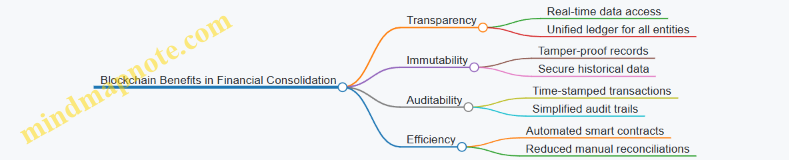
How Blockchain Works in Consolidation: Step-by-Step Example
Scenario: A corporate group with three subsidiaries uses blockchain to consolidate financial statements.
- Data Entry: Each subsidiary records its financial transactions on the blockchain ledger.
- Intercompany Transactions: Smart contracts automatically identify and flag intercompany sales and balances.
- Eliminations: Upon reaching the consolidation period, smart contracts execute elimination entries for intercompany profits and balances.
- Currency Translation: Exchange rates are updated on the blockchain, ensuring consistent translation.
- Final Consolidated Report: The blockchain generates a consolidated financial statement accessible to all stakeholders.
Mind Map: Blockchain Consolidation Workflow
Practical Example: Eliminating Intercompany Sales Using Smart Contracts
- Traditional Process: Accountants manually identify intercompany sales and create elimination journal entries.
- Blockchain Approach: A smart contract is programmed to detect intercompany sales transactions recorded on the blockchain. When the consolidation period closes, it automatically generates elimination entries, reducing errors and saving time.
Example:
- Subsidiary A sells goods worth $100,000 to Subsidiary B.
- Both record the transaction on the blockchain.
- Smart contract identifies the $100,000 intercompany sale and automatically posts an elimination entry to remove it from consolidated revenue.
Mind Map: Smart Contract Use Case in Consolidation
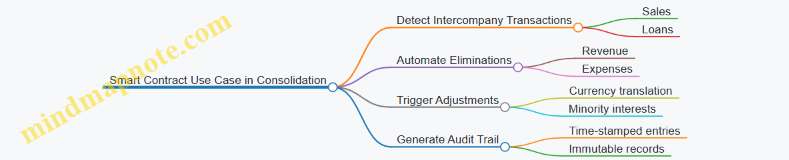
Challenges and Considerations
- Integration: Blockchain must integrate with existing ERP and consolidation software.
- Data Privacy: Ensuring sensitive financial data is protected on a shared ledger.
- Regulatory Compliance: Adhering to accounting standards and legal requirements.
- Change Management: Training accounting teams to adopt blockchain-enabled processes.
Best Practice: Pilot Blockchain in a Controlled Environment
Start by implementing blockchain for a single consolidation process, such as intercompany eliminations, to evaluate benefits and address challenges before full-scale adoption.
Summary
Blockchain technology offers a promising path to enhance transparency, accuracy, and efficiency in financial statement consolidation. By leveraging immutable ledgers and smart contracts, accountants and financial controllers can reduce manual work, improve auditability, and build stakeholder trust.
References and Further Reading
- Deloitte Insights: Blockchain in Finance
- IFRS Foundation: Technology and Financial Reporting
- Case Study: IBM Blockchain for Financial Services
10.3 Real-Time Consolidation and Continuous Close Processes
In today’s fast-paced corporate environment, the demand for timely and accurate financial information has never been greater. Real-time consolidation and continuous close processes are transforming how finance teams, especially accountants and financial controllers, manage the month-end and quarter-end close cycles. This section explores these innovative approaches, their benefits, challenges, and practical examples to help you implement them effectively.
What is Real-Time Consolidation?
Real-time consolidation refers to the process where financial data from multiple subsidiaries or business units is consolidated continuously or near-instantaneously, rather than waiting for the traditional period-end close. This approach enables organizations to have up-to-date consolidated financial statements at any point in time.
What is Continuous Close?
Continuous close is a broader concept that encompasses real-time consolidation but also includes ongoing reconciliation, validation, and adjustment activities throughout the accounting period. Instead of concentrating all closing activities at period-end, the close process is distributed evenly across the reporting cycle.
Benefits of Real-Time Consolidation and Continuous Close
- Faster Reporting: Enables timely decision-making with up-to-date financial insights.
- Improved Accuracy: Continuous validation reduces errors and omissions.
- Reduced Workload at Period-End: Spreads closing activities, reducing bottlenecks.
- Enhanced Transparency: Real-time visibility into financial performance.
Mind Map: Key Components of Real-Time Consolidation
Mind Map: Continuous Close Process Workflow
Practical Example: Implementing Real-Time Consolidation in a Multinational Corporation
Company Background: GlobalTech Inc. operates in 15 countries with multiple subsidiaries reporting in different currencies and accounting systems.
Challenge: The traditional month-end close took 15 days, delaying consolidated reporting and decision-making.
Solution:
- Integrated all subsidiary ERP systems with a cloud-based consolidation platform.
- Automated data feeds to update financial data continuously.
- Implemented automated intercompany eliminations and currency translation.
- Established daily reconciliation tasks distributed across the month.
Outcome:
- Reduced the close cycle from 15 days to 3 days.
- Provided management with real-time dashboards showing consolidated financial performance.
- Improved accuracy and reduced manual errors.
Best Practices for Real-Time Consolidation and Continuous Close
- Invest in Robust Technology: Use consolidation software that supports automation, integration, and real-time data processing.
- Standardize Data and Processes: Harmonize chart of accounts and accounting policies across subsidiaries.
- Automate Reconciliations and Eliminations: Leverage AI and machine learning to identify discrepancies quickly.
- Train Your Team: Ensure all stakeholders understand the continuous close mindset and tools.
- Maintain Strong Governance: Establish controls and audit trails to ensure data integrity.
Additional Example: Continuous Close in a Mid-Sized Manufacturing Firm
Scenario: A manufacturing firm with 5 subsidiaries struggled with bottlenecks during month-end close due to manual reconciliations.
Action:
- Broke down closing tasks into daily and weekly activities.
- Used workflow automation tools to assign and track tasks.
- Set up alerts for exceptions and pending approvals.
Result:
- Smooth close process with fewer last-minute surprises.
- Enhanced collaboration between accounting teams.
- More timely and reliable consolidated financial statements.
Summary
Real-time consolidation and continuous close processes represent a paradigm shift in financial reporting. By adopting these approaches, accountants and financial controllers can enhance efficiency, accuracy, and responsiveness, ultimately supporting better strategic decisions and compliance. Embracing technology, standardizing processes, and fostering a culture of continuous improvement are key to successful implementation.
10.4 Best Practice: Preparing Your Team for Technological Change
As financial consolidation processes evolve with technological advancements, preparing your accounting and financial controlling teams for these changes is crucial. This ensures smooth adoption, minimizes resistance, and maximizes the benefits of new tools and methodologies.
Key Steps to Prepare Your Team
Example: Implementing a Cloud-Based Consolidation Platform
Scenario: A mid-sized corporate finance team is transitioning from manual Excel consolidation to a cloud-based consolidation software.
-
Communication: The CFO holds a kickoff meeting explaining how the new platform will reduce closing time by 30%, improve accuracy, and enable real-time reporting.
-
Training: The software vendor provides live workshops and on-demand tutorials. The team is encouraged to practice in a sandbox environment.
-
Change Champions: Two senior accountants are appointed as champions to assist colleagues and liaise with IT.
-
Feedback: Weekly feedback sessions are scheduled during the first two months to address issues and gather suggestions.
-
Leadership Support: Management allocates dedicated time during work hours for training and experimentation.
-
Risk Management: Potential resistance from team members comfortable with Excel is addressed by highlighting benefits and providing extra support.
Mind Map: Training & Development Focus Areas
Mind Map: Change Management Framework
Additional Example: Using AI-Powered Tools in Consolidation
Scenario: A financial controller introduces AI-driven data validation tools to detect anomalies in consolidation data.
-
Preparation: The team is briefed on how AI can assist, not replace, their work.
-
Training: Sessions focus on interpreting AI alerts and integrating findings into review processes.
-
Feedback: Team members report on false positives/negatives to fine-tune AI settings.
-
Outcome: Faster error detection and improved data quality with team confidence in technology.
Summary
Preparing your team for technological change in financial consolidation is a multi-faceted process involving clear communication, comprehensive training, active change management, and ongoing support. By following these best practices and leveraging real-world examples, accountants and financial controllers can ensure a successful transition that enhances efficiency and accuracy in consolidation processes.
10.5 Example: Pilot Project Implementing AI in Consolidation
In this section, we explore a real-world pilot project where a multinational corporation implemented Artificial Intelligence (AI) to enhance their financial statement consolidation process. This example highlights the practical benefits, challenges, and outcomes of integrating AI into consolidation workflows.
Background
The company, a global manufacturing group with over 30 subsidiaries worldwide, faced significant challenges in consolidating financial data due to the volume of intercompany transactions, currency translations, and manual eliminations. The consolidation process took over 15 days each quarter, delaying financial reporting and decision-making.
Objectives of the Pilot Project
- Automate data validation and anomaly detection
- Streamline intercompany eliminations
- Accelerate currency translation adjustments
- Reduce manual errors and improve accuracy
- Shorten the financial close cycle
AI Implementation Approach
The pilot project involved deploying an AI-powered consolidation module integrated with the company’s existing ERP system. Key AI functionalities included:
- Machine Learning (ML) for Anomaly Detection: Automatically flagging unusual intercompany transactions or balances.
- Natural Language Processing (NLP): Assisting in interpreting and standardizing notes and disclosures.
- Robotic Process Automation (RPA): Automating repetitive tasks such as data extraction and elimination entries.
Mind Map: AI-Driven Consolidation Workflow
Example: AI Detecting Anomalous Intercompany Transaction
Scenario: During consolidation, the AI system flagged an intercompany sale from Subsidiary A to Subsidiary B that was 40% higher than the historical average for the same period.
AI Action:
- Alerted the consolidation team with a detailed report.
- Suggested possible causes such as data entry error or an unrecorded adjustment.
Outcome:
- The team investigated and found a duplicated invoice entry.
- Corrected the data before final consolidation, preventing an overstatement of revenue.
Example: Automating Currency Translation Adjustments
Scenario: The company operates in multiple currencies, requiring complex translation adjustments.
AI Action:
- Automatically applied the temporal method for certain subsidiaries and the current rate method for others based on predefined rules.
- Suggested adjustments for exchange rate fluctuations based on historical patterns.
Outcome:
- Reduced manual calculation time by 60%.
- Improved accuracy and consistency in currency translation.
Benefits Realized
- Time Reduction: Consolidation cycle reduced from 15 days to 7 days.
- Error Reduction: Significant decrease in manual errors, especially in eliminations and currency adjustments.
- Improved Transparency: AI-generated reports provided clear audit trails and explanations for adjustments.
- Enhanced Decision-Making: Faster availability of consolidated financials enabled timely strategic decisions.
Challenges and Lessons Learned
- Data Quality: Initial AI performance was limited by inconsistent data formats across subsidiaries.
- Change Management: Training and buy-in from finance teams were critical for successful adoption.
- Customization Needs: AI models required tuning to align with company-specific consolidation rules.
Best Practice Recommendations from the Pilot
- Start with a pilot on a subset of subsidiaries to validate AI capabilities.
- Ensure high-quality, standardized data inputs for AI effectiveness.
- Combine AI automation with human oversight for critical judgment areas.
- Continuously monitor and refine AI models based on feedback.
This pilot project demonstrates how AI can transform financial statement consolidation by automating complex, repetitive tasks while enhancing accuracy and speed. Accountants and financial controllers should consider phased AI adoption, starting with targeted use cases, to maximize benefits and manage risks effectively.
11. Summary and Practical Takeaways
11.1 Recap of Key Best Practices in Financial Statement Consolidation
Financial statement consolidation is a critical process for accountants and financial controllers to ensure accurate, compliant, and insightful financial reporting across corporate groups. Below is a comprehensive recap of the key best practices, supported by mind maps and practical examples to reinforce understanding.
Best Practice 1: Establish a Robust Consolidation Framework
- Define clear roles and responsibilities for all stakeholders.
- Develop a detailed consolidation timeline and checklist.
- Ensure alignment with applicable accounting standards (IFRS, GAAP).
Example: A multinational company created a shared consolidation calendar accessible to all subsidiaries, which reduced delays by 30% and improved data accuracy.
Best Practice 2: Standardize Data Collection and Validation
- Use a unified chart of accounts across entities.
- Implement automated data validation checks.
- Regularly reconcile intercompany balances before consolidation.
Example: A financial controller implemented software that flagged mismatched intercompany transactions, enabling timely corrections and preventing consolidation errors.
Best Practice 3: Apply Appropriate Consolidation Methods
- Understand when to use full consolidation, equity method, or proportionate consolidation.
- Document rationale for method selection.
- Train teams on method application nuances.
Example: An accounting team used full consolidation for subsidiaries with over 50% ownership and equity method for associates with 30% ownership, ensuring compliance and clarity.
Best Practice 4: Thoroughly Eliminate Intercompany Transactions
- Identify all intercompany sales, loans, and balances.
- Eliminate unrealized profits and intercompany dividends.
- Use automation to handle repetitive eliminations.
Example: A company automated intercompany eliminations using consolidation software, reducing manual errors and shortening the close cycle by 2 days.
Best Practice 5: Manage Currency Translation Effectively
- Choose the correct translation method (current rate or temporal).
- Record translation adjustments properly in equity.
- Monitor foreign exchange risks and hedge when necessary.
Example: A financial controller applied the temporal method for a subsidiary operating in a hyperinflationary economy, ensuring accurate reflection of financial position.
Best Practice 6: Present Clear and Transparent Financial Statements
- Prepare consolidated balance sheets, income statements, and cash flow statements.
- Include comprehensive notes explaining consolidation policies and adjustments.
- Use visual aids like dashboards for management reporting.
Example: A financial controller introduced interactive dashboards summarizing consolidated results, improving stakeholder understanding and decision-making.
Best Practice 7: Continuously Train and Update the Team
- Conduct regular training sessions on consolidation standards and software.
- Share lessons learned from past consolidation cycles.
- Stay updated on regulatory changes and emerging technologies.
Example: Quarterly workshops helped the accounting team stay current with IFRS updates, reducing compliance risks.
Summary Mind Map: Key Best Practices Overview
By following these integrated best practices, accountants and financial controllers can streamline the consolidation process, enhance accuracy, and deliver transparent, compliant consolidated financial statements that support strategic decision-making.
11.2 Checklist for Accountants and Financial Controllers
To ensure a smooth, accurate, and compliant financial statement consolidation process, accountants and financial controllers can rely on the following comprehensive checklist. This checklist integrates best practices and practical examples, supported by mind maps to visualize key areas.
Consolidation Preparation
-
Gather Complete Financial Data
- Collect trial balances, sub-ledgers, and supporting schedules from all subsidiaries.
- Example: Ensure the subsidiary in Germany submits its adjusted trial balance by the 5th of each month.
-
Validate Data Accuracy
- Perform reconciliations and variance analysis.
- Example: Compare current period balances with prior periods to identify anomalies.
-
Align Chart of Accounts
- Map subsidiary accounts to the group’s standard chart of accounts.
- Example: Map “Sales Revenue” in subsidiary A to “Consolidated Revenue” account.
-
Set Up Consolidation Software
- Configure consolidation tools with entity structures and currency settings.
Consolidation Execution
-
Select Appropriate Consolidation Method
- Full consolidation, equity method, or proportionate consolidation based on ownership.
- Example: Use equity method for a 30% stake in an associate company.
-
Eliminate Intercompany Transactions
- Identify and remove intercompany sales, loans, and dividends.
- Example: Eliminate $500,000 intercompany loan between Parent and Subsidiary B.
-
Adjust for Minority Interests
- Calculate and present non-controlling interests separately.
-
Translate Foreign Currency Balances
- Apply current rate or temporal method as per accounting standards.
- Example: Translate subsidiary’s financials using the closing exchange rate on reporting date.
Review and Reporting
-
Prepare Consolidated Financial Statements
- Compile balance sheet, income statement, cash flow statement.
-
Disclose Required Notes
- Include details on consolidation methods, intercompany eliminations, and minority interests.
-
Perform Final Review and Sign-Off
- Cross-check totals, ratios, and compliance with IFRS/GAAP.
-
Archive Supporting Documentation
- Maintain audit trails for all consolidation adjustments.
Mind Maps
Mind Map 1: Consolidation Preparation Checklist
Mind Map 2: Consolidation Execution Steps
Mind Map 3: Review and Reporting
Practical Example: Using the Checklist
Scenario: A financial controller is consolidating financials for a group with three subsidiaries: one domestic, one in Canada, and one in Japan.
- Step 1: Collect trial balances from all subsidiaries by the 5th.
- Step 2: Validate data; identify a $200,000 intercompany sale between domestic and Canadian subsidiaries.
- Step 3: Map Canadian subsidiary accounts to the group chart of accounts.
- Step 4: Use full consolidation for domestic and Canadian subsidiaries; equity method for Japanese associate (40% ownership).
- Step 5: Eliminate intercompany sale and balances.
- Step 6: Translate Japanese associate’s financials using temporal method.
- Step 7: Prepare consolidated statements and disclose methods and eliminations.
- Step 8: Review, sign off, and archive all supporting documents.
This checklist and mind maps help ensure no critical step is missed, improving accuracy and compliance in the consolidation process.
11.3 Common Questions and Answers with Practical Examples
Q1: What is the primary purpose of financial statement consolidation?
Answer: The primary purpose of financial statement consolidation is to present the financial position and results of operations of a parent company and its subsidiaries as a single economic entity. This provides stakeholders with a clear, comprehensive view of the entire corporate group’s financial health.
Example: Company A owns 100% of Company B. Instead of reporting two separate financial statements, Company A consolidates Company B’s assets, liabilities, revenues, and expenses into its own financial statements to show the combined financial position.
Q2: How do you handle intercompany transactions during consolidation?
Answer: Intercompany transactions must be identified and eliminated to avoid double counting. This includes intercompany sales, loans, dividends, and balances.
Example: Company A sells inventory worth $100,000 to Company B (its subsidiary). In consolidation, this $100,000 sale and corresponding purchase must be eliminated to avoid inflating revenue and expenses.
Mind Map:
Q3: What are the common consolidation methods and when should each be applied?
Answer:
- Full Consolidation: Used when the parent controls more than 50% of the subsidiary.
- Equity Method: Used when the investor has significant influence (typically 20%-50%).
- Proportionate Consolidation: Used for joint ventures where control is shared.
Example: Company A owns 60% of Company B → Full consolidation. Company A owns 30% of Company C → Equity method. Company A and Company D each own 50% of Joint Venture E → Proportionate consolidation.
Mind Map:
Q4: How do you translate foreign currency financial statements during consolidation?
Answer: Foreign subsidiaries’ financial statements are translated into the parent company’s reporting currency using either the Current Rate Method or Temporal Method, depending on the functional currency and nature of the subsidiary’s operations.
Example: A US parent consolidates a European subsidiary reporting in EUR. Assets and liabilities are translated at the closing rate, while income statement items are translated at average rates.
Mind Map:
Q5: How do you treat minority interests (non-controlling interests) in consolidation?
Answer: Minority interests represent the portion of equity and net income not owned by the parent company. They are presented separately in the consolidated balance sheet under equity and in the income statement.
Example: Parent owns 80% of Subsidiary; 20% is minority interest. If Subsidiary’s net income is $1,000,000, $200,000 is attributed to minority interest.
Mind Map:
Q6: What are common pitfalls in consolidation and how can they be avoided?
Answer: Common pitfalls include incomplete elimination of intercompany transactions, misapplication of consolidation methods, and inconsistent accounting policies across entities.
Best Practice:
- Maintain a detailed intercompany transaction register.
- Regularly train accounting teams on consolidation standards.
- Align accounting policies before consolidation.
Example: A company failed to eliminate intercompany loan balances, resulting in inflated assets and liabilities. After implementing an automated reconciliation tool, these errors were minimized.
Mind Map:
Q7: How can technology improve the consolidation process?
Answer: Technology can automate data collection, validation, eliminations, and reporting, reducing errors and closing time.
Example: Using cloud-based consolidation software, a financial controller reduced the month-end close from 10 days to 4 days by automating intercompany eliminations and currency translations.
Mind Map:
These common questions and answers, supported by practical examples and mind maps, provide a solid foundation for accountants and financial controllers to understand and apply best practices in financial statement consolidation.
11.4 Resources for Further Learning and Development
To deepen your understanding and enhance your skills in financial statement consolidation, it is essential to leverage a variety of learning resources. These include books, online courses, professional certifications, software tutorials, and communities of practice. Below, you will find curated resources along with mind maps to help organize your learning journey effectively.
Books and Publications
- “Financial Reporting and Analysis” by Charles H. Gibson
- Comprehensive coverage of consolidation principles and financial statement analysis.
- “Consolidation: Preparing and Understanding Consolidated Financial Statements” by Steven M. Bragg
- Practical guide with step-by-step examples.
- IFRS and GAAP Standards Manuals
- Official publications from IASB and FASB for up-to-date standards.
Online Courses and Tutorials
- Coursera: Financial Accounting Fundamentals
- Covers consolidation basics with quizzes and case studies.
- LinkedIn Learning: Consolidation and Reporting
- Focused lessons on consolidation methods and eliminations.
- edX: IFRS Certificate Program
- Deep dive into international standards impacting consolidation.
Professional Certifications
- Certified Public Accountant (CPA)
- Includes consolidation topics within advanced accounting sections.
- Chartered Financial Analyst (CFA)
- Emphasizes financial reporting and analysis.
- Certified Management Accountant (CMA)
- Focus on managerial accounting and consolidation best practices.
Software Tutorials and Vendor Resources
- Oracle Hyperion Financial Management Tutorials
- Step-by-step guides for automation of consolidation.
- SAP Financial Consolidation Module
- Vendor documentation and user forums.
- Workiva Platform Training
- Focused on cloud-based consolidation and reporting.
Communities and Forums
- AccountingWEB
- Active discussions on consolidation challenges and solutions.
- Reddit r/Accounting
- Peer advice and shared experiences.
- LinkedIn Groups: Financial Controllers and Accountants Network
- Networking and knowledge sharing.
Mind Maps for Organizing Learning
Mind Map 1: Learning Path for Financial Statement Consolidation
Mind Map 2: Best Practices in Consolidation
Mind Map 3: Troubleshooting Common Issues
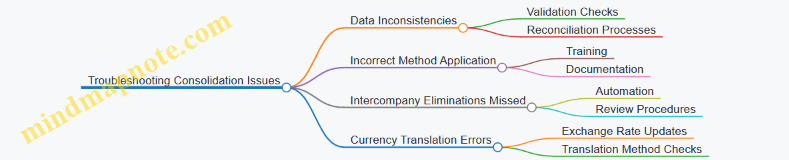
Practical Example: Using Mind Maps to Plan Your Learning
Scenario: You are a Financial Controller new to consolidation processes and want to build a structured learning plan.
- Start with Mind Map 1 to understand the overall learning path.
- Use Mind Map 2 to focus on mastering best practices as you progress.
- Refer to Mind Map 3 to anticipate and troubleshoot common issues.
By visualizing your learning journey, you can allocate time efficiently and track progress.
Summary
Investing time in these resources and using mind maps as organizational tools will empower accountants and financial controllers to master financial statement consolidation. Continuous learning and engagement with professional communities ensure you stay updated with evolving standards and technologies.
11.5 Final Thoughts: Building a Robust Consolidation Process
Financial statement consolidation is a critical function that ensures the financial health and transparency of corporate groups. Building a robust consolidation process requires a combination of meticulous planning, adherence to best practices, leveraging technology, and continuous improvement. Below, we summarize key elements and provide mind maps and examples to help accountants and financial controllers solidify their consolidation efforts.
Key Pillars of a Robust Consolidation Process
Example: Implementing a Consolidation Checklist
A practical way to build robustness is to implement a detailed checklist that guides the consolidation process step-by-step. Here’s an example checklist snippet:
| Step | Task | Best Practice | Example |
|---|---|---|---|
| 1 | Collect financial data from all subsidiaries | Use standardized templates and deadlines | Subsidiary A submits trial balance by 5th of each month |
| 2 | Validate data quality | Automated validation rules to flag inconsistencies | System flags mismatched account codes for review |
| 3 | Align chart of accounts | Map subsidiary accounts to parent company structure | Subsidiary B’s “Sales Revenue” mapped to consolidated “Revenue” |
| 4 | Eliminate intercompany transactions | Use software to identify and eliminate intercompany sales | Intercompany sales of $500,000 eliminated from consolidated revenue |
| 5 | Translate foreign currency balances | Apply current rate method for balance sheet items | Euro-denominated assets translated at month-end rate |
| 6 | Prepare consolidated financial statements | Generate reports with disclosures | Consolidated income statement includes minority interest disclosures |
Mind Map: Common Challenges and Solutions
Example: Mind Map for Continuous Improvement
Final Example: Scenario of a Successful Consolidation Process
Scenario: A multinational corporation with 10 subsidiaries across 5 countries implemented a new cloud-based consolidation platform.
- Before: Manual Excel consolidation took 15 days, frequent errors in intercompany eliminations, and inconsistent currency translation.
- After: Automation reduced closing time to 7 days, intercompany eliminations were automated with 99% accuracy, and currency translation followed a standardized policy with real-time exchange rate feeds.
Outcome: The finance team reported higher confidence in consolidated reports, improved audit readiness, and better decision-making support for executives.
Summary
Building a robust consolidation process is an ongoing journey. By focusing on data integrity, leveraging technology, enforcing strong controls, and fostering a culture of continuous learning, accountants and financial controllers can deliver accurate, timely, and compliant consolidated financial statements that truly reflect the organization’s financial position.