Financial Auditing for Public Companies
1. Introduction to Financial Auditing in Public Companies
1.1 Overview of Financial Auditing and Its Importance
Financial auditing is a systematic process of objectively obtaining and evaluating evidence regarding the financial statements of an organization to ensure accuracy, completeness, and compliance with applicable accounting standards and regulations. For public companies, financial auditing plays a critical role in maintaining investor confidence, regulatory compliance, and overall market transparency.
Why Financial Auditing Matters for Public Companies
- Ensures Reliability of Financial Statements: Audits provide assurance that financial reports are free from material misstatements, whether due to error or fraud.
- Enhances Investor Confidence: Investors rely on audited financial statements to make informed decisions.
- Regulatory Compliance: Public companies must comply with regulations such as the Sarbanes-Oxley Act (SOX) and SEC requirements.
- Detects and Prevents Fraud: Auditors assess internal controls and identify potential fraud risks.
- Improves Internal Controls: Audit findings often lead to stronger control environments.
Mind Map: Key Components of Financial Auditing
Mind Map: Importance of Auditing for Public Companies
Example 1: Detecting Revenue Overstatement in a Public Retail Company
A public retail company reported a sudden 25% increase in revenue in the last quarter. During the audit, the auditor:
- Reviewed sales cutoff procedures to ensure revenue was recorded in the correct period.
- Tested a sample of sales transactions near quarter-end.
- Confirmed accounts receivable balances with customers.
The auditor discovered that some sales were recorded prematurely, inflating revenue. The company adjusted its financial statements accordingly, restoring accuracy and maintaining investor trust.
Example 2: Strengthening Internal Controls Post-Audit
After an audit of a public technology firm, the auditor identified weaknesses in the approval process for capital expenditures. The company implemented stricter authorization controls and periodic reviews, reducing the risk of unauthorized spending and improving financial governance.
Summary
Financial auditing is indispensable for public companies as it ensures the integrity of financial information, supports regulatory compliance, and fosters trust among stakeholders. By understanding its components and importance, accountants and auditors can better navigate the complexities of auditing in the public sector.
1.2 Regulatory Environment and Compliance Requirements
Financial auditing for public companies is heavily influenced by a complex regulatory environment designed to ensure transparency, accuracy, and fairness in financial reporting. Understanding these regulations and compliance requirements is critical for accountants and auditors to perform their duties effectively and maintain public trust.
Key Regulatory Bodies and Frameworks
- Securities and Exchange Commission (SEC): The primary regulator overseeing public companies in the U.S., enforcing securities laws and requiring periodic financial disclosures.
- Public Company Accounting Oversight Board (PCAOB): Established to oversee the audits of public companies, ensuring audit quality and compliance with standards.
- Financial Accounting Standards Board (FASB): Sets Generally Accepted Accounting Principles (GAAP) that public companies must follow.
- International Financial Reporting Standards (IFRS): Used internationally; some public companies adopt IFRS depending on jurisdiction.
Mind Map: Regulatory Environment Overview
Major Compliance Requirements for Public Companies
-
Periodic Financial Reporting
- Annual reports (Form 10-K)
- Quarterly reports (Form 10-Q)
- Current reports for significant events (Form 8-K)
-
Sarbanes-Oxley Act (SOX) Compliance
- Section 302: Corporate responsibility for financial reports
- Section 404: Management assessment of internal controls
-
Audit Requirements
- PCAOB auditing standards
- Auditor independence and rotation
-
Disclosure Requirements
- Material events
- Related party transactions
- Executive compensation
Mind Map: Compliance Requirements
Example 1: Understanding SOX Section 404 Compliance
A public technology company must annually assess and report on the effectiveness of its internal controls over financial reporting. The external auditor tests these controls and provides an opinion. Failure to comply can lead to SEC sanctions and loss of investor confidence.
Example 2: SEC Filing Deadlines and Auditor Responsibilities
An auditor working with a retail public company must ensure that the audited financial statements are ready in time for the Form 10-K filing deadline. Delays can result in penalties and negatively impact the company’s stock price.
Best Practices for Navigating Regulatory Compliance
- Stay current with updates from SEC, PCAOB, and FASB.
- Maintain thorough documentation of audit procedures and findings.
- Implement robust internal control testing aligned with SOX requirements.
- Communicate proactively with management and audit committees about compliance risks.
Mind Map: Best Practices in Regulatory Compliance
In summary, the regulatory environment for public companies is multifaceted and demands rigorous adherence to compliance requirements. Accountants and auditors must be well-versed in these regulations to ensure accurate financial reporting and uphold the integrity of the capital markets.
1.3 Roles and Responsibilities of Accountants and Auditors
Financial auditing for public companies relies heavily on the clear delineation of roles and responsibilities between accountants and auditors. Understanding these roles ensures that financial statements are accurate, compliant, and reliable for stakeholders.
Roles of Accountants
Accountants in public companies are primarily responsible for the preparation and maintenance of financial records. Their duties include:
- Recording financial transactions accurately and timely.
- Ensuring compliance with accounting standards such as GAAP or IFRS.
- Preparing financial statements including balance sheets, income statements, and cash flow statements.
- Implementing internal controls to safeguard assets.
- Assisting in budget preparation and financial forecasting.
- Collaborating with auditors by providing necessary documentation and explanations.
Mind Map: Roles of Accountants
Example:
A public retail company’s accounting team records daily sales transactions, ensures all revenue is recognized according to GAAP, and prepares monthly financial statements. When auditors arrive, the accountants provide detailed sales reports and explain any unusual transactions.
Roles of Auditors
Auditors, often external and independent, are responsible for examining the financial statements prepared by accountants to provide an opinion on their fairness and compliance. Their responsibilities include:
- Planning and conducting the audit in accordance with auditing standards (e.g., PCAOB, ISA).
- Assessing risks of material misstatement due to error or fraud.
- Evaluating the effectiveness of internal controls.
- Performing substantive testing of account balances and transactions.
- Communicating findings and recommendations to management and the audit committee.
- Issuing the audit report with an opinion on the financial statements.
Mind Map: Roles of Auditors
Example:
An external auditor for a public technology company reviews the revenue recognition process, tests a sample of sales contracts, evaluates the internal controls around billing, and discovers a control weakness related to contract approvals. The auditor reports this to management and includes it in the management letter.
Collaboration Between Accountants and Auditors
Effective auditing requires strong collaboration:
- Accountants provide accurate and complete records.
- Auditors rely on these records to perform risk assessments and substantive tests.
- Both parties communicate regularly to clarify issues and resolve discrepancies.
Mind Map: Collaboration
Example:
During an audit of a public manufacturing company, auditors identify discrepancies in inventory valuation. They work closely with the accounting team to understand the valuation method and adjust audit procedures accordingly.
Summary
| Role | Primary Responsibility | Key Activities | Example Scenario |
|---|---|---|---|
| Accountant | Prepare and maintain financial records | Record transactions, prepare statements | Recording daily sales and preparing monthly reports |
| Auditor | Examine and opine on financial statements | Plan audit, test controls, issue opinion | Testing revenue recognition and reporting control weaknesses |
Understanding these roles helps public companies maintain transparency, comply with regulations, and build investor confidence.
1.4 Key Differences Between Auditing Private vs. Public Companies
Auditing public companies involves a distinct set of challenges, regulatory requirements, and stakeholder expectations compared to auditing private companies. Understanding these differences is crucial for auditors and accountants to effectively tailor their approach and ensure compliance.
Regulatory Environment
- Public Companies: Subject to stringent regulations such as the Sarbanes-Oxley Act (SOX), SEC reporting requirements, and PCAOB standards.
- Private Companies: Generally follow GAAP and AICPA guidelines but are not bound by SEC or PCAOB oversight.
Example: A public company auditor must test internal controls over financial reporting (ICFR) under SOX Section 404, while a private company auditor typically does not.
Reporting Requirements
- Public Companies: Must file quarterly (10-Q) and annual (10-K) reports with detailed disclosures.
- Private Companies: Reporting is less frequent and often customized to owner or lender needs.
Example: Public company auditors review management’s discussion and analysis (MD&A) disclosures, which are not required for private companies.
Audit Scope and Depth
- Public Companies: Audits are broader and deeper due to higher risk and regulatory scrutiny.
- Private Companies: Audits may be more limited in scope, focusing on material financial statement areas.
Example: Inventory valuation in a public retail company may require extensive testing and observation, whereas a private company might require less rigorous procedures.
Internal Controls Testing
- Public Companies: Mandatory testing of internal controls over financial reporting.
- Private Companies: Internal control testing is optional or limited.
Example: For a public manufacturing firm, auditors perform walkthroughs and test controls over production cost allocation; private company auditors might rely more on substantive testing.
Auditor Independence and Ethics
- Public Companies: Strict independence rules enforced by PCAOB and SEC.
- Private Companies: Independence rules are less stringent but still important.
Example: A public company auditor cannot provide certain non-audit services (e.g., bookkeeping) to the audit client, while private company auditors may have more flexibility.
Stakeholder Expectations
- Public Companies: Investors, regulators, and the public demand high assurance and transparency.
- Private Companies: Primary stakeholders are owners, lenders, or management with varying assurance needs.
Example: A public company audit report is publicly available and scrutinized by analysts, whereas a private company’s audit report is typically confidential.
Mind Maps
Mind Map 1: Regulatory Differences
Mind Map 2: Audit Scope
Mind Map 3: Auditor Independence
Mind Map 4: Stakeholder Expectations
Integrated Example
Scenario: Auditing Revenue Recognition
- Public Company: Auditor must verify compliance with ASC 606, test internal controls over revenue processes, confirm large customer contracts, and assess disclosures in SEC filings.
- Private Company: Auditor focuses on substantive testing of revenue transactions, reviews contracts as needed, but internal controls testing and detailed disclosures are less emphasized.
This example highlights how the audit approach adapts based on the company’s public or private status, balancing regulatory demands and risk.
By grasping these key differences, auditors can better navigate the complexities of public company audits, ensuring compliance, enhancing audit quality, and meeting stakeholder expectations.
1.5 Example: A Day in the Life of a Public Company Auditor
Auditing a public company involves a dynamic and structured day filled with various tasks that ensure the accuracy and compliance of financial statements. Below is a detailed walkthrough of a typical day for a public company auditor, integrated with mind maps and practical examples to illustrate key activities.
Morning: Planning and Team Coordination
-
8:00 AM – Review Audit Plan and Objectives
- Revisit the audit strategy tailored for the client.
- Confirm key risk areas identified during prior assessments.
-
8:30 AM – Team Meeting
- Discuss progress on audit tasks.
- Assign responsibilities for the day.
- Address any challenges or new findings.
Mind Map: Morning Audit Activities
Example:
For a publicly traded retail company, the auditor reviews the risk of revenue recognition during peak sales seasons. The team decides to focus on cutoff testing around month-end sales.
Midday: Fieldwork and Testing
-
9:30 AM – Internal Controls Testing
- Evaluate controls over cash receipts.
- Test segregation of duties in the sales department.
-
11:00 AM – Substantive Testing
- Perform sample testing of sales transactions.
- Verify supporting documentation such as invoices and shipping records.
Mind Map: Midday Audit Procedures
Example:
While testing cash receipts, the auditor discovers that the same employee is responsible for both recording and depositing cash, a control weakness that is flagged for management.
Afternoon: Analysis and Documentation
-
1:00 PM – Analytical Procedures
- Compare current period sales to prior periods.
- Investigate unusual fluctuations or trends.
-
2:30 PM – Documentation and Workpaper Preparation
- Document findings from testing.
- Prepare workpapers supporting audit conclusions.
Mind Map: Afternoon Audit Tasks
Example:
Analytical review reveals a 20% increase in sales compared to the previous quarter, which aligns with the launch of a new product line. The auditor documents this correlation to support revenue validity.
Late Afternoon: Communication and Wrap-Up
-
4:00 PM – Meeting with Client Management
- Discuss preliminary findings.
- Clarify any discrepancies or questions.
-
5:00 PM – Planning Next Steps
- Update audit plan based on new information.
- Schedule follow-up procedures.
Mind Map: End-of-Day Activities
Example:
The auditor discusses the control weakness found in cash handling with management, who agree to implement additional oversight. The audit plan is updated to include testing of the new controls in the next audit phase.
Summary Mind Map: A Day in the Life of a Public Company Auditor
This example illustrates how an auditor balances planning, testing, analysis, and communication throughout the day. Each step is crucial to ensure the audit is thorough, compliant, and adds value to the public company’s financial reporting process.
2. Planning the Audit Engagement
2.1 Understanding the Client’s Business and Industry
Understanding the client’s business and industry is a foundational step in planning and executing an effective financial audit for public companies. This knowledge helps auditors identify key risk areas, tailor audit procedures, and ensure compliance with relevant accounting standards and regulations.
Why Understanding the Client’s Business Matters
- Risk Identification: Different industries have unique financial risks and operational challenges.
- Tailored Audit Approach: Industry knowledge enables auditors to customize their audit plan.
- Regulatory Compliance: Helps ensure adherence to industry-specific regulations.
- Materiality Assessment: Understanding business scale and complexity aids in setting materiality thresholds.
Key Areas to Understand About the Client’s Business
Mind Map: Business Model Components
Example 1: Understanding a Public Retail Company
- Business Model: Primarily generates revenue through product sales across multiple store locations and e-commerce.
- Industry Environment: Highly competitive retail sector with seasonal demand fluctuations.
- Operational Processes: Inventory management and supply chain efficiency are critical.
- Financial Reporting: Revenue recognition must consider returns and discounts.
- Risks: Inventory obsolescence, revenue cutoff errors, and compliance with consumer protection laws.
This understanding guides the auditor to focus on inventory valuation, revenue cutoff testing, and compliance checks.
Mind Map: Industry Environment Factors
Example 2: Understanding a Public Technology Company
- Business Model: Revenue from software licensing, subscriptions, and professional services.
- Industry Environment: Rapid innovation, high competition, and evolving technology standards.
- Operational Processes: Product development lifecycle and customer support.
- Financial Reporting: Complex revenue recognition rules under ASC 606 / IFRS 15.
- Risks: Revenue recognition timing, capitalization of development costs, and intellectual property valuation.
Auditors will prioritize testing revenue recognition policies, capitalization of software development costs, and impairment assessments.
Steps to Gain Understanding
- Review Public Filings: Annual reports (10-K), quarterly reports (10-Q), and investor presentations.
- Industry Research: Analyst reports, trade publications, and regulatory updates.
- Client Interviews: Discussions with management, finance, and operational teams.
- Site Visits: Observing operations and internal controls firsthand.
- Historical Audit Files: Reviewing prior audits for recurring issues.
Summary
A thorough understanding of the client’s business and industry is essential for effective audit planning. It enables auditors to identify relevant risks, design appropriate audit procedures, and provide valuable insights to stakeholders.
For accountants and auditors, investing time in this step reduces surprises during the audit and enhances the overall quality and reliability of the audit opinion.
2.2 Risk Assessment Procedures and Materiality Determination
Effective risk assessment and materiality determination are foundational to planning a successful audit for public companies. This section explores the procedures auditors use to identify and evaluate risks of material misstatement and how they determine materiality thresholds that guide the audit scope.
Understanding Risk Assessment in Auditing
Risk assessment involves identifying areas where financial statements might be misstated due to error or fraud. It helps auditors focus their efforts on high-risk areas.
Key Components of Risk Assessment:
- Inherent Risk: The susceptibility of an assertion to a misstatement before considering controls.
- Control Risk: The risk that a misstatement could occur and not be prevented or detected by internal controls.
- Detection Risk: The risk that audit procedures will not detect a material misstatement.
Mind Map: Risk Assessment Procedures
Materiality Determination
Materiality guides auditors on the magnitude of misstatements that could influence users’ decisions. It is both a quantitative and qualitative assessment.
Steps to Determine Materiality:
- Set Preliminary Materiality: Based on benchmarks such as total revenue, profit before tax, or total assets.
- Determine Performance Materiality: A lower threshold to reduce the risk that aggregate misstatements exceed materiality.
- Evaluate Qualitative Factors: Consider the nature of misstatements, regulatory requirements, and stakeholder expectations.
Mind Map: Materiality Determination
Example 1: Risk Assessment for a Publicly Traded Retail Company
Scenario: Auditing a large retail chain with multiple store locations.
- Inherent Risks: High volume of cash transactions increases fraud risk.
- Control Risks: Decentralized stores may have inconsistent internal controls.
- Detection Risks: Complex inventory management systems may cause errors.
Risk Assessment Procedures Applied:
- Conduct walkthroughs of cash handling and inventory processes.
- Perform analytical procedures comparing sales trends across stores.
- Interview store managers and finance personnel.
Outcome: Identified revenue recognition and inventory valuation as significant risk areas.
Example 2: Materiality Determination for a Public Technology Company
Scenario: Auditing a tech company with $500 million in revenue and $50 million in profit before tax.
- Preliminary Materiality: 5% of profit before tax = $2.5 million.
- Performance Materiality: Set at 75% of preliminary materiality = $1.875 million.
- Qualitative Considerations: The company is in a highly regulated industry; small misstatements in R&D capitalization could be material.
Outcome: Materiality thresholds guide the audit scope, with special attention to R&D expenses.
Summary
Risk assessment procedures and materiality determination are iterative and dynamic processes. They require auditors to combine quantitative data with professional judgment and qualitative insights. By thoroughly understanding the entity, its environment, and internal controls, auditors can effectively identify risks and set appropriate materiality levels to ensure a focused and efficient audit.
2.3 Developing an Audit Strategy and Audit Plan
Developing a robust audit strategy and detailed audit plan is a critical step in ensuring the effectiveness and efficiency of the audit process for public companies. This phase sets the foundation for how the audit team will approach the engagement, allocate resources, and address identified risks.
What is an Audit Strategy?
An audit strategy outlines the scope, timing, and direction of the audit. It is a high-level document that guides the audit team on the overall approach to be taken, considering the nature of the client’s business, risk factors, and regulatory requirements.
What is an Audit Plan?
The audit plan is a detailed roadmap derived from the audit strategy. It specifies the nature, timing, and extent of audit procedures to be performed. It includes resource allocation, scheduling, and specific audit techniques.
Steps to Develop an Audit Strategy and Audit Plan
Understand the Entity and Its Environment
- Review prior audit results
- Analyze industry trends and regulatory environment
- Identify significant business processes and controls
Assess Risks of Material Misstatement
- Perform risk assessment procedures
- Identify significant accounts and disclosures
- Evaluate internal controls
Determine Materiality Levels
- Set overall materiality
- Define performance materiality
- Establish tolerable misstatement for individual audit areas
Define Audit Scope and Objectives
- Decide which financial statement areas to focus on
- Consider components, subsidiaries, and related parties
Develop Audit Procedures
- Plan substantive tests and control tests
- Determine sampling methods
- Schedule timing of procedures
Allocate Resources and Assign Responsibilities
- Assign team members based on expertise
- Plan for specialists if needed (e.g., IT auditors)
Document the Audit Plan
- Prepare formal audit plan document
- Obtain approval from audit manager or partner
Mind Map: Developing an Audit Strategy and Audit Plan
Example: Developing an Audit Strategy and Plan for a Publicly Traded Retail Company
Scenario: You are assigned to audit a publicly traded retail company with multiple store locations and a significant e-commerce presence.
-
Understand the Entity:
- Review prior year audit files and management reports.
- Analyze retail industry trends, such as seasonality and supply chain risks.
- Note regulatory requirements related to revenue recognition and inventory.
-
Risk Assessment:
- Identify revenue recognition as a high-risk area due to multiple sales channels.
- Inventory valuation is another key risk due to large stock volumes.
- Evaluate internal controls over point-of-sale systems and inventory management.
-
Materiality:
- Set overall materiality at 1% of net sales.
- Performance materiality at 75% of overall materiality.
-
Scope & Objectives:
- Focus on revenue, inventory, and cash.
- Include testing of e-commerce transactions separately.
-
Audit Procedures:
- Plan substantive analytical procedures on sales trends.
- Perform physical inventory observation at selected stores.
- Test controls over IT systems managing sales and inventory.
-
Resources:
- Assign senior auditors to revenue and inventory.
- Engage IT audit specialist for e-commerce platform controls.
-
Documentation:
- Prepare detailed audit plan outlining procedures, timelines, and responsibilities.
- Review and approve plan with audit manager.
Mind Map: Example Audit Plan for Retail Company
Best Practices
- Early Risk Identification: Start risk assessment early to tailor the audit plan effectively.
- Flexibility: Be prepared to revise the audit plan as new information emerges.
- Clear Documentation: Maintain thorough documentation to support audit decisions.
- Communication: Regularly communicate the audit plan and any changes with the audit team and client.
- Use of Technology: Incorporate audit management software to track progress and resource allocation.
By following these structured steps and integrating practical examples, auditors can develop comprehensive audit strategies and plans that address the unique challenges of auditing public companies, ensuring compliance, accuracy, and stakeholder confidence.
2.4 Identifying Key Audit Areas and Controls
Identifying key audit areas and controls is a critical step in the audit planning process for public companies. This step ensures that auditors focus their efforts on the most significant risks and areas that could materially impact the financial statements. Proper identification allows for efficient allocation of resources and enhances the effectiveness of the audit.
What Are Key Audit Areas?
Key audit areas are those components of the financial statements or business processes that have a higher risk of material misstatement due to complexity, judgment, or susceptibility to fraud. These areas often include revenue recognition, inventory valuation, impairment of assets, and compliance with debt covenants.
What Are Controls?
Controls are the policies, procedures, and activities implemented by a company to mitigate risks and ensure the accuracy and reliability of financial reporting. Controls can be preventive, detective, or corrective.
Mind Map: Identifying Key Audit Areas
Mind Map: Identifying Key Controls
Step-by-Step Approach to Identify Key Audit Areas and Controls
-
Understand the Entity and Its Environment:
- Gain knowledge about the industry, regulatory environment, and business model.
- Example: For a public pharmaceutical company, regulatory compliance with FDA guidelines is a key audit area.
-
Perform Preliminary Analytical Procedures:
- Analyze financial trends and ratios to spot unusual fluctuations.
- Example: A sudden spike in revenue without a corresponding increase in cash collections may indicate revenue recognition risks.
-
Review Prior Audit Documentation:
- Identify areas where previous audits found control weaknesses or misstatements.
- Example: If inventory valuation was a concern last year, it remains a key audit area.
-
Assess Risk of Material Misstatement:
- Evaluate inherent and control risks to prioritize audit focus.
- Example: Complex financial instruments may have higher inherent risk requiring detailed controls testing.
-
Identify Key Controls:
- Determine which controls mitigate the identified risks effectively.
- Example: Segregation of duties in the cash disbursement process reduces fraud risk.
-
Document and Communicate:
- Clearly document key audit areas and controls in the audit plan.
- Discuss with the audit team and client management to confirm understanding.
Examples
Example 1: Retail Public Company - Revenue Recognition
- Key Audit Area: Revenue recognition due to high volume of transactions and multiple sales channels.
- Key Controls:
- Automated system controls that record sales only after shipment confirmation.
- Management review of daily sales reports.
- Segregation of duties between order processing and billing.
Example 2: Manufacturing Public Company - Inventory Valuation
- Key Audit Area: Inventory valuation due to risks of obsolescence and complex costing methods.
- Key Controls:
- Periodic physical inventory counts reconciled to the general ledger.
- Approval process for write-downs of obsolete inventory.
- Standard costing system with variance analysis reviewed by management.
Example 3: Financial Services Public Company - Loan Loss Provisions
- Key Audit Area: Estimation of loan loss provisions involving significant judgment.
- Key Controls:
- Credit risk assessment procedures.
- Independent review of provisioning models.
- Approval of significant adjustments by senior management.
Summary
Identifying key audit areas and controls is foundational to an effective audit. By combining an understanding of the business, risk assessment, and control evaluation, auditors can focus on areas that matter most. Using structured approaches and examples helps ensure clarity and thoroughness in this process.
2.5 Example: Planning an Audit for a Publicly Traded Retail Company
Planning an audit for a publicly traded retail company involves a comprehensive understanding of the business environment, risk factors, and regulatory requirements unique to the retail sector. This example will walk through the key steps and considerations, integrating best practices and practical examples.
Step 1: Understand the Client’s Business and Industry
- Business Model: Retail companies typically generate revenue through sales of goods in physical stores and online platforms.
- Revenue Streams: Product sales, loyalty programs, gift cards.
- Industry Risks: Seasonal fluctuations, inventory obsolescence, supply chain disruptions.
Example: A retail company experiences peak sales during holiday seasons, which affects inventory levels and revenue recognition timing.
Step 2: Perform Risk Assessment and Identify Materiality
- Assess Inherent Risks: High risk in revenue recognition due to multiple sales channels.
- Control Risks: Evaluate effectiveness of point-of-sale (POS) systems and inventory management controls.
- Set Materiality Threshold: Based on prior year financials and industry benchmarks.
Example: Materiality is set at 5% of net income, considering the company’s size and investor expectations.
Step 3: Develop an Audit Strategy and Plan
- Focus Areas: Revenue recognition, inventory valuation, accounts receivable.
- Resource Allocation: Assign experienced auditors to high-risk areas.
- Timing: Schedule fieldwork around peak sales periods for accurate testing.
Example: Plan to conduct inventory observation during the year-end physical count to verify stock levels.
Step 4: Identify Key Controls to Test
- Sales Transactions: Controls over POS system access and transaction recording.
- Inventory Management: Controls over stock receipts, transfers, and write-offs.
- Cash Handling: Controls over cash registers and deposit procedures.
Example: Test segregation of duties between sales clerks and cashiers to prevent fraud.
Mind Map: Audit Planning for Retail Company
Step 5: Consider Regulatory and Reporting Requirements
- SEC Filings: Ensure compliance with quarterly and annual reporting.
- GAAP Compliance: Revenue recognition and inventory valuation standards.
- Internal Control Reporting: Sarbanes-Oxley (SOX) Section 404 requirements.
Example: Plan to test management’s assessment of internal controls over financial reporting as part of SOX compliance.
Step 6: Document the Audit Plan
- Audit Program: Detailed procedures for each risk area.
- Communication: Schedule meetings with management and audit committee.
- Contingency Plans: Address potential delays during peak seasons.
Example: Document a plan to use data analytics to identify unusual sales patterns during promotional events.
Additional Mind Map: Risk Assessment Focus Areas
Summary
Planning an audit for a publicly traded retail company requires a tailored approach that addresses the unique risks and operational characteristics of the retail sector. By thoroughly understanding the business, assessing risks, and developing a focused audit strategy, auditors can effectively allocate resources and design procedures that provide reasonable assurance over the financial statements.
This example demonstrates how integrating best practices with practical considerations leads to a robust audit plan that supports compliance and stakeholder confidence.
3. Internal Controls Evaluation and Testing
3.1 Importance of Internal Controls in Public Companies
Internal controls are the backbone of reliable financial reporting and operational efficiency in public companies. They ensure the accuracy and completeness of financial statements, safeguard assets, promote compliance with laws and regulations, and help prevent and detect fraud.
Why Internal Controls Matter
- Financial Accuracy: Internal controls help ensure that financial data is recorded correctly and timely, reducing the risk of material misstatements.
- Regulatory Compliance: Public companies are subject to stringent regulations such as the Sarbanes-Oxley Act (SOX), which mandates effective internal controls over financial reporting.
- Fraud Prevention and Detection: Strong controls reduce opportunities for fraudulent activities by establishing checks and balances.
- Operational Efficiency: Controls streamline processes, reduce errors, and enhance decision-making.
- Investor Confidence: Reliable financial reporting builds trust with investors, analysts, and other stakeholders.
Mind Map: Core Objectives of Internal Controls
Example: Segregation of Duties in a Public Company
A publicly traded manufacturing company implemented segregation of duties within its accounts payable process. The employee who approves vendor invoices is different from the one who processes payments, and a third person reconciles the bank statements. This separation reduces the risk of unauthorized payments or fraudulent activities.
Mind Map: Key Components of Internal Controls (COSO Framework)
Example: Control Activities in Revenue Recognition
A public technology company enforces control activities by requiring dual approvals for revenue contracts exceeding a certain threshold. Additionally, the finance team performs monthly reconciliations of recognized revenue against signed contracts to ensure accuracy.
Mind Map: Benefits of Effective Internal Controls
Example: Impact of Weak Internal Controls
In a public retail company, lack of proper inventory controls led to significant shrinkage and misstated financial results. The auditor identified missing reconciliations and inadequate physical safeguards, resulting in a qualified audit opinion and a drop in investor confidence.
Summary
Internal controls are essential for public companies to maintain financial integrity, comply with regulations, and foster trust among stakeholders. Auditors must thoroughly evaluate these controls to identify weaknesses and recommend improvements, ensuring the company’s financial statements are reliable and free from material misstatement.
3.2 Frameworks for Internal Control Evaluation (COSO, COBIT)
Effective internal control evaluation is critical for auditors of public companies to ensure the accuracy and reliability of financial reporting. Two of the most widely recognized frameworks for evaluating internal controls are COSO (Committee of Sponsoring Organizations of the Treadway Commission) and COBIT (Control Objectives for Information and Related Technologies). Each framework provides structured guidance tailored to different aspects of internal control and risk management.
COSO Framework Overview
COSO is primarily focused on enterprise risk management and internal controls related to financial reporting. It is widely adopted by public companies to comply with regulations such as the Sarbanes-Oxley Act (SOX).
COSO’s Five Components of Internal Control:
- Control Environment: Sets the tone at the top, influencing the control consciousness of employees. Example: A public company’s board actively overseeing risk management.
- Risk Assessment: Identifying and analyzing risks to achieving financial reporting objectives. Example: Assessing risks of revenue misstatement due to complex contracts.
- Control Activities: Policies and procedures to mitigate risks. Example: Segregation of duties in the accounts payable process.
- Information & Communication: Ensuring relevant information flows timely. Example: Automated alerts for unusual transactions.
- Monitoring Activities: Ongoing evaluations to ensure controls operate effectively. Example: Internal audit periodic reviews.
Example: A public technology company uses COSO to evaluate its internal controls over revenue recognition. They identify risks related to multiple-element contracts and implement control activities such as detailed contract review checklists and automated system controls to flag unusual billing patterns.
COBIT Framework Overview
COBIT is an IT governance framework focused on managing and controlling information technology and related processes. It is especially relevant for auditors evaluating IT controls in public companies.
COBIT’s Five Principles:
Key Domains of COBIT:
- Evaluate, Direct and Monitor (EDM): Governance oversight. Example: Board-level IT risk committees.
- Align, Plan and Organize (APO): Strategy and tactics for IT. Example: IT risk assessments aligned with business objectives.
- Build, Acquire and Implement (BAI): IT solutions development and implementation. Example: Secure software development lifecycle.
- Deliver, Service and Support (DSS): Operational IT service delivery. Example: Incident management controls.
- Monitor, Evaluate and Assess (MEA): Performance and compliance monitoring. Example: Regular IT audit reviews.
Example: A public financial services firm uses COBIT to evaluate its IT general controls (ITGCs) supporting financial systems. They focus on access controls, change management, and backup procedures to ensure data integrity and availability.
Integrating COSO and COBIT in Audits
Public company auditors often integrate COSO and COBIT frameworks to cover both financial and IT controls comprehensively.
Example: During an audit of a public retail company, the auditor uses COSO to assess the overall control environment and risk assessment processes, while employing COBIT to evaluate IT controls over the point-of-sale systems and inventory management software.
Summary
- COSO provides a broad framework focused on enterprise risk management and financial reporting controls.
- COBIT concentrates on IT governance and controls critical for supporting financial systems.
- Using both frameworks helps auditors ensure a robust evaluation of internal controls in public companies.
By applying these frameworks with practical examples and mind maps, auditors can systematically identify control weaknesses and recommend improvements that enhance the reliability of financial statements.
3.3 Testing Control Effectiveness: Methods and Best Practices
Testing the effectiveness of internal controls is a critical step in the financial audit process for public companies. It ensures that controls are not only designed properly but are operating as intended to prevent or detect material misstatements.
Key Methods for Testing Control Effectiveness
-
Inquiry
- Engage with personnel responsible for control activities to understand how controls are performed.
- Example: Interviewing the accounts payable manager about the process for approving vendor invoices.
-
Observation
- Watch processes and controls being performed in real-time.
- Example: Observing the segregation of duties during cash disbursement.
-
Inspection of Documentation
- Review evidence such as approval signatures, reconciliations, and control logs.
- Example: Examining authorization signatures on purchase orders.
-
Reperformance
- Independently execute the control procedure to verify accuracy.
- Example: Recalculating the bank reconciliation performed by the client.
-
Walkthroughs
- Trace a transaction through the entire process from initiation to recording.
- Example: Following a sales transaction from order entry to revenue recognition.
Best Practices for Testing Control Effectiveness
- Risk-Based Approach: Focus testing on controls related to high-risk areas identified during risk assessment.
- Sample Selection: Use representative sampling techniques to test controls over a period rather than isolated instances.
- Documentation: Maintain thorough documentation of testing procedures, evidence collected, and conclusions.
- Timing: Perform control testing at appropriate times, often before substantive testing, to rely on controls.
- Communication: Discuss any control deficiencies promptly with management to facilitate remediation.
Mind Map: Methods for Testing Control Effectiveness
Mind Map: Best Practices in Control Testing
Example: Testing Revenue Recognition Controls in a Technology Firm
Scenario: A public technology company recognizes revenue from software licenses and maintenance contracts. The auditor needs to test the effectiveness of controls over revenue cutoff and authorization.
Control Tested: All revenue transactions must be approved by the revenue manager and recorded in the correct accounting period.
Testing Steps:
- Inquiry: Interview the revenue manager about the approval process.
- Observation: Observe the process of recording revenue transactions at month-end.
- Inspection: Review a sample of sales orders and approval signatures.
- Reperformance: Recalculate revenue cutoff by comparing transaction dates to accounting records.
- Walkthrough: Trace a sample transaction from contract signing to revenue recognition.
Outcome: The auditor finds controls are consistently applied, with proper approvals and accurate cutoff, supporting reliance on controls for substantive testing.
By integrating these methods and best practices, auditors can confidently assess control effectiveness, reduce substantive testing scope, and enhance audit quality for public companies.
3.4 Documenting Control Deficiencies and Communicating Findings
Effective documentation and communication of control deficiencies are critical steps in the audit process for public companies. Properly identifying, recording, and reporting these deficiencies ensures transparency, facilitates remediation, and helps maintain regulatory compliance.
Understanding Control Deficiencies
Control deficiencies occur when a control is either missing, improperly designed, or not operating effectively to prevent or detect material misstatements in financial reporting.
Types of Control Deficiencies:
- Control Deficiency: A flaw that is less severe but still important.
- Significant Deficiency: More severe, but not material enough to be a material weakness.
- Material Weakness: A deficiency or combination of deficiencies that results in a reasonable possibility that a material misstatement will not be prevented or detected.
Mind Map: Types of Control Deficiencies
Documenting Control Deficiencies
Best Practices:
- Clear Description: Describe the deficiency precisely, including the control affected and the nature of the issue.
- Impact Assessment: Evaluate the potential impact on financial reporting.
- Cause Analysis: Identify root causes (e.g., lack of segregation of duties, inadequate review).
- Evidence Documentation: Include audit evidence supporting the finding.
- Classification: Categorize the deficiency as control deficiency, significant deficiency, or material weakness.
- Recommendations: Provide actionable suggestions for remediation.
Example:
During testing of the revenue recognition process, it was noted that the monthly sales cutoff review was not performed consistently. This control deficiency increases the risk of revenue being recorded in incorrect periods, potentially leading to material misstatement. The root cause appears to be insufficient training and unclear responsibilities. It is recommended that the company formalize the cutoff review process and provide targeted training to the accounting team.
Mind Map: Documenting Control Deficiencies
Communicating Findings
Key Stakeholders:
- Audit Committee
- Senior Management
- Internal Audit Team
Communication Methods:
- Management Letter: Formal document summarizing control deficiencies and recommendations.
- Audit Report: Includes significant deficiencies and material weaknesses.
- Meetings: Present findings and discuss remediation plans.
Best Practices:
- Be clear and concise.
- Prioritize findings by severity.
- Provide context and potential impact.
- Collaborate on remediation timelines.
Example:
After identifying a material weakness in the inventory reconciliation process, the auditor prepared a management letter highlighting the issue, its impact on financial statements, and recommended controls to strengthen the process. This letter was presented to the Audit Committee in the quarterly meeting, where management committed to implementing corrective actions within the next quarter.
Mind Map: Communicating Control Deficiencies
Summary
Documenting and communicating control deficiencies effectively ensures that public companies address risks timely and maintain robust internal controls. Using clear documentation, supported by evidence and thorough impact analysis, combined with transparent communication to key stakeholders, strengthens the overall audit quality and corporate governance.
Additional Example: Real-World Scenario
An auditor discovered that the segregation of duties was not properly enforced in the accounts payable process, where the same individual was responsible for vendor setup and payment approval. This significant deficiency was documented with detailed evidence and communicated to senior management via a management letter. The company responded by implementing a dual-approval system and retraining staff, which was verified in the subsequent audit cycle.
3.5 Example: Testing Revenue Recognition Controls in a Technology Firm
Revenue recognition is a critical area for auditors due to its complexity and susceptibility to manipulation, especially in technology firms where multiple-element arrangements and subscription models are common. This example illustrates how auditors can effectively test revenue recognition controls in a technology company.
Understanding the Revenue Recognition Process
Before testing controls, auditors must understand how the technology firm recognizes revenue. Common revenue streams include software licenses, subscriptions, professional services, and maintenance contracts.
Mind Map: Revenue Streams in a Technology Firm
Key Controls to Test
- Contract Review and Approval: Ensures all revenue contracts are reviewed and approved by authorized personnel before recognition.
- Segregation of Duties: Different teams handle contract creation, billing, and revenue recognition to prevent fraud.
- System Configuration: ERP or revenue management systems are configured to apply appropriate revenue recognition policies.
- Cutoff Controls: Transactions are recorded in the correct accounting period.
- Revenue Recognition Policies: Policies comply with ASC 606 / IFRS 15 standards.
Mind Map: Key Revenue Recognition Controls
Testing Procedures with Examples
-
Walkthrough of Contract Approval Process
- Obtain a sample of new contracts.
- Verify signatures and approval stamps.
- Example: A contract for a $500,000 software license signed by the sales director and approved by finance.
-
Evaluate Segregation of Duties
- Review organizational charts and process flow.
- Confirm that sales, billing, and accounting functions are distinct.
- Example: Billing team cannot modify contracts or recognize revenue.
-
System Configuration Testing
- Inspect system settings for revenue recognition rules.
- Confirm that multi-element arrangements are allocated correctly.
- Example: Subscription revenue is recognized ratably over the contract term.
-
Cutoff Testing
- Select transactions near period-end.
- Verify that revenue is recorded in the correct period.
- Example: A subscription starting January 1 is not recognized in December.
-
Policy Compliance Review
- Compare company policies to ASC 606 / IFRS 15.
- Confirm consistent application across revenue streams.
- Example: Identifying performance obligations and allocating transaction price.
Mind Map: Testing Procedures for Revenue Recognition Controls
Illustrative Example: Subscription Revenue Recognition
Scenario: The technology firm sells an annual subscription for its cloud software at $1,200 per user.
- Contract signed on March 15 for 10 users.
- Revenue should be recognized monthly at $100 per user.
Testing Steps:
- Verify contract approval on March 10.
- Confirm system is configured to recognize revenue monthly.
- Select revenue entries from March to May.
- Check that revenue recognized equals $1,000 ($100 x 10 users x 1 month in March, $100 x 10 users x 2 months in April and May).
- Review cutoff to ensure no revenue was recognized before March 15.
Result: Controls are effective if revenue recognition matches the contract terms and timing.
Common Issues and How to Detect Them
-
Premature Revenue Recognition: Revenue recorded before delivery or service start.
- Detect by cutoff testing and contract date verification.
-
Incomplete Contract Approvals: Missing signatures or unauthorized contracts.
- Detect by reviewing contract approval documentation.
-
Incorrect Allocation in Multi-element Arrangements: Revenue not properly split among deliverables.
- Detect by inspecting system configuration and manual calculations.
-
Override of System Controls: Manual journal entries bypassing controls.
- Detect by reviewing manual adjustments and approval logs.
Mind Map: Common Revenue Recognition Issues
Summary
Testing revenue recognition controls in a technology firm requires a thorough understanding of the revenue streams, relevant accounting standards, and the firm’s control environment. By combining walkthroughs, system testing, cutoff procedures, and policy reviews, auditors can gain reasonable assurance that revenue is recognized accurately and in compliance with regulations.
This example demonstrates the importance of integrating best practices with practical testing steps and real-world scenarios to enhance audit quality and reliability.
4. Substantive Audit Procedures
4.1 Designing Substantive Tests Based on Risk Assessment
Substantive tests are a critical component of the audit process, aimed at detecting material misstatements in financial statements. Designing these tests effectively requires a thorough understanding of the risk assessment performed earlier in the audit. This section explores how to tailor substantive procedures based on identified risks, ensuring audit efficiency and effectiveness.
Understanding Risk Assessment
Risk assessment involves identifying and evaluating risks of material misstatement at both the financial statement and assertion levels. These risks guide auditors in focusing their substantive testing on areas with higher likelihood of errors or fraud.
Key Risk Categories:
- Inherent Risk: The susceptibility of an assertion to a misstatement, assuming no related controls.
- Control Risk: The risk that a misstatement will not be prevented or detected by internal controls.
- Detection Risk: The risk that audit procedures will fail to detect a misstatement.
Principles of Designing Substantive Tests
- Link to Risk: Tests should directly address the nature, timing, and extent of risks identified.
- Assertion Focus: Each substantive test targets specific financial statement assertions such as existence, completeness, accuracy, valuation, rights and obligations, and presentation.
- Appropriate Procedures: Use a mix of inspection, observation, confirmation, recalculation, and analytical procedures.
- Sample Size and Selection: Larger or more targeted samples may be needed for higher risk areas.
Mind Map: Designing Substantive Tests Based on Risk Assessment
Example 1: Auditing Accounts Receivable
Risk Assessment: High inherent risk due to potential for fictitious receivables and revenue recognition issues.
Designing Substantive Tests:
- Assertion: Existence and valuation.
- Procedures:
- Send confirmation requests to a sample of customers to verify outstanding balances.
- Review subsequent cash receipts to validate collectability.
- Analyze aging of receivables to assess allowance for doubtful accounts.
Mind Map:
Example 2: Auditing Inventory
Risk Assessment: Moderate risk due to valuation challenges and potential obsolescence.
Designing Substantive Tests:
- Assertion: Completeness and valuation.
- Procedures:
- Perform physical inventory counts and reconcile with records.
- Test pricing and cost calculations for inventory valuation.
- Review slow-moving or obsolete inventory for write-downs.
Mind Map:
Analytical Procedures as Substantive Tests
Analytical procedures involve evaluating financial information through plausible relationships among data. They are especially useful for identifying unusual trends or discrepancies.
Example: Comparing current year gross margin percentages to prior years and industry benchmarks to detect unexpected fluctuations.
Mind Map:
Summary
Designing substantive tests based on risk assessment ensures audit resources are focused on areas most susceptible to material misstatement. By linking risks to specific assertions and selecting appropriate procedures, auditors enhance the effectiveness and efficiency of their audits.
Quick Reference Mind Map: Substantive Test Design Workflow
This structured approach, supported by clear examples and visual mind maps, helps auditors in public companies design substantive tests that are both targeted and comprehensive.
4.2 Sampling Techniques and Statistical vs. Non-Statistical Sampling
Financial auditors often face large volumes of transactions and account balances, making it impractical to test every item. Sampling techniques allow auditors to select a representative subset of data to draw conclusions about the entire population. This section explores the main sampling methods and contrasts statistical and non-statistical sampling, supplemented with mind maps and practical examples.
Sampling Techniques Overview
Sampling techniques can be broadly categorized into probability (statistical) and non-probability (non-statistical) methods.
Mind Map: Sampling Techniques
Probability (Statistical) Sampling
Statistical sampling uses random selection methods and allows auditors to quantify sampling risk — the risk that the sample is not representative of the population.
-
Simple Random Sampling: Every item has an equal chance of selection.
- Example: Selecting 50 invoices randomly from a population of 1,000 invoices using a random number generator.
-
Systematic Sampling: Selecting every k-th item from a list after a random start.
- Example: If the population is 1,000 invoices and the sample size is 50, select every 20th invoice after a random start between 1 and 20.
-
Stratified Sampling: Dividing the population into subgroups (strata) and sampling from each.
- Example: Separating invoices into strata by invoice amount (small, medium, large) and sampling proportionally from each.
-
Cluster Sampling: Selecting entire clusters or groups randomly.
- Example: Selecting all transactions from randomly chosen branches of a retail chain.
Mind Map: Probability Sampling Methods
Non-Probability (Non-Statistical) Sampling
Non-statistical sampling relies on auditor judgment rather than random selection. It does not allow for quantification of sampling risk but is often used when statistical methods are impractical.
-
Judgmental Sampling: Auditor selects items based on experience and knowledge.
- Example: Selecting high-value or high-risk transactions for testing.
-
Haphazard Sampling: Selecting items without a structured technique but avoiding bias.
- Example: Picking invoices from different dates and departments without a formal method.
-
Block Sampling: Selecting a contiguous block of items.
- Example: Testing all transactions from the first week of the fiscal year.
Mind Map: Non-Probability Sampling Methods
Statistical vs. Non-Statistical Sampling: Key Differences
| Aspect | Statistical Sampling | Non-Statistical Sampling |
|---|---|---|
| Basis | Random selection, probability theory | Auditor judgment, no formal probability basis |
| Quantification of Risk | Yes, sampling risk can be measured | No, sampling risk cannot be quantified |
| Objectivity | More objective and defensible | More subjective, depends on auditor’s experience |
| Complexity | Requires more planning and tools | Simpler to apply |
| Examples | Random invoice selection, stratified sampling | Selecting high-value invoices based on risk |
Mind Map: Statistical vs Non-Statistical Sampling
Practical Example: Applying Sampling Techniques
Scenario: Auditing accounts payable with 5,000 invoices totaling $10 million.
-
Statistical Sampling Approach:
- Auditor decides on a 95% confidence level and 5% tolerable error rate.
- Using software, auditor selects 100 invoices randomly (simple random sampling).
- Tests these invoices for proper authorization and matching supporting documents.
- Based on results, auditor estimates error rate in the population and evaluates if it is acceptable.
-
Non-Statistical Sampling Approach:
- Auditor selects 50 invoices judged to be high-risk (e.g., invoices over $50,000 or from new vendors).
- Tests these invoices thoroughly.
- Relies on professional judgment to conclude on the overall population.
Outcome: Statistical sampling provides a measurable basis for conclusions, while non-statistical relies on auditor expertise but may be less defensible if challenged.
Best Practices for Sampling in Public Company Audits
- Define clear objectives and understand population characteristics before sampling.
- Use statistical sampling when possible to quantify sampling risk.
- Document sampling rationale, methodology, and results thoroughly.
- Combine sampling with analytical procedures to enhance audit effectiveness.
- Continuously update sampling plans based on prior audit experience and risk assessments.
Summary
Sampling is essential for efficient and effective financial audits of public companies. Understanding the differences between statistical and non-statistical sampling helps auditors select the appropriate method based on audit objectives, population size, and risk. Incorporating examples and mind maps aids in grasping these concepts and applying them in real-world audit scenarios.
4.3 Verifying Account Balances and Transactions
Verifying account balances and transactions is a critical step in the substantive audit procedures for public companies. This process ensures that the financial statements accurately reflect the company’s financial position and performance. It involves detailed testing of account balances, reconciling transactions, and confirming the existence and accuracy of recorded amounts.
Key Objectives:
- Confirm the existence and accuracy of account balances.
- Ensure transactions are recorded in the correct period.
- Detect errors, omissions, or fraudulent activities.
Steps to Verify Account Balances and Transactions:
Understanding the Account Nature
Before testing, auditors must understand the nature of the account balances and the types of transactions involved. For example, cash accounts require different verification techniques compared to accounts receivable or inventory.
Reconciliation Procedures
Reconciliation involves comparing the company’s recorded balances with external documents or subsidiary ledgers.
- Bank Reconciliation: Compare the cash balance in the general ledger to bank statements.
- Subsidiary Ledger Reconciliation: For example, reconcile accounts receivable subsidiary ledger totals to the general ledger control account.
Example: A public retail company’s cash ledger shows $500,000, but the bank statement shows $480,000. The auditor identifies $15,000 in outstanding checks and $5,000 in deposits in transit, explaining the difference.
Confirmation of Balances
External confirmations provide independent verification of account balances.
- Accounts Receivable Confirmations: Sending confirmation requests to customers to verify outstanding balances.
- Bank Confirmations: Requesting direct confirmation from banks regarding cash balances and loan details.
Example: An auditor sends confirmation letters to top 10 customers of a public manufacturing company. One customer disputes a $20,000 balance, prompting further investigation into potential revenue recognition issues.
Cut-off Testing
Cut-off testing ensures transactions are recorded in the correct accounting period.
- Verify sales and purchases recorded just before and after the period-end.
- Inspect shipping documents and receiving reports.
Example: An auditor reviews sales invoices dated January 2nd for goods shipped on December 31st to ensure revenue is recorded in the correct fiscal year.
Analytical Procedures
Analytical procedures help identify unusual trends or discrepancies.
- Compare current period balances with prior periods.
- Analyze ratios such as receivables turnover or inventory turnover.
Example: An auditor notices a sudden 30% increase in accounts payable compared to the prior year without a corresponding increase in purchases. This triggers a deeper review for possible unrecorded liabilities or timing differences.
Documentation and Reporting
All verification procedures and findings must be thoroughly documented in audit workpapers. Any discrepancies or exceptions should be communicated to management and included in the audit report if material.
Summary Mind Map
By integrating these best practices with real-world examples, auditors can confidently verify account balances and transactions, enhancing the reliability of financial statements for public companies.
4.4 Analytical Procedures to Identify Anomalies
Analytical procedures are essential tools in the auditor’s toolkit, especially when auditing public companies where the volume and complexity of transactions can be significant. These procedures involve evaluating financial information through analysis of plausible relationships among both financial and non-financial data. The goal is to identify unusual fluctuations, trends, or inconsistencies that may indicate errors, misstatements, or fraud.
What Are Analytical Procedures?
Analytical procedures include comparisons, ratio analysis, trend analysis, and reasonableness tests. They help auditors to:
- Understand the client’s business and environment
- Identify areas of potential risk
- Corroborate evidence obtained from other audit procedures
- Detect anomalies that require further investigation
Types of Analytical Procedures
- Trend Analysis: Examining financial statement line items over multiple periods to identify unexpected changes.
- Ratio Analysis: Comparing financial ratios to industry benchmarks or prior periods.
- Reasonableness Tests: Estimating expected values based on known relationships and comparing them to recorded amounts.
- Regression Analysis: Using statistical methods to predict expected values and identify deviations.
Mind Map: Analytical Procedures Overview
Step-by-Step Approach to Using Analytical Procedures
- Establish Expectations: Based on historical data, budgets, industry trends, and other relevant information.
- Compare Recorded Amounts: Against expectations using appropriate analytical techniques.
- Investigate Significant Variances: Determine if anomalies are due to legitimate business reasons or potential misstatements.
- Document Findings: Clearly record the procedures performed, results, and conclusions.
Example 1: Trend Analysis to Identify Revenue Anomalies
A public retail company’s revenue increased by 40% in Q4 compared to the previous year, while industry growth was only 5%. The auditor performs a trend analysis:
- Expectation: Revenue growth aligned with industry average (around 5-7%).
- Finding: 40% spike is unusual.
- Investigation: Auditor reviews sales contracts, cutoff procedures, and returns.
- Result: Discovered early recognition of next quarter’s sales to inflate Q4 revenue.
Mind Map: Investigating Revenue Anomalies
Example 2: Ratio Analysis to Detect Expense Manipulation
An auditor notices the company’s operating expense ratio (operating expenses/revenue) dropped significantly compared to prior years.
- Expectation: Ratio should be stable or increase slightly due to inflation.
- Finding: Sharp decline suggests possible underreporting of expenses.
- Investigation: Auditor examines accruals, prepaid expenses, and vendor invoices.
- Result: Found delayed recording of expenses to improve current period profitability.
Mind Map: Using Ratio Analysis for Expense Review
Best Practices for Analytical Procedures
- Use multiple types of analytical procedures to cross-verify findings.
- Incorporate non-financial data such as production volumes, headcount, or market share.
- Set clear thresholds for what constitutes a significant variance.
- Collaborate with management to understand business context but maintain professional skepticism.
- Document all analytical procedures and conclusions thoroughly.
Summary
Analytical procedures are a powerful way to identify anomalies in public company audits. By systematically comparing financial data to expectations and investigating deviations, auditors can uncover potential misstatements early and focus their efforts efficiently. Integrating these techniques with other audit procedures ensures a robust and effective audit process.
4.5 Example: Substantive Testing of Inventory for a Manufacturing Company
Substantive testing of inventory is a critical audit procedure for manufacturing companies, as inventory often represents a significant portion of the company’s assets and directly affects cost of goods sold and profitability. This section walks through a detailed example of how auditors perform substantive testing on inventory, integrating best practices and easy-to-understand examples.
Understanding Inventory Substantive Testing
Substantive testing involves verifying the existence, completeness, valuation, and rights & obligations related to inventory. For manufacturing companies, inventory typically includes raw materials, work-in-progress (WIP), and finished goods.
Key Objectives:
- Confirm physical existence of inventory
- Verify accuracy of inventory quantities
- Validate valuation methods and calculations
- Ensure proper cutoff of inventory transactions
Step 1: Planning the Inventory Substantive Tests
- Identify high-risk inventory items (e.g., slow-moving, obsolete)
- Understand inventory valuation methods (FIFO, LIFO, weighted average)
- Review prior year audit findings and management assertions
Step 2: Physical Inventory Observation
Auditors attend the client’s physical inventory count to observe procedures and test count accuracy.
Mind Map: Physical Inventory Observation
Example: During the count at a manufacturing plant, the audit team selects 50 random inventory items from raw materials and verifies the quantities against count sheets. They note a discrepancy in a batch of steel rods where the physical count is 950 units but the inventory record shows 1,000 units. This triggers further investigation.
Step 3: Testing Inventory Valuation
Auditors verify whether inventory is valued correctly according to applicable accounting standards and company policy.
Mind Map: Inventory Valuation Testing
Example: The audit team reviews the costing method and confirms the company uses FIFO. They select a sample of finished goods and trace unit costs back to purchase invoices and production reports. For obsolete inventory, they compare the cost to estimated selling price and identify a batch of outdated electronic components that require a write-down.
Step 4: Cutoff Testing
Ensures inventory transactions are recorded in the correct accounting period.
Mind Map: Cutoff Testing
Example: The auditor examines receiving reports dated within 5 days before and after year-end. They verify that goods received on December 30 are included in inventory, while goods shipped on January 2 are excluded. This confirms proper cutoff.
Step 5: Reconciliation and Analytical Procedures
- Reconcile inventory sub-ledger to general ledger
- Perform ratio analysis (e.g., inventory turnover)
- Compare current year balances with prior years and budgets
Example: The auditor notices inventory turnover has declined significantly compared to prior years, prompting a review of slow-moving inventory and potential obsolescence.
Summary Mind Map: Substantive Testing of Inventory
Final Notes
Substantive testing of inventory requires a combination of physical verification, document examination, and analytical review. By integrating these procedures, auditors can provide reasonable assurance that inventory balances are free from material misstatement.
This example highlights the importance of detailed planning, professional skepticism, and thorough documentation throughout the audit process.
5. Audit of Revenue and Receivables
5.1 Revenue Recognition Standards and Challenges
Revenue recognition is a critical area in financial auditing for public companies due to its direct impact on reported earnings and investor confidence. Understanding the standards and common challenges helps auditors design effective procedures to ensure accuracy and compliance.
Key Revenue Recognition Standards
-
ASC 606 / IFRS 15: Revenue from Contracts with Customers
- Core principle: Recognize revenue to depict the transfer of promised goods or services to customers in an amount that reflects the consideration to which the entity expects to be entitled.
- Five-step model:
- Identify the contract(s) with a customer
- Identify the performance obligations in the contract
- Determine the transaction price
- Allocate the transaction price to the performance obligations
- Recognize revenue when (or as) the entity satisfies a performance obligation
-
Other industry-specific guidance
- For example, software companies may have additional guidance on licensing and subscriptions.
Common Challenges in Revenue Recognition
- Complex contracts with multiple performance obligations
- Variable consideration and estimating discounts, rebates, or returns
- Timing of revenue recognition, especially for long-term contracts
- Revenue from bundled goods and services
- Revenue recognition in subscription-based or SaaS businesses
- Fraud risk: premature revenue recognition or fictitious sales
Mind Map: Revenue Recognition Framework
Mind Map: Five-Step Model Detailed
Practical Example 1: Software Company with Multiple Performance Obligations
A publicly traded software company sells a package that includes software licenses, installation services, and one year of technical support.
-
Step 1: Contract signed with customer.
-
Step 2: Identify performance obligations: software license, installation service, support.
-
Step 3: Determine transaction price: $120,000.
-
Step 4: Allocate price based on standalone selling prices:
- Software license: $100,000
- Installation: $10,000
- Support: $20,000
-
Step 5: Recognize revenue:
- Software license: recognized at point in time when control transfers (delivery).
- Installation: recognized over time as services performed.
- Support: recognized ratably over 12 months.
This example illustrates the importance of identifying distinct obligations and allocating revenue accordingly.
Practical Example 2: Subscription-Based Business
A public media company offers a 12-month digital subscription for $120.
- Revenue should be recognized ratably over the subscription period.
- Challenges include:
- Handling upgrades or cancellations mid-term.
- Estimating refunds or credits.
Auditors should verify that revenue is not recognized upfront and that deferred revenue balances are accurate.
Best Practices for Auditors
- Obtain and review contracts thoroughly.
- Understand the client’s business model and revenue streams.
- Test management’s estimates for variable consideration.
- Evaluate timing of revenue recognition against performance obligations.
- Use data analytics to identify unusual revenue patterns or spikes near period-end.
- Confirm revenue transactions with customers when appropriate.
By integrating these standards, challenges, and examples, auditors can better assess revenue recognition risks and design effective audit procedures tailored to public companies.
5.2 Common Fraud Risks Related to Revenue
Revenue is often considered the most significant financial metric for public companies, making it a prime target for fraudulent manipulation. Understanding common fraud risks related to revenue is essential for auditors to design effective audit procedures and detect potential misstatements.
Key Fraud Risks in Revenue Recognition
Mind Map: Fraud Risks in Revenue Recognition
Examples Illustrating Revenue Fraud Risks
-
Fictitious Revenue Example: A public software company creates fake sales orders for a non-existent client at quarter-end to meet analyst expectations. The auditor detects this by confirming customer existence and verifying shipping documentation.
-
Premature Revenue Recognition Example: A construction firm recognizes revenue on a milestone payment before the work is completed. Auditors review contract terms and progress reports to assess the timing of revenue recognition.
-
Channel Stuffing Example: A consumer electronics company ships excessive inventory to retailers with extended payment terms near year-end. Auditors analyze sales returns and subsequent period sales to detect abnormal patterns.
-
Side Agreements Example: A manufacturing company has undisclosed side agreements allowing customers to return goods after the reporting period. Auditors examine sales contracts and communicate with legal counsel to uncover such agreements.
Best Practices to Address Revenue Fraud Risks
- Perform detailed walkthroughs of the revenue cycle to understand controls.
- Confirm sales transactions directly with customers.
- Analyze revenue trends and ratios for unusual spikes.
- Review contracts for unusual terms or side agreements.
- Test cutoff procedures by examining shipments and sales around period-end.
- Evaluate the adequacy of disclosures related to revenue recognition.
By integrating these fraud risk considerations into the audit plan, auditors can better detect and prevent revenue-related misstatements, safeguarding the integrity of financial statements for public companies.
5.3 Testing Revenue Transactions and Cutoff Procedures
Testing revenue transactions and cutoff procedures is a critical part of auditing public companies because revenue is often a significant account subject to manipulation and errors. Proper testing ensures that revenue is recorded in the correct accounting period and reflects actual business activities.
Key Objectives:
- Verify that revenue transactions are recorded accurately and completely.
- Ensure revenue is recognized in the correct accounting period (cutoff).
- Detect any potential overstatements or understatements.
Mind Map: Revenue Transactions Testing
Mind Map: Cutoff Procedures Testing
Best Practices
- Understand the client’s revenue cycle thoroughly: This helps identify where risks of misstatement may occur.
- Use a combination of substantive tests and controls testing: Controls over revenue recognition can reduce the extent of substantive testing.
- Focus on high-risk areas: For example, contracts with complex terms, multiple performance obligations, or significant estimates.
- Document all findings clearly: Include rationale for sample selection and conclusions on cutoff accuracy.
Example 1: Testing Revenue Cutoff for a Subscription-Based Company
Scenario: A public company offers annual software subscriptions, with revenue recognized ratably over the subscription period.
Procedure:
- Select invoices issued in the last week of the fiscal year and the first week of the next fiscal year.
- Verify the subscription start and end dates.
- Confirm revenue is recognized only for the portion of the subscription period that falls within the fiscal year.
- Check if any invoices were backdated or advanced to manipulate revenue.
Outcome:
- Detected one invoice where revenue was fully recognized upfront instead of ratably, leading to an overstatement of revenue in the current year.
Example 2: Testing Cutoff in a Manufacturing Company
Scenario: A manufacturing company ships goods to customers near year-end.
Procedure:
- Obtain shipping documents for goods shipped in the last 5 days of the fiscal year and first 5 days of the new year.
- Match shipping dates with invoice dates and revenue recognition.
- Confirm that revenue is recorded only when goods have been shipped and risks transferred.
Outcome:
- Found a shipment dated January 2nd recorded as December revenue, requiring adjustment.
Summary
Testing revenue transactions and cutoff procedures requires a detailed understanding of the client’s business and revenue recognition policies. By combining documentation review, sampling, and analytical procedures, auditors can provide reasonable assurance that revenue is recorded accurately and in the correct period, reducing the risk of material misstatement.
5.4 Confirming Accounts Receivable Balances
Confirming accounts receivable balances is a critical audit procedure for public companies. It helps auditors verify the existence and accuracy of receivables reported on the balance sheet, ensuring that the company’s financial statements are free from material misstatement.
What is Accounts Receivable Confirmation?
Accounts receivable confirmation is the process where auditors send direct requests to the company’s customers to confirm the amounts owed to the company as of the audit date. This external confirmation provides independent evidence supporting the recorded receivable balances.
Objectives of Confirming Accounts Receivable
- Verify the existence of receivables
- Confirm the accuracy of recorded balances
- Detect potential fictitious or overstated receivables
- Identify disputes or uncollectible accounts
Types of Confirmations
- Positive Confirmation: Requests the customer to respond whether they agree or disagree with the stated balance.
- Negative Confirmation: Requests the customer to respond only if they disagree with the stated balance.
Positive confirmations provide stronger evidence but are more resource-intensive.
Mind Map: Accounts Receivable Confirmation Process
Step-by-Step Procedure
- Sample Selection: Identify a representative sample of accounts receivable balances, focusing on large, unusual, or high-risk accounts.
- Prepare Confirmation Requests: Draft confirmation letters including details such as customer name, balance as of the audit date, and instructions for response.
- Send Confirmations: Dispatch confirmation requests directly to customers, preferably via secure electronic methods or mail.
- Follow-Up: For non-responses, send reminders or perform alternative procedures such as examining subsequent cash receipts.
- Evaluate Responses: Compare customer replies with the company’s records, investigate discrepancies, and document findings.
Example: Confirming Receivables for a Public Subscription-Based Company
Scenario: A public company specializing in digital subscriptions has accounts receivable from thousands of customers. The auditor selects a sample of 50 customers with the highest balances for confirmation.
Process:
- The auditor sends positive confirmation requests via email with a secure link for customers to verify their balances.
- After two weeks, 40 responses are received confirming the balances.
- For the 10 non-responses, the auditor reviews subsequent payments and invoices to verify the balances.
- One customer reports a disputed amount due to a billing error; the auditor investigates and finds the company had not adjusted the receivable correctly.
Outcome: The auditor recommends adjusting the accounts receivable balance to reflect the dispute, ensuring accurate financial reporting.
Mind Map: Handling Non-Responses and Discrepancies
Best Practices for Effective Confirmation
- Use positive confirmations for high-risk or material accounts.
- Employ electronic confirmation platforms to improve response rates and security.
- Ensure confirmation requests are clear, concise, and professionally formatted.
- Follow up promptly on non-responses and discrepancies.
- Document all procedures, communications, and conclusions thoroughly.
Confirming accounts receivable balances is a cornerstone of auditing public companies, providing reliable evidence to support the financial statements and enhancing stakeholder confidence.
5.5 Example: Detecting Revenue Overstatement in a Subscription-Based Business
Revenue overstatement is a common risk in subscription-based businesses due to the recurring nature of revenue and the complexity of recognizing it correctly over time. This example will walk through practical steps and best practices auditors can use to detect revenue overstatement, supported by mind maps and clear examples.
Understanding the Revenue Model
Subscription businesses typically recognize revenue ratably over the subscription period rather than upfront. Overstatement can occur if revenue is recognized prematurely or if fictitious subscriptions are recorded.
Mind Map: Subscription Revenue Recognition
Step 1: Review Contracts and Billing Terms
Best Practice: Obtain a sample of subscription contracts and verify the billing terms, start and end dates, and renewal policies.
Example: An auditor reviews a contract stating a 12-month subscription starting January 1, 2023, billed annually. Revenue should be recognized evenly over 12 months, not all at once.
Step 2: Analyze Revenue Recognition Policies
Best Practice: Ensure the company’s revenue recognition policy complies with ASC 606 / IFRS 15 standards.
Example: The company recognizes revenue monthly as services are delivered, matching the subscription period.
Step 3: Perform Analytical Procedures
Use data analytics to detect anomalies such as spikes in revenue at period-end or unusual customer activity.
Mind Map: Analytical Procedures for Revenue Overstatement
Example: The auditor notices a significant revenue increase in December with no corresponding increase in new subscriptions, indicating possible premature revenue recognition.
Step 4: Test Revenue Cutoff
Best Practice: Verify that revenue is recorded in the correct accounting period by testing transactions around period-end.
Example: The auditor selects invoices dated December 31 and January 1 and confirms that revenue is recognized in the appropriate periods based on service delivery.
Step 5: Confirm Customer Subscriptions and Payments
Best Practice: Send confirmation requests to a sample of customers to verify subscription status and payment amounts.
Example: A customer confirms they canceled their subscription in November, but revenue was still recognized for December, indicating overstatement.
Step 6: Review Deferred Revenue Balances
Best Practice: Analyze deferred revenue accounts to ensure they reflect unearned revenue accurately.
Mind Map: Deferred Revenue Review
Example: Deferred revenue balance is unusually low despite many prepaid annual subscriptions, suggesting revenue may have been recognized too early.
Step 7: Evaluate System Controls and Automation
Best Practice: Assess the billing and revenue recognition system controls to prevent manual overrides or errors.
Example: The auditor tests system-generated revenue reports and verifies that manual journal entries adjusting revenue are properly authorized and supported.
Summary Table: Detecting Revenue Overstatement in Subscription Businesses
| Audit Step | Best Practice | Example Scenario |
|---|---|---|
| Contract Review | Verify terms and billing cycles | Annual billing, monthly recognition |
| Policy Compliance | Confirm ASC 606 / IFRS 15 adherence | Revenue recognized over subscription period |
| Analytical Procedures | Use trend and ratio analysis | December revenue spike without new subscriptions |
| Revenue Cutoff Testing | Verify period accuracy of revenue | Revenue recorded after subscription cancellation |
| Customer Confirmations | Confirm subscription status and payments | Customer canceled but revenue still recognized |
| Deferred Revenue Analysis | Reconcile deferred revenue balances | Low deferred revenue despite prepaid subscriptions |
| System Controls Evaluation | Assess billing system and manual adjustments | Unauthorized manual revenue journal entries |
By following these steps and integrating analytical procedures with substantive testing, auditors can effectively detect and mitigate the risk of revenue overstatement in subscription-based businesses.
6. Audit of Expenses and Payables
6.1 Understanding Expense Recognition and Matching Principles
Introduction
Expense recognition and matching principles are fundamental concepts in financial auditing, especially for public companies where accuracy and compliance with accounting standards are critical. These principles ensure that expenses are recorded in the correct accounting period and matched with the revenues they help generate, providing a true and fair view of the company’s financial performance.
Expense Recognition Principle
The expense recognition principle dictates that expenses should be recognized in the period in which they are incurred, regardless of when the cash payment is made. This aligns expenses with the revenues they support, ensuring accurate profit measurement.
Key Points:
- Expenses are recorded when the related goods or services are consumed.
- Accrual accounting is used to match expenses to the period they relate to.
- Helps prevent distortion of financial results by avoiding premature or delayed expense recognition.
Example:
A public company receives consulting services in December but pays the invoice in January. According to the expense recognition principle, the expense should be recorded in December, the period when the service was received.
Matching Principle
The matching principle complements expense recognition by requiring that expenses be matched with the revenues they help generate within the same accounting period.
Key Points:
- Expenses directly linked to revenue generation should be recorded in the same period as the revenue.
- Enables accurate calculation of net income for a period.
- Applies to both direct costs (e.g., cost of goods sold) and indirect costs (e.g., depreciation).
Example:
A manufacturing company sells products in March. The cost of raw materials used to produce those products should be recorded as an expense in March, matching the revenue from the sales.
Mind Map: Expense Recognition and Matching Principles
Common Expense Types and Their Recognition
| Expense Type | Recognition Timing | Matching Consideration | Example |
|---|---|---|---|
| Salaries and Wages | When employees render services | Matched to period of service | Salaries for December paid in January |
| Rent Expense | When space is used | Matched to rental period | Rent for office space used in Q1 |
| Utilities | When utilities are consumed | Matched to period of consumption | Electricity bill for March recorded in March |
| Depreciation | Systematic allocation over asset life | Matched to periods benefiting from asset use | Depreciation expense monthly allocation |
| Supplies | When supplies are used | Matched to period supplies are consumed | Office supplies used in April recorded in April |
Practical Example: Auditing Expense Recognition in a Public Construction Company
Scenario: A public construction company incurs various expenses such as materials, labor, and subcontractor fees. Some invoices are received late or payments are delayed.
Audit Focus:
- Verify that expenses are recorded in the period when the work or materials were used, not when payment was made.
- Review contracts and delivery notes to confirm timing.
- Check accruals for expenses incurred but not yet invoiced.
Example: An invoice for concrete delivered on December 28 is received on January 10 and paid on January 20. The auditor ensures the expense is recorded in December to comply with the expense recognition principle.
Mind Map: Auditing Expense Recognition
Summary
Understanding and applying the expense recognition and matching principles is essential for auditors to ensure public companies’ financial statements are accurate and compliant. Through careful examination of supporting documents and timing, auditors can detect misstatements and help maintain the integrity of financial reporting.
Additional Example: Expense Recognition in Subscription Services
A public software company pays an annual license fee for a cloud service on January 1. The service is used evenly throughout the year. The expense should be recognized monthly, matching the period of service usage rather than expensing the entire amount in January.
This detailed understanding, supported by practical examples and mind maps, equips auditors with the knowledge to effectively evaluate expense recognition and matching in public companies.
6.2 Testing Expense Transactions and Accruals
Overview
Testing expense transactions and accruals is a critical part of the financial audit process for public companies. This ensures that expenses are recorded in the correct accounting period, are valid, and comply with applicable accounting standards such as GAAP or IFRS. Proper testing helps prevent misstatements that could affect the company’s financial position and performance.
Key Objectives of Testing Expense Transactions and Accruals
- Verify completeness and accuracy of expenses recorded.
- Ensure expenses are recorded in the appropriate period (cutoff testing).
- Confirm that accruals are reasonable and supported by documentation.
- Detect any potential misclassification or fraudulent expense recognition.
Mind Map: Expense Transactions and Accruals Testing
Step-by-Step Approach to Testing Expense Transactions
-
Understand the Client’s Expense Processes:
- Review the company’s policies for expense recognition and accrual.
- Identify key controls over expense processing.
-
Select Sample Transactions:
- Use risk-based sampling focusing on high-value or unusual transactions.
- Include transactions near period-end for cutoff testing.
-
Vouch Transactions to Supporting Documents:
- Verify invoices, contracts, purchase orders, and payment records.
- Confirm that expenses are legitimate and authorized.
-
Perform Cutoff Testing:
- Check that expenses are recorded in the correct accounting period.
- For example, an invoice dated January 5th should not be recorded in December’s expenses.
-
Analytical Procedures:
- Compare current period expenses to prior periods and budgets.
- Investigate any significant fluctuations or anomalies.
Mind Map: Cutoff Testing for Expenses
Testing Accruals
Accruals represent expenses incurred but not yet invoiced or paid. Testing accruals involves:
-
Reviewing Management Estimates:
- Understand the basis for accrual calculations.
- Assess assumptions for reasonableness.
-
Examining Supporting Documentation:
- Contracts, service agreements, or correspondence supporting the accrual.
-
Recalculating Accrual Amounts:
- Independently compute accruals based on available data.
-
Evaluating Reasonableness:
- Compare accruals to prior periods and actual subsequent payments.
Example: Testing Expense Transactions and Accruals in a Public Construction Company
Scenario: The auditor is testing the December 31 year-end expenses and accruals for a public construction company.
-
Expense Transactions:
- Selected a sample of 30 expense transactions around year-end.
- Vouched each to vendor invoices, purchase orders, and payment records.
- Identified one invoice dated January 3 but recorded in December expenses; recommended adjustment.
-
Accruals:
- Reviewed management’s accrual for subcontractor services performed but not yet invoiced.
- Examined contracts and progress reports.
- Recalculated accrual based on work completed and compared to management’s estimate.
- Found accrual to be reasonable and supported.
-
Outcome:
- Adjusted journal entry made to correct the early recorded invoice.
- No further adjustments needed for accruals.
Best Practices
- Maintain clear documentation of all testing procedures and findings.
- Communicate any discrepancies or potential misstatements promptly with management.
- Use technology tools to analyze large volumes of expense data for anomalies.
- Stay updated on changes in accounting standards affecting expense recognition.
Summary
Testing expense transactions and accruals is essential to ensure the accuracy and completeness of a public company’s financial statements. By combining detailed transaction testing, cutoff procedures, and accrual evaluations, auditors can provide reasonable assurance that expenses are properly recorded and disclosed.
6.3 Evaluating Accounts Payable and Vendor Confirmations
Overview
Evaluating accounts payable (AP) and conducting vendor confirmations are critical steps in the audit of public companies. These procedures help auditors verify the completeness, existence, and accuracy of liabilities reported on the balance sheet. Proper evaluation mitigates risks of understatement of liabilities and ensures that financial statements present a true and fair view.
Key Objectives
- Confirm the existence and accuracy of accounts payable balances.
- Detect unrecorded liabilities or misstatements.
- Assess the adequacy of internal controls over AP.
- Validate cutoff procedures to ensure liabilities are recorded in the correct period.
Mind Map: Evaluating Accounts Payable and Vendor Confirmations
Understanding the Accounts Payable Process
To effectively evaluate AP, auditors must understand the client’s procurement and payment cycle:
- Purchase Orders: Initiate the purchase and set terms.
- Receiving Reports: Confirm goods/services received.
- Vendor Invoices: Request payment for goods/services.
- Payment Processing: Approvals and disbursement.
Understanding these steps helps identify where errors or fraud may occur.
Risk Assessment
- Completeness Risk: Are all liabilities recorded?
- Existence Risk: Do recorded payables actually exist?
- Cutoff Risk: Are liabilities recorded in the correct period?
- Fraud Risk: Is there manipulation to understate liabilities?
Substantive Procedures
Vendor Confirmations
Vendor confirmations are direct communications sent to suppliers to verify outstanding balances.
- Positive Confirmations: Request a response whether the balance is correct or not.
- Negative Confirmations: Request a response only if the balance is incorrect.
Example: A public manufacturing company sends positive confirmations to its top 20 vendors representing 80% of AP. One vendor responds indicating a higher balance than recorded, prompting further investigation.
Reconciliation of Vendor Statements
Compare vendor statements with the company’s AP ledger to identify discrepancies.
Search for Unrecorded Liabilities
Review subsequent payments, unmatched receiving reports, and unpaid invoices after period-end to detect liabilities not recorded in the audit period.
Analytical Procedures
Analyze trends and ratios such as days payable outstanding (DPO) to identify unusual fluctuations.
Internal Controls Evaluation
- Segregation of Duties: Different personnel handle ordering, receiving, and payment.
- Authorization Controls: Approval requirements for purchases and payments.
- Invoice Matching: Three-way match between purchase order, receiving report, and invoice.
Example: An auditor discovers that the same employee is responsible for both approving payments and reconciling vendor statements, increasing fraud risk. Recommendations for segregation of duties are made.
Example Scenario: Detecting Unrecorded Liabilities
During the audit of a public retail company, the auditor performs a search for unrecorded liabilities by examining receiving reports dated before year-end but invoices received after year-end. The auditor finds several large shipments received in December but invoiced in January. These liabilities were not recorded in the current period, requiring an adjustment to the financial statements.
Documentation and Reporting
- Document all confirmation requests and responses.
- Record findings from reconciliations and tests.
- Communicate significant issues to management and the audit committee.
Summary
Evaluating accounts payable and performing vendor confirmations are essential to ensure the accuracy and completeness of liabilities in public company audits. Combining thorough understanding of the AP process, risk assessment, substantive testing, and internal control evaluation with practical examples enhances audit quality and reliability.
6.4 Identifying Potential Expense Manipulation
Expense manipulation is a critical risk area in auditing public companies, as it can distort financial statements and mislead stakeholders. Detecting such manipulation requires a combination of analytical skills, understanding of business processes, and application of audit procedures.
What is Expense Manipulation?
Expense manipulation involves intentionally misstating or misclassifying expenses to inflate profits or hide financial difficulties. Common tactics include:
- Overstating expenses in one period to reduce taxable income
- Understating expenses to inflate net income
- Misclassifying capital expenditures as operating expenses or vice versa
- Recording fictitious expenses or delaying expense recognition
Mind Map: Types of Expense Manipulation
Common Red Flags to Identify Expense Manipulation
- Unusual fluctuations: Sudden spikes or drops in expense accounts without clear business reasons.
- Round-dollar amounts: Excessive use of round numbers in expense entries.
- Vendor anomalies: Payments to unknown or related-party vendors.
- Cutoff issues: Expenses recorded just before or after period-end to manipulate results.
- Lack of supporting documentation: Missing or inadequate invoices and approvals.
Mind Map: Red Flags for Expense Manipulation
Audit Procedures to Detect Expense Manipulation
- Analytical Review: Compare current period expenses with prior periods, budgets, and industry benchmarks to identify anomalies.
- Test of Details: Verify supporting documentation for selected expense transactions.
- Vendor Confirmation: Confirm balances and transactions with vendors, especially those with large or unusual payments.
- Cutoff Testing: Review transactions recorded near period-end to ensure proper period classification.
- Journal Entry Testing: Scrutinize manual journal entries related to expenses for unusual patterns.
- Review of Related Party Transactions: Identify expenses involving related parties that may be misstated.
Example 1: Detecting Overstated Consulting Expenses
A public construction company reported a 40% increase in consulting expenses compared to the previous quarter without any new projects announced. Upon audit, the team:
- Performed analytical review highlighting the spike.
- Selected a sample of consulting invoices and found several duplicate payments.
- Discovered payments to a vendor with no verifiable services.
Outcome: The company adjusted its financial statements to correct the overstated expenses.
Example 2: Identifying Capitalization of Operating Expenses
A technology firm capitalized routine software maintenance costs as fixed assets to inflate profits. The audit team:
- Reviewed capitalization policies and compared them with actual transactions.
- Tested a sample of capitalized expenses and found many related to routine maintenance.
- Recommended reclassification to operating expenses.
Outcome: The firm restated prior period financials to reflect correct expense classification.
Mind Map: Audit Procedures for Expense Manipulation
Best Practices for Auditors
- Maintain professional skepticism and question unusual transactions.
- Use data analytics to identify patterns and anomalies in expense data.
- Collaborate with internal audit and compliance teams for comprehensive risk assessment.
- Document findings thoroughly and communicate concerns promptly to management and audit committees.
By integrating these approaches, auditors can effectively identify and address potential expense manipulation, ensuring the integrity of financial statements for public companies.
6.5 Example: Auditing Expense Accounts in a Public Construction Company
Auditing expense accounts in a public construction company involves a detailed understanding of the unique nature of construction expenses, project-based accounting, and compliance with regulatory standards. This example will walk through best practices, common challenges, and practical steps auditors take to ensure accuracy and completeness.
Understanding the Expense Landscape in Construction
Construction companies typically have complex expense structures, including direct costs (materials, labor, subcontractors) and indirect costs (overhead, administrative expenses). Auditors must differentiate between capitalized costs and expenses to avoid misstatements.
Mind Map: Key Areas in Auditing Construction Expenses
Step 1: Risk Assessment and Planning
- Identify high-risk expense accounts such as subcontractor payments and equipment rentals.
- Evaluate the company’s policies on capitalization of costs versus expensing.
- Understand contract terms that may affect expense recognition.
Example: The auditor notes that the company recently undertook a large infrastructure project with multiple subcontractors, increasing the risk of misclassification of expenses.
Step 2: Testing Expense Transactions
- Select samples of expense transactions for detailed testing.
- Verify supporting documents such as invoices, purchase orders, and timesheets.
- Confirm that expenses are recorded in the correct period (cutoff testing).
Example: For a sample of subcontractor invoices, the auditor traces the amounts to approved contracts and verifies payment dates to ensure expenses are recorded in the correct accounting period.
Mind Map: Expense Transaction Testing Process
Step 3: Evaluating Capitalization Policies
- Review the company’s capitalization thresholds and policies.
- Verify that costs related to asset construction or improvement are capitalized appropriately.
- Check for any expenses that should have been capitalized but were expensed, or vice versa.
Example: The auditor reviews equipment rental expenses to determine if they relate to asset construction and should be capitalized rather than expensed.
Step 4: Analytical Procedures
- Perform trend analysis comparing current period expenses to prior periods and budgets.
- Investigate significant fluctuations or unusual patterns.
Example: The auditor notices a spike in material costs in the last quarter and investigates whether this is due to increased project activity or potential misstatements.
Step 5: Identifying Fraud Risks
- Be alert for potential expense manipulation, such as inflating expenses to reduce taxable income or hiding unauthorized payments.
- Review related party transactions and unusual vendor relationships.
Example: The auditor identifies a vendor with unusually high payments and performs additional procedures to verify the legitimacy of transactions.
Mind Map: Fraud Risk Indicators in Construction Expenses
Step 6: Documentation and Reporting
- Document all findings, including exceptions and adjustments.
- Communicate significant issues to management and those charged with governance.
Example: The auditor prepares a management letter highlighting the need for improved controls over subcontractor invoice approvals.
Summary Table: Audit Procedures and Examples
| Audit Procedure | Description | Example Scenario |
|---|---|---|
| Risk Assessment | Identify high-risk expense areas | Large infrastructure project with many subcontractors |
| Transaction Testing | Verify invoices, purchase orders, and cutoff | Matching subcontractor invoices to contracts and payments |
| Capitalization Review | Ensure proper classification of costs | Equipment rentals evaluated for capitalization |
| Analytical Procedures | Trend analysis and variance investigation | Spike in material costs investigated |
| Fraud Risk Evaluation | Detect potential manipulation or unauthorized payments | High payments to unusual vendor reviewed |
| Reporting | Document findings and communicate to management | Management letter on subcontractor invoice controls |
This example illustrates how auditors approach the complex environment of expense auditing in a public construction company, integrating best practices with real-world scenarios to ensure thorough and effective audits.
7. Audit of Fixed Assets and Depreciation
7.1 Capitalization Policies and Asset Classification
Capitalization policies and asset classification are fundamental components of auditing fixed assets in public companies. Proper capitalization ensures that expenditures are recorded as assets or expenses in accordance with accounting principles, impacting the accuracy of financial statements and compliance with regulatory standards.
What is Capitalization?
Capitalization refers to the process of recording a cost as an asset on the balance sheet rather than expensing it immediately on the income statement. This treatment is appropriate when the expenditure provides future economic benefits over multiple periods.
Importance in Auditing
- Ensures compliance with accounting standards (e.g., GAAP, IFRS).
- Prevents misstatement of expenses and assets.
- Affects depreciation calculations and financial ratios.
Key Elements of Capitalization Policies
- Threshold Amount: The minimum cost at which an expenditure is capitalized rather than expensed.
- Useful Life: The expected period over which the asset will provide economic benefits.
- Asset Types: Classification of assets (e.g., property, plant, equipment, intangible assets).
- Impairment Considerations: Guidelines on when to write down asset values.
Mind Map: Capitalization Policies Overview
Asset Classification
Proper classification of assets is critical for accurate financial reporting and audit procedures.
Common Asset Classifications:
- Current Assets: Assets expected to be converted into cash or used within one year.
- Non-Current Assets: Long-term assets held for use beyond one year.
- Property, Plant, and Equipment (PP&E)
- Intangible Assets
- Investment Property
Mind Map: Asset Classification
Best Practices for Auditors
- Review Capitalization Thresholds: Verify that the company’s capitalization limits are reasonable and consistently applied.
- Test Sample Transactions: Examine expenditures near the threshold to ensure proper treatment.
- Evaluate Asset Classification: Confirm assets are classified correctly according to their nature and useful life.
- Assess Depreciation Policies: Ensure depreciation methods and useful lives align with industry standards.
- Check for Impairment Indicators: Identify any signs that assets may be impaired and verify appropriate adjustments.
Example 1: Capitalization Threshold Application
A public manufacturing company has a capitalization policy that sets the threshold at $5,000. During the audit, an equipment purchase costing $4,800 was expensed instead of capitalized. The auditor tests similar transactions and finds consistent application of the threshold, concluding the policy is applied correctly.
Example 2: Asset Classification Review
An auditor reviews a public technology company’s asset register and finds that software licenses with a useful life of 3 years are classified as current assets. Since these licenses provide benefits beyond one year, the auditor recommends reclassifying them as intangible non-current assets to comply with accounting standards.
Summary
Capitalization policies and asset classification significantly influence the accuracy of financial statements for public companies. Auditors must thoroughly understand and evaluate these policies, test their application, and ensure compliance with accounting standards to provide reliable audit opinions.
7.2 Physical Verification and Asset Impairment Testing
Introduction
Physical verification and asset impairment testing are critical components of auditing fixed assets in public companies. These procedures ensure that the recorded assets exist, are in usable condition, and are not overstated on the financial statements. Auditors must verify the physical presence of assets and assess whether any impairment indicators exist that require adjustment to the asset’s carrying value.
Physical Verification of Fixed Assets
Physical verification involves the auditor or audit team physically inspecting the fixed assets to confirm their existence and condition. This process helps detect discrepancies such as missing assets, obsolete equipment, or assets recorded but not owned.
Key Steps in Physical Verification:
- Planning the Verification: Identify asset locations, types, and responsible personnel.
- Preparing Asset Registers: Use the company’s fixed asset register as a baseline.
- Conducting the Inspection: Physically inspect assets, noting condition and existence.
- Reconciling Differences: Investigate any discrepancies between records and physical count.
- Documenting Findings: Record observations and any issues found.
Mind Map: Physical Verification Process
Example: Physical Verification in a Public Utility Company
A public utility company has multiple substations across regions. The audit team plans visits to each substation, using the asset register to verify transformers, meters, and control equipment. During inspection, they find several meters listed but physically missing due to theft. These discrepancies are documented, and management is informed to adjust records and improve security.
Asset Impairment Testing
Asset impairment testing evaluates whether the carrying amount of a fixed asset exceeds its recoverable amount, indicating that the asset is impaired and should be written down.
When to Perform Impairment Testing?
- Significant decline in market value
- Physical damage or obsolescence
- Changes in technology or market conditions
- Poor economic performance of the asset
Key Concepts:
- Carrying Amount: The value at which the asset is recorded on the balance sheet.
- Recoverable Amount: The higher of an asset’s fair value less costs to sell and its value in use.
Steps in Impairment Testing:
- Identify Indicators of Impairment
- Estimate Recoverable Amount
- Compare Carrying Amount to Recoverable Amount
- Recognize Impairment Loss if Carrying Amount > Recoverable Amount
Mind Map: Asset Impairment Testing
Example: Impairment Testing in a Manufacturing Company
A manufacturing company owns specialized machinery used in production. Due to new technology, the machinery becomes less efficient and demand for products decreases. The auditor reviews the asset’s carrying amount of $2 million. The estimated recoverable amount, based on discounted cash flows, is $1.2 million. An impairment loss of $800,000 is recognized, reducing the asset’s book value and impacting the income statement.
Integrating Physical Verification and Impairment Testing
Physical verification can reveal signs of impairment such as damaged or obsolete assets. Conversely, impairment testing may highlight assets that require physical inspection to confirm condition.
Combined Mind Map
Best Practices
- Schedule physical verification regularly, at least annually.
- Use technology such as barcode scanners or RFID tags to improve accuracy.
- Collaborate with management to understand asset usage and condition.
- Document all findings thoroughly for audit evidence.
- Stay updated on accounting standards related to impairment (e.g., IAS 36).
Summary
Physical verification and asset impairment testing are essential to ensure the accuracy and reliability of fixed asset reporting in public companies. By combining thorough inspection with rigorous impairment analysis, auditors help maintain transparent and compliant financial statements.
7.3 Reviewing Depreciation Methods and Calculations
Depreciation is a critical accounting process that allocates the cost of tangible fixed assets over their useful lives. For public companies, accurate depreciation methods and calculations ensure compliance with accounting standards and provide stakeholders with a true picture of asset value and expenses.
Key Objectives When Reviewing Depreciation:
- Verify the appropriateness of the depreciation method used.
- Confirm the accuracy of depreciation calculations.
- Ensure consistency with company policies and accounting standards (e.g., IFRS, GAAP).
- Assess the reasonableness of asset useful lives and residual values.
Common Depreciation Methods:
Depreciation Methods Mind Map
Step-by-Step Review Process
Reviewing Depreciation Calculations Mind Map
Example 1: Straight-Line Depreciation Calculation
Scenario: A public manufacturing company purchased machinery for $120,000 with an estimated useful life of 10 years and a residual value of $20,000.
Calculation:
- Depreciable amount = $120,000 - $20,000 = $100,000
- Annual depreciation expense = $100,000 / 10 = $10,000
Audit Check:
- Confirm asset cost and residual value from purchase documents.
- Verify useful life aligns with company policy and industry norms.
- Recalculate depreciation expense and compare with ledger entries.
Example 2: Declining Balance Method Calculation
Scenario: A public technology company uses the double declining balance method for office equipment costing $50,000 with a useful life of 5 years and no residual value.
Calculation:
- Depreciation rate = 2 x (1/5) = 40%
- Year 1 depreciation = $50,000 x 40% = $20,000
- Year 2 depreciation = ($50,000 - $20,000) x 40% = $12,000
Audit Check:
- Confirm the method is approved in accounting policies.
- Verify calculations for each year.
- Ensure depreciation does not reduce book value below residual value.
Best Practices for Auditors
- Cross-verify asset registers with fixed asset ledgers.
- Test a sample of assets for recalculation of depreciation.
- Review management’s rationale for changes in useful life or residual value.
- Ensure consistency in applying depreciation methods across similar asset classes.
- Use analytical procedures to identify unusual fluctuations in depreciation expense.
Summary
Reviewing depreciation methods and calculations is essential to ensure financial statements reflect accurate asset values and expenses. By understanding the different methods, performing detailed recalculations, and applying best practices, auditors can provide assurance that depreciation is properly accounted for in public companies.
7.4 Assessing Asset Disposal and Write-offs
Asset disposal and write-offs are critical areas in auditing fixed assets because improper accounting can materially misstate a company’s financial position. This section covers best practices, key considerations, and practical examples to help auditors effectively assess these transactions.
Key Concepts in Asset Disposal and Write-offs
- Asset Disposal: The process of removing an asset from the company’s books when it is sold, scrapped, donated, or otherwise disposed of.
- Write-off: Recognizing that an asset no longer has value and removing it from the books, often due to impairment, obsolescence, or damage.
Mind Map: Asset Disposal and Write-offs Overview
Best Practices for Auditors
-
Verify Authorization and Documentation
- Ensure disposals and write-offs are approved by appropriate management or board committees.
- Review supporting documents such as sale contracts, disposal memos, or impairment reports.
-
Recalculate Gains or Losses
- Confirm the asset’s net book value (cost less accumulated depreciation) is accurately removed.
- Verify the proceeds from disposal and calculate any gain or loss correctly.
-
Test Cutoff and Timing
- Confirm disposals are recorded in the correct accounting period.
- Review subsequent events to ensure no disposals are omitted or misstated.
-
Assess Impairment Indicators
- Evaluate whether assets should be written off due to impairment.
- Review management’s impairment testing methodology and assumptions.
-
Physical Inspection
- When possible, physically inspect assets to confirm existence or condition.
Mind Map: Audit Procedures for Asset Disposal
Example 1: Disposal of Machinery in a Manufacturing Company
Scenario: A public manufacturing company sold an old machine for $15,000. The machine’s original cost was $100,000, with accumulated depreciation of $85,000.
Audit Steps:
- Verify management approval for the sale.
- Review the sale contract confirming $15,000 proceeds.
- Calculate net book value: $100,000 - $85,000 = $15,000.
- Determine gain/loss: Sale proceeds ($15,000) - Net book value ($15,000) = $0 (no gain or loss).
- Confirm the transaction is recorded in the correct period.
Conclusion: The disposal is properly accounted for with no gain or loss.
Example 2: Write-off of Obsolete Computer Equipment
Scenario: A public technology company identified computer equipment that is obsolete and unusable, with a net book value of $50,000.
Audit Steps:
- Obtain management’s impairment analysis and approval for write-off.
- Review physical inspection reports confirming equipment is unusable.
- Verify the write-off entry removes the asset cost and accumulated depreciation.
- Confirm disclosure of the write-off in financial statements if material.
Conclusion: The write-off is justified and properly documented.
Summary
Assessing asset disposal and write-offs requires a combination of verifying proper authorization, recalculating financial impacts, testing timing, and evaluating impairment indicators. Using detailed documentation and physical verification strengthens audit evidence and ensures accurate financial reporting.
For auditors working with public companies, maintaining a structured approach and thorough documentation is essential to uphold audit quality and comply with regulatory standards.
7.5 Example: Auditing Fixed Assets in a Public Utility Company
Auditing fixed assets in a public utility company presents unique challenges due to the nature of the assets involved, such as large infrastructure, long asset lives, and regulatory considerations. This example will walk through best practices, common audit procedures, and practical examples to illustrate how auditors can effectively approach this task.
Understanding the Context
Public utility companies typically own extensive fixed assets including power plants, transmission lines, water treatment facilities, and distribution networks. These assets are capital-intensive and critical to operations, requiring careful audit attention.
Mind Map: Key Audit Areas for Fixed Assets in a Public Utility Company
Step 1: Reviewing Capitalization Policies
Best Practice: Verify that the company’s capitalization policy aligns with accounting standards (e.g., IFRS, US GAAP) and regulatory requirements.
Example: The auditor reviews the policy to confirm that expenditures below $5,000 are expensed and that major overhauls are capitalized.
Step 2: Physical Verification of Assets
Best Practice: Conduct site visits and reconcile physical assets with the asset register to detect missing or obsolete assets.
Example: During a site visit to a water treatment plant, the auditor verifies the existence of newly installed pumps and cross-checks serial numbers with the asset register.
Mind Map: Physical Verification Process
Step 3: Testing Depreciation Calculations
Best Practice: Recalculate depreciation based on asset cost, estimated useful life, and chosen depreciation method.
Example: The auditor recalculates depreciation for a transmission line using the straight-line method over a 40-year useful life and compares it with the company’s recorded amount.
Step 4: Impairment Assessment
Best Practice: Evaluate whether any indicators of impairment exist, such as regulatory changes reducing asset utility or physical damage.
Example: A recent regulatory change limits the operation of certain coal-fired plants. The auditor assesses whether the carrying amount of these assets requires impairment.
Step 5: Reviewing Asset Disposals
Best Practice: Verify proper accounting treatment for asset retirements or sales, including gain or loss recognition.
Example: The company retired an obsolete transformer. The auditor reviews the disposal documentation and confirms the gain/loss recorded matches the difference between disposal proceeds and net book value.
Mind Map: Common Audit Procedures for Fixed Assets
Additional Example: Detecting Overcapitalization
During the audit, the team notices unusually high capital expenditures on routine maintenance items. Upon further inquiry, it is discovered that some repair costs were incorrectly capitalized, inflating asset values and depreciation expense. The auditor recommends adjusting these amounts to expense, improving the accuracy of financial statements.
Summary
Auditing fixed assets in a public utility company requires a thorough understanding of the asset base, adherence to capitalization and depreciation policies, and careful physical verification. By integrating best practices with detailed audit procedures and real-world examples, auditors can provide assurance that fixed assets are accurately reported and compliant with applicable standards.
References:
- COSO Internal Control Framework
- IFRS IAS 16 – Property, Plant and Equipment
- PCAOB Auditing Standards
- Industry-specific regulatory guidelines
8. Audit of Cash and Financial Instruments
8.1 Cash Management Controls and Bank Reconciliations
Effective cash management controls and accurate bank reconciliations are critical components in the financial auditing of public companies. These controls ensure the safeguarding of cash assets, prevent fraud, and provide reliable financial reporting.
Understanding Cash Management Controls
Cash management controls refer to the policies and procedures a company implements to manage cash inflows and outflows securely and efficiently. For public companies, these controls are essential to maintain investor confidence and comply with regulatory requirements.
Key Objectives of Cash Management Controls:
- Safeguard cash assets from theft or misappropriation
- Ensure accuracy and completeness of cash transactions
- Facilitate timely and accurate financial reporting
- Prevent unauthorized transactions
Mind Map: Cash Management Controls
Example: Implementing Segregation of Duties in a Public Company
A publicly traded manufacturing company assigns different employees to handle cash receipts, record transactions in the accounting system, and perform bank reconciliations. This segregation reduces the risk of fraud by ensuring no single individual controls all aspects of cash handling.
Bank Reconciliations: Purpose and Process
Bank reconciliations are the process of comparing the company’s cash records to the bank statement to identify and resolve differences. This process helps detect errors, unauthorized transactions, and timing differences.
Steps in Bank Reconciliation:
- Obtain the bank statement for the period.
- Compare deposits recorded in the company’s books to those on the bank statement.
- Compare withdrawals and checks issued to those cleared by the bank.
- Identify outstanding checks and deposits in transit.
- Adjust the cash book balance for bank fees, interest, or errors.
- Prepare a reconciliation statement showing adjusted balances.
Mind Map: Bank Reconciliation Process
Example: Bank Reconciliation for a Publicly Listed Retailer
During the audit of a retail company, the auditor notices a $5,000 difference between the cash book and bank statement. Upon investigation, it is identified that a large customer payment was recorded in the company’s books on the last day of the month but was deposited and cleared by the bank in the following month. This deposit in transit explains the timing difference and is properly documented in the reconciliation.
Best Practices for Cash Management Controls and Bank Reconciliations
- Regular Reconciliations: Perform bank reconciliations monthly or more frequently for high-volume accounts.
- Independent Review: Have reconciliations reviewed and approved by someone other than the preparer.
- Automated Systems: Use accounting software with built-in bank reconciliation features to reduce manual errors.
- Documentation: Maintain detailed supporting documents for all reconciling items.
- Exception Reporting: Investigate unusual or recurring reconciling items promptly.
Example: Using Technology to Enhance Bank Reconciliations
A public technology firm integrates its accounting system with bank feeds, enabling automatic import of bank transactions. The system flags unmatched transactions for review, significantly reducing reconciliation time and improving accuracy.
Summary
Cash management controls and bank reconciliations are foundational to the integrity of a public company’s financial statements. Auditors must evaluate the design and effectiveness of these controls, perform detailed reconciliations, and investigate discrepancies to provide assurance that cash balances are fairly stated.
8.2 Confirming Bank Balances and Transactions
Confirming bank balances and transactions is a critical step in the financial auditing process for public companies. It ensures the accuracy and existence of cash balances reported on the balance sheet and verifies that transactions recorded in the accounting system are valid and properly authorized.
Why Confirm Bank Balances and Transactions?
- Verification of existence: Confirms that the cash balances reported actually exist.
- Accuracy check: Ensures that the amounts recorded are correct.
- Detecting fraud or errors: Helps identify unauthorized transactions or misstatements.
- Compliance: Meets auditing standards and regulatory requirements.
Key Steps in Confirming Bank Balances and Transactions
Best Practices for Confirming Bank Balances and Transactions
-
Obtain Direct Confirmations: Always send confirmation requests directly to the bank to ensure independence and reliability of the evidence.
-
Use Standardized Forms: Utilize standardized bank confirmation forms recommended by auditing standards (e.g., AICPA or PCAOB forms) to cover all necessary information.
-
Confirm All Bank Accounts: Include all types of bank accounts such as checking, savings, foreign currency accounts, and escrow accounts.
-
Follow Up on Non-Responses: Implement a systematic follow-up process for banks that do not respond within the expected timeframe.
-
Review Bank Reconciliations Thoroughly: Analyze the client’s bank reconciliations for unusual reconciling items or stale outstanding checks.
-
Test a Sample of Transactions: Select a representative sample of transactions around period-end to verify proper recording and authorization.
-
Be Alert for Red Flags: Look for signs such as large or unusual transfers, frequent adjustments, or transactions with related parties.
Example 1: Confirming Bank Balances for a Public Manufacturing Company
Scenario: The auditor is auditing a public manufacturing company with multiple bank accounts across different regions.
Process:
- The auditor compiles a list of all bank accounts from the client’s general ledger and inquiries.
- Standard bank confirmation requests are sent directly to each bank.
- The auditor receives confirmations showing balances as of the audit date.
- The confirmed balances are compared with the client’s cash ledger.
- Differences are investigated; one bank showed a balance $50,000 higher than the client’s records due to a deposit in transit.
- The auditor reviews the deposit slip and subsequent bank statement to confirm the timing difference.
Outcome: The auditor concludes the cash balances are fairly stated after adjusting for timing differences.
Example 2: Testing Bank Transactions in a Public Technology Firm
Scenario: The auditor needs to verify the validity of cash disbursements made near year-end.
Process:
- The auditor selects a sample of large disbursements from the cash disbursement journal.
- For each transaction, the auditor obtains supporting documents such as invoices, approval signatures, and bank statements.
- The auditor traces the transaction amounts to the bank statements to confirm payment.
- One transaction was found to be recorded twice due to a data entry error.
- The client adjusts the financial statements accordingly.
Outcome: The auditor ensures that recorded transactions are accurate and properly authorized.
Mind Map: Common Challenges and Solutions in Bank Confirmations
Summary
Confirming bank balances and transactions is a foundational audit procedure that provides direct evidence about cash balances and transaction validity. By following best practices such as sending direct confirmations, thoroughly reconciling differences, and testing transactions, auditors can significantly reduce the risk of material misstatement related to cash. Incorporating detailed documentation and timely communication with clients and banks ensures a smooth audit process and enhances audit quality.
8.3 Auditing Investments and Derivative Instruments
Auditing investments and derivative instruments in public companies requires a thorough understanding of the nature of these financial assets, their valuation methods, associated risks, and relevant accounting standards such as IFRS 9 or ASC 815. This section covers best practices, common challenges, and illustrative examples to help auditors effectively evaluate these complex financial instruments.
Key Objectives in Auditing Investments and Derivatives
- Verify existence and ownership of investments and derivatives.
- Assess valuation accuracy and appropriateness of accounting methods.
- Evaluate completeness and disclosure in financial statements.
- Identify and assess risks related to market fluctuations, credit risk, and counterparty risk.
Mind Map: Overview of Auditing Investments and Derivatives
Understanding the Nature of Investments and Derivatives
Public companies may hold a variety of investments including equity securities, bonds, mutual funds, and derivative instruments such as options, futures, swaps, and forwards. Each type has unique characteristics affecting audit procedures.
- Investments: Typically classified as held-for-trading, available-for-sale, or held-to-maturity, each with different valuation and disclosure requirements.
- Derivatives: Often used for hedging or speculative purposes, derivatives require careful evaluation of fair value and risk exposures.
Verification of Existence and Ownership
Best Practice: Obtain third-party confirmations from custodians, brokers, or counterparties to verify the existence and ownership of investments and derivatives.
Example: A public company reports $50 million in equity securities. The auditor sends confirmation requests to the custodian bank to verify the securities held as of the balance sheet date. Any discrepancies are investigated and resolved.
Valuation and Fair Value Measurement
Valuation is often the most challenging aspect due to market volatility and complexity of instruments.
- Marketable Securities: Valued at quoted market prices (Level 1 inputs).
- Non-Marketable Securities: Valued using models (Level 2 or 3 inputs), requiring assumptions and estimates.
Best Practice:
- Review valuation methodologies and assumptions.
- Obtain independent appraisals or use auditor’s valuation specialists if necessary.
- Test significant inputs used in valuation models.
Example: A company holds complex interest rate swaps. The auditor reviews the valuation model, tests inputs such as interest rates and counterparty credit risk, and compares results to independent pricing services.
Mind Map: Valuation Process for Investments and Derivatives
Completeness and Cutoff Testing
Ensure all investment and derivative transactions during the period are recorded and properly classified.
Best Practice:
- Trace investment purchases and sales to supporting documents.
- Review broker statements and trade confirmations.
- Verify cutoff by examining transactions near period-end.
Example: An auditor reviews trades executed in the last week of the fiscal year to confirm they are recorded in the correct accounting period, preventing revenue or expense misstatements.
Evaluation of Controls Over Investments and Derivatives
Assess internal controls related to authorization, recording, and monitoring of investment and derivative transactions.
Best Practice:
- Test controls over trade approvals.
- Review reconciliations between investment records and general ledger.
- Evaluate monitoring of counterparty credit risk.
Example: The auditor tests whether all derivative contracts are approved by the risk management committee and whether valuations are reviewed monthly by an independent team.
Disclosure and Presentation
Verify that disclosures comply with applicable accounting standards and regulatory requirements.
Best Practice:
- Review notes on fair value hierarchy, risks, and accounting policies.
- Confirm that derivative instruments are properly classified as assets or liabilities.
Example: A public company discloses the notional amounts, fair values, and risk management objectives of its derivative portfolio in the financial statements. The auditor ensures these disclosures are complete and accurate.
Example Scenario: Auditing Derivative Instruments in a Public Energy Company
Context: The company uses commodity futures and swaps to hedge fuel price volatility.
Audit Steps:
- Obtain and review derivative contracts.
- Confirm existence with counterparties.
- Evaluate hedge effectiveness documentation.
- Test valuation models and assumptions.
- Verify disclosures on risk management strategies.
Outcome: The auditor identifies that hedge documentation is incomplete for certain contracts, leading to reclassification of some derivatives from hedge accounting to trading, impacting earnings volatility.
Summary
Auditing investments and derivative instruments requires a blend of technical knowledge, skepticism, and use of specialized tools. By following structured procedures—verifying existence, validating valuation, testing controls, and ensuring proper disclosures—auditors can provide assurance on these complex financial assets.
For further reading, auditors should refer to:
- IFRS 9 Financial Instruments
- ASC 815 Derivatives and Hedging
- PCAOB Auditing Standards on Fair Value Measurements
8.4 Evaluating Fair Value Measurements and Disclosures
Fair value measurement is a critical aspect of financial auditing for public companies, especially given the increasing complexity of financial instruments and assets reported at fair value. Auditors must ensure that fair value measurements are accurate, comply with relevant accounting standards (such as ASC 820 / IFRS 13), and that disclosures are complete and transparent.
Key Concepts in Fair Value Measurement
- Fair Value Definition: The price that would be received to sell an asset or paid to transfer a liability in an orderly transaction between market participants at the measurement date.
- Measurement Approaches: Market approach, income approach, and cost approach.
- Fair Value Hierarchy:
- Level 1: Quoted prices in active markets for identical assets or liabilities.
- Level 2: Observable inputs other than quoted prices included in Level 1.
- Level 3: Unobservable inputs (e.g., management assumptions).
Mind Map: Fair Value Measurement Framework
Auditor’s Responsibilities in Evaluating Fair Value
- Understand the valuation techniques used by management.
- Evaluate the appropriateness of inputs and assumptions.
- Test the consistency of valuation methods with prior periods.
- Assess the reasonableness of Level 3 inputs, often requiring expert involvement.
- Review disclosures for completeness and compliance with accounting standards.
Mind Map: Auditor’s Evaluation Process
Example 1: Auditing Fair Value of Investment Securities (Level 1 & 2)
A public company holds equity securities actively traded on a stock exchange (Level 1) and corporate bonds valued using observable market inputs (Level 2). The auditor:
- Verifies quoted prices for equity securities directly from the exchange.
- Reviews pricing sources and models used for corporate bonds.
- Tests the inputs such as interest rates and credit spreads.
- Confirms that disclosures classify these securities correctly within the fair value hierarchy.
Example 2: Auditing Fair Value of Complex Derivatives (Level 3)
A financial services company reports a derivative instrument with no active market (Level 3). Management uses a discounted cash flow model with unobservable inputs.
The auditor:
- Engages a valuation specialist to review the model.
- Tests the reasonableness of assumptions such as discount rates and expected cash flows.
- Performs sensitivity analysis to understand how changes in inputs affect fair value.
- Ensures disclosures include the valuation techniques, inputs, and sensitivity information.
Common Challenges and Best Practices
-
Challenge: Valuation of Level 3 assets and liabilities is highly subjective.
- Best Practice: Use specialists and corroborate management assumptions with external data where possible.
-
Challenge: Incomplete or unclear disclosures.
- Best Practice: Cross-check disclosures against accounting standards and ensure all required elements are included.
-
Challenge: Changes in valuation techniques or assumptions without adequate explanation.
- Best Practice: Investigate and document rationale for changes; assess impact on financial statements.
Mind Map: Common Challenges and Best Practices
Summary
Evaluating fair value measurements and disclosures requires auditors to have a deep understanding of valuation methodologies, the ability to critically assess inputs and assumptions, and ensure transparent disclosures. By integrating expert judgment, thorough testing, and clear communication, auditors help maintain the integrity and reliability of public companies’ financial statements.
8.5 Example: Auditing Cash and Investments in a Financial Services Firm
Auditing cash and investments in a financial services firm requires a meticulous approach due to the high volume of transactions, regulatory scrutiny, and the complexity of financial instruments involved. This example will walk through best practices, common challenges, and practical steps with illustrative mind maps and examples.
Understanding the Audit Context
Financial services firms often hold significant cash balances and diverse investment portfolios, including securities, derivatives, and other financial instruments. The auditor must ensure these assets are accurately recorded, properly valued, and adequately disclosed.
Key Audit Objectives
- Verify existence and ownership of cash and investments
- Confirm completeness and accuracy of recorded amounts
- Assess valuation and classification of investments
- Evaluate internal controls over cash management and investment processes
- Ensure proper presentation and disclosure in financial statements
Mind Map: Audit Focus Areas for Cash and Investments
Step 1: Confirming Cash Balances
Best Practice: Obtain direct bank confirmations for all significant bank accounts.
Example:
- The auditor sends confirmation requests to all banks where the firm holds accounts.
- Responses are matched against the general ledger balances.
- Any discrepancies are investigated, such as outstanding deposits or unrecorded bank fees.
Mind Map: Bank Confirmation Process
Step 2: Reviewing Bank Reconciliations
Best Practice: Examine monthly bank reconciliations prepared by the client for accuracy and timeliness.
Example:
- The auditor reviews the reconciliation for the month-end.
- Checks that all reconciling items are valid and cleared in subsequent periods.
- Identifies any stale or unusual reconciling items that may indicate errors or fraud.
Step 3: Auditing Investments
Existence and Ownership:
- Obtain confirmations from custodians or brokers.
- Review investment statements and contracts.
Example:
- The auditor receives a custodian confirmation listing all securities held.
- Cross-checks the list with the client’s investment ledger.
Valuation:
- Verify market prices for publicly traded securities as of the balance sheet date.
- For non-public investments, review valuation models or third-party appraisals.
Example:
- The auditor uses Bloomberg or Reuters to verify quoted prices.
- For private equity holdings, the auditor reviews the valuation methodology and assumptions.
Classification:
- Confirm investments are classified correctly (e.g., trading vs. held-to-maturity).
Example:
- The auditor reviews management’s intent and ability to hold securities to maturity.
Mind Map: Investment Audit Procedures
Step 4: Testing Controls Over Cash and Investments
Best Practice: Evaluate controls such as transaction authorization, segregation of duties, and reconciliation processes.
Example:
- The auditor tests whether investment purchases and sales are properly authorized by management.
- Reviews who has access to cash and investment accounts and whether duties are segregated.
Step 5: Reviewing Disclosures
Best Practice: Ensure disclosures related to cash restrictions, investment risks, and accounting policies comply with applicable standards (e.g., IFRS, GAAP).
Example:
- The auditor verifies that the notes to financial statements disclose any restricted cash balances.
- Reviews risk disclosures related to market risk, credit risk, and liquidity risk associated with investments.
Summary Table: Audit Procedures and Examples
| Audit Area | Procedure | Example Scenario |
|---|---|---|
| Cash Confirmation | Obtain bank confirmations | Confirm balances with multiple banks |
| Bank Reconciliation | Review monthly reconciliations | Identify stale outstanding checks |
| Investment Existence | Custodian confirmations | Match custodian list to ledger |
| Investment Valuation | Verify market prices | Use Bloomberg for quoted securities |
| Controls Testing | Test authorization and segregation | Review approval signatures on investment trades |
| Disclosures | Review financial statement notes | Confirm disclosure of restricted cash and risks |
By following these integrated best practices and examples, auditors can effectively assess the accuracy and completeness of cash and investments in financial services firms, ensuring compliance and providing stakeholders with reliable financial information.
9. Audit of Equity and Debt Financing
9.1 Understanding Equity Transactions and Shareholder Disclosures
Equity transactions and shareholder disclosures are critical components in the financial auditing of public companies. These transactions impact the company’s capital structure, shareholder rights, and financial statement presentation. Auditors must thoroughly understand the nature of equity transactions and ensure that disclosures comply with regulatory requirements such as those mandated by the SEC and IFRS or US GAAP.
Key Concepts in Equity Transactions
- Types of Equity Instruments: Common stock, preferred stock, stock options, warrants, convertible securities.
- Issuance of Shares: Initial public offerings (IPOs), secondary offerings, private placements.
- Treasury Stock Transactions: Repurchases and reissuances.
- Stock Splits and Dividends: Impact on share count and retained earnings.
- Equity Compensation Plans: Stock-based compensation and its accounting.
Mind Map: Equity Transactions Overview
Auditing Considerations for Equity Transactions
- Verification of Share Issuance: Confirm the number of shares issued, pricing, and receipt of proceeds.
- Review of Board Resolutions and Shareholder Approvals: Ensure authorization for equity transactions.
- Testing Treasury Stock Transactions: Validate repurchase prices and reissuance terms.
- Assessment of Stock-Based Compensation: Evaluate measurement and recognition in accordance with ASC 718 or IFRS 2.
- Disclosure Review: Confirm completeness and accuracy of disclosures related to equity structure, share capital, and shareholder rights.
Mind Map: Auditing Equity Transactions
Example 1: Auditing an IPO Share Issuance
Scenario: A public company recently completed its IPO, issuing 10 million shares at $15 per share.
Audit Steps:
- Obtain and review the underwriting agreement and SEC filings.
- Confirm the number of shares issued with the transfer agent.
- Verify cash receipts totaling $150 million in the bank statements.
- Review board minutes authorizing the IPO.
- Ensure disclosures in the financial statements accurately reflect the IPO details, including share price, number of shares, and use of proceeds.
Best Practice: Use confirmation procedures with the transfer agent and cross-reference cash receipts to ensure completeness.
Example 2: Auditing Treasury Stock Transactions
Scenario: The company repurchased 1 million shares at $20 per share during the year.
Audit Steps:
- Review board approval for the share repurchase program.
- Verify cash outflows related to repurchases in bank statements.
- Confirm the reduction in outstanding shares with the transfer agent.
- Check the accounting treatment to ensure treasury stock is recorded at cost.
- Review disclosures related to treasury stock transactions.
Best Practice: Trace repurchase transactions from cash disbursements to treasury stock ledger entries.
Shareholder Disclosures
Public companies must disclose detailed information about equity and shareholders, including:
- Capital stock structure (authorized, issued, outstanding shares).
- Rights and preferences of different classes of stock.
- Stock option plans and outstanding options.
- Restrictions on transfer or voting rights.
- Dividends declared and paid.
Auditors should verify that these disclosures are complete, accurate, and comply with regulatory frameworks.
Mind Map: Shareholder Disclosures
Example 3: Reviewing Shareholder Disclosures
Scenario: The company’s financial statements include disclosures about multiple classes of stock with different voting rights.
Audit Steps:
- Confirm the accuracy of share counts for each class.
- Review corporate charter and bylaws for rights and preferences.
- Verify dividend policies and payments.
- Ensure disclosures clearly explain differences in voting rights and any restrictions.
Best Practice: Cross-check disclosures against legal documents and shareholder registers.
Summary
Understanding equity transactions and shareholder disclosures is essential for auditors to provide assurance that public companies’ financial statements fairly present their capital structure and shareholder information. Using structured audit procedures, mind maps for conceptual clarity, and practical examples helps auditors navigate complex equity-related issues effectively.
9.2 Testing Debt Covenants and Interest Calculations
Overview
Debt covenants are contractual clauses that a borrower must comply with as part of a loan agreement. These covenants often include financial ratios, restrictions on additional borrowing, dividend payments, or asset sales. Testing debt covenants is crucial for auditors to ensure the company is in compliance and to assess the risk of default.
Interest calculations relate to verifying that interest expense and interest payable are accurately computed based on the loan terms, including principal, interest rate, and payment schedules.
Key Steps in Testing Debt Covenants
- Understand the Debt Agreements: Obtain and review loan agreements, indentures, and amendments to identify all covenants.
- Identify Relevant Financial Metrics: Determine which financial ratios or metrics are required (e.g., debt-to-equity ratio, interest coverage ratio).
- Gather Financial Data: Extract relevant financial statement data to calculate these ratios.
- Recalculate Ratios: Independently compute the ratios to verify compliance.
- Evaluate Compliance: Compare recalculated ratios against covenant thresholds.
- Investigate Non-Compliance: If breaches are identified, assess disclosures and management’s plans.
Mind Map: Testing Debt Covenants
Mind Map: Interest Calculations Testing
Example 1: Testing Debt Covenants for a Manufacturing Company
Scenario: ABC Manufacturing has a loan agreement requiring a debt-to-equity ratio not to exceed 2.0 at fiscal year-end.
Process:
- Obtain the loan agreement and identify the debt-to-equity covenant.
- Extract total liabilities and shareholders’ equity from the audited balance sheet.
- Calculate debt-to-equity ratio: \[ \text{Debt-to-Equity Ratio} = \frac{\text{Total Liabilities}}{\text{Shareholders’ Equity}} \]
- Suppose total liabilities = $4,000,000 and equity = $2,500,000.
- Ratio = 4,000,000 / 2,500,000 = 1.6, which is within the covenant limit.
- Document compliance and note any potential risks if close to the limit.
Example 2: Verifying Interest Calculations for a Technology Firm
Scenario: XYZ Tech has a $5 million loan with a 6% annual fixed interest rate, payable quarterly.
Process:
- Review loan agreement for interest terms.
- Obtain loan amortization schedule.
- Calculate quarterly interest: \[ \text{Quarterly Interest} = 5,000,000 \times 6\% \times \frac{3}{12} = 75,000 \]
- Verify recorded interest expense in the general ledger matches $75,000 per quarter.
- Confirm payments with bank statements.
- Investigate any discrepancies such as incorrect rates or missed payments.
Best Practices
- Always obtain the latest loan agreements and amendments to capture covenant changes.
- Use audited financial data to ensure accuracy in ratio calculations.
- Consider the impact of non-recurring or extraordinary items on covenant ratios.
- Communicate promptly with management about any covenant breaches.
- Confirm interest calculations independently and reconcile with lender confirmations.
Summary
Testing debt covenants and interest calculations is a critical audit procedure that helps ensure public companies comply with their financing agreements and accurately report related expenses. By combining thorough contract review, precise recalculations, and clear documentation, auditors can provide valuable assurance to stakeholders.
9.3 Evaluating Compliance with SEC Reporting Requirements
Public companies in the United States are required to comply with the Securities and Exchange Commission (SEC) reporting requirements to ensure transparency, accuracy, and timeliness in financial disclosures. As auditors, evaluating compliance with these requirements is critical to maintain investor confidence and uphold regulatory standards.
Key SEC Reporting Requirements to Evaluate
- Form 10-K (Annual Report): Comprehensive overview of the company’s financial performance, including audited financial statements.
- Form 10-Q (Quarterly Report): Unaudited quarterly financial statements and updates.
- Form 8-K (Current Report): Disclosure of significant events that shareholders should know about.
- Proxy Statements (DEF 14A): Information related to shareholder meetings and voting.
- Regulation S-K and S-X: Non-financial and financial disclosure requirements respectively.
Mind Map: SEC Reporting Requirements Overview
Auditor’s Role in Evaluating SEC Compliance
-
Reviewing Financial Statements Against Regulation S-X
- Ensure financial statements comply with GAAP and SEC presentation rules.
- Verify footnotes and disclosures are complete and accurate.
-
Assessing Narrative Disclosures Under Regulation S-K
- Evaluate Management Discussion & Analysis (MD&A) for clarity and consistency.
- Confirm risk factors and forward-looking statements are adequately disclosed.
-
Testing Timeliness and Accuracy of Filings
- Confirm that reports (10-K, 10-Q, 8-K) are filed within SEC deadlines.
- Verify that any amendments or restatements are properly filed and disclosed.
-
Evaluating Internal Controls Over Financial Reporting (ICFR)
- Assess controls that ensure accuracy and completeness of SEC filings.
-
Reviewing Compliance with Sarbanes-Oxley Act (SOX)
- Confirm that Section 404 reports on ICFR are included and accurate.
Mind Map: Auditor’s Evaluation Process for SEC Compliance
Examples of Evaluating SEC Compliance
Example 1: Reviewing MD&A for Consistency and Completeness
An auditor is reviewing the MD&A section of a public retail company’s 10-K. The company disclosed a significant decline in same-store sales but did not discuss the impact on future cash flows or liquidity. The auditor flags this omission as a potential compliance issue under Regulation S-K, which requires management to discuss known trends and uncertainties.
Example 2: Testing Timeliness of 10-Q Filing
A technology company filed its quarterly 10-Q report 10 days after the SEC deadline. The auditor investigates and finds that the delay was due to unresolved accounting issues. The auditor recommends disclosure of the delay and reviews the company’s internal controls to prevent future occurrences.
Example 3: Verifying Footnote Disclosures Related to Debt Covenants
During the audit of a manufacturing firm, the auditor examines footnotes to ensure all debt covenant terms are clearly disclosed as required by Regulation S-X. The auditor finds incomplete disclosure regarding a covenant waiver received after the balance sheet date and advises management to update the filing accordingly.
Best Practices for Auditors
- Maintain up-to-date knowledge of SEC rules and guidance.
- Use checklists aligned with SEC requirements to ensure comprehensive review.
- Collaborate closely with legal and compliance teams.
- Document all findings and communications related to SEC compliance.
- Provide clear recommendations for remediation of any deficiencies.
By thoroughly evaluating compliance with SEC reporting requirements, auditors help public companies maintain transparency and uphold investor trust, while mitigating regulatory risks.
9.4 Reviewing Related Party Transactions
Overview
Related party transactions (RPTs) are transactions that occur between a public company and parties that have a close relationship with the company, such as subsidiaries, affiliates, key management personnel, or family members of executives. These transactions can pose significant risks of misstatement or fraud because they may not be conducted at arm’s length and can be used to manipulate financial results.
Importance of Reviewing Related Party Transactions
- Ensure transparency and compliance with regulatory requirements (e.g., SEC, IFRS, GAAP).
- Detect potential conflicts of interest or undisclosed benefits.
- Prevent financial statement misstatements or fraud.
Mind Map: Key Aspects of Related Party Transactions Review
Step 1: Identification of Related Parties
- Review company disclosures and filings for known related parties.
- Obtain a comprehensive list of related parties from management.
- Examine board minutes, contracts, and organizational charts.
Example: A public manufacturing company discloses a loan to a company owned by the CEO’s sibling. The auditor requests documentation and verifies the relationship and terms.
Step 2: Risk Assessment
- Determine the significance and volume of related party transactions.
- Assess whether transactions are conducted at arm’s length.
- Identify any unusual or complex transactions.
Example: An auditor notes that a public tech company has multiple consulting agreements with a firm owned by a board member. The auditor evaluates whether fees are reasonable compared to market rates.
Step 3: Testing Related Party Transactions
- Confirm transaction terms and pricing with third-party benchmarks.
- Verify proper authorization and approval by independent parties.
- Review supporting documentation such as invoices, contracts, and payment records.
Example: For a public retail company, the auditor tests a sale of inventory to a related distributor by comparing prices to sales made to independent distributors.
Step 4: Disclosure Review
- Ensure related party transactions are fully and accurately disclosed in financial statements.
- Confirm compliance with relevant accounting standards (e.g., IAS 24, ASC 850).
Example: The auditor reviews the notes to the financial statements of a public energy company and confirms that all related party loans and guarantees are disclosed with terms and balances.
Mind Map: Common Audit Procedures for Related Party Transactions
Challenges and Best Practices
-
Challenge: Management may not fully disclose all related party relationships.
- Best Practice: Use multiple sources to identify related parties and corroborate information.
-
Challenge: Transactions may be structured to obscure related party nature.
- Best Practice: Analyze transaction patterns and unusual terms carefully.
-
Challenge: Determining whether terms are at arm’s length.
- Best Practice: Use external market data and expert valuation when necessary.
Real-World Example: Detecting Undisclosed Related Party Transactions
During an audit of a public pharmaceutical company, the auditor discovered payments made to a consulting firm owned by a senior executive’s family member that were not disclosed in the financial statements. By cross-referencing vendor lists, bank statements, and interviewing personnel, the auditor identified the related party relationship and ensured proper disclosure and adjustment.
Summary Checklist for Auditors Reviewing Related Party Transactions
- Obtain and review management’s list of related parties.
- Identify all related party transactions during the audit period.
- Assess risk and materiality of each transaction.
- Test transaction terms, approvals, and documentation.
- Verify completeness and accuracy of disclosures.
- Communicate findings and recommendations to audit committee.
By rigorously reviewing related party transactions, auditors help maintain the integrity of financial reporting for public companies, protecting investors and stakeholders from potential risks associated with undisclosed or improperly conducted transactions.
9.5 Example: Auditing a Public Company’s IPO Financial Statements
When auditing a public company’s Initial Public Offering (IPO) financial statements, auditors face unique challenges and heightened scrutiny. The IPO process requires thorough validation of financial data, compliance with regulatory standards, and clear communication with stakeholders. This example will walk through key audit considerations, best practices, and practical examples to illustrate the process.
Key Audit Areas in IPO Financial Statements
- Historical financial information accuracy
- Compliance with SEC regulations (Regulation S-X, S-K)
- Revenue recognition and growth sustainability
- Related party transactions disclosure
- Contingent liabilities and commitments
- Pro forma financial information
Mind Map: IPO Financial Statement Audit Focus Areas
Step 1: Understanding the IPO Context
Before diving into the audit, auditors must understand the company’s business model, industry, and IPO objectives. For example, a tech startup going public may have complex revenue streams such as subscriptions and licensing, requiring specialized revenue recognition testing.
Example:
A SaaS company preparing for IPO has multiple revenue streams: monthly subscriptions, annual contracts, and professional services. Auditors review contract terms to ensure revenue is recognized appropriately over time.
Step 2: Evaluating Historical Financial Statements
Auditors verify the accuracy and completeness of historical financial statements, often covering the last three years. This includes:
- Testing journal entries for unusual transactions
- Confirming account balances with third parties
- Reviewing estimates and judgments (e.g., allowance for doubtful accounts)
Example:
During testing, auditors identify a large, unusual journal entry recorded just before the IPO filing date. They investigate and find it was a one-time adjustment to correct a prior period error, which must be disclosed.
Step 3: Assessing Compliance with SEC Requirements
IPO financial statements must comply with SEC regulations, including:
- Regulation S-X: Form and content of financial statements
- Regulation S-K: Management’s discussion and analysis (MD&A)
Auditors ensure disclosures are complete and transparent.
Example:
The company discloses related party transactions with a major shareholder. Auditors verify the completeness and accuracy of these disclosures to avoid SEC comment letters.
Step 4: Testing Pro Forma Financial Information
Pro forma financials illustrate the company’s financial position after the IPO, including the impact of proceeds and expenses related to the offering.
Auditors:
- Verify adjustments are reasonable and properly supported
- Ensure pro forma statements are clearly labeled and not misleading
Example:
The company presents pro forma earnings reflecting IPO proceeds used to pay down debt. Auditors confirm the debt repayment occurred as stated and that the pro forma adjustments comply with SEC guidelines.
Step 5: Reviewing Internal Controls and Risk Assessment
Strong internal controls are critical for IPO readiness. Auditors evaluate:
- Control environment and governance
- Controls over financial reporting
- Risk factors related to going public
Example:
Auditors identify weaknesses in IT controls affecting revenue recognition systems. They recommend remediation before the IPO to strengthen investor confidence.
Mind Map: IPO Audit Workflow
Practical Tips and Best Practices
- Early Engagement: Start audit planning early to accommodate IPO timelines.
- Cross-Functional Coordination: Work closely with legal, tax, and underwriting teams.
- Documentation: Maintain thorough documentation for SEC reviews.
- Communication: Regularly update audit committees and management.
Summary Example Scenario
A healthcare company preparing for IPO has complex revenue streams and multiple related party transactions. The audit team:
- Conducts detailed revenue recognition testing, including contract reviews and cutoff testing.
- Confirms related party transactions with third parties and ensures full disclosure.
- Reviews pro forma financials to validate IPO impact.
- Identifies internal control gaps and works with management on remediation.
- Prepares audit report emphasizing compliance with SEC requirements.
This comprehensive approach helps ensure the IPO financial statements are reliable, transparent, and meet regulatory expectations, facilitating a successful public offering.
10. Addressing Fraud Risks and Ethical Considerations
10.1 Identifying Fraud Risk Factors in Public Companies
Fraud risk identification is a critical step in the audit process for public companies. Due to their size, regulatory scrutiny, and complexity, public companies are often targets for various types of financial fraud. Understanding and identifying fraud risk factors early helps auditors design effective procedures to detect and prevent fraudulent activities.
What Are Fraud Risk Factors?
Fraud risk factors are conditions or circumstances that increase the likelihood of fraud occurring within an organization. These factors can be related to the company’s environment, management, financial pressures, or control weaknesses.
Key Categories of Fraud Risk Factors
Fraud Risk Factors Mind Map
Detailed Breakdown with Examples
Incentives and Pressures
-
Financial Difficulties: A public company facing declining revenues or liquidity issues may pressure management to manipulate financial results.
- Example: A tech company struggling with cash flow may prematurely recognize revenue to meet quarterly targets.
-
Pressure to Meet Earnings Targets: Public companies often face intense pressure from shareholders and analysts to meet or exceed earnings forecasts.
- Example: A retail chain might overstate inventory to inflate profits ahead of an IPO.
-
Personal Financial Problems of Management: Executives experiencing personal financial stress may be more tempted to commit fraud.
- Example: A CFO with significant debt might manipulate expense reports to increase bonuses.
Opportunities
-
Weak Internal Controls: Inadequate segregation of duties or ineffective control activities create opportunities for fraud.
- Example: An accounts payable clerk who can both create vendors and approve payments could submit fraudulent invoices.
-
Complex or Unusual Transactions: Transactions that are difficult to understand or outside normal business operations can conceal fraud.
- Example: A public company uses related-party transactions to hide liabilities off the balance sheet.
-
Lack of Oversight: Insufficient audit committee involvement or weak board governance increases fraud risk.
- Example: A company with a passive audit committee may fail to detect management override of controls.
Attitudes and Rationalizations
-
Management Override of Controls: Senior executives bypassing established controls to achieve desired financial outcomes.
- Example: A CEO instructs the accounting team to delay recording expenses until the next fiscal period.
-
Unethical Corporate Culture: A culture that prioritizes results over integrity can foster fraudulent behavior.
- Example: Employees are rewarded solely on sales targets, encouraging aggressive revenue recognition.
-
History of Violations or Fraud: Past incidents of fraud or regulatory violations indicate a higher risk environment.
- Example: A company previously fined for SEC violations may have ongoing compliance weaknesses.
Mind Map: Fraud Risk Factors with Examples
Practical Tips for Auditors
- Conduct interviews with management and staff to understand pressures and incentives.
- Review prior audit reports and regulatory filings for past fraud issues.
- Analyze unusual transactions and journal entries for red flags.
- Evaluate the tone at the top and corporate culture through observation and surveys.
- Test the effectiveness of internal controls, especially around high-risk areas.
Summary
Identifying fraud risk factors in public companies requires a holistic approach that considers financial pressures, control environment, and behavioral aspects. By integrating these insights with real-world examples, auditors can better anticipate where fraud might occur and tailor their audit procedures accordingly.
10.2 Procedures for Detecting and Investigating Fraud
Detecting and investigating fraud in public companies is a critical responsibility for auditors and accountants. Fraud can significantly distort financial statements, damage reputations, and lead to legal consequences. This section outlines practical procedures to identify potential fraud and steps to investigate it effectively, supported by clear examples and mind maps for better understanding.
Understanding Fraud Risks
Before diving into detection procedures, auditors must understand common fraud risk factors such as:
- Management override of controls
- Revenue recognition manipulation
- Expense misclassification
- Related party transactions
- Unusual journal entries
Mind Map: Fraud Detection Procedures
Step 1: Risk Assessment and Planning
- Review the company’s fraud risk assessment documentation.
- Identify areas with higher susceptibility to fraud, such as revenue recognition or expense accounts.
- Example: In a public retail company, revenue spikes at quarter-end may indicate channel stuffing.
Step 2: Analytical Procedures
- Perform trend analysis comparing current and prior periods.
- Calculate financial ratios (e.g., gross margin, days sales outstanding) and investigate deviations.
- Example: A sudden unexplained increase in gross margin might suggest fictitious sales.
Step 3: Journal Entry Testing
- Extract all journal entries made during the period.
- Focus on entries made outside normal business hours or by unusual personnel.
- Look for round-dollar amounts or entries with missing descriptions.
- Example: An auditor found multiple large manual adjustments to revenue accounts made late on Fridays.
Mind Map: Investigative Steps After Fraud Detection
Step 4: Control Testing and Observation
- Test the effectiveness of controls designed to prevent or detect fraud.
- Observe whether segregation of duties is maintained.
- Example: In a manufacturing company, auditors noted that the same employee was responsible for both recording and approving vendor invoices, increasing fraud risk.
Step 5: Use of Data Analytics
- Employ software tools to analyze large datasets for anomalies.
- Identify duplicate payments, unusual vendor patterns, or transactions just below approval thresholds.
- Example: Data analytics revealed multiple payments to a vendor with a similar name but different addresses, indicating potential fictitious vendors.
Step 6: Whistleblower and Tip Line Follow-Up
- Review any complaints or tips received through whistleblower channels.
- Investigate credible allegations promptly.
- Example: A tip alleged inflated expense reimbursements; auditors reviewed expense reports and found unsupported claims.
Step 7: Interviews and Behavioral Observations
- Conduct confidential interviews with employees in sensitive roles.
- Look for inconsistencies or evasiveness.
- Example: An employee responsible for cash handling was reluctant to provide explanations for discrepancies, prompting further investigation.
Example Scenario: Detecting Revenue Overstatement
Background: During an audit of a subscription-based public company, auditors noticed unusually high revenue growth in the last quarter.
Procedures Applied:
- Analytical procedures showed revenue growth outpacing customer growth.
- Journal entry testing found manual revenue adjustments dated after quarter-end.
- Interviews revealed pressure on sales staff to meet targets.
- Data analytics identified a cluster of contracts with backdated start dates.
Outcome: The auditors concluded revenue was overstated by recognizing revenue prematurely, leading to restatement and enhanced controls.
Summary
Detecting and investigating fraud requires a combination of professional skepticism, analytical skills, and use of technology. By systematically applying the procedures outlined above, auditors can uncover potential fraud early and take appropriate action to protect stakeholders and maintain public trust.
10.3 Ethical Standards and Auditor Independence
Ethical standards and auditor independence are foundational pillars in the financial auditing of public companies. Maintaining high ethical standards ensures the credibility, reliability, and integrity of the audit process, while auditor independence safeguards against conflicts of interest that could compromise the auditor’s objectivity.
Understanding Ethical Standards in Auditing
Ethical standards guide auditors in conducting their work with honesty, integrity, and professionalism. The International Ethics Standards Board for Accountants (IESBA) Code of Ethics and the American Institute of Certified Public Accountants (AICPA) Code of Professional Conduct are two primary frameworks auditors follow.
Key principles include:
- Integrity: Being straightforward and honest in all professional and business relationships.
- Objectivity: Not allowing bias, conflict of interest, or undue influence to override professional judgments.
- Professional Competence and Due Care: Maintaining knowledge and skill at the required level and acting diligently.
- Confidentiality: Respecting the confidentiality of information acquired.
- Professional Behavior: Complying with relevant laws and regulations and avoiding actions that discredit the profession.
Mind Map: Ethical Standards in Auditing
Auditor Independence
Auditor independence is critical to ensure that audit opinions are impartial and credible. Independence is categorized into two types:
- Independence in Fact: The auditor’s actual state of mind that permits the provision of an unbiased audit opinion.
- Independence in Appearance: The avoidance of circumstances that would cause a reasonable third party to doubt the auditor’s impartiality.
Threats to Auditor Independence
- Self-Interest Threat: Financial or other interests that might influence the auditor’s judgment.
- Self-Review Threat: When auditors audit their own work.
- Advocacy Threat: When auditors promote a client’s position or opinion.
- Familiarity Threat: Close relationships with client personnel.
- Intimidation Threat: Threats or pressures that may influence the auditor.
Safeguards to Mitigate Threats
- Implementing rotation of audit partners.
- Prohibiting certain non-audit services.
- Establishing audit committees with independent directors.
- Enforcing strict policies on gifts and hospitality.
Mind Map: Auditor Independence
Examples Illustrating Ethical Standards and Independence
Example 1: Conflict of Interest
An auditor is assigned to audit a public company where a close family member holds a senior executive position. This situation creates a familiarity threat to independence. The auditor must disclose this relationship and may need to be reassigned to maintain independence.
Example 2: Non-Audit Services
An audit firm provides consulting services related to the design of a client’s internal controls and also audits the same controls. This creates a self-review threat. Best practice is to separate consulting and audit teams or decline the consulting engagement to preserve independence.
Example 3: Partner Rotation
To mitigate familiarity threats, regulations often require lead audit partners to rotate off an engagement after a set number of years (e.g., five years). This ensures fresh perspectives and reduces risk of compromised independence.
Example 4: Gifts and Hospitality
An auditor receives expensive gifts from a client during the audit period. Accepting such gifts can impair independence in appearance and should be avoided or reported according to firm policies.
Summary
Ethical standards and auditor independence are non-negotiable elements in auditing public companies. Auditors must continuously evaluate and manage threats to independence, adhere to ethical principles, and apply safeguards to maintain trust and uphold the profession’s reputation.
Additional Mind Map: Practical Steps for Maintaining Independence
10.4 Reporting Fraud and Whistleblower Protections
Overview
Reporting fraud is a critical responsibility for auditors in public companies. Timely and accurate reporting helps protect investors, maintain market integrity, and uphold regulatory compliance. Whistleblower protections encourage employees and stakeholders to report suspicious activities without fear of retaliation, fostering a culture of transparency and accountability.
Key Components of Reporting Fraud
- Identification of Fraud: Detecting indicators such as unusual transactions, inconsistencies in documentation, or management override of controls.
- Documentation: Maintaining clear, detailed records of findings, evidence, and communications.
- Communication: Reporting to appropriate internal parties (e.g., audit committee) and external regulators if required.
- Follow-up: Ensuring corrective actions are taken and monitoring ongoing compliance.
Mind Map: Reporting Fraud Process
Whistleblower Protections
Whistleblower protections are mandated under laws such as the Sarbanes-Oxley Act (SOX) and the Dodd-Frank Act in the United States. These protections help ensure that individuals who report fraud or misconduct are shielded from retaliation, such as termination, demotion, or harassment.
Key Elements:
- Confidentiality of the whistleblower’s identity
- Protection against retaliation
- Clear reporting channels (hotlines, ombudsman)
- Legal remedies available for retaliation victims
Mind Map: Whistleblower Protections
Best Practices for Auditors in Reporting Fraud and Supporting Whistleblowers
- Establish Clear Reporting Procedures: Ensure the company has well-defined protocols for reporting suspected fraud internally and externally.
- Promote a Speak-Up Culture: Encourage employees to report concerns without fear, emphasizing the company’s commitment to integrity.
- Maintain Confidentiality: Protect the identity of whistleblowers to prevent retaliation and encourage openness.
- Document Thoroughly: Keep detailed records of all fraud-related communications and investigations.
- Coordinate with Legal and Compliance Teams: Work closely with internal counsel to navigate regulatory requirements and legal protections.
Example 1: Reporting Fraud in a Public Company
During an audit of a publicly traded manufacturing company, the auditor identified irregularities in inventory records suggesting possible asset misappropriation. The auditor:
- Documented the discrepancies with supporting evidence.
- Reported findings confidentially to the audit committee.
- Recommended an internal investigation.
- Coordinated with legal counsel to ensure compliance with SEC reporting requirements.
The audit committee initiated a formal inquiry, and the company strengthened its internal controls to prevent recurrence.
Example 2: Whistleblower Protection in Action
An employee at a public technology firm noticed unauthorized transfers from company accounts. Using the company’s anonymous hotline, the employee reported the suspicious activity. The company:
- Ensured the employee’s identity remained confidential.
- Launched an investigation without any retaliation against the whistleblower.
- Took corrective action against the perpetrators.
- Publicly reinforced its commitment to ethical behavior and whistleblower protections.
This example highlights how effective whistleblower programs can uncover fraud early and protect those who report it.
Summary
Reporting fraud and safeguarding whistleblowers are essential pillars of financial auditing in public companies. Auditors must be vigilant, methodical, and supportive of ethical reporting channels to uphold trust and regulatory compliance.
10.5 Example: Case Study on Fraud Detection in a Public Company
Background
A publicly traded manufacturing company, “AlphaTech Inc.”, experienced unusual fluctuations in its financial results over two consecutive quarters. The audit team was assigned to investigate potential fraud risks as part of the annual financial audit.
Initial Red Flags Identified
- Significant increase in reported revenue without corresponding increase in cash flow.
- Large, unexplained adjustments in accounts receivable aging.
- Frequent overrides of internal controls by senior management.
Fraud Detection Process
Step 1: Risk Assessment and Planning
- Focused on revenue recognition and accounts receivable.
- Identified key personnel with access to financial reporting systems.
Step 2: Data Analytics and Transaction Testing
- Used data analytics tools to scan for unusual patterns.
- Identified multiple sales recorded near quarter-end with delayed shipment dates.
Step 3: Confirmations and Substantive Testing
- Sent confirmations to a sample of customers with high-value receivables.
- Discovered discrepancies between recorded sales and customer confirmations.
Step 4: Interviews and Internal Control Review
- Conducted interviews with finance and sales staff.
- Found evidence of pressure from management to meet revenue targets.
Step 5: Documentation and Reporting
- Documented findings and control weaknesses.
- Reported suspected fraud to the audit committee.
Mind Map: Fraud Detection Workflow
Example: Analytical Procedures Used
| Procedure | Purpose | Outcome |
|---|---|---|
| Trend Analysis | Compare revenue growth vs. cash collections | Revealed revenue growth outpacing cash |
| Duplicate Invoice Detection | Identify repeated invoice numbers | Found multiple duplicates near quarter-end |
| Cutoff Testing | Verify timing of revenue recognition | Detected sales recorded before shipment |
Lessons Learned and Best Practices
- Maintain professional skepticism: Always question unusual patterns, even if explanations seem plausible.
- Leverage technology: Use data analytics to efficiently identify anomalies.
- Strong internal controls: Ensure segregation of duties and limit override capabilities.
- Effective communication: Keep audit committees informed promptly.
Summary
This case study highlights the importance of a structured fraud detection approach combining risk assessment, data analytics, substantive testing, and communication. By applying these best practices, auditors can uncover fraudulent activities and protect stakeholders’ interests.
11. Use of Technology and Data Analytics in Auditing
11.1 Leveraging Audit Software and Automation Tools
In today’s fast-evolving financial landscape, leveraging audit software and automation tools has become indispensable for auditors working with public companies. These technologies not only enhance audit efficiency but also improve accuracy, reduce human error, and enable auditors to focus on higher-risk areas.
Benefits of Audit Software and Automation Tools
- Increased Efficiency: Automates routine tasks such as data extraction, reconciliation, and sampling.
- Improved Accuracy: Minimizes manual errors through standardized processes.
- Enhanced Risk Assessment: Uses data analytics to identify anomalies and high-risk transactions.
- Better Documentation: Automatically generates audit trails and reports.
- Real-time Monitoring: Enables continuous auditing and quicker response to issues.
Common Audit Software and Automation Tools
- Generalized Audit Software (GAS): ACL, IDEA
- Enterprise Resource Planning (ERP) Audit Modules: SAP Audit Management, Oracle Audit Vault
- Robotic Process Automation (RPA): UiPath, Automation Anywhere
- Data Analytics Platforms: Tableau, Power BI integrated with audit tools
Mind Map: Key Features of Audit Software and Automation Tools
How Automation Transforms Audit Processes
- Data Collection: Automated connectors pull data directly from client systems, reducing manual data entry.
- Risk Identification: Algorithms analyze large datasets to flag unusual patterns, such as duplicate payments or revenue spikes.
- Testing and Sampling: Automated test scripts run predefined audit procedures on entire populations or statistically valid samples.
- Reporting: Software generates standardized reports with embedded evidence, facilitating easier review and sign-off.
Example 1: Using ACL for Automated Transaction Testing
A public retail company implemented ACL to automate their accounts payable audit. Instead of manually sampling invoices, ACL was configured to:
- Extract all payment transactions from the ERP system.
- Identify duplicate payments and payments outside approved vendor lists.
- Flag transactions exceeding certain thresholds for further review.
This automation reduced the audit testing time by 40% and uncovered several control weaknesses that manual testing had missed.
Example 2: Robotic Process Automation (RPA) in Bank Reconciliations
An auditor working with a public financial institution used RPA tools to automate the bank reconciliation process:
- The bot extracted bank statements and ledger balances daily.
- It matched transactions and highlighted discrepancies.
- Automated alerts were sent to the audit team for exceptions.
This continuous auditing approach improved the timeliness of cash audits and allowed auditors to focus on investigating exceptions rather than routine matching.
Best Practices for Implementing Audit Software and Automation
- Understand the Client’s Systems: Ensure compatibility and secure data access.
- Customize Tools to Audit Objectives: Tailor scripts and workflows to focus on high-risk areas.
- Train Audit Teams: Provide hands-on training to maximize tool effectiveness.
- Maintain Data Security: Follow strict protocols to protect sensitive financial data.
- Continuously Update Tools: Keep software updated with latest features and regulatory changes.
Mind Map: Best Practices for Audit Automation Implementation
By embracing audit software and automation tools, auditors of public companies can significantly enhance the quality and scope of their audits while managing increasing regulatory demands and complex financial environments.
11.2 Applying Data Analytics for Risk Assessment and Testing
Data analytics has revolutionized the way auditors approach risk assessment and substantive testing in financial audits of public companies. By leveraging large datasets and advanced analytical tools, auditors can identify anomalies, trends, and patterns that might indicate areas of higher risk or potential misstatement.
What is Data Analytics in Auditing?
Data analytics in auditing involves the use of software and statistical techniques to analyze financial and operational data to gain insights that support audit objectives. It enhances the auditor’s ability to perform more effective risk assessments and targeted testing.
Benefits of Applying Data Analytics for Risk Assessment and Testing
- Improved Risk Identification: Detect unusual transactions or patterns that traditional sampling might miss.
- Increased Efficiency: Automate repetitive tasks and analyze entire populations instead of samples.
- Enhanced Audit Quality: Provide deeper insights and stronger evidence for audit conclusions.
Mind Map: Data Analytics in Risk Assessment and Testing
Step-by-Step Approach to Applying Data Analytics
- Define Audit Objectives: Clearly identify what risks or assertions you want to address.
- Data Collection: Obtain relevant data sets from the client’s ERP systems, financial reports, and other sources.
- Data Cleaning and Preparation: Ensure data accuracy, completeness, and consistency.
- Analytical Procedures: Use techniques such as trend analysis, ratio analysis, and regression.
- Identify Anomalies: Detect outliers or unusual transactions that require further investigation.
- Design Substantive Tests: Based on findings, tailor audit procedures to focus on high-risk areas.
- Document Findings: Maintain clear records of analytics performed and conclusions drawn.
Mind Map: Analytical Procedures for Risk Assessment
Example 1: Using Data Analytics to Identify Revenue Recognition Risks
Scenario: An auditor is assessing the revenue cycle of a public software company.
Application:
- Extract the entire sales transaction dataset for the fiscal year.
- Perform trend analysis on monthly revenue to identify spikes or drops.
- Use outlier detection algorithms to find unusually large or last-minute sales near period-end.
- Analyze the timing of revenue recognition relative to delivery dates.
Outcome: The auditor identifies several large transactions recorded just before quarter-end without corresponding delivery confirmations, indicating a potential revenue cutoff risk.
Example 2: Detecting Duplicate Payments in Expense Testing
Scenario: Auditing accounts payable for a public manufacturing firm.
Application:
- Import all payment transactions into an analytics tool.
- Use duplicate detection techniques based on vendor name, invoice number, and payment amount.
- Highlight potential duplicate payments for detailed review.
Outcome: The auditor uncovers multiple duplicate payments totaling significant amounts, prompting further investigation and control recommendations.
Mind Map: Data Analytics Techniques for Substantive Testing
Best Practices for Applying Data Analytics
- Collaborate with IT and data specialists to ensure data integrity.
- Understand the client’s business processes to interpret analytics results correctly.
- Use visualization tools (e.g., dashboards, heat maps) to communicate findings effectively.
- Continuously update analytics models based on audit findings and emerging risks.
By integrating data analytics into risk assessment and testing, auditors of public companies can significantly enhance audit effectiveness, reduce risk of oversight, and provide more insightful assurance to stakeholders.
11.3 Continuous Auditing and Real-Time Monitoring
Continuous auditing and real-time monitoring represent transformative approaches in the financial auditing landscape, especially for public companies where timely and accurate financial information is critical. These methodologies leverage technology to provide auditors with ongoing assurance rather than periodic snapshots, enabling quicker detection of anomalies and enhanced risk management.
What is Continuous Auditing?
Continuous auditing is an automated process that allows auditors to perform audit-related activities on a more frequent or real-time basis by continuously collecting and analyzing data from financial systems.
- Key Features:
- Automated data extraction
- Frequent or real-time testing
- Immediate anomaly detection
- Integration with audit management systems
What is Real-Time Monitoring?
Real-time monitoring refers to the ongoing observation of financial transactions and controls as they occur, enabling instant alerts and responses to potential issues.
- Key Features:
- Live data feeds
- Instant alerts on control breaches or unusual transactions
- Dashboard visualizations for audit teams
Mind Map: Continuous Auditing and Real-Time Monitoring Overview
Best Practices for Implementing Continuous Auditing
- Define Clear Objectives: Identify which controls and transactions require continuous monitoring based on risk assessment.
- Leverage Technology: Use specialized audit software capable of automated data extraction and analysis.
- Integrate with Existing Systems: Ensure seamless data flow from ERP, financial, and operational systems.
- Develop Exception Criteria: Establish parameters for what constitutes an anomaly or control breach.
- Train Audit Teams: Equip auditors with skills in data analytics and technology tools.
- Regularly Review and Update: Continuously refine monitoring rules and processes based on findings.
Example: Continuous Auditing in a Public Retail Company
A public retail company implemented continuous auditing to monitor its point-of-sale (POS) transactions and inventory movements. Using automated data extraction from their ERP system, the audit team set up real-time alerts for:
- Transactions exceeding typical sales amounts
- Inventory adjustments outside of normal business hours
- Duplicate or voided transactions
This approach allowed the auditors to detect potential fraud or errors within hours rather than waiting for quarterly audits, significantly reducing financial risk.
Mind Map: Example Scenario - Retail Company Continuous Auditing
Challenges and Mitigation Strategies
| Challenge | Mitigation Strategy |
|---|---|
| Data Overload | Prioritize high-risk areas and use filters |
| False Positives | Refine exception criteria and use AI for pattern recognition |
| Integration Complexity | Collaborate with IT for seamless system connections |
| Skill Gaps | Provide ongoing training and hire data-savvy auditors |
Future Outlook
The evolution of AI and machine learning will further enhance continuous auditing by enabling predictive analytics and smarter anomaly detection, making real-time monitoring an indispensable part of public company audits.
Summary
Continuous auditing and real-time monitoring empower auditors to move beyond traditional periodic reviews, providing continuous assurance and quicker responses to financial risks. By integrating technology, defining clear objectives, and focusing on high-risk areas, auditors can significantly improve audit quality and stakeholder confidence.
11.4 Cybersecurity Considerations in Financial Audits
Cybersecurity has become a critical aspect of financial auditing for public companies. As financial data increasingly resides in digital environments, auditors must understand the cybersecurity risks that could impact the integrity, confidentiality, and availability of financial information. This section explores key cybersecurity considerations, best practices, and practical examples to help auditors integrate cybersecurity awareness into their financial audit procedures.
Why Cybersecurity Matters in Financial Audits
- Financial data breaches can lead to inaccurate financial reporting.
- Cyber incidents may result in unauthorized transactions or data manipulation.
- Regulatory bodies increasingly require disclosures related to cybersecurity risks.
- Cybersecurity weaknesses can undermine investor confidence and company valuation.
Key Cybersecurity Areas Relevant to Financial Auditing
Best Practices for Auditors Regarding Cybersecurity
-
Understand the Company’s Cybersecurity Framework:
- Review policies, procedures, and governance related to cybersecurity.
- Example: An auditor reviews the company’s adoption of the NIST Cybersecurity Framework to assess maturity.
-
Assess Cyber Risk Impact on Financial Reporting:
- Identify how cyber risks could affect financial data accuracy.
- Example: Evaluating whether a ransomware attack could delay financial closing processes.
-
Evaluate IT General Controls (ITGCs):
- Focus on access management, change controls, and system operations.
- Example: Testing user access provisioning to financial systems to prevent unauthorized changes.
-
Coordinate with IT and Cybersecurity Specialists:
- Collaborate with internal or external cybersecurity experts for technical assessments.
- Example: Engaging a cybersecurity consultant to perform penetration testing on financial systems.
-
Incorporate Cybersecurity into Risk Assessment Procedures:
- Include cyber risks in the overall audit risk model.
- Example: Adjusting audit sampling sizes due to high risk of data manipulation via cyber intrusion.
-
Review Incident Response and Recovery Plans:
- Ensure the company has effective plans to respond to cyber incidents.
- Example: Verifying documented procedures for restoring financial data after a cyberattack.
-
Test Data Integrity Controls:
- Verify encryption, backups, and audit trails.
- Example: Confirming that financial databases are regularly backed up and encrypted.
Example Scenario: Auditing Cybersecurity Controls in a Public Financial Services Firm
Context: A public financial services company relies heavily on cloud-based accounting software.
Audit Steps:
- Review cloud service provider’s SOC 2 report to assess security controls.
- Test user access controls within the cloud platform to ensure segregation of duties.
- Evaluate encryption protocols for data at rest and in transit.
- Analyze logs for unusual access patterns or failed login attempts.
- Confirm backup schedules and restoration testing.
Outcome: The auditor identifies a gap in multi-factor authentication enforcement and recommends immediate remediation to reduce unauthorized access risk.
Mind Map: Cybersecurity Audit Workflow
Additional Example: Detecting Fraud Through Cybersecurity Controls
A public company experienced unusual financial transactions late at night. The auditor:
- Reviewed system access logs and found that an employee’s credentials were used outside normal hours.
- Discovered weak password policies that allowed credential compromise.
- Recommended strengthening password complexity and implementing multi-factor authentication.
This example highlights how cybersecurity lapses can directly impact financial integrity and the auditor’s role in uncovering such risks.
Summary
Integrating cybersecurity considerations into financial audits is essential for protecting financial data integrity and complying with evolving regulations. Auditors should continuously update their knowledge of cyber risks, collaborate with IT specialists, and apply rigorous testing of cybersecurity controls to ensure comprehensive audit coverage.
For accountants and auditors in public companies, mastering cybersecurity auditing is no longer optional but a critical component of delivering trustworthy financial statements.
11.5 Example: Using Data Analytics to Identify Anomalous Transactions
In the modern financial auditing landscape, data analytics has become an indispensable tool for auditors, especially when auditing public companies with vast volumes of transactions. This section illustrates how data analytics can be effectively used to identify anomalous transactions, which may indicate errors, fraud, or control weaknesses.
What Are Anomalous Transactions?
Anomalous transactions are those that deviate significantly from the normal patterns or expectations within a dataset. These can be:
- Unusually large or small amounts
- Transactions occurring at odd times
- Duplicate or round-number transactions
- Transactions involving unusual counterparties
Detecting these anomalies early helps auditors focus their efforts on higher-risk areas.
Step-by-Step Approach to Using Data Analytics for Anomaly Detection
Example Scenario: Auditing a Public Retail Company’s Sales Transactions
Context: The auditor is tasked with reviewing thousands of daily sales transactions to identify any unusual patterns that might indicate revenue recognition issues or fraudulent sales.
Data Analytics Application:
-
Data Extraction: Pull all sales transactions for the last quarter, including transaction ID, date/time, amount, customer ID, sales representative ID.
-
Data Profiling: Analyze the distribution of sales amounts. For example, most sales range between $10 and $500.
-
Anomaly Detection Techniques:
- Statistical Thresholds: Flag transactions above $5,000 as outliers.
- Time-Based Analysis: Identify transactions processed outside normal business hours.
- Duplicate Detection: Find transactions with identical amounts, dates, and customer IDs.
-
Visualization: Use scatter plots and heat maps to visualize transaction amounts over time.
-
Findings:
- Several transactions above $10,000 flagged for review.
- Multiple transactions processed at 2:30 AM by a single sales rep.
- Duplicate transactions found for a specific customer on the same day.
-
Investigation:
- Confirm if large transactions have proper approvals.
- Interview sales rep regarding off-hours transactions.
- Verify if duplicates are legitimate returns or errors.
-
Outcome:
- One large transaction was a legitimate bulk order.
- Off-hours transactions were unauthorized and led to control recommendations.
- Duplicate transactions were data entry errors corrected by client.
Common Data Analytics Techniques for Anomaly Detection

Example:
-
Benford’s Law: Auditors apply Benford’s Law to the leading digits of transaction amounts to detect unnatural distributions that may indicate manipulation.
-
Clustering: Group transactions by characteristics; outliers that don’t fit any cluster are flagged.
Best Practices When Using Data Analytics for Anomaly Detection
- Understand the Business Context: Know what constitutes normal behavior.
- Use Multiple Techniques: Combine statistical and machine learning methods.
- Validate Findings: Always corroborate anomalies with substantive audit procedures.
- Document the Process: Maintain clear records of data sources, methods, and conclusions.
Summary
Data analytics empowers auditors of public companies to efficiently sift through large datasets and pinpoint transactions that warrant closer scrutiny. By integrating these techniques into the audit process, auditors can enhance audit quality, increase fraud detection rates, and provide greater assurance to stakeholders.
12. Reporting and Communication with Stakeholders
12.1 Preparing the Audit Report and Management Letter
Preparing the audit report and management letter is a critical final step in the financial auditing process for public companies. These documents communicate the auditor’s findings, conclusions, and recommendations to stakeholders such as management, audit committees, and investors. This section covers best practices, structure, and examples to help accountants and auditors deliver clear, comprehensive, and compliant reports.
Key Objectives of the Audit Report and Management Letter
- Provide an independent opinion on the fairness of the financial statements.
- Highlight any significant deficiencies or material weaknesses in internal controls.
- Communicate recommendations to improve financial reporting and operational efficiency.
- Ensure compliance with regulatory and professional standards.
Mind Map: Components of the Audit Report
Mind Map: Components of the Management Letter
Best Practices for Preparing the Audit Report
- Clarity and Conciseness: Use clear, straightforward language avoiding jargon to ensure all stakeholders understand the findings.
- Compliance: Follow the standards issued by PCAOB (Public Company Accounting Oversight Board) or relevant regulatory bodies.
- Objectivity: Maintain an unbiased tone, presenting facts and opinions based on evidence.
- Timeliness: Deliver reports promptly after audit completion to facilitate timely decision-making.
- Customization: Tailor the report to the specific circumstances of the company and audit findings.
Example: Sample Audit Report Excerpt
Opinion Paragraph:
In our opinion, the consolidated financial statements referred to above present fairly, in all material respects, the financial position of XYZ Corporation as of December 31, 2023, and the results of its operations and its cash flows for the year then ended in accordance with accounting principles generally accepted in the United States of America.
Example: Sample Management Letter Observation and Recommendation
Observation: During our testing of the revenue recognition process, we noted that the company lacks a formal review process for monthly sales cutoffs, increasing the risk of revenue misstatement.
Recommendation: We recommend implementing a standardized monthly cutoff review procedure, including supervisory approval and documentation, to enhance control over revenue recognition.
Tips for Effective Communication in Reports
- Use bullet points and headings to organize content.
- Include quantitative data where possible to support observations.
- Provide actionable recommendations prioritized by risk and impact.
- Encourage management responses to foster collaboration.
Mind Map: Workflow for Finalizing Audit Report and Management Letter
By adhering to these guidelines and integrating clear examples, auditors can ensure that their audit reports and management letters not only fulfill regulatory requirements but also add significant value to public companies by enhancing transparency and promoting continuous improvement.
12.2 Communicating Findings to Audit Committees and Boards
Effective communication of audit findings to audit committees and boards is a critical step in the auditing process for public companies. This ensures transparency, facilitates informed decision-making, and helps maintain trust between auditors, management, and stakeholders.
Key Objectives When Communicating Findings
- Provide clear, concise, and relevant information
- Highlight significant risks and control deficiencies
- Discuss the impact on financial statements and compliance
- Recommend actionable improvements
- Foster open dialogue and address questions
Best Practices for Communication
- Prepare a Structured Presentation: Use executive summaries, visuals, and clear language.
- Tailor the Message: Understand the committee’s expertise and focus on what matters most to them.
- Be Transparent: Disclose all material issues, including disagreements or limitations.
- Use Examples and Scenarios: Illustrate complex issues with relatable examples.
- Follow Up: Provide written reports and be available for further discussions.
Mind Map: Components of Effective Communication to Audit Committees
Mind Map: Typical Audit Findings to Communicate
Example Scenario 1: Communicating a Material Weakness
Context: During the audit of a public manufacturing company, auditors identify a material weakness in the revenue recognition process due to inadequate segregation of duties.
Communication Approach:
- Begin with a clear definition of what a material weakness is.
- Explain how this weakness could lead to material misstatements.
- Provide an example: “For instance, the same employee can both record sales and approve invoices, increasing the risk of errors or fraud.”
- Discuss the potential financial impact and regulatory implications.
- Recommend specific remediation steps, such as implementing additional approval controls.
- Invite questions and offer to assist with the remediation plan.
Example Scenario 2: Reporting a Significant Deficiency with No Material Impact
Context: An auditor finds that the company’s IT system lacks certain automated controls, but no misstatements were detected.
Communication Approach:
- Clarify the nature of a significant deficiency versus a material weakness.
- Use a simple analogy: “Think of this as a warning light on a dashboard — it doesn’t mean the car is broken, but it signals a potential issue to watch.”
- Emphasize that while no errors were found, addressing this deficiency can prevent future risks.
- Suggest cost-effective improvements.
Tips for Handling Difficult Conversations
- Stay objective and fact-based.
- Avoid technical jargon; use plain language.
- Acknowledge management’s efforts and challenges.
- Be empathetic but firm about the importance of findings.
Mind Map: Follow-Up and Continuous Communication
By integrating structured presentations, clear explanations, and relatable examples, auditors can effectively communicate their findings to audit committees and boards, ensuring that the company’s governance bodies are well-informed and equipped to act on the audit results.
12.3 Handling Disagreements and Management Representations
In the financial auditing process for public companies, disagreements between auditors and management can arise regarding accounting treatments, disclosures, or interpretations of financial reporting standards. Effectively managing these disagreements and obtaining clear management representations are critical to maintaining audit quality and ensuring compliance with regulatory requirements.
Understanding Disagreements in Auditing
Disagreements typically occur when auditors and management have differing views on:
- Application of accounting principles
- Valuation of assets or liabilities
- Adequacy of disclosures
- Recognition of revenue or expenses
These disagreements can impact the auditor’s opinion and may require escalation or additional documentation.
Mind Map: Handling Disagreements
Best Practices for Managing Disagreements
- Early Identification: Detect potential disagreements during audit fieldwork to allow sufficient time for resolution.
- Clear Communication: Maintain open, professional dialogue with management to understand their perspective and explain audit concerns.
- Gather Evidence: Request additional documentation or perform further audit procedures to support your position.
- Involve Experts: When disagreements involve complex accounting issues, consult technical experts or specialists.
- Escalate Appropriately: If disagreements remain unresolved, escalate to the audit committee or those charged with governance.
- Document Thoroughly: Record all communications, evidence, and conclusions related to the disagreement.
Example: Disagreement Over Revenue Recognition
Scenario: During the audit of a public software company, the auditor questions management’s recognition of revenue from multi-element contracts.
- Auditor’s Concern: Revenue was recognized upfront for all elements, but some services are delivered over time.
- Management’s Position: They argue that the contract terms justify immediate recognition.
Resolution Steps:
- Auditor requests detailed contract analysis and delivery schedules.
- Engages a revenue recognition specialist.
- Discusses findings with management and audit committee.
- Management agrees to adjust revenue recognition to align with ASC 606 principles.
- Auditor documents the disagreement, resolution, and obtains management representation confirming the adjustment.
Management Representation Letters
These letters are formal written statements from management confirming the accuracy and completeness of information provided to auditors. They serve as evidence supporting the audit opinion.
Key elements include:
- Confirmation of responsibility for financial statements
- Disclosure of all relevant information and transactions
- Acknowledgment of compliance with accounting standards
- Disclosure of any known fraud or suspected fraud
Mind Map: Management Representation Letters
Example: Management Representation Letter in Practice
Scenario: After completing substantive testing, the auditor requests a management representation letter.
- Management confirms that all liabilities, including contingent liabilities, have been disclosed.
- They affirm that no material events have occurred after the balance sheet date.
- The letter is signed by the CEO and CFO.
This letter provides the auditor with additional assurance and is retained as part of the audit documentation.
Summary
Handling disagreements and obtaining management representations are fundamental to a robust audit process. Auditors must approach disagreements constructively, seek resolution through evidence and communication, and ensure that management representations are comprehensive and reliable. Proper documentation and escalation safeguard audit integrity and support the auditor’s final opinion.
12.4 Disclosure Requirements and Public Filings
Financial auditors of public companies play a critical role in ensuring that disclosures and public filings meet regulatory standards and provide transparent, accurate information to investors and stakeholders. This section covers the essential disclosure requirements, common types of public filings, best practices for auditors, and illustrative examples.
Key Disclosure Requirements for Public Companies
-
Regulatory Frameworks:
- Securities Exchange Act of 1934
- Sarbanes-Oxley Act (SOX)
- SEC Regulation S-K and S-X
- Generally Accepted Accounting Principles (GAAP)
- International Financial Reporting Standards (IFRS) (if applicable)
-
Materiality and Transparency:
- Disclose all material information that could influence investor decisions
- Avoid misleading or incomplete disclosures
-
Timeliness:
- Compliance with filing deadlines (e.g., 10-K, 10-Q, 8-K)
-
Consistency:
- Ensure consistency between financial statements and narrative disclosures
Common Public Filings and Their Disclosure Focus
Best Practices for Auditors in Reviewing Disclosures
-
Cross-Verification:
- Verify that disclosures align with audited financial data
- Check for consistency across different sections of filings
-
Compliance Checklists:
- Use SEC disclosure checklists to ensure completeness
-
Materiality Assessment:
- Evaluate whether omitted or misstated information could be material
-
Communication with Management:
- Discuss potential disclosure issues early
- Recommend enhancements to improve clarity and compliance
-
Documentation:
- Maintain thorough documentation of review procedures and findings
Example 1: Ensuring Proper Risk Factor Disclosures
A public technology company is preparing its 10-K filing. The auditor notices that recent cybersecurity incidents were not disclosed under “Risk Factors.” Given the potential material impact on the company’s operations and reputation, the auditor advises management to include detailed disclosures about these incidents and mitigation strategies.
Example 2: Verifying Fair Value Disclosures in Financial Instruments
During the audit of a financial services firm, the auditor reviews the fair value hierarchy disclosures related to investment securities. The auditor tests the classification of assets into Level 1, Level 2, and Level 3 inputs and confirms that the disclosures accurately reflect the valuation methods used.
Example 3: Timely Filing and Disclosure of Material Events (8-K)
A public manufacturing company experiences a sudden CEO resignation. The auditor ensures that the company files an 8-K within the required four business days, disclosing the event and any potential impacts on the company’s strategy and operations.
Summary
Auditors must rigorously review disclosure requirements and public filings to ensure compliance, transparency, and accuracy. By integrating best practices such as cross-verification, materiality assessment, and timely communication with management, auditors help public companies maintain investor confidence and meet regulatory obligations.
12.5 Example: Drafting an Audit Report for a Publicly Listed Company
Drafting an audit report for a publicly listed company is a critical final step in the audit process. The report communicates the auditor’s findings, opinions, and any identified issues to stakeholders such as investors, regulators, and the company’s board. Below is a detailed guide, supported by mind maps and practical examples, to help you understand how to draft a comprehensive and effective audit report.
Key Components of an Audit Report
Audit Report Components Mind Map
Title
- Must clearly state that it is an “Independent Auditor’s Report” to emphasize objectivity.
Addressee
- Typically addressed to the shareholders and the board of directors of the company.
Introductory Paragraph
- Identifies the financial statements audited, including the title, date, and period covered.
Management’s Responsibility
- Describes management’s responsibility for preparing the financial statements and maintaining internal controls.
Auditor’s Responsibility
- Explains the auditor’s role, including conducting the audit in accordance with applicable auditing standards.
Opinion Paragraph
- States the auditor’s opinion on whether the financial statements present fairly, in all material respects, the financial position and results.
Basis for Opinion
- Provides a summary of the audit procedures performed and the auditor’s assessment of risk.
Emphasis of Matter / Other Matter Paragraphs
- Optional paragraphs to highlight significant issues or disclosures.
Signature and Date
- Signed by the audit firm or auditor, including the date and location.
Mind Map: Drafting the Opinion Paragraph
Opinion Paragraph Mind Map
Example Audit Report Excerpt for a Publicly Listed Company
Independent Auditor’s Report
To the Shareholders and Board of Directors of XYZ Corporation:
We have audited the accompanying consolidated financial statements of XYZ Corporation, which comprise the balance sheet as of December 31, 2023, and the related statements of income, changes in equity, and cash flows for the year then ended, and the related notes to the financial statements.
Management’s Responsibility for the Financial Statements
Management is responsible for the preparation and fair presentation of these financial statements in accordance with International Financial Reporting Standards (IFRS), and for such internal control as management determines is necessary to enable the preparation of financial statements that are free from material misstatement, whether due to fraud or error.
Auditor’s Responsibility
Our responsibility is to express an opinion on these financial statements based on our audit. We conducted our audit in accordance with International Standards on Auditing (ISA). Those standards require that we comply with ethical requirements and plan and perform the audit to obtain reasonable assurance about whether the financial statements are free from material misstatement.
Opinion
In our opinion, the consolidated financial statements present fairly, in all material respects, the financial position of XYZ Corporation as of December 31, 2023, and its financial performance and cash flows for the year then ended in accordance with IFRS.
[Signature]
[Auditor’s Firm Name]
[Date]
[Location]
Practical Tips for Drafting Audit Reports
- Clarity and Conciseness: Use clear, straightforward language avoiding jargon.
- Consistency: Follow the standard format and terminology as per auditing standards.
- Customization: Tailor emphasis paragraphs to highlight any significant issues discovered.
- Compliance: Ensure the report meets local regulatory requirements (e.g., SEC for US public companies).
- Review: Have the report reviewed by senior audit team members before issuance.
Additional Mind Map: Common Issues Highlighted in Emphasis of Matter Paragraphs
Emphasis of Matter Paragraph Mind Map
Example: Emphasis of Matter Paragraph
Emphasis of Matter
We draw attention to Note 15 of the financial statements, which describes the uncertainty related to the outcome of the ongoing litigation with ABC Ltd. Our opinion is not modified in respect of this matter.
By following this structured approach and incorporating best practices, auditors can draft audit reports that effectively communicate the audit results and build trust with stakeholders of publicly listed companies.
13. Post-Audit Activities and Continuous Improvement
13.1 Follow-Up on Audit Recommendations
Effective follow-up on audit recommendations is a critical step in the audit process, ensuring that identified issues are addressed and that the organization improves its internal controls and financial reporting. This section explores best practices for follow-up, the importance of timely action, and how to document and communicate progress.
Why Follow-Up Matters
- Ensures corrective actions are implemented
- Enhances the reliability of financial reporting
- Strengthens internal controls
- Demonstrates auditor and management commitment to continuous improvement
Best Practices for Follow-Up on Audit Recommendations
-
Establish Clear Responsibility and Timelines
- Assign specific individuals or departments to address each recommendation
- Set realistic deadlines for implementation
-
Develop a Follow-Up Plan
- Schedule periodic reviews (e.g., quarterly)
- Use tracking tools or software to monitor progress
-
Communicate Regularly
- Provide updates to audit committees and senior management
- Highlight any obstacles or delays early
-
Verify Implementation
- Conduct testing or review documentation to confirm actions taken
- Assess whether the corrective measures effectively mitigate the original risk
-
Document Everything
- Keep detailed records of follow-up activities, communications, and evidence
-
Escalate When Necessary
- If recommendations are not addressed timely, escalate to higher management or the board
Mind Map: Follow-Up Process Overview
Example: Follow-Up in a Public Manufacturing Company
Scenario: During the annual audit, auditors identified weaknesses in inventory controls leading to potential misstatements.
Recommendation: Implement barcode scanning and regular cycle counts to improve inventory accuracy.
Follow-Up Steps:
- Responsibility: Inventory manager assigned to lead implementation.
- Timeline: Barcode system to be installed within 3 months; cycle counts to start immediately after.
- Plan: Quarterly progress meetings scheduled with internal audit.
- Communication: Monthly updates provided to CFO and audit committee.
- Verification: Internal audit tested cycle count accuracy after 6 months.
- Documentation: All meetings, test results, and system installation reports archived.
- Outcome: Significant reduction in inventory discrepancies observed; recommendation closed after 9 months.
Mind Map: Example Follow-Up Workflow
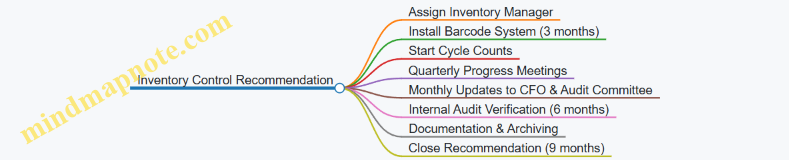
Tips for Accountants and Auditors
- Use audit management software to streamline follow-up tracking.
- Engage management early to gain buy-in for corrective actions.
- Prioritize recommendations based on risk and materiality.
- Maintain a collaborative approach to encourage timely resolution.
By diligently following up on audit recommendations, public companies can reinforce their control environment, reduce risks, and enhance stakeholder confidence in their financial statements.
13.2 Evaluating Audit Quality and Performance Metrics
Ensuring high audit quality is critical for maintaining trust and compliance in public company audits. Evaluating audit quality involves assessing various performance metrics that reflect the effectiveness, efficiency, and reliability of the audit process. This section explores key audit quality indicators, methodologies for evaluation, and practical examples to help auditors and accountants enhance their audit practices.
Key Components of Audit Quality
- Technical Competence: Auditor’s knowledge, skills, and adherence to auditing standards.
- Audit Process: Thoroughness of planning, execution, and documentation.
- Independence and Objectivity: Maintaining impartiality throughout the audit.
- Communication: Clear reporting and interaction with stakeholders.
- Continuous Improvement: Learning from past audits and updating methodologies.
Mind Map: Audit Quality Evaluation Framework
Performance Metrics for Audit Quality
-
Audit Deficiency Rate
- Measures the number of audit findings or errors identified during internal or external reviews.
- Example: An audit team found 3 significant control deficiencies in a public company audit out of 50 tested controls, resulting in a 6% deficiency rate.
-
Timeliness of Audit Completion
- Tracks whether audits are completed within the planned timeframe.
- Example: Completing the audit of a retail public company 5 days ahead of the regulatory deadline.
-
Client Satisfaction Scores
- Feedback from clients regarding audit professionalism, communication, and value.
- Example: A survey indicates 90% of clients rated the audit team’s communication as excellent.
-
Rework and Review Findings
- Number of audit adjustments or rework required after initial completion.
- Example: Minimal rework needed after the first internal quality review suggests high initial audit quality.
-
Compliance with Audit Standards
- Degree to which audits adhere to PCAOB, GAAS, or IFRS standards.
- Example: External peer review reports confirm full compliance with PCAOB standards.
Mind Map: Audit Performance Metrics
Methods to Evaluate Audit Quality
- Internal Quality Reviews: Periodic checks by senior auditors or quality control teams.
- External Peer Reviews: Independent assessments by external audit firms.
- Root Cause Analysis: Investigating recurring audit issues to address underlying problems.
- Benchmarking: Comparing audit metrics against industry standards or past performance.
Example Scenario: Evaluating Audit Quality in a Public Manufacturing Company
During the audit of a publicly traded manufacturing company, the audit manager implemented the following evaluation steps:
- Conducted an internal quality review identifying two minor documentation deficiencies.
- Measured timeliness and found the audit was completed 3 days before the deadline.
- Collected client feedback, which highlighted excellent communication but suggested more detailed explanations on complex accounting estimates.
- Reviewed rework instances and found none, indicating strong initial audit execution.
Based on these metrics, the audit team decided to enhance training on communicating complex issues and maintain current documentation standards.
Best Practices for Maintaining High Audit Quality
- Establish clear quality standards and communicate them to the audit team.
- Use checklists and templates to ensure consistency.
- Encourage open feedback and continuous learning.
- Leverage technology to automate routine checks and improve accuracy.
- Regularly review and update audit methodologies to align with evolving standards.
Mind Map: Best Practices for Audit Quality
By systematically evaluating audit quality and using performance metrics, auditors can enhance the reliability and credibility of their work, ultimately supporting the financial transparency and accountability of public companies.
13.3 Training and Development for Audit Teams
Effective training and development are critical to maintaining a high-performing audit team, especially when auditing public companies where regulatory requirements and business complexities are constantly evolving. Continuous learning ensures auditors stay updated on the latest standards, technologies, and best practices, ultimately improving audit quality and client trust.
Key Components of Audit Team Training and Development
Technical Skills Training
- Accounting and Auditing Standards: Regular workshops on updates to GAAP, IFRS, PCAOB standards, and SEC regulations.
- Regulatory Updates: Training sessions on new compliance requirements such as SOX amendments or changes in financial reporting.
Example: A quarterly webinar series where senior auditors present recent changes in revenue recognition standards and their impact on audit procedures.
Soft Skills Development
- Communication: Enhancing report writing, client interaction, and presentation skills.
- Critical Thinking: Case study discussions to improve analytical judgment.
- Time Management: Techniques to prioritize tasks during tight audit deadlines.
Example: Role-playing exercises simulating difficult conversations with management regarding audit findings.
Technology Training
- Audit Software: Hands-on training for tools like ACL, IDEA, or proprietary audit management systems.
- Data Analytics: Workshops on using data analytics to identify anomalies and trends.
- Cybersecurity Awareness: Educating auditors on risks related to data breaches and secure handling of client information.
Example: A practical session where auditors use data analytics software to detect unusual journal entries in a sample dataset.
Industry Knowledge Enhancement
- Sector-Specific Risks: Training tailored to industries such as technology, manufacturing, or financial services.
- Emerging Trends: Updates on ESG reporting, blockchain impacts, and other innovations affecting audits.
Example: Inviting industry experts to discuss challenges in auditing cryptocurrency transactions for public companies.
Ethics and Compliance Training
- Auditor Independence: Reinforcing importance through case studies and regulatory guidance.
- Fraud Awareness: Techniques to identify and respond to potential fraud.
- Confidentiality: Best practices for handling sensitive client data.
Example: An interactive workshop analyzing a real-world fraud case and discussing auditor responsibilities.
Continuous Improvement Programs
- Feedback Loops: Regular debriefs post-audit to discuss lessons learned.
- Mentorship: Pairing junior auditors with experienced mentors for guidance.
- Performance Reviews: Structured evaluations to identify training needs and career development paths.
Example: Monthly team meetings where auditors share challenges faced and solutions discovered during audits.
Integrated Example: Training Plan for a New Audit Cycle
This structured approach ensures audit teams are well-prepared to handle the complexities of public company audits, adapt to regulatory changes, and leverage technology effectively.
Summary
Training and development for audit teams is a multifaceted process that combines technical knowledge, soft skills, technological proficiency, industry insight, ethics, and continuous improvement. By investing in comprehensive and ongoing training programs, firms can enhance audit quality, reduce risks, and foster a culture of excellence and integrity.
13.4 Incorporating Lessons Learned into Future Audits
Incorporating lessons learned from completed audits into future engagements is a critical best practice that enhances audit quality, efficiency, and risk management. This continuous improvement approach helps audit teams avoid repeating mistakes, leverage successful strategies, and adapt to evolving regulatory and business environments.
Why Incorporate Lessons Learned?
- Improve Audit Effectiveness: Identify what worked well and what didn’t to refine audit procedures.
- Enhance Risk Identification: Learn from past risk areas to better anticipate and address potential issues.
- Boost Team Collaboration: Share knowledge and experiences to build a stronger, more cohesive audit team.
- Increase Client Trust: Demonstrate commitment to quality and responsiveness to client-specific challenges.
Steps to Incorporate Lessons Learned
-
Conduct a Post-Audit Review Meeting
- Gather the audit team to discuss successes, challenges, and unexpected findings.
- Document insights and suggestions for improvement.
-
Analyze Audit Documentation
- Review working papers, checklists, and reports to identify recurring issues or gaps.
-
Update Audit Methodologies and Checklists
- Modify procedures based on identified lessons to better address risks and improve efficiency.
-
Train and Communicate
- Share lessons learned with the wider audit team through training sessions or newsletters.
-
Monitor Implementation
- Track how changes are applied in subsequent audits and assess their impact.
Mind Map: Incorporating Lessons Learned into Future Audits
Example: Applying Lessons Learned in a Public Company Audit
Scenario: During an audit of a public manufacturing company, the audit team encountered unexpected delays due to incomplete inventory records and inconsistent application of internal controls.
Lessons Learned:
- Need for earlier and more detailed inventory control testing.
- Importance of verifying control consistency across multiple locations.
Actions Taken:
- Updated the audit plan to include earlier inventory walkthroughs and control testing.
- Developed a standardized control testing checklist for all locations.
- Conducted a training session for the audit team on inventory control risks specific to manufacturing.
Outcome:
- Subsequent audits experienced fewer delays.
- Improved detection of inventory discrepancies.
- Enhanced client satisfaction due to more efficient audit processes.
Mind Map: Example - Inventory Control Lessons Learned
Tips for Effective Lessons Learned Integration
- Maintain a centralized repository of lessons learned accessible to all audit team members.
- Encourage open and honest feedback during post-audit reviews.
- Align lessons learned with regulatory updates and industry best practices.
- Use technology tools to track and manage improvements.
By systematically incorporating lessons learned, audit teams can elevate the quality and reliability of financial audits for public companies, ultimately supporting stronger corporate governance and investor confidence.
13.5 Example: Implementing Process Improvements After an Audit
After completing an audit, one of the most critical phases is implementing process improvements based on the audit findings and recommendations. This ensures that identified weaknesses are addressed, controls are strengthened, and future audits become more efficient and effective.
Step 1: Review Audit Findings and Recommendations
- Gather the audit report and management letter.
- Identify key areas where deficiencies or control weaknesses were noted.
- Prioritize findings based on risk and impact.
Example: A public manufacturing company’s audit revealed weaknesses in inventory reconciliation processes, leading to discrepancies in reported stock levels.
Step 2: Develop an Improvement Plan
- Assign responsible teams or individuals for each recommendation.
- Define clear objectives and timelines.
- Establish measurable success criteria.
Example: For the inventory issue, the company assigns the warehouse manager and finance team to jointly review reconciliation procedures and implement cycle counts monthly instead of quarterly.
Step 3: Implement Process Changes
- Update policies and procedures.
- Train staff on new processes.
- Deploy any necessary technology or tools.
Example: The company introduces an automated inventory management system that flags discrepancies in real-time and provides training sessions for warehouse staff.
Step 4: Monitor and Evaluate Effectiveness
- Schedule follow-up audits or internal reviews.
- Track key performance indicators (KPIs).
- Adjust processes as needed based on feedback.
Example: After three months, inventory discrepancies drop by 80%, and monthly reconciliation reports show improved accuracy.
Mind Map: Process Improvement Implementation Workflow
Mind Map: Example - Inventory Reconciliation Improvement
Additional Examples of Process Improvements
-
Expense Approval Workflow
- Finding: Delays and unauthorized expenses due to manual approvals.
- Improvement: Implement an electronic approval system with automated notifications.
- Result: Faster approvals, improved compliance, and audit trail.
-
Fixed Asset Tracking
- Finding: Missing or misclassified assets causing inaccurate depreciation.
- Improvement: Introduce barcode tagging and periodic physical verification.
- Result: Accurate asset records and depreciation calculations.
-
Revenue Recognition Controls
- Finding: Inconsistent application of revenue recognition policies.
- Improvement: Standardize policy documentation and conduct regular training.
- Result: Consistent and compliant revenue reporting.
Best Practices for Successful Process Improvements
- Engage cross-functional teams to ensure comprehensive solutions.
- Communicate changes clearly and frequently to all stakeholders.
- Use technology to automate and streamline controls.
- Establish a culture of continuous improvement.
- Document all changes for transparency and future audits.
Implementing process improvements after an audit not only addresses current issues but also strengthens the company’s overall control environment, reduces future audit risks, and enhances stakeholder confidence.
14. Emerging Trends and Future Directions in Public Company Auditing
14.1 Impact of Regulatory Changes and Global Standards
Financial auditing for public companies is heavily influenced by evolving regulatory landscapes and the harmonization of global accounting and auditing standards. Staying current with these changes is critical for auditors to ensure compliance, maintain audit quality, and provide stakeholders with reliable financial information.
Key Regulatory Bodies and Standards
- Securities and Exchange Commission (SEC): Oversees public company disclosures in the U.S.
- Public Company Accounting Oversight Board (PCAOB): Sets auditing standards for public companies in the U.S.
- International Financial Reporting Standards (IFRS): Global accounting standards adopted by many countries.
- Generally Accepted Accounting Principles (GAAP): U.S. accounting standards.
- International Standards on Auditing (ISA): Global auditing standards issued by the International Auditing and Assurance Standards Board (IAASB).
Mind Map: Regulatory Landscape Affecting Public Company Auditing
Recent Regulatory Changes Impacting Auditors
-
PCAOB Auditing Standard Updates
- Enhanced focus on auditor skepticism and fraud detection.
- Increased documentation requirements.
-
SEC’s Modernization of Financial Disclosures
- Simplified MD&A disclosures.
- New requirements for cybersecurity risk disclosures.
-
IFRS Convergence Efforts
- Efforts to align U.S. GAAP and IFRS to reduce complexity.
-
ESG Reporting Frameworks
- Growing regulatory push for environmental, social, and governance disclosures.
Mind Map: Recent Regulatory Changes and Their Audit Implications
Example: Adapting Audit Procedures to PCAOB’s Enhanced Fraud Detection Requirements
A public technology company’s auditor must now incorporate more rigorous fraud risk assessment procedures, including:
- Conducting deeper inquiries with management and those charged with governance.
- Expanding substantive testing on revenue transactions due to fraud risk.
- Documenting the rationale behind audit decisions more thoroughly.
This change ensures auditors are more vigilant and provide higher assurance on financial statements.
Global Standards Harmonization: Challenges and Opportunities
-
Challenges:
- Differences in accounting treatments (e.g., revenue recognition).
- Variations in audit report formats.
- Diverse regulatory enforcement environments.
-
Opportunities:
- Easier cross-border capital raising for public companies.
- Streamlined audit processes for multinational clients.
- Improved comparability of financial statements globally.
Mind Map: Harmonization of Global Standards
Example: Auditing a Multinational Public Company Under IFRS and PCAOB Standards
An auditor working with a multinational public company listed on both the NYSE and a European exchange must:
- Understand and apply IFRS for the European financial statements.
- Comply with PCAOB auditing standards for the U.S. filings.
- Coordinate audit teams across jurisdictions to ensure consistency.
This requires comprehensive knowledge of both regulatory frameworks and effective communication among audit teams.
Practical Best Practices for Auditors to Manage Regulatory Changes
- Continuous professional education on emerging standards.
- Leveraging technology to track and implement regulatory updates.
- Engaging with regulatory bodies and industry groups.
- Updating audit methodologies and templates regularly.
Summary
Regulatory changes and global standards significantly impact the financial auditing of public companies. Auditors must remain agile, knowledgeable, and proactive to navigate this evolving environment effectively, ensuring audits meet the highest standards of quality and compliance.
14.2 Environmental, Social, and Governance (ESG) Auditing
Environmental, Social, and Governance (ESG) auditing is becoming an essential part of financial auditing for public companies. Investors, regulators, and stakeholders increasingly demand transparency and accountability not only in financial performance but also in sustainable and ethical business practices. ESG auditing evaluates how well a company manages risks and opportunities related to environmental impact, social responsibility, and governance structures.
What is ESG Auditing?
ESG auditing involves the independent assessment of a company’s ESG disclosures, policies, and practices to ensure accuracy, completeness, and compliance with relevant frameworks and regulations. It complements traditional financial audits by providing insights into non-financial factors that can affect long-term value.
Key Components of ESG Auditing
Best Practices in ESG Auditing
-
Understand Relevant ESG Frameworks: Familiarize with standards such as GRI (Global Reporting Initiative), SASB (Sustainability Accounting Standards Board), TCFD (Task Force on Climate-related Financial Disclosures), and the UN SDGs (Sustainable Development Goals).
-
Integrate ESG into Risk Assessment: Identify ESG risks that could materially affect financial statements or company reputation.
-
Evaluate Data Quality and Controls: Assess the reliability of ESG data collection processes and internal controls.
-
Perform Substantive Testing: Verify ESG metrics, such as energy consumption or employee diversity statistics, through sampling and third-party confirmations.
-
Engage with Stakeholders: Collaborate with management, sustainability officers, and external experts to gain comprehensive understanding.
-
Report Transparently: Provide clear findings, highlighting strengths, weaknesses, and recommendations for improvement.
Example: Auditing Carbon Emissions Reporting
A publicly traded manufacturing company reports its annual carbon emissions as part of its sustainability disclosures. The auditor:
- Reviews the methodology used for calculating emissions, ensuring it aligns with recognized standards like the Greenhouse Gas Protocol.
- Tests data sources such as energy bills and fuel consumption logs.
- Performs recalculations on a sample of reported figures.
- Assesses internal controls over data collection and reporting.
- Confirms third-party verification reports if applicable.
This process helps ensure the emissions data is accurate and reliable for investors assessing the company’s environmental impact.
Mind Map: ESG Auditing Process
Example: Social Auditing on Labor Practices
A public retail company discloses its commitment to fair labor practices. The auditor:
- Reviews policies on wages, working hours, and workplace safety.
- Conducts walkthroughs and interviews with HR and employee representatives.
- Tests payroll records and compliance with labor laws.
- Examines grievance mechanisms and resolution processes.
This helps verify that the company’s social disclosures are truthful and that labor risks are managed effectively.
Governance Auditing Example: Board Composition and Independence
For a public technology company, the auditor:
- Reviews board member qualifications, independence, and diversity.
- Assesses adherence to governance codes and SEC regulations.
- Evaluates processes for executive compensation and conflict of interest disclosures.
This ensures governance disclosures reflect the company’s commitment to ethical leadership and accountability.
Challenges in ESG Auditing
- Lack of standardized metrics and evolving frameworks.
- Data availability and reliability issues.
- Integrating ESG findings with financial audit conclusions.
- Balancing depth of audit with cost and time constraints.
Conclusion
ESG auditing is a vital emerging discipline that enhances the transparency and sustainability of public companies. By applying rigorous audit techniques and leveraging relevant frameworks, auditors can provide stakeholders with confidence in ESG disclosures, ultimately supporting better investment and governance decisions.
14.3 Blockchain and Its Implications for Financial Audits
Blockchain technology is rapidly transforming the landscape of financial auditing, especially for public companies. Its decentralized, immutable, and transparent nature offers both opportunities and challenges for auditors. This section explores how blockchain impacts financial audits, best practices for auditors, and practical examples to illustrate these concepts.
What is Blockchain?
Blockchain is a distributed ledger technology (DLT) that records transactions across multiple computers in a way that ensures the data cannot be altered retroactively without the alteration of all subsequent blocks and consensus of the network.
Mind Map: Key Features of Blockchain Relevant to Auditing
Implications of Blockchain for Financial Audits
-
Enhanced Transparency and Traceability
- Every transaction is recorded in a public or permissioned ledger, allowing auditors to trace transaction history easily.
-
Increased Data Integrity
- Immutability ensures that once data is recorded, it cannot be tampered with, reducing risks of fraud.
-
Real-Time Auditing Possibilities
- Continuous access to transactional data enables near real-time audit procedures.
-
Challenges in Understanding and Access
- Auditors must understand blockchain architecture and gain access to relevant nodes or ledgers.
-
Smart Contracts Auditing
- Automated contracts require auditors to verify code logic and execution.
Mind Map: Blockchain Impact on Audit Process
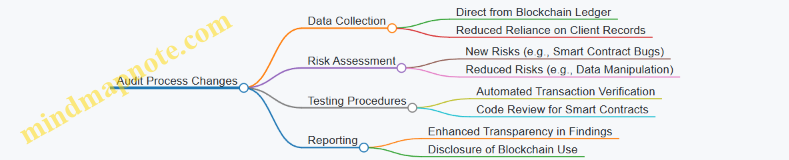
Best Practices for Auditors Working with Blockchain
- Gain Technical Expertise: Auditors should develop a solid understanding of blockchain technology, cryptography, and smart contracts.
- Collaborate with IT Specialists: Work with blockchain developers or forensic experts to interpret complex data.
- Evaluate Blockchain Governance: Assess how the blockchain network is maintained, including consensus mechanisms and participant roles.
- Test Smart Contracts: Review the logic, security, and execution of smart contracts to identify potential risks.
- Assess Access Controls: Verify who has permission to write or validate transactions on permissioned blockchains.
- Use Blockchain Analytics Tools: Leverage specialized software to analyze blockchain data efficiently.
Example 1: Auditing a Public Company Using Blockchain for Supply Chain Transactions
A public retail company uses a permissioned blockchain to record supply chain transactions, including purchase orders, shipments, and payments.
-
Audit Approach:
- Auditor accesses the blockchain ledger directly to verify transaction completeness and accuracy.
- Confirms immutability by checking hash values and block timestamps.
- Reviews smart contracts automating payment releases upon delivery confirmation.
-
Outcome:
- Reduced need for manual confirmation with suppliers.
- Increased confidence in data integrity.
Example 2: Detecting Fraud Risks in Cryptocurrency Transactions
A public company holds significant cryptocurrency assets recorded on a public blockchain.
-
Audit Approach:
- Auditor traces wallet addresses and transaction history on the blockchain.
- Verifies ownership and valuation of cryptocurrency holdings.
- Assesses controls over private keys and access to wallets.
-
Outcome:
- Identification of potential unauthorized transfers.
- Recommendations for stronger key management controls.
Mind Map: Auditor’s Checklist for Blockchain Audits
Conclusion
Blockchain technology introduces a paradigm shift in financial auditing for public companies. While it enhances transparency and data integrity, auditors must adapt by acquiring new technical skills and revising traditional audit procedures. By integrating blockchain understanding into their audit approach, auditors can provide more robust assurance and add value in an evolving financial ecosystem.
14.4 Artificial Intelligence and Machine Learning in Auditing
Artificial Intelligence (AI) and Machine Learning (ML) are transforming the landscape of financial auditing, especially for public companies where the volume and complexity of data are substantial. These technologies enable auditors to enhance efficiency, accuracy, and insight during the audit process.
What is AI and ML in Auditing?
- Artificial Intelligence (AI): The simulation of human intelligence processes by machines, especially computer systems.
- Machine Learning (ML): A subset of AI that enables systems to learn from data, identify patterns, and make decisions with minimal human intervention.
Mind Map: AI and ML Applications in Auditing
Benefits of AI and ML in Public Company Audits
- Increased Efficiency: Automates repetitive tasks such as data entry and transaction testing.
- Improved Accuracy: Reduces human error by analyzing large datasets systematically.
- Enhanced Fraud Detection: Identifies unusual patterns and potential fraud faster than traditional methods.
- Real-Time Insights: Enables continuous auditing and timely risk assessment.
- Better Resource Allocation: Allows auditors to focus on complex judgment areas.
Example 1: Using ML for Anomaly Detection in Expense Audits
A public technology company implemented an ML model trained on historical expense data to flag unusual transactions. The model identified:
- Duplicate payments
- Expenses outside typical vendor patterns
- Transactions with unusual amounts
This allowed auditors to investigate potential errors or fraud more efficiently than manual sampling.
Mind Map: ML Anomaly Detection Workflow

Example 2: AI-Powered Document Review for Compliance
During an audit of a public pharmaceutical company, AI tools were used to automatically review thousands of contracts and disclosures to ensure compliance with regulatory requirements. The AI:
- Extracted key clauses
- Compared terms against regulatory standards
- Highlighted deviations for auditor review
This significantly reduced the time spent on manual document review.
Challenges and Considerations
- Data Quality: AI/ML models require high-quality, clean data to produce reliable results.
- Model Transparency: Auditors must understand how models make decisions to trust outputs.
- Ethical Use: Ensuring AI use complies with ethical standards and maintains auditor independence.
- Integration: Seamlessly integrating AI tools with existing audit workflows.
Future Outlook
AI and ML will continue to evolve, enabling more sophisticated predictive analytics, natural language processing for contract analysis, and enhanced continuous auditing capabilities. Auditors who embrace these technologies will be better equipped to handle the growing complexity of public company audits.
Summary
Artificial Intelligence and Machine Learning are powerful tools that augment the auditor’s capabilities by automating routine tasks, enhancing fraud detection, and providing deeper insights into financial data. By integrating these technologies thoughtfully, auditors can deliver higher quality audits with greater efficiency and effectiveness.
14.5 Example: Auditing ESG Disclosures in a Public Corporation
Environmental, Social, and Governance (ESG) disclosures have become increasingly important for public companies as investors, regulators, and stakeholders demand transparency on non-financial performance. Auditing ESG disclosures requires a blend of traditional audit techniques and specialized knowledge to verify the accuracy, completeness, and reliability of the reported information.
Understanding ESG Disclosures
ESG disclosures typically cover:
- Environmental: Carbon emissions, energy consumption, waste management, water usage.
- Social: Labor practices, diversity and inclusion, community engagement, employee health and safety.
- Governance: Board composition, executive compensation, ethics policies, risk management.
Mind Map: Key Areas in Auditing ESG Disclosures
Step-by-Step Example: Auditing ESG Disclosures for a Public Corporation
Scenario: A publicly traded manufacturing company publishes an annual ESG report disclosing its carbon footprint, workforce diversity statistics, and governance policies. The auditor is tasked with verifying the accuracy and completeness of these disclosures.
Step 1: Planning and Risk Assessment
- Identify material ESG areas: Given the manufacturing sector, environmental impact (carbon emissions, waste) is material.
- Understand reporting framework: The company follows the Global Reporting Initiative (GRI) standards.
- Assess risks: Potential risks include inaccurate emissions data, incomplete workforce diversity reporting, and governance policy misstatements.
Step 2: Evaluate Internal Controls
- Review controls over data collection for emissions (e.g., sensors, meters).
- Assess HR systems capturing diversity data.
- Examine governance documentation processes.
Step 3: Substantive Testing
-
Environmental:
- Recalculate carbon emissions using raw data (energy bills, fuel consumption).
- Verify third-party verification reports (e.g., ISO 14001 certification).
- Inspect waste disposal contracts and logs.
-
Social:
- Test employee demographic data by sampling personnel files.
- Review health and safety incident reports.
-
Governance:
- Examine board meeting minutes for ESG discussions.
- Verify existence and updates of ethics policies.
Step 4: Analytical Procedures
- Compare current year emissions and diversity metrics with prior years and industry benchmarks.
- Investigate significant variances or anomalies.
Step 5: Reporting
- Document findings, including any discrepancies or control weaknesses.
- Provide recommendations for improving ESG data collection and reporting.
Mind Map: Audit Procedures for ESG Disclosures
Example: Verifying Carbon Emissions Data
Context: The company reports 10,000 metric tons of CO2 emissions for the year.
Audit Approach:
- Obtain energy consumption data (electricity, natural gas, diesel).
- Use emission factors from recognized sources (e.g., EPA, IPCC) to calculate expected emissions.
- Compare auditor’s calculation with company’s reported figure.
Example Calculation:
| Energy Source | Consumption | Emission Factor (kg CO2/unit) | Calculated Emissions (kg CO2) |
|---|---|---|---|
| Electricity | 5,000 MWh | 0.45 | 2,250,000 |
| Natural Gas | 1,000,000 m3 | 2.0 | 2,000,000 |
| Diesel | 50,000 liters | 2.68 | 134,000 |
Total Emissions: 4,384,000 kg CO2 = 4,384 metric tons CO2
Observation: The reported 10,000 metric tons seems high; auditor investigates possible inclusion of scope 3 emissions or data errors.
Example: Testing Workforce Diversity Data
- Select a sample of employee records.
- Verify demographic information (gender, ethnicity) matches reported statistics.
- Confirm data aggregation methods are consistent and accurate.
Conclusion
Auditing ESG disclosures in public companies requires a multidisciplinary approach combining traditional audit rigor with specialized ESG knowledge. By following structured procedures and leveraging frameworks like GRI, auditors can provide assurance on the credibility of ESG reports, helping companies meet stakeholder expectations and regulatory requirements.