Fraud Detection and Prevention for Accountants
1. Introduction to Fraud in Accounting
1.1 Understanding Fraud: Definitions and Types
Fraud is a deliberate act of deception intended to secure an unfair or unlawful gain. In the context of accounting and finance, fraud typically involves manipulating financial information or misappropriating assets to benefit oneself or an organization improperly.
Definition of Fraud
According to the Association of Certified Fraud Examiners (ACFE), fraud is “the use of one’s occupation for personal enrichment through the deliberate misuse or misapplication of the employing organization’s resources or assets.”
Key Characteristics of Fraud:
- Intentional act
- Deception or misrepresentation
- Resulting in financial or reputational loss
Types of Fraud Relevant to Accountants and Fraud Examiners
Fraud can take many forms, but some common types encountered in finance and government sectors include:
Financial Statement Fraud
This involves intentionally misstating financial information to deceive stakeholders. For example, a company might inflate revenue figures to appear more profitable and attract investors.
Example: An accountant manipulates the books by recognizing revenue before it is earned, making the quarterly financial report look better.
Asset Misappropriation
This is the most common type of fraud and involves employees stealing or misusing the organization’s resources.
Example: An employee submits fake expense reports for reimbursement or diverts company funds into personal accounts.
Corruption
Corruption involves an employee abusing their position for personal gain, often through bribery or kickbacks.
Example: A procurement officer accepts kickbacks from a vendor in exchange for awarding contracts.
Cyber Fraud
With increasing digitalization, cyber fraud has become a significant risk, involving unauthorized access to financial systems or data theft.
Example: A fraudster uses phishing emails to obtain login credentials and siphons funds from company accounts.
Mind Map: Fraud Characteristics and Examples
Summary
Understanding the definitions and types of fraud is fundamental for accountants and fraud examiners. Recognizing the various forms fraud can take helps in developing targeted detection and prevention strategies. Throughout this blog, we will explore best practices and real-world examples to equip you with practical tools to combat fraud effectively.
1.2 The Impact of Fraud on Organizations and Public Trust
Fraud is not just a financial crime; its repercussions ripple through every facet of an organization and the broader community it serves. Understanding the multifaceted impact of fraud helps accountants and fraud examiners appreciate the critical importance of their roles in detection and prevention.
Financial Impact
- Direct Financial Losses: Fraud often leads to significant monetary losses, which can cripple budgets and reduce operational capacity.
- Increased Costs: Organizations incur additional expenses related to investigations, legal fees, and remediation efforts.
- Example: A government agency lost $2 million due to a vendor kickback scheme, forcing budget cuts in essential public services.
Reputational Damage
- Loss of Stakeholder Confidence: Fraud scandals erode trust among investors, clients, and the public.
- Negative Media Exposure: Publicized fraud cases can tarnish an organization’s image for years.
- Example: A financial institution involved in a money laundering scandal saw a 30% drop in new client acquisition within six months.
Operational Disruption
- Resource Diversion: Time and personnel are redirected from core activities to address fraud-related issues.
- Internal Morale: Employee trust and morale can decline, leading to decreased productivity.
- Example: After uncovering internal embezzlement, a government department had to halt several projects to conduct audits and retrain staff.
Legal and Regulatory Consequences
- Fines and Penalties: Organizations may face hefty fines from regulatory bodies.
- Litigation Risks: Fraud can lead to lawsuits from affected parties.
- Example: A corporation was fined $10 million for failing to prevent fraudulent financial reporting under the Sarbanes-Oxley Act.
Erosion of Public Trust
- Impact on Public Services: In government sectors, fraud undermines citizens’ trust in public institutions.
- Reduced Compliance: Public skepticism may lead to lower compliance with regulations and policies.
- Example: A municipal fraud case led to decreased voter turnout and public engagement in local governance.
Mind Map: Impact of Fraud on Organizations and Public Trust
Mind Map: Consequences of Fraud for Accountants and Fraud Examiners
Integrated Example: The Enron Scandal
The Enron scandal is a classic example illustrating the devastating impact of fraud:
- Financial Impact: Billions lost by investors and employees.
- Reputational Damage: Collapse of a major corporation shook confidence in the energy sector.
- Legal Consequences: Executives faced criminal charges; new regulations like Sarbanes-Oxley were enacted.
- Public Trust: Sparked widespread skepticism about corporate governance.
This case underscores why accountants must be vigilant and proactive in fraud detection and prevention.
Summary
Fraud’s impact extends beyond immediate financial losses to damage reputations, disrupt operations, incur legal penalties, and erode public trust. Accountants and fraud examiners play a pivotal role in mitigating these risks through diligent detection, prevention, and fostering an ethical organizational culture.
1.3 Common Fraud Schemes in Finance and Government Sectors
Fraud schemes in the finance and government sectors can be complex and varied, but understanding the common types helps accountants and fraud examiners detect and prevent them effectively. Below is a detailed overview of prevalent fraud schemes, accompanied by mind maps and practical examples.
Mind Map: Common Fraud Schemes Overview
Asset Misappropriation
This is the most common type of fraud and involves employees stealing or misusing an organization’s resources.
Examples:
- Theft of Cash: An accounts receivable clerk diverts customer payments into a personal bank account.
- Payroll Fraud: An employee adds fictitious employees to the payroll and collects their salaries.
- Expense Reimbursement Fraud: Submitting fake or inflated expense reports for reimbursement.
Example Case:
In a government agency, an employee submitted false mileage claims for travel expenses. By cross-referencing travel logs with GPS data, the fraud was uncovered.
Mind Map: Asset Misappropriation Examples
Corruption
Corruption involves an employee using their influence in business transactions in a way that violates their duty to the employer in order to obtain a personal benefit.
Examples:
- Bribery: A government official accepts money to expedite contract approvals.
- Kickbacks: An employee receives a percentage from a vendor in exchange for awarding contracts.
- Conflict of Interest: An accountant influences the selection of a vendor owned by a family member.
Example Case:
A finance officer was found to have steered procurement contracts to a company owned by a close relative, receiving kickbacks disguised as consulting fees.
Mind Map: Corruption Schemes
Financial Statement Fraud
This involves intentional misrepresentation or omission of financial information to deceive stakeholders.
Examples:
- Revenue Recognition Manipulation: Recording revenue prematurely to meet targets.
- Expense Understatement: Delaying the recording of expenses to inflate profits.
- Overstating Assets: Inflating asset values to improve balance sheet appearance.
Example Case:
A finance department delayed recording supplier invoices until the next fiscal period, artificially inflating the current period’s profits to meet budget expectations.
Mind Map: Financial Statement Fraud Types
Procurement Fraud
Procurement fraud occurs when individuals manipulate the purchasing process for personal gain.
Examples:
- Bid Rigging: Colluding with vendors to predetermine contract winners.
- False Invoicing: Submitting invoices for goods or services not delivered.
- Vendor Kickbacks: Receiving payments from vendors in exchange for preferential treatment.
Example Case:
An internal audit revealed that a purchasing manager had set up a shell company to submit false invoices for supplies never received, funneling payments to themselves.
Mind Map: Procurement Fraud Schemes
Summary
Understanding these common fraud schemes helps accountants and fraud examiners recognize warning signs and implement controls to mitigate risks. Real-world examples illustrate how these schemes manifest and highlight the importance of vigilance, data analysis, and ethical practices in fraud prevention.
Next Steps:
- Learn how to conduct fraud risk assessments to identify vulnerabilities.
- Explore internal controls tailored to prevent these specific fraud types.
1.4 The Role of Accountants and Fraud Examiners in Fraud Prevention
Accountants and fraud examiners serve as the frontline defenders against fraudulent activities within organizations, especially in the finance and government sectors. Their roles are multifaceted, encompassing prevention, detection, investigation, and reporting of fraud. Understanding their responsibilities and how they collaborate is essential for building a robust fraud prevention framework.
Key Responsibilities of Accountants in Fraud Prevention
- Maintaining Accurate Financial Records: Accountants ensure that all financial transactions are recorded accurately and timely, which reduces opportunities for manipulation.
- Implementing and Monitoring Internal Controls: They design, implement, and regularly review internal controls to prevent unauthorized transactions.
- Conducting Regular Reconciliations: Routine reconciliations help identify discrepancies early.
- Educating Staff on Fraud Awareness: Accountants often lead or support training programs to raise awareness about fraud risks.
- Reporting Suspicious Activities: They have a duty to escalate any irregularities or red flags to management or fraud examiners.
Key Responsibilities of Fraud Examiners in Fraud Prevention
- Conducting Fraud Risk Assessments: Fraud examiners analyze organizational processes to identify vulnerabilities.
- Investigating Allegations of Fraud: They gather evidence, interview involved parties, and determine the validity of fraud claims.
- Developing Fraud Prevention Strategies: Based on findings, they recommend improvements to policies and controls.
- Collaborating with Legal and Compliance Teams: To ensure proper handling of investigations and regulatory compliance.
- Promoting Ethical Culture: Fraud examiners often advocate for ethical behavior and whistleblower protections.
Mind Map: Roles and Responsibilities of Accountants and Fraud Examiners
How Accountants and Fraud Examiners Collaborate
- Early Detection: Accountants identify anomalies during routine work and alert fraud examiners.
- Investigation Support: Fraud examiners rely on accountants’ detailed records and insights.
- Control Enhancements: Both work together to strengthen controls based on investigation outcomes.
- Training and Awareness: Jointly develop training programs to educate employees.
Example: Detecting and Preventing Vendor Invoice Fraud
- Scenario: An accountant notices duplicate payments to a vendor during monthly reconciliation.
- Action: The accountant reports the anomaly to the fraud examiner.
- Investigation: The fraud examiner reviews vendor contracts, payment history, and interviews staff.
- Outcome: It is discovered that an employee created fake vendor invoices.
- Prevention: Together, they implement stricter vendor verification controls and mandatory dual approvals.
Mind Map: Collaboration Workflow
Best Practices for Accountants and Fraud Examiners
- Maintain Open Communication Channels: Regular meetings to discuss fraud risks and findings.
- Continuous Professional Development: Stay updated on emerging fraud schemes and detection technologies.
- Use Data Analytics Tools: Leverage software to identify patterns and outliers.
- Promote a Culture of Integrity: Encourage employees to report suspicious behavior without fear.
Example: Using Data Analytics to Prevent Expense Fraud
- Accountants use analytics software to flag expense reports with unusual patterns (e.g., repeated claims just below approval limits).
- Fraud examiners investigate flagged reports and identify a pattern of inflated mileage claims.
- The organization revises its expense policy and implements automated flagging systems.
In summary, accountants and fraud examiners play complementary and critical roles in fraud prevention. Their proactive collaboration, combined with strong controls and ethical culture, significantly reduces the risk of fraud within organizations.
2. Fraud Risk Assessment and Identification
2.1 Conducting Comprehensive Fraud Risk Assessments
Fraud risk assessments are a foundational step in identifying vulnerabilities within an organization’s financial processes and controls. For accountants and fraud examiners, conducting a thorough fraud risk assessment enables proactive detection and prevention of fraudulent activities before they escalate.
What is a Fraud Risk Assessment?
A fraud risk assessment is a systematic process to identify, analyze, and evaluate the potential risks of fraud that could affect an organization. It helps in understanding where fraud is most likely to occur and what controls are necessary to mitigate those risks.
Key Steps in Conducting a Fraud Risk Assessment
Step 1: Preparation
- Define Objectives: Clarify the scope and goals of the assessment, such as focusing on specific departments or transaction types.
- Assemble Team: Include cross-functional members like internal auditors, finance staff, and fraud examiners.
- Gather Documentation: Collect process maps, prior audit reports, and financial statements.
Step 2: Identification
- Review Processes: Map out key financial processes such as procurement, payroll, and revenue recognition.
- Interview Stakeholders: Engage employees at various levels to uncover potential vulnerabilities.
- Analyze Historical Data: Look for patterns or past incidents of fraud.
Step 3: Analysis
- Assess Likelihood: Evaluate how probable it is that fraud could occur in each area.
- Assess Impact: Determine the potential financial and reputational damage.
- Prioritize Risks: Focus on high-likelihood, high-impact risks for immediate action.
Step 4: Response
- Design Controls: Implement segregation of duties, approval workflows, and system access restrictions.
- Develop Monitoring Plans: Use data analytics and periodic reviews.
- Implement Training: Educate staff on fraud awareness and reporting mechanisms.
Step 5: Review
- Continuous Monitoring: Regularly update the risk assessment based on new information.
- Update Assessment: Adapt controls and strategies as the organization evolves.
Example: Fraud Risk Assessment in a Government Finance Department
Scenario: A government finance department wants to assess fraud risks related to vendor payments.
- Preparation: The team defines the objective to focus on procurement and payment processes.
- Identification: They review vendor onboarding, invoice approval, and payment processes; interview procurement officers and accountants; and analyze past audit findings.
- Analysis: They identify high risk in vendor invoice approvals due to lack of segregation of duties.
- Response: Controls are introduced such as dual approvals for payments and automated invoice matching.
- Review: Monthly reports are generated to monitor unusual payment patterns.
Mind Map: Example Fraud Risk Factors in Vendor Payment Process
Tips for Effective Fraud Risk Assessments
- Use a combination of qualitative (interviews, observations) and quantitative (data analysis) methods.
- Engage employees at all levels to get a comprehensive view.
- Document all findings and update the assessment regularly.
- Leverage technology such as data analytics tools to identify anomalies.
By conducting comprehensive fraud risk assessments, accountants and fraud examiners can create a robust defense against fraud, ensuring the integrity of financial operations and safeguarding public trust.
2.2 Identifying Red Flags and Warning Signs of Fraud
Fraud detection begins with recognizing the red flags and warning signs that may indicate fraudulent activity. For accountants and fraud examiners, being vigilant about these indicators is crucial to early detection and prevention.
Common Red Flags in Fraud Detection
- Unusual Transactions: Transactions that are inconsistent with normal business operations or lack proper documentation.
- Discrepancies in Financial Records: Differences between reported figures and actual data.
- Missing or Altered Documents: Invoices, receipts, or contracts that are missing, forged, or altered.
- Excessive Transactions with a Single Vendor: Could indicate kickbacks or collusion.
- Unexplained Adjustments: Frequent journal entries or adjustments without clear justification.
- Lifestyle Changes: Employees showing sudden wealth or lifestyle beyond their means.
Mind Map: Categories of Fraud Red Flags
Example 1: Detecting Payroll Fraud Through Red Flags
An accountant notices that an employee’s payroll records show payments to a person who no longer works at the company. Additionally, the hours logged are unusually high without corresponding work output. These are classic red flags indicating potential ghost employee fraud.
Behavioral Red Flags Mind Map
Example 2: Vendor Fraud Warning Signs
A fraud examiner finds multiple payments made to a vendor with no physical address and the same bank account used for several unrelated vendors. These irregularities suggest possible shell company fraud.
Document and Transaction Red Flags Mind Map
Example 3: Expense Reimbursement Fraud
An accountant identifies several expense reports with round-dollar amounts and receipts that appear photocopied or digitally altered. The employee also submits expenses just under the company’s approval limit, indicating an attempt to avoid scrutiny.
Integrating Red Flags into Daily Practice
- Regularly review financial statements for inconsistencies.
- Use data analytics tools to spot anomalies such as duplicate payments or unusual transaction patterns.
- Encourage open communication and whistleblower reporting.
- Conduct surprise audits focusing on high-risk areas.
Summary
Identifying red flags requires a combination of analytical skills, attention to detail, and awareness of behavioral cues. By understanding and recognizing these warning signs, accountants and fraud examiners can take proactive steps to investigate and prevent fraud before it escalates.
Remember: Red flags are indicators, not proof of fraud. They should trigger further investigation rather than immediate accusations.
2.3 Case Study: Detecting Payroll Fraud Through Risk Assessment
Payroll fraud is one of the most common types of occupational fraud, often involving manipulation of employee compensation records or ghost employees. This case study illustrates how a thorough fraud risk assessment helped uncover payroll fraud in a mid-sized government agency.
Background
The finance department of the agency noticed an unusual increase in payroll expenses over three consecutive months, despite no significant changes in staffing levels or salary adjustments. Accountants were tasked with conducting a fraud risk assessment focused on payroll processes.
Step 1: Conducting the Fraud Risk Assessment
The team began by mapping out the payroll process and identifying potential fraud risks:
-
Payroll Process Flow
- Employee Data Entry
- Timekeeping and Attendance
- Payroll Calculation
- Authorization and Approval
- Payment Processing
- Record Keeping
-
Potential Fraud Risks
- Ghost Employees
- Falsified Hours or Overtime
- Unauthorized Salary Increases
- Duplicate Payments
- Manipulated Time Records
Using this map, the team identified key control points where fraud could occur and where controls were weak or missing.
Step 2: Identifying Red Flags
The accountants looked for red flags in payroll data, including:
- Payroll expenses increasing without corresponding staffing changes
- Employees with unusually high overtime hours
- Duplicate bank account numbers in payroll records
- Inconsistent or missing approval signatures
Step 3: Data Analysis and Example Techniques
To detect anomalies, the team applied several analytical techniques:
Benford’s Law Analysis:
- Examined the distribution of first digits in payroll amounts.
- Found deviations indicating potential manipulation.
Duplicate Payment Detection:
- Filtered payroll records for duplicate employee IDs or bank accounts.
- Identified two entries with the same bank account but different employee names.
Overtime Pattern Analysis:
- Charted overtime hours per employee.
- Found one employee consistently logging maximum overtime hours without corresponding workload.
Step 4: Investigation and Outcome
Further investigation revealed that a payroll clerk had created ghost employees and directed their payments to a personal bank account. The clerk also falsified overtime hours for some real employees to inflate payroll costs.
The fraud was uncovered through:
- Cross-referencing employee records with HR data
- Interviewing supervisors about overtime approvals
- Verifying bank account ownership
The agency implemented stronger internal controls, including:
- Segregation of duties between payroll processing and approval
- Mandatory periodic audits of payroll data
- Automated alerts for duplicate bank accounts and unusual overtime
Key Takeaways and Best Practices
- Regular Fraud Risk Assessments: Continuously review payroll processes to identify emerging risks.
- Data Analytics: Use tools like Benford’s Law and duplicate detection to spot anomalies early.
- Segregation of Duties: Ensure no single individual controls multiple payroll steps.
- Verification and Approval: Require multiple levels of approval for payroll changes.
- Employee Awareness: Train staff to recognize and report suspicious activities.
Summary Mind Map
This case study demonstrates how a structured fraud risk assessment combined with data analytics and strong controls can effectively detect and prevent payroll fraud, safeguarding organizational resources and maintaining public trust.
2.4 Leveraging Data Analytics for Early Fraud Identification
Data analytics has become an indispensable tool for accountants and fraud examiners aiming to detect fraudulent activities early and efficiently. By analyzing large volumes of financial data, unusual patterns and anomalies that may indicate fraud can be identified before they escalate into significant losses.
What is Data Analytics in Fraud Detection?
Data analytics involves the systematic computational analysis of data or statistics. In fraud detection, it means using software and algorithms to sift through transactional data, identify irregularities, and flag suspicious activities.
Benefits of Using Data Analytics for Fraud Identification
- Speed: Quickly processes vast amounts of data that would be impossible to analyze manually.
- Accuracy: Reduces human error and uncovers subtle patterns.
- Proactive Detection: Identifies fraud indicators early, preventing further damage.
- Continuous Monitoring: Enables real-time or near-real-time surveillance.
Key Techniques in Data Analytics for Fraud Detection
- Descriptive Analytics: Summarizes historical data to understand what has happened.
- Diagnostic Analytics: Investigates why certain anomalies occurred.
- Predictive Analytics: Uses historical data to predict potential fraud risks.
- Prescriptive Analytics: Suggests actions to prevent or mitigate fraud.
Mind Map: Data Analytics Techniques for Fraud Detection
Practical Examples of Data Analytics in Fraud Identification
-
Transaction Pattern Analysis:
- Example: An accountant uses data analytics software to analyze thousands of expense reports. The system flags a pattern where a particular employee consistently submits expenses just below the approval threshold, indicating possible manipulation.
-
Benford’s Law Application:
- Example: Applying Benford’s Law to accounts payable data reveals unnatural digit distributions, suggesting fabricated invoices.
-
Outlier Detection:
- Example: A government agency uses clustering algorithms to detect vendor payments that are significantly higher than average for similar services, prompting further investigation.
-
Time-Series Analysis:
- Example: Analyzing the timing of transactions shows a spike in reimbursements at month-end, unusual compared to historical patterns.
Mind Map: Example Workflow for Early Fraud Detection Using Data Analytics
Tools and Technologies Commonly Used
- Excel with Pivot Tables and Conditional Formatting: For smaller datasets and initial analysis.
- SQL Databases: To query and extract relevant data efficiently.
- Data Visualization Tools (Tableau, Power BI): To visualize trends and anomalies.
- Specialized Fraud Detection Software (ACL, SAS Fraud Framework): For advanced analytics and automation.
- Machine Learning Platforms (Python with Scikit-learn, R): To build predictive models.
Case Example: Early Detection of Payroll Fraud Using Data Analytics
A government finance department noticed irregularities in payroll expenses. By applying data analytics, the fraud examiner:
- Extracted payroll data over the last 12 months.
- Used clustering algorithms to identify employees with unusually high overtime hours.
- Detected a cluster of employees with consistently inflated hours during holiday periods.
- Cross-referenced with attendance records, revealing ghost employees.
This early identification prevented further fraudulent payments and led to corrective actions.
Best Practices for Leveraging Data Analytics
- Ensure Data Quality: Accurate, complete, and timely data is critical.
- Integrate Multiple Data Sources: Combine financial, operational, and HR data for comprehensive analysis.
- Customize Analytics Models: Tailor models to the organization’s specific fraud risks.
- Train Staff: Equip accountants and fraud examiners with data analytics skills.
- Maintain Privacy and Compliance: Handle sensitive data responsibly.
By embedding data analytics into routine fraud detection processes, accountants and fraud examiners can significantly enhance their ability to identify fraud early, reduce financial losses, and uphold organizational integrity.
3. Internal Controls and Fraud Prevention Best Practices
3.1 Designing Effective Internal Controls to Mitigate Fraud Risks
Internal controls are the backbone of any organization’s fraud prevention strategy. They are policies, procedures, and mechanisms designed to safeguard assets, ensure accuracy of financial records, and promote operational efficiency. For accountants and fraud examiners, understanding how to design and implement effective internal controls is critical to mitigating fraud risks.
What Are Internal Controls?
Internal controls are processes put in place by management and other personnel to provide reasonable assurance regarding the achievement of objectives in the following categories:
- Reliability of financial reporting
- Compliance with applicable laws and regulations
- Effectiveness and efficiency of operations
Key Principles of Effective Internal Controls
- Segregation of Duties: No single individual should have control over all aspects of a financial transaction.
- Authorization and Approval: Transactions should be authorized by appropriate personnel.
- Documentation and Record Keeping: All transactions should be properly documented.
- Physical Controls: Safeguarding assets through locks, access controls, and inventory counts.
- Independent Checks and Reconciliations: Regular reviews and reconciliations to detect errors or irregularities.
Mind Map: Core Components of Internal Controls
Designing Internal Controls: Step-by-Step
-
Identify Key Risk Areas: Analyze processes vulnerable to fraud, such as cash handling, procurement, payroll, and expense reimbursements.
-
Map Existing Processes: Document current workflows to understand control points.
-
Define Control Objectives: What should the control achieve? (e.g., prevent unauthorized payments)
-
Design Control Activities: Develop specific procedures to meet objectives.
-
Assign Responsibilities: Clearly define who performs, authorizes, and reviews transactions.
-
Implement Monitoring Mechanisms: Establish ongoing review and audit processes.
-
Train Staff: Ensure employees understand controls and their importance.
Example: Preventing Fraud in the Accounts Payable Process
Scenario: A government agency experienced unauthorized vendor payments due to weak controls.
Control Design:
- Segregation of Duties: Separate employees handle invoice receipt, approval, and payment processing.
- Authorization: All vendor payments require dual approval from department heads.
- Documentation: Invoices must be matched with purchase orders and receiving reports before payment.
- Independent Review: Monthly bank reconciliations performed by an internal auditor.
Outcome: Unauthorized payments were significantly reduced, and discrepancies were detected early.
Mind Map: Internal Controls in Accounts Payable
Best Practices for Designing Internal Controls
- Keep Controls Practical: Controls should not be so complex that they hinder operations.
- Regularly Update Controls: Fraud schemes evolve; controls must adapt accordingly.
- Leverage Technology: Use accounting software features for automated controls and alerts.
- Encourage a Control-Conscious Culture: Employees should understand the importance of controls.
Example: Using Technology to Enhance Controls
An accounting department implemented automated three-way matching in their ERP system, where invoices, purchase orders, and receiving reports are electronically matched before payment approval. This reduced manual errors and prevented fraudulent payments.
Summary
Designing effective internal controls requires a thorough understanding of organizational processes, clear definition of control objectives, and practical implementation of control activities. By incorporating segregation of duties, authorization protocols, documentation, physical safeguards, and independent checks, accountants can significantly reduce fraud risks.
Mind maps can help visualize control components and their relationships, making it easier to communicate and implement controls across teams.
3.2 Segregation of Duties: Practical Examples and Implementation
Segregation of Duties (SoD) is a fundamental internal control designed to prevent fraud and errors by dividing responsibilities among different individuals. This separation ensures that no single person has control over all aspects of any critical financial transaction, thereby reducing the risk of unauthorized actions or concealment of fraud.
Why Segregation of Duties Matters
- Prevents Fraud: By splitting responsibilities, it becomes difficult for one individual to manipulate records or assets without detection.
- Reduces Errors: Independent checks help catch mistakes early.
- Enhances Accountability: Clear roles and responsibilities promote transparency.
Core Functions to Separate
- Authorization
- Custody of Assets
- Record Keeping
- Reconciliation
Mind Map: Core Segregation of Duties Components
Practical Examples of Segregation of Duties
Example 1: Payroll Processing
- Authorization: HR approves new hires and salary changes.
- Custody: Payroll department processes payments.
- Record Keeping: Accounting records payroll expenses.
- Reconciliation: Internal audit reviews payroll reports monthly.
Benefit: Prevents an employee from creating fictitious employees and issuing payments to themselves.
Example 2: Vendor Payments
- Authorization: Purchasing department approves purchase orders.
- Custody: Accounts payable processes payments.
- Record Keeping: Accounting records vendor invoices.
- Reconciliation: Finance team reconciles vendor statements.
Benefit: Stops unauthorized payments or duplicate payments to vendors.
Mind Map: Vendor Payment Segregation of Duties
Implementation Strategies
- Assess Current Processes: Identify where duties overlap or are concentrated.
- Define Roles Clearly: Document responsibilities to avoid ambiguity.
- Use Technology: Implement workflow systems that enforce SoD rules.
- Regular Reviews: Conduct periodic audits to ensure compliance.
- Train Staff: Educate employees on the importance of SoD and how to follow it.
Example: Implementing SoD in a Small Government Finance Office
- Due to limited staff, complete segregation may be challenging.
- Solution: Introduce compensating controls such as increased supervisory reviews and mandatory vacation policies.
- Example: The same person processes payments but cannot authorize them; authorization requires a supervisor’s digital signature.
Mind Map: Implementation Steps for Segregation of Duties
Summary
Segregation of Duties is a critical control that, when properly implemented, significantly reduces the risk of fraud and errors. Practical application involves dividing authorization, custody, record keeping, and reconciliation tasks among different individuals or departments. Even in resource-constrained environments, compensating controls can help maintain effective oversight.
By integrating these principles into daily operations, accountants and fraud examiners can build stronger defenses against fraudulent activities.
3.3 Authorization and Approval Processes: Best Practices
Authorization and approval processes are critical components of an effective internal control system designed to prevent fraud and errors in accounting. These processes ensure that all transactions are reviewed and approved by designated individuals with appropriate authority before execution, reducing the risk of unauthorized or fraudulent activities.
Why Authorization and Approval Matter
- Prevents Unauthorized Transactions: Controls who can approve expenditures, payments, or changes.
- Ensures Accountability: Assigns responsibility to specific individuals.
- Maintains Compliance: Helps meet regulatory and organizational policies.
- Detects Errors Early: Reviews catch mistakes before they impact financial statements.
Best Practices for Authorization and Approval Processes
-
Define Clear Approval Limits
- Establish monetary thresholds for approvals based on roles.
- Example: Managers approve expenses up to $5,000; directors approve above $5,000.
-
Segregate Duties
- Separate roles of requestor, approver, and payment processor.
- Example: The person requesting a purchase should not approve it.
-
Use Written or Electronic Approvals
- Maintain documented evidence of approvals.
- Example: Email approvals or digital signatures in accounting software.
-
Implement Multi-Level Approvals for High-Risk Transactions
- Require multiple sign-offs for large or unusual transactions.
- Example: Capital expenditures over $50,000 require CFO and CEO approval.
-
Regularly Review and Update Approval Authorities
- Adjust approval limits and roles as organizational structure changes.
-
Train Staff on Approval Policies
- Ensure everyone understands their responsibilities and limits.
-
Monitor and Audit Approval Processes
- Periodic checks to ensure compliance and detect anomalies.
Mind Map: Authorization and Approval Process Framework
Example 1: Preventing Unauthorized Vendor Payments
Scenario: A government agency implemented a policy where all vendor payments above $10,000 require approval from both the department head and the finance director.
Outcome: This dual approval process caught an attempt to pay an unapproved vendor invoice, preventing a potential fraud.
Key Takeaway: Multi-level approvals add a layer of scrutiny that reduces fraud risk.
Example 2: Electronic Approval Workflow in Accounting Software
Scenario: A finance department uses an ERP system with built-in workflow approvals. Purchase orders automatically route to the appropriate manager based on dollar amount.
Benefits:
- Transparent audit trail of approvals.
- Faster processing times.
- Reduced paper-based errors.
Key Takeaway: Leveraging technology enhances control and efficiency.
Mind Map: Example Workflow for Expense Approval
Tips for Accountants and Fraud Examiners
- Regularly verify that approval limits align with current organizational roles.
- Review approval logs for unusual patterns, such as repeated overrides.
- Encourage a culture where employees feel comfortable questioning unauthorized approvals.
- Use exception reports to flag transactions approved outside normal parameters.
By embedding robust authorization and approval processes, accountants and fraud examiners can significantly reduce the risk of fraudulent transactions and enhance the integrity of financial operations.
3.4 Real-World Example: Preventing Expense Reimbursement Fraud
Expense reimbursement fraud is one of the most common types of occupational fraud encountered by accountants, especially in finance and government sectors. This section explores a detailed real-world example of how an organization successfully prevented expense reimbursement fraud by implementing best practices and controls.
Understanding Expense Reimbursement Fraud
Expense reimbursement fraud occurs when employees submit false or inflated expense claims to receive unauthorized payments. Examples include:
- Submitting receipts for personal expenses
- Inflating mileage claims
- Duplicating expense reports
- Falsifying dates or amounts
Case Scenario: Preventing Expense Reimbursement Fraud in a Government Agency
Background: A mid-sized government agency noticed an unusual increase in expense reimbursements, particularly travel and meal expenses. An internal review revealed multiple instances of duplicate submissions and inflated claims.
Objective: To implement controls and processes that prevent fraudulent expense reimbursements while maintaining operational efficiency.
Step 1: Implementing Segregation of Duties
- Mind Map:
Example: An employee submits an expense report, but it must be reviewed and approved by their direct manager before the finance team processes payment. This reduces the risk of collusion and unauthorized reimbursements.
Step 2: Standardizing Expense Reporting
- Use of standardized forms and digital platforms to capture detailed expense information.
- Require original receipts and supporting documentation.
Example: The agency adopted an expense management software that requires employees to upload scanned receipts and categorize expenses. The system flags missing receipts or unusual expense types.
Step 3: Automated Controls and Data Analytics
-
Automated duplicate detection to identify repeated claims.
-
Threshold alerts for unusually high expenses.
-
Mind Map:
Example: The software automatically flags any expense claims exceeding $500 or multiple claims for the same date and amount, prompting manual review.
Step 4: Training and Awareness
- Conduct regular training sessions highlighting common fraud schemes.
- Encourage ethical behavior and reporting of suspicious activities.
Example: Quarterly workshops were held to educate employees on the consequences of expense fraud, including disciplinary actions and legal consequences.
Step 5: Regular Audits and Spot Checks
- Random audits of expense reports to verify accuracy.
- Use of forensic accounting techniques to detect anomalies.
Example: Internal auditors randomly selected 10% of expense reports each quarter for detailed review, uncovering a case where an employee submitted duplicate meal receipts.
Results and Lessons Learned
- Expense reimbursement fraud cases dropped by 75% within the first year.
- Improved employee compliance and awareness.
- Enhanced trust in the agency’s financial processes.
Summary Mind Map: Preventing Expense Reimbursement Fraud
By integrating these best practices, accountants and fraud examiners can effectively reduce the risk of expense reimbursement fraud, safeguarding organizational resources and maintaining public trust.
3.5 Continuous Monitoring and Control Testing Techniques
Continuous monitoring and control testing are essential components of an effective fraud prevention framework. They allow accountants and fraud examiners to proactively identify control weaknesses and suspicious activities before they escalate into significant fraud incidents.
What is Continuous Monitoring?
Continuous monitoring refers to the ongoing, real-time or near-real-time review of transactions, controls, and processes to detect anomalies or deviations from established policies.
What is Control Testing?
Control testing involves evaluating the design and operating effectiveness of internal controls to ensure they are functioning as intended to mitigate fraud risks.
Mind Map: Continuous Monitoring Overview
Mind Map: Control Testing Techniques
Best Practices for Continuous Monitoring
-
Automate Where Possible
- Use software tools to monitor transactions against predefined rules.
- Example: An automated system flags all vendor payments exceeding $10,000 without dual approval.
-
Define Key Risk Indicators (KRIs)
- Establish measurable metrics that signal potential fraud risks.
- Example: A sudden spike in manual journal entries at month-end triggers an alert.
-
Implement Exception Reporting
- Generate reports highlighting transactions or activities outside normal parameters.
- Example: Expense claims submitted outside of policy limits are reported weekly for review.
-
Regularly Update Monitoring Parameters
- Adjust rules and thresholds based on emerging risks and past findings.
-
Integrate Continuous Monitoring with Control Testing
- Use monitoring results to prioritize control testing efforts.
Examples of Continuous Monitoring in Practice
-
Example 1: Payroll Fraud Detection
- Continuous monitoring software scans payroll data daily to identify duplicate employee IDs or unusual overtime hours.
- When anomalies are detected, alerts are sent to the fraud examination team for investigation.
-
Example 2: Vendor Payment Controls
- Automated workflows require multiple approvals for payments above a threshold.
- Continuous monitoring tracks approval patterns and flags any bypass attempts.
Control Testing Techniques with Examples
-
Design Effectiveness Testing
- Review the documented control procedures to ensure they address identified fraud risks.
- Example: Verify that segregation of duties is clearly defined in the accounting policy manual.
-
Operating Effectiveness Testing
- Sample transactions to confirm controls are applied consistently.
- Example: Select 30 vendor payments and verify that each had the required approvals and supporting documentation.
-
Data Analytics for Control Testing
- Use data analysis to test controls over large datasets.
- Example: Analyze all journal entries for unusual patterns such as round-dollar amounts or entries posted outside business hours.
Mind Map: Integrating Continuous Monitoring and Control Testing
Summary
Continuous monitoring and control testing form a dynamic duo in fraud prevention. By continuously analyzing transactions and testing controls, accountants and fraud examiners can detect fraud indicators early, strengthen internal controls, and maintain a robust defense against fraudulent activities.
Implementing these techniques with practical examples and leveraging automation tools significantly enhances the effectiveness and efficiency of fraud detection and prevention efforts.
4. Fraud Detection Techniques and Tools
4.1 Manual vs Automated Fraud Detection Methods
Fraud detection is a critical function for accountants and fraud examiners, especially within finance and government sectors where the stakes are high. Understanding the differences, advantages, and limitations of manual and automated fraud detection methods enables professionals to design more effective fraud prevention strategies.
Manual Fraud Detection Methods
Manual fraud detection involves human-driven processes where accountants or fraud examiners analyze data, transactions, and behaviors to identify suspicious activities. This approach relies heavily on professional judgment, experience, and intuition.
Key Characteristics:
- In-depth analysis of documents and records
- Use of checklists and red flag indicators
- Interviews and direct observations
- Cross-referencing financial statements and supporting documents
Example: An accountant manually reviews expense reports and notices multiple reimbursements for the same hotel stay by an employee. By cross-checking receipts and dates, the accountant uncovers duplicate claims indicating potential fraud.
Advantages:
- Ability to detect complex fraud schemes requiring contextual understanding
- Flexibility to adapt to unusual or new fraud patterns
- Human intuition can identify subtle behavioral cues
Limitations:
- Time-consuming and labor-intensive
- Prone to human error and oversight
- Limited scalability for large datasets
Automated Fraud Detection Methods
Automated methods leverage technology, such as software tools, algorithms, and data analytics, to scan large volumes of transactions and identify anomalies or patterns indicative of fraud.
Key Characteristics:
- Use of rule-based systems and machine learning models
- Continuous monitoring of transactions in real-time or batch processing
- Statistical analysis and pattern recognition
- Integration with accounting and ERP systems
Example: A government agency implements an automated system that flags transactions exceeding predefined thresholds or those that deviate significantly from historical spending patterns. The system alerts fraud examiners to investigate further.
Advantages:
- High efficiency and speed in processing large datasets
- Consistent application of detection rules
- Ability to uncover hidden patterns beyond human capability
Limitations:
- Risk of false positives and negatives
- Requires proper configuration and ongoing tuning
- May miss fraud schemes that do not fit predefined patterns
Mind Map: Manual Fraud Detection Methods
Mind Map: Automated Fraud Detection Methods
Combined Approach: Best Practice Example
Many organizations adopt a hybrid approach, combining manual and automated methods to maximize fraud detection effectiveness.
Example: An accounting team uses an automated system to flag suspicious vendor payments that exceed typical amounts or occur outside normal business hours. These flagged transactions are then manually reviewed by fraud examiners who analyze supporting documents and conduct interviews if necessary.
This approach leverages the speed and scale of automation with the nuanced understanding of human investigators.
Summary Table: Manual vs Automated Fraud Detection
| Aspect | Manual Detection | Automated Detection |
|---|---|---|
| Speed | Slow, time-intensive | Fast, processes large volumes quickly |
| Accuracy | Depends on human expertise | Depends on algorithm quality |
| Scalability | Limited | Highly scalable |
| Flexibility | High, adapts to new fraud types | Limited to programmed rules/models |
| Cost | Labor-intensive, potentially costly | Initial investment, lower ongoing labor |
| Best Use Cases | Complex, subtle fraud schemes | High-volume transaction monitoring |
By understanding the strengths and weaknesses of both manual and automated fraud detection methods, accountants and fraud examiners can tailor their fraud prevention programs to be both efficient and effective, ensuring better protection of organizational assets.
4.2 Utilizing Data Mining and Pattern Recognition
Data mining and pattern recognition are powerful techniques that accountants and fraud examiners can use to detect irregularities and potential fraud within large datasets. These methods help uncover hidden patterns, correlations, and anomalies that might not be visible through traditional auditing techniques.
What is Data Mining?
Data mining involves extracting useful information from large datasets by identifying patterns, trends, and relationships. In fraud detection, it helps to sift through vast amounts of financial transactions, invoices, payroll records, and other accounting data to spot suspicious activities.
What is Pattern Recognition?
Pattern recognition is the process of classifying data based on either supervised or unsupervised learning algorithms. It identifies recurring sequences or anomalies that deviate from normal behavior, which can be indicative of fraudulent activity.
Mind Map: Data Mining and Pattern Recognition in Fraud Detection
Practical Examples
Example 1: Detecting Duplicate Payments Using Data Mining
Scenario: An accountant suspects that duplicate vendor payments are occurring but manual review is impractical due to the volume of transactions.
Approach:
- Use data mining to group transactions by vendor, invoice number, and amount.
- Apply clustering to identify clusters of payments with identical or very similar attributes.
- Flag clusters where multiple payments have been made for the same invoice.
Outcome: This approach quickly highlights potential duplicate payments, allowing the fraud examiner to investigate further.
Example 2: Pattern Recognition to Identify Ghost Employees
Scenario: A government agency wants to ensure no ghost employees are on the payroll.
Approach:
- Analyze payroll data for patterns such as employees with no work location, identical bank account numbers, or overlapping work hours.
- Use classification algorithms to differentiate between legitimate and suspicious employee records.
Outcome: The system flags employees with unusual patterns for manual review, helping uncover ghost employees.
Mind Map: Steps to Implement Data Mining for Fraud Detection
Best Practices for Accountants and Fraud Examiners
- Start with Clean Data: Ensure data is accurate and consistent before analysis.
- Combine Techniques: Use multiple data mining and pattern recognition methods for better detection.
- Use Domain Knowledge: Leverage accounting expertise to interpret patterns correctly.
- Automate Where Possible: Implement automated alerts to catch suspicious activities in real-time.
- Document Findings: Maintain detailed records of detected patterns and investigation outcomes.
Summary
Utilizing data mining and pattern recognition enables accountants and fraud examiners to efficiently analyze large volumes of financial data, uncover hidden fraud schemes, and prioritize investigations. By integrating these techniques into routine audits and fraud prevention programs, organizations can significantly reduce the risk of financial loss and improve compliance.
For further reading, consider exploring tools like ACL Analytics, IDEA, and Python libraries such as Pandas and Scikit-learn, which are widely used for data mining and pattern recognition in fraud detection.
4.3 Example: Using Benford’s Law to Detect Anomalies in Financial Data
Benford’s Law is a powerful statistical tool used by accountants and fraud examiners to detect anomalies in financial datasets. It predicts the frequency distribution of the first digits in naturally occurring numbers, which can help identify irregularities that may indicate fraud.
What is Benford’s Law?
Benford’s Law states that in many naturally occurring collections of numbers, the leading digit is likely to be small. Specifically, the number 1 appears as the leading digit about 30% of the time, while larger digits occur less frequently, with 9 appearing as the first digit less than 5% of the time.
Benford’s Law Distribution:
- Digit 1: ~30.1%
- Digit 2: ~17.6%
- Digit 3: ~12.5%
- Digit 4: ~9.7%
- Digit 5: ~7.9%
- Digit 6: ~6.7%
- Digit 7: ~5.8%
- Digit 8: ~5.1%
- Digit 9: ~4.6%
Why Use Benford’s Law in Fraud Detection?
Fraudulent data often deviates from this expected distribution because fabricated numbers tend to be more uniform or follow human biases. By comparing the actual distribution of first digits in financial data to the expected Benford distribution, accountants can flag suspicious datasets for further investigation.
Mind Map: Applying Benford’s Law in Fraud Detection
Step-by-Step Example
Scenario: An accountant is reviewing a government agency’s expense report dataset containing 1,000 entries.
- Extract First Digits: From each expense amount, extract the leading digit.
- Calculate Frequencies: Count how many times each digit (1 through 9) appears as the first digit.
- Compare to Benford’s Distribution:
| Digit | Observed Frequency (%) | Expected Frequency (%) | Difference (%) |
|---|---|---|---|
| 1 | 15 | 30.1 | -15.1 |
| 2 | 18 | 17.6 | +0.4 |
| 3 | 14 | 12.5 | +1.5 |
| 4 | 10 | 9.7 | +0.3 |
| 5 | 8 | 7.9 | +0.1 |
| 6 | 7 | 6.7 | +0.3 |
| 7 | 6 | 5.8 | +0.2 |
| 8 | 12 | 5.1 | +6.9 |
| 9 | 10 | 4.6 | +5.4 |
-
Interpretation: The observed frequency of digit 1 is significantly lower than expected, while digits 8 and 9 are unusually high. This deviation suggests potential manipulation or fabrication of numbers.
-
Action: The accountant flags these anomalies for further investigation, focusing on transactions starting with digits 8 and 9.
Mind Map: Investigating Benford’s Law Anomalies
Additional Example: Detecting Vendor Invoice Fraud
A fraud examiner analyzes vendor invoices totaling 5,000 entries. Using Benford’s Law, the examiner notices an overrepresentation of invoices starting with the digit 7, which is unusual for this type of data.
- Action Taken: The examiner drills down into these invoices and finds that several have duplicated amounts or altered invoice numbers.
- Outcome: The anomalies lead to the discovery of a vendor colluding with an employee to inflate invoice amounts.
Tips for Effective Use of Benford’s Law
- Use sufficiently large datasets (usually 100+ entries) for reliable analysis.
- Apply Benford’s Law to datasets where numbers span several orders of magnitude (e.g., financial transactions, not fixed-price items).
- Combine Benford’s Law analysis with other fraud detection techniques for comprehensive results.
- Be aware that some legitimate datasets may naturally deviate; always corroborate findings.
Summary
Benford’s Law is a practical and easy-to-apply tool for accountants and fraud examiners to detect anomalies in financial data. By understanding its principles and integrating it with investigative procedures, professionals can enhance their fraud detection capabilities and protect organizational assets effectively.
4.4 Implementing Fraud Detection Software in Accounting Systems
Fraud detection software has become an indispensable tool for accountants and fraud examiners aiming to safeguard financial data and detect irregularities early. Integrating such software into accounting systems enhances the ability to monitor transactions in real-time, identify suspicious patterns, and automate alerts for potential fraud.
Why Implement Fraud Detection Software?
- Efficiency: Automates the review of large volumes of transactions, reducing manual effort.
- Accuracy: Uses algorithms and data analytics to detect anomalies that might be missed by human review.
- Timeliness: Provides real-time or near-real-time alerts, enabling quicker responses.
- Compliance: Helps meet regulatory requirements by maintaining audit trails and controls.
Key Features to Look for in Fraud Detection Software
Steps to Implement Fraud Detection Software
-
Assess Organizational Needs
- Identify fraud risks specific to your accounting environment.
- Determine the volume and types of transactions to monitor.
-
Select Appropriate Software
- Evaluate software based on features, ease of integration, and vendor support.
-
Plan Integration
- Collaborate with IT and accounting teams to map data flows.
- Ensure compatibility with existing accounting systems (e.g., QuickBooks, SAP, Oracle).
-
Configure Rules and Thresholds
- Customize detection parameters based on typical transaction behaviors.
- Example: Flag transactions over $10,000 without proper approval.
-
Train Staff
- Provide training on interpreting alerts and managing investigations.
-
Test and Validate
- Run pilot tests to fine-tune detection rules and minimize false positives.
-
Go Live and Monitor
- Continuously monitor system performance and update rules as needed.
Example: Implementing Fraud Detection Software in a Government Agency
A mid-sized government finance department integrated a fraud detection module into their existing ERP system. They configured the software to flag:
- Duplicate vendor invoices
- Unusual payment amounts
- Transactions outside normal business hours
Within the first three months, the system identified several duplicate payments totaling $50,000, which were promptly investigated and recovered.
Mind Map: Implementation Workflow
Best Practices for Successful Implementation
- Start Small: Begin with critical fraud areas before expanding coverage.
- Customize Rules: Avoid generic settings; tailor detection to your organization’s transaction patterns.
- Collaborate Across Departments: Engage IT, finance, and compliance teams.
- Regularly Update Software: Keep software and detection algorithms current to address evolving fraud schemes.
- Review Alerts Promptly: Establish clear protocols for investigating flagged transactions.
Additional Example: Using Fraud Detection Software to Prevent Expense Reimbursement Fraud
A finance team implemented software that cross-referenced expense reports with calendar data and vendor records. The system flagged an employee who submitted multiple meal expenses on dates when no business meetings were scheduled. This led to a deeper investigation uncovering repeated false claims, resulting in policy revisions and employee training.
By thoughtfully implementing fraud detection software within accounting systems, accountants and fraud examiners can significantly enhance their fraud prevention capabilities, reduce financial losses, and maintain organizational integrity.
4.5 Case Study: Uncovering Vendor Fraud through Data Analytics
Introduction
Vendor fraud is a common and costly issue in both finance and government sectors. It typically involves vendors submitting false invoices, overcharging, or billing for goods and services not delivered. This case study explores how data analytics was leveraged to detect and uncover vendor fraud, illustrating best practices and practical examples.
Scenario Overview
A mid-sized government agency noticed unusually high expenses in its vendor payments over several months. Traditional audits had not flagged any issues, but suspicions arose due to inconsistent payment patterns and vendor complaints about delayed payments.
Step 1: Data Collection and Preparation
-
Gathering Data Sources:
- Vendor invoices
- Payment records
- Purchase orders
- Contract terms
- Vendor master data
-
Data Cleaning:
- Removing duplicates
- Standardizing vendor names
- Validating invoice dates and amounts
Step 2: Applying Data Analytics Techniques
Mind Map: Data Analytics Approach to Vendor Fraud Detection
Example 1: Duplicate Invoice Detection
Using data analytics software, the team identified multiple invoices with the same amount, vendor, and invoice date but different invoice numbers. This indicated potential duplicate billing.
Example 2: Timing Anomalies
Payments were analyzed for timing irregularities. Some vendors received payments unusually quickly after invoice submission, bypassing the standard approval cycle, which raised red flags.
Example 3: Benford’s Law Application
Benford’s Law was applied to the distribution of invoice amounts. Deviations from expected digit frequencies suggested manipulation in reported figures.
Step 3: Cross-Referencing and Validation
- Matching invoices against purchase orders revealed several invoices without corresponding purchase orders.
- Contract terms were reviewed, showing some invoices exceeded agreed pricing without justification.
Mind Map: Cross-Referencing Validation Process
Step 4: Investigation and Outcome
- The anomalies identified through data analytics prompted a formal investigation.
- Interviews with procurement and accounts payable staff uncovered collusion between a vendor and an employee.
- The fraudulent vendor was blacklisted, and recovery efforts were initiated.
Lessons Learned and Best Practices
- Integrate Data Analytics into Routine Audits: Regularly analyze payment data to detect irregularities early.
- Use Multiple Analytical Techniques: Combining duplicate detection, timing analysis, and Benford’s Law increases detection accuracy.
- Maintain Clean and Standardized Data: Ensures reliable analytics results.
- Cross-Reference Data Sources: Validates the authenticity of transactions.
- Encourage Whistleblower Reporting: Staff awareness helped uncover collusion.
Summary
This case study demonstrates how data analytics can uncover vendor fraud that traditional audits might miss. By applying systematic data preparation, pattern recognition, and cross-referencing techniques, accountants and fraud examiners can detect suspicious activities efficiently and protect organizational resources.
Additional Resources
- Guide to Benford’s Law for Fraud Detection
- Data Analytics Tools for Accountants
- Vendor Fraud Prevention Checklist
5. Investigating Fraud: Procedures and Best Practices
5.1 Planning and Initiating a Fraud Investigation
Fraud investigations are critical to uncovering the truth, preserving evidence, and ensuring accountability. Proper planning and initiation set the foundation for a successful investigation. This section covers the essential steps, considerations, and best practices for accountants and fraud examiners when starting a fraud investigation.
Key Steps in Planning a Fraud Investigation
Define Objectives and Scope
Before launching an investigation, clearly define what you aim to achieve. Are you verifying an allegation, identifying the extent of fraud, or gathering evidence for prosecution? Defining the scope helps focus efforts and resources efficiently.
Example: If a government agency suspects procurement fraud, the objective might be to determine whether vendors submitted inflated invoices and identify involved employees.
Assemble the Investigation Team
Select individuals with the right expertise, including accountants, fraud examiners, legal advisors, and IT specialists if needed. Ensure team members understand their roles and confidentiality requirements.
Example: In a finance department payroll fraud case, the team might include a forensic accountant, HR representative, and an internal auditor.
Review Initial Allegations and Collect Preliminary Evidence
Gather all available information related to the suspected fraud, such as whistleblower reports, audit findings, or unusual transaction records.
Example: An anonymous tip indicates possible expense reimbursement fraud. The investigator reviews submitted expense reports and supporting documents to identify inconsistencies.
Understand Legal and Ethical Boundaries
Ensure the investigation complies with relevant laws, regulations, and organizational policies. Maintain confidentiality to protect all parties involved and avoid compromising the investigation.
Example: When investigating suspected fraud in a government contract, investigators must follow procurement laws and avoid unauthorized disclosure of sensitive information.
Develop an Investigation Strategy
Plan the methods and tools to be used, such as data analytics, interviews, or document reviews. Establish a timeline with milestones to track progress.
Example: For suspected vendor kickbacks, the strategy might include analyzing payment patterns, interviewing procurement staff, and reviewing contracts.
Communication and Reporting Protocols
Determine who needs to be informed about the investigation and how updates will be communicated. Coordinate with legal counsel to manage sensitive information and potential external reporting.
Example: The investigation lead regularly updates the organization’s compliance officer and legal team while keeping the rest of the staff confidential.
Mind Map: Initial Fraud Investigation Workflow
Example Scenario: Initiating a Fraud Investigation in a Government Finance Office
Situation: A finance officer notices unusual vendor payments exceeding contract terms.
Steps Taken:
- Define Objective: Confirm if vendor overpayments occurred and identify responsible parties.
- Assemble Team: Forensic accountant, internal auditor, legal advisor.
- Gather Information: Collect payment records, contracts, and correspondence.
- Legal Review: Ensure investigation complies with government procurement laws.
- Strategy: Use data analytics to spot anomalies, interview procurement staff.
- Communication: Inform department head and compliance officer, maintain confidentiality.
This structured approach ensures the investigation is thorough, legally compliant, and focused on uncovering facts.
Summary
Planning and initiating a fraud investigation involves careful preparation, clear objective setting, assembling the right team, understanding legal constraints, and developing a strategic approach. Using mind maps can help visualize complex steps and ensure no critical aspect is overlooked. Real-world examples demonstrate how these best practices apply in practical scenarios, empowering accountants and fraud examiners to act decisively and effectively.
5.2 Evidence Collection: Documentation and Legal Considerations
Effective evidence collection is a cornerstone of any successful fraud investigation. Accountants and fraud examiners must meticulously gather, preserve, and document evidence while adhering to legal and ethical standards. This section outlines best practices, legal considerations, and practical examples to guide professionals through this critical phase.
Key Objectives in Evidence Collection
- Ensure evidence integrity and admissibility
- Maintain chain of custody
- Comply with legal and regulatory requirements
- Document findings clearly and thoroughly
Mind Map: Evidence Collection Process
Types of Evidence and Documentation
-
Physical Evidence
- Documents: invoices, contracts, receipts
- Assets: stolen property, counterfeit items
- Example: Collecting original signed contracts to verify authorization.
-
Digital Evidence
- Emails, transaction logs, accounting software data
- Metadata and audit trails
- Example: Extracting email correspondence that shows collusion between employees.
-
Testimonial Evidence
- Interviews and statements from witnesses or suspects
- Recorded interviews with consent
- Example: Documenting an employee’s admission of fraudulent activity during an interview.
Legal Considerations
-
Chain of Custody: Maintain a documented trail of who collected, handled, and stored the evidence to ensure it is admissible in court.
-
Authorization and Consent: Obtain proper authorization before accessing private or sensitive information to avoid legal repercussions.
-
Privacy Laws and Regulations: Comply with laws such as GDPR, HIPAA, or sector-specific regulations when handling personal data.
-
Avoiding Evidence Tampering: Ensure evidence is not altered, destroyed, or contaminated.
Mind Map: Legal Considerations in Evidence Collection
Best Practices for Documentation
- Use standardized forms and templates for recording evidence details.
- Take timestamped photographs or screenshots where applicable.
- Maintain detailed logs of all actions taken with the evidence.
- Store evidence securely with limited access.
- Regularly back up digital evidence in encrypted formats.
Example Scenario: Documenting Evidence in Asset Misappropriation
Context: An accountant suspects an employee is misappropriating office supplies.
Steps Taken:
- Collected purchase orders and inventory logs.
- Photographed storage areas and missing items.
- Extracted transaction records from procurement software.
- Interviewed witnesses and documented statements.
- Maintained chain of custody logs for all collected evidence.
Outcome: Clear, well-documented evidence enabled management to take corrective action and support legal proceedings.
Summary
Proper evidence collection requires a balance of thorough documentation, legal compliance, and preservation techniques. By following these best practices and understanding legal considerations, accountants and fraud examiners can build a strong foundation for successful fraud investigations.
5.3 Interview Techniques for Fraud Examiners
Fraud examinations often hinge on the quality of information gathered during interviews. Effective interviewing techniques enable fraud examiners to uncover inconsistencies, gather evidence, and ultimately build a strong case. This section explores best practices, strategies, and examples to help accountants and fraud examiners conduct successful interviews.
Key Objectives of Fraud Interviews
- Establish rapport and build trust
- Obtain accurate and complete information
- Detect deception and inconsistencies
- Clarify facts and timelines
- Gather evidence for further investigation
Mind Map: Core Interview Techniques
Preparation
Before the interview, gather all relevant documents, understand the case background, and plan your questions. Preparing a flexible question list helps guide the interview without making it feel like an interrogation.
Example:
An examiner preparing to interview a finance manager suspected of manipulating expense reports reviews the manager’s submitted reports, prior audit findings, and company policies on expenses. This enables targeted questions such as, “Can you walk me through the approval process for these expense claims?”
Creating the Right Environment
Choose a quiet, private room free from distractions. A comfortable setting helps the interviewee feel at ease, increasing the likelihood of honest responses.
Example:
In a government agency, the fraud examiner arranges a meeting in a neutral conference room rather than the suspect’s office to avoid power dynamics and interruptions.
Questioning Techniques
-
Open-Ended Questions: Encourage detailed answers.
- Example: “Can you describe your role in the invoice processing?”
-
Probing Questions: Dig deeper into vague or incomplete answers.
- Example: “You mentioned the invoice was approved quickly; can you explain why?”
-
Avoid Leading Questions: Prevent suggesting answers.
- Poor Example: “You didn’t approve those invoices yourself, did you?”
-
Use the Funnel Approach: Start broad, then narrow down.
Mind Map: Questioning Techniques
Observation Skills
Watch for non-verbal cues such as:
- Avoiding eye contact
- Fidgeting or nervous gestures
- Changes in voice pitch or speed
These can indicate discomfort or deception but should be interpreted cautiously and in context.
Example:
During an interview, the suspect repeatedly looks away when asked about a particular transaction, signaling a potential area for further probing.
Documentation
Take detailed notes or record the interview (with permission). Summarize key points at the end to confirm understanding.
Example:
After interviewing a procurement officer, the fraud examiner summarizes, “So you confirm that all purchase orders were authorized by your department head?” This allows the interviewee to correct or confirm the statement.
Closing the Interview
End on a positive note, explain next steps, and provide contact information for follow-up questions.
Example:
“Thank you for your time. If you recall any additional information, please feel free to contact me. We will review the information and may schedule a follow-up.”
Example Scenario: Interviewing a Suspected Vendor Fraud Perpetrator
Background: A vendor is suspected of submitting inflated invoices.
Interview Approach:
- Start with open-ended questions about their invoicing process.
- Probe discrepancies found in invoice amounts.
- Observe body language when discussing specific transactions.
- Avoid accusatory language to keep the interviewee cooperative.
Sample Questions:
- “Can you explain how you calculate the charges on your invoices?”
- “I noticed some invoices have higher amounts than usual; can you clarify why?”
Outcome: The interview reveals that the vendor misunderstood contract terms, which led to overcharging unintentionally.
Summary Checklist for Interview Techniques
- Prepare thoroughly with background research
- Choose a private, comfortable setting
- Use open-ended and probing questions
- Avoid leading or accusatory questions
- Observe non-verbal cues carefully
- Document responses accurately
- Summarize and clarify before closing
- Maintain professionalism and ethical standards
By mastering these interview techniques, accountants and fraud examiners can significantly improve their ability to detect fraud, gather critical evidence, and support successful investigations.
5.4 Example: Investigating Asset Misappropriation in a Government Agency
Asset misappropriation is one of the most common types of fraud encountered in government agencies. It typically involves the theft or misuse of an organization’s assets, such as cash, inventory, equipment, or supplies. This section walks through a detailed example of how accountants and fraud examiners can investigate such a case effectively.
Scenario Overview
A government agency suspects that office supplies and equipment have been disappearing at an unusual rate. Initial audits reveal discrepancies in inventory records and unexplained expenditures. The fraud examiner is tasked with investigating potential asset misappropriation.
Step 1: Planning the Investigation
- Define the scope: Focus on inventory and office equipment over the past 12 months.
- Identify key personnel: Procurement officers, inventory managers, and custodians.
- Gather relevant documents: Purchase orders, inventory logs, expense reports, and surveillance footage.
Mind Map: Investigation Planning
Step 2: Data Collection and Preliminary Analysis
- Review inventory logs for missing items.
- Compare purchase orders against received goods.
- Analyze expense reports for unusual reimbursements.
- Interview staff to understand processes and identify any irregularities.
Example:
- Inventory logs show 50 laptops purchased but only 40 accounted for.
- Expense reports include multiple reimbursements for “office supplies” from the same employee.
Mind Map: Data Collection & Preliminary Analysis
Step 3: Identifying Red Flags
- Repeated reimbursements for similar supplies from the same employee.
- Discrepancies between purchase orders and inventory receipts.
- Lack of segregation of duties in inventory management.
- Missing surveillance footage during critical periods.
Example:
- The procurement officer also manages inventory records, creating an opportunity for manipulation.
Mind Map: Red Flags
Step 4: Evidence Collection
- Secure physical evidence: inventory count, purchase documentation.
- Obtain electronic evidence: emails, access logs, surveillance videos.
- Document interviews and statements.
Example:
- Email correspondence reveals the procurement officer approving purchases without proper authorization.
- Surveillance footage shows an employee removing equipment after hours.
Mind Map: Evidence Collection
Step 5: Analysis and Reporting
- Correlate evidence to identify patterns and responsible individuals.
- Prepare a detailed report outlining findings, supporting evidence, and recommendations.
- Collaborate with legal and HR departments for disciplinary actions.
Example:
- The investigation concludes that the procurement officer colluded with a staff member to divert assets for personal gain.
Mind Map: Analysis & Reporting
Summary Table: Investigation Workflow
| Step | Actions Taken | Example Outcome |
|---|---|---|
| Planning | Define scope, identify personnel, gather docs | Focus on inventory & equipment over 12 months |
| Data Collection | Review logs, compare orders, interview staff | 10 laptops missing, suspicious reimbursements |
| Identify Red Flags | Look for discrepancies, lack of controls | Procurement officer manages inventory & purchases |
| Evidence Collection | Secure physical & electronic evidence | Emails show unauthorized approvals, footage of theft |
| Analysis & Reporting | Correlate findings, prepare report, recommend | Collusion uncovered, report submitted to authorities |
Key Takeaways for Accountants and Fraud Examiners
- Always verify segregation of duties to reduce fraud risk.
- Use multiple data sources (physical and electronic) for comprehensive evidence.
- Interviewing staff can reveal process weaknesses and suspicious behavior.
- Document every step meticulously to support legal proceedings.
- Collaborate with other departments to ensure effective resolution.
This example demonstrates a structured approach to investigating asset misappropriation in a government agency, integrating best practices with practical, easy-to-understand examples.
5.5 Reporting Findings and Collaborating with Legal Authorities
Effective reporting of fraud investigation findings and collaboration with legal authorities are critical steps in ensuring that fraud cases are properly addressed, prosecuted if necessary, and that organizational controls are improved to prevent recurrence. This section provides best practices, examples, and mind maps to guide accountants and fraud examiners through this complex process.
Key Objectives of Reporting Fraud Findings
- Clearly communicate the scope, evidence, and conclusions of the investigation.
- Provide actionable recommendations to management and stakeholders.
- Ensure legal compliance and preservation of evidence for potential prosecution.
- Facilitate collaboration with internal and external legal authorities.
Best Practices for Reporting Findings
-
Prepare a Clear and Concise Report
- Use straightforward language avoiding jargon.
- Structure the report logically: Introduction, Methodology, Findings, Conclusions, Recommendations.
- Include supporting documentation and evidence summaries.
-
Maintain Objectivity and Professionalism
- Present facts without bias.
- Avoid assumptions or unverified allegations.
-
Confidentiality and Security
- Limit report distribution to authorized personnel.
- Use secure channels for report transmission.
-
Include Recommendations for Control Improvements
- Suggest specific internal control enhancements.
- Propose training or policy updates.
-
Coordinate with Legal Counsel Early
- Engage legal experts to review findings.
- Understand legal implications and reporting obligations.
Mind Map: Components of a Fraud Investigation Report
Example: Reporting Findings in an Asset Misappropriation Case
Scenario: During an investigation, an accountant discovers that a government employee has been diverting petty cash funds for personal use.
Report Highlights:
- Findings: Repeated unauthorized withdrawals totaling $15,000 over six months.
- Evidence: Bank statements, surveillance footage, employee interviews.
- Conclusions: Employee violated internal policies and committed theft.
- Recommendations: Strengthen petty cash controls, implement surprise cash counts, and conduct staff ethics training.
This report was submitted to the agency’s legal department and external law enforcement for further action.
Collaborating with Legal Authorities
-
Identify Appropriate Authorities
- Internal legal counsel
- External law enforcement (e.g., police, FBI)
- Regulatory bodies (e.g., SEC, IRS)
-
Understand Reporting Requirements
- Mandatory reporting laws
- Timeframes and documentation needed
-
Provide Complete and Organized Evidence
- Maintain chain of custody
- Prepare evidence summaries
-
Support Legal Proceedings
- Assist with subpoenas and discovery
- Provide expert testimony if required
-
Maintain Communication
- Regular updates with legal teams
- Clarify questions promptly
Mind Map: Steps for Collaborating with Legal Authorities
Example: Working with Regulators in Financial Statement Fraud
Scenario: A fraud examiner uncovers manipulation of financial statements in a government-funded project.
Actions Taken:
- Reported findings to the organization’s legal counsel.
- Coordinated with the Securities and Exchange Commission (SEC) for investigation.
- Provided detailed documentation and participated in interviews.
- Assisted auditors in understanding the fraud scheme.
This collaboration led to enforcement actions and improved transparency in reporting.
Summary Checklist for Reporting and Collaboration
- Draft a clear, factual, and comprehensive fraud report.
- Review report with legal counsel before distribution.
- Securely distribute report to authorized stakeholders.
- Identify and notify relevant legal authorities promptly.
- Preserve all evidence with documented chain of custody.
- Maintain open communication with legal teams.
- Prepare to support legal proceedings if necessary.
By following these guidelines, accountants and fraud examiners can ensure that their findings lead to effective resolution of fraud cases, strengthen organizational controls, and uphold the integrity of the financial reporting process.
6. Ethical Considerations and Professional Responsibilities
6.1 Ethical Standards for Accountants and Fraud Examiners
Ethical standards form the foundation of trust and integrity in the accounting and fraud examination professions. These standards guide professionals in making decisions that uphold honesty, objectivity, confidentiality, and professional behavior, which are critical in detecting and preventing fraud effectively.
Core Ethical Principles
Below is a mind map summarizing the core ethical principles for accountants and fraud examiners:
Ethical Standards Mind Map
Detailed Explanation of Ethical Principles with Examples
Integrity
Accountants and fraud examiners must act with honesty and fairness in all professional relationships. For instance, if an accountant discovers that management is pressuring the finance team to alter revenue figures to meet targets, the ethical response is to refuse and report the issue through proper channels.
Objectivity
Maintaining objectivity means avoiding personal biases or relationships that could influence professional judgment. For example, if a fraud examiner suspects a colleague of fraudulent activity, they must investigate impartially without favoritism or prejudice.
Confidentiality
Confidentiality requires protecting client and organizational information. A fraud examiner working on a sensitive case should not discuss details outside the investigation team, even with other colleagues, to prevent leaks that could jeopardize the case.
Professional Competence and Due Care
Professionals should continually update their skills and apply them diligently. For example, an accountant attending workshops on emerging fraud schemes demonstrates due care by enhancing their ability to detect fraud.
Professional Behavior
Adhering to laws and avoiding conduct that harms the profession’s reputation is essential. For instance, an accountant who discovers illegal activities must report them rather than ignore or conceal them.
Mind Map: Ethical Decision-Making Process
Practical Example: Applying Ethical Standards in a Fraud Scenario
Scenario: An accountant notices irregularities in vendor payments that suggest possible kickbacks.
- Integrity: The accountant reports the suspicion instead of ignoring it.
- Objectivity: They avoid assumptions and gather evidence impartially.
- Confidentiality: Information is shared only with authorized personnel.
- Professional Competence: They use their knowledge of payment processes to identify anomalies.
- Professional Behavior: They comply with organizational policies and legal requirements during the investigation.
Summary
Ethical standards are indispensable for accountants and fraud examiners to maintain trust, ensure accurate reporting, and effectively combat fraud. By internalizing and applying these principles, professionals safeguard their organizations and uphold the integrity of the finance and government sectors.
6.2 Handling Conflicts of Interest and Confidentiality
Introduction
Handling conflicts of interest and maintaining confidentiality are critical ethical responsibilities for accountants and fraud examiners. These principles ensure the integrity of investigations, protect sensitive information, and uphold public trust in financial and governmental institutions.
Understanding Conflicts of Interest
A conflict of interest occurs when a professional’s personal interests, relationships, or activities interfere with their ability to act impartially and in the best interest of their organization or clients.
Common Types of Conflicts of Interest:
- Financial Interests: Owning shares or having a financial stake in a company under audit or investigation.
- Personal Relationships: Family or close friendships with individuals involved in the case.
- Outside Employment: Holding a second job or consultancy that may influence decisions.
Mind Map: Conflicts of Interest
Example:
An accountant assigned to audit a government contract discovers that their sibling works for the contractor company. This relationship could bias the accountant’s judgment or create the appearance of impropriety.
Best Practices for Managing Conflicts of Interest
- Disclosure: Promptly disclose any potential conflicts to supervisors or compliance officers.
- Recusal: Step back from assignments where impartiality could be compromised.
- Documentation: Maintain clear records of disclosures and decisions made to manage conflicts.
- Policies: Follow organizational conflict of interest policies strictly.
Example:
A fraud examiner finds a potential conflict when investigating a vendor fraud case involving a company where they previously worked. They disclose this to their manager and are reassigned to avoid bias.
Understanding Confidentiality
Confidentiality involves protecting sensitive information obtained during audits or investigations from unauthorized disclosure.
Key Principles:
- Need-to-Know Basis: Share information only with individuals directly involved.
- Secure Storage: Use encrypted files, locked cabinets, and secure communication channels.
- Legal Compliance: Adhere to laws governing data privacy and confidentiality.
Mind Map: Confidentiality
Example:
During a fraud investigation, an accountant receives sensitive employee salary data. They ensure this information is only shared with authorized personnel and stored securely to prevent leaks.
Best Practices for Maintaining Confidentiality
- Use Secure Communication: Avoid discussing sensitive matters in public or unsecured channels.
- Limit Data Access: Restrict access to confidential files to essential personnel.
- Regular Training: Educate staff on confidentiality policies and data protection techniques.
- Incident Response: Have protocols for responding to data breaches or unauthorized disclosures.
Example:
A government accountant uses encrypted email to send investigation reports and follows up to confirm receipt only by authorized recipients.
Integrated Example: Handling Both Conflicts of Interest and Confidentiality
Scenario: An accountant is assigned to investigate a suspected fraud case involving a vendor. They realize their cousin is employed by the vendor company.
Actions Taken:
- The accountant immediately discloses the relationship to their supervisor (managing conflict of interest).
- They are reassigned to maintain impartiality.
- The investigation team implements strict confidentiality protocols to protect sensitive vendor and employee information.
- All communications are encrypted, and access to investigation files is limited.
Summary
Handling conflicts of interest and confidentiality requires vigilance, transparency, and adherence to ethical standards. Accountants and fraud examiners must proactively disclose potential conflicts, recuse themselves when necessary, and rigorously protect sensitive information to maintain trust and integrity.
6.3 Whistleblower Policies and Encouraging Ethical Reporting
Whistleblower policies are critical components of an organization’s fraud prevention framework. They provide a safe and structured way for employees and stakeholders to report unethical behavior, fraud, or violations of company policies without fear of retaliation. For accountants and fraud examiners, understanding how to implement and encourage the use of these policies is essential to fostering an ethical workplace culture.
What is a Whistleblower Policy?
A whistleblower policy is a formal document that outlines the procedures for reporting suspected misconduct, the protections afforded to whistleblowers, and the organization’s commitment to investigating reports thoroughly and confidentially.
Key Elements of an Effective Whistleblower Policy:
- Clear definition of reportable behaviors (fraud, corruption, harassment, etc.)
- Multiple confidential reporting channels (hotlines, email, in-person)
- Assurance of anonymity and protection against retaliation
- Procedures for investigation and follow-up
- Communication of policy to all employees
Mind Map: Components of a Whistleblower Policy
Encouraging Ethical Reporting: Best Practices
-
Promote Awareness: Regularly communicate the existence and importance of the whistleblower policy through training sessions, newsletters, and internal portals.
-
Ensure Confidentiality: Use third-party managed hotlines or secure digital platforms to protect the identity of reporters.
-
Lead by Example: Leadership must demonstrate commitment to ethical behavior and support for whistleblowers.
-
Provide Feedback: Keep whistleblowers informed about the status of their reports to build trust.
-
Enforce Anti-Retaliation: Clearly define and enforce consequences for retaliation against whistleblowers.
Mind Map: Encouraging Ethical Reporting
Example 1: Implementing a Whistleblower Hotline in a Government Agency
A mid-sized government agency noticed underreporting of fraud incidents. They introduced a third-party anonymous hotline, promoted it through workshops and emails, and assured employees of strict non-retaliation policies. Within six months, reports increased by 40%, leading to the early detection of a procurement fraud scheme.
Example 2: Protecting Whistleblowers in a Public Sector Fraud Case
An accountant in a public finance department discovered irregularities in vendor payments. Using the organization’s whistleblower policy, they reported the issue anonymously. The investigation confirmed the fraud, and the whistleblower was protected from retaliation due to the agency’s robust anti-retaliation measures, including reassignment and counseling support.
Practical Tips for Accountants and Fraud Examiners
-
Review and Update Policies Regularly: Ensure whistleblower policies reflect current legal requirements and organizational changes.
-
Train Employees: Conduct scenario-based training to help employees recognize reportable behaviors and understand reporting procedures.
-
Monitor Reporting Channels: Regularly audit the effectiveness and accessibility of reporting mechanisms.
-
Collaborate with HR and Legal: Work closely with human resources and legal teams to handle reports sensitively and lawfully.
By embedding strong whistleblower policies and fostering an environment that encourages ethical reporting, accountants and fraud examiners can significantly enhance an organization’s ability to detect and prevent fraud early.
6.4 Example: Protecting Whistleblowers in a Public Sector Fraud Case
Whistleblowers play a crucial role in uncovering fraud, especially within the public sector where transparency and accountability are paramount. Protecting these individuals is essential to encourage reporting and safeguard the integrity of government operations.
Case Overview:
In a mid-sized government agency, an accountant noticed irregularities in procurement contracts. Suspecting collusion and kickbacks, the accountant decided to report the issue through the agency’s whistleblower hotline.
However, soon after the report, subtle retaliation began: exclusion from meetings, increased scrutiny, and informal warnings. This example highlights the importance of robust whistleblower protection mechanisms.
Key Elements of Whistleblower Protection:
Best Practices Demonstrated in the Case:
-
Anonymous Reporting Channels:
- The agency implemented a secure, anonymous hotline allowing employees to report concerns without fear of exposure.
- Example: The accountant used this hotline to submit detailed evidence without revealing identity initially.
-
Confidentiality and Investigation:
- The investigation team maintained strict confidentiality, limiting information access to essential personnel.
- Example: Only the fraud examination unit and select legal advisors were informed, preventing leaks.
-
Anti-Retaliation Measures:
- The agency enforced policies prohibiting retaliation, with clear disciplinary actions for violations.
- Example: Upon noticing retaliation signs, the whistleblower reported to HR, triggering an internal review.
-
Support and Counseling:
- The agency provided counseling services and legal guidance to the whistleblower.
- Example: This support helped the accountant manage stress and understand rights.
-
Leadership Involvement:
- Senior management publicly endorsed whistleblower protections, fostering a culture of openness.
Mind Map: Steps to Protect Whistleblowers in Public Sector
Additional Example: Successful Whistleblower Protection
In another government department, a fraud examiner uncovered misuse of funds by a senior official. Thanks to a well-established whistleblower policy:
- The examiner reported anonymously.
- The agency launched a prompt investigation.
- Retaliation was prevented by proactive monitoring.
- The official was held accountable, and the whistleblower received commendation.
This example underscores how comprehensive protection encourages reporting and strengthens fraud prevention.
Summary:
Protecting whistleblowers in the public sector requires a multi-faceted approach combining legal safeguards, organizational policies, support systems, and cultural commitment. Accountants and fraud examiners must advocate for and utilize these protections to effectively combat fraud.
References & Resources:
- Whistleblower Protection Act (WPA)
- Transparency International: Whistleblower Protection Guidelines
- Government Accountability Office (GAO) Reports on Whistleblower Programs
7. Training and Awareness Programs
7.1 Designing Effective Fraud Awareness Training for Staff
Fraud awareness training is a critical component in building a resilient organization that can detect and prevent fraudulent activities. For accountants and fraud examiners, equipping staff with the right knowledge and tools helps create a vigilant workforce that understands the risks and knows how to respond appropriately.
Key Objectives of Fraud Awareness Training
- Educate employees about different types of fraud and common schemes
- Help staff recognize red flags and suspicious behaviors
- Promote ethical behavior and a culture of integrity
- Clarify reporting procedures and whistleblower protections
- Empower employees to act confidently when they suspect fraud
Steps to Design Effective Fraud Awareness Training
Content Components with Examples
-
Fraud Schemes Overview
- Explain common fraud types such as asset misappropriation, financial statement fraud, and corruption.
- Example: Describe a payroll fraud scenario where an employee creates ghost employees to divert salary payments.
-
Recognizing Red Flags
- Teach employees to spot unusual behaviors like sudden lifestyle changes or reluctance to share information.
- Example: An accounts payable clerk submitting duplicate invoices for payment.
-
Company Policies and Reporting
- Review the organization’s code of conduct, anti-fraud policies, and whistleblower protections.
- Example: How to use an anonymous fraud hotline to report suspicious activity safely.
-
Legal and Ethical Implications
- Discuss consequences of fraud for individuals and the organization.
- Example: Highlight a case where failure to report fraud led to regulatory penalties.
-
Interactive Scenario-Based Learning
- Present real-life inspired scenarios for employees to analyze and decide on appropriate actions.
- Example: A scenario where an employee notices irregular vendor payments and must determine next steps.
Delivery Methods and Engagement Techniques
- In-Person Workshops: Facilitate direct interaction and immediate Q&A.
- E-Learning Modules: Allow flexible, self-paced learning with multimedia content.
- Interactive Webinars: Combine live presentations with polls and chat discussions.
- Role-Playing Exercises: Simulate fraud situations to practice detection and response.
Example: During a workshop, participants role-play as fraud examiners investigating a suspicious transaction, enhancing critical thinking and teamwork.
Measuring Training Effectiveness
- Use pre- and post-training quizzes to assess knowledge gain.
- Collect feedback through surveys to improve future sessions.
- Track fraud incident reports to see if awareness increases reporting.
Example: After implementing fraud awareness training, a government agency noted a 30% increase in early fraud reporting, allowing quicker investigations.
Summary
Designing effective fraud awareness training involves clear objectives, engaging content, varied delivery methods, and continuous evaluation. By incorporating real-world examples and interactive elements, accountants and fraud examiners can foster a proactive culture that minimizes fraud risks.
For further reading and resources, consider:
- ACFE Fraud Awareness Training materials
- COSO Fraud Risk Management Guide
- Case studies from government audit reports
7.2 Role-Playing and Scenario-Based Learning Examples
Role-playing and scenario-based learning are powerful tools for accountants and fraud examiners to internalize fraud detection and prevention techniques. These interactive methods simulate real-world situations, allowing participants to practice identifying red flags, making ethical decisions, and responding appropriately to potential fraud.
Benefits of Role-Playing and Scenario-Based Learning
- Enhances critical thinking and decision-making skills
- Encourages empathy and understanding of different stakeholder perspectives
- Reinforces theoretical knowledge through practical application
- Improves communication and investigative interviewing skills
Example 1: Detecting Expense Reimbursement Fraud
Scenario: An employee submits multiple expense reports with overlapping dates and unusually high meal costs.
Role-Play Setup:
- Participant A: Fraud Examiner
- Participant B: Employee submitting expenses
- Participant C: Supervisor approving expenses
Learning Objectives:
- Identify inconsistencies in expense reports
- Practice questioning techniques to clarify suspicious items
- Understand the importance of approval controls
Mind Map:
Example 2: Investigating Vendor Kickback Scheme
Scenario: A vendor consistently wins contracts despite higher bids; an anonymous tip suggests possible kickbacks.
Role-Play Setup:
- Participant A: Fraud Examiner
- Participant B: Procurement Officer
- Participant C: Vendor Representative
Learning Objectives:
- Recognize red flags in vendor selection
- Conduct effective interviews to gather evidence
- Understand ethical boundaries and legal implications
Mind Map:
Example 3: Payroll Fraud Detection
Scenario: Payroll expenses have increased unexpectedly; suspicion arises about ghost employees.
Role-Play Setup:
- Participant A: Fraud Examiner
- Participant B: Payroll Manager
- Participant C: HR Representative
Learning Objectives:
- Analyze payroll data for anomalies
- Collaborate with HR to verify employee records
- Develop a plan to prevent future payroll fraud
Mind Map:
Tips for Facilitating Role-Playing Sessions
- Clearly define roles and objectives before starting
- Encourage participants to stay in character for realism
- Debrief after each session to discuss lessons learned
- Use a variety of scenarios to cover different fraud types
- Incorporate feedback to improve future sessions
By integrating role-playing and scenario-based learning into fraud prevention training, accountants and fraud examiners can build confidence, sharpen investigative skills, and foster a proactive approach to combating fraud.
7.3 Measuring Training Effectiveness and Continuous Improvement
Measuring the effectiveness of fraud awareness training is crucial to ensure that the knowledge imparted translates into real-world vigilance and prevention. Continuous improvement based on these measurements helps organizations adapt and strengthen their defenses against evolving fraud risks.
Key Metrics to Measure Training Effectiveness
- Knowledge Retention: Assess how well participants remember key concepts after training.
- Behavioral Change: Observe changes in employees’ actions related to fraud prevention.
- Incident Reduction: Track the number of fraud incidents before and after training.
- Engagement Levels: Measure participation, attentiveness, and feedback during training.
- Reporting Rates: Monitor the frequency and quality of fraud reports or whistleblower tips.
Methods to Measure Effectiveness
-
Pre- and Post-Training Assessments
- Quizzes or tests before and after training sessions to evaluate knowledge gain.
- Example: A government agency uses a 10-question quiz on fraud red flags before and after training, noting a 40% improvement in scores.
-
Surveys and Feedback Forms
- Collect participant feedback on training relevance, clarity, and applicability.
- Example: Finance department staff rate the training 4.5/5 for usefulness, highlighting the interactive case studies as particularly helpful.
-
Behavioral Observations
- Supervisors monitor employees’ adherence to fraud prevention protocols.
- Example: After training, an increase in proper segregation of duties is observed in accounting teams.
-
Fraud Incident Tracking
- Analyze trends in fraud reports and confirmed cases over time.
- Example: A municipality notes a 25% decrease in expense reimbursement fraud within six months post-training.
-
Simulated Fraud Scenarios
- Conduct role-playing or simulated phishing attempts to test real-time responses.
- Example: An organization runs quarterly phishing simulations, with success rates improving from 60% to 85% in identifying suspicious emails.
Mind Map: Measuring Training Effectiveness
Continuous Improvement Cycle
- Analyze Results: Review data from assessments, surveys, and incident reports.
- Identify Gaps: Detect areas where knowledge or behavior is lacking.
- Update Training Content: Incorporate new fraud trends, examples, and interactive elements.
- Reinforce Learning: Use refresher courses, newsletters, and reminders.
- Repeat Evaluation: Continuously measure to track progress and adapt.
Example: Continuous Improvement in Action
A state finance department noticed that despite initial training, employees struggled with identifying vendor fraud. After analyzing quiz results and incident reports, they introduced:
- Additional modules focused on vendor fraud red flags.
- Interactive workshops with real case studies.
- Monthly fraud awareness newsletters.
Six months later, quiz scores improved by 30%, and vendor fraud incidents decreased by 15%.
Mind Map: Continuous Improvement Process
Tips for Effective Measurement and Improvement
- Use a combination of quantitative and qualitative data.
- Engage leadership to support ongoing training initiatives.
- Tailor training improvements to specific departmental needs.
- Encourage open communication to identify hidden fraud risks.
- Leverage technology for tracking and analytics.
By systematically measuring training effectiveness and committing to continuous improvement, accountants and fraud examiners can foster a proactive culture that significantly reduces fraud risks.
7.4 Case Study: Reducing Fraud Incidents through Employee Education
Employee education is a cornerstone in the fight against fraud within organizations, especially in finance and government sectors where the risk and impact of fraud are significant. This case study explores how a mid-sized government agency successfully reduced fraud incidents by implementing a comprehensive employee education program.
Background
The agency had experienced a rise in minor fraud incidents, including expense reimbursement abuses and unauthorized use of petty cash. Although no major frauds were detected, the increasing frequency raised concerns about internal controls and employee awareness.
Objectives of the Education Program
- Increase employee awareness of fraud risks and red flags.
- Promote ethical behavior and accountability.
- Equip employees with practical skills to identify and report suspicious activities.
- Foster a culture of transparency and trust.
Program Components
-
Fraud Awareness Workshops
- Interactive sessions explaining common fraud schemes.
- Real-life examples tailored to government operations.
-
Role-Playing Scenarios
- Employees practiced identifying and responding to potential fraud situations.
-
Regular E-Learning Modules
- Short, engaging courses with quizzes to reinforce knowledge.
-
Fraud Reporting Mechanism Training
- Clear instructions on how to use anonymous hotlines and reporting channels.
-
Ethics and Compliance Seminars
- Emphasized the importance of ethical behavior and compliance with regulations.
Mind Map: Employee Education Program Structure
Implementation Steps
- Needs Assessment: Conducted surveys and interviews to identify knowledge gaps.
- Curriculum Development: Customized content to reflect agency-specific risks.
- Pilot Program: Launched with a small group to gather feedback.
- Full Rollout: Scheduled sessions across all departments.
- Ongoing Evaluation: Monitored fraud incident reports and employee feedback.
Results and Impact
- Fraud Incident Reduction: 40% decrease in reported minor fraud cases within the first year.
- Increased Reporting: 25% increase in anonymous tips and reports, indicating higher vigilance.
- Improved Employee Confidence: Surveys showed 85% of employees felt better equipped to recognize fraud.
- Enhanced Culture: Management noted a stronger commitment to ethical practices.
Example: Role-Playing Scenario
Scenario: An employee notices a colleague submitting duplicate receipts for reimbursement.
Objective: Practice how to address the situation ethically and report it appropriately.
Steps:
- Recognize the red flag (duplicate receipts).
- Approach the colleague or escalate to supervisor depending on policy.
- Use the anonymous reporting hotline if uncomfortable.
Best Practices Highlighted
- Tailor education programs to organizational context.
- Use interactive and varied learning methods to engage employees.
- Promote open communication and safe reporting channels.
- Continuously update training to address emerging fraud risks.
Mind Map: Outcomes and Benefits
Conclusion
This case study demonstrates that investing in employee education is a highly effective strategy to reduce fraud incidents. By equipping employees with knowledge, practical skills, and clear reporting mechanisms, organizations can foster a proactive culture that deters fraud and promotes integrity.
Additional Example: Mini Quiz Question
Question: What is the first step an employee should take if they suspect a colleague is committing fraud?
Answer: Recognize and document the suspicious activity, then report it through the appropriate internal channels or anonymous hotline as per company policy.
By integrating education with practical examples and continuous engagement, accountants and fraud examiners can significantly enhance fraud prevention efforts within their organizations.
8. Leveraging Technology for Fraud Prevention
8.1 Blockchain and Its Potential in Fraud Prevention
Blockchain technology, originally developed as the underlying infrastructure for cryptocurrencies like Bitcoin, has evolved into a powerful tool for enhancing transparency, security, and trust in various industries — including finance and government accounting. For accountants and fraud examiners, understanding blockchain’s potential can be a game-changer in detecting and preventing fraud.
What is Blockchain?
At its core, blockchain is a decentralized, distributed ledger that records transactions across multiple computers in a way that ensures the data is immutable and transparent.
- Decentralized: No single entity controls the data.
- Immutable: Once recorded, data cannot be altered or deleted.
- Transparent: All participants can view the transaction history.
Mind Map: Key Features of Blockchain Relevant to Fraud Prevention
How Blockchain Helps Prevent Fraud in Accounting
-
Enhanced Data Integrity: Since blockchain records are immutable, fraudulent alterations to financial data become nearly impossible without detection.
-
Improved Traceability: Every transaction is time-stamped and linked to previous transactions, creating a clear audit trail.
-
Reduced Human Error and Manipulation: Smart contracts automate processes such as payments and approvals, minimizing manual intervention where fraud can occur.
-
Decentralized Verification: Multiple nodes verify transactions, preventing a single bad actor from manipulating records.
-
Real-Time Monitoring: Blockchain enables continuous auditing, allowing accountants to detect anomalies as they happen.
Example: Using Blockchain to Prevent Invoice Fraud
Scenario: A government agency frequently processes a high volume of vendor invoices, making it vulnerable to duplicate or fake invoices.
Traditional Challenge: Manual invoice processing can lead to errors or intentional fraud, such as submitting duplicate invoices or inflating amounts.
Blockchain Solution:
- Each invoice is recorded on a blockchain ledger with a unique hash.
- Vendors submit invoices through a blockchain-enabled platform.
- Smart contracts automatically verify invoice authenticity, cross-checking with purchase orders and delivery confirmations.
- Duplicate or altered invoices are flagged instantly because the ledger shows prior submissions.
Outcome: The agency reduces invoice fraud, improves payment accuracy, and accelerates audit processes.
Mind Map: Blockchain-Based Fraud Prevention Workflow for Invoice Processing
Additional Real-World Example: Government Grant Disbursement
Problem: Fraudulent claims and misuse of government grants.
Blockchain Application:
- Grant applications and approvals recorded on blockchain.
- Conditions embedded in smart contracts release funds only when milestones are verified.
- Transparent ledger accessible to auditors and stakeholders.
Result: Increased accountability and reduced fraudulent disbursement.
Challenges and Considerations
- Integration Complexity: Integrating blockchain with existing accounting systems requires careful planning.
- Data Privacy: Public blockchains expose data; permissioned blockchains are preferred for sensitive financial information.
- Regulatory Compliance: Ensure blockchain implementations comply with financial regulations and standards.
- Cost and Scalability: Initial setup costs and scalability can be barriers for some organizations.
Summary
Blockchain offers accountants and fraud examiners a robust framework for fraud prevention by enhancing transparency, data integrity, and automation. While adoption requires overcoming technical and regulatory challenges, the potential benefits in reducing fraud and improving auditability are significant.
Further Reading and Tools
- IBM Blockchain Platform for Financial Services
- Hyperledger Fabric for Permissioned Blockchains
- Case studies on blockchain in government finance
8.2 Artificial Intelligence and Machine Learning Applications
Artificial Intelligence (AI) and Machine Learning (ML) have revolutionized fraud detection and prevention in accounting by enabling systems to analyze vast amounts of data, identify patterns, and detect anomalies that may indicate fraudulent activities. These technologies empower accountants and fraud examiners to be more proactive, efficient, and accurate in their efforts.
Understanding AI and ML in Fraud Detection
- Artificial Intelligence (AI): The simulation of human intelligence processes by machines, especially computer systems.
- Machine Learning (ML): A subset of AI that enables systems to learn from data, identify patterns, and make decisions with minimal human intervention.
Key Applications of AI and ML in Fraud Detection
- Anomaly Detection: Identifying transactions or behaviors that deviate from normal patterns.
- Predictive Analytics: Forecasting potential fraud risks based on historical data.
- Natural Language Processing (NLP): Analyzing unstructured data such as emails or documents for suspicious content.
- Behavioral Analytics: Monitoring user behavior to detect unusual activities.
Mind Map: AI and ML Applications in Fraud Detection
Example 1: Using Machine Learning to Detect Unusual Transaction Patterns
Imagine a government finance department processing thousands of transactions daily. Traditional rule-based systems flag transactions above a certain threshold, but many fraudulent transactions slip through because they fall below these limits or mimic legitimate activity.
By implementing an ML model trained on historical transaction data, the system learns what “normal” looks like for each vendor, department, or employee. The model can then flag transactions that deviate from these learned patterns, such as:
- Multiple small transactions just below approval limits.
- Unusual vendor payment frequencies.
- Transactions occurring at odd hours.
This approach reduces false positives and uncovers sophisticated fraud schemes.
Mind Map: Machine Learning Workflow for Fraud Detection
Example 2: AI-Powered Natural Language Processing to Detect Fraudulent Communications
In many fraud cases, communication plays a key role—whether through emails, chat messages, or documents. AI-powered NLP tools can scan these unstructured data sources to detect:
- Suspicious language patterns (e.g., urgency, secrecy).
- Inconsistencies in contract terms.
- Unusual requests for fund transfers.
For example, an NLP system could flag an email requesting an urgent payment to a new vendor without proper authorization, prompting further investigation.
Best Practices for Implementing AI and ML in Fraud Detection
- Start with Quality Data: Garbage in, garbage out. Ensure data is clean, accurate, and comprehensive.
- Combine AI with Human Expertise: AI tools should augment, not replace, professional judgment.
- Continuously Train Models: Fraud patterns evolve; models must be updated regularly.
- Explainability: Use models that provide interpretable results to support investigations.
- Integrate with Existing Systems: Seamless integration improves efficiency and adoption.
Summary
AI and ML applications offer powerful capabilities to detect and prevent fraud by analyzing complex data patterns beyond human capacity. Accountants and fraud examiners who leverage these technologies can enhance their fraud detection accuracy, reduce false positives, and respond more quickly to emerging threats.
By combining AI-driven insights with professional expertise and ethical practices, organizations in finance and government sectors can build robust defenses against fraud.
8.3 Example: Using AI to Detect Unusual Transaction Patterns
Artificial Intelligence (AI) has revolutionized fraud detection by enabling accountants and fraud examiners to identify unusual transaction patterns quickly and accurately. This section explores how AI can be applied to detect anomalies in financial data, supported by practical examples and mind maps to illustrate the process.
What is AI-based Transaction Pattern Detection?
AI-based transaction pattern detection uses machine learning algorithms and advanced analytics to analyze large volumes of financial transactions. It identifies deviations from normal behavior, which may indicate fraudulent activity.
Key Components of AI in Fraud Detection
Mind Map: AI Workflow for Detecting Unusual Transactions
Example Scenario: Detecting Unusual Vendor Payments
Context: A government finance department uses AI to monitor vendor payments to detect potential fraud such as duplicate invoices, inflated amounts, or payments to fictitious vendors.
Step 1: Data Collection
- Collect 12 months of payment data including vendor IDs, payment amounts, dates, and invoice numbers.
Step 2: Feature Engineering
- Calculate average payment per vendor.
- Identify payment frequency.
- Track changes in payment patterns over time.
Step 3: Model Application
- Use an unsupervised anomaly detection model (e.g., Isolation Forest) to score transactions.
Step 4: Detection and Alerting
- Transactions with anomaly scores above a threshold are flagged.
Step 5: Investigation
- Fraud examiners review flagged transactions.
- Example: A vendor suddenly receiving payments 3x higher than average triggers an investigation.
Mind Map: Vendor Payment Anomaly Detection
Additional Example: Detecting Unusual Employee Expense Claims
- AI analyzes expense claim data including amounts, categories, submission times, and frequency.
- Model identifies claims submitted outside normal working hours or repeated claims for the same expense.
- Example: An employee submits multiple high-value meal expenses late at night, which is unusual compared to historical data.
Benefits of Using AI for Detecting Unusual Transaction Patterns
- Scalability: Can process millions of transactions quickly.
- Accuracy: Learns complex patterns beyond human capability.
- Real-Time Detection: Flags suspicious activity as it happens.
- Reduced False Positives: Models improve over time, minimizing unnecessary investigations.
Best Practices for Implementing AI in Fraud Detection
- Ensure high-quality, clean data for training.
- Combine AI insights with human expertise for investigation.
- Continuously update models with new fraud patterns.
- Maintain transparency in AI decision-making to support audit trails.
By integrating AI-driven anomaly detection into their workflows, accountants and fraud examiners can proactively identify and prevent fraudulent transactions, safeguarding organizational assets and maintaining public trust.
8.4 Cybersecurity Measures to Protect Financial Data
In today’s digital age, cybersecurity is a critical component of fraud prevention for accountants, especially within finance and government sectors where sensitive financial data is handled daily. Cyber threats such as phishing, ransomware, malware, and insider threats can compromise financial data integrity and confidentiality, leading to significant financial losses and reputational damage.
Key Cybersecurity Measures for Accountants
Strong Access Controls
- Implement role-based access control (RBAC) to ensure employees access only the data necessary for their role.
- Use multi-factor authentication (MFA) to add an extra layer of security beyond passwords.
Data Encryption
- Encrypt sensitive financial data both at rest and in transit to prevent unauthorized access.
- Use industry-standard encryption protocols such as AES-256.
Regular Software Updates and Patch Management
- Keep accounting software, operating systems, and security tools up to date to protect against known vulnerabilities.
Secure Network Architecture
- Use firewalls, intrusion detection/prevention systems (IDS/IPS), and virtual private networks (VPNs) to secure data transmission.
Employee Training and Awareness
- Conduct regular cybersecurity training focused on recognizing phishing attempts and safe data handling.
Incident Response Plan
- Develop and regularly update an incident response plan to quickly address and mitigate cyber incidents.
Mind Map: Cybersecurity Measures for Financial Data Protection
Example 1: Preventing Phishing Attacks in a Government Finance Department
A government finance department noticed an increase in phishing emails targeting employees with access to sensitive budget data. To combat this, they implemented mandatory quarterly cybersecurity training that included simulated phishing exercises. Employees who failed the simulations received additional coaching. Additionally, the department enforced MFA for all email and financial system logins. Within six months, phishing-related incidents dropped by 70%, significantly reducing the risk of credential theft.
Example 2: Encrypting Financial Data in a Corporate Accounting System
A multinational corporation handling large volumes of financial transactions implemented end-to-end encryption for all financial data stored in their accounting software. They used AES-256 encryption for data at rest and TLS 1.3 for data in transit. This ensured that even if data was intercepted or accessed without authorization, it remained unreadable. The encryption protocols were integrated seamlessly, causing no disruption to daily operations.
Mind Map: Incident Response Plan for Cybersecurity
Best Practice: Regular Backups and Secure Storage
Regularly backing up financial data and storing backups securely (offline or in encrypted cloud storage) is essential to recover quickly from ransomware attacks or data corruption. For example, a city government accounting office experienced a ransomware attack that encrypted their financial records. Thanks to daily encrypted backups stored offsite, they restored their systems within hours, avoiding costly downtime and data loss.
Summary
Cybersecurity measures are indispensable for protecting financial data from evolving cyber threats. Accountants and fraud examiners should advocate for and implement strong access controls, encryption, network security, employee training, and a robust incident response plan. These layered defenses not only protect sensitive information but also reinforce trust in financial reporting and governance.
Remember: Cybersecurity is not a one-time effort but an ongoing process that requires vigilance, education, and adaptation to new threats.
8.5 Integrating Fraud Prevention Tools with Existing Accounting Software
Integrating fraud prevention tools with your existing accounting software is a critical step in creating a seamless, efficient, and proactive fraud detection environment. This integration not only enhances the capabilities of your accounting system but also enables real-time monitoring, automated alerts, and comprehensive data analysis to identify suspicious activities early.
Why Integration Matters
- Centralized Data Management: Combining fraud prevention tools with accounting software ensures all financial data and fraud alerts are housed in one platform, reducing data silos.
- Real-Time Detection: Automated tools can analyze transactions as they occur, enabling immediate flagging of anomalies.
- Improved Workflow: Integration streamlines processes by reducing manual data entry and reconciliation efforts.
- Enhanced Reporting: Consolidated dashboards provide clearer insights for accountants and fraud examiners.
Key Steps to Successful Integration
Common Fraud Prevention Tools to Integrate
| Tool Type | Description | Example Integration Scenario |
|---|---|---|
| Data Analytics Software | Analyzes transaction patterns and anomalies | Integrating ACL Analytics with QuickBooks for anomaly detection |
| Continuous Monitoring | Monitors transactions in real-time | Embedding CaseWare Monitor within SAP to flag suspicious entries |
| AI-Powered Detection | Uses machine learning to predict fraud risks | Connecting IBM Watson Fraud Detection with Oracle Financials |
| Workflow Automation | Automates approval and exception handling | Using UiPath bots alongside Xero for automated invoice checks |
Example: Integrating ACL Analytics with QuickBooks
- Assessment: QuickBooks is widely used for small to mid-sized organizations but lacks advanced fraud detection.
- Tool Selection: ACL Analytics offers powerful data mining and anomaly detection.
- Integration: Using ACL’s API, financial data from QuickBooks is imported daily.
- Automation: ACL runs scripts to detect duplicate payments, unusual vendor activity, and outlier transactions.
- Alerts: Suspicious transactions generate alerts sent to the accounting team for review.
- Outcome: Early detection of a duplicate vendor payment saved the company thousands.
Best Practices for Integration
Challenges and Solutions
| Challenge | Solution |
|---|---|
| Data Compatibility Issues | Use middleware or APIs that support multiple formats |
| User Resistance to New Tools | Provide comprehensive training and highlight benefits |
| False Positives in Alerts | Fine-tune detection algorithms and involve human review |
| Integration Costs | Start with pilot programs and scale gradually |
Summary
Integrating fraud prevention tools with existing accounting software empowers accountants and fraud examiners to detect and prevent fraud more effectively. By following a structured approach—from assessing needs, selecting compatible tools, to training staff—organizations can build a robust fraud defense mechanism that is both proactive and efficient.
Remember: The goal is not just to add tools but to create a cohesive system where technology and human expertise work hand-in-hand to safeguard financial integrity.
9. Regulatory Compliance and Fraud Prevention
9.1 Overview of Relevant Laws and Regulations (e.g., SOX, FCPA)
Fraud detection and prevention in the finance and government sectors are heavily influenced by a framework of laws and regulations designed to promote transparency, accountability, and ethical conduct. Understanding these regulations is crucial for accountants and fraud examiners to ensure compliance and to design effective fraud prevention strategies.
Key Laws and Regulations Overview
- Sarbanes-Oxley Act (SOX)
- Foreign Corrupt Practices Act (FCPA)
- Anti-Money Laundering (AML) Regulations
- The False Claims Act (FCA)
- Government Accountability Office (GAO) Standards
- Dodd-Frank Wall Street Reform and Consumer Protection Act
Sarbanes-Oxley Act (SOX)
Enacted in 2002, SOX was designed to protect investors by improving the accuracy and reliability of corporate disclosures. It imposes strict requirements on financial reporting and internal controls.
Key Provisions:
- Establishment of internal control frameworks (Section 404)
- CEO and CFO certification of financial statements (Section 302)
- Enhanced penalties for fraudulent financial activity
Example: A publicly traded company implements a rigorous internal control system to ensure all financial transactions are recorded accurately. The CFO certifies quarterly reports, reducing the risk of financial statement fraud.
Foreign Corrupt Practices Act (FCPA)
The FCPA prohibits U.S. companies and individuals from bribing foreign officials to obtain or retain business. It also requires companies to maintain accurate books and records and implement adequate internal controls.
Key Provisions:
- Anti-bribery provisions
- Accounting transparency requirements
Example: An accountant discovers suspicious payments labeled as “consulting fees” to a foreign vendor. Upon investigation, these payments are found to be bribes to secure government contracts, triggering an internal fraud investigation.
Mind Map: Overview of Relevant Laws and Regulations
Anti-Money Laundering (AML) Regulations
AML regulations require financial institutions to detect and report suspicious activities that may involve money laundering or terrorist financing.
Example: An accountant notices multiple large cash deposits just under the reporting threshold. By flagging these transactions, the organization prevents potential layering in a money laundering scheme.
The False Claims Act (FCA)
The FCA allows individuals to file actions against entities that defraud governmental programs. It includes whistleblower provisions to encourage reporting.
Example: A government accountant reports inflated billing by a contractor. The whistleblower provision protects the accountant and leads to recovery of misappropriated funds.
Government Accountability Office (GAO) Standards
The GAO provides auditing standards and guidelines for government entities to ensure accountability and transparency.
Example: A fraud examiner uses GAO standards to conduct a performance audit, uncovering misuse of grant funds.
Dodd-Frank Wall Street Reform and Consumer Protection Act
Dodd-Frank enhances consumer protections and includes provisions to encourage whistleblowing and improve transparency.
Example: An accountant uses Dodd-Frank whistleblower incentives to report a fraud scheme involving insider trading.
Integrated Example: Applying Laws in a Fraud Scenario
A government contractor submits inflated invoices. The accountant applies SOX internal control principles to detect discrepancies, uses FCPA guidelines to investigate potential bribery, and leverages FCA whistleblower protections to report the fraud.
Summary
Understanding and applying these laws and regulations enable accountants and fraud examiners to create robust fraud prevention frameworks, detect irregularities early, and ensure compliance with legal standards.
For more detailed guidance, professionals should consult the full text of these regulations and consider specialized training on compliance and fraud detection.
9.2 Compliance Best Practices for Finance and Government Sectors
Compliance is a cornerstone of fraud prevention, especially in highly regulated environments like finance and government. Adhering to laws, regulations, and internal policies not only reduces the risk of fraud but also protects the organization’s reputation and ensures operational integrity.
Key Compliance Best Practices
-
Understand Applicable Regulations:
- Finance: Sarbanes-Oxley Act (SOX), Anti-Money Laundering (AML), Foreign Corrupt Practices Act (FCPA), Dodd-Frank Act.
- Government: Federal Acquisition Regulation (FAR), Government Auditing Standards (Yellow Book), the False Claims Act.
-
Implement Robust Internal Controls:
- Segregation of duties
- Authorization and approval workflows
- Regular reconciliations
-
Maintain Accurate and Transparent Record-Keeping:
- Timely documentation
- Audit trails
- Secure data storage
-
Conduct Regular Compliance Training:
- Tailored for different roles
- Scenario-based learning
- Updates on regulatory changes
-
Establish Whistleblower Programs:
- Anonymous reporting channels
- Protection policies
-
Perform Periodic Audits and Reviews:
- Internal and external audits
- Compliance assessments
-
Leverage Technology for Compliance Monitoring:
- Automated alerts for policy violations
- Data analytics for anomaly detection
Mind Map: Compliance Best Practices Overview
Example 1: Implementing SOX Controls to Prevent Financial Statement Fraud
Scenario: A mid-sized financial firm was struggling with inconsistent financial reporting and suspected manipulation of revenue figures.
Best Practice Applied:
- The firm implemented SOX-mandated internal controls, including strict segregation of duties between revenue recognition and accounting.
- They introduced automated approval workflows for revenue entries and regular reconciliations.
- Conducted quarterly compliance training emphasizing the importance of accurate reporting.
Outcome:
- Significant reduction in errors and irregularities.
- Improved audit outcomes and increased stakeholder confidence.
Mind Map: SOX Compliance Implementation Steps

Example 2: Compliance in Government Sector - Preventing Procurement Fraud
Scenario: A government agency faced risks of procurement fraud due to lack of oversight and unclear approval processes.
Best Practice Applied:
- The agency adopted FAR compliance guidelines, enforcing strict approval hierarchies for contracts.
- Implemented electronic procurement systems with audit trails.
- Established whistleblower hotlines to report suspicious activities anonymously.
- Conducted regular compliance audits focusing on procurement activities.
Outcome:
- Enhanced transparency and accountability in procurement.
- Early detection of irregular bids and contract manipulations.
Mind Map: Government Procurement Compliance
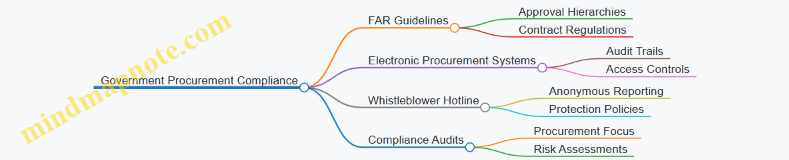
Additional Tips for Accountants and Fraud Examiners
- Stay updated with regulatory changes through newsletters, webinars, and professional groups.
- Collaborate closely with legal and compliance teams to interpret regulations correctly.
- Document all compliance activities meticulously to provide evidence during audits or investigations.
- Foster a culture of compliance by leading through example and encouraging ethical behavior.
By integrating these compliance best practices, finance and government professionals can create a robust framework that not only prevents fraud but also promotes ethical and transparent operations.
9.3 Example: Implementing SOX Controls to Prevent Financial Statement Fraud
The Sarbanes-Oxley Act (SOX), enacted in 2002, is a critical regulatory framework designed to enhance corporate governance and strengthen internal controls over financial reporting. For accountants and fraud examiners, implementing SOX controls effectively is a powerful way to prevent financial statement fraud.
Understanding SOX Controls
SOX requires management and external auditors to establish and report on the adequacy of internal controls over financial reporting (ICFR). These controls help ensure the accuracy, completeness, and reliability of financial statements.
Key SOX Sections Relevant to Fraud Prevention:
- Section 302: Corporate responsibility for financial reports
- Section 404: Management assessment of internal controls
Mind Map: Core SOX Controls to Prevent Financial Statement Fraud
Practical Example: Implementing SOX Controls in a Mid-Sized Public Company
Scenario: A mid-sized public company wants to prevent financial statement fraud, such as revenue overstatement or expense understatement, which could mislead investors.
Step 1: Establish a Strong Control Environment
- The CFO and CEO publicly commit to ethical financial reporting.
- A code of conduct emphasizing zero tolerance for fraud is communicated company-wide.
Step 2: Conduct Risk Assessment
- Identify areas prone to manipulation, e.g., revenue recognition and expense accruals.
- Fraud examiners collaborate with management to evaluate fraud risks.
Step 3: Design and Implement Control Activities
- Segregation of Duties: Different employees handle invoice creation, approval, and payment.
- Authorization Controls: All journal entries above a certain threshold require dual approval.
- Reconciliations: Monthly bank reconciliations are performed by someone independent of cash handling.
- IT Controls: Access to the financial system is role-based, with periodic reviews.
Step 4: Information and Communication
- Establish a confidential whistleblower hotline for employees to report suspicious activities.
- Regular training sessions on fraud awareness and SOX compliance.
Step 5: Monitoring and Testing
- Internal audit performs quarterly testing of controls.
- Management reviews exceptions and investigates anomalies promptly.
Mind Map: Example Control Activity Workflow
Example: Detecting Financial Statement Fraud Through SOX Controls
Red Flag: Unusually large manual journal entries made at the end of a reporting period.
SOX Control Response:
- The control requiring dual approval for large journal entries triggers a review.
- Internal audit investigates and finds entries were made to inflate revenue.
- The fraud is detected early, preventing misleading financial statements.
Summary
Implementing SOX controls is not just about compliance but about embedding a culture of accountability and transparency. By following structured control frameworks, performing regular risk assessments, and maintaining vigilant monitoring, accountants and fraud examiners can significantly reduce the risk of financial statement fraud.
Additional Resources
- COSO Framework for Internal Controls
- PCAOB Auditing Standards on ICFR
- SOX Compliance Checklists and Templates
9.4 Working with Auditors and Regulators to Ensure Compliance
Ensuring compliance with regulatory requirements is a critical responsibility for accountants and fraud examiners, especially within the finance and government sectors. Collaborating effectively with auditors and regulators not only helps organizations avoid legal penalties but also strengthens internal controls and enhances fraud prevention efforts.
Key Aspects of Collaboration with Auditors and Regulators
-
Understanding Roles and Responsibilities
- Auditors assess financial statements and internal controls to provide independent assurance.
- Regulators enforce compliance with laws and regulations, conduct inspections, and may impose sanctions.
-
Open Communication and Transparency
- Establish clear communication channels.
- Share relevant documentation and findings promptly.
-
Preparation and Documentation
- Maintain organized records.
- Prepare responses to inquiries and requests efficiently.
-
Proactive Compliance Measures
- Implement recommendations from auditors and regulators.
- Conduct regular internal reviews.
Mind Map: Collaboration Workflow with Auditors and Regulators
Example 1: Implementing SOX Controls to Facilitate Auditor Collaboration
A mid-sized financial firm preparing for a Sarbanes-Oxley (SOX) compliance audit established a dedicated compliance team. This team maintained a centralized repository of all control documentation, including risk assessments and control testing results. During the audit, the team provided auditors with immediate access to documentation, reducing delays and demonstrating transparency.
Best Practice: Use centralized document management systems to streamline auditor requests and improve response times.
Mind Map: Key Documents for Auditor and Regulator Review
Example 2: Responding to Regulatory Inquiries in a Government Agency
A government agency faced a regulatory inquiry regarding procurement irregularities. The accounting team promptly assembled relevant purchase orders, approval workflows, and vendor contracts. They also prepared a detailed timeline of events and assigned a liaison to coordinate communication with the regulator.
Best Practice: Designate a single point of contact to manage regulator communications and ensure consistent messaging.
Tips for Effective Collaboration
- Be Proactive: Anticipate auditor and regulator needs by conducting internal mock audits.
- Maintain Accuracy: Ensure all financial data and control documentation are accurate and up-to-date.
- Train Staff: Educate employees on compliance requirements and the importance of cooperation.
- Document Everything: Keep detailed records of all communications and corrective actions.
Mind Map: Benefits of Effective Collaboration
By fostering a culture of transparency, preparedness, and continuous improvement, accountants and fraud examiners can build strong partnerships with auditors and regulators. This collaboration not only ensures compliance but also acts as a powerful deterrent against fraud and financial misconduct.
10. Building a Fraud-Resistant Organizational Culture
10.1 Leadership’s Role in Promoting Ethical Behavior
Leadership plays a pivotal role in shaping the ethical climate of any organization, especially within finance and government sectors where trust and integrity are paramount. Ethical behavior starts at the top, and leaders set the tone that influences every employee’s actions and decisions.
Why Leadership Matters in Ethics
- Leaders establish organizational values and culture.
- They model behavior that others emulate.
- Leadership commitment to ethics builds trust with stakeholders.
- Ethical leadership reduces the risk of fraud and misconduct.
Key Responsibilities of Leaders in Promoting Ethics
- Set Clear Expectations: Communicate the importance of ethics and compliance clearly.
- Lead by Example: Demonstrate integrity in all actions.
- Establish Policies: Implement codes of conduct and ethical guidelines.
- Encourage Open Communication: Foster an environment where employees feel safe to report concerns.
- Provide Training and Resources: Ensure ongoing education on ethical issues.
- Enforce Accountability: Apply consistent consequences for unethical behavior.
Mind Map: Leadership’s Role in Promoting Ethical Behavior
Practical Examples
Example 1: CEO Modeling Ethical Behavior A government agency’s CEO openly discusses the importance of transparency during quarterly meetings, sharing examples of ethical dilemmas and how they were resolved. This openness encourages employees to prioritize ethics in their daily work.
Example 2: CFO Implementing a Code of Conduct The CFO of a finance firm introduces a detailed code of conduct that outlines acceptable behaviors and fraud prevention measures. The code is distributed to all employees and incorporated into onboarding and annual training sessions.
Example 3: Leadership Encouraging Whistleblowing A city’s finance director establishes an anonymous hotline for reporting unethical behavior and personally assures staff that no retaliation will occur. This initiative leads to early detection of a vendor kickback scheme.
Mind Map: Examples of Leadership Actions
Additional Tips for Leaders
- Regularly assess the ethical climate through surveys and feedback.
- Recognize and reward ethical behavior publicly.
- Stay informed about emerging ethical challenges in finance and government.
- Collaborate with fraud examiners to understand common risks and prevention strategies.
By embracing these leadership responsibilities, accountants and fraud examiners can foster an ethical culture that significantly reduces fraud risks and enhances organizational integrity.
10.2 Encouraging Transparency and Accountability
Transparency and accountability are foundational pillars for building a fraud-resistant organizational culture. When employees, management, and stakeholders operate in an environment where information flows openly and responsibilities are clearly defined, the opportunities for fraudulent activities diminish significantly. This section explores practical strategies, examples, and mind maps to help accountants and fraud examiners foster these values within their organizations.
Why Transparency and Accountability Matter
- Transparency ensures that processes, decisions, and financial data are visible and understandable to relevant parties.
- Accountability means individuals are responsible for their actions and decisions, which discourages unethical behavior.
Together, they create a culture where fraud is harder to conceal and easier to detect.
Mind Map: Core Elements of Transparency and Accountability
Best Practices to Encourage Transparency
-
Implement Open Financial Reporting:
- Share regular, clear financial statements with relevant departments and leadership.
- Example: A government agency publishes quarterly budget utilization reports accessible to all employees, reducing suspicion and promoting trust.
-
Establish Clear Communication Channels:
- Use town halls, newsletters, and intranet portals to keep employees informed about organizational changes and fraud prevention efforts.
- Example: A finance department holds monthly meetings where employees can ask questions about financial controls and policies.
-
Develop and Enforce a Code of Conduct:
- Clearly outline ethical expectations and procedures for reporting unethical behavior.
- Example: An accounting firm requires all employees to sign a code of ethics annually, reinforcing commitment to transparency.
-
Promote Whistleblower Protections:
- Create anonymous reporting systems and protect whistleblowers from retaliation.
- Example: A municipality implements a confidential hotline allowing employees to report suspicious activities without fear.
Best Practices to Foster Accountability
-
Define Roles and Responsibilities Clearly:
- Ensure every employee understands their duties and limits of authority.
- Example: An organization uses detailed job descriptions and delegation matrices to prevent overlapping responsibilities that could lead to fraud.
-
Regular Internal Audits and Reviews:
- Conduct periodic checks to verify compliance with policies and detect irregularities.
- Example: A finance department schedules quarterly surprise audits on expense reports to catch potential misuse.
-
Set Measurable Performance Indicators:
- Use KPIs related to compliance and ethical behavior.
- Example: An agency tracks the number of reported fraud incidents and resolution times as part of management performance reviews.
-
Enforce Consequences for Misconduct:
- Apply disciplinary actions consistently to reinforce accountability.
- Example: A government office publicly documents sanctions taken against employees found guilty of fraud, reinforcing a zero-tolerance culture.
Mind Map: Steps to Implement Transparency and Accountability
Real-World Example: Creating a Fraud Hotline and Its Impact
Context: A mid-sized public finance department faced recurring issues with expense reimbursement fraud. Employees were reluctant to report suspicious activities due to fear of retaliation and lack of anonymity.
Action: The department introduced an anonymous fraud hotline, combined with a clear anti-retaliation policy and awareness campaigns.
Outcome: Within six months, the hotline received multiple reports leading to the identification of fraudulent claims. The transparency of the process and accountability measures restored employee confidence, leading to a 40% reduction in fraudulent expense claims over the next year.
Summary
Encouraging transparency and accountability is not a one-time effort but an ongoing commitment. By implementing open communication, clear policies, defined responsibilities, and consistent enforcement, accountants and fraud examiners can significantly reduce fraud risks. The integration of these practices fosters a culture where ethical behavior thrives and fraudulent activities are swiftly identified and addressed.
10.3 Example: Creating a Fraud Hotline and Its Impact
A fraud hotline is a confidential reporting channel that allows employees, vendors, customers, and other stakeholders to report suspicious activities or unethical behavior anonymously or openly. Establishing a fraud hotline is a powerful tool in building a fraud-resistant organizational culture by encouraging transparency and early detection of fraudulent activities.
Why Create a Fraud Hotline?
- Provides a safe and confidential way to report concerns
- Encourages whistleblowing without fear of retaliation
- Enables early detection and prevention of fraud
- Demonstrates organizational commitment to ethical behavior
Key Components of an Effective Fraud Hotline
Step-by-Step Example: Implementing a Fraud Hotline in a Government Agency
-
Assessment and Planning
- Identify fraud risks and reporting needs
- Choose hotline provider (internal or external)
-
Design and Setup
- Establish multiple reporting channels (phone, online portal)
- Ensure anonymity and confidentiality features
-
Communication and Training
- Launch awareness campaigns with posters, emails, and meetings
- Train managers and staff on how to handle reports
-
Operation and Monitoring
- Assign a dedicated team to manage reports
- Track and document all complaints
-
Investigation and Resolution
- Investigate credible reports promptly
- Take corrective actions and report outcomes
-
Feedback and Improvement
- Provide feedback to reporters when possible
- Review hotline effectiveness regularly
Mind Map: Fraud Hotline Implementation Process
Impact of a Fraud Hotline: Real-World Examples
-
Example 1: City Government Fraud Hotline
- After launching a hotline, the city government saw a 40% increase in fraud reports within the first year.
- Early detection of a procurement fraud scheme saved the city over $500,000.
- Employee surveys showed increased trust in management and willingness to report unethical behavior.
-
Example 2: Financial Institution’s Anonymous Hotline
- Anonymous tips led to uncovering a complex embezzlement case involving multiple employees.
- The institution implemented stronger internal controls based on hotline findings.
- Hotline usage became a key metric in the organization’s annual risk assessment.
Best Practices for Maximizing Fraud Hotline Effectiveness
Summary
Creating a fraud hotline is more than just setting up a phone number or email address; it requires thoughtful planning, clear communication, and ongoing management. When implemented effectively, a fraud hotline empowers employees and stakeholders to act as the organization’s eyes and ears, significantly enhancing fraud detection and prevention efforts. The positive impact on organizational culture, trust, and financial integrity makes it an indispensable component of any comprehensive fraud prevention strategy.
10.4 Sustaining Long-Term Fraud Prevention Efforts
Sustaining long-term fraud prevention efforts is critical for organizations to maintain integrity, protect assets, and foster trust among stakeholders. Fraud prevention is not a one-time project but a continuous process that requires commitment, adaptability, and proactive management.
Key Strategies for Sustaining Fraud Prevention
-
Continuous Risk Assessment and Monitoring
- Fraud risks evolve over time; regular reassessment helps identify new vulnerabilities.
- Use data analytics and automated monitoring tools to detect unusual patterns early.
-
Ongoing Employee Training and Awareness
- Reinforce fraud awareness through periodic training sessions.
- Update training materials to reflect emerging fraud schemes.
-
Strong Organizational Culture and Leadership Commitment
- Leadership must consistently promote ethical behavior and zero tolerance for fraud.
- Encourage open communication and protect whistleblowers.
-
Regular Review and Enhancement of Internal Controls
- Controls should be tested and updated to address new risks.
- Incorporate feedback from audits and investigations.
-
Leveraging Technology and Innovation
- Adopt new fraud detection technologies such as AI and machine learning.
- Integrate systems for seamless data sharing and analysis.
-
Clear Policies and Procedures
- Maintain up-to-date fraud policies accessible to all employees.
- Ensure procedures are practical and enforced consistently.
Mind Map: Sustaining Long-Term Fraud Prevention Efforts
Example 1: Implementing a Fraud Prevention Committee
A mid-sized government agency established a dedicated Fraud Prevention Committee comprising members from finance, compliance, and internal audit departments. The committee meets quarterly to:
- Review recent fraud risk assessments
- Analyze incident reports and near misses
- Update fraud prevention policies
- Plan employee training sessions
This ongoing collaboration ensures that fraud prevention remains a priority and adapts to new challenges.
Example 2: Using Technology for Continuous Monitoring
A financial institution implemented an AI-powered fraud detection system that continuously scans transactions for anomalies. When suspicious activity is detected, alerts are sent to the fraud examination team for immediate investigation. This proactive approach has reduced fraud losses by 30% over two years.
Example 3: Cultivating a Speak-Up Culture
An accounting firm launched an anonymous whistleblower hotline and actively promoted it during training sessions. Employees were encouraged to report suspicious activities without fear of retaliation. Over time, the number of fraud-related tips increased, enabling early detection and prevention.
Mind Map: Example - Speak-Up Culture
Best Practices Summary
- Embed fraud prevention into daily operations rather than treating it as a separate function.
- Maintain leadership visibility and support for anti-fraud initiatives.
- Use data-driven approaches to stay ahead of emerging fraud risks.
- Foster an environment where employees feel responsible and empowered to act against fraud.
By integrating these strategies, organizations can build resilience against fraud and sustain prevention efforts effectively over the long term.
11. Case Studies and Real-World Examples
11.1 High-Profile Fraud Cases in the Finance Sector
Fraud in the finance sector has led to some of the most significant scandals in corporate history, shaking investor confidence and prompting regulatory reforms. Understanding these high-profile cases helps accountants and fraud examiners recognize warning signs and implement stronger controls.
Case Study 1: Enron Scandal (2001)
Overview: Enron, once a giant in the energy sector, used complex accounting loopholes and special purpose entities (SPEs) to hide debt and inflate profits.
Key Fraud Elements:
- Off-balance-sheet entities to hide liabilities
- Manipulation of earnings through mark-to-market accounting
- Lack of transparency in financial statements
Example: Enron reported profits from long-term contracts immediately rather than over the contract life, misleading stakeholders.
Lessons for Accountants:
- Scrutinize off-balance-sheet arrangements
- Verify revenue recognition policies
- Maintain skepticism over unusually consistent profits
Case Study 2: Bernie Madoff Ponzi Scheme (2008)
Overview: Bernie Madoff orchestrated the largest Ponzi scheme in history, defrauding investors of an estimated $65 billion.
Key Fraud Elements:
- Fabricated investment returns
- Fake account statements
- Lack of independent verification
Example: Madoff promised steady, high returns regardless of market conditions, which should have been a red flag.
Lessons for Accountants:
- Verify third-party confirmations
- Investigate unusually consistent returns
- Encourage due diligence and skepticism
Case Study 3: WorldCom Accounting Fraud (2002)
Overview: WorldCom inflated assets by capitalizing operating expenses, overstating earnings by $3.8 billion.
Key Fraud Elements:
- Capitalizing line costs instead of expensing them
- Manipulating reserves to smooth earnings
Example: Instead of recording routine expenses, WorldCom classified them as capital expenditures, artificially boosting profits.
Lessons for Accountants:
- Review expense classification carefully
- Analyze unusual changes in capital assets
- Monitor reserve accounts for manipulation
Mind Map: Common Themes in High-Profile Finance Frauds
Example: Detecting Red Flags in Financial Statements
Imagine you are reviewing a company’s quarterly report and notice:
- Revenues growing steadily at 15% every quarter despite market downturns.
- Significant increase in capital assets without corresponding cash outflows.
- Large related-party transactions disclosed vaguely.
Action: These signs warrant deeper investigation, such as verifying transactions, reviewing accounting policies, and consulting with auditors.
Mind Map: Fraud Detection Techniques Inspired by High-Profile Cases
Summary
High-profile fraud cases like Enron, Madoff, and WorldCom highlight the critical need for vigilance, strong internal controls, and ethical responsibility in accounting. By studying these examples, accountants and fraud examiners can better anticipate fraud schemes and protect their organizations from similar risks.
11.2 Government Fraud Scandals and Lessons Learned
Government fraud scandals have repeatedly highlighted vulnerabilities in public sector financial management and the critical need for robust fraud detection and prevention mechanisms. This section explores notable government fraud cases, the methods used to perpetrate fraud, and the lessons accountants and fraud examiners can draw to strengthen controls and ethical standards.
Notable Government Fraud Scandals
The Veterans Affairs (VA) Wait Time Scandal (2014)
- Overview: Manipulation of patient wait time data to hide delays in care.
- Fraud Method: Falsifying records and data to meet performance targets.
- Impact: Delayed medical care, loss of public trust, and congressional investigations.
The City of Bell, California Corruption Scandal (2010)
- Overview: City officials inflated their salaries and misused public funds.
- Fraud Method: Abuse of authority, falsified payroll records, and kickbacks.
- Impact: Criminal convictions, reforms in municipal governance.
The Operation Car Wash (Lava Jato) in Brazil
- Overview: Massive bribery and money laundering scheme involving government officials and contractors.
- Fraud Method: Collusion, bribery, and inflated contracts.
- Impact: Political upheaval, billions in lost public funds.
Mind Map: Common Elements in Government Fraud Scandals
Lessons Learned and Best Practices
Lesson 1: Importance of Transparent and Accurate Reporting
- Example: In the VA scandal, lack of transparent reporting enabled data manipulation.
- Best Practice: Implement automated reporting systems with audit trails to reduce manual data entry errors and manipulation.
Lesson 2: Segregation of Duties to Prevent Abuse of Authority
- Example: Bell, California officials exploited weak segregation of duties to approve inflated salaries.
- Best Practice: Ensure no single individual has control over all aspects of financial transactions, such as authorization, record-keeping, and reconciliation.
Lesson 3: Robust Vendor and Contract Management
- Example: Operation Car Wash involved collusion with contractors inflating contracts.
- Best Practice: Conduct thorough due diligence, regular audits, and competitive bidding processes for government contracts.
Lesson 4: Encouraging Whistleblower Reporting and Protection
- Example: Many frauds were uncovered after whistleblower reports.
- Best Practice: Establish confidential hotlines and protect whistleblowers from retaliation.
Mind Map: Fraud Prevention Strategies in Government
Example Scenario: Detecting Payroll Fraud in a Government Agency
- Situation: An accountant notices unusually high overtime payments in payroll reports.
- Action: Uses data analytics to identify patterns of repeated overtime by the same employees.
- Investigation: Cross-checks timesheets with project logs and finds falsified entries.
- Outcome: Fraud is reported, controls are tightened to require supervisor verification of overtime.
Summary
Government fraud scandals serve as critical reminders of the vulnerabilities within public sector financial systems. Accountants and fraud examiners must leverage lessons learned from these cases to implement strong internal controls, promote transparency, and foster an ethical culture. By integrating technology, encouraging whistleblower protections, and maintaining rigorous oversight, the risk of fraud can be significantly reduced, protecting public resources and maintaining trust.
11.3 Successful Fraud Prevention Programs: What Worked and Why
Fraud prevention programs are critical in safeguarding organizations, especially within finance and government sectors where the stakes are high. Successful programs share common elements that create a robust defense against fraudulent activities. This section explores key components of effective fraud prevention programs, supported by real-world examples and mind maps to visualize their structure and impact.
Key Components of Successful Fraud Prevention Programs
- Strong Internal Controls
- Employee Training and Awareness
- Whistleblower Mechanisms
- Data Analytics and Continuous Monitoring
- Leadership Commitment and Ethical Culture
Mind Map: Core Elements of a Successful Fraud Prevention Program
Example 1: Government Agency’s Payroll Fraud Prevention
A mid-sized government agency faced repeated payroll fraud incidents where ghost employees were receiving payments. They implemented a multi-layered prevention program:
- Internal Controls: Introduced mandatory biometric verification for payroll processing.
- Employee Training: Conducted quarterly workshops highlighting payroll fraud red flags.
- Whistleblower Hotline: Established an anonymous reporting system with guaranteed protection.
- Data Analytics: Used software to cross-check employee records against payroll data.
- Leadership Commitment: Senior management publicly endorsed anti-fraud policies.
Result: Payroll fraud incidents dropped by 85% within one year.
Mind Map: Payroll Fraud Prevention Program
Example 2: Financial Institution’s Expense Reimbursement Controls
A large financial institution struggled with expense reimbursement fraud, where employees submitted inflated or fictitious expenses. Their prevention program included:
- Internal Controls: Automated expense approval workflows requiring multi-level authorization.
- Employee Training: Interactive e-learning modules with real-life fraud scenarios.
- Whistleblower Policy: Clear communication about reporting channels and non-retaliation.
- Data Analytics: Pattern recognition algorithms flagged unusual expense claims.
- Culture: Leadership rewarded ethical behavior and transparency.
Result: Expense fraud cases reduced by 70% and employee awareness scores improved significantly.
Mind Map: Expense Reimbursement Fraud Prevention
Why These Programs Worked
- Holistic Approach: Combining controls, training, technology, and culture created multiple layers of defense.
- Employee Engagement: Regular training and clear communication empowered employees to recognize and report fraud.
- Leadership Involvement: Visible commitment from top management reinforced the importance of fraud prevention.
- Technology Utilization: Data analytics enabled early detection and reduced manual errors.
- Safe Reporting Environment: Whistleblower protections encouraged reporting without fear.
Summary Mind Map: Success Factors in Fraud Prevention Programs
By integrating these elements, organizations not only reduce fraud risk but also build a culture of integrity and accountability. Accountants and fraud examiners play a pivotal role in designing, implementing, and continuously improving these programs to adapt to evolving fraud threats.
11.4 Interactive Example: Analyzing a Fraud Scenario Step-by-Step
In this section, we will walk through a detailed fraud scenario to help accountants and fraud examiners understand how to analyze and detect fraud systematically. This interactive example integrates best practices with practical mind maps and real-world examples to enhance comprehension.
Scenario Overview
Company: GovTech Solutions (a government contractor)
Issue: Suspicious billing and expense reimbursement patterns have been flagged during a routine audit.
Objective: Identify potential fraud, analyze red flags, and outline investigation steps.
Step 1: Initial Detection and Red Flags Identification
Red Flags Identified:
- Repeated invoices just below the approval threshold.
- Duplicate expense claims from the same employee.
- Unusually high volume of vendor payments to a single supplier.
Mind Map: Red Flags Identification
Example: An employee submits multiple expense reports with identical receipts but different dates, raising suspicion of reimbursement fraud.
Step 2: Fraud Risk Assessment
Evaluate the likelihood and impact of the identified red flags.
Mind Map: Fraud Risk Assessment
Example: The employee responsible for approving expenses is also submitting claims, violating segregation of duties and increasing fraud risk.
Step 3: Data Analysis and Pattern Recognition
Use data analytics to detect anomalies and patterns.
Mind Map: Data Analysis Techniques
Example: Applying Benford’s Law reveals an unusual frequency of invoice amounts starting with the digit ‘9’, which is inconsistent with expected distributions.
Step 4: Investigation Planning
Outline steps to gather evidence and interview relevant parties.
Mind Map: Investigation Planning
Example: Collect all expense reports and cross-check with bank statements to verify payment authenticity.
Step 5: Conducting the Investigation
Perform interviews and analyze collected evidence.
Mind Map: Conducting Investigation
Example: Interview reveals the employee had unauthorized access to the approval system, confirming control weaknesses.
Step 6: Reporting and Remediation
Prepare a detailed report and recommend preventive measures.
Mind Map: Reporting and Remediation
Example: Implement mandatory dual approval for expense reimbursements and conduct fraud awareness training.
Summary Table: Step-by-Step Fraud Analysis
| Step | Action | Example |
|---|---|---|
| 1. Detection | Identify red flags | Duplicate expense claims |
| 2. Risk Assessment | Evaluate fraud likelihood and impact | Segregation of duties violation |
| 3. Data Analysis | Analyze data for anomalies | Benford’s Law anomaly detection |
| 4. Investigation Planning | Plan evidence collection and interviews | Collect financial records |
| 5. Conduct Investigation | Interview and analyze evidence | Employee unauthorized system access |
| 6. Reporting & Remediation | Document findings and improve controls | Dual approval implementation |
This interactive example demonstrates how accountants and fraud examiners can methodically approach fraud detection and prevention by combining analytical techniques, investigative procedures, and practical controls.
By following these steps and using the mind maps as guides, professionals can enhance their ability to uncover fraud early and protect their organizations effectively.
12. Future Trends in Fraud Detection and Prevention
12.1 Emerging Fraud Schemes and How to Prepare
As fraudsters continuously evolve their tactics, accountants and fraud examiners must stay ahead by understanding emerging fraud schemes and preparing effective countermeasures. This section explores some of the latest fraud trends, illustrated with mind maps and practical examples to help you recognize and combat these threats.
Emerging Fraud Schemes Mind Map
Cyber-Enabled Fraud
Example: A government agency receives an urgent email from a seemingly legitimate vendor requesting payment to a new bank account. This is a classic Business Email Compromise (BEC) scam.
How to Prepare:
- Implement multi-factor authentication for email and financial systems.
- Establish strict vendor payment verification protocols.
- Train employees to recognize phishing attempts.
Synthetic Identity Fraud
Example: Fraudsters create a synthetic identity by combining real Social Security numbers with fabricated personal information, then open multiple credit lines or government benefit accounts.
How to Prepare:
- Use advanced identity verification tools that cross-check multiple data sources.
- Monitor for unusual account activity or multiple accounts linked to similar identifiers.
Cryptocurrency Fraud
Example: An accountant is approached by a client investing in a new cryptocurrency ICO promising high returns. The ICO turns out to be a scam, and the client loses their investment.
How to Prepare:
- Educate clients about the risks of unregulated crypto investments.
- Stay informed about regulatory updates related to cryptocurrencies.
- Use blockchain analytics tools to verify transaction legitimacy.
Deepfake and AI-Driven Fraud
Example: A fraudster uses AI-generated voice technology to impersonate a CEO, instructing the finance team to transfer funds urgently.
How to Prepare:
- Establish verification protocols for unusual or urgent payment requests, such as callback procedures.
- Use voice authentication technologies where possible.
- Educate staff about the existence and risks of deepfake technology.
Supply Chain Fraud
Example: A fake vendor is created with a similar name to a legitimate supplier, submitting fraudulent invoices that get paid unknowingly.
How to Prepare:
- Maintain an approved vendor list with verified contact information.
- Conduct regular audits of vendor accounts and invoices.
- Implement segregation of duties in vendor setup and payment processing.
Insider Threats
Example: An employee manipulates accounting records to divert funds into a personal account.
How to Prepare:
- Use role-based access controls limiting employee permissions.
- Monitor transaction patterns for anomalies.
- Encourage a whistleblower policy and anonymous reporting channels.
Summary Mind Map: How to Prepare for Emerging Fraud Schemes
Final Thoughts
Emerging fraud schemes are increasingly sophisticated, blending technology and social engineering. Accountants and fraud examiners must adopt a proactive, layered defense approach combining technology, process controls, and continuous education. By understanding these emerging threats and preparing accordingly, professionals can significantly reduce the risk of financial loss and reputational damage.
Practical Tip: Schedule quarterly fraud awareness sessions that include the latest fraud trends and real-world examples to keep your team vigilant and informed.
12.2 The Growing Role of Big Data and Predictive Analytics
In recent years, the explosion of data availability and advances in computational power have transformed fraud detection and prevention strategies. Big Data and Predictive Analytics have become essential tools for accountants and fraud examiners, enabling them to uncover hidden patterns, predict fraudulent behavior, and respond proactively.
Understanding Big Data in Fraud Detection
Big Data refers to extremely large datasets that traditional data processing software cannot handle efficiently. These datasets come from diverse sources such as transaction records, emails, social media, logs, and more.
Key Characteristics of Big Data:
- Volume: Massive amounts of data generated daily.
- Velocity: Data streams in real-time or near real-time.
- Variety: Structured and unstructured data from multiple sources.
- Veracity: Data quality and trustworthiness.
Predictive Analytics Explained
Predictive analytics uses statistical algorithms, machine learning techniques, and historical data to forecast future outcomes. In fraud detection, it helps identify transactions or behaviors likely to be fraudulent before they cause damage.
Mind Map: Big Data and Predictive Analytics in Fraud Detection
Practical Examples
Example 1: Detecting Anomalous Transactions Using Predictive Models
An accounting team at a government agency implemented a predictive analytics model trained on historical transaction data. The model learned typical spending patterns and flagged transactions deviating significantly from these patterns.
- Scenario: A vendor invoice was submitted for an unusually high amount compared to previous invoices.
- Action: The system generated a risk score above the threshold, triggering an alert.
- Outcome: Investigation revealed an attempt to inflate invoice amounts, preventing financial loss.
Example 2: Behavioral Analytics to Identify Insider Fraud
By analyzing employee access logs, email metadata, and transaction approvals, predictive analytics identified unusual behavior such as accessing sensitive files outside working hours and approving atypical transactions.
- Scenario: An employee started approving vendor payments without usual supervisory oversight.
- Action: Predictive models flagged this behavior as high risk.
- Outcome: Early intervention uncovered a collusion scheme.
Mind Map: Predictive Analytics Workflow in Fraud Detection
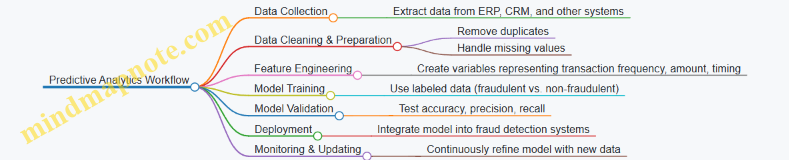
Benefits for Accountants and Fraud Examiners
- Proactive Fraud Prevention: Instead of reacting to fraud after it occurs, predictive analytics enables early detection.
- Efficiency: Automates the analysis of vast datasets, freeing up human resources for deeper investigations.
- Accuracy: Reduces false positives by learning nuanced patterns.
- Adaptability: Models evolve with emerging fraud trends.
Challenges and Considerations
- Data Quality: Poor data can lead to inaccurate predictions.
- Privacy Concerns: Handling sensitive data requires strict compliance with regulations.
- Skill Requirements: Accountants may need training in data science or collaboration with data analysts.
Conclusion
Big Data and Predictive Analytics are revolutionizing how accountants and fraud examiners detect and prevent fraud. By harnessing these technologies, finance and government sectors can protect assets more effectively, maintain public trust, and stay ahead of increasingly sophisticated fraud schemes.
12.3 Example: Predictive Models for Fraud Risk Scoring
Predictive models for fraud risk scoring leverage historical data and advanced analytics to estimate the likelihood that a transaction, account, or individual is involved in fraudulent activity. These models help accountants and fraud examiners prioritize investigations, allocate resources efficiently, and proactively prevent fraud.
What is a Predictive Fraud Risk Scoring Model?
A predictive fraud risk scoring model uses statistical techniques and machine learning algorithms to analyze patterns and behaviors associated with fraud. It assigns a risk score to each entity or transaction, indicating the probability of fraud.
Key Components of Predictive Fraud Risk Scoring
Step-by-Step Example: Building a Fraud Risk Scoring Model
-
Data Collection: Gather historical transaction data including both legitimate and confirmed fraudulent transactions. For example, a government finance department collects expense claims data.
-
Feature Engineering: Create variables such as:
- Frequency of transactions per user
- Average transaction amount
- Time of transaction (e.g., unusual hours)
- Vendor consistency
-
Model Selection: Choose a model suitable for classification, such as logistic regression for interpretability or random forest for accuracy.
-
Training the Model: Split the data into training and testing sets. Train the model on the training set to learn patterns.
-
Risk Scoring: Apply the model to new transactions to assign a fraud risk score (e.g., 0 to 1 scale).
-
Threshold Setting: Define a cutoff score above which transactions are flagged for review.
-
Monitoring: Continuously evaluate model performance and update with new data.
Example Scenario: Expense Reimbursement Fraud
- Background: An accountant notices an unusual spike in expense claims.
- Data Points: Claims amount, frequency, vendor names, submission time.
- Model Application: The predictive model flags claims with high risk scores.
- Outcome: Fraudulent claims are identified early, saving the organization significant costs.
Mind Map: Predictive Model Workflow for Fraud Risk Scoring
Practical Tips for Accountants and Fraud Examiners
- Collaborate with data scientists to understand model assumptions.
- Use risk scores as a guide, not a definitive judgment.
- Combine predictive scoring with traditional red flag analysis.
- Regularly review and recalibrate models to adapt to evolving fraud tactics.
Summary
Predictive models for fraud risk scoring empower finance professionals to detect fraud more efficiently by quantifying risk based on data-driven insights. By integrating these models into fraud prevention frameworks, accountants and fraud examiners can enhance their ability to protect organizational assets and maintain public trust.
12.4 Preparing Accountants and Fraud Examiners for Future Challenges
As fraud schemes evolve with advancing technology and changing business environments, accountants and fraud examiners must proactively prepare to face these emerging challenges. This section explores strategies, skills, and mindsets essential for staying ahead in fraud detection and prevention.
Embracing Continuous Learning and Skill Development
Fraud detection is a dynamic field requiring ongoing education. Professionals should commit to continuous learning through certifications, workshops, webinars, and industry updates.
Example: An accountant regularly attends webinars on the latest cyber fraud trends and completes certifications such as Certified Fraud Examiner (CFE) to sharpen investigative skills.
Developing Technological Proficiency
The increasing use of AI, machine learning, and blockchain in finance demands that fraud professionals become comfortable with these technologies.
Example: A fraud examiner learns to use AI-powered analytics tools that automatically flag suspicious transactions, improving detection speed and accuracy.
Enhancing Analytical and Critical Thinking Skills
Future fraud schemes may be more sophisticated and subtle. Developing strong analytical and critical thinking skills helps professionals identify anomalies and patterns that are not immediately obvious.
Example: An accountant uses data visualization to uncover unusual vendor payment patterns that traditional audits missed.
Fostering Collaboration and Communication
Fraud prevention is a team effort involving multiple departments and external agencies. Effective communication and collaboration skills are vital.
Example: A fraud examiner coordinates with IT, legal, and compliance teams to investigate a suspected data breach linked to financial fraud.
Mind Map: Preparing for Future Fraud Challenges
Ethical Vigilance and Adaptability
As fraud tactics evolve, maintaining a strong ethical foundation and adaptability is crucial to respond effectively and uphold public trust.
Example: An accountant faces pressure to overlook irregularities but chooses to escalate the issue, demonstrating ethical vigilance.
Practical Steps to Prepare
- Stay Updated: Subscribe to fraud-related newsletters and regulatory updates.
- Invest in Technology: Advocate for and learn to use advanced fraud detection software.
- Network: Join professional organizations such as the Association of Certified Fraud Examiners (ACFE).
- Scenario Planning: Regularly conduct fraud risk scenario exercises to anticipate new threats.
Mind Map: Practical Preparation Steps
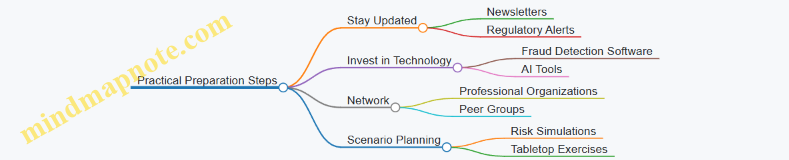
Final Example: Scenario Planning in Action
A government finance team conducts a tabletop exercise simulating a ransomware attack combined with fraudulent invoice submissions. Through this exercise, accountants and fraud examiners identify gaps in their response protocols and update controls accordingly, enhancing readiness for real-world incidents.
By embracing these strategies and mindsets, accountants and fraud examiners will be well-equipped to anticipate, detect, and prevent future fraud challenges effectively.
13. Conclusion and Action Plan
13.1 Summary of Key Best Practices and Takeaways
Fraud detection and prevention is a multifaceted discipline that requires vigilance, structured processes, and continuous improvement. For accountants and fraud examiners in finance and government sectors, mastering these best practices is essential to safeguarding organizational assets and maintaining public trust.
Key Best Practices Mind Map
Summary of Takeaways with Examples
-
Conduct Thorough Fraud Risk Assessments
- Regularly evaluate areas vulnerable to fraud.
- Example: A government agency identified payroll as a high-risk area after noticing unusual overtime claims, prompting targeted audits that uncovered ghost employees.
-
Implement Strong Internal Controls
- Segregate duties to prevent single points of failure.
- Example: Separating invoice approval from payment processing prevented a finance team member from creating fake vendor payments.
-
Leverage Data Analytics and Detection Tools
- Use tools like Benford’s Law to detect anomalies.
- Example: An accountant applied Benford’s Law to expense reports and flagged suspiciously uniform amounts, leading to discovery of inflated reimbursements.
-
Follow Rigorous Investigation Protocols
- Collect evidence systematically and conduct interviews professionally.
- Example: A fraud examiner used structured interviews and documented findings meticulously, enabling successful prosecution of asset misappropriation.
-
Maintain High Ethical Standards
- Protect whistleblowers and manage conflicts of interest.
- Example: A public sector organization implemented anonymous reporting channels, resulting in increased fraud disclosures without retaliation.
-
Invest in Continuous Training and Awareness
- Use role-playing and scenario-based training to enhance detection skills.
- Example: After conducting quarterly fraud awareness workshops, a finance department saw a 30% increase in early fraud reporting.
-
Adopt Emerging Technologies
- Integrate AI and blockchain to improve detection and prevention.
- Example: An accounting firm used AI to monitor transaction patterns in real-time, identifying unusual vendor payments instantly.
-
Ensure Regulatory Compliance
- Align fraud prevention efforts with laws like SOX and FCPA.
- Example: Implementing SOX controls helped a corporation avoid penalties by preventing financial statement manipulation.
-
Foster a Fraud-Resistant Culture
- Leadership must champion transparency and accountability.
- Example: Establishing a fraud hotline and promoting ethical behavior reduced fraud incidents by 40% over two years.
Integrated Mind Map: From Detection to Prevention
By embedding these best practices into daily workflows, accountants and fraud examiners can build resilient systems that not only detect fraud early but also deter potential perpetrators effectively. Continuous learning, leveraging technology, and fostering an ethical environment remain the cornerstones of successful fraud prevention strategies.
13.2 Developing a Personalized Fraud Prevention Strategy
Developing a personalized fraud prevention strategy is essential for accountants and fraud examiners to effectively safeguard their organizations against evolving fraud risks. A tailored approach considers the unique operational environment, risk profile, and resources of the organization, enabling more precise detection and prevention.
Step 1: Understand Your Organization’s Fraud Risk Landscape
- Conduct a thorough risk assessment considering industry-specific threats, organizational size, and internal processes.
- Identify vulnerable areas such as cash handling, procurement, payroll, and financial reporting.
Example: A government agency might prioritize risks related to grant disbursement fraud, while a finance company might focus on investment fraud schemes.
Step 2: Define Clear Objectives and Scope
- Establish what the fraud prevention strategy aims to achieve (e.g., reduce incidents by X%, improve detection time).
- Determine the scope: which departments, processes, or transaction types will be covered.
Example: An accountant in a mid-sized firm sets an objective to implement controls in accounts payable and expense reimbursements within six months.
Step 3: Design and Implement Controls Based on Risk Prioritization
- Prioritize controls where the highest risks exist.
- Use a mix of preventive, detective, and corrective controls.
Mind Map: Designing Controls
Example: Implementing mandatory dual approvals for vendor payments above a certain threshold to prevent unauthorized disbursements.
Step 4: Leverage Technology and Data Analytics
- Integrate fraud detection software and data analytics tools customized to your organization’s transaction patterns.
- Automate monitoring of high-risk transactions.
Mind Map: Technology Integration
Example: Using AI-powered software to flag unusual vendor invoice amounts compared to historical data.
Step 5: Develop Training and Awareness Programs
- Tailor training content to address specific fraud risks identified.
- Include real-life examples relevant to the organization’s sector.
Example: A government finance team receives scenario-based training on detecting fictitious vendor schemes.
Step 6: Establish Reporting Mechanisms and Whistleblower Protections
- Create confidential channels for employees to report suspicious activities.
- Ensure protections to encourage reporting without fear of retaliation.
Example: Launching an anonymous fraud hotline with clear communication about confidentiality.
Step 7: Monitor, Review, and Adapt the Strategy
- Regularly review the effectiveness of controls and update the strategy based on new risks or incidents.
- Use feedback loops and audit results to refine processes.
Mind Map: Continuous Improvement Cycle
Example: After detecting a new fraud pattern, the finance department updates its monitoring rules and retrains staff accordingly.
Summary Example: Personalized Fraud Prevention Strategy for a Finance Department
By following these steps and continuously adapting, accountants and fraud examiners can build a robust, personalized fraud prevention strategy that aligns with their organization’s unique needs and challenges.
13.3 Resources and Tools for Ongoing Fraud Detection
Fraud detection is an ongoing process that requires accountants and fraud examiners to stay equipped with the latest resources and tools. Leveraging these effectively can significantly enhance the ability to identify and prevent fraudulent activities early. Below, we explore a comprehensive set of resources and tools, accompanied by mind maps and practical examples to illustrate their application.
Key Resources for Fraud Detection
-
Professional Organizations & Certifications
- Association of Certified Fraud Examiners (ACFE)
- Institute of Internal Auditors (IIA)
- Certified Fraud Examiner (CFE) Certification
- Certified Public Accountant (CPA) with Fraud Specialization
-
Regulatory Guidelines and Frameworks
- COSO Framework for Internal Controls
- Sarbanes-Oxley Act (SOX) Compliance Guidelines
- Government Accountability Office (GAO) Fraud Risk Management
-
Educational Platforms and Publications
- ACFE’s Fraud Magazine and Research Reports
- Online courses on fraud analytics (Coursera, Udemy)
- Webinars and workshops on emerging fraud trends
Essential Tools for Fraud Detection
-
Data Analytics Software
- ACL Analytics
- IDEA Data Analysis Software
- Tableau for Visualization
-
Fraud Detection Algorithms and Techniques
- Benford’s Law Analysis
- Anomaly Detection Algorithms
- Machine Learning Models for Pattern Recognition
-
Case Management and Investigation Tools
- CaseWare Working Papers
- i-Sight Case Management
-
Whistleblower and Reporting Systems
- EthicsPoint
- NAVEX Global Hotline
Mind Map: Fraud Detection Resources Overview
Mind Map: Fraud Detection Tools Breakdown
Practical Example 1: Using ACL Analytics to Detect Duplicate Payments
An accountant at a government agency used ACL Analytics to scan thousands of vendor invoices. By setting filters to identify duplicate invoice numbers and matching amounts, the software flagged several suspicious transactions. Upon investigation, it was discovered that a vendor was submitting duplicate invoices, resulting in overpayments. This early detection saved the agency thousands of dollars.
Practical Example 2: Applying Benford’s Law in Financial Statement Review
A fraud examiner applied Benford’s Law to analyze the distribution of leading digits in the expense reports of a finance department. The expected distribution did not match the actual data, revealing irregularities. Further investigation uncovered fabricated expenses submitted by an employee. This simple statistical tool helped uncover fraud that manual review missed.
Mind Map: Steps to Implement Fraud Detection Tools
Additional Tips for Ongoing Fraud Detection
- Regularly update software tools to leverage new features and security patches.
- Participate in fraud examiner forums and discussion groups to stay informed about emerging fraud schemes.
- Establish a cross-functional fraud detection team including IT, finance, and compliance experts.
- Use dashboards and real-time monitoring to track key fraud indicators continuously.
By integrating these resources and tools into daily workflows, accountants and fraud examiners can create a robust, proactive fraud detection environment that adapts to evolving threats and protects organizational assets effectively.
13.4 Encouraging Continuous Learning and Adaptation
In the rapidly evolving landscape of fraud detection and prevention, continuous learning and adaptation are essential for accountants and fraud examiners to stay ahead of emerging threats. Fraud schemes grow more sophisticated with advances in technology, regulatory changes, and shifting organizational environments. This section explores strategies to foster a culture of ongoing education and flexibility, supported by practical examples and mind maps to visualize key concepts.
Why Continuous Learning Matters
- Evolving Fraud Techniques: Fraudsters constantly develop new methods, requiring professionals to update their knowledge regularly.
- Regulatory Updates: Laws and compliance requirements change frequently, necessitating ongoing education.
- Technological Advancements: New tools like AI, blockchain, and data analytics demand new skills.
- Organizational Changes: Shifts in business processes or personnel can create new fraud risks.
Example: An accountant who regularly attends fraud seminars and completes certifications like CFE (Certified Fraud Examiner) is more likely to detect subtle anomalies in financial data that others might miss.
Strategies to Encourage Continuous Learning
- Establish a Learning Culture: Promote the value of knowledge sharing and curiosity within teams.
- Regular Training Programs: Schedule quarterly workshops or webinars on fraud trends and tools.
- Access to Resources: Provide subscriptions to industry journals, online courses, and fraud databases.
- Mentorship and Peer Learning: Pair less experienced staff with seasoned fraud examiners.
- Incorporate Learning into Performance Metrics: Recognize and reward ongoing education efforts.
- Encourage Experimentation: Allow staff to pilot new fraud detection technologies or methodologies.
Example: A government finance department implemented monthly “Fraud Fridays” where employees discuss recent fraud cases and share insights, resulting in a 25% increase in fraud detection rates over a year.
Mind Map: Continuous Learning Framework for Fraud Prevention
Adapting to Change: Practical Approaches
- Scenario Planning: Regularly simulate fraud scenarios to test response readiness.
- Feedback Mechanisms: Collect input from staff on training effectiveness and fraud detection challenges.
- Technology Upgrades: Stay current with software updates and emerging analytical tools.
- Policy Reviews: Periodically reassess internal controls and compliance policies.
Example: An accounting team used quarterly fraud simulation exercises to identify gaps in their detection process, leading to the implementation of a new automated anomaly detection system.
Mind Map: Adaptation Cycle in Fraud Prevention
Example: Continuous Learning in Action
Case: A municipal finance office noticed an increase in suspicious vendor payments. Instead of reacting solely to the incidents, they launched a continuous learning initiative:
- Conducted monthly fraud awareness sessions highlighting recent fraud schemes.
- Subscribed to fraud intelligence feeds and shared summaries with the team.
- Encouraged staff to obtain fraud-related certifications.
- Piloted AI-based transaction monitoring software.
- Created a feedback loop where employees could anonymously suggest improvements.
Outcome: Within 12 months, fraudulent payments dropped by 40%, and employee engagement in fraud prevention activities significantly increased.
Summary
Encouraging continuous learning and adaptation is not a one-time effort but an ongoing commitment. By fostering a culture that values education, collaboration, and innovation, accountants and fraud examiners can enhance their ability to detect and prevent fraud effectively. Utilizing structured frameworks and real-world examples helps embed these practices into daily operations, ensuring resilience against evolving fraud threats.