Forensic Accounting Techniques
1. Introduction to Forensic Accounting
1.1 Definition and Scope of Forensic Accounting
Forensic accounting is a specialized field of accounting that combines accounting, auditing, and investigative skills to examine financial records and transactions for use in legal proceedings. It involves the application of accounting principles and techniques to detect, investigate, and prevent fraud, embezzlement, money laundering, and other financial crimes.
Definition
Forensic Accounting can be defined as:
“The integration of accounting, auditing, and investigative skills to analyze financial information suitable for use in a court of law or legal dispute resolution.”
This discipline serves as a bridge between accounting and the legal system, providing critical insights and evidence that help resolve disputes, support litigation, and uncover financial misconduct.
Scope of Forensic Accounting
The scope of forensic accounting is broad and multifaceted, covering various activities and responsibilities. Below is a mind map illustrating the key areas within the scope:
Examples to Illustrate Scope
Example 1: Fraud Detection in a Corporate Setting A forensic accountant is hired to investigate suspected payroll fraud in a mid-sized company. By analyzing payroll records, timesheets, and employee data, the accountant uncovers ghost employees being paid salaries. This example shows forensic accounting’s role in fraud detection and investigative accounting.
Example 2: Litigation Support in Divorce Proceedings In a high-net-worth divorce case, forensic accountants analyze financial statements and hidden assets to ensure equitable division of property. They provide expert testimony in court, demonstrating the litigation support aspect.
Example 3: Money Laundering Investigation A forensic accountant works with law enforcement to trace illicit funds through complex transactions involving shell companies and offshore accounts. This highlights the investigative accounting and digital forensics scope.
Mind Map: Forensic Accounting Roles and Responsibilities
Summary
Forensic accounting is an essential discipline that supports the detection, investigation, and prevention of financial crimes. Its scope spans fraud detection, litigation support, regulatory compliance, digital forensics, and advisory services. By combining accounting expertise with investigative techniques, forensic accountants play a pivotal role in upholding financial integrity and supporting the legal system.
This foundational understanding sets the stage for exploring specific forensic accounting techniques and best practices in subsequent sections.
1.2 The Role of Forensic Accountants in Finance and Legal Sectors
Forensic accountants play a critical role at the intersection of finance and law, using their accounting expertise to investigate financial discrepancies, detect fraud, and provide litigation support. Their work helps organizations, legal teams, and regulatory bodies uncover financial misconduct and resolve disputes effectively.
Key Responsibilities of Forensic Accountants
- Fraud Detection and Investigation: Identifying fraudulent activities such as embezzlement, asset misappropriation, and financial statement manipulation.
- Litigation Support: Assisting legal professionals by preparing financial evidence, reports, and expert testimony for court cases.
- Dispute Resolution: Analyzing financial data to resolve disputes in areas like bankruptcy, divorce settlements, and business valuations.
- Regulatory Compliance: Ensuring organizations comply with financial regulations and helping investigate regulatory breaches.
- Risk Assessment: Evaluating internal controls and recommending improvements to prevent future fraud.
Mind Map: Core Roles of Forensic Accountants
Example 1: Fraud Detection in a Corporate Setting
A forensic accountant was hired by a mid-sized company suspecting payroll fraud. By analyzing payroll records and employee attendance data, the accountant identified ghost employees on the payroll. The investigation revealed that a payroll manager was creating fake employee profiles and diverting salaries to personal accounts. The forensic accountant compiled the evidence, which was then used by the legal team to prosecute the offender.
Mind Map: Payroll Fraud Investigation Process
Example 2: Litigation Support in Divorce Proceedings
In a high-net-worth divorce case, a forensic accountant was engaged to uncover hidden assets. By scrutinizing bank statements, tax returns, and business financials, the accountant discovered undisclosed offshore accounts. This evidence was crucial in ensuring a fair division of assets during the legal proceedings.
Mind Map: Forensic Accounting in Divorce Cases
Integration with Legal Teams
Forensic accountants often work closely with lawyers, auditors, law enforcement, and regulatory agencies. Their ability to translate complex financial data into clear, understandable reports and testimony makes them invaluable in legal contexts.
Best Practices for Forensic Accountants in Finance and Legal Sectors
- Maintain objectivity and independence throughout investigations.
- Ensure thorough documentation and chain of custody for all evidence.
- Stay updated on relevant laws, regulations, and accounting standards.
- Develop strong communication skills to effectively liaise with legal professionals.
- Use technology and data analytics tools to enhance investigative efficiency.
By fulfilling these roles and adhering to best practices, forensic accountants help uphold financial integrity and support justice in both finance and legal sectors.
1.3 Key Differences Between Forensic Accounting and Traditional Accounting
Forensic accounting and traditional accounting are two distinct branches within the accounting profession, each serving different purposes, employing different techniques, and targeting different audiences. Understanding these differences is crucial for accountants, especially those transitioning into or collaborating with forensic accounting professionals.
Purpose and Objective
- Traditional Accounting: Focuses on recording, classifying, and summarizing financial transactions to prepare financial statements that reflect the financial position and performance of an entity.
- Forensic Accounting: Involves investigating financial records and transactions to detect fraud, embezzlement, or financial misconduct, often for legal proceedings.
Mind Map: Purpose and Objective
Scope of Work
- Traditional Accounting: Routine tasks such as bookkeeping, preparing balance sheets, income statements, and tax returns.
- Forensic Accounting: Detailed examination of financial data, tracing illicit transactions, reconstructing financial records, and providing expert testimony.
Mind Map: Scope of Work
Techniques and Tools
- Traditional Accounting: Uses standard accounting software and follows Generally Accepted Accounting Principles (GAAP).
- Forensic Accounting: Employs specialized investigative techniques such as data mining, Benford’s Law, digital forensics, and interviews.
Mind Map: Techniques and Tools
Reporting and Audience
- Traditional Accounting: Reports are prepared for management, investors, tax authorities, and regulators.
- Forensic Accounting: Reports are tailored for legal professionals, courts, and sometimes law enforcement agencies, often requiring clarity for non-accountants.
Mind Map: Reporting and Audience
Example 1: Detecting Payroll Fraud
- In traditional accounting, payroll is processed and recorded regularly to ensure employees are paid correctly.
- In forensic accounting, an investigation might reveal “ghost employees” on the payroll, where payments are made to fictitious individuals. The forensic accountant would trace the payments, verify employee records, and gather evidence for legal action.
Example 2: Financial Statement Preparation vs. Fraud Investigation
- A traditional accountant prepares quarterly financial statements following GAAP.
- A forensic accountant investigates unusual fluctuations in revenue or expenses that may indicate manipulation or fraud, such as fictitious sales or hidden liabilities.
Summary Table
| Aspect | Traditional Accounting | Forensic Accounting |
|---|---|---|
| Purpose | Financial reporting and compliance | Fraud detection and legal investigation |
| Scope | Routine bookkeeping and reporting | Investigative analysis and evidence gathering |
| Techniques | Standard accounting principles and software | Data analytics, interviews, digital forensics |
| Reporting Audience | Management, investors, regulators | Legal professionals, courts, law enforcement |
| Outcome | Financial statements, tax returns | Expert reports, legal testimony |
By understanding these key differences, accountants can better appreciate the specialized skills forensic accounting demands and how it complements traditional accounting practices in safeguarding financial integrity.
1.4 Overview of Common Fraud Types Encountered
Forensic accountants frequently encounter a variety of fraud types during investigations. Understanding these fraud types is essential for identifying suspicious activities and applying the right investigative techniques. Below is a detailed overview of the most common fraud types, accompanied by mind maps and practical examples to illustrate each.
Asset Misappropriation
Asset misappropriation is the most common type of fraud and involves employees stealing or misusing an organization’s resources.
- Examples: Theft of cash, fraudulent disbursements, payroll fraud, inventory theft.
Asset Misappropriation
├── Cash Theft
│   ├── Skimming
│   └── Larceny
├── Fraudulent Disbursements
│   ├── Billing Schemes
│   ├── Payroll Fraud
│   └── Expense Reimbursement Fraud
└── Inventory Theft
    ├── Misuse of Assets
    └── Theft of Supplies
Example: An accounts payable clerk creates fake vendor invoices and approves payments to a shell company they control.
Financial Statement Fraud
This involves intentional misrepresentation or omission of financial information to deceive stakeholders.
- Examples: Overstating revenues, understating expenses, improper asset valuation.
Financial Statement Fraud
├── Revenue Recognition Fraud
│   ├── Recording Fake Sales
│   └── Premature Revenue Recognition
├── Expense Manipulation
│   ├── Capitalizing Expenses
│   └── Delaying Expense Recognition
└── Asset Overstatement
    ├── Inflated Inventory
    └── Overvalued Fixed Assets
Example: A company records sales before delivery to boost quarterly revenue figures.
Corruption
Corruption schemes involve employees abusing their position for personal gain.
- Examples: Bribery, kickbacks, conflicts of interest, illegal gratuities.
Corruption
├── Bribery
│   ├── Offering Bribes
│   └── Receiving Bribes
├── Kickbacks
│   ├── Vendor Kickbacks
│   └── Employee Kickbacks
├── Conflicts of Interest
└── Illegal Gratuities
Example: A purchasing manager accepts kickbacks from a supplier in exchange for awarding contracts.
Payroll Fraud
Payroll fraud occurs when employees manipulate payroll systems to receive unearned compensation.
- Examples: Ghost employees, falsified hours, inflated overtime.
Payroll Fraud
├── Ghost Employees
├── Falsified Hours
└── Inflated Overtime
Example: An HR employee adds a fictitious employee to the payroll and collects their salary.
Expense Reimbursement Fraud
Employees submit false or inflated expense reports to receive unauthorized reimbursements.
- Examples: Submitting receipts for personal expenses, inflating mileage claims.
Expense Reimbursement Fraud
├── Falsified Receipts
├── Inflated Mileage
└── Duplicate Claims
Example: An employee submits a receipt for a personal dinner as a business meal.
Check and Payment Fraud
Fraud involving unauthorized or altered payments.
- Examples: Forged signatures, altered payee names, duplicate payments.
Check and Payment Fraud
├── Forged Signatures
├── Altered Payee
└── Duplicate Payments
Example: An employee alters the payee name on a company check to their own name.
Summary Mind Map
By familiarizing themselves with these fraud types and their typical characteristics, forensic accountants can better detect anomalies and apply targeted investigative techniques. Each fraud type requires a tailored approach, often combining data analysis, interviews, and document examination to uncover the truth.
1.5 Best Practices: Establishing a Forensic Mindset with Real-World Examples
Establishing a forensic mindset is fundamental for forensic accountants to effectively detect, investigate, and prevent financial fraud. This mindset involves a combination of skepticism, analytical thinking, attention to detail, and ethical integrity. Below, we explore best practices to cultivate this mindset, supported by illustrative mind maps and real-world examples.
Key Components of a Forensic Mindset
Best Practice 1: Cultivate Healthy Skepticism
- Description: Always question the validity of financial data and statements. Avoid taking information at face value.
- Example: In a mid-sized manufacturing company, a forensic accountant noticed unusually consistent profit margins despite market fluctuations. Instead of accepting the reports, they dug deeper and uncovered manipulated sales figures designed to meet quarterly targets.
Best Practice 2: Develop Strong Analytical Thinking
- Description: Use analytical tools and techniques to identify patterns, trends, and irregularities.
- Example: During an audit of a retail chain, the forensic accountant applied ratio analysis and noticed an abnormal increase in inventory turnover. Further investigation revealed fictitious sales entries to inflate revenue.
Best Practice 3: Maintain Rigorous Attention to Detail
- Description: Small discrepancies can be clues to larger fraud schemes.
- Example: In a government contract review, a forensic accountant found minor inconsistencies in invoice dates and approval signatures. These details led to uncovering a kickback scheme involving multiple vendors.
Best Practice 4: Uphold Ethical Integrity
- Description: Objectivity and confidentiality are paramount to maintain credibility.
- Example: A forensic accountant was pressured by management to overlook suspicious transactions. By adhering to ethical standards and reporting the findings to the audit committee, they prevented potential legal repercussions.
Best Practice 5: Enhance Communication Skills
- Description: Clearly presenting findings and interviewing effectively are critical.
- Example: In a fraud investigation, the forensic accountant used clear, jargon-free reports and visual aids to explain complex financial manipulations to the legal team, facilitating successful prosecution.
Summary
Establishing a forensic mindset is not just about technical skills but also about adopting a holistic approach that combines skepticism, analytical rigor, attention to detail, ethical behavior, and effective communication. By integrating these best practices, forensic accountants can significantly enhance their ability to uncover fraud and support legal processes.
Additional Real-World Example: Detecting Expense Reimbursement Fraud
A forensic accountant was tasked with reviewing employee expense reports at a large corporation. By applying skepticism and attention to detail, they identified multiple reports with duplicate receipts and inconsistent mileage claims. Using analytical tools, they mapped patterns of repeated submissions by a single employee. Through careful interviewing and documentation, the fraud was confirmed, leading to corrective actions and policy improvements.
2. Understanding Financial Fraud Schemes
2.1 Asset Misappropriation Techniques and Detection
Asset misappropriation is the most common type of occupational fraud, involving the theft or misuse of an organization’s assets. Forensic accountants must be adept at recognizing the various techniques perpetrators use and applying effective detection methods.
Common Asset Misappropriation Techniques
-
Cash Theft
- Skimming (taking cash before it is recorded)
- Larceny (stealing cash after it is recorded)
- Fraudulent disbursements (false payments, forged checks)
-
Inventory Theft
- Stealing physical inventory
- Manipulating inventory records
-
Payroll Fraud
- Ghost employees
- Falsified hours or wages
-
Expense Reimbursement Fraud
- Inflated or fictitious expenses
-
Misuse of Company Assets
- Using company vehicles or equipment for personal use
Mind Map: Asset Misappropriation Techniques
Detection Techniques
-
Reconciliation and Analytical Review
- Regular bank reconciliations to detect discrepancies.
- Comparing inventory counts with recorded amounts.
- Analyzing payroll reports for unusual patterns.
-
Surprise Audits and Physical Inspections
- Conducting unannounced cash counts or inventory checks.
-
Data Analytics and Automated Monitoring
- Using software to flag duplicate payments, unusual vendor activity, or irregular expense claims.
-
Segregation of Duties
- Ensuring no single employee controls all aspects of a transaction.
-
Whistleblower Hotlines and Employee Reporting
- Encouraging anonymous reporting of suspicious activities.
Mind Map: Detection Techniques for Asset Misappropriation
Example 1: Detecting Skimming in a Retail Store
Scenario: A retail store manager notices that daily cash deposits are consistently lower than expected based on sales records.
Detection: A forensic accountant performs surprise cash counts and reconciles cash register totals with bank deposits. They identify a pattern where cash is removed before being recorded (skimming).
Best Practice: Implementing point-of-sale systems that automatically record sales and restrict cash access, combined with surprise audits, can reduce skimming risk.
Example 2: Identifying Ghost Employees in Payroll
Scenario: A company experiences unexplained increases in payroll expenses.
Detection: The forensic accountant reviews payroll records and cross-checks employee lists with HR records and physical attendance logs. They discover payments made to non-existent employees.
Best Practice: Regular audits of payroll against HR records and requiring biometric attendance can help detect and prevent ghost employee fraud.
Example 3: Expense Reimbursement Fraud
Scenario: An employee submits multiple expense reports with unusually high travel costs.
Detection: By analyzing expense reports, the forensic accountant identifies duplicate receipts and expenses for non-business-related activities.
Best Practice: Implementing automated expense management software with built-in validation rules and requiring original receipts can reduce fraudulent claims.
Summary
Asset misappropriation covers a wide range of fraudulent activities. Forensic accountants must combine traditional auditing techniques with modern data analytics and maintain a skeptical mindset. Regular monitoring, surprise checks, and strong internal controls are essential best practices to detect and prevent asset theft.
Remember: Early detection often relies on recognizing subtle red flags and anomalies before they escalate into significant losses.
2.2 Financial Statement Fraud: Methods and Indicators
Financial statement fraud involves the intentional misrepresentation or omission of financial information to deceive stakeholders, inflate company performance, or hide financial difficulties. This section explores common methods used to commit financial statement fraud, key indicators to detect it, and practical examples to illustrate these concepts.
Common Methods of Financial Statement Fraud
Financial statement fraud can take many forms. Understanding these methods is crucial for forensic accountants to identify and investigate suspicious activities.
Overstating Revenue
- Fictitious Sales: Recording sales that never occurred.
- Premature Revenue Recognition: Recognizing revenue before it is earned.
- Channel Stuffing: Shipping excess products to distributors to inflate sales figures temporarily.
Understating Expenses
- Capitalizing Expenses: Recording expenses as assets to defer recognition.
- Delaying Expense Recognition: Postponing expense recording to improve short-term profitability.
Manipulating Assets and Liabilities
- Inflating Asset Values: Overvaluing inventory, receivables, or fixed assets.
- Concealing Liabilities: Omitting or understating debts and obligations.
- Off-Balance Sheet Transactions: Using special purpose entities to hide liabilities.
Improper Disclosures
- Omitting Key Information: Leaving out material facts in financial statements.
- Misleading Notes: Providing deceptive explanations or incomplete disclosures.
Key Indicators of Financial Statement Fraud
Detecting financial statement fraud requires vigilance for certain red flags or indicators.
Financial Anomalies
- Unusual Revenue Growth: Revenue growth that significantly exceeds industry norms without clear justification.
- Inconsistent Cash Flows: Profits increasing while cash flows decline.
- Large Adjustments: Frequent or large year-end adjustments to earnings.
Accounting Irregularities
- Frequent Changes in Accounting Policies: Sudden shifts that affect reported earnings.
- Complex or Vague Disclosures: Financial statements that are difficult to understand or lack transparency.
Behavioral Indicators
- Management Pressure: Unrealistic performance targets or pressure on staff to meet numbers.
- Reluctance to Provide Information: Avoidance or delay in providing financial data.
External Signs
- Auditor Resignations: Sudden auditor changes may indicate disagreements.
- Regulatory Investigations: Public scrutiny or legal actions.
Practical Examples
Example 1: Fictitious Sales
A company reported a 25% increase in revenue in Q4 without a corresponding increase in cash collections. Upon investigation, it was found that the company recorded sales to fictitious customers to meet quarterly targets.
Example 2: Premature Revenue Recognition
A software firm recognized revenue upon signing contracts, despite services being delivered over the next 12 months. This inflated current period earnings, misleading investors.
Example 3: Concealing Liabilities
A manufacturing company used off-balance sheet entities to hide loans, making the balance sheet appear stronger. This was uncovered through detailed review of related party transactions.
Best Practices for Detection
- Cross-Verify Revenue with Cash Flows: Ensure revenue growth aligns with cash inflows.
- Analyze Accounting Policy Changes: Scrutinize the rationale and impact of changes.
- Review Disclosures Thoroughly: Look for inconsistencies or omissions.
- Conduct Ratio and Trend Analysis: Identify unusual patterns over time.
- Engage in Professional Skepticism: Question management explanations and seek corroborating evidence.
By integrating these methods and indicators with practical examples, forensic accountants can enhance their ability to detect and investigate financial statement fraud effectively.
2.3 Corruption and Bribery: Identification and Documentation
Corruption and bribery are pervasive issues that forensic accountants frequently encounter. These unethical practices undermine financial integrity and can lead to significant legal consequences for organizations and individuals involved. This section explores how to identify and document corruption and bribery effectively, integrating best practices and real-world examples.
Understanding Corruption and Bribery
- Corruption refers to the abuse of entrusted power for private gain.
- Bribery is a form of corruption involving offering, giving, receiving, or soliciting something of value to influence an action.
Common forms include kickbacks, facilitation payments, bid rigging, and conflicts of interest.
Identification Techniques
Mind Map: Key Indicators of Corruption and Bribery
Example: Detecting Kickbacks in Procurement
A forensic accountant noticed a supplier consistently winning contracts despite higher bids. Upon investigation, they found invoices with inflated prices and payments routed through a third-party company linked to a procurement manager. This indicated a kickback scheme.
Documentation Best Practices
Mind Map: Documentation Process for Corruption Cases
Example: Documenting a Bribery Investigation
During an investigation into suspected bribery, the forensic accountant collected bank statements showing unusual wire transfers, recorded interviews with whistleblowers, and preserved email chains discussing illicit payments. All evidence was cataloged with timestamps and access controls to maintain integrity.
Practical Tips for Identification and Documentation
- Cross-verify data sources: Compare financial records with emails, contracts, and third-party confirmations.
- Look for patterns: Repeated small payments or round figures can be red flags.
- Interview key personnel: Use open-ended questions to uncover inconsistencies.
- Maintain meticulous records: Proper documentation supports legal proceedings and strengthens findings.
Summary
Identifying and documenting corruption and bribery requires a combination of analytical skills, attention to detail, and adherence to legal standards. By recognizing key indicators and following rigorous documentation protocols, forensic accountants can uncover unethical practices and provide compelling evidence for prosecution or remediation.
Additional Example: Facilitation Payments
A multinational company suspected facilitation payments were made to expedite customs clearance. The forensic accountant analyzed payment records and found multiple small cash disbursements labeled as “miscellaneous expenses”. Interviews revealed employees were pressured to make these payments to avoid shipment delays. Proper documentation led to policy changes and enhanced controls.
2.4 Case Study: Detecting Payroll Fraud in a Mid-Sized Company
Overview
Payroll fraud is one of the most common types of asset misappropriation schemes in organizations. In this case study, we explore how a forensic accountant uncovered payroll fraud in a mid-sized company with approximately 200 employees.
Background
The company noticed an unusual increase in payroll expenses over several months without a corresponding increase in headcount or business activity. Management requested a forensic accounting investigation to identify potential irregularities.
Step 1: Initial Data Collection and Review
- Obtained payroll records for the last 12 months.
- Collected employee attendance logs and HR records.
- Reviewed bank statements related to payroll disbursements.
Step 2: Analytical Procedures
- Trend Analysis: Compared monthly payroll expenses against historical data and headcount.
- Variance Analysis: Identified departments with unusual payroll increases.
- Ratio Analysis: Calculated payroll expense per employee and compared with industry benchmarks.
Example: Trend Analysis Mind Map
Step 3: Detailed Payroll Data Examination
- Matched payroll records with HR data to verify active employees.
- Identified payments made to employees who had left the company.
- Checked for duplicate payments or ghost employees.
Example: Ghost Employee Detection Mind Map
Step 4: Interview and Evidence Gathering
- Interviewed HR and payroll staff to understand processes.
- Discovered weak internal controls in payroll authorization.
- Collected email communications and approval documents.
Step 5: Forensic Techniques Applied
- Benford’s Law: Applied to payroll amounts to detect unnatural distributions.
- Data Mining: Used software to identify duplicate bank account numbers and suspicious payment patterns.
Example: Benford’s Law Application Mind Map
Step 6: Findings and Recommendations
- Identified 3 ghost employees receiving combined payments of $45,000 over 6 months.
- Detected duplicate payments amounting to $12,000.
- Weaknesses in payroll authorization and reconciliation processes.
Best Practices Highlighted
- Regular reconciliation of payroll records with HR data.
- Implementation of segregation of duties in payroll processing.
- Use of analytical tools like Benford’s Law for continuous monitoring.
- Conducting surprise audits and employee verification.
Summary Mind Map of the Case Study
This case study demonstrates the importance of combining data analytics, detailed record examination, and investigative interviewing to detect payroll fraud effectively. By applying these forensic accounting techniques, accountants can safeguard company assets and enhance internal controls.
2.5 Best Practices: Using Red Flags to Identify Fraud Early
Identifying fraud early is crucial for minimizing financial losses and reputational damage. Forensic accountants rely heavily on recognizing red flags—indicators or warning signs that suggest fraudulent activity may be occurring. This section explores best practices for using red flags effectively, supported by clear examples and mind maps to visualize the detection process.
Understanding Red Flags
Red flags are unusual patterns, inconsistencies, or anomalies in financial data or behavior that warrant further investigation. They are not definitive proof of fraud but serve as early warning signals.
Common Categories of Red Flags
Best Practices for Using Red Flags
Develop a Comprehensive Red Flag Checklist
Maintain a checklist tailored to the organization’s industry and size. This checklist should be regularly updated based on emerging fraud trends.
Example:
- A retail company includes red flags such as frequent inventory write-offs and unexplained cash shortages.
Train Staff to Recognize and Report Red Flags
Educate employees at all levels to spot and escalate suspicious activities without fear of retaliation.
Example:
- An accounting team is trained to notice unusual vendor invoices or duplicate payments.
Use Data Analytics to Detect Anomalies
Leverage software tools to scan large datasets for patterns that match known red flags.
Example:
- Using Benford’s Law to identify irregularities in expense reports.
Investigate Red Flags Promptly and Thoroughly
Treat every red flag as a potential lead. Conduct timely investigations to confirm or dismiss suspicions.
Example:
- Upon noticing repeated journal entries just below approval thresholds, the forensic accountant initiates a detailed review.
Document Findings and Follow Up
Maintain detailed records of identified red flags, investigative steps, and outcomes to support legal or disciplinary actions if needed.
Example Scenario: Early Detection of Payroll Fraud Using Red Flags
Context: A mid-sized company notices a steady increase in payroll expenses without a corresponding increase in staff.
Red Flags Identified:
- Multiple employees with similar bank account numbers.
- Payroll processed outside normal schedules.
- Frequent manual adjustments to payroll records.
Action: The forensic accountant uses payroll data analytics to isolate suspicious entries, interviews HR personnel, and uncovers a ghost employee scheme.
Visualizing the Red Flag Response Workflow
Summary
Using red flags effectively requires a proactive, systematic approach combining human judgment and technology. By developing tailored checklists, training staff, leveraging analytics, and responding promptly, forensic accountants can identify fraud early and protect their organizations from significant harm.
Remember: Red flags are signals, not conclusions. They guide forensic accountants where to look deeper, enabling early intervention and stronger fraud prevention.
3. Data Collection and Evidence Gathering
3.1 Legal Considerations and Compliance in Evidence Collection
Forensic accountants play a critical role in gathering evidence that will stand up in court or regulatory investigations. Understanding the legal framework and compliance requirements is essential to ensure that the evidence collected is admissible, reliable, and ethically obtained.
Key Legal Considerations in Evidence Collection
- Admissibility: Evidence must comply with rules of evidence to be accepted in court.
- Chain of Custody: Maintaining a documented trail of evidence handling to prevent tampering.
- Privacy Laws: Respecting data protection regulations such as GDPR, HIPAA, or other jurisdictional privacy laws.
- Search and Seizure Laws: Understanding when and how evidence can be legally obtained, often requiring warrants or consent.
- Confidentiality and Privilege: Recognizing protected communications and sensitive information.
- Ethical Standards: Following professional codes of conduct to avoid conflicts of interest or misconduct.
Mind Map: Legal Considerations in Evidence Collection
Compliance Frameworks and Regulations
-
General Data Protection Regulation (GDPR)
- Applies to EU citizens’ data.
- Requires explicit consent for data collection.
- Forensic accountants must anonymize or pseudonymize data when possible.
-
Health Insurance Portability and Accountability Act (HIPAA)
- Protects patient health information.
- Requires secure handling of medical records during investigations.
-
Sarbanes-Oxley Act (SOX)
- Mandates strict internal controls and accurate financial reporting.
- Forensic accountants must ensure evidence supports compliance.
-
Federal Rules of Evidence (U.S.)
- Governs admissibility of evidence in federal courts.
- Includes rules on hearsay, authentication, and expert testimony.
Example: Chain of Custody in Action
A forensic accountant investigating a suspected embezzlement case collects digital transaction logs from a company’s accounting system. To maintain chain of custody:
- The accountant documents the date, time, and method of data extraction.
- The data is stored on a secure, encrypted external drive.
- Access to the drive is limited and logged.
- Each transfer of the evidence is recorded with signatures.
This meticulous documentation ensures the evidence is admissible and credible in court.
Practical Example: Privacy Compliance During Evidence Collection
During a fraud investigation involving employee emails, a forensic accountant must:
- Obtain proper authorization or consent before accessing personal emails.
- Limit the scope of data collection to relevant information only.
- Use secure methods to store and analyze data to prevent unauthorized access.
Failure to comply with privacy laws could result in evidence being excluded or legal penalties.
Best Practices for Legal Compliance in Evidence Collection
- Obtain Legal Counsel Guidance: Work closely with legal teams to understand jurisdiction-specific laws.
- Document Everything: Keep detailed logs of all evidence collection activities.
- Use Forensically Sound Methods: Employ tools and techniques that preserve data integrity.
- Train Staff: Ensure all team members understand legal and ethical requirements.
- Regularly Update Knowledge: Laws and regulations evolve; continuous education is vital.
Mind Map: Best Practices for Compliance
By integrating these legal considerations and compliance best practices, forensic accountants can effectively collect evidence that withstands legal scrutiny and supports successful investigations.
3.2 Techniques for Securing Digital and Physical Evidence
Securing evidence is a critical step in forensic accounting investigations. Proper handling ensures the integrity, admissibility, and reliability of the evidence collected. This section covers essential techniques for securing both digital and physical evidence, supported by practical examples and mind maps to clarify the processes.
Securing Digital Evidence
Digital evidence includes electronic data such as emails, transaction logs, databases, and files stored on computers, servers, or cloud platforms. Because digital data is easily altered or destroyed, forensic accountants must follow strict protocols.
Key Techniques:
- Imaging and Cloning: Creating an exact bit-by-bit copy of digital storage devices to preserve original data.
- Write-Blockers: Devices or software used to prevent any modification of the original digital media during analysis.
- Hashing: Generating a unique digital fingerprint (e.g., MD5, SHA-256) of files or drives to verify integrity before and after analysis.
- Secure Storage: Storing digital evidence in encrypted, access-controlled environments.
- Chain of Custody Documentation: Recording every person who handles the evidence and every action taken.
Mind Map: Securing Digital Evidence
Example: Preserving Email Evidence in a Fraud Case
A forensic accountant investigating suspected email manipulation in a corporate fraud case first uses a write-blocker to create an image of the suspect’s hard drive. They generate an SHA-256 hash of the image to ensure it remains unchanged throughout the investigation. The image is stored on an encrypted external drive with restricted access. Every step is logged in the chain of custody form, ensuring the evidence can be confidently presented in court.
Securing Physical Evidence
Physical evidence can include printed documents, financial records, USB drives, mobile devices, and other tangible items relevant to the investigation.
Key Techniques:
- Proper Collection: Using gloves and tools to avoid contamination.
- Labeling and Packaging: Clearly labeling evidence with unique identifiers and sealing it in tamper-evident bags.
- Storage Conditions: Keeping evidence in secure, controlled environments to prevent damage or loss.
- Chain of Custody: Maintaining detailed logs of evidence handling.
Mind Map: Securing Physical Evidence
Example: Handling Printed Financial Records
During an investigation into embezzlement, a forensic accountant collects printed bank statements from the suspect’s office. Wearing gloves, they carefully place the documents into tamper-evident bags labeled with date, time, and case number. The bags are stored in a locked evidence cabinet with restricted access. All handling is recorded in the chain of custody log to maintain evidence integrity.
Integrated Best Practices
- Always document every step from collection to storage.
- Use standardized forensic tools and methods.
- Train all team members on evidence handling protocols.
- Regularly audit evidence storage and chain of custody records.
Summary
Securing digital and physical evidence requires meticulous attention to detail and adherence to forensic standards. Using imaging, hashing, write-blockers, and secure storage for digital evidence, alongside careful collection, labeling, and storage of physical items, ensures evidence remains intact and legally defensible.
By following these techniques and best practices, forensic accountants can strengthen their investigations and provide credible, court-ready findings.
3.3 Interviewing Techniques for Witnesses and Suspects
Interviewing is a critical skill in forensic accounting investigations. Effective interviewing techniques help forensic accountants gather accurate information, detect inconsistencies, and build a strong case. This section covers best practices, strategies, and examples for interviewing both witnesses and suspects.
Key Objectives of Interviewing
- Obtain factual information
- Clarify inconsistencies
- Assess credibility
- Identify leads for further investigation
Types of Interviews
- Witness Interviews: Focus on gathering observations and factual data.
- Suspect Interviews: Aim to elicit explanations, admissions, or contradictions.
Mind Map: Interview Preparation
Best Practices for Interviewing
- Build Rapport: Establish trust to encourage openness.
- Use Open-Ended Questions: Encourage detailed responses.
- Listen Actively: Pay attention to verbal and non-verbal cues.
- Avoid Leading Questions: Prevent biasing answers.
- Document Thoroughly: Record or take detailed notes.
- Control the Interview: Keep it focused and professional.
Mind Map: Question Types
Interview Techniques for Witnesses
- Focus on factual recounting.
- Encourage detailed descriptions.
- Clarify timelines and events.
Example:
During an investigation of a suspected payroll fraud, the forensic accountant interviews a payroll clerk. Using open-ended questions, the accountant asks, “Can you walk me through the payroll processing steps you follow each month?” The clerk describes the process, revealing an unusual step where an unauthorized employee was added to the system.
Interview Techniques for Suspects
- Maintain a neutral, non-accusatory tone.
- Observe behavioral cues (e.g., hesitation, inconsistencies).
- Use strategic silence to encourage elaboration.
- Ask for explanations on discrepancies.
Example:
In a case involving expense reimbursement fraud, the forensic accountant interviews a suspect employee. When asked about a large reimbursement, the suspect hesitates. The accountant follows up with, “Can you explain the purpose of this expense and provide supporting documentation?” The suspect’s vague answers prompt further document requests.
Mind Map: Behavioral and Non-Verbal Cues
Example Scenario: Interviewing a Suspected Embezzler
Context: A forensic accountant suspects an employee of embezzling funds through false vendor invoices.
Approach:
- Begin with general questions about job responsibilities.
- Gradually move to specific questions about invoice processing.
- Observe reactions carefully.
- Ask for explanations on suspicious invoices.
Outcome: The suspect’s inconsistent answers and refusal to provide documentation raise red flags, leading to further investigation.
Summary
Interviewing witnesses and suspects requires preparation, skill, and attention to detail. By employing structured techniques, asking the right questions, and interpreting behavioral cues, forensic accountants can uncover critical information that supports their investigations.
3.4 Example: Gathering Evidence in a Ponzi Scheme Investigation
Investigating a Ponzi scheme requires meticulous evidence gathering to uncover the fraudulent structure, trace the flow of funds, and build a solid case for prosecution. Below is a detailed example illustrating best practices and techniques used by forensic accountants during such investigations.
Step 1: Understanding the Scheme
A Ponzi scheme typically promises high returns with little or no risk to investors, paying earlier investors with the capital of newer investors rather than from profit earned.
Key characteristics to look for:
- Consistent, unusually high returns
- Lack of legitimate underlying business activities
- Complex or secretive investment strategies
Step 2: Initial Data Collection
- Financial Statements and Bank Records: Obtain all relevant financial documents, including bank statements, wire transfers, and accounting records.
- Investor Lists: Compile comprehensive lists of investors and their contributions.
- Communications: Collect emails, marketing materials, contracts, and any correspondence promoting the scheme.
Step 3: Mapping the Flow of Funds
Using the collected data, forensic accountants trace the movement of money to identify how funds were collected, disbursed, and concealed.
Mind Map: Flow of Funds in Ponzi Scheme Investigation
Example:
A forensic accountant notices multiple transfers from new investor accounts directly to earlier investors, with no corresponding business revenue. This is a red flag indicating a Ponzi structure.
Step 4: Interviewing Key Individuals
- Interview employees, investors, and management to gather insights and corroborate documentary evidence.
- Use behavioral interviewing techniques to detect inconsistencies or signs of deception.
Step 5: Digital Evidence Recovery
- Recover deleted emails or files related to the scheme.
- Analyze accounting software data for irregular entries.
Mind Map: Digital Evidence Recovery
Example:
Deleted spreadsheets showing fabricated investment returns are recovered, providing concrete proof of falsified records.
Step 6: Documentation and Chain of Custody
- Maintain detailed records of all evidence collected.
- Ensure proper chain of custody to preserve admissibility in court.
Step 7: Reporting Findings
- Prepare a comprehensive report detailing the evidence, flow of funds, and conclusions.
- Use clear visuals such as flowcharts and timelines to illustrate the scheme.
Mind Map: Reporting Findings
Example:
A timeline chart shows the pattern of investor payments and withdrawals, highlighting the unsustainable nature of the scheme.
Summary
Gathering evidence in a Ponzi scheme investigation involves a combination of financial document analysis, digital forensics, interviews, and meticulous documentation. By following these best practices and using structured mind maps to organize information, forensic accountants can effectively uncover fraudulent activities and support legal proceedings.
3.5 Best Practices: Chain of Custody and Documentation Procedures
Maintaining a proper chain of custody and thorough documentation is critical in forensic accounting investigations. These practices ensure that all evidence collected is admissible in court and that the integrity of the investigation is preserved.
What is Chain of Custody?
Chain of custody refers to the chronological documentation or paper trail showing the seizure, custody, control, transfer, analysis, and disposition of physical or electronic evidence.
Why is Chain of Custody Important?
- Ensures evidence integrity
- Prevents tampering or contamination
- Provides transparency and accountability
- Supports legal admissibility
Key Components of Chain of Custody
- Identification: Clearly label evidence with unique identifiers.
- Documentation: Record who collected the evidence, when, where, and how.
- Transfer Logs: Document every transfer of evidence between individuals.
- Storage: Secure evidence in controlled environments.
- Access Control: Limit access to authorized personnel only.
Mind Map: Chain of Custody Process
Documentation Procedures in Forensic Accounting
- Detailed Evidence Logs: Maintain comprehensive logs for every piece of evidence, including digital files.
- Photographic Evidence: Take timestamped photos or screenshots of physical and digital evidence.
- Digital Metadata Preservation: Preserve metadata such as creation dates, modification history, and access logs.
- Audit Trails: Keep detailed records of all investigative steps and communications.
- Report Drafts and Revisions: Document the evolution of reports to demonstrate thoroughness and objectivity.
Example: Chain of Custody in a Fraud Investigation
A forensic accountant investigating suspected embezzlement collects bank statements and digital transaction logs:
- Step 1: Evidence is labeled with a unique ID (e.g., “EVID-2024-001”).
- Step 2: The accountant records the date, time, and location of collection.
- Step 3: Evidence is sealed in tamper-evident bags or encrypted storage.
- Step 4: A transfer log is created when the evidence is handed over to the digital forensic analyst.
- Step 5: The analyst documents all access and analysis activities.
- Step 6: Evidence is securely stored until presented in court.
This process ensures that if challenged, the evidence’s authenticity and integrity can be confidently defended.
Mind Map: Documentation Best Practices
Tips for Effective Chain of Custody and Documentation
- Use standardized forms and templates to reduce errors.
- Train all team members on chain of custody protocols.
- Employ secure digital tools for logging and tracking evidence.
- Regularly audit documentation to ensure compliance.
- Maintain backups of all digital evidence and documentation.
Summary
Proper chain of custody and meticulous documentation are foundational to forensic accounting investigations. They not only protect the integrity of evidence but also enhance the credibility of findings in legal proceedings. By following these best practices, forensic accountants can confidently support their work with well-preserved and clearly documented evidence.
4. Analytical Techniques in Forensic Accounting
4.1 Ratio Analysis for Anomaly Detection
Ratio analysis is a fundamental forensic accounting technique used to identify anomalies and potential fraud within financial statements. By comparing various financial ratios over time or against industry benchmarks, forensic accountants can detect inconsistencies that may indicate manipulation or misstatement.
What is Ratio Analysis?
Ratio analysis involves calculating key financial ratios from a company’s financial statements and interpreting the results to assess financial health, operational efficiency, liquidity, and profitability. In forensic accounting, the focus is on spotting unusual patterns or deviations that warrant further investigation.
Key Ratios Used in Forensic Accounting
-
Liquidity Ratios: Measure the ability to meet short-term obligations.
- Current Ratio = Current Assets / Current Liabilities
- Quick Ratio = (Current Assets - Inventory) / Current Liabilities
-
Profitability Ratios: Assess the company’s ability to generate profit.
- Gross Profit Margin = Gross Profit / Revenue
- Net Profit Margin = Net Income / Revenue
-
Leverage Ratios: Evaluate the extent of debt financing.
- Debt to Equity Ratio = Total Debt / Shareholders’ Equity
-
Activity Ratios: Indicate how efficiently assets are used.
- Inventory Turnover = Cost of Goods Sold / Average Inventory
- Accounts Receivable Turnover = Net Credit Sales / Average Accounts Receivable
Mind Map: Ratio Analysis Components
How Ratio Analysis Helps Detect Anomalies
- Trend Analysis: Comparing ratios over multiple periods to identify sudden spikes or drops.
- Benchmarking: Comparing ratios against industry averages or competitors.
- Cross-Checking: Using multiple ratios to confirm suspicions (e.g., a high gross profit margin but low net profit margin could indicate hidden expenses).
Example 1: Detecting Revenue Inflation
Scenario: A company reports a significant increase in revenue, but the accounts receivable turnover ratio decreases sharply.
-
Interpretation: If revenue grows but accounts receivable turnover slows, it may indicate that sales are being recorded prematurely or that some sales are fictitious.
-
Calculation:
- Year 1 Accounts Receivable Turnover = 10
- Year 2 Accounts Receivable Turnover = 5 (significant drop)
-
Action: Investigate sales contracts and customer confirmations.
Example 2: Identifying Inventory Manipulation
Scenario: Inventory turnover ratio decreases while gross profit margin increases.
-
Interpretation: A lower inventory turnover suggests inventory buildup, possibly due to overstatement of inventory to inflate assets and profits.
-
Calculation:
- Inventory Turnover Year 1 = 8
- Inventory Turnover Year 2 = 3
- Gross Profit Margin Year 1 = 30%
- Gross Profit Margin Year 2 = 40%
-
Action: Conduct physical inventory counts and review valuation methods.
Mind Map: Anomaly Detection Process Using Ratios
Best Practices for Ratio Analysis in Forensic Accounting
- Use multiple ratios to get a comprehensive view.
- Compare ratios over several periods, not just a single year.
- Benchmark against reliable industry data.
- Be aware of seasonal or one-time events that may affect ratios.
- Document all findings and maintain audit trails.
Summary
Ratio analysis is a powerful tool in forensic accounting to detect financial anomalies. By systematically calculating and interpreting key financial ratios, forensic accountants can uncover signs of fraud or misstatement early, enabling timely and effective investigations.
4.2 Trend and Variance Analysis with Practical Examples
Trend and variance analysis are fundamental forensic accounting techniques used to identify irregularities and potential fraud by examining financial data over time and comparing actual results against expected benchmarks.
What is Trend Analysis?
Trend analysis involves evaluating financial statement data over multiple periods to detect patterns, growth rates, or declines that may indicate normal business activity or signal anomalies requiring further investigation.
Key Objectives:
- Identify unusual increases or decreases in revenues, expenses, or other accounts
- Detect seasonal fluctuations or unexpected shifts
- Highlight inconsistencies in financial reporting
What is Variance Analysis?
Variance analysis compares actual financial outcomes against budgets, forecasts, or prior periods to pinpoint deviations. These variances can be favorable or unfavorable and may reveal errors, misstatements, or fraudulent activities.
Key Objectives:
- Quantify differences between expected and actual results
- Understand causes behind variances
- Support decision-making and investigative focus
Mind Map: Overview of Trend and Variance Analysis
Step-by-Step Process for Trend Analysis
- Collect Financial Data: Gather financial statements (income statement, balance sheet, cash flow) for multiple periods.
- Select Key Accounts: Focus on accounts susceptible to manipulation or significant impact.
- Calculate Percentage Changes: Determine period-over-period changes.
- Visualize Trends: Use line graphs or bar charts to illustrate movements.
- Interpret Findings: Identify unexpected spikes, drops, or steady patterns.
Example 1: Detecting Revenue Anomalies
| Year | Revenue ($) | % Change |
|---|---|---|
| 2019 | 1,000,000 | - |
| 2020 | 1,050,000 | 5% |
| 2021 | 1,800,000 | 71.4% |
| 2022 | 1,820,000 | 1.1% |
Analysis: The 71.4% revenue jump in 2021 is unusually high compared to prior growth. This warrants investigation into sales records or revenue recognition policies.
Step-by-Step Process for Variance Analysis
- Establish Benchmarks: Use budgets, forecasts, or prior period data.
- Calculate Variances: Actual amount minus expected amount.
- Classify Variances: Favorable (positive impact) or unfavorable (negative impact).
- Investigate Significant Variances: Determine causes such as errors, fraud, or operational changes.
Example 2: Expense Variance Analysis
| Expense Category | Budget ($) | Actual ($) | Variance ($) | Variance % | Interpretation |
|---|---|---|---|---|---|
| Office Supplies | 10,000 | 15,000 | 5,000 | 50% | Unexplained increase, review invoices |
| Travel | 20,000 | 18,000 | -2,000 | -10% | Under budget, no concern |
Analysis: The 50% increase in office supplies expenses is significant and should be examined for possible misappropriation or billing errors.
Mind Map: Practical Example Workflow
Integrating Best Practices
- Use Multiple Periods: Analyze at least 3-5 periods for reliable trend identification.
- Combine with Other Techniques: Pair trend and variance analysis with ratio analysis and data mining.
- Automate Where Possible: Utilize forensic accounting software to quickly flag anomalies.
- Document Findings: Maintain clear records of analysis steps and conclusions.
- Collaborate with Auditors and Legal Teams: Share insights for comprehensive investigations.
Summary
Trend and variance analysis provide forensic accountants with powerful tools to uncover financial irregularities. By systematically examining changes over time and deviations from expectations, accountants can detect potential fraud, errors, or operational issues early, supported by clear, data-driven evidence.
Additional Resources
- Sample Excel templates for trend and variance analysis
- Recommended forensic accounting software with built-in analytical tools
- Case studies illustrating successful fraud detection using these techniques
4.3 Benford’s Law Application in Fraud Detection
Benford’s Law, also known as the First-Digit Law, is a powerful statistical tool used in forensic accounting to detect anomalies and potential fraud in financial data. It predicts the frequency distribution of the first digits in naturally occurring datasets, where lower digits appear more frequently as leading digits than higher ones.
Understanding Benford’s Law
Benford’s Law states that in many naturally occurring collections of numbers, the leading digit is likely to be small. Specifically, the number 1 appears as the leading digit about 30.1% of the time, while larger digits occur less frequently, with 9 appearing as the first digit only about 4.6% of the time.
Mathematical Formula:
\[ P(d) = \log_{10} (1 + \frac{1}{d}) \]
Where:
- \(P(d)\) = Probability of digit \(d\) as the first digit
- \(d\) = Digit from 1 to 9
Why Benford’s Law Works in Fraud Detection
Fraudulent data often deviates from this expected distribution because fabricated numbers tend to be more uniform or skewed unnaturally. Forensic accountants use Benford’s Law to:
- Identify irregularities in accounting ledgers, invoices, expense reports, and tax returns.
- Highlight suspicious transactions for further investigation.
Mind Map: Benford’s Law Application Workflow
Example 1: Detecting Fraud in Expense Reports
A company suspects that some employees are inflating travel expenses. The forensic accountant extracts the first digits of all expense amounts submitted over six months.
| Digit | Expected % (Benford’s) | Observed % |
|---|---|---|
| 1 | 30.1 | 15.0 |
| 2 | 17.6 | 25.0 |
| 3 | 12.5 | 20.0 |
| 4 | 9.7 | 10.0 |
| 5 | 7.9 | 8.0 |
| 6 | 6.7 | 7.0 |
| 7 | 5.8 | 6.0 |
| 8 | 5.1 | 5.0 |
| 9 | 4.6 | 4.0 |
Interpretation:
- The observed frequency of ‘1’ as the first digit is significantly lower than expected.
- Digits ‘2’ and ‘3’ appear more frequently than predicted.
- This deviation suggests possible manipulation or fabrication of expense amounts.
Mind Map: Statistical Tests to Validate Benford’s Law Deviations
Example 2: Applying Benford’s Law to Tax Return Audits
A tax authority applies Benford’s Law to a dataset of small business tax returns to identify suspicious filings.
- Dataset: 10,000 numeric entries representing reported revenues.
- After analysis, returns with first-digit distributions significantly deviating from Benford’s Law are flagged.
Outcome:
- 150 returns flagged for further audit.
- Subsequent investigations reveal underreported income and fabricated expenses in 40% of flagged cases.
Best Practices for Using Benford’s Law
- Appropriate Data Selection: Use datasets with naturally occurring numbers, spanning multiple orders of magnitude.
- Data Cleaning: Remove non-relevant data such as assigned numbers, IDs, or numbers with fixed minimums.
- Combine with Other Techniques: Use Benford’s Law as a preliminary screening tool alongside other forensic methods.
- Understand Limitations: Not all datasets conform to Benford’s Law; context matters.
- Document Analysis: Maintain clear records of methodology, findings, and interpretations.
Summary
Benford’s Law is a valuable forensic accounting technique for detecting anomalies indicative of fraud. By analyzing the distribution of first digits in financial data and comparing it to the expected distribution, forensic accountants can efficiently identify suspicious transactions warranting deeper investigation.
4.4 Data Mining and Predictive Analytics Techniques
Data mining and predictive analytics have become essential tools in forensic accounting, enabling professionals to uncover hidden patterns, detect anomalies, and predict potential fraudulent activities before they escalate. These techniques leverage large datasets and sophisticated algorithms to extract meaningful insights that traditional methods might miss.
What is Data Mining?
Data mining is the process of exploring and analyzing large blocks of information to uncover meaningful patterns and trends. In forensic accounting, it helps identify irregularities and suspicious transactions that may indicate fraud.
What is Predictive Analytics?
Predictive analytics uses statistical models and machine learning techniques to forecast future outcomes based on historical data. For forensic accountants, this means predicting the likelihood of fraud or financial misconduct.
Key Data Mining Techniques in Forensic Accounting
- Classification: Assigns data into predefined categories (e.g., fraudulent vs. non-fraudulent transactions).
- Clustering: Groups similar data points together to identify unusual clusters.
- Association Rule Mining: Finds relationships between variables (e.g., transactions often occurring together).
- Anomaly Detection: Identifies data points that deviate significantly from the norm.
Predictive Analytics Models Commonly Used
- Decision Trees: Visual models that help classify data based on decision rules.
- Logistic Regression: Estimates the probability of a binary outcome, such as fraud/no fraud.
- Neural Networks: Complex models that mimic human brain processing to detect patterns.
- Support Vector Machines (SVM): Effective in high-dimensional spaces for classification.
Mind Map: Data Mining Techniques
Mind Map: Predictive Analytics Models
Practical Example: Detecting Expense Reimbursement Fraud
Scenario: A forensic accountant is tasked with analyzing thousands of employee expense reimbursement claims to detect potential fraud.
Step 1: Data Collection
- Gather expense reports, dates, amounts, vendors, and employee details.
Step 2: Data Mining Application
- Clustering: Group expenses by vendor and employee to identify unusual clusters, such as a single employee submitting many claims to a rarely used vendor.
- Anomaly Detection: Flag expense amounts that are significantly higher than average for similar categories.
Step 3: Predictive Analytics
- Use a decision tree model trained on historical fraudulent and non-fraudulent claims to classify new claims.
- Apply logistic regression to estimate the probability that a claim is fraudulent based on features like amount, frequency, and timing.
Outcome: The models highlight a subset of claims with a high probability of fraud, which are then prioritized for further investigation.
Best Practices for Using Data Mining and Predictive Analytics
- Data Quality: Ensure data is clean, complete, and accurate before analysis.
- Feature Selection: Choose relevant variables that influence fraud detection.
- Model Validation: Regularly test models against known cases to maintain accuracy.
- Integration: Combine multiple techniques for more robust detection.
- Continuous Learning: Update models with new data to adapt to evolving fraud tactics.
Summary
Data mining and predictive analytics empower forensic accountants to move beyond manual reviews and intuition, enabling data-driven, proactive fraud detection. By understanding and applying these techniques, professionals can uncover hidden risks and protect organizations more effectively.
4.5 Best Practices: Combining Multiple Analytical Tools for Robust Results
Forensic accounting thrives on the ability to detect anomalies and uncover fraud through meticulous analysis. Relying on a single analytical tool can limit the scope of detection and increase the risk of oversight. Combining multiple analytical techniques provides a comprehensive view and strengthens the reliability of findings.
Why Combine Analytical Tools?
- Cross-Verification: Different tools highlight different aspects of data anomalies, allowing cross-checking of suspicious findings.
- Broader Coverage: Some fraud patterns are subtle and may only be detected when multiple methods are applied.
- Increased Accuracy: Combining tools reduces false positives and negatives.
Key Analytical Tools to Combine
- Ratio Analysis – Identifies unusual relationships between financial statement items.
- Trend and Variance Analysis – Detects unexpected changes over time.
- Benford’s Law – Analyzes digit distribution to spot fabricated numbers.
- Data Mining & Predictive Analytics – Uses algorithms to identify hidden patterns.
Mind Map: Combining Analytical Tools
Practical Example: Detecting Payroll Fraud
Scenario: A forensic accountant suspects payroll fraud in a mid-sized company where ghost employees might be on the payroll.
Step 1: Ratio Analysis
- Calculate payroll expense as a percentage of revenue over several periods.
- Identify an unusual spike in payroll costs without corresponding revenue growth.
Step 2: Trend and Variance Analysis
- Compare monthly payroll expenses against budgeted amounts.
- Notice consistent over-budget payroll expenses in specific departments.
Step 3: Benford’s Law Application
- Analyze employee ID numbers or payment amounts.
- Detect unnatural digit distributions indicating fabricated entries.
Step 4: Data Mining
- Use clustering algorithms to group employees by payment patterns.
- Identify clusters with irregular payment frequencies or amounts.
Outcome: Combining these tools uncovers multiple ghost employees receiving payments, which were not flagged by any single method alone.
Mind Map: Payroll Fraud Detection Using Multiple Tools
Best Practices for Effective Combination
- Integrate Data Sources: Ensure all relevant financial and operational data is consolidated for analysis.
- Sequential Analysis: Start with broad tools (ratio/trend analysis) and narrow down with specialized tools (Benford’s Law, data mining).
- Continuous Monitoring: Apply combined tools regularly to detect fraud early.
- Documentation: Keep detailed records of analytical processes and findings for legal defensibility.
- Collaborate with IT: Leverage technology experts to optimize data mining and predictive analytics.
Additional Example: Financial Statement Fraud Detection
- Use ratio analysis to detect unusual profitability ratios.
- Apply trend analysis to spot sudden revenue spikes.
- Use Benford’s Law on reported sales figures.
- Employ predictive analytics to forecast expected revenue and compare with actual.
Combining these approaches revealed a pattern of inflated sales figures in a retail company, leading to successful fraud investigation.
In conclusion, combining multiple analytical tools enhances the depth and accuracy of forensic accounting investigations. This integrated approach uncovers complex fraud schemes that might otherwise remain hidden, ensuring robust and defensible results.
5. Digital Forensics and Technology Tools
5.1 Introduction to Digital Forensics in Accounting
Digital forensics in accounting is a specialized branch of forensic accounting that focuses on the identification, preservation, analysis, and presentation of digital evidence related to financial crimes. As financial data increasingly resides in electronic formats, the ability to investigate and analyze digital footprints has become essential for forensic accountants.
What is Digital Forensics in Accounting?
Digital forensics involves the systematic examination of electronic devices, data storage, and digital communications to uncover evidence of fraudulent activities, embezzlement, cybercrimes, and other financial misconduct.
Key Objectives:
- Identify digital evidence relevant to financial investigations.
- Preserve data integrity to ensure admissibility in legal proceedings.
- Analyze data to detect anomalies, patterns, and fraudulent transactions.
- Present findings in a clear, understandable manner for stakeholders.
Mind Map: Core Components of Digital Forensics in Accounting
Why Digital Forensics is Crucial in Accounting?
- Volume of Digital Data: Most financial transactions and communications occur electronically.
- Complex Fraud Schemes: Cyber-enabled frauds require digital evidence to uncover.
- Legal Requirements: Courts demand rigorous digital evidence handling.
- Prevention and Detection: Early identification of suspicious digital activities can prevent losses.
Example: Investigating a Suspicious Email Transfer
A forensic accountant is called to investigate a case where a company suspects unauthorized transfer of funds initiated via email instructions.
-
Step 1: Data Acquisition
- Extract emails from the company’s mail server.
- Create forensic images of relevant devices.
-
Step 2: Preservation
- Use write blockers to prevent alteration.
- Document chain of custody.
-
Step 3: Analysis
- Examine email headers to verify sender authenticity.
- Check timestamps and IP addresses.
- Cross-reference with bank transaction logs.
-
Step 4: Reporting
- Present findings showing the email was spoofed.
- Recommend enhanced email security protocols.
Mind Map: Digital Forensics Workflow Example
Best Practices in Digital Forensics for Accountants
- Always use certified forensic tools for data acquisition.
- Maintain detailed documentation of every step.
- Ensure compliance with legal and regulatory standards.
- Collaborate with IT and cybersecurity experts.
- Stay updated on emerging digital forensic technologies.
Digital forensics empowers forensic accountants to uncover hidden financial crimes in the digital realm, making it an indispensable skill in modern forensic investigations.
5.2 Using Forensic Accounting Software: Features and Benefits
Forensic accounting software has revolutionized the way forensic accountants detect, analyze, and report financial fraud. These tools provide powerful capabilities to sift through large volumes of data, identify anomalies, and present findings in a clear, actionable manner. This section explores the key features of forensic accounting software, their benefits, and practical examples illustrating their use.
Key Features of Forensic Accounting Software
Benefits of Using Forensic Accounting Software
-
Efficiency and Speed: Automates repetitive tasks such as data sorting and pattern recognition, significantly reducing investigation time.
-
Accuracy: Minimizes human error by applying consistent algorithms and checks.
-
Comprehensive Analysis: Enables deep dives into complex data sets, uncovering hidden relationships and irregularities.
-
Improved Visualization: Helps forensic accountants and stakeholders understand findings through intuitive visual representations.
-
Enhanced Documentation: Maintains detailed audit trails essential for legal proceedings.
-
Collaboration: Facilitates teamwork by allowing multiple users to access and contribute to investigations.
Practical Example: Using IDEA Software to Detect Payroll Fraud
Scenario: A forensic accountant suspects payroll fraud in a mid-sized company where ghost employees might be on the payroll.
Steps:
-
Data Import: Import payroll data, employee records, and attendance logs into IDEA.
-
Duplicate Detection: Use IDEA’s duplicate key detection to find employees with the same bank account numbers or social security numbers.
-
Benford’s Law Analysis: Apply Benford’s Law to payroll amounts to detect unnatural distributions.
-
Trend Analysis: Analyze payroll trends over time to identify unusual spikes.
-
Visualization: Generate charts showing suspicious payment patterns.
Outcome: The software identifies multiple duplicate entries and irregular payment amounts, confirming the presence of ghost employees.
Practical Example: Using ACL Analytics for Expense Fraud
Scenario: An organization suspects employees are submitting fraudulent expense claims.
Steps:
-
Data Integration: Import expense claim data and credit card transactions.
-
Anomaly Detection: Use ACL’s anomaly detection to flag claims exceeding typical amounts or outside policy limits.
-
Cross-Referencing: Match expense claims against travel records and receipts.
-
Audit Trail: Document all findings with time-stamped logs.
-
Reporting: Generate a detailed report highlighting suspicious claims.
Outcome: Several fraudulent claims are uncovered, enabling management to take corrective action.
Best Practices When Using Forensic Accounting Software
-
Understand the Tool: Invest time in training to fully leverage software capabilities.
-
Validate Results: Always corroborate software findings with manual checks and professional judgment.
-
Maintain Data Integrity: Ensure data imported is accurate and complete.
-
Document Procedures: Keep detailed records of software processes and analyses for audit purposes.
-
Stay Updated: Regularly update software to benefit from the latest features and security patches.
By integrating forensic accounting software into their investigative toolkit, forensic accountants can enhance their effectiveness, uncover fraud more efficiently, and present compelling evidence in legal contexts.
5.3 Recovering Deleted and Hidden Financial Data
Recovering deleted and hidden financial data is a critical skill in forensic accounting, especially when investigating fraud or financial misconduct. Perpetrators often attempt to erase or conceal evidence to avoid detection. This section explores techniques, tools, and best practices for uncovering such data, with practical examples and mind maps to illustrate the process.
Understanding Data Deletion and Concealment
When data is “deleted” on a computer or digital device, it is often not immediately erased from the storage medium. Instead, pointers to the data are removed, making the space available for new data. Hidden data may be stored in obscure file locations, encrypted, or embedded within other files.
Common methods of data concealment:
- File deletion
- Hidden partitions or volumes
- Steganography (hiding data within images or documents)
- Encryption
- Use of alternate data streams (ADS) on NTFS file systems
Mind Map: Overview of Data Recovery Techniques
Techniques for Recovering Deleted Data
-
Disk Imaging: Create a bit-for-bit copy of the storage device to preserve the original evidence.
-
File System Analysis: Examine the file system metadata to locate deleted file entries.
-
Unallocated Space Scanning: Search unallocated disk space for remnants of deleted files.
-
File Carving: Use signature-based methods to reconstruct files without relying on file system metadata.
-
Recovery of Alternate Data Streams (ADS): On NTFS systems, data can be hidden in ADS, which are not visible in standard directory listings.
Mind Map: Steps to Recover Deleted Files
Techniques for Detecting Hidden Data
-
Hidden Files and Folders: Use forensic tools to reveal files marked as hidden or system files.
-
Alternate Data Streams (ADS): Use specialized commands (e.g.,
streams.exeon Windows) to detect ADS. -
Steganography Detection: Analyze images, audio, or video files for embedded data using steganalysis tools.
-
Encrypted Containers: Identify encrypted volumes or files by detecting unusual file headers or patterns.
Example: Recovering Deleted Financial Spreadsheets
A forensic accountant is investigating suspected embezzlement in a company. The suspect deleted several Excel files containing financial transactions.
Process:
- Create a forensic image of the suspect’s hard drive.
- Analyze the Master File Table (MFT) to locate deleted Excel file entries.
- Use file carving tools to recover Excel files from unallocated space.
- Validate recovered files by checking timestamps and file integrity.
- Cross-reference recovered data with accounting records to identify discrepancies.
Outcome: Several deleted spreadsheets were recovered, revealing unauthorized transfers.
Example: Detecting Hidden Data in Alternate Data Streams
During an investigation, a forensic accountant suspects that critical financial documents are hidden within ADS.
Process:
- Use the command line tool
streams.exeto list ADS on suspect files. - Identify a large ADS attached to an innocuous-looking text file.
- Extract and analyze the ADS content, which contains a hidden ledger.
Outcome: The hidden ledger exposed fraudulent transactions not visible in standard file views.
Best Practices for Recovering Deleted and Hidden Data
- Always create a forensic image before analysis to preserve original evidence.
- Use multiple tools and techniques to cross-verify recovered data.
- Maintain detailed documentation of every step to ensure admissibility in court.
- Stay updated on emerging data concealment methods and recovery technologies.
- Collaborate with digital forensic experts when necessary.
Recovering deleted and hidden financial data is a blend of technical skill, analytical thinking, and legal awareness. By mastering these techniques, forensic accountants can uncover crucial evidence that might otherwise remain concealed, strengthening investigations and supporting justice.
5.4 Example: Tracing Cryptocurrency Transactions in Fraud Cases
Cryptocurrency has become a popular medium for fraudulent activities due to its pseudonymous nature and ease of transfer across borders. Forensic accountants must develop specialized techniques to trace these transactions effectively.
Understanding Cryptocurrency Transactions
Cryptocurrency transactions are recorded on a blockchain, a public ledger that is immutable and transparent but does not directly reveal the identity behind wallet addresses. This creates both opportunities and challenges for forensic accounting.
Step-by-Step Process to Trace Cryptocurrency Transactions
-
Identify Wallet Addresses
- Collect wallet addresses from suspicious transactions, emails, or documents.
- Example: A company notices unexplained payments to a Bitcoin wallet address.
-
Analyze the Blockchain Ledger
- Use blockchain explorers (e.g., Blockchain.com, Etherscan) to track the flow of funds.
- Example: Tracing the movement of Bitcoin from the suspect wallet to exchanges.
-
Link Wallets to Real-World Identities
- Cross-reference wallet activity with Know Your Customer (KYC) data from exchanges.
- Example: Identifying that a wallet belongs to a suspect through exchange records.
-
Follow the Money Trail
- Map transactions to detect layering or mixing services used to obfuscate funds.
- Example: Detecting use of a tumbler service to hide the origin of funds.
-
Document Findings and Prepare Reports
- Present clear visualizations and timelines of transactions.
Mind Map: Tracing Cryptocurrency Transactions
Example Case: Fraudulent ICO Scam
Scenario: A startup raised funds via an Initial Coin Offering (ICO) but disappeared with investors’ money.
- Forensic accountant obtains wallet addresses used during the ICO.
- Using blockchain explorers, the accountant tracks the movement of funds from the ICO wallet.
- They discover funds were split and sent through multiple wallets and mixing services.
- By collaborating with cryptocurrency exchanges, they identify accounts linked to the suspect.
- The accountant prepares a detailed report with transaction flowcharts and timelines for legal proceedings.
Best Practices for Tracing Cryptocurrency Transactions
- Use Multiple Tools: Combine blockchain explorers, forensic software (e.g., Chainalysis, CipherTrace), and manual analysis.
- Maintain Chain of Custody: Document each step meticulously to ensure evidence is admissible.
- Stay Updated: Cryptocurrency technologies evolve rapidly; continuous learning is essential.
- Collaborate with Legal and Tech Experts: Work closely with cybersecurity professionals and legal counsel.
Additional Mind Map: Tools and Techniques
Tracing cryptocurrency transactions requires a blend of technical expertise, analytical skills, and legal knowledge. By following structured methodologies and leveraging appropriate tools, forensic accountants can uncover hidden frauds and provide compelling evidence in investigations.
5.5 Best Practices: Ensuring Data Integrity and Security
Ensuring data integrity and security is paramount in forensic accounting, especially when handling sensitive financial information and digital evidence. Compromised data can jeopardize investigations, weaken legal cases, and damage professional reputations. This section outlines best practices to maintain data integrity and security throughout the forensic accounting process, supported by practical examples and mind maps for clarity.
Key Principles of Data Integrity and Security
- Accuracy: Data must be correct and free from unauthorized alterations.
- Completeness: All relevant data should be collected and preserved.
- Consistency: Data should remain uniform across systems and over time.
- Confidentiality: Sensitive information must be protected from unauthorized access.
- Availability: Data should be accessible to authorized personnel when needed.
Mind Map: Core Components of Data Integrity and Security
Best Practices
Implement Strong Access Controls
- Use role-based access control (RBAC) to limit data access to authorized personnel only.
- Example: In a forensic investigation of embezzlement, only the lead forensic accountant and legal counsel have access to sensitive financial records.
Use Encryption for Data at Rest and in Transit
- Encrypt files and communications to prevent interception or tampering.
- Example: Encrypting forensic images of hard drives before transferring them to a secure server.
Maintain Comprehensive Audit Trails
- Record all actions taken on data, including access, modifications, and transfers.
- Example: Logging every time a forensic analyst accesses a database to ensure accountability.
Employ Hashing Algorithms to Verify Data Integrity
- Generate hash values (e.g., MD5, SHA-256) for files to detect any unauthorized changes.
- Example: Before analysis, a forensic accountant hashes a financial report; after investigation, the hash is checked again to confirm no alterations.
Secure Physical and Digital Storage
- Store evidence in locked, access-controlled environments and use secure servers with firewalls.
- Example: Physical documents are kept in a locked evidence room; digital files are stored on encrypted drives.
Regular Backup and Recovery Plans
- Maintain regular backups of critical data and test recovery procedures.
- Example: Weekly backups of forensic data ensure no loss occurs in case of hardware failure.
Use Specialized Forensic Software Tools
- Utilize tools designed to preserve data integrity, such as write-blockers and forensic imaging software.
- Example: Using a write-blocker device to create a forensic image of a suspect’s hard drive without altering original data.
Train Staff on Security Protocols
- Conduct regular training on data handling, security policies, and incident response.
- Example: Forensic accountants participate in quarterly workshops on cybersecurity best practices.
Mind Map: Workflow to Ensure Data Integrity and Security
Practical Example: Ensuring Data Integrity in a Cryptocurrency Fraud Case
In a recent investigation involving suspected cryptocurrency fraud, the forensic accounting team followed these steps to ensure data integrity and security:
- Data Collection: Using specialized blockchain analysis software, the team extracted transaction records. Write-blockers ensured no alteration to original data sources.
- Hashing: Each dataset was hashed immediately upon extraction to create a digital fingerprint.
- Secure Storage: Data was encrypted and stored on a secure server with multi-factor authentication.
- Audit Trails: All access to the data was logged with timestamps and user IDs.
- Analysis: Analysts used validated forensic tools to trace suspicious transactions.
- Reporting: Findings were compiled into encrypted reports shared only with authorized legal counsel.
This approach safeguarded the integrity of evidence, supporting a successful prosecution.
Summary
Maintaining data integrity and security is a continuous, multi-layered process that requires technical controls, procedural rigor, and trained personnel. By implementing these best practices, forensic accountants can ensure their findings are credible, defensible, and legally admissible.
For further reading, consider exploring resources on digital forensics standards (e.g., NIST guidelines) and cybersecurity frameworks relevant to forensic accounting.
6. Interviewing and Interrogation Techniques
6.1 Preparing for Interviews: Objectives and Strategies
Interviewing is a critical skill for forensic accountants, as it helps gather vital information, clarify inconsistencies, and assess the credibility of witnesses or suspects. Proper preparation ensures that interviews are focused, effective, and legally compliant.
Objectives of Forensic Accounting Interviews
- Gather Accurate Information: Obtain detailed facts related to the investigation.
- Clarify Discrepancies: Resolve conflicting data or statements.
- Assess Credibility: Evaluate the reliability and truthfulness of the interviewee.
- Identify Additional Leads: Discover new evidence or witnesses.
- Document Statements: Create a record for legal or reporting purposes.
Strategies for Effective Interview Preparation
-
Understand the Case Background
- Review all available documents, financial records, and prior statements.
- Identify key issues and potential areas of concern.
-
Define Clear Objectives
- Determine what information is needed from the interview.
- Prioritize questions based on investigation goals.
-
Develop an Interview Plan
- Structure the interview with an introduction, main questions, and closing.
- Prepare open-ended and probing questions.
-
Consider Legal and Ethical Guidelines
- Know the rights of the interviewee.
- Ensure compliance with privacy laws and company policies.
-
Prepare the Environment
- Choose a quiet, neutral location free from distractions.
- Arrange for recording devices if permitted.
-
Anticipate Responses and Challenges
- Predict possible denials, evasions, or emotional reactions.
- Plan how to handle difficult situations calmly.
Mind Map: Preparing for Forensic Accounting Interviews
Example: Preparing for an Interview with a Suspected Embezzler
Case Background: A mid-sized company suspects an employee of embezzling funds over the past year. Financial records show irregular transactions, but the employee denies wrongdoing.
Preparation Steps:
- Review Evidence: Analyze bank statements, expense reports, and email communications.
- Set Objectives: Confirm the employee’s role in transactions, understand explanations for discrepancies, and observe behavioral cues.
- Plan Questions: Start with general questions about job responsibilities, then move to specific transactions.
- Legal Considerations: Inform the employee of their rights and ensure the interview is non-coercive.
- Environment: Schedule the interview in a private conference room with a colleague present for note-taking.
Best Practices Summary
- Always be well-informed about the case before the interview.
- Use open-ended questions to encourage detailed responses.
- Maintain a neutral and professional demeanor.
- Document the interview thoroughly, including non-verbal cues.
- Respect legal boundaries and ethical standards.
By carefully preparing for interviews with clear objectives and strategic planning, forensic accountants can maximize the effectiveness of their investigations and contribute valuable insights to uncover financial misconduct.
6.2 Behavioral and Cognitive Interviewing Methods
Forensic accountants often rely on interviewing techniques to extract truthful and detailed information from witnesses, suspects, or involved parties. Behavioral and cognitive interviewing methods are two powerful approaches that help uncover inconsistencies, detect deception, and gather reliable evidence.
Behavioral Interviewing Method
Behavioral interviewing is based on the premise that past behavior is the best predictor of future behavior. This method focuses on asking candidates or subjects to describe specific past experiences related to the topic of investigation.
Key Components:
- Situation: Ask the interviewee to describe a specific situation.
- Task: Understand the task or challenge they faced.
- Action: Explore the actions they took.
- Result: Learn about the outcomes of their actions.
Example:
“Can you describe a time when you identified a discrepancy in financial records? What steps did you take to resolve it?”
Cognitive Interviewing Method
Cognitive interviewing aims to enhance memory recall by using techniques that help interviewees reconstruct the context of an event. It is especially useful when gathering detailed and accurate information about complex financial transactions or events.
Key Techniques:
- Context Reinstatement: Encourage the interviewee to mentally recreate the environment and feelings during the event.
- Report Everything: Ask them to report all details, even if they seem trivial.
- Recall in Different Orders: Request the event to be recalled in reverse or varied sequences.
- Change Perspective: Ask the interviewee to describe the event from another person’s perspective.
Example:
“Please try to remember the day when the unusual transaction occurred. What else was happening around that time? Can you describe the sequence of events backward?”
Mind Maps
Behavioral Interviewing Mind Map
Cognitive Interviewing Mind Map
Integrated Example: Applying Both Methods
Imagine a forensic accountant interviewing a finance manager suspected of manipulating expense reports.
- Behavioral Approach: “Can you tell me about a time when you had to verify expense reports under tight deadlines? What process did you follow?”
- Cognitive Approach: “Try to recall the last expense report you submitted. What was the setting? Who else was involved? Can you walk me through the steps in reverse order?”
This combined approach helps the interviewer obtain both factual past behaviors and detailed recollections, increasing the chances of detecting inconsistencies or confirming credibility.
Best Practices
- Prepare questions that encourage detailed storytelling.
- Build rapport to reduce interviewee anxiety.
- Use silence strategically to prompt elaboration.
- Record interviews (with permission) for later analysis.
- Be aware of cultural and individual differences affecting communication.
By mastering behavioral and cognitive interviewing methods, forensic accountants can significantly improve the quality and reliability of information gathered during investigations, ultimately strengthening their findings and reports.
6.3 Detecting Deception: Verbal and Non-Verbal Cues
Detecting deception is a critical skill for forensic accountants during interviews and interrogations. Understanding both verbal and non-verbal cues can help identify inconsistencies, hidden truths, or signs of dishonesty. This section explores these cues in detail, supported by practical examples and mind maps to facilitate comprehension.
Verbal Cues to Deception
Verbal cues are changes or anomalies in speech patterns, language use, and content that may indicate deception.
- Inconsistencies in Storytelling: Contradictory details or changes in the narrative when retelling the same event.
- Overly Vague or Overly Detailed Responses: Either avoiding specifics or providing unnecessary details to confuse.
- Delayed Responses: Taking longer than usual to answer simple questions.
- Qualifying Language: Use of phrases like “to be honest,” “frankly,” or “believe me” which may signal defensiveness.
- Avoidance of Direct Answers: Redirecting questions or answering questions indirectly.
- Excessive Use of Negative Statements: Frequent use of “no,” “never,” or “not” to deny allegations.
Example:
During an interview about missing funds, a suspect repeatedly says, “Honestly, I have no idea what happened,” while avoiding eye contact and providing inconsistent timelines.
Non-Verbal Cues to Deception
Non-verbal cues involve body language, facial expressions, and physiological responses that may reveal concealed emotions.
- Microexpressions: Brief, involuntary facial expressions revealing true feelings.
- Avoidance of Eye Contact: Looking away or blinking excessively.
- Fidgeting: Nervous movements like tapping fingers, foot shaking, or playing with objects.
- Changes in Posture: Leaning away, crossing arms defensively.
- Voice Pitch and Rate Changes: Higher pitch or faster/slower speech than normal.
- Sweating or Flushed Skin: Physiological stress responses.
Example:
A forensic accountant notices a witness’s voice pitch rises and hands tremble when asked about a suspicious transaction.
Mind Map: Verbal Cues to Deception
Mind Map: Non-Verbal Cues to Deception
Integrating Verbal and Non-Verbal Cues
Effective deception detection involves observing both verbal and non-verbal signals together rather than in isolation. Forensic accountants should look for clusters of cues and contextualize them within the interview.
Example:
In a fraud investigation, a suspect’s verbal denial of involvement is accompanied by crossed arms, inconsistent story details, and a sudden rise in voice pitch when pressed for specifics. This combination strengthens the suspicion of deception.
Best Practices for Detecting Deception
- Baseline Establishment: Observe the subject’s normal behavior early in the interview to identify deviations.
- Ask Open-Ended Questions: Encourage detailed responses that reveal inconsistencies.
- Look for Clusters of Cues: Single cues may be misleading; multiple cues increase reliability.
- Consider Cultural and Individual Differences: Some behaviors may not indicate deception universally.
- Use Silence Effectively: Pausing after answers can prompt additional information or reveal discomfort.
Summary
Detecting deception requires a nuanced understanding of verbal and non-verbal cues combined with contextual analysis. Forensic accountants who master these techniques improve their ability to uncover the truth and support investigations effectively.
6.4 Case Example: Interviewing a Suspected Embezzler
Interviewing a suspected embezzler is a critical step in forensic accounting investigations. It requires a blend of preparation, psychological insight, and strategic questioning to uncover the truth while maintaining legal and ethical standards.
Step 1: Preparation
- Review Background Information: Understand the suspect’s role, access to assets, and previous behavior.
- Gather Evidence: Collect financial records, transaction logs, and any preliminary findings.
- Set Objectives: Define what information you want to obtain (e.g., confirmation of transactions, motives).
Step 2: Establishing Rapport
- Begin with neutral, open-ended questions to make the suspect comfortable.
- Use active listening to build trust without appearing accusatory.
Step 3: Questioning Techniques
- Use the Funnel Approach: Start broad, then narrow down to specifics.
- Employ Behavioral Questions to observe reactions.
- Ask for clarifications on inconsistencies found in evidence.
Step 4: Detecting Deception
- Monitor verbal cues: hesitation, contradictions, overly vague or detailed answers.
- Observe non-verbal cues: avoiding eye contact, fidgeting, changes in tone.
Step 5: Documentation
- Record the interview (with permission) or take detailed notes.
- Summarize key points immediately after the interview.
Mind Map: Interviewing a Suspected Embezzler
Example Scenario:
Background: Jane Doe, a senior accountant, is suspected of embezzling funds over six months.
Preparation: The forensic accountant reviews Jane’s access to accounts and notices multiple unauthorized transfers.
Interview Highlights:
-
Opening: “Can you walk me through your typical day managing the accounts?”
- Jane responds calmly, describing routine tasks.
-
Behavioral Question: “Have you ever noticed any discrepancies in the accounts?”
- Jane hesitates, then says, “No, everything seems fine to me.”
-
Specific Question: “We found transfers to an unknown account on dates X, Y, and Z. Can you explain these?”
- Jane avoids eye contact and replies vaguely, “I’m not sure about those. Maybe a mistake.”
-
Follow-up: “Who else has access to initiate transfers?”
- Jane names two colleagues but cannot explain the unknown account.
Deception Indicators: Hesitation, avoidance, vague answers.
Outcome: The interview provides leads to further investigate the unknown account and colleagues mentioned.
Best Practices Highlighted:
- Preparation is key: Know the facts before questioning.
- Build rapport: Helps reduce defensiveness.
- Use structured questioning: Funnel approach uncovers details progressively.
- Observe carefully: Both verbal and non-verbal cues can indicate deception.
- Document thoroughly: Accurate records support legal processes.
This case example demonstrates how forensic accountants can effectively interview suspects to gather critical information while maintaining professionalism and adherence to legal standards.
6.5 Best Practices: Documentation and Legal Considerations
Forensic accounting investigations hinge critically on meticulous documentation and a thorough understanding of legal considerations. Proper documentation not only ensures the integrity and credibility of the investigation but also strengthens the evidential value of findings in legal proceedings. Below are best practices, supported by examples and mind maps, to guide forensic accountants in this vital area.
Maintain a Clear Chain of Custody
Why it matters:
- Establishes the authenticity and integrity of evidence.
- Prevents tampering or allegations of mishandling.
Best Practice:
- Document every person who handles the evidence, including dates, times, and purpose.
- Use standardized forms or logs.
Example: In a case involving suspected embezzlement, the forensic accountant carefully logged every transfer of digital files and physical documents, ensuring that when the evidence was presented in court, its authenticity was unquestioned.
Use Standardized Documentation Templates
Why it matters:
- Ensures consistency and completeness.
- Facilitates review by legal teams and auditors.
Best Practice:
- Develop or adopt templates for interview notes, evidence logs, and analysis reports.
- Include metadata such as author, date, version, and case reference.
Example: During an investigation of financial statement fraud, the forensic accountant used a standardized interview form that captured key information systematically, making it easier to compare testimonies and identify inconsistencies.
Document All Analytical Procedures and Assumptions
Why it matters:
- Transparency in methodology enhances credibility.
- Allows replication and validation of findings.
Best Practice:
- Record the steps taken during data analysis.
- Clearly state assumptions and limitations.
Example: In applying Benford’s Law to detect anomalies, the forensic accountant documented the data sets used, the thresholds applied, and the rationale behind choosing specific parameters, which was crucial during expert testimony.
Protect Confidentiality and Data Privacy
Why it matters:
- Compliance with legal and ethical standards.
- Prevents unauthorized disclosure of sensitive information.
Best Practice:
- Use encrypted storage and secure communication channels.
- Limit access to authorized personnel only.
Example: While investigating a bribery case, the forensic accountant ensured all digital evidence was stored on encrypted drives and shared only via secure, password-protected platforms.
Understand Legal Requirements and Jurisdictional Nuances
Why it matters:
- Ensures admissibility of evidence.
- Avoids legal pitfalls that could invalidate findings.
Best Practice:
- Stay updated on relevant laws and regulations.
- Collaborate with legal counsel early in the investigation.
Example: In a cross-border fraud investigation, the forensic accountant coordinated with legal teams in multiple jurisdictions to ensure evidence collection complied with local laws, preserving its admissibility.
Timely and Accurate Reporting
Why it matters:
- Facilitates prompt decision-making.
- Prevents loss of critical information over time.
Best Practice:
- Prepare interim reports as investigations progress.
- Review and verify all documented information before finalizing.
Example: During a prolonged investigation into money laundering, the forensic accountant provided periodic updates to stakeholders, which helped in taking timely remedial actions.
Summary
Effective documentation and adherence to legal considerations are foundational pillars of forensic accounting. By maintaining a clear chain of custody, using standardized templates, documenting analytical methods, protecting confidentiality, understanding legal frameworks, and reporting accurately and timely, forensic accountants enhance the reliability and impact of their work.
These best practices not only support the investigative process but also ensure that findings withstand legal scrutiny, ultimately contributing to justice and financial integrity.
7. Report Writing and Presentation of Findings
7.1 Structuring a Clear and Concise Forensic Accounting Report
A well-structured forensic accounting report is crucial for effectively communicating findings to stakeholders, including legal teams, management, and sometimes courts. The report must be clear, concise, and logically organized to ensure the information is accessible and persuasive.
Key Components of a Forensic Accounting Report
Detailed Breakdown
1. Introduction
- Purpose: Clearly state why the report was prepared.
- Scope: Define the boundaries of the investigation.
- Background: Provide context such as company overview or incident triggering the investigation.
Example:
“This report was prepared to investigate suspected misappropriation of funds within XYZ Corporation’s payroll department for the fiscal year 2023.”
2. Methodology
- Describe the techniques used to gather and analyze data.
- Include details on document review, interviews, and analytical tools.
Example:
“Data was collected from payroll records, bank statements, and employee interviews. Analytical procedures included trend analysis and Benford’s Law application to detect irregularities.”
3. Findings
- Present evidence in a logical order.
- Use charts, tables, and graphs to illustrate key points.
- Highlight anomalies or suspicious transactions.
Example:
“An unexplained increase of 15% in payroll expenses was identified in Q3 2023, coinciding with unauthorized changes to employee bank details.”
4. Conclusions
- Summarize the significance of findings.
- Avoid speculation; base conclusions strictly on evidence.
Example:
“The investigation concludes that fraudulent payroll disbursements occurred, resulting in losses estimated at $120,000.”
5. Recommendations
- Suggest actionable steps to prevent recurrence.
- Recommend further investigations if necessary.
Example:
“Implement dual-authorization for payroll changes and conduct quarterly audits. Further review of vendor payments is advised.”
6. Appendices
- Attach supporting documents such as transaction logs, interview transcripts, and data analysis outputs.
Mind Map: Report Writing Workflow
Best Practices for Clarity and Conciseness
- Use plain language avoiding jargon where possible.
- Keep paragraphs short and focused.
- Use bullet points and numbered lists for readability.
- Incorporate visual aids (charts, graphs) to summarize complex data.
- Maintain a neutral and professional tone.
Example Excerpt from a Forensic Accounting Report
Findings:
Upon review of the bank statements from January to June 2023, 12 transactions totaling $45,000 were identified as unauthorized transfers to accounts not associated with any company vendor. These transactions occurred predominantly on Fridays, suggesting a pattern designed to avoid weekday scrutiny.
Conclusion:
The pattern and nature of these transactions strongly indicate deliberate fraudulent activity by an internal employee with access to payment systems.
Recommendation:
Immediate implementation of transaction approval workflows and enhanced monitoring of payment activities is recommended to mitigate future risks.
By following this structured approach, forensic accountants can produce reports that are not only comprehensive and evidence-based but also accessible and persuasive to a variety of audiences.
7.2 Using Visual Aids and Charts to Enhance Understanding
Visual aids and charts are indispensable tools in forensic accounting reports and presentations. They help translate complex financial data into clear, digestible insights, making it easier for stakeholders—whether legal professionals, clients, or juries—to grasp the findings. Below, we explore key types of visual aids, their applications, and practical examples, including mind maps in format to organize thoughts and data effectively.
Why Use Visual Aids in Forensic Accounting?
- Simplify complex numerical data
- Highlight anomalies and trends
- Support storytelling with evidence
- Improve retention and comprehension
- Facilitate quicker decision-making
Common Visual Aids and Their Uses
| Visual Aid | Purpose | Example Use Case |
|---|---|---|
| Bar Charts | Compare discrete categories or periods | Comparing monthly expense variances |
| Line Graphs | Show trends over time | Tracking revenue fluctuations |
| Pie Charts | Display proportions within a whole | Breakdown of expense categories |
| Scatter Plots | Identify correlations or outliers | Detecting unusual transaction clusters |
| Flowcharts | Map processes or transaction flows | Visualizing money laundering pathways |
| Mind Maps | Organize ideas and relationships | Structuring fraud investigation steps |
Mind Maps in Forensic Accounting
Mind maps are especially useful during the investigative phase and report planning. They help forensic accountants visualize connections between data points, fraud schemes, and investigative steps.
Example Mind Map: Fraud Investigation Workflow
Example Mind Map: Types of Financial Fraud
Practical Examples of Visual Aids in Reports
1. Bar Chart Example: Expense Variance Analysis
A bar chart can clearly show monthly expense variances against budget, highlighting suspicious spikes.
| Month | Budgeted Expenses | Actual Expenses | |
|---|---|---|---|
| January | $50,000 | $48,000 | |
| February | $50,000 | $75,000 | <– Spike |
| March | $50,000 | $49,000 |
Interpretation: The spike in February expenses warrants further investigation.
2. Line Graph Example: Revenue Trend Analysis
Plotting revenue over multiple quarters can expose irregular patterns inconsistent with market conditions.
3. Flowchart Example: Money Laundering Process
This flowchart helps stakeholders understand the complexity and stages of laundering.
Best Practices for Using Visual Aids
- Keep it simple: Avoid clutter; focus on key data points.
- Label clearly: Use descriptive titles, axis labels, and legends.
- Use color strategically: Highlight anomalies or important trends.
- Integrate with narrative: Explain visuals in the text to guide interpretation.
- Tailor to audience: Adjust complexity based on technical knowledge.
In summary, incorporating visual aids such as charts, flowcharts, and mind maps enhances the clarity and impact of forensic accounting reports. These tools not only support the forensic accountant’s findings but also empower legal teams and clients to make informed decisions based on clear, visualized evidence.
7.3 Tailoring Reports for Legal and Non-Technical Audiences
Forensic accounting reports often serve multiple stakeholders, including legal professionals, clients, and sometimes juries or regulatory bodies who may not have a technical accounting background. Tailoring reports to these diverse audiences is crucial for effective communication and ensuring that findings are understood and actionable.
Key Principles for Tailoring Reports
- Clarity: Use plain language and avoid jargon.
- Structure: Organize content logically with clear headings.
- Relevance: Focus on the audience’s needs and interests.
- Visual Aids: Incorporate charts, tables, and mind maps to simplify complex data.
- Objectivity: Present facts neutrally to maintain credibility.
Mind Map: Tailoring Reports for Different Audiences
Example 1: Simplifying Complex Financial Data for a Jury
Scenario: A forensic accountant is presenting a report on embezzlement to a jury with no accounting background.
Approach:
- Use an executive summary that highlights the key findings in simple terms.
- Replace technical terms like “liquidity ratios” with “how easily the company can pay its bills.”
- Include a visual timeline showing when suspicious transactions occurred.
- Use analogies, e.g., “Think of the company’s bank account like a household checking account.”
Excerpt:
“Between January and June, money was taken from the company’s account without authorization. Imagine if someone took cash from your wallet without telling you — that’s what happened here.”
Mind Map: Visualizing Financial Data for Non-Technical Audiences
Example 2: Legal-Focused Report Language
Scenario: Preparing a report for attorneys involved in litigation.
Approach:
- Use precise legal and accounting terminology.
- Clearly link findings to relevant laws or regulations.
- Include detailed documentation references.
- Maintain a formal tone.
Excerpt:
“The misappropriation of funds constitutes a breach of fiduciary duty under Section 404 of the Sarbanes-Oxley Act. Detailed transaction logs are attached in Appendix B for review.”
Best Practices Checklist for Tailoring Reports
- Identify the primary audience before drafting.
- Use an executive summary tailored to audience knowledge.
- Define technical terms or avoid them when possible.
- Incorporate visual aids to clarify complex information.
- Use examples and analogies to illustrate points.
- Maintain objectivity and avoid speculative language.
- Include a glossary for technical terms.
- Review the report with a non-expert to ensure clarity.
By thoughtfully tailoring forensic accounting reports, professionals can bridge the gap between complex financial data and the diverse needs of their audiences, ultimately supporting more effective decision-making and legal outcomes.
7.4 Example: Presenting Findings in a Courtroom Setting
Presenting forensic accounting findings in a courtroom requires clarity, precision, and the ability to communicate complex financial data in a way that judges, juries, and attorneys can easily understand. This section will guide you through best practices and provide examples and mind maps to help visualize the process.
Key Objectives When Presenting in Court:
- Clarity: Simplify complex financial jargon.
- Credibility: Maintain objectivity and back findings with solid evidence.
- Engagement: Use visuals to keep the audience focused.
- Preparation: Anticipate cross-examination questions.
Mind Map: Courtroom Presentation Workflow
Example Scenario: Presenting Findings in a Fraud Case
Case Background: A forensic accountant is called to testify in a case involving alleged embezzlement of $500,000 from a mid-sized company.
Step 1: Executive Summary Presentation
- “My analysis shows that between January and June, unauthorized transfers totaling $500,000 were made from the company’s accounts to a personal account.”
Step 2: Use of Visual Aids
- Present a timeline chart showing dates and amounts of suspicious transactions.
- Show a flowchart illustrating the money trail from company accounts to the suspect’s account.
Step 3: Detailed Explanation
- Walk through bank statements highlighting discrepancies.
- Explain the methodology used to detect anomalies (e.g., variance analysis).
Step 4: Responding to Questions
- Maintain composure.
- Refer back to documented evidence.
Mind Map: Visual Aids for Courtroom Presentation

Best Practices for Courtroom Presentation
- Know Your Audience: Tailor language and detail level to non-accountants.
- Be Concise: Focus on key findings; avoid unnecessary technical details.
- Use Analogies: Relate complex concepts to everyday experiences.
- Practice Delivery: Rehearse to ensure smooth and confident presentation.
- Prepare for Cross-Examination: Anticipate challenging questions and prepare clear, honest answers.
Additional Example: Simplifying Complex Data
Instead of saying:
“The variance analysis indicates a 35% deviation from expected revenue figures, suggesting potential manipulation.”
Say:
“The company’s reported revenue was 35% higher than what we would normally expect, which raises concerns about possible tampering with the numbers.”
By integrating structured reports, clear visuals, and effective communication techniques, forensic accountants can significantly enhance their impact when presenting findings in court, ultimately supporting the legal process with credible and understandable financial evidence.
7.5 Best Practices: Maintaining Objectivity and Credibility
Maintaining objectivity and credibility is paramount for forensic accountants, as their findings often influence legal outcomes, financial decisions, and reputations. This section explores key best practices to ensure impartiality and trustworthiness throughout the forensic accounting process.
Key Principles for Objectivity and Credibility
- Independence: Avoid conflicts of interest and maintain professional distance.
- Transparency: Clearly document methodologies, assumptions, and limitations.
- Evidence-Based Analysis: Base conclusions strictly on verified data.
- Professional Skepticism: Question inconsistencies and verify information.
- Continuous Learning: Stay updated with industry standards and regulations.
Mind Map: Maintaining Objectivity and Credibility
Practical Examples
Example 1: Avoiding Conflicts of Interest
A forensic accountant is hired to investigate suspected fraud in a company where a close relative is employed. To maintain objectivity, the accountant discloses this relationship to the client and recuses themselves from the engagement, ensuring unbiased results.
Example 2: Transparent Reporting
During an investigation, some financial records are incomplete. The forensic accountant clearly states these limitations in the report and explains how assumptions were made to fill gaps, allowing stakeholders to understand the context and reliability of findings.
Example 3: Evidence-Based Conclusions
Instead of relying on hearsay, the forensic accountant cross-verifies suspicious transactions with bank statements, emails, and third-party confirmations before concluding that embezzlement occurred.
Example 4: Applying Professional Skepticism
When a client provides an explanation for an unusual payment, the forensic accountant seeks corroborating evidence rather than accepting the explanation at face value, uncovering a hidden kickback scheme.
Mind Map: Steps to Ensure Credibility in Reporting
Additional Tips
- Always separate facts from opinions in reports.
- Use standardized templates to maintain consistency.
- Engage in peer reviews to catch potential biases.
- Keep detailed workpapers to support findings.
- Maintain confidentiality and ethical standards.
By rigorously applying these best practices, forensic accountants can uphold their professional integrity, ensuring their work withstands scrutiny and effectively supports justice and financial transparency.
8. Legal Framework and Regulatory Environment
8.1 Understanding Relevant Laws and Regulations
Forensic accountants operate at the intersection of finance and law, making it crucial to have a solid understanding of the legal framework that governs their work. This section explores the key laws and regulations that impact forensic accounting, providing clear examples and mind maps to help visualize complex relationships.
Key Legal Areas Relevant to Forensic Accounting
- Criminal Law: Addresses offenses such as fraud, embezzlement, money laundering, and bribery.
- Civil Law: Involves disputes between parties, including contract breaches, shareholder disputes, and divorce settlements.
- Regulatory Compliance: Encompasses rules set by bodies like the SEC, IRS, and anti-money laundering (AML) regulations.
- Evidence Law: Governs the admissibility and handling of evidence in court.
Mind Map: Overview of Relevant Laws for Forensic Accountants
Important Laws and Regulations Explained
-
Sarbanes-Oxley Act (SOX) of 2002
- Enacted to protect investors from fraudulent financial reporting.
- Requires strict internal controls and accurate financial disclosures.
- Example: A forensic accountant investigates a company’s compliance with SOX after whistleblower allegations of earnings manipulation.
-
Anti-Money Laundering (AML) Laws
- Designed to detect and prevent money laundering activities.
- Includes the Bank Secrecy Act (BSA) and USA PATRIOT Act.
- Example: Forensic accountants trace suspicious transaction patterns flagged by AML software to uncover illicit funds.
-
Securities Exchange Commission (SEC) Regulations
- Oversees securities markets and enforces laws against market manipulation.
- Forensic accountants assist in investigations of insider trading and financial misstatements.
-
Tax Laws and IRS Regulations
- Forensic accountants often analyze tax returns and financial records to detect tax evasion or fraud.
- Example: Investigating discrepancies between reported income and lifestyle expenditures.
-
Evidence Law
- Ensures that evidence collected is admissible in court.
- Forensic accountants must maintain a clear chain of custody.
- Example: Documenting the collection and handling of digital financial records to withstand legal scrutiny.
Mind Map: Sarbanes-Oxley Act (SOX) Key Components
Practical Example: Applying Laws in a Fraud Investigation
Scenario: A forensic accountant is hired to investigate suspected financial statement fraud at a publicly traded company.
- Step 1: Review compliance with SOX internal control requirements.
- Step 2: Analyze financial statements for inconsistencies or red flags.
- Step 3: Collect evidence following evidence law protocols to ensure admissibility.
- Step 4: Coordinate with legal counsel to understand regulatory implications and prepare for possible litigation.
This integrated approach ensures the investigation aligns with all relevant laws and regulations, increasing the likelihood of a successful outcome.
Best Practices for Forensic Accountants Regarding Laws and Regulations
- Stay updated on changes in laws and regulations through continuous education.
- Collaborate closely with legal professionals to interpret complex legal requirements.
- Maintain meticulous documentation to support findings in legal proceedings.
- Understand jurisdictional differences, especially in cross-border investigations.
By mastering the relevant laws and regulations, forensic accountants can effectively navigate the legal landscape, ensuring their investigations are both thorough and legally sound.
8.2 Collaboration with Legal Professionals
Effective collaboration between forensic accountants and legal professionals is crucial for the success of investigations, litigation support, and dispute resolution. This section explores best practices, communication strategies, and real-world examples that demonstrate how forensic accountants can work seamlessly with attorneys, judges, and other legal stakeholders.
Importance of Collaboration
- Ensures that financial evidence is legally admissible.
- Helps align accounting findings with legal strategies.
- Facilitates clear communication of complex financial data in legal contexts.
- Enhances the credibility and impact of forensic accounting reports.
Key Areas of Collaboration
Best Practices for Effective Collaboration
- Early Engagement: Involve forensic accountants at the outset of legal cases to understand the scope and objectives.
- Clear Communication: Use plain language when possible, and clarify accounting jargon for legal teams.
- Understanding Legal Context: Forensic accountants should familiarize themselves with relevant laws and legal procedures.
- Documentation and Compliance: Maintain meticulous records to support legal admissibility.
- Regular Coordination Meetings: Schedule frequent check-ins to align on progress and challenges.
Example: Collaboration in a Corporate Fraud Litigation
Scenario: A forensic accountant is engaged by a law firm representing a corporation accused of financial statement fraud.
- Initial Meeting: The accountant meets with attorneys to understand the allegations and legal standards.
- Evidence Gathering: Working with legal counsel, the accountant ensures all data collection complies with court orders.
- Report Drafting: The accountant prepares a detailed report highlighting discrepancies, using clear language and visual aids.
- Legal Review: Attorneys review the report to ensure it supports the case strategy.
- Courtroom Preparation: The accountant collaborates with lawyers to prepare for expert testimony, anticipating cross-examination questions.
This collaboration results in a well-supported case that leads to a favorable settlement.
Mind Map: Steps in Collaborative Forensic Accounting Engagement
Example: Working with Prosecutors in Fraud Cases
Forensic accountants often assist prosecutors by:
- Explaining complex financial transactions in simple terms.
- Identifying key evidence that supports criminal charges.
- Assisting in preparing indictments and plea agreements.
Case Example: In a money laundering investigation, the forensic accountant traced illicit funds through multiple accounts and presented findings that helped prosecutors secure convictions.
Tips for Forensic Accountants Collaborating with Legal Teams
- Develop a basic understanding of courtroom procedures.
- Be proactive in asking legal professionals about their expectations.
- Use visuals like flowcharts and timelines to illustrate findings.
- Maintain impartiality and objectivity at all times.
- Prepare for potential challenges to your methodology or conclusions.
Summary
Collaboration with legal professionals is a dynamic and integral part of forensic accounting. By fostering open communication, understanding legal frameworks, and aligning investigative efforts with legal strategies, forensic accountants can significantly enhance the effectiveness of financial investigations and litigation outcomes.
8.3 Role of Forensic Accountants in Litigation Support
Forensic accountants play a pivotal role in litigation support by providing financial expertise that aids legal teams in understanding complex financial data, quantifying damages, and presenting findings clearly in legal proceedings. Their involvement can range from pre-trial investigations to expert testimony in court.
Key Responsibilities of Forensic Accountants in Litigation Support
- Financial Analysis and Investigation: Examining financial records to uncover discrepancies, fraud, or misrepresentation.
- Damage Quantification: Calculating economic losses such as lost profits, business interruption, or financial harm.
- Expert Witness Testimony: Presenting findings in court with clarity and credibility.
- Report Preparation: Creating detailed, understandable reports tailored for legal audiences.
- Collaboration with Legal Teams: Assisting lawyers in case strategy and evidence gathering.
Mind Map: Role of Forensic Accountants in Litigation Support
Example 1: Quantifying Lost Profits in a Breach of Contract Case
A manufacturing company sued a supplier for breach of contract, claiming lost profits due to delayed deliveries. The forensic accountant analyzed the company’s historical financial data, market trends, and projected revenues to quantify the economic impact.
Process:
- Reviewed contracts and delivery schedules.
- Analyzed sales and profit margins before and after the breach.
- Used regression analysis to estimate expected profits without the breach.
- Prepared a detailed report explaining methodologies and findings.
Outcome: The forensic accountant’s report helped the legal team establish a credible damages claim, which was instrumental in settlement negotiations.
Mind Map: Damage Quantification Process
Example 2: Expert Witness Testimony in a Fraud Case
In a case involving alleged embezzlement, the forensic accountant was called to testify as an expert witness. They explained complex financial transactions and identified how funds were misappropriated.
Key Points in Testimony:
- Simplified explanation of accounting irregularities.
- Visual aids such as flowcharts showing money movement.
- Responded to cross-examination with clear, factual answers.
Best Practice: Maintaining objectivity and clarity to ensure the judge and jury understand the financial evidence.
Mind Map: Preparing for Expert Testimony
Collaboration with Legal Teams
Forensic accountants work closely with attorneys to:
- Identify key financial issues relevant to the case.
- Assist in discovery by locating and interpreting financial documents.
- Develop case strategies based on financial evidence.
- Prepare for depositions and trial presentations.
Example: In a shareholder dispute, the forensic accountant helped the legal team understand valuation discrepancies, guiding negotiation strategies.
Summary
The role of forensic accountants in litigation support is multifaceted and essential for bridging the gap between complex financial data and legal arguments. Their expertise not only uncovers financial truths but also strengthens the legal process through clear communication and credible evidence presentation.
8.4 Case Study: Navigating Cross-Border Fraud Investigations
Cross-border fraud investigations present unique challenges due to differences in legal systems, cultures, languages, and regulatory environments. This case study explores a real-world example where a forensic accountant successfully navigated these complexities to uncover a multinational fraud scheme.
Background
A multinational corporation headquartered in the United States suspected fraudulent activities involving its subsidiaries in multiple countries, including Germany, Brazil, and Singapore. The suspected fraud involved inflated invoices, fictitious vendors, and unauthorized fund transfers.
Challenges Faced
- Jurisdictional Differences: Each country had different laws regarding data privacy, evidence collection, and financial reporting.
- Language Barriers: Documentation and communication needed translation and cultural interpretation.
- Data Access: Varying levels of cooperation from local subsidiaries and regulatory bodies.
- Currency and Taxation: Complexities in tracing funds across different currencies and tax regimes.
Investigation Approach
The forensic accounting team adopted a structured approach combining legal collaboration, technology, and cultural sensitivity.
Mind Map: Cross-Border Fraud Investigation Workflow
Step 1: Legal Coordination
The team first engaged local legal experts in each country to understand the regulatory landscape. For example, in Germany, strict GDPR compliance required anonymizing certain data before analysis. In Brazil, local laws mandated specific protocols for interviewing employees.
Best Practice: Always collaborate with local legal counsel early to avoid violations that could invalidate evidence.
Step 2: Data Collection and Verification
Using secure forensic tools, the team collected electronic records such as emails, invoices, and bank statements. Documents in German and Portuguese were translated by certified translators to ensure accuracy.
Example: An invoice from a fictitious vendor in Brazil was identified by cross-referencing vendor registration databases and payment records.
Step 3: Financial Analysis
The forensic accountants performed currency conversions to a common base (USD) to analyze transaction flows. They applied ratio analysis and Benford’s Law to detect anomalies.
Example: A spike in payments to a Singapore-based vendor was uncovered, with invoices lacking supporting contracts.
Mind Map: Financial Analysis Techniques Used
Step 4: Interviews and Cultural Sensitivity
Interviews were conducted with local employees using bilingual forensic accountants to bridge language and cultural gaps. Understanding local business customs helped interpret responses more accurately.
Example: In Brazil, indirect questioning techniques were used to build trust before discussing sensitive topics.
Step 5: Reporting and Legal Proceedings
The findings were compiled into jurisdiction-specific reports, highlighting evidence admissible under local laws. The reports supported internal disciplinary actions and were shared with law enforcement agencies.
Best Practice: Customize reports to meet the expectations and legal standards of each jurisdiction.
Summary of Key Lessons Learned
- Early legal collaboration is critical.
- Use multilingual and culturally aware teams.
- Employ technology for secure and accurate data collection.
- Apply consistent forensic techniques adapted for local contexts.
- Maintain clear documentation to support cross-border legal processes.
Additional Mind Map: Key Considerations in Cross-Border Fraud Investigations
This case study demonstrates how forensic accountants can effectively navigate the complexities of cross-border fraud investigations by integrating best practices, legal expertise, and cultural understanding to uncover fraud and support legal actions internationally.
8.5 Best Practices: Staying Updated with Regulatory Changes
Forensic accountants operate in a dynamic environment where laws, regulations, and standards are continually evolving. Staying updated with these regulatory changes is crucial to ensure compliance, maintain professional credibility, and effectively support legal proceedings. This section outlines best practices to keep abreast of regulatory developments, supplemented with practical examples and mind maps to visualize the approach.
Why Staying Updated Matters
- Compliance: Avoid legal penalties and reputational damage.
- Effectiveness: Apply the most current standards in investigations.
- Credibility: Enhance trustworthiness in court and client interactions.
Best Practices Overview
Monitor Authoritative Sources
- Regulatory Bodies: Regularly check websites and publications from bodies such as the SEC, IRS, PCAOB, FASB, and international equivalents.
- Professional Organizations: Follow updates from AICPA, ACFE, and other relevant bodies.
- Legal Publications: Subscribe to journals and newsletters focusing on financial law and compliance.
Example: A forensic accountant subscribes to the SEC’s email alerts to receive immediate notifications about changes in financial reporting requirements.
Engage in Continuing Professional Education (CPE)
- Attend courses, seminars, and webinars focused on regulatory updates.
- Participate in conferences where new laws and standards are discussed.
Example: An accountant attends an annual ACFE conference where recent anti-fraud legislation is analyzed and practical compliance strategies are shared.
Utilize Technology and Regulatory Tracking Tools
- Implement software solutions that track regulatory changes and provide summaries.
- Use RSS feeds and alert systems to automate information gathering.
Example: Using a regulatory tracking platform, a forensic accountant receives weekly digests highlighting changes in anti-money laundering regulations.
Collaborate with Legal and Industry Experts
- Maintain close communication with legal counsel to interpret complex regulatory changes.
- Participate in professional forums and discussion groups.
Example: During a complex fraud investigation, the forensic accountant consults with a legal expert to understand the implications of newly enacted whistleblower protection laws.
Document and Analyze Regulatory Changes
- Keep a log of all relevant regulatory updates.
- Analyze how changes impact current and future investigations.
- Update internal policies and training materials accordingly.
Example: After a change in financial disclosure requirements, the forensic accounting team revises their evidence collection protocols and conducts a training session to ensure compliance.
Mind Map: Detailed Approach to Staying Updated
Summary
Staying updated with regulatory changes is a multifaceted process involving proactive information gathering, continuous education, leveraging technology, collaboration, and thorough documentation. By integrating these best practices, forensic accountants can ensure their work remains compliant, relevant, and impactful.
Additional Example Scenario
Scenario: A forensic accountant working on a cross-border fraud case discovers that recent changes in international anti-corruption laws affect evidence admissibility.
Action: They promptly consult with legal experts, update their investigation protocols, and attend a webinar on international compliance to ensure all procedures align with the new regulations.
This proactive approach helps avoid legal pitfalls and strengthens the case’s integrity.
9. Prevention and Risk Mitigation Strategies
9.1 Designing Internal Controls to Prevent Fraud
Internal controls are the backbone of fraud prevention within any organization. They are systematic policies and procedures designed to safeguard assets, ensure the accuracy of financial records, and promote operational efficiency. Effective internal controls reduce the risk of fraud by creating checks and balances that deter and detect irregularities early.
Key Components of Internal Controls
- Control Environment: Sets the tone at the top, influencing the control consciousness of employees.
- Risk Assessment: Identifies and analyzes risks related to financial reporting and fraud.
- Control Activities: Specific policies and procedures to address identified risks.
- Information and Communication: Ensures relevant information flows through the organization.
- Monitoring: Ongoing evaluations to ensure controls are functioning effectively.
Mind Map: Internal Controls Framework
Designing Effective Internal Controls: Best Practices
-
Segregation of Duties (SoD):
- Ensure no single individual has control over all phases of a transaction.
- Example: The person who approves invoices should not be the same person who processes payments.
-
Authorization and Approval Controls:
- Require management approval for significant transactions.
- Example: All expenses above $5,000 require a manager’s sign-off.
-
Physical Controls:
- Secure access to assets like cash, inventory, and sensitive documents.
- Example: Use locked safes for petty cash and restrict access to authorized personnel.
-
Reconciliations and Reviews:
- Regularly compare records from different sources to detect discrepancies.
- Example: Monthly bank reconciliations performed by someone independent of cash handling.
-
Access Controls:
- Limit system access based on job responsibilities.
- Example: Only finance staff can access the accounting software.
-
Whistleblower Mechanisms:
- Provide anonymous channels for employees to report suspicious activities.
- Example: An external hotline managed by a third party.
Mind Map: Segregation of Duties Example
Real-World Example: Preventing Payroll Fraud
Scenario: A company experienced repeated payroll overpayments due to a single employee both entering time records and processing payroll.
Control Design:
- Separate the responsibilities so that one employee inputs time data and another processes payroll.
- Implement automated time-tracking systems requiring supervisor approval.
- Conduct random audits comparing payroll records to actual attendance.
Outcome: After implementing these controls, the company saw a significant reduction in payroll discrepancies and improved employee trust.
Mind Map: Payroll Fraud Controls
Summary
Designing internal controls to prevent fraud requires a comprehensive approach that integrates multiple layers of checks and balances. By implementing segregation of duties, authorization protocols, physical safeguards, and continuous monitoring, organizations can create a robust defense against fraudulent activities. Embedding these controls into daily operations and fostering an ethical culture further strengthens fraud prevention efforts.
9.2 Conducting Risk Assessments and Fraud Risk Management
Effective risk assessment and fraud risk management are foundational to preventing and detecting fraudulent activities within an organization. This section explores the systematic approach forensic accountants use to identify, evaluate, and mitigate fraud risks.
Understanding Risk Assessment in Forensic Accounting
Risk assessment involves identifying potential fraud risks that could impact the organization’s financial integrity and evaluating the likelihood and impact of these risks. It helps prioritize areas requiring closer scrutiny and control enhancements.
Key Steps in Conducting Fraud Risk Assessments
- Identify Fraud Risks
- Review internal controls, financial statements, and operational processes.
- Engage with management and employees to understand vulnerabilities.
- Analyze Risk Factors
- Consider incentives, pressures, and opportunities for fraud.
- Evaluate historical incidents and industry-specific risks.
- Assess Likelihood and Impact
- Rate each risk based on probability and potential financial or reputational damage.
- Develop Risk Mitigation Strategies
- Design controls and monitoring mechanisms tailored to high-risk areas.
- Monitor and Review
- Continuously update the risk assessment based on new information or changes in the business environment.
Mind Map: Fraud Risk Assessment Process
Example: Conducting a Fraud Risk Assessment in a Retail Company
Scenario: A mid-sized retail company suspects inventory shrinkage and potential employee theft.
Steps Taken:
- Identify Risks: Reviewed inventory management processes and sales records.
- Analyze Risk Factors: Noted weak segregation of duties in stock handling and pressure on employees due to sales targets.
- Assess Likelihood and Impact: High likelihood of theft with moderate financial impact.
- Mitigation: Implemented stricter access controls, surprise inventory counts, and enhanced surveillance.
- Monitor: Established monthly inventory variance reports and anonymous reporting channels.
Fraud Risk Management Framework
Fraud risk management integrates risk assessment with proactive measures to reduce fraud occurrence.
- Prevention: Implementing strong internal controls and ethical culture.
- Detection: Using data analytics and regular audits.
- Response: Establishing protocols for investigation and remediation.
Mind Map: Fraud Risk Management Components
Example: Fraud Risk Management in a Financial Institution
Scenario: A bank aims to mitigate risks related to fraudulent loan applications.
Actions:
- Prevention through rigorous credit checks and employee ethics training.
- Detection via automated data analytics flagging unusual application patterns.
- Response includes a dedicated fraud investigation team and collaboration with law enforcement.
Best Practices for Conducting Risk Assessments and Managing Fraud Risks
- Engage cross-functional teams to gain diverse perspectives.
- Use both qualitative and quantitative data for comprehensive risk evaluation.
- Regularly update risk assessments to reflect evolving threats.
- Foster a culture of transparency and ethical behavior.
- Leverage technology for continuous monitoring and anomaly detection.
By systematically conducting risk assessments and implementing a robust fraud risk management framework, forensic accountants can significantly reduce the likelihood and impact of fraud, safeguarding organizational assets and reputation.
9.3 Employee Training and Ethical Culture Promotion
Employee training and fostering an ethical culture are cornerstone practices in preventing fraud and maintaining integrity within organizations. Forensic accountants play a crucial role in designing and implementing training programs that not only educate employees about fraud risks but also promote ethical behavior as a core organizational value.
Why Employee Training Matters
- Increases awareness of fraud schemes and red flags.
- Empowers employees to act as the first line of defense.
- Encourages transparency and accountability.
- Reduces the likelihood of unintentional errors that could be exploited.
Building an Ethical Culture
- Leadership commitment to ethics and integrity.
- Clear communication of company values and ethical standards.
- Establishing whistleblower policies and protection.
- Recognition and reward systems for ethical behavior.
Mind Map: Components of Effective Employee Training and Ethical Culture
Best Practices for Employee Training
- Tailor Training to Roles: Customize content based on employee functions (e.g., finance team vs. operations).
- Interactive Learning: Use workshops, role-playing, and case studies to engage participants.
- Regular Updates: Keep training current with emerging fraud trends and regulatory changes.
- Clear Reporting Channels: Ensure employees know how and where to report suspicious activities safely.
- Leadership Involvement: Leaders should actively participate and endorse training initiatives.
Example: Fraud Awareness Workshop
Scenario: A mid-sized manufacturing company implemented a quarterly fraud awareness workshop for all employees.
- Content Covered: Types of fraud (asset misappropriation, financial statement fraud), red flags, and real-life case studies.
- Interactive Element: Employees participated in a simulated fraud detection exercise where they analyzed fictitious transactions to identify anomalies.
- Outcome: Increased employee reporting of suspicious activities by 40% within six months, leading to early detection of a minor procurement fraud.
Mind Map: Ethical Culture Promotion Framework
Example: Promoting Ethical Culture Through Leadership
A forensic accountant consulted for a financial services firm observed a lack of ethical emphasis from senior management. To address this, the firm:
- Introduced monthly “Ethics Spotlight” sessions where leaders shared stories about ethical dilemmas and decision-making.
- Incorporated ethical behavior metrics into performance reviews.
- Launched an anonymous ethics hotline with guaranteed non-retaliation.
Result: Over one year, employee trust in leadership increased by 25%, and reported ethical concerns rose, indicating greater openness and vigilance.
Summary
Employee training and ethical culture promotion are interdependent strategies that significantly reduce fraud risk. By educating employees, encouraging ethical behavior, and fostering an environment where integrity is valued and protected, organizations build resilience against financial misconduct.
Forensic accountants should advocate for and help design these programs, using real-world examples and interactive tools to make the concepts relatable and actionable.
9.4 Example: Implementing Fraud Prevention in a Financial Institution
Fraud prevention in financial institutions is critical due to the high volume of transactions and the sensitive nature of financial data. This example illustrates how a mid-sized bank implemented a comprehensive fraud prevention program by integrating internal controls, employee training, technology, and continuous monitoring.
Step 1: Risk Assessment and Identification
The bank began by conducting a thorough risk assessment to identify vulnerable areas prone to fraud, such as loan approvals, wire transfers, and customer account management.
Step 2: Designing and Strengthening Internal Controls
Based on the risk assessment, the bank implemented several internal controls:
- Dual Authorization: Transactions above a certain threshold require approval from two authorized personnel.
- Segregation of Duties: Separating responsibilities such as transaction initiation and approval to reduce risk.
- Automated Alerts: Setting up system alerts for unusual transaction patterns.
Step 3: Employee Training and Awareness
The bank launched a mandatory fraud awareness training program for all employees, focusing on:
- Recognizing common fraud schemes
- Reporting suspicious activities
- Ethical behavior and whistleblower protections
Example: During training, employees were given scenarios such as detecting phishing attempts or identifying forged documents.
Step 4: Leveraging Technology for Fraud Detection
The bank invested in forensic accounting software integrated with AI algorithms to analyze transaction data in real-time. Features included:
- Pattern recognition to detect anomalies
- Benford’s Law application to identify irregular number distributions
- Machine learning models to predict high-risk transactions
Example: The system flagged a series of wire transfers just below the approval threshold, prompting further investigation.
Step 5: Continuous Monitoring and Reporting
A dedicated fraud prevention team was established to monitor alerts, conduct periodic audits, and report findings to senior management.
Example: Monthly reports highlighted trends such as increased attempts of account takeovers during holiday seasons.
Summary
By combining risk assessment, robust internal controls, employee education, advanced technology, and continuous monitoring, the bank significantly reduced fraud incidents. This integrated approach exemplifies best practices in fraud prevention tailored to the financial sector.
Additional Example: Detecting Loan Application Fraud
During an internal audit, the forensic accounting team discovered multiple loan applications with suspiciously similar financial statements but different applicant names. Using data analytics and cross-referencing with customer databases, they uncovered a ring of fraudulent applications designed to exploit the bank’s loan approval process.
This led to enhanced verification procedures, including biometric authentication and third-party credit checks, further strengthening fraud prevention.
This example demonstrates how forensic accounting techniques and best practices can be practically applied to prevent fraud in financial institutions, safeguarding assets and maintaining trust.
9.5 Best Practices: Continuous Monitoring and Improvement
Continuous monitoring and improvement are critical components in the fight against financial fraud and errors. Forensic accountants must implement systematic processes to detect anomalies early and adapt controls as new risks emerge. This section explores best practices for continuous monitoring, supported by practical examples and mind maps to visualize key concepts.
Why Continuous Monitoring Matters
- Detects fraudulent activities promptly, minimizing financial loss.
- Ensures internal controls remain effective over time.
- Helps organizations adapt to evolving fraud schemes and regulatory changes.
Best Practices for Continuous Monitoring
-
Automated Transaction Monitoring Systems
- Use software tools to flag unusual transactions in real-time.
- Example: A bank implements automated alerts for transactions exceeding typical thresholds or involving high-risk countries.
-
Regular Data Analytics Reviews
- Schedule periodic reviews of financial data using analytical techniques such as ratio analysis, Benford’s Law, and trend analysis.
- Example: A forensic accountant runs monthly Benford’s Law tests on expense reports to identify irregularities.
-
Ongoing Risk Assessments
- Continuously update risk profiles based on new intelligence and past incidents.
- Example: After discovering a new type of payroll fraud, a company revises its risk assessment and strengthens controls accordingly.
-
Employee Training and Awareness Programs
- Conduct regular training sessions to keep employees informed about fraud risks and reporting mechanisms.
- Example: Quarterly workshops on recognizing phishing scams and internal fraud indicators.
-
Feedback Loops and Incident Reviews
- Analyze detected incidents to identify control weaknesses and improve processes.
- Example: Post-incident analysis after a procurement fraud case leads to tighter vendor verification procedures.
-
Integration of Forensic Accounting with IT Systems
- Collaborate with IT to embed forensic controls within ERP and financial systems.
- Example: Automated segregation of duties alerts triggered when conflicting roles are assigned.
Mind Map: Continuous Monitoring Framework
Example Scenario: Implementing Continuous Monitoring in a Manufacturing Firm
Context: A mid-sized manufacturing company faced repeated inventory shrinkage and suspected internal theft.
Actions Taken:
- Installed an automated inventory management system with real-time alerts for unusual stock movements.
- Conducted monthly forensic data analytics on purchase orders and inventory logs.
- Updated risk assessments quarterly to include emerging theft tactics.
- Trained warehouse staff and management on fraud indicators and whistleblower policies.
- Reviewed every incident of stock discrepancy to refine controls.
Outcome: Within six months, the company detected and prevented several theft attempts, reducing losses by 40%.
Mind Map: Example Scenario Workflow
Tips for Sustaining Continuous Improvement
- Establish a dedicated fraud risk committee to oversee monitoring activities.
- Leverage technology advancements such as AI and machine learning for predictive analytics.
- Foster a culture of transparency and ethical behavior throughout the organization.
- Regularly benchmark controls and monitoring practices against industry standards.
By embedding continuous monitoring and improvement into their operations, forensic accountants and organizations can proactively combat fraud, safeguard assets, and maintain stakeholder trust.
10. Emerging Trends and Future Directions in Forensic Accounting
10.1 Impact of Artificial Intelligence and Machine Learning
Artificial Intelligence (AI) and Machine Learning (ML) are revolutionizing forensic accounting by automating complex data analysis, enhancing fraud detection accuracy, and enabling predictive insights. These technologies empower forensic accountants to process vast datasets quickly, identify subtle anomalies, and uncover hidden patterns that traditional methods might miss.
How AI and ML Enhance Forensic Accounting
- Automation of Routine Tasks: AI automates data extraction, reconciliation, and preliminary analysis, freeing forensic accountants to focus on higher-level investigative work.
- Anomaly Detection: ML algorithms learn from historical data to detect unusual transactions or patterns indicative of fraud.
- Predictive Analytics: AI models predict potential fraud risks based on evolving trends and behaviors.
- Natural Language Processing (NLP): AI can analyze unstructured data such as emails, contracts, and reports to identify suspicious language or inconsistencies.
Mind Map: AI and ML Applications in Forensic Accounting
Example 1: Anomaly Detection in Expense Reports
A forensic accountant uses an ML algorithm trained on historical expense data to flag unusual claims. For instance, the algorithm identifies an employee submitting multiple high-value meal expenses on weekends, which deviates from typical spending patterns. Upon investigation, it was revealed that these claims were fraudulent.
Mind Map: Anomaly Detection Workflow

Example 2: Predictive Analytics for Fraud Risk Scoring
Using ML models, a financial institution develops a fraud risk scoring system that analyzes customer transaction behavior, account activity, and external data sources. The system predicts accounts with a high likelihood of fraudulent activity, allowing forensic accountants to prioritize investigations efficiently.
Mind Map: Predictive Analytics in Fraud Risk Management
Best Practices for Leveraging AI and ML in Forensic Accounting
- Data Quality Management: Ensure data used for training AI models is accurate, complete, and relevant.
- Model Transparency: Use interpretable models or supplement complex models with explanations to maintain trust.
- Continuous Learning: Regularly update AI models with new data to adapt to evolving fraud tactics.
- Integration with Human Expertise: Combine AI insights with forensic accountants’ judgment for comprehensive analysis.
- Ethical Considerations: Maintain privacy, avoid biases, and comply with legal standards when deploying AI tools.
In conclusion, AI and ML are powerful allies in forensic accounting, enhancing efficiency and effectiveness. By embracing these technologies with best practices and human expertise, forensic accountants can stay ahead in the fight against financial fraud.
10.2 Blockchain and Its Implications for Fraud Detection
Blockchain technology, originally devised for the digital currency Bitcoin, has evolved into a powerful tool with broad applications in finance and forensic accounting. Its decentralized, immutable, and transparent nature offers unique advantages for fraud detection and prevention.
What is Blockchain?
Blockchain is a distributed ledger technology where transactions are recorded in blocks linked chronologically and cryptographically secured. Each participant in the network holds a copy of the ledger, ensuring transparency and reducing the risk of data tampering.
Mind Map: Core Features of Blockchain Relevant to Fraud Detection

How Blockchain Enhances Fraud Detection
-
Immutable Records: Once a transaction is recorded, it cannot be changed or deleted, making fraudulent alterations nearly impossible.
-
Real-Time Monitoring: Transactions are visible to authorized parties immediately, enabling quicker detection of suspicious activities.
-
Enhanced Traceability: Every transaction is linked to previous ones, allowing forensic accountants to trace the flow of assets or funds with precision.
-
Smart Contracts: Automated contracts that execute when conditions are met reduce human intervention and the risk of manipulation.
-
Reduced Intermediaries: Fewer middlemen reduce opportunities for fraud and errors.
Mind Map: Blockchain Advantages in Fraud Detection
Example 1: Detecting Invoice Fraud Using Blockchain
A company implemented a blockchain-based invoicing system where each invoice is recorded on a permissioned blockchain accessible to both the supplier and the buyer.
- Scenario: A supplier attempts to submit duplicate invoices for payment.
- Blockchain Role: Since each invoice is timestamped and recorded immutably, the system flags duplicate invoice numbers or amounts instantly.
- Outcome: The finance team detects the fraud attempt early, preventing duplicate payments.
Example 2: Tracing Money Laundering Through Cryptocurrency Blockchain
Forensic accountants investigating a suspected money laundering case used blockchain explorers to analyze Bitcoin transactions.
- Scenario: Large sums of cryptocurrency were moved through multiple wallets.
- Blockchain Role: The transparent ledger allowed tracing the flow of funds across wallets, identifying mixing services and eventual cash-out points.
- Outcome: The forensic team compiled a detailed transaction trail used as evidence in legal proceedings.
Challenges and Considerations
-
Privacy vs Transparency: Public blockchains expose transaction data openly, which may conflict with privacy requirements.
-
Complexity of Analysis: Large volumes of blockchain data require specialized tools and expertise.
-
Regulatory Landscape: Varying regulations across jurisdictions impact blockchain adoption and forensic use.
Best Practices for Forensic Accountants Using Blockchain
- Develop expertise in blockchain technology and associated analytical tools.
- Collaborate with IT and cybersecurity professionals.
- Use blockchain explorers and forensic software tailored for blockchain analysis.
- Maintain awareness of evolving regulations and compliance requirements.
Mind Map: Best Practices for Blockchain-Based Fraud Detection
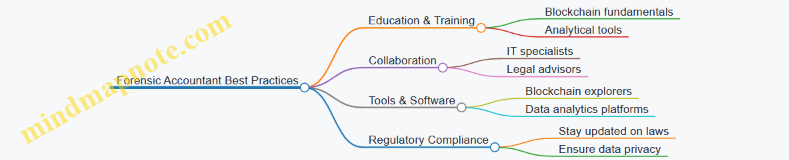
In conclusion, blockchain technology offers transformative potential for forensic accounting by enhancing transparency, traceability, and security. When integrated with traditional forensic techniques, it significantly strengthens fraud detection capabilities.
10.3 Cybersecurity Challenges and Forensic Responses
Cybersecurity has become a critical concern in forensic accounting due to the increasing reliance on digital systems and the sophistication of cyber threats. Forensic accountants must understand the challenges posed by cybersecurity breaches and develop effective responses to investigate and mitigate financial crimes linked to cyber incidents.
Key Cybersecurity Challenges in Forensic Accounting
-
Data Breaches and Theft
- Unauthorized access to sensitive financial data
- Exposure of confidential client information
-
Ransomware Attacks
- Encryption of critical financial records demanding ransom
- Disruption of accounting operations
-
Phishing and Social Engineering
- Manipulation of employees to gain access to financial systems
- Fraudulent wire transfers and account takeovers
-
Insider Threats
- Employees misusing access privileges
- Data manipulation or destruction
-
Advanced Persistent Threats (APTs)
- Long-term stealthy cyber intrusions targeting financial data
-
Cloud Security Risks
- Vulnerabilities in cloud-based accounting software
- Data loss or unauthorized access in cloud environments
Mind Map: Cybersecurity Challenges
Forensic Responses to Cybersecurity Challenges
-
Incident Identification and Initial Assessment
- Recognize signs of cyber incidents affecting financial data
- Prioritize response based on potential financial impact
-
Preservation of Digital Evidence
- Secure affected systems to prevent data alteration
- Maintain chain of custody for digital artifacts
-
Data Recovery and Analysis
- Use forensic tools to recover encrypted or deleted data
- Analyze logs, access records, and transaction histories
-
Tracing Financial Transactions
- Follow the money trail through compromised accounts
- Identify fraudulent transfers or asset misappropriation
-
Collaboration with IT and Cybersecurity Experts
- Work alongside cybersecurity teams for technical insights
- Integrate forensic accounting findings with cyber incident reports
-
Reporting and Legal Support
- Document findings clearly for legal proceedings
- Provide expert testimony if required
Mind Map: Forensic Responses
Example: Investigating a Ransomware Attack on Financial Records
Scenario: A mid-sized accounting firm experiences a ransomware attack that encrypts their client financial databases. The attackers demand payment in cryptocurrency to release the data.
Forensic Response:
- Immediately isolate affected systems to prevent spread.
- Preserve encrypted files and system logs for analysis.
- Collaborate with cybersecurity experts to identify the ransomware variant.
- Use forensic software to attempt data recovery and identify if backups are intact.
- Analyze transaction logs to detect any unauthorized changes or fraudulent activities during the breach.
- Trace any ransom payment attempts through cryptocurrency wallets.
- Prepare a detailed report outlining the breach impact, forensic findings, and recommendations for strengthening cybersecurity controls.
Example: Detecting Fraud via Phishing-Induced Wire Transfer
Scenario: An employee receives a phishing email impersonating a vendor, requesting an urgent wire transfer to a new bank account.
Forensic Response:
- Review email headers and metadata to confirm phishing.
- Analyze the wire transfer records and bank statements.
- Interview the employee to understand the phishing interaction.
- Trace the destination of the fraudulent wire transfer.
- Collaborate with banks and law enforcement to recover funds if possible.
- Recommend enhanced employee training and multi-factor authentication to prevent recurrence.
Best Practices for Forensic Accountants Facing Cybersecurity Challenges
- Stay current with evolving cyber threats and forensic technologies.
- Develop strong partnerships with IT and cybersecurity teams.
- Implement rigorous data preservation and chain of custody protocols.
- Use a combination of manual analysis and automated forensic tools.
- Maintain clear, objective documentation suitable for legal scrutiny.
- Promote proactive cybersecurity measures within the organization.
By integrating cybersecurity awareness into forensic accounting practices, professionals can more effectively detect, investigate, and respond to financial crimes in the digital age.
10.4 Case Example: Using AI to Detect Insider Trading
Insider trading involves the illegal practice of trading on the stock exchange to one’s own advantage through having access to confidential information. Detecting insider trading is challenging due to the subtlety and complexity of the transactions involved. However, Artificial Intelligence (AI) has emerged as a powerful tool in forensic accounting to identify suspicious patterns and behaviors indicative of insider trading.
Understanding Insider Trading Detection with AI
AI systems analyze vast amounts of trading data, communication records, and market movements to detect anomalies that human analysts might miss. Machine learning models can learn from historical insider trading cases to predict and flag potential violations.
Mind Map: AI Techniques in Insider Trading Detection
Example Scenario: Detecting Insider Trading Using AI
Background: A forensic accounting team is investigating unusual trading activity in a publicly traded company before a major merger announcement.
Step 1: Data Collection
- Collect historical stock transaction data for the company.
- Gather communication records of key executives.
- Compile market news and social media data around the merger announcement.
Step 2: AI Model Application
- Use anomaly detection algorithms to identify unusual spikes in trading volumes and price movements.
- Apply NLP techniques to analyze executives’ emails and chats for keywords or phrases indicating non-public information sharing.
- Perform network analysis to detect communication patterns between traders and insiders.
Step 3: Results
- The AI flags a cluster of trades executed by accounts linked to an executive’s close contacts.
- NLP detects suspicious language in emails sent days before the merger announcement.
- Network analysis reveals frequent communication between these accounts and the executive.
Step 4: Forensic Accountant Review
- Analysts review AI-generated flags and correlate findings with timelines.
- Cross-reference with regulatory filings and insider disclosures.
Outcome: The combined AI and forensic accounting approach uncovers evidence supporting insider trading allegations, leading to regulatory investigation.
Mind Map: Workflow of AI-Driven Insider Trading Detection
Best Practices for Using AI in Insider Trading Detection
- Integrate Multiple Data Sources: Combining trading data with communication and market sentiment data improves detection accuracy.
- Continuous Model Training: Regularly update AI models with new data and emerging fraud patterns.
- Human Oversight: AI should augment, not replace, expert forensic accountants who provide context and judgment.
- Maintain Data Privacy and Compliance: Ensure data handling complies with legal and regulatory standards.
Summary
Using AI to detect insider trading enhances forensic accountants’ ability to uncover complex fraud schemes by analyzing large datasets and identifying subtle patterns. The integration of machine learning, NLP, and network analysis provides a multi-dimensional approach to fraud detection, making investigations more efficient and effective.
10.5 Best Practices: Adapting to Technological Advances
As forensic accounting continues to evolve alongside rapid technological innovation, adapting to these advances is crucial for maintaining effectiveness and relevance. This section outlines best practices that forensic accountants should embrace to leverage technology optimally while safeguarding the integrity and accuracy of their investigations.
Continuous Learning and Skill Development
- Stay updated on emerging technologies such as AI, blockchain, and advanced analytics.
- Participate in workshops, webinars, and certification programs focused on forensic technology.
- Collaborate with IT and cybersecurity experts to deepen technical understanding.
Example: A forensic accountant regularly attends AI-focused seminars and partners with data scientists to better interpret machine learning outputs in fraud detection.
Integration of Advanced Analytical Tools
- Utilize AI-driven anomaly detection tools to identify suspicious transactions faster.
- Implement blockchain analysis software to trace cryptocurrency movements.
- Employ data visualization platforms to simplify complex datasets for stakeholders.
Example: During a fraud investigation, the accountant uses AI software to flag irregular payment patterns that manual review would have missed.
Enhancing Cybersecurity Awareness
- Understand common cyber threats that can impact financial data integrity.
- Adopt secure data storage and transmission protocols.
- Regularly update software and use encryption to protect sensitive information.
Example: Before analyzing digital evidence, the forensic accountant ensures all devices are scanned for malware and that data transfers occur over encrypted channels.
Collaboration and Cross-Disciplinary Teams
- Work closely with IT forensic specialists, legal advisors, and compliance officers.
- Share knowledge and tools to create a comprehensive investigative approach.
Example: In a complex embezzlement case involving digital assets, the forensic accountant teams up with blockchain experts and legal counsel to build a robust case.
Ethical Use of Technology
- Maintain transparency about the capabilities and limitations of technological tools.
- Avoid over-reliance on automated systems without human oversight.
- Ensure compliance with privacy laws and ethical standards.
Example: While using AI to analyze data, the accountant documents the methodology and cross-verifies results manually to avoid false positives.
Mind Maps
Mind Map 1: Adapting to Technological Advances in Forensic Accounting
Mind Map 2: Integration of AI and Blockchain in Forensic Accounting
Summary
Adapting to technological advances requires a proactive approach centered on continuous education, strategic tool integration, cybersecurity vigilance, collaborative teamwork, and ethical responsibility. By embracing these best practices, forensic accountants can enhance their investigative capabilities and stay ahead in the dynamic landscape of financial crime detection.
11. Practical Case Studies and Real-Life Applications
11.1 Comprehensive Review of a Corporate Fraud Investigation
Introduction
Corporate fraud investigations are complex processes that require a systematic approach combining forensic accounting techniques, legal knowledge, and investigative skills. This section provides a detailed walkthrough of a typical corporate fraud investigation, illustrating best practices with practical examples and mind maps to clarify the workflow.
Case Background
A mid-sized manufacturing company suspected irregularities in their procurement and inventory management processes after noticing unexplained discrepancies in financial reports and inventory counts.
Step 1: Initial Assessment and Planning
- Objective: Understand the scope and nature of the suspected fraud.
- Activities:
- Review preliminary financial statements.
- Interview key personnel.
- Identify potential fraud red flags.
Example: The forensic accountant noticed unusually high purchase orders from a single supplier and inconsistent inventory write-offs.
Mind Map: Initial Assessment
Step 2: Evidence Collection
- Objective: Gather all relevant data and documents.
- Activities:
- Obtain purchase orders, invoices, payment records.
- Collect inventory logs and reconciliation reports.
- Secure digital evidence such as emails and ERP system logs.
Example: The team retrieved email correspondence showing collusion between a procurement officer and an external supplier.
Mind Map: Evidence Collection
Step 3: Analytical Procedures
- Objective: Analyze data to detect patterns indicative of fraud.
- Techniques Used:
- Ratio analysis to compare supplier expenses over time.
- Benford’s Law to detect unnatural number distributions in invoices.
- Trend analysis on inventory write-offs.
Example: Benford’s Law analysis revealed abnormal frequency of certain invoice numbers, suggesting manipulation.
Mind Map: Analytical Procedures
Step 4: Interviews and Interrogations
- Objective: Validate findings and gather explanations.
- Approach:
- Conduct structured interviews with procurement staff.
- Use behavioral questioning to detect inconsistencies.
Example: The procurement officer provided vague answers about supplier selection, raising suspicion.
Mind Map: Interviews
Step 5: Reporting and Recommendations
- Objective: Present findings clearly to stakeholders.
- Components:
- Executive summary of fraud findings.
- Detailed evidence and analysis.
- Recommendations for internal controls and prevention.
Example: The final report recommended segregation of duties in procurement and enhanced inventory audits.
Mind Map: Reporting
Summary of Best Practices Demonstrated
- Early identification of red flags through financial and operational review.
- Comprehensive evidence gathering including digital trails.
- Use of quantitative analytical tools like Benford’s Law.
- Effective interviewing techniques to corroborate findings.
- Clear, actionable reporting tailored to management and legal teams.
Final Thoughts
This case exemplifies how forensic accountants integrate multiple techniques and best practices to uncover corporate fraud. The structured approach ensures thoroughness, legal compliance, and credible outcomes that support remediation and prevention.
Additional Example: Simple Mind Map of Entire Investigation Process
This holistic view helps forensic accountants maintain clarity and focus throughout complex investigations.
11.2 Forensic Accounting in Bankruptcy and Insolvency Cases
Forensic accounting plays a critical role in bankruptcy and insolvency proceedings by uncovering hidden assets, identifying fraudulent transfers, and providing clarity on the financial condition of the debtor. This section explores how forensic accountants assist in these complex cases through detailed investigation, analysis, and reporting.
Key Objectives in Bankruptcy and Insolvency Forensic Accounting
- Identify and trace assets that may have been concealed or transferred fraudulently.
- Analyze financial transactions leading up to insolvency to detect preferential payments or fraudulent conveyances.
- Assist trustees, creditors, and courts by providing clear, evidence-based financial insights.
- Support litigation by preparing expert reports and testimony.
Mind Map: Core Areas of Forensic Accounting in Bankruptcy
Example 1: Tracing Hidden Assets in a Bankruptcy Case
A mid-sized manufacturing company filed for bankruptcy, claiming insufficient assets to cover creditor claims. The forensic accountant was engaged to investigate potential hidden assets.
Process:
- Reviewed bank statements, tax returns, and financial records.
- Identified multiple transfers to a related-party entity shortly before bankruptcy filing.
- Traced funds to offshore accounts and personal assets of the company’s owner.
Outcome:
- Presented evidence of fraudulent conveyance to the bankruptcy court.
- Assisted in recovering assets valued at $1.2 million.
Mind Map: Steps in Asset Tracing
Example 2: Detecting Preferential Payments
In a retail chain bankruptcy, forensic accountants analyzed payments made in the 90 days prior to filing. They discovered that certain creditors received payments that favored them over others.
Process:
- Extracted payment data from accounting systems.
- Compared payment timing and amounts against insolvency timelines.
- Identified payments that could be clawed back under bankruptcy law.
Outcome:
- Enabled the trustee to recover $500,000 by reversing preferential payments.
Best Practices in Bankruptcy Forensic Accounting
- Maintain meticulous documentation of all findings and sources.
- Use data analytics tools to sift through large volumes of financial data efficiently.
- Collaborate closely with legal counsel to understand jurisdictional nuances.
- Prepare clear, concise reports tailored for judges and non-financial stakeholders.
Mind Map: Best Practices Summary
Summary
Forensic accounting in bankruptcy and insolvency cases requires a blend of investigative skills, financial expertise, and legal knowledge. By uncovering hidden assets, analyzing suspicious transactions, and providing clear evidence, forensic accountants help ensure fair outcomes for creditors and other stakeholders. The use of structured methodologies and best practices enhances the effectiveness and credibility of these investigations.
11.3 Uncovering Money Laundering Through Financial Analysis
Money laundering is the process of disguising the origins of illegally obtained money, typically by means of transfers involving foreign banks or legitimate businesses. Forensic accountants play a crucial role in detecting and uncovering money laundering schemes by analyzing financial data and identifying suspicious patterns.
Understanding Money Laundering Stages
Money laundering generally occurs in three stages:
-
Placement
- Introducing illicit funds into the financial system
- Examples: Cash deposits, purchasing assets
-
Layering
- Complex transactions to obscure the origin
- Examples: Wire transfers, shell companies, multiple accounts
-
Integration
- Reintroducing laundered money into the economy as legitimate funds
- Examples: Investments, luxury purchases
Mind Map: Key Indicators of Money Laundering
Financial Analysis Techniques to Detect Money Laundering
-
Transaction Pattern Analysis
- Review transaction histories for unusual frequency, amounts, or counterparties.
- Example: A company suddenly receiving multiple wire transfers from unrelated offshore entities.
-
Ratio Analysis
- Compare financial ratios such as cash-to-revenue or accounts receivable turnover against industry benchmarks.
- Example: A retail business showing abnormally high cash sales compared to reported revenue.
-
Trend Analysis
- Analyze trends over time to detect sudden spikes or drops in financial activity.
- Example: A nonprofit organization with a sudden surge in donations followed by large transfers to unknown accounts.
-
Source and Use of Funds Analysis
- Trace the origin and destination of funds to identify layering and integration.
- Example: Funds originating from a high-risk country routed through multiple shell companies before entering a legitimate business.
-
Benford’s Law Application
- Apply Benford’s Law to detect unnatural distributions in financial data.
- Example: Invoice amounts that do not follow expected digit patterns may indicate fabricated transactions.
Example Case: Uncovering a Money Laundering Scheme in a Real Estate Business
Scenario: A forensic accountant is engaged to analyze a real estate firm suspected of laundering money.
-
Step 1: Data Collection
- Gather bank statements, transaction records, and ownership documents.
-
Step 2: Transaction Pattern Analysis
- Identify multiple high-value cash deposits inconsistent with the firm’s normal business.
- Detect frequent transfers to offshore accounts.
-
Step 3: Ownership Structure Review
- Discover that properties are owned by a network of shell companies with nominee directors.
-
Step 4: Ratio and Trend Analysis
- Cash-to-sales ratio is abnormally high compared to industry standards.
- Sudden spike in property purchases without corresponding revenue increase.
-
Step 5: Reporting
- Document findings with clear evidence and visual aids.
- Recommend further legal investigation.
Mind Map: Steps in Financial Analysis for Money Laundering Detection
Best Practices for Forensic Accountants
- Maintain skepticism and verify all data sources.
- Use technology tools for data mining and pattern recognition.
- Collaborate with legal and compliance teams.
- Keep detailed documentation to support findings.
- Stay updated on emerging money laundering typologies and regulatory requirements.
By integrating these financial analysis techniques with practical examples and structured investigative approaches, forensic accountants can effectively uncover money laundering activities and support legal actions against illicit financial crimes.
11.4 Example: Forensic Accounting in Divorce and Family Law Disputes
Forensic accounting plays a crucial role in divorce and family law disputes, where accurate financial analysis is essential for equitable asset division, spousal support, and child support determinations. This section explores how forensic accountants assist legal professionals by uncovering hidden assets, evaluating income, and providing clear financial insights.
Key Areas of Focus in Divorce Forensic Accounting
Example Case: Uncovering Hidden Income
Scenario: In a divorce case, one spouse claims limited income, requesting minimal spousal support. The other spouse suspects income concealment through a family-owned business.
Forensic Accountant’s Approach:
- Bank Statement Analysis: Reviewed personal and business bank accounts for unusual transfers or withdrawals.
- Lifestyle Analysis: Compared reported income against lifestyle expenses such as luxury car payments, vacations, and mortgage.
- Business Financials: Examined business tax returns, profit and loss statements, and cash flow reports.
Findings:
- Discovered unreported cash deposits into personal accounts.
- Identified personal expenses paid directly from business accounts.
- Found discrepancies between reported income and actual cash flow.
Outcome: The forensic accountant’s report provided evidence of income concealment, leading to a fairer spousal support agreement.
Mind Map: Steps in Conducting a Forensic Accounting Review in Divorce
Best Practices in Divorce Forensic Accounting
- Maintain Objectivity: Provide unbiased financial analysis to support legal decisions.
- Comprehensive Documentation: Collect all relevant financial records, including electronic data.
- Use of Technology: Employ data analytics tools to detect anomalies and patterns.
- Clear Communication: Present findings in an understandable manner for judges and attorneys.
- Confidentiality: Protect sensitive client information throughout the process.
Additional Example: Valuation of a Family Business
Context: During divorce proceedings, the valuation of a family-owned business is contested.
Forensic Accountant’s Role:
- Conducted a detailed valuation using multiple methods (income approach, market approach, asset-based approach).
- Analyzed historical financial performance and future earning potential.
- Adjusted for non-operating assets and liabilities.
Result: Provided an accurate, defendable valuation that informed equitable asset division.
Summary
Forensic accounting in divorce and family law disputes ensures transparency and fairness by uncovering hidden financial information and providing expert analysis. Through detailed investigation, analytical rigor, and clear reporting, forensic accountants support the legal process in achieving just outcomes.
11.5 Best Practices: Lessons Learned and Key Takeaways
Forensic accounting is a dynamic and complex field requiring a blend of analytical skills, legal knowledge, and ethical rigor. Drawing from the comprehensive case studies and techniques discussed throughout this blog, this section consolidates the most crucial best practices and lessons learned to help forensic accountants excel in their roles.
Key Takeaways Mind Map
Lesson 1: Preparation is Paramount
Example: In a complex embezzlement case at a manufacturing firm, the forensic team spent significant time understanding the company’s financial processes before diving into data analysis. This upfront investment helped them identify unusual vendor payments quickly, saving weeks of unnecessary data sifting.
Best Practice: Always start with a thorough understanding of the business environment and case specifics to focus efforts efficiently.
Lesson 2: Maintain Rigorous Documentation and Chain of Custody
Example: During a Ponzi scheme investigation, improperly documented evidence led to challenges in court, weakening the prosecution’s case. Conversely, in a separate case, meticulous chain of custody records ensured evidence was admissible and credible.
Best Practice: Implement strict protocols for evidence handling and documentation to preserve integrity and legal admissibility.
Lesson 3: Leverage Multiple Analytical Techniques
Example: In a financial statement fraud case, combining ratio analysis with Benford’s Law revealed discrepancies that neither method alone could conclusively identify. This multi-faceted approach strengthened the findings.
Best Practice: Use a combination of analytical tools to cross-verify findings and reduce false positives.
Lesson 4: Effective Communication is Critical
Example: A forensic accountant presented complex findings in a high-profile divorce case using clear charts and simple language, enabling the judge and parties to understand the financial intricacies without confusion.
Best Practice: Tailor reports and presentations to the audience’s level of financial literacy, using visuals and straightforward language.
Lesson 5: Stay Current with Legal and Technological Developments
Example: A forensic team that incorporated blockchain analysis tools uncovered hidden cryptocurrency transactions in a fraud case, an approach unavailable to teams relying solely on traditional accounting methods.
Best Practice: Continuously update skills and tools to keep pace with evolving fraud methods and legal frameworks.
Lesson 6: Ethical Vigilance and Professional Skepticism
Example: In a bribery investigation, a forensic accountant’s skepticism about unusually consistent expense reports led to uncovering fabricated invoices.
Best Practice: Maintain an objective and questioning mindset; never accept data at face value.
Summary Mind Map
By integrating these best practices into daily forensic accounting work, professionals can enhance the accuracy, credibility, and impact of their investigations, ultimately supporting justice and financial transparency.