Accounting for Deferred Taxes
1. Introduction to Deferred Taxes
1.1 Understanding Deferred Taxes: Definition and Importance
Deferred taxes are a fundamental concept in accounting that arise due to differences in the timing of recognizing income and expenses for accounting purposes versus tax purposes. These timing differences create temporary differences that lead to deferred tax assets or deferred tax liabilities on the balance sheet.
What Are Deferred Taxes?
Deferred taxes represent the tax effects of temporary differences between the carrying amount of assets and liabilities in the financial statements and their tax bases. They ensure that the tax expense recognized in the income statement aligns with the accounting profit, reflecting the true economic reality of the business.
Why Are Deferred Taxes Important?
- Accurate Profit Measurement: They help match tax expenses with the revenues they relate to, providing a more accurate picture of profitability.
- Compliance: Proper accounting for deferred taxes is required under IFRS (IAS 12) and US GAAP (ASC 740).
- Financial Planning: Understanding deferred taxes aids in forecasting future tax payments and cash flows.
- Investor Insight: Deferred tax disclosures provide transparency about future tax obligations or benefits.
Mind Map: Core Concepts of Deferred Taxes
Temporary Differences Explained
Temporary differences occur when the carrying amount of an asset or liability in the financial statements differs from its tax base, but these differences will reverse in the future.
Example:
- A company depreciates an asset over 5 years for accounting purposes but uses an accelerated depreciation method for tax purposes over 3 years.
- Initially, tax depreciation is higher, reducing taxable income and creating a deferred tax liability because the company will pay more tax in the future when accounting depreciation exceeds tax depreciation.
Mind Map: Temporary Differences and Deferred Taxes
Deferred Tax Assets vs. Deferred Tax Liabilities
-
Deferred Tax Asset (DTA): Occurs when taxable income is higher than accounting income now but will be lower in the future, resulting in future tax benefits.
- Example: Warranty expenses recognized in accounting now but deductible for tax when paid.
-
Deferred Tax Liability (DTL): Occurs when taxable income is lower than accounting income now but will be higher in the future, resulting in future tax payments.
- Example: Accelerated tax depreciation creating lower taxable income now.
Simple Example to Illustrate Deferred Taxes
Scenario:
- Company buys equipment for $100,000.
- Accounting depreciation: Straight-line over 5 years ($20,000/year).
- Tax depreciation: Accelerated, $40,000 in year 1, then less in subsequent years.
Year 1:
- Accounting expense: $20,000
- Tax expense: $40,000
- Taxable income is lower than accounting income by $20,000.
- This creates a deferred tax liability because the company will pay more tax in future years when accounting depreciation exceeds tax depreciation.
If the tax rate is 25%, deferred tax liability = $20,000 * 25% = $5,000.
Mind Map: Example Breakdown
Summary
Understanding deferred taxes is crucial for accountants and tax advisors as it affects financial reporting, tax planning, and compliance. Recognizing the timing differences and their impact on financial statements ensures accurate reflection of a company’s tax position and future obligations or benefits.
1.2 Temporary Differences: The Foundation of Deferred Tax Accounting
Deferred taxes arise primarily due to temporary differences between the carrying amounts of assets and liabilities in the financial statements and their corresponding tax bases. Understanding these differences is crucial for accurate deferred tax accounting.
What are Temporary Differences?
Temporary differences are differences between the carrying amount of an asset or liability in the balance sheet and its tax base that will result in taxable or deductible amounts in future periods when the carrying amount of the asset or liability is recovered or settled.
- Taxable Temporary Differences lead to deferred tax liabilities (DTLs).
- Deductible Temporary Differences lead to deferred tax assets (DTAs).
Mind Map: Types of Temporary Differences
Examples of Temporary Differences
-
Depreciation Differences
- Financial Reporting: Straight-line depreciation over 5 years.
- Tax Reporting: Accelerated depreciation over 3 years.
This creates a taxable temporary difference because the asset’s tax base is lower than its carrying amount initially, leading to deferred tax liabilities.
-
Warranty Expenses
- Financial Reporting: Expense estimated warranty costs when products are sold.
- Tax Reporting: Warranty costs are deductible only when actually paid.
This creates a deductible temporary difference resulting in deferred tax assets.
Mind Map: Lifecycle of Temporary Differences
Why Are Temporary Differences Important?
- They ensure that income tax expense reported in the financial statements reflects the tax consequences of transactions and events in the same period.
- They prevent distortion of profit by matching tax effects with accounting income.
Practical Example: Temporary Difference on Equipment
| Description | Amount (USD) |
|---|---|
| Cost of Equipment | 100,000 |
| Accounting Depreciation (5 yrs straight-line) | 20,000/year |
| Tax Depreciation (accelerated, 3 yrs) | 40,000/year |
Year 1:
- Carrying amount after depreciation: 100,000 - 20,000 = 80,000
- Tax base after depreciation: 100,000 - 40,000 = 60,000
- Temporary difference = 80,000 - 60,000 = 20,000 (Taxable Temporary Difference)
Assuming a tax rate of 25%, deferred tax liability = 20,000 x 25% = 5,000 USD.
Summary
Temporary differences form the foundation of deferred tax accounting by linking the timing differences between accounting and tax treatments. Recognizing and measuring these differences accurately ensures compliance and provides a true picture of a company’s tax position.
For accountants and tax advisors, mastering temporary differences with clear examples and mind maps helps in simplifying complex tax accounting concepts and improves communication with stakeholders.
1.3 Deferred Tax Assets vs. Deferred Tax Liabilities: Key Concepts
Understanding the distinction between Deferred Tax Assets (DTAs) and Deferred Tax Liabilities (DTLs) is fundamental for accountants and tax advisors dealing with deferred tax accounting. Both arise due to temporary differences between the accounting carrying amounts of assets and liabilities and their tax bases.
What Are Deferred Tax Assets?
Deferred Tax Assets represent the amounts of income taxes recoverable in future periods due to deductible temporary differences, carryforward of unused tax losses, and carryforward of unused tax credits.
- Key Idea: They are future tax benefits.
- Common Causes:
- Expenses recognized in accounting before they are deductible for tax (e.g., warranty expenses, bad debt provisions).
- Tax loss carryforwards.
Example: A company recognizes a warranty expense of $10,000 in its accounting books this year, but for tax purposes, this expense is deductible only when the warranty claims are actually paid. This creates a deductible temporary difference, resulting in a Deferred Tax Asset.
What Are Deferred Tax Liabilities?
Deferred Tax Liabilities represent the amounts of income taxes payable in future periods due to taxable temporary differences.
- Key Idea: They are future tax obligations.
- Common Causes:
- Revenue recognized in accounting before it is taxable.
- Accelerated tax depreciation compared to accounting depreciation.
Example: A company uses accelerated depreciation for tax purposes but straight-line depreciation for accounting. This results in lower taxable income now and higher taxable income later, creating a Deferred Tax Liability.
Mind Map: Deferred Tax Assets vs. Deferred Tax Liabilities
Practical Example: Deferred Tax Asset vs. Deferred Tax Liability
Scenario: Company ABC purchases equipment for $100,000. For accounting purposes, it uses straight-line depreciation over 5 years ($20,000/year). For tax purposes, it uses accelerated depreciation: $40,000 in year 1, $30,000 in year 2, and so on.
| Year | Accounting Depreciation | Tax Depreciation | Temporary Difference | Tax Rate (30%) | Deferred Tax Impact |
|---|---|---|---|---|---|
| 1 | $20,000 | $40,000 | $20,000 (Tax > Book) | 30% | DTL of $6,000 |
| 2 | $20,000 | $30,000 | $10,000 (Tax > Book) | 30% | DTL of $3,000 |
| 3 | $20,000 | $15,000 | -$5,000 (Book > Tax) | 30% | DTA of $1,500 |
Interpretation:
- In years 1 and 2, tax depreciation exceeds accounting depreciation, creating taxable temporary differences and Deferred Tax Liabilities.
- In year 3, accounting depreciation exceeds tax depreciation, reversing the temporary difference and creating a Deferred Tax Asset.
Best Practices for Identifying DTAs and DTLs
- Analyze Temporary Differences Carefully: Always compare the carrying amount of assets/liabilities to their tax bases.
- Document Assumptions: Clearly document the nature and expected reversal of temporary differences.
- Use Consistent Tax Rates: Apply enacted tax rates expected to apply when the temporary differences reverse.
- Monitor Valuation Allowances: For DTAs, assess whether it is probable that future taxable profits will be available to utilize the deferred tax asset.
Summary Table
| Aspect | Deferred Tax Asset (DTA) | Deferred Tax Liability (DTL) |
|---|---|---|
| Definition | Future tax benefit | Future tax obligation |
| Origin | Deductible temporary differences | Taxable temporary differences |
| Examples | Warranty expenses, tax loss carryforwards | Accelerated depreciation, revenue timing |
| Impact on Financials | Reduces future tax expense | Increases future tax expense |
| Recognition Requirement | Probable future taxable profits | Recognized unless exceptions apply |
By mastering these key concepts and applying them with practical examples, accountants and tax advisors can ensure accurate deferred tax accounting that aligns with regulatory standards and supports effective financial reporting.
1.4 Overview of Relevant Accounting Standards (IAS 12, ASC 740)
Deferred tax accounting is governed primarily by two major accounting standards globally: IAS 12 - Income Taxes under IFRS, and ASC 740 - Income Taxes under US GAAP. Understanding these standards is crucial for accountants and tax advisors to ensure compliance and accurate financial reporting.
IAS 12 - Income Taxes
IAS 12 provides guidance on accounting for current and deferred taxes. It emphasizes the recognition of deferred tax liabilities and assets arising from temporary differences between the carrying amount of assets and liabilities in the financial statements and their tax bases.
Key Principles of IAS 12:
- Recognition of deferred tax liabilities for all taxable temporary differences.
- Recognition of deferred tax assets for deductible temporary differences, carryforward of unused tax losses, and unused tax credits, but only to the extent that it is probable that taxable profit will be available.
- Measurement of deferred tax using tax rates expected to apply when the asset is realized or the liability settled.
- Presentation: Deferred tax assets and liabilities are generally presented separately from current tax.
Mind Map: IAS 12 Key Concepts
Example: Deferred Tax Liability on Property
A company purchases machinery for $100,000. For accounting purposes, it is depreciated on a straight-line basis over 5 years ($20,000 per year). For tax purposes, accelerated depreciation allows $40,000 in the first year.
- Carrying amount after year 1: $80,000
- Tax base after year 1: $60,000
- Temporary difference: $20,000 (80,000 - 60,000)
Assuming a tax rate of 25%, the deferred tax liability is:
$20,000 × 25% = $5,000
This deferred tax liability reflects the future taxable amount when the carrying amount exceeds the tax base.
ASC 740 - Income Taxes
ASC 740 is the US GAAP standard that governs income tax accounting. It shares many similarities with IAS 12 but has some differences in recognition, measurement, and disclosure.
Key Principles of ASC 740:
- Deferred tax liabilities and assets are recognized for temporary differences and carryforwards.
- A valuation allowance is required if it is more likely than not that some or all of the deferred tax asset will not be realized.
- Measurement is based on enacted tax rates expected to apply when the asset is realized or liability settled.
- Requires recognition of uncertain tax positions (FIN 48 / ASC 740-10).
Mind Map: ASC 740 Key Concepts
Example: Valuation Allowance for Deferred Tax Asset
A company has a deferred tax asset of $50,000 arising from net operating loss carryforwards. However, based on recent losses and future projections, management estimates only a 60% chance of realizing this asset.
Under ASC 740, a valuation allowance must be recorded for the portion unlikely to be realized:
Valuation Allowance = $50,000 × (1 - 0.60) = $20,000
Net Deferred Tax Asset reported = $30,000
Comparison Summary
| Aspect | IAS 12 | ASC 740 |
|---|---|---|
| Recognition of Deferred Tax | Deferred tax liabilities and assets for all temporary differences; exceptions for goodwill and initial recognition | Similar, but with explicit valuation allowance requirement |
| Valuation Allowance | Recognized only if recovery is not probable | Required if realization is not “more likely than not” |
| Uncertain Tax Positions | Not specifically addressed | Requires recognition and measurement of uncertain tax positions |
| Measurement | Based on enacted or substantively enacted tax rates | Based on enacted tax rates |
| Disclosure | Detailed disclosures on deferred tax balances and tax expense | Detailed disclosures including uncertain tax positions and valuation allowances |
Practical Example: Deferred Tax Accounting under Both Standards
A company has the following temporary differences:
- Taxable temporary difference: $100,000
- Deductible temporary difference: $40,000
- Tax rate: 30%
IAS 12 Treatment:
- Deferred tax liability = $100,000 × 30% = $30,000
- Deferred tax asset = $40,000 × 30% = $12,000 (recognized if probable to be realized)
ASC 740 Treatment:
- Same calculation for deferred tax liability and asset
- If management believes only 70% of deferred tax asset will be realized, valuation allowance = $12,000 × 30% = $3,600
- Net deferred tax asset = $8,400
Summary
Understanding IAS 12 and ASC 740 is essential for accurate deferred tax accounting. While both standards share core principles, nuances such as valuation allowances and uncertain tax positions under ASC 740 require careful attention. Integrating these standards into accounting processes ensures compliance and enhances the quality of financial reporting.
1.5 Practical Example: Identifying Deferred Tax Items in Financial Statements
Understanding how to identify deferred tax items in financial statements is crucial for accountants and tax advisors. This section provides a practical walkthrough with examples and mind maps to clarify the process.
What Are Deferred Tax Items?
Deferred tax items arise from temporary differences between the carrying amount of assets and liabilities in the financial statements and their tax bases. These differences result in deferred tax assets or liabilities.
Step 1: Identify Temporary Differences
Mind Map: Identifying Temporary Differences
Step 2: Compare Carrying Amount and Tax Base
- Carrying Amount: The value of an asset or liability reported in the financial statements.
- Tax Base: The amount attributed to that asset or liability for tax purposes.
Example 1: Depreciation on Equipment
| Item | Carrying Amount (Book) | Tax Base | Temporary Difference | Type |
|---|---|---|---|---|
| Equipment Cost | $100,000 | $100,000 | N/A | N/A |
| Accumulated Depreciation (Book) | $30,000 | |||
| Accumulated Depreciation (Tax) | $40,000 | $10,000 (40,000 - 30,000) | Taxable Temporary Difference |
- The tax base of the equipment is $60,000 ($100,000 cost - $40,000 tax depreciation).
- Carrying amount is $70,000 ($100,000 cost - $30,000 book depreciation).
- Temporary difference = $70,000 - $60,000 = $10,000 (taxable temporary difference).
This results in a deferred tax liability.
Step 3: Identify Deferred Tax Assets and Liabilities
Mind Map: Deferred Tax Asset vs Liability
Step 4: Recognize Deferred Tax in Financial Statements
- Deferred tax liabilities are reported as non-current liabilities.
- Deferred tax assets are reported as non-current assets, subject to valuation allowances if recovery is uncertain.
Example 2: Warranty Expense
| Item | Carrying Amount (Book) | Tax Base | Temporary Difference | Type |
|---|---|---|---|---|
| Warranty Liability | $15,000 | $0 | $15,000 | Deductible Temporary Difference |
- Warranty expense recognized in accounting but deductible for tax when paid.
- Creates a deferred tax asset.
Step 5: Calculate Deferred Tax Amounts
Assuming a tax rate of 25%:
- Deferred tax liability on equipment depreciation = $10,000 * 25% = $2,500
- Deferred tax asset on warranty = $15,000 * 25% = $3,750
Summary Mind Map: Identifying Deferred Tax Items
Final Notes:
- Always consider the applicable tax rate at which deferred taxes will reverse.
- Review valuation allowances for deferred tax assets to reflect recoverability.
- Document assumptions and calculations clearly for audit and compliance purposes.
This practical example equips accountants and tax advisors with a clear methodology to identify deferred tax items accurately in financial statements, ensuring compliance and enhancing financial reporting quality.
2. Recognizing and Measuring Deferred Taxes
2.1 Identifying Temporary Differences: Common Scenarios
Deferred taxes arise primarily due to temporary differences between the carrying amount of an asset or liability in the financial statements and its tax base. Understanding these differences is crucial for accurate deferred tax accounting.
What Are Temporary Differences?
Temporary differences are differences between the tax base of an asset or liability and its carrying amount in the balance sheet that will result in taxable or deductible amounts in future periods when the carrying amount of the asset or liability is recovered or settled.
Common Scenarios Leading to Temporary Differences
Depreciation Methods
- Accounting Depreciation: Straight-line method over useful life.
- Tax Depreciation: Accelerated methods allowed by tax authorities.
Example: A company buys machinery for $100,000. For accounting, it uses straight-line depreciation over 5 years ($20,000/year). For tax, it uses an accelerated depreciation method, allowing $40,000 in year 1.
- Temporary Difference: In year 1, carrying amount is $80,000 (100,000 - 20,000), tax base is $60,000 (100,000 - 40,000).
- Result: Deferred tax liability arises because taxable income is lower than accounting income.
Warranty Expenses
- Accounting: Expense recognized when products are sold (estimated warranty costs).
- Tax: Deductible only when warranty costs are actually incurred.
Example: A company estimates $10,000 warranty expense this year but pays only $3,000.
- Temporary Difference: Warranty liability is recognized in accounting but not yet deductible for tax.
- Result: Deferred tax asset is recorded.
Revenue Recognition
- Accounting: Revenue recognized when earned.
- Tax: Revenue recognized when received (cash basis) or on a different timing.
Example: A company recognizes $50,000 revenue this year but receives payment next year.
- Temporary Difference: Revenue recognized in accounting but not yet taxable.
- Result: Deferred tax liability is created.
Provisions and Accruals
- Accounting: Provisions for liabilities recognized when probable.
- Tax: Deductible only when paid.
Example: Provision for legal settlement of $20,000 recognized this year; payment expected next year.
- Temporary Difference: Provision recognized in accounting but not deductible for tax.
- Result: Deferred tax asset is recognized.
Tax Loss Carryforwards
- Accounting: Recognized as deferred tax asset if probable to be utilized.
- Tax: Losses can be carried forward to offset future taxable income.
Example: Company incurs $30,000 tax loss this year.
- Temporary Difference: Tax loss carryforward recognized as deferred tax asset.
Mind Map: Common Temporary Differences
Best Practice Tips for Identifying Temporary Differences
- Maintain detailed schedules comparing accounting carrying amounts and tax bases for all assets and liabilities.
- Regularly review changes in tax laws that may affect tax bases.
- Coordinate with tax advisors to understand timing differences in tax deductions and revenues.
- Document assumptions and estimates used in recognizing provisions and accruals.
Summary Example: Temporary Differences in a Manufacturing Company
| Item | Accounting Amount | Tax Base | Temporary Difference | Deferred Tax Effect |
|---|---|---|---|---|
| Machinery | $80,000 | $60,000 | $20,000 (Liability) | Deferred Tax Liability |
| Warranty Provision | $10,000 | $3,000 | $7,000 (Asset) | Deferred Tax Asset |
| Revenue Recognized | $50,000 | $0 | $50,000 (Liability) | Deferred Tax Liability |
| Legal Provision | $20,000 | $0 | $20,000 (Asset) | Deferred Tax Asset |
This table illustrates how temporary differences arise and affect deferred tax accounting.
By mastering the identification of temporary differences through these common scenarios and examples, accountants and tax advisors can ensure accurate deferred tax reporting and compliance.
2.2 Measurement of Deferred Tax Assets and Liabilities: Tax Rates and Timing
Understanding Measurement Principles
The measurement of deferred tax assets (DTAs) and deferred tax liabilities (DTLs) hinges on two critical factors: the applicable tax rates and the timing of when temporary differences reverse. Accurate measurement ensures that financial statements reflect the correct tax impact of timing differences between accounting income and taxable income.
Key Concepts
- Temporary Differences: Differences between the carrying amount of an asset or liability in the balance sheet and its tax base.
- Tax Rates: The enacted or substantively enacted tax rates expected to apply when the temporary differences reverse.
- Timing: The period in which the temporary differences are expected to reverse, impacting the measurement of deferred taxes.
Mind Map: Measurement of Deferred Taxes
Step 1: Identify Temporary Differences
Deferred taxes arise from temporary differences. For example, if a company uses straight-line depreciation for accounting but accelerated depreciation for tax purposes, the carrying amount of the asset and its tax base differ, creating a temporary difference.
Step 2: Determine Applicable Tax Rates
The measurement uses the tax rates that are expected to apply in the period when the asset is realized or the liability is settled. These rates must be:
- Enacted: Officially legislated tax rates.
- Substantively enacted: Tax rates that are virtually certain to be enacted, even if not yet formally legislated.
Step 3: Calculate Deferred Tax Amounts
- Deferred Tax Liability (DTL): Calculated on taxable temporary differences.
- Deferred Tax Asset (DTA): Calculated on deductible temporary differences.
The formula is:
Deferred Tax Amount = Temporary Difference × Applicable Tax Rate
Example 1: Measuring Deferred Tax on Depreciation
Scenario:
- Asset cost: $100,000
- Accounting depreciation (straight-line over 5 years): $20,000/year
- Tax depreciation (accelerated): $40,000 in Year 1, $15,000 in Year 2, then less in subsequent years
- Tax rate: 30%
Year 1:
- Carrying amount after depreciation: $80,000
- Tax base after depreciation: $60,000
- Temporary difference = $80,000 - $60,000 = $20,000 (taxable temporary difference)
- Deferred tax liability = $20,000 × 30% = $6,000
This DTL reflects the tax that will be payable in the future when the temporary difference reverses.
Mind Map: Example 1 Breakdown
Step 4: Consider Timing of Reversal
The timing of when the temporary difference reverses affects the measurement. For example, if a temporary difference is expected to reverse in 3 years, the tax rate applicable in 3 years should be used if known.
Example 2: Impact of Future Tax Rate Change
Scenario:
- Temporary difference: $50,000 deductible temporary difference
- Current tax rate: 25%
- Enacted future tax rate (effective next year): 20%
Measurement:
Deferred tax asset = $50,000 × 20% = $10,000
Even though the current tax rate is 25%, the measurement uses the future enacted rate of 20% because the reversal is expected after the new rate takes effect.
Mind Map: Tax Rate Changes and Measurement
Best Practices
- Use Enacted or Substantively Enacted Rates: Always apply the tax rates that are legally in force or virtually certain to be enacted for the reversal period.
- Document Assumptions: Clearly document assumptions about timing and tax rates used for measurement.
- Review Regularly: Update deferred tax measurements when tax laws or expected reversal timings change.
- Consider Valuation Allowances: Assess whether deferred tax assets are realizable and apply allowances if necessary.
Summary
Measuring deferred tax assets and liabilities accurately requires a thorough understanding of temporary differences, applicable tax rates, and the timing of reversals. Using clear examples and mind maps helps clarify these concepts, ensuring accountants and tax advisors can apply best practices effectively.
2.3 Valuation Allowances: When and How to Apply
Deferred tax assets (DTAs) represent future tax benefits arising from deductible temporary differences, carryforwards, or tax credits. However, these benefits are only valuable if the company expects to generate sufficient taxable income to utilize them. When there is uncertainty about the realization of DTAs, accounting standards require the use of a valuation allowance to reduce the carrying amount of deferred tax assets to the amount that is more likely than not to be realized.
What is a Valuation Allowance?
A valuation allowance is a contra-account that reduces deferred tax assets on the balance sheet to reflect the portion unlikely to be realized.
When to Apply a Valuation Allowance?
Valuation allowances are applied when it is more likely than not (greater than 50% probability) that some portion or all of the deferred tax assets will not be realized.
Key indicators include:
- History of recent losses or insufficient taxable income
- Uncertainty about future profitability
- Expiration of tax loss carryforwards
- Changes in tax laws or rates that limit utilization
How to Determine the Amount of Valuation Allowance?
The amount is based on the difference between the deferred tax asset balance and the amount expected to be realized.
Mind Map: Valuation Allowance Decision Process
Best Practices for Applying Valuation Allowances
- Comprehensive Analysis: Evaluate all positive and negative evidence, including forecasts, industry trends, and tax planning strategies.
- Consistent Review: Reassess valuation allowances each reporting period to reflect changes in circumstances.
- Clear Documentation: Maintain detailed records of assumptions, evidence, and rationale for the allowance.
- Conservative Approach: When in doubt, err on the side of caution to avoid overstating deferred tax assets.
Example 1: Applying Valuation Allowance Due to Operating Losses
Scenario: Company ABC has a deferred tax asset of $500,000 from net operating loss carryforwards. However, the company has reported losses for the past three years and expects to continue incurring losses in the near term.
Analysis:
- Historical losses indicate uncertainty about future taxable income.
- Management forecasts show no taxable income for the next two years.
Action:
- Apply a valuation allowance of $500,000 to fully offset the deferred tax asset.
- Disclose the allowance and reasoning in financial statement notes.
Example 2: Partial Valuation Allowance Based on Forecasted Income
Scenario: Company XYZ has a deferred tax asset of $1,000,000 related to deductible temporary differences. Management forecasts taxable income sufficient to utilize $700,000 of the deferred tax asset over the next three years.
Analysis:
- Positive evidence supports realization of $700,000.
- Negative evidence suggests $300,000 may not be realizable.
Action:
- Record a valuation allowance of $300,000.
- Adjust the deferred tax asset net balance to $700,000.
Mind Map: Example 2 Breakdown
Documentation and Disclosure
- Clearly disclose the nature and amount of valuation allowances.
- Explain the judgments and evidence considered.
- Update disclosures regularly to reflect changes.
Summary
Valuation allowances are critical in ensuring deferred tax assets are not overstated. Applying them requires careful evaluation of all relevant evidence, consistent reassessment, and transparent disclosure. Using clear examples and structured decision processes helps accountants and tax advisors maintain compliance and provide accurate financial reporting.
2.4 Best Practice: Documenting Assumptions and Estimates
Accurate documentation of assumptions and estimates is a cornerstone of reliable deferred tax accounting. Given the inherent complexity and judgment involved in recognizing and measuring deferred tax assets and liabilities, maintaining clear, comprehensive, and well-organized documentation ensures transparency, facilitates audits, and supports future reviews.
Why Document Assumptions and Estimates?
- Audit Readiness: Auditors require clear evidence of how deferred tax figures were derived.
- Consistency: Helps maintain consistent application of accounting policies across periods.
- Transparency: Provides clarity to stakeholders on the basis of tax positions.
- Future Reference: Assists in revisiting and updating estimates as new information arises.
Key Components to Document
Best Practices for Documentation
-
Clearly Define Each Assumption:
- Specify what the assumption is (e.g., expected tax rate, timing of reversal).
- Explain the rationale behind the assumption.
-
Use Quantitative and Qualitative Support:
- Provide numerical data, historical trends, and relevant tax laws.
- Include management’s judgment and market conditions.
-
Maintain Version Control:
- Track changes in assumptions over time.
- Document the date and reason for each update.
-
Link Documentation to Calculations:
- Ensure assumptions are directly traceable to deferred tax calculations.
-
Include Review Notes:
- Record feedback from internal and external reviewers.
Example: Documenting Assumptions for Deferred Tax on Depreciation
Scenario: A company has a temporary difference arising from accelerated tax depreciation exceeding book depreciation.
| Assumption | Documentation Detail |
|---|---|
| Tax Rate | 25% statutory corporate tax rate, confirmed by recent tax legislation dated Jan 2024. |
| Timing of Reversal | Expected reversal over next 5 years based on asset useful life and disposal plans. |
| Valuation Allowance | None applied as company projects sufficient future taxable income supported by approved budgets. |
| Supporting Evidence | Tax code excerpts, fixed asset register, management-approved forecasts. |
Sample Documentation Note:
“Deferred tax liability calculated using a 25% tax rate as per the Tax Reform Act 2024. Temporary difference arises from accelerated tax depreciation exceeding book depreciation by $500,000. Expected reversal period is 5 years, aligned with asset useful life. No valuation allowance recorded due to projected taxable income exceeding deferred tax asset realization threshold. Documentation supported by fixed asset schedules and management forecasts dated March 2024.”
Mind Map: Example Documentation Workflow
Tips for Accountants and Tax Advisors
- Use standardized templates for documenting assumptions to ensure completeness.
- Regularly update assumptions to reflect changes in tax legislation or business circumstances.
- Collaborate with tax, finance, and legal teams to validate assumptions.
- Keep documentation accessible but secure, considering confidentiality.
By embedding thorough documentation practices into deferred tax accounting processes, accountants and tax advisors can enhance accuracy, compliance, and stakeholder confidence.
2.5 Example: Calculating Deferred Tax on Depreciation Differences
Deferred tax arises when there are temporary differences between the carrying amount of an asset in the financial statements and its tax base. One common source of such differences is depreciation, where accounting depreciation and tax depreciation methods or rates differ.
Understanding the Concept
- Accounting Depreciation: The depreciation expense recognized in the financial statements according to accounting standards.
- Tax Depreciation: The depreciation expense allowed by tax authorities, which may follow different rules or accelerated schedules.
- Temporary Difference: The difference between the carrying amount of the asset and its tax base, which reverses over time.
Step-by-Step Calculation Example
Scenario:
- Asset Cost: $100,000
- Useful Life (Accounting): 5 years, straight-line
- Useful Life (Tax): 4 years, straight-line
- Tax Rate: 30%
| Year | Accounting Depreciation | Tax Depreciation | Carrying Amount (Accounting) | Tax Base | Temporary Difference | Deferred Tax Liability (30%) |
|---|---|---|---|---|---|---|
| 0 | - | - | 100,000 | 100,000 | 0 | 0 |
| 1 | 20,000 | 25,000 | 80,000 | 75,000 | 5,000 | 1,500 |
| 2 | 20,000 | 25,000 | 60,000 | 50,000 | 10,000 | 3,000 |
| 3 | 20,000 | 25,000 | 40,000 | 25,000 | 15,000 | 4,500 |
| 4 | 20,000 | 25,000 | 20,000 | 0 | 20,000 | 6,000 |
| 5 | 20,000 | 0 | 0 | 0 | 0 | 0 |
Explanation:
- In Year 1, accounting depreciation is $20,000, tax depreciation is $25,000.
- The carrying amount (accounting) is reduced by $20,000 to $80,000.
- The tax base is reduced by $25,000 to $75,000.
- Temporary difference = Carrying amount - Tax base = $5,000.
- Deferred tax liability = Temporary difference × Tax rate = $5,000 × 30% = $1,500.
This deferred tax liability reflects the tax that will be payable in the future when the temporary difference reverses.
Mind Map: Deferred Tax Calculation on Depreciation Differences
Best Practices
- Consistent Documentation: Maintain clear records of depreciation methods and assumptions for both accounting and tax purposes.
- Regular Reconciliation: Periodically reconcile carrying amounts and tax bases to identify temporary differences.
- Update Tax Rates: Ensure deferred tax calculations reflect current enacted tax rates.
- Disclosure: Clearly disclose deferred tax liabilities arising from depreciation differences in notes.
Additional Example: Accelerated Tax Depreciation
Suppose tax rules allow 50% depreciation in the first year and the remaining over the next years, while accounting uses straight-line over 5 years.
| Year | Accounting Depreciation | Tax Depreciation | Temporary Difference | Deferred Tax Liability (30%) |
|---|---|---|---|---|
| 1 | 20,000 | 50,000 | (30,000) | (9,000) (Deferred Tax Asset) |
| 2 | 20,000 | 25,000 | (5,000) | (1,500) |
| 3 | 20,000 | 12,500 | 7,500 | 2,250 |
| 4 | 20,000 | 12,500 | 15,000 | 4,500 |
| 5 | 20,000 | 0 | 35,000 | 10,500 |
In this case, the temporary difference is negative initially, creating a deferred tax asset, which reverses over time.
By following these steps and examples, accountants and tax advisors can accurately calculate deferred taxes arising from depreciation differences, ensuring compliance and transparent financial reporting.
3. Deferred Tax Accounting for Specific Transactions
3.1 Deferred Taxes on Property, Plant, and Equipment (PPE)
Deferred taxes related to Property, Plant, and Equipment (PPE) arise primarily due to temporary differences between the carrying amount of these assets in the financial statements and their tax bases. These differences often result from variations in depreciation methods, useful lives, or asset revaluations used for accounting purposes versus tax reporting.
Understanding Temporary Differences in PPE
- Carrying Amount (Book Value): The value of PPE reported on the balance sheet after accounting for depreciation and impairments.
- Tax Base: The value of PPE recognized for tax purposes, often influenced by tax depreciation rules.
- Temporary Difference: The difference between carrying amount and tax base that will reverse over time.
Mind Map: Causes of Deferred Taxes on PPE
Example 1: Accelerated Tax Depreciation vs. Straight-Line Accounting Depreciation
Scenario:
- A company purchases machinery for $100,000.
- Accounting depreciation: Straight-line over 5 years ($20,000/year).
- Tax depreciation: Accelerated, $40,000 in Year 1, $24,000 in Year 2, then declining.
Year 1:
- Carrying amount (book): $100,000 - $20,000 = $80,000
- Tax base: $100,000 - $40,000 = $60,000
- Temporary difference: $80,000 - $60,000 = $20,000
Deferred Tax Liability Calculation:
- Assume tax rate = 30%
- Deferred tax liability = $20,000 x 30% = $6,000
Interpretation:
- The company has a deferred tax liability because it has recognized less depreciation for accounting than for tax purposes, meaning it will pay less tax now but more in the future as the temporary difference reverses.
Mind Map: Deferred Tax Liability Recognition Process
Example 2: Asset Revaluation Impact on Deferred Taxes
Scenario:
- A company revalues land from $200,000 to $300,000.
- Tax base remains at $200,000 (no revaluation for tax).
Temporary difference:
- $300,000 (carrying amount) - $200,000 (tax base) = $100,000
Deferred Tax Liability:
- Tax rate = 25%
- Deferred tax liability = $100,000 x 25% = $25,000
Note:
- The deferred tax liability arises because the revaluation increases the carrying amount without a corresponding increase in tax base.
Best Practices for Accounting Deferred Taxes on PPE
- Consistent Depreciation Policies: Ensure clear documentation of accounting vs. tax depreciation methods.
- Regular Review of Temporary Differences: Monitor changes in asset values, impairments, and tax regulations.
- Accurate Tax Rate Application: Use enacted tax rates expected to apply when temporary differences reverse.
- Disclosure: Clearly disclose deferred tax liabilities related to PPE in financial statements.
Mind Map: Best Practices Summary
Example 3: Impairment Loss and Deferred Tax Asset
Scenario:
- PPE carrying amount before impairment: $150,000
- Tax base: $130,000
- Impairment loss recognized: $50,000 (new carrying amount $100,000)
New temporary difference:
- $100,000 - $130,000 = -$30,000 (negative temporary difference)
Deferred Tax Asset:
- Tax rate = 30%
- Deferred tax asset = $30,000 x 30% = $9,000
Interpretation:
- The impairment reduces the carrying amount below the tax base, creating a deductible temporary difference and thus a deferred tax asset.
Summary
Deferred taxes on PPE are a critical aspect of tax accounting, reflecting timing differences primarily caused by depreciation methods, asset revaluations, and impairments. Accurate identification, measurement, and disclosure of these deferred taxes ensure compliance and provide stakeholders with transparent financial information.
3.2 Accounting for Deferred Taxes on Intangible Assets and Goodwill
Overview
Deferred taxes related to intangible assets and goodwill arise due to temporary differences between the book carrying amounts and the tax bases of these assets. Proper accounting ensures compliance with tax regulations and accurate financial reporting.
Key Concepts
- Intangible Assets: Non-physical assets such as patents, trademarks, customer relationships, and software.
- Goodwill: The excess of purchase price over the fair value of identifiable net assets acquired in a business combination.
- Temporary Differences: Differences between the carrying amount of intangible assets/goodwill in the financial statements and their tax bases.
Mind Map: Deferred Taxes on Intangible Assets and Goodwill
Accounting Treatment
-
Identify Temporary Differences:
- For intangible assets, temporary differences often arise because tax authorities may allow amortization over different periods or not at all.
- For goodwill, many tax jurisdictions do not allow amortization, leading to a permanent difference; however, impairment losses on goodwill may create temporary differences.
-
Measure Deferred Tax Assets or Liabilities:
- Calculate the difference between the carrying amount and tax base.
- Multiply by the enacted tax rate to determine deferred tax amount.
-
Recognize Deferred Tax:
- Deferred tax liabilities are recognized when the carrying amount exceeds the tax base.
- Deferred tax assets are recognized when the tax base exceeds the carrying amount, subject to recoverability.
-
Impairment Considerations:
- Impairment losses on intangible assets reduce carrying amounts and may affect deferred tax calculations.
Example 1: Deferred Tax on Patent Amortization
Scenario:
- Company ABC acquires a patent for $1,000,000.
- The patent is amortized over 10 years for accounting purposes ($100,000 per year).
- For tax purposes, the patent is amortized over 5 years ($200,000 per year).
- Tax rate is 25%.
Year 1 Calculation:
- Book amortization expense: $100,000
- Tax amortization expense: $200,000
- Carrying amount after Year 1: $900,000
- Tax base after Year 1: $800,000
- Temporary difference = Carrying amount - Tax base = $900,000 - $800,000 = $100,000
- Deferred tax liability = $100,000 * 25% = $25,000
Interpretation:
- The company recognizes a deferred tax liability of $25,000 because the tax base is lower than the book value, indicating future taxable amounts.
Example 2: Deferred Tax on Goodwill Impairment
Scenario:
- Company XYZ acquired a business and recognized goodwill of $500,000.
- Goodwill is not amortized for accounting or tax purposes.
- In Year 2, goodwill is impaired by $100,000.
- Tax authorities do not allow any deduction for goodwill impairment.
- Tax rate is 30%.
Calculation:
- Carrying amount after impairment: $400,000
- Tax base remains: $500,000 (no tax deduction for impairment)
- Temporary difference = $400,000 - $500,000 = -$100,000 (tax base > carrying amount)
- Deferred tax asset = $100,000 * 30% = $30,000
Interpretation:
- A deferred tax asset arises because the carrying amount is lower than the tax base.
- However, recognition depends on the probability of future taxable profits to utilize this deferred tax asset.
Best Practices
- Maintain Detailed Documentation: Keep clear records of the tax bases of intangible assets and goodwill.
- Regularly Review Amortization and Impairment: Update deferred tax calculations when amortization schedules or impairment losses change.
- Coordinate with Tax Advisors: Ensure understanding of local tax laws affecting intangible assets and goodwill.
- Assess Recoverability of Deferred Tax Assets: Evaluate the likelihood of future taxable profits to utilize deferred tax assets.
- Disclose Appropriately: Provide transparent disclosures in financial statements about deferred tax assets and liabilities related to intangible assets and goodwill.
Summary Mind Map
This integrated approach ensures accountants and tax advisors can accurately account for deferred taxes on intangible assets and goodwill, aligning financial reporting with tax regulations while providing clear, practical examples for application.
3.3 Deferred Taxes Related to Inventory Valuation
Overview
Deferred taxes related to inventory valuation arise due to temporary differences between the carrying amount of inventory in the financial statements and its tax base. These differences typically result from the use of different inventory valuation methods for accounting and tax purposes or timing differences in recognizing inventory write-downs.
Key Concepts
- Carrying Amount: The value of inventory reported on the balance sheet according to accounting standards (e.g., IFRS or US GAAP).
- Tax Base: The amount attributed to inventory for tax purposes, which may differ due to tax regulations.
- Temporary Difference: The difference between carrying amount and tax base that will reverse in the future.
- Deferred Tax Liability (DTL): Recognized when carrying amount exceeds tax base, indicating future taxable amounts.
- Deferred Tax Asset (DTA): Recognized when tax base exceeds carrying amount, indicating future deductible amounts.
Common Causes of Temporary Differences in Inventory Valuation
- Different inventory costing methods (e.g., FIFO for accounting vs. LIFO for tax).
- Inventory write-downs or impairment recognized in accounting but not yet deductible for tax.
- Differences in recognition of inventory reserves or obsolescence.
Mind Map: Causes and Effects of Deferred Taxes on Inventory
Example 1: Different Inventory Costing Methods
Scenario: A company uses FIFO for financial reporting and LIFO for tax purposes. At year-end, the FIFO inventory value is $1,000,000, while the LIFO inventory value for tax is $900,000.
Analysis:
- Carrying amount (accounting) = $1,000,000
- Tax base (tax) = $900,000
- Temporary difference = $1,000,000 - $900,000 = $100,000
Since carrying amount > tax base, this creates a deferred tax liability.
Assuming a tax rate of 25%:
- Deferred tax liability = $100,000 * 25% = $25,000
Accounting treatment:
- Recognize a deferred tax liability of $25,000 on the balance sheet.
Mind Map: Example 1 Breakdown
Example 2: Inventory Write-down Timing Difference
Scenario: A company writes down obsolete inventory by $50,000 in its financial statements this year, but tax authorities allow the deduction only when the inventory is actually disposed of.
Analysis:
- Carrying amount reduced by $50,000 for accounting purposes.
- Tax base remains unchanged this year.
- Temporary difference = -$50,000 (carrying amount less than tax base)
This creates a deferred tax asset because the company expects to deduct this amount in the future for tax purposes.
Assuming a tax rate of 30%:
- Deferred tax asset = $50,000 * 30% = $15,000
Accounting treatment:
- Recognize a deferred tax asset of $15,000.
- Assess recoverability; if uncertain, apply valuation allowance.
Mind Map: Example 2 Breakdown
Best Practices for Accounting Deferred Taxes on Inventory
- Identify all temporary differences: Regularly review inventory valuation methods and tax rules.
- Maintain clear documentation: Document assumptions about timing and recoverability.
- Use consistent tax rates: Apply enacted tax rates expected to apply when differences reverse.
- Assess valuation allowances: Evaluate the likelihood of realizing deferred tax assets.
- Coordinate with tax advisors: Ensure alignment with current tax laws and interpretations.
Summary
Deferred taxes related to inventory valuation require careful analysis of differences between accounting carrying amounts and tax bases. Understanding the causes, measuring the temporary differences, and applying the correct tax rates are essential. Practical examples demonstrate how deferred tax liabilities and assets arise and how to account for them properly.
For further reading, refer to IAS 12 (Income Taxes) and ASC 740 (Income Taxes) guidance on deferred tax accounting.
3.4 Deferred Taxes on Revenue Recognition Differences
Understanding Revenue Recognition Differences
Revenue recognition differences arise when the timing of revenue recognition for accounting purposes differs from the timing for tax purposes. These timing differences create temporary differences that give rise to deferred tax assets or liabilities.
For example, a company may recognize revenue when a service is performed (accrual basis) but for tax purposes, revenue might be recognized when cash is received (cash basis). This difference in timing affects taxable income and thus deferred tax accounting.
Mind Map: Revenue Recognition Differences and Deferred Taxes
Common Scenarios Leading to Deferred Taxes on Revenue
-
Long-term Construction Contracts:
- Accounting: Revenue recognized based on percentage of completion.
- Tax: Revenue recognized upon contract completion.
- Result: Deferred tax liability arises because accounting income is higher earlier.
-
Subscription Services:
- Accounting: Revenue recognized ratably over the subscription period.
- Tax: Revenue recognized when cash is received.
- Result: Deferred tax asset or liability depending on timing.
-
Installment Sales:
- Accounting: Revenue recognized at point of sale.
- Tax: Revenue recognized when cash is collected.
- Result: Deferred tax liability due to earlier accounting recognition.
Example 1: Deferred Tax on Long-term Contract Revenue
Scenario: A construction company enters a $1,000,000 contract expected to take 2 years. For accounting, revenue is recognized based on percentage of completion. For tax, revenue is recognized only when the contract is completed.
-
Year 1: 60% complete
- Accounting revenue: $600,000
- Tax revenue: $0
-
Tax rate: 30%
Calculation:
- Temporary difference at Year 1 = $600,000 (accounting revenue) - $0 (tax revenue) = $600,000
- Deferred tax liability = $600,000 * 30% = $180,000
Interpretation: The company has recognized revenue for accounting purposes but not yet for tax, creating a deferred tax liability.
Example 2: Deferred Tax on Subscription Revenue
Scenario: A software company sells a 12-month subscription for $1,200 on January 1. It recognizes revenue monthly ($100/month) for accounting. For tax, the entire $1,200 is recognized when cash is received.
-
At March 31 (end of Q1):
- Accounting revenue recognized: $300
- Tax revenue recognized: $1,200
-
Tax rate: 25%
Calculation:
- Temporary difference = $300 (accounting) - $1,200 (tax) = -$900
- Deferred tax asset = $900 * 25% = $225
Interpretation: The company has recognized less revenue for accounting than tax, resulting in a deferred tax asset.
Best Practices for Accounting Deferred Taxes on Revenue Recognition Differences
- Identify all revenue streams and their recognition policies: Understand how revenue is recognized for both accounting and tax purposes.
- Maintain detailed schedules of temporary differences: Track timing differences regularly to ensure accurate deferred tax calculations.
- Apply appropriate tax rates: Use enacted tax rates expected to apply when the temporary differences reverse.
- Document assumptions and judgments: Clearly document the basis for recognizing deferred tax assets or liabilities.
- Review regularly: Update deferred tax balances for changes in estimates, tax laws, or business operations.
Mind Map: Best Practices for Deferred Taxes on Revenue Differences
Summary
Deferred taxes on revenue recognition differences are a critical component of accurate financial reporting. By understanding the nature of timing differences, applying consistent accounting policies, and maintaining thorough documentation, accountants and tax advisors can ensure compliance and provide transparent financial information.
The examples above illustrate how deferred tax assets or liabilities arise depending on whether accounting revenue recognition precedes or follows tax revenue recognition. Integrating these practices into routine accounting processes helps avoid errors and supports effective tax planning.
3.5 Practical Example: Deferred Tax Impact of Warranty Expenses
Understanding Warranty Expenses and Deferred Taxes
Warranty expenses represent estimated costs a company expects to incur to repair or replace products sold under warranty. For accounting purposes, these expenses are recognized when the related revenue is recognized (accrual basis), but for tax purposes, deductions may only be allowed when the actual costs are incurred.
This timing difference creates a temporary difference that leads to deferred tax accounting.
Mind Map: Warranty Expenses and Deferred Tax Impact
Example Scenario
Company ABC sells electronic devices and provides a 1-year warranty. At the end of the fiscal year, ABC estimates warranty expenses of $50,000 based on past experience.
- Accounting treatment: Recognize $50,000 warranty expense and corresponding liability.
- Tax treatment: Warranty costs are deductible only when actually paid.
Tax rate: 30%
Step 1: Identify Temporary Difference
| Description | Amount ($) |
|---|---|
| Warranty expense recognized (book) | 50,000 |
| Warranty expense deductible (tax) | 0 |
| Temporary difference | 50,000 |
Step 2: Calculate Deferred Tax Asset
Deferred Tax Asset = Temporary Difference × Tax Rate
= $50,000 × 30% = $15,000
ABC recognizes a deferred tax asset of $15,000 because it expects to deduct these expenses in the future.
Step 3: Journal Entries at Year-End
| Account | Debit ($) | Credit ($) |
|---|---|---|
| Warranty Expense | 50,000 | |
| Warranty Liability | 50,000 | |
| Deferred Tax Asset | 15,000 | |
| Deferred Tax Benefit (Income) | 15,000 |
Step 4: Subsequent Year - Actual Warranty Costs Paid
Assume ABC pays $30,000 in warranty claims in the next year.
| Description | Amount ($) |
|---|---|
| Warranty liability at beginning | 50,000 |
| Warranty claims paid | 30,000 |
| Warranty liability at year-end | 20,000 |
Tax deduction for warranty costs paid: $30,000
Temporary difference now:
| Description | Amount ($) |
|---|---|
| Warranty liability (book) | 20,000 |
| Warranty expense deductible (tax) | 30,000 |
| Temporary difference | 20,000 |
Deferred Tax Asset recalculated:
= $20,000 × 30% = $6,000
Step 5: Adjust Deferred Tax Asset
ABC adjusts the deferred tax asset from $15,000 to $6,000, recognizing a deferred tax benefit reversal of $9,000.
Journal entry:
| Account | Debit ($) | Credit ($) |
|---|---|---|
| Deferred Tax Expense (Income) | 9,000 | |
| Deferred Tax Asset | 9,000 |
Summary Table
| Year | Warranty Expense (Book) | Warranty Cost Paid (Tax) | Temporary Difference | Deferred Tax Asset (30%) |
|---|---|---|---|---|
| 1 | 50,000 | 0 | 50,000 | 15,000 |
| 2 | 20,000 | 30,000 | 20,000 | 6,000 |
Best Practices
- Accurate Estimation: Use historical data to estimate warranty expenses reliably.
- Regular Review: Update estimates and deferred tax calculations each reporting period.
- Clear Documentation: Maintain documentation supporting assumptions and tax treatments.
- Coordinate with Tax Advisors: Ensure tax treatment aligns with current tax laws.
Additional Mind Map: Best Practices for Warranty Deferred Tax Accounting
This example illustrates how warranty expenses create temporary differences that require deferred tax accounting, ensuring financial statements reflect the timing differences between accounting and tax treatments accurately.
4. Tax Loss Carryforwards and Deferred Tax Assets
4.1 Recognition Criteria for Deferred Tax Assets from Loss Carryforwards
Deferred tax assets (DTAs) arising from loss carryforwards represent future tax benefits that a company expects to realize by offsetting taxable income with past losses. Proper recognition of these assets is crucial for accurate financial reporting and compliance with accounting standards such as IAS 12 and ASC 740.
Understanding Deferred Tax Assets from Loss Carryforwards
- Loss Carryforwards: Tax losses incurred in a period that can be used to reduce taxable income in future periods.
- Deferred Tax Asset: The tax effect of deductible temporary differences and carryforwards that will reduce future tax payments.
Recognition Criteria Overview
To recognize a deferred tax asset from loss carryforwards, the following criteria must be met:
- Probable Future Taxable Profit: It must be probable that sufficient taxable profits will be available against which the loss carryforwards can be utilized.
- Legal Right to Carry Forward Losses: The company must have the legal right to carry forward losses under applicable tax laws.
- Measurement at Appropriate Tax Rates: The deferred tax asset is measured using the tax rates expected to apply when the asset is realized.
- Consideration of Expiry Dates: Loss carryforwards with expiration dates must be used before they expire.
Mind Map: Recognition Criteria for Deferred Tax Assets from Loss Carryforwards
Detailed Explanation of Criteria
Probable Future Taxable Profit
- Assessment: Management must assess whether it is more likely than not that future taxable profits will be available.
- Evidence Considered:
- Past earnings trends
- Future revenue projections
- Market conditions
- Business strategy and operational plans
Legal Right to Carry Forward
- Verify the jurisdictional tax laws to confirm:
- Whether losses can be carried forward
- The maximum period allowed for carryforward
- Any restrictions or conditions
Measurement at Appropriate Tax Rates
- Use the tax rates enacted or substantively enacted at the reporting date.
- Consider any expected changes in tax legislation that could affect the realization.
Expiry Considerations
- Losses with expiration must be utilized before expiry.
- Deferred tax assets should be reduced if losses are expected to expire unused.
Example 1: Recognizing Deferred Tax Asset from Loss Carryforwards
Scenario:
- Company ABC incurred a tax loss of $500,000 in Year 1.
- Tax laws allow losses to be carried forward for 5 years.
- The corporate tax rate is 25%.
- Management forecasts taxable profits of $200,000 in Year 2, $150,000 in Year 3, and $200,000 in Year 4.
Recognition Steps:
-
Calculate potential utilization:
- Year 2: $200,000
- Year 3: $150,000
- Year 4: $150,000 (remaining loss)
-
Total taxable profits available to absorb losses: $500,000
-
Deferred tax asset = $500,000 * 25% = $125,000
Conclusion:
Since management expects sufficient taxable profits within the carryforward period, the full deferred tax asset of $125,000 can be recognized.
Example 2: Partial Recognition Due to Uncertainty
Scenario:
- Company XYZ has a tax loss carryforward of $300,000.
- Tax rate is 30%.
- Losses expire in 3 years.
- Management forecasts taxable profits of $50,000 in Year 1 and $100,000 in Year 2, but uncertain about Year 3.
Recognition Steps:
- Total forecasted profits: $150,000
- Losses that can be utilized: $150,000
- Deferred tax asset recognized = $150,000 * 30% = $45,000
Conclusion:
Only a portion of the deferred tax asset is recognized due to uncertainty about sufficient profits in the remaining period.
Best Practices for Recognition
- Document Assumptions: Clearly document forecasts and assumptions supporting recognition.
- Regular Review: Update assessments each reporting period to reflect changes in business outlook.
- Conservative Approach: Recognize deferred tax assets only to the extent that realization is probable.
- Coordinate with Tax Advisors: Ensure compliance with evolving tax laws and interpretations.
Summary
Recognizing deferred tax assets from loss carryforwards requires a careful evaluation of future profitability, legal rights, measurement at correct tax rates, and expiry considerations. Using structured analysis and clear documentation helps ensure accurate and compliant financial reporting.
4.2 Assessing Recoverability and Need for Valuation Allowance
Deferred tax assets (DTAs) arising from tax loss carryforwards or deductible temporary differences can only be recognized if it is probable that future taxable profits will be available against which these assets can be utilized. This section covers the assessment of recoverability of DTAs and when a valuation allowance (or equivalent) is necessary.
Understanding Recoverability of Deferred Tax Assets
Recoverability means the likelihood that the deferred tax asset will be realized in the future. If there is uncertainty about future taxable income, a valuation allowance is required to reduce the carrying amount of the deferred tax asset to the amount that is more likely than not to be realized.
Key Factors in Assessing Recoverability
- Future Taxable Income Projections: Estimations of future profits based on budgets, forecasts, and historical performance.
- Tax Planning Strategies: Actions management can take to create taxable income, such as accelerating revenue or deferring expenses.
- Expiration Dates of Loss Carryforwards: The period within which the losses can be utilized.
- Tax Law Changes: Impact of changes in tax legislation on utilization.
Mind Map: Assessing Recoverability of Deferred Tax Assets
When is a Valuation Allowance Needed?
A valuation allowance is required when it is more likely than not (greater than 50% probability) that some portion or all of the deferred tax asset will not be realized. This is a conservative approach to ensure assets are not overstated.
Mind Map: Determining Need for Valuation Allowance
Example 1: Assessing Recoverability with Positive Evidence
Company A has a deferred tax asset of $500,000 from net operating loss carryforwards. The company has generated consistent taxable income for the past 5 years and forecasts taxable income for the next 3 years sufficient to utilize the entire DTA. Management also has tax planning strategies to accelerate income if needed.
Assessment: Given strong positive evidence, the deferred tax asset is fully recoverable, and no valuation allowance is needed.
Example 2: Assessing Recoverability with Negative Evidence
Company B has a deferred tax asset of $1,000,000 from loss carryforwards. The company has incurred losses for the past 3 years, and forecasts show limited taxable income for the next 2 years. There are no feasible tax planning strategies to generate taxable income.
Assessment: Due to negative evidence, a full valuation allowance is required to reduce the deferred tax asset to zero.
Best Practices for Assessing Recoverability and Valuation Allowance
- Use a combination of positive and negative evidence to support conclusions.
- Document assumptions and forecasts thoroughly.
- Update assessments regularly, especially when new information arises.
- Consider partial valuation allowances if only a portion of the DTA is expected to be realized.
- Coordinate with tax advisors to understand the impact of tax law changes.
Example 3: Partial Valuation Allowance
Company C has a deferred tax asset of $800,000. Based on forecasts, only $600,000 is expected to be utilized within the carryforward period. The remaining $200,000 is unlikely to be realized.
Assessment: Recognize $600,000 as deferred tax asset and establish a valuation allowance of $200,000.
Summary
Assessing recoverability of deferred tax assets requires careful analysis of future taxable income, tax planning opportunities, and other relevant evidence. When uncertainty exists, a valuation allowance ensures deferred tax assets are not overstated, maintaining the integrity of financial statements.
4.3 Best Practices: Monitoring and Revising Deferred Tax Asset Valuations
Deferred tax assets (DTAs) arising from tax loss carryforwards or deductible temporary differences require careful monitoring and periodic revision to ensure their recoverability. The valuation of DTAs hinges on the likelihood of future taxable profits against which these assets can be utilized. Below is a detailed guide on best practices for monitoring and revising deferred tax asset valuations, enriched with mind maps and practical examples.
Key Objectives in Monitoring and Revising DTAs
- Ensure accurate reflection of recoverability in financial statements
- Comply with accounting standards (IAS 12, ASC 740)
- Minimize risk of material misstatements
- Provide transparent disclosures to stakeholders
Mind Map: Deferred Tax Asset Valuation Monitoring
Best Practice Steps
-
Regularly Update Forecasts of Taxable Income
- Use rolling forecasts aligned with business plans.
- Incorporate sensitivity analyses to account for uncertainties.
-
Evaluate the Impact of Tax Law Changes Promptly
- Monitor jurisdictional tax reforms.
- Adjust deferred tax asset calculations accordingly.
-
Document Assumptions and Judgments Clearly
- Maintain detailed records of assumptions about future profitability.
- Justify the need for valuation allowances with objective evidence.
-
Implement a Formal Review Process
- Assign responsibility to tax and accounting teams.
- Schedule periodic reviews and ad hoc reassessments when triggers occur.
-
Use Technology to Track and Analyze DTAs
- Leverage tax accounting software to automate calculations.
- Generate reports highlighting changes and risks.
-
Communicate Changes Effectively
- Ensure disclosures reflect current assessments.
- Discuss significant changes with auditors and stakeholders.
Example 1: Revising Valuation Allowance Due to Improved Profitability Forecast
Scenario: A manufacturing company has a deferred tax asset of $2 million from net operating loss carryforwards. Previously, a full valuation allowance was recorded due to consistent losses over the past three years.
Change: The company forecasts a return to profitability in the next two years, supported by new contracts and market expansion.
Action:
- Management revises the valuation allowance, releasing $1.5 million as recoverability is now probable.
- Documentation includes updated forecasts, market analysis, and board approvals.
Outcome: Financial statements reflect the reduced valuation allowance, improving net income and equity.
Example 2: Increasing Valuation Allowance After Tax Law Change
Scenario: A tech firm holds deferred tax assets related to R&D credits and loss carryforwards.
Change: New tax legislation reduces the corporate tax rate from 25% to 20%, and limits the carryforward period.
Action:
- The company recalculates DTAs using the new tax rate.
- Due to shorter utilization periods, the firm increases the valuation allowance by $500,000.
- Detailed notes explain the impact of tax law changes.
Outcome: The increased valuation allowance reduces deferred tax assets and increases tax expense.
Mind Map: Indicators for Revising Valuation Allowances
Summary
Monitoring and revising deferred tax asset valuations is a dynamic process requiring a blend of quantitative analysis and professional judgment. By following structured best practices, maintaining thorough documentation, and leveraging technology, accountants and tax advisors can ensure that deferred tax assets are accurately valued and transparently reported, ultimately supporting sound financial decision-making.
4.4 Example: Deferred Tax Accounting for Net Operating Losses (NOLs)
Net Operating Losses (NOLs) occur when a company’s tax-deductible expenses exceed its taxable income in a given period. These losses can be carried forward to offset taxable income in future years, creating a deferred tax asset (DTA). Proper accounting for NOLs is critical for accurate financial reporting and tax planning.
Understanding NOLs and Deferred Tax Assets
- NOLs generate deferred tax assets because they represent future tax savings.
- Recognition depends on the likelihood of future taxable profits to utilize these losses.
- Valuation allowances may be necessary if recovery is uncertain.
Mind Map: Deferred Tax Accounting for NOLs
Practical Example: Calculating Deferred Tax Asset from NOL
Scenario:
- Company XYZ incurs a net operating loss of $500,000 in the current year.
- The applicable corporate tax rate is 25%.
- The company expects to generate sufficient taxable income over the next 5 years to utilize the NOL.
Step 1: Calculate Deferred Tax Asset
\[ \text{Deferred Tax Asset} = \text{NOL} \times \text{Tax Rate} = 500,000 \times 25\% = 125,000 \]
Step 2: Assess Recoverability
- Since the company expects future taxable profits, the full deferred tax asset is recognized.
Step 3: Journal Entry
| Account | Debit | Credit |
|---|---|---|
| Deferred Tax Asset | $125,000 | |
| Income Tax Benefit (P&L) | $125,000 |
Mind Map: Steps to Account for NOL Deferred Tax Asset
Example with Valuation Allowance
Scenario:
- Company ABC has an NOL of $400,000.
- Tax rate is 30%.
- Due to recent losses and uncertain future profits, only 60% of the deferred tax asset is expected to be realized.
Calculation:
\[ \text{Gross DTA} = 400,000 \times 30\% = 120,000 \]
\[ \text{Valuation Allowance} = 120,000 \times (1 - 60\%) = 48,000 \]
\[ \text{Net DTA Recognized} = 120,000 - 48,000 = 72,000 \]
Journal Entry:
| Account | Debit | Credit |
|---|---|---|
| Deferred Tax Asset | $72,000 | |
| Valuation Allowance on DTA | $48,000 | |
| Income Tax Benefit (P&L) | $120,000 |
Best Practices for Accounting NOL Deferred Tax Assets
- Document assumptions about future taxable income clearly.
- Regularly reassess valuation allowances based on updated forecasts.
- Disclose the nature and amount of deferred tax assets and valuation allowances in financial notes.
- Consider tax law changes that may affect carryforward periods or utilization.
Summary
Accounting for deferred tax assets arising from NOLs requires careful analysis of future profitability and tax regulations. Using clear calculations and maintaining transparent disclosures ensures compliance and provides stakeholders with reliable financial information.
4.5 Impact of Changes in Tax Laws on Deferred Tax Assets
Changes in tax laws can significantly affect the measurement, recognition, and recoverability of deferred tax assets (DTAs). Understanding these impacts is crucial for accountants and tax advisors to ensure accurate financial reporting and compliance.
Key Areas Affected by Tax Law Changes
- Tax Rate Adjustments
- Modification of Taxable Income Rules
- Changes in Carryforward Periods
- Introduction or Removal of Tax Incentives
- New Limitations or Restrictions on DTA Utilization
Mind Map: Impact of Tax Law Changes on Deferred Tax Assets
Tax Rate Changes
When statutory tax rates change, deferred tax assets must be re-measured using the new enacted rates. This re-measurement can increase or decrease the carrying amount of DTAs.
Example:
Company A has a deferred tax asset of $100,000 based on a 30% tax rate. The government reduces the tax rate to 25%.
- Original DTA = $100,000
- New DTA = $100,000 × (25% / 30%) = $83,333
Company A must reduce its DTA by $16,667 and recognize the adjustment in the income tax expense.
Changes in Carryforward Periods
Tax laws may alter the period over which net operating losses (NOLs) or tax credits can be carried forward.
- Shortened periods may reduce the likelihood of realizing DTAs, increasing valuation allowances.
- Extended periods may improve recoverability and reduce valuation allowances.
Example:
Company B has NOL carryforwards of $500,000 with a 20-year carryforward period. A new law reduces this to 10 years.
- The shortened period may mean some NOLs expire unused.
- Company B reassesses the recoverability of the related DTA and increases the valuation allowance accordingly.
Changes in Taxable Income Rules
New limitations or expanded deductions can affect the timing and amount of taxable income, impacting DTAs.
Example:
A tax reform limits the deductibility of certain expenses, reducing taxable income deductions. This may decrease future taxable income, making it harder to utilize DTAs, and prompting a valuation allowance increase.
Introduction or Removal of Tax Incentives
New tax credits or incentives can create or increase DTAs, while expiration or removal can reduce them.
Example:
Company C benefits from a newly introduced renewable energy tax credit, creating a deferred tax asset of $50,000. If the credit is later repealed, the DTA must be reversed.
Reporting and Disclosure Considerations
Changes in tax laws affecting DTAs require transparent disclosure in financial statements, including:
- Nature of the change
- Impact on deferred tax balances
- Effect on income tax expense
Best Practice: Maintain clear documentation and communicate changes promptly to stakeholders.
Integrated Example: Comprehensive Impact Scenario
Scenario:
Company D has a deferred tax asset of $200,000 based on a 28% tax rate. A new tax reform reduces the rate to 22%, shortens NOL carryforward periods from 20 to 10 years, and removes a previously available tax credit.
Impacts:
- Re-measure DTA: $200,000 × (22% / 28%) = $157,143
- Assess recoverability: Shortened carryforward period increases risk of expiration, leading to a $20,000 valuation allowance increase.
- Remove DTA related to expired tax credit: $15,000 reversal.
Journal Entries:
- Debit Income Tax Expense $42,857 (reduction in DTA)
- Debit Income Tax Expense $20,000 (increase in valuation allowance)
- Debit Income Tax Expense $15,000 (reversal of credit-related DTA)
- Credit Deferred Tax Asset $77,857
Summary
Changes in tax laws require careful re-assessment of deferred tax assets to ensure accurate measurement and appropriate valuation allowances. Accountants should:
- Monitor legislative developments continuously
- Re-measure DTAs promptly upon enactment
- Reassess recoverability considering new rules
- Update disclosures to maintain transparency
This proactive approach minimizes risk of misstatements and supports informed decision-making.
5. Changes in Tax Rates and Their Effects
5.1 Accounting for Changes in Statutory Tax Rates
Changes in statutory tax rates can significantly impact the measurement and reporting of deferred tax assets and liabilities. These changes require companies to re-measure their deferred tax balances to reflect the new tax rates, ensuring that financial statements provide an accurate depiction of future tax consequences.
Understanding the Impact of Tax Rate Changes
When a government enacts a change in the statutory tax rate, deferred tax assets and liabilities must be adjusted accordingly because these balances are measured using the tax rates expected to apply when the temporary differences reverse.
Key points:
- Deferred tax balances are re-measured at the new enacted tax rate.
- The re-measurement affects the deferred tax expense or benefit in the period of change.
- Changes in tax rates can affect valuation allowances on deferred tax assets.
Mind Map: Accounting for Changes in Statutory Tax Rates
Step-by-Step Example: Adjusting Deferred Tax Balances Following Tax Reform
Scenario: A company has a deferred tax liability of $100,000 based on a 30% tax rate. The government announces a reduction in the corporate tax rate to 25%, effective next fiscal year.
Step 1: Calculate the temporary difference
- Deferred tax liability = Temporary difference × Tax rate
- Temporary difference = $100,000 / 30% = $333,333.33
Step 2: Re-measure deferred tax liability at new tax rate
- New deferred tax liability = Temporary difference × New tax rate
- New deferred tax liability = $333,333.33 × 25% = $83,333.33
Step 3: Recognize the adjustment
- Adjustment = Old deferred tax liability - New deferred tax liability
- Adjustment = $100,000 - $83,333.33 = $16,666.67 (deferred tax expense reduction)
Journal Entry:
Dr Deferred Tax Liability 16,666.67
    Cr Deferred Tax Expense 16,666.67
This entry reflects the decrease in deferred tax liability due to the lower tax rate, reducing the deferred tax expense for the period.
Mind Map: Financial Statement Impact of Tax Rate Changes
Best Practices for Accounting for Tax Rate Changes
- Timely Recognition: Recognize the effect of tax rate changes in the period when the change is enacted, not when it becomes effective.
- Comprehensive Review: Reassess all deferred tax balances, including valuation allowances.
- Clear Documentation: Maintain detailed records of calculations and assumptions.
- Stakeholder Communication: Inform management, auditors, and investors about the impact.
Additional Example: Deferred Tax Asset Re-measurement
Scenario: A company has a deferred tax asset of $50,000 based on a 30% tax rate. The tax rate is reduced to 20%.
Calculation:
- Temporary difference = $50,000 / 30% = $166,666.67
- New deferred tax asset = $166,666.67 × 20% = $33,333.33
Adjustment:
- Deferred tax asset decreases by $16,666.67
Journal Entry:
Dr Deferred Tax Expense 16,666.67
    Cr Deferred Tax Asset 16,666.67
This reduces the deferred tax asset and increases tax expense due to the lower tax rate.
Summary
Accounting for changes in statutory tax rates requires careful re-measurement of deferred tax balances using the new rates. The resulting adjustments affect both the balance sheet and income statement and must be recognized in the period the change is enacted. Clear documentation, timely recognition, and transparent disclosure are essential best practices to ensure compliance and maintain stakeholder confidence.
5.2 Re-measurement of Deferred Tax Balances: Process and Timing
Deferred tax balances must be re-measured when there are changes in tax rates or tax laws that affect the amount of deferred tax assets or liabilities. This ensures that the financial statements reflect the most accurate tax position of the company.
Understanding Re-measurement
Re-measurement involves adjusting the carrying amount of deferred tax assets and liabilities to reflect the enacted tax rates expected to apply when the temporary differences reverse.
Key points:
- Applies when statutory tax rates change.
- Adjustments affect deferred tax expense or benefit in the income statement.
- Timing of re-measurement is critical — it should be done in the period when the change in tax law or rate is enacted.
Process of Re-measurement
Step-by-Step Re-measurement Example
Scenario: A company has a deferred tax liability of $100,000 calculated at a 30% tax rate. The government enacts a new tax rate of 25% effective next fiscal year.
Step 1: Identify affected balances
- Deferred tax liability: $100,000 at 30%
Step 2: Calculate revised deferred tax liability
- Original temporary difference = $100,000 / 30% = $333,333
- New deferred tax liability = $333,333 × 25% = $83,333
Step 3: Determine adjustment
- Adjustment = $83,333 - $100,000 = -$16,667 (a decrease)
Step 4: Recognize adjustment
- Record a deferred tax benefit of $16,667 in the income statement.
Step 5: Disclose changes
- Update tax footnotes to reflect the change in tax rates and its impact on deferred tax balances.
Timing of Re-measurement
- Enactment Date: The date when the new tax law or rate is officially enacted is the trigger for re-measurement.
- Reporting Period: The adjustment must be recognized in the financial statements for the period that includes the enactment date.
- Interim Reporting: If the tax rate changes mid-year, companies must estimate the impact and adjust deferred taxes accordingly in interim reports.
Best Practices for Re-measurement
- Maintain a detailed schedule of deferred tax balances linked to temporary differences.
- Monitor tax legislation changes continuously.
- Collaborate with tax advisors to interpret new tax laws.
- Document all assumptions and calculations related to re-measurement.
- Communicate changes clearly in financial disclosures to ensure transparency.
Additional Example: Deferred Tax Asset Re-measurement
Scenario: A company has a deferred tax asset of $50,000 based on a 35% tax rate. The tax rate is reduced to 28%.
Calculation:
- Temporary difference = $50,000 / 35% = $142,857
- New deferred tax asset = $142,857 × 28% = $40,000
- Adjustment = $40,000 - $50,000 = -$10,000
Accounting impact:
- Recognize a deferred tax expense of $10,000.
Re-measurement of deferred tax balances is a critical process that ensures tax accounting remains aligned with current tax laws and rates, providing accurate and reliable financial information to stakeholders.
5.3 Best Practice: Communicating Tax Rate Changes to Stakeholders
Effective communication of tax rate changes to stakeholders is critical to maintaining transparency, managing expectations, and ensuring compliance with accounting standards. Tax rate changes can significantly impact deferred tax assets and liabilities, affecting reported earnings and financial ratios. This section outlines best practices for communicating these changes clearly and effectively, supported by practical examples and mind maps to visualize the process.
Why Communicate Tax Rate Changes?
- Transparency: Stakeholders need to understand how tax rate changes affect financial statements.
- Trust Building: Clear communication fosters confidence among investors, auditors, and regulators.
- Compliance: Accounting standards (e.g., IAS 12, ASC 740) require disclosure of the effects of tax rate changes.
- Decision-Making: Helps management and investors make informed decisions based on updated tax impacts.
Key Stakeholders to Inform
- Internal: Board of Directors, Management, Tax and Accounting Teams
- External: Investors, Auditors, Regulators, Creditors
Best Practices for Communication
-
Early Identification and Assessment
- Monitor legislative developments and tax authority announcements.
- Assess the impact on deferred tax balances promptly.
-
Clear and Concise Disclosure
- Use plain language avoiding excessive technical jargon.
- Explain the nature of the tax rate change and its timing.
- Quantify the financial impact on deferred tax assets/liabilities and income tax expense.
-
Use Visual Aids and Summaries
- Incorporate tables, charts, and mind maps to illustrate changes.
- Summarize key points at the beginning of disclosures.
-
Consistent Messaging Across Channels
- Align disclosures in financial statements, management reports, and investor presentations.
-
Document Assumptions and Judgments
- Clearly state assumptions used in re-measurement.
- Highlight any uncertainties or potential future changes.
-
Engage with Auditors Early
- Discuss the impact and disclosure approach to avoid surprises during audits.
-
Regular Updates
- Provide updates if tax legislation or interpretations evolve.
Mind Map: Communicating Tax Rate Changes
Example 1: Disclosure Note Extract
"Following the enactment of the new corporate tax rate of 25%, effective from January 1, 2024, the Company has re-measured its deferred tax assets and liabilities. This change resulted in a net deferred tax expense of $1.2 million recognized in the current period. The re-measurement reflects the impact of the lower tax rate on temporary differences primarily related to property, plant, and equipment. Management continues to monitor potential further tax reforms and will update disclosures accordingly."
Example 2: Visual Summary Table
| Description | Previous Tax Rate | New Tax Rate | Deferred Tax Asset Impact | Deferred Tax Liability Impact | Net Income Effect |
|---|---|---|---|---|---|
| Property, Plant & Equipment | 30% | 25% | -$500,000 | -$700,000 | +$200,000 |
| Tax Loss Carryforwards | 30% | 25% | -$300,000 | N/A | +$300,000 |
| Total Impact | -$800,000 | -$700,000 | +$500,000 |
Example 3: Communication Flowchart
Summary
Communicating tax rate changes effectively requires a structured approach that combines timely assessment, clear disclosure, and consistent messaging. Utilizing visual tools like mind maps and tables enhances stakeholder understanding. By following these best practices, accountants and tax advisors can ensure transparency, maintain trust, and comply with regulatory requirements.
For further reading, refer to IAS 12 “Income Taxes” and ASC 740 “Income Taxes” for detailed disclosure requirements and illustrative examples.
5.4 Example: Adjusting Deferred Tax Balances Following Tax Reform
When a tax reform occurs, changes in statutory tax rates or tax laws can significantly impact the measurement of deferred tax assets and liabilities. Accountants and tax advisors must carefully re-measure deferred tax balances to reflect the new tax environment, ensuring compliance with accounting standards such as IAS 12 or ASC 740.
Understanding the Impact of Tax Reform on Deferred Taxes
A tax reform typically involves:
- Changes in statutory tax rates
- Modifications to tax base calculations
- Introduction or removal of tax incentives
These changes affect the temporary differences that give rise to deferred taxes.
Step-by-Step Process for Adjusting Deferred Tax Balances
Mind Map: Adjusting Deferred Tax Balances Following Tax Reform
Practical Example
Scenario:
A company has the following deferred tax balances before a tax reform:
| Item | Temporary Difference (USD) | Tax Rate Before Reform | Deferred Tax Balance (USD) |
|---|---|---|---|
| Depreciation on Equipment | 100,000 | 30% | 30,000 (Liability) |
| Warranty Expense | 50,000 | 30% | 15,000 (Asset) |
Tax Reform: The statutory tax rate is reduced from 30% to 25%, effective immediately.
Adjustment Steps:
-
Re-measure deferred tax balances using the new tax rate:
- Depreciation Liability: 100,000 x 25% = 25,000
- Warranty Asset: 50,000 x 25% = 12,500
-
Calculate the adjustment:
- Depreciation Liability adjustment: 30,000 - 25,000 = 5,000 decrease
- Warranty Asset adjustment: 15,000 - 12,500 = 2,500 decrease
-
Recognize the net effect in the income statement:
- Net deferred tax expense reduction = 5,000 + 2,500 = 7,500
Journal Entry to Record Adjustment
| Account | Debit (USD) | Credit (USD) |
|---|---|---|
| Deferred Tax Liability | 5,000 | |
| Deferred Tax Asset | 2,500 | |
| Deferred Tax Expense (Income Statement) | 7,500 |
Note: The deferred tax liability decreases by 5,000 (debit), the deferred tax asset decreases by 2,500 (credit), and the net effect reduces deferred tax expense by 7,500.
Additional Considerations
- Valuation Allowances: Reassess if the reduction in tax rate affects the realizability of deferred tax assets.
- Disclosure: Clearly disclose the nature of the tax reform, the impact on deferred taxes, and the effect on the financial statements.
Mind Map: Disclosure Requirements Post-Tax Reform
Summary
Adjusting deferred tax balances following a tax reform involves:
- Identifying all affected temporary differences
- Applying the new tax rates to re-measure deferred tax assets and liabilities
- Recognizing the net impact in the financial statements promptly
- Providing transparent disclosures to users of financial statements
This process ensures that the financial statements accurately reflect the company’s tax position under the new tax regime, supporting informed decision-making by stakeholders.
5.5 Impact on Financial Ratios and Performance Metrics
Deferred taxes can significantly influence key financial ratios and performance metrics, which are crucial for stakeholders such as investors, creditors, and management. Understanding this impact helps accountants and tax advisors provide accurate financial analysis and ensure transparent reporting.
How Deferred Taxes Affect Financial Ratios
Deferred tax assets and liabilities alter the balance sheet and income statement, which in turn affect ratios related to liquidity, solvency, profitability, and efficiency.
Mind Map: Deferred Taxes Impact on Financial Ratios
Detailed Explanation with Examples
-
Liquidity Ratios
- Current Ratio = Current Assets / Current Liabilities
- Deferred tax assets classified as current assets increase the numerator, potentially improving the current ratio.
Example: A company has current assets of $500,000 and current liabilities of $300,000. It recognizes a deferred tax asset of $50,000 classified as current.
- Before deferred tax asset: Current Ratio = 500,000 / 300,000 = 1.67
- After deferred tax asset: Current Ratio = (500,000 + 50,000) / 300,000 = 1.83
Best Practice: Clearly classify deferred tax assets and liabilities as current or non-current to avoid misleading liquidity analysis.
-
Solvency Ratios
- Debt to Equity Ratio = Total Debt / Total Equity
- Deferred tax liabilities increase total liabilities, which may increase debt if classified as non-current liabilities.
Example: Total debt = $1,000,000 Total equity = $2,000,000 Deferred tax liability = $200,000 (non-current)
- Before deferred tax liability: Debt to Equity = 1,000,000 / 2,000,000 = 0.5
- After deferred tax liability: Debt to Equity = (1,000,000 + 200,000) / 2,000,000 = 0.6
Best Practice: Disclose deferred tax liabilities separately to provide clarity on actual debt levels.
-
Profitability Ratios
- Return on Assets (ROA) = Net Income / Total Assets
- Return on Equity (ROE) = Net Income / Shareholders’ Equity
Deferred tax expense or benefit affects net income, which impacts these ratios.
Example: Net income before deferred tax expense = $300,000 Deferred tax expense = $40,000 Total assets = $4,000,000 Equity = $2,500,000
- Adjusted net income = 300,000 - 40,000 = 260,000
- ROA = 260,000 / 4,000,000 = 6.5%
- ROE = 260,000 / 2,500,000 = 10.4%
Without accounting for deferred tax expense, ROA and ROE would be overstated.
Best Practice: Ensure deferred tax effects are included in income statement to reflect true profitability.
-
Efficiency Ratios
- Asset Turnover = Revenue / Total Assets
Deferred tax balances affect total assets, influencing asset turnover.
Example: Revenue = $5,000,000 Total assets before deferred tax = $4,000,000 Deferred tax asset = $100,000
- Asset Turnover before deferred tax = 5,000,000 / 4,000,000 = 1.25
- Asset Turnover after deferred tax = 5,000,000 / (4,000,000 + 100,000) = 1.22
Best Practice: Consider deferred tax balances when analyzing asset efficiency.
Mind Map: Best Practices for Managing Deferred Tax Impact on Ratios
Summary
Deferred taxes influence multiple financial ratios by affecting both the balance sheet and income statement. Accountants and tax advisors should carefully measure, classify, and disclose deferred tax assets and liabilities to ensure that financial ratios reflect the company’s true financial position and performance. Incorporating deferred tax effects into ratio analysis supports better decision-making and enhances stakeholder confidence.
6. Presentation and Disclosure Requirements
6.1 Presentation of Deferred Tax Assets and Liabilities on the Balance Sheet
Overview
Deferred tax assets (DTAs) and deferred tax liabilities (DTLs) arise due to temporary differences between the carrying amounts of assets and liabilities in the financial statements and their corresponding tax bases. Proper presentation on the balance sheet is critical for transparency and compliance with accounting standards such as IFRS (IAS 12) and US GAAP (ASC 740).
Key Principles for Presentation
- Classification: Deferred tax assets and liabilities are generally classified as non-current on the balance sheet.
- Netting: Deferred tax assets and liabilities should be offset if they relate to the same taxable entity and the same tax authority.
- Separate Disclosure: Even when netted, the gross amounts and the nature of temporary differences should be disclosed in the notes.
Mind Map: Presentation of Deferred Taxes on the Balance Sheet
Detailed Explanation
-
Classification as Non-Current
- Both deferred tax assets and liabilities are presented as non-current items regardless of the expected reversal date.
- This is because deferred taxes relate to timing differences that will reverse over multiple periods.
-
Offsetting Deferred Tax Assets and Liabilities
- Offsetting is permitted only when:
- The entity has a legally enforceable right to set off current tax assets against current tax liabilities.
- Deferred tax assets and liabilities relate to income taxes levied by the same taxation authority.
- If these conditions are met, the net amount is presented.
- Offsetting is permitted only when:
-
Disclosure Requirements
- When deferred tax assets and liabilities are offset, the entity must disclose:
- The gross amounts of deferred tax assets and liabilities.
- The amounts offset.
- The nature of the temporary differences.
- Valuation allowances or impairment losses on deferred tax assets must also be disclosed.
- When deferred tax assets and liabilities are offset, the entity must disclose:
Example 1: Presentation with Netting
Scenario:
- Deferred tax asset: $50,000 (related to warranty expenses)
- Deferred tax liability: $30,000 (related to accelerated depreciation)
- Both relate to the same tax authority and entity.
Presentation:
- Net deferred tax asset = $50,000 - $30,000 = $20,000
- On the balance sheet:
- Non-current deferred tax asset: $20,000
Disclosure Note Example:
Deferred tax assets and liabilities have been offset as they relate to the same tax jurisdiction and entity. The gross deferred tax asset is $50,000 and the gross deferred tax liability is $30,000.
Example 2: Presentation without Netting
Scenario:
- Deferred tax asset: $40,000 (tax loss carryforward)
- Deferred tax liability: $25,000 (revaluation surplus)
- They relate to different tax jurisdictions.
Presentation:
- Deferred tax asset (non-current): $40,000
- Deferred tax liability (non-current): $25,000
Disclosure Note Example:
Deferred tax assets and liabilities are presented separately as they relate to different tax jurisdictions. Deferred tax asset primarily arises from tax loss carryforwards, while deferred tax liability arises from revaluation of property.
Mind Map: Example Presentation Scenarios
Best Practices
- Always verify the tax jurisdiction and entity before netting deferred tax balances.
- Maintain clear documentation supporting the classification and netting decisions.
- Provide transparent disclosures in the notes to enhance user understanding.
- Regularly review deferred tax balances for changes in tax laws or circumstances affecting recoverability.
Summary
The presentation of deferred tax assets and liabilities on the balance sheet requires careful consideration of classification, netting criteria, and disclosure. By following accounting standards and best practices, accountants and tax advisors can ensure financial statements accurately reflect the company’s tax position and provide clarity to stakeholders.
6.2 Income Statement Effects: Deferred Tax Expense or Benefit
Deferred tax accounting directly impacts the income statement through the recognition of deferred tax expense or deferred tax benefit. Understanding how these amounts arise and their proper presentation is crucial for accountants and tax advisors to ensure accurate financial reporting.
What is Deferred Tax Expense or Benefit?
- Deferred Tax Expense: Occurs when the deferred tax liability increases or the deferred tax asset decreases, indicating future taxable amounts will be higher.
- Deferred Tax Benefit: Occurs when the deferred tax asset increases or the deferred tax liability decreases, indicating future taxable amounts will be lower.
These amounts reflect the tax effects of temporary differences between accounting profit and taxable profit.
How Deferred Tax Expense/Benefit is Calculated
Deferred tax expense or benefit is the change in deferred tax assets and liabilities during the period. It can be summarized as:
Deferred Tax Expense (Benefit) = Ending Deferred Tax Balance - Beginning Deferred Tax Balance
This change is recognized in the income statement unless it relates to items recognized directly in equity or other comprehensive income.
Mind Map: Components of Deferred Tax Expense or Benefit
Presentation in the Income Statement
- Deferred tax expense or benefit is typically presented as part of the income tax expense line item.
- It is important to separate current tax expense from deferred tax expense for clarity.
Example presentation:
| Description | Amount (USD) |
|---|---|
| Current Tax Expense | 50,000 |
| Deferred Tax Expense | 10,000 |
| Total Income Tax Expense | 60,000 |
Example 1: Calculating Deferred Tax Expense
Scenario:
- Beginning deferred tax liability: $20,000
- Ending deferred tax liability: $30,000
- Beginning deferred tax asset: $5,000
- Ending deferred tax asset: $3,000
Calculation:
- Change in deferred tax liability = $30,000 - $20,000 = $10,000 (increase → expense)
- Change in deferred tax asset = $3,000 - $5,000 = -$2,000 (decrease → expense)
Deferred Tax Expense = $10,000 + $2,000 = $12,000
This $12,000 will be recognized as deferred tax expense in the income statement.
Example 2: Deferred Tax Benefit from Valuation Allowance Adjustment
Scenario:
- Deferred tax asset before valuation allowance: $15,000
- Valuation allowance at beginning: $6,000
- Valuation allowance at end: $3,000
Interpretation:
- Valuation allowance decreased by $3,000 → this decrease results in a deferred tax benefit of $3,000
Impact:
- Deferred tax benefit of $3,000 is recognized in the income statement, reducing total tax expense.
Mind Map: Steps to Determine Deferred Tax Expense/Benefit for Income Statement
Best Practices
- Separate current and deferred tax components clearly in financial statements for transparency.
- Document assumptions and calculations supporting deferred tax expense or benefit.
- Regularly review valuation allowances to ensure deferred tax assets are realizable.
- Communicate changes in deferred tax expense or benefit to stakeholders, especially if material.
Summary
Deferred tax expense or benefit reflects the timing differences between accounting and taxable income, impacting the income statement. Accurate calculation, clear presentation, and thorough documentation are essential for compliance and informed decision-making.
6.3 Disclosure Requirements Under IFRS and US GAAP
Understanding the disclosure requirements for deferred taxes is critical for accountants and tax advisors to ensure transparency, compliance, and clarity in financial reporting. Both IFRS (International Financial Reporting Standards) and US GAAP (Generally Accepted Accounting Principles) have detailed requirements that guide how deferred tax assets and liabilities should be presented and disclosed.
IFRS Disclosure Requirements (IAS 12)
Under IAS 12, entities must disclose information that enables users of financial statements to understand the nature, timing, and uncertainty of future tax consequences of temporary differences, unused tax losses, and unused tax credits.
Key IFRS Disclosure Elements:
- The major components of deferred tax assets and liabilities.
- The amount of deferred tax charged or credited to profit or loss.
- The amount of deferred tax charged or credited directly to equity.
- The amount of deferred tax relating to items recognized outside profit or loss.
- A reconciliation of the opening and closing balances of deferred tax assets and liabilities.
- Unrecognized deferred tax assets and the reasons for non-recognition.
- The expiry dates of deductible temporary differences, unused tax losses, and unused tax credits, if applicable.
Mind Map: IFRS Deferred Tax Disclosure Requirements
Example:
A company reports deferred tax assets related to tax loss carryforwards and temporary differences on depreciation. In the notes, it discloses:
- Deferred tax assets of $1.2 million, with $0.3 million not recognized due to uncertainty about future taxable profits.
- Deferred tax liabilities of $2.5 million mainly from accelerated tax depreciation.
- A reconciliation showing movements in deferred tax balances during the year.
US GAAP Disclosure Requirements (ASC 740)
ASC 740 requires entities to disclose sufficient information to enable users to understand the nature and amount of deferred tax assets and liabilities, as well as the valuation allowance and the effects of tax rate changes.
Key US GAAP Disclosure Elements:
- The total deferred tax assets and liabilities, classified as current and non-current.
- The amount of valuation allowance against deferred tax assets.
- A reconciliation of the beginning and ending balances of the valuation allowance.
- The components of deferred tax expense or benefit.
- The nature of significant temporary differences.
- The impact of enacted changes in tax laws or rates.
- Unrecognized tax benefits and related interest and penalties (if applicable).
Mind Map: US GAAP Deferred Tax Disclosure Requirements
Example:
A corporation discloses in its financial statements:
- Deferred tax assets of $3 million and liabilities of $4 million, classified between current and non-current.
- A valuation allowance of $0.5 million with a reconciliation showing a $0.1 million increase during the year.
- Deferred tax expense of $0.4 million, with detailed components including changes in temporary differences and tax rate adjustments.
Comparative Summary Table
| Disclosure Aspect | IFRS (IAS 12) | US GAAP (ASC 740) |
|---|---|---|
| Classification | No explicit current/non-current split required | Must classify deferred tax assets/liabilities as current or non-current |
| Valuation Allowance | Disclose unrecognized deferred tax assets | Disclose valuation allowance and reconcile changes |
| Reconciliation | Required for deferred tax balances | Required for valuation allowance balances |
| Tax Rate Changes | Disclose effects on deferred tax balances | Disclose impact on deferred tax balances |
| Unrecognized Tax Benefits | Not specifically required | Required to disclose unrecognized tax benefits and related interest/penalties |
Best Practices for Disclosure
- Clarity and Transparency: Use clear language and avoid jargon to make disclosures understandable to non-specialists.
- Consistency: Maintain consistent presentation and classification year over year.
- Reconciliation Details: Provide detailed reconciliations to help users track changes in deferred tax balances.
- Highlight Significant Items: Emphasize material temporary differences and valuation allowances.
- Update for Regulatory Changes: Reflect any changes in tax laws or rates promptly in disclosures.
Practical Example: Sample Deferred Tax Disclosure Note
Note X: Deferred Taxes
The Company recognizes deferred tax assets and liabilities for temporary differences between the financial reporting and tax bases of assets and liabilities.
- Deferred tax assets at December 31, 20XX, amounted to $1.5 million, including $0.4 million related to tax loss carryforwards. A valuation allowance of $0.2 million has been recorded against deferred tax assets due to uncertainty regarding future taxable income.
- Deferred tax liabilities totaled $2.8 million, primarily arising from accelerated depreciation for tax purposes.
A reconciliation of the net deferred tax liability is as follows:
| Description | Amount ($ million) |
|---|---|
| Opening balance | 1.0 (liability) |
| Deferred tax expense | 0.5 |
| Tax rate change adjustment | (0.1) |
| Closing balance | 1.4 (liability) |
The Company applies a tax rate of 25% for deferred tax measurement, consistent with the enacted corporate tax rate.
By adhering to these disclosure requirements and best practices, accountants and tax advisors can ensure that deferred tax information is presented accurately and comprehensively, enhancing the quality and reliability of financial statements.
6.4 Best Practice: Clear and Transparent Tax Footnotes
Effective tax footnotes are essential for providing stakeholders with a clear understanding of a company’s deferred tax positions, assumptions, and risks. Transparent disclosures enhance credibility, support audit processes, and comply with regulatory requirements.
Key Elements of Clear and Transparent Tax Footnotes
Tax Footnotes Mind Map
Best Practices for Drafting Tax Footnotes
-
Provide a Detailed Breakdown:
- Clearly separate deferred tax assets and liabilities by category.
- Example: “Deferred tax assets primarily relate to net operating loss carryforwards of $2 million and warranty reserves of $500,000.”
-
Explain Valuation Allowances:
- Disclose the rationale behind any valuation allowances.
- Example: “A valuation allowance of $300,000 has been recorded against deferred tax assets due to uncertainty in future taxable income.”
-
Reconcile Tax Expense:
- Present a reconciliation from statutory tax rate to effective tax rate.
- Example: “The effective tax rate of 25% differs from the statutory rate of 30% due to tax credits and non-deductible expenses.”
-
Disclose Significant Temporary Differences:
- Highlight major sources of deferred taxes.
- Example: “Temporary differences related to accelerated depreciation account for $1.2 million of deferred tax liabilities.”
-
Discuss Changes in Tax Laws:
- Explain the impact of recent tax rate changes or legislation.
- Example: “Deferred tax assets were remeasured following the reduction of the corporate tax rate from 30% to 25%.”
-
Clarify Judgments and Estimates:
- Describe assumptions used in valuation allowances and recoverability assessments.
-
Use Clear, Non-Technical Language:
- Avoid jargon to ensure readability for non-specialist stakeholders.
Example of a Clear and Transparent Tax Footnote
Note X – Income Taxes
The Company recognizes deferred tax assets and liabilities for temporary differences between the financial reporting and tax bases of assets and liabilities. The significant components of deferred tax assets and liabilities are as follows (in thousands):
| Description | Deferred Tax Assets | Deferred Tax Liabilities |
|---|---|---|
| Net operating loss carryforwards | $2,000 | - |
| Warranty reserves | $500 | - |
| Depreciation | - | $1,200 |
| Other temporary differences | $300 | $100 |
| Total | $2,800 | $1,300 |
A valuation allowance of $300,000 has been recorded against deferred tax assets due to uncertainty regarding the realization of certain net operating loss carryforwards.
The effective income tax expense differs from the statutory tax rate of 30% primarily due to tax credits and non-deductible expenses as detailed below:
| Reconciliation Item | Impact on Tax Rate |
|---|---|
| Statutory tax rate | 30.0% |
| Tax credits | (3.0%) |
| Non-deductible expenses | 1.5% |
| Other | (0.5%) |
| Effective tax rate | 28.0% |
During the year, the corporate tax rate was reduced from 30% to 25%, resulting in a remeasurement of deferred tax balances. This change decreased deferred tax liabilities by $150,000 and deferred tax assets by $100,000.
Management evaluates deferred tax assets for recoverability based on projected future taxable income and historical results. Significant judgment is involved in estimating these amounts.
Additional Mind Map: Judgments and Estimates in Tax Footnotes
Summary
Clear and transparent tax footnotes are vital for conveying the complexities of deferred tax accounting to users of financial statements. By following best practices—such as detailed breakdowns, clear explanations of valuation allowances, reconciliations, and plain language—accountants and tax advisors can enhance the quality and usefulness of financial disclosures.
6.5 Example: Sample Deferred Tax Disclosure Notes
Deferred tax disclosures are critical for providing transparency and clarity to users of financial statements. They help explain the nature, amount, and timing of deferred tax assets and liabilities, as well as assumptions and judgments made by management.
Sample Deferred Tax Disclosure Note
Note X: Deferred Tax Assets and Liabilities
| Description | 2023 (USD) | 2022 (USD) |
|---|---|---|
| Deferred tax assets | 1,200,000 | 950,000 |
| Deferred tax liabilities | (2,500,000) | (2,200,000) |
| Net deferred tax liability | (1,300,000) | (1,250,000) |
Breakdown of Deferred Tax Assets and Liabilities:
| Temporary Difference Category | Deferred Tax Asset | Deferred Tax Liability |
|---|---|---|
| Property, Plant & Equipment | 300,000 | 1,800,000 |
| Intangible Assets | 150,000 | 400,000 |
| Provisions and Accruals | 500,000 | 0 |
| Tax Loss Carryforwards | 250,000 | 0 |
Reconciliation of Deferred Tax Balances:
| Description | 2023 (USD) | 2022 (USD) |
|---|---|---|
| Opening balance | (1,250,000) | (1,100,000) |
| Recognized in profit or loss | (50,000) | (100,000) |
| Recognized in other comprehensive income | 0 | (50,000) |
| Effect of change in tax rates | 0 | 0 |
| Closing balance | (1,300,000) | (1,250,000) |
Key Assumptions and Judgments:
- Deferred tax assets on tax loss carryforwards are recognized based on management’s assessment of future taxable profits.
- No valuation allowance was recorded against deferred tax assets as of December 31, 2023.
- The enacted corporate tax rate of 25% was used for measurement.
Mind Map: Deferred Tax Disclosure Components
Example Explanation
Consider a company that has:
- Temporary differences related to accelerated depreciation on fixed assets, creating deferred tax liabilities.
- Provisions for warranty expenses that are deductible for tax purposes only when paid, creating deferred tax assets.
- Tax loss carryforwards from prior years.
The disclosure note above clearly presents the amounts, the categories, and the movement in deferred tax balances. It also explains key assumptions such as the tax rate applied and the absence of valuation allowances.
Best Practices for Deferred Tax Disclosures
- Clarity: Use tables and summaries to present deferred tax balances by category.
- Reconciliation: Provide a roll-forward of deferred tax balances to show changes during the period.
- Assumptions: Disclose significant judgments, especially regarding valuation allowances and tax rate assumptions.
- Consistency: Align disclosures with the presentation in the balance sheet and income statement.
- Examples: Use real-world figures or hypothetical examples to enhance understanding.
By following these guidelines and using structured disclosures like the sample above, accountants and tax advisors can ensure compliance with IFRS (IAS 12) and US GAAP (ASC 740) requirements while enhancing the usefulness of financial statements for stakeholders.
7. Deferred Tax Accounting in Consolidated Financial Statements
7.1 Identifying Temporary Differences in Group Entities
When preparing consolidated financial statements, identifying temporary differences within group entities is a critical step in deferred tax accounting. Temporary differences arise when the carrying amount of an asset or liability in the consolidated financial statements differs from its tax base in one or more group companies. These differences give rise to deferred tax assets or liabilities.
What Are Temporary Differences in Group Entities?
Temporary differences occur due to timing differences between accounting profit and taxable profit. In a group setting, these differences can be more complex because:
- Different subsidiaries may have different tax rates and tax bases.
- Intra-group transactions may create temporary differences that need elimination or adjustment.
- Consolidation adjustments can create new temporary differences.
Mind Map: Identifying Temporary Differences in Group Entities
Step-by-Step Approach to Identifying Temporary Differences in Group Entities
-
Review Individual Subsidiary Financials:
- Identify assets and liabilities with different carrying amounts and tax bases.
- Common examples: accelerated depreciation for tax vs. straight-line for accounting.
-
Analyze Intra-group Transactions:
- Identify sales or asset transfers between group companies that may create unrealized profits.
- Example: Subsidiary A sells inventory to Subsidiary B at a profit, but inventory remains unsold at period-end.
-
Consider Consolidation Adjustments:
- Adjustments made during consolidation (e.g., fair value adjustments on acquisition) can create temporary differences.
-
Assess Tax Jurisdictions and Rates:
- Different entities may be subject to different tax rates, affecting deferred tax measurement.
-
Document and Track Temporary Differences:
- Maintain detailed schedules for each entity and consolidated adjustments.
Example 1: Temporary Difference from Intra-group Asset Transfer
Scenario:
- Subsidiary A sells machinery to Subsidiary B for $1,000,000.
- The machinery’s carrying amount in Subsidiary A’s books is $800,000.
- Subsidiary B records the machinery at $1,000,000.
- For tax purposes, the machinery’s tax base remains $800,000 in Subsidiary A.
Temporary Difference:
- The intra-group profit of $200,000 is unrealized at the group level.
- This creates a deferred tax liability because the consolidated carrying amount ($1,000,000) exceeds the tax base ($800,000).
Deferred Tax Calculation:
- Assuming a tax rate of 30%, deferred tax liability = $200,000 * 30% = $60,000.
Example 2: Temporary Difference from Different Depreciation Methods
Scenario:
- Subsidiary C uses straight-line depreciation for accounting purposes.
- For tax purposes, Subsidiary C uses accelerated depreciation.
- At year-end, the carrying amount of equipment is $500,000.
- The tax base is $400,000.
Temporary Difference:
- Carrying amount exceeds tax base by $100,000.
- This results in a deferred tax liability.
Deferred Tax Calculation:
- Tax rate: 25%
- Deferred tax liability = $100,000 * 25% = $25,000.
Best Practices for Identifying Temporary Differences in Group Entities
- Maintain Detailed Schedules: Track temporary differences at the entity level before consolidation.
- Coordinate Across Tax Jurisdictions: Understand local tax rules and rates for each subsidiary.
- Regularly Review Intra-group Transactions: Ensure unrealized profits are identified and eliminated.
- Use Technology: Employ tax accounting software to automate identification and calculation.
- Document Assumptions and Judgments: Especially for complex consolidation adjustments.
Summary
Identifying temporary differences in group entities requires a thorough understanding of each subsidiary’s accounting and tax treatments, intra-group transactions, and consolidation adjustments. Accurate identification ensures proper recognition of deferred tax assets and liabilities, leading to reliable consolidated financial statements.
7.2 Eliminations and Adjustments for Intra-group Transactions
In consolidated financial statements, intra-group transactions can create temporary differences that affect deferred tax accounting. These transactions occur between entities within the same group and must be eliminated to avoid double counting of income, expenses, assets, or liabilities.
Understanding Intra-group Transactions and Deferred Taxes
When one group entity sells an asset to another at a profit or loss, the transaction creates a temporary difference because the profit is recognized for accounting purposes but not yet for tax purposes until the asset is sold to an external party. This leads to deferred tax implications that must be adjusted during consolidation.
Mind Map: Intra-group Transactions and Deferred Taxes
Key Steps in Eliminations and Adjustments
-
Identify Intra-group Transactions: Review intercompany sales, transfers, and loans that may create temporary differences.
-
Calculate Unrealized Profits: Determine the profit included in the carrying amount of assets or inventory transferred within the group.
-
Eliminate Unrealized Profits: Adjust the consolidated financial statements to remove these profits to avoid overstating income.
-
Recognize Deferred Taxes: Calculate deferred tax assets or liabilities arising from the temporary differences created by intra-group transactions.
-
Make Adjusting Entries: Post consolidation journal entries to reflect the elimination and deferred tax adjustments.
Example 1: Sale of Equipment Between Group Entities
Scenario:
- Parent Company sells equipment to its subsidiary for $150,000.
- The equipment’s original cost was $100,000, and accumulated depreciation was $20,000.
- The equipment’s carrying amount at sale is $80,000 ($100,000 - $20,000).
- The subsidiary will depreciate the equipment based on the purchase price.
Accounting Implications:
- The $70,000 profit ($150,000 - $80,000) is unrealized from the group’s perspective.
- This profit must be eliminated in consolidation.
- The temporary difference arises because the subsidiary’s depreciation expense is higher than it would be if the equipment was held at the original cost.
Deferred Tax Calculation:
- Assume tax rate = 30%.
- Temporary difference = $70,000 (unrealized profit).
- Deferred tax liability = $70,000 x 30% = $21,000.
Consolidation Entries:
-
Eliminate unrealized profit:
- Debit Sales $70,000
- Credit Cost of Goods Sold $70,000
-
Recognize deferred tax liability:
- Debit Deferred Tax Expense $21,000
- Credit Deferred Tax Liability $21,000
Mind Map: Deferred Tax on Intra-group Asset Sale
Example 2: Intercompany Inventory Transfer
Scenario:
- Subsidiary A sells inventory to Subsidiary B for $200,000.
- The cost of inventory to Subsidiary A was $150,000.
- At the end of the reporting period, Subsidiary B still holds $50,000 of this inventory.
Accounting Implications:
- The unrealized profit in ending inventory is $16,667 (($50,000 / $200,000) x $50,000 profit).
- This profit must be eliminated to avoid overstating consolidated profit.
Deferred Tax Calculation:
- Tax rate = 25%.
- Deferred tax liability = $16,667 x 25% = $4,167.
Consolidation Entries:
-
Eliminate unrealized profit:
- Debit Sales $16,667
- Credit Cost of Goods Sold $16,667
-
Recognize deferred tax liability:
- Debit Deferred Tax Expense $4,167
- Credit Deferred Tax Liability $4,167
Best Practices for Eliminations and Adjustments
- Maintain detailed schedules of intra-group transactions and related temporary differences.
- Coordinate closely with tax teams to ensure accurate tax rate application.
- Regularly review and update deferred tax calculations to reflect changes in tax laws or group structure.
- Use consolidation software tools that automate elimination and deferred tax adjustments.
- Document all assumptions and methodologies for audit and compliance purposes.
Summary
Eliminations and adjustments for intra-group transactions are critical to presenting accurate consolidated financial statements. Recognizing the temporary differences created by these transactions and properly accounting for deferred taxes ensures compliance with accounting standards and provides a true picture of the group’s financial position.
7.3 Best Practice: Coordinating Tax Accounting Across Subsidiaries
Coordinating tax accounting across subsidiaries is a critical practice for organizations operating in multiple jurisdictions or with complex corporate structures. Effective coordination ensures consistency, accuracy, and compliance in deferred tax accounting, minimizing risks of errors and regulatory scrutiny.
Key Objectives in Coordinating Tax Accounting Across Subsidiaries:
- Consistency: Align accounting policies and tax treatments across all subsidiaries.
- Compliance: Ensure adherence to local tax laws and international accounting standards.
- Efficiency: Streamline processes to reduce duplication and errors.
- Transparency: Facilitate clear communication and reporting within the group.
Mind Map: Coordination Framework for Tax Accounting Across Subsidiaries
Best Practices Explained with Examples:
1. Establish a Centralized Tax Coordination Team
A centralized team oversees deferred tax accounting policies and ensures subsidiaries apply them consistently.
Example: A multinational corporation creates a global tax center of excellence that issues detailed guidance on deferred tax recognition, measurement, and disclosure. Subsidiaries submit monthly deferred tax reconciliations to this team for review.
2. Standardize Accounting Policies and Templates
Using uniform accounting policies and standardized templates reduces discrepancies.
Example: The parent company provides subsidiaries with a deferred tax calculation template that includes sections for temporary differences, tax rates, valuation allowances, and disclosures. This ensures all subsidiaries report deferred taxes in a consistent format.
3. Leverage Integrated Technology Platforms
Implementing ERP systems with tax modules or specialized tax software enables real-time data sharing and consolidation.
Example: Subsidiaries use a cloud-based tax accounting tool linked to the group’s ERP system, allowing automatic aggregation of deferred tax balances and facilitating consolidated financial reporting.
4. Conduct Regular Training and Updates
Tax laws and accounting standards evolve; continuous training ensures subsidiaries remain compliant.
Example: The central tax team organizes quarterly webinars explaining recent tax law changes affecting deferred taxes, with Q&A sessions to clarify subsidiary-specific issues.
5. Implement Robust Communication Channels
Regular meetings and clear escalation paths help resolve issues promptly.
Example: Monthly cross-subsidiary tax coordination calls are held to discuss challenges, share best practices, and align on complex deferred tax matters.
6. Perform Periodic Internal Audits and Reviews
Audits help identify inconsistencies and areas for improvement.
Example: An internal audit team reviews deferred tax calculations in selected subsidiaries annually, providing feedback and recommendations to enhance accuracy.
Mind Map: Deferred Tax Coordination Process Flow
Practical Example: Coordinating Deferred Tax on Intercompany Asset Transfers
Scenario: Subsidiary A sells a fixed asset to Subsidiary B at a profit for tax purposes, but the profit is deferred for accounting purposes.
- Subsidiary A recognizes a deferred tax liability on the temporary difference created by the intercompany profit.
- Subsidiary B records the asset at the purchase price, creating a different tax base.
Coordination Steps:
- Both subsidiaries use the standardized deferred tax template to calculate their respective deferred tax balances.
- The centralized tax team reviews the intercompany transaction to ensure the temporary difference is correctly identified and eliminated in consolidation.
- Adjustments are made in the consolidated financial statements to avoid double counting deferred tax liabilities.
- The group tax team documents the treatment and communicates it across subsidiaries to ensure consistent handling of similar transactions.
Summary
Coordinating tax accounting across subsidiaries demands a structured approach combining governance, standardization, communication, technology, and continuous review. By adopting these best practices, organizations can achieve accurate deferred tax accounting, reduce compliance risks, and enhance the quality of consolidated financial reporting.
7.4 Example: Deferred Tax on Intercompany Asset Transfers
When a parent company transfers an asset to a subsidiary (or vice versa) within the same consolidated group, the transaction is eliminated on consolidation. However, for tax purposes, the transfer may trigger temporary differences that give rise to deferred tax assets or liabilities. Understanding and accounting for these deferred taxes correctly is crucial for accurate consolidated financial statements.
Key Concepts Mind Map
Step-by-Step Example
Scenario:
- Parent Company transfers machinery to its subsidiary at a transfer price of $1,200,000.
- The machinery’s carrying amount on the parent’s books is $1,000,000.
- The tax base of the machinery in the parent’s books is $800,000.
- The tax rate applicable is 30%.
Step 1: Identify the Temporary Difference
- Carrying amount (book value) in consolidated books after transfer = $1,200,000 (transfer price)
- Tax base remains at $800,000 (original tax base of the asset)
- Temporary difference = Carrying amount - Tax base = $1,200,000 - $800,000 = $400,000
Step 2: Calculate Deferred Tax Liability
- Deferred tax liability = Temporary difference × Tax rate = $400,000 × 30% = $120,000
Step 3: Accounting Treatment
- On consolidation, the intercompany profit embedded in the transfer price ($1,200,000 - $1,000,000 = $200,000) is eliminated.
- The deferred tax liability of $120,000 is recognized to reflect the tax consequences of the temporary difference.
Journal Entries on Consolidation:
| Account | Debit ($) | Credit ($) |
|---|---|---|
| Sales (Parent) | 1,200,000 | |
| Cost of Goods Sold (Subsidiary) | 1,200,000 | |
| Eliminate Intercompany Profit | 200,000 | |
| Deferred Tax Liability | 120,000 |
Mind Map: Accounting Flow
Additional Example: Inventory Transfer
Scenario:
- Subsidiary transfers inventory to parent company at $500,000.
- Carrying amount of inventory in subsidiary’s books is $400,000.
- Tax base of inventory is $400,000.
- Tax rate is 25%.
Analysis:
- Temporary difference = $500,000 - $400,000 = $100,000
- Deferred tax liability = $100,000 × 25% = $25,000
Note: Inventory is usually sold and consumed within a short period, so the temporary difference reverses quickly.
Best Practices
- Consistent Transfer Pricing: Ensure transfer prices reflect arm’s length principles to avoid tax complications.
- Accurate Temporary Difference Tracking: Maintain detailed schedules of carrying amounts and tax bases for intercompany assets.
- Timely Recognition: Recognize deferred tax liabilities or assets as soon as temporary differences arise.
- Clear Disclosure: Provide transparent notes explaining the nature of deferred taxes arising from intercompany transactions.
- Coordinate with Tax Advisors: Collaborate to understand jurisdiction-specific tax treatments and rates.
Summary
Intercompany asset transfers create temporary differences between the carrying amount and tax base, leading to deferred tax liabilities or assets. Proper identification, measurement, and disclosure of these deferred taxes ensure compliance with accounting standards and provide a true and fair view of the consolidated financial position.
7.5 Handling Deferred Taxes on Business Combinations
When accounting for business combinations, deferred taxes play a critical role in ensuring that the acquired assets and liabilities are properly reflected at their fair values, and that the tax effects of these adjustments are accurately recognized. This section explores the key considerations, best practices, and examples related to handling deferred taxes in the context of business combinations.
Key Concepts in Deferred Taxes for Business Combinations
- Fair Value Adjustments: Assets and liabilities acquired are recorded at fair value, which often differs from their tax bases, creating temporary differences.
- Deferred Tax Liabilities (DTLs) and Deferred Tax Assets (DTAs): These arise from the temporary differences identified during the acquisition.
- Goodwill and Deferred Taxes: Goodwill is not taxable and does not create deferred tax.
- Tax Basis vs. Book Basis: Differences between the tax basis of acquired assets/liabilities and their fair value create deferred taxes.
Mind Map: Deferred Taxes in Business Combinations
Step-by-Step Process for Accounting Deferred Taxes on Business Combinations
-
Identify Temporary Differences:
- Review all acquired assets and liabilities.
- Determine their fair values and compare with tax bases.
-
Calculate Deferred Taxes:
- Multiply temporary differences by the applicable tax rate.
- Separate deferred tax liabilities and assets.
-
Recognize Deferred Taxes:
- Record deferred tax liabilities and assets as part of the acquisition accounting.
- Adjust goodwill accordingly.
-
Disclosures:
- Provide detailed notes on deferred tax effects.
- Explain assumptions and tax rates used.
Example 1: Deferred Tax Liability on Property Revaluation
Scenario: A company acquires another entity and revalues a building from a tax basis of $500,000 to a fair value of $700,000. The enacted tax rate is 30%.
Calculation:
- Temporary difference = $700,000 - $500,000 = $200,000
- Deferred tax liability = $200,000 × 30% = $60,000
Accounting Entry:
- Debit: Building (Asset) $200,000
- Credit: Deferred Tax Liability $60,000
- Credit: Goodwill or Purchase Price Allocation $140,000
Example 2: Deferred Tax Asset on Intangible Asset Write-down
Scenario: An intangible asset is recorded at a fair value of $300,000, but its tax basis is $400,000. Tax rate is 25%.
Calculation:
- Temporary difference = $300,000 - $400,000 = -$100,000 (negative, so DTA)
- Deferred tax asset = $100,000 × 25% = $25,000
Accounting Entry:
- Debit: Deferred Tax Asset $25,000
- Debit: Goodwill or Purchase Price Allocation $75,000
- Credit: Intangible Asset $100,000
Best Practices for Handling Deferred Taxes on Business Combinations
- Thorough Due Diligence: Identify all potential temporary differences early.
- Use Appropriate Tax Rates: Apply the enacted tax rates relevant to each jurisdiction.
- Exclude Goodwill: Do not recognize deferred taxes on goodwill as it is not deductible.
- Documentation: Maintain detailed records of assumptions, calculations, and tax positions.
- Coordinate with Tax Advisors: Ensure compliance with local tax laws and regulations.
- Regular Review: Reassess deferred taxes post-acquisition for changes in tax laws or facts.
Mind Map: Best Practices Summary
Additional Example: Impact of Tax Rate Change Post-Acquisition
If after acquisition, the tax rate changes from 30% to 25%, the deferred tax liabilities and assets recognized must be remeasured.
- Original DTL: $60,000 (from Example 1)
- New DTL: $200,000 × 25% = $50,000
- Adjustment: Debit Deferred Tax Liability $10,000, Credit Tax Expense $10,000
This adjustment affects the income statement and must be disclosed accordingly.
Summary
Handling deferred taxes on business combinations requires careful identification of temporary differences, accurate measurement using appropriate tax rates, and clear documentation. Integrating these steps ensures compliance with accounting standards and provides transparent financial reporting.
8. Common Challenges and Pitfalls in Deferred Tax Accounting
8.1 Misidentification of Temporary vs. Permanent Differences
Understanding the distinction between temporary and permanent differences is fundamental in deferred tax accounting. Misidentifying these differences can lead to incorrect deferred tax asset or liability recognition, impacting financial statements and tax compliance.
What are Temporary Differences?
Temporary differences arise when there is a difference between the carrying amount of an asset or liability in the balance sheet and its tax base, which will reverse in future periods. These differences create deferred tax assets or liabilities because the tax effect will be realized or settled in the future.
What are Permanent Differences?
Permanent differences are differences between accounting profit and taxable profit that will never reverse. They do not result in deferred tax assets or liabilities because they do not affect future taxable income.
Mind Map: Temporary vs. Permanent Differences
Common Causes of Misidentification
- Confusing timing differences with permanent exclusions: For example, assuming a non-deductible expense is temporary because it appears in the accounting records.
- Incorrectly classifying tax credits or incentives as temporary differences: These often affect tax payable directly.
- Misunderstanding the tax base of assets or liabilities: Leading to incorrect calculation of temporary differences.
Example 1: Depreciation Differences (Temporary Difference)
Scenario: A company uses straight-line depreciation for accounting purposes but accelerated depreciation for tax purposes.
- Accounting depreciation expense (Year 1): $10,000
- Tax depreciation expense (Year 1): $15,000
Impact:
- The carrying amount of the asset is higher in accounting than tax base.
- This difference will reverse in future years as tax depreciation slows.
- Result: Deferred tax liability is recognized.
Example 2: Fines and Penalties (Permanent Difference)
Scenario: A company pays a $5,000 fine for regulatory non-compliance.
- Accounting treatment: Expense recognized immediately.
- Tax treatment: Non-deductible expense.
Impact:
- This difference will never reverse.
- No deferred tax asset or liability is recognized.
Best Practices to Avoid Misidentification
- Thoroughly analyze the nature of each difference: Determine if it will reverse in the future.
- Maintain clear documentation: Support classification decisions with references to tax laws and accounting standards.
- Regular training and updates: Keep accounting and tax teams informed on current tax regulations.
- Use checklists: To systematically review differences and their classifications.
Mind Map: Steps to Correctly Identify Differences
Summary
Misidentification of temporary and permanent differences can significantly distort deferred tax accounting. By understanding their characteristics, applying rigorous analysis, and using practical tools like mind maps and checklists, accountants and tax advisors can ensure accurate deferred tax reporting, enhancing financial statement reliability and compliance.
8.2 Over- or Under-estimation of Valuation Allowances
Valuation allowances are critical in deferred tax accounting as they adjust the carrying amount of deferred tax assets (DTAs) to reflect the likelihood of their realization. Over- or under-estimating these allowances can significantly impact financial statements, tax planning, and stakeholder perceptions.
Understanding Valuation Allowances
A valuation allowance is recorded when it is more likely than not (greater than 50% probability) that some portion or all of the deferred tax asset will not be realized. This assessment requires judgment and is based on the company’s future taxable income projections, tax planning strategies, and the nature of the temporary differences.
Common Causes of Over- or Under-estimation
- Over-Estimation: Recognizing a valuation allowance when the deferred tax asset is more likely to be realized, leading to an unnecessarily reduced asset balance and higher tax expense.
- Under-Estimation: Failing to recognize or inadequately recognizing a valuation allowance when realization is uncertain, resulting in overstated assets and understated tax expense.
Mind Map: Factors Influencing Valuation Allowance Estimation
Best Practices to Avoid Misestimation
- Comprehensive Analysis: Use detailed forecasts of taxable income supported by realistic assumptions.
- Regular Review: Update valuation allowances each reporting period to reflect new information.
- Documentation: Maintain clear records of assumptions, methods, and rationale for audit and review purposes.
- Scenario Analysis: Evaluate multiple outcomes to understand the range of possible realizations.
- Consultation: Engage tax advisors and auditors early in the process.
Example 1: Over-Estimation of Valuation Allowance
Scenario: A company with a deferred tax asset of $2 million from net operating loss carryforwards applies a full valuation allowance due to a recent loss year. However, the company has a strong pipeline of contracts expected to generate taxable income in the next two years.
Impact: By overestimating the valuation allowance, the company records a higher tax expense, reducing net income unnecessarily.
Best Practice Application: The company revises its projections, incorporates expected income, and reduces the valuation allowance to $500,000, reflecting a more accurate realization probability.
Example 2: Under-Estimation of Valuation Allowance
Scenario: A startup recognizes deferred tax assets from research and development credits but does not record a valuation allowance despite uncertain future profitability.
Impact: The deferred tax asset is overstated, and the tax expense is understated, potentially misleading investors.
Best Practice Application: After reassessing the business outlook and considering the high uncertainty, the company records a full valuation allowance, aligning the financial statements with the risk profile.
Mind Map: Consequences of Misestimation
Summary
Accurate estimation of valuation allowances is essential for reliable deferred tax accounting. Accountants and tax advisors should apply rigorous analysis, maintain transparent documentation, and update estimates regularly to reflect evolving circumstances. By doing so, they can minimize the risks associated with over- or under-estimation and enhance the quality of financial reporting.
8.3 Inconsistent Application of Tax Rates
Inconsistent application of tax rates is a common pitfall in deferred tax accounting that can lead to misstated financial statements, incorrect deferred tax asset or liability balances, and ultimately, compliance issues. This section explores why inconsistencies occur, their impact, and how to avoid them through best practices.
Understanding the Issue
Deferred taxes arise from temporary differences between the carrying amounts of assets and liabilities in the financial statements and their tax bases. The tax rate applied to these differences must reflect the enacted or substantively enacted tax rates expected to apply when the temporary differences reverse.
Inconsistent application happens when different tax rates are applied to similar temporary differences or when the tax rate used does not align with the jurisdiction or timing of reversal.
Common Causes of Inconsistent Tax Rate Application
- Multiple Jurisdictions: Entities operating in multiple countries may apply incorrect or outdated tax rates for specific jurisdictions.
- Timing Differences: Using current tax rates instead of future enacted rates expected at reversal.
- Changes in Tax Legislation: Failure to update deferred tax calculations promptly after tax law changes.
- Misclassification of Temporary Differences: Applying different rates because of misunderstanding the nature or timing of reversal.
Mind Map: Causes and Effects of Inconsistent Tax Rate Application
Example 1: Applying Incorrect Tax Rate Due to Jurisdiction Mix-up
Scenario: A multinational company has a deferred tax liability related to depreciation differences on machinery located in Country A (tax rate 25%) but mistakenly applies Country B’s tax rate (30%) to the deferred tax calculation.
Impact:
- Deferred tax liability is overstated by 5% of the temporary difference.
- This leads to an inflated tax expense and understated net income.
Best Practice:
- Maintain a detailed asset register linking assets to their tax jurisdiction.
- Regularly verify tax rates for each jurisdiction.
Example 2: Using Current Tax Rate Instead of Future Enacted Rate
Scenario: A company expects a temporary difference to reverse in 3 years. The current tax rate is 28%, but a new tax law enacted will reduce the rate to 22% starting next year. The company continues to apply 28%.
Impact:
- Deferred tax assets/liabilities are overstated.
- Tax expense does not reflect the expected future tax environment.
Best Practice:
- Use enacted or substantively enacted tax rates expected at the time of reversal.
- Update deferred tax calculations promptly after tax law changes.
Mind Map: Best Practices to Ensure Consistent Tax Rate Application
Example 3: Misclassification Leading to Wrong Tax Rate Application
Scenario: A company classifies a temporary difference related to a revenue recognition timing difference as a permanent difference and does not apply any deferred tax rate.
Impact:
- Deferred tax asset/liability is not recognized.
- Financial statements do not reflect the tax impact correctly.
Best Practice:
- Train staff to distinguish between temporary and permanent differences.
- Use checklists and decision trees to classify differences accurately.
Summary
Inconsistent application of tax rates can significantly distort deferred tax accounting. By understanding the causes, implementing robust controls, and maintaining up-to-date knowledge of tax legislation, accountants and tax advisors can ensure accurate and compliant deferred tax reporting.
Additional Resources
- IAS 12 - Income Taxes
- ASC 740 - Accounting for Income Taxes
- PwC Guide on Deferred Tax Accounting
- Deloitte Tax Rate Tracker
8.4 Best Practice: Regular Review and Reconciliation Procedures
Regular review and reconciliation of deferred tax accounts are essential to maintain accuracy, ensure compliance with accounting standards, and avoid misstatements in financial reporting. This best practice helps identify discrepancies early, supports timely adjustments, and enhances the reliability of tax-related financial data.
Why Regular Review and Reconciliation Matter
- Deferred tax balances are influenced by complex factors such as temporary differences, tax rate changes, and valuation allowances.
- Errors or omissions can lead to misstated financial statements, impacting decision-making and stakeholder trust.
- Frequent reviews ensure that deferred tax assets and liabilities reflect current tax laws and business realities.
Key Components of Effective Review and Reconciliation Procedures
Step-by-Step Review Process
- Identify all temporary differences and deferred tax items:
- Review fixed asset schedules, warranty reserves, and other relevant accounts.
- Verify the tax rates applied:
- Confirm that the current enacted tax rates are used for measurement.
- Reconcile deferred tax balances:
- Compare general ledger balances with detailed tax calculations.
- Assess valuation allowances:
- Ensure allowances are updated based on recoverability assessments.
- Document findings and adjustments:
- Maintain clear records of assumptions, calculations, and changes.
- Communicate with tax and finance teams:
- Facilitate collaboration to resolve discrepancies.
Example: Monthly Deferred Tax Reconciliation
Scenario: A company notices a difference between the deferred tax liability recorded in the general ledger and the amount calculated based on fixed asset depreciation schedules.
- Step 1: The accountant reviews the fixed asset register and identifies a newly acquired asset with a different tax depreciation method.
- Step 2: They recalculate the deferred tax liability using the correct tax depreciation rates.
- Step 3: The difference is documented, and an adjusting journal entry is prepared.
- Step 4: The adjustment is reviewed and approved by the tax manager.
- Step 5: The reconciliation and adjustment are logged for audit purposes.
Mind Map: Example Monthly Reconciliation Workflow
Tips for Successful Review and Reconciliation
- Set a regular schedule: Monthly or quarterly reviews help catch issues early.
- Use checklists: Standardize the review process to ensure consistency.
- Leverage technology: Utilize accounting software to automate tracking and flag discrepancies.
- Train staff: Ensure team members understand deferred tax concepts and reconciliation importance.
- Maintain transparency: Keep clear documentation for internal and external audits.
By embedding these regular review and reconciliation procedures into your accounting cycle, you can significantly reduce the risk of deferred tax misstatements and improve the overall quality of your financial reporting.
8.5 Example: Correcting Deferred Tax Errors in Prior Periods
Correcting deferred tax errors from prior periods is a critical task to ensure the accuracy and reliability of financial statements. Errors can arise due to misapplication of tax rates, incorrect identification of temporary differences, or failure to recognize valuation allowances. This section provides a detailed example and mind maps to guide accountants and tax advisors through the correction process.
Understanding the Nature of Deferred Tax Errors
Step-by-Step Process to Correct Deferred Tax Errors
Practical Example
Scenario:
A company discovered that in the prior year, it incorrectly applied a 25% tax rate instead of the enacted 30% tax rate on a temporary difference related to accelerated depreciation. The temporary difference was $200,000.
Original Deferred Tax Liability (DTL) reported:
- $200,000 × 25% = $50,000
Correct Deferred Tax Liability:
- $200,000 × 30% = $60,000
Error amount:
- $60,000 - $50,000 = $10,000 understated DTL
Correction entries:
- Increase Deferred Tax Liability by $10,000
- Decrease Retained Earnings (opening balance) by $10,000 (assuming material and requiring restatement)
Disclosure:
- The company should disclose the nature of the error, the impact on prior period financials, and the correction made.
Mind Map: Correcting Deferred Tax Errors
Additional Example: Valuation Allowance Omission
Scenario:
A deferred tax asset of $100,000 was recognized without applying a valuation allowance, but due to uncertainty in future taxable profits, a 40% valuation allowance should have been recorded.
Error:
- Deferred tax asset overstated by $40,000
Correction:
- Reduce deferred tax asset by $40,000
- Decrease retained earnings by $40,000 (prior period adjustment)
Disclosure:
- Explain the omission and the rationale for the valuation allowance
- Quantify the impact on financial statements
Best Practices for Avoiding and Correcting Deferred Tax Errors
By following these structured steps and utilizing clear documentation and disclosure, accountants and tax advisors can effectively correct deferred tax errors from prior periods, ensuring compliance and enhancing the reliability of financial reporting.
9. Technology and Tools for Deferred Tax Accounting
9.1 Software Solutions for Deferred Tax Calculations
Deferred tax accounting involves complex calculations, tracking of temporary differences, and frequent updates due to changes in tax laws and rates. Leveraging specialized software solutions can significantly enhance accuracy, efficiency, and compliance in deferred tax calculations.
Why Use Software Solutions for Deferred Tax Calculations?
- Accuracy: Automated calculations reduce human errors.
- Efficiency: Speeds up the process of identifying and measuring deferred tax assets and liabilities.
- Compliance: Helps ensure adherence to IFRS (IAS 12) and US GAAP (ASC 740) standards.
- Audit Trail: Maintains detailed records of assumptions, calculations, and changes.
- Scenario Analysis: Enables simulations of tax rate changes or business transactions.
Key Features to Look for in Deferred Tax Software
Popular Software Solutions for Deferred Tax Accounting
| Software | Description | Key Strengths |
|---|---|---|
| Thomson Reuters ONESOURCE | Comprehensive tax compliance and accounting platform with deferred tax modules | Integration with global tax data, automation |
| SAP Tax Accounting | Part of SAP ERP suite, supports deferred tax calculations and reporting | Seamless ERP integration, real-time data |
| Oracle Tax Reporting Cloud | Cloud-based solution for tax provision and deferred tax management | Scalability, cloud accessibility |
| Vertex Tax Accounting | Specialized tax software with deferred tax capabilities | Strong compliance features, scenario modeling |
Example: Using SAP Tax Accounting for Deferred Tax Calculation
Scenario: A company has a temporary difference arising from accelerated depreciation for tax purposes.
- Data Input: Import asset details and depreciation schedules from SAP ERP.
- Temporary Difference Identification: The software automatically calculates the difference between book and tax depreciation.
- Deferred Tax Calculation: Applies current tax rates to compute deferred tax liabilities.
- Valuation Allowance: User inputs assumptions about recoverability; software suggests valuation adjustments.
- Reporting: Generates deferred tax schedules and disclosures compliant with IAS 12.
This automation reduces manual errors and ensures timely updates.
Best Practice: Integrating Deferred Tax Software with Existing Systems
Example: Excel Model vs. Dedicated Software
| Aspect | Excel Model | Dedicated Software |
|---|---|---|
| Flexibility | High but manual setup required | Pre-built templates and automation |
| Error Risk | Higher due to manual inputs | Lower due to automation |
| Scalability | Limited for large datasets | Designed for enterprise scale |
| Compliance Updates | Manual updates needed | Automatic updates |
| Audit Trail | Difficult to maintain | Built-in audit trails |
While Excel can be useful for small businesses or initial modeling, dedicated software is recommended for complex deferred tax accounting.
Summary
Implementing specialized software solutions for deferred tax calculations streamlines the accounting process, improves accuracy, and helps maintain compliance with evolving tax regulations. Accountants and tax advisors should evaluate software based on features, integration capabilities, and compliance support to select the best fit for their organization’s needs.
9.2 Automating Temporary Difference Tracking
Automating the tracking of temporary differences is a critical step toward improving accuracy, efficiency, and compliance in deferred tax accounting. Temporary differences arise when the carrying amount of an asset or liability in the financial statements differs from its tax base, leading to deferred tax assets or liabilities. Manual tracking can be error-prone and time-consuming, especially for organizations with complex operations and multiple entities.
Why Automate Temporary Difference Tracking?
- Accuracy: Reduces human errors in identifying and measuring temporary differences.
- Efficiency: Saves time by automating repetitive calculations and data consolidation.
- Real-time Updates: Enables timely recognition of changes in temporary differences due to transactions or tax law changes.
- Audit Trail: Provides a clear, documented history of adjustments and assumptions.
Key Components of an Automated Temporary Difference Tracking System
Example: Automating Temporary Difference Tracking Using Excel and ERP Integration
Scenario: A mid-sized manufacturing company wants to automate tracking temporary differences related to fixed assets and warranty liabilities.
-
Data Integration:
- Fixed asset details (cost, accumulated depreciation) are exported from the ERP system.
- Tax base information is maintained in a linked tax software.
-
Identification & Calculation:
- An Excel model is designed to compare carrying amounts from ERP with tax bases from tax software.
- The model automatically calculates temporary differences and applies the current tax rate to compute deferred tax assets/liabilities.
-
Reporting:
- The Excel dashboard highlights significant temporary differences and flags assets with unusual variances.
-
Alerts:
- Conditional formatting and macros notify the tax team when temporary differences exceed predefined thresholds.
Best Practices for Automating Temporary Difference Tracking
- Integrate Systems Seamlessly: Ensure ERP, tax software, and financial reporting tools communicate effectively to minimize manual data entry.
- Standardize Data Formats: Use consistent data structures to simplify mapping and reconciliation.
- Implement Validation Rules: Automatically flag inconsistencies or missing data for review.
- Maintain Audit Trails: Track changes, assumptions, and approvals for compliance and audit purposes.
- Regularly Update Tax Rates and Rules: Keep the system current with the latest tax legislation to ensure accurate calculations.
Advanced Example: Using Dedicated Tax Accounting Software
Many organizations leverage specialized tax accounting software (e.g., Thomson Reuters ONESOURCE, Wolters Kluwer CCH) that offer built-in modules for temporary difference tracking. These systems:
- Automatically import financial and tax data.
- Identify and classify temporary differences by asset and liability type.
- Calculate deferred tax balances applying jurisdiction-specific tax rates.
- Generate comprehensive reports and disclosures aligned with IFRS and US GAAP.
Summary
Automating temporary difference tracking transforms deferred tax accounting from a manual, error-prone process into a streamlined, transparent, and reliable function. Whether through customized Excel models integrated with ERP data or advanced tax accounting software, automation enables tax advisors and accountants to focus on analysis and strategic tax planning rather than data gathering and calculation.
By adopting best practices and leveraging technology, finance professionals can ensure compliance, enhance reporting accuracy, and provide valuable insights into the company’s tax position.
9.3 Best Practice: Integrating Tax Accounting with ERP Systems
Integrating tax accounting processes, especially deferred tax accounting, with Enterprise Resource Planning (ERP) systems is a best practice that significantly enhances accuracy, efficiency, and compliance. ERP systems provide a centralized platform to manage financial data, automate calculations, and streamline reporting, which is essential for handling the complexities of deferred taxes.
Why Integrate Tax Accounting with ERP Systems?
- Centralized Data Management: ERP systems consolidate financial and tax data from various departments, reducing errors caused by manual data entry.
- Automation of Calculations: Automates deferred tax calculations based on up-to-date tax rates and accounting standards.
- Real-Time Reporting: Enables timely and accurate financial reporting, improving decision-making.
- Compliance and Audit Trail: Maintains detailed records and audit trails to satisfy regulatory requirements.
- Scalability: Supports growing organizations with complex tax structures and multiple jurisdictions.
Key Components of Integration
Step-by-Step Integration Process
- Assess Current Tax Accounting Processes: Map out existing deferred tax workflows and identify pain points.
- Select ERP Modules: Choose ERP modules that support tax accounting or allow customization.
- Configure Tax Codes and Rates: Input current and historical tax rates, including jurisdiction-specific rules.
- Define Temporary Differences Tracking: Set up mechanisms to capture timing differences between accounting and tax bases.
- Automate Deferred Tax Calculations: Implement formulas and logic to calculate deferred tax assets and liabilities.
- Set Up Reporting Templates: Create standardized reports for financial statements and disclosures.
- Test and Validate: Run parallel tests comparing manual calculations with ERP outputs.
- Train Staff: Ensure accounting and tax teams understand the system functionalities.
- Monitor and Update: Regularly update tax rates, rules, and system configurations.
Practical Example: Automating Deferred Tax on Depreciation Differences
Scenario: A company uses straight-line depreciation for accounting purposes but accelerated depreciation for tax purposes, creating a temporary difference.
Manual Process: Accountants manually calculate the deferred tax liability each period, which is time-consuming and prone to errors.
ERP Integration:
- The ERP system is configured with both depreciation methods.
- It automatically calculates the book and tax depreciation each period.
- The system identifies the temporary difference and applies the current tax rate to compute deferred tax liability.
- Reports are generated automatically for financial statements.
Benefits Realized
- Accuracy: Eliminates manual calculation errors.
- Efficiency: Saves time on repetitive tasks.
- Transparency: Clear audit trail for deferred tax calculations.
- Compliance: Easier adaptation to tax law changes.
Tips for Successful Integration
- Collaborate closely with IT, tax, and accounting teams.
- Keep tax rate tables and rules updated within the ERP.
- Use ERP audit logs to track changes and approvals.
- Regularly review deferred tax calculations for anomalies.
- Leverage ERP vendor support and updates for tax compliance.
Integrating deferred tax accounting with ERP systems is not just a technological upgrade but a strategic move that empowers finance and tax professionals to deliver accurate, timely, and compliant financial information with greater confidence.
9.4 Example: Using Excel Models for Deferred Tax Projections
Deferred tax accounting often involves complex calculations and projections that can be streamlined using Excel models. Excel provides flexibility, transparency, and ease of updating assumptions, making it a preferred tool for accountants and tax advisors.
Why Use Excel for Deferred Tax Projections?
- Flexibility: Easily adjust assumptions like tax rates, timing differences, and valuation allowances.
- Transparency: Clear formulas and cell references help auditors and reviewers understand calculations.
- Scenario Analysis: Quickly model different tax scenarios and their impact on deferred tax balances.
- Integration: Can be linked with financial statements and ERP exports for automated updates.
Key Components of an Excel Deferred Tax Model
Step-by-Step Example: Building a Deferred Tax Projection Model
Step 1: Set Up Input Sheet
- List all temporary differences by category (e.g., depreciation, warranty expenses, revenue recognition).
- Input current and projected tax rates.
- Include valuation allowance percentages if applicable.
| Temporary Difference Type | Amount (USD) | Tax Rate (%) | Valuation Allowance (%) |
|---|---|---|---|
| Depreciation Difference | 100,000 | 25 | 0 |
| Warranty Expense | 50,000 | 25 | 10 |
| Net Operating Loss | 30,000 | 25 | 50 |
Step 2: Calculate Deferred Tax Assets and Liabilities
- Use formulas to multiply temporary differences by tax rates.
- Apply valuation allowances where necessary.
Example formula for Deferred Tax Asset (Warranty Expense):
= Amount * Tax Rate * (1 - Valuation Allowance)
= 50,000 * 25% * (1 - 10%) = 11,250 USD
Step 3: Summarize Net Deferred Tax Position
- Sum deferred tax assets and liabilities separately.
- Calculate net deferred tax balance.
| Category | Deferred Tax Asset (USD) | Deferred Tax Liability (USD) |
|---|---|---|
| Depreciation Difference | 0 | 25,000 |
| Warranty Expense | 11,250 | 0 |
| Net Operating Loss | 3,750 | 0 |
| Total | 15,000 | 25,000 |
| Net Deferred Tax | (10,000) |
Step 4: Project Future Periods
- Extend the model across multiple years.
- Adjust temporary differences and tax rates based on business forecasts and tax law changes.
Step 5: Sensitivity and Scenario Analysis
- Create scenarios such as tax rate increases, changes in valuation allowance, or accelerated depreciation.
- Use Excel’s Data Tables or Scenario Manager to analyze impacts.
Mind Map: Workflow for Deferred Tax Projection in Excel
Best Practices When Using Excel Models for Deferred Taxes
- Use Named Ranges: Improves formula readability and reduces errors.
- Document Assumptions: Include a dedicated sheet explaining all inputs and assumptions.
- Protect Formulas: Lock cells with formulas to prevent accidental changes.
- Version Control: Maintain version history to track changes over time.
- Audit Trail: Use comments and change logs to document updates.
Additional Example: Handling Deferred Tax on Accelerated Depreciation
| Year | Tax Depreciation (USD) | Book Depreciation (USD) | Temporary Difference (USD) | Tax Rate (%) | Deferred Tax Liability (USD) |
|---|---|---|---|---|---|
| 1 | 40,000 | 25,000 | 15,000 | 25 | 3,750 |
| 2 | 30,000 | 35,000 | (5,000) | 25 | (1,250) |
Note: Positive temporary difference results in deferred tax liability; negative results in deferred tax asset.
Using Excel models effectively can significantly enhance the accuracy and efficiency of deferred tax accounting, enabling accountants and tax advisors to provide insightful projections and support strategic tax planning.
9.5 Emerging Trends: AI and Machine Learning in Tax Accounting
The integration of Artificial Intelligence (AI) and Machine Learning (ML) into tax accounting is transforming how deferred taxes are identified, calculated, and reported. These technologies offer enhanced accuracy, efficiency, and predictive capabilities, enabling accountants and tax advisors to manage complex tax scenarios with greater confidence.
Mind Map: AI and Machine Learning Applications in Deferred Tax Accounting
Key Benefits of AI and ML in Deferred Tax Accounting
-
Automation of Routine Tasks: AI-powered tools can automatically extract relevant tax information from large volumes of financial data, reducing manual errors and saving time.
-
Enhanced Accuracy: Machine learning algorithms improve the identification of temporary differences by learning from historical data and recognizing complex patterns.
-
Improved Forecasting: Predictive models help estimate the likelihood of realizing deferred tax assets, assisting in more accurate valuation allowances.
-
Risk Detection: AI systems can flag unusual transactions or inconsistencies that may indicate tax risks or errors.
-
Dynamic Reporting: Automated generation of disclosures ensures compliance with evolving accounting standards and reduces the burden on tax professionals.
Practical Example 1: AI-Powered Temporary Difference Identification
Scenario: A multinational corporation has thousands of transactions affecting deferred taxes across various jurisdictions.
Traditional Approach: Manual review by tax teams to identify temporary differences, which is time-consuming and prone to oversight.
AI-Driven Solution: Using an AI tool that scans financial statements and transaction data, the system automatically identifies temporary differences, categorizes them by type (e.g., depreciation, warranty expenses), and flags unusual patterns for review.
Outcome: Significant reduction in processing time (from weeks to days), increased accuracy, and better allocation of human resources to complex analysis.
Practical Example 2: Machine Learning for Valuation Allowance Forecasting
Scenario: A company must assess the recoverability of deferred tax assets arising from net operating loss carryforwards.
Challenge: Estimating future taxable income involves uncertainty and requires analysis of multiple variables.
ML Application: A machine learning model is trained on historical financial data, tax filings, and macroeconomic indicators to predict future taxable income trends.
Result: The model provides probabilistic forecasts that help the tax team determine appropriate valuation allowances, improving the reliability of financial statements.
Mind Map: Workflow Integration of AI/ML in Deferred Tax Accounting
Best Practices for Implementing AI and ML in Tax Accounting
-
Start with Clear Objectives: Define specific deferred tax challenges to address with AI/ML, such as improving temporary difference detection or forecasting valuation allowances.
-
Ensure Data Quality: High-quality, clean, and well-structured data is essential for effective AI/ML outcomes.
-
Combine Human Expertise with Technology: Use AI/ML as a tool to augment, not replace, professional judgment.
-
Regularly Update Models: Continuously train models with new data to maintain accuracy and relevance.
-
Maintain Transparency: Document AI/ML processes and decisions to satisfy audit and regulatory requirements.
Final Thoughts
AI and Machine Learning are rapidly becoming indispensable in deferred tax accounting. By embracing these technologies, accountants and tax advisors can enhance accuracy, reduce manual workload, and provide deeper insights into tax positions. As these tools evolve, staying informed and adopting best practices will be key to leveraging their full potential.
10. Future Trends and Regulatory Developments
10.1 Impact of Global Tax Reforms on Deferred Tax Accounting
Global tax reforms have significantly reshaped the landscape of deferred tax accounting. As countries adjust their tax policies to address economic challenges, digitalization, and international cooperation, accountants and tax advisors must adapt their deferred tax calculations and disclosures accordingly.
Key Areas Affected by Global Tax Reforms
Changes in Statutory Tax Rates
Many jurisdictions have revised their corporate tax rates as part of reform packages. Since deferred tax assets and liabilities are measured using enacted tax rates expected to apply when the temporary differences reverse, any change requires re-measurement.
Example:
- A company has a deferred tax liability of $100,000 measured at a 30% tax rate.
- The tax rate is reduced to 25% due to reform.
- The deferred tax liability must be re-measured to $83,333 ($100,000 * 25% / 30%).
- The $16,667 reduction impacts the income tax expense in the period of change.
New Tax Bases and Definitions
Reforms often redefine taxable income components or introduce new tax bases (e.g., base erosion rules). This affects the identification and measurement of temporary differences.
Example:
- Introduction of a minimum tax on book income alters the expected taxable income.
- Deferred tax assets related to loss carryforwards may require reassessment for recoverability.
Digital Economy Taxation
With the rise of digital services, many countries have introduced digital services taxes (DST) or similar levies.
Mindmap:
Example:
- A multinational company providing digital services faces a new DST in a foreign jurisdiction.
- The company must evaluate if the DST creates new temporary differences (e.g., timing differences in recognizing DST expense vs. tax deduction).
Increased Transparency and Reporting
Global initiatives like the OECD’s BEPS (Base Erosion and Profit Shifting) project have led to stricter disclosure requirements.
Example:
- Deferred tax disclosures must now include more detailed reconciliations and explanations of tax rate changes.
- Companies may need to disclose the impact of tax reforms on deferred tax balances explicitly.
International Tax Cooperation
Tax treaties and multilateral instruments are evolving, affecting cross-border tax treatments and deferred tax accounting.
Example:
- Changes in withholding tax rates under new treaties affect deferred tax liabilities related to intercompany dividends.
Transfer Pricing Adjustments
Tax reforms often include transfer pricing rule changes, impacting deferred taxes on intercompany transactions.
Example:
- Adjustments to transfer pricing policies may create or reverse temporary differences related to intercompany profits.
Best Practices for Navigating Global Tax Reforms in Deferred Tax Accounting
- Continuous Monitoring: Stay updated on tax law changes in all jurisdictions of operation.
- Reassess Deferred Tax Balances: Promptly re-measure deferred tax assets and liabilities when reforms occur.
- Document Assumptions: Clearly document assumptions about tax rates and recoverability.
- Collaborate with Tax Experts: Work closely with tax advisors to interpret complex reforms.
- Enhance Disclosure: Provide transparent disclosures about the impact of reforms on deferred taxes.
Summary Mindmap
By understanding and proactively managing the impacts of global tax reforms, accountants and tax advisors can ensure accurate deferred tax accounting, maintain compliance, and provide valuable insights to stakeholders.
10.2 Evolving Standards and Interpretations
The landscape of deferred tax accounting is continuously evolving as accounting standards bodies and tax authorities update guidelines to reflect economic realities and regulatory changes. Staying abreast of these evolving standards and interpretations is crucial for accountants and tax advisors to ensure compliance and accurate financial reporting.
Key Areas of Evolution in Deferred Tax Standards
Amendments to IAS 12 and IFRIC Interpretations
IAS 12 “Income Taxes” is the primary IFRS standard governing deferred tax accounting. Recent amendments and IFRIC (International Financial Reporting Interpretations Committee) interpretations have clarified recognition criteria and measurement approaches.
-
Example: IFRIC 23 “Uncertainty over Income Tax Treatments” addresses how to account for uncertain tax positions, impacting deferred tax asset/liability recognition.
-
Best Practice: When uncertain tax positions exist, assess the probability of tax authority acceptance and reflect this in deferred tax measurements.
US GAAP Updates: ASC 740 and FASB Interpretations
In the US, ASC 740 governs accounting for income taxes. The FASB periodically issues updates and interpretations that affect deferred tax accounting.
-
Example: The Tax Cuts and Jobs Act (TCJA) of 2017 introduced a significant change in the corporate tax rate from 35% to 21%, requiring re-measurement of deferred tax balances.
-
Best Practice: Promptly re-measure deferred tax assets and liabilities when tax rates change and disclose the impact clearly.
Impact of Global Tax Reforms and BEPS Initiatives
The OECD’s Base Erosion and Profit Shifting (BEPS) project has led to new tax rules affecting multinational enterprises, influencing deferred tax accounting.
-
Example: Introduction of the Global Intangible Low-Taxed Income (GILTI) rules affects deferred tax calculations for US multinationals.
-
Best Practice: Monitor international tax reforms closely and adjust deferred tax accounting policies accordingly.
Emerging Issues: Crypto Assets and Climate-related Tax Incentives
New asset classes and environmental policies are introducing complexities in deferred tax accounting.
-
Example: Accounting for deferred taxes on cryptocurrency holdings where tax treatment varies by jurisdiction.
-
Example: Recognition of deferred tax assets related to climate change incentives such as renewable energy tax credits.
-
Best Practice: Engage with tax specialists and stay updated on jurisdiction-specific guidance.
Summary Example: Applying Evolving Standards
Scenario: A multinational company holds intangible assets and crypto assets. Following recent IFRIC guidance and local tax reforms, the company must:
- Reassess deferred tax liabilities on intangible assets due to updated transfer pricing rules.
- Recognize deferred tax assets/liabilities on crypto holdings based on new tax interpretations.
- Re-measure deferred tax balances after a change in the local tax rate.
Outcome: The company updates its deferred tax calculations, documents assumptions, and enhances disclosures to reflect these evolving standards.
Final Recommendations
- Regularly review updates from IASB, FASB, and local tax authorities.
- Incorporate new interpretations into accounting policies promptly.
- Use detailed documentation and examples to support deferred tax positions.
- Train accounting teams on emerging issues and standards.
By proactively adapting to evolving standards and interpretations, finance professionals can ensure accurate, compliant, and transparent deferred tax accounting.
10.3 Best Practice: Staying Updated with Regulatory Changes
Staying current with regulatory changes is essential for accountants and tax advisors managing deferred taxes. Tax laws and accounting standards evolve frequently, and failure to adapt can lead to misstatements, compliance risks, and financial penalties. This section outlines best practices to ensure professionals remain informed and agile in response to regulatory developments.
Why Staying Updated Matters
- Compliance: Ensures adherence to the latest tax codes and accounting standards.
- Accuracy: Maintains the integrity of deferred tax calculations and disclosures.
- Risk Mitigation: Reduces the risk of audits, penalties, and reputational damage.
- Strategic Advantage: Enables proactive tax planning and advisory services.
Best Practices Overview
Mind Map: Staying Updated with Regulatory Changes
Practical Example 1: Implementing a Regulatory Monitoring Process
Scenario: A mid-sized accounting firm wants to ensure all tax advisors are aware of changes affecting deferred tax accounting.
Steps Taken:
- Subscribed to IASB and FASB newsletters.
- Assigned a senior tax advisor as the ‘Regulatory Watch Lead.’
- Set up a shared digital folder for storing updates.
- Held monthly meetings to discuss recent changes and implications.
- Updated internal accounting manuals within two weeks of major changes.
Outcome:
- Improved accuracy in deferred tax calculations.
- Reduced errors related to outdated tax rates.
- Enhanced client trust through timely advisory.
Practical Example 2: Using Technology for Real-Time Alerts
Scenario: A multinational corporation needs to track tax law changes across multiple jurisdictions.
Solution:
- Implemented a tax research platform with customizable alerts.
- Integrated alerts with the company’s ERP system.
- Automated notifications sent to relevant country tax teams.
Result:
- Faster response to tax rate changes and new legislation.
- Streamlined deferred tax asset and liability re-measurements.
- Consistent compliance across all subsidiaries.
Tips for Effective Implementation
- Prioritize Sources: Focus on the most relevant jurisdictions and standards.
- Customize Alerts: Avoid information overload by filtering updates.
- Engage Leadership: Ensure management supports continuous learning.
- Review Regularly: Periodically assess the effectiveness of monitoring processes.
By embedding these best practices into daily workflows, accountants and tax advisors can confidently navigate the complexities of deferred tax accounting amid evolving regulatory landscapes.
10.4 Example: Adapting Deferred Tax Accounting to Digital Economy Taxes
The digital economy has introduced new tax challenges and opportunities, requiring accountants and tax advisors to adapt deferred tax accounting practices accordingly. Digital economy taxes (DETs) often involve new types of taxable events, jurisdictions, and temporary differences that impact deferred tax calculations.
Understanding Digital Economy Taxes and Their Impact on Deferred Taxes
Digital economy taxes typically target revenues generated through digital services, online platforms, and cross-border digital transactions. Examples include digital services taxes (DSTs), online advertising taxes, and data usage levies.
These taxes can create new temporary differences, such as:
- Recognition of revenue in financial statements vs. taxable income timing
- New deductible expenses related to digital services
- Changes in tax bases due to digital asset valuation
Mind Map: Key Areas Affected by Digital Economy Taxes in Deferred Tax Accounting
Practical Example: Deferred Tax Accounting for a Digital Services Tax (DST)
Scenario:
A multinational company provides online advertising services globally. In 2024, a new Digital Services Tax (DST) of 3% is introduced in Country A, levied on gross revenues from digital advertising services provided to users in that country.
Financial Statement Impact:
- The company recognizes revenue when services are delivered.
- The DST is deductible for tax purposes but creates timing differences because the tax expense is recognized when incurred, while the tax deduction is claimed in the following fiscal year.
Deferred Tax Accounting Steps:
-
Identify Temporary Difference:
- Tax deduction for DST expense occurs in the next year.
- Expense recognized in current year financials.
-
Calculate Deferred Tax Asset:
- DST expense amount: $1,000,000
- Tax rate in Country A: 25%
- Deferred tax asset = $1,000,000 * 25% = $250,000
-
Record Journal Entry:
- Debit Deferred Tax Asset $250,000
- Credit Deferred Tax Benefit (Income Statement) $250,000
-
Subsequent Year:
- When DST expense is deductible, reverse the deferred tax asset.
Mind Map: Deferred Tax Accounting Workflow for Digital Economy Taxes
Additional Example: Deferred Tax on Capitalized Software Development Costs
Scenario:
A company capitalizes software development costs for a new digital platform. For accounting purposes, costs are amortized over 5 years, but tax authorities allow immediate expensing.
Impact:
- Temporary difference arises because amortization expense reduces accounting profit over 5 years, while tax deduction occurs immediately.
Deferred Tax Liability Calculation:
- Capitalized cost: $2,000,000
- Annual amortization expense: $400,000
- Tax rate: 30%
Year 1:
- Tax deduction: $2,000,000
- Accounting amortization: $400,000
- Temporary difference: $2,000,000 - $400,000 = $1,600,000
- Deferred tax liability = $1,600,000 * 30% = $480,000
Journal Entry:
- Debit Income Tax Expense $480,000
- Credit Deferred Tax Liability $480,000
This deferred tax liability will reverse over the subsequent years as amortization expense continues.
Best Practices for Adapting Deferred Tax Accounting to Digital Economy Taxes
- Stay Informed: Regularly monitor new digital tax regulations globally.
- Collaborate: Work closely with tax advisors and legal teams to interpret complex rules.
- Document Assumptions: Clearly document temporary difference calculations and tax rate applications.
- Use Technology: Leverage tax software to track and model deferred taxes related to digital transactions.
- Review Regularly: Update deferred tax balances as laws and business models evolve.
By integrating these approaches, accountants and tax advisors can effectively manage deferred tax accounting in the evolving landscape of digital economy taxes.
10.5 Preparing for Increased Tax Transparency and Reporting Requirements
As global tax regulations evolve, there is a growing emphasis on transparency and enhanced reporting requirements. Accountants and tax advisors must proactively prepare to meet these demands to ensure compliance, minimize risks, and maintain stakeholder trust.
Key Drivers of Increased Tax Transparency
- Global Initiatives: OECD’s Base Erosion and Profit Shifting (BEPS) project, Country-by-Country Reporting (CbCR)
- Regulatory Changes: Stricter tax disclosure rules by tax authorities worldwide
- Stakeholder Expectations: Investors and public demand for greater corporate tax transparency
Mind Map: Drivers and Impacts of Tax Transparency
Preparing Your Organization: Best Practices
-
Strengthen Data Management Systems
- Implement integrated tax data platforms to capture and consolidate tax-related information across jurisdictions.
- Example: A multinational corporation adopts a centralized ERP module that automatically flags transactions with potential tax reporting implications.
-
Enhance Documentation and Record-Keeping
- Maintain detailed documentation supporting tax positions, including transfer pricing studies and intercompany agreements.
- Example: A tax advisor ensures all deferred tax calculations are supported by reconciliations and assumptions documented in a shared repository.
-
Regular Training and Awareness Programs
- Keep accounting and tax teams updated on evolving transparency requirements and reporting standards.
- Example: Quarterly workshops are conducted to review changes in CbCR and local tax disclosure rules.
-
Implement Robust Internal Controls
- Design controls to verify accuracy and completeness of tax data and disclosures.
- Example: A company introduces a multi-level review process for deferred tax disclosures before financial statement publication.
-
Engage with Tax Authorities Proactively
- Foster open communication channels to clarify reporting expectations and resolve uncertainties.
- Example: Early consultation with tax authorities regarding new deferred tax asset recognition criteria.
Mind Map: Steps to Prepare for Enhanced Tax Reporting
Practical Example: Implementing Country-by-Country Reporting (CbCR)
Scenario: A multinational enterprise (MNE) with subsidiaries in multiple countries is required to submit CbCR disclosures.
Steps Taken:
- The tax team maps all entities and their tax jurisdictions.
- Data collection templates are standardized to capture revenues, profits, taxes paid, and employee counts per jurisdiction.
- Deferred tax assets and liabilities are reconciled with reported profits to ensure consistency.
- A centralized tax reporting software is deployed to automate data aggregation and generate reports.
- Internal controls include a review committee to validate the accuracy of CbCR before submission.
Outcome: The MNE successfully meets regulatory deadlines, reduces risk of penalties, and improves transparency with tax authorities.
Mind Map: CbCR Implementation Workflow
Final Recommendations
- Stay Informed: Regularly monitor updates from OECD, local tax authorities, and industry bodies.
- Leverage Technology: Invest in scalable tax technology solutions to handle growing data and reporting demands.
- Collaborate Across Departments: Ensure finance, legal, and tax teams work closely to align deferred tax accounting with transparency requirements.
- Document Thoroughly: Maintain clear and accessible documentation to support tax positions and disclosures.
By embracing these strategies, accountants and tax advisors can confidently navigate the complexities of increased tax transparency and reporting requirements, safeguarding compliance and enhancing the credibility of financial reporting.
11. Summary and Best Practice Checklist
11.1 Recap of Key Concepts and Procedures
Accounting for deferred taxes is a critical aspect of financial reporting that ensures the timing differences between accounting income and taxable income are properly recognized and measured. This section summarizes the essential concepts and procedures covered throughout the blog, reinforced with mind maps and practical examples for clarity.
Key Concepts Mind Map
Understanding Temporary Differences
- Definition: Differences between the carrying amount of an asset or liability in the balance sheet and its tax base.
- Types:
- Taxable Temporary Differences lead to deferred tax liabilities.
- Deductible Temporary Differences lead to deferred tax assets.
Example: A company depreciates an asset over 5 years for accounting purposes but uses accelerated depreciation for tax purposes over 3 years. The difference in depreciation timing creates a temporary difference.
Recognition and Measurement
- Deferred tax assets and liabilities are recognized for all temporary differences, except when arising from the initial recognition of goodwill or certain transactions.
- Measurement is based on the enacted tax rates expected to apply when the asset is realized or the liability settled.
- Valuation allowances reduce deferred tax assets if recovery is uncertain.
Example: If a deferred tax asset is $100,000 but there is only a 60% likelihood of recovery, a valuation allowance of $40,000 is recorded.
Deferred Tax Accounting for Specific Transactions
- Property, plant, and equipment differences often arise due to differing depreciation methods.
- Intangible assets and goodwill may create complex deferred tax scenarios.
- Revenue recognition timing differences can generate deferred tax.
Example: Warranty expenses are recognized when incurred for accounting but deductible when paid for tax purposes, creating a deductible temporary difference and deferred tax asset.
Tax Loss Carryforwards
- Deferred tax assets from loss carryforwards are recognized only if it is probable that future taxable profits will be available.
- Regular assessment and adjustment of valuation allowances are best practice.
Example: A company with a $500,000 net operating loss carryforward and a 25% tax rate may recognize a deferred tax asset of $125,000, adjusted for recoverability.
Impact of Changes in Tax Rates
- Deferred tax balances must be remeasured when tax rates change.
- The effect is recognized in profit or loss unless related to items recognized in equity or OCI.
Example: If the tax rate decreases from 30% to 25%, a deferred tax liability of $40,000 would be remeasured to $33,333, with a $6,667 gain recognized.
Presentation and Disclosure
- Deferred tax assets and liabilities are presented separately on the balance sheet.
- Deferred tax expense or benefit is shown in the income statement.
- Comprehensive disclosures include the nature of temporary differences, tax rates used, and valuation allowances.
Example: A company discloses deferred tax assets of $200,000, liabilities of $150,000, and a valuation allowance of $20,000 in the notes.
Consolidated Financial Statements
- Temporary differences from intra-group transactions must be eliminated.
- Deferred taxes on business combinations require careful identification and measurement.
Example: An intercompany sale of equipment creates a temporary difference that must be eliminated to avoid overstating deferred taxes.
Common Challenges
- Distinguishing between temporary and permanent differences.
- Applying consistent tax rates.
- Properly assessing valuation allowances.
Example: Incorrectly treating a permanent difference (e.g., fines) as temporary leads to deferred tax misstatements.
Summary
Accounting for deferred taxes requires a thorough understanding of tax and accounting differences, careful measurement, and transparent disclosure. Utilizing structured processes, regular reviews, and appropriate technology can help ensure accuracy and compliance.
For further mastery, refer to the detailed best practice checklist in section 11.2 and practical examples throughout this blog.
11.2 Comprehensive Best Practice Checklist for Deferred Tax Accounting
Accounting for deferred taxes can be complex, but adhering to a structured checklist ensures accuracy, compliance, and clarity. Below is a detailed best practice checklist, supported by mind maps and practical examples to guide accountants and tax advisors.
Best Practice Checklist
Identification of Temporary Differences
- Regularly review all assets and liabilities to identify temporary differences.
- Distinguish between temporary and permanent differences.
- Document the nature and source of each temporary difference.
Measurement of Deferred Tax Assets and Liabilities
- Apply the appropriate enacted tax rates expected to apply when the temporary differences reverse.
- Use consistent tax rates across similar items.
- Consider the impact of tax rate changes promptly.
Recognition Criteria
- Recognize deferred tax liabilities for all taxable temporary differences.
- Recognize deferred tax assets only if it is probable that future taxable profits will be available.
- Assess the need for valuation allowances or impairment of deferred tax assets.
Valuation Allowances
- Regularly evaluate the recoverability of deferred tax assets.
- Document assumptions and judgments used in valuation allowance assessments.
- Adjust valuation allowances based on changes in business forecasts or tax laws.
Documentation and Disclosure
- Maintain clear documentation of all deferred tax calculations and assumptions.
- Ensure disclosures comply with IFRS (IAS 12) or US GAAP (ASC 740) requirements.
- Provide transparent notes explaining significant deferred tax items and changes.
Consistency and Review
- Apply accounting policies consistently across periods.
- Perform periodic reconciliations between tax returns and financial statements.
- Review deferred tax balances during each reporting period for accuracy.
Coordination in Consolidated Entities
- Coordinate deferred tax accounting across subsidiaries.
- Eliminate intra-group temporary differences appropriately.
- Consider deferred taxes on business combinations and intercompany transactions.
Use of Technology
- Leverage software tools to automate deferred tax calculations.
- Maintain updated models reflecting current tax rates and laws.
- Use version control and audit trails for deferred tax documentation.
Mind Maps
Mind Map 1: Deferred Tax Accounting Workflow
Mind Map 2: Valuation Allowance Assessment
Mind Map 3: Documentation and Disclosure Best Practices
Practical Examples
Example 1: Identifying Temporary Differences
A company has machinery with a carrying amount of $100,000 and a tax base of $70,000 due to accelerated tax depreciation. The temporary difference is $30,000 (100,000 - 70,000), which will reverse over the asset’s remaining life.
Best Practice: Document this temporary difference clearly, apply the enacted tax rate (e.g., 25%), and recognize a deferred tax liability of $7,500.
Example 2: Valuation Allowance Assessment
A company has deferred tax assets of $50,000 from net operating loss carryforwards. However, recent losses and uncertain future profits raise doubts about recoverability.
Best Practice: Perform a detailed analysis of future taxable income, document assumptions, and establish a valuation allowance of $30,000 to reflect probable non-recoverability.
Example 3: Disclosure Note Sample
“The Company recognized deferred tax liabilities of $7,500 related to temporary differences arising from accelerated depreciation for tax purposes. Deferred tax assets of $50,000 primarily relate to net operating loss carryforwards, of which $30,000 has been offset by a valuation allowance due to uncertainty in future taxable profits. The enacted tax rate used for measurement is 25%.”
By following this comprehensive checklist, accountants and tax advisors can ensure that deferred tax accounting is accurate, compliant, and clearly communicated, reducing risks and enhancing financial reporting quality.
11.3 Practical Tips for Accurate and Efficient Deferred Tax Reporting
Accurate and efficient deferred tax reporting is critical for ensuring compliance, providing clear financial insights, and supporting strategic tax planning. Below are practical tips designed to help accountants and tax advisors streamline their deferred tax processes while maintaining accuracy.
Tip 1: Maintain a Detailed Temporary Differences Tracker
Keeping an up-to-date tracker of all temporary differences is essential. This tracker should include:
- Description of the difference
- Origin and reversal periods
- Applicable tax rates
- Deferred tax asset or liability amounts
Example:
A company identifies a depreciation difference on machinery: accounting depreciation is $100,000, tax depreciation is $150,000. The tracker records this $50,000 temporary difference, the expected reversal period (5 years), and the applicable tax rate (25%). This helps calculate a deferred tax liability of $12,500.
Tip 2: Regularly Reconcile Deferred Tax Balances
Perform monthly or quarterly reconciliations between deferred tax calculations and general ledger balances to catch discrepancies early.

Example:
During quarterly reconciliation, a tax advisor notices that a deferred tax asset related to warranty expenses was overstated due to an incorrect assumption about future profitability. The adjustment is made promptly, preventing material misstatement.
Tip 3: Use Consistent and Clear Documentation
Document assumptions, tax rates, and judgments clearly to support audit trails and facilitate reviews.
Example:
When applying a valuation allowance on deferred tax assets from net operating losses, the tax advisor documents the forecasted taxable income and explains why the allowance is necessary, ensuring transparency.
Tip 4: Automate Calculations and Reporting Where Possible
Leverage accounting software or Excel models to automate deferred tax computations, reducing manual errors and saving time.
Example:
A firm integrates its ERP system with a deferred tax module that automatically updates temporary differences and recalculates deferred tax balances when new transactions are posted, ensuring real-time accuracy.
Tip 5: Stay Updated on Tax Law Changes
Tax laws frequently change, impacting deferred tax calculations. Maintain a process to monitor and incorporate these changes promptly.
Example:
Following a corporate tax rate reduction from 30% to 25%, the tax team recalculates deferred tax balances and adjusts financial statements accordingly, documenting the impact in the notes.
Tip 6: Collaborate Closely with Finance and Tax Teams
Effective communication between accounting, tax, and finance teams ensures alignment and reduces errors.

Example:
During year-end close, the tax advisor and finance controller hold joint sessions to review deferred tax estimates, ensuring assumptions align with business forecasts.
Tip 7: Implement a Review and Approval Workflow
Establish a formal review process for deferred tax calculations and disclosures to enhance accuracy and accountability.

Example:
Before finalizing financial statements, deferred tax schedules are reviewed by a senior tax manager and approved by the CFO, with all steps documented for audit purposes.
Summary
By implementing these practical tips, accountants and tax advisors can enhance the accuracy, efficiency, and transparency of deferred tax reporting. Combining detailed tracking, regular reconciliations, clear documentation, automation, continuous learning, collaboration, and structured reviews creates a robust deferred tax accounting process that withstands scrutiny and supports strategic decision-making.
11.4 Example: Applying the Checklist in a Real-World Scenario
In this section, we will walk through a comprehensive example illustrating how to apply the deferred tax accounting best practice checklist in a real-world scenario. This will help accountants and tax advisors ensure accuracy, compliance, and efficiency in their deferred tax reporting.
Scenario Overview
ABC Manufacturing Ltd. has recently closed its financial year. The company has several temporary differences arising from:
- Depreciation methods differing between tax and accounting books
- Warranty expenses accrued but not yet deductible for tax
- Tax loss carryforwards from the previous year
- A recent change in the corporate tax rate from 30% to 25%
The tax team needs to apply the deferred tax accounting checklist to prepare the financial statements.
Step 1: Identify Temporary Differences
Example:
- Accounting depreciation for machinery is $100,000.
- Tax depreciation is $150,000 (accelerated method).
- Warranty expense accrued is $20,000, but tax deduction occurs when paid.
- Tax loss carryforward available is $50,000.
Step 2: Measure Deferred Tax Assets and Liabilities
Calculations:
-
Deferred Tax Liability (DTL) on depreciation:
- Temporary difference = $150,000 - $100,000 = $50,000
- DTL = $50,000 * 25% = $12,500
-
Deferred Tax Asset (DTA) on warranty expense:
- Temporary difference = $20,000
- DTA = $20,000 * 25% = $5,000
-
DTA on tax loss carryforward:
- Loss = $50,000
- DTA = $50,000 * 25% = $12,500
-
Assess valuation allowance: Management expects full utilization, so no allowance needed.
Step 3: Re-measure Deferred Taxes for Tax Rate Change
Example:
- Prior year deferred tax balances were calculated at 30%.
- Adjust all deferred tax balances to 25%:
- Previous DTL on depreciation (at 30%) = $50,000 * 30% = $15,000
- New DTL = $12,500
- Recognize $2,500 reduction in deferred tax liability as tax benefit in income statement.
Step 4: Document Assumptions and Valuation Allowances
Best Practice: Maintain clear documentation to support deferred tax balances and judgments.
Step 5: Present and Disclose Deferred Taxes
Example Disclosure Note:
“The Company recognized deferred tax liabilities of $12,500 related to temporary differences in depreciation methods and deferred tax assets of $17,500 related to warranty expenses and tax loss carryforwards. Deferred tax balances were re-measured due to a reduction in the corporate tax rate from 30% to 25%, resulting in a net deferred tax benefit of $2,500 recognized in the income statement. No valuation allowance was recorded as management expects full utilization of deferred tax assets.”
Summary Mind Map: Applying the Checklist
This example demonstrates the practical application of the deferred tax accounting checklist, ensuring that all critical steps are followed with clear documentation and transparent disclosures. By integrating best practices and examples, accountants and tax advisors can confidently prepare deferred tax accounts that comply with accounting standards and provide meaningful information to stakeholders.
11.5 Resources for Further Learning and Professional Development
To deepen your understanding of deferred tax accounting and stay current with best practices, continuous learning and professional development are essential. Below is a curated list of resources, including books, online courses, professional organizations, and practical tools, complemented by mind maps and examples to help you organize and apply your knowledge effectively.
Books and Publications
- “Financial Accounting and Reporting” by Barry Elliott and Jamie Elliott
- Comprehensive coverage of accounting standards including deferred tax accounting.
- “Intermediate Accounting” by Kieso, Weygandt, and Warfield
- Detailed explanations and examples of deferred tax concepts.
- IFRS and US GAAP Standards
- IAS 12 (Income Taxes) and ASC 740 (Income Taxes) official standards and updates.
Online Courses and Webinars
- Coursera: “Introduction to Financial Accounting” by University of Pennsylvania
- Covers fundamentals including deferred tax concepts.
- AICPA Webinars on Tax Accounting
- Regular updates and deep dives into tax accounting topics.
- LinkedIn Learning: “Accounting Foundations: Income Taxes”
- Practical insights and examples.
Professional Organizations
- American Institute of CPAs (AICPA)
- Offers resources, guidance, and certifications.
- Chartered Institute of Taxation (CIOT)
- Specialized training and publications on tax matters.
- Institute of Chartered Accountants in England and Wales (ICAEW)
- Professional development and technical resources.
Software and Tools
- Excel Deferred Tax Models
- Templates for calculating deferred tax assets and liabilities.
- ERP Systems with Tax Modules (e.g., SAP, Oracle)
- Integrated tax accounting functionalities.
Mind Maps
Mind Map 1: Deferred Tax Accounting Overview
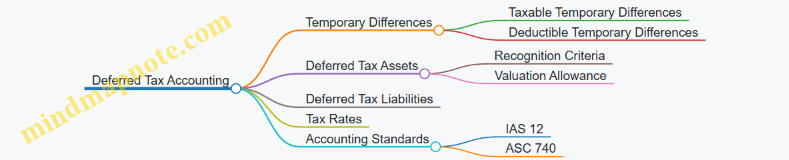
Mind Map 2: Best Practices in Deferred Tax Accounting
Mind Map 3: Professional Development Path
Examples
Example 1: Using a Mind Map to Plan Deferred Tax Study
An accountant preparing for a tax certification can use the “Deferred Tax Accounting Overview” mind map to structure their study plan, ensuring all critical topics are covered systematically.
Example 2: Applying Best Practices Checklist
A tax advisor implementing deferred tax accounting in a new client engagement can refer to the “Best Practices” mind map to verify that all steps—from identification to disclosure—are properly addressed.
Example 3: Career Development Planning
A junior accountant aiming to specialize in tax can use the “Professional Development Path” mind map to identify necessary education, certifications, and experiential milestones.
Additional Resources
- Tax Foundation (https://taxfoundation.org/)
- Research and analysis on tax policies.
- Deloitte IAS Plus (https://www.iasplus.com/en)
- Updates on IFRS standards including deferred tax.
- PwC Inform (https://inform.pwc.com/)
- Technical accounting guidance.
By leveraging these resources and tools, accountants and tax advisors can enhance their expertise in deferred tax accounting, ensuring compliance, accuracy, and strategic insight in their financial reporting.